



m Removing protection template from an unprotected page |
basic reworked details after review and corrected details to improve readability |
||
| Line 1: | Line 1: | ||
{{Short description| | {{Short description|Indo-Aryan ethnolinguistic group}} | ||
{{About|an ethnic group|their language|Punjabi language| | {{About|an ethnic group|their language|Punjabi language|the geographical Punjabi region|Punjab|other uses|Punjabi (disambiguation)}} | ||
{{pp|small=yes}} | |||
{{pp-move-indef}} | |||
{{Use dmy dates|date= | {{Use dmy dates|date=April 2026}} | ||
{{ | {{Use Indian English|date=April 2026}} | ||
{{Infobox ethnic group | {{Infobox ethnic group | ||
| group = Punjabis | | group = Punjabis | ||
| native_name = {{lang|pa|{{Nastaliq|پنجابی}}}} | | native_name = {{hlist|{{lang|pnb|ਪੰਜਾਬੀ}}|{{lang|pa|{{Nastaliq|پنجابی}}}}}} | ||
| native_name_lang = | | native_name_lang = | ||
| population = {{Circa| | | image = File:Countries where Punjabi is spoken.png | ||
| image_caption = | |||
| population = {{Circa|150 million|lk=yes}}<ref>{{cite web | url=https://www.worlddata.info/languages/punjabi.php#:~:text=The%20Punjabi%20language%20(native%20name,Punjabi%20as%20their%20mother%20tongue. | title=Punjabi - Worldwide distribution }}</ref><ref name="e21|pnb">{{e21|pnb}}</ref><ref name="Census2011"/><ref>{{cite web |title= Pakistan Census 2017 |url= https://www.pbs.gov.pk/sites/default/files//population_census/census_2017_tables/pakistan/Table11n.pdf |website=www.pbs.pk |access-date=20 September 2020}}</ref> | |||
| regions = | | regions = | ||
| region1 = | | region1 = Pakistan | ||
| pop1 = | | pop1 = 112,806,516 (2024){{efn|name="PakistanPunjabiPopulation"|Punjabis comprise 44.7% (112,806,516) of Pakistan's total population of 252,363,571 per 2024 estimate by the World Factbook.<ref name="cia.gov">{{cite web |title=South Asia :: Pakistan — The World Fact book - Central Intelligence Agency |url=https://www.cia.gov/the-world-factbook/countries/pakistan/ |archive-url=https://web.archive.org/web/20210110014011/https://www.cia.gov/the-world-factbook/countries/pakistan |url-status=dead |archive-date=10 January 2021 |website=www.cia.gov |access-date=23 June 2024}}</ref>}}<ref name="WorldAtlas">{{Cite web|url=https://www.worldatlas.com/articles/ethnic-groups-in-pakistan.html | title=Ethnic Groups in Pakistan|website=Worldatlas.com| date=30 July 2019|quote=Punjabi people are the ethnic majority in the Punjab region of Pakistan and Northern India accounting for 44.7% of the population in Pakistan.}}</ref><ref>{{cite web |title= Pakistan Census 2017 |url=https://www.pbs.gov.pk/sites/default/files//population_census/census_2017_tables/pakistan/Table11n.pdf |website=www.pbs.pk |access-date=20 September 2020}}</ref><ref>{{cite web | url=https://www.worlddata.info/languages/punjabi.php | title=Punjabi - Worldwide distribution }}</ref> | ||
| region2 = | | region2 = India | ||
| pop2 = | | pop2 = 38,046,464 (2024){{efn|Punjabis comprise 2.7% (38,046,464) of India's total population of 1,409,128,296 per 2024 estimate by the World Factbook.<ref name="cia.govIN">{{cite web |title=South Asia :: India — The World Fact book - Central Intelligence Agency |url=https://www.cia.gov/the-world-factbook/countries/india/#people-and-society |website=www.cia.gov |access-date=23 June 2024 |archive-date=18 March 2021 |archive-url=https://web.archive.org/web/20210318202107/https://www.cia.gov/the-world-factbook/countries/india#people-and-society |url-status=dead }}</ref>}}<ref name="Census2011">{{cite web |title=Abstract Of Speakers' Strength Of Languages And Mother Tongues - 2011 |url=http://www.censusindia.gov.in/2011Census/Language-2011/Statement-1.pdf |publisher=[[Registrar General and Census Commissioner of India]] |access-date=12 June 2022 |archive-url=https://web.archive.org/web/20220220172325/https://www.censusindia.gov.in/2011Census/Language-2011/Statement-1.pdf |archive-date=20 February 2022}}</ref>{{efn|This figure comprises speakers of the [[Punjabi language]] in India. Ethnic Punjabis who no longer speak the language are not included in this number.}}<ref>{{cite web | url=https://www.worlddata.info/languages/punjabi.php#:~:text=The%20Punjabi%20language%20(native%20name,Punjabi%20as%20their%20mother%20tongue | title=Punjabi - Worldwide distribution |access-date=20 April 2024}}</ref> | ||
| region3 = Canada | |||
| pop3 = 942,170 (2021)<ref name="punjabicanada2021">{{Cite web |last=Government of Canada |first=Statistics Canada |date=17 August 2022 |title=Census Profile, 2021 Census of Population Profile table Canada [Country] |url=https://www12.statcan.gc.ca/census-recensement/2021/dp-pd/prof/details/page.cfm?LANG=E&GENDERlist=1,2,3&STATISTIClist=1,4&DGUIDlist=2021A000011124&HEADERlist=,15,13,18,12,16,14,17&SearchText=Canada |access-date=18 August 2022 |website=www12.statcan.gc.ca}}</ref>{{efn|name=canada|Statistic includes all speakers of the [[Punjabi language]], as many [[Immigrant generations|multi-generation]] individuals do not speak the language as a [[Mother-tongue|mother tongue]], but instead as a [[Second language|second]] or [[Third language acquisition|third language]].}} | |||
| | | region4 = United Kingdom | ||
| | | pop4 = 700,000 (2006)<ref name="HC">{{cite web|url=https://publications.parliament.uk/pa/cm200607/cmhansrd/cm061205/halltext/61205h0001.htm|title=Punjabi Community|first=John|last=McDonnell|work=House of Commons|date=5 December 2006|access-date=3 August 2016|quote=We now estimate the Punjabi community at about 700,000, with Punjabi established as the second language certainly in London and possibly within the United Kingdom.}}</ref> | ||
| region5 = | | region5 = United States | ||
| pop5 = 253,740<ref>{{Cite web|url=http://www2.census.gov/library/data/tables/2008/demo/language-use/2009-2013-acs-lang-tables-nation.xls|title=US Census Bureau ''American Community Survey (2009-2013)'' See Row #62|website=2.census.gov}}</ref> | | pop5 = 253,740<ref>{{Cite web|url=http://www2.census.gov/library/data/tables/2008/demo/language-use/2009-2013-acs-lang-tables-nation.xls|title=US Census Bureau ''American Community Survey (2009-2013)'' See Row #62|website=2.census.gov}}</ref> | ||
| region6 = | | region6 = Australia | ||
| pop6 = 132,496 (2017)<ref>{{Cite web|url=http://www.abs.gov.au/ausstats/[email protected]/Lookup/by%20Subject/2071.0~2016~Main%20Features~Cultural%20Diversity%20Article~20|archive-url=https://web.archive.org/web/20170709233002/http://www.abs.gov.au/ausstats/[email protected]/Lookup/by%20Subject/2071.0~2016~Main%20Features~Cultural%20Diversity%20Article~20|url-status=dead|title=Top ten languages spoken at home in Australia|archive-date=9 July 2017}}</ref> | | pop6 = 132,496 (2017)<ref>{{Cite web|url=http://www.abs.gov.au/ausstats/[email protected]/Lookup/by%20Subject/2071.0~2016~Main%20Features~Cultural%20Diversity%20Article~20|archive-url=https://web.archive.org/web/20170709233002/http://www.abs.gov.au/ausstats/[email protected]/Lookup/by%20Subject/2071.0~2016~Main%20Features~Cultural%20Diversity%20Article~20|url-status=dead|title=Top ten languages spoken at home in Australia|archive-date=9 July 2017}}</ref> | ||
| region7 = | | region7 = Malaysia | ||
| pop7 = 56,400 (2019)<ref>{{cite web|url=http://www.ethnologue.com/country/MY|title=Malaysia|website=Ethnologue.com|access-date=28 July 2019}}</ref> | | pop7 = 56,400 (2019)<ref>{{cite web|url=http://www.ethnologue.com/country/MY|title=Malaysia|website=Ethnologue.com|access-date=28 July 2019}}</ref> | ||
| region9 = | | region9 = Philippines | ||
| pop9 = 50,000 (2016)<ref>{{cite web|url=http://indianexpress.com/article/india/india-news-india/punjabi-community-money-lending-philippines-president-rodrigo-duterte-2806212/|title=Punjabi community involved in money lending in Philippines braces for 'crackdown' by new President|date=18 May 2016}}</ref> | | pop9 = 50,000 (2016)<ref>{{cite web|url=http://indianexpress.com/article/india/india-news-india/punjabi-community-money-lending-philippines-president-rodrigo-duterte-2806212/|title=Punjabi community involved in money lending in Philippines braces for 'crackdown' by new President|date=18 May 2016}}</ref> | ||
| region10 = {{ | | region10 = Indonesia | ||
| | | pop10 = 35,000 (2019)<ref>{{cite web|url=https://jakartaglobe.id/lifestyle/the-sikh-community-of-sumatra|title=The Sikh Community of Sumatra|website=jakartaglobe.id|access-date=2 March 2024}}</ref> | ||
| | | region11 = New Zealand | ||
| | | pop11 = 34,227 (2018)<ref>{{cite web|url=https://www.stats.govt.nz/assets/Uploads/2018-Census-totals-by-topic/Download-data/2018-census-totals-by-topic-national-highlights.xlsx|title=New Zealand|website=Stats New Zealand|access-date=24 September 2019}}</ref> | ||
| | | region12 = Norway | ||
| | | pop12 = 24,000 (2013)<ref>{{cite book|url=https://books.google.com/books?id=27JOMobauYAC|title=Encyclopedia of Linguistics|first=Philipp|last=Strazny|date=1 February 2013|publisher=Routledge|via=Google Books|isbn=978-1-135-45522-4}}</ref> | ||
| | | region13 = Bangladesh | ||
| | | pop13 = 23,700 (2019)<ref>{{cite web|url=http://www.ethnologue.com/country/BD|title=Bangladesh|website=Ethnologue.com|access-date=28 July 2019}}</ref> | ||
| | | region14 = Germany | ||
| | | pop14 = 18,000 (2020)<ref>{{cite web|url=https://www.remid.de/info_zahlen/verschiedene|title=Deutsche Informationszentrum für Sikhreligion, Sikhgeschichte, Kultur und Wissenschaft (DISR)|website=remid.de|access-date=3 January 2020}}</ref> | ||
| | | region15 = Nepal | ||
| | | pop15 = 10,000 (2011)<ref>{{cite web|url=http://unstats.un.org/unsd/demographic/sources/census/wphc/Nepal/Nepal-Census-2011-Vol1.pdf|title=National Population and Housing Census 2011 |website=Unstats.unorg|access-date=29 July 2019}}</ref> | ||
| langs = ''' | | region16 = Others | ||
| religions = '''Majority''' <br/>[[ | | pop16 = See [[Punjabi diaspora]] | ||
'''[[Punjab, Pakistan]]''':<br/>'''Majority'''<br/>[[ | | langs = {{small|'''[[First language|L1]]'''}}: [[Punjabi language|Punjabi]] and its [[Punjabi dialects|dialects]]<br/>{{small|'''[[Second language|L2]]'''}}: [[Urdu]] {{small|(in Pakistan)}} and [[Hindi]] and other [[Languages of India|Indian languages]] {{small|(in India)}} | ||
| religions = '''Majority''' <br/> [[Punjabi Muslims|Islam]] <br/>'''Minority''' <br/> {{hlist|[[Sikhism]]|[[Punjabi Hindus|Hinduism]] (incl. [[Nanakpanthi]]s)|[[Punjabi Christians|Christianity]]|[[Ravidassia]]<ref>{{cite book |last1=Jacobsen |first1=Knut A. |last2=Myrvold |first2=Kristina |title=Sikhs in Europe: Migration, Identities and Representations |date=2011 |publisher=Ashgate Publishing, Ltd. |isbn=978-1-4094-2434-5 |url=https://books.google.com/books?id=Y3v3t9bjPAcC&pg=PA290 |access-date=19 May 2024 |language=en}}</ref>}}<br/> | |||
'''[[Punjab, Pakistan|Pakistani Punjab]]''':<br/>'''Majority'''<br/>[[Punjabi Muslims|Islam]] (97.75%)<br/>'''Minority'''<br/>{{hlist|[[Punjabi Christians|Christianity]] (1.93%)|[[Punjabi Hindus|Hinduism]] (0.2%)|[[Sikhism]] (0.004%)}}<br/>'''[[Punjab, India|Indian Punjab]]''':<br/>'''Majority'''<br/>[[Sikhism]] (57.7%)<br/>'''Minority'''<br/>{{hlist|[[Punjabi Hindus|Hinduism]] (38.5%)|[[Punjabi Muslims|Islam]] (1.9%)|[[Punjabi Christians|Christianity]] (1.3%)<ref name="auto1">{{cite web|url=http://www.censusindia.gov.in/2011census/C-01/DDW03C-01%20MDDS.XLS|format=XLS|title= C-1 Population By Religious Community - 2011|access-date=29 July 2019|archive-url=https://web.archive.org/web/20150923230423/http://www.censusindia.gov.in/2011census/C-01/DDW03C-01%20MDDS.XLS|archive-date=23 September 2015}}</ref><ref name="Harrison2007p132">{{cite book|author1=Wade Davis|author2=K. David Harrison|author3=Catherine Herbert Howell|title=Book of Peoples of the World: A Guide to Cultures|url=https://books.google.com/books?id=rkG8f2lyeUMC&pg=PA132|year=2007|publisher=National Geographic|isbn=978-1-4262-0238-4|pages=132–133}}</ref><ref>{{Cite web |title=Punjabis |url=https://www.encyclopedia.com/humanities/encyclopedias-almanacs-transcripts-and-maps/punjabis |website=[[Encyclopaedia]]}}</ref>}} | |||
| related_groups = Other [[Indo-Aryan peoples]] | | related_groups = Other [[Indo-Aryan peoples]] | ||
}} | }} | ||
{{Punjabis}} | |||
{{ | The '''Punjabis''' ([[Punjabi language|Punjabi]]: {{Nastaliq|پنجابی}} {{small|([[Shahmukhi alphabet|Shahmukhi]])}}; ਪੰਜਾਬੀ {{small|([[Gurmukhi]])}}; [[romanised]] as '''Pañjābī''')<ref name=":9">{{Cite book |last=Minahan |first=James |url=https://books.google.com/books?id=abNDLZQ6quYC&pg=PA257 |title=Ethnic Groups of South Asia and the Pacific: An Encyclopedia |date=2012 |publisher=ABC-CLIO |isbn=978-1-59884-659-1 |pages=257–259}}</ref><ref>{{Cite book |last=Temple |first=Richard Carnac |url=https://books.google.com/books?id=BtlztAEACAAJ |title=A Dissertation on the Proper Names of Panjabis: With Special Reference to the Proper Names of Villagers in the Eastern Panjab |date=20 August 2017 |publisher=Creative Media Partners, LLC |isbn=978-1-375-66993-1}}</ref> are an [[Indo-Aryan peoples|Indo-Aryan]] ethnolinguistic group<ref>{{Cite book |last1=Goh |first1=Daniel P. S. |url=https://books.google.com/books?id=-1N5AgAAQBAJ&pg=PA187 |title=Race and Multiculturalism in Malaysia and Singapore |last2=Gabrielpillai |first2=Matilda |last3=Holden |first3=Philip |last4=Khoo |first4=Gaik Cheng |date=12 June 2009 |publisher=Routledge |isbn=978-1-134-01649-5 |page=187}}</ref> associated with the [[Punjab region]], comprising areas of northwestern [[India]] and eastern [[Pakistan]].<ref>{{Cite book |last=Minahan |first=James |url=https://books.google.com/books?id=abNDLZQ6quYC&pg=PA257 |title=Ethnic Groups of South Asia and the Pacific: An Encyclopedia |date=2012 |publisher=ABC-CLIO |isbn=978-1-59884-659-1}}</ref> They generally speak [[Majhi dialect|Standard Punjabi]] or various [[Punjabi dialects]] on both sides.<ref>{{cite book|title=Concise Encyclopedia of Languages of the World|url=https://books.google.com/books?id=F2SRqDzB50wC&pg=PA522|year=2010|publisher=Elsevier|isbn=978-0-08-087775-4|pages=522–523}}</ref> | ||
The | The majority of the overall Punjabi population adheres to [[Islam]] with significant minorities practising [[Sikhism]] and [[Hinduism]] and smaller minorities practising [[Christianity]]. However, the religious demographics significantly vary when viewed from Pakistani and Indian sides, respectively, with over 95 per cent of the Punjabi population from Pakistan being [[Punjabi Muslims|Muslim]], with a small minority of [[Punjabi Christians|Christians]] and [[Punjabi Hindus|Hindus]] and an even smaller minority of [[Punjabi Sikhs|Sikhs]]. Over 57 per cent of the population of the Indian state of Punjab is Sikh and over 38 per cent Hindu with a small minority of Muslims and Christians.<ref name="auto1">{{cite web|url=http://www.censusindia.gov.in/2011census/C-01/DDW03C-01%20MDDS.XLS|format=XLS|title= C-1 Population By Religious Community - 2011|access-date=29 July 2019|archive-url=https://web.archive.org/web/20150923230423/http://www.censusindia.gov.in/2011census/C-01/DDW03C-01%20MDDS.XLS|archive-date=23 September 2015}}</ref><ref name="Harrison2007p132">{{cite book|author1=Wade Davis|author2=K. David Harrison|author3=Catherine Herbert Howell|title=Book of Peoples of the World: A Guide to Cultures|url=https://books.google.com/books?id=rkG8f2lyeUMC&pg=PA132|year=2007|publisher=National Geographic|isbn=978-1-4262-0238-4|pages=132–133}}</ref><ref>{{Cite web |title=Punjabis |url=https://www.encyclopedia.com/humanities/encyclopedias-almanacs-transcripts-and-maps/punjabis |website=[[Encyclopaedia]]}}</ref> | ||
The term | The [[ethnonym]] is derived from the term ''Punjab'' (Five rivers) in [[Persian language|Persian]] to describe the geographic region of the northwestern part of the Indian subcontinent, where five rivers [[Beas River|Beas]], [[Chenab River|Chenab]], [[Jhelum River|Jhelum]], [[Ravi River|Ravi]], and [[Sutlej]] merge into the [[Indus River]],<ref name="Nayar1">{{Cite book |last=Nayar |first=Kamala Elizabeth |url=https://books.google.com/books?id=q7pO-IZY218C&pg=PA7 |title=The Punjabis in British Columbia: Location, Labour, First Nations, and Multiculturalism |date=2012 |publisher=McGill-Queen's Press - MQUP |isbn=978-0-7735-4070-5 |language=en}}</ref><ref name="Gandhi 2013">{{cite book |last=Gandhi |first=Rajmohan |title=Punjab: A History from Aurangzeb to Mountbatten |publisher=Aleph Book Company |year=2013 |isbn=978-93-83064-41-0 |location=New Delhi, India, Urbana, [[Illinois]]}}</ref><ref name=":1">{{cite book |last=Canfield |first=Robert L. |title=Persia in Historical Perspective |publisher=Cambridge University Press |year=1991 |isbn=978-0-521-52291-5 |location=[[Cambridge]], United Kingdom<!--|isbn=0-521-39094-X--> |page=1 ("Origins")}}</ref> in addition of the now-vanished [[Ghaggar-Hakra River|Ghaggar]].<ref>{{Cite book |last=West |first=Barbara A. |url=https://books.google.com/books?id=pCiNqFj3MQsC |title=Encyclopedia of the Peoples of Asia and Oceania |date=19 May 2010 |publisher=Infobase Publishing |isbn=978-1-4381-1913-7 |language=en}}</ref> | ||
The coalescence of the various tribes, castes and the inhabitants of the Punjab region into a broader common "Punjabi" identity initiated from the onset of the 18th century CE.<ref>{{cite book|last=Malhotra|first=Anshu|title=Punjab reconsidered : history, culture, and practice|year=2012|publisher=[[Oxford University Press]]|location=New Delhi|isbn=978-0-19-807801-2|url=http://global.oup.com/academic/product/punjab-reconsidered-history-culture-and-practice-9780198078012;jsessionid=67C0F3362215BC7FE368DF643C70CA16?cc=de&lang=en&|author2=Mir, Farina|access-date=6 April 2014|archive-date=7 March 2016|archive-url=https://web.archive.org/web/20160307092802/https://global.oup.com/academic/product/punjab-reconsidered-history-culture-and-practice-9780198078012;jsessionid=67C0F3362215BC7FE368DF643C70CA16?cc=de&lang=en&|url-status=dead}}</ref><ref>{{cite journal|last=Ayers|first=Alyssa|title=Language, the Nation, and Symbolic Capital: The Case of Punjab|journal=Journal of Asian Studies|year=2008|volume=67|issue=3|pages=917–46|url=http://alyssaayres.com/pdf/Ayres-JAS-Language-Nation.pdf|doi=10.1017/s0021911808001204|s2cid=56127067|issn = 0021-9118}}</ref><ref name="Thandi 1996">{{cite book|last1=Singh|first1=Pritam|last2=Thandi|first2=Shinder S.|title=Globalisation and the region : explorations in Punjabi identity|year=1996|publisher=Association for Punjab Studies (UK)|location=Coventry, United Kingdom|isbn=978-1-874699-05-7}}</ref> Historically, the Punjabi people were a [[heterogeneous]] group and were subdivided into a number of clans called ''[[Baradari (brotherhood)|biradari]]'' (literally meaning "brotherhood") or ''[[Punjabi tribes|tribes]]'', with each person bound to a clan. With the passage of time, tribal structures became replaced with a more cohesive and holistic society, as [[community building]] and [[group cohesiveness]] form the new pillars of Punjabi society.<ref name="Thandi 1996" /><ref>{{cite journal|last=Mukherjee|first=Protap|author2=Lopamudra Ray Saraswati |title=Levels and Patterns of Social Cohesion and Its Relationship with Development in India: A Woman's Perspective Approach|journal=Ph.D. Scholars, Centre for the Study of Regional Development School of Social Sciences Jawaharlal Nehru University New Delhi – 110 067, India|date=20 January 2011|url=http://www.oecd.org/dev/pgd/46839502.pdf}}</ref> | |||
Traditionally, Punjabi identity is primarily linguistic, geographical and cultural. Its identity is independent of historical origin or religion and refers to those who reside in the Punjab region or associate with its population and those who consider the [[Punjabi language]] their mother tongue.<ref>{{cite book|last1=Singh|first1=Pritam|last2=Thandi|first2=Shinder S.|title=Punjabi identity in a global context| | Traditionally, the Punjabi identity is primarily linguistic, geographical and cultural. Its identity is independent of historical origin or religion and refers to those who reside in the Punjab region or associate with its population and those who consider the [[Punjabi language]] their mother tongue.<ref>{{cite book |last1=Singh |first1=Pritam |last2=Thandi |first2=Shinder S. |title=Punjabi identity in a global context |url=https://books.google.com/books?id=igpuAAAAMAAJ |publisher=[[Oxford University Press]] |year=1999 |isbn=978-0-19-564864-5 |location=New Delhi }}</ref> [[social integration|Integration]] and [[cultural assimilation|assimilation]] are important parts of Punjabi culture, since Punjabi identity is not based solely on tribal connections.<ref>{{cite journal |last=Singh |first=Prtiam |year=2012 |title=Globalisation and Punjabi Identity: Resistance, Relocation and Reinvention (Yet Again!) |url=http://www.global.ucsb.edu/punjab/journal/v19_2/Singh.pdf |url-status=dead |journal=Journal of Punjab Studies |volume=19 |issue=2 |pages=153–72 |archive-url=https://web.archive.org/web/20160124071525/http://www.global.ucsb.edu/punjab/journal/v19_2/Singh.pdf |archive-date=24 January 2016 |access-date=6 April 2014}}</ref> While Punjabis share a common territory, ethnicity and language, they are likely to be followers of one of several religions, most often [[Punjabi Muslims|Islam]], [[Punjabi Sikhs|Sikhism]], [[Punjabi Hindus|Hinduism]] or [[Punjabi Christians|Christianity]].<ref name="Gupta, S.K">{{cite book |last=Gupta |first=S.K. |title=The Scheduled Castes in Modern Indian Politics: Their Emergence as a Political Context |publisher=Munshiram Manoharlal Publishers Pvt. Ltd |year=1985 |location=New Delhi, India |pages=121–122}}</ref> | ||
== Etymology == | |||
The term "Punjab" came into currency during the reign of [[Akbar]] in the late sixteenth century.<ref name=":2" /><ref name="Gandhi 2013" /><ref name=":1" /> Though the name Punjab is of [[Persian language|Persian]] origin, its two parts ({{Langx|fa|پنج|translit=panj|label=none|lit=five}} and {{Langx|fa|آب|translit=āb|label=none|lit=water}}) are cognates of the [[Sanskrit]] words, {{Langx|sa|पञ्च|lit=five|translit=pañca|label=none}} and {{Langx|sa|अप्|lit=water|translit=áp|label=none}}, of the same meaning.<ref name=EoS>{{cite encyclopedia|url=http://www.learnpunjabi.org/eos/PUNJAB.html |title=The Punjab |author=H K Manmohan Siṅgh|encyclopedia=The Encyclopedia of Sikhism, Editor-in-Chief Harbans Singh |publisher=[[Punjabi University]], Patiala|access-date=18 August 2015 |url-status=live |archive-url=https://web.archive.org/web/20160305062705/http://www.learnpunjabi.org/eos/PUNJAB.html |archive-date=5 March 2016}}</ref><ref>{{cite book |last=Gandhi |first=Rajmohan |title=Punjab: A History from Aurangzeb to Mountbatten |publisher=Aleph Book Company |year=2013 |isbn=978-93-83064-41-0 |location=New Delhi, India, Urbana, [[Illinois]] |page=1 ("Introduction")}}</ref> The word ''pañjāb'' thus means 'The Land of Five Waters', referring to the rivers [[Jhelum River|Jhelum]], [[Chenab River|Chenab]], [[Ravi River|Ravi]], [[Sutlej]], and [[Beas River|Beas]].<ref>"Punjab." Pp. 107 in [[Encyclopædia Britannica, Ninth Edition|''Encyclopædia Britannica'' (9th ed.)]], vol. 20.</ref> All are [[Tributary|tributaries]] of the [[Indus River]], the Sutlej being the largest. References to a land of five rivers may be found in the ''[[Mahabharata]]'', which calls one of the regions in ancient Bharat ''Panchanada'' ({{Langx|sa|पञ्चनद|lit=five rivers|translit=pañca-nada}}).<ref>{{cite book |url=https://books.google.com/books?id=GdKcAAAAQBAJ&pg=PA199 |title=The Geography of India: Sacred and Historic Places |publisher=Britannica Educational Publishing |year=2010 |isbn=978-1-61530-202-4 |editor=Kenneth Pletcher |pages=199 |quote=The word's origin can perhaps be traced to panca nada, Sanskrit for "five rivers" and the name of a region mentioned in the ancient epic the Mahabharata.}}</ref><ref>{{cite book |author=Rajesh Bala |url=https://books.google.com/books?id=PzduAAAAMAAJ |title=Punjab History Conference, Thirty-seventh Session, March 18-20, 2005: Proceedings |publisher=Punjabi University |year=2005 |isbn=978-81-7380-990-3 |editor=Sukhdial Singh |page=80 |chapter=Foreign Invasions and their Effect on Punjab |quote="The word Punjab is a compound of two words-Panj (Five) and aab (Water), thus signifying the land of five waters or rivers. This origin can perhaps be traced to panch nada, Sanskrit for 'Five rivers' the word used before the advent of Muslims with a knowledge of Persian to describe the meeting point of the Jhelum, Chenab, Ravi, Beas, and Sutlej rivers, before they joined the Indus."}}</ref> The ancient [[Greek people|Greeks]] referred to the region as ''Pentapotamía'' ({{langx|el|Πενταποταμία}}),<ref>[[Christian Lassen|Lassen, Christian]]. 1827. ''[https://books.google.com/books?id=XbBCAAAAcAAJ&pg=PA3 Commentatio Geographica atque Historica de Pentapotamia Indica]'' [''A Geographical and Historical Commentary on Indian Pentapotamia'']. Weber. p. 4: "That part of India which today we call by the Persian name <nowiki>''</nowiki>Penjab<nowiki>''</nowiki> is named ''Panchanada'' in the sacred language of the Indians; either of which names may be rendered in Greek by Πενταποταμια. The Persian origin of the former name is not at all in doubt, although the words of which it is composed are both Indian and Persian.... But, in truth, that final word is never, to my knowledge, used by the Indians in proper names compounded in this way; on the other hand, there exist multiple Persian names which end with that word, e.g., ''Doab'' and ''Nilab''. Therefore, it is probable that the name Penjab, which is today found in all geographical books, is of more recent origin and is to be attributed to the Muslim kings of India, among whom the Persian language was mostly in use. That the Indian name Panchanada is ancient and genuine is evident from the fact that it is already seen in the ''Ramayana'' and ''Mahabharata'', the most ancient Indian poems, and that no other exists in addition to it among the Indians; for ''Panchála'', which English translations of the ''Ramayana'' render with Penjab...is the name of another region, entirely distinct from Pentapotamia...."{{whose translation|reason=has several mistakes - looks like Google translation|date=August 2022}}</ref><ref>{{cite book |author1-last=Latif |author1-first=Syad Muhammad |url=https://books.google.com/books?id=RzBAAQAAMAAJ&pg=PR1 |title=History of the Panjáb from the Remotest Antiquity to the Present Time |publisher=[[Calcultta Central Press Company]] |year=1891 |page=1 |quote=The Panjáb, the Pentapotamia of the Greek historians, the north-western region of the empire of Hindostán, derives its name from two Persian words, ''panj'' (five), an ''áb'' (water, having reference to the five rivers which confer on the country its distinguishing features."}}</ref><ref name="Khalid">{{cite journal |year=2015 |title=Lahore of Pre Historic Era |url=http://pu.edu.pk/images/journal/history/PDF-FILES/7.%20Kanwal%20Khalid_v52_2_15.pdf |journal=Journal of the Research Society of Pakistan |volume=52 |issue=2 |page=73 |quote=The earliest mention of five rivers in the collective sense was found in Yajurveda and a word Panchananda was used, which is a Sanskrit word to describe a land where five rivers meet. [...] In the later period the word ''Pentapotamia'' was used by the Greeks to identify this land. (''Penta'' means 5 and potamia, water ___ the land of five rivers) Muslim Historians implied the word "Punjab " for this region. Again it was not a new word because in Persian-speaking areas, there are references of this name given to any particular place where five rivers or lakes meet. |author1-last=Khalid |author1-first=Kanwal}}</ref> which has the same meaning as the Persian word. | |||
==Geographic distribution== | ==Geographic distribution== | ||
{{Main articles|Punjab region}} | |||
Punjab is a geopolitical, cultural, and [[historical region]] in [[South Asia]], specifically in the northern part of the [[Indian subcontinent]], comprising areas of eastern [[Pakistan]] and northwestern [[India]]. The boundaries of the region are ill-defined and focus on historical accounts. The geographical definition of the term "Punjab" has changed over time. In the 16th century [[Mughal Empire]] it referred to a relatively smaller area between the [[Indus River|Indus]] and the [[Sutlej River|Sutlej]] rivers.<ref name="JS_Grewal_1998">{{cite book |author=J. S. Grewal |url=https://books.google.com/books?id=2_nryFANsoYC |title=The Sikhs of the Punjab |publisher=Cambridge University Press |year=1998 |isbn=978-0-521-63764-0 |edition=Revised |series=The New Cambridge History of India |page=1}}</ref><ref name=":2">{{Cite book |last=Yoga |first=Project of History of Indian Science, Philosophy, and Culture Sub Project: Consciousness, Science, Society, Value, and |url=https://books.google.com/books?id=9x5FX2RROZgC&pg=PA202 |title=Different Types of History |date=2009 |publisher=Pearson Education India |isbn=978-81-317-1818-6 |language=en}}</ref> | |||
[[File:Punjab map (topographic) with cities.png|thumb|The [[Punjab region]], with its rivers.]] | |||
[[File: | |||
=== | === Pakistan === | ||
While the total population of [[Punjab]] is 110 million as noted in the 2017 Pakistan census,<ref>{{Cite web|url=https://pwd.punjab.gov.pk/population_profile|title=Population Profile Punjab | Population Welfare Department|website=Pwd.punjab.gov.pk|access-date=10 January 2019|archive-date=15 February 2023|archive-url=https://web.archive.org/web/20230215022042/https://pwd.punjab.gov.pk/population_profile|url-status=dead}}</ref> [[ethnic Punjabis]] comprise approximately 44.7% of the national population.<ref name="cia.gov"/><ref name="WorldAtlas"/> With an estimated national population of 252 million in 2024,<ref name="cia.gov"/> ethnic Punjabis thus number approximately 112.8 million in Pakistan;{{efn|name="PakistanPunjabiPopulation"}}<ref name="auto">{{Cite web|url=https://www.worldometers.info/world-population/pakistan-population/|title=Pakistan Population (2019) |website=Worldometers.info|access-date=29 July 2019}}</ref> this makes Punjabis the [[Ethnic groups of Pakistan|largest ethnic group in Pakistan]] by population.<ref name="cia.gov"/><ref name="WorldAtlas"/> | |||
Religious homogeneity remains elusive as a predominant [[Sunni]] population with [[Shia]], [[Ahmadiyya]] and [[Christianity|Christian]] minorities.<ref>{{cite web |title=Population by Religion |url=http://www.pbs.gov.pk/sites/default/files/tables/POPULATION%20BY%20RELIGION.pdf |website=pbs.gov.pk |publisher=[[Pakistan Bureau of Statistics]]}}</ref> | |||
=== India === | |||
The Punjabi-speaking people make up 2.74% of India's population as of 2011.<ref>{{cite web |title=SCHEDULED LANGUAGES IN DESCENDING ORDER OF SPEAKERS' STRENGTH - 2011 |url=http://censusindia.gov.in/2011Census/Language-2011/Statement-4.pdf |website=censusindia.gov.in |access-date=2 April 2020}}</ref> The total number of Indian Punjabis is unknown due to the fact that ethnicity is not recorded in the [[Census of India]]. [[Sikhs]] are largely concentrated in the modern-day state of [[Punjab, India|Punjab]] forming 57.7% of the population with [[Hindus]] forming 38.5%.<ref name=":0">{{cite news |last1=Mohan |first1=Vibhor |title=Census 2011: %age of Sikhs drops in Punjab; migration to blame? |url=https://timesofindia.indiatimes.com/city/chandigarh/Census-2011-age-of-Sikhs-drops-in-Punjab-migration-to-blame/articleshow/48689317.cms |access-date=10 September 2023 |work=The Times of India |date=27 August 2015}}</ref> Ethnic Punjabis are believed to account for at least 40% of Delhi's total population and are predominantly [[Hindi]]-speaking [[Punjabi Hindus]].<ref>{{cite web|url=http://m.indiatvnews.com/politics/national/delhi-assembly-elections-2015-important-facts-and-stakeholders-25298.html|title=Delhi Assembly Elections 2015: Important Facts And Major Stakeholders Mobile Site|date=6 February 2015|work=India TV News|access-date=7 September 2015|archive-date=30 December 2015|archive-url=https://web.archive.org/web/20151230215251/http://m.indiatvnews.com/politics/national/delhi-assembly-elections-2015-important-facts-and-stakeholders-25298.html|url-status=dead}}</ref><ref>{{cite web|url=http://www.tribuneindia.com/mobi/news/sunday-special/perspective/why-punjabis-are-central-to-delhi-election/36387.html|title=Why Punjabis are central to Delhi election|author=Jupinderjit Singh|date=February 2015|work=tribuneindia.com/news/sunday-special/perspective/why-punjabis-are-central-to-delhi-election/36387.html|access-date=7 September 2015|archive-date=9 January 2022|archive-url=https://web.archive.org/web/20220109200353/https://www.tribuneindia.com/news/archive/features/why-punjabis-are-central-to-delhi-election-36387|url-status=dead}}</ref><ref name="Sanjay2008">{{cite book |author=Sanjay Yadav |url=https://books.google.com/books?id=CTBBL1q5C_EC&pg=PA10 |title=The Invasion of Delhi |publisher=Worldwide Books |year=2008 |isbn=978-81-88054-00-8}}</ref> The Indian censuses record the native languages, but not the descent of the citizens. Thus, there is no concrete official data on the [[Ethnic groups in Delhi|ethnic makeup of Delhi]] and other Indian states.<ref name="Sanjay2008" />{{rp|8–10}} | |||
Indian Punjab is also home to small groups of Muslims and Christians. Most of the [[East Punjab]]'s Muslims left for West Punjab in 1947.<ref>{{cite book |title=The Sikhs of the Punjab |date=1991 |publisher=Cambridge University Press |isbn=978-0-521-26884-4 |pages=181–204 |url=https://www.cambridge.org/core/books/abs/sikhs-of-the-punjab/towards-the-punjabi-province-19471966/BFF4661DA2FA85A954DC95F97F03E0B4 |chapter=Towards the ‘Punjabi Province’ (1947–1966)|series=The New Cambridge History of India |doi=10.1017/CHOL9780521268844.011 }}</ref> However, a small community still exists today, mainly in [[Qadian]], and [[Malerkotla]].<ref>{{cite news |last1=Dikshit |first1=V. |title=Punjab Polls: The mood in Malerkotla and Qadian |url=https://www.nationalheraldindia.com/news/punjab-polls-the-mood-in-malerkotla-and-qadian-minority-vote-muslims-root-for-candidates-not-parties |access-date=10 September 2023 |work=National Herald |date=3 February 2017 |language=en}}</ref> | |||
= | |||
The | |||
===Punjabi diaspora=== | ===Punjabi diaspora=== | ||
{{Main|Punjabi diaspora}} | {{Main|Punjabi diaspora}} | ||
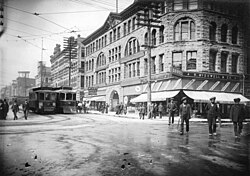
[[File:Streetcars passing at the 400 Block of Granville Street, Vancouver, in 1908.jpg|thumb|right|225px|Punjabis in Vancouver, 1908]] | |||
The Punjabi people have emigrated in large numbers to many parts of the world. In the early 20th century, many Punjabis began settling in the [[United States]], including independence activists who formed the [[Ghadar Party]]. The United Kingdom has a significant number of Punjabis from both Pakistan and India. The most populous areas being London, Birmingham, Manchester and Glasgow. In Canada (specifically [[Vancouver]],<ref>{{cite web |url=https://www12.statcan.gc.ca/census-recensement/2016/dp-pd/prof/details/page.cfm?Lang=E&Geo1=CMACA&Code1=933&Geo2=PR&Code2=59&SearchText=vancouver&SearchType=Begins&SearchPR=01&B1=Language&TABID=1&type=0 |title=Census Profile, 2016 Census Vancouver [Census metropolitan area], British Columbia and British Columbia [Province] |date=8 February 2017 |publisher=Statistics Canada |access-date=31 August 2021 }}</ref> [[Toronto]],<ref>{{cite web |url=https://www12.statcan.gc.ca/census-recensement/2016/dp-pd/prof/details/page.cfm?Lang=E&Geo1=CMACA&Code1=535&Geo2=PR&Code2=35&SearchText=toronto&SearchType=Begins&SearchPR=01&B1=Language&TABID=1&type=0 |title=Census Profile, 2016 Census Toronto [Census metropolitan area], Ontario and Ontario [Province] |date=8 February 2017 |publisher=Statistics Canada |access-date=31 August 2021 }}</ref> and [[Calgary]]<ref>{{cite web |url=https://www12.statcan.gc.ca/census-recensement/2016/dp-pd/prof/details/page.cfm?Lang=E&Geo1=CMACA&Code1=825&Geo2=PR&Code2=48&SearchText=calgary&SearchType=Begins&SearchPR=01&B1=Language&TABID=1&type=0 |title=Census Profile, 2016 Census Calgary [Census metropolitan area], Alberta and Alberta [Province] |date=8 February 2017 |publisher=Statistics Canada |access-date=31 August 2021 }}</ref>) and the United States, (specifically California's [[Central Valley (California)|Central Valley]] as well as the New York and New Jersey region). In the 1970s, a large wave of emigration of Punjabis (predominately from Pakistan) began to the Middle East, in places such as the [[United Arab Emirates|UAE]], [[Saudi Arabia]] and [[Kuwait]]. There are also large communities in East Africa including the countries of [[Kenya]], [[Uganda]] and [[Tanzania]]. Punjabis have also emigrated to [[Australia]], [[New Zealand]] and Southeast Asia including [[Malaysia]], [[Philippines]], [[Thailand]], [[Indonesia]], [[Singapore]] and [[Hong Kong]]. Of recent times many Punjabis have also moved to Italy.{{citation needed|date=July 2022}} | |||
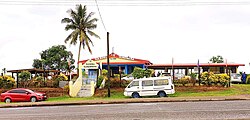
[[File:Gurdwara Guru Ravidass, Nasinu, Fiji.jpg|thumb|Gurdwara [[Guru Ravidass]], Nasinu, Fiji Established in 1939]] | |||
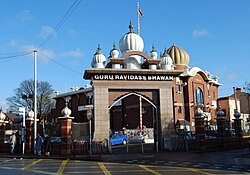
[[File:Gurdwara Guru Ravidass Bhavan, Birmingham.jpg|thumb|Gurdwara Guru Ravidass Bhavan, Birmingham]] | |||
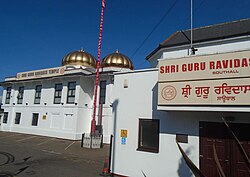
[[File:Gurdwara Guru Ravidass Sabha,Southall .jpg|thumb|[[Gurdwara Guru Ravidass Sabha]], Southall]] | |||
== Demography == | |||
=== Castes and tribes === | |||
=== | |||
{{Main|List of Punjabi tribes}} | {{Main|List of Punjabi tribes}} | ||
{{See also|Punjab#Tribes}} | |||
Among the major castes and tribes of [[Punjab, Pakistan|West Punjab]] (Pakistan) are the [[Jat people|Jats]], [[Rajput]]s, [[Arain]]s, [[Gurjar|Gujjars]] and [[Awan (tribe)|Awans]].<ref>{{cite encyclopedia |title=Punjab Province, Pakistan |encyclopedia=[[Encyclopædia Britannica]] |id=483579 |url=https://www.britannica.com/place/Punjab-province-Pakistan |access-date=22 March 2022}}h</ref> Prior to [[Partition of India|the partition in 1947]], major communities of West Punjab also included the [[Khatri]]s, [[Arora]]s and [[Brahmin]]s.<ref>{{Cite book|last=Tyagi|first=Dr Madhu|url=https://books.google.com/books?id=YMpJDwAAQBAJ&dq=khatris+multan+thevenot&pg=PA18|title=THEORY OF INDIAN DIASPORA: DYNAMICS OF GLOBAL MIGRATION|date=1 January 2017|publisher=Horizon Books (A Division of Ignited Minds Edutech P Ltd)|isbn=978-93-86369-37-6|pages=18|language=en}}</ref><ref name=":202">{{Cite book|last=Puri|first=Baij Nath|url=https://books.google.com/books?id=7ytuAAAAMAAJ&q=khatris+a+socio+cultural+study|title=The Khatris, a Socio-cultural Study|date=1988|publisher=M.N. Publishers and Distributors|pages=19–20|language=en}}</ref><ref name=":1822">{{Cite book|last=Oonk|first=Gijsbert|url=https://books.google.com/books?id=BkwsMTyShi8C&dq=they+are+the+only+hindus+known+in+central+asia+khatris&pg=PA44|title=Global Indian Diasporas: Exploring Trajectories of Migration and Theory|date=2007|publisher=Amsterdam University Press|isbn=978-90-5356-035-8|pages=43–45|language=en}}</ref> | |||
While in [[Punjab, India|East Punjab]] (India), Jats are almost 20 per cent of East Punjab's population. The Scheduled Castes constitute almost 32 per cent of its total population and 4.3 per cent of the SCs nationally, official data show. Of more than 35 designated Scheduled Castes in the state, the Mazhabis, the Ravidasias/Ramdasias, the Ad Dharmis, the Valmikis, and the Bazigars together make up around 87 per cent of East Punjab's total Scheduled Caste population. The Ravidasia Hindus and the Ramdasia Sikhs together constitute | While in [[Punjab, India|East Punjab]] (India), Jats are almost 20 per cent of East Punjab's population. The Scheduled Castes constitute almost 32 per cent of its total population and 4.3 per cent of the SCs nationally, official data show. Of more than 35 designated Scheduled Castes in the state, the Mazhabis, the Ravidasias/Ramdasias, the Ad Dharmis, the Valmikis, and the Bazigars together make up around 87 per cent of East Punjab's total Scheduled Caste population. The Ravidasia Hindus/Ad-Dharmi and the Ramdasia Sikhs together constitute 34.93 per cent of East Punjab's total Scheduled Caste population and 11.15 per cent of [[Punjab, India| Punjab]] Population. [[Ramdasia]], [[Ad-Dharmi]] and [[Ravidassias]] are subgroups of the Chamar<ref>{{Cite book |last=Chander |first=Rajesh K. |url=https://books.google.com/books?id=8TvnDwAAQBAJ&dq=ramdasia+caste+in+jammu&pg=PA64 |title=Combating Social Exclusion: Inter-sectionalities of Caste, Gender, Class and Regions |date=1 July 2019 |publisher=Studera Press |isbn=978-93-85883-58-3 |language=en}}</ref> and are traditionally linked to leather-related occupations.<ref>{{cite news |last1=Singh |first1=Harmeet Shah |date=18 February 2022 |title=Understanding the Dalit demography of Punjab, caste by caste |url=https://www.indiatoday.in/elections/punjab-assembly-polls-2022/story/understanding-dalit-demography-of-punjab-scheduled-caste-channi-ravidasias-ad-dharmis-valmikis-1914965-2022-02-18 |work=India Today |access-date=22 December 2024}}</ref> | ||
===Religions in Punjab=== | === Religions in Punjab === | ||
{{Main|Religion in the Punjab}} | |||
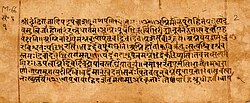
[[File:1500-1200 BCE Rigveda, manuscript page sample i, Mandala 1, Hymn 1 (Sukta 1), Adhyaya 1, lines 1.1.1 to 1.1.9, Sanskrit, Devanagari.jpg|thumb|[[Rig Veda]] is the oldest Hindu text that originated in the Punjab region.]] | |||
Proto-[[Hinduism]] is the oldest of the religions practised by the Punjabi people.<ref name="Nayar1"/> The [[historical Vedic religion]] constituted the religious ideas and practices in the Punjab during the [[Vedic period]] (1500–500 BCE), centered primarily in the worship of [[Indra]].<ref>{{Cite book |last=Wheeler |first=James Talboys |url=https://books.google.com/books?id=xSFGIqjWG14C&q=punjab |title=The History of India from the Earliest Ages: Hindu Buddhist Brahmanical revival |date=1874 |publisher=N. Trübner |pages=330 |language=en |quote=The Punjab, to say the least, was less Brahmanical. It was an ancient centre of the worship of Indra, who was always regarded as an enemy by the Bráhmans; and it was also a stronghold of Buddhism.}}</ref><ref>{{Cite book |last=Hunter |first=W. W. |url=https://books.google.com/books?id=Vdv7AQAAQBAJ&pg=PA80 |title=The Indian Empire: Its People, History and Products |date=5 November 2013 |publisher=Routledge |isbn=978-1-136-38301-4 |pages=80 |language=en |quote=In the settlements of the Punjab, Indra thus advanced to the first place among the Vedic divinities.}}</ref><ref>{{Cite book |last=Virdee |first=Pippa |url=https://books.google.com/books?id=WYJIDwAAQBAJ&pg=PA24 |title=From the Ashes of 1947 |date=February 2018 |publisher=Cambridge University Press |isbn=978-1-108-42811-8 |pages=24 |language=en |quote=The Rig Veda and the Upanishads, which belonged to the Vedic religion, were a precursor of Hinduism, both of which were composed in Punjab.}}</ref>{{refn|{{harvtxt|Michaels|2004|p=38}}: "The legacy of the Vedic religion in Hinduism is generally overestimated. The influence of the mythology is indeed great, but the religious terminology changed considerably: all the key terms of Hinduism either do not exist in Vedic or have a completely different meaning. The religion of the Veda does not know the ethicised migration of the soul with retribution for acts (''karma''), the cyclical destruction of the world, or the idea of salvation during one's lifetime (''jivanmukti; moksa; nirvana''); the idea of the world as illusion (''maya'') must have gone against the grain of ancient India, and an omnipotent creator god emerges only in the late hymns of the rgveda. Nor did the Vedic religion know a caste system, the burning of widows, the ban on remarriage, images of gods and temples, Puja worship, Yoga, pilgrimages, vegetarianism, the holiness of cows, the doctrine of stages of life (''asrama''), or knew them only at their inception. Thus, it is justified to see a turning point between the Vedic religion and Hindu religions."<br/>{{cite web |first1=Stephanie |last1=Jamison |first2=Michael |last2=Witzel |year=1992 |url=http://www.people.fas.harvard.edu/~witzel/vedica.pdf |title=Vedic Hinduism |publisher=Harvard University |pages=3}}: "... to call this period Vedic Hinduism is a contradictio in terminis since Vedic religion is very different from what we generally call Hindu religion – at least as much as Old Hebrew religion is from medieval and modern Christian religion. However, Vedic religion is treatable as a predecessor of Hinduism."<br/>See also {{harvnb|Halbfass|1991|pp=1–2}}|name="Michaels-legacy"|group=note}} The bulk of the [[Rigveda]] was composed in the Punjab region between circa 1500 and 1200 BC,<ref>{{Cite book|last=Flood|first=Gavin|url=https://archive.org/details/anintroductiontohinduismgavinfloodd.oupseeotherbooks_355_z/page/37/mode/2up|title=An Introduction to Hinduism|date=13 July 1996|publisher=Cambridge University Press|isbn=978-0-521-43878-0}}</ref> while later Vedic scriptures were composed more eastwards, between the [[Yamuna]] and [[Ganges]] rivers. An ancient Indian law book called the [[Manusmriti]], developed by Brahmin Hindu priests, shaped Punjabi religious life from 200 BC onward.<ref name="Nayar">{{Cite book |last=Nayar |first=Kamala Elizabeth |url=https://books.google.com/books?id=q7pO-IZY218C&pg=PA7 |title=The Punjabis in British Columbia: Location, Labour, First Nations, and Multiculturalism |date=2012 |publisher=McGill-Queen's Press - MQUP |isbn=978-0-7735-4070-5 |language=en |pages=7–8}}</ref> | |||
Later, the [[History of Buddhism in India|spread of Buddhisim]] and Jainism in the Indian subcontinent saw the growth of [[Buddhism]] and [[Jainism]] in the Punjab.<ref>{{Cite web |date=3 May 2019 |title=In ancient Punjab, religion was fluid, not watertight, says Romila Thapar |url=https://indianexpress.com/article/cities/in-ancient-punjab-religion-was-fluid-not-watertight-says-romila-thapar-5709145/ |access-date= |website=The Indian Express |language=en |quote=Thapar said Buddhism was very popular in Punjab during the Mauryan and post-Mauryan period. Bookended between Gandhara in Taxila on the one side where Buddhism was practised on a large scale and Mathura on another side where Buddhism, Jainism and Puranic religions were practised, this religion flourished in the state. But after the Gupta period, Buddhism began to decline.}}</ref> [[Islam]] was introduced via southern Punjab in the 8th century, becoming the majority by the 16th century, via local conversion.<ref name="oxford2">{{Cite book |last1=Rambo |first1=Lewis R. |url=https://books.google.com/books?id=U03gAgAAQBAJ&pg=PA490 |title=The Oxford Handbook of Religious Conversion |last2=Farhadian |first2=Charles E. |date=6 March 2014 |publisher=Oxford University Press |isbn=978-0-19-971354-7 |pages=489–491 |language=en |quote=First, Islam was introduced into the southern Punjab in the opening decades of the eighth century. By the sixteenth century, Muslims were the '''majority''' in the region and an elaborate network of mosques and mausoleums marked the landscape. Local converts constituted the majority of this Muslim community, and as far for the mechanisms of conversion, the sources of the period emphasize the recitation of the Islamic confession of faith (shahada), the performance of the circumsicion (indri vaddani), and the ingestion of cow-meat (bhas khana).}}</ref><ref>{{Cite book |last=Chhabra |first=G. S. |url=https://books.google.com/books?id=vF9DAAAAYAAJ |title=Advanced History of the Punjab: Guru and post-Guru period upto Ranjit Singh |date=1968 |publisher=New Academic Publishing Company |page=37 |language=en}}</ref> There was a small Jain community left in Punjab by the 16th century, while the Buddhist community had largely disappeared by the turn of the 10th century.<ref>{{Cite book |last1=Rambo |first1=Lewis R. |url=https://books.google.com/books?id=U03gAgAAQBAJ&pg=PA490 |title=The Oxford Handbook of Religious Conversion |last2=Farhadian |first2=Charles E. |date=6 March 2014 |publisher=Oxford University Press |isbn=978-0-19-971354-7 |pages=490 |language=en |quote=While Punjabi Hindu society was relatively well established, there was also a small but vibrant Jain community in the Punjab. Buddhist communities, however, had largely disappeared by the turn of the tenth century.}}</ref> The region became predominantly [[Muslim]] due to missionary [[Sufi]] saints whose [[dargah]]s dot the landscape of the Punjab region.<ref>{{Cite book |last1=Nicholls |first1=Ruth J. |url=https://books.google.com/books?id=gdz0DwAAQBAJ&q=islam+punjab+sufi |title=Insights into Sufism: Voices from the Heart |last2=Riddell |first2=Peter G. |date=31 July 2020 |publisher=Cambridge Scholars Publishing |isbn=978-1-5275-5748-2 |language=en |quote=With the Muslim conquest of Punjab there was a flow of Sufis and other preachers who came to spread Islam. Much of the advance of Islam was due to these preachers.}}</ref> | |||
The | The rise of [[Sikhism]] in the 1700s saw some Punjabis, both Hindu and Muslim, accepting the new Sikh faith.<ref name="Nayar" /><ref>{{Cite book |last=Singh |first=Pritam |url=https://books.google.com/books?id=lQpswqcdDLIC&pg=PA25 |title=Federalism, Nationalism and Development: India and the Punjab Economy |date=19 February 2008 |publisher=Routledge |isbn=978-1-134-04946-2 |language=en}}</ref> A number of Punjabis during the [[colonial India|colonial period of India]] became Christians, with all of these religions characterising the religious diversity now found in the Punjab region.<ref name="Nayar" /> | ||
=== Modern era === | |||
Due to religious tensions, emigration between Punjabi people started far before the partition and dependable records.<ref>Jones. (2006). Socio-religious reform movements in British India ([[The New Cambridge History of India]]). Cambridge University Press</ref><ref>Jones, R. (2007). The great uprising in India, 1857–58: Untold stories, Indian and British (worlds of the east India company). Boydell Press.</ref> Shortly prior to the [[Partition of India]], [[Punjab Province (British India)]] had a slight majority [[Muslim]] population at about 53.2% in 1941, which was an increase from the previous years.<ref>{{cite web|url=http://www.global.ucsb.edu/punjab/journal_11_1/6_krishan.pdf|title=Journal of Punjab Studies – Center for Sikh and Punjab Studies – UC Santa Barbara|website=Global.ucsb.edu|access-date=20 April 2013|archive-url=https://web.archive.org/web/20150924022818/http://www.global.ucsb.edu/punjab/journal_11_1/6_krishan.pdf|archive-date=24 September 2015|url-status=dead}}</ref> | |||
| | Due to the [[Partition of India|partition of 1947]], a rapid shift towards religious homogeneity occurred in all districts across the Punjab region owing to the new international border that cut through the province. This rapid demographic shift was primarily due to [[mass migration]] and [[population exchange]] but also caused by large-scale [[Religious persecution#Religious cleansing|religious cleansing]] riots that occurred across the region at the time.<ref>[http://www.cet.edu/earthinfo/sasia/SAhis.html South Asia: British India Partitioned] {{webarchive|url=https://web.archive.org/web/20071102060502/http://www.cet.edu/earthinfo/sasia/SAhis.html |date=2 November 2007 }}</ref><ref>Avari, B. (2007). India: The ancient past. {{ISBN|978-0-415-35616-9}}</ref> According to historical demographer [[Tim Dyson]], in the eastern regions of Punjab that ultimately became [[Punjab, India|Indian Punjab]] following independence, districts that were 66% Hindu in 1941 became 80% Hindu in 1951; those that were 20% Sikh became 50% Sikh in 1951. Conversely, in the western regions of Punjab that ultimately became [[Punjab, Pakistan|Pakistani Punjab]], all districts became almost exclusively Muslim by 1951.{{sfn|Dyson|2018|pp=188–189}} | ||
| | |||
| | |||
| | |||
| | |||
| | |||
| | |||
| | |||
| | |||
| | |||
}} | |||
As a result of the population exchanges during partition, both parts of Punjab are now relatively homogeneous, as far as religion is concerned. Today the majority of Pakistani Punjabis follow [[Islam]] with a small Christian minority, and less Sikh and Hindu populations, while the majority of Indian Punjabis are either [[Sikh]]s or [[Hindu]]s with a [[Muslim]] minority. Punjab is also the birthplace of [[Sikhism]] and the movement [[Ahmadiyya]].<ref name="alislam.org">{{cite web|url=http://www.alislam.org/ |title=Ahmadiyya – Ahmadiyya Community – Al Islam Online – Official Website |website=Alislam.org }}</ref> | |||
Today the majority of Pakistani Punjabis follow [[Islam]] with a small Christian minority, and less Sikh and Hindu populations, while the majority of Indian Punjabis are either [[Sikh]]s or [[Hindu]]s with a [[Muslim]] minority. Punjab is also the birthplace of [[Sikhism]] and the movement [[Ahmadiyya]].<ref name="alislam.org">{{cite web|url=http://www.alislam.org/ |title=Ahmadiyya – Ahmadiyya Community – Al Islam Online – Official Website |website=Alislam.org }}</ref> | |||
====Punjabi Muslims==== | ====Punjabi Muslims==== | ||
{{See also|Punjabi Muslims | {{See also|Punjabi Muslims}} | ||
Punjabi Muslims are found almost exclusively in Pakistan with 97% of Punjabis who live in Pakistan following Islam, in contrast to Punjabi Sikhs and Punjabi Hindus who predominantly live in India.<ref name="Harrison2007p132" /> | Punjabi Muslims are found almost exclusively in Pakistan with 97% of Punjabis who live in Pakistan following Islam, in contrast to Punjabi Sikhs and Punjabi Hindus who predominantly live in India.<ref name="Harrison2007p132" /> | ||
Forming the majority of the Punjabi ethnicity in the greater [[Punjab|Punjab region]],<ref name="Gandhi 2013 1">{{cite book |last=Gandhi |first=Rajmohan |title=Punjab: A History from Aurangzeb to Mountbatten |publisher=Aleph Book Company |year=2013 |isbn=978-93-83064-41-0 |location=New Delhi, India, Urbana, [[Illinois]] |page=1}}</ref> Punjabi Muslims write the [[Punjabi language]] under the [[Arabic script|Perso-Arabic script]] known as [[Shahmukhi alphabet|Shahmukhi]]. With a population of more than 80 million,<ref name="Gandhi 2013 1"/><ref>{{Cite web |title=Pakistan Census 2017 |url=https://www.pbs.gov.pk/sites/default/files//population_census/census_2017_tables/pakistan/Table11n.pdf |website=[[PBS]]}}</ref> they are the largest [[Ethnic groups in Pakistan|ethnic group in Pakistan]] and the world's [[List of contemporary ethnic groups|third-largest Islam-adhering ethnicity]]<ref>{{cite book |last=Gandhi |first=Rajmohan |title=Punjab: A History from Aurangzeb to Mountbatten |publisher=Aleph Book Company |year=2013 |isbn=978-93-83064-41-0 |location=New Delhi, India, Urbana, [[Illinois]] |page=2}}</ref> after [[Arab Muslims|Arabs]]<ref>Margaret Kleffner Nydell [https://books.google.com/books?id=ZNoiieefqAcC Understanding Arabs: A Guide For Modern Times], Intercultural Press, 2005, {{ISBN|1931930252}}, page xxiii, 14</ref> and [[Bengali Muslims|Bengalis]].<ref>roughly 152 million Bengali Muslims in [[Bangladesh]] and 36.4 million Bengali Muslims in the [[Republic of India]] ([[CIA Factbook]] 2014 estimates, numbers subject to rapid population growth); about 10 million [[Bangladeshis in the Middle East]], 1 million [[Bengalis in Pakistan]], 5 million [[British Bangladeshi]].</ref> The majority of Punjabi Muslims are adherents of [[Sunni Islam]], while a minority adhere to [[Shia Islam]] and other [[sect]]s, including the [[Ahmadiyya]] community which originated in [[Punjab Province (British India)|Punjab]] during the [[British Raj]]. | |||
<gallery> | |||
File:Rajah Ali Gour, a Gukkur chief.jpg|A Punjabi Muslim of the [[Ghakkar]] tribe | |||
File:Tanolis.jpg|alt=Punjabi Muslim of the Tanoli tribe | |||
File:Portret van een onbekende man van de Kharal-stam uit Multan Kharal. Soonnee Mahomedan. Googaira. Mooltan (titel op object), RP-F-2001-7-1122E-40.jpg|Punjabi Muslim of [[Kharal]] tribe from Multan | |||
File:"Potowaree Rawul Pindee & Bunneah Tonk" – Painting from 19th century Punjab 46.webp|Pothwari Muslim | |||
File:Punjabi Muslim Dogar tribe.jpg|Punjabi Muslim, Firuzpur | |||
</gallery> | |||
====Punjabi Hindus==== | |||
{{See also|Punjabi Hindus}} | |||
Punjabi Hindus in India use [[Nāgarī script]] to write the Hindi and Punjabi languages.<ref name="Bright1996p395">{{cite book |author1=Peter T. Daniels |url=https://books.google.com/books?id=ospMAgAAQBAJ&pg=PA395 |title=The World's Writing Systems |author2=William Bright |publisher=Oxford University Press |year=1996 |isbn=978-0-19-507993-7 |page=395}}</ref> In the Indian state of [[Punjab, India|Punjab]], [[Punjabi Hindus]] make up approximately 38.5% of the state's population; numbering 10.7 million and are a majority in the [[Doaba]] region. Punjabi Hindus form a majority in five districts of Punjab, namely, [[Pathankot district|Pathankot]], [[Jalandhar district|Jalandhar]], [[Hoshiarpur district|Hoshiarpur]], [[Fazilka district|Fazilka]] and [[Shaheed Bhagat Singh Nagar district|Shaheed Bhagat Singh Nagar]] districts.<ref>{{cite web |title=Religion by districts - Punjab |url=http://www.censusindia.gov.in/2011census/C-01/DDW03C-01%20MDDS.XLS |website=census.gov.in|access-date=20 September 2021}}</ref> | |||
Punjabi | During the 1947 partition, millions of Punjabi Hindus (including [[Hindkowans|Hindkowan]] Hindus and [[Saraiki people|Saraiki]] Hindus) [[Mass migration|migrated]] from [[Punjab, Pakistan|West Punjab]] and [[North-West Frontier Province]], of which many ultimately settled in Delhi.<ref name="The Tribune - Derawal Nagar">{{cite news |first=Priyanka |last=Gupta |url=https://www.tribuneindia.com/2003/20030319/ncr1.htm#11 |title=Colonies, posh and model in name only! |publisher=NCR Tribune |location=New Delhi |quote=Started in 1978, Derawal Nagar was a colony of those who had migrated from Dera Ismile Khan in Northwest Frontier provinces. |website=www.tribuneindia.com |date=19 March 2003 |access-date=5 March 2023}}</ref><ref>{{Cite book|last=Nagpal|first=Vinod Kumar|url=https://books.google.com/books?id=zCPtDwAAQBAJ&pg=PT90|title=Lessons Unlearned|date=25 June 2020|publisher=Notion Press|isbn=978-1-64869-984-9|language=en}}</ref> Determined from 1991 and 2015 estimates, Punjabi Hindus form approximately 24 to 35 per cent of Delhi's population;{{efn|"The most important section among settlers is the Punjabis who are estimated to constitute around 35 per cent of the population."<ref name="Singh2015">{{cite news |last1=Singh |first1=Raj |title=Delhi Assembly elections 2015: Important facts and major stakeholders |url=https://www.indiatvnews.com/politics/national/delhi-assembly-elections-2015-important-facts-and-stakeholders-25298.html |accessdate=8 September 2021 |work=[[India TV]] |date=6 February 2015}}</ref>}}{{efn|"Though Punjabis constitute a mere twenty-four per cent of so of the capital city's population, on average they hold fifty-three per cent of the available managerial positions."<ref name="Sanjay2008"/>}} based on 2011 official census counts, this amounts to between 4,029,106 and 5,875,779 people.<ref name="delhi2011">{{cite web|url=https://www.citypopulation.de/India-Delhi.html?cityid=2925|title=Delhi (India): Union Territory, Major Agglomerations & Towns – Population Statistics in Maps and Charts|work=City Population|access-date=28 February 2017|url-status=live|archive-url=https://web.archive.org/web/20170302112054/https://www.citypopulation.de/India-Delhi.html?cityid=2925|archive-date=2 March 2017}}</ref> | ||
Additionally, in the Indian state of [[Haryana]], Punjabi Hindus form approximately 8 to 10 percent of the total population; based on 2011 official census counts out of a total population of 25.4 million, this amounts to between 2.03 and 2.54 million people.{{efn|name=HaryanaPopulation|Punjabi Hindus represent between 8 and 10 percent of Haryana's population, determined from 2014, 2019, 2024, and 2025 estimates.<ref name="Kumar2014"/><ref name="Naqshbandi2019"/><ref name="Manav2024"/><ref name="Spokesman2025"/> Based on the 2011 official census counts out of a total population of 25,351,462, this amounts to between 2,028,117 and 2,535,146 persons.}} Similar to Delhi, most Punjabi Hindus in Haryana can trace their ancestry to [[West Punjab]] and [[North-West Frontier Province]] due to mass migration associated with the 1947 partition. In the contemporary era, Punjabi Hindus are influential in Haryana state politics.{{efn|name=Haryana2014|“Punjabis constitute about eight per cent of the state’s population, they are a can’t-be-ignored political constituency."<ref name="Kumar2014">{{cite news |last1=Kumar |first1=Virender |title=The 'vulnerable Punjabi' in an unthinkable post in Haryana |url=https://indianexpress.com/article/india/politics/the-vulnerable-punjabi-in-an-unthinkable-post-in-haryana/ |accessdate=9 September 2021 |work=Indian Express |date=28 October 2014}}</ref>}}{{efn|name=Haryana2019|“Political experts attribute the rise of the BJP in the region to sustained consolidation among certain communities, especially the Punjabis who account for 8% of the state’s estimated population of around 28 million.”<ref name="Naqshbandi2019">{{cite news |last1=Naqshbandi |first1=Aurangzeb |title=Manohar Lal Khattar gives BJP an edge in Haryana's Punjabi belt |url=https://www.hindustantimes.com/india-news/khattar-gives-bjp-an-edge-in-haryana-s-punjabi-belt/story-ZcKpjfaRGekxCgHDOHzctK.html |accessdate=9 September 2021 |work=Hindustan Times |date=23 October 2019}}</ref>}}{{efn|name=Haryana2024|“From the announcement of candidates to the election campaign, the Congress primarily focused on the 22-25 percent Jat and 20-22 percent Scheduled Caste voters. In contrast, the BJP, in line with its non-Jat strategy, focused on the 30-32 percent OBCs, 9-10 percent Punjabis and 8-9 percent Brahmins.”<ref name="Manav2024">{{cite news |last1=Manav |first1=Sushil|title=Haryana numbers show Congress had best strike rate among Jats, BJP among Punjabis & Ahirs |url=https://theprint.in/politics/haryana-numbers-show-congress-had-best-strike-rate-among-jats-bjp-among-punjabis-ahirs/2309668/ |accessdate=10 December 2024 |work=[[The Print]] |date=14 October 2024}}</ref>}}{{efn|name=Haryana2025|“The Punjabi population of Haryana is considered to be 10 percent of the total population of the state. Many constituencies even put this figure at around 14 percent. Of this population, 4 percent are Sikhs and the rest are Hindus.”<ref name="Spokesman2025">{{cite news |last1=Spokesman|first1=Rozana|title=Reviving Punjabi Identity in Haryana: A Journey Through Linguistic and Cultural Progress |url=https://www.rozanaspokesman.com/opinion/250325/reviving-punjabi-identity-in-haryana-a-journey-through-linguistic-an.html |accessdate=2 June 2025 |work=Rozana Spokesman |date=25 March 2025}}</ref>}} | |||
{{ | |||
Following the large scale exodus that took place during the 1947 partition, there remains a small Punjabi Hindu community in Pakistan today. According to the [[2017 Census of Pakistan|2017 Census]], there are about 200,000 Hindus in Punjab province, forming approximately 0.2% of the total population.<ref name="2017 Census">{{cite news|url=https://www.dawn.com/news/1410447|access-date=26 April 2020|title=CCI defers approval of census results until elections|work=Dawn}}</ref> Much of the community resides in the primarily rural South Punjab districts of [[Rahim Yar Khan District|Rahim Yar Khan]] and [[Bahawalpur District|Bahawalpur]] where they form 3.12% and 1.12% of the population respectively,<ref name="Districtwise">{{cite web |title=District wise census |url=https://www.pbs.gov.pk/content/district-wise-census-2017-results |archive-url=https://web.archive.org/web/20210802153408/https://www.pbs.gov.pk/content/district-wise-census-2017-results |archive-date=2 August 2021 |access-date=20 September 2021}}</ref><ref>{{Cite news |author=Dharmindar Balach |date=17 August 2017 |title=Pakistani Hindus celebrate Janmashtami with fervour |newspaper=Daily Times |url=https://dailytimes.com.pk/120531/pakistani-hindus-celebrate-janmashtami-with-fervour/ |access-date=20 September 2021}}</ref> while the rest are concentrated in urban centres such as [[Lahore]].<ref>{{cite news |date=8 November 2018 |title=Hindu community celebrates Diwali across Punjab |work=The Express Tribune |url=https://tribune.com.pk/story/1842865/1-hindu-community-celebrates-diwali-across-punjab |access-date=18 December 2020}}</ref><ref>{{cite news |date=23 October 2015 |title=Dussehra celebrated at Krishna Mandir |work=The Express Tribune |url=https://tribune.com.pk/story/978422/victory-over-evil-dussehra-celebrated-at-krishna-mandir |access-date=18 December 2020}}</ref> | |||
<gallery> | |||
File:Portret van een onbekende handelaar uit Hazara Khutree. Hindoo trader. Hazara (titel op object), RP-F-2001-7-1122E-20.jpg|A Hindu [[Khatri]] Trader of [[Hazara region|Hazara]], ca. 1868-1872 | |||
File:Portrait of three unidentified Lahore carpenters (likely Tarkhan) with tools, ca.1862–72.png|Hindu [[Tarkhan (Punjab)|Tarkhan]] Carpenters of Lahore, ca.1862-72 | |||
File:Portrait of two unidentified men of the Kamboj (or Kamboh) tribe of Multan, ca.1862–72.png|Hindu [[Kamboj]] of Multan, ca.1862-72 | |||
File:Portrait of an unidentified Arora Storekeeper from Lahore with coins in hand and in front of him, ca.1862–72.png|A Hindu [[Arora]] Trader of Lahore, ca.1862-72 | |||
File:Portrait of a Lahore distiller and vendor of liquor (Kalwar, Kullal, Kalal, or Kalar), ca.1862–72.png|A Hindu [[Kalal]] of Lahore, ca.1862-72 | |||
</gallery> | |||
====Punjabi Sikhs==== | ====Punjabi Sikhs==== | ||
{{See also|Sikhs}} | {{See also|Punjabi Sikhs}} | ||
[[Sikhism]] from ''Sikh'', meaning a "disciple", or a "learner", is a monotheistic religion originated in the [[Punjab (region)|Punjab region]] of the Indian subcontinent during the 15th century.<ref name="Cole">{{cite book |title=Sikhism and Christianity: A Comparative Study (Themes in Comparative Religion) | publisher=Palgrave Macmillan |author1=W.Owen Cole |author2=Piara Singh Sambhi | year=1993 | location=Wallingford, United Kingdom |page=117 | isbn=978-0-333-54107-4}}</ref><ref name="Partridge2013">{{cite book|author=Christopher Partridge|title=Introduction to World Religions|url=https://books.google.com/books?id=Z3AjAwAAQBAJ&pg=PA429|date=1 November 2013|publisher=Fortress Press|isbn=978-0-8006-9970-3|pages=429–}}</ref> The fundamental beliefs of Sikhism, articulated in the sacred scripture [[Guru Granth Sahib]], include faith and meditation on the name of the one creator, unity and equality of all humankind, engaging in [[selfless service]], striving for social justice for the [[Sarbat da bhala|benefit and prosperity of all]], and honest conduct and livelihood while living a householder's life.<ref name="Kalsi_Chelsea">{{cite book |title=Sikhism | publisher=Chelsea House, Philadelphia| author = Sewa Singh Kalsi | pages=41–50}}</ref><ref name="Cole_Sambhi">{{cite book |title=The Sikhs: Their Religious Beliefs and Practices | publisher=Sussex Academic Press |author1=William Owen Cole |author2=Piara Singh Sambhi | year=1995|page=200}}</ref><ref name="Teece 2004 4">{{cite book|last=Teece|first=Geoff|year=2004|title=Sikhism:Religion in focus|publisher=Black Rabbit Books|isbn=978-1-58340-469-0|page=4}}</ref> Being one of the youngest amongst the major world religions, with 25-28 million adherents worldwide, [[Sikhism]] is [[Major religious groups#Religious demographics|the | [[File:Photograph of Sikh girls enrolled in a school run by the Church Missionary School, Amritsar, 1875.jpg|thumb|Photograph of Sikh girls enrolled in a school run by the Church Missionary School, Amritsar, 1875]] | ||
[[Sikhism]] from ''Sikh'', meaning a "disciple", or a "learner", is a monotheistic religion originated in the [[Punjab (region)|Punjab region]] of the Indian subcontinent during the 15th century.<ref name="Cole">{{cite book |title=Sikhism and Christianity: A Comparative Study (Themes in Comparative Religion) | publisher=Palgrave Macmillan |author1=W.Owen Cole |author2=Piara Singh Sambhi | year=1993 | location=Wallingford, United Kingdom |page=117 | isbn=978-0-333-54107-4}}</ref><ref name="Partridge2013">{{cite book|author=Christopher Partridge|title=Introduction to World Religions|url=https://books.google.com/books?id=Z3AjAwAAQBAJ&pg=PA429|date=1 November 2013|publisher=Fortress Press|isbn=978-0-8006-9970-3|pages=429–}}</ref> The fundamental beliefs of Sikhism, articulated in the sacred scripture [[Guru Granth Sahib]], include faith and meditation on the name of the one creator, unity and equality of all humankind, engaging in [[selfless service]], striving for social justice for the [[Sarbat da bhala|benefit and prosperity of all]], and honest conduct and livelihood while living a householder's life.<ref name="Kalsi_Chelsea">{{cite book |title=Sikhism | publisher=Chelsea House, Philadelphia| author = Sewa Singh Kalsi | pages=41–50}}</ref><ref name="Cole_Sambhi">{{cite book |title=The Sikhs: Their Religious Beliefs and Practices | publisher=Sussex Academic Press |author1=William Owen Cole |author2=Piara Singh Sambhi | year=1995|page=200}}</ref><ref name="Teece 2004 4">{{cite book|last=Teece|first=Geoff|year=2004|title=Sikhism:Religion in focus|publisher=Black Rabbit Books|isbn=978-1-58340-469-0|page=4}}</ref> Being one of the youngest amongst the major world religions, with 25-28 million adherents worldwide, [[Sikhism]] is [[Major religious groups#Religious demographics|the eighth-largest religion in the world]]. | |||
The Sikhs form a majority of close to 58% in the modern day [[Punjab, India]]. | The Sikhs form a majority of close to 58% in the modern day [[Punjab, India]]. | ||
| Line 251: | Line 153: | ||
====Punjabi Christians==== | ====Punjabi Christians==== | ||
{{See also|Punjabi Christians}} | {{See also|Punjabi Christians}} | ||
[[ | Most of the modern Punjabi Christians are descended from converts during British rule; initially, conversions to Christianity came from the "upper levels of Punjab society, from the privileged and prestigious", including "high caste" Hindu families, as well as Muslim families.<ref name="Jones1976">{{cite book|last=Jones|first=Kenneth W.|title=Arya Dharm: Hindu Consciousness in 19th-century Punjab|year=1976|publisher=[[University of California Press]]|language=en|isbn=978-0-520-02920-0|page=[https://archive.org/details/americocastromea0000unse/page/12 12]|quote=Christian conversion followed patterns of previous religious inroads, striking at the two sections of the social structure. Initial conversions came from the upper levels of Punjab society, from the privileged and prestigious. Few in number and won individually, high caste converts accounted for far more public attention and reaction to Christian conversion than the numerically superior successes among the depressed. Repeatedly, conversion or the threat of conversion among students at mission schools, or members of the literate castes, produced a public uproar.|url=https://archive.org/details/americocastromea0000unse/page/12}}</ref><ref name="Day2015">{{cite book|last=Day|first=Abby|title=Contemporary Issues in the Worldwide Anglican Communion: Powers and Pieties|date=28 December 2015|publisher=[[Ashgate Publishing]]|language=en|isbn=978-1-4724-4415-8|page=220|quote=The Anglican mission work in the northern part of the Indian subcontinent was primarily carried out by CMS and USPG in the Punjab Province (Gabriel 2007, 10), which covered most parts of the present state of Pakistan, particularly Lahore, Peshawar and Karachi (Gibbs 1984, 178-203). A native subcontinental church began to take shape with people from humbler backgrounds, while converts from high social caste preferred to attend the worship with the English (Gibbs 1984, 284).}}</ref><ref name="Moghal1997">{{cite book|last=Moghal|first=Dominic|title=Human person in Punjabi society: a tension between religion and culture|year=1997|publisher=Christian Study Centre|language=en|quote=Those Christians who were converted from the "high caste" families both Hindus and Muslims look down upon those Christians who were converted from the low caste, specially from the untouchables.}}</ref> However, other modern Punjabi Christians have converted from the [[Chuhra]] group. The [[Chuhra|Churas]] were largely converted to Christianity in [[North India]] during the [[British Raj]]. The vast majority were converted from the [[Chuhra|Hindu Chura]] communities of Punjab, and to a lesser extent [[Mazhabi Sikh]]s; under the influence of enthusiastic [[British Indian Army|army]] officers and Christian missionaries. Large numbers of [[Mazhabi|Mazhabi Sikhs]] were also converted in the [[Moradabad district]] and the [[Bijnor district]]<ref>Alter, J.P and J. Alter (1986) In the Doab and [[Rohilkhand]]: north Indian Christianity, 1815–1915. I.S.P.C.K publishing p183</ref> of [[Uttar Pradesh]]. [[Rohilkhand]] saw a mass conversion of its entire population of 4500 Mazhabi Sikhs into the [[Methodist Church]].<ref>Alter, J.P and J. Alter (1986) In the Doab and Rohilkhand: north Indian Christianity, 1815–1915. I.S.P.C.K publishing p196</ref> Sikh organisations became alarmed at the rate of conversions among high caste Sikh families, and as a result, they responded by immediately dispatching Sikh missionaries to counteract the conversions.<ref name="Chadha2005">{{cite book|last=Chadha|first=Vivek|title=Low Intensity Conflicts in India: An Analysis|date=23 March 2005|publisher=[[SAGE Publications]]|language=en|isbn=978-0-7619-3325-0|page=174|quote='In 1881 there were 3,976 Christians in the Punjab. By 1891 their number had increased to 19,547, by 1901 to 37,980, by 1911 to 163,994 and by 1921 to 315,931 persons' (see Figure 8.1). However, the Sikhs were more alarmed when some of the high caste families starting converting.}}</ref> | ||
==History== | |||
{{Main|History of Punjab}} | |||
{{See also|Punjabi Muslims#History|Sikhs#History|Punjabi Hindus#History}} | |||
== Culture == | == Culture == | ||
{{Main|Punjabi culture|Punjabi Culture Day}} | {{Main|Punjabi culture|Punjabi Culture Day}} | ||
Punjabi culture | [[File:Photograph of a group of Punjabi women, 1905.png|thumb|Photograph of a group of Punjabi women, 1905]] | ||
Punjabi culture grew out of the settlements along the five rivers, which served as an important route to the [[Near East]] as early as the ancient [[Indus Valley civilisation]], dating back to 3000 BCE.<ref name="Nayar1"/> [[Agriculture]] has been the major economic feature of the Punjab and has therefore formed the foundation of Punjabi culture, with one's social status being determined by landownership.<ref name="Nayar1"/> The Punjab emerged as an important agricultural region, especially following the [[Green Revolution]] during the mid-1960s to the mid-1970s, has been described as the "breadbasket of both India and Pakistan".<ref name="Nayar1"/> Besides being known for agriculture and trade, the Punjab is also a region that over the centuries has experienced many foreign invasions and consequently has a long-standing history of warfare, as the Punjab is situated on the principal route of invasions through the northwestern frontier of the Indian subcontinent, which promoted to adopt a lifestyle that entailed engaging in warfare to protect the land.<ref name="Nayar1"/> Warrior culture typically elevates the value of the community's honour ([[Izzat (honour)|izzat]]), which is highly esteemed by Punjabis.<ref name="Nayar1"/> | |||
===Language=== | |||
{{Main|Punjabi language}}Punjabi, sometimes spelled Panjabi,{{efn|''Punjabi'' is the [[British English]] spelling, and ''Pañjābī'' is the [[ISO 15919|romanised]] spelling from the native script(s).}} is an [[Indo-Aryan languages|Indo-Aryan language]] natively spoken by the Punjabi people. | |||
Punjabi is the most popular first language in Pakistan, with 80.5 million native speakers as per the [[2017 Census of Pakistan|2017 census]], and the 11th most popular in India, with 31.1 million native speakers, as per the [[2011 Census of India|2011 census]]. | |||
The language is spoken among a [[Punjabi diaspora|significant overseas diaspora]], particularly in [[Canada]], the United States, and the [[United Kingdom]]. | |||
[[ | |||
In the | In Pakistan, Punjabi is written using the [[Shahmukhi alphabet]], based on the [[Persian alphabet|Perso-Arabic script]]; in India, it is written using the [[Gurmukhi|Gurmukhi alphabet]], based on the [[Brahmic scripts|Indic scripts]]. Punjabi is unusual among the Indo-Aryan languages and the broader [[Indo-European languages|Indo-European language family]] in its usage of [[Tone (linguistics)|lexical tone]].<ref>{{cite book |author-last=Bhatia |author-first=Tej |title=Lexical Anaphors and Pronouns in Selected South Asian Languages |date=1999 |publisher=Walter de Gruyter |isbn=978-3-11-014388-1 |editor1-last=Lust |editor1-first=Barbara |page=637 |chapter=Lexican Anaphors and Pronouns in Punjabi |editor2-last=Gair |editor2-first=James}} Other tonal Indo-Aryan languages include [[Hindko]], [[Dogri language|Dogri]], [[Western Pahari]], [[Sylheti language|Sylheti]] and some [[Dardic languages]].</ref> | ||
===Language=== | Punjabi developed from [[Prakrit]] languages and later {{IAST|Apabhraṃśa}} ({{Langx|sa|अपभ्रंश}}, 'deviated' or 'non-grammatical speech')<ref>{{cite book |last1=Singha |first1=H. S. |url=https://books.google.com/books?id=gqIbJz7vMn0C&dq=punjabi+prakrit+language&pg=PA166 |title=The Encyclopedia of Sikhism (over 1000 Entries) |date=2000 |publisher=Hemkunt Press |isbn=978-81-7010-301-1 |page=166 |archive-url=https://web.archive.org/web/20170121195057/https://books.google.com/books?id=gqIbJz7vMn0C |archive-date=21 January 2017}}</ref> From 600 BCE, Sanskrit was advocated as official language and Prakrit gave birth to many regional languages in different parts of India. All these languages are called Prakrit (Sanskrit: {{Langx|sa|प्राकृत|translit=prākṛta|label=none}}) collectively. [[Paishachi]], [[Shauraseni Prakrit|Shauraseni]] and [[Gandhari language|Gandhari]] were Prakrit languages, which were spoken in north and north-western India and Punjabi developed from one of these Prakrits. Later in northern India, these Prakrits gave rise to their own | ||
{{ | [[Apabhraṃśa]], a descendant of Prakrit.<ref>{{cite journal |last1=Singh |first1=Sikander |title=The Origin Theories of Punjabi Language: A Context of Historiography of Punjabi Language |journal=International Journal of Sikh Studies |date=April 2019 |url=https://www.researchgate.net/publication/353680383}}</ref><ref>{{Cite book |last=G S Sidhu |url=http://archive.org/details/panjabandpanjabi_202003 |title=Panjab And Panjabi |date=2004}}</ref> Punjabi emerged as an [[Apabhraṃśa]], a degenerated form of Prakrit, in the 7th century CE and became stable by the 10th century. The earliest writings in Punjabi belong to [[Nath|Nath Yogi]] era from 9th to 14th century CE.<ref name="Hoiberg 2000">{{Cite book |last=Hoiberg |first=Dale |url=https://books.google.com/books?id=ISFBJarYX7YC&q=Punjabi+language+Nath+Saints&pg=PA214 |title=Students' Britannica India |date=2000 |publisher=Popular Prakashan |isbn=978-0-85229-760-5 |language=en}}</ref> The language of these compositions is morphologically closer to [[Shauraseni Prakrit|Shauraseni Apbhramsa]], though vocabulary and rhythm is surcharged with extreme colloquialism and folklore.<ref name="Hoiberg 2000" /> The Arabic and modern Persian influence in the historical Punjab region began with the late first millennium [[Muslim conquests on the Indian subcontinent]].<ref name="google">{{cite book |author=Brard, G.S.S. |url=https://books.google.com/books?id=UUdYFH9skIkC&pg=PA81 |title=East of Indus: My Memories of Old Punjab |date=2007 |publisher=Hemkunt Publishers |isbn=9788170103608 |page=81 |access-date=13 January 2017 |archive-url=https://web.archive.org/web/20180209045039/https://books.google.com/books?id=UUdYFH9skIkC&pg=PA81 |archive-date=9 February 2018 |url-status=live}}</ref> Many [[Persian language|Persian]] and [[Arabic]] words were incorporated in Punjabi.<ref name="google2">{{cite book |author=Mir, F. |url=https://books.google.com/books?id=EUPc5pDWKikC&pg=PA35 |title=The Social Space of Language: Vernacular Culture in British Colonial Punjab |date=2010 |publisher=University of California Press |isbn=9780520262690 |page=35 |access-date=13 January 2017 |archive-url=https://web.archive.org/web/20180209045039/https://books.google.com/books?id=EUPc5pDWKikC&pg=PA35 |archive-date=9 February 2018 |url-status=live}}</ref><ref name="google3">{{cite book |author=Schiffman, H. |url=https://books.google.com/books?id=52aicl9l7rwC&pg=PA314 |title=Language Policy and Language Conflict in Afghanistan and Its Neighbors: The Changing Politics of Language Choice |date=2011 |publisher=Brill |isbn=9789004201453 |page=314 |access-date=13 January 2017 |archive-url=https://web.archive.org/web/20180209045040/https://books.google.com/books?id=52aicl9l7rwC&pg=PA314 |archive-date=9 February 2018 |url-status=live}}</ref> So Punjabi relies heavily on Persian and Arabic words which are used with a liberal approach to language. After the fall of the Sikh empire, Urdu was made the official language of Punjab (in Pakistani Punjab, it is still the primary official language), and influenced the language as well.<ref>{{Cite book |last=Schiffman |first=Harold |url=https://books.google.com/books?id=52aicl9l7rwC&q=urdu+words+in+punjabi&pg=PA314 |title=Language Policy and Language Conflict in Afghanistan and Its Neighbors: The Changing Politics of Language Choice |date=9 December 2011 |publisher=BRILL |isbn=978-90-04-20145-3 |language=en}}</ref> | ||
Punjabi | Punjabis also speak several languages and dialects related to Punjabi, such as the [[Pahari-Pothwari|Pothwari]] spoken in the [[Pothohar Plateau|Pothohar]] region of Northern Pakistani Punjab<ref>{{Cite book |last=Fred A |first=Robertson |title=Gazetteer of Rawalpindi District |publisher=Punjab Government |year=1895 |edition=2nd}}</ref> | ||
===Traditional dress=== | |||
{{Main|Punjabi clothing}} '''Kaintha''' | |||
[[File:Painting of a native lady of Amritsar, ca.1880's (detail).jpg|thumb|Painting of a native lady of Amritsar, ca.1880's]] | |||
The Kaintha, a traditional necklace which is usually made out of gold or steel, is an integral element of Punjabi clothing. It is adorned with a pendant that stands out from the rest of the necklace, which is accompanied by matching color schemes as well as yarn in the back to hold the piece together. It is worn with the Shalwar Kameez alongside a shawl, chunni, or vest. Men and women alike traditionally wear the Kaintha to the [[Mayian]] and Jaggo ceremonies. It is also commonly worn while performing the traditional [[Bhangra (dance)|Bhangra]] and [[Giddha]] dances | |||
'''Phulkari''' | |||
=== | A traditional element of Punjabi clothing has been the [[Phulkari]]. The phulkari is folk embroidery that was typically inclusive of work in floral patterns but has taken on a larger aspect of including geometrical shapes, symbols and motifs relevant to the culture. This pattern has been worn by women for hundreds of years in very vibrant colours. The pattern is typically stitched with woven silk and colourful thread. The phulkari pattern is adorned onto dupattas/chunis, better known as a decorative scarf. Over time the phulkari pattern has taken onto embellishments onto suits, dresses, accessories and more. You will see women wearing phulkari during important religious and cultural folk celebrations (i.e.: Vaisakhi, Lohri) and then in wedding celebrations such as the Jago.<ref>Encyclopædia Britannica, inc. (21 February 2024). Punjab. Encyclopædia Britannica. https://www.britannica.com/place/Punjab-state-India</ref><ref>Malhotra, A., & Mir, F. (2012). Punjab Reconsidered: History, culture, and Practice. Oxford University Press.</ref><ref>Snehi, Y. (2013). Book review: Punjab reconsidered: History, culture and practice. Studies in History, 29(1), 155–158. <nowiki>https://doi.org/10.1177/0257643013496694</nowiki></ref><ref>Szivak, J. (2022). The changing landscape of Punjab in Bollywood film songs. South Asia: Journal of South Asian Studies, 45(6), 1112–1127. <nowiki>https://doi.org/10.1080/00856401.2022.2114061</nowiki></ref> | ||
{{Main| | ;Dastar | ||
[[File: | {{Main|Dastar}} | ||
Punjabi | A [[Dastar]] is an item of headgear associated with [[Sikhism]] and is an important part of the Punjabi and Sikh culture. Among the Sikhs, the ''dastār'' is an article of faith that represents equality, honour, self-respect, courage, spirituality, and piety. The [[Khalsa]] Sikh men and women, who keep the [[The Five Ks|Five Ks]], wear the turban to cover their long, uncut hair (''[[Kesh (Sikhism)|kesh]]''). The Sikhs regard the ''dastār'' as an important part of the unique Sikh identity. After the ninth Sikh Guru, [[Guru Tegh Bahadur|Tegh Bahadur]], was sentenced to death by the [[Mughal Empire|Mughal]] emperor [[Aurangzeb]], [[Guru Gobind Singh]], the tenth Sikh Guru created the [[Khalsa]] and gave five articles of faith, one of which is unshorn hair, which the ''dastār'' covers.<ref name="turban">[http://www.earlytimes.in/newsdet.aspx?q=233794 “Importance of turban in Sikhism”], earlytimes.in. 29 May 2018.</ref> Prior to [[Sikhism|Sikhi]], only kings, royalty, and those of high stature wore turbans, but Sikh Gurus adopted the practice to assert equality and sovereignty among people.<ref name="Turban">{{cite web|title=Sikh Theology Why Sikhs Wear A Turban|url=http://www.sikhcoalition.org/sikh-theology-why-sikhs-wear-a-turban|website=The Sikh Coalition|access-date=13 November 2016}}</ref> | ||
;Punjabi suit | |||
{{Main|Shalwar kameez}} | |||
[[File:Punjabi Traditional Fashion - Cultural Night - Wiki Conference India - CGC - Mohali 2016-08-05 7370.JPG|thumb|Punjabi traditional dress in India]]A Punjabi suit that features two items - a ''qameez'' (top), ''salwar'' (bottom) is the traditional attire of the Punjabi people.<ref name="DSOF">{{cite book|last1=Dominique|first1=Grele|last2=Raimbault|first2=Lydie|title=Discover Singapore on Foot|date=1 March 2007|publisher=Select Publishing|location=Singapore|isbn=978-981-4022-33-0|page=35|edition=2}}</ref><ref name="BlanesMapril2013">{{cite book |last=Fraile |first=Sandra Santos |title=Sites and Politics of Religious Diversity in Southern Europe: The Best of All Gods |date=11 July 2013 |publisher=BRILL |isbn=978-90-04-25524-1 |editor=Blanes, Ruy |page=263 |chapter=Sikhs in Barcelona |quote=The shalwar kamiz was worn traditionally by Muslim women and gradually adopted by many Hindu women following the Muslim conquest of northern India. Eventually, it became the regional style for parts of northern India, as in Punjab where it has been worn for centuries. |mode=cs2 |editor2=Mapril, José |chapter-url=https://books.google.com/books?id=8accAAAAQBAJ&pg=PA263}}</ref><ref name="Khandelwal2002">{{cite book |last=Khandelwal |first=Madhulika Shankar |url=https://books.google.com/books?id=jZsZKj0FrBgC&pg=PA43 |title=Becoming American, Being Indian: An Immigrant Community in New York City |publisher=Cornell University Press |year=2002 |isbn=0-8014-8807-9 |page=43 |quote=Even highly educated women pursuing careers continue to wear traditional dress in urban India, although men of similar status long ago adopted Western attire. The forms of dress most popular with urban Indian women are the sari, the long wrapped and draped dress-like garment, worn throughout India, and the salwar-kameez or kurta-pyjama, a two-piece suit garment, sometimes also called Punjabi because of its region of origin. Whereas the sari can be considered the national dress of Indian women, the salwar-kameez, though originally from the north, has been adopted all over India as more comfortable attire than the sari. |mode=cs2}}</ref> ''Shalwars'' are [[trousers]] which are atypically wide at the waist but which narrow to a cuffed bottom. They are held up by a drawstring or elastic belt, which causes them to become pleated around the waist.<ref name="StevensonWaite2011">{{cite book |last1=Stevenson |first1=Angus |url=https://books.google.com/books?id=4XycAQAAQBAJ&pg=PA1272 |title=Concise Oxford English Dictionary: Book & CD-ROM Set |last2=Waite |first2=Maurice |publisher=Oxford University Press |year=2011 |isbn=978-0-19-960110-3 |page=1272 |quote=Salwar/Shalwar: A pair of light, loose, pleated trousers, usually tapering to a tight fit around the ankles, worn by women from South Asia typically with a kameez (the two together being a salwar kameez). Origin From Persian and Urdu šalwār. |mode=cs2}}</ref> The trousers can be wide and baggy, or they can be cut quite narrow, on the [[Grain (textile)#Bias|bias]]. The ''kameez'' is a long shirt or tunic.<ref name="StevensonWaite2011-b">{{cite book |last1=Stevenson |first1=Angus |url=https://books.google.com/books?id=4XycAQAAQBAJ&pg=PA774 |title=Concise Oxford English Dictionary: Book & CD-ROM Set |last2=Waite |first2=Maurice |publisher=Oxford University Press |year=2011 |isbn=978-0-19-960110-3 |page=774 |quote=Kameez: A long tunic worn by many people from South Asia, typically with a salwar or churidars. Origin: From Arabic qamīṣ, perhaps from late Latin camisia (see chemise). |mode=cs2}}</ref> The side seams are left open below the waist-line (the opening known as the ''chaak''{{refn|''A Dictionary of Urdu, Classical Hindi, and English'': ''chāk'' derives from the Persian "چاك ćāk, Fissure, cleft, rent, slit, a narrow opening (intentionally left in clothes)."<ref>{{cite book|url=https://dsalsrv04.uchicago.edu/cgi-bin/app/platts_query.py?page=418|last=Platts|first=John Thompson|title=A dictionary of Urdu, classical Hindi, and English|location=London|page=418|publisher=W. H. Allen & Co.|orig-date=1884|edition=online|date=February 2015|mode=cs2|access-date=1 August 2022|archive-date=24 February 2021|archive-url=https://web.archive.org/web/20210224204345/https://dsalsrv04.uchicago.edu/cgi-bin/app/platts_query.py?page=418|url-status=dead}}</ref>|group=note}}), which gives the wearer greater freedom of movement. The kameez is usually cut straight and flat; older kameez use traditional cuts; modern kameez are more likely to have European-inspired [[Sleeve#Types of sleeves|set-in sleeves]]. The combination garment is sometimes called ''salwar kurta'', ''salwar suit'', or ''Punjabi suit''.<ref name="Shukla2015-sawar-kurta">{{cite book |last=Shukla |first=Pravina |url=https://books.google.com/books?id=MlObCgAAQBAJ&pg=PA75 |title=The Grace of Four Moons: Dress, Adornment, and the Art of the Body in Modern India |publisher=Indiana University Press |year=2015 |isbn=978-0-253-02121-2 |page=75 |quote=You can buy an entire three-piece ''salwar suit'', or a two-piece suit that consists of either a readymade ''kurta'' or a ''kurta'' cloth piece, each with a matching ''dupatta''. For these, you must have the salwar pants stitched from cloth you buy separately. A third option would be to buy a two-piece ensemble, consisting of the top and pants, leaving you the task of buying an appropriate ''dupatta'', or using one you already own, or buying a strip of cloth and having it dyed to your desire. The end result will always be a three-piece ensemble, but a customer may start with one piece (only the ''kurta'') or two pieces (''kurta'' and pants, or ''kurta'' and ''dupatta''), and exercise her creativity and fashion sense to end up with the complete ''salwar kurta'' outfit.}}</ref><ref name="Mooney2011">{{cite book |last=Mooney |first=Nicola |url=https://books.google.com/books?id=k1B2vdLBizIC&pg=PA260 |title=Rural Nostalgias and Transnational Dreams: Identity and Modernity Among Jat Sikhs |publisher=University of Toronto Press |year=2011 |isbn=978-0-8020-9257-1 |page=260 |quote=The salwar-kameez is a form of dress that has been adopted widely in Punjab and is now known in English as the Punjabi suit; J. P. S. Uberoi suggests that the salwar-kameez is an Afghani import to Punjab (1998 personal communication). Punjabi forms of dress are therefore constructs or inventions of tradition rather than having historical veracity. |mode=cs2}}</ref> The shalwar-kameez is a widely-worn,<ref name="Marsden2005">{{cite book |last=Marsden |first=Magnus |url=https://books.google.com/books?id=7q9lLQ8QqM8C&pg=PA37 |title=Living Islam: Muslim Religious Experience in Pakistan's North-West Frontier |publisher=Cambridge University Press |year=2005 |isbn=978-1-139-44837-6 |page=37 |quote=The village's men and boys largely dress in sombre colours in the loose trousers and long shirt (shalwar kameez) worn across Pakistan. Older men often wear woollen Chitrali caps (pakol), waistcoats and long coats (chugha), made by Chitrali tailors (darzi) who skills are renowned across Pakistan.}}</ref><ref name="Haines2013">{{cite book |last=Haines |first=Chad |url=https://books.google.com/books?id=ueTGBQAAQBAJ&pg=PT162 |title=Nation, Territory, and Globalization in Pakistan: Traversing the Margins |publisher=Routledge |year=2013 |isbn=978-1-136-44997-0 |page=162 |quote=the shalwar kameez happens to be worn by just about everyone in Pakistan, including in all of Gilgit-Baltistan. |mode=cs2}}</ref> and [[national dress]],<ref name="Ozyegin2016">{{cite book |last=Ozyegin |first=Gul |url=https://books.google.com/books?id=Aq21CwAAQBAJ&pg=PA222 |title=Gender and Sexuality in Muslim Cultures |publisher=Routledge |year=2016 |isbn=978-1-317-13051-2 |page=222 |quote=What is common in all the cases is the wearing of shalwar, kameez, and dupatta, the national dress of Pakistan.}}</ref> of Pakistan. When women wear the shalwar-kameez in some regions, they usually wear a long scarf or shawl called a [[dupatta]] around the head or neck.<ref name="SWIE">{{cite book|last1=Rait|first1=Satwant Kaur|title=Sikh Women In England: Religious, Social and Cultural Beliefs|date=14 April 2005|publisher=Trentham Book|location=Trent and Sterling|isbn=978-1-85856-353-4|page=68}}</ref> The dupatta is also employed as a form of modesty—although it is made of delicate material, it obscures the upper body's contours by passing over the shoulders. For Muslim women, the dupatta is a less stringent alternative to the [[chador]] or [[burqa]] (see [[hijab]] and [[purdah]]); for Sikh and Hindu women, the dupatta is useful when the head must be covered, as in a temple or the presence of elders.<ref name="Shukla2015">{{cite book |last=Shukla |first=Pravina |url=https://books.google.com/books?id=MlObCgAAQBAJ&pg=PA72 |title=The Grace of Four Moons: Dress, Adornment, and the Art of the Body in Modern India |publisher=Indiana University Press |year=2015 |isbn=978-0-253-02121-2 |page=72 |quote=Muslim and Punjabi women—whether Muslim, Sikh, or Hindu—often wear the dupatta over the head to create a modest look while framing the face with color. When entering a temple, Hindu women might comparably use their dupattas to cover their heads. Though the dupatta is often made of flimsy cloth and does not actually cover the body, its presence implies modesty, like many of the outer garments worn by Muslim women that do not cover much but do provide a symbolic extra layer, ... |mode=cs2}}</ref> Everywhere in South Asia, modern versions of the attire have evolved; the shalwars are worn lower down on the waist, the kameez have shorter length, with higher splits, lower necklines and backlines, and with cropped sleeves or without sleeves.<ref name="Koerner2016">{{cite book |last=Koerner |first=Stephanie |url=https://books.google.com/books?id=nwioDQAAQBAJ&pg=PT405 |title=Unquiet Pasts: Risk Society, Lived Cultural Heritage, Re-designing Reflexivity |publisher=Taylor & Francis |year=2016 |isbn=978-1-351-87667-4 |page=405 |quote=The Pakistani National dress worn by women is Shalwar Kameez. This consists of a long tunic (Kameez) teamed with a wide legged trouser (Shalwar) that skims in at the bottom accompanied by a duppata, which is a less stringent alternative to the burqa. Modern versions of this National dress have evolved into less modest versions. Shalwar have become more low cut so that the hips are visible and are worn with a shorter length of Kameez which has high splits and may have a lowcut neckline and backline as well as being sleeveless or having cropped sleeves. |mode=cs2}}</ref> | |||
===Music=== | ===Music=== | ||
{{main|Music of Punjab|Folk music of Punjab}} | {{main|Music of Punjab|Folk music of Punjab}} | ||
[[Bhangra (music)|Bhangra]] describes dance-oriented popular music with Punjabi rhythms, developed since the 1980s | [[Bhangra (music)|Bhangra]] describes dance-oriented popular music with Punjabi rhythms, developed since the 1980s. [[Sufi music]] and [[Qawali]], commonly practised in [[Punjab, Pakistan]]; are other important genres in the Punjab region.<ref>{{cite book|last=Pande|first=Alka|title=Folk music & musical instruments of Punjab : from mustard fields to disco lights|year=1999|publisher=Mapin Pub.|location=Ahmedabad [India]|isbn=978-18-902-0615-4|url=https://archive.org/details/folkmusicmusical00pand}}</ref><ref>{{cite book|last=Thinda|first=Karanaila Siṅgha|title=Pañjāba dā loka wirasā|year=1996|publisher=Pabalikeshana Biūro, Pañjābī Yūniwarasiṭī|location=Paṭiālā|isbn=978-81-7380-223-2|edition=New rev.}}</ref> | ||
===Dance=== | ===Dance=== | ||
{{Main|Punjabi dance}} | {{Main|Punjabi dance}} | ||
Punjabi dances are performed either by men or by women. The dances range from solo to group dances and also sometimes dances are done along with traditional musical instruments. Bhangra is one of the most famous dances originating in the Punjab by farmers during the harvesting season. It was mainly performed while farmers did agricultural chores. As they did each farming activity they would perform bhangra moves on the spot.<ref name=":4">{{cite web |last1=Pandher |first1=Gurdeep |title=Bhangra History |url=https://gurdeep.ca/bhangra/bhangra-history/ |access-date=28 November 2019 |archive-date=28 November 2019 |archive-url=https://web.archive.org/web/20191128203517/https://gurdeep.ca/bhangra/bhangra-history/ |url-status=dead }}</ref> This allowed them to finish their job in a pleasurable way. For many years, farmers performed bhangra to showcase a sense of accomplishment and to welcome the new harvesting season.<ref name=":5">{{cite book |url= https://books.google.com/books?id=_nmZjCerzi4C&q=bhangra+gurdaspur&pg=PA85|title=Land of Five Rivers|first=Khushwant|last=Singh|date=23 May 2017 |publisher=Orient Paperbacks|via=Google Books|isbn=9788122201079}}</ref> Traditional bhangra is performed in a circle<ref>{{cite book |last=Bedell |first=J. M. |url=https://books.google.com/books?id=gRNTUme_a-4C&q=bhangra+pakistan+harvest&pg=PT38 |title=Teens in Pakistan |date=23 May 2017 |publisher=Capstone |isbn=9780756540432 |via=Google Books}}</ref> and is performed using traditional dance steps. Traditional bhangra is now also performed on occasions other than during the harvest season.<ref>{{cite book |last=Black |first=Carolyn |url=https://books.google.com/books?id=J3adRL3lQwMC&q=bhangra+festivals++pakistan&pg=PA26 |title=Pakistan: The culture |date=2003 |publisher=Crabtree Publishing Company |isbn=9780778793489}}</ref><ref>{{cite web |date=23 May 2017 |title=Pakistan Almanac |url=https://books.google.com/books?id=rRYZAQAAIAAJ&q=bhangra+pakistan+harvest |publisher=Royal Book Company |via=Google Books}}</ref> | |||
=== | |||
{{ | |||
===Folk tales=== | ===Folk tales=== | ||
{{Main|Punjabi folklore}} | {{Main|Punjabi folklore}} | ||
The folk tales of Punjab include | The folk tales of Punjab include [[Heer Ranjha]], [[Mirza Sahiban]], [[Sohni Mahiwal]].<ref>[http://digital.library.upenn.edu/women/steel/punjab/punjab.html Tales of the Punjab]. Digital.library.upenn.edu.</ref><ref>[http://hrisouthasian.org/index.php?option=com_content&view=article&id=35%3Apeelu-the-first-narrator-of-the-legend-of-mirza-sahiban&catid=6%3Alovelegend&Itemid=13 Peelu: The First Narrator of the Legend of Mirza-SahibaN]. Hrisouthasian.org.</ref> | ||
===Festivals=== | ===Festivals=== | ||
{{Main|Punjabi festivals|Festivals in Lahore}} | {{Main|Punjabi festivals|Festivals in Lahore}}The Punjabi Muslims typically observe the [[Islamic holidays|Islamic festivals]].<ref name="Official Holidays 2016">[http://www.schools.punjab.gov.pk/system/files/Notification_2.pdf Official Holidays 2016] {{Webarchive|url=https://web.archive.org/web/20170517025526/http://www.schools.punjab.gov.pk/system/files/Notification_2.pdf |date=17 May 2017 }}, Government of Punjab – Pakistan (2016)</ref><ref name="kmc.gos.pk">[http://www.kmc.gos.pk/Contents.aspx?id=48 Official Holidays 2016] {{Webarchive|url=https://web.archive.org/web/20180901090935/http://kmc.gos.pk/Contents.aspx?id=48|date=1 September 2018}}, Karachi Metropolitan, Sindh, Pakistan</ref> The Punjabi Sikhs and Hindus typically do not observe these, and instead observe [[Lohri]], [[Basant (festival)|Basant]] and [[Vaisakhi]] as seasonal festivals.<ref name="autogenerated5">[https://books.google.com/books?id=1O0eAQAAMAAJ&q=makara Census of India, 1961: Punjab. Manage of Publications]</ref> The Punjabi Muslim festivals are set according to the lunar [[Islamic calendar]] (Hijri), and the date falls earlier by 10 to 13 days from year to year.<ref>{{cite book |author1=Jacqueline Suthren Hirst |url=https://books.google.com/books?id=bBOpAgAAQBAJ |title=Religious Traditions in Modern South Asia |author2=John Zavos |publisher=Routledge |year=2013 |isbn=978-1-136-62668-5 |page=274}}; | ||
[[ | |||
{{ | |||
[https://www.timeanddate.com/holidays/india/eid-ul-fitar Eid ul-Fitar], Ramzan Id/Eid-ul-Fitar in India, Festival Dates</ref> The Hindu and Sikh Punjabi seasonal festivals are set on specific dates of the luni-solar [[Bikrami calendar]] or [[Punjabi calendar]] and the date of the festival also typically varies in the [[Gregorian calendar]] but stays within the same two Gregorian months.<ref>{{cite book |author=Tej Bhatia |url=https://books.google.com/books?id=nTKBAAAAQBAJ&pg=PA209 |title=Punjabi |publisher=Routledge |year=2013 |isbn=978-1-136-89460-2 |pages=209–212}}</ref> | |||
{{ | |||
Some Punjabi Muslims participate in the traditional, seasonal festivals of the Punjab region: Baisakhi, Basant and to a minor scale Lohri, but this is controversial. Islamic clerics and some politicians have attempted to ban this participation because of the religious basis of the Punjabi festivals,<ref>[https://www.dawn.com/news/1315376 The ban on fun], IRFAN HUSAIN, Dawn, 18 February 2017</ref> and they being declared [[haram]] (forbidden in Islam).<ref>[http://www.tribuneindia.com/news/sunday-special/columns/the-barricaded-muslim-mind/286436.html The barricaded Muslim mind] {{Webarchive|url=https://web.archive.org/web/20230404023014/https://www.tribuneindia.com/news/sunday-special/columns/the-barricaded-muslim-mind/286436.html |date=4 April 2023 }}, Saba Naqvi (28 August 2016), Quote: "Earlier, Muslim villagers would participate in Hindu festivals; now they think that would be haraam, so stay away. Visiting dargahs is also haraam"</ref> | |||
=== | === Punjabi State === | ||
{{Main| | {{Main|Punjabi nationalism|Punjabiyat}} | ||
According to Pippa Virdee, the 1947 partition of India and Pakistan has shadowed the sense of loss of what used to be a homeland nation for the Punjabi people in the Indian subcontinent and its diaspora.<ref>{{cite book|last1=Eltringham|first1=Nigel|last2=Maclean|first2=Pam|title=Remembering Genocide|year= 2014| publisher=Routledge|location=New York|isbn=978-1-317-75421-3| page='No man's land'|url= https://books.google.com/books?id=6OfpAwAAQBAJ&pg=PT30|access-date=12 November 2016}}</ref> Since the mid-1980s, there has been a drive for Punjabi cultural revival, consolidation of Punjabi ethnicity and a virtual Punjabi nation.<ref name="Punjabi Identity">{{cite book|last1=Marshall|first1=Stewart|last2=Taylor|first2=Wal|last3=Yu|first3=Xinghuo|title=Encyclopedia of Developing Regional Communities With Information And Communication Technology|year=2005|publisher=Idea Group|isbn=978-1-59140-791-1 |page=409| url= https://books.google.com/books?id=eF-TFVrLUL0C&pg=PA409| access-date=12 November 2016}}</ref> According to Giorgio Shani, this is predominantly a Sikh ethno-nationalism movement led by some Sikh organisations, and a view that is not shared by Punjabi people organisations belonging to other religions.<ref>{{cite book|author=Giorgio Shani|title=Sikh Nationalism and Identity in a Global Age|url=https://books.google.com/books?id=HKu66SixH6AC |year=2007| publisher=Routledge| isbn=978-1-134-10189-4|pages=1–8, 86–88}}</ref> | |||
==Notable people== | ==Notable people== | ||
{{Main | {{Main|List of Punjabi people|List of Punjabi Muslims|List of Punjabi Hindus}} | ||
==See also== | ==See also== | ||
| Line 335: | Line 224: | ||
* [[Punjabi press]] | * [[Punjabi press]] | ||
* [[Punjabi cuisine]] | * [[Punjabi cuisine]] | ||
* [[ | * [[Punjabi diaspora]] | ||
==Notes== | ==Notes== | ||
| Line 342: | Line 231: | ||
==References== | ==References== | ||
{{Reflist}} | {{Reflist}} | ||
===Notes=== | |||
{{reflist|group=note}} | |||
{{Reflist|group=upper-alpha}} | |||
==Bibliography== | |||
* {{citation|last=Dyson|first=Tim|title=A Population History of India: From the First Modern People to the Present Day|url=https://books.google.com/books?id=3TRtDwAAQBAJ|year=2018|publisher=Oxford University Press|isbn=978-0-19-882905-8}} | |||
==Further reading== | ==Further reading== | ||
| Line 351: | Line 247: | ||
* [[Shafi Aqeel]], Popular Folk Tales from the Punjab {{ISBN|978-0-19-547579-1}} | * [[Shafi Aqeel]], Popular Folk Tales from the Punjab {{ISBN|978-0-19-547579-1}} | ||
* Online Book of Punjabi Folk Tales | * Online Book of Punjabi Folk Tales | ||
* Colloquial Panjabi: The Complete Course for Beginners (Colloquial Series) | * Colloquial Panjabi: The Complete Course for Beginners (Colloquial Series) {{ISBN|978-0-415-10191-2}} | ||
* Gilmartin, David. ''Empire and Islam: Punjab and the Making of Pakistan''. Univ of California Press (1988), {{ISBN|0-520-06249-3}}. | * Gilmartin, David. ''Empire and Islam: Punjab and the Making of Pakistan''. Univ of California Press (1988), {{ISBN|0-520-06249-3}}. | ||
* Grewal, J.S. and Gordon Johnson. ''The Sikhs of the Punjab (The New Cambridge History of India)''. Cambridge University Press; Reprint edition (1998), {{ISBN|0-521-63764-3}}. | * Grewal, J.S. and Gordon Johnson. ''The Sikhs of the Punjab (The New Cambridge History of India)''. Cambridge University Press; Reprint edition (1998), {{ISBN|0-521-63764-3}}. | ||
| Line 359: | Line 255: | ||
* Singh, Gurharpal (Editor) and Ian Talbot (Editor). ''Punjabi Identity: Continuity and Change''. South Asia Books (1996), {{ISBN|81-7304-117-2}}. | * Singh, Gurharpal (Editor) and Ian Talbot (Editor). ''Punjabi Identity: Continuity and Change''. South Asia Books (1996), {{ISBN|81-7304-117-2}}. | ||
* Singh, Khushwant. ''A History of the Sikhs – Volume 1''.Oxford University Press, {{ISBN|0-19-562643-5}} | * Singh, Khushwant. ''A History of the Sikhs – Volume 1''.Oxford University Press, {{ISBN|0-19-562643-5}} | ||
* [[Steel, Flora Annie]]. ''Tales of the Punjab : Told by the People (Oxford in Asia Historical Reprints)''. Oxford University Press, | * [[Steel, Flora Annie]]. ''Tales of the Punjab : Told by the People (Oxford in Asia Historical Reprints)''. Oxford University Press, US; New Ed edition (2002), {{ISBN|0-19-579789-2}}. | ||
* Tandon, Prakash and Maurice Zinkin. ''Punjabi Century 1857–1947'', University of California Press (1968), {{ISBN|0-520-01253-4}}. | * Tandon, Prakash and Maurice Zinkin. ''Punjabi Century 1857–1947'', University of California Press (1968), {{ISBN|0-520-01253-4}}. | ||
* [http://www.biomedcentral.com/1471-2156/5/26 DNA boundaries in South and Southwest Asia, BMC Genetics 2004, 5:26] | * [http://www.biomedcentral.com/1471-2156/5/26 DNA boundaries in South and Southwest Asia, BMC Genetics 2004, 5:26] | ||
* [http://www.ethnologue.com/show_language.asp?code=pan Ethnologue Eastern Panjabi] | * [http://www.ethnologue.com/show_language.asp?code=pan Ethnologue Eastern Panjabi] | ||
* [http://www.ethnologue.com/show_language.asp?code=pnb Ethnologue Western Panjabi] | * [http://www.ethnologue.com/show_language.asp?code=pnb Ethnologue Western Panjabi] | ||
* {{cite journal | first1 = | * {{cite journal | first1 = T| last2 = Rootsi| first2 = S| last3 = Metspalu| first3 = M| last4 = Mastana| first4 = S| last5 = Kaldma| first5 = K| last6 = Parik| first6 = J| last7 = Metspalu| first7 = E| last8 = Adojaan| first8 = M| last9 = Tolk| first9 = H. V| last10 = Stepanov| first10 = V| last11 = Gölge| first11 = M| last12 = Usanga| first12 = E| last13 = Papiha| first13 = S. S| last14 = Cinnioğlu| first14 = C| last15 = King| first15 = R| last16 = Cavalli-Sforza| first16 = L| last17 = Underhill| first17 = P. A| last18 = Villems| first18 = R| title = The Genetic Heritage of the Earliest Settlers Persists Both in Indian Tribal and Caste Populations | url = http://hpgl.stanford.edu/publications/AJHG_2003_v72_p313-332.pdf | journal = Am. J. Hum. Genet. | volume = 72 | issue = 2| pages = 313–332 | year = 2003 | doi = 10.1086/346068 | pmid = 12536373 | pmc = 379225 | url-status = dead | archive-url = https://web.archive.org/web/20060219054854/http://hpgl.stanford.edu/publications/AJHG_2003_v72_p313-332.pdf | archive-date = 19 February 2006 | df = dmy-all | last1 = Kivisild}} | ||
* {{Cite book|last=Talib|first=Gurbachan|author-link=Gurbachan Singh Talib|title= Muslim League Attack on Sikhs and Hindus in the Punjab 1947|year=1950|publisher=[[Shiromani Gurdwara Prabandhak Committee]]|location=India|title-link=Muslim League Attack on Sikhs and Hindus in the Punjab 1947}}[https://web.archive.org/web/20091231141247/http://www.bharatvani.org/books/mla/ Online 1] [https://books.google.com/books? | * {{Cite book|last=Talib|first=Gurbachan|author-link=Gurbachan Singh Talib|title= Muslim League Attack on Sikhs and Hindus in the Punjab 1947|year=1950|publisher=[[Shiromani Gurdwara Prabandhak Committee]]|location=India|title-link=Muslim League Attack on Sikhs and Hindus in the Punjab 1947}}[https://web.archive.org/web/20091231141247/http://www.bharatvani.org/books/mla/ Online 1] [https://books.google.com/books?id=9fQLAAAAIAAJ&q=Muslim+League+Attack+on+Sikhs+and+Hindus+in+the+Punjab+1947 Online 2] [https://web.archive.org/web/20030827045441/http://allaboutsikhs.com/books/gst/ Online 3] (A free copy of this book can be read from any 3 of the included "Online Sources" of this free "Online Book") | ||
* The Legacy of The Punjab by R. M. Chopra, 1997, Punjabee Bradree, Calcutta. | * The Legacy of The Punjab by R. M. Chopra, 1997, Punjabee Bradree, Calcutta. | ||
* [http://shodhganga.inflibnet.ac.in/bitstream/10603/2891/11/11_chapter%204.pdf Glimpses of Punjabi society and everyday life in Punjab villages] shodhganga.inflibnet.ac.in | * [http://shodhganga.inflibnet.ac.in/bitstream/10603/2891/11/11_chapter%204.pdf Glimpses of Punjabi society and everyday life in Punjab villages] shodhganga.inflibnet.ac.in | ||
| Line 371: | Line 267: | ||
==External links== | ==External links== | ||
* {{Commons category-inline|Punjabi people | * {{Commons category-inline|Punjabi people}} | ||
{{Prone to spam|date=July 2013}} | {{Prone to spam|date=July 2013}} | ||
| Line 396: | Line 292: | ||
{{DEFAULTSORT:Punjabi People}} | {{DEFAULTSORT:Punjabi People}} | ||
[[Category:Punjabi people]] | [[Category:Punjab|*]] | ||
[[Category:Punjabi people| ]] | |||
[[Category:Ethnic groups in India]] | [[Category:Ethnic groups in India]] | ||
[[Category:Ethnic groups in Pakistan]] | [[Category:Ethnic groups in Pakistan]] | ||
Revision as of 02:37, 13 April 2026
| |
|---|---|
 | |
| Total population | |
| c. 150 million[1][2][3][4] | |
| Regions with significant populations | |
| Pakistan | 112,806,516 (2024)[lower-alpha 1][6][7][8] |
| India | 38,046,464 (2024)[lower-alpha 2][3][lower-alpha 3][10] |
| Canada | 942,170 (2021)[11][lower-alpha 4] |
| United Kingdom | 700,000 (2006)[12] |
| United States | 253,740[13] |
| Australia | 132,496 (2017)[14] |
| Malaysia | 56,400 (2019)[15] |
| Philippines | 50,000 (2016)[16] |
| Indonesia | 35,000 (2019)[17] |
| New Zealand | 34,227 (2018)[18] |
| Norway | 24,000 (2013)[19] |
| Bangladesh | 23,700 (2019)[20] |
| Germany | 18,000 (2020)[21] |
| Nepal | 10,000 (2011)[22] |
| Others | See Punjabi diaspora |
| Languages | |
| L1: Punjabi and its dialects L2: Urdu (in Pakistan) and Hindi and other Indian languages (in India) | |
| Religion | |
| Majority Islam Minority Pakistani Punjab: Majority Islam (97.75%) Minority
Indian Punjab: Majority Sikhism (57.7%) Minority | |
| Related ethnic groups | |
| Other Indo-Aryan peoples | |
| Part of a series on |
| Punjabis |
|---|
 |
 Punjab portal |
The Punjabis (Punjabi: پنجابی (Shahmukhi); ਪੰਜਾਬੀ (Gurmukhi); romanised as Pañjābī)[27][28] are an Indo-Aryan ethnolinguistic group[29] associated with the Punjab region, comprising areas of northwestern India and eastern Pakistan.[30] They generally speak Standard Punjabi or various Punjabi dialects on both sides.[31]
The majority of the overall Punjabi population adheres to Islam with significant minorities practising Sikhism and Hinduism and smaller minorities practising Christianity. However, the religious demographics significantly vary when viewed from Pakistani and Indian sides, respectively, with over 95 per cent of the Punjabi population from Pakistan being Muslim, with a small minority of Christians and Hindus and an even smaller minority of Sikhs. Over 57 per cent of the population of the Indian state of Punjab is Sikh and over 38 per cent Hindu with a small minority of Muslims and Christians.[24][25][32]
The ethnonym is derived from the term Punjab (Five rivers) in Persian to describe the geographic region of the northwestern part of the Indian subcontinent, where five rivers Beas, Chenab, Jhelum, Ravi, and Sutlej merge into the Indus River,[33][34][35] in addition of the now-vanished Ghaggar.[36]
The coalescence of the various tribes, castes and the inhabitants of the Punjab region into a broader common "Punjabi" identity initiated from the onset of the 18th century CE.[37][38][39] Historically, the Punjabi people were a heterogeneous group and were subdivided into a number of clans called biradari (literally meaning "brotherhood") or tribes, with each person bound to a clan. With the passage of time, tribal structures became replaced with a more cohesive and holistic society, as community building and group cohesiveness form the new pillars of Punjabi society.[39][40]
Traditionally, the Punjabi identity is primarily linguistic, geographical and cultural. Its identity is independent of historical origin or religion and refers to those who reside in the Punjab region or associate with its population and those who consider the Punjabi language their mother tongue.[41] Integration and assimilation are important parts of Punjabi culture, since Punjabi identity is not based solely on tribal connections.[42] While Punjabis share a common territory, ethnicity and language, they are likely to be followers of one of several religions, most often Islam, Sikhism, Hinduism or Christianity.[43]
Etymology
The term "Punjab" came into currency during the reign of Akbar in the late sixteenth century.[44][34][35] Though the name Punjab is of Persian origin, its two parts (پنج, panj, 'five' and آب, āb, 'water') are cognates of the Sanskrit words, पञ्च, pañca, 'five' and अप्, áp, 'water', of the same meaning.[45][46] The word pañjāb thus means 'The Land of Five Waters', referring to the rivers Jhelum, Chenab, Ravi, Sutlej, and Beas.[47] All are tributaries of the Indus River, the Sutlej being the largest. References to a land of five rivers may be found in the Mahabharata, which calls one of the regions in ancient Bharat Panchanada (Sanskrit: पञ्चनद, romanized: pañca-nada, lit. 'five rivers').[48][49] The ancient Greeks referred to the region as Pentapotamía (Greek: Πενταποταμία),[50][51][52] which has the same meaning as the Persian word.
Geographic distribution
Punjab is a geopolitical, cultural, and historical region in South Asia, specifically in the northern part of the Indian subcontinent, comprising areas of eastern Pakistan and northwestern India. The boundaries of the region are ill-defined and focus on historical accounts. The geographical definition of the term "Punjab" has changed over time. In the 16th century Mughal Empire it referred to a relatively smaller area between the Indus and the Sutlej rivers.[53][44]
_with_cities.png)
Pakistan
While the total population of Punjab is 110 million as noted in the 2017 Pakistan census,[54] ethnic Punjabis comprise approximately 44.7% of the national population.[5][6] With an estimated national population of 252 million in 2024,[5] ethnic Punjabis thus number approximately 112.8 million in Pakistan;[lower-alpha 1][55] this makes Punjabis the largest ethnic group in Pakistan by population.[5][6]
Religious homogeneity remains elusive as a predominant Sunni population with Shia, Ahmadiyya and Christian minorities.[56]
India
The Punjabi-speaking people make up 2.74% of India's population as of 2011.[57] The total number of Indian Punjabis is unknown due to the fact that ethnicity is not recorded in the Census of India. Sikhs are largely concentrated in the modern-day state of Punjab forming 57.7% of the population with Hindus forming 38.5%.[58] Ethnic Punjabis are believed to account for at least 40% of Delhi's total population and are predominantly Hindi-speaking Punjabi Hindus.[59][60][61] The Indian censuses record the native languages, but not the descent of the citizens. Thus, there is no concrete official data on the ethnic makeup of Delhi and other Indian states.[61]:8–10
Indian Punjab is also home to small groups of Muslims and Christians. Most of the East Punjab's Muslims left for West Punjab in 1947.[62] However, a small community still exists today, mainly in Qadian, and Malerkotla.[63]
Punjabi diaspora

The Punjabi people have emigrated in large numbers to many parts of the world. In the early 20th century, many Punjabis began settling in the United States, including independence activists who formed the Ghadar Party. The United Kingdom has a significant number of Punjabis from both Pakistan and India. The most populous areas being London, Birmingham, Manchester and Glasgow. In Canada (specifically Vancouver,[64] Toronto,[65] and Calgary[66]) and the United States, (specifically California's Central Valley as well as the New York and New Jersey region). In the 1970s, a large wave of emigration of Punjabis (predominately from Pakistan) began to the Middle East, in places such as the UAE, Saudi Arabia and Kuwait. There are also large communities in East Africa including the countries of Kenya, Uganda and Tanzania. Punjabis have also emigrated to Australia, New Zealand and Southeast Asia including Malaysia, Philippines, Thailand, Indonesia, Singapore and Hong Kong. Of recent times many Punjabis have also moved to Italy.[citation needed]


Demography
Castes and tribes
Among the major castes and tribes of West Punjab (Pakistan) are the Jats, Rajputs, Arains, Gujjars and Awans.[67] Prior to the partition in 1947, major communities of West Punjab also included the Khatris, Aroras and Brahmins.[68][69][70]
While in East Punjab (India), Jats are almost 20 per cent of East Punjab's population. The Scheduled Castes constitute almost 32 per cent of its total population and 4.3 per cent of the SCs nationally, official data show. Of more than 35 designated Scheduled Castes in the state, the Mazhabis, the Ravidasias/Ramdasias, the Ad Dharmis, the Valmikis, and the Bazigars together make up around 87 per cent of East Punjab's total Scheduled Caste population. The Ravidasia Hindus/Ad-Dharmi and the Ramdasia Sikhs together constitute 34.93 per cent of East Punjab's total Scheduled Caste population and 11.15 per cent of Punjab Population. Ramdasia, Ad-Dharmi and Ravidassias are subgroups of the Chamar[71] and are traditionally linked to leather-related occupations.[72]
Religions in Punjab
,_Adhyaya_1,_lines_1.1.1_to_1.1.9,_Sanskrit,_Devanagari.jpg)
Proto-Hinduism is the oldest of the religions practised by the Punjabi people.[33] The historical Vedic religion constituted the religious ideas and practices in the Punjab during the Vedic period (1500–500 BCE), centered primarily in the worship of Indra.[73][74][75][note 1] The bulk of the Rigveda was composed in the Punjab region between circa 1500 and 1200 BC,[76] while later Vedic scriptures were composed more eastwards, between the Yamuna and Ganges rivers. An ancient Indian law book called the Manusmriti, developed by Brahmin Hindu priests, shaped Punjabi religious life from 200 BC onward.[77]
Later, the spread of Buddhisim and Jainism in the Indian subcontinent saw the growth of Buddhism and Jainism in the Punjab.[78] Islam was introduced via southern Punjab in the 8th century, becoming the majority by the 16th century, via local conversion.[79][80] There was a small Jain community left in Punjab by the 16th century, while the Buddhist community had largely disappeared by the turn of the 10th century.[81] The region became predominantly Muslim due to missionary Sufi saints whose dargahs dot the landscape of the Punjab region.[82]
The rise of Sikhism in the 1700s saw some Punjabis, both Hindu and Muslim, accepting the new Sikh faith.[77][83] A number of Punjabis during the colonial period of India became Christians, with all of these religions characterising the religious diversity now found in the Punjab region.[77]
Modern era
Due to religious tensions, emigration between Punjabi people started far before the partition and dependable records.[84][85] Shortly prior to the Partition of India, Punjab Province (British India) had a slight majority Muslim population at about 53.2% in 1941, which was an increase from the previous years.[86]
Due to the partition of 1947, a rapid shift towards religious homogeneity occurred in all districts across the Punjab region owing to the new international border that cut through the province. This rapid demographic shift was primarily due to mass migration and population exchange but also caused by large-scale religious cleansing riots that occurred across the region at the time.[87][88] According to historical demographer Tim Dyson, in the eastern regions of Punjab that ultimately became Indian Punjab following independence, districts that were 66% Hindu in 1941 became 80% Hindu in 1951; those that were 20% Sikh became 50% Sikh in 1951. Conversely, in the western regions of Punjab that ultimately became Pakistani Punjab, all districts became almost exclusively Muslim by 1951.[89]
As a result of the population exchanges during partition, both parts of Punjab are now relatively homogeneous, as far as religion is concerned. Today the majority of Pakistani Punjabis follow Islam with a small Christian minority, and less Sikh and Hindu populations, while the majority of Indian Punjabis are either Sikhs or Hindus with a Muslim minority. Punjab is also the birthplace of Sikhism and the movement Ahmadiyya.[90]
Punjabi Muslims
Punjabi Muslims are found almost exclusively in Pakistan with 97% of Punjabis who live in Pakistan following Islam, in contrast to Punjabi Sikhs and Punjabi Hindus who predominantly live in India.[25]
Forming the majority of the Punjabi ethnicity in the greater Punjab region,[91] Punjabi Muslims write the Punjabi language under the Perso-Arabic script known as Shahmukhi. With a population of more than 80 million,[91][92] they are the largest ethnic group in Pakistan and the world's third-largest Islam-adhering ethnicity[93] after Arabs[94] and Bengalis.[95] The majority of Punjabi Muslims are adherents of Sunni Islam, while a minority adhere to Shia Islam and other sects, including the Ahmadiyya community which originated in Punjab during the British Raj.
-
 A Punjabi Muslim of the Ghakkar tribe
 -

-
 Punjabi Muslim of Kharal tribe from Multan
 -
 Pothwari Muslim
 -
 Punjabi Muslim, Firuzpur


,_RP-F-2001-7-1122E-40.jpg)


Punjabi Hindus
Punjabi Hindus in India use Nāgarī script to write the Hindi and Punjabi languages.[96] In the Indian state of Punjab, Punjabi Hindus make up approximately 38.5% of the state's population; numbering 10.7 million and are a majority in the Doaba region. Punjabi Hindus form a majority in five districts of Punjab, namely, Pathankot, Jalandhar, Hoshiarpur, Fazilka and Shaheed Bhagat Singh Nagar districts.[97]
During the 1947 partition, millions of Punjabi Hindus (including Hindkowan Hindus and Saraiki Hindus) migrated from West Punjab and North-West Frontier Province, of which many ultimately settled in Delhi.[98][99] Determined from 1991 and 2015 estimates, Punjabi Hindus form approximately 24 to 35 per cent of Delhi's population;[lower-alpha 5][lower-alpha 6] based on 2011 official census counts, this amounts to between 4,029,106 and 5,875,779 people.[101]
Additionally, in the Indian state of Haryana, Punjabi Hindus form approximately 8 to 10 percent of the total population; based on 2011 official census counts out of a total population of 25.4 million, this amounts to between 2.03 and 2.54 million people.[lower-alpha 7] Similar to Delhi, most Punjabi Hindus in Haryana can trace their ancestry to West Punjab and North-West Frontier Province due to mass migration associated with the 1947 partition. In the contemporary era, Punjabi Hindus are influential in Haryana state politics.[lower-alpha 8][lower-alpha 9][lower-alpha 10][lower-alpha 11]
Following the large scale exodus that took place during the 1947 partition, there remains a small Punjabi Hindu community in Pakistan today. According to the 2017 Census, there are about 200,000 Hindus in Punjab province, forming approximately 0.2% of the total population.[106] Much of the community resides in the primarily rural South Punjab districts of Rahim Yar Khan and Bahawalpur where they form 3.12% and 1.12% of the population respectively,[107][108] while the rest are concentrated in urban centres such as Lahore.[109][110]
-

-
 Hindu Tarkhan Carpenters of Lahore, ca.1862-72
 -
Hindu Kamboj of Multan, ca.1862-72
-
 A Hindu Arora Trader of Lahore, ca.1862-72
 -
 A Hindu Kalal of Lahore, ca.1862-72
,_RP-F-2001-7-1122E-20.jpg)
_with_tools,_ca.1862%E2%80%9372.png)

,_ca.1862%E2%80%9372.png)
_tribe_of_Multan,_ca.1862%E2%80%9372.png)
Punjabi Sikhs

Sikhism from Sikh, meaning a "disciple", or a "learner", is a monotheistic religion originated in the Punjab region of the Indian subcontinent during the 15th century.[111][112] The fundamental beliefs of Sikhism, articulated in the sacred scripture Guru Granth Sahib, include faith and meditation on the name of the one creator, unity and equality of all humankind, engaging in selfless service, striving for social justice for the benefit and prosperity of all, and honest conduct and livelihood while living a householder's life.[113][114][115] Being one of the youngest amongst the major world religions, with 25-28 million adherents worldwide, Sikhism is the eighth-largest religion in the world.
The Sikhs form a majority of close to 58% in the modern day Punjab, India.
Gurmukhi is the writing script used by Sikhs and for scriptures of Sikhism. It is used in official documents in parts of India and elsewhere.[96] The tenth Guru of Sikhs, Guru Gobind Singh (1666 – 1708) established the Khalsa Brotherhood, and set for them a code of conduct.[116][117]
Punjabi Christians
Most of the modern Punjabi Christians are descended from converts during British rule; initially, conversions to Christianity came from the "upper levels of Punjab society, from the privileged and prestigious", including "high caste" Hindu families, as well as Muslim families.[118][119][120] However, other modern Punjabi Christians have converted from the Chuhra group. The Churas were largely converted to Christianity in North India during the British Raj. The vast majority were converted from the Hindu Chura communities of Punjab, and to a lesser extent Mazhabi Sikhs; under the influence of enthusiastic army officers and Christian missionaries. Large numbers of Mazhabi Sikhs were also converted in the Moradabad district and the Bijnor district[121] of Uttar Pradesh. Rohilkhand saw a mass conversion of its entire population of 4500 Mazhabi Sikhs into the Methodist Church.[122] Sikh organisations became alarmed at the rate of conversions among high caste Sikh families, and as a result, they responded by immediately dispatching Sikh missionaries to counteract the conversions.[123]
History
Culture

Punjabi culture grew out of the settlements along the five rivers, which served as an important route to the Near East as early as the ancient Indus Valley civilisation, dating back to 3000 BCE.[33] Agriculture has been the major economic feature of the Punjab and has therefore formed the foundation of Punjabi culture, with one's social status being determined by landownership.[33] The Punjab emerged as an important agricultural region, especially following the Green Revolution during the mid-1960s to the mid-1970s, has been described as the "breadbasket of both India and Pakistan".[33] Besides being known for agriculture and trade, the Punjab is also a region that over the centuries has experienced many foreign invasions and consequently has a long-standing history of warfare, as the Punjab is situated on the principal route of invasions through the northwestern frontier of the Indian subcontinent, which promoted to adopt a lifestyle that entailed engaging in warfare to protect the land.[33] Warrior culture typically elevates the value of the community's honour (izzat), which is highly esteemed by Punjabis.[33]
Language
Punjabi, sometimes spelled Panjabi,[lower-alpha 12] is an Indo-Aryan language natively spoken by the Punjabi people.
Punjabi is the most popular first language in Pakistan, with 80.5 million native speakers as per the 2017 census, and the 11th most popular in India, with 31.1 million native speakers, as per the 2011 census.
The language is spoken among a significant overseas diaspora, particularly in Canada, the United States, and the United Kingdom.
In Pakistan, Punjabi is written using the Shahmukhi alphabet, based on the Perso-Arabic script; in India, it is written using the Gurmukhi alphabet, based on the Indic scripts. Punjabi is unusual among the Indo-Aryan languages and the broader Indo-European language family in its usage of lexical tone.[124]
Punjabi developed from Prakrit languages and later Apabhraṃśa (Sanskrit: अपभ्रंश, 'deviated' or 'non-grammatical speech')[125] From 600 BCE, Sanskrit was advocated as official language and Prakrit gave birth to many regional languages in different parts of India. All these languages are called Prakrit (Sanskrit: प्राकृत, prākṛta) collectively. Paishachi, Shauraseni and Gandhari were Prakrit languages, which were spoken in north and north-western India and Punjabi developed from one of these Prakrits. Later in northern India, these Prakrits gave rise to their own Apabhraṃśa, a descendant of Prakrit.[126][127] Punjabi emerged as an Apabhraṃśa, a degenerated form of Prakrit, in the 7th century CE and became stable by the 10th century. The earliest writings in Punjabi belong to Nath Yogi era from 9th to 14th century CE.[128] The language of these compositions is morphologically closer to Shauraseni Apbhramsa, though vocabulary and rhythm is surcharged with extreme colloquialism and folklore.[128] The Arabic and modern Persian influence in the historical Punjab region began with the late first millennium Muslim conquests on the Indian subcontinent.[129] Many Persian and Arabic words were incorporated in Punjabi.[130][131] So Punjabi relies heavily on Persian and Arabic words which are used with a liberal approach to language. After the fall of the Sikh empire, Urdu was made the official language of Punjab (in Pakistani Punjab, it is still the primary official language), and influenced the language as well.[132]
Punjabis also speak several languages and dialects related to Punjabi, such as the Pothwari spoken in the Pothohar region of Northern Pakistani Punjab[133]
Traditional dress
Kaintha
.jpg)
The Kaintha, a traditional necklace which is usually made out of gold or steel, is an integral element of Punjabi clothing. It is adorned with a pendant that stands out from the rest of the necklace, which is accompanied by matching color schemes as well as yarn in the back to hold the piece together. It is worn with the Shalwar Kameez alongside a shawl, chunni, or vest. Men and women alike traditionally wear the Kaintha to the Mayian and Jaggo ceremonies. It is also commonly worn while performing the traditional Bhangra and Giddha dances
Phulkari
A traditional element of Punjabi clothing has been the Phulkari. The phulkari is folk embroidery that was typically inclusive of work in floral patterns but has taken on a larger aspect of including geometrical shapes, symbols and motifs relevant to the culture. This pattern has been worn by women for hundreds of years in very vibrant colours. The pattern is typically stitched with woven silk and colourful thread. The phulkari pattern is adorned onto dupattas/chunis, better known as a decorative scarf. Over time the phulkari pattern has taken onto embellishments onto suits, dresses, accessories and more. You will see women wearing phulkari during important religious and cultural folk celebrations (i.e.: Vaisakhi, Lohri) and then in wedding celebrations such as the Jago.[134][135][136][137]
- Dastar
A Dastar is an item of headgear associated with Sikhism and is an important part of the Punjabi and Sikh culture. Among the Sikhs, the dastār is an article of faith that represents equality, honour, self-respect, courage, spirituality, and piety. The Khalsa Sikh men and women, who keep the Five Ks, wear the turban to cover their long, uncut hair (kesh). The Sikhs regard the dastār as an important part of the unique Sikh identity. After the ninth Sikh Guru, Tegh Bahadur, was sentenced to death by the Mughal emperor Aurangzeb, Guru Gobind Singh, the tenth Sikh Guru created the Khalsa and gave five articles of faith, one of which is unshorn hair, which the dastār covers.[138] Prior to Sikhi, only kings, royalty, and those of high stature wore turbans, but Sikh Gurus adopted the practice to assert equality and sovereignty among people.[139]
- Punjabi suit

A Punjabi suit that features two items - a qameez (top), salwar (bottom) is the traditional attire of the Punjabi people.[140][141][142] Shalwars are trousers which are atypically wide at the waist but which narrow to a cuffed bottom. They are held up by a drawstring or elastic belt, which causes them to become pleated around the waist.[143] The trousers can be wide and baggy, or they can be cut quite narrow, on the bias. The kameez is a long shirt or tunic.[144] The side seams are left open below the waist-line (the opening known as the chaak[note 2]), which gives the wearer greater freedom of movement. The kameez is usually cut straight and flat; older kameez use traditional cuts; modern kameez are more likely to have European-inspired set-in sleeves. The combination garment is sometimes called salwar kurta, salwar suit, or Punjabi suit.[146][147] The shalwar-kameez is a widely-worn,[148][149] and national dress,[150] of Pakistan. When women wear the shalwar-kameez in some regions, they usually wear a long scarf or shawl called a dupatta around the head or neck.[151] The dupatta is also employed as a form of modesty—although it is made of delicate material, it obscures the upper body's contours by passing over the shoulders. For Muslim women, the dupatta is a less stringent alternative to the chador or burqa (see hijab and purdah); for Sikh and Hindu women, the dupatta is useful when the head must be covered, as in a temple or the presence of elders.[152] Everywhere in South Asia, modern versions of the attire have evolved; the shalwars are worn lower down on the waist, the kameez have shorter length, with higher splits, lower necklines and backlines, and with cropped sleeves or without sleeves.[153]
Music
Bhangra describes dance-oriented popular music with Punjabi rhythms, developed since the 1980s. Sufi music and Qawali, commonly practised in Punjab, Pakistan; are other important genres in the Punjab region.[154][155]
Dance
Punjabi dances are performed either by men or by women. The dances range from solo to group dances and also sometimes dances are done along with traditional musical instruments. Bhangra is one of the most famous dances originating in the Punjab by farmers during the harvesting season. It was mainly performed while farmers did agricultural chores. As they did each farming activity they would perform bhangra moves on the spot.[156] This allowed them to finish their job in a pleasurable way. For many years, farmers performed bhangra to showcase a sense of accomplishment and to welcome the new harvesting season.[157] Traditional bhangra is performed in a circle[158] and is performed using traditional dance steps. Traditional bhangra is now also performed on occasions other than during the harvest season.[159][160]
Folk tales
The folk tales of Punjab include Heer Ranjha, Mirza Sahiban, Sohni Mahiwal.[161][162]
Festivals
The Punjabi Muslims typically observe the Islamic festivals.[163][164] The Punjabi Sikhs and Hindus typically do not observe these, and instead observe Lohri, Basant and Vaisakhi as seasonal festivals.[165] The Punjabi Muslim festivals are set according to the lunar Islamic calendar (Hijri), and the date falls earlier by 10 to 13 days from year to year.[166] The Hindu and Sikh Punjabi seasonal festivals are set on specific dates of the luni-solar Bikrami calendar or Punjabi calendar and the date of the festival also typically varies in the Gregorian calendar but stays within the same two Gregorian months.[167]
Some Punjabi Muslims participate in the traditional, seasonal festivals of the Punjab region: Baisakhi, Basant and to a minor scale Lohri, but this is controversial. Islamic clerics and some politicians have attempted to ban this participation because of the religious basis of the Punjabi festivals,[168] and they being declared haram (forbidden in Islam).[169]
Punjabi State
According to Pippa Virdee, the 1947 partition of India and Pakistan has shadowed the sense of loss of what used to be a homeland nation for the Punjabi people in the Indian subcontinent and its diaspora.[170] Since the mid-1980s, there has been a drive for Punjabi cultural revival, consolidation of Punjabi ethnicity and a virtual Punjabi nation.[171] According to Giorgio Shani, this is predominantly a Sikh ethno-nationalism movement led by some Sikh organisations, and a view that is not shared by Punjabi people organisations belonging to other religions.[172]
Notable people
See also
Notes
- ↑ 1.0 1.1 Punjabis comprise 44.7% (112,806,516) of Pakistan's total population of 252,363,571 per 2024 estimate by the World Factbook.[5]
- ↑ Punjabis comprise 2.7% (38,046,464) of India's total population of 1,409,128,296 per 2024 estimate by the World Factbook.[9]
- ↑ This figure comprises speakers of the Punjabi language in India. Ethnic Punjabis who no longer speak the language are not included in this number.
- ↑ Statistic includes all speakers of the Punjabi language, as many multi-generation individuals do not speak the language as a mother tongue, but instead as a second or third language.
- ↑ "The most important section among settlers is the Punjabis who are estimated to constitute around 35 per cent of the population."[100]
- ↑ "Though Punjabis constitute a mere twenty-four per cent of so of the capital city's population, on average they hold fifty-three per cent of the available managerial positions."[61]
- ↑ Punjabi Hindus represent between 8 and 10 percent of Haryana's population, determined from 2014, 2019, 2024, and 2025 estimates.[102][103][104][105] Based on the 2011 official census counts out of a total population of 25,351,462, this amounts to between 2,028,117 and 2,535,146 persons.
- ↑ “Punjabis constitute about eight per cent of the state’s population, they are a can’t-be-ignored political constituency."[102]
- ↑ “Political experts attribute the rise of the BJP in the region to sustained consolidation among certain communities, especially the Punjabis who account for 8% of the state’s estimated population of around 28 million.”[103]
- ↑ “From the announcement of candidates to the election campaign, the Congress primarily focused on the 22-25 percent Jat and 20-22 percent Scheduled Caste voters. In contrast, the BJP, in line with its non-Jat strategy, focused on the 30-32 percent OBCs, 9-10 percent Punjabis and 8-9 percent Brahmins.”[104]
- ↑ “The Punjabi population of Haryana is considered to be 10 percent of the total population of the state. Many constituencies even put this figure at around 14 percent. Of this population, 4 percent are Sikhs and the rest are Hindus.”[105]
- ↑ Punjabi is the British English spelling, and Pañjābī is the romanised spelling from the native script(s).
References
- ↑ "Punjabi - Worldwide distribution".
- ↑ Punjabis at Ethnologue (21st ed., 2018)
- ↑ 3.0 3.1 "Abstract Of Speakers' Strength Of Languages And Mother Tongues - 2011" (PDF). Registrar General and Census Commissioner of India. Archived from the original (PDF) on 20 February 2022. Retrieved 12 June 2022.
- ↑ "Pakistan Census 2017" (PDF). www.pbs.pk. Retrieved 20 September 2020.
- ↑ 5.0 5.1 5.2 5.3 "South Asia :: Pakistan — The World Fact book - Central Intelligence Agency". www.cia.gov. Archived from the original on 10 January 2021. Retrieved 23 June 2024.
- ↑ 6.0 6.1 6.2 "Ethnic Groups in Pakistan". Worldatlas.com. 30 July 2019.
Punjabi people are the ethnic majority in the Punjab region of Pakistan and Northern India accounting for 44.7% of the population in Pakistan.
- ↑ "Pakistan Census 2017" (PDF). www.pbs.pk. Retrieved 20 September 2020.
- ↑ "Punjabi - Worldwide distribution".
- ↑ "South Asia :: India — The World Fact book - Central Intelligence Agency". www.cia.gov. Archived from the original on 18 March 2021. Retrieved 23 June 2024.
- ↑ "Punjabi - Worldwide distribution". Retrieved 20 April 2024.
- ↑ Government of Canada, Statistics Canada (17 August 2022). "Census Profile, 2021 Census of Population Profile table Canada [Country]". www12.statcan.gc.ca. Retrieved 18 August 2022.
- ↑ McDonnell, John (5 December 2006). "Punjabi Community". House of Commons. Retrieved 3 August 2016.
We now estimate the Punjabi community at about 700,000, with Punjabi established as the second language certainly in London and possibly within the United Kingdom.
- ↑ "US Census Bureau American Community Survey (2009-2013) See Row #62". 2.census.gov.
- ↑ "Top ten languages spoken at home in Australia". Archived from the original on 9 July 2017.
- ↑ "Malaysia". Ethnologue.com. Retrieved 28 July 2019.
- ↑ "Punjabi community involved in money lending in Philippines braces for 'crackdown' by new President". 18 May 2016.
- ↑ "The Sikh Community of Sumatra". jakartaglobe.id. Retrieved 2 March 2024.
- ↑ "New Zealand". Stats New Zealand. Retrieved 24 September 2019.
- ↑ Strazny, Philipp (1 February 2013). Encyclopedia of Linguistics. Routledge. ISBN 978-1-135-45522-4 – via Google Books.
- ↑ "Bangladesh". Ethnologue.com. Retrieved 28 July 2019.
- ↑ "Deutsche Informationszentrum für Sikhreligion, Sikhgeschichte, Kultur und Wissenschaft (DISR)". remid.de. Retrieved 3 January 2020.
- ↑ "National Population and Housing Census 2011" (PDF). Unstats.unorg. Retrieved 29 July 2019.
- ↑ Jacobsen, Knut A.; Myrvold, Kristina (2011). Sikhs in Europe: Migration, Identities and Representations. Ashgate Publishing, Ltd. ISBN 978-1-4094-2434-5. Retrieved 19 May 2024.
- ↑ 24.0 24.1 "C-1 Population By Religious Community - 2011". Archived from the original (XLS) on 23 September 2015. Retrieved 29 July 2019.
- ↑ 25.0 25.1 25.2 Wade Davis; K. David Harrison; Catherine Herbert Howell (2007). Book of Peoples of the World: A Guide to Cultures. National Geographic. pp. 132–133. ISBN 978-1-4262-0238-4.
- ↑ "Punjabis". Encyclopaedia.
- ↑ Minahan, James (2012). Ethnic Groups of South Asia and the Pacific: An Encyclopedia. ABC-CLIO. pp. 257–259. ISBN 978-1-59884-659-1.
- ↑ Temple, Richard Carnac (20 August 2017). A Dissertation on the Proper Names of Panjabis: With Special Reference to the Proper Names of Villagers in the Eastern Panjab. Creative Media Partners, LLC. ISBN 978-1-375-66993-1.
- ↑ Goh, Daniel P. S.; Gabrielpillai, Matilda; Holden, Philip; Khoo, Gaik Cheng (12 June 2009). Race and Multiculturalism in Malaysia and Singapore. Routledge. p. 187. ISBN 978-1-134-01649-5.
- ↑ Minahan, James (2012). Ethnic Groups of South Asia and the Pacific: An Encyclopedia. ABC-CLIO. ISBN 978-1-59884-659-1.
- ↑ Concise Encyclopedia of Languages of the World. Elsevier. 2010. pp. 522–523. ISBN 978-0-08-087775-4.
- ↑ "Punjabis". Encyclopaedia.
- ↑ 33.0 33.1 33.2 33.3 33.4 33.5 33.6 Nayar, Kamala Elizabeth (2012). The Punjabis in British Columbia: Location, Labour, First Nations, and Multiculturalism. McGill-Queen's Press - MQUP. ISBN 978-0-7735-4070-5.
- ↑ 34.0 34.1 Gandhi, Rajmohan (2013). Punjab: A History from Aurangzeb to Mountbatten. New Delhi, India, Urbana, Illinois: Aleph Book Company. ISBN 978-93-83064-41-0.
- ↑ 35.0 35.1 Canfield, Robert L. (1991). Persia in Historical Perspective. Cambridge, United Kingdom: Cambridge University Press. p. 1 ("Origins"). ISBN 978-0-521-52291-5.
- ↑ West, Barbara A. (19 May 2010). Encyclopedia of the Peoples of Asia and Oceania. Infobase Publishing. ISBN 978-1-4381-1913-7.
- ↑ Malhotra, Anshu; Mir, Farina (2012). Punjab reconsidered : history, culture, and practice. New Delhi: Oxford University Press. ISBN 978-0-19-807801-2. Archived from the original on 7 March 2016. Retrieved 6 April 2014.
- ↑ Ayers, Alyssa (2008). "Language, the Nation, and Symbolic Capital: The Case of Punjab" (PDF). Journal of Asian Studies. 67 (3): 917–46. doi:10.1017/s0021911808001204. ISSN 0021-9118. S2CID 56127067.
- ↑ 39.0 39.1 Singh, Pritam; Thandi, Shinder S. (1996). Globalisation and the region : explorations in Punjabi identity. Coventry, United Kingdom: Association for Punjab Studies (UK). ISBN 978-1-874699-05-7.
- ↑ Mukherjee, Protap; Lopamudra Ray Saraswati (20 January 2011). "Levels and Patterns of Social Cohesion and Its Relationship with Development in India: A Woman's Perspective Approach" (PDF). Ph.D. Scholars, Centre for the Study of Regional Development School of Social Sciences Jawaharlal Nehru University New Delhi – 110 067, India.
- ↑ Singh, Pritam; Thandi, Shinder S. (1999). Punjabi identity in a global context. New Delhi: Oxford University Press. ISBN 978-0-19-564864-5.
- ↑ Singh, Prtiam (2012). "Globalisation and Punjabi Identity: Resistance, Relocation and Reinvention (Yet Again!)" (PDF). Journal of Punjab Studies. 19 (2): 153–72. Archived from the original (PDF) on 24 January 2016. Retrieved 6 April 2014.
- ↑ Gupta, S.K. (1985). The Scheduled Castes in Modern Indian Politics: Their Emergence as a Political Context. New Delhi, India: Munshiram Manoharlal Publishers Pvt. Ltd. pp. 121–122.
- ↑ 44.0 44.1 Yoga, Project of History of Indian Science, Philosophy, and Culture Sub Project: Consciousness, Science, Society, Value, and (2009). Different Types of History. Pearson Education India. ISBN 978-81-317-1818-6.
{{cite book}}: CS1 maint: multiple names: authors list (link) - ↑ H K Manmohan Siṅgh. "The Punjab". The Encyclopedia of Sikhism, Editor-in-Chief Harbans Singh. Punjabi University, Patiala. Archived from the original on 5 March 2016. Retrieved 18 August 2015.
- ↑ Gandhi, Rajmohan (2013). Punjab: A History from Aurangzeb to Mountbatten. New Delhi, India, Urbana, Illinois: Aleph Book Company. p. 1 ("Introduction"). ISBN 978-93-83064-41-0.
- ↑ "Punjab." Pp. 107 in Encyclopædia Britannica (9th ed.), vol. 20.
- ↑ Kenneth Pletcher, ed. (2010). The Geography of India: Sacred and Historic Places. Britannica Educational Publishing. p. 199. ISBN 978-1-61530-202-4.
The word's origin can perhaps be traced to panca nada, Sanskrit for "five rivers" and the name of a region mentioned in the ancient epic the Mahabharata.
- ↑ Rajesh Bala (2005). "Foreign Invasions and their Effect on Punjab". In Sukhdial Singh (ed.). Punjab History Conference, Thirty-seventh Session, March 18-20, 2005: Proceedings. Punjabi University. p. 80. ISBN 978-81-7380-990-3.
The word Punjab is a compound of two words-Panj (Five) and aab (Water), thus signifying the land of five waters or rivers. This origin can perhaps be traced to panch nada, Sanskrit for 'Five rivers' the word used before the advent of Muslims with a knowledge of Persian to describe the meeting point of the Jhelum, Chenab, Ravi, Beas, and Sutlej rivers, before they joined the Indus.
- ↑ Lassen, Christian. 1827. Commentatio Geographica atque Historica de Pentapotamia Indica [A Geographical and Historical Commentary on Indian Pentapotamia]. Weber. p. 4: "That part of India which today we call by the Persian name ''Penjab'' is named Panchanada in the sacred language of the Indians; either of which names may be rendered in Greek by Πενταποταμια. The Persian origin of the former name is not at all in doubt, although the words of which it is composed are both Indian and Persian.... But, in truth, that final word is never, to my knowledge, used by the Indians in proper names compounded in this way; on the other hand, there exist multiple Persian names which end with that word, e.g., Doab and Nilab. Therefore, it is probable that the name Penjab, which is today found in all geographical books, is of more recent origin and is to be attributed to the Muslim kings of India, among whom the Persian language was mostly in use. That the Indian name Panchanada is ancient and genuine is evident from the fact that it is already seen in the Ramayana and Mahabharata, the most ancient Indian poems, and that no other exists in addition to it among the Indians; for Panchála, which English translations of the Ramayana render with Penjab...is the name of another region, entirely distinct from Pentapotamia...."[whose translation?]
- ↑ Latif, Syad Muhammad (1891). History of the Panjáb from the Remotest Antiquity to the Present Time. Calcultta Central Press Company. p. 1.
The Panjáb, the Pentapotamia of the Greek historians, the north-western region of the empire of Hindostán, derives its name from two Persian words, panj (five), an áb (water, having reference to the five rivers which confer on the country its distinguishing features."
- ↑ Khalid, Kanwal (2015). "Lahore of Pre Historic Era" (PDF). Journal of the Research Society of Pakistan. 52 (2): 73.
The earliest mention of five rivers in the collective sense was found in Yajurveda and a word Panchananda was used, which is a Sanskrit word to describe a land where five rivers meet. [...] In the later period the word Pentapotamia was used by the Greeks to identify this land. (Penta means 5 and potamia, water ___ the land of five rivers) Muslim Historians implied the word "Punjab " for this region. Again it was not a new word because in Persian-speaking areas, there are references of this name given to any particular place where five rivers or lakes meet.
- ↑ J. S. Grewal (1998). The Sikhs of the Punjab. The New Cambridge History of India (Revised ed.). Cambridge University Press. p. 1. ISBN 978-0-521-63764-0.
- ↑ "Population Profile Punjab | Population Welfare Department". Pwd.punjab.gov.pk. Archived from the original on 15 February 2023. Retrieved 10 January 2019.
- ↑ "Pakistan Population (2019)". Worldometers.info. Retrieved 29 July 2019.
- ↑ "Population by Religion" (PDF). pbs.gov.pk. Pakistan Bureau of Statistics.
- ↑ "SCHEDULED LANGUAGES IN DESCENDING ORDER OF SPEAKERS' STRENGTH - 2011" (PDF). censusindia.gov.in. Retrieved 2 April 2020.
- ↑ Mohan, Vibhor (27 August 2015). "Census 2011: %age of Sikhs drops in Punjab; migration to blame?". The Times of India. Retrieved 10 September 2023.
- ↑ "Delhi Assembly Elections 2015: Important Facts And Major Stakeholders Mobile Site". India TV News. 6 February 2015. Archived from the original on 30 December 2015. Retrieved 7 September 2015.
- ↑ Jupinderjit Singh (February 2015). "Why Punjabis are central to Delhi election". tribuneindia.com/news/sunday-special/perspective/why-punjabis-are-central-to-delhi-election/36387.html. Archived from the original on 9 January 2022. Retrieved 7 September 2015.
- ↑ 61.0 61.1 61.2 Sanjay Yadav (2008). The Invasion of Delhi. Worldwide Books. ISBN 978-81-88054-00-8.
- ↑ "Towards the 'Punjabi Province' (1947–1966)". The Sikhs of the Punjab. The New Cambridge History of India. Cambridge University Press. 1991. pp. 181–204. doi:10.1017/CHOL9780521268844.011. ISBN 978-0-521-26884-4.
- ↑ Dikshit, V. (3 February 2017). "Punjab Polls: The mood in Malerkotla and Qadian". National Herald. Retrieved 10 September 2023.
- ↑ "Census Profile, 2016 Census Vancouver [Census metropolitan area], British Columbia and British Columbia [Province]". Statistics Canada. 8 February 2017. Retrieved 31 August 2021.
- ↑ "Census Profile, 2016 Census Toronto [Census metropolitan area], Ontario and Ontario [Province]". Statistics Canada. 8 February 2017. Retrieved 31 August 2021.
- ↑ "Census Profile, 2016 Census Calgary [Census metropolitan area], Alberta and Alberta [Province]". Statistics Canada. 8 February 2017. Retrieved 31 August 2021.
- ↑ "Punjab Province, Pakistan". Encyclopædia Britannica. 483579. Retrieved 22 March 2022.h
- ↑ Tyagi, Dr Madhu (1 January 2017). THEORY OF INDIAN DIASPORA: DYNAMICS OF GLOBAL MIGRATION. Horizon Books (A Division of Ignited Minds Edutech P Ltd). p. 18. ISBN 978-93-86369-37-6.
- ↑ Puri, Baij Nath (1988). The Khatris, a Socio-cultural Study. M.N. Publishers and Distributors. pp. 19–20.
- ↑ Oonk, Gijsbert (2007). Global Indian Diasporas: Exploring Trajectories of Migration and Theory. Amsterdam University Press. pp. 43–45. ISBN 978-90-5356-035-8.
- ↑ Chander, Rajesh K. (1 July 2019). Combating Social Exclusion: Inter-sectionalities of Caste, Gender, Class and Regions. Studera Press. ISBN 978-93-85883-58-3.
- ↑ Singh, Harmeet Shah (18 February 2022). "Understanding the Dalit demography of Punjab, caste by caste". India Today. Retrieved 22 December 2024.
- ↑ Wheeler, James Talboys (1874). The History of India from the Earliest Ages: Hindu Buddhist Brahmanical revival. N. Trübner. p. 330.
The Punjab, to say the least, was less Brahmanical. It was an ancient centre of the worship of Indra, who was always regarded as an enemy by the Bráhmans; and it was also a stronghold of Buddhism.
- ↑ Hunter, W. W. (5 November 2013). The Indian Empire: Its People, History and Products. Routledge. p. 80. ISBN 978-1-136-38301-4.
In the settlements of the Punjab, Indra thus advanced to the first place among the Vedic divinities.
- ↑ Virdee, Pippa (February 2018). From the Ashes of 1947. Cambridge University Press. p. 24. ISBN 978-1-108-42811-8.
The Rig Veda and the Upanishads, which belonged to the Vedic religion, were a precursor of Hinduism, both of which were composed in Punjab.
- ↑ Flood, Gavin (13 July 1996). An Introduction to Hinduism. Cambridge University Press. ISBN 978-0-521-43878-0.
- ↑ 77.0 77.1 77.2 Nayar, Kamala Elizabeth (2012). The Punjabis in British Columbia: Location, Labour, First Nations, and Multiculturalism. McGill-Queen's Press - MQUP. pp. 7–8. ISBN 978-0-7735-4070-5.
- ↑ "In ancient Punjab, religion was fluid, not watertight, says Romila Thapar". The Indian Express. 3 May 2019.
Thapar said Buddhism was very popular in Punjab during the Mauryan and post-Mauryan period. Bookended between Gandhara in Taxila on the one side where Buddhism was practised on a large scale and Mathura on another side where Buddhism, Jainism and Puranic religions were practised, this religion flourished in the state. But after the Gupta period, Buddhism began to decline.
- ↑ Rambo, Lewis R.; Farhadian, Charles E. (6 March 2014). The Oxford Handbook of Religious Conversion. Oxford University Press. pp. 489–491. ISBN 978-0-19-971354-7.
First, Islam was introduced into the southern Punjab in the opening decades of the eighth century. By the sixteenth century, Muslims were the majority in the region and an elaborate network of mosques and mausoleums marked the landscape. Local converts constituted the majority of this Muslim community, and as far for the mechanisms of conversion, the sources of the period emphasize the recitation of the Islamic confession of faith (shahada), the performance of the circumsicion (indri vaddani), and the ingestion of cow-meat (bhas khana).
- ↑ Chhabra, G. S. (1968). Advanced History of the Punjab: Guru and post-Guru period upto Ranjit Singh. New Academic Publishing Company. p. 37.
- ↑ Rambo, Lewis R.; Farhadian, Charles E. (6 March 2014). The Oxford Handbook of Religious Conversion. Oxford University Press. p. 490. ISBN 978-0-19-971354-7.
While Punjabi Hindu society was relatively well established, there was also a small but vibrant Jain community in the Punjab. Buddhist communities, however, had largely disappeared by the turn of the tenth century.
- ↑ Nicholls, Ruth J.; Riddell, Peter G. (31 July 2020). Insights into Sufism: Voices from the Heart. Cambridge Scholars Publishing. ISBN 978-1-5275-5748-2.
With the Muslim conquest of Punjab there was a flow of Sufis and other preachers who came to spread Islam. Much of the advance of Islam was due to these preachers.
- ↑ Singh, Pritam (19 February 2008). Federalism, Nationalism and Development: India and the Punjab Economy. Routledge. ISBN 978-1-134-04946-2.
- ↑ Jones. (2006). Socio-religious reform movements in British India (The New Cambridge History of India). Cambridge University Press
- ↑ Jones, R. (2007). The great uprising in India, 1857–58: Untold stories, Indian and British (worlds of the east India company). Boydell Press.
- ↑ "Journal of Punjab Studies – Center for Sikh and Punjab Studies – UC Santa Barbara" (PDF). Global.ucsb.edu. Archived from the original (PDF) on 24 September 2015. Retrieved 20 April 2013.
- ↑ South Asia: British India Partitioned Archived 2 November 2007 at the Wayback Machine
- ↑ Avari, B. (2007). India: The ancient past. ISBN 978-0-415-35616-9
- ↑ Dyson 2018, pp. 188–189.
- ↑ "Ahmadiyya – Ahmadiyya Community – Al Islam Online – Official Website". Alislam.org.
- ↑ 91.0 91.1 Gandhi, Rajmohan (2013). Punjab: A History from Aurangzeb to Mountbatten. New Delhi, India, Urbana, Illinois: Aleph Book Company. p. 1. ISBN 978-93-83064-41-0.
- ↑ "Pakistan Census 2017" (PDF). PBS.
- ↑ Gandhi, Rajmohan (2013). Punjab: A History from Aurangzeb to Mountbatten. New Delhi, India, Urbana, Illinois: Aleph Book Company. p. 2. ISBN 978-93-83064-41-0.
- ↑ Margaret Kleffner Nydell Understanding Arabs: A Guide For Modern Times, Intercultural Press, 2005, ISBN 1931930252, page xxiii, 14
- ↑ roughly 152 million Bengali Muslims in Bangladesh and 36.4 million Bengali Muslims in the Republic of India (CIA Factbook 2014 estimates, numbers subject to rapid population growth); about 10 million Bangladeshis in the Middle East, 1 million Bengalis in Pakistan, 5 million British Bangladeshi.
- ↑ 96.0 96.1 Peter T. Daniels; William Bright (1996). The World's Writing Systems. Oxford University Press. p. 395. ISBN 978-0-19-507993-7.
- ↑ "Religion by districts - Punjab". census.gov.in. Retrieved 20 September 2021.
- ↑ Gupta, Priyanka (19 March 2003). "Colonies, posh and model in name only!". www.tribuneindia.com. New Delhi: NCR Tribune. Retrieved 5 March 2023.
Started in 1978, Derawal Nagar was a colony of those who had migrated from Dera Ismile Khan in Northwest Frontier provinces.
- ↑ Nagpal, Vinod Kumar (25 June 2020). Lessons Unlearned. Notion Press. ISBN 978-1-64869-984-9.
- ↑ Singh, Raj (6 February 2015). "Delhi Assembly elections 2015: Important facts and major stakeholders". India TV. Retrieved 8 September 2021.
- ↑ "Delhi (India): Union Territory, Major Agglomerations & Towns – Population Statistics in Maps and Charts". City Population. Archived from the original on 2 March 2017. Retrieved 28 February 2017.
- ↑ 102.0 102.1 Kumar, Virender (28 October 2014). "The 'vulnerable Punjabi' in an unthinkable post in Haryana". Indian Express. Retrieved 9 September 2021.
- ↑ 103.0 103.1 Naqshbandi, Aurangzeb (23 October 2019). "Manohar Lal Khattar gives BJP an edge in Haryana's Punjabi belt". Hindustan Times. Retrieved 9 September 2021.
- ↑ 105.0 105.1 Spokesman, Rozana (25 March 2025). "Reviving Punjabi Identity in Haryana: A Journey Through Linguistic and Cultural Progress". Rozana Spokesman. Retrieved 2 June 2025.
- ↑ "CCI defers approval of census results until elections". Dawn. Retrieved 26 April 2020.
- ↑ "District wise census". Archived from the original on 2 August 2021. Retrieved 20 September 2021.
- ↑ Dharmindar Balach (17 August 2017). "Pakistani Hindus celebrate Janmashtami with fervour". Daily Times. Retrieved 20 September 2021.
- ↑ "Hindu community celebrates Diwali across Punjab". The Express Tribune. 8 November 2018. Retrieved 18 December 2020.
- ↑ "Dussehra celebrated at Krishna Mandir". The Express Tribune. 23 October 2015. Retrieved 18 December 2020.
- ↑ W.Owen Cole; Piara Singh Sambhi (1993). Sikhism and Christianity: A Comparative Study (Themes in Comparative Religion). Wallingford, United Kingdom: Palgrave Macmillan. p. 117. ISBN 978-0-333-54107-4.
- ↑ Christopher Partridge (1 November 2013). Introduction to World Religions. Fortress Press. pp. 429–. ISBN 978-0-8006-9970-3.
- ↑ Sewa Singh Kalsi. Sikhism. Chelsea House, Philadelphia. pp. 41–50.
- ↑ William Owen Cole; Piara Singh Sambhi (1995). The Sikhs: Their Religious Beliefs and Practices. Sussex Academic Press. p. 200.
- ↑ Teece, Geoff (2004). Sikhism:Religion in focus. Black Rabbit Books. p. 4. ISBN 978-1-58340-469-0.
- ↑ Cole, W. Owen; Sambhi, Piara Singh (1978). The Sikhs: Their Religious Beliefs and Practices. Routledge. p. 37. ISBN 978-0-7100-8842-0.
- ↑ John M Koller (2016). The Indian Way: An Introduction to the Philosophies & Religions of India. Routledge. pp. 312–313. ISBN 978-1-315-50740-8.
- ↑ Jones, Kenneth W. (1976). Arya Dharm: Hindu Consciousness in 19th-century Punjab. University of California Press. p. 12. ISBN 978-0-520-02920-0.
Christian conversion followed patterns of previous religious inroads, striking at the two sections of the social structure. Initial conversions came from the upper levels of Punjab society, from the privileged and prestigious. Few in number and won individually, high caste converts accounted for far more public attention and reaction to Christian conversion than the numerically superior successes among the depressed. Repeatedly, conversion or the threat of conversion among students at mission schools, or members of the literate castes, produced a public uproar.
- ↑ Day, Abby (28 December 2015). Contemporary Issues in the Worldwide Anglican Communion: Powers and Pieties. Ashgate Publishing. p. 220. ISBN 978-1-4724-4415-8.
The Anglican mission work in the northern part of the Indian subcontinent was primarily carried out by CMS and USPG in the Punjab Province (Gabriel 2007, 10), which covered most parts of the present state of Pakistan, particularly Lahore, Peshawar and Karachi (Gibbs 1984, 178-203). A native subcontinental church began to take shape with people from humbler backgrounds, while converts from high social caste preferred to attend the worship with the English (Gibbs 1984, 284).
- ↑ Moghal, Dominic (1997). Human person in Punjabi society: a tension between religion and culture. Christian Study Centre.
Those Christians who were converted from the "high caste" families both Hindus and Muslims look down upon those Christians who were converted from the low caste, specially from the untouchables.
- ↑ Alter, J.P and J. Alter (1986) In the Doab and Rohilkhand: north Indian Christianity, 1815–1915. I.S.P.C.K publishing p183
- ↑ Alter, J.P and J. Alter (1986) In the Doab and Rohilkhand: north Indian Christianity, 1815–1915. I.S.P.C.K publishing p196
- ↑ Chadha, Vivek (23 March 2005). Low Intensity Conflicts in India: An Analysis. SAGE Publications. p. 174. ISBN 978-0-7619-3325-0.
'In 1881 there were 3,976 Christians in the Punjab. By 1891 their number had increased to 19,547, by 1901 to 37,980, by 1911 to 163,994 and by 1921 to 315,931 persons' (see Figure 8.1). However, the Sikhs were more alarmed when some of the high caste families starting converting.
- ↑ Bhatia, Tej (1999). "Lexican Anaphors and Pronouns in Punjabi". In Lust, Barbara; Gair, James (eds.). Lexical Anaphors and Pronouns in Selected South Asian Languages. Walter de Gruyter. p. 637. ISBN 978-3-11-014388-1. Other tonal Indo-Aryan languages include Hindko, Dogri, Western Pahari, Sylheti and some Dardic languages.
- ↑ Singha, H. S. (2000). The Encyclopedia of Sikhism (over 1000 Entries). Hemkunt Press. p. 166. ISBN 978-81-7010-301-1. Archived from the original on 21 January 2017.
- ↑ Singh, Sikander (April 2019). "The Origin Theories of Punjabi Language: A Context of Historiography of Punjabi Language". International Journal of Sikh Studies.
- ↑ G S Sidhu (2004). Panjab And Panjabi.
- ↑ 128.0 128.1 Hoiberg, Dale (2000). Students' Britannica India. Popular Prakashan. ISBN 978-0-85229-760-5.
- ↑ Brard, G.S.S. (2007). East of Indus: My Memories of Old Punjab. Hemkunt Publishers. p. 81. ISBN 9788170103608. Archived from the original on 9 February 2018. Retrieved 13 January 2017.
- ↑ Mir, F. (2010). The Social Space of Language: Vernacular Culture in British Colonial Punjab. University of California Press. p. 35. ISBN 9780520262690. Archived from the original on 9 February 2018. Retrieved 13 January 2017.
- ↑ Schiffman, H. (2011). Language Policy and Language Conflict in Afghanistan and Its Neighbors: The Changing Politics of Language Choice. Brill. p. 314. ISBN 9789004201453. Archived from the original on 9 February 2018. Retrieved 13 January 2017.
- ↑ Schiffman, Harold (9 December 2011). Language Policy and Language Conflict in Afghanistan and Its Neighbors: The Changing Politics of Language Choice. BRILL. ISBN 978-90-04-20145-3.
- ↑ Fred A, Robertson (1895). Gazetteer of Rawalpindi District (2nd ed.). Punjab Government.
- ↑ Encyclopædia Britannica, inc. (21 February 2024). Punjab. Encyclopædia Britannica. https://www.britannica.com/place/Punjab-state-India
- ↑ Malhotra, A., & Mir, F. (2012). Punjab Reconsidered: History, culture, and Practice. Oxford University Press.
- ↑ Snehi, Y. (2013). Book review: Punjab reconsidered: History, culture and practice. Studies in History, 29(1), 155–158. https://doi.org/10.1177/0257643013496694
- ↑ Szivak, J. (2022). The changing landscape of Punjab in Bollywood film songs. South Asia: Journal of South Asian Studies, 45(6), 1112–1127. https://doi.org/10.1080/00856401.2022.2114061
- ↑ “Importance of turban in Sikhism”, earlytimes.in. 29 May 2018.
- ↑ "Sikh Theology Why Sikhs Wear A Turban". The Sikh Coalition. Retrieved 13 November 2016.
- ↑ Dominique, Grele; Raimbault, Lydie (1 March 2007). Discover Singapore on Foot (2 ed.). Singapore: Select Publishing. p. 35. ISBN 978-981-4022-33-0.
- ↑ Fraile, Sandra Santos (11 July 2013), "Sikhs in Barcelona", in Blanes, Ruy; Mapril, José (eds.), Sites and Politics of Religious Diversity in Southern Europe: The Best of All Gods, BRILL, p. 263, ISBN 978-90-04-25524-1,
The shalwar kamiz was worn traditionally by Muslim women and gradually adopted by many Hindu women following the Muslim conquest of northern India. Eventually, it became the regional style for parts of northern India, as in Punjab where it has been worn for centuries.
- ↑ Khandelwal, Madhulika Shankar (2002), Becoming American, Being Indian: An Immigrant Community in New York City, Cornell University Press, p. 43, ISBN 0-8014-8807-9,
Even highly educated women pursuing careers continue to wear traditional dress in urban India, although men of similar status long ago adopted Western attire. The forms of dress most popular with urban Indian women are the sari, the long wrapped and draped dress-like garment, worn throughout India, and the salwar-kameez or kurta-pyjama, a two-piece suit garment, sometimes also called Punjabi because of its region of origin. Whereas the sari can be considered the national dress of Indian women, the salwar-kameez, though originally from the north, has been adopted all over India as more comfortable attire than the sari.
- ↑ Stevenson, Angus; Waite, Maurice (2011), Concise Oxford English Dictionary: Book & CD-ROM Set, Oxford University Press, p. 1272, ISBN 978-0-19-960110-3,
Salwar/Shalwar: A pair of light, loose, pleated trousers, usually tapering to a tight fit around the ankles, worn by women from South Asia typically with a kameez (the two together being a salwar kameez). Origin From Persian and Urdu šalwār.
- ↑ Stevenson, Angus; Waite, Maurice (2011), Concise Oxford English Dictionary: Book & CD-ROM Set, Oxford University Press, p. 774, ISBN 978-0-19-960110-3,
Kameez: A long tunic worn by many people from South Asia, typically with a salwar or churidars. Origin: From Arabic qamīṣ, perhaps from late Latin camisia (see chemise).
- ↑ Platts, John Thompson (February 2015) [1884], A dictionary of Urdu, classical Hindi, and English (online ed.), London: W. H. Allen & Co., p. 418, archived from the original on 24 February 2021, retrieved 1 August 2022
- ↑ Shukla, Pravina (2015). The Grace of Four Moons: Dress, Adornment, and the Art of the Body in Modern India. Indiana University Press. p. 75. ISBN 978-0-253-02121-2.
You can buy an entire three-piece salwar suit, or a two-piece suit that consists of either a readymade kurta or a kurta cloth piece, each with a matching dupatta. For these, you must have the salwar pants stitched from cloth you buy separately. A third option would be to buy a two-piece ensemble, consisting of the top and pants, leaving you the task of buying an appropriate dupatta, or using one you already own, or buying a strip of cloth and having it dyed to your desire. The end result will always be a three-piece ensemble, but a customer may start with one piece (only the kurta) or two pieces (kurta and pants, or kurta and dupatta), and exercise her creativity and fashion sense to end up with the complete salwar kurta outfit.
- ↑ Mooney, Nicola (2011), Rural Nostalgias and Transnational Dreams: Identity and Modernity Among Jat Sikhs, University of Toronto Press, p. 260, ISBN 978-0-8020-9257-1,
The salwar-kameez is a form of dress that has been adopted widely in Punjab and is now known in English as the Punjabi suit; J. P. S. Uberoi suggests that the salwar-kameez is an Afghani import to Punjab (1998 personal communication). Punjabi forms of dress are therefore constructs or inventions of tradition rather than having historical veracity.
- ↑ Marsden, Magnus (2005). Living Islam: Muslim Religious Experience in Pakistan's North-West Frontier. Cambridge University Press. p. 37. ISBN 978-1-139-44837-6.
The village's men and boys largely dress in sombre colours in the loose trousers and long shirt (shalwar kameez) worn across Pakistan. Older men often wear woollen Chitrali caps (pakol), waistcoats and long coats (chugha), made by Chitrali tailors (darzi) who skills are renowned across Pakistan.
- ↑ Haines, Chad (2013), Nation, Territory, and Globalization in Pakistan: Traversing the Margins, Routledge, p. 162, ISBN 978-1-136-44997-0,
the shalwar kameez happens to be worn by just about everyone in Pakistan, including in all of Gilgit-Baltistan.
- ↑ Ozyegin, Gul (2016). Gender and Sexuality in Muslim Cultures. Routledge. p. 222. ISBN 978-1-317-13051-2.
What is common in all the cases is the wearing of shalwar, kameez, and dupatta, the national dress of Pakistan.
- ↑ Rait, Satwant Kaur (14 April 2005). Sikh Women In England: Religious, Social and Cultural Beliefs. Trent and Sterling: Trentham Book. p. 68. ISBN 978-1-85856-353-4.
- ↑ Shukla, Pravina (2015), The Grace of Four Moons: Dress, Adornment, and the Art of the Body in Modern India, Indiana University Press, p. 72, ISBN 978-0-253-02121-2,
Muslim and Punjabi women—whether Muslim, Sikh, or Hindu—often wear the dupatta over the head to create a modest look while framing the face with color. When entering a temple, Hindu women might comparably use their dupattas to cover their heads. Though the dupatta is often made of flimsy cloth and does not actually cover the body, its presence implies modesty, like many of the outer garments worn by Muslim women that do not cover much but do provide a symbolic extra layer, ...
- ↑ Koerner, Stephanie (2016), Unquiet Pasts: Risk Society, Lived Cultural Heritage, Re-designing Reflexivity, Taylor & Francis, p. 405, ISBN 978-1-351-87667-4,
The Pakistani National dress worn by women is Shalwar Kameez. This consists of a long tunic (Kameez) teamed with a wide legged trouser (Shalwar) that skims in at the bottom accompanied by a duppata, which is a less stringent alternative to the burqa. Modern versions of this National dress have evolved into less modest versions. Shalwar have become more low cut so that the hips are visible and are worn with a shorter length of Kameez which has high splits and may have a lowcut neckline and backline as well as being sleeveless or having cropped sleeves.
- ↑ Pande, Alka (1999). Folk music & musical instruments of Punjab : from mustard fields to disco lights. Ahmedabad [India]: Mapin Pub. ISBN 978-18-902-0615-4.
- ↑ Thinda, Karanaila Siṅgha (1996). Pañjāba dā loka wirasā (New rev. ed.). Paṭiālā: Pabalikeshana Biūro, Pañjābī Yūniwarasiṭī. ISBN 978-81-7380-223-2.
- ↑ Pandher, Gurdeep. "Bhangra History". Archived from the original on 28 November 2019. Retrieved 28 November 2019.
- ↑ Singh, Khushwant (23 May 2017). Land of Five Rivers. Orient Paperbacks. ISBN 9788122201079 – via Google Books.
- ↑ Bedell, J. M. (23 May 2017). Teens in Pakistan. Capstone. ISBN 9780756540432 – via Google Books.
- ↑ Black, Carolyn (2003). Pakistan: The culture. Crabtree Publishing Company. ISBN 9780778793489.
- ↑ "Pakistan Almanac". Royal Book Company. 23 May 2017 – via Google Books.
- ↑ Tales of the Punjab. Digital.library.upenn.edu.
- ↑ Peelu: The First Narrator of the Legend of Mirza-SahibaN. Hrisouthasian.org.
- ↑ Official Holidays 2016 Archived 17 May 2017 at the Wayback Machine, Government of Punjab – Pakistan (2016)
- ↑ Official Holidays 2016 Archived 1 September 2018 at the Wayback Machine, Karachi Metropolitan, Sindh, Pakistan
- ↑ Census of India, 1961: Punjab. Manage of Publications
- ↑ Jacqueline Suthren Hirst; John Zavos (2013). Religious Traditions in Modern South Asia. Routledge. p. 274. ISBN 978-1-136-62668-5.; Eid ul-Fitar, Ramzan Id/Eid-ul-Fitar in India, Festival Dates
- ↑ Tej Bhatia (2013). Punjabi. Routledge. pp. 209–212. ISBN 978-1-136-89460-2.
- ↑ The ban on fun, IRFAN HUSAIN, Dawn, 18 February 2017
- ↑ The barricaded Muslim mind Archived 4 April 2023 at the Wayback Machine, Saba Naqvi (28 August 2016), Quote: "Earlier, Muslim villagers would participate in Hindu festivals; now they think that would be haraam, so stay away. Visiting dargahs is also haraam"
- ↑ Eltringham, Nigel; Maclean, Pam (2014). Remembering Genocide. New York: Routledge. p. 'No man's land'. ISBN 978-1-317-75421-3. Retrieved 12 November 2016.
- ↑ Marshall, Stewart; Taylor, Wal; Yu, Xinghuo (2005). Encyclopedia of Developing Regional Communities With Information And Communication Technology. Idea Group. p. 409. ISBN 978-1-59140-791-1. Retrieved 12 November 2016.
- ↑ Giorgio Shani (2007). Sikh Nationalism and Identity in a Global Age. Routledge. pp. 1–8, 86–88. ISBN 978-1-134-10189-4.
Notes
- ↑ Michaels (2004, p. 38): "The legacy of the Vedic religion in Hinduism is generally overestimated. The influence of the mythology is indeed great, but the religious terminology changed considerably: all the key terms of Hinduism either do not exist in Vedic or have a completely different meaning. The religion of the Veda does not know the ethicised migration of the soul with retribution for acts (karma), the cyclical destruction of the world, or the idea of salvation during one's lifetime (jivanmukti; moksa; nirvana); the idea of the world as illusion (maya) must have gone against the grain of ancient India, and an omnipotent creator god emerges only in the late hymns of the rgveda. Nor did the Vedic religion know a caste system, the burning of widows, the ban on remarriage, images of gods and temples, Puja worship, Yoga, pilgrimages, vegetarianism, the holiness of cows, the doctrine of stages of life (asrama), or knew them only at their inception. Thus, it is justified to see a turning point between the Vedic religion and Hindu religions."
Jamison, Stephanie; Witzel, Michael (1992). "Vedic Hinduism" (PDF). Harvard University. p. 3.: "... to call this period Vedic Hinduism is a contradictio in terminis since Vedic religion is very different from what we generally call Hindu religion – at least as much as Old Hebrew religion is from medieval and modern Christian religion. However, Vedic religion is treatable as a predecessor of Hinduism."
See also Halbfass 1991, pp. 1–2 - ↑ A Dictionary of Urdu, Classical Hindi, and English: chāk derives from the Persian "چاك ćāk, Fissure, cleft, rent, slit, a narrow opening (intentionally left in clothes)."[145]
Bibliography
- Dyson, Tim (2018), A Population History of India: From the First Modern People to the Present Day, Oxford University Press, ISBN 978-0-19-882905-8
Further reading
- Mohini Gupta, Encyclopaedia of Punjabi Culture & History – Vol. 1 (Window on Punjab) [Hardcover], ISBN 978-81-202-0507-9
- Iqbal Singh Dhillion, Folk Dances of Punjab ISBN 978-81-7116-220-8
- Punjabi Culture: Punjabi Language, Bhangra, Punjabi People, Karva Chauth, Kila Raipur Sports Festival, Lohri, Punjabi Dhabha, ISBN 978-1-157-61392-3
- Kamla C. Aryan, Cultural Heritage of Punjab ISBN 978-81-900002-9-1
- Shafi Aqeel, Popular Folk Tales from the Punjab ISBN 978-0-19-547579-1
- Online Book of Punjabi Folk Tales
- Colloquial Panjabi: The Complete Course for Beginners (Colloquial Series) ISBN 978-0-415-10191-2
- Gilmartin, David. Empire and Islam: Punjab and the Making of Pakistan. Univ of California Press (1988), ISBN 0-520-06249-3.
- Grewal, J.S. and Gordon Johnson. The Sikhs of the Punjab (The New Cambridge History of India). Cambridge University Press; Reprint edition (1998), ISBN 0-521-63764-3.
- Latif, Syed. History of the Panjab. Kalyani (1997), ISBN 81-7096-245-5.
- Sekhon, Iqbal S. The Punjabis : The People, Their History, Culture and Enterprise. Delhi, Cosmo, 2000, 3 Vols., ISBN 81-7755-051-9.
- Singh, Gurharpal. Ethnic Conflict in India : A Case-Study of Punjab. Palgrave Macmillan (2000).
- Singh, Gurharpal (Editor) and Ian Talbot (Editor). Punjabi Identity: Continuity and Change. South Asia Books (1996), ISBN 81-7304-117-2.
- Singh, Khushwant. A History of the Sikhs – Volume 1.Oxford University Press, ISBN 0-19-562643-5
- Steel, Flora Annie. Tales of the Punjab : Told by the People (Oxford in Asia Historical Reprints). Oxford University Press, US; New Ed edition (2002), ISBN 0-19-579789-2.
- Tandon, Prakash and Maurice Zinkin. Punjabi Century 1857–1947, University of California Press (1968), ISBN 0-520-01253-4.
- DNA boundaries in South and Southwest Asia, BMC Genetics 2004, 5:26
- Ethnologue Eastern Panjabi
- Ethnologue Western Panjabi
- Kivisild, T; Rootsi, S; Metspalu, M; Mastana, S; Kaldma, K; Parik, J; Metspalu, E; Adojaan, M; Tolk, H. V; Stepanov, V; Gölge, M; Usanga, E; Papiha, S. S; Cinnioğlu, C; King, R; Cavalli-Sforza, L; Underhill, P. A; Villems, R (2003). "The Genetic Heritage of the Earliest Settlers Persists Both in Indian Tribal and Caste Populations" (PDF). Am. J. Hum. Genet. 72 (2): 313–332. doi:10.1086/346068. PMC 379225. PMID 12536373. Archived from the original (PDF) on 19 February 2006.
- Talib, Gurbachan (1950). Muslim League Attack on Sikhs and Hindus in the Punjab 1947. India: Shiromani Gurdwara Prabandhak Committee.Online 1 Online 2 Online 3 (A free copy of this book can be read from any 3 of the included "Online Sources" of this free "Online Book")
- The Legacy of The Punjab by R. M. Chopra, 1997, Punjabee Bradree, Calcutta.
- Glimpses of Punjabi society and everyday life in Punjab villages shodhganga.inflibnet.ac.in
External links
Template:Ethnic groups, Social groups (Caste) and tribes the Punjab
| Topics |  | |
|---|---|---|
| Administration | ||
| Culture |
| |
| Divisions |
| |
| Districts | ||
| Major Cities | ||
Template:Ethnic groups in Pakistan Template:Punjab, Pakistan