





m Removed empty portal template using script |
Abdul kadar (talk | contribs) typo fix |
||
| Line 1: | Line 1: | ||
{{Short description| | {{Short description|Ethnoreligious group of Punjab, India}} | ||
{{Use dmy dates|date=June | {{pp-protected|small=yes}} | ||
{{Use dmy dates|date=June 2023}} | |||
{{Use Indian English|date=June 2016}} | {{Use Indian English|date=June 2016}} | ||
{{infobox ethnic group | {{infobox ethnic group | ||
| group = Punjabi Hindus | | group = Punjabi Hindus | ||
| native_name = | | native_name = पंजाबी हिंदू {{·}} ਪੰਜਾਬੀ ਹਿੰਦੂ {{·}} {{Uninastaliq|پنجابی ہندو}} <br />''Panjābī Hindū'' | ||
| native_name_lang = pa | | native_name_lang = pa | ||
| image = | | image = Durgiana Temple, Amritsar.jpg | ||
| population = | | image_caption = [[Durgiana Temple]], [[Amritsar]] | ||
| | | population = {{circa|17,630,000–19,990,000 approx.}}<ref>{{cite web | url=http://www.censusindia.gov.in/2011census/C-17.html | archive-url=https://web.archive.org/web/20191113211224/http://www.censusindia.gov.in/2011census/C-17.html | archive-date=13 November 2019 | title=Census of India Website : Office of the Registrar General & Census Commissioner, India }}</ref><ref>{{cite web | url=https://frontline.thehindu.com/cover-story/behind-the-decline/article7654960.ece | title=Behind the decline | date=16 September 2015 }}</ref> | ||
| langs = [[Punjabi language|Punjabi]] and [[Punjabi dialects]] | | region1 = '''[[Punjab, India]]''' | ||
| rels = [[Hinduism]] | | pop1 = 10,678,140 ([[2011 Census of India|2011 census]])<ref name="census2011">{{cite web |title=Population by religion community – 2011 |url=http://www.censusindia.gov.in/2011census/C-01/DDW03C-01%20MDDS.XLS |publisher=The Registrar General & Census Commissioner, India |archive-url=https://web.archive.org/web/20150923230423/http://www.censusindia.gov.in/2011census/C-01/DDW03C-01%20MDDS.XLS |archive-date=23 September 2015}}</ref> | ||
| related = [[ | | region2 = '''[[Hinduism in Delhi|Delhi]]''' | ||
}}{{Hinduism | | pop2 = 4,029,110 – 5,875,780 (2011 est.)<ref name="delhi2011">{{cite web|url=https://www.citypopulation.de/India-Delhi.html?cityid=2925|title=Delhi (India): Union Territory, Major Agglomerations & Towns – Population Statistics in Maps and Charts|work=City Population|access-date=28 February 2017|url-status=live|archive-url=https://web.archive.org/web/20170302112054/https://www.citypopulation.de/India-Delhi.html?cityid=2925|archive-date=2 March 2017}}</ref>{{efn|name=Delhi2015}}{{efn|name=Delhi1991}}{{efn|name=DelhiPopulation|Punjabi Hindus represent between 24 and 35 per cent of Delhi's population, determined from 1991 and 2015 estimates.<ref name="Sanjay2008"/><ref name="Singh2015"/> Based on the 2011 official census counts out of a total population of 16,787,941, this amounts to between 4,029,106 and 5,875,779 persons.<ref name="delhi2011"/>}} | ||
| region3 = '''[[Haryana]]''' | |||
| pop3 = 2,028,120 – 2,535,150 (2011 est.){{efn|name=Haryana2014|“Punjabis constitute about eight per cent of the state’s population, they are a can’t-be-ignored political constituency."<ref name="Kumar2014">{{cite news |last1=Kumar |first1=Virender |title=The 'vulnerable Punjabi' in an unthinkable post in Haryana |url=https://indianexpress.com/article/india/politics/the-vulnerable-punjabi-in-an-unthinkable-post-in-haryana/ |accessdate=9 September 2021 |work=Indian Express |date=28 October 2014}}</ref>}}{{efn|name=Haryana2019|“Political experts attribute the rise of the BJP in the region to sustained consolidation among certain communities, especially the Punjabis who account for 8% of the state’s estimated population of around 28 million.”<ref name="Naqshbandi2019">{{cite news |last1=Naqshbandi |first1=Aurangzeb |title=Manohar Lal Khattar gives BJP an edge in Haryana's Punjabi belt |url=https://www.hindustantimes.com/india-news/khattar-gives-bjp-an-edge-in-haryana-s-punjabi-belt/story-ZcKpjfaRGekxCgHDOHzctK.html |accessdate=9 September 2021 |work=Hindustan Times |date=23 October 2019}}</ref>}}{{efn|name=Haryana2024|“From the announcement of candidates to the election campaign, the Congress primarily focused on the 22-25 percent Jat and 20-22 percent Scheduled Caste voters. In contrast, the BJP, in line with its non-Jat strategy, focused on the 30-32 percent OBCs, 9-10 percent Punjabis and 8-9 percent Brahmins.”<ref name="Manav2024">{{cite news |last1=Manav |first1=Sushil|title=Haryana numbers show Congress had best strike rate among Jats, BJP among Punjabis & Ahirs |url=https://theprint.in/politics/haryana-numbers-show-congress-had-best-strike-rate-among-jats-bjp-among-punjabis-ahirs/2309668/ |accessdate=10 December 2024 |work=[[The Print]] |date=14 October 2024}}</ref>}}{{efn|name=Haryana2025|“The Punjabi population of Haryana is considered to be 10 percent of the total population of the state. Many constituencies even put this figure at around 14 percent. Of this population, 4 percent are Sikhs and the rest are Hindus.”<ref name="Spokesman2025">{{cite news |last1=Spokesman|first1=Rozana|title=Reviving Punjabi Identity in Haryana: A Journey Through Linguistic and Cultural Progress |url=https://www.rozanaspokesman.com/opinion/250325/reviving-punjabi-identity-in-haryana-a-journey-through-linguistic-an.html |accessdate=2 June 2025 |work=Rozana Spokesman |date=25 March 2025}}</ref>}}{{efn|name=HaryanaPopulation|Punjabi Hindus represent between 8 and 10 percent of Haryana's population, determined from 2014, 2019, 2024, and 2025 estimates.<ref name="Kumar2014"/><ref name="Naqshbandi2019"/><ref name="Manav2024"/><ref name="Spokesman2025"/> Based on the 2011 official census counts out of a total population of 25,351,462, this amounts to between 2,028,117 and 2,535,146 persons.}} | |||
| region4 = '''[[Rajasthan]]''' | |||
| pop4 = 281,050 (2011 est.)<ref name="census2011-langreport">{{cite web |title=Language – India, States and Union Territories |url=http://censusindia.gov.in/2011Census/C-16_25062018_NEW.pdf |work=Census of India 2011 |publisher=Office of the Registrar General |pages=13–14 |access-date=24 November 2018 }}</ref><ref>{{cite news | url=https://timesofindia.indiatimes.com/city/chandigarh/rsgpc-to-publicize-issue-of-punjabi-in-rajasthan/articleshow/62531214.cms | title=RSGPC to publicize issue of Punjabi in Rajasthan | newspaper=The Times of India | date=17 January 2018 }}</ref> | |||
| region5 = '''[[Himachal Pradesh]]''' | |||
| pop5 = 222,410 (2011 est.)<ref>{{Cite web|url=https://www.tribuneindia.com/news/archive/himachaltribune/una-amalgam-of-punjabi-and-pahari-cultures-591383|title = Una, amalgam of Punjabi and Pahari cultures}}</ref><ref>{{cite news|url=http://indianexpress.com/article/india/himachal-pradesh-youth-status-report-sex-ratio-up-but-total-fertility-rate-declining-5013052/|title=Himachal Pradesh Youth status report: Sex ratio up but total fertility rate declining|agency=Express News Service|newspaper=[[The Indian Express]]|date=5 January 2018|access-date=17 April 2018|place=Shimla|archive-url=https://web.archive.org/web/20180418092812/http://indianexpress.com/article/india/himachal-pradesh-youth-status-report-sex-ratio-up-but-total-fertility-rate-declining-5013052/|archive-date=18 April 2018|url-status=live}}</ref> | |||
| region6 = '''[[Hinduism in Punjab, Pakistan|Punjab, Pakistan]]''' | |||
| pop6 = 249,716 ([[2023 Census of Pakistan|2023 census]])<ref>{{cite web |title=Population by Religion |url= https://www.pbs.gov.pk/sites/default/files/population/2023/tables/national/table_9.pdf }}</ref> | |||
| region7 = '''[[Chandigarh]]''' | |||
| pop7 = 94,150 (2011 est.)<ref name="census2011-langreport">{{cite web |title=Language – India, States and Union Territories |url=http://censusindia.gov.in/2011Census/C-16_25062018_NEW.pdf |work=Census of India 2011 |publisher=Office of the Registrar General |pages=13–14 |access-date=24 November 2018 }}</ref> | |||
| region8 = '''[[Jammu division|Jammu]]''' | |||
| pop8 = 59,930 (2011 est.)<ref>{{cite web | url=https://www.tribuneindia.com/news/punjab/include-punjabi-as-official-language-in-jammu-and-kashmir-punjab-cm-amarinder-204566 | title=Include Punjabi as official language in Jammu and Kashmir: Punjab CM Amarinder }}</ref><ref name="census2011-langreport">{{cite web |title=Language – India, States and Union Territories |url=http://censusindia.gov.in/2011Census/C-16_25062018_NEW.pdf |work=Census of India 2011 |publisher=Office of the Registrar General |pages=13–14 |access-date=24 November 2018 }}</ref> | |||
| region9 = '''[[Uttarakhand]]''' | |||
| pop9 = 27,240 (2011 est.)<ref>{{cite web | url=https://www.ghaintpunjab.com/GhaintPunjab/Article/37944/mini-punjab-uttrakhand-punjabi-cinema-sonam-bajwa-hometown | title=A Mini Punjab in Uttrakhand That Has Given Punjabi Cinema a Superstar Diva! }}</ref><ref name="census2011-langreport">{{cite web |title=Language – India, States and Union Territories |url=http://censusindia.gov.in/2011Census/C-16_25062018_NEW.pdf |work=Census of India 2011 |publisher=Office of the Registrar General |pages=13–14 |access-date=24 November 2018 }}</ref> | |||
| langs = [[Punjabi language|Punjabi]] and [[Punjabi dialects|its dialects]]<br/>[[Hindi]] | |||
| rels = [[Hinduism]] (incl. [[Nanakpanthi]]) | |||
| related = {{flatlist| | |||
* [[Punjabi Sikhs]] | |||
* [[Punjabi Muslims]] | |||
* [[Punjabi Christians]]}} | |||
}} | |||
{{Hinduism}} | |||
{{Punjabis}} | |||
'''Punjabi Hindus''' are adherents of [[Hinduism]] who identify [[Ethnicity|ethnically]], [[Natural language|linguistically]], [[Culture|culturally]], and [[Genealogy|genealogically]] as [[Punjabis]] and are natives of the [[Punjab region]] of the [[Indian subcontinent]]. Punjabi Hindus are the third-largest religious group of the Punjabi community, after the [[Punjabi Muslims]] and the [[Punjabi Sikhs]]. Punjabi Hindus mostly inhabit the Indian state of [[Punjab, India|Punjab]], as well as [[Haryana]], [[Himachal Pradesh]], [[Delhi]], and [[Chandigarh]] today, but many have ancestry across the greater Punjab region, which was [[Partition of India|partitioned]] between [[India]] and [[Pakistan]] in 1947. | |||
Punjabi Hindus comprise a diverse range of [[Caste system in India|castes]], with the urban upper castes, particularly [[Khatri|Khatris]] and [[Arora|Aroras]], having historically played a dominant role in the region's trade, commerce, and industry. According to available demographic data, out of the Punjab state's total Hindu population of 38.5% ([[2011 census of India|2011 census]]), [[Scheduled Castes and Scheduled Tribes|Scheduled Castes]] constitute approximately 11%, while [[Other Backward Class|Other Backward Classes]] account for around 8.3%.<ref>{{cite web |last=Abbi |first=Kumool |date=2 March 2022 |title=Sharpening Caste and Religious Identity Politics in the Punjab Elections |url=https://sites.lsa.umich.edu/sikh-formations-podcast/2022/03/02/sharpening-caste-and-religious-identity-politics-in-the-punjab-elections/ |archive-url=https://web.archive.org/web/20250620133612/https://sites.lsa.umich.edu/sikh-formations-podcast/2022/03/02/sharpening-caste-and-religious-identity-politics-in-the-punjab-elections/ |archive-date=20 June 2025 |access-date= |website=Sikh Formations Podcast |publisher=[[University of Michigan]]}}</ref> | |||
== History == | |||
=== Ancient === | |||
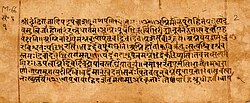
[[File:1500-1200 BCE Rigveda, manuscript page sample i, Mandala 1, Hymn 1 (Sukta 1), Adhyaya 1, lines 1.1.1 to 1.1.9, Sanskrit, Devanagari.jpg|thumb|[[Rig Veda]] is the oldest [[Vedic]] [[Sanskrit]] Hindu text that originated in the northwestern Punjab region.]] | |||
[[Hinduism]] is the oldest recorded religion practiced by the [[Punjabi people]].<ref name="Nayar1">{{Cite book |last=Nayar |first=Kamala Elizabeth |url=https://books.google.com/books?id=q7pO-IZY218C&pg=PA7 |title=The Punjabis in British Columbia: Location, Labour, First Nations, and Multiculturalism |quote=Hinduism is the oldest of the religions practiced by the Punjabis |page=7 |date=2012 |publisher=McGill-Queen's Press - MQUP |isbn=978-0-7735-4070-5 |language=en}}</ref> The [[historical Vedic religion]] of the [[Vedic period]] (1500–500 BCE) constituted the religious ideas and practices in Punjab, and centred primarily in the worship of [[Indra]], the Hindu god of heaven and lightning.<ref name="Berry1996p20">{{cite book |author=Berry, Thomas |year=1996 |title=Religions of India: Hinduism, Yoga, Buddhism |publisher=Columbia University Press |isbn=978-0-231-10781-5 |pages=[https://archive.org/details/religionsofindia00berr/page/20 20]–21 |url=https://archive.org/details/religionsofindia00berr |url-access=registration}}</ref> The Vedic tribes moved further eastwards in the northern [[Indus Valley]] and towards the [[Ganges valley|Ganges-Yamuna doab]] during the late Vedic Period, and Brahminism developed out of the Vedic origins in the [[Kurukshetra]] area. The religion of the Vedic Period is one of the precursors of Hinduism, and the Vedic period ended when the [[Hindu synthesis]] developed out of the interaction between Brahminism, [[Śramaṇa|Sramanism]], and local religions.<ref>name="Vedic religion">{{cite encyclopedia|url=https://www.britannica.com/topic/Vedic-religion|title=Vedic religion|encyclopedia=[[Encyclopedia Britannica]]|date=10 November 2023 |quote=It [[Historical Vedic religion|Vedic religion]] takes its name from the collections of sacred texts known as the Vedas. Vedism is the oldest stratum of religious activity in India for which there exist written materials. It was one of the major traditions that shaped Hinduism.}}</ref><ref>{{Cite book |last=Virdee |first=Pippa |url=https://books.google.com/books?id=WYJIDwAAQBAJ&pg=PA24 |title=From the Ashes of 1947 |date=February 2018 |publisher=Cambridge University Press |isbn=978-1-108-42811-8 |pages=24 |language=en |quote=The Rig Veda and the Upanishads, which belonged to the Vedic religion, were a precursor of Hinduism, both of which were composed in Punjab.}}</ref>{{efn|{{harvtxt|Michaels|2004|p=38}}: "The legacy of the Vedic religion in Hinduism is generally overestimated. The influence of the mythology is indeed great, but the religious terminology changed considerably: all the key terms of Hinduism either do not exist in Vedic or have a completely different meaning. The religion of the Veda does not know the ethicised migration of the soul with retribution for acts (''karma''), the cyclical destruction of the world, or the idea of salvation during one's lifetime (''jivanmukti; moksa; nirvana''); the idea of the world as illusion (''maya'') must have gone against the grain of ancient India, and an omnipotent creator god emerges only in the late hymns of the rgveda. Nor did the Vedic religion know a caste system, the burning of widows, the ban on remarriage, images of gods and temples, Puja worship, Yoga, pilgrimages, vegetarianism, the holiness of cows, the doctrine of stages of life (''asrama''), or knew them only at their inception. Thus, it is justified to see a turning point between the Vedic religion and Hindu religions."<br>{{cite web |first1=Stephanie |last1=Jamison |first2=Michael |last2=Witzel |year=1992 |url=http://www.people.fas.harvard.edu/~witzel/vedica.pdf |title=Vedic Hinduism |publisher=Harvard University |pages=3}}: "... to call this period Vedic Hinduism is a contradictio in terminis since Vedic religion is very different from what we generally call Hindu religion – at least as much as Old Hebrew religion is from medieval and modern Christian religion. However, Vedic religion is treatable as a predecessor of Hinduism."<br>See also {{harvnb|Halbfass|1991|pp=1–2}}|name="Michaels-legacy"}} | |||
The bulk of the [[Rigveda]] was composed in the Punjab region between circa 1500 and 1200 BCE,<ref>{{Cite book|last=Flood|first=Gavin|url=https://archive.org/details/anintroductiontohinduismgavinfloodd.oupseeotherbooks_355_z/page/37/mode/2up|title=An Introduction to Hinduism|date=13 July 1996|publisher=Cambridge University Press|isbn=978-0-521-43878-0}}</ref> while later Vedic scriptures were composed more eastwards, between the [[Yamuna]] and [[Ganges]] rivers. An ancient Indian law book called the [[Manusmriti]], developed by [[Brahmin]] [[Hindu priest|Hindu priests]], shaped Punjabi religious life from 200 BCE onward.<ref name="Nayar">{{Cite book |last=Nayar |first=Kamala Elizabeth |url=https://books.google.com/books?id=q7pO-IZY218C&pg=PA7 |title=The Punjabis in British Columbia: Location, Labour, First Nations, and Multiculturalism |date=2012 |publisher=McGill-Queen's Press - MQUP |isbn=978-0-7735-4070-5 |language=en |pages=7–8}}</ref> | |||
== | === British colonial era === | ||
Prominent [[Indian independence movement|Indian nationalists]] from Punjab, such as [[Lala Lajpat Rai]], belonged to | [[File:Sadhu and companion sit under a large tree in Lahore in 1914, a true-colour photograph taken by Albert Kahn.jpg|thumb|Colour photograph of a ''[[sadhu]]'' and companion sitting under a large tree in [[Lahore]], [[British Raj|India]] in 1914, taken by Stéphane Passet]] | ||
Prominent [[Indian independence movement|Indian nationalists]] from Punjab, such as [[Lala Lajpat Rai]], belonged to the [[Arya Samaj]]. The Arya Samaj, a [[Hindu reform movements|Hindu reformist]] sect was active in propagating their message in Punjab.<ref name="Kumar2004">{{cite book|author=Raj Kumar|title=Essays on Social Reform Movements|url=https://books.google.com/books?id=C7SQW69LLSIC&pg=PA1|year=2004|publisher=Discovery Publishing House|isbn=978-81-7141-792-6|pages=3–5}}</ref> | |||
In the early part of the 20th century, the Samaj and organisations inspired by it, such as Jat Pat Todak Mandal, were active in campaigning against caste discrimination.<ref>{{cite book |last1=Rajivlochan |first1=M. |year=2014 |title=Coping with Exclusions the Non-Political Way. Mapping Social Exclusion in India: Caste, Religion and Borderlands |pages=82–83}}</ref> Other activities in which the Samaj engaged included campaigning for the acceptance of [[widow remarriage]] and [[women's education]].<ref>{{cite journal|last1=Kishwar|first1=Madhu|title=Arya Samaj and Women's Education: Kanya Mahavidyalaya, Jalandhar|journal=[[Economic and Political Weekly]]|date=26 April 1986|volume=21|issue=17|pages=WS9–WS24|jstor=4375593}}</ref> | |||
During the [[British Raj|colonial era]], the practice of [[religious syncretism]] among Punjabi Hindus and [[Punjabi Muslims]] was noted and documented by officials in census reports: | |||
{{blockquote|{{smaller|''"In other parts of the Province, too, traces of Hindu festivals are noticeable among the Muhammadans. In the western Punjab, [[Vaisakhi|Baisakhi]], the new year's day of the Hindus, is celebrated as an agricultural festival, by all Muhammadans, by racing bullocks yoked to the well gear, with the beat of tom-toms, and large crowds gather to witness the show, The race is called Baisakhi and is a favourite pastime in the well-irrigated tracts. Then the processions of [[tazia]]s, in [[Muharram]], with the accompaniment of tom-toms, fencing parties and bands playing on flutes and other musical instruments (which is disapproved by the orthodox Muhammadans) and the establishment of [[Sebil (fountain)|Sabils]] (shelters where water and [[Sharbat (beverage)|sharbat]] are served out) are clearly influenced by similar practices at Hindu festivals, while the illuminations on occasions like the [[Mela Chiraghan|Chiraghan fair]] of [[Shalimar Gardens, Lahore|Shalamar (Lahore)]] are no doubt practices answering to the holiday-making instinct of the converted Hindus."''<ref name="punjab1911"/>{{rp|174}}<br>''"Besides actual conversion, Islam has had a considerable influence on the Hindu religion. The sects of reformers based on a revolt from the orthodoxy of [[Varnashrama Dharma]] were obviously the outcome of the knowledge that a different religion could produce equally pious and right thinking men. Laxity in social restrictions also appeared simultaneously in various degrees and certain customs were assimilated to those of the Muhammadans. On the other hand the miraculous powers of Muhammadan saints were enough to attract the saint worshiping Hindus, to allegiance, if not to a total change of faith... The [[Punjabi Saudagaran-e-Delhi|Shamsis]] are believers in [[Shamsuddin Sabzwari|Shah Shamas Tabrez]] of [[Multan]], and follow the [[Imam]], for the time being, of the [[Isma'ilism|Ismailia]] sect of [[Shias]]... they belong mostly to the [[Sunar|Sunar caste]] and their connection with the sect is kept a secret, like Freemasonry. They pass as ordinary Hindus, but their devotion to the Imam is very strong."''<ref name="punjab1911">{{cite web|url=https://www.jstor.org/site/SAOA/SouthAsiaOpenArchivesSAOA/CensusReports-1911-26575903/|title=Census of India 1911. Vol. 14, Punjab. Pt. 1, Report.|access-date=21 July 2022}}</ref>{{rp|130}}}} | |||
|Excerpts from the [[Census of India]] ([[Punjab Province (British India)|Punjab Province]])|1911 CE}} | |||
=== 1947 Partition === | === 1947 Partition === | ||
Approximately 3 million Punjabi Hindus migrated from [[Punjab, Pakistan|West Punjab]] and [[North-West Frontier Province]] (present-day Pakistan) to [[Punjab, India|East Punjab]] and [[Delhi]] (present-day India) during the [[Partition of India|Partition]].<ref>{{Cite book|last=Salamat|first=Zarina|title=The Punjab in 1920's: a case study of Muslims|date=1997|publisher=Royal Book Company|isbn=978-969-407-230-2|location=Karachi|pages=145|language=en|oclc=40480171}}</ref><ref>{{Cite book|last1=Banerjee-Dube|first1=Ishita|title=Ancient to modern: religion, power, and community in India|last2=Dube|first2=Saurabh|date=2009|publisher=Oxford University Press|isbn=978-0-19-569662-2|location=New Delhi; Oxford|language=en|oclc=302183130}}</ref><ref name="washedu">{{cite web|url=http://faculty.washington.edu/brass/Partition.pdf|title=The partition of India and retributive genocide in the Punjab, 1946–47: means, methods, and purposes|access-date=19 December 2006}}</ref> | |||
This split the former British province of Punjab between the [[Dominion of India]] and the [[Dominion of Pakistan]]. The mostly Muslim western part of the province became Pakistan's [[Punjab, Pakistan|Punjab province]]; the mostly Sikh and Hindu eastern part became India's East Punjab state (later divided into the new states of [[Punjab, India|Punjab]], [[Haryana]] and [[Himachal Pradesh]]). Many Hindus and Sikhs lived in the west, and many Muslims lived in the east, and the fears of all such minorities were so great that the Partition saw many people displaced and much intercommunal violence. Some have described the violence in Punjab as a retributive genocide.{{Sfn|Brass|1974|p=326}} | This split the former British province of Punjab between the [[Dominion of India]] and the [[Dominion of Pakistan]]. The mostly [[Muslims|Muslim]] western part of the province became Pakistan's [[Punjab, Pakistan|Punjab province]]; the mostly [[Sikhs|Sikh]] and Hindu eastern part became India's East Punjab state (later divided into the new states of [[Punjab, India|Punjab]], [[Haryana]] and [[Himachal Pradesh]]). Many Hindus and Sikhs lived in the west, and many Muslims lived in the east, and the fears of all such minorities were so great that the Partition saw many people displaced and much intercommunal violence. Some have described the violence in Punjab as a retributive genocide.{{Sfn|Brass|1974|p=326}} | ||
The newly formed governments had not anticipated, and were completely unequipped for, a two-way migration of such staggering magnitude, and massive violence and slaughter occurred on both sides of the new India-Pakistan border. Estimates of the number of deaths vary, with low estimates at 200,000 and high estimates at 2,000,000. The worst case of violence among all regions is concluded to have taken place in Punjab.<ref>{{cite journal|last1=Talbot|first1=Ian|title=Partition of India: The Human Dimension|journal=Cultural and Social History|date=2009|volume=6|issue=4|pages=403–410|quote=The number of casualties remains a matter of dispute, with figures being claimed that range from 200,000 to 2 million victims.|doi=10.2752/147800409X466254|s2cid=147110854}}</ref><ref name="D'Costa 2011 53">{{Cite book|title=Nationbuilding, Gender and War Crimes in South Asia|last=D'Costa|first=Bina|publisher=Routledge|year=2011|isbn=9780415565660|page=53}}</ref><ref name="Butalia 2000">{{Cite book|url=https://www.nytimes.com/books/first/b/butalia-silence.html|title=The Other Side of Silence: Voices From the Partition of India|last=Butalia|first=Urvashi|publisher=Duke University Press|year=2000}}</ref><ref>{{Cite book|title=Muslims in India Since 1947: Islamic Perspectives on Inter-Faith Relations|last=Sikand|first=Yoginder|publisher=Routledge|year=2004|isbn=9781134378258|page=5}}</ref> | The newly formed governments had not anticipated, and were completely unequipped for, a two-way migration of such staggering magnitude, and massive violence and slaughter occurred on both sides of the new India-Pakistan border. Estimates of the number of deaths vary, with low estimates at 200,000 and high estimates at 2,000,000. The worst case of violence among all regions is concluded to have taken place in Punjab.<ref>{{cite journal|last1=Talbot|first1=Ian|title=Partition of India: The Human Dimension|journal=Cultural and Social History|date=2009|volume=6|issue=4|pages=403–410|quote=The number of casualties remains a matter of dispute, with figures being claimed that range from 200,000 to 2 million victims.|doi=10.2752/147800409X466254|s2cid=147110854}}</ref><ref name="D'Costa 2011 53">{{Cite book|title=Nationbuilding, Gender and War Crimes in South Asia|last=D'Costa|first=Bina|publisher=Routledge|year=2011|isbn=9780415565660|page=53}}</ref><ref name="Butalia 2000">{{Cite book|url=https://www.nytimes.com/books/first/b/butalia-silence.html|title=The Other Side of Silence: Voices From the Partition of India|last=Butalia|first=Urvashi|publisher=Duke University Press|year=2000}}</ref><ref>{{Cite book|title=Muslims in India Since 1947: Islamic Perspectives on Inter-Faith Relations|last=Sikand|first=Yoginder|publisher=Routledge|year=2004|isbn=9781134378258|page=5}}</ref> | ||
| Line 41: | Line 67: | ||
=== Punjabi Suba and trifurcation of Punjab === | === Punjabi Suba and trifurcation of Punjab === | ||
{{main|Punjabi Suba movement}} | {{main|Punjabi Suba movement}} | ||
After Partition, Sikh leaders and political parties demanded a [[Punjabi Suba movement|"Punjabi Suba"]] (Punjabi Province) where Punjabi language written in the | After the Partition, Sikh leaders and political parties demanded a [[Punjabi Suba movement|"Punjabi Suba"]] (Punjabi Province) where Punjabi language written in the [[Gurumukhi]] script would be the language of the state in North India. | ||
At the instigation of the [[Arya Samaj]], many Punjabi Hindus in present-day Ambala, Una and Sirsa | At the instigation of the [[Arya Samaj]], many Punjabi Hindus in present-day Ambala, Una, and Sirsa stated [[Hindi]] as their mother tongue in the censuses of 1951 and 1961. Some areas of the erstwhile East Punjab state where Hindi, [[Haryanvi]], and [[Western Pahari]]-speaking Hindus formed the majority, became part of the newly created states of [[Haryana]] and [[Himachal Pradesh]] where Hindi was declared the state language. This was in contrast with the primarily Punjabi-speaking locals in some regions of the newly created states.<ref name="google2">Chopra R. [https://books.google.com/books?id=U_ODfrFOd8AC&pg=PA9072 ''Love Is The Ultimate Winner''] Partridge, India 2013. p. 9072. {{ISBN|9781482800050}} Accessed 3 February 2017.</ref> A direct result of the trifurcation of East Punjab into three states made Punjab a Sikh-majority state in India. Today, Punjabi Hindus make up approximately 38.5% population of present Punjab State of India.<ref name="google">Lamba K. G. [https://books.google.com/books?id=aSzbGKyLqicC&pg=PA90 ''Dynamics of Punjabi Suba Movement''] Deep and Deep 1999. p. 90 {{ISBN|9788176291293}} Accessed 3 February 2017.</ref><ref name="google3">Grewal J. S. [https://books.google.com/books?id=2_nryFANsoYC&pg=PA187 ''The Sikhs of the Punjab''] Cambridge University Press 1998. p. 187 {{ISBN|9780521637640}} Accessed 3 February 2017.</ref> | ||
== Culture and | == Demographics == | ||
=== India === | |||
[[File:Devi talab jal.jpg|thumb|right|250px|[[Devi Talab Mandir]] in [[Jalandhar, Punjab]], [[India]].]] | |||
In the Indian state of [[Punjab, India|Punjab]], Punjabi Hindus make up approximately 38.5% of the state's population; numbering 10.7 million and are a majority in the [[Doaba]] region. Punjabi Hindus form a majority in five districts of Punjab, namely, [[Pathankot district|Pathankot]], [[Jalandhar district|Jalandhar]], [[Hoshiarpur district|Hoshiarpur]], [[Fazilka district|Fazilka]] and [[Shaheed Bhagat Singh Nagar district|Shaheed Bhagat Singh Nagar]] districts.<ref>{{cite web |title=Religion by districts - Punjab |url=http://www.censusindia.gov.in/2011census/C-01/DDW03C-01%20MDDS.XLS |website=census.gov.in|access-date=20 September 2021}}</ref> | |||
During the 1947 partition, many Hindus from [[West Punjab]] and [[North-West Frontier Province]] settled in Delhi. Determined from 1991 and 2015 estimates, Punjabi Hindus form approximately 24 to 35 percent of Delhi's population;{{efn|name=Delhi1991|“Though Punjabis constitute a mere twenty-four per cent of so of the capital city's population, on average they hold fifty-three per cent of the available managerial positions."<ref name="Sanjay2008">{{cite book | author=Sanjay Yadav | title=The Invasion of Delhi | url=https://books.google.com/books?id=CTBBL1q5C_EC&pg=PA10 | year=2008 | publisher=Worldwide Books | isbn=978-81-88054-00-8 }}</ref>{{rp|54}}}}{{efn|name=Delhi2015|“The most important section among settlers is the Punjabis who are estimated to constitute around 35 percent of the population."<ref name="Singh2015">{{cite news |last1=Singh |first1=Raj |title=Delhi Assembly elections 2015: Important facts and major stakeholders |url=https://www.indiatvnews.com/politics/national/delhi-assembly-elections-2015-important-facts-and-stakeholders-25298.html |accessdate=8 September 2021 |work=[[India TV]] |date=6 February 2015}}</ref>}} based on 2011 official census counts out of a total population of 16.8 million, this amounts to between 4 and 5.9 million people.<ref name="delhi2011"/> | |||
Punjabi Hindus form between approximately 8 and 10 percent of [[Haryana]]'s population; based on 2011 official census counts out of a total population of 25.4 million, this amounts to between 2.03 and 2.54 million people.{{efn|name=HaryanaPopulation}} Similar to Delhi, most Punjabi Hindus in Haryana can trace their ancestry to [[West Punjab]] and [[North-West Frontier Province]] due to mass migration associated with the 1947 partition. In the contemporary era, Punjabi Hindus are influential in the state politics.<ref name="Kumar2014"/><ref name="Naqshbandi2019"/> | |||
{| class="wikitable sortable" | |||
|+ Punjabi language as a mother tongue in Haryana{{efn|Including speakers of [[Standard Punjabi]] and [[Western Punjabi (Lahnda)]]}} | |||
! rowspan="2" |Subdivision | |||
! colspan="2" |1881 census<ref name="Census1881A">{{cite web |url=https://www.jstor.org/stable/saoa.crl.25057656 |jstor=saoa.crl.25057656 |access-date=26 July 2025 |title=Census of India, 1881 Report on the Census of the Panjáb Taken on the 17th of February 1881, vol. I. |year=1881 |archive-date=15 January 2024 |archive-url=https://web.archive.org/web/20240115015937/https://www.jstor.org/stable/saoa.crl.25057656 |url-status=live }}</ref><ref name="Census1881B">{{cite web |url=https://www.jstor.org/stable/saoa.crl.25057657 |jstor=saoa.crl.25057657 |access-date=26 July 2025 |title=Census of India, 1881 Report on the Census of the Panjáb Taken on the 17th of February 1881, vol. II. |year=1881 |pages=169 |archive-date=15 January 2024 |archive-url=https://web.archive.org/web/20240115015938/https://www.jstor.org/stable/saoa.crl.25057657 |url-status=live }}</ref><ref name="Census1881C">{{cite web |url=https://www.jstor.org/stable/saoa.crl.25057658 |jstor=saoa.crl.25057658 |access-date=26 July 2025 |title=Census of India, 1881 Report on the Census of the Panjáb Taken on the 17th of February 1881, vol. III. |year=1881 |pages=123 |archive-date=20 January 2024 |archive-url=https://web.archive.org/web/20240120083807/https://www.jstor.org/stable/saoa.crl.25057658 |url-status=live }}</ref> | |||
! colspan="2" |1931 census<ref name="Census1931">{{cite web|url=https://www.jstor.org/stable/saoa.crl.25793242 |jstor=saoa.crl.25793242 |access-date=8 June 2025 |title=Census of India 1931. Vol. 17, Punjab. Pt. 2, Tables. |year=1931}}</ref> | |||
! colspan="2" |1961 census<ref name="Census1961">{{cite web|url=https://censusindia.gov.in/nada/index.php/catalog/32026|title=Social and Cultural Tables, Part II-C(i) , Vol-XIII, Punjab - Census 1961|page=223|website=Census Digital Library|access-date=8 June 2025}}</ref> | |||
! colspan="2" |1971 census<ref name="Census1971">{{cite web|url=https://censusindia.gov.in/nada/index.php/catalog/study/Dspace_123456789_4675|title=Social And Cultural Tables, Part II-C (ii), Series-6, Haryana - Census 1971|page=67|website=Census Digital Library|access-date=8 June 2025}}</ref> | |||
|- | |||
!Population | |||
!Percentage | |||
!Population | |||
!Percentage | |||
!Population | |||
!Percentage | |||
!Population | |||
!Percentage | |||
|- | |||
! [[Ambala district]] | |||
| 351,418 | |||
| {{Percentage | 351418 | 1067263 | 2 }} | |||
| 264,521 | |||
| {{Percentage | 264521 | 742902 | 2 }} | |||
| 418,656 | |||
| {{Percentage | 418656 | 1373477 | 2 }} | |||
| 153,142 | |||
| {{Percentage | 153142 | 1098405 | 2 }} | |||
|- | |||
! [[Hisar district]]{{efn|1881 census count includes Sirsa District, which was later amalgamated with Hissar District.}} | |||
| 196,808 | |||
| {{Percentage | 196808 | 757458 | 2 }} | |||
| 219,718 | |||
| {{Percentage | 219718 | 899479 | 2 }} | |||
| 178,802 | |||
| {{Percentage | 178802 | 1540508 | 2 }} | |||
| 314,829 | |||
| {{Percentage | 314829 | 2132948 | 2 }} | |||
|- | |||
! [[Jind State]]/[[Jind district]] | |||
| 66,339 | |||
| {{Percentage | 66339 | 249862 | 2 }} | |||
| 66,688 | |||
| {{Percentage | 66688 | 324676 | 2 }} | |||
| {{N/a}} | |||
| {{N/a}} | |||
| 20,033 | |||
| {{Percentage | 20033 | 639610 | 2 }} | |||
|- | |||
! [[Kalsia State]] | |||
| 28,168 | |||
| {{Percentage | 28168 | 67708 | 2 }} | |||
| 10,551 | |||
| {{Percentage | 10551 | 59848 | 2 }} | |||
| {{N/a}} | |||
| {{N/a}} | |||
| {{N/a}} | |||
| {{N/a}} | |||
|- | |||
! [[Karnal district]] | |||
| 26,580 | |||
| {{Percentage | 26580 | 622621 | 2 }} | |||
| 16,430 | |||
| {{Percentage | 16430 | 852614 | 2 }} | |||
| 198,292 | |||
| {{Percentage | 198292 | 1490430 | 2 }} | |||
| 279,421 | |||
| {{Percentage | 279421 | 1981303 | 2 }} | |||
|- | |||
! [[Rohtak district]] | |||
| 561 | |||
| {{Percentage | 561 | 553609 | 2 }} | |||
| 526 | |||
| {{Percentage | 526 | 805621 | 2 }} | |||
| 14,302 | |||
| {{Percentage | 14302 | 1420391 | 2 }} | |||
| 33,000 | |||
| {{Percentage | 33000 | 1785534 | 2 }} | |||
|- | |||
! [[Gurgaon district]] | |||
| 343 | |||
| {{Percentage | 343 | 641848 | 2 }} | |||
| 899 | |||
| {{Percentage | 899 | 740163 | 2 }} | |||
| 19,270 | |||
| {{Percentage | 19270 | 1240706 | 2 }} | |||
| 40,003 | |||
| {{Percentage | 40003 | 1707369 | 2 }} | |||
|- | |||
! [[Dujana|Dujana State]] | |||
| 8 | |||
| {{Percentage | 8 | 23416 | 2 }} | |||
| 15 | |||
| {{Percentage | 15 | 28216 | 2 }} | |||
| {{N/a}} | |||
| {{N/a}} | |||
| {{N/a}} | |||
| {{N/a}} | |||
|- | |||
! [[Pataudi State]] | |||
| 2 | |||
| {{Percentage | 2 | 17847 | 2 }} | |||
| 1 | |||
| {{Percentage | 1 | 18873 | 2 }} | |||
| {{N/a}} | |||
| {{N/a}} | |||
| {{N/a}} | |||
| {{N/a}} | |||
|- | |||
! [[Loharu State]] | |||
| 0 | |||
| {{Percentage | 0 | 13754 | 2 }} | |||
| 16 | |||
| {{Percentage | 16 | 23338 | 2 }} | |||
| {{N/a}} | |||
| {{N/a}} | |||
| {{N/a}} | |||
| {{N/a}} | |||
|- | |||
! [[Mahendragarh district]] | |||
| {{N/a}} | |||
| {{N/a}} | |||
| {{N/a}} | |||
| {{N/a}} | |||
| 2,895 | |||
| {{Percentage | 2895 | 547850 | 2 }} | |||
| 3,444 | |||
| {{Percentage | 3444 | 691639 | 2 }} | |||
|- | |||
! Total Punjabi language population | |||
! 670,227 | |||
! {{Percentage | 670227 | 4015386 | 2 }} | |||
! 579,365 | |||
! {{Percentage | 579365 | 4495730 | 2 }} | |||
! 832,217 | |||
! {{Percentage | 832217 | 7613362 | 2 }} | |||
! 843,872 | |||
! {{Percentage | 843872 | 10036808 | 2 }} | |||
|- | |||
! Total Haryana population | |||
! 4,015,386 | |||
! {{Percentage | 4015386 | 4015386 | 2 }} | |||
! 4,495,730 | |||
! {{Percentage | 4495730 | 4495730 | 2 }} | |||
! 7,613,362 | |||
! {{Percentage | 7613362 | 7613362 | 2 }} | |||
! 10,036,808 | |||
! {{Percentage | 10036808 | 10036808 | 2 }} | |||
|- class="sortbottom" | |||
|} | |||
=== Pakistan === | |||
{{Main article|Hinduism in Punjab, Pakistan}} | |||
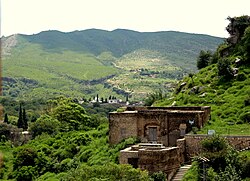
[[File:Katas Raj Temple Top Mountain View.jpg|thumb|right|250px|[[Katas Raj Temples]] in [[Chakwal District]], [[Punjab, Pakistan]].]] | |||
Following the large-scale exodus that took place during the 1947 partition, there remains a small Punjabi Hindu community in Pakistan today. According to the [[2017 Census of Pakistan|2017 Census]], there are about 200,000 Hindus in Punjab province, forming approximately 0.2% of the total population.<ref name="2017 Census">{{cite web|title=SALIENT FEATURES OF FINAL RESULTS CENSUS-2017|url=https://www.pbs.gov.pk/sites/default/files//population_census/sailent_feature_%20census_2017.pdf|access-date=8 September 2021}}</ref> Much of the community resides in the primarily rural South Punjab districts of [[Rahim Yar Khan District|Rahim Yar Khan]] and [[Bahawalpur District|Bahawalpur]] where they form 3.12% and 1.12% of the population respectively,<ref name="Districtwise">{{cite web|url=https://www.pbs.gov.pk/content/district-wise-census-2017-results|title=District wise census|access-date=20 September 2021}}</ref><ref>{{Cite news|url=https://dailytimes.com.pk/120531/pakistani-hindus-celebrate-janmashtami-with-fervour/|title=Pakistani Hindus celebrate Janmashtami with fervour |author=Dharmindar Balach|newspaper=Daily Times|date=17 August 2017|access-date=20 September 2021}}</ref> while the rest are concentrated in urban centres such as [[Lahore]].<ref>{{cite news|url=https://tribune.com.pk/story/1842865/1-hindu-community-celebrates-diwali-across-punjab|title=Hindu community celebrates Diwali across Punjab|work=The Express Tribune|date=8 November 2018|access-date=18 December 2020}}</ref><ref>{{cite news|url=https://tribune.com.pk/story/978422/victory-over-evil-dussehra-celebrated-at-krishna-mandir|title=Dussehra celebrated at Krishna Mandir|work=The Express Tribune|date=23 October 2015|access-date=18 December 2020}}</ref> In 2006, the last functioning Hindu temple in Lahore, once the cultural capital of Punjabi Hindus, was destroyed to make way for a multi-story commercial building, and thus the millennia-old history of Hindus in Lahore came to an end.<ref>{{cite news | url=https://timesofindia.indiatimes.com/world/pakistan/only-hindu-temple-in-lahore-demolished/articleshow/1643844.cms | title=Only Hindu temple in Lahore demolished | newspaper=The Times of India | date=13 June 2006 }}</ref> | |||
=== Diaspora === | |||
Large [[Punjabi diaspora|diaspora]] communities exist in many countries including in [[Canada]], the [[Gulf Countries]], [[Australia]], the [[United States]], and the [[United Kingdom]]. | |||
== Culture and religion == | |||
[[File:Durgiana Temple, Amritsar.jpg|thumb|right|250px|[[Durgiana Temple]] in Amritsar, Punjab, India.]] | [[File:Durgiana Temple, Amritsar.jpg|thumb|right|250px|[[Durgiana Temple]] in Amritsar, Punjab, India.]] | ||
[[File:Fresco of Radha and Krishna painted in the early 19th century on the walls of the Maiyanatha Thakurdwara in Katra Dulo, Amritsar, Punjab.jpg|thumb|Fresco of [[Radha Krishna]] painted in the early 19th century on the walls of the Maiyanatha Thakurdwara in Katra Dulo, Amritsar, Punjab]] | |||
[[File:A Hindu illustrated manuscript written in Gurmukhi script with paintings inside 04.webp|thumb|A Hindu illustrated manuscript written in [[Gurmukhi|Gurmukhi script]] with paintings inside]] | |||
As in many other parts of India, Hinduism in Punjab has adapted over time and has become a synthesis of culture and history.[[File:MATA MANSA DEVI-PANCHKULA, HARYANA outer view of temple on top.jpg|thumb|Mata Mansa Devi Mandir, Panchkula<ref>{{Cite web |title=Shri Mata Mansa Devi Shrine Board |url=https://mansadevi.org.in/ |access-date=15 April 2023 |website=mansadevi.org.in}}</ref>]] As [[Hindus]] believe that dharma is universal and evolves with time, many Hindus also value other spiritual paths and religious traditions. They believe that any traditions that are equally able to nurture one's ''Atman'' should be accepted and taught. Hinduism itself encourages any being to reach their own self-realization in their own unique way either through [[Bhagavan]] or through other means of devotion and meditation.<ref>{{Cite web|title=Sikhism {{!}} History, Doctrines, Practice, & Literature|url=https://www.britannica.com/topic/Sikhism|access-date=11 June 2021|website=Encyclopedia Britannica|language=en}}</ref> | |||
The Punjabi Hindus continue heterogeneous religious practices in spiritual kinship with Sikhism. This not only includes veneration of the [[Sikh gurus]] in private practice but also visits to Sikh [[gurdwara]]s in addition to Hindu temples.<ref>{{cite book |last1=Raj |first1=Dhooleka Sarhadi |title=Where Are You From? Middle-Class Migrants in the Modern World |date=2003 |publisher=University of California Press |location=Berkeley |isbn=9780520233836 |page=80 |url=https://books.google.com/books?id=W6YwDwAAQBAJ&dq=punjabi+hindus+syncretic&pg=PA80}}</ref> | |||
According to Anjali Gera Roy, The Hindu Punjabis of [[West Punjab|Western Punjab]] settled away from their ancestral homeland during 1947 partition, speak a hybrid language based on [[Punjabi language|Punjabi]] and [[Hindi]] (or Hindi with Punjabi accent).<ref>MINE, T. I., & ROY, A. G. (2004). NOT SPEAKING A LANGUAGE. Translation Today, 1, 26.[https://web.archive.org/web/20220304024011id_/https://www.ntm.org.in/download/ttvol/volume1_N2/Articles/02%20-%20Not%20Speaking%20A%20Language%20That%20is%20Mine%20-%20Anjali%20Gera%20Roy.pdf]</ref><ref>Kumar, P. (1982). Communalisation of Hindus in Punjab. Secular Democracy, 11(9), 27-29.|url=https://idcindia.org/wp-content/themes/idc/pdf/3.communalism/news/1-Communalisation%20of%20Hindus%20in%20Punjab%20_%20Secular%20Democracy%20_%20October%201982%20_%20Vol%2015%20No.%20IX.pdf|page=8</ref> | |||
=== Udasis === | === Udasis === | ||
[[Udasi]] is a religious sect of ascetic [[sadhu]]s | [[Udasi]] is a religious sect of ascetic [[sadhu]]s centered in Punjab Region. The Udasis were key interpreters of the Sikh philosophy and the custodians of important Sikh shrines until the [[Akali movement]]. They brought many converts into the Sikh fold during the 18th and the early 19th centuries.<ref>{{Cite book|last=Pashaura Singh. Fenech, Louis E.|title=The Oxford handbook of Sikh studies|date=March 2014|publisher=OUP Oxford |isbn=978-0-19-969930-8|oclc=874522334}}</ref> However, their religious practices border on a syncretism of [[Sikhism]] and Hinduism. When the [[Singh Sabha]], dominated by [[Tat Khalsa]] Sikhs, redefined the Sikh identity in the early 20th century, the Udasi [[mahant]]s were expelled from the Sikh shrines. Since then, the Udasis have increasingly regarded themselves as Hindus rather than Sikhs.<ref>{{Cite book|last=Oberoi, Harjot.|title=The Construction of religious boundaries: culture, identity, and diversity in the Sikh tradition|date=1997|publisher=Oxford University Press|isbn=0-19-563780-1|location=Delhi|oclc=39001441}}</ref> | ||
=== Nanakpanthis === | |||
Numerous Punjabi Hindus are [[Nanakpanthi]], who revere [[Guru Nanak]] alongside their Hindu deities but without following the other gurus, and nor identify as [[Sikhs]] in terms of religious affiliation; at the time of the 1891 census of [[Punjab Province (British India)|British Punjab]], it has been estimated that, out of the 1,8 million Sikhs around 579,000 were Hindu Nanakpanthis, but in later classifications the definitions of "Hindu" and "Sikh" would be more precise and the Hindu Nanakpanthis would stop being counted as "Sikhs".<ref>{{Cite book |last=Fox |first=Richard Gabriel |title=Lions of the Punjab: culture in the making |date=1985 |publisher=Univ. of California Pr |isbn=978-0-520-05491-2 |edition=1. print |location=Berkeley, Calif. |pages=112–113}}</ref> | |||
=== Arya Samaj === | |||
The [[Arya Samaj]] was a [[Hindu reform movements|Hindu reformist]] organization founded in the 1870s by [[Dayananda Saraswati]], and while he was from [[Gujarat]], the movement had a lot of influence among Punjabi Hindus, especially the [[Khatri|Khatris]] and [[Arora|Aroras]], the Arya Samajis being social reformers who aimed to promote [[monotheism]] and were against what they called "supersititions" such as idolatry, wanted to raise the literacy rates (especially for women) and were fighting [[Caste discrimination in India|caste discrimination]].<ref>{{Cite book |last=Jaffrelot |first=Christopher |title=Religion, Caste, and Politics in India |publisher=Primus Books |year=2010 |pages=97}}</ref> | |||
== Temples == | |||
Punjabi Hindu temples historically had various names depending on the associated denomination, such as ''Shivala'' ([[Shaivism|Shaivist]] temple), ''Devidwara'' ([[Shaktism|Shaktist]] temple), or ''Thakurdwara'' ([[Vaishnavism|Vaishnavist]] temple).<ref name=":2">{{Cite book |last=Singh |first=Jagraj |title=A Complete Guide to Sikhism |publisher=Unistar Books |year=2009 |isbn=9788171427543 |pages=106–107 |chapter=Difference Between Gurdwara and Mandir (Temple) - Mandir (Temple)}}</ref><ref name=":0">{{Cite book |title=Journal of Regional History |publisher=Department of History, Guru Nanak Dev University |year=1982 |pages=28–31}}</ref><ref name=":1">{{Cite book |last=Nath |first=Viswambhar |title=Development: A Saga of Two Worlds |publisher=Concept Publishing Company |year=2002 |isbn=9788170229469 |pages=29–31 |chapter=Life in My Ancestral Village: Places of Worship and Religious Practices}}</ref> Thakurdwara complexes often had a ''[[Samadhi (shrine)|samadh]]'' (samadhi) mausoleum dedicated to the founder of the temple and a ''[[Dharamshala (type of building)|dharamsala]]'' (building for accommodating pilgrims and ascetics, such as ''[[Bairagi (Ascetics)|bairagis]]'').<ref name=":0" /> Devidwaras were devoted to the worship of the ''[[devi]]'' (goddesses).<ref name=":1" /> Temples often have various deities as their central focus in the form of a ''[[murti]]'' (idol), with there being no general uniformity in this regard.<ref name=":2" /> Hindu worshipping practices at a temple are more individualistic in-nature rather than congregational.<ref name=":2" /> | |||
=== Temple architecture === | |||
[[File:True-colour photograph - Lahore, India (now Pakistan) A Hindu temple, possibly Shaivite in 1914.jpg|thumb|True-colour photograph - Lahore, India (now Pakistan). A Hindu temple, possibly Shaivite, 1914]] | |||
The main room or area of a temple will house the deity in the form of a murti, with this space being known as ''[[Garbhagriha|garbha griha]]'' ([[sanctum sanctorum]]), which is the "heart" or inner-most point of the temple.<ref name=":2" /> Also, there is a passageway that allows for [[Circumambulation|circuambulation]] of the garbha griha space, which is a requirement after prayers are given.<ref name=":2" /> Architecturally, there is usually a dome or spire structure built over the garbha griha.<ref name=":2" /> Another feature is a small passageway called the ''[[Antarala|antrala]]'' ([[Vestibule (architecture)|vestibule]]), which connects the garbha griha and ''[[mandapa]]'' (pillard hall) spaces together.<ref name=":2" /> The mandapa is a pavilion that allows the devotees to congregate.<ref name=":2" /> Temples are built on a raised, staired platform with one entryway, with the entrance-porch being called a ''[[Ardhamandapa|ardh-mandapa]]''.<ref name=":2" /> | |||
== See also == | == See also == | ||
{{Portal|Hinduism|Punjab | |||
}} | |||
* [[History of Punjab]] | |||
* [[List of Punjabi Hindus]] | |||
* [[Hinduism in Punjab, Pakistan]] | * [[Hinduism in Punjab, Pakistan]] | ||
* [[ | * [[List of Hindu temples in India]] | ||
* [[Bhabra | * [[Bhabra]] | ||
* [[List of Hindu festivals in Punjab]] | * [[List of Hindu festivals in Punjab]] | ||
* [[East Punjab]] | * [[East Punjab]] | ||
== Notes == | |||
{{notelist}} | |||
<!--{{reflist|group=note}}--> | |||
== References == | == References == | ||
{{reflist}} | {{reflist}} | ||
== Sources == | |||
{{refbegin}} | |||
* {{cite book |last=Brass |first=Paul Richard |author-link=Paul Brass |year=1974 |title=Language, Religion and Politics in North India |publisher=Cambridge University Press}} | |||
* {{Citation |last =Halbfass |first =Wilhelm |year =1991 |title =Tradition and Reflection |publisher =SUNY Press |url =https://books.google.com/books?id=-5fImMZMqNIC |isbn =978-0-7914-0361-7 |access-date =23 December 2023 |archive-date =23 December 2023 |archive-url =https://web.archive.org/web/20231223184628/https://books.google.com/books?id=-5fImMZMqNIC |url-status =live }} | |||
* {{Citation |last =Michaels |first =Axel |author-link=Axel Michaels |year =2004 |title =Hinduism. Past and present |place =Princeton, New Jersey |publisher =Princeton University Press}} | |||
{{refend}} | |||
== Further reading == | == Further reading == | ||
* {{cite book|last=Talib|first=Gurbachan|author-link=Gurbachan Singh Talib|title= Muslim League Attack on Sikhs and Hindus in | * {{cite book|last=Talib|first=Gurbachan|author-link=Gurbachan Singh Talib|title= Muslim League Attack on Sikhs and Hindus in Punjab 1947|year=1950|publisher=[[Shiromani Gurdwara Prabandhak Committee]]|location=India|url=https://books.google.com/books?id=9fQLAAAAIAAJ}} | ||
* {{Cite journal|last=Jalal|first=Ayesha|author-link=Ayesha Jalal|date=1998|title=Nation, Reason and Religion: Punjab's Role in the Partition of India|url=https://www.jstor.org/stable/4407076|journal=Economic and Political Weekly|volume=33|issue=32|pages=2183–2190|jstor=4407076|issn=0012-9976}} | * {{Cite journal|last=Jalal|first=Ayesha|author-link=Ayesha Jalal|date=1998|title=Nation, Reason and Religion: Punjab's Role in the Partition of India|url=https://www.jstor.org/stable/4407076|journal=Economic and Political Weekly|volume=33|issue=32|pages=2183–2190|jstor=4407076|issn=0012-9976}} | ||
== External links == | == External links == | ||
* [http://webpunjab.com/culture/main.htm The Punjab—An Overview] | * {{usurped|1=[https://web.archive.org/web/20010215153625/http://webpunjab.com/culture/main.htm The Punjab—An Overview]}} | ||
* [https://web.archive.org/web/20060423232940/http://punjabgovt.nic.in/CULTURE/Historical.htm Punjab History] | * [https://web.archive.org/web/20060423232940/http://punjabgovt.nic.in/CULTURE/Historical.htm Punjab History] | ||
* [https://web.archive.org/web/20060506005341/http://www.pcschicago.org/Punjab/historical.htm Punjab Historical Background] | * [https://web.archive.org/web/20060506005341/http://www.pcschicago.org/Punjab/historical.htm Punjab Historical Background] | ||
* [https://web.archive.org/web/20060613191214/http://durgianatirath.com/ Shri Durgiana Tirath] | * [https://web.archive.org/web/20060613191214/http://durgianatirath.com/ Shri Durgiana Tirath] | ||
{{Hinduism in India by region}}{{Religion in India topics}} | |||
{{Hinduism in India by region}} | |||
{{Religion in India topics}} | |||
{{Authority control}} | |||
{{DEFAULTSORT:Hinduism In Punjab}} | {{DEFAULTSORT:Hinduism In Punjab}} | ||
[[Category:Punjabi Hindus| ]] | |||
[[Category:Hinduism in India]] | [[Category:Hinduism in India]] | ||
[[Category:Hinduism in Punjab, Pakistan]] | [[Category:Hinduism in Punjab, Pakistan]] | ||
[[Category:Hindu ethnic groups]] | [[Category:Hindu ethnic groups]] | ||
[[Category:Hindu communities]] | |||
[[Category:Social groups of Delhi]] | |||
[[Category:Social groups of Punjab, India]] | |||
[[Category:Social groups of Punjab, Pakistan]] | |||
Revision as of 12:30, 16 March 2026
पंजाबी हिंदू · ਪੰਜਾਬੀ ਹਿੰਦੂ · پنجابی ہندو Panjābī Hindū | |
|---|---|
 | |
| Total population | |
| c. 17,630,000–19,990,000 approx.[1][2] | |
| Regions with significant populations | |
| Punjab, India | 10,678,140 (2011 census)[3] |
| Delhi | 4,029,110 – 5,875,780 (2011 est.)[4][lower-alpha 1][lower-alpha 2][lower-alpha 3] |
| Haryana | 2,028,120 – 2,535,150 (2011 est.)[lower-alpha 4][lower-alpha 5][lower-alpha 6][lower-alpha 7][lower-alpha 8] |
| Rajasthan | 281,050 (2011 est.)[11][12] |
| Himachal Pradesh | 222,410 (2011 est.)[13][14] |
| Punjab, Pakistan | 249,716 (2023 census)[15] |
| Chandigarh | 94,150 (2011 est.)[11] |
| Jammu | 59,930 (2011 est.)[16][11] |
| Uttarakhand | 27,240 (2011 est.)[17][11] |
| Languages | |
| Punjabi and its dialects Hindi | |
| Religion | |
| Hinduism (incl. Nanakpanthi) | |
| Related ethnic groups | |
| Part of a series on |
| Hinduism |
|---|
 |


| Part of a series on |
| Punjabis |
|---|
 |
 Punjab portal |
Punjabi Hindus are adherents of Hinduism who identify ethnically, linguistically, culturally, and genealogically as Punjabis and are natives of the Punjab region of the Indian subcontinent. Punjabi Hindus are the third-largest religious group of the Punjabi community, after the Punjabi Muslims and the Punjabi Sikhs. Punjabi Hindus mostly inhabit the Indian state of Punjab, as well as Haryana, Himachal Pradesh, Delhi, and Chandigarh today, but many have ancestry across the greater Punjab region, which was partitioned between India and Pakistan in 1947.
Punjabi Hindus comprise a diverse range of castes, with the urban upper castes, particularly Khatris and Aroras, having historically played a dominant role in the region's trade, commerce, and industry. According to available demographic data, out of the Punjab state's total Hindu population of 38.5% (2011 census), Scheduled Castes constitute approximately 11%, while Other Backward Classes account for around 8.3%.[18]
History
Ancient
,_Adhyaya_1,_lines_1.1.1_to_1.1.9,_Sanskrit,_Devanagari.jpg)
Hinduism is the oldest recorded religion practiced by the Punjabi people.[19] The historical Vedic religion of the Vedic period (1500–500 BCE) constituted the religious ideas and practices in Punjab, and centred primarily in the worship of Indra, the Hindu god of heaven and lightning.[20] The Vedic tribes moved further eastwards in the northern Indus Valley and towards the Ganges-Yamuna doab during the late Vedic Period, and Brahminism developed out of the Vedic origins in the Kurukshetra area. The religion of the Vedic Period is one of the precursors of Hinduism, and the Vedic period ended when the Hindu synthesis developed out of the interaction between Brahminism, Sramanism, and local religions.[21][22][lower-alpha 9]
The bulk of the Rigveda was composed in the Punjab region between circa 1500 and 1200 BCE,[23] while later Vedic scriptures were composed more eastwards, between the Yamuna and Ganges rivers. An ancient Indian law book called the Manusmriti, developed by Brahmin Hindu priests, shaped Punjabi religious life from 200 BCE onward.[24]
British colonial era

Prominent Indian nationalists from Punjab, such as Lala Lajpat Rai, belonged to the Arya Samaj. The Arya Samaj, a Hindu reformist sect was active in propagating their message in Punjab.[25] In the early part of the 20th century, the Samaj and organisations inspired by it, such as Jat Pat Todak Mandal, were active in campaigning against caste discrimination.[26] Other activities in which the Samaj engaged included campaigning for the acceptance of widow remarriage and women's education.[27]
During the colonial era, the practice of religious syncretism among Punjabi Hindus and Punjabi Muslims was noted and documented by officials in census reports:
"In other parts of the Province, too, traces of Hindu festivals are noticeable among the Muhammadans. In the western Punjab, Baisakhi, the new year's day of the Hindus, is celebrated as an agricultural festival, by all Muhammadans, by racing bullocks yoked to the well gear, with the beat of tom-toms, and large crowds gather to witness the show, The race is called Baisakhi and is a favourite pastime in the well-irrigated tracts. Then the processions of tazias, in Muharram, with the accompaniment of tom-toms, fencing parties and bands playing on flutes and other musical instruments (which is disapproved by the orthodox Muhammadans) and the establishment of Sabils (shelters where water and sharbat are served out) are clearly influenced by similar practices at Hindu festivals, while the illuminations on occasions like the Chiraghan fair of Shalamar (Lahore) are no doubt practices answering to the holiday-making instinct of the converted Hindus."[28]:174
"Besides actual conversion, Islam has had a considerable influence on the Hindu religion. The sects of reformers based on a revolt from the orthodoxy of Varnashrama Dharma were obviously the outcome of the knowledge that a different religion could produce equally pious and right thinking men. Laxity in social restrictions also appeared simultaneously in various degrees and certain customs were assimilated to those of the Muhammadans. On the other hand the miraculous powers of Muhammadan saints were enough to attract the saint worshiping Hindus, to allegiance, if not to a total change of faith... The Shamsis are believers in Shah Shamas Tabrez of Multan, and follow the Imam, for the time being, of the Ismailia sect of Shias... they belong mostly to the Sunar caste and their connection with the sect is kept a secret, like Freemasonry. They pass as ordinary Hindus, but their devotion to the Imam is very strong."[28]:130— Excerpts from the Census of India (Punjab Province), 1911 CE
1947 Partition
Approximately 3 million Punjabi Hindus migrated from West Punjab and North-West Frontier Province (present-day Pakistan) to East Punjab and Delhi (present-day India) during the Partition.[29][30][31]
This split the former British province of Punjab between the Dominion of India and the Dominion of Pakistan. The mostly Muslim western part of the province became Pakistan's Punjab province; the mostly Sikh and Hindu eastern part became India's East Punjab state (later divided into the new states of Punjab, Haryana and Himachal Pradesh). Many Hindus and Sikhs lived in the west, and many Muslims lived in the east, and the fears of all such minorities were so great that the Partition saw many people displaced and much intercommunal violence. Some have described the violence in Punjab as a retributive genocide.[32]
The newly formed governments had not anticipated, and were completely unequipped for, a two-way migration of such staggering magnitude, and massive violence and slaughter occurred on both sides of the new India-Pakistan border. Estimates of the number of deaths vary, with low estimates at 200,000 and high estimates at 2,000,000. The worst case of violence among all regions is concluded to have taken place in Punjab.[33][34][35][36]
Punjabi Suba and trifurcation of Punjab
After the Partition, Sikh leaders and political parties demanded a "Punjabi Suba" (Punjabi Province) where Punjabi language written in the Gurumukhi script would be the language of the state in North India.
At the instigation of the Arya Samaj, many Punjabi Hindus in present-day Ambala, Una, and Sirsa stated Hindi as their mother tongue in the censuses of 1951 and 1961. Some areas of the erstwhile East Punjab state where Hindi, Haryanvi, and Western Pahari-speaking Hindus formed the majority, became part of the newly created states of Haryana and Himachal Pradesh where Hindi was declared the state language. This was in contrast with the primarily Punjabi-speaking locals in some regions of the newly created states.[37] A direct result of the trifurcation of East Punjab into three states made Punjab a Sikh-majority state in India. Today, Punjabi Hindus make up approximately 38.5% population of present Punjab State of India.[38][39]
Demographics
India

In the Indian state of Punjab, Punjabi Hindus make up approximately 38.5% of the state's population; numbering 10.7 million and are a majority in the Doaba region. Punjabi Hindus form a majority in five districts of Punjab, namely, Pathankot, Jalandhar, Hoshiarpur, Fazilka and Shaheed Bhagat Singh Nagar districts.[40]
During the 1947 partition, many Hindus from West Punjab and North-West Frontier Province settled in Delhi. Determined from 1991 and 2015 estimates, Punjabi Hindus form approximately 24 to 35 percent of Delhi's population;[lower-alpha 2][lower-alpha 1] based on 2011 official census counts out of a total population of 16.8 million, this amounts to between 4 and 5.9 million people.[4]
Punjabi Hindus form between approximately 8 and 10 percent of Haryana's population; based on 2011 official census counts out of a total population of 25.4 million, this amounts to between 2.03 and 2.54 million people.[lower-alpha 8] Similar to Delhi, most Punjabi Hindus in Haryana can trace their ancestry to West Punjab and North-West Frontier Province due to mass migration associated with the 1947 partition. In the contemporary era, Punjabi Hindus are influential in the state politics.[7][8]
| Subdivision | 1881 census[41][42][43] | 1931 census[44] | 1961 census[45] | 1971 census[46] | ||||
|---|---|---|---|---|---|---|---|---|
| Population | Percentage | Population | Percentage | Population | Percentage | Population | Percentage | |
| Ambala district | 351,418 | 32.93% | 264,521 | 35.61% | 418,656 | 30.48% | 153,142 | 13.94% |
| Hisar district[lower-alpha 11] | 196,808 | 25.98% | 219,718 | 24.43% | 178,802 | 11.61% | 314,829 | 14.76% |
| Jind State/Jind district | 66,339 | 26.55% | 66,688 | 20.54% | N/A | N/A | 20,033 | 3.13% |
| Kalsia State | 28,168 | 41.6% | 10,551 | 17.63% | N/A | N/A | N/A | N/A |
| Karnal district | 26,580 | 4.27% | 16,430 | 1.93% | 198,292 | 13.3% | 279,421 | 14.1% |
| Rohtak district | 561 | 0.1% | 526 | 0.07% | 14,302 | 1.01% | 33,000 | 1.85% |
| Gurgaon district | 343 | 0.05% | 899 | 0.12% | 19,270 | 1.55% | 40,003 | 2.34% |
| Dujana State | 8 | 0.03% | 15 | 0.05% | N/A | N/A | N/A | N/A |
| Pataudi State | 2 | 0.01% | 1 | 0.01% | N/A | N/A | N/A | N/A |
| Loharu State | 0 | 0% | 16 | 0.07% | N/A | N/A | N/A | N/A |
| Mahendragarh district | N/A | N/A | N/A | N/A | 2,895 | 0.53% | 3,444 | 0.5% |
| Total Punjabi language population | 670,227 | 16.69% | 579,365 | 12.89% | 832,217 | 10.93% | 843,872 | 8.41% |
| Total Haryana population | 4,015,386 | 100% | 4,495,730 | 100% | 7,613,362 | 100% | 10,036,808 | 100% |
Pakistan

Following the large-scale exodus that took place during the 1947 partition, there remains a small Punjabi Hindu community in Pakistan today. According to the 2017 Census, there are about 200,000 Hindus in Punjab province, forming approximately 0.2% of the total population.[47] Much of the community resides in the primarily rural South Punjab districts of Rahim Yar Khan and Bahawalpur where they form 3.12% and 1.12% of the population respectively,[48][49] while the rest are concentrated in urban centres such as Lahore.[50][51] In 2006, the last functioning Hindu temple in Lahore, once the cultural capital of Punjabi Hindus, was destroyed to make way for a multi-story commercial building, and thus the millennia-old history of Hindus in Lahore came to an end.[52]
Diaspora
Large diaspora communities exist in many countries including in Canada, the Gulf Countries, Australia, the United States, and the United Kingdom.
Culture and religion


As in many other parts of India, Hinduism in Punjab has adapted over time and has become a synthesis of culture and history.

As Hindus believe that dharma is universal and evolves with time, many Hindus also value other spiritual paths and religious traditions. They believe that any traditions that are equally able to nurture one's Atman should be accepted and taught. Hinduism itself encourages any being to reach their own self-realization in their own unique way either through Bhagavan or through other means of devotion and meditation.[54]
The Punjabi Hindus continue heterogeneous religious practices in spiritual kinship with Sikhism. This not only includes veneration of the Sikh gurus in private practice but also visits to Sikh gurdwaras in addition to Hindu temples.[55]
According to Anjali Gera Roy, The Hindu Punjabis of Western Punjab settled away from their ancestral homeland during 1947 partition, speak a hybrid language based on Punjabi and Hindi (or Hindi with Punjabi accent).[56][57]
Udasis
Udasi is a religious sect of ascetic sadhus centered in Punjab Region. The Udasis were key interpreters of the Sikh philosophy and the custodians of important Sikh shrines until the Akali movement. They brought many converts into the Sikh fold during the 18th and the early 19th centuries.[58] However, their religious practices border on a syncretism of Sikhism and Hinduism. When the Singh Sabha, dominated by Tat Khalsa Sikhs, redefined the Sikh identity in the early 20th century, the Udasi mahants were expelled from the Sikh shrines. Since then, the Udasis have increasingly regarded themselves as Hindus rather than Sikhs.[59]
Nanakpanthis
Numerous Punjabi Hindus are Nanakpanthi, who revere Guru Nanak alongside their Hindu deities but without following the other gurus, and nor identify as Sikhs in terms of religious affiliation; at the time of the 1891 census of British Punjab, it has been estimated that, out of the 1,8 million Sikhs around 579,000 were Hindu Nanakpanthis, but in later classifications the definitions of "Hindu" and "Sikh" would be more precise and the Hindu Nanakpanthis would stop being counted as "Sikhs".[60]
Arya Samaj
The Arya Samaj was a Hindu reformist organization founded in the 1870s by Dayananda Saraswati, and while he was from Gujarat, the movement had a lot of influence among Punjabi Hindus, especially the Khatris and Aroras, the Arya Samajis being social reformers who aimed to promote monotheism and were against what they called "supersititions" such as idolatry, wanted to raise the literacy rates (especially for women) and were fighting caste discrimination.[61]
Temples
Punjabi Hindu temples historically had various names depending on the associated denomination, such as Shivala (Shaivist temple), Devidwara (Shaktist temple), or Thakurdwara (Vaishnavist temple).[62][63][64] Thakurdwara complexes often had a samadh (samadhi) mausoleum dedicated to the founder of the temple and a dharamsala (building for accommodating pilgrims and ascetics, such as bairagis).[63] Devidwaras were devoted to the worship of the devi (goddesses).[64] Temples often have various deities as their central focus in the form of a murti (idol), with there being no general uniformity in this regard.[62] Hindu worshipping practices at a temple are more individualistic in-nature rather than congregational.[62]
Temple architecture
_A_Hindu_temple,_possibly_Shaivite_in_1914.jpg)
The main room or area of a temple will house the deity in the form of a murti, with this space being known as garbha griha (sanctum sanctorum), which is the "heart" or inner-most point of the temple.[62] Also, there is a passageway that allows for circuambulation of the garbha griha space, which is a requirement after prayers are given.[62] Architecturally, there is usually a dome or spire structure built over the garbha griha.[62] Another feature is a small passageway called the antrala (vestibule), which connects the garbha griha and mandapa (pillard hall) spaces together.[62] The mandapa is a pavilion that allows the devotees to congregate.[62] Temples are built on a raised, staired platform with one entryway, with the entrance-porch being called a ardh-mandapa.[62]
See also

- History of Punjab
- List of Punjabi Hindus
- Hinduism in Punjab, Pakistan
- List of Hindu temples in India
- Bhabra
- List of Hindu festivals in Punjab
- East Punjab
Notes
- ↑ 1.0 1.1 “The most important section among settlers is the Punjabis who are estimated to constitute around 35 percent of the population."[6]
- ↑ 2.0 2.1 “Though Punjabis constitute a mere twenty-four per cent of so of the capital city's population, on average they hold fifty-three per cent of the available managerial positions."[5]:54
- ↑ Punjabi Hindus represent between 24 and 35 per cent of Delhi's population, determined from 1991 and 2015 estimates.[5][6] Based on the 2011 official census counts out of a total population of 16,787,941, this amounts to between 4,029,106 and 5,875,779 persons.[4]
- ↑ “Punjabis constitute about eight per cent of the state’s population, they are a can’t-be-ignored political constituency."[7]
- ↑ “Political experts attribute the rise of the BJP in the region to sustained consolidation among certain communities, especially the Punjabis who account for 8% of the state’s estimated population of around 28 million.”[8]
- ↑ “From the announcement of candidates to the election campaign, the Congress primarily focused on the 22-25 percent Jat and 20-22 percent Scheduled Caste voters. In contrast, the BJP, in line with its non-Jat strategy, focused on the 30-32 percent OBCs, 9-10 percent Punjabis and 8-9 percent Brahmins.”[9]
- ↑ “The Punjabi population of Haryana is considered to be 10 percent of the total population of the state. Many constituencies even put this figure at around 14 percent. Of this population, 4 percent are Sikhs and the rest are Hindus.”[10]
- ↑ 8.0 8.1 Punjabi Hindus represent between 8 and 10 percent of Haryana's population, determined from 2014, 2019, 2024, and 2025 estimates.[7][8][9][10] Based on the 2011 official census counts out of a total population of 25,351,462, this amounts to between 2,028,117 and 2,535,146 persons.
- ↑ Michaels (2004, p. 38): "The legacy of the Vedic religion in Hinduism is generally overestimated. The influence of the mythology is indeed great, but the religious terminology changed considerably: all the key terms of Hinduism either do not exist in Vedic or have a completely different meaning. The religion of the Veda does not know the ethicised migration of the soul with retribution for acts (karma), the cyclical destruction of the world, or the idea of salvation during one's lifetime (jivanmukti; moksa; nirvana); the idea of the world as illusion (maya) must have gone against the grain of ancient India, and an omnipotent creator god emerges only in the late hymns of the rgveda. Nor did the Vedic religion know a caste system, the burning of widows, the ban on remarriage, images of gods and temples, Puja worship, Yoga, pilgrimages, vegetarianism, the holiness of cows, the doctrine of stages of life (asrama), or knew them only at their inception. Thus, it is justified to see a turning point between the Vedic religion and Hindu religions."
Jamison, Stephanie; Witzel, Michael (1992). "Vedic Hinduism" (PDF). Harvard University. p. 3.: "... to call this period Vedic Hinduism is a contradictio in terminis since Vedic religion is very different from what we generally call Hindu religion – at least as much as Old Hebrew religion is from medieval and modern Christian religion. However, Vedic religion is treatable as a predecessor of Hinduism."
See also Halbfass 1991, pp. 1–2 - ↑ Including speakers of Standard Punjabi and Western Punjabi (Lahnda)
- ↑ 1881 census count includes Sirsa District, which was later amalgamated with Hissar District.
References
- ↑ "Census of India Website : Office of the Registrar General & Census Commissioner, India". Archived from the original on 13 November 2019.
- ↑ "Behind the decline". 16 September 2015.
- ↑ "Population by religion community – 2011". The Registrar General & Census Commissioner, India. Archived from the original on 23 September 2015.
- ↑ 4.0 4.1 4.2 "Delhi (India): Union Territory, Major Agglomerations & Towns – Population Statistics in Maps and Charts". City Population. Archived from the original on 2 March 2017. Retrieved 28 February 2017.
- ↑ 5.0 5.1 Sanjay Yadav (2008). The Invasion of Delhi. Worldwide Books. ISBN 978-81-88054-00-8.
- ↑ 6.0 6.1 Singh, Raj (6 February 2015). "Delhi Assembly elections 2015: Important facts and major stakeholders". India TV. Retrieved 8 September 2021.
- ↑ 7.0 7.1 7.2 Kumar, Virender (28 October 2014). "The 'vulnerable Punjabi' in an unthinkable post in Haryana". Indian Express. Retrieved 9 September 2021.
- ↑ 8.0 8.1 8.2 Naqshbandi, Aurangzeb (23 October 2019). "Manohar Lal Khattar gives BJP an edge in Haryana's Punjabi belt". Hindustan Times. Retrieved 9 September 2021.
- ↑ 10.0 10.1 Spokesman, Rozana (25 March 2025). "Reviving Punjabi Identity in Haryana: A Journey Through Linguistic and Cultural Progress". Rozana Spokesman. Retrieved 2 June 2025.
- ↑ 11.0 11.1 11.2 11.3 "Language – India, States and Union Territories" (PDF). Census of India 2011. Office of the Registrar General. pp. 13–14. Retrieved 24 November 2018.
- ↑ "RSGPC to publicize issue of Punjabi in Rajasthan". The Times of India. 17 January 2018.
- ↑ "Una, amalgam of Punjabi and Pahari cultures".
- ↑ "Himachal Pradesh Youth status report: Sex ratio up but total fertility rate declining". The Indian Express. Shimla. Express News Service. 5 January 2018. Archived from the original on 18 April 2018. Retrieved 17 April 2018.
- ↑ "Population by Religion" (PDF).
- ↑ "Include Punjabi as official language in Jammu and Kashmir: Punjab CM Amarinder".
- ↑ "A Mini Punjab in Uttrakhand That Has Given Punjabi Cinema a Superstar Diva!".
- ↑ Abbi, Kumool (2 March 2022). "Sharpening Caste and Religious Identity Politics in the Punjab Elections". Sikh Formations Podcast. University of Michigan. Archived from the original on 20 June 2025.
- ↑ Nayar, Kamala Elizabeth (2012). The Punjabis in British Columbia: Location, Labour, First Nations, and Multiculturalism. McGill-Queen's Press - MQUP. p. 7. ISBN 978-0-7735-4070-5.
Hinduism is the oldest of the religions practiced by the Punjabis
- ↑ Berry, Thomas (1996). Religions of India: Hinduism, Yoga, Buddhism. Columbia University Press. pp. 20–21. ISBN 978-0-231-10781-5.
- ↑ name="Vedic religion">"Vedic religion". Encyclopedia Britannica. 10 November 2023.
It Vedic religion takes its name from the collections of sacred texts known as the Vedas. Vedism is the oldest stratum of religious activity in India for which there exist written materials. It was one of the major traditions that shaped Hinduism.
- ↑ Virdee, Pippa (February 2018). From the Ashes of 1947. Cambridge University Press. p. 24. ISBN 978-1-108-42811-8.
The Rig Veda and the Upanishads, which belonged to the Vedic religion, were a precursor of Hinduism, both of which were composed in Punjab.
- ↑ Flood, Gavin (13 July 1996). An Introduction to Hinduism. Cambridge University Press. ISBN 978-0-521-43878-0.
- ↑ Nayar, Kamala Elizabeth (2012). The Punjabis in British Columbia: Location, Labour, First Nations, and Multiculturalism. McGill-Queen's Press - MQUP. pp. 7–8. ISBN 978-0-7735-4070-5.
- ↑ Raj Kumar (2004). Essays on Social Reform Movements. Discovery Publishing House. pp. 3–5. ISBN 978-81-7141-792-6.
- ↑ Rajivlochan, M. (2014). Coping with Exclusions the Non-Political Way. Mapping Social Exclusion in India: Caste, Religion and Borderlands. pp. 82–83.
- ↑ Kishwar, Madhu (26 April 1986). "Arya Samaj and Women's Education: Kanya Mahavidyalaya, Jalandhar". Economic and Political Weekly. 21 (17): WS9–WS24. JSTOR 4375593.
- ↑ 28.0 28.1 "Census of India 1911. Vol. 14, Punjab. Pt. 1, Report". Retrieved 21 July 2022.
- ↑ Salamat, Zarina (1997). The Punjab in 1920's: a case study of Muslims. Karachi: Royal Book Company. p. 145. ISBN 978-969-407-230-2. OCLC 40480171.
- ↑ Banerjee-Dube, Ishita; Dube, Saurabh (2009). Ancient to modern: religion, power, and community in India. New Delhi; Oxford: Oxford University Press. ISBN 978-0-19-569662-2. OCLC 302183130.
- ↑ "The partition of India and retributive genocide in the Punjab, 1946–47: means, methods, and purposes" (PDF). Retrieved 19 December 2006.
- ↑ Brass 1974, p. 326.
- ↑ Talbot, Ian (2009). "Partition of India: The Human Dimension". Cultural and Social History. 6 (4): 403–410. doi:10.2752/147800409X466254. S2CID 147110854.
The number of casualties remains a matter of dispute, with figures being claimed that range from 200,000 to 2 million victims.
- ↑ D'Costa, Bina (2011). Nationbuilding, Gender and War Crimes in South Asia. Routledge. p. 53. ISBN 9780415565660.
- ↑ Butalia, Urvashi (2000). The Other Side of Silence: Voices From the Partition of India. Duke University Press.
- ↑ Sikand, Yoginder (2004). Muslims in India Since 1947: Islamic Perspectives on Inter-Faith Relations. Routledge. p. 5. ISBN 9781134378258.
- ↑ Chopra R. Love Is The Ultimate Winner Partridge, India 2013. p. 9072. ISBN 9781482800050 Accessed 3 February 2017.
- ↑ Lamba K. G. Dynamics of Punjabi Suba Movement Deep and Deep 1999. p. 90 ISBN 9788176291293 Accessed 3 February 2017.
- ↑ Grewal J. S. The Sikhs of the Punjab Cambridge University Press 1998. p. 187 ISBN 9780521637640 Accessed 3 February 2017.
- ↑ "Religion by districts - Punjab". census.gov.in. Retrieved 20 September 2021.
- ↑ "Census of India, 1881 Report on the Census of the Panjáb Taken on the 17th of February 1881, vol. I." 1881. JSTOR saoa.crl.25057656. Archived from the original on 15 January 2024. Retrieved 26 July 2025.
- ↑ "Census of India, 1881 Report on the Census of the Panjáb Taken on the 17th of February 1881, vol. II". 1881. p. 169. JSTOR saoa.crl.25057657. Archived from the original on 15 January 2024. Retrieved 26 July 2025.
- ↑ "Census of India, 1881 Report on the Census of the Panjáb Taken on the 17th of February 1881, vol. III". 1881. p. 123. JSTOR saoa.crl.25057658. Archived from the original on 20 January 2024. Retrieved 26 July 2025.
- ↑ "Census of India 1931. Vol. 17, Punjab. Pt. 2, Tables". 1931. JSTOR saoa.crl.25793242. Retrieved 8 June 2025.
- ↑ "Social and Cultural Tables, Part II-C(i) , Vol-XIII, Punjab - Census 1961". Census Digital Library. p. 223. Retrieved 8 June 2025.
- ↑ "Social And Cultural Tables, Part II-C (ii), Series-6, Haryana - Census 1971". Census Digital Library. p. 67. Retrieved 8 June 2025.
- ↑ "SALIENT FEATURES OF FINAL RESULTS CENSUS-2017" (PDF). Retrieved 8 September 2021.
- ↑ "District wise census". Retrieved 20 September 2021.
- ↑ Dharmindar Balach (17 August 2017). "Pakistani Hindus celebrate Janmashtami with fervour". Daily Times. Retrieved 20 September 2021.
- ↑ "Hindu community celebrates Diwali across Punjab". The Express Tribune. 8 November 2018. Retrieved 18 December 2020.
- ↑ "Dussehra celebrated at Krishna Mandir". The Express Tribune. 23 October 2015. Retrieved 18 December 2020.
- ↑ "Only Hindu temple in Lahore demolished". The Times of India. 13 June 2006.
- ↑ "Shri Mata Mansa Devi Shrine Board". mansadevi.org.in. Retrieved 15 April 2023.
- ↑ "Sikhism | History, Doctrines, Practice, & Literature". Encyclopedia Britannica. Retrieved 11 June 2021.
- ↑ Raj, Dhooleka Sarhadi (2003). Where Are You From? Middle-Class Migrants in the Modern World. Berkeley: University of California Press. p. 80. ISBN 9780520233836.
- ↑ MINE, T. I., & ROY, A. G. (2004). NOT SPEAKING A LANGUAGE. Translation Today, 1, 26.[1]
- ↑ Kumar, P. (1982). Communalisation of Hindus in Punjab. Secular Democracy, 11(9), 27-29.|url=https://idcindia.org/wp-content/themes/idc/pdf/3.communalism/news/1-Communalisation%20of%20Hindus%20in%20Punjab%20_%20Secular%20Democracy%20_%20October%201982%20_%20Vol%2015%20No.%20IX.pdf%7Cpage=8
- ↑ Pashaura Singh. Fenech, Louis E. (March 2014). The Oxford handbook of Sikh studies. OUP Oxford. ISBN 978-0-19-969930-8. OCLC 874522334.
- ↑ Oberoi, Harjot. (1997). The Construction of religious boundaries: culture, identity, and diversity in the Sikh tradition. Delhi: Oxford University Press. ISBN 0-19-563780-1. OCLC 39001441.
- ↑ Fox, Richard Gabriel (1985). Lions of the Punjab: culture in the making (1. print ed.). Berkeley, Calif.: Univ. of California Pr. pp. 112–113. ISBN 978-0-520-05491-2.
- ↑ Jaffrelot, Christopher (2010). Religion, Caste, and Politics in India. Primus Books. p. 97.
- ↑ 62.0 62.1 62.2 62.3 62.4 62.5 62.6 62.7 62.8 Singh, Jagraj (2009). "Difference Between Gurdwara and Mandir (Temple) - Mandir (Temple)". A Complete Guide to Sikhism. Unistar Books. pp. 106–107. ISBN 9788171427543.
- ↑ 63.0 63.1 Journal of Regional History. Department of History, Guru Nanak Dev University. 1982. pp. 28–31.
- ↑ 64.0 64.1 Nath, Viswambhar (2002). "Life in My Ancestral Village: Places of Worship and Religious Practices". Development: A Saga of Two Worlds. Concept Publishing Company. pp. 29–31. ISBN 9788170229469.
Sources
- Brass, Paul Richard (1974). Language, Religion and Politics in North India. Cambridge University Press.
- Halbfass, Wilhelm (1991), Tradition and Reflection, SUNY Press, ISBN 978-0-7914-0361-7, archived from the original on 23 December 2023, retrieved 23 December 2023
- Michaels, Axel (2004), Hinduism. Past and present, Princeton, New Jersey: Princeton University Press
Further reading
- Talib, Gurbachan (1950). Muslim League Attack on Sikhs and Hindus in Punjab 1947. India: Shiromani Gurdwara Prabandhak Committee.
- Jalal, Ayesha (1998). "Nation, Reason and Religion: Punjab's Role in the Partition of India". Economic and Political Weekly. 33 (32): 2183–2190. ISSN 0012-9976. JSTOR 4407076.
External links
| States | |
|---|---|
| Union Territories | |
| Communities | |

