



robot: Create/update articles. If there is a mistake please report on my talk page. |
No edit summary |
||
| Line 3: | Line 3: | ||
{{pp-vandalism|small=yes}} | {{pp-vandalism|small=yes}} | ||
{{Use Indian English|date=November 2019}} | {{Use Indian English|date=November 2019}} | ||
{{Use dmy dates|date= | {{Use dmy dates|date=January 2023}} | ||
{{Infobox officeholder | {{Infobox officeholder | ||
| name = Rajiv Gandhi | | name = Rajiv Gandhi | ||
| office = 6th [[Prime Minister of India]] | | office = 6th [[Prime Minister of India]] | ||
| native_name = | | native_name = | ||
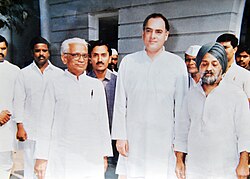
| image = Rajiv Gandhi | | image = Rajiv Gandhi, the 6th PM of India.jpg | ||
| image_size = | | image_size = | ||
| alt = | | alt = | ||
| caption = | | caption = | ||
| predecessor = [[Indira Gandhi]] | | predecessor = [[Indira Gandhi]] | ||
| president = [[Zail Singh]]<br />[[R. Venkataraman]] | | president = [[Zail Singh]]<br />[[R. Venkataraman]] | ||
| Line 45: | Line 45: | ||
| term_start2 = 28 December 1985 | | term_start2 = 28 December 1985 | ||
| term_end2 = 21 May 1991 | | term_end2 = 21 May 1991 | ||
| office3 = Member of | | office3 = [[Member of Parliament, Lok Sabha]] | ||
| term_start3 = 17 August 1981 | | term_start3 = 17 August 1981 | ||
| term_end3 = 21 May 1991 | | term_end3 = 21 May 1991 | ||
| predecessor3 = [[Sanjay Gandhi]] | | predecessor3 = [[Sanjay Gandhi]] | ||
| successor3 = [[Satish Sharma]] | | successor3 = [[Satish Sharma]] | ||
| constituency3 = [[Amethi]] | |||
| signature = RajivGandhi Signature.jpg | | signature = RajivGandhi Signature.jpg | ||
}} | }} | ||
{{Rajiv Gandhi series}} | {{Rajiv Gandhi series}} | ||
'''Rajiv Gandhi''' ({{IPAc-en|ˈ|r|ɑː|dʒ|iː|v|_|ˈ|ɡ|ɑː|n|d|iː|audio=Hi-RajivGandhi.ogg}}; 20 August 1944 – 21 May 1991)<ref>{{Cite web|title=Rajiv Gandhi {{!}} prime minister of India {{!}} Britannica|url=https://www.britannica.com/biography/Rajiv-Gandhi|access-date=21 November 2021|website=www.britannica.com | '''Rajiv Gandhi''' ({{IPAc-en|ˈ|r|ɑː|dʒ|iː|v|_|ˈ|ɡ|ɑː|n|d|iː|audio=Hi-RajivGandhi.ogg}}; 20 August 1944 – 21 May 1991)<ref name=brit>{{Cite web|title=Rajiv Gandhi {{!}} prime minister of India {{!}} Britannica|url=https://www.britannica.com/biography/Rajiv-Gandhi|access-date=21 November 2021|website=www.britannica.com}}</ref><ref>{{Cite web|title=rajiv-gandhi: Latest News, Videos and Photos of rajiv-gandhi {{!}} Times of India|url=https://timesofindia.indiatimes.com/topic/rajiv-gandhi|access-date=21 November 2021|website=The Times of India}}</ref><ref>{{Cite book|last=Patel|first=Dhirubhai|url=https://books.google.com/books?id=7s92AQAACAAJ|title=Rajiv Gandhi: Youngest Indian Prime Minister|date=17 February 2017|publisher=Independently Published|isbn=978-1-5206-2973-5}}</ref> was an Indian politician who served as the sixth [[prime minister of India]] from 1984 to 1989. He took office after the [[Assassination of Indira Gandhi|assassination]] of his mother, then Prime Minister [[Indira Gandhi]], to become the youngest Indian Prime minister at the age of 40. | ||
Gandhi was from the politically powerful [[Nehru–Gandhi family]], which had been associated with the [[Indian National Congress]] party. For much of his childhood, his maternal grandfather [[Jawaharlal Nehru]] was prime minister. Gandhi attended college at the [[University of Cambridge]] in the [[United Kingdom]]. He returned to India in 1966 and became a professional pilot for the state-owned [[Indian Airlines]]. In 1968, he married [[Sonia Gandhi]]; the couple settled in Delhi to a domestic life with their children [[Rahul Gandhi]] and [[Priyanka Gandhi Vadra]]. For much of the 1970s, his mother [[Indira Gandhi]] was prime minister and his brother [[Sanjay Gandhi]] an MP; despite this, Rajiv Gandhi remained apolitical. After Sanjay's death in a plane crash in 1980, Gandhi reluctantly entered politics at the behest of Indira. The following year he won his brother's Parliamentary seat of [[Amethi (Lok Sabha constituency)|Amethi]] and became a member of the [[Lok Sabha]]—the lower house of [[Parliament of India|India's Parliament]]. As part of his political grooming, Rajiv was made general secretary of the Congress party and given significant responsibility in organising the [[1982 Asian Games]]. | Gandhi was from the politically powerful [[Nehru–Gandhi family]], which had been associated with the [[Indian National Congress]] party. For much of his childhood, his maternal grandfather [[Jawaharlal Nehru]] was prime minister. Gandhi attended college at the [[University of Cambridge]] in the [[United Kingdom]]. He returned to India in 1966 and became a professional pilot for the state-owned [[Indian Airlines]]. In 1968, he married [[Sonia Gandhi]]; the couple settled in Delhi to a domestic life with their children [[Rahul Gandhi]] and [[Priyanka Gandhi Vadra]]. For much of the 1970s, his mother [[Indira Gandhi]] was prime minister and his brother [[Sanjay Gandhi]] an MP; despite this, Rajiv Gandhi remained apolitical. After Sanjay's death in a plane crash in 1980, Gandhi reluctantly entered politics at the behest of Indira. The following year he won his brother's Parliamentary seat of [[Amethi (Lok Sabha constituency)|Amethi]] and became a member of the [[Lok Sabha]]—the lower house of [[Parliament of India|India's Parliament]]. As part of his political grooming, Rajiv was made general secretary of the Congress party and given significant responsibility in organising the [[1982 Asian Games]]. | ||
On the morning of 31 October 1984, his mother (Prime Minister Indira Gandhi) was assassinated by her two [[Sikh]] bodyguards<ref name="Ensaaf">{{cite book|last1=Kaur|first1=Jaskaran|last2=Crossette|first2=Barbara|title=Twenty years of impunity: the November 1984 pogroms of Sikhs in India |page=27 |url=http://ensaaf-org.jklaw.net/publications/reports/20years/20years-2nd.pdf|edition=2nd|year=2006|publisher=Ensaaf|location=Portland, OR|isbn=978-0-9787073-0-9| access-date=May | On the morning of 31 October 1984, his mother (Prime Minister Indira Gandhi) was assassinated by her two [[Sikh]] bodyguards<ref name="Ensaaf">{{cite book|last1=Kaur|first1=Jaskaran|last2=Crossette|first2=Barbara|title=Twenty years of impunity: the November 1984 pogroms of Sikhs in India |page=27 |url=http://ensaaf-org.jklaw.net/publications/reports/20years/20years-2nd.pdf|edition=2nd|year=2006|publisher=Ensaaf|location=Portland, OR|isbn=978-0-9787073-0-9| access-date=23 May 2022}}</ref><ref name=bbconthisday>{{cite news |url=http://news.bbc.co.uk/onthisday/hi/witness/october/31/newsid_3961000/3961851.stm |title=1984: Assassination and revenge |access-date=23 May 2022|work=BBC News |date=31 October 1984 |archive-url=https://web.archive.org/web/20090215211511/http://news.bbc.co.uk/onthisday/hi/witness/october/31/newsid_3961000/3961851.stm |archive-date=15 February 2009 |url-status=live}}</ref><ref>{{cite book|title=War and Religion: An Encyclopedia of Faith and Conflict |url=https://books.google.com/books?id=KDlFDgAAQBAJ&pg=PA129|page=129|author1=Shaw, Jeffrey M. |author2=Demy, Timothy J. |publisher=ABC-CLIO|isbn=978-1610695176|date=2017}}</ref><ref>{{cite book|title=Riots and Pogroms|page=203|author=Brass, Paul R. |publisher=NYU Press|url=https://books.google.com/books?id=QeU8DAAAQBAJ&pg=PA203|isbn=978-0814712825|date=October 1996}}</ref> [[Satwant Singh]] and [[Beant Singh (assassin)|Beant Singh]] in the aftermath of [[Operation Blue Star]], an Indian military action to remove [[Dharam Yudh Morcha|Sikh separatist activists]] from the Golden temple of the [[Harmandir Sahib]]. Later that day, Gandhi was appointed prime minister. His leadership was tested over the next few days as organised mobs of Congress supporters [[1984 anti-Sikh riots|rioted against the Sikh community]], resulting in anti-Sikh massacres in Delhi. Sources estimate the number of Sikh deaths at about 8,000–17,000.<ref>Joseph, Paul (11 October 2016). ''The SAGE Encyclopedia of War: Social Science Perspectives''. SAGE. p. 433. {{ISBN|978-1483359885}}. <q>around 17,000 Sikhs were burned alive or killed</q></ref> That December, Congress party won the largest Lok Sabha majority to date, [[1984 Indian general election|411 seats out of 542]]. Rajiv Gandhi's period in office was mired in controversies; perhaps the greatest crises were the [[Bhopal disaster]], [[Bofors scandal]] and ''[[Mohd. Ahmed Khan v. Shah Bano Begum]]''. Soon after installing [[Gul Shah]] as Chief Minister in Jammu and Kashmir, the [[1986 Kashmir Riots]] erupted.<ref name="Aiyar2006">[[#Aiyar|Aiyar]], pp. 148–</ref> In 1988, he reversed the [[1988 Maldives Coup|coup in Maldives]], antagonising militant Tamil groups such as [[People's Liberation Organisation of Tamil Eelam|PLOTE]], intervening and then sending [[Indian Peace Keeping Force|peacekeeping]] troops to Sri Lanka in 1987, leading to open conflict with the [[Liberation Tigers of Tamil Eelam]] (LTTE). In mid-1987, the [[Bofors scandal]] damaged his corruption-free image and resulted in a major defeat for his party in the [[1989 Indian general election|1989 election]]. | ||
Gandhi remained [[Congress President]] until the [[1991 Indian general election|elections in 1991]]. While campaigning for the elections, [[Assassination of Rajiv Gandhi|he was assassinated]] by a suicide bomber from the LTTE. His widow [[Sonia Gandhi|Sonia]] became the president of the Congress party in 1998 and led the party to victory in the [[2004 Indian general election|2004]] and [[2009 Indian general election|2009]] parliamentary elections. His son [[Rahul Gandhi]] is a Member of Parliament and was the [[List of presidents of the Indian National Congress|President of the Indian National Congress]] till 2019. In 1991, the Indian government posthumously awarded Gandhi the [[Bharat Ratna]], the country's highest civilian award. At the India Leadership Conclave in 2009, the ''Revolutionary Leader of Modern India'' award was conferred posthumously on Gandhi.<ref>{{cite news |title=Special award bestowed on Rajiv Gandhi |url=https://www.thehindu.com/todays-paper/tp-national/Special-award-bestowed-on-Rajiv-Gandhi/article16522723.ece |access-date=28 February 2021 |work=The Hindu |date=27 September 2009 | Gandhi remained [[Congress President]] until the [[1991 Indian general election|elections in 1991]]. While campaigning for the elections, [[Assassination of Rajiv Gandhi|he was assassinated]] by a suicide bomber from the LTTE. His widow [[Sonia Gandhi|Sonia]] became the president of the Congress party in 1998 and led the party to victory in the [[2004 Indian general election|2004]] and [[2009 Indian general election|2009]] parliamentary elections. His son [[Rahul Gandhi]] is a Member of Parliament and was the [[List of presidents of the Indian National Congress|President of the Indian National Congress]] till 2019. In 1991, the Indian government posthumously awarded Gandhi the [[Bharat Ratna]], the country's highest civilian award. At the India Leadership Conclave in 2009, the ''Revolutionary Leader of Modern India'' award was conferred posthumously on Gandhi.<ref>{{cite news |title=Special award bestowed on Rajiv Gandhi |url=https://www.thehindu.com/todays-paper/tp-national/Special-award-bestowed-on-Rajiv-Gandhi/article16522723.ece |access-date=28 February 2021 |work=The Hindu |date=27 September 2009 }}</ref> | ||
==Early life and career== | ==Early life and career== | ||
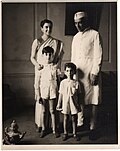
[[File:Indira Gandhi, Jawaharlal Nehru, Rajiv Gandhi and Sanjay Gandhi.jpg|thumb| | [[File:Indira Gandhi, Jawaharlal Nehru, Rajiv Gandhi and Sanjay Gandhi.jpg|thumb|left|[[Indira Gandhi]], [[Jawaharlal Nehru]], Rajiv Gandhi and [[Sanjay Gandhi]]]] | ||
[[File:Rajiv,_Indira_and_Sanjay_Gandhi.jpg|thumb| | [[File:Rajiv,_Indira_and_Sanjay_Gandhi.jpg|thumb|left|Rajiv Gandhi, [[Indira Gandhi]] and [[Sanjay Gandhi]]]] | ||
Rajiv Gandhi was born in [[Bombay]] on 20 August 1944 to [[Indira Gandhi|Indira]] and [[Feroze Gandhi]]. In 1951, Rajiv and Sanjay were admitted to Shiv Niketan school, where the teachers said Rajiv was shy and introverted, and "greatly enjoyed painting and drawing".<ref>{{cite web|url=https://www.mid-day.com/photos/remembering-rajiv-gandhi-rare-pictures-of-former-prime-minister-of-india/3442|title= Rajiv Gandhi|website=www.mid-day.com|access-date=12 November 2019}}</ref> | Rajiv Gandhi was born in [[Bombay]] on 20 August 1944 to [[Indira Gandhi|Indira]] and [[Feroze Gandhi]]. In 1951, Rajiv and his younger brother Sanjay were admitted to Shiv Niketan school, where the teachers said Rajiv was shy and introverted, and "greatly enjoyed painting and drawing".<ref>{{cite web|url=https://www.mid-day.com/photos/remembering-rajiv-gandhi-rare-pictures-of-former-prime-minister-of-india/3442|title= Rajiv Gandhi|website=www.mid-day.com|access-date=12 November 2019}}</ref> He was admitted to the [[Welham Boys' School]], [[Dehradun]] and [[Doon School]], [[Dehradun]] in 1954, where Sanjay joined him two years later.<ref>[[#Agarwal|Agarwal]], p. 17</ref> Rajiv was also educated at the [[Ecole d'Humanité|Ecole D'Humanité]], an international boarding school in Switzerland.<ref>{{Cite book|last=Singh|first=Rani|url=https://books.google.com/books?id=F_g67qLkXfgC&q=ecole+circle+ecole+d'humanit%C3%A9&pg=PT26|title=Sonia Gandhi: An Extraordinary Life, An Indian Destiny|date=13 September 2011|publisher=St. Martin's Publishing Group|isbn=978-0-230-34053-4}}</ref> He left the Doon School in 1961 with a second-class certificate, having performed well in his final subjects apart from a pass mark in chemistry.<ref name="young_rajiv">{{cite news |last=D'Rozario |first=Aryan |date=18 February 2023 |title=Young Rajiv: A Diplomat's Diary |url=https://www.outlookindia.com/culture-society/-young-rajiv-a-diplomat-s-diary-weekender_story-263096 |work=Outlook Weekender |location= |access-date=5 March 2023}}</ref> | ||
During Gandhi's final year at Doon, his mother and Albert D'Rozario, the scientific [[attaché]] at the [[India House, London|Indian High Commission in London]], arranged his application to [[University of Cambridge|Cambridge University]].<ref name="young_rajiv"/> D'Rozario, who had been a college classmate of Feroze Gandhi, recommended that Gandhi should read engineering, and met with [[M.G.M. Pryor|Mark Pryor]], the Senior Tutor at [[Trinity College, Cambridge]].<ref name="young_rajiv"/> Pryor arranged for Gandhi's conditional admission to Trinity, contingent on his passing the Mechanical Sciences Qualifying (MSQ) Examination with acceptable marks.<ref name="young_rajiv"/> After studying for his [[A-Level|A-level]]s at the [[sixth form college]] of [[Abbey DLD Colleges Group|Davies, Laing & Dick]] in London, Gandhi sat the MSQ Examination in March 1962 but was unsuccessful. He passed on his second attempt in June, and was admitted to Trinity on 4 September 1962, joining the college in October.<ref name="young_rajiv"/> While at Trinity, he joined the [[Cambridge University Boat Club]].<ref name="young_rajiv"/> | |||
Gandhi | During Gandhi's time at Cambridge, his mother and D'Rozario remained concerned about his well-being. D'Rozario, who along with his wife Sophy often hosted Gandhi at their [[Finchley]] home, took Gandhi to task for his inattention towards his studies.<ref name="young_rajiv"/> Despite his support, Gandhi failed end-of-year exams and left Trinity in 1965 without a degree,<ref name="degree">{{cite news|title=Rahul first in three generations with a world university degree|url=http://www.tribuneindia.com/2014/20140218/main6.htm|newspaper=[[The Tribune (Chandigarh)|The Tribune]]|date=18 February 2014}}</ref> though he kept in touch with his former mentor in his retirement.<ref name="young_rajiv"/> In 1966 he began a course in mechanical engineering at [[Imperial College London]], but also failed to complete it. Gandhi really was not studious enough, as he went on to admit later.<ref>[http://www.ukwhoswho.com/view/article/oupww/whowaswho/U172595 "GANDHI, Rajiv"], ''Who Was Who''. A & C Black, an imprint of Bloomsbury Publishing. 1920–2016. Oxford University Press, 2014</ref> | ||
Gandhi returned to India in 1966, the year his mother became prime minister. He went to Delhi and became a member of the [[Flying Club]], where he | Gandhi returned to India in 1966, the year his mother became prime minister. He went to Delhi and became a member of the [[Flying Club]], where he trained as a pilot. In 1970, he was employed as a pilot by [[Indian Airlines]]; unlike Sanjay, he did not exhibit any interest of joining politics.<ref>[[#Agarwal|Agarwal]], p. 47</ref> In 1968, after three years of courtship, he married [[Sonia Gandhi|Edvige Antonia Albina Màino]], who changed her name to [[Sonia Gandhi]] and made India her home. Their first child, a son, [[Rahul Gandhi]] was born in 1970. In 1972, the couple had a daughter, [[Priyanka Gandhi]], who married [[Robert Vadra]].<ref>{{cite book|title=Great Personalities of the World|author=Khan, Tanvir |publisher=V&S Publishers|url=https://books.google.com/books?id=2qCNAwAAQBAJ&q=rajiv+gandhi+anti+sikh+riots|isbn=9789350572450|location=|page=76|date=2012}}</ref> Gandhi was a friend of [[Amitabh Bachchan]], and was familiar with Bachchan even before he launched his acting career. Rajiv, Sanjay and Bachchan spent time together when Bachchan was student in [[Delhi University]] and a resident of New Delhi. In the 1980s, Bachchan would enter politics to support his friend, Gandhi.<ref>{{Cite web |last=Kidwai |first=Rasheed |date=11 October 2018 |title=Amitabh Bachchan, Rajiv Gandhi and a tale of two families |url=https://news.abplive.com/blog/amitabh-bachchan-rajiv-gandhi-and-a-tale-of-two-families-766548 |access-date=17 September 2022 |website=news.abplive.com }}</ref> | ||
==Entry into politics== | ==Entry into politics== | ||
On 23 June 1980, Rajiv's younger brother [[Sanjay Gandhi]] died unexpectedly in an [[aeroplane]] crash. At that time, Rajiv Gandhi was in London as part of his foreign tour. Hearing the news, he returned to Delhi and cremated Sanjay's body.<ref> | On 23 June 1980, Rajiv's younger brother [[Sanjay Gandhi]] died unexpectedly in an [[aeroplane]] crash. At that time, Rajiv Gandhi was in London as part of his foreign tour. Hearing the news, he returned to Delhi and cremated Sanjay's body.<ref>[[#Agarwal|Agarwal]], p. 20</ref> As per Agarwal, in the week following Sanjay's death, Shankaracharya Swami Shri Swaroopanand, a saint from [[Badrinath]], visited the family's house to offer his condolences.<ref>[[#Agarwal|Agarwal]], p. 21</ref> He advised Rajiv not to fly aeroplanes and instead "dedicate himself to the service of the nation".<ref name="Meenatt">[[#Agarwal|Agarwal]], p. 22</ref> 70 members of the Congress party signed a proposal and went to Indira, urging Rajiv to enter politics. Indira told them it was Rajiv's decision whether to enter politics. When he was questioned about it, he replied, "If my mother gets help from it, then I will enter politics".<ref name="Meenatt"/> Rajiv entered politics on 16 February 1981, when he addressed a national farmers' rally in Delhi.<ref name="TH">[[#Agarwal|Agarwal]], pp. 23–24</ref> During this time, he was still an employee of Air India.<ref name="Anant">{{cite book|author1=Anant, Kirusna |title=India Since Independence: Making Sense of Indian Politics|publisher=Pearson Education India|isbn=9788131725672|page=257|year=2010}}</ref> | ||
===Participation in active politics=== | ===Participation in active politics=== | ||
On 4 May 1981, Indira Gandhi presided over a meeting of the [[All India Congress Committee]]. [[Vasantdada Patil]] proposed Rajiv as a candidate for the [[Amethi (Lok Sabha constituency)|Amethi constituency]], which was accepted by all members at the meeting. A week later, the party officially announced his candidacy for the constituency. He then paid the party membership fees of the party and flew to [[Sultanpur, Uttar Pradesh|Sultanpur]] to file his nomination papers and completed other formalities.<ref> | On 4 May 1981, Indira Gandhi presided over a meeting of the [[All India Congress Committee]]. [[Vasantdada Patil]] proposed Rajiv as a candidate for the [[Amethi (Lok Sabha constituency)|Amethi constituency]], which was accepted by all members at the meeting. A week later, the party officially announced his candidacy for the constituency. He then paid the party membership fees of the party and flew to [[Sultanpur, Uttar Pradesh|Sultanpur]] to file his nomination papers and completed other formalities.<ref>[[#Agarwal|Agarwal]], p. 24</ref> He won the seat, defeating [[Lok Dal]] candidate [[Sharad Yadav]] by a margin of 237,000 votes.<ref>{{cite book|author1=Sharma, Satinder |author2=Sharma, Indra |title=Rajiv Gandhi: An Annotated Bibliography, 1944–1982|year=1983|publisher=University of Michigan|page=65}}</ref> He took his oath on 17 August as [[Member of Parliament]].<ref name="Anant"/> | ||
Rajiv Gandhi's first political tour was to England, where he attended the wedding ceremony of [[Prince Charles]] and [[Diana, Princess of Wales|Lady Diana Spencer]] on 29 July 1981.<ref name="TF">Agarwal, p. 25</ref> In December the same year, he was put in charge of the [[Indian Youth Congress]].<ref name="TF"/> He first showed his organisational ability by "working round the clock" on the [[1982 Asian Games]].{{citation needed|date=January 2019}} He was one of 33 members of the Indian parliament who were part of the Games' organising committee; sports historian [[Boria Majumdar]] writes that being "son of the prime minister he had a moral and unofficial authority" over the others.<ref name="Boria">{{cite book|author1=Boria | Rajiv Gandhi's first political tour was to England, where he attended the wedding ceremony of [[Prince Charles]] and [[Diana, Princess of Wales|Lady Diana Spencer]] on 29 July 1981.<ref name="TF">[[#Agarwal|Agarwal]], p. 25</ref> In December the same year, he was put in charge of the [[Indian Youth Congress]].<ref name="TF"/> He first showed his organisational ability by "working round the clock" on the [[1982 Asian Games]].{{citation needed|date=January 2019}} He was one of 33 members of the Indian parliament who were part of the Games' organising committee; sports historian [[Boria Majumdar]] writes that being "son of the prime minister he had a moral and unofficial authority" over the others.<ref name="Boria">{{cite book|author1= Majumdar, Boria|author-link1=Boria Majumdar|title=Olympics – The India Story|publisher=[[HarperCollins Publishers]]|isbn=9789350295090|page=74|date=18 June 2012}}</ref> The report submitted by the Asian Games committee mentions Gandhi's "drive, zeal and initiative" for the "outstanding success" of the games.<ref name="Boria"/> | ||
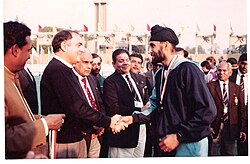
[[File:With the late PM Shri Rajiv Gandhi during the medal ceremony, 1991.jpg|thumb|Rajiv Gandhi during a medal ceremony]] | [[File:With the late PM Shri Rajiv Gandhi during the medal ceremony, 1991.jpg|thumb|Rajiv Gandhi during a medal ceremony]] | ||
| Line 85: | Line 86: | ||
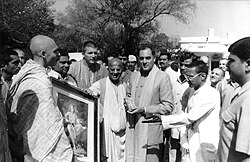
[[File:Rajiv Gandhi meeting Russian Hare Krishna devotees in New Delhi 1989.jpg|thumb|Meeting Russian [[International Society for Krishna Consciousness|Hare Krishna]] devotees in 1989.]] | [[File:Rajiv Gandhi meeting Russian Hare Krishna devotees in New Delhi 1989.jpg|thumb|Meeting Russian [[International Society for Krishna Consciousness|Hare Krishna]] devotees in 1989.]] | ||
On 31 October 1984, the prime minister, Rajiv Gandhi's mother, Indira Gandhi, was assassinated by her Sikh bodyguards, which led to violent riots against Sikhs.<ref name="AS"/> At a Boat Club rally 19 days after the assassination, Gandhi said, "Some riots took place in the country following the murder of Indiraji. We know the people were very angry and for a few days it seemed that India had been shaken. But, when a mighty tree falls, it is only natural that the earth around it does shake a little".<ref>{{cite book|author1=Indu Prakash | On 31 October 1984, the prime minister, Rajiv Gandhi's mother, Indira Gandhi, was assassinated by her Sikh bodyguards, which led to violent riots against Sikhs.<ref name="AS"/> At a Boat Club rally 19 days after the assassination, Gandhi said, "Some riots took place in the country following the murder of Indiraji. We know the people were very angry and for a few days it seemed that India had been shaken. But, when a mighty tree falls, it is only natural that the earth around it does shake a little".<ref>{{cite book|author1=Singh, Indu Prakash |title=The aborted revolution|publisher=University of Michigan|page=235}}</ref> According to Verinder Grover, the statement made by Gandhi was a "virtual justification" of the riots.<ref name="AS">{{cite book|author1=Grover, Verinder |title=Indian Political System: Trends and Challenges|publisher=Deep and Deep Publications|isbn=9788171008834|page=366|year=1997}}</ref> Congress leader [[Mani Shankar Aiyar]] wrote, "Did it constitute an incitement to mass murder?" He also criticised Gandhi for his reluctance to bring the army from [[Meerut]] to handle the mob.<ref>[[#Aiyar|Aiyar]], p. 194</ref> | ||
==Prime Minister of India== | ==Prime Minister of India== | ||
| Line 92: | Line 93: | ||
{{quote box|align=right|width=20em|quote=Indian politics got the youngest ever Prime minister in Rajiv Gandhi. This phenomenon attracted attention the world over. . . his winsome smile, charm and decency were his valuable personal assets. . . A senior opposition member, while talking to me, conceded that . . . he could not conceal his feeling that Rajiv Gandhi would be invincible for the opposition.|source= — ''[[Satyendra Narayan Sinha]]''<ref>{{cite book |url=https://books.google.com/books?id=L5bTCgLM1lYC&q=satyendra+narayan+rajiv+gandhi+invincible&pg=PT197 |title=Memorable Quotes from Rajiv Gandhi and on Rajiv Gandhi |date=2009 |last=Palanithurai |first=G |publisher= Concept Publishing Company, New Delhi |isbn= 978-81-8069-587-2 |access-date= 11 January 2015 }}</ref>}} | {{quote box|align=right|width=20em|quote=Indian politics got the youngest ever Prime minister in Rajiv Gandhi. This phenomenon attracted attention the world over. . . his winsome smile, charm and decency were his valuable personal assets. . . A senior opposition member, while talking to me, conceded that . . . he could not conceal his feeling that Rajiv Gandhi would be invincible for the opposition.|source= — ''[[Satyendra Narayan Sinha]]''<ref>{{cite book |url=https://books.google.com/books?id=L5bTCgLM1lYC&q=satyendra+narayan+rajiv+gandhi+invincible&pg=PT197 |title=Memorable Quotes from Rajiv Gandhi and on Rajiv Gandhi |date=2009 |last=Palanithurai |first=G |publisher= Concept Publishing Company, New Delhi |isbn= 978-81-8069-587-2 |access-date= 11 January 2015 }}</ref>}} | ||
Soon after assuming office, Gandhi asked President Singh to dissolve Parliament and hold fresh elections, as the Lok Sabha had completed its five-year term. Gandhi officially became the president of the Congress party, which won a landslide victory with the largest majority in history of the Indian Parliament, giving Gandhi absolute control of government. He benefited from his youth and a general perception of being free of a background in corrupt politics.<ref>{{cite news | work=BBC News | url = http://news.bbc.co.uk/onthisday/hi/dates/stories/december/29/newsid_3314000/3314987.stm | title = 1984: Rajiv Gandhi wins landslide election victory | date=29 December 1984 | access-date=1 September 2013 }}</ref> Gandhi took his oath on 31 December 1984; at 40, he was the youngest prime minister of India.<ref name="oath"/> Historian Meena Agarwal writes that even after taking the Prime Ministerial oath, he was a relatively unknown figure, "novice in politics" as he assumed the post after being an MP for three years.<ref>Agarwal, p. 28</ref> | Soon after assuming office, Gandhi asked President Singh to dissolve Parliament and hold fresh elections, as the Lok Sabha had completed its five-year term. Gandhi officially became the president of the Congress party, which won a landslide victory with the largest majority in history of the Indian Parliament, giving Gandhi absolute control of government. He benefited from his youth and a general perception of being free of a background in corrupt politics.<ref>{{cite news | work=BBC News | url = http://news.bbc.co.uk/onthisday/hi/dates/stories/december/29/newsid_3314000/3314987.stm | title = 1984: Rajiv Gandhi wins landslide election victory | date=29 December 1984 | access-date=1 September 2013 }}</ref> Gandhi took his oath on 31 December 1984; at 40, he was the youngest prime minister of India.<ref name="oath"/> Historian Meena Agarwal writes that even after taking the Prime Ministerial oath, he was a relatively unknown figure, "novice in politics" as he assumed the post after being an MP for three years.<ref>[[#Agarwal|Agarwal]], p. 28</ref> | ||
===Cabinet ministers=== | ===Cabinet ministers=== | ||
| Line 99: | Line 100: | ||
===Anti-defection law=== | ===Anti-defection law=== | ||
Gandhi's first action as prime minister was passing the [[Parliamentary system|anti-defection law]] in January 1985. According to this law, an elected Member of Parliament or legislative assembly could not join an opposition party until the next election. Historian Manish Telikicherla Chary calls it a measure of curbing corruption and bribery of ministers by switching parties so they could gain majority.<ref>Chary, | Gandhi's first action as prime minister was passing the [[Parliamentary system|anti-defection law]] in January 1985. According to this law, an elected Member of Parliament or legislative assembly could not join an opposition party until the next election. Historian Manish Telikicherla Chary calls it a measure of curbing corruption and bribery of ministers by switching parties so they could gain majority.<ref>{{cite book|title=India: Nation on the Move: An Overview of India's People, Culture, History, Economy, IT Industry, & More|author=Chary, Manish Telikicherla |publisher=iUniverse|url=https://books.google.com/books?id=6WE8SwINOKMC&q=rajiv+gandhi+anti+sikh+riots|year=2009|isbn=9781440116353|location=|page=129}}</ref> Many such defections occurred during the 1980s as elected leaders of the Congress party joined opposition parties.<ref>{{cite web|title=Provisions of Anti-Defection Law in India|url=http://www.elections.in/political-corner/provisions-of-anti-defection-law-in-india/|publisher=Elections|access-date=26 May 2015|date=27 January 2015}}</ref> | ||
===1985 Congress Sandesh Yatra=== | ===1985 Congress Sandesh Yatra=== | ||
| Line 107: | Line 108: | ||
{{Main|Shah Bano case}} | {{Main|Shah Bano case}} | ||
In 1985, the [[Supreme Court of India]] ruled in favour of Muslim divorcee [[Shah Bano]], declaring that her husband should give her [[alimony]]. Some Indian Muslims treated it as an encroachment upon [[Muslim Personal Law]] and protested against it. Gandhi agreed to their demands.<ref>{{cite web |url=http://homepages.uc.edu/thro/shahbano/sb-rajiv.htm |title=Shah Bano – Rajiv Gandhi |publisher=Homepages.uc.edu |access-date=7 March 2010 |archive-date=9 October 2013 |archive-url=https://web.archive.org/web/20131009222601/http://homepages.uc.edu/thro/shahbano/sb-rajiv.htm |url-status=dead }}</ref> In 1986, the Parliament of India passed [[The Muslim Women (Protection of Rights on Divorce) Act 1986]], which nullified the Supreme Court's judgment in the Shah Bano case. The Act diluted the Supreme Court judgment and allowed maintenance payments to divorced women only during the period of [[Iddah]], or until 90 days after the divorce, according to the provisions of Islamic law. This was in contrast to Section 125 of the Code.<ref>{{cite news |last1=Anand |first1=Utkarsh |title=From Shah Bano to Salma – Indian Express |url=http://archive.indianexpress.com/news/from-shah-bano-to-salma/520890/0 |access-date=11 February 2021 |work=Indian Express |date=26 March 2010}}</ref><ref>{{cite news|title=The Shah Bano legacy|url=http://www.hindu.com/2003/08/10/stories/2003081000221500.htm|archive-url=https://web.archive.org/web/20121111023109/http://hindu.com/2003/08/10/stories/2003081000221500.htm|url-status=dead|archive-date=11 November 2012|newspaper=[[The Hindu]]|date=10 August 2003|access-date=26 May 2015}}</ref> Indian magazine ''Business and Economics'' called it a minority appeasement by Gandhi.<ref>{{cite web|title=The ghost of Shah Bano|url=http://www.businessandeconomy.org/14052009/storyd.asp?sid=4364&pageno=1|publisher=Business and Economy|access-date=26 May 2015}}</ref> Lawyer and former Law Minister of India, [[Ram Jethmalani]], called the Act "retrogressive obscurantism for short-term minority populism".<ref name="medio">{{cite news|title=Cementing of dynastic democracy|url=http://www.sunday-guardian.com/analysis/cementing-of-dynastic-democracy|newspaper=Sunday Guardian|access-date=26 May 2015}}</ref> Gandhi's colleague [[Arif Mohammad Khan]], who was then a Member of Parliament, resigned in protest.<ref name=indiaafterind>{{cite book|title=India Since Independence|date=1 January 2008|publisher=Penguin Books India|location=India|isbn=978-0143104094|page=362|url=https://books.google.com/books?id=dE9qEg-NgHMC&q=arif+mohammad+khan+muslim+shah+bano+resigned&pg=PA362|author=Bipan | In 1985, the [[Supreme Court of India]] ruled in favour of Muslim divorcee [[Shah Bano]], declaring that her husband should give her [[alimony]]. Some Indian Muslims treated it as an encroachment upon [[Muslim Personal Law]] and protested against it. Gandhi agreed to their demands.<ref>{{cite web |url=http://homepages.uc.edu/thro/shahbano/sb-rajiv.htm |title=Shah Bano – Rajiv Gandhi |publisher=Homepages.uc.edu |access-date=7 March 2010 |archive-date=9 October 2013 |archive-url=https://web.archive.org/web/20131009222601/http://homepages.uc.edu/thro/shahbano/sb-rajiv.htm |url-status=dead }}</ref> In 1986, the Parliament of India passed [[The Muslim Women (Protection of Rights on Divorce) Act 1986]], which nullified the Supreme Court's judgment in the Shah Bano case. The Act diluted the Supreme Court judgment and allowed maintenance payments to divorced women only during the period of [[Iddah]], or until 90 days after the divorce, according to the provisions of Islamic law. This was in contrast to Section 125 of the Code.<ref>{{cite news |last1=Anand |first1=Utkarsh |title=From Shah Bano to Salma – Indian Express |url=http://archive.indianexpress.com/news/from-shah-bano-to-salma/520890/0 |access-date=11 February 2021 |work=Indian Express |date=26 March 2010}}</ref><ref>{{cite news|title=The Shah Bano legacy|url=http://www.hindu.com/2003/08/10/stories/2003081000221500.htm|archive-url=https://web.archive.org/web/20121111023109/http://hindu.com/2003/08/10/stories/2003081000221500.htm|url-status=dead|archive-date=11 November 2012|newspaper=[[The Hindu]]|date=10 August 2003|access-date=26 May 2015}}</ref> Indian magazine ''Business and Economics'' called it a minority appeasement by Gandhi.<ref>{{cite web|title=The ghost of Shah Bano|url=http://www.businessandeconomy.org/14052009/storyd.asp?sid=4364&pageno=1|publisher=Business and Economy|access-date=26 May 2015|archive-date=3 May 2014|archive-url=https://web.archive.org/web/20140503184828/http://www.businessandeconomy.org/14052009/storyd.asp?sid=4364&pageno=1|url-status=dead}}</ref> Lawyer and former Law Minister of India, [[Ram Jethmalani]], called the Act "retrogressive obscurantism for short-term minority populism".<ref name="medio">{{cite news|title=Cementing of dynastic democracy|url=http://www.sunday-guardian.com/analysis/cementing-of-dynastic-democracy|newspaper=Sunday Guardian|access-date=26 May 2015}}</ref> Gandhi's colleague [[Arif Mohammad Khan]], who was then a Member of Parliament, resigned in protest.<ref name=indiaafterind>{{cite book|title=India Since Independence|date=1 January 2008|publisher=Penguin Books India|location=India|isbn=978-0143104094|page=362|url=https://books.google.com/books?id=dE9qEg-NgHMC&q=arif+mohammad+khan+muslim+shah+bano+resigned&pg=PA362|author=Chandra, Bipan |author-link1=Bipan Chandra|author2=Mukherjee, Aditya |author3=Mukherjee, Mridula |editor=Penguin Books India}}</ref> | ||
===Economic policy=== | ===Economic policy=== | ||
[[File:Pandit Ram Kishore Shukla with Rajiv Gandhi at 7, Race course road in 1988.jpg|thumb|Prime Minister Rajiv Gandhi with [[Ram Kishore Shukla]] in 1988.]] | [[File:Pandit Ram Kishore Shukla with Rajiv Gandhi at 7, Race course road in 1988.jpg|thumb|Prime Minister Rajiv Gandhi with [[Ram Kishore Shukla]] in 1988.]] | ||
In his election manifesto for the [[1984 Indian general election|1984 general election]], he did not mention any economic reforms, but after assuming office he tried to liberalise the country's economy.<ref name="EP">Kohli, | In his election manifesto for the [[1984 Indian general election|1984 general election]], he did not mention any economic reforms, but after assuming office he tried to liberalise the country's economy.<ref name="EP">{{cite book|title=State Power and Social Forces: Domination and Transformation in the Third World|author=Kohli, Atul |publisher=[[Cambridge University Press]]|url=https://books.google.com/books?id=5uqtkTkYas4C&q=rajiv+gandhi+economic+policy|author-link=Atul Kohli|isbn=9780521467346|location=|pages=102–103|date=1994}}</ref> He sought to liberalize India's trade policies but faced stiff opposition to the proposed reforms.<ref>{{Citation |last=Dean |first=Adam |title=India's Middle Path: Preventive Arrests and General Strikes |date=2022 |url=https://www.cambridge.org/core/books/opening-up-by-cracking-down/indias-middle-path-preventive-arrests-and-general-strikes/4CBA2877327208602BE6573BEA63D1A3 |work=Opening Up by Cracking Down: Labor Repression and Trade Liberalization in Democratic Developing Countries |pages=86–112 |series=Political Economy of Institutions and Decisions |publisher=Cambridge University Press |doi=10.1017/9781108777964.006 |isbn=978-1-108-47851-9}}</ref><ref name="EP" /> He did so by providing incentives to make private production profitable. Subsidies were given to corporate companies to increase industrial production, especially of [[durable goods]].{{Contradict-inline|article=Rajiv Gandhi|section=Economic policy|reason=Subsidies to firms is not a liberal market reform|date=October 2022}} It was hoped this would increase economic growth and improve the quality of investment.<ref name="EP"/> Rural and tribal people protested because they saw them as "pro-rich" and "pro-city" reforms.<ref name="EP"/> | ||
Gandhi increased government support for science, technology and associated industries, and reduced import quotas, taxes and tariffs on technology-based industries, especially computers, airlines, defence and telecommunications. In 1986, he announced a [[National Policy on Education]] to modernise and expand higher education programs across India. In 1986, he founded the [[Jawahar Navodaya Vidyalaya]] System, which is a Central government-based education institution that provides rural populations with free residential education from grades six to twelve.<ref>{{cite web | url=http://www.basearticles.com/Art/65874/216/Rajiv-Gandhi-aimed-at-value-based-education-in-rural-India-through-JNVs.html | title=Rajiv Gandhi aimed at value based education in rural India through JNVs | access-date=19 February 2011 | publisher=Pressbrief | archive-date=11 May 2011 | archive-url=https://web.archive.org/web/20110511193152/http://www.basearticles.com/Art/65874/216/Rajiv-Gandhi-aimed-at-value-based-education-in-rural-India-through-JNVs.html | url-status=dead }}</ref> His efforts created [[MTNL]] in 1986, and his public call offices—better known as PCOs—helped develop the telephone network in rural areas.<ref>{{cite web | url=http://meachq.in/html/rahul_memo.pdf | title=MTNL Letter | access-date=19 February 2011 | date=16 September 2009}}</ref> He introduced measures to significantly reduce the ''[[Licence Raj]]'' after 1990, allowing businesses and individuals to purchase capital, consumer goods and import without bureaucratic restrictions.<ref name="princeton.edu">{{cite journal| url=http://www.princeton.edu/~reddings/pubpapers/ABRZ_AER_Sept2008.pdf|title=Unequal effects of Liberalisation – Dismantling the license raj in India}}</ref> | Gandhi increased government support for science, technology and associated industries, and reduced import quotas, taxes and tariffs on technology-based industries, especially computers, airlines, defence and telecommunications. In 1986, he announced a [[National Policy on Education]] to modernise and expand higher education programs across India. In 1986, he founded the [[Jawahar Navodaya Vidyalaya]] System, which is a Central government-based education institution that provides rural populations with free residential education from grades six to twelve.<ref>{{cite web | url=http://www.basearticles.com/Art/65874/216/Rajiv-Gandhi-aimed-at-value-based-education-in-rural-India-through-JNVs.html | title=Rajiv Gandhi aimed at value based education in rural India through JNVs | access-date=19 February 2011 | publisher=Pressbrief | archive-date=11 May 2011 | archive-url=https://web.archive.org/web/20110511193152/http://www.basearticles.com/Art/65874/216/Rajiv-Gandhi-aimed-at-value-based-education-in-rural-India-through-JNVs.html | url-status=dead }}</ref> His efforts created [[MTNL]] in 1986, and his public call offices—better known as PCOs—helped develop the telephone network in rural areas.<ref>{{cite web | url=http://meachq.in/html/rahul_memo.pdf | title=MTNL Letter | access-date=19 February 2011 | date=16 September 2009}}</ref> He introduced measures to significantly reduce the ''[[Licence Raj]]'' after 1990, allowing businesses and individuals to purchase capital, consumer goods and import without bureaucratic restrictions.<ref name="princeton.edu">{{cite journal| url=http://www.princeton.edu/~reddings/pubpapers/ABRZ_AER_Sept2008.pdf|title=Unequal effects of Liberalisation – Dismantling the license raj in India|journal=American Economic Review |year=2008|volume= 98|issue=4|pages= 1397–1412|author1= Aghion, Philippe |author2=Burgess, Robin |author3=Redding, Stephen J. |author4 =Zilibotti, Fabrizio |doi=10.1257/aer.98.4.1397 }}</ref> | ||
===Foreign policy=== | ===Foreign policy=== | ||
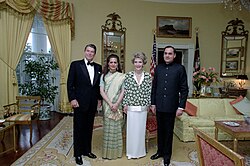
[[File:President Ronald Reagan, Nancy Reagan, Rajiv Gandhi, and Sonia Gandhi.jpg|thumb|right|President Ronald Reagan, Sonia Gandhi, First Lady Nancy Reagan and Prime Minister Rajiv Gandhi, during a state dinner for Prime Minister Gandhi. June 1985.]] | [[File:President Ronald Reagan, Nancy Reagan, Rajiv Gandhi, and Sonia Gandhi.jpg|thumb|right|President Ronald Reagan, Sonia Gandhi, First Lady Nancy Reagan and Prime Minister Rajiv Gandhi, during a state dinner for Prime Minister Gandhi. June 1985.]] | ||
According to [[Rejaul Karim Laskar]], a scholar of [[Indian foreign policy]] and an ideologue of [[Indian National Congress|Congress party]], Rajiv Gandhi's vision for a new world order was premised on [[India]]'s place in its front rank.<ref name="diplomatist.com">{{cite journal|last1=Laskar|first1=Rejaul|title=Rajiv Gandhi's Diplomacy: Historic Significance and Contemporary Relevance|journal=Extraordinary and Plenipotentiary Diplomatist|date=September 2014|volume=2|issue=9|page=46|url=http://www.diplomatist.com/dipom09y2014/article015.html|access-date=8 March 2018}}</ref> According to [[Rejaul Karim Laskar|Laskar]], the "whole gamut" of Rajiv Gandhi's [[foreign policy]] was "geared towards" making India "strong, independent, self-reliant and in the front rank of the nations of the world."<ref name="diplomatist.com"/> According to [[Rejaul Karim Laskar|Laskar]], Rajiv Gandhi's diplomacy was "properly calibrated" so as to be "conciliatory and accommodating when required" and "assertive when the occasion demanded."<ref name="diplomatist.com"/> | According to [[Rejaul Karim Laskar]], a scholar of [[Indian foreign policy]] and an ideologue of [[Indian National Congress|Congress party]], Rajiv Gandhi's vision for a new world order was premised on [[India]]'s place in its front rank.<ref name="diplomatist.com">{{cite journal|last1=Laskar|first1=Rejaul|title=Rajiv Gandhi's Diplomacy: Historic Significance and Contemporary Relevance|journal=Extraordinary and Plenipotentiary Diplomatist|date=September 2014|volume=2|issue=9|page=46|url=http://www.diplomatist.com/dipom09y2014/article015.html|access-date=8 March 2018|archive-date=21 February 2018|archive-url=https://web.archive.org/web/20180221161446/http://www.diplomatist.com/dipom09y2014/article015.html|url-status=dead}}</ref> According to [[Rejaul Karim Laskar|Laskar]], the "whole gamut" of Rajiv Gandhi's [[foreign policy]] was "geared towards" making India "strong, independent, self-reliant and in the front rank of the nations of the world."<ref name="diplomatist.com"/> According to [[Rejaul Karim Laskar|Laskar]], Rajiv Gandhi's diplomacy was "properly calibrated" so as to be "conciliatory and accommodating when required" and "assertive when the occasion demanded."<ref name="diplomatist.com"/> | ||
In 1986, by request of the president of Seychelles [[France-Albert René]], Gandhi sent India's navy to [[Seychelles]] to oppose an attempted coup against René. The intervention of India averted the coup. This mission was codenamed as [[Operation Flowers are Blooming]].<ref>{{cite web|title=Modi to the land where India staged 'Operation Wild Flowers are Blooming'|url=http://www.aniin.com/top-story-details.php?va=MzEwMjA=|publisher=Asian News International|access-date=26 May 2015}}</ref> In 1987, India re-occupied the Quaid Post in the disputed [[Siachen]] region of the [[Indo-Pakistani border]] after winning what was termed [[Operation Rajiv]].<ref>{{cite news|title=1987 Siachen hero passes away|url=http://timesofindia.indiatimes.com/india/1987-Siachen-hero-passes-away/articleshow/16802705.cms|newspaper=Times of India|access-date=26 May 2015}}</ref> In the [[1988 Maldives coup d'état]], the Maldives president [[Maumoon Abdul Gayoom]] asked for help from Gandhi. He dispatched 1500 soldiers and the coup was suppressed.<ref>Agarwal, p. 141</ref> | In 1986, by request of the president of Seychelles [[France-Albert René]], Gandhi sent India's navy to [[Seychelles]] to oppose an attempted coup against René. The intervention of India averted the coup. This mission was codenamed as [[Operation Flowers are Blooming]].<ref>{{cite web|title=Modi to the land where India staged 'Operation Wild Flowers are Blooming'|url=http://www.aniin.com/top-story-details.php?va=MzEwMjA=|publisher=Asian News International|access-date=26 May 2015|archive-date=23 September 2015|archive-url=https://web.archive.org/web/20150923125211/http://www.aniin.com/top-story-details.php?va=MzEwMjA=|url-status=dead}}</ref> In 1987, India re-occupied the Quaid Post in the disputed [[Siachen]] region of the [[Indo-Pakistani border]] after winning what was termed [[Operation Rajiv]].<ref>{{cite news|title=1987 Siachen hero passes away|url=http://timesofindia.indiatimes.com/india/1987-Siachen-hero-passes-away/articleshow/16802705.cms|newspaper=Times of India|access-date=26 May 2015}}</ref> In the [[1988 Maldives coup d'état]], the Maldives president [[Maumoon Abdul Gayoom]] asked for help from Gandhi. He dispatched 1500 soldiers and the coup was suppressed.<ref>[[#Agarwal|Agarwal]], p. 141</ref> | ||
On Thursday, 9 June 1988, at the fifteenth special session of the [[United Nations General Assembly]], held at Headquarters, New York, Gandhi made vocal his views on a world free of nuclear weapons, to be realised through an, 'Action Plan for Ushering in a Nuclear-Weapon Free and Non-Violent World Order.'<ref>{{cite news| url = http://www.thehindu.com/opinion/op-ed/rajiv-gandhi-plan-a-valuable-solution/article559548.ece| title = Rajiv Gandhi Plan: a valuable solution| website = [[The Hindu]]| date = 8 August 2010}}</ref><ref>PM Rajeev Gandhi at the Fifteenth special session of [[United Nations General Assembly]][http://fissilematerials.org/library/gan98.pdf]</ref> | On Thursday, 9 June 1988, at the fifteenth special session of the [[United Nations General Assembly]], held at Headquarters, New York, Gandhi made vocal his views on a world free of nuclear weapons, to be realised through an, 'Action Plan for Ushering in a Nuclear-Weapon Free and Non-Violent World Order.'<ref>{{cite news| url = http://www.thehindu.com/opinion/op-ed/rajiv-gandhi-plan-a-valuable-solution/article559548.ece| title = Rajiv Gandhi Plan: a valuable solution| website = [[The Hindu]]| date = 8 August 2010}}</ref><ref>PM Rajeev Gandhi at the Fifteenth special session of [[United Nations General Assembly]][http://fissilematerials.org/library/gan98.pdf]</ref> | ||
| Line 136: | Line 137: | ||
====Pakistan==== | ====Pakistan==== | ||
In February 1987, the Pakistani president [[Muhammad Zia-ul-Haq|Zia-ul-Haq]] visited Delhi, where he met Gandhi to discuss "routine military exercises of the Indian army" on the borders of [[Rajasthan]] and [[Punjab, India|Punjab]]. Gandhi reciprocated, in December 1988, by visiting [[Islamabad]] and meeting the new prime minister of Pakistan, [[Benazir Bhutto]], to reaffirm the [[1972 Shimla agreement]].<ref name="Sharma, p. 16">Sharma, p. 16</ref> | In February 1987, the Pakistani president [[Muhammad Zia-ul-Haq|Zia-ul-Haq]] visited Delhi, where he met Gandhi to discuss "routine military exercises of the Indian army" on the borders of [[Rajasthan]] and [[Punjab, India|Punjab]]. Gandhi reciprocated, in December 1988, by visiting [[Islamabad]] and meeting the new prime minister of Pakistan, [[Benazir Bhutto]], to reaffirm the [[1972 Shimla agreement]].<ref name="Sharma, p. 16">[[#Sharma|Sharma]], p. 16</ref> | ||
====Sri Lanka==== | ====Sri Lanka==== | ||
{{See also|Sri Lankan civil war|Indian intervention in the Sri Lankan Civil War}} | {{See also|Sri Lankan civil war|Indian intervention in the Sri Lankan Civil War}} | ||
The [[Sri Lankan Civil War]] broke out with the [[Liberation Tigers of Tamil Eelam]] (LTTE), which was demanding an independent [[Tamil people|Tamil]] state in Sri Lanka. Gandhi discussed the matter with the Sri Lankan Prime Minister [[Ranasinghe Premadasa]] at the [[SAARC]] meeting in 1986. In that year, the Sri Lankan army blockaded the Tamil majority district of [[Jaffna District|Jaffna]]; Gandhi ordered relief supplies to be dropped into the area by parachute because the Sri Lankan navy did not allow the [[Indian Navy]] to enter.<ref>Sharma, p. 14</ref> | The [[Sri Lankan Civil War]] broke out with the [[Liberation Tigers of Tamil Eelam]] (LTTE), which was demanding an independent [[Tamil people|Tamil]] state in Sri Lanka. Gandhi discussed the matter with the Sri Lankan Prime Minister [[Ranasinghe Premadasa]] at the [[SAARC]] meeting in 1986. In that year, the Sri Lankan army blockaded the Tamil majority district of [[Jaffna District|Jaffna]]; Gandhi ordered relief supplies to be dropped into the area by parachute because the Sri Lankan navy did not allow the [[Indian Navy]] to enter.<ref>[[#Sharma|Sharma]], p. 14</ref> | ||
Gandhi signed the [[Indo-Sri Lanka Accord]] in July 1987. The accord "envisaged a devolution of power to the Tamil-majority areas", dissolved the LTTE, and designated [[Tamil language|Tamil]] as an official language of Sri Lanka.<ref name="SL"/> Gandhi said: | Gandhi signed the [[Indo-Sri Lanka Accord]] in July 1987. The accord "envisaged a devolution of power to the Tamil-majority areas", dissolved the LTTE, and designated [[Tamil language|Tamil]] as an official language of Sri Lanka.<ref name="SL"/> Gandhi said: | ||
<blockquote>The Government of India believe that, despite some problems and delays, many of which were foreseen but unavoidable in the resolution of an issue of this magnitude and complexity, this Agreement represents the only way of safeguarding legitimate Tamil interests and ensuring a durable peace in Sri Lanka. Some have chosen to criticise the Agreement. None has shown a better way of meeting the legitimate aspirations of the Tamils in Sri Lanka, restoring peace in that country and of meeting our own security concern in the region. We have accepted a role which is difficult, but which is in our national interests to discharge. We shall not shrink our obligations and commitments. This is a national endeavour.<ref name="SL">Sharma, p. 15</ref></blockquote> | <blockquote>The Government of India believe that, despite some problems and delays, many of which were foreseen but unavoidable in the resolution of an issue of this magnitude and complexity, this Agreement represents the only way of safeguarding legitimate Tamil interests and ensuring a durable peace in Sri Lanka. Some have chosen to criticise the Agreement. None has shown a better way of meeting the legitimate aspirations of the Tamils in Sri Lanka, restoring peace in that country and of meeting our own security concern in the region. We have accepted a role which is difficult, but which is in our national interests to discharge. We shall not shrink our obligations and commitments. This is a national endeavour.<ref name="SL">[[#Sharma|Sharma]], p. 15</ref></blockquote> | ||
Chanderasekar withdrew the IPKF in 1989.<ref name="Sharma, p. 16"/> | Chanderasekar withdrew the IPKF in 1989.<ref name="Sharma, p. 16"/> | ||
| Line 158: | Line 159: | ||
====Punjab==== | ====Punjab==== | ||
Soon after assuming office, Gandhi released the leaders of the [[Akali Dal]] who had been imprisoned since 1984's Operation Blue Star during Indira Gandhi's prime ministership. He lifted the ban on [[All India Sikh Students Federation]] and filed an inquiry into the [[1984 Anti-Sikh Riots]]. He also held a closed-door meeting with senior Akali Dal leaders to find a solution to the Punjab problem. Despite Akali opposition, in January 1985, Gandhi signed the [[Rajiv-Longowal Accord]] with Akali leader HS Longowal. Punjab's state assembly election was scheduled in September 1985, but Longowal died and was replaced by [[Surjit Singh Barnala]], who formed the government. After two years, in 1987, Barnala resigned his office because of a breakdown of law and order, leading to the implementation of [[President's rule]] in the state.<ref>Sharma, p. 10</ref> | Soon after assuming office, Gandhi released the leaders of the [[Akali Dal]] who had been imprisoned since 1984's Operation Blue Star during Indira Gandhi's prime ministership. He lifted the ban on [[All India Sikh Students Federation]] and filed an inquiry into the [[1984 Anti-Sikh Riots]]. He also held a closed-door meeting with senior Akali Dal leaders to find a solution to the Punjab problem. Despite Akali opposition, in January 1985, Gandhi signed the [[Rajiv-Longowal Accord]] with Akali leader HS Longowal. Punjab's state assembly election was scheduled in September 1985, but Longowal died and was replaced by [[Surjit Singh Barnala]], who formed the government. After two years, in 1987, Barnala resigned his office because of a breakdown of law and order, leading to the implementation of [[President's rule]] in the state.<ref>[[#Sharma|Sharma]], p. 10</ref> | ||
In May 1988, Gandhi launched the [[Operation Black Thunder]] to clear the Golden Temple in [[Amritsar]] of arms and gunmen. Two groups called National Security Guard and Special Action Group were created; they surrounded the temple in a 10-day siege during which the extremists' weapons were confiscated. Congress leader [[Anand Sharma]] said, "Operation Black Thunder effectively demonstrated the will of Rajiv Gandhi's government to take firm action to bring peace to Punjab".<ref>Sharma, p. 11</ref> | In May 1988, Gandhi launched the [[Operation Black Thunder]] to clear the Golden Temple in [[Amritsar]] of arms and gunmen. Two groups called National Security Guard and Special Action Group were created; they surrounded the temple in a 10-day siege during which the extremists' weapons were confiscated. Congress leader [[Anand Sharma]] said, "Operation Black Thunder effectively demonstrated the will of Rajiv Gandhi's government to take firm action to bring peace to Punjab".<ref>[[#Sharma|Sharma]], p. 11</ref> | ||
====Northeast India==== | ====Northeast India==== | ||
Gandhi's prime-ministership marked an increase of [[Insurgency in Northeast India|insurgency in northeast India]]. [[Mizo National Front]] demanded independence for [[Mizoram]]. In 1987, Gandhi addressed this problem; Mizoram and [[Arunachal Pradesh]] were given the status of states that were earlier union territories.<ref>Sharma, p. 12</ref> Gandhi also ended the [[Assam Movement]], which was launched by Assamese people to protest against the alleged illegal migration of Bangladeshi Muslims and immigration of other Bengalis to their state, which had reduced the Assamese to a minority there. He signed the [[Assam Accord]] on 15 August 1985. According to the accord, foreigners who came to the state between 1951 and 1961 were given full citizenship but those who arrived there between 1961 and 1971 did not get right to vote for the next ten years.<ref>Sharma, p. 13</ref> | Gandhi's prime-ministership marked an increase of [[Insurgency in Northeast India|insurgency in northeast India]]. [[Mizo National Front]] demanded independence for [[Mizoram]]. In 1987, Gandhi addressed this problem; Mizoram and [[Arunachal Pradesh]] were given the status of states that were earlier union territories.<ref>[[#Sharma|Sharma]], p. 12</ref> Gandhi also ended the [[Assam Movement]], which was launched by Assamese people to protest against the alleged illegal migration of Bangladeshi Muslims and immigration of other Bengalis to their state, which had reduced the Assamese to a minority there. He signed the [[Assam Accord]] on 15 August 1985. According to the accord, foreigners who came to the state between 1951 and 1961 were given full citizenship but those who arrived there between 1961 and 1971 did not get right to vote for the next ten years.<ref>[[#Sharma|Sharma]], p. 13</ref> | ||
===Technology=== | ===Technology=== | ||
Gandhi employed former [[Rockwell International]] executive [[Sam Pitroda]] as his adviser on public information infrastructure and innovation. During Gandhi's time in office, public sector telecom companies [[MTNL]] and [[VSNL]] was developed.<ref>{{cite book|author1=Marcus F. | Gandhi employed former [[Rockwell International]] executive [[Sam Pitroda]] as his adviser on public information infrastructure and innovation. During Gandhi's time in office, public sector telecom companies [[MTNL]] and [[VSNL]] was developed.<ref>{{cite book|author1=Franda, Marcus F. |title=China and India Online: Information Technology Politics and Diplomacy in the|url=https://archive.org/details/chinaindiaonline0000fran|url-access=registration|publisher=Rowman & Littlefield|isbn=9780742519466|page=[https://archive.org/details/chinaindiaonline0000fran/page/137 137]|year=2002}}</ref> According to Pitroda, Gandhi's ability to resist pressure from multi-national companies to abandon his plan to spread telecommunication services has been an important factor in India's development. According to news website [[Oneindia]], "About 20 years ago telephones were considered to be a thing for the use of the rich, but credit goes to Rajiv Gandhi for taking them to the rural masses".<ref name="RG">{{cite web|title=Telecom revolution driving development; credit to Rajiv|url=http://www.oneindia.com/2007/01/18/telecom-revolution-driving-development-credit-to-rajiv-pitroda-1169113386.html|publisher=One India|access-date=26 May 2015|date=18 January 2007}}</ref> Pitroda also said their plan to expand India's telephone network succeeded because of Gandhi's political support. According to Pitroda, by 2007 they were "adding six million phones every month".<ref name="RG"/> Gandhi's government also allowed the import of fully assembled motherboards, which led to the price of computers being reduced.<ref name="tel"/> According to some commentators, the seed for the information technology (IT) revolution was also planted during Rajiv Gandhi's time.<ref name="tel">{{cite magazine|title=Economic Milestone: Ushering in Telecom Reforms (1985)|url=http://forbesindia.com/article/independence-day-special/economic-milestone-ushering-in-telecom-reforms-(1985)/38441/1?utm=slidebox|magazine=Forbes India|access-date=26 May 2015}}</ref> | ||
===Bofors scandal, HDW scandal and 1989 elections defeat=== | ===Bofors scandal, HDW scandal and 1989 elections defeat=== | ||
| Line 173: | Line 174: | ||
Rajiv Gandhi's finance minister, [[V. P. Singh]], uncovered compromising details about government and political corruption, to the consternation of Congress leaders. Transferred to the Defence Ministry, Singh uncovered what became known as the Bofors scandal, which involved millions of US dollars and concerned alleged payoffs by the Swedish arms company [[Bofors]] through Italian businessman and Gandhi family associate [[Ottavio Quattrocchi]], in return for Indian contracts. Upon discovering the scandal, Singh was dismissed from office and later resigned his Congress membership. Gandhi was later personally implicated in the scandal when the investigation was continued by [[Narasimhan Ram]] and Chitra Subramaniam of ''[[The Hindu]]'' newspaper, damaging his image as an honest politician. In 2004, he was posthumously cleared of this allegation.<ref>{{cite news|url=http://news.bbc.co.uk/1/hi/world/south_asia/3458319.stm |title=Rajiv Gandhi cleared over bribery |work=BBC News |date=4 February 2004 |access-date=7 March 2010}}</ref> | Rajiv Gandhi's finance minister, [[V. P. Singh]], uncovered compromising details about government and political corruption, to the consternation of Congress leaders. Transferred to the Defence Ministry, Singh uncovered what became known as the Bofors scandal, which involved millions of US dollars and concerned alleged payoffs by the Swedish arms company [[Bofors]] through Italian businessman and Gandhi family associate [[Ottavio Quattrocchi]], in return for Indian contracts. Upon discovering the scandal, Singh was dismissed from office and later resigned his Congress membership. Gandhi was later personally implicated in the scandal when the investigation was continued by [[Narasimhan Ram]] and Chitra Subramaniam of ''[[The Hindu]]'' newspaper, damaging his image as an honest politician. In 2004, he was posthumously cleared of this allegation.<ref>{{cite news|url=http://news.bbc.co.uk/1/hi/world/south_asia/3458319.stm |title=Rajiv Gandhi cleared over bribery |work=BBC News |date=4 February 2004 |access-date=7 March 2010}}</ref> | ||
In an interview in July 2005, V. P. Singh explained that his fall out with Rajiv Gandhi was not due to the Bofors deal, but rather due to the [[Shishumar-class submarine|HDW deal]]. Courtesy a contract signed with the | In an interview in July 2005, V. P. Singh explained that his fall out with Rajiv Gandhi was not due to the Bofors deal, but rather due to the [[Shishumar-class submarine|HDW deal]]. Courtesy a contract signed with the German | ||
company [[HDW]] in 1981, the Indian government had agreed to purchase two ready submarines built in Germany by HDW and two submarines in CKD form to be assembled in Mazagaon docks. V. P. Singh had received a telegram from the Indian ambassador in Germany, stating that an Indian agents had received commissions in the [[Shishumar-class submarine|HDW submarine]] deal. He told Rajiv Gandhi about this and instituted an enquiry. This led to differences and V. P. Singh resigned from the cabinet.<ref name="vp">{{cite news |last1=Gupta |first1=Shekhar |title=Walk the talk – an interview with V. P. Singh |url=https://www.ndtv.com/video/shows/walk-the-talk/walk-the-talk-with-vp-singh-aired-july-2005-303898 |access-date=25 October 2018 |publisher=NDTV |date=1 July 2005}}</ref> | |||
In his book, ''Unknown Facets of Rajiv Gandhi, Jyoti Basu and Indrajit Gupta'', released in November 2013, former [[Central Bureau of Investigation|CBI]] director Dr. A P Mukherjee wrote that Gandhi wanted commission paid by defence suppliers to be used exclusively for meeting running expenses of the Congress party.<ref>[http://www.indianexpress.com/news/rajiv-gandhi-told-me-to-use-arms-deal-payoffs-for-party-funds-excbi-chief/1194313/ Rajiv Gandhi told me to use arms deal payoffs for party funds: Ex-CBI chief]. Indian Express (13 November 2013). Retrieved on 21 May 2014.</ref> Mukherjee said Gandhi explained his position in a meeting between the two at the prime minister's residence on 19 June 1989.<ref>{{cite news|title=Rajiv Gandhi wanted Bofors money to run Congress: Ex-CBI chief|url=http://timesofindia.indiatimes.com/india/Rajiv-Gandhi-wanted-Bofors-money-to-run-Congress-Ex-CBI-chief/articleshow/25720914.cms|newspaper=The Times of India|date=14 November 2013}}FTP ACCESS</ref> In May 2015, Indian president Pranab Mukherjee said the scandal was a "media trial" as "no Indian court has as yet established it as a scandal".<ref>{{cite magazine|title=Bofors scandal more of a media trial: Pranab Mukherjee|url=http://indiatoday.intoday.in/story/bofors-scandal-more-of-a-media-trial-pranab-mukherjee/1/440281.html|magazine=India Today|access-date=26 May 2015}}</ref> | In his book, ''Unknown Facets of Rajiv Gandhi, Jyoti Basu and Indrajit Gupta'', released in November 2013, former [[Central Bureau of Investigation|CBI]] director Dr. A P Mukherjee wrote that Gandhi wanted commission paid by defence suppliers to be used exclusively for meeting running expenses of the Congress party.<ref>[http://www.indianexpress.com/news/rajiv-gandhi-told-me-to-use-arms-deal-payoffs-for-party-funds-excbi-chief/1194313/ Rajiv Gandhi told me to use arms deal payoffs for party funds: Ex-CBI chief]. Indian Express (13 November 2013). Retrieved on 21 May 2014.</ref> Mukherjee said Gandhi explained his position in a meeting between the two at the prime minister's residence on 19 June 1989.<ref>{{cite news|title=Rajiv Gandhi wanted Bofors money to run Congress: Ex-CBI chief|url=http://timesofindia.indiatimes.com/india/Rajiv-Gandhi-wanted-Bofors-money-to-run-Congress-Ex-CBI-chief/articleshow/25720914.cms|newspaper=The Times of India|date=14 November 2013}}FTP ACCESS</ref> In May 2015, Indian president Pranab Mukherjee said the scandal was a "media trial" as "no Indian court has as yet established it as a scandal".<ref>{{cite magazine|title=Bofors scandal more of a media trial: Pranab Mukherjee|url=http://indiatoday.intoday.in/story/bofors-scandal-more-of-a-media-trial-pranab-mukherjee/1/440281.html|magazine=India Today|access-date=26 May 2015}}</ref> | ||
| Line 182: | Line 184: | ||
===Mass connect programmes though Bharat Yatra=== | ===Mass connect programmes though Bharat Yatra=== | ||
In 1990, Rajiv Gandhi undertook Bharat Yatra through different modes | In 1990, Rajiv Gandhi undertook Bharat Yatra through different modes – padyatra, the second class carriage of an ordinary passenger train.<ref>{{cite web|url=https://www.indiatoday.in/magazine/special-report/story/19900715-lacking-strategy-rajiv-gandhi-bharat-yatra-turns-out-to-be-more-symbolism-than-substance-812772-1990-07-14|title=Rajiv Gandhi's 'Bharat Yatra' turns out to be more symbolism than substance}}</ref> He chose [[Champaran]] as the starting point for his 'Bharat Yatra'. Rajiv Gandhi started the [[Rajiv Gandhi National Sadbhavana Award|Sadbhavna Yatra]] from [[Charminar]] in Hyderabad on 19 October 1990.<ref>{{cite web|url=https://www.hindustantimes.com/india-news/rajiv-se-rahul-tak-parallel-as-bharat-jodo-reaches-charminar-papa-started-sadbhavana-yatra-32-years-ago-101667357245639.html|title='Rajiv se Rahul tak' parallel as Bharat Jodo reaches Charminar: 'Papa started Sadbhavana Yatra 32 years ago'|date=2 November 2022 }}</ref><ref>{{cite web|url=https://www.ndtv.com/india-news/rahul-gandhi-unfurls-national-flag-at-charminar-in-hyderabad-amid-bharat-jodo-yatra-3480496|title=Bharat Jodo Yatra: Rahul unfurls national flag in front of Charminar}}</ref><ref>{{cite web|url=https://www.indiatoday.in/magazine/indiascope/story/19901031-rajiv-gandhi-tries-to-live-down-his-elitist-image-woos-the-common-man-813202-1990-10-30|title=Rajiv Gandhi tries to live down his elitist image, woos the common man}}</ref> | ||
===Allegations of black money=== | ===Allegations of black money=== | ||
In November 1991, ''[[Schweizer Illustrierte]]'' magazine published an article on [[black money]] held in secret accounts by [[Imelda Marcos]] and 14 other rulers of [[Third World]] countries. Citing [[McKinsey & Company|McKinsey]] as a source, the article stated that Rajiv Gandhi held 2.5 billion [[Swiss franc]]s in secret Indian accounts in Switzerland.<ref name="jethmalani">{{cite magazine |last=Jethmalani | first=Ram |url=http://indiatoday.intoday.in/story/dacoits+have+looted+india/1/123602.html|title=Dacoits have looted India|date=17 December 2010|magazine=India Today|access-date=30 December 2011}}</ref><ref name="Gisler 38–41">{{cite journal |last=Gisler|first=Daniela|date=11 November 1991|title=Fluchtgelder – Die Schweizer Konten der Diktatoren|trans-title=Flight capital – the Swiss accounts of the dictators|journal=Schweizer Illustrierte|language=de|publisher=Ringier AG|location=Zürich, Switzerland|issue=46|pages=38–41|url=http://www.schweizer-illustrierte.ch/sites/default/files/SI-46-1991-Seiten-38-41.pdf|access-date=30 December 2011}}</ref> Several leaders of opposition parties in India raised the issue, citing the ''Schweizer Illustrierte'' article. In December 1991, Amal Datta raised the issue in the Indian Parliament; the Speaker of the Lok Sabha, [[Shivraj Patil]], expunged Rajiv Gandhi's name from the proceedings.<ref name="gurumurthy"/> In December 2011, [[Subramanian Swamy]] wrote to the director of the Central Bureau of Investigation, citing the article and asking him to take action on black money accounts of the [[Nehru–Gandhi family|Nehru-Gandhi family]].<ref>{{cite news |date=7 December 2011 |url=http://www.moneylife.in/article/dr-subramanian-swamy-asks-cbi-to-take-action-on-gandhi-familys-black-money-accounts/22045.html |title=Dr Subramanian Swamy asks CBI to take action on Rajiv Gandhi's family's black money accounts|work=Moneylife|access-date=30 December 2011}}</ref> On 29 December 2011, Ram Jethmalani made an indirect reference to the issue in the [[Rajya Sabha]], calling it a shame that one of India's former prime ministers was named by a Swiss magazine. This was met by an uproar and a demand for withdrawal of the remark by the ruling Congress party members.<ref>{{cite news |date=29 December 2011 |url=http://indiatoday.intoday.in/story/lokpal-bill-debate-in-rajya-sabha-ram-jethmalani/1/166383.html |title=Lokpal debate: Ram Jethmalani creates ruckus in Rajya Sabha|work=India Today|access-date=30 December 2011}}</ref> | In November 1991, ''[[Schweizer Illustrierte]]'' magazine published an article on [[black money]] held in secret accounts by [[Imelda Marcos]] and 14 other rulers of [[Third World]] countries. Citing [[McKinsey & Company|McKinsey]] as a source, the article stated that Rajiv Gandhi held 2.5 billion [[Swiss franc]]s in secret Indian accounts in Switzerland.<ref name="jethmalani">{{cite magazine |last=Jethmalani | first=Ram |url=http://indiatoday.intoday.in/story/dacoits+have+looted+india/1/123602.html|title=Dacoits have looted India|date=17 December 2010|magazine=India Today|access-date=30 December 2011}}</ref><ref name="Gisler 38–41">{{cite journal|last=Gisler|first=Daniela|date=11 November 1991|title=Fluchtgelder – Die Schweizer Konten der Diktatoren|trans-title=Flight capital – the Swiss accounts of the dictators|journal=Schweizer Illustrierte|language=de|publisher=Ringier AG|location=Zürich, Switzerland|issue=46|pages=38–41|url=http://www.schweizer-illustrierte.ch/sites/default/files/SI-46-1991-Seiten-38-41.pdf|access-date=30 December 2011|archive-date=17 October 2012|archive-url=https://web.archive.org/web/20121017115459/http://www.schweizer-illustrierte.ch/sites/default/files/SI-46-1991-Seiten-38-41.pdf|url-status=dead}}</ref> Several leaders of opposition parties in India raised the issue, citing the ''Schweizer Illustrierte'' article. In December 1991, Amal Datta raised the issue in the Indian Parliament; the Speaker of the Lok Sabha, [[Shivraj Patil]], expunged Rajiv Gandhi's name from the proceedings.<ref name="gurumurthy"/> In December 2011, [[Subramanian Swamy]] wrote to the director of the Central Bureau of Investigation, citing the article and asking him to take action on black money accounts of the [[Nehru–Gandhi family|Nehru-Gandhi family]].<ref>{{cite news |date=7 December 2011 |url=http://www.moneylife.in/article/dr-subramanian-swamy-asks-cbi-to-take-action-on-gandhi-familys-black-money-accounts/22045.html |title=Dr Subramanian Swamy asks CBI to take action on Rajiv Gandhi's family's black money accounts|work=Moneylife|access-date=30 December 2011}}</ref> On 29 December 2011, Ram Jethmalani made an indirect reference to the issue in the [[Rajya Sabha]], calling it a shame that one of India's former prime ministers was named by a Swiss magazine. This was met by an uproar and a demand for withdrawal of the remark by the ruling Congress party members.<ref>{{cite news |date=29 December 2011 |url=http://indiatoday.intoday.in/story/lokpal-bill-debate-in-rajya-sabha-ram-jethmalani/1/166383.html |title=Lokpal debate: Ram Jethmalani creates ruckus in Rajya Sabha|work=India Today|access-date=30 December 2011}}</ref> | ||
===Funding from KGB=== | ===Funding from KGB=== | ||
| Line 201: | Line 203: | ||
| archive-url= https://web.archive.org/web/20080727032334/http://news.bbc.co.uk/onthisday/hi/dates/stories/may/21/newsid_2504000/2504739.stm| archive-date= 27 July 2008 | url-status= live}}</ref> The assassination was captured by a 21-year-old local photographer, whose camera and film were found at the site. The cameraman, named Haribabu, died in the blast but the camera remained intact.<ref>{{Cite web|url=https://iconicphotos.wordpress.com/2012/05/21/assassination-of-rajiv-gandhi/|title=Assassination of Rajiv Gandhi|website=Iconic Photos|access-date=27 March 2016|date=21 May 2012}}</ref> Gandhi's mutilated body was airlifted to the [[All India Institute of Medical Sciences]] in New Delhi for post-mortem, reconstruction and embalming.<ref name="rajivgandhifuneral">{{cite book|url=https://books.google.com/books?id=SAZVQqntxY0C&q=rajiv+gandhi+body+reconstructed&pg=PA70 |title=Assassination of Rajiv Gandhi – Shashi Ahluwalia, Meenakshi Ahluwalia |access-date=19 January 2013|isbn=9788170993155 |date=1 January 1991 |last1=Ahluwalia |first1=Meenakshi }}</ref> | | archive-url= https://web.archive.org/web/20080727032334/http://news.bbc.co.uk/onthisday/hi/dates/stories/may/21/newsid_2504000/2504739.stm| archive-date= 27 July 2008 | url-status= live}}</ref> The assassination was captured by a 21-year-old local photographer, whose camera and film were found at the site. The cameraman, named Haribabu, died in the blast but the camera remained intact.<ref>{{Cite web|url=https://iconicphotos.wordpress.com/2012/05/21/assassination-of-rajiv-gandhi/|title=Assassination of Rajiv Gandhi|website=Iconic Photos|access-date=27 March 2016|date=21 May 2012}}</ref> Gandhi's mutilated body was airlifted to the [[All India Institute of Medical Sciences]] in New Delhi for post-mortem, reconstruction and embalming.<ref name="rajivgandhifuneral">{{cite book|url=https://books.google.com/books?id=SAZVQqntxY0C&q=rajiv+gandhi+body+reconstructed&pg=PA70 |title=Assassination of Rajiv Gandhi – Shashi Ahluwalia, Meenakshi Ahluwalia |access-date=19 January 2013|isbn=9788170993155 |date=1 January 1991 |last1=Ahluwalia |first1=Meenakshi }}</ref> | ||
A state funeral was held for Gandhi on 24 May 1991; it was telecast live and was attended by dignitaries from over 60 countries.<ref>{{cite web | A state funeral was held for Gandhi on 24 May 1991; it was telecast live and was attended by dignitaries from over 60 countries.<ref>{{cite web |url=http://www.publishyourarticles.net/knowledge-hub/essay/assassination-of-rajiv-gandhi-and-its-aftermath-essay.html |title=Assassination of Rajiv Gandhi and its aftermath |publisher=Knowledge Hub |date=21 May 1991 |access-date=19 January 2013 |url-status=dead |archive-url=https://web.archive.org/web/20130430204658/http://www.publishyourarticles.net/knowledge-hub/essay/assassination-of-rajiv-gandhi-and-its-aftermath-essay.html |archive-date=30 April 2013 }}</ref> He was cremated at [[Raj Ghat and associated memorials|Veer Bhumi]], on the banks of the river [[Yamuna river|Yamuna]] near the [[Samadhi (shrine)|shrine]]s of his mother Indira Gandhi, brother Sanjay Gandhi, and grandfather Jawaharlal Nehru.<ref name=brit/> | ||
===Aftermath=== | ===Aftermath=== | ||
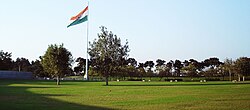
[[File:Rajiv Gandhi Memorial lawn.jpg|thumb|right|The ''[[Rajiv Gandhi Memorial]]'', at [[Sriperumbudur]]]] | [[File:Rajiv Gandhi Memorial lawn.jpg|thumb|right|The ''[[Rajiv Gandhi Memorial]]'', at [[Sriperumbudur]]]] | ||
The Supreme Court judgement, by Justice [[K. T. Thomas (Justice)|K. T. Thomas]], confirmed that Gandhi was killed because of personal animosity by the LTTE chief [[Velupillai Prabhakaran|Prabhakaran]] arising from his sending the Indian Peace Keeping Force (IPKF) to Sri Lanka and the | The Supreme Court judgement, by Justice [[K. T. Thomas (Justice)|K. T. Thomas]], confirmed that Gandhi was killed because of personal animosity by the LTTE chief [[Velupillai Prabhakaran|Prabhakaran]] arising from his sending the Indian Peace Keeping Force (IPKF) to Sri Lanka and the [[Indian Peace Keeping Force#Controversies|IPKF atrocities]] against Sri Lankan Tamils.<ref>''State of Tamil Nadu through Superintendent of Police, CBI/SIT vs. Nalini & 25 Ors.'', Death Ref. Case No. 1 of 1998 (@ D.No.1151 of 1998) per [http://cbi.nic.in/dop/judgements/thomas.pdf K.T. Thomas] {{Webarchive|url=https://web.archive.org/web/20111102222525/http://cbi.nic.in/dop/judgements/thomas.pdf |date=2 November 2011 }}, para. 163</ref> The Gandhi administration had already antagonised other Tamil militant organisations like [[People's Liberation Organisation of Tamil Eelam|PLOTE]] for reversing [[1988 Maldives Coup|the 1988 military coup in Maldives]]. The judgement further cites the death of [[Thileepan]] in a hunger strike and the suicide by 12 LTTE cadres in a vessel in Oct 1987.<ref>{{cite web |last1=Singh |first1=Sushant |title=Operation Cactus: The Indian military was asked to intervene in the Maldives 30 years ago as well|date=7 February 2018 |url=https://scroll.in/article/867736/operation-cactus-the-indian-military-was-asked-to-intervene-in-the-maldives-20-years-ago-as-well |website=Scroll.in}}</ref> | ||
In the [[Jain Commission]] report, various people and agencies are named as suspects in the murder of Rajiv Gandhi. Among them, the cleric [[Chandraswami]] was suspected of involvement, including financing the assassination. | In the [[Jain Commission]] report, various people and agencies are named as suspects in the murder of Rajiv Gandhi. Among them, the cleric [[Chandraswami]] was suspected of involvement, including financing the assassination.<ref>{{cite news|url=http://www.expressindia.com/ie/daily/19980711/19250694.html |title=Probe Chandraswami's role in Rajiv case{{mdash}}Jain report |work=The Indian Express |date=11 July 1998 |author=Sarin, Rtiu |access-date=7 March 2010}}</ref><ref>{{cite news |date=11 December 2004 |url=http://www.deccanherald.com/deccanherald/dec112004/i2.asp |title=CBI sees godman's role in Rajiv's killing |work=Decan Herald |archive-url=https://web.archive.org/web/20041228043145/http://www.deccanherald.com/deccanherald/dec112004/i2.asp |archive-date=28 December 2004 |access-date=16 March 2022}}</ref> Nalini Sriharan, the only surviving member of the five-member squad behind the assassination of Rajiv Gandhi, is serving life imprisonment. Arrested on 14 June 1991, she and 25 others were sentenced to death by a special court on 28 January 1998. The court confirmed the death sentences of four of the convicts, including Nalini, on 11 May 1999.<ref>''State of Tamil Nadu through Superintendent of Police, CBI/SIT vs. Nalini & 25 Ors.'', Death Ref. Case No. 1 of 1998 (@ D.No.1151 of 1998) per [http://judis.nic.in/supremecourt/imgs1.aspx?filename=16829 D.P. Wadhwa] {{Webarchive|url=https://web.archive.org/web/20140427010037/http://judis.nic.in/supremecourt/imgs1.aspx?filename=16829 |date=27 April 2014 }} and [http://judis.nic.in/supremecourt/imgs1.aspx?filename=16823 S.S.M. Quadri] {{Webarchive|url=https://web.archive.org/web/20140427010116/http://judis.nic.in/supremecourt/imgs1.aspx?filename=16823 |date=27 April 2014 }}</ref> Nalini was a close friend of an LTTE operative known as Sriharan alias Murugan, another convict in the case who has been sentenced to death. Nalini later gave birth to a girl, Harithra, in prison. Nalini's death sentence was commuted to life imprisonment in April 2000.<ref>G.O.Ms.No.406, Home Department, dated 24 April 2000</ref> Rajiv's widow, Sonia Gandhi, intervened and asked for clemency for Nalini on the grounds of the latter being a mother.<ref>{{cite web|url=http://news.bbc.co.uk/2/hi/south_asia/526728.stm|title=BBC News – SOUTH ASIA – Gandhi pleads for husband's killer|work=bbc.co.uk|access-date=13 October 2015}}</ref> Later, it was reported that Gandhi's daughter, [[Priyanka Gandhi Vadra]], had met Nalini at Vellore Central Prison in March 2008.<ref>{{cite web|url=http://www.tribuneindia.com/2008/20080416/main3.htm|title=The Tribune, Chandigarh, India – Main News|work=tribuneindia.com|access-date=13 October 2015}}</ref> Nalini regrets the killing of Gandhi and said the real conspirators have not been caught yet.<ref>{{cite web |url=http://articles.timesofindia.indiatimes.com/2008-08-03/india/27901060_1_rajiv-gandhi-assassination-case-nalini-sriharan-suicide-bomber |archive-url=https://web.archive.org/web/20130430180742/http://articles.timesofindia.indiatimes.com/2008-08-03/india/27901060_1_rajiv-gandhi-assassination-case-nalini-sriharan-suicide-bomber |url-status=dead |archive-date=30 April 2013 |work=[[The Times of India]] |title=I regret Rajiv Gandhi's assassination: Nalini |access-date=27 February 2013}}</ref><ref>{{cite web|url=http://www.dnaindia.com/india/report_my-sins-washed-away-says-nalini-sriharan_1159967|title=My sins washed away, says Nalini Sriharan|date=16 April 2008|work=dna}}</ref> | ||
In August 2011, the president of India rejected the clemency pleas of Murugan and two others on death row—Suthendraraja, alias Santhan, and Perarivalan, alias Arivu.<ref>{{cite web|url=http://articles.timesofindia.indiatimes.com/2011-09-11/india/30141652_1_vellore-prison-nalini-sriharan-puzhal-prison |archive-url=https://web.archive.org/web/20130430171036/http://articles.timesofindia.indiatimes.com/2011-09-11/india/30141652_1_vellore-prison-nalini-sriharan-puzhal-prison |url-status=dead |archive-date=30 April 2013 |title=Nalini meets hubby on death row |date=11 September 2011 |work=[[The Times of India]] |access-date=27 February 2013}}</ref> The execution of the three convicts was scheduled for 9 September 2011. However, the [[Madras High Court]] intervened and stayed their executions for eight weeks based on their petitions. In 2010, Nalini had petitioned the Madras High Court seeking release because she had served more than 20 years in prison. She argued that even life convicts were released after 14 years. The state government rejected her request.<ref>{{cite web|url=http://indiatoday.intoday.in/story/Rajiv+Gandhi+assassin+Nalini+Sriharan+not+to+be+freed/1/90329.html |title=Rajiv Gandhi assassin Nalini Sriharan not to be freed : Latest Headlines, News – India Today |publisher=Indiatoday.intoday.in |date=29 March 2010 |access-date=27 February 2013}}</ref><ref>{{cite web|url=http://articles.timesofindia.indiatimes.com/2012-03-16/india/31200948_1_special-prison-puzhal-m-radhakrishnan |archive-url=https://web.archive.org/web/20130227060118/http://articles.timesofindia.indiatimes.com/2012-03-16/india/31200948_1_special-prison-puzhal-m-radhakrishnan |url-status=dead |archive-date=27 February 2013 |work=[[The Times of India]] |title=Rajiv Gandhi's assassin Nalini gets back 'A' class jail facilities |access-date=27 February 2013}}</ref><ref>{{cite web|url=http://www.ndtv.com/article/india/rajiv-gandhi-s-killer-nalini-breaks-down-132130 |title=Rajiv Gandhi's killer Nalini breaks down |publisher=NDTV.com |date=7 September 2011 |access-date=27 February 2013}}</ref> Murugan, Santhan and Perarivalan have said they are political prisoners rather than ordinary criminals.<ref>{{cite web|url=http://www.dnaindia.com/india/report_rajiv-gandhi-assassination-convict-nalini-shifted-to-vellore-prison_1584208 |title=Nalini Sriharan back in Vellore – India – DNA |publisher=Dnaindia.com |access-date=27 February 2013|date=7 September 2011 }}</ref><ref>{{cite web|url=http://articles.timesofindia.indiatimes.com/2010-06-29/chennai/28311629_1_premature-release-prison-manual-rules-nalini-sriharan |archive-url=https://web.archive.org/web/20130430154648/http://articles.timesofindia.indiatimes.com/2010-06-29/chennai/28311629_1_premature-release-prison-manual-rules-nalini-sriharan |url-status=dead |archive-date=30 April 2013 |work=[[The Times of India]] |title=Nalini shifted from Vellore jail to Puzhal |access-date=27 February 2013}}</ref><ref>{{cite web|author= | In August 2011, the president of India rejected the clemency pleas of Murugan and two others on death row—Suthendraraja, alias Santhan, and Perarivalan, alias Arivu.<ref>{{cite web|url=http://articles.timesofindia.indiatimes.com/2011-09-11/india/30141652_1_vellore-prison-nalini-sriharan-puzhal-prison |archive-url=https://web.archive.org/web/20130430171036/http://articles.timesofindia.indiatimes.com/2011-09-11/india/30141652_1_vellore-prison-nalini-sriharan-puzhal-prison |url-status=dead |archive-date=30 April 2013 |title=Nalini meets hubby on death row |date=11 September 2011 |work=[[The Times of India]] |access-date=27 February 2013}}</ref> The execution of the three convicts was scheduled for 9 September 2011. However, the [[Madras High Court]] intervened and stayed their executions for eight weeks based on their petitions. In 2010, Nalini had petitioned the Madras High Court seeking release because she had served more than 20 years in prison. She argued that even life convicts were released after 14 years. The state government rejected her request.<ref>{{cite web|url=http://indiatoday.intoday.in/story/Rajiv+Gandhi+assassin+Nalini+Sriharan+not+to+be+freed/1/90329.html |title=Rajiv Gandhi assassin Nalini Sriharan not to be freed : Latest Headlines, News – India Today |publisher=Indiatoday.intoday.in |date=29 March 2010 |access-date=27 February 2013}}</ref><ref>{{cite web|url=http://articles.timesofindia.indiatimes.com/2012-03-16/india/31200948_1_special-prison-puzhal-m-radhakrishnan |archive-url=https://web.archive.org/web/20130227060118/http://articles.timesofindia.indiatimes.com/2012-03-16/india/31200948_1_special-prison-puzhal-m-radhakrishnan |url-status=dead |archive-date=27 February 2013 |work=[[The Times of India]] |title=Rajiv Gandhi's assassin Nalini gets back 'A' class jail facilities |access-date=27 February 2013}}</ref><ref>{{cite web|url=http://www.ndtv.com/article/india/rajiv-gandhi-s-killer-nalini-breaks-down-132130 |title=Rajiv Gandhi's killer Nalini breaks down |publisher=NDTV.com |date=7 September 2011 |access-date=27 February 2013}}</ref> Murugan, Santhan and Perarivalan have said they are political prisoners rather than ordinary criminals.<ref>{{cite web|url=http://www.dnaindia.com/india/report_rajiv-gandhi-assassination-convict-nalini-shifted-to-vellore-prison_1584208 |title=Nalini Sriharan back in Vellore – India – DNA |publisher=Dnaindia.com |access-date=27 February 2013|date=7 September 2011 }}</ref><ref>{{cite web|url=http://articles.timesofindia.indiatimes.com/2010-06-29/chennai/28311629_1_premature-release-prison-manual-rules-nalini-sriharan |archive-url=https://web.archive.org/web/20130430154648/http://articles.timesofindia.indiatimes.com/2010-06-29/chennai/28311629_1_premature-release-prison-manual-rules-nalini-sriharan |url-status=dead |archive-date=30 April 2013 |work=[[The Times of India]] |title=Nalini shifted from Vellore jail to Puzhal |access-date=27 February 2013}}</ref><ref>{{cite web|author=Subramani, A |date=21 January 2010|url=http://articles.timesofindia.indiatimes.com/2010-01-21/india/28126770_1_premature-release-vellore-prison-nalini |archive-url=https://web.archive.org/web/20130430164451/http://articles.timesofindia.indiatimes.com/2010-01-21/india/28126770_1_premature-release-vellore-prison-nalini |url-status=dead |archive-date=30 April 2013 |work=[[The Times of India]] |title=After 19 yrs in jail for Rajiv murder, Nalini may be freed |access-date=27 February 2013}}</ref> On 18 February 2014, the Supreme Court of India commuted the death sentences of Murugan, Santhan and Perarivalan to life imprisonment, holding that the 11-year-long delay in deciding their mercy petition had a dehumanising effect on them.<ref>[http://judis.nic.in/supremecourt/imgs1.aspx?filename=41228 ''V. Sriharan @ Murugan vs. Union of India & Ors.'', T.C. (Crl.) Nos. 1–3 of 2012] {{Webarchive|url=https://web.archive.org/web/20140427010319/http://judis.nic.in/supremecourt/imgs1.aspx?filename=41228 |date=27 April 2014 }} citing [http://judis.nic.in/supremecourt/imgs1.aspx?filename=41163 ''Shatrughan Chauhan & Anr. vs. Union of India & Ors.'', W.P. (Crl.) No. 55 of 2013] {{Webarchive|url=https://web.archive.org/web/20140426234512/http://judis.nic.in/supremecourt/imgs1.aspx?filename=41163 |date=26 April 2014 }}</ref><ref>{{cite web|title=Supreme Court commuted Death Sentence of Rajiv Gandhi's Killers to Life Imprisonment|url=http://news.biharprabha.com/2014/02/supreme-court-death-sentence-of-rajiv-gandhis-killers-to-life-imprisonment/|work=IANS|date=18 February 2014|publisher=news.biharprabha.com|access-date=18 February 2014}}</ref> On 19 February 2014 Tamil Nadu government decided to release all seven convicts in Rajiv Gandhi's assassination case, including A. G. Perarivalan and Nalini.<ref>{{cite web |url=http://chennaivision.com/news/2014/72578.php |title=TN to release all Rajiv convicts |date=19 February 2014 |access-date=19 February 2014 |url-status=dead |archive-url=https://web.archive.org/web/20140304231802/http://chennaivision.com/news/2014/72578.php |archive-date=4 March 2014 }}</ref> The [[Government of India]] challenged this decision before the Supreme Court, which referred the case to a Constitution Bench.<ref>{{cite web| url = http://judis.nic.in/supremecourt/imgs1.aspx?filename=41465| title = ''Union of India vs. V. Sriharan @ Murugan & Ors.'', W.P. (Crl.) 48 of 2014| access-date = 26 April 2014| archive-date = 27 April 2014| archive-url = https://web.archive.org/web/20140427010028/http://judis.nic.in/supremecourt/imgs1.aspx?filename=41465| url-status = dead}}</ref> | ||
The report of the Jain Commission created controversy when it accused the [[Tamil Nadu]] chief minister [[Karunanidhi]] of a role in the assassination, leading to Congress withdrawing its support for the [[I. K. Gujral]] government and fresh elections in 1998. LTTE spokesman [[Anton Balasingham]] told the Indian television channel [[NDTV]] the killing was a "great tragedy, a monumental historical tragedy which we deeply regret".<ref>{{cite web|url=http://www.expressindia.com/fullstory.php?newsid=70062 |title=We deeply regret Rajiv's death: LTTE |work=The Indian Express |date=27 June 2006 |access-date=7 March 2010}}</ref><ref>{{cite news|url=http://news.bbc.co.uk/2/hi/south_asia/5122032.stm |title=Tamil Tiger 'regret' over Gandhi |work=BBC News |date=27 June 2006 |access-date=7 March 2010}}</ref> A memorial called [[Raj Ghat and other memorials|Veer Bhumi]] was constructed at the place of Gandhi's cremation in Delhi. In 1992, the [[Rajiv Gandhi National Sadbhavana Award]] was instituted by the Indian National Congress Party. | The report of the Jain Commission created controversy when it accused the [[Tamil Nadu]] chief minister [[Karunanidhi]] of a role in the assassination, leading to Congress withdrawing its support for the [[I. K. Gujral]] government and fresh elections in 1998. LTTE spokesman [[Anton Balasingham]] told the Indian television channel [[NDTV]] the killing was a "great tragedy, a monumental historical tragedy which we deeply regret".<ref>{{cite web|url=http://www.expressindia.com/fullstory.php?newsid=70062 |title=We deeply regret Rajiv's death: LTTE |work=The Indian Express |date=27 June 2006 |access-date=7 March 2010}}</ref><ref>{{cite news|url=http://news.bbc.co.uk/2/hi/south_asia/5122032.stm |title=Tamil Tiger 'regret' over Gandhi |work=BBC News |date=27 June 2006 |access-date=7 March 2010}}</ref> A memorial called [[Raj Ghat and other memorials|Veer Bhumi]] was constructed at the place of Gandhi's cremation in Delhi. In 1992, the [[Rajiv Gandhi National Sadbhavana Award]] was instituted by the Indian National Congress Party. | ||
| Line 223: | Line 225: | ||
==In popular culture== | ==In popular culture== | ||
{{See also|:Category:Cultural depictions of Rajiv Gandhi|:Category:Works about the assassination of Rajiv Gandhi}} | {{See also|:Category:Cultural depictions of Rajiv Gandhi|:Category:Works about the assassination of Rajiv Gandhi}} | ||
A number of films have been made in India focusing on Rajiv Gandhi's life especially on his assassination. ''India's Rajiv'' is a 1991 Indian documentary television series by [[Simi Garewal]], released closely after Gandhi's assassination it covers his life up to that event.<ref>{{Citation|last=Simi Garewal|title=India's Rajiv | A number of films have been made in India focusing on Rajiv Gandhi's life especially on his assassination. ''India's Rajiv'' is a 1991 Indian documentary television series by [[Simi Garewal]], released closely after Gandhi's assassination it covers his life up to that event.<ref>{{Citation|last=Simi Garewal|title=India's Rajiv – Part – 1 The Person|url=https://www.youtube.com/watch?v=_1__XkqdH3I| archive-url=https://web.archive.org/web/20170414215000/https://www.youtube.com/watch?v=_1__XkqdH3I| archive-date=2017-04-14 | url-status=dead|access-date=2021-06-10}}</ref> Indian films specifically focusing on the assassination plot include [[The Terrorist (1997 film)|''The Terrorist'']] (1997) by [[Santosh Sivan]],<ref>{{cite web|last=Ebert|first=Roger|date=17 July 2005|title=The Terrorist Movie Review & Film Summary (2000)|url=https://www.rogerebert.com/reviews/great-movie-the-terrorist-2000|access-date=25 June 2020|publisher=Rogerebert.com}}</ref> [[Cyanide (2006 film)|''Cyanide'']] (2006) by [[A. M. R. Ramesh]],<ref>{{Cite web|date=|title=Cyanide|url=https://www.zee5.com/movies/details/cyanide/0-0-cyanide|website=[[zee5]]}}</ref> ''[[Kuttrapathirikai]]'' (2007) by [[R. K. Selvamani]] with [[Anupam Kher]] in the role of Gandhi,<ref>{{cite web|title=Yadavalaya Films, Represented By ... vs The Film Certification Appellate ... on 20 March, 2006|url=http://indiankanoon.org/doc/1042072/|access-date=27 June 2012|publisher=Indiankanoon.org}}</ref> ''[[Mission 90 Days]]'' (2007) by [[Major Ravi]],<ref>[https://www.hindustantimes.com/india/film-throws-new-light-on-rajiv-assassins/story-eYOoO0BZoW11VzgX4ArbfP.html Film Throws New Light on Rajiv Assassins]. [[Hindustan Times]].</ref> and ''[[Madras Cafe]]'' (2013) by [[Shoojit Sircar]] starring Sanjay Gurbaxani as the former prime minister.<ref>{{Cite web|title=Madras Café|url=https://www.netflix.com/title/70293703|access-date=11 June 2021|website=[[Netflix]]}}</ref> | ||
''[[Pradhanmantri]]'' ({{Literal translation|Prime Minister}}), a 2013 Indian documentary television series which aired on [[ABP News]] and covers the various policies and political tenures of Indian PMs, includes the tenureship of Rajiv Gandhi in the episodes "Rajiv Gandhi becomes PM and Shah Bano case", "Ayodhya dispute", "Rajiv Gandhi and Bofors scandal", and "Rise of LTTE and Assassination of Rajiv Gandhi" with [[Mohit Chauhan (actor)|Mohit Chauhan]] portraying the role of Gandhi.<ref>{{Cite web|date=17 November 2013|title=Pradhanmantri | ''[[Pradhanmantri]]'' ({{Literal translation|Prime Minister}}), a 2013 Indian documentary television series which aired on [[ABP News]] and covers the various policies and political tenures of Indian PMs, includes the tenureship of Rajiv Gandhi in the episodes "Rajiv Gandhi becomes PM and Shah Bano case", "Ayodhya dispute", "Rajiv Gandhi and Bofors scandal", and "Rise of LTTE and Assassination of Rajiv Gandhi" with [[Mohit Chauhan (actor)|Mohit Chauhan]] portraying the role of Gandhi.<ref>{{Cite web|date=17 November 2013|title=Pradhanmantri – Episode 19: The {{sic|assas|ination|nolink=y}} of Rajiv Gandhi|url=https://www.youtube.com/watch?v=g5DUONLHGUU&list=PL4gSUwMBf0L0p8mciCow7pSMs0ZViBe1R&index=19|publisher=ABP News}}</ref> | ||
==References== | ==References== | ||
{{reflist}} | |||
=== | ==Cited sources == | ||
*{{cite book|ref=Agarwal|title=Rajiv Gandhi|author=Agarwal, Meena |year=2004|isbn=9788128809002|location=|pages=|publisher=Diamond Pocket Books|url=https://books.google.com/books?id=lC4dLXMz-wEC&q=rajiv+gandhi+biography}} | |||
*{{cite book|ref=Aiyar|title=Confessions of a Secular Fundamentalist|author=Aiyar, Mani Shankar |publisher=[[Penguin Books]]|year=2006|isbn=9780143062059|author-link=Mani Shankar Aiyar}} | |||
*{{cite book|ref=Sharma|title=Journey of a Nation|author=Sharma, Anand |publisher=Academic Foundation|year=2011|isbn=9788171888405|author-link=Anand Sharma}} | |||
=== | ==Further reading== | ||
*Shourie, Arun (1992). These lethal, inexorable laws: Rajiv, his men and his regime. Delhi: South Asia Books. | *Shourie, Arun (1992). These lethal, inexorable laws: Rajiv, his men and his regime. Delhi: South Asia Books. | ||
* Malone, David M., C. Raja Mohan, and Srinath Raghavan, eds. ''The Oxford handbook of Indian foreign policy (2015)'' [https://www.amazon.com/Oxford-Handbook-Indian-Foreign-Policy/dp/0198799063/ excerpt] pp 117–130. | * Malone, David M., C. Raja Mohan, and Srinath Raghavan, eds. ''The Oxford handbook of Indian foreign policy (2015)'' [https://www.amazon.com/Oxford-Handbook-Indian-Foreign-Policy/dp/0198799063/ excerpt] pp 117–130. | ||
| Line 344: | Line 339: | ||
[[Category:Indian Peace Keeping Force]] | [[Category:Indian Peace Keeping Force]] | ||
[[Category:People charged with corruption]] | [[Category:People charged with corruption]] | ||
[[Category:Ecole d'Humanité alumni]] | |||
Revision as of 15:06, 6 March 2023
Rajiv Gandhi | |
|---|---|
 | |
| 6th Prime Minister of India | |
| In office 31 October 1984 – 2 December 1989 | |
| President | Zail Singh R. Venkataraman |
| Vice President | R. Venkataraman Shankar Dayal Sharma |
| Preceded by | Indira Gandhi |
| Succeeded by | V. P. Singh |
| Leader of the Opposition, Lok Sabha | |
| In office 18 December 1989 – 23 December 1990 | |
| Prime Minister | V. P. Singh |
| Preceded by | Jagjivan Ram |
| Succeeded by | L. K. Advani |
| President of the Indian National Congress | |
| In office 28 December 1985 – 21 May 1991 | |
| Preceded by | Indira Gandhi |
| Succeeded by | P. V. Narasimha Rao |
| Member of Parliament, Lok Sabha | |
| In office 17 August 1981 – 21 May 1991 | |
| Preceded by | Sanjay Gandhi |
| Succeeded by | Satish Sharma |
| Constituency | Amethi |
| Personal details | |
| Born | Rajiv Ratna Gandhi 20 August 1944 Bombay, Bombay Presidency, British India (present-day Mumbai, Maharashtra, India) |
| Died | 21 May 1991 (aged 46) Sriperumbudur, Tamil Nadu, India |
| Cause of death | Assassination |
Monuments | |
| Nationality | Indian |
| Political party | Indian National Congress |
| Spouse(s) | ( m. 1968) |
| Relations | See Nehru–Gandhi family |
| Children | |
| Parents |
|
| Alma mater | Trinity College, Cambridge (dropped out) Imperial College London (dropped out) |
| Awards | Bharat Ratna (1991) |
| Signature |  |
Template:Rajiv Gandhi series
Rajiv Gandhi (/ˈrɑːdʒiːv ˈɡɑːndiː/ ( listen); 20 August 1944 – 21 May 1991)[1][2][3] was an Indian politician who served as the sixth prime minister of India from 1984 to 1989. He took office after the assassination of his mother, then Prime Minister Indira Gandhi, to become the youngest Indian Prime minister at the age of 40.
Gandhi was from the politically powerful Nehru–Gandhi family, which had been associated with the Indian National Congress party. For much of his childhood, his maternal grandfather Jawaharlal Nehru was prime minister. Gandhi attended college at the University of Cambridge in the United Kingdom. He returned to India in 1966 and became a professional pilot for the state-owned Indian Airlines. In 1968, he married Sonia Gandhi; the couple settled in Delhi to a domestic life with their children Rahul Gandhi and Priyanka Gandhi Vadra. For much of the 1970s, his mother Indira Gandhi was prime minister and his brother Sanjay Gandhi an MP; despite this, Rajiv Gandhi remained apolitical. After Sanjay's death in a plane crash in 1980, Gandhi reluctantly entered politics at the behest of Indira. The following year he won his brother's Parliamentary seat of Amethi and became a member of the Lok Sabha—the lower house of India's Parliament. As part of his political grooming, Rajiv was made general secretary of the Congress party and given significant responsibility in organising the 1982 Asian Games.
On the morning of 31 October 1984, his mother (Prime Minister Indira Gandhi) was assassinated by her two Sikh bodyguards[4][5][6][7] Satwant Singh and Beant Singh in the aftermath of Operation Blue Star, an Indian military action to remove Sikh separatist activists from the Golden temple of the Harmandir Sahib. Later that day, Gandhi was appointed prime minister. His leadership was tested over the next few days as organised mobs of Congress supporters rioted against the Sikh community, resulting in anti-Sikh massacres in Delhi. Sources estimate the number of Sikh deaths at about 8,000–17,000.[8] That December, Congress party won the largest Lok Sabha majority to date, 411 seats out of 542. Rajiv Gandhi's period in office was mired in controversies; perhaps the greatest crises were the Bhopal disaster, Bofors scandal and Mohd. Ahmed Khan v. Shah Bano Begum. Soon after installing Gul Shah as Chief Minister in Jammu and Kashmir, the 1986 Kashmir Riots erupted.[9] In 1988, he reversed the coup in Maldives, antagonising militant Tamil groups such as PLOTE, intervening and then sending peacekeeping troops to Sri Lanka in 1987, leading to open conflict with the Liberation Tigers of Tamil Eelam (LTTE). In mid-1987, the Bofors scandal damaged his corruption-free image and resulted in a major defeat for his party in the 1989 election.
Gandhi remained Congress President until the elections in 1991. While campaigning for the elections, he was assassinated by a suicide bomber from the LTTE. His widow Sonia became the president of the Congress party in 1998 and led the party to victory in the 2004 and 2009 parliamentary elections. His son Rahul Gandhi is a Member of Parliament and was the President of the Indian National Congress till 2019. In 1991, the Indian government posthumously awarded Gandhi the Bharat Ratna, the country's highest civilian award. At the India Leadership Conclave in 2009, the Revolutionary Leader of Modern India award was conferred posthumously on Gandhi.[10]
Early life and career


Rajiv Gandhi was born in Bombay on 20 August 1944 to Indira and Feroze Gandhi. In 1951, Rajiv and his younger brother Sanjay were admitted to Shiv Niketan school, where the teachers said Rajiv was shy and introverted, and "greatly enjoyed painting and drawing".[11] He was admitted to the Welham Boys' School, Dehradun and Doon School, Dehradun in 1954, where Sanjay joined him two years later.[12] Rajiv was also educated at the Ecole D'Humanité, an international boarding school in Switzerland.[13] He left the Doon School in 1961 with a second-class certificate, having performed well in his final subjects apart from a pass mark in chemistry.[14]
During Gandhi's final year at Doon, his mother and Albert D'Rozario, the scientific attaché at the Indian High Commission in London, arranged his application to Cambridge University.[14] D'Rozario, who had been a college classmate of Feroze Gandhi, recommended that Gandhi should read engineering, and met with Mark Pryor, the Senior Tutor at Trinity College, Cambridge.[14] Pryor arranged for Gandhi's conditional admission to Trinity, contingent on his passing the Mechanical Sciences Qualifying (MSQ) Examination with acceptable marks.[14] After studying for his A-levels at the sixth form college of Davies, Laing & Dick in London, Gandhi sat the MSQ Examination in March 1962 but was unsuccessful. He passed on his second attempt in June, and was admitted to Trinity on 4 September 1962, joining the college in October.[14] While at Trinity, he joined the Cambridge University Boat Club.[14]
During Gandhi's time at Cambridge, his mother and D'Rozario remained concerned about his well-being. D'Rozario, who along with his wife Sophy often hosted Gandhi at their Finchley home, took Gandhi to task for his inattention towards his studies.[14] Despite his support, Gandhi failed end-of-year exams and left Trinity in 1965 without a degree,[15] though he kept in touch with his former mentor in his retirement.[14] In 1966 he began a course in mechanical engineering at Imperial College London, but also failed to complete it. Gandhi really was not studious enough, as he went on to admit later.[16]
Gandhi returned to India in 1966, the year his mother became prime minister. He went to Delhi and became a member of the Flying Club, where he trained as a pilot. In 1970, he was employed as a pilot by Indian Airlines; unlike Sanjay, he did not exhibit any interest of joining politics.[17] In 1968, after three years of courtship, he married Edvige Antonia Albina Màino, who changed her name to Sonia Gandhi and made India her home. Their first child, a son, Rahul Gandhi was born in 1970. In 1972, the couple had a daughter, Priyanka Gandhi, who married Robert Vadra.[18] Gandhi was a friend of Amitabh Bachchan, and was familiar with Bachchan even before he launched his acting career. Rajiv, Sanjay and Bachchan spent time together when Bachchan was student in Delhi University and a resident of New Delhi. In the 1980s, Bachchan would enter politics to support his friend, Gandhi.[19]
Entry into politics
On 23 June 1980, Rajiv's younger brother Sanjay Gandhi died unexpectedly in an aeroplane crash. At that time, Rajiv Gandhi was in London as part of his foreign tour. Hearing the news, he returned to Delhi and cremated Sanjay's body.[20] As per Agarwal, in the week following Sanjay's death, Shankaracharya Swami Shri Swaroopanand, a saint from Badrinath, visited the family's house to offer his condolences.[21] He advised Rajiv not to fly aeroplanes and instead "dedicate himself to the service of the nation".[22] 70 members of the Congress party signed a proposal and went to Indira, urging Rajiv to enter politics. Indira told them it was Rajiv's decision whether to enter politics. When he was questioned about it, he replied, "If my mother gets help from it, then I will enter politics".[22] Rajiv entered politics on 16 February 1981, when he addressed a national farmers' rally in Delhi.[23] During this time, he was still an employee of Air India.[24]
Participation in active politics
On 4 May 1981, Indira Gandhi presided over a meeting of the All India Congress Committee. Vasantdada Patil proposed Rajiv as a candidate for the Amethi constituency, which was accepted by all members at the meeting. A week later, the party officially announced his candidacy for the constituency. He then paid the party membership fees of the party and flew to Sultanpur to file his nomination papers and completed other formalities.[25] He won the seat, defeating Lok Dal candidate Sharad Yadav by a margin of 237,000 votes.[26] He took his oath on 17 August as Member of Parliament.[24]
Rajiv Gandhi's first political tour was to England, where he attended the wedding ceremony of Prince Charles and Lady Diana Spencer on 29 July 1981.[27] In December the same year, he was put in charge of the Indian Youth Congress.[27] He first showed his organisational ability by "working round the clock" on the 1982 Asian Games.[citation needed] He was one of 33 members of the Indian parliament who were part of the Games' organising committee; sports historian Boria Majumdar writes that being "son of the prime minister he had a moral and unofficial authority" over the others.[28] The report submitted by the Asian Games committee mentions Gandhi's "drive, zeal and initiative" for the "outstanding success" of the games.[28]

1984 anti-Sikh riots post Indira Gandhi's death

On 31 October 1984, the prime minister, Rajiv Gandhi's mother, Indira Gandhi, was assassinated by her Sikh bodyguards, which led to violent riots against Sikhs.[29] At a Boat Club rally 19 days after the assassination, Gandhi said, "Some riots took place in the country following the murder of Indiraji. We know the people were very angry and for a few days it seemed that India had been shaken. But, when a mighty tree falls, it is only natural that the earth around it does shake a little".[30] According to Verinder Grover, the statement made by Gandhi was a "virtual justification" of the riots.[29] Congress leader Mani Shankar Aiyar wrote, "Did it constitute an incitement to mass murder?" He also criticised Gandhi for his reluctance to bring the army from Meerut to handle the mob.[31]
Prime Minister of India
Rajiv Gandhi was in West Bengal on 31 October 1984 when his mother, Prime Minister Indira Gandhi, was assassinated by two of her Sikh bodyguards, Satwant Singh and Beant Singh, to avenge the military attack on the Golden Temple during Operation Blue Star. Sardar Buta Singh and President Zail Singh pressed Rajiv to succeed his mother as prime minister within hours of her murder. Commenting on the anti-Sikh riots in Delhi, Rajiv Gandhi said, "When a giant tree falls, the earth below shakes";[32] a statement for which he was widely criticised. Many Congress politicians were accused of orchestrating the violence.[33]
Soon after assuming office, Gandhi asked President Singh to dissolve Parliament and hold fresh elections, as the Lok Sabha had completed its five-year term. Gandhi officially became the president of the Congress party, which won a landslide victory with the largest majority in history of the Indian Parliament, giving Gandhi absolute control of government. He benefited from his youth and a general perception of being free of a background in corrupt politics.[35] Gandhi took his oath on 31 December 1984; at 40, he was the youngest prime minister of India.[36] Historian Meena Agarwal writes that even after taking the Prime Ministerial oath, he was a relatively unknown figure, "novice in politics" as he assumed the post after being an MP for three years.[37]
Cabinet ministers
After his swearing-in as prime minister, Gandhi appointed his fourteen-member cabinet. He said he would monitor their performance and would "fire ministers who do not come to the mark".[citation needed] From the Third Indira Gandhi ministry, he removed two powerful figures; Finance Minister Pranab Mukherjee and Railway Minister A. B. A. Ghani Khan Choudhury. Mohsina Kidwai became the Minister of Railways; she was the only female figure in the cabinet. Former Home Minister PV Narasimha Rao was put in charge of defence.[36] V. P. Singh, who was initially appointed as the Finance Minister, was given the Defence Ministry in 1987.[38] During his tenure as prime minister, Gandhi frequently shuffled his cabinet ministers, drawing criticism from the magazine India Today, which called it a "wheel of confusion". The West Bengal chief minister Jyoti Basu said, "The Cabinet change reflects the instability of the Congress (I) Government at the Centre".[39]
Anti-defection law
Gandhi's first action as prime minister was passing the anti-defection law in January 1985. According to this law, an elected Member of Parliament or legislative assembly could not join an opposition party until the next election. Historian Manish Telikicherla Chary calls it a measure of curbing corruption and bribery of ministers by switching parties so they could gain majority.[40] Many such defections occurred during the 1980s as elected leaders of the Congress party joined opposition parties.[41]
1985 Congress Sandesh Yatra
Rajiv Gandhi had announced 'Sandesh Yatra' at the plenary session of AICC in Mumbai in 1985. The All India Congress Seva Dal ran it across the country.[42] Pradesh Congress Committees (PCCs) and party leaders made four simultaneous trips from Mumbai, Kashmir, Kanyakumari and the Northeast. The yatra, which lasted for more than three months, concluded at Delhi's Ramlila Maidan.
Shah Bano case
In 1985, the Supreme Court of India ruled in favour of Muslim divorcee Shah Bano, declaring that her husband should give her alimony. Some Indian Muslims treated it as an encroachment upon Muslim Personal Law and protested against it. Gandhi agreed to their demands.[43] In 1986, the Parliament of India passed The Muslim Women (Protection of Rights on Divorce) Act 1986, which nullified the Supreme Court's judgment in the Shah Bano case. The Act diluted the Supreme Court judgment and allowed maintenance payments to divorced women only during the period of Iddah, or until 90 days after the divorce, according to the provisions of Islamic law. This was in contrast to Section 125 of the Code.[44][45] Indian magazine Business and Economics called it a minority appeasement by Gandhi.[46] Lawyer and former Law Minister of India, Ram Jethmalani, called the Act "retrogressive obscurantism for short-term minority populism".[47] Gandhi's colleague Arif Mohammad Khan, who was then a Member of Parliament, resigned in protest.[48]
Economic policy

In his election manifesto for the 1984 general election, he did not mention any economic reforms, but after assuming office he tried to liberalise the country's economy.[49] He sought to liberalize India's trade policies but faced stiff opposition to the proposed reforms.[50][49] He did so by providing incentives to make private production profitable. Subsidies were given to corporate companies to increase industrial production, especially of durable goods.[contradictory] It was hoped this would increase economic growth and improve the quality of investment.[49] Rural and tribal people protested because they saw them as "pro-rich" and "pro-city" reforms.[49]
Gandhi increased government support for science, technology and associated industries, and reduced import quotas, taxes and tariffs on technology-based industries, especially computers, airlines, defence and telecommunications. In 1986, he announced a National Policy on Education to modernise and expand higher education programs across India. In 1986, he founded the Jawahar Navodaya Vidyalaya System, which is a Central government-based education institution that provides rural populations with free residential education from grades six to twelve.[51] His efforts created MTNL in 1986, and his public call offices—better known as PCOs—helped develop the telephone network in rural areas.[52] He introduced measures to significantly reduce the Licence Raj after 1990, allowing businesses and individuals to purchase capital, consumer goods and import without bureaucratic restrictions.[53]
Foreign policy

According to Rejaul Karim Laskar, a scholar of Indian foreign policy and an ideologue of Congress party, Rajiv Gandhi's vision for a new world order was premised on India's place in its front rank.[54] According to Laskar, the "whole gamut" of Rajiv Gandhi's foreign policy was "geared towards" making India "strong, independent, self-reliant and in the front rank of the nations of the world."[54] According to Laskar, Rajiv Gandhi's diplomacy was "properly calibrated" so as to be "conciliatory and accommodating when required" and "assertive when the occasion demanded."[54]
In 1986, by request of the president of Seychelles France-Albert René, Gandhi sent India's navy to Seychelles to oppose an attempted coup against René. The intervention of India averted the coup. This mission was codenamed as Operation Flowers are Blooming.[55] In 1987, India re-occupied the Quaid Post in the disputed Siachen region of the Indo-Pakistani border after winning what was termed Operation Rajiv.[56] In the 1988 Maldives coup d'état, the Maldives president Maumoon Abdul Gayoom asked for help from Gandhi. He dispatched 1500 soldiers and the coup was suppressed.[57]
On Thursday, 9 June 1988, at the fifteenth special session of the United Nations General Assembly, held at Headquarters, New York, Gandhi made vocal his views on a world free of nuclear weapons, to be realised through an, 'Action Plan for Ushering in a Nuclear-Weapon Free and Non-Violent World Order.'[58][59]
He said:
Alas, nuclear weapons are not the only weapons of mass destruction. New knowledge is being generated in the life sciences. Military applications of these developments could rapidly undermine the existing convention against the military use of biological weapons. The ambit of our concern must extend to all means of mass annihilation.
This was based on his prior historic speech before the Japanese National Diet on 29 November 1985, in which he said:
Let us remove the mental partitions which obstruct the ennobling vision of the human family linked together in peace and prosperity. The Buddha's message of compassion is the very condition of human survival in our age.[60][61][62]
The foiled bid of India recently to enter the Nuclear Suppliers Group, echoed his policy of non-proliferation to be linked to universal disarmament, which the World Nuclear Association refuses to recognise; non-proliferation being seen by India as essentially a weapon of the arms control regime, of the big nuclear powers as United States, Russia, United Kingdom, France, and China.[63][64]
Pakistan
In February 1987, the Pakistani president Zia-ul-Haq visited Delhi, where he met Gandhi to discuss "routine military exercises of the Indian army" on the borders of Rajasthan and Punjab. Gandhi reciprocated, in December 1988, by visiting Islamabad and meeting the new prime minister of Pakistan, Benazir Bhutto, to reaffirm the 1972 Shimla agreement.[65]
Sri Lanka
The Sri Lankan Civil War broke out with the Liberation Tigers of Tamil Eelam (LTTE), which was demanding an independent Tamil state in Sri Lanka. Gandhi discussed the matter with the Sri Lankan Prime Minister Ranasinghe Premadasa at the SAARC meeting in 1986. In that year, the Sri Lankan army blockaded the Tamil majority district of Jaffna; Gandhi ordered relief supplies to be dropped into the area by parachute because the Sri Lankan navy did not allow the Indian Navy to enter.[66]
Gandhi signed the Indo-Sri Lanka Accord in July 1987. The accord "envisaged a devolution of power to the Tamil-majority areas", dissolved the LTTE, and designated Tamil as an official language of Sri Lanka.[67] Gandhi said:
The Government of India believe that, despite some problems and delays, many of which were foreseen but unavoidable in the resolution of an issue of this magnitude and complexity, this Agreement represents the only way of safeguarding legitimate Tamil interests and ensuring a durable peace in Sri Lanka. Some have chosen to criticise the Agreement. None has shown a better way of meeting the legitimate aspirations of the Tamils in Sri Lanka, restoring peace in that country and of meeting our own security concern in the region. We have accepted a role which is difficult, but which is in our national interests to discharge. We shall not shrink our obligations and commitments. This is a national endeavour.[67]
Chanderasekar withdrew the IPKF in 1989.[65]
Assault by Sri Lankan guard
On 30 July 1987, a day after Gandhi went to Sri Lanka and signed the Indo-Sri Lanka Accord, an honour guard named Vijitha Rohana hit him on his shoulder with his rifle; Gandhi's quick reflexes saved him from injury. The guard was then dragged off by his security personnel.[68][69] The guard said his intention was to kill Gandhi because of "the damage he had caused" to Sri Lanka. Wijemuni was imprisoned for two-and-a-half years for the assault.[68] Gandhi later said about the incident:
When I was inspecting the guard of honour and as I walked past one person, I saw through the corner of my eye some movement. I ducked down a little bit in a reflex action. By my ducking, he missed my head and the brunt of the blow came on my shoulder below the left ear.[69]
Regional issues

Punjab
Soon after assuming office, Gandhi released the leaders of the Akali Dal who had been imprisoned since 1984's Operation Blue Star during Indira Gandhi's prime ministership. He lifted the ban on All India Sikh Students Federation and filed an inquiry into the 1984 Anti-Sikh Riots. He also held a closed-door meeting with senior Akali Dal leaders to find a solution to the Punjab problem. Despite Akali opposition, in January 1985, Gandhi signed the Rajiv-Longowal Accord with Akali leader HS Longowal. Punjab's state assembly election was scheduled in September 1985, but Longowal died and was replaced by Surjit Singh Barnala, who formed the government. After two years, in 1987, Barnala resigned his office because of a breakdown of law and order, leading to the implementation of President's rule in the state.[70]
In May 1988, Gandhi launched the Operation Black Thunder to clear the Golden Temple in Amritsar of arms and gunmen. Two groups called National Security Guard and Special Action Group were created; they surrounded the temple in a 10-day siege during which the extremists' weapons were confiscated. Congress leader Anand Sharma said, "Operation Black Thunder effectively demonstrated the will of Rajiv Gandhi's government to take firm action to bring peace to Punjab".[71]
Northeast India
Gandhi's prime-ministership marked an increase of insurgency in northeast India. Mizo National Front demanded independence for Mizoram. In 1987, Gandhi addressed this problem; Mizoram and Arunachal Pradesh were given the status of states that were earlier union territories.[72] Gandhi also ended the Assam Movement, which was launched by Assamese people to protest against the alleged illegal migration of Bangladeshi Muslims and immigration of other Bengalis to their state, which had reduced the Assamese to a minority there. He signed the Assam Accord on 15 August 1985. According to the accord, foreigners who came to the state between 1951 and 1961 were given full citizenship but those who arrived there between 1961 and 1971 did not get right to vote for the next ten years.[73]
Technology
Gandhi employed former Rockwell International executive Sam Pitroda as his adviser on public information infrastructure and innovation. During Gandhi's time in office, public sector telecom companies MTNL and VSNL was developed.[74] According to Pitroda, Gandhi's ability to resist pressure from multi-national companies to abandon his plan to spread telecommunication services has been an important factor in India's development. According to news website Oneindia, "About 20 years ago telephones were considered to be a thing for the use of the rich, but credit goes to Rajiv Gandhi for taking them to the rural masses".[75] Pitroda also said their plan to expand India's telephone network succeeded because of Gandhi's political support. According to Pitroda, by 2007 they were "adding six million phones every month".[75] Gandhi's government also allowed the import of fully assembled motherboards, which led to the price of computers being reduced.[76] According to some commentators, the seed for the information technology (IT) revolution was also planted during Rajiv Gandhi's time.[76]
Bofors scandal, HDW scandal and 1989 elections defeat
Rajiv Gandhi's finance minister, V. P. Singh, uncovered compromising details about government and political corruption, to the consternation of Congress leaders. Transferred to the Defence Ministry, Singh uncovered what became known as the Bofors scandal, which involved millions of US dollars and concerned alleged payoffs by the Swedish arms company Bofors through Italian businessman and Gandhi family associate Ottavio Quattrocchi, in return for Indian contracts. Upon discovering the scandal, Singh was dismissed from office and later resigned his Congress membership. Gandhi was later personally implicated in the scandal when the investigation was continued by Narasimhan Ram and Chitra Subramaniam of The Hindu newspaper, damaging his image as an honest politician. In 2004, he was posthumously cleared of this allegation.[77]
In an interview in July 2005, V. P. Singh explained that his fall out with Rajiv Gandhi was not due to the Bofors deal, but rather due to the HDW deal. Courtesy a contract signed with the German company HDW in 1981, the Indian government had agreed to purchase two ready submarines built in Germany by HDW and two submarines in CKD form to be assembled in Mazagaon docks. V. P. Singh had received a telegram from the Indian ambassador in Germany, stating that an Indian agents had received commissions in the HDW submarine deal. He told Rajiv Gandhi about this and instituted an enquiry. This led to differences and V. P. Singh resigned from the cabinet.[78]
In his book, Unknown Facets of Rajiv Gandhi, Jyoti Basu and Indrajit Gupta, released in November 2013, former CBI director Dr. A P Mukherjee wrote that Gandhi wanted commission paid by defence suppliers to be used exclusively for meeting running expenses of the Congress party.[79] Mukherjee said Gandhi explained his position in a meeting between the two at the prime minister's residence on 19 June 1989.[80] In May 2015, Indian president Pranab Mukherjee said the scandal was a "media trial" as "no Indian court has as yet established it as a scandal".[81]
Opposition parties Lok Dal, Indian National Congress (Socialist) and Jan Morcha united under Singh to form the Janata Dal.[82] Singh led the National Front coalition to victory in 1989 elections and he was sworn in as prime minister. Though the coalition won 143 seats compared to Congress's 197, it gained majority in the lower house of the parliament through outside support from the Bharatiya Janta Party under the leadership of Atal Bihari Vajpayee and Lal Krishna Advani and the left parties such as the Communist Party of India (Marxist) and the Communist Party of India.[83] Eminent lawyer and politician, former Law Minister of India Ram Jethmalani said that as prime minister, Gandhi was "lacklustre and mediocre".[47]
Later years
Mass connect programmes though Bharat Yatra
In 1990, Rajiv Gandhi undertook Bharat Yatra through different modes – padyatra, the second class carriage of an ordinary passenger train.[84] He chose Champaran as the starting point for his 'Bharat Yatra'. Rajiv Gandhi started the Sadbhavna Yatra from Charminar in Hyderabad on 19 October 1990.[85][86][87]
Allegations of black money
In November 1991, Schweizer Illustrierte magazine published an article on black money held in secret accounts by Imelda Marcos and 14 other rulers of Third World countries. Citing McKinsey as a source, the article stated that Rajiv Gandhi held 2.5 billion Swiss francs in secret Indian accounts in Switzerland.[88][89] Several leaders of opposition parties in India raised the issue, citing the Schweizer Illustrierte article. In December 1991, Amal Datta raised the issue in the Indian Parliament; the Speaker of the Lok Sabha, Shivraj Patil, expunged Rajiv Gandhi's name from the proceedings.[90] In December 2011, Subramanian Swamy wrote to the director of the Central Bureau of Investigation, citing the article and asking him to take action on black money accounts of the Nehru-Gandhi family.[91] On 29 December 2011, Ram Jethmalani made an indirect reference to the issue in the Rajya Sabha, calling it a shame that one of India's former prime ministers was named by a Swiss magazine. This was met by an uproar and a demand for withdrawal of the remark by the ruling Congress party members.[92]
Funding from KGB
In 1992, the Indian newspapers Times of India and The Hindu published reports alleging that Rajiv Gandhi had received funds from the KGB.[90] The Russian government confirmed this disclosure and defended the payments as necessary for Soviet ideological interest.[93] In their 1994 book The State Within a State, journalists Yevgenia Albats and Catherine Fitzpatrick quoted a letter signed by Viktor Chebrikov, head of the KGB, in the 1980s. The letter says the KGB maintained contact with Gandhi, who expressed his gratitude to the KGB for benefits accruing to his family from commercial dealings of a controlled firm. A considerable portion of funds obtained from this channel were used to support his party.[94] Albats later said that in December 1985, Chebrikov had asked for authorisation from the Central Committee of the Communist Party of the Soviet Union to make payments to family members of Rajiv Gandhi, including Sonia Gandhi and Rahul Gandhi.[90][93] The payments were authorised by a resolution and endorsed by the USSR Council of Ministers, and had been paid since 1971.[93] In December 2001, Subramanian Swamy filed a writ petition in the Delhi High Court; the court ordered CBI to ascertain the truth of the allegations in May 2002. After two years, the CBI told the Court Russia would not entertain such queries without a registered FIR.[clarification needed][93]
Assassination
Rajiv Gandhi's last public meeting was on 21 May 1991, at Sriperumbudur, a village approximately 40 km (25 mi) from Madras (present-day Chennai), where he was assassinated while campaigning for the Sriperumbudur Lok Sabha Congress candidate. At 10:10 pm, a woman later identified as Thenmozhi Rajaratnam – a member of the Liberation Tigers of Tamil Eelam – approached Gandhi in public and greeted him. She then bent down to touch his feet and detonated a belt laden with 700 g (1.5 lb) of RDX explosives tucked under her dress.[95]

The explosion killed Gandhi, Rajaratnam, and at least 14 other people.[96] The assassination was captured by a 21-year-old local photographer, whose camera and film were found at the site. The cameraman, named Haribabu, died in the blast but the camera remained intact.[97] Gandhi's mutilated body was airlifted to the All India Institute of Medical Sciences in New Delhi for post-mortem, reconstruction and embalming.[98]
A state funeral was held for Gandhi on 24 May 1991; it was telecast live and was attended by dignitaries from over 60 countries.[99] He was cremated at Veer Bhumi, on the banks of the river Yamuna near the shrines of his mother Indira Gandhi, brother Sanjay Gandhi, and grandfather Jawaharlal Nehru.[1]
Aftermath

The Supreme Court judgement, by Justice K. T. Thomas, confirmed that Gandhi was killed because of personal animosity by the LTTE chief Prabhakaran arising from his sending the Indian Peace Keeping Force (IPKF) to Sri Lanka and the IPKF atrocities against Sri Lankan Tamils.[100] The Gandhi administration had already antagonised other Tamil militant organisations like PLOTE for reversing the 1988 military coup in Maldives. The judgement further cites the death of Thileepan in a hunger strike and the suicide by 12 LTTE cadres in a vessel in Oct 1987.[101]
In the Jain Commission report, various people and agencies are named as suspects in the murder of Rajiv Gandhi. Among them, the cleric Chandraswami was suspected of involvement, including financing the assassination.[102][103] Nalini Sriharan, the only surviving member of the five-member squad behind the assassination of Rajiv Gandhi, is serving life imprisonment. Arrested on 14 June 1991, she and 25 others were sentenced to death by a special court on 28 January 1998. The court confirmed the death sentences of four of the convicts, including Nalini, on 11 May 1999.[104] Nalini was a close friend of an LTTE operative known as Sriharan alias Murugan, another convict in the case who has been sentenced to death. Nalini later gave birth to a girl, Harithra, in prison. Nalini's death sentence was commuted to life imprisonment in April 2000.[105] Rajiv's widow, Sonia Gandhi, intervened and asked for clemency for Nalini on the grounds of the latter being a mother.[106] Later, it was reported that Gandhi's daughter, Priyanka Gandhi Vadra, had met Nalini at Vellore Central Prison in March 2008.[107] Nalini regrets the killing of Gandhi and said the real conspirators have not been caught yet.[108][109]
In August 2011, the president of India rejected the clemency pleas of Murugan and two others on death row—Suthendraraja, alias Santhan, and Perarivalan, alias Arivu.[110] The execution of the three convicts was scheduled for 9 September 2011. However, the Madras High Court intervened and stayed their executions for eight weeks based on their petitions. In 2010, Nalini had petitioned the Madras High Court seeking release because she had served more than 20 years in prison. She argued that even life convicts were released after 14 years. The state government rejected her request.[111][112][113] Murugan, Santhan and Perarivalan have said they are political prisoners rather than ordinary criminals.[114][115][116] On 18 February 2014, the Supreme Court of India commuted the death sentences of Murugan, Santhan and Perarivalan to life imprisonment, holding that the 11-year-long delay in deciding their mercy petition had a dehumanising effect on them.[117][118] On 19 February 2014 Tamil Nadu government decided to release all seven convicts in Rajiv Gandhi's assassination case, including A. G. Perarivalan and Nalini.[119] The Government of India challenged this decision before the Supreme Court, which referred the case to a Constitution Bench.[120]
The report of the Jain Commission created controversy when it accused the Tamil Nadu chief minister Karunanidhi of a role in the assassination, leading to Congress withdrawing its support for the I. K. Gujral government and fresh elections in 1998. LTTE spokesman Anton Balasingham told the Indian television channel NDTV the killing was a "great tragedy, a monumental historical tragedy which we deeply regret".[121][122] A memorial called Veer Bhumi was constructed at the place of Gandhi's cremation in Delhi. In 1992, the Rajiv Gandhi National Sadbhavana Award was instituted by the Indian National Congress Party.
Since his death, 21 May has been declared Anti-Terrorism Day in India.[123]
Institutions named after Gandhi
A Right to Information (RTI) request filed in August 2009 found that more than 450 government projects and schemes are named after the Gandhi-Nehru family.[124] In May 2012, Zee News reported there were 16 government schemes named after Gandhi, including Rajiv Awas Yojana and Rajiv Gandhi Udyami Mitra Yojana.[125] In March 2015, Haryana sports minister Anil Vij said that at that time there were 232 rural stadia in India, with 226 of them being named after him. He said the government was "planning to rename" all the stadia in Haryana state named after him. Vij drew criticism from Congress leader Kuldeep Sharma, who said it was an "insult to their national leaders".[126]
In popular culture
A number of films have been made in India focusing on Rajiv Gandhi's life especially on his assassination. India's Rajiv is a 1991 Indian documentary television series by Simi Garewal, released closely after Gandhi's assassination it covers his life up to that event.[127] Indian films specifically focusing on the assassination plot include The Terrorist (1997) by Santosh Sivan,[128] Cyanide (2006) by A. M. R. Ramesh,[129] Kuttrapathirikai (2007) by R. K. Selvamani with Anupam Kher in the role of Gandhi,[130] Mission 90 Days (2007) by Major Ravi,[131] and Madras Cafe (2013) by Shoojit Sircar starring Sanjay Gurbaxani as the former prime minister.[132]
Pradhanmantri (lit. 'Prime Minister'), a 2013 Indian documentary television series which aired on ABP News and covers the various policies and political tenures of Indian PMs, includes the tenureship of Rajiv Gandhi in the episodes "Rajiv Gandhi becomes PM and Shah Bano case", "Ayodhya dispute", "Rajiv Gandhi and Bofors scandal", and "Rise of LTTE and Assassination of Rajiv Gandhi" with Mohit Chauhan portraying the role of Gandhi.[133]
References
- ↑ 1.0 1.1 "Rajiv Gandhi | prime minister of India | Britannica". www.britannica.com. Retrieved 21 November 2021.
- ↑ "rajiv-gandhi: Latest News, Videos and Photos of rajiv-gandhi | Times of India". The Times of India. Retrieved 21 November 2021.
- ↑ Patel, Dhirubhai (17 February 2017). Rajiv Gandhi: Youngest Indian Prime Minister. Independently Published. ISBN 978-1-5206-2973-5.
- ↑ Kaur, Jaskaran; Crossette, Barbara (2006). Twenty years of impunity: the November 1984 pogroms of Sikhs in India (PDF) (2nd ed.). Portland, OR: Ensaaf. p. 27. ISBN 978-0-9787073-0-9. Retrieved 23 May 2022.
- ↑ "1984: Assassination and revenge". BBC News. 31 October 1984. Archived from the original on 15 February 2009. Retrieved 23 May 2022.
- ↑ Shaw, Jeffrey M.; Demy, Timothy J. (2017). War and Religion: An Encyclopedia of Faith and Conflict. ABC-CLIO. p. 129. ISBN 978-1610695176.
- ↑ Brass, Paul R. (October 1996). Riots and Pogroms. NYU Press. p. 203. ISBN 978-0814712825.
- ↑ Joseph, Paul (11 October 2016). The SAGE Encyclopedia of War: Social Science Perspectives. SAGE. p. 433. ISBN 978-1483359885.
around 17,000 Sikhs were burned alive or killed
- ↑ Aiyar, pp. 148–
- ↑ "Special award bestowed on Rajiv Gandhi". The Hindu. 27 September 2009. Retrieved 28 February 2021.
- ↑ "Rajiv Gandhi". www.mid-day.com. Retrieved 12 November 2019.
- ↑ Agarwal, p. 17
- ↑ Singh, Rani (13 September 2011). Sonia Gandhi: An Extraordinary Life, An Indian Destiny. St. Martin's Publishing Group. ISBN 978-0-230-34053-4.
- ↑ 14.0 14.1 14.2 14.3 14.4 14.5 14.6 14.7 D'Rozario, Aryan (18 February 2023). "Young Rajiv: A Diplomat's Diary". Outlook Weekender. Retrieved 5 March 2023.
- ↑ "Rahul first in three generations with a world university degree". The Tribune. 18 February 2014.
- ↑ "GANDHI, Rajiv", Who Was Who. A & C Black, an imprint of Bloomsbury Publishing. 1920–2016. Oxford University Press, 2014
- ↑ Agarwal, p. 47
- ↑ Khan, Tanvir (2012). Great Personalities of the World. V&S Publishers. p. 76. ISBN 9789350572450.
- ↑ Kidwai, Rasheed (11 October 2018). "Amitabh Bachchan, Rajiv Gandhi and a tale of two families". news.abplive.com. Retrieved 17 September 2022.
- ↑ Agarwal, p. 20
- ↑ Agarwal, p. 21
- ↑ 22.0 22.1 Agarwal, p. 22
- ↑ Agarwal, pp. 23–24
- ↑ 24.0 24.1 Anant, Kirusna (2010). India Since Independence: Making Sense of Indian Politics. Pearson Education India. p. 257. ISBN 9788131725672.
- ↑ Agarwal, p. 24
- ↑ Sharma, Satinder; Sharma, Indra (1983). Rajiv Gandhi: An Annotated Bibliography, 1944–1982. University of Michigan. p. 65.
- ↑ 27.0 27.1 Agarwal, p. 25
- ↑ 28.0 28.1 Majumdar, Boria (18 June 2012). Olympics – The India Story. HarperCollins Publishers. p. 74. ISBN 9789350295090.
- ↑ 29.0 29.1 Grover, Verinder (1997). Indian Political System: Trends and Challenges. Deep and Deep Publications. p. 366. ISBN 9788171008834.
- ↑ Singh, Indu Prakash. The aborted revolution. University of Michigan. p. 235.
- ↑ Aiyar, p. 194
- ↑ "Back to the dynasty". Frontline. Hinduonnet.com. 6 March 1998. Archived from the original on 10 January 2009. Retrieved 7 March 2010.
- ↑ "World | South Asia | Leaders 'incited' anti-Sikh riots". BBC News. 8 August 2005. Retrieved 7 March 2010.
- ↑ Palanithurai, G (2009). Memorable Quotes from Rajiv Gandhi and on Rajiv Gandhi. Concept Publishing Company, New Delhi. ISBN 978-81-8069-587-2. Retrieved 11 January 2015.
- ↑ "1984: Rajiv Gandhi wins landslide election victory". BBC News. 29 December 1984. Retrieved 1 September 2013.
- ↑ 36.0 36.1 "Rajiv Gandhi takes oath as India's prime minister". The Deseret News. 31 December 1984. p. 1. Retrieved 25 May 2015.
- ↑ Agarwal, p. 28
- ↑ "Shri Vishwanath Pratap Singh : Biography". VP Singh. Retrieved 26 May 2015.
- ↑ "Wheel of confusion". India Today. Retrieved 26 May 2015.
- ↑ Chary, Manish Telikicherla (2009). India: Nation on the Move: An Overview of India's People, Culture, History, Economy, IT Industry, & More. iUniverse. p. 129. ISBN 9781440116353.
- ↑ "Provisions of Anti-Defection Law in India". Elections. 27 January 2015. Retrieved 26 May 2015.
- ↑ "Some key yatras undertaken by politicians in the past".
- ↑ "Shah Bano – Rajiv Gandhi". Homepages.uc.edu. Archived from the original on 9 October 2013. Retrieved 7 March 2010.
- ↑ Anand, Utkarsh (26 March 2010). "From Shah Bano to Salma – Indian Express". Indian Express. Retrieved 11 February 2021.
- ↑ "The Shah Bano legacy". The Hindu. 10 August 2003. Archived from the original on 11 November 2012. Retrieved 26 May 2015.
- ↑ "The ghost of Shah Bano". Business and Economy. Archived from the original on 3 May 2014. Retrieved 26 May 2015.
- ↑ 47.0 47.1 "Cementing of dynastic democracy". Sunday Guardian. Retrieved 26 May 2015.
- ↑ Chandra, Bipan; Mukherjee, Aditya; Mukherjee, Mridula (1 January 2008). Penguin Books India (ed.). India Since Independence. India: Penguin Books India. p. 362. ISBN 978-0143104094.
- ↑ 49.0 49.1 49.2 49.3 Kohli, Atul (1994). State Power and Social Forces: Domination and Transformation in the Third World. Cambridge University Press. pp. 102–103. ISBN 9780521467346.
- ↑ Dean, Adam (2022), "India's Middle Path: Preventive Arrests and General Strikes", Opening Up by Cracking Down: Labor Repression and Trade Liberalization in Democratic Developing Countries, Political Economy of Institutions and Decisions, Cambridge University Press, pp. 86–112, doi:10.1017/9781108777964.006, ISBN 978-1-108-47851-9
{{citation}}: CS1 maint: work parameter with ISBN (link) - ↑ "Rajiv Gandhi aimed at value based education in rural India through JNVs". Pressbrief. Archived from the original on 11 May 2011. Retrieved 19 February 2011.
- ↑ "MTNL Letter" (PDF). 16 September 2009. Retrieved 19 February 2011.
- ↑ Aghion, Philippe; Burgess, Robin; Redding, Stephen J.; Zilibotti, Fabrizio (2008). "Unequal effects of Liberalisation – Dismantling the license raj in India" (PDF). American Economic Review. 98 (4): 1397–1412. doi:10.1257/aer.98.4.1397.
- ↑ 54.0 54.1 54.2 Laskar, Rejaul (September 2014). "Rajiv Gandhi's Diplomacy: Historic Significance and Contemporary Relevance". Extraordinary and Plenipotentiary Diplomatist. 2 (9): 46. Archived from the original on 21 February 2018. Retrieved 8 March 2018.
- ↑ "Modi to the land where India staged 'Operation Wild Flowers are Blooming'". Asian News International. Archived from the original on 23 September 2015. Retrieved 26 May 2015.
- ↑ "1987 Siachen hero passes away". Times of India. Retrieved 26 May 2015.
- ↑ Agarwal, p. 141
- ↑ "Rajiv Gandhi Plan: a valuable solution". The Hindu. 8 August 2010.
- ↑ PM Rajeev Gandhi at the Fifteenth special session of United Nations General Assembly[1]
- ↑ Japanese National Diet on 29 November 1985 [2] Archived 8 June 2016 at the Wayback Machine
- ↑ "Documents related to Japan – South Asia Relations".
- ↑ Speech by Prime Minister Rajiv Gandhi of India at the Joint Session of the Japanese Upper and Lower Houses [3]
- ↑ "India's NSG bid foiled – China stands tall, Switzerland 'backstabs'". News Laundry. 24 June 2016. Retrieved 9 March 2022.
- ↑ "China foils India's bid to join NSG". Daily Pakistan. 24 June 2016. Retrieved 9 March 2022.
- ↑ 65.0 65.1 Sharma, p. 16
- ↑ Sharma, p. 14
- ↑ 67.0 67.1 Sharma, p. 15
- ↑ 68.0 68.1 "No regrets for attack on Rajiv, says Lankan guard". New Indian Express. Retrieved 26 May 2015.
- ↑ 69.0 69.1 "Sri Lankan in Honour Guard Attacks Gandhi". Los Angeles Times. Retrieved 26 May 2015.
- ↑ Sharma, p. 10
- ↑ Sharma, p. 11
- ↑ Sharma, p. 12
- ↑ Sharma, p. 13
- ↑ Franda, Marcus F. (2002). China and India Online: Information Technology Politics and Diplomacy in the. Rowman & Littlefield. p. 137. ISBN 9780742519466.
- ↑ 75.0 75.1 "Telecom revolution driving development; credit to Rajiv". One India. 18 January 2007. Retrieved 26 May 2015.
- ↑ 76.0 76.1 "Economic Milestone: Ushering in Telecom Reforms (1985)". Forbes India. Retrieved 26 May 2015.
- ↑ "Rajiv Gandhi cleared over bribery". BBC News. 4 February 2004. Retrieved 7 March 2010.
- ↑ Gupta, Shekhar (1 July 2005). "Walk the talk – an interview with V. P. Singh". NDTV. Retrieved 25 October 2018.
- ↑ Rajiv Gandhi told me to use arms deal payoffs for party funds: Ex-CBI chief. Indian Express (13 November 2013). Retrieved on 21 May 2014.
- ↑ "Rajiv Gandhi wanted Bofors money to run Congress: Ex-CBI chief". The Times of India. 14 November 2013.FTP ACCESS
- ↑ "Bofors scandal more of a media trial: Pranab Mukherjee". India Today. Retrieved 26 May 2015.
- ↑ "Janata Parivar: Can 'socialist' Mulayam and co stop the Modi wave?". First Post. Retrieved 26 May 2015.
- ↑ "History of Lok Sabha elections". SME Times. Retrieved 26 May 2015.
- ↑ "Rajiv Gandhi's 'Bharat Yatra' turns out to be more symbolism than substance".
- ↑ "'Rajiv se Rahul tak' parallel as Bharat Jodo reaches Charminar: 'Papa started Sadbhavana Yatra 32 years ago'". 2 November 2022.
- ↑ "Bharat Jodo Yatra: Rahul unfurls national flag in front of Charminar".
- ↑ "Rajiv Gandhi tries to live down his elitist image, woos the common man".
- ↑ Jethmalani, Ram (17 December 2010). "Dacoits have looted India". India Today. Retrieved 30 December 2011.
- ↑ Gisler, Daniela (11 November 1991). "Fluchtgelder – Die Schweizer Konten der Diktatoren" [Flight capital – the Swiss accounts of the dictators] (PDF). Schweizer Illustrierte (in Deutsch) (46). Zürich, Switzerland: Ringier AG: 38–41. Archived from the original (PDF) on 17 October 2012. Retrieved 30 December 2011.
- ↑ 90.0 90.1 90.2 Gurumurthy, S (30 January 2011). "Zero tolerance, secret billions". The New Indian Express. Retrieved 30 December 2011.
- ↑ "Dr Subramanian Swamy asks CBI to take action on Rajiv Gandhi's family's black money accounts". Moneylife. 7 December 2011. Retrieved 30 December 2011.
- ↑ "Lokpal debate: Ram Jethmalani creates ruckus in Rajya Sabha". India Today. 29 December 2011. Retrieved 30 December 2011.
- ↑ 93.0 93.1 93.2 93.3 Puri, Rajinder (15 August 2006). "How Free Is India?". Outlook India. Retrieved 30 December 2011.
- ↑ Albats, Yevgenia; Fitzpatrick, Catherine (1999) [1994]. The State Within a State: The KGB and its Hold on Russia-Past, Present, and Future. London, United Kingdom: Macmillan. p. 223. ISBN 9780374527389. Retrieved 30 December 2011.
A letter signed by Viktor Chebrikov, who replaced Andropov as the KGB head in 1982 noted: "the USSR KGB maintains contact with the son of the Premier Minister Rajiv Gandhi [of India] ... R Gandhi expresses deep gratitude for the benefits accruing to the Prime Minister's family from the commercial dealings of the firm he controls in co-operation with the Soviet foreign trade organisations. R Gandhi reports confidentially that a substantial portion of the funds obtained through this channel are used to support the party of R Gandhi."
- ↑ Ramesh Vinayak (1 February 1999). "The Nation: Terrorism: The RDX Files". India-today.com. Archived from the original on 9 October 2010. Retrieved 7 March 2010.
- ↑ "1991: Bomb kills India's former leader Rajiv Gandhi". BBC News. 21 May 1991. Archived from the original on 27 July 2008. Retrieved 16 June 2020.
- ↑ "Assassination of Rajiv Gandhi". Iconic Photos. 21 May 2012. Retrieved 27 March 2016.
- ↑ Ahluwalia, Meenakshi (1 January 1991). Assassination of Rajiv Gandhi – Shashi Ahluwalia, Meenakshi Ahluwalia. ISBN 9788170993155. Retrieved 19 January 2013.
- ↑ "Assassination of Rajiv Gandhi and its aftermath". Knowledge Hub. 21 May 1991. Archived from the original on 30 April 2013. Retrieved 19 January 2013.
- ↑ State of Tamil Nadu through Superintendent of Police, CBI/SIT vs. Nalini & 25 Ors., Death Ref. Case No. 1 of 1998 (@ D.No.1151 of 1998) per K.T. Thomas Archived 2 November 2011 at the Wayback Machine, para. 163
- ↑ Singh, Sushant (7 February 2018). "Operation Cactus: The Indian military was asked to intervene in the Maldives 30 years ago as well". Scroll.in.
- ↑ Sarin, Rtiu (11 July 1998). "Probe Chandraswami's role in Rajiv case—Jain report". The Indian Express. Retrieved 7 March 2010.
- ↑ "CBI sees godman's role in Rajiv's killing". Decan Herald. 11 December 2004. Archived from the original on 28 December 2004. Retrieved 16 March 2022.
- ↑ State of Tamil Nadu through Superintendent of Police, CBI/SIT vs. Nalini & 25 Ors., Death Ref. Case No. 1 of 1998 (@ D.No.1151 of 1998) per D.P. Wadhwa Archived 27 April 2014 at the Wayback Machine and S.S.M. Quadri Archived 27 April 2014 at the Wayback Machine
- ↑ G.O.Ms.No.406, Home Department, dated 24 April 2000
- ↑ "BBC News – SOUTH ASIA – Gandhi pleads for husband's killer". bbc.co.uk. Retrieved 13 October 2015.
- ↑ "The Tribune, Chandigarh, India – Main News". tribuneindia.com. Retrieved 13 October 2015.
- ↑ "I regret Rajiv Gandhi's assassination: Nalini". The Times of India. Archived from the original on 30 April 2013. Retrieved 27 February 2013.
- ↑ "My sins washed away, says Nalini Sriharan". dna. 16 April 2008.
- ↑ "Nalini meets hubby on death row". The Times of India. 11 September 2011. Archived from the original on 30 April 2013. Retrieved 27 February 2013.
- ↑ "Rajiv Gandhi assassin Nalini Sriharan not to be freed : Latest Headlines, News – India Today". Indiatoday.intoday.in. 29 March 2010. Retrieved 27 February 2013.
- ↑ "Rajiv Gandhi's assassin Nalini gets back 'A' class jail facilities". The Times of India. Archived from the original on 27 February 2013. Retrieved 27 February 2013.
- ↑ "Rajiv Gandhi's killer Nalini breaks down". NDTV.com. 7 September 2011. Retrieved 27 February 2013.
- ↑ "Nalini Sriharan back in Vellore – India – DNA". Dnaindia.com. 7 September 2011. Retrieved 27 February 2013.
- ↑ "Nalini shifted from Vellore jail to Puzhal". The Times of India. Archived from the original on 30 April 2013. Retrieved 27 February 2013.
- ↑ Subramani, A (21 January 2010). "After 19 yrs in jail for Rajiv murder, Nalini may be freed". The Times of India. Archived from the original on 30 April 2013. Retrieved 27 February 2013.
- ↑ V. Sriharan @ Murugan vs. Union of India & Ors., T.C. (Crl.) Nos. 1–3 of 2012 Archived 27 April 2014 at the Wayback Machine citing Shatrughan Chauhan & Anr. vs. Union of India & Ors., W.P. (Crl.) No. 55 of 2013 Archived 26 April 2014 at the Wayback Machine
- ↑ "Supreme Court commuted Death Sentence of Rajiv Gandhi's Killers to Life Imprisonment". IANS. news.biharprabha.com. 18 February 2014. Retrieved 18 February 2014.
- ↑ "TN to release all Rajiv convicts". 19 February 2014. Archived from the original on 4 March 2014. Retrieved 19 February 2014.
- ↑ "Union of India vs. V. Sriharan @ Murugan & Ors., W.P. (Crl.) 48 of 2014". Archived from the original on 27 April 2014. Retrieved 26 April 2014.
- ↑ "We deeply regret Rajiv's death: LTTE". The Indian Express. 27 June 2006. Retrieved 7 March 2010.
- ↑ "Tamil Tiger 'regret' over Gandhi". BBC News. 27 June 2006. Retrieved 7 March 2010.
- ↑ "Assam observes Anti-Terrorism Day on Rajiv Gandhi's death anniversary". The Economic Times. 21 May 2005. Retrieved 14 March 2018.
- ↑ "Use Indira, Rajiv names sparingly while announcing schemes: Cabinet Secretary". NDTV. 9 October 2010. Retrieved 27 May 2015.
- ↑ "16 govt schemes named after Rajiv Gandhi". Zee News. 9 May 2012. Retrieved 27 May 2015.
- ↑ "Why is everything in India named after just Rajiv or Indira Gandhi, asks Haryana Minister". IBN Live. 20 March 2015. Archived from the original on 24 September 2015. Retrieved 27 May 2015.
- ↑ Simi Garewal, India's Rajiv – Part – 1 The Person, archived from the original on 14 April 2017, retrieved 10 June 2021
- ↑ Ebert, Roger (17 July 2005). "The Terrorist Movie Review & Film Summary (2000)". Rogerebert.com. Retrieved 25 June 2020.
- ↑ "Cyanide". zee5.
- ↑ "Yadavalaya Films, Represented By ... vs The Film Certification Appellate ... on 20 March, 2006". Indiankanoon.org. Retrieved 27 June 2012.
- ↑ Film Throws New Light on Rajiv Assassins. Hindustan Times.
- ↑ "Madras Café". Netflix. Retrieved 11 June 2021.
- ↑ "Pradhanmantri – Episode 19: The assasination [sic] of Rajiv Gandhi". ABP News. 17 November 2013.
Cited sources
- Agarwal, Meena (2004). Rajiv Gandhi. Diamond Pocket Books. ISBN 9788128809002.
- Aiyar, Mani Shankar (2006). Confessions of a Secular Fundamentalist. Penguin Books. ISBN 9780143062059.
- Sharma, Anand (2011). Journey of a Nation. Academic Foundation. ISBN 9788171888405.
Further reading
- Shourie, Arun (1992). These lethal, inexorable laws: Rajiv, his men and his regime. Delhi: South Asia Books.
- Malone, David M., C. Raja Mohan, and Srinath Raghavan, eds. The Oxford handbook of Indian foreign policy (2015) excerpt pp 117–130.
External links
- Profile at PMO website
- Works by Rajiv Gandhi at Open Library
- Appearances on C-SPAN
- Rajiv Gandhi on IMDb
| Prime ministers |  | |
|---|---|---|
| Acting | ||

| Department of Commerce |
| | ||||||||||||||
|---|---|---|---|---|---|---|---|---|---|---|---|---|---|---|---|---|
| DPIIT |
| |||||||||||||||
| Secretaries |
(incumbent) | |||||||||||||||
| Ministers | ||||||||||||||||
| MOS | (incumbent) | |||||||||||||||
| Authorities | | |
|---|---|---|
| Subordinate offices |
| |
| Institutions |
| |
| Autonomous Institutions |
| |
| Tribunal | ||
| Secretaries |
(incumbent) | |
| Ministers |
(incumbent) | |
| MoS | (incumbent) | |
| Legislations | ||
| Civil Service | ||
| History | |||
|---|---|---|---|
| Organisation | |||
| Pradesh Congress Committees (PCC, TCC & RCC) |
| ||
| Presidents |
| ||
| Prime ministers | |||
| Leaders in the Lok Sabha | |||
| Leaders in the Rajya Sabha | |||
| Political wings | |||
| Chief ministers |
| ||

Bharat Ratna laureates | ||
|---|---|---|
| 1954–1960 |
|  |
| 1961–1980 |
| |
| 1981–2000 |
| |
| 2001–2019 |
| |
- Pages using the JsonConfig extension
- Rajiv Gandhi
- 1944 births
- 1991 deaths
- 1984 anti-Sikh riots
- 1991 murders in Asia
- Assassinated heads of government
- Assassinated Indian politicians
- Children of prime ministers of India
- The Doon School alumni
- Indian amateur radio operators
- Leaders of the Opposition (India)
- Nehru–Gandhi family
- Politicians from Mumbai
- People from Sultanpur, Uttar Pradesh
- Presidents of the Indian National Congress
- Rajiv Gandhi administration
- Recipients of the Bharat Ratna
- Terrorist incidents in India in 1991
- Terrorism deaths in India
- Lok Sabha members from Uttar Pradesh
- People killed during the Sri Lankan Civil War
- Deaths by suicide bomber
- India MPs 1980–1984
- India MPs 1984–1989
- India MPs 1989–1991
- India MPs 1991–1996
- Prime Ministers of India
- Ministers for External Affairs of India
- Finance Ministers of India
- Ministers for Corporate Affairs
- Defence Ministers of India
- Members of the Cabinet of India
- 20th-century prime ministers of India
- Failed assassination attempts in Asia
- Indian people of Kashmiri descent
- Sri Lankan Civil War casualties
- Indian Peace Keeping Force
- People charged with corruption
- Ecole d'Humanité alumni