


imported>Citation bot Add: title. Changed bare reference to CS1/2. | Use this bot. Report bugs. | Suggested by Abductive | #UCB_webform 1184/2200 |
robot: Update article (please report if you notice any mistake or error in this edit) |
||
| Line 1: | Line 1: | ||
{{short description|First day of the Tamil calendar}} | {{short description|First day of the Tamil calendar}} | ||
{{see also|Indian New Year's days}} | |||
{{Use dmy dates|date=April 2021}} | {{Use dmy dates|date=April 2021}} | ||
{{Infobox Holiday | |||
{{Infobox Holiday | | holiday_name = Puthandu<br />Tamil New Year | ||
|holiday_name = Puthandu<br>Tamil New Year | | image = A colorful Puthandu welcome to Sinhala and Tamil New Year in Sri Lanka.jpg | ||
|image = A colorful Puthandu welcome to Sinhala and Tamil New Year in Sri Lanka.jpg | | caption = Tamil New Year decorations for Puthandu | ||
|caption = Tamil New Year decorations for Puthandu | | observedby = [[Tamils]] in [[India]], [[Sri Lanka]], [[Mauritius]], [[Réunion|Reunion]], [[Malaysia]], [[Singapore]]<ref name="Melton2011p633"/> | ||
|observedby = [[Tamils]] in [[India]], [[Sri Lanka]], [[Mauritius]], [[Malaysia]], [[Singapore]]<ref name="Melton2011p633"/> | | date = First day of Chithirai in the [[Tamil calendar]] | ||
|date = First day of Chithirai in the [[Tamil calendar]] | | celebrations = Feasting, gift-giving, visiting homes and temples | ||
|celebrations = Feasting, gift-giving, visiting homes and temples | | longtype = Cultural, Social, Religious | ||
|longtype = Cultural, Social, Religious | | type = Hindu | ||
|type = Hindu | | significance = Tamil New Year | ||
|significance = Tamil New Year | | date2022 = Thursday, 14 April (Tamilnadu, India)<ref>https://cms.tn.gov.in/sites/default/files/go/public_e_935_2021.pdf {{Bare URL PDF|date=January 2022}}</ref><br />Thursday, April 14 (Sri Lanka)<ref>{{cite web |url=https://publicholidays.lk/2022-dates/ |title = Sri Lanka Public Holidays 2022 – PublicHolidays.lk}}</ref><br />Thursday, April 14 (Malaysia)<ref>{{cite web |url=https://themalaysianreserve.com/2022/04/13/all-set-for-grand-tamil-new-year-vaisakhi-vishu-celebrations-after-two-years/ |title = Malaysia Tamil new year}}</ref><br />Thursday, April 14 (Mauritius)<ref>{{cite web |url=http://www.mauritiustimes.com/mt/varusha-pirappu-tamil-new-year/ |title = Mauritius Tamil new year|date = 8 April 2022}}</ref> | ||
| | | relatedto = [[South and Southeast Asian solar New Year]] | ||
|relatedto = [[South and Southeast Asian solar New Year]] | }} | ||
}} | |||
{{Tamil transliteration}} | {{Tamil transliteration}} | ||
'''Puthandu''' ([[Tamil language|Tamil]]: | '''Puthandu''' ([[Tamil language|Tamil]]: தமிழ்ப்புத்தாண்டு), also known as '''Puthuvarudam''','''Tamil New Year''', is the first day of year on the [[Tamil calendar]] and traditionally celebrated as a festival.<ref name="Melton2011p633"/><ref name=reevesp113/><ref name="Dalal2010p406">{{cite book|author=Roshen Dalal|title=Hinduism: An Alphabetical Guide|url=https://books.google.com/books?id=DH0vmD8ghdMC |year=2010|publisher=Penguin Books|isbn=978-0-14-341421-6|page=406}}</ref> The festival date is set with the solar cycle of the lunisolar [[Hindu calendar]], as the first day of the Tamil month ''Chithirai''. It falls on or about 14 April every year on the [[Gregorian calendar]].<ref name="Melton2011p633"/> The [[South and Southeast Asian solar New Year|same day is observed elsewhere in South and South East Asia as the traditional new year]], but is known by other names such as [[Vishu]] in Kerala, and [[Vaisakhi]] or Baisakhi in central and northern India.<ref name="Melton2011p633"/> | ||
On this day, Tamil people greet each other by saying "Puthāaṇdu vāazhthugal!" ({{lang|ta| புத்தாண்டு வாழ்த்துக்கள்}}) or "Iṉiya puthaandu nalvāazhthugal!" ({{lang|ta|இனிய புத்தாண்டு நல்வாழ்த்துக்கள்}}), which is equivalent to "Happy new year".<ref>{{cite book|author=William D. Crump|title=Encyclopedia of New Year's Holidays Worldwide |url=https://books.google.com/books?id=cDTfCwAAQBAJ&pg=PA220 |year=2014|publisher=McFarland|isbn=978-0-7864-9545-0|page=220}}</ref> The day is observed as a family time. Households clean up the house, prepare a tray with fruits, flowers and auspicious items, light up the family [[Puja (Hinduism)|puja]] altar and visit their local temples. People wear new clothes and children go to elders to pay their respects and seek their blessings, then the family sits down to a vegetarian feast.<ref>{{cite book|author=Samuel S. Dhoraisingam|title=Peranakan Indians of Singapore and Melaka |url=https://books.google.com/books?id=QHwcAgAAQBAJ |year=2006|publisher=Institute of Southeast Asian Studies|isbn=978-981-230-346-2|page=38}}</ref> | On this day, Tamil people greet each other by saying "Puthāaṇdu vāazhthugal!" ({{lang|ta| புத்தாண்டு வாழ்த்துக்கள்}}) or "Iṉiya puthaandu nalvāazhthugal!" ({{lang|ta|இனிய புத்தாண்டு நல்வாழ்த்துக்கள்}}), which is equivalent to "Happy new year".<ref>{{cite book|author=William D. Crump|title=Encyclopedia of New Year's Holidays Worldwide |url=https://books.google.com/books?id=cDTfCwAAQBAJ&pg=PA220 |year=2014|publisher=McFarland|isbn=978-0-7864-9545-0|page=220}}</ref> The day is observed as a family time. Households clean up the house, prepare a tray with fruits, flowers and auspicious items, light up the family [[Puja (Hinduism)|puja]] altar and visit their local temples. People wear new clothes and children go to elders to pay their respects and seek their blessings, then the family sits down to a vegetarian feast.<ref>{{cite book|author=Samuel S. Dhoraisingam|title=Peranakan Indians of Singapore and Melaka |url=https://books.google.com/books?id=QHwcAgAAQBAJ |year=2006|publisher=Institute of Southeast Asian Studies|isbn=978-981-230-346-2|page=38}}</ref> | ||
| Line 24: | Line 25: | ||
==Origin and significance== | ==Origin and significance== | ||
[[File:A food treats arrangement for Puthandu (Vaisakhi) Tamil Hindu New Year.jpg|thumb|left|A traditional arrangement of festive foods for Puthandu.]] | [[File:A food treats arrangement for Puthandu (Vaisakhi) Tamil Hindu New Year.jpg|thumb|left|A traditional arrangement of festive foods for Puthandu.]] | ||
The Tamil New Year follows the [[equinox|spring equinox]] and generally falls on 14 April of the Gregorian year.<ref name="Melton2011p633"/> The day celebrates on the first day of the traditional [[Tamil calendar]] and is a [[Public holidays in Tamil Nadu|public holiday]] in both Tamil Nadu and Sri Lanka. The same date is observed as the traditional new year in [[Assam]], [[West Bengal]], [[Kerala]], [[Tripura]], [[Bihar]], [[Odisha]], [[Punjab, India|Punjab]], [[Himachal Pradesh]], [[Haryana]], as well as in [[Nepal]] and [[Bangladesh]]. [[Myanmar]], [[Cambodia]], [[Laos]], [[Thailand]], and | The Tamil New Year follows the [[equinox|spring equinox]] and generally falls on 14 April of the Gregorian year.<ref name="Melton2011p633"/> The day celebrates on the first day of the traditional [[Tamil calendar]] and is a [[Public holidays in Tamil Nadu|public holiday]] in both Tamil Nadu and Sri Lanka. The same date is observed as the traditional new year in [[Assam]], [[West Bengal]], [[Kerala]], [[Tripura]], [[Bihar]], [[Odisha]], [[Punjab, India|Punjab]], [[Himachal Pradesh]], [[Haryana]], as well as in [[Nepal]] and [[Bangladesh]]. [[Myanmar]], [[Cambodia]], [[Laos]], [[Thailand]], and Tamils in [[Sri Lanka]] also celebrate the same day as their new year,<ref name=reeves174>{{cite book|author=Peter Reeves|title=The Encyclopedia of the Sri Lankan Diaspora |url=https://books.google.com/books?id=4N5UAgAAQBAJ&pg=PA174 |year=2014|publisher=Didier Millet|isbn=978-981-4260-83-1|page=174}}</ref> likely an influence of the shared culture between South and Southeast Asia in the 1st millennium CE.<ref name="PechilisRaj2013p48">{{cite book|author1=Karen Pechilis| author2=Selva J. Raj|title= South Asian Religions: Tradition and Today|url= https://books.google.com/books?id=kaubzRxh-U0C&pg=PA48| year= 2013| publisher= Routledge|isbn= 978-0-415-44851-2|pages=48–49}}</ref> | ||
There are several references in early Tamil literature to the April new year. Nakkirar, [[Sangam period]] author of the ''[[Neṭunalvāṭai]]'', wrote that the sun travels from Mesha/Chitterai through 11 successive signs of the zodiac.<ref>JV Chelliah: Pattupattu: Ten Tamil Idylls. Tamil Verses with English Translation. Thanjavur: Tamil University, 1985 – Lines 160 to 162 of the Neṭunalvāṭai</ref><ref>Kamil Zvelabil dates the Neṭunalvāṭai to between the 2nd and 4th century CE – Kamil Zvelebil: The Smile of Murugan on Tamil Literature of South India. E.J. Brill, Leiden, Netherlands, 1973 – page 41-42</ref> Kūdalūr Kizhaar refers to Mesha Raasi/Chitterai as the commencement of the year in the [[Puṟanāṉūṟu]].<ref>Poem 229 of Puṟanāṉūṟu</ref><ref>Professor Vaiyapuri Pillai: 'History of Tamil Language and Literature' Chennai, 1956, pages 35, 151</ref><ref>George L. Hart and Hank Heifetz: The Four Hundred Songs of War and Wisdom: An Anthology of Poems from Classical Tamil: The Purananuru, Columbia University Press, New York, 1999 – Poem 229 in pages 142 to 143. – "At midnight crowded with darkness in the first quarter of the night when the constellation of Fire was linked with The Goat and from the moment the First Constellation arose...during the first half of the month of Pankuni, when the Constellation of the Far North was descending...". George Hart in turn dates the Purananuru to between the first and third centuries CE. See page xv – xvii</ref> The Tolkaapiyam is the oldest surviving Tamil grammar that divides the year into six seasons where Chitterai marks the start of the Ilavenil season or summer.<ref>V. Murugan, G. John Samuel: Tolkāppiyam in English: Translation, with the Tamil text, Transliteration in the Roman Script, Introduction, Glossary, and Illustrations, Institute of Asian Studies, Madras, India, 2001</ref> The Silappadikaaram mentions the 12 Raasis or zodiac signs starting with Mesha/Chitterai.<ref>Canto 26 of Silappadikaaram. Canto 5 also describes the foremost festival in the Chola country – the Indra Vizha celebrated in Chitterai</ref> The [[Manimekalai]] alludes to the Hindu solar calendar as we know it today. Adiyarkunalaar, an early medieval commentator or Urai-asiriyar mentions the twelve months of the Tamil calendar with particular reference to Chitterai. There were subsequent inscriptional references in Pagan, Burma dated to the 11th century CE and in Sukhothai, Thailand dated to the 14th century CE to South Indian, often Vaishnavite, courtiers who were tasked with defining the traditional calendar that began in mid-April.<ref>G.H. Luce, Old Burma – Early Pagan, Locust Valley, New York, Page 68, and A.B. Griswold, 'Towards a History of Sukhodaya Art, Bangkok 1967, pages 12–32</ref> | There are several references in early Tamil literature to the April new year. Nakkirar, [[Sangam period]] author of the ''[[Neṭunalvāṭai]]'', wrote that the sun travels from Mesha/Chitterai through 11 successive signs of the zodiac.<ref>JV Chelliah: Pattupattu: Ten Tamil Idylls. Tamil Verses with English Translation. Thanjavur: Tamil University, 1985 – Lines 160 to 162 of the Neṭunalvāṭai</ref><ref>Kamil Zvelabil dates the Neṭunalvāṭai to between the 2nd and 4th century CE – Kamil Zvelebil: The Smile of Murugan on Tamil Literature of South India. E.J. Brill, Leiden, Netherlands, 1973 – page 41-42</ref> Kūdalūr Kizhaar refers to Mesha Raasi/Chitterai as the commencement of the year in the [[Puṟanāṉūṟu]].<ref>Poem 229 of Puṟanāṉūṟu</ref><ref>Professor Vaiyapuri Pillai: 'History of Tamil Language and Literature' Chennai, 1956, pages 35, 151</ref><ref>George L. Hart and Hank Heifetz: The Four Hundred Songs of War and Wisdom: An Anthology of Poems from Classical Tamil: The Purananuru, Columbia University Press, New York, 1999 – Poem 229 in pages 142 to 143. – "At midnight crowded with darkness in the first quarter of the night when the constellation of Fire was linked with The Goat and from the moment the First Constellation arose...during the first half of the month of Pankuni, when the Constellation of the Far North was descending...". George Hart in turn dates the Purananuru to between the first and third centuries CE. See page xv – xvii</ref> The Tolkaapiyam is the oldest surviving Tamil grammar that divides the year into six seasons where Chitterai marks the start of the Ilavenil season or summer.<ref>V. Murugan, G. John Samuel: Tolkāppiyam in English: Translation, with the Tamil text, Transliteration in the Roman Script, Introduction, Glossary, and Illustrations, Institute of Asian Studies, Madras, India, 2001</ref> The Silappadikaaram mentions the 12 Raasis or zodiac signs starting with Mesha/Chitterai.<ref>Canto 26 of Silappadikaaram. Canto 5 also describes the foremost festival in the Chola country – the Indra Vizha celebrated in Chitterai</ref> The [[Manimekalai]] alludes to the Hindu solar calendar as we know it today. Adiyarkunalaar, an early medieval commentator or Urai-asiriyar mentions the twelve months of the Tamil calendar with particular reference to Chitterai. There were subsequent inscriptional references in Pagan, Burma dated to the 11th century CE and in Sukhothai, Thailand dated to the 14th century CE to South Indian, often Vaishnavite, courtiers who were tasked with defining the traditional calendar that began in mid-April.<ref>G.H. Luce, Old Burma – Early Pagan, Locust Valley, New York, Page 68, and A.B. Griswold, 'Towards a History of Sukhodaya Art, Bangkok 1967, pages 12–32</ref> | ||
| Line 51: | Line 52: | ||
Later in the day, families enjoy a feast.<ref name="Fieldhouse2017p548">{{cite book|author=Paul Fieldhouse|title=Food, Feasts, and Faith: An Encyclopedia of Food Culture in World Religions |url=https://books.google.com/books?id=P-FqDgAAQBAJ&pg=PA548| year=2017|publisher= ABC-CLIO|isbn= 978-1-61069-412-4|page=548}}</ref> A special dish called ''Mangai-pachadi'' is prepared from a variety of flavors, similar to ''pacchadi'' of new year foods of [[Ugadi]] and [[Vishu]].<ref name="Fieldhouse2017p548"/><ref>[http://www.thehindu.com/life-and-style/food/a-new-year-and-flavours-to-match/article17609832.ece A new year, and flavours to match], Ranjani Ranjendra, The Hindu (23 March 2017)</ref> It is made from sweet jaggery, astringent mustard, sour raw mango, bitter neem, and red chilies. These complex dish is ritually tasted by Tamils, as similar multi-flavors are by Hindus elsewhere on the new year. Such traditional festive recipes, that combine different flavors, are a symbolic reminder that one must expect all flavors of experiences in the coming new year, that no event or episode is wholly sweet or bitter, experiences are transitory and ephemeral, and to make the most from them.<ref name=narayanan18>{{cite journal | last=Narayanan | first=Vasudha | title=Y51K and Still Counting: Some Hindu Views of Time | journal=Journal of Hindu-Christian Studies | publisher=Butler University | volume=12 | issue=1 | year=1999| pages=17–19 | doi=10.7825/2164-6279.1205 | doi-access=free }}</ref> | Later in the day, families enjoy a feast.<ref name="Fieldhouse2017p548">{{cite book|author=Paul Fieldhouse|title=Food, Feasts, and Faith: An Encyclopedia of Food Culture in World Religions |url=https://books.google.com/books?id=P-FqDgAAQBAJ&pg=PA548| year=2017|publisher= ABC-CLIO|isbn= 978-1-61069-412-4|page=548}}</ref> A special dish called ''Mangai-pachadi'' is prepared from a variety of flavors, similar to ''pacchadi'' of new year foods of [[Ugadi]] and [[Vishu]].<ref name="Fieldhouse2017p548"/><ref>[http://www.thehindu.com/life-and-style/food/a-new-year-and-flavours-to-match/article17609832.ece A new year, and flavours to match], Ranjani Ranjendra, The Hindu (23 March 2017)</ref> It is made from sweet jaggery, astringent mustard, sour raw mango, bitter neem, and red chilies. These complex dish is ritually tasted by Tamils, as similar multi-flavors are by Hindus elsewhere on the new year. Such traditional festive recipes, that combine different flavors, are a symbolic reminder that one must expect all flavors of experiences in the coming new year, that no event or episode is wholly sweet or bitter, experiences are transitory and ephemeral, and to make the most from them.<ref name=narayanan18>{{cite journal | last=Narayanan | first=Vasudha | title=Y51K and Still Counting: Some Hindu Views of Time | journal=Journal of Hindu-Christian Studies | publisher=Butler University | volume=12 | issue=1 | year=1999| pages=17–19 | doi=10.7825/2164-6279.1205 | doi-access=free }}</ref> | ||
In [[Malaysia]] and [[Singapore]], [[Tamil people|Tamils]] join Sikhs, Malayalees and Bengalis to celebrate the traditional new year in mid-April with leaders across the political spectrum wishing the ethnic Indian community for the new year. Special religious events are held in Hindu temples, in Tamil community centers and Gurdwaras. Cultural programs and media events also take place. It's a day of celebration for the Indian community.<ref>{{cite web |url=http://www.nst.com.my/nation/general/najib-sends-new-year-greetings-1.254972 |title=Archived copy |access-date=21 April 2013 |url-status=dead |archive-url=https://web.archive.org/web/20140104094226/http://www.nst.com.my/nation/general/najib-sends-new-year-greetings-1.254972 |archive-date=4 January 2014 }}</ref><ref>{{cite web |url=http://www.nst.com.my/latest/new-year-wishes-to-malaysian-indian-community-1.254654?cache%3D03%3Fkey%3DMalaysia%2F7.276913%2F7.318771 |title=Archived copy |access-date=21 April 2013 |url-status=dead |archive-url=https://web.archive.org/web/20140104094221/http://www.nst.com.my/latest/new-year-wishes-to-malaysian-indian-community-1.254654?cache=03%3Fkey%3DMalaysia%2F7.276913%2F7.318771 |archive-date=4 January 2014 }}</ref><ref>http://thestar.com.my/news/story.asp?file=/2013/4/15/nation/12971969&sec=nation | In [[Malaysia]] and [[Singapore]], [[Tamil people|Tamils]] join Sikhs, Malayalees and Bengalis to celebrate the traditional new year in mid-April with leaders across the political spectrum wishing the ethnic Indian community for the new year. Special religious events are held in Hindu temples, in Tamil community centers and Gurdwaras. Cultural programs and media events also take place. It's a day of celebration for the Indian community.<ref>{{cite web |url=http://www.nst.com.my/nation/general/najib-sends-new-year-greetings-1.254972 |title=Archived copy |access-date=21 April 2013 |url-status=dead |archive-url=https://web.archive.org/web/20140104094226/http://www.nst.com.my/nation/general/najib-sends-new-year-greetings-1.254972 |archive-date=4 January 2014 }}</ref><ref>{{cite web |url=http://www.nst.com.my/latest/new-year-wishes-to-malaysian-indian-community-1.254654?cache%3D03%3Fkey%3DMalaysia%2F7.276913%2F7.318771 |title=Archived copy |access-date=21 April 2013 |url-status=dead |archive-url=https://web.archive.org/web/20140104094221/http://www.nst.com.my/latest/new-year-wishes-to-malaysian-indian-community-1.254654?cache=03%3Fkey%3DMalaysia%2F7.276913%2F7.318771 |archive-date=4 January 2014 }}</ref><ref>{{cite web |url=http://thestar.com.my/news/story.asp?file=/2013/4/15/nation/12971969&sec=nation |title=Archived copy |website=thestar.com.my |access-date=15 January 2022 |archive-url=https://web.archive.org/web/20130416033031/http://thestar.com.my/news/story.asp?file=/2013/4/15/nation/12971969&sec=nation |archive-date=16 April 2013 |url-status=dead}}</ref><ref>{{cite web |url=http://www.heb.gov.sg/hindu-resources/39-hindu-festivals |title=Archived copy |access-date=21 April 2013 |url-status=dead |archive-url=https://web.archive.org/web/20130630113949/http://www.heb.gov.sg/hindu-resources/39-hindu-festivals |archive-date=30 June 2013 }}</ref><ref>{{Cite web |url=http://www.singaporeunited.sg/cep/index.php/web/News-Room/PM-Lee-celebrates-Tamil-New-Year |title=PM Lee celebrates Tamil New Year / News Room / Singapore United – Com… |archive-url=https://archive.today/20130706121022/http://www.singaporeunited.sg/cep/index.php/web/News-Room/PM-Lee-celebrates-Tamil-New-Year |archive-date=6 July 2013 |url-status=dead}}</ref> | ||
==Controversy== | ==Controversy== | ||
| Line 57: | Line 58: | ||
The [[Dravida Munnetra Kazhagam]] (DMK)-led Government of Tamil Nadu had declared in 2008 that the Tamil new year should be celebrated on the first day of Tamil month of Thai (14 January) coinciding with the harvest festival of Pongal. The Tamil Nadu New Year (Declaration Bill 2008) was enacted as the state law by the DMK assembly members and its Tamil Nadu Government on 29 January 2008.<ref>{{cite web|url=http://www.tn.gov.in/tnassembly/Governors_address_Jan2008_2.htm |title=Bill on new Tamil New Year Day is passed unanimously |publisher=Tn.gov.in |access-date=18 October 2011}}</ref> This law of the DMK majority-led government was subsequently rescinded by a separate act of legislation in the Tamil Nadu Assembly with an AIADMK majority-led government on 23 August 2011.<ref>{{cite web|url=http://www.indianexpress.com/news/jaya-changes-dmks-calendar-tamil-new-year-in-april-now/836039/1 |title=Jaya changes DMK's calendar, Tamil new year in April now |work=The Indian Express |location=India |date=24 August 2011 |access-date=18 October 2011}}</ref><ref>{{cite web|author=DC chennai |url=http://www.deccanchronicle.com/channels/cities/chennai/jaya-reverses-karunanidhi%E2%80%99s-order-tamil-new-year-chithirai-1-943 |title=Jaya reverses Karunanidhi's order; Tamil New Year on Chithirai 1 |work=Deccan Chronicle |location=India |date=24 August 2011 |access-date=18 October 2011}}</ref><ref name="thehindu1">{{cite news|author=Special Correspondent |url=http://www.thehindu.com/news/states/tamil-nadu/article2388749.ece |title=States / Tamil Nadu : Tamil New Year in Chithirai |work=The Hindu |location=India |date=23 August 2011 |access-date=18 October 2011}}</ref> Many in Tamil Nadu ignored the DMK government legislation that rescheduled the festival date, and continued the celebration of their traditional Puthandu new year festival in mid-April.<ref>{{cite web|url=http://www.thaindian.com/newsportal/uncategorized/tamils-ignore-government-fiat-celebrate-new-year_10037583.html |title=Tamils ignore government fiat, celebrate New Year – Thaindian News |publisher=Thaindian.com |date=13 April 2008 |access-date=18 October 2011}}</ref><ref>{{cite web|url=http://www.newkerala.com/news/fullnews-89374.html |title=Tamil new year celebrated in UT [newkerala.com, The Netherlands, 89374] |publisher=Newkerala.com |access-date=18 October 2011}}</ref> The Governor and Chief Minister of the Indian Union Territory of Puducherry, which has an ethnic Tamil majority, felicitated the public for the Tamil new year in April 2010.<ref>{{cite web|url=http://www.newkerala.com/news/fullnews-89118.html |title=Pondy Governor, CM greet people on eve of Tamil New Year [newkerala.com, The Netherlands, 89118] |publisher=Newkerala.com |access-date=18 October 2011}}</ref> | The [[Dravida Munnetra Kazhagam]] (DMK)-led Government of Tamil Nadu had declared in 2008 that the Tamil new year should be celebrated on the first day of Tamil month of Thai (14 January) coinciding with the harvest festival of Pongal. The Tamil Nadu New Year (Declaration Bill 2008) was enacted as the state law by the DMK assembly members and its Tamil Nadu Government on 29 January 2008.<ref>{{cite web|url=http://www.tn.gov.in/tnassembly/Governors_address_Jan2008_2.htm |title=Bill on new Tamil New Year Day is passed unanimously |publisher=Tn.gov.in |access-date=18 October 2011}}</ref> This law of the DMK majority-led government was subsequently rescinded by a separate act of legislation in the Tamil Nadu Assembly with an AIADMK majority-led government on 23 August 2011.<ref>{{cite web|url=http://www.indianexpress.com/news/jaya-changes-dmks-calendar-tamil-new-year-in-april-now/836039/1 |title=Jaya changes DMK's calendar, Tamil new year in April now |work=The Indian Express |location=India |date=24 August 2011 |access-date=18 October 2011}}</ref><ref>{{cite web|author=DC chennai |url=http://www.deccanchronicle.com/channels/cities/chennai/jaya-reverses-karunanidhi%E2%80%99s-order-tamil-new-year-chithirai-1-943 |title=Jaya reverses Karunanidhi's order; Tamil New Year on Chithirai 1 |work=Deccan Chronicle |location=India |date=24 August 2011 |access-date=18 October 2011}}</ref><ref name="thehindu1">{{cite news|author=Special Correspondent |url=http://www.thehindu.com/news/states/tamil-nadu/article2388749.ece |title=States / Tamil Nadu : Tamil New Year in Chithirai |work=The Hindu |location=India |date=23 August 2011 |access-date=18 October 2011}}</ref> Many in Tamil Nadu ignored the DMK government legislation that rescheduled the festival date, and continued the celebration of their traditional Puthandu new year festival in mid-April.<ref>{{cite web|url=http://www.thaindian.com/newsportal/uncategorized/tamils-ignore-government-fiat-celebrate-new-year_10037583.html |title=Tamils ignore government fiat, celebrate New Year – Thaindian News |publisher=Thaindian.com |date=13 April 2008 |access-date=18 October 2011}}</ref><ref>{{cite web|url=http://www.newkerala.com/news/fullnews-89374.html |title=Tamil new year celebrated in UT [newkerala.com, The Netherlands, 89374] |publisher=Newkerala.com |access-date=18 October 2011}}</ref> The Governor and Chief Minister of the Indian Union Territory of Puducherry, which has an ethnic Tamil majority, felicitated the public for the Tamil new year in April 2010.<ref>{{cite web|url=http://www.newkerala.com/news/fullnews-89118.html |title=Pondy Governor, CM greet people on eve of Tamil New Year [newkerala.com, The Netherlands, 89118] |publisher=Newkerala.com |access-date=18 October 2011}}</ref> | ||
The legislative reach to change the traditional religious new year by the DMK government was questioned by Hindu priests and Tamil scholars.<ref> | The legislative reach to change the traditional religious new year by the DMK government was questioned by Hindu priests and Tamil scholars.<ref>{{cite web |url=http://www.dailypioneer.com/30420/DMKs-bogus-Tamil-New-Year.html |title= |website=www.dailypioneer.com |archive-url=https://web.archive.org/web/20090331221442/http://www.dailypioneer.com/30420/DMKs-bogus-Tamil-New-Year.html |archive-date=31 March 2009}}</ref><ref>{{Cite web|url=http://www.srilankaguardian.org/2011/01/tamil-cultural-debate.html|title=A Tamil cultural debate}}</ref> The law was met with resistance by Tamils in the state and elsewhere.<ref>{{cite web|url=http://www.indiaenews.com/art-culture/20080413/110947.htm |archive-url=https://web.archive.org/web/20080418133945/http://www.indiaenews.com/art-culture/20080413/110947.htm |url-status=usurped |archive-date=18 April 2008 |title=India E-news |publisher=India E-news |date=13 April 2008 |access-date=18 October 2011}}</ref><ref>{{cite web|url=http://www.sinhalaya.com/news/english/wmview.php?ArtID=15122 |title=SINHALAYA'S FULL COVERAGE – Lankan Tamils reject Karunanidhi's diktat on Tamil New Year – CyberTalks |publisher=Sinhalaya.com |access-date=18 October 2011}}</ref><ref>{{cite news|author=M.R. Venkatesh |url=http://www.telegraphindia.com/1080413/jsp/nation/story_9132123.jsp |title=The Telegraph – Calcutta (Kolkata) | Nation | TN bans new year rites, priests fume |work=The Telegraph |location=Kolkota, India |date=13 April 2008 |access-date=18 October 2011}}</ref> It was also challenged in court.<ref>{{cite web |url=http://www.sindhtoday.net/south-asia/2218.htm |archive-url=https://web.archive.org/web/20080504192157/http://www.sindhtoday.net/south-asia/2218.htm |url-status=dead |archive-date=4 May 2008 |title=Law altering Tamil new year day challenged |publisher=Sindh Today |access-date=18 October 2011 }}</ref><ref>{{cite web |url=http://www.bombaynews.net/story/405674 |title=Court asks Tamil Nadu why change age-old New Year date |publisher=Bombay News.Net |date=12 September 2008 |access-date=18 October 2011 |url-status=dead |archive-url=https://web.archive.org/web/20111026085203/http://www.bombaynews.net/story/405674 |archive-date=26 October 2011 }}</ref> The then opposition [[All India Anna Dravida Munnetra Kazhagam]] (AIADMK) and [[Marumalarchi Dravida Munnetra Kazhagam]] (MDMK) in Tamil Nadu subsequently condemned the decision of the DMK Government in that state and urged their supporters to continue celebrating the traditional date in mid-April.<ref>{{cite web|url=http://news.webindia123.com/news/articles/India/20080412/930922.html |title=Jaya, Vaiko greet people, criticise change of New Year |publisher=News.webindia123.com |date=12 April 2008 |access-date=18 October 2011}}</ref> Tamils in Sri Lanka, Singapore, Malaysia and Canada continued to observe the new year in mid-April.<ref>{{cite web|url=http://www.tamilnet.com/art.html?catid=99&artid=25309 |title=14.04.08 Liberate Calendar |publisher=TamilNet |date=14 April 2008 |access-date=18 October 2011}}</ref><ref>{{cite web|url=http://www.tamilnet.com/art.html?catid=99&artid=25298 |title=13.04.08 Tamil New Year |publisher=TamilNet |date=13 April 2008 |access-date=18 October 2011}}</ref><ref>{{cite web|url=http://www.tamilnet.com/art.html?catid=13&artid=25285 |title=12.04.08 Prime Minister of Canada greets Tamil New Year |publisher=TamilNet |access-date=18 October 2011}}</ref><ref>{{cite web|url=http://www.nst.com.my/articles/08yas/Article/index_html |archive-url=https://web.archive.org/web/20190115132452/https://www.nst.com.my/articles/08yas/Article/index_html |url-status=dead |archive-date=15 January 2019 |access-date=14 April 2010 }}</ref><ref>{{cite web |url=http://www.groundreport.com/World/Sri-Lankan-sinha/2921787 |title=Sri Lankan Sinhalese And Tamil Community Celebrate Traditional New Year Tomorrow |publisher=GroundReport |date=13 April 2010 |access-date=18 October 2011 |url-status=dead |archive-url=https://web.archive.org/web/20111001205318/http://www.groundreport.com/World/Sri-Lankan-sinha/2921787 |archive-date=1 October 2011 }}</ref> | ||
The previous state government in Tamil Nadu in an effort to placate popular sentiment announced that the same day will be celebrated as a new festival renamed as "Chithirai Tirunal" (the festival of Chithirai). The day remained a public holiday in Tamil Nadu under the DMK government, but not as Tamil new year, but purportedly to commemorate [[B.R. Ambedkar|Dr. B.R Ambedkar]], who was the Chairman of the Drafting Committee of [[Indian Constitution]]. All television channels in Tamil Nadu, including the pro-DMK Sun TV, continued to telecast festive "Chithirai Tirunal Special Programs" on 14 April 2010. The leader of the AIADMK, Jayalalitha refused to recognize the repackaged festival, and felicitated the Tamil people for the traditional Tamil New Year. The MDMK leader Vaiko, followed suit.<ref>{{cite web|author=Sathyalaya Ramakrishnan reporting from Chennai |url=http://www.asiantribune.com/news/2010/04/14/tn-governor-and-leaders-greets-people-tamil-newyear |title=TN Governor and leaders greets people on Tamil NewYear |publisher=Asian Tribune |date=14 April 2010 |access-date=18 October 2011}}</ref> The controversy between the two dates subsided, the official celebrations during the traditional new year in April revived and the public holiday was restored as the Tamil New Year.<ref>{{cite web |url=http://news.outlookindia.com/items.aspx?artid%3D759496 |title=Archived copy |access-date=21 April 2013 |url-status=dead |archive-url=https://web.archive.org/web/20140104045731/http://news.outlookindia.com/items.aspx?artid=759496 |archive-date=4 January 2014 }}</ref><ref>{{cite news| url=http://www.thehindu.com/news/national/tamil-nadu/law-on-tamil-new-year-was-enacted-for-publicity-says-jayalalithaa/article3312365.ece | location=Chennai, India | work=The Hindu | title=Law on Tamil New Year was enacted for publicity, says Jayalalithaa | date=14 April 2012}}</ref><ref>{{cite web|url=http://www.deccanchronicle.com/130415/news-current-affairs/article/tamil-year-vijaya-ushered-religious-fervour |title=Archived copy |access-date=21 April 2013 |url-status=live |archive-url=https://web.archive.org/web/20140104034254/http://www.deccanchronicle.com/130415/news-current-affairs/article/tamil-year-vijaya-ushered-religious-fervour |archive-date=4 January 2014 }}</ref><ref>{{cite web|url=http://www.newkerala.com/news/story/6870/jaya-to-present-tamil-awards-on-apr-15.html |title=Archived copy |access-date=21 April 2013 |url-status=live |archive-url=https://web.archive.org/web/20150706233240/http://www.newkerala.com/news/story/6870/jaya-to-present-tamil-awards-on-apr-15.html |archive-date=6 July 2015 }}</ref> | The previous state government in Tamil Nadu in an effort to placate popular sentiment announced that the same day will be celebrated as a new festival renamed as "Chithirai Tirunal" (the festival of Chithirai). The day remained a public holiday in Tamil Nadu under the DMK government, but not as Tamil new year, but purportedly to commemorate [[B.R. Ambedkar|Dr. B.R Ambedkar]], who was the Chairman of the Drafting Committee of [[Indian Constitution]]. All television channels in Tamil Nadu, including the pro-DMK Sun TV, continued to telecast festive "Chithirai Tirunal Special Programs" on 14 April 2010. The leader of the AIADMK, Jayalalitha refused to recognize the repackaged festival, and felicitated the Tamil people for the traditional Tamil New Year. The MDMK leader Vaiko, followed suit.<ref>{{cite web|author=Sathyalaya Ramakrishnan reporting from Chennai |url=http://www.asiantribune.com/news/2010/04/14/tn-governor-and-leaders-greets-people-tamil-newyear |title=TN Governor and leaders greets people on Tamil NewYear |publisher=Asian Tribune |date=14 April 2010 |access-date=18 October 2011}}</ref> The controversy between the two dates subsided, the official celebrations during the traditional new year in April revived and the public holiday was restored as the Tamil New Year.<ref>{{cite web |url=http://news.outlookindia.com/items.aspx?artid%3D759496 |title=Archived copy |access-date=21 April 2013 |url-status=dead |archive-url=https://web.archive.org/web/20140104045731/http://news.outlookindia.com/items.aspx?artid=759496 |archive-date=4 January 2014 }}</ref><ref>{{cite news| url=http://www.thehindu.com/news/national/tamil-nadu/law-on-tamil-new-year-was-enacted-for-publicity-says-jayalalithaa/article3312365.ece | location=Chennai, India | work=The Hindu | title=Law on Tamil New Year was enacted for publicity, says Jayalalithaa | date=14 April 2012}}</ref><ref>{{cite web|url=http://www.deccanchronicle.com/130415/news-current-affairs/article/tamil-year-vijaya-ushered-religious-fervour |title=Archived copy |access-date=21 April 2013 |url-status=live |archive-url=https://web.archive.org/web/20140104034254/http://www.deccanchronicle.com/130415/news-current-affairs/article/tamil-year-vijaya-ushered-religious-fervour |archive-date=4 January 2014 }}</ref><ref>{{cite web|url=http://www.newkerala.com/news/story/6870/jaya-to-present-tamil-awards-on-apr-15.html |title=Archived copy |access-date=21 April 2013 |url-status=live |archive-url=https://web.archive.org/web/20150706233240/http://www.newkerala.com/news/story/6870/jaya-to-present-tamil-awards-on-apr-15.html |archive-date=6 July 2015 }}</ref> | ||
| Line 65: | Line 66: | ||
#[[Vishu]] in [[Kerala]] | #[[Vishu]] in [[Kerala]] | ||
#[[Vaisakhi]] in | #[[Vaisakhi]] in [[Punjab]], [[Haryana]], [[Himachal Pradesh]], [[Delhi|NCT of Delhi]], [[Uttar Pradesh]], [[Uttarakhand]], [[Rajasthan]], [[Bihar]], [[Jharkhand]], [[Madhya Pradesh]] and [[Chhattisgarh]] | ||
#[[ | #[[Pana Sankranti]] in [[Odisha]] | ||
#[[Pohela Boishakh]] in [[West Bengal]] and [[Tripura | #[[Pohela Boishakh]] in [[West Bengal]] and [[Tripura]] | ||
#[[Bihu|Rongali Bihu]] in [[Assam]] | #[[Bihu|Rongali Bihu]] in [[Assam]] | ||
However, this is not the universal new year for all Hindus. For some, such as those in | However, this is not the universal new year for all Hindus. For some, such as those in Gujarat, the new year festivities coincide with the five-day [[Diwali]] festival. New Year celebrations in [[Karnataka]], [[Andhra Pradesh]] and [[Telangana]]'s [[Ugadi]] & [[Maharashtra]] and [[Goa]]'s [[Gudi Padwa]], falls a few weeks before Puthandu.<ref name="PechilisRaj2013p48"/> | ||
===Southeast Asia | ===South Asia and Southeast Asia=== | ||
The same day every year is the new year for many Buddhist communities in parts of Southeast Asia such as Myanmar, Sri Lanka and Cambodia, likely an influence of their shared culture in the 1st millennium CE.<ref name="PechilisRaj2013p48"/> | The same day every year is the new year for many Buddhist communities in parts of Southeast Asia such as Myanmar, Sri Lanka and Cambodia, likely an influence of their shared culture in the 1st millennium CE.<ref name="PechilisRaj2013p48"/> | ||
According to a 1957 publication by Gunasegaram, the new year celebrated in [[Sri Lanka]], [[Cambodia]] and [[Champa]] (Vietnam) is the Tamil New Year with roots in the practices of Mohenjo-daro ([[Indus Valley | According to a 1957 publication by Gunasegaram, the new year celebrated in [[Sri Lanka]], [[Cambodia]] and [[Champa]] (Vietnam) is the Tamil New Year with roots in the practices of Mohenjo-daro ([[Indus Valley civilization]]).<ref>Tamil cultural influences in South East Asia (1957) by Samuel Jeyanayagam Gunasegaram, Ceylon Printers p.18</ref><ref>Tamil Culture, Band 6 (1957), Academy of Tamil Culture p.79</ref> According to Nanacuriyan, this may be from the medieval era Tamil influence in Southeast Asia.<ref>An introduction to Tamil culture, Kirusna Nanacuriyan (1984), Institute for International Tamil Renaissance p.81</ref> | ||
According to Jean Michaud and other scholars, the new year celebration traditions in [[Southeast Asian Massif]] have two roots.<ref name="Swain2016p284"/> One is China, and this influence is found for example in Vietnam and southeastern China. These Sino-influenced communities celebrate the new year in the first or second lunar month after the winter solstice in December. The second group of people in the Massif celebrate the new year in mid April, much like most of India. This group consists of northeastern Indians, northeastern Myanmar, Tai speakers of Thailand, [[Laos]], northern Vietnam and southern [[Yunnan]].<ref name="Swain2016p284">{{cite book|author1=Jean Michaud|author2=Margaret Byrne Swain|author3=Meenaxi Barkataki-Ruscheweyh|title=Historical Dictionary of the Peoples of the Southeast Asian Massif |url=https://books.google.com/books?id=wZksDQAAQBAJ&pg=PA284 |year=2016|publisher=Rowman & Littlefield |isbn=978-1-4422-7279-8|pages=178–179}}</ref> The festival is celebrated in the Massif in some ways unlike Puthandu. It is marked by an occasion to visit family and friends, splashing others with water (like [[Holi]]), drinking alcohol, as well as later wearing jewelry, new clothes and socializing.<ref name="Swain2016p284"/> The new year festival is called regionally by different names: | According to Jean Michaud and other scholars, the new year celebration traditions in [[Southeast Asian Massif]] have two roots.<ref name="Swain2016p284"/> One is China, and this influence is found for example in Vietnam and southeastern China. These Sino-influenced communities celebrate the new year in the first or second lunar month after the winter solstice in December. The second group of people in the Massif celebrate the new year in mid April, much like most of India. This group consists of northeastern Indians, northeastern Myanmar, Tai speakers of Thailand, [[Laos]], northern Vietnam and southern [[Yunnan]].<ref name="Swain2016p284">{{cite book|author1=Jean Michaud|author2=Margaret Byrne Swain|author3=Meenaxi Barkataki-Ruscheweyh|title=Historical Dictionary of the Peoples of the Southeast Asian Massif |url=https://books.google.com/books?id=wZksDQAAQBAJ&pg=PA284 |year=2016|publisher=Rowman & Littlefield |isbn=978-1-4422-7279-8|pages=178–179}}</ref> The festival is celebrated in the Massif in some ways unlike Puthandu. It is marked by an occasion to visit family and friends, splashing others with water (like [[Holi]]), drinking alcohol, as well as later wearing jewelry, new clothes and socializing.<ref name="Swain2016p284"/> The new year festival is called regionally by different names: | ||
#[[Sinhalese New Year|Aluth Avuruthu]] | #[[Vaisakhi]] in [[Pakistan]] and [[Afghanistan]] | ||
#[[Bikram Samwat]] / Vaishak Ek in [[Nepal]] | |||
#[[Pohela Boishakh]] in Bangladesh | |||
#[[Sinhalese New Year|Aluth Avuruthu]] (Sinhalese New Year) in Sri Lanka <ref name="reeves174"/> | |||
#[[Cambodian New Year|Chol Chnam Thmey]] in [[Cambodia]] | #[[Cambodian New Year|Chol Chnam Thmey]] in [[Cambodia]] | ||
#[[Lao New Year|Songkan]] / Pi Mai Lao in [[Laos]] | #[[Lao New Year|Songkan]] / Pi Mai Lao in [[Laos]] | ||
#[[Songkran (Thailand)|Songkran]] in [[Thailand]] | #[[Songkran (Thailand)|Songkran]] in [[Thailand]] | ||
#[[Thingyan]] in [[ | #[[Thingyan]] in [[Myanmar]] | ||
==See also== | ==See also== | ||
Latest revision as of 13:09, 25 June 2022
| Puthandu Tamil New Year | |
|---|---|
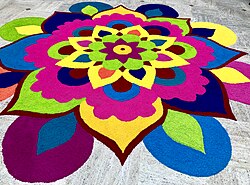
 Tamil New Year decorations for Puthandu | |
| Observed by | Tamils in India, Sri Lanka, Mauritius, Reunion, Malaysia, Singapore[1] |
| Type | Cultural, Social, Religious |
| Significance | Tamil New Year |
| Celebrations | Feasting, gift-giving, visiting homes and temples |
| Date | First day of Chithirai in the Tamil calendar |
| Related to | South and Southeast Asian solar New Year |
Template:Tamil transliteration Puthandu (Tamil: தமிழ்ப்புத்தாண்டு), also known as Puthuvarudam,Tamil New Year, is the first day of year on the Tamil calendar and traditionally celebrated as a festival.[1][6][7] The festival date is set with the solar cycle of the lunisolar Hindu calendar, as the first day of the Tamil month Chithirai. It falls on or about 14 April every year on the Gregorian calendar.[1] The same day is observed elsewhere in South and South East Asia as the traditional new year, but is known by other names such as Vishu in Kerala, and Vaisakhi or Baisakhi in central and northern India.[1]
On this day, Tamil people greet each other by saying "Puthāaṇdu vāazhthugal!" (புத்தாண்டு வாழ்த்துக்கள்) or "Iṉiya puthaandu nalvāazhthugal!" (இனிய புத்தாண்டு நல்வாழ்த்துக்கள்), which is equivalent to "Happy new year".[8] The day is observed as a family time. Households clean up the house, prepare a tray with fruits, flowers and auspicious items, light up the family puja altar and visit their local temples. People wear new clothes and children go to elders to pay their respects and seek their blessings, then the family sits down to a vegetarian feast.[9]
Puthandu is also celebrated by Tamil Hindus outside Tamil Nadu and Puducherry, such as in Sri Lanka, Malaysia, Singapore, Reunion, Mauritius and other countries with Tamil diaspora.[1][6]
Origin and significance[edit | edit source]
_Tamil_Hindu_New_Year.jpg)
The Tamil New Year follows the spring equinox and generally falls on 14 April of the Gregorian year.[1] The day celebrates on the first day of the traditional Tamil calendar and is a public holiday in both Tamil Nadu and Sri Lanka. The same date is observed as the traditional new year in Assam, West Bengal, Kerala, Tripura, Bihar, Odisha, Punjab, Himachal Pradesh, Haryana, as well as in Nepal and Bangladesh. Myanmar, Cambodia, Laos, Thailand, and Tamils in Sri Lanka also celebrate the same day as their new year,[10] likely an influence of the shared culture between South and Southeast Asia in the 1st millennium CE.[11]
There are several references in early Tamil literature to the April new year. Nakkirar, Sangam period author of the Neṭunalvāṭai, wrote that the sun travels from Mesha/Chitterai through 11 successive signs of the zodiac.[12][13] Kūdalūr Kizhaar refers to Mesha Raasi/Chitterai as the commencement of the year in the Puṟanāṉūṟu.[14][15][16] The Tolkaapiyam is the oldest surviving Tamil grammar that divides the year into six seasons where Chitterai marks the start of the Ilavenil season or summer.[17] The Silappadikaaram mentions the 12 Raasis or zodiac signs starting with Mesha/Chitterai.[18] The Manimekalai alludes to the Hindu solar calendar as we know it today. Adiyarkunalaar, an early medieval commentator or Urai-asiriyar mentions the twelve months of the Tamil calendar with particular reference to Chitterai. There were subsequent inscriptional references in Pagan, Burma dated to the 11th century CE and in Sukhothai, Thailand dated to the 14th century CE to South Indian, often Vaishnavite, courtiers who were tasked with defining the traditional calendar that began in mid-April.[19]
Celebration[edit | edit source]
| Part of a series on |
| Hinduism |
|---|
 |


Tamil people celebrate Puthandu, also called Puthuvarusham, as the traditional "Tamil/Hindu New Year", states Peter Reeves.[6] This is the month of Chittirai, the first month of the Tamil solar calendar, and Puthandu typically falls on 14 April.[7] In some parts of Southern Tamil Nadu, the festival is called Chittirai Vishu. On the eve of Puthandu, a tray arranged with three fruits (mango, banana and jack fruit), betel leaves and arecanut, gold/silver jewellery, coins/money, flowers and a mirror.[20] This is similar to the Vishu new year festival ceremonial tray in Kerala. According to the Tamil tradition, this festive tray is auspicious as the first sight upon waking on the new year day.[7] Home entrances are decorated elaborately with colored rice powder. These designs are called kolams.[21]
In the temple city of Madurai, the Chitterai Thiruvizha is celebrated in the Meenakshi Temple. A huge exhibition is held, called Chitterai Porutkaatchi.[7] On the day of the Tamil New Year, a big Car Festival is held at Tiruvidaimarudur near Kumbakonam. Festivals are also held at Tiruchirapalli, Kanchipuram and other places.[7]

Sri Lankan Tamils observe the traditional new year in April with the first financial transaction known as the Kai-vishesham. In this transaction children go to elders to pay their respect, and elders give their blessings and gift pocket money to the children in return. The event is also observed with the 'arpudu' or the first ploughing of the ground to prepare for the new agricultural cycle. The game of 'por-thenkai' or coconut wars between youth is played in villages through the Tamil north and east of the island while cart races are also held.[22] The festive Puthandu season in April is a time for family visits and the renewal of filial bonds.[23] It coincides with the Sinhalese new year season.[24]


Later in the day, families enjoy a feast.[20] A special dish called Mangai-pachadi is prepared from a variety of flavors, similar to pacchadi of new year foods of Ugadi and Vishu.[20][25] It is made from sweet jaggery, astringent mustard, sour raw mango, bitter neem, and red chilies. These complex dish is ritually tasted by Tamils, as similar multi-flavors are by Hindus elsewhere on the new year. Such traditional festive recipes, that combine different flavors, are a symbolic reminder that one must expect all flavors of experiences in the coming new year, that no event or episode is wholly sweet or bitter, experiences are transitory and ephemeral, and to make the most from them.[26]
In Malaysia and Singapore, Tamils join Sikhs, Malayalees and Bengalis to celebrate the traditional new year in mid-April with leaders across the political spectrum wishing the ethnic Indian community for the new year. Special religious events are held in Hindu temples, in Tamil community centers and Gurdwaras. Cultural programs and media events also take place. It's a day of celebration for the Indian community.[27][28][29][30][31]
Controversy[edit | edit source]

The Dravida Munnetra Kazhagam (DMK)-led Government of Tamil Nadu had declared in 2008 that the Tamil new year should be celebrated on the first day of Tamil month of Thai (14 January) coinciding with the harvest festival of Pongal. The Tamil Nadu New Year (Declaration Bill 2008) was enacted as the state law by the DMK assembly members and its Tamil Nadu Government on 29 January 2008.[32] This law of the DMK majority-led government was subsequently rescinded by a separate act of legislation in the Tamil Nadu Assembly with an AIADMK majority-led government on 23 August 2011.[33][34][35] Many in Tamil Nadu ignored the DMK government legislation that rescheduled the festival date, and continued the celebration of their traditional Puthandu new year festival in mid-April.[36][37] The Governor and Chief Minister of the Indian Union Territory of Puducherry, which has an ethnic Tamil majority, felicitated the public for the Tamil new year in April 2010.[38]
The legislative reach to change the traditional religious new year by the DMK government was questioned by Hindu priests and Tamil scholars.[39][40] The law was met with resistance by Tamils in the state and elsewhere.[41][42][43] It was also challenged in court.[44][45] The then opposition All India Anna Dravida Munnetra Kazhagam (AIADMK) and Marumalarchi Dravida Munnetra Kazhagam (MDMK) in Tamil Nadu subsequently condemned the decision of the DMK Government in that state and urged their supporters to continue celebrating the traditional date in mid-April.[46] Tamils in Sri Lanka, Singapore, Malaysia and Canada continued to observe the new year in mid-April.[47][48][49][50][51]
The previous state government in Tamil Nadu in an effort to placate popular sentiment announced that the same day will be celebrated as a new festival renamed as "Chithirai Tirunal" (the festival of Chithirai). The day remained a public holiday in Tamil Nadu under the DMK government, but not as Tamil new year, but purportedly to commemorate Dr. B.R Ambedkar, who was the Chairman of the Drafting Committee of Indian Constitution. All television channels in Tamil Nadu, including the pro-DMK Sun TV, continued to telecast festive "Chithirai Tirunal Special Programs" on 14 April 2010. The leader of the AIADMK, Jayalalitha refused to recognize the repackaged festival, and felicitated the Tamil people for the traditional Tamil New Year. The MDMK leader Vaiko, followed suit.[52] The controversy between the two dates subsided, the official celebrations during the traditional new year in April revived and the public holiday was restored as the Tamil New Year.[53][54][55][56]
Related festivals[edit | edit source]
Puthandu is celebrated elsewhere in India under different names commemorating the solar new year.[57][58][11] Some examples include:
- Vishu in Kerala
- Vaisakhi in Punjab, Haryana, Himachal Pradesh, NCT of Delhi, Uttar Pradesh, Uttarakhand, Rajasthan, Bihar, Jharkhand, Madhya Pradesh and Chhattisgarh
- Pana Sankranti in Odisha
- Pohela Boishakh in West Bengal and Tripura
- Rongali Bihu in Assam
However, this is not the universal new year for all Hindus. For some, such as those in Gujarat, the new year festivities coincide with the five-day Diwali festival. New Year celebrations in Karnataka, Andhra Pradesh and Telangana's Ugadi & Maharashtra and Goa's Gudi Padwa, falls a few weeks before Puthandu.[11]
South Asia and Southeast Asia[edit | edit source]
The same day every year is the new year for many Buddhist communities in parts of Southeast Asia such as Myanmar, Sri Lanka and Cambodia, likely an influence of their shared culture in the 1st millennium CE.[11]
According to a 1957 publication by Gunasegaram, the new year celebrated in Sri Lanka, Cambodia and Champa (Vietnam) is the Tamil New Year with roots in the practices of Mohenjo-daro (Indus Valley civilization).[59][60] According to Nanacuriyan, this may be from the medieval era Tamil influence in Southeast Asia.[61]
According to Jean Michaud and other scholars, the new year celebration traditions in Southeast Asian Massif have two roots.[62] One is China, and this influence is found for example in Vietnam and southeastern China. These Sino-influenced communities celebrate the new year in the first or second lunar month after the winter solstice in December. The second group of people in the Massif celebrate the new year in mid April, much like most of India. This group consists of northeastern Indians, northeastern Myanmar, Tai speakers of Thailand, Laos, northern Vietnam and southern Yunnan.[62] The festival is celebrated in the Massif in some ways unlike Puthandu. It is marked by an occasion to visit family and friends, splashing others with water (like Holi), drinking alcohol, as well as later wearing jewelry, new clothes and socializing.[62] The new year festival is called regionally by different names:
- Vaisakhi in Pakistan and Afghanistan
- Bikram Samwat / Vaishak Ek in Nepal
- Pohela Boishakh in Bangladesh
- Aluth Avuruthu (Sinhalese New Year) in Sri Lanka [10]
- Chol Chnam Thmey in Cambodia
- Songkan / Pi Mai Lao in Laos
- Songkran in Thailand
- Thingyan in Myanmar
See also[edit | edit source]
References[edit | edit source]
- ↑ 1.0 1.1 1.2 1.3 1.4 1.5 J. Gordon Melton (2011). Religious Celebrations: An Encyclopedia of Holidays, Festivals, Solemn Observances, and Spiritual Commemorations. ABC-CLIO. p. 633. ISBN 978-1-59884-206-7.
- ↑ https://cms.tn.gov.in/sites/default/files/go/public_e_935_2021.pdf [bare URL PDF]
- ↑ "Sri Lanka Public Holidays 2022 – PublicHolidays.lk".
- ↑ "Malaysia Tamil new year".
- ↑ "Mauritius Tamil new year". 8 April 2022.
- ↑ 6.0 6.1 6.2 Peter Reeves (2014). The Encyclopedia of the Sri Lankan Diaspora. Editions Didier Millet. p. 113. ISBN 978-981-4260-83-1., Quote: "The key festivals celebrated by Sri Lankan Tamils in Canada include Thai Pongal (harvest festival) in January, Puthuvarusham (Tamil/Hindu New Year) in April, and Deepavali (Festival of Lights) in October/November."
- ↑ 7.0 7.1 7.2 7.3 7.4 Roshen Dalal (2010). Hinduism: An Alphabetical Guide. Penguin Books. p. 406. ISBN 978-0-14-341421-6.
- ↑ William D. Crump (2014). Encyclopedia of New Year's Holidays Worldwide. McFarland. p. 220. ISBN 978-0-7864-9545-0.
- ↑ Samuel S. Dhoraisingam (2006). Peranakan Indians of Singapore and Melaka. Institute of Southeast Asian Studies. p. 38. ISBN 978-981-230-346-2.
- ↑ 10.0 10.1 Peter Reeves (2014). The Encyclopedia of the Sri Lankan Diaspora. Didier Millet. p. 174. ISBN 978-981-4260-83-1.
- ↑ 11.0 11.1 11.2 11.3 Karen Pechilis; Selva J. Raj (2013). South Asian Religions: Tradition and Today. Routledge. pp. 48–49. ISBN 978-0-415-44851-2.
- ↑ JV Chelliah: Pattupattu: Ten Tamil Idylls. Tamil Verses with English Translation. Thanjavur: Tamil University, 1985 – Lines 160 to 162 of the Neṭunalvāṭai
- ↑ Kamil Zvelabil dates the Neṭunalvāṭai to between the 2nd and 4th century CE – Kamil Zvelebil: The Smile of Murugan on Tamil Literature of South India. E.J. Brill, Leiden, Netherlands, 1973 – page 41-42
- ↑ Poem 229 of Puṟanāṉūṟu
- ↑ Professor Vaiyapuri Pillai: 'History of Tamil Language and Literature' Chennai, 1956, pages 35, 151
- ↑ George L. Hart and Hank Heifetz: The Four Hundred Songs of War and Wisdom: An Anthology of Poems from Classical Tamil: The Purananuru, Columbia University Press, New York, 1999 – Poem 229 in pages 142 to 143. – "At midnight crowded with darkness in the first quarter of the night when the constellation of Fire was linked with The Goat and from the moment the First Constellation arose...during the first half of the month of Pankuni, when the Constellation of the Far North was descending...". George Hart in turn dates the Purananuru to between the first and third centuries CE. See page xv – xvii
- ↑ V. Murugan, G. John Samuel: Tolkāppiyam in English: Translation, with the Tamil text, Transliteration in the Roman Script, Introduction, Glossary, and Illustrations, Institute of Asian Studies, Madras, India, 2001
- ↑ Canto 26 of Silappadikaaram. Canto 5 also describes the foremost festival in the Chola country – the Indra Vizha celebrated in Chitterai
- ↑ G.H. Luce, Old Burma – Early Pagan, Locust Valley, New York, Page 68, and A.B. Griswold, 'Towards a History of Sukhodaya Art, Bangkok 1967, pages 12–32
- ↑ 20.0 20.1 20.2 Paul Fieldhouse (2017). Food, Feasts, and Faith: An Encyclopedia of Food Culture in World Religions. ABC-CLIO. p. 548. ISBN 978-1-61069-412-4.
- ↑ 21.0 21.1 Abbie Mercer (2007). Happy New Year. The Rosen Publishing Group. p. 22. ISBN 978-1-4042-3808-4.
- ↑ "Features | Online edition of Daily News – Lakehouse Newspapers". Dailynews.lk. 12 April 2008. Archived from the original on 14 October 2012. Retrieved 18 October 2011.
- ↑ Sivanandini Duraiswamy, Remembering Hindu Traditions, M.D. Gunasena and Co Ltd, 1997, pages 41–48. "Archived copy" (PDF). Archived from the original (PDF) on 22 April 2016. Retrieved 13 April 2016.
{{cite web}}: CS1 maint: archived copy as title (link) - ↑ "tamilweek.com/news-features " April 14 is the Tamil New Year, not Sinhalese!". Tamilweek.com. Archived from the original on 27 October 2011. Retrieved 18 October 2011.
- ↑ A new year, and flavours to match, Ranjani Ranjendra, The Hindu (23 March 2017)
- ↑ Narayanan, Vasudha (1999). "Y51K and Still Counting: Some Hindu Views of Time". Journal of Hindu-Christian Studies. 12 (1). Butler University: 17–19. doi:10.7825/2164-6279.1205.
- ↑ "Archived copy". Archived from the original on 4 January 2014. Retrieved 21 April 2013.
{{cite web}}: CS1 maint: archived copy as title (link) - ↑ "Archived copy". Archived from the original on 4 January 2014. Retrieved 21 April 2013.
{{cite web}}: CS1 maint: archived copy as title (link) - ↑ "Archived copy". thestar.com.my. Archived from the original on 16 April 2013. Retrieved 15 January 2022.
{{cite web}}: CS1 maint: archived copy as title (link) - ↑ "Archived copy". Archived from the original on 30 June 2013. Retrieved 21 April 2013.
{{cite web}}: CS1 maint: archived copy as title (link) - ↑ "PM Lee celebrates Tamil New Year / News Room / Singapore United – Com…".
{{cite web}}: CS1 maint: deprecated archival service (link) - ↑ "Bill on new Tamil New Year Day is passed unanimously". Tn.gov.in. Retrieved 18 October 2011.
- ↑ "Jaya changes DMK's calendar, Tamil new year in April now". The Indian Express. India. 24 August 2011. Retrieved 18 October 2011.
- ↑ DC chennai (24 August 2011). "Jaya reverses Karunanidhi's order; Tamil New Year on Chithirai 1". Deccan Chronicle. India. Retrieved 18 October 2011.
- ↑ Special Correspondent (23 August 2011). "States / Tamil Nadu : Tamil New Year in Chithirai". The Hindu. India. Retrieved 18 October 2011.
{{cite news}}:|author=has generic name (help) - ↑ "Tamils ignore government fiat, celebrate New Year – Thaindian News". Thaindian.com. 13 April 2008. Retrieved 18 October 2011.
- ↑ "Tamil new year celebrated in UT [newkerala.com, The Netherlands, 89374]". Newkerala.com. Retrieved 18 October 2011.
- ↑ "Pondy Governor, CM greet people on eve of Tamil New Year [newkerala.com, The Netherlands, 89118]". Newkerala.com. Retrieved 18 October 2011.
- ↑ www.dailypioneer.com https://web.archive.org/web/20090331221442/http://www.dailypioneer.com/30420/DMKs-bogus-Tamil-New-Year.html. Archived from the original on 31 March 2009.
{{cite web}}: Missing or empty|title=(help) - ↑ "A Tamil cultural debate".
- ↑ "India E-news". India E-news. 13 April 2008. Archived from the original on 18 April 2008. Retrieved 18 October 2011.
- ↑ "SINHALAYA'S FULL COVERAGE – Lankan Tamils reject Karunanidhi's diktat on Tamil New Year – CyberTalks". Sinhalaya.com. Retrieved 18 October 2011.
- ↑ M.R. Venkatesh (13 April 2008). "The Telegraph – Calcutta (Kolkata) | Nation | TN bans new year rites, priests fume". The Telegraph. Kolkota, India. Retrieved 18 October 2011.
- ↑ "Law altering Tamil new year day challenged". Sindh Today. Archived from the original on 4 May 2008. Retrieved 18 October 2011.
- ↑ "Court asks Tamil Nadu why change age-old New Year date". Bombay News.Net. 12 September 2008. Archived from the original on 26 October 2011. Retrieved 18 October 2011.
- ↑ "Jaya, Vaiko greet people, criticise change of New Year". News.webindia123.com. 12 April 2008. Retrieved 18 October 2011.
- ↑ "14.04.08 Liberate Calendar". TamilNet. 14 April 2008. Retrieved 18 October 2011.
- ↑ "13.04.08 Tamil New Year". TamilNet. 13 April 2008. Retrieved 18 October 2011.
- ↑ "12.04.08 Prime Minister of Canada greets Tamil New Year". TamilNet. Retrieved 18 October 2011.
- ↑ https://web.archive.org/web/20190115132452/https://www.nst.com.my/articles/08yas/Article/index_html. Archived from the original on 15 January 2019. Retrieved 14 April 2010.
{{cite web}}: Missing or empty|title=(help) - ↑ "Sri Lankan Sinhalese And Tamil Community Celebrate Traditional New Year Tomorrow". GroundReport. 13 April 2010. Archived from the original on 1 October 2011. Retrieved 18 October 2011.
- ↑ Sathyalaya Ramakrishnan reporting from Chennai (14 April 2010). "TN Governor and leaders greets people on Tamil NewYear". Asian Tribune. Retrieved 18 October 2011.
- ↑ "Archived copy". Archived from the original on 4 January 2014. Retrieved 21 April 2013.
{{cite web}}: CS1 maint: archived copy as title (link) - ↑ "Law on Tamil New Year was enacted for publicity, says Jayalalithaa". The Hindu. Chennai, India. 14 April 2012.
- ↑ "Archived copy". Archived from the original on 4 January 2014. Retrieved 21 April 2013.
{{cite web}}: CS1 maint: archived copy as title (link) - ↑ "Archived copy". Archived from the original on 6 July 2015. Retrieved 21 April 2013.
{{cite web}}: CS1 maint: archived copy as title (link) - ↑ "BBC – Religion: Hinduism – Vaisakhi". BBC. Retrieved 22 January 2012.
- ↑ Crump, William D. (2014), Encyclopedia of New Year's Holidays Worldwide, MacFarland, page 114
- ↑ Tamil cultural influences in South East Asia (1957) by Samuel Jeyanayagam Gunasegaram, Ceylon Printers p.18
- ↑ Tamil Culture, Band 6 (1957), Academy of Tamil Culture p.79
- ↑ An introduction to Tamil culture, Kirusna Nanacuriyan (1984), Institute for International Tamil Renaissance p.81
- ↑ 62.0 62.1 62.2 Jean Michaud; Margaret Byrne Swain; Meenaxi Barkataki-Ruscheweyh (2016). Historical Dictionary of the Peoples of the Southeast Asian Massif. Rowman & Littlefield. pp. 178–179. ISBN 978-1-4422-7279-8.
External links[edit | edit source]
| Major festivals | ||
|---|---|---|
| Other important festivals | ||
| Regional New Year |
| |
| Holy days |
| |
| Holy periods | ||


_name_of_the_God_as_per_the_Vedas.svg)
| Philosophy |
|  | |||||||||||||||
|---|---|---|---|---|---|---|---|---|---|---|---|---|---|---|---|---|---|
| Texts |
| ||||||||||||||||
| Deities |
| ||||||||||||||||
| Practices |
| ||||||||||||||||
| Related | |||||||||||||||||