

Ajay Kumar (talk | contribs) Created a new article Tag: nowiki added |
m reworked citations further and improved wording |
||
| Line 1: | Line 1: | ||
{{Short description|Indo-Aryan language | {{Short description|Indo-Aryan language of Sri Lanka}} | ||
{{EngvarB|date=October 2015}} | {{EngvarB|date=October 2015}} | ||
{{Use dmy dates|date=March 2015}} | {{Use dmy dates|date=March 2015}} | ||
{{Infobox language | {{Infobox language | ||
|name= Sinhala | | name = Sinhala | ||
|image=සිංහල in Noto Serif Sinhala Black.svg | | image = සිංහල in Noto Serif Sinhala Black.svg | ||
|nativename={{lang|si|සිංහල| | | image_class = skin-invert-image | ||
|pronunciation={{IPA | | nativename = <div style="text-align: center;"> | ||
|states = [[Sri Lanka]] | {{lang|si|සිංහල භාෂාව}}<br /> | ||
|ethnicity = [[Sinhalese people]] | {{transliteration|si|ISO|Siṁhala Bhāṣāva}}<br /> | ||
|speakers = | also ''Sinhala Bhashawa'' or ''Sinhala Bhashava'' | ||
|date | </div> | ||
|ref | | pronunciation = {{IPA|si|ˈsiŋɦələ|IPA}} | ||
|speakers2= [[L2 | | states = [[Languages of Sri Lanka|Sri Lanka]] | ||
|speakers_label=Speakers | | ethnicity = [[Sinhalese people|Sinhalese]] | ||
|familycolor=Indo-European | | speakers = [[first language|L1]]: {{sigfig|16.211690|2}} million | ||
|fam2=[[Indo-Iranian languages|Indo-Iranian]] | | date = 2021 | ||
|fam3=[[Indo-Aryan languages|Indo-Aryan]] | | ref = <ref name="e28|sin">{{e28|sin}}</ref> | ||
|fam4=[[Indo-Aryan languages#Southern Zone|Southern Zone]] | | speakers2 = [[second language|L2]]: {{sigfig|4.011100|1}} million (2021)<ref name="e28|sin">{{e28|sin}}</ref><br/>Total: {{sigfig|20.222790|2}} million (2021)<ref name="e28|sin">{{e28|sin}}</ref> | ||
|fam5=[[Indo-Aryan languages# | | speakers_label = Speakers | ||
| | | familycolor = Indo-European | ||
|dia1=[[Vedda language|Vedda]] (perhaps a [[Creole language]]) | | fam2 = [[Indo-Iranian languages|Indo-Iranian]] | ||
|script={{plainlist| | | fam3 = [[Indo-Aryan languages|Indo-Aryan]] | ||
| fam4 = [[Indo-Aryan languages#Southern Zone|Southern Zone]] | |||
| fam5 = [[Indo-Aryan languages#Southern Zone|Sinhalese–Maldivian]]<ref name="e28|sin">{{e28|sin}}</ref> | |||
| dia1 = [[Vedda language|Vedda]]? (perhaps a [[Creole language]]) | |||
| dia2 = [[Rodiya dialect|Rodiya]] {{Extinct}} | |||
| script = {{plainlist| | |||
*[[Sinhala script]] | *[[Sinhala script]] | ||
*[[Sinhala Braille]] ([[Bharati Braille]])}} | *[[Sinhala Braille]] ([[Bharati Braille]])}} | ||
|nation= | | nation = [[Sri Lanka]] | ||
|iso1=si | | iso1 = si | ||
|iso2=sin | | iso2 = sin | ||
|iso3=sin | | iso3 = sin | ||
|lingua=59-ABB-a | | lingua = 59-ABB-a | ||
|glotto=sinh1246 | | glotto = sinh1246 | ||
|glottorefname=Sinhala | | glottorefname = Sinhala | ||
|notice=Indic | | notice = Indic | ||
|notice2=IPA | | notice2 = IPA | ||
| map = Sinhala language distribution.svg | |||
| mapcaption = {{Legend | #0062FF | Sinhala is the majority language where the vast majority are [[first language]] speakers}} | |||
{{Legend striped|#0062FF |#74B4FF| Sinhalese is the majority language, with other languages being spoken largely or as a second language (such as [[Malay language|Malay]] and [[Tamil language|Tamil]])}} | |||
}} | }} | ||
'''Sinhala''' ({{IPAc-en|ˈ|s|ɪ|n|h|ə|l|ə|,_|ˈ|s|ɪ|ŋ|ə|l|ə}} {{respell|SIN|hə|lə|,_|SING|ə|lə}};<ref>{{cite LPD|3}}</ref> Sinhala: {{lang|si|සිංහල}}, {{transliteration|si|ISO|siṁhala}}, {{IPA|si|ˈsiŋɦələ|}}),<ref>Laurie Bauer, 2007, ''The Linguistics Student's Handbook''</ref> sometimes called '''Sinhalese''' ({{IPAc-en|ˌ|s|ɪ|n|(|h|)|ə|ˈ|l|iː|z|,_|ˌ|s|ɪ|ŋ|(|ɡ|)|ə|ˈ|l|iː|z|}} {{respell|SIN|(h)ə|LEEZ|,_|SING|(g)ə|LEEZ|}}), is an [[Indo-Aryan languages|Indo-Aryan language]] primarily spoken by the [[Sinhalese people]] of [[Sri Lanka]], who make up the largest [[Ethnicity|ethnic group]] on the island, numbering about 16 million.<ref>{{Cite web|url=http://www.statistics.gov.lk/PopHouSat/CPH2011/index.php?fileName=pop42&gp=Activities&tpl=3|title=Census of Population and Housing 2011|website=www.statistics.gov.lk|access-date=2017-04-06|archive-date=28 April 2017|archive-url=https://web.archive.org/web/20170428063924/http://www.statistics.gov.lk/PopHouSat/CPH2011/index.php?fileName=pop42&gp=Activities&tpl=3|url-status=dead}}</ref><ref name="e28|sin">{{e28|sin}}</ref> It is also the first language of about 2 million other Sri Lankans, as of 2001.<ref>{{cite web |url=http://www.statistics.gov.lk/PopHouSat/PDF/Population/p9p11%20Speaking.pdf |title=Census of Population and Housing 2001 |publisher=Statistics.gov.lk |access-date=16 November 2013 |archive-date=12 July 2022 |archive-url=https://web.archive.org/web/20220712053634/http://www.statistics.gov.lk/PopHouSat/PDF/Population/p9p11%20Speaking.pdf |url-status=dead }}</ref> It is written in the [[Sinhala script|Sinhalese script]], a [[Brahmic scripts|Brahmic script]] closely related to the [[Grantha script]] of [[South India]].<ref name="auto2">{{Cite book|url=https://books.google.com/books?id=fcQSAAAAMAAJ|title=History of the Evolution of the Sinhala Alphabet|last=Jayarajan|first=Paul M.|date=1976-01-01|publisher=Colombo Apothecaries' Company, Limited|language=en}}</ref> The language has two main varieties, written and spoken, and is a notable example of the linguistic [[phenomenon]] known as [[diglossia]].<ref>{{Cite journal |last=Paolillo |first=John C. |date=1997 |title=Sinhala Diglossia: Discrete or Continuous Variation? |journal=Language in Society |volume=26 |issue=2 |pages=269–296 |doi=10.1017/S0047404500020935 |issn=0047-4045 |jstor=4168764 |s2cid=144123299}}</ref> | |||
'''Sinhala''' ({{IPAc-en|ˈ|s|ɪ|n|h|ə|l|ə|,_|ˈ|s|ɪ|ŋ|ə|l|ə}} {{respell|SIN|hə|lə|,_|SING|ə|lə}};<ref>{{cite LPD|3}}</ref> Sinhala: {{lang|si|සිංහල}}, {{ | |||
Sinhala is one of the official and national languages of Sri Lanka. Along with [[Pali]], it played a major role in the development of [[Theravada|Theravada Buddhist]] literature.<ref name= | Sinhala is one of the official and [[Languages of Sri Lanka|national languages of Sri Lanka]]. Along with [[Pali]], it played a major role in the development of [[Theravada|Theravada Buddhist]] literature.<ref name="e28|sin">{{e28|sin}}</ref> | ||
Early forms of the Sinhalese language are attested to as early as the [[3rd century BC|3rd century BCE]].<ref>Prof. Senarat Paranavithana (1970), Inscriptions of Ceylon Volume I – Early Brāhmī Inscriptions</ref> The language of these inscriptions, still retaining [[Vowel length|long vowels]] and [[aspirated consonant]]s, is a [[Prakrit]] similar to [[Magadhi Prakrit|Magadhi]], a regional associate of the [[Middle kingdoms of India|Middle-Indian]] Prakrits that had been spoken during the lifetime of the [[The Buddha|Buddha]].<ref name="malini">{{cite book|last1=Dias|first1=Malini|title=The language of the Early Brahmi inscriptions of Sri Lanka# Epigraphical Notes Nos.22-23|date=2020|publisher=Department of Archaeology|isbn=978-955-7457-30-7|pages=12–19}}</ref> The most closely related languages to Sinhalese are the [[Vedda language]] and the [[Maldivian language]]s; the former is an endangered indigenous [[Creole language|creole]] still spoken by a minority of Sri Lankans, which mixes Sinhalese with an isolate of unknown origin. Old Sinhalese borrowed various aspects of Vedda into its main Indo-Aryan substrate.<ref>{{Cite journal|last=Gair|first=James W.|date=1968|title=Sinhalese Diglossia|journal=Anthropological Linguistics|volume=10|issue=8|pages=1–15|issn=0003-5483|jstor=30029181}}</ref> | |||
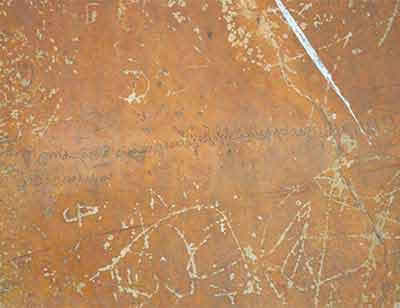
[[File:Sigiriya-graffiti.jpg|thumb|There are 1,500 poems written in the 6th–10th centuries on the [[Sigiriya]] Mirror Wall. These poems are believed to have been composed by pilgrims who came to visit the [[Buddhist monasticism|Buddhist monastery]] of Sigiriya, which was active at this time.<ref>{{Cite web |title=Sigiri Graffiti: poetry on the mirror-wall |url=http://www.lankalibrary.com/heritage/sigiriya/graffiti.htm |access-date=15 January 2023 |website=Lanka Library}}</ref>]] | |||
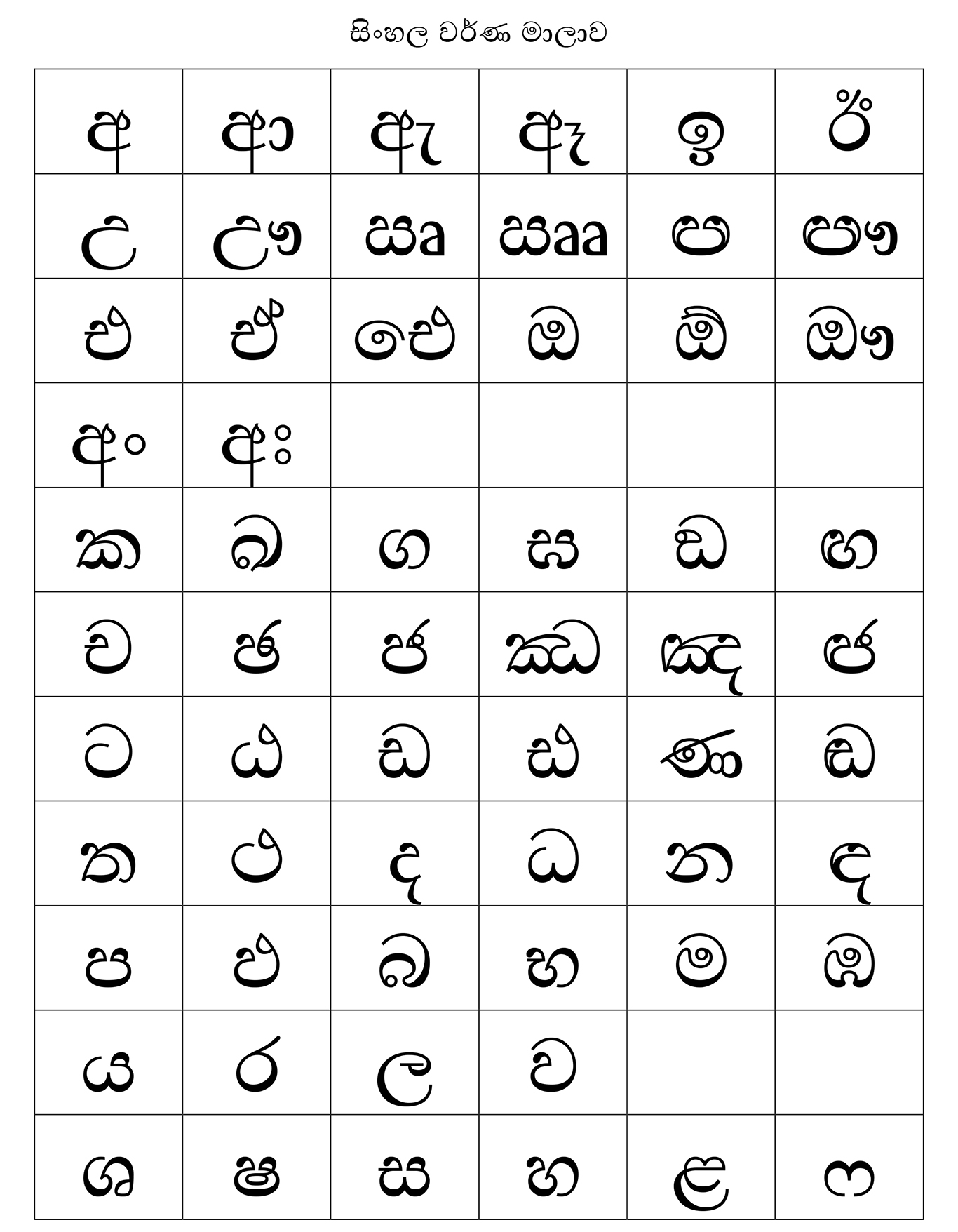
[[File:Sigiriya-graffiti.jpg|thumb|There are 1,500 poems written in the | [[File:New Sinhala Alphabet.jpg|thumb|Letters of the [[Sinhala script|Sinhalese script]]]] | ||
[[File:New Sinhala Alphabet.jpg|thumb|Letters of the [[Sinhala script]] | |||
== Etymology == | == Etymology == | ||
{{main|Names of Sri Lanka#Sinhala}} | {{main|Names of Sri Lanka#Sinhala}} | ||
''Sinhala'' ({{ | ''Sinhala'' ({{transliteration|sa|iso|Siṅhala}}) is a [[Sanskrit]] term; the corresponding [[Middle Indo-Aryan languages|Middle Indo-Aryan]] ([[Elu|Eḷu]]) word is {{Lang|mis|Sīhala}}. | ||
The name is a | The name is a derivative of the Sanskrit word for 'lion' {{IAST|siṁha}}.<ref>{{Citation | last=Caldwell | first=Robert | author-link=Robert Caldwell | title=A comparative grammar of the Dravidian or South-Indian Family of Languages | publisher=Trübner & Co. | place=London|year=1875|page=86}}</ref> The name is sometimes glossed as 'abode of lions', and attributed to a [[Panthera leo sinhaleyus|supposed former abundance]] of [[lion]]s on the island.<ref>{{Cite book |url=https://books.google.com/books?id=tCsYAAAAYAAJ&q=%22abode%20of%20lions%22 |title=The Asiatic Journal and Monthly Register for British and Foreign India, China, and Australia |publisher=Parbury, Allen, and Company |year=1836 |volume=20 |pages=30 |language=en}}</ref> | ||
== History == | == History == | ||
According to the chronicle | According to the chronicle {{translit|pi|IAST|[[Mahāvaṃsa]]}}, written in Pali, [[Prince Vijaya]] of the [[Vanga Kingdom]] and his entourage merged in Sri Lanka with later settlers from the [[Pandya dynasty|Pandya kingdom]].<ref>{{cite web |url=http://mahavamsa.org/mahavamsa/original-version/06-coming-vijaya/ |title=The Coming of Vijaya |work=The Mahavamsa|date=8 October 2011 }}</ref><ref>{{Cite web|url=https://mahavamsa.org/mahavamsa/original-version/07-consecrating-vijaya/|title=The Consecrating of Vijaya - the island of Lanka - Kuvani|date=8 October 2011 |website=The Mahavamsa |url-status=live |archive-url=https://web.archive.org/web/20230620071000/https://mahavamsa.org/mahavamsa/original-version/07-consecrating-vijaya/ |archive-date= Jun 20, 2023 }}</ref><ref>Gananath Obeyesekere, "[https://blogs.dickinson.edu/buddhistethics/files/2010/04/Obeyesekere.pdf Buddhism, ethnicity and Identity: A problem of Buddhist History]", in ''Journal of Buddhist Ethics'', 10, (2003): 46.</ref> In the following centuries, there was substantial immigration from Eastern India, including additional migration from the Vanga Kingdom (Bengal), as well as [[Kalinga (historical kingdom)|Kalinga]] and [[Magadha (Mahajanapada)|Magadha]].<ref>{{cite web|url=http://www.lankalibrary.com/books/sinhala_history.htm |title= Sri Lanka: A Short History of Sinhala Language |publisher=WWW Virtual Library Sri Lanka |access-date=16 November 2013 |url-status=dead |archive-url=https://web.archive.org/web/20131228185554/http://www.lankalibrary.com/books/sinhala_history.htm |archive-date= Dec 28, 2013 }}</ref> This influx led to an admixture of features of Eastern Prakrits.{{Citation needed|date=April 2009}} | ||
=== Stages of historical development === | === Stages of historical development === | ||
The development of Sinhala is divided into four epochs:<ref>Geiger, Wilhelm. "Chronological Summary of the Development of the Sinhalese Language. | The development of Sinhala is divided into four epochs:<ref>Geiger, Wilhelm. "Chronological Summary of the Development of the Sinhalese Language". Zeitschrift Für Vergleichende Sprachforschung Auf Dem Gebiete Der Indogermanischen Sprachen 76, no. 1/2 (1959): 52–59. {{JSTOR|40848039}}.</ref> | ||
* [[Elu| | * [[Elu|Elu Prakrit]] (3rd c. BCE to 4th c. CE) | ||
* Proto-Sinhala (4th c CE to 8th c CE) | * Proto-Sinhala (4th c. CE to 8th c. CE) | ||
* Medieval Sinhala (8th c CE to 13th c CE) | * Medieval Sinhala (8th c. CE to 13th c. CE) | ||
* Modern Sinhala (13th c CE to the present) | * Modern Sinhala (13th c. CE to the present) | ||
=== Phonetic development === | === Phonetic development === | ||
The most important phonetic developments of Sinhala include: | The most important phonetic developments of Sinhala include: | ||
* the loss of | * the loss of [[aspirated consonant#phonemic|aspiration]] as a distinction for [[plosive consonants]] (e.g. {{transliteration|si|ISO|kanavā}} "eating" corresponds to Sanskrit {{transliteration|sa|IAST|khādati}}, Hindustani {{transliteration|inc|ISO|khānā}}) | ||
* the loss of original [[vowel length]] distinction; long vowels in the modern language are | * the loss of original [[vowel length]] distinction; long vowels in the modern language are found in [[loanword]]s (e.g. {{transliteration|si|ISO|vibāgaya}} "exam" < Sanskrit {{transliteration|sa|IAST|vibhāga}}) or as a result of [[sandhi]], either after [[elision]] of [[intervocalic consonant]]s (e.g. {{transliteration|si|ISO|dānavā}} "to put" < {{transliteration|si|ISO|damanavā}}) or in originally [[Compound (linguistics)|compound]] words. | ||
* the simplification of [[consonant cluster]]s and [[Gemination|geminate consonants]] into geminates and single consonants respectively (e.g. Sanskrit | * the simplification of [[consonant cluster]]s and [[Gemination|geminate consonants]] into geminates and single consonants respectively (e.g. Sanskrit {{transliteration|sa|IAST|viṣṭā}} "time" > Helu {{transliteration|si|ISO|viṭṭa}} > Modern Sinhala {{transliteration|si|ISO|viṭa}}) | ||
* development of {{IPA|/tʃ/}} to {{IPA|/s/ and/or /ɦ/}} (e.g. san̆da/han̆da "moon" corresponds to Sanskrit | * development of {{IPA|/tʃ/}} to {{IPA|/s/}} and/or {{IPA|/ɦ/}} (e.g. {{transliteration|si|ISO|san̆da}}/{{transliteration|si|ISO|han̆da}} "moon" corresponds to Sanskrit {{transliteration|sa|IAST|candra}}) and development of {{IPA|/dʒ/}} to {{IPA|/d/}} (e.g. {{transliteration|si|ISO|dæla}} "web" corresponds to Sanskrit {{transliteration|sa|IAST|jāla}}) | ||
* development of [[prenasalized consonant]]s from Sanskrit nasal + voiced stops (as in {{transliteration|si|ISO|han̆da}})<ref>{{harvnb|Geiger|1938|p=68}}</ref> | |||
* retention of initial {{IPA|/w/}} and {{IPA|/j/}}, the latter only shared with [[Kashmiri language|Kashmiri]] (as in {{transliteration|si|ISO|viṭa}} and {{transliteration|si|ISO|yutu}} "fit, proper" < Sanskrit {{transliteration|sa|ISO|yukta}})<ref>{{harvnb|Geiger|1938|p=79}}</ref> | |||
=== Western vs. Eastern Prakrit features === | === Western vs. Eastern Prakrit features === | ||
According to [[Wilhelm Geiger]], an example of a possible Western feature in Sinhala is the retention of initial {{IPA|/v/}} which developed into {{IPA|/b/}} in the Eastern languages (e.g. Sanskrit | According to [[Wilhelm Geiger]], an example of a possible Western feature in Sinhala is the retention of initial {{IPA|/v/}} which developed into {{IPA|/b/}} in the Eastern languages (e.g. Sanskrit {{transliteration|sa|iso|viṁśati}} "twenty", Sinhala {{transliteration|si|ISO|visi-}}, Hindi {{transliteration|hi|ISO|bīs}}). This is disputed by [[Muhammad Shahidullah]] who says that Helu Prakrit branched off from the Eastern Prakrits prior to this change. He cites the [[edicts of Ashoka]], no copy of which shows this sound change.<ref>Shahidullah, Muhammad. "The Origin of the Sinhalesé Language". The Journal of the Ceylon Branch of the Royal Asiatic Society of Great Britain & Ireland 8, no. 1 (1962): 108–11. {{JSTOR|45377492}}.</ref> | ||
An example of an Eastern feature is the ending -e for masculine nominative singular (instead of Western -o) in | An example of an Eastern feature is the ending {{transliteration|inc|ISO|-e}} for masculine nominative singular (instead of Western {{transliteration|inc|ISO|-o}}) in Helu. There are several cases of vocabulary [[Doublet (linguistics)|doublets]], one example being the words {{transliteration|si|ISO|mæssā}} ("fly") and {{transliteration|si|ISO|mækkā}} ("flea"), which both correspond to Sanskrit {{transliteration|sa|ISO|makṣikā}} but stem from two regionally different Prakrit words {{transliteration|inc|ISO|macchiā}} (Western Prakrits) and {{transliteration|inc|ISO|makkhikā}} (as in Eastern Prakrits like [[Pali]]). | ||
=== Pre-1815 Sinhalese literature === | === Pre-1815 Sinhalese literature === | ||
{{Expand section|date=January 2024}} | |||
<!-- The use of the word "Sinhalese" in this section is appropriate because the language was known as "Sinhalese" or "Singhalese" before the mid 20th century. --> | <!-- The use of the word "Sinhalese" in this section is appropriate because the language was known as "Sinhalese" or "Singhalese" before the mid 20th century. --> | ||
In 1815 the island of Ceylon came under [[Sri Lanka#British rule|British rule]]. During the career of [[Christopher Reynolds (linguist)|Christopher Reynolds | <!-- This section needs actual content about Pre-1815 literature --> | ||
In 1815, the island of Ceylon came under [[Sri Lanka#British rule|British rule]]. During the career of [[Christopher Reynolds (linguist)|Christopher Reynolds]] as a Sinhalese lecturer at the [[SOAS University of London|School of African and Oriental Studies, University of London]], he extensively researched the Sinhalese language and its pre-1815 literature. The Sri Lankan government awarded him the [[Sri Lanka Ranjana]] medal for his work. He wrote the 377-page ''An anthology of Sinhalese literature up to 1815'', selected by the [[UNESCO]] National Commission of Ceylon<ref>{{cite journal|title=UNESCO Collection of Representative Works, Sinhalese Series|journal= Bulletin of the School of Oriental and African Studies|publisher= George Allen and Unwin Limited|location= London|date= 1970 |volume= 34|issue= 3|pages= 623–624|doi= 10.1017/S0041977X00128812|url=http://journals.cambridge.org/action/displayAbstract?fromPage=online&aid=4090792|last1= Gombrich|first1= Richard|url-access= subscription}}</ref> | |||
=== Substratum influence in Sinhala === | === Substratum influence in Sinhala === | ||
According to [[Wilhelm Geiger]], Sinhala has features that set it apart from other Indo-Aryan languages. Some of the differences can be explained by the substrate influence of the parent stock of the [[Vedda language]].<ref>{{Harvnb|Gair|1998|page=4}}</ref> Sinhala has many words that are only found in Sinhala, or shared between Sinhala and Vedda and not etymologically derivable from Middle or Old Indo-Aryan. Possible examples include | According to [[Wilhelm Geiger]], Sinhala has features that set it apart from other Indo-Aryan languages. Some of the differences can be explained by the substrate influence of the parent stock of the [[Vedda language]].<ref>{{Harvnb|Gair|1998|page=4}}</ref> Sinhala has many words that are only found in Sinhala, or shared between Sinhala and Vedda and not etymologically derivable from Middle or Old Indo-Aryan. Possible examples include {{transliteration|si|ISO|kola}} for leaf in Sinhala and Vedda (although others suggest a Dravidian origin for this word.<ref>M.H. Peter Silva, Influence of Dravida on Sinhalese, University of Oxford. Faculty of Oriental Studies 1961, Thesis (D.Phil.) p. 152</ref><ref>University of Madras Tamil Lexicon, "[https://dsal.uchicago.edu/cgi-bin/app/tamil-lex_query.py?qs=%E0%AE%95%E0%AF%81%E0%AE%B4%E0%AF%88&searchhws=yes&matchtype=exact குழை kuḻai]".</ref><ref>TamilNet, ''Know the Etymology'': 334, ''Place Name of the Day'': 23 March 2014, "[https://www.tamilnet.com/art.html?artid=37130&catid=98 Kola-munna, Anguna-kola-pelessa]".</ref>), {{translit|si|iso|dola}} for pig in Vedda and offering in Sinhala. Other common words are {{translit|si|iso|rera}} for wild duck, and {{translit|si|iso|gala}} for stones (in [[toponyms]] used throughout the island, although others have also suggested a Dravidian origin).<ref>{{cite web |website=A Dravidian Etymology Dictionary |title=kal (kaṟ-, kaṉ-) |url=https://dsal.uchicago.edu/cgi-bin/app/burrow_query.py?qs=kal%20(kaṟ-,%20kaṉ-)&searchhws=yes |url-status=dead |archive-url=https://web.archive.org/web/20220202044038/https://dsal.uchicago.edu/cgi-bin/app/burrow_query.py?qs=kal%20(ka%E1%B9%9F-,%20ka%E1%B9%89-)&searchhws=yes |archive-date= Feb 2, 2022 }}</ref><ref>Tuttle, Edwin H. "Dravidian Researches". ''The American Journal of Philology'', vol. 50, no. 2, Johns Hopkins University Press, 1929, pp. 138–55, {{doi|10.2307/290412}}.</ref><ref name=v230>{{Harvnb|Van Driem|2002|page=230}}</ref> There are also high frequency words denoting body parts in Sinhala, such as {{transliteration|si|ISO|olluva}} for head, {{transliteration|si|ISO|kakula}} for leg, {{transliteration|si|ISO|bella}} for neck and {{transliteration|si|ISO|kalava}} for thighs, that are derived from pre-Sinhalese languages of Sri Lanka.<ref name=I45>{{Harvnb|Indrapala|2007|page=45}}</ref> The oldest known Sinhala grammar, [[Sidatsangarā|Sidatsan̆garavā]], written in the 13th century CE, recognised a category of words that exclusively belonged to early Sinhala. The grammar lists {{transliteration|si|ISO|naram̆ba}} (to see) and {{transliteration|si|ISO|koḷom̆ba}} (fort or harbour) as belonging to an indigenous source. {{transliteration|si|ISO|Koḷom̆ba}} is the source of the name of the commercial capital [[Colombo]].<ref>{{Harvnb|Indrapala|2007|page=70}}</ref><ref>{{Harvnb|Gair|1998|page=5}}</ref> | ||
Place Name of the Day: | |||
===South Dravidian substratum influence=== | ===South Dravidian substratum influence=== | ||
The loss of aspirated stops | The consistent left branching syntax and the loss of aspirated stops in Sinhala is attributed to a probable [[South Dravidian]] substratum effect.<ref>James W Gair - Sinhala, an Indo-Aryan isolate (1996) https://archive.org/details/sinhala-an-indo-aryan-isolate-prof.-james-w.-gair pp.5-11</ref> This has been explained by a period of prior bilingualism: | ||
{{ | {{Blockquote | ||
|text="The earliest type of contact in Sri Lanka, not considering the aboriginal Vedda languages, was that which occurred between South Dravidian and Sinhala. It seems plausible to assume prolonged contact between these two populations as well as a high degree of bilingualism. This explains why | |text="The earliest type of contact in Sri Lanka, not considering the aboriginal Vedda languages, was that which occurred between South Dravidian and Sinhala. It seems plausible to assume prolonged contact between these two populations as well as a high degree of bilingualism. This explains why | ||
Sinhala looks deeply South Dravidian for an Indo-Aryan language. There is corroboration in genetic findings."<ref>Umberto Ansaldo, Sri Lanka and South India, The Cambridge Handbook of Areal Linguistics (2017), pp.575-585</ref> | Sinhala looks deeply South Dravidian for an Indo-Aryan language. There is corroboration in genetic findings."<ref>Umberto Ansaldo, Sri Lanka and South India, The Cambridge Handbook of Areal Linguistics (2017), pp.575-585</ref> | ||
| Line 92: | Line 101: | ||
=== Influences from neighbouring languages === | === Influences from neighbouring languages === | ||
In addition to many [[List of Sinhala words of Tamil origin|Tamil loanwords]], several phonetic and grammatical features present in neighbouring [[Dravidian languages]] | In addition to many [[List of Sinhala words of Tamil origin|Tamil loanwords]], several phonetic and grammatical features also present in neighbouring [[Dravidian languages]] set modern spoken Sinhala apart from its Northern Indo-Aryan relatives. These features are evidence of close interactions with Dravidian speakers. Some of the features that may be traced to Dravidian influence are: | ||
* the loss of aspiration | * the loss of aspiration | ||
* the use of the [[attributive verb]] of | * the use of the [[attributive verb]] of {{lang|si|kiyana}} "to say" as a subordinating [[conjunction (grammar)|conjunction]] with the meanings "that" and "if", e.g.: | ||
{{interlinear|indent=4 | {{fs interlinear|lang=si|indent=4 | ||
|ඒක අලුත් කියලා මම දන්නවා | |||
|ēka aḷut kiyalā mama dannavā | |ēka aḷut kiyalā mama dannavā | ||
| it new having-said I know | | it new having-said I know | ||
|"I know that it is new."}} | |"I know that it is new."}} | ||
{{interlinear|indent=4 | {{fs interlinear|lang=si|indent=4 | ||
|ඒක අලුත් ද කියලා මම දන්නේ නැහැ | |||
|ēka aḷut | |ēka aḷut da kiyalā mama dannē næhæ | ||
|it new | |it new Q having-said I know-EMP not | ||
|"I do not know whether it is new."}} | |"I do not know whether it is new."}} | ||
=== European influence === | === European influence === | ||
As a result of centuries of colonial rule, interaction, settlement | As a result of about 3 centuries of colonial rule, interaction, settlement and assimilation, modern Sinhala contains some [[List of Portuguese words in Sinhala|Portuguese]], [[List of Dutch words in Sinhala|Dutch]] and [[List of Sinhala words of English origin|English loanwords]]. | ||
=== Influences on other languages === | === Influences on other languages === | ||
[[Macanese Patois]] or Macau Creole (known as | [[Macanese Patois]] or Macau Creole (known as {{lang|mzs|Patuá}} to its speakers) is a [[creole language]] derived mainly from [[Malay language|Malay]], Sinhala, [[Cantonese]], and [[Portuguese language|Portuguese]], which was originally spoken by the [[Macanese people]] of the [[Kingdom of Portugal|Portuguese]] colony of [[Macau]]. It is now spoken by a few families in Macau and in the Macanese [[diaspora]].<ref>{{Cite web |last=Kristalinskaya |first=Maria |date=2011-03-24 |title=Patuá, The Sweet Language of Macau |url=https://blog.busuu.com/patua-the-sweet-language-of-macau/ |access-date=2025-12-07 |website=Busuu Blog |language=en-US}}</ref> | ||
The language developed first mainly among the descendants of Portuguese settlers who often married women from [[Malacca]] and [[Sri Lanka]] rather than from neighbouring [[China]], so the language had strong Malay and Sinhala influence from the beginning. | The language developed first mainly among the descendants of Portuguese settlers who often married women from [[Malacca]] and [[Sri Lanka]] rather than from neighbouring [[China]], so the language had strong Malay and Sinhala influence from the beginning. | ||
<!-- This section needs additional content related to the Vedda language. --> | |||
== Accents and dialects == | == Accents and dialects == | ||
The Sinhala language has different types of variations which are commonly identified as | The Sinhala language has different types of variations which are commonly identified as dialects and accents. Among those variations, regional variations are prominent. Some of the well-known regional variations of Sinhala language are:<ref name=":0">{{Cite book|title=Gove basa|last=Kahandgamage|first=Sandya|publisher=Sarasavi|year=2011|location=Nugegoda}}</ref> | ||
# The [[Uva Province]] variation (Monaragala, Badulla). | # The [[Uva Province]] variation (Monaragala, Badulla). | ||
| Line 125: | Line 135: | ||
===Uva regional variation in relation to grammar=== | ===Uva regional variation in relation to grammar=== | ||
People from Uva province also have a unique linguistic variation in relation to the pronunciation of words. In general, Sinhala singular words are pluralized by adding suffixes like | People from Uva province also have a unique linguistic variation in relation to the pronunciation of words. In general, Sinhala singular words are pluralized by adding suffixes like {{translit|si|iso|-o}}, {{translit|si|iso|-hu}}, {{translit|si|iso|-wal}} or {{translit|si|iso|-waru}}. But when it comes to Monaragala, the situation is somewhat different as when nouns are pluralized a nasal sound is added.<ref name=":0" /> | ||
{| class="wikitable" | {| class="wikitable" | ||
| Line 131: | Line 141: | ||
!The way Uva people pluralize words | !The way Uva people pluralize words | ||
|- | |- | ||
| | |{{interlinear|lang=si|spacing=3|kàntawǝ kantàw'''ò'''|ǝ ò|woman women|}} | ||
|{{interlinear|lang=si|spacing=3|lindha lindha'''+n'''|{} lindh'''an'''|well wells|}} | |||
|lindha | |||
|- | |- | ||
|potǝ | |{{interlinear|lang=si|spacing=3|glossing=no|potǝ pot|ǝ Ø|book books|}} | ||
|{{interlinear|lang=si|spacing=3|oya oya+'''n'''|{} oy'''an'''|stream streams|}} | |||
|oya | |||
|- | |- | ||
|lindhǝ | |{{interlinear|lang=si|spacing=3|lindhǝ lindhǝ+'''wal'''|ǝ {+ wal}|well wells|}} | ||
| | | | ||
|} | |} | ||
===Southern variation=== | ===Southern variation=== | ||
The Kamath language (an indigenous language of paddy culture) used by the Southerners is somewhat different from the 'Kamath language' used in other parts (Uva, Kandy) of Sri Lanka as it is marked with a systematic variation; 'boya' at the end | The Kamath language (an indigenous language of paddy culture) used by the Southerners is somewhat different from the 'Kamath language' used in other parts (Uva, Kandy) of Sri Lanka as it is marked with a systematic variation; 'boya' at the end of the majority of nouns as the examples below show.<ref name=":0" /> | ||
'''Crops:''' | :'''Crops:''' {{lang|si|Kurakkan '''boya'''}} (bran) | ||
: {{lang|si|Rambakan '''boya'''}} (banana) | |||
:'''Tools:''' {{lang|si|Thattu '''boya'''}} (bucket) | |||
:'''Other words:''' {{lang|si|Nivahan '''boya'''}} (home) | |||
'''Tools:''' | |||
'''Other words:''' ' | |||
Here the particular word 'boya' means 'a little' in the Southern region and at the end of most of nouns, 'boya' is added regularly. This particular word 'boya' is added to most words by the Southern villages as a token of respect towards the things (those things can be crops, tools etc.) they are referring to. | Here the particular word 'boya' means 'a little' in the Southern region and at the end of most of nouns, 'boya' is added regularly. This particular word 'boya' is added to most words by the Southern villages as a token of respect towards the things (those things can be crops, tools etc.) they are referring to. | ||
| Line 172: | Line 163: | ||
===Kandy, Kegalle and Galle people=== | ===Kandy, Kegalle and Galle people=== | ||
{| class="wikitable" | {| class="wikitable" | ||
|+ The contrast among the regional variations used | |+ The contrast among the regional variations used by Kandy, Kegalle and Galle people in relation to pronunciation<ref name=":0" /> | ||
!The common Sinhala variation | !The common Sinhala variation | ||
!Different regional variations of Sinhala language | !Different regional variations of Sinhala language | ||
| Line 187: | Line 178: | ||
|Here the Kandy people say 'Ayya' while the Kegalle and Galle people say 'Ayye'. | |Here the Kandy people say 'Ayya' while the Kegalle and Galle people say 'Ayye'. | ||
Also, Kandy people add a '''{{'}}ta{{'}}''' sound at the end of verbs while the Kegalle people add a '''{{'}}da{{'}}''' sound. But Galle people's regional variation is not visible in relation to this particular verb; 'wapuranawa' (to sow). Yet their unique regional variation is visible in relation to the second verb which is 'enawai' (coming) as they add {{'}}'''ai'''{{'}} at the end of most verbs. | Also, Kandy people add a '''{{'}}ta{{'}}''' sound at the end of verbs while the Kegalle people add a '''{{'}}da{{'}}''' sound. But Galle people's regional variation is not visible in relation to this particular verb; 'wapuranawa' (to sow). Yet their unique regional variation is visible in relation to the second verb which is 'enawai' (coming) as they add {{'}}'''ai'''{{'}} at the end of most verbs. A point to remember the '''‘ai’''' at the end of a word could also be used in the context of future tense | ||
|} | |} | ||
Even though the Kandy, Kegalle and Galle people pronounce words with slight differences, the Sinhalese can understand the majority of the sentences. | Even though the Kandy, Kegalle and Galle people pronounce words with slight differences, the Sinhalese can understand the majority of the sentences. | ||
===Diglossia=== | ===Diglossia=== | ||
In Sinhala there is distinctive [[diglossia]], | In Sinhala there is distinctive [[diglossia]], where the [[literary language]] and the [[spoken language]] differ from each other in significant ways. While the lexicon can vary continuously between formal and informal contexts, there is a sharp contrast between two distinct systems for syntax and morphology. The literary language is used in writing for all forms of [[prose]], [[poetry]], and for official documents, but also orally for TV and radio news broadcasts. The spoken language is used in everyday life and spans informal and formal contexts. Religious sermons, university lectures, political speeches, and personal letters occupy an intermediate space where features from both spoken and literary Sinhala are used together, and choices about which to include give different impressions of the text.<ref name="diglossia">{{cite journal |last1=Paolillo |first1=John C. |title=Sinhala Diglossia: Discrete or Continuous Variation? |journal=Language in Society |date=1997 |volume=26 |issue=2 |pages=269–296 |doi=10.1017/S0047404500020935 |jstor=4168764 |url=https://www.jstor.org/stable/4168764 |access-date=2024-08-18 |issn=0047-4045|url-access=subscription }}</ref> | ||
A number of syntactic and morphological differences exist between the two varieties. The most apparent difference is the absence of subject-verb agreement in spoken Sinhala. Agreement is the hallmark of literary Sinhala, and is the sole characteristic used in determining whether a given example of Sinhala is in the spoken or literary variety. Other distinctions include: | |||
* The [[Copula (linguistics)|copula]] {{lang|si|වෙනවා}} ({{translit|si|iso|venavā}}), {{Lit|happening}} in equational sentences is required in literary but prohibited in spoken Sinhala. | |||
* The accusative and locative cases are missing in colloquial spoken Sinhala (but recovered in formal speech).<ref name="formalizing">{{cite journal |last1=Paolillo |first1=John C. |title=Formalizing Formality: An Analysis of Register Variation in Sinhala |journal=Journal of Linguistics |date=2000 |volume=36 |issue=2 |pages=215–259 |doi=10.1017/S0022226700008148 |jstor=4176592 |url=https://www.jstor.org/stable/4176592 |access-date=2024-08-18 |issn=0022-2267|url-access=subscription }}</ref> | |||
==Writing system== | |||
{{Main|Sinhala script|Sinhala Braille}} | |||
[[File:ආයුබෝවන් in Noto Sans Sinhala.svg|thumb|{{Lang|si|ආයුබෝවන්}} ({{Transliteration|si|āyubōwan}}) means "welcome", literally wishing one a long life]] | |||
The | The [[Sinhala script]], ({{transliteration|si|Sinhala hodiya}}), is based on the ancient [[Brahmi script]], and is thus a [[Brahmic script]] along with most Indian scripts and many Southeast Asian scripts. The Sinhala script is closely related to [[Grantha script]] and [[Khmer script]], but it has also taken some elements from the related [[Kadamba script]].<ref>{{Cite web|url=http://www.ancientscripts.com/sinhala.html|title=Ancient Scripts: Sinhala|website=www.ancientscripts.com|access-date=2016-04-07 |archive-url=https://web.archive.org/web/20160310021115/http://www.ancientscripts.com/sinhala.html |archive-date=2016-03-10}}</ref><ref name="auto2"/> | ||
Sinhala | The writing system for Sinhala is an [[abugida]], where the consonants are written with letters while the vowels are indicated with [[diacritic]]s ({{transliteration|si|ISO|pilla}}) on those consonants, unlike [[alphabet]]s like English where both consonants and vowels are full letters, or [[abjad]]s like Urdu where vowels need not be written at all. Also, when a diacritic is not used, an "inherent vowel", either {{IPA|/a/}} or {{IPA|/ə/}}, is understood, depending on the position of the consonant within the word. For example, the letter ක {{transliteration|si|ISO|k}} on its own indicates {{transliteration|si|ISO|ka}}, realized as {{IPA|/ka/}} in stressed syllables and {{IPA|/kə/}} in unstressed syllables. The other [[monophthong]] vowels are written: කා {{IPA|/kaː/}}, කැ {{IPA|/kæ/}}, and කෑ {{IPA|/kæː/}} (after the consonant); කි {{IPA|/ki/}} and කී {{IPA|/kiː/}} (above the consonant); කු {{IPA|/ku/}} and කූ {{IPA|/kuː/}} (below the consonant); කෙ {{IPA|/ke/}} and කේ {{IPA|/keː/}} (before the consonant); and lastly, කො {{IPA|/ko/}} and කෝ {{IPA|/koː/}} (surrounding the consonant). For simple {{IPA|/k/}} without a following vowel, a [[virama|vowel-cancelling diacritic]] called {{lang|si|හල් කිරීම}} ({{IPA|/hal kiriːmə/}}, {{transliteration|si|hal kirima}}) is used, creating ක් {{IPA|/k/}}. | ||
There are also a few diacritics for consonants, such as {{IPA|/r/}} in special circumstances, although the tendency now is to spell words with the full letter ර {{IPA|/r/}}, with a {{transliteration|si|hal kirima}} on whichever consonant has no vowel following it. One word that is still spelt with an "r" diacritic is ශ්රී, as in {{lang|si|ශ්රී ලංකාව}} ({{transliteration|si|ISO|Śri Lankāwa}}). The "r" diacritic is the curved line under the first letter ("ශ" → "ශ්ර"). A second diacritic representing the vowel sound {{IPA|/iː/}} completes the word ("ශ්ර" → "ශ්රී"). | |||
{{ | |||
Several of these diacritics occur in two or more forms, and the form used depends on the shape of the consonant letter. Vowels also have independent letters, but these are only used at the beginning of words where there is no preceding consonant to add a diacritic to. | |||
The complete script consists of about 60 letters, 18 for vowels and 42 for consonants. However, only 57 (16 vowels and 41 consonants) are required for writing colloquial spoken Sinhala ( | The complete script consists of about 60 letters, 18 for vowels and 42 for consonants. However, only 57 (16 vowels and 41 consonants) are required for writing colloquial spoken Sinhala ({{transliteration|si|iso|śuddha Sinhala}}).{{citation needed|date=January 2024}} The rest indicate sounds that have been merged in the course of linguistic change, such as the aspirates, and are restricted to [[Sanskrit]] and [[Pali]] loan words. One letter ({{lang|si|ඦ}}), representing the sound {{IPA|/ⁿd͡ʒa/}}, is attested in the script, although only a few words using this letter are known ({{lang|si|වෑංඦන, ඉඦූ}}). | ||
Sinhala is written from left to right and | The Sinhala script is written from left to right, and is mainly used for Sinhala. It is also used for the liturgical languages [[Pali]] and [[Sanskrit]], which are important in Buddhism and academic works. The alphabetic sequence is similar to those of other Brahmic scripts: | ||
{{block indent| | {{block indent|{{transliteration|si|ISO|a/ā æ/ǣ i/ī u/ū [ŗ] e/ē [ai] o/ō [au] k [kh] g [gh] ṅ c [ch] j [jh] [ñ] ṭ [ṭh] ḍ [ḍh] [ṇ] t [th] d [dh] n p [ph] b [bh] m y r l v/w [ś ṣ] s h [ḷ] f}}}} | ||
== Phonology == | == Phonology == | ||
{{external media | |||
| float = right | | float = right | ||
| audio1 = [https://www.youtube.com/watch?v=QgOVg0hsGVM "The Sound of the Sinhala language" (ILoveLanguages!)] }} | | audio1 = [https://www.youtube.com/watch?v=QgOVg0hsGVM "The Sound of the Sinhala language" (ILoveLanguages!)] | ||
}} | |||
Sinhala has a smaller consonant inventory than most Indo-Aryan languages, but simultaneously has a larger vowel inventory than most. As an [[insular Indo-Aryan]] language, it and [[Maldivian language|Dhivehi]] have features divergent from rest of the Indo-Aryan languages. Sinhala's nasal consonants are unusual among Indo-Aryan languages for lacking the retroflex nasal {{IPAslink|ɳ}} while retaining nasals in the other four positions. Sinhala and Dhivehi are together unique for having prenasalised consonants, which are not found in any other Indo-Aryan language. | |||
=== Consonants === | |||
Sinhala has [[prenasalised consonant]]s, or 'half nasal' consonants, but has lost the distinction between [[aspirated consonant|aspirated]] and unaspirated stops. It still has the distinction between dental/alveolar and [[retroflex]] stops. A short [[Homorganic consonants|homorganic]] nasal occurs before a voiced stop, it is both shorter than a nasal alone and shorter than a sequence of nasal plus stop.<ref name="Karunatillake"/> The nasal is syllabified with the onset of the following syllable, which means that the [[mora (linguistics)|moraic weight]] of the preceding syllable is left unchanged. For example, {{Transliteration|si|tam̆ba}} 'copper' contrasts with {{Transliteration|si|tamba}} 'boil'. | |||
Sinhala is one of only three languages reported to have a [[contrast (linguistics)|contrast]] between prenasalized consonants and their corresponding clusters, along with [[Fula language|Fula]] and [[Selayarese]], although the nature of this contrast is debated.<ref name="Feinstein syllable">{{cite journal |last1=Feinstein |first1=Mark |title=Prenasalization and Syllable Structure |journal=Linguistic Inquiry |date=1979 |volume=10 |issue=2 |pages=245–278 |jstor=4178108 |url=http://www.jstor.org/stable/4178108 |access-date=2024-01-31}}</ref><ref name="Riehl thesis">{{cite thesis |last=Riehl |first=Anastasia |date=January 2008 |title=The Phonology and Phonetics of Nasal Obstruent Sequences |url=https://conf.ling.cornell.edu/pdfs/Riehl-2008.pdf |degree=PhD |chapter=NC type combination patterns |publisher=Cornell University |access-date=2024-01-31}}</ref> For example, | |||
{| class="wikitable" | |||
|+ Four-way contrast in Sinhala<ref name="Feinstein syllable"/> | |||
|- | |||
! Sinhala script !! [[International Phonetic Alphabet|IPA]] !! [[ISO 15919]] !! Translation | |||
|- | |||
| {{lang|si|කද}} || {{IPA|si|ka.d̪ə|}} || kada || shoulder pole | |||
|- | |||
| {{lang|si|කඳ}} || {{IPA|si|ka.ⁿd̪ə|}} || kan̆da|| trunk | |||
|- | |||
| {{lang|si|කන්ද}} || {{IPA|si|kan̪.d̪ə|}} || kanda || hill | |||
|- | |||
| {{lang|si|කන}} || {{IPA|si|ka.nə|}} || kana || earhill | |||
|} | |||
[[Image:spectrogram-prenasalized-consonant.png|frame|right|A prenasalized consonant {{IPA|[ᵐb]|cat=no}} in Sri Lanka Malay ''ga.mbar'' has a shorter nasal segment and a longer preceding vowel.]] | |||
[[Image:spectrogram-non-prenasalized-consonant.png|frame|right|An {{IPA|[mb]|cat=no}} cluster in Sri Lanka Malay ''sam.bal'' has a longer nasal and a shorter preceding vowel.]] | |||
[[Sri Lankan Malay language|Sri Lankan Malay]] has been in contact with Sinhala a long time and has also developed prenasalized stops. The spectrograms on the right show the word ''gambar'' with a prenasalized stop and the word ''sambal'' with a sequence of nasal+voiced stop, yet not prenasalized. The difference in the length of the [m] part is clearly visible. The nasal in the prenasalized word is much shorter than the nasal in the other word. | |||
All consonants other than the prenasalised consonants, {{ipa|/ŋ/}}, {{ipa|/ɸ/}}, {{ipa|/h/}}, and {{ipa|/ʃ/}} can be [[geminated]] (occur as double consonants), but only between vowels.<ref name="Karunatillake"/> In contexts that otherwise trigger gemination, prenasalised consonants become the corresponding nasal-voiced consonant sequence (e.g. {{IPA|/ⁿd/}} is replaced with {{IPA|nd}}).<ref name="pannakitti"/> | |||
{| class="wikitable" style="text-align: center;" | {| class="wikitable" style="text-align: center;" | ||
| Line 240: | Line 261: | ||
|- | |- | ||
! <small>prenasalised</small> | ! <small>prenasalised</small> | ||
| {{IPA|ᵐb}} || {{IPA|ⁿd}} || {{IPA|ᶯɖ}} || ({{IPA|ⁿdʒ}}) || {{IPA|ᵑɡ}} || | | {{IPA link|ᵐb}} || {{IPA link|ⁿd}} || {{IPA link|ᶯɖ}} || ({{IPA link|ⁿdʒ}}){{Clarify|reason=why is ⁿʤ parenthesized?|date=February 2026}}|| {{IPA link|ᵑɡ}} || | ||
|- | |- | ||
! colspan="2" | [[ | ! colspan="2" | [[Fricative]] | ||
| ({{IPA link|f}}~{{IPA link|ɸ}}) || {{IPA link|s}} || || ({{IPA link|ʃ}}) || || {{IPA link|h}} | | ({{IPA link|f}}~{{IPA link|ɸ}}) || {{IPA link|s}} || || ({{IPA link|ʃ}}) || || {{IPA link|h}} | ||
|- | |- | ||
| Line 248: | Line 269: | ||
| || {{IPA link|r}} || || || || | | || {{IPA link|r}} || || || || | ||
|- | |- | ||
! colspan="2" | [[ | ! colspan="2" | [[Approximant]] | ||
| {{IPA link|ʋ}} || {{IPA link|l̪|l}} || | | {{IPA link|ʋ}} || {{IPA link|l̪|l}} || | ||
| {{IPA link|j}} || || | | {{IPA link|j}} || || | ||
|} | |} | ||
/f~ɸ/ | {{IPA|/ʃ/}} is found in learned borrowings from Sanskrit, including in the honorific {{lang|si|ශ්රී}} ({{translit|si|iso|śrī}}), found in phrases including the country's name, [[Sri Lanka]] ({{lang|si|ශ්රී ලංකා}}, {{IPA|/ʃriː laŋkaː/}}). {{IPA|/f~ɸ/}} is restricted to loans, typically for English. They are commonly sometimes replaced by {{IPA|/s/}} and {{IPA|/p/}} respectively. Some speakers use {{IPAblink|f}}, as in English, and some use {{IPAblink|ɸ}} due to its similarity to the native {{IPAslink|p}}. | ||
=== Vowels === | |||
[[File:Sinhalese vowel chart.svg|thumb|upright=1.13|Sinhala vowel chart, from {{Harvcoltxt|Perera|Jones|1919|p=5}}]] | |||
Sinhala has seven vowel qualities, with a phonemic [[vowel length]] distinction between long and short for all qualities, giving a total inventory of 14 vowels. The long vowel {{IPA|/əː/}} is not present in native Sinhala words, but instead is found in certain English loanwords. Like in non-rhotic dialects of English, this long vowel can be represented graphically by the short vowel followed by an {{angbr|r}} ({{lang|si|ර්}}), as in {{lang|si|ෂර්ට්}} {{IPA|/ʃəːʈ/}} ("shirt").<ref name="Karunatillake">{{cite book |last1=Karunatillake |first1=W. S. |title=An Introduction to Spoken Sinhala |date=1998 |publisher=M. D. Gunasena & Company Ltd. |location=Colombo |isbn=955-21-0878-0 |edition=2}}</ref> | |||
{|class="wikitable" style="text-align: center;" | {|class="wikitable" style="text-align: center;" | ||
| Line 293: | Line 320: | ||
|} | |} | ||
{{IPA|/a/}} and {{IPA|/ə/}} have a largely [[complementary distribution]], found primarily in stressed and unstressed syllables, respectively. However, there are certain contrasting pairs between the two phonemes, particularly between homographs {{lang|si|කර}} {{IPA|/karə/}} ("shoulder") and {{lang|si|කර}} {{IPA|/kərə/}} ("to do"). In writing, {{IPA|/a/}} and {{IPA|/ə/}} are both spelt without a vowel sign attached to the consonant letter, so the patterns of stress in the language must be used to determine the correct pronunciation. Stress is largely predictable and only contrastive between words in relatively few cases, so this does not present a problem for determining the pronunciation of a given word.<ref name="wasala">{{cite tech report |last1=Wasala |first1=Asanka |last2=Gamage |first2=Kumudu |date=1996 |title=Research Report on Phonetics and Phonology of Sinhala |institution=Language Technology Research Laboratory, University of Colombo School of Computing |work=Working Papers 2004-2007 |pages=473-484 |url=https://www.columbia.edu/~kf2119/SPLTE1014/Day%203%20slides%20and%20readings/SinhalaPhoneticsandPhonology.pdf}}</ref> | |||
Nasalisation of vowels is common in certain environments, particularly before a prenasalised consonant. Nasalised {{IPA|/ãː/}} and {{IPA|/æ̃ː/}} exist as [[marginal phonemes]], only present in certain interjections.<ref name="Karunatillake"/> | |||
=== Phonotactics === | |||
Most Sinhala syllables are of the form CV. Native Sinhalese words are limited in syllable structure to (C)V(C), V̄, and CV̄(C), where V is a short vowel, V̄ is a long vowel, and C is a consonant. Exceptions exist for the marginal segment CC.<ref name="pannakitti"/> Prenasalised plosives are restricted to occurring intervocalically, and cannot end a syllable. Much more complicated consonant clusters are allowed in loan words, particularly from Sanskrit and English, an example being {{lang|si|ප්රශ්නය}} {{translit|si|iso|praśnaya}} ("question").<ref>{{cite thesis |author=Rajapaksa Mudiyanselage Wilson Rajapaksa | title=Aspects of the Phonology of the Sinhalese Verb; A Prosodic Analysis |date=July 1988 |publisher=University of London |degree=PhD}}</ref> Words cannot end in nasals other than {{ipa|/ŋ/}}.<ref>{{cite tech report |last1=Crothers |first1=John H. |last2=Lorentz |first2=James P. |last3=Sherman |first3=Donald A. |last4=Vihman |first4=Marilyn M. |date=1979 |title=Handbook of Phonological Data from a Sample of the World's Languages |institution=Stanford Phonology Archive |pages=160-162}}</ref> Because of historical loss of the fricative {{ipa|/h/}} in the suffix {{ipa|/-hu/}}, {{ipa|/-u/}} at the end of a word behaves as its own syllable.<ref name="pannakitti">{{cite thesis |last=Parawahera |first=Nimal Pannakitti |date=1990-04-25 |title=Phonology and Morphology of Modern Sinhala |url=https://dspace.library.uvic.ca/items/6686548b-5506-49b5-bf2a-39e5cf54ecca |degree=PhD |publisher=University of Victoria |access-date=2024-08-01}}</ref> | |||
===Stress=== | |||
The first syllable of each word is stressed, with the exception of the verb {{lang|si|කරනවා}} {{IPA|/kərənəˈwaː/}} ("to do") and all of its inflected forms where the first syllable is unstressed. Syllables using long vowels are always stressed. The remainder of the syllables are unstressed if they use a short vowel, unless they are immediately followed by one of: a CCV syllable, final {{IPA|/j(i)/}} ({{lang|si|-යි}}), final {{IPA|/wu/}} ({{lang|si|-වු}}), or a final consonant without a following vowel. The sound sequence {{IPA|/ha/}} is always stressed, except after the vowel sound {{IPA|/i/}} ({{lang|si|-ඉ}}) and not before a consonant without a following vowel.<ref>{{Cite book|isbn=978-955-96926-0-7|title=Teach Yourself Sinhalese|date=2008|language=en|last1=Silva|first1=A.W.L.|publisher=A.W.L. Silva }}</ref> | |||
== Morphology == | == Morphology == | ||
{{unreferenced section|date=October 2023}} | |||
=== Nominal morphology === | === Nominal morphology === | ||
| Line 301: | Line 339: | ||
==== Cases ==== | ==== Cases ==== | ||
Sinhala distinguishes several cases. The five primary cases are the [[nominative]], [[accusative]], [[dative]], [[genitive]], and [[ablative]]. Some scholars also suggest that it has a [[locative case|locative]] and [[instrumental case|instrumental]] case. However, for inanimate nouns the locative and genitive, and instrumental and ablative, are identical. In addition, for animate nouns these cases formed by placing | Sinhala distinguishes several cases. The five primary cases are the [[nominative]], [[accusative]], [[dative]], [[genitive]], and [[ablative]]. Some scholars also suggest that it has a [[locative case|locative]] and [[instrumental case|instrumental]] case. However, for inanimate nouns the locative and genitive, and instrumental and ablative, are identical. In addition, for animate nouns these cases formed by placing {{Transliteration|si|atiŋ}} ("with the hand") and {{Transliteration|si|laᵑgə}} ("near") directly after the nominative. | ||
The brackets with most of the vowel length symbols indicate the optional shortening of long vowels in certain [[Stress (linguistics)|unstressed]] syllables. | The brackets with most of the vowel length symbols indicate the optional shortening of long vowels in certain [[Stress (linguistics)|unstressed]] syllables. | ||
| Line 321: | Line 359: | ||
|- | |- | ||
! [[Accusative case|accusative]] | ! [[Accusative case|accusative]] | ||
| miniha(ː) | | miniha(ː)wə | ||
| minissu( | | minissu(nwə) | ||
|- | |- | ||
! [[Dative case|dative]] | ! [[Dative case|dative]] | ||
| Line 328: | Line 366: | ||
| minissu(ɳ)ʈə | | minissu(ɳ)ʈə | ||
| potəʈə | | potəʈə | ||
| | | potwələʈə | ||
|- | |- | ||
! [[Genitive case|genitive]] | ! [[Genitive case|genitive]] | ||
| Line 334: | Line 372: | ||
| minissu(ŋ)ge(ː) | | minissu(ŋ)ge(ː) | ||
| rowspan="2" | pote(ː) | | rowspan="2" | pote(ː) | ||
| rowspan="2" | | | rowspan="2" | potwələ | ||
|- | |- | ||
! [[Locative case|locative]] | ! [[Locative case|locative]] | ||
| Line 344: | Line 382: | ||
| minissu(n)geŋ | | minissu(n)geŋ | ||
| rowspan="2" | poteŋ | | rowspan="2" | poteŋ | ||
| rowspan="2" | | | rowspan="2" | potwaliŋ | ||
|- | |- | ||
! [[Instrumental case|instrumental]] | ! [[Instrumental case|instrumental]] | ||
| Line 357: | Line 395: | ||
|- | |- | ||
! Gloss | ! Gloss | ||
| | | 'man' | ||
| | | 'men' | ||
| | | 'book' | ||
| | | 'books' | ||
|} | |} | ||
==== Number marking ==== | ==== Number marking ==== | ||
{{unreferenced section|date=May 2024}} | |||
Forming plurals in Sinhala is unpredictable. In Sinhala animate nouns, the plural is marked with ''-o(ː)'', a [[Gemination|long consonant]] plus ''-u'', or with ''-la(ː)''. Most inanimates mark the plural through [[disfix]]ation. [[Loanword]]s from English mark the singular with ''ekə'', and do not mark the plural. This can be interpreted as a [[singulative number]]. | Forming plurals in Sinhala is unpredictable. In Sinhala animate nouns, the plural is marked with ''-o(ː)'', a [[Gemination|long consonant]] plus ''-u'', or with ''-la(ː)''. Most inanimates mark the plural through [[disfix]]ation. [[Loanword]]s from English mark the singular with ''ekə'', and do not mark the plural. This can be interpreted as a [[singulative number]]. | ||
| Line 375: | Line 414: | ||
|- | |- | ||
!Gloss | !Gloss | ||
| | | 'mother(s)'|| 'god(s)'|| 'thie(f/ves)'|| 'book(s)'|| 'cloth(es)'|| 'office(s)'|| 'week(s)'|| 'bus(es)'||'street(s)' | ||
|} | |} | ||
| Line 381: | Line 420: | ||
==== Indefinite article ==== | ==== Indefinite article ==== | ||
The indefinite article is | The indefinite article is {{translit|si|iso|-ek}} for animates and {{translit|si|iso|-ak}} for inanimates. The indefinite article exists only in the singular, where its absence marks definiteness. In the plural, (in)definiteness does not receive special marking.{{cn|date=May 2025}} | ||
=== Verbal morphology === | === Verbal morphology === | ||
| Line 394: | Line 433: | ||
!colspan=2| 3rd class | !colspan=2| 3rd class | ||
|- | |- | ||
! verb | ! verb !! verbal adjective | ||
! verbal adjective | ! verb !! verbal adjective | ||
! verb | ! verb !! verbal adjective | ||
! verbal adjective | |||
! verb | |||
! verbal adjective | |||
|- | |- | ||
! present (future) | ! present (future) | ||
| | | kanəwaː | ||
| kanə | | kanə | ||
| | | arinəwaː | ||
| arinə | | arinə | ||
| | | pipenəwaː | ||
| pipenə | | pipenə | ||
|- | |- | ||
! past | ! past | ||
| | | kæːwaː | ||
| | | kæːwə | ||
| æriyaː | | æriyaː | ||
| æriyə | | æriyə | ||
| Line 459: | Line 495: | ||
== Syntax == | == Syntax == | ||
{{unreferenced section|date=September 2023}} | |||
* Left-branching language (see [[Branching (linguistics)|branching]]), which means that determining elements are usually put in front of what they determine (see example below). | * Left-branching language (see [[Branching (linguistics)|branching]]), which means that determining elements are usually put in front of what they determine (see example below). | ||
* An exception to this is formed by statements of quantity which usually stand behind what they define. | * An exception to this is formed by statements of quantity which usually stand behind what they define. | ||
{{fs interlinear|lang=si|number=ex. | |||
|මල් හතර | |||
|/mal hatərə/ | |||
|flowers four | |||
|"the four flowers"<br>(it can be argued that the numeral is the head in this construction, and the flowers the modifier, so that a more literal English rendering would be "a floral foursome")}} | |||
* SOV ([[subject–object–verb]]) [[word order]], common to most left-branching languages. | * SOV ([[subject–object–verb]]) [[word order]], common to most left-branching languages. | ||
* As is common in left-branching languages, it has no prepositions, only postpositions (see [[Adposition]]). | * As is common in left-branching languages, it has no prepositions, only postpositions (see [[Adposition]]). | ||
* Sinhala has no [[Copula (linguistics)|copula]] | {{fs interlinear|lang=si|number=ex. | ||
* There are almost no [[Conjunction (grammar)|conjunctions]] as English ''that'' or ''whether'', but only [[non-finite clause]]s that are formed by the means of [[participle]]s and [[verbal adjective]]s. | |පොත යට | ||
|/potə jaʈə/ | |||
|book under | |||
|"under the book"}} | |||
* Sinhala has no [[Copula (linguistics)|copula]]. There are two [[existential verb]]s, which are used for [[locative predication]]s, but these verbs are not used for predications of class-membership or property-assignment, unlike English ''is''. | |||
{{fs interlinear|lang=si|number=ex. | |||
|මම පොහොසත් | |||
|/mamə poːsat/ | |||
|I rich | |||
|"I am rich"}} | |||
* There are almost no [[Conjunction (grammar)|conjunctions]] as English ''that'' or ''whether'', but only [[non-finite clause]]s that are formed by the means of [[participle]]s and [[verbal adjective]]s. | |||
{{fs interlinear|lang=si|number=ex. | |||
|පොත් ලියන මිනිසා | |||
|/pot liənə minisa/ | |||
|books writing man | |||
|"The man who writes books"}} | |||
== Semantics == | == Semantics == | ||
There is a four-way [[deictic]] system (which is rare): There are four demonstrative [[Word stem|stems]] (see [[demonstrative pronoun]]s) {{lang|si|මේ}} {{IPA|/meː/}} "here, close to the speaker" | {{unreferenced section|date=September 2023}} | ||
There is a four-way [[deictic]] system (which is rare): There are four demonstrative [[Word stem|stems]] (see [[demonstrative pronoun]]s): | |||
# {{lang|si|මේ}} {{IPA|/meː/}} "here, close to the speaker" | |||
# {{lang|si|ඕ}} {{IPA|/oː/}} "there, close to the person addressed" | |||
# {{lang|si|අර}} {{IPA|/arə/}} "there, close to a third person, visible" | |||
# {{lang|si|ඒ}} {{IPA|/eː/}} "there, close to a third person, not visible" | |||
===Use of {{Lang|si|තුමා}} ({{Transliteration|si|thuma}})=== | |||
Sinhalese has an all-purpose odd suffix {{Lang|si|තුමා}} ({{Transliteration|si|thuma}}) which when suffixed to a pronoun creates a formal and respectful tone in reference to a person. This is usually used in referring to politicians, nobles, and priests. | |||
e.g. {{Transliteration|si|oba thuma}} ({{lang|si|ඔබ තුමා}}) – you (vocative, when addressing a minister, high-ranking official, or generally showing respect in public etc.) | |||
{{fs interlinear|lang=si|number=ex. | |||
|ජනාධිපති තුමා | |||
|janadhipathi thuma | |||
|the president (third person)}} | |||
===Discourse=== | |||
Sinhala is a [[pro-drop language]]: | Sinhala is a [[pro-drop language]]: any arguments of a sentence can be omitted when they can be inferred from context. This is not only true for [[Subject (grammar)|subject]] – as in Italian, for instance – but also objects and other parts of the sentence can be "dropped" in Sinhala if they can be inferred. In that sense, Sinhala can be called a "super pro-drop language", like [[Japanese language|Japanese]]. | ||
{{fs interlinear|lang=si|number=ex. | |||
|කොහෙද ගියේ | |||
|koɦedə ɡie | |||
|where went | |||
|can mean "where did I/you/he/she/we... go"}} | |||
== See also == | == See also == | ||
| Line 488: | Line 559: | ||
* [[Sinhala slang]] | * [[Sinhala slang]] | ||
* [[Madura English–Sinhala Dictionary]] | * [[Madura English–Sinhala Dictionary]] | ||
* [[List of Sinhala words of Tamil origin]] | |||
== References == | == References == | ||
| Line 502: | Line 574: | ||
* {{cite book | last1 = Gair | first1 = James | last2 = Paolillo | first2 = John C. | title = Sinhala | publisher = München | location = Newcastle | year = 1997}} | * {{cite book | last1 = Gair | first1 = James | last2 = Paolillo | first2 = John C. | title = Sinhala | publisher = München | location = Newcastle | year = 1997}} | ||
*{{cite book | last = Gair | first = James | title = Studies in South Asian Linguistics| publisher = Oxford University Press |year=1998 | location = [[New York City|New York]] | isbn = 978-0-19-509521-0}} | *{{cite book | last = Gair | first = James | title = Studies in South Asian Linguistics| publisher = Oxford University Press |year=1998 | location = [[New York City|New York]] | isbn = 978-0-19-509521-0}} | ||
* {{cite book | last = Geiger | first = Wilhelm | title = A Grammar of the Sinhalese Language | publisher = Colombo | year = 1938}} | * {{cite book | last = Geiger | first = Wilhelm | title = A Grammar of the Sinhalese Language | publisher = Colombo | year = 1938 |url=https://archive.org/details/geiger-sinhala_grammar/mode/1up}} | ||
* {{cite book | last = Karunatillake | first = W.S. | title = An Introduction to Spoken Sinhala | publisher = Colombo | year = 1992}} [several new editions]. | * {{cite book | last = Karunatillake | first = W.S. | title = An Introduction to Spoken Sinhala | publisher = Colombo | year = 1992}} [several new editions]. | ||
* {{Cite journal |last=Zubair |first=Cala Ann |title=Sexual violence and the creation of an empowered female voice |journal=[[Gender and Language]] |volume=9 |issue=2 |pages=279–317 |doi=10.1558/genl.v9i2.17909 |year=2015 }} (''Article on the use of slang amongst Sinhalese Raggers.'') | * {{Cite journal |last=Zubair |first=Cala Ann |title=Sexual violence and the creation of an empowered female voice |journal=[[Gender and Language]] |volume=9 |issue=2 |pages=279–317 |doi=10.1558/genl.v9i2.17909 |year=2015 }} (''Article on the use of slang amongst Sinhalese Raggers.'') | ||
| Line 511: | Line 583: | ||
{{Wikivoyage|Sinhala phrasebook|Sinhala|a phrasebook}} | {{Wikivoyage|Sinhala phrasebook|Sinhala|a phrasebook}} | ||
* [[Charles Henry Carter]]. [https://dsal.uchicago.edu/dictionaries/carter/ A Sinhalese-English dictionary.] Colombo: The "Ceylon Observer" Printing Works; London: Probsthain & Co., 1924. | * [[Charles Henry Carter]]. [https://dsal.uchicago.edu/dictionaries/carter/ A Sinhalese-English dictionary.] Colombo: The "Ceylon Observer" Printing Works; London: Probsthain & Co., 1924. | ||
* Simhala Sabdakosa Karyamsaya. [http://www.dictionary.gov.lk/ Sanksipta Simhala Sabdakosaya.] Kolamba : Samskrtika Katayutu Pilibanda Departamentuva, 2007–2009. | * Simhala Sabdakosa Karyamsaya. [http://www.dictionary.gov.lk/ Sanksipta Simhala Sabdakosaya.] Kolamba: Samskrtika Katayutu Pilibanda Departamentuva, 2007–2009. | ||
* [http://www.maduraonline.com/ Sinhala Dictionary and Language Translator] – Madura Online English | * [http://www.maduraonline.com/ Sinhala Dictionary and Language Translator] – Madura Online English | ||
* [http://www.lanka.info/dictionary/EnglishToSinhala.jsp Kapruka Sinhala dictionary] | * [http://www.lanka.info/dictionary/EnglishToSinhala.jsp Kapruka Sinhala dictionary] | ||
Latest revision as of 06:32, 2 March 2026
| Sinhala | |
|---|---|
සිංහල භාෂාව | |
 | |
| Pronunciation | si |
| Native to | Sri Lanka |
| Ethnicity | Sinhalese |
| Speakers | L1: 16 million (2021)[1] L2: 4 million (2021)[1] Total: 20 million (2021)[1] |
| Dialects |
|
| Official status | |
Official language in | Sri Lanka |
| Language codes | |
| ISO 639-1 | si |
| ISO 639-2 | sin |
| ISO 639-3 | sin |
| Glottolog | sinh1246 |
| Linguasphere | 59-ABB-a |
 Sinhala is the majority language where the vast majority are first language speakers
Template:Legend striped | |
Sinhala (/ˈsɪnhələ, ˈsɪŋələ/ SIN-hə-lə, SING-ə-lə;[2] Sinhala: සිංහල, siṁhala, si),[3] sometimes called Sinhalese (/ˌsɪn(h)əˈliːz, ˌsɪŋ(ɡ)əˈliːz/ SIN-(h)ə-LEEZ, SING-(g)ə-LEEZ), is an Indo-Aryan language primarily spoken by the Sinhalese people of Sri Lanka, who make up the largest ethnic group on the island, numbering about 16 million.[4][1] It is also the first language of about 2 million other Sri Lankans, as of 2001.[5] It is written in the Sinhalese script, a Brahmic script closely related to the Grantha script of South India.[6] The language has two main varieties, written and spoken, and is a notable example of the linguistic phenomenon known as diglossia.[7]
Sinhala is one of the official and national languages of Sri Lanka. Along with Pali, it played a major role in the development of Theravada Buddhist literature.[1]
Early forms of the Sinhalese language are attested to as early as the 3rd century BCE.[8] The language of these inscriptions, still retaining long vowels and aspirated consonants, is a Prakrit similar to Magadhi, a regional associate of the Middle-Indian Prakrits that had been spoken during the lifetime of the Buddha.[9] The most closely related languages to Sinhalese are the Vedda language and the Maldivian languages; the former is an endangered indigenous creole still spoken by a minority of Sri Lankans, which mixes Sinhalese with an isolate of unknown origin. Old Sinhalese borrowed various aspects of Vedda into its main Indo-Aryan substrate.[10]


Etymology[edit | edit source]
Sinhala (Siṅhala) is a Sanskrit term; the corresponding Middle Indo-Aryan (Eḷu) word is Sīhala. The name is a derivative of the Sanskrit word for 'lion' siṁha.[12] The name is sometimes glossed as 'abode of lions', and attributed to a supposed former abundance of lions on the island.[13]
History[edit | edit source]
According to the chronicle Template:Translit, written in Pali, Prince Vijaya of the Vanga Kingdom and his entourage merged in Sri Lanka with later settlers from the Pandya kingdom.[14][15][16] In the following centuries, there was substantial immigration from Eastern India, including additional migration from the Vanga Kingdom (Bengal), as well as Kalinga and Magadha.[17] This influx led to an admixture of features of Eastern Prakrits.[citation needed]
Stages of historical development[edit | edit source]
The development of Sinhala is divided into four epochs:[18]
- Elu Prakrit (3rd c. BCE to 4th c. CE)
- Proto-Sinhala (4th c. CE to 8th c. CE)
- Medieval Sinhala (8th c. CE to 13th c. CE)
- Modern Sinhala (13th c. CE to the present)
Phonetic development[edit | edit source]
The most important phonetic developments of Sinhala include:
- the loss of aspiration as a distinction for plosive consonants (e.g. kanavā "eating" corresponds to Sanskrit khādati, Hindustani khānā)
- the loss of original vowel length distinction; long vowels in the modern language are found in loanwords (e.g. vibāgaya "exam" < Sanskrit vibhāga) or as a result of sandhi, either after elision of intervocalic consonants (e.g. dānavā "to put" < damanavā) or in originally compound words.
- the simplification of consonant clusters and geminate consonants into geminates and single consonants respectively (e.g. Sanskrit viṣṭā "time" > Helu viṭṭa > Modern Sinhala viṭa)
- development of /tʃ/ to /s/ and/or /ɦ/ (e.g. san̆da/han̆da "moon" corresponds to Sanskrit candra) and development of /dʒ/ to /d/ (e.g. dæla "web" corresponds to Sanskrit jāla)
- development of prenasalized consonants from Sanskrit nasal + voiced stops (as in han̆da)[19]
- retention of initial /w/ and /j/, the latter only shared with Kashmiri (as in viṭa and yutu "fit, proper" < Sanskrit yukta)[20]
Western vs. Eastern Prakrit features[edit | edit source]
According to Wilhelm Geiger, an example of a possible Western feature in Sinhala is the retention of initial /v/ which developed into /b/ in the Eastern languages (e.g. Sanskrit viṁśati "twenty", Sinhala visi-, Hindi bīs). This is disputed by Muhammad Shahidullah who says that Helu Prakrit branched off from the Eastern Prakrits prior to this change. He cites the edicts of Ashoka, no copy of which shows this sound change.[21]
An example of an Eastern feature is the ending -e for masculine nominative singular (instead of Western -o) in Helu. There are several cases of vocabulary doublets, one example being the words mæssā ("fly") and mækkā ("flea"), which both correspond to Sanskrit makṣikā but stem from two regionally different Prakrit words macchiā (Western Prakrits) and makkhikā (as in Eastern Prakrits like Pali).
Pre-1815 Sinhalese literature[edit | edit source]
![[icon]](/wiki/File:Wiki_letter_w_cropped.svg) | This section needs expansion. You can help by adding to it. (January 2024) |
In 1815, the island of Ceylon came under British rule. During the career of Christopher Reynolds as a Sinhalese lecturer at the School of African and Oriental Studies, University of London, he extensively researched the Sinhalese language and its pre-1815 literature. The Sri Lankan government awarded him the Sri Lanka Ranjana medal for his work. He wrote the 377-page An anthology of Sinhalese literature up to 1815, selected by the UNESCO National Commission of Ceylon[22]
Substratum influence in Sinhala[edit | edit source]
According to Wilhelm Geiger, Sinhala has features that set it apart from other Indo-Aryan languages. Some of the differences can be explained by the substrate influence of the parent stock of the Vedda language.[23] Sinhala has many words that are only found in Sinhala, or shared between Sinhala and Vedda and not etymologically derivable from Middle or Old Indo-Aryan. Possible examples include kola for leaf in Sinhala and Vedda (although others suggest a Dravidian origin for this word.[24][25][26]), Template:Translit for pig in Vedda and offering in Sinhala. Other common words are Template:Translit for wild duck, and Template:Translit for stones (in toponyms used throughout the island, although others have also suggested a Dravidian origin).[27][28][29] There are also high frequency words denoting body parts in Sinhala, such as olluva for head, kakula for leg, bella for neck and kalava for thighs, that are derived from pre-Sinhalese languages of Sri Lanka.[30] The oldest known Sinhala grammar, Sidatsan̆garavā, written in the 13th century CE, recognised a category of words that exclusively belonged to early Sinhala. The grammar lists naram̆ba (to see) and koḷom̆ba (fort or harbour) as belonging to an indigenous source. Koḷom̆ba is the source of the name of the commercial capital Colombo.[31][32]
South Dravidian substratum influence[edit | edit source]
The consistent left branching syntax and the loss of aspirated stops in Sinhala is attributed to a probable South Dravidian substratum effect.[33] This has been explained by a period of prior bilingualism:
"The earliest type of contact in Sri Lanka, not considering the aboriginal Vedda languages, was that which occurred between South Dravidian and Sinhala. It seems plausible to assume prolonged contact between these two populations as well as a high degree of bilingualism. This explains why Sinhala looks deeply South Dravidian for an Indo-Aryan language. There is corroboration in genetic findings."[34]
Influences from neighbouring languages[edit | edit source]
In addition to many Tamil loanwords, several phonetic and grammatical features also present in neighbouring Dravidian languages set modern spoken Sinhala apart from its Northern Indo-Aryan relatives. These features are evidence of close interactions with Dravidian speakers. Some of the features that may be traced to Dravidian influence are:
- the loss of aspiration
- the use of the attributive verb of kiyana "to say" as a subordinating conjunction with the meanings "that" and "if", e.g.:
European influence[edit | edit source]
As a result of about 3 centuries of colonial rule, interaction, settlement and assimilation, modern Sinhala contains some Portuguese, Dutch and English loanwords.
Influences on other languages[edit | edit source]
Macanese Patois or Macau Creole (known as Patuá to its speakers) is a creole language derived mainly from Malay, Sinhala, Cantonese, and Portuguese, which was originally spoken by the Macanese people of the Portuguese colony of Macau. It is now spoken by a few families in Macau and in the Macanese diaspora.[35]
The language developed first mainly among the descendants of Portuguese settlers who often married women from Malacca and Sri Lanka rather than from neighbouring China, so the language had strong Malay and Sinhala influence from the beginning.
Accents and dialects[edit | edit source]
The Sinhala language has different types of variations which are commonly identified as dialects and accents. Among those variations, regional variations are prominent. Some of the well-known regional variations of Sinhala language are:[36]
- The Uva Province variation (Monaragala, Badulla).
- The southern variation (Matara, Galle).
- The up-country variation (Kandy, Matale).
- The Sabaragamu variation (Kegalle, Balangoda).
Uva regional variation in relation to grammar[edit | edit source]
People from Uva province also have a unique linguistic variation in relation to the pronunciation of words. In general, Sinhala singular words are pluralized by adding suffixes like Template:Translit, Template:Translit, Template:Translit or Template:Translit. But when it comes to Monaragala, the situation is somewhat different as when nouns are pluralized a nasal sound is added.[36]
| General way of pluralizing Sinhala words | The way Uva people pluralize words |
|---|---|
| Template:Interlinear | Template:Interlinear |
| Template:Interlinear | Template:Interlinear |
| Template:Interlinear |
Southern variation[edit | edit source]
The Kamath language (an indigenous language of paddy culture) used by the Southerners is somewhat different from the 'Kamath language' used in other parts (Uva, Kandy) of Sri Lanka as it is marked with a systematic variation; 'boya' at the end of the majority of nouns as the examples below show.[36]
- Crops: Kurakkan boya (bran)
- Rambakan boya (banana)
- Tools: Thattu boya (bucket)
- Other words: Nivahan boya (home)
Here the particular word 'boya' means 'a little' in the Southern region and at the end of most of nouns, 'boya' is added regularly. This particular word 'boya' is added to most words by the Southern villages as a token of respect towards the things (those things can be crops, tools etc.) they are referring to.
Kandy, Kegalle and Galle people[edit | edit source]
| The common Sinhala variation | Different regional variations of Sinhala language | Notes |
|---|---|---|
| Ayye heta wapuranna enwada?
(Elder Brother, Are you coming to sow tomorrow?) |
Ayya heta wapuranta enawada? (Kandy)
Ayye heta wapuranda enawada? (Kegalle) Ayye heta wapuranna enawai? (Galle) |
Here the Kandy people say 'Ayya' while the Kegalle and Galle people say 'Ayye'.
Also, Kandy people add a 'ta' sound at the end of verbs while the Kegalle people add a 'da' sound. But Galle people's regional variation is not visible in relation to this particular verb; 'wapuranawa' (to sow). Yet their unique regional variation is visible in relation to the second verb which is 'enawai' (coming) as they add 'ai' at the end of most verbs. A point to remember the ‘ai’ at the end of a word could also be used in the context of future tense |
Even though the Kandy, Kegalle and Galle people pronounce words with slight differences, the Sinhalese can understand the majority of the sentences.
Diglossia[edit | edit source]
In Sinhala there is distinctive diglossia, where the literary language and the spoken language differ from each other in significant ways. While the lexicon can vary continuously between formal and informal contexts, there is a sharp contrast between two distinct systems for syntax and morphology. The literary language is used in writing for all forms of prose, poetry, and for official documents, but also orally for TV and radio news broadcasts. The spoken language is used in everyday life and spans informal and formal contexts. Religious sermons, university lectures, political speeches, and personal letters occupy an intermediate space where features from both spoken and literary Sinhala are used together, and choices about which to include give different impressions of the text.[37]
A number of syntactic and morphological differences exist between the two varieties. The most apparent difference is the absence of subject-verb agreement in spoken Sinhala. Agreement is the hallmark of literary Sinhala, and is the sole characteristic used in determining whether a given example of Sinhala is in the spoken or literary variety. Other distinctions include:
- The copula වෙනවා (Template:Translit), lit. 'happening' in equational sentences is required in literary but prohibited in spoken Sinhala.
- The accusative and locative cases are missing in colloquial spoken Sinhala (but recovered in formal speech).[38]
Writing system[edit | edit source]

The Sinhala script, (Sinhala hodiya), is based on the ancient Brahmi script, and is thus a Brahmic script along with most Indian scripts and many Southeast Asian scripts. The Sinhala script is closely related to Grantha script and Khmer script, but it has also taken some elements from the related Kadamba script.[39][6]
The writing system for Sinhala is an abugida, where the consonants are written with letters while the vowels are indicated with diacritics (pilla) on those consonants, unlike alphabets like English where both consonants and vowels are full letters, or abjads like Urdu where vowels need not be written at all. Also, when a diacritic is not used, an "inherent vowel", either /a/ or /ə/, is understood, depending on the position of the consonant within the word. For example, the letter ක k on its own indicates ka, realized as /ka/ in stressed syllables and /kə/ in unstressed syllables. The other monophthong vowels are written: කා /kaː/, කැ /kæ/, and කෑ /kæː/ (after the consonant); කි /ki/ and කී /kiː/ (above the consonant); කු /ku/ and කූ /kuː/ (below the consonant); කෙ /ke/ and කේ /keː/ (before the consonant); and lastly, කො /ko/ and කෝ /koː/ (surrounding the consonant). For simple /k/ without a following vowel, a vowel-cancelling diacritic called හල් කිරීම (/hal kiriːmə/, hal kirima) is used, creating ක් /k/.
There are also a few diacritics for consonants, such as /r/ in special circumstances, although the tendency now is to spell words with the full letter ර /r/, with a hal kirima on whichever consonant has no vowel following it. One word that is still spelt with an "r" diacritic is ශ්රී, as in ශ්රී ලංකාව (Śri Lankāwa). The "r" diacritic is the curved line under the first letter ("ශ" → "ශ්ර"). A second diacritic representing the vowel sound /iː/ completes the word ("ශ්ර" → "ශ්රී").
Several of these diacritics occur in two or more forms, and the form used depends on the shape of the consonant letter. Vowels also have independent letters, but these are only used at the beginning of words where there is no preceding consonant to add a diacritic to.
The complete script consists of about 60 letters, 18 for vowels and 42 for consonants. However, only 57 (16 vowels and 41 consonants) are required for writing colloquial spoken Sinhala (śuddha Sinhala).[citation needed] The rest indicate sounds that have been merged in the course of linguistic change, such as the aspirates, and are restricted to Sanskrit and Pali loan words. One letter (ඦ), representing the sound /ⁿd͡ʒa/, is attested in the script, although only a few words using this letter are known (වෑංඦන, ඉඦූ).
The Sinhala script is written from left to right, and is mainly used for Sinhala. It is also used for the liturgical languages Pali and Sanskrit, which are important in Buddhism and academic works. The alphabetic sequence is similar to those of other Brahmic scripts:
Phonology[edit | edit source]
 "The Sound of the Sinhala language" (ILoveLanguages!) "The Sound of the Sinhala language" (ILoveLanguages!) |
Sinhala has a smaller consonant inventory than most Indo-Aryan languages, but simultaneously has a larger vowel inventory than most. As an insular Indo-Aryan language, it and Dhivehi have features divergent from rest of the Indo-Aryan languages. Sinhala's nasal consonants are unusual among Indo-Aryan languages for lacking the retroflex nasal /ɳ/ while retaining nasals in the other four positions. Sinhala and Dhivehi are together unique for having prenasalised consonants, which are not found in any other Indo-Aryan language.
Consonants[edit | edit source]
Sinhala has prenasalised consonants, or 'half nasal' consonants, but has lost the distinction between aspirated and unaspirated stops. It still has the distinction between dental/alveolar and retroflex stops. A short homorganic nasal occurs before a voiced stop, it is both shorter than a nasal alone and shorter than a sequence of nasal plus stop.[40] The nasal is syllabified with the onset of the following syllable, which means that the moraic weight of the preceding syllable is left unchanged. For example, tam̆ba 'copper' contrasts with tamba 'boil'. Sinhala is one of only three languages reported to have a contrast between prenasalized consonants and their corresponding clusters, along with Fula and Selayarese, although the nature of this contrast is debated.[41][42] For example,
| Sinhala script | IPA | ISO 15919 | Translation |
|---|---|---|---|
| කද | si | kada | shoulder pole |
| කඳ | si | kan̆da | trunk |
| කන්ද | si | kanda | hill |
| කන | si | kana | earhill |


Sri Lankan Malay has been in contact with Sinhala a long time and has also developed prenasalized stops. The spectrograms on the right show the word gambar with a prenasalized stop and the word sambal with a sequence of nasal+voiced stop, yet not prenasalized. The difference in the length of the [m] part is clearly visible. The nasal in the prenasalized word is much shorter than the nasal in the other word.
All consonants other than the prenasalised consonants, Template:Ipa, Template:Ipa, Template:Ipa, and Template:Ipa can be geminated (occur as double consonants), but only between vowels.[40] In contexts that otherwise trigger gemination, prenasalised consonants become the corresponding nasal-voiced consonant sequence (e.g. /ⁿd/ is replaced with nd).[43]
| Labial | Dental/ Alveolar |
Retroflex | Palatal | Velar | Glottal | ||
|---|---|---|---|---|---|---|---|
| Nasal | m | n | ɲ | ŋ | |||
| Stop/ Affricate |
voiceless | p | t | ʈ | tʃ | k | |
| voiced | b | d | ɖ | dʒ | ɡ | ||
| prenasalised | ᵐb | ⁿd | ᶯɖ | (ⁿdʒ)[clarification needed] | ᵑɡ | ||
| Fricative | (f~ɸ) | s | (ʃ) | h | |||
| Trill | r | ||||||
| Approximant | ʋ | l | j | ||||
/ʃ/ is found in learned borrowings from Sanskrit, including in the honorific ශ්රී (Template:Translit), found in phrases including the country's name, Sri Lanka (ශ්රී ලංකා, /ʃriː laŋkaː/). /f~ɸ/ is restricted to loans, typically for English. They are commonly sometimes replaced by /s/ and /p/ respectively. Some speakers use [f], as in English, and some use [ɸ] due to its similarity to the native /p/.
Vowels[edit | edit source]

Sinhala has seven vowel qualities, with a phonemic vowel length distinction between long and short for all qualities, giving a total inventory of 14 vowels. The long vowel /əː/ is not present in native Sinhala words, but instead is found in certain English loanwords. Like in non-rhotic dialects of English, this long vowel can be represented graphically by the short vowel followed by an ⟨r⟩ (ර්), as in ෂර්ට් /ʃəːʈ/ ("shirt").[40]
| Front | Central | Back | ||||
|---|---|---|---|---|---|---|
| short | long | short | long | short | long | |
| Close | i | iː | u | uː | ||
| Mid | e | eː | ə | (əː) | o | oː |
| Open | æ | æː | a | aː | ||
/a/ and /ə/ have a largely complementary distribution, found primarily in stressed and unstressed syllables, respectively. However, there are certain contrasting pairs between the two phonemes, particularly between homographs කර /karə/ ("shoulder") and කර /kərə/ ("to do"). In writing, /a/ and /ə/ are both spelt without a vowel sign attached to the consonant letter, so the patterns of stress in the language must be used to determine the correct pronunciation. Stress is largely predictable and only contrastive between words in relatively few cases, so this does not present a problem for determining the pronunciation of a given word.[44]
Nasalisation of vowels is common in certain environments, particularly before a prenasalised consonant. Nasalised /ãː/ and /æ̃ː/ exist as marginal phonemes, only present in certain interjections.[40]
Phonotactics[edit | edit source]
Most Sinhala syllables are of the form CV. Native Sinhalese words are limited in syllable structure to (C)V(C), V̄, and CV̄(C), where V is a short vowel, V̄ is a long vowel, and C is a consonant. Exceptions exist for the marginal segment CC.[43] Prenasalised plosives are restricted to occurring intervocalically, and cannot end a syllable. Much more complicated consonant clusters are allowed in loan words, particularly from Sanskrit and English, an example being ප්රශ්නය Template:Translit ("question").[45] Words cannot end in nasals other than Template:Ipa.[46] Because of historical loss of the fricative Template:Ipa in the suffix Template:Ipa, Template:Ipa at the end of a word behaves as its own syllable.[43]
Stress[edit | edit source]
The first syllable of each word is stressed, with the exception of the verb කරනවා /kərənəˈwaː/ ("to do") and all of its inflected forms where the first syllable is unstressed. Syllables using long vowels are always stressed. The remainder of the syllables are unstressed if they use a short vowel, unless they are immediately followed by one of: a CCV syllable, final /j(i)/ (-යි), final /wu/ (-වු), or a final consonant without a following vowel. The sound sequence /ha/ is always stressed, except after the vowel sound /i/ (-ඉ) and not before a consonant without a following vowel.[47]
Morphology[edit | edit source]
 | This section does not cite any sources. (October 2023) |
Nominal morphology[edit | edit source]
The main features marked on Sinhala nouns are case, number, definiteness and animacy.
Cases[edit | edit source]
Sinhala distinguishes several cases. The five primary cases are the nominative, accusative, dative, genitive, and ablative. Some scholars also suggest that it has a locative and instrumental case. However, for inanimate nouns the locative and genitive, and instrumental and ablative, are identical. In addition, for animate nouns these cases formed by placing atiŋ ("with the hand") and laᵑgə ("near") directly after the nominative.
The brackets with most of the vowel length symbols indicate the optional shortening of long vowels in certain unstressed syllables.
| animate | inanimate | |||
|---|---|---|---|---|
| singular | plural | singular | plural | |
| nominative | miniha(ː) | minissu | potə | pot |
| accusative | miniha(ː)wə | minissu(nwə) | ||
| dative | miniha(ː)ʈə | minissu(ɳ)ʈə | potəʈə | potwələʈə |
| genitive | miniha(ː)ge(ː) | minissu(ŋ)ge(ː) | pote(ː) | potwələ |
| locative | miniha(ː) laᵑgə | minissu(n) laᵑgə | ||
| ablative | miniha(ː)geŋ | minissu(n)geŋ | poteŋ | potwaliŋ |
| instrumental | miniha(ː) atiŋ | minissu(n) atiŋ | ||
| vocative | miniho(ː) | minissuneː | - | - |
| Gloss | 'man' | 'men' | 'book' | 'books' |
Number marking[edit | edit source]
| This section does not cite any sources. (May 2024) |
Forming plurals in Sinhala is unpredictable. In Sinhala animate nouns, the plural is marked with -o(ː), a long consonant plus -u, or with -la(ː). Most inanimates mark the plural through disfixation. Loanwords from English mark the singular with ekə, and do not mark the plural. This can be interpreted as a singulative number.
| SG | ammaː | deviyaː | horaː | potə | reddə | kantoːruvə | satiyə | bus ekə | paːrə |
|---|---|---|---|---|---|---|---|---|---|
| PL | amməla(ː) | deviyo(ː) | horu | pot | redi | kantoːru | sati | bus | paːrəval |
| Gloss | 'mother(s)' | 'god(s)' | 'thie(f/ves)' | 'book(s)' | 'cloth(es)' | 'office(s)' | 'week(s)' | 'bus(es)' | 'street(s)' |
On the left hand side of the table, plurals are longer than singulars. On the right hand side, it is the other way round, with the exception of paːrə "street". [+Animate] lexemes are mostly in the classes on the left-hand side, while [-animate] lexemes are most often in the classes on the right hand.
Indefinite article[edit | edit source]
The indefinite article is Template:Translit for animates and Template:Translit for inanimates. The indefinite article exists only in the singular, where its absence marks definiteness. In the plural, (in)definiteness does not receive special marking.[citation needed]
Verbal morphology[edit | edit source]
Sinhala distinguishes three conjugation classes. Spoken Sinhala does not mark person, number or gender on the verb (literary Sinhala does). In other words, there is no subject–verb agreement.
| 1st class | 2nd class | 3rd class | ||||
|---|---|---|---|---|---|---|
| verb | verbal adjective | verb | verbal adjective | verb | verbal adjective | |
| present (future) | kanəwaː | kanə | arinəwaː | arinə | pipenəwaː | pipenə |
| past | kæːwaː | kæːwə | æriyaː | æriyə | pipunaː | pipunə |
| anterior | kaːlaː | kaːpu | ærəlaː | ærəpu | pipilaː | pipicca |
| simultaneous | kanə kanə / ka kaa(spoken) | arinə arinə / æra æra(spoken) | pipenə pipenə/ pipi pipi(spoken) | |||
| infinitive | kannə/kanḍə | arinnə/arinḍə | pipennə/pipenḍə | |||
| emphatic form | kanneː | arinneː | pipenneː | |||
| gloss | eat | open | blossom | |||
Syntax[edit | edit source]
| This section does not cite any sources. (September 2023) |
- Left-branching language (see branching), which means that determining elements are usually put in front of what they determine (see example below).
- An exception to this is formed by statements of quantity which usually stand behind what they define.
- SOV (subject–object–verb) word order, common to most left-branching languages.
- As is common in left-branching languages, it has no prepositions, only postpositions (see Adposition).
- Sinhala has no copula. There are two existential verbs, which are used for locative predications, but these verbs are not used for predications of class-membership or property-assignment, unlike English is.
- There are almost no conjunctions as English that or whether, but only non-finite clauses that are formed by the means of participles and verbal adjectives.
Semantics[edit | edit source]
| This section does not cite any sources. (September 2023) |
There is a four-way deictic system (which is rare): There are four demonstrative stems (see demonstrative pronouns):
- මේ /meː/ "here, close to the speaker"
- ඕ /oː/ "there, close to the person addressed"
- අර /arə/ "there, close to a third person, visible"
- ඒ /eː/ "there, close to a third person, not visible"
Use of තුමා (thuma)[edit | edit source]
Sinhalese has an all-purpose odd suffix තුමා (thuma) which when suffixed to a pronoun creates a formal and respectful tone in reference to a person. This is usually used in referring to politicians, nobles, and priests.
e.g. oba thuma (ඔබ තුමා) – you (vocative, when addressing a minister, high-ranking official, or generally showing respect in public etc.)
Discourse[edit | edit source]
Sinhala is a pro-drop language: any arguments of a sentence can be omitted when they can be inferred from context. This is not only true for subject – as in Italian, for instance – but also objects and other parts of the sentence can be "dropped" in Sinhala if they can be inferred. In that sense, Sinhala can be called a "super pro-drop language", like Japanese.
See also[edit | edit source]
- Sinhala honorifics
- Sinhala idioms and proverbs
- Sinhala keyboard
- Sinhala numerals
- Sinhala slang
- Madura English–Sinhala Dictionary
- List of Sinhala words of Tamil origin
References[edit | edit source]
- ↑ 1.0 1.1 1.2 1.3 1.4 1.5 Template:E28
- ↑ Template:Cite LPD
- ↑ Laurie Bauer, 2007, The Linguistics Student's Handbook
- ↑ "Census of Population and Housing 2011". www.statistics.gov.lk. Archived from the original on 28 April 2017. Retrieved 6 April 2017.
- ↑ "Census of Population and Housing 2001" (PDF). Statistics.gov.lk. Archived from the original (PDF) on 12 July 2022. Retrieved 16 November 2013.
- ↑ 6.0 6.1 Jayarajan, Paul M. (1 January 1976). History of the Evolution of the Sinhala Alphabet. Colombo Apothecaries' Company, Limited.
- ↑ Paolillo, John C. (1997). "Sinhala Diglossia: Discrete or Continuous Variation?". Language in Society. 26 (2): 269–296. doi:10.1017/S0047404500020935. ISSN 0047-4045. JSTOR 4168764. S2CID 144123299.
- ↑ Prof. Senarat Paranavithana (1970), Inscriptions of Ceylon Volume I – Early Brāhmī Inscriptions
- ↑ Dias, Malini (2020). The language of the Early Brahmi inscriptions of Sri Lanka# Epigraphical Notes Nos.22-23. Department of Archaeology. pp. 12–19. ISBN 978-955-7457-30-7.
- ↑ Gair, James W. (1968). "Sinhalese Diglossia". Anthropological Linguistics. 10 (8): 1–15. ISSN 0003-5483. JSTOR 30029181.
- ↑ "Sigiri Graffiti: poetry on the mirror-wall". Lanka Library. Retrieved 15 January 2023.
- ↑ Caldwell, Robert (1875), A comparative grammar of the Dravidian or South-Indian Family of Languages, London: Trübner & Co., p. 86
- ↑ The Asiatic Journal and Monthly Register for British and Foreign India, China, and Australia. Vol. 20. Parbury, Allen, and Company. 1836. p. 30.
- ↑ "The Coming of Vijaya". The Mahavamsa. 8 October 2011.
- ↑ "The Consecrating of Vijaya - the island of Lanka - Kuvani". The Mahavamsa. 8 October 2011. Archived from the original on 20 June 2023.
- ↑ Gananath Obeyesekere, "Buddhism, ethnicity and Identity: A problem of Buddhist History", in Journal of Buddhist Ethics, 10, (2003): 46.
- ↑ "Sri Lanka: A Short History of Sinhala Language". WWW Virtual Library Sri Lanka. Archived from the original on 28 December 2013. Retrieved 16 November 2013.
- ↑ Geiger, Wilhelm. "Chronological Summary of the Development of the Sinhalese Language". Zeitschrift Für Vergleichende Sprachforschung Auf Dem Gebiete Der Indogermanischen Sprachen 76, no. 1/2 (1959): 52–59. JSTOR 40848039.
- ↑ Geiger 1938, p. 68
- ↑ Geiger 1938, p. 79
- ↑ Shahidullah, Muhammad. "The Origin of the Sinhalesé Language". The Journal of the Ceylon Branch of the Royal Asiatic Society of Great Britain & Ireland 8, no. 1 (1962): 108–11. JSTOR 45377492.
- ↑ Gombrich, Richard (1970). "UNESCO Collection of Representative Works, Sinhalese Series". Bulletin of the School of Oriental and African Studies. 34 (3). London: George Allen and Unwin Limited: 623–624. doi:10.1017/S0041977X00128812.
- ↑ Gair 1998, p. 4
- ↑ M.H. Peter Silva, Influence of Dravida on Sinhalese, University of Oxford. Faculty of Oriental Studies 1961, Thesis (D.Phil.) p. 152
- ↑ University of Madras Tamil Lexicon, "குழை kuḻai".
- ↑ TamilNet, Know the Etymology: 334, Place Name of the Day: 23 March 2014, "Kola-munna, Anguna-kola-pelessa".
- ↑ "kal (kaṟ-, kaṉ-)". A Dravidian Etymology Dictionary. Archived from the original on 2 February 2022.
- ↑ Tuttle, Edwin H. "Dravidian Researches". The American Journal of Philology, vol. 50, no. 2, Johns Hopkins University Press, 1929, pp. 138–55, doi:10.2307/290412.
- ↑ Van Driem 2002, p. 230
- ↑ Indrapala 2007, p. 45
- ↑ Indrapala 2007, p. 70
- ↑ Gair 1998, p. 5
- ↑ James W Gair - Sinhala, an Indo-Aryan isolate (1996) https://archive.org/details/sinhala-an-indo-aryan-isolate-prof.-james-w.-gair pp.5-11
- ↑ Umberto Ansaldo, Sri Lanka and South India, The Cambridge Handbook of Areal Linguistics (2017), pp.575-585
- ↑ Kristalinskaya, Maria (24 March 2011). "Patuá, The Sweet Language of Macau". Busuu Blog. Retrieved 7 December 2025.
- ↑ 36.0 36.1 36.2 36.3 Kahandgamage, Sandya (2011). Gove basa. Nugegoda: Sarasavi.
- ↑ Paolillo, John C. (1997). "Sinhala Diglossia: Discrete or Continuous Variation?". Language in Society. 26 (2): 269–296. doi:10.1017/S0047404500020935. ISSN 0047-4045. JSTOR 4168764. Retrieved 18 August 2024.
- ↑ Paolillo, John C. (2000). "Formalizing Formality: An Analysis of Register Variation in Sinhala". Journal of Linguistics. 36 (2): 215–259. doi:10.1017/S0022226700008148. ISSN 0022-2267. JSTOR 4176592. Retrieved 18 August 2024.
- ↑ "Ancient Scripts: Sinhala". www.ancientscripts.com. Archived from the original on 10 March 2016. Retrieved 7 April 2016.
- ↑ 40.0 40.1 40.2 40.3 Karunatillake, W. S. (1998). An Introduction to Spoken Sinhala (2 ed.). Colombo: M. D. Gunasena & Company Ltd. ISBN 955-21-0878-0.
- ↑ 41.0 41.1 Feinstein, Mark (1979). "Prenasalization and Syllable Structure". Linguistic Inquiry. 10 (2): 245–278. JSTOR 4178108. Retrieved 31 January 2024.
- ↑ Riehl, Anastasia (January 2008). "NC type combination patterns". The Phonology and Phonetics of Nasal Obstruent Sequences (PDF) (PhD thesis). Cornell University. Retrieved 31 January 2024.
- ↑ 43.0 43.1 43.2 Parawahera, Nimal Pannakitti (25 April 1990). Phonology and Morphology of Modern Sinhala (PhD thesis). University of Victoria. Retrieved 1 August 2024.
- ↑ Template:Cite tech report
- ↑ Rajapaksa Mudiyanselage Wilson Rajapaksa (July 1988). Aspects of the Phonology of the Sinhalese Verb; A Prosodic Analysis (PhD thesis). University of London.
- ↑ Template:Cite tech report
- ↑ Silva, A.W.L. (2008). Teach Yourself Sinhalese. A.W.L. Silva. ISBN 978-955-96926-0-7.
Bibliography[edit | edit source]
- Gair, James: Sinhala and Other South Asian Languages, New York 1998.
- Indrapala, Karthigesu (2007). The evolution of an ethnic identity: The Tamils in Sri Lanka C. 300 BCE to C. 1200 CE. Colombo: Vijitha Yapa. ISBN 978-955-1266-72-1.
- Perera, H.S.; Jones, D. (1919). A colloquial Sinhalese reader in phonetic transcription. Manchester: Longmans, Green & Co.
- Van Driem, George (15 January 2002). Languages of the Himalayas: An Ethnolinguistic Handbook of the Greater Himalayan Region. Brill Academic Publishers. ISBN 978-90-04-10390-0.
Further reading[edit | edit source]
- Clough, B. (1997). Sinhala English Dictionary (2nd ed.). New Delhi: Asian Educational Services.
- Gair, James; Paolillo, John C. (1997). Sinhala. Newcastle: München.
- Gair, James (1998). Studies in South Asian Linguistics. New York: Oxford University Press. ISBN 978-0-19-509521-0.
- Geiger, Wilhelm (1938). A Grammar of the Sinhalese Language. Colombo.
- Karunatillake, W.S. (1992). An Introduction to Spoken Sinhala. Colombo. [several new editions].
- Zubair, Cala Ann (2015). "Sexual violence and the creation of an empowered female voice". Gender and Language. 9 (2): 279–317. doi:10.1558/genl.v9i2.17909. (Article on the use of slang amongst Sinhalese Raggers.)
External links[edit | edit source]
- Charles Henry Carter. A Sinhalese-English dictionary. Colombo: The "Ceylon Observer" Printing Works; London: Probsthain & Co., 1924.
- Simhala Sabdakosa Karyamsaya. Sanksipta Simhala Sabdakosaya. Kolamba: Samskrtika Katayutu Pilibanda Departamentuva, 2007–2009.
- Sinhala Dictionary and Language Translator – Madura Online English
- Kapruka Sinhala dictionary
- "Sigiri Graffiti: poetry on the mirror-wall". Lanka Library. Retrieved 15 January 2023.