



WikiDwarfBOT (talk | contribs) Cleanup: Source modification. Information added. |
cleaned up lead to improve readability and improved wording for consistency |
||
| Line 1: | Line 1: | ||
{{short description|Metropolis in Maharashtra, India}} | {{short description|Metropolis in Maharashtra, India}} | ||
{{pp|small=yes}} | |||
{{other uses|Aurangabad (disambiguation)}} | {{other uses|Aurangabad (disambiguation)}} | ||
{{Use dmy dates|date= | {{Use dmy dates|date=February 2026}} | ||
{{Use Indian English|date= | {{Use Indian English|date=February 2026}} | ||
{{Infobox settlement | {{Infobox settlement | ||
| name = Aurangabad<!-- Please do NOT change this as per [[WP:COMMONNAME]]. --> | | name = Aurangabad<!-- Please do NOT change this as per [[WP:COMMONNAME]]. --> | ||
| official_name = Chhatrapati | | official_name = Chhatrapati Sambhajinagar<!-- Please do NOT change this as per [[WP:OFFICIALNAMES]]. --> | ||
| native_name = <!-- Please do not add any Indic script in this infobox, per WP:INDICSCRIPT policy. --> | | native_name = <!-- Please do not add any Indic script in this infobox, per WP:INDICSCRIPT policy. --> | ||
| native_name_lang = | | native_name_lang = | ||
| settlement_type = | | settlement_type = City | ||
| image_skyline = {{multiple image | | image_skyline = {{multiple image | ||
| border = infobox | | border = infobox | ||
| space = 2 | | space = 2 | ||
| total_width = 275 | | total_width = 275 | ||
| perrow = 1/ | | perrow = 1/2/2/1 | ||
| image1 = Bibi Ka Maqbara - The Taj Of Deccan.jpg | |||
| image1 = Bibi Ka Maqbara - The Taj Of Deccan.jpg | | image4 = Ajanta Caves-Aurangabad-Maharashtra-1.jpg | ||
| image2 | | image2 = Ghrishneshwar Jyotirling.JPG | ||
| image3 = | | image3 = AURANGABAD CAVES AURANGABAD MAHARASHTRA 012.jpg | ||
| | | image7 = Prozone Aurangabad 2.jpg | ||
| | | image6 = Ajanta Cave 26 Dagoba with praying monks.jpg | ||
| footer_align = center | | footer_align = center | ||
| footer = ''From top, then left to right: | | footer = ''From top, then left to right'': | ||
[[Bibi Ka Maqbara | [[Bibi Ka Maqbara]], [[Grishneshwar Temple]], [[Tourism in Marathwada#Caves|Carvings in caves of Aurangabad]], [[Prozone Mall Aurangabad|Prozone Mall]] | ||
}} | }} | ||
| image_alt = | | image_alt = | ||
| nickname = [[Gates in Aurangabad|City of Gates]] | | nickname = [[Gates in Aurangabad|City of Gates]] | ||
| | | mapframe = yes | ||
| | | mapframe-zoom = 6 | ||
| pushpin_label_position = | | map_alt = | ||
| map_caption = Aurangabad in Maharashtra | |||
| pushpin_label_position = | |||
| coordinates = {{coord|19.88|N|75.32|E|display=inline,title}} | | coordinates = {{coord|19.88|N|75.32|E|display=inline,title}} | ||
| subdivision_type = Country | | subdivision_type = Country | ||
| subdivision_name = | | subdivision_name = India | ||
| subdivision_type1 = [[States and territories of India|State]] | | subdivision_type1 = [[States and territories of India|State]] | ||
| subdivision_type4 = [[List of districts of India|District]] | | subdivision_type4 = [[List of districts of India|District]] | ||
| subdivision_name1 = | | subdivision_name1 = Maharashtra | ||
| subdivision_name4 = [[Aurangabad district, Maharashtra|Aurangabad]] | | subdivision_name4 = [[Aurangabad district, Maharashtra|Aurangabad]] | ||
| established_title = Established | | established_title = Established | ||
| established_date = 1610 | | established_date = {{Start date and age|1610|df=yes}} | ||
| founder = [[Malik Ambar]] | | founder = [[Malik Ambar]] | ||
| leader_title = [[ | | leader_title = [[Mayor]] | ||
| leader_name = | | leader_name = Sameer Rajurkar<ref>{{cite news |last1=लाटे |first1=सुनिल |last2=राऊत |first2=सुशील |date=6 February 2026 |title=छत्रपती संभाजीनगरात भाजपचे समीर राजुरकर महापौर, पण उपमहापौरपदाचा पेच कायम; शिंदे सेनेचे दोन नेते इच्छुक, काय घडतंय? |url=https://maharashtratimes.com/maharashtra/aurangabad/sameer-rajurkar-elected-new-mayor-of-chhatrapati-sambhajinagar-bjp/articleshow/127982269.cms |work=Maharashtra Times |language=mr |access-date=8 February 2026}}</ref> | ||
| leader_title2 = [[Member of Parliament#India|MP]] | | leader_title2 = [[Member of Parliament#India|MP]] | ||
| leader_name2 = [[ | | leader_name2 = [[Sandipanrao Bhumre]] ([[Shiv Sena (1966–2022)|Shiv Sena]]) | ||
| area_total_km2 = | | area_total_km2 = 141 | ||
| elevation_m = 568 | | elevation_m = 568 | ||
| population_total = 1,175,116 | | population_total = 1,175,116 | ||
| Line 62: | Line 56: | ||
| population_rank = India: [[List of cities in India by population|32nd]]<br />[[Maharashtra]]: [[List of cities in Maharashtra|6th]]<br />[[Marathwada]]: [[Marathwada|1st]] | | population_rank = India: [[List of cities in India by population|32nd]]<br />[[Maharashtra]]: [[List of cities in Maharashtra|6th]]<br />[[Marathwada]]: [[Marathwada|1st]] | ||
| population_blank1_title = Metro rank | | population_blank1_title = Metro rank | ||
| population_blank1 = [[List of million-plus agglomerations in India| | | population_blank1 = [[List of million-plus agglomerations in India|43rd]] | ||
| population_demonym = Aurangabadkar, Aurangabadi | | population_demonym = Aurangabadkar, Aurangabadi, Sambhajinagarkar | ||
| blank_name_sec2 = {{nowrap|[[Official language]]}} | |||
| blank_info_sec2 = [[Marathi language|Marathi]]<ref name="NCLMreport">{{cite web|title=52nd Report of the Commissioner for Linguistic Minorities in India |url=http://nclm.nic.in/shared/linkimages/NCLM52ndReport.pdf|website=nclm.nic.in|publisher=[[Ministry of Minority Affairs]]|access-date=14 January 2019|page=108|url-status=dead|archive-url=https://web.archive.org/web/20170525141614/http://nclm.nic.in/shared/linkimages/NCLM52ndReport.pdf|archive-date=25 May 2017}}</ref> | |||
| timezone1 = [[Indian Standard Time|IST]] | | timezone1 = [[Indian Standard Time|IST]] | ||
| utc_offset1 = +5:30 | | utc_offset1 = +5:30 | ||
| Line 71: | Line 67: | ||
| area_code_type = Telephone code 0240 | | area_code_type = Telephone code 0240 | ||
| registration_plate = MH 20 | | registration_plate = MH 20 | ||
| leader_title4 = MLAs | | leader_title4 = MLAs | ||
| leader_name4 = * | | leader_name4 = * | ||
| Line 78: | Line 72: | ||
* [[Atul Moreshwar Save]] ([[Aurangabad East (Vidhan Sabha constituency)|Aurangabad East]]) | * [[Atul Moreshwar Save]] ([[Aurangabad East (Vidhan Sabha constituency)|Aurangabad East]]) | ||
* [[Pradeep Jaiswal]] ([[Aurangabad Central (Vidhan Sabha constituency)|Aurangabad Central]]) | * [[Pradeep Jaiswal]] ([[Aurangabad Central (Vidhan Sabha constituency)|Aurangabad Central]]) | ||
| named_for = | | named_for = [[Aurangzeb]] (former)<br/>[[Sambhaji]] (official)<ref>{{Cite news |last=Baig |first=Sahil M. |date=12 January 2021 |title=From Khirki to Fathepur and ‘Sambhaji Nagar’, the many names of Aurangabad |url=https://indianexpress.com/article/research/aurangabad-mughals-aurangzeb-shiv-sena-shivaji-7141155/ |work=The Indian Express |access-date=26 July 2025}}</ref> | ||
| blank_name_sec1 = [[Gross domestic product|Nominal GDP]] | | blank_name_sec1 = [[Gross domestic product|Nominal GDP]] | ||
| blank_info_sec1 = [[US dollar|$]]7 billion+ | | blank_info_sec1 = [[US dollar|US$]]7 billion+<ref name=autogenerated1>{{cite web |last1=Records |first1=Official |title=District Domestic Product of Maharashtra 2011-12 to 2019-20 |url=https://mahades.maharashtra.gov.in/files/report/DDP_Final_04.08.2021.pdf |website=Planning Department, Government of Maharashtra, India |publisher=Directorate of Economics and Statistics |access-date=6 November 2021 |archive-date=6 November 2021 |archive-url=https://web.archive.org/web/20211106121820/https://mahades.maharashtra.gov.in/files/report/DDP_Final_04.08.2021.pdf |url-status=live }}</ref>(2019-20) | ||
| | |||
| government_type = [[Municipal Corporation]] | | government_type = [[Municipal Corporation]] | ||
| governing_body = [[Aurangabad Municipal Corporation]] | | governing_body = [[Aurangabad Municipal Corporation]] | ||
| website = {{ | | website = {{URL|chhsambhajinagarmc.org}} | ||
| pushpin_map_caption = | | pushpin_map_caption = | ||
| pushpin_label = | | pushpin_label = | ||
}} | }} | ||
[[Paithan]], the imperial capital of the [[Satavahana dynasty]] (1st century BCE–2nd century CE), as well as | '''Aurangabad''' ({{audio|Aurangabad.ogg|pronunciation}}),<ref>{{Cite news |date=16 July 2022 |title=Eknath Shinde renames Aurangabad as Sambhajinagar again, says 'legal' this time |url=https://www.hindustantimes.com/india-news/eknath-shinde-renames-aurangabad-as-sambhajinagar-again-says-legal-this-time-101657955911434.html |access-date=20 July 2022 |first1=Poulomi |last1=Ghosh |newspaper=[[Hindustan Times]] |archive-date=20 July 2022 |archive-url=https://web.archive.org/web/20220720141903/https://www.hindustantimes.com/india-news/eknath-shinde-renames-aurangabad-as-sambhajinagar-again-says-legal-this-time-101657955911434.html |url-status=live }}</ref><ref>{{Cite news |last=Dodhiya |first=K. A. Y |date=25 April 2023 |title=It's Aurangabad for now, says HC |url=https://www.hindustantimes.com/cities/mumbai-news/bombay-hc-restrains-use-of-chhatrapati-sambhaji-nagar-as-aurangabad-s-new-name-in-official-communication-pending-petition-decision-101682362577949.html |newspaper=Hindustan Times |access-date=31 January 2024 |archive-date=17 May 2023 |archive-url=https://web.archive.org/web/20230517115351/https://www.hindustantimes.com/cities/mumbai-news/bombay-hc-restrains-use-of-chhatrapati-sambhaji-nagar-as-aurangabad-s-new-name-in-official-communication-pending-petition-decision-101682362577949.html |url-status=live }}</ref> officially renamed as '''Chhatrapati Sambhajinagar''' in 2023,<ref>{{Cite news |title=Aurangabad and Osmanabad finally renamed as Chhatrapati Sambhaji Nagar and Dharashiv |url=https://indianexpress.com/article/cities/mumbai/aurangabad-osmanabad-renamed-chhatrapati-sambhaji-nagar-dharashiv-8465248/ |newspaper=[[The Indian Express]] |date=24 February 2023 |access-date=25 February 2023 |archive-date=25 February 2023 |archive-url=https://web.archive.org/web/20230225141812/https://indianexpress.com/article/cities/mumbai/aurangabad-osmanabad-renamed-chhatrapati-sambhaji-nagar-dharashiv-8465248/ |url-status=live}}</ref><ref name="Hindu-08May24">{{Cite news |date=8 May 2024 |title=Renaming of Aurangabad, Osmanabad {{!}} Bombay High Court validates Maharashtra government's notifications |url=https://www.thehindu.com/news/cities/mumbai/renaming-of-aurangabad-osmanabad-bombay-high-court-validates-maharashtra-governments-notifications/article68152975.ece |access-date=23 July 2024 |newspaper=[[The Hindu]] |issn=0971-751X}}</ref><ref>{{Cite news |date=24 February 2023 |title=Centre approves renaming of Aurangabad and Osmanabad |url=https://www.thehindu.com/news/national/other-states/centre-approves-renaming-of-aurangabad-and-osmanabad/article66550195.ece/ |access-date=3 January 2025 |newspaper=The Hindu |language=en-IN |issn=0971-751X}}</ref> is a city in the Indian state of [[Maharashtra]].<ref name="Hindu-08May24"/> It is the administrative headquarters of [[Aurangabad district, Maharashtra|Aurangabad district]] and is the largest city in the [[Marathwada]] region.<ref>{{cite book |last1=Sohoni |first1=Pushkar |title=Aurangabad with Daulatabad, Khuldabad and Ahmadnagar |date=2015 |publisher=Jaico |location=Mumbai |isbn=9788184957020}}</ref> Located on a hilly upland terrain in the [[Deccan Traps]], Aurangabad is the fifth-most populous urban area in Maharashtra, after [[Mumbai]], [[Pune]], [[Nagpur]] and [[Nashik]], with a population of 1,175,116. | ||
The city is a major production center of cotton textile and artistic silk fabrics. Several prominent educational institutions, including [[Dr. Babasaheb Ambedkar Marathwada University]], are located in the city. The city is also a popular tourism hub, with attractions like the [[Ajanta Caves|Ajanta]] and [[Ellora Caves|Ellora]] caves lying on its outskirts, both of which have been designated as [[UNESCO]] [[World Heritage Site]]s since 1983,<ref name="Madan">{{cite book |title=India through the ages |last=Gopal |first=Madan |year=1990 |page=174 |editor=K.S. Gautam |publisher=Publication Division, Ministry of Information and Broadcasting, Government of India}}</ref> the [[Aurangabad Caves]], [[Daulatabad Fort|Devagiri Fort]], [[Grishneshwar Temple]], [[Jama Mosque, Aurangabad|Jama Mosque]], [[Bibi Ka Maqbara]], [[Himayat Bagh]], [[Panchakki]] and [[Salim Ali Lake]]. Historically, there were 52 [[gates in Aurangabad]], some of them still extant, which have earned Aurangabad the nickname the "City of Gates".<ref>{{Cite web |title=Aurangabad Smart City |url=https://aurangabadsmartcity.in/show_page?page_name=tourism%20city&tabs=menu_x_explore#:~:text=Chhatrapati%20Sambhajinagar,%20also%20known%20as,Bibi%20ka%20Maqbara%20and%20Aurangabad |access-date=1 March 2025 |website=aurangabadsmartcity.in}}</ref> In 2019, the [[Aurangabad Industrial City]] (AURIC) became the first [[greenfield project|greenfield]] industrial [[smart city]] of India under the country's flagship [[Smart Cities Mission]].<ref>{{Cite news|url=https://timesofindia.indiatimes.com/city/aurangabad/indias-first-industrial-integrated-smart-city-set-for-inauguration/articleshow/70999244.cms|title=India's first industrial integrated smart city set for inauguration|date=6 September 2019|newspaper=[[The Times of India]]|access-date=6 September 2019|archive-date=1 October 2019|archive-url=https://web.archive.org/web/20191001222949/https://timesofindia.indiatimes.com/city/aurangabad/indias-first-industrial-integrated-smart-city-set-for-inauguration/articleshow/70999244.cms|url-status=live}}</ref><ref>{{Cite magazine|url=https://www.indiatoday.in/business/story/pm-modi-opens-first-greenfield-industrial-smart-city-in-aurangabad-1596666-2019-09-07|title=PM Modi opens first greenfield industrial smart city in Aurangabad|date=7 September 2019|magazine=[[India Today]]|access-date=7 September 2019|archive-date=8 September 2019|archive-url=https://web.archive.org/web/20190908144015/https://www.indiatoday.in/business/story/pm-modi-opens-first-greenfield-industrial-smart-city-in-aurangabad-1596666-2019-09-07|url-status=live}}</ref> | |||
[[Paithan]], the imperial capital of the [[Satavahana dynasty]] (1st century BCE–2nd century CE), as well as [[Devagiri|Dēvagirī]], the capital of the [[Seuna (Yadava) dynasty|Yadava dynasty]] (9th century CE–14th century CE), were located within the boundaries of modern Aurangabad. In 1308, the region was [[Alauddin Khalji's conquest of Devagiri|annexed]] by the [[Delhi Sultanate]] during the rule of Sultan [[Alauddin Khalji]].<ref>{{Cite web |date=23 July 2024 |title=This Fort In Aurangabad Is Known For Its Three-Layer Defense System |url=https://www.timesnownews.com/travel/destinations/this-fort-in-aurangabad-is-known-for-its-three-layer-defense-system-article-111957896 |access-date=1 March 2025 |publisher=Times Now |language=en}}</ref> In 1327, the capital of the Delhi Sultanate was shifted from [[Delhi]] to [[Daulatabad Fort|Daulatabad]] (in present-day Aurangabad) during the rule of Sultan [[Muhammad bin Tughluq]], who ordered the mass relocation of Delhi's population to Daulatabad.<ref>{{Cite web |title=Google Search |url=https://www.google.com/search?q=Muhammad+bin+Tughluq,+who+ordered+the+mass+migration+of+Delhi's+population+to+Daulatabad.&start=10&sstk=Af40H4XgYBj108rYWvEtotmeSDL7KaQ3OKqojdDBsb71oC91lYKQDbu2KauZhDFYV_QJQPqHSH8wFRdGYsP3w9CSxSfRhmeWh9bGew |access-date=1 March 2025 |website=www.google.com}}</ref>{{better source|date=May 2025}} However, Muhammad bin Tughluq reversed his decision in 1334, and the capital was shifted back to Delhi. In 1499, Daulatabad became a part of the [[Ahmadnagar Sultanate]]. In 1610, a new city named Khaḍkī was established at the location of modern Aurangabad to serve as the capital of the [[Ahmadnagar Sultanate]] by the [[Ethiopia]]n military leader [[Malik Ambar]],<ref name="DeccanHerald-04Jan21">{{Cite news |title=Aurangabad: The city that has many names |url=https://www.deccanherald.com/india/aurangabad-the-city-that-has-many-names-934992.html |date=4 January 2021 |first1=Mrityunjay |last1=Bose |access-date=1 March 2025 |newspaper=[[Deccan Herald]] |language=en}}</ref> who was brought to India as a slave but rose to become a popular prime minister of the Ahmadnagar Sultanate. Malik Ambar was succeeded by his son [[Fath Khan|Fateh Khan]], who changed the name of the city to Fatehnagar. In 1636, [[Aurangzeb]], who was then the [[Mughal Empire|Mughal]] viceroy of the [[Deccan Plateau|Deccan region]], annexed the city into the Mughal Empire. In 1653, Aurangzeb renamed the city as Aurangabad and made it the capital of the Deccan region.<ref name="DeccanHerald-04Jan21"/> In 1724, the Mughal governor of the Deccan, [[Nizam-ul-Mulk, Asaf Jah I|Nizam Asaf Jah I]], seceded from the Mughal Empire and founded [[Asaf Jahi dynasty|his own dynasty]]. The dynasty established the [[Hyderabad State (1948–1956)|State of Hyderabad]], with their capital initially at Aurangabad, until they transferred it to the city of [[Hyderabad]] in 1763. Hyderabad State became a [[princely state]] during the [[British Raj]] and remained so for 150 years (1798–1948). Until 1956, Aurangabad remained part of Hyderabad State. In 1960, Aurangabad and the larger [[Marathi language|Marathi]]-speaking [[Marathwada]] region became part of the state of Maharashtra. | |||
==History== | ==History== | ||
{{Main|History of Aurangabad}} | {{Main|History of Aurangabad}} | ||
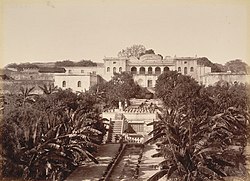
[[File:Zaibunissa palace.jpg|thumb|right|[[Zeb-un-Nissa|Zeb-un-Nisa]]'s palace, Aurangabad 1880s.]] | [[File:Zaibunissa palace.jpg|thumb|right|[[Zeb-un-Nissa|Zeb-un-Nisa]]'s palace, Aurangabad 1880s.]] | ||
[[File:Painting of the profile of Malik Ambar of the Ahmadnagar Sultanate, the founder of Khadki (later Aurangabad).jpg|thumb|Painting | [[File:Painting of the profile of Malik Ambar of the Ahmadnagar Sultanate, the founder of Khadki (later Aurangabad).jpg|thumb|Painting of Malik Ambar of the Ahmadnagar Sultanate, the founder of Khadki (later Aurangabad)]] | ||
Khaḍkī was the original name of the village which was made a capital city by [[Malik Ambar]], the Prime Minister of [[Murtaza Nizam Shah II]], Sultan of [[Deccan sultanates|Ahmednagar]]. Within a decade, Khaḍkī grew into a populous and imposing city. Malik Ambar died in 1626,<ref>Qureshi Dulari, "Tourism Potential in Aurangabad," p. 6</ref> and was succeeded by his son [[Fath Khan|Fateh Khan]], who changed the name of Khaḍkī to Fatehnagar. With the capture of [[Daulatabad Fort|Devagiri Fort]] by the imperial troops in 1633, the Nizam Shahi dominions, including Fatehnagar, became a possession of the [[Mughal Empire|Mughals]].<ref>{{cite book|last1=Sohoni|first1=Pushkar|title=Aurangabad with Daulatabad, Khuldabad, and Ahmadnagar|date=2015|publisher=Deccan Heritage Foundation; Jaico|location=Aurangabad|isbn=9788184957020}}</ref> | |||
In 1653, when Mughal prince [[Aurangzeb]] was appointed the Viceroy of the [[Deccan Plateau|Deccan]] for the second time, he made Fatehnagar his capital and renamed it Aurangabad. Aurangabad is sometimes referred to as Khujista Bunyad by the chroniclers of Aurangzeb's reign.<ref name="Mintage World">{{cite news |date=1 August 2019 |title=Kujista Bunyad |work=The Times of India |url=https://www.mintageworld.com/media/detail/10060-khujista-bunyad/ |access-date=1 August 2019 |archive-date=13 June 2021 |archive-url=https://web.archive.org/web/20210613230342/https://www.mintageworld.com/media/detail/10060-khujista-bunyad/ |url-status=live }}</ref> | |||
In | In 1667 Muazzam, son of Aurangzeb, became governor of the province. Before him, Mirza Raja [[Jai Singh I|Jai Singh]] was in charge of this province for some time.<ref>{{Cite book |last=Sarkar |first=Jadunath |title=Shivaji And His Times |publisher=Longmass, Green and Co. |year=1920 |location=New York, USA |page=180 |language=en}}</ref> | ||
In | In 1681, after Aurangzeb's coronation as emperor, he shifted his court from the capital city of Delhi to Aurangabad in order to conduct his military campaigns in the Deccan. The presence of Mughal elites in the city led to urban development, and numerous public and private buildings were constructed.<ref name=":3" /> Aurangabad had a city wall built encircling it around 1683 in response to [[Maratha Confederacy|Maratha]] raids, of which [[Gates in Aurangabad|several gates]] still stand, such as the Delhi Gate.<ref name=":2222">{{Cite book |last=Michell |first=George |url=https://www.worldcat.org/oclc/268771115 |title=Architecture and art of the Deccan sultanates |date=1999 |publisher=Cambridge University Press |others=Mark Zebrowski |isbn=978-0-511-46884-1 |location=Cambridge |pages=54 |oclc=268771115}}</ref><ref name=":5">{{Citation |last=Asher |first=Catherine B. |title=Architecture of Mughal India |pages=262 |year=1992 |publisher=[[Cambridge University Press]] |isbn=9780521267281}}</ref> Though Aurangzeb chose not to reside in the city after 1684, the city retained its importance as the primary military outpost of the Mughal Deccan, attracting wealth and turning Aurangabad into a centre of trade; the manufacture of embroidered silks emerged during this period and is still practised in Aurangabad today. Mughal Aurangabad was also a cultural hub, serving as an important centre of [[Persian language|Persian]] and [[Urdu]] literature. During the Mughal era, Aurangabad had an estimated population of 200,000 people, living in 54 suburbs.<ref name=":3">{{Cite book|last=Green|first=Nile|url=https://www.worldcat.org/oclc/77080828|title=Indian Sufism since the seventeenth century : saints, books and empires in the Muslim Deccan|date=2006|publisher=Routledge|isbn=0-203-96536-1|location=London|pages=1–4|oclc=77080828}}</ref> | ||
In | In 1724, [[Nizam-ul-Mulk, Asaf Jah I|Asaf Jah]], a Mughal general and [[Nizam ul Mulk|Nizam al-Mulk]] of the Deccan region, decided to secede from the crumbling [[Mughal Empire]], with the intention of founding his own dynasty in the [[Deccan Plateau|Deccan]]. Aurangabad continued to be politically and culturally significant for the next 40 years as the capital of Asaf Jah's new dominion, until his son and successor, Nizam [[Ali Khan Asaf Jah II]], transferred the capital to [[Hyderabad]] in 1763.<ref>{{Cite book|last=Green|first=Nile|url=http://worldcat.org/oclc/781349968|title=Making space : Sufis and settlers in early modern India|date=2012|publisher=Oxford University Press|isbn=978-0-19-807796-1|pages=172|oclc=781349968|access-date=30 December 2021|archive-date=7 February 2024|archive-url=https://web.archive.org/web/20240207081609/https://search.worldcat.org/title/781349968|url-status=live}}</ref><ref>{{Cite book|last=Heitzman|first=James|chapter=Emporiums, empire, and the early colonial presence|date=31 March 2008|chapter-url=http://dx.doi.org/10.4324/9780203483282-9|work=The City in South Asia|pages=102|publisher=Routledge|doi=10.4324/9780203483282-9|isbn=9780203483282|access-date=30 December 2021|archive-date=7 February 2024|archive-url=https://web.archive.org/web/20240207081658/https://www.taylorfrancis.com/chapters/mono/10.4324/9780203483282-9/emporiums-empire-early-colonial-presence-james-heitzman|url-status=live}}</ref> The loss of Aurangabad's privileged position led to a period of economic decline; by the beginning of the 19th century, the city had become notably underpopulated, leading to the crippling of its administration, and its buildings were in decay.<ref>{{Cite book|last=Green|first=Nile|url=https://www.worldcat.org/oclc/77080828|title=Indian Sufism since the seventeenth century : saints, books and empires in the Muslim Deccan|date=2006|publisher=Routledge|isbn=0-203-96536-1|location=London|pages=85–86|oclc=77080828|access-date=16 December 2021|archive-date=7 February 2024|archive-url=https://web.archive.org/web/20240207081658/https://search.worldcat.org/title/77080828|url-status=live}}</ref> However, Aurangabad would continue to be important as the "second city" of the Nizam's dominions for the remainder of the polity's lifetime.<ref>{{cite news|last=Green|first=Nile|year=2004|title=Stories of saints and sultans remembering history at the Sufi shrines of Aurangabad|page=422|url=http://www.st-andrews.ac.uk/anthropologyiran/veneration/images/stories/docs/articles/stories_.pdf|url-status=dead|access-date=7 September 2016|archive-url=https://web.archive.org/web/20160917004315/http://www.st-andrews.ac.uk/anthropologyiran/veneration/images/stories/docs/articles/stories_.pdf|archive-date=17 September 2016}}</ref> | ||
In | In 1816, the British established a [[Aurangabad Cantonment|cantonment]] outside Aurangabad (as they did in other parts of the Nizam's dominions), but were discouraged from entering the city proper by the Nizam's officials.<ref name=":1">{{Citation|last=Green|first=Nile|title=Allah's naked rebels|url=http://dx.doi.org/10.1017/cbo9780511576867.009|work=Islam and the Army in Colonial India|year=2009|pages=92, 100|place=Cambridge|publisher=Cambridge University Press|doi=10.1017/cbo9780511576867.009|isbn=9780511576867|access-date=30 December 2021|archive-date=7 February 2024|archive-url=https://web.archive.org/web/20240207081613/https://www.cambridge.org/core/books/abs/islam-and-the-army-in-colonial-india/allahs-naked-rebels/4D0715882A3BE17CAD84A852EA0D8108|url-status=live|url-access=subscription}}</ref> As a [[princely state]] under British suzerainty, the Nizam's Hyderabad State was quasi-autonomous, meaning that Aurangabad's culture was somewhat free of colonial influence.<ref>{{Cite book|last=Green|first=Nile|url=http://dx.doi.org/10.1093/acprof:oso/9780190222536.001.0001|title=Terrains of Exchange|date=5 February 2015|publisher=Oxford University Press|isbn=978-0-19-022253-6|pages=144–145|doi=10.1093/acprof:oso/9780190222536.001.0001|access-date=31 December 2021|archive-date=7 February 2024|archive-url=https://web.archive.org/web/20240207081548/https://academic.oup.com/book/36269|url-status=live}}</ref><ref>{{Citation|last=Green|first=Nile|chapter=Allah's naked rebels|url=http://dx.doi.org/10.1017/cbo9780511576867.009|title=Islam and the Army in Colonial India|year=2009|page=100|place=Cambridge|publisher=Cambridge University Press|doi=10.1017/cbo9780511576867.009|isbn=9780511576867|access-date=30 December 2021|archive-date=7 February 2024|archive-url=https://web.archive.org/web/20240207081613/https://www.cambridge.org/core/books/abs/islam-and-the-army-in-colonial-india/allahs-naked-rebels/4D0715882A3BE17CAD84A852EA0D8108|url-status=live|url-access=subscription}}</ref> | ||
Aurangabad began to industrialise in the late 19th century, with the city's first [[cotton mill]] being opened in 1889.<ref name=":2">{{Citation|last=Green|first=Nile|title=Missionaries, Mystics and Mill-Owners|date=5 February 2015|url=http://dx.doi.org/10.1093/acprof:oso/9780190222536.003.0005|work=Terrains of Exchange|page=167|publisher=Oxford University Press|doi=10.1093/acprof:oso/9780190222536.003.0005|isbn=978-0-19-022253-6|access-date=30 December 2021|archive-date=7 February 2024|archive-url=https://web.archive.org/web/20240207081551/https://academic.oup.com/book/36269/chapter-abstract/316504712?redirectedFrom=fulltext|url-status=live|url-access=subscription}}</ref> The population of the city was 30,000 in 1881, growing to 36,000 over the next two decades. Aurangabad was particularly affected by Deccan famines in [[Indian famine of 1899–1900|1899-1900]], 1918, and 1920, causing surges in crime.<ref>{{Citation|last=Green|first=Nile|title=Allah's naked rebels|url=http://dx.doi.org/10.1017/cbo9780511576867.009|work=Islam and the Army in Colonial India|year=2009|page=103|place=Cambridge|publisher=Cambridge University Press|doi=10.1017/cbo9780511576867.009|isbn=9780511576867|access-date=31 December 2021|archive-date=7 February 2024|archive-url=https://web.archive.org/web/20240207081613/https://www.cambridge.org/core/books/abs/islam-and-the-army-in-colonial-india/allahs-naked-rebels/4D0715882A3BE17CAD84A852EA0D8108|url-status=live|url-access=subscription}}</ref><ref>{{Cite book|last=Green|first=Nile|url=https://www.worldcat.org/oclc/77080828|title=Indian Sufism since the seventeenth century : saints, books and empires in the Muslim Deccan|date=2006|publisher=Routledge|isbn=0-203-96536-1|location=London|page=107|oclc=77080828}}</ref> | |||
In 1903, the British and the Nizam signed a treaty to train the [[Nizam]]'s army, and it was decided to establish a proper [[cantonment]]. Today the cantonment is spread across {{convert|2584|acre|km2}}, with a civilian population of 19,274 per the [[2001 census of India|2001 census]].<ref>{{cite web|title=Aurangabad|url=http://www.cbAurangabad.org/index.htm|publisher=Aurangabad Cantonment Board|access-date=31 May 2012|archive-url=https://web.archive.org/web/20120225103153/http://www.cbaurangabad.org/index.htm|archive-date=25 February 2012|url-status=dead}}</ref> | |||
Following Indian independence, Hyderabad State was [[Annexation of Hyderabad|annexed into the Indian Union]] in 1948, and consequently Aurangabad became a part of the [[Hyderabad State (1948–1956)|Indian Union's Hyderabad State]]. In 1956, it passed into the newly formed bilingual [[Bombay State]], and in 1960 it became a part of [[Maharashtra]] state.<ref>{{Cite web|title=Aurangabad {{!}} City & History {{!}} Britannica|url=https://www.britannica.com/place/Aurangabad|access-date=30 December 2021|website=www.britannica.com|language=en}}</ref> | Following Indian independence, Hyderabad State was [[Annexation of Hyderabad|annexed into the Indian Union]] in 1948, and consequently Aurangabad became a part of the [[Hyderabad State (1948–1956)|Indian Union's Hyderabad State]]. In 1956, it passed into the newly formed bilingual [[Bombay State]], and in 1960 it became a part of [[Maharashtra]] state.<ref>{{Cite web|title=Aurangabad {{!}} City & History {{!}} Britannica|url=https://www.britannica.com/place/Aurangabad|access-date=30 December 2021|website=www.britannica.com|language=en|archive-date=30 December 2021|archive-url=https://web.archive.org/web/20211230203156/https://www.britannica.com/place/Aurangabad|url-status=live}}</ref> | ||
[[Bal Thackeray]] in 1988 proposed the city | [[Bal Thackeray]] in 1988 proposed the city be renamed as Sambhajinagar. The local governing body, the [[Municipal corporation|City Corporation]] passed a resolution on the name change in 1995.<ref>{{cite news |last1=Shaikh |first1=Zeeshan |title=Explained: Why has the Maharashtra government renamed Aurangabad city as Sambhajinagar? |url=https://indianexpress.com/article/explained/why-has-maharashtra-government-renamed-aurangabad-city-as-shambhaji-nagar-7999386/ |access-date=14 July 2022 |newspaper=The Indian Express |date=1 July 2022 |archive-date=13 July 2022 |archive-url=https://web.archive.org/web/20220713002104/https://indianexpress.com/article/explained/why-has-maharashtra-government-renamed-aurangabad-city-as-shambhaji-nagar-7999386/ |url-status=live }}</ref> On 29 June 2022, the [[Shiv Sena]]-led Maharashtra cabinet approved the renaming of Aurangabad to Sambhaji Nagar, after [[Sambhaji|Sambhaji Bhosale]], second Chhatrapati of the Maratha Empire.<ref name="TOI_Jun2022">{{cite news |date=29 June 2022 |title=Maharashtra cabinet approves renaming of Aurangabad to Sambhaji Nagar |newspaper=The Times of India |url=https://timesofindia.indiatimes.com/india/maharashtra-cabinet-approves-renaming-of-aurangabad-to-sambhaji-nagar/articleshow/92549269.cms |access-date=29 June 2022 |archive-date=29 June 2022 |archive-url=https://web.archive.org/web/20220629132722/https://timesofindia.indiatimes.com/india/maharashtra-cabinet-approves-renaming-of-aurangabad-to-sambhaji-nagar/articleshow/92549269.cms |url-status=live }}</ref> | ||
==Geography== | ==Geography== | ||
The co-ordinates for Aurangabad are N 19° 53' 47" – E 75° 23' 54". The city is surrounded by | The co-ordinates for Aurangabad are N 19° 53' 47" – E 75° 23' 54". The city is surrounded by the [[Ajanta range|Ajanta mountain range]] in all directions. | ||
===Climate=== | ===Climate=== | ||
Aurangabad features a [[semiarid climate]] under the [[Köppen climate classification]]. Annual mean temperatures range from 17 to 33 °C, with the most comfortable time to visit in | Aurangabad features a [[semiarid climate]] under the [[Köppen climate classification]]. Annual mean temperatures range from 17 to 33 °C, with the most comfortable time to visit being in winter – October to February. The highest maximum temperature ever recorded was {{convert|46|°C|°F|abbr=on}} on 25 May 1905. The lowest recorded temperature was {{convert|2|°C|°F|abbr=on}} on 2 February 1911. In the cold season, the district is sometimes affected by cold waves in association with the eastward passage of western disturbances across north India, when the minimum temperature may drop down to about {{convert|2|to|4|C|F}}.<ref>[http://www.maharashtra.gov.in/english/gazetteer/gazetteer.php?level=2&showFile=1&gazetteerSqlId=20020423103801&gazetteerMainId=&gazetteerFile2Id=20020423105420&distId=19&gazId=20020422121541&pubYear=&fileExists=1&headingSqlName=General&chapter= Maharashtra government web site] {{webarchive |url=https://web.archive.org/web/20110809012452/http://www.maharashtra.gov.in/english/gazetteer/gazetteer.php?level=2&showFile=1&gazetteerSqlId=20020423103801&gazetteerMainId=&gazetteerFile2Id=20020423105420&distId=19&gazId=20020422121541&pubYear=&fileExists=1&headingSqlName=General&chapter= |date=9 August 2011 }}</ref> | ||
Most of the rainfall occurs in the monsoon season from June to September. Thunderstorms occur between November and April. Average annual rainfall is 710 mm. The city is often cloudy during the monsoon season and the cloud cover may | Most of the rainfall occurs in the monsoon season from June to September. Thunderstorms occur between November and April. Average annual rainfall is 710 mm. The city is often cloudy during the monsoon season and the cloud cover may persist for days. The daily maximum temperature in the city often drops to around 22 °C due to the cloud cover and heavy rains.<ref>{{Cite web|url=https://sandrp.in/category/marathwada/|title=Marathwada – SANDRP|access-date=14 April 2019|archive-url=https://web.archive.org/web/20190414165644/https://sandrp.in/category/marathwada/|archive-date=14 April 2019|url-status=live}}</ref> | ||
{{Weather box | {{Weather box | ||
| width = auto | | width = auto | ||
| location = Aurangabad ([[Aurangabad Airport]]) | | location = Aurangabad ([[Aurangabad Airport]]) 1991–2020, extremes 1952–2012 | ||
| metric first = Yes | | metric first = Yes | ||
| single line = Yes | | single line = Yes | ||
| Line 132: | Line 129: | ||
| Mar record high C = 40.6 | | Mar record high C = 40.6 | ||
| Apr record high C = 43.6 | | Apr record high C = 43.6 | ||
| May record high C = 43. | | May record high C = 43.8 | ||
| Jun record high C = 43.0 | | Jun record high C = 43.0 | ||
| Jul record high C = 37.1 | | Jul record high C = 37.1 | ||
| Line 143: | Line 140: | ||
| Jan high C = 29.2 | | Jan high C = 29.2 | ||
| Feb high C = 31.8 | | Feb high C = 31.8 | ||
| Mar high C = 35. | | Mar high C = 35.6 | ||
| Apr high C = 38. | | Apr high C = 38.7 | ||
| May high C = 39. | | May high C = 39.6 | ||
| Jun high C = 34. | | Jun high C = 34.6 | ||
| Jul high C = 30. | | Jul high C = 30.1 | ||
| Aug high C = 29. | | Aug high C = 29.2 | ||
| Sep high C = 30. | | Sep high C = 30.2 | ||
| Oct high C = 31. | | Oct high C = 31.8 | ||
| Nov high C = 30. | | Nov high C = 30.5 | ||
| Dec high C = | | Dec high C = 29.1 | ||
| year high C = 32.5 | | year high C = 32.5 | ||
| Jan low C = 12. | | Jan mean C = 21.0 | ||
| Feb low C = 14. | | Feb mean C = 23.8 | ||
| Mar low C = | | Mar mean C = 27.9 | ||
| Apr low C = | | Apr mean C = 31.5 | ||
| May low C = | | May mean C = 32.7 | ||
| Jun low C = 23. | | Jun mean C = 28.8 | ||
| Jul low C = 22. | | Jul mean C = 26.0 | ||
| Aug low C = 21. | | Aug mean C = 25.3 | ||
| Sep low C = 21. | | Sep mean C = 25.8 | ||
| Oct low C = | | Oct mean C = 25.6 | ||
| Nov low C = | | Nov mean C = 23.3 | ||
| Dec low C = | | Dec mean C = 20.9 | ||
| year low C = | | Jan low C = 12.4 | ||
| Feb low C = 14.9 | |||
| Mar low C = 19.0 | |||
| Apr low C = 23.1 | |||
| May low C = 25.1 | |||
| Jun low C = 23.6 | |||
| Jul low C = 22.4 | |||
| Aug low C = 21.8 | |||
| Sep low C = 21.5 | |||
| Oct low C = 19.1 | |||
| Nov low C = 15.6 | |||
| Dec low C = 12.5 | |||
| year low C = 19.2 | |||
| Jan record low C = 1.2 | | Jan record low C = 1.2 | ||
| Feb record low C = 1.9 | | Feb record low C = 1.9 | ||
| Line 172: | Line 181: | ||
| Apr record low C = 10.2 | | Apr record low C = 10.2 | ||
| May record low C = 14.2 | | May record low C = 14.2 | ||
| Jun record low C = 18. | | Jun record low C = 18.2 | ||
| Jul record low C = 18.4 | | Jul record low C = 18.4 | ||
| Aug record low C = 17.2 | | Aug record low C = 17.2 | ||
| Line 181: | Line 190: | ||
| year record low C = 1.2 | | year record low C = 1.2 | ||
| rain colour = green | | rain colour = green | ||
| Jan rain mm = | | Jan rain mm = 2.6 | ||
| Feb rain mm = 2.2 | | Feb rain mm = 2.2 | ||
| Mar rain mm = | | Mar rain mm = 11.4 | ||
| Apr rain mm = | | Apr rain mm = 6.0 | ||
| May rain mm = | | May rain mm = 17.4 | ||
| Jun rain mm = | | Jun rain mm = 155.6 | ||
| Jul rain mm = | | Jul rain mm = 178.0 | ||
| Aug rain mm = | | Aug rain mm = 171.5 | ||
| Sep rain mm = | | Sep rain mm = 172.4 | ||
| Oct rain mm = | | Oct rain mm = 68.2 | ||
| Nov rain mm = | | Nov rain mm = 17.5 | ||
| Dec rain mm = | | Dec rain mm = 8.9 | ||
| year rain mm = | | year rain mm = 811.7 | ||
| Jan rain days = 0.3 | | Jan rain days = 0.3 | ||
| Feb rain days = 0. | | Feb rain days = 0.2 | ||
| Mar rain days = 0. | | Mar rain days = 0.9 | ||
| Apr rain days = 0. | | Apr rain days = 0.6 | ||
| May rain days = 1. | | May rain days = 1.2 | ||
| Jun rain days = | | Jun rain days = 8.0 | ||
| Jul rain days = 10. | | Jul rain days = 10.9 | ||
| Aug rain days = 10. | | Aug rain days = 10.0 | ||
| Sep rain days = 8. | | Sep rain days = 8.4 | ||
| Oct rain days = | | Oct rain days = 3.9 | ||
| Nov rain days = 1. | | Nov rain days = 1.1 | ||
| Dec rain days = 0. | | Dec rain days = 0.5 | ||
| year rain days = 46. | | year rain days = 46.1 | ||
| time day = 17:30 [[Indian Standard Time|IST]] | | time day = 17:30 [[Indian Standard Time|IST]] | ||
| Jan humidity = | | Jan humidity = 40 | ||
| Feb humidity = | | Feb humidity = 35 | ||
| Mar humidity = | | Mar humidity = 28 | ||
| Apr humidity = | | Apr humidity = 27 | ||
| May humidity = | | May humidity = 29 | ||
| Jun humidity = | | Jun humidity = 55 | ||
| Jul humidity = | | Jul humidity = 71 | ||
| Aug humidity = 73 | | Aug humidity = 73 | ||
| Sep humidity = | | Sep humidity = 69 | ||
| Oct humidity = | | Oct humidity = 53 | ||
| Nov humidity = | | Nov humidity = 49 | ||
| Dec humidity = | | Dec humidity = 44 | ||
| year humidity = | | year humidity = 48 | ||
| source 1 = [[India Meteorological Department]]<ref name=IMDnormals> | | source 1 = [[India Meteorological Department]]<ref name=IMDnormals> | ||
{{cite web | {{cite web | ||
| Line 240: | Line 249: | ||
| date = December 2016 | | date = December 2016 | ||
| page = M137 | | page = M137 | ||
| access-date = 3 April 2020}}</ref> | | access-date = 3 April 2020}}</ref><ref name=IMDcityextremes2> | ||
{{cite web | |||
| url = https://www.imdpune.gov.in/library/public/Climatological%20Tables%201991-2020.pdf | |||
| archive-url = https://web.archive.org/web/20230101061732/https://www.imdpune.gov.in/library/public/Climatological%20Tables%201991-2020.pdf | |||
| archive-date = 1 January 2023 | |||
| title = Climatological Tables 1991-2020 | |||
| publisher = India Meteorological Department | |||
| access-date = 1 January 2023 | |||
| page = 21}}</ref> | |||
| source = | | source = | ||
| Jan uv = 6 | | Jan uv = 6 | ||
| Line 254: | Line 271: | ||
| Nov uv = 6 | | Nov uv = 6 | ||
| Dec uv = 6 | | Dec uv = 6 | ||
| source 2 = Weather Atlas<ref name="Weather Atlas">{{cite web | | source 2 = Weather Atlas,<ref name="Weather Atlas">{{cite web | ||
| url = https://www.weather-atlas.com/en/india/aurangabad-climate | | url = https://www.weather-atlas.com/en/india/aurangabad-climate | ||
| title = Climate and monthly weather forecast Aurangabad, India | | title = Climate and monthly weather forecast Aurangabad, India | ||
| publisher = Weather Atlas | | publisher = Weather Atlas | ||
| access-date = 20 July 2022 | | access-date = 20 July 2022 | ||
}}</ref> | | archive-date = 20 July 2022 | ||
| archive-url = https://web.archive.org/web/20220720153122/https://www.weather-atlas.com/en/india/aurangabad-climate | |||
| url-status = live | |||
}}</ref> Tokyo Climate Center (mean temperatures 1991–2020)<ref name=TCC> | |||
{{cite web | |||
| url = https://ds.data.jma.go.jp/gmd/tcc/tcc/products/climate/normal/parts/NrmMonth_e.php?stn=43014 | |||
| title = Normals Data: Aurangabad Chikalthana - India Latitude: 19.85°N Longitude: 75.40°E Height: 585 (m) | |||
| publisher = Japan Meteorological Agency | |||
| access-date = 29 February 2020}}</ref> | |||
}} | }} | ||
Aurangabad has been ranked the 36th best "National Clean Air City" (under Category 1 >10L Population cities) in India.<ref>{{Cite web |date=7 September 2024 |title=Swachh Vayu Sarvekshan 2024 |url=https://prana.cpcb.gov.in/ncapServices/robust/fetchFilesFromDrive/Swachh_Vayu_Survekshan_2024_Result.pdf |website=Swachh Vayu Sarvekshan 2024}}</ref> | |||
===Geology=== | ===Geology=== | ||
[[File:Ahilyabai Holkar Chowk.jpg|thumb|Ahilyabai Holkar Chauk, Station Road, Aurangabad]] | [[File:Ahilyabai Holkar Chowk.jpg|thumb|Ahilyabai Holkar Chauk, Station Road, Aurangabad]] | ||
The entire area is covered by the [[Deccan Traps]] lava flows of [[Upper Cretaceous]] to [[Lower Eocene]] | The entire area is covered by the [[Deccan Traps]] lava flows of the [[Upper Cretaceous]] to [[Lower Eocene]] ages. The lava flows are overlain by thin alluvial deposits along the Kham and Sukhana rivers. The basaltic lava flows are the only major geological formation in Aurangabad. The lava flows are horizontal, and each flow has two distinct units. The upper layers consist of [[Vesicular texture|vesicular]]a and [[Amygdule|amygdaloidal]] [[zeolitic]] [[basalt]], while the bottom layer consists of massive basalt. The lava flows are individually different in their ability to receive as well as hold water in storage and to transmit it. The difference in the productivity of groundwater in various flows arises as a result of their inherent physical properties, such as porosity and permeability. The groundwater occurs under water table conditions and is mainly controlled by the extent of its secondary porosity, i.e. thickness of weathered rocks and spacing of joints and fractures. The highly weathered vesicular trap and underlying weathered jointed and fractured massive trap constitutes the main water-yielding zones. The soil is mostly formed from igneous rocks and is black, medium black, shallow and calcareous types having different depths and profiles.<ref>Aher K.R. 'Groundwater Quality studies of Chikalthana area of Aurangabad', PhD Thesis, Dr. B.A.M.University, Aurangabad (Maharashtra State), India, 2012, p. 38</ref> | ||
==Demographics== | ==Demographics== | ||
| Line 284: | Line 310: | ||
}} | }} | ||
According to the [[2011 Indian Census]], Aurangabad | According to the [[2011 Indian Census]], Aurangabad had a population of 1,175,116, of which 609,206 were males and 565,910 were females. Of these, 158,779 were in the age range of 0 to 6 years. The total number of literate people in Aurangabad was 889,224, which constituted 75.67% of the population with male literacy of 79.34% and female literacy of 71.72%. The effective literacy rate of 7+ population of Aurangabad was 87.5%, of which male literacy rate was 92.2% and female literacy rate was 82.5%. The [[Scheduled Castes and Scheduled Tribes]] population was 229,223 and 15,240, respectively. There were 236659 households in Aurangabad in 2011.<ref name="Census2011">{{cite web |title=Census of India: Aurangabad |url=http://censusindia.gov.in/pca/SearchDetails.aspx?Id=617719 |website=censusindia.gov.in |access-date=1 October 2019 |archive-date=25 September 2021 |archive-url=https://web.archive.org/web/20210925174933/https://censusindia.gov.in/pca/SearchDetails.aspx?Id=617719 |url-status=live }}</ref> | ||
=== Religion === | === Religion === | ||
{{bar box | {{bar box | ||
|title=Religions in Aurangabad City (2011)<ref name="Religion">{{cite web |title=C-1 Population By Religious Community - Maharashtra|url=https://censusindia.gov.in/2011census/C-01/DDW27C-01%20MDDS.XLS |website=census.gov.in}}</ref> | |title=Religions in Aurangabad City (2011)<ref name="Religion">{{cite web|title=C-1 Population By Religious Community - Maharashtra|url=https://censusindia.gov.in/2011census/C-01/DDW27C-01%20MDDS.XLS|website=census.gov.in|access-date=1 May 2022|archive-date=23 September 2015|archive-url=https://web.archive.org/web/20150923230449/https://censusindia.gov.in/2011census/C-01/DDW27C-01%20MDDS.XLS|url-status=live}}</ref> | ||
|titlebar=#FCD116 | |titlebar=#FCD116 | ||
|left1=Religion | |left1=Religion | ||
| Line 294: | Line 320: | ||
|float=left | |float=left | ||
|bars= | |bars= | ||
{{bar percent|[[Hinduism in Maharashtra| | {{bar percent|[[Hinduism in Maharashtra|Hinduism]]|darkorange|51.07}} | ||
{{bar percent|[[Marathi Muslims|Islam]]|green|30.79}} | {{bar percent|[[Marathi Muslims|Islam]]|green|30.79}} | ||
{{bar percent|[[Marathi Buddhists|Buddhism]]|mediumblue|15.17}} | {{bar percent|[[Marathi Buddhists|Buddhism]]|mediumblue|15.17}} | ||
| Line 302: | Line 328: | ||
}} | }} | ||
The majority of the population in Aurangabad are [[Hindu]] (51%), followed by 30% [[ | The majority of the population in Aurangabad are [[Hindu]] (51%), followed by [[Muslim]] (30%), [[Buddhist]] (15.2%) and [[Jain]] (1.6%). There are also a substantial number of adherents of [[Sikhism]] and [[Christianity]] in the city.<ref name="Religion"/> Buddhists are of [[Navayana Buddhism|Navayana]] tradition, who are mostly scheduled castes.{{citation needed|date=February 2022}} | ||
===Language=== | ===Language=== | ||
{{Pie chart | {{Pie chart | ||
|thumb = right | |thumb = right | ||
|caption = Language in Aurangabad M.Corp (2011)<ref name="MCorpLang">{{cite web |title=C-16 Population By Mother Tongue - Town Level – Maharashtra |url=http://censusindia.gov.in/2011census/C-16T/DDW-C16-TOWN-STMT-MDDS-2700.XLSX |publisher=Census |access-date=29 December 2019}}</ref> | |caption = Language in Aurangabad M. Corp (2011)<ref name="MCorpLang">{{cite web |title=C-16 Population By Mother Tongue - Town Level – Maharashtra |url=http://censusindia.gov.in/2011census/C-16T/DDW-C16-TOWN-STMT-MDDS-2700.XLSX |publisher=Census |access-date=29 December 2019 |archive-date=8 December 2019 |archive-url=https://web.archive.org/web/20191208010935/http://www.censusindia.gov.in/2011census/C-16T/DDW-C16-TOWN-STMT-MDDS-2700.XLSX |url-status=live }}</ref> | ||
|label1 = [[Marathi language|Marathi]] |value1 = 59.09 |color1 = red | |label1 = [[Marathi language|Marathi]] |value1 = 59.09 |color1 = red | ||
|label2 = [[Urdu]] |value2 = 23.41 |color2 = green | |label2 = [[Urdu]] |value2 = 23.41 |color2 = green | ||
|label3 = [[Hindi]] |value3 = 11.98 |color3 = orange | |label3 = [[Hindi]] |value3 = 11.98 |color3 = orange | ||
|label4 = [[Marwari language|Marwari]] |value4 = 1.72 |color4 = pink | |label4 = [[Marwari language|Marwari]] |value4 = 1.72 |color4 = pink | ||
|label5 = Other |value5 = 3.80 |color5 = | |label5 = Other |value5 = 3.80 |color5 = grey | ||
}} | }} | ||
[[Marathi language|Marathi]] is the official language of the city.<ref name=" | [[Marathi language|Marathi]] is the official language of the city.<ref name="NCLMreport"/> It is also the most commonly spoken language in the city, followed by [[Urdu]] and [[Hindi]].<ref name="MCorpLang"/> | ||
==Administration and politics== | ==Administration and politics== | ||
===Local administration=== | ===Local administration=== | ||
The [[Aurangabad Municipal Corporation]] (AMC) is the local civic body. It is divided into six zones. The Municipal Council was established in 1936, and administers an area of about 54.5 km<sup>2</sup>. It was elevated to the status of municipal corporation on 8 December 1982, simultaneously including eighteen peripheral villages, raising the total area under its jurisdiction to 138.5 km<sup>2</sup>. | |||
The city is divided in 115 electoral wards called ''Prabhag'', and each ward is represented by a corporator elected by the people from each ward. There are two committees, the General Body and Standing Committee, headed by the mayor and the chairman, respectively. The AMC is responsible for providing basic amenities, such as drinking water, drainage facilities, roads, street lights, healthcare facilities, primary schools, etc. The AMC collects its revenue from urban taxes collected from its citizens. The administration is headed by the Municipal Commissioner; an [[Indian Administrative Service|IAS Officer]], assisted by the other officers of different departments. The Aurangabad Metropolitan Region Development Authority (AMRDA) is being formed for the development of the region.<ref>{{cite news |title=AMRDA will soon get office, administrative officer - www.lokmattimes.com |url=https://www.lokmattimes.com/aurangabad/amrda-will-soon-get-office-administrative-officer/ |work=Lokmat Times |date=3 September 2021 |access-date=1 April 2024}}</ref> | |||
The city is divided in 115 electoral wards called | === Municipal finance === | ||
According to financial data published on the CityFinance Portal of the Ministry of Housing and Urban Affairs,<ref>{{cite web |title=Chhatrapati Sambhajinagar Municipal Corporation Finance |url=https://www.cityfinance.in/municipal-data/city/chhatrapati-sambhajinagar |publisher=CityFinance Portal, Ministry of Housing and Urban Affairs |access-date=17 March 2026}}</ref> the Chhatrapati Sambhajinagar Municipal Corporation reported total revenue receipts of ₹758 crore (US$91 million) and total expenditure of ₹769 crore (US$93 million) in 2022–23. Tax revenue accounted for about 14.4% of the total revenue, while the corporation received ₹371 crore in grants during the financial year. | |||
===State and central administration=== | ===State and central administration=== | ||
[[Aurangabad division]] is one of the six administrative [[divisions of Maharashtra]] state in [[India]]. Aurangabad | [[Aurangabad division]] is one of the six administrative [[divisions of Maharashtra]] state in [[India]]. Aurangabad division almost completely coincides with the [[Marathwada]] region of Maharashtra. Aurangabad has [[Aurangabad (Maharashtra Lok Sabha constituency)|one seat]] in the [[Aurangabad (Maharashtra Lok Sabha constituency)|Lok Sabha]]. In the [[2024 Indian general election|2024 general election]], [[Shiv Sena (1966–2022)|Shiv Sena]] candidate [[Sandipanrao Bhumre]] was elected as a [[member of parliament]] from Aurangabad.<ref>{{cite news |last=Naik |first=Yogesh |date=21 April 2024 |url=https://www.hindustantimes.com/cities/mumbai-news/shinde-sena-s-sandipanrao-bhumre-gets-aurangabad-ticket-101713643111158.html |title=Shinde Sena's Sandipanrao Bhumre gets Aurangabad ticket |work=[[Hindustan Times]] |access-date=19 August 2024}}</ref> | ||
Aurangabad also | Aurangabad also has three [[Maharashtra Legislative Assembly|state assembly]] seats, Aurangabad East, Aurangabad Central and Aurangabad West, which are represented by [[Atul Moreshwar Save]] (BJP), [[Pradeep Jaiswal]] (Shiv-Sena) and [[Sanjay Shirsat]] (Shiv-Sena), respectively, since the [[2019 Maharashtra Legislative Assembly election|2019 Maharashtra Legislation Assembly election]].<ref>{{cite web|url=http://Aurangabad.nic.in/htmldocs/19Aurangabadpceng.pdf|title=Map of Aurangabad Loksabha and Assembly seats|access-date=5 July 2018|archive-url=https://web.archive.org/web/20110930214310/http://aurangabad.nic.in/htmldocs/19aurangabadpceng.pdf|archive-date=30 September 2011|url-status=dead}}</ref><ref>[http://eci.nic.in/ Election Commission of India] {{webarchive|url=https://web.archive.org/web/20090521143146/http://eci.nic.in//|date=21 May 2009}}</ref> | ||
<gallery mode="packed" heights="134"> | <gallery mode="packed" heights="134"> | ||
File:himrooshawl.jpg|Himroo Shawl | File:himrooshawl.jpg|Himroo Shawl | ||
File:High-cort-1.jpg|Bombay High Court Aurangabad Bench, [[ITC Welcomgroup Hotels, Palaces and Resorts|ITC Welcomgroup's]] The Rama International, Ajanta Ambassador & Cidco Town Center – Aerial view | File:High-cort-1.jpg|Bombay High Court Aurangabad Bench, [[ITC Welcomgroup Hotels, Palaces and Resorts|ITC Welcomgroup's]] The Rama International, Ajanta Ambassador & Cidco Town Center – Aerial view | ||
</gallery> | </gallery> | ||
| Line 339: | Line 365: | ||
{{Main|Economy of Aurangabad}} {{See also|Make In Maharashtra}} | {{Main|Economy of Aurangabad}} {{See also|Make In Maharashtra}} | ||
Aurangabad is considered to be a classic example of efforts of state government towards balanced industrialisation of state.<ref>{{cite news|url=http://economictimes.indiatimes.com/features/the-sunday-et/consumer-life/History-revisited-at-Aurangabad-the-city-of-gates/articleshow/4390611.cms|title=History revisited at Aurangabad|author=TOI|date=12 April 2009|work=The Times of India|access-date=20 January 2010|archive-url=https://web.archive.org/web/20090506020017/http://economictimes.indiatimes.com/Features/The-Sunday-ET/Consumer-Life/History-revisited-at-Aurangabad-the-city-of-gates/articleshow/4390611.cms|archive-date=6 May 2009|url-status=live}}</ref> The city was a major silk and cotton textile production center. A fine blend of silk with locally grown cotton was developed as [[Himroo]] textile. [[Paithani]] silk [[sari]]s are also made in Aurangabad. With the opening of the [[Hyderabad-Godavari Valley Railways]] in the year 1900 several ginning factories were started.<ref>"Hyderabad" by Mirza Mehdy Khan, Imperial Gazetteer of India, Government Printing Press, Calcutta, 1909.</ref> After 1960, [[Maharashtra Industrial Development Corporation]] (MIDC) began acquiring land and setting up industrial estates. The Maharashtra Center For Entrepreneurship Development's main office is in Aurangabad.<ref>{{Cite web|url=http://www.mced.in/|title=Maharashtra Centre For Entrepreneurship Development|website=mced.in|access-date=26 May 2019}}</ref> Major industries in Auragabad are manufacturing, biotechnology, pharmaceuticals and automobiles etc.<ref name=":0">{{Cite web|title=Economy of Aurangabad, Business and Economy in Aurangabad|url=https://www.aurangabadlive.in/city-guide/economy-of-aurangabad|access-date=27 June 2021|website=www.aurangabadlive.in}}</ref> In the 1990s, land near Shendra village on the Aurangabad-[[Jalna, Maharashtra|Jalna]] route was purchased. The MIDC created the Waluj and Chikalthana Industrial Areas as part of its efforts, which were quickly purchased.{{citation needed|date=May 2022}} | Aurangabad is considered to be a classic example of efforts of state government towards balanced industrialisation of state.<ref>{{cite news|url=http://economictimes.indiatimes.com/features/the-sunday-et/consumer-life/History-revisited-at-Aurangabad-the-city-of-gates/articleshow/4390611.cms|title=History revisited at Aurangabad|author=TOI|date=12 April 2009|work=The Times of India|access-date=20 January 2010|archive-url=https://web.archive.org/web/20090506020017/http://economictimes.indiatimes.com/Features/The-Sunday-ET/Consumer-Life/History-revisited-at-Aurangabad-the-city-of-gates/articleshow/4390611.cms|archive-date=6 May 2009|url-status=live}}</ref> The city was a major silk and cotton textile production center. A fine blend of silk with locally grown cotton was developed as [[Himroo]] textile. [[Paithani]] silk [[sari]]s are also made in Aurangabad. With the opening of the [[Hyderabad-Godavari Valley Railways]] in the year 1900 several ginning factories were started.<ref>"Hyderabad" by Mirza Mehdy Khan, Imperial Gazetteer of India, Government Printing Press, Calcutta, 1909.</ref> After 1960, [[Maharashtra Industrial Development Corporation]] (MIDC) began acquiring land and setting up industrial estates. The Maharashtra Center For Entrepreneurship Development's main office is in Aurangabad.<ref>{{Cite web|url=http://www.mced.in/|title=Maharashtra Centre For Entrepreneurship Development|website=mced.in|access-date=26 May 2019|archive-date=27 May 2019|archive-url=https://web.archive.org/web/20190527024021/http://www.mced.in/|url-status=live}}</ref> Major industries in Auragabad are manufacturing, biotechnology, pharmaceuticals and automobiles etc.<ref name=":0">{{Cite web|title=Economy of Aurangabad, Business and Economy in Aurangabad|url=https://www.aurangabadlive.in/city-guide/economy-of-aurangabad|access-date=27 June 2021|website=www.aurangabadlive.in|archive-date=27 June 2021|archive-url=https://web.archive.org/web/20210627114105/https://www.aurangabadlive.in/city-guide/economy-of-aurangabad|url-status=live}}</ref> In the 1990s, land near Shendra village on the Aurangabad-[[Jalna, Maharashtra|Jalna]] route was purchased. The MIDC created the Waluj and Chikalthana Industrial Areas as part of its efforts, which were quickly purchased.{{citation needed|date=May 2022}} | ||
Aurangabad is surrounded by the industrial areas ([[Maharashtra Industrial Development Corporation|MIDCs]]) of [[Chikhalthan]]a, [[Shendra MIDC|Shendra]] and [[Waluj MIDC]]. A new industrial belt namely [[Shendra - Bidkin Industrial Park]] is being developed under [[Delhi Mumbai Industrial Corridor Project|DMIC]].<ref>{{cite web |last=Ashar |first=Sandeep |title=Share on emailShare on printShare on redditMore Sharing Services Four mega industrial towns |url= | Aurangabad is surrounded by the industrial areas ([[Maharashtra Industrial Development Corporation|MIDCs]]) of [[Chikhalthan]]a, [[Shendra MIDC|Shendra]] and [[Waluj MIDC]]. A new industrial belt namely [[Shendra - Bidkin Industrial Park]] is being developed under [[Delhi Mumbai Industrial Corridor Project|DMIC]].<ref>{{cite web |last=Ashar |first=Sandeep |title=Share on emailShare on printShare on redditMore Sharing Services Four mega industrial towns |url=https://timesofindia.indiatimes.com/city/mumbai/Four-mega-industrial-towns/articleshow/10359933.cms |access-date=31 May 2012 |date=15 October 2011 |archive-url=https://web.archive.org/web/20130501170615/http://articles.timesofindia.indiatimes.com/2011-10-15/mumbai/30283205_1_dmic-delhi-mumbai-industrial-corridor-master-plan |archive-date=1 May 2013 |work=[[The Times of India]] |url-status=live }}</ref> Major [[Siemens]] and automotive companies such as [[BMW]], [[Audi India]], [[Škoda Auto|Skoda Auto]], [[Bajaj Auto]] and [[Goodyear Tire and Rubber Company]] have there units in the city.<ref name=":0" /> One of the largest Russian Steel Company [[Novolipetsk Steel|NLMK]] has set up plant in DMIC Shendra phase.<ref>{{cite news |last1=Sharad |first1=Arpita |title=Russian investment in Auric to generate 2,000 jobs {{!}} Aurangabad News - Times of India |url=https://timesofindia.indiatimes.com/city/aurangabad/russian-investment-in-auric-to-generate-2000-jobs/articleshow/73780061.cms |access-date=22 February 2022 |work=The Times of India |date=31 January 2020 |language=en |archive-date=16 January 2022 |archive-url=https://web.archive.org/web/20220116105242/https://timesofindia.indiatimes.com/city/aurangabad/russian-investment-in-auric-to-generate-2000-jobs/articleshow/73780061.cms |url-status=live }}</ref> | ||
==Culture/Cityscape== | ==Culture/Cityscape== | ||
===Culture=== | ===Culture=== | ||
{{See also|Urdu in Aurangabad}} | {{See also|Urdu in Aurangabad}} | ||
The culture of Aurangabad city is heavily influenced by the culture of [[Hyderabad, India|Hyderabad]]. The old city still retains the cultural flavour and charms of [[Muslim culture of Hyderabad]]. Its influence is reflected in the language and cuisine of the locals. Although [[Urdu]] is among the principal languages of the city, along with [[Marathi language|Marathi]] and [[Hindi]], it is spoken in the [[Dakhni]] – [[Hyderabadi Urdu]] dialect.<ref name="bangalorenotes.com">{{cite web|url=http://www.bangalorenotes.com/dakhni.htm|title=Dakhni – The Language of India's Composite Culture|access-date=19 September 2009|archive-url=https://web.archive.org/web/20111002180320/http://bangalorenotes.com/dakhni.htm|archive-date=2 October 2011|url-status= | The culture of Aurangabad city is heavily influenced by the culture of [[Hyderabad, India|Hyderabad]]. The old city still retains the cultural flavour and charms of [[Muslim culture of Hyderabad]]. Its influence is reflected in the language and cuisine of the locals. Although [[Urdu]] is among the principal languages of the city, along with [[Marathi language|Marathi]] and [[Hindi]], it is spoken in the [[Dakhni]] – [[Hyderabadi Urdu]] dialect.<ref name="bangalorenotes.com">{{cite web|url=http://www.bangalorenotes.com/dakhni.htm|title=Dakhni – The Language of India's Composite Culture|access-date=19 September 2009|archive-url=https://web.archive.org/web/20111002180320/http://bangalorenotes.com/dakhni.htm|archive-date=2 October 2011|url-status=usurped}}</ref>{{better source needed|date=December 2016}} | ||
* [[Wali Mohammed Wali|Wali Dakhni]] also known as Wali Aurangabadi (1667–1731 or 1743) was a classical poet of [[Urdu poetry|Urdu]] from Aurangabad. He was the first established poet to have composed in [[Urdu]] language. Prominent poets like Shah Hatem, Shah Abro, [[Mir Taqi Mir]], [[Zauq]] and [[Mirza Rafi Sauda|Sauda]] were among his admirers.<ref name="bangalorenotes.com"/>{{better source needed|date=December 2016}} Other prominent poets from Aurangabad include [[Siraj Aurangabadi]], [[Azad Bilgrami]] and [[Sikandar Ali Wajd]]. | * [[Wali Mohammed Wali|Wali Dakhni]] also known as Wali Aurangabadi (1667–1731 or 1743) was a classical poet of [[Urdu poetry|Urdu]] from Aurangabad. He was the first established poet to have composed in [[Urdu]] language. Prominent poets like Shah Hatem, Shah Abro, [[Mir Taqi Mir]], [[Zauq]] and [[Mirza Rafi Sauda|Sauda]] were among his admirers.<ref name="bangalorenotes.com"/>{{better source needed|date=December 2016}} Other prominent poets from Aurangabad include [[Siraj Aurangabadi]], [[Azad Bilgrami]] and [[Sikandar Ali Wajd]]. | ||
* [[Abul Ala Maududi]] one of the Muslim scholars (1903–1979) was born in [[Aurangabad Maharashtra|Aurangabad]], India. Syed Abul A'ala Maududi was born to Maulana Ahmad Hasan, a lawyer by profession.<ref name="JI">[http://jamaat.org/beta/site/page/3 Sayyid Abul A'la Maududi]. Official website of the [[Jamaat-e-Islami Pakistan|Jamaat-e-Islami]]. {{webarchive |url=https://web.archive.org/web/20100315121231/http://jamaat.org/beta/site/page/3 |date=15 March 2010 }}</ref> His father was "descended from the [[Chishti]] line of saints.<ref name="Adams, p.100-101">Adams, p.100-101</ref> He was also the founder of [[Jamaat-e-Islami Pakistan|Jamaat-e-Islami]], the Islamic revivalist party.<ref>{{cite web |url=http://jamaat.org/beta/site/page/3 |title=Founder of Jamaat-e-Islami |website=jamaat.org |archive-url=https://web.archive.org/web/20110820040715/http://jamaat.org/beta/site/page/3 |archive-date=20 August 2011 |access-date=26 June 2022}}</ref> | * [[Abul Ala Maududi]] one of the Muslim scholars (1903–1979) was born in [[Aurangabad Maharashtra|Aurangabad]], India. Syed Abul A'ala Maududi was born to Maulana Ahmad Hasan, a lawyer by profession.<ref name="JI">[http://jamaat.org/beta/site/page/3 Sayyid Abul A'la Maududi]. Official website of the [[Jamaat-e-Islami Pakistan|Jamaat-e-Islami]]. {{webarchive |url=https://web.archive.org/web/20100315121231/http://jamaat.org/beta/site/page/3 |date=15 March 2010 }}</ref> His father was "descended from the [[Chishti]] line of saints.<ref name="Adams, p.100-101">Adams, p.100-101</ref> He was also the founder of [[Jamaat-e-Islami Pakistan|Jamaat-e-Islami]], the Islamic revivalist party.<ref>{{cite web |url=http://jamaat.org/beta/site/page/3 |title=Founder of Jamaat-e-Islami |website=jamaat.org |archive-url=https://web.archive.org/web/20110820040715/http://jamaat.org/beta/site/page/3 |archive-date=20 August 2011 |access-date=26 June 2022}}</ref> | ||
| Line 365: | Line 391: | ||
=====Hindu and Jain temples===== | =====Hindu and Jain temples===== | ||
[[File:Kachner Parshwanath Idol.jpg|Chintamani [[Parshvanath]] idol at Kachner temple|thumb]] | [[File:Kachner Parshwanath Idol.jpg|Chintamani [[Parshvanath]] idol at Kachner temple|thumb]] | ||
* '''Kachner Jain Temple''': This is a 250 years old temple dedicated to [[Parshvanatha|Parshvanath]]. The idol here is called Chintamani Parshvanath.<ref>{{cite news |last1=Akhef |first1=Mohammed |title=Aurangabad cops return 1.7kg gold stolen from temple |url=https://timesofindia.indiatimes.com/city/aurangabad/aurangabad-cops-return-1-7kg-gold-stolen-from-temple/articleshow/97834170.cms |access-date=6 March 2023 |work=[[The Times of India]] |date=12 February 2023}}</ref> | * '''Kachner Jain Temple''': This is a 250 years old temple dedicated to [[Parshvanatha|Parshvanath]]. The idol here is called Chintamani Parshvanath.<ref>{{cite news |last1=Akhef |first1=Mohammed |title=Aurangabad cops return 1.7kg gold stolen from temple |url=https://timesofindia.indiatimes.com/city/aurangabad/aurangabad-cops-return-1-7kg-gold-stolen-from-temple/articleshow/97834170.cms |access-date=6 March 2023 |work=[[The Times of India]] |date=12 February 2023 |archive-date=6 March 2023 |archive-url=https://web.archive.org/web/20230306202930/https://timesofindia.indiatimes.com/city/aurangabad/aurangabad-cops-return-1-7kg-gold-stolen-from-temple/articleshow/97834170.cms |url-status=live }}</ref> | ||
====Gates and forts==== | ====Gates and forts==== | ||
| Line 373: | Line 399: | ||
====Mughal architecture==== | ====Mughal architecture==== | ||
[[File:BIBI KA MAQBARA (TOMB OF THE LADY) 2.jpg|Bibi Ka Maqbara|thumb|right]] | [[File:BIBI KA MAQBARA (TOMB OF THE LADY) 2.jpg|Bibi Ka Maqbara|thumb|right]] | ||
* '''[[Bibi Ka Maqbara]]''': Aurangabad is known for the [[Bibi Ka Maqbara]] situated about {{convert|3|km|0|abbr=on}} from the city, which is the burial mausoleum of Emperor [[Aurangzeb]]'s wife [[Dilras Banu Begum]], also known as Rabia-ud-Daurani. It is an imitation of the [[Taj Mahal]] at Agra and due to its similar design, it is popularly known as the "Taj of the Deccan".<ref>{{cite news |last=P. |first=Bhaskar |url=http://www.deccanherald.com/content/139148/taj-deccan.html |title=The Taj of Deccan |newspaper=[[Deccan Herald]] |access-date=27 February 2014 |archive-url=https://web.archive.org/web/20140303152608/http://www.deccanherald.com/content/139148/taj-deccan.html |archive-date=3 March 2014 |url-status=live }}</ref> | * '''[[Bibi Ka Maqbara]]''': Aurangabad is known for the [[Bibi Ka Maqbara]] situated about {{convert|3|km|0|abbr=on}} from the city, which is the burial mausoleum of Emperor [[Aurangzeb]]'s wife [[Dilras Banu Begum]], also known as Rabia-ud-Daurani. It is an imitation of the [[Taj Mahal]] at Agra and due to its similar design, it is popularly known as the "Taj of the Deccan".<ref>{{cite news |last=P. |first=Bhaskar |url=http://www.deccanherald.com/content/139148/taj-deccan.html |title=The Taj of Deccan |newspaper=[[Deccan Herald]] |access-date=27 February 2014 |archive-url=https://web.archive.org/web/20140303152608/http://www.deccanherald.com/content/139148/taj-deccan.html |archive-date=3 March 2014 |url-status=live }}</ref> Aurangabad also has the remains of the palace built by Aurangzeb, including the royal mosque.<ref>{{Cite journal |last=Sohoni |first=Pushkar |date=20 December 2016 |title=A Tale of Two Imperial Residences: Aurangzeb's Architectural Patronage |url=http://ejournal.uin-malang.ac.id/index.php/JIA/article/view/3514 |journal=Journal of Islamic Architecture |volume=4 |issue=2 |pages=63 |doi=10.18860/jia.v4i2.3514 |issn=2356-4644 |doi-access=free |access-date=13 November 2023 |archive-date=11 September 2023 |archive-url=https://web.archive.org/web/20230911022853/https://ejournal.uin-malang.ac.id/index.php/JIA/article/view/3514 |url-status=live }}</ref> | ||
====Other==== | ====Other==== | ||
| Line 381: | Line 407: | ||
Siddharth Garden and Zoo.jpg|Siddharth Garden near bus stand Aurangabad | Siddharth Garden and Zoo.jpg|Siddharth Garden near bus stand Aurangabad | ||
</gallery> | </gallery> | ||
*'''[[Panchakki]]''': Panchakki, which literally means water mill, is a 17th-century watermill situated within the old city is known for its underground water channel, which traverses more than 8 km from nearby hills. The channel culminates into an artificial waterfall that powers the mill. | *'''[[Panchakki]]''': Panchakki, which literally means water mill, is a 17th-century watermill situated within the old city is known for its underground water channel, which traverses more than 8 km from nearby hills. The channel culminates into an artificial waterfall that powers the mill. | ||
* '''[[Salim Ali Lake|Salim Ali Lake & Bird Sanctuary]]''': Popularly known as Salim Ali Talab (lake) is located in the northern part of the city near Delhi Darwaza, opposite [[Himayat Bagh]]. During the Mughal period, it was known as Khiziri Talab. It has been renamed after the great [[ornithologist]] and naturalist [[Salim Ali (ornithologist)|Salim Ali]]. It also has a bird Sanctuary and a garden maintained by the Aurangabad Municipal Corporation. | * '''[[Salim Ali Lake|Salim Ali Lake & Bird Sanctuary]]''': Popularly known as Salim Ali Talab (lake) is located in the northern part of the city near Delhi Darwaza, opposite [[Himayat Bagh]]. During the Mughal period, it was known as Khiziri Talab. It has been renamed after the great [[ornithologist]] and naturalist [[Salim Ali (ornithologist)|Salim Ali]]. It also has a bird Sanctuary and a garden maintained by the Aurangabad Municipal Corporation. | ||
*'''Siddharth Garden and Zoo:''' is a park and zoo situated in near of the central bus station in Aurangabad. This is the only zoo in [[Marathwada]] region. There are various types of animals, birds, flowers and trees. The name of "Siddhartha" has been kept on the name of [[Gautama Buddha]].<ref>{{Cite web |url=https://maharashtratimes.indiatimes.com/aurangabad-marathwada-news/aurangabad/promise-trees-wild-animals/articleshow/67066484.cms |title=Aurangabad News: Promise trees, wild animals - वृक्ष, वन्यप्राण्यांचे सवंर्धन करा | Maharashtra Times |access-date=12 January 2019 |archive-url=https://web.archive.org/web/20190112200548/https://maharashtratimes.indiatimes.com/aurangabad-marathwada-news/aurangabad/promise-trees-wild-animals/articleshow/67066484.cms |archive-date=12 January 2019 |url-status=live }}</ref><ref>{{cite news |title=औरंगाबादच्या सिद्धार्थ उद्यानातील प्राणी संग्रहालय बंद होणार ! |url=https://marathi.abplive.com/news/aurangabad/animal-museum-in-siddhartha-garden-of-aurangabad-will-be-closed-609661 |access-date=30 May 2022 |work=ABP |date=1 December 2018 |language=mr}}</ref><ref>{{cite web|url=http://www.Aurangabaddirectory.com/siddharth-garden-zoo.html|title=Siddharth Garden Zoo|access-date=29 October 2015|archive-url=https://web.archive.org/web/20160106234432/http://www.aurangabaddirectory.com/siddharth-garden-zoo.html|archive-date=6 January 2016|url-status=dead}}</ref> | *'''Siddharth Garden and Zoo:''' is a park and zoo situated in near of the central bus station in Aurangabad. This is the only zoo in [[Marathwada]] region. There are various types of animals, birds, flowers and trees. The name of "Siddhartha" has been kept on the name of [[Gautama Buddha]].<ref>{{Cite web |url=https://maharashtratimes.indiatimes.com/aurangabad-marathwada-news/aurangabad/promise-trees-wild-animals/articleshow/67066484.cms |title=Aurangabad News: Promise trees, wild animals - वृक्ष, वन्यप्राण्यांचे सवंर्धन करा | Maharashtra Times |access-date=12 January 2019 |archive-url=https://web.archive.org/web/20190112200548/https://maharashtratimes.indiatimes.com/aurangabad-marathwada-news/aurangabad/promise-trees-wild-animals/articleshow/67066484.cms |archive-date=12 January 2019 |url-status=live }}</ref><ref>{{cite news |title=औरंगाबादच्या सिद्धार्थ उद्यानातील प्राणी संग्रहालय बंद होणार ! |url=https://marathi.abplive.com/news/aurangabad/animal-museum-in-siddhartha-garden-of-aurangabad-will-be-closed-609661 |access-date=30 May 2022 |work=ABP |date=1 December 2018 |language=mr |archive-date=8 March 2023 |archive-url=https://web.archive.org/web/20230308204101/https://marathi.abplive.com/news/aurangabad/animal-museum-in-siddhartha-garden-of-aurangabad-will-be-closed-609661 |url-status=live }}</ref><ref>{{cite web|url=http://www.Aurangabaddirectory.com/siddharth-garden-zoo.html|title=Siddharth Garden Zoo|access-date=29 October 2015|archive-url=https://web.archive.org/web/20160106234432/http://www.aurangabaddirectory.com/siddharth-garden-zoo.html|archive-date=6 January 2016|url-status=dead}}</ref> | ||
====Mashru and Himroo==== | ====Mashru and Himroo==== | ||
*[[Himroo]]: The fabric is said to have originated in Persia, though not conclusively proved, Himroo is associated with the times of Mohammad Tughlaq who ruled in the 14th century. Fabrics and shawls from Aurangabad are much in demand for their unique style and design.<ref name="Qureshi Dulari">{{cite book|url=https://books.google.com/books?id=oKnpAAAAMAAJ|title=Tourism Potential in Aurangabad|last=Qureshi|first=Dulari|date=1 January 1999|publisher=Bhartiya Kala Prakashan|isbn=978-81-86050-44-6|location=Delhi|page=65}}</ref> | *[[Himroo]]: The fabric is said to have originated in Persia, though not conclusively proved, Himroo is associated with the times of Mohammad Tughlaq who ruled in the 14th century. Fabrics and shawls from Aurangabad are much in demand for their unique style and design.<ref name="Qureshi Dulari">{{cite book|url=https://books.google.com/books?id=oKnpAAAAMAAJ|title=Tourism Potential in Aurangabad|last=Qureshi|first=Dulari|date=1 January 1999|publisher=Bhartiya Kala Prakashan|isbn=978-81-86050-44-6|location=Delhi|page=65}}</ref> | ||
* Kaghzipura: A place situated near Daulatabad made first handmade paper in India after the technology was brought here by Mongol invaders. However, the use of paper was not widespread there until the 12th century. | * Kaghzipura: A place situated near Daulatabad made first handmade paper in India after the technology was brought here by Mongol invaders. However, the use of paper was not widespread there until the 12th century. {{citation needed|date=May 2022}} | ||
===Cuisine=== | ===Cuisine=== | ||
| Line 397: | Line 423: | ||
==Transport== | ==Transport== | ||
===Air=== | ===Air=== | ||
[[Aurangabad Airport]] is an airport serving the city and has connecting flights to [[Hyderabad, India|Hyderabad]], [[Delhi]], [[Mumbai]], [[Bangalore]], [[Ahmedabad]], [[ | [[Aurangabad Airport]] is an airport serving the city and has connecting flights to [[Hyderabad, India|Hyderabad]], [[Delhi]], [[Mumbai]], [[Bangalore]], [[Ahmedabad]], [[Nagpur]], [[Goa]], [[Lucknow]] and [[Bangkok]]. In 2008, flights were made available to the people travelling to the [[Hajj]] pilgrimage.<ref> | ||
{{cite news|url=http://www.dnaindia.com/mumbai/report_direct-haj-flights-from-Aurangabad_1208532|title=Direct Haj flights from Aurangabad|work=[[Daily News and Analysis]]|date=22 November 2008|access-date=14 August 2014|archive-url=https://web.archive.org/web/20120916224403/http://www.dnaindia.com/mumbai/report_direct-haj-flights-from-aurangabad_1208532|archive-date=16 September 2012|url-status=live}} | {{cite news|url=http://www.dnaindia.com/mumbai/report_direct-haj-flights-from-Aurangabad_1208532|title=Direct Haj flights from Aurangabad|work=[[Daily News and Analysis]]|date=22 November 2008|access-date=14 August 2014|archive-url=https://web.archive.org/web/20120916224403/http://www.dnaindia.com/mumbai/report_direct-haj-flights-from-aurangabad_1208532|archive-date=16 September 2012|url-status=live}} | ||
</ref><ref>{{cite web|url=http://www.aai.aero/allAirports/Aurangabad_passengerinfo.jsp|title=Aurangabad Airport AAI website|access-date=5 July 2018|archive-url=https://web.archive.org/web/20170705013632/http://www.aai.aero/allAirports/aurangabad_passengerinfo.jsp|archive-date=5 July 2017|url-status=dead}}</ref> | </ref><ref>{{cite web|url=http://www.aai.aero/allAirports/Aurangabad_passengerinfo.jsp|title=Aurangabad Airport AAI website|access-date=5 July 2018|archive-url=https://web.archive.org/web/20170705013632/http://www.aai.aero/allAirports/aurangabad_passengerinfo.jsp|archive-date=5 July 2017|url-status=dead}}</ref> | ||
===Rail=== | ===Rail=== | ||
[[Aurangabad railway station]] is the major railway station under [[Nanded railway division]] of the South Central Railway zone. It is located on the Kacheguda-Manmad section and has rail connectivity with major cities such as Delhi, Hyderabad, Latur Road, Manmad, Mumbai, Nagpur, Nanded, Nashik Road, Nizamabad and Pune. The work of DPR preparation is ongoing for metro in Aurangabad from Shendra and Waluj.<ref>{{Cite news |title=Aurangabad Metro: शेंद्रा डीएमआयसी ते वाळूजपर्यंत डबल डेकर पुलावरून धावणार मेट्रो ! |url=https://www.lokmat.com/aurangabad/aurangabad-metro-metro-run-double-decker-bridge-shendra-dmic-waluj-a320 |access-date=7 April 2022 |work=Lokmat |date=12 January 2022}}</ref> The work of surveys and DPR is also ongoing for high speed rail line from Mumbai to Nagpur, which will have a halt in Aurangabad. | [[Aurangabad railway station]] is the major railway station under [[Nanded railway division]] of the South Central Railway zone. It is located on the Kacheguda-Manmad section and has rail connectivity with major cities such as Delhi, Hyderabad, Latur Road, Manmad, Mumbai, Nagpur, Nanded, Nashik Road, Nizamabad and Pune. The work of DPR preparation is ongoing for metro in Aurangabad from Shendra and Waluj.<ref>{{Cite news |title=Aurangabad Metro: शेंद्रा डीएमआयसी ते वाळूजपर्यंत डबल डेकर पुलावरून धावणार मेट्रो ! |url=https://www.lokmat.com/aurangabad/aurangabad-metro-metro-run-double-decker-bridge-shendra-dmic-waluj-a320 |access-date=7 April 2022 |work=Lokmat |date=12 January 2022 |archive-date=15 April 2022 |archive-url=https://web.archive.org/web/20220415042316/https://www.lokmat.com/aurangabad/aurangabad-metro-metro-run-double-decker-bridge-shendra-dmic-waluj-a320/ |url-status=live }}</ref> The work of surveys and DPR is also ongoing for high speed rail line from Mumbai to Nagpur, which will have a halt in Aurangabad. | ||
===Road=== | ===Road=== | ||
Central Bus Stand, Aurangabad of MSRTC | Central Bus Stand and CIDCO bus stand, Aurangabad of MSRTC are the main public transport centres. Buses are available to every major bus depots of Maharashtra. [[Ola Cabs]] service is available in city. Major long route Aurangabad buses reach [[Delhi]], [[Jaipur]], [[Gandhinagar]] and [[Hyderabad]] in 2–3 days. MSRTC buses are also available for all district of [[Maharashtra]] and neighbouring State's cities like [[Indore]], [[Ujjain]], [[Surat]], [[Vadodara]], [[Khandwa]], [[Burhanpur]], [[Khargone]], [[Bhopal]]. There are Smart City Bus service in Aurangabad as the part of public transport in Aurangabad Metro City. | ||
<gallery mode="packed" heights="134"> | <gallery mode="packed" heights="134"> | ||
Aurangabad Airport New Terminal Building.jpg|Aurangabad Airport | Aurangabad Airport New Terminal Building.jpg|Aurangabad Airport | ||
| Line 417: | Line 442: | ||
[[File:BAMU gate.jpg|thumb|[[Dr. Babasaheb Ambedkar Marathwada University]] gate]] | [[File:BAMU gate.jpg|thumb|[[Dr. Babasaheb Ambedkar Marathwada University]] gate]] | ||
[[Dr. Babasaheb Ambedkar Marathwada University]] (BAMU) is located in Aurangabad city. Many colleges in the region are affiliated to it. The university has 101 | [[Dr. Babasaheb Ambedkar Marathwada University]] (BAMU) is located in Aurangabad city. Many colleges in the region are affiliated to it. The university has 101 affiliated colleges in Aurangabad, among them [[Government College of Arts and Science, Aurangabad|Government College of Arts and Science]], [[Government Institute of Science, Aurangabad]] and [[Shivchhatrapati College, Aurangabad|Shivchhatrapati College]], [[Vasantrao Naik Mahavidyalaya, Aurangabad]] and [[S.B.E.S. College of Science]], 99 in Beed, 53 in Jalna and 55 in Osmanabad.<ref>{{cite web|url=http://www.bamu.net/college_list/college_list.htm|title=List of Affiliated Colleges and Institutions|access-date=13 December 2011|archive-url=https://web.archive.org/web/20111202184948/http://www.bamu.net/college_list/college_list.htm|archive-date=2 December 2011|url-status=dead}}</ref> | ||
[[ | [[Government College of Engineering, Aurangabad]] is an autonomous engineering college. It was affiliated with the [[Dr. Babasaheb Ambedkar Marathwada University]] and was established in 1960. The construction of the college was started in 1957 and completed in 1960. [[Marathwada Institute of Technology]] and [[Jawaharlal Nehru Engineering College]] are two other engineering colleges in Aurangabad. | ||
[[ | [[Maharashtra National Law University, Aurangabad]] is a [[State university (India)|state university]]<ref name=State>{{cite web|url=https://www.ugc.ac.in/oldpdf/State%20University/State%20University%20as%20on%2018-09-2017.pdf|title=List of State Universities as on 18.09.2017|date=18 September 2017|access-date=27 September 2017|publisher=[[University Grants Commission (India)|University Grants Commission]]|archive-date=28 September 2017|archive-url=https://web.archive.org/web/20170928005852/https://www.ugc.ac.in/oldpdf/State%20University/State%20University%20as%20on%2018-09-2017.pdf|url-status=live}}</ref> located in Aurangabad. It was established in 2017 by the [[Government of Maharashtra]], the third and final university to be installed through the Maharashtra National Law University Act, 2014.<ref>{{cite web|title=Maharashtra National Law University Act, 2014|url=http://www.mnlua.in/Act/MNLU%20ACT%202014.PDF|date=20 March 2014|work=Maharashtra Gazette|publisher=[[Government of Maharashtra]]|url-status=dead|archive-url=https://web.archive.org/web/20170928193601/http://www.mnlua.in/Act/MNLU%20ACT%202014.PDF|archive-date=28 September 2017|access-date=28 September 2017}}</ref> | ||
[[ | [[Maulana Azad College of Arts and Science]] was founded in 1963 by [[Rafiq Zakaria]], who formed a trust called [[The Maulana Azad Education Trust Aurangabad|Maulana Azad Education Society]] to manage its affairs. The college is affiliated with [[Dr. Babasaheb Ambedkar Marathwada University]] of Aurangabad. | ||
The [[National Institute of Electronics & Information Technology Aurangabad]] (NIELIT Aurangabad) is located on the Dr. B.A.M. University campus. It is a central government engineering institute under the Ministry of Communication & Information Technology Government of India. It offers DEPM, B. TECH (Electronics Engineering), M. tech (Electronics Design Technology), Ph.D., and short-term courses.{{Citation needed|date=May 2019}} | |||
Aurangabad has schools run by the [[Aurangabad Municipal Corporation]] (AMC) and private schools owned and run by trusts and individuals. Government Polytechnic Aurangabad and [[CSMSS College of Polytechnic, Aurangabad|CSMSS College of Polytechnic]] are among the polytechnic institutions in Marathwada region. | |||
The Institute of Hotel Management, Aurangabad, is affiliated with [[University of Huddersfield]]. Students have internships in the Vivanta, Taj in Aurangabad.<ref>{{cite web |url=http://Aurangabad.nielit.gov.in |title=National Institute of Electronics and Information Technology, Aurangabad |publisher=Aurangabad.nielit.gov.in |access-date=29 May 2015 |archive-url=https://web.archive.org/web/20150505050216/http://aurangabad.nielit.gov.in/ |archive-date=5 May 2015 |url-status=live }}</ref> | |||
==Sports== | ==Sports== | ||
Garware Stadium is the municipal stadium in the city.<ref>{{cite news |title=Garware stadium set for a facelift |url=https://timesofindia.indiatimes.com/city/aurangabad/garware-stadium-set-for-a-facelift/articleshow/57336413.cms |access-date=1 June 2023 |work=The Times of India |date=25 February 2017}}</ref> International-standard cricket stadium at [[Aurangabad District Cricket Association Stadium]] is under construction. [[Jawaharlal Nehru Engineering College Sports Complex]] is a sports complex with in [[Jawaharlal Nehru Engineering College]] mainly used by college sports event.{{Citation needed|date=May 2019}} | Garware Stadium is the municipal stadium in the city.<ref>{{cite news |title=Garware stadium set for a facelift |url=https://timesofindia.indiatimes.com/city/aurangabad/garware-stadium-set-for-a-facelift/articleshow/57336413.cms |access-date=1 June 2023 |work=The Times of India |date=25 February 2017 |archive-date=8 March 2023 |archive-url=https://web.archive.org/web/20230308204103/https://timesofindia.indiatimes.com/city/aurangabad/garware-stadium-set-for-a-facelift/articleshow/57336413.cms |url-status=live }}</ref> International-standard cricket stadium at [[Aurangabad District Cricket Association Stadium]] is under construction. [[Jawaharlal Nehru Engineering College Sports Complex]] is a sports complex with in [[Jawaharlal Nehru Engineering College]] mainly used by college sports event.{{Citation needed|date=May 2019}} | ||
==Notable people== | ==Notable people== | ||
<!---♦♦♦ Only add a person to this list if they already have their own article on the English Wikipedia ♦♦♦---> | <!---♦♦♦ Only add a person to this list if they already have their own article on the English Wikipedia ♦♦♦---> | ||
<!---♦♦♦ Please keep the list in alphabetical order by LAST NAME ♦♦♦---> | <!---♦♦♦ Please keep the list in alphabetical order by LAST NAME ♦♦♦---> | ||
*[[Malik Ambar]], a [[Siddi]] military leader and founder of Khadki (former name of city) | *[[Malik Ambar]], a [[Siddi]] military leader and founder of Khadki (former name of city) | ||
*[[Siraj Aurangabadi]], 18th-century Indian Urdu and Persian poet | *[[Siraj Aurangabadi]], 18th-century Indian Urdu and Persian poet | ||
*[[Prashant Bamb]], [[Maharashtra Legislative Assembly|MLA]] from the Gangapur constituency, member of the [[Bharatiya Janata Party]] | *[[Prashant Bamb]], [[Maharashtra Legislative Assembly|MLA]] from the Gangapur constituency, member of the [[Bharatiya Janata Party]] | ||
*[[Ankit Bawne]], cricketer | *[[Ankit Bawne]], cricketer | ||
*[[Sandipanrao Bhumre]], MLA from [[Paithan]] constituency, member of [[Shiv Sena]] | *[[Sandipanrao Bhumre]], MLA from [[Paithan]] constituency, member of [[Shiv Sena (1966–2022)|Shiv Sena]] | ||
*[[Rajendra Darda]], former MLA from Aurangabad East constituency, member of the [[Indian National Congress]] | *[[Rajendra Darda]], former MLA from Aurangabad East constituency, member of the [[Indian National Congress]] | ||
*[[Tarang Jain]], businessman | *[[Tarang Jain]], businessman | ||
*[[Imtiyaz Jaleel]], Indian politician and member of the [[All India Majlis-e-Ittehadul Muslimeen]] | *[[Imtiyaz Jaleel]], Indian politician and member of the [[All India Majlis-e-Ittehadul Muslimeen]] | ||
*[[Mayuri Kango]], film actress | *[[Mayuri Kango]], film actress | ||
*[[Chandrakant Khaire]], Indian politician and member of [[Shiv Sena]] | *[[Chandrakant Khaire]], Indian politician and member of [[Shiv Sena (1966–2022)|Shiv Sena]] | ||
*[[Aurangabadi Mahal]], wife of Mughal emperor Aurangzeb | *[[Aurangabadi Mahal]], wife of Mughal emperor Aurangzeb | ||
*[[Abul A'la Maududi]], Pakistani theologian and philosopher of Islam | *[[Abul A'la Maududi]], Pakistani theologian and philosopher of Islam | ||
*[[Yashraj Mukhate]], musician | |||
*[[Bashar Nawaz]], Indian Urdu poet and lyricist | *[[Bashar Nawaz]], Indian Urdu poet and lyricist | ||
*[[Dulari Qureshi]], art historian | *[[Dulari Qureshi]], art historian | ||
*[[Samir Shah]], Television executive | |||
*[[Iqbal Siddiqui]], cricketer | *[[Iqbal Siddiqui]], cricketer | ||
*[[Nikki Tamboli]], film actress | *[[Nikki Tamboli]], film actress | ||
*[[Vineet Verma]], film director | *[[Vineet Verma]], film director | ||
*[[Wali Mohammed Wali]], father of Urdu poetry | |||
*[[Rafiq Zakaria]], Indian politician | *[[Rafiq Zakaria]], Indian politician | ||
<!---♦♦♦ Only add a person to this list if they already have their own article on the English Wikipedia ♦♦♦---> | |||
<!---♦♦♦ Please keep the list in alphabetical order by LAST NAME ♦♦♦---> | |||
==See also== | ==See also== | ||
| Line 462: | Line 490: | ||
* [[Bombay High Court#Aurangabad bench|Bombay High Court]] | * [[Bombay High Court#Aurangabad bench|Bombay High Court]] | ||
* [[Shirdi]] | * [[Shirdi]] | ||
* [[Pedavadlapudi]] | * [[Pedavadlapudi]] | ||
* [[Largest Indian Cities by GDP]] | |||
==References== | ==References== | ||
| Line 469: | Line 497: | ||
==External links== | ==External links== | ||
{{Commons category|Aurangabad}} | |||
* | * {{wikivoyage inline|Aurangabad}} | ||
* {{cite EB1911|wstitle=Aurangabad|volume=2|page=922 |short=x}} | * {{cite EB1911|wstitle=Aurangabad|volume=2|page=922 |short=x}} | ||
* | * {{URL|https://chhatrapatisambhajinagar.maharashtra.gov.in/|Chhatrapati Sambhaji Nagar district website}} | ||
* {{cite book |url=https://archive.org/details/gazetteerofauran031184mbp |year=1884|location=Bombay |title=Gazetteer of Aurangabad |publisher=Times of India}} | * {{cite book |url=https://archive.org/details/gazetteerofauran031184mbp |year=1884|location=Bombay |title=Gazetteer of Aurangabad |publisher=Times of India}} | ||
| Line 495: | Line 523: | ||
[[Category:Metropolitan cities in India]] | [[Category:Metropolitan cities in India]] | ||
[[Category:Aurangabad, Maharashtra| ]] | [[Category:Aurangabad, Maharashtra| ]] | ||
[[Category:1610 establishments in the Mughal Empire]] | [[Category:1610 establishments in India]] | ||
[[Category:1610s establishments in the Mughal Empire]] | |||
[[Category:Cities and towns in Aurangabad district, Maharashtra]] | [[Category:Cities and towns in Aurangabad district, Maharashtra]] | ||
[[Category:Cities in Maharashtra]] | [[Category:Cities in Maharashtra]] | ||
[[Category:Former | [[Category:Former capitals in India]] | ||
[[Category:Talukas in Maharashtra]] | [[Category:Talukas in Maharashtra]] | ||
Revision as of 17:06, 18 March 2026
Aurangabad | |
|---|---|
City | |
| Chhatrapati Sambhajinagar | |
From top, then left to right:
Bibi Ka Maqbara, Grishneshwar Temple, Carvings in caves of Aurangabad, Prozone Mall | |
| Nickname: | |
| Coordinates: 19°53′N 75°19′E / 19.88°N 75.32°E | |
| Country | India |
| State | Maharashtra |
| District | Aurangabad |
| Established | 1610 |
| Founded by | Malik Ambar |
| Named for | Aurangzeb (former) Sambhaji (official)[1] |
| Government | |
| • Type | Municipal Corporation |
| • Body | Aurangabad Municipal Corporation |
| • Mayor | Sameer Rajurkar[2] |
| • MP | Sandipanrao Bhumre (Shiv Sena) |
| • MLAs | |
| Area | |
| • City | 141 km2 (54 sq mi) |
| Elevation | 568 m (1,864 ft) |
| Population (2011)[3] | |
| • City | 1,175,116 |
| • Rank | India: 32nd Maharashtra: 6th Marathwada: 1st |
| • Density | 8,300/km2 (22,000/sq mi) |
| • Metro | 1,193,167 |
| • Metro rank | 43rd |
| Demonym(s) | Aurangabadkar, Aurangabadi, Sambhajinagarkar |
| Time zone | UTC+5:30 (IST) |
| PIN | 431 001 |
| Telephone code 0240 | 0240 |
| Vehicle registration | MH 20 |
| Nominal GDP | US$7 billion+[5](2019-20) |
| Official language | Marathi[6] |
| Website | chhsambhajinagarmc |


Aurangabad ( pronunciation (help·info)),[7][8] officially renamed as Chhatrapati Sambhajinagar in 2023,[9][10][11] is a city in the Indian state of Maharashtra.[10] It is the administrative headquarters of Aurangabad district and is the largest city in the Marathwada region.[12] Located on a hilly upland terrain in the Deccan Traps, Aurangabad is the fifth-most populous urban area in Maharashtra, after Mumbai, Pune, Nagpur and Nashik, with a population of 1,175,116.
The city is a major production center of cotton textile and artistic silk fabrics. Several prominent educational institutions, including Dr. Babasaheb Ambedkar Marathwada University, are located in the city. The city is also a popular tourism hub, with attractions like the Ajanta and Ellora caves lying on its outskirts, both of which have been designated as UNESCO World Heritage Sites since 1983,[13] the Aurangabad Caves, Devagiri Fort, Grishneshwar Temple, Jama Mosque, Bibi Ka Maqbara, Himayat Bagh, Panchakki and Salim Ali Lake. Historically, there were 52 gates in Aurangabad, some of them still extant, which have earned Aurangabad the nickname the "City of Gates".[14] In 2019, the Aurangabad Industrial City (AURIC) became the first greenfield industrial smart city of India under the country's flagship Smart Cities Mission.[15][16]
Paithan, the imperial capital of the Satavahana dynasty (1st century BCE–2nd century CE), as well as Dēvagirī, the capital of the Yadava dynasty (9th century CE–14th century CE), were located within the boundaries of modern Aurangabad. In 1308, the region was annexed by the Delhi Sultanate during the rule of Sultan Alauddin Khalji.[17] In 1327, the capital of the Delhi Sultanate was shifted from Delhi to Daulatabad (in present-day Aurangabad) during the rule of Sultan Muhammad bin Tughluq, who ordered the mass relocation of Delhi's population to Daulatabad.[18][better source needed] However, Muhammad bin Tughluq reversed his decision in 1334, and the capital was shifted back to Delhi. In 1499, Daulatabad became a part of the Ahmadnagar Sultanate. In 1610, a new city named Khaḍkī was established at the location of modern Aurangabad to serve as the capital of the Ahmadnagar Sultanate by the Ethiopian military leader Malik Ambar,[19] who was brought to India as a slave but rose to become a popular prime minister of the Ahmadnagar Sultanate. Malik Ambar was succeeded by his son Fateh Khan, who changed the name of the city to Fatehnagar. In 1636, Aurangzeb, who was then the Mughal viceroy of the Deccan region, annexed the city into the Mughal Empire. In 1653, Aurangzeb renamed the city as Aurangabad and made it the capital of the Deccan region.[19] In 1724, the Mughal governor of the Deccan, Nizam Asaf Jah I, seceded from the Mughal Empire and founded his own dynasty. The dynasty established the State of Hyderabad, with their capital initially at Aurangabad, until they transferred it to the city of Hyderabad in 1763. Hyderabad State became a princely state during the British Raj and remained so for 150 years (1798–1948). Until 1956, Aurangabad remained part of Hyderabad State. In 1960, Aurangabad and the larger Marathi-speaking Marathwada region became part of the state of Maharashtra.
History

.jpg)
Khaḍkī was the original name of the village which was made a capital city by Malik Ambar, the Prime Minister of Murtaza Nizam Shah II, Sultan of Ahmednagar. Within a decade, Khaḍkī grew into a populous and imposing city. Malik Ambar died in 1626,[20] and was succeeded by his son Fateh Khan, who changed the name of Khaḍkī to Fatehnagar. With the capture of Devagiri Fort by the imperial troops in 1633, the Nizam Shahi dominions, including Fatehnagar, became a possession of the Mughals.[21]
In 1653, when Mughal prince Aurangzeb was appointed the Viceroy of the Deccan for the second time, he made Fatehnagar his capital and renamed it Aurangabad. Aurangabad is sometimes referred to as Khujista Bunyad by the chroniclers of Aurangzeb's reign.[22]
In 1667 Muazzam, son of Aurangzeb, became governor of the province. Before him, Mirza Raja Jai Singh was in charge of this province for some time.[23]
In 1681, after Aurangzeb's coronation as emperor, he shifted his court from the capital city of Delhi to Aurangabad in order to conduct his military campaigns in the Deccan. The presence of Mughal elites in the city led to urban development, and numerous public and private buildings were constructed.[24] Aurangabad had a city wall built encircling it around 1683 in response to Maratha raids, of which several gates still stand, such as the Delhi Gate.[25][26] Though Aurangzeb chose not to reside in the city after 1684, the city retained its importance as the primary military outpost of the Mughal Deccan, attracting wealth and turning Aurangabad into a centre of trade; the manufacture of embroidered silks emerged during this period and is still practised in Aurangabad today. Mughal Aurangabad was also a cultural hub, serving as an important centre of Persian and Urdu literature. During the Mughal era, Aurangabad had an estimated population of 200,000 people, living in 54 suburbs.[24]
In 1724, Asaf Jah, a Mughal general and Nizam al-Mulk of the Deccan region, decided to secede from the crumbling Mughal Empire, with the intention of founding his own dynasty in the Deccan. Aurangabad continued to be politically and culturally significant for the next 40 years as the capital of Asaf Jah's new dominion, until his son and successor, Nizam Ali Khan Asaf Jah II, transferred the capital to Hyderabad in 1763.[27][28] The loss of Aurangabad's privileged position led to a period of economic decline; by the beginning of the 19th century, the city had become notably underpopulated, leading to the crippling of its administration, and its buildings were in decay.[29] However, Aurangabad would continue to be important as the "second city" of the Nizam's dominions for the remainder of the polity's lifetime.[30]
In 1816, the British established a cantonment outside Aurangabad (as they did in other parts of the Nizam's dominions), but were discouraged from entering the city proper by the Nizam's officials.[31] As a princely state under British suzerainty, the Nizam's Hyderabad State was quasi-autonomous, meaning that Aurangabad's culture was somewhat free of colonial influence.[32][33]
Aurangabad began to industrialise in the late 19th century, with the city's first cotton mill being opened in 1889.[34] The population of the city was 30,000 in 1881, growing to 36,000 over the next two decades. Aurangabad was particularly affected by Deccan famines in 1899-1900, 1918, and 1920, causing surges in crime.[35][36]
In 1903, the British and the Nizam signed a treaty to train the Nizam's army, and it was decided to establish a proper cantonment. Today the cantonment is spread across 2,584 acres (10.46 km2), with a civilian population of 19,274 per the 2001 census.[37]
Following Indian independence, Hyderabad State was annexed into the Indian Union in 1948, and consequently Aurangabad became a part of the Indian Union's Hyderabad State. In 1956, it passed into the newly formed bilingual Bombay State, and in 1960 it became a part of Maharashtra state.[38]
Bal Thackeray in 1988 proposed the city be renamed as Sambhajinagar. The local governing body, the City Corporation passed a resolution on the name change in 1995.[39] On 29 June 2022, the Shiv Sena-led Maharashtra cabinet approved the renaming of Aurangabad to Sambhaji Nagar, after Sambhaji Bhosale, second Chhatrapati of the Maratha Empire.[40]
Geography
The co-ordinates for Aurangabad are N 19° 53' 47" – E 75° 23' 54". The city is surrounded by the Ajanta mountain range in all directions.
Climate
Aurangabad features a semiarid climate under the Köppen climate classification. Annual mean temperatures range from 17 to 33 °C, with the most comfortable time to visit being in winter – October to February. The highest maximum temperature ever recorded was 46 °C (115 °F) on 25 May 1905. The lowest recorded temperature was 2 °C (36 °F) on 2 February 1911. In the cold season, the district is sometimes affected by cold waves in association with the eastward passage of western disturbances across north India, when the minimum temperature may drop down to about 2 to 4 °C (36 to 39 °F).[41]
Most of the rainfall occurs in the monsoon season from June to September. Thunderstorms occur between November and April. Average annual rainfall is 710 mm. The city is often cloudy during the monsoon season and the cloud cover may persist for days. The daily maximum temperature in the city often drops to around 22 °C due to the cloud cover and heavy rains.[42]
| Climate data for Aurangabad (Aurangabad Airport) 1991–2020, extremes 1952–2012 | |||||||||||||
|---|---|---|---|---|---|---|---|---|---|---|---|---|---|
| Month | Jan | Feb | Mar | Apr | May | Jun | Jul | Aug | Sep | Oct | Nov | Dec | Year |
| Record high °C (°F) | 34.2 (93.6) |
37.8 (100.0) |
40.6 (105.1) |
43.6 (110.5) |
43.8 (110.8) |
43.0 (109.4) |
37.1 (98.8) |
35.6 (96.1) |
37.0 (98.6) |
37.6 (99.7) |
34.6 (94.3) |
33.6 (92.5) |
43.6 (110.5) |
| Average high °C (°F) | 29.2 (84.6) |
31.8 (89.2) |
35.6 (96.1) |
38.7 (101.7) |
39.6 (103.3) |
34.6 (94.3) |
30.1 (86.2) |
29.2 (84.6) |
30.2 (86.4) |
31.8 (89.2) |
30.5 (86.9) |
29.1 (84.4) |
32.5 (90.5) |
| Daily mean °C (°F) | 21.0 (69.8) |
23.8 (74.8) |
27.9 (82.2) |
31.5 (88.7) |
32.7 (90.9) |
28.8 (83.8) |
26.0 (78.8) |
25.3 (77.5) |
25.8 (78.4) |
25.6 (78.1) |
23.3 (73.9) |
20.9 (69.6) |
26.1 (78.9) |
| Average low °C (°F) | 12.4 (54.3) |
14.9 (58.8) |
19.0 (66.2) |
23.1 (73.6) |
25.1 (77.2) |
23.6 (74.5) |
22.4 (72.3) |
21.8 (71.2) |
21.5 (70.7) |
19.1 (66.4) |
15.6 (60.1) |
12.5 (54.5) |
19.2 (66.6) |
| Record low °C (°F) | 1.2 (34.2) |
1.9 (35.4) |
7.1 (44.8) |
10.2 (50.4) |
14.2 (57.6) |
18.2 (64.8) |
18.4 (65.1) |
17.2 (63.0) |
12.6 (54.7) |
8.3 (46.9) |
1.9 (35.4) |
1.2 (34.2) |
1.2 (34.2) |
| Average rainfall mm (inches) | 2.6 (0.10) |
2.2 (0.09) |
11.4 (0.45) |
6.0 (0.24) |
17.4 (0.69) |
155.6 (6.13) |
178.0 (7.01) |
171.5 (6.75) |
172.4 (6.79) |
68.2 (2.69) |
17.5 (0.69) |
8.9 (0.35) |
811.7 (31.96) |
| Average rainy days | 0.3 | 0.2 | 0.9 | 0.6 | 1.2 | 8.0 | 10.9 | 10.0 | 8.4 | 3.9 | 1.1 | 0.5 | 46.1 |
| Average relative humidity (%) (at 17:30 IST) | 40 | 35 | 28 | 27 | 29 | 55 | 71 | 73 | 69 | 53 | 49 | 44 | 48 |
| Average ultraviolet index | 6 | 7 | 8 | 8 | 8 | 7 | 6 | 6 | 7 | 6 | 6 | 6 | 7 |
| Source 1: India Meteorological Department[43][44][45] | |||||||||||||
| Source 2: Weather Atlas,[46] Tokyo Climate Center (mean temperatures 1991–2020)[47] | |||||||||||||
Aurangabad has been ranked the 36th best "National Clean Air City" (under Category 1 >10L Population cities) in India.[48]
Geology

The entire area is covered by the Deccan Traps lava flows of the Upper Cretaceous to Lower Eocene ages. The lava flows are overlain by thin alluvial deposits along the Kham and Sukhana rivers. The basaltic lava flows are the only major geological formation in Aurangabad. The lava flows are horizontal, and each flow has two distinct units. The upper layers consist of vesiculara and amygdaloidal zeolitic basalt, while the bottom layer consists of massive basalt. The lava flows are individually different in their ability to receive as well as hold water in storage and to transmit it. The difference in the productivity of groundwater in various flows arises as a result of their inherent physical properties, such as porosity and permeability. The groundwater occurs under water table conditions and is mainly controlled by the extent of its secondary porosity, i.e. thickness of weathered rocks and spacing of joints and fractures. The highly weathered vesicular trap and underlying weathered jointed and fractured massive trap constitutes the main water-yielding zones. The soil is mostly formed from igneous rocks and is black, medium black, shallow and calcareous types having different depths and profiles.[49]
Demographics

| Year | Pop. | ±% |
|---|---|---|
| 1901 | 10,000 | — |
| 1911 | 34,902 | +249.0% |
| 1921 | 36,876 | +5.7% |
| 1931 | 36,870 | −0.0% |
| 1941 | 50,924 | +38.1% |
| 1951 | 66,636 | +30.9% |
| 1961 | 97,701 | +46.6% |
| 1971 | 165,253 | +69.1% |
| 1981 | 301,000 | +82.1% |
| 1991 | 592,000 | +96.7% |
| 2001 | 902,179 | +52.4% |
| 2011 | 1,421,879 | +57.6% |
| Source: Census of India[4][50] | ||
According to the 2011 Indian Census, Aurangabad had a population of 1,175,116, of which 609,206 were males and 565,910 were females. Of these, 158,779 were in the age range of 0 to 6 years. The total number of literate people in Aurangabad was 889,224, which constituted 75.67% of the population with male literacy of 79.34% and female literacy of 71.72%. The effective literacy rate of 7+ population of Aurangabad was 87.5%, of which male literacy rate was 92.2% and female literacy rate was 82.5%. The Scheduled Castes and Scheduled Tribes population was 229,223 and 15,240, respectively. There were 236659 households in Aurangabad in 2011.[3]
Religion
The majority of the population in Aurangabad are Hindu (51%), followed by Muslim (30%), Buddhist (15.2%) and Jain (1.6%). There are also a substantial number of adherents of Sikhism and Christianity in the city.[51] Buddhists are of Navayana tradition, who are mostly scheduled castes.[citation needed]
Language
Marathi is the official language of the city.[6] It is also the most commonly spoken language in the city, followed by Urdu and Hindi.[52]
Administration and politics
Local administration
The Aurangabad Municipal Corporation (AMC) is the local civic body. It is divided into six zones. The Municipal Council was established in 1936, and administers an area of about 54.5 km2. It was elevated to the status of municipal corporation on 8 December 1982, simultaneously including eighteen peripheral villages, raising the total area under its jurisdiction to 138.5 km2.
The city is divided in 115 electoral wards called Prabhag, and each ward is represented by a corporator elected by the people from each ward. There are two committees, the General Body and Standing Committee, headed by the mayor and the chairman, respectively. The AMC is responsible for providing basic amenities, such as drinking water, drainage facilities, roads, street lights, healthcare facilities, primary schools, etc. The AMC collects its revenue from urban taxes collected from its citizens. The administration is headed by the Municipal Commissioner; an IAS Officer, assisted by the other officers of different departments. The Aurangabad Metropolitan Region Development Authority (AMRDA) is being formed for the development of the region.[53]
Municipal finance
According to financial data published on the CityFinance Portal of the Ministry of Housing and Urban Affairs,[54] the Chhatrapati Sambhajinagar Municipal Corporation reported total revenue receipts of ₹758 crore (US$91 million) and total expenditure of ₹769 crore (US$93 million) in 2022–23. Tax revenue accounted for about 14.4% of the total revenue, while the corporation received ₹371 crore in grants during the financial year.
State and central administration
Aurangabad division is one of the six administrative divisions of Maharashtra state in India. Aurangabad division almost completely coincides with the Marathwada region of Maharashtra. Aurangabad has one seat in the Lok Sabha. In the 2024 general election, Shiv Sena candidate Sandipanrao Bhumre was elected as a member of parliament from Aurangabad.[55]
Aurangabad also has three state assembly seats, Aurangabad East, Aurangabad Central and Aurangabad West, which are represented by Atul Moreshwar Save (BJP), Pradeep Jaiswal (Shiv-Sena) and Sanjay Shirsat (Shiv-Sena), respectively, since the 2019 Maharashtra Legislation Assembly election.[56][57]
-
 Himroo Shawl
 -
 Bombay High Court Aurangabad Bench, ITC Welcomgroup's The Rama International, Ajanta Ambassador & Cidco Town Center – Aerial view


Economy
Aurangabad is considered to be a classic example of efforts of state government towards balanced industrialisation of state.[58] The city was a major silk and cotton textile production center. A fine blend of silk with locally grown cotton was developed as Himroo textile. Paithani silk saris are also made in Aurangabad. With the opening of the Hyderabad-Godavari Valley Railways in the year 1900 several ginning factories were started.[59] After 1960, Maharashtra Industrial Development Corporation (MIDC) began acquiring land and setting up industrial estates. The Maharashtra Center For Entrepreneurship Development's main office is in Aurangabad.[60] Major industries in Auragabad are manufacturing, biotechnology, pharmaceuticals and automobiles etc.[61] In the 1990s, land near Shendra village on the Aurangabad-Jalna route was purchased. The MIDC created the Waluj and Chikalthana Industrial Areas as part of its efforts, which were quickly purchased.[citation needed]
Aurangabad is surrounded by the industrial areas (MIDCs) of Chikhalthana, Shendra and Waluj MIDC. A new industrial belt namely Shendra - Bidkin Industrial Park is being developed under DMIC.[62] Major Siemens and automotive companies such as BMW, Audi India, Skoda Auto, Bajaj Auto and Goodyear Tire and Rubber Company have there units in the city.[61] One of the largest Russian Steel Company NLMK has set up plant in DMIC Shendra phase.[63]
Culture/Cityscape
Culture
The culture of Aurangabad city is heavily influenced by the culture of Hyderabad. The old city still retains the cultural flavour and charms of Muslim culture of Hyderabad. Its influence is reflected in the language and cuisine of the locals. Although Urdu is among the principal languages of the city, along with Marathi and Hindi, it is spoken in the Dakhni – Hyderabadi Urdu dialect.[64][better source needed]
- Wali Dakhni also known as Wali Aurangabadi (1667–1731 or 1743) was a classical poet of Urdu from Aurangabad. He was the first established poet to have composed in Urdu language. Prominent poets like Shah Hatem, Shah Abro, Mir Taqi Mir, Zauq and Sauda were among his admirers.[64][better source needed] Other prominent poets from Aurangabad include Siraj Aurangabadi, Azad Bilgrami and Sikandar Ali Wajd.
- Abul Ala Maududi one of the Muslim scholars (1903–1979) was born in Aurangabad, India. Syed Abul A'ala Maududi was born to Maulana Ahmad Hasan, a lawyer by profession.[65] His father was "descended from the Chishti line of saints.[66] He was also the founder of Jamaat-e-Islami, the Islamic revivalist party.[67]
Tourist attractions
Aurangabad is a historical city along with its surrounding towns and villages.[68]
Indian religions
Indian rock-cut architecture
- Aurangabad Caves
-

-
 Various sculptors next to an entrance at Aurangabad Caves.


- Aurangabad Caves: These are situated at a distance of 5 km (3 mi), nestled amidst the hills are 12 Buddhist caves dating back to 3 A.D. Of particular interest are the Tantric influences evident in the iconography and architectural designs of the caves.
Hindu and Jain temples

- Kachner Jain Temple: This is a 250 years old temple dedicated to Parshvanath. The idol here is called Chintamani Parshvanath.[69]
Gates and forts

- Gate: The city is also known for the 52 gates built during Mughal era which gives it the name of "City of Gates".[70]
Mughal architecture
_2.jpg)
- Bibi Ka Maqbara: Aurangabad is known for the Bibi Ka Maqbara situated about 3 km (2 mi) from the city, which is the burial mausoleum of Emperor Aurangzeb's wife Dilras Banu Begum, also known as Rabia-ud-Daurani. It is an imitation of the Taj Mahal at Agra and due to its similar design, it is popularly known as the "Taj of the Deccan".[71] Aurangabad also has the remains of the palace built by Aurangzeb, including the royal mosque.[72]
Other
-
 Panchakki, was designed to generate energy via water brought down from a spring on a mountain. It displays the scientific thought process put in medieval Indian architecture.
 -

-
 Siddharth Garden near bus stand Aurangabad


- Panchakki: Panchakki, which literally means water mill, is a 17th-century watermill situated within the old city is known for its underground water channel, which traverses more than 8 km from nearby hills. The channel culminates into an artificial waterfall that powers the mill.
- Salim Ali Lake & Bird Sanctuary: Popularly known as Salim Ali Talab (lake) is located in the northern part of the city near Delhi Darwaza, opposite Himayat Bagh. During the Mughal period, it was known as Khiziri Talab. It has been renamed after the great ornithologist and naturalist Salim Ali. It also has a bird Sanctuary and a garden maintained by the Aurangabad Municipal Corporation.
- Siddharth Garden and Zoo: is a park and zoo situated in near of the central bus station in Aurangabad. This is the only zoo in Marathwada region. There are various types of animals, birds, flowers and trees. The name of "Siddhartha" has been kept on the name of Gautama Buddha.[73][74][75]
Mashru and Himroo
- Himroo: The fabric is said to have originated in Persia, though not conclusively proved, Himroo is associated with the times of Mohammad Tughlaq who ruled in the 14th century. Fabrics and shawls from Aurangabad are much in demand for their unique style and design.[76]
- Kaghzipura: A place situated near Daulatabad made first handmade paper in India after the technology was brought here by Mongol invaders. However, the use of paper was not widespread there until the 12th century. [citation needed]
Cuisine

Aurangabadi food is much like Mughlai or Hyderabadi cuisine with its fragrant pulao and biryani. Meat cooked in fresh spices and herbs is a speciality, as are the delectable sweets. The local cuisine is a blend of Mughlai and Hyderabadi cuisine, with an influence of the spices and herbs of the Marathwada region.[77]
- Naan Qalia is a dish that is associated with Aurangabad in India. It is a concoction of mutton and a variety of spices. Naan is the bread made in tandoor (Hot furnace) while Qalia is a mixture of mutton and various spices.
- Aurangabad/Marathwada/Dakhni cuisine is a blend of the Puneri and the Hyderabadi cuisine (which blends the use of typical South Indian ingredients such as curry leaves, tamarind and coconut into their celebrated culinary practices).[78]
Transport
Air
Aurangabad Airport is an airport serving the city and has connecting flights to Hyderabad, Delhi, Mumbai, Bangalore, Ahmedabad, Nagpur, Goa, Lucknow and Bangkok. In 2008, flights were made available to the people travelling to the Hajj pilgrimage.[79][80]
Rail
Aurangabad railway station is the major railway station under Nanded railway division of the South Central Railway zone. It is located on the Kacheguda-Manmad section and has rail connectivity with major cities such as Delhi, Hyderabad, Latur Road, Manmad, Mumbai, Nagpur, Nanded, Nashik Road, Nizamabad and Pune. The work of DPR preparation is ongoing for metro in Aurangabad from Shendra and Waluj.[81] The work of surveys and DPR is also ongoing for high speed rail line from Mumbai to Nagpur, which will have a halt in Aurangabad.
Road
Central Bus Stand and CIDCO bus stand, Aurangabad of MSRTC are the main public transport centres. Buses are available to every major bus depots of Maharashtra. Ola Cabs service is available in city. Major long route Aurangabad buses reach Delhi, Jaipur, Gandhinagar and Hyderabad in 2–3 days. MSRTC buses are also available for all district of Maharashtra and neighbouring State's cities like Indore, Ujjain, Surat, Vadodara, Khandwa, Burhanpur, Khargone, Bhopal. There are Smart City Bus service in Aurangabad as the part of public transport in Aurangabad Metro City.
-
 Aurangabad Airport
 -
 Aurangabad Railway Station


Education

Dr. Babasaheb Ambedkar Marathwada University (BAMU) is located in Aurangabad city. Many colleges in the region are affiliated to it. The university has 101 affiliated colleges in Aurangabad, among them Government College of Arts and Science, Government Institute of Science, Aurangabad and Shivchhatrapati College, Vasantrao Naik Mahavidyalaya, Aurangabad and S.B.E.S. College of Science, 99 in Beed, 53 in Jalna and 55 in Osmanabad.[82]
Government College of Engineering, Aurangabad is an autonomous engineering college. It was affiliated with the Dr. Babasaheb Ambedkar Marathwada University and was established in 1960. The construction of the college was started in 1957 and completed in 1960. Marathwada Institute of Technology and Jawaharlal Nehru Engineering College are two other engineering colleges in Aurangabad.
Maharashtra National Law University, Aurangabad is a state university[83] located in Aurangabad. It was established in 2017 by the Government of Maharashtra, the third and final university to be installed through the Maharashtra National Law University Act, 2014.[84]
Maulana Azad College of Arts and Science was founded in 1963 by Rafiq Zakaria, who formed a trust called Maulana Azad Education Society to manage its affairs. The college is affiliated with Dr. Babasaheb Ambedkar Marathwada University of Aurangabad.
The National Institute of Electronics & Information Technology Aurangabad (NIELIT Aurangabad) is located on the Dr. B.A.M. University campus. It is a central government engineering institute under the Ministry of Communication & Information Technology Government of India. It offers DEPM, B. TECH (Electronics Engineering), M. tech (Electronics Design Technology), Ph.D., and short-term courses.[citation needed]
Aurangabad has schools run by the Aurangabad Municipal Corporation (AMC) and private schools owned and run by trusts and individuals. Government Polytechnic Aurangabad and CSMSS College of Polytechnic are among the polytechnic institutions in Marathwada region.
The Institute of Hotel Management, Aurangabad, is affiliated with University of Huddersfield. Students have internships in the Vivanta, Taj in Aurangabad.[85]
Sports
Garware Stadium is the municipal stadium in the city.[86] International-standard cricket stadium at Aurangabad District Cricket Association Stadium is under construction. Jawaharlal Nehru Engineering College Sports Complex is a sports complex with in Jawaharlal Nehru Engineering College mainly used by college sports event.[citation needed]
Notable people
- Malik Ambar, a Siddi military leader and founder of Khadki (former name of city)
- Siraj Aurangabadi, 18th-century Indian Urdu and Persian poet
- Prashant Bamb, MLA from the Gangapur constituency, member of the Bharatiya Janata Party
- Ankit Bawne, cricketer
- Sandipanrao Bhumre, MLA from Paithan constituency, member of Shiv Sena
- Rajendra Darda, former MLA from Aurangabad East constituency, member of the Indian National Congress
- Tarang Jain, businessman
- Imtiyaz Jaleel, Indian politician and member of the All India Majlis-e-Ittehadul Muslimeen
- Mayuri Kango, film actress
- Chandrakant Khaire, Indian politician and member of Shiv Sena
- Aurangabadi Mahal, wife of Mughal emperor Aurangzeb
- Abul A'la Maududi, Pakistani theologian and philosopher of Islam
- Yashraj Mukhate, musician
- Bashar Nawaz, Indian Urdu poet and lyricist
- Dulari Qureshi, art historian
- Samir Shah, Television executive
- Iqbal Siddiqui, cricketer
- Nikki Tamboli, film actress
- Vineet Verma, film director
- Wali Mohammed Wali, father of Urdu poetry
- Rafiq Zakaria, Indian politician
See also
- List of twin towns and sister cities in India
- Bombay High Court
- Shirdi
- Pedavadlapudi
- Largest Indian Cities by GDP
References
- ↑ Baig, Sahil M. (12 January 2021). "From Khirki to Fathepur and 'Sambhaji Nagar', the many names of Aurangabad". The Indian Express. Retrieved 26 July 2025.
- ↑ लाटे, सुनिल; राऊत, सुशील (6 February 2026). "छत्रपती संभाजीनगरात भाजपचे समीर राजुरकर महापौर, पण उपमहापौरपदाचा पेच कायम; शिंदे सेनेचे दोन नेते इच्छुक, काय घडतंय?". Maharashtra Times (in मराठी). Retrieved 8 February 2026.
- ↑ 3.0 3.1 "Census of India: Aurangabad". censusindia.gov.in. Archived from the original on 25 September 2021. Retrieved 1 October 2019.
- ↑ 4.0 4.1 "Census of India : Provisional Population Totals Paper 2 of 2011 : India (Vol II)". Archived from the original on 1 November 2011. Retrieved 29 October 2011.
- ↑ Records, Official. "District Domestic Product of Maharashtra 2011-12 to 2019-20" (PDF). Planning Department, Government of Maharashtra, India. Directorate of Economics and Statistics. Archived (PDF) from the original on 6 November 2021. Retrieved 6 November 2021.
- ↑ 6.0 6.1 "52nd Report of the Commissioner for Linguistic Minorities in India" (PDF). nclm.nic.in. Ministry of Minority Affairs. p. 108. Archived from the original (PDF) on 25 May 2017. Retrieved 14 January 2019.
- ↑ Ghosh, Poulomi (16 July 2022). "Eknath Shinde renames Aurangabad as Sambhajinagar again, says 'legal' this time". Hindustan Times. Archived from the original on 20 July 2022. Retrieved 20 July 2022.
- ↑ Dodhiya, K. A. Y (25 April 2023). "It's Aurangabad for now, says HC". Hindustan Times. Archived from the original on 17 May 2023. Retrieved 31 January 2024.
- ↑ "Aurangabad and Osmanabad finally renamed as Chhatrapati Sambhaji Nagar and Dharashiv". The Indian Express. 24 February 2023. Archived from the original on 25 February 2023. Retrieved 25 February 2023.
- ↑ 10.0 10.1 "Renaming of Aurangabad, Osmanabad | Bombay High Court validates Maharashtra government's notifications". The Hindu. 8 May 2024. ISSN 0971-751X. Retrieved 23 July 2024.
- ↑ "Centre approves renaming of Aurangabad and Osmanabad". The Hindu. 24 February 2023. ISSN 0971-751X. Retrieved 3 January 2025.
- ↑ Sohoni, Pushkar (2015). Aurangabad with Daulatabad, Khuldabad and Ahmadnagar. Mumbai: Jaico. ISBN 9788184957020.
- ↑ Gopal, Madan (1990). K.S. Gautam (ed.). India through the ages. Publication Division, Ministry of Information and Broadcasting, Government of India. p. 174.
- ↑ "Aurangabad Smart City". aurangabadsmartcity.in. Retrieved 1 March 2025.
- ↑ "India's first industrial integrated smart city set for inauguration". The Times of India. 6 September 2019. Archived from the original on 1 October 2019. Retrieved 6 September 2019.
- ↑ "PM Modi opens first greenfield industrial smart city in Aurangabad". India Today. 7 September 2019. Archived from the original on 8 September 2019. Retrieved 7 September 2019.
- ↑ "This Fort In Aurangabad Is Known For Its Three-Layer Defense System". Times Now. 23 July 2024. Retrieved 1 March 2025.
- ↑ "Google Search". www.google.com. Retrieved 1 March 2025.
- ↑ 19.0 19.1 Bose, Mrityunjay (4 January 2021). "Aurangabad: The city that has many names". Deccan Herald. Retrieved 1 March 2025.
- ↑ Qureshi Dulari, "Tourism Potential in Aurangabad," p. 6
- ↑ Sohoni, Pushkar (2015). Aurangabad with Daulatabad, Khuldabad, and Ahmadnagar. Aurangabad: Deccan Heritage Foundation; Jaico. ISBN 9788184957020.
- ↑ "Kujista Bunyad". The Times of India. 1 August 2019. Archived from the original on 13 June 2021. Retrieved 1 August 2019.
- ↑ Sarkar, Jadunath (1920). Shivaji And His Times. New York, USA: Longmass, Green and Co. p. 180.
- ↑ 24.0 24.1 Green, Nile (2006). Indian Sufism since the seventeenth century : saints, books and empires in the Muslim Deccan. London: Routledge. pp. 1–4. ISBN 0-203-96536-1. OCLC 77080828.
- ↑ Michell, George (1999). Architecture and art of the Deccan sultanates. Mark Zebrowski. Cambridge: Cambridge University Press. p. 54. ISBN 978-0-511-46884-1. OCLC 268771115.
- ↑ Asher, Catherine B. (1992), Architecture of Mughal India, Cambridge University Press, p. 262, ISBN 9780521267281
- ↑ Green, Nile (2012). Making space : Sufis and settlers in early modern India. Oxford University Press. p. 172. ISBN 978-0-19-807796-1. OCLC 781349968. Archived from the original on 7 February 2024. Retrieved 30 December 2021.
- ↑ Heitzman, James (31 March 2008). "Emporiums, empire, and the early colonial presence". Routledge. p. 102. doi:10.4324/9780203483282-9. ISBN 9780203483282. Archived from the original on 7 February 2024. Retrieved 30 December 2021.
{{cite book}}:|work=ignored (help); Missing or empty|title=(help) - ↑ Green, Nile (2006). Indian Sufism since the seventeenth century : saints, books and empires in the Muslim Deccan. London: Routledge. pp. 85–86. ISBN 0-203-96536-1. OCLC 77080828. Archived from the original on 7 February 2024. Retrieved 16 December 2021.
- ↑ Green, Nile (2004). "Stories of saints and sultans remembering history at the Sufi shrines of Aurangabad" (PDF). p. 422. Archived from the original (PDF) on 17 September 2016. Retrieved 7 September 2016.
- ↑ Green, Nile (2009), "Allah's naked rebels", Islam and the Army in Colonial India, Cambridge: Cambridge University Press, pp. 92, 100, doi:10.1017/cbo9780511576867.009, ISBN 9780511576867, archived from the original on 7 February 2024, retrieved 30 December 2021
{{citation}}: CS1 maint: work parameter with ISBN (link) - ↑ Green, Nile (5 February 2015). Terrains of Exchange. Oxford University Press. pp. 144–145. doi:10.1093/acprof:oso/9780190222536.001.0001. ISBN 978-0-19-022253-6. Archived from the original on 7 February 2024. Retrieved 31 December 2021.
- ↑ Green, Nile (2009), "Allah's naked rebels", Islam and the Army in Colonial India, Cambridge: Cambridge University Press, p. 100, doi:10.1017/cbo9780511576867.009, ISBN 9780511576867, archived from the original on 7 February 2024, retrieved 30 December 2021
- ↑ Green, Nile (5 February 2015), "Missionaries, Mystics and Mill-Owners", Terrains of Exchange, Oxford University Press, p. 167, doi:10.1093/acprof:oso/9780190222536.003.0005, ISBN 978-0-19-022253-6, archived from the original on 7 February 2024, retrieved 30 December 2021
{{citation}}: CS1 maint: work parameter with ISBN (link) - ↑ Green, Nile (2009), "Allah's naked rebels", Islam and the Army in Colonial India, Cambridge: Cambridge University Press, p. 103, doi:10.1017/cbo9780511576867.009, ISBN 9780511576867, archived from the original on 7 February 2024, retrieved 31 December 2021
{{citation}}: CS1 maint: work parameter with ISBN (link) - ↑ Green, Nile (2006). Indian Sufism since the seventeenth century : saints, books and empires in the Muslim Deccan. London: Routledge. p. 107. ISBN 0-203-96536-1. OCLC 77080828.
- ↑ "Aurangabad". Aurangabad Cantonment Board. Archived from the original on 25 February 2012. Retrieved 31 May 2012.
- ↑ "Aurangabad | City & History | Britannica". www.britannica.com. Archived from the original on 30 December 2021. Retrieved 30 December 2021.
- ↑ Shaikh, Zeeshan (1 July 2022). "Explained: Why has the Maharashtra government renamed Aurangabad city as Sambhajinagar?". The Indian Express. Archived from the original on 13 July 2022. Retrieved 14 July 2022.
- ↑ "Maharashtra cabinet approves renaming of Aurangabad to Sambhaji Nagar". The Times of India. 29 June 2022. Archived from the original on 29 June 2022. Retrieved 29 June 2022.
- ↑ Maharashtra government web site Archived 9 August 2011 at the Wayback Machine
- ↑ "Marathwada – SANDRP". Archived from the original on 14 April 2019. Retrieved 14 April 2019.
- ↑ "Station: Aurangabad (Chikalthana)(A) Climatological Table 1981–2010" (PDF). Climatological Normals 1981–2010. India Meteorological Department. January 2015. pp. 55–56. Archived from the original (PDF) on 5 February 2020. Retrieved 3 April 2020.
- ↑ "Extremes of Temperature & Rainfall for Indian Stations (Up to 2012)" (PDF). India Meteorological Department. December 2016. p. M137. Archived from the original (PDF) on 5 February 2020. Retrieved 3 April 2020.
- ↑ "Climatological Tables 1991-2020" (PDF). India Meteorological Department. p. 21. Archived from the original (PDF) on 1 January 2023. Retrieved 1 January 2023.
- ↑ "Climate and monthly weather forecast Aurangabad, India". Weather Atlas. Archived from the original on 20 July 2022. Retrieved 20 July 2022.
- ↑ "Normals Data: Aurangabad Chikalthana - India Latitude: 19.85°N Longitude: 75.40°E Height: 585 (m)". Japan Meteorological Agency. Retrieved 29 February 2020.
- ↑ "Swachh Vayu Sarvekshan 2024" (PDF). Swachh Vayu Sarvekshan 2024. 7 September 2024.
- ↑ Aher K.R. 'Groundwater Quality studies of Chikalthana area of Aurangabad', PhD Thesis, Dr. B.A.M.University, Aurangabad (Maharashtra State), India, 2012, p. 38
- ↑ [Govt of Maharashtra Aurangabad Gazetteer. Section – The People (population)]
- ↑ 51.0 51.1 "C-1 Population By Religious Community - Maharashtra". census.gov.in. Archived from the original on 23 September 2015. Retrieved 1 May 2022.
- ↑ 52.0 52.1 "C-16 Population By Mother Tongue - Town Level – Maharashtra". Census. Archived from the original on 8 December 2019. Retrieved 29 December 2019.
- ↑ "AMRDA will soon get office, administrative officer - www.lokmattimes.com". Lokmat Times. 3 September 2021. Retrieved 1 April 2024.
- ↑ "Chhatrapati Sambhajinagar Municipal Corporation Finance". CityFinance Portal, Ministry of Housing and Urban Affairs. Retrieved 17 March 2026.
- ↑ Naik, Yogesh (21 April 2024). "Shinde Sena's Sandipanrao Bhumre gets Aurangabad ticket". Hindustan Times. Retrieved 19 August 2024.
- ↑ "Map of Aurangabad Loksabha and Assembly seats" (PDF). Archived from the original (PDF) on 30 September 2011. Retrieved 5 July 2018.
- ↑ Election Commission of India Archived 21 May 2009 at the Wayback Machine
- ↑ TOI (12 April 2009). "History revisited at Aurangabad". The Times of India. Archived from the original on 6 May 2009. Retrieved 20 January 2010.
- ↑ "Hyderabad" by Mirza Mehdy Khan, Imperial Gazetteer of India, Government Printing Press, Calcutta, 1909.
- ↑ "Maharashtra Centre For Entrepreneurship Development". mced.in. Archived from the original on 27 May 2019. Retrieved 26 May 2019.
- ↑ 61.0 61.1 "Economy of Aurangabad, Business and Economy in Aurangabad". www.aurangabadlive.in. Archived from the original on 27 June 2021. Retrieved 27 June 2021.
- ↑ Ashar, Sandeep (15 October 2011). "Share on emailShare on printShare on redditMore Sharing Services Four mega industrial towns". The Times of India. Archived from the original on 1 May 2013. Retrieved 31 May 2012.
- ↑ Sharad, Arpita (31 January 2020). "Russian investment in Auric to generate 2,000 jobs | Aurangabad News - Times of India". The Times of India. Archived from the original on 16 January 2022. Retrieved 22 February 2022.
- ↑ 64.0 64.1 "Dakhni – The Language of India's Composite Culture". Archived from the original on 2 October 2011. Retrieved 19 September 2009.
- ↑ Sayyid Abul A'la Maududi. Official website of the Jamaat-e-Islami. Archived 15 March 2010 at the Wayback Machine
- ↑ Adams, p.100-101
- ↑ "Founder of Jamaat-e-Islami". jamaat.org. Archived from the original on 20 August 2011. Retrieved 26 June 2022.
- ↑ "Tourist Places | District Aurangabad". Archived from the original on 14 April 2019. Retrieved 14 April 2019.
- ↑ Akhef, Mohammed (12 February 2023). "Aurangabad cops return 1.7kg gold stolen from temple". The Times of India. Archived from the original on 6 March 2023. Retrieved 6 March 2023.
- ↑ Banerjee, Rajiv (12 April 2009). "History revisited at Aurangabad the 'city of gates'". The Economic Times. Archived from the original on 24 March 2014. Retrieved 27 February 2014.
- ↑ P., Bhaskar. "The Taj of Deccan". Deccan Herald. Archived from the original on 3 March 2014. Retrieved 27 February 2014.
- ↑ Sohoni, Pushkar (20 December 2016). "A Tale of Two Imperial Residences: Aurangzeb's Architectural Patronage". Journal of Islamic Architecture. 4 (2): 63. doi:10.18860/jia.v4i2.3514. ISSN 2356-4644. Archived from the original on 11 September 2023. Retrieved 13 November 2023.
- ↑ "Aurangabad News: Promise trees, wild animals - वृक्ष, वन्यप्राण्यांचे सवंर्धन करा | Maharashtra Times". Archived from the original on 12 January 2019. Retrieved 12 January 2019.
- ↑ "औरंगाबादच्या सिद्धार्थ उद्यानातील प्राणी संग्रहालय बंद होणार !". ABP (in मराठी). 1 December 2018. Archived from the original on 8 March 2023. Retrieved 30 May 2022.
- ↑ "Siddharth Garden Zoo". Archived from the original on 6 January 2016. Retrieved 29 October 2015.
- ↑ Qureshi, Dulari (1 January 1999). Tourism Potential in Aurangabad. Delhi: Bhartiya Kala Prakashan. p. 65. ISBN 978-81-86050-44-6.
- ↑ The cuisine of Auguranbad Archived 27 August 2007 at the Wayback Machine
- ↑ "Upper Crust ::: India's food, wine and style magazine". Archived from the original on 17 July 2011. Retrieved 15 September 2009.
- ↑ "Direct Haj flights from Aurangabad". Daily News and Analysis. 22 November 2008. Archived from the original on 16 September 2012. Retrieved 14 August 2014.
- ↑ "Aurangabad Airport AAI website". Archived from the original on 5 July 2017. Retrieved 5 July 2018.
- ↑ "Aurangabad Metro: शेंद्रा डीएमआयसी ते वाळूजपर्यंत डबल डेकर पुलावरून धावणार मेट्रो !". Lokmat. 12 January 2022. Archived from the original on 15 April 2022. Retrieved 7 April 2022.
- ↑ "List of Affiliated Colleges and Institutions". Archived from the original on 2 December 2011. Retrieved 13 December 2011.
- ↑ "List of State Universities as on 18.09.2017" (PDF). University Grants Commission. 18 September 2017. Archived (PDF) from the original on 28 September 2017. Retrieved 27 September 2017.
- ↑ "Maharashtra National Law University Act, 2014" (PDF). Maharashtra Gazette. Government of Maharashtra. 20 March 2014. Archived from the original (PDF) on 28 September 2017. Retrieved 28 September 2017.
- ↑ "National Institute of Electronics and Information Technology, Aurangabad". Aurangabad.nielit.gov.in. Archived from the original on 5 May 2015. Retrieved 29 May 2015.
- ↑ "Garware stadium set for a facelift". The Times of India. 25 February 2017. Archived from the original on 8 March 2023. Retrieved 1 June 2023.
External links
- Template:Wikivoyage inline
- . Encyclopædia Britannica. Vol. 2 (11th ed.). 1911. p. 922.
- Chhatrapati Sambhaji Nagar district website
- Gazetteer of Aurangabad. Bombay: Times of India. 1884.
Places adjacent to Aurangabad | ||||||||||
|---|---|---|---|---|---|---|---|---|---|---|
| ||||||||||


| History | .svg) | |
|---|---|---|
| Geography | ||
| Monuments |
| |
| Culture | ||
| Education | ||
| Transport | ||
| Cities and towns | ||
| Neighbourhoods | ||
| Industrial projects | ||
| Lok Sabha constituencies | ||
| Vidhan Sabha constituencies |
| |
| Judiciary | ||
| Sports | ||
| Other topics | ||
| Topics | |||||||||||||
|---|---|---|---|---|---|---|---|---|---|---|---|---|---|
| Regions | |||||||||||||
| Divisions and Districts |
| ||||||||||||
| Million-plus cities in Maharashtra | |||||||||||||
| Other cities with municipal corporations | |||||||||||||

- Pages using the JsonConfig extension
- Pages using multiple image with unknown parameters
- Metropolitan cities in India
- Aurangabad, Maharashtra
- 1610 establishments in India
- 1610s establishments in the Mughal Empire
- Cities and towns in Aurangabad district, Maharashtra
- Cities in Maharashtra
- Former capitals in India
- Talukas in Maharashtra