






robot: Creating/updating articles |
fix page additionally and fixed typos |
||
| (4 intermediate revisions by 4 users not shown) | |||
| Line 1: | Line 1: | ||
{{Short description| | {{Short description|Hindu festival of lights}} | ||
{{Redirect2|Deepawali|Dipawali|other uses|Deepavali (disambiguation)}} | {{Redirect2|Deepawali|Dipawali|other uses|Deepavali (disambiguation)}} | ||
{{ | {{Pp|small=yes}} | ||
{{ | {{Pp-move}} | ||
{{Use Indian English|date=February 2020}} | {{Use Indian English|date=February 2020}} | ||
{{Use dmy dates|date= | {{Use dmy dates|date=August 2023}} | ||
{{Infobox holiday | {{Infobox holiday | ||
|holiday_name = Diwali | | holiday_name = Diwali | ||
|type = Hindu | | type = Hindu | ||
|nickname = Deepavali | | official_name = {{IAST|Dīpāvalī}} | ||
|image = The Rangoli of Lights.jpg | | nickname = Deepavali, Deepawali | ||
|caption = [[Rangoli]] decorations, made using coloured fine powder or sand, are popular during Diwali. | | image = The Rangoli of Lights.jpg | ||
|observedby = [[Hindus]], [[Jains]], [[Sikhs]],<ref>{{ | | caption = [[Rangoli]] decorations, made using coloured fine powder or sand, are popular during Diwali. | ||
|litcolor = | | observedby = [[Hindus]], [[Jains]], [[Sikhs]],<ref>{{Cite book |last=Townsend |first=Charles M |title=The Oxford Handbook of Sikh Studies |publisher=Oxford University Press |year=2014 |isbn=978-0-19-969930-8 |page=440}}</ref> some [[Buddhism|Buddhists]] (notably [[Newar Buddhism|Newar Buddhists]]<ref name="diwaliBuddhist">{{Cite book |last=Todd T. Lewis |url=https://books.google.com/books?id=whZ5kAPSwl8C&pg=PA118 |title=Popular Buddhist Texts from Nepal: Narratives and Rituals of Newar Buddhism |date=7 September 2000 |publisher=State University of New York Press |isbn=978-0-7914-9243-7 |pages=118–119 |access-date=14 October 2016 |archive-url=https://web.archive.org/web/20170102030235/https://books.google.com/books?id=whZ5kAPSwl8C&pg=PA118 |archive-date=2 January 2017 |url-status=live}}</ref>) | ||
|significance=''[[#Religious significance|See below]]'' | | litcolor = | ||
|longtype = Religious, cultural, seasonal | | significance = ''[[#Religious significance|See below]]'' | ||
|celebrations = [[Diya (light)|Diya]] lighting | | longtype = Religious, cultural, seasonal | ||
|begins = Ashwayuja 27 or Ashwayuja 28 ([[ | | celebrations = {{hlist|[[Diya (light)|Diya]] lighting| ''[[Puja (Hinduism)|puja]]'' (worship and prayer)| ''[[Hukka Paati]]'' in [[Mithila region]]| ''[[Homa (ritual)|havan]]'' (fire offering)| ''[[Vrata|vrat]]'' (fasting)| ''[[dāna]]'' (charity)| ''[[melā]]'' (fairs/shows)|home cleansing and decoration|fireworks|gifts|and partaking in a feast and [[Sweets from the Indian subcontinent|sweets]]}} | ||
|ends = Kartika 2 ([[ | | begins = {{ubli|Ashwayuja 27 or Ashwayuja 28 ([[Hindu calendar#amanta|amanta]] tradition) | Kartika 12 or Kartika 13 ([[Hindu calendar#purnimanta|purnimanta]] tradition)}} | ||
|month = October/November | | ends = {{ubli|Kartika 2 ([[Hindu calendar#amanta|amanta]] tradition) | Kartika 17 ([[Hindu calendar#purnimanta|purnimanta]] tradition)}} | ||
|frequency = Annual | | month = October/November | ||
|duration = 5 or 6 days (regional variations) | | frequency = Annual | ||
|relatedto = [[Diwali (Jainism)]], [[Bandi Chhor Divas]], [[Tihar (festival)|Tihar]], [[Swanti (festival)|Swanti]], [[Sohrai]], [[Bandna]] | | duration = 5 or 6 days (regional variations) | ||
| | | relatedto = [[Diwali (Jainism)]], [[Bandi Chhor Divas]], [[Tihar (festival)|Tihar]], [[Swanti (festival)|Swanti]], [[Sohrai]], [[Bandna]] | ||
* | | date2025 = October<ref>{{Cite web |date=16 November 2023 |title=Diwali 2025 Date: When is Diwali? All About the 5 Days Festival of Lights |url=https://www.indiatimes.com/events/diwali-2024-date-when-is-diwali-5-days-long-diwali-holidays-620859.html}}</ref> | ||
* | * 18 ([[Dhanteras]]/Yama Deepam/Kwah Puja/Kaag Tihar) | ||
* 19 ([[Naraka Chaturdashi]]/Kali Chaudas/Hanuman Puja/Chhoti Diwali/Khicha Puja/[[Kukur Tihar]]) | |||
* | * 20 ([[Lakshmi Puja]]/[[Kali Puja]]/Sharda Puja/Kedar Gauri Vrat/Sa Puja/Gai Tihar) | ||
* | * 21 ([[Govardhan Puja]]/[[Balipratipada]]/[[Mha Puja]]/Goru Puja) | ||
* | * 22 ([[Bhai Dooj]]/[[Vishwakarma Puja]]/[[Indian New Year's days|Gujarati New Year]]/Kija Puja) | ||
| date2026 = 8 November 2026 | |||
| date2027 = 29 October 2027 | |||
| date = | |||
}} | }} | ||
{{Hindu festival date info}} | {{Hindu festival date info}} | ||
{{Hinduism}} | {{Hinduism}} | ||
{{Infobox intangible heritage | |||
| Name = Deepavali | |||
| Country = India | |||
| ID = 02312 | |||
| Region = APA | |||
| Year = 2025 | |||
| Session = 20th | |||
| List = Representative | |||
}} | |||
Diwali is | '''Dipavali''' ([[IAST]]: {{IAST|Dīpāvalī}}),{{efn|Also spelled as '''Dipawali''', '''Deepavali''', or '''Deepawali'''.}} commonly known as '''Diwali''' ({{IPAc-en|d|ᵻ|ˈ|w|ɑː|l|iː}}),<ref name="Mead-2008a">{{Cite book |last=Mead |first=Jean |url=https://books.google.com/books?id=QJyZKOtHWg4C&dq=deepavali+hinduism&pg=PA5 |title=How and why Do Hindus Celebrate Divali? |date=February 2008 |publisher=Evans Brothers |isbn=978-0-237-53412-7 |language=en |access-date=5 August 2022 |archive-url=https://web.archive.org/web/20231111150755/https://books.google.com/books?id=QJyZKOtHWg4C&dq=deepavali+hinduism&pg=PA5#v=onepage&q=deepavali%20hinduism&f=false |archive-date=11 November 2023 |url-status=live}}</ref> is the [[Hindu festival]] of lights, with variations celebrated in other [[Indian religions]] such as [[Jainism]] and [[Sikhism]].{{efn|Related to '''[[Diwali (Jainism)|Jain Diwali]]''', '''[[Bandi Chhor Divas]]''', '''[[Tihar (festival)|Tihar]]''', '''[[Swanti (festival)|Swanti]]''', '''[[Sohrai]]''' and '''[[Bandna]]'''}} It symbolises the spiritual victory of ''[[Dharma]]'' over ''[[Adharma]]'', light over darkness, good over evil, and knowledge over ignorance.<ref name="Heiligman31">{{Cite book |last1=Vasudha Narayanan |url=https://books.google.com/books?id=rdTJJEQsDHoC&pg=PA31 |title=Celebrate Diwali |last2=Deborah Heiligman |publisher=National Geographic Society |year=2008 |isbn=978-1-4263-0291-6 |page=31 |quote=All the stories associated with Deepavali, however, speak of the joy connected with the victory of light over darkness, knowledge over ignorance, and good over evil. |access-date=14 October 2016 |archive-url=https://web.archive.org/web/20170102023011/https://books.google.com/books?id=rdTJJEQsDHoC&pg=PA31 |archive-date=2 January 2017 |url-status=live}}</ref><ref name="htoday">{{Cite book |last=Tina K Ramnarine |url=https://books.google.com/books?id=yTiPAQAAQBAJ&pg=PA78 |title=Musical Performance in the Diaspora |publisher=Routledge |year=2013 |isbn=978-1-317-96956-3 |page=78 |quote=Light, in the form of candles and lamps, is a crucial part of Diwali, representing the triumph of light over darkness, goodness over evil and hope for the future. |access-date=14 October 2016 |archive-url=https://web.archive.org/web/20170102013829/https://books.google.com/books?id=yTiPAQAAQBAJ&pg=PA78 |archive-date=2 January 2017 |url-status=live}}</ref><ref name="Mead-2008b">{{cite book |last= Mead |first=Jean |title=How and why Do Hindus Celebrate Divali? |date=February 2008 |publisher=Evans Brothers |isbn=978-0-237-53412-7}}</ref>{{pn|date=October 2025}}<ref name="melton252">{{harvnb|Jones|2011|pp=252–255}}</ref> Diwali is celebrated during the [[Hindu calendar|Hindu lunisolar]] months of [[Ashvin (month)|Ashvin]] (according to the [[Hindu calendar#amanta|amanta]] tradition) and [[Kartika (month)|Kārtika]] – between around mid-October and mid-November.<ref name="OED-Diwali">''The New Oxford Dictionary of English'' (1998) {{ISBN|978-0-19-861263-6}} – p. 540 "'''Diwali''' /dɪwɑːli/ (also '''Diwali''') '''noun''' a Hindu festival with lights...".</ref>{{sfn|Goldstein|2015|pp=222–223}}<ref>[https://www.britannica.com/EBchecked/topic/166786/Diwali Diwali] {{Webarchive|url=https://web.archive.org/web/20150501153023/https://www.britannica.com/EBchecked/topic/166786/Diwali |date=1 May 2015 }} ''Encyclopædia Britannica'' (2009)</ref><ref>{{Cite web |date=11 November 2020 |title=Diwali 2020 Date in India: When is Diwali in 2020? |url=https://indianexpress.com/article/lifestyle/life-style/diwali-2020-date-in-india-when-is-diwali-in-2020-7013223/ |url-status=live |archive-url=https://web.archive.org/web/20201116074618/https://indianexpress.com/article/lifestyle/life-style/diwali-2020-date-in-india-when-is-diwali-in-2020-7013223/ |archive-date=16 November 2020 |access-date=2020-11-13 |website=The Indian Express |language=en}}</ref><ref>{{Cite web |date=2024-10-23 |title=Diwali 2024: When is Diwali in 2024? All you need to know its Significations - Global Times 18 |work=Global Times 18 |url=https://globaltimes18.com/when-is-diwali/ |access-date=2024-10-24 |language=en-US}}</ref> The celebrations generally last five or six days.{{sfn|Fieldhouse|2017|pp=150–151}}<ref>{{Cite book |last=Stent |first=David |title=Religious Studies: Made Simple |date=2013-10-22 |publisher=Elsevier |isbn=978-1-4831-8320-6 |pages=137 |language=en}}</ref> | ||
Diwali is connected to various religious | Diwali is connected to various religious events, deities and personalities, such as being the day [[Rama]] returned to his [[Kosala|kingdom]] in [[Ayodhya (Ramayana)|Ayodhya]] with his wife [[Sita]] and his brother [[Lakshmana]] after defeating the demon king [[Ravana]].<ref name="dhcd" /> It is also widely associated with [[Lakshmi]], the goddess of prosperity, and [[Ganesha]], the god of wisdom and the remover of obstacles.<ref name="Suzanne Barchers 2013">Suzanne Barchers (2013). ''The Big Book of Holidays and Cultural Celebrations'', Shell Education, {{ISBN|978-1-4258-1048-1}}</ref> Other regional traditions connect the holiday to [[Vishnu]], [[Krishna]], [[Durga]], [[Shiva]], [[Kali]], [[Hanuman]], [[Kubera]], [[Yama]], [[Yami]], [[Dhanvantari]], or [[Vishvakarman]]. | ||
Primarily a [[Hindus|Hindu]] festival, variations of Diwali are also celebrated by adherents of other faiths.{{sfn|Fieldhouse|2017|pp=150–151}} The [[Jainism|Jains]] observe their [[Diwali (Jainism)|own Diwali]] which marks the final liberation of [[Mahavira]].<ref name="Sharma2006">{{Cite book |last1=Sharma |first1=S.P. |url=https://books.google.com/books?id=wPPr9HdmnHcC&q=diwali+mahavira+527&pg=PA79 |title=Fairs and Festivals of India |last2=Gupta |first2=Seema |publisher=Pustak Mahal |year=2006 |isbn=978-81-223-0951-5 |page=79 |access-date=10 November 2020 |archive-url=https://web.archive.org/web/20210126200725/https://books.google.com/books?id=wPPr9HdmnHcC&q=diwali+mahavira+527&pg=PA79 |archive-date=26 January 2021 |url-status=live}}</ref><ref name="N. Upadhye, Review 1982 pp. 231–232">{{Cite journal |last=Upadhye |first=A.N. |date=Jan–Mar 1982 |editor-last=Cohen |editor-first=Richard J. |title=Mahavira and His Teachings |journal=Journal of the American Oriental Society |volume=102 |issue=1 |pages=231–232 |doi=10.2307/601199 |issn=0003-0279 |jstor=601199}}</ref> The [[Sikhism|Sikh]]s celebrate [[Bandi Chhor Divas]] to mark the release of [[Guru Hargobind]] from a [[Mughal Empire|Mughal]] prison.<ref>{{Cite book |last=Geoff Teece |url=https://books.google.com/books?id=kJO1WIABhPQC&pg=PA23 |title=Sikhism |publisher=Smart Apple Media |year=2005 |isbn=978-1-58340-469-0 |page=23 |access-date=14 October 2016 |archive-url=https://web.archive.org/web/20170102024403/https://books.google.com/books?id=kJO1WIABhPQC&pg=PA23 |archive-date=2 January 2017 |url-status=live}}</ref> [[Newar Buddhism|Newar Buddhists]], unlike other [[Buddhism|Buddhists]], celebrate Diwali by worshipping Lakshmi, while the Hindus of [[Eastern India]] and [[Bangladesh]] generally, celebrate Diwali by worshipping the [[Kali|goddess Kali]].<ref name="MK72">McDermott and Kripal p.72</ref><ref name="diwaliBuddhist"/><ref name="Prem Saran 2012 175">{{Cite book |last=Prem Saran |url=https://books.google.com/books?id=5-DfCgAAQBAJ&pg=PA175 |title=Yoga, Bhoga and Ardhanariswara: Individuality, Wellbeing and Gender in Tantra |publisher=[[Routledge]] |year=2012 |isbn=978-1-136-51648-1 |page=175 |access-date=14 October 2016 |archive-url=https://web.archive.org/web/20170102021020/https://books.google.com/books?id=5-DfCgAAQBAJ&pg=PA175 |archive-date=2 January 2017 |url-status=live}}</ref> | |||
The festival is an annual homecoming and bonding period not only for families,<ref name="dhcd" /><ref name="Suzanne Barchers 2013" /> but also for communities and associations, particularly those in urban areas, which will organise activities, events and gatherings.{{sfn| | During the festival, the celebrants illuminate their homes, temples and workspaces with [[Diya (light)|''diyas'']] (oil lamps), candles and lanterns.<ref name="melton252" /> Hindus, in particular, have a ritual oil bath at dawn on each day of the festival.<ref name="YustJohnson2006">{{Cite book |last1=Karen-Marie Yust |url=https://books.google.com/books?id=_dWh0l-iXHUC&pg=PA223 |title=Nurturing Child and Adolescent Spirituality: Perspectives from the World's Religious Traditions |last2=Aostre N. Johnson |last3=Sandy Eisenberg Sasso |publisher=Rowman & Littlefield |year=2006 |isbn=978-0-7425-4463-5 |pages=232–233 |access-date=29 August 2018 |archive-url=https://web.archive.org/web/20220110120611/https://books.google.com/books?id=_dWh0l-iXHUC&pg=PA223 |archive-date=10 January 2022 |url-status=live}}</ref> Diwali is also marked with fireworks as well as the decoration of floors with ''[[rangoli]]'' designs and other parts of the house with [[jhalar|''jhalars'']]. Food is a major focus with families partaking in feasts and sharing [[mithai (confectionery)|''mithai'']].<ref name="jgl" /> The festival is an annual homecoming and bonding period not only for families,<ref name="dhcd" /><ref name="Suzanne Barchers 2013" /> but also for communities and associations, particularly those in urban areas, which will organise activities, events, and gatherings.{{sfn|Johnson|Teuscher|Sabean|2011|pp=300–301}}{{sfn|Shah|1995|pp=41–44}} Many towns organise community parades and fairs with parades or music and dance performances in parks.{{sfn|Fieldhouse|2017|pp=150–151}} Some Hindus, Jains, and Sikhs will send Diwali greeting cards to family near and far during the festive season, occasionally with boxes of Indian confectionery.{{sfn|Fieldhouse|2017|pp=150–151}} Another aspect of the festival is remembering the ancestors.<ref>{{Cite book |last1=Diane P. Mines |url=https://books.google.com/books?id=iczwAAAAQBAJ |title=Everyday Life in South Asia, Second Edition |last2=Sarah E. Lamb |publisher=Indiana University Press |year=2010 |isbn=978-0-253-01357-6 |page=243 |access-date=25 September 2018 |archive-url=https://web.archive.org/web/20210702103809/https://books.google.com/books?id=iczwAAAAQBAJ |archive-date=2 July 2021 |url-status=live}}</ref> | ||
Diwali is also a major cultural event for the [[Hindus|Hindu]], [[Sikhs|Sikh]], and [[Jainism|Jain]] [[diaspora]].<ref name="wsj">[https://web.archive.org/web/20130421024513/http://blogs.wsj.com/indiarealtime/2010/08/23/india-journal-tis-the-season-to-be-shopping/ India Journal: ‘Tis the Season to be Shopping] Devita Saraf, The Wall Street Journal (August 2010)</ref>{{sfn|Johnson|2007|pp=71–73}}{{sfn|Kelly|1988|pp=40–55}} The main day of the festival of Diwali (the day of Lakshmi Puja) is an official holiday in [[Fiji]],<ref>[http://www.fiji.gov.fj/Events/2016-FIJI-PUBLIC-HOLIDAYS.aspx Public Holidays] {{Webarchive|url=https://web.archive.org/web/20180916055429/http://www.fiji.gov.fj/Events/2016-FIJI-PUBLIC-HOLIDAYS.aspx |date=16 September 2018 }}, Government of Fiji</ref> [[Guyana]],<ref>[https://publicholidays.gy/ Public Holidays] {{Webarchive|url=https://web.archive.org/web/20171019163247/https://publicholidays.gy/ |date=19 October 2017 }}, Guyana</ref> [[India]], [[Malaysia]],{{efn|except [[Sarawak]]}}<ref>[http://www.hrdf.com.my/wps/portal/PSMB/MainEN/Resources/Public-Holiday Public Holidays] {{Webarchive|url=https://web.archive.org/web/20190305093432/http://www.hrdf.com.my/wps/portal/PSMB/MainEN/Resources/Public-Holiday |date=5 March 2019 }}, Government of Malaysia</ref> [[Mauritius]], [[Myanmar]],<ref>[https://evisa.moip.gov.mm/public_holiday.aspx Public Holidays] {{Webarchive|url=https://web.archive.org/web/20180817060609/https://evisa.moip.gov.mm/public_holiday.aspx |date=17 August 2018 }}, Government of Myanmar</ref> [[Nepal]],<ref>[http://www.mos.com.np/holidaylist.php Public Holidays] {{Webarchive|url=https://web.archive.org/web/20171019163545/http://www.mos.com.np/holidaylist.php |date=19 October 2017 }}, Government of Nepal</ref> [[Pakistan]],<ref>[http://timesofindia.indiatimes.com/world/pakistan/Pakistan-parliament-adopts-resolution-for-Holi-Diwali-Easter-holidays/articleshow/51423609.cms Pakistan parliament adopts resolution for Holi, Diwali, Easter holidays] {{Webarchive|url=https://web.archive.org/web/20180306175436/https://timesofindia.indiatimes.com/world/pakistan/Pakistan-parliament-adopts-resolution-for-Holi-Diwali-Easter-holidays/articleshow/51423609.cms |date=6 March 2018 }}, The Times of India (16 March 2016)</ref> [[Singapore]],<ref>[http://www.mom.gov.sg/newsroom/press-releases/2016/0405-singapore-public-holidays-2017 Public Gazetted Holidays] {{Webarchive|url=https://web.archive.org/web/20171019215719/http://www.mom.gov.sg/newsroom/press-releases/2016/0405-singapore-public-holidays-2017 |date=19 October 2017 }}, Government of Singapore</ref> [[Sri Lanka]], [[Suriname]], and [[Trinidad and Tobago]],<ref>[https://www.ttconnect.gov.tt/gortt/portal/ttconnect/!ut/p/a1/jdDBDoIwDAbgp-FKC8tUvHFARUwMGBV2MWjmwCAjY4KPL3ozKNpbm-9P_hQYxMDKtMlFqnNZpsVzZ6NDENpIfYfgOkQH7ci3PKQBmY9JB5I3EM1nHfCotQh2BBH_y-OXcX_mN7yEPbBBtqQ90K_5AgM9lsBEIY-vnyRueSQTAUzxM1dcmTfVnTOtq3pqoIFt25pCSlFw8ySvBn6KZLLWEL9LqK7b-O5faNGs3AdjOzzp/dl5/d5/L2dBISEvZ0FBIS9nQSEh/?WCM_GLOBAL_CONTEXT=/gortt/wcm/connect/gortt+web+content/ttconnect/non-national/role/anationalabroad/generalinformation/official+public+holidays Official Public Holidays] {{Webarchive|url=https://web.archive.org/web/20210303062241/https://www.ttconnect.gov.tt/gortt/portal/ttconnect/!ut/p/a1/jdDBDoIwDAbgp-FKC8tUvHFARUwMGBV2MWjmwCAjY4KPL3ozKNpbm-9P_hQYxMDKtMlFqnNZpsVzZ6NDENpIfYfgOkQH7ci3PKQBmY9JB5I3EM1nHfCotQh2BBH_y-OXcX_mN7yEPbBBtqQ90K_5AgM9lsBEIY-vnyRueSQTAUzxM1dcmTfVnTOtq3pqoIFt25pCSlFw8ySvBn6KZLLWEL9LqK7b-O5faNGs3AdjOzzp/dl5/d5/L2dBISEvZ0FBIS9nQSEh/?WCM_GLOBAL_CONTEXT=%2Fgortt%2Fwcm%2Fconnect%2Fgortt+web+content%2Fttconnect%2Fnon-national%2Frole%2Fanationalabroad%2Fgeneralinformation%2Fofficial+public+holidays |date=3 March 2021 }}, Government of Trinidad & Tobago</ref> and the [[United States|US]] states of [[Connecticut]], [[Pennsylvania]], and [[California]].<ref>{{CalGov|6700|subd. (a)(9)}}</ref><ref>{{Cite news |date=2024-10-25 |title=Full list of USA states that recognise Diwali as a state holiday |url=https://timesofindia.indiatimes.com/world/us/full-list-of-usa-states-that-recognise-diwali-as-a-state-holiday/articleshow/114586236.cms |access-date=2024-10-25 |work=The Times of India |issn=0971-8257}}</ref><ref>{{Cite news|url=https://religionnews.com/2025/10/10/three-states-now-recognize-diwali-as-a-holiday/|title=Three US states now recognize Diwali as a holiday|last=Karmarkar|first=Richa|accessdate=October 19, 2025|date=October 10, 2025|work=Religion News Sercice}}</ref> | |||
{{TOC limit|limit=3}} | {{TOC limit|limit=3}} | ||
==Etymology== | ==Etymology== | ||
{{ | ''Diwali''<ref name="OED-Diwali" />{{efn|Also spelled as '''Divali''' or '''Dewali'''.<ref name="Mead-2008a" />{{sfn|Shattuck|1999|pp=51, 124}}}} comes from ''Dipavali'' ({{langx|sa|दीपावली|Dīpāvalī|translit-std=IAST}}), meaning {{gloss|a row or series of lights}}.<ref name="jgl">{{harvnb|Lochtefeld|2002|pp=200–201}}</ref>{{sfn|Frazier|Flood|2011|p=255}} The term is a compound of the Sanskrit words {{langx|sa|दीप|dīpa|lamp, light, lantern, candle, that which glows, shines, illuminates or knowledge|label=none}}<ref>Monier Monier Williams (2008 updated, Harvard University), Sanskrit English dictionary, दीप, [http://www.sanskrit-lexicon.uni-koeln.de/scans/MWScan/2014/web/webtc/servepdf.php?page=481 p. 481] {{Webarchive|url=https://web.archive.org/web/20180817230340/http://www.sanskrit-lexicon.uni-koeln.de/scans/MWScan/2014/web/webtc/servepdf.php?page=481 |date=17 August 2018 }}</ref> and {{langx|sa|आवलि|āvali|a row, range, continuous line, series|label=none}}.<ref>Monier Monier Williams (2008 updated, Harvard University), Sanskrit English dictionary, आवलि, [http://www.sanskrit-lexicon.uni-koeln.de/cgi-bin/monier/serveimg.pl?file=/scans/MWScan/MWScanjpg/mw0155-Avarjaka.jpg p. 155] {{Webarchive|url=https://web.archive.org/web/20190327103005/https://www.sanskrit-lexicon.uni-koeln.de/cgi-bin/monier/serveimg.pl?file=%2Fscans%2FMWScan%2FMWScanjpg%2Fmw0155-Avarjaka.jpg |date=27 March 2019 }}</ref>{{efn|The holiday is known as ''dipawoli'' in {{langx|as|দীপাৱলী}}, ''dīpabolī'' or ''dipali'' in {{langx|bn|দীপাবলি/দীপালি}}, ''dīvāḷi'' in {{langx|gu|દિવાળી}}, ''divālī'' in {{langx|hi|दिवाली}}, ''dīpavaḷi'' in {{langx|kn|ದೀಪಾವಳಿ}}, {{langx|knn|दिवाळी}}, ''dīpāvalī'' in {{langx|mai|दीपावली}}, {{langx|ml|ദീപാവലി}}, {{langx|mr|दिवाळी}}, ''dīpābali'' in {{langx|or|ଦୀପାବଳି}}, ''dīvālī'' in {{langx|pa|ਦੀਵਾਲੀ}}, ''diyārī'' in {{langx|sd|दियारी}}, ''tīpāvaḷi'' in {{langx|ta|தீபாவளி}}, and {{langx|te|దీపావళి}}, [[Galungan]] in [[Balinese language|Balinese]] and [[Swanti (festival)|Swanti]] in {{langx|ne|स्वन्ति}} or ''[[tihar (festival)|tihar]]'' in {{langx|ne|तिहार}} and Thudar Parba in {{langx|tcy|ತುಡರ್ ಪರ್ಬ}}.}} | ||
| | |||
| | ==Dates== | ||
{{ | The five-day celebration is observed every year sometime from the second half of October to the first half of November{{sfn|Jones|2011|pp= 252–253}} coinciding with a new moon ([[Amavasya|''amāvasyā'']]) as per the [[Hindu calendar|Hindu lunisolar calendar]].{{sfn|Pintchman|2005|pp=61–62}} | ||
| | |||
| | |||
| | |||
| | |||
| | |||
| | |||
| | |||
| | |||
| | |||
| | |||
}} | |||
The festivities begin two days before ''[[Amavasya|amāvasyā]]'', on [[Dhanteras]], and extend two days after, until the second (or 17th) day of the month of Kartik.{{sfn|Pintchman|2005|p=61}} (According to Indologist Constance Jones, this night ends the lunar month of Ashwin and starts the month of Kartik{{sfn|Jones|2011|pp= 252–253}} – but see this note{{efn|Historical records appear inconsistent about the name of the lunar month in which Diwali is observed. One of the earliest reports on this variation was by Wilson in 1847. He explained that though the actual Hindu festival day is the same, it is identified differently in regional calendars because there are two traditions in the Hindu calendar. One tradition starts a new month from the new moon, while the other starts it from the full moon.<ref>{{Cite journal |last=H.H. Wilson |year=1847 |title=Religious festivals of the Hindus |journal=Journal of the Royal Asiatic Society of Great Britain and Ireland |volume=9 |page=61}}</ref>}} and [[Hindu calendar#Amanta and Purnima systems|Amanta and Purnima systems]].) The darkest night is the apex of the celebration. | |||
[[ | |||
The festival climax is on the third day and is called the main Diwali. It is an official holiday in a dozen countries, while the other festive days are regionally observed as either public or optional restricted holidays in India.<ref name="about">{{Cite web |title=Indian Government Holiday Calendar |url=http://india.gov.in/calendar/calendar.php |url-status=live |archive-url=https://web.archive.org/web/20181225122630/https://www.india.gov.in/calendar/calendar.php |archive-date=25 December 2018 |access-date=16 November 2016 |publisher=National Portal of India}}</ref> In Nepal, it is also a multiday festival, although the days and rituals are named differently, with the climax being called the ''[[Tihar (festival)|Tihar]]'' festival by Hindus and ''[[Swanti (festival)|Swanti]]'' festival by Buddhists.<ref>{{Cite book |last1=Robert Isaac Levy |url=https://books.google.com/books?id=ngacsMPGJPcC |title=Mesocosm: Hinduism and the Organization of a Traditional Newar City in Nepal |last2=Kedar Raj Rajopadhyaya |publisher=University of California Press |year=1990 |isbn=978-0-520-06911-4 |pages=411–417 |access-date=20 August 2018 |archive-url=https://web.archive.org/web/20210112124529/https://books.google.com/books?id=ngacsMPGJPcC |archive-date=12 January 2021 |url-status=live}}</ref><ref>{{Cite journal |last=Shrestha |first=Bal Gopal |date=July 2006 |title=The Svanti Festival: Victory over Death and the Renewal of the Ritual Cycle in Nepal |url=http://himalaya.socanth.cam.ac.uk/collections/journals/contributions/pdf/CNAS_33_02_03.pdf |url-status=live |journal=Contributions to Nepalese Studies |volume=33 |issue=2 |pages=206–221 |archive-url=https://web.archive.org/web/20131213034438/http://himalaya.socanth.cam.ac.uk/collections/journals/contributions/pdf/CNAS_33_02_03.pdf |archive-date=13 December 2013 |access-date=20 August 2018}}</ref> | |||
The festival climax is on the third day and is called the main Diwali. It is an official holiday in a dozen countries, while the other festive days are regionally observed as either public or optional restricted holidays in India.<ref name="about">{{ | |||
==History== | ==History== | ||
The five-day long festival originated in the [[Indian subcontinent]] and is likely a fusion of harvest festivals in ancient [[India]].{{sfn| | The five-day long festival originated in the [[Indian subcontinent]] and is likely a fusion of harvest festivals in ancient [[India]].{{sfn|Jones|2011|pp= 252–253}} It is mentioned in early [[Sanskrit literature|Sanskrit]] texts, such as the ''[[Padma Purana]]'' and the ''[[Skanda Purana]],'' both of which were composed between the 7th and 10th centuries.<ref name="l796">{{Cite book |last=Doniger |first=W. |url=https://books.google.com/books?id=nNsXZkdHvXUC |title=The Hindus: An Alternative History |publisher=OUP Oxford |year=2010 |isbn=978-0-19-959334-7 |page=370 |access-date=2024-10-29}}</ref><ref>{{Cite book |last=Clothey |first=F.W. |url=https://books.google.com/books?id=0AevljBmCRQC&pg=PA224 |title=The Many Faces of Murukan̲: The History and Meaning of a South Indian God |publisher=Mouton |year=1978 |isbn=978-90-279-7632-1 |series=Religion and society |page=224 |access-date=2024-10-29}}</ref> The ''diyas'' (lamps) are mentioned in ''Skanda Kishore Purana'' as symbolising parts of the sun, describing it as the cosmic giver of light and energy to all life and which seasonally transitions in the Hindu calendar month of Kartik.<ref name="tp">{{harvnb|Pintchman|2005|pp=59–65}}</ref>{{sfn|Lochtefeld|2002|p=355}} | ||
Emperor [[Harsha]] refers to Deepavali, in the 7th-century Sanskrit play ''[[Nagananda]]'', as ''Dīpapratipadotsava'' (''dīpa'' = light, ''pratipadā'' = first day, ''utsava'' = festival), where lamps were lit and newly engaged brides and grooms received gifts.<ref name="bnsharma">BN Sharma, ''Festivals of India'', South Asia Books, {{ISBN|978-0-8364-0283-4}}, pp. 9–35</ref><ref name="yaksha">{{ | Emperor [[Harsha]] refers to Deepavali, in the 7th-century Sanskrit play ''[[Nagananda]]'', as ''Dīpapratipadotsava'' (''dīpa'' = light, ''pratipadā'' = first day, ''utsava'' = festival), where lamps were lit and newly engaged brides and grooms received gifts.<ref name="bnsharma">BN Sharma, ''Festivals of India'', South Asia Books, {{ISBN|978-0-8364-0283-4}}, pp. 9–35</ref><ref name="yaksha">{{Cite book |last=Varadpande |first=Manohar Laxman |title=History of Indian Theatre, Volume 1 |date=1987 |publisher=Abhinav Publications |isbn=978-81-7017-221-5 |page=159}}<!--|access-date=18 October 2014--></ref> [[Rajashekhara (Sanskrit poet)|Rajasekhara]] referred to Deepavali as ''Dipamalika'' in his 9th-century ''Kavyamimamsa'', wherein he mentions the tradition of homes being whitewashed and oil lamps decorated homes, streets, and markets in the night.<ref name="bnsharma" /> | ||
Diwali was also described by numerous | [[File:Radha and Krishna watching fireworks in the night sky.jpg|thumb|left|''Radha and Krishna celebrating Diwali'' by Sitaram. [[Kishangarh State|Kishangarh]], late 18th-century. [[National Museum, New Delhi]]]] | ||
Diwali was also described by numerous travellers from outside India. In his 11th-century memoir on India, the Persian traveller and historian [[Abū Rayḥān al-Bīrūnī|Al Biruni]] wrote of Deepavali being celebrated by Hindus on the day of the New Moon in the month of Kartika.<ref>R.N. Nandi (2009), in ''A Social History of Early India'' (Editor: B. Chattopadhyaya), Volume 2, Part 5, Pearson Education, {{ISBN|978-81-317-1958-9}}, pp. 183–184</ref> The Venetian merchant and traveller [[Niccolò de' Conti]] visited India in the early 15th century and wrote in his memoir, "on another of these festivals they fix up within their temples, and on the outside of the roofs, an innumerable number of oil lamps{{nbsp}}... which are kept burning day and night" and that the families would gather, "clothe themselves in new garments", sing, dance, and feast.{{sfn|Eraly|2015|pp=315–316}}{{sfn|Sewell|2006|pp=85–86}} The 16th-century Portuguese traveller [[Domingo Paes]] wrote of his visit to the Hindu [[Vijayanagara Empire]], where ''Dipavali'' was celebrated in October with householders illuminating their homes, and their temples, with lamps.{{sfn|Sewell|2006|pp=85–86}} It is mentioned in the ''[[Ramayana]]'' that Diwali was celebrated for only 2 years in [[Ayodhya (Ramayana)|Ayodhya]].<ref name="S A NEWS-2020" /> | |||
Islamic historians of the [[Delhi Sultanate]] and the [[Mughal Empire]] era also mentioned Diwali and other Hindu festivals. A few, notably the [[Mughal Empire|Mughal]] emperor [[Akbar]], welcomed and participated in the festivities,{{sfn| | Islamic historians of the [[Delhi Sultanate]] and the [[Mughal Empire]] era also mentioned Diwali and other Hindu festivals. A few, notably the [[Mughal Empire|Mughal]] emperor [[Akbar]], welcomed and participated in the festivities,{{sfn|Eaton|1996|pp=159–160 with footnotes}}{{sfn|Melville|2012|p=526|ps=: "He [Mahmud b. Amir Vali] gives a very detailed account of the celebration of the ten days of Moharram, which he witnessed in Lahore in 1965, as well as Hindu festivals such as Diwali (...)."}} whereas others banned such festivals as Diwali and [[Holi]], as [[Aurangzeb]] did in 1665.{{sfn|Okita|2014|pp=28–29}}{{sfn|Blake|2013|pp=87–89}}{{efn|According to Audrey Truschke, the Sunni Muslim emperor Aurangzeb did limit "public observation" of many religious holidays such as Hindu Diwali and Holi, but also of Shia observance of Muharram and the Persian holiday of Nauruz. According to Truschke, Aurangzeb did so because he found the festivals "distasteful" and also from "concerns with public safety" lurking in the background.{{sfn|Truschke|2017|pp=74–75}} According to Stephen Blake, a part of the reason that led Aurangzeb to ban Diwali was the practice of gambling and drunken celebrations.{{sfn|Blake|2013|pp=87–89}} Truschke states that Aurangzeb did not ban private practices altogether and instead "rescinded taxes previously levied on Hindu festivals" by his Mughal predecessors.{{sfn|Truschke|2017|pp=74–75}} John Richards disagrees and states Aurangzeb, in his zeal to revive Islam and introduce strict [[Sharia]] in his empire, issued a series of edicts against Hindu festivals and shrines.<ref name="Richards1995p175" /> According to Richards, it was Akbar who abolished the discriminatory taxes on Hindu festivals and pilgrims, and it was Aurangzeb who reinstated the Mughal era discriminatory taxes on festivals and increased other religion-based taxes.<ref name="Richards1995p175">{{Cite book |last=John F. Richards |url=https://books.google.com/books?id=HHyVh29gy4QC |title=The Mughal Empire |publisher=Cambridge University Press |year=1995 |isbn=978-0-521-56603-2 |pages=38–40, 175–176 |access-date=23 August 2018 |archive-url=https://web.archive.org/web/20160529043831/https://books.google.com/books?id=HHyVh29gy4QC |archive-date=29 May 2016 |url-status=live}}</ref>}}{{efn|Some Muslims joined the Hindu community in celebrating Diwali in the Mughal era. Illustrative Islamic records, states Stephen Blake, include those of 16th-century Sheikh Ahmad Sirhindi who wrote, "during Diwali.... the ignorant ones amongst Muslims, particularly women, perform the ceremonies... they celebrate it like their own Id and send presents to their daughters and sisters,.... they attach much importance and weight to this season [of Diwali]."{{sfn|Blake|2013|pp=87–89}}}} | ||
Publications from the [[ | Publications from the time of the [[British Raj]] also made mention of Diwali, such as the note on Hindu festivals published in 1799 by [[William Jones (philologist)|Sir William Jones]], a philologist known for his early observations on Sanskrit and [[Indo-European languages]].<ref name="jone1799p263" /> In his paper on ''The Lunar Year of the Hindus'', Jones, then based in [[Bengal]], noted four of the five days of Diwali in the [[autumn]] months of ''Aswina-Cartica'' {{sic}} as the following: ''Bhutachaturdasi Yamaterpanam'' (2nd day), ''Lacshmipuja dipanwita'' (the day of Diwali), ''Dyuta pratipat Belipuja'' (4th day), and ''Bhratri dwitiya'' (5th day). The ''Lacshmipuja dipanwita'', remarked Jones, was a "great festival at night, in honour of Lakshmi, with illuminations on trees and houses".<ref name="jone1799p263">{{Cite journal |last=Sir William Jones |author-link=William Jones (philologist) |year=1799 |title=The Lunar Year of the Hindus |journal=Asiatic Researches |volume=3 |pages=263–267, context: 257–293, note the mention of Brahmaputra and Ganges rivers, immersion ceremony on Durga puja}}</ref>{{efn|Williams Jones stated that the ''Bhutachaturdasi Yamaterpanam'' is dedicated to Yama and ancestral spirits, the ''Lacshmipuja dipanwita'' to goddess Lakshmi with invocations to Kubera, the ''Dyuta pratipat Belipuja'' to Shiva-Parvati and Bali legends, and the ''Bhratri dwitiya'' to Yama-Yamuna legend and the Hindus celebrate the brother-sister relationship on this day.<ref name="jone1799p263" /> Jones also noted that on the Diwali day, the Hindus had a mock cremation ceremony with "torches and flaming brands" called ''Ulcadanam'', where they said goodbye to their colleagues who had died in war or in a foreign country and had never returned home. The ceremony lit the path of the missing to the mansion of Yama.<ref name="jone1799p263" />}} | ||
===Epigraphy=== | ===Epigraphy=== | ||
[[File:1867 CE chromolithograph, Diwali, feast of lamps, by William Simpson.jpg|thumb|William Simpson labelled his chromolithograph of 1867 | [[File:1867 CE chromolithograph, Diwali, feast of lamps, by William Simpson.jpg|thumb|left|William Simpson labelled his chromolithograph of 1867 as "Dewali, feast of lamps". It showed streets lit up at dusk, with a girl and her mother lighting a street corner lamp.<ref>{{Cite book |last1=John William Kaye |title=India ancient and modern: a series of illustrations of the Country and people of India and adjacent territories. Executed in chromolithography from drawings by William Simpson |last2=William Simpson |publisher=London Day and Son |year=1867 |page=50 |oclc=162249047}}</ref>]] | ||
Sanskrit inscriptions in stone and copper mentioning Diwali, occasionally alongside terms such as ''Dipotsava'', ''[[Dipawali (Jainism)|Dipavali]]'', ''Divali'' and ''Divalige'', have been discovered at numerous sites across India.<ref>{{ | Sanskrit inscriptions in stone and copper mentioning Diwali, occasionally alongside terms such as ''Dipotsava'', ''[[Dipawali (Jainism)|Dipavali]]'', ''Divali'' and ''Divalige'', have been discovered at numerous sites across India.<ref>{{Cite book |last=Dineschandra Sircar |url=https://books.google.com/books?id=pySCGvdyYLIC |title=Indian Epigraphical Glossary |publisher=Motilal Banarsidass |year=1966 |isbn=978-81-208-0562-0 |page=98 |access-date=21 August 2018 |archive-url=https://web.archive.org/web/20210126200729/https://books.google.com/books?id=pySCGvdyYLIC |archive-date=26 January 2021 |url-status=live}}</ref><ref>{{Cite book |last=E. Hultzsch |url=https://books.google.com/books?id=TcIUAAAAYAAJ |title=Epigraphia Indica and Record of the Archæological Survey of India, Volume V |publisher=Office of the Superintendent of Government Printing, India |year=1899 |page=13 |access-date=21 August 2018 |archive-url=https://web.archive.org/web/20220110120608/https://books.google.com/books?id=TcIUAAAAYAAJ |archive-date=10 January 2022 |url-status=live}}</ref>{{efn|Some inscriptions mention the festival of lights in Prakrit terms such as ''tipa-malai'', ''sara-vilakku'' and others.}} Examples include a 10th-century Rashtrakuta empire copper plate inscription of [[Krishna III]] (939–967 CE) that mentions ''Dipotsava'',<ref>{{Cite book |last=Dineschandra Sircar |url=https://books.google.com/books?id=mh1y1eMgGBMC |title=Studies in the Religious Life of Ancient and Medieval India |publisher=Motilal Banarsidass |year=1971 |isbn=978-81-208-2790-5 |pages=128–129 |access-date=21 August 2018 |archive-url=https://web.archive.org/web/20210815132825/https://books.google.com/books?id=mh1y1eMgGBMC |archive-date=15 August 2021 |url-status=live}}</ref> and a 12th-century mixed Sanskrit-Kannada Sinda inscription discovered in the Isvara temple of [[Dharwad]] in Karnataka where the inscription refers to the festival as a "sacred occasion".<ref>{{Cite book |last=R.S. Panchamukhi |url=https://archive.org/details/in.ernet.dli.2015.69982 |title=Epigraphia Indica, Volume XX |publisher=Archaeological Society of India |year=1933 |editor-last=Hirananda Sastri |pages=[https://archive.org/details/in.ernet.dli.2015.69982/page/n151 117], 121, see Lines 44–52}}</ref> According to [[Lorenz Franz Kielhorn]], a German Indologist known for translating many Indic inscriptions, this festival is mentioned as ''Dipotsavam'' in verses 6 and 7 of the Ranganatha temple Sanskrit inscription of the 13th-century [[Venad (Kingdom)|Venad]] Hindu king [[Ravivarman Kulaśēkhara|Ravivarman Samgramadhira]]. Part of the inscription, as translated by Kielhorn, reads: | ||
Jain inscriptions, such as the 10th-century Saundatti inscription about a donation of oil to Jinendra worship for the Diwali rituals, speak of ''Dipotsava''.<ref>{{ | <blockquote>the auspicious festival of lights which disperses the most profound darkness, which in former days was celebrated by the kings Ila, Kartavirya and Sagara, (...) as Sakra (Indra) is of the gods, the universal monarch who knows the duties by the three Vedas, afterwards celebrated here at Ranga for Vishnu, resplendent with Lakshmi resting on his radiant lap.<ref name="kielhorn1896">{{Cite book |last=F. Kielhorn |url=https://books.google.com/books?id=vqZCAAAAYAAJ |title=Epigraphia Indica, Volume IV |publisher=Archaeological Society of India |year=1896 |editor-last=E. Hultzsch |pages=148–151 |access-date=21 August 2018 |archive-url=https://web.archive.org/web/20220110120611/https://books.google.com/books?id=vqZCAAAAYAAJ |archive-date=10 January 2022 |url-status=live}}</ref>{{efn|The Sanskrit inscription is in the Grantha script. It is well preserved on the north wall of the second ''prakara'' in the [[Ranganathaswamy Temple, Srirangam|Ranganatha temple]], Srirangam island, Tamil Nadu.<ref name="kielhorn1896" />}}</blockquote> | ||
Jain inscriptions, such as the 10th-century Saundatti inscription about a donation of oil to Jinendra worship for the Diwali rituals, speak of ''Dipotsava''.<ref>{{Cite book |last=Ramendra Nath Nandi |url=https://books.google.com/books?id=7HRgstuWe6EC |title=Religious Institutions and Cults in the Deccan, c. A.D. 600–A.D. 1000 |publisher=Motilal Banarsidass |year=1973 |isbn=978-0-8426-0564-9 |page=38 |access-date=21 August 2018 |archive-url=https://web.archive.org/web/20220110120609/https://books.google.com/books?id=7HRgstuWe6EC |archive-date=10 January 2022 |url-status=live}}</ref><ref>{{Cite book |last1=Madhusudan A. Dhaky |url=https://books.google.com/books?id=TXIYAQAAMAAJ |title=Encyclopaedia of Indian temple architecture, Volume 1, Part 3 |last2=Michael W. Meister |publisher=American Institute of Indian Studies |year=1996 |isbn=978-81-86526-00-2 |pages=255–257 |access-date=21 August 2018 |archive-url=https://web.archive.org/web/20220110120610/https://books.google.com/books?id=TXIYAQAAMAAJ |archive-date=10 January 2022 |url-status=live}}</ref> Another early 13th-century Sanskrit stone inscription, written in the Devanagari script, has been found in the north end of a mosque pillar in [[Jalore]], [[Rajasthan]] evidently built using materials from a demolished Jain temple. The inscription states that Ramachandracharya built and dedicated a drama performance hall, with a golden cupola, on Diwali.<ref name="Hultzsch1268">{{Cite book |last=E. Hultzsch |url=https://archive.org/stream/EpigraphiaIndicaXI/Epigraphia%20Indica%20XI#page/n71 |title=Epigraphia Indica, Volume XI |publisher=Archaeological Society of India |year=1980 |pages=52–55}}</ref><ref>{{Cite book |last=Manohar Laxman Varadpande |url=https://books.google.com/books?id=SISkCN6L0nUC&pg=PA23 |title=Religion and Theatre |publisher=Abhinav Publications |year=1983 |isbn=978-0-391-02794-7 |page=23 |quote=The most important reference is to the setting up of the golden cupola in the newly built central hall for dramatic performances on the occasion of Dipotsava Dana in v.s. 1268. The inscription written in Sanskrit clearly points out a tradition, in the Jain Viharas of performing plays on festive occasions before the idol of Mahavira. |access-date=21 August 2018 |archive-url=https://web.archive.org/web/20220110120611/https://books.google.com/books?id=SISkCN6L0nUC&pg=PA23 |archive-date=10 January 2022 |url-status=live}}</ref>{{efn|The Diwali-related inscription is the 4th inscription and it includes the year Vikrama Era 1268 (c. 1211 CE).<ref name="Hultzsch1268" />}} | |||
==Religious significance== | ==Religious significance== | ||
[[File:Raja Ravi Varma, Goddess Lakshmi, 1896.jpg|thumb|upright|Diwali is celebrated in the honour of [[Lakshmi]], the goddess of wealth.]] | [[File:Raja Ravi Varma, Goddess Lakshmi, 1896.jpg|thumb|left|upright|Diwali is commonly celebrated in the honour of [[Lakshmi]], the goddess of wealth.]] | ||
The religious significance of Diwali varies regionally within India. | The religious significance of Diwali varies regionally within India. | ||
One tradition links the festival to legends in the Hindu epic ''[[Ramayana]]'', where Diwali is the day Rama, Sita, [[Lakshman]] and [[Hanuman]] reached [[Ayodhya]] after a period of 14 years in exile after Rama's army of good defeated demon king [[Ravana]]'s army of evil.{{sfn| | One tradition links the festival to legends in the Hindu epic ''[[Ramayana]]'', where Diwali is the day Rama, Sita, [[Lakshman]]a, and [[Hanuman]] reached [[Ayodhya (Ramayana)|Ayodhya]] after a period of 14 years in exile after Rama's army of good, defeated demon king [[Ravana]]'s army of evil.{{sfn|Bahadur|2006|p=91}} Throughout the epic, Rama's decisions were always in line with ''[[dharma]] (''duty'')'' and the Diwali festival serves as a reminder for followers of Hinduism to maintain their dharma in day-to-day life.<ref>{{Cite book |last=Campbell |first=Mason |title=Diwali and Its Origins |publisher=OUACHITA BAPTIST UNIVERSITY |year=2022 |pages=2 |language=English}}</ref> | ||
Per another popular tradition, in the [[Dvapara Yuga]] period, [[Krishna]], an [[avatar]] of [[Vishnu]], killed the demon [[Narakasura]], who was the evil king of [[Pragjyotishapura]], near present-day Assam, and released 16000 girls held captive by Narakasura. Diwali was celebrated as a signifier of triumph of good over evil after Krishna's Victory over Narakasura. The day before Diwali is remembered as Naraka Chaturdashi, the day on which Narakasura was killed by Krishna.<ref>{{Cite web |title=Krishna Killed Narakasur – The Narakasur Legend of Diwali – Diwali Legend |url=http://www.diwalicelebrations.net/diwali-legends/krisna-narakasur.html |url-status=live |archive-url=https://web.archive.org/web/20190227121743/http://www.diwalicelebrations.net/diwali-legends/krisna-narakasur.html |archive-date=27 February 2019 |access-date=17 December 2018 |website=diwalicelebrations.net}}</ref> | |||
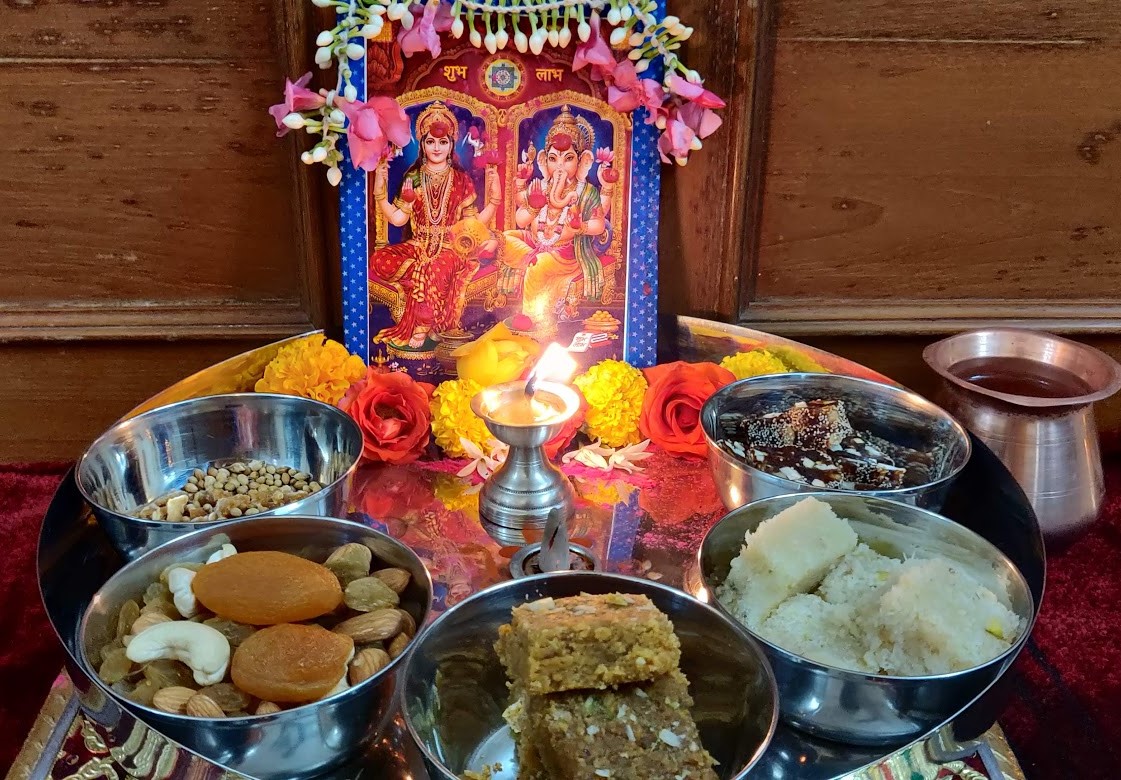
[[File:Diwali Lakshmi Poojan.jpg|thumb|A picture of Lakshmi and [[Ganesha]] worship during Diwali]] | [[File:Diwali Lakshmi Poojan.jpg|thumb|A picture of Lakshmi and [[Ganesha]] worship during Diwali]] | ||
[[File:Diwali Ganesh Laxmi Puja 001.jpg|thumb|Diwali Ganesh Laxmi Puja]] | |||
Many Hindus associate the festival with Goddess [[Lakshmi]], the goddess of wealth and prosperity, and wife of Vishnu. According to Pintchman, the start of the 5-day Diwali festival is stated in some popular contemporary sources as the day | Many Hindus associate the festival with Goddess [[Lakshmi]], the goddess of wealth and prosperity, and wife of Vishnu. According to Pintchman, the start of the 5-day Diwali festival is stated in some popular contemporary sources as the day goddess Lakshmi was born from [[Samudra manthan|Samudra Manthana]], the churning of the cosmic ocean of milk by the [[Deva (Hinduism)|Devas]] (gods) and the [[Asuras]] (demons) – a Vedic legend that is also found in several [[Puranas]] such as the ''[[Padma Purana]]'', while the night of Diwali is when Lakshmi chose and wed Vishnu.<ref name="tp" /><ref name="Karen Pechilis 2007 pp 273-275">{{Cite journal |last=Pechilis |first=Karen |year=2007 |title=Guests at God's Wedding: Celebrating Kartik among the Women of Benares |journal=The Journal of Asian Studies |volume=66 |issue=1 |pages=273–275 |doi=10.1017/S0021911807000460}}</ref> Along with Lakshmi, who is representative of [[Vaishnavism]], [[Ganesha]], the elephant-headed son of [[Parvati]] and [[Shiva]] of [[Shaivism]] tradition, is remembered as one who symbolises ethical beginnings and the remover of obstacles.{{sfn|Bahadur|2006|p=91}} | ||
Hindus of eastern India associate the festival with the Goddess Kali, who symbolises the victory of good over evil.{{sfn| | Hindus of eastern India associate the festival with the Goddess Kali, who symbolises the victory of good over evil.{{sfn|Amazzone|2012|}}<ref>Buck, C. (2008). ''Hindu Festivals'', Festivals in Indian Society (2 Vols. Set), Vol 1, {{ISBN|978-81-8324-113-7}}</ref><ref>{{Cite journal |last=Holm |first=Jean |year=2006 |title=Growing Up in Hinduism |journal=British Journal of Religious Education |volume=6 |issue=3 |pages=116–120 |doi=10.1080/0141620840060303}}</ref> Hindus from the Braj region in northern India, parts of [[Assam]], as well as southern Tamil and Telugu communities view Diwali as the day the god Krishna overcame and destroyed the evil demon king Narakasura, in yet another symbolic victory of knowledge and good over ignorance and evil.{{sfn|Coogan|2003|pp=152–153}}{{sfn|Vemsani|2016|pp=190–191}} | ||
Trade and merchant families and others also offer prayers to [[Saraswati]], who embodies music, literature and learning and [[Kubera]], who symbolises book-keeping, treasury and wealth management.<ref name="tp" /> In western states such as Gujarat, and certain northern Hindu communities of India, the festival of Diwali signifies the start of a new year.{{sfn| | Trade and merchant families and others also offer prayers to [[Saraswati]], who embodies music, literature and learning and [[Kubera]], who symbolises book-keeping, treasury and wealth management.<ref name="tp" /> In western states such as Gujarat, and certain northern Hindu communities of India, the festival of Diwali signifies the start of a new year.{{sfn|Coogan|2003|pp=152–153}} | ||
Mythical tales shared on Diwali vary widely depending on region and even within Hindu tradition,<ref name="vasudha31">{{ | Mythical tales shared on Diwali vary widely depending on region and even within Hindu tradition,<ref name="vasudha31">{{Cite book |last1=Vasudha Narayanan |url=https://books.google.com/books?id=rdTJJEQsDHoC |title=Celebrate Diwali |last2=Deborah Heiligman |publisher=National Geographic |year=2008 |isbn=978-1-4263-0291-6 |page=31 |access-date=14 October 2016 |archive-url=https://web.archive.org/web/20170102030400/https://books.google.com/books?id=rdTJJEQsDHoC |archive-date=2 January 2017 |url-status=live}}</ref> yet all share a common focus on righteousness, self-inquiry and the importance of knowledge,<ref>[http://www.hinduismtoday.com/modules/wfchannel/index.php?wfc_cid=39 Hindu Festivals] {{Webarchive|url=https://web.archive.org/web/20151011182204/http://www.hinduismtoday.com/modules/wfchannel/index.php?wfc_cid=39 |date=11 October 2015 }} Hinduism Today (2010)</ref><ref>Carol Plum-Ucci (2007). ''Celebrate Diwali'', Enslow Publishers, {{ISBN|978-0-7660-2778-7}}, pp. 39–57</ref> which, according to Lindsey Harlan, an Indologist and scholar of Religious Studies, is the path to overcoming the "darkness of ignorance".{{sfn|Salamone|2004|p=112, Article on Divali by Lindsey Harlan}} The telling of these myths is reminiscent of the Hindu belief that good ultimately triumphs over evil.<ref>{{Cite book |last=[[Bridget Brereton]] |url=https://books.google.com/books?id=uNrUU360mzsC&pg=PA113 |title=An Introduction to the History of Trinidad and Tobago |publisher=Heinemann |year=1996 |isbn=978-0-435-98474-8 |page=113 |access-date=19 August 2018 |archive-url=https://web.archive.org/web/20220110120611/https://books.google.com/books?id=uNrUU360mzsC&pg=PA113 |archive-date=10 January 2022 |url-status=live}}</ref>{{sfn|Goldstein|2015|pp=222–223}} | ||
===Other religions=== | ===Other religions=== | ||
Originally a Hindu festival, Diwali has transcended religious lines. | Originally a Hindu festival, Diwali has transcended religious lines.{{sfn|Johnson|2007|pp=71–79}} Diwali is celebrated by Hindus, Jains, Sikhs, and Newar Buddhists,<ref name="diwaliBuddhist" /> although for each faith it marks different historical events and stories, but nonetheless the festival represents the same symbolic victory of light over darkness, knowledge over ignorance, and good over evil.<ref name="Heiligman31" /><ref name="htoday" /><ref>[http://www.hinduismtoday.com/pdf_downloads/pagers/Hindu-Festival_Diwali_broadsheet-color.pdf Diwali – Celebrating the triumph of goodness] {{Webarchive|url=https://web.archive.org/web/20150924041444/http://www.hinduismtoday.com/pdf_downloads/pagers/Hindu-Festival_Diwali_broadsheet-color.pdf|date=24 September 2015}} Hinduism Today (2012)</ref><ref>Jean Mead, How and why Do Hindus Celebrate Divali?, {{ISBN|978-0-237-53412-7}}, pp. 8–12</ref> | ||
==== Jainism ==== | ==== Jainism ==== | ||
{{main|Diwali (Jainism)}} | {{main|Diwali (Jainism)}} | ||
[[File:Mahavira Nirvan Kalyanak Diwali.jpg|thumb|260px|[[Mahavira|Lord Mahavir]] in meditation before attaining nirvana, the day is celebrated by [[Jains]] as ''Dipalikaya'']] | |||
In Jain religion, Diwali is celebrated in observance of "Mahavira Nirvana Divas", the physical death and final nirvana of [[Mahavira]], the 24th [[Tirthankar]] of current time cycle. Nirvana is considered to be the state of a soul when it escapes from the cycle of birth and death, while experiencing its true nature of boundless bliss and infinite knowledge.<ref name="Jacobi 1895">{{Cite book |last1=Jacobi |first1=Hermann |url=http://www.sacred-texts.com/jai/sbe45/index.htm |title=Uttaradhyayana Sutra, Jain Sutras Part II, Sacred Books of the East, Vol. 45 |last2=Ed. F. Max Müller |publisher=The Clarendon Press |year=1895 |location=Oxford |access-date=19 December 2007 |archive-url=https://web.archive.org/web/20090704214930/http://www.sacred-texts.com/jai/sbe45/index.htm |archive-date=4 July 2009 |url-status=live}}</ref> The Jain Diwali celebrated in many parts of India has similar practices to the Hindu Diwali, such as the lighting of lamps. However, the focus of the Jain Diwali remains the dedication to Mahavira.{{sfn|Long|2009|pp=26, 42}} According to the Jain tradition, this practice of lighting lamps first began on the day of Mahavira's nirvana in 527 BCE,{{efn|Scholars contest the 527 BCE date and consider Mahavira's biographical details as uncertain. Some suggest he lived in the 5th-century BCE contemporaneously with the Buddha.{{sfn|Potter|2007|pp=35–36}}{{sfn|Dundas|2002|p=22}}}} when 18 kings who had gathered for Mahavira's final teachings issued a proclamation that lamps be lit in remembrance of the "great light, Mahavira".{{sfn|Melton|2011|p=255}}{{sfn|Long|2009|p=42}} This traditional belief of the origin of Diwali, and its significance to Jains, is reflected in their historic artworks such as paintings.{{sfn|Jain|Fischer|1978|p=13}} | |||
==== Sikhism ==== | ==== Sikhism ==== | ||
{{main|Bandi Chhor Divas}} | {{main|Bandi Chhor Divas}} | ||
[[File:A hukamnama from the tenth Sikh guru, Guru Gobind Singh, requesting all of the Sikh congregation to convene in his presence on the occasion of Diwali.jpg|thumb|A [[hukamnama]] from the tenth Sikh guru, [[Guru Gobind Singh]], requesting all of the Sikh congregation to convene in his presence on the occasion of Diwali]] | [[File:A hukamnama from the tenth Sikh guru, Guru Gobind Singh, requesting all of the Sikh congregation to convene in his presence on the occasion of Diwali.jpg|thumb|A [[hukamnama]] from the tenth Sikh guru, [[Guru Gobind Singh]], requesting all of the Sikh congregation to convene in his presence on the occasion of Diwali]] | ||
Sikhs celebrate Bandi Chhor Divas in remembrance of the release of [[Guru Hargobind]] from the [[Gwalior Fort]] prison by the Mughal emperor [[Jahangir]] and the day he arrived at the Golden Temple in Amritsar.<ref>{{ | Sikhs celebrate Bandi Chhor Divas in remembrance of the release of [[Guru Hargobind]] from the [[Gwalior Fort]] prison by the Mughal emperor [[Jahangir]] and the day he arrived at the Golden Temple in Amritsar.<ref>{{Cite book |last=H.S. Singha |url=https://books.google.com/books?id=gqIbJz7vMn0C&pg=PA62 |title=The Encyclopedia of Sikhism (over 1000 Entries) |publisher=Hemkunt Press |year=2000 |isbn=978-81-7010-301-1 |page=62 |access-date=6 April 2016 |archive-url=https://web.archive.org/web/20170102024429/https://books.google.com/books?id=gqIbJz7vMn0C&pg=PA62 |archive-date=2 January 2017 |url-status=live}}</ref> According to J.S. Grewal, a scholar of Sikhism and Sikh history, Diwali in the Sikh tradition is older than the sixth Guru Hargobind legend. [[Guru Amar Das]], the third Guru of the Sikhs, built a well in Goindwal with eighty-four steps and invited Sikhs to bathe in its [[sacred waters]] on Baisakhi and Diwali as a form of community bonding. Over time, these spring and autumn festivals became the most important of Sikh festivals and holy sites such as Amritsar became focal points for annual pilgrimages.{{sfn|Grewal|1998|pp=50–51, 60, 73–78, 93}} The festival of Diwali, according to Ray Colledge, highlights three events in Sikh history: the founding of the city of Amritsar in 1577, the release of Guru Hargobind from the Mughal prison, and the day of Bhai Mani Singh's martyrdom in 1738 as a result of his failure to pay a fine for trying to celebrate Diwali and thereafter refusing to convert to Islam.{{sfn|Colledge|2017|pp=276–278}}{{sfn|Singh|Louis E. Fenech|2014|pp=431–433}}{{efn|Sikhs historically referred to this festival as Diwali. It was in early 20th-century, states Harjot Oberoi, a scholar of Sikh history, when the Khalsa Tract Society triggered by the [[Singh Sabha Movement]] sought to establish a Sikh identity distinct from the Hindus and the Muslims.{{sfn|Oberoi|1994|pp=346–349}} They launched a sustained campaign to discourage Sikhs from participating in Holi and Diwali, renaming the festivals, publishing the seasonal greeting cards in the Gurmukhi language and relinking their religious significance to Sikh historical events.{{sfn|Oberoi|1994|pp=347–349}} While some of these efforts have had a lasting impact for the Sikh community, the lighting, feasting together, social bonding, sharing and other ritual grammar of Sikh celebrations during the Diwali season are similar to those of the Hindus and Jains.{{sfn|Oberoi|1994|pp=347–349}}}} | ||
==== Buddhism ==== | ==== Buddhism ==== | ||
Diwali is not a festival for most Buddhists, with the exception of the [[Newar people|Newar]] people of Nepal who revere various deities in [[Vajrayana]] Buddhism and celebrate Diwali by offering prayers to Lakshmi.<ref name="diwaliBuddhist" /><ref name="Prem Saran 2012 175" /> Newar Buddhists in Nepalese valleys also celebrate the Diwali festival over five days, in much the same way, and on the same days, as the Nepalese Hindu Diwali-Tihar festival.<ref>{{ | Diwali is not a festival for most Buddhists, with the exception of the [[Newar people|Newar]] people of Nepal who revere various deities in [[Vajrayana]] Buddhism and celebrate Diwali by offering prayers to Lakshmi.<ref name="diwaliBuddhist" /><ref name="Prem Saran 2012 175" /> Newar Buddhists in Nepalese valleys also celebrate the Diwali festival over five days, in much the same way, and on the same days, as the Nepalese Hindu Diwali-Tihar festival.<ref>{{Cite book |last=Jon Burbank |url=https://books.google.com/books?id=EaWLU6Blh_sC&pg=PA111 |title=Nepal |publisher=Marshall Cavendish |year=2002 |isbn=978-0-7614-1476-6 |pages=111–112 |access-date=14 October 2016 |archive-url=https://web.archive.org/web/20170102013443/https://books.google.com/books?id=EaWLU6Blh_sC&pg=PA111 |archive-date=2 January 2017 |url-status=live}}</ref> According to some observers, this traditional celebration by Newar Buddhists in Nepal, through the worship of Lakshmi and Vishnu during Diwali, is not [[syncretism]] but rather a reflection of the freedom within [[Mahayana]] Buddhist tradition to worship any deity for their worldly betterment.<ref name="diwaliBuddhist" /> | ||
==Celebrations== | ==Celebrations== | ||
In the lead-up to Diwali, celebrants prepare by cleaning, renovating, and decorating their homes and workplaces with ''diyas'' (oil lamps) and ''[[rangoli]]s'' ( | {{Infobox | ||
| title = Diwali celebrations | |||
| image = | |||
{{image array|perrow=2|width=150|height=100 | |||
| image1 = Diwali Festival.jpg|caption1 = Hindu girls lighting [[diya (light)|diya]]s in Bangladesh | |||
| image2 = Glowing Swayambhu (3005358416).jpg| caption2 = Decorations in [[Kathmandu]] for [[Tihar (festival)|Tihar]] (Diwali in Nepal) | |||
| image3 = Diyas Diwali Decor India.jpg|caption3 = Diwali lamps arranged in the pattern of ''[[Om]]'' | |||
| image4 = Fireworks Diwali Chennai India November 2013 b.jpg| caption4 = Deepavali night fireworks over [[Chennai]] | |||
| image5 = Diwali Pujan at Haridwar.jpg|caption5 = Indoor Diwali decorations in front of an altar in [[Haridwar]] | |||
| image6 = United States Diwali Dance San Antonio 2011 b.jpg|caption6 = Dance event for Diwali in [[Texas]], US | |||
| image7 = Divalinagar.jpg|caption7 =[[Divali Nagar]] celebration in Trinidad and Tobago | |||
| image8 = Diwali Festival. Jpg.jpg|caption8 =Diyas lit for Diwali at [[Harmandir Sahib|Golden Temple]], Punjab | |||
| image9 = Diwali offerings to god in Tamil Nadu JEG2437.jpg| caption9 = Diwali sweets and snacks | |||
| image10 = DiwaliKarnal.JPG|caption10 =Decorative lights for Diwali on a house in Haryana | |||
}} | |||
|caption = Diwali festivities include a celebration of sights, sounds, arts and flavours. The festivities vary between different regions.<ref name="fs">Frank Salamone (2004). ''Encyclopedia of Religious Rites, Rituals and Festivals'', {{ISBN|978-0-415-88091-6}}, Routledge, pp. 112–113, 174, 252</ref><ref name="tp" /><ref name="dhcd">Deborah Heiligman, ''Celebrate Diwali'', {{ISBN|978-0-7922-5923-7}}, National Geographic Society, Washington, D.C.</ref> | |||
}} | |||
In the lead-up to Diwali, celebrants prepare by cleaning, renovating, and decorating their homes and workplaces with ''diyas'' (oil lamps) and ''[[rangoli]]s'' (colourful art circle patterns).<ref name="Raat">{{Cite book |last=Pramodkumar |url=https://books.google.com/books?id=6A9EZRQIT9kC&pg=PA109 |title=Meri Khoj Ek Bharat Ki |date=2008 |publisher=Lulu.com |isbn=978-1-4357-1240-9 |quote=It is extremely important to keep the house spotlessly clean and pure on Diwali. The goddess [[Lakshmi]] likes cleanliness, and it is believed that she will visit the cleanest house first. Lamps are lit in the evening to welcome the goddess. They are believed to light up her path. |access-date=26 October 2011 |archive-url=https://web.archive.org/web/20220110120623/https://books.google.com/books?id=6A9EZRQIT9kC&pg=PA109 |archive-date=10 January 2022 |url-status=live}}</ref> During Diwali, people wear their finest clothes, illuminate the interior and exterior of their homes with saaki (earthen lamp), ''diyas'' and ''rangoli'', perform worship ceremonies of [[Lakshmi]], the goddess of prosperity and wealth,{{efn|Hindus of eastern and northeastern states of India associate the festival with the goddess [[Durga]], or her fierce avatar [[Kali]] ([[Shaktism]]).{{sfn|Amazzone|2012|}} According to McDermott, this region also celebrated the Lakshmi puja historically, while the Kali puja tradition started during the British Raj and was particularly prominent from the 1920s.{{sfn|McDermott|2011|pp=183–188}}}} light fireworks, and partake in family feasts, where ''mithai'' ([[South Asian sweets|sweets]]) and [[gift]]s are shared. | |||
The height of Diwali is celebrated on the third day coinciding with the darkest night of Ashvin or Kartika. | The height of Diwali is celebrated on the third day coinciding with the darkest night of Ashvin or Kartika. | ||
The common celebratory practices are known as the festival of light, however there are minor differences from state to state in India. Diwali is usually celebrated twenty days after the [[Vijayadashami]] festival, with [[Dhanteras]], or the regional equivalent, marking the first day of the festival when celebrants prepare by cleaning their homes and making decorations on the floor, such as ''[[ | The common celebratory practices are known as the festival of light, however there are minor differences from state to state in India. Diwali is usually celebrated twenty days after the [[Vijayadashami]] festival, with [[Dhanteras]], or the regional equivalent, marking the first day of the festival when celebrants prepare by cleaning their homes and making decorations on the floor, such as ''[[rangoli]]s''.<ref>Karen Bellenir (1997). ''Religious Holidays and Calendars: An Encyclopedic Handbook'', 2nd Edition, {{ISBN|978-0-7808-0258-2}}, Omnigraphics</ref> Some regions of [[India]] start Diwali festivities the day before Dhanteras with [[Govatsa Dwadashi]]. The second day is [[Naraka Chaturdashi]]. The third day is the day of [[Lakshmi Puja]] and the darkest [[night]] of the [[Kārtika (month)|traditional month]]. In some parts of [[India]], the day after [[Lakshmi Puja]] is marked with the [[Govardhan Puja]] and [[Balipratipada]] (Padwa). Some [[Hindus|Hindu]] communities mark the last day as [[Bhai Dooj]] or the regional equivalent, which is dedicated to the bond between sister and brother,<ref>{{Cite book |last1=Rajat Gupta |url=https://books.google.com/books?id=DatDDAAAQBAJ&pg=PA84 |title=Hospitality & Tourism Management |last2=Nishant Singh |last3=Ishita Kirar |publisher=Vikas |isbn=978-93-259-8244-4 |page=84 |access-date=13 August 2018 |archive-url=https://web.archive.org/web/20220110120612/https://books.google.com/books?id=DatDDAAAQBAJ&pg=PA84 |archive-date=10 January 2022 |url-status=live}}</ref> while other Hindu and Sikh craftsmen communities mark this day as [[Vishwakarma Puja|Vishvakarma Puja]] and observe it by performing maintenance in their work spaces and offering [[prayer]]s.<ref name="haar2009">{{Cite book |last1=Kristen Haar |url=https://books.google.com/books?id=YOI1nB_zTyAC |title=Sikhism |last2=Sewa Singh Kalsi |publisher=Infobase Publishing |year=2009 |isbn=978-1-4381-0647-2 |pages=98–99 |access-date=13 August 2018 |archive-url=https://web.archive.org/web/20200208123615/https://books.google.com/books?id=YOI1nB_zTyAC |archive-date=8 February 2020 |url-status=live}}</ref><ref>{{Cite book |last=Shobhna Gupta |url=https://books.google.com/books?id=g4TtrdejbTEC&pg=PA84 |title=Festivals of India |publisher=Har-Anand |year=2002 |isbn=978-81-241-0869-7 |page=84 |access-date=13 August 2018 |archive-url=https://web.archive.org/web/20220110120607/https://books.google.com/books?id=g4TtrdejbTEC&pg=PA84 |archive-date=10 January 2022 |url-status=live}}</ref> | ||
[[File:Diwali in Sri Lanka Culture and Sights.jpg|thumb|left|Diwali celebrations include [[Puja (Hinduism)|puja]] (prayers) to Lakshmi and Ganesha. Lakshmi is of the Vaishnavism tradition, while Ganesha of the Shaivism tradition of Hinduism.{{sfn|Bahadur|2006|pp=92–93}}{{sfn|Kinsley|1988|pp=33–34}}]] | |||
[[File:चंदुआ लालटेन, कला भूमि ओडिशा शिल्प संग्रहालय.jpg|thumb|left|Chandua lanterns on display for Diwali.]] | |||
===Dhanteras | Rituals and preparations for Diwali begin days or weeks in advance, typically after the festival of Dusshera that precedes Diwali by about 20 days.{{sfn|Bahadur|2006|p=91}} The festival formally begins two days before the night of Diwali and ends two days thereafter. Each day has the following rituals and significance:<ref name="tp" /> Diwali has become more popular in other countries. In [[New York City]] lawmakers have passed legislation to make holidays in school. But debates over the holiday push back. In the future Diwali will be a holiday.<ref>{{Cite news |last=Closson |first=Troy |date=2023-06-26 |title=Diwali Is Set to Become a School Holiday in New York City |url=https://www.nytimes.com/2023/06/26/nyregion/diwali-school-holiday-nyc.html |url-status=live |archive-url=https://web.archive.org/web/20230804020242/https://www.nytimes.com/2023/06/26/nyregion/diwali-school-holiday-nyc.html |archive-date=4 August 2023 |access-date=2023-08-02 |work=The New York Times |language=en}}</ref> | ||
===Dhanteras and Yama Deepam (Day 1)=== | |||
{{main|Dhanteras}} | {{main|Dhanteras}} | ||
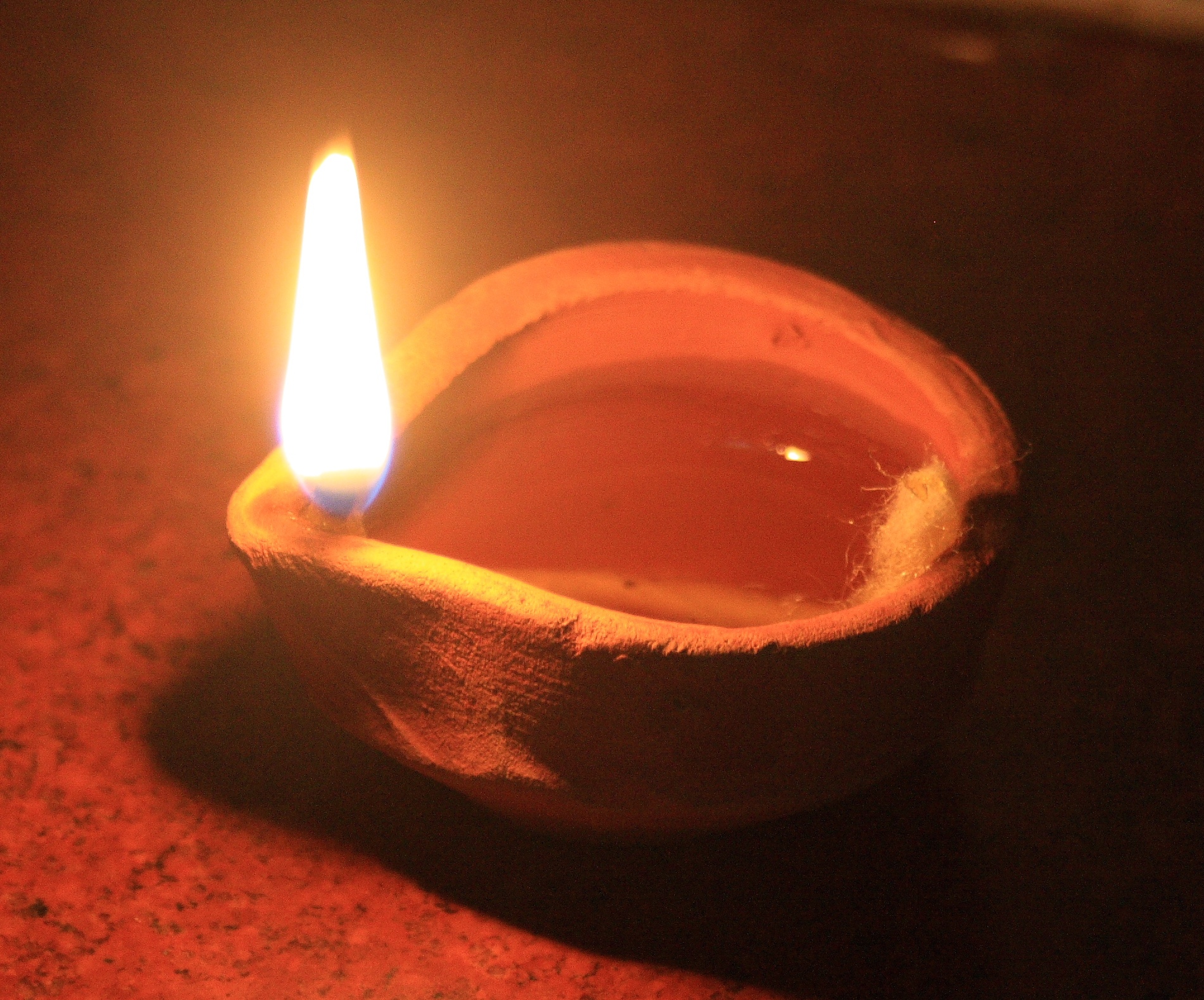
[[File:DiwaliOilLampCrop.JPG|thumb|Dhanteras starts off the Diwali celebrations with the lighting of ''[[Diya (lamp)|Diya]] or Panati'' lamp rows, house cleaning and floor [[rangoli]]]] | [[File:DiwaliOilLampCrop.JPG|thumb|Dhanteras starts off the Diwali celebrations with the lighting of ''[[Diya (lamp)|Diya]] or Panati'' lamp rows, house cleaning and floor [[rangoli]]]] | ||
''Dhanteras'', derived from ''Dhan'' meaning wealth and ''teras'' meaning thirteenth, marks the thirteenth day of the dark fortnight of Ashwin or Kartik and the beginning of Diwali in most parts of India.{{sfn| | ''Dhanteras'', also known as ''Dhanatrayodashi,'' is derived from ''Dhan'' meaning wealth and ''teras'' meaning thirteenth, marks the thirteenth day of the dark fortnight of Ashwin or Kartik and the beginning of Diwali in most parts of India.{{sfn|Pintchman|2005|pp=59–60}} On this day, many Hindus clean their homes and business premises. They install ''diyas'', small earthen oil-filled lamps that they light up for the next five days, near Lakshmi and Ganesha iconography.{{sfn|Pintchman|2005|pp=59–60}}{{sfn|Bahadur|2006|pp=92–93}} Women and children decorate doorways within homes and offices with ''rangolis'', colourful designs made from rice flour, flower petals, coloured rice or coloured sand,{{sfn|Fieldhouse|2017|pp=150–151}} while the boys and men decorate the roofs and walls of family homes, markets, and temples and string up lights and lanterns. The day also marks a major shopping day for buying new utensils, home equipment, gold jewellery, firecrackers, and other items.{{sfn|Bahadur|2006|pp=92–93}}<ref name="tp" /><ref name="Karen Pechilis 2007 pp 273-275" /><ref>{{Cite web |date=2023-07-14 |title=Diwali {{!}} Definition & Facts {{!}} Britannica |url=https://www.britannica.com/topic/Diwali-Hindu-festival |url-status=live |archive-url=https://web.archive.org/web/20150501153023/https://www.britannica.com/EBchecked/topic/166786/Diwali |archive-date=1 May 2015 |access-date=2023-07-27 |website=Encyclopædia Britannica |language=en}}</ref> On the evening of Dhanteras, families offer prayers (''puja'') to Lakshmi and Ganesha, and lay offerings of puffed rice, candy toys, rice cakes and ''batashas'' (hollow sugar cakes).{{sfn|Bahadur|2006|pp=92–93}} | ||
According to Tracy Pintchman, Dhanteras is a symbol of annual renewal, cleansing and an auspicious beginning for the next year.{{sfn| | According to Tracy Pintchman, Dhanteras is a symbol of annual renewal, cleansing and an auspicious beginning for the next year.{{sfn|Pintchman|2005|pp=59–60}} The term ''Dhan'' for this day also alludes to the [[Ayurvedic]] icon [[Dhanvantari]], the god of health and healing, who is believed to have emerged from the "churning of cosmic ocean" on the same day as Lakshmi.{{sfn|Pintchman|2005|pp=59–60}} Some communities, particularly those active in Ayurvedic and health-related professions, pray or perform [[Homa (ritual)|havan]] rituals to Dhanvantari on Dhanteras.{{sfn|Pintchman|2005|pp=59–60}} | ||
On Yama Deepam (also known as Yama Dipadana or Jam ke Diya), Hindus light a [[Diya (lamp)|diya]], ideally made of wheat flour and filled with sesame oil, | On Yama Deepam (also known as Yama Dipadana or Jam ke Diya), Hindus light a [[Diya (lamp)|diya]], ideally made of wheat flour and filled with sesame oil, which faces south in the back of their homes. This is believed to please [[Yama (Hinduism)|Yama]], the god of death, and to ward off untimely death.<ref name="drikpanchang1">{{Cite web |last=LLP |first=Adarsh Mobile Applications |title=2020 Yama Deepam date and timings for New Delhi, NCT, India |url=http://www.drikpanchang.com/diwali/yama-deepam/yama-deepam-date-time.html |url-status=live |archive-url=https://web.archive.org/web/20171223185715/http://www.drikpanchang.com/diwali/yama-deepam/yama-deepam-date-time.html |archive-date=23 December 2017 |access-date=28 August 2021 |website=Drikpanchang}}</ref> Some Hindus observe Yama Deepam on the second night before the main day of Diwali.<ref name="swahainternational1">{{Cite web |title=The 'Yam-deep' or 'Jam ke Deeya' – SWAHA International |url=http://www.swahainternational.org/the-yam-deep-or-jam-ke-deeya/ |url-status=live |archive-url=https://web.archive.org/web/20220110120618/http://www.swahainternational.org/the-yam-deep-or-jam-ke-deeya/ |archive-date=10 January 2022 |access-date=11 November 2020}}</ref><ref name="astroved1">{{Cite web |date=2021-12-29 |title=Significance of Yama Deepam on Diwali Eve |url=https://www.astroved.com/blogs/significance-yama-deepam-diwali-eve |url-status=live |archive-url=https://web.archive.org/web/20210419040402/https://www.astroved.com/blogs/significance-yama-deepam-diwali-eve |archive-date=19 April 2021 |access-date=2022-01-10 |publisher=AstroVed.com}}</ref> | ||
===Naraka Chaturdashi, Kali Chaudas, Chhoti Diwali, Hanuman Puja, Roop Chaudas, Yama Deepam (Day 2)=== | ===Naraka Chaturdashi, Kali Chaudas, Chhoti Diwali, Hanuman Puja, Roop Chaudas, Yama Deepam (Day 2)=== | ||
| Line 150: | Line 171: | ||
| footer = Choti Diwali is the major shopping day for festive ''mithai'' (sweets) | | footer = Choti Diwali is the major shopping day for festive ''mithai'' (sweets) | ||
}} | }} | ||
''Naraka Chaturdashi'', also known as Chhoti Diwali, is the second day of festivities coinciding with the fourteenth day of the dark fortnight of Ashwin or Kartik.<ref>{{ | ''Naraka Chaturdashi'', also known as Chhoti Diwali, is the second day of festivities coinciding with the fourteenth day of the dark fortnight of Ashwin or Kartik.<ref>{{Cite news |date=13 November 2020 |title=Choti Diwali 2020 date: Kali Chaudas significance, when and how to celebrate |url=https://timesofindia.indiatimes.com/astrology/rituals-puja/choti-diwali-2020-date-kali-chaudas-significance-when-and-how-to-celebrate/articleshow/79203502.cms |url-status=live |archive-url=https://web.archive.org/web/20201114134308/https://timesofindia.indiatimes.com/astrology/rituals-puja/choti-diwali-2020-date-kali-chaudas-significance-when-and-how-to-celebrate/articleshow/79203502.cms |archive-date=14 November 2020 |access-date=2020-11-14 |work=The Times of India |language=en}}</ref> The term "chhoti" means little, while "Naraka" means hell and "Chaturdashi" means "fourteenth".{{sfn|Pintchman|2005|pp=60–61}} The day and its rituals are interpreted as ways to liberate any soul from suffering in "Naraka", or hell, as well as a reminder of spiritual auspiciousness. For some Hindus, it is a day to pray for the peace to the manes, or defiled souls of one's ancestors and light their way for their journeys in the cyclic afterlife.{{sfn|Pintchman|2005|pp=60–61, 63}} A mythological interpretation of this festive day is the destruction of the asura (demon) [[Narakasura]] by Krishna, a victory that frees 16,000 imprisoned princesses kidnapped by Narakasura.{{sfn|Pintchman|2005|pp=60–61}} It is also celebrated as Roop Chaudas in some North Indian households, where women bathe before sunrise, while lighting a [[diya (lamp)]] in the bath area, they believe it helps enhance their beauty – it is a fun ritual that young girls enjoy as part of festivities. ''Ubtan'' is applied by the women which is made up of special gram flour mixed with herbs for cleansing and beautifying themselves. | ||
Naraka Chaturdashi is also a major day for purchasing festive foods, particularly sweets. A variety of sweets are prepared using flour, semolina, rice, chickpea flour, dry fruit pieces powders or paste, milk solids (''mawa'' or ''khoya'') and clarified butter (''ghee'').{{sfn| | Naraka Chaturdashi is also a major day for purchasing festive foods, particularly sweets. A variety of sweets are prepared using flour, semolina, rice, chickpea flour, dry fruit pieces powders or paste, milk solids (''mawa'' or ''khoya'') and clarified butter (''ghee'').{{sfn|Goldstein|2015|pp=222–223}} According to Goldstein, these are then shaped into various forms, such as [[laddu]]s, [[barfi]]s, [[halwa]], [[kachori]]s, [[shrikhand]], and [[Sandesh (confectionery)|sandesh]], rolled and stuffed delicacies, such as karanji, [[shankarpali]], maladu, susiyam, pottukadalai. Sometimes these are wrapped with edible silver foil ([[vark]]). Confectioners and shops create Diwali-themed decorative displays, selling these in large quantities, which are stocked for home celebrations to welcome guests and as gifts.{{sfn|Goldstein|2015|pp=222–223}}{{sfn|Bahadur|2006|pp=92–93}} Families also prepare homemade delicacies for Lakshmi Pujan, regarded as the main day of Diwali.{{sfn|Goldstein|2015|pp=222–223}} Chhoti Diwali is also a day for visiting friends, business associates and relatives, and exchanging gifts.{{sfn|Bahadur|2006|pp=92–93}} | ||
On the second day of Diwali, Hanuman Puja is performed in some parts of India especially in [[Gujarat]]. It coincides with the day of Kali Chaudas. It is believed that spirits roam around on the night of Kali Chaudas, and [[Hanuman]], who is the deity of strength, power, and protection, is worshipped to seek protection from the spirits. Diwali is also celebrated to mark the return of [[Rama]] to [[Ayodhya]] after defeating the demon-king Ravana and completing his fourteen years of exile. The devotion and dedication of Hanuman pleased Rama so much that he blessed Hanuman to be worshipped before him. Thus, people worship Hanuman the day before Diwali's main day.<ref name="drikpanchang.com">{{ | On the second day of Diwali, Hanuman Puja is performed in some parts of India especially in [[Gujarat]]. It coincides with the day of Kali Chaudas. It is believed that spirits roam around on the night of Kali Chaudas, and [[Hanuman]], who is the deity of strength, power, and protection, is worshipped to seek protection from the spirits. Diwali is also celebrated to mark the return of [[Rama]] to [[Ayodhya (Ramayana)|Ayodhya]] after defeating the demon-king Ravana<ref>{{Cite web |date=2023-06-24 |title=Ravana {{!}} King of Lanka, Demon King, Ten-Headed {{!}} Britannica |url=https://www.britannica.com/topic/Ravana |url-status=live |archive-url=https://web.archive.org/web/20230602165102/https://www.britannica.com/topic/Ravana |archive-date=2 June 2023 |access-date=2023-07-28 |website=Encyclopædia Britannica |language=en}}</ref> and completing his fourteen years of exile. The devotion and dedication of Hanuman pleased Rama so much that he blessed Hanuman to be worshipped before him. Thus, people worship Hanuman the day before Diwali's main day.<ref name="drikpanchang.com">{{Cite web |title=2020 Hanuman Puja date and time during Diwali for New Delhi, NCT, India |url=https://www.drikpanchang.com/diwali/hanuman-puja/hanuman-puja-date-time.html?year=2020 |url-status=live |archive-url=https://web.archive.org/web/20211103035611/https://www.drikpanchang.com/diwali/hanuman-puja/hanuman-puja-date-time.html?year=2020 |archive-date=3 November 2021 |access-date=6 November 2020}}</ref> | ||
This day is commonly celebrated as Diwali in [[Tamil Nadu]], [[Goa]], and [[Karnataka]]. Traditionally, [[Marathi people|Marathi]] Hindus and South Indian Hindus receive an oil massage from the elders in the family on the day and then take a ritual bath, all before sunrise.{{sfn| | This day is commonly celebrated as Diwali in [[Tamil Nadu]], [[Goa]], and [[Karnataka]].{{Citation needed|date=November 2023}} Traditionally, [[Marathi people|Marathi]] Hindus and South Indian Hindus receive an oil massage from the elders in the family on the day and then take a ritual bath, all before sunrise.{{sfn|Bahadur|2006|pp=93–94}} Many visit their favourite Hindu temple.{{sfn|Rodrigues|2016|p=29}} | ||
Some Hindus observe Yama Deepam (also known as Yama Dipadana or Jam ke Diya) on the second day of Diwali, instead of the first day. A diya that is filled with sesame oil is lit at back of their homes facing in the southern direction. This is believed to please [[Yama (Hinduism)|Yama]], the god of death, and to ward off untimely death.<ref name="drikpanchang1"/><ref name="swahainternational1"/><ref name="astroved1"/> | Some Hindus observe Yama Deepam (also known as Yama Dipadana or Jam ke Diya) on the second day of Diwali, instead of the first day. A diya that is filled with sesame oil is lit at back of their homes facing in the southern direction. This is believed to please [[Yama (Hinduism)|Yama]], the god of death, and to ward off untimely death.<ref name="drikpanchang1" /><ref name="swahainternational1" /><ref name="astroved1" /> | ||
===Lakshmi Pujan, Kali Puja (Day 3)=== | ===Lakshmi Pujan, Kali Puja (Day 3)=== | ||
{{Main|Lakshmi Puja|Kali Puja}} | {{Main|Lakshmi Puja|Kali Puja}} | ||
The third day is the height of the festival{{sfn|Jacobs|2010|p=26}} and coincides with the last day of the dark fortnight of Ashwin or Kartik. This is the day when Hindu, Jain and Sikh temples and homes are aglow with lights, thereby making it the "festival of lights". The word Deepawali comes from the Sanskrit word ''दीप'' (dīpa, "light") and ''आवलि'' (āvali, "series, line, row"), where dīpa means an Indian lantern or lamp.{{sfn|Pintchman|2005|pp=61–62}}<ref name="Mead2008">{{Cite book |last=Jean Mead |url=https://books.google.com/books?id=QJyZKOtHWg4C&pg=PA4 |title=How and why Do Hindus Celebrate Divali? |date=February 2008 |publisher=Evans Brothers |isbn=978-0-237-53412-7 |pages=4– |access-date=25 March 2019 |archive-url=https://web.archive.org/web/20220110120611/https://books.google.com/books?id=QJyZKOtHWg4C&pg=PA4 |archive-date=10 January 2022 |url-status=live}}</ref> | |||
The third day is the height of the festival | |||
[[File:Kit Kat Firecracker.jpg|thumb|left|upright|A sparkling firecracker, commonly known as 'Kit Kat' in India]] | [[File:Kit Kat Firecracker.jpg|thumb|left|upright|A sparkling firecracker, commonly known as 'Kit Kat' in India]] | ||
The youngest members in the family visit their elders, such as grandparents and other senior members of the community, on this day. Small business owners give gifts or special bonus payments to their employees between Dhanteras and Lakshmi Pujan.{{sfn| | The youngest members in the family visit their elders, such as grandparents and other senior members of the community, on this day. Small business owners give gifts or special bonus payments to their employees between Dhanteras and Lakshmi Pujan.{{sfn|Bahadur|2006|pp=93–94}}{{sfn|Jones|2011|p= 254}} Shops either do not open or close early on this day allowing employees to enjoy family time. Shopkeepers and small operations perform ''puja'' rituals in their office premises. Unlike some other festivals, the Hindus typically do not fast during the five-day long Diwali including Lakshmi Pujan, rather they feast and share the bounties of the season at their workplaces, community centres, temples, and homes.{{sfn|Bahadur|2006|pp=93–94}} | ||
[[File: | [[File:Woman lighting the candles for the Festival of Lights in India (cropped).jpg|thumb|Woman lighting candles for Diwali. People light candles and clay lamps in their houses and at temples during Diwali night]] | ||
As the evening approaches, celebrants will wear new clothes or their best outfits, teenage girls and women, in particular, wear saris and | As the evening approaches, celebrants will wear new clothes or their best outfits, teenage girls and women, in particular, wear saris and jewellery.{{sfn|Bahadur|2006|pp=94–95}} At dusk, family members gather for the Lakshmi Pujan,{{sfn|Bahadur|2006|pp=94–95}} although prayers will also be offered to other deities, such as Ganesha, Saraswati, Rama, Lakshmana, Sita, Hanuman, or Kubera.<ref name="tp" /> The lamps from the puja ceremony are then used to light more earthenware lamps, which are placed in rows along the parapets of temples and houses,{{sfn|Bahadur|2006|pp=97–98}} while some ''diyas'' are set adrift on rivers and streams.<ref name="Mead-2008b" /><ref>John Bowker, ed., Oxford Concise Dictionary of World Religions (Oxford UP, 2000), See Festivals</ref>{{sfn|Klostermaier|2014|pp=59, 69}} After the ''puja'', people go outside and celebrate by lighting up ''patakhe'' (fireworks) together, and then share a family feast and ''[[Mithai (confectionery)|mithai]]'' (sweets, desserts).<ref name="tp" /> | ||
The ''puja'' and rituals in the Bengali Hindu community focus on Kali, the goddess of war, instead of Lakshmi.{{sfn|McDermott |2011|pp =183–188}}{{sfn| | The ''puja'' and rituals in the [[Bengali Hindu]] community focus on Kali, the goddess of war, instead of Lakshmi.{{sfn|McDermott |2011|pp =183–188}}{{sfn|Rhodes|2010|pp=1–2}} According to Rachel Fell McDermott, a scholar of South Asian, particular Bengali, studies, in Bengal during Navaratri (Dussehra elsewhere in India) the ''[[Durga puja]]'' is the main focus, although in the eastern and northeastern states the two are synonymous, but on Diwali the focus is on the puja dedicated to Kali. These two festivals likely developed in tandem over their recent histories, states McDermott.{{sfn|McDermott|2011|pp=183–188}} Textual evidence suggests that Bengali Hindus worshipped Lakshmi before the colonial era, and that the Kali puja is a more recent phenomenon.{{efn|According to McDermott, while the Durga Puja is the largest Bengali festival and it can be traced to the 16th-century or earlier, the start of Kali puja tradition on Diwali is traceable to no earlier than about the mid-18th-century during the reign of Raja Krishnacandra Ray.{{sfn|McDermott|2011|pp=183–188}} McDermott further writes that the older historic documents of the Bengal confirm that the Bengali Hindus have long celebrated the night of Diwali with illuminations, firecrackers, foods, new account books, Lakshmi (not Kali), inviting their friends (including Europeans during the colonial era) and gambling.{{sfn|McDermott|2011|pp=183–188}} The Kali ''sarbajanin'' tradition on Diwali, with tantric elements in some locations, grew slowly into a popular Bengali tradition after the mid-1920s.{{sfn|McDermott|2011|pp=183–188}}}} Contemporary Bengali celebrations mirror those found elsewhere, with teenage boys playing with fireworks and the sharing of festive food with family, but with the [[Shaktism|Shakti]] goddess Kali as the focus.{{sfn|McDaniel|2004|pp=253–255}} | ||
[[File:Sparkles phuljhari fireworks on DIWALI, festival of lights.jpg|thumb|A child playing with [[sparkler]]s during Diwali]] | [[File:Sparkles phuljhari fireworks on DIWALI, festival of lights.jpg|thumb|A child playing with [[sparkler|(fuljhadi) sparkler]]s during Diwali]] | ||
On the night of Diwali, rituals across much of India are dedicated to Lakshmi to welcome her into their cleaned homes and bring prosperity and happiness for the coming year.{{sfn| | On the night of Diwali, rituals across much of India are dedicated to Lakshmi to welcome her into their cleaned homes and bring prosperity and happiness for the coming year.{{sfn|Pintchman|2005|pp=61–63}}<ref name="S A NEWS-2020">{{Cite web |date=2020-11-12 |title=Diwali Festival 2020 India:Date,Story,Celebration,Diwali Special Gift |url=https://news.jagatgururampalji.org/diwali-festival-2020-special-gift/ |url-status=live |archive-url=https://web.archive.org/web/20201114053744/https://news.jagatgururampalji.org/diwali-festival-2020-special-gift/ |archive-date=14 November 2020 |access-date=2020-11-14 |website=S A NEWS |language=en-US}}</ref> While the cleaning, or painting, of the home is in part for goddess Lakshmi, it also signifies the ritual "reenactment of the cleansing, purifying action of the monsoon rains" that would have concluded in most of the Indian subcontinent.{{sfn|Pintchman|2005|pp=61–63}} Vaishnava families recite Hindu legends of the victory of good over evil and the return of hope after despair on the Diwali night, where the main characters may include Rama, Krishna, Vamana or one of the avatars of Vishnu, the divine husband of Lakshmi.{{sfn|Pintchman|2005|pp=61–63}}{{sfn|Bahadur|2006|pp=94–97}} At dusk, lamps placed earlier in the inside and outside of the home are lit up to welcome Lakshmi.{{sfn|Jacobs|2010|p=26}} Family members light up firecrackers, which some interpret as a way to ward off all evil spirits and the inauspicious, as well as add to the festive mood.<ref name="Firecracker2">{{Cite book |last=Petrillo |first=Valerie |url=https://books.google.com/books?id=GErOyV7FBNUC&pg=PA175 |title=Asian American History |date=28 May 2007 |publisher=Chicago Review Press |isbn=978-1-55652-634-3 |quote=There are firecrackers everywhere to scare off evil spirits and contribute to the festive atmosphere. |access-date=26 October 2011 |archive-url=https://web.archive.org/web/20220110120612/https://books.google.com/books?id=GErOyV7FBNUC&pg=PA175 |archive-date=10 January 2022 |url-status=live}}</ref><ref name="Firecracker3">{{Cite book |last1=DeRocco |first1=David |url=https://books.google.com/books?id=TRyb8XqB7dEC&pg=SA9-PA1 |title=The International Holiday & Festival Primer |last2=Dundas |first2=Joan |last3=Ian Zimmerman |publisher=Full Blast Productions |year=1996 |isbn=978-1-895451-24-5 |quote=But as well as delighting the spectators, the fireworks are believed to chase away evil spirits. |access-date=26 October 2011 |archive-url=https://web.archive.org/web/20231111153321/https://books.google.com/books?id=TRyb8XqB7dEC&pg=SA9-PA1#v=onepage&q&f=false |archive-date=11 November 2023 |url-status=live}}</ref> According to Pintchman, who quotes Raghavan, this ritual may also be linked to the tradition in some communities of paying respect to ancestors. Earlier in the season's fortnight, some welcome the souls of their ancestors to join the family for the festivities with the ''Mahalaya''. The Diwali night's lights and firecrackers, in this interpretation, represent a celebratory and symbolic farewell to the departed ancestral souls.{{sfn|Pintchman|2005|p=63}} | ||
The celebrations and rituals of the Jains and the Sikhs are similar to those of the Hindus where social and community bonds are renewed. Major temples and homes are decorated with lights, festive foods shared with all, friends and relatives remembered and visited with gifts.{{sfn| | The celebrations and rituals of the Jains and the Sikhs are similar to those of the Hindus where social and community bonds are renewed. Major temples and homes are decorated with lights, festive foods shared with all, friends and relatives remembered and visited with gifts.{{sfn|Jones|2011|p= 254}}{{sfn|Long|2009|pp=26, 42}} | ||
===Annakut, Balipratipada (Padwa), Govardhan Puja (Day 4)=== | ===Annakut, Balipratipada (Padwa), New Year's Day, Govardhan Puja (Day 4)=== | ||
{{main|Balipratipada|Govardhan Puja}} | {{main|Balipratipada|Govardhan Puja}} | ||
The day after Diwali is the first day of the bright fortnight of Kartik.{{sfn| | The day after Diwali is the first day of the bright fortnight of Kartik.{{sfn|Pintchman|2005|pp=63–64}} It is regionally called Annakut (heap of grain), Padwa, Goverdhan puja, Bali Pratipada, Bali Padyami, Kartik Shukla Pratipada and other names.{{sfn|Fieldhouse|2017|pp=150–151}}{{sfn|Pintchman|2005|pp=63–64}} According to one tradition, the day is associated with the story of Bali's defeat at the hands of Vishnu.<ref name="NarayananKurup1976">{{Cite book |last1=M.G.S. Narayanan |url=https://books.google.com/books?id=mvELAAAAIAAJ |title=Historical Studies in Kerala |last2=K.K.N. Kurup |publisher=Department of History, University of Calicut |year=1976 |access-date=12 October 2014 |archive-url=https://web.archive.org/web/20140103135407/http://books.google.com/books?id=mvELAAAAIAAJ |archive-date=3 January 2014 |url-status=live}}</ref><ref>Deborah Heiligman, ''Celebrate Diwali'', {{ISBN|978-1-4263-0291-6}}, National Geographic, p. 31</ref> In another interpretation, it is thought to reference the legend of Parvati and her husband Shiva playing a game of ''dyuta'' (dice) on a board of twelve squares and thirty pieces, Parvati wins. Shiva surrenders his shirt and adornments to her, rendering him naked.{{sfn|Pintchman|2005|pp=63–64}} According to Handelman and Shulman, as quoted by Pintchman, this legend is a Hindu metaphor for the cosmic process for creation and dissolution of the world through the masculine destructive power, as represented by Shiva, and the feminine procreative power, represented by Parvati, where twelve reflects the number of months in the cyclic year, while thirty are the number of days in its lunisolar month.{{sfn|Pintchman|2005|pp=63–64}} | ||
{{multiple image|perrow = 2|total_width=400 | {{multiple image|perrow = 2|total_width=400 | ||
| Line 186: | Line 206: | ||
| footer = Annakut community meals (left), Krishna holding [[Govardhan Hill]] ritually made from cow dung, rice and flowers (right). | | footer = Annakut community meals (left), Krishna holding [[Govardhan Hill]] ritually made from cow dung, rice and flowers (right). | ||
}} | }} | ||
This day ritually celebrates the bond between the wife and husband,{{sfn| | This day ritually celebrates the bond between the wife and husband,{{sfn|Crump|2014|pp=112–113}} and in some Hindu communities, husbands will celebrate this with gifts to their wives. In other regions, parents invite a newly married daughter, or son, together with their spouses to a festive meal and give them gifts.{{sfn|Crump|2014|pp=112–113}} | ||
In some rural communities of the north, west and central regions, the fourth day is celebrated as Govardhan puja, honouring the legend of the Hindu god Krishna saving the cowherd and farming communities from incessant rains and floods triggered by Indra's anger,{{sfn| | In some rural communities of the north, west and central regions, the fourth day is celebrated as Govardhan puja, honouring the legend of the Hindu god Krishna saving the cowherd and farming communities from incessant rains and floods triggered by Indra's anger,{{sfn|Crump|2014|pp=112–113}} which he accomplished by lifting the Govardhan mountain. This legend is remembered through the ritual of building small mountain-like miniatures from cow dung.{{sfn|Crump|2014|pp=112–113}} According to Kinsley, the ritual use of cow dung, a common fertiliser, is an agricultural motif and a celebration of its significance to annual crop cycles.{{sfn|Kinsley|1988|pp=33–34}}{{sfn|Pintchman|2005|pp=64–65}}{{sfn|Lodrick|1987}} | ||
The agricultural symbolism is also observed on this day by many Hindus as Annakut, literally "mountain of food". Communities prepare over one hundred dishes from a variety of ingredients, which is then dedicated to Krishna before being shared among the community. Hindu temples on this day prepare and present "mountains of sweets" to the faithful who have gathered for ''darshan'' (visit).{{sfn| | The agricultural symbolism is also observed on this day by many Hindus as Annakut, literally "mountain of food". Communities prepare over one hundred dishes from a variety of ingredients, which is then dedicated to Krishna before being shared among the community. Hindu temples on this day prepare and present "mountains of sweets" to the faithful who have gathered for ''darshan'' (visit).{{sfn|Crump|2014|pp=112–113}} In Gujarat, Annakut is the first day of the new year and celebrated through the purchase of essentials, or ''sabras'' (literally, "good things in life"), such as salt, offering prayers to Krishna and visiting temples.{{sfn|Crump|2014|pp=112–113}} In Gujarat [[Indian New Year's days|New Year]] is celebrated after the day of Diwali. In the early morning people take showers, do prayer at home, visit temples for worship and children in the evening visit neighbour's houses to say happy new year, shake hands, get mukhvas for dessert, and chocolate. | ||
===Bhai Duj, Bhau-Beej, Vishwakarma Puja (Day 5)=== | ===Bhai Duj, Bhau-Beej, Vishwakarma Puja (Day 5)=== | ||
{{main|Bhai Dooj|Vishwakarma Puja}} | {{main|Bhai Dooj|Vishwakarma Puja}} | ||
[[File:Diwali (Bhaiya Dweej ).JPG|thumb|right|A sister ritually feeding her brother on Bhai Duj-Diwali]] | |||
The last day of the festival, the second day of the bright fortnight of Kartik, is called ''Bhai Duj'' (literally "brother's day"<ref>{{Cite book |last=David L. Haberman |url=https://books.google.com/books?id=63uDsPPr48gC&pg=PA129 |title=River of Love in an Age of Pollution: The Yamuna River of Northern India |publisher=University of California Press |year=2006 |isbn=978-0-520-24789-5 |page=129 |access-date=19 August 2018 |archive-url=https://web.archive.org/web/20231111153322/https://books.google.com/books?id=63uDsPPr48gC&pg=PA129#v=onepage&q&f=false |archive-date=11 November 2023 |url-status=live}}</ref>), ''Bhau Beej'', ''Bhai Tilak'' or ''Bhai Phonta''. It celebrates the sister-brother bond, similar in spirit to [[Raksha Bandhan]] but it is the brother that travels to meet the sister and her family. This festive day is interpreted by some to symbolise Yama's sister [[Yamuna in Hinduism|Yamuna]] welcoming Yama with a ''tilaka'', while others interpret it as the arrival of Krishna at his sister [[Subhadra]]'s place after defeating Narakasura. Subhadra welcomes him with a ''tilaka'' on his forehead.{{sfn|Crump|2014|pp=112–113}}{{sfn|Pintchman|2005|pp=66–69}} | |||
| | |||
| | |||
The last day of the festival, the second day of the bright fortnight of Kartik, is called ''Bhai Duj'' (literally "brother's day"<ref>{{ | |||
The day celebrates the sibling bond between brother and sister.<ref>{{ | The day celebrates the sibling bond between brother and sister.<ref>{{Cite web |title=Bhai Bij in India in 2020 |url=https://www.officeholidays.com/holidays/bhai-bij |url-status=live |archive-url=https://web.archive.org/web/20201116022133/https://www.officeholidays.com/holidays/bhai-bij |archive-date=16 November 2020 |access-date=2020-11-14 |website=Office Holidays |language=en}}</ref> On this day the womenfolk of the family gather, perform a puja with prayers for the well-being of their brothers, then return to a ritual of feeding their brothers with their hands and receiving gifts. According to Pintchman, in some Hindu traditions the women recite tales where sisters protect their brothers from enemies that seek to cause him either bodily or spiritual harm.{{sfn|Pintchman|2005|pp=66–69}} In historic times, this was a day in autumn when brothers would travel to meet their sisters or invite their sister's family to their village to celebrate their sister-brother bond with the bounty of seasonal harvests.<ref name="tp" /> | ||
The artisan Hindu and Sikh community celebrates the fourth day as the Vishwakarma puja day.{{efn|According to a Government of Himachal Pradesh and India publication, the Vishvakarma puja is observed on the fourth day of Diwali in the Himalayan state.<ref>{{ | The artisan Hindu and Sikh community celebrates the fourth day as the Vishwakarma puja day.{{efn|According to a Government of Himachal Pradesh and India publication, the Vishvakarma puja is observed on the fourth day of Diwali in the Himalayan state.<ref>{{Cite book |last=Government of India & Himachal Pradesh |url=https://books.google.com/books?id=0EqykjrjNPYC |title=Census of India, 1981: Himachal Pradesh |publisher=Controller of Publications |year=1982 |page=46 |access-date=20 August 2018 |archive-url=https://web.archive.org/web/20231111153324/https://books.google.com/books?id=0EqykjrjNPYC |archive-date=11 November 2023 |url-status=live}}</ref>}} Vishwakarma is the presiding Hindu deity for those in architecture, building, manufacturing, textile work and crafts trades.<ref name="haar2009" />{{Efn|The Vishwakarma puja day is alternatively observed in other Hindu communities in accordance with the Hindu solar calendar, and this falls in September.{{sfn|Melton|2011|pp=908–909}}}} The looms, tools of trade, machines and workplaces are cleaned and prayers offered to these livelihood means.<ref>{{Cite journal |last1=Narayan |first1=Kirin |last2=George |first2=Kenneth M. |year=2017 |title=Tools and world-making in the worship of Vishwakarma |journal=South Asian History and Culture |volume=8 |issue=4 |pages=478–492 |doi=10.1080/19472498.2017.1371506 |s2cid=149325687}}</ref> | ||
==Other traditions and significance== | ==Other traditions and significance== | ||
During the season of Diwali, numerous rural townships and villages host ''[[Mela Festival|melas]]'',<ref name="Kadowala1998">{{ | During the season of Diwali, numerous rural townships and villages host ''[[Mela Festival|melas]]'',<ref name="Kadowala1998">{{Cite book |last=Kadowala |first=Dilip |title=Diwali |publisher=Evans Brothers Limited |year=1998 |isbn=978-0-237-51801-1 |location=London}}</ref> or fairs, where local producers and artisans trade produce and goods. A variety of entertainments are usually available for inhabitants of the local community to enjoy. The women, in particular, adorn themselves in colourful attire and [[Mehndi|decorate]] their hands with [[henna]]. Such events are also mentioned in Sikh historical records.{{sfn|Oberoi|1994|pp=188–190 with footnote 96}}{{efn|[[Max Arthur Macauliffe|Max Macauliffe]], who lived in northwest Punjab area during the colonial era and is known for his work on Sikh literature and history, wrote about Diwali ''melas'' to which people visited to buy horses, seek pleasure, pray in nearby Amritsar temples for the prosperity of their children and their souls, and some on "errands, more or less worthy or unworthy character".{{sfn|Oberoi|1994|pp=188–190 with footnote 96}}}} In the modern day, ''Diwali mela'' are held at college, or university, campuses or as community events by members of the Indian diaspora. At such events a variety of music, dance and arts performances, food, crafts, and cultural celebrations are featured.<ref>Priya Krishna (2017), [https://www.nytimes.com/2017/10/31/dining/diwali-mela-dallas-food.html If You Missed Diwali in India, Dallas Is the Place to Be] {{Webarchive|url=https://web.archive.org/web/20180820005814/https://www.nytimes.com/2017/10/31/dining/diwali-mela-dallas-food.html |date=20 August 2018 }}, ''The New York Times'', 31 October 2017</ref><ref>[http://www.asianimage.co.uk/news/15570042.Manchester_Dashehra_and_Diwali_Mela_plans_announced/ Manchester Dashehra and Diwali Mela plans announced] {{Webarchive|url=https://web.archive.org/web/20180820005747/http://www.asianimage.co.uk/news/15570042.Manchester_Dashehra_and_Diwali_Mela_plans_announced/ |date=20 August 2018 }}, Asian Image (2 October 2017), United Kingdom</ref>{{sfn|Salamone|2004|p=112, Article on Divali by Lindsey Harlan}} | ||
In October 2025, the state of California made Diwali an official state holiday.<ref>{{Cite web |last=Bharath |first=Deepa |date=2025-10-07 |title=California makes Diwali an official statewide holiday |url=https://apnews.com/article/diwali-state-holiday-california-hindus-sikhs-buddhists-f7ddd73c14e212a698d2c559c12a8a4e |access-date=2025-10-09 |website=AP News |language=en}}</ref> | |||
===Economics=== | ===Economics=== | ||
Diwali marks a major shopping period in India,<ref name="wsj" /> and is comparable to the Christmas period in terms of consumer purchases and economic activity.{{sfn| | Diwali marks a major shopping period in India,<ref name="wsj" /> and is comparable to the Christmas period in terms of consumer purchases and economic activity.{{sfn|Klostermaier|2014|p=59}} It is traditionally a time when households purchase new clothing, home refurbishments, gifts, gold, jewelry,<ref>[http://www.bullionstreet.com/news/festive-season-to-boost-india-gold-buying/145 Festive season to boost India gold buying] {{webarchive|url=https://web.archive.org/web/20131207104526/http://www.bullionstreet.com/news/festive-season-to-boost-india-gold-buying/145 |date=7 December 2013 }} Bullion Street (15 October 2013)</ref><ref>[http://www.gold.org/jewellery/markets/india/ Gold, Key markets: India] {{Webarchive|url=https://web.archive.org/web/20131207084755/http://www.gold.org/jewellery/markets/india/ |date=7 December 2013 }} World Gold Council (2013)</ref> and other large purchases particularly as the festival is dedicated to Lakshmi, the goddess of wealth and prosperity, and such purchases are considered auspicious.<ref>[http://www.ft.com/intl/cms/s/0/937525dc-e33f-11df-97db-00144feabdc0.html India's banks face pre-Diwali cash crunch] {{Webarchive|url=https://web.archive.org/web/20220110121010/https://www.ft.com/content/937525dc-e33f-11df-97db-00144feabdc0 |date=10 January 2022 }} James Lamont, ''The Financial Times'' (29 October 2010)</ref><ref>[https://www.indiatoday.in/business/story/festive-season-consumer-spending-slowing-economy-inflation-retailers-216207-2013-10-31 Diwali lights up consumer spending, festive spirit beats inflation] M.G. Arun, India Today (1 November 2013)</ref> According to Rao, Diwali is one of the major festivals where rural Indians spend a significant portion of their annual income, and is a means for them to renew their relationships and social networks.{{sfn|Rao|2001|pp=71–95}} | ||
Other goods that are bought in substantial quantities during Diwali include confectionery and fireworks. In 2013, about {{INRConvert|25|b}} of fireworks were sold to merchants for the Diwali season, an equivalent retail value of about {{INRConvert|50|b}} according to ''The Times of India''.<ref>[https://web.archive.org/web/20131028060716/http://articles.timesofindia.indiatimes.com/2013-10-24/india/43361997_1_firecrackers-tamil-nadu-fireworks-diwali Firecrackers to cost a bomb this Diwali] ''The Times of India'' (24 October 2013)</ref>{{efn|A 2017 estimate states 50,000 tons (100 million pounds) of fireworks are exploded annually in India over the Diwali festival.<ref>[https://www.npr.org/sections/goatsandsoda/2017/10/17/558067395/fear-of-toxic-smog-leads-india-to-limit-diwali-fireworks Fear Of Toxic Smog Leads India To Limit Diwali Fireworks] {{Webarchive|url=https://web.archive.org/web/20180822113355/https://www.npr.org/sections/goatsandsoda/2017/10/17/558067395/fear-of-toxic-smog-leads-india-to-limit-diwali-fireworks |date=22 August 2018 }}, NPR (17 October 2017)</ref> As a comparison, Americans explode 134,000 tons (268 million pounds) of fireworks for | Other goods that are bought in substantial quantities during Diwali include confectionery and fireworks. In 2013, about {{INRConvert|25|b}} of fireworks were sold to merchants for the Diwali season, an equivalent retail value of about {{INRConvert|50|b}} according to ''The Times of India''.<ref>[https://web.archive.org/web/20131028060716/http://articles.timesofindia.indiatimes.com/2013-10-24/india/43361997_1_firecrackers-tamil-nadu-fireworks-diwali Firecrackers to cost a bomb this Diwali] ''The Times of India'' (24 October 2013)</ref>{{efn|A 2017 estimate states 50,000 tons (100 million pounds) of fireworks are exploded annually in India over the Diwali festival.<ref>[https://www.npr.org/sections/goatsandsoda/2017/10/17/558067395/fear-of-toxic-smog-leads-india-to-limit-diwali-fireworks Fear Of Toxic Smog Leads India To Limit Diwali Fireworks] {{Webarchive|url=https://web.archive.org/web/20180822113355/https://www.npr.org/sections/goatsandsoda/2017/10/17/558067395/fear-of-toxic-smog-leads-india-to-limit-diwali-fireworks |date=22 August 2018 }}, NPR (17 October 2017)</ref> As a comparison, Americans explode 134,000 tons (268 million pounds) of fireworks for 4 July celebrations in the United States.<ref>[http://fortune.com/2018/06/29/july-4th-fireworks-billion-dollar-burn-injuries/ Firework Facts: Americans Incinerate $1 Billion in July Fourth Fireworks Every Year] {{Webarchive|url=https://web.archive.org/web/20180822113406/http://fortune.com/2018/06/29/july-4th-fireworks-billion-dollar-burn-injuries/ |date=22 August 2018 }}, Fortune (29 June 2018)</ref>}} [[ASSOCHAM]], a trade organisation in India, forecasted that online shopping alone to be over {{INRConvert|300|b}} over the 2017 Diwali season.<ref>[https://timesofindia.indiatimes.com/business/india-business/online-sales-may-surpass-rs-30000-crore-in-festive-month-assocham/articleshow/61035441.cms Oneline sales may surpass Rs 30000 crores in festive months] {{Webarchive|url=https://web.archive.org/web/20180828055348/https://timesofindia.indiatimes.com/business/india-business/online-sales-may-surpass-rs-30000-crore-in-festive-month-assocham/articleshow/61035441.cms |date=28 August 2018 }} The Times of India (11 October 2017)</ref> About two-thirds of Indian households, according to the ASSOCHAM forecast, would spend between {{INRConvert|5000}} and {{INRConvert|10000}} to celebrate Diwali in 2017.<ref>[http://www.assocham.org/newsdetail.php?id=6536 Average family to spend Rs. 10,000 on this Diwali: ASSOCHAM survey] {{Webarchive|url=https://web.archive.org/web/20180820005805/http://www.assocham.org/newsdetail.php?id=6536 |date=20 August 2018 }}, ASSOCHAM (17 October 2017); Tarandip Kaur (2017), [https://www.forbes.com/sites/tarandipkaur/2017/10/18/festival-of-lights-all-you-need-to-know-about-diwali/ "Festival of Lights: All You Need to Know About Diwali"] {{Webarchive|url=https://web.archive.org/web/20180819214317/https://www.forbes.com/sites/tarandipkaur/2017/10/18/festival-of-lights-all-you-need-to-know-about-diwali/ |date=19 August 2018 }}, ''Forbes'' (18 October 2017)</ref> Stock markets like NSE and BSE in India are typically closed during Diwali, with the exception of a Diwali Muhurat trading session for an hour in the evening to coincide with the beginning of the new year.<ref>{{Cite web |title=DNA Explainer: What is Diwali Muhurat Trading and why it is best time to invest in stocks |url=https://www.dnaindia.com/business/report-dna-explainer-what-is-diwali-muhurat-trading-and-why-it-is-best-time-to-invest-in-stocks-2918360 |url-status=live |archive-url=https://web.archive.org/web/20211105092714/https://www.dnaindia.com/business/report-dna-explainer-what-is-diwali-muhurat-trading-and-why-it-is-best-time-to-invest-in-stocks-2918360 |archive-date=5 November 2021 |access-date=2021-11-05 |website=DNA India |language=en}}</ref> In 2020, the INDF ETF was launched to mark the start of Diwali.<ref>{{Cite web |date=2020-11-12 |title=NextFins Celebrates Diwali With the Launch of INDF |url=https://www.businesswire.com/news/home/20201112005141/en/NextFins-Celebrates-Diwali-With-the-Launch-of-INDF |url-status=live |archive-url=https://web.archive.org/web/20201112204731/https://www.businesswire.com/news/home/20201112005141/en/NextFins-Celebrates-Diwali-With-the-Launch-of-INDF |archive-date=12 November 2020 |access-date=2020-11-12 |website=businesswire.com |language=en}}</ref> | ||
===Politics=== | ===Politics=== | ||
Diwali has increasingly attracted cultural exchanges, becoming occasions for politicians and religious leaders worldwide to meet Hindu or Indian origin citizens, diplomatic staff or neighbours. Many participate in other socio-political events as a symbol of support for diversity and inclusiveness. The Catholic dicastery [[Pontifical Council for Interreligious Dialogue]], founded as Secretariat for non-Christians by Pope Paul VI, began sending official greetings and the Pope's message to the Hindus on Diwali in the mid-1990s.{{sfn|Barbato|2017|pp=93–97}}{{efn|The Pontifical Council for Interreligious Dialogue was founded as Secretariat for non-Christians by Pope Paul VI. It began sending official greetings and message to Muslims in 1967 on ''Id al-Fitr''. About 30 years later, in the mid-1990s the Catholic authorities began sending two additional annual official greetings and message, one to the Hindus on Diwali and the other to the Buddhists on Buddha's birthday.{{sfn|Barbato|2017|pp=93–97}}}} | |||
Diwali | Many governments encourage or sponsor Diwali-related festivities in their territories. For example, the Singaporean government, in association with the [[Hindu Endowments Board]] of Singapore, organizes many cultural events during Diwali every year.<ref>Little India, Singapore (2013), [http://www.littleindia.com.sg/Diwali_in_Singapore.aspx Deepavali in Singapore] {{webarchive|url= https://web.archive.org/web/20131203010347/http://www.littleindia.com.sg/Diwali_in_Singapore.aspx |date= 3 December 2013 }}</ref> National and civic leaders such as [[Charles III|the former Prince Charles]] have attended Diwali celebrations at prominent Hindu temples in the UK, such as the [[Neasden Temple|Swaminarayan Temple in Neasden]], using the occasion to highlight contributions of the Hindu community to British society.<ref>{{Cite news |last=PTI |date=10 November 2007 |title=Prince Charles, Camilla celebrate Diwali in UK |url=https://timesofindia.indiatimes.com/world/uk/Prince-Charles-Camilla-celebrate-Diwali-in-UK/articleshow/2532035.cms |url-status=live |archive-url=https://web.archive.org/web/20131104183044/http://articles.timesofindia.indiatimes.com/2007-11-10/uk/27962079_1_royal-couple-diwali-celebrations-temple |archive-date=4 November 2013 |access-date=3 November 2013 |work=[[The Times of India]]}}</ref><ref>{{Cite web |title=Their Royal Highnesses The Prince of Wales and The Duchess of Cornwall Celebrate Diwali at BAPS Shri Swaminarayan Mandir, London |url=http://www.mandir.org/news&events/2007/11/trhvisit/index.htm |url-status=dead |archive-url=https://web.archive.org/web/20121114112622/http://www.mandir.org/news%26events/2007/11/trhvisit/index.htm |archive-date=14 November 2012 |access-date=3 November 2013 |website=mandir.org |publisher=BAPS Swaminarayan Sanstha}}</ref> Additionally, cities across the UK show support of the celebrations through Diwali lights, decorations, and cultural festivities such as dance performances, food stalls and workshops.<ref>{{Cite web |title=Mayor announces the capital's Diwali in the Square celebrations {{!}} London City Hall |url=https://www.london.gov.uk/media-centre/mayors-press-release/Diwali-2023 |access-date=2023-11-13 |website=www.london.gov.uk |language=en}}</ref> Since 2009, Diwali has been celebrated every year at [[10 Downing Street]], the residence of the British Prime Minister.<ref>{{Cite news |last=PTI |date=17 October 2009 |title=Brown celebrates Diwali at 10, Downing Street, in a 'historic' first |url=https://timesofindia.indiatimes.com/world/uk/Brown-celebrates-Diwali-at-10-Downing-Street-in-a-historic-first/articleshow/5134278.cms |url-status=live |archive-url=https://web.archive.org/web/20131104183112/http://articles.timesofindia.indiatimes.com/2009-10-17/uk/28096259_1_diwali-downing-street-joginder-sangar |archive-date=4 November 2013 |access-date=3 November 2013 |work=[[The Times of India]]}}</ref> | ||
Diwali was first celebrated in the [[White House]] by [[George W. Bush]] in 2003, and its religious and historical significance was officially recognized by the [[United States Congress]] in 2007.<ref>{{Cite news |last=Sanchez |first=Aurelio |date=2 November 2007 |title=Fest celebrates triumph of light over dark |work=The Albuquerque Journal |page=10 |quote=According to a resolution passed recently by the Foreign Affairs Committee of the House of Representatives, the festival is celebrated by almost 2 million in the United States and many millions more around the world. The bill, H.R. 747, calls for the U.S. Congress to acknowledge 'the religious and historical significance of the festival of Diwali.'}}</ref><ref>{{Cite news |date=30 October 2007 |title=US House passes resolution on significance of Diwali |work=Hindustan Times}}</ref> [[Barack Obama]] became the first president to personally attend Diwali at the White House in 2009. On the eve of his first visit to India as President of the United States, Obama released an official statement sharing his best wishes with "those celebrating Diwali".<ref>{{Cite web |date=4 November 2010 |title=Statement by the President on Diwali |url=https://obamawhitehouse.archives.gov/the-press-office/2010/11/04/statement-president-diwali |url-status=live |archive-url=https://web.archive.org/web/20170118112828/https://www.whitehouse.gov/the-press-office/2010/11/04/statement-president-diwali |archive-date=18 January 2017 |access-date=1 March 2021 |website=[[whitehouse.gov]] |via=[[NARA|National Archives]]}}</ref> | |||
President [[Donald Trump|Donald J. Trump]] posted an official statement celebrating Diwali in October 2025.<ref>{{Cite web |last=House |first=The White |date=2025-10-20 |title=Presidential Message on Diwali |url=https://www.whitehouse.gov/briefings-statements/2025/10/presidential-message-on-diwali/ |access-date=2025-10-21 |website=The White House |language=en-US}}</ref><ref>{{Cite web |date=2025-10-20 |title='To every American…': Trump extends Diwali greetings with message of 'hope and peace' amid US-India tariff tension |url=https://www.hindustantimes.com/world-news/us-news/to-every-american-trump-extends-diwali-greetings-with-message-of-hope-and-peace-amid-us-india-tariff-tension-101760975790509.html |access-date=2025-10-21 |website=Hindustan Times |language=en}}</ref> A similar message posted online by Trump administration [[Federal Bureau of Investigation|FBI]] [[Director of the Federal Bureau of Investigation|Director]] [[Kash Patel]] was met with a flood of [[Racism|racist]] and [[Xenophobia|xenophobic]] invective from [[Christian nationalism|Christian nationalists]] and other [[Make America Great Again|MAGA]]-aligned individuals.<ref>{{Cite web |date=2025-10-21 |title="Go Back": MAGA Floods Kash Patel's Diwali Post With Racism |url=https://www.yahoo.com/news/articles/back-maga-floods-kash-patel-142849202.html |access-date=2025-10-21 |website=The New Republic via Yahoo News |language=en-US}}</ref><ref>{{Cite news |last=Our Web Desk |date=21 October 2025 |title=Kash Patel makes a Diwali post, gets MAGA lessons and Valhalla reminders |url=https://www.telegraphindia.com/world/kash-patel-makes-a-diwali-post-gets-maga-lessons-and-valhalla-reminders/cid/2128845#goog_rewarded |work=The Telegraph Online}}</ref> | |||
As of October 2025, Diwali was an official holiday in three U.S. states: [[California]], [[Connecticut]], and [[Pennsylvania]].<ref>{{Cite web |date=2025-10-20 |title=Diwali is now an official holiday in 3 states |url=https://www.deseret.com/faith/2025/10/20/diwali-is-an-official-holiday-in-three-states-here-s-how-to-celebrate-it/ |access-date=2025-10-21 |website=Deseret News |language=en}}</ref><ref>{{Cite web |last1=Hindmon |first1=Jade |last2=Rusch |first2=Ashley |title=Diwali becomes an official California state holiday |url=https://www.kpbs.org/podcasts/kpbs-midday-edition/diwali-becomes-an-official-california-state-holiday |access-date=2025-10-21 |website=KPBS Public Media |language=en}}</ref> | |||
Every year during Diwali, Indian forces approach their [[Pakistani]] counterparts at the border bearing gifts of traditional Indian confectionery, a gesture that is returned in kind by the Pakistani soldiers who give Pakistani sweets to the Indian soldiers.<ref>[https://www.indiatoday.in/india/story/diwali-manmohan-singh-amritsar-pranab-mukherjee-hamid-ansari-india-pakistan-216340-2013-11-02 Diwali Lights up India] India Today (3 November 2013)</ref>{{efn|Diwali was not a public holiday in Pakistan from 1947 to 2016. Diwali along with Holi for Hindus, and Easter for Christians, was adopted as public holiday resolution by Pakistan's parliament in 2016, giving the local governments and public institutions the right to declare Holi as a holiday and grant leave for its minority communities, for the first time.<ref>{{Cite news |date=16 March 2016 |title=Pakistan parliament adopts resolution for Holi, Diwali, Easter holidays |url=http://timesofindia.indiatimes.com/world/pakistan/Pakistan-parliament-adopts-resolution-for-Holi-Diwali-Easter-holidays/articleshow/51423609.cms |url-status=live |archive-url=https://web.archive.org/web/20180306175436/https://timesofindia.indiatimes.com/world/pakistan/Pakistan-parliament-adopts-resolution-for-Holi-Diwali-Easter-holidays/articleshow/51423609.cms |archive-date=6 March 2018 |access-date=13 March 2017 |work=The Times of India}}</ref><ref>{{Cite news |last=Sridharan |first=Vasudevan |year=2016 |title=Muslim-majority Pakistan set to declare Holi, Diwali and Easter as public holidays |url=http://www.ibtimes.co.uk/muslim-majority-pakistan-set-declare-holi-diwali-easter-public-holidays-1550003 |url-status=live |archive-url=https://web.archive.org/web/20160318105641/http://www.ibtimes.co.uk/muslim-majority-pakistan-set-declare-holi-diwali-easter-public-holidays-1550003 |archive-date=18 March 2016 |access-date=19 March 2016 |work=International Business Times}}</ref> Diwali celebrations have been relatively rare in contemporary Pakistan, but observed across religious lines, including by Muslims in cities such as Peshawar.<ref>{{Cite news |date=17 November 2015 |title=Muslims join Hindus in Diwali celebrations in Pakistan's Peshawar |url=http://articles.economictimes.indiatimes.com/2015-11-17/news/68356366_1_diwali-celebrations-pakistan-hindu-peshawar |url-status=dead |archive-url=https://web.archive.org/web/20151211212853/http://articles.economictimes.indiatimes.com/2015-11-17/news/68356366_1_diwali-celebrations-pakistan-hindu-peshawar |archive-date=11 December 2015 |access-date=19 March 2016 |work=The Economic Times}}</ref>}}<ref>{{Cite web |title=India-Pakistan border troops exchange Diwali sweets near Jaisalmer |date=November 2024 |url=https://english.mathrubhumi.com/news/india/india-pakistan-border-troops-exchange-diwali-sweets-near-jaisalmer-1.10038937 |publisher=Mathrubhumi}}</ref> | |||
==Hazards== | |||
{{See also|Firecrackers in India|Fireworks safety}} | |||
Diwali | The use of [[firecracker]]s on Diwali increases the concentration of [[dust]] and [[pollutant]]s in the air. After firing, the fine dust particles get settled on the surrounding surfaces which are packed with chemicals like [[copper]], [[zinc]], [[sodium]], [[lead]], [[magnesium]], [[cadmium]] and pollutants like [[Sulfur oxide|oxides of sulfur]] and [[Nitrogen oxide|nitrogen]].<ref>{{Cite web |title=Air Pollution: Delhi's air quality enters 'Red Zone' ahead of Diwali |url=https://www.dnaindia.com/india/video-air-pollution-delhi-s-air-quality-enters-red-zone-ahead-of-diwali-2918268 |url-status=live |archive-url=https://web.archive.org/web/20211106202325/https://www.dnaindia.com/india/video-air-pollution-delhi-s-air-quality-enters-red-zone-ahead-of-diwali-2918268 |archive-date=6 November 2021 |access-date=2021-11-04 |website=DNA India |language=en}}</ref> These invisible yet harmful particles affect the environment and in turn, put people's health at stake.<ref>{{Cite news |title=Diwali may bring 'severe' air pollution to Delhi, despite fireworks ban |url=https://www.washingtonpost.com/world/2021/11/03/delhi-fireworks-ban-green-diwali/ |url-status=live |archive-url=https://web.archive.org/web/20211105121643/https://www.washingtonpost.com/world/2021/11/03/delhi-fireworks-ban-green-diwali/ |archive-date=5 November 2021 |access-date=2021-11-04 |newspaper=The Washington Post |language=en-US |issn=0190-8286}}</ref> The smoke created by firecrackers lit up on Diwali causes smog which sometimes takes days to clear.<ref>{{Cite news |date=2022-10-24 |title=Residents across India celebrate Diwali with festivities and dazzling lights |url=https://www.npr.org/2022/10/24/1130942026/residents-across-india-celebrate-diwali-with-festivities-and-dazzling-lights |url-status=live |archive-url=https://web.archive.org/web/20230727194915/https://www.npr.org/2022/10/24/1130942026/residents-across-india-celebrate-diwali-with-festivities-and-dazzling-lights |archive-date=27 July 2023 |access-date=2023-11-10 |work=[[Associated Press|AP]] |publisher=[[NPR]]}}</ref> | ||
During Diwali, the levels of suspended particulate matter increase. When people are exposed to these pollutant particles, they may suffer from eye, nose, and throat-related problems. To produce colours when crackers are burst, [[carcinogen]]ic and poisonous elements are used.<ref>{{Cite web |date=2018-10-23 |title=Firecrackers Not Only Pollute The Environment But Also Carry Cancer Causing Chemicals |url=https://www.news18.com/news/india/a-look-at-how-firecrackers-pollute-the-environment-and-carry-carcinogenic-agents-1916801.html |url-status=live |archive-url=https://web.archive.org/web/20211106193152/https://www.news18.com/news/india/a-look-at-how-firecrackers-pollute-the-environment-and-carry-carcinogenic-agents-1916801.html |archive-date=6 November 2021 |access-date=2021-11-04 |website=News18 |language=en}}</ref> | |||
== | During the 2023 celebration, [[New Delhi]] briefly took the top spot in the world for [[air pollution]] with an [[air quality index]] of 680 on one night.<ref>{{Cite news |last=Mehta |first=Tanvi |date=2023-11-13 |title=Three Indian cities among world's 10 most polluted after Diwali |url=https://www.reuters.com/markets/commodities/three-indian-cities-amongst-worlds-10-most-polluted-after-diwali-2023-11-13/ |access-date=2023-11-22 |work=Reuters |language=en}}</ref> | ||
The use of fireworks during Diwali can also lead to burn injuries. One particular firework called ''anar'' (fountain) has been found to be responsible for 65% of such injuries, with adults being the typical victims. Most of the injuries sustained are Group I type burns (minor) requiring only outpatient care. Experts urge precaution around candles and fires and ask for children to be kept a safe distance from flames and to enjoy the festivity of Diwali.<ref>{{Cite journal |last1=Mohan |first1=D. |last2=Varghese |first2=M. |year=1990 |title=Fireworks cast a shadow on India's festival of lights |journal=World Health Forum |volume=11 |issue=3 |pages=323–326 |pmid=2291800}}</ref><ref>{{Cite journal |last1=Ahuja |first1=R.B. |last2=Bhattacharya |first2=S. |date=August 2004 |title=Burns in the developing world and burn disasters |journal=The BMJ |volume=329 |issue=7463 |pages=447–449 |doi=10.1136/bmj.329.7463.447 |pmc=514214 |pmid=15321905}}</ref> | |||
The use of fireworks also | |||
== | ==Guinness World Record== | ||
In October 2025, a Diwali celebration in [[Ayodhya]], Uttar Pradesh, India, broke the [[Guinness World Records|Guinness World Record]] for the largest display of oil lamps with 2,617,615 displayed on the eve of Diwali.<ref name="r576">{{Cite web |last=Addow |first=Amina |date=2023-11-17 |title=Largest display of oil lamps illuminate Indian city to celebrate Diwali |url=https://www.guinnessworldrecords.com/news/commercial/2023/11/largest-display-of-oil-lamps-illuminate-indian-city-to-celebrate-diwali-761303 |access-date=2024-07-20 |website=Guinness World Records}}</ref> | |||
== UNESCO’s list of Intangible Cultural Heritage == | |||
Diwali has been inscribed on [[UNESCO|UNESCO’s]] List of Intangible Cultural Heritage, becoming the 16th Indian tradition to receive global honour joining the ranks of [[Durga Puja]] and [[Yoga]] in international recognition.<ref>{{Cite news |date=2025-12-10 |title=Historic moment as Diwali makes it to Unesco list: Deepavali joins Yoga, Durga Puja among intangible cultural heritage — full list |url=https://timesofindia.indiatimes.com/india/historic-moment-as-diwali-makes-it-to-unesco-list-deepavali-joins-yoga-durga-puja-among-intangible-cultural-heritage-full-list/articleshow/125883637.cms |access-date=2025-12-10 |work=The Times of India |issn=0971-8257}}</ref> | |||
==See also== | ==See also== | ||
| Line 246: | Line 265: | ||
* [[Bandna]] – Agrarian festival that coincides with Diwali | * [[Bandna]] – Agrarian festival that coincides with Diwali | ||
* [[Bandi Chhor Divas]] – Sikh festival that coincides with Diwali | * [[Bandi Chhor Divas]] – Sikh festival that coincides with Diwali | ||
* [[Day of the Little Candles]] | * [[Candlemas]] – the [[Christian]] celebration involving candles, celebrating the [[Presentation of Jesus]] | ||
* [[Chinese New Year]] - Chinese celebration, one of the most important holidays in Chinese culture | |||
* [[Day of the Little Candles]] – the Colombian Catholic festival of candles | |||
* [[Diwali (Jainism)]] – Diwali's significance in Jainism | * [[Diwali (Jainism)]] – Diwali's significance in Jainism | ||
* [[Guy Fawkes Night]] – the British festival of bonfires and fireworks held on the fifth of November. In towns with a large [[British Asians|British Asian]] community, Diwali and Guy Fawkes festivities are often combined. | |||
* [[Guy Fawkes Night]] | |||
* [[Hanukkah]] – the Jewish festival of lights | * [[Hanukkah]] – the Jewish festival of lights | ||
* [[Jashn-e-Chiragah]] - the Mughal celebration of Diwali | |||
* [[Kali Puja]] – Diwali is most commonly known as Kali Puja in West Bengal or in Bengali dominated areas | * [[Kali Puja]] – Diwali is most commonly known as Kali Puja in West Bengal or in Bengali dominated areas | ||
* [[ | * [[Karthika Deepam]] – the festival of lights observed by [[Tamils]] of [[Tamil Nadu]], [[Puducherry (union territory)|Puducherry]], [[Kerala]], [[Sri Lanka]] and elsewhere | ||
* [[Lehyam]], often prepared on the occasion of Deepavali to aid the digestion | * [[Lehyam]], often prepared on the occasion of Deepavali to aid the digestion | ||
* [[Lantern Festival]] – the Chinese festival of lanterns | * [[Lantern Festival]] – the Chinese festival of lanterns | ||
* [[Loy Krathong]] – the Thai festival of lights | |||
* [[Nowruz]] – the Persian new year and festival of lights | |||
* [[Saint Lucy's Day]] – the Christian festival of lights | * [[Saint Lucy's Day]] – the Christian festival of lights | ||
* [[Swanti (festival)|Swanti]] – Newar version of Diwali | * [[Swanti (festival)|Swanti]] – Newar version of Diwali | ||
* [[Tihar (festival)|Tihar]] – Nepali version of Diwali | * [[Tihar (festival)|Tihar]] – Nepali version of Diwali | ||
* [[Walpurgis Night]] – the German festival of bonfires{{Div col end}} | * [[Walpurgis Night]] – the German festival of bonfires{{Div col end}} | ||
{{Clear}} | |||
==Notes== | ==Notes== | ||
{{ | {{Notelist}} | ||
==References== | ==References== | ||
| Line 268: | Line 292: | ||
===Bibliography=== | ===Bibliography=== | ||
{{Refbegin | {{Refbegin}} | ||
* {{ | * {{Cite book |last=Amazzone |first=Laura |year=2012 |title=Goddess Durga and Sacred Female Power |url=https://books.google.com/books?id=PM_TNDu8NHUC |archive-url=https://web.archive.org/web/20200317121233/https://books.google.com/books?id=PM_TNDu8NHUC |archive-date=17 March 2020 |url-status=live |publisher=University Press of America |isbn=978-0-7618-5314-5 |access-date=17 August 2018}} | ||
* {{Cite book |last=Bahadur |first=Om Lata |year=2006 |chapter=Diwali: The Festival of Lights |editor1=John Stratton Hawley |editor2=Vasudha Narayanan |title=The Life of Hinduism |publisher=University of California Press |isbn=978-0-520-24914-1}} | |||
* {{ | * {{Cite journal |last=Barbato |first=Melanie |year=2017 |title=Diplomatic Language in the Deepavali Messages of the Pontifical Council for Interreligious Dialogue |journal=The Review of Faith & International Affairs |volume=15 |issue=4: Popes on the Rise: The Modern Papacy in World Affairs |pages=93–104 |doi=10.1080/15570274.2017.1392707 |s2cid=148694739}} | ||
* {{ | * {{Cite book |last=Blake |first=Stephen |year=2013 |title=Time in Early Modern Islam: Calendar, Ceremony, and Chronology in the Safavid, Mughal and Ottoman Empires |url=https://books.google.com/books?id=p7ogAwAAQBAJ |archive-url=https://web.archive.org/web/20210126093824/https://books.google.com/books?id=p7ogAwAAQBAJ |archive-date=26 January 2021 |url-status=live |publisher=Cambridge University Press |isbn=978-1-139-62032-1 |access-date=17 August 2018}} | ||
* {{ | * {{Cite book |last=Colledge |first=Ray |year=2017 |title=Mastering World Religions |url=https://books.google.com/books?id=yDpdDwAAQBAJ |archive-url=https://web.archive.org/web/20220110121027/https://books.google.com/books?id=yDpdDwAAQBAJ |archive-date=10 January 2022 |url-status=live |publisher=Macmillan |isbn=978-1-349-14329-0 |access-date=18 August 2018}} | ||
* {{ | * {{Cite book |last=Coogan |first=Michael D. |year=2003 |title=The Illustrated Guide to World Religions |url=https://books.google.com/books?id=BshpqnbLOvQC |archive-url=https://web.archive.org/web/20191217012004/https://books.google.com/books?id=BshpqnbLOvQC |archive-date=17 December 2019 |url-status=live |publisher=Oxford University Press |isbn=978-0-19-521997-5 |access-date=17 August 2018}} | ||
* {{Cite book |last=Crump |first=William D. |year=2014 |title=Encyclopedia of New Year's Holidays Worldwide |url=https://books.google.com/books?id=cDTfCwAAQBAJ |archive-url=https://web.archive.org/web/20220110121013/https://books.google.com/books?id=cDTfCwAAQBAJ |archive-date=10 January 2022 |url-status=live |publisher=McFarland |isbn=978-0-7864-9545-0 |access-date=17 August 2018}} | |||
* {{Cite book |last=Dundas |first=Paul |author-link=Paul Dundas |year=2002 |title=The Jains |url=https://books.google.com/books?id=X8iAAgAAQBAJ |archive-url=https://web.archive.org/web/20170122135027/https://books.google.com/books?id=X8iAAgAAQBAJ |archive-date=22 January 2017 |url-status=live |edition=Second |publisher=Routledge |isbn=978-0-415-26605-5 |access-date=18 August 2018}} | |||
* {{ | * {{Cite book |last=Eaton |first=Richard M. |title=The Rise of Islam and the Bengal Frontier, 1204–1760 |url=https://books.google.com/books?id=gKhChF3yAOUC |publisher=University of California Press |year=1996 |isbn=978-0-520-20507-9 |archive-url=https://web.archive.org/web/20170106124647/https://books.google.com/books?id=gKhChF3yAOUC |archive-date=6 January 2017 |url-status=live |access-date=25 September 2018}} | ||
* {{ | * {{Cite book |last=Eraly |first=Abraham |year=2015 |title=The Age of Wrath: A History of the Delhi Sultanate |url=https://books.google.com/books?id=vyEoAwAAQBAJ |archive-url=https://web.archive.org/web/20160428085038/https://books.google.com/books?id=vyEoAwAAQBAJ |archive-date=28 April 2016 |url-status=live |publisher=Penguin Books |isbn=978-93-5118-658-8 |access-date=17 August 2018}} | ||
* {{ | * {{Cite book |last=Fieldhouse |first=Paul |year=2017 |title=Food, Feasts, and Faith: An Encyclopedia of Food Culture in World Religions |url=https://books.google.com/books?id=P-FqDgAAQBAJ |archive-url=https://web.archive.org/web/20210507142534/https://books.google.com/books?id=P-FqDgAAQBAJ |archive-date=7 May 2021 |url-status=live |publisher=ABC-CLIO |isbn=978-1-61069-412-4 |access-date=17 August 2018}} | ||
* {{ | * {{Cite book |last1=Frazier |first1=Jessica |first2=Gavin |last2=Flood |year=2011 |title=The Continuum Companion to Hindu Studies |url=https://books.google.com/books?id=Nv_a5cMEwngC |archive-url=https://web.archive.org/web/20200819154639/https://books.google.com/books?id=Nv_a5cMEwngC |archive-date=19 August 2020 |url-status=live |publisher=A&C Black |isbn=978-0-8264-9966-0 |access-date=17 August 2018}} | ||
* {{ | * {{Cite book |last=Goldstein |first=Darra |year=2015 |title=The Oxford Companion to Sugar and Sweets |url=https://books.google.com/books?id=jbi6BwAAQBAJ |archive-url=https://web.archive.org/web/20210225164552/https://books.google.com/books?id=jbi6BwAAQBAJ |archive-date=25 February 2021 |url-status=live |publisher=Oxford University Press |isbn=978-0-19-931339-6 |access-date=14 October 2016}} | ||
* {{ | * {{Cite book |last=Grewal |first=J. S. |year=1998 |title=The Sikhs of the Punjab |url=https://books.google.com/books?id=2_nryFANsoYC |archive-url=https://web.archive.org/web/20190504204555/https://books.google.com/books?id=2_nryFANsoYC |archive-date=4 May 2019 |url-status=live |publisher=Cambridge University Press |isbn=978-0-521-63764-0 |access-date=17 August 2018}} | ||
* {{ | * {{Cite book |last=Jacobs |first=Stephen |year=2010 |title=Hinduism Today: An Introduction |url=https://books.google.com/books?id=a5732hIV03kC |archive-url=https://web.archive.org/web/20220110121002/https://books.google.com/books?id=a5732hIV03kC |archive-date=10 January 2022 |url-status=live |publisher=A&C Black |isbn=978-0-8264-3065-6 |access-date=17 August 2018}} | ||
* {{ | * {{Cite book |last1=Jain |first1=Jyotindra |last2=Fischer |first2=Eberhard |year=1978 |title=Jaina Iconography |url=https://books.google.com/books?id=gFZ7vQ2jwlEC |archive-url=https://web.archive.org/web/20170426074648/https://books.google.com/books?id=gFZ7vQ2jwlEC |archive-date=26 April 2017 |url-status=live |publisher=BRILL Academic |isbn=978-90-04-05259-8 |access-date=17 August 2018}} | ||
* {{Cite book |last1=Johnson |first1=Christopher H. |last2=Teuscher |first2=Simon |last3=Sabean |first3=David Warren |year=2011 |title=Transregional and Transnational Families in Europe and Beyond: Experiences Since the Middle Ages |url=https://books.google.com/books?id=Snz3E3p_HaUC |archive-url=https://web.archive.org/web/20220110121028/https://books.google.com/books?id=Snz3E3p_HaUC |archive-date=10 January 2022 |url-status=live |publisher=Berghahn |isbn=978-0-85745-183-5 |access-date=19 August 2018}} | |||
* {{ | * {{Cite journal |last=Johnson |first=Henry |date=June 2007 |title='Happy Diwali!' Performance, Multicultural Soundscapes and Intervention in Aotearoa/New Zealand |journal=Ethnomusicology Forum |volume=16 |number=1 |pages=71–94 |doi=10.1080/17411910701276526 |jstor=20184577 |s2cid=191322269}} | ||
* {{Cite journal |last=Kelly |first=John D. |date=March 1988 |title=From Holi to Diwali in Fiji: An Essay on Ritual and History |journal=Man |volume=23 |issue=1 |pages=40–55 |doi=10.2307/2803032 |jstor=2803032}} | |||
* {{Cite book |last=Kinsley |first=David |year=1988 |title=Hindu Goddesses: Visions of the Divine Feminine in the Hindu Religious Tradition |url=https://books.google.com/books?id=HzldwMHeS6IC |archive-url=https://web.archive.org/web/20190401015448/https://books.google.com/books?id=HzldwMHeS6IC |archive-date=1 April 2019 |url-status=live |publisher=University of California Press |isbn=978-0-520-90883-3 |access-date=17 August 2018}} | |||
* {{ | * {{Cite book |last=Klostermaier |first=Klaus K. |year=2014 |title=A Concise Encyclopedia of Hinduism |url=https://books.google.com/books?id=v1UQBwAAQBAJ |archive-url=https://web.archive.org/web/20201229174254/https://books.google.com/books?id=v1UQBwAAQBAJ |archive-date=29 December 2020 |url-status=live |location= Oxford|publisher=Oneworld Publications |isbn=978-1-78074-672-2 |access-date=17 August 2018}} | ||
* {{Cite book |last=Lochtefeld |first=James G. |year=2002 |title=The Illustrated Encyclopedia of Hinduism: A–M, Volume 1 |url=https://archive.org/details/illustratedencyc0000loch |url-access=registration |publisher=Rosen Publishing |isbn=978-0-8239-3179-8}} | |||
* {{ | * {{Cite book |last=McDermott |first=Rachel Fell|year=2011 |title=Revelry, Rivalry, and Longing for the Goddesses of Bengal |publisher=Columbia University Press |isbn=978-0-231-52787-3}} | ||
* {{Cite journal |last=Lodrick |first=Deryck O. |year=1987 |title=Gopashtami and Govardhan Puja: Two Krishna Festivals of India |journal=Journal of Cultural Geography |volume=7 |issue=2 |pages=101–116 |doi=10.1080/08873638709478510}} | |||
* {{ | * {{Cite book |last=Long |first=Jeffery D. |author-link=Jeffery D. Long |year=2009 |title=Jainism: An Introduction |url=https://books.google.com/books?id=JmRlAgAAQBAJ |publisher=I. B. Tauris |isbn=978-1-84511-625-5 |access-date=17 August 2018 |archive-url=https://web.archive.org/web/20170423084645/https://books.google.com/books?id=JmRlAgAAQBAJ |archive-date=23 April 2017 |url-status=live}} | ||
* {{ | * {{Cite book |last=McDaniel |first=June |year=2004 |title=Offering Flowers, Feeding Skulls: Popular Goddess Worship in West Bengal |url=https://books.google.com/books?id=rHs8DwAAQBAJ |archive-url=https://web.archive.org/web/20210126200722/https://books.google.com/books?id=rHs8DwAAQBAJ |archive-date=26 January 2021 |url-status=live |publisher=Oxford University Press |isbn=978-0-19-516790-0 |access-date=19 August 2018}} | ||
* {{Cite book |editor-last=Melton |editor-first=J. Gordon |title=Religious Celebrations: An Encyclopedia of Holidays Festivals Solemn Observances and Spiritual Commemorations |url=https://books.google.com/books?id=Pk7eEAAAQBAJ |publisher=ABC-CLIO |year=2011 |isbn=978-1-59884-205-0}} | |||
* {{ | * {{Cite book |last=Jones |first=Constance |year=2011 |editor-last=Melton |editor-first=J. Gordon |title=Religious Celebrations: An Encyclopedia of Holidays Festivals Solemn Observances and Spiritual Commemorations |url=https://books.google.com/books?id=Pk7eEAAAQBAJ |publisher=ABC-CLIO |isbn=978-1-59884-205-0}} | ||
* {{Cite book |last=Melville |first=Charles |year=2012 |title=A History of Persian Literature |url=https://books.google.com/books?id=aFPvAwAAQBAJ |archive-url=https://web.archive.org/web/20200926132311/https://books.google.com/books?id=aFPvAwAAQBAJ |archive-date=26 September 2020 |url-status=live |volume=X: ''Persian Historiography'' |publisher=I. B. Tauris |isbn=978-0-85773-657-4 |access-date=17 August 2018}} | |||
* {{ | * {{Cite book |last=Oberoi |first=Harjot |year=1994 |title=The Construction of Religious Boundaries: Culture, Identity, and Diversity in the Sikh Tradition |url=https://books.google.com/books?id=dKl84EYFkTsC |archive-url=https://web.archive.org/web/20200819031846/https://books.google.com/books?id=dKl84EYFkTsC |archive-date=19 August 2020 |url-status=live |publisher=University of Chicago Press |isbn=978-0-226-61593-6 |access-date=19 August 2018}} | ||
* {{Cite book |last=Okita |first=Kiyokazu |year=2014 |title=Hindu Theology in Early Modern South Asia: The Rise of Devotionalism and the Politics of Genealogy |url=https://books.google.com/books?id=a9X1AwAAQBAJ |archive-url=https://web.archive.org/web/20220110121011/https://books.google.com/books?id=a9X1AwAAQBAJ |archive-date=10 January 2022 |url-status=live |publisher=Oxford University Press |isbn=978-0-19-870926-8 |access-date=18 August 2018}} | |||
* {{Cite book |last=Pintchman |first=Tracy |title=Guests at God's Wedding: Celebrating Kartik among the Women of Benares |url=https://books.google.com/books?id=W-9Hq-DOXnEC |publisher=State University of New York Press |year=2005 |isbn=978-0-7914-8256-8 |access-date=17 August 2018 |archive-url=https://web.archive.org/web/20181226115243/https://books.google.com/books?id=W-9Hq-DOXnEC |archive-date=26 December 2018 |url-status=live}} | |||
* {{ | * {{Cite book |last=Potter |first=Karl H. |author-link=Karl H. Potter |year=2007 |editor-last=Malvania |editor-first=Dalsukh |editor2-last=Soni |editor2-first=Jayendra |title=Encyclopedia of Indian Philosophies |volume=X: ''Jain Philosophy'' |url=https://books.google.com/books?id=5WHHJ6O7b-IC |archive-url=https://web.archive.org/web/20170412065216/https://books.google.com/books?id=5WHHJ6O7b-IC |archive-date=12 April 2017 |url-status=live |publisher=Motilal Banarsidass |isbn=978-81-208-3169-8 |access-date=25 September 2018}} | ||
* {{ | * {{Cite journal |last=Rao |first=V. |date=October 2001 |title=Celebrations as Social Investments: Festival Expenditures, Unit Price Variation and Social Status in Rural India |journal=Journal of Development Studies |volume=38 |issue=1 |pages=71–97 |doi=10.1080/713601102 |s2cid=59148993}} | ||
* {{ | * {{Cite book |last=Rhodes |first=Constantina |year=2010 |title=Invoking Lakshmi: The Goddess of Wealth in Song and Ceremony |url=https://books.google.com/books?id=RC0Mr3E1tqAC |archive-url=https://web.archive.org/web/20220110121029/https://books.google.com/books?id=RC0Mr3E1tqAC |archive-date=10 January 2022 |url-status=live |publisher=State University of New York Press |isbn=978-1-4384-3322-6 |access-date=17 August 2018}} | ||
* {{ | * {{Cite book |last=Rodrigues |first=Hillary |year=2016 |title=Introducing Hinduism |url=https://books.google.com/books?id=t86ykgEACAAJ |archive-url=https://web.archive.org/web/20220110121029/https://books.google.com/books?id=t86ykgEACAAJ |archive-date=10 January 2022 |url-status=live |publisher=Routledge |isbn=978-0-415-54966-0 |access-date=17 August 2018}} | ||
* {{Cite book |last=Salamone |first=Frank |year=2004 |title=Encyclopedia of Religious Rites, Rituals and Festivals |url=https://archive.org/details/encyclopediaofre00sala |url-access=registration |publisher=Routledge |isbn=978-0-415-88091-6}} | |||
* {{ | * {{Cite journal |last=Shah |first=Manju N. |date=Winter–Fall<!-- "Winter, Spring, Summer, Fall" --> 1995 |title=Celebrating Diwali in America |journal=Journal of South Asian Literature |volume=30 |issue=1–2 |pages=41–44 |jstor=40873556}} | ||
* {{ | * {{Cite book |last=Shattuck |first=Cybelle T. |year=1999 |title=Hinduism |url=https://books.google.com/books?id=Z2ARAQAAIAAJ |publisher=Prentice Hall |isbn=978-0-13-266255-0 |access-date=17 August 2018 |archive-url=https://web.archive.org/web/20210126200724/https://books.google.com/books?id=Z2ARAQAAIAAJ |archive-date=26 January 2021 |url-status=live}} | ||
* {{ | * {{Cite book |last=Sewell |first=Robert |year=2006 |title=A Forgotten Empire (Vijayanagar): A Contribution to the History of India |url=https://books.google.com/books?id=TDOZ6A4HRz0C |archive-url=https://web.archive.org/web/20220110121003/https://books.google.com/books?id=TDOZ6A4HRz0C |archive-date=10 January 2022 |url-status=live |publisher=Echo |isbn=978-0716521372 |access-date=17 August 2018}} | ||
* {{ | * {{Cite book |last1=Singh |first1=Pashaura |last2=Louis E. Fenech |year=2014 |title=The Oxford Handbook of Sikh Studies |url=https://books.google.com/books?id=8I0NAwAAQBAJ |archive-url=https://web.archive.org/web/20190504190932/https://books.google.com/books?id=8I0NAwAAQBAJ |archive-date=4 May 2019 |url-status=live |publisher=Oxford University Press |isbn=978-0-19-969930-8 |access-date=18 August 2018}} | ||
* {{ | * {{Cite book |last=Truschke |first=Audrey |year=2017 |title=Aurangzeb: The Life and Legacy of India's Most Controversial King |url=https://books.google.com/books?id=oUUkDwAAQBAJ |publisher=Stanford University Press |isbn=978-1-5036-0259-5}} | ||
* {{ | * {{Cite book |last=Vemsani |first=Lavanya |year=2016 |title=Krishna in History, Thought, and Culture: An Encyclopedia of the Hindu Lord of Many Names: An Encyclopedia of the Hindu Lord of Many Names |url=https://books.google.com/books?id=4fw2DAAAQBAJ |archive-url=https://web.archive.org/web/20171206083031/https://books.google.com/books?id=4fw2DAAAQBAJ |archive-date=6 December 2017 |url-status=live |publisher=ABC-CLIO |isbn=978-1-61069-211-3 |access-date=17 August 2018}} | ||
* {{ | |||
{{Refend}} | {{Refend}} | ||
==External links== | ==External links== | ||
{{Sister project auto|wikt=yes}} | |||
* | |||
* | * [https://www.history.com/news/the-ancient-origins-of-indias-biggest-holiday The Ancient Origins of Diwali, India's Biggest Holiday]—Becky Little (2017) | ||
* [https://web.archive.org/web/20170910153209/http://knowindia.gov.in/culture-and-heritage/festivals/deepawali.php Deepawali] at Know India (archived) | |||
* [https://timesofindia.indiatimes.com/life-style/health-fitness/health-news/winter-air-pollution-around-diwali-and-asthma-what-you-need-to-know/articleshow/104929975.cms?from=mdr Winter air pollution around Diwali and Asthma] | |||
<!-- Already in ref | <!-- Already in ref | ||
* {{ | * {{Cite journal |last=Jha |first=J.C. |year=1976 |title=The Hindu Festival of Divali in the Caribbean |journal=Caribbean Quarterly |volume=22 |pages=53–61 |doi=10.1080/00086495.1976.11829270}} --> | ||
{{Navboxes|list= | {{Navboxes | ||
|title=Diwali | |||
|list= | |||
{{Hindudharma}} | {{Hindudharma}} | ||
{{HinduFestivals|state=collapsed}} | {{HinduFestivals|state=collapsed}} | ||
| Line 338: | Line 363: | ||
{{US Holidays}} | {{US Holidays}} | ||
}} | }} | ||
{{Portal bar|Hinduism}} | {{Portal bar|Hinduism|Holidays|India|Nepal|Pakistan|Singapore|Religion}} | ||
{{Authority control}} | {{Authority control}} | ||
[[Category:Diwali| ]] | [[Category:Diwali| ]] | ||
[[Category:Autumn festivals]] | [[Category:Autumn festivals]] | ||
[[Category:Buddhist festivals]] | |||
[[Category:Festivals in India]] | [[Category:Festivals in India]] | ||
[[Category:Festivals in Jharkhand]] | |||
[[Category:Festivals in Nepal]] | [[Category:Festivals in Nepal]] | ||
[[Category:Fireworks events in Asia]] | [[Category:Fireworks events in Asia]] | ||
[[Category:Harvest festivals in India]] | [[Category:Harvest festivals in India]] | ||
[[Category:Hindu festivals in Bangladesh]] | |||
[[Category:Hindu festivals in India]] | |||
[[Category:Hindu festivals]] | [[Category:Hindu festivals]] | ||
[[Category:Jain festivals]] | [[Category:Jain festivals]] | ||
[[Category:November observances]] | [[Category:November observances]] | ||
[[Category:October observances]] | [[Category:October observances]] | ||
[[Category:Public holidays in Fiji]] | [[Category:Public holidays in Fiji]] | ||
[[Category:Public holidays in Guyana]] | |||
[[Category:Public holidays in India]] | [[Category:Public holidays in India]] | ||
[[Category:Public holidays in Malaysia]] | [[Category:Public holidays in Malaysia]] | ||
[[Category:Public holidays in Mauritius]] | [[Category:Public holidays in Mauritius]] | ||
[[Category:Public holidays in Myanmar]] | |||
[[Category:Public holidays in Nepal]] | [[Category:Public holidays in Nepal]] | ||
[[Category:Public holidays in Singapore]] | [[Category:Public holidays in Singapore]] | ||
[[Category:Public holidays in Sri Lanka]] | [[Category:Public holidays in Sri Lanka]] | ||
[[Category:Public holidays in Suriname]] | |||
[[Category:Public holidays in Trinidad and Tobago]] | [[Category:Public holidays in Trinidad and Tobago]] | ||
[[Category:Religious festivals in India]] | [[Category:Religious festivals in India]] | ||
[[Category:Sikh festivals]] | [[Category:Sikh festivals]] | ||
[[Category:Traditions involving fire]] | [[Category:Traditions involving fire]] | ||
Latest revision as of 05:35, 24 March 2026
| Diwali | |
|---|---|
 Rangoli decorations, made using coloured fine powder or sand, are popular during Diwali. | |
| Official name | Dīpāvalī |
| Also called | Deepavali, Deepawali |
| Observed by | Hindus, Jains, Sikhs,[1] some Buddhists (notably Newar Buddhists[2]) |
| Type | Religious, cultural, seasonal |
| Significance | See below |
| Celebrations |
|
| Begins |
|
| Ends |
|
| 2025 date | October[3]
|
| 2026 date | 8 November 2026 |
| 2027 date | 29 October 2027 |
| Frequency | Annual |
| Related to | Diwali (Jainism), Bandi Chhor Divas, Tihar, Swanti, Sohrai, Bandna |
Hindu festival dates The Hindu calendar is lunisolar but most festival dates are specified using the lunar portion of the calendar. A lunar day is uniquely identified by three calendar elements: māsa (lunar month), pakṣa (lunar fortnight) and tithi (lunar day). Furthermore, when specifying the masa, one of two traditions are applicable, viz. amānta / pūrṇimānta. Iff a festival falls in the waning phase of the moon, these two traditions identify the same lunar day as falling in two different (but successive) masa. A lunar year is shorter than a solar year by about eleven days. As a result, most Hindu festivals occur on different days in successive years on the Gregorian calendar. | |
| Part of a series on |
| Hinduism |
|---|
 |


Template:Infobox intangible heritage
Dipavali (IAST: Dīpāvalī),[lower-alpha 1] commonly known as Diwali (/dɪˈwɑːliː/),[4] is the Hindu festival of lights, with variations celebrated in other Indian religions such as Jainism and Sikhism.[lower-alpha 2] It symbolises the spiritual victory of Dharma over Adharma, light over darkness, good over evil, and knowledge over ignorance.[5][6][7][page needed][8] Diwali is celebrated during the Hindu lunisolar months of Ashvin (according to the amanta tradition) and Kārtika – between around mid-October and mid-November.[9][10][11][12][13] The celebrations generally last five or six days.[14][15]
Diwali is connected to various religious events, deities and personalities, such as being the day Rama returned to his kingdom in Ayodhya with his wife Sita and his brother Lakshmana after defeating the demon king Ravana.[16] It is also widely associated with Lakshmi, the goddess of prosperity, and Ganesha, the god of wisdom and the remover of obstacles.[17] Other regional traditions connect the holiday to Vishnu, Krishna, Durga, Shiva, Kali, Hanuman, Kubera, Yama, Yami, Dhanvantari, or Vishvakarman.
Primarily a Hindu festival, variations of Diwali are also celebrated by adherents of other faiths.[14] The Jains observe their own Diwali which marks the final liberation of Mahavira.[18][19] The Sikhs celebrate Bandi Chhor Divas to mark the release of Guru Hargobind from a Mughal prison.[20] Newar Buddhists, unlike other Buddhists, celebrate Diwali by worshipping Lakshmi, while the Hindus of Eastern India and Bangladesh generally, celebrate Diwali by worshipping the goddess Kali.[21][2][22]
During the festival, the celebrants illuminate their homes, temples and workspaces with diyas (oil lamps), candles and lanterns.[8] Hindus, in particular, have a ritual oil bath at dawn on each day of the festival.[23] Diwali is also marked with fireworks as well as the decoration of floors with rangoli designs and other parts of the house with jhalars. Food is a major focus with families partaking in feasts and sharing mithai.[24] The festival is an annual homecoming and bonding period not only for families,[16][17] but also for communities and associations, particularly those in urban areas, which will organise activities, events, and gatherings.[25][26] Many towns organise community parades and fairs with parades or music and dance performances in parks.[14] Some Hindus, Jains, and Sikhs will send Diwali greeting cards to family near and far during the festive season, occasionally with boxes of Indian confectionery.[14] Another aspect of the festival is remembering the ancestors.[27]
Diwali is also a major cultural event for the Hindu, Sikh, and Jain diaspora.[28][29][30] The main day of the festival of Diwali (the day of Lakshmi Puja) is an official holiday in Fiji,[31] Guyana,[32] India, Malaysia,[lower-alpha 3][33] Mauritius, Myanmar,[34] Nepal,[35] Pakistan,[36] Singapore,[37] Sri Lanka, Suriname, and Trinidad and Tobago,[38] and the US states of Connecticut, Pennsylvania, and California.[39][40][41]
Etymology[edit | edit source]
Diwali[9][lower-alpha 4] comes from Dipavali (Script error: The function "langx" does not exist.), meaning Template:Gloss.[24][43] The term is a compound of the Sanskrit words Script error: The function "langx" does not exist.[44] and Script error: The function "langx" does not exist..[45][lower-alpha 5]
Dates[edit | edit source]
The five-day celebration is observed every year sometime from the second half of October to the first half of November[46] coinciding with a new moon (amāvasyā) as per the Hindu lunisolar calendar.[47]
The festivities begin two days before amāvasyā, on Dhanteras, and extend two days after, until the second (or 17th) day of the month of Kartik.[48] (According to Indologist Constance Jones, this night ends the lunar month of Ashwin and starts the month of Kartik[46] – but see this note[lower-alpha 6] and Amanta and Purnima systems.) The darkest night is the apex of the celebration.
The festival climax is on the third day and is called the main Diwali. It is an official holiday in a dozen countries, while the other festive days are regionally observed as either public or optional restricted holidays in India.[50] In Nepal, it is also a multiday festival, although the days and rituals are named differently, with the climax being called the Tihar festival by Hindus and Swanti festival by Buddhists.[51][52]
History[edit | edit source]
The five-day long festival originated in the Indian subcontinent and is likely a fusion of harvest festivals in ancient India.[46] It is mentioned in early Sanskrit texts, such as the Padma Purana and the Skanda Purana, both of which were composed between the 7th and 10th centuries.[53][54] The diyas (lamps) are mentioned in Skanda Kishore Purana as symbolising parts of the sun, describing it as the cosmic giver of light and energy to all life and which seasonally transitions in the Hindu calendar month of Kartik.[55][56]
Emperor Harsha refers to Deepavali, in the 7th-century Sanskrit play Nagananda, as Dīpapratipadotsava (dīpa = light, pratipadā = first day, utsava = festival), where lamps were lit and newly engaged brides and grooms received gifts.[57][58] Rajasekhara referred to Deepavali as Dipamalika in his 9th-century Kavyamimamsa, wherein he mentions the tradition of homes being whitewashed and oil lamps decorated homes, streets, and markets in the night.[57]

Diwali was also described by numerous travellers from outside India. In his 11th-century memoir on India, the Persian traveller and historian Al Biruni wrote of Deepavali being celebrated by Hindus on the day of the New Moon in the month of Kartika.[59] The Venetian merchant and traveller Niccolò de' Conti visited India in the early 15th century and wrote in his memoir, "on another of these festivals they fix up within their temples, and on the outside of the roofs, an innumerable number of oil lamps ... which are kept burning day and night" and that the families would gather, "clothe themselves in new garments", sing, dance, and feast.[60][61] The 16th-century Portuguese traveller Domingo Paes wrote of his visit to the Hindu Vijayanagara Empire, where Dipavali was celebrated in October with householders illuminating their homes, and their temples, with lamps.[61] It is mentioned in the Ramayana that Diwali was celebrated for only 2 years in Ayodhya.[62]
Islamic historians of the Delhi Sultanate and the Mughal Empire era also mentioned Diwali and other Hindu festivals. A few, notably the Mughal emperor Akbar, welcomed and participated in the festivities,[63][64] whereas others banned such festivals as Diwali and Holi, as Aurangzeb did in 1665.[65][66][lower-alpha 7][lower-alpha 8]
Publications from the time of the British Raj also made mention of Diwali, such as the note on Hindu festivals published in 1799 by Sir William Jones, a philologist known for his early observations on Sanskrit and Indo-European languages.[69] In his paper on The Lunar Year of the Hindus, Jones, then based in Bengal, noted four of the five days of Diwali in the autumn months of Aswina-Cartica [sic] as the following: Bhutachaturdasi Yamaterpanam (2nd day), Lacshmipuja dipanwita (the day of Diwali), Dyuta pratipat Belipuja (4th day), and Bhratri dwitiya (5th day). The Lacshmipuja dipanwita, remarked Jones, was a "great festival at night, in honour of Lakshmi, with illuminations on trees and houses".[69][lower-alpha 9]
Epigraphy[edit | edit source]

Sanskrit inscriptions in stone and copper mentioning Diwali, occasionally alongside terms such as Dipotsava, Dipavali, Divali and Divalige, have been discovered at numerous sites across India.[71][72][lower-alpha 10] Examples include a 10th-century Rashtrakuta empire copper plate inscription of Krishna III (939–967 CE) that mentions Dipotsava,[73] and a 12th-century mixed Sanskrit-Kannada Sinda inscription discovered in the Isvara temple of Dharwad in Karnataka where the inscription refers to the festival as a "sacred occasion".[74] According to Lorenz Franz Kielhorn, a German Indologist known for translating many Indic inscriptions, this festival is mentioned as Dipotsavam in verses 6 and 7 of the Ranganatha temple Sanskrit inscription of the 13th-century Venad Hindu king Ravivarman Samgramadhira. Part of the inscription, as translated by Kielhorn, reads:
the auspicious festival of lights which disperses the most profound darkness, which in former days was celebrated by the kings Ila, Kartavirya and Sagara, (...) as Sakra (Indra) is of the gods, the universal monarch who knows the duties by the three Vedas, afterwards celebrated here at Ranga for Vishnu, resplendent with Lakshmi resting on his radiant lap.[75][lower-alpha 11]
Jain inscriptions, such as the 10th-century Saundatti inscription about a donation of oil to Jinendra worship for the Diwali rituals, speak of Dipotsava.[76][77] Another early 13th-century Sanskrit stone inscription, written in the Devanagari script, has been found in the north end of a mosque pillar in Jalore, Rajasthan evidently built using materials from a demolished Jain temple. The inscription states that Ramachandracharya built and dedicated a drama performance hall, with a golden cupola, on Diwali.[78][79][lower-alpha 12]
Religious significance[edit | edit source]

The religious significance of Diwali varies regionally within India. One tradition links the festival to legends in the Hindu epic Ramayana, where Diwali is the day Rama, Sita, Lakshmana, and Hanuman reached Ayodhya after a period of 14 years in exile after Rama's army of good, defeated demon king Ravana's army of evil.[80] Throughout the epic, Rama's decisions were always in line with dharma (duty) and the Diwali festival serves as a reminder for followers of Hinduism to maintain their dharma in day-to-day life.[81]
Per another popular tradition, in the Dvapara Yuga period, Krishna, an avatar of Vishnu, killed the demon Narakasura, who was the evil king of Pragjyotishapura, near present-day Assam, and released 16000 girls held captive by Narakasura. Diwali was celebrated as a signifier of triumph of good over evil after Krishna's Victory over Narakasura. The day before Diwali is remembered as Naraka Chaturdashi, the day on which Narakasura was killed by Krishna.[82]


Many Hindus associate the festival with Goddess Lakshmi, the goddess of wealth and prosperity, and wife of Vishnu. According to Pintchman, the start of the 5-day Diwali festival is stated in some popular contemporary sources as the day goddess Lakshmi was born from Samudra Manthana, the churning of the cosmic ocean of milk by the Devas (gods) and the Asuras (demons) – a Vedic legend that is also found in several Puranas such as the Padma Purana, while the night of Diwali is when Lakshmi chose and wed Vishnu.[55][83] Along with Lakshmi, who is representative of Vaishnavism, Ganesha, the elephant-headed son of Parvati and Shiva of Shaivism tradition, is remembered as one who symbolises ethical beginnings and the remover of obstacles.[80]
Hindus of eastern India associate the festival with the Goddess Kali, who symbolises the victory of good over evil.[84][85][86] Hindus from the Braj region in northern India, parts of Assam, as well as southern Tamil and Telugu communities view Diwali as the day the god Krishna overcame and destroyed the evil demon king Narakasura, in yet another symbolic victory of knowledge and good over ignorance and evil.[87][88]
Trade and merchant families and others also offer prayers to Saraswati, who embodies music, literature and learning and Kubera, who symbolises book-keeping, treasury and wealth management.[55] In western states such as Gujarat, and certain northern Hindu communities of India, the festival of Diwali signifies the start of a new year.[87]
Mythical tales shared on Diwali vary widely depending on region and even within Hindu tradition,[89] yet all share a common focus on righteousness, self-inquiry and the importance of knowledge,[90][91] which, according to Lindsey Harlan, an Indologist and scholar of Religious Studies, is the path to overcoming the "darkness of ignorance".[92] The telling of these myths is reminiscent of the Hindu belief that good ultimately triumphs over evil.[93][10]
Other religions[edit | edit source]
Originally a Hindu festival, Diwali has transcended religious lines.[94] Diwali is celebrated by Hindus, Jains, Sikhs, and Newar Buddhists,[2] although for each faith it marks different historical events and stories, but nonetheless the festival represents the same symbolic victory of light over darkness, knowledge over ignorance, and good over evil.[5][6][95][96]
Jainism[edit | edit source]

In Jain religion, Diwali is celebrated in observance of "Mahavira Nirvana Divas", the physical death and final nirvana of Mahavira, the 24th Tirthankar of current time cycle. Nirvana is considered to be the state of a soul when it escapes from the cycle of birth and death, while experiencing its true nature of boundless bliss and infinite knowledge.[97] The Jain Diwali celebrated in many parts of India has similar practices to the Hindu Diwali, such as the lighting of lamps. However, the focus of the Jain Diwali remains the dedication to Mahavira.[98] According to the Jain tradition, this practice of lighting lamps first began on the day of Mahavira's nirvana in 527 BCE,[lower-alpha 13] when 18 kings who had gathered for Mahavira's final teachings issued a proclamation that lamps be lit in remembrance of the "great light, Mahavira".[101][102] This traditional belief of the origin of Diwali, and its significance to Jains, is reflected in their historic artworks such as paintings.[103]
Sikhism[edit | edit source]

Sikhs celebrate Bandi Chhor Divas in remembrance of the release of Guru Hargobind from the Gwalior Fort prison by the Mughal emperor Jahangir and the day he arrived at the Golden Temple in Amritsar.[104] According to J.S. Grewal, a scholar of Sikhism and Sikh history, Diwali in the Sikh tradition is older than the sixth Guru Hargobind legend. Guru Amar Das, the third Guru of the Sikhs, built a well in Goindwal with eighty-four steps and invited Sikhs to bathe in its sacred waters on Baisakhi and Diwali as a form of community bonding. Over time, these spring and autumn festivals became the most important of Sikh festivals and holy sites such as Amritsar became focal points for annual pilgrimages.[105] The festival of Diwali, according to Ray Colledge, highlights three events in Sikh history: the founding of the city of Amritsar in 1577, the release of Guru Hargobind from the Mughal prison, and the day of Bhai Mani Singh's martyrdom in 1738 as a result of his failure to pay a fine for trying to celebrate Diwali and thereafter refusing to convert to Islam.[106][107][lower-alpha 14]
Buddhism[edit | edit source]
Diwali is not a festival for most Buddhists, with the exception of the Newar people of Nepal who revere various deities in Vajrayana Buddhism and celebrate Diwali by offering prayers to Lakshmi.[2][22] Newar Buddhists in Nepalese valleys also celebrate the Diwali festival over five days, in much the same way, and on the same days, as the Nepalese Hindu Diwali-Tihar festival.[110] According to some observers, this traditional celebration by Newar Buddhists in Nepal, through the worship of Lakshmi and Vishnu during Diwali, is not syncretism but rather a reflection of the freedom within Mahayana Buddhist tradition to worship any deity for their worldly betterment.[2]
Celebrations[edit | edit source]
| |||||||||||

.jpg)


In the lead-up to Diwali, celebrants prepare by cleaning, renovating, and decorating their homes and workplaces with diyas (oil lamps) and rangolis (colourful art circle patterns).[112] During Diwali, people wear their finest clothes, illuminate the interior and exterior of their homes with saaki (earthen lamp), diyas and rangoli, perform worship ceremonies of Lakshmi, the goddess of prosperity and wealth,[lower-alpha 15] light fireworks, and partake in family feasts, where mithai (sweets) and gifts are shared.
The height of Diwali is celebrated on the third day coinciding with the darkest night of Ashvin or Kartika.
The common celebratory practices are known as the festival of light, however there are minor differences from state to state in India. Diwali is usually celebrated twenty days after the Vijayadashami festival, with Dhanteras, or the regional equivalent, marking the first day of the festival when celebrants prepare by cleaning their homes and making decorations on the floor, such as rangolis.[114] Some regions of India start Diwali festivities the day before Dhanteras with Govatsa Dwadashi. The second day is Naraka Chaturdashi. The third day is the day of Lakshmi Puja and the darkest night of the traditional month. In some parts of India, the day after Lakshmi Puja is marked with the Govardhan Puja and Balipratipada (Padwa). Some Hindu communities mark the last day as Bhai Dooj or the regional equivalent, which is dedicated to the bond between sister and brother,[115] while other Hindu and Sikh craftsmen communities mark this day as Vishvakarma Puja and observe it by performing maintenance in their work spaces and offering prayers.[116][117]


Rituals and preparations for Diwali begin days or weeks in advance, typically after the festival of Dusshera that precedes Diwali by about 20 days.[80] The festival formally begins two days before the night of Diwali and ends two days thereafter. Each day has the following rituals and significance:[55] Diwali has become more popular in other countries. In New York City lawmakers have passed legislation to make holidays in school. But debates over the holiday push back. In the future Diwali will be a holiday.[120]
Dhanteras and Yama Deepam (Day 1)[edit | edit source]

Dhanteras, also known as Dhanatrayodashi, is derived from Dhan meaning wealth and teras meaning thirteenth, marks the thirteenth day of the dark fortnight of Ashwin or Kartik and the beginning of Diwali in most parts of India.[121] On this day, many Hindus clean their homes and business premises. They install diyas, small earthen oil-filled lamps that they light up for the next five days, near Lakshmi and Ganesha iconography.[121][118] Women and children decorate doorways within homes and offices with rangolis, colourful designs made from rice flour, flower petals, coloured rice or coloured sand,[14] while the boys and men decorate the roofs and walls of family homes, markets, and temples and string up lights and lanterns. The day also marks a major shopping day for buying new utensils, home equipment, gold jewellery, firecrackers, and other items.[118][55][83][122] On the evening of Dhanteras, families offer prayers (puja) to Lakshmi and Ganesha, and lay offerings of puffed rice, candy toys, rice cakes and batashas (hollow sugar cakes).[118]
According to Tracy Pintchman, Dhanteras is a symbol of annual renewal, cleansing and an auspicious beginning for the next year.[121] The term Dhan for this day also alludes to the Ayurvedic icon Dhanvantari, the god of health and healing, who is believed to have emerged from the "churning of cosmic ocean" on the same day as Lakshmi.[121] Some communities, particularly those active in Ayurvedic and health-related professions, pray or perform havan rituals to Dhanvantari on Dhanteras.[121]
On Yama Deepam (also known as Yama Dipadana or Jam ke Diya), Hindus light a diya, ideally made of wheat flour and filled with sesame oil, which faces south in the back of their homes. This is believed to please Yama, the god of death, and to ward off untimely death.[123] Some Hindus observe Yama Deepam on the second night before the main day of Diwali.[124][125]
Naraka Chaturdashi, Kali Chaudas, Chhoti Diwali, Hanuman Puja, Roop Chaudas, Yama Deepam (Day 2)[edit | edit source]


Naraka Chaturdashi, also known as Chhoti Diwali, is the second day of festivities coinciding with the fourteenth day of the dark fortnight of Ashwin or Kartik.[126] The term "chhoti" means little, while "Naraka" means hell and "Chaturdashi" means "fourteenth".[127] The day and its rituals are interpreted as ways to liberate any soul from suffering in "Naraka", or hell, as well as a reminder of spiritual auspiciousness. For some Hindus, it is a day to pray for the peace to the manes, or defiled souls of one's ancestors and light their way for their journeys in the cyclic afterlife.[128] A mythological interpretation of this festive day is the destruction of the asura (demon) Narakasura by Krishna, a victory that frees 16,000 imprisoned princesses kidnapped by Narakasura.[127] It is also celebrated as Roop Chaudas in some North Indian households, where women bathe before sunrise, while lighting a diya (lamp) in the bath area, they believe it helps enhance their beauty – it is a fun ritual that young girls enjoy as part of festivities. Ubtan is applied by the women which is made up of special gram flour mixed with herbs for cleansing and beautifying themselves.
Naraka Chaturdashi is also a major day for purchasing festive foods, particularly sweets. A variety of sweets are prepared using flour, semolina, rice, chickpea flour, dry fruit pieces powders or paste, milk solids (mawa or khoya) and clarified butter (ghee).[10] According to Goldstein, these are then shaped into various forms, such as laddus, barfis, halwa, kachoris, shrikhand, and sandesh, rolled and stuffed delicacies, such as karanji, shankarpali, maladu, susiyam, pottukadalai. Sometimes these are wrapped with edible silver foil (vark). Confectioners and shops create Diwali-themed decorative displays, selling these in large quantities, which are stocked for home celebrations to welcome guests and as gifts.[10][118] Families also prepare homemade delicacies for Lakshmi Pujan, regarded as the main day of Diwali.[10] Chhoti Diwali is also a day for visiting friends, business associates and relatives, and exchanging gifts.[118]
On the second day of Diwali, Hanuman Puja is performed in some parts of India especially in Gujarat. It coincides with the day of Kali Chaudas. It is believed that spirits roam around on the night of Kali Chaudas, and Hanuman, who is the deity of strength, power, and protection, is worshipped to seek protection from the spirits. Diwali is also celebrated to mark the return of Rama to Ayodhya after defeating the demon-king Ravana[129] and completing his fourteen years of exile. The devotion and dedication of Hanuman pleased Rama so much that he blessed Hanuman to be worshipped before him. Thus, people worship Hanuman the day before Diwali's main day.[130]
This day is commonly celebrated as Diwali in Tamil Nadu, Goa, and Karnataka.[citation needed] Traditionally, Marathi Hindus and South Indian Hindus receive an oil massage from the elders in the family on the day and then take a ritual bath, all before sunrise.[131] Many visit their favourite Hindu temple.[132]
Some Hindus observe Yama Deepam (also known as Yama Dipadana or Jam ke Diya) on the second day of Diwali, instead of the first day. A diya that is filled with sesame oil is lit at back of their homes facing in the southern direction. This is believed to please Yama, the god of death, and to ward off untimely death.[123][124][125]
Lakshmi Pujan, Kali Puja (Day 3)[edit | edit source]
The third day is the height of the festival[133] and coincides with the last day of the dark fortnight of Ashwin or Kartik. This is the day when Hindu, Jain and Sikh temples and homes are aglow with lights, thereby making it the "festival of lights". The word Deepawali comes from the Sanskrit word दीप (dīpa, "light") and आवलि (āvali, "series, line, row"), where dīpa means an Indian lantern or lamp.[47][134]

The youngest members in the family visit their elders, such as grandparents and other senior members of the community, on this day. Small business owners give gifts or special bonus payments to their employees between Dhanteras and Lakshmi Pujan.[131][135] Shops either do not open or close early on this day allowing employees to enjoy family time. Shopkeepers and small operations perform puja rituals in their office premises. Unlike some other festivals, the Hindus typically do not fast during the five-day long Diwali including Lakshmi Pujan, rather they feast and share the bounties of the season at their workplaces, community centres, temples, and homes.[131]
.jpg)
As the evening approaches, celebrants will wear new clothes or their best outfits, teenage girls and women, in particular, wear saris and jewellery.[136] At dusk, family members gather for the Lakshmi Pujan,[136] although prayers will also be offered to other deities, such as Ganesha, Saraswati, Rama, Lakshmana, Sita, Hanuman, or Kubera.[55] The lamps from the puja ceremony are then used to light more earthenware lamps, which are placed in rows along the parapets of temples and houses,[137] while some diyas are set adrift on rivers and streams.[7][138][139] After the puja, people go outside and celebrate by lighting up patakhe (fireworks) together, and then share a family feast and mithai (sweets, desserts).[55]
The puja and rituals in the Bengali Hindu community focus on Kali, the goddess of war, instead of Lakshmi.[113][140] According to Rachel Fell McDermott, a scholar of South Asian, particular Bengali, studies, in Bengal during Navaratri (Dussehra elsewhere in India) the Durga puja is the main focus, although in the eastern and northeastern states the two are synonymous, but on Diwali the focus is on the puja dedicated to Kali. These two festivals likely developed in tandem over their recent histories, states McDermott.[113] Textual evidence suggests that Bengali Hindus worshipped Lakshmi before the colonial era, and that the Kali puja is a more recent phenomenon.[lower-alpha 16] Contemporary Bengali celebrations mirror those found elsewhere, with teenage boys playing with fireworks and the sharing of festive food with family, but with the Shakti goddess Kali as the focus.[141]

On the night of Diwali, rituals across much of India are dedicated to Lakshmi to welcome her into their cleaned homes and bring prosperity and happiness for the coming year.[142][62] While the cleaning, or painting, of the home is in part for goddess Lakshmi, it also signifies the ritual "reenactment of the cleansing, purifying action of the monsoon rains" that would have concluded in most of the Indian subcontinent.[142] Vaishnava families recite Hindu legends of the victory of good over evil and the return of hope after despair on the Diwali night, where the main characters may include Rama, Krishna, Vamana or one of the avatars of Vishnu, the divine husband of Lakshmi.[142][143] At dusk, lamps placed earlier in the inside and outside of the home are lit up to welcome Lakshmi.[133] Family members light up firecrackers, which some interpret as a way to ward off all evil spirits and the inauspicious, as well as add to the festive mood.[144][145] According to Pintchman, who quotes Raghavan, this ritual may also be linked to the tradition in some communities of paying respect to ancestors. Earlier in the season's fortnight, some welcome the souls of their ancestors to join the family for the festivities with the Mahalaya. The Diwali night's lights and firecrackers, in this interpretation, represent a celebratory and symbolic farewell to the departed ancestral souls.[146]
The celebrations and rituals of the Jains and the Sikhs are similar to those of the Hindus where social and community bonds are renewed. Major temples and homes are decorated with lights, festive foods shared with all, friends and relatives remembered and visited with gifts.[135][98]
Annakut, Balipratipada (Padwa), New Year's Day, Govardhan Puja (Day 4)[edit | edit source]
The day after Diwali is the first day of the bright fortnight of Kartik.[147] It is regionally called Annakut (heap of grain), Padwa, Goverdhan puja, Bali Pratipada, Bali Padyami, Kartik Shukla Pratipada and other names.[14][147] According to one tradition, the day is associated with the story of Bali's defeat at the hands of Vishnu.[148][149] In another interpretation, it is thought to reference the legend of Parvati and her husband Shiva playing a game of dyuta (dice) on a board of twelve squares and thirty pieces, Parvati wins. Shiva surrenders his shirt and adornments to her, rendering him naked.[147] According to Handelman and Shulman, as quoted by Pintchman, this legend is a Hindu metaphor for the cosmic process for creation and dissolution of the world through the masculine destructive power, as represented by Shiva, and the feminine procreative power, represented by Parvati, where twelve reflects the number of months in the cyclic year, while thirty are the number of days in its lunisolar month.[147]


This day ritually celebrates the bond between the wife and husband,[150] and in some Hindu communities, husbands will celebrate this with gifts to their wives. In other regions, parents invite a newly married daughter, or son, together with their spouses to a festive meal and give them gifts.[150]
In some rural communities of the north, west and central regions, the fourth day is celebrated as Govardhan puja, honouring the legend of the Hindu god Krishna saving the cowherd and farming communities from incessant rains and floods triggered by Indra's anger,[150] which he accomplished by lifting the Govardhan mountain. This legend is remembered through the ritual of building small mountain-like miniatures from cow dung.[150] According to Kinsley, the ritual use of cow dung, a common fertiliser, is an agricultural motif and a celebration of its significance to annual crop cycles.[119][151][152]
The agricultural symbolism is also observed on this day by many Hindus as Annakut, literally "mountain of food". Communities prepare over one hundred dishes from a variety of ingredients, which is then dedicated to Krishna before being shared among the community. Hindu temples on this day prepare and present "mountains of sweets" to the faithful who have gathered for darshan (visit).[150] In Gujarat, Annakut is the first day of the new year and celebrated through the purchase of essentials, or sabras (literally, "good things in life"), such as salt, offering prayers to Krishna and visiting temples.[150] In Gujarat New Year is celebrated after the day of Diwali. In the early morning people take showers, do prayer at home, visit temples for worship and children in the evening visit neighbour's houses to say happy new year, shake hands, get mukhvas for dessert, and chocolate.
Bhai Duj, Bhau-Beej, Vishwakarma Puja (Day 5)[edit | edit source]
.JPG)
The last day of the festival, the second day of the bright fortnight of Kartik, is called Bhai Duj (literally "brother's day"[153]), Bhau Beej, Bhai Tilak or Bhai Phonta. It celebrates the sister-brother bond, similar in spirit to Raksha Bandhan but it is the brother that travels to meet the sister and her family. This festive day is interpreted by some to symbolise Yama's sister Yamuna welcoming Yama with a tilaka, while others interpret it as the arrival of Krishna at his sister Subhadra's place after defeating Narakasura. Subhadra welcomes him with a tilaka on his forehead.[150][154]
The day celebrates the sibling bond between brother and sister.[155] On this day the womenfolk of the family gather, perform a puja with prayers for the well-being of their brothers, then return to a ritual of feeding their brothers with their hands and receiving gifts. According to Pintchman, in some Hindu traditions the women recite tales where sisters protect their brothers from enemies that seek to cause him either bodily or spiritual harm.[154] In historic times, this was a day in autumn when brothers would travel to meet their sisters or invite their sister's family to their village to celebrate their sister-brother bond with the bounty of seasonal harvests.[55]
The artisan Hindu and Sikh community celebrates the fourth day as the Vishwakarma puja day.[lower-alpha 17] Vishwakarma is the presiding Hindu deity for those in architecture, building, manufacturing, textile work and crafts trades.[116][lower-alpha 18] The looms, tools of trade, machines and workplaces are cleaned and prayers offered to these livelihood means.[158]
Other traditions and significance[edit | edit source]
During the season of Diwali, numerous rural townships and villages host melas,[159] or fairs, where local producers and artisans trade produce and goods. A variety of entertainments are usually available for inhabitants of the local community to enjoy. The women, in particular, adorn themselves in colourful attire and decorate their hands with henna. Such events are also mentioned in Sikh historical records.[160][lower-alpha 19] In the modern day, Diwali mela are held at college, or university, campuses or as community events by members of the Indian diaspora. At such events a variety of music, dance and arts performances, food, crafts, and cultural celebrations are featured.[161][162][92]
In October 2025, the state of California made Diwali an official state holiday.[163]
Economics[edit | edit source]
Diwali marks a major shopping period in India,[28] and is comparable to the Christmas period in terms of consumer purchases and economic activity.[164] It is traditionally a time when households purchase new clothing, home refurbishments, gifts, gold, jewelry,[165][166] and other large purchases particularly as the festival is dedicated to Lakshmi, the goddess of wealth and prosperity, and such purchases are considered auspicious.[167][168] According to Rao, Diwali is one of the major festivals where rural Indians spend a significant portion of their annual income, and is a means for them to renew their relationships and social networks.[169]
Other goods that are bought in substantial quantities during Diwali include confectionery and fireworks. In 2013, about ₹25 billion (US$350 million) of fireworks were sold to merchants for the Diwali season, an equivalent retail value of about ₹50 billion (US$700 million) according to The Times of India.[170][lower-alpha 20] ASSOCHAM, a trade organisation in India, forecasted that online shopping alone to be over ₹300 billion (US$4.2 billion) over the 2017 Diwali season.[173] About two-thirds of Indian households, according to the ASSOCHAM forecast, would spend between ₹5,000 (US$70) and ₹10,000 (US$140) to celebrate Diwali in 2017.[174] Stock markets like NSE and BSE in India are typically closed during Diwali, with the exception of a Diwali Muhurat trading session for an hour in the evening to coincide with the beginning of the new year.[175] In 2020, the INDF ETF was launched to mark the start of Diwali.[176]
Politics[edit | edit source]
Diwali has increasingly attracted cultural exchanges, becoming occasions for politicians and religious leaders worldwide to meet Hindu or Indian origin citizens, diplomatic staff or neighbours. Many participate in other socio-political events as a symbol of support for diversity and inclusiveness. The Catholic dicastery Pontifical Council for Interreligious Dialogue, founded as Secretariat for non-Christians by Pope Paul VI, began sending official greetings and the Pope's message to the Hindus on Diwali in the mid-1990s.[177][lower-alpha 21]
Many governments encourage or sponsor Diwali-related festivities in their territories. For example, the Singaporean government, in association with the Hindu Endowments Board of Singapore, organizes many cultural events during Diwali every year.[178] National and civic leaders such as the former Prince Charles have attended Diwali celebrations at prominent Hindu temples in the UK, such as the Swaminarayan Temple in Neasden, using the occasion to highlight contributions of the Hindu community to British society.[179][180] Additionally, cities across the UK show support of the celebrations through Diwali lights, decorations, and cultural festivities such as dance performances, food stalls and workshops.[181] Since 2009, Diwali has been celebrated every year at 10 Downing Street, the residence of the British Prime Minister.[182]
Diwali was first celebrated in the White House by George W. Bush in 2003, and its religious and historical significance was officially recognized by the United States Congress in 2007.[183][184] Barack Obama became the first president to personally attend Diwali at the White House in 2009. On the eve of his first visit to India as President of the United States, Obama released an official statement sharing his best wishes with "those celebrating Diwali".[185]
President Donald J. Trump posted an official statement celebrating Diwali in October 2025.[186][187] A similar message posted online by Trump administration FBI Director Kash Patel was met with a flood of racist and xenophobic invective from Christian nationalists and other MAGA-aligned individuals.[188][189]
As of October 2025, Diwali was an official holiday in three U.S. states: California, Connecticut, and Pennsylvania.[190][191]
Every year during Diwali, Indian forces approach their Pakistani counterparts at the border bearing gifts of traditional Indian confectionery, a gesture that is returned in kind by the Pakistani soldiers who give Pakistani sweets to the Indian soldiers.[192][lower-alpha 22][196]
Hazards[edit | edit source]
The use of firecrackers on Diwali increases the concentration of dust and pollutants in the air. After firing, the fine dust particles get settled on the surrounding surfaces which are packed with chemicals like copper, zinc, sodium, lead, magnesium, cadmium and pollutants like oxides of sulfur and nitrogen.[197] These invisible yet harmful particles affect the environment and in turn, put people's health at stake.[198] The smoke created by firecrackers lit up on Diwali causes smog which sometimes takes days to clear.[199]
During Diwali, the levels of suspended particulate matter increase. When people are exposed to these pollutant particles, they may suffer from eye, nose, and throat-related problems. To produce colours when crackers are burst, carcinogenic and poisonous elements are used.[200]
During the 2023 celebration, New Delhi briefly took the top spot in the world for air pollution with an air quality index of 680 on one night.[201]
The use of fireworks during Diwali can also lead to burn injuries. One particular firework called anar (fountain) has been found to be responsible for 65% of such injuries, with adults being the typical victims. Most of the injuries sustained are Group I type burns (minor) requiring only outpatient care. Experts urge precaution around candles and fires and ask for children to be kept a safe distance from flames and to enjoy the festivity of Diwali.[202][203]
Guinness World Record[edit | edit source]
In October 2025, a Diwali celebration in Ayodhya, Uttar Pradesh, India, broke the Guinness World Record for the largest display of oil lamps with 2,617,615 displayed on the eve of Diwali.[204]
UNESCO’s list of Intangible Cultural Heritage[edit | edit source]
Diwali has been inscribed on UNESCO’s List of Intangible Cultural Heritage, becoming the 16th Indian tradition to receive global honour joining the ranks of Durga Puja and Yoga in international recognition.[205]
See also[edit | edit source]
- Bandna – Agrarian festival that coincides with Diwali
- Bandi Chhor Divas – Sikh festival that coincides with Diwali
- Candlemas – the Christian celebration involving candles, celebrating the Presentation of Jesus
- Chinese New Year - Chinese celebration, one of the most important holidays in Chinese culture
- Day of the Little Candles – the Colombian Catholic festival of candles
- Diwali (Jainism) – Diwali's significance in Jainism
- Guy Fawkes Night – the British festival of bonfires and fireworks held on the fifth of November. In towns with a large British Asian community, Diwali and Guy Fawkes festivities are often combined.
- Hanukkah – the Jewish festival of lights
- Jashn-e-Chiragah - the Mughal celebration of Diwali
- Kali Puja – Diwali is most commonly known as Kali Puja in West Bengal or in Bengali dominated areas
- Karthika Deepam – the festival of lights observed by Tamils of Tamil Nadu, Puducherry, Kerala, Sri Lanka and elsewhere
- Lehyam, often prepared on the occasion of Deepavali to aid the digestion
- Lantern Festival – the Chinese festival of lanterns
- Loy Krathong – the Thai festival of lights
- Nowruz – the Persian new year and festival of lights
- Saint Lucy's Day – the Christian festival of lights
- Swanti – Newar version of Diwali
- Tihar – Nepali version of Diwali
- Walpurgis Night – the German festival of bonfires
Notes[edit | edit source]
- ↑ Also spelled as Dipawali, Deepavali, or Deepawali.
- ↑ Related to Jain Diwali, Bandi Chhor Divas, Tihar, Swanti, Sohrai and Bandna
- ↑ except Sarawak
- ↑ Also spelled as Divali or Dewali.[4][42]
- ↑ The holiday is known as dipawoli in Script error: The function "langx" does not exist., dīpabolī or dipali in Script error: The function "langx" does not exist., dīvāḷi in Script error: The function "langx" does not exist., divālī in Script error: The function "langx" does not exist., dīpavaḷi in Script error: The function "langx" does not exist., Script error: The function "langx" does not exist., dīpāvalī in Script error: The function "langx" does not exist., Script error: The function "langx" does not exist., Script error: The function "langx" does not exist., dīpābali in Script error: The function "langx" does not exist., dīvālī in Script error: The function "langx" does not exist., diyārī in Script error: The function "langx" does not exist., tīpāvaḷi in Script error: The function "langx" does not exist., and Script error: The function "langx" does not exist., Galungan in Balinese and Swanti in Script error: The function "langx" does not exist. or tihar in Script error: The function "langx" does not exist. and Thudar Parba in Script error: The function "langx" does not exist..
- ↑ Historical records appear inconsistent about the name of the lunar month in which Diwali is observed. One of the earliest reports on this variation was by Wilson in 1847. He explained that though the actual Hindu festival day is the same, it is identified differently in regional calendars because there are two traditions in the Hindu calendar. One tradition starts a new month from the new moon, while the other starts it from the full moon.[49]
- ↑ According to Audrey Truschke, the Sunni Muslim emperor Aurangzeb did limit "public observation" of many religious holidays such as Hindu Diwali and Holi, but also of Shia observance of Muharram and the Persian holiday of Nauruz. According to Truschke, Aurangzeb did so because he found the festivals "distasteful" and also from "concerns with public safety" lurking in the background.[67] According to Stephen Blake, a part of the reason that led Aurangzeb to ban Diwali was the practice of gambling and drunken celebrations.[66] Truschke states that Aurangzeb did not ban private practices altogether and instead "rescinded taxes previously levied on Hindu festivals" by his Mughal predecessors.[67] John Richards disagrees and states Aurangzeb, in his zeal to revive Islam and introduce strict Sharia in his empire, issued a series of edicts against Hindu festivals and shrines.[68] According to Richards, it was Akbar who abolished the discriminatory taxes on Hindu festivals and pilgrims, and it was Aurangzeb who reinstated the Mughal era discriminatory taxes on festivals and increased other religion-based taxes.[68]
- ↑ Some Muslims joined the Hindu community in celebrating Diwali in the Mughal era. Illustrative Islamic records, states Stephen Blake, include those of 16th-century Sheikh Ahmad Sirhindi who wrote, "during Diwali.... the ignorant ones amongst Muslims, particularly women, perform the ceremonies... they celebrate it like their own Id and send presents to their daughters and sisters,.... they attach much importance and weight to this season [of Diwali]."[66]
- ↑ Williams Jones stated that the Bhutachaturdasi Yamaterpanam is dedicated to Yama and ancestral spirits, the Lacshmipuja dipanwita to goddess Lakshmi with invocations to Kubera, the Dyuta pratipat Belipuja to Shiva-Parvati and Bali legends, and the Bhratri dwitiya to Yama-Yamuna legend and the Hindus celebrate the brother-sister relationship on this day.[69] Jones also noted that on the Diwali day, the Hindus had a mock cremation ceremony with "torches and flaming brands" called Ulcadanam, where they said goodbye to their colleagues who had died in war or in a foreign country and had never returned home. The ceremony lit the path of the missing to the mansion of Yama.[69]
- ↑ Some inscriptions mention the festival of lights in Prakrit terms such as tipa-malai, sara-vilakku and others.
- ↑ The Sanskrit inscription is in the Grantha script. It is well preserved on the north wall of the second prakara in the Ranganatha temple, Srirangam island, Tamil Nadu.[75]
- ↑ The Diwali-related inscription is the 4th inscription and it includes the year Vikrama Era 1268 (c. 1211 CE).[78]
- ↑ Scholars contest the 527 BCE date and consider Mahavira's biographical details as uncertain. Some suggest he lived in the 5th-century BCE contemporaneously with the Buddha.[99][100]
- ↑ Sikhs historically referred to this festival as Diwali. It was in early 20th-century, states Harjot Oberoi, a scholar of Sikh history, when the Khalsa Tract Society triggered by the Singh Sabha Movement sought to establish a Sikh identity distinct from the Hindus and the Muslims.[108] They launched a sustained campaign to discourage Sikhs from participating in Holi and Diwali, renaming the festivals, publishing the seasonal greeting cards in the Gurmukhi language and relinking their religious significance to Sikh historical events.[109] While some of these efforts have had a lasting impact for the Sikh community, the lighting, feasting together, social bonding, sharing and other ritual grammar of Sikh celebrations during the Diwali season are similar to those of the Hindus and Jains.[109]
- ↑ Hindus of eastern and northeastern states of India associate the festival with the goddess Durga, or her fierce avatar Kali (Shaktism).[84] According to McDermott, this region also celebrated the Lakshmi puja historically, while the Kali puja tradition started during the British Raj and was particularly prominent from the 1920s.[113]
- ↑ According to McDermott, while the Durga Puja is the largest Bengali festival and it can be traced to the 16th-century or earlier, the start of Kali puja tradition on Diwali is traceable to no earlier than about the mid-18th-century during the reign of Raja Krishnacandra Ray.[113] McDermott further writes that the older historic documents of the Bengal confirm that the Bengali Hindus have long celebrated the night of Diwali with illuminations, firecrackers, foods, new account books, Lakshmi (not Kali), inviting their friends (including Europeans during the colonial era) and gambling.[113] The Kali sarbajanin tradition on Diwali, with tantric elements in some locations, grew slowly into a popular Bengali tradition after the mid-1920s.[113]
- ↑ According to a Government of Himachal Pradesh and India publication, the Vishvakarma puja is observed on the fourth day of Diwali in the Himalayan state.[156]
- ↑ The Vishwakarma puja day is alternatively observed in other Hindu communities in accordance with the Hindu solar calendar, and this falls in September.[157]
- ↑ Max Macauliffe, who lived in northwest Punjab area during the colonial era and is known for his work on Sikh literature and history, wrote about Diwali melas to which people visited to buy horses, seek pleasure, pray in nearby Amritsar temples for the prosperity of their children and their souls, and some on "errands, more or less worthy or unworthy character".[160]
- ↑ A 2017 estimate states 50,000 tons (100 million pounds) of fireworks are exploded annually in India over the Diwali festival.[171] As a comparison, Americans explode 134,000 tons (268 million pounds) of fireworks for 4 July celebrations in the United States.[172]
- ↑ The Pontifical Council for Interreligious Dialogue was founded as Secretariat for non-Christians by Pope Paul VI. It began sending official greetings and message to Muslims in 1967 on Id al-Fitr. About 30 years later, in the mid-1990s the Catholic authorities began sending two additional annual official greetings and message, one to the Hindus on Diwali and the other to the Buddhists on Buddha's birthday.[177]
- ↑ Diwali was not a public holiday in Pakistan from 1947 to 2016. Diwali along with Holi for Hindus, and Easter for Christians, was adopted as public holiday resolution by Pakistan's parliament in 2016, giving the local governments and public institutions the right to declare Holi as a holiday and grant leave for its minority communities, for the first time.[193][194] Diwali celebrations have been relatively rare in contemporary Pakistan, but observed across religious lines, including by Muslims in cities such as Peshawar.[195]
References[edit | edit source]
- ↑ Townsend, Charles M (2014). The Oxford Handbook of Sikh Studies. Oxford University Press. p. 440. ISBN 978-0-19-969930-8.
- ↑ 2.0 2.1 2.2 2.3 2.4 Todd T. Lewis (7 September 2000). Popular Buddhist Texts from Nepal: Narratives and Rituals of Newar Buddhism. State University of New York Press. pp. 118–119. ISBN 978-0-7914-9243-7. Archived from the original on 2 January 2017. Retrieved 14 October 2016.
- ↑ "Diwali 2025 Date: When is Diwali? All About the 5 Days Festival of Lights". 16 November 2023.
- ↑ 4.0 4.1 Mead, Jean (February 2008). How and why Do Hindus Celebrate Divali?. Evans Brothers. ISBN 978-0-237-53412-7. Archived from the original on 11 November 2023. Retrieved 5 August 2022.
- ↑ 5.0 5.1 Vasudha Narayanan; Deborah Heiligman (2008). Celebrate Diwali. National Geographic Society. p. 31. ISBN 978-1-4263-0291-6. Archived from the original on 2 January 2017. Retrieved 14 October 2016.
All the stories associated with Deepavali, however, speak of the joy connected with the victory of light over darkness, knowledge over ignorance, and good over evil.
- ↑ 6.0 6.1 Tina K Ramnarine (2013). Musical Performance in the Diaspora. Routledge. p. 78. ISBN 978-1-317-96956-3. Archived from the original on 2 January 2017. Retrieved 14 October 2016.
Light, in the form of candles and lamps, is a crucial part of Diwali, representing the triumph of light over darkness, goodness over evil and hope for the future.
- ↑ 7.0 7.1 Mead, Jean (February 2008). How and why Do Hindus Celebrate Divali?. Evans Brothers. ISBN 978-0-237-53412-7.
- ↑ 8.0 8.1 Jones 2011, pp. 252–255
- ↑ 9.0 9.1 The New Oxford Dictionary of English (1998) ISBN 978-0-19-861263-6 – p. 540 "Diwali /dɪwɑːli/ (also Diwali) noun a Hindu festival with lights...".
- ↑ 10.0 10.1 10.2 10.3 10.4 Goldstein 2015, pp. 222–223.
- ↑ Diwali Archived 1 May 2015 at the Wayback Machine Encyclopædia Britannica (2009)
- ↑ "Diwali 2020 Date in India: When is Diwali in 2020?". The Indian Express. 11 November 2020. Archived from the original on 16 November 2020. Retrieved 13 November 2020.
- ↑ "Diwali 2024: When is Diwali in 2024? All you need to know its Significations - Global Times 18". Global Times 18. 23 October 2024. Retrieved 24 October 2024.
- ↑ 14.0 14.1 14.2 14.3 14.4 14.5 Fieldhouse 2017, pp. 150–151.
- ↑ Stent, David (22 October 2013). Religious Studies: Made Simple. Elsevier. p. 137. ISBN 978-1-4831-8320-6.
- ↑ 16.0 16.1 16.2 Deborah Heiligman, Celebrate Diwali, ISBN 978-0-7922-5923-7, National Geographic Society, Washington, D.C.
- ↑ 17.0 17.1 Suzanne Barchers (2013). The Big Book of Holidays and Cultural Celebrations, Shell Education, ISBN 978-1-4258-1048-1
- ↑ Sharma, S.P.; Gupta, Seema (2006). Fairs and Festivals of India. Pustak Mahal. p. 79. ISBN 978-81-223-0951-5. Archived from the original on 26 January 2021. Retrieved 10 November 2020.
- ↑ Upadhye, A.N. (January–March 1982). Cohen, Richard J. (ed.). "Mahavira and His Teachings". Journal of the American Oriental Society. 102 (1): 231–232. doi:10.2307/601199. ISSN 0003-0279. JSTOR 601199.
- ↑ Geoff Teece (2005). Sikhism. Smart Apple Media. p. 23. ISBN 978-1-58340-469-0. Archived from the original on 2 January 2017. Retrieved 14 October 2016.
- ↑ McDermott and Kripal p.72
- ↑ 22.0 22.1 Prem Saran (2012). Yoga, Bhoga and Ardhanariswara: Individuality, Wellbeing and Gender in Tantra. Routledge. p. 175. ISBN 978-1-136-51648-1. Archived from the original on 2 January 2017. Retrieved 14 October 2016.
- ↑ Karen-Marie Yust; Aostre N. Johnson; Sandy Eisenberg Sasso (2006). Nurturing Child and Adolescent Spirituality: Perspectives from the World's Religious Traditions. Rowman & Littlefield. pp. 232–233. ISBN 978-0-7425-4463-5. Archived from the original on 10 January 2022. Retrieved 29 August 2018.
- ↑ 24.0 24.1 Lochtefeld 2002, pp. 200–201
- ↑ Johnson, Teuscher & Sabean 2011, pp. 300–301.
- ↑ Shah 1995, pp. 41–44.
- ↑ Diane P. Mines; Sarah E. Lamb (2010). Everyday Life in South Asia, Second Edition. Indiana University Press. p. 243. ISBN 978-0-253-01357-6. Archived from the original on 2 July 2021. Retrieved 25 September 2018.
- ↑ 28.0 28.1 India Journal: ‘Tis the Season to be Shopping Devita Saraf, The Wall Street Journal (August 2010)
- ↑ Johnson 2007, pp. 71–73.
- ↑ Kelly 1988, pp. 40–55.
- ↑ Public Holidays Archived 16 September 2018 at the Wayback Machine, Government of Fiji
- ↑ Public Holidays Archived 19 October 2017 at the Wayback Machine, Guyana
- ↑ Public Holidays Archived 5 March 2019 at the Wayback Machine, Government of Malaysia
- ↑ Public Holidays Archived 17 August 2018 at the Wayback Machine, Government of Myanmar
- ↑ Public Holidays Archived 19 October 2017 at the Wayback Machine, Government of Nepal
- ↑ Pakistan parliament adopts resolution for Holi, Diwali, Easter holidays Archived 6 March 2018 at the Wayback Machine, The Times of India (16 March 2016)
- ↑ Public Gazetted Holidays Archived 19 October 2017 at the Wayback Machine, Government of Singapore
- ↑ Official Public Holidays Archived 3 March 2021 at the Wayback Machine, Government of Trinidad & Tobago
- ↑ Template:CalGov
- ↑ "Full list of USA states that recognise Diwali as a state holiday". The Times of India. 25 October 2024. ISSN 0971-8257. Retrieved 25 October 2024.
- ↑ Karmarkar, Richa (10 October 2025). "Three US states now recognize Diwali as a holiday". Religion News Sercice. Retrieved 19 October 2025.
- ↑ Shattuck 1999, pp. 51, 124.
- ↑ Frazier & Flood 2011, p. 255.
- ↑ Monier Monier Williams (2008 updated, Harvard University), Sanskrit English dictionary, दीप, p. 481 Archived 17 August 2018 at the Wayback Machine
- ↑ Monier Monier Williams (2008 updated, Harvard University), Sanskrit English dictionary, आवलि, p. 155 Archived 27 March 2019 at the Wayback Machine
- ↑ 46.0 46.1 46.2 Jones 2011, pp. 252–253.
- ↑ 47.0 47.1 Pintchman 2005, pp. 61–62.
- ↑ Pintchman 2005, p. 61.
- ↑ H.H. Wilson (1847). "Religious festivals of the Hindus". Journal of the Royal Asiatic Society of Great Britain and Ireland. 9: 61.
- ↑ "Indian Government Holiday Calendar". National Portal of India. Archived from the original on 25 December 2018. Retrieved 16 November 2016.
- ↑ Robert Isaac Levy; Kedar Raj Rajopadhyaya (1990). Mesocosm: Hinduism and the Organization of a Traditional Newar City in Nepal. University of California Press. pp. 411–417. ISBN 978-0-520-06911-4. Archived from the original on 12 January 2021. Retrieved 20 August 2018.
- ↑ Shrestha, Bal Gopal (July 2006). "The Svanti Festival: Victory over Death and the Renewal of the Ritual Cycle in Nepal" (PDF). Contributions to Nepalese Studies. 33 (2): 206–221. Archived (PDF) from the original on 13 December 2013. Retrieved 20 August 2018.
- ↑ Doniger, W. (2010). The Hindus: An Alternative History. OUP Oxford. p. 370. ISBN 978-0-19-959334-7. Retrieved 29 October 2024.
- ↑ Clothey, F.W. (1978). The Many Faces of Murukan̲: The History and Meaning of a South Indian God. Religion and society. Mouton. p. 224. ISBN 978-90-279-7632-1. Retrieved 29 October 2024.
- ↑ 55.0 55.1 55.2 55.3 55.4 55.5 55.6 55.7 55.8 Pintchman 2005, pp. 59–65
- ↑ Lochtefeld 2002, p. 355.
- ↑ 57.0 57.1 BN Sharma, Festivals of India, South Asia Books, ISBN 978-0-8364-0283-4, pp. 9–35
- ↑ Varadpande, Manohar Laxman (1987). History of Indian Theatre, Volume 1. Abhinav Publications. p. 159. ISBN 978-81-7017-221-5.
- ↑ R.N. Nandi (2009), in A Social History of Early India (Editor: B. Chattopadhyaya), Volume 2, Part 5, Pearson Education, ISBN 978-81-317-1958-9, pp. 183–184
- ↑ Eraly 2015, pp. 315–316.
- ↑ 61.0 61.1 Sewell 2006, pp. 85–86.
- ↑ 62.0 62.1 "Diwali Festival 2020 India:Date,Story,Celebration,Diwali Special Gift". S A NEWS. 12 November 2020. Archived from the original on 14 November 2020. Retrieved 14 November 2020.
- ↑ Eaton 1996, pp. 159–160 with footnotes.
- ↑ Melville 2012, p. 526: "He [Mahmud b. Amir Vali] gives a very detailed account of the celebration of the ten days of Moharram, which he witnessed in Lahore in 1965, as well as Hindu festivals such as Diwali (...)."
- ↑ Okita 2014, pp. 28–29.
- ↑ 66.0 66.1 66.2 Blake 2013, pp. 87–89.
- ↑ 67.0 67.1 Truschke 2017, pp. 74–75.
- ↑ 68.0 68.1 John F. Richards (1995). The Mughal Empire. Cambridge University Press. pp. 38–40, 175–176. ISBN 978-0-521-56603-2. Archived from the original on 29 May 2016. Retrieved 23 August 2018.
- ↑ 69.0 69.1 69.2 69.3 Sir William Jones (1799). "The Lunar Year of the Hindus". Asiatic Researches. 3: 263–267, context: 257–293, note the mention of Brahmaputra and Ganges rivers, immersion ceremony on Durga puja.
- ↑ John William Kaye; William Simpson (1867). India ancient and modern: a series of illustrations of the Country and people of India and adjacent territories. Executed in chromolithography from drawings by William Simpson. London Day and Son. p. 50. OCLC 162249047.
- ↑ Dineschandra Sircar (1966). Indian Epigraphical Glossary. Motilal Banarsidass. p. 98. ISBN 978-81-208-0562-0. Archived from the original on 26 January 2021. Retrieved 21 August 2018.
- ↑ E. Hultzsch (1899). Epigraphia Indica and Record of the Archæological Survey of India, Volume V. Office of the Superintendent of Government Printing, India. p. 13. Archived from the original on 10 January 2022. Retrieved 21 August 2018.
- ↑ Dineschandra Sircar (1971). Studies in the Religious Life of Ancient and Medieval India. Motilal Banarsidass. pp. 128–129. ISBN 978-81-208-2790-5. Archived from the original on 15 August 2021. Retrieved 21 August 2018.
- ↑ R.S. Panchamukhi (1933). Hirananda Sastri (ed.). Epigraphia Indica, Volume XX. Archaeological Society of India. pp. 117, 121, see Lines 44–52.
- ↑ 75.0 75.1 F. Kielhorn (1896). E. Hultzsch (ed.). Epigraphia Indica, Volume IV. Archaeological Society of India. pp. 148–151. Archived from the original on 10 January 2022. Retrieved 21 August 2018.
- ↑ Ramendra Nath Nandi (1973). Religious Institutions and Cults in the Deccan, c. A.D. 600–A.D. 1000. Motilal Banarsidass. p. 38. ISBN 978-0-8426-0564-9. Archived from the original on 10 January 2022. Retrieved 21 August 2018.
- ↑ Madhusudan A. Dhaky; Michael W. Meister (1996). Encyclopaedia of Indian temple architecture, Volume 1, Part 3. American Institute of Indian Studies. pp. 255–257. ISBN 978-81-86526-00-2. Archived from the original on 10 January 2022. Retrieved 21 August 2018.
- ↑ 78.0 78.1 E. Hultzsch (1980). Epigraphia Indica, Volume XI. Archaeological Society of India. pp. 52–55.
- ↑ Manohar Laxman Varadpande (1983). Religion and Theatre. Abhinav Publications. p. 23. ISBN 978-0-391-02794-7. Archived from the original on 10 January 2022. Retrieved 21 August 2018.
The most important reference is to the setting up of the golden cupola in the newly built central hall for dramatic performances on the occasion of Dipotsava Dana in v.s. 1268. The inscription written in Sanskrit clearly points out a tradition, in the Jain Viharas of performing plays on festive occasions before the idol of Mahavira.
- ↑ 80.0 80.1 80.2 Bahadur 2006, p. 91.
- ↑ Campbell, Mason (2022). Diwali and Its Origins. OUACHITA BAPTIST UNIVERSITY. p. 2.
- ↑ "Krishna Killed Narakasur – The Narakasur Legend of Diwali – Diwali Legend". diwalicelebrations.net. Archived from the original on 27 February 2019. Retrieved 17 December 2018.
- ↑ 83.0 83.1 Pechilis, Karen (2007). "Guests at God's Wedding: Celebrating Kartik among the Women of Benares". The Journal of Asian Studies. 66 (1): 273–275. doi:10.1017/S0021911807000460.
- ↑ 84.0 84.1 Amazzone 2012.
- ↑ Buck, C. (2008). Hindu Festivals, Festivals in Indian Society (2 Vols. Set), Vol 1, ISBN 978-81-8324-113-7
- ↑ Holm, Jean (2006). "Growing Up in Hinduism". British Journal of Religious Education. 6 (3): 116–120. doi:10.1080/0141620840060303.
- ↑ 87.0 87.1 Coogan 2003, pp. 152–153.
- ↑ Vemsani 2016, pp. 190–191.
- ↑ Vasudha Narayanan; Deborah Heiligman (2008). Celebrate Diwali. National Geographic. p. 31. ISBN 978-1-4263-0291-6. Archived from the original on 2 January 2017. Retrieved 14 October 2016.
- ↑ Hindu Festivals Archived 11 October 2015 at the Wayback Machine Hinduism Today (2010)
- ↑ Carol Plum-Ucci (2007). Celebrate Diwali, Enslow Publishers, ISBN 978-0-7660-2778-7, pp. 39–57
- ↑ 92.0 92.1 Salamone 2004, p. 112, Article on Divali by Lindsey Harlan.
- ↑ Bridget Brereton (1996). An Introduction to the History of Trinidad and Tobago. Heinemann. p. 113. ISBN 978-0-435-98474-8. Archived from the original on 10 January 2022. Retrieved 19 August 2018.
- ↑ Johnson 2007, pp. 71–79.
- ↑ Diwali – Celebrating the triumph of goodness Archived 24 September 2015 at the Wayback Machine Hinduism Today (2012)
- ↑ Jean Mead, How and why Do Hindus Celebrate Divali?, ISBN 978-0-237-53412-7, pp. 8–12
- ↑ Jacobi, Hermann; Ed. F. Max Müller (1895). Uttaradhyayana Sutra, Jain Sutras Part II, Sacred Books of the East, Vol. 45. Oxford: The Clarendon Press. Archived from the original on 4 July 2009. Retrieved 19 December 2007.
- ↑ 98.0 98.1 Long 2009, pp. 26, 42.
- ↑ Potter 2007, pp. 35–36.
- ↑ Dundas 2002, p. 22.
- ↑ Melton 2011, p. 255.
- ↑ Long 2009, p. 42.
- ↑ Jain & Fischer 1978, p. 13.
- ↑ H.S. Singha (2000). The Encyclopedia of Sikhism (over 1000 Entries). Hemkunt Press. p. 62. ISBN 978-81-7010-301-1. Archived from the original on 2 January 2017. Retrieved 6 April 2016.
- ↑ Grewal 1998, pp. 50–51, 60, 73–78, 93.
- ↑ Colledge 2017, pp. 276–278.
- ↑ Singh & Louis E. Fenech 2014, pp. 431–433.
- ↑ Oberoi 1994, pp. 346–349.
- ↑ 109.0 109.1 Oberoi 1994, pp. 347–349.
- ↑ Jon Burbank (2002). Nepal. Marshall Cavendish. pp. 111–112. ISBN 978-0-7614-1476-6. Archived from the original on 2 January 2017. Retrieved 14 October 2016.
- ↑ Frank Salamone (2004). Encyclopedia of Religious Rites, Rituals and Festivals, ISBN 978-0-415-88091-6, Routledge, pp. 112–113, 174, 252
- ↑ Pramodkumar (2008). Meri Khoj Ek Bharat Ki. Lulu.com. ISBN 978-1-4357-1240-9. Archived from the original on 10 January 2022. Retrieved 26 October 2011.
It is extremely important to keep the house spotlessly clean and pure on Diwali. The goddess Lakshmi likes cleanliness, and it is believed that she will visit the cleanest house first. Lamps are lit in the evening to welcome the goddess. They are believed to light up her path.
- ↑ 113.0 113.1 113.2 113.3 113.4 113.5 McDermott 2011, pp. 183–188.
- ↑ Karen Bellenir (1997). Religious Holidays and Calendars: An Encyclopedic Handbook, 2nd Edition, ISBN 978-0-7808-0258-2, Omnigraphics
- ↑ Rajat Gupta; Nishant Singh; Ishita Kirar. Hospitality & Tourism Management. Vikas. p. 84. ISBN 978-93-259-8244-4. Archived from the original on 10 January 2022. Retrieved 13 August 2018.
- ↑ 116.0 116.1 Kristen Haar; Sewa Singh Kalsi (2009). Sikhism. Infobase Publishing. pp. 98–99. ISBN 978-1-4381-0647-2. Archived from the original on 8 February 2020. Retrieved 13 August 2018.
- ↑ Shobhna Gupta (2002). Festivals of India. Har-Anand. p. 84. ISBN 978-81-241-0869-7. Archived from the original on 10 January 2022. Retrieved 13 August 2018.
- ↑ 118.0 118.1 118.2 118.3 118.4 118.5 Bahadur 2006, pp. 92–93.
- ↑ 119.0 119.1 Kinsley 1988, pp. 33–34.
- ↑ Closson, Troy (26 June 2023). "Diwali Is Set to Become a School Holiday in New York City". The New York Times. Archived from the original on 4 August 2023. Retrieved 2 August 2023.
- ↑ 121.0 121.1 121.2 121.3 121.4 Pintchman 2005, pp. 59–60.
- ↑ "Diwali | Definition & Facts | Britannica". Encyclopædia Britannica. 14 July 2023. Archived from the original on 1 May 2015. Retrieved 27 July 2023.
- ↑ 123.0 123.1 LLP, Adarsh Mobile Applications. "2020 Yama Deepam date and timings for New Delhi, NCT, India". Drikpanchang. Archived from the original on 23 December 2017. Retrieved 28 August 2021.
- ↑ 124.0 124.1 "The 'Yam-deep' or 'Jam ke Deeya' – SWAHA International". Archived from the original on 10 January 2022. Retrieved 11 November 2020.
- ↑ 125.0 125.1 "Significance of Yama Deepam on Diwali Eve". AstroVed.com. 29 December 2021. Archived from the original on 19 April 2021. Retrieved 10 January 2022.
- ↑ "Choti Diwali 2020 date: Kali Chaudas significance, when and how to celebrate". The Times of India. 13 November 2020. Archived from the original on 14 November 2020. Retrieved 14 November 2020.
- ↑ 127.0 127.1 Pintchman 2005, pp. 60–61.
- ↑ Pintchman 2005, pp. 60–61, 63.
- ↑ "Ravana | King of Lanka, Demon King, Ten-Headed | Britannica". Encyclopædia Britannica. 24 June 2023. Archived from the original on 2 June 2023. Retrieved 28 July 2023.
- ↑ "2020 Hanuman Puja date and time during Diwali for New Delhi, NCT, India". Archived from the original on 3 November 2021. Retrieved 6 November 2020.
- ↑ 131.0 131.1 131.2 Bahadur 2006, pp. 93–94.
- ↑ Rodrigues 2016, p. 29.
- ↑ 133.0 133.1 Jacobs 2010, p. 26.
- ↑ Jean Mead (February 2008). How and why Do Hindus Celebrate Divali?. Evans Brothers. pp. 4–. ISBN 978-0-237-53412-7. Archived from the original on 10 January 2022. Retrieved 25 March 2019.
- ↑ 135.0 135.1 Jones 2011, p. 254.
- ↑ 136.0 136.1 Bahadur 2006, pp. 94–95.
- ↑ Bahadur 2006, pp. 97–98.
- ↑ John Bowker, ed., Oxford Concise Dictionary of World Religions (Oxford UP, 2000), See Festivals
- ↑ Klostermaier 2014, pp. 59, 69.
- ↑ Rhodes 2010, pp. 1–2.
- ↑ McDaniel 2004, pp. 253–255.
- ↑ 142.0 142.1 142.2 Pintchman 2005, pp. 61–63.
- ↑ Bahadur 2006, pp. 94–97.
- ↑ Petrillo, Valerie (28 May 2007). Asian American History. Chicago Review Press. ISBN 978-1-55652-634-3. Archived from the original on 10 January 2022. Retrieved 26 October 2011.
There are firecrackers everywhere to scare off evil spirits and contribute to the festive atmosphere.
- ↑ DeRocco, David; Dundas, Joan; Ian Zimmerman (1996). The International Holiday & Festival Primer. Full Blast Productions. ISBN 978-1-895451-24-5. Archived from the original on 11 November 2023. Retrieved 26 October 2011.
But as well as delighting the spectators, the fireworks are believed to chase away evil spirits.
- ↑ Pintchman 2005, p. 63.
- ↑ 147.0 147.1 147.2 147.3 Pintchman 2005, pp. 63–64.
- ↑ M.G.S. Narayanan; K.K.N. Kurup (1976). Historical Studies in Kerala. Department of History, University of Calicut. Archived from the original on 3 January 2014. Retrieved 12 October 2014.
- ↑ Deborah Heiligman, Celebrate Diwali, ISBN 978-1-4263-0291-6, National Geographic, p. 31
- ↑ 150.0 150.1 150.2 150.3 150.4 150.5 150.6 Crump 2014, pp. 112–113.
- ↑ Pintchman 2005, pp. 64–65.
- ↑ Lodrick 1987.
- ↑ David L. Haberman (2006). River of Love in an Age of Pollution: The Yamuna River of Northern India. University of California Press. p. 129. ISBN 978-0-520-24789-5. Archived from the original on 11 November 2023. Retrieved 19 August 2018.
- ↑ 154.0 154.1 Pintchman 2005, pp. 66–69.
- ↑ "Bhai Bij in India in 2020". Office Holidays. Archived from the original on 16 November 2020. Retrieved 14 November 2020.
- ↑ Government of India & Himachal Pradesh (1982). Census of India, 1981: Himachal Pradesh. Controller of Publications. p. 46. Archived from the original on 11 November 2023. Retrieved 20 August 2018.
- ↑ Melton 2011, pp. 908–909.
- ↑ Narayan, Kirin; George, Kenneth M. (2017). "Tools and world-making in the worship of Vishwakarma". South Asian History and Culture. 8 (4): 478–492. doi:10.1080/19472498.2017.1371506. S2CID 149325687.
- ↑ Kadowala, Dilip (1998). Diwali. London: Evans Brothers Limited. ISBN 978-0-237-51801-1.
- ↑ 160.0 160.1 Oberoi 1994, pp. 188–190 with footnote 96.
- ↑ Priya Krishna (2017), If You Missed Diwali in India, Dallas Is the Place to Be Archived 20 August 2018 at the Wayback Machine, The New York Times, 31 October 2017
- ↑ Manchester Dashehra and Diwali Mela plans announced Archived 20 August 2018 at the Wayback Machine, Asian Image (2 October 2017), United Kingdom
- ↑ Bharath, Deepa (7 October 2025). "California makes Diwali an official statewide holiday". AP News. Retrieved 9 October 2025.
- ↑ Klostermaier 2014, p. 59.
- ↑ Festive season to boost India gold buying Archived 7 December 2013 at the Wayback Machine Bullion Street (15 October 2013)
- ↑ Gold, Key markets: India Archived 7 December 2013 at the Wayback Machine World Gold Council (2013)
- ↑ India's banks face pre-Diwali cash crunch Archived 10 January 2022 at the Wayback Machine James Lamont, The Financial Times (29 October 2010)
- ↑ Diwali lights up consumer spending, festive spirit beats inflation M.G. Arun, India Today (1 November 2013)
- ↑ Rao 2001, pp. 71–95.
- ↑ Firecrackers to cost a bomb this Diwali The Times of India (24 October 2013)
- ↑ Fear Of Toxic Smog Leads India To Limit Diwali Fireworks Archived 22 August 2018 at the Wayback Machine, NPR (17 October 2017)
- ↑ Firework Facts: Americans Incinerate $1 Billion in July Fourth Fireworks Every Year Archived 22 August 2018 at the Wayback Machine, Fortune (29 June 2018)
- ↑ Oneline sales may surpass Rs 30000 crores in festive months Archived 28 August 2018 at the Wayback Machine The Times of India (11 October 2017)
- ↑ Average family to spend Rs. 10,000 on this Diwali: ASSOCHAM survey Archived 20 August 2018 at the Wayback Machine, ASSOCHAM (17 October 2017); Tarandip Kaur (2017), "Festival of Lights: All You Need to Know About Diwali" Archived 19 August 2018 at the Wayback Machine, Forbes (18 October 2017)
- ↑ "DNA Explainer: What is Diwali Muhurat Trading and why it is best time to invest in stocks". DNA India. Archived from the original on 5 November 2021. Retrieved 5 November 2021.
- ↑ "NextFins Celebrates Diwali With the Launch of INDF". businesswire.com. 12 November 2020. Archived from the original on 12 November 2020. Retrieved 12 November 2020.
- ↑ 177.0 177.1 Barbato 2017, pp. 93–97.
- ↑ Little India, Singapore (2013), Deepavali in Singapore Archived 3 December 2013 at the Wayback Machine
- ↑ PTI (10 November 2007). "Prince Charles, Camilla celebrate Diwali in UK". The Times of India. Archived from the original on 4 November 2013. Retrieved 3 November 2013.
- ↑ "Their Royal Highnesses The Prince of Wales and The Duchess of Cornwall Celebrate Diwali at BAPS Shri Swaminarayan Mandir, London". mandir.org. BAPS Swaminarayan Sanstha. Archived from the original on 14 November 2012. Retrieved 3 November 2013.
- ↑ "Mayor announces the capital's Diwali in the Square celebrations | London City Hall". www.london.gov.uk. Retrieved 13 November 2023.
- ↑ PTI (17 October 2009). "Brown celebrates Diwali at 10, Downing Street, in a 'historic' first". The Times of India. Archived from the original on 4 November 2013. Retrieved 3 November 2013.
- ↑ Sanchez, Aurelio (2 November 2007). "Fest celebrates triumph of light over dark". The Albuquerque Journal. p. 10.
According to a resolution passed recently by the Foreign Affairs Committee of the House of Representatives, the festival is celebrated by almost 2 million in the United States and many millions more around the world. The bill, H.R. 747, calls for the U.S. Congress to acknowledge 'the religious and historical significance of the festival of Diwali.'
- ↑ "US House passes resolution on significance of Diwali". Hindustan Times. 30 October 2007.
- ↑ "Statement by the President on Diwali". whitehouse.gov. 4 November 2010. Archived from the original on 18 January 2017. Retrieved 1 March 2021 – via National Archives.
- ↑ House, The White (20 October 2025). "Presidential Message on Diwali". The White House. Retrieved 21 October 2025.
- ↑ "'To every American…': Trump extends Diwali greetings with message of 'hope and peace' amid US-India tariff tension". Hindustan Times. 20 October 2025. Retrieved 21 October 2025.
- ↑ ""Go Back": MAGA Floods Kash Patel's Diwali Post With Racism". The New Republic via Yahoo News. 21 October 2025. Retrieved 21 October 2025.
- ↑ Our Web Desk (21 October 2025). "Kash Patel makes a Diwali post, gets MAGA lessons and Valhalla reminders". The Telegraph Online.
- ↑ "Diwali is now an official holiday in 3 states". Deseret News. 20 October 2025. Retrieved 21 October 2025.
- ↑ Hindmon, Jade; Rusch, Ashley. "Diwali becomes an official California state holiday". KPBS Public Media. Retrieved 21 October 2025.
- ↑ Diwali Lights up India India Today (3 November 2013)
- ↑ "Pakistan parliament adopts resolution for Holi, Diwali, Easter holidays". The Times of India. 16 March 2016. Archived from the original on 6 March 2018. Retrieved 13 March 2017.
- ↑ Sridharan, Vasudevan (2016). "Muslim-majority Pakistan set to declare Holi, Diwali and Easter as public holidays". International Business Times. Archived from the original on 18 March 2016. Retrieved 19 March 2016.
- ↑ "Muslims join Hindus in Diwali celebrations in Pakistan's Peshawar". The Economic Times. 17 November 2015. Archived from the original on 11 December 2015. Retrieved 19 March 2016.
- ↑ "India-Pakistan border troops exchange Diwali sweets near Jaisalmer". Mathrubhumi. November 2024.
- ↑ "Air Pollution: Delhi's air quality enters 'Red Zone' ahead of Diwali". DNA India. Archived from the original on 6 November 2021. Retrieved 4 November 2021.
- ↑ "Diwali may bring 'severe' air pollution to Delhi, despite fireworks ban". The Washington Post. ISSN 0190-8286. Archived from the original on 5 November 2021. Retrieved 4 November 2021.
- ↑ "Residents across India celebrate Diwali with festivities and dazzling lights". AP. NPR. 24 October 2022. Archived from the original on 27 July 2023. Retrieved 10 November 2023.
- ↑ "Firecrackers Not Only Pollute The Environment But Also Carry Cancer Causing Chemicals". News18. 23 October 2018. Archived from the original on 6 November 2021. Retrieved 4 November 2021.
- ↑ Mehta, Tanvi (13 November 2023). "Three Indian cities among world's 10 most polluted after Diwali". Reuters. Retrieved 22 November 2023.
- ↑ Mohan, D.; Varghese, M. (1990). "Fireworks cast a shadow on India's festival of lights". World Health Forum. 11 (3): 323–326. PMID 2291800.
- ↑ Ahuja, R.B.; Bhattacharya, S. (August 2004). "Burns in the developing world and burn disasters". The BMJ. 329 (7463): 447–449. doi:10.1136/bmj.329.7463.447. PMC 514214. PMID 15321905.
- ↑ Addow, Amina (17 November 2023). "Largest display of oil lamps illuminate Indian city to celebrate Diwali". Guinness World Records. Retrieved 20 July 2024.
- ↑ "Historic moment as Diwali makes it to Unesco list: Deepavali joins Yoga, Durga Puja among intangible cultural heritage — full list". The Times of India. 10 December 2025. ISSN 0971-8257. Retrieved 10 December 2025.
Bibliography[edit | edit source]
- Amazzone, Laura (2012). Goddess Durga and Sacred Female Power. University Press of America. ISBN 978-0-7618-5314-5. Archived from the original on 17 March 2020. Retrieved 17 August 2018.
- Bahadur, Om Lata (2006). "Diwali: The Festival of Lights". In John Stratton Hawley; Vasudha Narayanan (eds.). The Life of Hinduism. University of California Press. ISBN 978-0-520-24914-1.
- Barbato, Melanie (2017). "Diplomatic Language in the Deepavali Messages of the Pontifical Council for Interreligious Dialogue". The Review of Faith & International Affairs. 15 (4: Popes on the Rise: The Modern Papacy in World Affairs): 93–104. doi:10.1080/15570274.2017.1392707. S2CID 148694739.
- Blake, Stephen (2013). Time in Early Modern Islam: Calendar, Ceremony, and Chronology in the Safavid, Mughal and Ottoman Empires. Cambridge University Press. ISBN 978-1-139-62032-1. Archived from the original on 26 January 2021. Retrieved 17 August 2018.
- Colledge, Ray (2017). Mastering World Religions. Macmillan. ISBN 978-1-349-14329-0. Archived from the original on 10 January 2022. Retrieved 18 August 2018.
- Coogan, Michael D. (2003). The Illustrated Guide to World Religions. Oxford University Press. ISBN 978-0-19-521997-5. Archived from the original on 17 December 2019. Retrieved 17 August 2018.
- Crump, William D. (2014). Encyclopedia of New Year's Holidays Worldwide. McFarland. ISBN 978-0-7864-9545-0. Archived from the original on 10 January 2022. Retrieved 17 August 2018.
- Dundas, Paul (2002). The Jains (Second ed.). Routledge. ISBN 978-0-415-26605-5. Archived from the original on 22 January 2017. Retrieved 18 August 2018.
- Eaton, Richard M. (1996). The Rise of Islam and the Bengal Frontier, 1204–1760. University of California Press. ISBN 978-0-520-20507-9. Archived from the original on 6 January 2017. Retrieved 25 September 2018.
- Eraly, Abraham (2015). The Age of Wrath: A History of the Delhi Sultanate. Penguin Books. ISBN 978-93-5118-658-8. Archived from the original on 28 April 2016. Retrieved 17 August 2018.
- Fieldhouse, Paul (2017). Food, Feasts, and Faith: An Encyclopedia of Food Culture in World Religions. ABC-CLIO. ISBN 978-1-61069-412-4. Archived from the original on 7 May 2021. Retrieved 17 August 2018.
- Frazier, Jessica; Flood, Gavin (2011). The Continuum Companion to Hindu Studies. A&C Black. ISBN 978-0-8264-9966-0. Archived from the original on 19 August 2020. Retrieved 17 August 2018.
- Goldstein, Darra (2015). The Oxford Companion to Sugar and Sweets. Oxford University Press. ISBN 978-0-19-931339-6. Archived from the original on 25 February 2021. Retrieved 14 October 2016.
- Grewal, J. S. (1998). The Sikhs of the Punjab. Cambridge University Press. ISBN 978-0-521-63764-0. Archived from the original on 4 May 2019. Retrieved 17 August 2018.
- Jacobs, Stephen (2010). Hinduism Today: An Introduction. A&C Black. ISBN 978-0-8264-3065-6. Archived from the original on 10 January 2022. Retrieved 17 August 2018.
- Jain, Jyotindra; Fischer, Eberhard (1978). Jaina Iconography. BRILL Academic. ISBN 978-90-04-05259-8. Archived from the original on 26 April 2017. Retrieved 17 August 2018.
- Johnson, Christopher H.; Teuscher, Simon; Sabean, David Warren (2011). Transregional and Transnational Families in Europe and Beyond: Experiences Since the Middle Ages. Berghahn. ISBN 978-0-85745-183-5. Archived from the original on 10 January 2022. Retrieved 19 August 2018.
- Johnson, Henry (June 2007). "'Happy Diwali!' Performance, Multicultural Soundscapes and Intervention in Aotearoa/New Zealand". Ethnomusicology Forum. 16 (1): 71–94. doi:10.1080/17411910701276526. JSTOR 20184577. S2CID 191322269.
- Kelly, John D. (March 1988). "From Holi to Diwali in Fiji: An Essay on Ritual and History". Man. 23 (1): 40–55. doi:10.2307/2803032. JSTOR 2803032.
- Kinsley, David (1988). Hindu Goddesses: Visions of the Divine Feminine in the Hindu Religious Tradition. University of California Press. ISBN 978-0-520-90883-3. Archived from the original on 1 April 2019. Retrieved 17 August 2018.
- Klostermaier, Klaus K. (2014). A Concise Encyclopedia of Hinduism. Oxford: Oneworld Publications. ISBN 978-1-78074-672-2. Archived from the original on 29 December 2020. Retrieved 17 August 2018.
- Lochtefeld, James G. (2002). The Illustrated Encyclopedia of Hinduism: A–M, Volume 1. Rosen Publishing. ISBN 978-0-8239-3179-8.
- McDermott, Rachel Fell (2011). Revelry, Rivalry, and Longing for the Goddesses of Bengal. Columbia University Press. ISBN 978-0-231-52787-3.
- Lodrick, Deryck O. (1987). "Gopashtami and Govardhan Puja: Two Krishna Festivals of India". Journal of Cultural Geography. 7 (2): 101–116. doi:10.1080/08873638709478510.
- Long, Jeffery D. (2009). Jainism: An Introduction. I. B. Tauris. ISBN 978-1-84511-625-5. Archived from the original on 23 April 2017. Retrieved 17 August 2018.
- McDaniel, June (2004). Offering Flowers, Feeding Skulls: Popular Goddess Worship in West Bengal. Oxford University Press. ISBN 978-0-19-516790-0. Archived from the original on 26 January 2021. Retrieved 19 August 2018.
- Melton, J. Gordon, ed. (2011). Religious Celebrations: An Encyclopedia of Holidays Festivals Solemn Observances and Spiritual Commemorations. ABC-CLIO. ISBN 978-1-59884-205-0.
- Jones, Constance (2011). Melton, J. Gordon (ed.). Religious Celebrations: An Encyclopedia of Holidays Festivals Solemn Observances and Spiritual Commemorations. ABC-CLIO. ISBN 978-1-59884-205-0.
- Melville, Charles (2012). A History of Persian Literature. Vol. X: Persian Historiography. I. B. Tauris. ISBN 978-0-85773-657-4. Archived from the original on 26 September 2020. Retrieved 17 August 2018.
- Oberoi, Harjot (1994). The Construction of Religious Boundaries: Culture, Identity, and Diversity in the Sikh Tradition. University of Chicago Press. ISBN 978-0-226-61593-6. Archived from the original on 19 August 2020. Retrieved 19 August 2018.
- Okita, Kiyokazu (2014). Hindu Theology in Early Modern South Asia: The Rise of Devotionalism and the Politics of Genealogy. Oxford University Press. ISBN 978-0-19-870926-8. Archived from the original on 10 January 2022. Retrieved 18 August 2018.
- Pintchman, Tracy (2005). Guests at God's Wedding: Celebrating Kartik among the Women of Benares. State University of New York Press. ISBN 978-0-7914-8256-8. Archived from the original on 26 December 2018. Retrieved 17 August 2018.
- Potter, Karl H. (2007). Malvania, Dalsukh; Soni, Jayendra (eds.). Encyclopedia of Indian Philosophies. Vol. X: Jain Philosophy. Motilal Banarsidass. ISBN 978-81-208-3169-8. Archived from the original on 12 April 2017. Retrieved 25 September 2018.
- Rao, V. (October 2001). "Celebrations as Social Investments: Festival Expenditures, Unit Price Variation and Social Status in Rural India". Journal of Development Studies. 38 (1): 71–97. doi:10.1080/713601102. S2CID 59148993.
- Rhodes, Constantina (2010). Invoking Lakshmi: The Goddess of Wealth in Song and Ceremony. State University of New York Press. ISBN 978-1-4384-3322-6. Archived from the original on 10 January 2022. Retrieved 17 August 2018.
- Rodrigues, Hillary (2016). Introducing Hinduism. Routledge. ISBN 978-0-415-54966-0. Archived from the original on 10 January 2022. Retrieved 17 August 2018.
- Salamone, Frank (2004). Encyclopedia of Religious Rites, Rituals and Festivals. Routledge. ISBN 978-0-415-88091-6.
- Shah, Manju N. (Winter–Fall 1995). "Celebrating Diwali in America". Journal of South Asian Literature. 30 (1–2): 41–44. JSTOR 40873556.
- Shattuck, Cybelle T. (1999). Hinduism. Prentice Hall. ISBN 978-0-13-266255-0. Archived from the original on 26 January 2021. Retrieved 17 August 2018.
- Sewell, Robert (2006). A Forgotten Empire (Vijayanagar): A Contribution to the History of India. Echo. ISBN 978-0716521372. Archived from the original on 10 January 2022. Retrieved 17 August 2018.
- Singh, Pashaura; Louis E. Fenech (2014). The Oxford Handbook of Sikh Studies. Oxford University Press. ISBN 978-0-19-969930-8. Archived from the original on 4 May 2019. Retrieved 18 August 2018.
- Truschke, Audrey (2017). Aurangzeb: The Life and Legacy of India's Most Controversial King. Stanford University Press. ISBN 978-1-5036-0259-5.
- Vemsani, Lavanya (2016). Krishna in History, Thought, and Culture: An Encyclopedia of the Hindu Lord of Many Names: An Encyclopedia of the Hindu Lord of Many Names. ABC-CLIO. ISBN 978-1-61069-211-3. Archived from the original on 6 December 2017. Retrieved 17 August 2018.
External links[edit | edit source]
- The Ancient Origins of Diwali, India's Biggest Holiday—Becky Little (2017)
- Deepawali at Know India (archived)
- Winter air pollution around Diwali and Asthma







_name_of_the_God_as_per_the_Vedas.svg)