




Flying Bee (talk | contribs) Created page with "{{Short description|7th Peshwa of the Maratha Empire (reigned 1720-40)}} {{pp-protected|small=yes}} {{Use dmy dates|date=July 2020}} {{Use Indian English|date=March 2017}} {{I..." |
Rockybhai3 (talk | contribs) minor edit |
||
| (2 intermediate revisions by 2 users not shown) | |||
| Line 1: | Line 1: | ||
{{Short description| | {{Short description|Peshwa of the Maratha Empire from 1720 to 1740}} | ||
{{pp | {{pp|small=yes}} | ||
{{Use dmy dates|date= | {{Use dmy dates|date=April 2024}} | ||
{{Use Indian English|date=March 2017}} | {{Use Indian English|date=March 2017}} | ||
{{Infobox officeholder | {{Infobox officeholder | ||
| honorific_prefix = | | honorific_prefix = ''[[Peshwa|Shrimant Peshwa]]'' | ||
| office = [[File:Flag of the Maratha Empire.svg|33x30px]] 7th [[Peshwa]] of the [[Maratha Empire]] | | office = [[File:Flag of the Maratha Empire.svg|33x30px]] 7th [[Peshwa]] of the [[Maratha Empire]] | ||
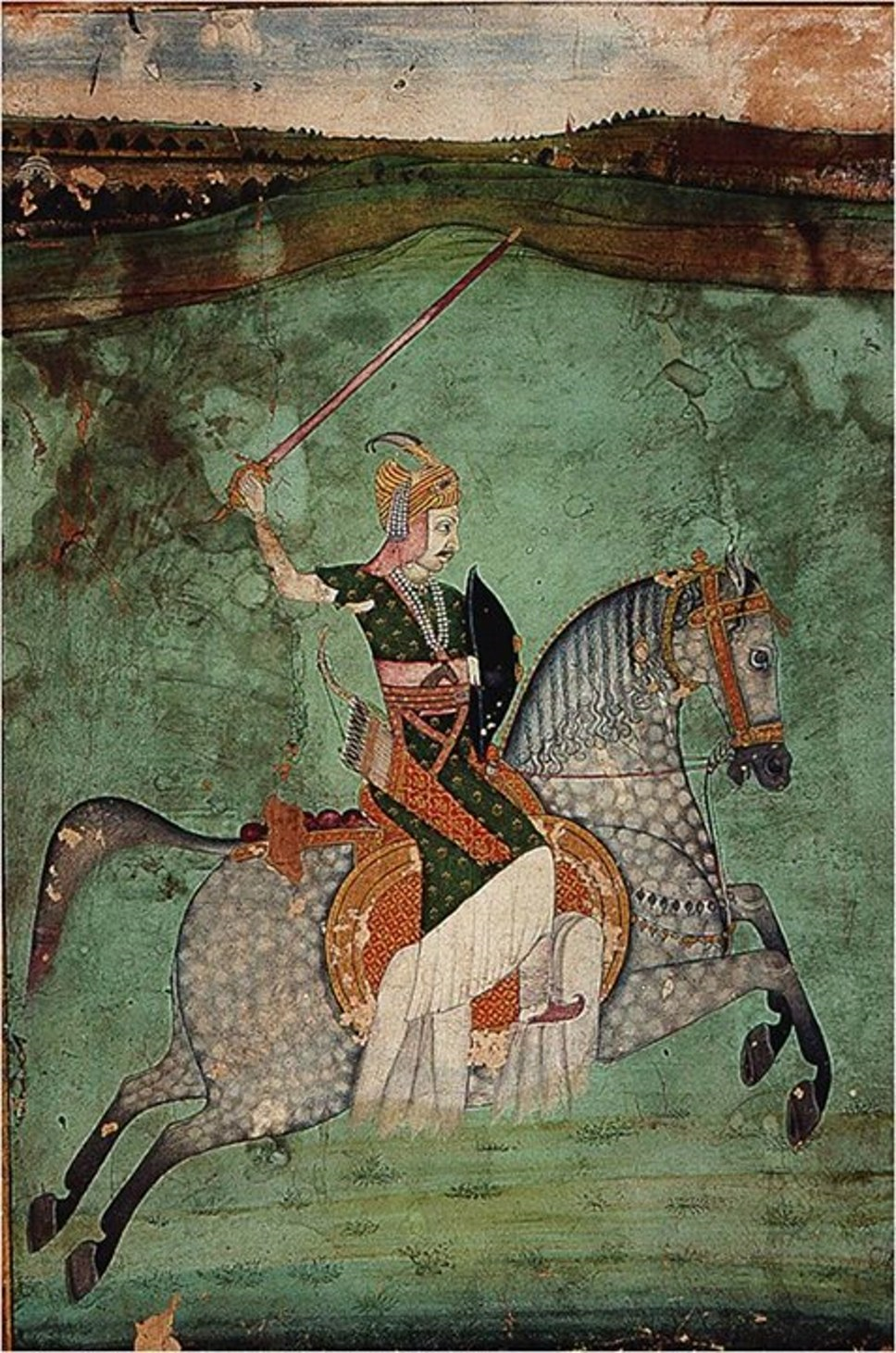
| image = | | image = Bajirao I painting.jpg | ||
| alt = | | alt = | ||
| image_size = | | image_size = | ||
| caption = Portrait of | | caption = Portrait of Bajirao I, 18th-19th century | ||
| monarch = [[Shahu I]] | | monarch = [[Shahu I]] | ||
| predecessor = [[Balaji Vishwanath]] | | predecessor = [[Balaji Vishwanath]] | ||
| successor = [[Balaji | | successor = [[Balaji Bajirao]] | ||
| birth_date = {{Birth date|1700|08|18|df=y}} | | birth_date = {{Birth date|1700|08|18|df=y}} | ||
| birth_place = Dubere, [[Sinnar]], | | birth_place = Dubere, [[Sinnar]], [[Nashik District]] | ||
| death_date = {{Death date and age|1740|04|28|1700|08|18|df=y}} | | death_date = {{Death date and age|1740|04|28|1700|08|18|df=y}} | ||
| death_place = | | death_place = Rawerkhedi, [[Maratha Empire]] | ||
| spouse = {{ | | battles = | ||
| | | spouse = {{ubl|{{Marriage|[[Kashibai]]|1720}}| {{Marriage|[[Mastani]]|1728}}}} | ||
| children = | | relatives = {{unbulleted list |[[Chimaji Appa]] (brother)|[[Bhiubai Joshi]] (sister)|[[Anubai Ghorpade]] (sister)|[[Sadashivrao Bhau|Sadashiv Rao]] (nephew)}} | ||
| children = 5, including [[Balaji Baji Rao]], [[Shamsher Bahadur I (Krishna Rao)|Shamsher Bahadur]] and [[Raghunath Rao]] | |||
| father = [[Balaji Vishwanath]] | | father = [[Balaji Vishwanath]] | ||
| mother = Radhabai Barve | | mother = Radhabai Barve | ||
| term_start = | | term_start = 17 April 1720 | ||
| term_end = | | term_end = 28 April 1740 | ||
| name = | | name = | ||
| birth_name = Bajirao Balal | |||
| signature = Bajirao I signature.png | |||
| military_blank1 = | |||
| military_data1 = {{Infobox military person | embed=yes | |||
| branch = {{flagicon image|Flag of the Maratha Empire.svg}} [[Maratha Army]] | |||
| serviceyears = | |||
| serviceyears_label = | |||
| rank = [[Peshwa]] | |||
| unit = Peshwa's [[Cavalry]] | |||
| commands = | |||
| battles_label = | |||
| battles = {{collapsible list|title = {{nobold|''See list''}}|{{tree list}} | |||
** Delhi (1719) | |||
**[[Battle of Shakar Kheda|Shakar Kheda (1724)]] | |||
** Carnatic (1725–26) | |||
** Carnatic (1726–27) | |||
** [[Battle of Palkhed|Palkhed (1728)]] | |||
** [[Battle of Bundelkhand|Bundelkhand (1729)]] | |||
** Malwa (1730) | |||
** [[Luso–Maratha War (1729–1732)]] | |||
** [[Battle of Dabhoi|Dabhoi (1731)]] | |||
** Konkan (1733) | |||
** Delhi (1737) | |||
*** Talkatora (1737) | |||
*** Firozabad (1737) | |||
*** Siege of Attri (1737) | |||
*** Itmadpur (1737) | |||
** [[Battle of Bhopal|Bhopal (1737)]] | |||
** [[Maratha invasion of Deccan (1739)|Deccan (1739)]] | |||
** Bundi (1739) | |||
{{tree list/end}} | |||
}} | |||
}} | |||
}} | }} | ||
''' | '''Bajirao I''' (born '''Visaji''',<ref name=":2">{{cite book |last=Gokhale |first=Sandhya |url=https://books.google.com/books?id=Ez4wAQAAIAAJ |title=The Chitpavans: social ascendancy of a creative minority in Maharashtra, 1818–1918 |publisher=Shubhi |year=2008 |isbn=978-8182901322 |page=82}}</ref><ref name="GSC_2005">{{cite book |last=Chhabra |first=G. S. |url=https://books.google.com/books?id=UkDi6rVbckoC |title=Advanced Study in the History of Modern India (Volume 1: 1707–1813) |publisher=Lotus Press |year=2005 |isbn=978-8189093068 |edition=Revised |page=19 |orig-year=1971}}</ref> {{IPA|mr|ˈbaːdʑiɾaːʋ bəˈlːaːɭ̆|lang}}; 18 August 1700 – 28 April 1740) was the 7th [[Peshwa]] of the [[Maratha Empire]].<ref>{{Cite book |last=New Cambridge History of India |url=http://archive.org/details/the-marathas-1600-1818-cambridge-history-of-india-vol.-2-part-4 |title=The Marathas - Cambridge History of India (Vol. 2, Part 4) |page=114}}</ref> | ||
In the [[Deccan Plateau|Deccan region]], the Nizam of Hyderabad emerged as a significant threat. Bajirao then led a campaign against the Nizam in which Nizam [[Battle of Palkhed|suffered a decisive defeat at Palkheda]]. This victory solidified the Marathas’ authority in the Deccan region. In [[Bundelkhand]], he [[Battle of Bundelkhand|rescued the Bundela ruler Chhatrasal from a Mughal siege]], gaining independence for Bundelkhand. Gratefully, [[Chhatrasal]] granted Bajirao a [[jagir]] and his daughter's hand in marriage.<ref>{{Cite book |last=Sardesai |first=Govind Sakharam |url=http://archive.org/details/in.gov.ignca.1545 |title=New history of the Marathas Vol_2 |date=1946 |pages=85–86}}</ref> | |||
In the 1730s, Bajirao asserted Maratha tax rights in Gujarat, defeating rebel [[Trimbak Rao Dabhade]] in 1731 at [[Battle of Dabhoi]]; he also engaged in a diplomatic mission to persuade Rajput courts for [[chauth]] payments. Further efforts to establish Maratha dominance saw him responsible for the [[#March to Delhi|Battle of Delhi (1737)]] which may be said to mark the pinnacle of his military career.<ref>{{Cite book |last=SUVRATSUT |url=http://archive.org/details/BajiRaoITheGreatPeshwa |title=Baji Rao I The Great Peshwa |date=2018-01-09 |pages=104–105}}</ref> He secured the important territory of [[Malwa]] after defeating the combined forces of Mughal-Nizam-Nawab of Awadh in [[Battle of Bhopal|Battle of Bhopal (1737)]].<ref>{{Cite book |last=Dighe |first=V. g |url=http://archive.org/details/in.ernet.dli.2015.57399 |title=Peshwa Bajirao I And Maratha Expansion |date=1944 |pages=139–149}}</ref> | |||
Bajirao's adventurous life has been picturized in Indian cinema and also featured in novels.<ref name="India Today">{{citation |title=Peshwa Bajirao Review: Anuja Sathe shines as Radhabai in the period drama |url=https://www.indiatoday.in/entertainment/television/story/peshwa-bajirao-review-anuja-sathe-shines-as-radha-bai-in-the-period-drama-lifetv-957061-2017-01-25 |work=[[India Today]] |date=25 January 2017 }}</ref><ref name="review">{{cite web|last=Jha|first=Subhash K|title=Bajirao Mastani review: This gloriously epic Priyanka, Deepika and Ranveer-starrer is the best film of 2015|url=http://www.firstpost.com/bollywood/bajirao-mastani-review-this-is-the-best-film-of-2015-2550464.html|publisher=[[Firstpost]]|date=19 October 2015|access-date=19 October 2015}}</ref><ref>{{Cite book|url=https://books.google.com/books?id=NWxRzwEACAAJ|title=Bajirao I An Outstanding Cavalry General|last=Palsokar|first=R. D.|date=1996|publisher=Merven Technologies|isbn=9788193989586|language=en}}</ref> Bajirao had two wives [[Kashibai]] and [[Mastani]]. Bajirao's relationship with his second wife Mastani is a controversial subject; very little is known with certainty about it.<ref name=Mehta05 /><ref name="GSC_2005" /> She was generally referenced cryptically in books, letters or documents from that era. | |||
==Early life== | ==Early life== | ||
[[File:Bajirao | [[File:Balaji Vishwanath and his son Bajirao Hunting.png|left|thumb|Bajirao hunting with his father [[Balaji Vishwanath]].]] | ||
Bajirao was born into the [[Bhat family]] in [[Sinnar]], near [[Nashik]]. His father [[Balaji Vishwanath]] was the ''Peshwa'' of [[Shahu I]] and his mother was Radhabai Barve.<ref>{{Cite book|title=Barave (Barve) gharāṇyācā kulavr̥ttānta|last1=Barave|first1=Dinakara Dattātraya|last2=Barve (Barave) Kula Snehasãvardhaka Maṇḍaḷa|date=2007|pages=471|oclc = 824536402}}</ref> Bajirao had a younger brother, [[Chimaji Appa]], and two younger sisters, Anubai and Bhiubai. Anubai was married to Venkatrao Ghorpade (Joshi) of [[Ichalkaranji]] and Bhiubai was married to Abaji Naik Joshi of [[Baramati]].<ref>{{Cite book |last=Sardesai |first=Govind Sakharam |url=https://archive.org/details/in.ernet.dli.2015.32142/page/n71/mode/2up?view=theater |title=New History of Marathas |publisher=Phoenix Publications |year=1946 |volume=2 |pages=60}}</ref> | |||
Being born in a Brahmin family, his education included reading, writing and learning [[Sanskrit]] however, he did not remain confined to his books. Bajirao displayed a passion for the military at an early age and often accompanied his father on military campaigns.<ref>{{Cite book |last=Dighe |first=V.G. |url=https://archive.org/details/in.gov.ignca.4317/page/n17/mode/1up?view=theater |title=Peshwa Bajirao I and Maratha Expansion |publisher=Karnatak Publishing House |year=1944 |edition=1 |pages=4}}</ref> He was with his father when his father was imprisoned by [[Damaji Thorat]] before being released for a ransom.<ref name="GSC_2005" /> Bajirao had been on the expedition to Delhi in 1719 with his father and was convinced the [[Mughal Empire]] was disintegrating and would be unable to resist northward Maratha expansion.<ref name="Gordon 1993 114">{{Cite book|last=Gordon|first=Stewart|title=The New Cambridge History of India|publisher=Cambridge University Press|url=https://archive.org/stream/iB_in/2-4#page/n129/mode/2up|year=1993|pages=114}}</ref> When [[Balaji Vishwanath]] died in 1720, [[Shahu I|Shahu]] appointed the 20-year-old Bajirao as Peshwa despite opposition from other chieftains.<ref>{{cite book |first=Shripad Rama |last=Sharma |title=The Making of Modern India: From A. D. 1526 to the Present Day |url=https://books.google.com/books?id=oAUdAAAAMAAJ |year=1951 |publisher=Orient Longmans |page=239 }}</ref> | |||
==Personal life== | |||
Bajirao's first wife was [[Kashibai]], the daughter of Mahadji Krishna Joshi and Bhawanibai of [[Chas, Khed|Chas]] (a wealthy banking family).<ref>{{cite book | url=https://books.google.com/books?id=Ez4wAQAAIAAJ&q=kashibai | title=The Chitpavans: social ascendancy of a creative minority in Maharashtra, 1818–1918 | publisher=Sandhya Gokhale | first=Sandhya | last=Gokhale | year=2008 | page=82 | isbn=978-8182901322}}</ref> Bajirao always treated his wife Kashibai with love and respect.<ref name="Mishra" /> Their relationship was healthy and happy.<ref>{{cite book |last=Mehta |first=Jaswant Lal |url=https://books.google.com/books?id=d1wUgKKzawoC |title=Advanced Study in the History of Modern India: 1707–1813 |year=2005 |publisher=New Dawn Press |location=New Delhi |isbn=978-1932705546 |page=124}}</ref><ref name="Mishra">{{cite news|last1=Mishra|first1=Garima|title=Tracing Kashibai: The 'first' lady from Bhansali's Bajirao Mastani|url=http://indianexpress.com/article/lifestyle/life-style/kashibai-the-first-lady/|access-date=30 July 2017|work=The Indian Express|date=3 January 2016}}</ref> They had four sons: [[Balaji Baji Rao|Balaji Bajirao]] (also called Nanasaheb), Ramachandra Rao, [[Raghunath Rao]] and Janardhan Rao, who died at an early age.<ref>{{cite book |url=https://books.google.com/books?id=qWbaAAAAMAAJ |title=Begams, concubines, and memsahibs |first=B. P. |last=Saha |publisher=Vikas |year=1997 |page=88 |isbn=978-8125902850 }}</ref> Nanasaheb was appointed Peshwa by Shahu in 1740, succeeding his father. | |||
Bajirao took Mastani as his wife, the daughter of [[Rajput]] king [[Chhatrasal]], born from his [[Islam|Muslim]] concubine.<ref>{{Cite book|author=Jaswant Lal Mehta|url=https://books.google.com/books?id=d1wUgKKzawoC|title=Advanced Study in the History of Modern India 1707–1813|date=2005|page=108|publisher=Sterling Publishers Pvt. Ltd|isbn=978-1932705546|language=en}}</ref> The relationship was a political one, arranged to please Chhatrasal.<ref name="Mehta05" /> Mastani had a son, [[Shamsher Bahadur I (Krishna Rao)|Krishna Rao]], in 1734. Since his mother was Muslim, Hindu priests refused to conduct the [[upanayana]] ceremony and he became known as Shamsher Bahadur.<ref name="GSC_2005" /> After the deaths of Bajirao and Mastani in 1740, Kashibai raised six-year-old Shamsher Bahadur as her own. Shamsher received a portion of his father's dominion of [[Banda, Uttar Pradesh|Banda]] and [[Kalpi]]. In 1761, he and his army fought alongside the Peshwa in the [[Third Battle of Panipat]] between the Marathas and the [[Pashtuns|Afghans]]. Wounded in the battle, Shamsher died several days later in [[Deeg]].<ref name="Chid_1951">{{cite book |first=Chidambaram S. |last=Srinivasachari |title=The Inwardness of British Annexations in India |url=https://books.google.com/books?id=E0bRAAAAMAAJ |year=1951 |publisher=University of Madras |page=219 }}</ref><ref>{{cite book |first1=Rosemary |last1=Crill |first2=Kapil |last2=Jariwala |title=The Indian Portrait, 1560–1860 |url=https://books.google.com/books?id=ongF6dkNKAcC&pg=PA162 |year=2010 |publisher=Mapin Publishing Pvt Ltd |isbn=978-8189995379 |page=162 }}</ref> | |||
== | Bajirao moved his base of operations from [[Saswad]] to Pune in 1728, laying the foundation for the transformation of the [[kasbah|kasba]] into a large city.<ref>{{cite journal|last1=Kosambi|first1=Meera|title=Glory of Peshwa Pune|journal=Economic and Political Weekly|year=1989|volume=24|issue=5|page=247}}</ref> He began the construction of [[Shaniwar Wada]] on 10 January 1730.<ref>{{Cite book |last=Khare |first=Ganesh Hari |url=https://archive.org/details/dli.mgs-cis.shaniwarwada/page/n11/mode/2up?view=theater |title=Shaniwarwada |year=1949 |edition=1 |location=Pune |pages=8 |language=Marathi}}</ref>[[File:Bajirao's handwriting.jpg|alt=Stone fortress, with people in front for scale|right|thumb|Bajirao I's handwriting in [[Modi script]].]] | ||
[[ | Bajirao was appointed Peshwa, succeeding his father, by Shahu on 17 April 1720. By the time of his appointment, the [[Mughal emperors|Mughal emperor]] [[Muhammad Shah]] had upheld Maratha claims to the territories held by [[Shivaji]] at his death. A treaty gave the Marathas the right to collect taxes ([[chauth]]) in the [[Deccan Plateau|Deccan]]'s six [[subah|provinces]].<ref name="Mehta 492-494">{{cite book |last=Mehta |first=Jaswant Lal |url=https://books.google.com/books?id=d1wUgKKzawoC |title=Advanced Study in the History of Modern India: 1707–1813 |year=2005 |publisher=New Dawn Press |location=New Delhi |isbn=978-1932705546 |pages=492–494}}</ref> Bajirao convinced Shahu that the Maratha Empire had to go on the offensive against its enemies to defend itself.<ref name="G.S.Chhabra2005">{{cite book |last=Chhabra |first=G. S. |url=https://books.google.com/books?id=UkDi6rVbckoC |title=Advanced Study in the History of Modern India (Volume 1: 1707–1813) |publisher=Lotus Press |year=2005 |edition=Revised |orig-year=1971 |isbn=978-8189093068 |page=20}}</ref> He believed the Mughal Empire was in decline, and wanted to take advantage of the situation with aggressive expansion into [[North India]]. Bajirao compared the Mughals' declining fortune to a tree which, if attacked at its roots, would collapse. He is reported to have said: | ||
[[File: | {{Blockquote | ||
|text=Let us strike at the trunk of the withering tree and the branches will fall off themselves. Listen but to my counsel and I shall plant the Maratha flag on the walls of [[Attock]].<ref name="Sen2006">{{cite book|first=S. N. |last=Sen|title=History Modern India|url=https://books.google.com/books?id=ga-pmgxsWwoC&pg=PA11|year=2006|publisher=New Age International|isbn=978-8122417746|page=11}}</ref> | |||
{{ | |||
|text=Let us strike at the trunk of the withering tree and the branches will fall off themselves. Listen but to my counsel and I shall plant the Maratha flag on the walls of Attock.<ref name="Sen2006">{{cite book|first=S. N. |last=Sen|title=History Modern India|url=https://books.google.com/books?id=ga-pmgxsWwoC&pg=PA11|year=2006|publisher=New Age International|isbn=978- | |||
}} | }} | ||
As a new Peshwa, however, he faced several challenges.<ref name="GSC_2005"/> | As a new Peshwa, however, he faced several challenges.<ref name="GSC_2005" /> Bajirao promoted young men like himself, such as [[Malhar Rao Holkar]], [[Ranoji Shinde]], the Pawar brothers and Fateh Singh Bhosle, as commanders; these men did not belong to families who were hereditary [[Deshmukh]]s in the [[Deccan sultanates]].<ref>{{cite book |last1=Gordon |first1=Stewart |title=The Marathas 1600–1818 |year=2007 |publisher=Cambridge University Press |location=Cambridge [u.a.] |isbn=978-0521033169 |url=https://books.google.com/books?id=iHK-BhVXOU4C |pages=117–121}}</ref> | ||
The Mughal viceroy of the | The Mughal viceroy of the [[Deccan]], [[Asaf Jah I]], [[Nizam of Hyderabad]], had created a ''de facto'' autonomous kingdom in the region. He challenged Shahu 's right to collect taxes<ref name="SG_1993">{{cite book |last1=Gordon |first1=Stewart |title=The Marathas 1600–1818 |year=2007 |publisher=Cambridge University Press |location=Cambridge [u.a.] |isbn=978-0521033169 |url=https://books.google.com/books?id=iHK-BhVXOU4C |pages=120–131}}</ref> on the pretext that he did not know whether Shahu or his cousin, [[Sambhaji I of Kolhapur|Sambhaji II]] of [[Kolhapur]], was the rightful heir to the Maratha throne.<ref name="GSC_2005" /> The Marathas needed to assert their rights over the nobles of newly acquired territories in [[Malwa]] and [[Gujarat]].<ref name="GSC_2005" /> Several nominally-Maratha areas were not actually under the Peshwa's control; for example, the [[Siddi]]s controlled the [[Murud-Janjira|Janjira]] fort.<ref name="GSC_2005" /> | ||
==Military | == Military campaigns and wars == | ||
=== | === The Nizam === | ||
{{Main|Battle of Palkhed}} | {{Main|Battle of Palkhed|}} | ||
[[File:Peshwa Bajirao vs Nizam-ul-Mulk movements in Palkhed Campaign.png|thumb|alt=Colour-coded map|Troop movements of | [[File:Peshwa Bajirao vs Nizam-ul-Mulk movements in Palkhed Campaign.png|thumb|alt=Colour-coded map|Troop movements of Bajirao I and Asaf Jah I (Nizam-ul-Mulk) in the Battle of Palkhed]] | ||
At the outset of Bajirao's Peshwa rule, the Mughal leaders, led by Nizam-ul-Mulk, rebelled against the Sayyid Brothers. To quell the uprising, the Sayyid brothers sought assistance from the Marathas. However, in the [[Battle of Balapur]], where Bajirao, Malhar Rao Holkar, and Khanderao Dabhade were present, the combined forces of the Sayyid Brothers and the Marathas were defeated by the Nizam's forces. Sankarji Malhar was captured as a prisoner of war, marking Bajirao's first significant military engagement as Peshwa.<ref name=":2" /><ref name=":3">{{Cite book |last=Lobato |first=Alexandre |url=https://books.google.com/books?id=exF0vgAACAAJ |title=Relações luso-maratas, 1658-1737 |date=1965 |publisher=Centro de Estudos Históricos Ultramarinos |page=126 |language=pt}}</ref> | |||
On 4 January 1721, Bajirao met [[Nizam of Hyderabad]] at [[Chikhalthan]]a to resolve their disputes. However, the Nizam refused to recognize the Maratha right to collect taxes from the Deccan provinces.<ref name="GSC_2005" /> He was made [[vizier]] of the Mughal Empire in 1721 by emperor [[Muhammad Shah]], who, alarmed at his increasing power, transferred him from the Deccan to [[Awadh]] in 1723. The Nizam rebelled against the order, resigned as vizier and marched towards the Deccan. The emperor sent an army against him, which the Nizam defeated at the [[Battle of Shakar Kheda|Battle of Sakhar-kheda]]; this forced the emperor to recognise him as viceroy of the Deccan. The Marathas, led by Bajirao, helped the Nizam win this battle. For his valor, Bajirao was honored with a robe, a 7,000-man [[mansabdari]], an elephant, and a jewel. After the battle, the Nizam tried to appease the Maratha [[Chhatrapati]] Shahu and the Mughal emperor; in reality, however, he wanted to carve out a sovereign kingdom and considered the Marathas his rivals in the Deccan.<ref name="PVK_1987">{{cite book |first=P. V. |last=Kate |title=Marathwada Under the Nizams, 1724–1948 |url=https://books.google.com/books?id=tjndiykddsIC&pg=PA11 |year=1987 |publisher=Mittal |isbn=978-8170990178 |pages=11–13}}</ref> | |||
In the | In 1725, the Nizam sent an army to clear Maratha revenue collectors from the [[Carnatic region]]. The Marathas dispatched a force under Fateh Singh Bhosle to counter him; Bajirao accompanied Bhosle, but according to [[Stewart N. Gordon|Stewart Gordon]], Bajirao did not command the army. According to [[Govind Sakharam Sardesai]], Bajirao personally led the campaign under Shahu's command. In contrast, [[Stewart N. Gordon|Stewart Gordon]]'s account suggests that Bajirao was present during the campaign but did not assume command.<ref>{{Cite book |last=Sardesai |first=Govind Sakharam |url=https://books.google.com/books?id=JsxljwEACAAJ |title=New History of the Marathas: (2. Impr.) : Vol. 1-3 |date=1957 |pages=88 (vol2) |language=en}}</ref> | ||
In the Deccan, [[Sambhaji I of Kolhapur|Sambhaji II]] of [[Kolhapur State]] had become a rival claimant to the title of Maratha King. The Nizam took advantage of the internal dispute, refusing to pay the chauth because it was unclear who was the real Chhatrapati (Shahu or Sambhaji II) and offering to [[Arbitration|arbitrate]]. [[Shripatrao Pant Pratinidhi]] advised Shahu to begin negotiations and agree to arbitration. Sambhaji II was supported by Chandrasen Jadhav, who had fought Bajirao's father a decade earlier. Bajirao convinced Shahu to refuse the Nizam's offer and instead launch an assault.<ref name="SG_1993" /> | |||
The Nizam invaded [[Pune]], where he installed Sambhaji II as the King. He then marched out of the city, leaving behind a contingent headed by Fazal Beg.{{Citation needed|date=December 2023}} The Nizam plundered [[Loni, Ahmednagar|Loni]], [[Pargaon Sudrik|Pargaon]], Patas, [[Supa, Parner|Supa]] and [[Baramati]], using his artillery.{{Citation needed|date=December 2023}} On 27 August 1727, Bajirao began a retaliatory [[guerrilla warfare|guerilla]] attack on the Nizam with his trusted lieutenants [[Malhar Rao Holkar]], [[Ranoji Scindia|Ranoji Shinde]] and the Pawar brothers.{{Citation needed|date=December 2023}} He began to destroy the towns held by the Nizam; leaving Pune, he crossed the [[Godavari River]] near [[Puntamba]] and plundered [[Jalna, Maharashtra|Jalna]] and [[Sindkhed Raja|Sindkhed]]. Bajirao destroyed [[Berar Province|Berar]], [[Mahur, Maharashtra|Mahur]], [[Mangrulpir]] and [[Washim]] before turning north-west to [[Khandesh]].{{Citation needed|date=December 2023}} He crossed the [[Tapti River|Tapi River]] at [[Kukarmunda|Kokarmunda]] and entered eastern [[Gujarat]], reaching [[Chhota Udaipur|Chota Udaipur]] in January 1728.{{Citation needed|date=December 2023}} After hearing that the Nizam had returned to Pune, Bajirao feinted toward [[Burhanpur]]; he thought that after hearing about the threat to the strategically important Burhanpur, the Nizam would try to save it. Bajirao did not enter Burhanpur, however, arriving at [[Betawad]] in Khandesh on 14 February 1728.{{Citation needed|date=December 2023}} When the Nizam heard that his northern territories had been devastated by Bajirao, he left Pune and marched towards the Godavari to meet Bajirao on an open plain where his artillery would be effective. The Nizam went on ahead of his artillery; on 25 February 1728, the armies of Bajirao and the Nizam faced each other at Palkhed, a town about {{convert|30|mi}} west of [[Aurangabad]]. The Nizam was quickly surrounded by Maratha forces and trapped, his lines of supply and communication were cut. He was forced to make peace; he signed the [[Treaty of Mungi-Shevgaon|Treaty of Mungi Shevgaon]] on 6 March, recognising Shahu as the King and the Maratha right to collect taxes in the Deccan.<ref name="GSC_2005"/> | |||
=== | This event is considered as an example of brilliant execution of military strategy.<ref name=Mehta05>{{cite book |last=Mehta |first=Jaswant Lal |url=https://books.google.com/books?id=d1wUgKKzawoC |title=Advanced Study in the History of Modern India: 1707–1813 |year=2005 |publisher=New Dawn Press |location=New Delhi |isbn=978-1932705546 |pages=97, 215}}</ref> In his ''Military History of India'', [[Jadunath Sarkar]] wrote:"This campaign gives a classic example of what the predatory horse, when led by a genius, could achieve in the age of light artillery."<ref name=":1">{{Cite book|last=Sarkar |first=Jadunath|title=Military History of India|publisher=M. C. Sarkar and Sons|url=https://archive.org/details/dli.bengal.10689.21517/page/n153/mode/2up|year=1960|page=143}}</ref> | ||
In | |||
=== Bundelkhand === | |||
[[File:Baji Rao I.png|thumb|Bajirao I riding a horse into battle c.1720–1740]] | |||
{{Main|Battle of Bundelkhand}} | |||
=== | In [[Bundelkhand]], [[Chhatrasal]] rebelled against the Mughal Empire and established an independent kingdom. In December 1728, a Mughal force led by [[Muhammad Khan Bangash]] attacked him and besieged his fort and family. Although Chhatrasal repeatedly sought Bajirao's assistance, he was busy in Malwa at the time. He compared his dire situation to that of [[Gajendra Moksha]]. In his letter to Bajirao, Chhatrasal wrote the following words: | ||
{{ | {{Blockquote | ||
|text= Know you, that I am in the same sad plight in which the famous elephant was when caught by the crocodile. My valiant race is on point of extinction. Come and save my honour, O Baji Rao.<ref>{{Cite book |last=Sardesai |first=Govind Sakharam |url=https://archive.org/details/in.ernet.dli.2015.32142/ |title=New History of the Marathas: The expansion of the Maratha power, 1707–1772 |date=1946 |publisher=Phoenix Publications |pages=106}}</ref> | |||
}} In March 1729, the Peshwa responded to Chhatrasal's request and marched towards Bundelkhand with 25,000 horsemen and his lieutenants Pilaji Jadhav, Tukoji Pawar, [[Naro Shankaraji Gandekar|Naro Shankar]], and Davalji Somwanshi. Bangash was later forced to leave, signing an agreement that "he would never attack Bundelkhand again".{{Citation needed|date=December 2023}} Chhatrasal's position as ruler of Bundelkhand was restored. He granted a large [[jagir]] to Bajirao, and gave him his daughter Mastani. Before Chhatrasal's death in December 1731, he ceded one-third of his territories to the Marathas.<ref name="GSC_2005" /> | |||
=== The Portuguese === | |||
{{ | {{Main|Luso–Maratha War (1729–1732)|Battle of Vasai}} | ||
| | |||
The Luso–Maratha War of 1729–1732 was an armed conflict between the Portuguese Empire and the Maratha Confederacy, who invaded Portuguese territory in India. This conflict resulted in a Portuguese victory. The Marathas withdrew from Portuguese territory.{{sfn|Lobato|1965|p=126}} Nevertheless, Bajirao planned to resume hostilities against the Portuguese with an attack on [[Salsette Island|Salcette Island]] on 13 March 1733.<ref>{{cite thesis |last=Thakare |first= Mayur|date= 22 March 2011|title= The Two Fateful Years 1737 to 1739 AD Understanding the Defence and Settlement Pattern of the Portuguese Province of the North during Maratha Portuguese War Campaign | |||
|url= https://shodhganga.inflibnet.ac.in/handle/10603/223296|degree= |publisher= Deccan College Post Graduate And Research Institute|docket= |oclc= |access-date=|chapter = 3|page = 75|hdl= 10603/223296}}</ref> Peace would prove to be short, as five years later the Marathas would again invade Portuguese territory and attack Bassein.{{sfn|Lobato|1965|p=126}} | |||
===Gujarat=== | ===Gujarat=== | ||
After consolidating Maratha influence in central India, | {{Main|Battle of Dabhoi}} | ||
After consolidating Maratha influence in central India, Bajirao decided to assert the Maratha right to collect taxes from the wealthy province of [[Gujarat]] and sent a Maratha force under [[Chimaji Appa]] there in 1730. Sarbuland Khan, the province's Mughal governor, ceded the right to collect chauth to the Marathas. He was soon replaced by Abhay Singh, who also recognized the Maratha right to collect taxes. This irked [[Shahu I|Shahu's]] [[senapati]] (commander-in-chief), [[Trimbak Rao Dabhade]], whose [[Dabhade|ancestors]] had raided Gujarat several times and asserted their right to collect taxes from the province. Annoyed at Bajirao's control of what he considered his family's sphere of influence, he rebelled against the Peshwa.<ref>{{cite book |last=Chhabra |first=G. S. |url=https://books.google.com/books?id=UkDi6rVbckoC |title=Advanced Study in the History of Modern India (Volume 1: 1707–1813) |publisher=Lotus Press |year=2005 |edition=Revised |orig-year=1971 |isbn=978-8189093068 |page=22}}</ref> Two other Maratha nobles from Gujarat, [[Damaji Rao Gaekwad]] and Kadam Bande, also sided with Dabhade.<ref name="SG_1993" /> | |||
After Girdhar Bahadur's defeat in 1728, the Mughal emperor had appointed [[Jai Singh II]] to subdue the Marathas. Jai Singh recommended a peaceful agreement; the emperor disagreed, replacing him with [[Muhammad Khan Bangash]]. Bangash formed an alliance with the Nizam, Trimbak Rao and Sambhaji II. | After Girdhar Bahadur's defeat in 1728, the Mughal emperor had appointed [[Jai Singh II]] to subdue the Marathas. Jai Singh recommended a peaceful agreement; the emperor disagreed, replacing him with [[Muhammad Khan Bangash]]. Bangash formed an alliance with the Nizam, Trimbak Rao and Sambhaji II. Bajirao learned that Dabhade and Gaikwad had made preparations for an open fight on the plain of Dabhoi with a force of 40 thousand, while Bajirao's numbers hardly reached 25 thousand in all. Bajirao repeatedly sent messages to Dabhade to solve the dispute amicably in the presence of Shahu.{{Citation needed|date=December 2023}} Bajirao resolved the dispute with Sambhaji II on 13 April by signing the Treaty of Warna, which demarcated the territories of Shahu and Sambhaji II. The Nizam met Bajirao at Rohe-Rameshwar on 27 December 1732, and promised not to interfere with Maratha expeditions.<ref name="GSC_2005" /> | ||
Shahu and | Shahu and Bajirao avoided a rivalry with the powerful Dabhade clan after subduing Trimbak Rao; Trimbak's son, Yashwant Rao, was appointed as Shahu's senapati. The Dabhade clan were allowed to continue collecting chauth from Gujarat if they deposited half the revenue in Shahu's treasury.<ref name="GSC_2005" /> | ||
===Siddis=== | ===Siddis=== | ||
The [[Siddi]]s of [[Janjira State|Janjira]] controlled a small, strategically | The [[Siddi]]s of [[Janjira State|Janjira]] controlled a small, strategically important territory on India's west coast. Although they originally held only the Janjira fort, after Shivaji's death they expanded their rule to a large part of central and northern [[Konkan]].<ref name="SG_1993" /> After the death of Siddi chief [[Yakut Khan]] in 1733, a war of succession broke out among his sons; one, Abdul Rehman, asked Bajirao for help. Bajirao sent a Maratha force led by Sekhoji Angre, son of [[Kanhoji Angre]]. The Marathas regained control of several portions of the Konkan, and besieged Janjira. Their strength was diverted after Peshwa's rival, Pant Pratinidhi, occupied [[Raigad Fort]] (near Janjira) in June 1733. Sekhoji Angre died in August (further weakening the Maratha position), and Bajirao signed a peace treaty with the Siddis. He allowed the Siddis to retain control of Janjira if they accepted Abdul Rehman as the ruler; they were also allowed to retain control of [[Anjanvel]], [[Gowalkot]] and [[Underi]]. The Marathas retained Raigad, [[Rewas]], Thal and [[Chaul]].<ref name="GSC_2005" /> | ||
The Siddis launched an offensive to regain their lost territories soon after the Peshwa returned to [[Satara (city)|Satara]], | The Siddis launched an offensive to regain their lost territories soon after the Peshwa returned to [[Satara (city)|Satara]], then Bajirao dispatched a force to prevent them from taking over Raigad Fort in June 1734. Chimnaji made a surprise attack on a Siddi camp near Rewas on 19 April 1736, killing about 1,500 (including their leader, Siddi Sat). In June 1736, Bajirao dispatched a force under Yesaji Gaikwad, Dhanaji Thorat and Sidoji Barge to gain the control territories like [[Gowalkot]]. On 25 September of that year, the Siddis signed a peace treaty which confined them to Janjira, Gowalkot and Anjanvel.<ref name="GSC_2005" /> | ||
=== Rajputana === | === Rajputana === | ||
With Shahu's consent, | {{Main|Battle of Mandsaur}} | ||
[[File:Painting of Malhar Rao Holkar (alt. spelt as 'Malharrao Holkar) and Peshwa Bajirao I seated together, circa 18th century.jpg|thumb|Bajirao and [[Malhar Rao Holkar]] c.18th century ]] | |||
With Shahu's consent, Bajirao began a northward journey on 9 October 1735. Accompanied by his wife, [[Kashibai]],<ref>{{Cite book |last=Sarkar |first=Jadunath |url=https://archive.org/details/in.ernet.dli.2015.43007/ |title=Fall Of The Mughal Empire |publisher=Longman Group |year=1964 |volume=1 |page=161}}</ref> he intended to visit [[Rajput]] courts and persuade them to pay chauth. Bajirao arrived at [[Mewar]]'s southern frontier in January 1736, where Rana [[Jagat Singh II]] had made arrangements for his visit.<ref name="sarkar162">{{Cite book |last=Sarkar |first=Jadunath |url=https://archive.org/details/in.ernet.dli.2015.43007/ |title=Fall Of The Mughal Empire |publisher=Longman Group |year=1964 |volume=1 |page=162}}</ref> | |||
Diplomatic talks got underway. | Diplomatic talks got underway. Bajirao also visited [[Jag Mandir|Jagmandir Palace]], in the centre of [[Lake Pichola|Pichola Lake]] (at Rana Jagat Singh's invitation), and [[Shrinathji Temple|Nath-Dwara]]. After resolving matters in Mewar, Bajirao advanced towards [[Jaipur]]. [[Sawai Jai Singh|Jai Singh]] hastened south with his forces, and they met in Bhambholao (near [[Kishangarh]]).<ref name="sarkar162" /> | ||
Their meeting lasted for several days, with talks about chauth and the cession of Malwa from the [[Mughal Emperor]]. | Their meeting lasted for several days, with talks about chauth and the cession of Malwa from the [[Mughal Emperor]]. Bajirao then returned to the Deccan. The emperor did not agree to his demands, however, and he planned to march on Delhi to force him to agree.<ref>{{Cite book |last=Sarkar |first=Jadunath |url=https://archive.org/details/in.ernet.dli.2015.43007/ |title=Fall Of The Mughal Empire |publisher=Longman Group |year=1964 |volume=1 |pages=163–164, 168}}</ref> | ||
===March to Delhi=== | === March to Delhi === | ||
After the death of Trimbak Rao, Bangash's alliance against the Marathas fell apart. The Mughal emperor recalled him from Malwa, and re-appointed Jai Singh II as governor of Malwa. However, the Maratha chief Holkar defeated Jai Singh in the 1733 [[Battle of Mandsaur]]. After two more battles, the Mughals decided to offer the Marathas the right to collect the equivalent of {{INR}}22 [[lakh]] in chauth from Malwa. On 4 March 1736, | [[File:Bajirao Peshwa Statue, Pune.jpg|thumb|Equestrian statue of Peshwa Bajirao I outside Shaniwar Wada, [[Pune]]]] | ||
After the death of Trimbak Rao, Bangash's alliance against the Marathas fell apart. The Mughal emperor recalled him from Malwa, and re-appointed Jai Singh II as the governor of Malwa. However, the Maratha chief Holkar defeated Jai Singh in the 1733 [[Battle of Mandsaur]]. After two more battles, the Mughals decided to offer the Marathas the right to collect the equivalent of {{INR}}22 [[lakh]] in chauth from Malwa. On 4 March 1736, Bajirao and Jai Singh reached an agreement at [[Kishangarh|Kishangad]]. Jai Singh convinced the emperor to agree to the plan, and Bajirao was appointed deputy governor of the region. Jai Singh is believed to have secretly informed Bajirao that it was a good time to subdue the weakening Mughal emperor.<ref name="GSC_2005" /> | |||
Learning of the advancing Maratha army, the Mughal emperor asked [[Saadat Ali Khan I]] to march from [[Agra]] and check the advance. The Maratha chiefs Malhar Rao Holkar, Vithoji Bule and Pilaji Jadhav crossed [[Yamuna]] and plundered the Mughal territories in the [[Doab#The Doab|Doab]]. Saadat Khan led a force of 150,000, defeated them at Jalesar, and retired to [[Mathura]]. Malhar Rao Holkar rejoined Bajirao's army near [[Gwalior]]. Samsam-ud-Daulah, Mir Bakshi and Muhammad Khan Bangash invited Saadat Ali Khan to a banquet in Samsam-ud-Daulah's tent in Mathura, thinking that the Marathas had retreated to the Deccan. During the feast, they learnt Bajirao had slipped along the [[Jat people|Jat]] and [[Mewat]]i [[Aravalli Range|hill route]] (avoiding the direct Agra-Delhi route) and was at Delhi. The Mughal commanders left the feast and began a hasty return to capital.<ref>{{Cite book|last=Irvine|first=William|url=https://archive.org/details/in.ernet.dli.2015.280772/mode/2up|title=Later Mughals|publisher=Oriental Books Reprint Corporation|volume=2|pages=288}}</ref> The Mughal emperor dispatched a force, led by Mir Hasan Khan Koka, to check Bajirao's advance. The Marathas defeated his force on 28 March 1737 in outskirts of Delhi at Rikabganj. When the news of the defeat of the Mughal troops by the Marathas spread, a sudden fear seized the citizens of Delhi who expected the attack of the Maratha conqueror any moment. But Baji Rao did not proceed with his victory although he could have taken the city unopposed. He had received intelligence that the Vazir with his army was coming towards Delhi in rapid marches when he heard that Baji Rao was before the gates of the capital. The Peshwa realised that any further stay in the city would greatly imperil his position and endanger the lines of communication with the Maratha mainland. He was content with the imperial offer of the Viceroyalty of Malwa. He, therefore, left Delhi with his soldiers towards the south.<ref>{{Cite book |last=Srinivasan |first=C. K. |url=https://books.google.com/books?id=Z0E_AAAAMAAJ |title=Baji Rao I, the Great Peshwa |date=1961 |publisher=Asia Publishing House |page=104 |language=en}}</ref><ref name="GSC_2005" /> During his way back he encountered the [[List of Mughal grand viziers|Mughal Vizier]] [[Itimad-ad-Daula, Qamar-ud-Din Khan|Qamar-ud Din Khan]] at [[Badshahpur]]. After a long and tiring march following a heavy engagement, the Peshwa was in no mood to attack the Vazir. Neither could the Vazir array his forces for battle, as his artillery and a part of his men were yet on the road. There was a brush between the two forces in the failing light of the day; one elephant and a few horses were seized by the Marathas with the loss of 30 men at their side.<ref>{{Cite book |last=Dighe |first=V. g |url=http://archive.org/details/in.ernet.dli.2015.57399 |title=Peshwa Bajirao I And Maratha Expansion |date=1944 |page=136}}</ref> Afterwards, they moved another eight miles before encamping for the night. Finding himself heavily outnumbered to the Wazir's army and possibility of reinforcement from the other Mughal nobles he made a decision to quickly retreat from Badshahpur during early night. Passing through Rajputana Bajirao reached Narnol and then Ajmer. The Mughals could not pursue the Marathas and the Emperor had recalled them to Delhi. The Rajput princes once again affirmed their loyalty to the Peshwa and solicited his protection.<ref>{{Cite book |last=Gupta |first=Hari Ram |url=https://books.google.com/books?id=TmU9AAAAMAAJ |title=Marathas and Panipat |date=1961 |publisher=Panjab University |pages=335 |language=en }}</ref><ref>{{Cite book |last=Malik |first=Zahiruddin |url=https://books.google.com/books?id=S8W3AAAAIAAJ |title=The Reign of Muhammad Shah, 1719-1748 |date=1977 |publisher=Asia Publishing House |isbn=978-0-210-40598-7 |pages=132–133 |language=en}}</ref> | |||
This event caused great consternation and dismay in the capital. Although the Peshwa left the city suddenly, he exposed the weakness of the government. The demoralizing effect which the Peshwa's surprise attack produced on the army and the citizens of Delhi was permanent.<ref>{{Cite book |last=Zahiruddin Malik |url=http://archive.org/details/a-mughal-statement-of-18th-century |title=A Mughal Statement Of 18th Century |date=1973 |page=78 }}</ref> | |||
===Battle of Bhopal=== | ===Battle of Bhopal=== | ||
{{Main|Battle of Bhopal}} | {{Main|Battle of Bhopal}} | ||
Mughal emperor Muhammad Shah sought help from the Nizam after Bajirao's march to Delhi; the Nizam set out from the Deccan, met Bajirao's returning force at [[Sironj]], and told the Peshwa he was going to Delhi to repair his relationship with the Mughal emperor. The Nizam was joined by other Mughal chiefs, and a 30,000-man Mughal army (reinforced by artillery), was dispatched against Bajirao. The Peshwa assembled an 80,000-man force. To counter aid to the Nizam from the Deccan, Bajirao stationed a force of 10,000 (under Chimaji Appa) on the [[Tapti River]] with instructions to prevent [[Nasir Jung]] from advancing beyond [[Burhanpur]]. He and his forces crossed the Narmada in early December 1737, communicating with agents and spies posted to observe enemy moves. The Nizam sheltered in [[Bhopal]], a fortified town with a lake at his rear, to keep his army and artillery secure.<ref>{{Cite book |last=Malik |first=Zahiruddin |url=https://books.google.com/books?id=S8W3AAAAIAAJ |title=The Reign of Muhammad Shah, 1719-1748 |date=1977 |publisher=Asia Publishing House |isbn=978-0-210-40598-7 |pages=133 |language=en}}</ref> | |||
The Nizam, unable to hold out any longer, signed a [[Treaty of Bhopal|peace agreement]] at [[Doraha, Sehore|Doraha]] on 7 January 1738.<ref>{{cite book | title = Madhya Pradesh Through the Ages | first1=S. R. |last1=Bakshi |first2=O. P. |last2=Ralhan | publisher = Sarup & Sons | year = 2007 | isbn = 978-8176258067 | page = 384 }}</ref> Malwa was ceded to the Marathas; the Mughals agreed to pay the equivalent of {{INR}}5,000,000 in [[war reparations|reparations]], with the Nizam swearing on the [[Quran]] to abide by the treaty.<ref name="GSC_2005" /> | |||
=== Deccan === | |||
{{Main|Maratha invasion of Deccan (1739)}} | |||
Between 1738 and 1740, [[Nader Shah]] [[Nader Shah's invasion of India|launched an invasion]] of India.<ref>{{Cite book |last=Axworthy |first=Michael |url=https://books.google.com/books?id=AaSmDwAAQBAJ |title=Sword of Persia: Nader Shah, from Tribal Warrior to Conquering Tyrant |date=24 March 2010 |publisher=Bloomsbury Publishing |isbn=978-0-85773-347-4 |pages=177–187 |language=en}}</ref> In response to this threat, [[Mughal Empire|Mughal]] Emperor [[Muhammad Shah]] summoned the Nizam of Hyderabad, Asaf Jah, to [[Delhi]]. Accepting the emperor's request, Asaf Jah mobilized his army and marched to Delhi in a bid to resist the invasion.<ref>{{Cite book |last=Malik |first=Zahiruddin |url=https://books.google.com/books?id=S8W3AAAAIAAJ |title=The Reign of Muhammad Shah, 1719-1748 |date=1977 |publisher=Asia Publishing House |isbn=978-0-210-40598-7 |pages=170–180 |language=en}}</ref><ref>{{Cite book |last=Dunbar |first=Sir George |url=https://books.google.com/books?id=FKw5AQAAIAAJ |title=India and the Passing of Empire |date=1951 |publisher=Nicholson & Watson |language=en}}</ref> | |||
In the absence of the Nizam, Bajirao launched an attack on [[Hyderabad State|Hyderabad]] with the aim of capturing the six provinces of [[Deccan]]. Having already secured [[Malwa]] through the [[Battle of Bhopal]] from [[Sawai Jai Singh|Jai Singh II]], Bajirao sought to expand Maratha influence by targeting Hyderabad in the absence of the Nizam.<ref>{{Cite book |last=Bhatt |first=Rajendra Shankar |url=https://books.google.com/books?id=HVhuAAAAMAAJ |title=Sawai Jai Singh |date=2005 |publisher=National Book Trust, India |isbn=978-81-237-4418-6 |pages=70–75 |language=en}}</ref><ref name=":0" /> In December 1739, Bajirao led a formidable force of 50,000 horse and foot soldiers towards Hyderabad. Nasir Jung, having received intelligence about the Marathas' intent to capture the Deccan in the absence of his father, mobilized 10,000 soldiers and marched against Bajirao. The Battle ensued after both parties crossed the [[Godavari River]].<ref name=":1.1">{{Cite book |url=https://books.google.com/books?id=ggduAAAAMAAJ |title=A Comprehensive History of India: 1712-1772, edited by A. C. Banerjee and D. K. Ghase |date=1978 |publisher=People's Publishing House |language=en}}</ref> | |||
In the ensuing battle, according to some sources, Bajirao suffered defeat, and his army was compelled to make a humiliating peace treaty, marking a significant setback for the Maratha forces.<ref name=":0">{{Cite book |last=Cheema |first=G. S. |url=https://books.google.com/books?id=f_RtAAAAMAAJ |title=The Forgotten Mughals: A History of the Later Emperors of the House of Babar, 1707-1857 |date=2002 |publisher=Manohar Publishers & Distributors |isbn=978-81-7304-416-8 |pages=176 |language=en}}</ref><ref name=":1" /> However, based on alternative accounts, Bajirao attempted to alleviate his sorrow through engaging in wartime activities. When his request for additional territories from the Nizam to establish a northern route was unsuccessful, he laid siege to Nasir Jang, the Nizam's son, in the Aurangabad fort, ultimately forcing him to relinquish the districts of Nemad and Khargon.<ref>{{Cite book |last=G.S.Chhabra |url=https://books.google.com/books?id=UkDi6rVbckoC |title=Advance Study in the History of Modern India (Volume-1: 1707-1803) |date=2005 |publisher=Lotus Press |isbn=978-81-89093-06-8 |pages=28 |language=en}}</ref> | |||
According to some historical sources, Peshwa Bajirao's last battle took place in Rawarkhedi, Madhya Pradesh in 1739, against [[Nasir Jung]], the Nizam's son. Nasir Jung lost the battle and escaped.<ref>{{Cite book |last=Venkatesh |first=Tanish |url=https://books.google.com/books?id=BSs8EAAAQBAJ&q=bajirao+nasir+jung |title=Maratha Samrajya: Rise of a New Empire |date=2 August 2021 |publisher=Nation Press |isbn=9781638736653 |language=English |chapter=Chapter 9: The Lion's Fort}}</ref><ref>{{Cite book |last=Joglekar |first=Anagha |url=https://books.google.com/books?id=vdJwDwAAQBAJ&q=bajirao+nasir+jung |title=Bajiraw Peshwa: The Insurmountable Warrior |date=25 September 2018 |publisher=Prerna Publication |isbn=9789387463103 |pages=101 |language=English |chapter=Chapter 14: THE LIFE OF PESHWA BAJIRAO}}</ref> Nasir sued for peace and an agreement was signed between Bajirao and Nasir. According to which, Marathas were deprived of their authority to collect chauth from the six provinces of Deccan, Bajirao promised to not invade the Deccan again. [[Khargone]] and [[Handia, Madhya Pradesh|Handia]], previously promised by the Nizam, were formally ceded to the Maratha Empire.<ref name=":0" /> | |||
=== | This marked the final military engagement for Bajirao, as he died in April 1740 following the conclusion of this conflict.<ref name=":1" /><ref>{{Cite book |last=Srinivasan |first=C. K. |url=https://books.google.com/books?id=Z0E_AAAAMAAJ |title=Baji Rao I, the Great Peshwa |date=1961 |publisher=Asia Publishing House |pages=128 |language=en}}</ref> | ||
==Battle tactics, character and legacy == | |||
= | [[File:बाजीराव पेशवे यांच्या राजमुद्रेची प्रतिकृती शनिवारवाडा पुणे.jpg|thumb|Seal of Bajirao I]] | ||
[[File:Shaniwar wada inner.jpg|alt=Stone fortress, with people in front for scale|thumb|The [[Shaniwar Wada]] fortress in [[Pune]] was built as the seat of the Peshwa rulers during Bajirao's reign.]] | |||
Bajirao was known for rapid tactical movements in battle, using cavalry.<ref>{{Cite book|title=The First Anglo-Maratha War, 1774–1783: A Military Study of Major Battles|last=Kantak|first=M.R.|publisher=Popular Prakashan Pvt Ltd|url=https://books.google.com/books?id=cdXnVOKKkssC&pg=PA12|year=1993|isbn=978-8171546961|page=12}}</ref> British [[Field marshal (United Kingdom)|field marshal]] [[Bernard Montgomery]] studied Bajirao's tactics in the Palkhed campaign, particularly his rapid movements and his troops' ability to live off the land (with little concern about supply and communication lines) while conducting "[[maneuver warfare]]" against the enemy. In his book, ''A Concise History of Warfare'', Montgomery wrote the following about Bajirao's victory at Palkhed: | |||
{{ | {{Blockquote | ||
|text=They (Marathas) were at their best in the eighteenth century, and the Palkhed campaign of | |text=They (Marathas) were at their best in the eighteenth century, and the Palkhed campaign of 1727–28 in which Baji Rao I outgeneralled Nizam-ul-Mulk, is a ''masterpiece of strategic mobility''. Baji Rao's army was a purely mounted force, armed only with sabre, lance, a bow in some units and a round shield. There was a spare horse for every two men. The Marathas moved unencumbered by artillery, baggage, or even handguns and defensive armour. They supplied themselves by looting.<ref name="bernard"/>}} | ||
Montgomery | Montgomery further wrote, | ||
{{ | {{Blockquote | ||
|text=Baji Rao resented the Nizam's rule over the Deccan and it was he who struck the first blow. In October 1727, as soon as rainy season ended, Baji Rao burst into the territories of Nizam. The lightly equipped Marathas moved with great rapidity, avoiding the main towns and fortresses, living off the country, burning and plundering. They met one reverse at the hands of Nizam's able lieutenant, Iwaz Khan, at the beginning of November 1727, but within a month they had fully recovered and were off again, dashing east, north, west, with sudden changes in direction. The Nizam had mobilised his forces, and for a time pursued them, but he was bewildered by the swift unpredictable movements of Marathas, and his men became exhausted.<ref name="bernard">{{cite book | |text=Baji Rao resented the Nizam's rule over the Deccan and it was he who struck the first blow. In October 1727, as soon as rainy season ended, Baji Rao burst into the territories of Nizam. The lightly equipped Marathas moved with great rapidity, avoiding the main towns and fortresses, living off the country, burning and plundering. They met one reverse at the hands of Nizam's able lieutenant, Iwaz Khan, at the beginning of November 1727, but within a month they had fully recovered and were off again, dashing east, north, west, with sudden changes in direction. The Nizam had mobilised his forces, and for a time pursued them, but he was bewildered by the swift unpredictable movements of Marathas, and his men became exhausted.<ref name="bernard">{{cite book | ||
|last=Montgomery | |last=Montgomery | ||
| Line 134: | Line 191: | ||
|publisher=Collins | |publisher=Collins | ||
|pages= 132, 135 | |pages= 132, 135 | ||
}}</ref> | |isbn=978-0001921498 | ||
}} | }}</ref> | ||
}}Bajirao is considered one of celebrated personality in the history of Maratha Empire by many historians.<ref>{{cite book |last=Sen|first=S.N. |author-link= |date=2006 |title= History Modern India.|url=https://books.google.com/books?id=ga-pmgxsWwoC&q=second+founder&pg=PA1 |location=New Delhi |publisher= New Age International|page=113 |isbn=8122417744}}</ref><ref name="Gordon 1993 114" /> | |||
In his introduction to ''Bajirao I: The Great Peshwa'', [[K. M. Panikkar]] wrote: | |||
In his introduction to '' | {{Blockquote | ||
{{ | |text=Baji Rao, the great Peshwa, was without doubt the most outstanding statesman and general India produced in [the] 18th century. If Shivaji Maharaj was the founder of Maratha State, Baji Rao could claim that he was the one who saved it from disruption and transformed what was national state in[to] an Empire.<ref>{{cite book |last=Srinivasan |first=C. K. |url=https://archive.org/details/in.ernet.dli.2015.131112/ |title=Baji Rao I: The Great Peshwa |year=1961 |location= New Delhi |publisher=Asia Publishing House |page=[https://archive.org/details/in.ernet.dli.2015.131112/page/n40 ix]}}</ref> | ||
|text=Baji Rao, the great Peshwa, was without doubt the most outstanding statesman and general India produced in [the] 18th century. If Shivaji was the founder of Maratha State, Baji Rao could claim that he was the one who saved it from disruption and transformed what was national state in[to] an Empire.<ref>{{cite book |last=Srinivasan |first=C. K. |url=https://archive.org/details/in.ernet.dli.2015.131112/ |title=Baji Rao I: The Great Peshwa |year=1961 |location= New Delhi |publisher=Asia Publishing House |page=[https://archive.org/details/in.ernet.dli.2015.131112/page/n40 ix]}}</ref> | |||
}} | }} | ||
He is also considered to be one of the greatest military generals of his time.<ref>{{cite book |last=Mehta |first=Jaswant Lal |url=https://books.google.com/books?id=d1wUgKKzawoC |title=Advanced Study in the History of Modern India: 1707–1813 |year=2005 |publisher=New Dawn Press |location=New Delhi |isbn=978-1932705546 |pages=126}}</ref> [[Jadunath Sarkar]] called Bajirao, "a heavenly-born cavalry leader".<ref>{{Cite book |last=Dighe |first=Vishvanath Govind |url=https://archive.org/details/in.gov.ignca.4317/ |title=Peshwa Bajirao I and Maratha Expansion |date=1944 |publisher=Karnatak Publishing House |page=206}}</ref> Also describing his twenty years military career, Jadunath Sarkar wrote: | |||
{{Blockquote | |||
|text=Twenty years spent in breathless activity and tireless journeys across the Indian continent, from Delhi to Srirangpatan and Gujarat to Hyderabad, wore out the most wonderful man of action that the Hindu race has produced since the days of the great Shivaji Maharaj.<ref>{{Cite book |last=Sardesai |first=Govind Sakharam |url= |title= Marathi Riyasat |date=1942 |publisher=|pages=11}}</ref>}} | |||
Shahu also had an implicit faith on Bajirao. On the other occasion he has called Bajirao as "the man with iron nerves".<ref>{{Cite book |last=Dighe |first=Vishvanath Govind |url=https://archive.org/details/in.gov.ignca.4317/ |title=Peshwa Bajirao I and Maratha Expansion |date=1944 |publisher=Karnatak Publishing House |page=196}}</ref><gallery widths="200" heights="200"> | |||
File:Bajirao's letter to Chimaji Appa 01.tif| Bajirao's letter to [[Chimaji Appa]] | |||
File:Facsimile of the handwriting of Bajirao Ballal (1720-40).jpg|31 Mar 1739; Bajirao asks his brother [[Chimaji Appa]] to send reencorcements to Delhi to counter [[Nader Shah|Nadir Shah]] | |||
File:Samples of MoDi writing.jpg|Signatures of the Marathas line 3 is the handwriting of Bajirao | |||
</gallery> | |||
==Death== | ==Death== | ||
{{multiple image | {{multiple image | ||
| align = <!-- right (default) --> | | align = <!-- right (default) --> | ||
| header = | | header = | ||
| header_align = <!-- center (default) --> | | header_align = <!-- center (default) --> | ||
| image1 =Bajirao samadhi raverkhed.jpg | | image1 =Bajirao samadhi raverkhed.jpg | ||
| alt1 = Exterior of Baji Rao's tomb | | alt1 = Exterior of Baji Rao's tomb | ||
| caption1 = | | caption1 = Baji Rao I memorial at Raverkhedi | ||
| total_width= 300 | | total_width= 300 | ||
}} | |||
Bajirao's body was exhausted due to ceaseless wars and military campaigns.<ref>{{cite book |last=Srinivasan |first=C. K. |url=https://archive.org/details/in.ernet.dli.2015.131112/ |title=Baji Rao I: The Great Peshwa |year=1961 |location= New Delhi |publisher=Asia Publishing House |page=128}}</ref> The first illness Bajirao encountered which appeared on 23 April, when the symptoms were mild. On 26 April the fever has grown to an extent that, Bajirao became delirious. He died on Sunday i.e. 28 April, 1740 at night, after about 8:30 p.m.<ref>{{Cite book |last=Kulkarni |first=Uday S. |title=The Era of Bajirao - An Account of the Empire of the Deccan |publisher=Mula Mutha Publishers |year=2016 |location=Pune |pages=333 |id={{ASIN|8192108031|country=in}} }}</ref> He was cremated the same day on the bank of [[Narmada River]]. Balaji Bajirao ordered [[Ranoji Scindia|Ranoji Shinde]] to build a [[chhatri]] as a memorial. The memorial is enclosed by a [[Dharamshala (type of building)|dharmashala]]. The compound has a temple called as Rameshwar Temple, dedicated to [[Shiva]].<ref>{{cite web |url=http://www.asibhopal.nic.in/monument/khargone_raverkhedi_brindab.html |title=Brindaban dedicated to the memory of Shrimant Baji Rao Peshwa |publisher=ASI Bhopal |access-date=23 December 2015 |archive-date=24 December 2015 |archive-url=https://web.archive.org/web/20151224103826/http://www.asibhopal.nic.in/monument/khargone_raverkhedi_brindab.html |url-status=dead }}</ref> | |||
}} | |||
== In popular culture == | == In popular culture == | ||
*Character of Bajirao is portrayed in Marathi audio web series 'Shrimant Kashibai Bajirao Peshwe' created by Cultural Legacy of India. | |||
*''Bajirao Mastani'', a 1925 Indian silent film about the Peshwa directed by Nanubhai B. Desai and [[Bhalji Pendharkar]].<ref name="RajadhyakshaWillemen1999">{{cite book|last1=Rajadhyaksha|first1=Ashish|last2=Willemen|first2=Paul|title=Encyclopaedia of Indian cinema|url=https://archive.org/details/encyclopaediaofi0000raja|url-access=registration|access-date=12 August 2012|year=1999|publisher=British Film Institute|isbn=9780851706696 }}</ref> | |||
*''[[Rau (novel)|Rau]]'', a 1972 fictional [[Marathi language|Marathi]] [[novel]] by [[Nagnath S. Inamdar]], featured a love story of Bajirao I and Mastani.<ref>{{Cite book|url=https://books.google.com/books?id=xn43DQAAQBAJ|title=Rau – The Great Love Story of Bajirao Mastani|last=Inamdar|first=N. S.|date=20 October 2016|publisher=Pan Macmillan|isbn=978-1-5098-5227-7|language=en}}</ref> | |||
* ''Mastani'', 1955 film directed by Dhirubhai Desai. It starred [[Nigar Sultana (actress)|Nigar Sultana]], Manher Desai, [[Shahu Modak]] and [[Agha (actor)|Agha]].<ref>{{cite book|author1=Ashish Rajadhyaksha|author2=Paul Willemen|title=Encyclopedia of Indian Cinema|url=https://books.google.com/books?id=SLkABAAAQBAJ&pg=PT278|date=10 July 2014|publisher=Routledge|isbn=978-1-135-94318-9|page=278}}</ref> | |||
*The 2015 historical drama film ''[[Bajirao Mastani]]'', directed by [[Sanjay Leela Bhansali]], starred [[Ranveer Singh]] as Bajirao I.<ref name="review" /> | |||
* ''Shrimant Peshwa Bajirao Mastani'', another Indian TV series broadcast on [[ETV Marathi]] in 2015.<ref>{{cite web |last1=Chari |first1=Mridula |title=Historians know very little about Mastani—or her relationship with Bajirao |url=https://qz.com/india/575194/historians-know-very-little-about-mastani-or-her-relationship-with-bajirao/ |website=[[Quartz India]] |language=en |date=16 December 2015}}</ref> | |||
* ''[[Peshwa Bajirao (TV series)|Peshwa Bajirao]]'', a 2017 TV series starring Rudra Soni as young Bajirao and [[Karan Suchak]] as the adult Bajirao, aired on [[Sony TV]].<ref name="India Today"/> | |||
== Further reading == | |||
"''Shahmatpanah Bajirav''", a Marathi book written by Kaustubh S. Kasture on the life of Bajirao I.<ref>{{Cite book |last=Kasture |first=Kaustubh |title=Shahmatpanah Bajirav |publisher=Rafter Publications |year=2020 |isbn=9788193248195 |language=Marathi}}</ref> | |||
==See also== | ==See also== | ||
| Line 186: | Line 240: | ||
== Further reading == | == Further reading == | ||
* {{Cite book|last1=Palsokar|first1=R. D.|url=https://books.google.com/books?id=UU1uAAAAMAAJ|title=Bajirao I: An Outstanding Cavalry General|last2=Reddy|first2=T. Rabi|year=1995|publisher=Reliance Publishing House|isbn=978- | * {{Cite book|last1=Palsokar|first1=R. D.|url=https://books.google.com/books?id=UU1uAAAAMAAJ|title=Bajirao I: An Outstanding Cavalry General|last2=Reddy|first2=T. Rabi|year=1995|publisher=Reliance Publishing House|isbn=978-8185972947}} | ||
* {{Cite book|last=Paul|first=E. Jaiwant|url=https://books.google.com?id=6GVhAAAACAAJ|title=Baji Rao: The Warrior Peshwa|year=2000|publisher=Roli Books|isbn=978- | * {{Cite book|last=Paul|first=E. Jaiwant|url=https://books.google.com/books?id=6GVhAAAACAAJ|title=Baji Rao: The Warrior Peshwa|year=2000|publisher=Roli Books|isbn=978-8174361295}} | ||
* {{Cite book|last=Kulkarni|first=Uday S|title=The Era of Baji rao|publisher=Mula-Mutha Publishers|year=2016|isbn=978- | * {{Cite book|last=Kulkarni|first=Uday S|title=The Era of Baji rao|publisher=Mula-Mutha Publishers|year=2016|isbn=978-8192108032}} | ||
* {{Cite book|last=Godse|first=D. G.|author-link=D. G. Godse|url=https://books.google.com/books?id=UzKccQAACAAJ|title=मस्तानी|trans-title=Mastani|year=1989|publisher=Popular Prakashan Pvt. Limited|isbn=978- | * {{Cite book|last=Vidhate|first=Kaka|url=https://granthpremi.com/products/devyoddha|title=देवयोद्धा(novel)|publisher=Prafullata Prakashan|year=2019|isbn=978-8193829332}} | ||
* {{Cite book|last=Godse|first=D. G.|author-link=D. G. Godse|url=https://books.google.com/books?id=UzKccQAACAAJ|title=मस्तानी|trans-title=Mastani|year=1989|publisher=Popular Prakashan Pvt. Limited|isbn=978-8171853632|language=mr}} | |||
== External links == | == External links == | ||
{{commons category}} | {{commons category}} | ||
* [http://art.virtualpune.com/HISTORY/html/shaniwar.shtml Shaniwar Wada – the Peshwa palace at Pune] {{Webarchive|url=https://web.archive.org/web/20110709060852/http://art.virtualpune.com/HISTORY/html/shaniwar.shtml |date=9 July 2011 }} | * [http://art.virtualpune.com/HISTORY/html/shaniwar.shtml Shaniwar Wada – the Peshwa palace at Pune] {{Webarchive|url=https://web.archive.org/web/20110709060852/http://art.virtualpune.com/HISTORY/html/shaniwar.shtml |date=9 July 2011 }} | ||
{{s-start}} | {{s-start}} | ||
| Line 206: | Line 259: | ||
{{MarathaEmpire}} | {{MarathaEmpire}} | ||
{{Pune topics}} | {{Pune topics}} | ||
{{Peshawe family}}{{Authority control}} | {{Peshawe family}} | ||
{{Authority control}} | |||
{{DEFAULTSORT:Baji Rao | {{DEFAULTSORT:Baji Rao 01, Peshwa}} | ||
[[Category:Peshwa dynasty]] | [[Category:Peshwa dynasty]] | ||
[[Category:Marathi people]] | [[Category:Marathi people]] | ||
| Line 214: | Line 269: | ||
[[Category:1740 deaths]] | [[Category:1740 deaths]] | ||
[[Category:Hindu monarchs]] | [[Category:Hindu monarchs]] | ||
[[Category: | [[Category:Maratha generals]] | ||
Latest revision as of 21:45, 21 January 2026
Bajirao I | |
|---|---|
 Portrait of Bajirao I, 18th-19th century | |
 7th Peshwa of the Maratha Empire 7th Peshwa of the Maratha Empire | |
| In office 17 April 1720 – 28 April 1740 | |
| Monarch | Shahu I |
| Preceded by | Balaji Vishwanath |
| Succeeded by | Balaji Bajirao |
| Personal details | |
| Born | Bajirao Balal 18 August 1700 Dubere, Sinnar, Nashik District |
| Died | 28 April 1740 (aged 39) Rawerkhedi, Maratha Empire |
| Spouse(s) | |
| Children | 5, including Balaji Baji Rao, Shamsher Bahadur and Raghunath Rao |
| Parents |
|
| Relatives |
|
| Signature |  |
| Military career | |
| Service/ |  Maratha Army Maratha Army |
| Rank | Peshwa |
| Unit | Peshwa's Cavalry |
| Battles/wars | See list
|
Bajirao I (born Visaji,[1][2] mr; 18 August 1700 – 28 April 1740) was the 7th Peshwa of the Maratha Empire.[3]
In the Deccan region, the Nizam of Hyderabad emerged as a significant threat. Bajirao then led a campaign against the Nizam in which Nizam suffered a decisive defeat at Palkheda. This victory solidified the Marathas’ authority in the Deccan region. In Bundelkhand, he rescued the Bundela ruler Chhatrasal from a Mughal siege, gaining independence for Bundelkhand. Gratefully, Chhatrasal granted Bajirao a jagir and his daughter's hand in marriage.[4]
In the 1730s, Bajirao asserted Maratha tax rights in Gujarat, defeating rebel Trimbak Rao Dabhade in 1731 at Battle of Dabhoi; he also engaged in a diplomatic mission to persuade Rajput courts for chauth payments. Further efforts to establish Maratha dominance saw him responsible for the Battle of Delhi (1737) which may be said to mark the pinnacle of his military career.[5] He secured the important territory of Malwa after defeating the combined forces of Mughal-Nizam-Nawab of Awadh in Battle of Bhopal (1737).[6]
Bajirao's adventurous life has been picturized in Indian cinema and also featured in novels.[7][8][9] Bajirao had two wives Kashibai and Mastani. Bajirao's relationship with his second wife Mastani is a controversial subject; very little is known with certainty about it.[10][2] She was generally referenced cryptically in books, letters or documents from that era.
Early life[edit | edit source]

Bajirao was born into the Bhat family in Sinnar, near Nashik. His father Balaji Vishwanath was the Peshwa of Shahu I and his mother was Radhabai Barve.[11] Bajirao had a younger brother, Chimaji Appa, and two younger sisters, Anubai and Bhiubai. Anubai was married to Venkatrao Ghorpade (Joshi) of Ichalkaranji and Bhiubai was married to Abaji Naik Joshi of Baramati.[12]
Being born in a Brahmin family, his education included reading, writing and learning Sanskrit however, he did not remain confined to his books. Bajirao displayed a passion for the military at an early age and often accompanied his father on military campaigns.[13] He was with his father when his father was imprisoned by Damaji Thorat before being released for a ransom.[2] Bajirao had been on the expedition to Delhi in 1719 with his father and was convinced the Mughal Empire was disintegrating and would be unable to resist northward Maratha expansion.[14] When Balaji Vishwanath died in 1720, Shahu appointed the 20-year-old Bajirao as Peshwa despite opposition from other chieftains.[15]
Personal life[edit | edit source]
Bajirao's first wife was Kashibai, the daughter of Mahadji Krishna Joshi and Bhawanibai of Chas (a wealthy banking family).[16] Bajirao always treated his wife Kashibai with love and respect.[17] Their relationship was healthy and happy.[18][17] They had four sons: Balaji Bajirao (also called Nanasaheb), Ramachandra Rao, Raghunath Rao and Janardhan Rao, who died at an early age.[19] Nanasaheb was appointed Peshwa by Shahu in 1740, succeeding his father.
Bajirao took Mastani as his wife, the daughter of Rajput king Chhatrasal, born from his Muslim concubine.[20] The relationship was a political one, arranged to please Chhatrasal.[10] Mastani had a son, Krishna Rao, in 1734. Since his mother was Muslim, Hindu priests refused to conduct the upanayana ceremony and he became known as Shamsher Bahadur.[2] After the deaths of Bajirao and Mastani in 1740, Kashibai raised six-year-old Shamsher Bahadur as her own. Shamsher received a portion of his father's dominion of Banda and Kalpi. In 1761, he and his army fought alongside the Peshwa in the Third Battle of Panipat between the Marathas and the Afghans. Wounded in the battle, Shamsher died several days later in Deeg.[21][22]
Bajirao moved his base of operations from Saswad to Pune in 1728, laying the foundation for the transformation of the kasba into a large city.[23] He began the construction of Shaniwar Wada on 10 January 1730.[24]

Bajirao was appointed Peshwa, succeeding his father, by Shahu on 17 April 1720. By the time of his appointment, the Mughal emperor Muhammad Shah had upheld Maratha claims to the territories held by Shivaji at his death. A treaty gave the Marathas the right to collect taxes (chauth) in the Deccan's six provinces.[25] Bajirao convinced Shahu that the Maratha Empire had to go on the offensive against its enemies to defend itself.[26] He believed the Mughal Empire was in decline, and wanted to take advantage of the situation with aggressive expansion into North India. Bajirao compared the Mughals' declining fortune to a tree which, if attacked at its roots, would collapse. He is reported to have said:
Let us strike at the trunk of the withering tree and the branches will fall off themselves. Listen but to my counsel and I shall plant the Maratha flag on the walls of Attock.[27]
As a new Peshwa, however, he faced several challenges.[2] Bajirao promoted young men like himself, such as Malhar Rao Holkar, Ranoji Shinde, the Pawar brothers and Fateh Singh Bhosle, as commanders; these men did not belong to families who were hereditary Deshmukhs in the Deccan sultanates.[28]
The Mughal viceroy of the Deccan, Asaf Jah I, Nizam of Hyderabad, had created a de facto autonomous kingdom in the region. He challenged Shahu 's right to collect taxes[29] on the pretext that he did not know whether Shahu or his cousin, Sambhaji II of Kolhapur, was the rightful heir to the Maratha throne.[2] The Marathas needed to assert their rights over the nobles of newly acquired territories in Malwa and Gujarat.[2] Several nominally-Maratha areas were not actually under the Peshwa's control; for example, the Siddis controlled the Janjira fort.[2]
Military campaigns and wars[edit | edit source]
The Nizam[edit | edit source]

At the outset of Bajirao's Peshwa rule, the Mughal leaders, led by Nizam-ul-Mulk, rebelled against the Sayyid Brothers. To quell the uprising, the Sayyid brothers sought assistance from the Marathas. However, in the Battle of Balapur, where Bajirao, Malhar Rao Holkar, and Khanderao Dabhade were present, the combined forces of the Sayyid Brothers and the Marathas were defeated by the Nizam's forces. Sankarji Malhar was captured as a prisoner of war, marking Bajirao's first significant military engagement as Peshwa.[1][30]
On 4 January 1721, Bajirao met Nizam of Hyderabad at Chikhalthana to resolve their disputes. However, the Nizam refused to recognize the Maratha right to collect taxes from the Deccan provinces.[2] He was made vizier of the Mughal Empire in 1721 by emperor Muhammad Shah, who, alarmed at his increasing power, transferred him from the Deccan to Awadh in 1723. The Nizam rebelled against the order, resigned as vizier and marched towards the Deccan. The emperor sent an army against him, which the Nizam defeated at the Battle of Sakhar-kheda; this forced the emperor to recognise him as viceroy of the Deccan. The Marathas, led by Bajirao, helped the Nizam win this battle. For his valor, Bajirao was honored with a robe, a 7,000-man mansabdari, an elephant, and a jewel. After the battle, the Nizam tried to appease the Maratha Chhatrapati Shahu and the Mughal emperor; in reality, however, he wanted to carve out a sovereign kingdom and considered the Marathas his rivals in the Deccan.[31]
In 1725, the Nizam sent an army to clear Maratha revenue collectors from the Carnatic region. The Marathas dispatched a force under Fateh Singh Bhosle to counter him; Bajirao accompanied Bhosle, but according to Stewart Gordon, Bajirao did not command the army. According to Govind Sakharam Sardesai, Bajirao personally led the campaign under Shahu's command. In contrast, Stewart Gordon's account suggests that Bajirao was present during the campaign but did not assume command.[32]
In the Deccan, Sambhaji II of Kolhapur State had become a rival claimant to the title of Maratha King. The Nizam took advantage of the internal dispute, refusing to pay the chauth because it was unclear who was the real Chhatrapati (Shahu or Sambhaji II) and offering to arbitrate. Shripatrao Pant Pratinidhi advised Shahu to begin negotiations and agree to arbitration. Sambhaji II was supported by Chandrasen Jadhav, who had fought Bajirao's father a decade earlier. Bajirao convinced Shahu to refuse the Nizam's offer and instead launch an assault.[29]
The Nizam invaded Pune, where he installed Sambhaji II as the King. He then marched out of the city, leaving behind a contingent headed by Fazal Beg.[citation needed] The Nizam plundered Loni, Pargaon, Patas, Supa and Baramati, using his artillery.[citation needed] On 27 August 1727, Bajirao began a retaliatory guerilla attack on the Nizam with his trusted lieutenants Malhar Rao Holkar, Ranoji Shinde and the Pawar brothers.[citation needed] He began to destroy the towns held by the Nizam; leaving Pune, he crossed the Godavari River near Puntamba and plundered Jalna and Sindkhed. Bajirao destroyed Berar, Mahur, Mangrulpir and Washim before turning north-west to Khandesh.[citation needed] He crossed the Tapi River at Kokarmunda and entered eastern Gujarat, reaching Chota Udaipur in January 1728.[citation needed] After hearing that the Nizam had returned to Pune, Bajirao feinted toward Burhanpur; he thought that after hearing about the threat to the strategically important Burhanpur, the Nizam would try to save it. Bajirao did not enter Burhanpur, however, arriving at Betawad in Khandesh on 14 February 1728.[citation needed] When the Nizam heard that his northern territories had been devastated by Bajirao, he left Pune and marched towards the Godavari to meet Bajirao on an open plain where his artillery would be effective. The Nizam went on ahead of his artillery; on 25 February 1728, the armies of Bajirao and the Nizam faced each other at Palkhed, a town about 30 miles (48 km) west of Aurangabad. The Nizam was quickly surrounded by Maratha forces and trapped, his lines of supply and communication were cut. He was forced to make peace; he signed the Treaty of Mungi Shevgaon on 6 March, recognising Shahu as the King and the Maratha right to collect taxes in the Deccan.[2]
This event is considered as an example of brilliant execution of military strategy.[10] In his Military History of India, Jadunath Sarkar wrote:"This campaign gives a classic example of what the predatory horse, when led by a genius, could achieve in the age of light artillery."[33]
Bundelkhand[edit | edit source]

In Bundelkhand, Chhatrasal rebelled against the Mughal Empire and established an independent kingdom. In December 1728, a Mughal force led by Muhammad Khan Bangash attacked him and besieged his fort and family. Although Chhatrasal repeatedly sought Bajirao's assistance, he was busy in Malwa at the time. He compared his dire situation to that of Gajendra Moksha. In his letter to Bajirao, Chhatrasal wrote the following words:
Know you, that I am in the same sad plight in which the famous elephant was when caught by the crocodile. My valiant race is on point of extinction. Come and save my honour, O Baji Rao.[34]
In March 1729, the Peshwa responded to Chhatrasal's request and marched towards Bundelkhand with 25,000 horsemen and his lieutenants Pilaji Jadhav, Tukoji Pawar, Naro Shankar, and Davalji Somwanshi. Bangash was later forced to leave, signing an agreement that "he would never attack Bundelkhand again".[citation needed] Chhatrasal's position as ruler of Bundelkhand was restored. He granted a large jagir to Bajirao, and gave him his daughter Mastani. Before Chhatrasal's death in December 1731, he ceded one-third of his territories to the Marathas.[2]
The Portuguese[edit | edit source]
The Luso–Maratha War of 1729–1732 was an armed conflict between the Portuguese Empire and the Maratha Confederacy, who invaded Portuguese territory in India. This conflict resulted in a Portuguese victory. The Marathas withdrew from Portuguese territory.[35] Nevertheless, Bajirao planned to resume hostilities against the Portuguese with an attack on Salcette Island on 13 March 1733.[36] Peace would prove to be short, as five years later the Marathas would again invade Portuguese territory and attack Bassein.[35]
Gujarat[edit | edit source]
After consolidating Maratha influence in central India, Bajirao decided to assert the Maratha right to collect taxes from the wealthy province of Gujarat and sent a Maratha force under Chimaji Appa there in 1730. Sarbuland Khan, the province's Mughal governor, ceded the right to collect chauth to the Marathas. He was soon replaced by Abhay Singh, who also recognized the Maratha right to collect taxes. This irked Shahu's senapati (commander-in-chief), Trimbak Rao Dabhade, whose ancestors had raided Gujarat several times and asserted their right to collect taxes from the province. Annoyed at Bajirao's control of what he considered his family's sphere of influence, he rebelled against the Peshwa.[37] Two other Maratha nobles from Gujarat, Damaji Rao Gaekwad and Kadam Bande, also sided with Dabhade.[29]
After Girdhar Bahadur's defeat in 1728, the Mughal emperor had appointed Jai Singh II to subdue the Marathas. Jai Singh recommended a peaceful agreement; the emperor disagreed, replacing him with Muhammad Khan Bangash. Bangash formed an alliance with the Nizam, Trimbak Rao and Sambhaji II. Bajirao learned that Dabhade and Gaikwad had made preparations for an open fight on the plain of Dabhoi with a force of 40 thousand, while Bajirao's numbers hardly reached 25 thousand in all. Bajirao repeatedly sent messages to Dabhade to solve the dispute amicably in the presence of Shahu.[citation needed] Bajirao resolved the dispute with Sambhaji II on 13 April by signing the Treaty of Warna, which demarcated the territories of Shahu and Sambhaji II. The Nizam met Bajirao at Rohe-Rameshwar on 27 December 1732, and promised not to interfere with Maratha expeditions.[2]
Shahu and Bajirao avoided a rivalry with the powerful Dabhade clan after subduing Trimbak Rao; Trimbak's son, Yashwant Rao, was appointed as Shahu's senapati. The Dabhade clan were allowed to continue collecting chauth from Gujarat if they deposited half the revenue in Shahu's treasury.[2]
Siddis[edit | edit source]
The Siddis of Janjira controlled a small, strategically important territory on India's west coast. Although they originally held only the Janjira fort, after Shivaji's death they expanded their rule to a large part of central and northern Konkan.[29] After the death of Siddi chief Yakut Khan in 1733, a war of succession broke out among his sons; one, Abdul Rehman, asked Bajirao for help. Bajirao sent a Maratha force led by Sekhoji Angre, son of Kanhoji Angre. The Marathas regained control of several portions of the Konkan, and besieged Janjira. Their strength was diverted after Peshwa's rival, Pant Pratinidhi, occupied Raigad Fort (near Janjira) in June 1733. Sekhoji Angre died in August (further weakening the Maratha position), and Bajirao signed a peace treaty with the Siddis. He allowed the Siddis to retain control of Janjira if they accepted Abdul Rehman as the ruler; they were also allowed to retain control of Anjanvel, Gowalkot and Underi. The Marathas retained Raigad, Rewas, Thal and Chaul.[2]
The Siddis launched an offensive to regain their lost territories soon after the Peshwa returned to Satara, then Bajirao dispatched a force to prevent them from taking over Raigad Fort in June 1734. Chimnaji made a surprise attack on a Siddi camp near Rewas on 19 April 1736, killing about 1,500 (including their leader, Siddi Sat). In June 1736, Bajirao dispatched a force under Yesaji Gaikwad, Dhanaji Thorat and Sidoji Barge to gain the control territories like Gowalkot. On 25 September of that year, the Siddis signed a peace treaty which confined them to Janjira, Gowalkot and Anjanvel.[2]
Rajputana[edit | edit source]
_and_Peshwa_Bajirao_I_seated_together,_circa_18th_century.jpg)
With Shahu's consent, Bajirao began a northward journey on 9 October 1735. Accompanied by his wife, Kashibai,[38] he intended to visit Rajput courts and persuade them to pay chauth. Bajirao arrived at Mewar's southern frontier in January 1736, where Rana Jagat Singh II had made arrangements for his visit.[39]
Diplomatic talks got underway. Bajirao also visited Jagmandir Palace, in the centre of Pichola Lake (at Rana Jagat Singh's invitation), and Nath-Dwara. After resolving matters in Mewar, Bajirao advanced towards Jaipur. Jai Singh hastened south with his forces, and they met in Bhambholao (near Kishangarh).[39]
Their meeting lasted for several days, with talks about chauth and the cession of Malwa from the Mughal Emperor. Bajirao then returned to the Deccan. The emperor did not agree to his demands, however, and he planned to march on Delhi to force him to agree.[40]
March to Delhi[edit | edit source]

After the death of Trimbak Rao, Bangash's alliance against the Marathas fell apart. The Mughal emperor recalled him from Malwa, and re-appointed Jai Singh II as the governor of Malwa. However, the Maratha chief Holkar defeated Jai Singh in the 1733 Battle of Mandsaur. After two more battles, the Mughals decided to offer the Marathas the right to collect the equivalent of ₹22 lakh in chauth from Malwa. On 4 March 1736, Bajirao and Jai Singh reached an agreement at Kishangad. Jai Singh convinced the emperor to agree to the plan, and Bajirao was appointed deputy governor of the region. Jai Singh is believed to have secretly informed Bajirao that it was a good time to subdue the weakening Mughal emperor.[2]
Learning of the advancing Maratha army, the Mughal emperor asked Saadat Ali Khan I to march from Agra and check the advance. The Maratha chiefs Malhar Rao Holkar, Vithoji Bule and Pilaji Jadhav crossed Yamuna and plundered the Mughal territories in the Doab. Saadat Khan led a force of 150,000, defeated them at Jalesar, and retired to Mathura. Malhar Rao Holkar rejoined Bajirao's army near Gwalior. Samsam-ud-Daulah, Mir Bakshi and Muhammad Khan Bangash invited Saadat Ali Khan to a banquet in Samsam-ud-Daulah's tent in Mathura, thinking that the Marathas had retreated to the Deccan. During the feast, they learnt Bajirao had slipped along the Jat and Mewati hill route (avoiding the direct Agra-Delhi route) and was at Delhi. The Mughal commanders left the feast and began a hasty return to capital.[41] The Mughal emperor dispatched a force, led by Mir Hasan Khan Koka, to check Bajirao's advance. The Marathas defeated his force on 28 March 1737 in outskirts of Delhi at Rikabganj. When the news of the defeat of the Mughal troops by the Marathas spread, a sudden fear seized the citizens of Delhi who expected the attack of the Maratha conqueror any moment. But Baji Rao did not proceed with his victory although he could have taken the city unopposed. He had received intelligence that the Vazir with his army was coming towards Delhi in rapid marches when he heard that Baji Rao was before the gates of the capital. The Peshwa realised that any further stay in the city would greatly imperil his position and endanger the lines of communication with the Maratha mainland. He was content with the imperial offer of the Viceroyalty of Malwa. He, therefore, left Delhi with his soldiers towards the south.[42][2] During his way back he encountered the Mughal Vizier Qamar-ud Din Khan at Badshahpur. After a long and tiring march following a heavy engagement, the Peshwa was in no mood to attack the Vazir. Neither could the Vazir array his forces for battle, as his artillery and a part of his men were yet on the road. There was a brush between the two forces in the failing light of the day; one elephant and a few horses were seized by the Marathas with the loss of 30 men at their side.[43] Afterwards, they moved another eight miles before encamping for the night. Finding himself heavily outnumbered to the Wazir's army and possibility of reinforcement from the other Mughal nobles he made a decision to quickly retreat from Badshahpur during early night. Passing through Rajputana Bajirao reached Narnol and then Ajmer. The Mughals could not pursue the Marathas and the Emperor had recalled them to Delhi. The Rajput princes once again affirmed their loyalty to the Peshwa and solicited his protection.[44][45]
This event caused great consternation and dismay in the capital. Although the Peshwa left the city suddenly, he exposed the weakness of the government. The demoralizing effect which the Peshwa's surprise attack produced on the army and the citizens of Delhi was permanent.[46]
Battle of Bhopal[edit | edit source]
Mughal emperor Muhammad Shah sought help from the Nizam after Bajirao's march to Delhi; the Nizam set out from the Deccan, met Bajirao's returning force at Sironj, and told the Peshwa he was going to Delhi to repair his relationship with the Mughal emperor. The Nizam was joined by other Mughal chiefs, and a 30,000-man Mughal army (reinforced by artillery), was dispatched against Bajirao. The Peshwa assembled an 80,000-man force. To counter aid to the Nizam from the Deccan, Bajirao stationed a force of 10,000 (under Chimaji Appa) on the Tapti River with instructions to prevent Nasir Jung from advancing beyond Burhanpur. He and his forces crossed the Narmada in early December 1737, communicating with agents and spies posted to observe enemy moves. The Nizam sheltered in Bhopal, a fortified town with a lake at his rear, to keep his army and artillery secure.[47]
The Nizam, unable to hold out any longer, signed a peace agreement at Doraha on 7 January 1738.[48] Malwa was ceded to the Marathas; the Mughals agreed to pay the equivalent of ₹5,000,000 in reparations, with the Nizam swearing on the Quran to abide by the treaty.[2]
Deccan[edit | edit source]
Between 1738 and 1740, Nader Shah launched an invasion of India.[49] In response to this threat, Mughal Emperor Muhammad Shah summoned the Nizam of Hyderabad, Asaf Jah, to Delhi. Accepting the emperor's request, Asaf Jah mobilized his army and marched to Delhi in a bid to resist the invasion.[50][51]
In the absence of the Nizam, Bajirao launched an attack on Hyderabad with the aim of capturing the six provinces of Deccan. Having already secured Malwa through the Battle of Bhopal from Jai Singh II, Bajirao sought to expand Maratha influence by targeting Hyderabad in the absence of the Nizam.[52][53] In December 1739, Bajirao led a formidable force of 50,000 horse and foot soldiers towards Hyderabad. Nasir Jung, having received intelligence about the Marathas' intent to capture the Deccan in the absence of his father, mobilized 10,000 soldiers and marched against Bajirao. The Battle ensued after both parties crossed the Godavari River.[54]
In the ensuing battle, according to some sources, Bajirao suffered defeat, and his army was compelled to make a humiliating peace treaty, marking a significant setback for the Maratha forces.[53][33] However, based on alternative accounts, Bajirao attempted to alleviate his sorrow through engaging in wartime activities. When his request for additional territories from the Nizam to establish a northern route was unsuccessful, he laid siege to Nasir Jang, the Nizam's son, in the Aurangabad fort, ultimately forcing him to relinquish the districts of Nemad and Khargon.[55]
According to some historical sources, Peshwa Bajirao's last battle took place in Rawarkhedi, Madhya Pradesh in 1739, against Nasir Jung, the Nizam's son. Nasir Jung lost the battle and escaped.[56][57] Nasir sued for peace and an agreement was signed between Bajirao and Nasir. According to which, Marathas were deprived of their authority to collect chauth from the six provinces of Deccan, Bajirao promised to not invade the Deccan again. Khargone and Handia, previously promised by the Nizam, were formally ceded to the Maratha Empire.[53]
This marked the final military engagement for Bajirao, as he died in April 1740 following the conclusion of this conflict.[33][58]
Battle tactics, character and legacy[edit | edit source]


Bajirao was known for rapid tactical movements in battle, using cavalry.[59] British field marshal Bernard Montgomery studied Bajirao's tactics in the Palkhed campaign, particularly his rapid movements and his troops' ability to live off the land (with little concern about supply and communication lines) while conducting "maneuver warfare" against the enemy. In his book, A Concise History of Warfare, Montgomery wrote the following about Bajirao's victory at Palkhed:
They (Marathas) were at their best in the eighteenth century, and the Palkhed campaign of 1727–28 in which Baji Rao I outgeneralled Nizam-ul-Mulk, is a masterpiece of strategic mobility. Baji Rao's army was a purely mounted force, armed only with sabre, lance, a bow in some units and a round shield. There was a spare horse for every two men. The Marathas moved unencumbered by artillery, baggage, or even handguns and defensive armour. They supplied themselves by looting.[60]
Montgomery further wrote,
Baji Rao resented the Nizam's rule over the Deccan and it was he who struck the first blow. In October 1727, as soon as rainy season ended, Baji Rao burst into the territories of Nizam. The lightly equipped Marathas moved with great rapidity, avoiding the main towns and fortresses, living off the country, burning and plundering. They met one reverse at the hands of Nizam's able lieutenant, Iwaz Khan, at the beginning of November 1727, but within a month they had fully recovered and were off again, dashing east, north, west, with sudden changes in direction. The Nizam had mobilised his forces, and for a time pursued them, but he was bewildered by the swift unpredictable movements of Marathas, and his men became exhausted.[60]
Bajirao is considered one of celebrated personality in the history of Maratha Empire by many historians.[61][14]
In his introduction to Bajirao I: The Great Peshwa, K. M. Panikkar wrote:
Baji Rao, the great Peshwa, was without doubt the most outstanding statesman and general India produced in [the] 18th century. If Shivaji Maharaj was the founder of Maratha State, Baji Rao could claim that he was the one who saved it from disruption and transformed what was national state in[to] an Empire.[62]
He is also considered to be one of the greatest military generals of his time.[63] Jadunath Sarkar called Bajirao, "a heavenly-born cavalry leader".[64] Also describing his twenty years military career, Jadunath Sarkar wrote:
Twenty years spent in breathless activity and tireless journeys across the Indian continent, from Delhi to Srirangpatan and Gujarat to Hyderabad, wore out the most wonderful man of action that the Hindu race has produced since the days of the great Shivaji Maharaj.[65]
Shahu also had an implicit faith on Bajirao. On the other occasion he has called Bajirao as "the man with iron nerves".[66]
-
 Bajirao's letter to Chimaji Appa
 -
 31 Mar 1739; Bajirao asks his brother Chimaji Appa to send reencorcements to Delhi to counter Nadir Shah
 -
 Signatures of the Marathas line 3 is the handwriting of Bajirao
.jpg)

Death[edit | edit source]

Bajirao's body was exhausted due to ceaseless wars and military campaigns.[67] The first illness Bajirao encountered which appeared on 23 April, when the symptoms were mild. On 26 April the fever has grown to an extent that, Bajirao became delirious. He died on Sunday i.e. 28 April, 1740 at night, after about 8:30 p.m.[68] He was cremated the same day on the bank of Narmada River. Balaji Bajirao ordered Ranoji Shinde to build a chhatri as a memorial. The memorial is enclosed by a dharmashala. The compound has a temple called as Rameshwar Temple, dedicated to Shiva.[69]
In popular culture[edit | edit source]
- Character of Bajirao is portrayed in Marathi audio web series 'Shrimant Kashibai Bajirao Peshwe' created by Cultural Legacy of India.
- Bajirao Mastani, a 1925 Indian silent film about the Peshwa directed by Nanubhai B. Desai and Bhalji Pendharkar.[70]
- Rau, a 1972 fictional Marathi novel by Nagnath S. Inamdar, featured a love story of Bajirao I and Mastani.[71]
- Mastani, 1955 film directed by Dhirubhai Desai. It starred Nigar Sultana, Manher Desai, Shahu Modak and Agha.[72]
- The 2015 historical drama film Bajirao Mastani, directed by Sanjay Leela Bhansali, starred Ranveer Singh as Bajirao I.[8]
- Shrimant Peshwa Bajirao Mastani, another Indian TV series broadcast on ETV Marathi in 2015.[73]
- Peshwa Bajirao, a 2017 TV series starring Rudra Soni as young Bajirao and Karan Suchak as the adult Bajirao, aired on Sony TV.[7]
Further reading[edit | edit source]
"Shahmatpanah Bajirav", a Marathi book written by Kaustubh S. Kasture on the life of Bajirao I.[74]
See also[edit | edit source]
References[edit | edit source]
- ↑ 1.0 1.1 Gokhale, Sandhya (2008). The Chitpavans: social ascendancy of a creative minority in Maharashtra, 1818–1918. Shubhi. p. 82. ISBN 978-8182901322.
- ↑ 2.00 2.01 2.02 2.03 2.04 2.05 2.06 2.07 2.08 2.09 2.10 2.11 2.12 2.13 2.14 2.15 2.16 2.17 Chhabra, G. S. (2005) [1971]. Advanced Study in the History of Modern India (Volume 1: 1707–1813) (Revised ed.). Lotus Press. p. 19. ISBN 978-8189093068.
- ↑ New Cambridge History of India. The Marathas - Cambridge History of India (Vol. 2, Part 4). p. 114.
- ↑ Sardesai, Govind Sakharam (1946). New history of the Marathas Vol_2. pp. 85–86.
- ↑ SUVRATSUT (9 January 2018). Baji Rao I The Great Peshwa. pp. 104–105.
- ↑ Dighe, V. g (1944). Peshwa Bajirao I And Maratha Expansion. pp. 139–149.
- ↑ 7.0 7.1 "Peshwa Bajirao Review: Anuja Sathe shines as Radhabai in the period drama", India Today, 25 January 2017
- ↑ 8.0 8.1 Jha, Subhash K (19 October 2015). "Bajirao Mastani review: This gloriously epic Priyanka, Deepika and Ranveer-starrer is the best film of 2015". Firstpost. Retrieved 19 October 2015.
- ↑ Palsokar, R. D. (1996). Bajirao I An Outstanding Cavalry General. Merven Technologies. ISBN 9788193989586.
- ↑ 10.0 10.1 10.2 Mehta, Jaswant Lal (2005). Advanced Study in the History of Modern India: 1707–1813. New Delhi: New Dawn Press. pp. 97, 215. ISBN 978-1932705546.
- ↑ Barave, Dinakara Dattātraya; Barve (Barave) Kula Snehasãvardhaka Maṇḍaḷa (2007). Barave (Barve) gharāṇyācā kulavr̥ttānta. p. 471. OCLC 824536402.
- ↑ Sardesai, Govind Sakharam (1946). New History of Marathas. Vol. 2. Phoenix Publications. p. 60.
- ↑ Dighe, V.G. (1944). Peshwa Bajirao I and Maratha Expansion (1 ed.). Karnatak Publishing House. p. 4.
- ↑ 14.0 14.1 Gordon, Stewart (1993). The New Cambridge History of India. Cambridge University Press. p. 114.
- ↑ Sharma, Shripad Rama (1951). The Making of Modern India: From A. D. 1526 to the Present Day. Orient Longmans. p. 239.
- ↑ Gokhale, Sandhya (2008). The Chitpavans: social ascendancy of a creative minority in Maharashtra, 1818–1918. Sandhya Gokhale. p. 82. ISBN 978-8182901322.
- ↑ 17.0 17.1 Mishra, Garima (3 January 2016). "Tracing Kashibai: The 'first' lady from Bhansali's Bajirao Mastani". The Indian Express. Retrieved 30 July 2017.
- ↑ Mehta, Jaswant Lal (2005). Advanced Study in the History of Modern India: 1707–1813. New Delhi: New Dawn Press. p. 124. ISBN 978-1932705546.
- ↑ Saha, B. P. (1997). Begams, concubines, and memsahibs. Vikas. p. 88. ISBN 978-8125902850.
- ↑ Jaswant Lal Mehta (2005). Advanced Study in the History of Modern India 1707–1813. Sterling Publishers Pvt. Ltd. p. 108. ISBN 978-1932705546.
- ↑ Srinivasachari, Chidambaram S. (1951). The Inwardness of British Annexations in India. University of Madras. p. 219.
- ↑ Crill, Rosemary; Jariwala, Kapil (2010). The Indian Portrait, 1560–1860. Mapin Publishing Pvt Ltd. p. 162. ISBN 978-8189995379.
- ↑ Kosambi, Meera (1989). "Glory of Peshwa Pune". Economic and Political Weekly. 24 (5): 247.
- ↑ Khare, Ganesh Hari (1949). Shaniwarwada (in Marathi) (1 ed.). Pune. p. 8.
{{cite book}}: CS1 maint: location missing publisher (link) CS1 maint: unrecognized language (link) - ↑ Mehta, Jaswant Lal (2005). Advanced Study in the History of Modern India: 1707–1813. New Delhi: New Dawn Press. pp. 492–494. ISBN 978-1932705546.
- ↑ Chhabra, G. S. (2005) [1971]. Advanced Study in the History of Modern India (Volume 1: 1707–1813) (Revised ed.). Lotus Press. p. 20. ISBN 978-8189093068.
- ↑ Sen, S. N. (2006). History Modern India. New Age International. p. 11. ISBN 978-8122417746.
- ↑ Gordon, Stewart (2007). The Marathas 1600–1818. Cambridge [u.a.]: Cambridge University Press. pp. 117–121. ISBN 978-0521033169.
- ↑ 29.0 29.1 29.2 29.3 Gordon, Stewart (2007). The Marathas 1600–1818. Cambridge [u.a.]: Cambridge University Press. pp. 120–131. ISBN 978-0521033169.
- ↑ Lobato, Alexandre (1965). Relações luso-maratas, 1658-1737 (in português). Centro de Estudos Históricos Ultramarinos. p. 126.
- ↑ Kate, P. V. (1987). Marathwada Under the Nizams, 1724–1948. Mittal. pp. 11–13. ISBN 978-8170990178.
- ↑ Sardesai, Govind Sakharam (1957). New History of the Marathas: (2. Impr.) : Vol. 1-3. pp. 88 (vol2).
- ↑ 33.0 33.1 33.2 Sarkar, Jadunath (1960). Military History of India. M. C. Sarkar and Sons. p. 143.
- ↑ Sardesai, Govind Sakharam (1946). New History of the Marathas: The expansion of the Maratha power, 1707–1772. Phoenix Publications. p. 106.
- ↑ 35.0 35.1 Lobato 1965, p. 126.
- ↑ Thakare, Mayur (22 March 2011). "3". The Two Fateful Years 1737 to 1739 AD Understanding the Defence and Settlement Pattern of the Portuguese Province of the North during Maratha Portuguese War Campaign (Thesis). Deccan College Post Graduate And Research Institute. p. 75. hdl:10603/223296.
- ↑ Chhabra, G. S. (2005) [1971]. Advanced Study in the History of Modern India (Volume 1: 1707–1813) (Revised ed.). Lotus Press. p. 22. ISBN 978-8189093068.
- ↑ Sarkar, Jadunath (1964). Fall Of The Mughal Empire. Vol. 1. Longman Group. p. 161.
- ↑ 39.0 39.1 Sarkar, Jadunath (1964). Fall Of The Mughal Empire. Vol. 1. Longman Group. p. 162.
- ↑ Sarkar, Jadunath (1964). Fall Of The Mughal Empire. Vol. 1. Longman Group. pp. 163–164, 168.
- ↑ Irvine, William. Later Mughals. Vol. 2. Oriental Books Reprint Corporation. p. 288.
- ↑ Srinivasan, C. K. (1961). Baji Rao I, the Great Peshwa. Asia Publishing House. p. 104.
- ↑ Dighe, V. g (1944). Peshwa Bajirao I And Maratha Expansion. p. 136.
- ↑ Gupta, Hari Ram (1961). Marathas and Panipat. Panjab University. p. 335.
- ↑ Malik, Zahiruddin (1977). The Reign of Muhammad Shah, 1719-1748. Asia Publishing House. pp. 132–133. ISBN 978-0-210-40598-7.
- ↑ Zahiruddin Malik (1973). A Mughal Statement Of 18th Century. p. 78.
- ↑ Malik, Zahiruddin (1977). The Reign of Muhammad Shah, 1719-1748. Asia Publishing House. p. 133. ISBN 978-0-210-40598-7.
- ↑ Bakshi, S. R.; Ralhan, O. P. (2007). Madhya Pradesh Through the Ages. Sarup & Sons. p. 384. ISBN 978-8176258067.
- ↑ Axworthy, Michael (24 March 2010). Sword of Persia: Nader Shah, from Tribal Warrior to Conquering Tyrant. Bloomsbury Publishing. pp. 177–187. ISBN 978-0-85773-347-4.
- ↑ Malik, Zahiruddin (1977). The Reign of Muhammad Shah, 1719-1748. Asia Publishing House. pp. 170–180. ISBN 978-0-210-40598-7.
- ↑ Dunbar, Sir George (1951). India and the Passing of Empire. Nicholson & Watson.
- ↑ Bhatt, Rajendra Shankar (2005). Sawai Jai Singh. National Book Trust, India. pp. 70–75. ISBN 978-81-237-4418-6.
- ↑ 53.0 53.1 53.2 Cheema, G. S. (2002). The Forgotten Mughals: A History of the Later Emperors of the House of Babar, 1707-1857. Manohar Publishers & Distributors. p. 176. ISBN 978-81-7304-416-8.
- ↑ A Comprehensive History of India: 1712-1772, edited by A. C. Banerjee and D. K. Ghase. People's Publishing House. 1978.
- ↑ G.S.Chhabra (2005). Advance Study in the History of Modern India (Volume-1: 1707-1803). Lotus Press. p. 28. ISBN 978-81-89093-06-8.
- ↑ Venkatesh, Tanish (2 August 2021). "Chapter 9: The Lion's Fort". Maratha Samrajya: Rise of a New Empire. Nation Press. ISBN 9781638736653.
- ↑ Joglekar, Anagha (25 September 2018). "Chapter 14: THE LIFE OF PESHWA BAJIRAO". Bajiraw Peshwa: The Insurmountable Warrior. Prerna Publication. p. 101. ISBN 9789387463103.
- ↑ Srinivasan, C. K. (1961). Baji Rao I, the Great Peshwa. Asia Publishing House. p. 128.
- ↑ Kantak, M.R. (1993). The First Anglo-Maratha War, 1774–1783: A Military Study of Major Battles. Popular Prakashan Pvt Ltd. p. 12. ISBN 978-8171546961.
- ↑ 60.0 60.1 Montgomery, Bernard (1972). A Concise History of Warfare. Collins. pp. 132, 135. ISBN 978-0001921498.
- ↑ Sen, S.N. (2006). History Modern India. New Delhi: New Age International. p. 113. ISBN 8122417744.
- ↑ Srinivasan, C. K. (1961). Baji Rao I: The Great Peshwa. New Delhi: Asia Publishing House. p. ix.
- ↑ Mehta, Jaswant Lal (2005). Advanced Study in the History of Modern India: 1707–1813. New Delhi: New Dawn Press. p. 126. ISBN 978-1932705546.
- ↑ Dighe, Vishvanath Govind (1944). Peshwa Bajirao I and Maratha Expansion. Karnatak Publishing House. p. 206.
- ↑ Sardesai, Govind Sakharam (1942). Marathi Riyasat. p. 11.
- ↑ Dighe, Vishvanath Govind (1944). Peshwa Bajirao I and Maratha Expansion. Karnatak Publishing House. p. 196.
- ↑ Srinivasan, C. K. (1961). Baji Rao I: The Great Peshwa. New Delhi: Asia Publishing House. p. 128.
- ↑ Kulkarni, Uday S. (2016). The Era of Bajirao - An Account of the Empire of the Deccan. Pune: Mula Mutha Publishers. p. 333. ASIN 8192108031.
- ↑ "Brindaban dedicated to the memory of Shrimant Baji Rao Peshwa". ASI Bhopal. Archived from the original on 24 December 2015. Retrieved 23 December 2015.
- ↑ Rajadhyaksha, Ashish; Willemen, Paul (1999). Encyclopaedia of Indian cinema. British Film Institute. ISBN 9780851706696. Retrieved 12 August 2012.
- ↑ Inamdar, N. S. (20 October 2016). Rau – The Great Love Story of Bajirao Mastani. Pan Macmillan. ISBN 978-1-5098-5227-7.
- ↑ Ashish Rajadhyaksha; Paul Willemen (10 July 2014). Encyclopedia of Indian Cinema. Routledge. p. 278. ISBN 978-1-135-94318-9.
- ↑ Chari, Mridula (16 December 2015). "Historians know very little about Mastani—or her relationship with Bajirao". Quartz India.
- ↑ Kasture, Kaustubh (2020). Shahmatpanah Bajirav (in Marathi). Rafter Publications. ISBN 9788193248195.
{{cite book}}: CS1 maint: unrecognized language (link)
Further reading[edit | edit source]
- Palsokar, R. D.; Reddy, T. Rabi (1995). Bajirao I: An Outstanding Cavalry General. Reliance Publishing House. ISBN 978-8185972947.
- Paul, E. Jaiwant (2000). Baji Rao: The Warrior Peshwa. Roli Books. ISBN 978-8174361295.
- Kulkarni, Uday S (2016). The Era of Baji rao. Mula-Mutha Publishers. ISBN 978-8192108032.
- Vidhate, Kaka (2019). देवयोद्धा(novel). Prafullata Prakashan. ISBN 978-8193829332.
- Godse, D. G. (1989). मस्तानी [Mastani] (in मराठी). Popular Prakashan Pvt. Limited. ISBN 978-8171853632.
External links[edit | edit source]
- Shaniwar Wada – the Peshwa palace at Pune Archived 9 July 2011 at the Wayback Machine
| Preceded by Balaji Vishwanath Bhat |
Peshwa 1720–1740 |
Succeeded by Balaji Baji Rao |
Pune topics | |||||||||||||||||||||||||||||||
|---|---|---|---|---|---|---|---|---|---|---|---|---|---|---|---|---|---|---|---|---|---|---|---|---|---|---|---|---|---|---|---|
| History |  | ||||||||||||||||||||||||||||||
| Geography |
| ||||||||||||||||||||||||||||||
| Landmarks |
| ||||||||||||||||||||||||||||||
| Civic | |||||||||||||||||||||||||||||||
| Transport |
| ||||||||||||||||||||||||||||||
| Economy | |||||||||||||||||||||||||||||||
| Education |
| ||||||||||||||||||||||||||||||
| Culture | |||||||||||||||||||||||||||||||
| Sports |
| ||||||||||||||||||||||||||||||
| Personalities |
| ||||||||||||||||||||||||||||||
| Neighbourhoods | |||||||||||||||||||||||||||||||