









WikiDwarfBOT (talk | contribs) Cleanup: Source modification. Information added. |
quick update intro |
||
| Line 1: | Line 1: | ||
{{Short description| | {{Short description|Religious group who adhere to Sikhism}} | ||
{{ | {{About|a religious group|the Sikh religion|Sikhism|a similar word|Sik (disambiguation){{!}}Sik}} | ||
{{Use dmy dates|date= | {{for|ethnic Punjabi Sikhs only|Punjabi Sikhs}} | ||
{{pp|small=yes}} | |||
{{Use dmy dates|date=March 2026}} | |||
{{Infobox religious group | {{Infobox religious group | ||
|group = Sikhs | |group = Sikhs | ||
|founder = [[Guru Nanak | |founder = [[Guru Nanak]] | ||
|image = Ranjit Singh at | |image = Painting of Maharaja Ranjit Singh at the Darbar Sahib, by August Schoefft, ca.1840's–1855 after a sketch made by Schoefft in Amritsar in 1841 (post-varnish removal).jpg | ||
|caption = [[Maharaja Ranjit Singh]] | |caption = Painting of [[Ranjit Singh|Maharaja Ranjit Singh]] at the [[Golden Temple]], by [[August Schoefft]], {{circa|1840s–1855}} | ||
|population = {{circa| | |population = {{circa| 25–30}} million{{refn|<ref>{{cite web|title=April 2022: Sikh Awareness and Appreciation Month | ||
|region1 = [[India]] | |url=https://www.michigan.gov/whitmer/news/proclamations/2022/04/01/april-2022-sikh-awareness-and-appreciation-month|publisher=State of Michigan Office of the Governor|access-date=28 March 2023|quote="there are more than 30 million Sikhs worldwide"}}</ref><ref>{{cite web|title=US Sikhs tirelessly travel their communities to feed hungry Americans |date=9 July 2020 |url=https://www.cnn.com/travel/article/sikh-pandemic-food-support/index.html|publisher=[[CNN]]|access-date=28 March 2023|quote="Founded some 500 years ago in the Punjab region of India, the faith has some 30 million adherents, making it the fifth largest [[religion]] worldwide."}}</ref><ref>{{cite web|title=A Brief Introduction to Sikhism|date=5 May 2021 |url=https://interactive.wttw.com/playlist/2021/05/05/sikhism-chicago|publisher=[[WTTW]]|access-date=28 March 2023|quote="Sikhism is the world's fifth-largest religion, with 25–30 million adherents around the globe}}</ref><ref>{{cite web|title=Sikhs in America|url=https://www.sikhcoalition.org/about-sikhs/sikhs-in-america/|access-date=28 March 2023|quote="There are nearly 30 million Sikhs around the world today, and a vast majority of them live in the Indian state of Punjab."}}</ref><ref>{{cite web|title=Guru Nanak Religious Society |url=http://www.gnrsohio.org/sikhism.html|access-date=28 March 2023|quote="There are over 30 million Sikhs worldwide."}}</ref><ref name="Britannica">{{cite encyclopedia |url = https://www.britannica.com/topic/Sikhism |title=Sikhism |encyclopedia= [[Encyclopædia Britannica]] |access-date=6 October 2022|quote= In the early 21st century there were nearly 25 million Sikhs worldwide, the great majority of them living in the Indian state of Punjab.}}</ref><ref>{{cite news | url=https://timesofindia.indiatimes.com/times-fact-check/news/fake-alert-sidhu-wrongly-quotes-sikh-population-as-14-crores/articleshow/72003044.cms | title= Sidhu wrongly quotes Sikh population as 14 crores | newspaper=The Times of India | date=11 November 2019}}</ref>}} | ||
|pop1 = | |region1 = [[Sikhism in India|India]] | ||
|ref1 ={{refn|<ref name="WorldFactbookIndia">{{cite web|url=https://www.cia.gov/the-world-factbook/countries/india/#people-and-society|title=India People and Society|publisher=The World Factbook|access-date=15 February 2023}}</ref>{{efn|name=SikhIndia|Sikhs comprise 1.7% (23,786,052) of India's total population of 1,399,179,585 per 2023 estimate by the World Factbook.<ref name="WorldFactbookIndia"/>}}<ref name="SikhIndia2011" >{{cite web | url=https://www.findeasy.in/sikh-population-in-india/ | title=Sikh Population in World | Sikh Population in India 2023 | date=22 December 2021 }}</ref><ref>{{cite web |url=https://www.census2011.co.in/data/religion/4-sikhism.html |title= Sikh Religion Census 2011 | |pop1 = 25 million | ||
|ref1 ={{refn|<ref name="WorldFactbookIndia">{{cite web|url=https://www.cia.gov/the-world-factbook/countries/india/#people-and-society|title=India People and Society|publisher=The World Factbook|access-date=15 February 2023|archive-date=18 March 2021|archive-url=https://web.archive.org/web/20210318202107/https://www.cia.gov/the-world-factbook/countries/india#people-and-society|url-status=dead}}</ref>{{efn|name=SikhIndia|Sikhs comprise 1.7% (23,786,052) of India's total population of 1,399,179,585 per 2023 estimate by the World Factbook.<ref name="WorldFactbookIndia"/>}}<ref name="SikhIndia2011" >{{cite web | url=https://www.findeasy.in/sikh-population-in-india/ | title=Sikh Population in World | Sikh Population in India 2023 | date=22 December 2021}}</ref><ref>{{cite web |url=https://www.census2011.co.in/data/religion/4-sikhism.html |title= Sikh Religion Census 2011 | |||
|access-date = 21 March 2023}}</ref>}} | |access-date = 21 March 2023}}</ref>}} | ||
|region2 = [[Canada]] | |region2 = [[Sikhism in Canada|Canada]] | ||
|pop2 = 771,790 | |pop2 = 771,790 | ||
|ref2 = <ref name="canadareligion2021">{{Cite web |last=Government of Canada |first=Statistics Canada |date=2022 | |ref2 = <ref name="canadareligion2021">{{Cite web |last=Government of Canada |first=Statistics Canada |date=26 October 2022 |title= Religion by visible minority and generation status: Canada, provinces and territories, census metropolitan areas and census agglomerations with parts |url=https://www150.statcan.gc.ca/t1/tbl1/en/tv.action?pid=9810034201 |access-date=1 December 2022 |website=www12.statcan.gc.ca}}</ref><ref>{{Cite web |last=Government of Canada |first=Statistics Canada |date=26 October 2022 |title=The Daily – The Canadian census: A rich portrait of the country's religious and ethnocultural diversity |url=https://www150.statcan.gc.ca/n1/daily-quotidien/221026/dq221026b-eng.htm |access-date=26 October 2022 |website=www150.statcan.gc.ca}}</ref> | ||
|region3 = [[United Kingdom]] | |region3 = [[Sikhism in the United Kingdom|United Kingdom]] | ||
|pop3 = | |pop3 = 535,517 | ||
|ref3 =<ref>{{Cite web|url=https://www.ons.gov.uk/peoplepopulationandcommunity/culturalidentity/religion/bulletins/religionenglandandwales/census2021|title=Religion, England and Wales | |ref3 =<ref>{{Cite web|url=https://www.ons.gov.uk/peoplepopulationandcommunity/culturalidentity/religion/bulletins/religionenglandandwales/census2021|title=Religion, England and Wales – Office for National Statistics|website=www.ons.gov.uk}}</ref><ref>{{cite web|url=http://www.scotlandscensus.gov.uk/documents/censusresults/release2a/rel2A_Religion_detailed_Scotland.pdf|title=Religion (detailed): All people|publisher=National Records of Scotland |access-date=8 April 2017}}</ref><ref>{{cite web|url=http://www.ninis2.nisra.gov.uk/Download/Census%202011/QS218NI.ods|title=Religion – Full Detail: QS218NI|publisher=Northern Ireland Statistics and Research Agency|access-date=8 April 2017|archive-date=16 September 2017|archive-url=https://web.archive.org/web/20170916182540/http://www.ninis2.nisra.gov.uk/Download/Census%202011/QS218NI.ods|url-status=dead}}</ref> | ||
|region4 = [[United States]] | |region4 = [[Sikhism in the United States|United States]] | ||
|pop4 = 500,000 | |pop4 = 500,000 | ||
|ref4 = {{refn|<ref>{{cite web|title= | |ref4 = {{refn|While the [[U.S. Census]] does not ask about religion,<ref>{{cite web|title= | ||
Does the Census Bureau have data for religion? | |||
| | |url=https://ask.census.gov/prweb/PRServletCustom/app/ECORRAsk2_/YACFBFye-rFIz_FoGtyvDRUGg1Uzu5Mn*/!STANDARD?pzuiactionzzz=CXtpbn0rTEpMcGRYOG1vS0tqTFAwaENUZWpvM1NNWEMzZ3p5aFpnWUxzVmw0TjJndno5ZkJPc24xNWYvcCtNbVVjWk5Z*|publisher=[[United States Census Bureau]]|access-date=18 March 2023}}</ref> 70,697 Americans (or {{Percentage|70,697|331,449,281|2}} of the total population) declared Sikh as their ethnicity in the [[2020 U.S. census|2020 census]].<ref>{{cite web|title= | ||
| | Asian Indian Was The Largest Asian Alone Population Group in 2020|url=https://www.census.gov/library/stories/2023/09/2020-census-dhc-a-asian-population.html|publisher=[[United States Census Bureau]]|access-date=23 September 2023}}</ref> In the [[2021 Canadian census]], 194,640 Canadians declared Sikh as their ethnicity while 771,790 Canadians declared Sikh as their religion, indicating that the Sikh American population may be around 280,329, or {{Percentage|280,329|331,449,281|2}} of the total population.<ref>{{cite web|title= | ||
Census Profile, 2021 Census of Population| date=9 February 2022 |url=https://www12.statcan.gc.ca/census-recensement/2021/dp-pd/prof/details/page.cfm?Lang=E&DGUIDList=2021A000011124&GENDERList=1,2,3&STATISTICList=1,4&HEADERList=0&SearchText=Canada|publisher=[[Statistics Canada]]|access-date=23 September 2023}}</ref> The [[U.S. Census Bureau]] estimated the adult Sikh American population at 78,000 in 2008.<ref name="abstract01">{{cite web|title=Statistical Abstract of the United States: 2012 – Section 1: Population – Table 75: Self-Described Religious Identification of Adult Population: 1990, 2001, and 2008 (page 61)|url=https://www2.census.gov/library/publications/2011/compendia/statab/131ed/2012-statab.pdf|publisher=[[United States Census Bureau]]|access-date=14 April 2023}}</ref> The [[Pew Research Center]] estimated the Sikh American adult population to be 140,000 and the total population at 200,000 in 2012 while the World Religion Database at Boston University estimated the American Sikh population to be at 280,000 in 2012.<ref name="abstract01"/><ref name="How Many">{{cite web|title=How Many U.S. Sikhs?|date=6 August 2012 |url=https://www.pewresearch.org/2012/08/06/ask-the-expert-how-many-us-sikhs/|publisher=[[Pew Research Center]]|access-date=18 March 2023}}</ref> Sikh organizations like the [[Sikh Coalition]] and [[American Sikh Congressional Caucus]] estimate the Sikh American population to be as high as 1,000,000, but do not provide any sources for these figures;<ref>{{cite web|title=About Sikhs|url=https://www.sikhcoalition.org/about-sikhs/|publisher=[[Sikh Coalition]]|access-date=14 April 2023}}</ref><ref>{{cite web|title=H. RES. 275–118th Congress (2023–2024)| date=10 April 2023 |url=https://www.congress.gov/bill/118th-congress/house-resolution/275/text?s=1&r=1/|publisher=[[United States Congress]]|access-date=14 April 2023}}</ref><ref name="How Many"/> 500,000 nevertheless remains the most cited Sikh American population size in news media.<ref>{{cite web|title=Sikhism Reporter's Guide|url=https://www.sikhcoalition.org/resources/sikhism-reporters-guide/|publisher=[[Sikh Coalition]]|access-date=23 July 2023|archive-date=23 July 2023|archive-url=https://web.archive.org/web/20230723043536/https://www.sikhcoalition.org/resources/sikhism-reporters-guide/|url-status=dead}}</ref>{{refn|<ref>{{cite web|title=The Sikh Community Today |url=https://pluralism.org/the-sikh-community-today|publisher=[[Harvard University]]|access-date=28 March 2023|quote="Today there are well over 500,000 Sikhs in the United States."}}</ref><ref>{{cite web|title=American Sikhs are targets of bigotry, often due to cultural ignorance |date=10 August 2022 |url=https://religionnews.com/2022/08/10/american-sikhs-are-targets-of-bigotry-often-due-to-cultural-ignorance/|publisher=[[Religion News Service]]|access-date=28 March 2023|quote="Scholars and government officials estimate the Sikh American population to number around 500,000."}}</ref><ref>{{cite web|title=Sikhs in America:A History of Hate |date=4 August 2017 |url=https://www.propublica.org/article/sikhs-in-america-hate-crime-victims-and-bias|publisher=[[ProPublica]]|access-date=28 March 2023|quote="There are an estimated 500,000 Sikhs living in the U.S., many in New York and California."}}</ref><ref>{{cite web|title=April 2022: Sikh Awareness and Appreciation Month |url=https://www.michigan.gov/whitmer/news/proclamations/2022/04/01/april-2022-sikh-awareness-and-appreciation-month|publisher=State of Michigan Office of the Governor|access-date=28 March 2023|quote="Sikhism is the fifth largest religion in the world, and, today, there are more than 30 million Sikhs worldwide and an estimated 500,000 Sikh Americans;"}}</ref><ref>{{cite web|title=Want to know about Sikhism?|date=23 May 2022 |url=https://www.wuwm.com/2022-05-23/want-to-know-about-sikhism-head-to-new-book-collection-in-oak-creek|publisher=[[WUWM]]|access-date=28 March 2023|quote="There are more than 500,000 Sikhs in the United States."}}</ref><ref>{{cite web|title=A Brief Introduction to Sikhism|date=5 May 2021 |url=https://interactive.wttw.com/playlist/2021/05/05/sikhism-chicago|publisher=[[WTTW]]|access-date=28 March 2023|quote="Despite its relatively recent arrival in Chicago, Sikhism is the world's fifth-largest religion, with 25 to 30 million adherents around the globe and an estimated 500,000 in America today."}}</ref>}} With 1% of [[Asian Americans#Religion|Asian Americans]] being Sikh, and 90.7% of Sikh Americans being Asian American, the American Sikh population can be estimated around 280,000–500,000 in 2021.<ref>{{cite web|title=Asian Americans: A Mosaic of Faiths|date=19 July 2012 |url=https://www.pewresearch.org/religion/2012/07/19/asian-americans-a-mosaic-of-faiths-overview/|publisher=[[Pew Research Center]]|access-date=14 April 2023}}</ref><ref>{{cite web|title=2020 National Sikh American Survey: Key Findings|date=23 October 2020|url=https://issuu.com/saldefmedia/docs/2020_national_sikh_american_survey|publisher=[[Sikh American Legal Defense and Education Fund]]|access-date=14 April 2023|archive-date=14 April 2023|archive-url=https://web.archive.org/web/20230414220224/https://issuu.com/saldefmedia/docs/2020_national_sikh_american_survey|url-status=dead}}</ref><ref>{{cite web|title=DP05ACS Demographic and Housing Estimates |url=https://data.census.gov/table?tid=ACSDP1Y2021.DP05|publisher=[[United States Census Bureau]]|access-date=14 April 2023}}</ref>}} | |||
|region5 = [[Sikhism in Australia|Australia]] | |||
| | |pop5 =210,400 | ||
|ref5 = {{refn|<ref name="Geo News"/><ref name="Daily Pakistan"/><ref name="Pakistan Today"/><ref name="Bol News"/><ref name="The Wire-2"/><ref name="The Economic Times-2018-2"/><ref name="Global Indian"/><ref name="Bertolani 2013 75"/><ref name="Hindustan Times"/><ref name="Homegrown"/><ref name="Tebano"/>}} | |||
| | |region6 = [[Sikhism in Italy|Italy]] | ||
|pop6 = 210,000 | |||
|ref6 = {{refn|<ref name="Geo News">{{Cite news |title=Over 40,000 Sikhs vote in secessionist Referendum in Italy |work=Geo News |url=https://www.geo.tv/latest/415781-over-40000-sikhs-vote-in-secessionist-khalistan-referendum-in-italy |quote=it had chosen the city of Brixia because Italy had over 200,000 Sikhs living in the county with a majority in Brescia.}}</ref><ref name="Daily Pakistan">{{Cite news |title=Around 45,000 Sikhs vote in Referendum in Italy |work=Daily Pakistan |url=https://en.dailypakistan.com.pk/09-May-2022/around-45-000-sikhs-vote-in-khalistan-referendum-in-italy |quote=That it had chosen the city of Brixia because Italy had over 200,000 Sikhs living in it with a majority in Brescia}}</ref><ref name="Bol News">{{Cite news |title=Thousands of Sikhs attend parade in Italy |work=Bol News |url=https://www.bolnews.com/2022/05/08/italy/thousands-of-sikhs-attend-parade-in-italy-ahead-of-khalistan-referendum/index.html |quote=Italy has over 200,000 Sikhs who are active members of the Italian population, which is why this city was chosen}}</ref><ref name="The Wire-2">{{cite web |title=The Continuing Struggle for Religious Freedom by Italy's Sikh Community |url=https://thewire.in/external-affairs/sikhs-in-italy |website=The Wire |quote=It is estimated that there are around 220,000 Sikh migrants in Italy. The community, however, has been largely invisible to native Italians. The majority of Sikhs are dairy workers, living far from the cities, and settled mainly in the farms of north and central Italy.}}</ref><ref name="The Economic Times-2018-2">{{cite news |date=29 July 2018 |title=How the recent Punjabi migration to Spain & Italy is a departure for the diaspora |newspaper=The Economic Times |url=https://economictimes.indiatimes.com/magazines/panache/how-the-recent-punjabi-migration-to-spain-and-italy-is-a-departure-for-the-diaspora/articleshow/65180012.cms?from=mdr |quote=The total number of Indians in Italy has now crossed 200,000, making it the largest Indian diaspora in continental Europe and far greater than the 30,000 estimated in Spain. This Indian contingent is mainly made up of Punjabi Jat Sikhs.}}</ref><ref name="Global Indian">{{cite web |title=How Sikhs saved the Italian cheese industry |url=https://www.globalindian.com/story/global-indian/parmesans-indian-connect-how-sikhs-saved-the-italian-cheese-industry/ |website=Global Indian |quote=Today, Italy has the largest Sikh population in Europe, only second to the United Kingdom, with an estimated number of 220,000}}</ref><ref name="Bertolani 2013 75">{{Cite book |last=Bertolani |first=Barbara |title=Globalizing Belief, Localizing Gods |publisher=Brill Publishers |year=2013 |isbn=9789004254756 |pages=75 |chapter=The Sikhs in Italy: A Growing Heterogeneous and Plural Presence |quote="According to Gallo (2013), by contrast, the Sikhs would number at least 100,000. Barbara Bertolani estimates in 2013 "My own data gathered within the Sikh community in Italy show Sikh people constituting about 70% of all the Indians present, i.e., at least 84,000 residents"}}</ref><ref name="Hindustan Times">{{Cite news |title=Why the Indian government must help Italian Sikhs |work=Hindustan Times |url=https://www.hindustantimes.com/columns/why-the-indian-government-must-help-italian-sikhs/story-y3yJS6zWOqnYkkVsDuvvAJ.html |quote=Up to 150,000 Sikhs now live there, making it the largest Sikh Community in Europe after the one in Britain}}</ref><ref name="Homegrown">{{Cite news |title=The Sikhs Spearheading The Italian Parmesan Cheese Industry |work=Homegrown |url=https://homegrown.co.in/homegrown-explore/the-sikhs-who-saved-parmesan-in-italy-are-now-fighting-to-save-themselves |quote=Despite the estimated 220,000 Sikh immigrants who inhabit the Po Valley, there seems to a whiff of change in the air}}</ref><ref name="Pakistan Today">{{Cite news |title=Sikhs vote in referendum in Rome |work=Pakistan Today |url=https://www.pakistantoday.com.pk/2022/07/03/sikhs-vote-in-referendum-in-rome-for-freedom-of-khalistan/ |quote=About 200,000 Sikhs live in different cities of Italy.}}</ref><ref name="Tebano">{{Cite news |last=Tebano |first=Elena |title=Prayer at dawn, zero crime: this is how Sikhs live in Italy, after the sentence of the Cassation |work=Corriere Della Sera |url=https://www.corriere.it/cronache/17_maggio_17/nulla-sikh-culto-preghiera-adcfa0ae-3a74-11e7-acbd-5fa0e1e5ad68.shtml |quote=The vegan diet, the cult, the traditions. Customs and symbols of the 150,000 faithful of the religion born in India who now live in the Bel Paese}}</ref>}} | |||
|region7 = [[Sikhism in Malaysia|Malaysia]] | |||
|pop7 = 100,000 | |pop7 = 100,000 | ||
|ref7 =<ref>{{Cite news |title=Gobind Singh Deo is Malaysia's first Sikh minister |newspaper=The Economic Times |url=https://economictimes.indiatimes.com/nri/nris-in-news/sikh-man-gobind-singh-deo-becomes-malaysias-first-minister/articleshow/64268155.cms?from=mdr |quote=Malaysia has nearly 100,000 Sikh population.}}</ref><ref>{{Cite news |title=Malaysia gets first Sikh minister |work=WION |url=https://www.wionews.com/world/gobind-singh-deo-appointed-as-the-first-sikh-minister-in-the-malaysian-cabinet-138820 |quote=Miri Indian Association president, Councillor Karambir Singh was quoted as saying by the Borneo Post. Malaysia has nearly 100,000 Sikh population}}</ref><ref>{{Cite web |title=On the Gurdwara Trail in Malaysia: A Spiritual Experience |url=https://www.sikhnet.com/news/gurdwara-trail-malaysia-spiritual-experience |website=SikhNet |quote=The Malaysian Sikh community is the fourth largest ethnic group of Malaysian Indians. It is estimated that over 100,000 Sikhs reside in Malaysia. The Sikh population is the largest here among Southeast and East Asia.}}</ref> | |ref7 =<ref>{{Cite news |title=Gobind Singh Deo is Malaysia's first Sikh minister |newspaper=The Economic Times |url=https://economictimes.indiatimes.com/nri/nris-in-news/sikh-man-gobind-singh-deo-becomes-malaysias-first-minister/articleshow/64268155.cms?from=mdr |quote=Malaysia has nearly 100,000 Sikh population.}}</ref><ref>{{Cite news |title=Malaysia gets first Sikh minister |work=WION |url=https://www.wionews.com/world/gobind-singh-deo-appointed-as-the-first-sikh-minister-in-the-malaysian-cabinet-138820 |quote=Miri Indian Association president, Councillor Karambir Singh was quoted as saying by the Borneo Post. Malaysia has nearly 100,000 Sikh population}}</ref><ref>{{Cite web |title=On the Gurdwara Trail in Malaysia: A Spiritual Experience |url=https://www.sikhnet.com/news/gurdwara-trail-malaysia-spiritual-experience |website=SikhNet |date=20 January 2023 |quote=The Malaysian Sikh community is the fourth largest ethnic group of Malaysian Indians. It is estimated that over 100,000 Sikhs reside in Malaysia. The Sikh population is the largest here among Southeast and East Asia.}}</ref> | ||
| | |region8 = [[Sikhism in Thailand|Thailand]] | ||
| | |pop8 = 100,000 | ||
| | |ref8 = <ref>{{Cite web|url=https://2009-2017.state.gov/j/drl/rls/irf/2006/71359.htm|title=Thailand|website=U.S. Department of State}}</ref> | ||
| | |region9 = [[Sikhism in the United Arab Emirates|United Arab Emirates]] | ||
| | |pop9 = 100,000 | ||
| | |ref9 =<ref>{{Cite web |last=Dennehy |first=John |title=From Sikh to Hindu, new book profiles ten diverse faiths of the UAE |url=https://www.thenationalnews.com/uae/government/from-sikh-to-hindu-new-book-profiles-ten-diverse-faiths-of-the-uae-1.823152 |access-date=7 July 2025 |website=The National |language=en}}</ref> | ||
|region10 = [[Saudi Arabia]] | |||
|pop10 = 66,843 | |||
|ref10 =<ref>{{Cite web |date=2 June 2022 |title=2021 Report on International Religious Freedom: Saudi Arabia |url=https://www.state.gov/reports/2021-report-on-international-religious-freedom/saudi-arabia/ |website=U.S. Department of State}}</ref> | |||
|region11 = [[Sikhism in New Zealand|New Zealand]] | |||
|pop11 = 53,406 | |||
|ref11 =<ref name="New Zealand Sikh population">{{cite web | url=https://explore.data.stats.govt.nz/vis?tm=occupation%2C%202023%20census&pg=0&hc[Society]=2023%20Census&hc[Census%20year]=2023&snb=4&vw=tb&df[ds]=ds-nsiws-disseminate&df[id]=CEN23_TBT_004&df[ag]=STATSNZ&df[vs]=1.0&dq=ra80601.2023&to[TIME]=false |title = Stats NZ Aotearoa Data Explorer}}</ref> | |||
|region12 = [[Philippines]] | |region12 = [[Philippines]] | ||
|pop12 = 50,000 | |pop12 = 50,000 | ||
|ref12 =<ref>{{cite web|url=http://indianexpress.com/article/india/india-news-india/punjabi-community-money-lending-philippines-president-rodrigo-duterte-2806212/|title=Punjabi Community Involved in Money Lending in Philippines Braces for 'Crackdown' by New President|date=18 May 2016}}</ref><ref>{{cite web |title = 2011 Gurdwara Philippines: Sikh Population of the Philippines |url=http://www.angelfire.com/ca6/gurdwaraworld/philippines.html |access-date=11 June 2011 |url-status=dead |archive-url = https://web.archive.org/web/20111201014811/http://www.angelfire.com/ca6/gurdwaraworld/philippines.html |archive-date=1 December 2011 }}</ref> | |ref12 =<ref>{{cite web|url=http://indianexpress.com/article/india/india-news-india/punjabi-community-money-lending-philippines-president-rodrigo-duterte-2806212/|title=Punjabi Community Involved in Money Lending in Philippines Braces for 'Crackdown' by New President|date=18 May 2016}}</ref><ref>{{cite web |title = 2011 Gurdwara Philippines: Sikh Population of the Philippines |url=http://www.angelfire.com/ca6/gurdwaraworld/philippines.html |access-date=11 June 2011 |url-status=dead |archive-url = https://web.archive.org/web/20111201014811/http://www.angelfire.com/ca6/gurdwaraworld/philippines.html |archive-date=1 December 2011}}</ref> | ||
|region13 = [[ | |region13 = [[Sikhism in Portugal|Portugal]] | ||
|pop13 = | |pop13 = 35,000 | ||
|ref13 =<ref | |ref13 = <ref>{{Cite web |title=Portugal Fact Sheet |url=https://www.eoilisbon.gov.in/page/portugal-fact-sheet/ |website=Embassy of India (Lisbon, Portugal) |quote="Sikhs (35,000), In recent years, the number of Indians (especially from Punjab/Haryana) has increased significantly owing to the easing of immigration norms by Portugal. However, since many of them do not have valid residency documents, official figures are not available."}}</ref> | ||
|region14 = [[Oman]] | |region14 = [[Oman]] | ||
|pop14 = | |pop14 = 33,704 | ||
|ref14 =<ref>{{cite web | url=https://www.thearda.com/world-religion/national-profiles?u=171c | title=National Profiles }}</ref> | |ref14 = <ref>{{cite web |url=https://www.thearda.com/world-religion/national-profiles?u=171c |title=National Profiles}}</ref> | ||
|region15 = [[ | |region15 = [[Sikhism in France|France]] | ||
|pop15 = 30,000 | |||
|ref15 =<ref>{{Cite web |date=6 May 2017 |title=France's Sikh Minority Looks Set to Vote Against Marine Le Pen |url=https://thewire.in/external-affairs/frances-sikh-minority-set-vote-marine-le-pen |website=The Wire}}</ref> | |||
|region16 = [[Sikhism in Spain|Spain]] | |||
| | |pop16 = 26,000 | ||
| | |ref16 =<ref>{{Cite journal|title=Masculinity in the Sikh Community in Italy and Spain: Expectations and Challenges|first=Nachatter Singh|last=Garha|date=6 February 2020|journal=Religions|volume=11|issue=2|pages=76|doi=10.3390/rel11020076|doi-access=free |issn=2077-1444|hdl=2183/38589|hdl-access=free}}</ref> | ||
| | |region17 = [[Sikhism in Germany|Germany]] | ||
| | |pop17 = 25,000 | ||
| | |ref17 =<ref>{{Cite web |title=Mitgliederzahlen: Sonstige – REMID – Religionswissenschaftlicher Medien- und Informationsdienst e.V. |url=http://remid.de/info_zahlen/verschiedene/ |access-date=16 August 2017 |website=remid.de |language=de-DE |quote=Sikhs, 25,000 (2020)....The "German Information Center for Sikh Religion, Sikh History, Culture and Science (DISR)" estimates the number of Sikhs in Germany at 18,000 for 2017}}</ref> | ||
| | |region18 = [[Sikhism in Bangladesh|Bangladesh]] | ||
| | |pop18 = 23,000 | ||
| | |ref18 =<ref>{{cite web |title=How Many Sikhs Are There in Bangladesh? |url=https://profoundadvices.com/how-many-sikhs-are-there-in-bangladesh/ |website=Profound Advices |access-date=4 December 2025}}</ref> | ||
|region19 = [[Greece]] | |region19 = [[Sikhism in Greece|Greece]] | ||
|pop19 = 20,000 | |pop19 = 20,000 | ||
|ref19 =<ref>{{Cite news |last=Lavin |first=Talia |date=26 April 2015 |title=Vibrant Vaisakhi Celebrates Sikh Life In Greece |work=Huffington Post |url=https://www.huffingtonpost.co.uk/entry/vaisakhi-sikh-celebration_n_7138512 |quote=The Sikh community in Greece, numbered at around 20,000 according to a 2012 report, joined together to mark the holy day}}</ref> | |ref19 =<ref>{{Cite news |last=Lavin |first=Talia |date=26 April 2015 |title=Vibrant Vaisakhi Celebrates Sikh Life In Greece |work=Huffington Post |url=https://www.huffingtonpost.co.uk/entry/vaisakhi-sikh-celebration_n_7138512 |quote=The Sikh community in Greece, numbered at around 20,000 according to a 2012 report, joined together to mark the holy day}}</ref> | ||
|region20 = [[ | |region20 = [[Kuwait]] | ||
|pop20 = | |pop20 = 20,000 | ||
|ref20 =<ref>{{Cite web|url=https://www. | |ref20 =<ref>{{Cite web|url=https://www.outlookindia.com/website/story/kuwait-to-seek-closure-of-illegal-sikh-temple/212050|title=Kuwait To Seek Closure Of "Illegal" Sikh Temple|date=3 February 2022|website=Outlook India |url-status=live |archive-url=https://web.archive.org/web/20230527070441/https://www.outlookindia.com/website/story/kuwait-to-seek-closure-of-illegal-sikh-temple/212050 |archive-date= 27 May 2023}}</ref><ref>{{cite web|title=Sikh Gurdwara discovered by 'intrepid' local reporter |url=https://timeskuwait.com/news/sikh-gurdwara-discovered-by-intrepid-local-reporter/ |website=timeskuwait.com/ |date=14 August 2019 |access-date=7 December 2022}}</ref> | ||
| | {{collapsed infobox section begin|Other countries}} | ||
| | |region21 = [[Sikhism in Pakistan|Pakistan]] | ||
| | |pop21 = 15,998 | ||
|region22 = [[Netherlands]] | |ref21 =<ref>{{cite web|title=Sikh population in Pakistan|url=https://www.aninews.in/news/world/asia/sikhs-in-pakistan-face-continuous-persecution-uncertain-of-their-future20211015111314/|access-date=19 January 2023|archive-date=19 January 2023|archive-url=https://web.archive.org/web/20230119111036/https://www.aninews.in/news/world/asia/sikhs-in-pakistan-face-continuous-persecution-uncertain-of-their-future20211015111314/|url-status=dead}}</ref><ref>{{Cite web|url=https://www.voanews.com/a/extremism-watch_pakistans-religious-minorities-say-they-were-undercounted-census/6207724.html|title=Pakistan's Religious Minorities Say They Were Undercounted in Census|website=VOA|date=July 2021}}</ref> | ||
|region22 = [[Sikhism in the Netherlands|Netherlands]] | |||
|pop22 = 15,000 | |pop22 = 15,000 | ||
|ref22 =<ref>{{cite web |url=https://www.trouw.nl/religie-filosofie/het-licht-van-god-zien-in-de-ander-daar-gaat-het-om-bij-de-sikhs~ba3a81d5/ |title=Het licht van God zien in de ander, daar gaat het om bij de sikhs |trans-title=Seeing the light of God in the other, that's what the Sikhs are all about |last=Lawrence |first=Mary |date=22 May 2022 |publisher=[[Trouw]] |access-date=2 June 2023 |url-status=live |archive-url=https://web.archive.org/web/20220524223916/https://www.trouw.nl/religie-filosofie/het-licht-van-god-zien-in-de-ander-daar-gaat-het-om-bij-de-sikhs~ba3a81d5/ |archive-date=24 May 2022 |quote=In Nederland wonen zo’n 15.000 sikhs, die hier sinds de jaren zestig vanuit Afghanistan, Pakistan en India kwamen, op zoek naar werk of op de vlucht voor de Sovjets, de Taliban of de geradicaliseerde aanhangers van Indira Gandhi, nadat zij in 1984 door haar sikhlijfwacht was vermoord. Ons land telt inmiddels negen | |ref22 =<ref>{{cite web |url=https://www.trouw.nl/religie-filosofie/het-licht-van-god-zien-in-de-ander-daar-gaat-het-om-bij-de-sikhs~ba3a81d5/ |title=Het licht van God zien in de ander, daar gaat het om bij de sikhs |trans-title=Seeing the light of God in the other, that's what the Sikhs are all about |last=Lawrence |first=Mary |date=22 May 2022 |publisher=[[Trouw]] |access-date=2 June 2023 |url-status=live |archive-url=https://web.archive.org/web/20220524223916/https://www.trouw.nl/religie-filosofie/het-licht-van-god-zien-in-de-ander-daar-gaat-het-om-bij-de-sikhs~ba3a81d5/ |archive-date=24 May 2022 |quote=In Nederland wonen zo’n 15.000 sikhs, die hier sinds de jaren zestig vanuit Afghanistan, Pakistan en India kwamen, op zoek naar werk of op de vlucht voor de Sovjets, de Taliban of de geradicaliseerde aanhangers van Indira Gandhi, nadat zij in 1984 door haar sikhlijfwacht was vermoord. Ons land telt inmiddels negen gurdwara's. [Some 15,000 Sikhs live in the Netherlands, who have come here from Afghanistan, Pakistan and India since the 1960s, looking for work or fleeing the Soviets, the Taliban or the radicalized followers of Indira Gandhi, after they were killed in 1984. her Sikh bodyguard had been killed. Our country now has nine gurdwaras.]}}</ref> | ||
|region23 = [[ | |region23 = [[Sikhism in Hong Kong|Hong Kong]] | ||
|pop23 = | |pop23 = 15,000 | ||
|ref23 =<ref> | |ref23 =<ref>{{Cite web|url=https://www.scmp.com/yp/discover/lifestyle/features/article/3065561/hong-kong-stories-getting-know-citys-sikh-community|title=Hong Kong stories: Getting to know the city's Sikh community|website=Young Post|date=31 July 2019}}</ref> | ||
| | |region24 = [[Sikhism in Indonesia|Indonesia]] | ||
| | |pop24 = 15,000 | ||
| | |ref24 =<ref>{{cite web |title=Orang-orang Sikh di Indonesia |url=https://kumparan.com/kumparannews/orang-orang-sikh-di-indonesia |website=kumparan |language=id-ID}}</ref> | ||
| | |region25 = [[Sikhism in Singapore|Singapore]] | ||
|pop25 = 12,051 | |||
|ref25 =<ref>{{Cite book|url=https://www.cambridge.org/core/books/religious-diversity-in-singapore/evolution-of-the-sikh-identity-in-singapore/64B38827CD87A88C1EF3BDA3E9C2EBA5|title=Religious Diversity in Singapore|first=Arunajeet|last=Kaur|chapter=The Evolution of the Sikh Identity in Singapore |date=6 December 2008|publisher=ISEAS–Yusof Ishak Institute|pages=275–297|isbn=9789812307552 |via=Cambridge University Press}}</ref> | |||
|region26 = [[Sikhism in Belgium|Belgium]] | |||
|pop26 = 10,000 | |pop26 = 10,000 | ||
|ref26 = <ref>{{Cite book|chapter-url=https://brill.com/display/book/edcoll/9789004432284/BP000040.xml|chapter=Hinduism in Belgium|first1=Enrico Castro|last1=Montes|first2=Idesbald|last2=Goddeeris|title=Handbook of Hinduism in Europe (2 vols) |date= | |ref26 =<ref>{{Cite book|chapter-url=https://brill.com/display/book/edcoll/9789004432284/BP000040.xml|chapter=Hinduism in Belgium|first1=Enrico Castro|last1=Montes|first2=Idesbald|last2=Goddeeris|title=Handbook of Hinduism in Europe (2 vols) |date=2020|pages=849–863 |publisher=Brill|doi=10.1163/9789004432284_031 |isbn=9789004432284 |s2cid=236835206 |via=brill.com}}</ref> | ||
|region27 = [[Austria]] | |region27 = [[Sikhism in Austria|Austria]] | ||
|pop27 = 9,000 | |pop27 = 9,000 | ||
|ref27 = <ref>{{cite news | url=https://timesofindia.indiatimes.com/world/europe/why-sikhism-as-registered-religion-in-austria-matters/articleshow/80021881.cms#:~:text=According%20to%20Hardeep%20Singh%20Maan,around%209%2C000%20Sikhs%20in%20Austria | title=Why Sikhism as registered religion in Austria matters | |ref27 = <ref>{{cite news |url=https://timesofindia.indiatimes.com/world/europe/why-sikhism-as-registered-religion-in-austria-matters/articleshow/80021881.cms#:~:text=According%20to%20Hardeep%20Singh%20Maan,around%209%2C000%20Sikhs%20in%20Austria | title=Why Sikhism as registered religion in Austria matters |newspaper=The Times of India}}</ref> | ||
|region28 | |region28 = [[Kenya]] | ||
|pop28 = 6,000 | |||
|ref28 = <ref>{{cite journal |last1=Adam |first1=Michel |title=A diversity with several levels: Kenyan politics of integration and the Kenyan minorities of Indian origin |journal=Les Cahiers d'Afrique de l'Est / The East African Review |date=1 September 2013 |issue=47 |pages=23–32 |doi=10.4000/eastafrica.402 |s2cid=199837942 |url=https://journals.openedition.org/eastafrica/402#quotation |access-date=4 September 2020 |language=en |issn=2071-7245|doi-access=free}}</ref> | |||
|region29 = [[Sikhism in Denmark|Denmark]] | |||
|pop29 = 5,000 | |||
|ref29 =<ref>{{Citation |last=Singh |first=Pashaura |title=Northern Europe, Sikhs in |date=18 April 2019 |url=https://www.oxfordreference.com/display/10.1093/acref/9780191831874.001.0001/acref-9780191831874-e-251 |work=A Dictionary of Sikh Studies |access-date=2 June 2023 |publisher=Oxford University Press |language=en |doi=10.1093/acref/9780191831874.001.0001 |isbn=978-0-19-183187-4|url-access=subscription }}</ref> | |||
|region30 = [[Sikhism in Norway|Norway]] | |||
| | |pop30 = 4,080 | ||
| | |ref30 =<ref>{{Cite web|url=https://www.ssb.no/en/kultur-og-fritid/statistikker/trosamf/aar/2020-12-08|title=2020-12-08|website=ssb.no|date=8 December 2020}}</ref> | ||
| | {{collapsed infobox section end}} | ||
| | |religions = [[File:Khanda.svg|15px]] [[Sikhism]] | ||
| | |scriptures = [[Guru Granth Sahib]] | ||
|religions = [[Sikhism]] | |languages = '''Contemporarily'''<br/>[[Punjabi language|Modern Punjabi]] • [[Hindustani language|Hindustani]] • [[Pashto]] • [[English language|English]] • [[French language|French]] • [[Italian language|Italian]] • [[Spanish language|Spanish]] • [[Dutch language|Dutch]]<br/>'''Historically'''<br/>[[Punjabi dialects]] • [[Khalsa bole]] • [[Sant Bhasha]] ([[Sacred language|liturgical]]){{efn|{{efn|Majority of Sikhs speak Punjabi or its various dialects as their mother tongue. [[Guru Gobind Singh]] wrote letters to [[Aurangzeb]]—[[Zafarnama (letter)|Zafarnama]] and the [[Hikaaitaan]]—written in the [[Persian alphabet]]; Sikh coins were minted in [[Gurmukhi]] and [[Persian language|Persian]] during [[misl]]s and [[Sikh Empire]].}}<ref>{{Cite web|url=https://www.britishmuseum.org/research/publications/research_publications_series/2011/catalogue_of_sikh_coins.aspx|title=UK Government Web Archive|website=webarchive.nationalarchives.gov.uk|access-date=20 March 2022|archive-date=1 August 2019|archive-url=http://webarchive.nationalarchives.gov.uk/20190801112113/https://www.britishmuseum.org/research/publications/research_publications_series/2011/catalogue_of_sikh_coins.aspx|url-status=bot: unknown}}</ref><ref>{{Cite web|url=https://old.sgpc.net/rehat_maryada/section_four.html|title=Sikh Reht Maryada, The Definition of Sikh, Sikh Conduct & Conventions, Sikh Religion Living, India|website=old.sgpc.net}}</ref><ref>{{Cite web|url=https://old.sgpc.net/rehat_maryada/section_six.html|title=Sikh Reht Maryada, The Definition of Sikh, Sikh Conduct & Conventions, Sikh Religion Living, India|website=old.sgpc.net}}</ref><ref>{{Cite book |title=The Oxford Handbook of Sikh Studies |publisher=OUP Oxford |author1=Pashaura Singh |author2=Louis E. Fenech |year=2014 |isbn=9780191004117 |series=Oxford Handbooks |pages=380}}</ref><ref>{{cite book |last1=Mann |first1=Gurinder Singh |title=The Making of Sikh scripture |date=2001 |publisher=Oxford University Press |location=Oxford |isbn=9780195130249 |page=5}}</ref>}} | ||
|scriptures = [[Guru Granth Sahib | |flag=Khanda (Sikh Symbol).svg|flag_size=100px|flag_caption=The [[Khanda (Sikh symbol)|Khanda]], a common symbol of the Sikhs<ref>{{Cite web|url=https://www.thearda.com/world-religion/national-profiles|title=National Profiles|website=www.thearda.com}}</ref>}} | ||
|languages = | {{Sikhism sidebar|expanded}} | ||
}} | |||
{{Contains special characters|Indic}} | {{Contains special characters|Indic}} | ||
'''Sikhs''' ({{IPAc-en|s|ɪ|k}} | '''Sikhs''' ([[Gurmukhi]]: ਸਿੱਖ, {{small|romanized:}} ''Sikkh'', {{IPA|pa|sɪkkʰ}}){{efn|{{IPAc-en|s|ɪ|k}} {{respell|SIK}} or {{IPAc-en|s|iː|k}} {{respell|SEEK}}}} are followers of [[Sikhism]], a religion that originated in the late 15th century in the [[Punjab]] region of the [[Indian subcontinent]], based on the teachings of [[Guru Nanak]]. The term ''Sikh'' has its origin in the [[Sanskrit]] word ''{{IAST|[[śiṣya]]}}'', meaning 'seeker', {{gloss|disciple}} or {{gloss|student}}.{{efn|<ref>{{Cite web |title=Institute of Sikh Studies, Chandigarh |url=http://sikhinstitute.org/fundamental_issues/ch3.html |access-date=16 October 2023 |website=sikhinstitute.org |archive-date=20 October 2023 |archive-url=https://web.archive.org/web/20231020190412/http://sikhinstitute.org/fundamental_issues/ch3.html |url-status=dead}}</ref><ref name="Singh2011">{{cite book|author=Nikky-Guninder Kaur Singh|title=Sikhism: An Introduction|url=https://books.google.com/books?id=w8yWAwAAQBAJ&pg=PT61|date=2011|publisher=I.B. Tauris|isbn=978-0-85773-549-2|pages=61–}}</ref><ref>{{Cite journal |last1=Barwiński |first1=Marek |last2=Musiaka |first2=Łukasz |date=30 December 2019 |title=The Sikhs – religion and nation. Chosen political and social determinants of functioning |url=https://czasopisma.uni.lodz.pl/studiageogr/article/view/7878 |journal=Studia z Geografii Politycznej i Historycznej |language=en |volume=8 |pages=167–182 |doi=10.18778/2300-0562.08.09 |issn=2450-0127|hdl=11089/38783 |hdl-access=free}}</ref><ref>{{Cite web |last=Rustamova |first=Flora |date=16 January 2023 |title=Rethinking religion and nationalism: The case of the Sikhs - Religion and Global Society |url=https://blogs.lse.ac.uk/religionglobalsociety/2023/01/rethinking-religion-and-nationalism-the-case-of-the-sikhs/ |access-date=28 July 2025 |website=Religion and Global Society - Understanding religion and its relevance in world affairs}}</ref><ref>{{Cite journal |last=Milne |first=Andrew |date=1 December 2022 |title=Sikhs: A Stateless Nation, a Powerful Cohesive Diaspora and a Mistaken Identity |url=https://journals.openedition.org/osb/5894 |journal=Observatoire de la société britannique |language=en |issue=29 |pages=135–153 |doi=10.4000/osb.5894 |issn=1775-4135|url-access=subscription }}</ref><ref>{{Cite journal |last1=Crawford |first1=S. Cromwell |last2=Singh |first2=Harbans |date=July 1971 |title=Guru Nanak and Origins of the Sikh Faith |url=http://dx.doi.org/10.2307/1398373 |journal=Philosophy East and West |volume=21 |issue=3 |pages=348 |doi=10.2307/1398373 |jstor=1398373 |issn=0031-8221|url-access=subscription}}</ref><ref>{{cite book | last=Singh | first=Khushwant | author-link=Khushwant Singh | year=2006 | title=The Illustrated History of the Sikhs | publisher=Oxford University Press | location=India | isbn = 0-19-567747-1 | page=15}}</ref><ref>{{cite book|last=Nabha|first=Kahan Singh|url=http://www.ik13.com/online_library.htm#mahankosh|title=ਗੁਰ ਸ਼ਬਦ ਰਤਨਾਕਰ ਮਹਾਨ ਕੋਸ਼|year=1930|page=720|language=pa|trans-title=Gur Shabad Ratnakar Mahan Kosh|access-date=29 May 2006|archive-url=https://web.archive.org/web/20050318143533/http://www.ik13.com/online_library.htm#mahankosh|archive-date=18 March 2005|url-status=dead}}</ref><ref>{{Cite web |last=carolyn |date=17 March 2022 |title=Sikh Nationalism: From a Dominant Minority to an Ethno-Religious Diaspora {{!}} By Gurharpal Singh and Giorgio Shani |url=https://pacificaffairs.ubc.ca/book-reviews/sikh-nationalism-from-a-dominant-minority-to-an-ethno-religious-diaspora-by-gurharpal-singh-and-giorgio-shani/ |access-date=9 January 2023 |website=Pacific Affairs (UBC Journal) |language=en-CA}}</ref>}} | ||
According to Article I of Chapter 1 of the [[Sikh Rehat Maryada|Sikh ''Rehat Maryada'']] ({{gloss|code of conduct}}), the definition of Sikh is:<ref>{{cite web |title=Sikh Reht Maryada: Sikh Code of Conduct and Conventions |url=http://www.sgpc.net/rehat_maryada/section_one.html |url-status=dead |archive-url=https://web.archive.org/web/20081010042708/http://sgpc.net/rehat_maryada/section_one.html |archive-date=10 October 2008 |access-date=6 November 2008 |website=Shiromani Gurdwara Parbandhak Committee}}</ref> Any human being who faithfully believes in | |||
<ol type="I"> | |||
<li>One Immortal Being</li> | |||
<li>Ten Gurus, from Guru Nanak Sahib to Guru Gobind Singh Sahib</li> | |||
<li>The [[Guru Granth Sahib]]</li> | |||
<li>The utterances and teachings of the ten Gurus and </li> | |||
<li>The [[initiation]], known as the [[Amrit Sanskar|Amrit Sanchar]], bequeathed by the tenth Guru and who does not owe allegiance to any other religion, is a Sikh.</li> | |||
</ol> | |||
# [[Kesh (Sikhism)|''kesh'']], uncut hair usually kept covered by a [[ | Male Sikhs generally have ''[[Singh]]'' ({{gloss|lion}}) as their last name, though not all Singhs are necessarily Sikhs; likewise, female Sikhs generally have ''[[Kaur]]'' ({{gloss|princess}}) as their last name. These unique last names were given by the Gurus to allow Sikhs to stand out and also as an act of defiance to [[Caste system in India|India's caste system]], which the Gurus were always against. Sikhs strongly believe in the idea of ''[[sarbat da bhala]]'' ({{gloss|welfare of all}}) and are often seen on the frontline to provide humanitarian aid across the world.<ref>{{Cite journal |title=Athens. Dedication of Soldiers Honoring Generals, 111/0 B.C.? |url=http://dx.doi.org/10.1163/1874-6772_seg_a40_177 |access-date=14 September 2024 |website=Supplementum Epigraphicum Graecum|doi=10.1163/1874-6772_seg_a40_177 |url-access=subscription}}</ref> | ||
Sikhs who have undergone the ''[[Amrit Sanchar]]'' ({{gloss|baptism by [[Khanda (Sikh symbol)|Khanda]]}}), an initiation ceremony, are known as [[Khalsa]] from the day of their initiation and they must at all times have on their bodies the [[The Five Ks|five Ks]]: | |||
# [[Kesh (Sikhism)|''kesh'']], uncut hair usually kept covered by a [[dastār]], also known as a [[turban]]; | |||
# [[Kara (Sikhism)|''kara'']], an iron or steel bracelet; | # [[Kara (Sikhism)|''kara'']], an iron or steel bracelet; | ||
# ''[[kirpan]]'', a dagger-like sword tucked into a ''gatra'' strap or a ''kamar kasa'' waistband; | # ''[[kirpan]]'', a dagger-like sword tucked into a ''gatra'' strap or a ''kamar kasa'' waistband; | ||
| Line 118: | Line 137: | ||
# [[Kangha (Sikhism)|''kanga'']], a small wooden comb. | # [[Kangha (Sikhism)|''kanga'']], a small wooden comb. | ||
The Punjab region of the Indian subcontinent has been the historic homeland of the | The Punjab region of the Indian subcontinent has been the historic homeland of the [[Sikh]]s, having even been [[Sikh Empire|ruled by the Sikhs]] for significant parts of the 18th and 19th centuries. Today, [[Canada]] has the largest national Sikh proportion (2.1%) in the world,<ref name="canadareligion2021"/> while the [[Punjab, India|Punjab]] state in [[India]] has the largest Sikh proportion (60%) amongst all [[administrative division]]s in the world. With a population of approximately 25 to 30 million, Sikhs represent about 0.3% to 0.4% of the total world population in 2024.<ref>{{Cite web |last=Nadeem |first=Reem |date=21 December 2022 |title=Key Findings From the Global Religious Futures Project |url=https://www.pewresearch.org/religion/2022/12/21/key-findings-from-the-global-religious-futures-project/ |access-date=16 May 2024 |website=Pew Research Center |language=en-US}}</ref> Many countries, such as Canada and the United Kingdom, recognise Sikhs as a designated religion on their censuses<ref>{{cite web|url=https://www.ons.gov.uk/peoplepopulationandcommunity/culturalidentity/religion/articles/religioninenglandandwales2011/2012-12-11|title=Religion in England and Wales 2011|last=ONS|date=11 December 2012|website=[[Office for National Statistics]]|publisher=[[UK Statistics Authority]]|access-date=24 November 2018}}</ref> and, as of 2020, Sikhs are considered as a separate [[ethnic group]] in the United States.<ref>{{cite web|url=https://www.firstpost.com/world/sikhs-to-be-counted-as-separate-ethnic-group-in-2020-us-census-community-hails-recognition-of-distinct-language-culture-7907961.html|title=Sikhs to be counted as separate ethnic group in 2020 US Census; community hails recognition of distinct language, culture|last=Press Trust of India|date=15 January 2020|website=Firstpost}}</ref> The UK also considers Sikhs to be an [[Ethnoreligious group|ethno-religious]] people, as a direct result of the ''[[Mandla v Dowell-Lee]]'' case in 1982.<ref>{{cite web |url=http://www.parliament.nsw.gov.au/prod/PARLMENT/hansArt.nsf/V3Key/LC19940511036 |title=Anti-Discrimination (Amendment) Bill – 11/05/1994 – 2R COMM – NSW Parliament |publisher=Parliament.nsw.gov.au |date=11 May 1994 |access-date=27 April 2015 |archive-date=4 June 2011 |archive-url=https://web.archive.org/web/20110604065733/http://www.parliament.nsw.gov.au/prod/PARLMENT/hansArt.nsf/V3Key/LC19940511036 |url-status=dead}}</ref><ref>{{cite web |url=http://www.equalityhumanrights.com/uploaded_files/research/research_report_48_religion_or_belief_identifying_issues_and_priorities.doc |title='Religion or belief': Identifying issues and priorities (Linda Woodhead with the assistance of Rebecca Catto) AHRC/ESRC Religion and Society Programme, Lancaster University |access-date=10 February 2010 |url-status=dead |archive-url=https://web.archive.org/web/20100116121346/http://equalityhumanrights.com/uploaded_files/research/research_report_48_religion_or_belief_identifying_issues_and_priorities.doc |archive-date=16 January 2010}}</ref> | ||
==History== | ==History== | ||
{{Main|History of Sikhism}} | {{Main|History of Sikhism}} | ||
The early followers of Guru Nanak were [[Khatri]]s, but later a large number of [[ | [[File:Outside view of Gurdwara Janam Asthan.jpg|thumb|[[Gurdwara Janam Asthan]], the birthplace of Guru Nanak]] | ||
[[Guru Nanak]] (1469–1539), the founder of [[Sikhism]], was born in a [[Hindu]] [[Khatri]] family to [[Mehta Kalu]] and [[Mata Tripta]] in the village of [[Talwandi]], present-day [[Nankana Sahib]], near [[Lahore]].<ref name=Singh_2006>{{cite book | last=Singh | first=Khushwant | author-link=Khushwant Singh | year=2006 | title=The Illustrated History of the Sikhs | publisher=Oxford University Press | location=India | isbn = 0-19-567747-1 | pages=12–13}}</ref> Throughout his life, Guru Nanak was a religious leader and social reformer. However, Sikh political history may be said to begin in 1606, with the death of the fifth Sikh guru, [[Arjan Dev|Guru Arjan Dev]].<ref>{{cite web|url=http://www.bbc.co.uk/religion/religions/sikhism/history/history_1.shtml|title=The Khalsa {{!}} History of Sikhism {{!}} Sikhism|date=29 August 2003|work=BBC Religion & Ethics|publisher=BBC|access-date=4 April 2008}}</ref> Religious practices were formalised by [[Guru Gobind Singh]] on 30 March 1699, when the Guru initiated five people from a variety of social backgrounds known as the ''[[Panj Piare]]'' ({{gloss|beloved five}}), to form a collective body of initiated Sikhs known as the ''[[Khalsa]]'' ({{gloss|pure}}).<ref>{{cite book|last=Singh|first=Patwant|url=https://archive.org/details/sikhs00sing/|title=The Sikhs|publisher=Knopf|year=2000|isbn=978-0-375-40728-4|location=New York|page=[https://archive.org/details/sikhs00sing/page/14 14]|url-access=registration|via=Internet Archive}}</ref> | |||
The early followers of Guru Nanak were [[Khatri]]s, but later a large number of [[Jats]] joined the Sikh faith.<ref>{{cite book|publisher=Penguin|title=India in the Persianate Age: 1000–1765|author=Richard M. Eaton|year=2019|pages=168–169|isbn=9780141966557|url=https://books.google.com/books?id=aIF6DwAAQBAJ&pg=PP168|quote=The Sikh community grew rapidly in the sixteenth century. Nanak's earliest followers had been fellow Khatris engaged in petty trade, shopkeeping, or lower level civil service in the Lodi or Mughal bureaucracies. But as the movement grew, it experienced a significant influx of Jat cultivators.}}</ref> [[Khatri]]s and [[Brahmin]]s opposed "the demand that the Sikhs set aside the distinctive customs of their castes and families, including the older rituals."<ref>{{cite book|last=Dhavan|first=Purnima|url=https://books.google.com/books?id=q0ZpAgAAQBAJ&pg=PA42|title=When Sparrows Became Hawks: The Making of the Sikh Warrior Tradition, 1699–1799|publisher=Oxford University Press|year=2011|isbn=978-0-19987-717-1|pages=42, 47, 184}}</ref> | |||
[[Pashaura Singh (Sikh scholar)|Pashaura Singh]] analysed references made within the 11th ballad of the ''[[Varan Bhai Gurdas|Varan]]'' of [[Bhai Gurdas]] to form a picture of the caste-makeup of the early Sikh community.<ref name="LW">{{Cite book |last=Singh |first=Pashaura |title=Life and Work of Guru Arjan: History, Memory, and Biography in the Sikh Tradition |publisher=Oxford University Press |year=2006 |isbn=9780199087808 |quote=The 11th var of Bhai Gurdas is extremely useful for assessing the social constituency of the early Panth. Apart from this, there is no other contemporary source which can be used to determine the actual numbers and proportions of various groups within the constitution of the Panth in the period of the early Gurus. Identifying the castes, a general profile of the Panth's leadership may be reconstructed with the help of the 11th var of Bhai Gurdas. In fact, 11 stanzas of this ballad (Var 11:18–28) exclusively provide lists of the actual names and places of prominent followers of Guru Arjan. The Khatri caste (e.g. Sehgal, Ohri, Uppal, Julka, Bhalla, Passi, Khullar, Vohra, Vij, Kapur, Chaddha, Behl, Kohli, Marwah, Mehra, Soni, Jhanjhi, Sodhi, Beri, Nanda, Wadhawan, Tulli, and Puri sub-castes) was particularly prominent among the trading communities, and this was the caste to which all the Gurus belonged. There were certainly some Brahmins (Tiwari Pandit, Wissa, Gopi, and Tulsia of Bhardwaj sub-caste, and Jagna Brahmin from Agra) among the Sikhs, and some outcastes – for instance, the name of Paira Chandal appears in the list of prominent Sikhs. There was a preponderance of Jats (e.g. Randhawa, Khehra, Dhillon, and Pannu sub-castes) among the cultivators, who were followed by members of the artisan castes, notably Tarkhans ({{gloss|carpenters}}) and Lohars ({{gloss|blacksmiths}}). In addition, there were Nais ({{gloss|barbers}}), Chhimbas ({{gloss|cotton-printers}}), Machhis ({{gloss|water-carriers}}), Dhobis ({{gloss|washermen}}), Kumhars ({{gloss|potters}}), Telis ({{gloss|oil pressers}}), masons and goldsmiths. The name of a Muslim, Mian Jamal, figures prominently in the list of close associates (hazuri sikhs) of Guru Arjan. It should, however, be emphasized that Bhai Gurdas deals only with the more notable members of the Panth. These leaders will have had their own families, friends, and followers in large numbers from their particular areas, who collectively made up the general constituency of the Panth. On the one hand, there were rich merchants (like Seths and Sarrafs) in cities and towns and Chaudaris ({{gloss|headmen}}) in villages; on the other, there were labourers and slaves, with artisans and craftsmen, petty shopkeepers and peasants in between. Not surprisingly, in terms of the social background and the economic means of its members, the Panth was far from homogenous. Nevertheless, the cultural patterns of different sections of Puniabi society played a significant role in the evolution of the Sikh Panth.}}</ref> At the time of the writing the Vaar, the early Sikh community was composed of various castes and backgrounds, such as:<ref name="LW"/> | |||
* [[Khatri]]s (particularly the Sehgal, Ohri, Uppal, Julka, Bhalla, Passi, Khullar, Vohra, Vij, Kapur, Chaddha, Behl, Kohli, Marwah, Mehra, Soni, Jhanjhi, Sodhi, Beri, Nanda, Wadhawan, Tulli and Puri ''[[gotra]]s'')<ref name="LW"/> | |||
* [[Brahmin Sikhs|Brahmins]] (such as the [[Bhardwaj]] gotra)<ref name="LW"/> | |||
* [[Jat Sikh|Jats]] (particularly the [[Randhawa]], [[Khera|Khehra]], [[Dhillon]] and [[Pannu]] gotras)<ref name="LW"/> | |||
* [[Tarkhan (Punjab)|Tarkhans]] ('carpenters')<ref name="LW"/> | |||
* [[Lohar (caste)|Lohar]]s ('blacksmiths')<ref name="LW"/> | |||
* [[Nai (caste)|Nais]] ('barbers')<ref name="LW"/> | |||
* [[Chhimba]]s ('cotton-printers')<ref name="LW"/> | |||
* [[Jhinwar|Machhis]] ('water-carriers')<ref name="LW"/> | |||
* [[Dhobi]]s ('washermen')<ref name="LW"/> | |||
* [[Kumhar]]s ('potters')<ref name="LW"/> | |||
* [[Teli]]s ('oil pressers")<ref name="LW"/> | |||
* masons<ref name="LW"/> | |||
* goldsmiths<ref name="LW"/> | |||
* [[Dalit|Outcastes]] (such as [[Chandala|Chandals]])<ref name="LW"/> | |||
* [[Muslims]]<ref name="LW"/> | |||
The early Sikhs varied widely in their occupations and position in society's hierarchy: some were rich merchants ([[Seth (surname)|Seths]] and [[Sarraf]]s), others were heads of villages ([[Chowdhury]]), some were labourers, others were enslaved, whilst others still were artisans, craftsmen, shopkeepers or simple peasants.<ref name="LW"/> | |||
[[File:Sikh Empire tri-lingual.jpg|thumb|left|The [[Sikh Empire]] at its greatest extent]] | [[File:Sikh Empire tri-lingual.jpg|thumb|left|The [[Sikh Empire]] at its greatest extent]] | ||
During the rule of the [[Mughal Empire]] in India, two [[Sikh gurus]] were martyred. ([[Guru Arjan]] was martyred on suspicion of helping in betrayal of Mughal Emperor [[Jahangir]] and [[Guru Tegh Bahadur]] was martyred by the Mughal Emperor [[Aurangzeb]])<ref>{{cite journal | During the rule of the [[Mughal Empire]] in India, two [[Sikh gurus]] were martyred. ([[Guru Arjan]] was martyred on suspicion of helping in betrayal of Mughal Emperor [[Jahangir]] and [[Guru Tegh Bahadur]] was martyred by the Mughal Emperor [[Aurangzeb]])<ref>{{cite journal | ||
| last =McLeod | | last =McLeod | ||
| Line 137: | Line 179: | ||
| pages =155–165 | | pages =155–165 | ||
| year =1987 | | year =1987 | ||
| doi = 10.1080/00856408708723379 }}</ref> As the Sikh faith grew, the Sikhs subsequently | | doi = 10.1080/00856408708723379}}</ref> As the Sikh faith grew, the Sikhs subsequently militarised to oppose Mughal rule.<ref>{{Cite web |title=The Sikh-Mughal Wars |url=https://dvnetwork.org/page/the-sikh-mughal-wars |archive-url=https://web.archive.org/web/20250324160637/https://dvnetwork.org/page/the-sikh-mughal-wars |archive-date=24 March 2025 |access-date=3 June 2025 |website=dvnetwork.org |language=en |url-status=live}}</ref> | ||
[[File:Shrine of ranjit singh.jpg|thumb|The [[Samadhi of Ranjit Singh|Samadhi of Emperor Ranjit Singh]] in [[Lahore]], Pakistan]][[File:Darbar Sahib 27 September 2018.jpg|thumb|The [[Harmandir Sahib|Golden Temple]]]] | [[File:Shrine of ranjit singh.jpg|thumb|The [[Samadhi of Ranjit Singh|Samadhi of Emperor Ranjit Singh]] in [[Lahore]], Pakistan]] | ||
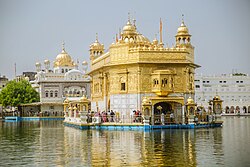
[[File:Darbar Sahib 27 September 2018.jpg|thumb|The [[Harmandir Sahib|Golden Temple]]]] | |||
[[File:Sikh helmet.jpg|thumb|upright|alt=Metal helmet in a museum|A [[Sikh Khalsa Army]] sowar's battle helmet]] | [[File:Sikh helmet.jpg|thumb|upright|alt=Metal helmet in a museum|A [[Sikh Khalsa Army]] sowar's battle helmet]] | ||
[[File:Photograph of Max Arthur Macauliffe wearing a turban.jpg|thumb|[[Max Arthur Macauliffe]] (1841–1913), a senior British administrator who was posted to India during the British rule of Punjab, converted to Sikhism in the 1860s.]] | |||
After defeating the [[Afghan–Sikh Wars|Afghans]] and | After defeating the [[Afghan–Sikh Wars|Afghans]] and Mughals, sovereign states called [[Misl]]s were formed under [[Jassa Singh Ahluwalia]]. The Confederacy of these states was unified and transformed into the [[Sikh Empire]] under [[Ranjit Singh|Maharaja Ranjit Singh]]. This era was characterised by religious tolerance and [[Religious pluralism|pluralism]], including Christians, Muslims and Hindus in positions of power. Its secular administration implemented military, economic and governmental reforms. The empire is considered the zenith of political Sikhism,<ref name="Lafont">{{cite book|last=Lafont|first=Jean-Marie|title=Maharaja Ranjit Singh: Lord of the Five Rivers (French Sources of Indian History Sources)|date=16 May 2002|publisher=Oxford University Press|isbn=0-19-566111-7|location=New York|pages=23–29}}</ref> encompassing [[Kashmir]], [[Ladakh]] and [[Peshawar]]. [[Hari Singh Nalwa]], the commander-in-chief of the [[Sikh Khalsa Army]] in the [[North-West Frontier Province|North-West Frontier]], expanded the confederacy to the [[Khyber Pass]]. | ||
=== British rule in India === | === British rule in India === | ||
[[File:Sikh Armour and weapons.jpg|thumb|upright|Sikh armour and weapons]] | [[File:Sikh Armour and weapons.jpg|thumb|upright|Sikh armour and weapons]] | ||
[[File:“Sikh Sardar”, photograph by John McCosh taken in circa 1848-9.jpg|thumb|“Sikh Sardar”, photograph by [[John McCosh]] taken | [[File:“Sikh Sardar”, photograph by John McCosh taken in circa 1848-9.jpg|thumb|“Sikh Sardar”, photograph by [[John McCosh]] taken circa 1848–49]] | ||
After the annexation of the Sikh | |||
After the annexation of the Sikh kingdom by the British, the British Army began recruiting significant numbers of Sikhs and [[Punjabis]].{{citation needed|date=January 2021}} During the 1857 [[Indian mutiny]], the Sikhs stayed loyal to the British, resulting in heavy recruitment from Punjab to the [[British Indian Army]] for the next 90 years of the [[British Raj]] in [[colonial India]].<ref>{{cite book|last1=Ballantyne|first1=Tony|title=Between Colonialism and Diaspora: Sikh Cultural Formations in an Imperial World|date=2006|publisher=Duke University Press|location=United states|page=66|url=https://books.google.com/books?id=cArhKfrY_IoC&pg=PR5 |access-date=21 January 2015|isbn=0822388111}}</ref> The distinct turban that differentiates a Sikh from other turban wearers is a relic of the rules of the British Indian Army.<ref>{{cite book|last1=Cohn|first1=Bernard S|url=https://books.google.com/books?id=uIalYaenrTkC&pg=PR9|title=Colonialism and Its Forms of Knowledge: The British in India|date=1996|publisher=Princeton University Press|isbn=0691000433|location=Princeton, NJ|pages=107–109|access-date=26 January 2015}}</ref> The British colonial rule saw the emergence of many reform movements in India, including Punjab, such as the formation of the First and Second [[Singh Sabha Movement|Singh Sabha]] in 1873 and 1879 respectively. The Sikh leaders of the Singh Sabha worked to offer a clear definition of Sikh identity and tried to purify Sikh belief and practice.<ref>{{cite book|last=Oberoi|first=Harjot|url=https://books.google.com/books?id=1NKC9g2ayJEC|title=The Construction of Religious Boundaries: Culture, Identity, and Diversity in the Sikh Tradition|publisher=University of Chicago Press|year=1994|isbn=9780226615929|location=Chicago|page=494|access-date=18 September 2013}}</ref> | |||
The later years of British colonial rule saw the emergence of the [[Akali movement]] to bring reform in the [[gurdwara]]s during the early 1920s. The movement led to the introduction of ''Sikh [[Gurdwara]] Bill'' in 1925, which placed all the historical Sikh shrines in India under the control of the [[Shiromani Gurdwara Parbandhak Committee]].<ref>{{cite book|last1=Nesbitt|first1=Eleanor|url=https://books.google.com/books?id=Ai-rpcY-rrgC&q=sgpc&pg=PT10|title=Sikhism: A Very Short Introduction|publisher=Oxford University Press|year=2005|isbn=0-19-280601-7|series=Very Short Introductions|location=Oxford|access-date=14 January 2016|via=Google Books}}</ref> | The later years of British colonial rule saw the emergence of the [[Akali movement]] to bring reform in the [[gurdwara]]s during the early 1920s. The movement led to the introduction of ''Sikh [[Gurdwara]] Bill'' in 1925, which placed all the historical Sikh shrines in India under the control of the [[Shiromani Gurdwara Parbandhak Committee]].<ref>{{cite book|last1=Nesbitt|first1=Eleanor|url=https://books.google.com/books?id=Ai-rpcY-rrgC&q=sgpc&pg=PT10|title=Sikhism: A Very Short Introduction|publisher=Oxford University Press|year=2005|isbn=0-19-280601-7|series=Very Short Introductions|location=Oxford|access-date=14 January 2016|via=Google Books}}</ref> | ||
=== Partition and post-Partition === | === Partition and post-Partition === | ||
At the time of the [[Indian independence movement]], the Sikh ruler of the [[Kapurthala State]] fought to [[opposition to the partition of India|oppose the partition of India]] and advocated for a united, secular country.<ref name="NDTV2009">{{cite web |title=An undivided India? |url=https://www.ndtv.com/video/news/the-big-fight/an-undivided-india-100356 |publisher=[[NDTV]] |access-date=19 October 2020 |language=en |date=29 August 2009}}</ref> Sikh | At the time of the [[Indian independence movement]], the Sikh ruler of the [[Kapurthala State]] fought to [[opposition to the partition of India|oppose the partition of India]] and advocated for a united, secular country.<ref name="NDTV2009">{{cite web |title=An undivided India? |url=https://www.ndtv.com/video/news/the-big-fight/an-undivided-india-100356 |publisher=[[NDTV]] |access-date=19 October 2020 |language=en |date=29 August 2009}}</ref> Sikh organisations, including the [[Chief Khalsa Diwan|Chief Khalsa Dewan]] and [[Shiromani Akali Dal]] led by [[Master Tara Singh]], condemned the [[Lahore Resolution]] and the movement to create Pakistan, viewing it as inviting possible persecution, with [[Shiromani Akali Dal|Akali Dal]] instead favouring an undivided Azad Punjab as an independent Sikh State or [[Khalistan movement|Khalistan]], having passed the Sikh State Resolution in 1946. The Sikhs therefore [[Tara Singh (activist)|strongly fought against the partition of Punjab]].<ref name="KudaisyaYong2004">{{cite book |last1=Kudaisya |first1=Gyanesh |last2=Yong |first2=Tan Tai |title=The Aftermath of Partition in South Asia |date=2004 |publisher=[[Routledge]] |location=Abingdon-on-Thames, England |isbn=978-1-134-44048-1 |page=100 |quote=No sooner was it made public than the Sikhs launched a virulent campaign against the Lahore Resolution. Pakistan was portrayed as a possible return to an unhappy past when Sikhs were persecuted and Muslims the persecutor. Public speeches by various Sikh political leaders on the subject of Pakistan invariably raised images of atrocities committed by Muslims on Sikhs and of the martyrdom of their ''gurus'' and heroes. Reactions to the Lahore Resolution were uniformly negative and Sikh leaders of all political persuasions made it clear that Pakistan would be "wholeheartedly resisted". The Shiromani Akali Dal, the party with a substantial following amongst the rural Sikhs, organized several well-attended conferences in Lahore to condemn the Muslim League. Master Tara Singh, leader of the Akali Dal, declared that his party would fight Pakistan "tooth and nail". Not be outdone, other Sikh political organizations, rivals to the Akali Dal, namely the Central Khalsa Young Men Union and the moderate and loyalist Chief Khalsa Dewan, declared in equally strong language their unequivocal opposition to the Pakistan scheme.}}</ref> The months leading up to the 1947 [[partition of India|partition of Punjab]] were marked by conflict in the [[Punjab]] between Sikhs and [[Muslims]].<ref name="Abid2014">{{cite web |last1=Abid |first1=Abdul Majeed |title=The forgotten massacre |url=https://nation.com.pk/29-Dec-2014/the-forgotten-massacre |website=The Nation |date=29 December 2014 |quote=On the same dates, Muslim League-led mobs fell with determination and full preparations on the helpless Hindus and Sikhs scattered in the villages of Multan, Rawalpindi, Campbellpur, Jhelum and Sargodha. The murderous mobs were well supplied with arms, such as daggers, swords, spears, and firearms. (A former civil servant mentioned in his autobiography that weapon supplies had been sent from NWFP and money was supplied by Delhi-based politicians.) They had bands of stabbers and their auxiliaries, who covered the assailant, ambushed the victim and if necessary disposed of his body. These bands were subsidized monetarily by the Muslim League, and cash payments were made to individual assassins based on the numbers of Hindus and Sikhs killed. There were also regular patrolling parties in jeeps that went about sniping and picking off any stray Hindu or Sikh. ... Thousands of non-combatants including women and children were killed or injured by mobs, supported by the All India Muslim League.}}</ref> This caused the religious migration of Punjabi Sikhs and [[Hindus]] from [[Punjab (Pakistan)|West Punjab]] to the east (modern India), mirroring a simultaneous religious migration of [[Punjabi Muslims]] from [[Punjab (India)|East Punjab]] to the west (modern Pakistan).<ref name="Dutt et al.">{{cite journal|last1=Dutt|first1=Amitava|last2=Devgun|first2=Surinder|date=23 September 1977|title=Diffusion of Sikhism and recent migration patterns of Sikhs in India|journal=GeoJournal|volume=1|issue=5|pages=81–89|doi=10.1007/BF00704966|s2cid=189881872|issn=1572-9893}} {{dead link|date=May 2016|bot=medic}}{{cbignore|bot=medic}}</ref> | ||
Following partition, the Government of India had begun to redraw states corresponding to demographic and linguistic boundaries. However, this was not effective in the northern part of the country,{{sfn|Doad|1997|p=392}} as the government reconsidered redrawing states in the north. {{sfn|Grewal|1998|p=186}} While states across the country were extensively redrawn on linguistic lines at the behest of linguistic groups, the only languages not considered for statehood were [[Punjabi language|Punjabi]], [[Sindhi language|Sindhi]] and [[Urdu]]. {{sfn|Deol|2000|p=93}} Leading to the launch of the [[Punjabi Suba movement]] and the presentation for a Punjabi Suba as a policy in April 1948 by [[Tara Singh (activist)|Master Tara Singh]]. Also, on 26 January 1950 Sikh representatives refused to sign the Indian constitution. As Sikhs were | Following partition, the Government of India had begun to redraw states corresponding to demographic and linguistic boundaries. However, this was not effective in the northern part of the country,{{sfn|Doad|1997|p=392}} as the government reconsidered redrawing states in the north.{{sfn|Grewal|1998|p=186}} While states across the country were extensively redrawn on linguistic lines at the behest of linguistic groups, the only languages not considered for statehood were [[Punjabi language|Punjabi]], [[Sindhi language|Sindhi]] and [[Urdu]]. {{sfn|Deol|2000|p=93}} Leading to the launch of the [[Punjabi Suba movement]] and the presentation for a Punjabi Suba as a policy in April 1948 by [[Tara Singh (activist)|Master Tara Singh]]. Also, on 26 January 1950, Sikh representatives refused to sign the Indian constitution. As Sikhs were recognised as Hindus and Sikhs were not provided with scheduled castes concessions given to Hindu scheduled castes. | ||
The Punjab Suba experienced heavy government crackdown with the Congress Government arresting as many as 21,000 people. Attempted negotiations with Congress-led the agitation to be adjourned twice, though Jawaharlal Nehru continued to reject the demand.{{sfn|Deol|2000|p=96}}{{sfn|Grewal|1998|p=188}} On 4 July 1955, government police forces, led by [[Deputy inspector general of police|DIG]] Ashwini Kumar,<ref name=kirpal>{{cite book |last1=Dhillon |first1=Kirpal S. |title=Identity and Survival: Sikh Militancy in India, | The Punjab Suba experienced heavy government crackdown with the Congress Government arresting as many as 21,000 people. Attempted negotiations with Congress-led the agitation to be adjourned twice, though [[Jawaharlal Nehru]] continued to reject the demand.{{sfn|Deol|2000|p=96}}{{sfn|Grewal|1998|p=188}} On 4 July 1955, government police forces, led by [[Deputy inspector general of police|DIG]] Ashwini Kumar,<ref name="kirpal">{{cite book |last1=Dhillon |first1=Kirpal S. |title=Identity and Survival: Sikh Militancy in India, 1978–1993 |date=2006 |publisher=Penguin Books |location=London, United Kingdom |isbn=9780143100362 |url=https://books.google.com/books?id=_PU6CwAAQBAJ&pg=PT60| page=60}}</ref> forced entry into the Golden Temple premises and heavy-handedly arrested protestors and took them into custody, along with the head [[granthi]]s of the [[Akal Takht]] and [[Golden Temple]], volunteer protestors and even cooks of the temple's [[Langar (Sikhism)|langar]].{{sfn|Bal|1985|p=426}} The Guru Ram Das Serai and Shiromani Akali Dal offices were also raided and batons used and tear gas and shells were fired to disperse the protestors gathered on the periphery of the temple, damaging the periphery and Sarovar, or pool, of the temple.{{sfn|Bal|1985|p=426}}{{sfn|Grewal|1998|p=189}} The government stopped volunteers on the way to the Golden Temple and troops were ordered to flag-march through the bazaars and streets surrounding the site.{{sfn|Grewal|1998|p=189}} Over 200 protestors were killed, thousands arrested,{{sfn|Grewal|1998|p=189}} and thousands, including women and children, were injured. | ||
The Congress government agreed to the Punjab Suba in 1966 after protests and recommendation of the States Reorganisation Commission.<ref name="Jayanta484">{{citation|last1=Ray|first1=Jayanta Kumar|title=Aspects of India's International Relations, 1700 to 2000: South Asia and the World|date=2007|url=https://books.google.com/books?id=Nyk6oA2nOlgC&q=khalistan|page=484|publisher=Pearson Education India|isbn=978-81-317-0834-7}}</ref> The state of East Punjab was later split into the states of [[Himachal Pradesh]], the new state [[Haryana]] and current day [[Punjab, India|Punjab]].<ref>{{cite journal|last=Singh|first=Atamjit|title=The Language Divide in Punjab|url=http://www.apnaorg.com/book-chapters/language/|journal=South Asian Graduate Research Journal|volume=4|issue=1, Spring 1997|publisher=Apna|access-date=4 April 2013}}</ref> However, there was a growing alienation between Punjabi Sikh and Hindu populations. The latter of which reported [[Hindi]] rather than Punjabi as their primary language. The result was that Punjabi-speaking areas were left out of the new state and given to Haryana and Himachal Pradesh{{sfn|Grewal|1998|p=205}} resulting in the state of Punjab to be roughly 35,000 square miles smaller than the Punjabi-speaking areas based on pre-1947 census figures. Moreover, the 1966 | The Congress government agreed to the Punjab Suba in 1966 after protests and recommendation of the States Reorganisation Commission.<ref name="Jayanta484">{{citation|last1=Ray|first1=Jayanta Kumar|title=Aspects of India's International Relations, 1700 to 2000: South Asia and the World|date=2007|url=https://books.google.com/books?id=Nyk6oA2nOlgC&q=khalistan|page=484|publisher=Pearson Education India|isbn=978-81-317-0834-7}}</ref> The state of East Punjab was later split into the states of [[Himachal Pradesh]], the new state [[Haryana]] and current day [[Punjab, India|Punjab]].<ref>{{cite journal|last=Singh|first=Atamjit|title=The Language Divide in Punjab|url=http://www.apnaorg.com/book-chapters/language/|journal=South Asian Graduate Research Journal|volume=4|issue=1, Spring 1997|publisher=Apna|access-date=4 April 2013}}</ref> However, there was a growing alienation between Punjabi Sikh and Hindu populations. The latter of which reported [[Hindi]] rather than Punjabi as their primary language. The result was that Punjabi-speaking areas were left out of the new state and given to Haryana and Himachal Pradesh{{sfn|Grewal|1998|p=205}} resulting in the state of Punjab to be roughly 35,000 square miles smaller than the Punjabi-speaking areas based on pre-1947 census figures. Moreover, the 1966 reorganisation left Sikhs highly dissatisfied, with the capital [[Chandigarh]] being made into a shared [[union territory]] and the capital of Punjab and Haryana. | ||
In the late 1960s, the Green Revolution in India was first introduced in Punjab as part of a development program issued by international donor agencies and the Government of India.<ref>{{Cite journal|last=Dutta|first=Swarup|date=June 2012|title=Green Revolution Revisited: The Contemporary Agrarian Situation in Punjab, India|journal=Social Change|volume=42|issue=2|pages=229–247|doi=10.1177/004908571204200205|s2cid=55847236|issn=0049-0857}}</ref> While, | In the late 1960s, the [[Green Revolution]] in India was first introduced in Punjab as part of a development program issued by international donor agencies and the Government of India.<ref>{{Cite journal|last=Dutta|first=Swarup|date=June 2012|title=Green Revolution Revisited: The Contemporary Agrarian Situation in Punjab, India|journal=Social Change|volume=42|issue=2|pages=229–247|doi=10.1177/004908571204200205|s2cid=55847236|issn=0049-0857}}</ref> While, Green Revolution in Punjab had several positive impacts, the introduction of the mechanised agricultural techniques led to uneven distribution of wealth. The industrial development was not done at the same pace as agricultural development, the Indian government had been reluctant to set up heavy industries in Punjab due to its status as a high-risk border state with Pakistan.<ref name="Larry2007">{{cite book |author1=Sumit Ganguly |author2=Larry Diamond |author3=Marc F. Plattner |title=The State of India's Democracy |url=https://books.google.com/books?id=lgs1tFTh-JMC&pg=PA56 |access-date=18 August 2013 |date=2007 |publisher=JHU Press |isbn=978-0-8018-8791-8 |page=56}}</ref> The rapid increase in the higher education opportunities without an adequate rise in the jobs resulted in the increase in the unemployment of educated youth.<ref name="Jayanta484" /> | ||
In 1973 as a result, of unaddressed grievances and increasing inequality the [[Akali Dal]] put forward the [[Anandpur Sahib Resolution]].{{sfn|Karim|1991|p=30}} The resolution included both religious and political issues. It asked for recognising Sikhism as a religion, it also demanded the devolution of power from the Central to state governments.<ref name="Jayanta484"/> The Anandpur Resolution was rejected by the government as a secessionist document. Thousands of people joined the movement, feeling that it represented a real solution to demands such as a larger share of water for irrigation and the return of | In 1973 as a result, of unaddressed grievances and increasing inequality the [[Akali Dal]] put forward the [[Anandpur Sahib Resolution]].{{sfn|Karim|1991|p=30}} The resolution included both religious and political issues. It asked for recognising Sikhism as a religion, it also demanded the devolution of power from the Central to state governments.<ref name="Jayanta484" /> The Anandpur Resolution was rejected by the government as a secessionist document. Thousands of people joined the movement, feeling that it represented a real solution to demands such as a larger share of water for irrigation and the return of Chandigarh to Punjab.<ref name="Akshay1991">{{cite book |author=Akshayakumar Ramanlal Desai |title=Expanding Governmental Lawlessness and Organized Struggles |year=1991 |publisher=Popular Prakashan |isbn=978-81-7154-529-2 |pages=64–66}}</ref> | ||
After unsuccessful negotiations the Dharam Yuddh Morcha ( | After unsuccessful negotiations the Dharam Yuddh Morcha ({{gloss|righteous campaign}}){{sfn|Bakke|2015|p=143}} was launched on 4 August 1982,{{Citation needed|date=March 2022}} by the [[Akali Dal]] in partnership with [[Jarnail Singh Bhindranwale]], with its stated aim being the fulfillment of a set of devolutionary objectives based on the [[Anandpur Sahib Resolution]].{{sfn|Bakke|2015|p=143}} Indian police responded to protestors with high-handed police methods creating state repression affecting a very large segment of Punjab's population. Police brutality resulted in retaliatory violence from a section of the Sikh population, widening the scope of the conflict by the use of violence of the state on its own people.{{sfn|Karim|1991|pp=32–33}} A "state of chaos and repressive police methods" combined to create "a mood of overwhelming anger and resentment in the Sikh masses against the authorities." Leading to Sikh leader Jarnail Singh Bhindranwale gaining prominence and demands of independence gain currency, even amongst moderates and Sikh intellectuals.{{sfn|Karim|1991|pp=32–33}} In 1982 and early 1983, extrajudicial killings by the police of orthodox Sikh youth in rural areas in Punjab provoked reprisals.<ref>{{cite journal |last1=Pettigrew |first1=Joyce |title=In Search of a New Kingdom of Lahore |journal=Pacific Affairs |date=1987 |volume=60 |issue=1 |page=24 |doi=10.2307/2758827 |jstor=2758827}}</ref> Over 190 Sikhs had been killed in the first 19 months of the protest movement.<ref>{{cite book |last1=Dhillon |first1=Gurdarshan Singh |title=Truth about Punjab: SGPC White Paper |date=1996 |publisher=Shiromani Gurdwara Parbandhak Committee |location=Amritsar, Punjab |isbn=978-0836456547 |edition=1st |page=198 |url=https://archive.org/details/TruthAboutPunjab/mode/2up}}</ref> | ||
In May 1984, a ''Grain Roko morcha'' was planned and to be initiated on | In May 1984, a ''Grain Roko morcha'' was planned and to be initiated on June{{nbsp}}3{{sfn|Grewal|1998|p=226}} with protestors practising civil disobedience by refusing to pay land revenue, water or electricity bills and blocking the flow of grain out of Punjab. Indian Prime minister [[Indira Gandhi]] launched [[Operation Blue Star]] on June{{nbsp}}1 prior to the Grain Roko morcha in order to remove Bhindranwale from the [[Harmandir Sahib|Golden Temple]]. This subsequently led to Gandhi's assassination by her Sikh bodyguards.<ref name="NYT">{{Cite news|last=Pace|first=Eric|date=1 November 1984|title=Assassination in India: Sikhs at the centre of the drama; Sikh separation dates back to '47|page=24|newspaper=The New York Times|url=https://www.nytimes.com/1984/11/01/world/assassination-india-sikhs-center-drama-sikh-separation-dates-back-47.html}}</ref> Her assassination was followed by government-sponsored pogroms against Sikh communities across India and the killing of thousands of Sikhs throughout India. These events triggered an [[Insurgency in Punjab]] which would consume Punjab until the early 1990s. | ||
During the day of [[Vaisakhi]] in 1999, Sikhs worldwide celebrated the 300th anniversary of the creation of the [[Khalsa]]. [[Canada Post]] honoured Sikh Canadians with a commemorative stamp in conjunction with the anniversary. Likewise, on 9 April 1999, Indian president [[K. R. Narayanan]] issued a stamp commemorating the 300th anniversary of the Khalsa as well.<ref>{{cite web|title=Canada Post to honour Sikh Canadians with a commemorative stamp|url=http://www.tribuneindia.com/khalsa/page16.htm|work=Tribune India|publisher=The Tribune|access-date=26 March 2013|archive-date=29 January 2021|archive-url=https://web.archive.org/web/20210129050454/https://www.tribuneindia.com/error/Error404?aspxerrorpath=%2Fkhalsa%2Fpage16.htm|url-status=dead}}</ref> | During the day of [[Vaisakhi]] in 1999, Sikhs worldwide celebrated the 300th anniversary of the creation of the [[Khalsa]]. [[Canada Post]] honoured Sikh Canadians with a commemorative stamp in conjunction with the anniversary. Likewise, on 9 April 1999, Indian president [[K. R. Narayanan]] issued a stamp commemorating the 300th anniversary of the Khalsa as well.<ref>{{cite web|title=Canada Post to honour Sikh Canadians with a commemorative stamp|url=http://www.tribuneindia.com/khalsa/page16.htm|work=Tribune India|publisher=The Tribune|access-date=26 March 2013|archive-date=29 January 2021|archive-url=https://web.archive.org/web/20210129050454/https://www.tribuneindia.com/error/Error404?aspxerrorpath=%2Fkhalsa%2Fpage16.htm|url-status=dead}}</ref> | ||
== | ==Art and culture== | ||
{{Main|Sikh art and culture|Punjabi culture}} | |||
[[File:SikhNakashi.jpg|alt=Intricate design|thumb|Opaque watercolour-on-paper [[Nakashi art]], about 1880, by an unknown artist from [[Lahore]] or [[Amritsar]] and used to decorate the walls of [[Golden Temple|Harmandir Sahib]]]] | |||
[[File:HarmindarSahib.jpg|alt=Large building on the water|thumb|Darbar Sahib, circa 1870]] | |||
Sikh art and culture are nearly synonymous with that of Punjab and Sikhs are easily recognised by their distinctive turban ([[Dastar]]). Punjab has been called India's melting pot, due to the confluence of invading cultures from the rivers from which the region gets its name. Sikh culture is therefore a synthesis of cultures. Sikhism has forged a unique [[Sikh architecture|architecture]], which S. S. Bhatti described as "inspired by [[Guru Nanak]]'s creative mysticism" and "is a mute harbinger of holistic humanism based on pragmatic spirituality."<ref>{{cite web |title=The Magnificence of Sikh Architecture |url=http://www.punjabheritage.org/catagories/architectural-heritage/the-magnificence-of-sikh-architecture.html |archive-url=https://web.archive.org/web/20071214193843/http://www.punjabheritage.org/catagories/architectural-heritage/the-magnificence-of-sikh-architecture.html <!-- Bot retrieved archive --> |archive-date=14 December 2007 |access-date=4 April 2008}}</ref> The American non-profit organisation [[United Sikhs]] has fought to have Sikh included on the [[United States|U.S.]] census as well, arguing that Sikhs "self-identify as an ethnic minority" and believe "that they are more than just a religion."<ref>{{cite web |title=Memorandum Regarding the Tabulation of Sikh Ethnicity in the United States Census |url=http://www.unitedsikhs.org/petitions/Memo%20re%20Sikh%20Ethnicity.pdf |url-status=dead |archive-url=https://web.archive.org/web/20140224220633/http://www.unitedsikhs.org/petitions/Memo%20re%20Sikh%20Ethnicity.pdf |archive-date=24 February 2014 |access-date=20 November 2014}}</ref> | |||
During the [[Mughal Empire|Mughal]] and [[Durrani|Afghan]] persecution of the Sikhs during the 17th and 18th centuries,<ref>{{cite book |last=Sian |first=Katy |title=Unsettling Sikh and Muslim Conflict: Mistaken Identities, Forced Conversions, and Postcolonial Formations |publisher=Rowman & Littlefield |year=2013 |isbn=9780739178744 |page=32}}</ref> the latter were concerned with preserving their religion and gave little thought to art and culture. With the rise of [[Ranjit Singh]] and the [[Sikh Raj]] in [[Lahore]] and [[Delhi]], there was a change in the landscape of art and culture in Punjab; Hindus and Sikhs could build decorated shrines without the fear of destruction or looting.<ref>{{cite book |last=Srivastava |first=R. P. |title=Punjab Painting: Study in Art and Culture |publisher=Abhinav Publications |year=1983 |isbn=9788170171744 |page=13}}</ref> | |||
The Sikh Confederacy was the catalyst for a uniquely Sikh form of expression, with Ranjit Singh commissioning forts, palaces, bungas (residential places) and colleges in a Sikh style. Sikh architecture is characterised by gilded fluted domes, cupolas, kiosks, stone lanterns, ornate [[baluster]]s and square roofs. A pinnacle of Sikh style is [[Harmandir Sahib]] (also known as the Golden Temple) in [[Amritsar]].<ref>{{Cite web |title=Golden Temple (Sri Harmandir Sahib) {{!}} EBSCO Research Starters |url=https://www.ebsco.com/research-starters/literature-and-writing/golden-temple-sri-harmandir-sahib |access-date=22 June 2025 |website=www.ebsco.com |language=en}}</ref> | |||
Sikh culture is influenced by militaristic motifs (with the [[Khanda (religious symbol)|Khanda]] the most obvious) and most Sikh artifacts—except for the relics of the Gurus—have a military theme. This theme is evident in the Sikh festivals of [[Hola Mohalla]] and [[Vaisakhi]], which feature marching and displays of valor.{{Citation needed|date=June 2024}} | |||
Although the art and culture of the Sikh diaspora have merged with that of other Indo-immigrant groups into categories like "British Asian," "Indo-Canadian" and "Desi-Culture," a minor cultural phenomenon that can be described as "political Sikh" has arisen.<ref>{{cite web |title=Art and Culture of the Diaspora |url=http://www.sikhchic.com/ |access-date=4 April 2008}}</ref> The art of diaspora Sikhs like Amarjeet Kaur Nandhra and Amrit and Rabindra Kaur Singh ([[The Singh Twins]])<ref>{{cite web |title=Singh Twins Art Launches Liverpool Fest |url=http://sikhchic.com/article-detail.php?id=168&cat=1 |access-date=4 April 2008}}</ref> is influenced by their Sikhism and current affairs in Punjab.{{Citation needed|date=June 2024}} | |||
[[Bhangra (dance)|Bhangra]] and [[Giddha]] are two forms of Punjabi folk dancing which have been adapted and pioneered by Sikhs. Punjabi Sikhs have championed these forms of expression worldwide, resulting in Sikh culture becoming linked to Bhangra (although "Bhangra is not a Sikh institution but a Punjabi one").<ref>{{cite web |title=Bhangra & Sikhi by Harjinder Singh |url=http://www.sikhwomen.com/sikhism/culture_arts/bhangra.htm |access-date=4 April 2008}}</ref> | |||
{{Anchor|Sikh paintings}} | |||
===Painting=== | |||
{{Further|Sikh art}}[[File:Guru_Nanak_with_companions,_Bhai_Mardana_and_Bhai_Bala,_in_debate_with_the_Siddhs.jpg|thumb|Painting of [[Guru Nanak]] with companions [[Bhai Mardana]] and [[Bhai Bala]], in debate with the [[Siddha|Siddhs]]]] | |||
[[Sikh painting]] is a direct offshoot of the [[Kangra painting|Kangra school]] of painting. In 1810, Ranjeet Singh (1780–1839) occupied [[Kangra Fort]] and appointed Sardar Desa Singh Majithia his governor of the Punjab hills. In 1813, the Sikh army occupied [[Guler State]] and Raja Bhup Singh became a vassal of the Sikhs. With the Sikh kingdom of Lahore becoming the paramount power, some of the Pahari painters from Guler migrated to Lahore for the patronage of Maharaja Ranjeet Singh and his Sardars.{{Citation needed|date=June 2024}} | |||
The Sikh school adapted Kangra painting to Sikh needs and ideals. Its main subjects are the ten Sikh gurus and stories from Guru Nanak's [[Janamsakhi]]s. The tenth Guru, Gobind Singh, left a deep impression on the followers of the new faith because of his courage and sacrifices. Hunting scenes and portraits are also common in Sikh painting.{{Citation needed|date=June 2024}} | |||
===Shrines=== | |||
[[File:A Sikh at Golden Temple.jpg|thumb|A Sikh at Golden Temple after taking holy bath in Sarovar at Golden Temple]] | |||
[[File:Hermosa mujer y su hijo en el Golden Temple (8513976528).jpg|thumb|Photograph of a Sikh woman and her son at the Golden Temple in Amritsar, Punjab, India, 9 September 2012]] | |||
[[File:Tarn_Taran_1.jpg|thumb|[[Tarn Taran Sahib]] – the world's largest sarovar (sacred pool)]] | |||
There is an old Sikh shrine called 'Prachin Guru Nanak Math', which lies at a small hill, just next to [[Bishnumati River|Bishnumati]] bridge at Balaju. Guru Nanak is said to have visited Nepal during his third Udasi while returning from [[Mount Kailash]] in Tibet. Nanak is said to have stayed at Balaju and Thapathali in [[Kathmandu]]. The Nanak Math shrine at Balaju is managed by the Guru-Ji and the Udasin Akardha, a sect developed by Guru Nanak's son, Sri Chandra.<ref>{{cite magazine |title=Guru Nanak Math On Verge Of Vanishing |url=https://www.spotlightnepal.com/2019/08/02/guru-nanak-math-verge-vanishing/ |magazine=New Spotlight Magazine |access-date=19 March 2022 |place=Nepal}}</ref><ref>{{cite web |title=Gurudwara Guru Nanak Math, Kathmandu |url=https://www.worldgurudwaras.com/gurudwaras/gurudwara-guru-nanak-math-kathmandu/ |access-date=19 March 2022 |publisher=World Gurudwaras}}</ref> | |||
===Daily routine=== | ===Daily routine=== | ||
| Line 185: | Line 254: | ||
| One who calls themself a Sikh of the Guru, the True Guru, shall rise in the early morning hours and meditate on the Lord's Name. Upon arising early in the morning, he is to bathe and cleanse himself in the pool of nectar. Following the Instructions of the Guru, he is to chant the Name of the Lord, "Har, Har." All sins, misdeeds, and negativity shall be then erased. Then, at the rising of the sun, he is to sing Gurbani; whether sitting down or standing up, he is to meditate on the Lord's Name. One who meditates on my Lord, Har, Har, with every breath and every morsel of food and – that GurSikh becomes pleasing to the Guru's Mind. That person, unto whom my Lord and Master is kind and compassionate – upon that GurSikh, the Guru's Teachings are bestowed. Servant Nanak begs for the dust of the feet of that GurSikh, who himself chants the Naam, and inspires others to chant it.|Fourth Mehl ([[Guru Ram Das]])|title=''Guru Granth Sahib''|source=p. 305}} | | One who calls themself a Sikh of the Guru, the True Guru, shall rise in the early morning hours and meditate on the Lord's Name. Upon arising early in the morning, he is to bathe and cleanse himself in the pool of nectar. Following the Instructions of the Guru, he is to chant the Name of the Lord, "Har, Har." All sins, misdeeds, and negativity shall be then erased. Then, at the rising of the sun, he is to sing Gurbani; whether sitting down or standing up, he is to meditate on the Lord's Name. One who meditates on my Lord, Har, Har, with every breath and every morsel of food and – that GurSikh becomes pleasing to the Guru's Mind. That person, unto whom my Lord and Master is kind and compassionate – upon that GurSikh, the Guru's Teachings are bestowed. Servant Nanak begs for the dust of the feet of that GurSikh, who himself chants the Naam, and inspires others to chant it.|Fourth Mehl ([[Guru Ram Das]])|title=''Guru Granth Sahib''|source=p. 305}} | ||
The [[Sikh Rehat Maryada|Sikh Rahit Maryada]] (Code of Conduct) clearly states that [[Amrit Sanskar| | The [[Sikh Rehat Maryada|Sikh Rahit Maryada]] (Code of Conduct) clearly states that [[Amrit Sanskar|initiated]] Amritdhari [[Khalsa]] Sikhs must recite or listen to the recitation of [[Japji Sahib]], [[Jaap Sahib]], [[Tav-Prasad Savaiye|the 10 Sawayyas]], Sodar [[Rehras|Rehraas]] and [[kirtan Sohila|Sohila]].<ref>{{cite web |url=https://old.sgpc.net/rehat_maryada/section_six.html |title=Sikh Reht Maryada, the Definition of Sikh, Sikh Conduct & Conventions, Sikh Religion Living, India}}</ref><ref>{{Cite web|url=https://old.sgpc.net/rehat_maryada/section_one.html|title=Sikh Reht Maryada, The Definition of Sikh, Sikh Conduct & Conventions, Sikh Religion Living, India|website=old.sgpc.net|access-date=5 April 2022|archive-date=6 January 2024|archive-url=https://web.archive.org/web/20240106033711/https://old.sgpc.net/rehat_maryada/section_one.html|url-status=dead}}</ref> Every Sikh is also supposed take the [[Hukamnama|Hukam]] (divine order) from the [[Guru Granth Sahib]] after awakening in the [[Amrit Velā|ambrosial hours of the morning (three hours before the dawn)]] before eating.<ref>{{Cite web|url=https://old.sgpc.net/rehat_maryada/section_three_chap_five.html|title=Sikh Reht Maryada, The Definition of Sikh, Sikh Conduct & Conventions, Sikh Religion Living, India|website=old.sgpc.net}}</ref> | ||
In his [[The 52 Hukams of Guru Gobind Singh|52 Hukams]], [[Guru Gobind Singh]] orders his followers to arise during [[Amrit Velā|Amritvela]] (early morning) and to recite the late evening prayer "[[Kirtan Sohila|Sohila]]" and the verse "Pavan guru pani pita..." before sleeping. | In his [[The 52 Hukams of Guru Gobind Singh|52 Hukams]], [[Guru Gobind Singh]] orders his followers to arise during [[Amrit Velā|Amritvela]] (early morning) and to recite the late evening prayer "[[Kirtan Sohila|Sohila]]" and the verse "Pavan guru pani pita..." before sleeping.{{Citation needed|date=June 2024}} | ||
===Five Ks=== | ===Five Ks=== | ||
| Line 193: | Line 262: | ||
[[File:Sikh Articles of Faith.JPG|thumb|alt=Wooden comb, iron bracelet and curved, gold-coloured dagger|[[Kanga (Sikhism)|Kanga]], [[Kara (Sikhism)|Kara]] and [[Kirpan]]: three of the five Sikh articles of faith]] | [[File:Sikh Articles of Faith.JPG|thumb|alt=Wooden comb, iron bracelet and curved, gold-coloured dagger|[[Kanga (Sikhism)|Kanga]], [[Kara (Sikhism)|Kara]] and [[Kirpan]]: three of the five Sikh articles of faith]] | ||
[[File:Kachera.jpg|thumb|Kachera , one of 5 ks ( items)of Sikhs]] | |||
The five Ks (''panj kakaar'') are five articles of faith which all | [[File:Sikh man, Agra 10.jpg|thumb|A sikh man with kesh (hair of head and beard) ,one of five articles /symbols of Sikhs]] | ||
The five Ks (''panj kakaar'') are five articles of faith which all initiated (''Amritdhari'') Sikhs are obliged to wear. The symbols represent the ideals of Sikhism: honesty, equality, fidelity, meditating on [[Waheguru]] and never bowing to tyranny.<ref>{{cite book | |||
| last = Nesbitt | | last = Nesbitt | ||
| first = Eleanor | | first = Eleanor | ||
| Line 206: | Line 276: | ||
#''[[Kesh (Sikhism)|Kesh]]'': Uncut hair, usually tied and wrapped in a ''[[turban]]''. | #''[[Kesh (Sikhism)|Kesh]]'': Uncut hair, usually tied and wrapped in a ''[[turban]]''. | ||
#''[[Kangha (Sikhism)|Kanga]]'': A wooden comb, usually worn under a ''turban'' to always also keep one's hair clean and well-groomed. | #''[[Kangha (Sikhism)|Kanga]]'': A wooden comb, usually worn under a ''turban'' to always also keep one's hair clean and well-groomed. | ||
#''[[Kachera]]'': Cotton undergarments, worn by both sexes; the ''kachera'' is a symbol of chastity | #''[[Kachera]]'': Cotton undergarments, worn by both sexes; the ''kachera'' is a symbol of chastity and also a symbol of cleanliness. It is also historically appropriate in battle due to increased mobility and comfort when compared to a ''[[dhoti]]''. | ||
#''[[Kara (Sikhism)|Kara]]'': An iron bracelet, a symbol of eternity, strength | #''[[Kara (Sikhism)|Kara]]'': An iron bracelet, a symbol of eternity, strength and a constant reminder of the strength of will to keep hands away from any kind of unethical practices. | ||
#''[[Kirpan]]'': An iron blade in different sizes. In the UK, Sikhs can wear a small dagger, but in Punjab, they might wear a traditional curved sword from one to three feet in length. ''Kirpan'' is only a weapon of defense and religious protection, used to serve humanity and to be used against oppression. | #''[[Kirpan]]'': An iron blade in different sizes. In the UK, Sikhs can wear a small dagger, but in Punjab, they might wear a traditional curved sword from one to three feet in length. ''Kirpan'' is only a weapon of defense and religious protection, used to serve humanity and to be used against oppression. | ||
| Line 216: | Line 286: | ||
{{Main|Sikh music}} | {{Main|Sikh music}} | ||
The Sikhs have a number of musical instruments, including the [[Seni rebab|rebab]], [[Esraj|dilruba]], [[Taus (instrument)|taus]], jori | The Sikhs have a number of musical instruments, including the [[Seni rebab|rebab]], [[Esraj|dilruba]], [[Taus (instrument)|taus]], jori and [[Sarinda (instrument)|sarinda]]. Playing the [[sarangi]] was encouraged by [[Guru Hargobind]]. The rebab was played by [[Bhai Mardana]] as he accompanied Guru Nanak on his journeys. The jori and sarinda were introduced to Sikh devotional music by [[Guru Arjan]]. The ''taus'' (Persian for "peacock") was designed by Guru Hargobind, who supposedly heard a peacock singing and wanted to create an instrument mimicking its sounds. The dilruba was designed by [[Guru Gobind Singh]] at the request of his followers, who wanted a smaller instrument than the taus. After [[Japji Sahib]], all of the [[shabad (hymn)|shabad]] in the [[Guru Granth Sahib]] were composed as [[raga|raags]]. This type of singing is known as [[Gurmat Sangeet]]. | ||
When they marched into battle, the Sikhs would play a ''Ranjit nagara'' ({{gloss|victory drum}}) to boost morale. Nagaras (usually two to three feet in diameter, although some were up to five feet in diameter) are played with two sticks. The beat of the large drums and the raising of the [[Nishan Sahib]], meant that the Singhs were on their way. | |||
== Khalistan movement == | |||
[[File:Sikh march against Indian policy, London 10-Jun-12.JPG|thumb|Sikhs in [[London]] protesting against Indian government actions]] | |||
The [[Khalistan movement]] is a Sikh separatist movement, which seeks to create a separate country called Khalistān ({{gloss|The [[-stan|Land of]] the [[Khalsa]]}}) in the [[Punjab, India|Punjab]] state of [[India]] to serve as a homeland for Sikhs.<ref>{{cite book |last1=Kinnvall |first1=Catarina |url=https://books.google.com/books?id=XJzUzWDwZ4kC&pg=PA218 |title=Globalization and Religious Nationalism in India |date=2007 |publisher=Routledge |isbn=9781134135707}}</ref> The territorial definition of the proposed country Khalistan consists of the [[Punjab, India]] and includes [[Haryana]], [[Himachal Pradesh]], [[Jammu and Kashmir (state)|Jammu and Kashmir]] and [[Rajasthan]].<ref name="Crenshaw">{{cite book |last=Crenshaw |first=Martha |title=Terrorism in Context |publisher=Pennsylvania State University |year=1995 |isbn=978-0-271-01015-1 |page=364}}</ref><ref>''The foreign policy of Pakistan: ethnic impacts on diplomacy, 1971–1994'' {{ISBN|1-86064-169-5}} – Mehtab Ali Shah "''Such is the political, psychological and religious attachment of the Sikhs to that city that a Khalistan without Lahore would be like a Germany without Berlin.''"</ref><ref name="Stephen_Amritsar">''Amritsar to Lahore: A Journey Across the India-Pakistan Border'' – Stephen Alter {{ISBN|0-8122-1743-8}} "''Ever since the separatist movement gathered force in the 1980s, Pakistan has sided with the Sikhs, the territorial ambitions of Khalistan have at times included Chandigarh, sections of the Indian Punjab, including whole North India and some parts of western states of India.''"</ref> | |||
Khalistan movement began as an [[expatriate]] venture.<ref name="Pruthi169">{{cite book |last1=Pruthi |first1=Raj |url=https://books.google.com/books?id=KxndvJs3wUkC&q=expatriate+venture&pg=PA169 |title=Sikhism and Indian Civilization |date=2004 |publisher=Discovery Publishing House |isbn=9788171418794 |page=169 |access-date=25 October 2018}}</ref> In 1971, the first explicit call for Khalistan was made in an advertisement published in the ''New York Times'' by an expat ([[Jagjit Singh Chohan]]).{{sfn|Van Dyke|2009|p=976}} By proclaiming the formation of Khalistan, he was able to collect millions of dollars from the [[Sikh diaspora]].<ref>{{cite news |author=Haresh Pandya |date=11 April 2007 |title=Jagjit Singh Chauhan, Sikh Militant Leader in India, Dies at 80 |work=The New York Times |url=https://www.nytimes.com/2007/04/11/world/asia/11chauhan.html?_r=1&fta=y&oref=slogin |access-date=28 August 2008}}</ref> On 12 April 1980, he declared the formation of the "National Council of Khalistan," at [[Anandpur Sahib]].<ref>{{cite book |last=Nayar |first=Kuldip |title=Tragedy of Punjab |author2=Kushwant Singh |publisher=Vision Books |year=1985 |isbn=1-85127-069-8 |page=51}}</ref> He declared himself as the President of the council and named Balbir Singh Sandhu as its Secretary General. In May 1980, Chohan traveled to [[London]] and announced the formation of Khalistan. A similar announcement was made by Balbir Singh Sandhu in [[Amritsar]], where he began releasing stamps and currency of Khalistan. The inaction of the authorities in Amritsar and elsewhere was decried as a political stunt by the [[Indian National Congress|Congress(I)]] party of Indira Gandhi by the Akali Dal, headed by the Sikh leader [[Harchand Singh Longowal]].<ref>{{cite book |last=Singh |first=Satinder |title=Khalistan: An Academic Analysis |publisher=Amar Prakashan |year=1982 |location=Delhi & Punjab |page=114}}</ref> | |||
The movement flourished in the Indian state of Punjab following [[Operation Blue Star]] and the [[Anti Sikh Riots|Anti-Sikh Pogroms]]. As proponents were able to generate funding from a grieving diaspora. In June 1985, [[Air India Flight 182|Air India Flight 182 was bombed]] by [[Babbar Khalsa]], a pro-Khalistani terrorist organisation.<ref>{{cite news |date=15 March 2018 |title=Jagmeet Singh Now Rejects Glorification of Air India Bombing mastermind |publisher=CBC News |url=http://www.cbc.ca/news/politics/jagmeet-singh-air-india-bombing-accepts-1.4578030 |access-date=30 April 2018 |quote=The 18-month long Air India inquiry, led by former Supreme Court justice John Major, pointed to Parmar as the chief terrorist behind the bombing. A separate inquiry, carried out by former Ontario NDP premier and Liberal MP Bob Rae, also fingered Parmar as the architect of the 1985 bombing that left 329 people dead 268 of them Canadians.}}</ref> In January 1986, the Golden Temple was occupied by militants belonging to [[All India Sikh Students Federation]] and [[Damdami Taksal]].<ref>Sikh Temple Sit-In Is a Challenge for Punjab, ''The New York Times'' 2 February 1986</ref> On 26 January 1986, a gathering known as the [[Sarbat Khalsa]] (a de facto parliament) passed a resolution (''gurmattā'') favouring the creation of Khalistan. Subsequently, a number of rebel militant groups in favour of Khalistan waged a [[Punjab insurgency|major insurgency]] against the government of India. Indian security forces suppressed the insurgency in the early 1990s, but Sikh political groups such as the [[Khalsa Raj Party]] and [[Shiromani Akali Dal (Amritsar)|SAD (A)]] continued to pursue an independent Khalistan through non-violent means.<ref>{{cite web |date=20 January 2003 |title=Amnesty International report on Punjab |url=http://web.amnesty.org/library/Index/ENGASA200022003?open&of=ENG-IND |archive-url=https://web.archive.org/web/20061203184445/http://web.amnesty.org/library/Index/ENGASA200022003?open&of=ENG-IND |archive-date=3 December 2006 |access-date=11 January 2010 |publisher=Amnesty International}}</ref><ref name="tribuneindia2006">{{cite web |title=The Tribune, Chandigarh, India – Punjab |url=http://www.tribuneindia.com/2006/20060310/punjab1.htm#2 |access-date=27 September 2015 |publisher=Tribuneindia.com |archive-date=5 June 2011 |archive-url=https://web.archive.org/web/20110605221542/http://www.tribuneindia.com/2006/20060310/punjab1.htm#2 |url-status=dead}}</ref><ref>{{cite web |date=14 January 2010 |title=SAD (A) to Contest the Coming SGPC Elections on Khalistan Issue: Mann |url=http://www.punjabnewsline.com/content/view/22588/38/ |url-status=dead |archive-url=https://web.archive.org/web/20110715132020/http://www.punjabnewsline.com/content/view/22588/38/ |archive-date=15 July 2011 |access-date=22 January 2010 |publisher=PunjabNewsline.com}}</ref> Pro-Khalistan organisations such as [[Dal Khalsa (International)]] are also active outside India, supported by a section of the Sikh diaspora.<ref>{{cite news |last=Punj |first=Balbair |date=16 June 2005 |title=The Ghost of Khalistan |newspaper=Sikh Times |url=http://www.sikhtimes.com/news_061605a.html |access-date=11 January 2010}}</ref> | |||
In the 1990s, the insurgency abated,<ref name="india-canada-list">{{cite news |date=22 February 2018 |title=India gives Trudeau list of suspected Sikh separatists in Canada |website=Reuters, The Sikh insurgency petered out in the 1990s. He told state leaders his country would not support anyone trying to reignite the movement for an independent Sikh homeland called Khalistan. |url=https://www.reuters.com/article/us-india-canada-trudeau/india-gives-trudeau-list-of-suspected-sikh-separatists-in-canada-idUSKCN1G61K7 |access-date=22 May 2018}}</ref> and the movement failed to reach its objective due to multiple reasons including a heavy police crackdown on separatists, divisions among the Sikhs and loss of support from the Sikh population.<ref name="HT_New2018">{{cite news |title=New brand of Sikh militancy: Suave, tech-savvy pro-Khalistan youth radicalised on social media |newspaper=Hindustan Times |url=https://www.hindustantimes.com/opinion/a-new-brand-of-sikh-militancy-rears-its-head/story-JH3XbAGk6sSxlYrVEDyISK.html |access-date=27 April 2018}}</ref> However, various pro-Khalistan groups, both political and militant, remain committed to the separatist movement. There are claims of funding from [[Sikh diaspora|Sikhs outside India]] to attract young people into militant groups.<ref>{{cite news |date=4 March 2008 |title=Sikh separatists 'funded from UK' |publisher=BBC |url=http://news.bbc.co.uk/1/hi/programmes/file_on_4/7263211.stm |access-date=28 August 2008}}</ref> There have also been multiple claims that the movement is motivated and supported by the Pakistan's external intelligence agency, the ISI.<ref>{{Cite web |date=27 December 2017 |title=ISI trying to revive Khalistan movement, says government |url=https://indianexpress.com/article/india/isi-trying-to-revive-khalistan-movement-says-government-5001401/ |access-date=23 March 2023 |website=The Indian Express |language=en}}</ref><ref>{{Cite web |last=Singh |first=Dalip |date=15 May 2022 |title=Pakistan ISI tapping into J&K terror network to fuel pro-Khalistan sentiments: Sources |url=https://www.thehindubusinessline.com/news/national/pakistan-isi-tapping-into-jk-terror-network-to-fuel-pro-khalistan-sentiments-sources/article65416775.ece |access-date=23 March 2023 |website=www.thehindubusinessline.com |language=en}}</ref> | |||
==Demographics== | ==Demographics== | ||
{{Main|Punjabi Sikhs | {{Main|Sikhism by country|Punjabi Sikhs}} | ||
[[File:Global Map of Sikh Population (Estimated 2023).png|thumb|Global map of Sikh population (estimated 2023)]] | [[File:Global Map of Sikh Population (Estimated 2023).png|thumb|Global map of Sikh population (estimated 2023)]] | ||
Sikhs number about | Sikhs number about 26–30 million worldwide, of whom 24–28 million live in India, which thus represents around 90 percent of the total Sikh population.<ref>{{Cite web|url=https://www.findeasy.in/sikh-population-in-india/|title=Sikh Population in World | Sikh Population in India 2023|date=22 December 2021}}</ref><ref>{{cite web|url=https://www.britannica.com/topic/Sikhism|title = Sikhism | History, Doctrines, Practice, & Literature| date=30 November 2023}}</ref><ref>{{cite news|url=https://timesofindia.indiatimes.com/world/europe/why-sikhism-as-registered-religion-in-austria-matters/articleshow/80021881.cms|title = Why Sikhism as registered religion in Austria matters |website = [[The Times of India]]}}</ref><ref>{{cite web|url=https://timesofindia.indiatimes.com/blogs/mind-the-gap/sikhs-and-hindus-at-the-crossroads/|title= The source state: Out of approximately 30 million Sikhs in the world, the majority of them, 22 million, live in India.|website=Times of India|date= 23 November 2019}}</ref><ref name="indianexpress.com">{{cite web|title=Why Sikhism As Registered Religion in Austria Matters |url=https://indianexpress.com/article/explained/explained-who-are-nanak-naam-lewa-and-why-kartarpur-corridor-cant-be-limited-to-sikhs-6100351/|website=Indian Express|date= 10 November 2019}}</ref><ref>{{cite news|url=https://timesofindia.indiatimes.com/world/europe/why-sikhism-as-registered-religion-in-austria-matters/articleshow/80021881.cms|title=Why Sikhism as registered religion in Austria matters |website=The Times of India}}</ref> A 2020 estimate by Charles Preston gives a figure of 29,254,000 of Sikhs worldwide.<ref>{{Cite web |last=Preston |first=Charles |date=2 July 2024 |title=List of religious populations: Populations of world religions in 2020 |url=https://www.britannica.com/topic/List-of-religious-populations |access-date=15 August 2025 |website=Britannica}}</ref> About 76 percent of all Indian Sikhs live in the northern [[Punjab, India|Indian state of Punjab]], forming a majority of about 58 per cent of the state's population, roughly around 16 million.<ref>{{cite web |url=https://scroll.in/article/807847/nearly-10-million-sikhs-have-lost-their-religion-because-of-this-organisation |title=Nearly 10 million Sikhs have lost their religion because of this organisation |date=12 May 2016}}</ref><ref>{{Cite news |url=https://wap.business-standard.com/article/news-ani/pak-invites-sikh-community-to-invest-in-commercial-projects-along-nankana-kartarpur-corridor-119011300615_1.html |title=Pak invites Sikh community to invest in commercial projects along Nankana-Kartarpur Corridor |newspaper=Business Standard India |date=13 January 2019}} {{dead link|date=November 2024 |bot=InternetArchiveBot |fix-attempted=yes}}</ref> Substantial communities of Sikhs live in the Indian states or union territories of [[Haryana]], where they number around 1.2 million and form 4.9 percent of the population, [[Rajasthan]] (872,000 or 1.3 percent of the population), [[Uttar Pradesh]] (643,000, 0.3 percent), [[Delhi]] (570,000, 3.4 percent), [[Uttarakhand]] (236,000, 2.3 percent), [[Jammu and Kashmir (union territory)|Jammu and Kashmir]] (234,000, 1.9 percent), [[Chandigarh]] (138,000, 13.1 percent) and [[Himachal Pradesh]] (86,000, 1.2 percent). | ||
[[ | |||
Canada is home to the largest national Sikh proportion (2.1 percent of the total population) in the world.<ref name="canadareligion2021" /> A substantial community of Sikhs exist in the western province of [[British Columbia]], numbering nearly 300,000 persons and forming approximately 5.9 percent of the total population. This represents the third-largest Sikh proportion amongst all global [[administrative divisions]], behind only [[Punjab, India|Punjab]] and Chandigarh in India. Furthermore, British Columbia,<ref>{{Cite web|url=https://vancouversun.com/news/staff-blogs/b-c-breaks-records-when-it-comes-to-religion-and-the-lack-thereof|title=B.C. breaks records when it comes to religion and the lack thereof|website=vancouversun}}</ref> [[Manitoba]] and [[Yukon]] hold the distinction of being three of the only four [[administrative divisions]] in the world with Sikhism as the second most followed religion among the population.{{refn|Per the [[2021 Canadian census]], Sikhism is the second-largest religion in British Columbia, Manitoba, and Yukon.<ref name="canadareligion2021"/> Per the [[2011 Indian census]], Sikhism is the largest religion in Punjab and second in Chandigarh. These are the only two Indian states/UTs where Sikhism is one of the two most common religions.<ref>{{cite web |title=Population by religion community – 2011 |url=http://www.censusindia.gov.in/2011census/C-01/DDW03C-01%20MDDS.XLS |publisher=The Registrar General & Census Commissioner, India |archive-url=https://web.archive.org/web/20150923230423/http://www.censusindia.gov.in/2011census/C-01/DDW03C-01%20MDDS.XLS |archive-date=23 September 2015}}</ref><ref>{{Cite web |url=http://www.censusindia.gov.in/2011census/dchb/0401_PART_A_DCHB_CHANDIGARH.pdf |title=Census of India 2011 – Chandigarh |access-date=28 July 2017 |archive-url=https://web.archive.org/web/20170821191248/http://www.censusindia.gov.in/2011census/dchb/0401_PART_A_DCHB_CHANDIGARH.pdf |archive-date=21 August 2017 |url-status=live}}</ref>|name="ProvincePopulation"}} | |||
Whilst Punjab, India has had a majority Sikh population for decades, recent statistics point toward a demographic decline of Sikhs in the state. School data from the Civil Registration System (CRS) shows that Sikh children are now a plurality (49%) at the foundational-level (pre-primary to Class II in the age group of 3–8-years-old). The causes for the demographic decline of Sikhs in Indian Punjab has been attributed to low fertility-rates, outbound migration of Sikhs abroad, and internal migration within India of persons from other states, oftentimes Uttar Pradesh or Bihar, settling in Indian Punjab.<ref>{{Cite news |last=Singh |first=I. P. |date=5 March 2025 |title=Impact of emigration in Punjab: School data shows shift in demography |url=https://timesofindia.indiatimes.com/city/chandigarh/impact-of-emigration-in-punjab-school-data-shows-shift-in-demography/articleshow/118741267.cms |access-date=19 October 2025 |work=Times of India}}</ref> | |||
=== Census | === Census data and official statistics === | ||
As a religious minority, Sikhs have fought long and hard to get official status and to be counted in many countries across the world. Through the efforts of Sikh organisations and communities in their respective countries, there is now readily available population data on Sikhs as part of the census or official statistics in the following territories: | As a religious minority, Sikhs have fought long and hard to get official status and to be counted in many countries across the world. Through the efforts of Sikh organisations and communities in their respective countries, there is now readily available population data on Sikhs as part of the census or official statistics in the following territories: | ||
{| class="wikitable" | {| class="wikitable" | ||
|+Census | |+Census data / official statistics: | ||
!Territory | !Territory | ||
! colspan="2" |Latest | ! colspan="2" |Latest data | ||
|- | |- | ||
| | |{{Flag|India}} ([[Punjab, India|Punjab]]) | ||
|16,004,754 | |16,004,754 | ||
| rowspan="2" |2011<ref>http://www.censusindia.gov.in/2011census/C-01.html | | rowspan="2" |2011<ref>{{cite web|url=http://www.censusindia.gov.in/2011census/C-01.html|title=Census of India Website : Office of the Registrar General & Census Commissioner, India|website=[[censusindia.gov.in]]|url-status=dead|archive-url=https://web.archive.org/web/20220401023703/https://www.censusindia.gov.in/2011census/C-01.html|archive-date=1 April 2022}}</ref> | ||
|- | |- | ||
|{{Flag|India}} (Rest of India) | |{{Flag|India}} (Rest of India) | ||
| Line 245: | Line 329: | ||
|{{Flag|Canada}} | |{{Flag|Canada}} | ||
|771,790 | |771,790 | ||
|2021<ref name="canadareligion20213">{{Cite web |last=Government of Canada |first=Statistics Canada |date=2022 | |2021<ref name="canadareligion20213">{{Cite web |last=Government of Canada |first=Statistics Canada |date=26 October 2022 |title=Religion by visible minority and generation status: Canada, provinces and territories, census metropolitan areas and census agglomerations with parts |url=https://www150.statcan.gc.ca/t1/tbl1/en/tv.action?pid=9810034201 |access-date=26 October 2022 |website=www12.statcan.gc.ca}}</ref> | ||
|- | |- | ||
|{{Flag|England}} | |{{Flag|England}} | ||
|520,092 | |520,092 | ||
|2021<ref name="SikhEngland20212">{{Cite web |title=Religion, England and Wales | |2021<ref name="SikhEngland20212">{{Cite web |title=Religion, England and Wales – Office for National Statistics |url=https://www.ons.gov.uk/peoplepopulationandcommunity/culturalidentity/religion/bulletins/religionenglandandwales/census2021 |access-date=29 November 2022 |website=www.ons.gov.uk}}</ref> | ||
|- | |- | ||
|{{Flag|Australia}} | |{{Flag|Australia}} | ||
|210,400 | |210,400 | ||
|2021<ref | |2021<ref>{{cite web |title=Australian Bureau of Statistics : 2021 Census of Population and Housing : General Community Profile |url=https://www.abs.gov.au/census/find-census-data/community-profiles/2021/AUS/download/GCP_AUS.xlsx |access-date=2 July 2022 |website=Abs.gov.au |format=XLSX}}</ref> | ||
|- | |||
|{{Flag|Malaysia}} | |||
|130,000 | |||
|2011<ref>{{Cite web |title=Religion by Ethnic in Malaysia 2011 |url=https://www.msu.com.my}}</ref> | |||
|- | |||
|- | |- | ||
|{{Flag|New Zealand}} | |{{Flag|New Zealand}} | ||
| | |53,406 | ||
| | |2023<ref name="New Zealand Sikh population"/> | ||
|- | |- | ||
|{{Flag|Singapore}} | |{{Flag|Singapore}} | ||
|12,051 | |12,051 | ||
|2020<ref | |2020<ref>{{Cite web |title=Religion by Ethnic in Singapore 2020 |url=https://www.singstat.gov.sg/publications/reference/cop2020/cop2020-sr1/census20_stat_release1 |archive-url=https://archive.today/20210617123031/https://www.singstat.gov.sg/publications/reference/cop2020/cop2020-sr1/census20_stat_release1 |archive-date=17 June 2021 |access-date=18 June 2021}}</ref> | ||
|- | |- | ||
|{{Flag|Thailand}} | |{{Flag|Thailand}} | ||
| Line 269: | Line 358: | ||
|{{Flag|Norway}} | |{{Flag|Norway}} | ||
|4,318 | |4,318 | ||
|2021<ref>{{Cite web |title=06326: Members of congregations in religious and philosophical communities outside the Church of Norway, by religion/philosophy | |2021<ref>{{Cite web |title=06326: Members of congregations in religious and philosophical communities outside the Church of Norway, by religion/philosophy 2006–2023. Statbank Norway |url=https://www.ssb.no/en/system/ |access-date=19 July 2023 |website=SSB |language=en}}</ref> | ||
|- | |- | ||
|{{Flag|Wales}} | |{{Flag|Wales}} | ||
| Line 277: | Line 366: | ||
|{{Flag|Fiji}} | |{{Flag|Fiji}} | ||
|2,577 | |2,577 | ||
|2007<ref | |2007<ref>{{cite web |title=Religion – Fiji Bureau of Statistics |url=http://www.statsfiji.gov.fj/statistics/social-statistics/religion |website=www.statsfiji.gov.fj |access-date=20 July 2023 |archive-date=17 April 2018 |archive-url=https://web.archive.org/web/20180417193329/http://www.statsfiji.gov.fj/statistics/social-statistics/religion |url-status=dead}}</ref> | ||
|- | |- | ||
|{{Flag|Ireland}} | |{{Flag|Ireland}} | ||
|2,183 | |2,183 | ||
|2022<ref | |2022<ref>{{cite web |title=Irish census |url=https://data.cso.ie/table/FY030 |access-date=31 May 2023 |website=Irish census}}</ref> | ||
|- | |- | ||
|{{Flag|Nepal}} | |{{Flag|Nepal}} | ||
|1,496 | |1,496 | ||
|2021<ref | |2021<ref>{{Cite web|url=https://censusnepal.cbs.gov.np/results/files/caste/Religion_NPHC_2021.xlsx|title=Table − 1: Population by Religion and sex, NPHC 2021|website=censusnepal.cbs.gov.np}}</ref> | ||
|- | |- | ||
|{{Flag|Northern Ireland}} | |{{Flag|Northern Ireland}} | ||
|389 | |389 | ||
|2021<ref>"MS-B21: Religion | |2021<ref>"MS-B21: Religion – full detail". ''Northern Ireland Statistics and Research Agency''.</ref> | ||
|- | |- | ||
|{{Flag|Scotland}} | |{{Flag|Scotland}} | ||
| | |10,988 | ||
|2022 | |2022 | ||
|- | |- | ||
| Line 299: | Line 388: | ||
|2023 | |2023 | ||
|} | |} | ||
[[File:2011-2021 Change in Sikh %.png|thumb| | [[File:2011-2021 Change in Sikh %.png|thumb|2011–2021 change in Sikh %]] | ||
Note: Official statistics do not count unregistered arrivals or those who have not completed the census or surveys. However, they do provide for a much more accurate depiction of Sikh communities as opposed to estimates from various Sikh organisations whose estimates can vary vastly with no statistically valuable source. Thus, official statistics and census data is highly important and Sikh communities continue to push for census inclusion in many countries where they are still not counted. | Note: Official statistics do not count unregistered arrivals or those who have not completed the census or surveys. However, they do provide for a much more accurate depiction of Sikh communities as opposed to estimates from various Sikh organisations whose estimates can vary vastly with no statistically valuable source. Thus, official statistics and census data is highly important and Sikh communities continue to push for census inclusion in many countries where they are still not counted. | ||
=== Migration === | === Migration === | ||
| Line 317: | Line 395: | ||
| title = Sikhism | | title = Sikhism | ||
| encyclopedia = Encyclopædia Britannica | | encyclopedia = Encyclopædia Britannica | ||
| year = 2007 | | year = 2007 | ||
| id = http://www.britannica.com/eb/article-253167/Sikhism }}</ref> Economics is a major factor in Sikh migration | | id = http://www.britannica.com/eb/article-253167/Sikhism}}</ref> Economics is a major factor in Sikh migration and significant communities exist in the United Kingdom, the United States, [[Malaysia]], [[East Africa]], [[Sikhism in Australia|Australia]], [[Singapore]] and [[Thailand]].{{Citation needed|date=June 2024}} | ||
After the [[Partition of India]] in 1947, many Sikhs from what would become the [[Punjab of Pakistan]] migrated to India as well as to [[Afghanistan]] due to fear of persecution. Afghanistan was home to hundreds of thousands of Sikhs and Hindus as of the 1970s, but due to the wars in Afghanistan in the 2010s, the vast majority of Afghan Sikhs had migrated to India, Pakistan or the west.<ref>{{cite web|title=Afghan Sikhs are targeted by the Taliban and unable to even bury their dead |publisher=The Week|date=12 November 2019|url=https://www.theweek.in/theweek/cover/2019/11/02/afghan-sikhs-are-targeted-by-the-taliban-and-unable-to-even-bury-their-dead.html}}</ref><ref>{{cite web|title=Nearly 99% Of Hindus, Sikhs Left Afghanistan in Last Three decades |publisher=TOLOnews|date=20 June 2016|url=https://tolonews.com/afghanistan/nearly-99-hindus-sikhs-left-afghanistan-last-three-decades}}</ref><ref>{{cite web|title=Little reason to migrate to India, say Afghan Sikhs|publisher=AA|date=17 December 2019|url=https://www.aa.com.tr/en/asia-pacific/little-reason-to-migrate-to-india-say-afghan-sikhs/1675903}}</ref> | After the [[Partition of India]] in 1947, many Sikhs from what would become the [[Punjab of Pakistan]] migrated to India as well as to [[Afghanistan]] due to fear of persecution. Afghanistan was home to hundreds of thousands of Sikhs and Hindus as of the 1970s, but due to the wars in Afghanistan in the 2010s, the vast majority of Afghan Sikhs had migrated to India, Pakistan or the west.<ref>{{cite web|title=Afghan Sikhs are targeted by the Taliban and unable to even bury their dead |publisher=The Week|date=12 November 2019|url=https://www.theweek.in/theweek/cover/2019/11/02/afghan-sikhs-are-targeted-by-the-taliban-and-unable-to-even-bury-their-dead.html}}</ref><ref>{{cite web|title=Nearly 99% Of Hindus, Sikhs Left Afghanistan in Last Three decades |publisher=TOLOnews|date=20 June 2016|url=https://tolonews.com/afghanistan/nearly-99-hindus-sikhs-left-afghanistan-last-three-decades}}</ref><ref>{{cite web|title=Little reason to migrate to India, say Afghan Sikhs|publisher=AA|date=17 December 2019|url=https://www.aa.com.tr/en/asia-pacific/little-reason-to-migrate-to-india-say-afghan-sikhs/1675903}}</ref> | ||
| Line 331: | Line 408: | ||
|pages = 474–476 | |pages = 474–476 | ||
|date = 14 May 2006 | |date = 14 May 2006 | ||
|doi = 10.1177/026858090602100331 | |||
|issue = 3 | |issue = 3 | ||
|s2cid = 144768462 | |s2cid = 144768462 | ||
}}</ref> with [[Reggio Emilia]] and [[Vicenza]] having significant Sikh population clusters.<ref name="Italy">{{cite news | }}</ref> with [[Reggio Emilia]] and [[Vicenza]] having significant Sikh population clusters.<ref name="Italy">{{cite news | ||
| last = IANS | | last = IANS | ||
| Line 341: | Line 417: | ||
| date = 15 September 2004 | | date = 15 September 2004 | ||
| url = http://www.nriinternet.com/EUROPE/ITALY/2004/111604Gurdwara.htm | | url = http://www.nriinternet.com/EUROPE/ITALY/2004/111604Gurdwara.htm | ||
| access-date = 4 April 2008}}</ref> Italian Sikhs are generally involved in [[agriculture]], agricultural processing, the manufacture of machine tools | | access-date = 4 April 2008}}</ref> Italian Sikhs are generally involved in [[agriculture]], agricultural processing, the manufacture of machine tools and [[horticulture]].<ref>{{cite news | ||
| last = Singh | | last = Singh | ||
| first = Kulwinder | | first = Kulwinder | ||
| Line 354: | Line 430: | ||
[[File:Sikh people.jpg|thumb|A group of Sikh people]] | [[File:Sikh people.jpg|thumb|A group of Sikh people]] | ||
Johnson and Barrett (2004) estimate that the global Sikh population increases annually by 392,633 (1.7% per year, based on 2004 figures); this percentage includes births, deaths | Johnson and Barrett (2004) estimate that the global Sikh population increases annually by 392,633 (1.7% per year, based on 2004 figures); this percentage includes births, deaths and conversions. Primarily for [[socio-economic]] reasons, [[Sikhism in India|Indian Sikhs]] have the lowest adjusted growth rate of any major religious group in India, at 16.9 percent per decade (estimated from 1991 to 2001) and it has further declined to just 8.4 per cent in 2011 census report.<ref>{{cite web|url=https://www.dailyo.in/politics/census-2011-sikhs-giani-gurbachan-singh-akal-takht-family-planning-migration-nris-dera-sacha-sauda/story/1/5911.html |title=We need to worry about the decline in Sikh numbers |publisher=Dailyo.in |date=27 August 2015 |access-date=25 May 2022}}</ref><ref name="PG">{{cite web|title=Proportion and growth rate of population by religious communities, India, 1961–2001 |work=Office of the Registrar General, India |publisher=CensusIndia |date=6 September 2004 |url=http://www.censusindia.net/religiondata/statement.pdf |access-date=4 April 2008 |url-status=dead |archive-url=https://web.archive.org/web/20070927201349/http://www.censusindia.net/religiondata/statement.pdf |archive-date=27 September 2007}}{{cbignore}}</ref> Sikhs in the world have the lowest fertility rate of 1.6 children per women as per (2019–20) estimation research.<ref>{{cite web|url=https://www.thenewsminute.com/article/india-witnesses-decline-population-growth-rate-and-fertility-across-religious-groups-156058 |title=India witnesses decline in population growth rate and fertility across religious groups |publisher=The News Minute |date=4 October 2021 |access-date=25 May 2022}}</ref><ref>{{cite news |author=Krishna Veera Vanamali |url=https://wap.business-standard.com/podcast/current-affairs/india-s-fertility-rate-dips-below-replacement-level-what-does-it-mean-122051800062_1.html |title=India's fertility rate dips below replacement level: What does it mean? | Business Standard News |newspaper=Business Standard India |publisher=Wap.business-standard.com |date=18 May 2022 |access-date=25 May 2022}} {{dead link|date=November 2024 |bot=InternetArchiveBot |fix-attempted=yes}}</ref> The Sikh population has the lowest gender balance in India, with only 903 women per 1,000 men according to the 2011 Indian census.<ref>{{cite web|url=http://www.tribuneindia.com/news/nation/census-shocker-sikhs-report-lowest-sex-ratio/125040.html|title=Census shocker: Sikhs report lowest sex ratio|last=Tandon|first=Aditi|date=27 August 2015|website=Tribune India|access-date=5 May 2017|archive-date=21 February 2017|archive-url=https://web.archive.org/web/20170221225348/http://www.tribuneindia.com/news/nation/census-shocker-sikhs-report-lowest-sex-ratio/125040.html|url-status=dead}}</ref> The estimated world's Sikh population was over 30 million in 2020 and it will reach 42 million by 2050. It is expected to increase up to 62 million by 2100, given that the anticipated growth rate of 1.7% per year and adding at least 400,000 followers annually.<ref>{{cite web|url=https://americanturban.com/2016/01/28/there-might-be-more-sikhs-in-the-future-maybe/|title=There could be more Sikhs in the future – maybe.|first=Rupinder Mohan|last=Singh|date=28 January 2016|website=American Turban}}</ref><ref name="PG"/> | ||
Since the Sikh growth rate dropped from 1.7% (16.9% in 1991 to 2001 estimate) to 0.8% (8.4% in 2001–2011) in 2011 report, hence based on their growth rate, their population in India will increase 196,316 (0.8% based on 2011 figures) per year and will reach 36 million in 2050, it expected to reach 52 million in 2100 given that the anticipated growth rate of 0.8% and adding at least 200,000 followers annually.<ref>{{cite web |title=Behind the decline |url=https://frontline.thehindu.com/cover-story/behind-the-decline/article7654960.ece |website=frontline.thehindu.com |language=en |date=16 September 2015}}</ref><ref>{{cite web |title=We need to worry about the decline in Sikh numbers |url=https://www.dailyo.in/politics/census-2011-sikhs-giani-gurbachan-singh-akal-takht-family-planning-migration-nris-dera-sacha-sauda-5911 |website=www.dailyo.in |language=en}}</ref> | |||
[[File:A caucasian Sikh learning Santhiya, or the elocution of Sikh Scripture.png|thumb|222x222px|A Sikh of European descent learning [[Santhiya]] or elocution of Sikh Scripture]] | |||
[[Sikhism]] is the fastest growing religion in [[Sikhism in Canada|Canada]], [[Sikhism in Australia|Australia]] and [[Sikhism in New Zealand|New Zealand]]. The growth is mainly contributed by the immigration of [[Sikhism in India|Indian Sikhs]] there over the decades. Sikhism is fourth-largest religion in [[Canada]], fifth-largest religion in [[Australia]] and [[New Zealand]]. The decadal growth of Sikhs is more in those countries as compared to the decadal growth of Sikh population in India, thus making them the fastest-growing religion there.<ref>{{Cite web |last=Government of Canada |first=Statistics Canada |date=2019 | [[Sikhism]] is the fastest growing religion in [[Sikhism in Canada|Canada]], [[Sikhism in Australia|Australia]] and [[Sikhism in New Zealand|New Zealand]]. The growth is mainly contributed by the immigration of [[Sikhism in India|Indian Sikhs]] there over the decades. Sikhism is fourth-largest religion in [[Canada]], fifth-largest religion in [[Australia]] and [[New Zealand]]. The decadal growth of Sikhs is more in those countries as compared to the decadal growth of Sikh population in India, thus making them the fastest-growing religion there.<ref>{{Cite web |last=Government of Canada |first=Statistics Canada |date=23 January 2019 |title=2011 National Household Survey: Data tables Religion (108), Immigrant Status and Period of Immigration (11), Age Groups (10) and Sex (3) for the Population in Private Households of Canada, Provinces, Territories, Census Metropolitan Areas and Census Agglomerations, 2011 National Household Survey |url=https://www12.statcan.gc.ca/nhs-enm/2011/dp-pd/dt-td/Rp-eng.cfm?LANG=E&APATH=3&DETAIL=0&DIM=0&FL=A&FREE=0&GC=0&GID=0&GK=0&GRP=1&PID=105399&PRID=0&PTYPE=105277&S=0&SHOWALL=0&SUB=0&Temporal=2013&THEME=95&VID=0&VNAMEE=&VNAMEF= |access-date=8 September 2022 |website=www12.statcan.gc.ca}}</ref><ref name="canadareligion2021" /><ref name="worldatlas1">{{cite news |url=https://www.worldatlas.com/articles/what-is-the-fastest-growing-religion-in-australia.html |title=What is the Fastest Growing Religion in Australia? |newspaper=Worldatlas |date=10 June 2020}}</ref><ref>{{cite web |url=https://www.tribuneindia.com/news/archive/punjab/sikhs-fastest-growing-minority-in-nz-census-837571 |title=Sikhs fastest-growing minority in NZ: Census}}</ref> [[Canada]] has the highest proportion of Sikhs in the globe, which stands at 2.1% as of 2021, as compared to [[India]] which stands at 1.7% as of 2011 respectively.<ref>{{Cite web|url=https://www.tribuneindia.com/news/archive/features/why-sikhs-ought-to-be-happy-not-worried-126229|title=Why Sikhs ought to be happy, not worried : The Tribune India}}</ref><ref name="canadareligion2021"/> | ||
===Castes=== | ===Castes=== | ||
Sikhs have remained a relatively homogeneous ethnic group with exceptions. [[Caste system in India|Caste]] may still be practiced by some Sikhs, despite Guru Nanak's calls for treating everyone equally in Guru Granth Sahib.<ref name="The Wire"/>{{efn|Guru Nanak has mentioned in his first composition of Jap Ji Sahib, which is recited daily by all practicing Sikhs that all souls are to be treated with care and respect as Waheguru is the Giver of all souls. | |||
<poem>"The Guru has given me this one understanding: there is only the One, '''the Giver of all souls'''. May I never forget Him!", Guru Granth Sahib, 2<ref>{{cite web |url = http://www.srigranth.org/servlet/gurbani.gurbani?Action=Page&Param=2 |title=Sri Guru Granth Sahib Translation, p. 2 |last=Singh Khalsa|first=Sant |publisher=Srigranth.org|access-date=10 January 2017 }}</ref> | <poem>"The Guru has given me this one understanding: there is only the One, '''the Giver of all souls'''. May I never forget Him!", Guru Granth Sahib, 2<ref>{{cite web |url=http://www.srigranth.org/servlet/gurbani.gurbani?Action=Page&Param=2 |title=Sri Guru Granth Sahib Translation, p. 2 |last=Singh Khalsa |first=Sant |publisher=Srigranth.org |access-date=10 January 2017}}</ref> | ||
Guru Nanak said that blessings are rained down when the lowly person, regardless of any background are cared for. | Guru Nanak said that blessings are rained down when the lowly person, regardless of any background are cared for. | ||
"In that place where'' the '''''lowly are cared for-there''', the Blessings of Your Glance of Grace rain down.", Guru Granth Sahib, 15<ref>{{cite web|url=http://www.srigranth.org/servlet/gurbani.gurbani?Action=Page&Param=15|title=Sri Guru Granth Sahib Translation, p. 15|last=Singh Khalsa|first=Sant |publisher=Srigranth.org|access-date=10 January 2017}}</ref> | "In that place where ''the'' '''lowly are cared for-there''', the Blessings of Your Glance of Grace rain down.", Guru Granth Sahib, 15<ref>{{cite web|url=http://www.srigranth.org/servlet/gurbani.gurbani?Action=Page&Param=15|title=Sri Guru Granth Sahib Translation, p. 15|last=Singh Khalsa|first=Sant |publisher=Srigranth.org|access-date=10 January 2017}}</ref> | ||
Guru Nanak had spoken we need to prize humility above all and thus caste is not an issue. | Guru Nanak had spoken we need to prize humility above all and thus caste is not an issue. | ||
| Line 372: | Line 450: | ||
"One who takes pride in wealth and lands is a fool, blind and ignorant. | "One who takes pride in wealth and lands is a fool, blind and ignorant. | ||
'''''One whose heart is mercifully blessed with abiding humility,''''' | '''''One whose heart is mercifully blessed with abiding humility,''''' | ||
'''''O Nanak, is liberated here, and obtains peace hereafter'''." Granth Sahib, 278.<ref>{{cite web|url=http://www.srigranth.org/servlet/gurbani.gurbani?Action=Page&Param=278|title=Sri Guru Granth Sahib Translation, p. 278|last=Singh Khalsa|first=Sant|publisher=Srigranth.org|access-date=10 January 2017}}</ref></poem>}} | '''''O Nanak, is liberated here, and obtains peace hereafter'''''." Granth Sahib, 278.<ref>{{cite web|url=http://www.srigranth.org/servlet/gurbani.gurbani?Action=Page&Param=278|title=Sri Guru Granth Sahib Translation, p. 278|last=Singh Khalsa|first=Sant|publisher=Srigranth.org|access-date=10 January 2017}}</ref></poem>}} | ||
Along with Guru Nanak, other Sikh gurus had also denounced the hierarchy of the caste system, however, they all belonged to the same caste, the [[Khatri]]s.<ref>{{cite book|last1=Oberoi|first1=Harjot|title=The Construction of Religious Boundaries: Culture, Identity, and Diversity in the Sikh Tradition|date=1994|publisher=Oxford|location=Chicago|isbn=978-0226615936|page=109|url=https://books.google.com/?=1NKC9g2ayJEC&pg=PR10&dq=%22sikh+guru%22+caste+khatri+nanak+gobind+singh#v=snippet&q=%22khatri%20guru&f=false|access-date=15 January 2017}}id</ref> Most Sikhs belong to the [[Jat Sikh|Jat]] (Jatt), traditionally [[ | Along with Guru Nanak, other Sikh gurus had also denounced the hierarchy of the caste system, however, they all belonged to the same caste, the [[Khatri]]s.<ref>{{cite book|last1=Oberoi|first1=Harjot|title=The Construction of Religious Boundaries: Culture, Identity, and Diversity in the Sikh Tradition|date=1994|publisher=Oxford|location=Chicago|isbn=978-0226615936|page=109|url=https://books.google.com/?=1NKC9g2ayJEC&pg=PR10&dq=%22sikh+guru%22+caste+khatri+nanak+gobind+singh#v=snippet&q=%22khatri%20guru&f=false|access-date=15 January 2017}}id</ref> Most Sikhs belong to the [[Jat Sikh|Jat]] (Jatt), traditionally Agriculturist class<ref name="Khanna">{{cite book |last=Khanna |first=Sunil K. |editor1-last=Ember |editor1-first=Carol R. |editor2-last=Ember |editor2-first=Melvin |editor1-link=Carol R. Ember |editor2-link=Melvin Ember |title=Encyclopedia of Medical Anthropology: Health and Illness in the World's Cultures |volume=2 |year=2004 |publisher=[[Springer Science+Business Media|Kluwer Academic/Plenum Publishers]] |page=777 |isbn=978-0-306-47754-6 |entry-url=https://books.google.com/books?id=nrMRezmNrPcC&pg=PA777 |entry=Jat |quote=Notwithstanding social, linguistic, and religious diversity, the Jats are one of the major landowning agriculturalist communities in South Asia.}}</ref> in occupation.<ref>{{cite book |author1=Don |title=South Asian Politics and Religion |date=2015 |publisher=Princeton University Press |page=155}}</ref> Despite being very small in numbers, the [[Khatri]] and [[Arora]] castes wield considerable influence within the Sikh community. Other common castes among the Sikhs include [[Ahluwalia (caste)|Ahluwalias]] (Brewers), [[Kamboj|''Kambojs'']] or ''Kambos'' (Rural caste), [[Ramgarhia|''Ramgarhias'']] (Carpenters), [[Brahmins]] (Priestly class), [[Rajput]]s (Kshatriyas – Warriors), [[Saini|''Sainis'']], [[Rai Sikh|''Rai'' Sikh]] (Ironsmiths), [[Labana|''Labanas'']] (Merchants), [[Kumhar|''Kumhars'']] (Potters), ''[[Mazhabi]]'' (Cleaners) and the [[Ramdasia]]/[[Ravidasia|''Ravidasias'']](Chamar – Tanners).<ref>{{Cite encyclopedia|url=http://www.britannica.com/EBchecked/topic/543916/Sikhism/253170/The-rejection-of-caste|title=Sikhism {{!}} History, Doctrines, Practice, & Literature|encyclopedia=Encyclopædia Britannica|access-date=26 December 2017|language=en}}</ref> | ||
Some Sikhs, especially those belonging to the landowning dominant castes, have not shed all their prejudices against the | Some Sikhs, especially those belonging to the landowning dominant castes, have not shed all their prejudices against the Dalit castes such as the Mazhabi and Ravidasia. While Dalits were allowed entry into the village [[gurdwara]]s, in some gurdwaras, they were not permitted to cook or serve [[Langar (Sikhism)|''langar'']] (communal meal). Therefore, wherever they could mobilise resources, the Sikh Dalits of Punjab have tried to construct their own gurdwara and other local level institutions in order to attain a certain degree of cultural autonomy.<ref name="The Wire">{{cite journal|last1=Jodhka|first1=Surinder S|title=Caste and Untouchability in Rural Punjab|journal=Economic and Political Weekly|date=11–17 May 2002|volume= 37|issue=19|page=1822|jstor=4412102}}</ref> In 1953, Sikh leader and activist Master Tara Singh succeeded in persuading the Indian government to include Sikh castes of the converted untouchables in the list of [[scheduled castes]].<ref name="The Economic Times-2018">Puri, Harish K. (2003). "[http://apnaorg.com/research-papers/harish-puri/ The Scheduled Castes in the Sikh Community: A Historical Perspective]". ''Economic & Political Weekly'' 38(26):2693–2701. {{JSTOR|4413731}}. | ||
Republished in ''Dalits in Regional Context'' (2004). {{ISBN|978-81-7033-871-0}}.</ref> In the [[Shiromani Gurdwara Prabandhak Committee]], 20 of the 140 seats are reserved for low-caste Sikhs.<ref name="The Economic Times-2018" /> | Republished in ''Dalits in Regional Context'' (2004). {{ISBN|978-81-7033-871-0}}.</ref> In the [[Shiromani Gurdwara Prabandhak Committee]], 20 of the 140 seats are reserved for low-caste Sikhs.<ref name="The Economic Times-2018" /> | ||
Other castes (over 1,000 members) include the [[Arain]], [[Bhatra Sikhs|Bhatra]], [[Bairagi]], [[Vanika|Bania]], [[Basith]], Bawaria, [[Bazigar]], [[Bhabra]], [[Chamar]], [[Chhimba|Chhimba (cotton farmers)]], Darzi, [[Dhobi]], [[Gujjar|Gujar]], [[Jhinwar]], [[Kahar]], [[Kalwar, Rajasthan|Kalal]], [[Kumhar]], [[Lohar]], [[Mahtam]], [[Meghwal|Megh]], [[Mirasi]], [[Mochi (Sikh)|Mochi]], [[Nai (caste)|Nai]], | Other castes (over 1,000 members) include the [[Arain]], [[Bhatra Sikhs|Bhatra]], [[Bairagi (caste)|Bairagi]], [[Vanika|Bania]], [[Basith]], Bawaria, [[Bazigar]], [[Bhabra]], [[Chamar]], [[Chhimba|Chhimba (cotton farmers)]], Darzi, [[Dhobi]], [[Gujjar|Gujar]], [[Jhinwar]], [[Kahar]], [[Kalwar, Rajasthan|Kalal]], [[Kumhar]], [[Lohar (caste)|Lohar]], [[Mahtam]], [[Meghwal|Megh]], [[Mirasi]], [[Mochi (Sikh)|Mochi]], [[Nai (caste)|Nai]], [[Ramgarhia|Ramgharia]], [[Sansi people|Sansi]], [[Sood (surname)|Sudh]], [[Tarkhan (Punjab)|Tarkhan]] and [[Kashyap (caste)|Kashyap]]{{Citation needed|date=August 2022}} | ||
Karnail Singh Panjoli, member of the [[Shiromani Gurdwara Parbandhak Committee|Shiromani Gurdwara Prabandhak Committee]], says that there are several communities within the term [[Nanakpanthi]]s too. Apart from [[Sindhi Hindus]], "There are groups like Sikhligarh, Vanjaarey, [[Nirmala (sect)|Nirmaley]], Lubaney, Johri, Satnamiye, Udaasiyas, [[Punjabi Hindus]], etc. who call themselves Nanakpanthis despite being Hindus.<ref>{{cite web | url=https://indianexpress.com/article/explained/explained-who-are-nanak-naam-lewa-and-why-kartarpur-corridor-cant-be-limited-to-sikhs-6100351/ | title=Explained: Who are Nanak Naam Lewa, and why Kartarpur Corridor can't be limited to Sikhs | date=10 November 2019 }}</ref> | Karnail Singh Panjoli, member of the [[Shiromani Gurdwara Parbandhak Committee|Shiromani Gurdwara Prabandhak Committee]], says that there are several communities within the term [[Nanakpanthi]]s too. Apart from [[Sindhi Hindus]], "There are groups like Sikhligarh, Vanjaarey, [[Nirmala (sect)|Nirmaley]], Lubaney, Johri, Satnamiye, Udaasiyas, [[Punjabi Hindus]], etc. who call themselves Nanakpanthis despite being Hindus.<ref>{{cite web |url=https://indianexpress.com/article/explained/explained-who-are-nanak-naam-lewa-and-why-kartarpur-corridor-cant-be-limited-to-sikhs-6100351/ |title=Explained: Who are Nanak Naam Lewa, and why Kartarpur Corridor can't be limited to Sikhs |date=10 November 2019}}</ref> | ||
== Diaspora == | == Diaspora == | ||
[[File:Simon_King_Sikh_Sikhi_Nagar_Kirtan_Convoy.jpg|thumb|[[Nagar kirtan]] convoy passing over the bridge along Northern Relief Road (A124) in East London]] | |||
As Sikhs wear [[turban]]s and keep beards, Sikh men in [[Western world|Western]] countries have been mistaken for [[Muslim]], [[Arab]] | As Sikhs wear [[turban]]s and keep beards, Sikh men in [[Western world|Western]] countries have been mistaken for [[Muslim]], [[Arabs|Arab]] and/or [[Afghans|Afghan]] since the [[September 11 attacks]] and the [[Iraq War]].<ref name="attacks1">{{cite news|url=http://archives.cnn.com/2001/US/09/16/gen.hate.crimes/|title=Hate crime reports up in wake of terrorist attacks|date=17 September 2001|work=US News|access-date=4 April 2008|url-status=dead|archive-url=https://web.archive.org/web/20080415215239/http://archives.cnn.com/2001/US/09/16/gen.hate.crimes/|archive-date=15 April 2008|publisher=CNN}}</ref><ref name="attacks2">{{cite news|url=http://news.bbc.co.uk/1/hi/uk/6117820.stm|title=Sikhs Urging Action on Faith Hate|date=5 November 2006|work=UK News|access-date=4 April 2008|publisher=BBC News}}</ref> Several days after the 9/11 attacks, [[Sikhism in the United States|Sikh-American]] gas station owner [[Balbir Singh Sodhi]] was murdered in [[Arizona]] by a man who took Sodhi to be a member of [[al-Qaeda]], marking the first recorded hate-crime in America motivated by 9/11. CNN would go on to suggest an increase in hate crimes against Sikh men in the US and the UK after the 9/11 attacks.<ref name="attacks1"/><ref name="attacks2"/> | ||
In an attempt to foster Sikh leaders in the Western world, youth initiatives by a number of organisations exist. The Sikh Youth Alliance of North America sponsors an annual [[Sikh Youth Symposium]]. | In an attempt to foster Sikh leaders in the Western world, youth initiatives by a number of organisations exist. The Sikh Youth Alliance of North America sponsors an annual [[Sikh Youth Symposium]].{{Citation needed|date=June 2024}} | ||
The Sikh diaspora has been most successful in the UK, and UK Sikhs have the highest percentage of home ownership (82%) of any religious community.<ref>{{cite web|url=http://www.statistics.gov.uk/CCI/nugget.asp?ID=962&Pos=2&ColRank=2&Rank=800|title=Housing: Sikhs most likely to own their own homes {{!}} Religion|last=ONS|date=11 October 2004|work=[[Office | The Sikh diaspora has been most successful in the UK, and UK Sikhs have the highest percentage of home ownership (82%) of any religious community.<ref>{{cite web|url=http://www.statistics.gov.uk/CCI/nugget.asp?ID=962&Pos=2&ColRank=2&Rank=800|title=Housing: Sikhs most likely to own their own homes {{!}} Religion|last=ONS|date=11 October 2004|work=[[Office for National Statistics]]|publisher=UK Statistics Authority|url-status=dead|archive-url=https://web.archive.org/web/20080226140123/http://www.statistics.gov.uk/CCI/nugget.asp?ID=962&Pos=2&ColRank=2&Rank=800|archive-date=26 February 2008|access-date=4 April 2008}}</ref> UK Sikhs are the second-wealthiest religious group in the UK (after the [[Jewish]] community), with a median total household wealth of {{GBP|229,000|link=no}}.<ref>{{cite web|url=http://sticerd.lse.ac.uk/dps/case/cr/CASEreport60.pdf|title=An Anatomy of Economic Inequality in the UK|date=29 January 2010|work=Report of the National Equality Panel|publisher=The London School of Economics – The Centre for Analysis of Social Exclusion|access-date=1 February 2010}}</ref> | ||
In May 2019, the UK government exempted "[[Kirpan]]" from the list of banned knives. The U.K. government passed an amendment by which Sikhs in the country would be allowed to carry kirpans and use them during religious and cultural functions. The bill was amended to ensure that it would not impact the right of the British Sikh community to possess and supply kirpans | In May 2019, the UK government exempted "[[Kirpan]]" from the list of banned knives. The U.K. government passed an amendment by which Sikhs in the country would be allowed to carry kirpans and use them during religious and cultural functions. The bill was amended to ensure that it would not impact the right of the British Sikh community to possess and supply kirpans or religious swords.<ref>{{cite web|url=https://english.newstracklive.com/news/uk-gets-a-new-law-secures-rights-of-sikhs-to-carry-kirpans-sc57-nu-1010762-1.html|title=U.K. gets a new law, secures rights of Sikhs to carry kirpans|website=newstracklive.com|date=19 May 2019|access-date=21 May 2019}}</ref><ref>{{cite news|url=https://economictimes.indiatimes.com/news/international/world-news/uk-gets-new-weapons-act-secures-sikh-right-to-carry-kirpans/articleshow/69387189.cms|title=UK gets new weapons act, secures Sikh right to carry kirpans|date=18 May 2019|newspaper=[[The Economic Times]]|access-date=21 May 2019}}</ref> Similarly, the [[Sikh American Legal Defense and Education Fund]] overturned a 1925 [[Oregon]] law banning the wearing of turbans by teachers and government officials in 2010.<ref>[http://www.saldef.org/news/sikh-teachers-are-now-able-to-teach-in-oregon-public-schools/ Sikh Teachers Are Now Able to Teach in Oregon Public Schools « SALDEF]. Saldef.org (2 April 2010). Retrieved 6 October 2011.</ref> | ||
==Agriculture== | ==Agriculture== | ||
| Line 399: | Line 478: | ||
| work = BBC News | | work = BBC News | ||
| url = http://news.bbc.co.uk/1/hi/world/south_asia/6245366.stm | | url = http://news.bbc.co.uk/1/hi/world/south_asia/6245366.stm | ||
| access-date = 4 April 2008 | date=27 June 2007}}</ref> Indian Sikhs are employed in agriculture to a lesser extent; India's 2001 census found 39 per cent of the working population of the Punjab employed in this sector.<ref>{{cite web|url=http://punjabgovt.nic.in/ECONOMY/AGRICULTURE_ALLIED.HTM|title=Agriculture and Allied Sector {{!}} Economy and Infrastructure|last=Government of Punjab|work=Government of Punjab|url-status=dead|archive-url=https://web.archive.org/web/20080310012330/http://punjabgovt.nic.in/ECONOMY/AGRICULTURE_ALLIED.HTM <!-- Bot retrieved archive -->|archive-date=10 March 2008|access-date=4 April 2008}}</ref> According to the Swedish political scientist [[Ishtiaq Ahmed (political scientist)|Ishtiaq Ahmad]], a factor in the success of the [[Indian green revolution]] was the "Sikh | | access-date = 4 April 2008 | date=27 June 2007}}</ref> Indian Sikhs are employed in agriculture to a lesser extent; India's 2001 census found 39 per cent of the working population of the Punjab employed in this sector.<ref>{{cite web|url=http://punjabgovt.nic.in/ECONOMY/AGRICULTURE_ALLIED.HTM|title=Agriculture and Allied Sector {{!}} Economy and Infrastructure|last=Government of Punjab|work=Government of Punjab|url-status=dead|archive-url=https://web.archive.org/web/20080310012330/http://punjabgovt.nic.in/ECONOMY/AGRICULTURE_ALLIED.HTM <!-- Bot retrieved archive -->|archive-date=10 March 2008|access-date=4 April 2008}}</ref> According to the Swedish political scientist [[Ishtiaq Ahmed (political scientist)|Ishtiaq Ahmad]], a factor in the success of the [[Indian green revolution]] was the "Sikh cultivator, often the [[Jat Sikh|Jat]] and Kamboj or Kamboh, whose courage, perseverance, spirit of enterprise and muscle prowess proved crucial."<ref>{{cite web|url=http://www.dailytimes.com.pk/default.asp?page=story_8-2-2005_pg3_2|title=West and East Punjab Agriculture: A Comparison {{!}} Comment|last=Ishtiaq|first=Ahmad|author-link=Ishtiaq Ahmad (political scientist)|date=8 February 2005|work=Daily Times|url-status=dead|archive-url=https://web.archive.org/web/20080203090650/http://www.dailytimes.com.pk/default.asp?page=story_8-2-2005_pg3_2|archive-date=3 February 2008|access-date=4 April 2008}}</ref> However, Indian [[physicist]] [[Vandana Shiva]]<ref>{{cite web | ||
| author = Guus Geurts Studentnummer | | author = Guus Geurts Studentnummer | ||
| title = The cause and effects of the Green Revolution in Punjab (India) – critical analysis of "The Violence of the Green Revolution" by Vandana Shiva (1991) | | title = The cause and effects of the Green Revolution in Punjab (India) – critical analysis of "The Violence of the Green Revolution" by Vandana Shiva (1991) | ||
| Line 410: | Line 489: | ||
| archive-url = https://web.archive.org/web/20090326031348/http://www.guusgeurts.nl/inhoud/artikelen/EssayVandanaShiva.doc | | archive-url = https://web.archive.org/web/20090326031348/http://www.guusgeurts.nl/inhoud/artikelen/EssayVandanaShiva.doc | ||
| url-status = dead | | url-status = dead | ||
}}</ref> wrote that the green revolution made the "negative and destructive impacts of science (i.e. the green revolution) on nature and society" invisible | }}</ref> wrote that the green revolution made the "negative and destructive impacts of science (i.e., the green revolution) on nature and society" invisible and was a catalyst for Punjabi Sikh and Hindu tensions despite a growth in material wealth.{{Citation needed|date=June 2024}} | ||
== Sikhs in modern history == | == Sikhs in modern history == | ||
{{Main|List of Sikhs}} | {{Main|List of Sikhs}} | ||
[[Manmohan Singh]] | [[File:Prime Minister Manmohan Singh in WEF ,2009 (cropped).jpg|thumb|[[Manmohan Singh]], Indian politician and economist and the only Sikh [[Prime Minister of India]], served from 2004 to 2014]] | ||
[[File:Preet Chandi training in Finse, Norway.jpg|thumb|[[Preet Chandi|Harpreet Kaur Chandi]], a British Sikh and the first woman to reach the South Pole solo and unsupported]] | |||
[[File:Jagmeet Singh at the OFL Convention - 2017 (38554422812).jpg|thumb|[[Jagmeet Singh]], Canadian Sikh politician]] | |||
[[File:City Sikhs Team hosting the Sikhnet Team from America in the UK Parliament.jpg|thumb|American Sikhs]] | |||
[[Manmohan Singh]] was an Indian economist, academic and politician who served as the 13th Prime Minister of India from 2004 to 2014. The first and only Sikh and non-Hindu in office, Singh was also the first prime minister since [[Jawaharlal Nehru]] to be re-elected after completing a full five-year term. | |||
Notable Sikhs in science include [[nuclear physics|nuclear]] scientist [[Piara Singh Gill]], [[fibre optics|fibre-optics]] pioneer [[Narinder Singh Kapany]]; and physicist, science writer and broadcaster [[Simon Singh]]. | Notable Sikhs in science include [[nuclear physics|nuclear]] scientist [[Piara Singh Gill]], [[fibre optics|fibre-optics]] pioneer [[Narinder Singh Kapany]]; and physicist, science writer and broadcaster [[Simon Singh]]. | ||
| Line 423: | Line 507: | ||
In sports, Sikhs include England cricketer [[Monty Panesar]]; former 400-metre runner [[Milkha Singh]]; his son, professional golfer [[Jeev Milkha Singh]]; Indian wrestler and actor [[Dara Singh]]; former Indian hockey team captains [[Sandeep Singh]], Ajitpal Singh and [[Balbir Singh Sr.|Balbir Singh Sr]].; former Indian cricket captain [[Bishen Singh Bedi]]; [[Harbhajan Singh]], India's most successful [[off spin]] [[bowling (cricket)|cricket bowler]]; [[Yuvraj Singh]], World Cup winning allrounder; [[Maninder Singh (cricketer)|Maninder Singh]], World Cup winning off spinner; and [[Navjot Singh Sidhu]], former Indian cricketer-turned-politician. | In sports, Sikhs include England cricketer [[Monty Panesar]]; former 400-metre runner [[Milkha Singh]]; his son, professional golfer [[Jeev Milkha Singh]]; Indian wrestler and actor [[Dara Singh]]; former Indian hockey team captains [[Sandeep Singh]], Ajitpal Singh and [[Balbir Singh Sr.|Balbir Singh Sr]].; former Indian cricket captain [[Bishen Singh Bedi]]; [[Harbhajan Singh]], India's most successful [[off spin]] [[bowling (cricket)|cricket bowler]]; [[Yuvraj Singh]], World Cup winning allrounder; [[Maninder Singh (cricketer)|Maninder Singh]], World Cup winning off spinner; and [[Navjot Singh Sidhu]], former Indian cricketer-turned-politician. | ||
Sikhs in Bollywood, in the arts in general, include poet and lyricist [[Rajkavi Inderjeet Singh Tulsi]]; [[Gulzar]]; [[Jagjit Singh]]; [[Dharmendra]]; [[Sunny Deol]]; writer [[Khushwant Singh]]; actresses [[Neetu Singh]], [[Simran Judge]], [[Poonam Dhillon]], [[Mahi Gill]], [[Esha Deol]], [[Parminder Nagra]], [[Gul Panag]], [[Mona Singh]], [[Namrata Singh Gujral]]; and directors [[Gurinder Chadha]] and Parminder Gill. | Sikhs in Bollywood, in the arts in general, include poet and lyricist [[Rajkavi Inderjeet Singh Tulsi]]; [[Gulzar]]; [[Jagjit Singh]]; [[Dharmendra]]; [[Sunny Deol]]; [[Diljit Dosanjh]] writer [[Khushwant Singh]]; actresses [[Neetu Singh]], [[Simran Judge]], [[Poonam Dhillon]], [[Mahi Gill]], [[Esha Deol]], [[Parminder Nagra]], [[Gul Panag]], [[Mona Singh]], [[Namrata Singh Gujral]]; and directors [[Gurinder Chadha]] and Parminder Gill. | ||
Sikhs in Punjabi Music industry include [[Sidhu | Sikhs in Punjabi Music industry include [[Sidhu Moose Wala]], [[Diljit Dosanjh]], [[Babu Singh Maan]], [[Surjit Bindrakhia]], [[Ammy Virk]], [[Karan Aujla]], [[Jazzy B]], [[Sukha (musician)|Sukha]], [[Shubh]], [[Miss Pooja]]. | ||
In December 2022, the [[United States Marine Corps|U.S. Marine Corps]] was compelled by a court order to allow two Sikhs to wear the turban and grow beards. This was a milestone for religious freedom and in the prevention of employment discrimination against Sikhs.<ref name=MarineCorps>[https://www.pbs.org/newshour/nation/u-s-marine-corps-compelled-to-allow-sikh-americans-to-begin-basic-training-with-turbans-beards U.S. Marine Corps compelled to allow Sikh Americans to begin basic training with turbans, beards] in PBS' Nation, 6 January 2023</ref> | |||
{{Anchor|Sikhs in the Indian and British armies}} | {{Anchor|Sikhs in the Indian and British armies}} | ||
| Line 432: | Line 518: | ||
{{Main|Sikhs in the British Indian Army}} | {{Main|Sikhs in the British Indian Army}} | ||
According to a 1994 estimate, Punjabi Sikhs and Hindus comprised 10 to 15% of all ranks in the [[Indian Army]]. The Indian government does not release religious or ethnic origins of a military personnel, but a 1991 report by Tim McGirk estimated that 20% | According to a 1994 estimate, Punjabi Sikhs and Hindus comprised 10 to 15% of all ranks in the [[Indian Army]]. The Indian government does not release religious or ethnic origins of a military personnel, but a 1991 report by Tim McGirk estimated that 20% of Indian Army officers were Sikhs.<ref name="Kundu">{{cite journal|last=Kundu|first=Apurba|date=Spring 1994|title=The Indian Armed Forces' Sikh and Non-Sikh Officers' Opinions of Operation Blue Star|journal=Pacific Affairs|volume=67|issue=1|pages=48–49|doi=10.2307/2760119|jstor=2760119}}</ref> Together with the [[Gurkha]]s recruited from Nepal, the [[Maratha Light Infantry]] from Maharashtra and the [[Jat Regiment]], the Sikhs are one of the few communities to have exclusive regiments in the Indian Army.<ref name="Kundu" /> The [[Sikh Regiment]] is one of the most-decorated [[regiment]]s in the army, with 73 [[Battle Honours]], 14 [[Victoria Cross]]es,<ref name="nriinternet.com">{{cite web|url=http://www.nriinternet.com/Section4HistoryNRI/UK%20History/5_1016_SuccessStory.htm|title=The success story that UK's 4 lakh Sikhs are|last=TNN|website=NRI Internet|type=excerpts from talk by British High Commissioner Michael Arthur|access-date=4 April 2008}}</ref> 21 first-class [[Indian Order of Merit|Indian Orders of Merit]] (equivalent to the Victoria Cross),<ref>{{cite news|url=https://www.telegraph.co.uk/news/main.jhtml?xml=/news/2007/06/24/nsikh224.xml|title=History of Sikh Gallantry|date=24 June 2007|work=The Daily Telegraph|access-date=4 April 2008|url-status=dead|location=London|archive-date=27 February 2008|archive-url=https://web.archive.org/web/20080227020801/http://www.telegraph.co.uk/news/main.jhtml?xml=%2Fnews%2F2007%2F06%2F24%2Fnsikh224.xml}}</ref> 15 [[Battle honour|Theatre Honours]], 5 COAS Unit Citations, two [[Param Vir Chakra]]s, 14 [[Maha Vir Chakra]]s, 5 [[Kirti Chakra]]s, 67 [[Vir Chakra]]s and 1,596 other awards. The highest-ranking general in the history of the Indian Air Force is a Punjabi Sikh, Marshal of the Air Force [[Arjan Singh]].<ref>{{cite web|url=http://www.bharat-rakshak.com/IAF/Legends/Arjan.html|title=Marshal of the Air Force Arjan Singh|last=Pillarisetti|first=Jagan|website=Bharat Rakshak|url-status=dead|archive-url=https://web.archive.org/web/20080327195335/http://www.bharat-rakshak.com/IAF/Legends/Arjan.html <!-- Bot retrieved archive -->|archive-date=27 March 2008|access-date=4 April 2008}}</ref> Plans by the [[Ministry of Defence (United Kingdom)|United Kingdom Ministry of Defence]] for a Sikh [[infantry]] regiment were scrapped in June 2007.<ref>{{Cite news|last=Rayment|first=Sean|url=https://www.telegraph.co.uk/news/main.jhtml?xml=/news/2007/06/24/nsikh124.xml|title=Sikh Regiment Dumped over 'Racism' Fears|date=24 June 2007|newspaper=The Telegraph|url-status=dead|location=London|archive-date=18 November 2007|archive-url=https://web.archive.org/web/20071118172517/http://www.telegraph.co.uk/news/main.jhtml?xml=%2Fnews%2F2007%2F06%2F24%2Fnsikh124.xml}}</ref> | ||
Sikhs supported the British during the [[Indian Rebellion of 1857]].<ref>{{cite book|last=[[Kennedy Trevaskis]]|first=Hugh|title=The Land of Five Rivers: An Economic History of the Punjab from Earliest Times to the Year of Grace 1890|year=1928|publisher=Oxford University Press|location=London|pages=216–217}}</ref> By the beginning of [[World War I]], Sikhs in the [[British Indian Army]] totaled over 100,000 (20 per cent of the force). Until 1945, fourteen [[Victoria Cross]]es (VC) were awarded to Sikhs, a per-capita regimental record.<ref name="nriinternet.com" /> In 2002, the names of all Sikh VC and [[George Cross]] recipients were inscribed on the monument of the [[Memorial Gates (Constitution Hill)|Memorial Gates]]<ref>{{cite web | Sikhs supported the British during the [[Indian Rebellion of 1857]].<ref>{{cite book|last=[[Kennedy Trevaskis]]|first=Hugh|title=The Land of Five Rivers: An Economic History of the Punjab from Earliest Times to the Year of Grace 1890|year=1928|publisher=Oxford University Press|location=London|pages=216–217}}</ref> By the beginning of [[World War I]], Sikhs in the [[British Indian Army]] totaled over 100,000 (20 per cent of the force). Until 1945, fourteen [[Victoria Cross]]es (VC) were awarded to Sikhs, a per-capita regimental record.<ref name="nriinternet.com" /> In 2002, the names of all Sikh VC and [[George Cross]] recipients were inscribed on the monument of the [[Memorial Gates (Constitution Hill)|Memorial Gates]]<ref>{{cite web | ||
| title = Memorial Gates Official Website | | title = Memorial Gates Official Website | ||
| url = http://www.mgtrust.org/links.htm | | url = http://www.mgtrust.org/links.htm | ||
| access-date =4 April 2008}}</ref> on [[Constitution Hill, London|Constitution Hill]], next to [[Buckingham Palace]].<ref>{{cite web |title=UK Government Report on the memorial |url=http://www.millennium.gov.uk/cgi-bin/item.cgi?id=1220&d=11&h=24&f=46&dateformat=%25o-%25B-%25Y |access-date=4 April 2008 |url-status=dead |archive-url=https://web.archive.org/web/20081206051955/http://www.millennium.gov.uk/cgi-bin/item.cgi?id=1220&d=11&h=24&f=46&dateformat=%25o-%25B-%25Y |archive-date=6 December 2008 }}</ref> [[Chanan Singh Dhillon]] was instrumental in campaigning for the memorial. | | access-date = 4 April 2008 | ||
| archive-date = 9 May 2008 | |||
| archive-url = https://web.archive.org/web/20080509090812/http://www.mgtrust.org/links.htm | |||
| url-status = dead | |||
}}</ref> on [[Constitution Hill, London|Constitution Hill]], next to [[Buckingham Palace]].<ref>{{cite web |title=UK Government Report on the memorial |url=http://www.millennium.gov.uk/cgi-bin/item.cgi?id=1220&d=11&h=24&f=46&dateformat=%25o-%25B-%25Y |access-date=4 April 2008 |url-status=dead |archive-url=https://web.archive.org/web/20081206051955/http://www.millennium.gov.uk/cgi-bin/item.cgi?id=1220&d=11&h=24&f=46&dateformat=%25o-%25B-%25Y |archive-date=6 December 2008}}</ref> [[Chanan Singh Dhillon]] was instrumental in campaigning for the memorial. | |||
During World War I, Sikh battalions fought in Egypt, Palestine, Mesopotamia, [[Gallipoli]] and France. Six battalions of the [[Sikh Regiment]] were raised during [[World War II]], serving in the [[Second Battle of El Alamein]], the [[Burma Campaign|Burma]] and [[Italian Campaign (World War II)|Italian campaigns]] and in [[Anglo-Iraqi War|Iraq]], receiving 27 battle honours. Around the world, Sikhs are commemorated in [[Commonwealth War Graves Commission|Commonwealth]] cemeteries.<ref>{{cite web | During World War I, Sikh battalions fought in Egypt, Palestine, Mesopotamia, [[Gallipoli]] and France. Six battalions of the [[Sikh Regiment]] were raised during [[World War II]], serving in the [[Second Battle of El Alamein]], the [[Burma Campaign|Burma]] and [[Italian Campaign (World War II)|Italian campaigns]] and in [[Anglo-Iraqi War|Iraq]], receiving 27 battle honours. Around the world, Sikhs are commemorated in [[Commonwealth War Graves Commission|Commonwealth]] cemeteries.<ref>{{cite web | ||
| Line 450: | Line 540: | ||
<gallery widths="150" heights="100"> | <gallery widths="150" heights="100"> | ||
File:Sikhs in the First World War Q24777.jpg|Sikhs in the [[World War I|First World War]], marching with their scripture, [[Guru Granth Sahib]] | File:Sikhs in the First World War Q24777.jpg|Sikhs in the [[World War I|First World War]], marching with their scripture, [[Guru Granth Sahib]] | ||
File:SikhsInFrancePostcard.jpg|alt=Postcard of marching Sikhs with rifles|French postcard depicting the arrival of the 15th [[Sikh Regiment]] in France during [[World War I]] | File:SikhsInFrancePostcard.jpg|alt=Postcard of marching Sikhs with rifles|French postcard depicting the arrival of the 15th [[Sikh Regiment]] in France during [[World War I]]. The bilingual postcard reads, "Gentlemen of India marching to chasten the German hooligans." | ||
File:Indian sikh soldiers in Italian campaign.jpg|Indian Sikh soldiers in the Italian campaign | File:Indian sikh soldiers in Italian campaign.jpg|Indian Sikh soldiers in the [[Italian campaign (World War II)|Italian campaign]] | ||
File:Sikh soldier with captured Swastika flag.jpg|Sikh soldier with captured [[Swastika]] flag of [[Nazi Germany]] | File:Sikh soldier with captured Swastika flag.jpg|Sikh soldier with captured [[Swastika]] flag of [[Nazi Germany]] | ||
File:Japanese shooting blindfolded Sikh prisoners.jpg|alt=See caption|Japanese soldiers shooting blindfolded Sikh prisoners in [[World War II]] | File:Japanese shooting blindfolded Sikh prisoners.jpg|alt=See caption|Japanese soldiers shooting blindfolded Sikh prisoners in [[World War II]] | ||
</gallery> | </gallery> | ||
== See also == | == See also == | ||
*[[History of Punjab]] | *[[History of Punjab]] | ||
*[[Sikhism in Jammu and Kashmir]] | |||
* [[Ganga Sagar (urn)]] | * [[Ganga Sagar (urn)]] | ||
* [[Jat Sikh]] | * [[Jat Sikh]] | ||
* [[Sikh diaspora]] | |||
* [[Sikh Empire]] | |||
* [[List of British Sikhs]] | * [[List of British Sikhs]] | ||
* [[Mazhabi Sikh]] | * [[Mazhabi Sikh]] | ||
| Line 540: | Line 571: | ||
{{reflist|group=nb}} | {{reflist|group=nb}} | ||
{{refbegin}} | {{refbegin}} | ||
* {{cite journal |last = Fair |first = C. Christine |title=Diaspora Involvement in Insurgencies: Insights from the Khalistan and Tamil Eelam Movements |journal=Nationalism and Ethnic Politics |volume=11 |year=2005 |pages=125–156 |doi = 10.1080/13537110590927845 |s2cid = 145552863 }} | * {{cite journal |last=Fair |first=C. Christine |title=Diaspora Involvement in Insurgencies: Insights from the Khalistan and Tamil Eelam Movements |journal=Nationalism and Ethnic Politics |volume=11 |year=2005 |pages=125–156 |doi=10.1080/13537110590927845 |s2cid=145552863}} | ||
* {{cite journal |last = Van Dyke |first = Virginia |title=The Khalistan Movement in Punjab, India, and the Post-Militancy Era: Structural Change and New Political Compulsions |journal=Asian Survey |volume=49 |issue=6 |year=2009 |pages=975–997 |doi = 10.1525/as.2009.49.6.975}} | * {{cite journal |last=Van Dyke |first=Virginia |title=The Khalistan Movement in Punjab, India, and the Post-Militancy Era: Structural Change and New Political Compulsions |journal=Asian Survey |volume=49 |issue=6 |year=2009 |pages=975–997 |doi=10.1525/as.2009.49.6.975}} | ||
{{refend}} | {{refend}} | ||
| Line 547: | Line 578: | ||
{{refbegin|40em}} | {{refbegin|40em}} | ||
* ''The Sikhs in History: A Millennium Study'' by Sangat Singh, Noel Quinton King. New York, 1995. {{ISBN|81-900650-2-5}}. | * ''The Sikhs in History: A Millennium Study'' by Sangat Singh, Noel Quinton King. New York, 1995. {{ISBN|81-900650-2-5}}. | ||
* ''A History of the Sikhs: Volume 1: 1469–1838'' by Khushwant Singh. Oxford India Paperbacks ( | * ''A History of the Sikhs: Volume 1: 1469–1838'' by Khushwant Singh. Oxford India Paperbacks (2005). {{ISBN|0-19-567308-5}}. | ||
* ''The Sikhs'' by Patwant Singh. Image ( | * ''The Sikhs'' by Patwant Singh. Image (2001). {{ISBN|0-385-50206-0}} | ||
* ''The Sikhs of the Punjab'' by J. S. Grewal. Published by Cambridge University Press ( | * ''The Sikhs of the Punjab'' by J. S. Grewal. Published by Cambridge University Press (1998). {{ISBN|0-521-63764-3}}. | ||
* ''The Sikhs: History, Religion, and Society'' by W. H. McLeod. Published by Columbia University Press ( | * ''The Sikhs: History, Religion, and Society'' by W. H. McLeod. Published by Columbia University Press (1989). {{ISBN|0-231-06815-8}} | ||
* ''The Sikh Diaspora: Tradition and Change in an Immigrant Community (Asian Americans | * ''The Sikh Diaspora: Tradition and Change in an Immigrant Community (Asian Americans – Reconceptualising Culture, History, Politics)'' by Michael Angelo. Published by Routledge (1997). {{ISBN|0-8153-2985-7}}. | ||
* ''Glory of Sikhism'' by R. M. Chopra, Sanbun Publishers, 2001, {{oclc|499896556}}, {{google books|VGnRPgAACAAJ|Glory of Sikhism}}. | * ''Glory of Sikhism'' by R. M. Chopra, Sanbun Publishers, 2001, {{oclc|499896556}}, {{google books|VGnRPgAACAAJ|Glory of Sikhism}}. | ||
* ''The Philosophical and Religious Thought of Sikhism'' by R. M. Chopra, 2014, Sparrow Publication, Kolkata, {{ISBN|978-81-89140-99-1}}. | * ''The Philosophical and Religious Thought of Sikhism'' by R. M. Chopra, 2014, Sparrow Publication, Kolkata, {{ISBN|978-81-89140-99-1}}. | ||
* ''[https://books.google.com/books?id=1NKC9g2ayJEC&dq=udasi+sikh&pg=PR10 The Construction of Religious Boundaries: Culture, Identity, and Diversity in the Sikh Tradition]'' | * ''[https://books.google.com/books?id=1NKC9g2ayJEC&dq=udasi+sikh&pg=PR10 The Construction of Religious Boundaries: Culture, Identity, and Diversity in the Sikh Tradition]'' – H Oberoi – 1994 University of Chicago Press, {{ISBN|0-226-61592-8}}. | ||
* ''Architectural Heritage of a Sikh State: Faridkot'' by Subhash Parihar, Delhi: Aryan Books International, 2009, {{ISBN|978-81-7305-386-3}}. | * ''Architectural Heritage of a Sikh State: Faridkot'' by Subhash Parihar, Delhi: Aryan Books International, 2009, {{ISBN|978-81-7305-386-3}}. | ||
* ''A Study of Religions'' by R. M. Chopra, Anuradha Prakashan, New Delhi, 2015. {{ISBN|978-93-82339-94-6}}. | * ''A Study of Religions'' by R. M. Chopra, Anuradha Prakashan, New Delhi, 2015. {{ISBN|978-93-82339-94-6}}. | ||
| Line 560: | Line 591: | ||
== External links == | == External links == | ||
{{Wiktionary|Sikh}} | |||
{{Commons category|Sikhs}} | |||
* [http://www.bbc.co.uk/religion/religions/sikhism/ Sikhism] at the BBC | * [http://www.bbc.co.uk/religion/religions/sikhism/ Sikhism] at the [[BBC]] | ||
* {{Merriam-Webster|Sikhs}} | |||
<!-- | <!-- | ||
******************************************************************** | ******************************************************************** | ||
| Line 573: | Line 605: | ||
[[Category:Sikhs| ]] | [[Category:Sikhs| ]] | ||
[[Category:Punjabi words and phrases]] | [[Category:Punjabi words and phrases]] | ||
[[Category:Religious identity]] | [[Category:Religious identity]] | ||
[[Category:Ethnoreligious groups in India]] | |||
Revision as of 20:08, 23 March 2026
![The Khanda, a common symbol of the Sikhs[1]](/wiki/File:Khanda_(Sikh_Symbol).svg) | |||||||||||||||||||||||
.jpg) | |||||||||||||||||||||||
| Total population | |||||||||||||||||||||||
|---|---|---|---|---|---|---|---|---|---|---|---|---|---|---|---|---|---|---|---|---|---|---|---|
| c. 25–30 million[9] | |||||||||||||||||||||||
| Founder | |||||||||||||||||||||||
| Guru Nanak | |||||||||||||||||||||||
| Regions with significant populations | |||||||||||||||||||||||
| India | 25 million[13] | ||||||||||||||||||||||
| Canada | 771,790[14][15] | ||||||||||||||||||||||
| United Kingdom | 535,517[16][17][18] | ||||||||||||||||||||||
| United States | 500,000[37] | ||||||||||||||||||||||
| Australia | 210,400[49] | ||||||||||||||||||||||
| Italy | 210,000[50] | ||||||||||||||||||||||
| Malaysia | 100,000[51][52][53] | ||||||||||||||||||||||
| Thailand | 100,000[54] | ||||||||||||||||||||||
| United Arab Emirates | 100,000[55] | ||||||||||||||||||||||
| Saudi Arabia | 66,843[56] | ||||||||||||||||||||||
| New Zealand | 53,406[57] | ||||||||||||||||||||||
| Philippines | 50,000[58][59] | ||||||||||||||||||||||
| Portugal | 35,000[60] | ||||||||||||||||||||||
| Oman | 33,704[61] | ||||||||||||||||||||||
| France | 30,000[62] | ||||||||||||||||||||||
| Spain | 26,000[63] | ||||||||||||||||||||||
| Germany | 25,000[64] | ||||||||||||||||||||||
| Bangladesh | 23,000[65] | ||||||||||||||||||||||
| Greece | 20,000[66] | ||||||||||||||||||||||
| Kuwait | 20,000[67][68] | ||||||||||||||||||||||
| |||||||||||||||||||||||
| Religions | |||||||||||||||||||||||
 Sikhism Sikhism | |||||||||||||||||||||||
| Scriptures | |||||||||||||||||||||||
| Guru Granth Sahib | |||||||||||||||||||||||
| Languages | |||||||||||||||||||||||
| Contemporarily Modern Punjabi • Hindustani • Pashto • English • French • Italian • Spanish • Dutch Historically Punjabi dialects • Khalsa bole • Sant Bhasha (liturgical)[lower-alpha 3] | |||||||||||||||||||||||
| Part of a series on |
| Sikhism |
|---|
 |

Sikhs (Gurmukhi: ਸਿੱਖ, romanized: Sikkh, Punjabi pronunciation: [sɪkkʰ])[lower-alpha 4] are followers of Sikhism, a religion that originated in the late 15th century in the Punjab region of the Indian subcontinent, based on the teachings of Guru Nanak. The term Sikh has its origin in the Sanskrit word śiṣya, meaning 'seeker', Template:Gloss or Template:Gloss.[lower-alpha 5]
According to Article I of Chapter 1 of the Sikh Rehat Maryada (Template:Gloss), the definition of Sikh is:[94] Any human being who faithfully believes in
- One Immortal Being
- Ten Gurus, from Guru Nanak Sahib to Guru Gobind Singh Sahib
- The Guru Granth Sahib
- The utterances and teachings of the ten Gurus and
- The initiation, known as the Amrit Sanchar, bequeathed by the tenth Guru and who does not owe allegiance to any other religion, is a Sikh.
Male Sikhs generally have Singh (Template:Gloss) as their last name, though not all Singhs are necessarily Sikhs; likewise, female Sikhs generally have Kaur (Template:Gloss) as their last name. These unique last names were given by the Gurus to allow Sikhs to stand out and also as an act of defiance to India's caste system, which the Gurus were always against. Sikhs strongly believe in the idea of sarbat da bhala (Template:Gloss) and are often seen on the frontline to provide humanitarian aid across the world.[95]
Sikhs who have undergone the Amrit Sanchar (Template:Gloss), an initiation ceremony, are known as Khalsa from the day of their initiation and they must at all times have on their bodies the five Ks:
- kesh, uncut hair usually kept covered by a dastār, also known as a turban;
- kara, an iron or steel bracelet;
- kirpan, a dagger-like sword tucked into a gatra strap or a kamar kasa waistband;
- kachera, a cotton undergarment; and
- kanga, a small wooden comb.
The Punjab region of the Indian subcontinent has been the historic homeland of the Sikhs, having even been ruled by the Sikhs for significant parts of the 18th and 19th centuries. Today, Canada has the largest national Sikh proportion (2.1%) in the world,[14] while the Punjab state in India has the largest Sikh proportion (60%) amongst all administrative divisions in the world. With a population of approximately 25 to 30 million, Sikhs represent about 0.3% to 0.4% of the total world population in 2024.[96] Many countries, such as Canada and the United Kingdom, recognise Sikhs as a designated religion on their censuses[97] and, as of 2020, Sikhs are considered as a separate ethnic group in the United States.[98] The UK also considers Sikhs to be an ethno-religious people, as a direct result of the Mandla v Dowell-Lee case in 1982.[99][100]
History

Guru Nanak (1469–1539), the founder of Sikhism, was born in a Hindu Khatri family to Mehta Kalu and Mata Tripta in the village of Talwandi, present-day Nankana Sahib, near Lahore.[101] Throughout his life, Guru Nanak was a religious leader and social reformer. However, Sikh political history may be said to begin in 1606, with the death of the fifth Sikh guru, Guru Arjan Dev.[102] Religious practices were formalised by Guru Gobind Singh on 30 March 1699, when the Guru initiated five people from a variety of social backgrounds known as the Panj Piare (Template:Gloss), to form a collective body of initiated Sikhs known as the Khalsa (Template:Gloss).[103]
The early followers of Guru Nanak were Khatris, but later a large number of Jats joined the Sikh faith.[104] Khatris and Brahmins opposed "the demand that the Sikhs set aside the distinctive customs of their castes and families, including the older rituals."[105]
Pashaura Singh analysed references made within the 11th ballad of the Varan of Bhai Gurdas to form a picture of the caste-makeup of the early Sikh community.[106] At the time of the writing the Vaar, the early Sikh community was composed of various castes and backgrounds, such as:[106]
- Khatris (particularly the Sehgal, Ohri, Uppal, Julka, Bhalla, Passi, Khullar, Vohra, Vij, Kapur, Chaddha, Behl, Kohli, Marwah, Mehra, Soni, Jhanjhi, Sodhi, Beri, Nanda, Wadhawan, Tulli and Puri gotras)[106]
- Brahmins (such as the Bhardwaj gotra)[106]
- Jats (particularly the Randhawa, Khehra, Dhillon and Pannu gotras)[106]
- Tarkhans ('carpenters')[106]
- Lohars ('blacksmiths')[106]
- Nais ('barbers')[106]
- Chhimbas ('cotton-printers')[106]
- Machhis ('water-carriers')[106]
- Dhobis ('washermen')[106]
- Kumhars ('potters')[106]
- Telis ('oil pressers")[106]
- masons[106]
- goldsmiths[106]
- Outcastes (such as Chandals)[106]
- Muslims[106]
The early Sikhs varied widely in their occupations and position in society's hierarchy: some were rich merchants (Seths and Sarrafs), others were heads of villages (Chowdhury), some were labourers, others were enslaved, whilst others still were artisans, craftsmen, shopkeepers or simple peasants.[106]

During the rule of the Mughal Empire in India, two Sikh gurus were martyred. (Guru Arjan was martyred on suspicion of helping in betrayal of Mughal Emperor Jahangir and Guru Tegh Bahadur was martyred by the Mughal Emperor Aurangzeb)[107] As the Sikh faith grew, the Sikhs subsequently militarised to oppose Mughal rule.[108]


After defeating the Afghans and Mughals, sovereign states called Misls were formed under Jassa Singh Ahluwalia. The Confederacy of these states was unified and transformed into the Sikh Empire under Maharaja Ranjit Singh. This era was characterised by religious tolerance and pluralism, including Christians, Muslims and Hindus in positions of power. Its secular administration implemented military, economic and governmental reforms. The empire is considered the zenith of political Sikhism,[109] encompassing Kashmir, Ladakh and Peshawar. Hari Singh Nalwa, the commander-in-chief of the Sikh Khalsa Army in the North-West Frontier, expanded the confederacy to the Khyber Pass.
British rule in India


After the annexation of the Sikh kingdom by the British, the British Army began recruiting significant numbers of Sikhs and Punjabis.[citation needed] During the 1857 Indian mutiny, the Sikhs stayed loyal to the British, resulting in heavy recruitment from Punjab to the British Indian Army for the next 90 years of the British Raj in colonial India.[110] The distinct turban that differentiates a Sikh from other turban wearers is a relic of the rules of the British Indian Army.[111] The British colonial rule saw the emergence of many reform movements in India, including Punjab, such as the formation of the First and Second Singh Sabha in 1873 and 1879 respectively. The Sikh leaders of the Singh Sabha worked to offer a clear definition of Sikh identity and tried to purify Sikh belief and practice.[112]
The later years of British colonial rule saw the emergence of the Akali movement to bring reform in the gurdwaras during the early 1920s. The movement led to the introduction of Sikh Gurdwara Bill in 1925, which placed all the historical Sikh shrines in India under the control of the Shiromani Gurdwara Parbandhak Committee.[113]
Partition and post-Partition
At the time of the Indian independence movement, the Sikh ruler of the Kapurthala State fought to oppose the partition of India and advocated for a united, secular country.[114] Sikh organisations, including the Chief Khalsa Dewan and Shiromani Akali Dal led by Master Tara Singh, condemned the Lahore Resolution and the movement to create Pakistan, viewing it as inviting possible persecution, with Akali Dal instead favouring an undivided Azad Punjab as an independent Sikh State or Khalistan, having passed the Sikh State Resolution in 1946. The Sikhs therefore strongly fought against the partition of Punjab.[115] The months leading up to the 1947 partition of Punjab were marked by conflict in the Punjab between Sikhs and Muslims.[116] This caused the religious migration of Punjabi Sikhs and Hindus from West Punjab to the east (modern India), mirroring a simultaneous religious migration of Punjabi Muslims from East Punjab to the west (modern Pakistan).[117]
Following partition, the Government of India had begun to redraw states corresponding to demographic and linguistic boundaries. However, this was not effective in the northern part of the country,[118] as the government reconsidered redrawing states in the north.[119] While states across the country were extensively redrawn on linguistic lines at the behest of linguistic groups, the only languages not considered for statehood were Punjabi, Sindhi and Urdu. [120] Leading to the launch of the Punjabi Suba movement and the presentation for a Punjabi Suba as a policy in April 1948 by Master Tara Singh. Also, on 26 January 1950, Sikh representatives refused to sign the Indian constitution. As Sikhs were recognised as Hindus and Sikhs were not provided with scheduled castes concessions given to Hindu scheduled castes.
The Punjab Suba experienced heavy government crackdown with the Congress Government arresting as many as 21,000 people. Attempted negotiations with Congress-led the agitation to be adjourned twice, though Jawaharlal Nehru continued to reject the demand.[121][122] On 4 July 1955, government police forces, led by DIG Ashwini Kumar,[123] forced entry into the Golden Temple premises and heavy-handedly arrested protestors and took them into custody, along with the head granthis of the Akal Takht and Golden Temple, volunteer protestors and even cooks of the temple's langar.[124] The Guru Ram Das Serai and Shiromani Akali Dal offices were also raided and batons used and tear gas and shells were fired to disperse the protestors gathered on the periphery of the temple, damaging the periphery and Sarovar, or pool, of the temple.[124][125] The government stopped volunteers on the way to the Golden Temple and troops were ordered to flag-march through the bazaars and streets surrounding the site.[125] Over 200 protestors were killed, thousands arrested,[125] and thousands, including women and children, were injured.
The Congress government agreed to the Punjab Suba in 1966 after protests and recommendation of the States Reorganisation Commission.[126] The state of East Punjab was later split into the states of Himachal Pradesh, the new state Haryana and current day Punjab.[127] However, there was a growing alienation between Punjabi Sikh and Hindu populations. The latter of which reported Hindi rather than Punjabi as their primary language. The result was that Punjabi-speaking areas were left out of the new state and given to Haryana and Himachal Pradesh[128] resulting in the state of Punjab to be roughly 35,000 square miles smaller than the Punjabi-speaking areas based on pre-1947 census figures. Moreover, the 1966 reorganisation left Sikhs highly dissatisfied, with the capital Chandigarh being made into a shared union territory and the capital of Punjab and Haryana.
In the late 1960s, the Green Revolution in India was first introduced in Punjab as part of a development program issued by international donor agencies and the Government of India.[129] While, Green Revolution in Punjab had several positive impacts, the introduction of the mechanised agricultural techniques led to uneven distribution of wealth. The industrial development was not done at the same pace as agricultural development, the Indian government had been reluctant to set up heavy industries in Punjab due to its status as a high-risk border state with Pakistan.[130] The rapid increase in the higher education opportunities without an adequate rise in the jobs resulted in the increase in the unemployment of educated youth.[126]
In 1973 as a result, of unaddressed grievances and increasing inequality the Akali Dal put forward the Anandpur Sahib Resolution.[131] The resolution included both religious and political issues. It asked for recognising Sikhism as a religion, it also demanded the devolution of power from the Central to state governments.[126] The Anandpur Resolution was rejected by the government as a secessionist document. Thousands of people joined the movement, feeling that it represented a real solution to demands such as a larger share of water for irrigation and the return of Chandigarh to Punjab.[132]
After unsuccessful negotiations the Dharam Yuddh Morcha (Template:Gloss)[133] was launched on 4 August 1982,[citation needed] by the Akali Dal in partnership with Jarnail Singh Bhindranwale, with its stated aim being the fulfillment of a set of devolutionary objectives based on the Anandpur Sahib Resolution.[133] Indian police responded to protestors with high-handed police methods creating state repression affecting a very large segment of Punjab's population. Police brutality resulted in retaliatory violence from a section of the Sikh population, widening the scope of the conflict by the use of violence of the state on its own people.[134] A "state of chaos and repressive police methods" combined to create "a mood of overwhelming anger and resentment in the Sikh masses against the authorities." Leading to Sikh leader Jarnail Singh Bhindranwale gaining prominence and demands of independence gain currency, even amongst moderates and Sikh intellectuals.[134] In 1982 and early 1983, extrajudicial killings by the police of orthodox Sikh youth in rural areas in Punjab provoked reprisals.[135] Over 190 Sikhs had been killed in the first 19 months of the protest movement.[136]
In May 1984, a Grain Roko morcha was planned and to be initiated on June 3[137] with protestors practising civil disobedience by refusing to pay land revenue, water or electricity bills and blocking the flow of grain out of Punjab. Indian Prime minister Indira Gandhi launched Operation Blue Star on June 1 prior to the Grain Roko morcha in order to remove Bhindranwale from the Golden Temple. This subsequently led to Gandhi's assassination by her Sikh bodyguards.[138] Her assassination was followed by government-sponsored pogroms against Sikh communities across India and the killing of thousands of Sikhs throughout India. These events triggered an Insurgency in Punjab which would consume Punjab until the early 1990s.
During the day of Vaisakhi in 1999, Sikhs worldwide celebrated the 300th anniversary of the creation of the Khalsa. Canada Post honoured Sikh Canadians with a commemorative stamp in conjunction with the anniversary. Likewise, on 9 April 1999, Indian president K. R. Narayanan issued a stamp commemorating the 300th anniversary of the Khalsa as well.[139]
Art and culture


Sikh art and culture are nearly synonymous with that of Punjab and Sikhs are easily recognised by their distinctive turban (Dastar). Punjab has been called India's melting pot, due to the confluence of invading cultures from the rivers from which the region gets its name. Sikh culture is therefore a synthesis of cultures. Sikhism has forged a unique architecture, which S. S. Bhatti described as "inspired by Guru Nanak's creative mysticism" and "is a mute harbinger of holistic humanism based on pragmatic spirituality."[140] The American non-profit organisation United Sikhs has fought to have Sikh included on the U.S. census as well, arguing that Sikhs "self-identify as an ethnic minority" and believe "that they are more than just a religion."[141]
During the Mughal and Afghan persecution of the Sikhs during the 17th and 18th centuries,[142] the latter were concerned with preserving their religion and gave little thought to art and culture. With the rise of Ranjit Singh and the Sikh Raj in Lahore and Delhi, there was a change in the landscape of art and culture in Punjab; Hindus and Sikhs could build decorated shrines without the fear of destruction or looting.[143]
The Sikh Confederacy was the catalyst for a uniquely Sikh form of expression, with Ranjit Singh commissioning forts, palaces, bungas (residential places) and colleges in a Sikh style. Sikh architecture is characterised by gilded fluted domes, cupolas, kiosks, stone lanterns, ornate balusters and square roofs. A pinnacle of Sikh style is Harmandir Sahib (also known as the Golden Temple) in Amritsar.[144]
Sikh culture is influenced by militaristic motifs (with the Khanda the most obvious) and most Sikh artifacts—except for the relics of the Gurus—have a military theme. This theme is evident in the Sikh festivals of Hola Mohalla and Vaisakhi, which feature marching and displays of valor.[citation needed]
Although the art and culture of the Sikh diaspora have merged with that of other Indo-immigrant groups into categories like "British Asian," "Indo-Canadian" and "Desi-Culture," a minor cultural phenomenon that can be described as "political Sikh" has arisen.[145] The art of diaspora Sikhs like Amarjeet Kaur Nandhra and Amrit and Rabindra Kaur Singh (The Singh Twins)[146] is influenced by their Sikhism and current affairs in Punjab.[citation needed]
Bhangra and Giddha are two forms of Punjabi folk dancing which have been adapted and pioneered by Sikhs. Punjabi Sikhs have championed these forms of expression worldwide, resulting in Sikh culture becoming linked to Bhangra (although "Bhangra is not a Sikh institution but a Punjabi one").[147]
Painting

Sikh painting is a direct offshoot of the Kangra school of painting. In 1810, Ranjeet Singh (1780–1839) occupied Kangra Fort and appointed Sardar Desa Singh Majithia his governor of the Punjab hills. In 1813, the Sikh army occupied Guler State and Raja Bhup Singh became a vassal of the Sikhs. With the Sikh kingdom of Lahore becoming the paramount power, some of the Pahari painters from Guler migrated to Lahore for the patronage of Maharaja Ranjeet Singh and his Sardars.[citation needed]
The Sikh school adapted Kangra painting to Sikh needs and ideals. Its main subjects are the ten Sikh gurus and stories from Guru Nanak's Janamsakhis. The tenth Guru, Gobind Singh, left a deep impression on the followers of the new faith because of his courage and sacrifices. Hunting scenes and portraits are also common in Sikh painting.[citation needed]
Shrines

.jpg)

There is an old Sikh shrine called 'Prachin Guru Nanak Math', which lies at a small hill, just next to Bishnumati bridge at Balaju. Guru Nanak is said to have visited Nepal during his third Udasi while returning from Mount Kailash in Tibet. Nanak is said to have stayed at Balaju and Thapathali in Kathmandu. The Nanak Math shrine at Balaju is managed by the Guru-Ji and the Udasin Akardha, a sect developed by Guru Nanak's son, Sri Chandra.[148][149]
Daily routine
From the Guru Granth Sahib:[150]
One who calls themself a Sikh of the Guru, the True Guru, shall rise in the early morning hours and meditate on the Lord's Name. Upon arising early in the morning, he is to bathe and cleanse himself in the pool of nectar. Following the Instructions of the Guru, he is to chant the Name of the Lord, "Har, Har." All sins, misdeeds, and negativity shall be then erased. Then, at the rising of the sun, he is to sing Gurbani; whether sitting down or standing up, he is to meditate on the Lord's Name. One who meditates on my Lord, Har, Har, with every breath and every morsel of food and – that GurSikh becomes pleasing to the Guru's Mind. That person, unto whom my Lord and Master is kind and compassionate – upon that GurSikh, the Guru's Teachings are bestowed. Servant Nanak begs for the dust of the feet of that GurSikh, who himself chants the Naam, and inspires others to chant it.
— Fourth Mehl (Guru Ram Das), Guru Granth Sahib, p. 305
The Sikh Rahit Maryada (Code of Conduct) clearly states that initiated Amritdhari Khalsa Sikhs must recite or listen to the recitation of Japji Sahib, Jaap Sahib, the 10 Sawayyas, Sodar Rehraas and Sohila.[151][152] Every Sikh is also supposed take the Hukam (divine order) from the Guru Granth Sahib after awakening in the ambrosial hours of the morning (three hours before the dawn) before eating.[153]
In his 52 Hukams, Guru Gobind Singh orders his followers to arise during Amritvela (early morning) and to recite the late evening prayer "Sohila" and the verse "Pavan guru pani pita..." before sleeping.[citation needed]
Five Ks


The five Ks (panj kakaar) are five articles of faith which all initiated (Amritdhari) Sikhs are obliged to wear. The symbols represent the ideals of Sikhism: honesty, equality, fidelity, meditating on Waheguru and never bowing to tyranny.[154] The five symbols are:
- Kesh: Uncut hair, usually tied and wrapped in a turban.
- Kanga: A wooden comb, usually worn under a turban to always also keep one's hair clean and well-groomed.
- Kachera: Cotton undergarments, worn by both sexes; the kachera is a symbol of chastity and also a symbol of cleanliness. It is also historically appropriate in battle due to increased mobility and comfort when compared to a dhoti.
- Kara: An iron bracelet, a symbol of eternity, strength and a constant reminder of the strength of will to keep hands away from any kind of unethical practices.
- Kirpan: An iron blade in different sizes. In the UK, Sikhs can wear a small dagger, but in Punjab, they might wear a traditional curved sword from one to three feet in length. Kirpan is only a weapon of defense and religious protection, used to serve humanity and to be used against oppression.
Music and instruments

The Sikhs have a number of musical instruments, including the rebab, dilruba, taus, jori and sarinda. Playing the sarangi was encouraged by Guru Hargobind. The rebab was played by Bhai Mardana as he accompanied Guru Nanak on his journeys. The jori and sarinda were introduced to Sikh devotional music by Guru Arjan. The taus (Persian for "peacock") was designed by Guru Hargobind, who supposedly heard a peacock singing and wanted to create an instrument mimicking its sounds. The dilruba was designed by Guru Gobind Singh at the request of his followers, who wanted a smaller instrument than the taus. After Japji Sahib, all of the shabad in the Guru Granth Sahib were composed as raags. This type of singing is known as Gurmat Sangeet.
When they marched into battle, the Sikhs would play a Ranjit nagara (Template:Gloss) to boost morale. Nagaras (usually two to three feet in diameter, although some were up to five feet in diameter) are played with two sticks. The beat of the large drums and the raising of the Nishan Sahib, meant that the Singhs were on their way.
Khalistan movement

The Khalistan movement is a Sikh separatist movement, which seeks to create a separate country called Khalistān (Template:Gloss) in the Punjab state of India to serve as a homeland for Sikhs.[155] The territorial definition of the proposed country Khalistan consists of the Punjab, India and includes Haryana, Himachal Pradesh, Jammu and Kashmir and Rajasthan.[156][157][158]
Khalistan movement began as an expatriate venture.[159] In 1971, the first explicit call for Khalistan was made in an advertisement published in the New York Times by an expat (Jagjit Singh Chohan).[160] By proclaiming the formation of Khalistan, he was able to collect millions of dollars from the Sikh diaspora.[161] On 12 April 1980, he declared the formation of the "National Council of Khalistan," at Anandpur Sahib.[162] He declared himself as the President of the council and named Balbir Singh Sandhu as its Secretary General. In May 1980, Chohan traveled to London and announced the formation of Khalistan. A similar announcement was made by Balbir Singh Sandhu in Amritsar, where he began releasing stamps and currency of Khalistan. The inaction of the authorities in Amritsar and elsewhere was decried as a political stunt by the Congress(I) party of Indira Gandhi by the Akali Dal, headed by the Sikh leader Harchand Singh Longowal.[163]
The movement flourished in the Indian state of Punjab following Operation Blue Star and the Anti-Sikh Pogroms. As proponents were able to generate funding from a grieving diaspora. In June 1985, Air India Flight 182 was bombed by Babbar Khalsa, a pro-Khalistani terrorist organisation.[164] In January 1986, the Golden Temple was occupied by militants belonging to All India Sikh Students Federation and Damdami Taksal.[165] On 26 January 1986, a gathering known as the Sarbat Khalsa (a de facto parliament) passed a resolution (gurmattā) favouring the creation of Khalistan. Subsequently, a number of rebel militant groups in favour of Khalistan waged a major insurgency against the government of India. Indian security forces suppressed the insurgency in the early 1990s, but Sikh political groups such as the Khalsa Raj Party and SAD (A) continued to pursue an independent Khalistan through non-violent means.[166][167][168] Pro-Khalistan organisations such as Dal Khalsa (International) are also active outside India, supported by a section of the Sikh diaspora.[169]
In the 1990s, the insurgency abated,[170] and the movement failed to reach its objective due to multiple reasons including a heavy police crackdown on separatists, divisions among the Sikhs and loss of support from the Sikh population.[171] However, various pro-Khalistan groups, both political and militant, remain committed to the separatist movement. There are claims of funding from Sikhs outside India to attract young people into militant groups.[172] There have also been multiple claims that the movement is motivated and supported by the Pakistan's external intelligence agency, the ISI.[173][174]
Demographics
Sikhs number about 26–30 million worldwide, of whom 24–28 million live in India, which thus represents around 90 percent of the total Sikh population.[175][176][177][178][179][180] A 2020 estimate by Charles Preston gives a figure of 29,254,000 of Sikhs worldwide.[181] About 76 percent of all Indian Sikhs live in the northern Indian state of Punjab, forming a majority of about 58 per cent of the state's population, roughly around 16 million.[182][183] Substantial communities of Sikhs live in the Indian states or union territories of Haryana, where they number around 1.2 million and form 4.9 percent of the population, Rajasthan (872,000 or 1.3 percent of the population), Uttar Pradesh (643,000, 0.3 percent), Delhi (570,000, 3.4 percent), Uttarakhand (236,000, 2.3 percent), Jammu and Kashmir (234,000, 1.9 percent), Chandigarh (138,000, 13.1 percent) and Himachal Pradesh (86,000, 1.2 percent).
Canada is home to the largest national Sikh proportion (2.1 percent of the total population) in the world.[14] A substantial community of Sikhs exist in the western province of British Columbia, numbering nearly 300,000 persons and forming approximately 5.9 percent of the total population. This represents the third-largest Sikh proportion amongst all global administrative divisions, behind only Punjab and Chandigarh in India. Furthermore, British Columbia,[184] Manitoba and Yukon hold the distinction of being three of the only four administrative divisions in the world with Sikhism as the second most followed religion among the population.[187]
Whilst Punjab, India has had a majority Sikh population for decades, recent statistics point toward a demographic decline of Sikhs in the state. School data from the Civil Registration System (CRS) shows that Sikh children are now a plurality (49%) at the foundational-level (pre-primary to Class II in the age group of 3–8-years-old). The causes for the demographic decline of Sikhs in Indian Punjab has been attributed to low fertility-rates, outbound migration of Sikhs abroad, and internal migration within India of persons from other states, oftentimes Uttar Pradesh or Bihar, settling in Indian Punjab.[188]
Census data and official statistics
As a religious minority, Sikhs have fought long and hard to get official status and to be counted in many countries across the world. Through the efforts of Sikh organisations and communities in their respective countries, there is now readily available population data on Sikhs as part of the census or official statistics in the following territories:
| Territory | Latest data | |
|---|---|---|
 India (Punjab) India (Punjab)
|
16,004,754 | 2011[189] |
| India (Rest of India)
|
4,828,362 | |
 Canada Canada
|
771,790 | 2021[190] |
 England England
|
520,092 | 2021[191] |
 Australia Australia
|
210,400 | 2021[192] |
 Malaysia Malaysia
|
130,000 | 2011[193] |
 New Zealand New Zealand
|
53,406 | 2023[57] |
 Singapore Singapore
|
12,051 | 2020[194] |
 Thailand Thailand
|
11,124 | 2010[195] |
 Norway Norway
|
4,318 | 2021[196] |
| File:Flag of Wales (1959–present).svg Wales | 4,048 | 2021[191] |
 Fiji Fiji
|
2,577 | 2007[197] |
 Ireland Ireland
|
2,183 | 2022[198] |
 Nepal Nepal
|
1,496 | 2021[199] |
| File:Ulster Banner.svg Northern Ireland | 389 | 2021[200] |
 Scotland Scotland
|
10,988 | 2022 |
 Pakistan Pakistan
|
Pending | 2023 |
Note: Official statistics do not count unregistered arrivals or those who have not completed the census or surveys. However, they do provide for a much more accurate depiction of Sikh communities as opposed to estimates from various Sikh organisations whose estimates can vary vastly with no statistically valuable source. Thus, official statistics and census data is highly important and Sikh communities continue to push for census inclusion in many countries where they are still not counted.
Migration
Sikh migration from British India began in earnest during the second half of the 19th century, when the British completed their annexation of the Punjab, which led to Sikh migration throughout India and the British Empire. During the Raj, semiskilled Sikh artisans were transported from the Punjab to British East Africa to help build railroads. Sikhs emigrated from India after World War II, most going to the United Kingdom but many also to North America. Some Sikhs who had settled in eastern Africa were expelled by Ugandan dictator Idi Amin in 1972.[201] Economics is a major factor in Sikh migration and significant communities exist in the United Kingdom, the United States, Malaysia, East Africa, Australia, Singapore and Thailand.[citation needed]
After the Partition of India in 1947, many Sikhs from what would become the Punjab of Pakistan migrated to India as well as to Afghanistan due to fear of persecution. Afghanistan was home to hundreds of thousands of Sikhs and Hindus as of the 1970s, but due to the wars in Afghanistan in the 2010s, the vast majority of Afghan Sikhs had migrated to India, Pakistan or the west.[202][203][204]
Although the rate of Sikh migration from the Punjab has remained high, traditional patterns of Sikh migration favouring English-speaking countries (particularly the United Kingdom) have changed during the past decade due to stricter immigration laws. Moliner (2006) wrote that as a consequence of Sikh migration to the UK becoming "virtually impossible since the late 1970s," migration patterns evolved to continental Europe.[205] Italy is a rapidly growing destination for Sikh migration,[206] with Reggio Emilia and Vicenza having significant Sikh population clusters.[207] Italian Sikhs are generally involved in agriculture, agricultural processing, the manufacture of machine tools and horticulture.[208]
Growth

Johnson and Barrett (2004) estimate that the global Sikh population increases annually by 392,633 (1.7% per year, based on 2004 figures); this percentage includes births, deaths and conversions. Primarily for socio-economic reasons, Indian Sikhs have the lowest adjusted growth rate of any major religious group in India, at 16.9 percent per decade (estimated from 1991 to 2001) and it has further declined to just 8.4 per cent in 2011 census report.[209][210] Sikhs in the world have the lowest fertility rate of 1.6 children per women as per (2019–20) estimation research.[211][212] The Sikh population has the lowest gender balance in India, with only 903 women per 1,000 men according to the 2011 Indian census.[213] The estimated world's Sikh population was over 30 million in 2020 and it will reach 42 million by 2050. It is expected to increase up to 62 million by 2100, given that the anticipated growth rate of 1.7% per year and adding at least 400,000 followers annually.[214][210]
Since the Sikh growth rate dropped from 1.7% (16.9% in 1991 to 2001 estimate) to 0.8% (8.4% in 2001–2011) in 2011 report, hence based on their growth rate, their population in India will increase 196,316 (0.8% based on 2011 figures) per year and will reach 36 million in 2050, it expected to reach 52 million in 2100 given that the anticipated growth rate of 0.8% and adding at least 200,000 followers annually.[215][216]

Sikhism is the fastest growing religion in Canada, Australia and New Zealand. The growth is mainly contributed by the immigration of Indian Sikhs there over the decades. Sikhism is fourth-largest religion in Canada, fifth-largest religion in Australia and New Zealand. The decadal growth of Sikhs is more in those countries as compared to the decadal growth of Sikh population in India, thus making them the fastest-growing religion there.[217][14][218][219] Canada has the highest proportion of Sikhs in the globe, which stands at 2.1% as of 2021, as compared to India which stands at 1.7% as of 2011 respectively.[220][14]
Castes
Sikhs have remained a relatively homogeneous ethnic group with exceptions. Caste may still be practiced by some Sikhs, despite Guru Nanak's calls for treating everyone equally in Guru Granth Sahib.[221][lower-alpha 6]
Along with Guru Nanak, other Sikh gurus had also denounced the hierarchy of the caste system, however, they all belonged to the same caste, the Khatris.[225] Most Sikhs belong to the Jat (Jatt), traditionally Agriculturist class[226] in occupation.[227] Despite being very small in numbers, the Khatri and Arora castes wield considerable influence within the Sikh community. Other common castes among the Sikhs include Ahluwalias (Brewers), Kambojs or Kambos (Rural caste), Ramgarhias (Carpenters), Brahmins (Priestly class), Rajputs (Kshatriyas – Warriors), Sainis, Rai Sikh (Ironsmiths), Labanas (Merchants), Kumhars (Potters), Mazhabi (Cleaners) and the Ramdasia/Ravidasias(Chamar – Tanners).[228]
Some Sikhs, especially those belonging to the landowning dominant castes, have not shed all their prejudices against the Dalit castes such as the Mazhabi and Ravidasia. While Dalits were allowed entry into the village gurdwaras, in some gurdwaras, they were not permitted to cook or serve langar (communal meal). Therefore, wherever they could mobilise resources, the Sikh Dalits of Punjab have tried to construct their own gurdwara and other local level institutions in order to attain a certain degree of cultural autonomy.[221] In 1953, Sikh leader and activist Master Tara Singh succeeded in persuading the Indian government to include Sikh castes of the converted untouchables in the list of scheduled castes.[229] In the Shiromani Gurdwara Prabandhak Committee, 20 of the 140 seats are reserved for low-caste Sikhs.[229]
Other castes (over 1,000 members) include the Arain, Bhatra, Bairagi, Bania, Basith, Bawaria, Bazigar, Bhabra, Chamar, Chhimba (cotton farmers), Darzi, Dhobi, Gujar, Jhinwar, Kahar, Kalal, Kumhar, Lohar, Mahtam, Megh, Mirasi, Mochi, Nai, Ramgharia, Sansi, Sudh, Tarkhan and Kashyap[citation needed]
Karnail Singh Panjoli, member of the Shiromani Gurdwara Prabandhak Committee, says that there are several communities within the term Nanakpanthis too. Apart from Sindhi Hindus, "There are groups like Sikhligarh, Vanjaarey, Nirmaley, Lubaney, Johri, Satnamiye, Udaasiyas, Punjabi Hindus, etc. who call themselves Nanakpanthis despite being Hindus.[230]
Diaspora

As Sikhs wear turbans and keep beards, Sikh men in Western countries have been mistaken for Muslim, Arab and/or Afghan since the September 11 attacks and the Iraq War.[231][232] Several days after the 9/11 attacks, Sikh-American gas station owner Balbir Singh Sodhi was murdered in Arizona by a man who took Sodhi to be a member of al-Qaeda, marking the first recorded hate-crime in America motivated by 9/11. CNN would go on to suggest an increase in hate crimes against Sikh men in the US and the UK after the 9/11 attacks.[231][232]
In an attempt to foster Sikh leaders in the Western world, youth initiatives by a number of organisations exist. The Sikh Youth Alliance of North America sponsors an annual Sikh Youth Symposium.[citation needed]
The Sikh diaspora has been most successful in the UK, and UK Sikhs have the highest percentage of home ownership (82%) of any religious community.[233] UK Sikhs are the second-wealthiest religious group in the UK (after the Jewish community), with a median total household wealth of GB£229,000.[234]
In May 2019, the UK government exempted "Kirpan" from the list of banned knives. The U.K. government passed an amendment by which Sikhs in the country would be allowed to carry kirpans and use them during religious and cultural functions. The bill was amended to ensure that it would not impact the right of the British Sikh community to possess and supply kirpans or religious swords.[235][236] Similarly, the Sikh American Legal Defense and Education Fund overturned a 1925 Oregon law banning the wearing of turbans by teachers and government officials in 2010.[237]
Agriculture
Historically, most Indians have been farmers and 66 per cent of the Indian population are engaged in agriculture.[238] Indian Sikhs are employed in agriculture to a lesser extent; India's 2001 census found 39 per cent of the working population of the Punjab employed in this sector.[239] According to the Swedish political scientist Ishtiaq Ahmad, a factor in the success of the Indian green revolution was the "Sikh cultivator, often the Jat and Kamboj or Kamboh, whose courage, perseverance, spirit of enterprise and muscle prowess proved crucial."[240] However, Indian physicist Vandana Shiva[241] wrote that the green revolution made the "negative and destructive impacts of science (i.e., the green revolution) on nature and society" invisible and was a catalyst for Punjabi Sikh and Hindu tensions despite a growth in material wealth.[citation needed]
Sikhs in modern history
.jpg)

.jpg)

Manmohan Singh was an Indian economist, academic and politician who served as the 13th Prime Minister of India from 2004 to 2014. The first and only Sikh and non-Hindu in office, Singh was also the first prime minister since Jawaharlal Nehru to be re-elected after completing a full five-year term.
Notable Sikhs in science include nuclear scientist Piara Singh Gill, fibre-optics pioneer Narinder Singh Kapany; and physicist, science writer and broadcaster Simon Singh.
In business, the UK-based clothing retailers New Look and the Thai-based JASPAL[242] were founded by Sikhs. India's largest pharmaceutical company, Ranbaxy Laboratories, is headed by Sikhs.[243] Apollo Tyres is headed by Onkar Singh Kanwar. In Singapore, Kartar Singh Thakral expanded his family's trading business, Thakral Holdings,[244] into assets totalling almost US$1.4 billion and is Singapore's 25th-richest person. Sikh Bob Singh Dhillon is the first Indo-Canadian billionaire. Mastercard's CEO was a Sikh named Ajaypal Singh Banga.
In sports, Sikhs include England cricketer Monty Panesar; former 400-metre runner Milkha Singh; his son, professional golfer Jeev Milkha Singh; Indian wrestler and actor Dara Singh; former Indian hockey team captains Sandeep Singh, Ajitpal Singh and Balbir Singh Sr.; former Indian cricket captain Bishen Singh Bedi; Harbhajan Singh, India's most successful off spin cricket bowler; Yuvraj Singh, World Cup winning allrounder; Maninder Singh, World Cup winning off spinner; and Navjot Singh Sidhu, former Indian cricketer-turned-politician.
Sikhs in Bollywood, in the arts in general, include poet and lyricist Rajkavi Inderjeet Singh Tulsi; Gulzar; Jagjit Singh; Dharmendra; Sunny Deol; Diljit Dosanjh writer Khushwant Singh; actresses Neetu Singh, Simran Judge, Poonam Dhillon, Mahi Gill, Esha Deol, Parminder Nagra, Gul Panag, Mona Singh, Namrata Singh Gujral; and directors Gurinder Chadha and Parminder Gill.
Sikhs in Punjabi Music industry include Sidhu Moose Wala, Diljit Dosanjh, Babu Singh Maan, Surjit Bindrakhia, Ammy Virk, Karan Aujla, Jazzy B, Sukha, Shubh, Miss Pooja.
In December 2022, the U.S. Marine Corps was compelled by a court order to allow two Sikhs to wear the turban and grow beards. This was a milestone for religious freedom and in the prevention of employment discrimination against Sikhs.[245]
In the Indian and British armies
According to a 1994 estimate, Punjabi Sikhs and Hindus comprised 10 to 15% of all ranks in the Indian Army. The Indian government does not release religious or ethnic origins of a military personnel, but a 1991 report by Tim McGirk estimated that 20% of Indian Army officers were Sikhs.[246] Together with the Gurkhas recruited from Nepal, the Maratha Light Infantry from Maharashtra and the Jat Regiment, the Sikhs are one of the few communities to have exclusive regiments in the Indian Army.[246] The Sikh Regiment is one of the most-decorated regiments in the army, with 73 Battle Honours, 14 Victoria Crosses,[247] 21 first-class Indian Orders of Merit (equivalent to the Victoria Cross),[248] 15 Theatre Honours, 5 COAS Unit Citations, two Param Vir Chakras, 14 Maha Vir Chakras, 5 Kirti Chakras, 67 Vir Chakras and 1,596 other awards. The highest-ranking general in the history of the Indian Air Force is a Punjabi Sikh, Marshal of the Air Force Arjan Singh.[249] Plans by the United Kingdom Ministry of Defence for a Sikh infantry regiment were scrapped in June 2007.[250]
Sikhs supported the British during the Indian Rebellion of 1857.[251] By the beginning of World War I, Sikhs in the British Indian Army totaled over 100,000 (20 per cent of the force). Until 1945, fourteen Victoria Crosses (VC) were awarded to Sikhs, a per-capita regimental record.[247] In 2002, the names of all Sikh VC and George Cross recipients were inscribed on the monument of the Memorial Gates[252] on Constitution Hill, next to Buckingham Palace.[253] Chanan Singh Dhillon was instrumental in campaigning for the memorial.
During World War I, Sikh battalions fought in Egypt, Palestine, Mesopotamia, Gallipoli and France. Six battalions of the Sikh Regiment were raised during World War II, serving in the Second Battle of El Alamein, the Burma and Italian campaigns and in Iraq, receiving 27 battle honours. Around the world, Sikhs are commemorated in Commonwealth cemeteries.[254]
-
 Sikhs in the First World War, marching with their scripture, Guru Granth Sahib
 -
 French postcard depicting the arrival of the 15th Sikh Regiment in France during World War I. The bilingual postcard reads, "Gentlemen of India marching to chasten the German hooligans."
 -
 Indian Sikh soldiers in the Italian campaign
 -
 Sikh soldier with captured Swastika flag of Nazi Germany
 -
 Japanese soldiers shooting blindfolded Sikh prisoners in World War II


.png)
.svg)


See also
- History of Punjab
- Sikhism in Jammu and Kashmir
- Ganga Sagar (urn)
- Jat Sikh
- Sikh diaspora
- Sikh Empire
- List of British Sikhs
- Mazhabi Sikh
- Sects of Sikhism
- Sikhism by country
- Sikhism in India
- Turban training centre
Notes
- ↑ Sikhs comprise 1.7% (23,786,052) of India's total population of 1,399,179,585 per 2023 estimate by the World Factbook.[10]
- ↑ Majority of Sikhs speak Punjabi or its various dialects as their mother tongue. Guru Gobind Singh wrote letters to Aurangzeb—Zafarnama and the Hikaaitaan—written in the Persian alphabet; Sikh coins were minted in Gurmukhi and Persian during misls and Sikh Empire.
- ↑ [lower-alpha 2][80][81][82][83][84]
- ↑ /sɪk/ SIK or /siːk/ SEEK
- ↑ [85][86][87][88][89][90][91][92][93]
- ↑ Guru Nanak has mentioned in his first composition of Jap Ji Sahib, which is recited daily by all practicing Sikhs that all souls are to be treated with care and respect as Waheguru is the Giver of all souls.
"The Guru has given me this one understanding: there is only the One, the Giver of all souls. May I never forget Him!", Guru Granth Sahib, 2[222]
Guru Nanak said that blessings are rained down when the lowly person, regardless of any background are cared for.
"In that place where the lowly are cared for-there, the Blessings of Your Glance of Grace rain down.", Guru Granth Sahib, 15[223]
Guru Nanak had spoken we need to prize humility above all and thus caste is not an issue.
"One who takes pride in wealth and lands is a fool, blind and ignorant.
One whose heart is mercifully blessed with abiding humility,
O Nanak, is liberated here, and obtains peace hereafter." Granth Sahib, 278.[224]
References
Citations
- ↑ "National Profiles". www.thearda.com.
- ↑ "April 2022: Sikh Awareness and Appreciation Month". State of Michigan Office of the Governor. Retrieved 28 March 2023.
there are more than 30 million Sikhs worldwide
- ↑ "US Sikhs tirelessly travel their communities to feed hungry Americans". CNN. 9 July 2020. Retrieved 28 March 2023.
Founded some 500 years ago in the Punjab region of India, the faith has some 30 million adherents, making it the fifth largest religion worldwide.
- ↑ "A Brief Introduction to Sikhism". WTTW. 5 May 2021. Retrieved 28 March 2023.
"Sikhism is the world's fifth-largest religion, with 25–30 million adherents around the globe
- ↑ "Sikhs in America". Retrieved 28 March 2023.
There are nearly 30 million Sikhs around the world today, and a vast majority of them live in the Indian state of Punjab.
- ↑ "Guru Nanak Religious Society". Retrieved 28 March 2023.
There are over 30 million Sikhs worldwide.
- ↑ "Sikhism". Encyclopædia Britannica. Retrieved 6 October 2022.
In the early 21st century there were nearly 25 million Sikhs worldwide, the great majority of them living in the Indian state of Punjab.
- ↑ "Sidhu wrongly quotes Sikh population as 14 crores". The Times of India. 11 November 2019.
- ↑ [2][3][4][5][6][7][8]
- ↑ 10.0 10.1 "India People and Society". The World Factbook. Archived from the original on 18 March 2021. Retrieved 15 February 2023.
- ↑ "Sikh Population in World | Sikh Population in India 2023". 22 December 2021.
- ↑ "Sikh Religion Census 2011". Retrieved 21 March 2023.
- ↑ [10][lower-alpha 1][11][12]
- ↑ 14.0 14.1 14.2 14.3 14.4 14.5 Government of Canada, Statistics Canada (26 October 2022). "Religion by visible minority and generation status: Canada, provinces and territories, census metropolitan areas and census agglomerations with parts". www12.statcan.gc.ca. Retrieved 1 December 2022.
- ↑ Government of Canada, Statistics Canada (26 October 2022). "The Daily – The Canadian census: A rich portrait of the country's religious and ethnocultural diversity". www150.statcan.gc.ca. Retrieved 26 October 2022.
- ↑ "Religion, England and Wales – Office for National Statistics". www.ons.gov.uk.
- ↑ "Religion (detailed): All people" (PDF). National Records of Scotland. Retrieved 8 April 2017.
- ↑ "Religion – Full Detail: QS218NI". Northern Ireland Statistics and Research Agency. Archived from the original on 16 September 2017. Retrieved 8 April 2017.
- ↑ "Does the Census Bureau have data for religion?". United States Census Bureau. Retrieved 18 March 2023.
- ↑ "Asian Indian Was The Largest Asian Alone Population Group in 2020". United States Census Bureau. Retrieved 23 September 2023.
- ↑ "Census Profile, 2021 Census of Population". Statistics Canada. 9 February 2022. Retrieved 23 September 2023.
- ↑ 22.0 22.1 "Statistical Abstract of the United States: 2012 – Section 1: Population – Table 75: Self-Described Religious Identification of Adult Population: 1990, 2001, and 2008 (page 61)" (PDF). United States Census Bureau. Retrieved 14 April 2023.
- ↑ 23.0 23.1 "How Many U.S. Sikhs?". Pew Research Center. 6 August 2012. Retrieved 18 March 2023.
- ↑ "About Sikhs". Sikh Coalition. Retrieved 14 April 2023.
- ↑ "H. RES. 275–118th Congress (2023–2024)". United States Congress. 10 April 2023. Retrieved 14 April 2023.
- ↑ "Sikhism Reporter's Guide". Sikh Coalition. Archived from the original on 23 July 2023. Retrieved 23 July 2023.
- ↑ "The Sikh Community Today". Harvard University. Retrieved 28 March 2023.
Today there are well over 500,000 Sikhs in the United States.
- ↑ "American Sikhs are targets of bigotry, often due to cultural ignorance". Religion News Service. 10 August 2022. Retrieved 28 March 2023.
Scholars and government officials estimate the Sikh American population to number around 500,000.
- ↑ "Sikhs in America:A History of Hate". ProPublica. 4 August 2017. Retrieved 28 March 2023.
There are an estimated 500,000 Sikhs living in the U.S., many in New York and California.
- ↑ "April 2022: Sikh Awareness and Appreciation Month". State of Michigan Office of the Governor. Retrieved 28 March 2023.
Sikhism is the fifth largest religion in the world, and, today, there are more than 30 million Sikhs worldwide and an estimated 500,000 Sikh Americans;
- ↑ "Want to know about Sikhism?". WUWM. 23 May 2022. Retrieved 28 March 2023.
There are more than 500,000 Sikhs in the United States.
- ↑ "A Brief Introduction to Sikhism". WTTW. 5 May 2021. Retrieved 28 March 2023.
Despite its relatively recent arrival in Chicago, Sikhism is the world's fifth-largest religion, with 25 to 30 million adherents around the globe and an estimated 500,000 in America today.
- ↑ [27][28][29][30][31][32]
- ↑ "Asian Americans: A Mosaic of Faiths". Pew Research Center. 19 July 2012. Retrieved 14 April 2023.
- ↑ "2020 National Sikh American Survey: Key Findings". Sikh American Legal Defense and Education Fund. 23 October 2020. Archived from the original on 14 April 2023. Retrieved 14 April 2023.
- ↑ "DP05ACS Demographic and Housing Estimates". United States Census Bureau. Retrieved 14 April 2023.
- ↑ While the U.S. Census does not ask about religion,[19] 70,697 Americans (or 0.02% of the total population) declared Sikh as their ethnicity in the 2020 census.[20] In the 2021 Canadian census, 194,640 Canadians declared Sikh as their ethnicity while 771,790 Canadians declared Sikh as their religion, indicating that the Sikh American population may be around 280,329, or 0.08% of the total population.[21] The U.S. Census Bureau estimated the adult Sikh American population at 78,000 in 2008.[22] The Pew Research Center estimated the Sikh American adult population to be 140,000 and the total population at 200,000 in 2012 while the World Religion Database at Boston University estimated the American Sikh population to be at 280,000 in 2012.[22][23] Sikh organizations like the Sikh Coalition and American Sikh Congressional Caucus estimate the Sikh American population to be as high as 1,000,000, but do not provide any sources for these figures;[24][25][23] 500,000 nevertheless remains the most cited Sikh American population size in news media.[26][33] With 1% of Asian Americans being Sikh, and 90.7% of Sikh Americans being Asian American, the American Sikh population can be estimated around 280,000–500,000 in 2021.[34][35][36]
- ↑ 38.0 38.1 "Over 40,000 Sikhs vote in secessionist Referendum in Italy". Geo News.
it had chosen the city of Brixia because Italy had over 200,000 Sikhs living in the county with a majority in Brescia.
- ↑ 39.0 39.1 "Around 45,000 Sikhs vote in Referendum in Italy". Daily Pakistan.
That it had chosen the city of Brixia because Italy had over 200,000 Sikhs living in it with a majority in Brescia
- ↑ 40.0 40.1 "Sikhs vote in referendum in Rome". Pakistan Today.
About 200,000 Sikhs live in different cities of Italy.
- ↑ 41.0 41.1 "Thousands of Sikhs attend parade in Italy". Bol News.
Italy has over 200,000 Sikhs who are active members of the Italian population, which is why this city was chosen
- ↑ 42.0 42.1 "The Continuing Struggle for Religious Freedom by Italy's Sikh Community". The Wire.
It is estimated that there are around 220,000 Sikh migrants in Italy. The community, however, has been largely invisible to native Italians. The majority of Sikhs are dairy workers, living far from the cities, and settled mainly in the farms of north and central Italy.
- ↑ 43.0 43.1 "How the recent Punjabi migration to Spain & Italy is a departure for the diaspora". The Economic Times. 29 July 2018.
The total number of Indians in Italy has now crossed 200,000, making it the largest Indian diaspora in continental Europe and far greater than the 30,000 estimated in Spain. This Indian contingent is mainly made up of Punjabi Jat Sikhs.
- ↑ 44.0 44.1 "How Sikhs saved the Italian cheese industry". Global Indian.
Today, Italy has the largest Sikh population in Europe, only second to the United Kingdom, with an estimated number of 220,000
- ↑ 45.0 45.1 Bertolani, Barbara (2013). "The Sikhs in Italy: A Growing Heterogeneous and Plural Presence". Globalizing Belief, Localizing Gods. Brill Publishers. p. 75. ISBN 9789004254756.
According to Gallo (2013), by contrast, the Sikhs would number at least 100,000. Barbara Bertolani estimates in 2013 "My own data gathered within the Sikh community in Italy show Sikh people constituting about 70% of all the Indians present, i.e., at least 84,000 residents
- ↑ 46.0 46.1 "Why the Indian government must help Italian Sikhs". Hindustan Times.
Up to 150,000 Sikhs now live there, making it the largest Sikh Community in Europe after the one in Britain
- ↑ 47.0 47.1 "The Sikhs Spearheading The Italian Parmesan Cheese Industry". Homegrown.
Despite the estimated 220,000 Sikh immigrants who inhabit the Po Valley, there seems to a whiff of change in the air
- ↑ 48.0 48.1 Tebano, Elena. "Prayer at dawn, zero crime: this is how Sikhs live in Italy, after the sentence of the Cassation". Corriere Della Sera.
The vegan diet, the cult, the traditions. Customs and symbols of the 150,000 faithful of the religion born in India who now live in the Bel Paese
- ↑ [38][39][40][41][42][43][44][45][46][47][48]
- ↑ [38][39][41][42][43][44][45][46][47][40][48]
- ↑ "Gobind Singh Deo is Malaysia's first Sikh minister". The Economic Times.
Malaysia has nearly 100,000 Sikh population.
- ↑ "Malaysia gets first Sikh minister". WION.
Miri Indian Association president, Councillor Karambir Singh was quoted as saying by the Borneo Post. Malaysia has nearly 100,000 Sikh population
- ↑ "On the Gurdwara Trail in Malaysia: A Spiritual Experience". SikhNet. 20 January 2023.
The Malaysian Sikh community is the fourth largest ethnic group of Malaysian Indians. It is estimated that over 100,000 Sikhs reside in Malaysia. The Sikh population is the largest here among Southeast and East Asia.
- ↑ "Thailand". U.S. Department of State.
- ↑ Dennehy, John. "From Sikh to Hindu, new book profiles ten diverse faiths of the UAE". The National. Retrieved 7 July 2025.
- ↑ "2021 Report on International Religious Freedom: Saudi Arabia". U.S. Department of State. 2 June 2022.
- ↑ 57.0 57.1 "Stats NZ Aotearoa Data Explorer".
- ↑ "Punjabi Community Involved in Money Lending in Philippines Braces for 'Crackdown' by New President". 18 May 2016.
- ↑ "2011 Gurdwara Philippines: Sikh Population of the Philippines". Archived from the original on 1 December 2011. Retrieved 11 June 2011.
- ↑ "Portugal Fact Sheet". Embassy of India (Lisbon, Portugal).
Sikhs (35,000), In recent years, the number of Indians (especially from Punjab/Haryana) has increased significantly owing to the easing of immigration norms by Portugal. However, since many of them do not have valid residency documents, official figures are not available.
- ↑ "National Profiles".
- ↑ "France's Sikh Minority Looks Set to Vote Against Marine Le Pen". The Wire. 6 May 2017.
- ↑ Garha, Nachatter Singh (6 February 2020). "Masculinity in the Sikh Community in Italy and Spain: Expectations and Challenges". Religions. 11 (2): 76. doi:10.3390/rel11020076. hdl:2183/38589. ISSN 2077-1444.
- ↑ "Mitgliederzahlen: Sonstige – REMID – Religionswissenschaftlicher Medien- und Informationsdienst e.V." remid.de (in Deutsch). Retrieved 16 August 2017.
Sikhs, 25,000 (2020)....The "German Information Center for Sikh Religion, Sikh History, Culture and Science (DISR)" estimates the number of Sikhs in Germany at 18,000 for 2017
- ↑ "How Many Sikhs Are There in Bangladesh?". Profound Advices. Retrieved 4 December 2025.
- ↑ Lavin, Talia (26 April 2015). "Vibrant Vaisakhi Celebrates Sikh Life In Greece". Huffington Post.
The Sikh community in Greece, numbered at around 20,000 according to a 2012 report, joined together to mark the holy day
- ↑ "Kuwait To Seek Closure Of "Illegal" Sikh Temple". Outlook India. 3 February 2022. Archived from the original on 27 May 2023.
- ↑ "Sikh Gurdwara discovered by 'intrepid' local reporter". timeskuwait.com/. 14 August 2019. Retrieved 7 December 2022.
- ↑ "Sikh population in Pakistan". Archived from the original on 19 January 2023. Retrieved 19 January 2023.
- ↑ "Pakistan's Religious Minorities Say They Were Undercounted in Census". VOA. July 2021.
- ↑ Lawrence, Mary (22 May 2022). "Het licht van God zien in de ander, daar gaat het om bij de sikhs" [Seeing the light of God in the other, that's what the Sikhs are all about]. Trouw. Archived from the original on 24 May 2022. Retrieved 2 June 2023.
In Nederland wonen zo'n 15.000 sikhs, die hier sinds de jaren zestig vanuit Afghanistan, Pakistan en India kwamen, op zoek naar werk of op de vlucht voor de Sovjets, de Taliban of de geradicaliseerde aanhangers van Indira Gandhi, nadat zij in 1984 door haar sikhlijfwacht was vermoord. Ons land telt inmiddels negen gurdwara's. [Some 15,000 Sikhs live in the Netherlands, who have come here from Afghanistan, Pakistan and India since the 1960s, looking for work or fleeing the Soviets, the Taliban or the radicalized followers of Indira Gandhi, after they were killed in 1984. her Sikh bodyguard had been killed. Our country now has nine gurdwaras.]
- ↑ "Hong Kong stories: Getting to know the city's Sikh community". Young Post. 31 July 2019.
- ↑ "Orang-orang Sikh di Indonesia". kumparan (in Bahasa Indonesia).
- ↑ Kaur, Arunajeet (6 December 2008). "The Evolution of the Sikh Identity in Singapore". Religious Diversity in Singapore. ISEAS–Yusof Ishak Institute. pp. 275–297. ISBN 9789812307552 – via Cambridge University Press.
- ↑ Montes, Enrico Castro; Goddeeris, Idesbald (2020). "Hinduism in Belgium". Handbook of Hinduism in Europe (2 vols). Brill. pp. 849–863. doi:10.1163/9789004432284_031. ISBN 9789004432284. S2CID 236835206 – via brill.com.
- ↑ "Why Sikhism as registered religion in Austria matters". The Times of India.
- ↑ Adam, Michel (1 September 2013). "A diversity with several levels: Kenyan politics of integration and the Kenyan minorities of Indian origin". Les Cahiers d'Afrique de l'Est / The East African Review (47): 23–32. doi:10.4000/eastafrica.402. ISSN 2071-7245. S2CID 199837942. Retrieved 4 September 2020.
- ↑ Singh, Pashaura (18 April 2019), "Northern Europe, Sikhs in", A Dictionary of Sikh Studies, Oxford University Press, doi:10.1093/acref/9780191831874.001.0001, ISBN 978-0-19-183187-4, retrieved 2 June 2023
{{citation}}: CS1 maint: work parameter with ISBN (link) - ↑ "2020-12-08". ssb.no. 8 December 2020.
- ↑ "UK Government Web Archive". webarchive.nationalarchives.gov.uk. Archived from the original on 1 August 2019. Retrieved 20 March 2022.
{{cite web}}: CS1 maint: bot: original URL status unknown (link) - ↑ "Sikh Reht Maryada, The Definition of Sikh, Sikh Conduct & Conventions, Sikh Religion Living, India". old.sgpc.net.
- ↑ "Sikh Reht Maryada, The Definition of Sikh, Sikh Conduct & Conventions, Sikh Religion Living, India". old.sgpc.net.
- ↑ Pashaura Singh; Louis E. Fenech (2014). The Oxford Handbook of Sikh Studies. Oxford Handbooks. OUP Oxford. p. 380. ISBN 9780191004117.
- ↑ Mann, Gurinder Singh (2001). The Making of Sikh scripture. Oxford: Oxford University Press. p. 5. ISBN 9780195130249.
- ↑ "Institute of Sikh Studies, Chandigarh". sikhinstitute.org. Archived from the original on 20 October 2023. Retrieved 16 October 2023.
- ↑ Nikky-Guninder Kaur Singh (2011). Sikhism: An Introduction. I.B. Tauris. pp. 61–. ISBN 978-0-85773-549-2.
- ↑ Barwiński, Marek; Musiaka, Łukasz (30 December 2019). "The Sikhs – religion and nation. Chosen political and social determinants of functioning". Studia z Geografii Politycznej i Historycznej. 8: 167–182. doi:10.18778/2300-0562.08.09. hdl:11089/38783. ISSN 2450-0127.
- ↑ Rustamova, Flora (16 January 2023). "Rethinking religion and nationalism: The case of the Sikhs - Religion and Global Society". Religion and Global Society - Understanding religion and its relevance in world affairs. Retrieved 28 July 2025.
- ↑ Milne, Andrew (1 December 2022). "Sikhs: A Stateless Nation, a Powerful Cohesive Diaspora and a Mistaken Identity". Observatoire de la société britannique (29): 135–153. doi:10.4000/osb.5894. ISSN 1775-4135.
- ↑ Crawford, S. Cromwell; Singh, Harbans (July 1971). "Guru Nanak and Origins of the Sikh Faith". Philosophy East and West. 21 (3): 348. doi:10.2307/1398373. ISSN 0031-8221. JSTOR 1398373.
- ↑ Singh, Khushwant (2006). The Illustrated History of the Sikhs. India: Oxford University Press. p. 15. ISBN 0-19-567747-1.
- ↑ Nabha, Kahan Singh (1930). ਗੁਰ ਸ਼ਬਦ ਰਤਨਾਕਰ ਮਹਾਨ ਕੋਸ਼ [Gur Shabad Ratnakar Mahan Kosh] (in ਪੰਜਾਬੀ). p. 720. Archived from the original on 18 March 2005. Retrieved 29 May 2006.
- ↑ carolyn (17 March 2022). "Sikh Nationalism: From a Dominant Minority to an Ethno-Religious Diaspora | By Gurharpal Singh and Giorgio Shani". Pacific Affairs (UBC Journal). Retrieved 9 January 2023.
- ↑ "Sikh Reht Maryada: Sikh Code of Conduct and Conventions". Shiromani Gurdwara Parbandhak Committee. Archived from the original on 10 October 2008. Retrieved 6 November 2008.
- ↑ "Athens. Dedication of Soldiers Honoring Generals, 111/0 B.C.?". Supplementum Epigraphicum Graecum. doi:10.1163/1874-6772_seg_a40_177. Retrieved 14 September 2024.
- ↑ Nadeem, Reem (21 December 2022). "Key Findings From the Global Religious Futures Project". Pew Research Center. Retrieved 16 May 2024.
- ↑ ONS (11 December 2012). "Religion in England and Wales 2011". Office for National Statistics. UK Statistics Authority. Retrieved 24 November 2018.
- ↑ Press Trust of India (15 January 2020). "Sikhs to be counted as separate ethnic group in 2020 US Census; community hails recognition of distinct language, culture". Firstpost.
- ↑ "Anti-Discrimination (Amendment) Bill – 11/05/1994 – 2R COMM – NSW Parliament". Parliament.nsw.gov.au. 11 May 1994. Archived from the original on 4 June 2011. Retrieved 27 April 2015.
- ↑ "'Religion or belief': Identifying issues and priorities (Linda Woodhead with the assistance of Rebecca Catto) AHRC/ESRC Religion and Society Programme, Lancaster University". Archived from the original on 16 January 2010. Retrieved 10 February 2010.
- ↑ Singh, Khushwant (2006). The Illustrated History of the Sikhs. India: Oxford University Press. pp. 12–13. ISBN 0-19-567747-1.
- ↑ "The Khalsa | History of Sikhism | Sikhism". BBC Religion & Ethics. BBC. 29 August 2003. Retrieved 4 April 2008.
- ↑ Singh, Patwant (2000). The Sikhs. New York: Knopf. p. 14. ISBN 978-0-375-40728-4 – via Internet Archive.
- ↑ Richard M. Eaton (2019). India in the Persianate Age: 1000–1765. Penguin. pp. 168–169. ISBN 9780141966557.
The Sikh community grew rapidly in the sixteenth century. Nanak's earliest followers had been fellow Khatris engaged in petty trade, shopkeeping, or lower level civil service in the Lodi or Mughal bureaucracies. But as the movement grew, it experienced a significant influx of Jat cultivators.
- ↑ Dhavan, Purnima (2011). When Sparrows Became Hawks: The Making of the Sikh Warrior Tradition, 1699–1799. Oxford University Press. pp. 42, 47, 184. ISBN 978-0-19987-717-1.
- ↑ 106.00 106.01 106.02 106.03 106.04 106.05 106.06 106.07 106.08 106.09 106.10 106.11 106.12 106.13 106.14 106.15 106.16 106.17 Singh, Pashaura (2006). Life and Work of Guru Arjan: History, Memory, and Biography in the Sikh Tradition. Oxford University Press. ISBN 9780199087808.
The 11th var of Bhai Gurdas is extremely useful for assessing the social constituency of the early Panth. Apart from this, there is no other contemporary source which can be used to determine the actual numbers and proportions of various groups within the constitution of the Panth in the period of the early Gurus. Identifying the castes, a general profile of the Panth's leadership may be reconstructed with the help of the 11th var of Bhai Gurdas. In fact, 11 stanzas of this ballad (Var 11:18–28) exclusively provide lists of the actual names and places of prominent followers of Guru Arjan. The Khatri caste (e.g. Sehgal, Ohri, Uppal, Julka, Bhalla, Passi, Khullar, Vohra, Vij, Kapur, Chaddha, Behl, Kohli, Marwah, Mehra, Soni, Jhanjhi, Sodhi, Beri, Nanda, Wadhawan, Tulli, and Puri sub-castes) was particularly prominent among the trading communities, and this was the caste to which all the Gurus belonged. There were certainly some Brahmins (Tiwari Pandit, Wissa, Gopi, and Tulsia of Bhardwaj sub-caste, and Jagna Brahmin from Agra) among the Sikhs, and some outcastes – for instance, the name of Paira Chandal appears in the list of prominent Sikhs. There was a preponderance of Jats (e.g. Randhawa, Khehra, Dhillon, and Pannu sub-castes) among the cultivators, who were followed by members of the artisan castes, notably Tarkhans (Template:Gloss) and Lohars (Template:Gloss). In addition, there were Nais (Template:Gloss), Chhimbas (Template:Gloss), Machhis (Template:Gloss), Dhobis (Template:Gloss), Kumhars (Template:Gloss), Telis (Template:Gloss), masons and goldsmiths. The name of a Muslim, Mian Jamal, figures prominently in the list of close associates (hazuri sikhs) of Guru Arjan. It should, however, be emphasized that Bhai Gurdas deals only with the more notable members of the Panth. These leaders will have had their own families, friends, and followers in large numbers from their particular areas, who collectively made up the general constituency of the Panth. On the one hand, there were rich merchants (like Seths and Sarrafs) in cities and towns and Chaudaris (Template:Gloss) in villages; on the other, there were labourers and slaves, with artisans and craftsmen, petty shopkeepers and peasants in between. Not surprisingly, in terms of the social background and the economic means of its members, the Panth was far from homogenous. Nevertheless, the cultural patterns of different sections of Puniabi society played a significant role in the evolution of the Sikh Panth.
- ↑ McLeod, Hew (1987). "Sikhs and Muslims in the Punjab". South Asia: Journal of South Asian Studies. 22 (s1): 155–165. doi:10.1080/00856408708723379.
- ↑ "The Sikh-Mughal Wars". dvnetwork.org. Archived from the original on 24 March 2025. Retrieved 3 June 2025.
- ↑ Lafont, Jean-Marie (16 May 2002). Maharaja Ranjit Singh: Lord of the Five Rivers (French Sources of Indian History Sources). New York: Oxford University Press. pp. 23–29. ISBN 0-19-566111-7.
- ↑ Ballantyne, Tony (2006). Between Colonialism and Diaspora: Sikh Cultural Formations in an Imperial World. United states: Duke University Press. p. 66. ISBN 0822388111. Retrieved 21 January 2015.
- ↑ Cohn, Bernard S (1996). Colonialism and Its Forms of Knowledge: The British in India. Princeton, NJ: Princeton University Press. pp. 107–109. ISBN 0691000433. Retrieved 26 January 2015.
- ↑ Oberoi, Harjot (1994). The Construction of Religious Boundaries: Culture, Identity, and Diversity in the Sikh Tradition. Chicago: University of Chicago Press. p. 494. ISBN 9780226615929. Retrieved 18 September 2013.
- ↑ Nesbitt, Eleanor (2005). Sikhism: A Very Short Introduction. Very Short Introductions. Oxford: Oxford University Press. ISBN 0-19-280601-7. Retrieved 14 January 2016 – via Google Books.
- ↑ "An undivided India?". NDTV. 29 August 2009. Retrieved 19 October 2020.
- ↑ Kudaisya, Gyanesh; Yong, Tan Tai (2004). The Aftermath of Partition in South Asia. Abingdon-on-Thames, England: Routledge. p. 100. ISBN 978-1-134-44048-1.
No sooner was it made public than the Sikhs launched a virulent campaign against the Lahore Resolution. Pakistan was portrayed as a possible return to an unhappy past when Sikhs were persecuted and Muslims the persecutor. Public speeches by various Sikh political leaders on the subject of Pakistan invariably raised images of atrocities committed by Muslims on Sikhs and of the martyrdom of their gurus and heroes. Reactions to the Lahore Resolution were uniformly negative and Sikh leaders of all political persuasions made it clear that Pakistan would be "wholeheartedly resisted". The Shiromani Akali Dal, the party with a substantial following amongst the rural Sikhs, organized several well-attended conferences in Lahore to condemn the Muslim League. Master Tara Singh, leader of the Akali Dal, declared that his party would fight Pakistan "tooth and nail". Not be outdone, other Sikh political organizations, rivals to the Akali Dal, namely the Central Khalsa Young Men Union and the moderate and loyalist Chief Khalsa Dewan, declared in equally strong language their unequivocal opposition to the Pakistan scheme.
- ↑ Abid, Abdul Majeed (29 December 2014). "The forgotten massacre". The Nation.
On the same dates, Muslim League-led mobs fell with determination and full preparations on the helpless Hindus and Sikhs scattered in the villages of Multan, Rawalpindi, Campbellpur, Jhelum and Sargodha. The murderous mobs were well supplied with arms, such as daggers, swords, spears, and firearms. (A former civil servant mentioned in his autobiography that weapon supplies had been sent from NWFP and money was supplied by Delhi-based politicians.) They had bands of stabbers and their auxiliaries, who covered the assailant, ambushed the victim and if necessary disposed of his body. These bands were subsidized monetarily by the Muslim League, and cash payments were made to individual assassins based on the numbers of Hindus and Sikhs killed. There were also regular patrolling parties in jeeps that went about sniping and picking off any stray Hindu or Sikh. ... Thousands of non-combatants including women and children were killed or injured by mobs, supported by the All India Muslim League.
- ↑ Dutt, Amitava; Devgun, Surinder (23 September 1977). "Diffusion of Sikhism and recent migration patterns of Sikhs in India". GeoJournal. 1 (5): 81–89. doi:10.1007/BF00704966. ISSN 1572-9893. S2CID 189881872. [dead link]
- ↑ Doad 1997, p. 392.
- ↑ Grewal 1998, p. 186.
- ↑ Deol 2000, p. 93.
- ↑ Deol 2000, p. 96.
- ↑ Grewal 1998, p. 188.
- ↑ Dhillon, Kirpal S. (2006). Identity and Survival: Sikh Militancy in India, 1978–1993. London, United Kingdom: Penguin Books. p. 60. ISBN 9780143100362.
- ↑ 124.0 124.1 Bal 1985, p. 426.
- ↑ 125.0 125.1 125.2 Grewal 1998, p. 189.
- ↑ 126.0 126.1 126.2 Ray, Jayanta Kumar (2007), Aspects of India's International Relations, 1700 to 2000: South Asia and the World, Pearson Education India, p. 484, ISBN 978-81-317-0834-7
- ↑ Singh, Atamjit. "The Language Divide in Punjab". South Asian Graduate Research Journal. 4 (1, Spring 1997). Apna. Retrieved 4 April 2013.
- ↑ Grewal 1998, p. 205.
- ↑ Dutta, Swarup (June 2012). "Green Revolution Revisited: The Contemporary Agrarian Situation in Punjab, India". Social Change. 42 (2): 229–247. doi:10.1177/004908571204200205. ISSN 0049-0857. S2CID 55847236.
- ↑ Sumit Ganguly; Larry Diamond; Marc F. Plattner (2007). The State of India's Democracy. JHU Press. p. 56. ISBN 978-0-8018-8791-8. Retrieved 18 August 2013.
- ↑ Karim 1991, p. 30.
- ↑ Akshayakumar Ramanlal Desai (1991). Expanding Governmental Lawlessness and Organized Struggles. Popular Prakashan. pp. 64–66. ISBN 978-81-7154-529-2.
- ↑ 133.0 133.1 Bakke 2015, p. 143.
- ↑ 134.0 134.1 Karim 1991, pp. 32–33.
- ↑ Pettigrew, Joyce (1987). "In Search of a New Kingdom of Lahore". Pacific Affairs. 60 (1): 24. doi:10.2307/2758827. JSTOR 2758827.
- ↑ Dhillon, Gurdarshan Singh (1996). Truth about Punjab: SGPC White Paper (1st ed.). Amritsar, Punjab: Shiromani Gurdwara Parbandhak Committee. p. 198. ISBN 978-0836456547.
- ↑ Grewal 1998, p. 226.
- ↑ Pace, Eric (1 November 1984). "Assassination in India: Sikhs at the centre of the drama; Sikh separation dates back to '47". The New York Times. p. 24.
- ↑ "Canada Post to honour Sikh Canadians with a commemorative stamp". Tribune India. The Tribune. Archived from the original on 29 January 2021. Retrieved 26 March 2013.
- ↑ "The Magnificence of Sikh Architecture". Archived from the original on 14 December 2007. Retrieved 4 April 2008.
- ↑ "Memorandum Regarding the Tabulation of Sikh Ethnicity in the United States Census" (PDF). Archived from the original (PDF) on 24 February 2014. Retrieved 20 November 2014.
- ↑ Sian, Katy (2013). Unsettling Sikh and Muslim Conflict: Mistaken Identities, Forced Conversions, and Postcolonial Formations. Rowman & Littlefield. p. 32. ISBN 9780739178744.
- ↑ Srivastava, R. P. (1983). Punjab Painting: Study in Art and Culture. Abhinav Publications. p. 13. ISBN 9788170171744.
- ↑ "Golden Temple (Sri Harmandir Sahib) | EBSCO Research Starters". www.ebsco.com. Retrieved 22 June 2025.
- ↑ "Art and Culture of the Diaspora". Retrieved 4 April 2008.
- ↑ "Singh Twins Art Launches Liverpool Fest". Retrieved 4 April 2008.
- ↑ "Bhangra & Sikhi by Harjinder Singh". Retrieved 4 April 2008.
- ↑ "Guru Nanak Math On Verge Of Vanishing". New Spotlight Magazine. Nepal. Retrieved 19 March 2022.
- ↑ "Gurudwara Guru Nanak Math, Kathmandu". World Gurudwaras. Retrieved 19 March 2022.
- ↑ "Sri Guru Granth Sahib Translation". Sikhs.org. p. 305. Retrieved 29 January 2016.
- ↑ "Sikh Reht Maryada, the Definition of Sikh, Sikh Conduct & Conventions, Sikh Religion Living, India".
- ↑ "Sikh Reht Maryada, The Definition of Sikh, Sikh Conduct & Conventions, Sikh Religion Living, India". old.sgpc.net. Archived from the original on 6 January 2024. Retrieved 5 April 2022.
- ↑ "Sikh Reht Maryada, The Definition of Sikh, Sikh Conduct & Conventions, Sikh Religion Living, India". old.sgpc.net.
- ↑ Nesbitt, Eleanor (2005). Sikhism: A Very Short Introduction. Oxford University Press. pp. 40–43. ISBN 978-0-19-280601-7.
- ↑ Kinnvall, Catarina (2007). Globalization and Religious Nationalism in India. Routledge. ISBN 9781134135707.
- ↑ Crenshaw, Martha (1995). Terrorism in Context. Pennsylvania State University. p. 364. ISBN 978-0-271-01015-1.
- ↑ The foreign policy of Pakistan: ethnic impacts on diplomacy, 1971–1994 ISBN 1-86064-169-5 – Mehtab Ali Shah "Such is the political, psychological and religious attachment of the Sikhs to that city that a Khalistan without Lahore would be like a Germany without Berlin."
- ↑ Amritsar to Lahore: A Journey Across the India-Pakistan Border – Stephen Alter ISBN 0-8122-1743-8 "Ever since the separatist movement gathered force in the 1980s, Pakistan has sided with the Sikhs, the territorial ambitions of Khalistan have at times included Chandigarh, sections of the Indian Punjab, including whole North India and some parts of western states of India."
- ↑ Pruthi, Raj (2004). Sikhism and Indian Civilization. Discovery Publishing House. p. 169. ISBN 9788171418794. Retrieved 25 October 2018.
- ↑ Van Dyke 2009, p. 976.
- ↑ Haresh Pandya (11 April 2007). "Jagjit Singh Chauhan, Sikh Militant Leader in India, Dies at 80". The New York Times. Retrieved 28 August 2008.
- ↑ Nayar, Kuldip; Kushwant Singh (1985). Tragedy of Punjab. Vision Books. p. 51. ISBN 1-85127-069-8.
- ↑ Singh, Satinder (1982). Khalistan: An Academic Analysis. Delhi & Punjab: Amar Prakashan. p. 114.
- ↑ "Jagmeet Singh Now Rejects Glorification of Air India Bombing mastermind". CBC News. 15 March 2018. Retrieved 30 April 2018.
The 18-month long Air India inquiry, led by former Supreme Court justice John Major, pointed to Parmar as the chief terrorist behind the bombing. A separate inquiry, carried out by former Ontario NDP premier and Liberal MP Bob Rae, also fingered Parmar as the architect of the 1985 bombing that left 329 people dead 268 of them Canadians.
- ↑ Sikh Temple Sit-In Is a Challenge for Punjab, The New York Times 2 February 1986
- ↑ "Amnesty International report on Punjab". Amnesty International. 20 January 2003. Archived from the original on 3 December 2006. Retrieved 11 January 2010.
- ↑ "The Tribune, Chandigarh, India – Punjab". Tribuneindia.com. Archived from the original on 5 June 2011. Retrieved 27 September 2015.
- ↑ "SAD (A) to Contest the Coming SGPC Elections on Khalistan Issue: Mann". PunjabNewsline.com. 14 January 2010. Archived from the original on 15 July 2011. Retrieved 22 January 2010.
- ↑ Punj, Balbair (16 June 2005). "The Ghost of Khalistan". Sikh Times. Retrieved 11 January 2010.
- ↑ "India gives Trudeau list of suspected Sikh separatists in Canada". Reuters, The Sikh insurgency petered out in the 1990s. He told state leaders his country would not support anyone trying to reignite the movement for an independent Sikh homeland called Khalistan. 22 February 2018. Retrieved 22 May 2018.
- ↑ "New brand of Sikh militancy: Suave, tech-savvy pro-Khalistan youth radicalised on social media". Hindustan Times. Retrieved 27 April 2018.
- ↑ "Sikh separatists 'funded from UK'". BBC. 4 March 2008. Retrieved 28 August 2008.
- ↑ "ISI trying to revive Khalistan movement, says government". The Indian Express. 27 December 2017. Retrieved 23 March 2023.
- ↑ Singh, Dalip (15 May 2022). "Pakistan ISI tapping into J&K terror network to fuel pro-Khalistan sentiments: Sources". www.thehindubusinessline.com. Retrieved 23 March 2023.
- ↑ "Sikh Population in World | Sikh Population in India 2023". 22 December 2021.
- ↑ "Sikhism | History, Doctrines, Practice, & Literature". 30 November 2023.
- ↑ "Why Sikhism as registered religion in Austria matters". The Times of India.
- ↑ "The source state: Out of approximately 30 million Sikhs in the world, the majority of them, 22 million, live in India". Times of India. 23 November 2019.
- ↑ "Why Sikhism As Registered Religion in Austria Matters". Indian Express. 10 November 2019.
- ↑ "Why Sikhism as registered religion in Austria matters". The Times of India.
- ↑ Preston, Charles (2 July 2024). "List of religious populations: Populations of world religions in 2020". Britannica. Retrieved 15 August 2025.
- ↑ "Nearly 10 million Sikhs have lost their religion because of this organisation". 12 May 2016.
- ↑ "Pak invites Sikh community to invest in commercial projects along Nankana-Kartarpur Corridor". Business Standard India. 13 January 2019. [permanent dead link]
- ↑ "B.C. breaks records when it comes to religion and the lack thereof". vancouversun.
- ↑ "Population by religion community – 2011". The Registrar General & Census Commissioner, India. Archived from the original on 23 September 2015.
- ↑ "Census of India 2011 – Chandigarh" (PDF). Archived (PDF) from the original on 21 August 2017. Retrieved 28 July 2017.
- ↑ Per the 2021 Canadian census, Sikhism is the second-largest religion in British Columbia, Manitoba, and Yukon.[14] Per the 2011 Indian census, Sikhism is the largest religion in Punjab and second in Chandigarh. These are the only two Indian states/UTs where Sikhism is one of the two most common religions.[185][186]
- ↑ Singh, I. P. (5 March 2025). "Impact of emigration in Punjab: School data shows shift in demography". Times of India. Retrieved 19 October 2025.
- ↑ "Census of India Website : Office of the Registrar General & Census Commissioner, India". censusindia.gov.in. Archived from the original on 1 April 2022.
- ↑ Government of Canada, Statistics Canada (26 October 2022). "Religion by visible minority and generation status: Canada, provinces and territories, census metropolitan areas and census agglomerations with parts". www12.statcan.gc.ca. Retrieved 26 October 2022.
- ↑ 191.0 191.1 "Religion, England and Wales – Office for National Statistics". www.ons.gov.uk. Retrieved 29 November 2022.
- ↑ "Australian Bureau of Statistics : 2021 Census of Population and Housing : General Community Profile" (XLSX). Abs.gov.au. Retrieved 2 July 2022.
- ↑ "Religion by Ethnic in Malaysia 2011".
- ↑ "Religion by Ethnic in Singapore 2020". Retrieved 18 June 2021.
{{cite web}}: CS1 maint: deprecated archival service (link) - ↑ "Population by religion, region and area, 2010" (PDF). NSO. Retrieved 10 January 2018.
- ↑ "06326: Members of congregations in religious and philosophical communities outside the Church of Norway, by religion/philosophy 2006–2023. Statbank Norway". SSB. Retrieved 19 July 2023.
- ↑ "Religion – Fiji Bureau of Statistics". www.statsfiji.gov.fj. Archived from the original on 17 April 2018. Retrieved 20 July 2023.
- ↑ "Irish census". Irish census. Retrieved 31 May 2023.
- ↑ "Table − 1: Population by Religion and sex, NPHC 2021". censusnepal.cbs.gov.np.
- ↑ "MS-B21: Religion – full detail". Northern Ireland Statistics and Research Agency.
- ↑ "Sikhism". Encyclopædia Britannica. 2007. http://www.britannica.com/eb/article-253167/Sikhism.
- ↑ "Afghan Sikhs are targeted by the Taliban and unable to even bury their dead". The Week. 12 November 2019.
- ↑ "Nearly 99% Of Hindus, Sikhs Left Afghanistan in Last Three decades". TOLOnews. 20 June 2016.
- ↑ "Little reason to migrate to India, say Afghan Sikhs". AA. 17 December 2019.
- ↑ Moliner, Christine (2006). "Sikhs in France". Migration Patterns – Workshop on Indian Migration. Ecole des Hautes Etudes en Sciences Sociales (EHESS): Laboratoire d'Anthropologie Urbaine/CNRS. abstract. Archived from the original on 17 November 2006.
- ↑ Ciprani, Ralph (14 May 2006). "Sikh Storia e immigrazione – The Sikhs: History and Immigration". International Sociology. 21 (3): 474–476. doi:10.1177/026858090602100331. S2CID 144768462.
- ↑ IANS (15 September 2004). "Now, Sikhs Do a Canada in Italy". NRIinternet. Retrieved 4 April 2008.
- ↑ Singh, Kulwinder (11 August 2007). "Italy may open VISA office in Chandigarh very soon". NRIinternet. Retrieved 4 April 2008.
- ↑ "We need to worry about the decline in Sikh numbers". Dailyo.in. 27 August 2015. Retrieved 25 May 2022.
- ↑ 210.0 210.1 "Proportion and growth rate of population by religious communities, India, 1961–2001" (PDF). Office of the Registrar General, India. CensusIndia. 6 September 2004. Archived from the original (PDF) on 27 September 2007. Retrieved 4 April 2008.
- ↑ "India witnesses decline in population growth rate and fertility across religious groups". The News Minute. 4 October 2021. Retrieved 25 May 2022.
- ↑ Krishna Veera Vanamali (18 May 2022). "India's fertility rate dips below replacement level: What does it mean? | Business Standard News". Business Standard India. Wap.business-standard.com. Retrieved 25 May 2022. [permanent dead link]
- ↑ Tandon, Aditi (27 August 2015). "Census shocker: Sikhs report lowest sex ratio". Tribune India. Archived from the original on 21 February 2017. Retrieved 5 May 2017.
- ↑ Singh, Rupinder Mohan (28 January 2016). "There could be more Sikhs in the future – maybe". American Turban.
- ↑ "Behind the decline". frontline.thehindu.com. 16 September 2015.
- ↑ "We need to worry about the decline in Sikh numbers". www.dailyo.in.
- ↑ Government of Canada, Statistics Canada (23 January 2019). "2011 National Household Survey: Data tables Religion (108), Immigrant Status and Period of Immigration (11), Age Groups (10) and Sex (3) for the Population in Private Households of Canada, Provinces, Territories, Census Metropolitan Areas and Census Agglomerations, 2011 National Household Survey". www12.statcan.gc.ca. Retrieved 8 September 2022.
- ↑ "What is the Fastest Growing Religion in Australia?". Worldatlas. 10 June 2020.
- ↑ "Sikhs fastest-growing minority in NZ: Census".
- ↑ "Why Sikhs ought to be happy, not worried : The Tribune India".
- ↑ 221.0 221.1 Jodhka, Surinder S (11–17 May 2002). "Caste and Untouchability in Rural Punjab". Economic and Political Weekly. 37 (19): 1822. JSTOR 4412102.
- ↑ Singh Khalsa, Sant. "Sri Guru Granth Sahib Translation, p. 2". Srigranth.org. Retrieved 10 January 2017.
- ↑ Singh Khalsa, Sant. "Sri Guru Granth Sahib Translation, p. 15". Srigranth.org. Retrieved 10 January 2017.
- ↑ Singh Khalsa, Sant. "Sri Guru Granth Sahib Translation, p. 278". Srigranth.org. Retrieved 10 January 2017.
- ↑ Oberoi, Harjot (1994). The Construction of Religious Boundaries: Culture, Identity, and Diversity in the Sikh Tradition. Chicago: Oxford. p. 109. ISBN 978-0226615936. Retrieved 15 January 2017.id
- ↑ Khanna, Sunil K. (2004). "Jat". In Ember, Carol R.; Ember, Melvin (eds.). Encyclopedia of Medical Anthropology: Health and Illness in the World's Cultures. Vol. 2. Kluwer Academic/Plenum Publishers. p. 777. ISBN 978-0-306-47754-6.
Notwithstanding social, linguistic, and religious diversity, the Jats are one of the major landowning agriculturalist communities in South Asia.
- ↑ Don (2015). South Asian Politics and Religion. Princeton University Press. p. 155.
- ↑ "Sikhism | History, Doctrines, Practice, & Literature". Encyclopædia Britannica. Retrieved 26 December 2017.
- ↑ 229.0 229.1 Puri, Harish K. (2003). "The Scheduled Castes in the Sikh Community: A Historical Perspective". Economic & Political Weekly 38(26):2693–2701. JSTOR 4413731. Republished in Dalits in Regional Context (2004). ISBN 978-81-7033-871-0.
- ↑ "Explained: Who are Nanak Naam Lewa, and why Kartarpur Corridor can't be limited to Sikhs". 10 November 2019.
- ↑ 231.0 231.1 "Hate crime reports up in wake of terrorist attacks". US News. CNN. 17 September 2001. Archived from the original on 15 April 2008. Retrieved 4 April 2008.
- ↑ 232.0 232.1 "Sikhs Urging Action on Faith Hate". UK News. BBC News. 5 November 2006. Retrieved 4 April 2008.
- ↑ ONS (11 October 2004). "Housing: Sikhs most likely to own their own homes | Religion". Office for National Statistics. UK Statistics Authority. Archived from the original on 26 February 2008. Retrieved 4 April 2008.
- ↑ "An Anatomy of Economic Inequality in the UK" (PDF). Report of the National Equality Panel. The London School of Economics – The Centre for Analysis of Social Exclusion. 29 January 2010. Retrieved 1 February 2010.
- ↑ "U.K. gets a new law, secures rights of Sikhs to carry kirpans". newstracklive.com. 19 May 2019. Retrieved 21 May 2019.
- ↑ "UK gets new weapons act, secures Sikh right to carry kirpans". The Economic Times. 18 May 2019. Retrieved 21 May 2019.
- ↑ Sikh Teachers Are Now Able to Teach in Oregon Public Schools « SALDEF. Saldef.org (2 April 2010). Retrieved 6 October 2011.
- ↑ "World Bank Loan for India Farmers". BBC News. 27 June 2007. Retrieved 4 April 2008.
- ↑ Government of Punjab. "Agriculture and Allied Sector | Economy and Infrastructure". Government of Punjab. Archived from the original on 10 March 2008. Retrieved 4 April 2008.
- ↑ Ishtiaq, Ahmad (8 February 2005). "West and East Punjab Agriculture: A Comparison | Comment". Daily Times. Archived from the original on 3 February 2008. Retrieved 4 April 2008.
- ↑ Guus Geurts Studentnummer (5 March 2001). "The cause and effects of the Green Revolution in Punjab (India) – critical analysis of "The Violence of the Green Revolution" by Vandana Shiva (1991)". Katholieke Universiteit Nijmegen. Archived from the original (MS Word) on 26 March 2009. Retrieved 12 September 2007.
- ↑ JASPAL Group (2011). "About JASPAL Group". JASPAL Group. Archived from the original on 17 April 2020. Retrieved 15 April 2020.
- ↑ "India's Richest: #24 Malvinder & Shivinder Singh". Forbes. 16 November 2006. Archived from the original on 5 May 2008. Retrieved 4 April 2008.
- ↑ "Singapore's 40 Richest: #25 Kartar Singh Thakral". Forbes. 24 August 2006. Retrieved 4 April 2008.
- ↑ U.S. Marine Corps compelled to allow Sikh Americans to begin basic training with turbans, beards in PBS' Nation, 6 January 2023
- ↑ 246.0 246.1 Kundu, Apurba (Spring 1994). "The Indian Armed Forces' Sikh and Non-Sikh Officers' Opinions of Operation Blue Star". Pacific Affairs. 67 (1): 48–49. doi:10.2307/2760119. JSTOR 2760119.
- ↑ 247.0 247.1 TNN. "The success story that UK's 4 lakh Sikhs are". NRI Internet (excerpts from talk by British High Commissioner Michael Arthur). Retrieved 4 April 2008.
- ↑ "History of Sikh Gallantry". The Daily Telegraph. London. 24 June 2007. Archived from the original on 27 February 2008. Retrieved 4 April 2008.
- ↑ Pillarisetti, Jagan. "Marshal of the Air Force Arjan Singh". Bharat Rakshak. Archived from the original on 27 March 2008. Retrieved 4 April 2008.
- ↑ Rayment, Sean (24 June 2007). "Sikh Regiment Dumped over 'Racism' Fears". The Telegraph. London. Archived from the original on 18 November 2007.
- ↑ Kennedy Trevaskis, Hugh (1928). The Land of Five Rivers: An Economic History of the Punjab from Earliest Times to the Year of Grace 1890. London: Oxford University Press. pp. 216–217.
- ↑ "Memorial Gates Official Website". Archived from the original on 9 May 2008. Retrieved 4 April 2008.
- ↑ "UK Government Report on the memorial". Archived from the original on 6 December 2008. Retrieved 4 April 2008.
- ↑ "India's High Commission in London 'Sikhs Pioneered Britain's Multi-Cultural Society". Archived from the original on 13 December 2007. Retrieved 4 April 2008.
General and cited sources
- Fair, C. Christine (2005). "Diaspora Involvement in Insurgencies: Insights from the Khalistan and Tamil Eelam Movements". Nationalism and Ethnic Politics. 11: 125–156. doi:10.1080/13537110590927845. S2CID 145552863.
- Van Dyke, Virginia (2009). "The Khalistan Movement in Punjab, India, and the Post-Militancy Era: Structural Change and New Political Compulsions". Asian Survey. 49 (6): 975–997. doi:10.1525/as.2009.49.6.975.
Further reading
- The Sikhs in History: A Millennium Study by Sangat Singh, Noel Quinton King. New York, 1995. ISBN 81-900650-2-5.
- A History of the Sikhs: Volume 1: 1469–1838 by Khushwant Singh. Oxford India Paperbacks (2005). ISBN 0-19-567308-5.
- The Sikhs by Patwant Singh. Image (2001). ISBN 0-385-50206-0
- The Sikhs of the Punjab by J. S. Grewal. Published by Cambridge University Press (1998). ISBN 0-521-63764-3.
- The Sikhs: History, Religion, and Society by W. H. McLeod. Published by Columbia University Press (1989). ISBN 0-231-06815-8
- The Sikh Diaspora: Tradition and Change in an Immigrant Community (Asian Americans – Reconceptualising Culture, History, Politics) by Michael Angelo. Published by Routledge (1997). ISBN 0-8153-2985-7.
- Glory of Sikhism by R. M. Chopra, Sanbun Publishers, 2001, OCLC 499896556, Glory of Sikhism at Google Books.
- The Philosophical and Religious Thought of Sikhism by R. M. Chopra, 2014, Sparrow Publication, Kolkata, ISBN 978-81-89140-99-1.
- The Construction of Religious Boundaries: Culture, Identity, and Diversity in the Sikh Tradition – H Oberoi – 1994 University of Chicago Press, ISBN 0-226-61592-8.
- Architectural Heritage of a Sikh State: Faridkot by Subhash Parihar, Delhi: Aryan Books International, 2009, ISBN 978-81-7305-386-3.
- A Study of Religions by R. M. Chopra, Anuradha Prakashan, New Delhi, 2015. ISBN 978-93-82339-94-6.
External links
- Sikhism at the BBC
- Template:Merriam-Webster