



Fix |
cleanup page and cleaned formatting |
||
| Line 1: | Line 1: | ||
{{Short description|Indian | {{Short description|Range of Indian religious traditions}} | ||
{{Use Indian English|date= | {{Pp-semi-indef | small=yes}} | ||
{{Use dmy dates|date= | {{Pp-move|small=no}} | ||
{{Protection padlock|small=yes}} | |||
{{Use Indian English|date=April 2024}} | |||
{{Use dmy dates|date=April 2024}} | |||
{{CS1 config|mode=cs1}} | |||
{{Hinduism}} | {{Hinduism}} | ||
'''Hinduism''' ({{IPAc-en|ˈ|h|ɪ|n|d|u|ɪ|z|əm}}) | '''Hinduism''' ({{IPAc-en|ˈ|h|ɪ|n|d|u|ˌ|ɪ|z|əm}})<ref>{{cite Merriam-Webster|Hinduism |access-date=19 April 2021}}</ref> is an [[Hypernymy and hyponymy|umbrella term]]{{sfn|Lochtefeld|2002a}}{{sfn|Flood|2022|p=339}}{{efn|name="umbrella-term"}} for a range of [[Indian religions|Indian]] [[List of religions and spiritual traditions#Indian religions|religious and spiritual traditions]] ([[Sampradaya|''sampradaya''s]]){{Sfnmp|Holberg|2000|1p=316|Nicholson|2013|2pp=2–5|McDaniel|2007|3pp=52–53|Michaels|2004|4p=21}}{{refn|group=note|name="definition"}} that are unified by adherence to the concept of ''[[dharma]]'', a [[Ṛta|cosmic order]] maintained by its followers through rituals and righteous living,{{Sfnmp|Flood|2003a|1p=9|Thomas|2012|2p=175|Bhattacharya|2006}}{{efn|name="Hindu_dharma"}} as expounded in the [[Vedas]].{{efn|name="vedas_dharma"|{{harvtxt|Flood|2003a|p=4}}: "This revelation of the Veda[s], verses believed to have been revealed to and heard by (sruti) the ancient sages (rsi), as symbol and legitimizing reference if not actual text, is central as a constraining influence on later traditions, providing the authority for tradition (Oberhammer 1997: 21–31). Some would argue that this is a defining feature of Hinduism.}} The word ''Hindu'' is an [[exonym]],{{refn|group=note|name="Hindu_term"}} and while Hinduism has been called the oldest surviving religion in the world,{{refn|name="oldest religion"|group=note}} it is also described by the 19th century term ''[[Sanātana Dharma]]'' ({{lit|eternal dharma}}).{{refn|group=note|name="Knott_sanatana dharma"}} ''[[Hinduism#Vaidika Dharma|Vaidika Dharma]]'' ({{lit|Vedic dharma}}){{Sfnmp|Wimberley|2009|1p=99|Klostermaier|1989|2p=16|Chung|2022|3p=183|Lipner|1998|4p=2}} and ''[[Arya]] Dharma'' are historical [[Endonym and exonym|endonyms]] for Hinduism.{{Sfnmp|Olivelle|2009|1p=489|Sharma|2011|2p=124|Varghese|2008|3p=743|Monier-Williams|1891|4p=20|Raju|1989|5p=147}} | ||
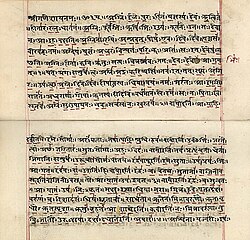
Hinduism entails diverse systems of thought, marked by a range of shared [[Glossary of Hinduism terms|concepts]] that discuss [[God in Hinduism|theology]], [[Hindu mythology|mythology]], and other topics in [[Hindu texts|textual sources]].{{sfn|Michaels|2004}} Hindu texts have been classified into [[Śruti]] ({{Literal translation|heard}}) and [[Smṛti]] ({{Literal translation|remembered}}). The major Hindu scriptures are the [[Vedas]], the [[Upanishads]], the [[Puranas]], the ''[[Mahabharata]]'' (including the ''[[Bhagavad Gita]]''), the ''[[Ramayana]]'', and the [[Agama (Hinduism)|Agamas]].{{sfn|Klostermaier|2007|pp=46–52, 76–77}}{{sfn|Zaehner|1992|pp=1–7}} Prominent themes in Hindu beliefs include ''[[karma]]'' (action, intent and consequences),{{sfn|Klostermaier|2007|pp=46–52, 76–77}}{{sfn|Brodd|2003}} [[Saṃsāra#In Hinduism|''saṃsāra'']] (the cycle of death and rebirth) and the four [[Puruṣārtha]]s, proper goals or aims of human life, namely: ''[[dharma]]'' (ethics/duties), ''[[artha]]'' (prosperity/work), ''[[kama]]'' (desires/passions) and ''[[moksha]]'' (liberation/emancipation from passions and ultimately ''saṃsāra'').{{sfn|Bilimoria|Prabhu|Sharma|2007}}{{sfn|Koller|1968}}{{sfn|Flood|1996|p=7}} Hindu religious practices include devotion (''[[bhakti]]''), worship ([[Puja (Hinduism)|''puja'']]), sacrificial rites (''[[yajna]]''), and meditation ([[Dhyana in Hinduism|''dhyana'']]) and [[Yoga]].<ref name="ellinger70" /> Hinduism has no central doctrinal authority and many Hindus do not claim to belong to any denomination.{{sfn|Werner|2005|pp=13, 45}} However, scholarly studies recognise four major denominations: [[Shaivism]], [[Vaishnavism]], [[Shaktism]] and [[Smartism]].{{sfn|Flood|1996|pp=113, 134, 155–161, 167–168}}{{sfn|Lipner|2009|pp=377, 398}} The six [[Āstika and nāstika|Āstika]] schools of [[Hindu philosophy]] that recognise the authority of the Vedas are: [[Samkhya|Sankhya]], [[Yoga (philosophy)|Yoga]], [[Nyaya]], [[Vaisheshika]], [[Mīmāṃsā]], and [[Vedanta]].{{sfn|Holberg|2000|p=316}}{{sfn|Nicholson|2013|p=2–5}} | |||
While the traditional [[Itihasa-Purana]] and its derived [[Epic-Puranic chronology]] present Hinduism as a tradition existing for thousands of years, scholars regard Hinduism as a fusion{{refn|group=note|name="Lockard-fusion"}} or synthesis{{refn|group=note|name="Hiltebeitel-synthesis"}} of [[Brahmanism|Brahmanical orthopraxy]]{{refn|group=note|name="Brahmanism"}} with various Indian cultures,{{refn|group=note|name="fusion"}} having diverse roots{{refn|group=note|name="roots"}} and no specific founder.{{sfn|Fowler|1997|pp=1, 7}} This [[Hindu synthesis]] emerged after the Vedic period, between {{Circa|500}}{{sfn|Hiltebeitel|2002|p=12}} to 200{{Sfn|Larson|2009}} [[Common Era|BCE]], and {{Circa|300 CE}},{{sfn|Hiltebeitel|2002|p=12}} in the period of the [[second urbanisation]] and the early [[History of Hinduism#Hindu synthesis and Classical Hinduism (c. 200 BCE – 1200 CE)|classical period of Hinduism]] when the [[Indian epic poetry|epics]] and the first Purānas were composed.{{sfn|Hiltebeitel|2002|p=12}}{{sfn|Larson|2009}} It flourished in the [[Medieval India|medieval period]], with the [[Decline of Buddhism in the Indian subcontinent|decline of Buddhism in India]].{{sfn|Larson|1995|pp=109–111}} Since the 19th century, [[Neo-Vedanta|modern Hinduism]], influenced by [[Western culture]], has acquired a great appeal in [[Western world|the West]], notably reflected in the popularisation of [[Yoga]] and various sects such as [[Transcendental Meditation]] and the [[International Society for Krishna Consciousness|ISKCON's]] [[ISKCON|Hare Krishna movement]].<ref>{{Cite web |title=What Is ISKCON » Home - ISKCON - The Hare Krishna Movement |url=https://www.iskcon.org/about-us/what-is-iskcon.php |access-date=2025-10-05 |website=www.iskcon.org |language=en-US}}</ref> | |||
Hinduism is the [[major religious groups|world's third-largest]] religion, with approximately 1.17 billion followers, or around 14.7% of the global population,<ref name=":2">{{Cite web |last=Fahmy|first=Conrad Hackett, Marcin Stonawski, Yunping Tong, Stephanie Kramer, Anne Shi and Dalia|date=2025-06-09|title=How the Global Religious Landscape Changed From 2010 to 2020|url=https://www.pewresearch.org/religion/2025/06/09/how-the-global-religious-landscape-changed-from-2010-to-2020/|access-date=2025-06-24|website=Pew Research Center|language=en-US}}</ref><ref>{{Cite web |last=Hackett|first=Conrad|date=2025-06-09|title=Hindu Population Change|url=https://www.pewresearch.org/religion/2025/06/09/hindu-population-change/|access-date=2025-11-22|website=Pew Research Center}}</ref> known as [[Hindus]], centered mainly in [[religion in India|India]],{{sfn|Hiltebeitel|2002|p=3}} [[Hinduism in Nepal|Nepal]], [[Religion in Mauritius|Mauritius]], and in [[Hinduism in Bali|Bali]], [[Hinduism in Indonesia|Indonesia]].{{sfnm|1a1=Gonda|1y=1975|1p=|2a1=Bakker|2y=1997|2p=|3a1=Howe|3y=2001|3p=|4a1=Stuart-Fox|4y=2002|4p=}} [[Hinduism by country|Significant numbers]] of Hindu communities are found in the countries of [[Hinduism in South Asia|South Asia]], in [[Hinduism in Southeast Asia|Southeast Asia]], in the [[Hinduism in the West Indies|Caribbean]], [[Hinduism in the Middle East|Middle East]], [[Hinduism in the United States|North America]], [[Hinduism in Europe|Europe]], [[Hinduism in Oceania|Oceania]] and [[Hinduism in Africa|Africa]].<ref>{{Cite book |last=Vertovec |first=Steven |url=https://books.google.com/books?id=FRVTAQAAQBAJ |title=The Hindu Diaspora: Comparative Patterns |publisher=Routledge |year=2013 |isbn=978-1-136-36705-2 |pages=1–4, 7–8, 63–64, 87–88, 141–143 |access-date=18 July 2017 |archive-date=28 March 2024 |archive-url=https://web.archive.org/web/20240328155539/https://books.google.com/books?id=FRVTAQAAQBAJ |url-status=live }}</ref><ref>{{Cite web|date=18 December 2012|title=Hindus|url=http://www.pewforum.org/2012/12/18/global-religious-landscape-hindu/|url-status=live|archive-url=https://web.archive.org/web/20200209012719/https://www.pewforum.org/2012/12/18/global-religious-landscape-hindu/|archive-date=9 February 2020|access-date=14 February 2015|publisher=Pew Research Center's Religion & Public Life Project}}</ref><ref>{{Cite web|date=18 December 2012|title=Table: Religious Composition by Country, in Numbers (2010)|url=http://features.pewforum.org/grl/population-number.php?sort=numberHindu|archive-url=https://web.archive.org/web/20130201224548/http://features.pewforum.org/grl/population-number.php?sort=numberHindu|archive-date=1 February 2013|access-date=14 February 2015|publisher=Pew Research Center's Religion & Public Life Project}}</ref><ref group="web" name="pewforum_Hinduism" /><ref name="gordonconwell.edu" group="web" /> | |||
{{TOC limit|limit=3}} | {{TOC limit|limit=3}} | ||
== Etymology == | == Etymology == | ||
{{further|Hindu}} | {{further|Hindu}} | ||
The word ''Hindū'' is an [[Endonym and exonym|exonym]],<ref>{{harvnb|Siemens|Roodt|2009|p=546}}; {{harvnb|Leaf|2014|p=36}}</ref> derived from [[Sanskrit]] word ''Sindhu'',<ref>{{harvnb|Flood|1996|p=6}}; {{harvnb|Parpola|2015|loc="Chapter 1"}}</ref> the name of the [[Indus River]] as well as the country of the lower Indus basin ([[Sindh]]).<ref>{{harvnb|Singh|2008|p=433}}; {{harvnb|Flood|1996|p=6}}</ref><ref>{{citation |last=Eggermont |first=Pierre Herman Leonard |title=Alexander's Campaigns in Sind and Baluchistan and the Siege of the Brahmin Town of Harmatelia |url=https://books.google.com/books?id=nG0_xoDS3hUC&pg=PA145 |year=1975 |publisher=Peeters Publishers |isbn=978-90-6186-037-2 |page=145 |quote=''Sindhu'' means a stream, a river, and in particular the Indus river, but likewise it denotes the territory of the lower Indus valley, or modern Sind... It denotes a geographical unit to which different tribes may belong. |access-date=25 December 2024 |archive-date=23 November 2022 |archive-url=https://web.archive.org/web/20221123010456/https://books.google.com/books?id=nG0_xoDS3hUC&pg=PA145 |url-status=live }}</ref>{{refn |group=note |The Indo-Aryan word ''Sindhu'' means "river", "ocean".{{sfn|Flood|2003|p=3}} It is frequently being used in the [[Rigveda]]. The Sindhu-area is part of [[Āryāvarta]], "the land of the Aryans".}} | |||
The [[Proto-Iranian language|Proto-Iranian]] sound change ''*s'' > ''h'' occurred between 850 and 600 BCE.<ref>{{harvp|Parpola|2015|loc="Chapter 9"}}: "In Iranian languages, Proto-Iranian *s became h before a following vowel at a relatively late period, perhaps around 850–600 BCE."</ref> | |||
"Hindu" occurs in [[Avesta]] as ''heptahindu'', equivalent to Rigvedic ''sapta sindhu''.<ref name="Thapar p.38">{{Cite book |last=Thapar |first=Romila |title=Early India: From the Origins to A.D. 1300 |url=https://archive.org/details/earlyindiafromor00thap |publisher=University of California Press |year=2004 |isbn=978-0-520-24225-8 |page=[https://archive.org/details/earlyindiafromor00thap/page/38 38]}}</ref> | |||
The 6th-century BCE inscription of [[Darius I]] mentions [[Hindush]] (referring to Sindh) among his provinces.{{sfn|Sharma|2002}}{{sfn|Flood|1996|loc=p. 6: "The actual term ''Hindu'' first occurs as a [[Persian language|Persian]] geographical term for the people who lived beyond the river Indus (Sanskrit: ''Sindhu'')."}} | |||
''Hindustan'' (spelt "''hndstn''") is found in a [[Sasanian Empire|Sasanian]] inscription from the 3rd century CE.<ref name="Thapar p.38" /> | |||
The term ''Hindu'' in these ancient records is a geographical term and did not refer to a religion.{{sfn|Flood|1996|p=6}} In Arabic texts, "Hind", a derivative of Persian "Hindu", was used to refer to the land beyond the Indus<ref>{{harvnb|Thapar|2004|p=38}}: "...in Arab sources, ''al-Hind'' (the land beyond the Indus)."</ref> and therefore, all the people in that land were "Hindus", according to historian [[Romila Thapar]].<ref>{{harvnb|Thapar|1989|p=222}}: "Al-Hind was therefore a geographical identity and the Hindus were all the people who lived on this land." {{harvnb|Thapar|1993|p=77}}</ref> | |||
By the 13th century, ''[[Hindustan]]'' emerged as a popular [[Names of India|alternative name]] of India.{{sfn|Thompson Platts|1884}} | |||
Among the earliest known records of 'Hindu' with connotations of religion may be in the 7th-century CE Chinese text ''Record of the Western Regions'' by [[Xuanzang]].{{sfn|Sharma|2002}} In the 14th century, 'Hindu' appeared in several texts in Persian, Sanskrit and Prakrit within India, and subsequently in vernacular languages, often in comparative contexts to contrast them with Muslims or "Turks". Examples include the 14th-century Persian text ''Futuhu's-salatin'' by 'Abd al-Malik [[Isami (historian)|Isami]],{{refn|group=note|name="Hindu_term"}} | |||
Jain texts such as ''[[Vividha Tirtha Kalpa]]'' and ''Vidyatilaka'',{{sfn|Truschke|2023|pp=251–252}} | |||
circa 1400 [[Apabhramsa]] text ''Kīrttilatā'' by [[Vidyapati]],{{sfn|Truschke|2023|pp=253–254}} 16–18th century [[Bengali language|Bengali]] [[Gaudiya Vaishnavism|Gaudiya Vaishnava]] texts,<ref name="O'Connell">{{Cite journal |last=O'Conell |first=Joseph T. |year=1973 |title=The Word 'Hindu' in Gauḍīya Vaiṣṇava Texts |volume=93 |pages=340–344 |journal=Journal of the American Oriental Society |issue=3 |doi=10.2307/599467 |jstor=599467| issn=0003-0279 }}</ref> etc. | |||
These native usages of "Hindu" were borrowed from Persian, and they did not always have a religious connotation, but they often did.<ref>{{harvnb|Truschke|2023|p=252}}: "Christine Chojnacki has argued that ''hinduka'' and related terms mark a combination of religious, linguistic, and cultural affinities in early Jain sources." | |||
{{harvnb|Truschke|2023|p=253}}: "Writing for the Bahmani court in the Deccan in 1350, Isami paired ''hindū'' and ''musalmān'', elsewhere using ''hindī'' to mean Indian." | |||
{{harvnb|Truschke|2023|p=254}}: "[Vidyapati] equates Hindu and Muslim religious and cultural practices, positing comparable differences between their respective ''dhamme'' (Sanskrit ''dharma'')." | |||
{{harvnb|Truschke|2023|p=260}}: "Most passages identified a mix of religious and cultural norms. For instance, the texts refer to the “Hindu god” (''hindura īśvara'') and “Hindu treatise” (''hindu-śāstre''), on the one hand, and to “hindu clothes” (''hindu-beśa''), on the other."</ref> | |||
In Indian texts, ''Hindu Dharma'' ("Hindu religion") was often used to refer to Hinduism.<ref name="O'Connell" />{{sfn|Truschke|2023|pp=254}} | |||
Starting in the 17th century, European merchants and colonists adopted "Hindu" (often with the English spelling "Hindoo") to refer to residents of India as a religious community.{{sfn|Truschke|2023|p=261}}{{Refn|In the contemporary era, the term Hindus are individuals who identify with one or more aspects of Hinduism, whether they are practising or non-practising or ''[[Laissez-faire]]''.<ref>{{cite book |first=Bryan |last=Turner |year=2010 |title=The New Blackwell Companion to the Sociology of Religion |publisher=John Wiley & Sons |isbn=978-1-4051-8852-4 |pages=424–425}}</ref> The term does not include those who identify with other Indian religions such as Buddhism, Jainism, Sikhism or various animist tribal religions found in India such as ''Sarnaism''.<ref>{{cite book |first=James |last=Minahan |year=2012 |title=Ethnic Groups of South Asia and the Pacific: An Encyclopedia |isbn=978-1-59884-659-1 |pages=97–99 |publisher=Abc-Clio }}</ref> The term Hindu, in contemporary parlance, includes people who accept themselves as culturally or ethnically Hindu rather than with a fixed set of religious beliefs within Hinduism. One need not be religious in the minimal sense, states [[Julius J. Lipner|Julius Lipner]], to be accepted as Hindu by Hindus, or to describe oneself as Hindu.{{sfn|Lipner|2009|p=8}}|group=note}} | |||
The term got increasingly associated with the practices of Brahmins, who were also referred to as "Gentiles" and "Gentoos".{{sfn|Truschke|2023|p=261}} | |||
Terms such as "Hindoo faith" and "Hindoo religion" were often used, eventually leading to the appearance of "Hindooism" in a letter of [[Charles Grant (British East India Company)|Charles Grant]] in 1787, who used it along with "Hindu religion".{{sfn|Truschke|2023|pp=261–262}} | |||
The first Indian to use "Hinduism" may have been [[Raja Ram Mohun Roy|Raja Ram Mohan Roy]] in 1816–17.<ref>{{harvnb|Truschke|2023|p=262}}; {{harvnb|Singh|2008|p=433}}</ref> By the 1840s, the term "Hinduism" was used by those Indians who opposed British colonialism, and who wanted to distinguish themselves from Muslims and Christians.<ref>{{harvnb|Flood|1996|p=6}}; {{harvnb|Klostermaier|2010|p=17}}; {{harvnb|Doniger|2014|p=5}}; {{harvnb|Parpola|2015|p=5}}</ref> | |||
Before the British began to categorise communities strictly by religion, Indians generally did not define themselves exclusively through their religious beliefs; instead identities were largely segmented on the basis of locality, language, [[Varna (Hinduism)|varna]], [[jāti]], occupation, and sect.{{sfn |Doniger |2014 |p=3}}{{refn|group=note |In [[D. N. Jha]]'s essay ''Looking for a Hindu identity'', he writes: "No Indians described themselves as Hindus before the fourteenth century" and "Hinduism was a creation of the colonial period and cannot lay claim to any great antiquity."<ref name="Mukul Dube">{{Cite web |first=Mukul |last=Dube |title=A short note on the short history of Hinduism |website=Scroll.in |date=10 January 2016 |url=http://scroll.in/article/801580/a-short-note-on-the-short-history-of-hinduism |archive-date=28 November 2022 |archive-url=https://web.archive.org/web/20221128182331/https://scroll.in/article/801580/a-short-note-on-the-short-history-of-hinduism |url-status=live}}</ref> He further wrote "The British borrowed the word 'Hindu' from India, gave it a new meaning and significance, [and] reimported it into India as a reified phenomenon called Hinduism."<ref>{{Cite web |title=Short note on the short history of Hinduism |date=10 January 2016 |url=https://scroll.in/article/801580/a-short-note-on-the-short-history-of-hinduism |access-date=13 November 2021 |archive-date=13 November 2021 |archive-url=https://web.archive.org/web/20211113220512/https://scroll.in/article/801580/a-short-note-on-the-short-history-of-hinduism |url-status=live}}</ref>}} | |||
== Definitions == | |||
"Hinduism" is an umbrella-term,<ref>{{harvnb|Lochtefeld|2002a}}; {{harvnb|Flood|2022|p=339}}</ref> | |||
referring to a broad range of sometimes opposite and often competitive traditions.<ref>{{harvnb|Holberg|2000|p=316}}; {{harvnb|Nicholson|2013|pp=2–5}}; {{harvnb|McDaniel|2007|pp=52–53}}; {{harvnb|Michaels|2004|p=21}}</ref> | |||
In Western ethnography, the term refers to the fusion,{{refn|group=note|name="Lockard-fusion"}} or synthesis,{{refn|group=note|name="Hiltebeitel-synthesis"|{{harvnb|Hiltebeitel|2002|p=12}}: "A period of consolidation, sometimes identified as one of 'Hindu synthesis', 'Brahmanic synthesis', or 'orthodox synthesis', takes place between the time of the late Vedic Upanishads ({{Circa|500 BCE}}) and the period of Gupta imperial ascendency (c. 320–467 CE)."}}{{sfn|Samuel|2008|p=193}} of various Indian cultures and traditions,<ref name="various cultures">{{harvnb|Hiltebeitel|2002|p=12}}; {{harvnb|Flood|1996|p=16}}; {{harvnb|Lockard|2007|p=50}}</ref>{{refn|group=note|name="fusion"}} with diverse roots{{sfn|Narayanan|2009|p=11}}{{refn|group=note|name="roots"}} and no founder.{{sfn|Fowler|1997|pp=1, 7}} This [[Hindu synthesis]] emerged after the Vedic period, between {{Circa|500}}{{sfn|Hiltebeitel|2002|p=12}}–200{{sfn|Larson|2009}} BCE and {{Circa|300 CE}},{{sfn|Hiltebeitel|2002|p=12}} in the period of the [[Second Urbanisation]] and the early classical period of Hinduism, when the [[Indian epic poetry|epics]] and the first Puranas were composed.{{sfn|Hiltebeitel|2002|p=12}}{{sfn|Larson|2009}} It flourished in the [[Medieval India|medieval period]], with the [[Decline of Buddhism in the Indian subcontinent|decline of Buddhism in India]].{{sfn|Larson|1995|pp=109–111}} Hinduism's variations in belief and its broad range of traditions make it difficult to define as a religion according to traditional Western conceptions.{{sfn|Turner|1996a|p=275}} | |||
Hinduism includes a diversity of ideas on [[Spirituality#Hinduism|spirituality]] and traditions; Hindus can be [[Polytheism|polytheistic]], [[Pantheism|pantheistic]], [[Panentheism|panentheistic]], [[Pandeism|pandeistic]], [[Henotheism|henotheistic]], [[Monotheism|monotheistic]], [[Monism|monistic]], [[Agnosticism|agnostic]], [[Atheism|atheistic]] or [[Humanism|humanist]].<ref name="Lipner2009p8">{{harvnb|Lipner|2009|p=8}} Quote: "[...] one need not be religious in the minimal sense described to be accepted as a Hindu by Hindus, or describe oneself perfectly validly as Hindu. One may be polytheistic or monotheistic, monistic or pantheistic, henotheistic, panentheistic, pandeistic, even an agnostic, humanist or atheist, and still be considered a Hindu."</ref><ref>{{Cite book |title=Encyclopedia of Violence, Peace and Conflict |publisher=Academic Press |year=2008 |isbn=978-0-12-369503-1 |editor-last=Kurtz |editor-first=Lester}}</ref> According to [[Mahatma Gandhi]], "a man may not believe in God and still call himself a Hindu".<ref>MK Gandhi, ''[http://www.mkgandhi.org/ebks/essence_of_hinduism.pdf The Essence of Hinduism]'' {{Webarchive|url=https://web.archive.org/web/20150724045756/http://www.mkgandhi.org/ebks/essence_of_hinduism.pdf |date=24 July 2015 }}, Editor: VB Kher, Navajivan Publishing, see page 3</ref> According to [[Wendy Doniger]], "ideas about all the major issues of faith and lifestyle – vegetarianism, nonviolence, belief in rebirth, even [[Caste system in India|caste]] – are subjects of debate, not [[dogma]]."{{sfn|Doniger|2014|p=3}} | |||
Hinduism includes a diversity of ideas on [[Spirituality#Hinduism|spirituality]] and traditions | |||
Because of the wide range of traditions and ideas covered by the term Hinduism, arriving at a comprehensive definition is difficult.{{sfn|Flood|1996|p=6}} The religion "defies our desire to define and categorize it".{{sfn|Knott|1998|p=117}} Hinduism has been variously defined as a religion, a religious tradition, a set of religious beliefs, and "a way of life".{{sfn|Sharma|2003|pp=12–13}}{{refn|group=note|name="definition"}} From a Western lexical standpoint, Hinduism like other faiths is appropriately referred to as a religion. In India, the term ''dharma'' is | Because of the wide range of traditions and ideas covered by the term Hinduism, arriving at a comprehensive definition is difficult.{{sfn|Flood|1996|p=6}} The religion "defies our desire to define and categorize it".{{sfn|Knott|1998|p=117}} Hinduism has been variously defined as a religion, a religious tradition, a set of religious beliefs, and "a way of life".{{sfn|Sharma|2003|pp=12–13}}{{refn|group=note|name="definition"}} From a Western lexical standpoint, Hinduism, like other faiths, is appropriately referred to as a religion. In India, the term ''(Hindu) dharma'' is used, which is broader than the Western term "religion," and refers to the religious attitudes and behaviours, the 'right way to live', as preserved and transmitted in the various traditions collectively referred to as "Hinduism."{{sfn|Flood|2003a|p=9}}{{sfn|Thomas|2012|p=175}}{{sfn|Bhattacharya|2006}}{{efn|name="Hindu_dharma"}} | ||
The study of India and its cultures and religions, and the definition of "Hinduism", has been shaped by the interests of colonialism and by Western notions of religion.{{sfn|Sweetman|2004}}{{sfn|King|1999}} Since the 1990s, those influences and its outcomes have been the topic of debate among scholars of Hinduism,{{sfn|Sweetman|2004}}{{Refn|group=note|Sweetman mentions: | The study of India and its cultures and religions, and the definition of "Hinduism", has been shaped by the interests of colonialism and by Western notions of religion.{{sfn|Sweetman|2004}}{{sfn|King|1999}} Since the 1990s, those influences and its outcomes have been the topic of debate among scholars of Hinduism,{{sfn|Sweetman|2004}}{{Refn|group=note|Sweetman mentions: | ||
| Line 34: | Line 56: | ||
* [[Ronald Inden]], ''Imagining India'' | * [[Ronald Inden]], ''Imagining India'' | ||
* [[Carol Breckenridge]] and [[Peter van der Veer]], ''Orientalism and the Postcolonial Predicament'' | * [[Carol Breckenridge]] and [[Peter van der Veer]], ''Orientalism and the Postcolonial Predicament'' | ||
* Vasudha Dalmia and [[Heinrich von Stietencron]], ''Representing Hinduism'' | * [[Vasudha Dalmia]] and [[Heinrich von Stietencron]], ''Representing Hinduism'' | ||
* [[S.N. Balagangadhara]], ''The Heathen in his Blindness...'' | * [[S.N. Balagangadhara]], ''The Heathen in his Blindness...'' | ||
* [[Thomas Trautmann]], ''Aryans and British India'' | * [[Thomas Trautmann]], ''Aryans and British India'' | ||
| Line 40: | Line 62: | ||
=== Typology === | === Typology === | ||
[[File:Aum Om navy blue circle coral.svg|thumb|[[Om]], a | [[File:Aum Om navy blue circle coral.svg|thumb|upright|[[Om]], a stylised letter of the [[Devanagari]] script, used as a religious symbol in Hinduism]] | ||
{{Main|Hindu denominations}} | {{Main|Hindu denominations}} | ||
Hinduism as it is commonly known can be subdivided into a number of major currents. Of the historical division into six [[darsanas]] (philosophies), two schools, [[Vedanta]] and [[Yoga (philosophy)|Yoga]], are currently the most prominent.{{sfn|Clarke|2011|p=28}} | |||
The six [[āstika]] schools of Hindu philosophy, which recognise the authority of the Vedas are: [[Samkhya|Sānkhya]], [[Yoga]], [[Nyāya]], [[Vaisheshika]], [[Mīmāṃsā|Mimāmsā]], and [[Vedānta]].{{sfn|Holberg|2000|p=316}}{{sfn|Nicholson|2013|p=2–5}} | |||
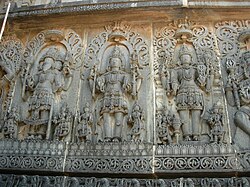
Classified by primary deity or deities, four major Hinduism modern currents are [[Vaishnavism]] ([[Vishnu|God Vishnu)]], [[Shaivism]] ([[Shiva|God Shiva]]), [[Shaktism]] ([[Shakti|Goddess Adi Shakti]]) and [[Smarta Tradition|Smartism]] (five deities treated as equals).{{sfn|Bhandarkar|1913|p=}}{{sfn|Tattwananda|n.d.|p=}}{{sfn|Flood|1996|pp=113, 134, 155–161, 167–168}}{{sfn|Lipner|2009|pp=377, 398}} Hinduism also accepts numerous divine beings, with many Hindus considering the deities to be aspects or manifestations of a single impersonal absolute or ultimate reality or [[Supreme God (Hinduism)|Supreme God]], while some Hindus maintain that a specific deity represents the supreme and various deities are lower manifestations of this supreme.{{sfn|Flood|1996|p=14}} Other notable characteristics include a belief in the existence of [[Ātman (Hinduism)|ātman]] (self), [[reincarnation]] of one's ātman, and karma as well as a belief in dharma (duties, rights, laws, conduct, virtues and right way of living), although variation exists, with some not following these beliefs. | |||
June McDaniel (2007) classifies Hinduism into six major kinds and numerous minor kinds, in order to understand the expression of emotions among the Hindus.{{sfn|McDaniel|2007|pp=52–53}} The major kinds, according to McDaniel are [[Folk Hinduism]], based on local traditions and cults of local [[deities]] and is the oldest, non-literate system; [[Historical Vedic religion|Vedic Hinduism]] based on the earliest layers of the Vedas, traceable to the 2nd millennium BCE; Vedantic Hinduism based on the philosophy of the [[Upanishad]]s, including [[Advaita Vedanta]], emphasising knowledge and wisdom; Yogic Hinduism, following the text of [[Yoga Sutras of Patanjali]] emphasising introspective awareness; Dharmic Hinduism or "daily morality", which McDaniel states is stereotyped in some books as the "only form of Hindu religion with a belief in karma, cows and caste"; and [[bhakti]] or devotional Hinduism, where intense emotions are elaborately incorporated in the pursuit of the spiritual.{{sfn|McDaniel|2007|pp=52–53}} | |||
Michaels distinguishes three Hindu religions and four forms of Hindu religiosity.{{sfn|Michaels|2004|p=21}} The three Hindu religions are "Brahmanic-Sanskritic Hinduism", "folk religions and tribal religions", and "founded religions".{{sfn|Michaels|2004|p=22}} The four forms of Hindu religiosity are the classical "karma-marga",{{sfn|Michaels|2004|p=23}} [[Jnana yoga|jnana-marga]],{{sfn|Michaels|2004|p=24}} [[bhakti yoga|bhakti-marga]],{{sfn|Michaels|2004|p=24}} and "heroism", which is rooted in [[Sannyasa#Warrior ascetics|militaristic traditions]]. These militaristic traditions include Ramaism (the worship of a hero of epic literature, [[Rama]], believing him to be an incarnation of Vishnu)<ref>{{Cite web|title=Definition of RAMAISM|url=https://www.merriam-webster.com/dictionary/Ramaism|access-date=28 October 2020|website=www.merriam-webster.com|language=en|archive-date=29 December 2020|archive-url=https://web.archive.org/web/20201229174144/https://www.merriam-webster.com/dictionary/Ramaism|url-status=live}}</ref> and parts of [[Hindu nationalism|political Hinduism]].{{sfn|Michaels|2004|p=23}} "Heroism" is also called [[Vīrya (Hinduism)|virya-marga]].{{sfn|Michaels|2004|p=24}} According to Michaels, one out of nine Hindu belongs by birth to one or both of the Brahmanic-Sanskritic Hinduism and Folk religion typology, whether practising or non-practicing. He classifies most Hindus as belonging by choice to one of the "founded religions" such as Vaishnavism and Shaivism that are moksha-focussed and often de-emphasise [[Brahmin|Brahman]] (Brahmin) priestly authority yet incorporate ritual grammar of Brahmanic-Sanskritic Hinduism.{{sfn|Michaels|2004|pp=21–22}} He includes among "founded religions" [[Buddhism]], [[Jainism]], Sikhism that are now distinct religions, [[Syncretism|syncretic]] movements such as [[Brahmo Samaj]] and the [[Theosophical Society]], as well as various "[[Guru]]-isms" and new religious movements such as [[Maharishi Mahesh Yogi]], | |||
[[BAPS]] and [[ISKCON]].{{sfn|Michaels|2004|pp=22–23}} | |||
=== | Inden states that the attempt to classify Hinduism by typology started in the imperial times, when proselytising missionaries and colonial officials sought to understand and portray Hinduism from their interests.<ref name=ronaldinden127 /> Hinduism was construed as emanating not from a reason of spirit but fantasy and creative imagination, not conceptual but symbolical, not ethical but emotive, not rational or spiritual but of cognitive mysticism. This stereotype followed and fit, states Inden, with the imperial imperatives of the era, providing the moral justification for the colonial project.<ref name=ronaldinden127 /> From tribal Animism to Buddhism, everything was subsumed as part of Hinduism. The early reports set the tradition and scholarly premises for the typology of Hinduism, as well as the major assumptions and flawed presuppositions that have been at the foundation of [[Indology]]. Hinduism, according to Inden, has been neither what imperial religionists stereotyped it to be, nor is it appropriate to equate Hinduism to be merely the monist pantheism and philosophical idealism of Advaita Vedanta.<ref name="ronaldinden127">Ronald Inden (2001), ''Imagining India'', Indiana University Press, {{ISBN|978-0-253-21358-7}}, pp. 117–122, 127–130</ref> | ||
==== {{IAST|Sanātana Dharma}} | Some academics suggest that Hinduism can be seen as a category with "fuzzy edges" rather than as a well-defined and rigid entity. Some forms of religious expression are central to Hinduism and others, while not as central, still remain within the category. Based on this idea [[Gabriella Eichinger Ferro-Luzzi]] has developed a 'Prototype Theory approach' to the definition of Hinduism.<ref>{{Cite book |last=Ferro-Luzzi |title=Hinduism Reconsidered |publisher=Manohar |year=1991 |editor-last=Sontheimer |editor-first=G.D. |location=Delhi |pages=187–195 |chapter=The Polythetic-Prototype Approach to Hinduism |editor-last2=Kulke |editor-first2=H.}}</ref> | ||
=== {{IAST|Sanātana Dharma}} === | |||
{{See also|Sanātanī}} | {{See also|Sanātanī}} | ||
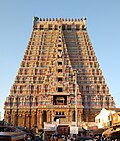
[[File:Srirangam-Rajagopuram-1.jpg|thumb|right|[[Ranganathaswamy Temple, Srirangam|Srirangam Ranganathaswamy Temple]], dedicated to the [[Hindu]] deity [[Vishnu]], is said to be worshiped by [[Ikshvaku]] (and the descendants of [[Solar dynasty|Ikshvaku Vamsam]]).<ref>Valmiki Ramayana, Ayodhya kanda, sarga 6, sloka 1, 2 and 3</ref><ref>{{Cite news|url=https://www.thehindu.com/features/friday-review/history-and-culture/Srirangam-temple-rich-with-elaborate-details/article59829979.ece|title=Srirangam temple rich with elaborate details|newspaper=The Hindu|date=3 April 2014|access-date=28 August 2023|via=www.thehindu.com|archive-date=16 August 2023|archive-url=https://web.archive.org/web/20230816200421/https://www.thehindu.com/features/friday-review/history-and-culture/Srirangam-temple-rich-with-elaborate-details/article59829979.ece|url-status=live}}</ref><ref>{{Cite web|url=https://mumbaimirror.indiatimes.com/news/india/was-ram-born-in-ayodhya/articleshow/77380259.cms|title=Was Ram born in Ayodhya?|website=Mumbai Mirror|access-date=28 August 2023|archive-date=14 August 2020|archive-url=https://web.archive.org/web/20200814150318/https://mumbaimirror.indiatimes.com/news/india/was-ram-born-in-ayodhya/articleshow/77380259.cms|url-status=live}}</ref>]] | |||
To its adherents, Hinduism is a traditional way of life.<ref>{{Cite book |last=Insoll |first=Timothy |url=https://books.google.com/books?id=QNxnYjYRuOMC&pg=PA35 |title=Archaeology and world religion |publisher=[[Routledge]] |year=2001 |isbn=978-0-415-22155-9 |access-date=29 December 2020 |archive-date=29 December 2020 |archive-url=https://web.archive.org/web/20201229174124/https://books.google.com/books?id=QNxnYjYRuOMC&pg=PA35 |url-status=live }}</ref> Many practitioners refer to the "orthodox" form of Hinduism as ''[[Sanātana Dharma|{{IAST|Sanātana Dharma}}]]'', "the eternal law" or the "eternal way".<ref>{{harvnb|Bowker|2000}}; {{harvnb|Harvey|2001|p=xiii}}</ref>{{sfn|Vivekjivandas|2010|p=1}} Hindus regard Hinduism to be thousands of years old. The [[Puranic chronology]], as narrated in the [[Mahabharata]], [[Ramayana]], and the [[Puranas]], envisions a timeline of events related to Hinduism starting well before 3000 BCE. The word ''dharma'' is used here to mean ''[[religion]]'' similar to modern [[Indo-Aryan languages]], rather than with its original Sanskrit meaning. All aspects of a Hindu life, namely acquiring wealth (''artha''), fulfilment of desires (''kama''), and attaining liberation (''moksha''), are viewed here as part of "dharma", which encapsulates the "right way of living" and eternal harmonious principles in their fulfilment.{{sfn|Knott|1998|p=111}}<ref>{{Cite journal |last=Hacker |first=Paul |title=Dharma in Hinduism |journal=Journal of Indian Philosophy |year=2006 |volume=34 |issue=5 |pages=479–496 |doi=10.1007/s10781-006-9002-4|s2cid=170922678 }}</ref> The use of the term ''Sanātana Dharma'' for Hinduism is a modern usage, based on the belief that the origins of Hinduism lie beyond human history, as revealed in the [[Hindu texts]].{{sfn|Knott|1998|pp=3, 5, 117}}{{sfn|Bowker|2000}}{{sfn|Harvey|2001|p=xiii}}{{sfn|Parpola|2015|p=3}}{{Clarify|reason=Not clear what is revaalex in Hindu texts.|date=February 2024}} | |||
==== '' | ''Sanātana Dharma'' refers to "timeless, eternal set of truths" and this is how Hindus view the origins of their religion. It is viewed as those eternal truths and traditions with origins beyond human history– truths divinely revealed ([[Shruti]]) in the [[Vedas]], the most ancient of the world's scriptures.{{sfn|Hatcher|2015|pp=4–5, 69–71, 150–152}}{{sfn|Knott|1998|p=3}} To many Hindus, Hinduism is a tradition that can be traced at least to the ancient Vedic era. The Western term "religion" to the extent it means "dogma and an institution traceable to a single founder" is inappropriate for their tradition, states Hatcher.{{sfn|Hatcher|2015|pp=4–5, 69–71, 150–152}}{{sfn|Lipner|2009|pp=15–17}}{{refn|group=note|The term ''sanatana dharma'' and its Vedic roots had another context in the colonial era, particularly the early 19th-century through movements such as the [[Brahmo Samaj]] and the [[Arya Samaj]]. These movements, particularly active in British and French colonies outside India, such as in Africa and the Caribbean, interpreted Hinduism to be a monotheistic religion and attempted to demonstrate that vis-à-vis Christianity and Islam. Their views were opposed by other Hindus such as the Sanatan Dharma Sabha of 1895.<ref>{{Cite book |last1=Taylor |first1=Patrick |url=https://books.google.com/books?id=XOyYCgAAQBAJ |title=The Encyclopedia of Caribbean Religions: Volume 1: A – L; Volume 2: M – Z |last2=Case |first2=Frederick I. |publisher=University of Illinois Press |year=2013 |isbn=978-0-252-09433-0 |pages=902–903 |access-date=25 July 2018 |archive-date=28 March 2024 |archive-url=https://web.archive.org/web/20240328155559/https://books.google.com/books?id=XOyYCgAAQBAJ |url-status=live }}</ref>}} | ||
''{{IAST|Sanātana Dharma}}'' historically referred to the "eternal" duties religiously ordained in Hinduism, duties such as honesty, refraining from injuring living beings (''[[ahimsa|ahiṃsā]]''), purity, goodwill, mercy, patience, forbearance, self-restraint, generosity, and asceticism. These duties applied regardless of a Hindu's class, caste, or sect, and they contrasted with [[svadharma]], one's "own duty", in accordance with one's class or caste (''varṇa'') and stage in life ([[puruṣārtha]]).<ref name="EB-sanatana dharma" group="web">{{Cite encyclopedia |title=Sanatana dharma {{!}} Hinduism |encyclopedia=Encyclopædia Britannica |url=https://www.britannica.com/EBchecked/topic/665848/sanatana-dharma |access-date=17 November 2016 |archive-date=3 May 2015 |archive-url=https://web.archive.org/web/20150503143650/http://www.britannica.com/EBchecked/topic/665848/sanatana-dharma |url-status=live }}</ref> In recent years, the term has been used by Hindu leaders, reformers, and nationalists to refer to Hinduism. Sanatana dharma has become a synonym for the "eternal" truth and teachings of Hinduism, that transcend history and are "unchanging, indivisible and ultimately nonsectarian".<ref name="EB-sanatana dharma" group="web" /> | |||
=== ''Vaidika Dharma'' === | |||
{{See also|Historical Vedic religion|Vedic period}} | {{See also|Historical Vedic religion|Vedic period}} | ||
Some have referred to Hinduism as the ''Vaidika dharma'' | Some have referred to Hinduism as the ''Vaidika dharma'',{{sfn|Sharma|Sharma|2004|pp=1–2}} bypassing the [[Tantra#Tantrika|Tantric revelations]]. The word 'Vaidika' in Sanskrit means 'derived from or conformable to the Veda' or 'relating to the Veda'.<ref name="MW_Vaidika dharma" group="web">{{Cite web|last=Monier-Williams|first=Monier|author-link=Monier Monier-Williams|year=1988|title=Sanskrit English Dictionary|url=http://sanskritdictionary.com/scans/?col=1&img=mw1022.jpg|url-status=live|archive-url=https://web.archive.org/web/20201229174152/http://sanskritdictionary.com/scans/?col=1&img=mw1022.jpg|archive-date=29 December 2020|access-date=24 July 2018|website=sanskritdictionary.com}}</ref> Traditional scholars employed the terms Vaidika and Avaidika, those who accept the Vedas as a source of authoritative knowledge and those who do not, to differentiate various Indian schools from [[Jainism]], [[Buddhism]] and [[Charvaka]]. According to [[Klaus Klostermaier]], the term Vaidika dharma is the earliest self-designation of Hinduism.{{sfn|Klostermaier|2014|p=2}}{{sfn|Klostermaier|2007b|p=7}} According to [[Arvind Sharma]], the historical evidence suggests that "the Hindus were referring to their religion by the term ''vaidika dharma'' or a variant thereof" by the 4th-century CE.<ref name="Sharma1985a">{{Cite journal|last=Sharma|first=A|author-link=Arvind Sharma|year=1985|title=Did the Hindus have a name for their own religion?|url=https://josa-publications.sydney.edu.au/chronological-index-1960-2002/|journal=The Journal of the Oriental Society of Australia|volume=17|issue=1|pages=94–98 [95]|access-date=17 March 2021|archive-date=4 March 2021|archive-url=https://web.archive.org/web/20210304042137/https://josa-publications.sydney.edu.au/chronological-index-1960-2002/|url-status=live}}</ref> According to [[Brian K. Smith]], "[i]t is 'debatable at the very least' as to whether the term ''Vaidika Dharma'' cannot, with the proper concessions to historical, cultural, and ideological specificity, be comparable to and translated as 'Hinduism' or 'Hindu religion'."{{sfn|Smith|1998}} | ||
Whatever the case, many Hindu religious sources see persons or groups which they consider as non-Vedic (and which reject Vedic [[Varnasrama Dharma|varṇāśrama]] – 'caste and life stage' orthodoxy) as being heretics (pāṣaṇḍa/pākhaṇḍa). For example, the ''[[Bhagavata Purana|Bhāgavata Purāṇa]] | Whatever the case, many Hindu religious sources see persons or groups which they consider as non-Vedic (and which reject Vedic [[Varnasrama Dharma|varṇāśrama]] – 'caste and life stage' orthodoxy) as being heretics (pāṣaṇḍa/pākhaṇḍa). For example, the ''[[Bhagavata Purana|Bhāgavata Purāṇa]]'' considers Buddhists, Jains as well as some [[Shaivism|Shaiva]] groups like the [[Pashupata Shaivism|Paśupatas]] and [[Kapalika|Kāpālins]] to be pāṣaṇḍas (heretics).<ref>Valpey, Kenneth Russell; Gupta, Ravi Mohan (2013). ''The Bhāgavata Purāṇa, sacred text and living tradition'', p. 146. Columbia University Press.</ref> | ||
According to [[Alexis Sanderson]], the early Sanskrit texts differentiate between Vaidika, Vaishnava, Shaiva, Shakta, Saura, Buddhist and Jaina traditions. However, the late 1st-millennium CE Indic consensus had "indeed come to conceptualize a complex entity corresponding to Hinduism as opposed to Buddhism and Jainism excluding only certain forms of [[Antinomianism|antinomian]] Shakta-Shaiva" from its fold.<ref group=web name=sandersonpart1 /> Some in the [[Mimamsa]] school of Hindu philosophy considered the ''[[Āgama (Hinduism)|Agamas]]'' such as the Pancaratrika to be invalid because it did not conform to the Vedas. Some Kashmiri scholars rejected the esoteric tantric traditions to be a part of Vaidika dharma.<ref group=web name="sandersonpart1">{{Cite web |last=Sanderson |first=Alexis |date=March 2016 |title=Tolerance, Exclusivity, Inclusivity, and Persecution in Indian Religion During the Early Mediaeval Period – Part One |url=http://www.sutrajournal.com/tolerance-exclusivity-inclusivity-and-persecution-by-alexis-sanderson |website=Sutra Journal |access-date=13 March 2018 |archive-date=29 December 2020 |archive-url=https://web.archive.org/web/20201229174134/http://www.sutrajournal.com/tolerance-exclusivity-inclusivity-and-persecution-by-alexis-sanderson |url-status=live }}</ref><ref group=web>{{Cite web |last=Sanderson |first=Alexis |date=May 2016 |title=Tolerance, Exclusivity, Inclusivity, and Persecution in Indian Religion During the Early Mediaeval Period – Part Two |url=http://www.sutrajournal.com/tolerance-exclusivity-inclusivity-and-persecution-part-two-by-alexis-sanderson |website=Sutra Journal |access-date=13 March 2018 |archive-date=29 December 2020 |archive-url=https://web.archive.org/web/20201229174151/http://www.sutrajournal.com/tolerance-exclusivity-inclusivity-and-persecution-part-two-by-alexis-sanderson |url-status=live }}</ref> The Atimarga Shaivism ascetic tradition, datable to about 500 CE, challenged the Vaidika frame and insisted that their Agamas and practices were not only valid, they were superior than those of the Vaidikas.<ref group=web name="sandersonpart3">{{Cite web |last=Sanderson |first=Alexis |date=July 2016 |title=Tolerance, Exclusivity, Inclusivity, and Persecution in Indian Religion During the Early Mediaeval Period – Part Three |url=http://www.sutrajournal.com/tolerance-exclusivity-inclusivity-and-persecution-part-three-by-alexis-sanderson |website=Sutra Journal |access-date=13 March 2018 |archive-date=29 December 2020 |archive-url=https://web.archive.org/web/20201229174219/http://www.sutrajournal.com/tolerance-exclusivity-inclusivity-and-persecution-part-three-by-alexis-sanderson |url-status=live }}</ref> However, adds Sanderson, this Shaiva ascetic tradition viewed themselves as being genuinely true to the Vedic tradition and "held unanimously that the Śruti and Smṛti of Brahmanism are universally and uniquely valid in their own sphere, [...] and that as such they [Vedas] are man's sole means of valid knowledge [...]".<ref group=web name="sandersonpart3" /> | According to [[Alexis Sanderson]], the early Sanskrit texts differentiate between Vaidika, Vaishnava, Shaiva, Shakta, Saura, Buddhist and Jaina traditions. However, the late 1st-millennium CE Indic consensus had "indeed come to conceptualize a complex entity corresponding to Hinduism as opposed to Buddhism and Jainism excluding only certain forms of [[Antinomianism|antinomian]] Shakta-Shaiva" from its fold.<ref group=web name=sandersonpart1 /> Some in the [[Mimamsa]] school of Hindu philosophy considered the ''[[Āgama (Hinduism)|Agamas]]'' such as the Pancaratrika to be invalid because it did not conform to the Vedas. Some Kashmiri scholars rejected the esoteric tantric traditions to be a part of Vaidika dharma.<ref group=web name="sandersonpart1">{{Cite web |last=Sanderson |first=Alexis |date=March 2016 |title=Tolerance, Exclusivity, Inclusivity, and Persecution in Indian Religion During the Early Mediaeval Period – Part One |url=http://www.sutrajournal.com/tolerance-exclusivity-inclusivity-and-persecution-by-alexis-sanderson |website=Sutra Journal |access-date=13 March 2018 |archive-date=29 December 2020 |archive-url=https://web.archive.org/web/20201229174134/http://www.sutrajournal.com/tolerance-exclusivity-inclusivity-and-persecution-by-alexis-sanderson |url-status=live }}</ref><ref group=web>{{Cite web |last=Sanderson |first=Alexis |date=May 2016 |title=Tolerance, Exclusivity, Inclusivity, and Persecution in Indian Religion During the Early Mediaeval Period – Part Two |url=http://www.sutrajournal.com/tolerance-exclusivity-inclusivity-and-persecution-part-two-by-alexis-sanderson |website=Sutra Journal |access-date=13 March 2018 |archive-date=29 December 2020 |archive-url=https://web.archive.org/web/20201229174151/http://www.sutrajournal.com/tolerance-exclusivity-inclusivity-and-persecution-part-two-by-alexis-sanderson |url-status=live }}</ref> The Atimarga Shaivism ascetic tradition, datable to about 500 CE, challenged the Vaidika frame and insisted that their Agamas and practices were not only valid, they were superior than those of the Vaidikas.<ref group=web name="sandersonpart3">{{Cite web |last=Sanderson |first=Alexis |date=July 2016 |title=Tolerance, Exclusivity, Inclusivity, and Persecution in Indian Religion During the Early Mediaeval Period – Part Three |url=http://www.sutrajournal.com/tolerance-exclusivity-inclusivity-and-persecution-part-three-by-alexis-sanderson |website=Sutra Journal |access-date=13 March 2018 |archive-date=29 December 2020 |archive-url=https://web.archive.org/web/20201229174219/http://www.sutrajournal.com/tolerance-exclusivity-inclusivity-and-persecution-part-three-by-alexis-sanderson |url-status=live }}</ref> However, adds Sanderson, this Shaiva ascetic tradition viewed themselves as being genuinely true to the Vedic tradition and "held unanimously that the Śruti and Smṛti of Brahmanism are universally and uniquely valid in their own sphere, [...] and that as such they [Vedas] are man's sole means of valid knowledge [...]".<ref group=web name="sandersonpart3" /> | ||
| Line 72: | Line 102: | ||
Though many religious Hindus implicitly acknowledge the authority of the Vedas, this acknowledgment is often "no more than a declaration that someone considers himself [or herself] a Hindu,"{{sfn|Lipner|2009|p=16}}{{refn|group=note|Lipner quotes Brockington (1981), ''The sacred tread'', p. 5.}} and "most Indians today pay lip service to the Veda and have no regard for the contents of the text."<ref>{{harvnb|Michaels|2004|p=18}}; see also {{harvnb|Lipner|2009|p=77}}; and {{Cite book |last=Smith |first=Brian K. |title=Sacred Texts and Authority |publisher=Wipf and Stock Publishers |year=2008 |editor-last=Neusner |editor-first=Jacob |page=101 |chapter=Hinduism}}</ref> Some Hindus challenge the authority of the Vedas, thereby implicitly acknowledging its importance to the history of Hinduism, states Lipner.{{sfn|Lipner|2009|pp=15–17}} | Though many religious Hindus implicitly acknowledge the authority of the Vedas, this acknowledgment is often "no more than a declaration that someone considers himself [or herself] a Hindu,"{{sfn|Lipner|2009|p=16}}{{refn|group=note|Lipner quotes Brockington (1981), ''The sacred tread'', p. 5.}} and "most Indians today pay lip service to the Veda and have no regard for the contents of the text."<ref>{{harvnb|Michaels|2004|p=18}}; see also {{harvnb|Lipner|2009|p=77}}; and {{Cite book |last=Smith |first=Brian K. |title=Sacred Texts and Authority |publisher=Wipf and Stock Publishers |year=2008 |editor-last=Neusner |editor-first=Jacob |page=101 |chapter=Hinduism}}</ref> Some Hindus challenge the authority of the Vedas, thereby implicitly acknowledging its importance to the history of Hinduism, states Lipner.{{sfn|Lipner|2009|pp=15–17}} | ||
=== | === Legal definition === | ||
[[Bal Gangadhar Tilak]] gave the following definition in ''Gita Rahasya'' (1915): "Acceptance of the Vedas with reverence; recognition of the fact that the means or ways to salvation are diverse; and realization of the truth that the number of gods to be worshipped is large".<ref name=Tilak2>Kohli Hari Dev (2010), ''Supreme Court On Hindu Law'', p.251</ref><ref name=Tilak>Ved P. Nanda (ed.)(2016), ''Compassion in the 4 Dharmic Traditions'', p.71</ref> It was quoted by the [[Supreme Court of India|Indian Supreme Court]] in 1966,<ref name=Tilak2 /><ref name=Tilak /> and again in 1995, "as an 'adequate and satisfactory definition,"<ref>Peter Beyer, ''Religions in Global Society''</ref> and is still the legal definition of a Hindu today.{{sfn|Doniger|2014|p=20}} | |||
== Diversity and unity == | == Diversity and unity == | ||
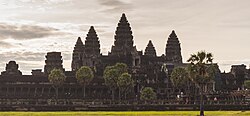
[[File:Angkor Wat Temple, Cambodia in 2013.JPG|thumb|[[Angkor Wat]] temple in Cambodia, the largest Hindu temple in the world]] | |||
=== Diversity === | === Diversity === | ||
{{See also|Hindu denominations}} | {{See also|Hindu denominations}}Hindu beliefs are vast and diverse, and thus Hinduism is often referred to as a "family of religions" rather than a single religion.<ref group="web">{{Cite web |title=Hinduism |url=https://www.history.com/topics/religion/hinduism |access-date=23 April 2020 |website=History.com |date=30 September 2019 |archive-date=29 December 2020 |archive-url=https://web.archive.org/web/20201229174138/https://www.history.com/topics/religion/hinduism |url-status=live }}</ref> Within each tradition in Hinduism, there are different theologies, practices, and sacred texts, often including unique interpretations, commentaries, and derivative works that build upon shared foundational scriptures.<ref>{{Cite book |last1=Dasgupta |first1=Surendranath |title=A history of Indian philosophy (part 1) |last2=Banarsidass |first2=Motilall |year=1992 |page=70}}</ref><ref>{{Cite book |last=Chande |first=M.B. |title=Indian Philosophy in Modern Times |publisher=Atlantic Publishers & Dist. |year=2000 |page=277}}</ref><ref>{{Cite encyclopedia |last=Culp |first=John |date= 2008 |entry=Panentheism |editor=Edward N. Zalta |encyclopedia=The Stanford Encyclopedia of Philosophy |edition=Summer 2017 |entry-url=https://plato.stanford.edu/archives/sum2017/entries/panentheism/ |access-date=29 December 2020 |archive-date=29 December 2020 |archive-url=https://web.archive.org/web/20201229174122/https://plato.stanford.edu/archives/sum2017/entries/panentheism/ |url-status=live }}</ref> Hinduism does not have a "unified system of belief encoded in a declaration of faith or a [[creed]]",{{sfn|Flood|1996|p=6}} but is rather an umbrella term comprising the plurality of religious phenomena of India.{{efn|name="umbrella-term"|{{harvtxt|Smith|1963|loc=pp. 65–66}}: "My point, and I think that this is the first step that one must take towards understanding something of the vision of Hindus, is that the mass of religious phenomena that we shelter under the umbrella of that term, is not a unity and does not aspire to be." {{harvtxt|Brodd|Little|Nystrom|Platzner|2018|loc=p. 92}}: "Hinduism has neither a single founder nor a single sacred book. There is no single historical event that marks its birth. The history of Hinduism embodies both continuity and change. Having never had a sole central authority, Hinduism's fluid character has always allowed it to adapt to a variety of social and cultural contexts. This diversity has led many scholars to argue that Hinduism is not one religion at all but a constellation of many religious sects that share some common aspects. Others see enough by way of common beliefs and practices to regard Hinduism as a single religious tradition."}}{{sfn|Halbfass|1991|pp=1–22}} According to the [[Supreme Court of India]], | ||
Hindu beliefs are vast and diverse, and thus Hinduism is often referred to as a family of religions rather than a single religion.<ref group="web">{{Cite web |title=Hinduism |url=https://www.history.com/topics/religion/hinduism |access-date=23 April 2020 |website=History.com |date=30 September 2019 |archive-date=29 December 2020 |archive-url=https://web.archive.org/web/20201229174138/https://www.history.com/topics/religion/hinduism |url-status=live }}</ref> Within each | |||
{{blockquote|Unlike other religions in the World, the Hindu religion does not claim any one Prophet, it does not worship any one God, it does not believe in any one philosophic concept, it does not follow any one act of religious rites or performances; in fact, it does not satisfy the traditional features of a religion or creed. It is a way of life and nothing more".{{sfn|Klostermaier|1994|p=1}}}} | {{blockquote|Unlike other religions in the World, the Hindu religion does not claim any one Prophet, it does not worship any one God, it does not believe in any one philosophic concept, it does not follow any one act of religious rites or performances; in fact, it does not satisfy the traditional features of a religion or creed. It is a way of life and nothing more".{{sfn|Klostermaier|1994|p=1}}}} | ||
| Line 106: | Line 121: | ||
Halbfass states that, although Shaivism and Vaishnavism may be regarded as "self-contained religious constellations",{{sfn|Halbfass|1991|p=15}} there is a degree of interaction and reference between the "theoreticians and literary representatives"{{sfn|Halbfass|1991|p=15}} of each tradition that indicates the presence of "a wider sense of identity, a sense of coherence in a shared context and of inclusion in a common framework and horizon".{{sfn|Halbfass|1991|p=15}} | Halbfass states that, although Shaivism and Vaishnavism may be regarded as "self-contained religious constellations",{{sfn|Halbfass|1991|p=15}} there is a degree of interaction and reference between the "theoreticians and literary representatives"{{sfn|Halbfass|1991|p=15}} of each tradition that indicates the presence of "a wider sense of identity, a sense of coherence in a shared context and of inclusion in a common framework and horizon".{{sfn|Halbfass|1991|p=15}} | ||
==== Classical Hinduism ==== | ==== Classical Hinduism ==== | ||
| Line 121: | Line 127: | ||
==== Medieval developments ==== | ==== Medieval developments ==== | ||
The notion of common denominators for several religions and traditions of India further developed from the 12th century CE.<ref>{{harvnb|Nicholson|2010|p=2}}; {{harvnb|Lorenzen|2006|pp=1–36}}</ref> Lorenzen traces the emergence of a "family resemblance", and what he calls as "beginnings of medieval and modern Hinduism" taking shape, at c. 300–600 CE, with the development of the early Puranas, and continuities with the earlier Vedic religion.{{sfn|Lorenzen|2006|p=36}} Lorenzen states that the establishment of a Hindu self-identity took place "through a process of mutual self-definition with a contrasting Muslim Other".{{sfn|Lorenzen|1999|p=648}} According to Lorenzen, this "presence of the Other"{{sfn|Lorenzen|1999|p=648}} is necessary to recognise the "loose family resemblance" among the various traditions and schools.{{sfn|Lorenzen|1999|pp=648, 655}} | The notion of common denominators for several religions and traditions of India further developed from the 12th century CE.<ref>{{harvnb|Nicholson|2010|p=2}}; {{harvnb|Lorenzen|2006|pp=1–36}}</ref> Lorenzen traces the emergence of a "family resemblance", and what he calls as "beginnings of medieval and modern Hinduism" taking shape, at c. 300–600 CE, with the development of the early Puranas, and continuities with the earlier Vedic religion.{{sfn|Lorenzen|2006|p=36}} Lorenzen states that the establishment of a Hindu self-identity took place "through a process of mutual self-definition with a contrasting Muslim Other".{{sfn|Lorenzen|1999|p=648}} According to Lorenzen, this "presence of the Other"{{sfn|Lorenzen|1999|p=648}} is necessary to recognise the "loose family resemblance" among the various traditions and schools.{{sfn|Lorenzen|1999|pp=648, 655}} | ||
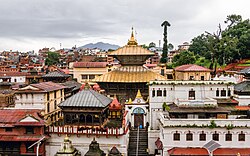
[[File:Pashupatinath Temple-2020.jpg|thumb|227x227px|[[Pashupatinath Temple]] in [[Nepal]], dedicated to the [[Hindu]] deity [[Shiva]] as the lord of all beings]] | |||
According to the Indologist [[Alexis Sanderson]], before Islam arrived in India, the "Sanskrit sources differentiated Vaidika, Vaiṣṇava, Śaiva, Śākta, Saura, Buddhist, and Jaina traditions, but they had no name that denotes the first five of these as a collective entity over and against Buddhism and Jainism". This absence of a formal name, states Sanderson, does not mean that the corresponding concept of Hinduism did not exist. By late 1st-millennium CE, the concept of a belief and tradition distinct from Buddhism and Jainism had emerged.<ref group=web name=sandersonpart1 /> This complex tradition accepted in its identity almost all of what is currently Hinduism, except certain [[antinomian]] tantric movements.<ref group=web name=sandersonpart1 /> Some conservative thinkers of those times questioned whether certain Shaiva, Vaishnava and Shakta texts or practices were consistent with the Vedas, or were invalid in their entirety. Moderates then, and most orthoprax scholars later, agreed that though there are some variations, the foundation of their beliefs, the ritual grammar, the spiritual premises, and the soteriologies were the same. "This sense of greater unity", states Sanderson, "came to be called Hinduism".<ref group=web name=sandersonpart1 /> | According to the Indologist [[Alexis Sanderson]], before Islam arrived in India, the "Sanskrit sources differentiated Vaidika, Vaiṣṇava, Śaiva, Śākta, Saura, Buddhist, and Jaina traditions, but they had no name that denotes the first five of these as a collective entity over and against Buddhism and Jainism". This absence of a formal name, states Sanderson, does not mean that the corresponding concept of Hinduism did not exist. By late 1st-millennium CE, the concept of a belief and tradition distinct from Buddhism and Jainism had emerged.<ref group=web name=sandersonpart1 /> This complex tradition accepted in its identity almost all of what is currently Hinduism, except certain [[antinomian]] tantric movements.<ref group=web name=sandersonpart1 /> Some conservative thinkers of those times questioned whether certain Shaiva, Vaishnava and Shakta texts or practices were consistent with the Vedas, or were invalid in their entirety. Moderates then, and most orthoprax scholars later, agreed that though there are some variations, the foundation of their beliefs, the ritual grammar, the spiritual premises, and the soteriologies were the same. "This sense of greater unity", states Sanderson, "came to be called Hinduism".<ref group=web name=sandersonpart1 /> | ||
| Line 127: | Line 135: | ||
{{blockquote|As a counteraction to Islamic supremacy and as part of the continuing process of regionalization, two religious innovations developed in the Hindu religions: the formation of sects and a historicization which preceded later nationalism ... [S]aints and sometimes militant sect leaders, such as the Marathi poet Tukaram (1609–1649) and Ramdas (1608–1681), articulated ideas in which they glorified Hinduism and the past. The Brahmins also produced increasingly historical texts, especially eulogies and chronicles of sacred sites (Mahatmyas), or developed a reflexive passion for collecting and compiling extensive collections of quotations on various subjects.{{sfn|Michaels|2004|p=44}}}} | {{blockquote|As a counteraction to Islamic supremacy and as part of the continuing process of regionalization, two religious innovations developed in the Hindu religions: the formation of sects and a historicization which preceded later nationalism ... [S]aints and sometimes militant sect leaders, such as the Marathi poet Tukaram (1609–1649) and Ramdas (1608–1681), articulated ideas in which they glorified Hinduism and the past. The Brahmins also produced increasingly historical texts, especially eulogies and chronicles of sacred sites (Mahatmyas), or developed a reflexive passion for collecting and compiling extensive collections of quotations on various subjects.{{sfn|Michaels|2004|p=44}}}} | ||
==== Colonial | ==== Colonial views ==== | ||
The notion and reports on "Hinduism" as a "single world religious tradition"{{sfn|King|1999|pp=100–102}} were also popularised by 19th-century proselytising missionaries and European Indologists, roles sometimes served by the same person, who relied on texts preserved by Brahmins (priests) for their information of Indian religions, and animist observations that the missionary Orientalists presumed was Hinduism.{{sfn|King|1999|pp=100–102}}<ref name=ronaldinden127 />{{sfn|Sweetman|2004|pp=14–15}} These reports influenced perceptions about Hinduism. Scholars such as Pennington state that the colonial polemical reports led to fabricated stereotypes where Hinduism was mere mystic paganism devoted to the service of devils,{{refn|group=note|Pennington{{sfn|Pennington|2005|pp=76–77}} describes the circumstances in which early impressions of Hinduism were reported by colonial era missionaries: "Missionary reports from India also reflected the experience of foreigners in a land whose native inhabitants and British rulers often resented their presence. Their accounts of Hinduism were forged in physically, politically and spiritually hostile surroundings [impoverished, famine-prone Bengal – now West Bengal and Bangladesh]. Plagued with anxieties and fears about their own health, regularly reminded of colleagues who had lost their lives or reason, uncertain of their own social location, and preaching to crowds whose reactions ranged from indifference to amusement to hostility, missionaries found expression for their darker misgivings in their production of what is surely part of their speckled legacy: a fabricated Hinduism crazed by blood-lust and devoted to the service of devils."}} while other scholars state that the colonial constructions influenced the belief that the ''Vedas'', ''[[Bhagavad Gita]]'', ''[[Manusmriti]]'' and such texts were the essence of Hindu religiosity, and in the modern association of 'Hindu doctrine' with the schools of Vedanta (in particular Advaita Vedanta) as a paradigmatic example of Hinduism's mystical nature".{{sfn|King|1999|p=169}}{{refn|group=note|name="Sweetman"}} Pennington, while concurring that the study of Hinduism as a world religion began in the colonial era, disagrees that Hinduism is a colonial European era invention.{{sfn|Pennington|2005|loc=pp. 4–5 and Chapter 6}} He states that the shared theology, common ritual grammar and way of life of those who identify themselves as Hindus is traceable to ancient times.{{sfn|Pennington|2005|loc=pp. 4–5 and Chapter 6}}{{refn|group=note|Many scholars have presented pre-colonial common denominators and asserted the importance of ancient Hindu textual sources in medieval and pre-colonial times: | |||
* Klaus Witz<ref>{{Cite book |last=Witz |first=Klaus G |title=The Supreme Wisdom of the Upaniṣads: An Introduction, Motilal Banarsidass |year=1998 |isbn=978-81-208-1573-5 |pages=10–11|publisher=Motilal Banarsidass Publ. }}</ref> states that Hindu [[Bhakti movement]] ideas in the medieval era grew on the foundation of Upanishadic knowledge and Vedanta philosophies. | |||
* John Henderson<ref>{{Cite book |last=Henderson |first=John |title=Scripture, Canon and Commentary |url=https://archive.org/details/scripturecanonco0000hend |publisher=Princeton University Press |year=2014 |isbn=978-0-691-60172-4 |page=[https://archive.org/details/scripturecanonco0000hend/page/120 120]}}</ref> states that "Hindus, both in medieval and in modern times, have been particularly drawn to those canonical texts and philosophical schools such as the Bhagavad Gita and Vedanta, which seem to synthesize or reconcile most successfully diverse philosophical teachings and sectarian points of view. Thus, this widely recognised attribute of Indian culture may be traced to the exegetical orientation of medieval Hindu commentarial traditions, especially Vedanta. | |||
* Patrick Olivelle<ref name=Olivelle2014p3q>{{Cite book |last=Olivelle |first=Patrick |author-link=Patrick Olivelle |title=The Early Upanisads |publisher=Oxford University Press |year=2014 |isbn=978-0-19-535242-9 |page=3 |quote=Even though theoretically the whole of Vedic corpus is accepted as revealed truth [shruti], in reality it is the [[Upanishad]]s that have continued to influence the life and thought of the various religious traditions that we have come to call Hindu. Upanishads are the scriptures par excellence of Hinduism.}}</ref> and others<ref>{{harvnb|Doniger|1990|pp=2–3}}: "The Upanishads supply the basis of later Hindu philosophy; they alone of the Vedic corpus are widely known and quoted by most well-educated Hindus, and their central ideas have also become a part of the spiritual arsenal of rank-and-file Hindus."</ref><ref name=McDowell>{{Cite book |last1=McDowell |first1=Michael |title=World Religions |last2=Brown |first2=Nathan |publisher=Penguin |year=2009 |isbn=978-1-59257-846-7 |pages=208–210}}</ref><ref>{{Cite book |last=Dissanayake |first=Wiman |title=Self as Body in Asian Theory and Practice |publisher=State University of New York Press |year=1993 |isbn=978-0-7914-1080-6 |editor-last=Kasulis |editor-first=Thomas P. |page=39 |display-editors=etal}}</ref> state that the central ideas of the Upanishads in the Vedic corpus are at the spiritual core of Hindus.}} | |||
==== Hindu modernism and neo-Vedanta ==== | |||
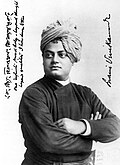
[[File:Swami Vivekananda-1893-09-signed.jpg|thumb|[[Swami Vivekananda]] was a key figure in introducing [[Vedanta]] and Yoga in Europe and the United States,{{sfn|Feuerstein|2002|p=600}} raising interfaith awareness and making Hinduism a world religion.{{sfn|Clarke|2006|p=209}}]] | |||
{{Quote box | |||
|quote = All of religion is contained in the Vedanta, that is, in the three stages of the Vedanta philosophy, the Dvaita, Vishishtâdvaita and Advaita; one comes after the other. These are the three stages of spiritual growth in man. Each one is necessary. This is the essential of religion: the Vedanta, applied to the various ethnic customs and creeds of India, is Hinduism. | |||
|author = — [[Swami Vivekananda]]<ref group=web>{{cite web|url=https://www.ramakrishnavivekananda.info/vivekananda/volume_5/epistles_first_series/039_alasinga.htm|title=Complete-Works/Volume 5/Epistles – First Series|access-date=2024-01-27|website=ramakrishnavivekananda.info|archive-date=27 January 2024|archive-url=https://web.archive.org/web/20240127095409/https://www.ramakrishnavivekananda.info/vivekananda/volume_5/epistles_first_series/039_alasinga.htm|url-status=live}}</ref> | |||
|width = 30% | |||
|align = right|salign=right | |||
}} | |||
{{See also|Hindu reform movements}} | |||
{{See also|Orientalism|Neo-Vedanta}} | {{See also|Orientalism|Neo-Vedanta}} | ||
This inclusivism<ref>Hackel in {{harvnb|Nicholson|2010}}.</ref> was further developed in the 19th and 20th centuries by [[Hindu reform movements]] and Neo-Vedanta,{{sfn|King|2001}} and has become characteristic of modern Hinduism.{{sfn|Nicholson|2010}} | This inclusivism<ref>Hackel in {{harvnb|Nicholson|2010}}.</ref> was further developed in the 19th and 20th centuries by [[Hindu reform movements]] and Neo-Vedanta,{{sfn|King|2001}} and has become characteristic of modern Hinduism.{{sfn|Nicholson|2010}} | ||
Beginning in the 19th century, Indian modernists re-asserted Hinduism as a major asset of Indian civilisation,{{sfn|King|1999}} meanwhile "purifying" Hinduism from its Tantric elements{{sfn|Lorenzen|2002|p=33}} and elevating the Vedic elements. Western stereotypes were reversed, emphasising the universal aspects, and introducing modern approaches of social problems.{{sfn|King|1999}} This approach had great appeal, not only in India, but also in the west.{{sfn|King|1999}} Major representatives of [[Neo-Vedanta|"Hindu modernism"]]{{sfn|Flood|1996|p=258}} are [[Ram Mohan Roy]], [[Swami Vivekananda]], [[Sarvepalli Radhakrishnan]] and [[Mahatma Gandhi]].{{sfn|Flood|1996|pp=256–261}} | |||
Raja Rammohan Roy is known as the father of the [[Hindu Renaissance]].<ref name="hindu1">{{Cite book |last=Young |first=Serinity |title=Hinduism |publisher=Marshall Cavendish |year=2007 |isbn=978-0-7614-2116-0 |page=[https://archive.org/details/hinduism0000youn/page/87 87] |quote=Rammohun Roy Father of Hindu Renaissance. |url=https://archive.org/details/hinduism0000youn |access-date=19 February 2015 |url-access=registration}}</ref> He was a major influence on Swami Vivekananda, who, according to Flood, was "a figure of great importance in the development of a modern Hindu self-understanding and in formulating the West's view of Hinduism".{{sfn|Flood|1996|p=257}} Central to his philosophy is the idea that the divine exists in all beings, that all human beings can achieve union with this "innate divinity",{{sfn|Flood|1996|p=258}} and that seeing this divine as the essence of others will further love and social harmony.{{sfn|Flood|1996|p=258}} According to Vivekananda, there is an essential unity to Hinduism, which underlies the diversity of its many forms.{{sfn|Flood|1996|p=258}} According to Flood, Vivekananda's vision of Hinduism "is one generally accepted by most English-speaking middle-class Hindus today".{{sfn|Flood|1996|p=259}} Sarvepalli Radhakrishnan sought to reconcile western rationalism with Hinduism, "presenting Hinduism as an essentially rationalistic and humanistic religious experience".{{sfn|Flood|1996|p=249}} | |||
This "Global Hinduism"{{sfn|Flood|1996|p=265}} has a worldwide appeal, transcending national boundaries{{sfn|Flood|1996|p=265}} and, according to Flood, "becoming a world religion alongside Christianity, Islam and Buddhism",{{sfn|Flood|1996|p=265}} both for the Hindu diaspora communities and for westerners who are attracted to non-western cultures and religions.{{sfn|Flood|1996|p=265}} It emphasises universal spiritual values such as social justice, peace and "the spiritual transformation of humanity".{{sfn|Flood|1996|p=265}} It has developed partly due to "re-enculturation",{{sfn|Flood|1996|p=267}} or the [[pizza effect]],{{sfn|Flood|1996|p=267}} in which elements of Hindu culture have been exported to the West, gaining popularity there, and as a consequence also gained greater popularity in India.{{sfn|Flood|1996|p=267}} This globalisation of Hindu culture brought "to the West teachings which have become an important cultural force in western societies, and which in turn have become an important cultural force in India, their place of origin".{{sfn|Flood|1996|pp=267–268}} | |||
==== Modern India and the world ==== | ==== Modern India and the world ==== | ||
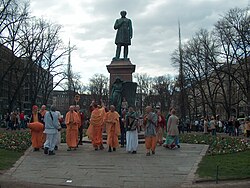
[[File:Hare Krishna in Helsinki H1118 C.JPG|thumb|The [[International Society for Krishna Consciousness|Hare Krishna]] group at the [[Esplanadi Park]] in [[Helsinki, Finland]]]] | [[File:Hare Krishna in Helsinki H1118 C.JPG|thumb|The [[International Society for Krishna Consciousness|Hare Krishna]] group at the [[Esplanadi Park]] in [[Helsinki, Finland]]]] | ||
The [[Hindutva]] movement has extensively argued for the unity of Hinduism, dismissing the differences and regarding India as a Hindu-country since ancient times.<ref>{{Cite book|last=Hansen|first=Thomas Blom|url=https://books.google.com/books?id=SAqn3OIGE54C|title=The Saffron Wave: Democracy and Hindu Nationalism in Modern India|year=1999|publisher=[[Princeton University Press]]|isbn=978-1-4008-2305-5|page=[https://books.google.com/books?id=SAqn3OIGE54C&q=hindutva+in+modern+india 77]|language=en | The [[Hindutva]] movement has extensively argued for the unity of Hinduism, dismissing the differences and regarding India as a Hindu-country since ancient times.<ref>{{Cite book|last=Hansen|first=Thomas Blom|url=https://books.google.com/books?id=SAqn3OIGE54C|title=The Saffron Wave: Democracy and Hindu Nationalism in Modern India|year=1999|publisher=[[Princeton University Press]]|isbn=978-1-4008-2305-5|page=[https://books.google.com/books?id=SAqn3OIGE54C&q=hindutva+in+modern+india 77]|language=en|access-date=2 March 2021|archive-date=16 January 2024|archive-url=https://web.archive.org/web/20240116180224/https://books.google.com/books?id=SAqn3OIGE54C|url-status=live}}</ref> And there are assumptions of political dominance of [[Hindu nationalism]] in [[India]], also known as '<nowiki/>''Neo-Hindutva''<nowiki/>'.<ref>{{Cite journal|last1=Anderson|first1=Edward|last2=Longkumer|first2=Arkotong|date=2 October 2018|title='Neo-Hindutva': evolving forms, spaces, and expressions of Hindu nationalism|journal=Contemporary South Asia|volume=26|issue=4|pages=371–377|doi=10.1080/09584935.2018.1548576|issn=0958-4935|doi-access=free|hdl=20.500.11820/8da58c02-ac36-46f1-a4f6-71ad6be1be09|hdl-access=free}}</ref><ref>{{Cite journal|last=Chacko|first=Priya|date=2019c|title=Marketizing Hindutva: The state, society, and markets in Hindu nationalism|url=https://www.cambridge.org/core/journals/modern-asian-studies/article/abs/marketizing-hindutva-the-state-society-and-markets-in-hindu-nationalism/92243742C585CD73910BA63030F6A655|journal=Modern Asian Studies|language=en|volume=53|issue=2|pages=377–410|doi=10.1017/S0026749X17000051|hdl=2440/117274|s2cid=149588748|issn=0026-749X|hdl-access=free|access-date=2 March 2021|archive-date=7 March 2021|archive-url=https://web.archive.org/web/20210307235100/https://www.cambridge.org/core/journals/modern-asian-studies/article/abs/marketizing-hindutva-the-state-society-and-markets-in-hindu-nationalism/92243742C585CD73910BA63030F6A655|url-status=live}}</ref> There have also been increase in pre-dominance of [[Hindutva]] in [[Nepal]], similar to that of [[India]].<ref>{{Cite web|title=As Nepal Strives to Become More Inclusive, Are Muslims Being Left Behind?|url=https://www.worldpoliticsreview.com/insights/24085/will-an-incident-of-anti-muslim-violence-upend-nepals-bid-for-inclusivity|access-date=2 March 2021|website=www.worldpoliticsreview.com|date=30 January 2018|language=en|archive-date=13 April 2021|archive-url=https://web.archive.org/web/20210413000033/https://www.worldpoliticsreview.com/insights/24085/will-an-incident-of-anti-muslim-violence-upend-nepals-bid-for-inclusivity|url-status=live}}</ref> The scope of Hinduism is also increasing in the other parts of the world, due to the cultural influences such as [[Yoga]] and [[Hare Krishna movement]] by many missionaries organisations, especially by [[ISKCON]] and this is also due to the migration of [[Indian Hindus]] to the other nations of the world.{{sfn|Hatcher|2015|p=239}}<ref>{{Cite journal|last1=Berg|first1=Travis Vande|last2=Kniss|first2=Fred|date=2008|title=ISKCON and Immigrants: The Rise, Decline, and Rise Again of a New Religious Movement|journal=[[The Sociological Quarterly]]|volume=49|issue=1|pages=79–104|doi=10.1111/j.1533-8525.2007.00107.x|issn=0038-0253|jstor=40220058|s2cid=146169730}}</ref> Hinduism is growing fast in many [[Hinduism in the West|western nations]] and in some [[Hinduism in Africa|African nations]].{{Refn|* Hinduism is the fastest growing religion in [[Hinduism in Russia|Russia]], [[Hinduism in Ghana|Ghana]] and [[Hinduism in the United States|United States]]. This was due to the influence of the [[ISKCON]] and the migration of [[Hindus]] in these nations.<ref>{{cite web|url=https://scroll.in/article/700557/how-iskcon-took-hinduism-to-the-us-heartland|title=How ISKCON took Hinduism to the US heartland|access-date=9 April 2021|website=scroll.in|date=17 January 2015|archive-date=11 May 2021|archive-url=https://web.archive.org/web/20210511101216/https://scroll.in/article/700557/how-iskcon-took-hinduism-to-the-us-heartland|url-status=live}}</ref> | ||
* [[Hinduism in the West|In western nations]], the ''growth of Hinduism'' has been very fast and is the second fastest growing religion in [[Europe]], after [[Islam]].<ref>{{cite web|url=https://www.erg.su.se/polopoly_fs/1.329209.1492613166!/menu/standard/file/Hinduism%20in%20Europe_Abstracts.pdf|title=Hinduism in Europe|website=[[Microsoft Word]]|date=28 April 2017|access-date=9 April 2021|archive-date=23 May 2021|archive-url=https://web.archive.org/web/20210523082912/https://www.erg.su.se/polopoly_fs/1.329209.1492613166!/menu/standard/file/Hinduism%20in%20Europe_Abstracts.pdf|url-status=live}}</ref>|name=ty78|group=note}} | |||
== Main traditions == | |||
=== Denominations === | |||
{{Further|Hindu denominations}} | |||
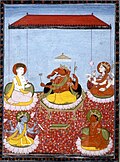
[[File:Ganesha pachayatana.jpg|thumb|A Ganesha-centric [[Panchayatana puja|Panchayatana]] ("five deities", from the Smarta tradition): [[Ganesha]] (centre) with [[Shiva]] (top left), [[Parvati]] (top right), [[Vishnu]] (bottom left) and [[Surya]] (bottom right). All these deities also have separate sects dedicated to them.]] | |||
Hinduism has no central doctrinal authority and many practising Hindus do not claim to belong to any particular denomination or tradition.{{sfn|Werner|2005|pp=13, 45}} Four major denominations are, however, used in scholarly studies: ''Shaivism'', ''Shaktism'', ''Smartism'', and ''Vaishnavism''.{{sfn|Bhandarkar|1913|p=}}{{sfn|Tattwananda|n.d.|p=}}{{sfn|Flood|1996|pp=113, 134, 155–161, 167–168}}{{sfn|Lipner|2009|pp=377, 398}} These denominations differ primarily in the central deity worshipped, the traditions and the [[soteriology|soteriological]] outlook.<ref name="sskumar">SS Kumar (2010), ''Bhakti – the Yoga of Love'', LIT Verlag Münster, {{ISBN|978-3-643-50130-1}}, pp. 35–36</ref> The denominations of Hinduism, states Lipner, are unlike those found in major religions of the world, because Hindu denominations are fuzzy with individuals practising more than one, and he suggests the term "Hindu polycentrism".{{sfn|Lipner|2009|pp=371–375}} | |||
There are no census data available on demographic history or trends for the traditions within Hinduism.<ref>[http://www.pewforum.org/2012/12/18/global-religious-landscape-hindu/ The global religious landscape: Hindus] {{Webarchive|url=https://web.archive.org/web/20200209012719/https://www.pewforum.org/2012/12/18/global-religious-landscape-hindu/ |date=9 February 2020}}, Pew Research (2012)</ref> Estimates vary on the relative number of adherents in the different traditions of Hinduism. According to a 2020 estimate by The World Religion Database (WRD), hosted at Boston University's Institute on Culture, Religion and World Affairs (CURA), the Vaishnavism tradition is the largest group with about 399 million Hindus, followed by Shaivism with 385 million Hindus, Shaktism with 305 million Hindus and other traditions including Neo-Hinduism and Reform Hinduism with 25 million Hindus.<ref name="preston">{{Cite web |last=Preston |first=Charles |title=List of religious populations {{!}} Largest Religions, Smallest Religions, Lists, Data, & Overview {{!}} Britannica |url=https://www.britannica.com/topic/List-of-religious-populations |access-date=2025-02-01 |website=www.britannica.com |language=en |archive-date=14 January 2025 |archive-url=https://web.archive.org/web/20250114131904/https://www.britannica.com/topic/List-of-religious-populations |url-status=live }}</ref> In contrast, according to Jones and Ryan, Shaivism is the largest tradition of Hinduism.{{sfn|Jones|Ryan|2007|p=474}}{{refn|group=note|According to {{harvnb|Jones|Ryan|2007|p=474}}, "The followers of Vaishnavism are many fewer than those of Shaivism, numbering perhaps 200 million."{{sfn|Jones|Ryan|2007|p=474}}{{dubious|date=February 2022}}}} | |||
Vaishnavism is the devotional religious tradition that worships Vishnu{{Refn|group=note|sometimes with [[Lakshmi]], the spouse of Vishnu; or, as Narayana and Sri;{{sfn|Beck|2005|p=65 and Chapter 5}}}} and his avatars, particularly Krishna and Rama.{{sfn|Bryant|Ekstrand|2004|pp=15–17}} The adherents of this sect are generally non-ascetic, monastic, oriented towards community events and devotionalism practices inspired by "intimate loving, joyous, playful" ''Krishna'' and other Vishnu avatars.<ref name=sskumar /> These practices sometimes include community dancing, singing of [[Kirtan]]s and [[Bhajan]]s, with sound and music believed by some to have meditative and spiritual powers.{{sfn|Bryant|Ekstrand|2004|pp=38–43}} Temple worship and festivals are typically elaborate in Vaishnavism.<ref>{{Cite book |last1=Nettl |first1=Bruno |url=https://books.google.com/books?id=ZOlNv8MAXIEC |title=The Garland Encyclopedia of World Music: South Asia: the Indian subcontinent |last2=Stone |first2=Ruth M. |last3=Porter |first3=James |last4=Rice |first4=Timothy |publisher=Routledge |year=1998 |isbn=978-0-8240-4946-1 |pages=246–247 |access-date=21 February 2016 |archive-date=11 October 2017 |archive-url=https://web.archive.org/web/20171011163910/https://books.google.com/books?id=ZOlNv8MAXIEC |url-status=live }}</ref> The Bhagavad Gita and the Ramayana, along with Vishnu-oriented Puranas provide its theistic foundations.<ref>{{harv|Espín|Nickoloff|2007|pp=1441, 376}}</ref> | |||
Shaivism is the tradition that focuses on Shiva. Shaivas are more attracted to ascetic individualism, and it has several sub-schools.<ref name=sskumar /> Their practices include bhakti-style devotionalism, yet their beliefs lean towards nondual, monistic schools of Hinduism such as Advaita and Raja Yoga.<ref name="lancenelson">{{harv|Espín|Nickoloff|2007|year=2007|pp=562–563}}</ref>{{sfn|Bryant|Ekstrand|2004|pp=38–43}} Some Shaivas worship in temples, while others emphasise yoga, striving to be one with Shiva within.{{sfn|Dalal|2010|p=209}} Avatars are uncommon, and some Shaivas visualise god as half male, half female, as a fusion of the male and female principles ([[Ardhanarishvara]]). Shaivism is related to Shaktism, wherein Shakti is seen as spouse of Shiva.<ref name=lancenelson /> Community celebrations include festivals, and participation, with Vaishnavas, in pilgrimages such as the [[Kumbh Mela]].<ref>James Lochtefeld (2010), ''God's Gateway: Identity and Meaning in a Hindu Pilgrimage Place'', Oxford University Press, {{ISBN|978-0-19-538614-1}}</ref> Shaivism has been more commonly practised in the Himalayan north from Kashmir to Nepal, and in south India.{{sfn|Isaeva|1995|pp=141–145}} | |||
Shaktism focuses on goddess worship of Shakti or Devi as cosmic mother,<ref name=sskumar /> and it is particularly common in northeastern and eastern states of India such as [[Assam]] and [[West Bengal|Bengal]]. Devi is depicted as in gentler forms like [[Parvati]], the consort of Shiva; or, as fierce warrior goddesses like [[Kali]] and [[Durga]]. Followers of Shaktism recognise Shakti as the power that underlies the male principle. Shaktism is also associated with [[Tantra]] practices.<ref>{{Cite journal |last=Scaligero |first=Massimo |year=1955 |title=The Tantra and the Spirit of the West |journal=East and West |volume=5 |issue=4 |pages=291–296 |jstor=29753633}}</ref> Community celebrations include festivals, some of which include processions and idol immersion into sea or other water bodies.<ref>'''History:''' Hans Koester (1929), The Indian Religion of the Goddess Shakti, Journal of the Siam Society, Vol 23, Part 1, pp. 1–18;<br />'''Modern practices:''' June McDaniel (2010), ''Goddesses in World Culture'', Volume 1 (Editor: Patricia Monaghan), {{ISBN|978-0-313-35465-6}}, Chapter 2</ref> | |||
[[Smartism]] centers its worship simultaneously on all the major [[Hindu deities]]: Shiva, Vishnu, Shakti, Ganesha, [[Surya]] and [[Kartikeya|Skanda]].{{sfn|Flood|1996|p=113}} The Smarta tradition developed during the (early) Classical Period of Hinduism around the beginning of the Common Era, when Hinduism emerged from the interaction between Brahmanism and local traditions.{{sfn|Hiltebeitel|2002}}{{sfn|Flood|1996}} The Smarta tradition is aligned with Advaita Vedanta, and regards [[Adi Shankara]] as its founder or reformer, who considered worship of God-with-attributes ([[Saguna Brahman]]) as a journey towards ultimately realising God-without-attributes (nirguna Brahman, Atman, Self-knowledge).<ref name="williamw">{{Cite book |last=Wainwright |first=William |title=Stanford Encyclopedia of Philosophy |url=http://stanford.library.usyd.edu.au/entries/concepts-god/ |publisher=Stanford University |year=2012 |chapter=Concepts of God |access-date=17 June 2015 |archive-date=23 March 2015 |archive-url=https://web.archive.org/web/20150323084508/http://stanford.library.usyd.edu.au/entries/concepts-god/ |url-status=live }}</ref><ref>{{Cite book |last=Murthy |first=U |title=Samskara |url=https://archive.org/details/samskarariteford0000anan |publisher=Oxford University Press |year=1979 |isbn=978-0-19-561079-6 |page=[https://archive.org/details/samskarariteford0000anan/page/n150 150]}}</ref> The term ''Smartism'' is derived from Smriti texts of Hinduism, meaning those who remember the traditions in the texts.<ref name=lancenelson /><ref name="williamsonp89">{{cite book|first=L |last=Williamson |year=2010 |title=Transcendent in America: Hindu-inspired Meditation Movements as New Religion |publisher=New York University Press |isbn=978-0-8147-9450-0 |page=89}}</ref> This Hindu sect practices a philosophical Jnana yoga, scriptural studies, reflection, meditative path seeking an understanding of Self's oneness with God.<ref name=lancenelson /><ref>{{Cite book |last=Milner |first=Murray |title=Status and Sacredness |url=https://archive.org/details/statussacredness00miln |publisher=Oxford University Press |year=1994 |isbn=978-0-19-508489-4 |pages=[https://archive.org/details/statussacredness00miln/page/194 194]–197}}</ref> | |||
=== Ethnicities === | |||
[[File:Prambanan Java245.jpg|thumb|[[Prambanan]] Hindu temple complex built in the 9th century, [[Java]], Indonesia]] | |||
[[File:Salah Satu Upacara Besar Di Pura Agung Besakih.jpg|thumb|[[Puja (Hinduism)|Puja]] at [[Pura Besakih]], one of the most significant [[Balinese Hinduism]] temples]] | |||
{{See also|Hinduism in South Asia|Hinduism in Southeast Asia|Balinese Hinduism|Hinduism in Java|Hinduism in Vietnam|Hinduism in the West|label 2=Southeast Asia|label 3=Bali|l4=Java|l5=Vietnam|l6=West}} | |||
Hinduism is traditionally a multi- or [[Polyethnicity|polyethnic]] religion. On the [[Indian subcontinent]], it is widespread among many [[Indo-Aryan peoples|Indo-Aryan]], [[Dravidian peoples|Dravidian]] and other [[South Asian ethnic groups]],{{sfn|West|2010}} for example, the [[Meitei people]] ([[Tibeto-Burman languages|Tibeto-Burman]] ethnicity in the northeastern Indian state [[Manipur]]).{{sfn|Singh|2004}} | |||
In addition, in antiquity and the [[Middle Ages]], Hinduism was the [[state religion]] in many Indianized kingdoms of Asia, the ''[[Greater India]]''{{snd}}from Afghanistan ([[Kabul]]) in the West and including almost all of [[Southeast Asia]] in the East ([[Cambodia]], [[Vietnam]], [[Indonesia]], partly [[Philippines]]){{snd}}and only by the 15th century was nearly everywhere supplanted by Buddhism and Islam,{{sfnm|1a1=Cœdès|1y=1968|1p=|2a1=Pande|2y=2006|2p=|3a1=Acri|3a2=Creese|3a3=Griffiths|3y=2011|3p=}}<ref name="spread">{{cite encyclopedia|title=The spread of Hinduism in Southeast Asia and the Pacific|encyclopedia=[[Encyclopædia Britannica]] Online|url=https://www.britannica.com/topic/Hinduism/The-spread-of-Hinduism-in-Southeast-Asia-and-the-Pacific|access-date=19 June 2021|archive-date=16 January 2020|archive-url=https://web.archive.org/web/20200116205245/https://www.britannica.com/topic/Hinduism/The-spread-of-Hinduism-in-Southeast-Asia-and-the-Pacific|url-status=live}}</ref> except several still Hindu minor [[Austronesian peoples|Austronesian]] ethnic groups, such as the [[Balinese people|Balinese]]{{sfnm|1a1=Gonda|1y=1975|1p=|2a1=Bakker|2y=1997|2p=|3a1=Howe|3y=2001|3p=|4a1=Stuart-Fox|4y=2002|4p=}} and [[Tenggerese people]]{{sfnm|1a1=Hefner|1y=1989|1p=|2a1=Kinney|2a2=Klokke|2a3=Kieven |2y=2003|2p=}} in Indonesia, and the [[Chams]] in Vietnam.{{sfnm|1a1=Phuong|1a2=Lockhart|1y=2011|1p=|2a1=Pande|2y=2006|2p=231}} Also, a small community of the Afghan [[Pashtuns]] who migrated to India after [[partition of India|partition]] remain committed to Hinduism.<ref>{{cite news |url=http://www.thehindu.com/news/national/tattooed-blue-skinned-hindu-pushtuns-look-back-at-their-roots/article22645932.ece |title=Tattooed 'blue-skinned' Hindu Pushtuns look back at their roots |author=Haider, Suhasini |date=3 February 2018 |website=[[The Hindu]] |access-date=9 February 2020 |archive-date=22 August 2021 |archive-url=https://web.archive.org/web/20210822082221/https://www.thehindu.com/news/national/tattooed-blue-skinned-hindu-pushtuns-look-back-at-their-roots/article22645932.ece |url-status=live }}</ref> | |||
The Indo-Aryan [[Kalash people]] in Pakistan traditionally practice an indigenous religion which is closely related to ancient Indo-Iranian religion, and resembles the ancient Vedic religion.{{sfn|Michael|2004}} While it has been related to Greek religion, due to an origin-narrative which says that the Kalash descend from Alexander the Great's Greek soldiers, the Kalash speak an Indo-Aryan language, and their religion is closer to Hinduism than to the religion of Alexander's army.{{sfn|West|2010|p=[{{Google books|id=pCiNqFj3MQsC|plainurl=y|page=357|keywords=|text=}} 357]|loc=quote: "The Kalasha [...] religion is a form of Hinduism that recognizes many gods and spirits and has been related to the religion of the Ancient Greeks, who mythology says are the ancestors of the contemporary Kalash [...] However, it is much more likely, given their Indo-Aryan language, that the religion of the Kalasha is much more closely aligned to the Hinduism of their Indian neighbors that to the religion of Alexander the Great and his armies."}} | |||
There are many new ethnic [[Hinduism in Ghana|Ghanaian Hindus]] in Ghana, who have converted to Hinduism due to the works of [[Swami Ghanananda Saraswati]] and [[Hindu Monastery of Africa]]<ref name="Joshi">{{cite news |url=http://news.bbc.co.uk/1/hi/world/south_asia/10401741.stm |title=Ghana's unique African-Hindu temple |author=Rajesh Joshi |website=BBC News |date= |access-date= |archive-date=31 December 2021 |archive-url=https://web.archive.org/web/20211231013628/https://www.bbc.com/news/10401741 |url-status=live }}</ref> From the beginning of the 20th century, by the forces of Baba Premananda Bharati (1858–1914), [[Swami Vivekananda]], [[A. C. Bhaktivedanta Swami Prabhupada]] and other missionaries, Hinduism gained a certain distribution among the Western peoples.{{sfn|Carney|2020}} | |||
== Scriptures == | |||
{{Main|List of Hindu texts}} | |||
{{See also|Śāstra pramāṇam in Hinduism}} | |||
[[File:Rigveda MS2097.jpg|thumb|The ''[[Rigveda]]'' is the first among four Vedas<ref group="note">Rigveda is not only the oldest among the Vedas, but is one of the earliest [[Indo-European languages|Indo-European]] texts.</ref> and is one of the oldest [[religious texts]]. This Rigveda [[manuscript]] is in [[Sanskrit]].]] | |||
The ancient scriptures of Hinduism are initially in [[Vedic Sanskrit]] and later in classical Sanskrit. These texts are classified into two: [[Śruti|Shruti]] and [[Smriti]]. Shruti is ''[[apauruṣeyā]]'', ({{literal translation|not made of a man}}) but revealed by the ''[[rishis]]'' ({{literal translation|seers}}), and regarded as having the highest authority, while the smriti are manmade and have secondary authority.{{sfn|Muesse|2011|p=202}} They are the two highest [[sources of dharma]], the other two being ''[[Ācāra|Śiṣṭa Āchāra/Sadāchara]]'' ({{literal translation|conduct of noble people}}) and finally ''[[Atmatusti|Ātma tuṣṭi]]'' ({{literal translation|what is pleasing to oneself}}).{{refn|group=note|According to [[Bhavishya Purana]], Brahmaparva, Adhyaya 7, there are four [[sources of dharma]]: ''[[Śruti]]'' (Vedas), ''[[Smṛti]]'' (Dharmaśāstras, Puranas), ''[[Ācāra|Śiṣṭa Āchāra/Sadāchara]]'' (conduct of noble people) and finally ''[[Atmatusti|Ātma tuṣṭi]]'' (Self satisfaction). From the sloka: | |||
: {{lang|sa|वेदः स्मृतिः सदाचारः स्वस्य च प्रियमात्मनः । एतच्चतुर्विधं प्राहुः साक्षाद्धर्मस्य लक्षणम् ॥}}<ref group=web>{{cite web |url=http://www.vedagyana.info/maha-puranas-telugu/bhavishya-purana/brahma-parva/?chapter=7 |script-title=te:ఏడవ అధ్యాయము – 7. వివాహ ధర్మ వర్ణనము |trans-title=Chapter 7 – 7. Description of Marriage |archive-url=https://web.archive.org/web/20200610234713/http://www.vedagyana.info/maha-puranas-telugu/bhavishya-purana/brahma-parva/?chapter=7 |archive-date=10 June 2020}}</ref> | |||
:''{{IAST|vedaḥ smṛtiḥ sadācāraḥ svasya ca priyamātmanah<br />etaccaturvidham prāhuḥ sākshāddharmasya lakshaṇam}}'' | |||
:– Bhavishya Purāṇa, Brahmaparva, Adhyāya 7 | |||
The meaning is ''vedas, smritis, good (approved) tradition and what is agreeable to one's Self (conscience), the wise have declared to be the four direct evidences of dharma''.}} | |||
Hindu scriptures were composed, memorised and transmitted verbally, across generations, for many centuries before they were written down.{{sfn|Flood|2003|loc=See [[Michael Witzel]] quote|pp=68–69}}{{sfn|Sargeant|Chapple|1984|p=3}} | |||
''Shruti'' ({{literal translation|that which is heard}}){{sfn|Rinehart|2004|p=68}} primarily refers to the ''Vedas'', which form the earliest record of the Hindu scriptures, and are regarded as eternal truths revealed to the ancient sages (''rishis'').{{sfn|Flood|2003|p=4}} There are four ''Vedas'' – ''[[Rigveda]]'', ''[[Samaveda]]'', ''[[Yajurveda]]'' and ''[[Atharvaveda]]''. Each Veda has been subclassified into four major text types – the [[Samhita]]s (mantras and benedictions), the [[Aranyakas]] (text on rituals, ceremonies, sacrifices and symbolic-sacrifices), the [[Brahmanas]] (commentaries on rituals, ceremonies and sacrifices), and the [[Upanishads]] (text discussing meditation, philosophy and spiritual knowledge).{{sfn|Flood|1996|pp=35–39}}{{sfn|Bhattacharya|2006|pp=8–14}}<ref>George M. Williams (2003), Handbook of Hindu Mythology, Oxford University Press, {{ISBN|978-0-19-533261-2}}, p. 285</ref><ref>Jan Gonda (1975), ''Vedic Literature: (Saṃhitās and Brāhmaṇas)'', Otto Harrassowitz Verlag, {{ISBN|978-3-447-01603-2}}</ref> The first two parts of the Vedas were subsequently called the ''{{IAST|Karmakāṇḍa}}'' (ritualistic portion), while the last two form the ''{{IAST|Jñānakāṇḍa}}'' (knowledge portion, discussing spiritual insight and philosophical teachings).<ref>{{harvnb|Roer|1908|pp=1–5}}; "The Vedas are divided in two parts, the first is the karma-kanda, the ceremonial part, also (called) {{IAST|pūrva-kāṇḍa}}, and treats on ceremonies; the second part is the {{IAST|jñāna-kāṇḍa}}, the part which contains knowledge, also named {{IAST|uttarra-kāṇḍa}} or posterior part and unfolds the knowledge of Brahma or the universal Self."</ref>{{sfn|Werner|2005|pp=10, 58, 66}}{{sfn|Monier-Williams|1974|pp=25–41}}<ref name="Olivelle1998Introduction">{{cite book |last=Olivelle |first=Patrick |year=1998 |title=Upaniṣads |publisher=Oxford University Press |isbn=978-0-19-282292-5 |chapter=Introduction}}</ref> | |||
The Upanishads are the foundation of Hindu philosophical thought and have profoundly influenced diverse traditions.<ref name="wendydoniger" /><ref>{{Cite book |last=Dissanayake |first=Wiman |title=Self as Body in Asian Theory and Practice |publisher=State University of New York Press |year=1993 |isbn=978-0-7914-1080-6 |editor-last=Kasulis |editor-first=Thomas P. |page=39 |quote=The Upanishads form the '''foundations of Hindu philosophical thought''' and the central theme of the Upanishads is the identity of Atman and Brahman, or the inner self and the cosmic self |display-editors=etal}}</ref><ref name="McDowell" /> Of the Shrutis (Vedic corpus), the Upanishads alone are widely influential among Hindus, considered scriptures par excellence of Hinduism, and their central ideas have continued to influence its thoughts and traditions.<ref name="wendydoniger">{{harvnb|Doniger|1990|pp=2–3}}: "The Upanishads supply the '''basis of later Hindu philosophy'''; they alone of the Vedic corpus are widely known and quoted by most well-educated Hindus, and their central ideas have also become a part of the spiritual arsenal of rank-and-file Hindus."</ref><ref name="Olivelle2014p3q" /> Indian philosopher [[Sarvepalli Radhakrishnan]] states that the Upanishads have played a dominating role ever since their appearance.<ref>{{Cite book |last=Radhakrishnan |first=S. |year=1969|orig-date=1953 |title=The Principal Upanishads |url=https://archive.org/stream/PrincipalUpanishads/129481965-The-Principal-Upanishads-by-S-Radhakrishnan#page/n19/mode/2up |publisher=George Allen & Co. |isbn=978-81-7223-124-8 |edition=reprint |pages=17–19}}</ref> There are 108 [[Muktikā]] Upanishads in Hinduism, of which between 10 and 13 are variously counted by scholars as [[Mukhya Upanishads|Principal Upanishads]].<ref name="Olivelle1998Introduction" /><ref>{{Cite book |title=Thirteen Principal Upanishads |year=1921 |publisher=Oxford University Press |translator-last=Hume |translator-first=Robert |url=https://archive.org/stream/thirteenprincipa028442mbp#page/n1/mode/2up}}</ref> | |||
{{multiple image | |||
| caption_align = center | |||
| total_width = 300 | |||
| perrow = 2 | |||
| image1 = Rāma slays Rāvaṇa.png | |||
| caption1 = [[Ramayana]] | |||
| image2 = Kurukshetra.jpg | |||
| caption2 = [[Mahabharata]] | |||
}} | |||
The most notable of the Smritis ({{literal translation|that which is remembered}}) are the Hindu epics and the ''[[Puranas]]'' ({{literal translation|that which is ancient}}). The epics consist of the ''[[Mahabharata]]'' and the ''[[Ramayana]]''. The ''[[Bhagavad Gita]]'' is an integral part of the ''Mahabharata'' and one of the most popular sacred texts of Hinduism.<ref>''Sarvopaniṣado gāvo'', etc. (''Gītā Māhātmya'' 6). ''Gītā Dhyānam'', cited in {{cite book |chapter=Introduction |chapter-url=https://vedabase.io/en/library/bg/introduction/ |title=Bhagavad-gītā |trans-title=As It Is |via=Bhaktivedanta VedaBase |access-date=29 December 2020 |archive-date=29 December 2020 |archive-url=https://web.archive.org/web/20201229174201/https://vedabase.io/en/library/bg/introduction/ |url-status=live }}</ref> It is sometimes called ''Gitopanishad'', then placed in the Shruti ("heard") category, being Upanishadic in content.<ref>{{Cite journal |last=Coburn |first=Thomas B. |date=September 1984 |title="Scripture" in India: Towards a Typology of the Word in Hindu Life |journal=[[Journal of the American Academy of Religion]] |volume=52 |issue=3 |pages=435–459 |doi=10.1093/jaarel/52.3.435 }}</ref> The ''Puranas'', which started to be composed of {{Circa|300 CE}} onward,{{sfn|Lorenzen|1999|p=655}} contain extensive mythologies, and are central in the distribution of common themes of Hinduism through vivid narratives. The ''[[Yoga Sutras]]'' is a classical text for the Hindu Yoga tradition, which gained renewed popularity in the 20th century.<ref>{{Cite book |last=Michelis |first=Elizabeth De |url=https://books.google.com/books?id=sHBBDq_Ul3sC |title=A History of Modern Yoga: Patanjali and Western Esotericism |date=2005 |publisher=Continuum |isbn=978-0-8264-8772-8 |access-date=14 October 2017 |archive-date=28 March 2024 |archive-url=https://web.archive.org/web/20240328155602/https://books.google.com/books?id=sHBBDq_Ul3sC |url-status=live }}</ref> | |||
Since the 19th century, Indian modernists have re-asserted the 'Aryan origins' of Hinduism, "purifying" Hinduism from its Tantric elements{{sfn|Lorenzen|2002|p=33}} and elevating the Vedic elements. Hindu modernists like Vivekananda see the Vedas as the laws of the spiritual world, which would still exist even if they were not revealed to the sages.{{sfn|Vivekananda|1987|loc=Volume I|pp=6–7}}{{sfn|Harshananda|1989}} | |||
[[Tantra]] are the religious scriptures that give prominence to the female energy of the deity that in her personified form has both gentle and fierce form. In Tantric tradition, [[Radha]], [[Parvati]], [[Durga]], and [[Kali]] are worshipped symbolically as well as in their personified forms.<ref>{{Cite book |last=Balfour |first=Edward |url=https://books.google.com/books?id=3U0OAAAAQAAJ&dq=worship+radha&pg=PA62 |title=The Cyclopædia of India and of Eastern and Southern Asia: Commercial, Industrial and Scientific, Products of the Mineral, Vegetable, and Animal Kingdoms, Useful Arts and Manufactures |date=1885 |publisher=B. Quaritch |pages=60 |language=en |access-date=3 July 2023 |archive-date=20 March 2023 |archive-url=https://web.archive.org/web/20230320150436/https://books.google.com/books?id=3U0OAAAAQAAJ&dq=worship+radha&pg=PA62 |url-status=live }}</ref> The ''[[Agama (Hinduism)|Agamas]]'' in Tantra refer to authoritative scriptures or the teachings of Shiva to Shakti,{{sfn|Jones|Ryan|2007|p=13}} while ''Nigamas'' refers to the Vedas and the teachings of Shakti to Shiva.{{sfn|Jones|Ryan|2007|p=13}} In Agamic schools of Hinduism, the Vedic literature and the Agamas are equally authoritative.<ref>{{Cite book |last=Dhavamony |first=Mariasusai |title=Hindu Spirituality |publisher=Gregorian University and Biblical Press |year=1999 |isbn=978-88-7652-818-7 |pages=31–34}}</ref><ref>{{Cite book |last=Smith |first=David |title=The Dance of Siva: Religion, Art and Poetry in South India |url=https://archive.org/details/danceofsivarelig0000smit |publisher=Cambridge University Press |year=1996 |isbn=978-0-521-48234-9 |page=[https://archive.org/details/danceofsivarelig0000smit/page/116 116]}}</ref> | |||
== Beliefs == | == Beliefs == | ||
[[File:Halebid3.JPG|thumb|right|Temple wall panel relief sculpture at the [[Hoysaleswara Temple]] in [[Halebidu]], representing the [[Trimurti]]: [[Brahma]], [[Shiva]] and [[Vishnu]]]] | [[File:Halebid3.JPG|thumb|right|Temple wall panel relief sculpture at the [[Hoysaleswara Temple]] in [[Halebidu]], representing the [[Trimurti]]: [[Brahma]], [[Shiva]] and [[Vishnu]]]] | ||
Prominent themes in Hindu beliefs include (but are not restricted to) Dharma (ethics/duties), [[samsara|{{IAST| | Prominent themes in Hindu beliefs include (but are not restricted to) [[Dharma]] (ethics/duties), [[samsara|{{IAST|Saṃsāra}}]] (the continuing cycle of entanglement in passions and the resulting birth, life, death, and rebirth), Karma (action, intent, and consequences), moksha (liberation from attachment and saṃsāra), and the various yogas (paths or practices).{{sfn|Brodd|2003}} However, not all of these themes are found among the various different systems of Hindu beliefs. Beliefs in moksha or saṃsāra are absent in certain Hindu beliefs, and were also absent among early forms of Hinduism, which was characterised by a belief in an [[Afterlife]], with traces of this still being found among various Hindu beliefs, such as [[Śrāddha]]. [[Ancestor worship]] once formed an integral part of Hindu beliefs and is today still found as an important element in various Folk Hindu streams.<ref name="A.M. Boyer 1901">A.M. Boyer: ''Etude sur l'origine de la doctrine du samsara.'' Journal Asiatique, (1901), Volume 9, Issue 18, S. 451–453, 459–468</ref><ref name="Yuvraj Krishan 1997">Yuvraj Krishan: ''Bharatiya Vidya Bhavan'', 1997, {{ISBN|978-81-208-1233-8}}</ref><ref name="Laumakis">{{Cite book |last=Laumakis |first=Stephen J. |url=https://books.google.com/books?id=_29ZDAcUEwYC |title=An Introduction to Buddhist Philosophy |year=2008 |publisher=Cambridge University Press |isbn=978-1-139-46966-1 |language=en |access-date=15 September 2022 |archive-date=28 March 2024 |archive-url=https://web.archive.org/web/20240328155520/https://books.google.co.ma/books?id=_29ZDAcUEwYC&redir_esc=y |url-status=live }}</ref><ref name="Hayakawa 2014">{{Cite book |last=Hayakawa |first=Atsushi |url=https://books.google.com/books?id=w7LtAgAAQBAJ |title=Circulation of Fire in the Veda |date=2014 |publisher=LIT Verlag Münster |isbn=978-3-643-90472-0 |language=en}}</ref><ref name="Sayers">{{Cite book |last=Sayers |first=Matthew R. |url=https://books.google.com/books?id=3AOBwiZBjRMC |title=Feeding the Dead: Ancestor Worship in Ancient India |year=2013 |publisher=OUP USA |isbn=978-0-19-989643-1 |language=en |access-date=15 September 2022 |archive-date=30 December 2023 |archive-url=https://web.archive.org/web/20231230123257/https://books.google.com/books?id=3AOBwiZBjRMC |url-status=live }}</ref><ref name="repositories.lib.utexas.edu">{{Cite thesis |title=Feeding the ancestors: ancestor worship in ancient Hinduism and Buddhism |url=https://repositories.lib.utexas.edu/handle/2152/3945 |date=May 2008 |degree=Thesis |first=Matthew R. |last=Sayers |access-date=15 September 2022 |archive-date=20 September 2022 |archive-url=https://web.archive.org/web/20220920163432/https://repositories.lib.utexas.edu/handle/2152/3945 |url-status=live }}</ref><ref name="Sayers 182–197">{{Cite journal |last=Sayers |first=Matthew R. |date=June 2015 |title=The Śrāddha : The Development of Ancestor Worship in Classical Hinduism: The Śrāddha |url=https://onlinelibrary.wiley.com/doi/10.1111/rec3.12155 |journal=Religion Compass |language=en |volume=9 |issue=6 |pages=182–197 |doi=10.1111/rec3.12155 |access-date=29 September 2022 |archive-date=19 January 2022 |archive-url=https://web.archive.org/web/20220119210615/https://onlinelibrary.wiley.com/doi/10.1111/rec3.12155 |url-status=live |url-access=subscription }}</ref> | ||
=== Purusharthas === | === Purusharthas === | ||
{{Main|Puruṣārtha}} | {{Main|Puruṣārtha}} | ||
{{See also|Diksha|l1=Diksha|Dharma|l2=Dharma|Artha|l3=Artha|Kama|l4=Kāma|Moksha#Hinduism|l5=Mokṣa}} | {{See also|Diksha|l1=Diksha|Dharma|l2=Dharma|Artha|l3=Artha|Kama|l4=Kāma|Moksha#Hinduism|l5=Mokṣa}} | ||
Purusharthas refers to the objectives of human life. Classical Hindu thought accepts four proper goals or aims of human life, known as Puruṣārthas – [[Dharma]], [[Artha]], [[Kama]] and [[Moksha]].<ref name="Bilimoria 2007 p. 103" />{{sfn|Flood|1997|p=11}} | Purusharthas refers to the objectives of human life. Classical Hindu thought accepts four proper goals or aims of human life, known as Puruṣārthas – [[Dharma]], [[Artha]], [[Kama]] and [[Moksha]].<ref name="Bilimoria 2007 p. 103">{{harvnb|Bilimoria|Prabhu|Sharma|2007}}; see also {{harvnb|Koller|1968}}.</ref>{{sfn|Flood|1997|p=11}} | ||
==== Dharma (moral duties, righteousness, ethics) ==== | ==== Dharma (moral duties, righteousness, ethics) ==== | ||
{{Main|Dharma}} | {{Main|Dharma}} | ||
Dharma is considered the foremost goal of a human being in Hinduism.<ref>{{Cite book |last=Flood |first=Gavin |title=The Fruits of Our Desiring |year=1996a |isbn=978-1-896209-30-2 |editor-last=Lipner |editor-first=Julius |pages=16–21 |chapter=The meaning and context of the Purusarthas |author-link=Gavin Flood}}</ref> The concept of dharma includes | |||
Dharma is considered the foremost goal of a human being in Hinduism.<ref>{{Cite book |last=Flood |first=Gavin |title=The Fruits of Our Desiring |year=1996a |isbn=978-1-896209-30-2 |editor-last=Lipner |editor-first=Julius |pages=16–21 |chapter=The meaning and context of the Purusarthas |publisher=Bayeux |author-link=Gavin Flood}}</ref> The concept of dharma includes behaviours that are considered to be in accord with [[rta]], the order that makes life and universe possible,<ref>[http://www.encyclopedia.com/topic/dharma.aspx#1 "Dharma"] {{Webarchive|url=https://web.archive.org/web/20160926234045/http://www.encyclopedia.com/topic/dharma.aspx#1 |date=26 September 2016 }}, The ''[[Oxford Dictionary of World Religions]]'': "In Hinduism, dharma is a fundamental concept, referring to the order and custom which make life and a universe possible, and thus to the behaviours appropriate to the maintenance of that order."</ref> and includes duties, rights, laws, conduct, virtues and "right way of living".<ref name="tce">{{Cite book |title=The Columbia Encyclopedia |url=https://archive.org/details/columbiaencyclop00laga |publisher=Columbia University Press |year=2013 |isbn=978-0-7876-5015-5 |edition=6th |chapter=Dharma}}</ref> Hindu dharma includes the religious duties, moral rights and duties of each individual, as well as behaviours that enable social order, right conduct, and those that are virtuous.<ref name=tce /> Dharma is that which all existing beings must accept and respect to sustain harmony and order in the world. It is the pursuit and execution of one's nature and true calling, thus playing one's role in cosmic concert.<ref name="vanbuitenen">{{Cite journal |last=Van Buitenen |first=J. A. B. |date=April–July 1957 |title=Dharma and Moksa |journal=Philosophy East and West |volume=7 |issue=1/2 |pages=33–40 |doi=10.2307/1396832 |jstor=1396832}}</ref> The [[Brihadaranyaka]] Upanishad states it as: | |||
{{blockquote|Nothing is higher than Dharma. The weak overcomes the stronger by Dharma, as over a king. Truly that Dharma is the Truth (''Satya''); Therefore, when a man speaks the Truth, they say, "He speaks the Dharma"; and if he speaks Dharma, they say, "He speaks the Truth!" For both are one.|[[Brihadaranyaka Upanishad]]|1.4.xiv<ref>[[Charles Johnston (Theosophist)|Charles Johnston]], The Mukhya Upanishads: Books of Hidden Wisdom, Kshetra, {{ISBN|978-1-4959-4653-0}}, p. 481, for discussion: pp. 478–505</ref><ref>Paul Horsch (Translated by Jarrod Whitaker), "From Creation Myth to World Law: The early history of Dharma", ''Journal of Indian Philosophy'', Vol 32, pp. 423–448, (2004)</ref>}} | {{blockquote|Nothing is higher than Dharma. The weak overcomes the stronger by Dharma, as over a king. Truly that Dharma is the Truth (''Satya''); Therefore, when a man speaks the Truth, they say, "He speaks the Dharma"; and if he speaks Dharma, they say, "He speaks the Truth!" For both are one.|[[Brihadaranyaka Upanishad]]|1.4.xiv<ref>[[Charles Johnston (Theosophist)|Charles Johnston]], The Mukhya Upanishads: Books of Hidden Wisdom, Kshetra, {{ISBN|978-1-4959-4653-0}}, p. 481, for discussion: pp. 478–505</ref><ref>Paul Horsch (Translated by Jarrod Whitaker), "From Creation Myth to World Law: The early history of Dharma", ''Journal of Indian Philosophy'', Vol 32, pp. 423–448, (2004)</ref>}} | ||
| Line 160: | Line 250: | ||
==== Artha (the means or resources needed for a fulfilling life) ==== | ==== Artha (the means or resources needed for a fulfilling life) ==== | ||
{{Main|Artha}} | {{Main|Artha}} | ||
Artha is the virtuous pursuit of means, resources, assets, or livelihood, for the purpose of meeting obligations, economic prosperity, and to have a fulfilling life. It is inclusive of political life, diplomacy, and material well-being. The artha concept includes all "means of life", activities and resources that enables one to be in a state one wants to be in, wealth, career and financial security.{{sfn|Koller|1968}} The proper pursuit of artha is considered an important aim of human life in Hinduism.{{sfn|Lochtefeld|2002a|pp=55–56}}<ref name="bruces">Bruce Sullivan (1997), ''Historical Dictionary of Hinduism'', {{ISBN|978-0-8108-3327-2}}, pp. 29–30</ref> | Artha is the virtuous pursuit of means, resources, assets, or livelihood, for the purpose of meeting obligations, economic prosperity, and to have a fulfilling life. It is inclusive of political life, diplomacy, and material well-being. The artha concept includes all "means of life", activities and resources that enables one to be in a state one wants to be in, wealth, career and financial security.{{sfn|Koller|1968}} The proper pursuit of artha is considered an important aim of human life in Hinduism.{{sfn|Lochtefeld|2002a|pp=55–56}}<ref name="bruces">Bruce Sullivan (1997), ''Historical Dictionary of Hinduism'', {{ISBN|978-0-8108-3327-2}}, pp. 29–30</ref> | ||
A central premise of Hindu philosophy | A central premise of Hindu philosophy is that every person should live a joyous, pleasurable and fulfilling life, where every person's needs are acknowledged and fulfilled. A person's needs can only be fulfilled when sufficient means are available. Artha, then, is best described as the pursuit of the means necessary for a joyous, pleasurable and fulfilling life.<ref>John Koller, Puruṣārtha as Human Aims, Philosophy East and West, Vol. 18, No. 4 (Oct. 1968), pp. 315–319</ref> | ||
==== Kāma (sensory, emotional and aesthetic pleasure) ==== | ==== Kāma (sensory, emotional and aesthetic pleasure) ==== | ||
{{Main|Kama}} | {{Main|Kama}} | ||
Kāma (Sanskrit, [[Pali]]: काम) means desire, wish, passion, longing, and pleasure of the [[senses]], the aesthetic enjoyment of life, affection and love, with or without sexual connotations.<ref>{{Cite journal |last=Macy |first=Joanna |year=1975 |title=The Dialectics of Desire |journal=Numen |volume=22 |issue=2 |pages=145–160 |doi=10.2307/3269765 |jstor=3269765}}</ref><ref name="mmwse">Monier Williams, [http://www.ibiblio.org/sripedia/ebooks/mw/0300/mw__0304.html काम, kāma] {{Webarchive|url=https://web.archive.org/web/20171019211540/http://www.ibiblio.org/sripedia/ebooks/mw/0300/mw__0304.html |date=19 October 2017 }} ''Monier-Williams Sanskrit English Dictionary'', p. 271, see 3rd column</ref> | Kāma (Sanskrit, [[Pali]]: काम) means desire, wish, passion, longing, and pleasure of the [[senses]], the aesthetic enjoyment of life, affection and love, with or without sexual connotations.<ref>{{Cite journal |last=Macy |first=Joanna |year=1975 |title=The Dialectics of Desire |journal=Numen |volume=22 |issue=2 |pages=145–160 |doi=10.2307/3269765 |jstor=3269765}}</ref><ref name="mmwse">Monier Williams, [http://www.ibiblio.org/sripedia/ebooks/mw/0300/mw__0304.html काम, kāma] {{Webarchive|url=https://web.archive.org/web/20171019211540/http://www.ibiblio.org/sripedia/ebooks/mw/0300/mw__0304.html |date=19 October 2017 }} ''Monier-Williams Sanskrit English Dictionary'', p. 271, see 3rd column</ref> | ||
[[File:Khajuraho couple kissing.jpg|thumb|493x493px|[[Tantra|Tantric]] depiction of loving embrace at a temple relief of [[Khajuraho Group of Monuments]], [[Madhya Pradesh]], India – a [[UNESCO]] [[World Heritage Site]]]] | |||
In contemporary Indian literature kama is often used to refer to sexual desire, but in ancient Indian literature kāma is expansive and includes any kind of enjoyment and pleasure, such as pleasure deriving from the arts. The ancient Indian [[Indian epic poetry|Epic]] the [[Mahabharata]] describes kama as any agreeable and desirable experience generated by the interaction of one or more of the five senses with anything associated with that sense, when in harmony with the other goals of human life (dharma, artha and moksha).<ref>R. Prasad (2008), ''History of Science, Philosophy and Culture in Indian Civilization'', Volume 12, Part 1, {{ISBN|978-8180695445}}, Chapter 10, particularly pp. 252–255</ref> | In contemporary Indian literature kama is often used to refer to sexual desire, but in ancient Indian literature kāma is expansive and includes any kind of enjoyment and pleasure, such as pleasure deriving from the arts. The ancient Indian [[Indian epic poetry|Epic]] the [[Mahabharata]] describes kama as any agreeable and desirable experience generated by the interaction of one or more of the five senses with anything associated with that sense, when in harmony with the other goals of human life (dharma, artha and moksha).<ref>R. Prasad (2008), ''History of Science, Philosophy and Culture in Indian Civilization'', Volume 12, Part 1, {{ISBN|978-8180695445}}, Chapter 10, particularly pp. 252–255</ref> | ||
In Hinduism, kama is considered an essential and healthy goal of human life when pursued without sacrificing dharma, artha and moksha.<ref>See: | In Hinduism, kama is considered an essential and healthy goal of human life when pursued without sacrificing dharma, artha and moksha.<ref>See: | ||
* "The Hindu Kama Shastra Society" (1925), ''[https://archive.org/stream/kamasutraofvatsy00vatsuoft#page/8/mode/2up The Kama Sutra of Vatsyayana]'', University of Toronto Archives, pp. 8; | *"The Hindu Kama Shastra Society" (1925), ''[https://archive.org/stream/kamasutraofvatsy00vatsuoft#page/8/mode/2up The Kama Sutra of Vatsyayana]'', University of Toronto Archives, pp. 8; | ||
* A. Sharma (1982), ''The Puruṣārthas: a study in Hindu axiology'', Michigan State University, {{ISBN|978-99936-24-31-8}}, pp. 9–12; See review by Frank Whaling in Numen, Vol. 31, 1 (July 1984), pp. 140–142; | *A. Sharma (1982), ''The Puruṣārthas: a study in Hindu axiology'', Michigan State University, {{ISBN|978-99936-24-31-8}}, pp. 9–12; See review by Frank Whaling in Numen, Vol. 31, 1 (July 1984), pp. 140–142; | ||
* A. Sharma (1999), [https://www.jstor.org/stable/40018229 "The Puruṣārthas: An Axiological Exploration of Hinduism"] {{Webarchive|url=https://web.archive.org/web/20201229174154/https://www.jstor.org/stable/40018229 |date=29 December 2020 }}, ''The Journal of Religious Ethics'', Vol. 27, No. 2 (Summer, 1999), pp. 223–256; | *A. Sharma (1999), [https://www.jstor.org/stable/40018229 "The Puruṣārthas: An Axiological Exploration of Hinduism"] {{Webarchive|url=https://web.archive.org/web/20201229174154/https://www.jstor.org/stable/40018229 |date=29 December 2020 }}, ''The Journal of Religious Ethics'', Vol. 27, No. 2 (Summer, 1999), pp. 223–256; | ||
* Chris Bartley (2001), ''Encyclopedia of Asian Philosophy'', Editor: Oliver Learman, {{ISBN|978-0-415-17281-3}}, Routledge, Article on Purushartha, p. 443</ref> | *Chris Bartley (2001), ''Encyclopedia of Asian Philosophy'', Editor: Oliver Learman, {{ISBN|978-0-415-17281-3}}, Routledge, Article on Purushartha, p. 443</ref> | ||
==== Mokṣa (liberation, freedom from suffering) ==== | ==== Mokṣa (liberation, freedom from suffering) ==== | ||
{{Main|Moksha}} | {{Main|Moksha}} | ||
Moksha ({{ | |||
Moksha ({{Langx|sa|मोक्ष|translit=mokṣa}}) or mukti ({{Langx|sa|मुक्ति|links=no}}) is the ultimate, most important goal in Hinduism. Moksha is a concept associated with liberation from sorrow, suffering, and for many theistic schools of Hinduism, liberation from [[samsara]] (a birth-rebirth cycle). A release from this eschatological cycle in the afterlife is called moksha in theistic schools of Hinduism.<ref name="vanbuitenen" />{{sfn|Rinehart|2004|pp=19–21}}<ref>{{Cite book|last=Long|first=J. Bruce|title=The concepts of human action and rebirth in the Mahabharata|publisher=University of California Press|year=1980|isbn=978-0-520-03923-0|editor-last=O'Flaherty|editor-first=Wendy D.|chapter=2 Karma and Rebirth in Classical Indian Traditions}}</ref> | |||
[[File:The Muktinath Temple.jpg|thumb|217x217px|[[Muktinath]] temple in [[Mustang District|Mustang]], [[Nepal]], considered one of the focal pilgrimage places for liberation ([[moksha]] or [[nirvana]])]] | |||
Due to the belief in Hinduism that the [[Atman (Hinduism)|Atman]] is eternal, and the concept of [[Purusha]] (the cosmic self or cosmic consciousness),<ref>{{Cite book |title=The Far East and Australasia, 2003 – Regional surveys of the world |publisher=[[Routledge]] |year=2003 |isbn=978-1-85743-133-9 |url=https://books.google.com/books?id=e5Az1lGCJwQC&pg=PA39 |page=39 |access-date=29 December 2020 |archive-date=29 December 2020 |archive-url=https://web.archive.org/web/20201229174155/https://books.google.com/books?id=e5Az1lGCJwQC&pg=PA39 |url-status=live }}</ref> death can be seen as insignificant in comparison to the eternal Atman or Purusha.<ref>{{Cite book |url=https://books.google.com/books?id=58UZWWzqglMC |title=Hindu spirituality – Volume 25 of Documenta missionalia |publisher=Editrice Pontificia Università Gregoriana |year=1999 |isbn=978-88-7652-818-7 |page=1 |access-date=29 December 2020 |archive-date=29 December 2019 |archive-url=https://web.archive.org/web/20191229001010/https://books.google.com/books?id=58UZWWzqglMC |url-status=live }}</ref> | Due to the belief in Hinduism that the [[Atman (Hinduism)|Atman]] is eternal, and the concept of [[Purusha]] (the cosmic self or cosmic consciousness),<ref>{{Cite book |title=The Far East and Australasia, 2003 – Regional surveys of the world |publisher=[[Routledge]] |year=2003 |isbn=978-1-85743-133-9 |url=https://books.google.com/books?id=e5Az1lGCJwQC&pg=PA39 |page=39 |access-date=29 December 2020 |archive-date=29 December 2020 |archive-url=https://web.archive.org/web/20201229174155/https://books.google.com/books?id=e5Az1lGCJwQC&pg=PA39 |url-status=live }}</ref> death can be seen as insignificant in comparison to the eternal Atman or Purusha.<ref>{{Cite book |url=https://books.google.com/books?id=58UZWWzqglMC |title=Hindu spirituality – Volume 25 of Documenta missionalia |publisher=Editrice Pontificia Università Gregoriana |year=1999 |isbn=978-88-7652-818-7 |page=1 |access-date=29 December 2020 |archive-date=29 December 2019 |archive-url=https://web.archive.org/web/20191229001010/https://books.google.com/books?id=58UZWWzqglMC |url-status=live }}</ref> | ||
| Line 187: | Line 283: | ||
[[Advaita Vedanta]] holds that upon attaining moksha a person knows their essence, or self, to be pure consciousness or the witness-consciousness and identifies it as identical to [[Brahman]].<ref name=karlpotter /><ref name=klausklost /> | [[Advaita Vedanta]] holds that upon attaining moksha a person knows their essence, or self, to be pure consciousness or the witness-consciousness and identifies it as identical to [[Brahman]].<ref name=karlpotter /><ref name=klausklost /> | ||
More generally, in the theistic schools of Hinduism moksha is usually seen as liberation from saṃsāra, while for other schools, such as the monistic school, moksha happens during a person's lifetime and is a psychological concept.{{sfn|Deutsch|2001}}<ref name="karlpotter">{{Cite journal|last=Potter|first=Karl H.|date=1958|title=Dharma and Mokṣa from a Conversational Point of View|journal=Philosophy East and West|volume=8|issue=1/2|pages=49–63|doi=10.2307/1397421|jstor=1397421|issn=0031-8221}}</ref><ref>{{Cite journal|last=Ingalls|first=Daniel H. H.|date=1957d|title=Dharma and Moksha|url=https://cup.columbia.edu/wp-content/uploads/2017/12/Philosophies-of-Happiness-Supplementary-Notes.pdf|journal=Philosophy East and West|volume=7|issue=2|pages=41–48|doi=10.2307/1396833|jstor=1396833}}{{dead link|date=July 2021 |bot=InternetArchiveBot |fix-attempted=yes }}</ref><ref name="danielingails">{{Cite book|last=Pal|first=Jagat|url=https://books.google.com/books?id=y48QAQAAIAAJ&q=Dharma+and+Moksha|title=Karma, Dharma and Moksha: Conceptual Essays on Indian Ethics|date=2004|publisher=Abhijeet Publications|isbn=978-81-88683-23-9|language=en|access-date=2 June 2021|archive-date=28 March 2024|archive-url=https://web.archive.org/web/20240328164240/https://books.google.com/books?id=y48QAQAAIAAJ&q=Dharma+and+Moksha|url-status=live}}</ref><ref name="klausklost">{{Cite book|last=Klostermaier|first=Klaus|url=https://books.google.com/books?id=x6gvAAAAIAAJ&q=Mok%E1%B9%A3a+and+Critical+Theory|title=Philosophy East & West|date=1985|publisher=[[University Press of Hawaii]]|pages=61–71|author-link=Klaus Klostermaier|access-date=2 June 2021|archive-date=28 March 2024|archive-url=https://web.archive.org/web/20240328164244/https://books.google.com/books?id=x6gvAAAAIAAJ&q=Mok%E1%B9%A3a+and+Critical+Theory|url-status=live}}</ref> | |||
More generally, in the theistic schools of Hinduism moksha is usually seen as liberation from saṃsāra, while for other schools, such as the monistic school, moksha happens during a person's lifetime and is a psychological concept.{{sfn|Deutsch|2001}}<ref name="karlpotter">{{Cite journal|last=Potter|first=Karl H.|date=1958|title=Dharma and Mokṣa from a Conversational Point of View|journal=Philosophy East and West|volume=8|issue=1/2|pages=49–63|doi=10.2307/1397421|jstor=1397421|issn=0031-8221}}</ref><ref>{{Cite journal|last=Ingalls|first=Daniel H. H.|date=1957d|title=Dharma and Moksha|url=https://cup.columbia.edu/wp-content/uploads/2017/12/Philosophies-of-Happiness-Supplementary-Notes.pdf|journal=Philosophy East and West|volume=7|issue=2|pages=41–48|doi=10.2307/1396833|jstor=1396833}}{{dead link|date=July 2021 |bot=InternetArchiveBot |fix-attempted=yes }}</ref><ref name="danielingails">{{Cite book|last=Pal|first=Jagat|url=https://books.google.com/books?id=y48QAQAAIAAJ&q=Dharma+and+Moksha|title=Karma, Dharma and Moksha: Conceptual Essays on Indian Ethics|date=2004|publisher=Abhijeet Publications|isbn=978-81-88683-23-9|language=en}}</ref><ref name="klausklost">{{Cite book|last=Klostermaier|first=Klaus|url=https://books.google.com/books?id=x6gvAAAAIAAJ&q=Mok%E1%B9%A3a+and+Critical+Theory|title=Philosophy East & West|date=1985|publisher=[[University Press of Hawaii]]|pages=61–71|author-link=Klaus Klostermaier}}</ref> | |||
According to Deutsch, moksha is a transcendental consciousness of the perfect state of being, of self-realization, of freedom, and of "realizing the whole universe as the Self".{{sfn|Deutsch|2001}}<ref name="karlpotter" /><ref name="danielingails" /> ''Moksha'' when viewed as a psychological concept, suggests [[Klaus Klostermaier]],<ref name="klausklost" /> implies a setting free of hitherto fettered faculties, a removing of obstacles to an unrestricted life, permitting a person to be more truly a person in the fullest sense. This concept presumes an unused human potential of creativity, compassion and understanding which had been previously blocked and shut out. | According to Deutsch, moksha is a transcendental consciousness of the perfect state of being, of self-realization, of freedom, and of "realizing the whole universe as the Self".{{sfn|Deutsch|2001}}<ref name="karlpotter" /><ref name="danielingails" /> ''Moksha'' when viewed as a psychological concept, suggests [[Klaus Klostermaier]],<ref name="klausklost" /> implies a setting free of hitherto fettered faculties, a removing of obstacles to an unrestricted life, permitting a person to be more truly a person in the fullest sense. This concept presumes an unused human potential of creativity, compassion and understanding which had been previously blocked and shut out.<ref name="klausklost" /> | ||
Due to these different views on the nature of moksha, the [[vedanta|Vedantic school]] separates this into two views – ''[[jivanmukta|Jivanmukti]]'' (liberation in this life) and ''[[videha mukti|Videhamukti]]'' (liberation after death).<ref name="klausklost" /><ref>{{Cite journal |last=von Brück |first=M. |year=1986 |title=Imitation or Identification? |journal=Indian Theological Studies |volume=23 |issue=2 |pages=95–105}}</ref><ref>{{Cite book|last=Fort|first=Andrew O.|url=https://books.google.com/books?id=iG_J96ALMZYC&q=Jivanmukti+in+Transformation|title=Jivanmukti in Transformation: Embodied Liberation in Advaita and Neo-Vedanta|date= 1998|publisher=[[SUNY Press]]|isbn=978-0-7914-3904-3}}</ref> | Due to these different views on the nature of moksha, the [[vedanta|Vedantic school]] separates this into two views – ''[[jivanmukta|Jivanmukti]]'' (liberation in this life) and ''[[videha mukti|Videhamukti]]'' (liberation after death).<ref name="klausklost" /><ref>{{Cite journal |last=von Brück |first=M. |year=1986 |title=Imitation or Identification? |journal=Indian Theological Studies |volume=23 |issue=2 |pages=95–105}}</ref><ref>{{Cite book|last=Fort|first=Andrew O.|url=https://books.google.com/books?id=iG_J96ALMZYC&q=Jivanmukti+in+Transformation|title=Jivanmukti in Transformation: Embodied Liberation in Advaita and Neo-Vedanta|date=1998|publisher=[[SUNY Press]]|isbn=978-0-7914-3904-3|access-date=2 June 2021|archive-date=28 March 2024|archive-url=https://web.archive.org/web/20240328164245/https://books.google.com/books?id=iG_J96ALMZYC&q=Jivanmukti+in+Transformation#v=snippet&q=Jivanmukti%20in%20Transformation&f=false|url-status=live}}</ref> | ||
=== Karma and saṃsāra === | === Karma and saṃsāra === | ||
{{Main|Karma}} | {{Main|Karma}} | ||
''Karma'' translates literally as ''action'', ''work'', or ''deed'',<ref>{{Cite book |last=Apte |first=Vaman S |url=https://archive.org/details/studentsenglishs00apte_271 |title=The Student's English-Sanskrit Dictionary |publisher=Motilal Banarsidas |year=1997 |isbn=978-81-208-0300-8 |edition=New |location=Delhi}}</ref> and also refers to a Vedic theory of "moral law of cause and effect".<ref>{{Cite book |last=Smith |first=Huston |year=1991 |title=The World's Religions: Our Great Wisdom Traditions |location=San Francisco |publisher=Harper |isbn=978-0-06-250799-0 |page=64 |author-link=Huston Smith |url-access=registration |url=https://archive.org/details/worldsreligions000smit}}</ref><ref>Karl Potter (1964), "The Naturalistic Principle of Karma", ''Philosophy East and West'', Vol. 14, No. 1 (April 1964), pp. 39–49</ref> The theory is a combination of (1) causality that may be ethical or non-ethical; (2) | |||
''Karma'' translates literally as ''action'', ''work'', or ''deed'',<ref>{{Cite book |last=Apte |first=Vaman S |url=https://archive.org/details/studentsenglishs00apte_271 |title=The Student's English-Sanskrit Dictionary |publisher=Motilal Banarsidas |year=1997 |isbn=978-81-208-0300-8 |edition=New |location=Delhi}}</ref> and also refers to a Vedic theory of "moral law of cause and effect".<ref>{{Cite book |last=Smith |first=Huston |year=1991 |title=The World's Religions: Our Great Wisdom Traditions |location=San Francisco |publisher=Harper |isbn=978-0-06-250799-0 |page=64 |author-link=Huston Smith |url-access=registration |url=https://archive.org/details/worldsreligions000smit}}</ref><ref>Karl Potter (1964), "The Naturalistic Principle of Karma", ''Philosophy East and West'', Vol. 14, No. 1 (April 1964), pp. 39–49</ref> The theory is a combination of (1) causality that may be ethical or non-ethical; (2) ethicisation, that is good or bad actions have consequences; and (3) rebirth.<ref name="wdointro">Wendy D. O'Flaherty (1980), ''Karma and Rebirth in Classical Indian Traditions'', University of California Press, {{ISBN|978-0-520-03923-0}}, pp. xi–xxv (Introduction) and 3–37</ref> Karma theory is interpreted as explaining the present circumstances of an individual with reference to their actions in the past. These actions and their consequences may be in a person's current life, or, according to some schools of Hinduism, in past lives.<ref name=wdointro /><ref>Karl Potter (1980), in ''Karma and Rebirth in Classical Indian Traditions'' (O'Flaherty, Editor), University of California Press, {{ISBN|978-0-520-03923-0}}, pp. 241–267</ref> This cycle of birth, life, death and rebirth is called ''[[saṃsāra]]''. Liberation from saṃsāra through moksha is believed to ensure lasting [[Ānanda (Hindu philosophy)|happiness]] and [[Peace#Hinduism|peace]].{{sfn|Radhakrishnan|1996|p=254}}<ref>{{Cite book |last=Vivekananda |first=Swami |title=Jnana Yoga |publisher=Kessinger Publishing |year=2005 |isbn=978-1-4254-8288-6 |author-link=Swami Vivekananda |pages=301–302}} (8th Printing 1993)</ref> Hindu scriptures teach that the future is both a function of current human effort derived from free will and past human actions that set the circumstances.<ref>{{Cite book|last=Chapple|first=Christopher Key|url=https://books.google.com/books?id=QSrzLfyHvxYC&q=Karma+and+Creativity|title=Karma and Creativity|date=1986|publisher=[[SUNY Press]]|isbn=978-0-88706-250-6|pages=60–64|access-date=2 June 2021|archive-date=28 March 2024|archive-url=https://web.archive.org/web/20240328164244/https://books.google.com/books?id=QSrzLfyHvxYC&q=Karma+and+Creativity#v=snippet&q=Karma%20and%20Creativity&f=false|url-status=live}}</ref> The idea of [[reincarnation]], or [[saṃsāra]], is not mentioned in the early layers of historical Hindu texts such as the ''Rigveda''.<ref>{{cite journal |last=Boyer |first=A. M. |year=1901 |title=Etude sur l'origine de la doctrine du samsara |journal=Journal Asiatique |volume=9 |issue=18 |pages=451–453, 459–468}}</ref><ref>{{cite book |last=Krishan |first=Yuvraj |title=Bharatiya Vidya Bhavan |year=1997 |publisher=Bharatiya Vidya Bhavan |isbn=978-81-208-1233-8}}</ref> The later layers of the ''Rigveda'' do mention ideas that suggest an approach towards the idea of rebirth, according to Ranade.{{sfn|Laumakis|2008|pp=90–99}}<ref>{{cite book |last=Ranade |first=R. D. |url=https://archive.org/stream/A.Constructive.Survey.of.Upanishadic.Philosophy.by.R.D.Ranade.1926.djvu/A.Constructive.Survey.of.Upanishadic.Philosophy.by.R.D.Ranade.1926#page/n181/mode/2up |title=A Constructive Survey of Upanishadic Philosophy |publisher=Bharatiya Vidya Bhavan |year=1926 |pages=147–148 |quote=... in certain other places [of Rigveda], an approach is being made to the idea of Transmigration. ... There we definitely know that the whole hymn is address to a departed spirit, and the poet [of the Rigvedic hymn] says that he is going to recall the departed soul in order that it may return again and live.}}</ref> According to Sayers, these earliest layers of Hindu literature show ancestor worship and rites such as ''sraddha'' (offering food to the ancestors). The later Vedic texts such as the ''Aranyakas'' and the ''Upanisads'' show a different soteriology based on reincarnation, they show little concern with ancestor rites, and they begin to philosophically interpret the earlier rituals.<ref>{{cite book |last=Sayers |first=Matthew R. |url=https://books.google.com/books?id=3AOBwiZBjRMC |title=Feeding the Dead: Ancestor worship in ancient India |publisher=Oxford University Press |year=2013 |isbn=978-0-19-989643-1 |pages=1–9 |access-date=15 September 2022 |archive-date=30 December 2023 |archive-url=https://web.archive.org/web/20231230123257/https://books.google.com/books?id=3AOBwiZBjRMC |url-status=live }}</ref><ref>{{cite thesis |first=Matthew Rae |last=Sayers |title=Feeding the ancestors: ancestor worship in ancient Hinduism and Buddhism |degree=PhD |publisher=University of Texas |url=https://repositories.lib.utexas.edu/handle/2152/3945 |page=12 |access-date=15 September 2022 |archive-date=20 September 2022 |archive-url=https://web.archive.org/web/20220920163432/https://repositories.lib.utexas.edu/handle/2152/3945 |url-status=live }}</ref><ref>{{cite journal |last=Sayers |first=Matthew R. |date=1 November 2015 |editor-last=McGovern |editor-first=Nathan |title=Feeding the Dead: Ancestor worship in ancient India |url=https://academic.oup.com/jhs/article/8/3/336/2358466 |journal=The Journal of Hindu Studies |volume=8 |issue=3 |pages=336–338 |doi=10.1093/jhs/hiv034 |issn=1756-4255 |access-date=15 September 2022 |archive-date=4 February 2021 |archive-url=https://web.archive.org/web/20210204170604/https://academic.oup.com/jhs/article/8/3/336/2358466 |url-status=live |url-access=subscription }}</ref> The idea of reincarnation and karma have roots in the [[Upanishads]] of the late [[Vedic period]], predating the [[Buddha]] and the [[Mahavira]].<ref name="damienkeown32">{{cite book |last=Keown |first=Damien |url=https://books.google.com/books?id=_QXX0Uq29aoC |title=Buddhism: A very short introduction |publisher=Oxford University Press |year=2013 |isbn=978-0-19-966383-5 |pages=28, 32–38 |access-date=15 September 2022 |archive-date=28 March 2024 |archive-url=https://web.archive.org/web/20240328164154/https://books.google.com/books?id=_QXX0Uq29aoC |url-status=live }}</ref>{{sfn|Laumakis|2008}} | |||
=== Concept of God === | === Concept of God === | ||
{{Main|Ishvara|God in Hinduism}} | {{Main|Ishvara|God in Hinduism}} | ||
Hinduism is a diverse system of thought with a wide variety of beliefs<!--systems listed at 'Definitions' above--> | Hinduism is a diverse system of thought with a wide variety of beliefs<!--systems listed at 'Definitions' above--><ref name="Lipner2009p8" /><ref>{{Cite book |last=Chakravarti |first=Sitansu |title=Hinduism, a way of life |publisher=Motilal Banarsidass |year=1991 |isbn=978-81-208-0899-7 |url=https://books.google.com/books?id=J_-rASTgw8wC&pg=PA71 |page=71 |access-date=29 December 2020 |archive-date=13 April 2017 |archive-url=https://web.archive.org/web/20170413105302/https://books.google.com/books?id=J_-rASTgw8wC&pg=PA71 |url-status=live }}</ref><ref group="web">{{Cite encyclopedia |last=Smart |first=Ninian |year=2007 |title=Polytheism |encyclopedia=Encyclopædia Britannica |url=https://www.britannica.com/eb/article-38143/polytheism |access-date=5 July 2007 |archive-date=5 August 2011 |archive-url=https://web.archive.org/web/20110805040843/http://www.britannica.com/EBchecked/topic/469156/polytheism |url-status=live }}</ref> its concept of God is complex and depends upon each individual and the tradition and [[Hindu philosophy|philosophy]] followed. It is sometimes referred to as [[God in Hinduism|henotheistic]] (i.e., involving devotion to a single god while accepting the existence of others), but any such term is an overgeneralisation.{{sfn|Michaels|2004|p=xiv}}<ref>{{Cite web |last=Gill |first=N.S |title=Henotheism |work=About.com Education |url=http://ancienthistory.about.com/cs/egyptmyth/g/henotheism.htm |archive-url=https://web.archive.org/web/20070317151629/http://ancienthistory.about.com/cs/egyptmyth/g/henotheism.htm |archive-date=17 March 2007 |access-date=5 July 2007 |publisher=[[About.com|About, Inc]]}}</ref> | ||
{{Rquote|left|"Who really knows?<br />Who will here proclaim it? <br />Whence was it produced? Whence is this creation?<br />The gods came afterwards, with the creation of this universe.<br />Who then knows whence it has arisen?"|[[Nasadiya Sukta]], concerns the [[origin of the universe]], [[Rigveda]], ''10:129–6''{{sfn|Kramer|1986|pp=[https://books.google.com/books?id=RzUAu-43W5oC&pg=PA34 34–]}}{{sfn|Christian|2011|pp=[https://archive.org/details/mapstimeintroduc00chri_515/page/n46 18–]}}{{sfn|Singh|2008|pp=[https://books.google.com/books?id=H3lUIIYxWkEC&pg=PA206 206–]}}}} | {{Rquote|left|"Who really knows?<br />Who will here proclaim it? <br />Whence was it produced? Whence is this creation?<br />The gods came afterwards, with the creation of this universe.<br />Who then knows whence it has arisen?"|[[Nasadiya Sukta]], concerns the [[origin of the universe]], [[Rigveda]], ''10:129–6''{{sfn|Kramer|1986|pp=[https://books.google.com/books?id=RzUAu-43W5oC&pg=PA34 34–]}}{{sfn|Christian|2011|pp=[https://archive.org/details/mapstimeintroduc00chri_515/page/n46 18–]}}{{sfn|Singh|2008|pp=[https://books.google.com/books?id=H3lUIIYxWkEC&pg=PA206 206–]}}}} | ||
| Line 208: | Line 303: | ||
* '''Translation 1''': {{harvnb|Muller|1859|pp=559–565}} | * '''Translation 1''': {{harvnb|Muller|1859|pp=559–565}} | ||
* '''Translation 2''': {{harvnb|Kramer|1986|p=[https://archive.org/details/worldscripturesi0000kram/page/21 21]}} | * '''Translation 2''': {{harvnb|Kramer|1986|p=[https://archive.org/details/worldscripturesi0000kram/page/21 21]}} | ||
* '''Translation 3''': {{harvnb|Christian|2011|pp=[https://books.google.com/books?id=7RdVmDjwTtQC&pg=PA17 17]–[https://books.google.com/books?id=7RdVmDjwTtQC&pg=PA18 18]}}</ref> The ''Rig Veda'' praises various [[Hindu deities|deities]], none superior nor inferior, in a henotheistic manner.<ref>{{cite book |last=Muller |first=Max |author-link=Max Muller |year=1878 |title=Lectures on the Origins and Growth of Religions: As Illustrated by the Religions of India |publisher=Longmans Green & Co |pages=260–271}}<br />{{cite book |last=Wilkins |first=William Joseph |year=1882 |title=Hindu Mythology: Vedic and Purānic |publisher=London Missionary Society |location=Calcutta |page=8 |url= | * '''Translation 3''': {{harvnb|Christian|2011|pp=[https://books.google.com/books?id=7RdVmDjwTtQC&pg=PA17 17]–[https://books.google.com/books?id=7RdVmDjwTtQC&pg=PA18 18]}}</ref> The ''Rig Veda'' praises various [[Hindu deities|deities]], none superior nor inferior, in a henotheistic manner.<ref>{{cite book |last=Muller |first=Max |author-link=Max Muller |year=1878 |title=Lectures on the Origins and Growth of Religions: As Illustrated by the Religions of India |publisher=Longmans Green & Co |pages=260–271}}<br />{{cite book |last=Wilkins |first=William Joseph |year=1882 |title=Hindu Mythology: Vedic and Purānic |publisher=London Missionary Society |location=Calcutta |page=8 |url=https://books.google.com/books?id=ZBUHAAAAQAAJ&pg=PA8 |access-date=19 October 2020 |archive-date=28 March 2024 |archive-url=https://web.archive.org/web/20240328164250/https://books.google.com/books?id=ZBUHAAAAQAAJ&pg=PA8#v=onepage&q&f=false |url-status=live }}</ref> The hymns repeatedly refer to [[Brahman|One Truth and One Ultimate Reality]]. The "One Truth" of [[Vedas|Vedic literature]], in modern era scholarship, has been interpreted as monotheism, monism, as well as a deified Hidden Principles behind the great happenings and processes of nature.<ref>{{cite journal |last=Raghavendrachar |first=H.N. |year=1944 |title=Monism in the Vedas |journal=The Half-yearly Journal of the Mysore University |department=Section A – Arts |volume=4 |issue=2 |pages=137–152 |url=http://eprints.uni-mysore.ac.in/15675/1/12MONISMINTHEVEDAS.pdf |archive-url=https://web.archive.org/web/20150206070146/http://eprints.uni-mysore.ac.in/15675/1/12MONISMINTHEVEDAS.pdf |archive-date=6 February 2015}}<br />{{cite journal |last=Werner |first=K. |year=1982 |title=Men, gods and powers in the Vedic outlook |journal=Journal of the Royal Asiatic Society of Great Britain & Ireland |volume=114 |issue=1 |pages=14–24|doi=10.1017/S0035869X00158575 |s2cid=163754819 }}<br />{{cite journal |last=Coward |first=H. |year=1995 |department=Book Review |title=The Limits of Scripture: Vivekananda's Reinterpretation of the Vedas |journal=Journal of Hindu-Christian Studies |volume=8 |issue=1 |pages=45–47 |doi=10.7825/2164-6279.1116 |quote=There is little doubt that the theo-monistic category is an appropriate one for viewing a wide variety of experiences in the Hindu tradition|doi-access=free }}</ref> | ||
{{multiple image | {{multiple image | ||
| Line 215: | Line 310: | ||
| perrow = 2 | | perrow = 2 | ||
| title = [[Hindu deities|Gods and Goddesses]] in Hinduism | | title = [[Hindu deities|Gods and Goddesses]] in Hinduism | ||
| image1 = Vishnu | | image1 = The Hindu God Vishnu LACMA M.70.5.1 (1 of 12).jpg | ||
| alt1 = Vishnu | | alt1 = Vishnu | ||
| caption1 = [[Vishnu]] | | caption1 = [[Vishnu]] | ||
| Line 229: | Line 324: | ||
}} | }} | ||
Hindus believe that all living creatures have a Self. This true "Self" of every person, is called the ''[[Atman (Hinduism)|ātman]]''. The Self is believed to be eternal.{{sfn|Monier-Williams|1974|pp=20–37}} According to the monistic/pantheistic ([[ | Hindus believe that all living creatures have a Self. This true "Self" of every person, is called the ''[[Atman (Hinduism)|ātman]]''. The Self is believed to be eternal.{{sfn|Monier-Williams|1974|pp=20–37}} According to the monistic/pantheistic ([[Nonduality (spirituality)|non-dualist]]) theologies of Hinduism (such as [[Advaita Vedanta]] school), this [[Ātman (Hinduism)|Atman]] is indistinct from [[Brahman]], the supreme spirit or [[Ultimate reality|the Ultimate Reality]].<ref name="bhaskaranandaessential">{{Harvnb | Bhaskarananda|1994}}</ref> The goal of life, according to the [[Advaita Vedanta|Advaita school]], is to realise that [[Jiva|one's Self]] is identical to [[Paramatman|supreme Self]], that the supreme Self is present in everything and everyone, all life is interconnected and there is oneness in all life.{{sfn|Vivekananda|1987}}<ref>John Koller (2012), ''Routledge Companion to Philosophy of Religion'' (Editors: Chad Meister, Paul Copan), Routledge, {{ISBN|978-0-415-78294-4}}, pp. 99–107</ref><ref>Lance Nelson (1996), "Living liberation in Shankara and classical Advaita", in ''Living Liberation in Hindu Thought'' (Editors: Andrew O. Fort, Patricia Y. Mumme), State University of New York Press, {{ISBN|978-0-7914-2706-4}}, pp. 38–39, 59 (footnote 105)</ref> [[Dualism (Indian philosophy)|Dualistic]] schools ([[Dvaita Vedanta|Dvaita]] and [[Bhakti]]) understand [[Brahman]] as a Supreme Being separate from [[Ātman (Hinduism)|individual Selfs]].<ref name="R Prasad 2009 pages 345-347">R Prasad (2009), ''A Historical-developmental Study of Classical Indian Philosophy of Morals'', Concept Publishing, {{ISBN|978-81-8069-595-7}}, pp. 345–347</ref> They worship the Supreme Being variously as [[Vishnu]], [[Brahma]], [[Shiva]], or [[Shakti]], depending upon the sect. God is called ''[[Ishvara]]'', ''[[Bhagavan]]'', ''[[Parameshwara (god)|Parameshwara]]'', ''[[Deva (Hinduism)|Deva]]'' or ''[[Devi]]'', and these terms have different meanings in different schools of Hinduism.{{sfn|Eliade|2009|pp=73–76}}{{sfn|Radhakrishnan|Moore|1967|pp=37–39, 401–403, 498–503}}{{sfn|Monier-Williams|2001}} | ||
Hindu texts accept a polytheistic framework, but this is generally | Hindu texts accept a polytheistic framework, but this is generally conceptualised as the divine essence or luminosity that gives vitality and animation to the inanimate natural substances.<ref name="Wallin1999p64" /> There is a divine in everything, human beings, animals, trees and rivers. It is observable in offerings to rivers, trees, tools of one's work, animals and birds, rising sun, friends and guests, teachers and parents.<ref name="Wallin1999p64" /><ref>{{Cite book |last=Berntsen |first=Maxine |url=https://archive.org/details/experienceofhind00zell |title=The Experience of Hinduism: Essays on Religion in Maharashtra |publisher=State University of New York Press |year=1988 |isbn=978-0-88706-662-7 |pages=[https://archive.org/details/experienceofhind00zell/page/n45 18]–19 |url-access=registration}}</ref><ref>[https://archive.org/stream/thirteenprincipa028442mbp#page/n301/mode/2up Taittiriya Upanishad] Thirteen Principal Upanishads, Robert Hume (Translator), pp. 281–282;<br />Paul Deussen, ''Sixty Upanishads of the Veda'', Volume 1, Motilal Banarsidass, {{ISBN|978-81-208-1468-4}}, pp. 229–231</ref> It is the divine in these that makes each sacred and worthy of reverence, rather than them being sacred in and of themselves. This perception of divinity manifested in all things, as Buttimer and Wallin view it, makes the [[Vedas|Vedic]] foundations of Hinduism quite distinct from [[animism]], in which all things are themselves divine.<ref name="Wallin1999p64" /> The animistic premise sees multiplicity, and therefore an equality of ability to compete for power when it comes to man and man, man and animal, [[man and nature]], etc. The [[Vedas|Vedic]] view does not perceive this competition, equality of man to nature, or multiplicity so much as an overwhelming and interconnecting single divinity that unifies everyone and everything.<ref name="Wallin1999p64">{{Cite book |last1=Buttimer |first1=Anne |url=https://books.google.com/books?id=zUHFyGQcJxgC |title=Nature and Identity in Cross-Cultural Perspective |last2=Wallin |first2=L. |publisher=Springer |year=1999 |isbn=978-0-7923-5651-6 |pages=64–68 |access-date=30 June 2017 |archive-date=28 March 2024 |archive-url=https://web.archive.org/web/20240328162533/https://books.google.com/books?id=zUHFyGQcJxgC |url-status=live }}</ref><ref>{{Cite book |last=Mabry |first=John R. |url=https://books.google.com/books?id=qWVsNYQ5Gh4C |title=Noticing the Divine: An Introduction to Interfaith Spiritual Guidance |publisher=Morehouse |location=New York |year=2006 |isbn=978-0-8192-2238-1 |pages=32–33 |access-date=30 June 2017 |archive-date=28 March 2024 |archive-url=https://web.archive.org/web/20240328160602/https://books.google.com/books?id=qWVsNYQ5Gh4C |url-status=live }}</ref><ref>{{Cite book |last1=Samovar |first1=Larry A. |url=https://books.google.com/books?id=lsYaCgAAQBAJ |title=Communication Between Cultures |last2=Porter |first2=Richard E. |last3=McDaniel |first3=Edwin R. |publisher=Cengage |year=2016 |isbn=978-1-305-88806-7 |pages=140–144 |display-authors=etal |access-date=30 June 2017 |archive-date=28 March 2024 |archive-url=https://web.archive.org/web/20240328160746/https://books.google.com/books?id=lsYaCgAAQBAJ |url-status=live }}</ref> | ||
The [[Hindu texts|Hindu scriptures]] name celestial entities called ''[[Deva (Hinduism)|Devas]]'' (or ''{{IAST|[[Devi]]}}'' in feminine form), which may be translated into English as ''gods'' or ''heavenly beings''.{{refn|group=note|For translation of ''deva'' in singular noun form as "a deity, god", and in plural form as "the gods" or "the heavenly or shining ones", see: {{Harvnb|Monier-Williams|2001|p=492}}. For translation of ''{{IAST|devatā}}'' as "godhead, divinity", see: {{harvnb|Monier-Williams|2001|p=495}}.}} The [[Deva (Hinduism)|devas]] are an integral part of Hindu culture and are depicted in art, [[Hindu architecture|architecture]] and through [[Hindu iconography|icons]], and stories about them are related in the scriptures, particularly in Indian epic poetry and the [[Puranas]]. They are, however, often distinguished from [[Ishvara]], a personal god, with many Hindus worshipping [[Ishvara]] in one of its particular manifestations as their ''{{IAST|[[iṣṭa devatā]]}}'', or chosen ideal.{{sfn|Werner|2005|pp=9, 15, 49, 54, 86}}{{sfn|Renou|1964|p=55}} The choice is a matter of individual preference,<ref name="harman1">{{harvnb|Harman|2004|pp=104–106}}</ref> and of regional and family traditions.<ref name=harman1 />{{refn|group=note|Among some regional Hindus, such as Rajputs, these are called ''[[Kuladevata|Kuldevis]]'' or ''[[Kuladevata|Kuldevata]]''.<ref>{{Cite book |last=Harlan |first=Lindsey |url=https://books.google.com/books?id=7HLrPYOe38gC |title=Religion and Rajput Women: The Ethic of Protection in Contemporary Narratives |publisher=University of California Press |year=1992 |isbn=978-0-520-07339-5 |pages=19–20, 48 with footnotes}}</ref>}} The multitude of Devas | The [[Hindu texts|Hindu scriptures]] name celestial entities called ''[[Deva (Hinduism)|Devas]]'' (or ''{{IAST|[[Devi]]}}'' in feminine form), which may be translated into English as ''gods'' or ''heavenly beings''.{{refn|group=note|For translation of ''deva'' in singular noun form as "a deity, god", and in plural form as "the gods" or "the heavenly or shining ones", see: {{Harvnb|Monier-Williams|2001|p=492}}. For translation of ''{{IAST|devatā}}'' as "godhead, divinity", see: {{harvnb|Monier-Williams|2001|p=495}}.}} The [[Deva (Hinduism)|devas]] are an integral part of Hindu culture and are depicted in art, [[Hindu architecture|architecture]] and through [[Hindu iconography|icons]], and stories about them are related in the scriptures, particularly in Indian epic poetry and the [[Puranas]]. They are, however, often distinguished from [[Ishvara]], a personal god, with many Hindus worshipping [[Ishvara]] in one of its particular manifestations as their ''{{IAST|[[iṣṭa devatā]]}}'', or chosen ideal.{{sfn|Werner|2005|pp=9, 15, 49, 54, 86}}{{sfn|Renou|1964|p=55}} The choice is a matter of individual preference,<ref name="harman1">{{harvnb|Harman|2004|pp=104–106}}</ref> and of regional and family traditions.<ref name=harman1 />{{refn|group=note|Among some regional Hindus, such as Rajputs, these are called ''[[Kuladevata|Kuldevis]]'' or ''[[Kuladevata|Kuldevata]]''.<ref>{{Cite book |last=Harlan |first=Lindsey |url=https://books.google.com/books?id=7HLrPYOe38gC |title=Religion and Rajput Women: The Ethic of Protection in Contemporary Narratives |publisher=University of California Press |year=1992 |isbn=978-0-520-07339-5 |pages=19–20, 48 with footnotes |access-date=5 July 2017 |archive-date=17 August 2023 |archive-url=https://web.archive.org/web/20230817160746/https://books.google.com/books?id=7HLrPYOe38gC |url-status=live }}</ref>}} The multitude of Devas is considered manifestations of Brahman.<ref name=avatars>* {{harvnb|Hark|DeLisser|2011|p={{page needed|date=October 2020}}}}. "Three gods or [[Trimurti]], [[Brahma]], [[Vishnu]], and [[Shiva]], and other deities are considered manifestations of and are worshipped as incarnations of [[Brahman]]." | ||
* {{harvnb|Toropov|Buckles|2011|p={{page needed|date=October 2020}}}}. "The members of various Hindu sects worship a dizzying number of specific deities and follow innumerable rituals in honor of specific gods. Because this is Hinduism, however, its practitioners see the profusion of forms and practices as expressions of the same unchanging reality. The panoply of deities is understood by believers as symbols for a single transcendent reality." | * {{harvnb|Toropov|Buckles|2011|p={{page needed|date=October 2020}}}}. "The members of various Hindu sects worship a dizzying number of specific deities and follow innumerable rituals in honor of specific gods. Because this is Hinduism, however, its practitioners see the profusion of forms and practices as expressions of the same unchanging reality. The panoply of deities is understood by believers as symbols for a single transcendent reality." | ||
* {{harvnb|Espín|Nickoloff|2007|p={{page needed|date=October 2020}}}}. "The [[Deva (Hinduism)|devas]] are powerful spiritual beings, somewhat like angels in the West, who have certain functions in the cosmos and live immensely long lives. Certain devas, such as Ganesha, are regularly worshiped by the Hindu faithful. Note that, while Hindus believe in many devas, many are monotheistic to the extent that they will recognise only one Supreme Being, a God or Goddess who is the source and ruler of the devas."</ref> | * {{harvnb|Espín|Nickoloff|2007|p={{page needed|date=October 2020}}}}. "The [[Deva (Hinduism)|devas]] are powerful spiritual beings, somewhat like angels in the West, who have certain functions in the cosmos and live immensely long lives. Certain devas, such as Ganesha, are regularly worshiped by the Hindu faithful. Note that, while Hindus believe in many devas, many are monotheistic to the extent that they will recognise only one Supreme Being, a God or Goddess who is the source and ruler of the devas."</ref> | ||
[[File:Vishnu | [[File:Vishnu Avatars.jpg|thumb|Hindu god [[Vishnu]] (centre) surrounded by his [[Dashavatara|ten major avatars]], namely [[Matsya]]; [[Kurma]]; [[Varaha]]; [[Narasimha]]; [[Vamana]]; [[Parashurama]]; [[Rama]]; [[Krishna]]; [[Buddha in Hinduism|Buddha]], and [[Kalki]]]] | ||
The word ''[[avatar]]'' does not appear in the [[Vedas|Vedic literature]] | The word ''[[avatar]]'' does not appear in the [[Vedas|Vedic literature]];<ref>{{Cite book |last=Bassuk |first=Daniel E |url=https://books.google.com/books?id=k3iwCwAAQBAJ |title=Incarnation in Hinduism and Christianity: The Myth of the God-Man |publisher=Palgrave Macmillan |year=1987 |isbn=978-1-349-08642-9 |pages=2–4 |access-date=28 June 2017 |archive-date=28 March 2024 |archive-url=https://web.archive.org/web/20240328160747/https://books.google.com/books?id=k3iwCwAAQBAJ |url-status=live }}</ref> It appears in verb forms in post-Vedic literature, and as a noun particularly in the Puranic literature after the 6th century CE.<ref>{{Cite book |last=Hacker |first=Paul |title=Zur Entwicklung der Avataralehre |publisher=Otto Harrassowitz |year=1978 |isbn=978-3-447-04860-6 |editor-last=Schmithausen |editor-first=Lambert |pages=424, also 405–409, 414–417 |language=de}}</ref> Theologically, the reincarnation idea is most often associated with the ''avatars'' of Hindu god [[Vishnu]], though the idea has been applied to other deities.<ref>{{Cite book |last=Kinsley |first=David |title=Encyclopedia of Religion |publisher=Thomson Gale |year=2005 |isbn=978-0-02-865735-6 |editor-last=Jones |editor-first=Lindsay |edition=Second |volume=2 |pages=707–708}}</ref> Varying lists of avatars of Vishnu appear in Hindu scriptures, including the ten [[Dashavatara]] of the ''[[Garuda Purana]]'' and the twenty-two avatars in the ''[[Bhagavata Purana]]'', though the latter adds that the incarnations of Vishnu are innumerable.{{sfn|Bryant|2007|p=18}} The avatars of Vishnu are important in Vaishnavism theology. In the goddess-based [[Shaktism]] tradition, avatars of the [[Devi]] are found and all goddesses are considered to be different aspects of the same [[Brahman|metaphysical Brahman]]<ref>{{Cite book |last=McDaniel |first=June |url=https://books.google.com/books?id=caeJpIj9SdkC&pg=PA90 |title=Offering Flowers, Feeding Skulls: Popular Goddess Worship in West Bengal: Popular Goddess Worship in West Bengal |publisher=Oxford University Press, USA |year=2004 |isbn=978-0-19-534713-5 |pages=90–91}}</ref> and [[Shakti]] ''(energy)''.<ref>{{Cite book |last1=Hawley |first1=John Stratton |url=https://books.google.com/books?id=7DLj1tYmoTQC&pg=PA174 |title=The life of Hinduism |last2=Narayanan |first2=Vasudha |publisher=University of California Press |year=2006 |isbn=978-0-520-24914-1 |page=174 |access-date=29 December 2020 |archive-date=29 December 2020 |archive-url=https://web.archive.org/web/20201229174125/https://books.google.com/books?id=7DLj1tYmoTQC&pg=PA174 |url-status=live }}</ref><ref>{{Cite book |last=Kinsley |first=David R. |url=https://books.google.com/books?id=gkCsrfghkZ4C |title=Tantric Visions of the Divine Feminine: The Ten Mahāvidyās |publisher=Motilal Banarsidass |year=1998 |isbn=978-81-208-1522-3 |pages=115–119 |access-date=28 June 2017 |archive-date=28 March 2024 |archive-url=https://web.archive.org/web/20240328160534/https://books.google.com/books?id=gkCsrfghkZ4C |url-status=live }}</ref> While avatars of other deities such as [[Ganesha]] and Shiva are also mentioned in medieval Hindu texts, this is minor and occasional.<ref>"Shiva" in {{harvnb|Lochtefeld|2002b|p=635}}</ref> | ||
Both theistic and atheistic ideas, for epistemological and metaphysical reasons, are profuse in different schools of Hinduism. The early [[Nyaya]] school of Hinduism, for example, was non-theist/atheist,<ref>John Clayton (2010), ''Religions, Reasons and Gods: Essays in Cross-cultural Philosophy of Religion'', Cambridge University Press, {{ISBN|978-0-521-12627-4}}, page 150</ref> but later [[Nyaya]] school scholars argued that God exists and offered proofs using its theory of logic.<ref>Sharma, C. (1997). A Critical Survey of Indian Philosophy, Delhi: Motilal Banarsidass, {{ISBN|978-81-208-0365-7}}, pp. 209–210</ref><ref>{{Cite journal |last=Reichenbach |first=Bruce R. |date=April 1989 |title=Karma, causation, and divine intervention |journal=Philosophy East and West |volume=39 |issue=2 |pages=135–149 [145] |doi=10.2307/1399374 |jstor=1399374 |url=http://ccbs.ntu.edu.tw/FULLTEXT/JR-PHIL/reiche2.htm |access-date=29 December 2009 |archive-url=https://web.archive.org/web/20091027070413/http://ccbs.ntu.edu.tw/FULLTEXT/JR-PHIL/reiche2.htm |archive-date=27 October 2009}}</ref> Other schools disagreed with Nyaya scholars. [[Samkhya]],<ref>{{Cite book |last=Rajadhyaksha |url=https://books.google.com/books?id=ihkRAQAAIAAJ |title=The six systems of Indian philosophy |year=1959 |page=95 |quote=Under the circumstances God becomes an unnecessary metaphysical assumption. Naturally the Sankhyakarikas do not mention God, Vachaspati interprets this as rank atheism. |access-date=2 July 2015 |archive-date=1 January 2016 |archive-url=https://web.archive.org/web/20160101025131/https://books.google.com/books?id=ihkRAQAAIAAJ |url-status=live }}</ref> Mimamsa<ref name=Coward2008p114>{{harvnb|Coward|2008|p=114}}: "For the Mimamsa the ultimate reality is nothing other than the eternal words of the Vedas. They did not accept the existence of a single supreme creator god, who might have composed the Veda. According to the Mimamsa, gods named in the Vedas have no existence apart from the mantras that speak their names. The power of the gods, then, is nothing other than the power of the mantras that name them."</ref> and [[Carvaka]] schools of Hinduism, were non-theist/atheist, arguing that "God was an unnecessary metaphysical assumption".<ref group="web">[https://archive.org/stream/thesamkhyaphilos00sinhuoft/thesamkhyaphilos00sinhuoft_djvu.txt Sāṁkhyapravacana Sūtra] I.92.</ref>{{sfn|Sen Gupta|1986|p=viii}}<ref>{{Cite book |last=Neville |first=Robert |url=https://books.google.com/books?id=ThLR13JpCWsC |title=Religious truth |year=2001 |isbn=978-0-7914-4778-9 |page=51 |quote=Mimamsa theorists (theistic and atheistic) decided that the evidence allegedly proving the existence of God was insufficient. They also thought there was no need to postulate a maker for the world, just as there was no need for an author to compose the Veda or an independent God to validate the Vedic rituals. |access-date=2 July 2015 |archive-date=1 January 2016 |archive-url=https://web.archive.org/web/20160101025131/https://books.google.com/books?id=ThLR13JpCWsC |url-status=live }}</ref> Its [[Vaisheshika]] school started as another non-theistic tradition relying on naturalism and that all matter is eternal, but it later introduced the concept of a non-creator God.<ref>A Goel (1984), ''Indian philosophy: Nyāya-Vaiśeṣika and modern science'', Sterling, {{ISBN|978-0-86590-278-7}}, pp. 149–151</ref><ref>Collins, Randall (2000), ''The sociology of philosophies'', Cambridge, MA: The Belknap Press of Harvard University Press, {{ISBN|978-0-674-00187-9}}, p. 836</ref>{{sfn|Klostermaier|2007|pp=337–338}} The [[Raja yoga|Yoga]] school of Hinduism accepted the concept of a "personal god" and left it to the Hindu to define | Both theistic and atheistic ideas, for epistemological and metaphysical reasons, are profuse in different schools of Hinduism. The early [[Nyaya]] school of Hinduism, for example, was non-theist/atheist,<ref>John Clayton (2010), ''Religions, Reasons and Gods: Essays in Cross-cultural Philosophy of Religion'', Cambridge University Press, {{ISBN|978-0-521-12627-4}}, page 150</ref> but later [[Nyaya]] school scholars argued that God exists and offered proofs using its theory of logic.<ref>Sharma, C. (1997). A Critical Survey of Indian Philosophy, Delhi: Motilal Banarsidass, {{ISBN|978-81-208-0365-7}}, pp. 209–210</ref><ref>{{Cite journal |last=Reichenbach |first=Bruce R. |date=April 1989 |title=Karma, causation, and divine intervention |journal=Philosophy East and West |volume=39 |issue=2 |pages=135–149 [145] |doi=10.2307/1399374 |jstor=1399374 |url=http://ccbs.ntu.edu.tw/FULLTEXT/JR-PHIL/reiche2.htm |access-date=29 December 2009 |archive-url=https://web.archive.org/web/20091027070413/http://ccbs.ntu.edu.tw/FULLTEXT/JR-PHIL/reiche2.htm |archive-date=27 October 2009|url-access=subscription }}</ref> Other schools disagreed with Nyaya scholars. [[Samkhya]],<ref>{{Cite book |last=Rajadhyaksha |url=https://books.google.com/books?id=ihkRAQAAIAAJ |title=The six systems of Indian philosophy |year=1959 |page=95 |quote=Under the circumstances God becomes an unnecessary metaphysical assumption. Naturally the Sankhyakarikas do not mention God, Vachaspati interprets this as rank atheism. |access-date=2 July 2015 |archive-date=1 January 2016 |archive-url=https://web.archive.org/web/20160101025131/https://books.google.com/books?id=ihkRAQAAIAAJ |url-status=live }}</ref> Mimamsa<ref name=Coward2008p114>{{harvnb|Coward|2008|p=114}}: "For the Mimamsa the ultimate reality is nothing other than the eternal words of the Vedas. They did not accept the existence of a single supreme creator god, who might have composed the Veda. According to the Mimamsa, gods named in the Vedas have no existence apart from the mantras that speak their names. The power of the gods, then, is nothing other than the power of the mantras that name them."</ref> and [[Carvaka]] schools of Hinduism, were non-theist/atheist, arguing that "God was an unnecessary metaphysical assumption".<ref group="web">[https://archive.org/stream/thesamkhyaphilos00sinhuoft/thesamkhyaphilos00sinhuoft_djvu.txt Sāṁkhyapravacana Sūtra] I.92.</ref>{{sfn|Sen Gupta|1986|p=viii}}<ref>{{Cite book |last=Neville |first=Robert |url=https://books.google.com/books?id=ThLR13JpCWsC |title=Religious truth |year=2001 |isbn=978-0-7914-4778-9 |page=51 |publisher=SUNY Press |quote=Mimamsa theorists (theistic and atheistic) decided that the evidence allegedly proving the existence of God was insufficient. They also thought there was no need to postulate a maker for the world, just as there was no need for an author to compose the Veda or an independent God to validate the Vedic rituals. |access-date=2 July 2015 |archive-date=1 January 2016 |archive-url=https://web.archive.org/web/20160101025131/https://books.google.com/books?id=ThLR13JpCWsC |url-status=live }}</ref> Its [[Vaisheshika]] school started as another non-theistic tradition relying on naturalism and that all matter is eternal, but it later introduced the concept of a non-creator God.<ref>A Goel (1984), ''Indian philosophy: Nyāya-Vaiśeṣika and modern science'', Sterling, {{ISBN|978-0-86590-278-7}}, pp. 149–151</ref><ref>Collins, Randall (2000), ''The sociology of philosophies'', Cambridge, MA: The Belknap Press of Harvard University Press, {{ISBN|978-0-674-00187-9}}, p. 836</ref>{{sfn|Klostermaier|2007|pp=337–338}} The [[Raja yoga|Yoga]] school of Hinduism accepted the concept of a "personal god" and left it to the Hindu to define their god.<ref>{{Cite book |last=Burley |first=Mikel |title=Classical Samkhya and Yoga – An Indian Metaphysics of Experience |publisher=Routledge |year=2012 |isbn=978-0-415-64887-5 |pages=39–41 |author-link=Mikel Burley}};<br />{{Cite book |last=Pflueger |first=Lloyd |title=Person Purity and Power in Yogasutra, in Theory and Practice of Yoga |publisher=Motilal Banarsidass |year=2008 |isbn=978-81-208-3232-9 |editor-last=Knut Jacobsen |pages=38–39}};<br />{{Cite book |last=Behanan |first=K. T. |title=Yoga: Its Scientific Basis |publisher=Dover |year=2002 |isbn=978-0-486-41792-9 |pages=56–58 |author-link1=K. T. Behanan}}</ref> Advaita Vedanta taught a monistic, abstract Self and Oneness in everything, with no room for gods or deity, a perspective that Mohanty calls, "spiritual, not religious".<ref>Knut Jacobsen (2008), ''Theory and Practice of Yoga: Essays in Honour of Gerald James Larson'', Motilal Banarsidass, {{ISBN|978-81-208-3232-9}}, pp. 77–78</ref> Bhakti sub-schools of Vedanta taught a creator God that is distinct from each human being.<ref name="R Prasad 2009 pages 345-347" /> | ||
[[File:Khajuraho Ardharnareshvar.jpg|thumb|[[Ardhanarishvara]], showing both feminine and masculine aspect of god in Hinduism]] | [[File:Khajuraho Ardharnareshvar.jpg|thumb|[[Ardhanarishvara]], showing both feminine and masculine aspect of god in Hinduism]] | ||
God in Hinduism is often represented | God in Hinduism is often represented having both the [[God and gender in Hinduism|feminine and masculine]] aspects. The notion of the feminine in deity is much more pronounced and is evident in the pairings of Shiva with Parvati ([[Ardhanarishvara]]), [[Vishnu]] accompanied by Lakshmi, [[Radha]] with [[Krishna]] and [[Sita]] with [[Rama]].<ref>{{Cite journal|last=Rankin|first=John|date=1 June 1984|title=Teaching Hinduism: Some Key Ideas|journal=British Journal of Religious Education|volume=6|issue=3|pages=133–160|doi=10.1080/0141620840060306|issn=0141-6200}}</ref> | ||
According to [[Graham Schweig]], Hinduism has the strongest presence of the divine feminine in world religion from ancient times to the present.{{sfn|Bryant|2007|p=441}} The goddess is viewed as the heart of the most esoteric [[Shaivism|Saiva traditions]].{{sfn|Flood|2003|pp=200–203}} | According to [[Graham Schweig]], Hinduism has the strongest presence of the divine feminine in world religion from ancient times to the present.{{sfn|Bryant|2007|p=441}} The goddess is viewed as the heart of the most esoteric [[Shaivism|Saiva traditions]].{{sfn|Flood|2003|pp=200–203}} | ||
| Line 249: | Line 344: | ||
=== Authority === | === Authority === | ||
{{Anchor|Questioning authority}} | {{Anchor|Questioning authority}} | ||
Authority and eternal truths play an important role in Hinduism.<ref name="frazier1415">{{Cite book |last=Frazier |first=Jessica |url=https://archive.org/details/continuumcompani00fraz |title=The Continuum companion to Hindu studies |date=2011 |publisher=Continuum |isbn=978-0-8264-9966-0 |location=London |pages=[https://archive.org/details/continuumcompani00fraz/page/14 14]–15, 321–325 |url-access=limited}}</ref> Religious traditions and truths are believed to be contained in its sacred texts, which are accessed and taught by sages, gurus, saints or avatars.<ref name=frazier1415 /> But there is also a strong tradition of the questioning of authority, internal debate and challenging of religious texts in Hinduism. The Hindus believe that this deepens the understanding of the eternal truths and further develops the tradition. Authority "was mediated through [...] an intellectual culture that tended to develop ideas collaboratively, and according to the shared logic of natural reason."<ref name=frazier1415 /> Narratives in the [[Upanishads]] present characters questioning persons of authority.<ref name=frazier1415 /> The [[Kena Upanishad]] repeatedly asks ''kena'', 'by what' power something is the case.<ref name=frazier1415 /> The [[Katha Upanishad]] and Bhagavad Gita present narratives where the student | Authority and eternal truths play an important role in Hinduism.<ref name="frazier1415">{{Cite book |last=Frazier |first=Jessica |url=https://archive.org/details/continuumcompani00fraz |title=The Continuum companion to Hindu studies |date=2011 |publisher=Continuum |isbn=978-0-8264-9966-0 |location=London |pages=[https://archive.org/details/continuumcompani00fraz/page/14 14]–15, 321–325 |url-access=limited}}</ref> Religious traditions and truths are believed to be contained in its sacred texts, which are accessed and taught by sages, gurus, saints or avatars.<ref name=frazier1415 /> But there is also a strong tradition of the questioning of authority, internal debate and challenging of religious texts in Hinduism. The Hindus believe that this deepens the understanding of the eternal truths and further develops the tradition. Authority "was mediated through [...] an intellectual culture that tended to develop ideas collaboratively, and according to the shared logic of natural reason."<ref name=frazier1415 /> Narratives in the [[Upanishads]] present characters questioning persons of authority.<ref name=frazier1415 /> The [[Kena Upanishad]] repeatedly asks ''kena'', 'by what' power something is the case.<ref name=frazier1415 /> The [[Katha Upanishad]] and Bhagavad Gita present narratives where the student criticises the teacher's inferior answers.<ref name=frazier1415 /> In the [[Shiva Purana]], Shiva questions Vishnu and Brahma.<ref name=frazier1415 /> Doubt plays a repeated role in the Mahabharata.<ref name=frazier1415 /> [[Jayadeva]]'s [[Gita Govinda]] presents criticism via [[Radha]].<ref name=frazier1415 /> | ||
Titles such as [[Guru]], [[Acharya]], or [[Mahacharya]] may be used to remark authority in Hindu and yogic traditions. | |||
== Practices == | == Practices == | ||
Practices in Hinduism include worship at home, at temples, and at sacred places such as rivers, mountains, etc. The underpinning of Hindu worship is ''bhakti'', or loving devotion to God. Worship includes practices such as ''puja, arti,'' and ''havan''.<ref>{{Cite web |title=Different forms of worship - Practices in Hinduism - GCSE Religious Studies Revision - AQA |url=https://www.bbc.co.uk/bitesize/guides/zvrsv9q/revision/4 |access-date=2025-11-05 |website=BBC Bitesize |language=en-GB}}</ref>{{Main|Puja (Hinduism)|Arti (Hinduism)|Abhisheka|Japa|Havan|Yajna|Hindu wedding}} | |||
=== Rituals === | === Rituals at home === | ||
[[File:(A) Hindu wedding, Saptapadi ritual before Agni Yajna.jpg|right|thumb|A wedding is the most extensive personal ritual an adult Hindu undertakes in their life. A typical [[Hindu wedding]] is solemnised before Vedic [[Yajna|fire]] ritual (shown).{{sfn|Lochtefeld|2002a|p=427}}]] | |||
[[File:(A) Hindu wedding, Saptapadi ritual before Agni Yajna.jpg|right|thumb|A wedding is the most extensive personal ritual an adult Hindu undertakes in | |||
Most Hindus observe [[Puja (Hinduism)|religious rituals at home]].<ref>{{harvnb|Muesse|2011|p=[https://archive.org/details/hindutraditionsc00mues/page/216 216]}}. "rituals daily prescribe routine"</ref> The rituals vary greatly among regions, villages, and individuals. They are not mandatory in Hinduism. The nature and place of rituals is an individual's choice. Some devout Hindus perform daily rituals such as worshiping at dawn after bathing (usually at a family shrine, and typically includes lighting a lamp and offering foodstuffs before the images of deities), recitation from religious scripts, singing bhajans (devotional hymns), yoga, [[meditation]], chanting mantras and others.{{sfn|Heitzman|Worden|1996|pp=145–146}} | Most Hindus observe [[Puja (Hinduism)|religious rituals at home]].<ref>{{harvnb|Muesse|2011|p=[https://archive.org/details/hindutraditionsc00mues/page/216 216]}}. "rituals daily prescribe routine"</ref> The rituals vary greatly among regions, villages, and individuals. They are not mandatory in Hinduism. The nature and place of rituals is an individual's choice. Some devout Hindus perform daily rituals such as worshiping at dawn after bathing (usually at a family shrine, and typically includes lighting a lamp and offering foodstuffs before the images of deities), recitation from religious scripts, singing bhajans (devotional hymns), yoga, [[meditation]], chanting mantras and others.{{sfn|Heitzman|Worden|1996|pp=145–146}} | ||
=== Yajna === | |||
Vedic rituals of fire-oblation (''[[yajna]]'') and chanting of Vedic hymns are observed on special occasions, such as a Hindu wedding.<ref>{{Cite journal |last=Sharma |first=A |year=1985 |title=Marriage in the Hindu religious tradition |journal=Journal of Ecumenical Studies |volume=22 |issue=1 |pages=69–80}}</ref> Other major life-stage events, such as rituals after death, include the ''yajña'' and chanting of Vedic [[mantra]]s.<ref group="web">{{Cite web |title=Hindu Marriage Act, 1955 |url=http://www.sudhirlaw.com/HMA55.htm |access-date=25 June 2007 |archive-url=https://web.archive.org/web/20070605133731/http://www.sudhirlaw.com/HMA55.htm |archive-date=5 June 2007}}</ref> | Vedic rituals of fire-oblation (''[[yajna]]'') and chanting of Vedic hymns are observed on special occasions, such as a Hindu wedding.<ref>{{Cite journal |last=Sharma |first=A |year=1985 |title=Marriage in the Hindu religious tradition |journal=Journal of Ecumenical Studies |volume=22 |issue=1 |pages=69–80}}</ref> Other major life-stage events, such as rituals after death, include the ''yajña'' and chanting of Vedic [[mantra]]s.<ref group="web">{{Cite web |title=Hindu Marriage Act, 1955 |url=http://www.sudhirlaw.com/HMA55.htm |access-date=25 June 2007 |archive-url=https://web.archive.org/web/20070605133731/http://www.sudhirlaw.com/HMA55.htm |archive-date=5 June 2007}}</ref> | ||
| Line 326: | Line 362: | ||
=== ''Sādhanā'' === | === ''Sādhanā'' === | ||
{{Main|Sādhanā}} | {{Main|Sādhanā}} | ||
Sādhanā is derived from the root "sādh-", meaning "to accomplish, | |||
Sādhanā is derived from the root "sādh-", meaning "to accomplish", and denotes a means for the realisation of spiritual goals. Although different denominations of Hinduism have their own particular notions of sādhana, they share the feature of liberation from bondage. They differ on what causes bondage, how one can become free of that bondage, and who or what can lead one on that path.{{sfn|Klostermaier|2007|pp=36–37}}<ref>NK Brahma, Philosophy of Hindu Sādhanā, {{ISBN|978-8120333062}}, pp. ix–x</ref> | |||
=== Life-cycle rites of passage === | === Life-cycle rites of passage === | ||
{{Main|Saṃskāra}} | {{Main|Saṃskāra}} | ||
The major traditional rites of passage in Hinduism include<ref name="pvkanesamsk" /> [[Garbhadhana]] (pregnancy), [[Pumsavana]] (rite before the fetus begins moving and kicking in womb), [[Simantonnayana]] (parting of pregnant woman's hair, baby shower), ''Jatakarman'' (rite celebrating the new born baby), ''Namakarana'' (naming the child), ''Nishkramana'' (baby's first outing from home into the world), ''Annaprashana'' (baby's first feeding of solid food), ''Chudakarana'' (baby's first haircut, tonsure), ''Karnavedha'' (ear piercing), ''Vidyarambha'' (baby's start with knowledge), [[Upanayana]] (entry into a school rite),<ref>For Vedic school, see: {{Cite journal |last=Smith |first=Brian K. |year=1986 |title=Ritual, Knowledge, and Being: Initiation and Veda Study in Ancient India |journal=Numen |volume=33 |issue=1 |pages=65–89 |doi=10.2307/3270127 |jstor=3270127}}</ref><ref>For music school, see: {{Cite book |last=Arnold |first=Alison |title=The Garland Encyclopedia of World Music: South Asia |publisher=Routledge |year=1999 |isbn=978-0-8240-4946-1 |volume=5 |page=459 |display-authors=etal}} For sculpture, crafts and other professions, see: {{cite book|first=Heather |last=Elgood |year=2000 |title=Hinduism and the religious arts |isbn=978-0-304-70739-3 |publisher=Bloomsbury Academic |pages=32–134}}</ref> ''Keshanta'' and ''Ritusuddhi'' (first shave for boys, menarche for girls), [[Samavartana]] (graduation ceremony), Vivaha (wedding), ''Vratas'' (fasting, spiritual studies) and [[Antyeshti]] (cremation for an adult, burial for a child).<ref>{{Cite journal |last=Siqueira |first=Thomas N. |date=March 1935 |title=The Vedic Sacraments |journal=Thought |volume=9 |issue=4 |pages=598–609 |doi=10.5840/thought1935945}}</ref> In contemporary times, there is regional variation among Hindus as to which of these [[Saṃskāra|sanskaras]] are observed; in some cases, additional regional rites of passage such as ''[[Śrāddha]]'' (ritual of feeding people after cremation) are | Major life stage milestones are celebrated as ''sanskara'' (''saṃskāra'', [[rites of passage]]) in Hinduism.<ref name="pandey">{{Cite book |last=Pandey |first=R |title=Hindu Saṁskāras: Socio-Religious Study of the Hindu Sacraments |publisher=Motilal Banarsidass |year=1969 |isbn=978-81-208-0434-0 |edition=2nd |location=Delhi}}</ref><ref name="knipe">{{Cite book |last=Knipe |first=David |title=Vedic Voices: Intimate Narratives of a Living Andhra Tradition |publisher=Oxford University Press |year=2015 |isbn=978-0-19-939769-3 |page=52}}</ref> The rites of passage are not mandatory, and vary in details by gender, community and regionally.<ref name="pvkanesamsk">{{Cite book |last=Kane |first=PV |title=History of Dharmasastras |publisher=Bhandarkar Oriental Research Institute |series=Part I |volume=II |pages=190–417 |chapter=Saṁskāra |year=1941 |chapter-url=https://archive.org/stream/historyofdharmas029210mbp#page/n248/mode/2up}}</ref> Gautama [[Dharmasutra]]s composed in about the middle of 1st millennium BCE lists 48 sanskaras,<ref name="patrick" /> while [[Kalpa (Vedanga)|Gryhasutra]] and other texts composed centuries later list between 12 and 16 sanskaras.<ref name="pandey" /><ref name="carlolson">{{Cite book |last=Olson |first=Carl |title=The Many Colors of Hinduism: A Thematic-historical Introduction |publisher=Rutgers University Press |year=2007 |isbn=978-0-8135-4068-9 |pages=93–94}}</ref> The list of sanskaras in Hinduism include both external rituals such as those marking a baby's birth and a baby's name giving ceremony, as well as inner rites of resolutions and ethics such as [[Compassion#Hinduism|compassion]] towards all living beings and positive attitude.<ref name="patrick">{{Cite book |last=Olivelle |first=Patrick |title=Dharmasutras – The Law Codes of Ancient India |publisher=Oxford University Press |year=2009b |isbn=978-0-19-955537-6 |pages=90–91}}</ref> | ||
The major traditional rites of passage in Hinduism include<ref name="pvkanesamsk" /> [[Garbhadhana]] (pregnancy), [[Pumsavana]] (rite before the fetus begins moving and kicking in womb), [[Simantonnayana]] (parting of pregnant woman's hair, baby shower), ''Jatakarman'' (rite celebrating the new born baby), ''Namakarana'' (naming the child), ''Nishkramana'' (baby's first outing from home into the world), ''Annaprashana'' (baby's first feeding of solid food), ''Chudakarana'' (baby's first haircut, tonsure), ''Karnavedha'' (ear piercing), ''Vidyarambha'' (baby's start with knowledge), [[Upanayana]] (entry into a school rite),<ref>For Vedic school, see: {{Cite journal |last=Smith |first=Brian K. |year=1986 |title=Ritual, Knowledge, and Being: Initiation and Veda Study in Ancient India |journal=Numen |volume=33 |issue=1 |pages=65–89 |doi=10.2307/3270127 |jstor=3270127}}</ref><ref>For music school, see: {{Cite book |last=Arnold |first=Alison |title=The Garland Encyclopedia of World Music: South Asia |publisher=Routledge |year=1999 |isbn=978-0-8240-4946-1 |volume=5 |page=459 |display-authors=etal}} For sculpture, crafts and other professions, see: {{cite book|first=Heather |last=Elgood |year=2000 |title=Hinduism and the religious arts |isbn=978-0-304-70739-3 |publisher=Bloomsbury Academic |pages=32–134}}</ref> ''Keshanta'' and ''Ritusuddhi'' (first shave for boys, menarche for girls), [[Samavartana]] (graduation ceremony), Vivaha (wedding), ''Vratas'' (fasting, spiritual studies) and [[Antyeshti]] (cremation for an adult, burial for a child).<ref>{{Cite journal |last=Siqueira |first=Thomas N. |date=March 1935 |title=The Vedic Sacraments |journal=Thought |volume=9 |issue=4 |pages=598–609 |doi=10.5840/thought1935945}}</ref> In contemporary times, there is regional variation among Hindus as to which of these [[Saṃskāra|sanskaras]] are observed; in some cases, additional regional rites of passage such as ''[[Śrāddha]]'' (ritual of feeding people after cremation) are practised.<ref name="pvkanesamsk" />{{sfn|Heitzman|Worden|1996|pp=146–148}} | |||
=== Bhakti (worship) === | === Bhakti (worship) === | ||
{{Main|Bhakti|Puja (Hinduism)|Japa|Mantra|Bhajan}} | {{Main|Bhakti|Puja (Hinduism)|Japa|Mantra|Bhajan}} | ||
{{multiple image | {{multiple image | ||
| align = right | | align = right | ||
| Line 350: | Line 389: | ||
''Bhakti'' refers to devotion, participation in and the love of a personal god or a representational god by a devotee.<ref name="encyclopediabrit" group="web">{{Cite encyclopedia |year=2009 |title=Bhakti |encyclopedia=Encyclopædia Britannica |url=https://www.britannica.com/EBchecked/topic/63933/bhakti |access-date=16 June 2015 |archive-date=29 December 2020 |archive-url=https://web.archive.org/web/20201229174330/https://www.britannica.com/topic/bhakti |url-status=live }}</ref><ref name="karen">{{Cite book |last=Pechelis |first=Karen |title=The Continuum Companion to Hindu Studies |url=https://archive.org/details/continuumcompani00fraz |publisher=Bloomsbury |year=2011 |isbn=978-0-8264-9966-0 |editor-last=Frazier |editor-first=Jessica |pages=[https://archive.org/details/continuumcompani00fraz/page/107 107]–121 |chapter=Bhakti Traditions |editor-last2=Flood |editor-first2=Gavin}}</ref> ''Bhakti-marga'' is considered in Hinduism to be one of many possible paths of spirituality and alternative means to moksha.<ref>{{harvnb|Lochtefeld|2002a|pp=98–100}}; also see articles on karmamārga and jnanamārga</ref> The other paths, left to the choice of a Hindu, are ''Jnana-marga'' (path of knowledge), ''Karma-marga'' (path of works), ''Rāja-marga'' (path of contemplation and meditation).<ref name="johnmartin">{{Cite book |last=Sahajananda |first=John Martin |year=2014 |title=Fully Human Fully Divine |publisher=Partridge India |isbn=978-1-4828-1955-7 |page=60}}</ref><ref>{{Cite book |last=Tiwari |first=Kedar Nath |title=Comparative Religion |publisher=Motilal Banarsidass |year=2009 |isbn=978-81-208-0293-3 |page=31}}</ref> | ''Bhakti'' refers to devotion, participation in and the love of a personal god or a representational god by a devotee.<ref name="encyclopediabrit" group="web">{{Cite encyclopedia |year=2009 |title=Bhakti |encyclopedia=Encyclopædia Britannica |url=https://www.britannica.com/EBchecked/topic/63933/bhakti |access-date=16 June 2015 |archive-date=29 December 2020 |archive-url=https://web.archive.org/web/20201229174330/https://www.britannica.com/topic/bhakti |url-status=live }}</ref><ref name="karen">{{Cite book |last=Pechelis |first=Karen |title=The Continuum Companion to Hindu Studies |url=https://archive.org/details/continuumcompani00fraz |publisher=Bloomsbury |year=2011 |isbn=978-0-8264-9966-0 |editor-last=Frazier |editor-first=Jessica |pages=[https://archive.org/details/continuumcompani00fraz/page/107 107]–121 |chapter=Bhakti Traditions |editor-last2=Flood |editor-first2=Gavin}}</ref> ''Bhakti-marga'' is considered in Hinduism to be one of many possible paths of spirituality and alternative means to moksha.<ref>{{harvnb|Lochtefeld|2002a|pp=98–100}}; also see articles on karmamārga and jnanamārga</ref> The other paths, left to the choice of a Hindu, are ''Jnana-marga'' (path of knowledge), ''Karma-marga'' (path of works), ''Rāja-marga'' (path of contemplation and meditation).<ref name="johnmartin">{{Cite book |last=Sahajananda |first=John Martin |year=2014 |title=Fully Human Fully Divine |publisher=Partridge India |isbn=978-1-4828-1955-7 |page=60}}</ref><ref>{{Cite book |last=Tiwari |first=Kedar Nath |title=Comparative Religion |publisher=Motilal Banarsidass |year=2009 |isbn=978-81-208-0293-3 |page=31}}</ref> | ||
Bhakti is | Bhakti is practised in a number of ways, ranging from reciting mantras, [[japa]]s (incantations), to individual private prayers in one's home shrine,<ref>{{Cite book |last=Huyler |first=Stephen |url=https://books.google.com/books?id=cnNcDn36VHcC |title=Meeting God: Elements of Hindu Devotion |publisher=Yale University Press |year=2002 |isbn=978-0-300-08905-9 |pages=10–11, 71 |access-date=9 November 2017 |archive-date=28 March 2024 |archive-url=https://web.archive.org/web/20240328161119/https://books.google.com/books?id=cnNcDn36VHcC |url-status=live }}</ref> or in a temple before a [[murti]] or sacred image of a deity.<ref>{{Cite journal |last=Gonda |first=Jan |year=1963 |title=The Indian Mantra |journal=Oriens |volume=16 |pages=244–297 |doi=10.1163/18778372-01601016}}</ref>{{sfn|Fowler|1997|pp=41–50}} [[Hindu temple]]s and domestic altars, are important elements of worship in contemporary theistic Hinduism.<ref name="Foulston2012p20">{{Cite book|last=Foulston|first=Lynn|url=https://books.google.com/books?id=3N4mGlbutbgC|title=Encyclopedia of Hinduism|publisher=Routledge|year=2012|isbn=978-1-135-18978-5|editor-last=Cush|editor-first=Denise|pages=21–22, 868|display-editors=etal|access-date=10 November 2017|archive-date=28 March 2024|archive-url=https://web.archive.org/web/20240328161120/https://books.google.com/books?id=3N4mGlbutbgC|url-status=live}}</ref> While many visit a temple on special occasions, most offer daily prayers at a domestic altar, typically a dedicated part of the home that includes sacred images of deities or gurus.<ref name="Foulston2012p20" /> | ||
One form of daily worship is | One form of daily worship is [[arti (Hinduism)|aarati]], or "supplication", a ritual in which a flame is offered and "accompanied by a song of praise".<ref name="lutgendorf-2007">{{Cite book|last=Lutgendorf|first=Philip|url=https://books.google.com/books?id=fVFC2Nx-LP8C&q=hanuman's+tale|title=Hanuman's Tale: The Messages of a Divine Monkey|year=2007|publisher=Oxford University Press|isbn=978-0-19-804220-4|page=401|language=en|access-date=29 December 2020|archive-date=29 December 2020|archive-url=https://web.archive.org/web/20201229174158/https://books.google.com/books?id=fVFC2Nx-LP8C&q=hanuman%27s+tale|url-status=live}}</ref> Notable aaratis include [[Om Jai Jagdish Hare]], a [[Hindi]] prayer to [[Vishnu]], and [[Sukhakarta Dukhaharta]], a [[Marathi language|Marathi]] prayer to [[Ganesha]].<ref>{{Cite book|title=Ganesh, the benevolent|date=1995|publisher=Marg Publications|editor=Pal, Pratapaditya |isbn=81-85026-31-9|location=Bombay|oclc=34752006 }}</ref><ref>{{Cite book|last=Raj|first=Dhooleka S.|title=Where Are You From?: Middle-Class Migrants in the Modern World|date=2003|publisher=University of California Press|isbn=978-0-520-23382-9 |jstor=10.1525/j.ctt1pn917}}</ref> Aarti can be used to make offerings to entities ranging from deities to "human exemplar[s]".<ref name="lutgendorf-2007" /> For instance, Aarti is offered to [[Hanuman]], a devotee of God, in many temples, including [[Balaji Mandir (disambiguation)|Balaji temples]], where the primary deity is an incarnation of [[Venkateswara|Vishnu]].<ref>{{Cite book|last=Lutgendorf|first=Philip|url=https://books.google.com/books?id=fVFC2Nx-LP8C&q=hanuman's+tale|title=Hanuman's Tale: The Messages of a Divine Monkey|year=2007|publisher=Oxford University Press|isbn=978-0-19-804220-4|pages=23, 262|language=en|access-date=29 December 2020|archive-date=29 December 2020|archive-url=https://web.archive.org/web/20201229174126/https://books.google.com/books?id=fVFC2Nx-LP8C&q=hanuman%27s+tale|url-status=live}}</ref> In [[Swaminarayan Sampradaya|Swaminarayan]] temples and home shrines, aarati is offered to [[Swaminarayan]], considered by followers to be [[Supreme God (Hinduism)|Supreme God]].<ref>{{Cite book|last=Williams|first=Raymond Brady|url=https://books.google.com/books?id=ODdqDwAAQBAJ&q=an+introduction+to+swaminarayan+hinduism|title=Introduction to Swaminarayan Hinduism|year= 2018|publisher=Cambridge University Press|isbn=978-1-108-42114-0|pages=84, 153–154|language=en|access-date=29 December 2020|archive-date=29 December 2020|archive-url=https://web.archive.org/web/20201229174204/https://books.google.com/books?id=ODdqDwAAQBAJ&q=an+introduction+to+swaminarayan+hinduism|url-status=live}}</ref> | ||
Other personal and community practices include puja as well as | Other personal and community practices include puja as well as aarati,{{sfn|Lochtefeld|2002a|p=51}} kirtan, or bhajan, where devotional verses and hymns are read or poems are sung by a group of devotees.<ref group="web">{{Cite encyclopedia |year=2015 |title=Puja |encyclopedia=Encyclopædia Britannica |url=https://www.britannica.com/topic/puja |access-date=16 June 2015 |archive-date=29 December 2020 |archive-url=https://web.archive.org/web/20201229174151/https://www.britannica.com/topic/puja |url-status=live }}</ref><ref>{{Cite book |last=DeNapoli |first=Antoinette |title=Real Sadhus Sing to God |publisher=Oxford University Press |year=2014 |isbn=978-0-19-994003-5 |pages=19–24}}</ref> While the choice of the deity is at the discretion of the Hindu, the most observed traditions of Hindu devotion include Vaishnavism, Shaivism, and Shaktism.<ref>{{Cite book |last=Reinhart |first=Robin |title=Contemporary Hinduism: ritual, culture, and practice |url=https://archive.org/details/contemporaryhind0000unse_x1k0 |year=2004 |isbn=978-1-57607-905-8 |pages=[https://archive.org/details/contemporaryhind0000unse_x1k0/page/35 35]–47|publisher=Abc-Clio }}</ref> A Hindu may worship multiple deities, all as henotheistic manifestations of the same ultimate reality, cosmic spirit and absolute spiritual concept called Brahman.{{sfn|Prentiss|2014}}{{sfn|Sharma|2000|pp=72–75}}<ref name="avatars" /> Bhakti-marga, states Pechelis, is more than ritual devotionalism, it includes practices and spiritual activities aimed at refining one's state of mind, knowing god, participating in god, and internalising god.{{sfn|Prentiss|2014|pp=22–29}}<ref>{{Cite book |title=Encyclopedia of Religion |publisher=Thomson Gale |year=2005 |isbn=978-0-02-865735-6 |editor-last=Jones |editor-first=Lindsay |volume=2 |pages=856–857}}</ref> While bhakti practices are popular and easily observable aspect of Hinduism, not all Hindus practice bhakti, or believe in god-with-attributes (''saguna Brahman'').<ref>{{Cite book |last=Robinson |first=Bob |title=Hindus meeting Christians |publisher=OCMS |year=2011 |isbn=978-1-870345-39-2 |pages=288–295 |postscript=;}}<br />{{Cite book |last=Vroom |first=Hendrick |title=No Other Gods |url=https://archive.org/details/noothergodschris0000vroo |publisher=Eerdmans Publishing |year=1996 |isbn=978-0-8028-4097-4 |location=Cambridge |pages=[https://archive.org/details/noothergodschris0000vroo/page/68 68]–69}}</ref><ref>{{Cite book |last=Smart |first=Ninian |title=The Yogi and the Devotee |publisher=Routledge |year=2012 |isbn=978-0-415-68499-6 |pages=52–80}}</ref> Concurrent Hindu practices include a belief in god-without-attributes (''[[nirguna Brahman]]''), and god within oneself.<ref>{{Cite book |last=Ardley |first=Jane |title=Spirituality and Politics: Gandhian and Tibetan cases, in The Tibetan Independence Movement |publisher=Routledge |year=2015 |isbn=978-1-138-86264-7 |pages=ix, 98–99, 112–113 |postscript=;}}<br />{{Cite book |last=Mitchell |first=Helen |title=Roots of Wisdom: A Tapestry of Philosophical Traditions |year=2014 |isbn=978-1-285-19712-8 |pages=188–189|publisher=Cengage Learning }}</ref><ref>{{Cite book |last=Bhavasar |first=SN |title=Hindu Spirituality: Postclassical and Modern |publisher=Motilal Banarsidass |year=2004 |isbn=978-81-208-1937-5 |editor-last=Sundararajan |editor-first=K. R. |pages=28–29 |editor-last2=Mukerji |editor-first2=Bithika}}</ref> | ||
=== Festivals === | === Festivals === | ||
{{Main|List of Hindu festivals}} | {{Main|List of Hindu festivals}} | ||
[[File:Deepawali-festival.jpg|thumb|right|The festival of lights, [[Diwali]], is celebrated by Hindus all over the world.]] | [[File:Deepawali-festival.jpg|thumb|right|The festival of lights, [[Diwali]], is celebrated by Hindus all over the world.]] | ||
[[File:Holi Festival of Colors Utah, United States 2013.jpg|thumb|[[Holi]] being celebrated at the [[Sri Sri Radha Krishna Temple]] in [[Utah]], United States]] | |||
[[File:Holi Festival of Colors Utah, United States 2013.jpg|thumb|[[Holi]] being celebrated at the [[ | [[File:Ganesh mimarjanam EDITED.jpg|thumb|Hindus celebrating [[Ganesh Chaturthi|Ganesh Chaturti]] in [[Hyderabad]], India]] | ||
Hindu festivals (Sanskrit: ''Utsava''; literally: "to lift higher") are ceremonies that weave individual and social life to dharma.<ref name="sandrarobinson" /><ref name="yustf">{{Cite book |last=Yust |first=Karen-Marie |title=Nurturing Child and Adolescent Spirituality |publisher=Rowman & Littlefield |year=2005 |isbn=978-0-7425-4463-5 |page=234 |chapter=Sacred Celebrations, see also Chapter 18.}}</ref> Hinduism has many festivals throughout the year, where the dates are set by the lunisolar [[Hindu calendar]], many coinciding with either the full moon (''Holi'') or the new moon (''Diwali''), often with seasonal changes.<ref name="denisecushf">{{Cite book |last=Robinson |first=Sandra |title=Encyclopedia of Hinduism |publisher=Routledge |year=2007 |isbn=978-0-7007-1267-0 |editor-last=Cush |editor-first=Denise |page=907 |display-editors=etal}}</ref> Some festivals are found only regionally and they celebrate local traditions, while a few such as ''Holi'' and ''Diwali'' are pan-Hindu.<ref name="denisecushf" /><ref>{{Cite book |last1=Foulston |first1=Lynn |title=Hindu Goddesses: Beliefs and Practices |url=https://archive.org/details/hindugoddessesbe0000foul |last2=Abbott |first2=Stuart |publisher=Sussex Academic Press |year=2009 |isbn=978-1-902210-43-8 |page=[https://archive.org/details/hindugoddessesbe0000foul/page/155 155]}}</ref> | Hindu festivals (Sanskrit: ''Utsava''; literally: "to lift higher") are ceremonies that weave individual and social life to dharma.<ref name="sandrarobinson" /><ref name="yustf">{{Cite book |last=Yust |first=Karen-Marie |title=Nurturing Child and Adolescent Spirituality |publisher=Rowman & Littlefield |year=2005 |isbn=978-0-7425-4463-5 |page=234 |chapter=Sacred Celebrations, see also Chapter 18.}}</ref> Hinduism has many festivals throughout the year, where the dates are set by the lunisolar [[Hindu calendar]], many coinciding with either the full moon (''Holi'') or the new moon (''Diwali''), often with seasonal changes.<ref name="denisecushf">{{Cite book |last=Robinson |first=Sandra |title=Encyclopedia of Hinduism |publisher=Routledge |year=2007 |isbn=978-0-7007-1267-0 |editor-last=Cush |editor-first=Denise |page=907 |display-editors=etal}}</ref> Some festivals are found only regionally and they celebrate local traditions, while a few such as ''Holi'' and ''Diwali'' are pan-Hindu.<ref name="denisecushf" /><ref>{{Cite book |last1=Foulston |first1=Lynn |title=Hindu Goddesses: Beliefs and Practices |url=https://archive.org/details/hindugoddessesbe0000foul |last2=Abbott |first2=Stuart |publisher=Sussex Academic Press |year=2009 |isbn=978-1-902210-43-8 |page=[https://archive.org/details/hindugoddessesbe0000foul/page/155 155]}}</ref> | ||
The festivals typically celebrate events from Hinduism, connoting spiritual themes and celebrating aspects of human relationships such as the sister-brother bond over the ''Raksha Bandhan'' (or [[Bhau-beej|Bhai Dooj]]) festival.<ref name="yustf" /><ref>{{ | The festivals typically celebrate events from Hinduism, connoting spiritual themes and celebrating aspects of human relationships such as the sister-brother bond over the ''Raksha Bandhan'' (or [[Bhau-beej|Bhai Dooj]]) festival.<ref name="yustf" /><ref>{{harvnb|Holberg|2000|loc=''Festival calendar of India'', p. 120}}: "Raksha Bandhan (also called Rakhi), when girls and women tie a rakhi (a symbolic thread) on their brothers' wrists and pray for their prosperity, happiness and goodwill. The brothers, in turn, give their sisters a token gift and promise protection."</ref> The same festival sometimes marks different stories depending on the Hindu denomination, and the celebrations incorporate regional themes, traditional agriculture, local arts, family get togethers, [[Puja (Hinduism)|Puja]] rituals and feasts.<ref name="sandrarobinson">{{Cite book |last=Robinson |first=Sandra |title=Encyclopedia of Hinduism |publisher=Routledge |year=2007 |isbn=978-0-7007-1267-0 |editor-last=Cush |editor-first=Denise |pages=908–912 |display-editors=etal}}</ref><ref>{{Cite book |last=Frazier |first=Jessica |title=The Bloomsbury Companion to Hindu Studies |publisher=Bloomsbury Academic |year=2015 |isbn=978-1-4725-1151-5 |pages=255, 271–273}}</ref> | ||
Some major regional or pan-Hindu festivals include: | Some major regional or pan-Hindu festivals include: | ||
| Line 399: | Line 439: | ||
=== Pilgrimage === | === Pilgrimage === | ||
{{See also|Tirtha (Hinduism)|Hindu_pilgrimage_sites_in_India|l2=Tirtha locations|Yatra}} | {{See also|Tirtha (Hinduism)|Hindu_pilgrimage_sites_in_India|l2=Tirtha locations|Yatra}} | ||
Many adherents undertake [[pilgrimage]]s, which have historically been an important part of Hinduism and remain so today.{{Sfn|Fuller|2004|pp=204–05}} Pilgrimage sites are called ''[[Tirtha (Hinduism)|Tirtha]]'', ''Kshetra'', ''Gopitha'' or ''Mahalaya''.{{Sfn|Lochtefeld| | Many adherents undertake [[pilgrimage]]s, which have historically been an important part of Hinduism and remain so today.{{Sfn|Fuller|2004|pp=204–05}} Pilgrimage sites are called ''[[Tirtha (Hinduism)|Tirtha]]'', ''Kshetra'', ''Gopitha'' or ''Mahalaya''.{{Sfn|Lochtefeld|2002b|pp=698–699}}{{Sfn|Jacobsen|2013|pp=4, 22, 27, 140–148, 157–158}} The process or journey associated with ''Tirtha'' is called ''Tirtha-yatra''.{{Sfn|Bhardwaj|1983|p=2}} According to the Hindu text ''[[Skanda Purana]]'', Tirtha are of three kinds: Jangam Tirtha is to a place movable of a [[sadhu]], a [[rishi]], a [[guru]]; Sthawar Tirtha is to a place immovable, like Benaras, Haridwar, Mount Kailash, holy rivers; while Manas Tirtha is to a place of mind of truth, charity, patience, compassion, soft speech, Self.<ref>{{Cite book |last1=Sharma |first1=Krishan |last2=Sinha |first2=Anil Kishore |last3=Banerjee |first3=Bijon Gopal |url=https://books.google.com/books?id=RrkUMlsu_YIC |title=Anthropological Dimensions of Pilgrimage |publisher=Northern Book Centre |year=2009 |isbn=978-81-89091-09-5 |pages=3–5 |access-date=5 July 2017 |archive-date=28 March 2024 |archive-url=https://web.archive.org/web/20240328161616/https://books.google.com/books?id=RrkUMlsu_YIC |url-status=live }}</ref><ref>{{Cite book |last=Maw |first=Geoffrey Waring |url=https://books.google.com/books?id=IarXAAAAMAAJ |title=Pilgrims in Hindu Holy Land: Sacred Shrines of the Indian Himalayas |publisher=Sessions Book Trust |year=1997 |isbn=978-1-85072-190-1 |page=7 |access-date=5 July 2017 |archive-date=16 February 2017 |archive-url=https://web.archive.org/web/20170216202914/https://books.google.com/books?id=IarXAAAAMAAJ |url-status=live }}</ref> ''Tīrtha-yatra'' is, states Knut A. Jacobsen, anything that has a salvific value to a Hindu, and includes pilgrimage sites such as mountains or forests or seashore or rivers or ponds, as well as virtues, actions, studies or state of mind.{{Sfn|Jacobsen|2013|pp=157–158}}{{Sfn|Michaels|2004|pp=288–289}} | ||
Pilgrimage sites of Hinduism are mentioned in the epic Mahabharata and the [[Puranas]].{{Sfn|Kane|1953|p=561}}{{Sfn|Eck|2012|pp=7–9}} Most Puranas include large sections on ''Tirtha Mahatmya'' along with tourist guides,<ref>{{Cite book |last=Glucklich |first=Ariel |url=https://books.google.com/books?id=KtLScrjrWiAC |title=The Strides of Vishnu: Hindu Culture in Historical Perspective: Hindu Culture in Historical Perspective |publisher=Oxford University Press |year=2008 |isbn=978-0-19-971825-2 |page=146 |quote= | Pilgrimage sites of Hinduism are mentioned in the epic Mahabharata and the [[Puranas]].{{Sfn|Kane|1953|p=561}}{{Sfn|Eck|2012|pp=7–9}} Most Puranas include large sections on ''Tirtha Mahatmya'' along with tourist guides,<ref>{{Cite book |last=Glucklich |first=Ariel |url=https://books.google.com/books?id=KtLScrjrWiAC |title=The Strides of Vishnu: Hindu Culture in Historical Perspective: Hindu Culture in Historical Perspective |publisher=Oxford University Press |year=2008 |isbn=978-0-19-971825-2 |page=146 |quote=The earliest promotional works aimed at tourists from that era were called ''mahatmyas'' [in Puranas]. |access-date=10 July 2016 |archive-date=28 March 2024 |archive-url=https://web.archive.org/web/20240328161546/https://books.google.com/books?id=KtLScrjrWiAC |url-status=live }}</ref> which describe sacred sites and places to visit.{{Sfn|Kane|1953|pp=559–560}}{{sfn|Holm|Bowker|2001|p=68}}{{sfn|Rocher|1986|p={{page needed|date=October 2020}}}} In these texts, [[Varanasi]] (Benares, Kashi), [[Rameswaram]], [[Kanchipuram]], [[Dwarka]], [[Puri]], [[Haridwar]], [[Sri Rangam]], [[Vrindavan]], [[Ayodhya]], [[Tirupati]], [[Mayapur]], [[Nathdwara]], twelve [[Jyotirlinga]] and [[Shakti Pitha]] have been mentioned as particularly holy sites, along with geographies where major rivers meet (''sangam'') or join the sea.{{Sfn|Kane|1953 |pp=553–556, 560–561}}{{Sfn|Eck|2012|pp=7–9}} [[Kumbh Mela]] is another major pilgrimage on the eve of the solar festival [[Makar Sankranti]]. This pilgrimage rotates at a gap of three years among four sites: [[Prayagraj]] at the confluence of the [[Ganges]] and [[Yamuna]] rivers, [[Haridwar]] near source of the [[Ganges]], [[Ujjain]] on the [[Shipra]] river and [[Nashik]] on the bank of the [[Godavari]] river.{{sfn|Eck|2013|pp=152–154}} This is one of world's largest mass pilgrimage, with an estimated 40 to 100 million people attending the event.{{sfn|Eck|2013|pp=152–154}}{{Sfn|Klostermaier |2010|p=553, note 55}}<ref group="web">{{Cite web |last=Taylor |first=Alan |date=14 January 2013 |title=Kumbh Mela: The Largest Gathering on Earth |url=https://www.theatlantic.com/photo/2013/01/kumbh-mela-the-largest-gathering-on-earth/100438/ |website=The Atlantic |access-date=14 November 2017 |archive-date=29 December 2020 |archive-url=https://web.archive.org/web/20201229174128/https://www.theatlantic.com/photo/2013/01/kumbh-mela-the-largest-gathering-on-earth/100438/ |url-status=live }}<br />{{Cite news |last=Memmott |first=Mark |date=14 January 2013 |title=Biggest Gathering On Earth' Begins In India; Kumbh Mela May Draw 100 Million |url=https://www.npr.org/sections/thetwo-way/2013/01/14/169313222/biggest-gathering-on-earth-begins-in-india-kumbh-mela-may-draw-100-million |website=NPR |access-date=5 April 2018 |archive-date=29 December 2020 |archive-url=https://web.archive.org/web/20201229174326/https://www.npr.org/sections/thetwo-way/2013/01/14/169313222/biggest-gathering-on-earth-begins-in-india-kumbh-mela-may-draw-100-million |url-status=live }}</ref> At this event, they say a prayer to the sun and bathe in the river,{{sfn|Eck|2013|pp=152–154}} a tradition attributed to [[Adi Shankara]].{{Sfn|Dalal|2010|loc=chapter Kumbh Mela}} | ||
[[File:Kedar Ghat in Varanasi.jpg|right|thumb|Kedar Ghat, a bathing place for pilgrims on the Ganges at Varanasi]] | [[File:Kedar Ghat in Varanasi.jpg|right|thumb|Kedar Ghat, a bathing place for pilgrims on the Ganges at Varanasi]] | ||
Some pilgrimages are part of a ''Vrata'' (vow), which a Hindu may make for a number of reasons.{{Sfn|Eck|2012|pp=9–11}}{{Sfn|Bhardwaj|1983|p=6}} It may mark a special occasion, such as the birth of a baby, or as part of a [[sanskara (rite of passage)|rite of passage]] such as a baby's first haircut, or after healing from a sickness.{{Sfn|Eck|2012|p=9}}<ref>{{Cite journal |last=Bharati |first=Agehananda |year=1963 |title=Pilgrimage in the Indian Tradition |journal=History of Religions |volume=3 |issue=1 |pages=135–167 |doi=10.1086/462476|s2cid=162220544 }}</ref> It may | Some pilgrimages are part of a ''Vrata'' (vow), which a Hindu may make for a number of reasons.{{Sfn|Eck|2012|pp=9–11}}{{Sfn|Bhardwaj|1983|p=6}} It may mark a special occasion, such as the birth of a baby, or as part of a [[sanskara (rite of passage)|rite of passage]] such as a baby's first haircut, or after healing from a sickness.{{Sfn|Eck|2012|p=9}}<ref>{{Cite journal |last=Bharati |first=Agehananda |year=1963 |title=Pilgrimage in the Indian Tradition |journal=History of Religions |volume=3 |issue=1 |pages=135–167 |doi=10.1086/462476|s2cid=162220544 }}</ref> It may also be the result of prayers answered.{{Sfn|Eck|2012|p=9}} An alternative reason for Tirtha, for some Hindus, is to respect wishes or in memory of a beloved person after their death.{{Sfn|Eck|2012|p=9}} This may include dispersing their cremation ashes in a Tirtha region in a stream, river or sea to honour the wishes of the dead. The journey to a Tirtha, assert some Hindu texts, helps one overcome the sorrow of the loss.{{Sfn|Eck|2012|p=9}}{{refn|group=note|The cremation ashes are called ''phool'' (flowers). These are collected from the pyre in a rite-of-passage called ''asthi sanchayana'', then dispersed during ''asthi visarjana''. This signifies redemption of the dead in waters considered to be sacred and a closure for the living. Tirtha locations offer these services.<ref>{{Cite book |last=Maclean |first=Kama |url=https://books.google.com/books?id=HznRCwAAQBAJ&pg=PA228 |title=Pilgrimage and Power: The Kumbh Mela in Allahabad, 1765–1954 |publisher=Oxford University Press |year=2008 |isbn=978-0-19-971335-6 |pages=228–229 |access-date=18 November 2017 |archive-date=28 March 2024 |archive-url=https://web.archive.org/web/20240328161603/https://books.google.com/books?id=HznRCwAAQBAJ&pg=PA228#v=onepage&q&f=false |url-status=live }}</ref>{{sfn|Lochtefeld|2002a|p=68}}}} | ||
Other reasons for a Tirtha in Hinduism is to rejuvenate or gain spiritual merit by | Other reasons for a Tirtha in Hinduism is to rejuvenate or gain spiritual merit by travelling to famed temples or bathe in rivers such as the Ganges.{{Sfn|Bhardwaj|1983|pp=3–5}}<ref>{{Cite book |last=Amazzone |first=Laura |url=https://books.google.com/books?id=PM_TNDu8NHUC |title=Goddess Durga and Sacred Female Power |publisher=Rowman & Littlefield |year=2012 |isbn=978-0-7618-5314-5 |pages=43–45 |access-date=5 July 2017 |archive-date=11 November 2023 |archive-url=https://web.archive.org/web/20231111153836/https://books.google.com/books?id=PM_TNDu8NHUC |url-status=live }}</ref>{{sfn|Holm|Bowker|2001|pp=69–77}} Tirtha has been one of the recommended means of addressing remorse and to perform penance, for unintentional errors and intentional sins, in the Hindu tradition.{{Sfn|Lingat|1973|pp=98–99}}{{Sfn|Bhardwaj|1983|p=4}} The proper procedure for a pilgrimage is widely discussed in Hindu texts.{{Sfn|Kane|1953|p=573}} The most accepted view is that the greatest austerity comes from travelling on foot, or part of the journey is on foot, and that the use of a conveyance is only acceptable if the pilgrimage is otherwise impossible.{{Sfn|Kane|1953|pp=576–577}} | ||
== Culture == | == Culture == | ||
The term " | The term "Hindu culture" refers to mean aspects of culture that pertain to the religion, such as [[festivals]] and dress codes followed by the [[Hindus]] which is mainly can be inspired from the [[culture of India]] and [[Culture of Southeast Asia|Southeast Asia]]. | ||
=== Architecture === | === Architecture === | ||
{{ | Hindu architecture is the traditional system of Indian architecture for structures such as temples, monasteries, statues, homes, market places, gardens and town planning as described in [[Hindu texts]].{{sfn|Acharya|1927|p=xviii-xx}}<ref name="Sinha 1998 pp. 27–41">{{harvnb|Sinha|1998|pages=27–41}}</ref> The architectural guidelines survive in Sanskrit manuscripts and in some cases also in other regional languages. These texts include the [[Vastu shastra]]s, [[Shilpa Shastras]], the ''Brihat Samhita'', architectural portions of the Puranas and the Agamas, and regional texts such as the [[Manasara]] among others.{{sfn|Acharya|1927|p=xviii-xx, Appendix I lists hundreds of Hindu architectural texts}}{{sfn|Shukla|1993|p=}} | ||
By far the most important, characteristic and numerous surviving examples of Hindu architecture are [[Hindu temple]]s, with an [[Hindu temple architecture|architectural tradition]] that has left surviving examples in stone, brick, and [[Indian rock-cut architecture|rock-cut architecture]] dating back to the [[Gupta Empire]]. These architectures had influence of Ancient Persian and [[Hellenistic influence on Indian art|Hellenistic]] architecture.<ref>{{Cite book|last=Smith|first=Vincent Arthur|url=https://books.google.com/books?id=IPstAAAAMAAJ&q=%22The+Hellenistic+is+not+the+only+foreign+element+in+ancient+Indian+art+.+The+influence+of+Persia+is+apparent+,+and+the+columnar+architecture+of+the+Achaemenian+monarchy+supplied+the+models+for+Asoka's+monolithic+pillars+and+many%22|title=Research Articles in Epigraphy, Archaeology, and Numismatics of India|date=1977|publisher=Sheikh Mubarak Ali|language=en}}</ref> Far fewer secular Hindu architecture have survived into the modern era, such as palaces, homes and cities. Ruins and archaeological studies provide a view of early secular architecture in India.<ref name="Murthy1987">{{cite book|author=K. Krishna Murthy|title=Early Indian Secular Architecture|url=https://books.google.com/books?id=0gsNAQAAIAAJ|year=1987|isbn=978-81-85067-01-8|pages=5–16|publisher=Sundeep Prakashan }}</ref> | |||
Studies on Indian palaces and civic architectural history have largely focussed on the Mughal and Indo-Islamic architecture particularly of the northern and western India given their relative abundance. In other regions of India, particularly the South, Hindu architecture continued to thrive through the 16th-century, such as those exemplified by the temples, ruined cities and secular spaces of the Vijayanagara Empire and the Nayakas.<ref name="Branfoot 2008 pp. 171–194">{{cite journal | last=Branfoot | first=Crispin | title=Imperial Frontiers: Building Sacred Space in Sixteenth-Century South India | journal=The Art Bulletin | publisher=Taylor & Francis| volume=90 | issue=2 | year=2008 | doi=10.1080/00043079.2008.10786389 | pages=171–194| s2cid=154135978 }}</ref><ref name=harle331>{{cite book|author=James C. Harle|title=The Art and Architecture of the Indian Subcontinent|url=https://books.google.com/books?id=LwcBVvdqyBkC |year=1994|publisher=Yale University Press|isbn=978-0-300-06217-5|pages=330–331}}</ref> The secular architecture was never opposed to the religious in India, and it is the sacred architecture such as those found in the Hindu temples which were inspired by and adaptations of the secular ones. Further, states Harle, it is in the reliefs on temple walls, pillars, toranas and madapams where miniature version of the secular architecture can be found.<ref name="Harle1994">{{cite book|author=James C. Harle|title=The Art and Architecture of the Indian Subcontinent|url=https://books.google.com/books?id=LwcBVvdqyBkC |year=1994|publisher=Yale University Press|isbn=978-0-300-06217-5|pages=43–47, 67–68, 467–480}}</ref> | |||
=== Art === | === Art === | ||
{{Main|Hindu art}} | {{Main|Hindu art}} | ||
[[File: | |||
[[File:Krishna with flute.jpg|thumb|250x250px|Krishna with cows, herdsmen, and [[Gopi]]s]] | |||
[[Hindu art]] encompasses the artistic traditions and styles culturally connected to Hinduism and have a long history of religious association with Hindu scriptures, rituals and worship. | |||
=== Calendar === | === Calendar === | ||
{{See also|Astronomical basis of the Hindu calendar}} | {{See also|Astronomical basis of the Hindu calendar}} | ||
{{Main|Hindu calendar}} | {{Main|Hindu calendar}} | ||
The | The Hindu calendar, Panchanga ({{Langx|sa|पञ्चाङ्ग}}) or Panjika is one of various [[lunisolar calendar]]s that are traditionally used in the [[Indian subcontinent]] and [[Southeast Asia]], with further regional variations for social and [[Hindu]] religious purposes. They adopt a similar underlying concept for timekeeping based on [[sidereal year]] for solar cycle and adjustment of lunar cycles in every three years, but differ in their relative emphasis to moon cycle or the sun cycle and the names of months and when they consider the New Year to start.<ref name="richmond80">{{Cite book |author=B. Richmond |url=https://books.google.com/books?id=wwEVAAAAIAAJ |title=Time Measurement and Calendar Construction |publisher=Brill Archive |year=1956 |pages=80–82 |access-date=18 September 2011 |archive-date=28 March 2024 |archive-url=https://web.archive.org/web/20240328165207/https://books.google.com/books?id=wwEVAAAAIAAJ |url-status=live }}</ref> Of the various regional calendars, the most studied and known Hindu calendars are the [[Shaka era|Shalivahana Shaka]] (Based on the [[Shalivahana|King Shalivahana]], also the [[Indian national calendar]]) found in the [[Deccan Plateau|Deccan region]] of Southern India and the [[Vikram Samvat]] (Bikrami) found in Nepal and the North and Central regions of [[India]] – both of which emphasise the lunar cycle. Their new year starts in spring. In regions such as Tamil Nadu and Kerala, the solar cycle is emphasised and this is called the [[Tamil calendar]] (though Tamil calendar uses month names like in Hindu Calendar) and [[Malayalam calendar]] and these have origins in the second half of the 1st millennium CE.<ref name="richmond80" /><ref name="Fuller2004p109">{{cite book |author=Christopher John Fuller |url=https://books.google.com/books?id=To6XSeBUW3oC |title=The Camphor Flame: Popular Hinduism and Society in India |publisher=Princeton University Press |year=2004 |isbn=978-0-691-12048-5 |pages=109–110 |access-date=10 July 2016 |archive-date=28 March 2024 |archive-url=https://web.archive.org/web/20240328162536/https://books.google.com/books?id=To6XSeBUW3oC |url-status=live }}</ref> A Hindu calendar is sometimes referred to as [[Panchangam]] (पञ्चाङ्गम्), which is also known as [[Panjika]] in Eastern India.<ref>{{cite book |author=Klaus K. Klostermaier |url=https://books.google.com/books?id=E_6-JbUiHB4C&pg=PA490 |title=A Survey of Hinduism: Third Edition |publisher=State University of New York Press |year=2007 |isbn=978-0-7914-7082-4 |page=490 |access-date=10 June 2023 |archive-date=28 March 2024 |archive-url=https://web.archive.org/web/20240328161801/https://books.google.co.in/books?id=E_6-JbUiHB4C&pg=PA490&redir_esc=y#v=onepage&q&f=false |url-status=live }}</ref> | ||
The Hindu | The ancient Hindu calendar conceptual design is also found in the [[Hebrew calendar]], the [[Chinese calendar]], and the [[Babylonian calendar]], but different from the Gregorian calendar.<ref name="nesbittbc">{{cite book |author=Eleanor Nesbitt |url=https://books.google.com/books?id=XebnCwAAQBAJ&pg=PA122 |title=Sikhism: a Very Short Introduction |publisher=Oxford University Press |year=2016 |isbn=978-0-19-874557-0 |pages=122–123 |access-date=10 June 2023 |archive-date=15 April 2023 |archive-url=https://web.archive.org/web/20230415073742/https://books.google.com/books?id=XebnCwAAQBAJ&pg=PA122 |url-status=live }}</ref> Unlike the Gregorian calendar which adds additional days to the month to adjust for the mismatch between twelve lunar cycles (354 lunar days)<ref>{{cite book |author=Orazio Marucchi |url=https://books.google.com/books?id=PoBjBYdzrkQC&pg=PA289 |title=Christian Epigraphy: An Elementary Treatise with a Collection of Ancient Christian Inscriptions Mainly of Roman Origin |publisher=Cambridge University Press |year=2011 |isbn=978-0-521-23594-5 |page=289}}, Quote: "the lunar year consists of 354 days".</ref> and nearly 365 solar days, the Hindu calendar maintains the integrity of the lunar month, but inserts an extra full month, once every 32–33 months, to ensure that the festivals and crop-related rituals fall in the appropriate season.<ref name="nesbittbc" /><ref name="Fuller2004p109" /> | ||
The Hindu calendar is also important to the practice of Hindu astrology and zodiac system. It is also employed for observing the auspicious days of deities and occasions of fasting, such as [[Ekadashi]].<ref>{{cite web |date=22 May 2017 |title=Ekadasi: Why Ekadasi is celebrated in Hinduism?-by Dr Bharti Raizada |url=https://www.newsgram.com/ekadasi-importance-hinduism/ |website=NewsGram }}{{ | The Hindu calendars have been in use in the Indian subcontinent since Vedic times, and remain in use by the [[Hindu]]s all over the world, particularly to set Hindu festival dates. Early Buddhist communities of India adopted the ancient Vedic calendar, later Vikrami calendar and then local [[Buddhist calendar]]s. Buddhist festivals continue to be scheduled according to a lunar system.<ref>{{cite book |author=Anita Ganeri |url=https://books.google.com/books?id=B-EawToG-6YC&pg=PT11 |title=Buddhist Festivals Through the Year |publisher=BRB |year=2003 |isbn=978-1-58340-375-4 |pages=11–12}}</ref> The [[Buddhist calendar]] and the traditional lunisolar calendars of [[Cambodia]], [[Laos]], [[Myanmar]], [[Sri Lanka]] and [[Thailand]] are also based on an older version of the Hindu calendar. Similarly, the ancient [[Jain]] traditions have followed the same lunisolar system as the Hindu calendar for festivals, texts and inscriptions. However, the Buddhist and Jain timekeeping systems have attempted to use the Buddha and the Mahavira's lifetimes as their reference points.{{Sfn|Long|2013|pp=6–7}}<ref>{{cite book |author=John E. Cort |url=https://books.google.com/books?id=Ip7mCwAAQBAJ&pg=PA142 |title=Jains in the World: Religious Values and Ideology in India |publisher=Oxford University Press |year=2001 |isbn=978-0-19-513234-2 |pages=142–146}}</ref><ref>{{cite book |author1=Robert E. Buswell Jr. |url=https://books.google.com/books?id=DXN2AAAAQBAJ&pg=PA156 |title=The Princeton Dictionary of Buddhism |author2=Donald S. Lopez Jr. |publisher=Princeton University Press |year=2013 |isbn=978-1-4008-4805-8 |page=156}}</ref> | ||
The Hindu calendar is also important to the practice of Hindu astrology and zodiac system. It is also employed for observing the auspicious days of deities and occasions of fasting, such as [[Ekadashi]].<ref>{{cite web |date=22 May 2017 |title=Ekadasi: Why Ekadasi is celebrated in Hinduism?-by Dr Bharti Raizada |url=https://www.newsgram.com/ekadasi-importance-hinduism/ |website=NewsGram }}{{dead link|date=June 2023 |bot=InternetArchiveBot |fix-attempted=yes }}</ref> | |||
=== Physical culture === | |||
{{Main|Hindu physical culture|Hindu martial arts}} | |||
== Person and society == | == Person and society == | ||
| Line 433: | Line 483: | ||
=== Varnas === | === Varnas === | ||
{{Main|Varna (Hinduism)}} | {{Main|Varna (Hinduism)}} | ||
[[File:12BCM11.jpg|thumb|Priests performing ''Kalyanam'' (marriage) of the holy deities at [[Bhadrachalam Temple]], in [[Telangana]]. | |||
[[File:12BCM11.jpg|thumb|Priests performing ''Kalyanam'' (marriage) of the holy deities at [[Bhadrachalam Temple]], in [[Telangana]].|left]] | |||
Hindu society has been categorised into four classes, called [[Varna (Hinduism)|''varṇas'']]. They are the ''[[Brahmin]]s'': [[Vedas|Vedic]] teachers and priests; the ''[[Kshatriya]]s'': warriors and kings; the ''[[Vaishya]]s'': farmers and merchants; and the ''[[Shudra]]s'': servants and labourers.{{sfn|Sharma|2000|pp=132–180}} | Hindu society has been categorised into four classes, called [[Varna (Hinduism)|''varṇas'']]. They are the ''[[Brahmin]]s'': [[Vedas|Vedic]] teachers and priests; the ''[[Kshatriya]]s'': warriors and kings; the ''[[Vaishya]]s'': farmers and merchants; and the ''[[Shudra]]s'': servants and labourers.{{sfn|Sharma|2000|pp=132–180}} | ||
The ''[[Bhagavad Gita|Bhagavad Gītā]]'' links the varṇa to an individual's duty (''svadharma''), inborn nature (''svabhāva''), and natural tendencies (''[[guṇa]]'').{{sfn|Halbfass|1995|p=264}} The ''[[Manusmriti]]'' categorises the different [[Caste system in India|castes]].<ref group="web">{{Cite web |title=Manu Smriti Laws of Manu |at=1.87–1.91 |url=http://www.bergen.edu/phr/121/ManuGC.pdf |archive-url=https://web.archive.org/web/20100528064608/http://www.bergen.edu/phr/121/ManuGC.pdf |archive-date=28 May 2010}}</ref> | The ''[[Bhagavad Gita|Bhagavad Gītā]]'' links the varṇa to an individual's duty (''svadharma''), inborn nature (''svabhāva''), and natural tendencies (''[[guṇa]]'').{{sfn|Halbfass|1995|p=264}} The ''[[Manusmriti]]'' categorises the different [[Caste system in India|castes]].<ref group="web">{{Cite web |title=Manu Smriti Laws of Manu |at=1.87–1.91 |url=http://www.bergen.edu/phr/121/ManuGC.pdf |archive-url=https://web.archive.org/web/20100528064608/http://www.bergen.edu/phr/121/ManuGC.pdf |archive-date=28 May 2010}}</ref> | ||
Some mobility and flexibility within the [[Varna (Hinduism)|varṇas]] challenge allegations of social discrimination in the [[Caste system in India|caste system]], as has been pointed out by several sociologists,<ref name="Silverberg Paper">{{Harvnb|Silverberg|1969|pp=442–443}}</ref>{{sfn|Smelser|Lipset|2005}} although some other scholars disagree.<ref>{{Cite book |last=Smith |first=Huston |url=https://archive.org/details/illustratedworld00smit_1 |title=The Illustrated World's Religions |publisher=Harper Collins |year=1994 |isbn=978-0-06-067440-3 |location=New York |chapter=Hinduism: The Stations of Life |author-link=Huston Smith |chapter-url=https://archive.org/details/illustratedworld00smit_1 |url-access=registration}}</ref> Scholars debate whether the so-called ''[[Caste system in India|caste system]]'' is part of Hinduism sanctioned by the scriptures or social custom.{{sfn|Michaels|2004|pp=188–197}}<ref group="web">{{Cite web |last=V |first=Jayaram |title=The Hindu Caste System |url=http://www.hinduwebsite.com/hinduism/h_caste.asp |access-date=28 November 2012 |website=Hinduwebsite}}</ref>{{refn|group=note|Venkataraman and Deshpande: "Caste-based discrimination does exist in many parts of India today.... Caste-based discrimination fundamentally contradicts the essential teaching of [[Hindu texts|Hindu sacred texts]] that divinity is inherent in all beings."<ref group="web">{{Cite web |last1=Venkataraman |first1=Swaminathan |last2=Deshpande |first2=Pawan |title=Hinduism: Not Cast In Caste |url=http://www.hafsite.org/media/pr/hinduism-not-cast-caste-full-report |archive-url=https://web.archive.org/web/20121202101032/http://www.hafsite.org/media/pr/hinduism-not-cast-caste-full-report |archive-date=2 December 2012 |access-date=28 November 2012 |publisher=Hindu American Foundation}}</ref>}} And various contemporary scholars have argued that the caste system was | Some mobility and flexibility within the [[Varna (Hinduism)|varṇas]] challenge allegations of social discrimination in the [[Caste system in India|caste system]], as has been pointed out by several sociologists,<ref name="Silverberg Paper">{{Harvnb|Silverberg|1969|pp=442–443}}</ref>{{sfn|Smelser|Lipset|2005}} although some other scholars disagree.<ref>{{Cite book |last=Smith |first=Huston |url=https://archive.org/details/illustratedworld00smit_1 |title=The Illustrated World's Religions |publisher=Harper Collins |year=1994 |isbn=978-0-06-067440-3 |location=New York |chapter=Hinduism: The Stations of Life |author-link=Huston Smith |chapter-url=https://archive.org/details/illustratedworld00smit_1 |url-access=registration}}</ref> Scholars debate whether the so-called ''[[Caste system in India|caste system]]'' is part of Hinduism sanctioned by the scriptures or social custom.{{sfn|Michaels|2004|pp=188–197}}<ref group="web">{{Cite web |last=V |first=Jayaram |title=The Hindu Caste System |url=http://www.hinduwebsite.com/hinduism/h_caste.asp |access-date=28 November 2012 |website=Hinduwebsite |archive-date=2 September 2023 |archive-url=https://web.archive.org/web/20230902004553/https://www.hinduwebsite.com/hinduism/h_caste.asp |url-status=live }}</ref>{{refn|group=note|Venkataraman and Deshpande: "Caste-based discrimination does exist in many parts of India today.... Caste-based discrimination fundamentally contradicts the essential teaching of [[Hindu texts|Hindu sacred texts]] that divinity is inherent in all beings."<ref group="web">{{Cite web |last1=Venkataraman |first1=Swaminathan |last2=Deshpande |first2=Pawan |title=Hinduism: Not Cast In Caste |url=http://www.hafsite.org/media/pr/hinduism-not-cast-caste-full-report |archive-url=https://web.archive.org/web/20121202101032/http://www.hafsite.org/media/pr/hinduism-not-cast-caste-full-report |archive-date=2 December 2012 |access-date=28 November 2012 |publisher=Hindu American Foundation}}</ref>}} And various contemporary scholars have argued that the caste system was introduced by the [[British Raj|British colonial regime]]; which is indeed false as it existed even before the westerners came to India.<ref>{{Cite news |last=Pattanaik |first=Devdutt |date=2025-09-27 |title=How caste manifested before the British |url=https://economictimes.indiatimes.com/news/india/how-caste-manifested-before-the-british/articleshow/124168630.cms?from=mdr |access-date=2025-10-05 |work=The Economic Times |issn=0013-0389}}</ref> | ||
A [[sannyasa|renunciant]] man of knowledge is usually called ''Varṇatita'' or "beyond all varṇas" in [[Vedanta|Vedantic]] works. The bhiksu is advised to not bother about the caste of the family from which he begs his food. Scholars like [[Adi Shankara|Adi Sankara]] affirm that not only is [[Brahman]] beyond all [[Varna (Hinduism)|varṇas]], the man who is identified with Him also transcends the distinctions and limitations of caste.<ref>{{Cite book |last=Jhingran |first=Saral |title=Aspects of Hindu Morality |url=https://archive.org/details/aspectsofhindumo0000jhin |publisher=Motilal Banarsidass |year=1989 |isbn=978-81-208-0574-3 |location=Delhi |page=[https://archive.org/details/aspectsofhindumo0000jhin/page/143 143] |oclc=905765957}}</ref> | A [[sannyasa|renunciant]] man of knowledge is usually called ''Varṇatita'' or "beyond all varṇas" in [[Vedanta|Vedantic]] works. The bhiksu is advised to not bother about the caste of the family from which he begs his food. Scholars like [[Adi Shankara|Adi Sankara]] affirm that not only is [[Brahman]] beyond all [[Varna (Hinduism)|varṇas]], the man who is identified with Him also transcends the distinctions and limitations of caste.<ref>{{Cite book |last=Jhingran |first=Saral |title=Aspects of Hindu Morality |url=https://archive.org/details/aspectsofhindumo0000jhin |publisher=Motilal Banarsidass |year=1989 |isbn=978-81-208-0574-3 |location=Delhi |page=[https://archive.org/details/aspectsofhindumo0000jhin/page/143 143] |oclc=905765957}}</ref> | ||
| Line 443: | Line 494: | ||
[[File:Shiva Bangalore .jpg|thumb|right|A statue of [[Shiva]] in yogic meditation]] | [[File:Shiva Bangalore .jpg|thumb|right|A statue of [[Shiva]] in yogic meditation]] | ||
{{Main|Yoga}} | {{Main|Yoga}} | ||
In whatever way a Hindu defines the goal of life, there are several methods (yogas) that [[Rishi|sages]] have taught for reaching that goal. [[Yoga]] is a Hindu discipline which trains the body, mind, and consciousness for health, [[Ātman (Hinduism)|tranquility]], and | |||
In whatever way a Hindu defines the goal of life, there are several methods (yogas) that [[Rishi|sages]] have taught for reaching that goal. [[Yoga]] is a Hindu discipline which trains the body, mind, and consciousness for health, [[Ātman (Hinduism)|tranquility]], and spiritual insight.<ref>{{Cite book |last=Chandra |first=Suresh |title=Encyclopaedia of Hindu Gods and Goddesses |publisher=Sarup & Sons |year=1998 |isbn=978-81-7625-039-9 |edition=1st |location=New Delhi |page=178 |oclc=40479929}}</ref> Texts dedicated to [[yoga]] include the ''[[Yoga Sutras]]'', the ''[[Hatha Yoga Pradipika]]'', the ''[[Bhagavad Gita]]'' and, as their philosophical and historical basis, the [[Upanishads]]. [[Yoga]] is means, and the four major ''marga'' (paths) of Hinduism are: [[Bhakti Yoga]] (the path of love and devotion), [[Karma Yoga]] (the path of right action), [[Rāja Yoga]] (the path of meditation), and [[Jñāna Yoga]] (the path of wisdom)<ref name="bhaskaressentgeneral">{{Harvnb|Bhaskarananda|1994}}</ref> An individual may prefer one or some yogas over others, according to their inclination and understanding. Practice of one yoga does not exclude others. The modern practice of [[yoga as exercise]] (traditionally [[Hatha yoga]]) has a contested relationship with Hinduism.{{sfn|Jain|2015|pp=130–157}} | |||
=== Symbolism === | === Symbolism === | ||
[[File:Hindu Symbols2.png|thumb|Some of the most prominent Hindu symbols: Om (left) and the Swastika (right)]] | [[File:Hindu Symbols2.png|thumb|Some of the most prominent Hindu symbols: [[Om]] (left) and the [[Swastika]] (right)]] | ||
Hinduism has a developed system of [[Hindu iconography|symbolism and iconography]] to represent the sacred in art, architecture, [[Hindu texts|literature]] and worship. These symbols gain their meaning from the scriptures or cultural traditions. The syllable ''[[Om]]'' (which represents the ''[[Brahman]]'' and [[Atman (Hinduism)|Atman]]) has grown to represent Hinduism itself, while other markings such as the [[Swastika#Hinduism|Swastika]] sign | Hinduism has a developed system of [[Hindu iconography|symbolism and iconography]] to represent the sacred in art, architecture, [[Hindu texts|literature]] and worship. These symbols gain their meaning from the scriptures or cultural traditions. The syllable ''[[Om]]'' (which represents the ''[[Brahman]]'' and [[Atman (Hinduism)|Atman]]) has grown to represent Hinduism itself, while other markings such as the [[Swastika#Hinduism|Swastika]] (from the [[Sanskrit language|Sanskrit]]: स्वस्तिक, <small>[[Romanization of Sanskrit|romanized]]:</small> ''svastika) a'' sign that represents auspiciousness,{{sfn|Doniger|2000|p=1041}} and ''[[Tilaka]]'' (literally, seed) on forehead – considered to be the location of [[Third eye|spiritual third eye]],<ref>{{Cite book |last=Napier |first=A David |title=Masks, Transformation, and Paradox |publisher=University of California Press |year=1987 |isbn=978-0-520-04533-0 |pages=186–187}}</ref> marks ceremonious welcome, blessing or one's participation in a [[Puja (Hinduism)|ritual or rite of passage]].<ref>{{Cite book |last=Sharma |first=SD |title=Rice: Origin, Antiquity and History |publisher=CRC Press |year=2010 |isbn=978-1-57808-680-1 |pages=68–70}}</ref> Elaborate ''Tilaka'' with lines may also identify a devotee of a particular denomination. Flowers, birds, animals, instruments, symmetric [[mandala]] drawings, objects, [[lingam]], idols are all part of [[Hindu iconography|symbolic iconography]] in Hinduism.<ref>{{Cite book |last=Rao |first=TA Gopinath |title=Elements of Hindu iconography |publisher=Motilal Banarsidass |year=1998 |isbn=978-81-208-0878-2 |pages=1–8}}</ref><ref>{{Cite book |last=Banerjea |first=JN |title=The Development of Hindu Iconography |date=September 2004 |publisher=Kessinger |isbn=978-1-4179-5008-9 |pages=247–248, 472–508}}</ref> | ||
<ref>{{Cite journal |author1=Babary, Abrar |author2=Zeeshan, Mahwish |title=Reminiscent of Hinduism: An Insight of Katas Raj Mandir |url=https://d1wqtxts1xzle7.cloudfront.net/37458369/EJSS__30_REMINISCENT_OF_HINDUISM_AN_INSIGHT_OF_KATAS_RAJ_MANDIR_Aftab_Chaudhrys_conflicted_copy_2015-04-29-with-cover-page-v2.pdf?Expires=1669503265&Signature=I~TyyMPSWigzUm~PSf6wtc9ZkJonPeGFd9TNfh3RWD7xfeNBXX1oBsuba0VIRR~yn4TbjllmNc2EIdjmc3PRPv5UXKaUNSrbjs4HA6ULwg6FInDXfVjOdSAkAk62Yp06Q7S~dRr52ao1euNu8YUNY8tp-KUkJzlOJxwQSgZhJz78Ql388BwiXHmrRf1ApJE87J98awqVlzRfo9wufG-xeDfCzQ4jkrpXpKeYFup0mFlcJg9phn5YF35CrQ2rnVxuuN3xRBKwbkGR3iSR1wLrjoyJxKqrQNDyM6upOiddLPRHDVZd2YiwfC5Ep4F3l77KUzicDuavMds6JhUdFSLQbg__&Key-Pair-Id=APKAJLOHF5GGSLRBV4ZA |journal=The Explorer: Journal of Social Sciences |volume=1 |issue=4 |page=122 |access-date=23 February 2023 |archive-date=26 November 2022 |archive-url=https://web.archive.org/web/20221126215653/https://d1wqtxts1xzle7.cloudfront.net/37458369/EJSS__30_REMINISCENT_OF_HINDUISM_AN_INSIGHT_OF_KATAS_RAJ_MANDIR_Aftab_Chaudhrys_conflicted_copy_2015-04-29-with-cover-page-v2.pdf?Expires=1669503265&Signature=I~TyyMPSWigzUm~PSf6wtc9ZkJonPeGFd9TNfh3RWD7xfeNBXX1oBsuba0VIRR~yn4TbjllmNc2EIdjmc3PRPv5UXKaUNSrbjs4HA6ULwg6FInDXfVjOdSAkAk62Yp06Q7S~dRr52ao1euNu8YUNY8tp-KUkJzlOJxwQSgZhJz78Ql388BwiXHmrRf1ApJE87J98awqVlzRfo9wufG-xeDfCzQ4jkrpXpKeYFup0mFlcJg9phn5YF35CrQ2rnVxuuN3xRBKwbkGR3iSR1wLrjoyJxKqrQNDyM6upOiddLPRHDVZd2YiwfC5Ep4F3l77KUzicDuavMds6JhUdFSLQbg__&Key-Pair-Id=APKAJLOHF5GGSLRBV4ZA |url-status=dead }}</ref> | <ref>{{Cite journal |author1=Babary, Abrar |author2=Zeeshan, Mahwish |title=Reminiscent of Hinduism: An Insight of Katas Raj Mandir |url=https://d1wqtxts1xzle7.cloudfront.net/37458369/EJSS__30_REMINISCENT_OF_HINDUISM_AN_INSIGHT_OF_KATAS_RAJ_MANDIR_Aftab_Chaudhrys_conflicted_copy_2015-04-29-with-cover-page-v2.pdf?Expires=1669503265&Signature=I~TyyMPSWigzUm~PSf6wtc9ZkJonPeGFd9TNfh3RWD7xfeNBXX1oBsuba0VIRR~yn4TbjllmNc2EIdjmc3PRPv5UXKaUNSrbjs4HA6ULwg6FInDXfVjOdSAkAk62Yp06Q7S~dRr52ao1euNu8YUNY8tp-KUkJzlOJxwQSgZhJz78Ql388BwiXHmrRf1ApJE87J98awqVlzRfo9wufG-xeDfCzQ4jkrpXpKeYFup0mFlcJg9phn5YF35CrQ2rnVxuuN3xRBKwbkGR3iSR1wLrjoyJxKqrQNDyM6upOiddLPRHDVZd2YiwfC5Ep4F3l77KUzicDuavMds6JhUdFSLQbg__&Key-Pair-Id=APKAJLOHF5GGSLRBV4ZA |journal=The Explorer: Journal of Social Sciences |volume=1 |issue=4 |page=122 |access-date=23 February 2023 |archive-date=26 November 2022 |archive-url=https://web.archive.org/web/20221126215653/https://d1wqtxts1xzle7.cloudfront.net/37458369/EJSS__30_REMINISCENT_OF_HINDUISM_AN_INSIGHT_OF_KATAS_RAJ_MANDIR_Aftab_Chaudhrys_conflicted_copy_2015-04-29-with-cover-page-v2.pdf?Expires=1669503265&Signature=I~TyyMPSWigzUm~PSf6wtc9ZkJonPeGFd9TNfh3RWD7xfeNBXX1oBsuba0VIRR~yn4TbjllmNc2EIdjmc3PRPv5UXKaUNSrbjs4HA6ULwg6FInDXfVjOdSAkAk62Yp06Q7S~dRr52ao1euNu8YUNY8tp-KUkJzlOJxwQSgZhJz78Ql388BwiXHmrRf1ApJE87J98awqVlzRfo9wufG-xeDfCzQ4jkrpXpKeYFup0mFlcJg9phn5YF35CrQ2rnVxuuN3xRBKwbkGR3iSR1wLrjoyJxKqrQNDyM6upOiddLPRHDVZd2YiwfC5Ep4F3l77KUzicDuavMds6JhUdFSLQbg__&Key-Pair-Id=APKAJLOHF5GGSLRBV4ZA |url-status=dead }}</ref> | ||
{{Clear left|left}} | {{Clear left|left}} | ||
| Line 453: | Line 505: | ||
=== Ahiṃsā and food customs === | === Ahiṃsā and food customs === | ||
{{Main|Ahimsa|Diet in Hinduism|Sattvic diet|Mitahara|Jhatka}} | {{Main|Ahimsa|Diet in Hinduism|Sattvic diet|Mitahara|Jhatka}} | ||
{{Multiple image | {{Multiple image | ||
| direction = vertical | | direction = vertical | ||
| image1 = Gosala in Guntur, India.jpg | | image1 = Gosala in Guntur, India.jpg | ||
| caption1 = A goshala or cow shelter at [[Guntur]] | | caption1 = A [[goshala]] or cow shelter at [[Guntur]] | ||
| image2 = '8' A Thali, a traditional style of serving meal in India.jpg | | image2 = '8' A Thali, a traditional style of serving meal in India.jpg | ||
| caption2 = A vegetarian ''[[thali]]'' | | caption2 = A vegetarian ''[[thali]]'' | ||
| Line 462: | Line 515: | ||
}} | }} | ||
Hindus advocate the practice of {{IAST|[[Ahimsa|ahiṃsā]]}} ([[nonviolence]]) and respect for all life because divinity is believed to permeate all beings, including plants and non-human animals.{{sfn|Monier-Williams|1974}} The term ''{{IAST|ahiṃsā}}'' appears in the [[Upanishads]],<ref name="Radhakrishnan">{{Cite book |last=Radhakrishnan |first=S. |title=Indian Philosophy, Volume 1 |publisher=George Allen and Unwin Ltd. |year=1929 |edition=2nd |series=Muirhead library of philosophy |location=London |page=148 |author-link=Sarvepalli Radhakrishnan}}</ref> the epic [[Mahabharata]]<ref>For ''{{IAST|ahiṃsā}}'' as one of the "emerging ethical and religious issues" in the {{IAST|[[Mahabharata|Mahābhārata]]}} see: {{Cite book |last=Brockington |first=John |title=Flood |year=2003 |page=125 |chapter=The Sanskrit Epics}}</ref> and {{IAST|ahiṃsā}} is the first of the five [[Yamas]] (vows of self-restraint) in [[Yoga Sutras of Patanjali|Patanjali's Yoga Sutras]].<ref>For text of Y.S. 2.29 and translation of ''{{IAST|yama}}'' as "vow of self-restraint", see: {{Cite book |last=Taimni |first=I. K. |title=The Science of Yoga |publisher=The Theosophical Publishing House |year=1961 |isbn=978-81-7059-212-9 |location=Adyar, India |page=206 |author-link=I. K. Taimni}}</ref> | Hindus advocate the practice of {{IAST|[[Ahimsa|ahiṃsā]]}} ([[nonviolence]]) and respect for all life because divinity is believed to permeate all beings, including plants and non-human animals.{{sfn|Monier-Williams|1974}} The term ''{{IAST|ahiṃsā}}'' appears in the [[Upanishads]],<ref name="Radhakrishnan">{{Cite book |last=Radhakrishnan |first=S. |title=Indian Philosophy, Volume 1 |publisher=George Allen and Unwin Ltd. |year=1929 |edition=2nd |series=Muirhead library of philosophy |location=London |page=148 |author-link=Sarvepalli Radhakrishnan}}</ref> the epic [[Mahabharata]]<ref>For ''{{IAST|ahiṃsā}}'' as one of the "emerging ethical and religious issues" in the {{IAST|[[Mahabharata|Mahābhārata]]}} see: {{Cite book |last=Brockington |first=John |title=Flood |year=2003 |page=125 |chapter=The Sanskrit Epics}}</ref> and {{IAST|ahiṃsā}} is the first of the five [[Yamas]] (vows of self-restraint) in [[Yoga Sutras of Patanjali|Patanjali's Yoga Sutras]].<ref>For text of Y.S. 2.29 and translation of ''{{IAST|yama}}'' as "vow of self-restraint", see: {{Cite book |last=Taimni |first=I. K. |title=The Science of Yoga |publisher=The Theosophical Publishing House |year=1961 |isbn=978-81-7059-212-9 |location=Adyar, India |page=206 |author-link=I. K. Taimni}}</ref> Hindu texts such as [[Shandilya Upanishad|Śāṇḍilya Upanishad]]<ref name="KN Aiyar 1914 pages 173-176">{{Cite book |last=Aiyar |first=KN |title=Thirty Minor Upanishads |publisher=Kessinger Publishing |year=1914 |isbn=978-1-164-02641-9 |pages=173–176 |chapter=22}}</ref> and [[Hatha Yoga Pradipika|Svātmārāma]]<ref name="svatmaram">{{Cite book |last1=Svatmarama |url=https://archive.org/stream/hathayogapradipika/hatha_yoga_pradipika#page/n219/mode/2up |title=The Hathayogapradīpikā of Svātmārāma |last2=Brahmananda |year=2014 |at=verse 1.58–63, pp. 19–21}}</ref><ref>{{Cite book |last=Lorenzen |first=David |url=https://archive.org/details/kapalikaskalamuk0000lore/page/186 |title=The Kāpālikas and Kālāmukhas |date=1972 |publisher=University of California Press |isbn=978-0-520-01842-6 |pages=[https://archive.org/details/kapalikaskalamuk0000lore/page/186 186–190]}}</ref> recommend [[Mitahara]] (eating in moderation) as one of the [[Yamas]] (virtuous Self restraints). According to Hindu beliefs, food affects the body, mind, and spirit.<ref name="Vasudha">{{Cite book |last=Narayanan |first=Vasudha |url=https://archive.org/details/conciseintroduct00oxto |title=A Concise Introduction to World Religions |publisher=Oxford University Press |year=2007 |isbn=978-0-19-542207-8 |editor-last=Oxtoby |editor-first=Willard G. |location=New York |chapter=The Hindu Tradition |editor-last2=Segal |editor-first2=Alan F.}}</ref><ref name="Rosen">{{Cite book |last=Rosen |first=Steven |url=https://archive.org/details/essentialhinduis00stev |title=Essential Hinduism |publisher=Praeger Publishers |year=2006 |edition=1st |location=Westport |page=[https://archive.org/details/essentialhinduis00stev/page/n211 188]}}</ref> The Bhagavad Gita links body and mind to food one consumes in verses 17.8 through 17.10.<ref name="ckc">{{Cite book |last=Chapple |first=Christopher Key |url=https://archive.org/details/bhagavadgitatwen00sarg |title=The Bhagavad Gita |publisher=State University of New York Press |year=2009 |isbn=978-1-4384-2842-0 |edition=25th Anniversary |pages=[https://archive.org/details/bhagavadgitatwen00sarg/page/641 641]–643}}</ref> | ||
In accordance with {{IAST|[[Ahimsa|ahiṃsā]]}}, many Hindus embrace [[vegetarianism]] to respect higher forms of life. Estimates of strict [[lacto vegetarian]]s in [[India]] (includes adherents of all religions) who never eat any meat, fish or eggs vary between 20% and 42%, while others are either less strict vegetarians or non-vegetarians.<ref name="veg">Surveys studying food habits of Indians include: | In accordance with {{IAST|[[Ahimsa|ahiṃsā]]}}, many Hindus embrace [[vegetarianism]] to respect higher forms of life. Estimates of strict [[lacto vegetarian]]s in [[India]] (includes adherents of all religions) who never eat any meat, fish or eggs vary between 20% and 42%, while others are either less strict vegetarians or non-vegetarians.<ref name="veg">Surveys studying food habits of Indians include: | ||
* {{Cite web |ref=none |last1=Delgado |first1=Christopher L. |last2=Narrod |first2=Claire A. |last3=Tiongco |first3=Marites |date=24 July 2003 |title=Growth and Concentration in India |website=Policy, Technical, and Environmental Determinants and Implications of the Scaling-Up of Livestock Production in Four Fast-Growing Developing Countries: A Synthesis |url=http://www.fao.org/3/x6170e09.htm |quote=An analysis of consumption data originating from National Sample Survey (NSS) shows that 42 percent of households are vegetarian, in that they never eat fish, meat or eggs. The remaining 58 percent of households are less strict vegetarians or non-vegetarians. |access-date=29 December 2020 |archive-date=29 December 2020 |archive-url=https://web.archive.org/web/20201229174129/http://www.fao.org/3/x6170e09.htm |url-status=live }} | * {{Cite web |ref=none |last1=Delgado |first1=Christopher L. |last2=Narrod |first2=Claire A. |last3=Tiongco |first3=Marites |date=24 July 2003 |title=Growth and Concentration in India |website=Policy, Technical, and Environmental Determinants and Implications of the Scaling-Up of Livestock Production in Four Fast-Growing Developing Countries: A Synthesis |url=http://www.fao.org/3/x6170e09.htm |quote=An analysis of consumption data originating from National Sample Survey (NSS) shows that 42 percent of households are vegetarian, in that they never eat fish, meat or eggs. The remaining 58 percent of households are less strict vegetarians or non-vegetarians. |access-date=29 December 2020 |archive-date=29 December 2020 |archive-url=https://web.archive.org/web/20201229174129/http://www.fao.org/3/x6170e09.htm |url-status=live }} | ||
* {{cite web |ref=none |last=Goldammer |first=Ted |title=Passage to India |publisher=USDA Foreign Agricultural Service |url=http://www.fas.usda.gov/htp/highlights/2001/india.pdf |archive-url=https://web.archive.org/web/20090619160055/http://www.fas.usda.gov/htp/highlights/2001/india.pdf |archive-date=19 June 2009 }} | * {{cite web |ref=none |last=Goldammer |first=Ted |title=Passage to India |publisher=USDA Foreign Agricultural Service |url=http://www.fas.usda.gov/htp/highlights/2001/india.pdf |archive-url=https://web.archive.org/web/20090619160055/http://www.fas.usda.gov/htp/highlights/2001/india.pdf |archive-date=19 June 2009 }} | ||
* {{cite web |ref=none |url=http://www.ers.usda.gov/amberwaves/February04/Features/ElephantJogs.htm |archive-url=https://web.archive.org/web/20061228214808/http://www.ers.usda.gov/amberwaves/february04/features/elephantjogs.htm |archive-date=28 December 2006 |title=The Elephant Is Jogging: New Pressures for Agricultural Reform in India |last=Landes |first=Maurice R. |date=February 2004 |website=Amber Waves |quote=Results indicate that Indians who eat meat do so infrequently with less than 30% consuming non-vegetarian foods regularly, although the reasons may be economical. }}</ref> Those who eat meat seek [[Jhatka]] (quick death) method of meat production, and dislike [[Halal]] (slow bled death) method, believing that quick death method reduces suffering to the animal.<ref>{{Cite book |last1=Gregory |first1=Neville |title=Animal Welfare and Meat Production |last2=Grandin |first2=Temple |publisher=CABI |year=2007 |isbn=978-1-84593-215-2 |pages=206–208}}</ref><ref>{{Cite book |last=Das |first=Veena |title=The Oxford India companion to sociology and social anthropology |publisher=Oxford University Press |year=2003 |isbn=978-0-19-564582-8 |volume=1 |pages=151–152}}</ref> The food habits vary with region, with Bengali Hindus and Hindus living in [[Himalayas|Himalayan regions]], or river delta regions, regularly eating meat and fish.<ref>{{Cite book |last1=Grover |first1=Neelam |title=Cultural Geography, Form and Process, Concept |last2=Singh |first2=Kashi N. |year=2004 |isbn=978-81-8069-074-7 |page=366}}</ref> Some avoid meat on specific festivals or occasions.<ref>{{Cite book |last=Jagannathan |first=Maithily |title=South Indian Hindu Festivals and Traditions |publisher=Abhinav |year=2005 |isbn=978-81-7017-415-8 |pages=53, 69 |postscript=;}} {{cite book|first=Pyong Gap |last=Min |year=2010 |title=Preserving Ethnicity through Religion in America |publisher=New York University Press |isbn=978-0-8147-9586-6 |page=1}}</ref> Observant Hindus who do eat meat almost always abstain from beef. Hinduism specifically considers [[Zebu|Bos indicus]] to be sacred.<ref>{{cite journal|doi=10.3390/ani8050064|title=The Sheltering of Unwanted Cattle, Experiences in India and Implications for Cattle Industries Elsewhere| | * {{cite web |ref=none |url=http://www.ers.usda.gov/amberwaves/February04/Features/ElephantJogs.htm |archive-url=https://web.archive.org/web/20061228214808/http://www.ers.usda.gov/amberwaves/february04/features/elephantjogs.htm |archive-date=28 December 2006 |title=The Elephant Is Jogging: New Pressures for Agricultural Reform in India |last=Landes |first=Maurice R. |date=February 2004 |website=Amber Waves |quote=Results indicate that Indians who eat meat do so infrequently with less than 30% consuming non-vegetarian foods regularly, although the reasons may be economical. }}</ref> Those who eat meat seek [[Jhatka]] (quick death) method of meat production, and dislike [[Halal]] (slow bled death) method, believing that quick death method reduces suffering to the animal.<ref>{{Cite book |last1=Gregory |first1=Neville |title=Animal Welfare and Meat Production |last2=Grandin |first2=Temple |publisher=CABI |year=2007 |isbn=978-1-84593-215-2 |pages=206–208}}</ref><ref>{{Cite book |last=Das |first=Veena |title=The Oxford India companion to sociology and social anthropology |publisher=Oxford University Press |year=2003 |isbn=978-0-19-564582-8 |volume=1 |pages=151–152}}</ref> The food habits vary with region, with Bengali Hindus and Hindus living in [[Himalayas|Himalayan regions]], or river delta regions, regularly eating meat and fish.<ref>{{Cite book |last1=Grover |first1=Neelam |title=Cultural Geography, Form and Process, Concept |last2=Singh |first2=Kashi N. |year=2004 |isbn=978-81-8069-074-7 |page=366|publisher=Concept Publishing Company }}</ref> Some avoid meat on specific festivals or occasions.<ref>{{Cite book |last=Jagannathan |first=Maithily |title=South Indian Hindu Festivals and Traditions |publisher=Abhinav |year=2005 |isbn=978-81-7017-415-8 |pages=53, 69 |postscript=;}} {{cite book|first=Pyong Gap |last=Min |year=2010 |title=Preserving Ethnicity through Religion in America |publisher=New York University Press |isbn=978-0-8147-9586-6 |page=1}}</ref> Observant Hindus who do eat meat almost always abstain from beef. Hinduism specifically considers [[Zebu|''Bos indicus'']] to be sacred.<ref>{{cite journal|doi=10.3390/ani8050064|title=The Sheltering of Unwanted Cattle, Experiences in India and Implications for Cattle Industries Elsewhere|author1=Uttara Kennedy|author2=Arvind Sharma|author3=Clive J.C. Philips|journal=Animals|year=2018|volume=8|issue=5|page=64|pmid=29701646|pmc=5981275|doi-access=free}}</ref><ref>{{cite book|title=India's scared cow|url=http://spraakdata.gu.se/taraka/SacredCow.pdf|author=Marvin Harris|access-date=24 July 2021|archive-date=7 September 2021|archive-url=https://web.archive.org/web/20210907031005/http://spraakdata.gu.se/taraka/SacredCow.pdf|url-status=live}}</ref><ref>{{cite web|url=https://www.iucn.org/sites/dev/files/import/downloads/preliminary_literature_review_on_sacred_species__3_.pdf|title=Preliminary Literature Review On Scared Species|author1=Gloria Pungetti|author2=Anna Maclvor|access-date=24 July 2021|archive-date=24 July 2021|archive-url=https://web.archive.org/web/20210724135557/https://www.iucn.org/sites/dev/files/import/downloads/preliminary_literature_review_on_sacred_species__3_.pdf|url-status=dead}}</ref> The [[cow]] in Hindu society is traditionally identified as a caretaker and a maternal figure,{{sfn|Walker|1968|p=257}} and Hindu society honours the cow as a symbol of unselfish giving,{{sfn|Richman|1988|p=272}} selfless sacrifice, gentleness and tolerance.<ref name="ajai16P pg62">{{cite journal|title=Stewards of Creation Covenant: Hinduism and the Environment|last=Mansingh|first=Ajai|journal=Caribbean Quarterly|year=2016|volume=41|issue=1|publisher=A Journal of Caribbean Culture|page=62|url=https://www.tandfonline.com/doi/abs/10.1080/00086495.1995.11672075|doi=10.1080/00086495.1995.11672075|access-date=7 September 2021|archive-date=7 September 2021|archive-url=https://web.archive.org/web/20210907185105/https://www.tandfonline.com/doi/abs/10.1080/00086495.1995.11672075|url-status=live|url-access=subscription}}</ref> | ||
There are many Hindu groups that have continued to abide by a strict [[vegetarian]] diet in modern times. Some adhere to a diet that is devoid of meat, eggs, and seafood.<ref>{{Cite book |last=Williams |first=Raymond |title=An Introduction to Swaminarayan Hinduism |url=https://archive.org/details/introductiontosw0000will |publisher=Cambridge University Press |year=2001 |edition=1st |location=Cambridge |page=[https://archive.org/details/introductiontosw0000will/page/159 159] | There are many Hindu groups that have continued to abide by a strict [[vegetarian]] diet in modern times. Some adhere to a diet that is devoid of meat, eggs, and seafood.<ref>{{Cite book |last=Williams |first=Raymond |title=An Introduction to Swaminarayan Hinduism |url=https://archive.org/details/introductiontosw0000will |publisher=Cambridge University Press |year=2001 |edition=1st |location=Cambridge |page=[https://archive.org/details/introductiontosw0000will/page/159 159]|isbn=978-0-521-65279-7 }}</ref> | ||
Some Hindus such as those belonging to the [[Shaktism]] tradition,<ref>{{Cite book |last=Smith |first=Harold F. |title=Outline of Hinduism |date=2007 |publisher=Read Books |isbn=978-1-4067-8944-7 |chapter=12}}</ref> and Hindus in regions such as [[Bali]] and [[Nepal]]{{sfn|Fuller|2004|p=83|loc="Chapter 4"}}<ref>{{Cite book |editor-last=Gouyon |editor-first=Anne |title=The natural guide to Bali: enjoy nature, meet the people, make a difference |first=Bumi Kita |last=Yayasan |year= 2005 |publisher=Equinox Publishing (Asia) |isbn=978-979-3780-00-9 |page=51 |chapter=The Hidden Life of Bali |access-date=12 August 2010 |chapter-url=http://bookshop.blackwell.co.uk/jsp/welcome.jsp?action=search&type=isbn&term=9793780002 |archive-date=26 July 2011 |archive-url=https://web.archive.org/web/20110726113644/http://bookshop.blackwell.co.uk/jsp/welcome.jsp?action=search&type=isbn&term=9793780002 |url-status=live }}</ref> practise [[Animal sacrifice in Hinduism|animal sacrifice]].{{sfn|Fuller|2004|p=83|loc="Chapter 4"}} The sacrificed animal is eaten as ritual food.<ref>{{Cite book |last=Gwynne |first=Paul |title=World Religions in Practice: A Comparative Introduction |url=https://books.google.com/books?id=tdsRKc_knZoC&pg=RA5-PT75 |publisher=John Wiley & Sons |year=2011 |isbn=978-1-4443-6005-9 |page=5 footnote 16}}</ref> In contrast, the [[Vaishnava]] Hindus abhor and vigorously oppose animal sacrifice.<ref>{{Cite book |last=Olcott |first=H.S. |title=The Theosophist |url=https://books.google.com/books?id=jKBVAAAAYAAJ&pg=PA146 |publisher=Theosophical Publishing House |year=1906 |volume=XXVII |pages=146 with footnote}}, Quote: "It is well known that Vaishnavas abhor animal sacrifice. In this province, like nearly all Bengalis, they celebrate [[Durga Puja]], but their ceremonies are bloodless".</ref>{{sfn|Fuller|2004|pp=101–102, Quote: "Blood sacrifice was a clear case in point, (,,,) sacrifice was a barbarity inconsistent with Hinduism's central tenet of non-violence. [...] Contemporary opposition to animal sacrifice rests on an old foundation, although it also stems from the very widespread influence of reformism, whose antipathy to ritual killing has spread well beyond the self-consciously nationalist political classes".}} The principle of non-violence to animals has been so thoroughly adopted in Hinduism that animal sacrifice is uncommon<ref>{{harvnb|Nicholson|2010|p=169}}, Quote: "The acceptance of the principle of non-violence has been so through that animal sacrifice among Hindus today is uncommon, and many Indians are of the opinion that such things as cow slaughter were never practiced in [[History of India|ancient India]]".</ref> and historically reduced to a vestigial marginal practice.<ref>{{Cite book |last=Bekoff |first=Marc |url=https://books.google.com/books?id=AmgYIBQ-XKkC&pg=PA482 |title=Encyclopedia of Animal Rights and Animal Welfare |edition=2nd |publisher=ABC-CLIO |year=2009 |isbn=978-0-313-35256-0 |page=482}}</ref> | Some Hindus such as those belonging to the [[Shaktism]] tradition,<ref>{{Cite book |last=Smith |first=Harold F. |title=Outline of Hinduism |date=2007 |publisher=Read Books |isbn=978-1-4067-8944-7 |chapter=12}}</ref> and Hindus in regions such as [[Bali]] and [[Nepal]]{{sfn|Fuller|2004|p=83|loc="Chapter 4"}}<ref>{{Cite book |editor-last=Gouyon |editor-first=Anne |title=The natural guide to Bali: enjoy nature, meet the people, make a difference |first=Bumi Kita |last=Yayasan |year= 2005 |publisher=Equinox Publishing (Asia) |isbn=978-979-3780-00-9 |page=51 |chapter=The Hidden Life of Bali |access-date=12 August 2010 |chapter-url=http://bookshop.blackwell.co.uk/jsp/welcome.jsp?action=search&type=isbn&term=9793780002 |archive-date=26 July 2011 |archive-url=https://web.archive.org/web/20110726113644/http://bookshop.blackwell.co.uk/jsp/welcome.jsp?action=search&type=isbn&term=9793780002 |url-status=live }}</ref> practise [[Animal sacrifice in Hinduism|animal sacrifice]].{{sfn|Fuller|2004|p=83|loc="Chapter 4"}} The sacrificed animal is eaten as ritual food.<ref>{{Cite book |last=Gwynne |first=Paul |title=World Religions in Practice: A Comparative Introduction |url=https://books.google.com/books?id=tdsRKc_knZoC&pg=RA5-PT75 |publisher=John Wiley & Sons |year=2011 |isbn=978-1-4443-6005-9 |page=5 footnote 16}}</ref> In contrast, the [[Vaishnava]] Hindus abhor and vigorously oppose animal sacrifice.<ref>{{Cite book |last=Olcott |first=H.S. |title=The Theosophist |url=https://books.google.com/books?id=jKBVAAAAYAAJ&pg=PA146 |publisher=Theosophical Publishing House |year=1906 |volume=XXVII |pages=146 with footnote |access-date=10 July 2016 |archive-date=28 March 2024 |archive-url=https://web.archive.org/web/20240328162108/https://books.google.com/books?id=jKBVAAAAYAAJ&pg=PA146#v=onepage&q&f=false |url-status=live }}, Quote: "It is well known that Vaishnavas abhor animal sacrifice. In this province, like nearly all Bengalis, they celebrate [[Durga Puja]], but their ceremonies are bloodless".</ref>{{sfn|Fuller|2004|pp=101–102, Quote: "Blood sacrifice was a clear case in point, (,,,) sacrifice was a barbarity inconsistent with Hinduism's central tenet of non-violence. [...] Contemporary opposition to animal sacrifice rests on an old foundation, although it also stems from the very widespread influence of reformism, whose antipathy to ritual killing has spread well beyond the self-consciously nationalist political classes".}} The principle of non-violence to animals has been so thoroughly adopted in Hinduism that animal sacrifice is uncommon<ref>{{harvnb|Nicholson|2010|p=169}}, Quote: "The acceptance of the principle of non-violence has been so through that animal sacrifice among Hindus today is uncommon, and many Indians are of the opinion that such things as cow slaughter were never practiced in [[History of India|ancient India]]".</ref> and historically reduced to a vestigial marginal practice.<ref>{{Cite book |last=Bekoff |first=Marc |url=https://books.google.com/books?id=AmgYIBQ-XKkC&pg=PA482 |title=Encyclopedia of Animal Rights and Animal Welfare |edition=2nd |publisher=ABC-CLIO |year=2009 |isbn=978-0-313-35256-0 |page=482 |access-date=11 October 2016 |archive-date=28 March 2024 |archive-url=https://web.archive.org/web/20240328162252/https://books.google.com/books?id=AmgYIBQ-XKkC&pg=PA482 |url-status=live }}</ref> | ||
== Institutions == | == Institutions == | ||
| Line 476: | Line 529: | ||
=== Temple === | === Temple === | ||
{{Main|Hindu temple|Murti|Hindu iconography|Hindu architecture}} | {{Main|Hindu temple|Murti|Hindu iconography|Hindu architecture}} | ||
{{For|list of temples|List of Hindu temples}} | {{For|list of temples|List of Hindu temples}} | ||
{{multipleimage | {{multipleimage | ||
| perrow = 2 | | perrow = 2 | ||
| total_width = 335 | | total_width = 335 | ||
| footer = Clockwise from top-left: [[Kandariya Mahadeva Temple]], [[Madhya Pradesh]]; [[Chennakeshava Temple, Somanathapura|Chennakeshava Temple]], [[Karnataka]]; [[Jagannath Temple, Puri]], [[Odisha | | footer = Clockwise from top-left: [[Kandariya Mahadeva Temple]], [[Madhya Pradesh]]; [[Chennakeshava Temple, Somanathapura|Chennakeshava Temple]], [[Karnataka]]; [[Jagannath Temple, Puri]], [[Odisha]]; [[Padmanabhaswamy temple]], [[Kerala]]; [[Swaminarayan Mandir, Vadtal|Swaminarayan Mandir]], [[Vadtal]], [[Gujarat]]. | ||
| image1 = Khajuraho - Kandariya Mahadeo Temple.jpg | | image1 = Khajuraho - Kandariya Mahadeo Temple.jpg | ||
| image2 = Somanathapura Keshava temple altered.JPG | | image2 = Somanathapura Keshava temple altered.JPG | ||
| image3 = Shri Jagannatha Temple.jpg | | image3 = Shri Jagannatha Temple.jpg | ||
| image4 = | | image4 = | ||
| image5 = Sree Padmanabhaswamy temple Thiruvananthapuram, kerala.jpg | | image5 = Sree Padmanabhaswamy temple Thiruvananthapuram, kerala.jpg | ||
| image6 = Vadtal-temple.jpg | | image6 = Vadtal-temple.jpg | ||
| Line 492: | Line 546: | ||
A [[Hindu temple]] is a house of god(s).{{sfn|Michell|1988|pp=61–65}} It is a space and structure designed to bring human beings and gods together, infused with symbolism to express the ideas and beliefs of Hinduism.<ref name="stellakvol1">{{harvnb|Kramrisch|1976a|pp=1–16}}</ref> A temple incorporates all elements of Hindu cosmology, the highest spire or dome representing [[Mount Meru]] – reminder of the abode of Brahma and the center of spiritual universe,{{sfn|Kramrisch|1976a|pp=161–169}} the carvings and iconography symbolically presenting [[dharma]], [[kama]], [[artha]], [[moksha]] and [[karma]].{{sfn|Kramrisch|1976b|pp=346–357, 423–424}}{{sfn|Klostermaier|2007a|pp=268–277}} The layout, the motifs, the plan and the building process recite ancient rituals, geometric symbolisms, and reflect beliefs and values innate within various schools of Hinduism.<ref name="stellakvol1" /> Hindu temples are spiritual destinations for many Hindus (not all), as well as landmarks for arts, annual festivals, [[sanskara (rite of passage)|rite of passage]] rituals, and community celebrations.<ref>{{Cite journal |last=Stein |first=Burton |date=February 1960 |title=The Economic Function of a Medieval South Indian Temple |journal=The Journal of Asian Studies |volume=19 |issue=2 |pages=163–176 |doi=10.2307/2943547 |jstor=2943547|s2cid=162283012 }}</ref>{{sfn|Michell|1988|pp=58–65}} | A [[Hindu temple]] is a house of god(s).{{sfn|Michell|1988|pp=61–65}} It is a space and structure designed to bring human beings and gods together, infused with symbolism to express the ideas and beliefs of Hinduism.<ref name="stellakvol1">{{harvnb|Kramrisch|1976a|pp=1–16}}</ref> A temple incorporates all elements of Hindu cosmology, the highest spire or dome representing [[Mount Meru]] – reminder of the abode of Brahma and the center of spiritual universe,{{sfn|Kramrisch|1976a|pp=161–169}} the carvings and iconography symbolically presenting [[dharma]], [[kama]], [[artha]], [[moksha]] and [[karma]].{{sfn|Kramrisch|1976b|pp=346–357, 423–424}}{{sfn|Klostermaier|2007a|pp=268–277}} The layout, the motifs, the plan and the building process recite ancient rituals, geometric symbolisms, and reflect beliefs and values innate within various schools of Hinduism.<ref name="stellakvol1" /> Hindu temples are spiritual destinations for many Hindus (not all), as well as landmarks for arts, annual festivals, [[sanskara (rite of passage)|rite of passage]] rituals, and community celebrations.<ref>{{Cite journal |last=Stein |first=Burton |date=February 1960 |title=The Economic Function of a Medieval South Indian Temple |journal=The Journal of Asian Studies |volume=19 |issue=2 |pages=163–176 |doi=10.2307/2943547 |jstor=2943547|s2cid=162283012 }}</ref>{{sfn|Michell|1988|pp=58–65}} | ||
Hindu temples come in many styles, diverse locations, deploy different construction methods and are adapted to different deities and regional beliefs.<ref>{{Cite book |last=Boner |first=Alice |title=Principles of Composition in Hindu Sculpture: Cave Temple Period |year=1990 |isbn=978-81-208-0705-1 |at=Introduction and pp. 36–37}}</ref> Two major styles of Hindu temples include the [[Gopuram]] style found in south India, and [[Nagara architecture|Nagara]] style found in north India.<ref group="web">{{Cite encyclopedia |title=Gopura |encyclopedia=Encyclopædia Britannica |url=https://www.britannica.com/eb/article-9037402/gopura |access-date=16 June 2015 |date= |archive-date=19 August 2020 |archive-url=https://web.archive.org/web/20200819003114/https://www.britannica.com/technology/gopura |url-status=live }}</ref><ref group="web">{{Cite encyclopedia |title=Nagara |encyclopedia=Encyclopædia Britannica |url=https://www.britannica.com/topic/North-Indian-temple-architecture |access-date=16 June 2015 |date= |archive-date=29 December 2020 |archive-url=https://web.archive.org/web/20201229174235/https://www.britannica.com/topic/North-Indian-temple-architecture |url-status=live }}</ref> Other styles include cave, forest and mountain temples.<ref>{{Cite journal |last=Meister |first=Michael W. |year=1981 |title=Forest and Cave: Temples at Candrabhāgā and Kansuān |journal=Archives of Asian Art |volume=34 |pages=56–73 |jstor=20111117}}</ref> Yet, despite their differences, almost all Hindu temples share certain common architectural principles, core ideas, symbolism and themes.<ref name="stellakvol1" /> | Hindu temples come in many styles, diverse locations, deploy different construction methods and are adapted to different deities and regional beliefs.<ref>{{Cite book |last=Boner |first=Alice |title=Principles of Composition in Hindu Sculpture: Cave Temple Period |year=1990 |publisher=Motilal Banarsidass Publ. |isbn=978-81-208-0705-1 |at=Introduction and pp. 36–37}}</ref> Two major styles of Hindu temples include the [[Gopuram]] style found in south India, and [[Nagara architecture|Nagara]] style found in north India.<ref group="web">{{Cite encyclopedia |title=Gopura |encyclopedia=Encyclopædia Britannica |url=https://www.britannica.com/eb/article-9037402/gopura |access-date=16 June 2015 |date= |archive-date=19 August 2020 |archive-url=https://web.archive.org/web/20200819003114/https://www.britannica.com/technology/gopura |url-status=live }}</ref><ref group="web">{{Cite encyclopedia |title=Nagara |encyclopedia=Encyclopædia Britannica |url=https://www.britannica.com/topic/North-Indian-temple-architecture |access-date=16 June 2015 |date= |archive-date=29 December 2020 |archive-url=https://web.archive.org/web/20201229174235/https://www.britannica.com/topic/North-Indian-temple-architecture |url-status=live }}</ref> Other styles include cave, forest and mountain temples.<ref>{{Cite journal |last=Meister |first=Michael W. |year=1981 |title=Forest and Cave: Temples at Candrabhāgā and Kansuān |journal=Archives of Asian Art |volume=34 |pages=56–73 |jstor=20111117}}</ref> Yet, despite their differences, almost all Hindu temples share certain common architectural principles, core ideas, symbolism and themes.<ref name="stellakvol1" /> | ||
Many temples feature one or more idols ([[murti]]s). The idol and Grabhgriya in the Brahma-pada (the center of the temple), under the main spire, serves as a focal point (''darsana'', a sight) in a Hindu temple.{{sfn|Kramrisch|1976a|pp=8–9}} In larger temples, the central space typically is surrounded by an ambulatory for the devotee to walk around and ritually circumambulate the [[Purusha|Purusa]] ([[Brahman]]), the universal essence.<ref name="stellakvol1" /> | Many temples feature one or more idols ([[murti]]s). The idol and Grabhgriya in the Brahma-pada (the center of the temple), under the main spire, serves as a focal point (''darsana'', a sight) in a Hindu temple.{{sfn|Kramrisch|1976a|pp=8–9}} In larger temples, the central space typically is surrounded by an ambulatory for the devotee to walk around and ritually circumambulate the [[Purusha|Purusa]] ([[Brahman]]), the universal essence.<ref name="stellakvol1" /> | ||
=== Asrama === | === Asrama === | ||
[[File:Iraivan Temple.jpg|thumb|[[Saiva Siddhanta Church|Kauai Hindu monastery]] | [[File:Iraivan Temple.jpg|thumb|[[Saiva Siddhanta Church|Kauai Hindu monastery]] on [[Kauaʻi Island]] in Hawaii is the only Hindu monastery in North America.]] | ||
{{Main|Āśrama (stage)}} | {{Main|Āśrama (stage)}} | ||
Traditionally the life of a Hindu is divided into four Āśramas (phases or life stages; another meaning includes monastery).<ref>{{Cite book |last=Olivelle |first=Patrick |title=The Āśrama System: The History and Hermeneutics of a Religious Institution |url=https://archive.org/details/asramasystemhist00oliv |publisher=Oxford University Press |year=1993 |pages=[https://archive.org/details/asramasystemhist00oliv/page/n1 1]–29, 84–111 |isbn=978-0-19-508327-9 |oclc=466428084}}</ref> The four ashramas are: [[Brahmacharya]] (student), [[Grihastha]] (householder), [[Vānaprastha]] (retired) and [[Sannyasa]] (renunciation).<ref name="rks">{{Cite book |last=Sharma |first=RK |title=Indian Society, Institutions and Change |year=1999 |isbn=978-81-7156-665-5 |page=28}}</ref> | |||
Brahmacharya represents the bachelor student stage of life. Grihastha refers to the individual's married life, with the duties of maintaining a household, raising a family, educating one's children, and leading a family-centred and a dharmic social life.<ref name="rks" /> Grihastha stage starts with Hindu wedding, and has been considered the most important of all stages in sociological context, as Hindus in this stage not only pursued a virtuous life, they produced food and wealth that sustained people in other stages of life, as well as the offsprings that continued mankind.{{sfn|Widgery|1930}} Vanaprastha is the retirement stage, where a person hands over household responsibilities to the next generation, took an advisory role, and gradually withdrew from the world.<ref name="alnu">{{Cite book |last=Nugteren |first=Albertina |title=Belief, Bounty, And Beauty: Rituals Around Sacred Trees in India |publisher=Brill Academic |year=2005 |isbn=978-90-04-14601-3 |pages=13–21}}</ref><ref>{{Cite book |last=Saraswathi |title=Bridging Cultural and Developmental Approaches to Psychology |publisher=Oxford University Press |year=2010 |isbn=978-0-19-538343-0 |editor-last=Jensen |editor-first=Lene Arnett |pages=280–286 |chapter=Reconceptualizing Lifespan Development through a Hindu Perspective |display-authors=etal}}</ref> The Sannyasa stage marks renunciation and a state of disinterest and detachment from material life, generally without any meaningful property or home (ascetic state), and focused on Moksha, peace and simple spiritual life. | Traditionally the life of a Hindu is divided into four Āśramas (phases or life stages; another meaning includes monastery).<ref>{{Cite book |last=Olivelle |first=Patrick |title=The Āśrama System: The History and Hermeneutics of a Religious Institution |url=https://archive.org/details/asramasystemhist00oliv |publisher=Oxford University Press |year=1993 |pages=[https://archive.org/details/asramasystemhist00oliv/page/n1 1]–29, 84–111 |isbn=978-0-19-508327-9 |oclc=466428084}}</ref> The four ashramas are: [[Brahmacharya]] (student), [[Grihastha]] (householder), [[Vānaprastha]] (retired) and [[Sannyasa]] (renunciation).<ref name="rks">{{Cite book |last=Sharma |first=RK |title=Indian Society, Institutions and Change |year=1999 |isbn=978-81-7156-665-5 |page=28|publisher=Atlantic Publishers & Dist }}</ref> | ||
Brahmacharya represents the bachelor student stage of life. Grihastha refers to the individual's married life, with the duties of maintaining a household, raising a family, educating one's children, and leading a family-centred and a dharmic social life.<ref name="rks" /> Grihastha stage starts with Hindu wedding, and has been considered the most important of all stages in sociological context, as Hindus in this stage not only pursued a virtuous life, they produced food and wealth that sustained people in other stages of life, as well as the offsprings that continued mankind.{{sfn|Widgery|1930}} Vanaprastha is the retirement stage, where a person hands over household responsibilities to the next generation, took an advisory role, and gradually withdrew from the world.<ref name="alnu">{{Cite book |last=Nugteren |first=Albertina |title=Belief, Bounty, And Beauty: Rituals Around Sacred Trees in India |publisher=Brill Academic |year=2005 |isbn=978-90-04-14601-3 |pages=13–21}}</ref><ref>{{Cite book |last=Saraswathi |title=Bridging Cultural and Developmental Approaches to Psychology |publisher=Oxford University Press |year=2010 |isbn=978-0-19-538343-0 |editor-last=Jensen |editor-first=Lene Arnett |pages=280–286 |chapter=Reconceptualizing Lifespan Development through a Hindu Perspective |display-authors=etal}}</ref> The Sannyasa stage marks renunciation and a state of disinterest and detachment from material life, generally without any meaningful property or home (ascetic state), and focused on Moksha, peace and simple spiritual life.{{sfn|Radhakrishnan|1922}}<ref name="DP Bhawuk 2011 pages 93-110">{{Cite book |last=Bhawuk |first=DP |title=Spirituality and Indian Psychology |url=https://archive.org/details/spiritualityindi00bhaw |publisher=Springer |year=2011 |isbn=978-1-4419-8109-7 |pages=[https://archive.org/details/spiritualityindi00bhaw/page/93 93]–110 |chapter=The Paths of Bondage and Liberation}}</ref> | |||
The Ashramas system has been one facet of the dharma concept in Hinduism.{{sfn|Widgery|1930}} Combined with four proper goals of human life ([[Purusartha]]), the Ashramas system traditionally aimed at providing a Hindu with fulfilling life and spiritual liberation.{{sfn|Widgery|1930}} While these stages are typically sequential, any person can enter Sannyasa (ascetic) stage and become an Ascetic at any time after the Brahmacharya stage.<ref>{{Cite book |last=Holdrege |first=Barbara |title=The Hindu World |url=https://archive.org/details/hinduworld00mitt |publisher=Routledge |year=2004 |isbn=978-0-415-21527-5 |editor-last=Mittal |editor-first=Sushil |page=[https://archive.org/details/hinduworld00mitt/page/231 231] |chapter=Dharma |editor-last2=Thursby |editor-first2=Gene}}</ref> Sannyasa is not religiously mandatory in Hinduism, and elderly people are free to live with their families.<ref>{{Cite book |last=Olivelle |first=Patrick |title=The Ashrama System: The History and Hermeneutics of a Religious Institution |publisher=Oxford University Press |year=1993 |isbn=978-0-19-534478-3}}</ref> | The Ashramas system has been one facet of the dharma concept in Hinduism.{{sfn|Widgery|1930}} Combined with four proper goals of human life ([[Purusartha]]), the Ashramas system traditionally aimed at providing a Hindu with fulfilling life and spiritual liberation.{{sfn|Widgery|1930}} While these stages are typically sequential, any person can enter Sannyasa (ascetic) stage and become an Ascetic at any time after the Brahmacharya stage.<ref>{{Cite book |last=Holdrege |first=Barbara |title=The Hindu World |url=https://archive.org/details/hinduworld00mitt |publisher=Routledge |year=2004 |isbn=978-0-415-21527-5 |editor-last=Mittal |editor-first=Sushil |page=[https://archive.org/details/hinduworld00mitt/page/231 231] |chapter=Dharma |editor-last2=Thursby |editor-first2=Gene}}</ref> Sannyasa is not religiously mandatory in Hinduism, and elderly people are free to live with their families.<ref>{{Cite book |last=Olivelle |first=Patrick |title=The Ashrama System: The History and Hermeneutics of a Religious Institution |publisher=Oxford University Press |year=1993 |isbn=978-0-19-534478-3}}</ref> | ||
| Line 507: | Line 562: | ||
[[File:Indian sadhu performing namaste.jpg|thumb|A sadhu in [[Madurai]], India]] | [[File:Indian sadhu performing namaste.jpg|thumb|A sadhu in [[Madurai]], India]] | ||
{{Main|Sannyasa}} | {{Main|Sannyasa}} | ||
Some Hindus choose to live a [[monastic]] life (Sannyāsa) in pursuit of liberation (moksha) or another form of spiritual perfection.<ref name="ellinger70" /> Monastics commit themselves to a simple and celibate life, detached from material pursuits, of meditation and spiritual contemplation.<ref name="bhaskaranandaessential112">{{Harvnb|Bhaskarananda|1994|p=112}}</ref> A Hindu monk is called a ''[[Sannyasa|Sanyāsī]]'', ''Sādhu'', or ''Swāmi''. A female renunciate is called a ''Sanyāsini''. Renunciates receive high respect in Hindu society because of their simple [[ahimsa|ahiṃsā]]-driven lifestyle and dedication to spiritual liberation (moksha) – believed to be the ultimate goal of life in Hinduism.<ref name="DP Bhawuk 2011 pages 93-110" /> Some monastics live in monasteries, while others wander from place to place, depending on donated food and charity for their needs.{{sfn|Michaels|2004|p=316}} | |||
Some Hindus choose to live a [[monastic]] life (Sannyāsa) in pursuit of liberation (moksha) or another form of spiritual perfection.<ref name="ellinger70">{{Cite book |last=Ellinger |first=Herbert |url=https://books.google.com/books?id=pk3iAwAAQBAJ |title=Hinduism |publisher=Bloomsbury Academic |year=1996 |isbn=978-1-56338-161-4 |pages=69–70 |access-date=10 July 2016 |archive-date=28 March 2024 |archive-url=https://web.archive.org/web/20240328162258/https://books.google.com/books?id=pk3iAwAAQBAJ |url-status=live }}</ref> Monastics commit themselves to a simple and celibate life, detached from material pursuits, of meditation and spiritual contemplation.<ref name="bhaskaranandaessential112">{{Harvnb|Bhaskarananda|1994|p=112}}</ref> A Hindu monk is called a ''[[Sannyasa|Sanyāsī]]'', ''Sādhu'', or ''Swāmi''. A female renunciate is called a ''Sanyāsini''. Renunciates receive high respect in Hindu society because of their simple [[ahimsa|ahiṃsā]]-driven lifestyle and dedication to spiritual liberation (moksha) – believed to be the ultimate goal of life in Hinduism.<ref name="DP Bhawuk 2011 pages 93-110" /> Some monastics live in monasteries, while others wander from place to place, depending on donated food and charity for their needs.{{sfn|Michaels|2004|p=316}} | |||
== History == | == History == | ||
{{Main|History of Hinduism}} | {{Main|History of Hinduism}} | ||
[[File:Goddess Kali.jpg|thumb|A [[Tamil language|Tamil]] depiction of Kali from the 12th century]] | |||
Hinduism's varied history{{sfn|Brodd|2003}} overlaps or coincides with the development of religion in the Indian subcontinent since the [[Iron Age in India|Iron Age]], with some of its traditions tracing back to [[prehistoric religion]]s such as those of the Bronze Age [[Indus Valley Civilisation]]. While the traditional [[Itihasa-Purana]] and the [[Epic-Puranic chronology]] derived from it present Hinduism as a tradition existing for thousands of years, scholars regard Hinduism as a [[Hindu synthesis|synthesis]]{{sfn|Lockard|2007|p=50}}{{sfn|Hiltebeitel|2002|p=12}} of various Indian cultures and traditions,{{sfn|Hiltebeitel|2002|p=12}}{{sfn|Flood|1996|p=16}}{{sfn|Lockard|2007|p=50}} with diverse roots{{sfn|Narayanan|2009|p=11}} and no single founder,{{sfn|Osborne|2005|p=9}}{{refn|group=note| Among its roots are the [[Historical Vedic religion|Vedic religion]]{{sfn|Flood|1996|p=16}} of the late [[Vedic period]] and its emphasis on the status of Brahmans,{{sfn|Samuel|2010|pp=48–53}} but also the religions of the [[Indus Valley Civilisation]],{{sfn|Narayanan|2009|p=11}}{{sfn|Lockard|2007|p=52}}{{sfn|Hiltebeitel|2002|p=3}} the śramaṇa{{sfn|Gomez|2013|p=42}} or renouncer traditions{{sfn|Flood|1996|p=16}} of [[Maurya Empire|east India]],{{sfn|Gomez|2013|p=42}} and "popular or [[Adivasi|local traditions]]".{{sfn|Flood|1996|p=16}}}} which emerged after the Vedic period, between {{Circa|500}}{{sfn|Hiltebeitel|2002|p=12}}–200{{sfn|Larson|2009}} [[Common Era|BCE]] and {{Circa|300 CE}}.{{sfn|Hiltebeitel|2002|p=12}} | |||
The history of Hinduism is often divided into periods of development. The first period is the pre-Vedic period, which includes the Indus Valley Civilization and local pre-historic religions, ending at about 1750 BCE. This period was followed in northern India by the Vedic period, which saw the introduction of the [[historical Vedic religion]] with the [[Indo-Aryan migrations]], starting somewhere between 1900 BCE to 1400 BCE.{{sfn|Michaels|2004|pp=32–36}}{{refn|group=note|There is no exact dating possible for the beginning of the Vedic period. Witzel mentions a range between 1900 and 1400 BCE.{{sfn|Witzel|1995|pp=3–4}} Flood mentions 1500 BCE.{{sfn|Flood|1996|p=21}}}} The subsequent period, between 800 BCE and 200 BCE, is "a turning point between the Vedic religion and Hindu religions",{{sfn|Michaels|2004|p=38}} and a formative period for Hinduism, [[Jainism]] and [[Buddhism]]. The Epic and Early Puranic period, from {{Circa|200 BCE}} to 500 CE, saw the classical "Golden Age" of Hinduism ({{Circa|320–650 CE}}), which coincides with the [[Gupta Empire]]. In this period the six branches of Hindu philosophy evolved, namely [[Samkhya]], [[Yoga (philosophy)|Yoga]], [[Nyaya]], [[Vaisheshika]], [[Mīmāṃsā]], and [[Vedanta]]. Monotheistic sects like [[Shaivism]] and [[Vaishnavism]] developed during this same period through the [[Bhakti movement]]. The period from roughly 650 to 1100 CE forms the late Classical period{{sfn|Michaels|2004}} or early Middle Ages, in which classical Puranic Hinduism is established, and [[Adi Shankara]]'s influential consolidation of [[Advaita Vedanta]].<ref>{{Cite journal|last=J. J. Navone|first=S. J.|date=1956|title=Sankara and the Vedic Tradition|journal=Philosophy and Phenomenological Research|volume=17|issue=2|pages=248–255|doi=10.2307/2104222|issn=0031-8205|jstor=2104222}}</ref> | |||
[[File:Shore temple, mahabalipuram.jpg|thumb|The Hindu [[Shore Temple]] at [[Mahabalipuram]] was built by [[Narasimhavarman II]].|left]] | [[File:Shore temple, mahabalipuram.jpg|thumb|The Hindu [[Shore Temple]] at [[Mahabalipuram]] was built by [[Narasimhavarman II]].|left]] | ||
Hinduism under both Hindu and [[Islamic rulers in South Asia|Islamic]] rulers from {{Circa|{{CE|1250–1750}}}},<ref>Blackwell's History of India; Stein 2010, page 107</ref><ref>Some Aspects of Muslim Administration, | Hinduism under both Hindu and [[Islamic rulers in South Asia|Islamic]] rulers from {{Circa|{{CE|1250–1750}}}},<ref>Blackwell's History of India; Stein 2010, page 107</ref><ref>Some Aspects of Muslim Administration, R.P.Tripathi, 1956, p. 24</ref> saw the increasing prominence of the Bhakti movement, which remains influential today. Historic persecutions of [[Hindus]] happened under [[Muslim conquest of India|Muslim rulers]]<ref>{{cite book|last=Lal|first=Kishori Saran|title=Theory and Practice of Muslim State in India|publisher=Aditya Prakashan|year=1999|isbn=978-81-86471-72-2|pages=90–145|author-link=K. S. Lal}}</ref> and also by [[Christian Missionaries]].<ref>{{cite book|last=Priolkar|first=Anand Kakba|title=The Goa Inquisition|year=1992|publisher=South Asia Books|pages=2–67, 184|author-link=Anant Priolkar|isbn=978-0-8364-2753-0}}</ref> In [[Goa]], the [[Goa Inquisition|1560 inquisition]] by [[Portuguese India|Portuguese colonists]] is also considered one of the most brutal [[Persecution of Hindus|persecutions of Hindus]].<ref>{{Cite book|last=Souza|first=Teotonio R. De|url=https://books.google.com/books?id=vtf1eRE8FC8C&q=persecution|title=Discoveries, Missionary Expansion, and Asian Cultures|date=1994|publisher=Concept Publishing Company|isbn=978-81-7022-497-6|page=[https://books.google.com/books?id=vtf1eRE8FC8C&q=persecution 80]|language=en}}</ref> The [[Colonial India|colonial period]] saw the emergence of various [[Hindu reform movements]] partly inspired by western movements, such as [[Unitarianism]] and [[Theosophy (Blavatskian)|Theosophy]].{{sfn|Sharma|2002|p=27}} In the [[Kingdom of Nepal]], the [[Unification of Nepal]] by [[Shah dynasty]] was accompanied by the Hinduization of the [[Nepal|state]] and continued till the {{Circa|1950s}}.<ref name="Vir 1988 https://books.google.com/books?id=yEHODCDK-8kC&pg=PA56 56">{{Cite book|last=Vir|first=Dharam|url=https://books.google.com/books?id=yEHODCDK-8kC&pg=PA56|title=Education and Polity in Nepal: An Asian Experiment|date=1988|publisher=Northern Book Centre|isbn=978-81-85119-39-7|pages=[https://books.google.com/books?id=yEHODCDK-8kC&pg=PA56 56]|language=en}}</ref>{{failed verification|date=June 2022}} [[Indian people|Indians]] were hired as plantation labourers in [[British colonial|British colonies]] such as [[Fiji]], [[Mauritius]], [[Trinidad and Tobago]].<ref>{{cite book |last1=Younger |first1=Paul |title=New homelands: Hindu communities in Mauritius, Guyana, Trinidad, South Africa, Fiji, and East Africa |date=2010 |publisher=Oxford University Press |location=Oxford |isbn=978-0-19-539164-0 |pages=3–17 |url=https://books.google.com/books?id=2oI8DwAAQBAJ |access-date=4 June 2022}}</ref> The [[Partition of India]] in 1947 was along religious lines, with the [[India|Republic of India]] emerging with a Hindu majority.{{sfnm|1a1=Sharma|1y=2003|1pp=176–189|2a1=Thapar|2y=1993|2pp=239–241}} Between 200,000 and one million people, including both Muslims and Hindus, were killed during the [[Partition of India]].<ref>{{Cite web|title=Twentieth Century Atlas – Death Tolls and Casualty Statistics for Wars, Dictatorships and Genocides|url=http://necrometrics.com/20c300k.htm|access-date=5 March 2021|website=necrometrics.com}}</ref> During the 20th century, due to the [[Indian diaspora]], Hindu minorities have formed in all continents, with the largest communities in absolute numbers in the [[Hinduism in the United States|United States]],<ref>{{Cite web|title=The remarkable political influence of the Indian diaspora in the US|url=https://www.lowyinstitute.org/the-interpreter/remarkable-political-influence-indian-diaspora-us|access-date=17 March 2021|website=www.lowyinstitute.org}}</ref> and the [[Hinduism in the United Kingdom|United Kingdom]].<ref>{{Cite web|date=2 March 2006|title=UK Hindu population to be studied|url=https://www.hindustantimes.com/india/uk-hindu-population-to-be-studied/story-QBEF77yew4tdgiEEICZgHM.html|access-date=17 March 2021|website=Hindustan Times}}</ref> | ||
Although religious conversion from and to Hinduism has been a controversial and debated subject in India, Nepal,{{sfn|Kim, Sebastian|2005|pp=1–29}}<ref>{{Cite book|last=Masud|first=Muhammad Khalid|url=https://books.google.com/books?id=iPzXAAAAMAAJ|title=Islamic Legal Interpretation: Muftis and Their Fatwas|publisher=Harvard University Press|year=2005|isbn=978-0-19-597911-4|pages=193–203|jstor=846021|jstor-access=free}}</ref>{{sfn|Barua|2015|loc=Ch. 2 and 8}} and in Indonesia,{{sfn|Ramstedt|2004|pp=93–108|loc=Robert Hefner. ''Hindu Reform in an Islamising Java: Pluralism and Peril''}}{{refn|group=note|According to Sharma, the concept of missionary conversion, either way, is anathema to the precepts of Hinduism.<ref name="arvindmr">{{harvnb|Sharma|2011|pp=31–53}}</ref>}} in the 20th–21st century, many missionary organisations such as [[ISKCON]], [[Sathya Sai Organization]], [[Vedanta Society]] have been influential in spreading the core culture of Hinduism outside India.{{Refn||name=ty78|group=note}} Religious leaders of some Hindu reform movements such as the [[Arya Samaj]] launched ''[[Shuddhi (Hinduism)|Shuddhi]]'' movement to proselytise and reconvert Muslims and Christians back to Hinduism,<ref name="csadcock">{{Cite book |last=Adcock |first=CS |title=The Limits of Tolerance: Indian Secularism and the Politics of Religious Freedom |url=https://archive.org/details/limitsoftoleranc0000adco |publisher=Oxford University Press |year=2014 |isbn=978-0-19-999544-8 |pages=[https://archive.org/details/limitsoftoleranc0000adco/page/n1 1]–35, 115–168}}</ref><ref>{{Cite book |last=Coward |first=Harold |title=Modern Indian Responses to Religious Pluralism |publisher=SUNY Press |year=1987 |isbn=978-0-88706-572-9 |pages=49–60}}</ref> while those such as the [[Brahmo Samaj]] suggested Hinduism to be a non-missionary religion.<ref name=arvindmr /> All these sects of Hinduism have welcomed new members to their group, while other leaders of Hinduism's diverse schools have stated that given the intensive proselytisation activities from missionary Islam and Christianity, this "there is no such thing as proselytism in Hinduism" view must be re-examined.<ref name=arvindmr /><ref name=csadcock /><ref>{{Cite book |last=Viswanathan |first=Gauri |title=Outside the Fold: Conversion, Modernity, and Belief |publisher=Princeton University Press |year=1998 |isbn=978-0-691-05899-3 |pages=153–176}}</ref> There have also been an increase of [[Hindu identity]] in politics, mostly in [[India]], [[Nepal]] and [[Bangladesh]] in the form of [[Hindutva]].<ref>{{Cite book |last=Elst |first=Koenraad |url=https://books.google.com/books?id=b_ltAAAAMAAJ |title=Decolonizing the Hindu Mind: Ideological Development of Hindu Revivalism |year=2001 |publisher=Rupa & Company |isbn=978-81-7167-519-7 |author-link=Koenraad Elst}}</ref> The revivalist movement was mainly started and encouraged by many organisations like [[Rashtriya Swayamsevak Sangh|RSS]], [[BJP]] and other organisations of [[Sangh Parivar]] in India, while there are also many [[Hindu nationalist parties]] and organisations such as [[Shivsena Nepal]] and [[Rastriya Prajatantra Party Nepal|RPP]] in [[Nepal]], [[HINDRAF]] in [[Malaysia]], etc.<ref>{{Cite book|last=Pradhan|first=K. L.|url=https://books.google.com/books?id=7PP1yElRzIUC|title=Thapa Politics in Nepal: With Special Reference to Bhim Sen Thapa, 1806–1839|date=2012|publisher=Concept Publishing Company|isbn=978-81-8069-813-2|language=en}}</ref><ref name="Vir 1988 https://books.google.com/books?id=yEHODCDK-8kC&pg=PA56 56" /> | |||
== Demographics == | == Demographics == | ||
{{Main|Hinduism by country}} | {{Main|Hinduism by country}} | ||
[[ | According to the 2020 population estimate by [[Pew Research Center]], 95% of the global Hindu population of 1,177,860,000 is concentrated in [[India]], the only country with a Hindu population exceeding one billion. Hindus constitute 14.9% of the [[world's population]]. Outside of India, the countries with the largest Hindu populations are [[Nepal]] (more than 20,000,000), [[Bangladesh]] (more than 10,000,000), and [[Pakistan]], [[Indonesia]], and [[Sri Lanka]]—each of which is home to between three to six million Hindus.<ref>{{Cite web|url=https://www.pewresearch.org/religion/2025/06/09/hindu-population-change/|title=How the Global Religious Landscape Changed From 2010 to 2020: 5. Hindu population change|date=9 June 2025|access-date=11 February 2026|website=[[Pew Research Center]]}}</ref> The majority of the Indonesian [[Tenggerese people]]{{sfnm|1a1=Hefner|1y=1989|1p=|2a1=Kinney|2a2=Klokke|2a3=Kieven |2y=2003|2p=}} in [[Java]] and the Vietnamese [[Cham people]] also follow Hinduism, with the largest proportion of the Chams in [[Ninh Thuận Province]].<ref>{{Cite web |date=22 October 2002 |title=Vietnam |url=https://2001-2009.state.gov/g/drl/rls/irf/2004/35433.htm |access-date=17 June 2014 |website=State.gov}}</ref>[[File:2020+ Proportion of people in world religions.svg |thumb |Global percentage of adherents by religion. Hindus comprise about 14.9% of the world's population, comprising the third largest by percentage.<ref name=Pew_20250609>{{cite web |last1=Hackett |first1=Conrad |last2=Stonawski |first2=Marcin |last3=Tong |first3=Yunping |last4=Kramer |first4=Stephanie |last5=Shi |first5=Anne |last6=Fahmy |first6=Dalia |title=How the Global Religious Landscape Changed From 2010 to 2020 |url=https://www.pewresearch.org/religion/2025/06/09/how-the-global-religious-landscape-changed-from-2010-to-2020/ |publisher=Pew Research Center |archive-url=https://web.archive.org/web/20260222070137/https://www.pewresearch.org/religion/2025/06/09/how-the-global-religious-landscape-changed-from-2010-to-2020/ |archive-date=22 February 2026 |date=9 June 2025 |url-status=live |quote=Source: Pew Research Center estimates based on more than 2,700 censuses and surveys. "How the Global Religious Landscape Changed From 2010 to 2020"}}</ref>]] | ||
Demographically, Hinduism is the [[Major religious groups|world's third largest religion]], after [[Christianity]] and [[Islam]].<ref>{{Cite web |year=2015 |title=The Future of World Religions |url=http://www.pewforum.org/files/2015/03/PF_15.04.02_ProjectionsFullReport.pdf |archive-url=https://web.archive.org/web/20150506113049/http://www.pewforum.org/files/2015/03/PF_15.04.02_ProjectionsFullReport.pdf |archive-date=6 May 2015 |website=Pew Research}}</ref><ref>{{Cite book |last=Schwarz |first=John |title=What's Christianity All About? |publisher=Wipf and Stock Publishers |year=2015 |isbn=978-1-4982-2537-3 |page=176}}</ref> Hinduism is the [[Growth of religion|third fastest-growing religion]] in the world after Islam and Christianity, with a predicted growth rate of 34% between 2010 and 2050.<ref>{{Cite web|last=Wormald|first=Benjamin|date=2 April 2015|title=The Future of World Religions: Population Growth Projections, 2010–2050|url=https://www.pewforum.org/2015/04/02/religious-projections-2010-2050/|access-date=4 March 2021|website=Pew Research Center's Religion & Public Life Project|language=en-US}}</ref> | |||
<!-- Only add nations where the percentage of Hindus is more than 2% of the total population of the nation. --> | <!-- Only add nations where the percentage of Hindus is more than 2% of the total population of the nation. -->Countries with the greatest proportion of Hindus: | ||
Countries with the greatest proportion of Hindus: | |||
{{div col start|colwidth=20em}} | {{div col start|colwidth=20em}} | ||
# {{flagg|pspew|al=c|pref=Hinduism in|Nepal}}{{Spaced en dash}}81. | # {{flagg|pspew|al=c|pref=Hinduism in|Nepal}}{{Spaced en dash}}81.19%<ref name=":8">{{Cite web |last=Nepali Census data 2011 |date=2014 |title=Nepali Census data 2011 Go to page 56 to see Buddhist and Kirat percentages |url=https://nepal.unfpa.org/sites/default/files/pub-pdf/Population%20Monograph%20V02.pdf |website=Population Monograph |access-date=2024-04-29 |archive-date=2023-03-28 |archive-url=https://web.archive.org/web/20230328111829/https://nepal.unfpa.org/sites/default/files/pub-pdf/Population%20Monograph%20V02.pdf |url-status=live }}</ref> | ||
# {{flagg|pspew|al=c|pref=Hinduism in|India}}{{Spaced en dash}}79.8%<ref>{{ | # {{flagg|pspew|al=c|pref=Hinduism in|India}}{{Spaced en dash}}79.8%<ref name="Census2011religion">{{cite web|url=https://www.censusindia.gov.in/2011census/C-01/DDW00C-01%20MDDS.XLS |title=C −1 Population by religious community – 2011 |publisher=[[Office of the Registrar General & Census Commissioner]] |access-date=25 August 2015 |archive-url=https://web.archive.org/web/20150825155850/https://www.censusindia.gov.in/2011census/C-01/DDW00C-01%20MDDS.XLS |archive-date=25 August 2015}}</ref> | ||
# {{flagg|pspew|al=c|pref=Hinduism in|Mauritius}}{{Spaced en dash}} | # {{flagg|pspew|al=c|pref=Hinduism in|Mauritius}}{{Spaced en dash}}47.9%<ref name="2011 Census Religion">{{cite web| url=https://statsmauritius.govmu.org/Documents/Census_and_Surveys/HPC/2011/HPC_TR_Vol2_Demography_Yr11.pdf| website=Statistics Mauritius| page=68| title=Resident population by religion and sex| access-date=19 November 2023| archive-url= https://web.archive.org/web/20221006195313/https://statsmauritius.govmu.org/Documents/Census_and_Surveys/HPC/2011/HPC_TR_Vol2_Demography_Yr11.pdf| archive-date = 6 October 2022}}</ref> | ||
# {{flagg|pspew|al=c|pref=Hinduism in|Guyana}}{{Spaced en dash}} | # {{flagg|pspew|al=c|pref=Hinduism in|Guyana}}{{Spaced en dash}}31%<ref>{{Cite web|url=https://www.thearda.com/world-religion/national-profiles?REGION=0&u=102c&u=100c&u=96c|title=National Profiles | World Religion|website=www.thearda.com}}</ref> | ||
# {{flagg|pspew|al=c|pref=Hinduism in| | # {{flagg|pspew|al=c|pref=Hinduism in|Fiji}}{{Spaced en dash}}27.9%<ref>{{Cite CIA World Factbook|country=Fiji |access-date=10 May 2011 }}</ref> | ||
# {{flagg|pspew|al=c|pref=Hinduism in|Trinidad and Tobago}}{{Spaced en dash}}24.3%<ref>{{Cite web|url=https://www.thearda.com/world-religion/national-profiles?REGION=0&u=224c&u=23r|title=National Profiles; World Religion|website=www.thearda.com}}</ref> | |||
# {{flagg|pspew|al=c|pref=Hinduism in|Bhutan}}{{Spaced en dash}}22.6%<ref>{{Cite web |title=Bhutan |url=https://www.state.gov/g/drl/rls/irf/2009/127364.htm |archive-url=https://web.archive.org/web/20091130031858/http://www.state.gov/g/drl/rls/irf/2009/127364.htm |archive-date=30 November 2009 |website=U.S. Department of State}}</ref> | # {{flagg|pspew|al=c|pref=Hinduism in|Bhutan}}{{Spaced en dash}}22.6%<ref>{{Cite web |title=Bhutan |url=https://www.state.gov/g/drl/rls/irf/2009/127364.htm |archive-url=https://web.archive.org/web/20091130031858/http://www.state.gov/g/drl/rls/irf/2009/127364.htm |archive-date=30 November 2009 |website=U.S. Department of State}}</ref> | ||
# {{flagg|pspew|al=c|pref=Hinduism in|Suriname}}{{Spaced en dash}}22.3%<ref>{{Cite web |title=Suriname |url=https://www.state.gov/g/drl/rls/irf/2009/127405.htm |archive-url=https://web.archive.org/web/20091130031911/http://www.state.gov/g/drl/rls/irf/2009/127405.htm |archive-date=30 November 2009 |website=U.S. Department of State}}</ref> | # {{flagg|pspew|al=c|pref=Hinduism in|Suriname}}{{Spaced en dash}}22.3%<ref>{{Cite web |title=Suriname |url=https://www.state.gov/g/drl/rls/irf/2009/127405.htm |archive-url=https://web.archive.org/web/20091130031911/http://www.state.gov/g/drl/rls/irf/2009/127405.htm |archive-date=30 November 2009 |website=U.S. Department of State}}</ref> | ||
# {{flagg|pspew|al=c|pref=Hinduism in| | # {{flagg|pspew|al=c|pref=Hinduism in|Qatar}}{{Spaced en dash}}15.9%<ref>{{Cite CIA World Factbook|country=Qatar|date=1 May 2024}}</ref> | ||
# {{flagg|pspew|al=c|pref=Hinduism in|Sri Lanka}}{{Spaced en dash}}12.6%<ref>{{Cite web |year=2011 |title=The Census of Population and Housing of Sri Lanka-2011 |url=http://www.statistics.gov.lk/PopHouSat/CPH2011/index.php?fileName=pop43&gp=Activities&tpl=3 |website=Department of Census and Statistics |access-date=29 July 2013 |archive-date=24 December 2018 |archive-url=https://web.archive.org/web/20181224211239/http://www.statistics.gov.lk/PopHouSat/CPH2011/index.php?fileName=pop43&gp=Activities&tpl=3 |url-status=live }}</ref> | # {{flagg|pspew|al=c|pref=Hinduism in|Sri Lanka}}{{Spaced en dash}}12.6%<ref>{{Cite web |year=2011 |title=The Census of Population and Housing of Sri Lanka-2011 |url=http://www.statistics.gov.lk/PopHouSat/CPH2011/index.php?fileName=pop43&gp=Activities&tpl=3 |website=Department of Census and Statistics |access-date=29 July 2013 |archive-date=24 December 2018 |archive-url=https://web.archive.org/web/20181224211239/http://www.statistics.gov.lk/PopHouSat/CPH2011/index.php?fileName=pop43&gp=Activities&tpl=3 |url-status=live }}</ref> | ||
# {{flagg|pspew|al=c|pref=Hinduism in|Bahrain}}{{Spaced en dash}}9.8%<ref>{{Harvard citation no brackets|Marsh|2015|pp=67–94}}.</ref> | # {{flagg|pspew|al=c|pref=Hinduism in|Bahrain}}{{Spaced en dash}}9.8%<ref>{{Harvard citation no brackets|Marsh|2015|pp=67–94}}.</ref> | ||
# {{flagg|pspew|al=c|pref=Hinduism in|Bangladesh}}{{Spaced en dash}} | # {{flagg|pspew|al=c|pref=Hinduism in|Bangladesh}}{{Spaced en dash}}7.9%<ref>{{Cite web |title=SVRS 2010 |url=http://www.bbs.gov.bd/WebTestApplication/userfiles/Image/SVRS/SVRS-10.pdf |archive-url=https://web.archive.org/web/20121113153533/http://www.bbs.gov.bd/WebTestApplication/userfiles/Image/SVRS/SVRS-10.pdf |archive-date=13 November 2012 |access-date=2 September 2012 |publisher=Bangladesh Bureau of Statistics |page=176 (Table P–14)}}</ref> | ||
# {{flagg|pspew|al=c|pref=Hinduism in|Réunion}}{{spaced en dash}}6.8%{{refn|group=note|[[Réunion]] is not a country, but an | # {{flagg|pspew|al=c|pref=Hinduism in|Réunion}}{{spaced en dash}}6.8%{{refn|group=note|[[Réunion]] is not a country, but an [[Overseas departments and regions of France|overseas department and region of France]].}} | ||
# {{flagg|pspew|al=c|pref=Hinduism in the|United Arab Emirates}}{{Spaced en dash}}6.6%<ref>{{Cite web|url=https://2009-2017.state.gov/j/drl/rls/irf/2007/90223.htm|title=United Arab Emirates|website=U.S. Department of State}}</ref> | # {{flagg|pspew|al=c|pref=Hinduism in the|United Arab Emirates}}{{Spaced en dash}}6.6%<ref>{{Cite web|url=https://2009-2017.state.gov/j/drl/rls/irf/2007/90223.htm|title=United Arab Emirates|website=U.S. Department of State}}</ref> | ||
# {{flagg|pspew|al=c|pref=Hinduism in|Malaysia}}{{Spaced en dash}}6.3%<ref name="cia.gov">{{Cite | # {{flagg|pspew|al=c|pref=Hinduism in|Malaysia}}{{Spaced en dash}}6.3%<ref name="cia.gov">{{Cite CIA World Factbook|country=Malaysia|access-date=10 May 2011 }}</ref> | ||
# {{flagg|pspew|al=c|pref=Hinduism in|Kuwait}}{{Spaced en dash}}6%<ref>{{Cite web|title=Pew-Templeton: Global Religious Futures Project|url=http://www.globalreligiousfutures.org/|access-date=18 March 2021|website=www.globalreligiousfutures.org}}</ref> | # {{flagg|pspew|al=c|pref=Hinduism in|Kuwait}}{{Spaced en dash}}6%<ref>{{Cite web|title=Pew-Templeton: Global Religious Futures Project|url=http://www.globalreligiousfutures.org/|access-date=18 March 2021|website=www.globalreligiousfutures.org|archive-date=3 May 2013|archive-url=https://web.archive.org/web/20130503083508/http://www.globalreligiousfutures.org/|url-status=dead}}</ref> | ||
# {{flagg|pspew|al=c|pref=Hinduism in|Oman}}{{Spaced en dash}}5.5%<ref>{{ | # {{flagg|pspew|al=c|pref=Hinduism in|Oman}}{{Spaced en dash}}5.5%<ref>{{Cite CIA World Factbook|country=Oman|date= 22 September 2021}}</ref> | ||
# {{flagg|pspew|al=c|pref=Hinduism in|Seychelles}}{{Spaced en dash}}5.4% <ref name=2022Census>{{Cite web |date=21 March 2024 |title=Seychelles Population and Housing Census 2022 |url=https://www.nbs.gov.sc/downloads/1555-seychelles-population-and-housing-census-2022 |access-date=30 March 2024 |website=National Bureau of Statistics Seychelles |language=en-gb}}</ref> | |||
# {{flagg|pspew|al=c|pref=Hinduism in|Singapore}}{{Spaced en dash}}5%<ref name="2010 census Full report">{{Cite web |last=Singapore Department of Statistics |date=12 January 2011 |title=Census of population 2010: Statistical Release 1 on Demographic Characteristics, Education, Language and Religion |url=http://www.singstat.gov.sg/pubn/popn/C2010sr1/cop2010sr1.pdf |archive-url=https://web.archive.org/web/20110303155259/http://www.singstat.gov.sg/pubn/popn/C2010sr1/cop2010sr1.pdf |archive-date=3 March 2011 |access-date=16 January 2011}}</ref> | # {{flagg|pspew|al=c|pref=Hinduism in|Singapore}}{{Spaced en dash}}5%<ref name="2010 census Full report">{{Cite web |last=Singapore Department of Statistics |date=12 January 2011 |title=Census of population 2010: Statistical Release 1 on Demographic Characteristics, Education, Language and Religion |url=http://www.singstat.gov.sg/pubn/popn/C2010sr1/cop2010sr1.pdf |archive-url=https://web.archive.org/web/20110303155259/http://www.singstat.gov.sg/pubn/popn/C2010sr1/cop2010sr1.pdf |archive-date=3 March 2011 |access-date=16 January 2011}}</ref> | ||
# {{flagg|pspew|al=c|pref=Hinduism in|Indonesia}}{{Spaced en dash}}3. | # {{flagg|pspew|al=c|pref=Hinduism in|Indonesia}}{{Spaced en dash}}3.9%<ref>{{cite web|date=2011|title=Indonesia: Religious Freedoms Report 2010|url=https://2009-2017.state.gov/j/drl/rls/irf/2010_5/168356.htm|access-date=4 March 2021|publisher=[[US State Department]]|quote=The Ministry of Religious Affairs estimates that 10 million Hindus live in the country and account for approximately 90 percent of the population in Bali. Hindu minorities also reside in Central and East Kalimantan, the city of Medan (North Sumatra), South and Central Sulawesi, and Lombok (West Nusa Tenggara). Hindu groups such as Hare Krishna and followers of the Indian spiritual leader Sai Baba are present in small numbers. Some indigenous religious groups, including the "Naurus" on Seram Island in Maluku Province, incorporate Hindu and animist beliefs, and many have also adopted some Protestant teachings.}}</ref> | ||
# {{flagg|pspew|al=c|pref=Hinduism in|New Zealand}}{{Spaced en dash}}2.9%<ref>{{Cite web |title=Table 26, 2018 Census Data – Tables |url=https://www.stats.govt.nz/assets/Uploads/2018-Census-totals-by-topic/Download-data/2018-census-totals-by-topic-national-highlights.xlsx |format=xlsx |access-date=29 December 2020 |archive-date=13 April 2020 |archive-url=https://web.archive.org/web/20200413185957/https://www.stats.govt.nz/assets/Uploads/2018-Census-totals-by-topic/Download-data/2018-census-totals-by-topic-national-highlights.xlsx |url-status=live }}</ref> | |||
# {{flagg|pspew|al=c|pref=Hinduism in|New Zealand}}{{Spaced en dash}}2. | # {{flagg|pspew|al=c|pref=Hinduism in|Australia}}{{Spaced en dash}}2.7%<ref>{{Cite web |author=Australian Bureau of Statistics |date=18 January 2018 |title=Media Release – Census reveals Australia's religious diversity on World Religion Day |url=https://www.abs.gov.au/AUSSTATS/[email protected]/mediareleasesbyReleaseDate/8497F7A8E7DB5BEFCA25821800203DA4?OpenDocument |access-date=4 June 2023 |website=www.abs.gov.au |language=en}}</ref> | ||
# {{flagg|pspew|al=c|pref=Hinduism in| | # {{flagg|pspew|al=c|pref=Hinduism in|Pakistan}}{{Spaced en dash}}2.2%<ref>{{Cite web|url=https://www.pbs.gov.pk/sites/default/files/population/2023/tables/national/table_9.pdf|title=Wayback Machine|website=www.pbs.gov.pk}}</ref> | ||
# {{flagg|pspew|al=c|pref=Hinduism in|Pakistan}}{{Spaced en dash}}2. | |||
{{div col end}} | {{div col end}} | ||
{| class="wikitable sortable" style="text-align:center" | {| class="wikitable sortable" style="text-align:center" | ||
|+ Demographics of major traditions within Hinduism (World Religion Database, {{As of| | |+ Demographics of major traditions within Hinduism (World Religion Database, {{As of|2020|lc=y}})<ref name="preston" />{{Disputed inline|date=January 2024}} | ||
|- | |- | ||
! cyrus="col" | Tradition | ! cyrus="col" | Tradition | ||
! scope="col" | Followers | ! scope="col" | Followers | ||
! scope="col" | Follower dynamics | ! scope="col" | Follower dynamics | ||
! scope="col" | World dynamics | ! scope="col" | World dynamics | ||
|- | |- | ||
| align="center" | [[Vaishnavism]] | | align="center" | [[Vaishnavism]] | ||
| align="center" | | | align="center" | 399,526,000 | ||
| align="center" | {{increase}} Growing | | align="center" | {{increase}} Growing | ||
| align="center" | {{increase}} Growing | | align="center" | {{increase}} Growing | ||
|- | |- | ||
| align="center" | [[Shaivism]] | | align="center" | [[Shaivism]] | ||
| align="center" | | | align="center" | 385,423,000 | ||
| align="center" | {{increase}} Growing | | align="center" | {{increase}} Growing | ||
| align="center" | {{increase}} Growing | | align="center" | {{increase}} Growing | ||
|- | |- | ||
| align="center" |[[Shaktism]] | | align="center" |[[Shaktism]] | ||
| align="center" | | | align="center" | 305,643,000 | ||
| align="center" | {{increase}} Growing | |||
| align="center" | {{increase}} Growing | |||
| align="center" | {{ | |||
| align="center" | {{ | |||
|- | |- | ||
| align="center" |[[Neo-Vedanta|Neo-Hinduism]] | | align="center" |[[Neo-Vedanta|Neo-Hinduism]] | ||
| align="center" | 20,300,000 | | align="center" | 20,300,000 | ||
| align="center" | {{increase}} Growing | | align="center" | {{increase}} Growing | ||
| align="center" | {{increase}} Growing | | align="center" | {{increase}} Growing | ||
| Line 600: | Line 643: | ||
| align="center" |[[Hindu reform movements|Reform Hinduism]] | | align="center" |[[Hindu reform movements|Reform Hinduism]] | ||
| align="center" | 5,200,000 | | align="center" | 5,200,000 | ||
| align="center" | {{increase}} Growing | | align="center" | {{increase}} Growing | ||
| align="center" | {{increase}} Growing | | align="center" | {{increase}} Growing | ||
|- | |- | ||
! Cumulative | ! Cumulative | ||
! | ! 1,116,092,000 | ||
! {{increase}} Growing | ! {{increase}} Growing | ||
! {{increase}} Growing | ! {{increase}} Growing | ||
|} | |} | ||
== See also == | == See also == | ||
| Line 644: | Line 666: | ||
* [[Lists of Hindus]] | * [[Lists of Hindus]] | ||
* [[Encyclopedia of Hinduism]] | * [[Encyclopedia of Hinduism]] | ||
{{div col end}} | *[[Vegetarianism]] | ||
* [[Criticism of Hinduism]]{{div col end}} | |||
; Related systems and religions | ; Related systems and religions | ||
| Line 687: | Line 710: | ||
{{refn|group=note|name="Brahmanism"|See: | {{refn|group=note|name="Brahmanism"|See: | ||
* {{harvnb|Samuel|2008|p=194}}: "The Brahmanical pattern" | * {{harvnb|Samuel|2008|p=194}}: "The Brahmanical pattern" | ||
* {{harvnb|Flood|1996|p=16}}: "The tradition of brahmanical orthopraxy has played the role of 'master narrative'" | * {{harvnb|Flood|1996|p=16}}: "The tradition of brahmanical orthopraxy has played the role of 'master narrative{{'"}} | ||
* {{harvnb|Hiltebeitel|2002|p=12}}: "Brahmanical synthesis" | * {{harvnb|Hiltebeitel|2002|p=12}}: "Brahmanical synthesis" | ||
According to {{harvnb|Heesterman|2005}}, Brahmanism developed out of the [[Historical Vedic religion]]; "It is loosely known as Brahmanism because of the religious and legal importance it places on the brāhmaṇa (priestly) class of society." According to {{harvnb|Witzel|1995}}, this development started around 1000 BCE in the [[Kuru | According to {{harvnb|Heesterman|2005}}, Brahmanism developed out of the [[Historical Vedic religion]]; "It is loosely known as Brahmanism because of the religious and legal importance it places on the brāhmaṇa (priestly) class of society." According to {{harvnb|Witzel|1995}}, this development started around 1000 BCE in the [[Kuru kingdom]], with the Brahmins providing elaborate rituals to enhance the status of the Kuru kings.}} | ||
<!-- D --> | <!-- D --> | ||
<!-- "definition" --> | <!-- "definition" --> | ||
{{refn|group=note|name="definition"|Hinduism is variously defined as a "religion", "set of religious beliefs and practices", "religious tradition", " | {{refn|group=note|name="definition"|Hinduism is variously defined as a "religion", "set of religious beliefs and practices", "religious tradition", "way of life" {{harv|Sharma|2003|pp=12–13}}, etc. For a discussion on the topic, see: "Establishing the boundaries" in {{harvnb|Flood|2003|pp=1–17}}.}} | ||
<!-- F --> | <!-- F --> | ||
<!-- "fusion" --> | <!-- "fusion" --> | ||
{{refn|group=note|name="fusion"|See also: | {{refn|group=note|name="fusion"|See also: | ||
* {{harvnb|Ghurye|1980|pp=3–4}}: "He [ | * {{harvnb|Ghurye|1980|pp=3–4}}: "He [J. H. Hutton, the Commissioner of the Census of 1931] considers modern Hinduism to be the result of an amalgam between pre-Aryan Indian beliefs of Mediterranean inspiration and the religion of the Rigveda. 'The Tribal religions present, as it were, surplus material not yet built into the temple of Hinduism'." | ||
* {{harvnb|Zimmer|1951|pp=218–219}}. | * {{harvnb|Zimmer|1951|pp=218–219}}. | ||
* {{harvnb|Sjoberg|1990|p=43}}. Quote: [{{cite book|ref=none |last=Tyler |year=1973 |title=India: An Anthropological Perspective |page=68 }}]; "The Hindu synthesis was less the dialectical reduction of orthodoxy and heterodoxy than the resurgence of the ancient, aboriginal Indus civilization. In this process the rude, barbaric Aryan tribes were gradually civilised and eventually merged with the autochthonous Dravidians. Although elements of their domestic cult and ritualism were jealously preserved by Brahman priests, the body of their culture survived only in fragmentary tales and allegories embedded in vast, syncretistic compendia. On the whole, the Aryan contribution to Indian culture is insignificant. The essential pattern of Indian culture was already established in the third millennium B.C., and ... the form of Indian civilization perdured and eventually reasserted itself." | * {{harvnb|Sjoberg|1990|p=43}}. Quote: [{{cite book|ref=none |last=Tyler |year=1973 |title=India: An Anthropological Perspective |page=68 }}]; "The Hindu synthesis was less the dialectical reduction of orthodoxy and heterodoxy than the resurgence of the ancient, aboriginal Indus civilization. In this process the rude, barbaric Aryan tribes were gradually civilised and eventually merged with the autochthonous Dravidians. Although elements of their domestic cult and ritualism were jealously preserved by Brahman priests, the body of their culture survived only in fragmentary tales and allegories embedded in vast, syncretistic compendia. On the whole, the Aryan contribution to Indian culture is insignificant. The essential pattern of Indian culture was already established in the third millennium B.C., and ... the form of Indian civilization perdured and eventually reasserted itself." | ||
| Line 719: | Line 739: | ||
* {{harvnb|Lorenzen|2006}} states, citing Richard Eaton: "one of the earliest occurrences of the word 'Hindu' in Islamic literature appears in 'Abd al-Malik Isami's Persian work, ''Futuhu's-Salatin'', composed in the Deccan in 1350. In this text, 'Isami uses the word 'hindi' to mean Indian in the ethno-geographical sense and the word 'hindu' to mean 'Hindu' in the sense of a follower of the Hindu religion".{{harv|Lorenzen|2006|p=33}} | * {{harvnb|Lorenzen|2006}} states, citing Richard Eaton: "one of the earliest occurrences of the word 'Hindu' in Islamic literature appears in 'Abd al-Malik Isami's Persian work, ''Futuhu's-Salatin'', composed in the Deccan in 1350. In this text, 'Isami uses the word 'hindi' to mean Indian in the ethno-geographical sense and the word 'hindu' to mean 'Hindu' in the sense of a follower of the Hindu religion".{{harv|Lorenzen|2006|p=33}} | ||
* {{harvnb|Lorenzen|2006|pp=32–33}} also mentions other non-Persian texts such as ''Prithvíráj Ráso'' by ~12th century Canda Baradai, and epigraphical inscription evidence from Andhra Pradesh kingdoms who battled military expansion of Muslim dynasties in the 14th century, where the word 'Hindu' partly implies a religious identity in contrast to 'Turks' or Islamic religious identity. | * {{harvnb|Lorenzen|2006|pp=32–33}} also mentions other non-Persian texts such as ''Prithvíráj Ráso'' by ~12th century Canda Baradai, and epigraphical inscription evidence from Andhra Pradesh kingdoms who battled military expansion of Muslim dynasties in the 14th century, where the word 'Hindu' partly implies a religious identity in contrast to 'Turks' or Islamic religious identity. | ||
* {{harvnb|Lorenzen|2006|p=15}} | * {{harvnb|Lorenzen|2006|p=15}} states that one of the earliest uses of word 'Hindu' in religious context, in a European language (Spanish), was the publication in 1649 by Sebastiao Manrique.}} | ||
<!-- K --> | <!-- K --> | ||
<!-- "Knott_sanatana dharma" --> | <!-- "Knott_sanatana dharma" --> | ||
{{refn|group=note|name="Knott_sanatana dharma"|{{harvnb|Knott|1998|p=5}}: "Many describe Hinduism as ''sanatana dharma'', the eternal tradition or religion. This refers to the idea that its origins lie beyond human history."}} | {{refn|group=note|name="Knott_sanatana dharma"|Sanatāna Dharma: | ||
* {{harvnb|Harvey|2001|p=xiii}}: "In modern Indian usage, sanātana dharma is often equated with 'Hinduism' as a name, stressing the eternal foundation of it." | |||
* {{harvnb|Knott|1998|p=5}}: "Many describe Hinduism as ''sanatana dharma'', the eternal tradition or religion. This refers to the idea that its origins lie beyond human history." | |||
* {{harvnb|Knott|1998|p=117}}: " The phrase sanatana dharma, eternal tradition, used often by Hindus to describe their religion, implies antiquity, but its usage is modern." | |||
* {{harvnb|Parpola|2015|p=3}}: "Some Indians object to having a foreign term for their religion, preferring the Sanskrit expression ''sanātana dharma'', "eternal law or truth," despite the fact that this expression was not applied to any religious system in ancient texts."}} | |||
<!-- L --> | <!-- L --> | ||
<!-- "Lockard-fusion" --> | <!-- "Lockard-fusion" --> | ||
| Line 728: | Line 752: | ||
<!-- O --> | <!-- O --> | ||
<!-- "oldest religion" --> | <!-- "oldest religion" --> | ||
{{refn|group=note|name="oldest religion"|See: | {{refn|group=note|name="oldest religion"|See: | ||
* {{harvnb|Fowler|1997|p=1}}: "probably the oldest religion in the world." | * {{harvnb|Fowler|1997|p=1}}: "probably the oldest religion in the world." | ||
| Line 737: | Line 760: | ||
{{harvnb|Smart|1993|p=1}}, on the other hand, calls it also one of the youngest religions: "Hinduism could be seen to be much more recent, though with various ancient roots: in a sense it was formed in the late 19th Century and early 20th Century."<br /> | {{harvnb|Smart|1993|p=1}}, on the other hand, calls it also one of the youngest religions: "Hinduism could be seen to be much more recent, though with various ancient roots: in a sense it was formed in the late 19th Century and early 20th Century."<br /> | ||
Animism has also been called "the oldest religion."({{harvnb|Sponsel|2012}}: "Animism is by far the oldest religion in the world. Its antiquity seems to go back at least as far as the period of the Neanderthals some 60,000 to 80,000 years ago.")<br /> | Animism has also been called "the oldest religion."({{harvnb|Sponsel|2012}}: "Animism is by far the oldest religion in the world. Its antiquity seems to go back at least as far as the period of the Neanderthals some 60,000 to 80,000 years ago.")<br /> | ||
Australian [[Linguistics|linguist]], [[R. M. W. Dixon]] discovered that [[Australian Aboriginal mythology|Aboriginal myths]] regarding the origin of the Crater Lakes might be dated as accurate back to 10,000 years ago | Australian [[Linguistics|linguist]], [[R. M. W. Dixon]] discovered that [[Australian Aboriginal mythology|Aboriginal myths]] regarding the origin of the Crater Lakes might be dated as accurate back to 10,000 years ago ({{harvnb|Dixon|1996}}). {{harvp|David|Mullett|Wright|Stephenson|2024}} found archaeological evidence that the mulla-mullung ritual, described in the 19th century, dates back at least 12,000 years.<br /> | ||
See also: | See also: | ||
* [[Urreligion]], [[Shamanism#Hypotheses on origins| | * [[Urreligion]], [[Shamanism#Hypotheses on origins|shamanism]], [[animism]], [[ancestor worship]] for some of the oldest forms of religion | ||
* [[Sarnaism]] and [[Sanamahism]], | * Indian tribal religions such as [[Sarnaism]], [[Sari Dharam]], [[Donyi-Polo]] and [[Sanamahism]], connected to the earliest migrations into India}} | ||
<!-- R --> | <!-- R --> | ||
<!-- "roots" --> | <!-- "roots" --> | ||
| Line 750: | Line 772: | ||
* The influence of [[Brahmin]]s on European conceptions of Hinduism.{{harv|Sweetman|2004|p=13}} | * The influence of [[Brahmin]]s on European conceptions of Hinduism.{{harv|Sweetman|2004|p=13}} | ||
* [T]he identification of Vedanta, more specifically [[Advaita Vedanta]], as 'the paradigmatic example of the mystical nature of the Hindu religion'.{{harv|Sweetman|2004|p=13}} (Sweetman cites {{harvnb|King|1999|p=128}}.) Several factors led to the favouring of Vedanta as the "central philosophy of the Hindus":{{harv|Sweetman|2004|pp=13–14}} | * [T]he identification of Vedanta, more specifically [[Advaita Vedanta]], as 'the paradigmatic example of the mystical nature of the Hindu religion'.{{harv|Sweetman|2004|p=13}} (Sweetman cites {{harvnb|King|1999|p=128}}.) Several factors led to the favouring of Vedanta as the "central philosophy of the Hindus":{{harv|Sweetman|2004|pp=13–14}} | ||
** According to Niranjan Dhar's theory that Vedanta was | ** According to Niranjan Dhar's theory that Vedanta was favoured because British feared French influence, especially the impact of the [[French Revolution]]; and Ronald Inden's theory that Advaita Vedanta was portrayed as 'illusionist pantheism' reinforcing the colonial stereotypical construction of Hinduism as indifferent to ethics and life-negating.{{harv|Sweetman|2004|pp=13–14}} | ||
** "The amenability of Vedantic thought to both Christian and Hindu critics of 'idolatry' in other forms of Hinduism".{{harv|Sweetman|2004|p=14}} | ** "The amenability of Vedantic thought to both Christian and Hindu critics of 'idolatry' in other forms of Hinduism".{{harv|Sweetman|2004|p=14}} | ||
* The colonial constructions of caste as being part of Hinduism.{{harv|Sweetman|2004|pp=14–16}} According to Nicholas Dirks' theory that, "Caste was refigured as a religious system, organising society in a context where politics and religion had never before been distinct domains of social action. (Sweetman cites {{harvnb|Dirks|2001|p=xxvii}}.) | * The colonial constructions of caste as being part of Hinduism.{{harv|Sweetman|2004|pp=14–16}} According to Nicholas Dirks' theory that, "Caste was refigured as a religious system, organising society in a context where politics and religion had never before been distinct domains of social action. (Sweetman cites {{harvnb|Dirks|2001|p=xxvii}}.) | ||
* "[T]he construction of Hinduism in the image of Christianity"{{harv|Sweetman|2004|p=15}} | * "[T]he construction of Hinduism in the image of Christianity"{{harv|Sweetman|2004|p=15}} | ||
* Anti-colonial Hindus{{harv|Sweetman|2004|pp=15–16}} "looking toward the systematisation of disparate practices as a means of recovering a pre-colonial, national identity".{{harv|Sweetman|2004|p=15}} (Sweetman cites {{harvnb|Viswanathan|2003|p=26}}.)}} | * Anti-colonial Hindus{{harv|Sweetman|2004|pp=15–16}} "looking toward the systematisation of disparate practices as a means of recovering a pre-colonial, national identity".{{harv|Sweetman|2004|p=15}} (Sweetman cites {{harvnb|Viswanathan|2003|p=26}}.)}} | ||
}} | |||
{{Notelist|30em|refs= | |||
<!-- H --> | |||
<!-- "Hindu_dharma" --> | |||
{{efn|name="Hindu_dharma"|There is [[Untranslatability|no single-word translation]] for ''dharma'' in Western languages ({{harvnb|Widgery|1930}}, {{harvnb|Rocher|2003}}). The Oxford Dictionary of World Religions, [http://www.encyclopedia.com/topic/dharma.aspx#1 ''Dharma''], defines dharma as follows: "the order and custom which make life and a universe possible, and thus to the behaviours appropriate to the maintenance of that order." See [[#Dharma (moral duties, righteousness, ethics)|Dharma (righteousness, ethics)]].<br /> | |||
'Hindu dharma' refers to the religious behaviours and attitudes of the various traditions collectively referred to as Hinduism: | |||
* {{harvtxt|Flood|2003a|p=9}}: "V. D. Savarkar [...] in his highly influential book Hindutva: Who is a Hindu? (1923) distinguishes between “Hindu Dharma,” the various traditions subsumed under the term “Hinduism,” and “Hindutva” or “Hinduness,” a sociopolitical force to unite all Hindus against “threatening Others” | |||
* {{harvtxt|Thomas|2012|p=175}}: "Some 'Hindus' refer to this agglomeration of religious forms as 'Hindu dharma' (dharma here standing loosely for' religion'), but that is only to enable them to communicate to westerners some of their own religious attitudes." | |||
* {{harvtxt|Bhattacharya|2006|p=1}}: "Dharma, therefore, is just not a belief but righteous living."}} | |||
}} | }} | ||
| Line 763: | Line 794: | ||
== Sources == | == Sources == | ||
For references on specific authors or topics, please see the relevant article. | For references on specific authors or topics, please see the relevant article. | ||
<!-- Only references that are actually used and cited in the article should be placed here. Mainly list only books, and journals (not websites, newspapers). List in alphabetical order, by first author's last name. Try maintaining a standard formatting style and add ISBN numbers if possible. | <!-- Only references that are actually used and cited in the article should be placed here. Mainly list only books, and journals (not websites, newspapers). List in alphabetical order, by first author's last name. Try maintaining a standard formatting style and add ISBN numbers if possible. See [[Wikipedia:Cite sources]] for further details. --> | ||
=== Printed sources === | === Printed sources === | ||
<!-- A --> | <!-- A --> | ||
{{refbegin|30em}} | {{refbegin|30em}} | ||
* {{Cite book |first=P. K. |last=Acharya |year=1927 |title=Indian Architecture according to the Manasara Shilpa Shastra |url=https://archive.org/stream/encyclopaediaofh07achauoft#page/n9/mode/2up |publisher=Oxford University Press (Republ. by Motilal Banarsidass) |location=London |isbn=0-300-06217-6}} | * {{Cite book |first=P. K. |last=Acharya |year=1927 |title=Indian Architecture according to the Manasara Shilpa Shastra |url=https://archive.org/stream/encyclopaediaofh07achauoft#page/n9/mode/2up |publisher=Oxford University Press (Republ. by Motilal Banarsidass) |location=London |isbn=0-300-06217-6 }} | ||
* {{Cite book |editor-surname1=Acri |editor-given1=Andrea |editor-surname2=Creese |editor-given2=Helen |editor-surname3=Griffiths |editor-given3=Arlo |year=2011 |title=From Lanka Eastwards: The Ramayaṇa in the Literature and Visual Arts of Indonesia |location=Leiden |publisher=KITLV Press}} | * {{Cite book |editor-surname1=Acri |editor-given1=Andrea |editor-surname2=Creese |editor-given2=Helen |editor-surname3=Griffiths |editor-given3=Arlo |year=2011 |title=From Lanka Eastwards: The Ramayaṇa in the Literature and Visual Arts of Indonesia |location=Leiden |publisher=KITLV Press}} | ||
<!-- B --> | <!-- B --> | ||
* {{Cite journal |last=Bakker |first=F.L. |year=1997 |title=Balinese Hinduism and the Indonesian State: Recent Developments |journal=Journal of the Humanities and Social Sciences of Southeast Asia |volume=153 |issue=1 |pages=15–41 |doi=10.1163/22134379-90003943 |jstor=27864809 |s2cid=162277591}} | * {{Cite journal |last=Bakker |first=F.L. |year=1997 |title=Balinese Hinduism and the Indonesian State: Recent Developments |journal=Journal of the Humanities and Social Sciences of Southeast Asia |volume=153 |issue=1 |pages=15–41 |doi=10.1163/22134379-90003943 |jstor=27864809 |s2cid=162277591|doi-access=free }} | ||
* {{Cite book|last=Barua |first=Ankur |url={{Google books|id=iZmsBwAAQBAJ|plainurl=y|page=|keywords=|text=}} |title=Debating 'Conversion' in Hinduism and Christianity |publisher=Routledge |year=2015 |isbn=978-1-138-84701-9 | * {{Cite book |last=Barua |first=Ankur |url={{Google books|id=iZmsBwAAQBAJ|plainurl=y|page=|keywords=|text=}} |title=Debating 'Conversion' in Hinduism and Christianity |publisher=Routledge |year=2015 |isbn=978-1-138-84701-9 }} | ||
* {{Cite book |editor-surname=Beck |editor-given=Guy L. |title=Alternative Krishnas: Regional and Vernacular Variations on a Hindu Deity |url={{Google books|id=0SJ73GHSCF8C|plainurl=y|page=|keywords=|text=}} |location=Albany, NY |publisher=[[SUNY Press]] |year=2005 |isbn=978-0-7914-6415-1 }} | * {{Cite book |editor-surname=Beck |editor-given=Guy L. |title=Alternative Krishnas: Regional and Vernacular Variations on a Hindu Deity |url={{Google books|id=0SJ73GHSCF8C|plainurl=y|page=|keywords=|text=}} |location=Albany, NY |publisher=[[SUNY Press]] |year=2005 |isbn=978-0-7914-6415-1 }} | ||
* {{Cite book |last=Bhardwaj |first=Surinder Mohan |url={{Google books|id=D6XJFokSJzEC|plainurl=y|page=|keywords=|text=}} |title=Hindu Places of Pilgrimage in India: A Study in Cultural Geography |publisher=University of California Press |year=1983 |isbn=978-0-520-04951-2}} | * {{Cite book |last=Bhardwaj |first=Surinder Mohan |url={{Google books|id=D6XJFokSJzEC|plainurl=y|page=|keywords=|text=}} |title=Hindu Places of Pilgrimage in India: A Study in Cultural Geography |publisher=University of California Press |year=1983 |isbn=978-0-520-04951-2 }} | ||
* {{Cite book |last=Bhaskarananda |first=Swami |title=Essentials of Hinduism |publisher=Viveka Press |year=1994 |isbn=978-1-884852-02-2 |url=https://archive.org/details/isbn_9781884852022 }} | * {{Cite book |last=Bhaskarananda |first=Swami |title=Essentials of Hinduism |publisher=Viveka Press |year=1994 |isbn=978-1-884852-02-2 |url=https://archive.org/details/isbn_9781884852022 }} | ||
* {{Citation |title=Indian Ethics: Classical Traditions and Contemporary Challenges |year=2007 |editor-last1=Bilimoria |editor-first1=Purushottama |editor-last2= Prabhu |editor-first2=Joseph |editor-last3= Sharma |editor-first3=Renuka |isbn=978- | * {{cite book | last =Bhattacharya | first =A | year =2006 | title =Hindu Dharma: Introduction to Scriptures and Theology| publisher =iUniverse | isbn =978-0-595-38455-6}} | ||
* {{Citation |title=Indian Ethics: Classical Traditions and Contemporary Challenges |year=2007 |publisher=Routledge |editor-last1=Bilimoria |editor-first1=Purushottama |editor-last2= Prabhu |editor-first2=Joseph |editor-last3= Sharma |editor-first3=Renuka |isbn=978-1-138-06269-6}} | |||
* {{Cite book |last=Bowker |first=John |author-link=John Bowker (theologian) |title=The Concise Oxford Dictionary of World Religions |publisher=Oxford University Press |year=2000 |isbn=978-0-19-280094-7 |url=https://archive.org/details/isbn_9780192800947 |url-access=registration }} | * {{Cite book |last=Bowker |first=John |author-link=John Bowker (theologian) |title=The Concise Oxford Dictionary of World Religions |publisher=Oxford University Press |year=2000 |isbn=978-0-19-280094-7 |url=https://archive.org/details/isbn_9780192800947 |url-access=registration }} | ||
* {{cite book |surname=Bhandarkar |given=R. G. |author-link=R. G. Bhandarkar |year=1913 |title=Vaiṣṇavism, Śaivism and Minor Religious Systems |series=Grundriss der indo-arischen Philologie und Altertumskunde, 3.6 |publisher=Trübner |location=Strassburg |url=https://archive.org/details/VaishnavismShaivismAndOtherMinorReligiousSystemsR.G.Bhandarkar/page/n1/mode/1up?view=theater }} | * {{cite book |surname=Bhandarkar |given=R. G. |author-link=R. G. Bhandarkar |year=1913 |title=Vaiṣṇavism, Śaivism and Minor Religious Systems |series=Grundriss der indo-arischen Philologie und Altertumskunde, 3.6 |publisher=Trübner |location=Strassburg |url=https://archive.org/details/VaishnavismShaivismAndOtherMinorReligiousSystemsR.G.Bhandarkar/page/n1/mode/1up?view=theater }} | ||
* {{Cite book |last=Brodd |first=Jeffrey |title=World Religions |publisher=Saint Mary's Press |year=2003 |isbn=978-0-88489-725-5 |location=Winona, MN}} | * {{Cite book |last=Brodd |first=Jeffrey |title=World Religions |publisher=Saint Mary's Press |year=2003 |isbn=978-0-88489-725-5 |location=Winona, MN}} | ||
* {{Citation |last=Bronkhorst |first=Johannes |author-link=Johannes Bronkhorst |title=Greater Magadha: Studies in the Culture of Early India |year=2007 |publisher=Brill}} | * {{Citation |last=Bronkhorst |first=Johannes |author-link=Johannes Bronkhorst |title=Greater Magadha: Studies in the Culture of Early India |year=2007 |publisher=Brill}} | ||
* {{Cite book |last=Bryant |first=Edwin |title=Krishna: A Sourcebook |publisher=Oxford University Press |year=2007 |author-link=Edwin Bryant (author)}} | * {{Cite book |last=Bryant |first=Edwin |title=Krishna: A Sourcebook |publisher=Oxford University Press |year=2007 |author-link=Edwin Bryant (author)}} | ||
* {{Cite book |editor-surname1=Bryant |editor-given1=Edwin F. |editor-link1=Edwin Bryant (author) |editor-surname2=Ekstrand |editor-given2=Maria |url={{Google books |mBMxPdgrBhoC |page= |keywords= |text= |plainurl=yes}} |title=The Hare Krishna Movement: The Postcharismatic Fate of a Religious Transplant |location=New York |publisher=Columbia University Press |year=2004 |isbn=0-231-12256-X }} | * {{Cite book |editor-surname1=Bryant |editor-given1=Edwin F. |editor-link1=Edwin Bryant (author) |editor-surname2=Ekstrand |editor-given2=Maria |url={{Google books |mBMxPdgrBhoC |page= |keywords= |text= |plainurl=yes}} |title=The Hare Krishna Movement: The Postcharismatic Fate of a Religious Transplant |location=New York |publisher=Columbia University Press |year=2004 |isbn=0-231-12256-X }} | ||
* {{Cite book |last=Burley |first=Mikel |title=Classical Samkhya and Yoga: An Indian Metaphysics of Experience |publisher=Taylor & Francis |year=2007}} | * {{Cite book |last=Burley |first=Mikel |title=Classical Samkhya and Yoga: An Indian Metaphysics of Experience |publisher=Taylor & Francis |year=2007}} | ||
* {{cite book |last1=Brodd |first1=Jeffrey |last2=Little |first2=Layne |last3=Nystrom |first3=Bradley |last4=Platzner |first4=Robert |last5=Shek |first5=Richard |last6=Stiles |first6=Erin |chapter=Hinduism |title=Invitation to World Religions |date=2018 |publisher=Oxford University Press |isbn=978-0-19-069081-6 |edition=3 }} | |||
<!-- C --> | <!-- C --> | ||
* {{Cite book |surname=Carney |given=Gerald T. |chapter=Baba Premananda Bharati: his trajectory into and through Bengal Vaiṣṇavism to the West |chapter-url=https://books.google.com/books?id=1hTADwAAQBAJ&pg=PT135 |title=The Legacy of Vaiṣṇavism in Colonial Bengal |url={{Google books|1hTADwAAQBAJ |page= |keywords= |text= |plainurl=yes}} |editor1=Ferdinando Sardella |editor2=Lucian Wong |year=2020 |location=London; New York |publisher=Routledge |pages=135–160 |isbn=978-1-138-56179-3 |series=Routledge Hindu Studies Series }} | * {{Cite book |surname=Carney |given=Gerald T. |chapter=Baba Premananda Bharati: his trajectory into and through Bengal Vaiṣṇavism to the West |chapter-url=https://books.google.com/books?id=1hTADwAAQBAJ&pg=PT135 |title=The Legacy of Vaiṣṇavism in Colonial Bengal |url={{Google books|1hTADwAAQBAJ |page= |keywords= |text= |plainurl=yes}} |editor1=Ferdinando Sardella |editor2=Lucian Wong |year=2020 |location=London; New York |publisher=Routledge |pages=135–160 |isbn=978-1-138-56179-3 |series=Routledge Hindu Studies Series }} | ||
* {{Cite book |last=Christian |first=David |author-link=David Christian (historian) |year=2011 |title=Maps of Time: An Introduction to Big History |publisher=University of California Press |isbn=978-0-520-95067-2 |url=https://archive.org/details/mapstimeintroduc00chri_515 |url-access=limited }} | * {{Cite book |last=Christian |first=David |author-link=David Christian (historian) |year=2011 |title=Maps of Time: An Introduction to Big History |publisher=University of California Press |isbn=978-0-520-95067-2 |url=https://archive.org/details/mapstimeintroduc00chri_515 |url-access=limited }} | ||
* {{Cite book |last=Chung |first=Paul S. |url=https://books.google.com/books?id=CK97EAAAQBAJ |title=The Social Scientific Study of Religion: A Method for Constructive Theology |date=2022 |publisher=Lutterworth Press |isbn=978-0-227-17768-6}} | |||
* {{Cite book |last=Clarke |first=Peter Bernard |url=https://archive.org/details/newreligionsglob00clar |title=New Religions in Global Perspective |publisher=Routledge |year=2006 |isbn=978-0-7007-1185-7 |page=[https://archive.org/details/newreligionsglob00clar/page/n224 209] |author-link=Peter B. Clarke |url-access=limited }} | * {{Cite book |last=Clarke |first=Peter Bernard |url=https://archive.org/details/newreligionsglob00clar |title=New Religions in Global Perspective |publisher=Routledge |year=2006 |isbn=978-0-7007-1185-7 |page=[https://archive.org/details/newreligionsglob00clar/page/n224 209] |author-link=Peter B. Clarke |url-access=limited }} | ||
* {{Cite book |last=Clarke |first=Matthew |year=2011 |title=Development and Religion: Theology and Practice |publisher=Edward Elgar Publishing |isbn=978-0-85793-073-6 |page=28 |access-date=11 February 2015 |archive-date=29 December 2020 |archive-url=https://web.archive.org/web/20201229174115/https://books.google.com/books?id=DIvHQc0-rwgC&pg=PA28 |url=https://books.google.com/books?id=DIvHQc0-rwgC&pg=PA28 |url-status=live }} | |||
* {{cite book |surname=Cœdès |given=George |author-link=George Coedès |title=The Indianized States of Southeast Asia |translator=Susan Brown Cowing |year=1968 |location=Honolulu |publisher=University of Hawaii Press |isbn=978-0-8248-0368-1}} | * {{cite book |surname=Cœdès |given=George |author-link=George Coedès |title=The Indianized States of Southeast Asia |translator=Susan Brown Cowing |year=1968 |location=Honolulu |publisher=University of Hawaii Press |isbn=978-0-8248-0368-1}} | ||
* {{Cite book |last=Coward |first=Harold |url=https://books.google.com/books?id=LkE_8uch5P0C |title=The perfectibility of human nature in eastern and western thought |year=2008 |publisher=SUNY Press |isbn=978-0-7914-7336-8 |author-link=Harold Coward }} | |||
* {{Cite book |last=Coward |first=Harold |url=https://books.google.com/books?id=LkE_8uch5P0C |title=The perfectibility of human nature in eastern and western thought |year=2008 |isbn=978-0-7914-7336-8 |author-link=Harold Coward | |||
<!-- D --> | <!-- D --> | ||
* {{Cite book |surname=Dalal |given=Roshen |author-link=Roshen Dalal |title=The Religions of India: A Concise Guide to Nine Major Faiths |location=Delhi |publisher=Penguin Books India |year=2010 |isbn=978-0-14-341517-6 |url={{Google books |pNmfdAKFpkQC |page= |keywords= |text= |plainurl=yes}} }} | * {{Cite book |surname=Dalal |given=Roshen |author-link=Roshen Dalal |title=The Religions of India: A Concise Guide to Nine Major Faiths |location=Delhi |publisher=Penguin Books India |year=2010 |isbn=978-0-14-341517-6 |url={{Google books |pNmfdAKFpkQC |page= |keywords= |text= |plainurl=yes}} }} | ||
* {{cite journal |last1=David |first1=Bruno |last2=Mullett |first2=Russell |last3=Wright |first3=Nathan |last4=Stephenson |first4=Birgitta |last5=Ash |first5=Jeremy |last6=Fresløv |first6=Joanna |last7=Delannoy |first7=Jean-Jacques |last8=McDowell |first8=Matthew C. |last9=Mialanes |first9=Jerome |last10=Petchey |first10=Fiona |last11=Arnold |first11=Lee J. |last12=Rogers |first12=Ashleigh J. |last13=Crouch |first13=Joe |last14=Green |first14=Helen |last15=Urwin |first15=Chris |last16=Matheson |first16=Carney D. |title=Archaeological evidence of an ethnographically documented Australian Aboriginal ritual dated to the last ice age |journal=Nature Human Behaviour |date=1 July 2024 |volume=8 |issue=8 |pages=1481–1492 |doi=10.1038/s41562-024-01912-w |language=en |issn=2397-3374|doi-access=free |pmid=38951612 |pmc=11343701 }} | |||
* {{Cite book |last=Deutsch |first=Eliot |author-link=Eliot Deutsch |year=2001 |chapter=The self in Advaita Vedanta |pages=343–360 |editor=Roy Perrett |title=Indian philosophy: Volume 3, metaphysics |publisher=Taylor and Francis |isbn=978-0-8153-3608-2}} | * {{Cite book |last=Deutsch |first=Eliot |author-link=Eliot Deutsch |year=2001 |chapter=The self in Advaita Vedanta |pages=343–360 |editor=Roy Perrett |title=Indian philosophy: Volume 3, metaphysics |publisher=Taylor and Francis |isbn=978-0-8153-3608-2}} | ||
* {{Citation |last1=Deutsch |first1=Eliot |last2=Dalvi |first2=Rohit |year=2004 |title=The essential Vedanta. A New Source Book of Advaita Vedanta |publisher=World Wisdom |isbn=978-0-941532-52-5}} | * {{Citation |last1=Deutsch |first1=Eliot |last2=Dalvi |first2=Rohit |year=2004 |title=The essential Vedanta. A New Source Book of Advaita Vedanta |publisher=World Wisdom |isbn=978-0-941532-52-5}} | ||
| Line 813: | Line 835: | ||
* {{Cite book |last=Doniger |first=Wendy |url=https://archive.org/details/isbn_9780877790440 |title=Merriam-Webster's Encyclopedia of World Religions |publisher=Merriam-Webster |year=2000 |isbn=978-0-87779-044-0 |author-link=Wendy Doniger |url-access=registration }} | * {{Cite book |last=Doniger |first=Wendy |url=https://archive.org/details/isbn_9780877790440 |title=Merriam-Webster's Encyclopedia of World Religions |publisher=Merriam-Webster |year=2000 |isbn=978-0-87779-044-0 |author-link=Wendy Doniger |url-access=registration }} | ||
* {{Cite book |last=Doniger |first=Wendy |url=https://books.google.com/books?id=nNsXZkdHvXUC |title=The Hindus: An Alternative History |publisher=Oxford University Press |year=2010 |isbn=978-0-19-959334-7 |author-link=Wendy Doniger }} | * {{Cite book |last=Doniger |first=Wendy |url=https://books.google.com/books?id=nNsXZkdHvXUC |title=The Hindus: An Alternative History |publisher=Oxford University Press |year=2010 |isbn=978-0-19-959334-7 |author-link=Wendy Doniger }} | ||
* {{ | * {{Cite book |last=Doniger |first=Wendy |title=On Hinduism |url=https://books.google.com/books?id=iM_QAgAAQBAJ&pg=PA3 |year=2014 |publisher=Oxford University Press USA |isbn=978-0-19-936007-9 |author-link=Wendy Doniger }} | ||
<!-- E --> | <!-- E --> | ||
* {{Cite book |last=Eck |first=Diana L. |url=https://books.google.com/books?id=uD_0P6gS-vMC |title=India: A Sacred Geography |publisher=Harmony |year=2012 |isbn=978-0-385-53190-0 |author-link=Diana L. Eck }} | * {{Cite book |last=Eck |first=Diana L. |url=https://books.google.com/books?id=uD_0P6gS-vMC |title=India: A Sacred Geography |publisher=Harmony |year=2012 |isbn=978-0-385-53190-0 |author-link=Diana L. Eck }} | ||
* {{Cite book |last=Eck |first=Diana L. |url=https://books.google.com/books?id=PyC4o7i9tnEC |title=India: A Sacred Geography |publisher=Random House |year=2013 |isbn=978-0-385-53192-4 |author-link=Diana L. Eck }} | * {{Cite book |last=Eck |first=Diana L. |url=https://books.google.com/books?id=PyC4o7i9tnEC |title=India: A Sacred Geography |publisher=Random House |year=2013 |isbn=978-0-385-53192-4 |author-link=Diana L. Eck }} | ||
* {{Cite book |last=Eliade |first=Mircea |author-link=Mircea Eliade |year=2009 |title=Yoga: Immortality and Freedom |publisher=Princeton University Press |isbn=978-0-691-14203-6}} | * {{Cite book |last=Eliade |first=Mircea |author-link=Mircea Eliade |year=2009 |title=Yoga: Immortality and Freedom |publisher=Princeton University Press |isbn=978-0-691-14203-6}} | ||
* {{Cite book |editor-last1=Espín |editor-first1=Orlando O. |editor-last2=Nickoloff |editor-first2=James B. |year=2007 |title=An Introductory Dictionary of Theology and Religious Studies |publisher=Liturgical Press |isbn=978-0-8146-5856-7}} | * {{Cite book |editor-last1=Espín |editor-first1=Orlando O. |editor-last2=Nickoloff |editor-first2=James B. |year=2007 |title=An Introductory Dictionary of Theology and Religious Studies |publisher=Liturgical Press |isbn=978-0-8146-5856-7}} | ||
<!-- F --> | <!-- F --> | ||
* {{Cite book |last=Feuerstein |first=Georg |title=The Yoga Tradition |publisher=Motilal Banarsidass |year=2002 |isbn=978-3-935001-06-9 |author-link=Georg Feuerstein}} | * {{Cite book | last =Feuerstein |first=Georg |title=The Yoga Tradition |publisher=Motilal Banarsidass |year=2002 |isbn=978-3-935001-06-9 |author-link=Georg Feuerstein}} | ||
* {{Cite book |surname=Flood |given=Gavin |author-link=Gavin Flood | * {{Cite book | surname =Flood | given =Gavin |year=1996 | author-link=Gavin Flood |title=An Introduction to Hinduism |url={{Google books|id=KpIWhKnYmF0C|plainurl=y|page=|keywords=|text=}} |archive-url=https://web.archive.org/web/20161129185620/https://books.google.com/books?id=KpIWhKnYmF0C |archive-date=29 November 2016 |location=Cambridge |publisher=Cambridge University Press |isbn=978-0-521-43878-0 |url-status=live}} | ||
* {{Cite book |last=Flood |first=Gavin |title=The Bhagavadgītā for Our Times |publisher=Oxford University Press | * {{Cite book | last =Flood | first =Gavin | year =1997 | chapter =The Meaning and Context of the Puruṣārthas | editor-last =Lipner |editor-first =Julius J. | title =The Bhagavadgītā for Our Times | publisher =Oxford University Press | isbn =978-0-19-565039-6 | author-link =Gavin Flood}} | ||
* {{Cite book |editor- | * {{Cite book | editor-last =Flood | editor-first =Gavin | year =2003 | editor-link =Gavin Flood | title =The Blackwell Companion to Hinduism | place =Oxford | publisher =[[Blackwell Publishing|Blackwell]] |isbn=0-631-21535-2 |url={{Google books|id=SKBxa-MNqA8C|plainurl=y|page=|keywords=|text=}} |archive-url=https://web.archive.org/web/20240329144114/https://books.google.com/books?id=SKBxa-MNqA8C |archive-date=29 March 2024 |url-status=live |access-date=29 May 2023 }} | ||
* {{ | * {{cite book | last =Flood | first =Gavin | year =2003a | chapter =Introduction: Establishing the Boundaries | editor-last =Flood | editor-first =Gavin | title =The Blackwell Companion to Hinduism | place =Oxford | publisher =[[Blackwell Publishing|Blackwell]]}} | ||
* {{Cite book |last=Fowler |first=Jeaneane D. |url=https://books.google.com/books?id=RmGKHu20hA0C |title=Hinduism: Beliefs and Practices |publisher=Sussex Academic Press |year=1997 |isbn=978-1-898723-60-8 }}{{ | * {{cite book | last =Flood | first =Gavin | year =2022 | title =The Wiley Blackwell Companion to Hinduism}} | ||
* {{Cite book |last=Fuller |first=Christopher John |url=https://books.google.com/books?id=To6XSeBUW3oC |title=The Camphor Flame: Popular Hinduism and Society in India |publisher=Princeton University Press |year=2004 |isbn=978-0-691-12048-5 }} | * {{Cite book |last=Fowler |first=Jeaneane D. |url=https://books.google.com/books?id=RmGKHu20hA0C |title=Hinduism: Beliefs and Practices |publisher=Sussex Academic Press |year=1997 |isbn=978-1-898723-60-8 }}{{dead link|date=January 2023 |bot=InternetArchiveBot |fix-attempted=yes }} | ||
* {{Cite book | last=Fuller |first=Christopher John |url=https://books.google.com/books?id=To6XSeBUW3oC |title=The Camphor Flame: Popular Hinduism and Society in India |publisher=Princeton University Press |year=2004 |isbn=978-0-691-12048-5 }} | |||
* {{Cite book |last=Ghurye |first=Govind Sadashiv |url=https://books.google.com/books?id=pTNmCIc9hCUC |title=The Scheduled Tribes of India |publisher=Transaction Publishers |year=1980 |isbn=978-0-87855-308-2 |author-link=G. S. Ghurye | <!-- G --> | ||
* {{Cite book | last=Ghurye |first=Govind Sadashiv |url=https://books.google.com/books?id=pTNmCIc9hCUC |title=The Scheduled Tribes of India |publisher=Transaction Publishers |year=1980 |isbn=978-0-87855-308-2 |author-link=G. S. Ghurye }} | |||
* {{Cite book |surname=Gomez |given=Luis O. |year=2013 |orig-year=1987 |chapter=Buddhism in India |editor-surname=Kitagawa |editor-given=Joseph M. |editor-link=Joseph Kitagawa |title=The Religious Traditions of Asia: Religion, History, and Culture |place=London |publisher=RoutledgeCurzon |pages=3–40 |chapter-url={{Google books|id=9fyzAAAAQBAJ|plainurl=y|page=42|keywords=|text=}} |url={{Google books|id=9fyzAAAAQBAJ|plainurl=y}} |isbn=978-1-136-87590-8 }} | |||
* {{Cite book |surname=Gomez |given=Luis O. |year=2013 |orig-year=1987 |chapter=Buddhism in India |editor-surname=Kitagawa |editor-given=Joseph M. |editor-link=Joseph Kitagawa |title=The Religious Traditions of Asia: Religion, History, and Culture |place=London |publisher=RoutledgeCurzon |pages=3–40 |chapter-url={{Google books|id=9fyzAAAAQBAJ|plainurl=y|page=42|keywords=|text=}} |url={{Google books|id=9fyzAAAAQBAJ|plainurl=y}} |isbn=978-1-136-87590-8}} | * {{Cite book |last=Gonda |first=Jan |author-link=Jan Gonda |year=1975 |chapter=The Indian Religions in Pre-Islamic Indonesia and their survival in Bali |chapter-url={{Google books|id=X7YfAAAAIAAJ|plainurl=y|page=1|keywords=|text=}} |title=Handbook of Oriental Studies. Section 3. Southeast Asia, Religions |url={{Google books|id=X7YfAAAAIAAJ|plainurl=y}} |pages=1–47 |place=Leiden |publisher=Brill }} | ||
* {{Cite book |last=Gonda |first=Jan |author-link=Jan Gonda |year=1975 |chapter=The Indian Religions in Pre-Islamic Indonesia and their survival in Bali |chapter-url={{Google books|id=X7YfAAAAIAAJ|plainurl=y|page=1|keywords=|text=}} |title=Handbook of Oriental Studies. Section 3. Southeast Asia, Religions |url={{Google books|id=X7YfAAAAIAAJ|plainurl=y}} |pages=1–47 |place=Leiden |publisher=Brill}} | |||
* {{Cite book |last1=Gosch |first1=Stephen |title=Premodern Travel in World History |last2=Stearns |first2=Peter |author-link2=Peter Stearns |publisher=Routledge |year=2007 |isbn=978-0-415-22941-8 |pages=88–99}} | * {{Cite book |last1=Gosch |first1=Stephen |title=Premodern Travel in World History |last2=Stearns |first2=Peter |author-link2=Peter Stearns |publisher=Routledge |year=2007 |isbn=978-0-415-22941-8 |pages=88–99}} | ||
<!-- H --> | <!-- H --> | ||
* {{ | * {{Cite book |last=Halbfass |first=Wilhelm |author-link = Wilhelm Halbfass |year=1988 |title=India and Europe: An Essay in Understanding | publisher=State University of New York Press}} | ||
* {{Cite book |last=Halbfass |first=Wilhelm |url=https://books.google.com/books?id=-5fImMZMqNIC |title=Tradition and Reflection |publisher=SUNY Press |year=1991 |isbn=978-0-7914-0361-7 }} | * {{Cite book |last=Halbfass |first=Wilhelm |url=https://books.google.com/books?id=-5fImMZMqNIC |title=Tradition and Reflection |publisher=SUNY Press |year=1991 |isbn=978-0-7914-0361-7 }} | ||
* {{Cite book |last=Halbfass |first=Wilhelm |title=Philology and Confrontation: Paul Hacker on Traditional and Modern Vedānta |publisher=SUNY Press |year=1995}} | * {{Cite book |last=Halbfass |first=Wilhelm |title=Philology and Confrontation: Paul Hacker on Traditional and Modern Vedānta |publisher=SUNY Press |year=1995}} | ||
| Line 848: | Line 862: | ||
* {{Cite book |last=Harman |first=William |title=Contemporary Hinduism: Ritual, Culture, and Practice |publisher=ABC-CLIO |year=2004 |isbn=978-1-57607-905-8 |editor-last=Rinehart |editor-first=Robin |url=https://archive.org/details/contemporaryhind0000unse_x1k0 |pages=[https://archive.org/details/contemporaryhind0000unse_x1k0/page/99 99]–122 |chapter=Hindu Devotion }} | * {{Cite book |last=Harman |first=William |title=Contemporary Hinduism: Ritual, Culture, and Practice |publisher=ABC-CLIO |year=2004 |isbn=978-1-57607-905-8 |editor-last=Rinehart |editor-first=Robin |url=https://archive.org/details/contemporaryhind0000unse_x1k0 |pages=[https://archive.org/details/contemporaryhind0000unse_x1k0/page/99 99]–122 |chapter=Hindu Devotion }} | ||
* {{Cite book |last=Harshananda |first=Swami |chapter=A Bird's Eye View of the Vedas |title=Holy Scriptures: A Symposium on the Great Scriptures of the World |publisher=Sri Ramakrishna Math |year=1989 |isbn=978-81-7120-121-1 |edition=2nd |location=Mylapore}} | * {{Cite book |last=Harshananda |first=Swami |chapter=A Bird's Eye View of the Vedas |title=Holy Scriptures: A Symposium on the Great Scriptures of the World |publisher=Sri Ramakrishna Math |year=1989 |isbn=978-81-7120-121-1 |edition=2nd |location=Mylapore}} | ||
* {{Cite book |last=Harvey |first=Andrew |title=Teachings of the Hindu Mystics |url=https://archive.org/details/teachingsofhindu0000unse |publisher=Shambhala |year=2001 |isbn=978-1-57062-449-0 |author-link=Andrew Harvey (religious writer) }} | * {{Cite book |last=Harvey |first=Andrew |title=Teachings of the Hindu Mystics |url=https://archive.org/details/teachingsofhindu0000unse |publisher=Shambhala |year=2001 |isbn=978-1-57062-449-0 |author-link=Andrew Harvey (religious writer) }} | ||
* {{ | * {{Cite book |last=Hatcher |first=Brian A. |title=Hinduism in the Modern World |url=https://books.google.com/books?id=IdeoCgAAQBAJ |year=2015 |publisher=Routledge |isbn=978-1-135-04631-6 }} | ||
* {{Cite book |last=Heesterman |first=Jan |url=https://archive.org/details/encyclopediaofre0000unse_v8f2 |title=The Encyclopedia of Religion |publisher=Macmillan Reference |year=2005 |isbn=978-0-02-865733-2 |editor-last=Jones |editor-first=Lindsay |edition=2nd |volume=14 |pages=9552–9553 |chapter=Vedism and Brahmanism |url-access=registration }} | * {{Cite book |last=Heesterman |first=Jan |url=https://archive.org/details/encyclopediaofre0000unse_v8f2 |title=The Encyclopedia of Religion |publisher=Macmillan Reference |year=2005 |isbn=978-0-02-865733-2 |editor-last=Jones |editor-first=Lindsay |edition=2nd |volume=14 |pages=9552–9553 |chapter=Vedism and Brahmanism |url-access=registration }} | ||
* {{cite book |surname=Hefner |given=Robert W. |year=1989 |title=Hindu Javanese: Tengger Tradition and Islam |url={{Google books|id=j11yMMLK1AkC|plainurl=y|page=|keywords=|text=}} |location=Princeton, NJ |publisher=Princeton University Press |isbn=978-0-691-09413-7 }} | * {{cite book |surname=Hefner |given=Robert W. |year=1989 |title=Hindu Javanese: Tengger Tradition and Islam |url={{Google books|id=j11yMMLK1AkC|plainurl=y|page=|keywords=|text=}} |location=Princeton, NJ |publisher=Princeton University Press |isbn=978-0-691-09413-7 }} | ||
* {{Cite book |last1=Heitzman |first1=James |url=https://www.loc.gov/item/96019266/ |title=India: a country study |last2=Worden |first2=Robert L. |publisher=Federal Research Division, Library of Congress |date=1996 |lccn=96019266 |archive-date=29 December 2020 |archive-url=https://web.archive.org/web/20201229174224/https://www.loc.gov/item/96019266/ |url-status=live}} | * {{Cite book | last1 =Heitzman | first1 =James |url=https://www.loc.gov/item/96019266/ |title=India: a country study |last2=Worden |first2=Robert L. | series =Area handbook series |publisher=Federal Research Division, Library of Congress |date=1996 | isbn =978-0-8444-0833-0 |lccn=96019266 |archive-date=29 December 2020 |archive-url=https://web.archive.org/web/20201229174224/https://www.loc.gov/item/96019266/ |url-status=live }} | ||
* {{Cite book |surname=Hiltebeitel |given=Alf | | * {{Cite book | surname =Hiltebeitel | given =Alf |author-link=Alf Hiltebeitel |year=2002 |orig-year=1987 |chapter=Hinduism |editor-surname=Kitagawa |editor-given=Joseph M. |editor-link=Joseph Kitagawa |title=The Religious Traditions of Asia: Religion, History, and Culture |place=London |publisher=RoutledgeCurzon |pages=3–40 |chapter-url={{Google books|id=kfyzAAAAQBAJ|plainurl=y|page=3|keywords=|text=}} |url={{Google books|id=kfyzAAAAQBAJ|plainurl=y}} |isbn=0-7007-1762-5 }} | ||
* {{ | * {{Cite book | editor-last =Holberg | editor-first =Dale | title =Students' Britannica India |year=2000 |volume=4 |publisher=Encyclopædia Britannica India |isbn=978-0-85229-760-5 |page=316}} | ||
* {{Cite book |last1=Holm |first1=Jean |last2=Bowker |first2=John |year=2001 |orig-date=1994 |title=Sacred Place |publisher=Continuum |isbn=978-0-8264-5303-7 |format=pb. |url=https://books.google.com/books?id=5xlfCgAAQBAJ }} {{ISBN |978-1-6235-6623-4}} | * {{Cite book | last =Holdrege |first=Barbara A. |title=Veda and Torah: Transcending the Textuality of Scripture |year=1996 |location=Albany, NY |publisher=SUNY Press |isbn=978-0-7914-1639-6}} | ||
* {{Cite book |last1=Hopfe |first1=Lewis M. |title=Religions of the World |last2=Woodward |first2=Mark R. |publisher=Pearson Education |year=2008 |isbn=978-0-13-606177-9 |author-link2=Mark R. Woodward |url=https://books.google.com/books?id=BVbiMBDVrdEC }} | * {{Cite book | last1 =Holm |first1=Jean |last2=Bowker |first2=John |year=2001 |orig-date=1994 |title=Sacred Place |publisher=Continuum |isbn=978-0-8264-5303-7 |format=pb. |url=https://books.google.com/books?id=5xlfCgAAQBAJ }} {{ISBN |978-1-6235-6623-4}} | ||
* {{Cite book | last1 =Hopfe |first1=Lewis M. |title=Religions of the World |last2=Woodward |first2=Mark R. |publisher=Pearson Education |year=2008 |isbn=978-0-13-606177-9 |author-link2=Mark R. Woodward |url=https://books.google.com/books?id=BVbiMBDVrdEC }} | |||
* {{Cite book |surname=Howe |given=Leo |title=Hinduism & Hierarchy in Bali |location=Oxford |publisher=James Currey |year=2001 |isbn=978-0-85255-914-7}} | * {{Cite book |surname=Howe |given=Leo |title=Hinduism & Hierarchy in Bali |location=Oxford |publisher=James Currey |year=2001 |isbn=978-0-85255-914-7}} | ||
* {{Cite book |surname=Isaeva |given=Natalia |year=1995 |title=From Early Vedanta to Kashmir Shaivism |location=Albany, NY |publisher=[[SUNY Press]] |isbn=978-0-7914-2449-0}} | * {{Cite book |surname=Isaeva |given=Natalia |year=1995 |title=From Early Vedanta to Kashmir Shaivism |location=Albany, NY |publisher=[[SUNY Press]] |isbn=978-0-7914-2449-0}} | ||
<!-- J --> | <!-- J --> | ||
* {{Cite book |last=Jain |first=Andrea |author-link=Andrea Jain |title=Selling Yoga: from Counterculture to Pop culture |publisher=Oxford University Press |year=2015 |isbn=978-0-19-939024-3 |oclc=878953765 | * {{Cite book |last=Jain |first=Andrea |author-link=Andrea Jain |title=Selling Yoga: from Counterculture to Pop culture |publisher=Oxford University Press |year=2015 |isbn=978-0-19-939024-3 |oclc=878953765}} | ||
* {{Cite book |last=Jacobsen |first=Knut A. |author-link=Knut A. Jacobsen |url=https://books.google.com/books?id=Kn6_3oBFAqIC |title=Pilgrimage in the Hindu Tradition: Salvific Space |publisher=Routledge |year=2013 |isbn=978-0-415-59038-9 }} | * {{Cite book |last=Jacobsen |first=Knut A. |author-link=Knut A. Jacobsen |url=https://books.google.com/books?id=Kn6_3oBFAqIC |title=Pilgrimage in the Hindu Tradition: Salvific Space |publisher=Routledge |year=2013 |isbn=978-0-415-59038-9 }} | ||
* {{Cite encyclopedia |surname=Jones |given=Constance A. |surname2=Ryan |given2=James D. |title=Encyclopedia of Hinduism |year=2007 |location=New York |publisher=Facts On File |isbn=978-0-8160-5458-9 |series=Encyclopedia of World Religions. [[J. Gordon Melton]], Series Editor |url={{Google books|id=OgMmceadQ3gC|plainurl=y|page=|keywords=|text=}} }} | |||
* {{Cite encyclopedia |surname=Jones |given=Constance A. |surname2=Ryan |given2=James D. |title=Encyclopedia of Hinduism |year=2007 |location=New York |publisher=Facts On File |isbn=978-0-8160-5458-9 |series=Encyclopedia of World Religions. [[J. Gordon Melton]], Series Editor |url={{Google books|id=OgMmceadQ3gC|plainurl=y|page=|keywords=|text=}} | |||
<!-- K --> | <!-- K --> | ||
* {{Cite book |last=Kane |first=P. V. |url=https://archive.org/details/HistoryOfDharmasastraancientAndMediaevalReligiousAndCivilLawV.4 |title=History of Dharmaśāstra: Ancient and Medieval Religious and Civil Law in India |year=1953 |volume=4 |author-link=Pandurang Vaman Kane }} | * {{Cite book |last=Kane |first=P. V. |url=https://archive.org/details/HistoryOfDharmasastraancientAndMediaevalReligiousAndCivilLawV.4 |title=History of Dharmaśāstra: Ancient and Medieval Religious and Civil Law in India |year=1953 |volume=4 |author-link=Pandurang Vaman Kane }} | ||
* {{Cite book |last=Kim |first=Sebastian |author-link = Sebastian Kim |year=2005 |title=In Search of Identity: Debates on Religious Conversion in India |publisher=Oxford University Press |isbn=978-0-19-567712-6 |ref={{sfnref |Kim, Sebastian |2005}}}} | * {{Cite book |last=Kim |first=Sebastian |author-link = Sebastian Kim |year=2005 |title=In Search of Identity: Debates on Religious Conversion in India |publisher=Oxford University Press |isbn=978-0-19-567712-6 |ref={{sfnref |Kim, Sebastian |2005}}}} | ||
* {{Cite book |last=King |first=Richard |title=Orientalism and Religion: Post-Colonial Theory, India and "The Mystic East" |publisher=Routledge |year=1999 |author-link=Richard E. King}} | * {{Cite book |last=King |first=Richard |title=Orientalism and Religion: Post-Colonial Theory, India and "The Mystic East" |publisher=Routledge |year=1999 |author-link=Richard E. King}} | ||
* {{Cite book |last=King |first=Richard |title=Orientalism and Religion: Post-Colonial Theory, India and "The Mystic East" |publisher=Taylor & Francis e-Library |year=2001}} | * {{Cite book |last=King |first=Richard |title=Orientalism and Religion: Post-Colonial Theory, India and "The Mystic East" |publisher=Taylor & Francis e-Library |year=2001}} | ||
* {{cite book |year=2003 |surname1=Kinney |given1=Ann R. |surname2=Klokke |given2=Marijke J. |surname3=Kieven |given3=Lydia |title=Worshiping Siva and Buddha: The Temple Art of East Java |location=Honolulu |publisher=University of Hawaii Press |url={{Google books |sfa2FiIERLYC |page= |keywords= |text= |plainurl=yes}} |isbn=978-0-8248-2779-3 }} | * {{cite book |year=2003 |surname1=Kinney |given1=Ann R. |surname2=Klokke |given2=Marijke J. |surname3=Kieven |given3=Lydia |title=Worshiping Siva and Buddha: The Temple Art of East Java |location=Honolulu |publisher=University of Hawaii Press |url={{Google books |sfa2FiIERLYC |page= |keywords= |text= |plainurl=yes}} |isbn=978-0-8248-2779-3 }} | ||
* {{Cite book |last=Klostermaier |first=Klaus K. | | * {{Cite book |last=Klostermaier |first=Klaus K. |url=https://books.google.com/books?id=75FFAgAAQBAJ |title=A Survey of Hinduism |date=1989 |edition=1st |publisher=SUNY Press |isbn=978-1-4384-0934-4 |author-link=Klaus Klostermaier}} | ||
* {{Cite book |last=Klostermaier |first=Klaus K. |year=1994 |title=A Survey of Hinduism |publisher=SUNY Press |edition=2nd}} | |||
* {{Cite book |last=Klostermaier |first=Klaus K. |year=2007 |title=A Survey of Hinduism |publisher=SUNY Press |isbn=978-0-7914-7082-4 |edition=3rd |url=https://books.google.com/books?id=E_6-JbUiHB4C }} | * {{Cite book |last=Klostermaier |first=Klaus K. |year=2007 |title=A Survey of Hinduism |publisher=SUNY Press |isbn=978-0-7914-7082-4 |edition=3rd |url=https://books.google.com/books?id=E_6-JbUiHB4C }} | ||
* {{Cite book |last=Klostermaier |first=Klaus K. |year=2010 |title=A Survey of Hinduism |publisher=SUNY Press |isbn=978-0-7914-8011-3 |edition=3rd |url=https://books.google.com/books?id=8CVviRghVtIC }} | |||
* {{Cite book |last=Klostermaier |first=Klaus K. |date=5 July 2007a |title=A Survey of Hinduism |publisher=SUNY Press |isbn=978-0-7914-7082-4 |chapter=The Divine Presence in Space and Time – Murti, Tirtha, Kala}} | * {{Cite book |last=Klostermaier |first=Klaus K. |date=5 July 2007a |title=A Survey of Hinduism |publisher=SUNY Press |isbn=978-0-7914-7082-4 |chapter=The Divine Presence in Space and Time – Murti, Tirtha, Kala}} | ||
* {{ | * {{Cite book |last=Klostermaier |first=Klaus K. |year=2007b |title=Hinduism: A Beginner's Guide |publisher=Oneworld Publications |isbn=978-1-78074-026-3 |url=https://books.google.com/books?id=P0VCO1900dMC }} | ||
* {{Cite book | * {{Cite book |last=Klostermaier |first=Klaus K. |year=2014 |title=A Concise Encyclopedia of Hinduism |publisher=Oneworld Publications |isbn=978-1-78074-672-2 |url=https://books.google.com/books?id=v1UQBwAAQBAJ }} | ||
* {{Cite book |last=Knott |first=Kim |url=https://books.google.com/books?id=p4kzNzII3zAC&pg=PA6 |title=Hinduism: A Very Short Introduction |publisher=Oxford University Press |year=1998 |isbn=978-0-19-160645-8 }} | * {{Cite book |last=Knott |first=Kim |url=https://books.google.com/books?id=p4kzNzII3zAC&pg=PA6 |title=Hinduism: A Very Short Introduction |publisher=Oxford University Press |year=1998 |isbn=978-0-19-160645-8 }} | ||
* {{Cite journal |last=Koller |first=John M. |year=1968 |title=Puruṣārtha as Human Aims |journal=Philosophy East and West |volume=18 |issue=4 |pages=315–319 |doi=10.2307/1398408 |jstor=1398408}} | * {{Cite journal |last=Koller |first=John M. |year=1968 |title=Puruṣārtha as Human Aims |journal=Philosophy East and West |volume=18 |issue=4 |pages=315–319 |doi=10.2307/1398408 |jstor=1398408}} | ||
* {{cite book |last=Kramer |first=Kenneth |year=1986 |title=World Scriptures: An Introduction to Comparative Religions |publisher=Paulist Press |isbn=978-0-8091-2781-8 |url=https://archive.org/details/worldscripturesi0000kram |url-access=registration }} | * {{cite book |last=Kramer |first=Kenneth |year=1986 |title=World Scriptures: An Introduction to Comparative Religions |publisher=Paulist Press |isbn=978-0-8091-2781-8 |url=https://archive.org/details/worldscripturesi0000kram |url-access=registration }} | ||
* {{Cite book |last=Kramrisch |first=Stella |title=The Hindu Temple |publisher=Motilal Banarsidass |year=1976a |isbn=978-81-208-0223-0 |volume=1 |author-link=Stella Kramrisch}} | * {{Cite book |last=Kramrisch |first=Stella |title=The Hindu Temple |publisher=Motilal Banarsidass |year=1976a |isbn=978-81-208-0223-0 |volume=1 |author-link=Stella Kramrisch}} | ||
* {{Cite book |last=Kramrisch |first=Stella |title=The Hindu Temple |publisher=Motilal Banarsidass |year=1976b |isbn=978-81-208-0224-7 |volume=2 |author-link=Stella Kramrisch}} | * {{Cite book |last=Kramrisch |first=Stella |title=The Hindu Temple |publisher=Motilal Banarsidass |year=1976b |isbn=978-81-208-0224-7 |volume=2 |author-link=Stella Kramrisch}} | ||
* {{Cite journal |last=Kurien |first=Prema | | * {{Cite journal |last=Kurien |first=Prema |author-link = Prema Kurien |year=2006 |title=Multiculturalism and American Religion: The Case of Hindu Indian Americans |journal=Social Forces |volume=85 |issue=2 |pages=723–741 |doi=10.1353/sof.2007.0015 |s2cid=146134214 }} | ||
<!-- L --> | <!-- L --> | ||
* {{Cite book |last=Larson |first=Gerald | | * {{Cite book |last=Larson |first=Gerald |author-link=Gerald James Larson |url=https://books.google.com/books?id=wIOSb97ph3EC |title=India's Agony Over Religion |publisher=SUNY Press |year=1995 |isbn=978-0-7914-2411-7 }} | ||
* {{Cite book |last=Larson |first=Gerald James |title=World Religions in America: An Introduction |publisher=Westminster John Knox Press |year=2009 |pages=179–198 |chapter=Hinduism |isbn=978-1-61164-047-2 |chapter-url=https://books.google.com/books?id=34vGv_HDGG8C }} | * {{Cite book |last=Larson |first=Gerald James |title=World Religions in America: An Introduction |publisher=Westminster John Knox Press |year=2009 |pages=179–198 |chapter=Hinduism |isbn=978-1-61164-047-2 |chapter-url=https://books.google.com/books?id=34vGv_HDGG8C }} | ||
* {{ | * {{Cite book |last=Leaf |first=Murray J. |author-link=Murray Leaf |title=The Anthropology of Eastern Religions: Ideas, Organizations, and Constituencies |url=https://books.google.com/books?id=NRavAwAAQBAJ |year=2014 |publisher=Lexington Books |isbn=978-0-7391-9241-2 }} | ||
* {{Cite book |last=Lingat |first=Robert | | * {{Cite book |last=Lipner |first=Julius |url=https://books.google.com/books?id=ysjECFv6-fQC |title=Hindus: Their Religious Beliefs and Practices |date=1998 |publisher=Psychology Press |isbn=978-0-415-05182-8}} | ||
* {{Cite book |last=Lingat |first=Robert |author-link=Robert Lingat |url=https://books.google.com/books?id=Sauo8iSIj7YC |title=The Classical Law of India |publisher=University of California Press |year=1973 |isbn=978-0-520-01898-3 }} | |||
* {{Cite book |last=Lipner |first=Julius |author-link=Julius J. Lipner |title=Hindus: their religious beliefs and practices |publisher=Routledge |year=2009 |isbn=978-0-203-86464-7 |edition=2nd |location=Abingdon |oclc=812916971}} | * {{Cite book |last=Lipner |first=Julius |author-link=Julius J. Lipner |title=Hindus: their religious beliefs and practices |publisher=Routledge |year=2009 |isbn=978-0-203-86464-7 |edition=2nd |location=Abingdon |oclc=812916971}} | ||
* {{Cite book |last=Lochtefeld |first=James G. | | * {{Cite book |last=Lochtefeld |first=James G. | year =2002a | title =The Illustrated Encyclopedia of Hinduism: A–M | publisher =The Rosen Publishing Group |isbn=978-0-8239-3179-8 |url=https://books.google.com/books?id=5kl0DYIjUPgC }} {{ISBN |978-0-8239-2287-1}}. | ||
* {{Cite book |last=Lochtefeld |first=James G. |title=The Illustrated Encyclopedia of Hinduism: N–Z |publisher=The Rosen Publishing Group | * {{Cite book |last=Lochtefeld |first=James G. | year =2002b | title =The Illustrated Encyclopedia of Hinduism: N–Z |publisher=The Rosen Publishing Group |isbn=978-0-8239-3180-4 |url-access=registration |url=https://archive.org/details/illustratedencyc0000loch }} | ||
* {{Cite book |last=Lockard |first=Craig A. |url=https://books.google.com/books?id=yJPlCpzOY_QC |title=Societies, Networks, and Transitions. Volume I: to 1500 |publisher=Cengage Learning |year=2007 |isbn=978-0-618-38612-3 }} | * {{Cite book |last=Lockard |first=Craig A. |url=https://books.google.com/books?id=yJPlCpzOY_QC |title=Societies, Networks, and Transitions. Volume I: to 1500 |publisher=Cengage Learning |year=2007 |isbn=978-0-618-38612-3 }} | ||
* {{Cite book |last=Long |first=Jeffrey D. | | * {{Cite book |last=Long |first=Jeffrey D. |author-link = Jeffery D. Long |title=Jainism: An Introduction |publisher=I. B. Tauris |year=2013}} | ||
* {{Cite journal |last=Lorenzen |first=David N. |author-link=David N. Lorenzen |year=1999 |title=Who Invented Hinduism? |journal=Comparative Studies in Society and History |volume=41 |issue=4 |pages=630–659 |doi=10.1017/s0010417599003084 |s2cid=247327484 |jstor=179424}} | * {{Cite journal |last=Lorenzen |first=David N. |author-link=David N. Lorenzen |year=1999 |title=Who Invented Hinduism? |journal=Comparative Studies in Society and History |volume=41 |issue=4 |pages=630–659 |doi=10.1017/s0010417599003084 |s2cid=247327484 |jstor=179424}} | ||
* {{Cite book |last=Lorenzen |first=David N. |title=The Roots of Tantra |publisher=State University of New York Press |year=2002 |isbn=978-0-7914-5306-3 |editor-last=Harper |editor-first=Katherine Anne |chapter=Early Evidence for Tantric Religion |author-link=David N. Lorenzen |editor-last2=Brown |editor-first2=Robert L.}} | * {{Cite book |last=Lorenzen |first=David N. |title=The Roots of Tantra |publisher=State University of New York Press |year=2002 |isbn=978-0-7914-5306-3 |editor-last=Harper |editor-first=Katherine Anne |chapter=Early Evidence for Tantric Religion |author-link=David N. Lorenzen |editor-last2=Brown |editor-first2=Robert L.}} | ||
* {{Cite book |last=Lorenzen |first=David N. |url=https://books.google.com/books?id=SO-YmMWpcVEC |title=Who Invented Hinduism: Essays on Religion in History |publisher=Yoda Press |year=2006 |isbn=978-81-902272-6-1 |author-link=David Lorenzen }} | * {{Cite book |last=Lorenzen |first=David N. |url=https://books.google.com/books?id=SO-YmMWpcVEC |title=Who Invented Hinduism: Essays on Religion in History |publisher=Yoda Press |year=2006 |isbn=978-81-902272-6-1 |author-link=David Lorenzen }} | ||
<!-- M --> | <!-- M --> | ||
* {{Cite book |last1=Marsh |first1=Donna |url=https://books.google.com/books?id=7_brBQAAQBAJ&q=saudi+arabia+hindu+idol+icon&pg=PT79 |title=Doing Business in the Middle East: A cultural and practical guide for all business professionals |date=11 May 2015 |publisher=Little, Brown Book Group |isbn=978-1-4721-3567-4 }} | * {{Cite book |last1=Marsh |first1=Donna |url=https://books.google.com/books?id=7_brBQAAQBAJ&q=saudi+arabia+hindu+idol+icon&pg=PT79 |title=Doing Business in the Middle East: A cultural and practical guide for all business professionals |date=11 May 2015 |publisher=Little, Brown Book Group |isbn=978-1-4721-3567-4 }} | ||
* {{ | * {{cite book | last =McDaniel | first =June | year =2007 | chapter =Hinduism | editor-last =Corrigan | editor-first =John | title =The Oxford Handbook of Religion and Emotion | publisher =Oxford University Press | isbn =978-0-19-517021-4}} | ||
* {{Cite book |surname=Michael |given=Witzel |author-link=Michael Witzel |chapter=Kalash Religion (extract from 'The Ṛgvedic Religious System and its Central Asian and Hindukush Antecedents') |editor1=A. Griffiths |editor2=J. E. M. Houben |title=The Vedas: Texts, Language and Ritual |location=Groningen |publisher=Forsten |year=2004 |pages=581–636 |chapter-url=http://www.people.fas.harvard.edu/~witzel/KalashaReligion.pdf }} | |||
* {{Cite book |surname=Michael |given=Witzel |author-link=Michael Witzel |chapter=Kalash Religion (extract from 'The Ṛgvedic Religious System and its Central Asian and Hindukush Antecedents') |editor1=A. Griffiths |editor2=J. E. M. Houben |title=The Vedas: Texts, Language and Ritual |location=Groningen |publisher=Forsten |year=2004 |pages=581–636 |chapter-url=http://www.people.fas.harvard.edu/~witzel/KalashaReligion.pdf}} | |||
* {{Cite book |last=Michaels |first=Axel |url=https://books.google.com/books?id=jID3TuoiOMQC |title=Hinduism: Past and Present |publisher=Princeton University Press |year=2004 |isbn=978-0-691-08953-9 |translator-last=Harshav |translator-first=Barbara |author-link=Axel Michaels }} | * {{Cite book |last=Michaels |first=Axel |url=https://books.google.com/books?id=jID3TuoiOMQC |title=Hinduism: Past and Present |publisher=Princeton University Press |year=2004 |isbn=978-0-691-08953-9 |translator-last=Harshav |translator-first=Barbara |author-link=Axel Michaels }} | ||
* {{Cite book |last=Michell |first=George |title=The Hindu Temple: An Introduction to Its Meaning and Forms |publisher=University of Chicago Press |year=1988 |isbn=978-0-226-53230-1}} | * {{Cite book |last=Michell |first=George |title=The Hindu Temple: An Introduction to Its Meaning and Forms |publisher=University of Chicago Press |year=1988 |isbn=978-0-226-53230-1}} | ||
* {{Cite book |last= | * {{Cite book |last=Monier-Williams |first=Sir Monier |url=https://books.google.com/books?id=DXkTAAAAQAAJ |title=Brāhmanism and Hindūism, or, Religious Thought and Life in India: As Based on the Veda and Other Sacred Books of the Hindūs |date=1891 |publisher=J. Murray |author-link=Monier Monier-Williams}} | ||
* {{Cite book |last=Monier-Williams |first=Monier |url=https://books.google.com/books?id=U5IBXA4UpT0C |title=Brahmanism and Hinduism: | * {{Cite book |last=Monier-Williams |first=Monier |url=https://books.google.com/books?id=U5IBXA4UpT0C |title=Brahmanism and Hinduism: or, Religious Thought and Life in India, as Based on the Veda and Other Sacred Books of the Hindus |publisher=Adamant Media Corporation |year=1974 |isbn=978-1-4212-6531-5 |series=Elibron Classics}} | ||
* {{Cite book |last=Monier-Williams |first=Monier |url=http://www.ibiblio.org/sripedia/ebooks/mw/index.html |title=English Sanskrit dictionary |publisher=Motilal Banarsidass |year=2001 |isbn=978-81-206-1509-0 |location=Delhi |author-link=Monier Monier-Williams |access-date=24 July 2007 |orig-date= | * {{Cite book |last=Monier-Williams |first=Monier |url=http://www.ibiblio.org/sripedia/ebooks/mw/index.html |title=English Sanskrit dictionary |publisher=Motilal Banarsidass |year=2001 |isbn=978-81-206-1509-0 |location=Delhi |author-link=Monier Monier-Williams |access-date=24 July 2007 |orig-date=1872 |archive-date=29 December 2020 |archive-url=https://web.archive.org/web/20201229174240/http://www.ibiblio.org/sripedia/ebooks/mw/index.html |url-status=live }} | ||
* {{Cite book |last=Muesse |first=Mark W. |year=2011 |title=The Hindu Traditions: A Concise Introduction |publisher=Fortress Press |isbn=978-0-8006-9790-7 |url=https://archive.org/details/hindutraditionsc00mues |url-access=registration }} | * {{Cite book |last=Muesse |first=Mark W. |year=2011 |title=The Hindu Traditions: A Concise Introduction |publisher=Fortress Press |isbn=978-0-8006-9790-7 |url=https://archive.org/details/hindutraditionsc00mues |url-access=registration }} | ||
* {{Cite book |last=Muller |first=Max |author-link=Max Muller |year=1859 |title=A History of Ancient Sanskrit Literature |location=London |publisher=Williams and Norgate |url=https://archive.org/stream/historyofancient00mluoft#page/564/mode/2up }} | * {{Cite book |last=Muller |first=Max |author-link=Max Muller |year=1859 |title=A History of Ancient Sanskrit Literature |location=London |publisher=Williams and Norgate |url=https://archive.org/stream/historyofancient00mluoft#page/564/mode/2up }} | ||
<!-- N --> | <!-- N --> | ||
* {{Cite book |last= | * {{Cite book |last=Narayanan |first=Vasudha |author-link=Vasudha Narayanan |url=https://books.google.com/books?id=E0Mm6S1XFYAC |title=Hinduism |publisher=The Rosen Publishing Group |year=2009 |isbn=978-1-4358-5620-2 }} | ||
* {{Cite journal |last=Nath |first=Vijay |year=2001 |title=From 'Brahmanism' to 'Hinduism': Negotiating the Myth of the Great Tradition |journal=Social Scientist |volume=29 |issue=3/4 |pages=19–50 |doi=10.2307/3518337 |jstor=3518337}} | * {{Cite journal |last=Nath |first=Vijay |year=2001 |title=From 'Brahmanism' to 'Hinduism': Negotiating the Myth of the Great Tradition |journal=Social Scientist |volume=29 |issue=3/4 |pages=19–50 |doi=10.2307/3518337 |jstor=3518337}} | ||
* {{Cite book |last=Nicholson |first=Andrew J. |year=2010 |title=Unifying Hinduism: Philosophy and Identity in Indian Intellectual History |volume=3 |series=South Asia across the disciplines |publisher=Columbia University Press |isbn=978-0-231-14986-0 |url=https://books.google.com/books?id=fv4rtMlLv3kC }} | * {{Cite book |last=Nicholson |first=Andrew J. |year=2010 |title=Unifying Hinduism: Philosophy and Identity in Indian Intellectual History |volume=3 |series=South Asia across the disciplines |publisher=Columbia University Press |isbn=978-0-231-14986-0 |url=https://books.google.com/books?id=fv4rtMlLv3kC }} | ||
* {{Cite book | last =Nicholson | first =Andrew |year=2013 |title=Unifying Hinduism: Philosophy and Identity in Indian Intellectual History |publisher=Columbia University Press |isbn=978-0-231-14987-7}} | |||
* {{Cite journal |last=Noble |first=Allen |year=1998 |title=South Asian Sacred Places |journal=Journal of Cultural Geography |volume=17 |issue=2 |pages=1–3 |doi=10.1080/08873639809478317}} | * {{Cite journal |last=Noble |first=Allen |year=1998 |title=South Asian Sacred Places |journal=Journal of Cultural Geography |volume=17 |issue=2 |pages=1–3 |doi=10.1080/08873639809478317}} | ||
* {{Cite book |last=Nussbaum |first=Martha C. |author-link=Martha Nussbaum |url=https://books.google.com/books?id=JLMQh4oc38gC&pg=PA361 |title=The Clash Within: Democracy, Religious Violence, and India's Future |publisher=Harvard University Press |year=2009 |isbn=978-0-674-03059-6 }} | |||
* {{Cite book |last=Nussbaum |first=Martha C. | | |||
<!-- O --> | <!-- O --> | ||
* {{Cite book |last= | * {{Cite book |last=Olivelle |first=Patrick |url=https://books.google.com/books?id=d93uDwAAQBAJ |title=Dharma: Studies in its Semantic, Cultural and Religious History |date=2009 |publisher=Motilal Banarsidass |isbn=978-81-208-3338-8}} | ||
* {{Cite book |last=Osborne |first=E. |year=2005 |title=Accessing R.E. Founders & Leaders, Buddhism, Hinduism and Sikhism Teacher's Book Mainstream |publisher=Folens}} | * {{Cite book |last=Osborne |first=E. |year=2005 |title=Accessing R.E. Founders & Leaders, Buddhism, Hinduism and Sikhism Teacher's Book Mainstream |publisher=Folens}} | ||
<!-- P --> | <!-- P --> | ||
* {{cite book |editor-surname=Pande |editor-given=Govind Chandra |editor-link=Govind Chandra Pande |title=India's Interaction with Southeast Asia |series=[[Project of History of Indian Science, Philosophy and Culture|History of Science, Philosophy and Culture in Indian Civilization]], vol. 1, part 3 |year=2006 |url={{Google books |dnVuAAAAMAAJ |page= |keywords= |text= |plainurl=yes}} |location=Delhi |publisher=[[Centre for Studies in Civilizations]] |isbn=978-8187586241 }} | * {{cite book |editor-surname=Pande |editor-given=Govind Chandra |editor-link=Govind Chandra Pande |title=India's Interaction with Southeast Asia |series=[[Project of History of Indian Science, Philosophy and Culture|History of Science, Philosophy and Culture in Indian Civilization]], vol. 1, part 3 |year=2006 |url={{Google books |dnVuAAAAMAAJ |page= |keywords= |text= |plainurl=yes}} |location=Delhi |publisher=[[Centre for Studies in Civilizations]] |isbn=978-8187586241 }} | ||
* {{Cite book |last=Parpola |first=Asko | | * {{Cite book |last=Parpola |first=Asko |author-link=Asko Parpola |title=The Roots of Hinduism. The Early Aryans and the Indus Civilization |publisher=Oxford University Press |year=2015 |isbn=978-0-19-022693-0 |url=https://books.google.com/books?id=DagXCgAAQBAJ }} | ||
* {{Cite book |last=Pennington |first=Brian K. |title=Was Hinduism Invented?: Britons, Indians, and the Colonial Construction |publisher=Oxford University Press |year=2005 |isbn=978-0-19-516655-2 |url=https://books.google.com/books?id=gns8DwAAQBAJ }} | * {{Cite book |last=Pennington |first=Brian K. |title=Was Hinduism Invented?: Britons, Indians, and the Colonial Construction |publisher=Oxford University Press |year=2005 |isbn=978-0-19-516655-2 |url=https://books.google.com/books?id=gns8DwAAQBAJ }} | ||
* {{cite book |year=2011 |surname1=Phuong |given1=Tran Ky |surname2=Lockhart |given2=Bruce |title=The Cham of Vietnam: History, Society and Art |url={{Google books |GUHeBgAAQBAJ |page= |keywords= |text= |plainurl=yes}} |publisher=NUS Press |isbn=978-9971-69-459-3 }} | * {{cite book |year=2011 |surname1=Phuong |given1=Tran Ky |surname2=Lockhart |given2=Bruce |title=The Cham of Vietnam: History, Society and Art |url={{Google books |GUHeBgAAQBAJ |page= |keywords= |text= |plainurl=yes}} |publisher=NUS Press |isbn=978-9971-69-459-3 }} | ||
* {{Cite book |last=Prentiss |first=Karen Pechilis |title=The Embodiment of Bhakti |publisher=Oxford University Press |year=2014 |isbn=978-0-19-535190-3}} | * {{Cite book |last=Prentiss |first=Karen Pechilis |title=The Embodiment of Bhakti |publisher=Oxford University Press |year=2014 |isbn=978-0-19-535190-3}} | ||
<!-- R --> | <!-- R --> | ||
* {{Cite | * {{Cite book |last=Raju |first=P. T. |url=https://books.google.com/books?id=blFY9SIJlT0C |title=Structural Depths of Indian Thought |date=1989 |publisher=SUNY Press |isbn=978-1-4384-1678-6}} | ||
* {{Cite journal |last=Radhakrishnan |first=S. |year=1922 |title=The Hindu Dharma |journal=International Journal of Ethics |volume=33 |issue=1 |pages=1–22 |doi=10.1086/intejethi.33.1.2377174|doi-access=free }} | |||
* {{Cite book |last1=Radhakrishnan |first1=S. |url=https://archive.org/details/sourcebookinindi00radh |title=A Source Book in Indian Philosophy |last2=Moore |first2=C. A. |publisher=Princeton University Press |year=1967 |isbn=978-0-691-01958-1 |author-link=Sarvepalli Radhakrishnan }} | * {{Cite book |last1=Radhakrishnan |first1=S. |url=https://archive.org/details/sourcebookinindi00radh |title=A Source Book in Indian Philosophy |last2=Moore |first2=C. A. |publisher=Princeton University Press |year=1967 |isbn=978-0-691-01958-1 |author-link=Sarvepalli Radhakrishnan }} | ||
* {{Cite book |last=Radhakrishnan |first=S. |title=Indian Philosophy |publisher=Oxford University Press |year=1996 |isbn=978-0-19-563820-2 |volume=1 |author-link=Sarvepalli Radhakrishnan}} | * {{Cite book |last=Radhakrishnan |first=S. |title=Indian Philosophy |publisher=Oxford University Press |year=1996 |isbn=978-0-19-563820-2 |volume=1 |author-link=Sarvepalli Radhakrishnan}} | ||
* {{Cite book |editor-last=Ramstedt |editor-first=Martin |year=2004 |title=Hinduism in Modern Indonesia: A Minority Religion Between Local, National, and Global Interests |location=London; New York |publisher=Routledge |isbn=978-0-7007-1533-6 |url=https://www.routledge.com/Hinduism-in-Modern-Indonesia/Ramstedt/p/book/9780700715336 }} | |||
* {{Cite book|editor-last=Ramstedt |editor-first=Martin |year=2004 |title=Hinduism in Modern Indonesia: A Minority Religion Between Local, National, and Global Interests |location=London; New York |publisher=Routledge |isbn=978-0-7007-1533-6 |url=https://www.routledge.com/Hinduism-in-Modern-Indonesia/Ramstedt/p/book/9780700715336}} | |||
* {{Cite book |last=Renou |first=Louis |title=The Nature of Hinduism |publisher=Walker |year=1964 |author-link=Louis Renou}} | * {{Cite book |last=Renou |first=Louis |title=The Nature of Hinduism |publisher=Walker |year=1964 |author-link=Louis Renou}} | ||
* {{Cite book |last=Richman |first=Paula | | * {{Cite book |last=Richman |first=Paula |author-link = Paula Richman |year=1988 |title=Women, branch stories, and religious rhetoric in a Tamil Buddhist text |location=Buffalo, NY |publisher=Maxwell School of Citizenship and Public Affairs, Syracuse University |isbn=978-0-915984-90-9}} | ||
* {{Cite book |last=Rinehart |first=Robin |title=Contemporary Hinduism: Ritual, Culture, and Practice |publisher=ABC-CLIO | * {{Cite book | last =Rinehart |first =Robin | year =2004 | title =Contemporary Hinduism: Ritual, Culture, and Practice | publisher =ABC-CLIO }} | ||
* {{Cite book |last=Rocher |first=Ludo | | * {{Cite book | last =Rocher |first=Ludo | year =1986 |title=The Puranas |publisher=Otto Harrassowitz Verlag |isbn=978-3-447-02522-5 |author-link=Ludo Rocher|url=https://books.google.com/books?id=n0-4RJh5FgoC }} | ||
* {{harvc |last=Rocher |first=Ludo |year=2003 |c=The Dharmasastra |in=Flood |author-link=Ludo Rocher}} | * {{harvc | last =Rocher |first=Ludo |year=2003 |c=The Dharmasastra |in=Flood |author-link=Ludo Rocher}} | ||
* {{cite book |translator-last=Roer |translator-first=Edward |year=1908 |chapter=Shankara's Introduction |title=The Brīhād Aranyaka Upanishad |url={{Google books |3uwDAAAAMAAJ |Shankara's Introduction |page=2 |plainurl=yes}} |ref={{sfnref |Roer |1908}} }} | * {{cite book |translator-last=Roer |translator-first=Edward |year=1908 |chapter=Shankara's Introduction |title=The Brīhād Aranyaka Upanishad |url={{Google books |3uwDAAAAMAAJ |Shankara's Introduction |page=2 |plainurl=yes}} |ref={{sfnref |Roer |1908}} }} | ||
<!-- S --> | <!-- S --> | ||
* {{Cite book |last=Samuel |first=Geoffrey |title=The Origins of Yoga and Tantra: Indic Religions to the Thirteenth Century |publisher=Cambridge University Press |year=2008 |isbn=978-0-521-69534-3 |author-link= | * {{Cite book |last=Samuel |first=Geoffrey |title=The Origins of Yoga and Tantra: Indic Religions to the Thirteenth Century |publisher=Cambridge University Press |year=2008 |isbn=978-0-521-69534-3 |author-link=Geoffrey Samuel}} | ||
* {{Cite book |last=Samuel |first=Geoffrey |title=The Origins of Yoga and Tantra. Indic Religions to the Thirteenth Century |publisher=Cambridge University Press |year=2010 |author-link= | * {{Cite book |last=Samuel |first=Geoffrey |title=The Origins of Yoga and Tantra. Indic Religions to the Thirteenth Century |publisher=Cambridge University Press |year=2010 |author-link=Geoffrey Samuel}} | ||
* {{Cite book |last1=Sargeant |first1=Winthrop |title=The Bhagavad Gita |title-link=Bhagavad Gita (Sargeant) |last2=Chapple |first2=Christopher |publisher=State University of New York Press |year=1984 |isbn=978-0-87395-831-8 |location=New York |author-link=Winthrop Sargeant}} | * {{Cite book |last1=Sargeant |first1=Winthrop |title=The Bhagavad Gita |title-link=Bhagavad Gita (Sargeant) |last2=Chapple |first2=Christopher |publisher=State University of New York Press |year=1984 |isbn=978-0-87395-831-8 |location=New York |author-link=Winthrop Sargeant}} | ||
* {{Cite book |last=Sen Gupta |first=Anima |title=The Evolution of the Sāṃkhya School of Thought |publisher=South Asia Books |year=1986 |isbn=978-81-215-0019-7}} | * {{Cite book |last=Sen Gupta |first=Anima |title=The Evolution of the Sāṃkhya School of Thought |publisher=South Asia Books |year=1986 |isbn=978-81-215-0019-7}} | ||
* {{Cite book |last=Sharma |first=Arvind |title=Classical Hindu Thought: An Introduction |publisher=[[Oxford University Press]] |year=2000 |isbn=978-0-19-564441-8 |author-link=Arvind Sharma}} | * {{Cite book |last=Sharma |first=Arvind |title=Classical Hindu Thought: An Introduction |publisher=[[Oxford University Press]] |year=2000 |isbn=978-0-19-564441-8 |author-link=Arvind Sharma}} | ||
* {{Cite journal |last=Sharma |first=Arvind |author-link=Arvind Sharma |year=2002 |title=On Hindu, Hindustān, Hinduism and Hindutva |journal=Numen |volume=49 |issue=1 |pages=1–36 |doi=10.1163/15685270252772759 |jstor=3270470}} | * {{Cite journal |last=Sharma |first=Arvind |author-link=Arvind Sharma |year=2002 |title=On Hindu, Hindustān, Hinduism and Hindutva |journal=Numen |volume=49 |issue=1 |pages=1–36 |doi=10.1163/15685270252772759 |jstor=3270470}} | ||
* {{Cite book |last=Sharma |first=Arvind |title=The Study of Hinduism |publisher=[[University of South Carolina Press]] |year=2003 | * {{Cite book |last=Sharma |first=Arvind |title=The Study of Hinduism |publisher=[[University of South Carolina Press]] |year=2003}} | ||
* {{Cite book |last=Sharma |first=Arvind |title=Hinduism as a Missionary Religion |url=https://archive.org/details/hinduismasmissio0000shar |publisher= | * {{Cite book |last=Sharma |first=Arvind |title=Hinduism as a Missionary Religion |url=https://archive.org/details/hinduismasmissio0000shar |publisher=SUNY Press|year=2011 |isbn=978-1-4384-3211-3}} | ||
* {{ | * {{Cite book |last1=Sharma |first1=Suresh K. |title=Cultural and Religious Heritage of India: Hinduism |year=2004 |publisher=Mittal Publications |isbn=978-81-7099-956-0 |last2=Sharma |first2=Usha |url=https://books.google.com/books?id=XFKi3Uak8ssC&pg=PA1 }} | ||
* {{Cite | * {{Cite book |last1=Siemens |first1=Herman |title=Nietzsche, Power and Politics: Rethinking Nietzsche's Legacy for Political Thought |url=https://books.google.com/books?id=L2sEL7Kj6lcC |year=2009 |publisher=Walter de Gruyter |last2=Roodt |first2=Vasti |isbn=978-3-11-021733-9 }} | ||
* {{Cite journal |last=Silverberg |first=James |year=1969 |title=Social Mobility in the Caste System in India: An Interdisciplinary Symposium |journal=The American Journal of Sociology |volume=75 |issue=3 |pages=442–443 |doi=10.1086/224812}} | * {{Cite journal |last=Silverberg |first=James |year=1969 |title=Social Mobility in the Caste System in India: An Interdisciplinary Symposium |journal=The American Journal of Sociology |volume=75 |issue=3 |pages=442–443 |doi=10.1086/224812}} | ||
* {{cite book |first=D. N. |last=Shukla |year=1993 |title=Vastu-Sastra: Hindu Science of Architecture |publisher=Munshiram Manoharial Publ. |isbn=978-81-215-0611-3}} | * {{cite book |first=D. N. |last=Shukla |year=1993 |title=Vastu-Sastra: Hindu Science of Architecture |publisher=Munshiram Manoharial Publ. |isbn=978-81-215-0611-3}} | ||
* {{cite book|surname=Singh |given=Kunj Bihari |year=2004 |orig-year=1963 |chapter=Manipur Vaishnavism: A Sociological Interpretation |chapter-url={{Google books|id=Mc6GAwAAQBAJ|plainurl=y|page=125|keywords=|text=}} |title=Sociology of Religion in India |editor=Rowena Robinson |series=Themes in Indian Sociology, 3 |place=New Delhi |publisher=Sage Publ. India |pages=125–132 |url={{Google books|id=Mc6GAwAAQBAJ|plainurl=y}} |isbn=0-7619-9781-4}} | * {{cite book |surname=Singh |given=Kunj Bihari |year=2004 |orig-year=1963 |chapter=Manipur Vaishnavism: A Sociological Interpretation |chapter-url={{Google books|id=Mc6GAwAAQBAJ|plainurl=y|page=125|keywords=|text=}} |title=Sociology of Religion in India |editor=Rowena Robinson |series=Themes in Indian Sociology, 3 |place=New Delhi |publisher=Sage Publ. India |pages=125–132 |url={{Google books|id=Mc6GAwAAQBAJ|plainurl=y}} |isbn=0-7619-9781-4 }} | ||
* {{Cite book |last=Singh |first=Upinder |year=2008 |title=A History of Ancient and Early Medieval India: From the Stone Age to the 12th Century |publisher=Pearson Education India |isbn=978-81-317-1120-0 |author-link=Upinder Singh |url=https://books.google.com/books?id=H3lUIIYxWkEC }} | * {{Cite book |last=Singh |first=Upinder |year=2008 |title=A History of Ancient and Early Medieval India: From the Stone Age to the 12th Century |publisher=Pearson Education India |isbn=978-81-317-1120-0 |author-link=Upinder Singh |url=https://books.google.com/books?id=H3lUIIYxWkEC }} | ||
* {{cite journal |last=Sinha |first=Amita |title=Design of Settlements in the Vaastu Shastras |journal=Journal of Cultural Geography |publisher=Taylor & Francis |volume=17 |issue=2 |year=1998 |doi=10.1080/08873639809478319 |pages=27–41}} | * {{cite journal |last=Sinha |first=Amita |title=Design of Settlements in the Vaastu Shastras |journal=Journal of Cultural Geography |publisher=Taylor & Francis |volume=17 |issue=2 |year=1998 |doi=10.1080/08873639809478319 |pages=27–41}} | ||
* {{Cite journal |last=Sjoberg |first=Andree F. |year=1990 |title=The Dravidian Contribution to the Development of Indian Civilization: A Call for a Reassessment |journal=Comparative Civilizations Review |volume=23 |issue=23 |pages=40–74 |id=Article 4 |url=https://scholarsarchive.byu.edu/cgi/viewcontent.cgi?article=1188&context=ccr |archive-date=29 December 2020 |archive-url=https://web.archive.org/web/20201229174248/https://scholarsarchive.byu.edu/cgi/viewcontent.cgi?article=1188&context=ccr |url-status=live }} | * {{Cite journal |last=Sjoberg |first=Andree F. |year=1990 |title=The Dravidian Contribution to the Development of Indian Civilization: A Call for a Reassessment |journal=Comparative Civilizations Review |volume=23 |issue=23 |pages=40–74 |id=Article 4 |url=https://scholarsarchive.byu.edu/cgi/viewcontent.cgi?article=1188&context=ccr |archive-date=29 December 2020 |archive-url=https://web.archive.org/web/20201229174248/https://scholarsarchive.byu.edu/cgi/viewcontent.cgi?article=1188&context=ccr |url-status=live }} | ||
* {{ | * {{Cite journal |last=Smart |first=Ninian |author-link=Ninian Smart |year=1993 |title=The Formation Rather Than the Origin of a Tradition |url=http://www.basr.ac.uk/diskus/diskus1-6/SMART.txt |archive-url=https://web.archive.org/web/20131202231922/http://www.basr.ac.uk/diskus/diskus1-6/SMART.txt |archive-date=2 December 2013 |journal=DISKUS |volume=1 |issue=1 |page=1 }} | ||
* {{Cite book |title=Social Structure and Mobility in Economic Development |publisher=Aldine Transaction |year=2005 |isbn=978-0-202-30799-2 |editor-last=Smelser |editor-first=Neil J. |editor-link=Neil Smelser |editor-last2=Lipset |editor-first2=Seymour Martin |editor-link2=Seymour Martin Lipset}} | * {{Cite book |title=Social Structure and Mobility in Economic Development |publisher=Aldine Transaction |year=2005 |isbn=978-0-202-30799-2 |editor-last=Smelser |editor-first=Neil J. |editor-link=Neil Smelser |editor-last2=Lipset |editor-first2=Seymour Martin |editor-link2=Seymour Martin Lipset}} | ||
* {{Cite book |last1=Smith |first1=Bonnie | | * {{Cite book |last1=Smith |first1=Bonnie |author-link1=Bonnie G. Smith |title=Crossroads and Cultures, Combined Volume: A History of the World's Peoples |last2=Van De Mieroop |first2=Marc |author-link2=Marc Van de Mieroop |last3=von Glahn |first3=Richard |last4=Lane |first4=Kris |author-link4=Kris Lane |year=2012 |publisher=Macmillan |isbn=978-0-312-41017-9 |url=https://books.google.com/books?id=wjOyxUzKWLAC }} | ||
* {{ | * {{cite journal | last =Smith | first =Brian K. | year =1998 |title=Questioning Authority: Constructions and Deconstructions of Hinduism |journal=International Journal of Hindu Studies |volume=2 |issue=3 |pages=313–339 |doi=10.1007/s11407-998-0001-9 |jstor=20106612 |s2cid=144929213}} | ||
* {{Cite book |last=Smith |first=Wilfred Cantwell |author-link=Wilfred Cantwell Smith |title=The Meaning and End of Religion |year=1963 |publisher=Macmillan |location=New York |orig-date=1961 |url=https://archive.org/details/meaningendofre00smit |via=archive.org |url-access=registration }} | |||
* {{Cite book |editor-last=Sontheimer |editor-first=Sunther-Dietz |title = Hinduism Reconsidered |year=1989 |publisher = Manohar |isbn=8173041989 }} | * {{Cite book |editor-last=Sontheimer |editor-first=Sunther-Dietz |title = Hinduism Reconsidered |year=1989 |publisher = Manohar |isbn=8173041989 }} | ||
* {{ | * {{Cite book |last=Sponsel |first=Leslie Elmer |title=Spiritual Ecology: A Quiet Revolution |year=2012 |publisher=ABC-CLIO}} | ||
* {{cite book |surname=Stuart-Fox |given=David J. |year=2002 |title=Pura Besakih: Temple, religion and society in Bali |location=Leiden |publisher=KITLV Press |isbn=978-9067181464}} | * {{cite book |surname=Stuart-Fox |given=David J. |year=2002 |title=Pura Besakih: Temple, religion and society in Bali |location=Leiden |publisher=KITLV Press |isbn=978-9067181464}} | ||
* {{Cite journal |last=Sweetman |first=Will |date=2004 |title=The prehistory of Orientalism: Colonialism and the Textual Basis for Bartholomaus Ziegenbalg's Account of Hinduism |url=http://www.nzasia.org.nz/downloads/NZJAS-Dec04/6_2_3.pdf |journal=New Zealand Journal of Asian Studies |volume=6 |issue=2 |pages=12–38 |archive-date=7 February 2013 |archive-url=https://web.archive.org/web/20130207044659/http://nzasia.org.nz/downloads/NZJAS-Dec04/6_2_3.pdf }} | * {{Cite journal |last=Sweetman |first=Will |date=2004 |title=The prehistory of Orientalism: Colonialism and the Textual Basis for Bartholomaus Ziegenbalg's Account of Hinduism |url=http://www.nzasia.org.nz/downloads/NZJAS-Dec04/6_2_3.pdf |journal=New Zealand Journal of Asian Studies |volume=6 |issue=2 |pages=12–38 |archive-date=7 February 2013 |archive-url=https://web.archive.org/web/20130207044659/http://nzasia.org.nz/downloads/NZJAS-Dec04/6_2_3.pdf }} | ||
<!-- T --> | <!-- T --> | ||
* {{Cite book |surname=Tattwananda |given=Swami |title=Vaisnava Sects, Saiva Sects, Mother Worship |location=Calcutta |publisher=Nirmalendra Bikash Sen Gupta | | * {{Cite book |surname=Tattwananda |given=Swami |title=Vaisnava Sects, Saiva Sects, Mother Worship |location=Calcutta |publisher=Nirmalendra Bikash Sen Gupta |date=n.d. |url=https://archive.org/details/in.ernet.dli.2015.128453 }} | ||
* {{ | * {{Cite journal |first=Romila |last=Thapar |title=Imagined Religious Communities? Ancient History and the Modern Search for a Hindu Identity |journal=Modern Asian Studies |volume=23 |number=2 |year=1989 |pages=209–231 |doi=10.1017/S0026749X00001049|s2cid=145293468 }} | ||
** {{Cite book |last=Thapar |first=R. |chapter=Imagined Religious Communities? Ancient History and the Modem Search for a Hindu Identity |title=Interpreting Early India |publisher=Oxford University Press |year=1993 |location=Delhi |pages=60–88 |author-link=Romila Thapar}} | ** {{Cite book |last=Thapar |first=R. |chapter=Imagined Religious Communities? Ancient History and the Modem Search for a Hindu Identity |title=Interpreting Early India |publisher=Oxford University Press |year=1993 |location=Delhi |pages=60–88 |author-link=Romila Thapar}} | ||
* {{Cite book |last=Thompson Platts |first=John | | * {{cite book | last =Thomas | first =T. | year =2012 | chapter = | editor-last =Prasons | editor-first =Gerald | title =The Growth of Religious Diversity – Vol 1: Britain from 1945 Volume 1: Traditions | publisher =Routledge}} | ||
* {{Cite book |last=Thompson Platts |first=John |author-link = John Thompson Platts |title=A dictionary of Urdu, classical Hindī, and English |publisher=W. H. Allen & Co., Oxford University |year=1884}} | |||
* {{Cite book |last1=Toropov |first1=Brandon |title=The Complete Idiot's Guide to World Religions |last2=Buckles |first2=Luke |publisher=Penguin |year=2011}} | * {{Cite book |last1=Toropov |first1=Brandon |title=The Complete Idiot's Guide to World Religions |last2=Buckles |first2=Luke |publisher=Penguin |year=2011}} | ||
* {{Cite book |last=Turner |first=Bryan S. |url=https://books.google.com/books?id=YDwRcguxbGwC |title=For Weber: Essays on the Sociology of Fate |year=1996a |isbn=978-0-8039-7634-4 |author-link=Bryan S. Turner (sociologist) }} | * {{Cite journal |last1=Truschke |first1=Audrey |author-link=Audrey Truschke |year=2023 |title=Hindu: A History |journal=Comparative Studies in Society and History |volume=65 |issue=2 |pages=1–26 |s2cid=256174694 |doi=10.1017/S0010417522000524 |doi-access=free }} | ||
* {{Cite book |last=Turner |first=Bryan S. |url=https://books.google.com/books?id=YDwRcguxbGwC |title=For Weber: Essays on the Sociology of Fate |year=1996a |publisher=SAGE Publications |isbn=978-0-8039-7634-4 |author-link=Bryan S. Turner (sociologist) }} | |||
<!-- V --> | <!-- V --> | ||
* {{Cite book |last=Varghese |first=Alexander P. |url=https://books.google.com/books?id=dqCg8aqgus8C |title=India: History, Religion, Vision And Contribution To The World |date=2008 |publisher=Atlantic Publishers & Dist |isbn=978-81-269-0904-9}} | |||
* {{cite book |last=Viswanathan |first=G |editor1-first=Gavin |editor1-last=Flood |year=2003 |chapter=Colonialism and the Construction of Hinduism |doi=10.1002/9780470998694.ch2 |title=The Blackwell Companion to Hinduism |pages=23–44 |isbn=978-0-470-99869-4}} | * {{cite book |last=Viswanathan |first=G |editor1-first=Gavin |editor1-last=Flood |year=2003 |chapter=Colonialism and the Construction of Hinduism |doi=10.1002/9780470998694.ch2 |title=The Blackwell Companion to Hinduism |pages=23–44 |isbn=978-0-470-99869-4}} | ||
* {{Cite book |last=Vivekananda |first=Swami |title=Complete Works of Swami Vivekananda |publisher=Advaita Ashrama |year=1987 |isbn=978-81-85301-75-4 |location=Calcutta |author-link=Swami Vivekananda}} | * {{Cite book |last=Vivekananda |first=Swami |title=Complete Works of Swami Vivekananda |publisher=Advaita Ashrama |year=1987 |isbn=978-81-85301-75-4 |location=Calcutta |author-link=Swami Vivekananda}} | ||
* {{Cite book |last=Vivekjivandas |title=Hinduism: An Introduction – Part 1 |publisher=Swaminarayan Aksharpith |year=2010 |isbn=978-81-7526-433-5 |location=Ahmedabad}} | * {{Cite book |last=Vivekjivandas |title=Hinduism: An Introduction – Part 1 |publisher=Swaminarayan Aksharpith |year=2010 |isbn=978-81-7526-433-5 |location=Ahmedabad}} | ||
<!-- W --> | <!-- W --> | ||
* {{Cite book |last=Walker |first=Benjamin |publisher=[[Taylor & Francis]] |year=1968 |isbn=978-0-429-62465-0 |author-link=Benjamin Walker (author) |url=https://books.google.com/books?id=6zj3DwAAQBAJ |title=The Hindu world: an | * {{Cite book |last=Walker |first=Benjamin |publisher=[[Taylor & Francis]] |year=1968 |isbn=978-0-429-62465-0 |author-link=Benjamin Walker (author) |url=https://books.google.com/books?id=6zj3DwAAQBAJ |title=The Hindu world: an encyclopaedic survey of Hinduism }} | ||
* {{Cite book |last=Werner |first=Karel |title=Yoga And Indian Philosophy |author-link=Karel Werner |orig-year=1977 |publisher=Motilal Banarsidass |year=1998 |isbn=978-81-208-1609-1}} | * {{Cite book |last=Werner |first=Karel |title=Yoga And Indian Philosophy |author-link=Karel Werner |orig-year=1977 |publisher=Motilal Banarsidass |year=1998 |isbn=978-81-208-1609-1}} | ||
* {{Cite book |last=Werner |first=Karel |url={{Google books|id=HvuQAgAAQBAJ|plainurl=y|page=|keywords=|text=}} |title=A Popular Dictionary of Hinduism |publisher=Routledge |year=2005 |isbn=978-1-135-79753-9 |author-link=Karel Werner}} | * {{Cite book |last=Werner |first=Karel |url={{Google books|id=HvuQAgAAQBAJ|plainurl=y|page=|keywords=|text=}} |title=A Popular Dictionary of Hinduism |publisher=Routledge |year=2005 |isbn=978-1-135-79753-9 |author-link=Karel Werner }} | ||
* {{cite encyclopedia |surname=West |given=Barbara A. |url={{Google books|id=pCiNqFj3MQsC|plainurl=y|page=|keywords=|text=}} |title=Encyclopedia of the Peoples of Asia and Oceania |year=2010 |publisher=Infobase Publishing |isbn=978- | * {{cite encyclopedia |surname=West |given=Barbara A. |url={{Google books|id=pCiNqFj3MQsC|plainurl=y|page=|keywords=|text=}} |title=Encyclopedia of the Peoples of Asia and Oceania |year=2010 |publisher=Infobase Publishing |isbn=978-1-4381-1913-7 }} | ||
* {{cite journal |last=Widgery |first=Alban G. |title=The Principles of Hindu Ethics |journal=International Journal of Ethics |volume=40 |issue=2 |date=Jan 1930 |pages=232–245 |doi=10.1086/intejethi.40.2.2377977 |jstor=2377977 |s2cid=170183611 }} | * {{cite journal |last=Widgery |first=Alban G. |title=The Principles of Hindu Ethics |journal=International Journal of Ethics |volume=40 |issue=2 |date=Jan 1930 |pages=232–245 |doi=10.1086/intejethi.40.2.2377977 |jstor=2377977 |s2cid=170183611 }} | ||
* {{Cite book |last= | * {{Cite book |last=Wimberley |first=Edward T. |url=https://books.google.com/books?id=PW8eLM8DfEwC |title=Nested Ecology: The Place of Humans in the Ecological Hierarchy |date=2009 |publisher=JHU Press |isbn=978-0-8018-9289-9}} | ||
* {{Cite journal |last=Witzel |first=Michael | | * {{Cite journal |last=Witzel |first=Michael |author-link=Michael Witzel |year=1995 |title=Early Sanskritization: Origin and Development of the Kuru state |url=http://www.ejvs.laurasianacademy.com/ejvs0104/ejvs0104article.pdf |journal=Electronic Journal of Vedic Studies |publisher=Praeger |volume=1 |archive-url=https://web.archive.org/web/20070611142934/http://www.ejvs.laurasianacademy.com/ejvs0104/ejvs0104article.pdf |archive-date=11 June 2007 |number=4 }} | ||
<!-- Z --> | <!-- Z --> | ||
* {{Cite book | last =Zaehner | first =R. C.| year =1992| title =Hindu Scriptures | publisher =[[Penguin Random House]] |isbn =978-0-679-41078-2 | author-link =Robert Charles Zaehner | url=https://books.google.com/books?id=eWuezQEACAAJ | access-date =11 April 2021 | archive-date =28 March 2024 | archive-url =https://web.archive.org/web/20240328155555/https://books.google.com/books?id=eWuezQEACAAJ | url-status =live}} | |||
* {{Cite book |last=Zimmer |first=Heinrich |title=Philosophies of India |publisher=[[Princeton University Press]] |year=1951 |author-link=Heinrich Zimmer}} | * {{Cite book |last=Zimmer |first=Heinrich |title=Philosophies of India |publisher=[[Princeton University Press]] |year=1951 |author-link=Heinrich Zimmer}} | ||
{{refend}} | {{refend}} | ||
=== Web sources === | === Web sources === | ||
{{Reflist|group=web|30em|refs= | {{Reflist|group=web|30em|refs= | ||
| Line 1,021: | Line 1,009: | ||
<!-- P --> | <!-- P --> | ||
<!-- pewforum_Hinduism --> | <!-- pewforum_Hinduism --> | ||
<ref name="pewforum_Hinduism" group="web">{{Cite web |date=18 December 2012 |title=The Global Religious Landscape – Hinduism |url=http://www.pewforum.org/global-religious-landscape-hindu.aspx |access-date=31 March 2013 |website=A Report on the Size and Distribution of the World's Major Religious Groups <!-- {{as of|2010|lc=y}}--> |publisher=Pew Research Foundation}}</ref> | <ref name="pewforum_Hinduism" group="web">{{Cite web |date=18 December 2012 |title=The Global Religious Landscape – Hinduism |url=http://www.pewforum.org/global-religious-landscape-hindu.aspx |access-date=31 March 2013 |website=A Report on the Size and Distribution of the World's Major Religious Groups <!-- {{as of|2010|lc=y}}--> |publisher=Pew Research Foundation |archive-date=6 May 2013 |archive-url=https://web.archive.org/web/20130506104814/http://www.pewforum.org/global-religious-landscape-hindu.aspx |url-status=dead }}</ref> | ||
<!-- V --> | |||
}} | }} | ||
| Line 1,028: | Line 1,018: | ||
{{refbegin|30em}} | {{refbegin|30em}} | ||
; Encyclopedias | ; Encyclopedias | ||
* {{cite encyclopedia |surname=Dalal |given=Roshen | | * {{cite encyclopedia |surname=Dalal |given=Roshen |author-link=Roshen Dalal |title=Hinduism: An Alphabetical Guide |year=2010b |url={{Google books|id=DH0vmD8ghdMC|plainurl=y|page=|keywords=|text=}} |location=New Delhi |publisher=Penguin Books India |isbn=978-0-14-341421-6}} | ||
* {{cite encyclopedia |year=2009–2015 |title=Brill's Encyclopedia of Hinduism |editor-surname=Jacobsen |editor-given=Knut A. |editor-link=Knut A. Jacobsen |display-editors=etal |volume=1–6 |location=Leiden |publisher=Brill |url=https://brill.com/view/package/9789004271289?language=en&packages=about |isbn=978-9004271289 |url-access=registration |ref=none}} | * {{cite encyclopedia |year=2009–2015 |title=Brill's Encyclopedia of Hinduism |editor-surname=Jacobsen |editor-given=Knut A. |editor-link=Knut A. Jacobsen |display-editors=etal |volume=1–6 |location=Leiden |publisher=Brill |url=https://brill.com/view/package/9789004271289?language=en&packages=about |isbn=978-9004271289 |url-access=registration |ref=none}} | ||
** Vol. 1: ''Regions, Pilgrimage, Deities'' (2009). | ** Vol. 1: ''Regions, Pilgrimage, Deities'' (2009). | ||
| Line 1,036: | Line 1,026: | ||
** Vol. 5: ''Symbolism, Diaspora, Modern Groups and Teachers'' (2013). | ** Vol. 5: ''Symbolism, Diaspora, Modern Groups and Teachers'' (2013). | ||
** Vol. 6: ''Indices'' (2015). | ** Vol. 6: ''Indices'' (2015). | ||
* {{cite encyclopedia|year=2018 |editor-last=Jain |editor-first=Pankaj |editor-link1=Pankaj Jain |editor2-last=Sherma |editor2-first=Rita |editor3-last=Khanna |editor3-first=Madhu |editor-link3=Madhu Khanna |entry=Hinduism and Tribal Religions |encyclopedia=Encyclopedia of Indian Religions |location=Dordrecht |publisher=Springer Netherlands |doi=10.1007/978-94-024-1036-5_541-1 |isbn=978-94-024-1036-5 | * {{cite encyclopedia |year=2018 |editor-last=Jain |editor-first=Pankaj |title=Hinduism and Tribal Religions |editor-link1=Pankaj Jain |editor2-last=Sherma |editor2-first=Rita |editor3-last=Khanna |editor3-first=Madhu |editor-link3=Madhu Khanna |entry=Hinduism and Tribal Religions |encyclopedia=Encyclopedia of Indian Religions |location=Dordrecht |publisher=Springer Netherlands |doi=10.1007/978-94-024-1036-5_541-1 |isbn=978-94-024-1036-5 |pages=1–6}} | ||
* {{cite encyclopedia |surname=Johnson |given=W. J. |title=A Dictionary of Hinduism |location=Oxford |publisher=Oxford University Press |year=2009 |url=https://www.oxfordreference.com/view/10.1093/acref/9780198610250.001.0001/acref-9780198610250 |url-access=registration |isbn=978-0-19-861025-0 |ref=none }} | * {{cite encyclopedia |surname=Johnson |given=W. J. |title=A Dictionary of Hinduism |location=Oxford |publisher=Oxford University Press |year=2009 |url=https://www.oxfordreference.com/view/10.1093/acref/9780198610250.001.0001/acref-9780198610250 |url-access=registration |isbn=978-0-19-861025-0 |ref=none}} | ||
* {{cite encyclopedia |surname=Jones |given=Constance A. |surname2=Ryan |given2=James D. |title=Encyclopedia of Hinduism |url={{Google books|id=OgMmceadQ3gC|plainurl=y|page=|keywords=|text=}} |year=2007 |location=New York |publisher=Facts On File |isbn=978-0-8160-5458-9 |series=Encyclopedia of World Religions. [[J. Gordon Melton]], Series Editor |archive-url=https://web.archive.org/web/20200402211115/https://books.google.com/books?id=OgMmceadQ3gC&pg=PR17 |archive-date=2 April 2020 |url-status=live |ref=none}} | * {{cite encyclopedia |surname=Jones |given=Constance A. |surname2=Ryan |given2=James D. |title=Encyclopedia of Hinduism |url={{Google books|id=OgMmceadQ3gC|plainurl=y|page=|keywords=|text=}} |year=2007 |location=New York |publisher=Facts On File |isbn=978-0-8160-5458-9 |series=Encyclopedia of World Religions. [[J. Gordon Melton]], Series Editor |archive-url=https://web.archive.org/web/20200402211115/https://books.google.com/books?id=OgMmceadQ3gC&pg=PR17 |archive-date=2 April 2020 |url-status=live |ref=none}} | ||
* {{cite encyclopedia |year=1998 |surname=Klostermaier |given=Klaus K. |author-link=Klaus Klostermaier |title=A Concise Encyclopedia of Hinduism |location=London |publisher=Oneworld Publications |isbn=978-1-78074-672-2 |url={{Google books|id=DB29DwAAQBAJ|plainurl=y|page=|keywords=|text=}} |ref=none }} | * {{cite encyclopedia |year=1998 |surname=Klostermaier |given=Klaus K. |author-link=Klaus Klostermaier |title=A Concise Encyclopedia of Hinduism |location=London |publisher=Oneworld Publications |isbn=978-1-78074-672-2 |url={{Google books|id=DB29DwAAQBAJ|plainurl=y|page=|keywords=|text=}} |ref=none}} | ||
* {{cite encyclopedia |editor-surname=Potter |editor-given=Karl H. |editor-link=Karl Harrington Potter |title=Encyclopedia of Indian Philosophers |url=http://faculty.washington.edu/kpotter/xencyclo.html |location=Delhi |publisher=[[Motilal Banarsidass]] |year=1970–2019 |volume=1–25 |ref=none |archive-date=1 February 2022 |archive-url=https://web.archive.org/web/20220201160007/https://faculty.washington.edu/kpotter/xencyclo.html |url-status=dead}} Ongoing [[monographic series]] project. | * {{cite encyclopedia |editor-surname=Potter |editor-given=Karl H. |editor-link=Karl Harrington Potter |title=Encyclopedia of Indian Philosophers |url=http://faculty.washington.edu/kpotter/xencyclo.html |location=Delhi |publisher=[[Motilal Banarsidass]] |year=1970–2019 |volume=1–25 |ref=none |archive-date=1 February 2022 |archive-url=https://web.archive.org/web/20220201160007/https://faculty.washington.edu/kpotter/xencyclo.html |url-status=dead}} Ongoing [[monographic series]] project. | ||
* {{cite encyclopedia |year=2001 |surname=Sullivan |given=Bruce M. |title=The A to Z of Hinduism |edition=Rev. |place=Lanham, Md; London |publisher=Scarecrow Press |url=https://archive.org/details/atozofhinduism2001sull |url-access=registration |isbn=0-8108-4070-7 |ref=none}} | * {{cite encyclopedia |year=2001 |surname=Sullivan |given=Bruce M. |title=The A to Z of Hinduism |edition=Rev. |place=Lanham, Md; London |publisher=Scarecrow Press |url=https://archive.org/details/atozofhinduism2001sull |url-access=registration |isbn=0-8108-4070-7 |ref=none}} | ||
| Line 1,045: | Line 1,035: | ||
; Introductory | ; Introductory | ||
* {{cite book |surname=Flood |given=Gavin |author-link=Gavin Flood |year=1996 |title=An Introduction to Hinduism |url={{Google books|id=KpIWhKnYmF0C|plainurl=y|page=|keywords=|text=}} |archive-url=https://web.archive.org/web/20161129185620/https://books.google.com/books?id=KpIWhKnYmF0C |archive-date=2016 | * {{cite book |surname=Flood |given=Gavin |author-link=Gavin Flood |year=1996 |title=An Introduction to Hinduism |url={{Google books|id=KpIWhKnYmF0C|plainurl=y|page=|keywords=|text=}} |archive-url=https://web.archive.org/web/20161129185620/https://books.google.com/books?id=KpIWhKnYmF0C |archive-date=29 November 2016 |location=Cambridge |publisher=Cambridge University Press |isbn=978-0-521-43878-0 |ref=none |url-status=live}} | ||
* {{cite book |editor-surname=Flood |editor-given=Gavin |editor-link=Gavin Flood |title=The Blackwell Companion to Hinduism |year=2003 |place=Oxford |publisher=[[Blackwell Publishing|Blackwell]] |isbn=0-631-21535-2 |url={{Google books|id=SKBxa-MNqA8C|plainurl=y|page=|keywords=|text=}} |archive-url=https://archive.org/ | * {{cite book |editor-surname=Flood |editor-given=Gavin |editor-link=Gavin Flood |title=The Blackwell Companion to Hinduism |year=2003 |place=Oxford |publisher=[[Blackwell Publishing|Blackwell]] |isbn=0-631-21535-2 |url={{Google books|id=SKBxa-MNqA8C|plainurl=y|page=|keywords=|text=}} |archive-url=https://web.archive.org/web/20240329144114/https://books.google.com/books?id=SKBxa-MNqA8C |archive-date=29 March 2024 |url-status=live |ref=none |access-date=29 May 2023}} | ||
* {{cite book |last=Fowler |first=Jeaneane D. |year=1997 |title=Hinduism: Beliefs and Practices |publisher=Sussex Academic Press |isbn=978-1-898723-60-8 |url={{Google books|id=RmGKHu20hA0C|plainurl=y|page=|keywords=|text=}} |ref=none}}{{ | * {{cite book |last=Fowler |first=Jeaneane D. |year=1997 |title=Hinduism: Beliefs and Practices |publisher=Sussex Academic Press |isbn=978-1-898723-60-8 |url={{Google books|id=RmGKHu20hA0C|plainurl=y|page=|keywords=|text=}} |ref=none}}{{dead link|date=January 2023|bot=InternetArchiveBot|fix-attempted=yes}} | ||
* {{cite book |surname=Hiltebeitel |given=Alf | | * {{cite book |surname=Hiltebeitel |given=Alf |author-link=Alf Hiltebeitel |year=2002 |orig-year=1987 |chapter=Hinduism |editor-surname=Kitagawa |editor-given=Joseph M. |editor-link=Joseph Kitagawa |title=The Religious Traditions of Asia: Religion, History, and Culture |place=London |publisher=RoutledgeCurzon |pages=3–40 |chapter-url={{Google books|id=kfyzAAAAQBAJ|plainurl=y|page=3|keywords=|text=}} |url={{Google books|id=kfyzAAAAQBAJ|plainurl=y}} |isbn=0-7007-1762-5 |ref=none}} | ||
* {{cite book |year=2007 |surname=Klostermaier |given=Klaus K. |author-link=Klaus Klostermaier |title=Hinduism: A Beginner's Guide |publisher=Oneworld Publications |isbn=978-1-78074-026-3 |url={{Google books|id=P0VCO1900dMC|plainurl=y|page=|keywords=|text=}} |archive-date=29 December 2020 |archive-url=https://web.archive.org/web/20201229174233/https://books.google.com/books?id=P0VCO1900dMC |url-status=live |ref=none}} | * {{cite book |year=2007 |surname=Klostermaier |given=Klaus K. |author-link=Klaus Klostermaier |title=Hinduism: A Beginner's Guide |publisher=Oneworld Publications |isbn=978-1-78074-026-3 |url={{Google books|id=P0VCO1900dMC|plainurl=y|page=|keywords=|text=}} |archive-date=29 December 2020 |archive-url=https://web.archive.org/web/20201229174233/https://books.google.com/books?id=P0VCO1900dMC |url-status=live |ref=none}} | ||
* {{cite book |surname=Knott |given=Kim |year=1998 |url={{Google books|id=p4kzNzII3zAC|plainurl=y|page=|keywords=|text=}} |title=Hinduism: A Very Short Introduction |location=New York |publisher=Oxford University Press |isbn=978-0-19-160645-8 |archive-date=29 December 2020|archive-url=https://web.archive.org/web/20201229174324/https://books.google.com/books?id=p4kzNzII3zAC&pg=PA6 |url-status=live |ref=none}} | * {{cite book |surname=Knott |given=Kim |year=1998 |url={{Google books|id=p4kzNzII3zAC|plainurl=y|page=|keywords=|text=}} |title=Hinduism: A Very Short Introduction |location=New York |publisher=Oxford University Press |isbn=978-0-19-160645-8 |archive-date=29 December 2020 |archive-url=https://web.archive.org/web/20201229174324/https://books.google.com/books?id=p4kzNzII3zAC&pg=PA6 |url-status=live |ref=none}} | ||
; History | ; History | ||
* {{cite book |editor-surname=Chattopadhyaya |editor-given=D. P. |editor-link=D. P. Chattopadhyaya |title=[[Project of History of Indian Science, Philosophy and Culture|History of Science, Philosophy and Culture in Indian Civilization]] |volume=1–15 |location=Delhi |publisher=[[Centre for Studies in Civilizations]] |ref=none}} | * {{cite book |editor-surname=Chattopadhyaya |editor-given=D. P. |editor-link=D. P. Chattopadhyaya |title=[[Project of History of Indian Science, Philosophy and Culture|History of Science, Philosophy and Culture in Indian Civilization]] |volume=1–15 |location=Delhi |publisher=[[Centre for Studies in Civilizations]] |ref=none}} | ||
* {{cite book |surname=Basham |given=Arthur Llewellyn |author-link=Arthur Llewellyn Basham |title=[[The Wonder That was India|The Wonder That Was India: A Survey of the Culture of the Indian Sub-Continent Before the Coming of the Muslims]] |location=London |publisher=Sidgwick & Jackson |year=1954 |ref=none}} | * {{cite book |surname=Basham |given=Arthur Llewellyn |author-link=Arthur Llewellyn Basham |title=[[The Wonder That was India|The Wonder That Was India: A Survey of the Culture of the Indian Sub-Continent Before the Coming of the Muslims]] |location=London |publisher=Sidgwick & Jackson |year=1954 |ref=none}} | ||
* {{cite book |last=Parpola |first=Asko | | * {{cite book |last=Parpola |first=Asko |author-link=Asko Parpola |title=The Roots of Hinduism. The Early Aryans and the Indus Civilization |publisher=Oxford University Press |year=2015 |isbn=978-0-19-022693-0 |url={{Google books|id=DagXCgAAQBAJ|plainurl=y|page=|keywords=|text=}} |ref=none}} | ||
* {{cite book |last=Samuel |first=Geoffrey | | * {{cite book |last=Samuel |first=Geoffrey |author-link=Geoffrey Samuel |title=The Origins of Yoga and Tantra. Indic Religions to the Thirteenth Century |publisher=Cambridge University Press |year=2010 |ref=none}} | ||
; Philosophy and theology | ; Philosophy and theology | ||
* {{cite book |surname=Dasgupta |given=Surendranath |year=1922–1955 |author-link=Surendranath Dasgupta |title=A History of Indian Philosophy |volume=1–5 |publisher=Cambridge University Press |location=London |url=https://www.indianculture.gov.in/reports-proceedings/history-indian-philosophy-vol-i |ref=none }} [https://archive.org/details/in.ernet.dli.2015.96713 Vol. 1] | [https://archive.org/details/in.ernet.dli.2015.57593 Vol. 2] | [https://archive.org/details/in.ernet.dli.2015.57392 Vol. 3] | [https://archive.org/details/dli.ernet.231099 Vol. 4] | [https://archive.org/details/AHistoryOfIndianPhilosophyVol5/page/n1/mode/2up Vol. 5.] | * {{cite book |surname=Dasgupta |given=Surendranath |year=1922–1955 |author-link=Surendranath Dasgupta |title=A History of Indian Philosophy |volume=1–5 |publisher=Cambridge University Press |location=London |url=https://www.indianculture.gov.in/reports-proceedings/history-indian-philosophy-vol-i |ref=none}} [https://archive.org/details/in.ernet.dli.2015.96713 Vol. 1] | [https://archive.org/details/in.ernet.dli.2015.57593 Vol. 2] | [https://archive.org/details/in.ernet.dli.2015.57392 Vol. 3] | [https://archive.org/details/dli.ernet.231099 Vol. 4] | [https://archive.org/details/AHistoryOfIndianPhilosophyVol5/page/n1/mode/2up Vol. 5.] | ||
* {{cite book |year=1923–1927 |surname=Radhakrishnan |given=Sarvepalli |author-link=Sarvepalli Radhakrishnan |title=Indian Philosophy |publisher=Oxford University Press |location=Oxford |volume=1–2 |url=https://archive.org/details/Sarvepalli.Radhakrishnan.Indian.Philosophy.Volume.1-2 |ref=none }} | * {{cite book |year=1923–1927 |surname=Radhakrishnan |given=Sarvepalli |author-link=Sarvepalli Radhakrishnan |title=Indian Philosophy |publisher=Oxford University Press |location=Oxford |volume=1–2 |url=https://archive.org/details/Sarvepalli.Radhakrishnan.Indian.Philosophy.Volume.1-2 |ref=none}} | ||
; Texts | ; Texts | ||
| Line 1,067: | Line 1,057: | ||
{{refend}} | {{refend}} | ||
== External links == | <!-- == External links == | ||
{{Prone to spam|date=June 2020}} | |||
{{No more links}} | |||
Please be cautious adding more external links. | Please be cautious adding more external links. | ||
Wikipedia is not a collection of links and should not be used for advertising. | |||
Excessive or inappropriate links will be removed. | Excessive or inappropriate links will be removed. | ||
See [[ | See [[Wikipedia:External links]] and [[Wikipedia:Spam]] for details. | ||
If there are already suitable links, propose additions or replacements on | If there are already suitable links, propose additions or replacements on | ||
| Line 1,082: | Line 1,073: | ||
--> | --> | ||
{{Hindudharma}} | {{Hindudharma}} | ||
{{Religion topics}} | {{Religion topics}} | ||
{{ | {{Subject bar|auto=1|d=Q9089|n=Category:Hinduism|s=Category:Hinduism|voy=Hinduism|Religion|Philosophy|Hinduism|Asia}} | ||
| | |||
| | |||
}} | |||
{{Authority control}} | {{Authority control}} | ||
[[Category:Hinduism| ]] | [[Category:Hinduism| ]] | ||
[[Category: | [[Category:Ethnic religions in Asia]] | ||
[[Category:Āstika]] | [[Category:Āstika]] | ||
[[Category:Indian religions]] | [[Category:Indian religions]] | ||
[[Category: | [[Category:Polytheism]] | ||
Revision as of 21:55, 28 March 2026
| Part of a series on |
| Hinduism |
|---|
 |


Hinduism (/ˈhɪnduˌɪzəm/)[1] is an umbrella term[2][3][lower-alpha 1] for a range of Indian religious and spiritual traditions (sampradayas)[4][note 1] that are unified by adherence to the concept of dharma, a cosmic order maintained by its followers through rituals and righteous living,[5][lower-alpha 2] as expounded in the Vedas.[lower-alpha 3] The word Hindu is an exonym,[note 2] and while Hinduism has been called the oldest surviving religion in the world,[note 3] it is also described by the 19th century term Sanātana Dharma (lit. 'eternal dharma').[note 4] Vaidika Dharma (lit. 'Vedic dharma')[6] and Arya Dharma are historical endonyms for Hinduism.[7]
Hinduism entails diverse systems of thought, marked by a range of shared concepts that discuss theology, mythology, and other topics in textual sources.[8] Hindu texts have been classified into Śruti (lit. 'heard') and Smṛti (lit. 'remembered'). The major Hindu scriptures are the Vedas, the Upanishads, the Puranas, the Mahabharata (including the Bhagavad Gita), the Ramayana, and the Agamas.[9][10] Prominent themes in Hindu beliefs include karma (action, intent and consequences),[9][11] saṃsāra (the cycle of death and rebirth) and the four Puruṣārthas, proper goals or aims of human life, namely: dharma (ethics/duties), artha (prosperity/work), kama (desires/passions) and moksha (liberation/emancipation from passions and ultimately saṃsāra).[12][13][14] Hindu religious practices include devotion (bhakti), worship (puja), sacrificial rites (yajna), and meditation (dhyana) and Yoga.[15] Hinduism has no central doctrinal authority and many Hindus do not claim to belong to any denomination.[16] However, scholarly studies recognise four major denominations: Shaivism, Vaishnavism, Shaktism and Smartism.[17][18] The six Āstika schools of Hindu philosophy that recognise the authority of the Vedas are: Sankhya, Yoga, Nyaya, Vaisheshika, Mīmāṃsā, and Vedanta.[19][20]
While the traditional Itihasa-Purana and its derived Epic-Puranic chronology present Hinduism as a tradition existing for thousands of years, scholars regard Hinduism as a fusion[note 5] or synthesis[note 6] of Brahmanical orthopraxy[note 7] with various Indian cultures,[note 8] having diverse roots[note 9] and no specific founder.[21] This Hindu synthesis emerged after the Vedic period, between c. 500[22] to 200[23] BCE, and c. 300 CE,[22] in the period of the second urbanisation and the early classical period of Hinduism when the epics and the first Purānas were composed.[22][23] It flourished in the medieval period, with the decline of Buddhism in India.[24] Since the 19th century, modern Hinduism, influenced by Western culture, has acquired a great appeal in the West, notably reflected in the popularisation of Yoga and various sects such as Transcendental Meditation and the ISKCON's Hare Krishna movement.[25]
Hinduism is the world's third-largest religion, with approximately 1.17 billion followers, or around 14.7% of the global population,[26][27] known as Hindus, centered mainly in India,[28] Nepal, Mauritius, and in Bali, Indonesia.[29] Significant numbers of Hindu communities are found in the countries of South Asia, in Southeast Asia, in the Caribbean, Middle East, North America, Europe, Oceania and Africa.[30][31][32][web 1][web 2]
Etymology
The word Hindū is an exonym,[33] derived from Sanskrit word Sindhu,[34] the name of the Indus River as well as the country of the lower Indus basin (Sindh).[35][36][note 10] The Proto-Iranian sound change *s > h occurred between 850 and 600 BCE.[38] "Hindu" occurs in Avesta as heptahindu, equivalent to Rigvedic sapta sindhu.[39] The 6th-century BCE inscription of Darius I mentions Hindush (referring to Sindh) among his provinces.[40][41] Hindustan (spelt "hndstn") is found in a Sasanian inscription from the 3rd century CE.[39] The term Hindu in these ancient records is a geographical term and did not refer to a religion.[42] In Arabic texts, "Hind", a derivative of Persian "Hindu", was used to refer to the land beyond the Indus[43] and therefore, all the people in that land were "Hindus", according to historian Romila Thapar.[44] By the 13th century, Hindustan emerged as a popular alternative name of India.[45]
Among the earliest known records of 'Hindu' with connotations of religion may be in the 7th-century CE Chinese text Record of the Western Regions by Xuanzang.[40] In the 14th century, 'Hindu' appeared in several texts in Persian, Sanskrit and Prakrit within India, and subsequently in vernacular languages, often in comparative contexts to contrast them with Muslims or "Turks". Examples include the 14th-century Persian text Futuhu's-salatin by 'Abd al-Malik Isami,[note 2] Jain texts such as Vividha Tirtha Kalpa and Vidyatilaka,[46] circa 1400 Apabhramsa text Kīrttilatā by Vidyapati,[47] 16–18th century Bengali Gaudiya Vaishnava texts,[48] etc. These native usages of "Hindu" were borrowed from Persian, and they did not always have a religious connotation, but they often did.[49] In Indian texts, Hindu Dharma ("Hindu religion") was often used to refer to Hinduism.[48][50]
Starting in the 17th century, European merchants and colonists adopted "Hindu" (often with the English spelling "Hindoo") to refer to residents of India as a religious community.[51][note 11] The term got increasingly associated with the practices of Brahmins, who were also referred to as "Gentiles" and "Gentoos".[51] Terms such as "Hindoo faith" and "Hindoo religion" were often used, eventually leading to the appearance of "Hindooism" in a letter of Charles Grant in 1787, who used it along with "Hindu religion".[55] The first Indian to use "Hinduism" may have been Raja Ram Mohan Roy in 1816–17.[56] By the 1840s, the term "Hinduism" was used by those Indians who opposed British colonialism, and who wanted to distinguish themselves from Muslims and Christians.[57] Before the British began to categorise communities strictly by religion, Indians generally did not define themselves exclusively through their religious beliefs; instead identities were largely segmented on the basis of locality, language, varna, jāti, occupation, and sect.[58][note 12]
Definitions
"Hinduism" is an umbrella-term,[61] referring to a broad range of sometimes opposite and often competitive traditions.[62] In Western ethnography, the term refers to the fusion,[note 5] or synthesis,[note 6][63] of various Indian cultures and traditions,[64][note 8] with diverse roots[65][note 9] and no founder.[21] This Hindu synthesis emerged after the Vedic period, between c. 500[22]–200[23] BCE and c. 300 CE,[22] in the period of the Second Urbanisation and the early classical period of Hinduism, when the epics and the first Puranas were composed.[22][23] It flourished in the medieval period, with the decline of Buddhism in India.[24] Hinduism's variations in belief and its broad range of traditions make it difficult to define as a religion according to traditional Western conceptions.[66]
Hinduism includes a diversity of ideas on spirituality and traditions; Hindus can be polytheistic, pantheistic, panentheistic, pandeistic, henotheistic, monotheistic, monistic, agnostic, atheistic or humanist.[67][68] According to Mahatma Gandhi, "a man may not believe in God and still call himself a Hindu".[69] According to Wendy Doniger, "ideas about all the major issues of faith and lifestyle – vegetarianism, nonviolence, belief in rebirth, even caste – are subjects of debate, not dogma."[58]
Because of the wide range of traditions and ideas covered by the term Hinduism, arriving at a comprehensive definition is difficult.[42] The religion "defies our desire to define and categorize it".[70] Hinduism has been variously defined as a religion, a religious tradition, a set of religious beliefs, and "a way of life".[71][note 1] From a Western lexical standpoint, Hinduism, like other faiths, is appropriately referred to as a religion. In India, the term (Hindu) dharma is used, which is broader than the Western term "religion," and refers to the religious attitudes and behaviours, the 'right way to live', as preserved and transmitted in the various traditions collectively referred to as "Hinduism."[72][73][74][lower-alpha 2]
The study of India and its cultures and religions, and the definition of "Hinduism", has been shaped by the interests of colonialism and by Western notions of religion.[75][76] Since the 1990s, those influences and its outcomes have been the topic of debate among scholars of Hinduism,[75][note 13] and have also been taken over by critics of the Western view on India.[77][note 14]
Typology

Hinduism as it is commonly known can be subdivided into a number of major currents. Of the historical division into six darsanas (philosophies), two schools, Vedanta and Yoga, are currently the most prominent.[78] The six āstika schools of Hindu philosophy, which recognise the authority of the Vedas are: Sānkhya, Yoga, Nyāya, Vaisheshika, Mimāmsā, and Vedānta.[19][20]
Classified by primary deity or deities, four major Hinduism modern currents are Vaishnavism (God Vishnu), Shaivism (God Shiva), Shaktism (Goddess Adi Shakti) and Smartism (five deities treated as equals).[79][80][17][18] Hinduism also accepts numerous divine beings, with many Hindus considering the deities to be aspects or manifestations of a single impersonal absolute or ultimate reality or Supreme God, while some Hindus maintain that a specific deity represents the supreme and various deities are lower manifestations of this supreme.[81] Other notable characteristics include a belief in the existence of ātman (self), reincarnation of one's ātman, and karma as well as a belief in dharma (duties, rights, laws, conduct, virtues and right way of living), although variation exists, with some not following these beliefs.
June McDaniel (2007) classifies Hinduism into six major kinds and numerous minor kinds, in order to understand the expression of emotions among the Hindus.[82] The major kinds, according to McDaniel are Folk Hinduism, based on local traditions and cults of local deities and is the oldest, non-literate system; Vedic Hinduism based on the earliest layers of the Vedas, traceable to the 2nd millennium BCE; Vedantic Hinduism based on the philosophy of the Upanishads, including Advaita Vedanta, emphasising knowledge and wisdom; Yogic Hinduism, following the text of Yoga Sutras of Patanjali emphasising introspective awareness; Dharmic Hinduism or "daily morality", which McDaniel states is stereotyped in some books as the "only form of Hindu religion with a belief in karma, cows and caste"; and bhakti or devotional Hinduism, where intense emotions are elaborately incorporated in the pursuit of the spiritual.[82]
Michaels distinguishes three Hindu religions and four forms of Hindu religiosity.[83] The three Hindu religions are "Brahmanic-Sanskritic Hinduism", "folk religions and tribal religions", and "founded religions".[84] The four forms of Hindu religiosity are the classical "karma-marga",[85] jnana-marga,[86] bhakti-marga,[86] and "heroism", which is rooted in militaristic traditions. These militaristic traditions include Ramaism (the worship of a hero of epic literature, Rama, believing him to be an incarnation of Vishnu)[87] and parts of political Hinduism.[85] "Heroism" is also called virya-marga.[86] According to Michaels, one out of nine Hindu belongs by birth to one or both of the Brahmanic-Sanskritic Hinduism and Folk religion typology, whether practising or non-practicing. He classifies most Hindus as belonging by choice to one of the "founded religions" such as Vaishnavism and Shaivism that are moksha-focussed and often de-emphasise Brahman (Brahmin) priestly authority yet incorporate ritual grammar of Brahmanic-Sanskritic Hinduism.[88] He includes among "founded religions" Buddhism, Jainism, Sikhism that are now distinct religions, syncretic movements such as Brahmo Samaj and the Theosophical Society, as well as various "Guru-isms" and new religious movements such as Maharishi Mahesh Yogi, BAPS and ISKCON.[89]
Inden states that the attempt to classify Hinduism by typology started in the imperial times, when proselytising missionaries and colonial officials sought to understand and portray Hinduism from their interests.[90] Hinduism was construed as emanating not from a reason of spirit but fantasy and creative imagination, not conceptual but symbolical, not ethical but emotive, not rational or spiritual but of cognitive mysticism. This stereotype followed and fit, states Inden, with the imperial imperatives of the era, providing the moral justification for the colonial project.[90] From tribal Animism to Buddhism, everything was subsumed as part of Hinduism. The early reports set the tradition and scholarly premises for the typology of Hinduism, as well as the major assumptions and flawed presuppositions that have been at the foundation of Indology. Hinduism, according to Inden, has been neither what imperial religionists stereotyped it to be, nor is it appropriate to equate Hinduism to be merely the monist pantheism and philosophical idealism of Advaita Vedanta.[90]
Some academics suggest that Hinduism can be seen as a category with "fuzzy edges" rather than as a well-defined and rigid entity. Some forms of religious expression are central to Hinduism and others, while not as central, still remain within the category. Based on this idea Gabriella Eichinger Ferro-Luzzi has developed a 'Prototype Theory approach' to the definition of Hinduism.[91]
Sanātana Dharma

To its adherents, Hinduism is a traditional way of life.[95] Many practitioners refer to the "orthodox" form of Hinduism as Sanātana Dharma, "the eternal law" or the "eternal way".[96][97] Hindus regard Hinduism to be thousands of years old. The Puranic chronology, as narrated in the Mahabharata, Ramayana, and the Puranas, envisions a timeline of events related to Hinduism starting well before 3000 BCE. The word dharma is used here to mean religion similar to modern Indo-Aryan languages, rather than with its original Sanskrit meaning. All aspects of a Hindu life, namely acquiring wealth (artha), fulfilment of desires (kama), and attaining liberation (moksha), are viewed here as part of "dharma", which encapsulates the "right way of living" and eternal harmonious principles in their fulfilment.[98][99] The use of the term Sanātana Dharma for Hinduism is a modern usage, based on the belief that the origins of Hinduism lie beyond human history, as revealed in the Hindu texts.[100][101][102][103][clarification needed]
Sanātana Dharma refers to "timeless, eternal set of truths" and this is how Hindus view the origins of their religion. It is viewed as those eternal truths and traditions with origins beyond human history– truths divinely revealed (Shruti) in the Vedas, the most ancient of the world's scriptures.[104][105] To many Hindus, Hinduism is a tradition that can be traced at least to the ancient Vedic era. The Western term "religion" to the extent it means "dogma and an institution traceable to a single founder" is inappropriate for their tradition, states Hatcher.[104][106][note 15]
Sanātana Dharma historically referred to the "eternal" duties religiously ordained in Hinduism, duties such as honesty, refraining from injuring living beings (ahiṃsā), purity, goodwill, mercy, patience, forbearance, self-restraint, generosity, and asceticism. These duties applied regardless of a Hindu's class, caste, or sect, and they contrasted with svadharma, one's "own duty", in accordance with one's class or caste (varṇa) and stage in life (puruṣārtha).[web 3] In recent years, the term has been used by Hindu leaders, reformers, and nationalists to refer to Hinduism. Sanatana dharma has become a synonym for the "eternal" truth and teachings of Hinduism, that transcend history and are "unchanging, indivisible and ultimately nonsectarian".[web 3]
Vaidika Dharma
Some have referred to Hinduism as the Vaidika dharma,[108] bypassing the Tantric revelations. The word 'Vaidika' in Sanskrit means 'derived from or conformable to the Veda' or 'relating to the Veda'.[web 4] Traditional scholars employed the terms Vaidika and Avaidika, those who accept the Vedas as a source of authoritative knowledge and those who do not, to differentiate various Indian schools from Jainism, Buddhism and Charvaka. According to Klaus Klostermaier, the term Vaidika dharma is the earliest self-designation of Hinduism.[109][110] According to Arvind Sharma, the historical evidence suggests that "the Hindus were referring to their religion by the term vaidika dharma or a variant thereof" by the 4th-century CE.[111] According to Brian K. Smith, "[i]t is 'debatable at the very least' as to whether the term Vaidika Dharma cannot, with the proper concessions to historical, cultural, and ideological specificity, be comparable to and translated as 'Hinduism' or 'Hindu religion'."[112]
Whatever the case, many Hindu religious sources see persons or groups which they consider as non-Vedic (and which reject Vedic varṇāśrama – 'caste and life stage' orthodoxy) as being heretics (pāṣaṇḍa/pākhaṇḍa). For example, the Bhāgavata Purāṇa considers Buddhists, Jains as well as some Shaiva groups like the Paśupatas and Kāpālins to be pāṣaṇḍas (heretics).[113]
According to Alexis Sanderson, the early Sanskrit texts differentiate between Vaidika, Vaishnava, Shaiva, Shakta, Saura, Buddhist and Jaina traditions. However, the late 1st-millennium CE Indic consensus had "indeed come to conceptualize a complex entity corresponding to Hinduism as opposed to Buddhism and Jainism excluding only certain forms of antinomian Shakta-Shaiva" from its fold.[web 5] Some in the Mimamsa school of Hindu philosophy considered the Agamas such as the Pancaratrika to be invalid because it did not conform to the Vedas. Some Kashmiri scholars rejected the esoteric tantric traditions to be a part of Vaidika dharma.[web 5][web 6] The Atimarga Shaivism ascetic tradition, datable to about 500 CE, challenged the Vaidika frame and insisted that their Agamas and practices were not only valid, they were superior than those of the Vaidikas.[web 7] However, adds Sanderson, this Shaiva ascetic tradition viewed themselves as being genuinely true to the Vedic tradition and "held unanimously that the Śruti and Smṛti of Brahmanism are universally and uniquely valid in their own sphere, [...] and that as such they [Vedas] are man's sole means of valid knowledge [...]".[web 7]
The term Vaidika dharma means a code of practice that is "based on the Vedas", but it is unclear what "based on the Vedas" really implies, states Julius Lipner.[106] The Vaidika dharma or "Vedic way of life", states Lipner, does not mean "Hinduism is necessarily religious" or that Hindus have a universally accepted "conventional or institutional meaning" for that term.[106] To many, it is as much a cultural term. Many Hindus do not have a copy of the Vedas nor have they ever seen or personally read parts of a Veda, like a Christian, might relate to the Bible or a Muslim might to the Quran. Yet, states Lipner, "this does not mean that their [Hindus] whole life's orientation cannot be traced to the Vedas or that it does not in some way derive from it".[106]
Though many religious Hindus implicitly acknowledge the authority of the Vedas, this acknowledgment is often "no more than a declaration that someone considers himself [or herself] a Hindu,"[114][note 16] and "most Indians today pay lip service to the Veda and have no regard for the contents of the text."[115] Some Hindus challenge the authority of the Vedas, thereby implicitly acknowledging its importance to the history of Hinduism, states Lipner.[106]
Legal definition
Bal Gangadhar Tilak gave the following definition in Gita Rahasya (1915): "Acceptance of the Vedas with reverence; recognition of the fact that the means or ways to salvation are diverse; and realization of the truth that the number of gods to be worshipped is large".[116][117] It was quoted by the Indian Supreme Court in 1966,[116][117] and again in 1995, "as an 'adequate and satisfactory definition,"[118] and is still the legal definition of a Hindu today.[119]
Diversity and unity

Diversity
Hindu beliefs are vast and diverse, and thus Hinduism is often referred to as a "family of religions" rather than a single religion.[web 8] Within each tradition in Hinduism, there are different theologies, practices, and sacred texts, often including unique interpretations, commentaries, and derivative works that build upon shared foundational scriptures.[120][121][122] Hinduism does not have a "unified system of belief encoded in a declaration of faith or a creed",[42] but is rather an umbrella term comprising the plurality of religious phenomena of India.[lower-alpha 1][123] According to the Supreme Court of India,
Unlike other religions in the World, the Hindu religion does not claim any one Prophet, it does not worship any one God, it does not believe in any one philosophic concept, it does not follow any one act of religious rites or performances; in fact, it does not satisfy the traditional features of a religion or creed. It is a way of life and nothing more".[124]
Part of the problem with a single definition of the term Hinduism is the fact that Hinduism does not have a founder.[125] It is a synthesis of various traditions,[126] the "Brahmanical orthopraxy, the renouncer traditions and popular or local traditions".[127]
Theism is also difficult to use as a unifying doctrine for Hinduism, because while some Hindu philosophies postulate a theistic ontology of creation, other Hindus are or have been atheists.[128]
Sense of unity
Despite the differences, there is also a sense of unity.[129] Most Hindu traditions revere a body of religious or sacred literature, the Vedas,[130] although there are exceptions.[131] These texts are a reminder of the ancient cultural heritage and point of pride for Hindus,[132][133] though Louis Renou stated that "even in the most orthodox domains, the reverence to the Vedas has come to be a simple raising of the hat".[132][134]
Halbfass states that, although Shaivism and Vaishnavism may be regarded as "self-contained religious constellations",[129] there is a degree of interaction and reference between the "theoreticians and literary representatives"[129] of each tradition that indicates the presence of "a wider sense of identity, a sense of coherence in a shared context and of inclusion in a common framework and horizon".[129]
Classical Hinduism
Brahmins played an essential role in the development of the post-Vedic Hindu synthesis, disseminating Vedic culture to local communities, and integrating local religiosity into the trans-regional Brahmanic culture.[135] In the post-Gupta period Vedanta developed in southern India, where orthodox Brahmanic culture and the Hindu culture were preserved,[136] building on ancient Vedic traditions while "accommoda[ting] the multiple demands of Hinduism."[137]
Medieval developments
The notion of common denominators for several religions and traditions of India further developed from the 12th century CE.[138] Lorenzen traces the emergence of a "family resemblance", and what he calls as "beginnings of medieval and modern Hinduism" taking shape, at c. 300–600 CE, with the development of the early Puranas, and continuities with the earlier Vedic religion.[139] Lorenzen states that the establishment of a Hindu self-identity took place "through a process of mutual self-definition with a contrasting Muslim Other".[140] According to Lorenzen, this "presence of the Other"[140] is necessary to recognise the "loose family resemblance" among the various traditions and schools.[141]

According to the Indologist Alexis Sanderson, before Islam arrived in India, the "Sanskrit sources differentiated Vaidika, Vaiṣṇava, Śaiva, Śākta, Saura, Buddhist, and Jaina traditions, but they had no name that denotes the first five of these as a collective entity over and against Buddhism and Jainism". This absence of a formal name, states Sanderson, does not mean that the corresponding concept of Hinduism did not exist. By late 1st-millennium CE, the concept of a belief and tradition distinct from Buddhism and Jainism had emerged.[web 5] This complex tradition accepted in its identity almost all of what is currently Hinduism, except certain antinomian tantric movements.[web 5] Some conservative thinkers of those times questioned whether certain Shaiva, Vaishnava and Shakta texts or practices were consistent with the Vedas, or were invalid in their entirety. Moderates then, and most orthoprax scholars later, agreed that though there are some variations, the foundation of their beliefs, the ritual grammar, the spiritual premises, and the soteriologies were the same. "This sense of greater unity", states Sanderson, "came to be called Hinduism".[web 5]
According to Nicholson, already between the 12th and the 16th centuries "certain thinkers began to treat as a single whole the diverse philosophical teachings of the Upanishads, epics, Puranas, and the schools known retrospectively as the 'six systems' (saddarsana) of mainstream Hindu philosophy."[142] The tendency of "a blurring of philosophical distinctions" has also been noted by Mikel Burley.[143] Hacker called this "inclusivism"[130] and Michaels speaks of "the identificatory habit".[8] Lorenzen locates the origins of a distinct Hindu identity in the interaction between Muslims and Hindus,[144] and a process of "mutual self-definition with a contrasting Muslim other",[145][40] which started well before 1800.[146] Michaels notes:
As a counteraction to Islamic supremacy and as part of the continuing process of regionalization, two religious innovations developed in the Hindu religions: the formation of sects and a historicization which preceded later nationalism ... [S]aints and sometimes militant sect leaders, such as the Marathi poet Tukaram (1609–1649) and Ramdas (1608–1681), articulated ideas in which they glorified Hinduism and the past. The Brahmins also produced increasingly historical texts, especially eulogies and chronicles of sacred sites (Mahatmyas), or developed a reflexive passion for collecting and compiling extensive collections of quotations on various subjects.[147]
Colonial views
The notion and reports on "Hinduism" as a "single world religious tradition"[148] were also popularised by 19th-century proselytising missionaries and European Indologists, roles sometimes served by the same person, who relied on texts preserved by Brahmins (priests) for their information of Indian religions, and animist observations that the missionary Orientalists presumed was Hinduism.[148][90][149] These reports influenced perceptions about Hinduism. Scholars such as Pennington state that the colonial polemical reports led to fabricated stereotypes where Hinduism was mere mystic paganism devoted to the service of devils,[note 17] while other scholars state that the colonial constructions influenced the belief that the Vedas, Bhagavad Gita, Manusmriti and such texts were the essence of Hindu religiosity, and in the modern association of 'Hindu doctrine' with the schools of Vedanta (in particular Advaita Vedanta) as a paradigmatic example of Hinduism's mystical nature".[151][note 18] Pennington, while concurring that the study of Hinduism as a world religion began in the colonial era, disagrees that Hinduism is a colonial European era invention.[152] He states that the shared theology, common ritual grammar and way of life of those who identify themselves as Hindus is traceable to ancient times.[152][note 19]
Hindu modernism and neo-Vedanta

This inclusivism[161] was further developed in the 19th and 20th centuries by Hindu reform movements and Neo-Vedanta,[162] and has become characteristic of modern Hinduism.[130]
Beginning in the 19th century, Indian modernists re-asserted Hinduism as a major asset of Indian civilisation,[76] meanwhile "purifying" Hinduism from its Tantric elements[163] and elevating the Vedic elements. Western stereotypes were reversed, emphasising the universal aspects, and introducing modern approaches of social problems.[76] This approach had great appeal, not only in India, but also in the west.[76] Major representatives of "Hindu modernism"[164] are Ram Mohan Roy, Swami Vivekananda, Sarvepalli Radhakrishnan and Mahatma Gandhi.[165]
Raja Rammohan Roy is known as the father of the Hindu Renaissance.[166] He was a major influence on Swami Vivekananda, who, according to Flood, was "a figure of great importance in the development of a modern Hindu self-understanding and in formulating the West's view of Hinduism".[167] Central to his philosophy is the idea that the divine exists in all beings, that all human beings can achieve union with this "innate divinity",[164] and that seeing this divine as the essence of others will further love and social harmony.[164] According to Vivekananda, there is an essential unity to Hinduism, which underlies the diversity of its many forms.[164] According to Flood, Vivekananda's vision of Hinduism "is one generally accepted by most English-speaking middle-class Hindus today".[168] Sarvepalli Radhakrishnan sought to reconcile western rationalism with Hinduism, "presenting Hinduism as an essentially rationalistic and humanistic religious experience".[169]
This "Global Hinduism"[170] has a worldwide appeal, transcending national boundaries[170] and, according to Flood, "becoming a world religion alongside Christianity, Islam and Buddhism",[170] both for the Hindu diaspora communities and for westerners who are attracted to non-western cultures and religions.[170] It emphasises universal spiritual values such as social justice, peace and "the spiritual transformation of humanity".[170] It has developed partly due to "re-enculturation",[171] or the pizza effect,[171] in which elements of Hindu culture have been exported to the West, gaining popularity there, and as a consequence also gained greater popularity in India.[171] This globalisation of Hindu culture brought "to the West teachings which have become an important cultural force in western societies, and which in turn have become an important cultural force in India, their place of origin".[172]
Modern India and the world

The Hindutva movement has extensively argued for the unity of Hinduism, dismissing the differences and regarding India as a Hindu-country since ancient times.[173] And there are assumptions of political dominance of Hindu nationalism in India, also known as 'Neo-Hindutva'.[174][175] There have also been increase in pre-dominance of Hindutva in Nepal, similar to that of India.[176] The scope of Hinduism is also increasing in the other parts of the world, due to the cultural influences such as Yoga and Hare Krishna movement by many missionaries organisations, especially by ISKCON and this is also due to the migration of Indian Hindus to the other nations of the world.[177][178] Hinduism is growing fast in many western nations and in some African nations.[note 20]
Main traditions
Denominations

Hinduism has no central doctrinal authority and many practising Hindus do not claim to belong to any particular denomination or tradition.[16] Four major denominations are, however, used in scholarly studies: Shaivism, Shaktism, Smartism, and Vaishnavism.[79][80][17][18] These denominations differ primarily in the central deity worshipped, the traditions and the soteriological outlook.[181] The denominations of Hinduism, states Lipner, are unlike those found in major religions of the world, because Hindu denominations are fuzzy with individuals practising more than one, and he suggests the term "Hindu polycentrism".[182]
There are no census data available on demographic history or trends for the traditions within Hinduism.[183] Estimates vary on the relative number of adherents in the different traditions of Hinduism. According to a 2020 estimate by The World Religion Database (WRD), hosted at Boston University's Institute on Culture, Religion and World Affairs (CURA), the Vaishnavism tradition is the largest group with about 399 million Hindus, followed by Shaivism with 385 million Hindus, Shaktism with 305 million Hindus and other traditions including Neo-Hinduism and Reform Hinduism with 25 million Hindus.[184] In contrast, according to Jones and Ryan, Shaivism is the largest tradition of Hinduism.[185][note 21]
Vaishnavism is the devotional religious tradition that worships Vishnu[note 22] and his avatars, particularly Krishna and Rama.[187] The adherents of this sect are generally non-ascetic, monastic, oriented towards community events and devotionalism practices inspired by "intimate loving, joyous, playful" Krishna and other Vishnu avatars.[181] These practices sometimes include community dancing, singing of Kirtans and Bhajans, with sound and music believed by some to have meditative and spiritual powers.[188] Temple worship and festivals are typically elaborate in Vaishnavism.[189] The Bhagavad Gita and the Ramayana, along with Vishnu-oriented Puranas provide its theistic foundations.[190]
Shaivism is the tradition that focuses on Shiva. Shaivas are more attracted to ascetic individualism, and it has several sub-schools.[181] Their practices include bhakti-style devotionalism, yet their beliefs lean towards nondual, monistic schools of Hinduism such as Advaita and Raja Yoga.[191][188] Some Shaivas worship in temples, while others emphasise yoga, striving to be one with Shiva within.[192] Avatars are uncommon, and some Shaivas visualise god as half male, half female, as a fusion of the male and female principles (Ardhanarishvara). Shaivism is related to Shaktism, wherein Shakti is seen as spouse of Shiva.[191] Community celebrations include festivals, and participation, with Vaishnavas, in pilgrimages such as the Kumbh Mela.[193] Shaivism has been more commonly practised in the Himalayan north from Kashmir to Nepal, and in south India.[194]
Shaktism focuses on goddess worship of Shakti or Devi as cosmic mother,[181] and it is particularly common in northeastern and eastern states of India such as Assam and Bengal. Devi is depicted as in gentler forms like Parvati, the consort of Shiva; or, as fierce warrior goddesses like Kali and Durga. Followers of Shaktism recognise Shakti as the power that underlies the male principle. Shaktism is also associated with Tantra practices.[195] Community celebrations include festivals, some of which include processions and idol immersion into sea or other water bodies.[196]
Smartism centers its worship simultaneously on all the major Hindu deities: Shiva, Vishnu, Shakti, Ganesha, Surya and Skanda.[197] The Smarta tradition developed during the (early) Classical Period of Hinduism around the beginning of the Common Era, when Hinduism emerged from the interaction between Brahmanism and local traditions.[198][199] The Smarta tradition is aligned with Advaita Vedanta, and regards Adi Shankara as its founder or reformer, who considered worship of God-with-attributes (Saguna Brahman) as a journey towards ultimately realising God-without-attributes (nirguna Brahman, Atman, Self-knowledge).[200][201] The term Smartism is derived from Smriti texts of Hinduism, meaning those who remember the traditions in the texts.[191][202] This Hindu sect practices a philosophical Jnana yoga, scriptural studies, reflection, meditative path seeking an understanding of Self's oneness with God.[191][203]
Ethnicities


Hinduism is traditionally a multi- or polyethnic religion. On the Indian subcontinent, it is widespread among many Indo-Aryan, Dravidian and other South Asian ethnic groups,[204] for example, the Meitei people (Tibeto-Burman ethnicity in the northeastern Indian state Manipur).[205]
In addition, in antiquity and the Middle Ages, Hinduism was the state religion in many Indianized kingdoms of Asia, the Greater India – from Afghanistan (Kabul) in the West and including almost all of Southeast Asia in the East (Cambodia, Vietnam, Indonesia, partly Philippines) – and only by the 15th century was nearly everywhere supplanted by Buddhism and Islam,[206][207] except several still Hindu minor Austronesian ethnic groups, such as the Balinese[29] and Tenggerese people[208] in Indonesia, and the Chams in Vietnam.[209] Also, a small community of the Afghan Pashtuns who migrated to India after partition remain committed to Hinduism.[210]
The Indo-Aryan Kalash people in Pakistan traditionally practice an indigenous religion which is closely related to ancient Indo-Iranian religion, and resembles the ancient Vedic religion.[211] While it has been related to Greek religion, due to an origin-narrative which says that the Kalash descend from Alexander the Great's Greek soldiers, the Kalash speak an Indo-Aryan language, and their religion is closer to Hinduism than to the religion of Alexander's army.[212]
There are many new ethnic Ghanaian Hindus in Ghana, who have converted to Hinduism due to the works of Swami Ghanananda Saraswati and Hindu Monastery of Africa[213] From the beginning of the 20th century, by the forces of Baba Premananda Bharati (1858–1914), Swami Vivekananda, A. C. Bhaktivedanta Swami Prabhupada and other missionaries, Hinduism gained a certain distribution among the Western peoples.[214]
Scriptures

The ancient scriptures of Hinduism are initially in Vedic Sanskrit and later in classical Sanskrit. These texts are classified into two: Shruti and Smriti. Shruti is apauruṣeyā, (lit. 'not made of a man') but revealed by the rishis (lit. 'seers'), and regarded as having the highest authority, while the smriti are manmade and have secondary authority.[215] They are the two highest sources of dharma, the other two being Śiṣṭa Āchāra/Sadāchara (lit. 'conduct of noble people') and finally Ātma tuṣṭi (lit. 'what is pleasing to oneself').[note 24]
Hindu scriptures were composed, memorised and transmitted verbally, across generations, for many centuries before they were written down.[216][217]
Shruti (lit. 'that which is heard')[218] primarily refers to the Vedas, which form the earliest record of the Hindu scriptures, and are regarded as eternal truths revealed to the ancient sages (rishis).[219] There are four Vedas – Rigveda, Samaveda, Yajurveda and Atharvaveda. Each Veda has been subclassified into four major text types – the Samhitas (mantras and benedictions), the Aranyakas (text on rituals, ceremonies, sacrifices and symbolic-sacrifices), the Brahmanas (commentaries on rituals, ceremonies and sacrifices), and the Upanishads (text discussing meditation, philosophy and spiritual knowledge).[220][221][222][223] The first two parts of the Vedas were subsequently called the Karmakāṇḍa (ritualistic portion), while the last two form the Jñānakāṇḍa (knowledge portion, discussing spiritual insight and philosophical teachings).[224][225][226][227]
The Upanishads are the foundation of Hindu philosophical thought and have profoundly influenced diverse traditions.[228][229][157] Of the Shrutis (Vedic corpus), the Upanishads alone are widely influential among Hindus, considered scriptures par excellence of Hinduism, and their central ideas have continued to influence its thoughts and traditions.[228][155] Indian philosopher Sarvepalli Radhakrishnan states that the Upanishads have played a dominating role ever since their appearance.[230] There are 108 Muktikā Upanishads in Hinduism, of which between 10 and 13 are variously counted by scholars as Principal Upanishads.[227][231]


The most notable of the Smritis (lit. 'that which is remembered') are the Hindu epics and the Puranas (lit. 'that which is ancient'). The epics consist of the Mahabharata and the Ramayana. The Bhagavad Gita is an integral part of the Mahabharata and one of the most popular sacred texts of Hinduism.[232] It is sometimes called Gitopanishad, then placed in the Shruti ("heard") category, being Upanishadic in content.[233] The Puranas, which started to be composed of c. 300 CE onward,[234] contain extensive mythologies, and are central in the distribution of common themes of Hinduism through vivid narratives. The Yoga Sutras is a classical text for the Hindu Yoga tradition, which gained renewed popularity in the 20th century.[235]
Since the 19th century, Indian modernists have re-asserted the 'Aryan origins' of Hinduism, "purifying" Hinduism from its Tantric elements[163] and elevating the Vedic elements. Hindu modernists like Vivekananda see the Vedas as the laws of the spiritual world, which would still exist even if they were not revealed to the sages.[236][237]
Tantra are the religious scriptures that give prominence to the female energy of the deity that in her personified form has both gentle and fierce form. In Tantric tradition, Radha, Parvati, Durga, and Kali are worshipped symbolically as well as in their personified forms.[238] The Agamas in Tantra refer to authoritative scriptures or the teachings of Shiva to Shakti,[239] while Nigamas refers to the Vedas and the teachings of Shakti to Shiva.[239] In Agamic schools of Hinduism, the Vedic literature and the Agamas are equally authoritative.[240][241]
Beliefs

Prominent themes in Hindu beliefs include (but are not restricted to) Dharma (ethics/duties), Saṃsāra (the continuing cycle of entanglement in passions and the resulting birth, life, death, and rebirth), Karma (action, intent, and consequences), moksha (liberation from attachment and saṃsāra), and the various yogas (paths or practices).[11] However, not all of these themes are found among the various different systems of Hindu beliefs. Beliefs in moksha or saṃsāra are absent in certain Hindu beliefs, and were also absent among early forms of Hinduism, which was characterised by a belief in an Afterlife, with traces of this still being found among various Hindu beliefs, such as Śrāddha. Ancestor worship once formed an integral part of Hindu beliefs and is today still found as an important element in various Folk Hindu streams.[242][243][244][245][246][247][248]
Purusharthas
Purusharthas refers to the objectives of human life. Classical Hindu thought accepts four proper goals or aims of human life, known as Puruṣārthas – Dharma, Artha, Kama and Moksha.[249][250]
Dharma (moral duties, righteousness, ethics)
Dharma is considered the foremost goal of a human being in Hinduism.[251] The concept of dharma includes behaviours that are considered to be in accord with rta, the order that makes life and universe possible,[252] and includes duties, rights, laws, conduct, virtues and "right way of living".[253] Hindu dharma includes the religious duties, moral rights and duties of each individual, as well as behaviours that enable social order, right conduct, and those that are virtuous.[253] Dharma is that which all existing beings must accept and respect to sustain harmony and order in the world. It is the pursuit and execution of one's nature and true calling, thus playing one's role in cosmic concert.[254] The Brihadaranyaka Upanishad states it as:
Nothing is higher than Dharma. The weak overcomes the stronger by Dharma, as over a king. Truly that Dharma is the Truth (Satya); Therefore, when a man speaks the Truth, they say, "He speaks the Dharma"; and if he speaks Dharma, they say, "He speaks the Truth!" For both are one.
In the Mahabharata, Krishna defines dharma as upholding both this-worldly and other-worldly affairs. (Mbh 12.110.11). The word Sanātana means eternal, perennial, or forever; thus, Sanātana Dharma signifies that it is the dharma that has neither beginning nor end.[257]
Artha (the means or resources needed for a fulfilling life)
Artha is the virtuous pursuit of means, resources, assets, or livelihood, for the purpose of meeting obligations, economic prosperity, and to have a fulfilling life. It is inclusive of political life, diplomacy, and material well-being. The artha concept includes all "means of life", activities and resources that enables one to be in a state one wants to be in, wealth, career and financial security.[13] The proper pursuit of artha is considered an important aim of human life in Hinduism.[258][259]
A central premise of Hindu philosophy is that every person should live a joyous, pleasurable and fulfilling life, where every person's needs are acknowledged and fulfilled. A person's needs can only be fulfilled when sufficient means are available. Artha, then, is best described as the pursuit of the means necessary for a joyous, pleasurable and fulfilling life.[260]
Kāma (sensory, emotional and aesthetic pleasure)
Kāma (Sanskrit, Pali: काम) means desire, wish, passion, longing, and pleasure of the senses, the aesthetic enjoyment of life, affection and love, with or without sexual connotations.[261][262]

In contemporary Indian literature kama is often used to refer to sexual desire, but in ancient Indian literature kāma is expansive and includes any kind of enjoyment and pleasure, such as pleasure deriving from the arts. The ancient Indian Epic the Mahabharata describes kama as any agreeable and desirable experience generated by the interaction of one or more of the five senses with anything associated with that sense, when in harmony with the other goals of human life (dharma, artha and moksha).[263]
In Hinduism, kama is considered an essential and healthy goal of human life when pursued without sacrificing dharma, artha and moksha.[264]
Mokṣa (liberation, freedom from suffering)
Moksha (Sanskrit: मोक्ष, romanized: mokṣa) or mukti (Sanskrit: मुक्ति) is the ultimate, most important goal in Hinduism. Moksha is a concept associated with liberation from sorrow, suffering, and for many theistic schools of Hinduism, liberation from samsara (a birth-rebirth cycle). A release from this eschatological cycle in the afterlife is called moksha in theistic schools of Hinduism.[254][265][266]

Due to the belief in Hinduism that the Atman is eternal, and the concept of Purusha (the cosmic self or cosmic consciousness),[267] death can be seen as insignificant in comparison to the eternal Atman or Purusha.[268]
Differing views on the nature of moksha
The meaning of moksha differs among the various Hindu schools of thought.
Advaita Vedanta holds that upon attaining moksha a person knows their essence, or self, to be pure consciousness or the witness-consciousness and identifies it as identical to Brahman.[269][270]
More generally, in the theistic schools of Hinduism moksha is usually seen as liberation from saṃsāra, while for other schools, such as the monistic school, moksha happens during a person's lifetime and is a psychological concept.[271][269][272][273][270]
According to Deutsch, moksha is a transcendental consciousness of the perfect state of being, of self-realization, of freedom, and of "realizing the whole universe as the Self".[271][269][273] Moksha when viewed as a psychological concept, suggests Klaus Klostermaier,[270] implies a setting free of hitherto fettered faculties, a removing of obstacles to an unrestricted life, permitting a person to be more truly a person in the fullest sense. This concept presumes an unused human potential of creativity, compassion and understanding which had been previously blocked and shut out.[270]
Due to these different views on the nature of moksha, the Vedantic school separates this into two views – Jivanmukti (liberation in this life) and Videhamukti (liberation after death).[270][274][275]
Karma and saṃsāra
Karma translates literally as action, work, or deed,[276] and also refers to a Vedic theory of "moral law of cause and effect".[277][278] The theory is a combination of (1) causality that may be ethical or non-ethical; (2) ethicisation, that is good or bad actions have consequences; and (3) rebirth.[279] Karma theory is interpreted as explaining the present circumstances of an individual with reference to their actions in the past. These actions and their consequences may be in a person's current life, or, according to some schools of Hinduism, in past lives.[279][280] This cycle of birth, life, death and rebirth is called saṃsāra. Liberation from saṃsāra through moksha is believed to ensure lasting happiness and peace.[281][282] Hindu scriptures teach that the future is both a function of current human effort derived from free will and past human actions that set the circumstances.[283] The idea of reincarnation, or saṃsāra, is not mentioned in the early layers of historical Hindu texts such as the Rigveda.[284][285] The later layers of the Rigveda do mention ideas that suggest an approach towards the idea of rebirth, according to Ranade.[286][287] According to Sayers, these earliest layers of Hindu literature show ancestor worship and rites such as sraddha (offering food to the ancestors). The later Vedic texts such as the Aranyakas and the Upanisads show a different soteriology based on reincarnation, they show little concern with ancestor rites, and they begin to philosophically interpret the earlier rituals.[288][289][290] The idea of reincarnation and karma have roots in the Upanishads of the late Vedic period, predating the Buddha and the Mahavira.[291][292]
Concept of God
Hinduism is a diverse system of thought with a wide variety of beliefs[67][293][web 11] its concept of God is complex and depends upon each individual and the tradition and philosophy followed. It is sometimes referred to as henotheistic (i.e., involving devotion to a single god while accepting the existence of others), but any such term is an overgeneralisation.[294][295]
Who really knows?
Who will here proclaim it?
Whence was it produced? Whence is this creation?
The gods came afterwards, with the creation of this universe.
Who then knows whence it has arisen?
The Nasadiya Sukta (Creation Hymn) of the Rig Veda is one of the earliest texts[299] which "demonstrates a sense of metaphysical speculation" about what created the universe, the concept of god(s) and The One, and whether even The One knows how the universe came into being.[300][301] The Rig Veda praises various deities, none superior nor inferior, in a henotheistic manner.[302] The hymns repeatedly refer to One Truth and One Ultimate Reality. The "One Truth" of Vedic literature, in modern era scholarship, has been interpreted as monotheism, monism, as well as a deified Hidden Principles behind the great happenings and processes of nature.[303]
.jpg)


Hindus believe that all living creatures have a Self. This true "Self" of every person, is called the ātman. The Self is believed to be eternal.[304] According to the monistic/pantheistic (non-dualist) theologies of Hinduism (such as Advaita Vedanta school), this Atman is indistinct from Brahman, the supreme spirit or the Ultimate Reality.[305] The goal of life, according to the Advaita school, is to realise that one's Self is identical to supreme Self, that the supreme Self is present in everything and everyone, all life is interconnected and there is oneness in all life.[306][307][308] Dualistic schools (Dvaita and Bhakti) understand Brahman as a Supreme Being separate from individual Selfs.[309] They worship the Supreme Being variously as Vishnu, Brahma, Shiva, or Shakti, depending upon the sect. God is called Ishvara, Bhagavan, Parameshwara, Deva or Devi, and these terms have different meanings in different schools of Hinduism.[310][311][312]
Hindu texts accept a polytheistic framework, but this is generally conceptualised as the divine essence or luminosity that gives vitality and animation to the inanimate natural substances.[313] There is a divine in everything, human beings, animals, trees and rivers. It is observable in offerings to rivers, trees, tools of one's work, animals and birds, rising sun, friends and guests, teachers and parents.[313][314][315] It is the divine in these that makes each sacred and worthy of reverence, rather than them being sacred in and of themselves. This perception of divinity manifested in all things, as Buttimer and Wallin view it, makes the Vedic foundations of Hinduism quite distinct from animism, in which all things are themselves divine.[313] The animistic premise sees multiplicity, and therefore an equality of ability to compete for power when it comes to man and man, man and animal, man and nature, etc. The Vedic view does not perceive this competition, equality of man to nature, or multiplicity so much as an overwhelming and interconnecting single divinity that unifies everyone and everything.[313][316][317]
The Hindu scriptures name celestial entities called Devas (or Devi in feminine form), which may be translated into English as gods or heavenly beings.[note 25] The devas are an integral part of Hindu culture and are depicted in art, architecture and through icons, and stories about them are related in the scriptures, particularly in Indian epic poetry and the Puranas. They are, however, often distinguished from Ishvara, a personal god, with many Hindus worshipping Ishvara in one of its particular manifestations as their iṣṭa devatā, or chosen ideal.[318][319] The choice is a matter of individual preference,[320] and of regional and family traditions.[320][note 26] The multitude of Devas is considered manifestations of Brahman.[322]

The word avatar does not appear in the Vedic literature;[323] It appears in verb forms in post-Vedic literature, and as a noun particularly in the Puranic literature after the 6th century CE.[324] Theologically, the reincarnation idea is most often associated with the avatars of Hindu god Vishnu, though the idea has been applied to other deities.[325] Varying lists of avatars of Vishnu appear in Hindu scriptures, including the ten Dashavatara of the Garuda Purana and the twenty-two avatars in the Bhagavata Purana, though the latter adds that the incarnations of Vishnu are innumerable.[326] The avatars of Vishnu are important in Vaishnavism theology. In the goddess-based Shaktism tradition, avatars of the Devi are found and all goddesses are considered to be different aspects of the same metaphysical Brahman[327] and Shakti (energy).[328][329] While avatars of other deities such as Ganesha and Shiva are also mentioned in medieval Hindu texts, this is minor and occasional.[330]
Both theistic and atheistic ideas, for epistemological and metaphysical reasons, are profuse in different schools of Hinduism. The early Nyaya school of Hinduism, for example, was non-theist/atheist,[331] but later Nyaya school scholars argued that God exists and offered proofs using its theory of logic.[332][333] Other schools disagreed with Nyaya scholars. Samkhya,[334] Mimamsa[335] and Carvaka schools of Hinduism, were non-theist/atheist, arguing that "God was an unnecessary metaphysical assumption".[web 12][336][337] Its Vaisheshika school started as another non-theistic tradition relying on naturalism and that all matter is eternal, but it later introduced the concept of a non-creator God.[338][339][340] The Yoga school of Hinduism accepted the concept of a "personal god" and left it to the Hindu to define their god.[341] Advaita Vedanta taught a monistic, abstract Self and Oneness in everything, with no room for gods or deity, a perspective that Mohanty calls, "spiritual, not religious".[342] Bhakti sub-schools of Vedanta taught a creator God that is distinct from each human being.[309]

God in Hinduism is often represented having both the feminine and masculine aspects. The notion of the feminine in deity is much more pronounced and is evident in the pairings of Shiva with Parvati (Ardhanarishvara), Vishnu accompanied by Lakshmi, Radha with Krishna and Sita with Rama.[343]
According to Graham Schweig, Hinduism has the strongest presence of the divine feminine in world religion from ancient times to the present.[344] The goddess is viewed as the heart of the most esoteric Saiva traditions.[345]
Authority
Authority and eternal truths play an important role in Hinduism.[346] Religious traditions and truths are believed to be contained in its sacred texts, which are accessed and taught by sages, gurus, saints or avatars.[346] But there is also a strong tradition of the questioning of authority, internal debate and challenging of religious texts in Hinduism. The Hindus believe that this deepens the understanding of the eternal truths and further develops the tradition. Authority "was mediated through [...] an intellectual culture that tended to develop ideas collaboratively, and according to the shared logic of natural reason."[346] Narratives in the Upanishads present characters questioning persons of authority.[346] The Kena Upanishad repeatedly asks kena, 'by what' power something is the case.[346] The Katha Upanishad and Bhagavad Gita present narratives where the student criticises the teacher's inferior answers.[346] In the Shiva Purana, Shiva questions Vishnu and Brahma.[346] Doubt plays a repeated role in the Mahabharata.[346] Jayadeva's Gita Govinda presents criticism via Radha.[346]
Titles such as Guru, Acharya, or Mahacharya may be used to remark authority in Hindu and yogic traditions.
Practices
Practices in Hinduism include worship at home, at temples, and at sacred places such as rivers, mountains, etc. The underpinning of Hindu worship is bhakti, or loving devotion to God. Worship includes practices such as puja, arti, and havan.[347]
Rituals at home
_Hindu_wedding,_Saptapadi_ritual_before_Agni_Yajna.jpg)
Most Hindus observe religious rituals at home.[349] The rituals vary greatly among regions, villages, and individuals. They are not mandatory in Hinduism. The nature and place of rituals is an individual's choice. Some devout Hindus perform daily rituals such as worshiping at dawn after bathing (usually at a family shrine, and typically includes lighting a lamp and offering foodstuffs before the images of deities), recitation from religious scripts, singing bhajans (devotional hymns), yoga, meditation, chanting mantras and others.[350]
Yajna
Vedic rituals of fire-oblation (yajna) and chanting of Vedic hymns are observed on special occasions, such as a Hindu wedding.[351] Other major life-stage events, such as rituals after death, include the yajña and chanting of Vedic mantras.[web 13]
The words of the mantras are "themselves sacred,"[352] and "do not constitute linguistic utterances."[353] Instead, as Klostermaier notes, in their application in Vedic rituals they become magical sounds, "means to an end."[note 27] In the Brahmanical perspective, the sounds have their own meaning, mantras are considered "primordial rhythms of creation", preceding the forms to which they refer.[353] By reciting them the cosmos is regenerated, "by enlivening and nourishing the forms of creation at their base. As long as the purity of the sounds is preserved, the recitation of the mantras will be efficacious, irrespective of whether their discursive meaning is understood by human beings."[353][335]
Sādhanā
Sādhanā is derived from the root "sādh-", meaning "to accomplish", and denotes a means for the realisation of spiritual goals. Although different denominations of Hinduism have their own particular notions of sādhana, they share the feature of liberation from bondage. They differ on what causes bondage, how one can become free of that bondage, and who or what can lead one on that path.[354][355]
Life-cycle rites of passage
Major life stage milestones are celebrated as sanskara (saṃskāra, rites of passage) in Hinduism.[356][357] The rites of passage are not mandatory, and vary in details by gender, community and regionally.[358] Gautama Dharmasutras composed in about the middle of 1st millennium BCE lists 48 sanskaras,[359] while Gryhasutra and other texts composed centuries later list between 12 and 16 sanskaras.[356][360] The list of sanskaras in Hinduism include both external rituals such as those marking a baby's birth and a baby's name giving ceremony, as well as inner rites of resolutions and ethics such as compassion towards all living beings and positive attitude.[359]
The major traditional rites of passage in Hinduism include[358] Garbhadhana (pregnancy), Pumsavana (rite before the fetus begins moving and kicking in womb), Simantonnayana (parting of pregnant woman's hair, baby shower), Jatakarman (rite celebrating the new born baby), Namakarana (naming the child), Nishkramana (baby's first outing from home into the world), Annaprashana (baby's first feeding of solid food), Chudakarana (baby's first haircut, tonsure), Karnavedha (ear piercing), Vidyarambha (baby's start with knowledge), Upanayana (entry into a school rite),[361][362] Keshanta and Ritusuddhi (first shave for boys, menarche for girls), Samavartana (graduation ceremony), Vivaha (wedding), Vratas (fasting, spiritual studies) and Antyeshti (cremation for an adult, burial for a child).[363] In contemporary times, there is regional variation among Hindus as to which of these sanskaras are observed; in some cases, additional regional rites of passage such as Śrāddha (ritual of feeding people after cremation) are practised.[358][364]
Bhakti (worship)


Bhakti refers to devotion, participation in and the love of a personal god or a representational god by a devotee.[web 14][365] Bhakti-marga is considered in Hinduism to be one of many possible paths of spirituality and alternative means to moksha.[366] The other paths, left to the choice of a Hindu, are Jnana-marga (path of knowledge), Karma-marga (path of works), Rāja-marga (path of contemplation and meditation).[367][368]
Bhakti is practised in a number of ways, ranging from reciting mantras, japas (incantations), to individual private prayers in one's home shrine,[369] or in a temple before a murti or sacred image of a deity.[370][371] Hindu temples and domestic altars, are important elements of worship in contemporary theistic Hinduism.[372] While many visit a temple on special occasions, most offer daily prayers at a domestic altar, typically a dedicated part of the home that includes sacred images of deities or gurus.[372]
One form of daily worship is aarati, or "supplication", a ritual in which a flame is offered and "accompanied by a song of praise".[373] Notable aaratis include Om Jai Jagdish Hare, a Hindi prayer to Vishnu, and Sukhakarta Dukhaharta, a Marathi prayer to Ganesha.[374][375] Aarti can be used to make offerings to entities ranging from deities to "human exemplar[s]".[373] For instance, Aarti is offered to Hanuman, a devotee of God, in many temples, including Balaji temples, where the primary deity is an incarnation of Vishnu.[376] In Swaminarayan temples and home shrines, aarati is offered to Swaminarayan, considered by followers to be Supreme God.[377]
Other personal and community practices include puja as well as aarati,[378] kirtan, or bhajan, where devotional verses and hymns are read or poems are sung by a group of devotees.[web 15][379] While the choice of the deity is at the discretion of the Hindu, the most observed traditions of Hindu devotion include Vaishnavism, Shaivism, and Shaktism.[380] A Hindu may worship multiple deities, all as henotheistic manifestations of the same ultimate reality, cosmic spirit and absolute spiritual concept called Brahman.[381][382][322] Bhakti-marga, states Pechelis, is more than ritual devotionalism, it includes practices and spiritual activities aimed at refining one's state of mind, knowing god, participating in god, and internalising god.[383][384] While bhakti practices are popular and easily observable aspect of Hinduism, not all Hindus practice bhakti, or believe in god-with-attributes (saguna Brahman).[385][386] Concurrent Hindu practices include a belief in god-without-attributes (nirguna Brahman), and god within oneself.[387][388]
Festivals


Hindu festivals (Sanskrit: Utsava; literally: "to lift higher") are ceremonies that weave individual and social life to dharma.[389][390] Hinduism has many festivals throughout the year, where the dates are set by the lunisolar Hindu calendar, many coinciding with either the full moon (Holi) or the new moon (Diwali), often with seasonal changes.[391] Some festivals are found only regionally and they celebrate local traditions, while a few such as Holi and Diwali are pan-Hindu.[391][392] The festivals typically celebrate events from Hinduism, connoting spiritual themes and celebrating aspects of human relationships such as the sister-brother bond over the Raksha Bandhan (or Bhai Dooj) festival.[390][393] The same festival sometimes marks different stories depending on the Hindu denomination, and the celebrations incorporate regional themes, traditional agriculture, local arts, family get togethers, Puja rituals and feasts.[389][394]
Some major regional or pan-Hindu festivals include:
- Ashadhi Ekadashi
- Bonalu
- Chhath
- Dashain
- Diwali or Tihar or Deepawali
- Durga Puja
- Dussehra
- Ganesh Chaturthi
- Gowri Habba
- Gudi Padwa
- Holi
- Karva Chauth
- Kartika Purnima
- Krishna Janmashtami
- Maha Shivaratri
- Makar Sankranti
- Navaratri
- Onam
- Pongal
- Radhashtami
- Raksha Bandhan
- Rama Navami
- Ratha Yatra
- Sharad Purnima
- Shigmo
- Thaipusam
- Ugadi
- Vasant Panchami
- Vishu
Pilgrimage
Many adherents undertake pilgrimages, which have historically been an important part of Hinduism and remain so today.[395] Pilgrimage sites are called Tirtha, Kshetra, Gopitha or Mahalaya.[396][397] The process or journey associated with Tirtha is called Tirtha-yatra.[398] According to the Hindu text Skanda Purana, Tirtha are of three kinds: Jangam Tirtha is to a place movable of a sadhu, a rishi, a guru; Sthawar Tirtha is to a place immovable, like Benaras, Haridwar, Mount Kailash, holy rivers; while Manas Tirtha is to a place of mind of truth, charity, patience, compassion, soft speech, Self.[399][400] Tīrtha-yatra is, states Knut A. Jacobsen, anything that has a salvific value to a Hindu, and includes pilgrimage sites such as mountains or forests or seashore or rivers or ponds, as well as virtues, actions, studies or state of mind.[401][402]
Pilgrimage sites of Hinduism are mentioned in the epic Mahabharata and the Puranas.[403][404] Most Puranas include large sections on Tirtha Mahatmya along with tourist guides,[405] which describe sacred sites and places to visit.[406][407][408] In these texts, Varanasi (Benares, Kashi), Rameswaram, Kanchipuram, Dwarka, Puri, Haridwar, Sri Rangam, Vrindavan, Ayodhya, Tirupati, Mayapur, Nathdwara, twelve Jyotirlinga and Shakti Pitha have been mentioned as particularly holy sites, along with geographies where major rivers meet (sangam) or join the sea.[409][404] Kumbh Mela is another major pilgrimage on the eve of the solar festival Makar Sankranti. This pilgrimage rotates at a gap of three years among four sites: Prayagraj at the confluence of the Ganges and Yamuna rivers, Haridwar near source of the Ganges, Ujjain on the Shipra river and Nashik on the bank of the Godavari river.[410] This is one of world's largest mass pilgrimage, with an estimated 40 to 100 million people attending the event.[410][411][web 16] At this event, they say a prayer to the sun and bathe in the river,[410] a tradition attributed to Adi Shankara.[412]

Some pilgrimages are part of a Vrata (vow), which a Hindu may make for a number of reasons.[413][414] It may mark a special occasion, such as the birth of a baby, or as part of a rite of passage such as a baby's first haircut, or after healing from a sickness.[415][416] It may also be the result of prayers answered.[415] An alternative reason for Tirtha, for some Hindus, is to respect wishes or in memory of a beloved person after their death.[415] This may include dispersing their cremation ashes in a Tirtha region in a stream, river or sea to honour the wishes of the dead. The journey to a Tirtha, assert some Hindu texts, helps one overcome the sorrow of the loss.[415][note 28]
Other reasons for a Tirtha in Hinduism is to rejuvenate or gain spiritual merit by travelling to famed temples or bathe in rivers such as the Ganges.[419][420][421] Tirtha has been one of the recommended means of addressing remorse and to perform penance, for unintentional errors and intentional sins, in the Hindu tradition.[422][423] The proper procedure for a pilgrimage is widely discussed in Hindu texts.[424] The most accepted view is that the greatest austerity comes from travelling on foot, or part of the journey is on foot, and that the use of a conveyance is only acceptable if the pilgrimage is otherwise impossible.[425]
Culture
The term "Hindu culture" refers to mean aspects of culture that pertain to the religion, such as festivals and dress codes followed by the Hindus which is mainly can be inspired from the culture of India and Southeast Asia.
Architecture
Hindu architecture is the traditional system of Indian architecture for structures such as temples, monasteries, statues, homes, market places, gardens and town planning as described in Hindu texts.[426][427] The architectural guidelines survive in Sanskrit manuscripts and in some cases also in other regional languages. These texts include the Vastu shastras, Shilpa Shastras, the Brihat Samhita, architectural portions of the Puranas and the Agamas, and regional texts such as the Manasara among others.[428][429]
By far the most important, characteristic and numerous surviving examples of Hindu architecture are Hindu temples, with an architectural tradition that has left surviving examples in stone, brick, and rock-cut architecture dating back to the Gupta Empire. These architectures had influence of Ancient Persian and Hellenistic architecture.[430] Far fewer secular Hindu architecture have survived into the modern era, such as palaces, homes and cities. Ruins and archaeological studies provide a view of early secular architecture in India.[431]
Studies on Indian palaces and civic architectural history have largely focussed on the Mughal and Indo-Islamic architecture particularly of the northern and western India given their relative abundance. In other regions of India, particularly the South, Hindu architecture continued to thrive through the 16th-century, such as those exemplified by the temples, ruined cities and secular spaces of the Vijayanagara Empire and the Nayakas.[432][433] The secular architecture was never opposed to the religious in India, and it is the sacred architecture such as those found in the Hindu temples which were inspired by and adaptations of the secular ones. Further, states Harle, it is in the reliefs on temple walls, pillars, toranas and madapams where miniature version of the secular architecture can be found.[434]
Art

Hindu art encompasses the artistic traditions and styles culturally connected to Hinduism and have a long history of religious association with Hindu scriptures, rituals and worship.
Calendar
The Hindu calendar, Panchanga (Sanskrit: पञ्चाङ्ग) or Panjika is one of various lunisolar calendars that are traditionally used in the Indian subcontinent and Southeast Asia, with further regional variations for social and Hindu religious purposes. They adopt a similar underlying concept for timekeeping based on sidereal year for solar cycle and adjustment of lunar cycles in every three years, but differ in their relative emphasis to moon cycle or the sun cycle and the names of months and when they consider the New Year to start.[435] Of the various regional calendars, the most studied and known Hindu calendars are the Shalivahana Shaka (Based on the King Shalivahana, also the Indian national calendar) found in the Deccan region of Southern India and the Vikram Samvat (Bikrami) found in Nepal and the North and Central regions of India – both of which emphasise the lunar cycle. Their new year starts in spring. In regions such as Tamil Nadu and Kerala, the solar cycle is emphasised and this is called the Tamil calendar (though Tamil calendar uses month names like in Hindu Calendar) and Malayalam calendar and these have origins in the second half of the 1st millennium CE.[435][436] A Hindu calendar is sometimes referred to as Panchangam (पञ्चाङ्गम्), which is also known as Panjika in Eastern India.[437]
The ancient Hindu calendar conceptual design is also found in the Hebrew calendar, the Chinese calendar, and the Babylonian calendar, but different from the Gregorian calendar.[438] Unlike the Gregorian calendar which adds additional days to the month to adjust for the mismatch between twelve lunar cycles (354 lunar days)[439] and nearly 365 solar days, the Hindu calendar maintains the integrity of the lunar month, but inserts an extra full month, once every 32–33 months, to ensure that the festivals and crop-related rituals fall in the appropriate season.[438][436]
The Hindu calendars have been in use in the Indian subcontinent since Vedic times, and remain in use by the Hindus all over the world, particularly to set Hindu festival dates. Early Buddhist communities of India adopted the ancient Vedic calendar, later Vikrami calendar and then local Buddhist calendars. Buddhist festivals continue to be scheduled according to a lunar system.[440] The Buddhist calendar and the traditional lunisolar calendars of Cambodia, Laos, Myanmar, Sri Lanka and Thailand are also based on an older version of the Hindu calendar. Similarly, the ancient Jain traditions have followed the same lunisolar system as the Hindu calendar for festivals, texts and inscriptions. However, the Buddhist and Jain timekeeping systems have attempted to use the Buddha and the Mahavira's lifetimes as their reference points.[441][442][443]
The Hindu calendar is also important to the practice of Hindu astrology and zodiac system. It is also employed for observing the auspicious days of deities and occasions of fasting, such as Ekadashi.[444]
Physical culture
Person and society
Varnas

Hindu society has been categorised into four classes, called varṇas. They are the Brahmins: Vedic teachers and priests; the Kshatriyas: warriors and kings; the Vaishyas: farmers and merchants; and the Shudras: servants and labourers.[445] The Bhagavad Gītā links the varṇa to an individual's duty (svadharma), inborn nature (svabhāva), and natural tendencies (guṇa).[446] The Manusmriti categorises the different castes.[web 17] Some mobility and flexibility within the varṇas challenge allegations of social discrimination in the caste system, as has been pointed out by several sociologists,[447][448] although some other scholars disagree.[449] Scholars debate whether the so-called caste system is part of Hinduism sanctioned by the scriptures or social custom.[450][web 18][note 29] And various contemporary scholars have argued that the caste system was introduced by the British colonial regime; which is indeed false as it existed even before the westerners came to India.[451]
A renunciant man of knowledge is usually called Varṇatita or "beyond all varṇas" in Vedantic works. The bhiksu is advised to not bother about the caste of the family from which he begs his food. Scholars like Adi Sankara affirm that not only is Brahman beyond all varṇas, the man who is identified with Him also transcends the distinctions and limitations of caste.[452]
Yoga

In whatever way a Hindu defines the goal of life, there are several methods (yogas) that sages have taught for reaching that goal. Yoga is a Hindu discipline which trains the body, mind, and consciousness for health, tranquility, and spiritual insight.[453] Texts dedicated to yoga include the Yoga Sutras, the Hatha Yoga Pradipika, the Bhagavad Gita and, as their philosophical and historical basis, the Upanishads. Yoga is means, and the four major marga (paths) of Hinduism are: Bhakti Yoga (the path of love and devotion), Karma Yoga (the path of right action), Rāja Yoga (the path of meditation), and Jñāna Yoga (the path of wisdom)[454] An individual may prefer one or some yogas over others, according to their inclination and understanding. Practice of one yoga does not exclude others. The modern practice of yoga as exercise (traditionally Hatha yoga) has a contested relationship with Hinduism.[455]
Symbolism

Hinduism has a developed system of symbolism and iconography to represent the sacred in art, architecture, literature and worship. These symbols gain their meaning from the scriptures or cultural traditions. The syllable Om (which represents the Brahman and Atman) has grown to represent Hinduism itself, while other markings such as the Swastika (from the Sanskrit: स्वस्तिक, romanized: svastika) a sign that represents auspiciousness,[456] and Tilaka (literally, seed) on forehead – considered to be the location of spiritual third eye,[457] marks ceremonious welcome, blessing or one's participation in a ritual or rite of passage.[458] Elaborate Tilaka with lines may also identify a devotee of a particular denomination. Flowers, birds, animals, instruments, symmetric mandala drawings, objects, lingam, idols are all part of symbolic iconography in Hinduism.[459][460] [461]
Ahiṃsā and food customs


Hindus advocate the practice of ahiṃsā (nonviolence) and respect for all life because divinity is believed to permeate all beings, including plants and non-human animals.[462] The term ahiṃsā appears in the Upanishads,[463] the epic Mahabharata[464] and ahiṃsā is the first of the five Yamas (vows of self-restraint) in Patanjali's Yoga Sutras.[465] Hindu texts such as Śāṇḍilya Upanishad[466] and Svātmārāma[467][468] recommend Mitahara (eating in moderation) as one of the Yamas (virtuous Self restraints). According to Hindu beliefs, food affects the body, mind, and spirit.[469][470] The Bhagavad Gita links body and mind to food one consumes in verses 17.8 through 17.10.[471]
In accordance with ahiṃsā, many Hindus embrace vegetarianism to respect higher forms of life. Estimates of strict lacto vegetarians in India (includes adherents of all religions) who never eat any meat, fish or eggs vary between 20% and 42%, while others are either less strict vegetarians or non-vegetarians.[472] Those who eat meat seek Jhatka (quick death) method of meat production, and dislike Halal (slow bled death) method, believing that quick death method reduces suffering to the animal.[473][474] The food habits vary with region, with Bengali Hindus and Hindus living in Himalayan regions, or river delta regions, regularly eating meat and fish.[475] Some avoid meat on specific festivals or occasions.[476] Observant Hindus who do eat meat almost always abstain from beef. Hinduism specifically considers Bos indicus to be sacred.[477][478][479] The cow in Hindu society is traditionally identified as a caretaker and a maternal figure,[480] and Hindu society honours the cow as a symbol of unselfish giving,[481] selfless sacrifice, gentleness and tolerance.[482] There are many Hindu groups that have continued to abide by a strict vegetarian diet in modern times. Some adhere to a diet that is devoid of meat, eggs, and seafood.[483]
Some Hindus such as those belonging to the Shaktism tradition,[484] and Hindus in regions such as Bali and Nepal[485][486] practise animal sacrifice.[485] The sacrificed animal is eaten as ritual food.[487] In contrast, the Vaishnava Hindus abhor and vigorously oppose animal sacrifice.[488][489] The principle of non-violence to animals has been so thoroughly adopted in Hinduism that animal sacrifice is uncommon[490] and historically reduced to a vestigial marginal practice.[491]
Institutions
Temple
A Hindu temple is a house of god(s).[492] It is a space and structure designed to bring human beings and gods together, infused with symbolism to express the ideas and beliefs of Hinduism.[493] A temple incorporates all elements of Hindu cosmology, the highest spire or dome representing Mount Meru – reminder of the abode of Brahma and the center of spiritual universe,[494] the carvings and iconography symbolically presenting dharma, kama, artha, moksha and karma.[495][496] The layout, the motifs, the plan and the building process recite ancient rituals, geometric symbolisms, and reflect beliefs and values innate within various schools of Hinduism.[493] Hindu temples are spiritual destinations for many Hindus (not all), as well as landmarks for arts, annual festivals, rite of passage rituals, and community celebrations.[497][498]
Hindu temples come in many styles, diverse locations, deploy different construction methods and are adapted to different deities and regional beliefs.[499] Two major styles of Hindu temples include the Gopuram style found in south India, and Nagara style found in north India.[web 20][web 21] Other styles include cave, forest and mountain temples.[500] Yet, despite their differences, almost all Hindu temples share certain common architectural principles, core ideas, symbolism and themes.[493]
Many temples feature one or more idols (murtis). The idol and Grabhgriya in the Brahma-pada (the center of the temple), under the main spire, serves as a focal point (darsana, a sight) in a Hindu temple.[501] In larger temples, the central space typically is surrounded by an ambulatory for the devotee to walk around and ritually circumambulate the Purusa (Brahman), the universal essence.[493]
Asrama

Traditionally the life of a Hindu is divided into four Āśramas (phases or life stages; another meaning includes monastery).[502] The four ashramas are: Brahmacharya (student), Grihastha (householder), Vānaprastha (retired) and Sannyasa (renunciation).[503] Brahmacharya represents the bachelor student stage of life. Grihastha refers to the individual's married life, with the duties of maintaining a household, raising a family, educating one's children, and leading a family-centred and a dharmic social life.[503] Grihastha stage starts with Hindu wedding, and has been considered the most important of all stages in sociological context, as Hindus in this stage not only pursued a virtuous life, they produced food and wealth that sustained people in other stages of life, as well as the offsprings that continued mankind.[504] Vanaprastha is the retirement stage, where a person hands over household responsibilities to the next generation, took an advisory role, and gradually withdrew from the world.[505][506] The Sannyasa stage marks renunciation and a state of disinterest and detachment from material life, generally without any meaningful property or home (ascetic state), and focused on Moksha, peace and simple spiritual life.[507][508]
The Ashramas system has been one facet of the dharma concept in Hinduism.[504] Combined with four proper goals of human life (Purusartha), the Ashramas system traditionally aimed at providing a Hindu with fulfilling life and spiritual liberation.[504] While these stages are typically sequential, any person can enter Sannyasa (ascetic) stage and become an Ascetic at any time after the Brahmacharya stage.[509] Sannyasa is not religiously mandatory in Hinduism, and elderly people are free to live with their families.[510]
Monasticism

Some Hindus choose to live a monastic life (Sannyāsa) in pursuit of liberation (moksha) or another form of spiritual perfection.[15] Monastics commit themselves to a simple and celibate life, detached from material pursuits, of meditation and spiritual contemplation.[511] A Hindu monk is called a Sanyāsī, Sādhu, or Swāmi. A female renunciate is called a Sanyāsini. Renunciates receive high respect in Hindu society because of their simple ahiṃsā-driven lifestyle and dedication to spiritual liberation (moksha) – believed to be the ultimate goal of life in Hinduism.[508] Some monastics live in monasteries, while others wander from place to place, depending on donated food and charity for their needs.[512]
History

Hinduism's varied history[11] overlaps or coincides with the development of religion in the Indian subcontinent since the Iron Age, with some of its traditions tracing back to prehistoric religions such as those of the Bronze Age Indus Valley Civilisation. While the traditional Itihasa-Purana and the Epic-Puranic chronology derived from it present Hinduism as a tradition existing for thousands of years, scholars regard Hinduism as a synthesis[513][22] of various Indian cultures and traditions,[22][127][513] with diverse roots[65] and no single founder,[514][note 30] which emerged after the Vedic period, between c. 500[22]–200[23] BCE and c. 300 CE.[22]
The history of Hinduism is often divided into periods of development. The first period is the pre-Vedic period, which includes the Indus Valley Civilization and local pre-historic religions, ending at about 1750 BCE. This period was followed in northern India by the Vedic period, which saw the introduction of the historical Vedic religion with the Indo-Aryan migrations, starting somewhere between 1900 BCE to 1400 BCE.[518][note 31] The subsequent period, between 800 BCE and 200 BCE, is "a turning point between the Vedic religion and Hindu religions",[521] and a formative period for Hinduism, Jainism and Buddhism. The Epic and Early Puranic period, from c. 200 BCE to 500 CE, saw the classical "Golden Age" of Hinduism (c. 320–650 CE), which coincides with the Gupta Empire. In this period the six branches of Hindu philosophy evolved, namely Samkhya, Yoga, Nyaya, Vaisheshika, Mīmāṃsā, and Vedanta. Monotheistic sects like Shaivism and Vaishnavism developed during this same period through the Bhakti movement. The period from roughly 650 to 1100 CE forms the late Classical period[8] or early Middle Ages, in which classical Puranic Hinduism is established, and Adi Shankara's influential consolidation of Advaita Vedanta.[522]

Hinduism under both Hindu and Islamic rulers from c. 1250–1750 CE,[523][524] saw the increasing prominence of the Bhakti movement, which remains influential today. Historic persecutions of Hindus happened under Muslim rulers[525] and also by Christian Missionaries.[526] In Goa, the 1560 inquisition by Portuguese colonists is also considered one of the most brutal persecutions of Hindus.[527] The colonial period saw the emergence of various Hindu reform movements partly inspired by western movements, such as Unitarianism and Theosophy.[528] In the Kingdom of Nepal, the Unification of Nepal by Shah dynasty was accompanied by the Hinduization of the state and continued till the c. 1950s.[529][failed verification] Indians were hired as plantation labourers in British colonies such as Fiji, Mauritius, Trinidad and Tobago.[530] The Partition of India in 1947 was along religious lines, with the Republic of India emerging with a Hindu majority.[531] Between 200,000 and one million people, including both Muslims and Hindus, were killed during the Partition of India.[532] During the 20th century, due to the Indian diaspora, Hindu minorities have formed in all continents, with the largest communities in absolute numbers in the United States,[533] and the United Kingdom.[534]
Although religious conversion from and to Hinduism has been a controversial and debated subject in India, Nepal,[535][536][537] and in Indonesia,[538][note 32] in the 20th–21st century, many missionary organisations such as ISKCON, Sathya Sai Organization, Vedanta Society have been influential in spreading the core culture of Hinduism outside India.[note 20] Religious leaders of some Hindu reform movements such as the Arya Samaj launched Shuddhi movement to proselytise and reconvert Muslims and Christians back to Hinduism,[540][541] while those such as the Brahmo Samaj suggested Hinduism to be a non-missionary religion.[539] All these sects of Hinduism have welcomed new members to their group, while other leaders of Hinduism's diverse schools have stated that given the intensive proselytisation activities from missionary Islam and Christianity, this "there is no such thing as proselytism in Hinduism" view must be re-examined.[539][540][542] There have also been an increase of Hindu identity in politics, mostly in India, Nepal and Bangladesh in the form of Hindutva.[543] The revivalist movement was mainly started and encouraged by many organisations like RSS, BJP and other organisations of Sangh Parivar in India, while there are also many Hindu nationalist parties and organisations such as Shivsena Nepal and RPP in Nepal, HINDRAF in Malaysia, etc.[544][529]
Demographics
According to the 2020 population estimate by Pew Research Center, 95% of the global Hindu population of 1,177,860,000 is concentrated in India, the only country with a Hindu population exceeding one billion. Hindus constitute 14.9% of the world's population. Outside of India, the countries with the largest Hindu populations are Nepal (more than 20,000,000), Bangladesh (more than 10,000,000), and Pakistan, Indonesia, and Sri Lanka—each of which is home to between three to six million Hindus.[545] The majority of the Indonesian Tenggerese people[208] in Java and the Vietnamese Cham people also follow Hinduism, with the largest proportion of the Chams in Ninh Thuận Province.[546]

Demographically, Hinduism is the world's third largest religion, after Christianity and Islam.[548][549] Hinduism is the third fastest-growing religion in the world after Islam and Christianity, with a predicted growth rate of 34% between 2010 and 2050.[550]
Countries with the greatest proportion of Hindus:
 Nepal – 81.19%[551]
 India – 79.8%[552]
 Mauritius – 47.9%[553]
 Guyana – 31%[554]
 Fiji – 27.9%[555]
 Trinidad and Tobago – 24.3%[556]
 Bhutan – 22.6%[557]
 Suriname – 22.3%[558]
 Qatar – 15.9%[559]
 Sri Lanka – 12.6%[560]
 Bahrain – 9.8%[561]
 Bangladesh – 7.9%[562]
 Réunion – 6.8%[note 33]
 United Arab Emirates – 6.6%[563]
 Malaysia – 6.3%[564]
 Kuwait – 6%[565]
 Oman – 5.5%[566]
- File:Flag of the Seychelles.svg Seychelles – 5.4% [567]
 Singapore – 5%[568]
 Indonesia – 3.9%[569]
 New Zealand – 2.9%[570]
 Australia – 2.7%[571]
 Pakistan – 2.2%[572]
| Tradition | Followers | Follower dynamics | World dynamics |
|---|---|---|---|
| Vaishnavism | 399,526,000 |  Growing Growing
|
Growing
|
| Shaivism | 385,423,000 | Growing
|
Growing
|
| Shaktism | 305,643,000 | Growing
|
Growing
|
| Neo-Hinduism | 20,300,000 | Growing
|
Growing
|
| Reform Hinduism | 5,200,000 | Growing
|
Growing
|
| Cumulative | 1,116,092,000 | Growing
|
Growing
|
See also
- Hinduism
- Related systems and religions
- Adivasi religion
- Ayyavazhi
- Bathouism
- Donyi-Polo
- Dravidian folk religion
- Eastern religions
- Eastern philosophy
- Gurung shamanism
- Bon
- Hinduism and other religions
- Indian religions
- Kalash religion
- Kiratism
- Sarna sthal
- Manichaeism
- Peterburgian Vedism
- Proto-Indo-European religion
- Proto-Indo-Iranian religion
- Hinduism and science
- Sanamahism
- Sarnaism
- Sikhism
- Tribal religions in India
- Zoroastrianism
- Religion of the Indus Valley Civilization
- Ancient Iranian religion
Notes
- ↑ 1.0 1.1 Hinduism is variously defined as a "religion", "set of religious beliefs and practices", "religious tradition", "way of life" (Sharma 2003, pp. 12–13), etc. For a discussion on the topic, see: "Establishing the boundaries" in Flood 2003, pp. 1–17.
- ↑ 2.0 2.1 There are several views on the earliest mention of 'Hindu' in the context of religion:
- Flood 1996, p. 6 states: "In Arabic texts, Al-Hind is a term used for the people of modern-day India and 'Hindu', or 'Hindoo', was used towards the end of the eighteenth century by the British to refer to the people of 'Hindustan', the people of northwest India. Eventually 'Hindu' became virtually equivalent to an 'Indian' who was not a Muslim, Sikh, Jain, or Christian, thereby encompassing a range of religious beliefs and practices. The '-ism' was added to Hindu in around 1830 to denote the culture and religion of the high-caste Brahmans in contrast to other religions, and the term was soon appropriated by Indians themselves in the context of building a national identity opposed to colonialism, though the term 'Hindu' was used in Sanskrit and Bengali hagiographic texts in contrast to 'Yavana' or Muslim as early as the sixteenth century."
- Sharma 2002 and other scholars state that the 7th-century Chinese scholar Xuanzang, whose 17-year travel to India and interactions with its people and religions were recorded and preserved in the Chinese language, uses the transliterated term In-tu whose "connotation overflows in the religious".(Sharma 2002) Xuanzang describes Hindu Deva-temples of the early 7th century CE, worship of Sun deity and Shiva, his debates with scholars of Samkhya and Vaisheshika schools of Hindu philosophies, monks and monasteries of Hindus, Jains and Buddhists (both Mahayana and Theravada), and the study of the Vedas along with Buddhist texts at Nalanda. See also Gosch & Stearns 2007, pp. 88–99, Sharma 2011, pp. 5–12, Smith et al. 2012, pp. 321–324.
- Sharma 2002 also mentions the use of the word Hindu in Islamic texts such as those relating to the 8th-century Arab invasion of Sindh by Muhammad ibn Qasim, Al Biruni's 11th-century text Tarikh Al-Hind, and those of the Delhi Sultanate period, where the term Hindu retains the ambiguities of including all non-Islamic people such as Buddhists and of being "a region or a religion".
- Lorenzen 2006 states, citing Richard Eaton: "one of the earliest occurrences of the word 'Hindu' in Islamic literature appears in 'Abd al-Malik Isami's Persian work, Futuhu's-Salatin, composed in the Deccan in 1350. In this text, 'Isami uses the word 'hindi' to mean Indian in the ethno-geographical sense and the word 'hindu' to mean 'Hindu' in the sense of a follower of the Hindu religion".(Lorenzen 2006, p. 33)
- Lorenzen 2006, pp. 32–33 also mentions other non-Persian texts such as Prithvíráj Ráso by ~12th century Canda Baradai, and epigraphical inscription evidence from Andhra Pradesh kingdoms who battled military expansion of Muslim dynasties in the 14th century, where the word 'Hindu' partly implies a religious identity in contrast to 'Turks' or Islamic religious identity.
- Lorenzen 2006, p. 15 states that one of the earliest uses of word 'Hindu' in religious context, in a European language (Spanish), was the publication in 1649 by Sebastiao Manrique.
- ↑ See:
- Fowler 1997, p. 1: "probably the oldest religion in the world."
- Klostermaier 2007, p. 1: The "oldest living major religion" in the world.
- Kurien 2006: "There are almost a billion Hindus living on Earth. They practice the world's oldest religion..."
- Bakker 1997: "it [Hinduism] is the oldest religion".
- Noble 1998: "Hinduism, the world's oldest surviving religion, continues to provide the framework for daily life in much of South Asia."
Animism has also been called "the oldest religion."(Sponsel 2012: "Animism is by far the oldest religion in the world. Its antiquity seems to go back at least as far as the period of the Neanderthals some 60,000 to 80,000 years ago.")
Australian linguist, R. M. W. Dixon discovered that Aboriginal myths regarding the origin of the Crater Lakes might be dated as accurate back to 10,000 years ago (Dixon 1996). David et al. (2024) found archaeological evidence that the mulla-mullung ritual, described in the 19th century, dates back at least 12,000 years.
See also:- Urreligion, shamanism, animism, ancestor worship for some of the oldest forms of religion
- Indian tribal religions such as Sarnaism, Sari Dharam, Donyi-Polo and Sanamahism, connected to the earliest migrations into India
- ↑ Sanatāna Dharma:
- Harvey 2001, p. xiii: "In modern Indian usage, sanātana dharma is often equated with 'Hinduism' as a name, stressing the eternal foundation of it."
- Knott 1998, p. 5: "Many describe Hinduism as sanatana dharma, the eternal tradition or religion. This refers to the idea that its origins lie beyond human history."
- Knott 1998, p. 117: " The phrase sanatana dharma, eternal tradition, used often by Hindus to describe their religion, implies antiquity, but its usage is modern."
- Parpola 2015, p. 3: "Some Indians object to having a foreign term for their religion, preferring the Sanskrit expression sanātana dharma, "eternal law or truth," despite the fact that this expression was not applied to any religious system in ancient texts."
- ↑ 5.0 5.1 Lockard 2007, p. 50: "The encounters that resulted from Aryan migration brought together several very different peoples and cultures, reconfiguring Indian society. Over many centuries a fusion of Aryan and Dravidian occurred, a complex process that historians have labeled the Indo-Aryan synthesis."
Lockard 2007, p. 52: "Hinduism can be seen historically as a synthesis of Aryan beliefs with Harappan and other Dravidian traditions that developed over many centuries." - ↑ 6.0 6.1 Hiltebeitel 2002, p. 12: "A period of consolidation, sometimes identified as one of 'Hindu synthesis', 'Brahmanic synthesis', or 'orthodox synthesis', takes place between the time of the late Vedic Upanishads (c. 500 BCE) and the period of Gupta imperial ascendency (c. 320–467 CE)."
- ↑ See:
- Samuel 2008, p. 194: "The Brahmanical pattern"
- Flood 1996, p. 16: "The tradition of brahmanical orthopraxy has played the role of 'master narrative'"
- Hiltebeitel 2002, p. 12: "Brahmanical synthesis"
- ↑ 8.0 8.1 See also:
- Ghurye 1980, pp. 3–4: "He [J. H. Hutton, the Commissioner of the Census of 1931] considers modern Hinduism to be the result of an amalgam between pre-Aryan Indian beliefs of Mediterranean inspiration and the religion of the Rigveda. 'The Tribal religions present, as it were, surplus material not yet built into the temple of Hinduism'."
- Zimmer 1951, pp. 218–219.
- Sjoberg 1990, p. 43. Quote: [Tyler (1973). India: An Anthropological Perspective. p. 68.]; "The Hindu synthesis was less the dialectical reduction of orthodoxy and heterodoxy than the resurgence of the ancient, aboriginal Indus civilization. In this process the rude, barbaric Aryan tribes were gradually civilised and eventually merged with the autochthonous Dravidians. Although elements of their domestic cult and ritualism were jealously preserved by Brahman priests, the body of their culture survived only in fragmentary tales and allegories embedded in vast, syncretistic compendia. On the whole, the Aryan contribution to Indian culture is insignificant. The essential pattern of Indian culture was already established in the third millennium B.C., and ... the form of Indian civilization perdured and eventually reasserted itself."
- Sjoberg 1990.
- Flood 1996, p. 16: "Contemporary Hinduism cannot be traced to a common origin [...] The many traditions which feed into contemporary Hinduism can be subsumed under three broad headings: the tradition of Brahmanical orthopraxy, the renouncer traditions and popular or local traditions. The tradition of Brahmanical orthopraxy has played the role of 'master narrative', transmitting a body of knowledge and behaviour through time, and defining the conditions of orthopraxy, such as adherence to varnasramadharma."
- Nath 2001.
- Werner 1998.
- Werner 2005, pp. 8–9.
- Lockard 2007, p. 50.
- Hiltebeitel 2002.
- Hopfe & Woodward 2008, p. 79: "The religion that the Aryans brought with them mingled with the religion of the native people, and the culture that developed between them became classical Hinduism."
- Samuel 2010.
- ↑ 9.0 9.1 Among its roots are the Vedic religion of the late Vedic period (Flood 1996, p. 16) and its emphasis on the status of Brahmans (Samuel 2008, pp. 48–53), but also the religions of the Indus Valley civilisation (Narayanan 2009, p. 11; Lockard 2007, p. 52; Hiltebeitel 2002, p. 3; Jones & Ryan 2007, p. xviii) the śramaṇa or renouncer traditions of northeastern India (Flood 1996, p. 16; Gomez 2013, p. 42), with possible roots in a non-Vedic Indo-Aryan culture (Bronkhorst 2007); and "popular or local traditions" (Flood 1996, p. 16) and prehistoric cultures "that thrived in South Asia long before the creation of textual evidence that we can decipher with any confidence."Doniger 2010, p. 66)
- ↑ The Indo-Aryan word Sindhu means "river", "ocean".[37] It is frequently being used in the Rigveda. The Sindhu-area is part of Āryāvarta, "the land of the Aryans".
- ↑ In the contemporary era, the term Hindus are individuals who identify with one or more aspects of Hinduism, whether they are practising or non-practising or Laissez-faire.[52] The term does not include those who identify with other Indian religions such as Buddhism, Jainism, Sikhism or various animist tribal religions found in India such as Sarnaism.[53] The term Hindu, in contemporary parlance, includes people who accept themselves as culturally or ethnically Hindu rather than with a fixed set of religious beliefs within Hinduism. One need not be religious in the minimal sense, states Julius Lipner, to be accepted as Hindu by Hindus, or to describe oneself as Hindu.[54]
- ↑ In D. N. Jha's essay Looking for a Hindu identity, he writes: "No Indians described themselves as Hindus before the fourteenth century" and "Hinduism was a creation of the colonial period and cannot lay claim to any great antiquity."[59] He further wrote "The British borrowed the word 'Hindu' from India, gave it a new meaning and significance, [and] reimported it into India as a reified phenomenon called Hinduism."[60]
- ↑ Sweetman mentions:
- Halbfass 1988, India and Europe
- Sontheimer 1989, Hinduism Reconsidered
- Ronald Inden, Imagining India
- Carol Breckenridge and Peter van der Veer, Orientalism and the Postcolonial Predicament
- Vasudha Dalmia and Heinrich von Stietencron, Representing Hinduism
- S.N. Balagangadhara, The Heathen in his Blindness...
- Thomas Trautmann, Aryans and British India
- King 1999, Orientalism and religion
- ↑ See Rajiv Malhotra and Being Different for a critic who gained widespread attention outside the academia, Invading the Sacred, and Hindu studies.
- ↑ The term sanatana dharma and its Vedic roots had another context in the colonial era, particularly the early 19th-century through movements such as the Brahmo Samaj and the Arya Samaj. These movements, particularly active in British and French colonies outside India, such as in Africa and the Caribbean, interpreted Hinduism to be a monotheistic religion and attempted to demonstrate that vis-à-vis Christianity and Islam. Their views were opposed by other Hindus such as the Sanatan Dharma Sabha of 1895.[107]
- ↑ Lipner quotes Brockington (1981), The sacred tread, p. 5.
- ↑ Pennington[150] describes the circumstances in which early impressions of Hinduism were reported by colonial era missionaries: "Missionary reports from India also reflected the experience of foreigners in a land whose native inhabitants and British rulers often resented their presence. Their accounts of Hinduism were forged in physically, politically and spiritually hostile surroundings [impoverished, famine-prone Bengal – now West Bengal and Bangladesh]. Plagued with anxieties and fears about their own health, regularly reminded of colleagues who had lost their lives or reason, uncertain of their own social location, and preaching to crowds whose reactions ranged from indifference to amusement to hostility, missionaries found expression for their darker misgivings in their production of what is surely part of their speckled legacy: a fabricated Hinduism crazed by blood-lust and devoted to the service of devils."
- ↑ Sweetman (2004, p. 13) identifies several areas in which "there is substantial, if not universal, an agreement that colonialism influenced the study of Hinduism, even if the degree of this influence is debated":
- The wish of European Orientalists "to establish a textual basis for Hinduism", akin to the Protestant culture,(Sweetman 2004, p. 13) which was also driven by preference among the colonial powers for "written authority" rather than "oral authority".(Sweetman 2004, p. 13)
- The influence of Brahmins on European conceptions of Hinduism.(Sweetman 2004, p. 13)
- [T]he identification of Vedanta, more specifically Advaita Vedanta, as 'the paradigmatic example of the mystical nature of the Hindu religion'.(Sweetman 2004, p. 13) (Sweetman cites King 1999, p. 128.) Several factors led to the favouring of Vedanta as the "central philosophy of the Hindus":(Sweetman 2004, pp. 13–14)
- According to Niranjan Dhar's theory that Vedanta was favoured because British feared French influence, especially the impact of the French Revolution; and Ronald Inden's theory that Advaita Vedanta was portrayed as 'illusionist pantheism' reinforcing the colonial stereotypical construction of Hinduism as indifferent to ethics and life-negating.(Sweetman 2004, pp. 13–14)
- "The amenability of Vedantic thought to both Christian and Hindu critics of 'idolatry' in other forms of Hinduism".(Sweetman 2004, p. 14)
- The colonial constructions of caste as being part of Hinduism.(Sweetman 2004, pp. 14–16) According to Nicholas Dirks' theory that, "Caste was refigured as a religious system, organising society in a context where politics and religion had never before been distinct domains of social action. (Sweetman cites Dirks 2001, p. xxvii.)
- "[T]he construction of Hinduism in the image of Christianity"(Sweetman 2004, p. 15)
- Anti-colonial Hindus(Sweetman 2004, pp. 15–16) "looking toward the systematisation of disparate practices as a means of recovering a pre-colonial, national identity".(Sweetman 2004, p. 15) (Sweetman cites Viswanathan 2003, p. 26.)
- ↑ Many scholars have presented pre-colonial common denominators and asserted the importance of ancient Hindu textual sources in medieval and pre-colonial times:
- Klaus Witz[153] states that Hindu Bhakti movement ideas in the medieval era grew on the foundation of Upanishadic knowledge and Vedanta philosophies.
- John Henderson[154] states that "Hindus, both in medieval and in modern times, have been particularly drawn to those canonical texts and philosophical schools such as the Bhagavad Gita and Vedanta, which seem to synthesize or reconcile most successfully diverse philosophical teachings and sectarian points of view. Thus, this widely recognised attribute of Indian culture may be traced to the exegetical orientation of medieval Hindu commentarial traditions, especially Vedanta.
- Patrick Olivelle[155] and others[156][157][158] state that the central ideas of the Upanishads in the Vedic corpus are at the spiritual core of Hindus.
- ↑ 20.0 20.1 * Hinduism is the fastest growing religion in Russia, Ghana and United States. This was due to the influence of the ISKCON and the migration of Hindus in these nations.[179]
- In western nations, the growth of Hinduism has been very fast and is the second fastest growing religion in Europe, after Islam.[180]
- ↑ According to Jones & Ryan 2007, p. 474, "The followers of Vaishnavism are many fewer than those of Shaivism, numbering perhaps 200 million."[185][dubious ]
- ↑ sometimes with Lakshmi, the spouse of Vishnu; or, as Narayana and Sri;[186]
- ↑ Rigveda is not only the oldest among the Vedas, but is one of the earliest Indo-European texts.
- ↑ According to Bhavishya Purana, Brahmaparva, Adhyaya 7, there are four sources of dharma: Śruti (Vedas), Smṛti (Dharmaśāstras, Puranas), Śiṣṭa Āchāra/Sadāchara (conduct of noble people) and finally Ātma tuṣṭi (Self satisfaction). From the sloka:
- वेदः स्मृतिः सदाचारः स्वस्य च प्रियमात्मनः । एतच्चतुर्विधं प्राहुः साक्षाद्धर्मस्य लक्षणम् ॥[web 10]
- vedaḥ smṛtiḥ sadācāraḥ svasya ca priyamātmanah
etaccaturvidham prāhuḥ sākshāddharmasya lakshaṇam - – Bhavishya Purāṇa, Brahmaparva, Adhyāya 7
- ↑ For translation of deva in singular noun form as "a deity, god", and in plural form as "the gods" or "the heavenly or shining ones", see: Monier-Williams 2001, p. 492. For translation of devatā as "godhead, divinity", see: Monier-Williams 2001, p. 495.
- ↑ Among some regional Hindus, such as Rajputs, these are called Kuldevis or Kuldevata.[321]
- ↑ Klostermaier: "Brahman, derived from the root bŗh = to grow, to become great, was originally identical with the Vedic word, that makes people prosper: words were the pricipan means to approach the gods who dwelled in a different sphere. It was not a big step from this notion of "reified speech-act" to that "of the speech-act being looked at implicitly and explicitly as a means to an end." Klostermaier 2007, p. 55 quotes Madhav M. Deshpande (1990), Changing Conceptions of the Veda: From Speech-Acts to Magical Sounds, p.4.
- ↑ The cremation ashes are called phool (flowers). These are collected from the pyre in a rite-of-passage called asthi sanchayana, then dispersed during asthi visarjana. This signifies redemption of the dead in waters considered to be sacred and a closure for the living. Tirtha locations offer these services.[417][418]
- ↑ Venkataraman and Deshpande: "Caste-based discrimination does exist in many parts of India today.... Caste-based discrimination fundamentally contradicts the essential teaching of Hindu sacred texts that divinity is inherent in all beings."[web 19]
- ↑ Among its roots are the Vedic religion[127] of the late Vedic period and its emphasis on the status of Brahmans,[515] but also the religions of the Indus Valley Civilisation,[65][516][28] the śramaṇa[517] or renouncer traditions[127] of east India,[517] and "popular or local traditions".[127]
- ↑ There is no exact dating possible for the beginning of the Vedic period. Witzel mentions a range between 1900 and 1400 BCE.[519] Flood mentions 1500 BCE.[520]
- ↑ According to Sharma, the concept of missionary conversion, either way, is anathema to the precepts of Hinduism.[539]
- ↑ Réunion is not a country, but an overseas department and region of France.
- ↑ 1.0 1.1 Smith (1963, pp. 65–66): "My point, and I think that this is the first step that one must take towards understanding something of the vision of Hindus, is that the mass of religious phenomena that we shelter under the umbrella of that term, is not a unity and does not aspire to be." Brodd et al. (2018, p. 92): "Hinduism has neither a single founder nor a single sacred book. There is no single historical event that marks its birth. The history of Hinduism embodies both continuity and change. Having never had a sole central authority, Hinduism's fluid character has always allowed it to adapt to a variety of social and cultural contexts. This diversity has led many scholars to argue that Hinduism is not one religion at all but a constellation of many religious sects that share some common aspects. Others see enough by way of common beliefs and practices to regard Hinduism as a single religious tradition."
- ↑ 2.0 2.1 There is no single-word translation for dharma in Western languages (Widgery 1930, Rocher 2003). The Oxford Dictionary of World Religions, Dharma, defines dharma as follows: "the order and custom which make life and a universe possible, and thus to the behaviours appropriate to the maintenance of that order." See Dharma (righteousness, ethics).
'Hindu dharma' refers to the religious behaviours and attitudes of the various traditions collectively referred to as Hinduism:- Flood (2003a, p. 9): "V. D. Savarkar [...] in his highly influential book Hindutva: Who is a Hindu? (1923) distinguishes between “Hindu Dharma,” the various traditions subsumed under the term “Hinduism,” and “Hindutva” or “Hinduness,” a sociopolitical force to unite all Hindus against “threatening Others”
- Thomas (2012, p. 175): "Some 'Hindus' refer to this agglomeration of religious forms as 'Hindu dharma' (dharma here standing loosely for' religion'), but that is only to enable them to communicate to westerners some of their own religious attitudes."
- Bhattacharya (2006, p. 1): "Dharma, therefore, is just not a belief but righteous living."
- ↑ Flood (2003a, p. 4): "This revelation of the Veda[s], verses believed to have been revealed to and heard by (sruti) the ancient sages (rsi), as symbol and legitimizing reference if not actual text, is central as a constraining influence on later traditions, providing the authority for tradition (Oberhammer 1997: 21–31). Some would argue that this is a defining feature of Hinduism.
References
- ↑ "Hinduism". Merriam-Webster.com Dictionary. Merriam-Webster. OCLC 1032680871. Retrieved 19 April 2021.
- ↑ Lochtefeld 2002a.
- ↑ Flood 2022, p. 339.
- ↑ Holberg (2000), p. 316; Nicholson (2013), pp. 2–5; McDaniel (2007), pp. 52–53; Michaels (2004), p. 21.
- ↑ Flood (2003a), p. 9; Thomas (2012), p. 175; Bhattacharya (2006).
- ↑ Wimberley (2009), p. 99; Klostermaier (1989), p. 16; Chung (2022), p. 183; Lipner (1998), p. 2.
- ↑ Olivelle (2009), p. 489; Sharma (2011), p. 124; Varghese (2008), p. 743; Monier-Williams (1891), p. 20; Raju (1989), p. 147.
- ↑ 8.0 8.1 8.2 Michaels 2004.
- ↑ 9.0 9.1 Klostermaier 2007, pp. 46–52, 76–77.
- ↑ Zaehner 1992, pp. 1–7.
- ↑ 11.0 11.1 11.2 Brodd 2003.
- ↑ Bilimoria, Prabhu & Sharma 2007.
- ↑ 13.0 13.1 Koller 1968.
- ↑ Flood 1996, p. 7.
- ↑ 15.0 15.1 Ellinger, Herbert (1996). Hinduism. Bloomsbury Academic. pp. 69–70. ISBN 978-1-56338-161-4. Archived from the original on 28 March 2024. Retrieved 10 July 2016.
- ↑ 16.0 16.1 Werner 2005, pp. 13, 45.
- ↑ 17.0 17.1 17.2 Flood 1996, pp. 113, 134, 155–161, 167–168.
- ↑ 18.0 18.1 18.2 Lipner 2009, pp. 377, 398.
- ↑ 19.0 19.1 Holberg 2000, p. 316.
- ↑ 20.0 20.1 Nicholson 2013, p. 2–5.
- ↑ 21.0 21.1 Fowler 1997, pp. 1, 7.
- ↑ 22.00 22.01 22.02 22.03 22.04 22.05 22.06 22.07 22.08 22.09 Hiltebeitel 2002, p. 12.
- ↑ 23.0 23.1 23.2 23.3 23.4 Larson 2009.
- ↑ 24.0 24.1 Larson 1995, pp. 109–111.
- ↑ "What Is ISKCON » Home - ISKCON - The Hare Krishna Movement". www.iskcon.org. Retrieved 5 October 2025.
- ↑ Fahmy, Conrad Hackett, Marcin Stonawski, Yunping Tong, Stephanie Kramer, Anne Shi and Dalia (9 June 2025). "How the Global Religious Landscape Changed From 2010 to 2020". Pew Research Center. Retrieved 24 June 2025.
{{cite web}}: CS1 maint: multiple names: authors list (link) - ↑ Hackett, Conrad (9 June 2025). "Hindu Population Change". Pew Research Center. Retrieved 22 November 2025.
- ↑ 28.0 28.1 Hiltebeitel 2002, p. 3.
- ↑ 29.0 29.1 Gonda 1975; Bakker 1997; Howe 2001; Stuart-Fox 2002.
- ↑ Vertovec, Steven (2013). The Hindu Diaspora: Comparative Patterns. Routledge. pp. 1–4, 7–8, 63–64, 87–88, 141–143. ISBN 978-1-136-36705-2. Archived from the original on 28 March 2024. Retrieved 18 July 2017.
- ↑ "Hindus". Pew Research Center's Religion & Public Life Project. 18 December 2012. Archived from the original on 9 February 2020. Retrieved 14 February 2015.
- ↑ "Table: Religious Composition by Country, in Numbers (2010)". Pew Research Center's Religion & Public Life Project. 18 December 2012. Archived from the original on 1 February 2013. Retrieved 14 February 2015.
- ↑ Siemens & Roodt 2009, p. 546; Leaf 2014, p. 36
- ↑ Flood 1996, p. 6; Parpola 2015, "Chapter 1"
- ↑ Singh 2008, p. 433; Flood 1996, p. 6
- ↑ Eggermont, Pierre Herman Leonard (1975). Alexander's Campaigns in Sind and Baluchistan and the Siege of the Brahmin Town of Harmatelia. Peeters Publishers. p. 145. ISBN 978-90-6186-037-2. Archived from the original on 23 November 2022. Retrieved 25 December 2024.
Sindhu means a stream, a river, and in particular the Indus river, but likewise it denotes the territory of the lower Indus valley, or modern Sind... It denotes a geographical unit to which different tribes may belong.
- ↑ Flood 2003, p. 3.
- ↑ Parpola (2015), "Chapter 9": "In Iranian languages, Proto-Iranian *s became h before a following vowel at a relatively late period, perhaps around 850–600 BCE."
- ↑ 39.0 39.1 Thapar, Romila (2004). Early India: From the Origins to A.D. 1300. University of California Press. p. 38. ISBN 978-0-520-24225-8.
- ↑ 40.0 40.1 40.2 Sharma 2002.
- ↑ Flood 1996, p. 6: "The actual term Hindu first occurs as a Persian geographical term for the people who lived beyond the river Indus (Sanskrit: Sindhu).".
- ↑ 42.0 42.1 42.2 Flood 1996, p. 6.
- ↑ Thapar 2004, p. 38: "...in Arab sources, al-Hind (the land beyond the Indus)."
- ↑ Thapar 1989, p. 222: "Al-Hind was therefore a geographical identity and the Hindus were all the people who lived on this land." Thapar 1993, p. 77
- ↑ Thompson Platts 1884.
- ↑ Truschke 2023, pp. 251–252.
- ↑ Truschke 2023, pp. 253–254.
- ↑ 48.0 48.1 O'Conell, Joseph T. (1973). "The Word 'Hindu' in Gauḍīya Vaiṣṇava Texts". Journal of the American Oriental Society. 93 (3): 340–344. doi:10.2307/599467. ISSN 0003-0279. JSTOR 599467.
- ↑ Truschke 2023, p. 252: "Christine Chojnacki has argued that hinduka and related terms mark a combination of religious, linguistic, and cultural affinities in early Jain sources." Truschke 2023, p. 253: "Writing for the Bahmani court in the Deccan in 1350, Isami paired hindū and musalmān, elsewhere using hindī to mean Indian." Truschke 2023, p. 254: "[Vidyapati] equates Hindu and Muslim religious and cultural practices, positing comparable differences between their respective dhamme (Sanskrit dharma)." Truschke 2023, p. 260: "Most passages identified a mix of religious and cultural norms. For instance, the texts refer to the “Hindu god” (hindura īśvara) and “Hindu treatise” (hindu-śāstre), on the one hand, and to “hindu clothes” (hindu-beśa), on the other."
- ↑ Truschke 2023, pp. 254.
- ↑ 51.0 51.1 Truschke 2023, p. 261.
- ↑ Turner, Bryan (2010). The New Blackwell Companion to the Sociology of Religion. John Wiley & Sons. pp. 424–425. ISBN 978-1-4051-8852-4.
- ↑ Minahan, James (2012). Ethnic Groups of South Asia and the Pacific: An Encyclopedia. Abc-Clio. pp. 97–99. ISBN 978-1-59884-659-1.
- ↑ Lipner 2009, p. 8.
- ↑ Truschke 2023, pp. 261–262.
- ↑ Truschke 2023, p. 262; Singh 2008, p. 433
- ↑ Flood 1996, p. 6; Klostermaier 2010, p. 17; Doniger 2014, p. 5; Parpola 2015, p. 5
- ↑ 58.0 58.1 Doniger 2014, p. 3.
- ↑ Dube, Mukul (10 January 2016). "A short note on the short history of Hinduism". Scroll.in. Archived from the original on 28 November 2022.
- ↑ "Short note on the short history of Hinduism". 10 January 2016. Archived from the original on 13 November 2021. Retrieved 13 November 2021.
- ↑ Lochtefeld 2002a; Flood 2022, p. 339
- ↑ Holberg 2000, p. 316; Nicholson 2013, pp. 2–5; McDaniel 2007, pp. 52–53; Michaels 2004, p. 21
- ↑ Samuel 2008, p. 193.
- ↑ Hiltebeitel 2002, p. 12; Flood 1996, p. 16; Lockard 2007, p. 50
- ↑ 65.0 65.1 65.2 Narayanan 2009, p. 11.
- ↑ Turner 1996a, p. 275.
- ↑ 67.0 67.1 Lipner 2009, p. 8 Quote: "[...] one need not be religious in the minimal sense described to be accepted as a Hindu by Hindus, or describe oneself perfectly validly as Hindu. One may be polytheistic or monotheistic, monistic or pantheistic, henotheistic, panentheistic, pandeistic, even an agnostic, humanist or atheist, and still be considered a Hindu."
- ↑ Kurtz, Lester, ed. (2008). Encyclopedia of Violence, Peace and Conflict. Academic Press. ISBN 978-0-12-369503-1.
- ↑ MK Gandhi, The Essence of Hinduism Archived 24 July 2015 at the Wayback Machine, Editor: VB Kher, Navajivan Publishing, see page 3
- ↑ Knott 1998, p. 117.
- ↑ Sharma 2003, pp. 12–13.
- ↑ Flood 2003a, p. 9.
- ↑ Thomas 2012, p. 175.
- ↑ Bhattacharya 2006.
- ↑ 75.0 75.1 Sweetman 2004.
- ↑ 76.0 76.1 76.2 76.3 King 1999.
- ↑ Nussbaum 2009.
- ↑ Clarke 2011, p. 28.
- ↑ 79.0 79.1 Bhandarkar 1913.
- ↑ 80.0 80.1 Tattwananda n.d.
- ↑ Flood 1996, p. 14.
- ↑ 82.0 82.1 McDaniel 2007, pp. 52–53.
- ↑ Michaels 2004, p. 21.
- ↑ Michaels 2004, p. 22.
- ↑ 85.0 85.1 Michaels 2004, p. 23.
- ↑ 86.0 86.1 86.2 Michaels 2004, p. 24.
- ↑ "Definition of RAMAISM". www.merriam-webster.com. Archived from the original on 29 December 2020. Retrieved 28 October 2020.
- ↑ Michaels 2004, pp. 21–22.
- ↑ Michaels 2004, pp. 22–23.
- ↑ 90.0 90.1 90.2 90.3 Ronald Inden (2001), Imagining India, Indiana University Press, ISBN 978-0-253-21358-7, pp. 117–122, 127–130
- ↑ Ferro-Luzzi (1991). "The Polythetic-Prototype Approach to Hinduism". In Sontheimer, G.D.; Kulke, H. (eds.). Hinduism Reconsidered. Delhi: Manohar. pp. 187–195.
- ↑ Valmiki Ramayana, Ayodhya kanda, sarga 6, sloka 1, 2 and 3
- ↑ "Srirangam temple rich with elaborate details". The Hindu. 3 April 2014. Archived from the original on 16 August 2023. Retrieved 28 August 2023 – via www.thehindu.com.
- ↑ "Was Ram born in Ayodhya?". Mumbai Mirror. Archived from the original on 14 August 2020. Retrieved 28 August 2023.
- ↑ Insoll, Timothy (2001). Archaeology and world religion. Routledge. ISBN 978-0-415-22155-9. Archived from the original on 29 December 2020. Retrieved 29 December 2020.
- ↑ Bowker 2000; Harvey 2001, p. xiii
- ↑ Vivekjivandas 2010, p. 1.
- ↑ Knott 1998, p. 111.
- ↑ Hacker, Paul (2006). "Dharma in Hinduism". Journal of Indian Philosophy. 34 (5): 479–496. doi:10.1007/s10781-006-9002-4. S2CID 170922678.
- ↑ Knott 1998, pp. 3, 5, 117.
- ↑ Bowker 2000.
- ↑ Harvey 2001, p. xiii.
- ↑ Parpola 2015, p. 3.
- ↑ 104.0 104.1 Hatcher 2015, pp. 4–5, 69–71, 150–152.
- ↑ Knott 1998, p. 3.
- ↑ 106.0 106.1 106.2 106.3 106.4 Lipner 2009, pp. 15–17.
- ↑ Taylor, Patrick; Case, Frederick I. (2013). The Encyclopedia of Caribbean Religions: Volume 1: A – L; Volume 2: M – Z. University of Illinois Press. pp. 902–903. ISBN 978-0-252-09433-0. Archived from the original on 28 March 2024. Retrieved 25 July 2018.
- ↑ Sharma & Sharma 2004, pp. 1–2.
- ↑ Klostermaier 2014, p. 2.
- ↑ Klostermaier 2007b, p. 7.
- ↑ Sharma, A (1985). "Did the Hindus have a name for their own religion?". The Journal of the Oriental Society of Australia. 17 (1): 94–98 [95]. Archived from the original on 4 March 2021. Retrieved 17 March 2021.
- ↑ Smith 1998.
- ↑ Valpey, Kenneth Russell; Gupta, Ravi Mohan (2013). The Bhāgavata Purāṇa, sacred text and living tradition, p. 146. Columbia University Press.
- ↑ Lipner 2009, p. 16.
- ↑ Michaels 2004, p. 18; see also Lipner 2009, p. 77; and Smith, Brian K. (2008). "Hinduism". In Neusner, Jacob (ed.). Sacred Texts and Authority. Wipf and Stock Publishers. p. 101.
- ↑ 116.0 116.1 Kohli Hari Dev (2010), Supreme Court On Hindu Law, p.251
- ↑ 117.0 117.1 Ved P. Nanda (ed.)(2016), Compassion in the 4 Dharmic Traditions, p.71
- ↑ Peter Beyer, Religions in Global Society
- ↑ Doniger 2014, p. 20.
- ↑ Dasgupta, Surendranath; Banarsidass, Motilall (1992). A history of Indian philosophy (part 1). p. 70.
- ↑ Chande, M.B. (2000). Indian Philosophy in Modern Times. Atlantic Publishers & Dist. p. 277.
- ↑ Culp, John (2008). "Panentheism". In Edward N. Zalta (ed.). The Stanford Encyclopedia of Philosophy (Summer 2017 ed.). Archived from the original on 29 December 2020. Retrieved 29 December 2020.
- ↑ Halbfass 1991, pp. 1–22.
- ↑ Klostermaier 1994, p. 1.
- ↑ Flood 1996, pp. 1, 7.
- ↑ Lockard 2007, p. 50; Hiltebeitel 2002, p. 12
- ↑ 127.0 127.1 127.2 127.3 127.4 Flood 1996, p. 16.
- ↑ Quack, Johannes; Binder, Stefan (22 February 2018). "Atheism and Rationalism in Hinduism". Oxford Bibliographies. Oxford University Press. doi:10.1093/obo/9780195399318-0196.
- ↑ 129.0 129.1 129.2 129.3 Halbfass 1991, p. 15.
- ↑ 130.0 130.1 130.2 Nicholson 2010.
- ↑ Flood 1996, p. 35.
- ↑ 132.0 132.1 Pinkney, Andrea (2014). Turner, Bryan; Salemink, Oscar (eds.). Routledge Handbook of Religions in Asia. Routledge. pp. 31–32. ISBN 978-0-415-63503-5.
- ↑ Haines, Jeffrey (2008). Routledge Handbook of Religion and Politics. Routledge. p. 80. ISBN 978-0-415-60029-3.
- ↑ Halbfass 1991, p. 1.
- ↑ Deutsch & Dalvi 2004, pp. 99–100.
- ↑ Deutsch & Dalvi 2004, pp. 100–101.
- ↑ Deutsch & Dalvi 2004, p. 101.
- ↑ Nicholson 2010, p. 2; Lorenzen 2006, pp. 1–36
- ↑ Lorenzen 2006, p. 36.
- ↑ 140.0 140.1 Lorenzen 1999, p. 648.
- ↑ Lorenzen 1999, pp. 648, 655.
- ↑ Nicholson 2010, p. 2.
- ↑ Burley 2007, p. 34.
- ↑ Lorenzen 2006, pp. 24–33.
- ↑ Lorenzen 2006, p. 27.
- ↑ Lorenzen 2006, pp. 26–27.
- ↑ Michaels 2004, p. 44.
- ↑ 148.0 148.1 King 1999, pp. 100–102.
- ↑ Sweetman 2004, pp. 14–15.
- ↑ Pennington 2005, pp. 76–77.
- ↑ King 1999, p. 169.
- ↑ 152.0 152.1 Pennington 2005, pp. 4–5 and Chapter 6.
- ↑ Witz, Klaus G (1998). The Supreme Wisdom of the Upaniṣads: An Introduction, Motilal Banarsidass. Motilal Banarsidass Publ. pp. 10–11. ISBN 978-81-208-1573-5.
- ↑ Henderson, John (2014). Scripture, Canon and Commentary. Princeton University Press. p. 120. ISBN 978-0-691-60172-4.
- ↑ 155.0 155.1 Olivelle, Patrick (2014). The Early Upanisads. Oxford University Press. p. 3. ISBN 978-0-19-535242-9.
Even though theoretically the whole of Vedic corpus is accepted as revealed truth [shruti], in reality it is the Upanishads that have continued to influence the life and thought of the various religious traditions that we have come to call Hindu. Upanishads are the scriptures par excellence of Hinduism.
- ↑ Doniger 1990, pp. 2–3: "The Upanishads supply the basis of later Hindu philosophy; they alone of the Vedic corpus are widely known and quoted by most well-educated Hindus, and their central ideas have also become a part of the spiritual arsenal of rank-and-file Hindus."
- ↑ 157.0 157.1 McDowell, Michael; Brown, Nathan (2009). World Religions. Penguin. pp. 208–210. ISBN 978-1-59257-846-7.
- ↑ Dissanayake, Wiman (1993). Kasulis, Thomas P.; et al. (eds.). Self as Body in Asian Theory and Practice. State University of New York Press. p. 39. ISBN 978-0-7914-1080-6.
- ↑ Feuerstein 2002, p. 600.
- ↑ Clarke 2006, p. 209.
- ↑ Hackel in Nicholson 2010.
- ↑ King 2001.
- ↑ 163.0 163.1 Lorenzen 2002, p. 33.
- ↑ 164.0 164.1 164.2 164.3 Flood 1996, p. 258.
- ↑ Flood 1996, pp. 256–261.
- ↑ Young, Serinity (2007). Hinduism. Marshall Cavendish. p. 87. ISBN 978-0-7614-2116-0. Retrieved 19 February 2015.
Rammohun Roy Father of Hindu Renaissance.
- ↑ Flood 1996, p. 257.
- ↑ Flood 1996, p. 259.
- ↑ Flood 1996, p. 249.
- ↑ 170.0 170.1 170.2 170.3 170.4 Flood 1996, p. 265.
- ↑ 171.0 171.1 171.2 Flood 1996, p. 267.
- ↑ Flood 1996, pp. 267–268.
- ↑ Hansen, Thomas Blom (1999). The Saffron Wave: Democracy and Hindu Nationalism in Modern India. Princeton University Press. p. 77. ISBN 978-1-4008-2305-5. Archived from the original on 16 January 2024. Retrieved 2 March 2021.
- ↑ Anderson, Edward; Longkumer, Arkotong (2 October 2018). "'Neo-Hindutva': evolving forms, spaces, and expressions of Hindu nationalism". Contemporary South Asia. 26 (4): 371–377. doi:10.1080/09584935.2018.1548576. hdl:20.500.11820/8da58c02-ac36-46f1-a4f6-71ad6be1be09. ISSN 0958-4935.
- ↑ Chacko, Priya (2019c). "Marketizing Hindutva: The state, society, and markets in Hindu nationalism". Modern Asian Studies. 53 (2): 377–410. doi:10.1017/S0026749X17000051. hdl:2440/117274. ISSN 0026-749X. S2CID 149588748. Archived from the original on 7 March 2021. Retrieved 2 March 2021.
- ↑ "As Nepal Strives to Become More Inclusive, Are Muslims Being Left Behind?". www.worldpoliticsreview.com. 30 January 2018. Archived from the original on 13 April 2021. Retrieved 2 March 2021.
- ↑ Hatcher 2015, p. 239.
- ↑ Berg, Travis Vande; Kniss, Fred (2008). "ISKCON and Immigrants: The Rise, Decline, and Rise Again of a New Religious Movement". The Sociological Quarterly. 49 (1): 79–104. doi:10.1111/j.1533-8525.2007.00107.x. ISSN 0038-0253. JSTOR 40220058. S2CID 146169730.
- ↑ "How ISKCON took Hinduism to the US heartland". scroll.in. 17 January 2015. Archived from the original on 11 May 2021. Retrieved 9 April 2021.
- ↑ "Hinduism in Europe" (PDF). Microsoft Word. 28 April 2017. Archived (PDF) from the original on 23 May 2021. Retrieved 9 April 2021.
- ↑ 181.0 181.1 181.2 181.3 SS Kumar (2010), Bhakti – the Yoga of Love, LIT Verlag Münster, ISBN 978-3-643-50130-1, pp. 35–36
- ↑ Lipner 2009, pp. 371–375.
- ↑ The global religious landscape: Hindus Archived 9 February 2020 at the Wayback Machine, Pew Research (2012)
- ↑ 184.0 184.1 Preston, Charles. "List of religious populations | Largest Religions, Smallest Religions, Lists, Data, & Overview | Britannica". www.britannica.com. Archived from the original on 14 January 2025. Retrieved 1 February 2025.
- ↑ 185.0 185.1 Jones & Ryan 2007, p. 474.
- ↑ Beck 2005, p. 65 and Chapter 5.
- ↑ Bryant & Ekstrand 2004, pp. 15–17.
- ↑ 188.0 188.1 Bryant & Ekstrand 2004, pp. 38–43.
- ↑ Nettl, Bruno; Stone, Ruth M.; Porter, James; Rice, Timothy (1998). The Garland Encyclopedia of World Music: South Asia: the Indian subcontinent. Routledge. pp. 246–247. ISBN 978-0-8240-4946-1. Archived from the original on 11 October 2017. Retrieved 21 February 2016.
- ↑ (Espín & Nickoloff 2007, pp. 1441, 376)
- ↑ 191.0 191.1 191.2 191.3 (Espín & Nickoloff 2007, pp. 562–563)
- ↑ Dalal 2010, p. 209.
- ↑ James Lochtefeld (2010), God's Gateway: Identity and Meaning in a Hindu Pilgrimage Place, Oxford University Press, ISBN 978-0-19-538614-1
- ↑ Isaeva 1995, pp. 141–145.
- ↑ Scaligero, Massimo (1955). "The Tantra and the Spirit of the West". East and West. 5 (4): 291–296. JSTOR 29753633.
- ↑ History: Hans Koester (1929), The Indian Religion of the Goddess Shakti, Journal of the Siam Society, Vol 23, Part 1, pp. 1–18;
Modern practices: June McDaniel (2010), Goddesses in World Culture, Volume 1 (Editor: Patricia Monaghan), ISBN 978-0-313-35465-6, Chapter 2 - ↑ Flood 1996, p. 113.
- ↑ Hiltebeitel 2002.
- ↑ Flood 1996.
- ↑ Wainwright, William (2012). "Concepts of God". Stanford Encyclopedia of Philosophy. Stanford University. Archived from the original on 23 March 2015. Retrieved 17 June 2015.
- ↑ Murthy, U (1979). Samskara. Oxford University Press. p. 150. ISBN 978-0-19-561079-6.
- ↑ Williamson, L (2010). Transcendent in America: Hindu-inspired Meditation Movements as New Religion. New York University Press. p. 89. ISBN 978-0-8147-9450-0.
- ↑ Milner, Murray (1994). Status and Sacredness. Oxford University Press. pp. 194–197. ISBN 978-0-19-508489-4.
- ↑ West 2010.
- ↑ Singh 2004.
- ↑ Cœdès 1968; Pande 2006; Acri, Creese & Griffiths 2011.
- ↑ "The spread of Hinduism in Southeast Asia and the Pacific". Encyclopædia Britannica Online. Archived from the original on 16 January 2020. Retrieved 19 June 2021.
- ↑ 208.0 208.1 Hefner 1989; Kinney, Klokke & Kieven 2003.
- ↑ Phuong & Lockhart 2011; Pande 2006, p. 231.
- ↑ Haider, Suhasini (3 February 2018). "Tattooed 'blue-skinned' Hindu Pushtuns look back at their roots". The Hindu. Archived from the original on 22 August 2021. Retrieved 9 February 2020.
- ↑ Michael 2004.
- ↑ Rajesh Joshi. "Ghana's unique African-Hindu temple". BBC News. Archived from the original on 31 December 2021.
- ↑ Carney 2020.
- ↑ Muesse 2011, p. 202.
- ↑ Flood 2003, pp. 68–69, See Michael Witzel quote.
- ↑ Sargeant & Chapple 1984, p. 3.
- ↑ Rinehart 2004, p. 68.
- ↑ Flood 2003, p. 4.
- ↑ Flood 1996, pp. 35–39.
- ↑ Bhattacharya 2006, pp. 8–14.
- ↑ George M. Williams (2003), Handbook of Hindu Mythology, Oxford University Press, ISBN 978-0-19-533261-2, p. 285
- ↑ Jan Gonda (1975), Vedic Literature: (Saṃhitās and Brāhmaṇas), Otto Harrassowitz Verlag, ISBN 978-3-447-01603-2
- ↑ Roer 1908, pp. 1–5; "The Vedas are divided in two parts, the first is the karma-kanda, the ceremonial part, also (called) pūrva-kāṇḍa, and treats on ceremonies; the second part is the jñāna-kāṇḍa, the part which contains knowledge, also named uttarra-kāṇḍa or posterior part and unfolds the knowledge of Brahma or the universal Self."
- ↑ Werner 2005, pp. 10, 58, 66.
- ↑ Monier-Williams 1974, pp. 25–41.
- ↑ 227.0 227.1 Olivelle, Patrick (1998). "Introduction". Upaniṣads. Oxford University Press. ISBN 978-0-19-282292-5.
- ↑ 228.0 228.1 Doniger 1990, pp. 2–3: "The Upanishads supply the basis of later Hindu philosophy; they alone of the Vedic corpus are widely known and quoted by most well-educated Hindus, and their central ideas have also become a part of the spiritual arsenal of rank-and-file Hindus."
- ↑ Dissanayake, Wiman (1993). Kasulis, Thomas P.; et al. (eds.). Self as Body in Asian Theory and Practice. State University of New York Press. p. 39. ISBN 978-0-7914-1080-6.
The Upanishads form the foundations of Hindu philosophical thought and the central theme of the Upanishads is the identity of Atman and Brahman, or the inner self and the cosmic self
- ↑ Radhakrishnan, S. (1969) [1953]. The Principal Upanishads (reprint ed.). George Allen & Co. pp. 17–19. ISBN 978-81-7223-124-8.
- ↑ Thirteen Principal Upanishads. Translated by Hume, Robert. Oxford University Press. 1921.
- ↑ Sarvopaniṣado gāvo, etc. (Gītā Māhātmya 6). Gītā Dhyānam, cited in "Introduction". Bhagavad-gītā [As It Is]. Archived from the original on 29 December 2020. Retrieved 29 December 2020 – via Bhaktivedanta VedaBase.
- ↑ Coburn, Thomas B. (September 1984). ""Scripture" in India: Towards a Typology of the Word in Hindu Life". Journal of the American Academy of Religion. 52 (3): 435–459. doi:10.1093/jaarel/52.3.435.
- ↑ Lorenzen 1999, p. 655.
- ↑ Michelis, Elizabeth De (2005). A History of Modern Yoga: Patanjali and Western Esotericism. Continuum. ISBN 978-0-8264-8772-8. Archived from the original on 28 March 2024. Retrieved 14 October 2017.
- ↑ Vivekananda 1987, pp. 6–7, Volume I.
- ↑ Harshananda 1989.
- ↑ Balfour, Edward (1885). The Cyclopædia of India and of Eastern and Southern Asia: Commercial, Industrial and Scientific, Products of the Mineral, Vegetable, and Animal Kingdoms, Useful Arts and Manufactures. B. Quaritch. p. 60. Archived from the original on 20 March 2023. Retrieved 3 July 2023.
- ↑ 239.0 239.1 Jones & Ryan 2007, p. 13.
- ↑ Dhavamony, Mariasusai (1999). Hindu Spirituality. Gregorian University and Biblical Press. pp. 31–34. ISBN 978-88-7652-818-7.
- ↑ Smith, David (1996). The Dance of Siva: Religion, Art and Poetry in South India. Cambridge University Press. p. 116. ISBN 978-0-521-48234-9.
- ↑ A.M. Boyer: Etude sur l'origine de la doctrine du samsara. Journal Asiatique, (1901), Volume 9, Issue 18, S. 451–453, 459–468
- ↑ Yuvraj Krishan: Bharatiya Vidya Bhavan, 1997, ISBN 978-81-208-1233-8
- ↑ Laumakis, Stephen J. (2008). An Introduction to Buddhist Philosophy. Cambridge University Press. ISBN 978-1-139-46966-1. Archived from the original on 28 March 2024. Retrieved 15 September 2022.
- ↑ Hayakawa, Atsushi (2014). Circulation of Fire in the Veda. LIT Verlag Münster. ISBN 978-3-643-90472-0.
- ↑ Sayers, Matthew R. (2013). Feeding the Dead: Ancestor Worship in Ancient India. OUP USA. ISBN 978-0-19-989643-1. Archived from the original on 30 December 2023. Retrieved 15 September 2022.
- ↑ Sayers, Matthew R. (May 2008). Feeding the ancestors: ancestor worship in ancient Hinduism and Buddhism (Thesis thesis). Archived from the original on 20 September 2022. Retrieved 15 September 2022.
- ↑ Sayers, Matthew R. (June 2015). "The Śrāddha : The Development of Ancestor Worship in Classical Hinduism: The Śrāddha". Religion Compass. 9 (6): 182–197. doi:10.1111/rec3.12155. Archived from the original on 19 January 2022. Retrieved 29 September 2022.
- ↑ Bilimoria, Prabhu & Sharma 2007; see also Koller 1968.
- ↑ Flood 1997, p. 11.
- ↑ Flood, Gavin (1996a). "The meaning and context of the Purusarthas". In Lipner, Julius (ed.). The Fruits of Our Desiring. Bayeux. pp. 16–21. ISBN 978-1-896209-30-2.
- ↑ "Dharma" Archived 26 September 2016 at the Wayback Machine, The Oxford Dictionary of World Religions: "In Hinduism, dharma is a fundamental concept, referring to the order and custom which make life and a universe possible, and thus to the behaviours appropriate to the maintenance of that order."
- ↑ 253.0 253.1 "Dharma". The Columbia Encyclopedia (6th ed.). Columbia University Press. 2013. ISBN 978-0-7876-5015-5.
- ↑ 254.0 254.1 Van Buitenen, J. A. B. (April–July 1957). "Dharma and Moksa". Philosophy East and West. 7 (1/2): 33–40. doi:10.2307/1396832. JSTOR 1396832.
- ↑ Charles Johnston, The Mukhya Upanishads: Books of Hidden Wisdom, Kshetra, ISBN 978-1-4959-4653-0, p. 481, for discussion: pp. 478–505
- ↑ Paul Horsch (Translated by Jarrod Whitaker), "From Creation Myth to World Law: The early history of Dharma", Journal of Indian Philosophy, Vol 32, pp. 423–448, (2004)
- ↑ Swami Prabhupādā, A. C. Bhaktivedanta (1986). Bhagavad-gītā as it is. The Bhaktivedanta Book Trust. p. 16. ISBN 978-0-89213-268-3. Archived from the original on 29 December 2020. Retrieved 29 December 2020.
- ↑ Lochtefeld 2002a, pp. 55–56.
- ↑ Bruce Sullivan (1997), Historical Dictionary of Hinduism, ISBN 978-0-8108-3327-2, pp. 29–30
- ↑ John Koller, Puruṣārtha as Human Aims, Philosophy East and West, Vol. 18, No. 4 (Oct. 1968), pp. 315–319
- ↑ Macy, Joanna (1975). "The Dialectics of Desire". Numen. 22 (2): 145–160. doi:10.2307/3269765. JSTOR 3269765.
- ↑ Monier Williams, काम, kāma Archived 19 October 2017 at the Wayback Machine Monier-Williams Sanskrit English Dictionary, p. 271, see 3rd column
- ↑ R. Prasad (2008), History of Science, Philosophy and Culture in Indian Civilization, Volume 12, Part 1, ISBN 978-8180695445, Chapter 10, particularly pp. 252–255
- ↑ See:
- "The Hindu Kama Shastra Society" (1925), The Kama Sutra of Vatsyayana, University of Toronto Archives, pp. 8;
- A. Sharma (1982), The Puruṣārthas: a study in Hindu axiology, Michigan State University, ISBN 978-99936-24-31-8, pp. 9–12; See review by Frank Whaling in Numen, Vol. 31, 1 (July 1984), pp. 140–142;
- A. Sharma (1999), "The Puruṣārthas: An Axiological Exploration of Hinduism" Archived 29 December 2020 at the Wayback Machine, The Journal of Religious Ethics, Vol. 27, No. 2 (Summer, 1999), pp. 223–256;
- Chris Bartley (2001), Encyclopedia of Asian Philosophy, Editor: Oliver Learman, ISBN 978-0-415-17281-3, Routledge, Article on Purushartha, p. 443
- ↑ Rinehart 2004, pp. 19–21.
- ↑ Long, J. Bruce (1980). "2 Karma and Rebirth in Classical Indian Traditions". In O'Flaherty, Wendy D. (ed.). The concepts of human action and rebirth in the Mahabharata. University of California Press. ISBN 978-0-520-03923-0.
- ↑ The Far East and Australasia, 2003 – Regional surveys of the world. Routledge. 2003. p. 39. ISBN 978-1-85743-133-9. Archived from the original on 29 December 2020. Retrieved 29 December 2020.
- ↑ Hindu spirituality – Volume 25 of Documenta missionalia. Editrice Pontificia Università Gregoriana. 1999. p. 1. ISBN 978-88-7652-818-7. Archived from the original on 29 December 2019. Retrieved 29 December 2020.
- ↑ 269.0 269.1 269.2 Potter, Karl H. (1958). "Dharma and Mokṣa from a Conversational Point of View". Philosophy East and West. 8 (1/2): 49–63. doi:10.2307/1397421. ISSN 0031-8221. JSTOR 1397421.
- ↑ 270.0 270.1 270.2 270.3 270.4 Klostermaier, Klaus (1985). Philosophy East & West. University Press of Hawaii. pp. 61–71. Archived from the original on 28 March 2024. Retrieved 2 June 2021.
- ↑ 271.0 271.1 Deutsch 2001.
- ↑ Ingalls, Daniel H. H. (1957d). "Dharma and Moksha" (PDF). Philosophy East and West. 7 (2): 41–48. doi:10.2307/1396833. JSTOR 1396833.[permanent dead link]
- ↑ 273.0 273.1 Pal, Jagat (2004). Karma, Dharma and Moksha: Conceptual Essays on Indian Ethics. Abhijeet Publications. ISBN 978-81-88683-23-9. Archived from the original on 28 March 2024. Retrieved 2 June 2021.
- ↑ von Brück, M. (1986). "Imitation or Identification?". Indian Theological Studies. 23 (2): 95–105.
- ↑ Fort, Andrew O. (1998). Jivanmukti in Transformation: Embodied Liberation in Advaita and Neo-Vedanta. SUNY Press. ISBN 978-0-7914-3904-3. Archived from the original on 28 March 2024. Retrieved 2 June 2021.
- ↑ Apte, Vaman S (1997). The Student's English-Sanskrit Dictionary (New ed.). Delhi: Motilal Banarsidas. ISBN 978-81-208-0300-8.
- ↑ Smith, Huston (1991). The World's Religions: Our Great Wisdom Traditions. San Francisco: Harper. p. 64. ISBN 978-0-06-250799-0.
- ↑ Karl Potter (1964), "The Naturalistic Principle of Karma", Philosophy East and West, Vol. 14, No. 1 (April 1964), pp. 39–49
- ↑ 279.0 279.1 Wendy D. O'Flaherty (1980), Karma and Rebirth in Classical Indian Traditions, University of California Press, ISBN 978-0-520-03923-0, pp. xi–xxv (Introduction) and 3–37
- ↑ Karl Potter (1980), in Karma and Rebirth in Classical Indian Traditions (O'Flaherty, Editor), University of California Press, ISBN 978-0-520-03923-0, pp. 241–267
- ↑ Radhakrishnan 1996, p. 254.
- ↑ Vivekananda, Swami (2005). Jnana Yoga. Kessinger Publishing. pp. 301–302. ISBN 978-1-4254-8288-6. (8th Printing 1993)
- ↑ Chapple, Christopher Key (1986). Karma and Creativity. SUNY Press. pp. 60–64. ISBN 978-0-88706-250-6. Archived from the original on 28 March 2024. Retrieved 2 June 2021.
- ↑ Boyer, A. M. (1901). "Etude sur l'origine de la doctrine du samsara". Journal Asiatique. 9 (18): 451–453, 459–468.
- ↑ Krishan, Yuvraj (1997). Bharatiya Vidya Bhavan. Bharatiya Vidya Bhavan. ISBN 978-81-208-1233-8.
- ↑ Laumakis 2008, pp. 90–99.
- ↑ Ranade, R. D. (1926). A Constructive Survey of Upanishadic Philosophy. Bharatiya Vidya Bhavan. pp. 147–148.
... in certain other places [of Rigveda], an approach is being made to the idea of Transmigration. ... There we definitely know that the whole hymn is address to a departed spirit, and the poet [of the Rigvedic hymn] says that he is going to recall the departed soul in order that it may return again and live.
- ↑ Sayers, Matthew R. (2013). Feeding the Dead: Ancestor worship in ancient India. Oxford University Press. pp. 1–9. ISBN 978-0-19-989643-1. Archived from the original on 30 December 2023. Retrieved 15 September 2022.
- ↑ Sayers, Matthew Rae. Feeding the ancestors: ancestor worship in ancient Hinduism and Buddhism (PhD thesis). University of Texas. p. 12. Archived from the original on 20 September 2022. Retrieved 15 September 2022.
- ↑ Sayers, Matthew R. (1 November 2015). McGovern, Nathan (ed.). "Feeding the Dead: Ancestor worship in ancient India". The Journal of Hindu Studies. 8 (3): 336–338. doi:10.1093/jhs/hiv034. ISSN 1756-4255. Archived from the original on 4 February 2021. Retrieved 15 September 2022.
- ↑ Keown, Damien (2013). Buddhism: A very short introduction. Oxford University Press. pp. 28, 32–38. ISBN 978-0-19-966383-5. Archived from the original on 28 March 2024. Retrieved 15 September 2022.
- ↑ Laumakis 2008.
- ↑ Chakravarti, Sitansu (1991). Hinduism, a way of life. Motilal Banarsidass. p. 71. ISBN 978-81-208-0899-7. Archived from the original on 13 April 2017. Retrieved 29 December 2020.
- ↑ Michaels 2004, p. xiv.
- ↑ Gill, N.S. "Henotheism". About.com Education. About, Inc. Archived from the original on 17 March 2007. Retrieved 5 July 2007.
- ↑ Kramer 1986, pp. 34–.
- ↑ Christian 2011, pp. 18–.
- ↑ Singh 2008, pp. 206–.
- ↑ Flood 1996, p. 226.
- ↑ Flood 1996, p. 226; Kramer 1986, pp. 20–21
- ↑ * Original Sanskrit: Rigveda 10.129 Archived 25 May 2017 at the Wayback Machine Wikisource;
- Translation 1: Muller 1859, pp. 559–565
- Translation 2: Kramer 1986, p. 21
- Translation 3: Christian 2011, pp. 17–18
- ↑ Muller, Max (1878). Lectures on the Origins and Growth of Religions: As Illustrated by the Religions of India. Longmans Green & Co. pp. 260–271.
Wilkins, William Joseph (1882). Hindu Mythology: Vedic and Purānic. Calcutta: London Missionary Society. p. 8. Archived from the original on 28 March 2024. Retrieved 19 October 2020. - ↑ Raghavendrachar, H.N. (1944). "Monism in the Vedas" (PDF). Section A – Arts. The Half-yearly Journal of the Mysore University. 4 (2): 137–152. Archived from the original (PDF) on 6 February 2015.
Werner, K. (1982). "Men, gods and powers in the Vedic outlook". Journal of the Royal Asiatic Society of Great Britain & Ireland. 114 (1): 14–24. doi:10.1017/S0035869X00158575. S2CID 163754819.
Coward, H. (1995). "The Limits of Scripture: Vivekananda's Reinterpretation of the Vedas". Book Review. Journal of Hindu-Christian Studies. 8 (1): 45–47. doi:10.7825/2164-6279.1116.There is little doubt that the theo-monistic category is an appropriate one for viewing a wide variety of experiences in the Hindu tradition
- ↑ Monier-Williams 1974, pp. 20–37.
- ↑ Bhaskarananda 1994
- ↑ Vivekananda 1987.
- ↑ John Koller (2012), Routledge Companion to Philosophy of Religion (Editors: Chad Meister, Paul Copan), Routledge, ISBN 978-0-415-78294-4, pp. 99–107
- ↑ Lance Nelson (1996), "Living liberation in Shankara and classical Advaita", in Living Liberation in Hindu Thought (Editors: Andrew O. Fort, Patricia Y. Mumme), State University of New York Press, ISBN 978-0-7914-2706-4, pp. 38–39, 59 (footnote 105)
- ↑ 309.0 309.1 R Prasad (2009), A Historical-developmental Study of Classical Indian Philosophy of Morals, Concept Publishing, ISBN 978-81-8069-595-7, pp. 345–347
- ↑ Eliade 2009, pp. 73–76.
- ↑ Radhakrishnan & Moore 1967, pp. 37–39, 401–403, 498–503.
- ↑ Monier-Williams 2001.
- ↑ 313.0 313.1 313.2 313.3 Buttimer, Anne; Wallin, L. (1999). Nature and Identity in Cross-Cultural Perspective. Springer. pp. 64–68. ISBN 978-0-7923-5651-6. Archived from the original on 28 March 2024. Retrieved 30 June 2017.
- ↑ Berntsen, Maxine (1988). The Experience of Hinduism: Essays on Religion in Maharashtra. State University of New York Press. pp. 18–19. ISBN 978-0-88706-662-7.
- ↑ Taittiriya Upanishad Thirteen Principal Upanishads, Robert Hume (Translator), pp. 281–282;
Paul Deussen, Sixty Upanishads of the Veda, Volume 1, Motilal Banarsidass, ISBN 978-81-208-1468-4, pp. 229–231 - ↑ Mabry, John R. (2006). Noticing the Divine: An Introduction to Interfaith Spiritual Guidance. New York: Morehouse. pp. 32–33. ISBN 978-0-8192-2238-1. Archived from the original on 28 March 2024. Retrieved 30 June 2017.
- ↑ Samovar, Larry A.; Porter, Richard E.; McDaniel, Edwin R.; et al. (2016). Communication Between Cultures. Cengage. pp. 140–144. ISBN 978-1-305-88806-7. Archived from the original on 28 March 2024. Retrieved 30 June 2017.
- ↑ Werner 2005, pp. 9, 15, 49, 54, 86.
- ↑ Renou 1964, p. 55.
- ↑ 320.0 320.1 Harman 2004, pp. 104–106
- ↑ Harlan, Lindsey (1992). Religion and Rajput Women: The Ethic of Protection in Contemporary Narratives. University of California Press. pp. 19–20, 48 with footnotes. ISBN 978-0-520-07339-5. Archived from the original on 17 August 2023. Retrieved 5 July 2017.
- ↑ 322.0 322.1 * Hark & DeLisser 2011, p. [page needed]. "Three gods or Trimurti, Brahma, Vishnu, and Shiva, and other deities are considered manifestations of and are worshipped as incarnations of Brahman."
- Toropov & Buckles 2011, p. [page needed]. "The members of various Hindu sects worship a dizzying number of specific deities and follow innumerable rituals in honor of specific gods. Because this is Hinduism, however, its practitioners see the profusion of forms and practices as expressions of the same unchanging reality. The panoply of deities is understood by believers as symbols for a single transcendent reality."
- Espín & Nickoloff 2007, p. [page needed]. "The devas are powerful spiritual beings, somewhat like angels in the West, who have certain functions in the cosmos and live immensely long lives. Certain devas, such as Ganesha, are regularly worshiped by the Hindu faithful. Note that, while Hindus believe in many devas, many are monotheistic to the extent that they will recognise only one Supreme Being, a God or Goddess who is the source and ruler of the devas."
- ↑ Bassuk, Daniel E (1987). Incarnation in Hinduism and Christianity: The Myth of the God-Man. Palgrave Macmillan. pp. 2–4. ISBN 978-1-349-08642-9. Archived from the original on 28 March 2024. Retrieved 28 June 2017.
- ↑ Hacker, Paul (1978). Schmithausen, Lambert (ed.). Zur Entwicklung der Avataralehre (in Deutsch). Otto Harrassowitz. pp. 424, also 405–409, 414–417. ISBN 978-3-447-04860-6.
- ↑ Kinsley, David (2005). Jones, Lindsay (ed.). Encyclopedia of Religion. Vol. 2 (Second ed.). Thomson Gale. pp. 707–708. ISBN 978-0-02-865735-6.
- ↑ Bryant 2007, p. 18.
- ↑ McDaniel, June (2004). Offering Flowers, Feeding Skulls: Popular Goddess Worship in West Bengal: Popular Goddess Worship in West Bengal. Oxford University Press, USA. pp. 90–91. ISBN 978-0-19-534713-5.
- ↑ Hawley, John Stratton; Narayanan, Vasudha (2006). The life of Hinduism. University of California Press. p. 174. ISBN 978-0-520-24914-1. Archived from the original on 29 December 2020. Retrieved 29 December 2020.
- ↑ Kinsley, David R. (1998). Tantric Visions of the Divine Feminine: The Ten Mahāvidyās. Motilal Banarsidass. pp. 115–119. ISBN 978-81-208-1522-3. Archived from the original on 28 March 2024. Retrieved 28 June 2017.
- ↑ "Shiva" in Lochtefeld 2002b, p. 635
- ↑ John Clayton (2010), Religions, Reasons and Gods: Essays in Cross-cultural Philosophy of Religion, Cambridge University Press, ISBN 978-0-521-12627-4, page 150
- ↑ Sharma, C. (1997). A Critical Survey of Indian Philosophy, Delhi: Motilal Banarsidass, ISBN 978-81-208-0365-7, pp. 209–210
- ↑ Reichenbach, Bruce R. (April 1989). "Karma, causation, and divine intervention". Philosophy East and West. 39 (2): 135–149 [145]. doi:10.2307/1399374. JSTOR 1399374. Archived from the original on 27 October 2009. Retrieved 29 December 2009.
- ↑ Rajadhyaksha (1959). The six systems of Indian philosophy. p. 95. Archived from the original on 1 January 2016. Retrieved 2 July 2015.
Under the circumstances God becomes an unnecessary metaphysical assumption. Naturally the Sankhyakarikas do not mention God, Vachaspati interprets this as rank atheism.
- ↑ 335.0 335.1 Coward 2008, p. 114: "For the Mimamsa the ultimate reality is nothing other than the eternal words of the Vedas. They did not accept the existence of a single supreme creator god, who might have composed the Veda. According to the Mimamsa, gods named in the Vedas have no existence apart from the mantras that speak their names. The power of the gods, then, is nothing other than the power of the mantras that name them."
- ↑ Sen Gupta 1986, p. viii.
- ↑ Neville, Robert (2001). Religious truth. SUNY Press. p. 51. ISBN 978-0-7914-4778-9. Archived from the original on 1 January 2016. Retrieved 2 July 2015.
Mimamsa theorists (theistic and atheistic) decided that the evidence allegedly proving the existence of God was insufficient. They also thought there was no need to postulate a maker for the world, just as there was no need for an author to compose the Veda or an independent God to validate the Vedic rituals.
- ↑ A Goel (1984), Indian philosophy: Nyāya-Vaiśeṣika and modern science, Sterling, ISBN 978-0-86590-278-7, pp. 149–151
- ↑ Collins, Randall (2000), The sociology of philosophies, Cambridge, MA: The Belknap Press of Harvard University Press, ISBN 978-0-674-00187-9, p. 836
- ↑ Klostermaier 2007, pp. 337–338.
- ↑ Burley, Mikel (2012). Classical Samkhya and Yoga – An Indian Metaphysics of Experience. Routledge. pp. 39–41. ISBN 978-0-415-64887-5.;
Pflueger, Lloyd (2008). Knut Jacobsen (ed.). Person Purity and Power in Yogasutra, in Theory and Practice of Yoga. Motilal Banarsidass. pp. 38–39. ISBN 978-81-208-3232-9.;
Behanan, K. T. (2002). Yoga: Its Scientific Basis. Dover. pp. 56–58. ISBN 978-0-486-41792-9. - ↑ Knut Jacobsen (2008), Theory and Practice of Yoga: Essays in Honour of Gerald James Larson, Motilal Banarsidass, ISBN 978-81-208-3232-9, pp. 77–78
- ↑ Rankin, John (1 June 1984). "Teaching Hinduism: Some Key Ideas". British Journal of Religious Education. 6 (3): 133–160. doi:10.1080/0141620840060306. ISSN 0141-6200.
- ↑ Bryant 2007, p. 441.
- ↑ Flood 2003, pp. 200–203.
- ↑ 346.0 346.1 346.2 346.3 346.4 346.5 346.6 346.7 346.8 Frazier, Jessica (2011). The Continuum companion to Hindu studies. London: Continuum. pp. 14–15, 321–325. ISBN 978-0-8264-9966-0.
- ↑ "Different forms of worship - Practices in Hinduism - GCSE Religious Studies Revision - AQA". BBC Bitesize. Retrieved 5 November 2025.
- ↑ Lochtefeld 2002a, p. 427.
- ↑ Muesse 2011, p. 216. "rituals daily prescribe routine"
- ↑ Heitzman & Worden 1996, pp. 145–146.
- ↑ Sharma, A (1985). "Marriage in the Hindu religious tradition". Journal of Ecumenical Studies. 22 (1): 69–80.
- ↑ Holdrege 1996, pp. 346–347.
- ↑ 353.0 353.1 353.2 Holdrege 1996, p. 347.
- ↑ Klostermaier 2007, pp. 36–37.
- ↑ NK Brahma, Philosophy of Hindu Sādhanā, ISBN 978-8120333062, pp. ix–x
- ↑ 356.0 356.1 Pandey, R (1969). Hindu Saṁskāras: Socio-Religious Study of the Hindu Sacraments (2nd ed.). Delhi: Motilal Banarsidass. ISBN 978-81-208-0434-0.
- ↑ Knipe, David (2015). Vedic Voices: Intimate Narratives of a Living Andhra Tradition. Oxford University Press. p. 52. ISBN 978-0-19-939769-3.
- ↑ 358.0 358.1 358.2 Kane, PV (1941). "Saṁskāra". History of Dharmasastras. Part I. Vol. II. Bhandarkar Oriental Research Institute. pp. 190–417.
- ↑ 359.0 359.1 Olivelle, Patrick (2009b). Dharmasutras – The Law Codes of Ancient India. Oxford University Press. pp. 90–91. ISBN 978-0-19-955537-6.
- ↑ Olson, Carl (2007). The Many Colors of Hinduism: A Thematic-historical Introduction. Rutgers University Press. pp. 93–94. ISBN 978-0-8135-4068-9.
- ↑ For Vedic school, see: Smith, Brian K. (1986). "Ritual, Knowledge, and Being: Initiation and Veda Study in Ancient India". Numen. 33 (1): 65–89. doi:10.2307/3270127. JSTOR 3270127.
- ↑ For music school, see: Arnold, Alison; et al. (1999). The Garland Encyclopedia of World Music: South Asia. Vol. 5. Routledge. p. 459. ISBN 978-0-8240-4946-1. For sculpture, crafts and other professions, see: Elgood, Heather (2000). Hinduism and the religious arts. Bloomsbury Academic. pp. 32–134. ISBN 978-0-304-70739-3.
- ↑ Siqueira, Thomas N. (March 1935). "The Vedic Sacraments". Thought. 9 (4): 598–609. doi:10.5840/thought1935945.
- ↑ Heitzman & Worden 1996, pp. 146–148.
- ↑ Pechelis, Karen (2011). "Bhakti Traditions". In Frazier, Jessica; Flood, Gavin (eds.). The Continuum Companion to Hindu Studies. Bloomsbury. pp. 107–121. ISBN 978-0-8264-9966-0.
- ↑ Lochtefeld 2002a, pp. 98–100; also see articles on karmamārga and jnanamārga
- ↑ Sahajananda, John Martin (2014). Fully Human Fully Divine. Partridge India. p. 60. ISBN 978-1-4828-1955-7.
- ↑ Tiwari, Kedar Nath (2009). Comparative Religion. Motilal Banarsidass. p. 31. ISBN 978-81-208-0293-3.
- ↑ Huyler, Stephen (2002). Meeting God: Elements of Hindu Devotion. Yale University Press. pp. 10–11, 71. ISBN 978-0-300-08905-9. Archived from the original on 28 March 2024. Retrieved 9 November 2017.
- ↑ Gonda, Jan (1963). "The Indian Mantra". Oriens. 16: 244–297. doi:10.1163/18778372-01601016.
- ↑ Fowler 1997, pp. 41–50.
- ↑ 372.0 372.1 Foulston, Lynn (2012). Cush, Denise; et al. (eds.). Encyclopedia of Hinduism. Routledge. pp. 21–22, 868. ISBN 978-1-135-18978-5. Archived from the original on 28 March 2024. Retrieved 10 November 2017.
- ↑ 373.0 373.1 Lutgendorf, Philip (2007). Hanuman's Tale: The Messages of a Divine Monkey. Oxford University Press. p. 401. ISBN 978-0-19-804220-4. Archived from the original on 29 December 2020. Retrieved 29 December 2020.
- ↑ Pal, Pratapaditya, ed. (1995). Ganesh, the benevolent. Bombay: Marg Publications. ISBN 81-85026-31-9. OCLC 34752006.
- ↑ Raj, Dhooleka S. (2003). Where Are You From?: Middle-Class Migrants in the Modern World. University of California Press. ISBN 978-0-520-23382-9. JSTOR 10.1525/j.ctt1pn917.
- ↑ Lutgendorf, Philip (2007). Hanuman's Tale: The Messages of a Divine Monkey. Oxford University Press. pp. 23, 262. ISBN 978-0-19-804220-4. Archived from the original on 29 December 2020. Retrieved 29 December 2020.
- ↑ Williams, Raymond Brady (2018). Introduction to Swaminarayan Hinduism. Cambridge University Press. pp. 84, 153–154. ISBN 978-1-108-42114-0. Archived from the original on 29 December 2020. Retrieved 29 December 2020.
- ↑ Lochtefeld 2002a, p. 51.
- ↑ DeNapoli, Antoinette (2014). Real Sadhus Sing to God. Oxford University Press. pp. 19–24. ISBN 978-0-19-994003-5.
- ↑ Reinhart, Robin (2004). Contemporary Hinduism: ritual, culture, and practice. Abc-Clio. pp. 35–47. ISBN 978-1-57607-905-8.
- ↑ Prentiss 2014.
- ↑ Sharma 2000, pp. 72–75.
- ↑ Prentiss 2014, pp. 22–29.
- ↑ Jones, Lindsay, ed. (2005). Encyclopedia of Religion. Vol. 2. Thomson Gale. pp. 856–857. ISBN 978-0-02-865735-6.
- ↑ Robinson, Bob (2011). Hindus meeting Christians. OCMS. pp. 288–295. ISBN 978-1-870345-39-2;
Vroom, Hendrick (1996). No Other Gods. Cambridge: Eerdmans Publishing. pp. 68–69. ISBN 978-0-8028-4097-4. - ↑ Smart, Ninian (2012). The Yogi and the Devotee. Routledge. pp. 52–80. ISBN 978-0-415-68499-6.
- ↑ Ardley, Jane (2015). Spirituality and Politics: Gandhian and Tibetan cases, in The Tibetan Independence Movement. Routledge. pp. ix, 98–99, 112–113. ISBN 978-1-138-86264-7;
Mitchell, Helen (2014). Roots of Wisdom: A Tapestry of Philosophical Traditions. Cengage Learning. pp. 188–189. ISBN 978-1-285-19712-8. - ↑ Bhavasar, SN (2004). Sundararajan, K. R.; Mukerji, Bithika (eds.). Hindu Spirituality: Postclassical and Modern. Motilal Banarsidass. pp. 28–29. ISBN 978-81-208-1937-5.
- ↑ 389.0 389.1 Robinson, Sandra (2007). Cush, Denise; et al. (eds.). Encyclopedia of Hinduism. Routledge. pp. 908–912. ISBN 978-0-7007-1267-0.
- ↑ 390.0 390.1 Yust, Karen-Marie (2005). "Sacred Celebrations, see also Chapter 18.". Nurturing Child and Adolescent Spirituality. Rowman & Littlefield. p. 234. ISBN 978-0-7425-4463-5.
- ↑ 391.0 391.1 Robinson, Sandra (2007). Cush, Denise; et al. (eds.). Encyclopedia of Hinduism. Routledge. p. 907. ISBN 978-0-7007-1267-0.
- ↑ Foulston, Lynn; Abbott, Stuart (2009). Hindu Goddesses: Beliefs and Practices. Sussex Academic Press. p. 155. ISBN 978-1-902210-43-8.
- ↑ Holberg 2000, Festival calendar of India, p. 120: "Raksha Bandhan (also called Rakhi), when girls and women tie a rakhi (a symbolic thread) on their brothers' wrists and pray for their prosperity, happiness and goodwill. The brothers, in turn, give their sisters a token gift and promise protection."
- ↑ Frazier, Jessica (2015). The Bloomsbury Companion to Hindu Studies. Bloomsbury Academic. pp. 255, 271–273. ISBN 978-1-4725-1151-5.
- ↑ Fuller 2004, pp. 204–05.
- ↑ Lochtefeld 2002b, pp. 698–699.
- ↑ Jacobsen 2013, pp. 4, 22, 27, 140–148, 157–158.
- ↑ Bhardwaj 1983, p. 2.
- ↑ Sharma, Krishan; Sinha, Anil Kishore; Banerjee, Bijon Gopal (2009). Anthropological Dimensions of Pilgrimage. Northern Book Centre. pp. 3–5. ISBN 978-81-89091-09-5. Archived from the original on 28 March 2024. Retrieved 5 July 2017.
- ↑ Maw, Geoffrey Waring (1997). Pilgrims in Hindu Holy Land: Sacred Shrines of the Indian Himalayas. Sessions Book Trust. p. 7. ISBN 978-1-85072-190-1. Archived from the original on 16 February 2017. Retrieved 5 July 2017.
- ↑ Jacobsen 2013, pp. 157–158.
- ↑ Michaels 2004, pp. 288–289.
- ↑ Kane 1953, p. 561.
- ↑ 404.0 404.1 Eck 2012, pp. 7–9.
- ↑ Glucklich, Ariel (2008). The Strides of Vishnu: Hindu Culture in Historical Perspective: Hindu Culture in Historical Perspective. Oxford University Press. p. 146. ISBN 978-0-19-971825-2. Archived from the original on 28 March 2024. Retrieved 10 July 2016.
The earliest promotional works aimed at tourists from that era were called mahatmyas [in Puranas].
- ↑ Kane 1953, pp. 559–560.
- ↑ Holm & Bowker 2001, p. 68.
- ↑ Rocher 1986, p. [page needed].
- ↑ Kane 1953, pp. 553–556, 560–561.
- ↑ 410.0 410.1 410.2 Eck 2013, pp. 152–154.
- ↑ Klostermaier 2010, p. 553, note 55.
- ↑ Dalal 2010, chapter Kumbh Mela.
- ↑ Eck 2012, pp. 9–11.
- ↑ Bhardwaj 1983, p. 6.
- ↑ 415.0 415.1 415.2 415.3 Eck 2012, p. 9.
- ↑ Bharati, Agehananda (1963). "Pilgrimage in the Indian Tradition". History of Religions. 3 (1): 135–167. doi:10.1086/462476. S2CID 162220544.
- ↑ Maclean, Kama (2008). Pilgrimage and Power: The Kumbh Mela in Allahabad, 1765–1954. Oxford University Press. pp. 228–229. ISBN 978-0-19-971335-6. Archived from the original on 28 March 2024. Retrieved 18 November 2017.
- ↑ Lochtefeld 2002a, p. 68.
- ↑ Bhardwaj 1983, pp. 3–5.
- ↑ Amazzone, Laura (2012). Goddess Durga and Sacred Female Power. Rowman & Littlefield. pp. 43–45. ISBN 978-0-7618-5314-5. Archived from the original on 11 November 2023. Retrieved 5 July 2017.
- ↑ Holm & Bowker 2001, pp. 69–77.
- ↑ Lingat 1973, pp. 98–99.
- ↑ Bhardwaj 1983, p. 4.
- ↑ Kane 1953, p. 573.
- ↑ Kane 1953, pp. 576–577.
- ↑ Acharya 1927, p. xviii-xx.
- ↑ Sinha 1998, pp. 27–41
- ↑ Acharya 1927, p. xviii-xx, Appendix I lists hundreds of Hindu architectural texts.
- ↑ Shukla 1993.
- ↑ Smith, Vincent Arthur (1977). Research Articles in Epigraphy, Archaeology, and Numismatics of India. Sheikh Mubarak Ali.
- ↑ K. Krishna Murthy (1987). Early Indian Secular Architecture. Sundeep Prakashan. pp. 5–16. ISBN 978-81-85067-01-8.
- ↑ Branfoot, Crispin (2008). "Imperial Frontiers: Building Sacred Space in Sixteenth-Century South India". The Art Bulletin. 90 (2). Taylor & Francis: 171–194. doi:10.1080/00043079.2008.10786389. S2CID 154135978.
- ↑ James C. Harle (1994). The Art and Architecture of the Indian Subcontinent. Yale University Press. pp. 330–331. ISBN 978-0-300-06217-5.
- ↑ James C. Harle (1994). The Art and Architecture of the Indian Subcontinent. Yale University Press. pp. 43–47, 67–68, 467–480. ISBN 978-0-300-06217-5.
- ↑ 435.0 435.1 B. Richmond (1956). Time Measurement and Calendar Construction. Brill Archive. pp. 80–82. Archived from the original on 28 March 2024. Retrieved 18 September 2011.
- ↑ 436.0 436.1 Christopher John Fuller (2004). The Camphor Flame: Popular Hinduism and Society in India. Princeton University Press. pp. 109–110. ISBN 978-0-691-12048-5. Archived from the original on 28 March 2024. Retrieved 10 July 2016.
- ↑ Klaus K. Klostermaier (2007). A Survey of Hinduism: Third Edition. State University of New York Press. p. 490. ISBN 978-0-7914-7082-4. Archived from the original on 28 March 2024. Retrieved 10 June 2023.
- ↑ 438.0 438.1 Eleanor Nesbitt (2016). Sikhism: a Very Short Introduction. Oxford University Press. pp. 122–123. ISBN 978-0-19-874557-0. Archived from the original on 15 April 2023. Retrieved 10 June 2023.
- ↑ Orazio Marucchi (2011). Christian Epigraphy: An Elementary Treatise with a Collection of Ancient Christian Inscriptions Mainly of Roman Origin. Cambridge University Press. p. 289. ISBN 978-0-521-23594-5., Quote: "the lunar year consists of 354 days".
- ↑ Anita Ganeri (2003). Buddhist Festivals Through the Year. BRB. pp. 11–12. ISBN 978-1-58340-375-4.
- ↑ Long 2013, pp. 6–7.
- ↑ John E. Cort (2001). Jains in the World: Religious Values and Ideology in India. Oxford University Press. pp. 142–146. ISBN 978-0-19-513234-2.
- ↑ Robert E. Buswell Jr.; Donald S. Lopez Jr. (2013). The Princeton Dictionary of Buddhism. Princeton University Press. p. 156. ISBN 978-1-4008-4805-8.
- ↑ "Ekadasi: Why Ekadasi is celebrated in Hinduism?-by Dr Bharti Raizada". NewsGram. 22 May 2017.[permanent dead link]
- ↑ Sharma 2000, pp. 132–180.
- ↑ Halbfass 1995, p. 264.
- ↑ Silverberg 1969, pp. 442–443
- ↑ Smelser & Lipset 2005.
- ↑ Smith, Huston (1994). "Hinduism: The Stations of Life". The Illustrated World's Religions. New York: Harper Collins. ISBN 978-0-06-067440-3.
- ↑ Michaels 2004, pp. 188–197.
- ↑ Pattanaik, Devdutt (27 September 2025). "How caste manifested before the British". The Economic Times. ISSN 0013-0389. Retrieved 5 October 2025.
- ↑ Jhingran, Saral (1989). Aspects of Hindu Morality. Delhi: Motilal Banarsidass. p. 143. ISBN 978-81-208-0574-3. OCLC 905765957.
- ↑ Chandra, Suresh (1998). Encyclopaedia of Hindu Gods and Goddesses (1st ed.). New Delhi: Sarup & Sons. p. 178. ISBN 978-81-7625-039-9. OCLC 40479929.
- ↑ Bhaskarananda 1994
- ↑ Jain 2015, pp. 130–157.
- ↑ Doniger 2000, p. 1041.
- ↑ Napier, A David (1987). Masks, Transformation, and Paradox. University of California Press. pp. 186–187. ISBN 978-0-520-04533-0.
- ↑ Sharma, SD (2010). Rice: Origin, Antiquity and History. CRC Press. pp. 68–70. ISBN 978-1-57808-680-1.
- ↑ Rao, TA Gopinath (1998). Elements of Hindu iconography. Motilal Banarsidass. pp. 1–8. ISBN 978-81-208-0878-2.
- ↑ Banerjea, JN (September 2004). The Development of Hindu Iconography. Kessinger. pp. 247–248, 472–508. ISBN 978-1-4179-5008-9.
- ↑ Babary, Abrar; Zeeshan, Mahwish. "Reminiscent of Hinduism: An Insight of Katas Raj Mandir" (PDF). The Explorer: Journal of Social Sciences. 1 (4): 122. Archived from the original (PDF) on 26 November 2022. Retrieved 23 February 2023.
- ↑ Monier-Williams 1974.
- ↑ Radhakrishnan, S. (1929). Indian Philosophy, Volume 1. Muirhead library of philosophy (2nd ed.). London: George Allen and Unwin Ltd. p. 148.
- ↑ For ahiṃsā as one of the "emerging ethical and religious issues" in the Mahābhārata see: Brockington, John (2003). "The Sanskrit Epics". Flood. p. 125.
- ↑ For text of Y.S. 2.29 and translation of yama as "vow of self-restraint", see: Taimni, I. K. (1961). The Science of Yoga. Adyar, India: The Theosophical Publishing House. p. 206. ISBN 978-81-7059-212-9.
- ↑ Aiyar, KN (1914). "22". Thirty Minor Upanishads. Kessinger Publishing. pp. 173–176. ISBN 978-1-164-02641-9.
- ↑ Svatmarama; Brahmananda (2014). The Hathayogapradīpikā of Svātmārāma. verse 1.58–63, pp. 19–21.
- ↑ Lorenzen, David (1972). The Kāpālikas and Kālāmukhas. University of California Press. pp. 186–190. ISBN 978-0-520-01842-6.
- ↑ Narayanan, Vasudha (2007). "The Hindu Tradition". In Oxtoby, Willard G.; Segal, Alan F. (eds.). A Concise Introduction to World Religions. New York: Oxford University Press. ISBN 978-0-19-542207-8.
- ↑ Rosen, Steven (2006). Essential Hinduism (1st ed.). Westport: Praeger Publishers. p. 188.
- ↑ Chapple, Christopher Key (2009). The Bhagavad Gita (25th Anniversary ed.). State University of New York Press. pp. 641–643. ISBN 978-1-4384-2842-0.
- ↑ Surveys studying food habits of Indians include:
- Delgado, Christopher L.; Narrod, Claire A.; Tiongco, Marites (24 July 2003). "Growth and Concentration in India". Policy, Technical, and Environmental Determinants and Implications of the Scaling-Up of Livestock Production in Four Fast-Growing Developing Countries: A Synthesis. Archived from the original on 29 December 2020. Retrieved 29 December 2020.
An analysis of consumption data originating from National Sample Survey (NSS) shows that 42 percent of households are vegetarian, in that they never eat fish, meat or eggs. The remaining 58 percent of households are less strict vegetarians or non-vegetarians.
- Goldammer, Ted. "Passage to India" (PDF). USDA Foreign Agricultural Service. Archived from the original (PDF) on 19 June 2009.
- Landes, Maurice R. (February 2004). "The Elephant Is Jogging: New Pressures for Agricultural Reform in India". Amber Waves. Archived from the original on 28 December 2006.
Results indicate that Indians who eat meat do so infrequently with less than 30% consuming non-vegetarian foods regularly, although the reasons may be economical.
- Delgado, Christopher L.; Narrod, Claire A.; Tiongco, Marites (24 July 2003). "Growth and Concentration in India". Policy, Technical, and Environmental Determinants and Implications of the Scaling-Up of Livestock Production in Four Fast-Growing Developing Countries: A Synthesis. Archived from the original on 29 December 2020. Retrieved 29 December 2020.
- ↑ Gregory, Neville; Grandin, Temple (2007). Animal Welfare and Meat Production. CABI. pp. 206–208. ISBN 978-1-84593-215-2.
- ↑ Das, Veena (2003). The Oxford India companion to sociology and social anthropology. Vol. 1. Oxford University Press. pp. 151–152. ISBN 978-0-19-564582-8.
- ↑ Grover, Neelam; Singh, Kashi N. (2004). Cultural Geography, Form and Process, Concept. Concept Publishing Company. p. 366. ISBN 978-81-8069-074-7.
- ↑ Jagannathan, Maithily (2005). South Indian Hindu Festivals and Traditions. Abhinav. pp. 53, 69. ISBN 978-81-7017-415-8; Min, Pyong Gap (2010). Preserving Ethnicity through Religion in America. New York University Press. p. 1. ISBN 978-0-8147-9586-6.
- ↑ Uttara Kennedy; Arvind Sharma; Clive J.C. Philips (2018). "The Sheltering of Unwanted Cattle, Experiences in India and Implications for Cattle Industries Elsewhere". Animals. 8 (5): 64. doi:10.3390/ani8050064. PMC 5981275. PMID 29701646.
- ↑ Marvin Harris. India's scared cow (PDF). Archived (PDF) from the original on 7 September 2021. Retrieved 24 July 2021.
- ↑ Gloria Pungetti; Anna Maclvor. "Preliminary Literature Review On Scared Species" (PDF). Archived from the original (PDF) on 24 July 2021. Retrieved 24 July 2021.
- ↑ Walker 1968, p. 257.
- ↑ Richman 1988, p. 272.
- ↑ Mansingh, Ajai (2016). "Stewards of Creation Covenant: Hinduism and the Environment". Caribbean Quarterly. 41 (1). A Journal of Caribbean Culture: 62. doi:10.1080/00086495.1995.11672075. Archived from the original on 7 September 2021. Retrieved 7 September 2021.
- ↑ Williams, Raymond (2001). An Introduction to Swaminarayan Hinduism (1st ed.). Cambridge: Cambridge University Press. p. 159. ISBN 978-0-521-65279-7.
- ↑ Smith, Harold F. (2007). "12". Outline of Hinduism. Read Books. ISBN 978-1-4067-8944-7.
- ↑ 485.0 485.1 Fuller 2004, p. 83, "Chapter 4".
- ↑ Yayasan, Bumi Kita (2005). "The Hidden Life of Bali". In Gouyon, Anne (ed.). The natural guide to Bali: enjoy nature, meet the people, make a difference. Equinox Publishing (Asia). p. 51. ISBN 978-979-3780-00-9. Archived from the original on 26 July 2011. Retrieved 12 August 2010.
- ↑ Gwynne, Paul (2011). World Religions in Practice: A Comparative Introduction. John Wiley & Sons. p. 5 footnote 16. ISBN 978-1-4443-6005-9.
- ↑ Olcott, H.S. (1906). The Theosophist. Vol. XXVII. Theosophical Publishing House. pp. 146 with footnote. Archived from the original on 28 March 2024. Retrieved 10 July 2016., Quote: "It is well known that Vaishnavas abhor animal sacrifice. In this province, like nearly all Bengalis, they celebrate Durga Puja, but their ceremonies are bloodless".
- ↑ Fuller 2004, pp. 101–102, Quote: "Blood sacrifice was a clear case in point, (,,,) sacrifice was a barbarity inconsistent with Hinduism's central tenet of non-violence. [...] Contemporary opposition to animal sacrifice rests on an old foundation, although it also stems from the very widespread influence of reformism, whose antipathy to ritual killing has spread well beyond the self-consciously nationalist political classes"..
- ↑ Nicholson 2010, p. 169, Quote: "The acceptance of the principle of non-violence has been so through that animal sacrifice among Hindus today is uncommon, and many Indians are of the opinion that such things as cow slaughter were never practiced in ancient India".
- ↑ Bekoff, Marc (2009). Encyclopedia of Animal Rights and Animal Welfare (2nd ed.). ABC-CLIO. p. 482. ISBN 978-0-313-35256-0. Archived from the original on 28 March 2024. Retrieved 11 October 2016.
- ↑ Michell 1988, pp. 61–65.
- ↑ 493.0 493.1 493.2 493.3 Kramrisch 1976a, pp. 1–16
- ↑ Kramrisch 1976a, pp. 161–169.
- ↑ Kramrisch 1976b, pp. 346–357, 423–424.
- ↑ Klostermaier 2007a, pp. 268–277.
- ↑ Stein, Burton (February 1960). "The Economic Function of a Medieval South Indian Temple". The Journal of Asian Studies. 19 (2): 163–176. doi:10.2307/2943547. JSTOR 2943547. S2CID 162283012.
- ↑ Michell 1988, pp. 58–65.
- ↑ Boner, Alice (1990). Principles of Composition in Hindu Sculpture: Cave Temple Period. Motilal Banarsidass Publ. Introduction and pp. 36–37. ISBN 978-81-208-0705-1.
- ↑ Meister, Michael W. (1981). "Forest and Cave: Temples at Candrabhāgā and Kansuān". Archives of Asian Art. 34: 56–73. JSTOR 20111117.
- ↑ Kramrisch 1976a, pp. 8–9.
- ↑ Olivelle, Patrick (1993). The Āśrama System: The History and Hermeneutics of a Religious Institution. Oxford University Press. pp. 1–29, 84–111. ISBN 978-0-19-508327-9. OCLC 466428084.
- ↑ 503.0 503.1 Sharma, RK (1999). Indian Society, Institutions and Change. Atlantic Publishers & Dist. p. 28. ISBN 978-81-7156-665-5.
- ↑ 504.0 504.1 504.2 Widgery 1930.
- ↑ Nugteren, Albertina (2005). Belief, Bounty, And Beauty: Rituals Around Sacred Trees in India. Brill Academic. pp. 13–21. ISBN 978-90-04-14601-3.
- ↑ Saraswathi; et al. (2010). "Reconceptualizing Lifespan Development through a Hindu Perspective". In Jensen, Lene Arnett (ed.). Bridging Cultural and Developmental Approaches to Psychology. Oxford University Press. pp. 280–286. ISBN 978-0-19-538343-0.
- ↑ Radhakrishnan 1922.
- ↑ 508.0 508.1 Bhawuk, DP (2011). "The Paths of Bondage and Liberation". Spirituality and Indian Psychology. Springer. pp. 93–110. ISBN 978-1-4419-8109-7.
- ↑ Holdrege, Barbara (2004). "Dharma". In Mittal, Sushil; Thursby, Gene (eds.). The Hindu World. Routledge. p. 231. ISBN 978-0-415-21527-5.
- ↑ Olivelle, Patrick (1993). The Ashrama System: The History and Hermeneutics of a Religious Institution. Oxford University Press. ISBN 978-0-19-534478-3.
- ↑ Bhaskarananda 1994, p. 112
- ↑ Michaels 2004, p. 316.
- ↑ 513.0 513.1 Lockard 2007, p. 50.
- ↑ Osborne 2005, p. 9.
- ↑ Samuel 2010, pp. 48–53.
- ↑ Lockard 2007, p. 52.
- ↑ 517.0 517.1 Gomez 2013, p. 42.
- ↑ Michaels 2004, pp. 32–36.
- ↑ Witzel 1995, pp. 3–4.
- ↑ Flood 1996, p. 21.
- ↑ Michaels 2004, p. 38.
- ↑ J. J. Navone, S. J. (1956). "Sankara and the Vedic Tradition". Philosophy and Phenomenological Research. 17 (2): 248–255. doi:10.2307/2104222. ISSN 0031-8205. JSTOR 2104222.
- ↑ Blackwell's History of India; Stein 2010, page 107
- ↑ Some Aspects of Muslim Administration, R.P.Tripathi, 1956, p. 24
- ↑ Lal, Kishori Saran (1999). Theory and Practice of Muslim State in India. Aditya Prakashan. pp. 90–145. ISBN 978-81-86471-72-2.
- ↑ Priolkar, Anand Kakba (1992). The Goa Inquisition. South Asia Books. pp. 2–67, 184. ISBN 978-0-8364-2753-0.
- ↑ Souza, Teotonio R. De (1994). Discoveries, Missionary Expansion, and Asian Cultures. Concept Publishing Company. p. 80. ISBN 978-81-7022-497-6.
- ↑ Sharma 2002, p. 27.
- ↑ 529.0 529.1 Vir, Dharam (1988). Education and Polity in Nepal: An Asian Experiment. Northern Book Centre. pp. 56. ISBN 978-81-85119-39-7.
- ↑ Younger, Paul (2010). New homelands: Hindu communities in Mauritius, Guyana, Trinidad, South Africa, Fiji, and East Africa. Oxford: Oxford University Press. pp. 3–17. ISBN 978-0-19-539164-0. Retrieved 4 June 2022.
- ↑ Sharma 2003, pp. 176–189; Thapar 1993, pp. 239–241.
- ↑ "Twentieth Century Atlas – Death Tolls and Casualty Statistics for Wars, Dictatorships and Genocides". necrometrics.com. Retrieved 5 March 2021.
- ↑ "The remarkable political influence of the Indian diaspora in the US". www.lowyinstitute.org. Retrieved 17 March 2021.
- ↑ "UK Hindu population to be studied". Hindustan Times. 2 March 2006. Retrieved 17 March 2021.
- ↑ Kim, Sebastian 2005, pp. 1–29.
- ↑ Masud, Muhammad Khalid (2005). Islamic Legal Interpretation: Muftis and Their Fatwas. Harvard University Press. pp. 193–203. ISBN 978-0-19-597911-4. JSTOR 846021.
- ↑ Barua 2015, Ch. 2 and 8.
- ↑ Ramstedt 2004, pp. 93–108, Robert Hefner. Hindu Reform in an Islamising Java: Pluralism and Peril.
- ↑ 539.0 539.1 539.2 Sharma 2011, pp. 31–53
- ↑ 540.0 540.1 Adcock, CS (2014). The Limits of Tolerance: Indian Secularism and the Politics of Religious Freedom. Oxford University Press. pp. 1–35, 115–168. ISBN 978-0-19-999544-8.
- ↑ Coward, Harold (1987). Modern Indian Responses to Religious Pluralism. SUNY Press. pp. 49–60. ISBN 978-0-88706-572-9.
- ↑ Viswanathan, Gauri (1998). Outside the Fold: Conversion, Modernity, and Belief. Princeton University Press. pp. 153–176. ISBN 978-0-691-05899-3.
- ↑ Elst, Koenraad (2001). Decolonizing the Hindu Mind: Ideological Development of Hindu Revivalism. Rupa & Company. ISBN 978-81-7167-519-7.
- ↑ Pradhan, K. L. (2012). Thapa Politics in Nepal: With Special Reference to Bhim Sen Thapa, 1806–1839. Concept Publishing Company. ISBN 978-81-8069-813-2.
- ↑ "How the Global Religious Landscape Changed From 2010 to 2020: 5. Hindu population change". Pew Research Center. 9 June 2025. Retrieved 11 February 2026.
- ↑ "Vietnam". State.gov. 22 October 2002. Retrieved 17 June 2014.
- ↑ Hackett, Conrad; Stonawski, Marcin; Tong, Yunping; Kramer, Stephanie; Shi, Anne; Fahmy, Dalia (9 June 2025). "How the Global Religious Landscape Changed From 2010 to 2020". Pew Research Center. Archived from the original on 22 February 2026.
Source: Pew Research Center estimates based on more than 2,700 censuses and surveys. "How the Global Religious Landscape Changed From 2010 to 2020"
- ↑ "The Future of World Religions" (PDF). Pew Research. 2015. Archived from the original (PDF) on 6 May 2015.
- ↑ Schwarz, John (2015). What's Christianity All About?. Wipf and Stock Publishers. p. 176. ISBN 978-1-4982-2537-3.
- ↑ Wormald, Benjamin (2 April 2015). "The Future of World Religions: Population Growth Projections, 2010–2050". Pew Research Center's Religion & Public Life Project. Retrieved 4 March 2021.
- ↑ Nepali Census data 2011 (2014). "Nepali Census data 2011 Go to page 56 to see Buddhist and Kirat percentages" (PDF). Population Monograph. Archived (PDF) from the original on 28 March 2023. Retrieved 29 April 2024.
{{cite web}}: CS1 maint: numeric names: authors list (link) - ↑ "C −1 Population by religious community – 2011". Office of the Registrar General & Census Commissioner. Archived from the original on 25 August 2015. Retrieved 25 August 2015.
- ↑ "Resident population by religion and sex" (PDF). Statistics Mauritius. p. 68. Archived from the original (PDF) on 6 October 2022. Retrieved 19 November 2023.
- ↑ "National Profiles | World Religion". www.thearda.com.
- ↑ "Fiji". The World Factbook (2011 ed.). Central Intelligence Agency. Retrieved 10 May 2011.
- ↑ "National Profiles; World Religion". www.thearda.com.
- ↑ "Bhutan". U.S. Department of State. Archived from the original on 30 November 2009.
- ↑ "Suriname". U.S. Department of State. Archived from the original on 30 November 2009.
- ↑ "Qatar". The World Factbook (2024 ed.). Central Intelligence Agency. 1 May 2024.
- ↑ "The Census of Population and Housing of Sri Lanka-2011". Department of Census and Statistics. 2011. Archived from the original on 24 December 2018. Retrieved 29 July 2013.
- ↑ Marsh 2015, pp. 67–94.
- ↑ "SVRS 2010" (PDF). Bangladesh Bureau of Statistics. p. 176 (Table P–14). Archived from the original (PDF) on 13 November 2012. Retrieved 2 September 2012.
- ↑ "United Arab Emirates". U.S. Department of State.
- ↑ "Malaysia". The World Factbook (2011 ed.). Central Intelligence Agency. Retrieved 10 May 2011.
- ↑ "Pew-Templeton: Global Religious Futures Project". www.globalreligiousfutures.org. Archived from the original on 3 May 2013. Retrieved 18 March 2021.
- ↑ "Oman". The World Factbook (2021 ed.). Central Intelligence Agency. 22 September 2021.
- ↑ "Seychelles Population and Housing Census 2022". National Bureau of Statistics Seychelles. 21 March 2024. Retrieved 30 March 2024.
- ↑ Singapore Department of Statistics (12 January 2011). "Census of population 2010: Statistical Release 1 on Demographic Characteristics, Education, Language and Religion" (PDF). Archived from the original (PDF) on 3 March 2011. Retrieved 16 January 2011.
- ↑ "Indonesia: Religious Freedoms Report 2010". US State Department. 2011. Retrieved 4 March 2021.
The Ministry of Religious Affairs estimates that 10 million Hindus live in the country and account for approximately 90 percent of the population in Bali. Hindu minorities also reside in Central and East Kalimantan, the city of Medan (North Sumatra), South and Central Sulawesi, and Lombok (West Nusa Tenggara). Hindu groups such as Hare Krishna and followers of the Indian spiritual leader Sai Baba are present in small numbers. Some indigenous religious groups, including the "Naurus" on Seram Island in Maluku Province, incorporate Hindu and animist beliefs, and many have also adopted some Protestant teachings.
- ↑ "Table 26, 2018 Census Data – Tables" (xlsx). Archived from the original on 13 April 2020. Retrieved 29 December 2020.
- ↑ Australian Bureau of Statistics (18 January 2018). "Media Release – Census reveals Australia's religious diversity on World Religion Day". www.abs.gov.au. Retrieved 4 June 2023.
- ↑ "Wayback Machine" (PDF). www.pbs.gov.pk.
{{cite web}}: Cite uses generic title (help)
Sources
For references on specific authors or topics, please see the relevant article.
Printed sources
- Acharya, P. K. (1927). Indian Architecture according to the Manasara Shilpa Shastra. London: Oxford University Press (Republ. by Motilal Banarsidass). ISBN 0-300-06217-6.
- Acri, Andrea; Creese, Helen; Griffiths, Arlo, eds. (2011). From Lanka Eastwards: The Ramayaṇa in the Literature and Visual Arts of Indonesia. Leiden: KITLV Press.
- Bakker, F.L. (1997). "Balinese Hinduism and the Indonesian State: Recent Developments". Journal of the Humanities and Social Sciences of Southeast Asia. 153 (1): 15–41. doi:10.1163/22134379-90003943. JSTOR 27864809. S2CID 162277591.
- Barua, Ankur (2015). Debating 'Conversion' in Hinduism and Christianity. Routledge. ISBN 978-1-138-84701-9.
- Beck, Guy L., ed. (2005). Alternative Krishnas: Regional and Vernacular Variations on a Hindu Deity. Albany, NY: SUNY Press. ISBN 978-0-7914-6415-1.
- Bhardwaj, Surinder Mohan (1983). Hindu Places of Pilgrimage in India: A Study in Cultural Geography. University of California Press. ISBN 978-0-520-04951-2.
- Bhaskarananda, Swami (1994). Essentials of Hinduism. Viveka Press. ISBN 978-1-884852-02-2.
- Bhattacharya, A (2006). Hindu Dharma: Introduction to Scriptures and Theology. iUniverse. ISBN 978-0-595-38455-6.
- Bilimoria, Purushottama; Prabhu, Joseph; Sharma, Renuka, eds. (2007). Indian Ethics: Classical Traditions and Contemporary Challenges. Routledge. ISBN 978-1-138-06269-6.
- Bowker, John (2000). The Concise Oxford Dictionary of World Religions. Oxford University Press. ISBN 978-0-19-280094-7.
- Bhandarkar, R. G. (1913). Vaiṣṇavism, Śaivism and Minor Religious Systems. Grundriss der indo-arischen Philologie und Altertumskunde, 3.6. Strassburg: Trübner.
- Brodd, Jeffrey (2003). World Religions. Winona, MN: Saint Mary's Press. ISBN 978-0-88489-725-5.
- Bronkhorst, Johannes (2007). Greater Magadha: Studies in the Culture of Early India. Brill.
- Bryant, Edwin (2007). Krishna: A Sourcebook. Oxford University Press.
- Bryant, Edwin F.; Ekstrand, Maria, eds. (2004). The Hare Krishna Movement: The Postcharismatic Fate of a Religious Transplant. New York: Columbia University Press. ISBN 0-231-12256-X.
- Burley, Mikel (2007). Classical Samkhya and Yoga: An Indian Metaphysics of Experience. Taylor & Francis.
- Brodd, Jeffrey; Little, Layne; Nystrom, Bradley; Platzner, Robert; Shek, Richard; Stiles, Erin (2018). "Hinduism". Invitation to World Religions (3 ed.). Oxford University Press. ISBN 978-0-19-069081-6.
- Carney, Gerald T. (2020). "Baba Premananda Bharati: his trajectory into and through Bengal Vaiṣṇavism to the West". In Ferdinando Sardella; Lucian Wong (eds.). The Legacy of Vaiṣṇavism in Colonial Bengal. Routledge Hindu Studies Series. London; New York: Routledge. pp. 135–160. ISBN 978-1-138-56179-3.
- Christian, David (2011). Maps of Time: An Introduction to Big History. University of California Press. ISBN 978-0-520-95067-2.
- Chung, Paul S. (2022). The Social Scientific Study of Religion: A Method for Constructive Theology. Lutterworth Press. ISBN 978-0-227-17768-6.
- Clarke, Peter Bernard (2006). New Religions in Global Perspective. Routledge. p. 209. ISBN 978-0-7007-1185-7.
- Clarke, Matthew (2011). Development and Religion: Theology and Practice. Edward Elgar Publishing. p. 28. ISBN 978-0-85793-073-6. Archived from the original on 29 December 2020. Retrieved 11 February 2015.
- Cœdès, George (1968). The Indianized States of Southeast Asia. Translated by Susan Brown Cowing. Honolulu: University of Hawaii Press. ISBN 978-0-8248-0368-1.
- Coward, Harold (2008). The perfectibility of human nature in eastern and western thought. SUNY Press. ISBN 978-0-7914-7336-8.
- Dalal, Roshen (2010). The Religions of India: A Concise Guide to Nine Major Faiths. Delhi: Penguin Books India. ISBN 978-0-14-341517-6.
- David, Bruno; Mullett, Russell; Wright, Nathan; Stephenson, Birgitta; Ash, Jeremy; Fresløv, Joanna; Delannoy, Jean-Jacques; McDowell, Matthew C.; Mialanes, Jerome; Petchey, Fiona; Arnold, Lee J.; Rogers, Ashleigh J.; Crouch, Joe; Green, Helen; Urwin, Chris; Matheson, Carney D. (1 July 2024). "Archaeological evidence of an ethnographically documented Australian Aboriginal ritual dated to the last ice age". Nature Human Behaviour. 8 (8): 1481–1492. doi:10.1038/s41562-024-01912-w. ISSN 2397-3374. PMC 11343701. PMID 38951612.
- Deutsch, Eliot (2001). "The self in Advaita Vedanta". In Roy Perrett (ed.). Indian philosophy: Volume 3, metaphysics. Taylor and Francis. pp. 343–360. ISBN 978-0-8153-3608-2.
- Deutsch, Eliot; Dalvi, Rohit (2004). The essential Vedanta. A New Source Book of Advaita Vedanta. World Wisdom. ISBN 978-0-941532-52-5.
- Dirks, Nicholas (2001). Castes of Mind: Colonialism and the Making of Modern India. Princeton University Press. ISBN 978-0-691-08895-2.
- Dixon, R. M. W. (1996). "Origin legends and linguistic relationships". Oceania. 67 (2): 127–140. doi:10.1002/j.1834-4461.1996.tb02587.x. JSTOR 40331537.
- Doniger, Wendy (1990). Textual Sources for the Study of Hinduism. University of Chicago Press. ISBN 978-0-226-61847-0.
- Doniger, Wendy (2000). Merriam-Webster's Encyclopedia of World Religions. Merriam-Webster. ISBN 978-0-87779-044-0.
- Doniger, Wendy (2010). The Hindus: An Alternative History. Oxford University Press. ISBN 978-0-19-959334-7.
- Doniger, Wendy (2014). On Hinduism. Oxford University Press USA. ISBN 978-0-19-936007-9.
- Eck, Diana L. (2012). India: A Sacred Geography. Harmony. ISBN 978-0-385-53190-0.
- Eck, Diana L. (2013). India: A Sacred Geography. Random House. ISBN 978-0-385-53192-4.
- Eliade, Mircea (2009). Yoga: Immortality and Freedom. Princeton University Press. ISBN 978-0-691-14203-6.
- Espín, Orlando O.; Nickoloff, James B., eds. (2007). An Introductory Dictionary of Theology and Religious Studies. Liturgical Press. ISBN 978-0-8146-5856-7.
- Feuerstein, Georg (2002). The Yoga Tradition. Motilal Banarsidass. ISBN 978-3-935001-06-9.
- Flood, Gavin (1996). An Introduction to Hinduism. Cambridge: Cambridge University Press. ISBN 978-0-521-43878-0. Archived from the original on 29 November 2016.
- Flood, Gavin (1997). "The Meaning and Context of the Puruṣārthas". In Lipner, Julius J. (ed.). The Bhagavadgītā for Our Times. Oxford University Press. ISBN 978-0-19-565039-6.
- Flood, Gavin, ed. (2003). The Blackwell Companion to Hinduism. Oxford: Blackwell. ISBN 0-631-21535-2. Archived from the original on 29 March 2024. Retrieved 29 May 2023.
- Flood, Gavin (2003a). "Introduction: Establishing the Boundaries". In Flood, Gavin (ed.). The Blackwell Companion to Hinduism. Oxford: Blackwell.
- Flood, Gavin (2022). The Wiley Blackwell Companion to Hinduism.
- Fowler, Jeaneane D. (1997). Hinduism: Beliefs and Practices. Sussex Academic Press. ISBN 978-1-898723-60-8.[permanent dead link]
- Fuller, Christopher John (2004). The Camphor Flame: Popular Hinduism and Society in India. Princeton University Press. ISBN 978-0-691-12048-5.
- Ghurye, Govind Sadashiv (1980). The Scheduled Tribes of India. Transaction Publishers. ISBN 978-0-87855-308-2.
- Gomez, Luis O. (2013) [1987]. "Buddhism in India". In Kitagawa, Joseph M. (ed.). The Religious Traditions of Asia: Religion, History, and Culture. London: RoutledgeCurzon. pp. 3–40. ISBN 978-1-136-87590-8.
- Gonda, Jan (1975). "The Indian Religions in Pre-Islamic Indonesia and their survival in Bali". Handbook of Oriental Studies. Section 3. Southeast Asia, Religions. Leiden: Brill. pp. 1–47.
- Gosch, Stephen; Stearns, Peter (2007). Premodern Travel in World History. Routledge. pp. 88–99. ISBN 978-0-415-22941-8.
- Halbfass, Wilhelm (1988). India and Europe: An Essay in Understanding. State University of New York Press.
- Halbfass, Wilhelm (1991). Tradition and Reflection. SUNY Press. ISBN 978-0-7914-0361-7.
- Halbfass, Wilhelm (1995). Philology and Confrontation: Paul Hacker on Traditional and Modern Vedānta. SUNY Press.
- Hark, Lisa; DeLisser, Horace (7 September 2011). Achieving Cultural Competency. John Wiley & Sons.
- Harman, William (2004). "Hindu Devotion". In Rinehart, Robin (ed.). Contemporary Hinduism: Ritual, Culture, and Practice. ABC-CLIO. pp. 99–122. ISBN 978-1-57607-905-8.
- Harshananda, Swami (1989). "A Bird's Eye View of the Vedas". Holy Scriptures: A Symposium on the Great Scriptures of the World (2nd ed.). Mylapore: Sri Ramakrishna Math. ISBN 978-81-7120-121-1.
- Harvey, Andrew (2001). Teachings of the Hindu Mystics. Shambhala. ISBN 978-1-57062-449-0.
- Hatcher, Brian A. (2015). Hinduism in the Modern World. Routledge. ISBN 978-1-135-04631-6.
- Heesterman, Jan (2005). "Vedism and Brahmanism". In Jones, Lindsay (ed.). The Encyclopedia of Religion. Vol. 14 (2nd ed.). Macmillan Reference. pp. 9552–9553. ISBN 978-0-02-865733-2.
- Hefner, Robert W. (1989). Hindu Javanese: Tengger Tradition and Islam. Princeton, NJ: Princeton University Press. ISBN 978-0-691-09413-7.
- Heitzman, James; Worden, Robert L. (1996). India: a country study. Area handbook series. Federal Research Division, Library of Congress. ISBN 978-0-8444-0833-0. LCCN 96019266. Archived from the original on 29 December 2020.
- Hiltebeitel, Alf (2002) [1987]. "Hinduism". In Kitagawa, Joseph M. (ed.). The Religious Traditions of Asia: Religion, History, and Culture. London: RoutledgeCurzon. pp. 3–40. ISBN 0-7007-1762-5.
- Holberg, Dale, ed. (2000). Students' Britannica India. Vol. 4. Encyclopædia Britannica India. p. 316. ISBN 978-0-85229-760-5.
- Holdrege, Barbara A. (1996). Veda and Torah: Transcending the Textuality of Scripture. Albany, NY: SUNY Press. ISBN 978-0-7914-1639-6.
- Holm, Jean; Bowker, John (2001) [1994]. Sacred Place (pb.). Continuum. ISBN 978-0-8264-5303-7. ISBN 978-1-6235-6623-4
- Hopfe, Lewis M.; Woodward, Mark R. (2008). Religions of the World. Pearson Education. ISBN 978-0-13-606177-9.
- Howe, Leo (2001). Hinduism & Hierarchy in Bali. Oxford: James Currey. ISBN 978-0-85255-914-7.
- Isaeva, Natalia (1995). From Early Vedanta to Kashmir Shaivism. Albany, NY: SUNY Press. ISBN 978-0-7914-2449-0.
- Jain, Andrea (2015). Selling Yoga: from Counterculture to Pop culture. Oxford University Press. ISBN 978-0-19-939024-3. OCLC 878953765.
- Jacobsen, Knut A. (2013). Pilgrimage in the Hindu Tradition: Salvific Space. Routledge. ISBN 978-0-415-59038-9.
- Jones, Constance A.; Ryan, James D. (2007). Encyclopedia of Hinduism. Encyclopedia of World Religions. J. Gordon Melton, Series Editor. New York: Facts On File. ISBN 978-0-8160-5458-9.
- Kane, P. V. (1953). History of Dharmaśāstra: Ancient and Medieval Religious and Civil Law in India. Vol. 4.
- Kim, Sebastian (2005). In Search of Identity: Debates on Religious Conversion in India. Oxford University Press. ISBN 978-0-19-567712-6.
- King, Richard (1999). Orientalism and Religion: Post-Colonial Theory, India and "The Mystic East". Routledge.
- King, Richard (2001). Orientalism and Religion: Post-Colonial Theory, India and "The Mystic East". Taylor & Francis e-Library.
- Kinney, Ann R.; Klokke, Marijke J.; Kieven, Lydia (2003). Worshiping Siva and Buddha: The Temple Art of East Java. Honolulu: University of Hawaii Press. ISBN 978-0-8248-2779-3.
- Klostermaier, Klaus K. (1989). A Survey of Hinduism (1st ed.). SUNY Press. ISBN 978-1-4384-0934-4.
- Klostermaier, Klaus K. (1994). A Survey of Hinduism (2nd ed.). SUNY Press.
- Klostermaier, Klaus K. (2007). A Survey of Hinduism (3rd ed.). SUNY Press. ISBN 978-0-7914-7082-4.
- Klostermaier, Klaus K. (2010). A Survey of Hinduism (3rd ed.). SUNY Press. ISBN 978-0-7914-8011-3.
- Klostermaier, Klaus K. (5 July 2007a). "The Divine Presence in Space and Time – Murti, Tirtha, Kala". A Survey of Hinduism. SUNY Press. ISBN 978-0-7914-7082-4.
- Klostermaier, Klaus K. (2007b). Hinduism: A Beginner's Guide. Oneworld Publications. ISBN 978-1-78074-026-3.
- Klostermaier, Klaus K. (2014). A Concise Encyclopedia of Hinduism. Oneworld Publications. ISBN 978-1-78074-672-2.
- Knott, Kim (1998). Hinduism: A Very Short Introduction. Oxford University Press. ISBN 978-0-19-160645-8.
- Koller, John M. (1968). "Puruṣārtha as Human Aims". Philosophy East and West. 18 (4): 315–319. doi:10.2307/1398408. JSTOR 1398408.
- Kramer, Kenneth (1986). World Scriptures: An Introduction to Comparative Religions. Paulist Press. ISBN 978-0-8091-2781-8.
- Kramrisch, Stella (1976a). The Hindu Temple. Vol. 1. Motilal Banarsidass. ISBN 978-81-208-0223-0.
- Kramrisch, Stella (1976b). The Hindu Temple. Vol. 2. Motilal Banarsidass. ISBN 978-81-208-0224-7.
- Kurien, Prema (2006). "Multiculturalism and American Religion: The Case of Hindu Indian Americans". Social Forces. 85 (2): 723–741. doi:10.1353/sof.2007.0015. S2CID 146134214.
- Larson, Gerald (1995). India's Agony Over Religion. SUNY Press. ISBN 978-0-7914-2411-7.
- Larson, Gerald James (2009). "Hinduism". World Religions in America: An Introduction. Westminster John Knox Press. pp. 179–198. ISBN 978-1-61164-047-2.
- Leaf, Murray J. (2014). The Anthropology of Eastern Religions: Ideas, Organizations, and Constituencies. Lexington Books. ISBN 978-0-7391-9241-2.
- Lipner, Julius (1998). Hindus: Their Religious Beliefs and Practices. Psychology Press. ISBN 978-0-415-05182-8.
- Lingat, Robert (1973). The Classical Law of India. University of California Press. ISBN 978-0-520-01898-3.
- Lipner, Julius (2009). Hindus: their religious beliefs and practices (2nd ed.). Abingdon: Routledge. ISBN 978-0-203-86464-7. OCLC 812916971.
- Lochtefeld, James G. (2002a). The Illustrated Encyclopedia of Hinduism: A–M. The Rosen Publishing Group. ISBN 978-0-8239-3179-8. ISBN 978-0-8239-2287-1.
- Lochtefeld, James G. (2002b). The Illustrated Encyclopedia of Hinduism: N–Z. The Rosen Publishing Group. ISBN 978-0-8239-3180-4.
- Lockard, Craig A. (2007). Societies, Networks, and Transitions. Volume I: to 1500. Cengage Learning. ISBN 978-0-618-38612-3.
- Long, Jeffrey D. (2013). Jainism: An Introduction. I. B. Tauris.
- Lorenzen, David N. (1999). "Who Invented Hinduism?". Comparative Studies in Society and History. 41 (4): 630–659. doi:10.1017/s0010417599003084. JSTOR 179424. S2CID 247327484.
- Lorenzen, David N. (2002). "Early Evidence for Tantric Religion". In Harper, Katherine Anne; Brown, Robert L. (eds.). The Roots of Tantra. State University of New York Press. ISBN 978-0-7914-5306-3.
- Lorenzen, David N. (2006). Who Invented Hinduism: Essays on Religion in History. Yoda Press. ISBN 978-81-902272-6-1.
- Marsh, Donna (11 May 2015). Doing Business in the Middle East: A cultural and practical guide for all business professionals. Little, Brown Book Group. ISBN 978-1-4721-3567-4.
- McDaniel, June (2007). "Hinduism". In Corrigan, John (ed.). The Oxford Handbook of Religion and Emotion. Oxford University Press. ISBN 978-0-19-517021-4.
- Michael, Witzel (2004). "Kalash Religion (extract from 'The Ṛgvedic Religious System and its Central Asian and Hindukush Antecedents')" (PDF). In A. Griffiths; J. E. M. Houben (eds.). The Vedas: Texts, Language and Ritual. Groningen: Forsten. pp. 581–636.
- Michaels, Axel (2004). Hinduism: Past and Present. Translated by Harshav, Barbara. Princeton University Press. ISBN 978-0-691-08953-9.
- Michell, George (1988). The Hindu Temple: An Introduction to Its Meaning and Forms. University of Chicago Press. ISBN 978-0-226-53230-1.
- Monier-Williams, Sir Monier (1891). Brāhmanism and Hindūism, or, Religious Thought and Life in India: As Based on the Veda and Other Sacred Books of the Hindūs. J. Murray.
- Monier-Williams, Monier (1974). Brahmanism and Hinduism: or, Religious Thought and Life in India, as Based on the Veda and Other Sacred Books of the Hindus. Elibron Classics. Adamant Media Corporation. ISBN 978-1-4212-6531-5.
- Monier-Williams, Monier (2001) [1872]. English Sanskrit dictionary. Delhi: Motilal Banarsidass. ISBN 978-81-206-1509-0. Archived from the original on 29 December 2020. Retrieved 24 July 2007.
- Muesse, Mark W. (2011). The Hindu Traditions: A Concise Introduction. Fortress Press. ISBN 978-0-8006-9790-7.
- Muller, Max (1859). A History of Ancient Sanskrit Literature. London: Williams and Norgate.
- Narayanan, Vasudha (2009). Hinduism. The Rosen Publishing Group. ISBN 978-1-4358-5620-2.
- Nath, Vijay (2001). "From 'Brahmanism' to 'Hinduism': Negotiating the Myth of the Great Tradition". Social Scientist. 29 (3/4): 19–50. doi:10.2307/3518337. JSTOR 3518337.
- Nicholson, Andrew J. (2010). Unifying Hinduism: Philosophy and Identity in Indian Intellectual History. South Asia across the disciplines. Vol. 3. Columbia University Press. ISBN 978-0-231-14986-0.
- Nicholson, Andrew (2013). Unifying Hinduism: Philosophy and Identity in Indian Intellectual History. Columbia University Press. ISBN 978-0-231-14987-7.
- Noble, Allen (1998). "South Asian Sacred Places". Journal of Cultural Geography. 17 (2): 1–3. doi:10.1080/08873639809478317.
- Nussbaum, Martha C. (2009). The Clash Within: Democracy, Religious Violence, and India's Future. Harvard University Press. ISBN 978-0-674-03059-6.
- Olivelle, Patrick (2009). Dharma: Studies in its Semantic, Cultural and Religious History. Motilal Banarsidass. ISBN 978-81-208-3338-8.
- Osborne, E. (2005). Accessing R.E. Founders & Leaders, Buddhism, Hinduism and Sikhism Teacher's Book Mainstream. Folens.
- Pande, Govind Chandra, ed. (2006). India's Interaction with Southeast Asia. History of Science, Philosophy and Culture in Indian Civilization, vol. 1, part 3. Delhi: Centre for Studies in Civilizations. ISBN 978-8187586241.
- Parpola, Asko (2015). The Roots of Hinduism. The Early Aryans and the Indus Civilization. Oxford University Press. ISBN 978-0-19-022693-0.
- Pennington, Brian K. (2005). Was Hinduism Invented?: Britons, Indians, and the Colonial Construction. Oxford University Press. ISBN 978-0-19-516655-2.
- Phuong, Tran Ky; Lockhart, Bruce (2011). The Cham of Vietnam: History, Society and Art. NUS Press. ISBN 978-9971-69-459-3.
- Prentiss, Karen Pechilis (2014). The Embodiment of Bhakti. Oxford University Press. ISBN 978-0-19-535190-3.
- Raju, P. T. (1989). Structural Depths of Indian Thought. SUNY Press. ISBN 978-1-4384-1678-6.
- Radhakrishnan, S. (1922). "The Hindu Dharma". International Journal of Ethics. 33 (1): 1–22. doi:10.1086/intejethi.33.1.2377174.
- Radhakrishnan, S.; Moore, C. A. (1967). A Source Book in Indian Philosophy. Princeton University Press. ISBN 978-0-691-01958-1.
- Radhakrishnan, S. (1996). Indian Philosophy. Vol. 1. Oxford University Press. ISBN 978-0-19-563820-2.
- Ramstedt, Martin, ed. (2004). Hinduism in Modern Indonesia: A Minority Religion Between Local, National, and Global Interests. London; New York: Routledge. ISBN 978-0-7007-1533-6.
- Renou, Louis (1964). The Nature of Hinduism. Walker.
- Richman, Paula (1988). Women, branch stories, and religious rhetoric in a Tamil Buddhist text. Buffalo, NY: Maxwell School of Citizenship and Public Affairs, Syracuse University. ISBN 978-0-915984-90-9.
- Rinehart, Robin (2004). Contemporary Hinduism: Ritual, Culture, and Practice. ABC-CLIO.
- Rocher, Ludo (1986). The Puranas. Otto Harrassowitz Verlag. ISBN 978-3-447-02522-5.
- Script error: No such module "Harvc".
- "Shankara's Introduction". The Brīhād Aranyaka Upanishad. Translated by Roer, Edward. 1908.
- Samuel, Geoffrey (2008). The Origins of Yoga and Tantra: Indic Religions to the Thirteenth Century. Cambridge University Press. ISBN 978-0-521-69534-3.
- Samuel, Geoffrey (2010). The Origins of Yoga and Tantra. Indic Religions to the Thirteenth Century. Cambridge University Press.
- Sargeant, Winthrop; Chapple, Christopher (1984). The Bhagavad Gita. New York: State University of New York Press. ISBN 978-0-87395-831-8.
- Sen Gupta, Anima (1986). The Evolution of the Sāṃkhya School of Thought. South Asia Books. ISBN 978-81-215-0019-7.
- Sharma, Arvind (2000). Classical Hindu Thought: An Introduction. Oxford University Press. ISBN 978-0-19-564441-8.
- Sharma, Arvind (2002). "On Hindu, Hindustān, Hinduism and Hindutva". Numen. 49 (1): 1–36. doi:10.1163/15685270252772759. JSTOR 3270470.
- Sharma, Arvind (2003). The Study of Hinduism. University of South Carolina Press.
- Sharma, Arvind (2011). Hinduism as a Missionary Religion. SUNY Press. ISBN 978-1-4384-3211-3.
- Sharma, Suresh K.; Sharma, Usha (2004). Cultural and Religious Heritage of India: Hinduism. Mittal Publications. ISBN 978-81-7099-956-0.
- Siemens, Herman; Roodt, Vasti (2009). Nietzsche, Power and Politics: Rethinking Nietzsche's Legacy for Political Thought. Walter de Gruyter. ISBN 978-3-11-021733-9.
- Silverberg, James (1969). "Social Mobility in the Caste System in India: An Interdisciplinary Symposium". The American Journal of Sociology. 75 (3): 442–443. doi:10.1086/224812.
- Shukla, D. N. (1993). Vastu-Sastra: Hindu Science of Architecture. Munshiram Manoharial Publ. ISBN 978-81-215-0611-3.
- Singh, Kunj Bihari (2004) [1963]. "Manipur Vaishnavism: A Sociological Interpretation". In Rowena Robinson (ed.). Sociology of Religion in India. Themes in Indian Sociology, 3. New Delhi: Sage Publ. India. pp. 125–132. ISBN 0-7619-9781-4.
- Singh, Upinder (2008). A History of Ancient and Early Medieval India: From the Stone Age to the 12th Century. Pearson Education India. ISBN 978-81-317-1120-0.
- Sinha, Amita (1998). "Design of Settlements in the Vaastu Shastras". Journal of Cultural Geography. 17 (2). Taylor & Francis: 27–41. doi:10.1080/08873639809478319.
- Sjoberg, Andree F. (1990). "The Dravidian Contribution to the Development of Indian Civilization: A Call for a Reassessment". Comparative Civilizations Review. 23 (23): 40–74. Article 4. Archived from the original on 29 December 2020.
- Smart, Ninian (1993). "The Formation Rather Than the Origin of a Tradition". DISKUS. 1 (1): 1. Archived from the original on 2 December 2013.
- Smelser, Neil J.; Lipset, Seymour Martin, eds. (2005). Social Structure and Mobility in Economic Development. Aldine Transaction. ISBN 978-0-202-30799-2.
- Smith, Bonnie; Van De Mieroop, Marc; von Glahn, Richard; Lane, Kris (2012). Crossroads and Cultures, Combined Volume: A History of the World's Peoples. Macmillan. ISBN 978-0-312-41017-9.
- Smith, Brian K. (1998). "Questioning Authority: Constructions and Deconstructions of Hinduism". International Journal of Hindu Studies. 2 (3): 313–339. doi:10.1007/s11407-998-0001-9. JSTOR 20106612. S2CID 144929213.
- Smith, Wilfred Cantwell (1963) [1961]. The Meaning and End of Religion. New York: Macmillan – via archive.org.
- Sontheimer, Sunther-Dietz, ed. (1989). Hinduism Reconsidered. Manohar. ISBN 8173041989.
- Sponsel, Leslie Elmer (2012). Spiritual Ecology: A Quiet Revolution. ABC-CLIO.
- Stuart-Fox, David J. (2002). Pura Besakih: Temple, religion and society in Bali. Leiden: KITLV Press. ISBN 978-9067181464.
- Sweetman, Will (2004). "The prehistory of Orientalism: Colonialism and the Textual Basis for Bartholomaus Ziegenbalg's Account of Hinduism" (PDF). New Zealand Journal of Asian Studies. 6 (2): 12–38. Archived from the original (PDF) on 7 February 2013.
- Tattwananda, Swami (n.d.). Vaisnava Sects, Saiva Sects, Mother Worship. Calcutta: Nirmalendra Bikash Sen Gupta.
- Thapar, Romila (1989). "Imagined Religious Communities? Ancient History and the Modern Search for a Hindu Identity". Modern Asian Studies. 23 (2): 209–231. doi:10.1017/S0026749X00001049. S2CID 145293468.
- Thapar, R. (1993). "Imagined Religious Communities? Ancient History and the Modem Search for a Hindu Identity". Interpreting Early India. Delhi: Oxford University Press. pp. 60–88.
- Thomas, T. (2012). Prasons, Gerald (ed.). The Growth of Religious Diversity – Vol 1: Britain from 1945 Volume 1: Traditions. Routledge.
- Thompson Platts, John (1884). A dictionary of Urdu, classical Hindī, and English. W. H. Allen & Co., Oxford University.
- Toropov, Brandon; Buckles, Luke (2011). The Complete Idiot's Guide to World Religions. Penguin.
- Truschke, Audrey (2023). "Hindu: A History". Comparative Studies in Society and History. 65 (2): 1–26. doi:10.1017/S0010417522000524. S2CID 256174694.
- Turner, Bryan S. (1996a). For Weber: Essays on the Sociology of Fate. SAGE Publications. ISBN 978-0-8039-7634-4.
- Varghese, Alexander P. (2008). India: History, Religion, Vision And Contribution To The World. Atlantic Publishers & Dist. ISBN 978-81-269-0904-9.
- Viswanathan, G (2003). "Colonialism and the Construction of Hinduism". In Flood, Gavin (ed.). The Blackwell Companion to Hinduism. pp. 23–44. doi:10.1002/9780470998694.ch2. ISBN 978-0-470-99869-4.
- Vivekananda, Swami (1987). Complete Works of Swami Vivekananda. Calcutta: Advaita Ashrama. ISBN 978-81-85301-75-4.
- Vivekjivandas (2010). Hinduism: An Introduction – Part 1. Ahmedabad: Swaminarayan Aksharpith. ISBN 978-81-7526-433-5.
- Walker, Benjamin (1968). The Hindu world: an encyclopaedic survey of Hinduism. Taylor & Francis. ISBN 978-0-429-62465-0.
- Werner, Karel (1998) [1977]. Yoga And Indian Philosophy. Motilal Banarsidass. ISBN 978-81-208-1609-1.
- Werner, Karel (2005). A Popular Dictionary of Hinduism. Routledge. ISBN 978-1-135-79753-9.
- West, Barbara A. (2010). Encyclopedia of the Peoples of Asia and Oceania. Infobase Publishing. ISBN 978-1-4381-1913-7.
- Widgery, Alban G. (January 1930). "The Principles of Hindu Ethics". International Journal of Ethics. 40 (2): 232–245. doi:10.1086/intejethi.40.2.2377977. JSTOR 2377977. S2CID 170183611.
- Wimberley, Edward T. (2009). Nested Ecology: The Place of Humans in the Ecological Hierarchy. JHU Press. ISBN 978-0-8018-9289-9.
- Witzel, Michael (1995). "Early Sanskritization: Origin and Development of the Kuru state" (PDF). Electronic Journal of Vedic Studies. 1 (4). Praeger. Archived from the original (PDF) on 11 June 2007.
- Zaehner, R. C. (1992). Hindu Scriptures. Penguin Random House. ISBN 978-0-679-41078-2. Archived from the original on 28 March 2024. Retrieved 11 April 2021.
- Zimmer, Heinrich (1951). Philosophies of India. Princeton University Press.
Web sources
- ↑ "The Global Religious Landscape – Hinduism". A Report on the Size and Distribution of the World's Major Religious Groups. Pew Research Foundation. 18 December 2012. Archived from the original on 6 May 2013. Retrieved 31 March 2013.
- ↑ "Christianity 2015: Religious Diversity and Personal Contact" (PDF). gordonconwell.edu. January 2015. Archived from the original (PDF) on 25 May 2017. Retrieved 29 May 2015.
- ↑ 3.0 3.1 "Sanatana dharma | Hinduism". Encyclopædia Britannica. Archived from the original on 3 May 2015. Retrieved 17 November 2016.
- ↑ Monier-Williams, Monier (1988). "Sanskrit English Dictionary". sanskritdictionary.com. Archived from the original on 29 December 2020. Retrieved 24 July 2018.
- ↑ 5.0 5.1 5.2 5.3 5.4 Sanderson, Alexis (March 2016). "Tolerance, Exclusivity, Inclusivity, and Persecution in Indian Religion During the Early Mediaeval Period – Part One". Sutra Journal. Archived from the original on 29 December 2020. Retrieved 13 March 2018.
- ↑ Sanderson, Alexis (May 2016). "Tolerance, Exclusivity, Inclusivity, and Persecution in Indian Religion During the Early Mediaeval Period – Part Two". Sutra Journal. Archived from the original on 29 December 2020. Retrieved 13 March 2018.
- ↑ 7.0 7.1 Sanderson, Alexis (July 2016). "Tolerance, Exclusivity, Inclusivity, and Persecution in Indian Religion During the Early Mediaeval Period – Part Three". Sutra Journal. Archived from the original on 29 December 2020. Retrieved 13 March 2018.
- ↑ "Hinduism". History.com. 30 September 2019. Archived from the original on 29 December 2020. Retrieved 23 April 2020.
- ↑ "Complete-Works/Volume 5/Epistles – First Series". ramakrishnavivekananda.info. Archived from the original on 27 January 2024. Retrieved 27 January 2024.
- ↑ ఏడవ అధ్యాయము – 7. వివాహ ధర్మ వర్ణనము [Chapter 7 – 7. Description of Marriage]. Archived from the original on 10 June 2020.
- ↑ Smart, Ninian (2007). "Polytheism". Encyclopædia Britannica. Archived from the original on 5 August 2011. Retrieved 5 July 2007.
- ↑ Sāṁkhyapravacana Sūtra I.92.
- ↑ "Hindu Marriage Act, 1955". Archived from the original on 5 June 2007. Retrieved 25 June 2007.
- ↑ "Bhakti". Encyclopædia Britannica. 2009. Archived from the original on 29 December 2020. Retrieved 16 June 2015.
- ↑ "Puja". Encyclopædia Britannica. 2015. Archived from the original on 29 December 2020. Retrieved 16 June 2015.
- ↑ Taylor, Alan (14 January 2013). "Kumbh Mela: The Largest Gathering on Earth". The Atlantic. Archived from the original on 29 December 2020. Retrieved 14 November 2017.
Memmott, Mark (14 January 2013). "Biggest Gathering On Earth' Begins In India; Kumbh Mela May Draw 100 Million". NPR. Archived from the original on 29 December 2020. Retrieved 5 April 2018. - ↑ "Manu Smriti Laws of Manu" (PDF). 1.87–1.91. Archived from the original (PDF) on 28 May 2010.
- ↑ V, Jayaram. "The Hindu Caste System". Hinduwebsite. Archived from the original on 2 September 2023. Retrieved 28 November 2012.
- ↑ Venkataraman, Swaminathan; Deshpande, Pawan. "Hinduism: Not Cast In Caste". Hindu American Foundation. Archived from the original on 2 December 2012. Retrieved 28 November 2012.
- ↑ "Gopura". Encyclopædia Britannica. Archived from the original on 19 August 2020. Retrieved 16 June 2015.
- ↑ "Nagara". Encyclopædia Britannica. Archived from the original on 29 December 2020. Retrieved 16 June 2015.
Further reading
- Encyclopedias
- Dalal, Roshen (2010b). Hinduism: An Alphabetical Guide. New Delhi: Penguin Books India. ISBN 978-0-14-341421-6.
- Jacobsen, Knut A.; et al., eds. (2009–2015). Brill's Encyclopedia of Hinduism. Vol. 1–6. Leiden: Brill. ISBN 978-9004271289.
- Vol. 1: Regions, Pilgrimage, Deities (2009).
- Vol. 2: Sacred Languages, Ritual Traditions, Arts, Concepts (2010).
- Vol. 3: Society, Religious Professionals, Religious Communities, Philosophies (2011).
- Vol. 4: Historical Perspectives, Poets/Teachers/Saints, Relation to Other Religions and Traditions, Hinduism and Contemporary Issues (2012).
- Vol. 5: Symbolism, Diaspora, Modern Groups and Teachers (2013).
- Vol. 6: Indices (2015).
- Jain, Pankaj; Sherma, Rita; Khanna, Madhu, eds. (2018). "Hinduism and Tribal Religions". Hinduism and Tribal Religions. Encyclopedia of Indian Religions. Dordrecht: Springer Netherlands. pp. 1–6. doi:10.1007/978-94-024-1036-5_541-1. ISBN 978-94-024-1036-5.
- Johnson, W. J. (2009). A Dictionary of Hinduism. Oxford: Oxford University Press. ISBN 978-0-19-861025-0.
- Jones, Constance A.; Ryan, James D. (2007). Encyclopedia of Hinduism. Encyclopedia of World Religions. J. Gordon Melton, Series Editor. New York: Facts On File. ISBN 978-0-8160-5458-9. Archived from the original on 2 April 2020.
- Klostermaier, Klaus K. (1998). A Concise Encyclopedia of Hinduism. London: Oneworld Publications. ISBN 978-1-78074-672-2.
- Potter, Karl H., ed. (1970–2019). Encyclopedia of Indian Philosophers. Vol. 1–25. Delhi: Motilal Banarsidass. Archived from the original on 1 February 2022. Ongoing monographic series project.
- Sullivan, Bruce M. (2001). The A to Z of Hinduism (Rev. ed.). Lanham, Md; London: Scarecrow Press. ISBN 0-8108-4070-7.
- Werner, Karel (1997). A Popular Dictionary of Hinduism (Rev. ed.). Surrey: Curzon Press. ISBN 0-7007-1049-3.
- Introductory
- Flood, Gavin (1996). An Introduction to Hinduism. Cambridge: Cambridge University Press. ISBN 978-0-521-43878-0. Archived from the original on 29 November 2016.
- Flood, Gavin, ed. (2003). The Blackwell Companion to Hinduism. Oxford: Blackwell. ISBN 0-631-21535-2. Archived from the original on 29 March 2024. Retrieved 29 May 2023.
- Fowler, Jeaneane D. (1997). Hinduism: Beliefs and Practices. Sussex Academic Press. ISBN 978-1-898723-60-8.[permanent dead link]
- Hiltebeitel, Alf (2002) [1987]. "Hinduism". In Kitagawa, Joseph M. (ed.). The Religious Traditions of Asia: Religion, History, and Culture. London: RoutledgeCurzon. pp. 3–40. ISBN 0-7007-1762-5.
- Klostermaier, Klaus K. (2007). Hinduism: A Beginner's Guide. Oneworld Publications. ISBN 978-1-78074-026-3. Archived from the original on 29 December 2020.
- Knott, Kim (1998). Hinduism: A Very Short Introduction. New York: Oxford University Press. ISBN 978-0-19-160645-8. Archived from the original on 29 December 2020.
- History
- Chattopadhyaya, D. P. (ed.). History of Science, Philosophy and Culture in Indian Civilization. Vol. 1–15. Delhi: Centre for Studies in Civilizations.
- Basham, Arthur Llewellyn (1954). The Wonder That Was India: A Survey of the Culture of the Indian Sub-Continent Before the Coming of the Muslims. London: Sidgwick & Jackson.
- Parpola, Asko (2015). The Roots of Hinduism. The Early Aryans and the Indus Civilization. Oxford University Press. ISBN 978-0-19-022693-0.
- Samuel, Geoffrey (2010). The Origins of Yoga and Tantra. Indic Religions to the Thirteenth Century. Cambridge University Press.
- Philosophy and theology
- Dasgupta, Surendranath (1922–1955). A History of Indian Philosophy. Vol. 1–5. London: Cambridge University Press. Vol. 1 | Vol. 2 | Vol. 3 | Vol. 4 | Vol. 5.
- Radhakrishnan, Sarvepalli (1923–1927). Indian Philosophy. Vol. 1–2. Oxford: Oxford University Press.
- Texts
- Klostermaier, Klaus K. (2010). A Survey of Hinduism (3rd ed.). New York: SUNY Press. ISBN 978-0-7914-8011-3.
- Richards, Glyn, ed. (1985). A Sourcebook of Modern Hinduism. Surrey: Curzon Press. ISBN 978-0-7007-0173-5.
| Philosophy |
|  | |||||||||||||||
|---|---|---|---|---|---|---|---|---|---|---|---|---|---|---|---|---|---|
| Texts |
| ||||||||||||||||
| Deities |
| ||||||||||||||||
| Practices |
| ||||||||||||||||
| Related | |||||||||||||||||


Lua error in Module:Sister_project_links at line 463: attempt to index field 'wikibase' (a nil value).