












No edit summary Tags: Mobile edit Mobile web edit Advanced mobile edit |
No edit summary |
||
| Line 2: | Line 2: | ||
{{For|the district|Shimla district}} | {{For|the district|Shimla district}} | ||
{{Redirect|Simla}} | {{Redirect|Simla}} | ||
{{Use Indian English|date= | {{Use Indian English|date=March 2026}} | ||
{{Use dmy dates|date= | {{Use dmy dates|date=March 2026}} | ||
{{Infobox settlement | {{Infobox settlement | ||
| name | | name = Shimla | ||
| native_name | | native_name = ''Śimlā'' | ||
| other_name = Simla | |||
| other_name | | settlement_type = [[List of state and union territory capitals in India|State capital]] | ||
| settlement_type | | image_skyline = {{multiple image | ||
| image_skyline | |||
| border = infobox | | border = infobox | ||
| total_width = | | total_width = 300 | ||
| image_style = | | image_style = | ||
| perrow = 1/2/2/2/1 | | perrow = 1/2/2/2/1 | ||
| image1 = | | caption_align = centre | ||
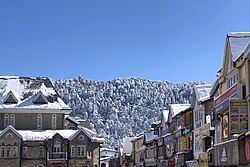
| | | image1 = Landscape of Shimla , Himachal Pradesh.jpg | ||
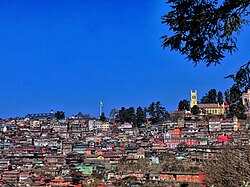
| | | caption1 = Shimla's panoramic view | ||
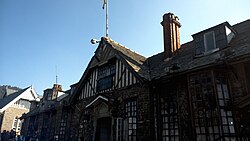
| image4 = | | image6 = Gaiety Theater - Mall Road - Shimla 2014-05-07 1290.JPG | ||
| | | caption6 = [[Gaiety Theatre, Shimla|Gaiety Theatre]] | ||
| | | image7 = Viceroy Lodge.jpg | ||
| | | caption7 = [[Viceregal Lodge, Simla|Viceregal Lodge]] | ||
| image8 = Shimla | | image4 = Christ Church, Shimla.jpg | ||
| caption4 = [[Christ Church, Shimla|Christ Church]] | |||
| image5 = Annandale Shimla3.jpg | |||
| caption5 = [[Annadale, Shimla|Annadale]] | |||
| image2 = Jakhu Temple Shimla.jpg | |||
| caption2 = [[Jakhu Temple]] | |||
| image3 = Kalibari Shimla.jpg | |||
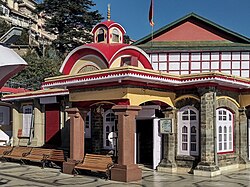
| caption3 = [[Kali Bari, Shimla|Kali Bari Temple]] | |||
| image8 =Shimla during monsoon.jpg | |||
| caption8 = Shimla hills during monsoon | |||
}} | }} | ||
| image_alt | | image_alt = | ||
| image_caption | | image_caption = | ||
| | | image_seal = | ||
| map_alt | | nicknames = {{ublist|'''Queen of Hills'''<br/>|'''City of Seven Hills'''}} | ||
| map_caption | | motto = | ||
| pushpin_map | | map_alt = | ||
| pushpin_label_position | | map_caption = | ||
| pushpin_map_alt | | pushpin_map = India Himachal Pradesh#India#Asia | ||
| pushpin_map_caption | | pushpin_label_position = | ||
| coordinates | | pushpin_map_alt = | ||
| subdivision_type | | pushpin_map_caption = | ||
| subdivision_name | | coordinates = {{coord|31|6|12|N|77|10|20|E|type:city|display=inline,title}} | ||
| subdivision_type1 | | subdivision_type = Country | ||
| subdivision_name1 | | subdivision_name = {{flag|India}} | ||
| subdivision_type2 | | subdivision_type1 = [[States and territories of India|State]] | ||
| subdivision_name2 | | subdivision_name1 = {{flagicon image|}} [[Himachal Pradesh]] | ||
| founder | | subdivision_type2 = [[List of districts of India|District]] | ||
| named_for | | subdivision_name2 = [[Shimla district|Shimla]] | ||
| government_type | | founder = | ||
| governing_body | | named_for = Goddess [[Kali Bari, Shimla|Shyamala]]<ref name="hpshimla.nic.in">{{cite web|url=http://hpshimla.nic.in/sml_tourism.htm|archive-url=https://web.archive.org/web/20051129005604/http://hpshimla.nic.in/sml_tourism.htm|url-status=dead|archive-date=29 November 2005|title=Home: District WebSite Shimla, Himachal Pradesh, India}}</ref> | ||
| leader_title2 | | government_type = [[Municipal Corporation]] | ||
| leader_name2 | | governing_body = [[Shimla Municipal Corporation]] | ||
| leader_title1 | | leader_title2 = [[Municipal Commissioner (India)|Municipal Commissioner]] | ||
| leader_name1 | | leader_name2 = Bhupender Kumar Attri<ref>{{cite web |title=MC Commissioner Office Contact Directory |url=https://shimlamc.hp.gov.in/Contact/Index/3 |website=Municipal Corporation Shimla, Himachal Pradesh |access-date=5 March 2024}}</ref> | ||
| leader_title3 | | leader_title1 = [[District Magistrate|Deputy Commissioner]] | ||
| leader_name3 | | leader_name1 = Anupam Kashyap, [[Indian Administrative Service|IAS]]<ref>{{cite web |title=Profile {{!}} Shimla District, Government of Himachal Pradesh {{!}} India |url=https://hpshimla.nic.in/profile/ |website=hpshimla.nic.in |access-date=24 March 2021}}</ref> | ||
| leader_title4 | | leader_title3 = | ||
| leader_name4 | | leader_name3 = | ||
| unit_pref | | leader_title4 = [[Mayor]] | ||
| area_total_km2 | | leader_name4 = Surender Chauhan<ref>{{cite web |title=MC Mayor Office Contact Directory |url=https://shimlamc.hp.gov.in/Contact/Index/13 |website=Municipal Corporation Shimla, Himachal Pradesh |access-date=5 March 2024}}</ref> | ||
| area_footnotes | | unit_pref = Metric | ||
| elevation_footnotes | | area_total_km2 = 35.34 | ||
| elevation_m | | area_footnotes = <ref name="SMLA">{{cite web|url=http://www.censusindia.gov.in/2011census/dchb/0211_PART_B_DCHB_SHIMLA.pdf|title=Shimla District Census 2011 Handbook|publisher=Census of India|access-date=20 April 2016|page=39(Urban Section)}}</ref> | ||
| population_total | | elevation_footnotes = | ||
| population_metro | | elevation_m = 2276 | ||
| population_total = 169,578 | |||
| population_metro = 171,640 | |||
| population_metro_footnotes = <ref name="SML"/> | | population_metro_footnotes = <ref name="SML"/> | ||
| population_as_of | | population_as_of = 2011 | ||
| population_rank | | population_rank = 1 ([[List of cities in Himachal Pradesh by population|in HP]]) | ||
| population_density_km2 | | population_density_km2 = auto | ||
| population_demonym | | population_demonym = | ||
| population_footnotes | | population_footnotes = <ref name="SML">{{cite web|url=http://www.census2011.co.in/census/city/4-shimla.html|title=Shimla City Census 2011 data|access-date=20 April 2016|publisher=Census 2011 India}}</ref><ref name="GOI_2011">{{cite web|url=http://www.citypopulation.de/php/india-himachalpradesh.php|title=Himachal Pradesh (India): Districts, Cities, Towns and Outgrowth Wards – Population Statistics in Maps and Charts}}</ref> | ||
| demographics_type1 | | demographics_type1 = Languages | ||
| demographics1_title1 | | demographics1_title1 = Official | ||
| demographics1_info1 | | demographics1_info1 = [[Hindi]]<ref name=langoff>{{cite web |url = http://www.nclm.nic.in/shared/linkimages/NCLM52ndReport.pdf |title = Report of the Commissioner for linguistic minorities: 52nd report (July 2014 to June 2015) |pages = 28–29 |publisher = Commissioner for Linguistic Minorities, Ministry of Minority Affairs, Government of India |access-date = 26 March 2019 |df = dmy-all |archive-url = https://web.archive.org/web/20171228171523/http://www.nclm.nic.in/shared/linkimages/NCLM52ndReport.pdf |archive-date = 28 December 2017}}</ref> | ||
| demographics1_title2 | | demographics1_title2 = Additional Official | ||
| demographics1_info2 | | demographics1_info2 = [[Sanskrit]]<ref>{{cite news |title=Bill to make Sanskrit second official language of HP passed |url=https://www.tribuneindia.com/news/himachal/bill-to-make-sanskrit-second-official-language-of-hp-passed/730075.html |date=17 February 2019 |access-date=26 March 2019 |work=[[The Tribune (Chandigarh)|The Tribune]] |author=Pratibha Chauhan |location=Shimla |archive-date=18 February 2019 |archive-url=https://web.archive.org/web/20190218081810/https://www.tribuneindia.com/news/himachal/bill-to-make-sanskrit-second-official-language-of-hp-passed/730075.html |url-status=dead }}</ref> | ||
| timezone1 | | demographics1_title3 = Regional | ||
| utc_offset1 | | demographics1_info3 = [[Mahasu Pahari|Mahasui (Keonthali)]]<ref>{{cite journal |title=Himachal Pradesh |journal=Linguistic Survey of India |page=283 |url=https://ruralindiaonline.org/en/library/resource/linguistic-survey-of-india---himachal-pradesh/}}</ref> | ||
| postal_code_type | | timezone1 = [[Indian Standard Time|IST]] | ||
| postal_code | | utc_offset1 = +5:30 | ||
| area_code_type | | postal_code_type = [[Postal Index Number|PIN]] | ||
| area_code | | postal_code = 171 001 | ||
| iso_code | | area_code_type = Telephone code | ||
| registration_plate | | area_code = 91 177 XXX XXXX | ||
| blank1_name_sec2 | | iso_code = [[ISO 3166-2:IN|ISO 3166-2]] | ||
| blank1_info_sec2 | | registration_plate = '''HP-01, HP-02, HP-03, HP-07, HP-62, HP-63''' | ||
| blank2_name_sec2 | | blank1_name_sec2 = [[Köppen climate classification|Climate]] | ||
| blank2_info_sec2 | | blank1_info_sec2 = [[Oceanic climate#Subtropical highland variety (Cfb, Cwb)|Cwb]] | ||
| blank3_name_sec2 | | blank2_name_sec2 = [[Precipitation (meteorology)|Precipitation]] | ||
| blank3_info_sec2 | | blank2_info_sec2 = {{convert|1577|mm|in|0|abbr=on}} | ||
| blank4_name_sec2 | | blank3_name_sec2 = Avg. annual temperature | ||
| blank4_info_sec2 | | blank3_info_sec2 = {{convert|17|°C|°F|0}} | ||
| blank5_name_sec2 | | blank4_name_sec2 = Avg. summer temperature | ||
| blank5_info_sec2 | | blank4_info_sec2 = {{convert|22|°C|°F|0}} | ||
| website | | blank5_name_sec2 = Avg. winter temperature | ||
| footnotes | | blank5_info_sec2 = {{convert |6-7|°C|°F|0}} | ||
| blank_name_sec1 | | website = {{URL|hpshimla.gov.in/}} | ||
| blank_info_sec1 | | footnotes = | ||
| blank_name_sec1 = [[UN/LOCODE]] | |||
| blank_info_sec1 = IN SLV | |||
}} | }} | ||
[[File:View of Shimla.jpg|thumb|Christ Church of Shimla captured with a scenic view of the surroundings]] | |||
[[File:COE Sanjauli in snow.jpg|thumb]] | |||
'''Shimla''',{{efn|{{Indic Transl|hi|Śimalā|ˈɕɪmᵊlaː|Shimla.ogg}}}} also known as '''Simla''' ([[List of renamed Indian cities and states#Himachal Pradesh|the official name until 1972]]),<ref>{{cite web|last=bedi|first=rahul|title=Steady Decline: From Simla To Shimla, And Now To Shyamala!|url=https://www.thecitizen.in/index.php/en/newsdetail/index/2/15315/steady-decline-from-simla-to-shimla-and-now-to-shyamala|access-date=27 December 2021|website=www.thecitizen.in|language=en-US|archive-date=27 December 2021|archive-url=https://web.archive.org/web/20211227210809/https://www.thecitizen.in/index.php/en/newsdetail/index/2/15315/steady-decline-from-simla-to-shimla-and-now-to-shyamala|url-status=dead}}</ref> ({{IPA|hi|ʃɪmla|lang|audio=Shimla.ogg}}) is the summer capital and the largest city of the northern [[Indian state]] of [[Himachal Pradesh]]. In 1864, Shimla was declared the [[summer capital]] of [[British Raj|British India]]. After [[Indian independence movement|independence]], the city became the capital of [[East Punjab]] and was later made the capital city of Himachal Pradesh. It is the principal commercial, cultural and educational centre of the state. | |||
Shimla is home to several buildings that are styled in the Tudorbethan and neo-Gothic architectures dating from the colonial era, as well as multiple temples and churches. The colonial architecture and churches, the temples, and the natural environment of the city attract tourists. Major city centre's attractions include the ''[[Shri Hanuman Jakhu (Statue)]],'' [[Jakhu Temple]], [[Rashtrapati Niwas|Viceregal Lodge]], [[Christ Church (Shimla)|Christ Church]], [[Mall Road, Shimla|Mall Road]], [[The Ridge, Shimla|The Ridge]] and [[Annadale, Shimla|Annadale]]. The city centre's northernmost point is Jakhoo and the southernmost location is Annadale, the easternmost point is [[Sanjauli]] and the western point is | Small hamlets were recorded before 1815 when British forces took control of the area. The climatic conditions attracted the British to establish the city in the dense forests of the [[Himalayas]]. As the summer capital, Shimla hosted many important political meetings including the [[Simla Deputation|Simla Deputation of 1906]], the [[Simla Convention|Simla Accord of 1914]] and the [[Simla Conference|Simla Conference of 1945]]. After independence, the state of [[Himachal Pradesh]] came into being in 1948 as a result of the integration of 28 [[princely state]]s. Even after independence, the city remained an important political centre, hosting the [[Simla Agreement|Simla Agreement of 1972]]. After the reorganisation of the state of Himachal Pradesh, the existing [[Mahasu (region)|Mahasu]] district was named Shimla. | ||
[[File:Shimla Winter Skyline.jpg|thumb|Beautiful sunset in Shimla]] | |||
Shimla is home to several buildings that are styled in the [[Tudorbethan]] and [[neo-Gothic]] architectures dating from the colonial era, as well as multiple temples and churches. The colonial architecture and churches, the temples, and the natural environment of the city attract tourists. Major city centre's attractions include the ''[[Shri Hanuman Jakhu (Statue)]],'' [[Jakhu Temple]], [[Rashtrapati Niwas|Viceregal Lodge]], [[Christ Church (Shimla)|Christ Church]], [[Mall Road, Shimla|Mall Road]], [[The Ridge, Shimla|The Ridge]] and [[Annadale, Shimla|Annadale]]. The city centre's northernmost point is Jakhoo and the southernmost location is Annadale, the easternmost point is [[Sanjauli]] and the western point is Chotta Shimla. The [[Kalka–Shimla Railway]] line built by the British, a [[UNESCO]] [[World Heritage Site]], is also a major tourist attraction. Owing to its steep terrain, Shimla hosts the mountain biking race [[MTB Himalaya]], which started in 2005 and is regarded as the biggest event of its kind in South Asia. Shimla also has the largest [[Ice rink|natural ice skating rink]] in South Asia. Apart from being a tourism centre, the city is also an educational hub with several colleges and research institutions. | |||
== Etymology == | == Etymology == | ||
Shimla city | [[File:Kalibari Shimla.jpg|thumb|Kali Bari Mandir, after which the city is named]] | ||
One theory suggests that the name "Shimla" was derived from ''Shyamalaya'', meaning 'blue house', a solitary house made of blue slate on Jakhu Hill, built by a [[fakir]].<ref name="Hist_District">{{cite web |title=History of Shimla Town |url=https://hpshimla.nic.in/history/ |website=District Shimla |access-date=15 September 2023}}</ref> | |||
In 2018, the [[Government of Himachal Pradesh|state government]] decided to change the city's name from Shimla to Shyamala.<ref>{{cite news |title=Now, Shimla may get renamed as Shyamala |url=https://www.indiatoday.in/india/story/simla-shimla-renaming-shyamala-himachal-pradesh-shimla-name-change-bjp-1372288-2018-10-21 |access-date=31 August 2020 |work=India Today |date=21 October 2018 |language=en}}</ref> However, seeing the negative response of public | According to another version, the city gets its name from ''Shamli'' or ''[[Matangi|Shyamala]]'', meaning 'blue lady', referring to the Hindu goddess [[Kali]]. It is believed that a temple dedicated to goddess Shamli, an incarnation of Kali, used to be on the [[Jakhu Temple|Jakhu]] hillside near the Rothney Castle.<ref name="Hist_District"/><ref>{{cite magazine |last1=Sharma |first1=Ashwani |date=10 October 2021 |title=Shimla's Heritage Rothney Castle Slipping Into Oblivion |url=https://www.outlookindia.com/national/shimlas-heritage-rothney-castle-slipping-into-oblivion-news-397188 |magazine=Outlook |access-date=16 December 2024}}</ref> Many believe that during the [[British Raj|British period]], the image of the goddess was shifted to a new place, the now-famous [[Kali Bari, Shimla|Kali Bari Temple]].<ref>{{cite news|title=Stunning facts about Shimla no one told you before|url=https://timesofindia.indiatimes.com/travel/destinations/stunning-facts-about-shimla-no-one-told-you-before/as67179017.cms|access-date=10 June 2020|newspaper=The Times of India}}</ref> | ||
In 2018, the [[Government of Himachal Pradesh|state government]] decided to change the city's name from Shimla to Shyamala.<ref>{{cite news |title=Now, Shimla may get renamed as Shyamala |url=https://www.indiatoday.in/india/story/simla-shimla-renaming-shyamala-himachal-pradesh-shimla-name-change-bjp-1372288-2018-10-21 |access-date=31 August 2020 |work=India Today |date=21 October 2018 |language=en}}</ref> However, seeing the negative response of the general public, the state government dismissed the plan.<ref>{{cite web|author=Scroll Staff|title=Himachal Pradesh is not considering any proposal to change Shimla's name to Shyamala, says CM|url=https://scroll.in/latest/899320/himachal-pradesh-is-not-considering-any-proposal-to-change-shimlas-name-to-shyamala-says-cm|access-date=10 June 2020|website=Scroll.in|date=23 October 2018 |language=en-US}}</ref> | |||
==History== | ==History== | ||
Most of the area occupied by present-day Shimla city was dense forest during the 18th century. The only sign of civilisation was the [[Jakhu Temple]] and a few scattered houses.<ref name="Vipin1996">{{cite book | author=Vipin Pubby | title=Shimla Then and Now | url=https://books.google.com/books?id=UrZ-ibfhMyMC&pg=PA17 | access-date=16 August 2013 | year=1996 | publisher=Indus Publishing | isbn=978-81-7387-046-0 | pages=17–34}}</ref> The area was called 'Shimla', named after | ===Early modern history=== | ||
Most of the area occupied by present-day Shimla city was dense forest during the 18th century. The only sign of civilisation was the [[Jakhu Temple]] and various other temples, a few scattered houses, and nearby villages which has now turned out as posh and major neighbourhoods of the city.<ref name="Vipin1996">{{cite book | author=Vipin Pubby | title=Shimla Then and Now | url=https://books.google.com/books?id=UrZ-ibfhMyMC&pg=PA17 | access-date=16 August 2013 | year=1996 | publisher=Indus Publishing | isbn=978-81-7387-046-0 | pages=17–34}}</ref> The area was called 'Shimla', named after [[Hindu goddess]] ''Shyamala Devi'', an incarnation of [[Kali]].<ref name="hpshimla.nic.in" /> | |||
===Anglo Gorkha Wars=== | |||
{{Main|Sugauli Treaty}} | |||
[[File:Shimla, 1850s.jpg|left|thumb|The bridge connecting Shimla with Chhota Shimla, originally erected in 1829 by [[Stapleton Cotton, 1st Viscount Combermere|Lord Combermere]], Shimla, the 1850s]] | [[File:Shimla, 1850s.jpg|left|thumb|The bridge connecting Shimla with Chhota Shimla, originally erected in 1829 by [[Stapleton Cotton, 1st Viscount Combermere|Lord Combermere]], Shimla, the 1850s]] | ||
The area of present-day Shimla was invaded and captured by [[Bhimsen Thapa]] of [[Kingdom of Nepal|Nepal]] in 1806. The [[British East India Company]] took control of the territory as per the [[Sugauli Treaty]] after the [[Anglo-Nepalese War]] (1814–16). The [[Gurkha]] leaders were quelled by storming the fort of Malaun under the command of [[David Ochterlony]] in May 1815. In a diary entry dated 30 August 1817, the Gerard brothers, who surveyed the area, describe Shimla as "a middling-sized village where a fakir is situated to give water to the travellers". In 1819, Lieutenant Ross, the Assistant Political Agent in the [[Hill States of India#|Hill States]], set up a wood cottage in Shimla. Three years later, his successor and the [[Scotland|Scottish]] civil servant [[Charles Pratt Kennedy]] built the first [[pucca housing|pucca house]] in the area named Kennedy Cottage in 1822, near [[Annadale, Shimla|Annadale]], what is now the home for CPWD office. The accounts of the Britain-like climate started attracting several British officers to the area during the hot Indian summers. By 1826, some officers had started spending their entire vacation in Shimla. In 1827, [[William Amherst, 1st Earl Amherst|William Amherst]], the [[Governor-General of Bengal]], visited Shimla and stayed in the Kennedy House. A year later, [[Stapleton Cotton, 1st Viscount Combermere|Stapleton Cotton]], the Commander-in-Chief of the British forces in India, stayed at the same residence. During his stay, a | The area of present-day Shimla was invaded and captured by [[Bhimsen Thapa]] of [[Kingdom of Nepal|Nepal]] in 1806. The [[British East India Company]] took control of the territory as per the [[Sugauli Treaty]] after the [[Anglo-Nepalese War]] (1814–16). The [[Gurkha]] leaders were quelled by storming the fort of Malaun under the command of [[David Ochterlony]] in May 1815. | ||
===Early British settlements in Simla=== | |||
{{Main|Simla Hill States}} | |||
In a diary entry dated 30 August 1817, the Gerard brothers, who surveyed the area, describe Shimla as "a middling-sized village where a fakir is situated to give water to the travellers". In 1819, Lieutenant Ross, the Assistant Political Agent in the [[Hill States of India#|Hill States]], set up a wood cottage in Shimla. Three years later, his successor and the [[Scotland|Scottish]] civil servant [[Charles Pratt Kennedy]] built the first [[pucca housing|pucca house]] in the area named Kennedy Cottage in 1822, near [[Annadale, Shimla|Annadale]], what is now the home for CPWD office. The accounts of the Britain-like climate started attracting several British officers to the area during the hot Indian summers. By 1826, some officers had started spending their entire vacation in Shimla. In 1827, [[William Amherst, 1st Earl Amherst|William Amherst]], the [[Governor-General of Bengal]], visited Shimla and stayed in the Kennedy House. A year later, [[Stapleton Cotton, 1st Viscount Combermere|Stapleton Cotton]], the Commander-in-Chief of the British forces in India, stayed at the same residence. During his stay, a {{convert|3|mi|km|0|abbr=off|adj=on|spell=on|order=flip}} road and a bridge were constructed near [[Jakhoo]]. In 1830, the British acquired the surrounding land from the chiefs of [[Keonthal]] and [[Patiala]] in exchange for the Rawin [[pargana]] and a portion of the Bharauli pargana. The settlement grew rapidly after this, from 30 houses in 1830 to 1,141 houses in 1881.<ref name="Vipin1996" /><ref>{{cite book|author=Harrop, F. Beresford| publisher=Thacker, Spink & Co.|place=Simla| year=1925| title=Thacker's new Guide to Simla| pages=16–19}}</ref> | |||
In 1832, Shimla saw its first political meeting between the Governor-General [[Lord William Bentinck]] and the emissaries of [[Ranjit Singh|Maharaja Ranjit Singh]]. In a letter to Colonel Churchill, he wrote:<ref>Researches and Missionary Labours Among the Jews, Mohammedans, and Other Sects By Joseph Wolff, published by O. Rogers, 1837</ref> | In 1832, Shimla saw its first political meeting between the Governor-General [[Lord William Bentinck]] and the emissaries of [[Ranjit Singh|Maharaja Ranjit Singh]]. In a letter to Colonel Churchill, he wrote:<ref>Researches and Missionary Labours Among the Jews, Mohammedans, and Other Sects By Joseph Wolff, published by O. Rogers, 1837</ref> | ||
{{cquote|Shimla is only four days march from Loodianah ([[Ludhiana]]), is easy to access, and proves a very agreeable refuge from the burning plains of Hindoostaun ([[Hindustan]]).}} | {{cquote|Shimla is only four days march from Loodianah ([[Ludhiana]]), is easy to access, and proves a very agreeable refuge from the burning plains of Hindoostaun ([[Hindustan]]).}} | ||
[[File:Jakku Temple Simla.jpg|thumb|left|Jakhu Temple in 1910; the temple predates the British settlement in the area]] | [[File:Jakku Temple Simla.jpg|thumb|left|Jakhu Temple in 1910; the temple predates the British settlement in the area]] | ||
Combermere's successor [[James Broun-Ramsay, 1st Marquess of Dalhousie|Earl Dalhousie]] visited Shimla in the same year. After this, the town was under Nawab (King) Kumar Ghosal of Bally, West Bengal, and saw regular visits from the Governors-General and Commanders-in-Chief of British India. Several young British officers started visiting the area to socialise with the higher-ups; they were followed by ladies looking for marriage alliances for their relatives. Shimla thus became a hill station famous for balls, parties, and other festivities. Subsequently, residential schools for pupils from upper-class families were established nearby. | Combermere's successor [[James Broun-Ramsay, 1st Marquess of Dalhousie|Earl Dalhousie]] visited Shimla in the same year. After this, the town was under Nawab (King) Kumar Ghosal of Bally, West Bengal, and saw regular visits from the Governors-General and Commanders-in-Chief of British India. Several young British officers started visiting the area to socialise with the higher-ups; they were followed by ladies looking for marriage alliances for their relatives. Shimla thus became a hill station famous for balls, parties, and other festivities. Subsequently, residential schools for pupils from upper-class families were established nearby. | ||
In 1863, the [[Viceroy of India]], [[John Lawrence, 1st Baron Lawrence|John Lawrence]], decided to shift the summer capital of the British Raj to Shimla.<ref name="Vipin1996" /> He took the trouble of moving the administration twice a year between [[Calcutta]] and this separate centre over | ===Early urban development=== | ||
By the late 1830s, the city also became a centre for theatre and art exhibitions. As the population increased, several bungalows were built and a big bazaar was established in the town. The Indian businessmen, mainly from [[Sood (surname)|Sood]] and [[Parsi]] communities, arrived in the area to cater to the needs of the growing European population. On 9 September 1844, the foundation of the [[Christ Church (Shimla)|Christ Church]] was laid. Subsequently, several roads were widened and the construction of the [[National Highway 22 (India)|Hindustan-Tibet road]] with a {{convert|560|ft|m|order=flip|adj=on}} tunnel was taken up in 1851–52. This tunnel, now known as the Dhalli Tunnel, was started by Major Briggs in 1850 and completed in the winter of 1851–52.<ref name="tunnel">{{cite web|url=http://www.tribuneindia.com/2008/20080206/himplus1.htm#2 |title=Shimla A five-tunnel town|publisher=tribuneindia.com|access-date=16 August 2015}}</ref> The [[1857 uprising]] caused a panic among the European residents of the town, but Shimla remained largely unaffected by the rebellion.<ref name="Vipin1996" /> | |||
===Simla as the 'summer capital' of the British Raj=== | |||
[[File:Old photo of Annadale, Shimla.jpg|thumb|[[Annadale, Shimla|Annadale]] during British period]] | |||
In 1863, the [[Viceroy of India]], [[John Lawrence, 1st Baron Lawrence|John Lawrence]], decided to shift the summer capital of the British Raj to Shimla.<ref name="Vipin1996" /> He took the trouble of moving the administration twice a year between [[Calcutta]] and this separate centre over {{convert|1000|mi|km|order=flip}} away, even though it was difficult to reach.<ref name="ReferenceA">[[Charles Allen (writer)|Charles Allen]], ''[[Kipling Sahib]]'', London, Little Brown, 2007</ref> [[Robert Bulwer-Lytton, 1st Earl of Lytton|Robert Bulwer-Lytton]] ([[Viceroy of India]] 1876–1880) made efforts to plan the town from 1876, when he first stayed in a rented house, but began plans for a [[Rashtrapati Niwas|Viceregal Lodge]], later built on Observatory Hill. A fire cleared much of the area where the native Indian population lived (the "Upper Bazaar" nowadays known as the [[The Ridge, Shimla|Ridge]]<ref name="harassed">{{cite book | author=Hari Sud | title=Entrepreneurs of British Shimla | url=https://books.google.com/books?id=N8aRBQAAQBAJ | access-date=15 August 2015 | year=2013 | publisher=Lulu | isbn=978-1-304-11357-3 | pages=73–74}}</ref>), and the planning of the eastern end to become the centre of the European town forced them to live in the Middle and [[Lower Bazaar, Shimla|Lower Bazaars]] on the lower terraces descending the steep slopes from the Ridge. The Upper Bazaar was cleared for a town hall, with many facilities such as a library and theatre, as well as offices for police and military volunteers as well as municipal administration. | |||
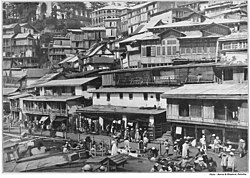
[[File:Simla QE4 24.jpg|right|thumb|Shimla's "[[Lower Bazaar, Shimla|Lower Bazaar]]" in a photograph taken between 1887 and 1889]] | [[File:Simla QE4 24.jpg|right|thumb|Shimla's "[[Lower Bazaar, Shimla|Lower Bazaar]]" in a photograph taken between 1887 and 1889]] | ||
During the "Hot Weather", Shimla was also the headquarters of the [[Commander-in-Chief, India]], the head of the [[British Indian Army|Indian Army]], and many departments of [[Government of India | During the "Hot Weather", Shimla was also the headquarters of the [[Commander-in-Chief, India]], the head of the [[British Indian Army|Indian Army]], and many departments of the [[Government of India]]. The summer capital of the regional Government of the [[Punjab (British India)|Punjab]] moved from [[Murree]], in modern-day Pakistan, to Shimla in 1876. They were joined by many of the British wives and daughters of the men who remained on the plains. Together these formed the Shimla Society, which, according to [[Charles Allen (writer)|Charles Allen]],<ref>''[[Kipling Sahib]]'', London, Little Brown, 2007: p. 134</ref> "was as close as British India ever came to having an upper crust." This may have been helped by the fact that it was very expensive, having an ideal climate and thus being desirable, as well as having limited accommodation. British soldiers, merchants, and civil servants moved here each year to escape from the heat during summer in the [[Indo-Gangetic Plain]]. The presence of many bachelors and unattached men, as well as the many women passing the hot weather there, gave Shimla a reputation for adultery, and at least gossip about adultery: as [[Rudyard Kipling]] said in a letter cited by Allen, it had a reputation for "frivolity, gossip, and intrigue".<ref name="heritage report">{{cite web | url = http://himachal.nic.in/tcp/ShimlaHeritageReport.pdf | title = Heritage of Shimla | publisher = Town & Country Planning Department, Shimla | access-date = 4 May 2007 | url-status = dead | archive-url = https://web.archive.org/web/20070630171701/http://himachal.nic.in/tcp/ShimlaHeritageReport.pdf | archive-date = 30 June 2007 | df = dmy-all }}</ref> | ||
The {{convert|500|ft|adj=on}} Lower Bazaar tunnel was built in 1905 and christened Khachhar Surang. The Elysium Tunnel (now known as the Auckland Tunnel), about {{convert|120|ft}} in length, was also built in 1905.<ref name="tunnel" /> | The {{convert|500|ft|adj=on}} Lower Bazaar tunnel was built in 1905 and christened Khachhar Surang. The Elysium Tunnel (now known as the Auckland Tunnel), about {{convert|120|ft}} in length, was also built in 1905.<ref name="tunnel" /> | ||
The [[Simla Convention]], an ambiguous [[treaty]] concerning the status of Tibet negotiated by representatives of the [[Republic of China (1912–1949)|Republic of China]], [[Tibet (1912–1951)|Tibet]] and Great Britain was signed in Simla in 1913 and 1914.<ref>{{cite web|title=Tibet Justice Center – Legal Materials on Tibet – Treaties and Conventions Relating to Tibet – Convention Between Great Britain, China, and Tibet, Simla (1914) [400]|url=http://www.tibetjustice.org/materials/treaties/treaties16.html|access-date=9 July 2020|website=www.tibetjustice.org}}</ref><ref>{{cite book|last=Hoffmann|first=Steven A.|url=https://books.google.com/books?id=BpSRwC5_EPUC|title=India and the China Crisis|date=1 January 1990|publisher=University of California Press|isbn=978-0-520-06537-6|language=en}}</ref> At the convention a demarcation line between [[Tibet]] and the [[Northeast India|North-east region]] of India was proposed by Sir [[Henry McMahon]]. The line came to be known as McMahon Line and is currently the effective boundary between China and India, although its legal status is disputed by the Chinese government. This was also the site of a series of talks held by [[Archibald Wavell, 1st Earl Wavell|Viceroy Wavell]] to discuss a plan for the independence of India with the Indian political leaders of the time. Known as the Simla Conference, the talks failed to bring about a resolution. | The [[Simla Convention]], an ambiguous [[treaty]] concerning the status of Tibet negotiated by representatives of the [[Republic of China (1912–1949)|Republic of China]], [[Tibet (1912–1951)|Tibet]] and Great Britain was signed in Simla in 1913 and 1914.<ref>{{cite web|title=Tibet Justice Center – Legal Materials on Tibet – Treaties and Conventions Relating to Tibet – Convention Between Great Britain, China, and Tibet, Simla (1914) [400]|url=http://www.tibetjustice.org/materials/treaties/treaties16.html|access-date=9 July 2020|website=www.tibetjustice.org}}</ref><ref>{{cite book|last=Hoffmann|first=Steven A.|url=https://books.google.com/books?id=BpSRwC5_EPUC|title=India and the China Crisis|date=1 January 1990|publisher=University of California Press|isbn=978-0-520-06537-6|language=en}}</ref> At the convention a demarcation line between [[Tibet]] and the [[Northeast India|North-east region]] of India was proposed by Sir [[Henry McMahon]]. The line came to be known as McMahon Line and is currently the effective boundary between [[China]] and India, although its legal status is disputed by the Chinese government. This was also the site of a series of talks held by [[Archibald Wavell, 1st Earl Wavell|Viceroy Wavell]] to discuss a plan for the independence of India with the Indian political leaders of the time. Known as the [[Simla Conference]], the talks failed to bring about a resolution. | ||
[[File:Victory Tunnel Shimla 02.jpg|alt=showing the urbanisation of Shimla city|thumb|[[Victory Tunnel|Victory Tunnel Shimla]]]] | |||
Shimla was the capital city in exile of [[British Burma]] (present-day [[Myanmar]]) from 1942 to 1945.<ref name="IE2018">{{cite news |last1=Chowdhury |first1=Adrija Roy |title=Shimla could have been named after Goddess Shamli, but there was no Simla before the British. |url=https://indianexpress.com/article/research/shimla-rename-shyamala-himachal-pradesh-shamli-5415941/ |access-date=24 October 2018 |newspaper=The Indian Express |date=24 October 2018}}</ref> In 1945, [[Victory Tunnel]] was opened immediately after the [[Allied leaders of World War II|Allied victory]] in [[World War II|World War 2]] on 8 May 1945, hence its name. It was the celebratory mark of the end of the War from British side. Since then it has become one of the busiest tunnel routes of Shimla, connecting two major parts of the city.<ref>{{Cite web |last=Sharma |first=Ashwani |date=8 October 2020 |title=Shimla's old tunnels are crying for attention; planned ones in limbo |url=https://citizenmatters.in/shimla-mobility-story-of-the-towns-old-tunnels/ |access-date=14 December 2025 |website=Citizen Matters |language=en-US}}</ref> | |||
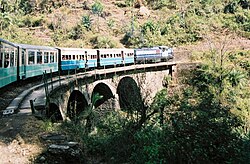
[[File:KSR Train on a small bridge 05-02-12 52.jpeg|left|thumb|Passenger train on the [[Kalka-Shimla Railway]] route]] | |||
The [[Kalka–Shimla Railway|Kalka–Shimla railway line]], opened in 1903, added to Shimla's accessibility and popularity. The railway route from Kalka to Shimla, with more than 806 bridges and 103 tunnels, was touted as an engineering feat and came to be known as the "British Jewel of the Orient".<ref name="heritage report" /> In 2008, it became part of the [[UNESCO World Heritage Site]].<ref>{{cite web|url=https://whc.unesco.org/en/list/944 |title=Unesco|publisher=Unesco.org|access-date=14 October 2012}}</ref> | |||
===Post-Independence Shimla=== | |||
Following the [[partition of India]], Shimla briefly served as the capital of East Punjab, until construction of the new city of [[Chandigarh]] (the present-day capital of the Indian states of [[Punjab (India)|Punjab]] and [[Haryana]]). Upon the formation of the state of [[Himachal Pradesh]] in 1971, Shimla was named its capital. | |||
After independence, the Chief Commissioner's Province of | After independence, the Chief Commissioner's Province of Himachal Pradesh came into being on 15 April 1948 as a result of the integration of 28 petty princely states (including feudatory princes and zaildars) in the promontories of the western [[Himalaya]], known in full as the [[Simla Hills States|Shimla Hills States]] and four Punjab southern hill states by the issue of the Himachal Pradesh (Administration) Order, 1948 under Sections 3 and 4 of the Extra-Provincial Jurisdiction Act, 1947 (later renamed as the Foreign Jurisdiction Act, 1947 vide A.O. of 1950). The [[Bilaspur State (princely state)|State of Bilaspur]] was merged into the Himachal Pradesh on 1 April 1954 by the Himachal Pradesh and Bilaspur (New State) Act, 1954. Himachal became a part C state on 26 January 1950 with the implementation of the [[Constitution of India]] and the Lt. Governor was appointed. The legislative assembly was elected in 1952. Himachal Pradesh became a [[Union Territory]] on 1 November 1956.<ref name="nichist">{{cite web | ||
|url=http://himachal.nic.in/tour/history.htm|title=History of Himachal Pradesh|access-date=31 March 2008|publisher=National Informatics Centre, Himachal Pradesh|url-status=dead|archive-url=https://web.archive.org/web/20061121013200/http://himachal.nic.in/tour/history.htm|archive-date=21 November 2006}}</ref> Following areas of Punjab State namely Shimla, Kangra, | |url=http://himachal.nic.in/tour/history.htm|title=History of Himachal Pradesh|access-date=31 March 2008|publisher=National Informatics Centre, Himachal Pradesh|url-status=dead|archive-url=https://web.archive.org/web/20061121013200/http://himachal.nic.in/tour/history.htm|archive-date=21 November 2006}}</ref> Following areas of Punjab State namely Shimla, [[Kangra district|Kangra]], [[Kullu district|Kullu]] and [[Lahaul and Spiti district|Lahaul and Spiti]] Districts, [[Nalagarh|Nalagarh Tehsil]] of [[Ambala district|Ambala District]], Lohara, [[Amb, Himachal Pradesh|Amb]] and [[Una district|Una]] Kanungo circle, some areas of [[Santokhgarh]] Kanungo circle and some other specified area of [[Una, Himachal Pradesh|Una]] tehsil of [[Hoshiarpur district|Hoshiarpur District]] besides some parts of [[Dhar Kalan]] Tehsil of [[Pathankot district]]; were merged with Himachal Pradesh on 1 November 1966 on the enactment of [[Punjab Reorganisation Act, 1966]] by the Parliament. On 18 December 1970, [[The State of Himachal Pradesh Act, 1970|The State of Himachal Pradesh Act]] was passed by Parliament and the new state came into being on 25 January 1971. Thus Himachal emerged as the eighteenth state of the Indian Union.<ref name="nichist" /> | ||
The [[Simla Agreement]] treaty was signed in Shimla by [[Zulfiqar Ali Bhutto]], the [[President of Pakistan]], and [[Indira Gandhi]], the [[Prime Minister of India]]. The agreement paved the way for diplomatic recognition of [[Bangladesh]] by Pakistan. Technically the document was signed at 0040 hours on the night of 3 July; despite this official documents are dated 2 July 1972.<ref>{{cite web|date=2 October 2013|title=Relevance Of Simla Agreement – Khan Study Group – Best IAS Coaching Institute for General Studies (GS)|url=http://ksgindia.com/study-material/editorial-series/3885-relevance-of-simla-agreement.html|archive-url=https://web.archive.org/web/20131002132702/http://ksgindia.com/study-material/editorial-series/3885-relevance-of-simla-agreement.html|url-status=dead|archive-date=2 October 2013|access-date=9 July 2020}}</ref> | The [[Simla Agreement]] treaty was signed in Shimla by [[Zulfiqar Ali Bhutto]], the [[President of Pakistan]], and [[Indira Gandhi]], the [[Prime Minister of India]]. The agreement paved the way for diplomatic recognition of [[Bangladesh]] by Pakistan. Technically the document was signed at 0040 hours on the night of 3 July; despite this official documents are dated 2 July 1972.<ref>{{cite web|date=2 October 2013|title=Relevance Of Simla Agreement – Khan Study Group – Best IAS Coaching Institute for General Studies (GS)|url=http://ksgindia.com/study-material/editorial-series/3885-relevance-of-simla-agreement.html|archive-url=https://web.archive.org/web/20131002132702/http://ksgindia.com/study-material/editorial-series/3885-relevance-of-simla-agreement.html|url-status=dead|archive-date=2 October 2013|access-date=9 July 2020}}</ref> | ||
Pre-independence structures still dot Shimla; buildings such as the former [[Rashtrapati Niwas|Viceregal Lodge]], Assembly Chamber, [[Auckland School Shimla|Auckland House]], [[Christ Church (Shimla)|Christ Church]], Gorton Castle, Shimla Town Hall and the [[Gaiety Theater, Shimla|Gaiety Theatre]] are reminders of British rule in India.<ref name="shimla_distt">{{cite web|url = http://www.hpshimla.nic.in/|title = Official Web Site of District Shimla|publisher = Hpshimla.nic.in|access-date = 14 October 2012|archive-url = https://web.archive.org/web/20120929220041/http://hpshimla.nic.in/|archive-date = 29 September 2012|url-status = dead|df = dmy-all}}</ref><ref name="shimla_history">{{cite web | url = http://www.tribuneindia.com/2001/20010526/windows/main1.htm | title = Shimla: Another age, another time | publisher = The Tribune, Chandigarh, India | access-date=26 May 2001}}</ref> The original [[Peterhoff, Shimla|Peterhoff]], another [[Viceroy of India|Viceregal]] residence, | Pre-independence structures still dot Shimla; buildings such as the former [[Rashtrapati Niwas|Viceregal Lodge]], Assembly Chamber, [[Auckland School Shimla|Auckland House]], [[Christ Church (Shimla)|Christ Church]], Gorton Castle, Shimla Town Hall and the [[Gaiety Theater, Shimla|Gaiety Theatre]] are reminders of British rule in India.<ref name="shimla_distt">{{cite web|url = http://www.hpshimla.nic.in/|title = Official Web Site of District Shimla|publisher = Hpshimla.nic.in|access-date = 14 October 2012|archive-url = https://web.archive.org/web/20120929220041/http://hpshimla.nic.in/|archive-date = 29 September 2012|url-status = dead|df = dmy-all}}</ref><ref name="shimla_history">{{cite web | url = http://www.tribuneindia.com/2001/20010526/windows/main1.htm | title = Shimla: Another age, another time | publisher = The Tribune, Chandigarh, India | access-date=26 May 2001}}</ref> The original [[Peterhoff, Shimla|Peterhoff]], another [[Viceroy of India|Viceregal]] residence, burnt down in 1981. British Shimla extended about {{convert|1+1/2|mi|km|order=flip|round=0.5}} along the ridge between Jakhoo Hill and Prospect Hill. The central spine was the [[Mall Road, Shimla|Mall Road]], which ran along the length of the Ridge, with a Mall Extension southwards, closed to all carriages except those of the viceroy and his wife. | ||
==Geography== | ==Geography== | ||
Shimla is on the south-western ranges of the [[Himalayas]] at {{Coord|31.61|N|77.10|E}}. It has an average altitude of {{convert|2206|m}} above [[mean sea level]] and extends along a ridge with seven [[Spur (mountain)|spur]]s. The city stretches nearly {{convert|9.2|km}} from east to west.<ref name="mcshimla">{{cite web|url=http://shimlamc.org/mcshimla.htm | title=Shimla Municipal Corporation | access-date=4 May 2007 |archive-url = https://web.archive.org/web/20070403005805/http://www.shimlamc.org/mcshimla.htm <!-- Bot retrieved archive --> |archive-date = 3 April 2007}}</ref> | Shimla is on the south-western ranges of the [[Himalayas]] at {{Coord|31.61|N|77.10|E}}. It has an average altitude of {{convert|2206|m}} above [[mean sea level]] and extends along a ridge with seven [[Spur (mountain)|spur]]s. The city stretches nearly {{convert|9.2|km|mi|frac=8}} from east to west.<ref name="mcshimla">{{cite web|url=http://shimlamc.org/mcshimla.htm | title=Shimla Municipal Corporation | access-date=4 May 2007 |archive-url = https://web.archive.org/web/20070403005805/http://www.shimlamc.org/mcshimla.htm <!-- Bot retrieved archive --> |archive-date = 3 April 2007}}</ref> It comes under the historical cultural [[Mahasu (region)|Mahasu region]].<ref>{{Cite journal |last=Hertel |first=Johannes |date=1 January 1924 |title=Grierson George Abraham. Linguistic Survey of India. Calcutta, Superintendent Government Printing, India |url=https://www.degruyterbrill.com/document/doi/10.1515/if-1924-0139/html |journal=Indogermanische Forschungen |language=de |volume=42 |issue=s1 |pages=363–368 |doi=10.1515/if-1924-0139 |issn=1613-0405}}</ref><ref>{{Cite journal |last=Vyas |first=Nitin |last2=Nagal |first2=Priti R. |last3=Dhanda |first3=Aniket |date=22 July 2025 |title=Mahasu Devta, Shamanism, And Cultural Heritage: Assessing The Scope Of Spiritual And Cultural Tourism In Himachal Pradesh |url=https://journal.ontourism.academy/index.php/jots/article/view/172 |journal=Journal On Tourism & Sustainability |language=en |volume=8 |issue=1 |doi=10.5281/zenodo.16320417 |issn=2515-6780}}</ref> | ||
[[File:Simla and Jutogh 1911 map.jpg|thumb|Simla and Jutogh, 1911 map]] | [[File:Simla and Jutogh 1911 map.jpg|thumb|Simla and Jutogh, 1911 map]] | ||
The city is a Zone IV (High Damage Risk Zone) per the [[Earthquake hazard zoning of India]]. Weak construction techniques and an increasing population pose a serious threat to the already earthquake prone region.<ref name="shimlavulnerable">{{cite web | url= http://news.indiainfo.com/2005/10/14/1410quake-shimla-vulnerable.html | title= Concrete buildings make Shimla vulnerable to quake | publisher= Indiainfo.com | access-date= 14 October 2005 | url-status= dead | archive-url= https://web.archive.org/web/20051222161747/http://news.indiainfo.com/2005/10/14/1410quake-shimla-vulnerable.html | archive-date= 22 December 2005 | df= dmy-all }}</ref><ref>{{cite web | url = http://www.andazresorts.com/| title = Report from the field: Shimla City, India | publisher = GeoHazards International | access-date=11 May 2007 |archive-url = https://web.archive.org/web/20070630171700/http://www.geohaz.org/contents/publications/ShilmlaCityV5.pdf <!-- Bot retrieved archive --> |archive-date = 30 June 2007}}</ref> There are no water bodies near the main city and the closest river, the [[Sutlej]], is about {{convert|21|km|mi|abbr=on}} away.<ref>{{cite web | url = http://hptdc.nic.in/trans.htm | title = Sight seeing tours around Shimla | publisher = HP Tourism Development Corporation | access-date = 21 May 2007 | url-status = dead | archive-url = https://web.archive.org/web/20070511001459/http://hptdc.nic.in/trans.htm | archive-date = 11 May 2007 | df = dmy-all }}</ref> Other rivers that flow through the Shimla district, although further from the city, are the Giri, and Pabbar (both tributaries of [[Yamuna]]). | The city is a Zone IV (High Damage Risk Zone) per the [[Earthquake hazard zoning of India]]. Weak construction techniques and an increasing population pose a serious threat to the already earthquake prone region.<ref name="shimlavulnerable">{{cite web | url= http://news.indiainfo.com/2005/10/14/1410quake-shimla-vulnerable.html | title= Concrete buildings make Shimla vulnerable to quake | publisher= Indiainfo.com | access-date= 14 October 2005 | url-status= dead | archive-url= https://web.archive.org/web/20051222161747/http://news.indiainfo.com/2005/10/14/1410quake-shimla-vulnerable.html | archive-date= 22 December 2005 | df= dmy-all }}</ref><ref>{{cite web | url = http://www.andazresorts.com/| title = Report from the field: Shimla City, India | publisher = GeoHazards International | access-date=11 May 2007 |archive-url = https://web.archive.org/web/20070630171700/http://www.geohaz.org/contents/publications/ShilmlaCityV5.pdf <!-- Bot retrieved archive --> |archive-date = 30 June 2007}}</ref> There are no water bodies near the main city and the closest river, the [[Sutlej]], is about {{convert|21|km|mi|abbr=on}} away.<ref>{{cite web | url = http://hptdc.nic.in/trans.htm | title = Sight seeing tours around Shimla | publisher = HP Tourism Development Corporation | access-date = 21 May 2007 | url-status = dead | archive-url = https://web.archive.org/web/20070511001459/http://hptdc.nic.in/trans.htm | archive-date = 11 May 2007 | df = dmy-all }}</ref> Other rivers that flow through the Shimla district, although further from the city, are the Giri, and Pabbar (both tributaries of [[Yamuna]]). | ||
| Line 143: | Line 178: | ||
The green belt in the Shimla planning area is spread over {{convert|414|ha}}.<ref name="heritage report" /> The main forests in and around the city are of [[Pine]], [[Cedrus deodara|Deodar]], [[Oak]] and [[Rhododendron]].<ref>{{cite web|url = http://hpforest.nic.in/ | title= H.P. Forest Department | access-date=11 May 2007}}</ref> Environmental degradation due to the increasing number of tourists every year without the infrastructure to support them has resulted in Shimla losing its popular appeal as an [[ecotourism]] spot.<ref>{{cite journal | author = Adarsh Batra | title = Himalayan Ecotourism in Shimla | journal = ABAC Journal | date = September 2001 | publisher = Assumption University, AU Journal | url = http://www.journal.au.edu/abac_journal/2001/sep01/article3.pdf | url-status = dead | archive-url = https://web.archive.org/web/20070630171701/http://www.journal.au.edu/abac_journal/2001/sep01/article3.pdf | archive-date = 30 June 2007 | df = dmy-all }}</ref> Another rising concern in the region are the frequent number of [[landslide]]s that often take place after heavy rains.<ref name="shimlavulnerable" /><ref>{{cite web | url = http://www.tribuneindia.com/2005/20050716/himachal.htm#1 | title = Landslides disrupt traffic in Shimla | publisher= The Tribune, Chandigarh, India | access-date=16 July 2005}}</ref> | The green belt in the Shimla planning area is spread over {{convert|414|ha}}.<ref name="heritage report" /> The main forests in and around the city are of [[Pine]], [[Cedrus deodara|Deodar]], [[Oak]] and [[Rhododendron]].<ref>{{cite web|url = http://hpforest.nic.in/ | title= H.P. Forest Department | access-date=11 May 2007}}</ref> Environmental degradation due to the increasing number of tourists every year without the infrastructure to support them has resulted in Shimla losing its popular appeal as an [[ecotourism]] spot.<ref>{{cite journal | author = Adarsh Batra | title = Himalayan Ecotourism in Shimla | journal = ABAC Journal | date = September 2001 | publisher = Assumption University, AU Journal | url = http://www.journal.au.edu/abac_journal/2001/sep01/article3.pdf | url-status = dead | archive-url = https://web.archive.org/web/20070630171701/http://www.journal.au.edu/abac_journal/2001/sep01/article3.pdf | archive-date = 30 June 2007 | df = dmy-all }}</ref> Another rising concern in the region are the frequent number of [[landslide]]s that often take place after heavy rains.<ref name="shimlavulnerable" /><ref>{{cite web | url = http://www.tribuneindia.com/2005/20050716/himachal.htm#1 | title = Landslides disrupt traffic in Shimla | publisher= The Tribune, Chandigarh, India | access-date=16 July 2005}}</ref> | ||
The city is situated 88 | The city is situated {{convert|88|km|mi}} northeast of [[Kalka]], {{convert|116|km|mi|abbr=on}} northeast of [[Chandigarh]], {{convert|247|km|mi|abbr=on}} south of [[Manali, Himachal Pradesh|Manali]] and {{convert|350|km|mi|abbr=on}} northeast of [[Delhi]], the national capital. Kalka can be reached within {{frac|2|1|2}} hours, and Chandigarh can be reached in 3 hours 15 minutes. Delhi and Manali are both around 7 hours away from Shimla.{{Citation needed|date=August 2024}} | ||
To the east of Shimla stand the Choor Mountains (Chuor, | To the east of Shimla stand the Choor Mountains (Chuor, 3647 m<ref>Insight Family World Atlas, Map 81, {{ISBN|978-981-258-427-4}}</ref>). A passage over these mountains, from the Tons River to Shimla is described in ''Views in India, chiefly among the Himalaya Mountains'', by [[w:George Francis White|George Francis White]]<ref>{{cite book|last =White|first=George|title=Views in India, chiefly among the Himalaya Mountains, 1836|url=https://play.google.com/books/reader?id=6gxJAAAAcAAJ&pg=GBS.PA55&printsec=frontcover|year=1836|publisher=Fisher, Son & Co.}}</ref> with accompanying drawings, ''Village of Khandoo, on the Ascent to the Choor'', and two that were subsequently the subject of poetical illustrations by [[Letitia Elizabeth Landon]], namely ''Crossing the Choor Mountains'',<ref>{{cite book|last =Landon|first=Letitia Elizabeth|title=Fisher's Drawing Room Scrap Book, 1839|url=https://play.google.com/books/reader?id=ufpcAAAAcAAJ&pg=GBS.PA34-IA6|section=Crossing the Choor Mountains: picture|year=1838|publisher=Fisher, Son & Co.}} {{cite book|last =Landon|first=Letitia Elizabeth|title=Fisher's Drawing Room Scrap Book, 1839|url=https://play.google.com/books/reader?id=ufpcAAAAcAAJ&pg=GBS.PA34-IA11|section=Crossing the Choor Mountains: poetical illustration|pages=35–36|year=1838|publisher=Fisher, Son & Co.}}</ref> and ''Village of Koghera and Deodar Forest, near the Choor''.<ref>{{cite book|last =Landon|first=Letitia Elizabeth|title=Fisher's Drawing Room Scrap Book, 1839|url=https://play.google.com/books/reader?id=ufpcAAAAcAAJ&pg=GBS.PA65-IA7|section=Village of Koghera: poetical illustration|pages=26–28|year=1838|publisher=Fisher, Son & Co.}} {{cite book|last =Landon|first=Letitia Elizabeth|title=Fisher's Drawing Room Scrap Book, 1839|url=https://play.google.com/books/reader?id=ufpcAAAAcAAJ&pg=GBS.PA13|section=Village of Koghera: picture|year=1838|publisher=Fisher, Son & Co.}}</ref> | ||
The accompanying notes record that "During a considerable part of the year, the Choor is hoary with snow; and when moonlight falls upon the scene, an effect is produced as if floods of molten silver were poured over the surface. Moonlight in these regions assumes a novel charm." | The accompanying notes record that "During a considerable part of the year, the Choor is hoary with snow; and when moonlight falls upon the scene, an effect is produced as if floods of molten silver were poured over the surface. Moonlight in these regions assumes a novel charm." | ||
Shimla city is geographically uniquely positioned in such a way, that if water is poured on the northern slope at the [[c:File:The_ridge_Shimla.jpg|Ridge ground]], it goes to the [[Arabian Sea]] via the [[Sutlej|Sutej River]], and if water is poured on the southern slope, it meets the [[Bay of Bengal]] through the Yamuna River. | {{wikisource|Views in India, chiefly among the Himalaya Mountains/Village of Khandoo, on the Ascent to the Choor|Village of Khandoo, on the Ascent to the Choor}}Shimla city is geographically uniquely positioned in such a way, that if water is poured on the northern slope at the [[c:File:The_ridge_Shimla.jpg|Ridge ground]], it goes to the [[Arabian Sea]] via the [[Sutlej|Sutej River]], and if water is poured on the southern slope, it meets the [[Bay of Bengal]] through the Yamuna River. | ||
{{wikisource|Letitia Elizabeth Landon (L. E. L.) in Fisher's Drawing Room Scrap Book, 1839/Crossing the Choor Mountains|'Crossing the Choor Mountains'<br/>a poetical illustration by<br/>L. E. L.}} | |||
=== Seven Hills of Shimla === | === Seven Hills of Shimla === | ||
{{Main|Seven Hills of Shimla}} | {{Main|Seven Hills of Shimla}} | ||
Shimla was built on top of seven hills: Inverarm Hill, Observatory Hill, Prospect Hill, Summer Hill, Bantony Hill, Elysium Hill and Jakhu Hill. The highest point in Shimla is the Jakhu hill, which is at a height of {{convert|2454|m}}. In recent times the city has spread past the initial seven hills. | |||
Shimla was built on top of seven hills: Inverarm Hill, Observatory Hill, Prospect Hill, Summer Hill, Bantony Hill, Elysium Hill and Jakhu Hill. The highest point in Shimla is the Jakhu hill, which is at a height of {{convert|2454|m}}. In recent times the city has spread past the initial seven hills.<ref>{{Cite web |last=Bhandari |first=Rahul |date=20 January 2021 |title=How to Explore 7 Hills in Shimla |url=https://thenewshimachal.com/2021/01/how-to-explore-7-hills-in-shimla/ |access-date=10 March 2026 |website=The News Himachal |language=en-US}}</ref> | |||
==Climate== | ==Climate== | ||
[[File:Shimla dusk.jpg|thumb|Dusk at Shimla | [[File:Shimla dusk.jpg|thumb|Dusk at Shimla|right]] | ||
[[File:Shimla Mall.jpg|thumb|Shimla's Mall road after fresh snowfall in winter]] | [[File:Shimla Mall.jpg|thumb|Shimla's Mall road after fresh snowfall in winter]]<gallery> | ||
File:Shimla, Snow and the Sun.jpg | |||
File:The Snow Warrior.jpg|The Shimla Snow | |||
</gallery>Shimla features a [[subtropical highland climate]] (Cwb) under the [[Köppen climate classification]]. The climate in Shimla is predominantly cool during winters and moderately warm during summer.<ref>{{cite web | url = https://jannattravelguru.com/weather-log-for-shimla |title=Weather log for Shimla | publisher = shimlatimes.in | access-date = 21 December 2015}}</ref> | |||
The average temperature during summer is between {{convert|16|and|25|C|F}}, and between {{convert|3|and|11|C|F}} in winter. Monthly [[precipitation (meteorology)|precipitation]] varies between {{convert|13.6|mm|in}} in November and {{convert|350|mm|in}} in August. It is typically around {{convert|45|mm|in|1}} per month during winter and spring, and around {{convert|190|mm|in|1}} in June as the [[monsoon]] approaches. | |||
The average total annual precipitation is {{convert|1487|mm|in|0}}, which is much less than most other hill stations but still much heavier than on the plains. Snowfall in the region, which historically has taken place in December, has lately (over the last fifteen years) been happening in January or early February every year.<ref>{{cite news |last=Lohumi |first=Rakesh |date=14 February 2007 |url=https://www.tribuneindia.com/2007/20070214/himplus1.htm |title=62cm and counting |newspaper=The Tribune |access-date=14 February 2007}}</ref> | |||
The maximum snowfall received in recent times was {{convert|38.6|cm}} on 18 January 2013. On two consecutive days (17 and 18 January 2013), the town received {{convert|63.6|cm}} of snow.<ref>{{cite news |last=IANS |date=19 January 2013 |title=Queen of Hills records the highest Snowfall of 8 Years On 25th December 2016 Shimla received its first snowfall of the year. Shimla received the snowfall on Christmas after 25 years on 25th December,2016 |url=http://news.biharprabha.com/2013/01/queen-of-hills-records-highest-snowfall-of-8-years/ |work=Bihar Prabha |access-date=6 May 2022}}</ref> | |||
On the weekend of 12–13 August 2023, torrential rains attributed to [[climate change]] caused major landslides in Shimla, killing at least 57 people.<ref>{{Cite news |date=15 August 2023 |title=Death toll after landslides in Indian Himalayas rises to 57; 10 still missing |language=en |work=Reuters |url=https://www.reuters.com/business/environment/death-toll-after-landslides-indian-himalayas-rises-57-10-still-missing-2023-08-15/ |access-date=17 August 2023}}</ref> These were part of the [[2023 North India floods]]. | |||
Highest recorded temperature: {{Convert|32.4|C|F|abbr=on}} on 28 May 2010<ref name="NCEI">{{cite web |title=World Meteorological Organization Climate Normals for 1991-2020: Shimla |url=https://www.nodc.noaa.gov/archive/arc0216/0253808/2.2/data/0-data/Region-2-WMO-Normals-9120/India/XLS/SHIMLA_42083.xlsx |website=ncei.noaa.gov |publisher=[[NOAA]] |access-date=22 March 2024 |format=XLSX |quote=WMO number: 42083}}</ref> (A temperature of {{Convert|37.7|C|F|abbr=on}} was recorded on 22 May 2012 at [[Shimla Airport|Shimla airport]].<ref name="airport extremes">{{cite web |title=WMO Climate Normals for 1991-2020: Shimla airport |url=https://www.nodc.noaa.gov/archive/arc0216/0253808/2.2/data/0-data/Region-2-WMO-Normals-9120/India/XLS/SHIMLA_AIRPORT_42084.xlsx |publisher=[[NOAA]] |access-date=22 March 2024 |format=XLSX |quote=WMO number: 42084}}</ref>) | |||
Lowest recorded temperature: {{Convert|-12.2|C|F|abbr=on}} on 13 December 1963.<ref name="NCEI"/> | |||
{{Weather box | {{Weather box | ||
| location = Shimla ( | | location = Shimla (1991–2020, extremes 1901–present) | ||
| width = auto | | width = auto | ||
| metric first = Yes | | metric first = Yes | ||
| single line = Yes | | single line = Yes | ||
| Jan record high C = | | Jan record high C = 23.1 | ||
| Feb record high C = | | Feb record high C = 23.2 | ||
| Mar record high C = 25.8 | | Mar record high C = 25.8 | ||
| Apr record high C = 29.6 | | Apr record high C = 29.6 | ||
| Line 183: | Line 226: | ||
| Sep record high C = 28.6 | | Sep record high C = 28.6 | ||
| Oct record high C = 25.6 | | Oct record high C = 25.6 | ||
| Nov record high C = 23. | | Nov record high C = 23.6 | ||
| Dec record high C = | | Dec record high C = 22.3 | ||
| year record high C = 32.4 | | year record high C = 32.4 | ||
| Jan high C = | | Jan high C = 9.3 | ||
| Feb high C = | | Feb high C = 10.3 | ||
| Mar high C = | | Mar high C = 14.5 | ||
| Apr high C = | | Apr high C = 19.8 | ||
| May high C = | | May high C = 23.0 | ||
| Jun high C = | | Jun high C = 23.8 | ||
| Jul high C = | | Jul high C = 21.3 | ||
| Aug high C = | | Aug high C = 20.5 | ||
| Sep high C = | | Sep high C = 20.4 | ||
| Oct high C = | | Oct high C = 18.9 | ||
| Nov high C = | | Nov high C = 15.4 | ||
| Dec high C = | | Dec high C = 11.9 | ||
| year high C = | | year high C = 17.5 | ||
| Jan low C = | | Jan low C = 1.7 | ||
| Feb low C = | | Feb low C = 2.4 | ||
| Mar low C = | | Mar low C = 6.1 | ||
| Apr low C = | | Apr low C = 10.8 | ||
| May low C = | | May low C = 13.6 | ||
| Jun low C = | | Jun low C = 15.1 | ||
| Jul low C = | | Jul low C = 14.6 | ||
| Aug low C = | | Aug low C = 14.2 | ||
| Sep low C = | | Sep low C = 12.9 | ||
| Oct low C = | | Oct low C = 10.5 | ||
| Nov low C = 7. | | Nov low C = 7.0 | ||
| Dec low C = | | Dec low C = 4.0 | ||
| year low C = | | year low C = 9.5 | ||
| Jan record low C = -10.6 | | Jan record low C = -10.6 | ||
| Feb record low C = -8.5 | | Feb record low C = -8.5 | ||
| Line 222: | Line 265: | ||
| Sep record low C = 5.0 | | Sep record low C = 5.0 | ||
| Oct record low C = 0.2 | | Oct record low C = 0.2 | ||
| Nov record low C = -1. | | Nov record low C = -1.2 | ||
| Dec record low C = -12.2 | | Dec record low C = -12.2 | ||
| year record low C = -12.2 | | year record low C = -12.2 | ||
| rain colour = green | | rain colour = green | ||
| Jan rain mm = | | Jan rain mm =79.6 | ||
| Feb rain mm = | | Feb rain mm =82.6 | ||
| Mar rain mm = | | Mar rain mm =78.6 | ||
| Apr rain mm = | | Apr rain mm =58.3 | ||
| May rain mm = | | May rain mm =82.2 | ||
| Jun rain mm = | | Jun rain mm =191.8 | ||
| Jul rain mm = | | Jul rain mm =328.3 | ||
| Aug rain mm = | | Aug rain mm =351.3 | ||
| Sep rain mm = | | Sep rain mm =164.5 | ||
| Oct rain mm = | | Oct rain mm =30.3 | ||
| Nov rain mm = | | Nov rain mm =13.6 | ||
| Dec rain mm = | | Dec rain mm =26.2 | ||
| year rain mm = | | year rain mm = 1487.3 | ||
| Jan snow cm = 42 | | Jan snow cm = 42 | ||
| Feb snow cm = 43 | | Feb snow cm = 43 | ||
| Line 252: | Line 295: | ||
| Dec snow cm = 7 | | Dec snow cm = 7 | ||
| year snow cm = | | year snow cm = | ||
| Jan rain days = 4. | | Jan rain days = 4.6 | ||
| Feb rain days = 5. | | Feb rain days = 5.7 | ||
| Mar rain days = | | Mar rain days = 5.8 | ||
| Apr rain days = 4. | | Apr rain days = 4.4 | ||
| May rain days = 7.0 | | May rain days = 7.0 | ||
| Jun rain days = | | Jun rain days = 10.0 | ||
| Jul rain days = | | Jul rain days = 16.5 | ||
| Aug rain days = | | Aug rain days = 16.3 | ||
| Sep rain days = 8. | | Sep rain days = 8.3 | ||
| Oct rain days = 2. | | Oct rain days = 2.2 | ||
| Nov rain days = 1. | | Nov rain days = 1.0 | ||
| Dec rain days = | | Dec rain days = 1.9 | ||
| year rain days = 83.7 | | year rain days = 83.7 | ||
| Jan snow days = 4.2 | | Jan snow days = 4.2 | ||
| Line 279: | Line 322: | ||
| year snow days = | | year snow days = | ||
| time day = 17:30 [[Indian Standard Time|IST]] | | time day = 17:30 [[Indian Standard Time|IST]] | ||
| Jan humidity = | | Jan humidity = 65 | ||
| Feb humidity = | | Feb humidity = 64 | ||
| Mar humidity = 57 | | Mar humidity = 57 | ||
| Apr humidity = | | Apr humidity = 48 | ||
| May humidity = | | May humidity = 49 | ||
| Jun humidity = | | Jun humidity = 65 | ||
| Jul humidity = | | Jul humidity = 86 | ||
| Aug humidity = 88 | | Aug humidity = 88 | ||
| Sep humidity = 79 | | Sep humidity = 79 | ||
| Oct humidity = | | Oct humidity = 62 | ||
| Nov humidity = | | Nov humidity = 63 | ||
| Dec humidity = | | Dec humidity = 61 | ||
| year humidity = | | year humidity = 66 | ||
| Jan uv = 3 | | Jan uv = 3 | ||
| Feb uv = 3 | | Feb uv = 3 | ||
| Line 304: | Line 347: | ||
| Nov uv = 4 | | Nov uv = 4 | ||
| Dec uv = 3 | | Dec uv = 3 | ||
| source 1 = [[India Meteorological Department]] (snow 1990–2010)<ref> | | source 1 = [[India Meteorological Department]] (snow 1990–2010)<ref>{{cite web | ||
| url = https://imdpune.gov.in/library/public/Climatological%20Tables%201991-2020.pdf | |||
| title = Climatological Tables of Observatories in India 1991-2020 | |||
| publisher = [[India Meteorological Department]] | |||
| access-date = 8 April 2024 | |||
}}</ref><ref> | |||
{{cite web | {{cite web | ||
| archive-url = https://web.archive.org/web/20200205040301/http://imdpune.gov.in/library/public/1981-2010%20CLIM%20NORMALS%20%28STATWISE%29.pdf | | archive-url = https://web.archive.org/web/20200205040301/http://imdpune.gov.in/library/public/1981-2010%20CLIM%20NORMALS%20%28STATWISE%29.pdf | ||
| Line 323: | Line 371: | ||
| date = December 2016 | | date = December 2016 | ||
| page = M71 | | page = M71 | ||
| access-date = 13 February 2020}}</ref><ref>{{cite web | | access-date = 13 February 2020}}</ref><ref>{{cite web |last1= Tyagi |first1= Ajit |last2= Singh |first2= O. |last3= Singh |first3= Manmohan |last4= Bhan |first4= S. |url= http://121.241.116.157/news_events/Shimla_climate.pdf |title= Climate of Shimla |publisher= India Meteorological Department |access-date= 6 April 2016 |archive-date= 20 April 2016 |archive-url= https://web.archive.org/web/20160420140230/http://121.241.116.157/news_events/Shimla_climate.pdf |url-status= dead }}</ref> | ||
| last1 = Tyagi |first1 = Ajit |last2= Singh |first2= O. |last3=Singh |first3= Manmohan |last4=Bhan |first4= S. | |||
| url = http://121.241.116.157/news_events/Shimla_climate.pdf | |||
| title = Climate of Shimla | |||
| publisher = India Meteorological Department | |||
| access-date = 6 April 2016 | |||
|url = https:// | |||
| | |||
| source 2 = Weather Atlas<ref name="Weather Atlas"> | | source 2 = Weather Atlas<ref name="Weather Atlas"> | ||
{{cite web | {{cite web | ||
| Line 340: | Line 379: | ||
| access-date = 13 June 2022 | | access-date = 13 June 2022 | ||
}}</ref> | }}</ref> | ||
}} | }} | ||
== Economy == | == Economy == | ||
Employment is largely driven by the government and tourism sectors.<ref name="cdp">{{cite web|url=http://shimlamc.org/cdp.htm | title=City Development Plan, Shimla | publisher=Municipal Corporation, Shimla | access-date=4 May 2007 |archive-url = https://web.archive.org/web/20061115025832/http://www.shimlamc.org/cdp.htm <!-- Bot retrieved archive --> |archive-date = 15 November 2006}}</ref> Education sector and horticultural produce processing comprise most of the remainder. Recently a Model Career Centre has been set-up at Regional Employment Exchange, Shimla to enable bridging the gap between job-seekers and employers. | Employment is largely driven by the government and tourism sectors.<ref name="cdp">{{cite web|url=http://shimlamc.org/cdp.htm | title=City Development Plan, Shimla | publisher=Municipal Corporation, Shimla | access-date=4 May 2007 |archive-url = https://web.archive.org/web/20061115025832/http://www.shimlamc.org/cdp.htm <!-- Bot retrieved archive --> |archive-date = 15 November 2006}}</ref> Education sector and horticultural produce processing comprise most of the remainder. Recently a Model Career Centre has been set-up at Regional Employment Exchange, Shimla to enable bridging the gap between job-seekers and employers. | ||
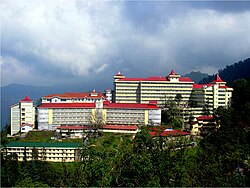
[[File:IGMC SHIMLA.jpg|thumb|[[Indira Gandhi Medical College and Hospital]], the largest Hospital of the state located in Snowdown, Shimla]] | |||
In addition to being the local hub of transport and trade, Shimla is the area's [[healthcare]] centre, hosting a medical college and four major hospitals:<ref>{{cite web| url=https://himachal.nic.in/index.php?lang=1&dpt_id=19 |title=Department of Health and Family Welfare, Himachal Pradesh |website=himachal.nic.in |access-date=6 May 2022}}</ref> [[Indira Gandhi Medical College|Indira Gandhi Hospital]] (Snowdown Hospital,) [[Deendayal Upadhyaya Hospital, Shimla|Deen Dayal Upadhyay Hospital]] (formerly called Ripon Hospital), Kamla Nehru Hospital and Indus Hospital. The city's development plan aims to make Shimla an attractive [[health tourism]] spot.<ref name="cdp"/> Major departmental headquarters of the state are also located in Shimla such as | In addition to being the local hub of transport and trade, Shimla is the area's [[healthcare]] centre, hosting a medical college and four major hospitals:<ref>{{cite web| url=https://himachal.nic.in/index.php?lang=1&dpt_id=19 |title=Department of Health and Family Welfare, Himachal Pradesh |website=himachal.nic.in |access-date=6 May 2022}}</ref> [[Indira Gandhi Medical College|Indira Gandhi Hospital]] (Snowdown Hospital,) [[Deendayal Upadhyaya Hospital, Shimla|Deen Dayal Upadhyay Hospital]] (formerly called Ripon Hospital), Kamla Nehru Hospital and Indus Hospital. The city's development plan aims to make Shimla an attractive [[health tourism]] spot.<ref name="cdp"/> Major departmental headquarters of the state are also located in Shimla such as Himachal Pradesh Government Printing and Stationery Press, [[Himachal Pradesh State Electricity Board]], and [[Himachal Pradesh Police|Himachal Pradesh Police Headquarters]]. | ||
[[File:Cecil Oberoi.jpg|thumb|[[The Cecil|The Oberoi Cecil]], a five-star and historic hotel located in Chaura Maidan, Shimla]] | |||
The hotel industry is one of the major sources of income generation for the city. Shimla has up to 6500 hotels, including 5-star hotels, most popular is [[The Cecil|Oberoi Cecil]], [[Peterhoff, Shimla|Peterhoff]], Wildflower Hall and Hotel Holiday Home. Shimla leads the list of Indian cities with the highest-ranked hotels.<ref>{{cite news |last1=PTI |title=Shimla tops list of highest ranked hotels in India: Study |url=https://economictimes.indiatimes.com/industry/services/hotels-/-restaurants/shimla-tops-list-of-highest-ranked-hotels-in-india-study/articleshow/20972087.cms |access-date=6 May 2022 |work=The Economic Times |date=8 July 2013}}</ref> | The hotel industry is one of the major sources of income generation for the city. Shimla has up to 6500 hotels, including 5-star hotels, most popular is [[The Cecil|Oberoi Cecil]], [[Peterhoff, Shimla|Peterhoff]], Wildflower Hall and Hotel Holiday Home. Shimla leads the list of Indian cities with the highest-ranked hotels.<ref>{{cite news |last1=PTI |title=Shimla tops list of highest ranked hotels in India: Study |url=https://economictimes.indiatimes.com/industry/services/hotels-/-restaurants/shimla-tops-list-of-highest-ranked-hotels-in-india-study/articleshow/20972087.cms |access-date=6 May 2022 |work=The Economic Times |date=8 July 2013}}</ref> | ||
[[File:Yarrows41.jpg|thumb|National Academy of Audits and Accounts, Yarrows]] | [[File:Yarrows41.jpg|thumb|National Academy of Audits and Accounts, Yarrows]] | ||
Along with schools of higher education, several institutes are also present, namely [[Himachal Pradesh University]] and [[Indian Institute of Advanced Study]]. Recruitment to the IAAS is through the joint competitive examinations (the [[Civil Services Examination]]) and promotion from the subordinate cadre. Once recruited to IAAS, the directly recruited officers are trained mainly at the National Academy of Audit and Accounts, Shimla.<ref>{{cite web |url=https://naaa.gov.in/en-IN/ |title=National Academy of Audit and Accounts, Shimla |website=naaa.gov.in |access-date=6 May 2022}}</ref> Students from across India prefer to study in Shimla because of its climate and Queen of Hill Stations status. These have added to the economy of the district as well as the state. | Along with schools of higher education, several institutes are also present, namely [[Himachal Pradesh University]] and [[Indian Institute of Advanced Study]]. Recruitment to the IAAS is through the joint competitive examinations (the [[Civil Services Examination]]) and promotion from the subordinate cadre. Once recruited to IAAS, the directly recruited officers are trained mainly at the National Academy of Audit and Accounts, Shimla.<ref>{{cite web |url=https://naaa.gov.in/en-IN/ |title=National Academy of Audit and Accounts, Shimla |website=naaa.gov.in |access-date=6 May 2022}}</ref> Students from across India prefer to study in Shimla because of its climate and Queen of Hill Stations status. These have added to the economy of the district as well as the state.{{Citation needed|date=August 2024}} | ||
The government is trying to promote the technology and IT sector as the new area for growth and promotion<ref>{{cite web|url=http://www.rediff.com/business/slide-show/slide-show-1-cities-that-will-shape-indias-future/20111012.htm |title=36 cities that will shape India's future – Rediff.com Business |work=Rediff.com |date=12 October 2011 |access-date=14 October 2012}}</ref> although not many companies have yet settled in Shimla. There are many new startups in and around Shimla. There are over six call centres in Shimla.{{citation needed|date=November 2021}} | The government is trying to promote the technology and IT sector as the new area for growth and promotion<ref>{{cite web|url=http://www.rediff.com/business/slide-show/slide-show-1-cities-that-will-shape-indias-future/20111012.htm |title=36 cities that will shape India's future – Rediff.com Business |work=Rediff.com |date=12 October 2011 |access-date=14 October 2012}}</ref> although not many companies have yet settled in Shimla. There are many new startups in and around Shimla. There are over six call centres in Shimla.{{citation needed|date=November 2021}} | ||
==Civic administration== | ==Civic administration== | ||
{{Main|Shimla Municipal Corporation}} | |||
[[File:Town Hall, Shimla.JPG|right|thumb|Town Hall as seen from [[The Ridge, Shimla|The Ridge]]]] | [[File:Town Hall, Shimla.JPG|right|thumb|Town Hall as seen from [[The Ridge, Shimla|The Ridge]]]] | ||
[[File:Rani Jhansi statue.jpg|right|thumb|upright|Statue of [[Rani Lakshmibai|Rani Laxmi Bai]].]] | [[File:Rani Jhansi statue.jpg|right|thumb|upright|Statue of [[Rani Lakshmibai|Rani Laxmi Bai]].]] | ||
The administrative responsibilities of the city of Shimla and merged areas of Dhalli, [[Totu, Shimla|Totu]], and New Shimla reside with the Shimla Municipal Corporation (SMC). All three areas were taken under SMC in 2006–07. Established in 1851, the [[Shimla Municipal Corporation]] is an elected body comprising 41 councillors, three of whom are nominated by the government of [[Himachal Pradesh]]. The nominations are based on prominence in the fields of social service, academics, and other activities. | The administrative responsibilities of the city of Shimla and merged areas of Dhalli, [[Totu, Shimla|Totu]], and New Shimla reside with the Shimla Municipal Corporation (SMC). All three areas were taken under SMC in 2006–07. Established in 1851, the [[Shimla Municipal Corporation]] is an elected body comprising 41 councillors, three of whom are nominated by the government of [[Himachal Pradesh]]. The nominations are based on prominence in the fields of social service, academics, and other activities. 33% of the seats are reserved for women. The elections take place every five years and the [[mayor]] and deputy mayor are elected by and among the councillors themselves. | ||
The administrative head of the corporation is the Commissioner who is appointed by the state government. | The administrative head of the corporation is the Commissioner who is appointed by the state government. | ||
| Line 381: | Line 408: | ||
The city contributes one seat to the state assembly ([[Vidhan Sabha]]) and one seat to the lower house of parliament ([[Lok Sabha]]).<ref>{{cite web | url=http://www.indian-elections.com/himachalpradesh/simla.html | title=Indian Elections | publisher=Indian-elections.com | access-date=11 May 2007 | archive-url=https://web.archive.org/web/20070430122511/http://www.indian-elections.com/himachalpradesh/simla.html | archive-date=30 April 2007 | url-status=dead | df=dmy-all }}</ref> Law and order in the city is collectively maintained by the Police Force, Vigilance Department, enforcement directorate, forensics, fire brigade, prisons service and Home Guard. There are five police stations and three fire stations in Shimla.<ref>{{cite web | url = http://himachal.nic.in/smlhelp.htm | title = Shimla Helpline | publisher = Himachal Pradesh Government | access-date = 12 May 2007 | archive-url = https://web.archive.org/web/20070505063117/http://himachal.nic.in/smlhelp.htm | archive-date = 5 May 2007 | url-status = dead | df = dmy-all }}</ref> The [[Superintendent (police)|Superintendent of Police]], Shimla heads the police force. The First Armed Police Battalion, one of the four armed police battalions in the state, is available for assistance to the local police.<ref>{{cite web|url = http://admis.hp.nic.in/himpol/ | title = Himachal Pradesh Police | access-date=12 May 2007}}</ref> | The city contributes one seat to the state assembly ([[Vidhan Sabha]]) and one seat to the lower house of parliament ([[Lok Sabha]]).<ref>{{cite web | url=http://www.indian-elections.com/himachalpradesh/simla.html | title=Indian Elections | publisher=Indian-elections.com | access-date=11 May 2007 | archive-url=https://web.archive.org/web/20070430122511/http://www.indian-elections.com/himachalpradesh/simla.html | archive-date=30 April 2007 | url-status=dead | df=dmy-all }}</ref> Law and order in the city is collectively maintained by the Police Force, Vigilance Department, enforcement directorate, forensics, fire brigade, prisons service and Home Guard. There are five police stations and three fire stations in Shimla.<ref>{{cite web | url = http://himachal.nic.in/smlhelp.htm | title = Shimla Helpline | publisher = Himachal Pradesh Government | access-date = 12 May 2007 | archive-url = https://web.archive.org/web/20070505063117/http://himachal.nic.in/smlhelp.htm | archive-date = 5 May 2007 | url-status = dead | df = dmy-all }}</ref> The [[Superintendent (police)|Superintendent of Police]], Shimla heads the police force. The First Armed Police Battalion, one of the four armed police battalions in the state, is available for assistance to the local police.<ref>{{cite web|url = http://admis.hp.nic.in/himpol/ | title = Himachal Pradesh Police | access-date=12 May 2007}}</ref> | ||
There are | There are 11 courts in the district including a fast-track court.<ref>{{cite web| url = http://hphighcourt.nic.in/welcome.html | title=High court of Himachal Pradesh | publisher=Himachal Pradesh Government | access-date=12 May 2007}}</ref> | ||
==Demographics== | ==Demographics== | ||
===Population=== | ===Population=== | ||
According to 2011 census, Shimla city spread over an area of 35.34 km<sup>2</sup> had a population of 169,578 with 93,152 males and 76,426 females.<ref name="SMLA"/><ref name="SML"/> Shimla urban agglomeration had a population of 171,817 as per provisional data of 2011 census, out of which males were 94,797 and females were 77,020.<ref name="SM"/> The effective literacy rate of city was 93.63 | According to 2011 census, Shimla city spread over an area of 35.34 km<sup>2</sup> had a population of 169,578 with 93,152 males and 76,426 females.<ref name="SMLA"/><ref name="SML"/> Shimla urban agglomeration had a population of 171,817 as per provisional data of 2011 census, out of which males were 94,797 and females were 77,020.<ref name="SM"/> The effective literacy rate of city was 93.63%<ref name="SML"/> and that of urban agglomeration was 94.14%.<ref name="SM">{{cite web| url = http://www.censusindia.gov.in/2011-prov-results/paper2/data_files/India2/Table_3_PR_UA_Citiees_1Lakh_and_Above.pdf | title = Urban Agglomerations/Cities having population 1 lakh and above |work= Provisional Population Totals, Census of India 2011 |access-date = 7 July 2012 }}</ref> | ||
The city area has | The city area has grown considerably over time. It has stretched from Hiranagar to Dhalli from one side & Tara Devi to Malyana in the other. As per the 2001 India Census,<ref>{{cite web|url=http://www.censusindia.net/results/town.php?stad=A&state5=999|archive-url=https://web.archive.org/web/20040616075334/http://www.censusindia.net/results/town.php?stad=A&state5=999|archive-date=16 June 2004|title= Census of India 2001: Data from the 2001 Census, including cities, villages and towns (Provisional)|access-date=1 November 2008|publisher= Census Commission of India}}</ref> the city has a population of 142,161 spread over an area of 19.55 km<sup>2</sup>.<ref name="mcshimla"/> A floating population of 75,000 is attributed to service industries such as tourism.<ref name="mcshimla"/> The largest demographic, 55%, is 16–45 years of age. A further 28% of the population is younger than 15 years. The low [[human sex ratio|sex ratio]] – 930 girls for every 1,000 boys in 2001<ref>Missing: Mapping the Adverse Child Sex Ratio in India, [[UNFPA]] 2003</ref> – is cause for concern, and much lower than the [[Himachal Pradesh#Demographics|974 versus 1,000]] for Himachal Pradesh state as a whole. | ||
The unemployment rate in the city has come down from 36% in 1992 to 22.6% in 2006. This drop is attributed to recent industrialisation, the growth of service industries, and | The unemployment rate in the city has come down from 36% in 1992 to 22.6% in 2006. This drop is attributed to recent industrialisation, the growth of service industries, and education.<ref>{{cite web| url=http://www.tribuneindia.com/2007/20070405/himachal.htm#1|title=CM turns down demand for unemployment dole | publisher= The Tribune, Chandigarh, India | access-date=5 April 2007}}</ref> | ||
===Language=== | ===Language=== | ||
[[Hindi]] is the ''[[lingua franca]]'' of the city, it is the principal spoken language of the city and also the most commonly used language for official purposes. English is also spoken by a sizeable population and is the second official language of the city. Other than Hindi, [[Himachali languages|Pahari languages]] are spoken by the ethnic Pahari people, who | [[File:Map of Mahasuic group of languages.jpg|thumb|[[George Abraham Grierson|G.A. Grierson's]] linguistic map of [[Mahasu (region)|Mahasu region]], as Shimla comes under it<ref>{{Cite book |last=Grierson |first=George Abraham |url=http://archive.org/details/in.ernet.dli.2015.32110 |title=Linguistic Survey Of India Vol.9 Part.4 |date=1916}}</ref>]] | ||
[[Hindi]] is the ''[[lingua franca]]'' of the city, it is the principal spoken language of the city and also the most commonly used language for official purposes. English is also spoken by a sizeable population and is the second official language of the city. Other than Hindi, the [[Mahasu Pahari]] subdialect Keonthali, the native language of the region is mainly spoken here as well as other [[Himachali languages|Pahari languages]] are also spoken by the ethnic Pahari people, who comprise the major part of the city's population. [[Punjabi language]] is prevalent among the [[Punjabi people|ethnic Punjabi]] migrant population of the city, most of whom are refugees from [[West Punjab]], who settled in the city after the [[Partition of India]] in 1947.{{Citation needed|date=August 2024}} | |||
===Religion=== | ===Religion=== | ||
| Line 402: | Line 430: | ||
{{Bar percent|[[Jainism]]|pink|0.10}} | {{Bar percent|[[Jainism]]|pink|0.10}} | ||
|barwidth=250px|float=right|right=Religion|right1=Percent|title=Religion in Shimla Town (2011)<ref name="Religion"/>|titlebar=#Fcd116|width=300px}} | |barwidth=250px|float=right|right=Religion|right1=Percent|title=Religion in Shimla Town (2011)<ref name="Religion"/>|titlebar=#Fcd116|width=300px}} | ||
[[File:Shimla 20211219 145646.jpg|thumb|[[Shri Hanuman Jakhu (statue)]] in [[Jakhu Temple]]]] | |||
[[File:Christ Church Shimla.jpg|thumb|upright|[[Christ Church, Shimla|Christ Church]] located on [[The Ridge, Shimla|The Ridge]], Shimla]] | |||
According to 2011 census, the majority religion of the city is [[Hinduism]] practised by 93.5% of the population, followed by [[Islam]] (2.29%), [[Sikhism]] (1.95%), [[Buddhism]] (1.33%), [[Christianity]] (0.62%), and [[Jainism]] (0.10%).<ref name="Religion">{{cite web |title=C-1 Population By Religious Community - HP |url=https://www.censusindia.gov.in/2011census/C-01/DDW02C-01%20MDDS.XLS |website=census.gov.in |access-date=19 August 2020}}</ref> | According to 2011 census, the majority religion of the city is [[Hinduism]] practised by 93.5% of the population, followed by [[Islam]] (2.29%), [[Sikhism]] (1.95%), [[Buddhism]] (1.33%), [[Christianity]] (0.62%), and [[Jainism]] (0.10%).<ref name="Religion">{{cite web |title=C-1 Population By Religious Community - HP |url=https://www.censusindia.gov.in/2011census/C-01/DDW02C-01%20MDDS.XLS |website=census.gov.in |access-date=19 August 2020}}</ref> | ||
==Culture== | ==Culture== | ||
The people of Shimla are informally called Shimlaites. With largely cosmopolitan crowds, a variety of festivals are celebrated here. The Shimla Summer Festival | The people of Shimla are informally called Shimlaites. With largely cosmopolitan crowds, a variety of festivals are celebrated here. The annual [[Shimla Summer Festival]] is held on the Ridge during peak tourist season.<ref>{{cite web| url=http://www.himachaltourism.nic.in/fairs.htm | title= Himachal Tourism, Adventure Tourism | publisher= Himachal Tourism Official website | access-date=3 May 2007 |archive-url = https://web.archive.org/web/20070416094644/http://www.himachaltourism.nic.in/fairs.htm <!-- Bot retrieved archive --> |archive-date = 16 April 2007}}</ref> The highlights of this event include performances by popular singers from all over the country. Since 2015, 95.0 BIG FM<ref>[https://www.facebook.com/BIGFMShimla/ 95.0 BIG FM]</ref> and Himachal Tourism have been jointly organising a week-long winter carnival on the Ridge from Christmas to New Year's.<ref>{{Cite news |url=https://timesofindia.indiatimes.com/city/shimla/Winter-carnival-to-add-to-Shimlas-tourism/articleshow/49957270.cms |title=Winter carnival to add to Shimla's tourism |date= 28 November 2015 |work=The Times of India |access-date=20 March 2017}}</ref><ref>{{Cite news|url=http://www.business-standard.com/article/news-ani/shimla-welcomes-tourists-with-fashion-show-during-winter-carnival-116122900112_1.html|title=Shimla welcomes tourists with fashion show during winter carnival|last=ANI|date=29 December 2016|work=Business Standard India|access-date=20 March 2017}}</ref><ref>{{cite web | url=http://www.tribuneindia.com/2004/20040604/himachal.htm#4 | title= Summer festival begins on melodious note | publisher = The Tribune, Chandigarh, India | access-date = 4 June 2004}}</ref> | ||
Shimla has several places to visit. Local hangouts like the Mall and the Ridge area in the heart of the city. Most of the heritage buildings in the city are preserved in their original '[[Tudorbethan]]' architecture. The former [[Rashtrapati Niwas|Viceregal Lodge]], which now houses the [[Indian Institute of Advanced Study]], and Wildflower Hall, now a luxury hotel, are some of the famous ones. A collection of paintings, jewellery, and textiles of the region can be found at the State Museum (built-in 1974). | Shimla has several places to visit. Local hangouts like the Mall and the Ridge area in the heart of the city. Most of the heritage buildings in the city are preserved in their original '[[Tudorbethan]]' architecture. The former [[Rashtrapati Niwas|Viceregal Lodge]], which now houses the [[Indian Institute of Advanced Study]], and Wildflower Hall, now a luxury hotel, are some of the famous ones. A collection of paintings, jewellery, and textiles of the region can be found at the State Museum (built-in 1974). [[Charleville Mansion, Shimla|Charleville Mansion]] built in late 19th century was a known haunted place in the city.<ref>{{Cite web |last=Satpathy |first=Kriti Saraswat |date=29 April 2016 |title=India's Most Haunted: Charleville Mansion in Shimla |url=https://www.india.com/travel/articles/indias-most-haunted-charleville-mansion-in-shimla-3234568/ |work=India.com |access-date=24 June 2025}}</ref> | ||
Lakkar Bazaar, a market extending off the Ridge, sells souvenirs and crafts made of wood. Tatta Pani, {{convert|55|km|mi|1}} from the main city, is the name of hot [[sulphur]] springs that are believed to have medicinal value located on the banks of the River [[Satluj]]. Shimla is also home to South Asia's only natural ice skating rink.<ref>{{cite web|url = http://www.tribuneindia.com/2001/20010211/himachal.htm#21 | title= Ice-skating rink completes 100 sessions again| publisher = The Tribune, Chandigarh, India | access-date=11 February 2001}}</ref> State and national level competitions are often held at this venue. Shimla Ice Skating Club, which manages the rink, hosts a carnival every year in January, which includes a fancy dress competition and figures skating events. Due to the effects of global warming and increasing urban development in and around Shimla, the number of sessions on the ice every winter has been decreasing in the past few years. | Lakkar Bazaar, a market extending off the Ridge, sells souvenirs and crafts made of wood. [[Tattapani (Himachal Pradesh)|Tatta Pani]], {{convert|55|km|mi|1}} from the main city, is the name of hot [[sulphur]] springs that are believed to have medicinal value located on the banks of the River [[Satluj]]. Shimla is also home to South Asia's only natural ice skating rink.<ref>{{cite web|url = http://www.tribuneindia.com/2001/20010211/himachal.htm#21 | title= Ice-skating rink completes 100 sessions again| publisher = The Tribune, Chandigarh, India | access-date=11 February 2001}}</ref> State and national level competitions are often held at this venue. Shimla Ice Skating Club, which manages the rink, hosts a carnival every year in January, which includes a fancy dress competition and figures skating events. Due to the effects of global warming and increasing urban development in and around Shimla, the number of sessions on the ice every winter has been decreasing in the past few years. | ||
[[File:Skating at Simla, one of the favourite winter recreations.jpg|thumb|Skating at Simla, c. 1905]] | [[File:Skating at Simla, one of the favourite winter recreations.jpg|thumb|Skating at Simla, c. 1905]] | ||
Shimla has many temples and is often visited by devotees from nearby towns and cities. The [[Kali Bari, Shimla|Kali Bari temple]], dedicated to the [[Hindu]] goddess [[Kali]] is near the mall. [[Jakhoo]] Temple, for the Hindu god [[Hanuman]], is located at the highest point in Shimla.<ref>{{cite book|author=Sukhdev Singh Charak|title=Himachal Pradesh|url=https://books.google.com/books?id=T5GpmoJ3BBIC&pg=PA7|year=1978|publisher=LIGHT & LIFE|isbn=978-81-7199-465-6|page=7}}</ref> [[Sankat Mochan Temple, Shimla|Sankat Mochan]], another [[Hanuman]] temple, is famous for the numerous monkeys that are always found in its vicinity. It is located on Shimla-Kalka Highway about {{convert|10|km|mi|1}} from the city. The nearby temple of [[Tara Devi Temple|Tara Devi]] is a place for performing rituals and festivals. Other prominent places of worship include a [[Gurudwara]] near | Shimla has many temples and is often visited by devotees from nearby towns and cities. The [[Kali Bari, Shimla|Kali Bari temple]], dedicated to the [[Hindu]] goddess [[Kali]] is near the mall. [[Jakhoo]] Temple, for the Hindu god [[Hanuman]], is located at the highest point in Shimla.<ref>{{cite book|author=Sukhdev Singh Charak|title=Himachal Pradesh|url=https://books.google.com/books?id=T5GpmoJ3BBIC&pg=PA7|year=1978|publisher=LIGHT & LIFE|isbn=978-81-7199-465-6|page=7}}</ref> [[Sankat Mochan Temple, Shimla|Sankat Mochan]], another [[Hanuman]] temple, is famous for the numerous monkeys that are always found in its vicinity. It is located on Shimla-Kalka Highway about {{convert|10|km|mi|1}} from the city. [[Dhingu Mata Temple]] is another popular temple of the city situated above Sajauli atop of Dhingu Dhar. Another popular temple in the city is [[Kamna Devi Temple]], situated atop of Prospect Hill, one of the [[Seven Hills of Shimla|seven hills of Shimla]]. The nearby temple of [[Tara Devi Temple|Tara Devi]] is a place for performing rituals and festivals. Other prominent places of worship include a [[Gurudwara]] near old bus terminus and [[Christ Church (Shimla)|Christ Church]] on the Ridge. | ||
[[File:A folk procession in Shimla.jpg|thumb|upright|A folk celebration in Shimla]] | [[File:A folk procession in Shimla.jpg|thumb|upright|A folk celebration in Shimla]] | ||
| Line 423: | Line 452: | ||
The shawls of Shimla are very well known for their fine quality. The leathercraft of Shimla comprises shoes, slippers, and belts. The other arts and crafts of Shimla include a huge collection of beaded and metal jewellery. | The shawls of Shimla are very well known for their fine quality. The leathercraft of Shimla comprises shoes, slippers, and belts. The other arts and crafts of Shimla include a huge collection of beaded and metal jewellery. | ||
The culture of Shimla throwbacks religious, agnostic | The culture of Shimla throwbacks religious, agnostic [[Mahasui]] people with a simple lifestyle living away from the hustle and bustle of metro cities. | ||
[[File:Annadale Ground Shimla side view.jpg|thumb|Annadale Ground, located in [[Annadale, Shimla|Annadale]] serves as major helipad as well as the golf course of the city]] | |||
Shimla has the largest natural ice skating rink in South Asia. The ice skating season usually begins at the start of December and goes on until the end of February. The city has sporting venues like the Indira Gandhi Rajya Khel Parisar, the main sports complex, a golf course at [[Annadale, Shimla|Annadale]] and further out from the city is another nine-hole golf course at Naldehra, the oldest of its kind in India.<ref>{{cite web |url=http://hptdc.nic.in/cir0103.htm |title=HP Tourism Development Corporation |access-date=2 May 2007 |archive-url=https://web.archive.org/web/20070509202107/http://hptdc.nic.in/cir0103.htm |archive-date=9 May 2007 |url-status=dead }}</ref> Kufri is a ski resort (winter only) located {{convert|19|km|mi|1}} from the main city. | Shimla has the largest natural ice skating rink in South Asia. The ice skating season usually begins at the start of December and goes on until the end of February. The city has sporting venues like the Indira Gandhi Rajya Khel Parisar, the main sports complex, a golf course at [[Annadale, Shimla|Annadale]] and further out from the city is another nine-hole golf course at Naldehra, the oldest of its kind in India.<ref>{{cite web |url=http://hptdc.nic.in/cir0103.htm |title=HP Tourism Development Corporation |access-date=2 May 2007 |archive-url=https://web.archive.org/web/20070509202107/http://hptdc.nic.in/cir0103.htm |archive-date=9 May 2007 |url-status=dead }}</ref> Kufri is a ski resort (winter only) located {{convert|19|km|mi|1}} from the main city. | ||
Shimla is also part of the wider [[Western Pahari]] cultural belt which extends until [[Murree]], Pakistan.<ref>{{cite web|url=http://amankiasha.com/dreaming-of-peace-dividends-revival-of-shimla-murree-linkages/|title=Dreaming of peace dividends: Revival of Shimla-Murree linkages - Aman Ki Asha |access-date=1 August 2020}}</ref><ref>{{cite web|url=http://thewire.in/culture/india-pakistan-peace-shimla-murree-corridor/|title=Dreaming of peace dividends: Revival of Shimla-Murree linkages - The Wire |access-date=1 August 2020}}</ref> | Shimla is also part of the wider [[Western Pahari]] cultural belt which extends until [[Murree]], Pakistan.<ref>{{cite web|url=http://amankiasha.com/dreaming-of-peace-dividends-revival-of-shimla-murree-linkages/|title=Dreaming of peace dividends: Revival of Shimla-Murree linkages - Aman Ki Asha |access-date=1 August 2020}}</ref><ref>{{cite web|url=http://thewire.in/culture/india-pakistan-peace-shimla-murree-corridor/|title=Dreaming of peace dividends: Revival of Shimla-Murree linkages - The Wire |access-date=1 August 2020}}</ref> | ||
| Line 432: | Line 461: | ||
[[File:Himachal Pradesh State Library - Ridge - Shimla 2014-05-07 0974.JPG|thumb|Public library on The Ridge]] | [[File:Himachal Pradesh State Library - Ridge - Shimla 2014-05-07 0974.JPG|thumb|Public library on The Ridge]] | ||
The city has 13 [[anganwadi]]s and 64 primary schools.<ref name="mcshimla"/> There are many schools from the British era. Some of the popular convent schools in the city are [[Bishop Cotton School (Shimla)|Bishop Cotton School]], Convent of Jesus and Mary (Chelsea), [[St. Edward's School, Shimla|St. Edward's School]], [[Auckland School Shimla|Auckland House School]], [[Loreto Convent, Tara Hall, Shimla|Loreto Convent (Tara Hall)]]. [[Bishop Cotton School (Shimla)|Bishop Cotton School]] and [[St. Edward's School, Shimla]] are for boys only, whereas, [[Loreto Convent, Tara Hall, Shimla|Loreto Convent, Tara Hall]] and Convent of Jesus and Mary, Chelsea is for girls only. Other public schools include | The city has 13 [[anganwadi]]s and 64 primary schools.<ref name="mcshimla"/> There are many schools from the British era. Some of the popular convent schools in the city are [[Bishop Cotton School (Shimla)|Bishop Cotton School]], [[Convent of Jesus and Mary, Chelsea, Shimla|Convent of Jesus and Mary (Chelsea)]], [[St. Edward's School, Shimla|St. Edward's School]], [[Auckland House School, Shimla|Auckland House School]], [[Loreto Convent, Tara Hall, Shimla|Loreto Convent (Tara Hall)]]. [[Bishop Cotton School (Shimla)|Bishop Cotton School]] and [[St. Edward's School, Shimla|St. Edward's School]] are for boys only, whereas, [[Loreto Convent, Tara Hall, Shimla|Loreto Convent, Tara Hall]] and [[Convent of Jesus and Mary, Chelsea, Shimla|Convent of Jesus and Mary, Chelsea]] is for girls only. Other public schools include [[Himalayan International School]] and [[S.D. Senior Secondary School, Shimla|S.D. Senior Sec Secondary School]]. | ||
[[File: | [[File:Sanjauli College Campus from above.jpg|thumb|Govt. College Sanjauli, a major college of the city]] | ||
The medical | The major medical institute in Shimla is [[Indira Gandhi Medical College]] and degree colleges include [[St. Bede's College, Shimla|St. Bede's College]], RKMV College are two girls colleges and co-educational colleges in the city include [[Government College, Sanjauli|Government College Sanjauli]]. The [[Indian Institute of Advanced Study]], housed in the [[Rashtrapati Niwas|Viceregal Lodge]], is a residential centre for research in Humanities, Indian culture, religion, and social and natural sciences. The [[Himachal Pradesh University]] (state university of Himachal Pradesh) is also located in Shimla. [[Himachal Pradesh University Business School]] (HPUBS) and [[University Institute of Information Technology, Himachal Pradesh University]] (UIIT), a premier technical education institute, [[Himachal Pradesh National Law University, Shimla]] are also located here. | ||
There is one private university, [[Alakh Prakash Goyal University|APG (Alakh Prakash Goyal) Shimla University]]. It was named the Best University in Hills by Assocham India.<ref>{{cite web|url=http://www.assocham.org/prels/shownews-archive.php?id=3966|title=APG University adjudged Best University in Hills|access-date=12 February 2015|archive-url=https://web.archive.org/web/20140811214848/http://www.assocham.org/prels/shownews-archive.php?id=3966|archive-date=11 August 2014|url-status=dead}}</ref><ref>{{cite web|url=http://hillpost.in/2013/04/apg-shimla-university-making-a-mark/73019/|title=APG Shimla University making a mark|author=Bharat|work=Hill Post|date=30 April 2013 |access-date=12 February 2015}}</ref> | There is one private university, [[Alakh Prakash Goyal University|APG (Alakh Prakash Goyal) Shimla University]]. It was named the Best University in Hills by Assocham India.<ref>{{cite web|url=http://www.assocham.org/prels/shownews-archive.php?id=3966|title=APG University adjudged Best University in Hills|access-date=12 February 2015|archive-url=https://web.archive.org/web/20140811214848/http://www.assocham.org/prels/shownews-archive.php?id=3966|archive-date=11 August 2014|url-status=dead}}</ref><ref>{{cite web|url=http://hillpost.in/2013/04/apg-shimla-university-making-a-mark/73019/|title=APG Shimla University making a mark|author=Bharat|work=Hill Post|date=30 April 2013 |access-date=12 February 2015}}</ref> | ||
Shimla has | Shimla has four state libraries with a collection of over 47,000 old books divided between them. The one at Gandhi Bhavan in the university has over 40,000 books and the other also a heritage building on the ridge has 7,000, another is Baba Bhimrao Ambedkar State Library located near Vidhan Sabha and another is in Evening College on Bantony Hill.<ref>{{cite web | url = http://www.tribuneindia.com/2001/20010202/himachal.htm#5 | title = A state library on its last legs | publisher = The Tribune, Chandigarh, India | access-date=2 February 2001}}</ref> | ||
Other institutes of higher education and research located in Shimla are the Central Potato Research Institute, a member of [[Indian Council of Agricultural Research]] (ICAR) and the National Academy of Audit and Accounts for the training of officers of the [[Indian Audits and Accounts Service]] (IA&AS). | Other institutes of higher education and research located in Shimla are the [[Central Potato Research Institute]], a member of [[Indian Council of Agricultural Research]] (ICAR) and the [[National Academy of Audit and Accounts]] for the training of officers of the [[Indian Audits and Accounts Service]] (IA&AS). | ||
Since 2022, [[Dhami State|Dhami]], near Shimla, hosts the [[Sonali Gupta#Himalayan Institute for Cultural and Heritage Studies|Himalayan Institute of Cultural and Heritage Studies]] (HICHS). HICHS is dedicated to promoting knowledge and research on diverse Himalayan subjects.<ref>{{Cite web |title=Himalayan Institute of Cultural and Heritage Studies |url=https://hichs.org/ |access-date=13 August 2023 |language=en-US}}</ref> | |||
==Places of interest== | ==Places of interest== | ||
{{Original research section|date=August 2024}} | |||
{{main|List of tourist attractions in Shimla}} | {{main|List of tourist attractions in Shimla}} | ||
*[[Mall Road, Shimla|The Mall]] is the main shopping street of Shimla. It has many restaurants, clubs, banks, bars, post offices, and tourist offices. The lower part of [[Gaiety Theatre, Shimla|Gaiety Theatre]] lies here. | *[[Mall Road, Shimla|The Mall]] is the main shopping street of Shimla. It has many restaurants, clubs, banks, bars, post offices, and tourist offices. The lower part of [[Gaiety Theatre, Shimla|Gaiety Theatre]] lies here. | ||
*[[The Ridge, Shimla|The Ridge]] is a large open space, which is situated alongside the Mall Road and hosts all the cultural activities in the city. [[Christ Church (Shimla)|Christ Church]] situated on the Ridge, is the second oldest church in [[Northern India]]. Inside there are stained glass windows that represent faith, hope, charity, fortitude, patience, and humility. There are State Library and [[Gaiety Theatre, Shimla|Gaiety Heritage Cultural Complex]] too which are some of the notable buildings located here. | *[[The Ridge, Shimla|The Ridge]] is a large open space, which is situated alongside the Mall Road and hosts all the cultural activities in the city. [[Christ Church (Shimla)|Christ Church]] situated on the Ridge, is the second oldest church in [[Northern India]]. Inside there are stained glass windows that represent faith, hope, charity, fortitude, patience, and humility. There are State Library and [[Gaiety Theatre, Shimla|Gaiety Heritage Cultural Complex]] too which are some of the notable buildings located here. | ||
*[[Jakhoo]] | *[[Jakhoo]] – Jakhoo temple is 2 km from The Ridge, at a summit elevation of {{convert|8000|ft|m|abbr=on|order=flip}}, Jakhoo Hill is the highest peak in the city and has views of the city and the snow-covered Himalayas. At the top of the hill is an old temple of [[Hanuman]], a [[Hindu deity]] which is popular among tourists and locals alike. A {{convert|33|m|ft|adj=on}} statue of Hanuman, at {{convert|8500|ft|m|order=flip}} above sea level, is the statue standing at the highest altitude among several other masterpieces in the world, overtaking the [[Christ Redeemer]] in [[Rio de Janeiro]], Brazil.<ref>{{cite news|url=http://www.indianexpress.com/news/tallest-highaltitude-statue-puts-shimla-in-the-spotlight/707360 |title=Tallest high-altitude statue puts Shimla in the spotlight |newspaper=Indian Express |date=5 November 2010 |access-date=14 October 2012}}</ref> Jakhoo has ropeway also which connects Jakhoo temple to the ridge ground and is the first ropeway in Shimla. | ||
*[[Kali Bari, Shimla|Kali Bari]] is a temple dedicated to Goddess Kali's fearless incarnation Shyamala on which Shimla city is named. The extensive views from the temple include such sights as [[Annadale, Shimla|Annadale]], [[Shimla railway station|Shima Railway Station]], Railway Board Building, Old Bus Stand, [[Army Training Command|ARTRAC]], TV Tower, etc. | *[[Kali Bari, Shimla|Kali Bari]] is a temple dedicated to Goddess Kali's fearless incarnation [[Matangi|Shyamala]] on which Shimla city is named. The extensive views from the temple include such sights as [[Annadale, Shimla|Annadale]], [[Shimla railway station|Shima Railway Station]], Railway Board Building, Old Bus Stand, [[Army Training Command|ARTRAC]], TV Tower, etc. | ||
*[[Annadale, Shimla|Annadale]] was developed as the [[racecourse]] of Shimla, Annadale is 2–4 km from the Ridge at | *[[Annadale, Shimla|Annadale]] was developed as the [[racecourse]] of Shimla, Annadale is 2–4 km from the Ridge at an elevation of {{convert|6,117|ft|m|order=flip|abbr=on}}.{{citation needed|date=May 2025}} It is now used by the Indian Army. It has the [[Army Heritage Museum, Shimla|Army Heritage Museum]] which is a notable tourist destination on its own, and also a golf course and a helipad are situated here. Every VVIP, VIP, or celebrity who visits Shimla comes by Annadale helipad. Annadale is one of the prime tourist sites of Shimla. The first [[Durand Cup|Durand Cup Football Tournament]] was organised here in 1888 by [[Mortimer Durand]].{{citation needed|date=May 2025}} | ||
*[[Indian Institute of Advanced Study|Indian Institute of Advanced Studies]] is an educational institute now. This institute is housed at the former [[Rashtrapati Niwas|Viceregal Lodge]], built-in 1884–88. | *[[Indian Institute of Advanced Study|Indian Institute of Advanced Studies]] is an educational institute now. This institute is housed at the former [[Rashtrapati Niwas|Viceregal Lodge]], built-in 1884–88. | ||
*Himachal Pradesh State Museum | *[[Himachal State Museum|Himachal Pradesh State Museum]] – Himachal Pradesh State Museum was opened in 1974, and has tried to protect the hill-out and the cultural wealth of the state. There is a collection of miniature Pahari paintings, sculptures, bronzes wood-carvings and also costumes, textiles, and jewellery of the region. | ||
*[[Summer Hill, Shimla|Summer Hill]] is at | *[[Summer Hill, Shimla|Summer Hill]] is at an elevation of {{convert|6,500|ft|m|order=flip|abbr=on}} on the Shimla-Kalka railway line. Mahatma Gandhi lived in these quiet surroundings during his visits to Shimla. [[Himachal Pradesh University]] is situated here. | ||
*[[Sankat Mochan Temple, Shimla|Sankat Mochan Temple]] is a Hindu temple dedicated to [[Hanuman]]. It is situated on the [[Shimla–Chandigarh Expressway|Shimla-Chandigarh highway]]. | *[[Sankat Mochan Temple, Shimla|Sankat Mochan Temple]] is a Hindu temple dedicated to [[Hanuman]]. It is situated on the [[Shimla–Chandigarh Expressway|Shimla-Chandigarh highway]]. | ||
*[[Tara Devi Temple]] | *[[Tara Devi Temple]] – Tara Devi Temple is 11 km from the Shimla bus-stand. Tara Devi hill has a temple dedicated to the goddess of stars on top of the hill. There is a military Dairy Town here as well as the headquarters of Bharat Scouts and Guides. | ||
*[[Sanjauli]] is the main suburb of Shimla. | *[[Sanjauli]] is the main suburb of Shimla. | ||
*Dhingu Mata Temple is situated atop a hill in Sanjauli. It is the second-highest hilltop temple in Shimla after Jakhoo temple. | *[[Dhingu Mata Temple]] is situated atop a hill in Sanjauli. It is the second-highest hilltop temple in Shimla after Jakhoo temple.{{citation needed|date=May 2025}} | ||
*Kamna Devi Temple is situated on top of Prospect Hill in Baileuganj. | *Kamna Devi Temple is situated on top of Prospect Hill in Baileuganj. | ||
* | *Chadwick Falls | ||
*[[Kufri, India|Kufri]] is situated near Shimla. Kufri sees the annual sports winter festival in February. Adventure activities like skiing and tobogganing. | *[[Kufri, India|Kufri]] is situated near Shimla. Kufri sees the annual sports winter festival in February. Adventure activities like skiing and tobogganing. | ||
* | * Himalayan Nature Park is situated just outside the city. | ||
*[[Chharabra]] is near Kufri. It is famous for its natural beauty and Kalyani helipad. | *[[Chharabra]] is near Kufri. It is famous for its natural beauty and Kalyani helipad. | ||
*[[Mashobra]] is near Shimla. | *[[Mashobra]] is near Shimla. Craignano Park here is a popular spot. | ||
*[[Jutogh]] is located 8 km from Shimla city centre, this is an army cantonment, it is near [[Totu, Shimla|Totu]], an important suburb of Shimla city. | *[[Jutogh]] is located 8 km from Shimla city centre, this is an army cantonment, it is near [[Totu, Shimla|Totu]], an important suburb of Shimla city.{{citation needed|date=May 2025}} | ||
==Transport== | ==Transport== | ||
[[File:ISBT Shimla.jpg|thumb|Inter State Bus Terminal at [[Tutikandi]], Shimla]] | [[File:ISBT Shimla.jpg|thumb|Inter State Bus Terminal at [[Tutikandi]], Shimla]] | ||
Local transport in Shimla is by bus or private vehicles. Buses ply frequently on the circular road surrounding the city centre. Like any other growing city, Shimla is also expanding with new habitats in the vicinity. Transport services in these areas are also expanding rapidly. Tourist taxis are also an option for out of town trips. Locals typically traverse the city on foot. Private vehicles are prohibited at the Mall, Ridge, and nearby markets. Due to narrow roads and steep slopes, the [[auto rickshaw]]s which are common in other Indian cities are largely absent. | Local transport in Shimla is by bus or private vehicles. Buses ply frequently on the circular road surrounding the city centre. Like any other growing city, Shimla is also expanding with new habitats in the vicinity. Transport services in these areas are also expanding rapidly. Tourist taxis are also an option for out of town trips. Locals typically traverse the city on foot. Private vehicles are prohibited at the Mall, Ridge, and nearby markets. Due to narrow roads and steep slopes, the [[auto rickshaw]]s which are common in other Indian cities are largely absent.{{Citation needed|date=August 2024}} | ||
===Road=== | ===Road=== | ||
{{Unreferenced section|date=August 2024}} | |||
Shimla is well-connected by road network to all major cities in north India and all major towns and district headquarters within the state. [[National Highway 5 (India)|National Highway 5]] connects Shimla to the nearest big city of [[Chandigarh]]. This road is being widened by four-laning as part of the [[Shimla-Chandigarh Expressway]] project, and has been completed until [[Solan]] as of July 2021. | Shimla is well-connected by road network to all major cities in north India and all major towns and district headquarters within the state. [[National Highway 5 (India)|National Highway 5]] connects Shimla to the nearest big city of [[Chandigarh]]. This road is being widened by four-laning as part of the [[Shimla-Chandigarh Expressway]] project, and has been completed until [[Solan]] as of July 2021. | ||
[[File:NH22 Shimla Chandigarh Mountain Highway through Forests, Roads in Himachal Pradesh India 2014.jpg|thumb|[[National Highway 5 (India)|National Highway 5]] connects Shimla to the city of [[Chandigarh]].]] | [[File:NH22 Shimla Chandigarh Mountain Highway through Forests, Roads in Himachal Pradesh India 2014.jpg|thumb|[[National Highway 5 (India)|National Highway 5]] connects Shimla to the city of [[Chandigarh]].]] | ||
===Air=== | ===Air=== | ||
| Line 502: | Line 512: | ||
===Rail=== | ===Rail=== | ||
{{Main|Kalka–Shimla Railway}} | |||
[[File:Shimla Railway Station.JPG|thumb|right|Shimla railway station]] | [[File:Shimla Railway Station.JPG|thumb|right|Shimla railway station]] | ||
| Line 507: | Line 518: | ||
The scenic [[Kalka Shimla Railway]], a [[narrow gauge railway|narrow gauge track]], is listed in the ''[[Guinness Book of Records]]'' for the steepest rise in altitude in a distance of 96 km.<ref>{{cite news |last=Khanna |first=Ruchika M |date=8 November 2003 |url=https://www.tribuneindia.com/2003/20031108/windows/main1.htm |title=100 years of pine-scented travel |newspaper=The Tribune |access-date= 8 November 2003}}</ref> [[Kalka]], the [[Indo-Gangetic plain|plains]] rail terminus, has daily departures to major Indian cities. The city has a total of three railway stations with Shimla the main station and two others located at Summer Hill and Totu (Jutogh) respectively. It was built to connect [[Shimla railway station|Shimla]], the summer capital of India during the [[British Raj]], with the Indian rail system. | The scenic [[Kalka Shimla Railway]], a [[narrow gauge railway|narrow gauge track]], is listed in the ''[[Guinness Book of Records]]'' for the steepest rise in altitude in a distance of 96 km.<ref>{{cite news |last=Khanna |first=Ruchika M |date=8 November 2003 |url=https://www.tribuneindia.com/2003/20031108/windows/main1.htm |title=100 years of pine-scented travel |newspaper=The Tribune |access-date= 8 November 2003}}</ref> [[Kalka]], the [[Indo-Gangetic plain|plains]] rail terminus, has daily departures to major Indian cities. The city has a total of three railway stations with Shimla the main station and two others located at Summer Hill and Totu (Jutogh) respectively. It was built to connect [[Shimla railway station|Shimla]], the summer capital of India during the [[British Raj]], with the Indian rail system. | ||
In 2007, the government of [[Himachal Pradesh]] declared the railway a heritage property. For about a week starting on 11 September 2007, an expert team from [[UNESCO]] visited the railway to review and inspect it for possible selection as a [[World Heritage Site]]. On 8 July 2008, the Kalka–Shimla Railway was listed as a World Heritage Site,<ref>{{cite news | work=The Hindu Business Line | url=http://www.thehindubusinessline.com/2008/07/09/stories/2008070951530700.htm | title=Kalka–Shimla Railway makes it to Unesco's World Heritage list | date=9 July 2008 | access-date=10 July 2008 | url-status=dead | archive-url=https://web.archive.org/web/20090625175612/http://www.thehindubusinessline.com/2008/07/09/stories/2008070951530700.htm | archive-date=25 June 2009 | df=dmy-all }}</ref> alongside [[Darjeeling Himalayan Railway]], [[Nilgiri Mountain Railway]], and [[Chhatrapati Shivaji Terminus]].<ref>{{cite web|url=https://gyanpotli.info/%e0%a4%ad%e0%a4%be%e0%a4%b0%e0%a4%a4-%e0%a4%95%e0%a5%87-%e0%a4%aa%e0%a4%b0%e0%a5%8d%e0%a4%b5%e0%a4%a4%e0%a5%80%e0%a4%af-%e0%a4%a8%e0%a4%97%e0%a4%b0-%e0%a4%94%e0%a4%b0-%e0%a4%89%e0%a4%a8%e0%a4%95/|archive-url=https://web.archive.org/web/20181125162904/https://gyanpotli.info/%e0%a4%ad%e0%a4%be%e0%a4%b0%e0%a4%a4-%e0%a4%95%e0%a5%87-%e0%a4%aa%e0%a4%b0%e0%a5%8d%e0%a4%b5%e0%a4%a4%e0%a5%80%e0%a4%af-%e0%a4%a8%e0%a4%97%e0%a4%b0-%e0%a4%94%e0%a4%b0-%e0%a4%89%e0%a4%a8%e0%a4%95/|url-status=dead|archive-date=25 November 2018|title=Hill towns of India and their height | In 2007, the government of [[Himachal Pradesh]] declared the railway a heritage property.<ref>{{cite news| url=http://www.andazresorts.com/thehindu/holnus/004200708130322.htm| title=HP declares Kalka–Shimla Railway as 'heritage' property| date=13 August 2007| newspaper=The Hindu| access-date=13 August 2007}}{{Dead link|date=January 2019 |bot=InternetArchiveBot |fix-attempted=yes }}</ref> For about a week starting on 11 September 2007, an expert team from [[UNESCO]] visited the railway to review and inspect it for possible selection as a [[World Heritage Site]]. On 8 July 2008, the Kalka–Shimla Railway was listed as a World Heritage Site,<ref>{{cite news | work=The Hindu Business Line | url=http://www.thehindubusinessline.com/2008/07/09/stories/2008070951530700.htm | title=Kalka–Shimla Railway makes it to Unesco's World Heritage list | date=9 July 2008 | access-date=10 July 2008 | url-status=dead | archive-url=https://web.archive.org/web/20090625175612/http://www.thehindubusinessline.com/2008/07/09/stories/2008070951530700.htm | archive-date=25 June 2009 | df=dmy-all }}</ref> alongside [[Darjeeling Himalayan Railway]], [[Nilgiri Mountain Railway]], and [[Chhatrapati Shivaji Terminus]].<ref>{{cite web|url=https://gyanpotli.info/%e0%a4%ad%e0%a4%be%e0%a4%b0%e0%a4%a4-%e0%a4%95%e0%a5%87-%e0%a4%aa%e0%a4%b0%e0%a5%8d%e0%a4%b5%e0%a4%a4%e0%a5%80%e0%a4%af-%e0%a4%a8%e0%a4%97%e0%a4%b0-%e0%a4%94%e0%a4%b0-%e0%a4%89%e0%a4%a8%e0%a4%95/|archive-url=https://web.archive.org/web/20181125162904/https://gyanpotli.info/%e0%a4%ad%e0%a4%be%e0%a4%b0%e0%a4%a4-%e0%a4%95%e0%a5%87-%e0%a4%aa%e0%a4%b0%e0%a5%8d%e0%a4%b5%e0%a4%a4%e0%a5%80%e0%a4%af-%e0%a4%a8%e0%a4%97%e0%a4%b0-%e0%a4%94%e0%a4%b0-%e0%a4%89%e0%a4%a8%e0%a4%95/|url-status=dead|archive-date=25 November 2018|title=Hill towns of India and their height | ||
|publisher=Admin|access-date=25 November 2018}}</ref> | |publisher=Admin|access-date=25 November 2018}}</ref> | ||
| Line 513: | Line 524: | ||
State-owned [[All India Radio]] and [[Reliance Broadcast Network|Reliance Broadcast]] owned [[BIG FM 92.7|95.0 BIG FM]] have local radio stations in Shimla, which transmit various programmes of mass interest. Apart from a wide range of other national and international TV channels of different languages, the national TV broadcaster [[Doordarshan]] also broadcast channels like DD Shimla, DD National and DD Sports in the city. There are several private FM radio channels like 95.0 BIG FM and Radio Mirchi. | State-owned [[All India Radio]] and [[Reliance Broadcast Network|Reliance Broadcast]] owned [[BIG FM 92.7|95.0 BIG FM]] have local radio stations in Shimla, which transmit various programmes of mass interest. Apart from a wide range of other national and international TV channels of different languages, the national TV broadcaster [[Doordarshan]] also broadcast channels like DD Shimla, DD National and DD Sports in the city. There are several private FM radio channels like 95.0 BIG FM and Radio Mirchi. | ||
''[[Amar Ujala]]'',<ref name="NSP">{{cite news|title=Hindi Newspapers|url=http://www.amarujala.com/shimla|newspaper=[[Amar Ujala]]|access-date=15 June 2016}}</ref> ''[[Punjab Kesari]]'', and ''[[Dainik Bhaskar]]'' are the widely circulated Hindi dailies while ''[[The Tribune (Chandigarh)|The Tribune]]'', ''[[The Times of India]]'', ''[[Hindustan Times]]'' and ''[[Indian Express]]'' are popular English newspapers in the city | ''[[Amar Ujala]]'',<ref name="NSP">{{cite news|title=Hindi Newspapers|url=http://www.amarujala.com/shimla|newspaper=[[Amar Ujala]]|access-date=15 June 2016}}</ref> ''[[Punjab Kesari]]'', and ''[[Dainik Bhaskar]]'' are the widely circulated Hindi dailies while ''[[The Tribune (Chandigarh)|The Tribune]]'', ''[[The Times of India]]'', ''[[Hindustan Times]]'' and ''[[Indian Express]]'' are popular English newspapers in the city. | ||
==Notable people== | == Notable people ==<!---♦♦♦♦Do not add anyone to this list unless they have their own Wikipedia article♦♦♦♦--> | ||
<!---♦♦♦♦Do not add anyone to this list unless they have their own | <!---♦♦♦ Please keep the list in alphabetical order by LAST NAME ♦♦♦---> | ||
<!---♦♦♦ Please keep the list in alphabetical order by LAST NAME ♦♦♦---> | |||
{{Div col|colwidth=30em}} | {{Div col|colwidth=30em}} | ||
* [[Javeed Alam]], scholar, author, political activist | |||
* [[M. S. Banga]], businessman, former CEO, fund manager | * [[M. S. Banga]], businessman, former CEO, fund manager | ||
* [[Raaja Bhasin]], writer, historian, television personality | |||
* [[Kamayani Bisht]], educator, poet, actress | |||
* [[Lady Constance Bulwer-Lytton]], writer and activist | * [[Lady Constance Bulwer-Lytton]], writer and activist | ||
* [[Victor Bulwer-Lytton, 2nd Earl of Lytton|Victor Bulwer-Lytton]], politician | * [[Victor Bulwer-Lytton, 2nd Earl of Lytton|Victor Bulwer-Lytton]], politician | ||
* [[Shahid Javed Burki]], Pakistani economist, born during British rule | * [[Shahid Javed Burki]], Pakistani economist, born during British rule | ||
* [[Charlie Chauhan]], | * [[Charlie Chauhan]], Indian actress | ||
* [[Rubina Dilaik]], television actress | * [[Rubina Dilaik]], television actress | ||
* [[Guy Gibson]], [[WWII]] [[RAF]] aviator, [[Victoria Cross|VC]] | * [[Guy Gibson]], [[WWII]] [[RAF]] aviator, [[Victoria Cross|VC]] | ||
| Line 529: | Line 542: | ||
* [[Samuel Boileau Goad]], a principal property owner in Shimla | * [[Samuel Boileau Goad]], a principal property owner in Shimla | ||
* [[O.C. Handa]], historian | * [[O.C. Handa]], historian | ||
* [[S.R. Harnot]], writer | * [[S.R. Harnot]], writer | ||
* [[John Hunt, Baron Hunt|John Hunt]], British army officer and mountaineer | * [[John Hunt, Baron Hunt|John Hunt]], British army officer and mountaineer | ||
* [[Robin Jackman]], former England cricket player | * [[Robin Jackman]], former England cricket player | ||
* [[Celina Jaitly]], Bollywood actress | * [[Celina Jaitly]], Bollywood actress | ||
* [[Ursula Jeans]], British actress and wife of British actor [[Roger Livesey]] | * [[Ursula Jeans]], British actress and wife of British actor [[Roger Livesey]] | ||
* [[Shriniwas Joshi ( | * [[Shriniwas Joshi]], columnist, theatre person, ex-civil servant | ||
* [[Balak Ram Kashyap]], Former [[Member of Parliament|MP]] and [[Member of the Legislative Assembly (India)|MLA]] of [[Shimla Lok Sabha constituency]] and [[Kasumpti Assembly constituency]] respectively | |||
* [[Preneet Kaur]], Indian aristocrat of [[Patiala]] and [[Kashmir]] dynasties, former Minister for External Affairs | * [[Preneet Kaur]], Indian aristocrat of [[Patiala]] and [[Kashmir]] dynasties, former Minister for External Affairs | ||
* [[M. M. Kaye]], novelist | * [[M. M. Kaye]], novelist | ||
* [[Rahat Kazmi]], Pakistani television actor | * [[Rahat Kazmi]], Pakistani television actor | ||
* [[Anupam Kher]], Bollywood actor | * [[Anupam Kher]], Bollywood actor | ||
* [[Rudyard Kipling]], English author | |||
* [[Earl Kitchener]], British viceroy | * [[Earl Kitchener]], British viceroy | ||
* [[Ram Kumar (artist)|Ram Kumar]], painter | * [[Ram Kumar (artist)|Ram Kumar]], painter | ||
| Line 550: | Line 565: | ||
* [[Ashish R Mohan]], film director | * [[Ashish R Mohan]], film director | ||
* [[Raja Dina Nath]], Sikh Khalsa Diwan member | * [[Raja Dina Nath]], Sikh Khalsa Diwan member | ||
* [[Siddharth Pandey]], writer, historian, photographer | |||
* [[Meghna Pant]], author and feminist | * [[Meghna Pant]], author and feminist | ||
* [[Aalisha Panwar]], Indian actress | |||
* [[Mohinder Singh Pujji]], WWII RAF and [[RIAF]] pilot, [[Distinguished Flying Cross (United Kingdom)|DFC]] | * [[Mohinder Singh Pujji]], WWII RAF and [[RIAF]] pilot, [[Distinguished Flying Cross (United Kingdom)|DFC]] | ||
* [[Asghar Qadir]], Pakistani cosmologist | * [[Asghar Qadir]], Pakistani cosmologist | ||
| Line 557: | Line 574: | ||
* [[Motilal (actor)|Motilal Rajvansh]], Bollywood actor | * [[Motilal (actor)|Motilal Rajvansh]], Bollywood actor | ||
* [[Priya Rajvansh]], actress | * [[Priya Rajvansh]], actress | ||
* [[Kalpana Kartik]], actress | |||
* [[Sheila Ramani]], Miss Shimla | * [[Sheila Ramani]], Miss Shimla | ||
* [[Hanif Ramay]], former [[Chief Minister of Punjab (Pakistan)|Chief Minister of Punjab]] | * [[Hanif Ramay]], former [[Chief Minister of Punjab (Pakistan)|Chief Minister of Punjab]] | ||
* [[Shafqat Rana]], Pakistani test cricketer | * [[Shafqat Rana]], Pakistani test cricketer | ||
* [[Pratibha Ranta]], Indian actress | |||
* [[Bruce Seton]], British soldier and actor | * [[Bruce Seton]], British soldier and actor | ||
* [[Idries Shah]], writer on [[Sufism]] | * [[Idries Shah]], writer on [[Sufism]] | ||
* [[Anand Sharma]], Former Union Minister and MP, Rajya Sabha | * [[Anand Sharma]], Former Union Minister and MP, Rajya Sabha | ||
* [[Shreya Sharma]], Indian actress | |||
* [[Anwar Shemza]], Kashmiri writer and radio broadcaster | * [[Anwar Shemza]], Kashmiri writer and radio broadcaster | ||
* [[Chetan Singh]], historian | * [[Chetan Singh]], historian | ||
* [[Mian Goverdhan Singh]], writer and librarian | * [[Mian Goverdhan Singh]], writer and librarian | ||
* [[Pratibha Singh]], politician | * [[Pratibha Singh]], politician | ||
* [[Renuka Singh (cricketer)|Renuka Singh]], Indian cricketer | |||
* [[Shakti Singh (actor)|Shakti Singh]], Bollywood actor | * [[Shakti Singh (actor)|Shakti Singh]], Bollywood actor | ||
* [[Asmita Sood]], television actress | * [[Asmita Sood]], television actress | ||
| Line 575: | Line 596: | ||
* [[Preity Zinta]], Bollywood actress | * [[Preity Zinta]], Bollywood actress | ||
{{div col end}} | {{div col end}} | ||
<!---♦♦♦♦Do not add anyone to this list unless they have their own | <!---♦♦♦♦Do not add anyone to this list unless they have their own Wikipedia article♦♦♦♦--> | ||
<!---♦♦♦ Please keep the list in alphabetical order by LAST NAME ♦♦♦---> | <!---♦♦♦ Please keep the list in alphabetical order by LAST NAME ♦♦♦---> | ||
==Sister cities== | ==Sister cities== | ||
[[Town twinning|Sister relationships]] with towns and regions worldwide include: | [[Town twinning|Sister relationships]] with towns and regions worldwide include: | ||
*{{Flagicon|USA}} [[Carbondale, | *{{Flagicon|USA}} [[Carbondale, Illinois]], United States<ref>[http://www.ci.carbondale.il.us/node/125 City of Carbondale] {{Webarchive|url=https://web.archive.org/web/20120825071208/http://ci.carbondale.il.us/node/125 |date=25 August 2012 }} – Sister Cities</ref><ref>[http://www.sister-cities.org/directory/index.cfm Sister-Cities.org] {{webarchive|url=https://web.archive.org/web/20070629184627/http://www.sister-cities.org/ |date=29 June 2007 }} – International Directory</ref> | ||
== | == Notes == | ||
{{Notelist}} | |||
==References== | ==References== | ||
{{Reflist}} | {{Reflist}} | ||
{{Commons category|Shimla}} | |||
{{Wikiquote}} | |||
==External links== | ==External links== | ||
<!--only links allowed under | <!--only links allowed under Wikipedia's external link policy are permitted in this list--> | ||
* [http://hpshimla.gov.in/ Official website of Shimla district] | * [http://hpshimla.gov.in/ Official website of Shimla district] | ||
* [http://www.himachal.org.in/shimla.html Shimla – Himachal Pradesh Tourism Guide] | * [http://www.himachal.org.in/shimla.html Shimla – Himachal Pradesh Tourism Guide] {{Webarchive|url=https://web.archive.org/web/20190126000757/http://www.himachal.org.in/shimla.html |date=26 January 2019 }} | ||
* [http://himachaltourism.gov.in Official website of Himachal Tourism] | * [http://himachaltourism.gov.in Official website of Himachal Tourism] | ||
* [http://shimlamc.gov.in/page/Home.aspx Municipal Corporation Shimla] | * [http://shimlamc.gov.in/page/Home.aspx Municipal Corporation Shimla] | ||
* | * {{Wikivoyage inline}} | ||
<!--start of Navigation boxes--> | <!--start of Navigation boxes--> | ||
| Line 606: | Line 626: | ||
[[Category:Shimla| ]] | [[Category:Shimla| ]] | ||
[[Category:Cities and towns in Shimla district]] | [[Category:Cities and towns in Shimla district]] | ||
[[Category:Former | [[Category:Former capitals in India]] | ||
[[Category:1819 establishments in India]] | [[Category:1819 establishments in India]] | ||
[[Category:Populated places established in 1819]] | [[Category:Populated places established in 1819]] | ||
[[Category:Tourism in Himachal Pradesh]] | |||
[[Category:Hill stations in Himachal Pradesh]] | |||
[[Category:Smart cities in India]] | |||
Latest revision as of 14:37, 22 March 2026
Shimla
Śimlā Simla | |
|---|---|
Shimla's panoramic view Shimla hills during monsoon | |
Nicknames:
| |
  Shimla  Shimla  Shimla | |
| Coordinates: 31°6′12″N 77°10′20″E / 31.10333°N 77.17222°E | |
| Country |  India India |
| State |  Himachal Pradesh Himachal Pradesh |
| District | Shimla |
| Named for | Goddess Shyamala[1] |
| Government | |
| • Type | Municipal Corporation |
| • Body | Shimla Municipal Corporation |
| • Deputy Commissioner | Anupam Kashyap, IAS[2] |
| • Municipal Commissioner | Bhupender Kumar Attri[3] |
| • Mayor | Surender Chauhan[4] |
| Area | |
| • State capital | 35.34 km2 (13.64 sq mi) |
| Elevation | 2,276 m (7,467 ft) |
| Population | |
| • State capital | 169,578 |
| • Rank | 1 (in HP) |
| • Density | 4,800/km2 (12,000/sq mi) |
| • Metro | 171,640 |
| Languages | |
| • Official | Hindi[8] |
| • Additional Official | Sanskrit[9] |
| • Regional | Mahasui (Keonthali)[10] |
| Time zone | UTC+5:30 (IST) |
| PIN | 171 001 |
| Telephone code | 91 177 XXX XXXX |
| ISO 3166 code | ISO 3166-2 |
| Vehicle registration | HP-01, HP-02, HP-03, HP-07, HP-62, HP-63 |
| UN/LOCODE | IN SLV |
| Climate | Cwb |
| Precipitation | 1,577 mm (62 in) |
| Avg. annual temperature | 17 °C (63 °F) |
| Avg. summer temperature | 22 °C (72 °F) |
| Avg. winter temperature | 6–7 °C (43–45 °F) |
| Website | hpshimla |


Shimla,[lower-alpha 1] also known as Simla (the official name until 1972),[11] (Hindi: [ʃɪmla]  [[:Media:Shimla.ogg|]] (help·info)) is the summer capital and the largest city of the northern Indian state of Himachal Pradesh. In 1864, Shimla was declared the summer capital of British India. After independence, the city became the capital of East Punjab and was later made the capital city of Himachal Pradesh. It is the principal commercial, cultural and educational centre of the state.
Small hamlets were recorded before 1815 when British forces took control of the area. The climatic conditions attracted the British to establish the city in the dense forests of the Himalayas. As the summer capital, Shimla hosted many important political meetings including the Simla Deputation of 1906, the Simla Accord of 1914 and the Simla Conference of 1945. After independence, the state of Himachal Pradesh came into being in 1948 as a result of the integration of 28 princely states. Even after independence, the city remained an important political centre, hosting the Simla Agreement of 1972. After the reorganisation of the state of Himachal Pradesh, the existing Mahasu district was named Shimla.

Shimla is home to several buildings that are styled in the Tudorbethan and neo-Gothic architectures dating from the colonial era, as well as multiple temples and churches. The colonial architecture and churches, the temples, and the natural environment of the city attract tourists. Major city centre's attractions include the Shri Hanuman Jakhu (Statue), Jakhu Temple, Viceregal Lodge, Christ Church, Mall Road, The Ridge and Annadale. The city centre's northernmost point is Jakhoo and the southernmost location is Annadale, the easternmost point is Sanjauli and the western point is Chotta Shimla. The Kalka–Shimla Railway line built by the British, a UNESCO World Heritage Site, is also a major tourist attraction. Owing to its steep terrain, Shimla hosts the mountain biking race MTB Himalaya, which started in 2005 and is regarded as the biggest event of its kind in South Asia. Shimla also has the largest natural ice skating rink in South Asia. Apart from being a tourism centre, the city is also an educational hub with several colleges and research institutions.
Etymology[edit | edit source]

One theory suggests that the name "Shimla" was derived from Shyamalaya, meaning 'blue house', a solitary house made of blue slate on Jakhu Hill, built by a fakir.[12]
According to another version, the city gets its name from Shamli or Shyamala, meaning 'blue lady', referring to the Hindu goddess Kali. It is believed that a temple dedicated to goddess Shamli, an incarnation of Kali, used to be on the Jakhu hillside near the Rothney Castle.[12][13] Many believe that during the British period, the image of the goddess was shifted to a new place, the now-famous Kali Bari Temple.[14]
In 2018, the state government decided to change the city's name from Shimla to Shyamala.[15] However, seeing the negative response of the general public, the state government dismissed the plan.[16]
History[edit | edit source]
Early modern history[edit | edit source]
Most of the area occupied by present-day Shimla city was dense forest during the 18th century. The only sign of civilisation was the Jakhu Temple and various other temples, a few scattered houses, and nearby villages which has now turned out as posh and major neighbourhoods of the city.[17] The area was called 'Shimla', named after Hindu goddess Shyamala Devi, an incarnation of Kali.[1]
Anglo Gorkha Wars[edit | edit source]

The area of present-day Shimla was invaded and captured by Bhimsen Thapa of Nepal in 1806. The British East India Company took control of the territory as per the Sugauli Treaty after the Anglo-Nepalese War (1814–16). The Gurkha leaders were quelled by storming the fort of Malaun under the command of David Ochterlony in May 1815.
Early British settlements in Simla[edit | edit source]
In a diary entry dated 30 August 1817, the Gerard brothers, who surveyed the area, describe Shimla as "a middling-sized village where a fakir is situated to give water to the travellers". In 1819, Lieutenant Ross, the Assistant Political Agent in the Hill States, set up a wood cottage in Shimla. Three years later, his successor and the Scottish civil servant Charles Pratt Kennedy built the first pucca house in the area named Kennedy Cottage in 1822, near Annadale, what is now the home for CPWD office. The accounts of the Britain-like climate started attracting several British officers to the area during the hot Indian summers. By 1826, some officers had started spending their entire vacation in Shimla. In 1827, William Amherst, the Governor-General of Bengal, visited Shimla and stayed in the Kennedy House. A year later, Stapleton Cotton, the Commander-in-Chief of the British forces in India, stayed at the same residence. During his stay, a Lua error in Module:Convert at line 402: attempt to call upvalue 'speller' (a string value). road and a bridge were constructed near Jakhoo. In 1830, the British acquired the surrounding land from the chiefs of Keonthal and Patiala in exchange for the Rawin pargana and a portion of the Bharauli pargana. The settlement grew rapidly after this, from 30 houses in 1830 to 1,141 houses in 1881.[17][18]
In 1832, Shimla saw its first political meeting between the Governor-General Lord William Bentinck and the emissaries of Maharaja Ranjit Singh. In a letter to Colonel Churchill, he wrote:[19]
Shimla is only four days march from Loodianah (Ludhiana), is easy to access, and proves a very agreeable refuge from the burning plains of Hindoostaun (Hindustan).

Combermere's successor Earl Dalhousie visited Shimla in the same year. After this, the town was under Nawab (King) Kumar Ghosal of Bally, West Bengal, and saw regular visits from the Governors-General and Commanders-in-Chief of British India. Several young British officers started visiting the area to socialise with the higher-ups; they were followed by ladies looking for marriage alliances for their relatives. Shimla thus became a hill station famous for balls, parties, and other festivities. Subsequently, residential schools for pupils from upper-class families were established nearby.
Early urban development[edit | edit source]
By the late 1830s, the city also became a centre for theatre and art exhibitions. As the population increased, several bungalows were built and a big bazaar was established in the town. The Indian businessmen, mainly from Sood and Parsi communities, arrived in the area to cater to the needs of the growing European population. On 9 September 1844, the foundation of the Christ Church was laid. Subsequently, several roads were widened and the construction of the Hindustan-Tibet road with a 170-metre (560 ft) tunnel was taken up in 1851–52. This tunnel, now known as the Dhalli Tunnel, was started by Major Briggs in 1850 and completed in the winter of 1851–52.[20] The 1857 uprising caused a panic among the European residents of the town, but Shimla remained largely unaffected by the rebellion.[17]
Simla as the 'summer capital' of the British Raj[edit | edit source]

In 1863, the Viceroy of India, John Lawrence, decided to shift the summer capital of the British Raj to Shimla.[17] He took the trouble of moving the administration twice a year between Calcutta and this separate centre over 1,600 kilometres (1,000 mi) away, even though it was difficult to reach.[21] Robert Bulwer-Lytton (Viceroy of India 1876–1880) made efforts to plan the town from 1876, when he first stayed in a rented house, but began plans for a Viceregal Lodge, later built on Observatory Hill. A fire cleared much of the area where the native Indian population lived (the "Upper Bazaar" nowadays known as the Ridge[22]), and the planning of the eastern end to become the centre of the European town forced them to live in the Middle and Lower Bazaars on the lower terraces descending the steep slopes from the Ridge. The Upper Bazaar was cleared for a town hall, with many facilities such as a library and theatre, as well as offices for police and military volunteers as well as municipal administration.

During the "Hot Weather", Shimla was also the headquarters of the Commander-in-Chief, India, the head of the Indian Army, and many departments of the Government of India. The summer capital of the regional Government of the Punjab moved from Murree, in modern-day Pakistan, to Shimla in 1876. They were joined by many of the British wives and daughters of the men who remained on the plains. Together these formed the Shimla Society, which, according to Charles Allen,[23] "was as close as British India ever came to having an upper crust." This may have been helped by the fact that it was very expensive, having an ideal climate and thus being desirable, as well as having limited accommodation. British soldiers, merchants, and civil servants moved here each year to escape from the heat during summer in the Indo-Gangetic Plain. The presence of many bachelors and unattached men, as well as the many women passing the hot weather there, gave Shimla a reputation for adultery, and at least gossip about adultery: as Rudyard Kipling said in a letter cited by Allen, it had a reputation for "frivolity, gossip, and intrigue".[24]
The 500-foot (150 m) Lower Bazaar tunnel was built in 1905 and christened Khachhar Surang. The Elysium Tunnel (now known as the Auckland Tunnel), about 120 feet (37 m) in length, was also built in 1905.[20]
The Simla Convention, an ambiguous treaty concerning the status of Tibet negotiated by representatives of the Republic of China, Tibet and Great Britain was signed in Simla in 1913 and 1914.[25][26] At the convention a demarcation line between Tibet and the North-east region of India was proposed by Sir Henry McMahon. The line came to be known as McMahon Line and is currently the effective boundary between China and India, although its legal status is disputed by the Chinese government. This was also the site of a series of talks held by Viceroy Wavell to discuss a plan for the independence of India with the Indian political leaders of the time. Known as the Simla Conference, the talks failed to bring about a resolution.

Shimla was the capital city in exile of British Burma (present-day Myanmar) from 1942 to 1945.[27] In 1945, Victory Tunnel was opened immediately after the Allied victory in World War 2 on 8 May 1945, hence its name. It was the celebratory mark of the end of the War from British side. Since then it has become one of the busiest tunnel routes of Shimla, connecting two major parts of the city.[28]

The Kalka–Shimla railway line, opened in 1903, added to Shimla's accessibility and popularity. The railway route from Kalka to Shimla, with more than 806 bridges and 103 tunnels, was touted as an engineering feat and came to be known as the "British Jewel of the Orient".[24] In 2008, it became part of the UNESCO World Heritage Site.[29]
Post-Independence Shimla[edit | edit source]
Following the partition of India, Shimla briefly served as the capital of East Punjab, until construction of the new city of Chandigarh (the present-day capital of the Indian states of Punjab and Haryana). Upon the formation of the state of Himachal Pradesh in 1971, Shimla was named its capital.
After independence, the Chief Commissioner's Province of Himachal Pradesh came into being on 15 April 1948 as a result of the integration of 28 petty princely states (including feudatory princes and zaildars) in the promontories of the western Himalaya, known in full as the Shimla Hills States and four Punjab southern hill states by the issue of the Himachal Pradesh (Administration) Order, 1948 under Sections 3 and 4 of the Extra-Provincial Jurisdiction Act, 1947 (later renamed as the Foreign Jurisdiction Act, 1947 vide A.O. of 1950). The State of Bilaspur was merged into the Himachal Pradesh on 1 April 1954 by the Himachal Pradesh and Bilaspur (New State) Act, 1954. Himachal became a part C state on 26 January 1950 with the implementation of the Constitution of India and the Lt. Governor was appointed. The legislative assembly was elected in 1952. Himachal Pradesh became a Union Territory on 1 November 1956.[30] Following areas of Punjab State namely Shimla, Kangra, Kullu and Lahaul and Spiti Districts, Nalagarh Tehsil of Ambala District, Lohara, Amb and Una Kanungo circle, some areas of Santokhgarh Kanungo circle and some other specified area of Una tehsil of Hoshiarpur District besides some parts of Dhar Kalan Tehsil of Pathankot district; were merged with Himachal Pradesh on 1 November 1966 on the enactment of Punjab Reorganisation Act, 1966 by the Parliament. On 18 December 1970, The State of Himachal Pradesh Act was passed by Parliament and the new state came into being on 25 January 1971. Thus Himachal emerged as the eighteenth state of the Indian Union.[30]
The Simla Agreement treaty was signed in Shimla by Zulfiqar Ali Bhutto, the President of Pakistan, and Indira Gandhi, the Prime Minister of India. The agreement paved the way for diplomatic recognition of Bangladesh by Pakistan. Technically the document was signed at 0040 hours on the night of 3 July; despite this official documents are dated 2 July 1972.[31]
Pre-independence structures still dot Shimla; buildings such as the former Viceregal Lodge, Assembly Chamber, Auckland House, Christ Church, Gorton Castle, Shimla Town Hall and the Gaiety Theatre are reminders of British rule in India.[32][33] The original Peterhoff, another Viceregal residence, burnt down in 1981. British Shimla extended about 2.5 kilometres (1+1⁄2 mi) along the ridge between Jakhoo Hill and Prospect Hill. The central spine was the Mall Road, which ran along the length of the Ridge, with a Mall Extension southwards, closed to all carriages except those of the viceroy and his wife.
Geography[edit | edit source]
Shimla is on the south-western ranges of the Himalayas at 31°37′N 77°06′E / 31.61°N 77.10°E. It has an average altitude of 2,206 metres (7,238 ft) above mean sea level and extends along a ridge with seven spurs. The city stretches nearly 9.2 kilometres (5+3⁄4 mi) from east to west.[34] It comes under the historical cultural Mahasu region.[35][36]

The city is a Zone IV (High Damage Risk Zone) per the Earthquake hazard zoning of India. Weak construction techniques and an increasing population pose a serious threat to the already earthquake prone region.[37][38] There are no water bodies near the main city and the closest river, the Sutlej, is about 21 km (13 mi) away.[39] Other rivers that flow through the Shimla district, although further from the city, are the Giri, and Pabbar (both tributaries of Yamuna).
The green belt in the Shimla planning area is spread over 414 hectares (1,020 acres).[24] The main forests in and around the city are of Pine, Deodar, Oak and Rhododendron.[40] Environmental degradation due to the increasing number of tourists every year without the infrastructure to support them has resulted in Shimla losing its popular appeal as an ecotourism spot.[41] Another rising concern in the region are the frequent number of landslides that often take place after heavy rains.[37][42]
The city is situated 88 kilometres (55 mi) northeast of Kalka, 116 km (72 mi) northeast of Chandigarh, 247 km (153 mi) south of Manali and 350 km (220 mi) northeast of Delhi, the national capital. Kalka can be reached within 2 1⁄2 hours, and Chandigarh can be reached in 3 hours 15 minutes. Delhi and Manali are both around 7 hours away from Shimla.[citation needed]
To the east of Shimla stand the Choor Mountains (Chuor, 3647 m[43]). A passage over these mountains, from the Tons River to Shimla is described in Views in India, chiefly among the Himalaya Mountains, by George Francis White[44] with accompanying drawings, Village of Khandoo, on the Ascent to the Choor, and two that were subsequently the subject of poetical illustrations by Letitia Elizabeth Landon, namely Crossing the Choor Mountains,[45] and Village of Koghera and Deodar Forest, near the Choor.[46]
The accompanying notes record that "During a considerable part of the year, the Choor is hoary with snow; and when moonlight falls upon the scene, an effect is produced as if floods of molten silver were poured over the surface. Moonlight in these regions assumes a novel charm."
Shimla city is geographically uniquely positioned in such a way, that if water is poured on the northern slope at the Ridge ground, it goes to the Arabian Sea via the Sutej River, and if water is poured on the southern slope, it meets the Bay of Bengal through the Yamuna River.
Seven Hills of Shimla[edit | edit source]
Shimla was built on top of seven hills: Inverarm Hill, Observatory Hill, Prospect Hill, Summer Hill, Bantony Hill, Elysium Hill and Jakhu Hill. The highest point in Shimla is the Jakhu hill, which is at a height of 2,454 metres (8,051 ft). In recent times the city has spread past the initial seven hills.[47]
Climate[edit | edit source]


-

-
 The Shimla Snow


Shimla features a subtropical highland climate (Cwb) under the Köppen climate classification. The climate in Shimla is predominantly cool during winters and moderately warm during summer.[48]
The average temperature during summer is between 16 and 25 °C (61 and 77 °F), and between 3 and 11 °C (37 and 52 °F) in winter. Monthly precipitation varies between 13.6 millimetres (0.54 in) in November and 350 millimetres (14 in) in August. It is typically around 45 millimetres (1.8 in) per month during winter and spring, and around 190 millimetres (7.5 in) in June as the monsoon approaches.
The average total annual precipitation is 1,487 millimetres (59 in), which is much less than most other hill stations but still much heavier than on the plains. Snowfall in the region, which historically has taken place in December, has lately (over the last fifteen years) been happening in January or early February every year.[49]
The maximum snowfall received in recent times was 38.6 centimetres (15.2 in) on 18 January 2013. On two consecutive days (17 and 18 January 2013), the town received 63.6 centimetres (25.0 in) of snow.[50]
On the weekend of 12–13 August 2023, torrential rains attributed to climate change caused major landslides in Shimla, killing at least 57 people.[51] These were part of the 2023 North India floods.
Highest recorded temperature: 32.4 °C (90.3 °F) on 28 May 2010[52] (A temperature of 37.7 °C (99.9 °F) was recorded on 22 May 2012 at Shimla airport.[53])
Lowest recorded temperature: −12.2 °C (10.0 °F) on 13 December 1963.[52]
| Climate data for Shimla (1991–2020, extremes 1901–present) | |||||||||||||
|---|---|---|---|---|---|---|---|---|---|---|---|---|---|
| Month | Jan | Feb | Mar | Apr | May | Jun | Jul | Aug | Sep | Oct | Nov | Dec | Year |
| Record high °C (°F) | 23.1 (73.6) |
23.2 (73.8) |
25.8 (78.4) |
29.6 (85.3) |
32.4 (90.3) |
31.5 (88.7) |
28.9 (84.0) |
27.8 (82.0) |
28.6 (83.5) |
25.6 (78.1) |
23.6 (74.5) |
22.3 (72.1) |
32.4 (90.3) |
| Average high °C (°F) | 9.3 (48.7) |
10.3 (50.5) |
14.5 (58.1) |
19.8 (67.6) |
23.0 (73.4) |
23.8 (74.8) |
21.3 (70.3) |
20.5 (68.9) |
20.4 (68.7) |
18.9 (66.0) |
15.4 (59.7) |
11.9 (53.4) |
17.5 (63.5) |
| Average low °C (°F) | 1.7 (35.1) |
2.4 (36.3) |
6.1 (43.0) |
10.8 (51.4) |
13.6 (56.5) |
15.1 (59.2) |
14.6 (58.3) |
14.2 (57.6) |
12.9 (55.2) |
10.5 (50.9) |
7.0 (44.6) |
4.0 (39.2) |
9.5 (49.1) |
| Record low °C (°F) | −10.6 (12.9) |
−8.5 (16.7) |
−6.1 (21.0) |
−1.3 (29.7) |
1.4 (34.5) |
7.8 (46.0) |
9.4 (48.9) |
10.6 (51.1) |
5.0 (41.0) |
0.2 (32.4) |
−1.2 (29.8) |
−12.2 (10.0) |
−12.2 (10.0) |
| Average rainfall mm (inches) | 79.6 (3.13) |
82.6 (3.25) |
78.6 (3.09) |
58.3 (2.30) |
82.2 (3.24) |
191.8 (7.55) |
328.3 (12.93) |
351.3 (13.83) |
164.5 (6.48) |
30.3 (1.19) |
13.6 (0.54) |
26.2 (1.03) |
1,487.3 (58.56) |
| Average snowfall cm (inches) | 42 (17) |
43 (17) |
7 (2.8) |
0 (0) |
0 (0) |
0 (0) |
0 (0) |
0 (0) |
0 (0) |
0 (0) |
0 (0) |
7 (2.8) |
99 (39.6) |
| Average rainy days | 4.6 | 5.7 | 5.8 | 4.4 | 7.0 | 10.0 | 16.5 | 16.3 | 8.3 | 2.2 | 1.0 | 1.9 | 83.7 |
| Average snowy days | 4.2 | 4.2 | 1.4 | 0.0 | 0.0 | 0.0 | 0.0 | 0.0 | 0.0 | 0.0 | 0.1 | 1.3 | 11.2 |
| Average relative humidity (%) (at 17:30 IST) | 65 | 64 | 57 | 48 | 49 | 65 | 86 | 88 | 79 | 62 | 63 | 61 | 66 |
| Average ultraviolet index | 3 | 3 | 5 | 6 | 6 | 6 | 6 | 5 | 5 | 4 | 4 | 3 | 5 |
| Source 1: India Meteorological Department (snow 1990–2010)[54][55][56][57] | |||||||||||||
| Source 2: Weather Atlas[58] | |||||||||||||
Economy[edit | edit source]
Employment is largely driven by the government and tourism sectors.[59] Education sector and horticultural produce processing comprise most of the remainder. Recently a Model Career Centre has been set-up at Regional Employment Exchange, Shimla to enable bridging the gap between job-seekers and employers.

In addition to being the local hub of transport and trade, Shimla is the area's healthcare centre, hosting a medical college and four major hospitals:[60] Indira Gandhi Hospital (Snowdown Hospital,) Deen Dayal Upadhyay Hospital (formerly called Ripon Hospital), Kamla Nehru Hospital and Indus Hospital. The city's development plan aims to make Shimla an attractive health tourism spot.[59] Major departmental headquarters of the state are also located in Shimla such as Himachal Pradesh Government Printing and Stationery Press, Himachal Pradesh State Electricity Board, and Himachal Pradesh Police Headquarters.

The hotel industry is one of the major sources of income generation for the city. Shimla has up to 6500 hotels, including 5-star hotels, most popular is Oberoi Cecil, Peterhoff, Wildflower Hall and Hotel Holiday Home. Shimla leads the list of Indian cities with the highest-ranked hotels.[61]

Along with schools of higher education, several institutes are also present, namely Himachal Pradesh University and Indian Institute of Advanced Study. Recruitment to the IAAS is through the joint competitive examinations (the Civil Services Examination) and promotion from the subordinate cadre. Once recruited to IAAS, the directly recruited officers are trained mainly at the National Academy of Audit and Accounts, Shimla.[62] Students from across India prefer to study in Shimla because of its climate and Queen of Hill Stations status. These have added to the economy of the district as well as the state.[citation needed]
The government is trying to promote the technology and IT sector as the new area for growth and promotion[63] although not many companies have yet settled in Shimla. There are many new startups in and around Shimla. There are over six call centres in Shimla.[citation needed]
Civic administration[edit | edit source]


The administrative responsibilities of the city of Shimla and merged areas of Dhalli, Totu, and New Shimla reside with the Shimla Municipal Corporation (SMC). All three areas were taken under SMC in 2006–07. Established in 1851, the Shimla Municipal Corporation is an elected body comprising 41 councillors, three of whom are nominated by the government of Himachal Pradesh. The nominations are based on prominence in the fields of social service, academics, and other activities. 33% of the seats are reserved for women. The elections take place every five years and the mayor and deputy mayor are elected by and among the councillors themselves.
The administrative head of the corporation is the Commissioner who is appointed by the state government.
The two major political parties are the Bharatiya Janata Party and Indian National Congress with a third party, Communist Party of India (Marxist), emerging.[64]
The city contributes one seat to the state assembly (Vidhan Sabha) and one seat to the lower house of parliament (Lok Sabha).[65] Law and order in the city is collectively maintained by the Police Force, Vigilance Department, enforcement directorate, forensics, fire brigade, prisons service and Home Guard. There are five police stations and three fire stations in Shimla.[66] The Superintendent of Police, Shimla heads the police force. The First Armed Police Battalion, one of the four armed police battalions in the state, is available for assistance to the local police.[67]
There are 11 courts in the district including a fast-track court.[68]
Demographics[edit | edit source]
Population[edit | edit source]
According to 2011 census, Shimla city spread over an area of 35.34 km2 had a population of 169,578 with 93,152 males and 76,426 females.[5][6] Shimla urban agglomeration had a population of 171,817 as per provisional data of 2011 census, out of which males were 94,797 and females were 77,020.[69] The effective literacy rate of city was 93.63%[6] and that of urban agglomeration was 94.14%.[69]
The city area has grown considerably over time. It has stretched from Hiranagar to Dhalli from one side & Tara Devi to Malyana in the other. As per the 2001 India Census,[70] the city has a population of 142,161 spread over an area of 19.55 km2.[34] A floating population of 75,000 is attributed to service industries such as tourism.[34] The largest demographic, 55%, is 16–45 years of age. A further 28% of the population is younger than 15 years. The low sex ratio – 930 girls for every 1,000 boys in 2001[71] – is cause for concern, and much lower than the 974 versus 1,000 for Himachal Pradesh state as a whole.
The unemployment rate in the city has come down from 36% in 1992 to 22.6% in 2006. This drop is attributed to recent industrialisation, the growth of service industries, and education.[72]
Language[edit | edit source]

Hindi is the lingua franca of the city, it is the principal spoken language of the city and also the most commonly used language for official purposes. English is also spoken by a sizeable population and is the second official language of the city. Other than Hindi, the Mahasu Pahari subdialect Keonthali, the native language of the region is mainly spoken here as well as other Pahari languages are also spoken by the ethnic Pahari people, who comprise the major part of the city's population. Punjabi language is prevalent among the ethnic Punjabi migrant population of the city, most of whom are refugees from West Punjab, who settled in the city after the Partition of India in 1947.[citation needed]
Religion[edit | edit source]


According to 2011 census, the majority religion of the city is Hinduism practised by 93.5% of the population, followed by Islam (2.29%), Sikhism (1.95%), Buddhism (1.33%), Christianity (0.62%), and Jainism (0.10%).[74]
Culture[edit | edit source]
The people of Shimla are informally called Shimlaites. With largely cosmopolitan crowds, a variety of festivals are celebrated here. The annual Shimla Summer Festival is held on the Ridge during peak tourist season.[75] The highlights of this event include performances by popular singers from all over the country. Since 2015, 95.0 BIG FM[76] and Himachal Tourism have been jointly organising a week-long winter carnival on the Ridge from Christmas to New Year's.[77][78][79]
Shimla has several places to visit. Local hangouts like the Mall and the Ridge area in the heart of the city. Most of the heritage buildings in the city are preserved in their original 'Tudorbethan' architecture. The former Viceregal Lodge, which now houses the Indian Institute of Advanced Study, and Wildflower Hall, now a luxury hotel, are some of the famous ones. A collection of paintings, jewellery, and textiles of the region can be found at the State Museum (built-in 1974). Charleville Mansion built in late 19th century was a known haunted place in the city.[80]
Lakkar Bazaar, a market extending off the Ridge, sells souvenirs and crafts made of wood. Tatta Pani, 55 kilometres (34.2 mi) from the main city, is the name of hot sulphur springs that are believed to have medicinal value located on the banks of the River Satluj. Shimla is also home to South Asia's only natural ice skating rink.[81] State and national level competitions are often held at this venue. Shimla Ice Skating Club, which manages the rink, hosts a carnival every year in January, which includes a fancy dress competition and figures skating events. Due to the effects of global warming and increasing urban development in and around Shimla, the number of sessions on the ice every winter has been decreasing in the past few years.

Shimla has many temples and is often visited by devotees from nearby towns and cities. The Kali Bari temple, dedicated to the Hindu goddess Kali is near the mall. Jakhoo Temple, for the Hindu god Hanuman, is located at the highest point in Shimla.[82] Sankat Mochan, another Hanuman temple, is famous for the numerous monkeys that are always found in its vicinity. It is located on Shimla-Kalka Highway about 10 kilometres (6.2 mi) from the city. Dhingu Mata Temple is another popular temple of the city situated above Sajauli atop of Dhingu Dhar. Another popular temple in the city is Kamna Devi Temple, situated atop of Prospect Hill, one of the seven hills of Shimla. The nearby temple of Tara Devi is a place for performing rituals and festivals. Other prominent places of worship include a Gurudwara near old bus terminus and Christ Church on the Ridge.

Shimla arts and crafts are highly in demand by tourists. They range from excellent pieces of jewellery, embroidered shawls and garments to leather made articles and sculptures. Shimla is full of pine and deodar trees. The wood has been extensively used in all major buildings of Shimla. The various kinds of crafts of Shimla made out of wood include small boxes, utensils, image carvings, and souvenirs.
The carpet-making of Shimla is a great attraction for tourists. Different floral and other motifs are used. Wool is used to making blankets and rugs. The embroidery includes handkerchiefs, hand fans, gloves, and caps.
The shawls of Shimla are very well known for their fine quality. The leathercraft of Shimla comprises shoes, slippers, and belts. The other arts and crafts of Shimla include a huge collection of beaded and metal jewellery.
The culture of Shimla throwbacks religious, agnostic Mahasui people with a simple lifestyle living away from the hustle and bustle of metro cities.

Shimla has the largest natural ice skating rink in South Asia. The ice skating season usually begins at the start of December and goes on until the end of February. The city has sporting venues like the Indira Gandhi Rajya Khel Parisar, the main sports complex, a golf course at Annadale and further out from the city is another nine-hole golf course at Naldehra, the oldest of its kind in India.[83] Kufri is a ski resort (winter only) located 19 kilometres (11.8 mi) from the main city. Shimla is also part of the wider Western Pahari cultural belt which extends until Murree, Pakistan.[84][85]
Education[edit | edit source]

The city has 13 anganwadis and 64 primary schools.[34] There are many schools from the British era. Some of the popular convent schools in the city are Bishop Cotton School, Convent of Jesus and Mary (Chelsea), St. Edward's School, Auckland House School, Loreto Convent (Tara Hall). Bishop Cotton School and St. Edward's School are for boys only, whereas, Loreto Convent, Tara Hall and Convent of Jesus and Mary, Chelsea is for girls only. Other public schools include Himalayan International School and S.D. Senior Sec Secondary School.

The major medical institute in Shimla is Indira Gandhi Medical College and degree colleges include St. Bede's College, RKMV College are two girls colleges and co-educational colleges in the city include Government College Sanjauli. The Indian Institute of Advanced Study, housed in the Viceregal Lodge, is a residential centre for research in Humanities, Indian culture, religion, and social and natural sciences. The Himachal Pradesh University (state university of Himachal Pradesh) is also located in Shimla. Himachal Pradesh University Business School (HPUBS) and University Institute of Information Technology, Himachal Pradesh University (UIIT), a premier technical education institute, Himachal Pradesh National Law University, Shimla are also located here.
There is one private university, APG (Alakh Prakash Goyal) Shimla University. It was named the Best University in Hills by Assocham India.[86][87]
Shimla has four state libraries with a collection of over 47,000 old books divided between them. The one at Gandhi Bhavan in the university has over 40,000 books and the other also a heritage building on the ridge has 7,000, another is Baba Bhimrao Ambedkar State Library located near Vidhan Sabha and another is in Evening College on Bantony Hill.[88]
Other institutes of higher education and research located in Shimla are the Central Potato Research Institute, a member of Indian Council of Agricultural Research (ICAR) and the National Academy of Audit and Accounts for the training of officers of the Indian Audits and Accounts Service (IA&AS).
Since 2022, Dhami, near Shimla, hosts the Himalayan Institute of Cultural and Heritage Studies (HICHS). HICHS is dedicated to promoting knowledge and research on diverse Himalayan subjects.[89]
Places of interest[edit | edit source]
 | This section possibly contains original research. (August 2024) |
- The Mall is the main shopping street of Shimla. It has many restaurants, clubs, banks, bars, post offices, and tourist offices. The lower part of Gaiety Theatre lies here.
- The Ridge is a large open space, which is situated alongside the Mall Road and hosts all the cultural activities in the city. Christ Church situated on the Ridge, is the second oldest church in Northern India. Inside there are stained glass windows that represent faith, hope, charity, fortitude, patience, and humility. There are State Library and Gaiety Heritage Cultural Complex too which are some of the notable buildings located here.
- Jakhoo – Jakhoo temple is 2 km from The Ridge, at a summit elevation of 2,400 m (8,000 ft), Jakhoo Hill is the highest peak in the city and has views of the city and the snow-covered Himalayas. At the top of the hill is an old temple of Hanuman, a Hindu deity which is popular among tourists and locals alike. A 33-metre (108 ft) statue of Hanuman, at 2,600 metres (8,500 ft) above sea level, is the statue standing at the highest altitude among several other masterpieces in the world, overtaking the Christ Redeemer in Rio de Janeiro, Brazil.[90] Jakhoo has ropeway also which connects Jakhoo temple to the ridge ground and is the first ropeway in Shimla.
- Kali Bari is a temple dedicated to Goddess Kali's fearless incarnation Shyamala on which Shimla city is named. The extensive views from the temple include such sights as Annadale, Shima Railway Station, Railway Board Building, Old Bus Stand, ARTRAC, TV Tower, etc.
- Annadale was developed as the racecourse of Shimla, Annadale is 2–4 km from the Ridge at an elevation of 1,864 m (6,117 ft).[citation needed] It is now used by the Indian Army. It has the Army Heritage Museum which is a notable tourist destination on its own, and also a golf course and a helipad are situated here. Every VVIP, VIP, or celebrity who visits Shimla comes by Annadale helipad. Annadale is one of the prime tourist sites of Shimla. The first Durand Cup Football Tournament was organised here in 1888 by Mortimer Durand.[citation needed]
- Indian Institute of Advanced Studies is an educational institute now. This institute is housed at the former Viceregal Lodge, built-in 1884–88.
- Himachal Pradesh State Museum – Himachal Pradesh State Museum was opened in 1974, and has tried to protect the hill-out and the cultural wealth of the state. There is a collection of miniature Pahari paintings, sculptures, bronzes wood-carvings and also costumes, textiles, and jewellery of the region.
- Summer Hill is at an elevation of 2,000 m (6,500 ft) on the Shimla-Kalka railway line. Mahatma Gandhi lived in these quiet surroundings during his visits to Shimla. Himachal Pradesh University is situated here.
- Sankat Mochan Temple is a Hindu temple dedicated to Hanuman. It is situated on the Shimla-Chandigarh highway.
- Tara Devi Temple – Tara Devi Temple is 11 km from the Shimla bus-stand. Tara Devi hill has a temple dedicated to the goddess of stars on top of the hill. There is a military Dairy Town here as well as the headquarters of Bharat Scouts and Guides.
- Sanjauli is the main suburb of Shimla.
- Dhingu Mata Temple is situated atop a hill in Sanjauli. It is the second-highest hilltop temple in Shimla after Jakhoo temple.[citation needed]
- Kamna Devi Temple is situated on top of Prospect Hill in Baileuganj.
- Chadwick Falls
- Kufri is situated near Shimla. Kufri sees the annual sports winter festival in February. Adventure activities like skiing and tobogganing.
- Himalayan Nature Park is situated just outside the city.
- Chharabra is near Kufri. It is famous for its natural beauty and Kalyani helipad.
- Mashobra is near Shimla. Craignano Park here is a popular spot.
- Jutogh is located 8 km from Shimla city centre, this is an army cantonment, it is near Totu, an important suburb of Shimla city.[citation needed]
Transport[edit | edit source]

Local transport in Shimla is by bus or private vehicles. Buses ply frequently on the circular road surrounding the city centre. Like any other growing city, Shimla is also expanding with new habitats in the vicinity. Transport services in these areas are also expanding rapidly. Tourist taxis are also an option for out of town trips. Locals typically traverse the city on foot. Private vehicles are prohibited at the Mall, Ridge, and nearby markets. Due to narrow roads and steep slopes, the auto rickshaws which are common in other Indian cities are largely absent.[citation needed]
Road[edit | edit source]
 |
Shimla is well-connected by road network to all major cities in north India and all major towns and district headquarters within the state. National Highway 5 connects Shimla to the nearest big city of Chandigarh. This road is being widened by four-laning as part of the Shimla-Chandigarh Expressway project, and has been completed until Solan as of July 2021.

Air[edit | edit source]

Shimla Airport is situated at Jubbarhatti, 23 kilometres (14 mi) from the city.[91] Regular flights to Delhi operate from the airport. The nearest major airport is Shaheed Bhagat Singh International Airport in Chandigarh about 116 km away.
Rail[edit | edit source]

The scenic Kalka Shimla Railway, a narrow gauge track, is listed in the Guinness Book of Records for the steepest rise in altitude in a distance of 96 km.[92] Kalka, the plains rail terminus, has daily departures to major Indian cities. The city has a total of three railway stations with Shimla the main station and two others located at Summer Hill and Totu (Jutogh) respectively. It was built to connect Shimla, the summer capital of India during the British Raj, with the Indian rail system.
In 2007, the government of Himachal Pradesh declared the railway a heritage property.[93] For about a week starting on 11 September 2007, an expert team from UNESCO visited the railway to review and inspect it for possible selection as a World Heritage Site. On 8 July 2008, the Kalka–Shimla Railway was listed as a World Heritage Site,[94] alongside Darjeeling Himalayan Railway, Nilgiri Mountain Railway, and Chhatrapati Shivaji Terminus.[95]
Media and communications[edit | edit source]
State-owned All India Radio and Reliance Broadcast owned 95.0 BIG FM have local radio stations in Shimla, which transmit various programmes of mass interest. Apart from a wide range of other national and international TV channels of different languages, the national TV broadcaster Doordarshan also broadcast channels like DD Shimla, DD National and DD Sports in the city. There are several private FM radio channels like 95.0 BIG FM and Radio Mirchi.
Amar Ujala,[96] Punjab Kesari, and Dainik Bhaskar are the widely circulated Hindi dailies while The Tribune, The Times of India, Hindustan Times and Indian Express are popular English newspapers in the city.
Notable people[edit | edit source]
- Javeed Alam, scholar, author, political activist
- M. S. Banga, businessman, former CEO, fund manager
- Raaja Bhasin, writer, historian, television personality
- Kamayani Bisht, educator, poet, actress
- Lady Constance Bulwer-Lytton, writer and activist
- Victor Bulwer-Lytton, politician
- Shahid Javed Burki, Pakistani economist, born during British rule
- Charlie Chauhan, Indian actress
- Rubina Dilaik, television actress
- Guy Gibson, WWII RAF aviator, VC
- Horatio Boileau Goad, British policeman and former secretary of the municipal corporation of Shimla
- Samuel Boileau Goad, a principal property owner in Shimla
- O.C. Handa, historian
- S.R. Harnot, writer
- John Hunt, British army officer and mountaineer
- Robin Jackman, former England cricket player
- Celina Jaitly, Bollywood actress
- Ursula Jeans, British actress and wife of British actor Roger Livesey
- Shriniwas Joshi, columnist, theatre person, ex-civil servant
- Balak Ram Kashyap, Former MP and MLA of Shimla Lok Sabha constituency and Kasumpti Assembly constituency respectively
- Preneet Kaur, Indian aristocrat of Patiala and Kashmir dynasties, former Minister for External Affairs
- M. M. Kaye, novelist
- Rahat Kazmi, Pakistani television actor
- Anupam Kher, Bollywood actor
- Rudyard Kipling, English author
- Earl Kitchener, British viceroy
- Ram Kumar, painter
- Thakur Ram Lal, politician
- John Lea, Navy officer
- Ankit Love, leader of the One Love Party, Great Britain
- Elsie Mackay, British actress
- Simranjit Singh Mann, Sikh politician
- Jamila Massey, British actress
- Henry McMahon, British Indian army officer
- Ashish R Mohan, film director
- Raja Dina Nath, Sikh Khalsa Diwan member
- Siddharth Pandey, writer, historian, photographer
- Meghna Pant, author and feminist
- Aalisha Panwar, Indian actress
- Mohinder Singh Pujji, WWII RAF and RIAF pilot, DFC
- Asghar Qadir, Pakistani cosmologist
- Javed Ashraf Qazi, former director of ISI
- Sadiq Hussain Qureshi, Governor of Punjab, Pakistan
- Motilal Rajvansh, Bollywood actor
- Priya Rajvansh, actress
- Kalpana Kartik, actress
- Sheila Ramani, Miss Shimla
- Hanif Ramay, former Chief Minister of Punjab
- Shafqat Rana, Pakistani test cricketer
- Pratibha Ranta, Indian actress
- Bruce Seton, British soldier and actor
- Idries Shah, writer on Sufism
- Anand Sharma, Former Union Minister and MP, Rajya Sabha
- Shreya Sharma, Indian actress
- Anwar Shemza, Kashmiri writer and radio broadcaster
- Chetan Singh, historian
- Mian Goverdhan Singh, writer and librarian
- Pratibha Singh, politician
- Renuka Singh, Indian cricketer
- Shakti Singh, Bollywood actor
- Asmita Sood, television actress
- Salman Taseer, Pakistani businessman
- Dhan Singh Thapa, Indian army officer
- Nirmal Verma, Hindi writer
- Sushma Verma, Indian cricketer
- Preity Zinta, Bollywood actress
Sister cities[edit | edit source]
Sister relationships with towns and regions worldwide include:
 Carbondale, Illinois, United States[97][98]
Notes[edit | edit source]
References[edit | edit source]
- ↑ 1.0 1.1 "Home: District WebSite Shimla, Himachal Pradesh, India". Archived from the original on 29 November 2005.
- ↑ "Profile | Shimla District, Government of Himachal Pradesh | India". hpshimla.nic.in. Retrieved 24 March 2021.
- ↑ "MC Commissioner Office Contact Directory". Municipal Corporation Shimla, Himachal Pradesh. Retrieved 5 March 2024.
- ↑ "MC Mayor Office Contact Directory". Municipal Corporation Shimla, Himachal Pradesh. Retrieved 5 March 2024.
- ↑ 5.0 5.1 "Shimla District Census 2011 Handbook" (PDF). Census of India. p. 39(Urban Section). Retrieved 20 April 2016.
- ↑ 6.0 6.1 6.2 6.3 "Shimla City Census 2011 data". Census 2011 India. Retrieved 20 April 2016.
- ↑ "Himachal Pradesh (India): Districts, Cities, Towns and Outgrowth Wards – Population Statistics in Maps and Charts".
- ↑ "Report of the Commissioner for linguistic minorities: 52nd report (July 2014 to June 2015)" (PDF). Commissioner for Linguistic Minorities, Ministry of Minority Affairs, Government of India. pp. 28–29. Archived from the original (PDF) on 28 December 2017. Retrieved 26 March 2019.
- ↑ Pratibha Chauhan (17 February 2019). "Bill to make Sanskrit second official language of HP passed". The Tribune. Shimla. Archived from the original on 18 February 2019. Retrieved 26 March 2019.
- ↑ "Himachal Pradesh". Linguistic Survey of India: 283.
- ↑ bedi, rahul. "Steady Decline: From Simla To Shimla, And Now To Shyamala!". www.thecitizen.in. Archived from the original on 27 December 2021. Retrieved 27 December 2021.
- ↑ 12.0 12.1 "History of Shimla Town". District Shimla. Retrieved 15 September 2023.
- ↑ Sharma, Ashwani (10 October 2021). "Shimla's Heritage Rothney Castle Slipping Into Oblivion". Outlook. Retrieved 16 December 2024.
- ↑ "Stunning facts about Shimla no one told you before". The Times of India. Retrieved 10 June 2020.
- ↑ "Now, Shimla may get renamed as Shyamala". India Today. 21 October 2018. Retrieved 31 August 2020.
- ↑ Scroll Staff (23 October 2018). "Himachal Pradesh is not considering any proposal to change Shimla's name to Shyamala, says CM". Scroll.in. Retrieved 10 June 2020.
- ↑ 17.0 17.1 17.2 17.3 Vipin Pubby (1996). Shimla Then and Now. Indus Publishing. pp. 17–34. ISBN 978-81-7387-046-0. Retrieved 16 August 2013.
- ↑ Harrop, F. Beresford (1925). Thacker's new Guide to Simla. Simla: Thacker, Spink & Co. pp. 16–19.
- ↑ Researches and Missionary Labours Among the Jews, Mohammedans, and Other Sects By Joseph Wolff, published by O. Rogers, 1837
- ↑ 20.0 20.1 "Shimla A five-tunnel town". tribuneindia.com. Retrieved 16 August 2015.
- ↑ Charles Allen, Kipling Sahib, London, Little Brown, 2007
- ↑ Hari Sud (2013). Entrepreneurs of British Shimla. Lulu. pp. 73–74. ISBN 978-1-304-11357-3. Retrieved 15 August 2015.
- ↑ Kipling Sahib, London, Little Brown, 2007: p. 134
- ↑ 24.0 24.1 24.2 "Heritage of Shimla" (PDF). Town & Country Planning Department, Shimla. Archived from the original (PDF) on 30 June 2007. Retrieved 4 May 2007.
- ↑ "Tibet Justice Center – Legal Materials on Tibet – Treaties and Conventions Relating to Tibet – Convention Between Great Britain, China, and Tibet, Simla (1914) [400]". www.tibetjustice.org. Retrieved 9 July 2020.
- ↑ Hoffmann, Steven A. (1 January 1990). India and the China Crisis. University of California Press. ISBN 978-0-520-06537-6.
- ↑ Chowdhury, Adrija Roy (24 October 2018). "Shimla could have been named after Goddess Shamli, but there was no Simla before the British". The Indian Express. Retrieved 24 October 2018.
- ↑ Sharma, Ashwani (8 October 2020). "Shimla's old tunnels are crying for attention; planned ones in limbo". Citizen Matters. Retrieved 14 December 2025.
- ↑ "Unesco". Unesco.org. Retrieved 14 October 2012.
- ↑ 30.0 30.1 "History of Himachal Pradesh". National Informatics Centre, Himachal Pradesh. Archived from the original on 21 November 2006. Retrieved 31 March 2008.
- ↑ "Relevance Of Simla Agreement – Khan Study Group – Best IAS Coaching Institute for General Studies (GS)". 2 October 2013. Archived from the original on 2 October 2013. Retrieved 9 July 2020.
- ↑ "Official Web Site of District Shimla". Hpshimla.nic.in. Archived from the original on 29 September 2012. Retrieved 14 October 2012.
- ↑ "Shimla: Another age, another time". The Tribune, Chandigarh, India. Retrieved 26 May 2001.
- ↑ 34.0 34.1 34.2 34.3 "Shimla Municipal Corporation". Archived from the original on 3 April 2007. Retrieved 4 May 2007.
- ↑ Hertel, Johannes (1 January 1924). "Grierson George Abraham. Linguistic Survey of India. Calcutta, Superintendent Government Printing, India". Indogermanische Forschungen (in Deutsch). 42 (s1): 363–368. doi:10.1515/if-1924-0139. ISSN 1613-0405.
- ↑ Vyas, Nitin; Nagal, Priti R.; Dhanda, Aniket (22 July 2025). "Mahasu Devta, Shamanism, And Cultural Heritage: Assessing The Scope Of Spiritual And Cultural Tourism In Himachal Pradesh". Journal On Tourism & Sustainability. 8 (1). doi:10.5281/zenodo.16320417. ISSN 2515-6780.
- ↑ 37.0 37.1 "Concrete buildings make Shimla vulnerable to quake". Indiainfo.com. Archived from the original on 22 December 2005. Retrieved 14 October 2005.
- ↑ "Report from the field: Shimla City, India" (PDF). GeoHazards International. Archived from the original on 30 June 2007. Retrieved 11 May 2007.
- ↑ "Sight seeing tours around Shimla". HP Tourism Development Corporation. Archived from the original on 11 May 2007. Retrieved 21 May 2007.
- ↑ "H.P. Forest Department". Retrieved 11 May 2007.
- ↑ Adarsh Batra (September 2001). "Himalayan Ecotourism in Shimla" (PDF). ABAC Journal. Assumption University, AU Journal. Archived from the original (PDF) on 30 June 2007.
- ↑ "Landslides disrupt traffic in Shimla". The Tribune, Chandigarh, India. Retrieved 16 July 2005.
- ↑ Insight Family World Atlas, Map 81, ISBN 978-981-258-427-4
- ↑ White, George (1836). Views in India, chiefly among the Himalaya Mountains, 1836. Fisher, Son & Co.
- ↑ Landon, Letitia Elizabeth (1838). "Crossing the Choor Mountains: picture". Fisher's Drawing Room Scrap Book, 1839. Fisher, Son & Co. Landon, Letitia Elizabeth (1838). "Crossing the Choor Mountains: poetical illustration". Fisher's Drawing Room Scrap Book, 1839. Fisher, Son & Co. pp. 35–36.
- ↑ Landon, Letitia Elizabeth (1838). "Village of Koghera: poetical illustration". Fisher's Drawing Room Scrap Book, 1839. Fisher, Son & Co. pp. 26–28. Landon, Letitia Elizabeth (1838). "Village of Koghera: picture". Fisher's Drawing Room Scrap Book, 1839. Fisher, Son & Co.
- ↑ Bhandari, Rahul (20 January 2021). "How to Explore 7 Hills in Shimla". The News Himachal. Retrieved 10 March 2026.
- ↑ "Weather log for Shimla". shimlatimes.in. Retrieved 21 December 2015.
- ↑ Lohumi, Rakesh (14 February 2007). "62cm and counting". The Tribune. Retrieved 14 February 2007.
- ↑ IANS (19 January 2013). "Queen of Hills records the highest Snowfall of 8 Years On 25th December 2016 Shimla received its first snowfall of the year. Shimla received the snowfall on Christmas after 25 years on 25th December,2016". Bihar Prabha. Retrieved 6 May 2022.
- ↑ "Death toll after landslides in Indian Himalayas rises to 57; 10 still missing". Reuters. 15 August 2023. Retrieved 17 August 2023.
- ↑ 52.0 52.1 "World Meteorological Organization Climate Normals for 1991-2020: Shimla" (XLSX). ncei.noaa.gov. NOAA. Retrieved 22 March 2024.
WMO number: 42083
- ↑ "WMO Climate Normals for 1991-2020: Shimla airport" (XLSX). NOAA. Retrieved 22 March 2024.
WMO number: 42084
- ↑ "Climatological Tables of Observatories in India 1991-2020" (PDF). India Meteorological Department. Retrieved 8 April 2024.
- ↑ "Station: Shimla Climatological Table 1981–2010" (PDF). Climatological Normals 1981–2010. India Meteorological Department. January 2015. pp. 703–704. Archived from the original (PDF) on 5 February 2020. Retrieved 14 February 2020.
- ↑ "Extremes of Temperature & Rainfall for Indian Stations (Up to 2012)" (PDF). India Meteorological Department. December 2016. p. M71. Archived from the original (PDF) on 5 February 2020. Retrieved 13 February 2020.
- ↑ Tyagi, Ajit; Singh, O.; Singh, Manmohan; Bhan, S. "Climate of Shimla" (PDF). India Meteorological Department. Archived from the original (PDF) on 20 April 2016. Retrieved 6 April 2016.
- ↑ "Climate and monthly weather forecast Shimla, India". Weather Atlas. Retrieved 13 June 2022.
- ↑ 59.0 59.1 "City Development Plan, Shimla". Municipal Corporation, Shimla. Archived from the original on 15 November 2006. Retrieved 4 May 2007.
- ↑ "Department of Health and Family Welfare, Himachal Pradesh". himachal.nic.in. Retrieved 6 May 2022.
- ↑ PTI (8 July 2013). "Shimla tops list of highest ranked hotels in India: Study". The Economic Times. Retrieved 6 May 2022.
- ↑ "National Academy of Audit and Accounts, Shimla". naaa.gov.in. Retrieved 6 May 2022.
- ↑ "36 cities that will shape India's future – Rediff.com Business". Rediff.com. 12 October 2011. Retrieved 14 October 2012.
- ↑ "Cong retains hold on Shimla MC". The Tribune, Chandigarh, India. Retrieved 30 April 2002.
- ↑ "Indian Elections". Indian-elections.com. Archived from the original on 30 April 2007. Retrieved 11 May 2007.
- ↑ "Shimla Helpline". Himachal Pradesh Government. Archived from the original on 5 May 2007. Retrieved 12 May 2007.
- ↑ "Himachal Pradesh Police". Retrieved 12 May 2007.
- ↑ "High court of Himachal Pradesh". Himachal Pradesh Government. Retrieved 12 May 2007.
- ↑ 69.0 69.1 "Urban Agglomerations/Cities having population 1 lakh and above" (PDF). Provisional Population Totals, Census of India 2011. Retrieved 7 July 2012.
- ↑ "Census of India 2001: Data from the 2001 Census, including cities, villages and towns (Provisional)". Census Commission of India. Archived from the original on 16 June 2004. Retrieved 1 November 2008.
- ↑ Missing: Mapping the Adverse Child Sex Ratio in India, UNFPA 2003
- ↑ "CM turns down demand for unemployment dole". The Tribune, Chandigarh, India. Retrieved 5 April 2007.
- ↑ Grierson, George Abraham (1916). Linguistic Survey Of India Vol.9 Part.4.
- ↑ 74.0 74.1 "C-1 Population By Religious Community - HP". census.gov.in. Retrieved 19 August 2020.
- ↑ "Himachal Tourism, Adventure Tourism". Himachal Tourism Official website. Archived from the original on 16 April 2007. Retrieved 3 May 2007.
- ↑ 95.0 BIG FM
- ↑ "Winter carnival to add to Shimla's tourism". The Times of India. 28 November 2015. Retrieved 20 March 2017.
- ↑ ANI (29 December 2016). "Shimla welcomes tourists with fashion show during winter carnival". Business Standard India. Retrieved 20 March 2017.
- ↑ "Summer festival begins on melodious note". The Tribune, Chandigarh, India. Retrieved 4 June 2004.
- ↑ Satpathy, Kriti Saraswat (29 April 2016). "India's Most Haunted: Charleville Mansion in Shimla". India.com. Retrieved 24 June 2025.
- ↑ "Ice-skating rink completes 100 sessions again". The Tribune, Chandigarh, India. Retrieved 11 February 2001.
- ↑ Sukhdev Singh Charak (1978). Himachal Pradesh. LIGHT & LIFE. p. 7. ISBN 978-81-7199-465-6.
- ↑ "HP Tourism Development Corporation". Archived from the original on 9 May 2007. Retrieved 2 May 2007.
- ↑ "Dreaming of peace dividends: Revival of Shimla-Murree linkages - Aman Ki Asha". Retrieved 1 August 2020.
- ↑ "Dreaming of peace dividends: Revival of Shimla-Murree linkages - The Wire". Retrieved 1 August 2020.
- ↑ "APG University adjudged Best University in Hills". Archived from the original on 11 August 2014. Retrieved 12 February 2015.
- ↑ Bharat (30 April 2013). "APG Shimla University making a mark". Hill Post. Retrieved 12 February 2015.
- ↑ "A state library on its last legs". The Tribune, Chandigarh, India. Retrieved 2 February 2001.
- ↑ "Himalayan Institute of Cultural and Heritage Studies". Retrieved 13 August 2023.
- ↑ "Tallest high-altitude statue puts Shimla in the spotlight". Indian Express. 5 November 2010. Retrieved 14 October 2012.
- ↑ "Shimla Airport, Airports Authority of India". Archived from the original on 21 May 2007. Retrieved 18 May 2007.
- ↑ Khanna, Ruchika M (8 November 2003). "100 years of pine-scented travel". The Tribune. Retrieved 8 November 2003.
- ↑ "HP declares Kalka–Shimla Railway as 'heritage' property". The Hindu. 13 August 2007. Retrieved 13 August 2007.[permanent dead link]
- ↑ "Kalka–Shimla Railway makes it to Unesco's World Heritage list". The Hindu Business Line. 9 July 2008. Archived from the original on 25 June 2009. Retrieved 10 July 2008.
- ↑ "Hill towns of India and their height". Admin. Archived from the original on 25 November 2018. Retrieved 25 November 2018.
- ↑ "Hindi Newspapers". Amar Ujala. Retrieved 15 June 2016.
- ↑ City of Carbondale Archived 25 August 2012 at the Wayback Machine – Sister Cities
- ↑ Sister-Cities.org Archived 29 June 2007 at the Wayback Machine – International Directory
External links[edit | edit source]
.png)
- Pages using the JsonConfig extension
- Pages with Hindi IPA
- Articles needing additional references from August 2024
- Shimla
- Cities and towns in Shimla district
- Former capitals in India
- 1819 establishments in India
- Populated places established in 1819
- Tourism in Himachal Pradesh
- Hill stations in Himachal Pradesh
- Smart cities in India