


m Removing protection template from an unprotected page |
Rxsolution (talk | contribs) updated page |
||
| Line 1: | Line 1: | ||
{{Short description| | {{Short description|Region and proposed state in southern India}} | ||
{{pp-move}} | |||
{{Use Indian English|date=January 2021}} | {{Use Indian English|date=January 2021}} | ||
{{Use dmy dates|date=January 2021}} | {{Use dmy dates|date=January 2021}} | ||
{{Infobox settlement <!-- See Template:Infobox settlement for additional fields and descriptions --> | {{Infobox settlement <!-- See Template:Infobox settlement for additional fields and descriptions --> | ||
| name | | name = Tulu Nadu | ||
| native_name | | native_name = <!-- No native name as per [[BP:NOINDICSCRIPTS]] --> | ||
| settlement_type = Region<!-- [[Proposed States and union territories of India|Proposed State]]--> | |||
| settlement_type | | image_flag = | ||
| image_flag | | image_map = Tulunadu Region.jpg | ||
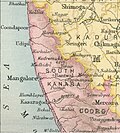
| map_caption = [[South Canara]], an erstwhile district, forms the centre of the Tuluva region called 'Tulu Nadu'. | |||
| image_map | | coordinates = {{coord|13.00|N|75.40|E|display=inline,title}} | ||
| subdivision_type = Country | |||
| map_caption | | subdivision_name = {{flag|India}} | ||
| coordinates | | subdivision_type1 = [[States and territories of India|State]] | ||
| subdivision_type | | subdivision_type2 = [[List of districts of India|Districts]] | ||
| subdivision_name | | subdivision_type3 = [[Talukas]] | ||
| subdivision_type1 | | subdivision_type4 = Metro | ||
| subdivision_type2 | | subdivision_name1 = [[Karnataka]], [[Kerala]] | ||
| subdivision_type3 | | subdivision_name2 = [[Dakshina Kannada]], [[Udupi district|Udupi]] and [[Kasaragod district|Kasaragod]] | ||
| subdivision_type4 | | subdivision_name4 = <!-- for neighbourhoods/suburbs only --> | ||
| subdivision_name1 | | established_title = <!-- Established --> | ||
| subdivision_name2 | | seat_type = Headquarters | ||
| subdivision_name4 | | seat = <!-- for districts only --> | ||
| established_title | | parts_type = No. of districts & Talukas | ||
| parts_style = para | |||
| p1 = 3 Districts and 18 Taluks | |||
| unit_pref = Metric | |||
| seat_type | | area_footnotes = <ref>{{cite web |url=http://www.kar.nic.in/zpdk/tourism.htm |title=Tourism in DK District |publisher=National Informatics Centre, Karnataka State Unit |access-date=26 March 2008}}</ref><ref>{{cite web |url=http://www.tourism-of-india.com/karnataka-tour/udupi-tour.html |title=Tour to Udupi |publisher=Tourism of India |access-date=26 March 2008}}</ref> | ||
| seat | | area_total_km2 = 10,432 | ||
| parts_type | | population_total = {{formatnum:4574385}} | ||
| parts_style | | population_as_of = 2011 | ||
| p1 | | population_footnotes = <ref name="poptn">{{cite web |url=http://www.censusindiamaps.net/page/India_WhizMap/IndiaMap.htm |title=Census GIS India |publisher=Census of India |access-date=26 March 2008 |url-status=dead |archive-url=https://web.archive.org/web/20100111052456/http://www.censusindiamaps.net/page/India_WhizMap/IndiaMap.htm |archive-date=11 January 2010 }}</ref> | ||
| population_density_km2 = auto | |||
| population_demonym = {{plainlist| | |||
| unit_pref | |||
| area_footnotes | |||
| area_total_km2 | |||
| population_total | |||
| population_as_of | |||
| population_footnotes | |||
| population_density_km2 | |||
| population_demonym | |||
*[[Tulu people|Tuluve]] (masculine) | *[[Tulu people|Tuluve]] (masculine) | ||
*[[Tulu people|Tuluvedi]] (feminine) | *[[Tulu people|Tuluvedi]] (feminine) | ||
}} | }} | ||
| demographics_type1 | | demographics_type1 = Languages | ||
| demographics1_title1 | | demographics1_title1 = Lingua Franca | ||
| timezone1 | | timezone1 = [[Indian Standard Time|IST]] | ||
| utc_offset1 | | utc_offset1 = +5:30 | ||
| postal_code_type | | postal_code_type = <!-- [[Postal Index Number|PIN]] --> | ||
| area_code = 0824, 0825 | |||
| area_code | | area_code_type = Telephone code | ||
| area_code_type | | iso_code = ISO 3166-2:IN|<!-- ISO 3166-2 --> | ||
| iso_code | | registration_plate = KA19, KA20, KA21, KA62, KA70, KL14. | ||
| registration_plate | | seat1_type = Largest City | ||
| seat1 = [[Mangalore]] | |||
| demographics1_info1 = [[Tulu language|Tulu]] | |||
| demographics1_title2 = Spoken | |||
| seat1_type | | demographics1_info2 = [[Tulu language|Tulu]], [[Konkani language|Konkani]], [[Beary language|Beary]], [[Kannada language|Kannada]], [[Malayalam language|Malayalam]]<ref name="languages">{{Cite web |title=Table C-16 Population by Mother Tongue: Karnataka |url=https://censusindia.gov.in/nada/index.php/catalog/10208/download/13320/DDW-C16-STMT-MDDS-2900.XLSX |website=www.censusindia.gov.in |publisher=[[Registrar General and Census Commissioner of India]]}}</ref> | ||
| seat1 | | blank2_name_sec1 = [[IUCN protected area categories|IUCN category]] | ||
| demographics1_info1 | | blank2_info_sec1 = <!-- for protected areas only --> | ||
| demographics1_title2 | |||
| demographics1_info2 | |||
| blank2_name_sec1 | |||
| blank2_info_sec1 | |||
}} | }} | ||
'''Tulu Nadu''' | '''Tulu Nadu,''' or '''Tulunad,''' is a region and a [[Proposed states and union territories of India|proposed state]] on the southwestern coast of [[India]].<ref>{{Cite book | ||
{{Cite book | |||
| author = Anthropological Survey of India (Department of Anthropology) | | author = Anthropological Survey of India (Department of Anthropology) | ||
| title = Bulletin of the Anthropological Survey of India, Volume 25 | | title = Bulletin of the Anthropological Survey of India, Volume 25 | ||
| date = 1980 | | date = 1980 | ||
| publisher = Director, Anthropological Survey of India, Indian Museum | | publisher = Director, Anthropological Survey of India, Indian Museum | ||
| page = [https://books.google. | | page = [https://books.google.com/books?id=C3hDAAAAYAAJ&q=Tuluva 41] | ||
}} | }}</ref> The region is predominantly inhabited by the [[Tulu people]], also known as Tuluva, who speak [[Tulu language|Tulu]], a [[Dravidian language]]. The former district encompassed the territories of the contemporary [[Dakshina Kannada]] (Kudla) and [[Udupi]] (Odipu) of [[Karnataka]] State, and [[Kasaragod district]] (Kasrod) of [[Kerala]] state. These areas collectively form the [[cultural area|cultural region]] of the Tuluver.<ref>{{Cite book | ||
</ref> The [[Tulu people]], known as | |||
{{Cite book | |||
| last = Bhat | | last = Bhat | ||
| first = N. Shyam | | first = N. Shyam | ||
| title = South Kanara, 1799–1860: A Study in Colonial Administration and Regional Response | | title = South Kanara, 1799–1860: A Study in Colonial Administration and Regional Response | ||
| chapter = Introduction | | chapter = Introduction | ||
| pages = [https://books.google. | | pages = [https://books.google.com/books?id=Z0nZzbFDSAoC&q=Tulu+country+South+Kanara 1–16] | ||
| publisher = Mittal Publications | | publisher = Mittal Publications | ||
| date = 1998 | | date = 1998 | ||
| isbn = 9788170995869 | | isbn = 9788170995869 | ||
}} | }}</ref> | ||
</ref> | |||
Historically, Tulu Nadu | Historically, Tulu Nadu lies between the [[Gangavalli River]] ([[Uttara Kannada]] district of [[Karnataka]]) and [[Chandragiri River|Chandragiri/Payaswini River]] (Kasaragod district of Kerala).<ref name=":0">{{cite book | ||
{{cite book | |||
| last = Bhatt | | last = Bhatt | ||
| first = P. Gururaja | | first = P. Gururaja | ||
| Line 116: | Line 80: | ||
| publisher = Prabhakara Press | | publisher = Prabhakara Press | ||
| page = 2 | | page = 2 | ||
}} | }}</ref> Despite its distinct cultural identity, the region is not recognized as an official administrative entity.<ref>{{Cite news | ||
</ref> | |||
{{Cite news | |||
| last = Unnithan | | last = Unnithan | ||
| first = Rajmohan | | first = Rajmohan | ||
| Line 124: | Line 86: | ||
| date = 7 January 2020 | | date = 7 January 2020 | ||
| work = [[The Hindu]] | | work = [[The Hindu]] | ||
| url = https://www.thehindu.com/opinion/op-ed/a-case-for-including-tulu-in-the-eighth-schedule/article30496165.ece | | url = https://www.thehindu.com/opinion/op-ed/a-case-for-including-tulu-in-the-eighth-schedule/article30496165.ece | ||
| access-date = 15 January 2020 | | access-date = 15 January 2020 | ||
}} | }}</ref><ref>{{Cite news | ||
</ref><ref> | |||
{{Cite news | |||
| last = B | | last = B | ||
| first = Sreekantswamy | | first = Sreekantswamy | ||
| Line 136: | Line 96: | ||
| url = https://www.deccanherald.com/amp/content/623813/with-separate-flag-tulu-activists.html | | url = https://www.deccanherald.com/amp/content/623813/with-separate-flag-tulu-activists.html | ||
| access-date = 15 January 2020 | | access-date = 15 January 2020 | ||
}} | }}</ref> | ||
</ref> | |||
[[ | [[Mangaluru|Kudla]] (Mangaluru) is the largest city in Tulu Nadu, the third-largest city by area, and the fifth-largest by population in [[Karnataka]].<ref>{{cite web |url=https://www.ijsr.net/archive/v12i11/SR231115122619.pdf |title=About Mangalore |publisher=Mangaluru Online |access-date=18 March 2024}}</ref><ref>{{Cite news |last=Sheth |first=Anisha |date=6 November 2014 |title=This city has six names in six languages, and the official one Mangaluru, is the least popular |url=https://www.thenewsminute.com/karnataka/city-has-six-names-six-languages-and-official-one-mangaluru-least-popular-16480 |access-date=15 January 2020 |work=[[The News Minute]]}}</ref> [[Udupi]] (Odipu) and [[Kasaragod|Kasarogod]] (Kasrod) are two other major cities in this region, both located on the Kerala-Karnataka border.<ref>{{Cite news | ||
{{Cite news | |||
}} | |||
</ref> [[Udupi]] and [[Kasaragod]] are | |||
{{Cite news | |||
| last = Malli | | last = Malli | ||
| first = Karthik | | first = Karthik | ||
| Line 158: | Line 106: | ||
| url = https://www.thenewsminute.com/article/mapping-tulu-rich-oral-tradition-deep-roots-karnataka-97512 | | url = https://www.thenewsminute.com/article/mapping-tulu-rich-oral-tradition-deep-roots-karnataka-97512 | ||
| access-date = 15 January 2020 | | access-date = 15 January 2020 | ||
| quote = Tulu is a southern Dravidian language that's spoken by 1.85 million people in Dakshina Kannada, Udupi and Kerala's Kasargod district. | | quote = Tulu is a southern Dravidian language that's spoken by 1.85 million people in Dakshina Kannada, Udupi, and Kerala's Kasargod district. | ||
}} | }}</ref> | ||
</ref> | |||
The term "'''Tulunadu'''" appears as "'''Tuḷu Nāṭṭu'''" in [[Akanaṉūṟu|Akananuru]], a classical [[Tamil literature|Tamil poetic work]] that is part of the "'''Eight Anthologies'''" ([[Eight Anthologies|Ettuthokai]]) — a collection of [[Sangam literature]] composed over 2000 years ago.<ref>{{Cite book |last=Kesikan |first=Puliyur |url=https://archive.org/details/AkananooruMoolamumUraiyumI/page/n1/mode/1up |title=அகநானூறு மூலமும் உரையும் I |publisher=Gowra Book Fair |year=2010 |edition=1st |pages=43–44 |language=tn}}</ref><ref>{{cite web |url=https://tulupedia.com/home/history/historical-references-of-tulunad/tamizh-literatures/ |title=Reference Of Tulunadu |publisher=Tulupedia |access-date=18 March 2024}}</ref> | |||
== | == Etymology == | ||
According to | According to ''[[Keralolpathi]]'', the name ''Tuluva'' comes from the name of one of the [[Legend of Cheraman Perumals|Cheraman Perumal]] kings of [[Kerala]], who located their residence in the northern portion of their dominions just before its separation from [[Kerala]], and was called ''Tulubhan Perumal''.<ref name="Namma Tulu Nadu" /> | ||
== | == Foundation narrative == | ||
[[ | According to its foundation narrative, the district was reclaimed by [[Parashurama]] from the sea.<ref>{{Cite web |date=Jan 23, 2025 |title=Culture & Heritage {{!}} North Goa District, Government of Goa |url=https://northgoa.gov.in/culture-heritage/#:~:text=According%20to%20Ancient%20Indian%20Mythology,to%20create%20Gomantak%20or%20Goa. |url-status=live |archive-url=https://northgoa.gov.in/culture-heritage/ |archive-date=February 3, 2025 |access-date=3 Feb 2025 |website=Culture & Heritage {{!}} North Goa District, Government of Goa}}</ref> According to the 17th-century [[Malayalam]] work ''[[Keralolpathi]]'', the lands of Kerala and Tulu Nadu were recovered from the [[Arabian Sea]] by the ax-wielding warrior sage [[Parashurama|Lord Parashurama]], the sixth [[Dashavatara|avatar]] of [[Vishnu|Lord Vishnu]] (hence, Kerala is also called ''Parasurama Kshetram,'' 'The Land of Parasurama').<ref>S.C. Bhatt, Gopal K. Bhargava (2006) "Land and People of Indian States and Union Territories: Volume 14.", p. 18</ref> Parasurama threw his ax across the sea, and the water receded as far as it reached. According to legend, this new area of land extended from [[Gokarna, Karnataka|Gokarna]] to [[Kanyakumari]].<ref>{{cite book |author=Aiya VN |title=The Travancore State Manual |publisher=Travancore Government Press |pages=210–12 |year=1906 |access-date=12 November 2007 |url=https://books.google.com/books?id=RdzaPW-kEvQC}}</ref> The land which rose from sea was filled with salt and unsuitable for habitation; so Parashurama invoked the Snake King [[Vasuki|Nagaraja Vasuki]], who spat holy poison known as [[Halahala]] and converted the soil into fertile lush green land. Out of respect, Vasuki and all snakes were appointed as protectors and guardians of the land. [[P. T. Srinivasa Iyengar]] theorised that [[Senguttuvan|Cheran Senguttuvan]] may have been inspired by the Parashurama legend, which was brought by early Aryan settlers.<ref>{{Cite book |title=History of the Tamils: From the Earliest Times to 600 A.D. |last=Srinivisa Iyengar |first=P. T. |publisher=Asian Educational Services |year=1929 |isbn=978-8120601451 |location=Madras |page=515}}</ref> | ||
[[ | |||
===Ancient period=== | == History == | ||
According to the works of [[Sangam literature]] (300 BCE | [[File:Alvakheda map.jpg|thumb|Extent of the [[Alupa kingdom]]|left]][[File:Tulunadu.svg|thumb|A regional map of Tulu Nadu in [[Karnataka]]. Tulu Nadu also includes [[Kasaragod district]] of [[Kerala]] state.|left]] | ||
=== Ancient period === | |||
According to the works of [[Sangam literature]] (300 BCE – 300 CE),<ref name="Singh2008p27">{{cite book|author=Upinder Singh|title=A History of Ancient and Early Medieval India: From the Stone Age to the 12th Century |url=https://books.google.com/books?id=H3lUIIYxWkEC&pg=PA27 |year=2008|publisher=Pearson Education India|isbn=978-81-317-1120-0|pages=27–28}}</ref><ref>{{Cite book|last=Nadarajah|first=Devapoopathy|url=https://books.google.com/books?id=IZ7b6msS3kgC&q=info:Q1h0NSIwwIEJ:scholar.google.com/&pg=PR9|title=Love in Sanskrit and Tamil Literature: A Study of Characters and Nature, 200 B.C.-A.D. 500|date=1994|publisher=Motilal Banarsidass Publ.|isbn=978-81-208-1215-4|language=en}}</ref><ref>{{Cite book|last=University|first=Vijaya Ramaswamy, Jawaharlal Nehru|url=https://books.google.com/books?id=ALUvDwAAQBAJ&q=info:YtwrhAmuSNIJ:scholar.google.com/&pg=PR9|title=Historical Dictionary of the Tamils|date=2017-08-25|publisher=Rowman & Littlefield|isbn=978-1-5381-0686-0|language=en}}</ref> Tulu Nadu was one of the 12 socio-geographical regions included in the ancient [[Tamilakam]].<ref>A handbook of Kerala Band 1 (2000), T. Madhava Menon, International School of Dravidian Linguistics, p.98</ref> Tulu Nadu likely formed part of ancient [[Kerala]] ([[Chera dynasty]]), where the western coastal dialect of [[Middle Tamil]] was spoken.<ref name="Namma Tulu Nadu">{{cite book | |||
| author = J. Sturrock | year=1894 | | author = J. Sturrock | year=1894 | ||
| title= Madras District Manuals | | title= Madras District Manuals – South Canara (Volume-I) | publisher=Madras Government Press | ||
| url= https://archive.org/details/dli.csl.3200/page/n1/mode/2up | | url= https://archive.org/details/dli.csl.3200/page/n1/mode/2up | ||
}}</ref> It must have separated from [[Tamilakam]] sometime between 300 CE and 500 CE, when the [[Kadamba dynasty|Kadambas]] invaded the northern portions of [[Chera dynasty|Chera kingdom]].<ref name="Namma Tulu Nadu"/> No definite historical | }}</ref> It must have separated from [[Tamilakam]] sometime between 300 CE and 500 CE, when the [[Kadamba dynasty|Kadambas]] invaded the northern portions of [[Chera dynasty|Chera kingdom]].<ref name="Namma Tulu Nadu" /> No definite historical records relating to Tulu Nadu, other than those found in [[Sangam literature]], have been discovered of an earlier date than 8th or 9th century CE.<ref name="Namma Tulu Nadu" /> | ||
===Alupa dynasty=== | === Alupa dynasty === | ||
[[Ptolemy]], | [[Ptolemy]], a Greco-Roman 2nd-century geographer, identifies the Tulu Nadu region as ''Olokhoira'' which is widely believed to be a corruption of the term ''Alva Kheda,''{{By whom|date=November 2025}} "the land of the Alvas".<ref>{{Cite web |date=2025-06-02 |title=History Flash : Pandya Kings ruled Karnataka ! (Post No.14,585) |url=https://tamilandvedas.com/2025/06/02/history-flash-pandya-kings-ruled-karnataka-post-no-14585/ |access-date=2025-11-22 |website=Tamil and Vedas |language=en}}</ref> Historically, Tulu Nadu included the two separate lands of ''Haiva'' and ''Tuluva''.<ref>{{cite web |url=https://www.keralatourism.org/bekal/tulu-nadu.php |title=Tulunadu history |publisher=Kerala Tourism |access-date=21 March 2024}}</ref> The longest-ruling and oldest known native dynasty of Tulu Nadu was that of the [[Alupas]] ({{Circa}} 5th – 14th century CE).<ref name=bhat /> Their kingdom was also known as ''Alvakheda''. They initially ruled independently and later were the feudatories of the prominent dynasties. The [[Kadamba dynasty]] of [[Banavasi]] was the earliest, under which the [[Alupa dynasty|Alupas]] flourished. Later, the Rashtrakutas of Manyakheta, [[Chalukyas]] of Badami, Chalukyas of Kalyani, [[Hoysalas]] of Dwarasamudra ([[Halebidu]]), and [[Raja#Compound and derived titles|Rayas]] of Vijayanagara were the overlords. The Alupas, however, were independent, and their subordination was nominal at best. They ruled until the [[Vijayanagara Empire]] took control of Tulu Nadu from 14th to the 17th centuries.<ref>{{Cite web|title=Alupa dynasty|url=https://shastriyakannada.org/DataBase/KannwordHTMLS/CLASSICAL%20KANNADA%20LAND%20HISTORY%20AND%20PEOPLE%20HTML/ALUPA%20DYNASTY%20HTML.htm|access-date=|website=Shastriya kannada}}</ref><ref>{{cite web |url=https://www.civilsdaily.com/news/rare-alupa-dynasty-inscription-discovered/ |title=Alupa dynasty Inscription |date=21 October 2023 |publisher=Civilsdaily |access-date=21 March 2024}}</ref> | ||
During the rule of [[Vijayanagara Empire|Vijayanagara]], Tulu Nadu was administered in two parts | During the rule of [[Vijayanagara Empire|Vijayanagara]], Tulu Nadu was administered in two parts – '''''Mangaluru Rajya''''' and '''''Barkuru Rajya'''''. Tulu Nadu was governed by the native feudatories of the Vijayanagara Empire until the 18th century. These feudatories gained power towards the end of the Alupa period. An [[Old Malayalam]] inscription ([[Ramanthali inscriptions]]), dated to 1075, mentioning king ''Kunda Alupa'', the ruler of [[Alupa dynasty]] of [[Mangalore]], can be found at [[Ezhimala]] (the former headquarters of [[Mushika dynasty]]), near [[Payyanur]], in [[Kerala]] State.<ref>Narayanan, M. G. S. ''Perumāḷs of Kerala.'' Thrissur (Kerala): CosmoBooks, 2013. 483.</ref> | ||
Notable among them were<ref name=bhat>{{cite book|last1=Bhat|first1=N. Shyam|title=South Kanara, | Notable among them were<ref name=bhat>{{cite book|last1=Bhat|first1=N. Shyam|title=South Kanara, 1799–1860: A Study in Colonial Administration and Regional Response|date=1998|publisher=Mittal Publications|isbn=9788170995869|pages=17–45|url=https://books.google.com/books?id=Z0nZzbFDSAoC|access-date=18 April 2015}}</ref> the [[Chowta]]s of [[Ullal]] and [[Moodabidri]] ({{CE|{{Circa|1160|1801}}}}), [[Ajila]]s of [[Venur]] (c. 1418–1800 CE), the Savanta or Samantha Rajas of [[Mulki, India|Mulki]] (c. 1411–1700 CE), the Bhairahawa Ideas of [[Karkala]] (c. 1240–1650 CE), the Tolaharas of Suralu (c. 1139–1800 CE), the Bangas of Bangadi (c.1410–1800 CE), the Rajas of [[Kumbla]] (c. 12th century – 1800 CE), and the Rajas of [[Vitla]] (c. 1436–1800 CE). | ||
The region became extremely prosperous during the Vijayanagara period with [[Barkur]] and [[Mangalore]] gaining importance. After the decline of the [[Vijayanagara Empire]], the [[Keladi Nayaka]]s of [[Ikkeri]] controlled much of Tulu Nadu.<ref>{{cite book |last=Shastry |first=Bhagamandala Seetharama |author-link= |date=2000|title=Goa-Kanara Portuguese Relations, | The region became extremely prosperous during the Vijayanagara period, with [[Barkur]] and [[Mangalore]] gaining importance. After the decline of the [[Vijayanagara Empire]], the [[Keladi Nayaka]]s of [[Ikkeri]] controlled much of Tulu Nadu.<ref>{{cite book |last=Shastry |first=Bhagamandala Seetharama |author-link= |date=2000|title=Goa-Kanara Portuguese Relations, 1498–1763|url= |location=New Delhi|publisher=Concept Publishing Company|page=112,145–147,180–204|isbn=8170228484}}</ref> Over the following centuries, more ethnic groups migrated to the area. [[Konkanis]] from [[Goa]] arrived by sea, as Mangaluru was a major port that served not only the [[Portuguese India|Portuguese]] but also the [[Arabs]] for maritime trades. [[Jain Bunt|Jains]] were already a prominent group and even today are uniquely preserved in Tulu Nadu. Though small in number, the [[Jain Bunt|Jains]] left behind indelible reminders of their glory with temples (''[[Basadi|bastis]]''), ([[Hindu temple|mandirs]]) in ([[Moodabidri]]) and monolithic statues of the Jain god [[Bahubali]] in [[Karkala]], [[Venoor]] and [[Dharmasthala]]. In the 16th century, there was a large influx of Catholics to Tulu Nadu from Goa. | ||
Under [[Portuguese India|Portuguese rule]], the region was called the ''Misao do Sul'' (Mission of the South). In the 18th century, it was conquered by [[Hyder Ali]], the ruler of [[Kingdom of Mysore|Mysore]]. After the British defeated [[Hyder Ali|Haidar's]] successor [[Tipu Sultan]] in 1799, the region was attached to the [[Madras Presidency]] before being reverted to the [[state of Mysore]] after independence | Under [[Portuguese India|Portuguese rule]], the region was called the ''Misao do Sul'' (Mission of the South). In the mid- to late-18th century, it was conquered by [[Hyder Ali]], the de facto ruler of [[Kingdom of Mysore|Mysore]]. After the British defeated [[Hyder Ali|Haidar's]] successor [[Tipu Sultan]] in 1799, the region was attached to the [[Madras Presidency]] before being reverted to the [[state of Mysore]] after independence. [[Mangalore]] played a prominent role in Tipu's battles with the British. The British gained full control by 1801 (Mysore has since been renamed [[Karnataka]]). The [[British Raj|British]] ruled the region with [[Madras]] (now [[Chennai]]) as its headquarters. Under the British, the region was organized into the districts of [[North Canara]] and [[South Canara]] respectively.<ref name=":0" /> | ||
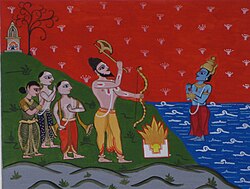
[[File:Parshuramsaraswats.jpg|thumb|As per [[Hindu mythology]], [[Parashurama]] commanded Lord [[Varuna]] to make the seas recede to make the Tulu Nadu.<ref>{{Cite news|url=http://www.boloji.com/index.cfm?md=Content&sd=Articles&ArticleID=865|title=Tulu Nadu: The Land and its People by Dr. Neria H. Hebbar|newspaper=Boloji|access-date=12 December 2016}}</ref><ref>{{Cite web|url=https://sites.google.com/site/aktbfkollam/brahmins-of-tulu-nadu|title=Brahmins of Tulu Nadu | [[File:Parshuramsaraswats.jpg|thumb|As per [[Hindu mythology]], [[Parashurama]] commanded Lord [[Varuna]] to make the seas recede to make the Tulu Nadu.<ref>{{Cite news|url=http://www.boloji.com/index.cfm?md=Content&sd=Articles&ArticleID=865|title=Tulu Nadu: The Land and its People by Dr. Neria H. Hebbar|newspaper=Boloji|access-date=12 December 2016}}</ref><ref>{{Cite web|url=https://sites.google.com/site/aktbfkollam/brahmins-of-tulu-nadu|title=Brahmins of Tulu Nadu – Madhwa Samajam Kollam|access-date=12 December 2016}}</ref>]] | ||
When the states were | When the states were reorganized on a linguistic basis in 1956, Tulu Nadu (South Canara), which was earlier a part of [[Madras Presidency]], and North Canara, which was a part of [[Bombay Presidency]], became part of the newly formed Mysore state, which was later renamed as Karnataka. [[Kasaragod district|Kasaragod]] became part of the newly formed state of [[Kerala]]. The [[Tulu people|Tuluvas]] began demanding [[Official languages of India|official language]] status for [[Tulu language|Tulu]] and a [[Tulu Nadu state movement|separate state]] named Tulu Nadu for themselves. Organizations like the ''Tulu Rajya Horata Samiti'' have taken up the cause of the ''[[Tulu people|Tuluvas]]'', and meetings and demonstrations were held at towns like [[Mangaluru|Mangalore]] and [[Udupi]] to voice their demand.<ref name="News headlines">{{cite web | url=http://www.daijiworld.com/news/news_disp.asp?n_id=27089&n_tit=News+headlines | title=News headlines | publisher=DHNS | date=21 October 2006 | access-date=4 September 2016 | archive-date=23 March 2012 | archive-url=https://web.archive.org/web/20120323061737/http://www.daijiworld.com/news/news_disp.asp?n_id=27089&n_tit=News+headlines | url-status=dead }}</ref><ref name="Tulu organisations to meet soon">{{cite news | url=http://www.thehindu.com/todays-paper/tp-national/tp-karnataka/article1214833.ece | title=Tulu organisations to meet soon | newspaper=The Hindu | date=6 March 2008 | access-date=4 September 2016}}</ref> | ||
==Demographics== | == Demographics == | ||
[[File:South Kanara.jpg|left|thumbnail|[[South Canara]] in 1909]] | [[File:South Kanara.jpg|left|thumbnail|[[South Canara]] in 1909]] | ||
{{Historical populations|1871 |918362 | {{Historical populations|1871 |918362 | ||
| Line 201: | Line 149: | ||
|1941 |1522016 | |1941 |1522016 | ||
|1951 |1748991 | |1951 |1748991 | ||
|footnote=Sources: ''Imperial | |footnote=Sources: ''Imperial Gazetteer of India'', Volume 14,<ref name="Imperial1908" /> and 1951 Census Handbook of South Canara<ref name="census1951">{{cite book | ||
| author = Government of Madras | year=1953 | | author = Government of Madras | year=1953 | ||
| title= 1951 Census Handbook- South Canara District | publisher=Madras Government Press |page=147 | | title= 1951 Census Handbook- South Canara District | publisher=Madras Government Press |page=147 | ||
| Line 209: | Line 157: | ||
{{Pie chart | {{Pie chart | ||
|thumb = right | |thumb = right | ||
|caption = '''Religion in South Canara''' (1951)<ref name="census1951"/> | |caption = '''Religion in South Canara''' (1951)<ref name="census1951" /> | ||
|label1 = [[Hinduism]] | |label1 = [[Hinduism]] | ||
|value1 = 76.58 | |value1 = 76.58 | ||
| Line 224: | Line 172: | ||
}} | }} | ||
{{Pie chart | {{Pie chart | ||
|thumb = right | | thumb = right | ||
|caption = '''Language in South Canara''' (1951)<ref name="census1951"/> | | caption = '''Language in South Canara''' (1951)<ref name="census1951" /> | ||
|label1 = [[Tulu language|Tulu]] | | label1 = [[Tulu language|Tulu]] | ||
|value1 = 39.94 | | value1 = 39.94 | ||
|color1 = Orange | | color1 = Orange | ||
|label2 = [[Malayalam]] | | label2 = [[Malayalam]] | ||
|value2 = 24.19 | | value2 = 24.19 | ||
|color2 = Red | | color2 = Red | ||
|label3 = [[Kannada]] | | label3 = [[Kannada]] | ||
|value3 = 17.20 | | value3 = 17.20 | ||
|color3 = Green | | color3 = Green | ||
|label4 = [[Konkani language|Konkani]] | | label4 = [[Konkani language|Konkani]] | ||
|value4 = 13.59 | | value4 = 13.59 | ||
|color4 = DodgerBlue | | color4 = DodgerBlue | ||
|label5 = [[Languages of India|Other]] | | label5 = [[Languages of India|Other]] | ||
|value5 = 5.08 | | value5 = 5.08 | ||
|color5 = Black | | color5 = Black | ||
}} | }} | ||
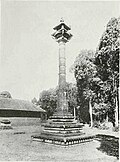
[[File:TempleStambha1913.jpg|thumb|200px|Temple ''stambha'', South Canara]] | [[File:TempleStambha1913.jpg|thumb|200px|Temple ''stambha'', South Canara.]] | ||
South | South Canara had a total population of 1,748,991 in 1951, of whom 76.58% were Hindus, 14.31% Muslim, and 8.85% Christian.<ref name="census1951" /> The most widely spoken language was [[Tulu language|Tulu]] which was the mother tongue of 40% of the population, followed by [[Malayalam]] which formed the mother tongue of 24% each of the population. Around 17% of the total population spoke [[Kannada]]. Around 13% of the population spoke [[Konkani language|Konkani]] as their mother tongue. In 1901, it had a density of {{convert|282|PD/sqmi|order=flip}}.{{Citation needed|date=October 2021}} | ||
The 1908 ''[[Imperial Gazetteer of India]]'' lists South Canara, along with the [[Thanjavur district|Thanjavur]] and [[Ganjam district|Ganjam]] districts, as the three districts of the [[Madras Presidency]] where [[Brahmins]] are most numerous.<ref name="Imperial1908">{{cite book|title=[[The Imperial Gazetteer of India]]|volume=14|year=1908|publisher=[[Clarendon Press]]}}</ref> | The 1908 ''[[Imperial Gazetteer of India]]'' lists South Canara, along with the [[Thanjavur district|Thanjavur]] and [[Ganjam district|Ganjam]] districts, as the three districts of the [[Madras Presidency]] where [[Brahmins]] are most numerous.<ref name="Imperial1908">{{cite book|title=[[The Imperial Gazetteer of India]]|volume=14|year=1908|publisher=[[Clarendon Press]]}}</ref> | ||
The majority of the people were [[Billava]]s and [[Bunt (community)| | The majority of the people were [[Billava]]s and [[Bunt (community)|Bunts]]. There were more Brahmins (12% of the population) in South Kanara than in any other district of the Madras Presidency, making South Kanara, along with [[Tanjore District (Madras Presidency)|Tanjore]] and [[Ganjam]] one of the three districts of the province where Brahmins were most numerous.<ref name="Imperial1908" /> | ||
The original [[indigenous people]] of the region are [[Tuluvas]] ([[Bunt (community)|Bunts]], [[Billava]]s, [[Mogaveera]]s, Tulu | The original [[indigenous people]] of the region are [[Tuluvas]] ([[Bunt (community)|Bunts]], [[Billava]]s, [[Mogaveera]]s, [[Tulu Gowda]]s, [[Kulala]]s, [[Devadiga]]s, [[Beary]]s, [[Jogi (caste)|Jogis]], and Tulu Brahmins) and [[Malayali]]s in the [[Kasaragod district|Kasaragod Taluk]] ([[Nambudiri]]s, [[Nair]]s, [[Thiyyas]], [[Malabar Muslims|Mappilas]] etc.). The Brahmins who settled first belonged chiefly to the [[Sthanika Brahmins|Sthanika]] and thus they were called Tulu Brahmins. Others were [[Shivalli Brahmins|Shivalli]], [[Saraswat Brahmin|Saraswat]], [[Havyaka Brahmin|Havyaka]], [[Kota Brahmins|Kota]] sub-sections, Mahars, the hill-tribes (''[[Koraga people|Koragas]]'').<ref name="SilvaAndFuchs">{{cite journal|last1=Silva|first1=Severine|last2= Fuchs|first2=Stephan|publisher=[[Nanzan University]]|title=The Marriage Customs of the Christians in South Canara, India|journal=[[Asian Folklore Studies]]|year=1965|number=2|pages=2–3|volume=24|doi=10.2307/1177555|jstor=1177555}}</ref> | ||
==Language== | == Language == | ||
{{Main|Tulu language}} | {{Main|Tulu language}} | ||
[[File:Testtulu1.png|left|thumb|[[ | [[File:Testtulu1.png|left|thumb|[[Tigalari script|Tulu script]] has been used for [[Tulu language|Tulu]] since at least the 10th century.<ref>{{cite web|url=https://tuluscriptsource.blogspot.com/2020/10/tulu-script.html |title=ScriptSource – Tulu |website=tuluscriptsource|access-date=15 January 2021}}</ref>]] | ||
The | The most widely spoken language is '''Tulu''', which belongs to the [[Dravidian languages|Dravidian]] family of languages, and whose native speakers are referred to as [[Tulu people|Tuluva]]. The number of Tulu speakers was estimated to be about 1.7 million in 2001,<ref>{{Cite web |url=http://www.censusindia.gov.in/Census_Data_2001/Census_Data_Online/Language/Statement1.htm |title=Census of India – Statement 1 |publisher=Registrar General & Census Commissioner, India |access-date=26 May 2013}}</ref><ref>{{Citation |editor-last=Lewis |editor-first=M. Paul |contribution=Tulu |title=Ethnologue: Languages of the World |edition=16th |publisher=[[SIL International]] |year=2009 |contribution-url=http://www.ethnologue.com/show_language.asp?code=tcy |url=http://www.ethnologue.com |access-date=12 November 2009}}</ref> although some sources quote as many as 3 million.<ref name="Bhat">{{Cite book |title=The Dravidian Languages |author=D.N.S. Bhat |editor=Sanford B. Steever |year=1998 |publisher=Routledge |isbn=0-415-10023-2 |page=158 |url=https://books.google.com/books?id=CF5Qo4NDE64C}}</ref> The other languages spoken in Tulu Nadu include [[Kundagannada]], [[Arebhashe dialect|Arebhashe]], [[Malayalam]], [[Konkani language|Konkani]], [[Koraga language|Koraga]], and [[Beary language|Beary]].<ref name="Bhat" /> | ||
The [[Tulu script]] (also known as the Tulu–Tigalari script) originates from the [[Grantha script]] and bears strong similarity to the [[Malayalam script]]. It was used in Tulu Nadu for many centuries before later being replaced by the [[Kannada script]] for most writing. A large corpus of Sanskrit manuscripts—including Vedic and religious works—was historically written in this script,<ref>{{cite web |title=Tigalari–Tulu |url=https://www.endangeredalphabets.net/alphabets/tigalari/ |publisher=Atlas of Endangered Alphabets |access-date=14 November 2025}}</ref><ref>{{cite web |title=Proposal to Encode the Tulu-Tigalari Script in Unicode |url=https://www.unicode.org/L2/L2021/21086-tulu-tigalari.pdf |publisher=Unicode Consortium |date=2021 |access-date=14 November 2025}}</ref> and several important Tulu classical works, such as the ''Tulu Mahabharata'', ''Kaveri'', ''Bhagavato'', and ''Devimahatme'', also survive in this script.<ref>{{cite web |title=The Tulu Language |url=https://yakshagana.com/the-tulu-language/ |publisher=Yakshagana.com |access-date=14 November 2025}}</ref> | |||
[[ | |||
Tulu Nadu | |||
Tulu Nadu | == Geography and climate == | ||
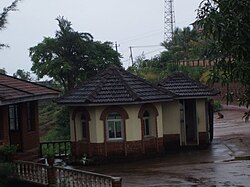
[[File:Demon Yakshagana.jpg|thumb|A ''Yakshagana'' artist portraying a ''[[rakshasa]]'' (demon).]][[File:Mangalore 075.jpg|thumb|220x220px|A typical house in Tulu Nadu, with the roof constructed using [[Mangalore tiles]]]] | |||
Tulu Nadu lies along the [[Konkan Coast]].<ref>{{Cite book |last3=Ripley |first3=Sidney Dillon |last2=Beehler |first2=Bruce M. |last1=Lozupone |first1=Patsy |year=2004 |page=82 |title=Ornithological gazetteer of the Indian subcontinent |publisher=Center for Applied Biodiversity Science, Conservation International |isbn=1-881173-85-2}}</ref> Tulu Nadu is bounded on the west by the [[Arabian Sea]] and on the east by the [[Western Ghats]]. The [[Chandragiri river]] forms a historical border to the south. Tulu Nadu spans an area of {{convert|8441|km2|sqmi|0|abbr=on}}, roughly 4.4 percent of the total geographical area of present-day [[Karnataka]] and Kasaragod district is the northernmost district of Kerala.<ref>{{Cite web |title=Tulu Nadu, Kasaragod, Kerala, India |url=https://www.keralatourism.org/bekal/tulu-nadu.php |access-date=2025-01-22 |website=Kerala Tourism - Bekal |language=en}}</ref>{{Citation needed|date=October 2021}} | |||
The coastal region of Tulu Nadu is characterized by its lush rainforests and serene backwaters. The area enjoys a tropical climate, marked by scorching summers, humid days, and a monsoon season that brings heavy rainfall. While summer and winter months experience similar temperature conditions, with average temperatures ranging from 24 to 33 degrees Celsius (75 to 91 degrees Fahrenheit), the monsoon season brings a refreshing respite from the heat.{{Citation needed|date=February 2024}} | |||
==Culture== | Monsoon starts at the beginning of June, with the heaviest rainfall during [[Tulu calendar|Aati]] month, which spans from mid-July to mid-August. Occasional rain persists until [[Deepawali]] and [[Dusshera|Marnemi]] festivals in October–November. Winter lasts from December to early February, and Summer from mid-February until May. With occasional tropical rain during April and May.<ref>{{Cite web |last=ML |date=2023-12-07 |title=Tulunadu Seasons |url=http://yogish.com/blog/common-tulu-words/tulunadu-seasons |access-date=2025-09-23 |website=Bale Tulu Kalpuga |language=en-US}}</ref> | ||
== Culture == | |||
[[File:Flag of Tulunadu.jpg|thumb|Cultural flag of Tulunadu region in India]] | [[File:Flag of Tulunadu.jpg|thumb|Cultural flag of Tulunadu region in India]] | ||
[[File:Chaturmukha Basadi.jpg|thumb| [[Chaturmukha Basadi, Karkala]]]] | [[File:Chaturmukha Basadi.jpg|thumb| [[Chaturmukha Basadi, Karkala]]]] | ||
[[File:1000-Pillar-Temple- Moodbidri-Right-Side-View.JPG|thumb|[[Saavira Kambada Basadi]], [[Moodabidri]]]] | [[File:1000-Pillar-Temple- Moodbidri-Right-Side-View.JPG|thumb|[[Saavira Kambada Basadi]], [[Moodabidri]]]] | ||
[[ | Most communities of Tulu Nadu live by [[Aliyasantana]] (matrilineal) culture as opposed to Magana Santhana (patrilineal) culture. In the [[matrilineal]] system of [[inheritance]] the lineage/inheritance is passed through the female line. Traditionally, the inheritance of the male members of the family went to the children of their sisters. Even today, many families in Mangalore practice kavar paalu while dividing old properties. Kavar paal is a system where children of the male members of the family do not inherit any of their paternal ancestral property. | ||
[[Yakshagana]] is a night-long dance and drama performance practiced in Tulu Nadu with great fanfare.<ref>{{Cite web |url=http://www.szcc.tn.nic.in/07_folktheatre/karnataka/Yakshagana/yakshagana.html |title=Yakshagana |access-date=7 December 2007 |publisher=SZCC, Tamil Nadu |archive-url=https://web.archive.org/web/20070817224137/http://www.szcc.tn.nic.in/07_folktheatre/karnataka/Yakshagana/yakshagana.html <!-- Bot retrieved archive --> |archive-date=17 August 2007}}</ref><ref>{{Cite book |year=2001 |last1=Plunkett |first1=Richard |title=South India |page=53 |publisher=Lonely Planet |isbn=978-1-86450-161-2}}</ref> [[Hulivesha|Pilivesha]] is a unique form of folk dance in the region fascinating the young and the old alike, which is performed during ''Marnemi'' (or ''[[Navratri|Dussehra]]'' in Tulu) and [[Krishna Janmashtami]].<ref>{{Cite news |url=http://articles.timesofindia.indiatimes.com/2001-10-26/bangalore/27235282_1_tigers-pai-skin |archive-url=https://web.archive.org/web/20110811134248/http://articles.timesofindia.indiatimes.com/2001-10-26/bangalore/27235282_1_tigers-pai-skin |url-status=dead |archive-date=11 August 2011 |date=26 October 2001 |title=Human 'tigers' face threat to health |work=[[The Times of India]] |author=Stanley G. Pinto |access-date=26 May 2013}}</ref> ''Karadi Vesha'' (Bear Dance) is another popular dance performed during ''[[Mysore Dasara|Dasara]]'' in Tulu Nadu.<ref>{{Cite web |url=http://www.daijiworld.com/chan/exclusive_arch.asp?ex_id=726 |title=What's in a Name? |author=Stephen D'Souza |publisher=[[Daiji World|Daijiworld Media Pvt Ltd Mangalore]] |access-date=26 May 2013 |archive-date=5 March 2008 |archive-url=https://web.archive.org/web/20080305003349/http://www.daijiworld.com/chan/exclusive_arch.asp?ex_id=726 |url-status=dead }}</ref> ''[[Buta Kola|Daivaradhane]]'' (spirit worship), which is usually done at night, is practised here. [[Kambala]] (Buffalo race) is conducted in water-filled paddy fields. The [[Bhuta Kola]] is similar to [[Theyyam]] in [[North Malabar]].<ref>{{Cite web|url=https://english.mathrubhumi.com/videos/news/news-in-videos/devakoothu-the-lone-woman-theyyam-in-north-malabar-1.3468731|title='Devakoothu'; the lone woman Theyyam in North Malabar|website=Mathrubhumi}}</ref><ref name="auto1">{{Cite news|url=https://timesofindia.indiatimes.com/city/kozhikode/This-year-Devakoothu-gets-a-new-face/articleshow/17735370.cms|title=Devakoothu: This year, Devakoothu gets a new face | Kozhikode News – Times of India|website=The Times of India|date=23 December 2012 }}</ref> ''Korikatta'' ([[cockfight]]ing) is another favorite sport of the people. [[Nagaradhane]] (snake worship) is practiced in the Tulu Nadu according to the popular belief of the [[Nāga|Naga Devatha]] who resides underground and guards the species on the surface.<ref>{{Cite encyclopedia |title=Nāgas |encyclopedia=Brill's Encyclopedia of Hinduism Online |doi=10.1163/2212-5019_beh_com_000337}}</ref> | |||
[[Udupi cuisine]] is popular across [[South India]], mostly due to Udupi restaurants, which are primarily vegetarian. Outside Southern India, there are also famous Udupi Hotels in Mumbai and New Delhi.{{Citation needed|date=October 2021}} | |||
== Economy == | |||
Historically, Tulu Nadu was primarily dependent on agriculture and fishing. The main crops grown were rice, [[Chickpea|Bengal gram]], [[horse gram]], vegetables, and fruits. Plantation crops like coconut, [[areca]] nut, cocoa, [[cashew]] nut, and pepper are also grown. In the early 20th century, the [[Mangalore tile]] industry, cashew nut processing, and the banking industry grew substantially. Tulu Nadu is called "The cradle of Indian banking".<ref>{{cite web| url=http://shodhganga.inflibnet.ac.in/bitstream/10603/15944/12/12_chapter%204.pdf | title=BANKING IN KARNATAKA STATE}}</ref> Five major banks of India ([[Syndicate Bank]], [[Canara Bank]], [[Corporation Bank]], [[Vijaya Bank]], and [[Karnataka Bank]]) have their origins here. | |||
List of Banks of Tulu Nadu: | |||
{| class="wikitable sortable" | {| class="wikitable sortable" | ||
!Bank | !Bank | ||
| Line 288: | Line 242: | ||
|[[Mangalore]] | |[[Mangalore]] | ||
|[[Ammembal Subba Rao Pai]] | |[[Ammembal Subba Rao Pai]] | ||
|<ref>{{Cite web|title=Canara Bank :: About Us :: Profile|url=http://www.canarabank.com/English/scripts/aboutus.aspx|access-date=23 October 2016|website=canarabank.com}}</ref> | |<ref>{{Cite web|title=Canara Bank :: About Us :: Profile|url=http://www.canarabank.com/English/scripts/aboutus.aspx|access-date=23 October 2016|website=canarabank.com}}</ref>{{Primary source inline|date=February 2024}} | ||
|- | |- | ||
|[[Karnataka Bank]] | |[[Karnataka Bank]] | ||
| Line 294: | Line 248: | ||
|[[Mangalore]] | |[[Mangalore]] | ||
| - | | - | ||
|<ref>{{Cite web|title=Welcome to Karnataka Bank Ltd|url=http://www.karnatakabank.com/ktk/History.jsp|url-status=dead|archive-url=https://web.archive.org/web/20120317115018/http://www.karnatakabank.com/ktk/History.jsp|archive-date=17 March 2012|access-date=23 October 2016|website=karnatakabank.com}}</ref> | |<ref>{{Cite web|title=Welcome to Karnataka Bank Ltd|url=http://www.karnatakabank.com/ktk/History.jsp|url-status=dead|archive-url=https://web.archive.org/web/20120317115018/http://www.karnatakabank.com/ktk/History.jsp|archive-date=17 March 2012|access-date=23 October 2016|website=karnatakabank.com}}</ref>{{Primary source inline|date=February 2024}} | ||
|- | |- | ||
|[[Vijaya Bank]] | |[[Vijaya Bank]] | ||
| Line 300: | Line 254: | ||
|[[Mangalore]] | |[[Mangalore]] | ||
|A. B. Shetty | |A. B. Shetty | ||
|<ref>{{Cite web|title=Vijaya Bank|url=https://www.vijayabank.com/About-Us/Inception|access-date=23 October 2016|website=vijayabank.com}}</ref> | |<ref>{{Cite web|title=Vijaya Bank|url=https://www.vijayabank.com/About-Us/Inception|access-date=23 October 2016|website=vijayabank.com}}</ref>{{Primary source inline|date=February 2024}} | ||
|- | |- | ||
|[[Syndicate Bank]] | |[[Syndicate Bank]] | ||
|{{Start date and age|df=yes|1925}} | |{{Start date and age|df=yes|1925}} | ||
|[[Manipal]] | |[[Manipal]] | ||
|T. M. A. Pai, Upendra Pai and Vaman Kudva | |T. M. A. Pai, Upendra Pai, and Vaman Kudva | ||
|<ref>{{Cite web|title=Syndicate Bank- ourprofile|url=https://www.syndicatebank.in/english/ourprofile.aspx|url-status=dead|archive-url=https://web.archive.org/web/20180925221437/https://www.syndicatebank.in/english/ourprofile.aspx|archive-date=25 September 2018|access-date=23 October 2016|website=syndicatebank.in}}</ref> | |<ref>{{Cite web|title=Syndicate Bank- ourprofile|url=https://www.syndicatebank.in/english/ourprofile.aspx|url-status=dead|archive-url=https://web.archive.org/web/20180925221437/https://www.syndicatebank.in/english/ourprofile.aspx|archive-date=25 September 2018|access-date=23 October 2016|website=syndicatebank.in}}</ref>{{Primary source inline|date=February 2024}} | ||
|- | |- | ||
|[[Corporation Bank]] | |[[Corporation Bank]] | ||
| Line 312: | Line 266: | ||
|[[Udupi]] | |[[Udupi]] | ||
|Khan Bahadur Haji Abdulla Haji Kasim Saheb Bahadur | |Khan Bahadur Haji Abdulla Haji Kasim Saheb Bahadur | ||
|<ref>{{Cite web|title=History {{!}} Corporation Bank|url=http://www.corpbank.com/history|access-date=23 October 2016|website=www.corpbank.com}}</ref> | |<ref>{{Cite web|title=History {{!}} Corporation Bank|url=http://www.corpbank.com/history|access-date=23 October 2016|website=www.corpbank.com}}</ref>{{Primary source inline|date=February 2024}} | ||
|} | |} | ||
In the early part of the 21st century the area has been transforming itself into a hub of the [[information technology]] and medical services industries. There has been large-scale decline in agriculture and related industries due to the non-availability of | [[File:Tulu Wikimedia Projects.webm|thumb|342x342px|'''Activities of Tulu language , Tulu Wiki medians''' ]] | ||
In the early part of the 21st century, the area has been transforming itself into a hub of the [[information technology]] and medical services industries. There has been a large-scale decline in agriculture and related industries due to the non-availability of labor and preference for [[white-collar worker|white-collar jobs]]. Agricultural land is being converted to commercial and [[real estate]] properties, and environmental pollution is increasing drastically due to large-scale deforestation and an increase in automobile use. A [[public sector]] [[petroleum refinery]] ([[MRPL]]) was established in the 1990s. Some chemical plants (e.g., fertilizers and pesticides) have been established. This region contributes the second-highest revenue to the [[Karnataka]] state after the city of [[Bangalore]]. This region has an [[international airport]] at [[Mangalore]], which is well connected to the rest of [[India]] and Middle Eastern countries. [[New Mangalore Port]] (NMPT) is one of the major ports of India located at [[Panambur]], [[Mangaluru|Mangalore]].<ref name="Shatkin2013">{{cite book|title=Contesting the Indian City: Global Visions and the Politics of the Local|date=14 August 2013|publisher=John Wiley & Sons|isbn=978-1-118-29584-7|chapter=Chapter 10 : Planning Mangalore: Garbage Collection in a Small Indian City|author=Gavin Shatkin}}</ref> | |||
== Education == | |||
Tulu Nadu contains several large educational institutions.<ref>{{Cite web |title=Affiliated Colleges |url=https://mangaloreuniversity.ac.in/affiliated-colleges-0.html |access-date=2025-06-27 |website=mangaloreuniversity.ac.in}}</ref> [[Mangaluru|Mangalore]] and [[Manipal]] host multiple universities and colleges. The [[National Institute of Technology, Karnataka|National Institute of Technology Karnataka]] (NITK), located in [[Surathkal]], is a centrally funded technical institute among India’s top engineering colleges according to national surveys such as the NIRF. [[Kasturba Medical College]] (KMC), with campuses in both Manipal and Mangalore, was ranked 9th and 21st respectively in the [[National Institutional Ranking Framework]] (NIRF) 2020 rankings.<ref>{{Cite web|title=Top 10 medical colleges, universities, and institutes in India|url=https://www.businessinsider.in/education/news/top-10-medical-colleges-universities-and-institutes-in-india/articleshow/78693690.cms|access-date=2021-10-23|website=Business Insider}}</ref><ref>{{Cite web|title=MoE, National Institute Ranking Framework (NIRF)|url=https://www.nirfindia.org/2020/MedicalRanking.html|access-date=2021-10-23|website=nirfindia.org}}</ref> | |||
== | ===Colleges=== | ||
*[[St Aloysius College (Mangalore)|St Aloysius College]] | |||
* [[St. Agnes College, Mangaluru | St Agnes College]] | |||
* [[National Institute of Technology, Karnataka]] | |||
* [[MIT Manipal]] | |||
* [[Mangalore University]] | |||
* [[Kasturba Medical College]] | |||
* [[Canara College]] | |||
* [[NITTE]] | |||
== See also == | == See also == | ||
* | *[[Tulu Nadu state movement]] | ||
*[[List of temples in Tulu Nadu]] | *[[List of temples in Tulu Nadu]] | ||
*[[Kolathunadu]] | *[[Kolathunadu]] | ||
*[[Communities of Tulu Nadu]] | |||
{{Clear}} | {{Clear}} | ||
==References== | == References == | ||
{{Reflist}} | {{Reflist}} | ||
==Further reading== | == Further reading == | ||
*{{Cite journal |last=Bhat |first=P. Gururaja |author-link=P. Gururaja Bhat |year=1975 |title=Studies in Tuluva history and culture | {{refbegin}} | ||
*{{Cite journal |last=Bhat |first=P. Gururaja |author-link=P. Gururaja Bhat |year=1975 |title=Studies in Tuluva history and culture (from the pre-historic times up to the modern) |journal=Studies in Tuluva History and Culture}} | |||
* {{Citation | * {{Citation | ||
| author = S. Muhammad Hussain Nainar | year=1942 | | author = S. Muhammad Hussain Nainar | year=1942 | ||
| Line 338: | Line 304: | ||
* {{Citation | * {{Citation | ||
| author = J. Sturrock | year=1894 | | author = J. Sturrock | year=1894 | ||
| title= Madras District Manuals | | title= Madras District Manuals – South Canara (Volume-I) | publisher=Madras Government Press | ||
| url= https://archive.org/details/dli.csl.3200/page/n1/mode/2up | | url= https://archive.org/details/dli.csl.3200/page/n1/mode/2up | ||
}} | }} | ||
* {{Citation | * {{Citation | ||
| author = Harold A. Stuart | year=1895 | | author = Harold A. Stuart | year=1895 | ||
| title= Madras District Manuals | | title= Madras District Manuals – South Canara (Volume-II) | publisher=Madras Government Press | ||
| url= https://archive.org/details/in.ernet.dli.2015.281736/mode/2up | | url= https://archive.org/details/in.ernet.dli.2015.281736/mode/2up | ||
}} | }} | ||
| Line 367: | Line 333: | ||
}} | }} | ||
* {{Citation |title=Statistical Atlas of the Madras State (1951)|last=Rajabhushanam|first=D. S.|publisher=Director of Statistics, Government of Madras|year=1963|location=Madras (Chennai)|url=http://lsi.gov.in:8081/jspui/bitstream/123456789/6454/1/9111_1951_STA.pdf}} | * {{Citation |title=Statistical Atlas of the Madras State (1951)|last=Rajabhushanam|first=D. S.|publisher=Director of Statistics, Government of Madras|year=1963|location=Madras (Chennai)|url=http://lsi.gov.in:8081/jspui/bitstream/123456789/6454/1/9111_1951_STA.pdf}} | ||
* {{cite thesis |title=TULU JANAPADA SAAHITYA |trans-title=Tulu Folk Literature |type=Ph. D. |first=B. A. |last=Viveka Rai |publisher=Kannada Sahitya Parishath |location=Chamarajpet, Bangalore |date=1985 |lang=Kannada}} | |||
==External links== | ;Folktale collections: | ||
* {{cite book |title=TULUNADINA JANAPADA KATEGALU |trans-title=Folktales of Tulunadu) |editor=Dr. Palthady Ramakrishna Achar |publisher=Centre for Extension and Consultancy, Karantaka Janapada University |date=2013 |isbn=978-93-83149-00-1 |language=Kannada}} | |||
* {{Cite book |title=The Rainboy: Tulu Folk Tales |editor1=B. Surendra Rao |editor2=K. Chinnappa Gowda |translator1=B. Surendra Rao |translator2=K. Chinnappa Gowda |publisher=KANNADA LANGUAGE CHAIR: Jawaharlal Nehru University; Manohar |location=New Delhi |date=2018 }} | |||
{{refend}} | |||
== External links == | |||
{{Commons category|Tulu Nadu}} | {{Commons category|Tulu Nadu}} | ||
*[https://archive.org/details/Tulunadu Tulu Nadu | *[https://archive.org/details/Tulunadu Tulu Nadu – Samajika Chariteyalli ondu samshodhanatmaka Vivechane (History of Tulunadu)] | ||
*{{Cite web|date=31 July 2019|title=Udupi: World Kundapura Kannada day on August 1|url=https://www.daijiworld.com/news/newsDisplay?newsID=610422|website=www.daijiworld.com|language=en}} | *{{Cite web|date=31 July 2019|title=Udupi: World Kundapura Kannada day on August 1|url=https://www.daijiworld.com/news/newsDisplay?newsID=610422|website=www.daijiworld.com|language=en}} | ||
| Line 384: | Line 356: | ||
| Northwest = | | Northwest = | ||
}} | }} | ||
{{Navboxes|list= | |||
{{Culture of Tulunadu}} | {{Culture of Tulunadu}} | ||
{{South India topics}} | {{South India topics}} | ||
{{Communities in Mangalore}} | {{Communities in Mangalore}} | ||
{{Proposed states and territories of India}} | {{Proposed states and territories of India}} | ||
}} | |||
{{Authority control}} | {{Authority control}} | ||
[[Category:Tulu Nadu| ]] | [[Category:Tulu Nadu| ]] | ||
[[Category:Proposed states and union territories of India]] | [[Category:Proposed states and union territories of India]] | ||
Latest revision as of 11:10, 3 March 2026
Tulu Nadu | |
|---|---|
Region | |
 South Canara, an erstwhile district, forms the centre of the Tuluva region called 'Tulu Nadu'. | |
| Coordinates: 13°00′N 75°24′E / 13.00°N 75.40°E | |
| Country |  India India |
| State | Karnataka, Kerala |
| Districts | Dakshina Kannada, Udupi and Kasaragod |
| Largest City | Mangalore |
| No. of districts & Talukas | 3 Districts and 18 Taluks |
| Area | |
| • Total | 10,432 km2 (4,028 sq mi) |
| Population (2011)[3] | |
| • Total | 4,574,385 |
| • Density | 440/km2 (1,100/sq mi) |
| Demonyms | |
| Languages | |
| • Lingua Franca | Tulu |
| • Spoken | Tulu, Konkani, Beary, Kannada, Malayalam[4] |
| Time zone | UTC+5:30 (IST) |
| Telephone code | 0824, 0825 |
| ISO 3166 code | ISO 3166-2:IN |
| Vehicle registration | KA19, KA20, KA21, KA62, KA70, KL14. |
Tulu Nadu, or Tulunad, is a region and a proposed state on the southwestern coast of India.[5] The region is predominantly inhabited by the Tulu people, also known as Tuluva, who speak Tulu, a Dravidian language. The former district encompassed the territories of the contemporary Dakshina Kannada (Kudla) and Udupi (Odipu) of Karnataka State, and Kasaragod district (Kasrod) of Kerala state. These areas collectively form the cultural region of the Tuluver.[6]
Historically, Tulu Nadu lies between the Gangavalli River (Uttara Kannada district of Karnataka) and Chandragiri/Payaswini River (Kasaragod district of Kerala).[7] Despite its distinct cultural identity, the region is not recognized as an official administrative entity.[8][9]
Kudla (Mangaluru) is the largest city in Tulu Nadu, the third-largest city by area, and the fifth-largest by population in Karnataka.[10][11] Udupi (Odipu) and Kasarogod (Kasrod) are two other major cities in this region, both located on the Kerala-Karnataka border.[12]
The term "Tulunadu" appears as "Tuḷu Nāṭṭu" in Akananuru, a classical Tamil poetic work that is part of the "Eight Anthologies" (Ettuthokai) — a collection of Sangam literature composed over 2000 years ago.[13][14]
Etymology[edit | edit source]
According to Keralolpathi, the name Tuluva comes from the name of one of the Cheraman Perumal kings of Kerala, who located their residence in the northern portion of their dominions just before its separation from Kerala, and was called Tulubhan Perumal.[15]
Foundation narrative[edit | edit source]
According to its foundation narrative, the district was reclaimed by Parashurama from the sea.[16] According to the 17th-century Malayalam work Keralolpathi, the lands of Kerala and Tulu Nadu were recovered from the Arabian Sea by the ax-wielding warrior sage Lord Parashurama, the sixth avatar of Lord Vishnu (hence, Kerala is also called Parasurama Kshetram, 'The Land of Parasurama').[17] Parasurama threw his ax across the sea, and the water receded as far as it reached. According to legend, this new area of land extended from Gokarna to Kanyakumari.[18] The land which rose from sea was filled with salt and unsuitable for habitation; so Parashurama invoked the Snake King Nagaraja Vasuki, who spat holy poison known as Halahala and converted the soil into fertile lush green land. Out of respect, Vasuki and all snakes were appointed as protectors and guardians of the land. P. T. Srinivasa Iyengar theorised that Cheran Senguttuvan may have been inspired by the Parashurama legend, which was brought by early Aryan settlers.[19]
History[edit | edit source]


Ancient period[edit | edit source]
According to the works of Sangam literature (300 BCE – 300 CE),[20][21][22] Tulu Nadu was one of the 12 socio-geographical regions included in the ancient Tamilakam.[23] Tulu Nadu likely formed part of ancient Kerala (Chera dynasty), where the western coastal dialect of Middle Tamil was spoken.[15] It must have separated from Tamilakam sometime between 300 CE and 500 CE, when the Kadambas invaded the northern portions of Chera kingdom.[15] No definite historical records relating to Tulu Nadu, other than those found in Sangam literature, have been discovered of an earlier date than 8th or 9th century CE.[15]
Alupa dynasty[edit | edit source]
Ptolemy, a Greco-Roman 2nd-century geographer, identifies the Tulu Nadu region as Olokhoira which is widely believed to be a corruption of the term Alva Kheda,[by whom?] "the land of the Alvas".[24] Historically, Tulu Nadu included the two separate lands of Haiva and Tuluva.[25] The longest-ruling and oldest known native dynasty of Tulu Nadu was that of the Alupas (c. 5th – 14th century CE).[26] Their kingdom was also known as Alvakheda. They initially ruled independently and later were the feudatories of the prominent dynasties. The Kadamba dynasty of Banavasi was the earliest, under which the Alupas flourished. Later, the Rashtrakutas of Manyakheta, Chalukyas of Badami, Chalukyas of Kalyani, Hoysalas of Dwarasamudra (Halebidu), and Rayas of Vijayanagara were the overlords. The Alupas, however, were independent, and their subordination was nominal at best. They ruled until the Vijayanagara Empire took control of Tulu Nadu from 14th to the 17th centuries.[27][28]
During the rule of Vijayanagara, Tulu Nadu was administered in two parts – Mangaluru Rajya and Barkuru Rajya. Tulu Nadu was governed by the native feudatories of the Vijayanagara Empire until the 18th century. These feudatories gained power towards the end of the Alupa period. An Old Malayalam inscription (Ramanthali inscriptions), dated to 1075, mentioning king Kunda Alupa, the ruler of Alupa dynasty of Mangalore, can be found at Ezhimala (the former headquarters of Mushika dynasty), near Payyanur, in Kerala State.[29]
Notable among them were[26] the Chowtas of Ullal and Moodabidri (c. 1160 – c. 1801 CE), Ajilas of Venur (c. 1418–1800 CE), the Savanta or Samantha Rajas of Mulki (c. 1411–1700 CE), the Bhairahawa Ideas of Karkala (c. 1240–1650 CE), the Tolaharas of Suralu (c. 1139–1800 CE), the Bangas of Bangadi (c.1410–1800 CE), the Rajas of Kumbla (c. 12th century – 1800 CE), and the Rajas of Vitla (c. 1436–1800 CE).
The region became extremely prosperous during the Vijayanagara period, with Barkur and Mangalore gaining importance. After the decline of the Vijayanagara Empire, the Keladi Nayakas of Ikkeri controlled much of Tulu Nadu.[30] Over the following centuries, more ethnic groups migrated to the area. Konkanis from Goa arrived by sea, as Mangaluru was a major port that served not only the Portuguese but also the Arabs for maritime trades. Jains were already a prominent group and even today are uniquely preserved in Tulu Nadu. Though small in number, the Jains left behind indelible reminders of their glory with temples (bastis), (mandirs) in (Moodabidri) and monolithic statues of the Jain god Bahubali in Karkala, Venoor and Dharmasthala. In the 16th century, there was a large influx of Catholics to Tulu Nadu from Goa.
Under Portuguese rule, the region was called the Misao do Sul (Mission of the South). In the mid- to late-18th century, it was conquered by Hyder Ali, the de facto ruler of Mysore. After the British defeated Haidar's successor Tipu Sultan in 1799, the region was attached to the Madras Presidency before being reverted to the state of Mysore after independence. Mangalore played a prominent role in Tipu's battles with the British. The British gained full control by 1801 (Mysore has since been renamed Karnataka). The British ruled the region with Madras (now Chennai) as its headquarters. Under the British, the region was organized into the districts of North Canara and South Canara respectively.[7]

When the states were reorganized on a linguistic basis in 1956, Tulu Nadu (South Canara), which was earlier a part of Madras Presidency, and North Canara, which was a part of Bombay Presidency, became part of the newly formed Mysore state, which was later renamed as Karnataka. Kasaragod became part of the newly formed state of Kerala. The Tuluvas began demanding official language status for Tulu and a separate state named Tulu Nadu for themselves. Organizations like the Tulu Rajya Horata Samiti have taken up the cause of the Tuluvas, and meetings and demonstrations were held at towns like Mangalore and Udupi to voice their demand.[33][34]
Demographics[edit | edit source]

| Year | Pop. | ±% |
|---|---|---|
| 1871 | 918,362 | — |
| 1881 | 959,514 | +4.5% |
| 1891 | 1,056,081 | +10.1% |
| 1901 | 1,134,713 | +7.4% |
| 1941 | 1,522,016 | +34.1% |
| 1951 | 1,748,991 | +14.9% |
| Sources: Imperial Gazetteer of India, Volume 14,[35] and 1951 Census Handbook of South Canara[36] | ||
- Hinduism (76.6%)
- Islam (14.3%)
- Christianity (8.85%)
- Other (0.26%)

South Canara had a total population of 1,748,991 in 1951, of whom 76.58% were Hindus, 14.31% Muslim, and 8.85% Christian.[36] The most widely spoken language was Tulu which was the mother tongue of 40% of the population, followed by Malayalam which formed the mother tongue of 24% each of the population. Around 17% of the total population spoke Kannada. Around 13% of the population spoke Konkani as their mother tongue. In 1901, it had a density of 109 inhabitants per square kilometre (282/sq mi).[citation needed]
The 1908 Imperial Gazetteer of India lists South Canara, along with the Thanjavur and Ganjam districts, as the three districts of the Madras Presidency where Brahmins are most numerous.[35]
The majority of the people were Billavas and Bunts. There were more Brahmins (12% of the population) in South Kanara than in any other district of the Madras Presidency, making South Kanara, along with Tanjore and Ganjam one of the three districts of the province where Brahmins were most numerous.[35]
The original indigenous people of the region are Tuluvas (Bunts, Billavas, Mogaveeras, Tulu Gowdas, Kulalas, Devadigas, Bearys, Jogis, and Tulu Brahmins) and Malayalis in the Kasaragod Taluk (Nambudiris, Nairs, Thiyyas, Mappilas etc.). The Brahmins who settled first belonged chiefly to the Sthanika and thus they were called Tulu Brahmins. Others were Shivalli, Saraswat, Havyaka, Kota sub-sections, Mahars, the hill-tribes (Koragas).[37]
Language[edit | edit source]

The most widely spoken language is Tulu, which belongs to the Dravidian family of languages, and whose native speakers are referred to as Tuluva. The number of Tulu speakers was estimated to be about 1.7 million in 2001,[39][40] although some sources quote as many as 3 million.[41] The other languages spoken in Tulu Nadu include Kundagannada, Arebhashe, Malayalam, Konkani, Koraga, and Beary.[41]
The Tulu script (also known as the Tulu–Tigalari script) originates from the Grantha script and bears strong similarity to the Malayalam script. It was used in Tulu Nadu for many centuries before later being replaced by the Kannada script for most writing. A large corpus of Sanskrit manuscripts—including Vedic and religious works—was historically written in this script,[42][43] and several important Tulu classical works, such as the Tulu Mahabharata, Kaveri, Bhagavato, and Devimahatme, also survive in this script.[44]
Geography and climate[edit | edit source]


Tulu Nadu lies along the Konkan Coast.[45] Tulu Nadu is bounded on the west by the Arabian Sea and on the east by the Western Ghats. The Chandragiri river forms a historical border to the south. Tulu Nadu spans an area of 8,441 km2 (3,259 sq mi), roughly 4.4 percent of the total geographical area of present-day Karnataka and Kasaragod district is the northernmost district of Kerala.[46][citation needed]
The coastal region of Tulu Nadu is characterized by its lush rainforests and serene backwaters. The area enjoys a tropical climate, marked by scorching summers, humid days, and a monsoon season that brings heavy rainfall. While summer and winter months experience similar temperature conditions, with average temperatures ranging from 24 to 33 degrees Celsius (75 to 91 degrees Fahrenheit), the monsoon season brings a refreshing respite from the heat.[citation needed]
Monsoon starts at the beginning of June, with the heaviest rainfall during Aati month, which spans from mid-July to mid-August. Occasional rain persists until Deepawali and Marnemi festivals in October–November. Winter lasts from December to early February, and Summer from mid-February until May. With occasional tropical rain during April and May.[47]
Culture[edit | edit source]


Most communities of Tulu Nadu live by Aliyasantana (matrilineal) culture as opposed to Magana Santhana (patrilineal) culture. In the matrilineal system of inheritance the lineage/inheritance is passed through the female line. Traditionally, the inheritance of the male members of the family went to the children of their sisters. Even today, many families in Mangalore practice kavar paalu while dividing old properties. Kavar paal is a system where children of the male members of the family do not inherit any of their paternal ancestral property.
Yakshagana is a night-long dance and drama performance practiced in Tulu Nadu with great fanfare.[48][49] Pilivesha is a unique form of folk dance in the region fascinating the young and the old alike, which is performed during Marnemi (or Dussehra in Tulu) and Krishna Janmashtami.[50] Karadi Vesha (Bear Dance) is another popular dance performed during Dasara in Tulu Nadu.[51] Daivaradhane (spirit worship), which is usually done at night, is practised here. Kambala (Buffalo race) is conducted in water-filled paddy fields. The Bhuta Kola is similar to Theyyam in North Malabar.[52][53] Korikatta (cockfighting) is another favorite sport of the people. Nagaradhane (snake worship) is practiced in the Tulu Nadu according to the popular belief of the Naga Devatha who resides underground and guards the species on the surface.[54]
Udupi cuisine is popular across South India, mostly due to Udupi restaurants, which are primarily vegetarian. Outside Southern India, there are also famous Udupi Hotels in Mumbai and New Delhi.[citation needed]
Economy[edit | edit source]
Historically, Tulu Nadu was primarily dependent on agriculture and fishing. The main crops grown were rice, Bengal gram, horse gram, vegetables, and fruits. Plantation crops like coconut, areca nut, cocoa, cashew nut, and pepper are also grown. In the early 20th century, the Mangalore tile industry, cashew nut processing, and the banking industry grew substantially. Tulu Nadu is called "The cradle of Indian banking".[55] Five major banks of India (Syndicate Bank, Canara Bank, Corporation Bank, Vijaya Bank, and Karnataka Bank) have their origins here.
List of Banks of Tulu Nadu:
| Bank | Founded | Place | Founded by | Ref. |
|---|---|---|---|---|
| Canara Bank | 1906 | Mangalore | Ammembal Subba Rao Pai | [56][non-primary source needed] |
| Karnataka Bank | 1924 | Mangalore | - | [57][non-primary source needed] |
| Vijaya Bank | 1931 | Mangalore | A. B. Shetty | [58][non-primary source needed] |
| Syndicate Bank | 1925 | Manipal | T. M. A. Pai, Upendra Pai, and Vaman Kudva | [59][non-primary source needed] |
| Corporation Bank | 1906 | Udupi | Khan Bahadur Haji Abdulla Haji Kasim Saheb Bahadur | [60][non-primary source needed] |
In the early part of the 21st century, the area has been transforming itself into a hub of the information technology and medical services industries. There has been a large-scale decline in agriculture and related industries due to the non-availability of labor and preference for white-collar jobs. Agricultural land is being converted to commercial and real estate properties, and environmental pollution is increasing drastically due to large-scale deforestation and an increase in automobile use. A public sector petroleum refinery (MRPL) was established in the 1990s. Some chemical plants (e.g., fertilizers and pesticides) have been established. This region contributes the second-highest revenue to the Karnataka state after the city of Bangalore. This region has an international airport at Mangalore, which is well connected to the rest of India and Middle Eastern countries. New Mangalore Port (NMPT) is one of the major ports of India located at Panambur, Mangalore.[61]
Education[edit | edit source]
Tulu Nadu contains several large educational institutions.[62] Mangalore and Manipal host multiple universities and colleges. The National Institute of Technology Karnataka (NITK), located in Surathkal, is a centrally funded technical institute among India’s top engineering colleges according to national surveys such as the NIRF. Kasturba Medical College (KMC), with campuses in both Manipal and Mangalore, was ranked 9th and 21st respectively in the National Institutional Ranking Framework (NIRF) 2020 rankings.[63][64]
Colleges[edit | edit source]
- St Aloysius College
- St Agnes College
- National Institute of Technology, Karnataka
- MIT Manipal
- Mangalore University
- Kasturba Medical College
- Canara College
- NITTE
See also[edit | edit source]
References[edit | edit source]
- ↑ "Tourism in DK District". National Informatics Centre, Karnataka State Unit. Retrieved 26 March 2008.
- ↑ "Tour to Udupi". Tourism of India. Retrieved 26 March 2008.
- ↑ "Census GIS India". Census of India. Archived from the original on 11 January 2010. Retrieved 26 March 2008.
- ↑ "Table C-16 Population by Mother Tongue: Karnataka". www.censusindia.gov.in. Registrar General and Census Commissioner of India.
- ↑ Anthropological Survey of India (Department of Anthropology) (1980). Bulletin of the Anthropological Survey of India, Volume 25. Director, Anthropological Survey of India, Indian Museum. p. 41.
- ↑ Bhat, N. Shyam (1998). "Introduction". South Kanara, 1799–1860: A Study in Colonial Administration and Regional Response. Mittal Publications. pp. 1–16. ISBN 9788170995869.
- ↑ 7.0 7.1 Bhatt, P. Gururaja (1969). Antiquities of South Kanara. Prabhakara Press. p. 2.
- ↑ Unnithan, Rajmohan (7 January 2020). "A case for including Tulu in the Eighth Schedule". The Hindu. Retrieved 15 January 2020.
- ↑ B, Sreekantswamy (21 July 2017). "With separate 'flag,' Tulu activists up demand for statehood". Deccan Herald. Retrieved 15 January 2020.
- ↑ "About Mangalore" (PDF). Mangaluru Online. Retrieved 18 March 2024.
- ↑ Sheth, Anisha (6 November 2014). "This city has six names in six languages, and the official one Mangaluru, is the least popular". The News Minute. Retrieved 15 January 2020.
- ↑ Malli, Karthik (28 February 2019). "Mapping Tulu: A rich oral tradition with deep roots in Karnataka". The News Minute. Retrieved 15 January 2020.
Tulu is a southern Dravidian language that's spoken by 1.85 million people in Dakshina Kannada, Udupi, and Kerala's Kasargod district.
- ↑ Kesikan, Puliyur (2010). அகநானூறு மூலமும் உரையும் I (in Setswana) (1st ed.). Gowra Book Fair. pp. 43–44.
- ↑ "Reference Of Tulunadu". Tulupedia. Retrieved 18 March 2024.
- ↑ 15.0 15.1 15.2 15.3 J. Sturrock (1894). Madras District Manuals – South Canara (Volume-I). Madras Government Press.
- ↑ "Culture & Heritage | North Goa District, Government of Goa". Culture & Heritage | North Goa District, Government of Goa. 23 January 2025. Archived from the original on 3 February 2025. Retrieved 3 February 2025.
- ↑ S.C. Bhatt, Gopal K. Bhargava (2006) "Land and People of Indian States and Union Territories: Volume 14.", p. 18
- ↑ Aiya VN (1906). The Travancore State Manual. Travancore Government Press. pp. 210–12. Retrieved 12 November 2007.
- ↑ Srinivisa Iyengar, P. T. (1929). History of the Tamils: From the Earliest Times to 600 A.D. Madras: Asian Educational Services. p. 515. ISBN 978-8120601451.
- ↑ Upinder Singh (2008). A History of Ancient and Early Medieval India: From the Stone Age to the 12th Century. Pearson Education India. pp. 27–28. ISBN 978-81-317-1120-0.
- ↑ Nadarajah, Devapoopathy (1994). Love in Sanskrit and Tamil Literature: A Study of Characters and Nature, 200 B.C.-A.D. 500. Motilal Banarsidass Publ. ISBN 978-81-208-1215-4.
- ↑ University, Vijaya Ramaswamy, Jawaharlal Nehru (25 August 2017). Historical Dictionary of the Tamils. Rowman & Littlefield. ISBN 978-1-5381-0686-0.
{{cite book}}: CS1 maint: multiple names: authors list (link) - ↑ A handbook of Kerala Band 1 (2000), T. Madhava Menon, International School of Dravidian Linguistics, p.98
- ↑ "History Flash : Pandya Kings ruled Karnataka ! (Post No.14,585)". Tamil and Vedas. 2 June 2025. Retrieved 22 November 2025.
- ↑ "Tulunadu history". Kerala Tourism. Retrieved 21 March 2024.
- ↑ 26.0 26.1 Bhat, N. Shyam (1998). South Kanara, 1799–1860: A Study in Colonial Administration and Regional Response. Mittal Publications. pp. 17–45. ISBN 9788170995869. Retrieved 18 April 2015.
- ↑ "Alupa dynasty". Shastriya kannada.
- ↑ "Alupa dynasty Inscription". Civilsdaily. 21 October 2023. Retrieved 21 March 2024.
- ↑ Narayanan, M. G. S. Perumāḷs of Kerala. Thrissur (Kerala): CosmoBooks, 2013. 483.
- ↑ Shastry, Bhagamandala Seetharama (2000). Goa-Kanara Portuguese Relations, 1498–1763. New Delhi: Concept Publishing Company. p. 112,145–147,180–204. ISBN 8170228484.
- ↑ "Tulu Nadu: The Land and its People by Dr. Neria H. Hebbar". Boloji. Retrieved 12 December 2016.
- ↑ "Brahmins of Tulu Nadu – Madhwa Samajam Kollam". Retrieved 12 December 2016.
- ↑ "News headlines". DHNS. 21 October 2006. Archived from the original on 23 March 2012. Retrieved 4 September 2016.
- ↑ "Tulu organisations to meet soon". The Hindu. 6 March 2008. Retrieved 4 September 2016.
- ↑ 35.0 35.1 35.2 The Imperial Gazetteer of India. Vol. 14. Clarendon Press. 1908.
- ↑ 36.0 36.1 36.2 36.3 Government of Madras (1953). 1951 Census Handbook- South Canara District (PDF). Madras Government Press. p. 147.
- ↑ Silva, Severine; Fuchs, Stephan (1965). "The Marriage Customs of the Christians in South Canara, India". Asian Folklore Studies. 24 (2). Nanzan University: 2–3. doi:10.2307/1177555. JSTOR 1177555.
- ↑ "ScriptSource – Tulu". tuluscriptsource. Retrieved 15 January 2021.
- ↑ "Census of India – Statement 1". Registrar General & Census Commissioner, India. Retrieved 26 May 2013.
- ↑ Lewis, M. Paul, ed. (2009), "Tulu", Ethnologue: Languages of the World (16th ed.), SIL International, retrieved 12 November 2009
- ↑ 41.0 41.1 D.N.S. Bhat (1998). Sanford B. Steever (ed.). The Dravidian Languages. Routledge. p. 158. ISBN 0-415-10023-2.
- ↑ "Tigalari–Tulu". Atlas of Endangered Alphabets. Retrieved 14 November 2025.
- ↑ "Proposal to Encode the Tulu-Tigalari Script in Unicode" (PDF). Unicode Consortium. 2021. Retrieved 14 November 2025.
- ↑ "The Tulu Language". Yakshagana.com. Retrieved 14 November 2025.
- ↑ Lozupone, Patsy; Beehler, Bruce M.; Ripley, Sidney Dillon (2004). Ornithological gazetteer of the Indian subcontinent. Center for Applied Biodiversity Science, Conservation International. p. 82. ISBN 1-881173-85-2.
- ↑ "Tulu Nadu, Kasaragod, Kerala, India". Kerala Tourism - Bekal. Retrieved 22 January 2025.
- ↑ ML (7 December 2023). "Tulunadu Seasons". Bale Tulu Kalpuga. Retrieved 23 September 2025.
- ↑ "Yakshagana". SZCC, Tamil Nadu. Archived from the original on 17 August 2007. Retrieved 7 December 2007.
- ↑ Plunkett, Richard (2001). South India. Lonely Planet. p. 53. ISBN 978-1-86450-161-2.
- ↑ Stanley G. Pinto (26 October 2001). "Human 'tigers' face threat to health". The Times of India. Archived from the original on 11 August 2011. Retrieved 26 May 2013.
- ↑ Stephen D'Souza. "What's in a Name?". Daijiworld Media Pvt Ltd Mangalore. Archived from the original on 5 March 2008. Retrieved 26 May 2013.
- ↑ "'Devakoothu'; the lone woman Theyyam in North Malabar". Mathrubhumi.
- ↑ "Devakoothu: This year, Devakoothu gets a new face | Kozhikode News – Times of India". The Times of India. 23 December 2012.
- ↑ "Nāgas". Brill's Encyclopedia of Hinduism Online. doi:10.1163/2212-5019_beh_com_000337.
- ↑ "BANKING IN KARNATAKA STATE" (PDF).
- ↑ "Canara Bank :: About Us :: Profile". canarabank.com. Retrieved 23 October 2016.
- ↑ "Welcome to Karnataka Bank Ltd". karnatakabank.com. Archived from the original on 17 March 2012. Retrieved 23 October 2016.
- ↑ "Vijaya Bank". vijayabank.com. Retrieved 23 October 2016.
- ↑ "Syndicate Bank- ourprofile". syndicatebank.in. Archived from the original on 25 September 2018. Retrieved 23 October 2016.
- ↑ "History | Corporation Bank". www.corpbank.com. Retrieved 23 October 2016.
- ↑ Gavin Shatkin (14 August 2013). "Chapter 10 : Planning Mangalore: Garbage Collection in a Small Indian City". Contesting the Indian City: Global Visions and the Politics of the Local. John Wiley & Sons. ISBN 978-1-118-29584-7.
- ↑ "Affiliated Colleges". mangaloreuniversity.ac.in. Retrieved 27 June 2025.
- ↑ "Top 10 medical colleges, universities, and institutes in India". Business Insider. Retrieved 23 October 2021.
- ↑ "MoE, National Institute Ranking Framework (NIRF)". nirfindia.org. Retrieved 23 October 2021.
Further reading[edit | edit source]
- Bhat, P. Gururaja (1975). "Studies in Tuluva history and culture (from the pre-historic times up to the modern)". Studies in Tuluva History and Culture.
- S. Muhammad Hussain Nainar (1942), Tuhfat-al-Mujahidin: An Historical Work in The Arabic Language, University of Madras, ISBN 9789839154801
- J. Sturrock (1894), Madras District Manuals – South Canara (Volume-I), Madras Government Press
- Harold A. Stuart (1895), Madras District Manuals – South Canara (Volume-II), Madras Government Press
- Government of Madras (1905), Madras District Gazetteers: Statistical Appendix for South Canara District, Madras Government Press
- Government of Madras (1915), Madras District Gazetteers South Canara (Volume-II), Madras Government Press
- Government of Madras (1953), 1951 Census Handbook- South Canara District (PDF), Madras Government Press
- J. I. Arputhanathan (1955), South Kanara, The Nilgiris, Malabar and Coimbatore Districts (Village-wise Mother-tongue Data for Bilingual or Multilingual Taluks) (PDF), Madras Government Press
- Rajabhushanam, D. S. (1963), Statistical Atlas of the Madras State (1951) (PDF), Madras (Chennai): Director of Statistics, Government of Madras
- Viveka Rai, B. A. (1985). TULU JANAPADA SAAHITYA [Tulu Folk Literature] (Ph. D.) (in Kannada). Chamarajpet, Bangalore: Kannada Sahitya Parishath.
{{cite thesis}}: CS1 maint: unrecognized language (link)
- Folktale collections
- Dr. Palthady Ramakrishna Achar, ed. (2013). TULUNADINA JANAPADA KATEGALU [Folktales of Tulunadu)] (in Kannada). Centre for Extension and Consultancy, Karantaka Janapada University. ISBN 978-93-83149-00-1.
{{cite book}}: CS1 maint: unrecognized language (link) - B. Surendra Rao; K. Chinnappa Gowda, eds. (2018). The Rainboy: Tulu Folk Tales. Translated by B. Surendra Rao; K. Chinnappa Gowda. New Delhi: KANNADA LANGUAGE CHAIR: Jawaharlal Nehru University; Manohar.
External links[edit | edit source]
- Tulu Nadu – Samajika Chariteyalli ondu samshodhanatmaka Vivechane (History of Tulunadu)
- "Udupi: World Kundapura Kannada day on August 1". www.daijiworld.com. 31 July 2019.
Places adjacent to Tulu Nadu | ||||||||||
|---|---|---|---|---|---|---|---|---|---|---|
| ||||||||||


Template:Communities in Mangalore
| |||
