

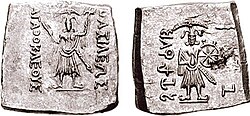
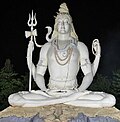
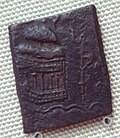
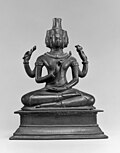
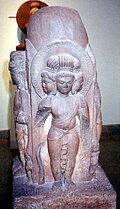
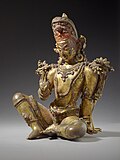
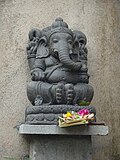

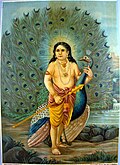
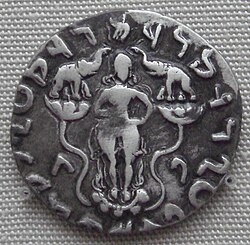
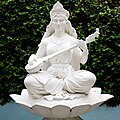


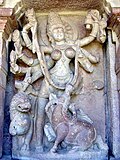
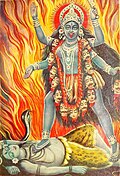
Bot: The file File:Bhagavan Vishnu.jpg has been removed, as it does not exist. |
m cleanup |
||
| Line 1: | Line 1: | ||
{{About|deities in Hinduism|the Hindu concept of God|Ishvara|and|Bhagavan}} | {{Short description|Gods and goddesses in Hinduism}} | ||
{{ | {{About|deities in Hinduism|Hindu views on God|God in Hinduism|the Hindu concept of God|Ishvara|and|Bhagavan}} | ||
{{ | {{Redirect|Hindu pantheon|the book|The Hindu Pantheon}} | ||
{{Use dmy dates|date= | {{Use Indian English|date=April 2015}} | ||
{{Use dmy dates|date=September 2025}} | |||
'''Hindu deities''' are the gods and goddesses in [[Hinduism]]. The terms and epithets for | {{multiple image | ||
| caption_align = center | |||
| total_width = 300 | |||
| perrow = 2 | |||
| title = | |||
| image1 = Ganesha Basohli miniature circa 1730 Dubost p73.jpg | |||
| alt1 = | |||
| caption1 = | |||
| image2 = Vishnu from Gita Govinda.jpg | |||
| alt2 = | |||
| caption2 = | |||
| image3 = Shiva Bangalore.jpg | |||
| alt3 = | |||
| caption3 = | |||
| image4 = Seal Bangkok Metropolitan Admin (green).svg | |||
| image5 = Sri Mariamman Temple Singapore 2 amk.jpg | |||
| image6 = Durga Mahisasuramardini.JPG | |||
| image7 = Goddess Parvati and her son Ganesha.jpg | |||
| alt4 = | |||
| caption4 = | |||
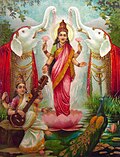
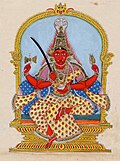
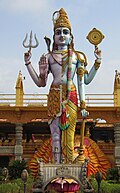
| footer = Examples of Hindu deities (from top): [[Ganesha]], [[Vishnu]], [[Shiva]], [[Indra]], [[Krishna]], [[Durga]], [[Parvati]], [[Lakshmi]] and [[Saraswati]]. | |||
| image8 = Raja Ravi Varma, Goddess Lakshmi, 1896.jpg | |||
| image9 = Saraswati.jpg | |||
}} | |||
{{Hinduism}} | |||
'''Hindu deities''' are the gods and goddesses in [[Hinduism]]. Deities in Hinduism are as diverse as its traditions, and a Hindu can choose to be [[polytheistic]], [[pantheistic]], [[monotheistic]], [[monistic]], even [[agnostic]], [[atheistic]], or [[humanist]].<ref name="juliuslipnerhindu82">[[Julius J. Lipner]] (2009), Hindus: Their Religious Beliefs and Practices, 2nd edition, Routledge, {{ISBN|978-0-415-45677-7}}, p. 8; Quote: "(...) one need not be religious in the minimal sense described to be accepted as a Hindu by Hindus, or describe oneself perfectly validly as Hindu. One may be polytheistic or monotheistic, monistic or pantheistic, even an agnostic, humanist or atheist, and still be considered a Hindu."</ref><ref>Lester Kurtz (ed.), Encyclopedia of Violence, Peace and Conflict, {{ISBN|978-0123695031}}, Academic Press, 2008</ref><ref>M. K. Gandhi, [http://www.mkgandhi.org/ebks/essence_of_hinduism.pdf The Essence of Hindu, Editor: V. B. Kher, Navajivan Publishing, see p. 3; According to Gandhi, "a man may not believe in God and still call himself a Hindu."]</ref> The terms and epithets for deities within the diverse traditions of Hinduism vary, and include [[Deva (Hinduism)|Deva]], [[Devi]], [[Ishvara]], [[Ishvari]], [[Bhagavan|Bhagavān]] and [[Bhagavathi|Bhagavati]].<ref>Radhakrishnan and Moore (1967, Reprinted 1989), A Source Book in Indian Philosophy, Princeton University Press, {{ISBN|978-0691019581}}, pp. 37-39, 401-403, 498-503</ref><ref name="mirceaelaide73" />{{refn|group=note|For translation of ''deva'' in singular noun form as "a deity, god", and in plural form as "the gods" or "the heavenly or shining ones", see: {{Harvnb|Monier-Williams|2001|p=492}} and {{Harvnb|Renou|1964|p=55}}}} | |||
The deities of Hinduism have evolved from the [[Vedic era]] (2nd millennium BCE) through the medieval era (1st millennium CE), regionally within [[Nepal]], [[India]] and in [[Southeast Asia]], and across Hinduism's diverse traditions.<ref name=nickgier>Nicholas Gier (2000), Spiritual Titanism: Indian, Chinese, and Western Perspectives, State University of New York Press, {{ISBN|978-0791445280}}, pp. 59-76</ref><ref name=fowlergita>Jeaneane D. Fowler (2012), The Bhagavad Gita, Sussex Academic Press, {{ISBN|978-1845193461}}, pp. 253-262</ref> The Hindu deity concept varies from a personal god as in [[Yoga]] school of [[Hindu philosophy]],<ref>{{Harvnb|Renou|1964|p=55}}</ref><ref>'''Mike Burley''' (2012), Classical Samkhya and Yoga - An Indian Metaphysics of Experience, Routledge, {{ISBN|978-0415648875}}, pp. 39-41;<br />'''Lloyd Pflueger''', Person Purity and Power in Yogasutra, in Theory and Practice of Yoga (Editor: Knut Jacobsen), Motilal Banarsidass, {{ISBN|978-8120832329}}, pp. 38-39;<br />[[Kovoor T. Behanan]] (2002), Yoga: Its Scientific Basis, Dover, {{ISBN|978-0486417929}}, pp. 56-58</ref> to | The deities of Hinduism have evolved from the [[Vedic era]] (2nd millennium BCE) through the medieval era (1st millennium CE), regionally within [[Nepal]], [[Pakistan]], [[India]] and in [[Southeast Asia]], and across Hinduism's diverse traditions.<ref name=nickgier>Nicholas Gier (2000), Spiritual Titanism: Indian, Chinese, and Western Perspectives, State University of New York Press, {{ISBN|978-0791445280}}, pp. 59-76</ref><ref name=fowlergita>Jeaneane D. Fowler (2012), The Bhagavad Gita, Sussex Academic Press, {{ISBN|978-1845193461}}, pp. 253-262</ref> The Hindu deity concept varies from a personal god as in [[Yoga]] school of [[Hindu philosophy]],<ref>{{Harvnb|Renou|1964|p=55}}</ref><ref>'''Mike Burley''' (2012), Classical Samkhya and Yoga - An Indian Metaphysics of Experience, Routledge, {{ISBN|978-0415648875}}, pp. 39-41;<br />'''Lloyd Pflueger''', Person Purity and Power in Yogasutra, in Theory and Practice of Yoga (Editor: Knut Jacobsen), Motilal Banarsidass, {{ISBN|978-8120832329}}, pp. 38-39;<br />[[Kovoor T. Behanan]] (2002), Yoga: Its Scientific Basis, Dover, {{ISBN|978-0486417929}}, pp. 56-58</ref> to thirty-three major deities in the [[Vedas]],<ref>{{Cite book |last=Scarborough |first=Jack |url=https://books.google.com/books?id=d9LSgA5wRv0C&dq=thirty-three+major+gods+vedas&pg=PA131 |title=The Origins of Cultural Differences and Their Impact on Management |date=2000 |publisher=Greenwood Publishing Group |isbn=978-1-56720-439-1 |pages=131 |language=en}}</ref> to hundreds of deities mentioned in the [[Puranas]] of Hinduism.<ref>Sanjukta Gupta (2013), Lakṣmī Tantra: A Pāñcarātra Text, Motilal Banarsidass, {{ISBN|978-8120817357}}, p. 166</ref> Examples of contemporary major deities include [[Vishnu]], [[Shiva]] and [[Mahadevi|Devi]].<ref>{{Cite web |date=2025-04-03 |title=Hinduism - Deities, Beliefs, Rituals {{!}} Britannica |url=https://www.britannica.com/topic/Hinduism/Deities |access-date=2025-04-21 |website=www.britannica.com |language=en}}</ref> These deities have distinct and complex personalities, yet are often viewed as aspects of the same Ultimate Reality called [[Brahman]].<ref name=":2">[[:no:Knut A. Jacobsen|Knut Jacobsen]] (2008), Theory and Practice of Yoga : 'Essays in Honour of Gerald James Larson, Motilal Banarsidass, {{ISBN|978-8120832329}}, pp. 77-78</ref>{{refn| group=note| name=avatars |[a] {{cite book|title=Achieving Cultural Competency|first1=Lisa|last1=Hark|first2=Horace|last2=DeLisser|publisher=John Wiley & Sons|year=2011|quote=Three gods, Brahma, Vishnu, and Shiva, and other deities are considered manifestations of and are worshipped as incarnations of Brahman.}} | ||
<br>[b] {{harvnb|Toropov|Buckles|2011}}: The members of various Hindu sects worship a dizzying number of specific deities and follow innumerable rites in honor of specific gods. Because this is Hinduism, however, its practitioners see the profusion of forms and practices as expressions of the same unchanging reality. The panoply of deities are understood by believers as symbols for a single transcendent reality. | <br>[b] {{harvnb|Toropov|Buckles|2011}}: The members of various Hindu sects worship a dizzying number of specific deities and follow innumerable rites in honor of specific gods. Because this is Hinduism, however, its practitioners see the profusion of forms and practices as expressions of the same unchanging reality. The panoply of deities are understood by believers as symbols for a single transcendent reality. | ||
<br>[d] {{cite book|year=2007|title=An Introductory Dictionary of Theology and Religious Studies|author=Orlando O. Espín, James B. Nickoloff|publisher=Liturgical Press|quote=While Hindus believe in many devas, many are monotheistic to the extent that they will recognise only one Supreme Being, a God or Goddess who is the source and ruler of the devas.}}}} From ancient times, the idea of equivalence has been cherished for all Hindus, in its texts and in early 1st millennium sculpture with concepts such as [[Harihara]] (Half Vishnu, Half Shiva)<ref>David Leeming (2001), ''A Dictionary of Asian Mythology'', Oxford University Press, {{ISBN|978-0195120530}}, p. 67</ref> and [[Ardhanarishvara|Ardhanārīshvara]] (half Shiva, half Parvati),<ref>Ellen Goldberg (2002), ''The Lord who is half woman: Ardhanārīśvara in Indian and feminist perspective'', State University of New York Press, {{ISBN|0-791453251}}, pp. 1–4</ref> with myths and temples that feature them together, declaring they are the same.<ref>TA Gopinatha Rao (1993), ''Elements of Hindu Iconography'', Vol. 2, Motilal Banarsidass, {{ISBN|978-8120808775}}, pp. 334-335</ref><ref>Fred Kleiner (2012), Gardner's Art through the Ages: A Global History, Cengage, {{ISBN|978-0495915423}}, pp. 443-444</ref><ref>Cynthia Packert Atherton (1997), The Sculpture of Early Medieval Rajasthan, Brill, {{ISBN|978-9004107892}}, pp. 42-46</ref> Major deities have inspired their own Hindu traditions, such as [[Vaishnavism]], [[Shaivism]] and [[Shaktism]], but with shared [[mythology]], ritual grammar, | <br>[d] {{cite book|year=2007|title=An Introductory Dictionary of Theology and Religious Studies|author=Orlando O. Espín, James B. Nickoloff|publisher=Liturgical Press|quote=While Hindus believe in many devas, many are monotheistic to the extent that they will recognise only one Supreme Being, a God or Goddess who is the source and ruler of the devas.}}}} From ancient times, the idea of equivalence has been cherished for all Hindus, in its texts and in early 1st-millennium sculpture with concepts such as [[Harihara]] (Half Vishnu, Half Shiva)<ref>David Leeming (2001), ''A Dictionary of Asian Mythology'', Oxford University Press, {{ISBN|978-0195120530}}, p. 67</ref> and [[Ardhanarishvara|Ardhanārīshvara]] (half Shiva, half Parvati),<ref>Ellen Goldberg (2002), ''The Lord who is half woman: Ardhanārīśvara in Indian and feminist perspective'', State University of New York Press, {{ISBN|0-791453251}}, pp. 1–4</ref> with myths and temples that feature them together, declaring they are the same.<ref>TA Gopinatha Rao (1993), ''Elements of Hindu Iconography'', Vol. 2, Motilal Banarsidass, {{ISBN|978-8120808775}}, pp. 334-335</ref><ref>Fred Kleiner (2012), Gardner's Art through the Ages: A Global History, Cengage, {{ISBN|978-0495915423}}, pp. 443-444</ref><ref>Cynthia Packert Atherton (1997), The Sculpture of Early Medieval Rajasthan, Brill, {{ISBN|978-9004107892}}, pp. 42-46</ref> Major deities have inspired their own Hindu traditions, such as [[Vaishnavism]], [[Shaivism]] and [[Shaktism]], but with shared [[mythology]], ritual grammar, theosophy, [[axiology]] and polycentrism.<ref>Lance Nelson (2007), ''An Introductory Dictionary of Theology and Religious Studies'' (Editors: Orlando O. Espín, James B. Nickoloff), Liturgical Press, {{ISBN|978-0814658567}}, pp. 562-563</ref><ref name=juliuslipner371>Julius J. Lipner (2009), Hindus: Their Religious Beliefs and Practices, 2nd Edition, Routledge, {{ISBN|978-0-415-45677-7}}, pp. 371-375</ref><ref name=frazierintrop2>{{cite book|last1=Frazier|first1=Jessica|title=The Continuum Companion to Hindu Studies |url=https://archive.org/details/continuumcompani00fraz|url-access=limited| date=2011|publisher=Continuum|location=London|isbn=978-0-8264-9966-0|pages=[https://archive.org/details/continuumcompani00fraz/page/n15 1]–15}}</ref> Some Hindu traditions, such as [[Smartism]] from the mid 1st millennium CE, have included multiple major deities as [[Henotheism|henotheistic]] manifestations of [[Saguna brahman|Saguna]] Brahman, and as a means to realizing [[Nirguna]] Brahman.<ref name=fxclooney/><ref name=mmyers>Michael Myers (2000), Brahman: A Comparative Theology, Routledge, {{ISBN|978-0700712571}}, pp. 124-127</ref><ref name="tompad"/> In [[Samkhya]] philosophy, [[Devata]] or ''deities'' are considered as "natural sources of energy" who have [[Sattva]] as the dominant [[Guṇa|Guna]].{{sfn|Sharma|1990|p=17}} | ||
Hindu deities are represented with various icons and anicons | Hindu deities are represented with various icons and anicons in sculptures and paintings, called [[Murti]]s and ''Pratimas''.<ref name="klausklost264">[[Klaus Klostermaier]] (2010), ''A Survey of Hinduism'', State University of New York Press, {{ISBN|978-0791470824}}, pp. 264-267</ref><ref name="Pratima Hinduism">{{cite encyclopedia|title=pratima (Hinduism)|url=https://www.britannica.com/EBchecked/topic/398379/pratima |encyclopedia=Encyclopædia Britannica |access-date=21 August 2011}}</ref><ref name=pkacharya>PK Acharya, [https://archive.org/stream/encyclopaediaofh07achauoft#page/526/mode/2up An Encyclopedia of Hindu Architecture], Oxford University Press, p. 426</ref> Some Hindu traditions, such as ancient [[Charvaka]]s, rejected all deities and concept of god or goddess,<ref>V. V. Raman (2012), Hinduism and Science: Some Reflections, Zygon - Journal of Religion and Science, 47(3): 549–574, Quote (p. 557): "Aside from nontheistic schools like the Samkhya, there have also been explicitly atheistic schools in the Hindu tradition. One virulently anti-supernatural system is/was the so-called Charvaka school."</ref><ref name="John Clayton 2010 page 150">John Clayton (2010), Religions, Reasons and Gods: Essays in Cross-cultural Philosophy of Religion, Cambridge University Press, {{ISBN|978-0521126274}}, p. 150</ref><ref name=":1">A Goel (1984), Indian philosophy: Nyāya-Vaiśeṣika and modern science, Sterling, {{ISBN|978-0865902787}}, pages 149-151;<br />R. Collins (2000), ''The Sociology of Philosophies'', Harvard University Press, {{ISBN|978-0674001879}}, p. 836</ref> while 19th-century British colonial era movements such as the [[Arya Samaj]] and [[Brahmo Samaj]] rejected deities and adopted monotheistic concepts similar to [[Abrahamic religions]].<ref>{{cite book|last=Naidoo|first=Thillayvel|title=The Arya Samaj Movement in South Africa|publisher=[[Motilal Banarsidass]]|page=158|year=1982|isbn=81-208-0769-3}}</ref><ref>Glyn Richards (1990), ''The World's Religions: The Religions of Asia'' (Editor: Friedhelm Hardy), Routledge, {{ISBN|978-0415058155}}, pp. 173-176</ref> Hindu deities have been adopted in other religions such as [[Jainism]],<ref>John E. Cort (1998), Open Boundaries: Jain Communities and Cultures in Indian History, State University of New York Press, {{ISBN|978-0791437865}}, pp. 218-220</ref> and in regions outside India, such as predominantly Buddhist [[Thailand]] and [[Japan]], where they continue to be revered in regional temples or arts.<ref name=hajime26/><ref>Ellen London (2008), ''Thailand Condensed: 2,000 Years of History & Culture'', Marshall Cavendish, {{ISBN|978-9812615206}}, p. 74</ref><ref>Trudy Ring et al. (1996), ''International Dictionary of Historic Places: Asia and Oceania'', Routledge, {{ISBN|978-1884964046}}, p. 692</ref> | ||
In ancient and medieval era texts of Hinduism, the human body is described as a temple,<ref name=holmbowker76>Jean Holm and John Bowker (1998), Sacred Place, Bloomsbury Academic, {{ISBN|978-0826453037}}, pp. 76-78</ref><ref>Michael Coogan (2003), ''The Illustrated Guide to World Religions'', Oxford University Press, {{ISBN|978-0195219975}}, p. 149</ref> and deities are described to be parts residing within it,<ref>[[Alain Daniélou]] (2001), ''The Hindu Temple: Deification of Eroticism'', {{ISBN|978-0892818549}}, pp. 82-83</ref><ref>[[Patrick Olivelle]] (1992), | In ancient and medieval era texts of Hinduism, the human body is described as a temple,<ref name=holmbowker76>Jean Holm and John Bowker (1998), Sacred Place, Bloomsbury Academic, {{ISBN|978-0826453037}}, pp. 76-78</ref><ref>Michael Coogan (2003), ''The Illustrated Guide to World Religions'', Oxford University Press, {{ISBN|978-0195219975}}, p. 149</ref> and deities are described to be parts residing within it,<ref>[[Alain Daniélou]] (2001), ''The Hindu Temple: Deification of Eroticism'', {{ISBN|978-0892818549}}, pp. 82-83</ref><ref>[[Patrick Olivelle]] (1992), ''The Samnyasa Upanisads'', Oxford University Press, {{ISBN|978-0195070453}}, pp. 147-148 with footnotes 2 and 5</ref> while the [[Brahman]] (Absolute Reality, God)<ref name=fxclooney>For dualism school of Hinduism, see: Francis X. Clooney (2010), Hindu God, Christian God: How Reason Helps Break Down the Boundaries between Religions, Oxford University Press, {{ISBN|978-0199738724}}, pp. 51-58, 111-115;<br>For monist school of Hinduism, see: B. Martinez-Bedard (2006), Types of Causes in Aristotle and Sankara, Thesis - Department of Religious Studies (Advisors: Kathryn McClymond and Sandra Dwyer), Georgia State University, pp. 18-35</ref><ref>{{cite book | last = Brodd | first = Jeffrey | title = World Religions | publisher = Saint Mary's Press | year = 2003 | location = Winona, MN | isbn = 978-0-88489-725-5 }}</ref> is described to be the same, or of similar nature, as the [[Atman (Hinduism)|Atman]] (Self), which Hindus believe is eternal and within every living being.<ref name="monierwilliams2037">{{Harvnb|Monier-Williams|1974|pp=20–37}}</ref><ref name="jkoller"/><ref name="R Prasad 2009 pages 345-347">R Prasad (2009), A Historical-developmental Study of Classical Indian Philosophy of Morals, Concept Publishing, {{ISBN|978-8180695957}}, pp. 345-347</ref> | ||
==Devas and devis== | ==Devas and devis== | ||
{{main|Deva (Hinduism)|Devi}} | {{main|Deva (Hinduism)|Devi}} | ||
Deities in Hinduism are referred to as [[Deva (Hinduism)|Deva]] (masculine) and [[Devi]] (feminine).<ref name=monierdevi>Monier Monier-Williams, A Sanskrit-English Dictionary" Etymologically and Philologically Arranged to cognate Indo-European Languages, Motilal Banarsidass, p. 496</ref><ref>John Stratton Hawley and Donna Marie Wulff (1998), Devi: Goddesses of India, Motilal Banarsidass, {{ISBN|978-8120814912}}, p. 2</ref><ref>William K Mahony (1997), The Artful Universe: An Introduction to the Vedic Religious Imagination, State University of New York Press, {{ISBN|978-0791435809}}, p. 18</ref> The root of these terms | [[File:জি. ডি. ব্লক সল্টলেক দুর্গা পুজো ২০১৮.jpg|left|thumb|Goddess [[Durga]] and a pantheon of other gods and goddesses being worshipped during [[Durga Puja]] Festival in Kolkata.]] | ||
Deities in Hinduism are referred to as [[Deva (Hinduism)|Deva]] (masculine) and [[Devi]] (feminine).<ref name="monierdevi">Monier Monier-Williams, A Sanskrit-English Dictionary" Etymologically and Philologically Arranged to cognate Indo-European Languages, Motilal Banarsidass, p. 496</ref><ref>John Stratton Hawley and Donna Marie Wulff (1998), Devi: Goddesses of India, Motilal Banarsidass, {{ISBN|978-8120814912}}, p. 2</ref><ref>William K Mahony (1997), The Artful Universe: An Introduction to the Vedic Religious Imagination, State University of New York Press, {{ISBN|978-0791435809}}, p. 18</ref> The root of these terms means "heavenly, divine, anything of excellence".<ref name="monier">Monier Monier-Williams, A Sanskrit-English Dictionary" Etymologically and Philologically Arranged to cognate Indo-European Languages, Motilal Banarsidass, p. 492</ref> | |||
In the earliest Vedic literature, all [[supernatural being]]s are called [[Asura (Hinduism)|Asura]]s.<ref>Wash Edward Hale (1999), Ásura in Early Vedic Religion, Motilal Barnarsidass, {{ISBN|978-8120800618}}, pp. 5-11, 22, 99-102</ref><ref>Monier Monier-Williams, A Sanskrit-English Dictionary" Etymologically and Philologically Arranged to cognate Indo-European Languages, Motilal Banarsidass, p. 121</ref> By the late Vedic period ( | In the earliest Vedic literature, all [[supernatural being]]s are called [[Asura (Hinduism)|Asura]]s.<ref>Wash Edward Hale (1999), Ásura in Early Vedic Religion, Motilal Barnarsidass, {{ISBN|978-8120800618}}, pp. 5-11, 22, 99-102</ref><ref>Monier Monier-Williams, A Sanskrit-English Dictionary" Etymologically and Philologically Arranged to cognate Indo-European Languages, Motilal Banarsidass, p. 121</ref> By the late Vedic period (c. 500 BCE), benevolent supernatural beings are referred to as ''Deva-Asuras''. In post-Vedic texts, such as the [[Puranas]] and the [[Itihasas]] of Hinduism, the Devas represent the good, and the Asuras the bad.<ref name=nickgier/><ref name=fowlergita/> In some medieval Indian literature, ''Devas'' are also referred to as Suras and contrasted with their equally powerful, but malevolent counterparts referred to as the Asuras.<ref name=ang>[https://www.britannica.com/EBchecked/topic/40167/asura/40167rellinks/Related-Links Encyclopædia Britannica]</ref> | ||
Hindu deities are part of | Hindu deities are part of [[Hindu mythology]], both Devas and Devis feature in one of many cosmological theories in Hinduism.<ref>Don Handelman (2013), One God, Two Goddesses, Three Studies of South Indian Cosmology, Brill Academic, {{ISBN|978-9004256156}}, pp. 23-29</ref><ref>Wendy Doniger (1988), Textual Sources for the Study of Hinduism, Manchester University Press, {{ISBN|978-0719018664}}, p. 67</ref> | ||
===Characteristics of Vedic-era deities=== | ===Characteristics of Vedic-era deities=== | ||
In Vedic literature, Devas and Devis represent the forces of nature and some represent moral values (such as the [[Aditya]]s, [[Varuna]], and [[Mitra]]), each symbolizing the epitome of | In Vedic literature, Devas and Devis represent the forces of nature and some represent moral values (such as the [[Ādityas|Aditya]]s, [[Varuna]], and [[Mitra (Hindu god)|Mitra]]), each symbolizing the epitome of specialized knowledge, creative energy, exalted and magical powers (''[[Siddhi]]s'').<ref>George Williams (2008), A Handbook of Hindu Mythology, Oxford University Press, {{ISBN|978-0195332612}}, pp. 24-33</ref><ref name=binagupta>Bina Gupta (2011), An Introduction to Indian Philosophy, Routledge, {{ISBN|978-0415800037}}, pp. 21-25</ref> | ||
{{multiple image | {{multiple image | ||
| direction = horizontal | |||
| width1 = 115 | |||
| width2 = 101 | |||
| width3 = 116 | |||
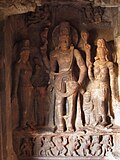
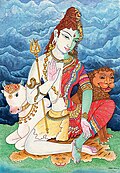
| footer = Vedic era deities evolved. Rudra (left) is represented in Vedic literature, is shown as Shiva-Rudra 2nd-century sculpture (middle), and as Shiva (meaning kind) in 13th-century artwork (right). The iconography evolved, retaining some symbolic elements such as trident, axe, or antelope.<ref>Stella Kramrisch (1994), The Presence of Siva, Princeton University Press, {{ISBN|978-0691019307}}, pp. 338-339</ref><ref>M Chakravarti (1995), The concept of Rudraa-Śiva through the ages, Motilal Banarsidass, {{ISBN|978-8120800533}}, pp. 59-65</ref> | |||
| image1 = Rudra.gif | |||
| image2 = ThreeHeadedShivaGandhara2ndCentury.jpg | |||
| image3 = Indian - Festival Image of Shiva - Walters 543084.jpg | |||
}} | |||
The most referred to Devas in the [[ | |||
The most referred to Devas in the [[Rigveda]] are [[Indra]], [[Agni]] (fire) and [[Soma (deity)|Soma]], with "fire deity" called the friend of all humanity. Indra and Soma are two celebrated in a [[yajna]] fire ritual that marks major Hindu ceremonies. [[Savitr]], [[Vishnu]], [[Rudra]] (later given the exclusive epithet of [[Shiva]]), and [[Prajapati]] (later [[Brahma]]) are gods and hence Devas.<ref name=hajime26>Hajime Nakamura (1998), A Comparative History of Ideas, Motilal Banarsidass, {{ISBN|978-8120810044}}, pp. 26-33</ref> | |||
The [[Vedas]] describes a number of significant Devis such as [[Ushas]] (dawn), [[Prithvi]] (earth), [[Aditi]] (cosmic moral order), [[Saraswati]] (river, knowledge), [[Vāc]] (sound), [[Nirṛti (goddess)|Nirṛti]] (destruction), [[Ratri]] (night), [[Aranyani]] (forest), and bounty goddesses such as Dinsana, Raka, Puramdhi, Parendi, Bharati, Mahi among others | The [[Vedas]] describes a number of significant Devis such as [[Ushas]] (dawn), [[Prithvi]] (earth), [[Aditi]] (cosmic moral order), [[Saraswati]] (river, knowledge), [[Vāc]] (sound), [[Nirṛti (goddess)|Nirṛti]] (destruction), [[Ratri]] (night), [[Aranyani]] (forest), and bounty goddesses such as Dinsana, Raka, Puramdhi, Parendi, Bharati, Mahi, among others, mentioned in the ''[[Rigveda]]''.<ref name=kinsley717>David Kinsley (2005), Hindu Goddesses: Vision of the Divine Feminine in the Hindu Religious Traditions, University of California Press, {{ISBN|978-8120803947}}, pp. 6-17, 55-64</ref> Sri, also called Lakshmi, appears in late Vedic texts dated to be pre-Buddhist, but verses dedicated to her do not suggest that her characteristics were fully developed in the Vedic era.<ref name=kinsley18>David Kinsley (2005), Hindu Goddesses: Vision of the Divine Feminine in the Hindu Religious Traditions, University of California Press, {{ISBN|978-8120803947}}, pp. 18, 19</ref> All gods and goddesses are distinguished in the Vedic times, but in the post-Vedic texts (c. 500 BCE to 200 CE), and particularly in the early medieval era literature, they are ultimately seen as aspects or manifestations of one [[Brahman]], the Supreme power.<ref name=kinsley18/><ref>Christopher John Fuller (2004), The Camphor Flame: Popular Hinduism and Society in India, Princeton University Press, {{ISBN|978-0691120485}}, p. 41</ref> | ||
Ananda Coomaraswamy states that Devas and Asuras in the Vedic lore are similar to [[Twelve Olympians|Angels-Theoi-Gods]] and [[Titan (mythology)|Titans]] of Greek mythology, both are powerful but have different orientations and inclinations, the Devas representing the powers of Light and the Asuras representing the powers of Darkness in Hindu mythology.<ref>Wash Edward Hale (1999), Ásura in Early Vedic Religion, Motilal Barnarsidass, {{ISBN|978-8120800618}}, p. 20</ref><ref name=":0"/> According to Coomaraswamy's interpretation of Devas and Asuras, both these natures exist in each human being, the tyrant and the angel is within each being, the best and the worst within each person struggles before choices and one's | Ananda Coomaraswamy states that Devas and Asuras in the Vedic lore are similar to [[Twelve Olympians|Angels-Theoi-Gods]] and [[Titan (mythology)|Titans]] of Greek mythology, both are powerful but have different orientations and inclinations, the Devas representing the powers of Light and the Asuras representing the powers of Darkness in Hindu mythology.<ref>Wash Edward Hale (1999), Ásura in Early Vedic Religion, Motilal Barnarsidass, {{ISBN|978-8120800618}}, p. 20</ref><ref name=":0"/> According to Coomaraswamy's interpretation of Devas and Asuras, both these natures exist in each human being, the tyrant and the angel is within each being, the best and the worst within each person struggles before choices and one's nature, and the Hindu formulation of Devas and Asuras is an eternal dance between these within each person.<ref>Ananda Coomaraswamy (1935), "Angel and Titan: An Essay in Vedic Ontology", ''Journal of the American Oriental Society'', volume 55, pp. 373–418</ref><ref name=Gier>Nicholas Gier (1995), [https://www.jstor.org/stable/1399510 Hindu Titanism], Philosophy East and West, Volume 45, Number 1, p. 76, see also 73-96</ref> | ||
{{ | {{Blockquote| | ||
The Devas and Asuras, Angels and Titans, powers of Light and powers of Darkness in Rigveda, although distinct and opposite in operation, are in essence consubstantial, their distinction being a matter not of essence but of orientation, revolution or transformation. In this case, the Titan is potentially an Angel, the Angel still by nature a Titan; the Darkness in ''actu'' is Light, the Light in ''potentia'' Darkness; whence the designations Asura and Deva may be applied to one and the same Person according to the mode of operation, as in Rigveda 1.163.3, "Trita art thou (Agni) by interior operation". | The Devas and Asuras, Angels and Titans, powers of Light and powers of Darkness in Rigveda, although distinct and opposite in operation, are in essence consubstantial, their distinction being a matter not of essence but of orientation, revolution, or transformation. In this case, the Titan is potentially an Angel, the Angel still by nature a Titan; the Darkness in ''actu'' is Light, the Light in ''potentia'' Darkness; whence the designations Asura and Deva may be applied to one and the same Person according to the mode of operation, as in Rigveda 1.163.3, "Trita art thou (Agni) by interior operation". | ||
|Ananda Coomaraswamy|''Journal of the American Oriental Society''<ref name=":0">Ananda Coomaraswamy (1935), "Angel and Titan: An Essay in Vedic Ontology", ''Journal of the American Oriental Society'', volume 55, pp. 373–374, {{ | |Ananda Coomaraswamy|'' Journal of the American Oriental Society''<ref name=":0">Ananda Coomaraswamy (1935), "Angel and Titan: An Essay in Vedic Ontology", ''Journal of the American Oriental Society'', volume 55, pp. 373–374, {{JSTOR|594758}}.</ref>}} | ||
===Characteristics of medieval-era deities=== | ===Characteristics of medieval-era deities=== | ||
In the [[Puranas]] and the [[Itihasas]] with the embedded Bhagavad Gita, the Devas represent the good, and the Asuras the bad.<ref name="nickgier"/><ref name=fowlergita/> According to the [[Bhagavad Gita]] (16.6–16.7), all beings in the universe have both the divine qualities (''daivi sampad'') and the demonic qualities (''asuri sampad'') within | In the [[Puranas]] and the [[Itihasas]] with the embedded Bhagavad Gita, the Devas represent the good, and the Asuras the bad.<ref name="nickgier"/><ref name=fowlergita/> According to the [[Bhagavad Gita]] (16.6–16.7), all beings in the universe have both the divine qualities (''daivi sampad'') and the demonic qualities (''asuri sampad'') within them.<ref name=fowlergita/><ref name=chrischapple/> The sixteenth chapter of the Bhagavad Gita states that pure god-like saints are rare, as are pure demon-like evil individuals among human beings. Instead, the majority of humanity is multi-charactered with a few or many faults.<ref name=fowlergita/> According to Jeaneane Fowler, the Gita states that desires, aversions, greed, needs, emotions in various forms "are facets of ordinary lives". It is only when they turn to lust, hate, cravings, arrogance, conceit, anger, harshness, hypocrisy, violence, cruelty and such negativity- and destruction-inclined tendencies that natural human inclinations metamorphose into something demonic (Asura).<ref name="fowlergita"/><ref name=chrischapple>Christopher K Chapple (2010), The Bhagavad Gita: Twenty-fifth–Anniversary Edition, State University of New York Press, {{ISBN|978-1438428420}}, pp. 610-629</ref> | ||
[[File:Seal Surin.png|thumb|[[Indra]] is a Vedic era deity, found in south and southeast Asia. Above Indra is part of the seal of a [[Thailand]] state.]] | [[File:Seal Surin.png|thumb|[[Indra]] is a Vedic era deity, found in south and southeast Asia. Above Indra is part of the seal of a [[Thailand]] state.]] | ||
The Epics and medieval era texts, particularly the [[Puranas]], developed extensive and richly varying mythologies associated with Hindu deities, including their [[Genealogies of Genesis|genealogies.]]<ref name=ludorocher/><ref name=oliverleaman437>Greg Bailey (2001), Encyclopedia of Asian Philosophy (Editor: Oliver Leaman), Routledge, {{ISBN|978-0415172813}}, pp. 437-439</ref><ref name=gregorybailey>Gregory Bailey (2003), The Study of Hinduism (Editor: Arvind Sharma), The University of South Carolina Press, {{ISBN|978-1570034497}}, p. 139</ref> Several of the Purana texts are named after major | The Epics and medieval era texts, particularly the [[Puranas]], developed extensive and richly varying mythologies associated with Hindu deities, including their [[Genealogies of Genesis|genealogies.]]<ref name=ludorocher/><ref name=oliverleaman437>Greg Bailey (2001), Encyclopedia of Asian Philosophy (Editor: Oliver Leaman), Routledge, {{ISBN|978-0415172813}}, pp. 437-439</ref><ref name=gregorybailey>Gregory Bailey (2003), The Study of Hinduism (Editor: Arvind Sharma), The University of South Carolina Press, {{ISBN|978-1570034497}}, p. 139</ref> Several of the Purana texts are named after major Hindu deities such as Vishnu, Shiva and Devi.<ref name=ludorocher>Ludo Rocher (1986), The Puranas, Otto Harrassowitz Verlag, {{ISBN|978-3447025225}}, pp. 1-5, 12-21</ref> Other texts and commentators such as [[Adi Shankara]] explain that Hindu deities live or rule over the cosmic body as well as in the temple of the human body.<ref name=holmbowker76/><ref name=danielou57/> They remark that the Sun deity is the eyes, the [[Vayu|Vāyu]] the nose, the [[Prajapati]] the sexual organs, the [[Lokapala]]s the ears, [[Chandra]] the mind, Mitra the inward breath, [[Varuna]] the outward breath, [[Indra]] the arms, Bṛhaspati the speech, Vishnu, whose stride is great, is the feet, and Māyā is the smile.<ref name=danielou57>[[Alain Daniélou]] (1991), The Myths and Gods of India, Princeton/Bollingen Paperbacks, {{ISBN|978-0892813544}}, pp. 57-60</ref> | ||
===Symbolism=== | ===Symbolism=== | ||
| Line 62: | Line 88: | ||
==Ishvara== | ==Ishvara== | ||
{{main|Ishvara}} | {{main|Ishvara}} | ||
[[File:Surya Majapahit Diagram.svg|thumb|Ishvara is, along with Shiva, Vishnu and Brahma, one of the 17 deities commonly found in Indonesian [[Surya Majapahit]] Hindu arts and records. However, Ishvara represents different | [[File:Surya Majapahit Diagram.svg|thumb|Ishvara is, along with Shiva, Vishnu and Brahma, one of the 17 deities commonly found in Indonesian [[Surya Majapahit]] Hindu arts and records. However, Ishvara represents different concepts in various Hindu philosophies.]] | ||
Another Hindu term that is sometimes translated as deity is [[Ishvara]], or | Another Hindu term that is sometimes translated as the deity is [[Ishvara]], or various deities are described, state Sorajjakool et al., as "the personifications of various aspects of the same Ishvara".<ref>Siroj Sorajjakool, Mark Carr and Julius Nam (2009), World Religions, Routledge, {{ISBN|978-0789038135}}, p. 38</ref> The term ''Ishvara'' has a wide range of meanings that depend on the era and the school of Hinduism.<ref name=mmwizvara>Monier Williams, Sanskrit-English dictionary, [http://www.sanskrit-lexicon.uni-koeln.de/mwquery/ Izvara], Sanskrit Digital Lexicon, University of Cologne, Germany</ref><ref>James Lochtefeld, "Ishvara", The Illustrated Encyclopedia of Hinduism, Vol. 1: A–M, Rosen Publishing. {{ISBN|0-8239-2287-1}}, p. 306</ref><ref name=riepe>Dale Riepe (1961, Reprinted 1996), Naturalistic Tradition in Indian Thought, Motilal Banarsidass, {{ISBN|978-8120812932}}, pp. 177-184, 208-215</ref> In ancient texts of Indian philosophy, ''Ishvara'' means supreme Self, [[Brahman]] (Highest Reality), ruler, king or husband depending on the context.<ref name=mmwizvara/> In medieval era texts, ''Ishvara'' means God, Supreme Being, personal god, or special Self depending on the school of Hinduism.<ref name=mirceaelaide73>Mircea Eliade (2009), Yoga: Immortality and Freedom, Princeton University Press, {{ISBN|978-0691142036}}, pp. 73-76</ref><ref name=riepe/><ref name=ianw>Ian Whicher, The Integrity of the Yoga Darsana, State University of New York Press, {{ISBN|978-0791438152}}, pp. 82-86</ref> | ||
Among the six systems of [[Hindu philosophy]], [[Samkhya]] and [[Mimamsa]] do not consider the concept of ''Ishvara'', i.e., a supreme being, relevant. [[Yoga (philosophy)|Yoga]], [[Vaisheshika]], [[Vedanta]] and [[Nyaya]] schools of Hinduism discuss Ishvara | Among the six systems of [[Hindu philosophy]], [[Samkhya]] and [[Mimamsa]] do not consider the concept of ''Ishvara'', i.e., a supreme being, relevant. [[Yoga (philosophy)|Yoga]], [[Vaisheshika]], [[Vedanta]], and [[Nyaya]] schools of Hinduism discuss Ishvara but assign different meanings.{{citation needed|date=March 2025}} | ||
Early Nyaya school scholars considered the hypothesis of a deity as a creator God with the power to grant blessings, boons and fruits; but these early Nyaya scholars then rejected this hypothesis, and were non-theistic or atheists.<ref name="John Clayton 2010 page 150"/><ref>G Oberhammer (1965), Zum problem des Gottesbeweises in der | Early Nyaya school scholars considered the hypothesis of a deity as a creator God with the power to grant blessings, boons, and fruits; but these early Nyaya scholars then rejected this hypothesis, and were non-theistic or atheists.<ref name="John Clayton 2010 page 150"/><ref>G Oberhammer (1965), Zum problem des Gottesbeweises in der indischen Philosophie, Numen, 12: 1-34</ref> Later scholars of Nyaya school reconsidered this question and offered counter arguments for what is Ishvara and various arguments to prove the existence of an omniscient, omnipresent, omnipotent deity (God).<ref name=fxc>Francis X. Clooney (2010), Hindu God, Christian God: How Reason Helps Break Down the Boundaries, Oxford University Press, {{ISBN|978-0199738724}}, pp. 18-19, 35-39</ref> | ||
Vaisheshika school of Hinduism, as founded by Kanada in 1st millennium BCE, neither required nor relied on creator deity.<ref name=klausk>Klaus Klostermaier (2007), A Survey of Hinduism, Third Edition, State University of New York, {{ISBN|978-0791470824}}, p. 337</ref><ref | Vaisheshika school of Hinduism, as founded by Kanada in the 1st millennium BCE, neither required nor relied on a creator deity.<ref name=klausk>Klaus Klostermaier (2007), A Survey of Hinduism, Third Edition, State University of New York, {{ISBN|978-0791470824}}, p. 337</ref><ref name=":1" /> Later Vaisheshika school adopted the concept of ''Ishvara'', states [[Klaus Klostermaier]], but as an eternal God who co-exists in the universe with eternal substances and atoms, but He "winds up the clock, and lets it run its course".<ref name=klausk/> | ||
Ancient Mimamsa scholars of Hinduism questioned what is ''Ishvara'' (deity, God)?<ref name=fxc3>FX Clooney (1997), What's a god? The quest for the right understanding of devatā in Brāhmaṅical ritual theory (Mīmāṃsā), International Journal of Hindu Studies, August 1997, Volume 1, Issue 2, pp. 337-385</ref> They considered a deity concept unnecessary for a consistent philosophy and [[moksha]] (soteriology).<ref name=fxc3/><ref name=bilimoria>P. Bilimoria (2001), Hindu doubts about God: Towards Mimamsa Deconstruction, in Philosophy of Religion: Indian Philosophy (Editor: Roy Perrett), Volume 4, Routledge, {{ISBN|978-0-8153-3611-2}}, pp. 87-106</ref> | Ancient Mimamsa scholars of Hinduism questioned what is ''Ishvara'' (deity, God)?<ref name=fxc3>FX Clooney (1997), What's a god? The quest for the right understanding of devatā in Brāhmaṅical ritual theory (Mīmāṃsā), International Journal of Hindu Studies, August 1997, Volume 1, Issue 2, pp. 337-385</ref> They considered a deity concept unnecessary for a consistent philosophy and [[moksha]] (soteriology).<ref name=fxc3/><ref name=bilimoria>P. Bilimoria (2001), Hindu doubts about God: Towards Mimamsa Deconstruction, in Philosophy of Religion: Indian Philosophy (Editor: Roy Perrett), Volume 4, Routledge, {{ISBN|978-0-8153-3611-2}}, pp. 87-106</ref> | ||
In Samkhya school of Hindu philosophy, ''Isvara'' is neither a creator-God | In the Samkhya school of Hindu philosophy, ''Isvara'' is neither a creator-God nor a savior-God.<ref>A Malinar (2014), Current Approaches: Articles on Key Themes, in The Bloomsbury Companion to Hindu Studies (Editor: Jessica Frazier), Bloomsbury Academic, {{ISBN|978-1472511515}}, p. 79</ref> This is called one of the several major atheistic schools of Hinduism by some scholars.<ref name=lpfl/><ref>Mike Burley (2012), Classical Samkhya and Yoga - An Indian Metaphysics of Experience, Routledge, {{ISBN|978-0415648875}}, p. 39</ref><ref>Richard Garbe (2013), Die Samkhya-Philosophie, Indische Philosophie Volume 11, {{ISBN|978-1484030615}}, pp. 25-27 (in German)</ref> Others, such as [[:no: Knut A. Jacobsen|Jacobsen]], state that Samkhya is more accurately described as non-theistic.<ref>Knut Jacobsen (2008), Theory and Practice of Yoga: 'Essays in Honour of Gerald James Larson, Motilal Banarsidass, {{ISBN|978-8120832329}}, pp. 15-16</ref> Deity is considered an irrelevant concept, neither defined nor denied, in Samkhya school of Hindu philosophy.<ref name=":2" /> | ||
In Yoga school of Hinduism, it is any "personal deity" (Ishta Deva or Ishta Devata)<ref>Orlando Espín and James Nickoloff (2007), An Introductory Dictionary of Theology and Religious Studies, Liturgical Press, {{ISBN|978-0814658567}}, p. 651</ref> or "spiritual inspiration", but not a creator God.<ref name=ianw/><ref name=lpfl>Lloyd Pflueger, Person Purity and Power in Yogasutra, in Theory and Practice of Yoga (Editor: Knut Jacobsen), Motilal Banarsidass, {{ISBN|978-8120832329}}, pp. 38-39</ref> Whicher explains that while Patanjali's terse verses in the Yogasutras can be interpreted both as theistic or non-theistic, Patanjali's concept of ''Isvara'' in Yoga philosophy functions as a "transformative catalyst or guide for aiding the yogin on the path to spiritual emancipation".<ref>Ian Whicher (1999), The Integrity of the Yoga Darsana: A Reconsideration of Classical Yoga, State University of New York Press, {{ISBN|978-0791438152}}, p. 86</ref> | In the Yoga school of Hinduism, it is any "personal deity" (Ishta Deva or Ishta Devata)<ref>Orlando Espín and James Nickoloff (2007), An Introductory Dictionary of Theology and [[Religious studies|Religious Studies]], Liturgical Press, {{ISBN|978-0814658567}}, p. 651</ref> or "spiritual inspiration", but not a creator God.<ref name=ianw/><ref name=lpfl>Lloyd Pflueger, Person Purity and Power in Yogasutra, in Theory, and Practice of Yoga (Editor: Knut Jacobsen), Motilal Banarsidass, {{ISBN|978-8120832329}}, pp. 38-39</ref> Whicher explains that while Patanjali's terse verses in the Yogasutras can be interpreted both as theistic or non-theistic, Patanjali's concept of ''Isvara'' in Yoga philosophy functions as a "transformative catalyst or guide for aiding the yogin on the path to spiritual emancipation".<ref>Ian Whicher (1999), The Integrity of the Yoga Darsana: A Reconsideration of Classical Yoga, State University of New York Press, {{ISBN|978-0791438152}}, p. 86</ref> | ||
The [[Advaita Vedanta]] school of Hinduism asserted that there is no [[dualism (Indian philosophy)|dualistic]] existence of deity (or deities).<ref name=" | The [[Advaita Vedanta]] school of Hinduism asserted that there is no [[dualism (Indian philosophy)|dualistic]] existence of a deity (or deities).<ref name=":2" /><ref>JN Mohanty (2001), Explorations in Philosophy, Vol 1 (Editor: Bina Gupta), Oxford University Press, pp. 107-108</ref> There is no otherness nor distinction between ''Jiva'' and ''Ishvara''.<ref>Paul Hacker (1978), Eigentumlichkeiten dr Lehre und Terminologie Sankara: Avidya, Namarupa, Maya, Isvara, in Kleine Schriften (Editor: L. Schmithausen), Franz Steiner Verlag, Weisbaden, pp. 101-109 (in German), also pp. 69-99</ref><ref name="William Indich 2000 page 5">William Indich (2000), Consciousness in Advaita Vedanta, Motilal Banarsidass, {{ISBN|978-8120812512}}, p. 5</ref> God (Ishvara, Brahman) is identical with the Atman (Self) within each human being in Advaita Vedanta school,<ref>William James (1985), The Varieties of Religious Experience, Harvard University Press, {{ISBN|978-0674932258}}, p. 404 with footnote 28</ref> and there is a [[monism|monistic]] Universal Absolute Oneness that connects everyone and everything.<ref name=jkoller>John Koller (2012), Routledge Companion to Philosophy of Religion (Editors: Chad Meister, Paul Copan), Routledge, {{ISBN|978-0415782944}}, pp. 99-107</ref><ref name="William Indich 2000 page 5"/><ref name=lance>Lance Nelson (1996), Living liberation in Shankara and classical Advaita, in Living Liberation in Hindu Thought (Editors: Andrew O. Fort, Patricia Y. Mumme), State University of New York Press, {{ISBN|978-0791427064}}, pp. 38-39, 59 (footnote 105)</ref> | ||
In [[Dvaita]] sub-school of Vedanta Hinduism, ''Ishvara'' is defined as a creator God that is distinct from ''Jiva'' (individual Selfs in living beings).<ref name="R Prasad 2009 pages 345-347"/> In this school, God creates individual Self (Atman), but the individual Self never was and never will become one with God; the best it can do is to experience bliss by getting infinitely close to God.<ref name=tompad>Thomas Padiyath (2014), The Metaphysics of Becoming, De Gruyter, {{ISBN|978-3110342550}}, pp. 155-157</ref> | |||
==Number of deities== | ==Number of deities== | ||
| Line 88: | Line 114: | ||
| caption = [[Sri Yantra]] symbolizing the goddess [[Tripura Sundari]] | | caption = [[Sri Yantra]] symbolizing the goddess [[Tripura Sundari]] | ||
}} | }} | ||
[[Yāska]], the earliest known language scholar of India ( | [[Yāska]], the earliest known language scholar of India (c. 500 BCE), mentions that there are three deities (''Devas'') according to the Vedas, "''Agni'' (fire), whose place is on the earth; ''Vayu'' (wind), whose place is the air; and ''Surya'' (sun), whose place is in the sky".<ref>WJ Wilkins (2003), Hindu Gods and Goddesses, Dover, {{ISBN|978-0486431567}}, pp. 9-10</ref> This principle of three worlds (or zones), and its multiples is found thereafter in many ancient texts. The [[Samhita]]s, which are the oldest layer of text in [[Vedas]] enumerate 33 devas,{{refn|group=note|The list of Vedic Devas somewhat varies across the manuscripts found in different parts of South Asia, particularly in terms of guides (Aswins) and personified Devas. One list based on Book 2 of Aitereya Brahmana is:<ref>Hermann Oldenberg (1988), The Religion of the Veda, Motilal Banarsidass, {{ISBN|978-8120803923}}, pp. 23-50</ref><ref>AA MacDonell, {{Google books|KCQ_AQAAMAAJ|Vedic mythology|page=PA19}}, Oxford University Press, pp. 19-21</ref><br> | ||
* Devas personified: [[Indra]] ({{IAST|Śakra}}), [[Varuna|{{IAST|Varuṇa}}]], [[Mitra (Vedic)|Mitra]], [[Aryaman]], [[Bhaga]], [[Ansa (Hinduism)|{{IAST|Aṃśa}}]], Vidhatr ('''Brahma'''),<ref>Francis X Clooney (2010), Divine Mother, Blessed Mother, Oxford University Press, {{ISBN|978-0199738731}}, p. 242</ref> [[Tvashtri|{{IAST|Tvāṣṭṛ}}]], [[Pushan|{{IAST|Pūṣan}}]], [[Vivasvan|Vivasvat]], [[Savitr|{{IAST|Savitṛ}}]] (Dhatr), '''Vishnu'''. | * Devas personified: [[Indra]] ({{IAST|Śakra}}), [[Varuna|{{IAST|Varuṇa}}]], [[Mitra (Vedic)|Mitra]], [[Aryaman]], [[Bhaga]], [[Ansa (Hinduism)|{{IAST|Aṃśa}}]], Vidhatr ('''Brahma'''),<ref>Francis X Clooney (2010), Divine Mother, Blessed Mother, Oxford University Press, {{ISBN|978-0199738731}}, p. 242</ref> [[Tvashtri|{{IAST|Tvāṣṭṛ}}]], [[Pushan|{{IAST|Pūṣan}}]], [[Vivasvan|Vivasvat]], [[Savitr|{{IAST|Savitṛ}}]] (Dhatr), '''Vishnu'''. | ||
* Devas as abstractions or inner principles: Ānanda (bliss, inner contentment), Vijñāna (knowledge), Manas (mind, thought), Prāṇa (life-force), Vāc (speech), [[Atman (Hinduism)|Ātmā]] (Self within each person), and five manifestations of '''Rudra/Shiva''' – [[Ishana|Īśāna]], Tatpuruṣa, Aghora, Vāmadeva, Sadyojāta | * Devas as abstractions or inner principles: Ānanda (bliss, inner contentment), Vijñāna (knowledge), Manas (mind, thought), Prāṇa (life-force), Vāc (speech), [[Atman (Hinduism)|Ātmā]] (Self within each person), and five manifestations of '''Rudra/Shiva''' – [[Ishana|Īśāna]], Tatpuruṣa, Aghora, Vāmadeva, Sadyojāta | ||
* Devas as forces or principles of nature – [[Prithvi|{{IAST|Pṛthivī}}]] (earth), [[Agni]] (fire), Antarikṣa (atmosphere, space), Jal (water), [[Vayu|Vāyu]] (wind), [[Dyaus Pita|{{IAST|Dyauṣ}}]] (sky), [[Surya|Sūrya]] (sun), {{IAST|Nakṣatra}} (stars), Soma (moon) | * Devas as forces or principles of nature – [[Prithvi|{{IAST|Pṛthivī}}]] (earth), [[Agni]] (fire), Antarikṣa (atmosphere, space), Jal (water), [[Vayu|Vāyu]] (wind), [[Dyaus Pita|{{IAST|Dyauṣ}}]] (sky), [[Surya|Sūrya]] (sun), {{IAST|Nakṣatra}} (stars), Soma (moon) | ||
* Devas as guide or creative energy – Vasatkara, [[Prajapati|Prajāpati]]}} either 11 each for the three worlds, or as 12 [[ | * Devas as guide or creative energy – Vasatkara, [[Prajapati|Prajāpati]]}} either 11 each for the three worlds, or as 12 [[Adityas]], 11 [[Rudras]], 8 [[Vasu]]s and 2 [[Ashvins]] in the [[Brahmanas]] layer of Vedic texts.<ref name="George Williams 2008 pages 90, 112">George Williams (2008), A Handbook of Hindu Mythology, Oxford University Press, {{ISBN|978-0195332612}}, pp. 90, 112</ref><ref name=monier/> | ||
The Rigveda states in hymn 1.139.11, | The Rigveda states in hymn 1.139.11, | ||
{{ | {{Blockquote| | ||
<poem> | <poem> | ||
ये '''देवा'''सो दिव्येकादश स्थ पृथिव्यामध्येकादश स्थ <nowiki>। | ये '''देवा'''सो दिव्येकादश स्थ पृथिव्यामध्येकादश स्थ <nowiki>। | ||
| Line 112: | Line 138: | ||
===One or one-ness=== | ===One or one-ness=== | ||
Thirty-three ''koti'' (33 | Thirty-three ''koti'' (33 supreme) divinities are mentioned in other ancient texts, such as the [[Yajurveda]]. Most, by far, are goddesses, state Foulston and Abbott, suggesting "how important and popular goddesses are" in Hindu culture.<ref name="lynnfoulston">{{cite book|last=Lynn Foulston, Stuart Abbott|title=Hindu goddesses: beliefs and practices|pages=1–3, 40–41| publisher=Sussex Academic Press| url=https://books.google.com/books?id=9XbCAQAACAAJ| isbn=9781902210438|year=2009}}</ref> Scholars state all deities are typically viewed in Hinduism as "emanations or manifestation of genderless principle called [[Brahman]], representing the many facets of Ultimate Reality".<ref name="lynnfoulston" /><ref name="lawrence78" /><ref name="brodd43" /> In Hinduism, the concept is that "God, the universe, human beings and all else is essentially one thing" and there is a connected oneness where the same God resides within every human being as [[Ātman (Hinduism)|Atman]], the eternal Self.<ref name="brodd43">Jeffrey Brodd (2003), World Religions: A Voyage of Discovery, Saint Mary's Press, {{ISBN|978-0884897255}}, p. 43</ref><ref>Christopher John Fuller (2004), The Camphor Flame: Popular Hinduism and Society in India, Princeton University Press, {{ISBN|978-0691120485}}, pp. 30-31, '''Quote:''' "Crucial in Hindu polytheism is the relationship between the deities and humanity. Unlike Jewish, Christian and Islamic monotheism, predicated on the otherness of God and either his total separation from man and his singular incarnation, Hinduism postulates no absolute distinction between deities and human beings. The idea that all deities are truly one is, moreover, easily extended to proclaim that all human beings are in reality also forms of one supreme deity - Brahman, the Absolute of philosophical Hinduism. In practice, this abstract monist doctrine rarely belongs to an ordinary Hindu's statements, but examples of permeability between the divine and human can be easily found in popular Hinduism in many unremarkable contexts".</ref> | ||
==Iconography and practices== | ==Iconography and practices== | ||
| Line 123: | Line 147: | ||
| width2 = 110 | | width2 = 110 | ||
| width3 = 132 | | width3 = 132 | ||
| footer = Proper ''Murti'' design is described in ancient and medieval Indian texts ([[Bengali language|Bengali]]). They describe proportions, posture, expressions among other details, often referencing | | footer = Proper ''Murti'' design is described in ancient and medieval Indian texts ([[Bengali language|Bengali]]). They describe proportions, posture, and expressions among other details, often referencing nature.<ref>Abanindranth Tagore, [https://archive.org/stream/cu31924020549725#page/n7/mode/2up Some notes on Indian Artistic Anatomy], pp. 1-21</ref><ref>Stella Kramrisch (1958), Traditions of the Indian Craftsman, The Journal of American Folklore, Vol. 71, No. 281, pp. 224-230</ref><ref>John Cort (2011), Jains in the World, Oxford University Press, {{ISBN|978-0199796649}}, pp. 20-21, 56-58</ref> | ||
| image1 = Indian murti (statue) proportions posture shape design 05.jpg | | image1 = Indian murti (statue) proportions posture shape design 05.jpg | ||
| image2 = Indian murti (statue) proportions posture shape design 06.jpg | | image2 = Indian murti (statue) proportions posture shape design 06.jpg | ||
| image3 = Indian murti (statue) proportions posture shape design 10.jpg | | image3 = Indian murti (statue) proportions posture shape design 10.jpg | ||
}} | }} | ||
{{Quote box | {{Quote box | ||
| width = 27em | | width = 27em | ||
| align = right | | align = right | ||
| | | title = A Hindu prayer before cutting a tree for a ''Murti'' | ||
| quote = <poem> | |||
<poem> | Oh, Tree! you have been selected for the worship of a deity, | ||
Oh Tree! you have been selected for the worship of a deity, | |||
Salutations to you! | Salutations to you! | ||
I worship you per rules, kindly accept it. | I worship you per rules, kindly accept it. | ||
| Line 141: | Line 164: | ||
May they forgive us now, we bow to them. | May they forgive us now, we bow to them. | ||
</poem> | </poem> | ||
| source = | | source = ''Brihat Samhita'' 59.10 - 59.11<ref>[https://archive.org/stream/Brihatsamhita/brihatsamhita#page/n537/mode/2up Brihat Samhita of Varaha Mihira], PVS Sastri and VMR Bhat (Translators), Reprinted by Motilal Banarsidass ({{ISBN|978-8120810600}}), p. 520</ref><ref>Sanskrit: ([http://sanskritdocuments.org/doc_z_misc_sociology_astrology/varbrhs.pdf Source]), pp. 142-143 (note that the verse number in this version is 58.10-11)</ref> | ||
}} | }} | ||
Hinduism has an ancient and extensive iconography tradition, particularly in the form of ''Murti'' ([[Sanskrit]]: मूर्ति, IAST: Mūrti), or ''Vigraha'' or ''Pratima''.<ref name=" | Hinduism has an ancient and extensive iconography tradition, particularly in the form of ''Murti'' ([[Sanskrit]]: मूर्ति, IAST: Mūrti), or ''Vigraha'' or ''Pratima''.<ref name="Pratima Hinduism"/> A ''Murti'' is itself not the god in Hinduism, but it is an image of god and represents emotional and religious value.<ref name=fowler41>Jeaneane D Fowler (1996), Hinduism: Beliefs and Practices, Sussex Academic Press, {{ISBN|978-1898723608}}, pp. 41-45</ref> A literal translation of ''Murti'' as an idol is incorrect, states Jeaneane Fowler when the idol is understood as superstitious end in itself.<ref name=fowler41/> Just like the photograph of a person is not the real person, a ''Murti'' is an image in Hinduism but not the real thing, but in both cases, the image reminds of something of emotional and real value to the viewer.<ref name=fowler41/> When a person worships a ''Murti'', it is assumed to be a manifestation of the essence or spirit of the deity, the worshipper's spiritual ideas and needs are meditated through it, yet the idea of ultimate reality or [[Brahman]] is not confined in it.<ref name=fowler41/> | ||
A Murti of a Hindu deity is typically made by carving stone, | A Murti of a Hindu deity is typically made by carving stone, woodworking, metal casting, or through pottery. Medieval era texts describing their proper proportions, positions and gestures include the [[Puranas]], [[Agama (Hinduism)|Agamas]] and [[Samhita]]s particularly the [[Shilpa Shastras]].<ref name="klausklost264"/> The expressions in a ''Murti'' vary in diverse Hindu traditions, ranging from ''Ugra'' symbolism to express destruction, fear and violence ([[Durga]], [[Parvati]], [[Kali]]), as well as ''Saumya'' symbolism to express joy, knowledge, and harmony (Parvati, Saraswati, Lakshmi). Saumya images are most common in [[Hindu temple]]s.<ref name=grao17>Gopinath Rao, [https://archive.org/stream/cu31924071128825#page/n61/mode/2up Elements of Hindu Iconography] Madras, Cornell University Archives, pp. 17-39</ref> Other Murti forms found in Hinduism include the [[Linga]].<ref name=stella179>Stella Kramrisch (1994), The Presence of Siva, Princeton University Press, {{ISBN|978-0691019307}}, pp. 179-187</ref> | ||
A ''Murti'' is an embodiment of the divine, the Ultimate Reality or [[Brahman]] to some Hindus.<ref name= klausklost264/> In religious context, they are found in | A ''Murti'' is an embodiment of the divine, the Ultimate Reality or [[Brahman]] to some Hindus.<ref name= klausklost264/> In the religious context, they are found in Hindu temples or homes, where they may be treated as a beloved guest and serve as a participant of [[Puja (Hinduism)|Puja]] rituals in Hinduism.<ref name=willis96>Michael Willis (2009), The Archaeology of Hindu Ritual, Cambridge University Press, {{ISBN|978-0521518741}}, pp. 96-112, 123-143, 168-172</ref> A murti is installed by priests, in Hindu temples, through the [[Prana Pratishtha]] ceremony,<ref>Heather Elgood (2000), Hinduism and the Religious Arts, Bloomsbury Academic, {{ISBN|978-0304707393}}, pp. 14-15, 32-36</ref> whereby state Harold Coward and David Goa, the "divine vital energy of the cosmos is infused into the sculpture" and then the divine is welcomed as one would welcome a friend.<ref>Harold Coward and David Goa (2008), Mantra: 'Hearing the Divine In India and America, Motilal Banarsidass, {{ISBN|978-8120832619}}, pp. 25-30</ref> In other occasions, it serves as the center of attention in annual festive processions and these are called ''Utsava Murti''.<ref name=james726>James Lochtefeld (2002), The Illustrated Encyclopedia of Hinduism: A-M, The Rosen Publishing Group, {{ISBN|978-0-8239-3180-4}}, p. 726</ref> | ||
===Temple and worship=== | ===Temple and worship=== | ||
{{main|Hindu temple|Puja (Hinduism)}} | {{main|Hindu temple|Puja (Hinduism)}} | ||
{{multiple image | {{multiple image | ||
| direction = horizontal | | direction = horizontal | ||
| width1 = 86 | | width1 = 86 | ||
| width2 = 83 | | width2 = 83 | ||
| width3 = 120 | | width3 = 120 | ||
| footer = Along with '' | | footer = Along with ''murtis'', Hindus use nature and aniconic symbols for deities. The lingam (left) symbolizes Shiva and Parvati,<ref>Stella Kramrisch (1994), The Presence of Siva, Princeton University Press, {{ISBN|978-0691019307}}, pp. 243-249</ref> the ''Tulasi'' plant in a square base (center) is symbolism for Vishnu,<ref>Scott Littleton (2005), Gods, Goddesses, And Mythology, Volume 11, Marshall Cavendish, {{ISBN|978-0761475590}}, p. 1125</ref> and sunrise (or rivers) are revered as aspects of the spiritual everywhere.<ref>Mukul Goel (2008), Devotional Hinduism: Creating Impressions for God, iUniverse, {{ISBN|978-0595505241}}, p. 77</ref> | ||
| image1 = Jatalinga sur cuve à ablution (musée Guimet) (5153565239).jpg | | image1 = Jatalinga sur cuve à ablution (musée Guimet) (5153565239).jpg | ||
| image2 = തുളസി-തറ.JPG | | image2 = തുളസി-തറ.JPG | ||
| image3 = Namaste to the rising sun, Hindu culture religion rites rituals sights.jpg | | image3 = Namaste to the rising sun, Hindu culture religion rites rituals sights.jpg | ||
}} | }} | ||
The ''Puja'' practice is structured as an act of welcoming, hosting, honoring the deity of one's choice as one's honored guest,<ref>Paul Thieme (1984), "Indische Wörter und Sitten, | In Hinduism, deities and their icons may be hosted in a Hindu temple, within a home, or as an amulet. The worship performed by Hindus is known by several regional names, such as ''Puja''.<ref name=lochtefeldpuja/> This practice in front of a [[murti]] may be elaborate in large temples, or be a simple song or mantra muttered in home, or offering made to sunrise or river or symbolic an icon of a deity.<ref>{{cite book|last=Flood|first=Gavin D.|title=The Blackwell Companion to Hinduism|publisher=Wiley-Blackwell|year=2002|isbn=978-0-631-21535-6|pages=6–7}}</ref><ref>Paul Courtright (1985), in ''Gods of Flesh/Gods of Stone'' (Joanne Punzo Waghorne, Norman Cutler, and Vasudha Narayanan, eds), {{ISBN|978-0231107778}}, Columbia University Press, see Chapter 2</ref><ref name="Galepuja">{{cite book|title=Gale Encyclopedia of Religion|pages=7493–7495|editor=Lindsay Jones|publisher=Thomson Gale|year=2005|volume=11|isbn=0-02-865980-5}}</ref> Archaeological evidence of deity worship in Hindu temples trace ''Puja'' rituals to [[Gupta Empire]] era (c. 4th century CE).<ref>{{cite book |first=Michael D. |last=Willis |title=The Archaeology of Hindu Ritual |publisher=Cambridge University Press|year= 2009 |chapter= 2: 6}}</ref><ref>{{cite journal|first=Michael D. |last=Willis |title=The Formation of Temple Ritual in the Gupta Period: pūjā and pañcamahāyajña |journal=Prajñādhara: Gouriswar Bhattacharya Felicitation Volume, Edited by Gerd Mevissen | publisher= Gerd Mevissen |year=2008 |url= https://www.academia.edu/2069840}}</ref> In Hindu temples, various pujas may be performed daily at various times of the day; in other temples, it may be occasional.<ref name=ebp>[https://www.britannica.com/EBchecked/topic/483030/puja Puja], Encyclopædia Britannica (2011)</ref><ref name=hgb>Hiro G. Badlani (2008), ''Hinduism: A path of ancient wisdom'', {{ISBN|978-0595436361}}, pp. 315-318</ref> | ||
The ''Puja'' practice is structured as an act of welcoming, hosting, and honoring the deity of one's choice as one's honored guest,<ref>Paul Thieme (1984), "Indische Wörter und Sitten", in ''Kleine Schriften'', Vol. 2, pp. 343–370</ref> and remembering the spiritual and emotional significance the deity represents to the devotee.<ref name=fowler41/><ref name=lochtefeldpuja>James Lochtefeld (2002), ''Puja'' in The Illustrated Encyclopedia of Hinduism, Volume 2, Rosen Publishing, {{ISBN|0-823922871}}, pp. 529–530</ref> [[Jan Gonda]], as well as [[Diana L. Eck]], states that a typical ''Puja'' involves one or more of 16 steps (''Shodasha Upachara'') traceable to ancient times: the deity is invited as a guest, the devotee hosts and takes care of the deity as an honored guest, praise (hymns) with [[Dhupa]] or [[Aarti]] along with food ([[Naivedhya]]) is offered to the deity, after an expression of love and respect the host takes leave, and with affection expresses goodbye to the deity.<ref>{{Citation|last=Fuller|first=C. J.|year=2004|title=The Camphor Flame: Popular Hinduism and Society in India|place=Princeton, NJ|publisher= Princeton University Press|isbn=978-069112048-5|pages=66–73, 308}}</ref><ref name=dleck>[[Diana L. Eck]] (2008), ''Darśan: Seeing the Divine Image in India'', Motilal Banarsidass, {{ISBN|978-8120832664}}, pp. 47-49</ref> The worship practice may also involve reflecting on spiritual questions, with image serving as support for such meditation.<ref>[[Diana L. Eck]] (2008), ''Darśan: Seeing the Divine Image in India'', Motilal Banarsidass, {{ISBN|978-8120832664}}, pp. 45-46</ref> | |||
Deity worship (''[[Bhakti]]''), visiting temples, and ''Puja'' rites are not mandatory and are optional in Hinduism; it is the choice of a Hindu, it may be a routine daily affair for some Hindus, periodic ritual or infrequent for some.<ref>Jonathan Lee and Kathleen Nadeau (2010), Encyclopedia of Asian American Folklore and Folklife, Volume 1, ABC, {{ISBN|978-0313350665}}, pp. 480-481</ref><ref>Jean Holm and John Bowker (1998), Worship, Bloomsbury Academic, {{ISBN|978-1855671119}}, p. 83, '''Quote:''' "Temples are the permanent residence of a deity and daily worship is performed by the priest, but the majority of Hindus visit temples only on special occasions. Worship in temples is wholly optional for them".</ref> Worship practices in Hinduism are as diverse as its traditions, and a Hindu can choose to be polytheistic, pantheistic, monotheistic, monistic, agnostic, atheistic, or humanist.<ref name="juliuslipnerhindu82"/> | |||
Devotees engage with deities in more personalized relationships. [[Ramanuja]] differentiates between three types of devotees: power-seekers, liberation-seekers, and those seeking love and communion with the deity. While all three are considered dharmic, they are not equally significant in terms of liberation. Power-seekers pursue goals for overall benefit, while liberation-seekers seek unity with the divine. The highest form of devotion is characterized by selfless love for the divine.<ref>{{Cite book |last=Lipner |first=Julius |title=Hindu images and their worship with special reference to Vaisnavism: a philosophical-theological inquiry |date=2017 |publisher=Routledge, Taylor & Francis Group |isbn=978-1-138-29113-3 |series=Routledge Hindu studies series |location=London; New York |pages=152–153}}</ref> | |||
==Examples== | ==Examples== | ||
{{main|List of Hindu deities|Rigvedic deities}} | {{main|List of Hindu deities|Rigvedic deities}} | ||
Major deities have inspired a vast genre of literature such as the [[Puranas]] and [[Agama (Hinduism)|Agama]] texts as well their own Hindu traditions, but with shared [[mythology]], ritual grammar, [[Theosophy (Blavatskian)|theosophy]], [[axiology]] and polycentrism.<ref name=juliuslipner371/><ref name=frazierintrop2/> Vishnu and his avatars are at the foundation of [[Vaishnavism]], Shiva for [[Shaivism]], Devi for [[Shaktism]], and some Hindu traditions such as Smarta traditions who revere multiple major deities (five) as henotheistic manifestations of [[Brahman]] (absolute metaphysical Reality).<ref name=lawrence78>David Lawrence (2012), The Routledge Companion to Theism (Editors: Charles Taliaferro, Victoria S. Harrison and Stewart Goetz), Routledge, {{ISBN|978-0415881647}}, pp. 78-79</ref><ref>Guy Beck (2005), Alternative Krishnas: Regional and Vernacular Variations on a Hindu Deity, SUNY Press, {{ISBN|978-0791464151}}, pp. 1-2</ref><ref>{{cite book| | [[File:Six Hinduism deities. Surya, Parvati, Hanuman, Lakshmi, Vishnu, and Indra. All of them came from India, except Vishnu (from the Thai-Cambodian border). Various eras. National Museum of Scotland, Edinburgh.jpg|thumb|Six Hinduism deities. Surya, Parvati, Hanuman, Lakshmi, Vishnu, and Indra. All of these statues came from India, except Vishnu (from the Thai-Cambodian border). Various eras. National Museum of Scotland, Edinburgh]] | ||
Major deities have inspired a vast genre of literature such as the [[Puranas]] and [[Agama (Hinduism)|Agama]] texts as well their own Hindu traditions, but with shared [[mythology]], ritual grammar, [[Theosophy (Blavatskian)|theosophy]], [[axiology]] and polycentrism.<ref name=juliuslipner371/><ref name=frazierintrop2/> Vishnu and his avatars are at the foundation of [[Vaishnavism]], Shiva for [[Shaivism]], Devi for [[Shaktism]], and some Hindu traditions such as Smarta traditions who revere multiple major deities (five) as henotheistic manifestations of [[Brahman]] (absolute metaphysical Reality).<ref name=lawrence78>David Lawrence (2012), The Routledge Companion to Theism (Editors: Charles Taliaferro, Victoria S. Harrison and Stewart Goetz), Routledge, {{ISBN|978-0415881647}}, pp. 78-79</ref><ref>Guy Beck (2005), Alternative Krishnas: Regional and Vernacular Variations on a Hindu Deity, SUNY Press, {{ISBN|978-0791464151}}, pp. 1-2</ref><ref>{{cite book |last= |first= |url=https://books.google.com/books?id=9XC9bwMMPcwC&pg=PA27 |title=What is Hinduism? |publisher=Himalayan Academy |year=2007 |isbn=9781934145272 |access-date=16 October 2011}}</ref> | |||
While there are diverse deities in Hinduism, states Lawrence, "Exclusivism – which maintains that only one's own deity is real" is rare in Hinduism.<ref name=lawrence78/> [[Julius J. Lipner|Julius Lipner]], and other scholars, state that pluralism and "polycentrism" – where other deities are recognized and revered by members of different "denominations", has been the Hindu ethos and way of life.<ref name=juliuslipner371/><ref>Andrew J Nicholson (2013), Unifying Hinduism: Philosophy and Identity in Indian Intellectual History, Columbia University Press, {{ISBN|978-0231149877}}, pp. 167-168</ref> | While there are diverse deities in Hinduism, states Lawrence, "Exclusivism – which maintains that only one's own deity is real" is rare in Hinduism.<ref name=lawrence78/> [[Julius J. Lipner|Julius Lipner]], and other scholars, state that pluralism and "polycentrism" – where other deities are recognized and revered by members of different "denominations", has been the Hindu ethos and way of life.<ref name=juliuslipner371/><ref>Andrew J Nicholson (2013), Unifying Hinduism: Philosophy and Identity in Indian Intellectual History, Columbia University Press, {{ISBN|978-0231149877}}, pp. 167-168</ref> | ||
| Line 175: | Line 202: | ||
===Trimurti and Tridevi=== | ===Trimurti and Tridevi=== | ||
{{main|Trimurti|Tridevi}} | {{main|Trimurti|Tridevi}} | ||
{{ | The concept of Triad (or ''Trimurti'', ''Trinity'') makes a relatively late appearance in Hindu literature, or in the second half of 1st millennium BCE.<ref name=jangondatrim>Jan Gonda (1969), [https://www.jstor.org/stable/40457085 The Hindu Trinity], Anthropos, 63/64, 1/2, pp. 212-226</ref> The idea of triad, playing three roles in the cosmic affairs, is typically associated with Brahma, Vishnu and Shiva (also called ''Mahesh''); however, this is not the only triad in Hindu literature.<ref name=baileytrim>GM Bailey (1979), [https://www.jstor.org/stable/3269716 Trifunctional Elements in the Mythology of the Hindu Trimūrti], Numen, Vol. 26, Fasc. 2, pp. 152-163</ref> Other triads include ''Tridevi'', of three goddesses – Lakshmi, Saraswati and Parvati in the text [[Devi Mahatmya]], in the Shakta tradition, which further assert that Devi is the [[Brahman]] (Ultimate Reality) and it is her energy that empowers Brahma, Vishnu and Shiva.<ref name=jangondatrim/> The other triads, formulated as deities in ancient Indian literature, include Sun (creator), Air (sustainer) and Fire (destroyer); Prana (creator), Food (sustainer) and Time (destroyer).<ref name=jangondatrim/> These triads, states [[Jan Gonda]], are in some mythologies grouped together without forming a Trinity, and in other times represented as equal, a unity and manifestations of one Brahman.<ref name=jangondatrim/> In the Puranas, for example, this idea of threefold "hypostatization" is expressed as follows, | ||
{{Blockquote| | |||
They [Brahma, Vishnu, Shiva] exist through each other, and uphold each other; they are parts of one another; they subsist through one another; they are not for a moment separated; they never abandon one another. | They [Brahma, Vishnu, Shiva] exist through each other, and uphold each other; they are parts of one another; they subsist through one another; they are not for a moment separated; they never abandon one another. | ||
|[[Vayu Purana]]|5.17, Translated by Jan Gonda<ref name=jangondatrim/>}} | |[[Vayu Purana]]|5.17, Translated by Jan Gonda<ref name=jangondatrim/>}} | ||
| Line 187: | Line 214: | ||
[[File:Avatars.jpg|thumb|260px|The ten avatars of [[Vishnu]], (Clockwise, from top left) Matsya, Kurma, Varaha, Vamana, Krishna, Kalki, Buddha, Parshurama, Rama and Narasimha, (in centre) Radha and Krishna. Painting currently in [[Victoria and Albert Museum]].]] | [[File:Avatars.jpg|thumb|260px|The ten avatars of [[Vishnu]], (Clockwise, from top left) Matsya, Kurma, Varaha, Vamana, Krishna, Kalki, Buddha, Parshurama, Rama and Narasimha, (in centre) Radha and Krishna. Painting currently in [[Victoria and Albert Museum]].]] | ||
{{main|Avatar|Dashavatara}} | {{main|Avatar|Dashavatara}} | ||
Hindu mythology has nurtured the concept of | Hindu mythology has nurtured the concept of the avatar (''avatāra''), which represents the descent of a deity on earth.<ref name=jameslochtefeld72>James Lochtefeld (2002), The Illustrated Encyclopedia of Hinduism: A-M, The Rosen Publishing Group, {{ISBN|978-0-8239-3180-4}}, pp. 72-73</ref><ref name="Sheth98">{{cite journal|doi=10.1353/pew.2002.0005|last=Sheth|first=Noel|date=Jan 2002|title=Hindu Avatāra and Christian Incarnation: A Comparison| journal=Philosophy East and West|publisher=University of Hawai'i Press |volume=52|issue=1 (Jan. 2002)|pages=98–125|jstor=1400135|s2cid=170278631}}</ref> This concept is commonly translated as "[[incarnation]]",<ref name=jameslochtefeld72/> and is an "appearance" or "manifestation".<ref name="Matchett">{{cite book|last=Matchett|first=Freda|title=Krishna, Lord or Avatara?: the relationship between Krishna and Vishnu|publisher=9780700712816|year=2001|page=4 | isbn=978-0-7007-1281-6}}</ref><ref>[[Christopher Hugh Partridge]], [https://books.google.com/books?id=7lEFyGiP5r8C&pg=PA148 Introduction to World Religions], pg. 148</ref> | ||
The concept of | The concept of the avatar is most developed in [[Vaishnavism]] tradition, and associated with [[Vishnu]], particularly with [[Rama]] and [[Krishna]].<ref>{{cite book|last=Kinsley|first=David|title=Gale's Encyclopedia of Religion|editor=Lindsay Jones|publisher=Thomson Gale|year=2005|edition=Second|volume=2|pages=707–708|isbn=0-02-865735-7}}</ref><ref name="Bryant18">{{cite book| last=Bryant| first=Edwin Francis|title=Krishna: A Sourcebook| publisher=Oxford University Press | year=2007| page=18 | isbn=978-0-19-514891-6| url=https://books.google.com/books?id=0z02cZe8PU8C&pg=PT32}}</ref> Vishnu takes numerous avatars in Hindu mythology. He becomes female, during the [[Samudra manthan|Samudra Manthana]], in the form of [[Mohini]], to resolve a conflict between the [[Deva (Hinduism)|devas]] and the [[Asura (Hinduism)|asura]]s. His male avatars include [[Matsya]], [[Kurma]], [[Varaha]], [[Narasimha]], [[Vamana]], [[Parashurama]], [[Rama]], [[Krishna]], [[Gautama Buddha in Hinduism|Buddha]], and [[Kalki]].<ref name="Bryant18"/> In some lists, [[Balarama]] replaces the Buddha.<ref>{{Cite book |last=Laser |first=Tammy |url=https://books.google.com/books?id=ZX9hDwAAQBAJ&dq=Balarama+Dashavatara&pg=PA18 |title=Gods & Goddesses of Ancient India |date=2014-07-15 |publisher=The Rosen Publishing Group, Inc |isbn=978-1-62275-390-1 |pages=18 |language=en}}</ref> Various texts, particularly the ''[[Bhagavad Gita]]'', discuss the idea of an avatar of Vishnu appearing to restore the cosmic balance whenever the power of evil becomes excessive and causes persistent oppression in the world.<ref name="Sheth98"/> | ||
In [[Shaktism]] traditions, the concept appears in its legends as the various manifestations of [[Devi]], the | In [[Shaktism]] traditions, the concept appears in its legends as the various manifestations of [[Devi]], the divine-mother principle in Hinduism.<ref name="Hawley">{{cite book|last=Hawley|first=John Stratton|author2=Vasudha Narayanan|title=The life of Hinduism|publisher=University of California Press|year=2006|page=174|isbn=978-0-520-24914-1|url=https://books.google.com/books?id=7DLj1tYmoTQC&pg=PA174}}</ref> The avatars of Devi or Parvati include [[Durga]] and [[Kali]], who are particularly revered in the eastern states of [[India]], as well as Tantra traditions.<ref>David Kinsley (1988), Hindu Goddesses: Vision of the Divine Feminine in the Hindu Religious Traditions, University of California Press, {{ISBN|0-520063392}}, pp. 45-48, 96-97</ref><ref>Sally Kempton (2013), Awakening Shakti: The Transformative Power of the Goddesses of Yoga, {{ISBN|978-1604078916}}, pp. 165-167</ref><ref name=jansen134>Eva Rudy Jansen, The Book of Hindu Imagery: Gods, Manifestations and Their Meaning, Holland: Binkey Kok, {{ISBN|978-9074597074}}, pp. 133-134, 41</ref> Twenty-one avatars of Shiva are also described in [[Shaivism]] texts, but unlike Vaishnava traditions, Shaiva traditions focus directly on Shiva rather than the avatar concept.<ref name=jameslochtefeld72/> | ||
===Major regional and pan-Indian Hindu deities=== | ===Major regional and pan-Indian Hindu deities=== | ||
| Line 204: | Line 231: | ||
|- | |- | ||
| [[Vishnu]] | | [[Vishnu]] | ||
| [[Narayana|Nārāyana]], <br>[[Venkateswara|Venkateshwara]], [[Jagannath]]a [[Dattatreya]] ,[[Hari]] ,Other names of | | [[Narayana|Nārāyana]], <br>[[Venkateswara|Venkateshwara]], [[Jagannath]]a, [[Dattatreya]], [[Hari]], Other names of [[Rama]] and [[Krishna]] | ||
|[[Matsya]], [[Kurma]], [[Varaha | |[[Matsya]], [[Kurma]], [[Varaha]], [[Narasimha]], [[Vamana]], [[Parashurama]], [[Rama]], [[Krishna]], [[Kalki]], [[Vithoba]], [[Perumal (deity)|Perumal]], [[Balarama]], [[Mohini]], [[Gautama Buddha in Hinduism|Buddha]], [[Hayagriva]] | ||
| India, Nepal, Sri Lanka | | India, Nepal, Sri Lanka, Indonesia | ||
| | | | [[File:Vishnu_from_Gita_Govinda.jpg|100px]] | ||
| [[File:KINGS of BAKTRIA. Agathokles. Circa 185-170 BC. AR Drachm (3.22 gm, 12h). Bilingual series. BASILEWS AGAQOKLEOUS with Indian god Balarama-Samkarshana.jpg|100px]]<br>2nd century BCE | | [[File:KINGS of BAKTRIA. Agathokles. Circa 185-170 BC. AR Drachm (3.22 gm, 12h). Bilingual series. BASILEWS AGAQOKLEOUS with Indian god Balarama-Samkarshana.jpg|100px]]<br>2nd century BCE | ||
|- | |- | ||
| [[Shiva]] | | [[Shiva]] | ||
| Mahādeva, [[Pashupati]],<br>[[Tripurantaka]], | | Mahādeva, [[Pashupati]],<br>[[Tripurantaka]], Vishvanatha,<br>[[Dakshinamurthy|Dakshinamurti]], Nilakantha, [[Kalantaka|Kālāntaka]], [[Rudra]], [[Nataraja]], [[Sadashiva]], [[Dattatreya]] | ||
|[[Batara Guru]] (Indonesia)<ref>Hariani Santiko (1997), [https://www.jstor.org/stable/1178725 The Goddess Durgā in the East-Javanese Period], Asian Folklore Studies, Vol. 56, No. 2, pp. 209-226</ref><ref name=ghose15>R. Ghose (1966), Saivism in Indonesia during the Hindu-Javanese period, The University of Hong Kong Press, pages 15-17</ref | |[[Bhairava]], [[Veerabhadra]], [[Batara Guru]] (Indonesia)<ref>Hariani Santiko (1997), | ||
| India, Nepal, Sri Lanka | [https://www.jstor.org/stable/1178725 The Goddess Durgā in the East-Javanese Period], Asian Folklore Studies, Vol. 56, No. 2, pp. 209-226</ref><ref name=ghose15>R. Ghose (1966), Saivism in Indonesia during the Hindu-Javanese period, The University of Hong Kong Press, pages 15-17</ref> [[Acalanatha|Achalanatha]] (Japan)<ref>Jiro Takei and Marc P Keane (2001), SAKUTEIKI, Tuttle, {{ISBN|978-0804832946}}, p. 101</ref><ref>Miyeko Murase (1975), Japanese Art: Selections from the Mary and Jackson Burke Collection, The Metropolitan Museum of Art (New York), {{ISBN|978-0870991363}}, p. 31</ref> | ||
| India, Nepal, Sri Lanka, China | |||
| [[File:Shiva Kanachur MP.JPG|100px]] | | [[File:Shiva Kanachur MP.JPG|100px]] | ||
| [[File:Shiva temple with trident standard Audumbara State Punjab 1st century BCE.jpg|100px]]<br>1st century BCE<ref>M Chakravarti (1995), The concept of Rudra-Śiva through the ages, Motilal Banarsidass, {{ISBN|978-8120800533}}, pp. 148-149</ref> | | [[File:Shiva temple with trident standard Audumbara State Punjab 1st century BCE.jpg|100px]]<br>1st century BCE<ref>M Chakravarti (1995), The concept of Rudra-Śiva through the ages, Motilal Banarsidass, {{ISBN|978-8120800533}}, pp. 148-149</ref> | ||
|- | |- | ||
| [[Brahma|Brahmā]] | | [[Brahma|Brahmā]] | ||
| | | Adi Prajāpati, Virinci, Vaidyanatha, Vacpati, Varishtadeva, Kamalaja, Srashta, Karta, Dhata | ||
|[[Bonten]] (Japan),<ref>Robert Paine and Alexander Soper (1992), The Art and Architecture of Japan, Yale University Press, {{ISBN|978-0300053333}}, p. 60</ref><br>[[Phra Phrom]] (Thailand) | |[[Bonten]] (Japan),<ref>Robert Paine and Alexander Soper (1992), The Art and Architecture of Japan, Yale University Press, {{ISBN|978-0300053333}}, p. 60</ref><br>[[Phra Phrom]] (Thailand) | ||
| India, Nepal, Sri Lanka, Southeast Asia | | India, Nepal, Sri Lanka, Southeast Asia | ||
| [[File:Thai - Seated Brahma - Walters 542555.jpg|100px]] | | [[File:Thai - Seated Brahma - Walters 542555.jpg|100px]] | ||
| [[File:Shiva Linga Delhi National Museum 01-13.jpg|70px]]<br>6th century CE | | [[File:Shiva Linga Delhi National Museum 01-13.jpg|70px]]<br>6th century CE | ||
|- | |||
| [[Indra]] | |||
| Devendra, Sakra, Mahendra, Amarendra, Sahasraksha, Sachipathi, Devaraja, Narendra, Rajendra, Purandhar, Parjanya, Surendra, Vendhan | |||
| | |||
| India, Nepal, Cambodia, Thailand, Indonesia, Southeast Asia | |||
|[[File:Indra, Chief of the Gods LACMA M.69.13.4 (1 of 5).jpg|100px]] | |||
| | |||
|- | |- | ||
| [[Ganesha]] | | [[Ganesha]] | ||
| Line 232: | Line 267: | ||
|- | |- | ||
| [[Kartikeya|Kārtikeya]] | | [[Kartikeya|Kārtikeya]] | ||
| Skanda, Murugan, | | Skanda, Murugan, Mangala, Kumara, Subrahmanya, Shanmukha | ||
| | | | ||
| India, Sri Lanka, Malaysia, Nepal | | India, Sri Lanka, Malaysia, Nepal | ||
| Line 240: | Line 275: | ||
| [[Parvati|Pārvati]] | | [[Parvati|Pārvati]] | ||
| Uma, [[Devi]], Gauri,<br>[[Durga]], [[Kali|Kāli]], [[Annapurna Devi Mata|Annapurna]] | | Uma, [[Devi]], Gauri,<br>[[Durga]], [[Kali|Kāli]], [[Annapurna Devi Mata|Annapurna]] | ||
|Umahi (烏摩妃, Japan | |Umahi (烏摩妃, Japan)<ref>Joe Cribb (1999), Magic Coins of Java, Bali and the Malay Peninsula, British Museum Press, {{ISBN|978-0714108810}}, p. 77</ref> | ||
| India, Nepal, Sri Lanka | | India, Nepal, Sri Lanka | ||
| [[File:Lalita statue.jpg|80px]] | | [[File:Lalita statue.jpg|80px]] | ||
| Line 246: | Line 281: | ||
|- | |- | ||
| [[Lakshmi]] | | [[Lakshmi]] | ||
| | | Sridevi, Bhargavi, Kamalāsanā, Padmavati, Chanchala | ||
|[[Sita]], [[Radha]],<br>[[Kisshōten]] (Japan)<br>[[Nang Kwak]] (Thailand)<ref>Jonathan Lee, Fumitaka Matsuoka et al. (2015), Asian American Religious Cultures, ABC, {{ISBN|978-1598843309}}, p. 892</ref> | |[[Sita]], [[Radha]], [[Rukmini]],<br>[[Kisshōten]] (Japan)<br>[[Dewi Sri]] (Indonesia)<br>[[Nang Kwak]] (Thailand)<ref>Jonathan Lee, Fumitaka Matsuoka et al. (2015), Asian American Religious Cultures, ABC, {{ISBN|978-1598843309}}, p. 892</ref> | ||
| India, Nepal, Sri Lanka | | India, Nepal, Sri Lanka | ||
| [[File:Gajalakshmi.jpeg|100px]] | | [[File:Gajalakshmi.jpeg|100px]] | ||
| Line 253: | Line 288: | ||
|- | |- | ||
| [[Saraswati]] | | [[Saraswati]] | ||
| Vāgishvari, Vīnāpāni, | | Vāgishvari, Vīnāpāni, Sharada | ||
|[[Benzaiten]] (Japan),<br>Biàncáitiān (China),<br>Thurathadi ([[Myanmar]]),<br>Suratsawadi (Thailand)<ref name="dk95">Kinsley, David (1988), Hindu Goddesses: Vision of the Divine Feminine in the Hindu Religious Traditions, University of California Press, {{ISBN|0-520-06339-2}}, pp. 94-97</ref> | |[[Benzaiten]] (Japan),<br>Biàncáitiān (China),<br>Thurathadi ([[Myanmar]]),<br>Suratsawadi (Thailand)<ref name="dk95">Kinsley, David (1988), Hindu Goddesses: Vision of the Divine Feminine in the Hindu Religious Traditions, University of California Press, {{ISBN|0-520-06339-2}}, pp. 94-97</ref> | ||
| India, Nepal, Java, Bali, Sri Lanka | | India, Nepal, Java, Bali, Sri Lanka | ||
| Line 262: | Line 297: | ||
| [[Parvati|Pārvati]], [[Kali|Kāli]], [[Mahishasuramardini|Mahishāsuramardini]]<br> | | [[Parvati|Pārvati]], [[Kali|Kāli]], [[Mahishasuramardini|Mahishāsuramardini]]<br> | ||
|Betari Durga ([[Indonesia]])<ref>Francine Brinkgreve (1997), [https://www.jstor.org/stable/1178726 Offerings to Durga and Pretiwi in Bali], Asian Folklore Studies Vol. 56, No. 2, pp. 227-251</ref> | |Betari Durga ([[Indonesia]])<ref>Francine Brinkgreve (1997), [https://www.jstor.org/stable/1178726 Offerings to Durga and Pretiwi in Bali], Asian Folklore Studies Vol. 56, No. 2, pp. 227-251</ref> | ||
| India, Nepal, Sri Lanka | | India, Nepal, Sri Lanka, Bangladesh | ||
| [[File:Durga at Rewalsar Lake. 2010.jpg|100px]] | | [[File:Durga at Rewalsar Lake. 2010.jpg|100px]] | ||
| [[File:Aihole si05-1471.jpg|100px]]<br>8th century CE | | [[File:Aihole si05-1471.jpg|100px]]<br>8th century CE | ||
| Line 269: | Line 304: | ||
| [[Durga]], [[Parvati]] | | [[Durga]], [[Parvati]] | ||
| | | | ||
| India, Nepal, Sri Lanka | | India, Nepal, Sri Lanka, Bangladesh | ||
| [[File:Kaliposter1940s.jpg|100px]] | | [[File:Kaliposter1940s.jpg|100px]] | ||
| [[File:Goddess Kali.jpg|70px]]<br>12th century CE | | [[File:Goddess Kali.jpg|70px]]<br>12th century CE | ||
| Line 281: | Line 316: | ||
|- | |- | ||
| [[Harihara]] (Half Vishnu - Half Shiva) | | [[Harihara]] (Half Vishnu - Half Shiva) | ||
| | | Shankaranarayana | ||
| | | | ||
| India, Sri Lanka, Nepal | | India, Sri Lanka, Nepal | ||
| Line 295: | Line 330: | ||
|- | |- | ||
| [[Hanuman]] | | [[Hanuman]] | ||
| | | Ramdhooth, Anjaneya, Maruti, Bajarangabali, Sankatamochana, Pavanasuta | ||
| | | | ||
| India, Nepal, Sri Lanka | | India, Nepal, Sri Lanka | ||
| [[File:Ravivarmapress.jpg|100px]] | | [[File:Ravivarmapress.jpg|100px]] | ||
| [[File:StandingHanumanCholaDynasty11thCentury.jpg|80px]]11th century CE | | [[File:StandingHanumanCholaDynasty11thCentury.jpg|80px]]<br>11th century CE | ||
|} | |} | ||
| Line 318: | Line 353: | ||
===Sources=== | ===Sources=== | ||
* [[Alain Daniélou|Daniélou, Alain]] (1991) [1964]. ''[https://archive.org/details/mythsgodsofindia00dani The Myths and Gods of India]''. Inner Traditions, Vermont, | * [[Alain Daniélou|Daniélou, Alain]] (1991) [1964]. ''[https://archive.org/details/mythsgodsofindia00dani The Myths and Gods of India]''. Inner Traditions, Vermont, US. {{ISBN|0-89281-354-7}}. | ||
* Fuller, C. J. (2004). ''[https://books.google.com/books?id=To6XSeBUW3oC The Camphor Flame: Popular Hinduism and Society in India]''. Princeton University Press, New Jersey. {{ISBN|0-691-12048-X}}. | * Fuller, C. J. (2004). ''[https://books.google.com/books?id=To6XSeBUW3oC The Camphor Flame: Popular Hinduism and Society in India]''. Princeton University Press, New Jersey. {{ISBN|0-691-12048-X}}. | ||
* Harman, William, "Hindu Devotion". In: ''[https://books.google.com/books?id=hMPYnfS_R90C Contemporary Hinduism: Ritual, Culture, and Practice]'', Robin Rinehard, ed. (2004) {{ISBN|1-57607-905-8}}. | * Harman, William, "Hindu Devotion". In: ''[https://books.google.com/books?id=hMPYnfS_R90C Contemporary Hinduism: Ritual, Culture, and Practice]'', Robin Rinehard, ed. (2004) {{ISBN|1-57607-905-8}}. | ||
* Kashyap, R. L. ''Essentials of Krishna and Shukla Yajurveda''; SAKSI, Bangalore, Karnataka {{ISBN|81-7994-032-2}}. | * Kashyap, R. L. ''Essentials of Krishna and Shukla Yajurveda''; SAKSI, Bangalore, Karnataka {{ISBN|81-7994-032-2}}. | ||
* [[Devdutt Pattanaik|Pattanaik, Devdutt]] (2009). ''7 Secrets from Hindu Calendar Art''. Westland, India. {{ISBN|978-81-89975-67-8}}. | * [[Devdutt Pattanaik|Pattanaik, Devdutt]] (2009). ''7 Secrets from Hindu Calendar Art''. Westland, India. {{ISBN|978-81-89975-67-8}}. | ||
* {{Citation |last= Monier-Williams |first=Monier |author-link=Monier Monier-Williams |year=1974 |title=Brahmanism and Hinduism: Or, Religious Thought and Life in India, as Based on the Veda and Other Sacred Books of the Hindus |publisher= Adamant Media Corporation |url=https://books.google.com/books?id=U5IBXA4UpT0C |access-date=8 July 2007 |series=Elibron Classics |isbn=1-4212-6531-1 }} | * {{Citation |last= Monier-Williams |first=Monier |author-link=Monier Monier-Williams |year=1974 |title=Brahmanism and Hinduism: Or, Religious Thought and Life in India, as Based on the Veda and Other Sacred Books of the Hindus |publisher= Adamant Media Corporation |url=https://books.google.com/books?id=U5IBXA4UpT0C |access-date=8 July 2007 |series=Elibron Classics |isbn=1-4212-6531-1 }} | ||
| Line 328: | Line 362: | ||
* {{Citation |last= Renou |first=Louis |author-link= Louis Renou |year=1964 |title=The Nature of Hinduism |publisher= Walker }} | * {{Citation |last= Renou |first=Louis |author-link= Louis Renou |year=1964 |title=The Nature of Hinduism |publisher= Walker }} | ||
* {{Citation | last1 = Toropov | first1 =Brandon | last2 =Buckles | first2 =Luke | year =2011 | title=Guide to World Religions|publisher=Penguin }} | * {{Citation | last1 = Toropov | first1 =Brandon | last2 =Buckles | first2 =Luke | year =2011 | title=Guide to World Religions|publisher=Penguin }} | ||
* {{cite journal|title= Varna and Jati in Indian Traditional Perspective|first=K.N.|last=Sharma|date=1 March 1990|doi=10.1177/0038022919900102|jstor=23634524|url= https://www.jstor.org/stable/23634524|journal=Sociological Bulletin|volume=39|issue= | * {{cite journal|title= Varna and Jati in Indian Traditional Perspective|first=K.N.|last=Sharma|date=1 March 1990|doi=10.1177/0038022919900102|jstor=23634524|url= https://www.jstor.org/stable/23634524|journal=Sociological Bulletin|volume=39|issue=1–2|pages=15–31 |publisher=Sage Publication, Inc.|s2cid=151534129 |url-access=subscription}} | ||
* Swami Bhaskarananda, (1994). ''Essentials of Hinduism.'' (Viveka Press) {{ISBN|1-884852-02-5}}. | * Swami Bhaskarananda, (1994). ''Essentials of Hinduism.'' (Viveka Press) {{ISBN|1-884852-02-5}}. | ||
* Vastu-Silpa Kosha, ''Encyclopedia of Hindu Temple architecture and Vastu''. S. K. Ramachandara Rao, Delhi, Devine Books, (Lala Murari Lal Chharia Oriental series) {{ISBN|978-93-81218-51-8}} (Set) | * Vastu-Silpa Kosha, ''Encyclopedia of Hindu Temple architecture and Vastu''. S. K. Ramachandara Rao, Delhi, Devine Books, (Lala Murari Lal Chharia Oriental series) {{ISBN|978-93-81218-51-8}} (Set) | ||
| Line 343: | Line 377: | ||
*[https://exchange.umma.umich.edu/resources/23738 Collection: "Hindu Gods and Goddesses"] from the [[University of Michigan Museum of Art]] | *[https://exchange.umma.umich.edu/resources/23738 Collection: "Hindu Gods and Goddesses"] from the [[University of Michigan Museum of Art]] | ||
*[https://www.sfomuseum.org/exhibitions/deities-stone-hindu-sculpture-collections-asian-art-museum "Deities in Stone: Hindu Sculpture from the Collections of the Asian Art Museum" exhibition] at the [[San Francisco International Airport|SFO Museum]] | *[https://www.sfomuseum.org/exhibitions/deities-stone-hindu-sculpture-collections-asian-art-museum "Deities in Stone: Hindu Sculpture from the Collections of the Asian Art Museum" exhibition] at the [[San Francisco International Airport|SFO Museum]] | ||
*[https://maa.missouri.edu/exhibit/hinduart "Seeing the Divine in Hindu Art" exhibition] at the [[Museum of Art and Archaeology|Museum of Art and Archaeology at the University of Missouri]] | *[https://maa.missouri.edu/exhibit/hinduart "Seeing the Divine in Hindu Art" exhibition] {{Webarchive|url=https://web.archive.org/web/20191206141804/https://maa.missouri.edu/exhibit/hinduart |date=6 December 2019 }} at the [[Museum of Art and Archaeology|Museum of Art and Archaeology at the University of Missouri]] | ||
{{HinduMythology}} | {{HinduMythology}} | ||
{{Hindudharma}} | {{Hindudharma}} | ||
{{Worship in Hinduism}}{{Authority control}} | {{Worship in Hinduism}} | ||
{{Authority control}} | |||
{{DEFAULTSORT:Hindu Deities}} | {{DEFAULTSORT:Hindu Deities}} | ||
[[Category:Hindu deities| ]] | [[Category:Hindu deities| ]] | ||
Latest revision as of 02:30, 4 March 2026


.svg)


| Part of a series on |
| Hinduism |
|---|
 |


Hindu deities are the gods and goddesses in Hinduism. Deities in Hinduism are as diverse as its traditions, and a Hindu can choose to be polytheistic, pantheistic, monotheistic, monistic, even agnostic, atheistic, or humanist.[1][2][3] The terms and epithets for deities within the diverse traditions of Hinduism vary, and include Deva, Devi, Ishvara, Ishvari, Bhagavān and Bhagavati.[4][5][note 1]
The deities of Hinduism have evolved from the Vedic era (2nd millennium BCE) through the medieval era (1st millennium CE), regionally within Nepal, Pakistan, India and in Southeast Asia, and across Hinduism's diverse traditions.[6][7] The Hindu deity concept varies from a personal god as in Yoga school of Hindu philosophy,[8][9] to thirty-three major deities in the Vedas,[10] to hundreds of deities mentioned in the Puranas of Hinduism.[11] Examples of contemporary major deities include Vishnu, Shiva and Devi.[12] These deities have distinct and complex personalities, yet are often viewed as aspects of the same Ultimate Reality called Brahman.[13][note 2] From ancient times, the idea of equivalence has been cherished for all Hindus, in its texts and in early 1st-millennium sculpture with concepts such as Harihara (Half Vishnu, Half Shiva)[14] and Ardhanārīshvara (half Shiva, half Parvati),[15] with myths and temples that feature them together, declaring they are the same.[16][17][18] Major deities have inspired their own Hindu traditions, such as Vaishnavism, Shaivism and Shaktism, but with shared mythology, ritual grammar, theosophy, axiology and polycentrism.[19][20][21] Some Hindu traditions, such as Smartism from the mid 1st millennium CE, have included multiple major deities as henotheistic manifestations of Saguna Brahman, and as a means to realizing Nirguna Brahman.[22][23][24] In Samkhya philosophy, Devata or deities are considered as "natural sources of energy" who have Sattva as the dominant Guna.[25]
Hindu deities are represented with various icons and anicons in sculptures and paintings, called Murtis and Pratimas.[26][27][28] Some Hindu traditions, such as ancient Charvakas, rejected all deities and concept of god or goddess,[29][30][31] while 19th-century British colonial era movements such as the Arya Samaj and Brahmo Samaj rejected deities and adopted monotheistic concepts similar to Abrahamic religions.[32][33] Hindu deities have been adopted in other religions such as Jainism,[34] and in regions outside India, such as predominantly Buddhist Thailand and Japan, where they continue to be revered in regional temples or arts.[35][36][37]
In ancient and medieval era texts of Hinduism, the human body is described as a temple,[38][39] and deities are described to be parts residing within it,[40][41] while the Brahman (Absolute Reality, God)[22][42] is described to be the same, or of similar nature, as the Atman (Self), which Hindus believe is eternal and within every living being.[43][44][45]
Devas and devis[edit | edit source]

Deities in Hinduism are referred to as Deva (masculine) and Devi (feminine).[46][47][48] The root of these terms means "heavenly, divine, anything of excellence".[49]
In the earliest Vedic literature, all supernatural beings are called Asuras.[50][51] By the late Vedic period (c. 500 BCE), benevolent supernatural beings are referred to as Deva-Asuras. In post-Vedic texts, such as the Puranas and the Itihasas of Hinduism, the Devas represent the good, and the Asuras the bad.[6][7] In some medieval Indian literature, Devas are also referred to as Suras and contrasted with their equally powerful, but malevolent counterparts referred to as the Asuras.[52]
Hindu deities are part of Hindu mythology, both Devas and Devis feature in one of many cosmological theories in Hinduism.[53][54]
Characteristics of Vedic-era deities[edit | edit source]
In Vedic literature, Devas and Devis represent the forces of nature and some represent moral values (such as the Adityas, Varuna, and Mitra), each symbolizing the epitome of specialized knowledge, creative energy, exalted and magical powers (Siddhis).[55][56]


The most referred to Devas in the Rigveda are Indra, Agni (fire) and Soma, with "fire deity" called the friend of all humanity. Indra and Soma are two celebrated in a yajna fire ritual that marks major Hindu ceremonies. Savitr, Vishnu, Rudra (later given the exclusive epithet of Shiva), and Prajapati (later Brahma) are gods and hence Devas.[35]
The Vedas describes a number of significant Devis such as Ushas (dawn), Prithvi (earth), Aditi (cosmic moral order), Saraswati (river, knowledge), Vāc (sound), Nirṛti (destruction), Ratri (night), Aranyani (forest), and bounty goddesses such as Dinsana, Raka, Puramdhi, Parendi, Bharati, Mahi, among others, mentioned in the Rigveda.[59] Sri, also called Lakshmi, appears in late Vedic texts dated to be pre-Buddhist, but verses dedicated to her do not suggest that her characteristics were fully developed in the Vedic era.[60] All gods and goddesses are distinguished in the Vedic times, but in the post-Vedic texts (c. 500 BCE to 200 CE), and particularly in the early medieval era literature, they are ultimately seen as aspects or manifestations of one Brahman, the Supreme power.[60][61]
Ananda Coomaraswamy states that Devas and Asuras in the Vedic lore are similar to Angels-Theoi-Gods and Titans of Greek mythology, both are powerful but have different orientations and inclinations, the Devas representing the powers of Light and the Asuras representing the powers of Darkness in Hindu mythology.[62][63] According to Coomaraswamy's interpretation of Devas and Asuras, both these natures exist in each human being, the tyrant and the angel is within each being, the best and the worst within each person struggles before choices and one's nature, and the Hindu formulation of Devas and Asuras is an eternal dance between these within each person.[64][65]
The Devas and Asuras, Angels and Titans, powers of Light and powers of Darkness in Rigveda, although distinct and opposite in operation, are in essence consubstantial, their distinction being a matter not of essence but of orientation, revolution, or transformation. In this case, the Titan is potentially an Angel, the Angel still by nature a Titan; the Darkness in actu is Light, the Light in potentia Darkness; whence the designations Asura and Deva may be applied to one and the same Person according to the mode of operation, as in Rigveda 1.163.3, "Trita art thou (Agni) by interior operation".
— Ananda Coomaraswamy, Journal of the American Oriental Society[63]
Characteristics of medieval-era deities[edit | edit source]
In the Puranas and the Itihasas with the embedded Bhagavad Gita, the Devas represent the good, and the Asuras the bad.[6][7] According to the Bhagavad Gita (16.6–16.7), all beings in the universe have both the divine qualities (daivi sampad) and the demonic qualities (asuri sampad) within them.[7][66] The sixteenth chapter of the Bhagavad Gita states that pure god-like saints are rare, as are pure demon-like evil individuals among human beings. Instead, the majority of humanity is multi-charactered with a few or many faults.[7] According to Jeaneane Fowler, the Gita states that desires, aversions, greed, needs, emotions in various forms "are facets of ordinary lives". It is only when they turn to lust, hate, cravings, arrogance, conceit, anger, harshness, hypocrisy, violence, cruelty and such negativity- and destruction-inclined tendencies that natural human inclinations metamorphose into something demonic (Asura).[7][66]

The Epics and medieval era texts, particularly the Puranas, developed extensive and richly varying mythologies associated with Hindu deities, including their genealogies.[67][68][69] Several of the Purana texts are named after major Hindu deities such as Vishnu, Shiva and Devi.[67] Other texts and commentators such as Adi Shankara explain that Hindu deities live or rule over the cosmic body as well as in the temple of the human body.[38][70] They remark that the Sun deity is the eyes, the Vāyu the nose, the Prajapati the sexual organs, the Lokapalas the ears, Chandra the mind, Mitra the inward breath, Varuna the outward breath, Indra the arms, Bṛhaspati the speech, Vishnu, whose stride is great, is the feet, and Māyā is the smile.[70]
Symbolism[edit | edit source]
Edelmann states that gods and anti-gods of Hinduism are symbolism for spiritual concepts. For example, god Indra (a Deva) and the antigod Virocana (an Asura) question a sage for insights into the knowledge of the self.[71] Virocana leaves with the first given answer, believing now he can use the knowledge as a weapon. In contrast, Indra keeps pressing the sage, churning the ideas, and learning about means to inner happiness and power. Edelmann suggests that the Deva-Asura dichotomies in Hindu mythology may be seen as "narrative depictions of tendencies within our selves".[71] Hindu deities in Vedic era, states Mahoney, are those artists with "powerfully inward transformative, effective and creative mental powers".[72]
In Hindu mythology, everyone starts as an Asura, born of the same father. "Asuras who remain Asura" share the character of powerful beings craving for more power, more wealth, ego, anger, unprincipled nature, force and violence.[73][74] The "Asuras who become Devas" in contrast are driven by an inner voice, seek understanding and meaning, prefer moderation, principled behavior, aligned with Ṛta and Dharma, knowledge and harmony.[73][74][75]
The god (Deva) and antigod (Asura), states Edelmann, are also symbolically the contradictory forces that motivate each individual and people, and thus Deva-Asura dichotomy is a spiritual concept rather than mere genealogical category or species of being.[76] In the Bhāgavata Purana, saints and gods are born in families of Asuras, such as Mahabali and Prahlada, conveying the symbolism that motivations, beliefs and actions rather than one's birth and family circumstances define whether one is Deva-like or Asura-like.[76]
Ishvara[edit | edit source]

Another Hindu term that is sometimes translated as the deity is Ishvara, or various deities are described, state Sorajjakool et al., as "the personifications of various aspects of the same Ishvara".[77] The term Ishvara has a wide range of meanings that depend on the era and the school of Hinduism.[78][79][80] In ancient texts of Indian philosophy, Ishvara means supreme Self, Brahman (Highest Reality), ruler, king or husband depending on the context.[78] In medieval era texts, Ishvara means God, Supreme Being, personal god, or special Self depending on the school of Hinduism.[5][80][81]
Among the six systems of Hindu philosophy, Samkhya and Mimamsa do not consider the concept of Ishvara, i.e., a supreme being, relevant. Yoga, Vaisheshika, Vedanta, and Nyaya schools of Hinduism discuss Ishvara but assign different meanings.[citation needed]
Early Nyaya school scholars considered the hypothesis of a deity as a creator God with the power to grant blessings, boons, and fruits; but these early Nyaya scholars then rejected this hypothesis, and were non-theistic or atheists.[30][82] Later scholars of Nyaya school reconsidered this question and offered counter arguments for what is Ishvara and various arguments to prove the existence of an omniscient, omnipresent, omnipotent deity (God).[83]
Vaisheshika school of Hinduism, as founded by Kanada in the 1st millennium BCE, neither required nor relied on a creator deity.[84][31] Later Vaisheshika school adopted the concept of Ishvara, states Klaus Klostermaier, but as an eternal God who co-exists in the universe with eternal substances and atoms, but He "winds up the clock, and lets it run its course".[84]
Ancient Mimamsa scholars of Hinduism questioned what is Ishvara (deity, God)?[85] They considered a deity concept unnecessary for a consistent philosophy and moksha (soteriology).[85][86]
In the Samkhya school of Hindu philosophy, Isvara is neither a creator-God nor a savior-God.[87] This is called one of the several major atheistic schools of Hinduism by some scholars.[88][89][90] Others, such as Jacobsen, state that Samkhya is more accurately described as non-theistic.[91] Deity is considered an irrelevant concept, neither defined nor denied, in Samkhya school of Hindu philosophy.[13]
In the Yoga school of Hinduism, it is any "personal deity" (Ishta Deva or Ishta Devata)[92] or "spiritual inspiration", but not a creator God.[81][88] Whicher explains that while Patanjali's terse verses in the Yogasutras can be interpreted both as theistic or non-theistic, Patanjali's concept of Isvara in Yoga philosophy functions as a "transformative catalyst or guide for aiding the yogin on the path to spiritual emancipation".[93]
The Advaita Vedanta school of Hinduism asserted that there is no dualistic existence of a deity (or deities).[13][94] There is no otherness nor distinction between Jiva and Ishvara.[95][96] God (Ishvara, Brahman) is identical with the Atman (Self) within each human being in Advaita Vedanta school,[97] and there is a monistic Universal Absolute Oneness that connects everyone and everything.[44][96][98]
In Dvaita sub-school of Vedanta Hinduism, Ishvara is defined as a creator God that is distinct from Jiva (individual Selfs in living beings).[45] In this school, God creates individual Self (Atman), but the individual Self never was and never will become one with God; the best it can do is to experience bliss by getting infinitely close to God.[24]
Number of deities[edit | edit source]
 Sri Yantra symbolizing the goddess Tripura Sundari | |
| Yantras or mandalas (shown) are 3-D images.[99] In Tantra, a minority tradition in Hinduism,[100] they are considered identical with deity.[101] Similar tantric yantras are found in Jainism and Buddhism as well.[102] |
Yāska, the earliest known language scholar of India (c. 500 BCE), mentions that there are three deities (Devas) according to the Vedas, "Agni (fire), whose place is on the earth; Vayu (wind), whose place is the air; and Surya (sun), whose place is in the sky".[103] This principle of three worlds (or zones), and its multiples is found thereafter in many ancient texts. The Samhitas, which are the oldest layer of text in Vedas enumerate 33 devas,[note 3] either 11 each for the three worlds, or as 12 Adityas, 11 Rudras, 8 Vasus and 2 Ashvins in the Brahmanas layer of Vedic texts.[107][49]
The Rigveda states in hymn 1.139.11,
ये देवासो दिव्येकादश स्थ पृथिव्यामध्येकादश स्थ ।
अप्सुक्षितो महिनैकादश स्थ ते देवासो यज्ञमिमं जुषध्वम् ॥११॥[108]
O ye eleven gods whose home is heaven, O ye eleven who make earth your dwelling,
Ye who with might, eleven, live in waters, accept this sacrifice, O gods, with pleasure.
– Translated by Ralph T. H. Griffith[109]
Gods who are eleven in heaven; who are eleven on earth;
and who are eleven dwelling with glory in mid-air; may ye be pleased with this our sacrifice.
– Translated by HH Wilson[110]— Rigveda 1.139.11
One or one-ness[edit | edit source]
Thirty-three koti (33 supreme) divinities are mentioned in other ancient texts, such as the Yajurveda. Most, by far, are goddesses, state Foulston and Abbott, suggesting "how important and popular goddesses are" in Hindu culture.[111] Scholars state all deities are typically viewed in Hinduism as "emanations or manifestation of genderless principle called Brahman, representing the many facets of Ultimate Reality".[111][112][113] In Hinduism, the concept is that "God, the universe, human beings and all else is essentially one thing" and there is a connected oneness where the same God resides within every human being as Atman, the eternal Self.[113][114]
Iconography and practices[edit | edit source]
_proportions_posture_shape_design_05.jpg)
_proportions_posture_shape_design_06.jpg)
_proportions_posture_shape_design_10.jpg)
Oh, Tree! you have been selected for the worship of a deity,
Salutations to you!
I worship you per rules, kindly accept it.
May all who live in this tree, find residence elsewhere,
May they forgive us now, we bow to them.
Hinduism has an ancient and extensive iconography tradition, particularly in the form of Murti (Sanskrit: मूर्ति, IAST: Mūrti), or Vigraha or Pratima.[27] A Murti is itself not the god in Hinduism, but it is an image of god and represents emotional and religious value.[120] A literal translation of Murti as an idol is incorrect, states Jeaneane Fowler when the idol is understood as superstitious end in itself.[120] Just like the photograph of a person is not the real person, a Murti is an image in Hinduism but not the real thing, but in both cases, the image reminds of something of emotional and real value to the viewer.[120] When a person worships a Murti, it is assumed to be a manifestation of the essence or spirit of the deity, the worshipper's spiritual ideas and needs are meditated through it, yet the idea of ultimate reality or Brahman is not confined in it.[120]
A Murti of a Hindu deity is typically made by carving stone, woodworking, metal casting, or through pottery. Medieval era texts describing their proper proportions, positions and gestures include the Puranas, Agamas and Samhitas particularly the Shilpa Shastras.[26] The expressions in a Murti vary in diverse Hindu traditions, ranging from Ugra symbolism to express destruction, fear and violence (Durga, Parvati, Kali), as well as Saumya symbolism to express joy, knowledge, and harmony (Parvati, Saraswati, Lakshmi). Saumya images are most common in Hindu temples.[121] Other Murti forms found in Hinduism include the Linga.[122]
A Murti is an embodiment of the divine, the Ultimate Reality or Brahman to some Hindus.[26] In the religious context, they are found in Hindu temples or homes, where they may be treated as a beloved guest and serve as a participant of Puja rituals in Hinduism.[123] A murti is installed by priests, in Hindu temples, through the Prana Pratishtha ceremony,[124] whereby state Harold Coward and David Goa, the "divine vital energy of the cosmos is infused into the sculpture" and then the divine is welcomed as one would welcome a friend.[125] In other occasions, it serves as the center of attention in annual festive processions and these are called Utsava Murti.[126]
Temple and worship[edit | edit source]
_(5153565239).jpg)


In Hinduism, deities and their icons may be hosted in a Hindu temple, within a home, or as an amulet. The worship performed by Hindus is known by several regional names, such as Puja.[130] This practice in front of a murti may be elaborate in large temples, or be a simple song or mantra muttered in home, or offering made to sunrise or river or symbolic an icon of a deity.[131][132][133] Archaeological evidence of deity worship in Hindu temples trace Puja rituals to Gupta Empire era (c. 4th century CE).[134][135] In Hindu temples, various pujas may be performed daily at various times of the day; in other temples, it may be occasional.[136][137]
The Puja practice is structured as an act of welcoming, hosting, and honoring the deity of one's choice as one's honored guest,[138] and remembering the spiritual and emotional significance the deity represents to the devotee.[120][130] Jan Gonda, as well as Diana L. Eck, states that a typical Puja involves one or more of 16 steps (Shodasha Upachara) traceable to ancient times: the deity is invited as a guest, the devotee hosts and takes care of the deity as an honored guest, praise (hymns) with Dhupa or Aarti along with food (Naivedhya) is offered to the deity, after an expression of love and respect the host takes leave, and with affection expresses goodbye to the deity.[139][140] The worship practice may also involve reflecting on spiritual questions, with image serving as support for such meditation.[141]
Deity worship (Bhakti), visiting temples, and Puja rites are not mandatory and are optional in Hinduism; it is the choice of a Hindu, it may be a routine daily affair for some Hindus, periodic ritual or infrequent for some.[142][143] Worship practices in Hinduism are as diverse as its traditions, and a Hindu can choose to be polytheistic, pantheistic, monotheistic, monistic, agnostic, atheistic, or humanist.[1]
Devotees engage with deities in more personalized relationships. Ramanuja differentiates between three types of devotees: power-seekers, liberation-seekers, and those seeking love and communion with the deity. While all three are considered dharmic, they are not equally significant in terms of liberation. Power-seekers pursue goals for overall benefit, while liberation-seekers seek unity with the divine. The highest form of devotion is characterized by selfless love for the divine.[144]
Examples[edit | edit source]
._Various_eras._National_Museum_of_Scotland,_Edinburgh.jpg)
Major deities have inspired a vast genre of literature such as the Puranas and Agama texts as well their own Hindu traditions, but with shared mythology, ritual grammar, theosophy, axiology and polycentrism.[20][21] Vishnu and his avatars are at the foundation of Vaishnavism, Shiva for Shaivism, Devi for Shaktism, and some Hindu traditions such as Smarta traditions who revere multiple major deities (five) as henotheistic manifestations of Brahman (absolute metaphysical Reality).[112][145][146]
While there are diverse deities in Hinduism, states Lawrence, "Exclusivism – which maintains that only one's own deity is real" is rare in Hinduism.[112] Julius Lipner, and other scholars, state that pluralism and "polycentrism" – where other deities are recognized and revered by members of different "denominations", has been the Hindu ethos and way of life.[20][147]
Trimurti and Tridevi[edit | edit source]
The concept of Triad (or Trimurti, Trinity) makes a relatively late appearance in Hindu literature, or in the second half of 1st millennium BCE.[148] The idea of triad, playing three roles in the cosmic affairs, is typically associated with Brahma, Vishnu and Shiva (also called Mahesh); however, this is not the only triad in Hindu literature.[149] Other triads include Tridevi, of three goddesses – Lakshmi, Saraswati and Parvati in the text Devi Mahatmya, in the Shakta tradition, which further assert that Devi is the Brahman (Ultimate Reality) and it is her energy that empowers Brahma, Vishnu and Shiva.[148] The other triads, formulated as deities in ancient Indian literature, include Sun (creator), Air (sustainer) and Fire (destroyer); Prana (creator), Food (sustainer) and Time (destroyer).[148] These triads, states Jan Gonda, are in some mythologies grouped together without forming a Trinity, and in other times represented as equal, a unity and manifestations of one Brahman.[148] In the Puranas, for example, this idea of threefold "hypostatization" is expressed as follows,
They [Brahma, Vishnu, Shiva] exist through each other, and uphold each other; they are parts of one another; they subsist through one another; they are not for a moment separated; they never abandon one another.
— Vayu Purana, 5.17, Translated by Jan Gonda[148]
The triad appears in Maitrayaniya Upanishad, for the first time in recognized roles known ever since, where they are deployed to present the concept of three Guṇa – the innate nature, tendencies and inner forces found within every being and everything, whose balance transform and keeps changing the individual and the world.[149][150] It is in the medieval Puranic texts, Trimurti concepts appears in various context, from rituals to spiritual concepts.[148] The Bhagavad Gita, in verses 9.18, 10.21-23 and 11.15, asserts that the triad or trinity is manifestation of one Brahman, which Krishna affirms himself to be.[151] However, suggests Bailey, the mythology of triad is "not the influence nor the most important one" in Hindu traditions, rather the ideologies and spiritual concepts develop on their own foundations.[149] The triad, with Brahma creating, Vishnu preserving and Shiva destroying, balances the functioning of the whole universe.
Avatars of Hindu deities[edit | edit source]

Hindu mythology has nurtured the concept of the avatar (avatāra), which represents the descent of a deity on earth.[152][153] This concept is commonly translated as "incarnation",[152] and is an "appearance" or "manifestation".[154][155]
The concept of the avatar is most developed in Vaishnavism tradition, and associated with Vishnu, particularly with Rama and Krishna.[156][157] Vishnu takes numerous avatars in Hindu mythology. He becomes female, during the Samudra Manthana, in the form of Mohini, to resolve a conflict between the devas and the asuras. His male avatars include Matsya, Kurma, Varaha, Narasimha, Vamana, Parashurama, Rama, Krishna, Buddha, and Kalki.[157] In some lists, Balarama replaces the Buddha.[158] Various texts, particularly the Bhagavad Gita, discuss the idea of an avatar of Vishnu appearing to restore the cosmic balance whenever the power of evil becomes excessive and causes persistent oppression in the world.[153]
In Shaktism traditions, the concept appears in its legends as the various manifestations of Devi, the divine-mother principle in Hinduism.[159] The avatars of Devi or Parvati include Durga and Kali, who are particularly revered in the eastern states of India, as well as Tantra traditions.[160][161][162] Twenty-one avatars of Shiva are also described in Shaivism texts, but unlike Vaishnava traditions, Shaiva traditions focus directly on Shiva rather than the avatar concept.[152]
Major regional and pan-Indian Hindu deities[edit | edit source]
| Name | Other Names | Avatārs or Associated Deities | Geography | Image | Early illustrative art |
|---|---|---|---|---|---|
| Vishnu | Nārāyana, Venkateshwara, Jagannatha, Dattatreya, Hari, Other names of Rama and Krishna |
Matsya, Kurma, Varaha, Narasimha, Vamana, Parashurama, Rama, Krishna, Kalki, Vithoba, Perumal, Balarama, Mohini, Buddha, Hayagriva | India, Nepal, Sri Lanka, Indonesia | 
|
._Bilingual_series._BASILEWS_AGAQOKLEOUS_with_Indian_god_Balarama-Samkarshana.jpg) 2nd century BCE |
| Shiva | Mahādeva, Pashupati, Tripurantaka, Vishvanatha, Dakshinamurti, Nilakantha, Kālāntaka, Rudra, Nataraja, Sadashiva, Dattatreya |
Bhairava, Veerabhadra, Batara Guru (Indonesia)[163][164] Achalanatha (Japan)[165][166] | India, Nepal, Sri Lanka, China | 
|
 1st century BCE[167] |
| Brahmā | Adi Prajāpati, Virinci, Vaidyanatha, Vacpati, Varishtadeva, Kamalaja, Srashta, Karta, Dhata | Bonten (Japan),[168] Phra Phrom (Thailand) |
India, Nepal, Sri Lanka, Southeast Asia | 
|
 6th century CE |
| Indra | Devendra, Sakra, Mahendra, Amarendra, Sahasraksha, Sachipathi, Devaraja, Narendra, Rajendra, Purandhar, Parjanya, Surendra, Vendhan | India, Nepal, Cambodia, Thailand, Indonesia, Southeast Asia | .jpg)
|
||
| Ganesha | Ganapati, Vināyaka, Lambodara, Gajānana | Kangiten (Japan) | India, Nepal, Sri Lanka | 
|
 7th century CE |
| Kārtikeya | Skanda, Murugan, Mangala, Kumara, Subrahmanya, Shanmukha | India, Sri Lanka, Malaysia, Nepal | 
|
 2nd century BCE | |
| Pārvati | Uma, Devi, Gauri, Durga, Kāli, Annapurna |
Umahi (烏摩妃, Japan)[169] | India, Nepal, Sri Lanka | 
|
 5th century CE |
| Lakshmi | Sridevi, Bhargavi, Kamalāsanā, Padmavati, Chanchala | Sita, Radha, Rukmini, Kisshōten (Japan) Dewi Sri (Indonesia) Nang Kwak (Thailand)[170] |
India, Nepal, Sri Lanka | 
|
 1st century BCE |
| Saraswati | Vāgishvari, Vīnāpāni, Sharada | Benzaiten (Japan), Biàncáitiān (China), Thurathadi (Myanmar), Suratsawadi (Thailand)[171] |
India, Nepal, Java, Bali, Sri Lanka | 
|
 10th century CE |
| Durgā | Pārvati, Kāli, Mahishāsuramardini |
Betari Durga (Indonesia)[172] | India, Nepal, Sri Lanka, Bangladesh | 
|
 8th century CE |
| Kāli | Durga, Parvati | India, Nepal, Sri Lanka, Bangladesh | 
|
 12th century CE | |
| Mariamman | Durga, Parvati | India (mostly in South India), Southeast Asia, Sri Lanka |

|
 10th century CE | |
| Harihara (Half Vishnu - Half Shiva) | Shankaranarayana | India, Sri Lanka, Nepal | 
|
 6th century CE | |
| Ardhanārīshvara (Half Shiva - Half Parvati) | India, Nepal, Sri Lanka | 
|
 1st century CE | ||
| Hanuman | Ramdhooth, Anjaneya, Maruti, Bajarangabali, Sankatamochana, Pavanasuta | India, Nepal, Sri Lanka | 
|
 11th century CE |
See also[edit | edit source]
- Hindu denominations
- Hindu iconography
- Hindu mythology
- Puranas
- List of Hindu deities
- Rigvedic deities
Notes[edit | edit source]
- ↑ For translation of deva in singular noun form as "a deity, god", and in plural form as "the gods" or "the heavenly or shining ones", see: Monier-Williams 2001, p. 492 and Renou 1964, p. 55
- ↑ [a] Hark, Lisa; DeLisser, Horace (2011). Achieving Cultural Competency. John Wiley & Sons.
Three gods, Brahma, Vishnu, and Shiva, and other deities are considered manifestations of and are worshipped as incarnations of Brahman.
[b] Toropov & Buckles 2011: The members of various Hindu sects worship a dizzying number of specific deities and follow innumerable rites in honor of specific gods. Because this is Hinduism, however, its practitioners see the profusion of forms and practices as expressions of the same unchanging reality. The panoply of deities are understood by believers as symbols for a single transcendent reality.
[d] Orlando O. Espín, James B. Nickoloff (2007). An Introductory Dictionary of Theology and Religious Studies. Liturgical Press.While Hindus believe in many devas, many are monotheistic to the extent that they will recognise only one Supreme Being, a God or Goddess who is the source and ruler of the devas.
- ↑ The list of Vedic Devas somewhat varies across the manuscripts found in different parts of South Asia, particularly in terms of guides (Aswins) and personified Devas. One list based on Book 2 of Aitereya Brahmana is:[104][105]
- Devas personified: Indra (Śakra), Varuṇa, Mitra, Aryaman, Bhaga, Aṃśa, Vidhatr (Brahma),[106] Tvāṣṭṛ, Pūṣan, Vivasvat, Savitṛ (Dhatr), Vishnu.
- Devas as abstractions or inner principles: Ānanda (bliss, inner contentment), Vijñāna (knowledge), Manas (mind, thought), Prāṇa (life-force), Vāc (speech), Ātmā (Self within each person), and five manifestations of Rudra/Shiva – Īśāna, Tatpuruṣa, Aghora, Vāmadeva, Sadyojāta
- Devas as forces or principles of nature – Pṛthivī (earth), Agni (fire), Antarikṣa (atmosphere, space), Jal (water), Vāyu (wind), Dyauṣ (sky), Sūrya (sun), Nakṣatra (stars), Soma (moon)
- Devas as guide or creative energy – Vasatkara, Prajāpati
References[edit | edit source]
Citations[edit | edit source]
- ↑ 1.0 1.1 Julius J. Lipner (2009), Hindus: Their Religious Beliefs and Practices, 2nd edition, Routledge, ISBN 978-0-415-45677-7, p. 8; Quote: "(...) one need not be religious in the minimal sense described to be accepted as a Hindu by Hindus, or describe oneself perfectly validly as Hindu. One may be polytheistic or monotheistic, monistic or pantheistic, even an agnostic, humanist or atheist, and still be considered a Hindu."
- ↑ Lester Kurtz (ed.), Encyclopedia of Violence, Peace and Conflict, ISBN 978-0123695031, Academic Press, 2008
- ↑ M. K. Gandhi, The Essence of Hindu, Editor: V. B. Kher, Navajivan Publishing, see p. 3; According to Gandhi, "a man may not believe in God and still call himself a Hindu."
- ↑ Radhakrishnan and Moore (1967, Reprinted 1989), A Source Book in Indian Philosophy, Princeton University Press, ISBN 978-0691019581, pp. 37-39, 401-403, 498-503
- ↑ 5.0 5.1 Mircea Eliade (2009), Yoga: Immortality and Freedom, Princeton University Press, ISBN 978-0691142036, pp. 73-76
- ↑ 6.0 6.1 6.2 Nicholas Gier (2000), Spiritual Titanism: Indian, Chinese, and Western Perspectives, State University of New York Press, ISBN 978-0791445280, pp. 59-76
- ↑ 7.0 7.1 7.2 7.3 7.4 7.5 Jeaneane D. Fowler (2012), The Bhagavad Gita, Sussex Academic Press, ISBN 978-1845193461, pp. 253-262
- ↑ Renou 1964, p. 55
- ↑ Mike Burley (2012), Classical Samkhya and Yoga - An Indian Metaphysics of Experience, Routledge, ISBN 978-0415648875, pp. 39-41;
Lloyd Pflueger, Person Purity and Power in Yogasutra, in Theory and Practice of Yoga (Editor: Knut Jacobsen), Motilal Banarsidass, ISBN 978-8120832329, pp. 38-39;
Kovoor T. Behanan (2002), Yoga: Its Scientific Basis, Dover, ISBN 978-0486417929, pp. 56-58 - ↑ Scarborough, Jack (2000). The Origins of Cultural Differences and Their Impact on Management. Greenwood Publishing Group. p. 131. ISBN 978-1-56720-439-1.
- ↑ Sanjukta Gupta (2013), Lakṣmī Tantra: A Pāñcarātra Text, Motilal Banarsidass, ISBN 978-8120817357, p. 166
- ↑ "Hinduism - Deities, Beliefs, Rituals | Britannica". www.britannica.com. 3 April 2025. Retrieved 21 April 2025.
- ↑ 13.0 13.1 13.2 Knut Jacobsen (2008), Theory and Practice of Yoga : 'Essays in Honour of Gerald James Larson, Motilal Banarsidass, ISBN 978-8120832329, pp. 77-78
- ↑ David Leeming (2001), A Dictionary of Asian Mythology, Oxford University Press, ISBN 978-0195120530, p. 67
- ↑ Ellen Goldberg (2002), The Lord who is half woman: Ardhanārīśvara in Indian and feminist perspective, State University of New York Press, ISBN 0-791453251, pp. 1–4
- ↑ TA Gopinatha Rao (1993), Elements of Hindu Iconography, Vol. 2, Motilal Banarsidass, ISBN 978-8120808775, pp. 334-335
- ↑ Fred Kleiner (2012), Gardner's Art through the Ages: A Global History, Cengage, ISBN 978-0495915423, pp. 443-444
- ↑ Cynthia Packert Atherton (1997), The Sculpture of Early Medieval Rajasthan, Brill, ISBN 978-9004107892, pp. 42-46
- ↑ Lance Nelson (2007), An Introductory Dictionary of Theology and Religious Studies (Editors: Orlando O. Espín, James B. Nickoloff), Liturgical Press, ISBN 978-0814658567, pp. 562-563
- ↑ 20.0 20.1 20.2 Julius J. Lipner (2009), Hindus: Their Religious Beliefs and Practices, 2nd Edition, Routledge, ISBN 978-0-415-45677-7, pp. 371-375
- ↑ 21.0 21.1 Frazier, Jessica (2011). The Continuum Companion to Hindu Studies. London: Continuum. pp. 1–15. ISBN 978-0-8264-9966-0.
- ↑ 22.0 22.1 For dualism school of Hinduism, see: Francis X. Clooney (2010), Hindu God, Christian God: How Reason Helps Break Down the Boundaries between Religions, Oxford University Press, ISBN 978-0199738724, pp. 51-58, 111-115;
For monist school of Hinduism, see: B. Martinez-Bedard (2006), Types of Causes in Aristotle and Sankara, Thesis - Department of Religious Studies (Advisors: Kathryn McClymond and Sandra Dwyer), Georgia State University, pp. 18-35 - ↑ Michael Myers (2000), Brahman: A Comparative Theology, Routledge, ISBN 978-0700712571, pp. 124-127
- ↑ 24.0 24.1 Thomas Padiyath (2014), The Metaphysics of Becoming, De Gruyter, ISBN 978-3110342550, pp. 155-157
- ↑ Sharma 1990, p. 17.
- ↑ 26.0 26.1 26.2 Klaus Klostermaier (2010), A Survey of Hinduism, State University of New York Press, ISBN 978-0791470824, pp. 264-267
- ↑ 27.0 27.1 "pratima (Hinduism)". Encyclopædia Britannica. Retrieved 21 August 2011.
- ↑ PK Acharya, An Encyclopedia of Hindu Architecture, Oxford University Press, p. 426
- ↑ V. V. Raman (2012), Hinduism and Science: Some Reflections, Zygon - Journal of Religion and Science, 47(3): 549–574, Quote (p. 557): "Aside from nontheistic schools like the Samkhya, there have also been explicitly atheistic schools in the Hindu tradition. One virulently anti-supernatural system is/was the so-called Charvaka school."
- ↑ 30.0 30.1 John Clayton (2010), Religions, Reasons and Gods: Essays in Cross-cultural Philosophy of Religion, Cambridge University Press, ISBN 978-0521126274, p. 150
- ↑ 31.0 31.1 A Goel (1984), Indian philosophy: Nyāya-Vaiśeṣika and modern science, Sterling, ISBN 978-0865902787, pages 149-151;
R. Collins (2000), The Sociology of Philosophies, Harvard University Press, ISBN 978-0674001879, p. 836 - ↑ Naidoo, Thillayvel (1982). The Arya Samaj Movement in South Africa. Motilal Banarsidass. p. 158. ISBN 81-208-0769-3.
- ↑ Glyn Richards (1990), The World's Religions: The Religions of Asia (Editor: Friedhelm Hardy), Routledge, ISBN 978-0415058155, pp. 173-176
- ↑ John E. Cort (1998), Open Boundaries: Jain Communities and Cultures in Indian History, State University of New York Press, ISBN 978-0791437865, pp. 218-220
- ↑ 35.0 35.1 Hajime Nakamura (1998), A Comparative History of Ideas, Motilal Banarsidass, ISBN 978-8120810044, pp. 26-33
- ↑ Ellen London (2008), Thailand Condensed: 2,000 Years of History & Culture, Marshall Cavendish, ISBN 978-9812615206, p. 74
- ↑ Trudy Ring et al. (1996), International Dictionary of Historic Places: Asia and Oceania, Routledge, ISBN 978-1884964046, p. 692
- ↑ 38.0 38.1 Jean Holm and John Bowker (1998), Sacred Place, Bloomsbury Academic, ISBN 978-0826453037, pp. 76-78
- ↑ Michael Coogan (2003), The Illustrated Guide to World Religions, Oxford University Press, ISBN 978-0195219975, p. 149
- ↑ Alain Daniélou (2001), The Hindu Temple: Deification of Eroticism, ISBN 978-0892818549, pp. 82-83
- ↑ Patrick Olivelle (1992), The Samnyasa Upanisads, Oxford University Press, ISBN 978-0195070453, pp. 147-148 with footnotes 2 and 5
- ↑ Brodd, Jeffrey (2003). World Religions. Winona, MN: Saint Mary's Press. ISBN 978-0-88489-725-5.
- ↑ Monier-Williams 1974, pp. 20–37
- ↑ 44.0 44.1 John Koller (2012), Routledge Companion to Philosophy of Religion (Editors: Chad Meister, Paul Copan), Routledge, ISBN 978-0415782944, pp. 99-107
- ↑ 45.0 45.1 R Prasad (2009), A Historical-developmental Study of Classical Indian Philosophy of Morals, Concept Publishing, ISBN 978-8180695957, pp. 345-347
- ↑ Monier Monier-Williams, A Sanskrit-English Dictionary" Etymologically and Philologically Arranged to cognate Indo-European Languages, Motilal Banarsidass, p. 496
- ↑ John Stratton Hawley and Donna Marie Wulff (1998), Devi: Goddesses of India, Motilal Banarsidass, ISBN 978-8120814912, p. 2
- ↑ William K Mahony (1997), The Artful Universe: An Introduction to the Vedic Religious Imagination, State University of New York Press, ISBN 978-0791435809, p. 18
- ↑ 49.0 49.1 Monier Monier-Williams, A Sanskrit-English Dictionary" Etymologically and Philologically Arranged to cognate Indo-European Languages, Motilal Banarsidass, p. 492
- ↑ Wash Edward Hale (1999), Ásura in Early Vedic Religion, Motilal Barnarsidass, ISBN 978-8120800618, pp. 5-11, 22, 99-102
- ↑ Monier Monier-Williams, A Sanskrit-English Dictionary" Etymologically and Philologically Arranged to cognate Indo-European Languages, Motilal Banarsidass, p. 121
- ↑ Encyclopædia Britannica
- ↑ Don Handelman (2013), One God, Two Goddesses, Three Studies of South Indian Cosmology, Brill Academic, ISBN 978-9004256156, pp. 23-29
- ↑ Wendy Doniger (1988), Textual Sources for the Study of Hinduism, Manchester University Press, ISBN 978-0719018664, p. 67
- ↑ George Williams (2008), A Handbook of Hindu Mythology, Oxford University Press, ISBN 978-0195332612, pp. 24-33
- ↑ Bina Gupta (2011), An Introduction to Indian Philosophy, Routledge, ISBN 978-0415800037, pp. 21-25
- ↑ Stella Kramrisch (1994), The Presence of Siva, Princeton University Press, ISBN 978-0691019307, pp. 338-339
- ↑ M Chakravarti (1995), The concept of Rudraa-Śiva through the ages, Motilal Banarsidass, ISBN 978-8120800533, pp. 59-65
- ↑ David Kinsley (2005), Hindu Goddesses: Vision of the Divine Feminine in the Hindu Religious Traditions, University of California Press, ISBN 978-8120803947, pp. 6-17, 55-64
- ↑ 60.0 60.1 David Kinsley (2005), Hindu Goddesses: Vision of the Divine Feminine in the Hindu Religious Traditions, University of California Press, ISBN 978-8120803947, pp. 18, 19
- ↑ Christopher John Fuller (2004), The Camphor Flame: Popular Hinduism and Society in India, Princeton University Press, ISBN 978-0691120485, p. 41
- ↑ Wash Edward Hale (1999), Ásura in Early Vedic Religion, Motilal Barnarsidass, ISBN 978-8120800618, p. 20
- ↑ 63.0 63.1 Ananda Coomaraswamy (1935), "Angel and Titan: An Essay in Vedic Ontology", Journal of the American Oriental Society, volume 55, pp. 373–374, JSTOR 594758.
- ↑ Ananda Coomaraswamy (1935), "Angel and Titan: An Essay in Vedic Ontology", Journal of the American Oriental Society, volume 55, pp. 373–418
- ↑ Nicholas Gier (1995), Hindu Titanism, Philosophy East and West, Volume 45, Number 1, p. 76, see also 73-96
- ↑ 66.0 66.1 Christopher K Chapple (2010), The Bhagavad Gita: Twenty-fifth–Anniversary Edition, State University of New York Press, ISBN 978-1438428420, pp. 610-629
- ↑ 67.0 67.1 Ludo Rocher (1986), The Puranas, Otto Harrassowitz Verlag, ISBN 978-3447025225, pp. 1-5, 12-21
- ↑ Greg Bailey (2001), Encyclopedia of Asian Philosophy (Editor: Oliver Leaman), Routledge, ISBN 978-0415172813, pp. 437-439
- ↑ Gregory Bailey (2003), The Study of Hinduism (Editor: Arvind Sharma), The University of South Carolina Press, ISBN 978-1570034497, p. 139
- ↑ 70.0 70.1 Alain Daniélou (1991), The Myths and Gods of India, Princeton/Bollingen Paperbacks, ISBN 978-0892813544, pp. 57-60
- ↑ 71.0 71.1 Jonathan Edelmann (2013), Hindu Theology as Churning the Latent, Journal of the American Academy of Religion, Volume 81, Issue 2, pp. 439-441
- ↑ William K Mahony (1997), The Artful Universe: An Introduction to the Vedic Religious Imagination, State University of New York Press, ISBN 978-0791435809, pp. 17, 27, 32
- ↑ 73.0 73.1 Nicholas Gier (1995), Hindu Titanism, Philosophy East and West, Volume 45, Number 1, pp. 76-80
- ↑ 74.0 74.1 Stella Kramrisch and Raymond Burnier (1986), The Hindu Temple, Volume 1, Motilal Banarsidass, ISBN 978-8120802230, pp. 75-78
- ↑ William K Mahony (1997), The Artful Universe: An Introduction to the Vedic Religious Imagination, State University of New York Press, ISBN 978-0791435809, pp. 50, 72-73
- ↑ 76.0 76.1 Jonathan Edelmann (2013), Hindu Theology as Churning the Latent, Journal of the American Academy of Religion, Volume 81, Issue 2, pp. 440-442
- ↑ Siroj Sorajjakool, Mark Carr and Julius Nam (2009), World Religions, Routledge, ISBN 978-0789038135, p. 38
- ↑ 78.0 78.1 Monier Williams, Sanskrit-English dictionary, Izvara, Sanskrit Digital Lexicon, University of Cologne, Germany
- ↑ James Lochtefeld, "Ishvara", The Illustrated Encyclopedia of Hinduism, Vol. 1: A–M, Rosen Publishing. ISBN 0-8239-2287-1, p. 306
- ↑ 80.0 80.1 Dale Riepe (1961, Reprinted 1996), Naturalistic Tradition in Indian Thought, Motilal Banarsidass, ISBN 978-8120812932, pp. 177-184, 208-215
- ↑ 81.0 81.1 Ian Whicher, The Integrity of the Yoga Darsana, State University of New York Press, ISBN 978-0791438152, pp. 82-86
- ↑ G Oberhammer (1965), Zum problem des Gottesbeweises in der indischen Philosophie, Numen, 12: 1-34
- ↑ Francis X. Clooney (2010), Hindu God, Christian God: How Reason Helps Break Down the Boundaries, Oxford University Press, ISBN 978-0199738724, pp. 18-19, 35-39
- ↑ 84.0 84.1 Klaus Klostermaier (2007), A Survey of Hinduism, Third Edition, State University of New York, ISBN 978-0791470824, p. 337
- ↑ 85.0 85.1 FX Clooney (1997), What's a god? The quest for the right understanding of devatā in Brāhmaṅical ritual theory (Mīmāṃsā), International Journal of Hindu Studies, August 1997, Volume 1, Issue 2, pp. 337-385
- ↑ P. Bilimoria (2001), Hindu doubts about God: Towards Mimamsa Deconstruction, in Philosophy of Religion: Indian Philosophy (Editor: Roy Perrett), Volume 4, Routledge, ISBN 978-0-8153-3611-2, pp. 87-106
- ↑ A Malinar (2014), Current Approaches: Articles on Key Themes, in The Bloomsbury Companion to Hindu Studies (Editor: Jessica Frazier), Bloomsbury Academic, ISBN 978-1472511515, p. 79
- ↑ 88.0 88.1 Lloyd Pflueger, Person Purity and Power in Yogasutra, in Theory, and Practice of Yoga (Editor: Knut Jacobsen), Motilal Banarsidass, ISBN 978-8120832329, pp. 38-39
- ↑ Mike Burley (2012), Classical Samkhya and Yoga - An Indian Metaphysics of Experience, Routledge, ISBN 978-0415648875, p. 39
- ↑ Richard Garbe (2013), Die Samkhya-Philosophie, Indische Philosophie Volume 11, ISBN 978-1484030615, pp. 25-27 (in German)
- ↑ Knut Jacobsen (2008), Theory and Practice of Yoga: 'Essays in Honour of Gerald James Larson, Motilal Banarsidass, ISBN 978-8120832329, pp. 15-16
- ↑ Orlando Espín and James Nickoloff (2007), An Introductory Dictionary of Theology and Religious Studies, Liturgical Press, ISBN 978-0814658567, p. 651
- ↑ Ian Whicher (1999), The Integrity of the Yoga Darsana: A Reconsideration of Classical Yoga, State University of New York Press, ISBN 978-0791438152, p. 86
- ↑ JN Mohanty (2001), Explorations in Philosophy, Vol 1 (Editor: Bina Gupta), Oxford University Press, pp. 107-108
- ↑ Paul Hacker (1978), Eigentumlichkeiten dr Lehre und Terminologie Sankara: Avidya, Namarupa, Maya, Isvara, in Kleine Schriften (Editor: L. Schmithausen), Franz Steiner Verlag, Weisbaden, pp. 101-109 (in German), also pp. 69-99
- ↑ 96.0 96.1 William Indich (2000), Consciousness in Advaita Vedanta, Motilal Banarsidass, ISBN 978-8120812512, p. 5
- ↑ William James (1985), The Varieties of Religious Experience, Harvard University Press, ISBN 978-0674932258, p. 404 with footnote 28
- ↑ Lance Nelson (1996), Living liberation in Shankara and classical Advaita, in Living Liberation in Hindu Thought (Editors: Andrew O. Fort, Patricia Y. Mumme), State University of New York Press, ISBN 978-0791427064, pp. 38-39, 59 (footnote 105)
- ↑ Alain Daniélou (1991), The Myths and Gods of India, Princeton/Bollingen Paperbacks, ISBN 978-0892813544, pp. 350-354
- ↑ Serenity Young (2001), Hinduism, Marshall Cavendish, ISBN 978-0761421160, p. 73
- ↑ David R Kinsley (1995), Tantric Visions of the Divine Feminine: The Ten Mahāvidyās, Motilal Banarsidass, ISBN 978-8120800533, pp. 136-140, 122-128
- ↑ RT Vyas and Umakant Shah, Studies in Jaina Art and Iconography and Allied Subjects, Abhinav, ISBN 978-8170173168, pp. 23-26
- ↑ WJ Wilkins (2003), Hindu Gods and Goddesses, Dover, ISBN 978-0486431567, pp. 9-10
- ↑ Hermann Oldenberg (1988), The Religion of the Veda, Motilal Banarsidass, ISBN 978-8120803923, pp. 23-50
- ↑ AA MacDonell, Vedic mythology, p. PA19, at Google Books, Oxford University Press, pp. 19-21
- ↑ Francis X Clooney (2010), Divine Mother, Blessed Mother, Oxford University Press, ISBN 978-0199738731, p. 242
- ↑ George Williams (2008), A Handbook of Hindu Mythology, Oxford University Press, ISBN 978-0195332612, pp. 90, 112
- ↑ ऋग्वेद: सूक्तं १.१३९ Sanskrit, Wikisource
- ↑ The Rig Veda/Mandala 1/Hymn 139 Verse 11, Ralph T. H. Griffith, Wikisource
- ↑ The Rig Veda Samhita Verse 11, HH Wilson (Translator), Royal Asiatic Society, WH Allen & Co, London
- ↑ 111.0 111.1 Lynn Foulston, Stuart Abbott (2009). Hindu goddesses: beliefs and practices. Sussex Academic Press. pp. 1–3, 40–41. ISBN 9781902210438.
- ↑ 112.0 112.1 112.2 David Lawrence (2012), The Routledge Companion to Theism (Editors: Charles Taliaferro, Victoria S. Harrison and Stewart Goetz), Routledge, ISBN 978-0415881647, pp. 78-79
- ↑ 113.0 113.1 Jeffrey Brodd (2003), World Religions: A Voyage of Discovery, Saint Mary's Press, ISBN 978-0884897255, p. 43
- ↑ Christopher John Fuller (2004), The Camphor Flame: Popular Hinduism and Society in India, Princeton University Press, ISBN 978-0691120485, pp. 30-31, Quote: "Crucial in Hindu polytheism is the relationship between the deities and humanity. Unlike Jewish, Christian and Islamic monotheism, predicated on the otherness of God and either his total separation from man and his singular incarnation, Hinduism postulates no absolute distinction between deities and human beings. The idea that all deities are truly one is, moreover, easily extended to proclaim that all human beings are in reality also forms of one supreme deity - Brahman, the Absolute of philosophical Hinduism. In practice, this abstract monist doctrine rarely belongs to an ordinary Hindu's statements, but examples of permeability between the divine and human can be easily found in popular Hinduism in many unremarkable contexts".
- ↑ Abanindranth Tagore, Some notes on Indian Artistic Anatomy, pp. 1-21
- ↑ Stella Kramrisch (1958), Traditions of the Indian Craftsman, The Journal of American Folklore, Vol. 71, No. 281, pp. 224-230
- ↑ John Cort (2011), Jains in the World, Oxford University Press, ISBN 978-0199796649, pp. 20-21, 56-58
- ↑ Brihat Samhita of Varaha Mihira, PVS Sastri and VMR Bhat (Translators), Reprinted by Motilal Banarsidass (ISBN 978-8120810600), p. 520
- ↑ Sanskrit: (Source), pp. 142-143 (note that the verse number in this version is 58.10-11)
- ↑ 120.0 120.1 120.2 120.3 120.4 Jeaneane D Fowler (1996), Hinduism: Beliefs and Practices, Sussex Academic Press, ISBN 978-1898723608, pp. 41-45
- ↑ Gopinath Rao, Elements of Hindu Iconography Madras, Cornell University Archives, pp. 17-39
- ↑ Stella Kramrisch (1994), The Presence of Siva, Princeton University Press, ISBN 978-0691019307, pp. 179-187
- ↑ Michael Willis (2009), The Archaeology of Hindu Ritual, Cambridge University Press, ISBN 978-0521518741, pp. 96-112, 123-143, 168-172
- ↑ Heather Elgood (2000), Hinduism and the Religious Arts, Bloomsbury Academic, ISBN 978-0304707393, pp. 14-15, 32-36
- ↑ Harold Coward and David Goa (2008), Mantra: 'Hearing the Divine In India and America, Motilal Banarsidass, ISBN 978-8120832619, pp. 25-30
- ↑ James Lochtefeld (2002), The Illustrated Encyclopedia of Hinduism: A-M, The Rosen Publishing Group, ISBN 978-0-8239-3180-4, p. 726
- ↑ Stella Kramrisch (1994), The Presence of Siva, Princeton University Press, ISBN 978-0691019307, pp. 243-249
- ↑ Scott Littleton (2005), Gods, Goddesses, And Mythology, Volume 11, Marshall Cavendish, ISBN 978-0761475590, p. 1125
- ↑ Mukul Goel (2008), Devotional Hinduism: Creating Impressions for God, iUniverse, ISBN 978-0595505241, p. 77
- ↑ 130.0 130.1 James Lochtefeld (2002), Puja in The Illustrated Encyclopedia of Hinduism, Volume 2, Rosen Publishing, ISBN 0-823922871, pp. 529–530
- ↑ Flood, Gavin D. (2002). The Blackwell Companion to Hinduism. Wiley-Blackwell. pp. 6–7. ISBN 978-0-631-21535-6.
- ↑ Paul Courtright (1985), in Gods of Flesh/Gods of Stone (Joanne Punzo Waghorne, Norman Cutler, and Vasudha Narayanan, eds), ISBN 978-0231107778, Columbia University Press, see Chapter 2
- ↑ Lindsay Jones, ed. (2005). Gale Encyclopedia of Religion. Vol. 11. Thomson Gale. pp. 7493–7495. ISBN 0-02-865980-5.
- ↑ Willis, Michael D. (2009). "2: 6". The Archaeology of Hindu Ritual. Cambridge University Press.
- ↑ Willis, Michael D. (2008). "The Formation of Temple Ritual in the Gupta Period: pūjā and pañcamahāyajña". Prajñādhara: Gouriswar Bhattacharya Felicitation Volume, Edited by Gerd Mevissen. Gerd Mevissen.
- ↑ Puja, Encyclopædia Britannica (2011)
- ↑ Hiro G. Badlani (2008), Hinduism: A path of ancient wisdom, ISBN 978-0595436361, pp. 315-318
- ↑ Paul Thieme (1984), "Indische Wörter und Sitten", in Kleine Schriften, Vol. 2, pp. 343–370
- ↑ Fuller, C. J. (2004), The Camphor Flame: Popular Hinduism and Society in India, Princeton, NJ: Princeton University Press, pp. 66–73, 308, ISBN 978-069112048-5
- ↑ Diana L. Eck (2008), Darśan: Seeing the Divine Image in India, Motilal Banarsidass, ISBN 978-8120832664, pp. 47-49
- ↑ Diana L. Eck (2008), Darśan: Seeing the Divine Image in India, Motilal Banarsidass, ISBN 978-8120832664, pp. 45-46
- ↑ Jonathan Lee and Kathleen Nadeau (2010), Encyclopedia of Asian American Folklore and Folklife, Volume 1, ABC, ISBN 978-0313350665, pp. 480-481
- ↑ Jean Holm and John Bowker (1998), Worship, Bloomsbury Academic, ISBN 978-1855671119, p. 83, Quote: "Temples are the permanent residence of a deity and daily worship is performed by the priest, but the majority of Hindus visit temples only on special occasions. Worship in temples is wholly optional for them".
- ↑ Lipner, Julius (2017). Hindu images and their worship with special reference to Vaisnavism: a philosophical-theological inquiry. Routledge Hindu studies series. London; New York: Routledge, Taylor & Francis Group. pp. 152–153. ISBN 978-1-138-29113-3.
- ↑ Guy Beck (2005), Alternative Krishnas: Regional and Vernacular Variations on a Hindu Deity, SUNY Press, ISBN 978-0791464151, pp. 1-2
- ↑ What is Hinduism?. Himalayan Academy. 2007. ISBN 9781934145272. Retrieved 16 October 2011.
- ↑ Andrew J Nicholson (2013), Unifying Hinduism: Philosophy and Identity in Indian Intellectual History, Columbia University Press, ISBN 978-0231149877, pp. 167-168
- ↑ 148.0 148.1 148.2 148.3 148.4 148.5 Jan Gonda (1969), The Hindu Trinity, Anthropos, 63/64, 1/2, pp. 212-226
- ↑ 149.0 149.1 149.2 GM Bailey (1979), Trifunctional Elements in the Mythology of the Hindu Trimūrti, Numen, Vol. 26, Fasc. 2, pp. 152-163
- ↑ James G. Lochtefeld, Guna, in The Illustrated Encyclopedia of Hinduism: A-M, Vol. 1, Rosen Publishing, ISBN 9780823931798, p. 265
- ↑ Rudolf V D'Souza (1996), The Bhagavadgītā and St. John of the Cross, Gregorian University, ISBN 978-8876526992, pp. 340-342
- ↑ 152.0 152.1 152.2 James Lochtefeld (2002), The Illustrated Encyclopedia of Hinduism: A-M, The Rosen Publishing Group, ISBN 978-0-8239-3180-4, pp. 72-73
- ↑ 153.0 153.1 Sheth, Noel (January 2002). "Hindu Avatāra and Christian Incarnation: A Comparison". Philosophy East and West. 52 (1 (Jan. 2002)). University of Hawai'i Press: 98–125. doi:10.1353/pew.2002.0005. JSTOR 1400135. S2CID 170278631.
- ↑ Matchett, Freda (2001). Krishna, Lord or Avatara?: the relationship between Krishna and Vishnu. 9780700712816. p. 4. ISBN 978-0-7007-1281-6.
- ↑ Christopher Hugh Partridge, Introduction to World Religions, pg. 148
- ↑ Kinsley, David (2005). Lindsay Jones (ed.). Gale's Encyclopedia of Religion. Vol. 2 (Second ed.). Thomson Gale. pp. 707–708. ISBN 0-02-865735-7.
- ↑ 157.0 157.1 Bryant, Edwin Francis (2007). Krishna: A Sourcebook. Oxford University Press. p. 18. ISBN 978-0-19-514891-6.
- ↑ Laser, Tammy (15 July 2014). Gods & Goddesses of Ancient India. The Rosen Publishing Group, Inc. p. 18. ISBN 978-1-62275-390-1.
- ↑ Hawley, John Stratton; Vasudha Narayanan (2006). The life of Hinduism. University of California Press. p. 174. ISBN 978-0-520-24914-1.
- ↑ David Kinsley (1988), Hindu Goddesses: Vision of the Divine Feminine in the Hindu Religious Traditions, University of California Press, ISBN 0-520063392, pp. 45-48, 96-97
- ↑ Sally Kempton (2013), Awakening Shakti: The Transformative Power of the Goddesses of Yoga, ISBN 978-1604078916, pp. 165-167
- ↑ Eva Rudy Jansen, The Book of Hindu Imagery: Gods, Manifestations and Their Meaning, Holland: Binkey Kok, ISBN 978-9074597074, pp. 133-134, 41
- ↑ Hariani Santiko (1997), The Goddess Durgā in the East-Javanese Period, Asian Folklore Studies, Vol. 56, No. 2, pp. 209-226
- ↑ R. Ghose (1966), Saivism in Indonesia during the Hindu-Javanese period, The University of Hong Kong Press, pages 15-17
- ↑ Jiro Takei and Marc P Keane (2001), SAKUTEIKI, Tuttle, ISBN 978-0804832946, p. 101
- ↑ Miyeko Murase (1975), Japanese Art: Selections from the Mary and Jackson Burke Collection, The Metropolitan Museum of Art (New York), ISBN 978-0870991363, p. 31
- ↑ M Chakravarti (1995), The concept of Rudra-Śiva through the ages, Motilal Banarsidass, ISBN 978-8120800533, pp. 148-149
- ↑ Robert Paine and Alexander Soper (1992), The Art and Architecture of Japan, Yale University Press, ISBN 978-0300053333, p. 60
- ↑ Joe Cribb (1999), Magic Coins of Java, Bali and the Malay Peninsula, British Museum Press, ISBN 978-0714108810, p. 77
- ↑ Jonathan Lee, Fumitaka Matsuoka et al. (2015), Asian American Religious Cultures, ABC, ISBN 978-1598843309, p. 892
- ↑ Kinsley, David (1988), Hindu Goddesses: Vision of the Divine Feminine in the Hindu Religious Traditions, University of California Press, ISBN 0-520-06339-2, pp. 94-97
- ↑ Francine Brinkgreve (1997), Offerings to Durga and Pretiwi in Bali, Asian Folklore Studies Vol. 56, No. 2, pp. 227-251
Sources[edit | edit source]
- Daniélou, Alain (1991) [1964]. The Myths and Gods of India. Inner Traditions, Vermont, US. ISBN 0-89281-354-7.
- Fuller, C. J. (2004). The Camphor Flame: Popular Hinduism and Society in India. Princeton University Press, New Jersey. ISBN 0-691-12048-X.
- Harman, William, "Hindu Devotion". In: Contemporary Hinduism: Ritual, Culture, and Practice, Robin Rinehard, ed. (2004) ISBN 1-57607-905-8.
- Kashyap, R. L. Essentials of Krishna and Shukla Yajurveda; SAKSI, Bangalore, Karnataka ISBN 81-7994-032-2.
- Pattanaik, Devdutt (2009). 7 Secrets from Hindu Calendar Art. Westland, India. ISBN 978-81-89975-67-8.
- Monier-Williams, Monier (1974), Brahmanism and Hinduism: Or, Religious Thought and Life in India, as Based on the Veda and Other Sacred Books of the Hindus, Elibron Classics, Adamant Media Corporation, ISBN 1-4212-6531-1, retrieved 8 July 2007
- Monier-Williams, Monier (2001) [first published 1872], English Sanskrit dictionary, Delhi: Motilal Banarsidass, ISBN 81-206-1509-3, retrieved 24 July 2007
- Renou, Louis (1964), The Nature of Hinduism, Walker
- Toropov, Brandon; Buckles, Luke (2011), Guide to World Religions, Penguin
- Sharma, K.N. (1 March 1990). "Varna and Jati in Indian Traditional Perspective". Sociological Bulletin. 39 (1–2). Sage Publication, Inc.: 15–31. doi:10.1177/0038022919900102. JSTOR 23634524. S2CID 151534129.
- Swami Bhaskarananda, (1994). Essentials of Hinduism. (Viveka Press) ISBN 1-884852-02-5.
- Vastu-Silpa Kosha, Encyclopedia of Hindu Temple architecture and Vastu. S. K. Ramachandara Rao, Delhi, Devine Books, (Lala Murari Lal Chharia Oriental series) ISBN 978-93-81218-51-8 (Set)
- Werner, Karel. A Popular Dictionary of Hinduism. Curzon Press, 1994. ISBN 0-7007-0279-2.
Further reading[edit | edit source]
- Chandra, Suresh (1998). Encyclopaedia of Hindu Gods and Goddesses. Sarup & Sons, New Delhi, India. ISBN 81-7625-039-2.
- Pattanaik, Devdutt (2003). Indian mythology: tales, symbols, and rituals from the heart of the Subcontinent. Inner Traditions / Bear & Company. ISBN 0-89281-870-0.
- Kinsley, David. Hindu Goddesses: Vision of the Divine Feminine in the Hindu Religious Traditions. Motilal Banarsidass, New Delhi, India. ISBN 81-208-0379-5.
External links[edit | edit source]
- A chart of the main Hindu deities (with pictures)
- Collection: "Hindu Gods and Goddesses" from the University of Michigan Museum of Art
- "Deities in Stone: Hindu Sculpture from the Collections of the Asian Art Museum" exhibition at the SFO Museum
- "Seeing the Divine in Hindu Art" exhibition Archived 6 December 2019 at the Wayback Machine at the Museum of Art and Archaeology at the University of Missouri
Hindu deities and texts | ||
|---|---|---|
| Gods |  | |
| Goddesses | ||
| Other deities | ||
| Texts | ||
| Philosophy |
|  | |||||||||||||||
|---|---|---|---|---|---|---|---|---|---|---|---|---|---|---|---|---|---|
| Texts |
| ||||||||||||||||
| Deities |
| ||||||||||||||||
| Practices |
| ||||||||||||||||
| Related | |||||||||||||||||