


CleanupBot (talk | contribs) m →top: robot: remove incorrect protection templates |
Gnfcmussorie (talk | contribs) Content refined for better accuracy |
||
| Line 1: | Line 1: | ||
{{ | {{Short description|Hindu goddess of love and chief consort of the god Krishna}} | ||
{{ | {{Other uses}} | ||
{{Use Indian English|date=March 2015}} | {{Use Indian English|date=March 2015}} | ||
{{Use dmy dates|date=March 2015}} | {{Use dmy dates|date=March 2015}} | ||
| Line 7: | Line 6: | ||
| type = Hindu | | type = Hindu | ||
| name = Radha | | name = Radha | ||
| other_names = <!--Only add significant names--> | | other_names = <!--Only add significant names--> Madhavi, Keshavi, Shreeji, Shyama, Kishori, Radharani | ||
| deity_of = Goddess of Love, Compassion and Devotion | | deity_of = [[Prakṛti|Mūlaprakriti]] - Primordial goddess<ref name="Diana Dimitrova 2018">{{cite book|title=Divinizing in South Asian Traditions|url=https://books.google.com/books?id=4HHbtAEACAAJ |author=Diana Dimitrova|publisher=Routledge |year=2018|isbn=978-0-8153-5781-0|quote=Radha is mentioned as the personification of the Mūlaprakriti, the 'Root nature, that original seed from which all material forms evolved}}</ref><ref>{{harvnb|Vemsani|2016|p=222}}: "The Devibhagvata purana and Padma purana describe Radha's cosmological role as Prakriti and Shakti"</ref> <br /> Mother Goddess<ref>{{cite book|title=Hindu Goddesses |url=https://books.google.com/books?id=hgTOZEyrVtIC |author=David R. Kinsley|publisher=Motilala Banarsidass |year=1986|pages=91|isbn=978-81-208-0394-7 |quote= "Radha is called mother of the world and Krishna father of the world"}}</ref><br /> Hladini shakti ("blissful energy")<ref>{{cite book|author=Wendy Doniger|title=Merriam-Webster's Encyclopedia of World Religions |url=https://archive.org/details/isbn_9780877790440|url-access=registration|year=1999|publisher=Merriam-Webster|isbn=978-0-87779-044-0|page=900}}</ref><ref>{{cite journal|title= Mask and Creative Symbolisation in Contemporary Oriya Literature: Krishna, Radha and Ahalya|url=https://www.jstor.org/stable/23341400|author=Prafulla Kumar Mohanty|journal=Indian Literature |year=2003|volume=2 |issue=214 |publisher=Sahitya Akademi|pages=182|jstor=23341400 |quote=Radha is the power of joy, the Hladini shakti of Krishna}}</ref><br /> | ||
| image = | Goddess of Love, Compassion and Devotion<ref>{{cite book|title=Alternative Krishnas: Regional and Vernacular Variations on a Hindu Deity|url=https://books.google.com/books?id=0SJ73GHSCF8C&pg=PA65 |author=Guy Beck|publisher=SUNY Press|year=2005|pages=64–81|isbn=978-0-7914-6415-1 |quote=Radha is goddess of love to Krishna}}</ref><br>Supreme Goddess in [[Krishnaism]]<ref>{{cite book|title=Krishna: A Sourcebook|url= https://books.google.com/books?id=HVDqCkW1WpUC|author=Edwin Francis Bryant|publisher=SUNY Press|year=2007|pages=443| isbn=978-0-19-803400-1 |quote=Significant manifestation of the feminine in Vaishnavism...the supreme goddess Radha, the favorite ''gopi'' of Krishna}}</ref><ref>{{cite journal|title= Religion in India|url=https://academic.oup.com/jaar/article-abstract/XLIV/2/366-a/680648?redirectedFrom=fulltext&login=false |author= Roy C Amore|journal= Journal of the American Academy of Religion|year=1976|volume= 14|issue= 2|page= 366|quote=Radha as Prakriti comes to supreme prominence, assuming epithets of transcendence - Brahmasvarupa, Nirguna... }}</ref> | ||
| caption = | | image = Radharani 10.JPG | ||
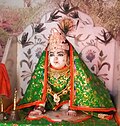
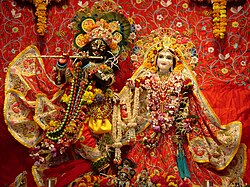
| caption = Idol of Radha at [[ISKCON Temple, Pune]] | |||
| Sanskrit_transliteration = Rādhā | | Sanskrit_transliteration = Rādhā | ||
| Devanagari = राधा | | Devanagari = राधा | ||
| affiliation = [[Radha Krishna]] | | affiliation = {{bulleted list|[[Radha Krishna]]|[[Devi]]|Hladini [[shakti]] of [[Krishna]]|[[Avatar]] of [[Lakshmi]]}} | ||
| abode = [[Goloka]] | | abode = {{hlist|[[Goloka]]|[[Vrindavan]]|[[Barsana]]|[[Vaikuntha]]}} | ||
| texts = [[Brahma Vaivarta Purana]], [[ | | texts = [[Brahma Vaivarta Purana]], [[Devi-Bhagavata Purana]], [[Naradiya Purana]], [[Padma Purana]], [[Skanda Purana]], [[Shiva Purana]], [[Gita Govinda]], [[Gopala Tapani Upanishad]], [[Garga Samhita (Vaishnavite text)|Garga Samhita]], [[Brahma Samhita]], [[Chaitanya Charitamrita]] | ||
| birth_place = | |||
| parents = {{ubl|[[Vrishabhanu]] (father)| | | parents = {{ubl|[[Vrishabhanu]] (father)|Kirtida (mother){{sfn|Menzies|2006|p=54}}}} | ||
| symbol = Golden Lotus | | symbol = Golden Lotus | ||
| consort = [[Krishna]] | | consort = [[Krishna]] | ||
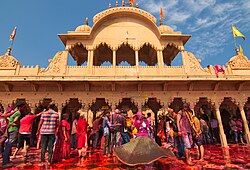
| festivals = [[ | | festivals = {{hlist|[[Radhashtami]]|[[Holi]]|[[Sharad Purnima]]|[[Kartik Purnima]]|[[Gopashtami]]|[[Lathmar Holi]]|[[Jhulan Purnima]]}} | ||
| mantra = {{ | | mantra = {{bulleted list|''Om hreem Radhikaye namah''|'' Om Radhaye svaha''|'' Om hreem shreem Radhikaye svaha''}}<ref>{{cite book|title=Brahma Vaivarta Purana|url=https://archive.org/details/brahma-vaivarta-purana-gitapress-hindi/page/n305/mode/1up|author= Ved Vyaas|publisher=Gita Press, Gorakhpur|pages=297}}</ref> | ||
| | |||
| gender = Female | | gender = Female | ||
| dynasty = [[Yadu dynasty|Yaduvamsha]]-[[Chandravamsha]] | |||
| member_of = [[Prakṛti|Panch Prakriti]]<ref>{{cite journal|title= The Purāṇas (A History of Indian Literature|url= https://www.academia.edu/26399308|author= Ludo Rocher|journal= Bulletin of the School of Oriental and African Studies|year=1988|volume= 51|issue= 2|page= 355}}</ref> | |||
| venerated_in = [[Radha Vallabh Sampradaya]], [[Nimbarka Sampradaya]], [[Gaudiya Vaishnavism]], [[Pushtimarg]], [[Mahanam Sampradaya]], [[Manipuri Vaishnavism]], [[Swaminarayan Sampradaya]], [[Vaishnava-Sahajiya]], Haridasi Sampradaya{{sfn|Vemsani|2016|pp=222–223}} | |||
| avatar_birth = Raval, [[Barsana]] (present-day [[Uttar Pradesh]], [[India]]) | |||
| day = [[Friday]] | |||
}} | }} | ||
{{Hinduism}} | |||
{{Vaishnavism}} | {{Vaishnavism}} | ||
'''Radha''' ({{ | '''Radha''' ({{langx|sa|राधा}}, {{IAST3|Rādhā}}), also called '''Radhika''', is a [[Hindu goddess]] and the chief consort of the god [[Krishna]]. She is the goddess of love, tenderness, compassion, and devotion. In scriptures, Radha is mentioned as the [[avatar]] of [[Lakshmi]]<ref>{{Cite journal |last=Jones |first=Naamleela Free |date=2015 |title=From Gods To Gamers: The Manifestation of the Avatar Throughout Religious History and Postmodern Culture |url=https://escholarship.org/uc/item/4mn5k202 |journal=Berkeley Undergraduate Journal |language=en |volume=28 |issue=2 |page=8 |doi=10.5070/B3282028582|doi-access=free }}</ref><ref>{{Cite book |last1=Gokhale |first1=Namita |url=https://books.google.com/books?id=KWJ7DwAAQBAJ&dq=Finding+Radha%3A+The+Quest+for+Love&pg=PT8 |title=Finding Radha: The Quest for Love |last2=Lal |first2=Malashri |date=2018-12-10 |publisher=Penguin Random House India Private Limited |isbn=978-93-5305-361-1 |language=en |quote=Like Sita, Radha is also a manifestation of Lakshmi.}}</ref> and also as the [[Prakṛti|Mūlaprakriti]], the Supreme goddess, who is the feminine counterpart and internal potency (''hladini [[shakti]]'') of Krishna.<ref name="Diana Dimitrova 2018"/><ref name=":4"/><ref>{{Cite book |last=Bryant |first=Edwin Francis |url=https://books.google.com/books?id=CIDawAEACAAJ |title=Krishna: A Sourcebook |date=2007 |publisher=Oxford University Press |isbn=978-0-19-514892-3 |pages=551 |language=en}}</ref><ref>{{Cite journal |last=Kar |first=Nishamani |date=2001 |title=Sriradha: A Study |url=https://www.jstor.org/stable/23344745 |journal=Indian Literature |volume=45 |issue=2 (202) |pages=184–192 |jstor=23344745 |issn=0019-5804}}</ref><ref name=":5"/> Radha accompanies Krishna in all his incarnations.<ref>{{Cite book |last=Vyasadeva |url=https://archive.org/details/NaradaPancaratraPart2/Narada%20Pancaratra%20part%202/page/n446/mode/1up |title=Narada Pancaratra Part 2 |date=2015-06-18 |pages=448 |quote=Whenever Sri Hari appears in this world, Sri Radhika appears with him}}</ref><ref>{{Cite journal |last=Farquhar |first=J. N. |date=1926 |title=The Narada Pancharatra |url=https://www.jstor.org/stable/25221011 |journal=Journal of the Royal Asiatic Society of Great Britain and Ireland |issue=3 |pages=492–495 |jstor=25221011 |issn=0035-869X}}</ref> Radha's birthday is celebrated every year on the occasion of [[Radhashtami]].{{sfn|Vemsani|2016|p=223}}<ref>{{Cite journal |last=Mohanty |first=Prafulla Kumar |date=2003 |title=Mask and Creative Symbolisation in Contemporary Oriya Literature: Krishna, Radha and Ahalya |url=https://www.jstor.org/stable/23341400 |journal=Indian Literature |volume=47 |issue=2 (214) |pages=181–189 |jstor=23341400 |issn=0019-5804}}</ref> | ||
In [[ | In relation with Krishna, Radha has dual representation—the lover consort as well as his married consort. Traditions like [[Nimbarka Sampradaya]] worship Radha as the eternal consort and wedded wife of Krishna.<ref name=":7">{{Cite journal |last=Farquhar |first=J. N. |date=1926 |title=The Narada Pancharatra |journal=Journal of the Royal Asiatic Society of Great Britain and Ireland |issue=3 |pages=492–495 |issn=0035-869X |jstor=25221011}}</ref><ref name=":0">{{Cite book |last=Bhattacharya |first=Sunil Kumar |url=https://books.google.com/books?id=SyyNIL7Ug2kC&q=chaitanya+c&pg=PA14 |title=Krishna-cult in Indian Art |date=1996 |publisher=M.D. Publications Pvt. Ltd. |isbn=978-81-7533-001-6 |pages=13 |language=en |quote=Radha is the eternal consort and wedded wife of Krishna, who lives forever with him in Goloka.}}</ref>{{sfn|Lochtefeld|2002|p=542}}{{sfn|Jones|Ryan|2007|p=341|loc=Radha}} In contrast, traditions like [[Gaudiya Vaishnavism]] revere her as Krishna's lover and the divine consort.<ref name="britannica2">{{cite encyclopedia |title=Radha |encyclopedia=[[Encyclopædia Britannica]] Online |url=https://www.britannica.com/topic/Radha-Hindu-mythology |access-date=2020-12-13}}</ref>{{sfn|Lochtefeld|2002|p=542}} | ||
Radha is | In [[Radha Vallabha Sampradaya]] and Haridasi Sampradaya, only Radha is worshipped as the [[Brahman|Supreme being]].{{sfnm|1a1=White|1y=1977|1p=|2a1=Snell|2y=1991|2loc=chapter1|3a1=Rosenstein|3y=1998|3p= |4a1=Beck|4y=2005|4p=|Vemsani|2016|5p=222}} Elsewhere, she is venerated with Krishna as his principal consort in Nimbarka Sampradaya, [[Pushtimarg]], [[Mahanam Sampradaya]], [[Swaminarayan Sampradaya]], [[Vaishnava-Sahajiya]], [[Manipuri Vaishnavism]], and Gaudiya Vaishnavism movements linked to [[Chaitanya Mahaprabhu]].{{sfnm|1a1=Hawley|1a2=Wulff|1y=1982|1pp=xiii–xviii|Dalal|2010|2pp=321–322|Hayes|2005|3pp=19–32|Vemsani|2016|4p=221}} | ||
Radha is described as the chief of ''[[Braj]] [[Gopi]]s'' (milkmaids of Braj) and queen of [[Goloka]] and Braj including [[Vrindavan]] and [[Barsana]].{{sfn|Lochtefeld|2002|p=542}} She has inspired numerous literary works, and her [[Raslila]] dance with Krishna has inspired many types of performance arts.{{sfn|Archer|2004}}{{sfn|Hawley|Wulff|1982|pp=xiii–xviii}}<ref name="britannica2"/>{{sfn|Pintchman|2005|pp=46–47}} | |||
== Etymology and epithets == | == Etymology and epithets == | ||
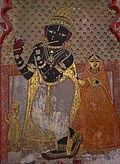
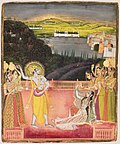
[[File:RadhaKrishnaUdaipur.JPG|thumb|14th-century fresco of Radha (right) and Krishna (left, playing flute) in [[Udaipur]], Rajasthan.]] | [[File:RadhaKrishnaUdaipur.JPG|thumb|14th-century fresco of Radha (right) and Krishna (left, playing flute) in [[Udaipur]], Rajasthan.]] | ||
The Sanskrit term {{IAST|Rādhā}} ({{ | The Sanskrit term {{IAST|Rādhā}} ({{langx|sa|राधा}}) means "prosperity, success, perfection and wealth".<ref name=mmwradha>Monier Monier-Williams, [http://www.ibiblio.org/sripedia/ebooks/mw/0900/mw__0909.html Rādhā], Sanskrit-English Dictionary with Etymology, Oxford University Press, page 876</ref><ref name=sen434>Sukumar Sen (1943), "Etymology of the name Radha-Krishana," Indian Linguistics, Vol. 8, pp. 434–435</ref>{{sfn|Miller|1975|pp=655–671}} It is a common word and name found in various contexts in the ancient and medieval texts of India. The word appears in the [[Veda|Vedic]] literature as well as the [[Hindu epics]], but is elusive.{{sfn|Miller|1975|pp=655–671}} The name also appears for [[Radha (Mahabharata)|a figure]] in the epic ''[[Mahabharata]]''.<ref name=mmwradha/> Rādhikā refers to an endearing form of Radha.<ref name=mmwradha /> | ||
Rādhikā refers to an endearing form of | |||
In chapter 15th, ''[[Goloka]] khanda'' of ''[[Garga Samhita (Vaishnavite text)|Garga Samhita]]'', Sage Garga elaborates the complete meaning of Radha. In Radha, 'R' signifies ''Rama'', goddess [[Lakshmi]], 'a' means ''[[Gopi]]s'', "dh" signifies ''dhara'', goddess [[Bhumi (goddess)|Bhudevi]] and last 'a' symbolises ''River'' ''Virājā'' (also called [[Yamuna in Hinduism|''Yamuna'']]).<ref>{{Cite book |last=Gita Press Gorakhpur |url=http://archive.org/details/garga-samhita-gita-press-gorakhpur |title=Garga Samhita Gita Press Gorakhpur |pages=58}}</ref> | |||
The fifth chapter, ''Fifth night'' of ''[[Pancharatra|Narada Pancharatra]]'' mentioned 1008 names of Radha under the title ''Shri Radha Saharsnama Strotam''.<ref>{{Cite book |last=Swami Vijnanananda |url=https://archive.org/details/swami-vijnanananda-1997.-narada-pancharatram-english-translation-with-sanskrit-text/page/300/mode/1up |title=Swami Vijnanananda ( 1997). ' Narada Pancharatram English Translation With Sanskrit Text' |date=1997 |pages=301}}</ref><ref>{{Cite book |last=Vyasadeva |url=http://archive.org/details/NaradaPancaratraPart2 |title=Narada Pancaratra Part 2 |date=2015-06-18 |pages=447–503}}</ref> The 68th chapter, ''Tritiya paad'' of ''[[Naradiya Purana|Narada Purana]]'' also listed 500 names of Radha.<ref name=":13">{{Cite book |last=Gita Press Gorakhpur |url=https://archive.org/details/narada-puran/page/n522/mode/1up |title=Narada Puran |pages=512–520}}</ref> Some of the common names and epithets are:<ref>{{Cite web |title=Sri Radha-sahasra-nama, The Thousand Names of Sri Radha |url=http://www.stephen-knapp.com/sri_radha-sahasra-nama.htm |access-date=2024-08-21 |website=www.stephen-knapp.com}}</ref><ref>{{Cite web |title=Śrī Rādhā Sahasranāma—English translation |url=http://www.vrindavan.de/1000-radha.htm |access-date=2024-08-21 |website=www.vrindavan.de}}</ref><ref>{{Cite book |last=Swami Vijnanananda |url=https://archive.org/details/swami-vijnanananda-1997.-narada-pancharatram-english-translation-with-sanskrit-text/page/n602/mode/1up |title=Narada Pancharatram English Translation With Sanskrit Text |date=1997 |pages=300, 603–614 |language=Sanskrit |trans-title="On the thousand names of Sri Radhika"}}</ref><ref name=":13" /> | |||
* ''[[Shri|Sri]]'', ''Shreeji'', ''Shriji'': Goddess of radiance, splendor and wealth; [[Lakshmi]] | |||
* ''Madhavi'': Feminine counterpart of [[Madhava (Vishnu)|Madhava]] | |||
* ''Keshavi'': Feminine form of [[Keshava]] | |||
* ''Aparajita'': She who is unconquerable | |||
* ''Kishori'': Youthful | |||
* ''Nitya'': She is eternal | |||
* ''Nitya-gehinī'': Krishna's eternal wife | |||
* ''[[Gopi]]'': Cowherd girl | |||
* ''Shyama'': Beloved of [[Shyam]] | |||
* ''Gaurangi'': She whose complexion is bright like the lustrous gold | |||
* ''Raseshvari'' and ''Rasa-priya'': Queen of [[Raslila]] and she who is fond of rasa dance | |||
* ''Vrindavaneshvari'': Queen of [[Vrindavan]] | |||
* ''Krishneshvari'': Feminine counterpart of Krishna | |||
== | == Literary sources and symbolism == | ||
[[File:Jayadeva pay homage to Krishna from gita govinda Series by manaku.jpg|thumb|[[Jayadeva]] recites the mantra to Radha Krishna by Manaku.]] | [[File:Jayadeva pay homage to Krishna from gita govinda Series by manaku.jpg|thumb|[[Jayadeva]] recites the mantra to Radha Krishna by Manaku.<ref>{{cite book |last1=D. Prahladacharya |first1=Rāṣṭrīyasaṃskr̥tavidyāpīṭhaṃ Lal|title=Utkalaśrīmañjūṣālanguage|date=2002 |publisher=Rashtriya Sanskrit Vidyapeetha |url=https://books.google.com/books?id=CHrXAAAAMAAJ&q=jayadeva+kanyakubja|language=en}}</ref> ]] | ||
Radha is an important goddess in the [[Vaishnavism|Vaishnavite]] traditions of Hinduism. Her traits, manifestations, descriptions, and roles vary by region. Radha is intrinsic with Krishna. In early Indian literature, mentions of her are elusive. The traditions that venerate her explain this is because she is the secret treasure hidden within the sacred scriptures. During the [[Bhakti movement]] era in the sixteenth century, she became more well known as her extraordinary love for Krishna was highlighted.{{sfn|Pauwels|1996|pp=29–43}}<ref>Vaudeville, Charlotte in {{harvnb|Hawley|Wulff|1982|p=2}}</ref> | Radha is an important goddess in the [[Vaishnavism|Vaishnavite]] traditions of Hinduism. Her traits, manifestations, descriptions, and roles vary by region. Radha is intrinsic with Krishna. In early Indian literature, mentions of her are elusive. The traditions that venerate her explain this is because she is the secret treasure hidden within the sacred scriptures. During the [[Bhakti movement]] era in the sixteenth century, she became more well known as her extraordinary love for Krishna was highlighted.{{sfn|Pauwels|1996|pp=29–43}}<ref>Vaudeville, Charlotte in {{harvnb|Hawley|Wulff|1982|p=2}}</ref> | ||
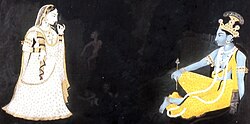
Radha's first major appearance in the 12th-century ''[[Gita Govinda]]'' in Sanskrit by [[Jayadeva]],{{sfn|Love Song of the Dark Lord: Jayadeva's Gītagovinda|1977}}{{sfn|Archer|2004|loc=The Gita Govinda}}<ref>Miller, Barbara Stoler in {{harvnb|Hawley|Wulff|1982|p=13}}</ref>{{sfn|Datta|1988|pp=1414–1421}} as well as [[Nimbarkacharya]]'s philosophical works.{{sfn|Ramnarace|2014|p=}} Thus in the ''Gita Govinda'' Krishna speaks to Radha: | Radha's first major appearance in the 12th-century ''[[Gita Govinda]]'' in Sanskrit by [[Jayadeva]],{{sfn|Love Song of the Dark Lord: Jayadeva's Gītagovinda|1977}}{{sfn|Archer|2004|loc=The Gita Govinda}}<ref>Miller, Barbara Stoler in {{harvnb|Hawley|Wulff|1982|p=13}}</ref>{{sfn|Datta|1988|pp=1414–1421}} as well as [[Nimbarkacharya]]'s philosophical works.{{sfn|Ramnarace|2014|p=}} Thus in the ''[[Gita Govinda]]'' Krishna speaks to Radha: | ||
{{ | {{blockquote|<poem> | ||
O woman with desire, place on this patch of flower-strewn floor your lotus foot, | O woman with desire, place on this patch of flower-strewn floor your lotus foot, | ||
And let your foot through beauty win, | And let your foot through beauty win, | ||
| Line 83: | Line 75: | ||
</poem>|sign=Jayadeva|source=''Gita Govinda''{{sfn|Archer|2004|loc=The Gita Govinda}}}} | </poem>|sign=Jayadeva|source=''Gita Govinda''{{sfn|Archer|2004|loc=The Gita Govinda}}}} | ||
However, the source of Jayadeva's heroine in his poem remains a puzzle of the Sanskrit literature. A possible explanation is Jayadeva's friendship with Nimbarkacharya,{{sfn|Vemsani|2016|p=197}} the first acharya to establish the worship of Radha-Krishna{{sfnm|1a1=Hardy|1y=1987|1pp=387–392|2a1=Ramnarace|2y=2014|2p=}} Nimbarka, in accordance with the [[Sahitya Akademi]]'s Encyclopaedia, more than any other acharyas gave Radha a place as a deity.{{sfn|Datta|1988|p=1415}} | However, the source of Jayadeva's heroine in his poem remains a puzzle of the Sanskrit literature. A possible explanation is Jayadeva's friendship with [[Nimbarka|Nimbarkacharya]],{{sfn|Vemsani|2016|p=197}} the first acharya to establish the worship of Radha-Krishna.{{sfnm|1a1=Hardy|1y=1987|1pp=387–392|2a1=Ramnarace|2y=2014|2p=}} Nimbarka, in accordance with the [[Sahitya Akademi]]'s Encyclopaedia, more than any other acharyas gave Radha a place as a deity.{{sfn|Datta|1988|p=1415}} | ||
Prior to Gita Govinda, Radha was also mentioned in text ''[[Gaha Sattasai|Gatha Saptasati]]'' which is a collection of 700 verses composed in [[Prakrit]] language by King [[Hāla]].<ref>{{Cite journal|last=Jash|first=Pranabananda|title=Radha-Madhava Sub-Sect in Eastern India|date=1979 | Prior to Gita Govinda, Radha was also mentioned in text ''[[Gaha Sattasai|Gatha Saptasati]]'' which is a collection of 700 verses composed in [[Prakrit]] language by King [[Hāla]].<ref>{{Cite journal|last=Jash|first=Pranabananda|title=Radha-Madhava Sub-Sect in Eastern India|date=1979|journal=Proceedings of the Indian History Congress|volume=40|pages=177–184|jstor=44141958|issn=2249-1937}}</ref> The text was written around first or second century AD. Gatha Saptasati mentioned Radha explicitly in its verse:{{sfn|Miller|1975|pp=655–671}}<ref>{{Cite journal|last1=Srinivasan|first1=K.S.|last2=Ramanujan|first2=A.K.|date=1982|title=What is Indian Literature?|journal=Indian Literature|volume=25|issue=4|pages=5–15|jstor=24158041|issn=0019-5804}}</ref><ref name=":10">{{Cite book|last1=Gokhale|first1=Namita|url=https://books.google.com/books?id=KWJ7DwAAQBAJ&q=Radha+in+Padma+Purana&pg=PT7|title=Finding Radha: The Quest for Love|last2=Lal|first2=Malashri|date=2018-12-10|publisher=Penguin Random House India Private Limited|isbn=978-93-5305-361-1|language=en}}</ref> | ||
{{Verse translation|Mukhamarutena tvam krsna gorajo radhikaya apanayan {{!}} | {{Verse translation|Mukhamarutena tvam krsna gorajo radhikaya apanayan {{!}} | ||
Etasam ballavinam anyasam api gauravam harasi {{!}}{{!}}|"O Krishna, by the puff of breath from your mouth, as you blow the dust from Radha's face, you take away the glories of other milkmaids."|rtl1=}} | Etasam ballavinam anyasam api gauravam harasi {{!}}{{!}}|"O Krishna, by the puff of breath from your mouth, as you blow the dust from Radha's face, you take away the glories of other milkmaids."|rtl1=}} | ||
Radha also appears in the [[Puranas]] namely the ''[[Padma Purana]]'' (as an avatar of [[Lakshmi]]), the ''[[Devi-Bhagavata Purana]]'' (as a form of [[Mahadevi]]), the ''[[Brahma Vaivarta Purana]]'' (as Radha-Krishna supreme deity), the ''[[Matsya Purana]]'' (as form of [[Devi]]), the ''[[Linga Purana]]'' (as form of Lakshmi), the ''[[Varaha Purana]]'' (as consort of Krishna), the [[Naradiya Purana|Narada Purana]] (as goddess of love), the ''[[Skanda Purana]]'' and the ''[[Shiva Purana]]''. | Radha also appears in the [[Puranas]] namely the ''[[Padma Purana]]'' (as an avatar of [[Lakshmi]]), the ''[[Devi-Bhagavata Purana]]'' (as a form of [[Mahadevi]]), the ''[[Brahma Vaivarta Purana]]'' (as Radha-Krishna supreme deity), the ''[[Matsya Purana]]'' (as form of [[Devi]]), the ''[[Linga Purana]]'' (as form of Lakshmi), the ''[[Varaha Purana]]'' (as consort of Krishna), the [[Naradiya Purana|Narada Purana]] (as goddess of love), the ''[[Skanda Purana]]'' and the ''[[Shiva Purana]]''.{{sfn|Miller|1975|pp=655–671}}{{Sfn|Kinsley|1988}}<ref>{{Citation|last=Dalal|first=Roshen|title=Hinduism and its basic texts|date=2017-07-14|work=Reading the Sacred Scriptures|pages=157–170|location=New York |publisher=Routledge |doi=10.4324/9781315545936-11|isbn=978-1-315-54593-6}}</ref> The 15th and 16th century [[Krishnaism|Krishnaite]] [[Bhakti]] poet-saints [[Vidyapati]], [[Chandidas]], [[Meera Bai]], [[Surdas]], [[Swami Haridas]], as well as [[Narsinh Mehta]] (1350–1450), who preceded all of them, wrote about the romance of Krishna and Radha too.{{sfnm|1a1=Archer|1y=2004|1loc=5.3 Later Poetry|2a1=Hardy|2y=1987|2pp=387–392|3a1=Rosenstein|3y=1997|3p=|4a1=Hawley|4y=2005|4p=}} Thus, Chandidas in his Bengali-language ''Shri Krishna Kirtana'', a poem of Bhakti, depicts Radha and Krishna as divine, but in human love.{{sfn|Stewart|1986|pp=152–154}}{{sfn|Dalal|2010|p=385|loc=Shrikrishna Kirtana}} Though not named in the ''[[Bhagavata Purana]]'', [[Visvanatha Chakravarti]] (c. 1626–1708) interprets an unnamed favourite gopi in the scripture as Radha.<ref>{{Cite web|title=Online Vedabase—The topmost source of spiritual knowledge|url=https://vedabase.io/en/|access-date=2021-06-20|website=vedabase.io|language=en}}</ref><ref>{{Cite web|last=das|first=Bhadra Balaram|date=2016-09-09|title=The Biggest Mystery of Srimad Bhagavatam—Srimati Radha|url=http://mayapurvoice.com/svagatam/biggest-mystery-srimad-bhagavatam-srimati-radha/|access-date=2021-04-25|website=Mayapur Voice|language=en-US}}</ref> She makes appearances in ''Venisamhara'' by [[Bhatta Narayana]] (c. 800 CE), ''Dhvanyaloka'' by [[Anandavardhana]] (c. 820–890 CE) and its commentary ''Dhvanyalokalocana'' by [[Abhinavagupta]] (c. 950 – 1016 CE), Rajasekhara's (late ninth-early tenth century) Kāvyamīmāṃsā, ''Dashavatara-charita'' (1066 CE) by [[Kshemendra]] and ''Siddhahemasabdanusana'' by [[Hemachandra]] (c. 1088–1172).<ref name=":9">{{Cite journal|last=Manring|first=Rebecca J.|date=2019-12-01|title=Rādhātantram: Rādhā as Guru in the Service of the Great Goddess|journal=International Journal of Hindu Studies|language=en|volume=23|issue=3|pages=259–282|doi=10.1007/s11407-019-09264-1|s2cid=213054011 |issn=1574-9282}}</ref> In most of these, Radha is depicted as someone who is deeply in love with Krishna and is deeply saddened when Krishna leaves her.<ref>Miller, Barbara Stoler in {{harvnb|Hawley|Wulff|1982|p=14}}</ref>{{sfn|Kinsley|1988}} But, on contrary, Radha of the ''[[Radha Tantra|Rādhātantram]]'' is portrayed as audacious, sassy, confident, omniscient and divine personality who is in full control at all times. In ''Rādhātantram,'' Radha is not merely the consort but is treated as the independent goddess. Here, Krishna is portrayed as her disciple and Radha as his guru.<ref name=":9" /> | ||
[[File: Radha and Krishna by DHURANDHAR MV.jpg|left|thumb|upright=0.9|Painting of Radha with Krishna, by [[M. V. Dhurandhar]], 1915.]] | [[File:Radha and Krishna by DHURANDHAR MV.jpg|left|thumb|upright=0.9|Painting of Radha with Krishna, by [[M. V. Dhurandhar]], 1915.]] | ||
Charlotte Vaudeville theorizes that Radha may have inspired by the pairing of the goddess [[Ekanamsha]] (associated with [[Durga]]) with [[Jagannatha]] (who is identified with Krishna) of [[Puri]] in Eastern India. Though [[Chaitanya Mahaprabhu]] (15th century, the founder of [[Gaudiya Vaishnavism]]) is not known to have worshiped the deity couple of Radha-Krishna, his disciples around the [[Vrindavan]] region, affirmed Radha as the ''hladini shakti'' ("energy of bliss") of Krishna, associating her with the Primordial Divine Mother. While the poetry of Jayadeva and [[Vidyapati]] from [[Bengal]] treat Radha as Krishna's | Charlotte Vaudeville theorizes that Radha may have inspired by the pairing of the goddess [[Ekanamsha]] (associated with [[Durga]]) with [[Jagannatha]] (who is identified with Krishna) of [[Puri]] in Eastern India. Though [[Chaitanya Mahaprabhu]] (15th century, the founder of [[Gaudiya Vaishnavism]]) is not known to have worshiped the deity couple of Radha-Krishna, his disciples around the [[Vrindavan]] region, affirmed Radha as the ''hladini shakti'' ("energy of bliss") of Krishna, associating her with the Primordial Divine Mother. While the poetry of Jayadeva and [[Vidyapati]] from [[Bengal]] treat Radha as Krishna's beloved, the Gaudiya poetry elevates her to a divine consort.<ref>Vaudeville, Charlotte in {{harvnb|Hawley|Wulff|1982|pp=9–12}}</ref> In Western India, [[Vallabhacharya]]'s Krishna-centric sampradaya [[Pushtimarg]], Radha is revered as the ''Swamini'' of Krishna, who is worthy of devotion.<ref>Vaudeville, Charlotte in {{harvnb|Hawley|Wulff|1982|pp=11–2}}</ref><ref>{{harvnb|Vemsani|2016|p=222}}: "According to Vallabha tradition, she (Radha) is the swamini of Krishna, who is worthy of devotion."</ref> | ||
According to Jaya Chemburkar, there are at least two significant and different aspects of Radha in the literature associated with her, such as ''Sri Radhika namasahasram''. One aspect is she is a milkmaid (gopi), another as a female deity similar to those found in the Hindu goddess traditions.{{sfn|Chemburkar| | According to Jaya Chemburkar, there are at least two significant and different aspects of Radha in the literature associated with her, such as ''Sri Radhika namasahasram''. One aspect is she is a milkmaid (gopi), another as a female deity similar to those found in the Hindu goddess traditions.{{sfn|Chemburkar|1976|pp=107–116}} She also appears in Hindu arts as ''[[Ardhanari]]'' with Krishna, that is an iconography where half of the image is Radha and the other half is Krishna. This is found in sculpture such as those discovered in [[Maharashtra]], and in texts such as ''[[Shiva Purana]]'' and ''[[Brahma Vaivarta Purana]]''. In these texts, this ''Ardha Nari'' is sometimes referred to as ''Ardharadhavenudhara [[murti]]'', and it symbolizes the complete union and inseparability of Radha and Krishna.{{sfn|Pradhan|2008|pp=207–213}} | ||
D.M. Wulff demonstrates through a close study of her Sanskrit and Bengali sources that Radha is both the "consort" and "conqueror" of Krishna and that "metaphysically Radha is understood as co-substantial and co-eternal with Krishna." Indeed, the more popular vernacular traditions prefer to worship the couple and often tilt the balance of power towards Radha.<ref>{{Cite journal|last=Kripal|first=Jeffrey J.|date=1998|title=Review of Devī: Goddesses of India | D.M. Wulff demonstrates through a close study of her Sanskrit and Bengali sources that Radha is both the "consort" and "conqueror" of Krishna and that "metaphysically Radha is understood as co-substantial and co-eternal with Krishna." Indeed, the more popular vernacular traditions prefer to worship the couple and often tilt the balance of power towards Radha.<ref>{{Cite journal|last=Kripal|first=Jeffrey J.|date=1998|title=Review of Devī: Goddesses of India|journal=Journal of the American Academy of Religion|volume=66|issue=1|pages=176–179|doi=10.1093/jaarel/66.1.176|jstor=1466250|issn=0002-7189}}</ref> | ||
Graham M. Schweig in his work "''The divine feminine theology of Krishna''" in context with Radha Krishna stated that, "The divine couple, Radha and Krishna, comprise the essence of godhead. Radha is therefore acknowledged by Chaitanyaite Vaishnavas to be part of very center of their theological doctrine. Sacred images of the forms of Radha Krishna, standing together side by side, are elaborately worshiped in the Indian temples. Through her image, her divine character and her amorous and passionate relations with Krishna, Radha is the constant meditation of practitioners.<ref>{{Cite book|last=Bryant|first=Edwin F.|title=Krishna: A Sourcebook|publisher=[[Oxford University Press]]|year=2007|isbn= | Graham M. Schweig in his work "''The divine feminine theology of Krishna''" in context with Radha Krishna stated that, "The divine couple, Radha and Krishna, comprise the essence of godhead. Radha is therefore acknowledged by Chaitanyaite Vaishnavas to be part of very center of their theological doctrine. Sacred images of the forms of Radha Krishna, standing together side by side, are elaborately worshiped in the Indian temples. Through her image, her divine character and her amorous and passionate relations with Krishna, Radha is the constant meditation of practitioners.<ref>{{Cite book|last=Bryant|first=Edwin F.|title=Krishna: A Sourcebook|publisher=[[Oxford University Press]]|year=2007|isbn=978-0-19-803400-1|pages=451–473}}</ref> | ||
According to [[W.G. Archer|William Archer]] and David Kinsley, a professor of Religious Studies known for his studies on Hindu goddesses, the Radha-Krishna love story is a metaphor for a divine-human relationship, where Radha is the human devotee or soul who is frustrated with the past, obligations to social expectations, and the ideas she inherited, who then longs for real meaning, the true love, the divine (Krishna). This metaphoric Radha (soul) finds new liberation in learning more about Krishna, bonding in devotion, and with passion.{{sfn|Archer|2004|loc=The Triumph of Radha}}{{sfn|Dalal|2010|p=147}} | According to [[W.G. Archer|William Archer]] and David Kinsley, a professor of Religious Studies known for his studies on Hindu goddesses, the Radha-Krishna love story is a metaphor for a divine-human relationship, where Radha is the human devotee or soul who is frustrated with the past, obligations to social expectations, and the ideas she inherited, who then longs for real meaning, the true love, the divine (Krishna). This metaphoric Radha (soul) finds new liberation in learning more about Krishna, bonding in devotion, and with passion.{{sfn|Archer|2004|loc=The Triumph of Radha}}{{sfn|Dalal|2010|p=147}}{{Sfn|Kinsley|1988}} | ||
An image of Radha has inspired numerous literary works.{{sfn|Hawley|Wulff|1982|pp=xiii–xviii}} For modern instance, the ''Shri Radhacharita Mahakavyam''—the 1980s epic poem of Dr. [[Kalika Prasad Shukla]] that focuses on Radha's devotion to Krishna as the universal lover—"one of the rare, high-quality works in Sanskrit in the twentieth century."{{sfn|Dalal|2010|p=384|loc=Shri Radhacharita Mahakavyam}} | An image of Radha has inspired numerous literary works.{{sfn|Hawley|Wulff|1982|pp=xiii–xviii}} For modern instance, the ''Shri Radhacharita Mahakavyam''—the 1980s epic poem of Dr. [[Kalika Prasad Shukla]] that focuses on Radha's devotion to Krishna as the universal lover—"one of the rare, high-quality works in Sanskrit in the twentieth century."{{sfn|Dalal|2010|p=384|loc=Shri Radhacharita Mahakavyam}} | ||
| Line 110: | Line 102: | ||
Radha and Sita offer two templates within the Hindu tradition. If "Sita is a queen, aware of her social responsibilities", states Pauwels, then "Radha is exclusively focused on her romantic relationship with her lover", giving two contrasting role models from two ends of the moral universe. Yet they share common elements as well. Both face life challenges and are committed to their true love. They are both influential, adored and beloved goddesses in the Hindu culture.{{sfn|Pauwels|2008|pp=12–15, 497–517}} | Radha and Sita offer two templates within the Hindu tradition. If "Sita is a queen, aware of her social responsibilities", states Pauwels, then "Radha is exclusively focused on her romantic relationship with her lover", giving two contrasting role models from two ends of the moral universe. Yet they share common elements as well. Both face life challenges and are committed to their true love. They are both influential, adored and beloved goddesses in the Hindu culture.{{sfn|Pauwels|2008|pp=12–15, 497–517}} | ||
In worship of Rama, Sita is represented as a dutiful and loving wife | In worship of Rama, Sita is represented as a dutiful and loving wife, holding a position entirely subordinate to Rama. However, in the worship of [[Radha Krishna]], Radha is often preferred over to Krishna, and in certain traditions, her name is elevated to a higher position compared to Krishna's.<ref name=":6">{{Cite book|last=Bhandarkar|first=R. G.|url=https://www.degruyter.com/document/doi/10.1515/9783111551975/html|title=Vaisnavism, Saivism and minor religious systems|date=2019-05-20|publisher=De Gruyter|isbn=978-3-11-155197-5|language=en|doi=10.1515/9783111551975}}</ref> | ||
== Iconography == | |||
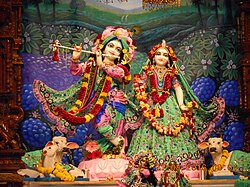
[[File:Lord Krishna and Radha in ISKCON, Pune.jpg|thumb|Radha Krishna [[Murti|Vigraha]] (idols) at [[ISKCON Temple, Pune|Iskcon Temple Pune]]]] | |||
Radha in [[Hinduism]], is revered as the goddess of love. She is mostly depicted along with Krishna or gopis in the land of [[Braj]]. Various art forms based on Radha Krishna are majorly inspired by ''[[Gita Govinda]]'' and ''Rasikapriya''.<ref>{{Cite book |last=Mukherjee |first=Sreecheta |url=https://books.google.com/books?id=lkM4DwAAQBAJ&dq=Radha+Krishna+temples&pg=PA26 |title=Temples of Bengal |date=2012-12-25 |publisher=Aesthetics Media Services |isbn= |edition=2nd |location=india |pages=34–35 |language=en}}</ref><ref>{{Cite journal |last=Coomaraswamy |first=Ananda K. |date=1930 |title=Two Leaves from a Seventeenth-Century Manuscript of the Rasikapriyā |url=https://www.jstor.org/stable/1522765 |journal=Metropolitan Museum Studies |volume=3 |issue=1 |pages=14–21 |doi=10.2307/1522765 |jstor=1522765 |issn=1556-8725|url-access=subscription }}</ref> In [[Rajput painting]]s, Radha represents an ideal of beauty, wearing the traditional [[sari]] decorated extensively with patterns and ornamented in jewelry with lighter skin tone and emphasized facial features.<ref name=":11">{{Cite journal |last=Lavanya |first=B. |date=2019 |title=Women in Pahari Miniature Painting |url=http://scientificresearchjournal.com/wp-content/uploads/2019/04/Social-Science-6_A-681-686-Full-Paper.pdf |archive-url=https://web.archive.org/web/20210225070358/http://scientificresearchjournal.com/wp-content/uploads/2019/04/Social-Science-6_A-681-686-Full-Paper.pdf |archive-date=2021-02-25 |url-status=live |journal=International Journal of Applied Social Science |volume=6 |pages=}}</ref><ref name=":12">{{Cite journal |last=Coomaraswamy |first=A. K. |date=1926 |title=Rājput Paintings |url=https://www.jstor.org/stable/4169988 |journal=Bulletin of the Museum of Fine Arts |volume=24 |issue=142 |pages=23–26 |jstor=4169988 |issn=0899-0336}}</ref> In Kishangarh paintings, Radha is represented as beautifully dressed woman in ''[[ghagra choli]]'' with pearl jewelry and a dark diaphanous veil over her head. The famous [[Bani Thani]] portrait by artist [[Nihâl Chand]] was inspired by Radha's physical features which includes sharp eyebrows, lotus-like elongated eyes, thin lips and a pointed nose and chin.<ref>{{Cite journal |last=Ghosh |first=Soma |date=2022 |title=The Art of Shringara: Revisiting the Kishangarh School of Rajasthani Painting |url=https://chitrolekha.com/ns/v6n1/v6n100.pdf |archive-url=https://web.archive.org/web/20221020182148/https://chitrolekha.com/ns/v6n1/v6n100.pdf |archive-date=2022-10-20 |url-status=live |journal=The Chitrolekha Journal on Art and Design |volume=6 |issue=1|doi=10.21659/cjad.61.v6n100 |s2cid=250976234 }}</ref> | |||
[[File:Krishna-radha ardhanari.jpg|thumb|Radha Krishna [[ardhanarishvara]] form]] | |||
In religious art forms, Radha also appears as ''[[Ardhanari]]'' with Krishna, that is an iconography where half of the image is Radha and the other half is Krishna forming the combined masculine and feminine form of [[Ardhanarishvara]].{{sfn|Pradhan|2008|pp=207–213}} | |||
== | In Radha Krishna temples, Radha stands on the left of Krishna, with a garland in her hand.<ref>{{Cite book |last=Mukherjee |first=Sreecheta |url=https://books.google.com/books?id=lkM4DwAAQBAJ&dq=Radha+Krishna+temples&pg=PA26 |title=Temples of Bengal |date=2012-12-25 |publisher=Aesthetics Media Services |pages=74–75 |language=en}}</ref> She is often dressed in traditional sari or ''ghagra-choli'' along with a veil. Her jewelry from top to bottom is either made of metals, pearls or flowers.<ref>{{Cite journal |last=Mohan |first=Urmila |date=2018 |title=Clothing as devotion in Contemporary Hinduism |url=https://brill.com/view/journals/rpra/rpra-overview.xml |journal=Brill Research Perspectives in Religion and Art|volume=2 |issue=4 |pages=1–82 |doi=10.1163/24688878-12340006 |s2cid=202530099 |url-access=subscription }}</ref> | ||
The [[Sanskrit]] scripture ''[[Brahma Vaivarta Purana]]'' describes Radha as the beautiful and youthful goddess having the molten golden complexion and wearing the garlands of gems and flowers.<ref name="Shanti Lal Nagar">{{Cite book |last=Shanti Lal Nagar |url=http://archive.org/details/brahma-vaivarta-purana-all-four-kandas-english-translation |title=Brahma Vaivarta Purana: English Translation: All Four Kandas |date=2003-01-01}}</ref> | |||
== Legends == | |||
===As a milkmaid=== | |||
Radha in her human form is revered as the milkmaid ([[gopi]]) of Vrindavan who became the beloved of Krishna. One of the basic traits of Radha is her unconditional love for Krishna and her sufferings that forms the basis for Radha's exaltation as a model of devotion.{{sfn|Pauwels|1996}} | Radha in her human form is revered as the milkmaid ([[gopi]]) of Vrindavan who became the beloved of Krishna. One of the basic traits of Radha is her unconditional love for Krishna and her sufferings that forms the basis for Radha's exaltation as a model of devotion.{{sfn|Pauwels|1996}} | ||
=== Birth and early life=== | ==== Birth and early life ==== | ||
[[File:Bal Radha.jpg|thumb|A | [[File:Bal Radha.jpg|thumb|A [[Murti|Vigraha]] (idol) of Radha as a child in "Shri Radha Rani Janam Sthal Temple" at [[Rawal, Uttar Pradesh|Rawal]]]] | ||
Radha was born to [[Vrishabhanu|Vrishbhanu]], | Radha was born to [[Vrishabhanu|Vrishbhanu]], who was the [[Yadava]] ruler of [[Barsana]] and his wife Kirtida.<ref name="Saraswati2001">{{cite book|author=Prakashanand Saraswati|url=https://books.google.com/books?id=IhLN2I9yTTkC&q=vrishbhanu%20barsana&pg=PA666|title=The True History and the Religion of India: A Concise Encyclopedia of Authentic Hinduism|publisher=Motilal Banarsidass Publ.|year=2001|isbn=978-81-208-1789-0|pages=666–}}</ref><ref name="Varma2009">{{cite book|author=Pavan K. Varma|url=https://books.google.com/books?id=_anlsbp56aoC&pg=PA46|title=The Book of Krishna|date=July 2009|publisher=Penguin Books India|isbn=978-0-14-306763-4|pages=46–}}</ref><ref name="Vishwananda2017">{{cite book|author=Paramahamsa Sri Swami Vishwananda|url=https://books.google.com/books?id=CJ3JDwAAQBAJ&pg=PT1472|title=Shreemad Bhagavad Gita: The Song of Love|date=12 January 2017|publisher=Bhakti Marga Publications|isbn=978-3-940381-70-5|pages=1472–}}</ref> Her birthplace is [[Rawal, Uttar Pradesh|Rawal]]<!--NOTE: retain REDLINK to encourage article creation on Rava as well as on [[Shri Radha Rani Janam Sthal Temple]]. --> which is a small town near [[Gokul]] in [[Uttar Pradesh|Uttar pradesh]], but is often said to be [[Barsana]] where she grew up.<ref>{{Cite book |last=Anand |first=D. |url=https://books.google.com/books?id=EsvSwdUgQYcC |title=Krishna: The Living God of Braj |date=1992 |publisher=Abhinav Publications |isbn=978-81-7017-280-2 |pages=66 |language=en}}</ref> According to popular legend, Radha was discovered by Vrishbhanu on an effulgent thousand-petaled lotus floating in [[Yamuna]] river. Radha was nine months older than Krishna.<ref>{{Cite book |last=Anand |first=D. |url=https://books.google.com/books?id=EsvSwdUgQYcC&q=radha&pg=PA61 |title=Krishna: The Living God of Braj |date=1992 |publisher=Abhinav Publications |isbn=978-81-7017-280-2 |pages=35–36 |language=en |quote=Radha was only nine months elder to Krishna, to whom she was married.}}</ref> She didn't open her eyes until Krishna himself in his child form appeared in front of her.<ref name="Dash">{{cite book|author=Trilochan Dash|url=https://books.google.com/books?id=7YjhTtkcwE0C&q=Brushabhanu%20Yadav%20chieftain&pg=PA192|title=Krishna Leeela in Brajamandal a Retrospect|publisher=Soudamini Dash|pages=192–|id=GGKEY:N5C1YTUK5T3}}</ref><ref>{{cite book|url=https://books.google.com/books?id=NbDWAAAAMAAJ&q=vrishabhanu+yadava|title=The Vedanta Kesari|publisher=Sri Ramakrishna Math.|year=1970}}</ref><ref name="Das1990">{{cite book|author=R. K. Das|url=https://books.google.com/books?id=OXXXAAAAMAAJ&q=vrishabhanu+yadav|title=Temples of Vrindaban|publisher=Sandeep Prakashan|year=1990|isbn=978-81-85067-47-6}}</ref> | ||
" | "[[Ashtasakhi]]s" (translated to eight friends) are the integral part of Radha's childhood and youth.<ref>{{Cite web |last=gaudiya |date=2021-08-07 |title=Ashta Sakhi of Radha—8 Principal Gopis of Vrindavan |url=https://thegaudiyatreasuresofbengal.com/2021/08/07/ashta-sakhi-of-sri-radha-eight-gopis-of-vrindavan/ |access-date=2023-07-06 |website=The Gaudiya Treasures of Bengal |language=en-US}}</ref> It is believed that all the ''Ashtasakhis'' are the intimate friends of Radha Krishna and also have descended from [[Goloka]] in [[Braj]] region. Out of all the eight sakhis, [[Lalita (gopi)|Lalita]] and Vishakha are the prominent ones.<ref>{{Cite web|title=Radhe.net {{!}} General Description of All The Gopis|url=http://radhe.net/radhas-friends/general-description.php|access-date=2021-05-30|website=radhe.net}}</ref> According to [[Chaitanya Charitamrita]]'s Antya lila (2:6:116), Radha also received a boon from sage [[Durvasa]] in her childhood that whatever she cooks would be better than the nectar.<ref>{{Cite web|title=gp-durvasas|url=https://www.salagram.net/gp-durvasas.htm|access-date=2021-05-30|website=www.salagram.net}}</ref> | ||
===Youth=== | |||
[[File:Radha, Krishna and the gopis, Bharatiya Lok Kala Museum, Udaipur, India.jpg|thumb| [[Radha Krishna]]'s Raslila with [[gopi]]s.]] | ====Youth==== | ||
[[File:Radha, Krishna and the gopis, Bharatiya Lok Kala Museum, Udaipur, India.jpg|thumb|upright| [[Radha Krishna]]'s Raslila with [[gopi]]s.]] | |||
Stories of Radha's youth are filled with her divine pastimes with Krishna.<ref>{{Cite journal|last=Fahy|first=John|date=2018-07-23|title=The Constructive Ambiguity of Vedic Culture in ISKCON Mayapur|journal=The Journal of Hindu Studies|volume=11|issue=3|pages=234–259|doi=10.1093/jhs/hiy008|issn=1756-4255}}</ref> Some of the popular pastimes of Radha Krishna include: ''[[Raslila]]'', pastimes of ''[[Radha Kund]]'', ''[[Gopashtami]] lila'',<ref>{{Cite web|title=Gopastami – ISKCON VRINDAVAN|url=https://iskconvrindavan.com/2017/10/gopastami/|access-date=2021-05-30|language=en-US}}</ref> ''[[Lathmar Holi]]'', ''Seva Kunj lila'' in which Krishna did sringara of Radha,<ref>{{Cite web|title=Sewa Kunj or Nikunja Vana - Divine Pastimes|url=https://brajrasik.org/articles/5912a87b11ec2c04484ec006/sewa-kunj-or-nikunja-vana-divine-pastimes|access-date=2021-05-30|website=Braj Ras - Bliss of Braj Vrindavan.}}</ref> ''Maan lila'' ( A special stage in divine love in which the devotee develops so much love for God as to even attain the right of getting angry with him),<ref>{{Cite web|title=Maan Garh/Mandir, Barsana - (Divine Pastimes)|url=https://brajrasik.org/articles/588e4c1158f4ac271a08b95c/maan-garh-mandir-divine-pastimes|access-date=2021-05-30|website=Braj Ras - Bliss of Braj Vrindavan.}}</ref> ''Mor Kutir lila'' in which Krishna performed a dance lila by dressing himself as a peacock to please Radha,<ref>{{Cite web|title=Morkuti, Barsana|url=https://brajrasik.org/media/morkuti|access-date=2021-05-30|website=Braj Ras - Bliss of Braj Vrindavan.}}</ref> ''Gopadevi lila'' (Krishna took form of female to meet Radha) and ''Lilahava'' in which Radha Krishna dressed in each other clothes.<ref>{{Cite web|title=(Radha and Krishna Dressed in Each Other's Clothes - Lilahava|url=http://www.harekrsna.de/clothes-exchange.htm|access-date=2021-05-30|website=www.harekrsna.de}}</ref> | |||
==== Relationship with Krishna ==== | ==== Relationship with Krishna ==== | ||
Radha and Krishna share two kinds of relationships, Parakiya (Love without any social limitation) and Svakiya (married relationship).{{efn|Parakiya rasa depicts the relationship which is free from any kind of favors, expectations, rules and social | Radha and Krishna share two kinds of relationships, Parakiya (Love without any social limitation) and Svakiya (married relationship).{{efn|Parakiya rasa depicts the relationship which is free from any kind of favors, expectations, rules and social recognition. It is only based on the selfless form of love and is often said to be the highest kind of relationship one can have with God. Svakiya rasa depicts the marital relationship which works according to the social rules and norms.}} Radha asked Krishna why he can't marry her, the reply came "Marriage is a union of two souls. You and I are one soul, how can I marry myself?"{{sfn|Pauwels|2008|pp=13–14}} Several Hindu texts allude to these circumstances.{{Sfn|Kinsley|1988}} | ||
[[File:Radha Krishna Bhandirvan 2.jpg|thumb|Radha Krishna's marriage is being performed by Brahma in Bhandirvan, Vrindavan]] | |||
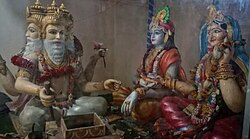
The Sanskrit texts, ''[[Brahma Vaivarta Purana]]'' and the ''[[Garga Samhita (Vaishnavite text)|Garga Samhita]]'' mention that Krishna secretly married Radha in the presence of [[Brahma]] in the ''[[Bhandirvan, Vrindavan|Bhandirvan]]'' forest before leaving [[Vrindavan]].<ref>{{Cite book |last=Gita Press Gorakhpur |url=https://archive.org/details/brahma-vaivarta-puran-gita-press-gorakhpur/page/n490/mode/1up |title=Brahma Vaivarta Puran Gita Press Gorakhpur |pages=481–488}}</ref><ref>{{Cite book |last=Gita Press Gorakhpur |url=https://archive.org/details/garga-samhita-gita-press-gorakhpur/page/n61/mode/1up |title=Garga Samhita by Gita Press Gorakhpur |pages=58}}</ref> The place where [[Radha Krishna]]'s marriage was conducted is still present in the outskirts of Vrindavan, called [[Radha Krishna Vivah Sthali, Bhandirvan]].<ref name=":1" /> The story mentioned in Brahma Vaivarta Purana indicates that Radha has always been Krishna's divine consort. But to give importance to Parakiya relationship (love without any social foundation) over Svakiya's (married relationship), Radha Krishna's marriage was kept hidden.{{sfn|Beck|2005|pp=71, 77–78}}{{sfn|Pintchman|2005|pp=57–59}}{{sfn|Varma|1993|p=}}{{sfn|Pauwels|2008|p=207}} | |||
==== Life after Krishna left Vrindavan ==== | |||
According to ''[[Garga Samhita (Vaishnavite text)|Garga Samhita]]'' and ''[[Brahma Vaivarta Purana]]'', Radha also left her home post Krishna's departure and went to Kadli vann (forest) leaving behind her illusionary form (also called ''Chaya Radha,'' her shadow) in Barsana. Radha with [[Ashtasakhi]] also met [[Uddhava]] in this forest who delivered them Krishna's message.<ref>{{Cite book |last=Gita Press Gorakhpur |url=https://archive.org/details/garga-samhita-gita-press-gorakhpur/page/n222/mode/1up |title=Garga Samhita by Gita Press Gorakhpur |pages=217–224}}</ref><ref>{{Cite book |last=Gita Press Gorakhpur |url=https://archive.org/details/brahma-vaivarta-puran-gita-press-gorakhpur/page/n728/mode/1up |title=Brahma Vaivarta Puran by Gita Press Gorakhpur |pages=717–720}}</ref> | |||
=== | ==== Reuniting with Krishna ==== | ||
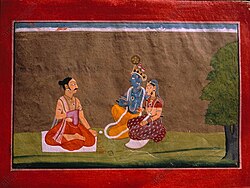
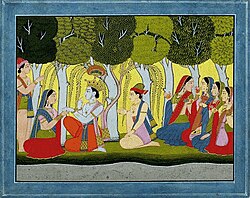
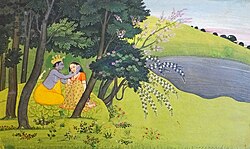
[[File:Radha and Krsna Seated in a Grove with Gopis and Gopas.jpg|thumb|Radha and Gopis meeting Krishna in forest.]] | |||
=== | It is mentioned in Brahma Vaivarta Purana (''Krishnajanma Khanda, Chapter 96'')<ref>{{Cite book |last=Gita Press Gorakhpur |url=https://archive.org/details/brahma-vaivarta-puran-gita-press-gorakhpur/page/n795/mode/1up |title=Brahma Vaivarta Puran by Gita Press Gorakhpur |pages=786}}</ref> and Garga Samhita (''Ashvamedha Khanda, Chapter 41'')<ref>{{Cite book |last=Gita Press Gorakhpur |url=https://archive.org/details/garga-samhita-gita-press-gorakhpur/page/n512/mode/1up |title=Garga Samhita by Gita Press Gorakhpur |pages=508–510}}</ref> that after the curse of 100 years of separation ran out,{{efn|According to Garga Samhita and Brahma Vaivarta Purana, Radha was cursed by Sridama in Goloka to bear 100 years of separation from Krishna when they descended on Earth.}} Krishna revisited Braj and met Radha and gopis. After performing the divine pastimes for sometime, Krishna summoned a huge divine chariot which took the residents of Braj along with Radha and gopis back to their celestial abode Goloka where the final reunion of Radha Krishna took place.<ref>{{Cite book |last=Gita Press Gorakhpur |url=https://archive.org/details/garga-samhita-gita-press-gorakhpur/page/n564/mode/1up |title=Garga Samhita by Gita Press Gorakhpur |pages=560–561}}</ref><ref>{{Cite book |last=Gita Press Gorakhpur |url=https://archive.org/details/brahma-vaivarta-puran-gita-press-gorakhpur/page/n799/mode/1up |title=Brahma Vaivarta Puran by Gita Press Gorakhpur |pages=790–791}}</ref>{{Sfn|Dalal|2010|p=322}} | ||
=== As Supreme Goddess === | |||
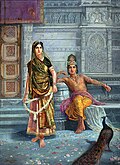
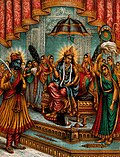
[[File:Krishna humbly standing before an enthroned Radha. Chromolit Wellcome V0045022.jpg|thumb|Radha depicted as Supreme goddess while [[Krishna]] humbly stands in front of her.]] | |||
In ''[[Brahma Vaivarta Purana]]'', Radha (or Rādhikā), who is inseparable from Krishna, appears as the main goddess.<ref>''[https://andhrabharati.com/dictionary/sanskrit/index.php?w=%E0%A4%AC%E0%A5%8D%E0%A4%B0%E0%A4%B9%E0%A5%8D%E0%A4%AE%E0%A4%B5%E0%A5%88%E0%A4%B5%E0%A4%B0%E0%A5%8D%E0%A4%A4 Brahmavaivarta]''</ref> She is mentioned as the personification of the Mūlaprakriti, the "Root nature", that original seed from which all material forms evolved. In the company of the Purusha ("Man", "Spirit", "Universal soul") Krishna, she is said to inhabit the [[Goloka]], which is a world of cows and cowherds far above the [[Vishnu]]'s [[Vaikuntha]]. In this divine world, Krishna and Radha relate to one another in the way body relates to the soul. (4.6.216)<ref>{{Cite book|last1=Dimitrova|first1=Diana|url=https://books.google.com/books?id=p2JgDwAAQBAJ&q=goddess+Radha|title=Divinizing in South Asian Traditions|last2=Oranskaia|first2=Tatiana|date=2018-06-14|publisher=Routledge|isbn=978-1-351-12360-0}}</ref><ref>{{Cite journal|last=Amore|first=Roy C|title=Religion in India|date=1976|url=https://academic.oup.com/jaar/article-lookup/doi/10.1093/jaarel/XLIV.2.366-a|journal=Journal of the American Academy of Religion|language=en|volume=XLIV|issue=2|pages=366–a–366|doi=10.1093/jaarel/XLIV.2.366-a|issn=0002-7189|url-access=subscription}}</ref> | |||
In ''[[Brahma Vaivarta Purana]]'', Radha (or Rādhikā), who is inseparable from Krishna, appears as the main goddess. She is mentioned as the personification of the Mūlaprakriti, the "Root nature", that original seed from which all material forms evolved. In the company of the Purusha ("Man", "Spirit", "Universal soul") Krishna, she is said to inhabit the [[Goloka]], which is a world of cows and cowherds far above the [[Vishnu]]'s [[Vaikuntha]]. In this divine world, Krishna and Radha relate to one another in the way body relates to the soul. (4.6.216) <ref>{{Cite book|last1=Dimitrova|first1=Diana|url=https://books.google.com/books?id=p2JgDwAAQBAJ&q=goddess+Radha|title=Divinizing in South Asian Traditions|last2=Oranskaia|first2=Tatiana|date=2018-06-14|publisher=Routledge|isbn=978-1-351-12360-0}}</ref><ref>{{Cite journal|last=Amore|first=Roy C|title=Religion in India|date=1976|url=https://academic.oup.com/jaar/article-lookup/doi/10.1093/jaarel/XLIV.2.366-a|journal=Journal of the American Academy of Religion|language=en|volume=XLIV|issue=2|pages=366–a–366|doi=10.1093/jaarel/XLIV.2.366-a|issn=0002-7189}}</ref> | |||
According to [[Krishnaism]], Radha is the chief female deity and is associated with Krishna's maya ( material energy) and [[Prakṛti|prakriti]] (feminine energy). At highest level Goloka, Radha is said to be united with Krishna and abiding with him in the same body. The relationship between [[Radha Krishna]] is that of substance and attribute : they are as inseparable as | According to [[Krishnaism]], Radha is the chief female deity and is associated with Krishna's maya (material energy) and [[Prakṛti|prakriti]] (feminine energy). At highest level Goloka, Radha is said to be united with Krishna and abiding with him in the same body. The relationship between [[Radha Krishna]] is that of substance and attribute: they are as inseparable as Milk and its whiteness or Earth and its smell. This level of Radha's identity transcends her material nature as prakriti and exits in the form of pure consciousness ([[Naradiya Purana|Narada Purana]], Uttara Khana - 59.8). While Radha is identical to Krishna at this highest level, this merger of identities seems to end when she separates from him. After separation she manifest herself as the goddess Primordial prakriti (Mūlaprakriti) who is called the "Maker of Universe" or "Mother of All" (Narada Purana, Purva-Khanda, 83.10-11, 83.44, 82.214).<ref>{{Cite book |last=Pintchman |first=Tracy |url={{Google books|JfXdGInecRIC|page=|keywords=|text=|plainurl=yes}} |title=Seeking Mahadevi: Constructing the Identities of the Hindu Great Goddess |date=2001-06-14|publisher=SUNY Press|isbn=978-0-7914-9049-5}}</ref><ref>{{Cite book |last=Pintchman |first=Tracy |url=https://books.google.com/books?id=JsDpBwAAQBAJ |title=Rise of the Goddess in the Hindu Tradition, The |date=2015-04-08 |publisher=State University of New York Press |isbn=978-1-4384-1618-2 |pages=159 |language=en |quote=Radha is said to be produced from half of Krishna's body and she manifest as Mulaprakriti Isvari, the Primordial Goddess Prakriti.}}</ref> | ||
In [[Nimbarkacharya]]'s ''Vedanta Kamadhenu Dashashloki'' (verse 6), it is clearly stated that: | In [[Nimbarkacharya]]'s ''Vedanta Kamadhenu Dashashloki'' (verse 6), it is clearly stated that: | ||
| Line 149: | Line 154: | ||
|Ange tu vaame vrishabhaanujaam mudaa viraajamaanaam anuruupasaubhagaam {{!}} | |Ange tu vaame vrishabhaanujaam mudaa viraajamaanaam anuruupasaubhagaam {{!}} | ||
Sakhiisahasraih parisevitaam sadaa smarema deviim sakalestakaamadaam {{!}}{{!}} | Sakhiisahasraih parisevitaam sadaa smarema deviim sakalestakaamadaam {{!}}{{!}} | ||
|The left portion of the body of the Supreme Lord is | |The left portion of the body of the Supreme Lord is Srimati Radha, seated blissfully, as beautiful as the Lord Himself; who is served by thousands of gopis: we meditate on the Supreme Goddess, the fulfiller of all desires.}} | ||
In the hymnal ''Hita-Caurasi'' of [[Hith Harivansh Mahaprabhu]], the 16th-century bhakti poet-saint, founder of [[Radha | In the hymnal ''Hita-Caurasi'' of [[Hith Harivansh Mahaprabhu]], the 16th-century bhakti poet-saint, founder of [[Radha Vallabh Sampradaya]], Radharani is exalted to the status of the only ultimate deity, while her consort Krishna is just her most intimate subordinate.{{sfnm|1a1=White|1y=1977|1p=|2a1=Snell|2y=1991|2p=|3a1=Beck|3y=2005|3p=76}} As a precursor to this view can be understand [[Jayadeva]], in whose ''[[Gita Govinda]]'' (10.9) Krishna is beneath Radha.{{sfn|Beck|2005|p=76}} | ||
Radha is also considered as the personification of Krishna's love. According to doctrines attributed to Vaishnavite saint [[Chaitanya Mahaprabhu]], It is said that, Krishna has three powers: the internal which is intelligence, the external which generates appearances and the differentiated which forms the individual soul. His chief power is that which creates dilatation of the heart or joy. This appears to be the power of love. When this love becomes settled in the heart of the devotee, it constitutes ''Mahabhava'', or the best feeling. When love attains to the highest pitch, it constitutes itself into Radha, who is the most lovable of all and full of all qualities. She was the object of the highest love of Krishna and being idealized as love, some of the agreeable feelings of the heart are considered her ornaments.<ref>{{Citation|title=XXIII. Caitanya|date=1913-12-31|url=https://www.degruyter.com/document/doi/10.1515/9783111551975-023/html|work=Vaisnavism, Saivism and minor religious systems|pages=82–86|publisher=De Gruyter|doi=10.1515/9783111551975-023|isbn=978-3-11-155197-5|access-date=2021-06-13}}</ref> | Radha is also considered as the personification of Krishna's love. According to doctrines attributed to Vaishnavite saint [[Chaitanya Mahaprabhu]], It is said that, Krishna has three powers: the internal which is intelligence, the external which generates appearances and the differentiated which forms the individual soul. His chief power is that which creates dilatation of the heart or joy. This appears to be the power of love. When this love becomes settled in the heart of the devotee, it constitutes ''Mahabhava'', or the best feeling. When love attains to the highest pitch, it constitutes itself into Radha, who is the most lovable of all and full of all qualities. She was the object of the highest love of Krishna and being idealized as love, some of the agreeable feelings of the heart are considered her ornaments.<ref>{{Citation|title=XXIII. Caitanya|date=1913-12-31|url=https://www.degruyter.com/document/doi/10.1515/9783111551975-023/html|work=Vaisnavism, Saivism and minor religious systems|pages=82–86|publisher=De Gruyter|doi=10.1515/9783111551975-023|isbn=978-3-11-155197-5|access-date=2021-06-13|url-access=subscription}}</ref> | ||
In [[Pancharatra|Narada Pancharatra Samhita]], Radha is mentioned as the feminine form of Krishna. It is described that, the one single lord is represented to have become | In [[Pancharatra|Narada Pancharatra Samhita]], Radha is mentioned as the feminine form of Krishna. It is described that, the one single lord is represented to have become two—one a woman and the other a man. Krishna retained his form of man while the female form became Radha. Radha is said to have come out from primordial body of Krishna, forming his left side, and is eternally associated with him in his amorous sports in this world as well as the world of cows ([[Goloka]]).<ref name=":6" /><ref name=":5">{{Cite book|last=Bhandarkar|first=R. G.|title=Vaisnavism, Saivism and minor religious systems|chapter-url=https://www.degruyter.com/document/doi/10.1515/9783111551975-010/html|chapter=X. The Pāñcaratra or Bhāgavata System|date=2019-05-20|pages=38–41|publisher=De Gruyter|isbn=978-3-11-155197-5|language=en|doi=10.1515/9783111551975-010}}</ref> | ||
Radha is often identified with the "sweet" aspect of goddess [[Lakshmi]]'s essence and thus also worshiped as an [[avatar]]a of | Radha is often identified with the "sweet" aspect of goddess [[Lakshmi]]'s essence and thus also worshiped as an [[avatar]]a of Lakshmi. In ''Shri Daivakrita Lakshmi Strotam'', Lakshmi is praised and glorified in her form of Radha<ref>{{Cite book|last=Monaghan|first=Patricia|url=https://books.google.com/books?id=qotjet-Hb0MC|title=Goddesses in World Culture|publisher=ABC-CLIO|year=2011|isbn=978-0-313-35465-6|location=United States of America|pages=1–7}}</ref> | ||
{{ | {{Poem quote|text=In Goloka, you are the goddess more dear to Krishna than life itself, His own Radhika. | ||
In Goloka, you are the goddess more dear to Krishna than life itself, His own Radhika. | Deep in the Vrinda forest, you are the mistress of mesmerizing rasa dance.|source=Shri Daivakrita Lakshmi Strotam}} | ||
Deep in the Vrinda forest, you are the mistress of mesmerizing rasa dance. | |||
According to the ''[[Garga Samhita (Vaishnavite text)|Garga Samhita]]'' (Canto 2, chapter 22, verses 26–29), during the [[Raslila|rasa]] pastime, on the request of [[gopi]]s, Radha and Krishna showed them their eight armed forms and turned into their [[Lakshmi Narayan]] forms. (2.22.26)<ref>{{Cite book |last=Gita Press Gorakhpur |url=https://archive.org/details/garga-samhita-gita-press-gorakhpur/page/n118/mode/1up |title=Garga Samhita Gita Press Gorakhpur |pages=114–115}}</ref> | |||
In ''[[Skanda Purana]]'' (Vaishnava Khand, chapter 128), [[Yamuna in Hinduism|Yamuna]] describes Radha as the soul of Krishna. She emphasis that "''Radha is Krishna and Krishna is Radha''" and all the queens of Krishna including [[Rukmini]] are the expansion of Radha.<ref>{{Cite book |last=Gita Press Gorakhpur |url=https://archive.org/details/skanda-puran-gita-press-gorakhpur/page/n493/mode/1up |title=Skanda Puran by Gita Press Gorakhpur |edition=19 |pages=465–466}}</ref> | |||
== Portrayal == | == Portrayal == | ||
=== As Krishna's lover consort (Parakiya rasa) === | === As Krishna's lover consort (Parakiya rasa) === | ||
Radha is admired as an ideal of perfect lover. In [[Gita Govinda]], it is not certain whether Radha was married or if she was an unmarried maiden. But, the relationship between [[Radha Krishna]] was unfolded in the secrecy of [[Vrindavan]] forest hinting at the ''Parakiya rasa.'' This can be understood from the verse where [[Nanda Baba|Nanda]], the father of Krishna, who represents social authority and ideal of [[dharma]] ordered Radha Krishna to go home as storm was approaching Vrindavan but the order was defied by the couple. The translation of first verse of Gita Govinda is as follows : | Radha is admired as an ideal of perfect lover. In [[Gita Govinda]], it is not certain whether Radha was married or if she was an unmarried maiden. But, the relationship between [[Radha Krishna]] was unfolded in the secrecy of [[Vrindavan]] forest hinting at the ''Parakiya rasa.'' This can be understood from the verse where [[Nanda Baba|Nanda]], the father of Krishna, who represents social authority and ideal of [[dharma]] ordered Radha Krishna to go home as storm was approaching Vrindavan but the order was defied by the couple. The translation of first verse of Gita Govinda is as follows: | ||
{{ | {{Block quote|text=Radha, you alone must take him home. This is Nanda's command. But, Radha and Madhava (Krishna) stray to a tree in the grove by the path and on the bank of the Yamuna their secret love games prevail.|author=Jayadev|source=Gita Govinda}} | ||
Radha, you alone must take him home. This is Nanda's command. But, Radha and Madhava (Krishna) stray to a tree in the grove by the path and on the bank of the Yamuna their secret love games prevail. | |||
In the Gita govinda, Radha stands in relation to Krishna as his consort. She is neither a wife nor a devoted rustic playmate. She is an intense, solitary, proud figure who is addressed as ''Sri, Candi, Manini, Bhamini'' and ''Kaamini''. She is portrayed as Krishna's partner in a mature and exclusive love. | In the Gita govinda, Radha stands in relation to Krishna as his consort. She is neither a wife nor a devoted rustic playmate. She is an intense, solitary, proud figure who is addressed as ''Sri, Candi, Manini, Bhamini'' and ''Kaamini''. She is portrayed as Krishna's partner in a mature and exclusive love.{{sfn|Miller|1975|pp=655–671}} | ||
In Vidyapati's work, Radha is depicted as a young girl barely twelve years old, while Krishna is depicted slightly older than her and as an aggressive lover. In the work of poet Chandidas, Radha is depicted as a bold woman who is unafraid of social consequences. Radha abandons all social propriety in the name of her love for Krishna. Excerpts of Chandidas's work showing Radha's boldness : | In Vidyapati's work, Radha is depicted as a young girl barely twelve years old, while Krishna is depicted slightly older than her and as an aggressive lover. In the work of poet Chandidas, Radha is depicted as a bold woman who is unafraid of social consequences. Radha abandons all social propriety in the name of her love for Krishna. Excerpts of Chandidas's work showing Radha's boldness: | ||
{{ | {{Poem quote|text=Casting away all the ethics of caste, my heart dotes on Krishna day and night. The custom of the clan is far away cry, and now I know that love adheres wholly to its own laws. | ||
Casting away all the ethics of caste, my heart dotes on Krishna day and night. The custom of the clan is far away cry, and now I know that love adheres wholly to its own laws. | I have blackened my golden skin longing for him. As the fire encircled me, my life begins to wilt. And my heart brooding eternally, parched for my dark darling, My Krishna.|author=Chandidas}} | ||
I have blackened my golden skin longing for him. As the fire encircled me, my life begins to wilt. And my heart brooding eternally, parched for my dark darling, My Krishna. | |||
In loving Krishna, Radha violates the basis of caste, showing no care for the realities of social structures. Love consumed her to extent that once having fair complexion, Radha turned herself into Krishna's dark color. Chandidas used the word "fire" as synonym for Radha's love towards Krishna. The Radha of Chandidas is favored by [[Gaudiya Vaishnavism|Gaudiya Vaishnavas]].<ref name=":4" /> | In loving Krishna, Radha violates the basis of caste, showing no care for the realities of social structures. Love consumed her to extent that once having fair complexion, Radha turned herself into Krishna's dark color. Chandidas used the word "fire" as synonym for Radha's love towards Krishna. The Radha of Chandidas is favored by [[Gaudiya Vaishnavism|Gaudiya Vaishnavas]].<ref name=":4">{{Cite journal |last=Steward |first=David S. |year=1980 |title=DOCTORAL DISSERTATION ABSTRACTS IN RELIGIOUS EDUCATION 1978–79 |journal=Religious Education |volume=75 |issue=4 |pages=474–494 |doi=10.1080/0034408800750410 |issn=0034-4087}}</ref> | ||
=== As Krishna's married consort (Svakiya rasa) === | === As Krishna's married consort (Svakiya rasa) === | ||
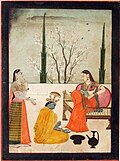
[[File:Krishna paints Radha's feet (6124588881).jpg|thumb|Krishna painting feet of Radha, 1760 art form based on Braj's Rasikapriya text.]] | [[File:Krishna paints Radha's feet (6124588881).jpg|thumb|Krishna painting feet of Radha, 1760 art form based on Braj's Rasikapriya text.]] | ||
{{ | ''Rasikapriya'', a [[Braj]] text on poetics depicts Radha as the married consort of Krishna. It is a frequently illustrated text that deals with the Radha Krishna's romance and is written by one of the most prominent writers of the ''Riti kavya'' tradition, Kesavdas. Changes in the portrayal of Radha, as articulated in the Rasikapriya, have significant implications for later literary traditions. In the ''Riti kavya'' literature, especially the ''Rasikapriya'', Radha is depicted as the archetypal heroine and is used to exemplify the ideal form of connection to Krishna. Rather than depicting her as a ''parakiya'' heroine, Kesavdas, on the whole, presents her as a ''svakiya'' heroine, the one to whom Krishna belongs wholeheartedly. If she is separated from him, it is only temporarily, for as archetypal lovers they are connected forever. The suggestion that Radha is Krishna's rightful wife is clearly articulated in the first chapter in the exemplary verse for the manifest form of union. Here, Kesavdas compares the union of Radha and Krishna with that of [[Sita]] and [[Rama]]. Kesavdas compares the union of Radha and Krishna with that of Sita and Rama: | ||
Once Krishna sat with Radha on the same couch with pleasure, and in the mirror held, as he looked to watch the splendor of her face, his eyes filled with tears. In her reflections he saw the red gem on her forehead which seemed to glow like fire, reminding him of Sita sitting in fire, adorned, with her husband's leave. | |||
{{Poem quote|text=Once Krishna sat with Radha on the same couch with pleasure, and in the mirror held, as he looked to watch the splendor of her face, his eyes filled with tears. In her reflections he saw the red gem on her forehead which seemed to glow like fire, reminding him of Sita sitting in fire, adorned, with her husband's leave.|author=Kesavdas|source=Rasikapriya (I,22)}} | |||
In this verse, Kesavdas connects Radha with Krishna as his legitimate wife not only in this lifetime but even in the previous one. Chapter 3 and verse 34 of ''Rasikapriya'', depicted Radha as ''Madhya arudhayovana nayika'' and is described as a beautiful woman who looks like a heavenly damsel, with perfect features (forehead like the half moon, arches like a perfect bow, etc.), golden body, and a beautiful body fragrance. In chapter 3, verse 38, one attendant talks to another : | In this verse, Kesavdas connects Radha with Krishna as his legitimate wife not only in this lifetime but even in the previous one. Chapter 3 and verse 34 of ''Rasikapriya'', depicted Radha as ''Madhya arudhayovana nayika'' and is described as a beautiful woman who looks like a heavenly damsel, with perfect features (forehead like the half moon, arches like a perfect bow, etc.), golden body, and a beautiful body fragrance. In chapter 3, verse 38, one attendant talks to another: | ||
{{ | {{Poem quote|text=I have seen such an amazingly beautiful gopi, that I wonder if she really is a cowherdess ! Such splendor shone from her body that my eyes remained transfixed on her! No other beautiful women appeal any more; having seen her delicate walk once, I see the beauty of all three worlds. Who could be the husband of such a beauty, Kamadeva or Kalanidhi [moon]? No, Krishna himself.|author=Kesavdasa|source=Rasikapriya (III, 38)}} | ||
I have seen such an amazingly beautiful gopi, that I wonder if she really is a | |||
In chapter 3, verse 38, Radha is very specifically described as the wife of Krishna. In most of the verses, whenever she is mentioned by name, she is usually seen as a virtuous court lady with utmost beauty and charm. Her husband Krishna is said to be in control of her love. Kesavdasa in ''Rasikapriya'' mentioned that while it is common to see women devoted to their husbands but it is not as common to see a husband as Krishna who is so devoted to his wife Radha and considering her as goddess.(VII, 6)<ref>{{Cite journal|last=Desai|first=Vishakha N.|date=2000|title=Loves of Rādhā in the "Rasikapriyā" Verses and Paintings|journal=Ars Orientalis|volume=30|pages=83–92|jstor=4629572|issn=0571-1371}}</ref> In [[Sanskrit]] scripture ''[[Brahma Vaivarta Purana]],'' Radha and Krishna are understood to be eternally related to each other as husband and wife validating their Svakiya relationship.{{Sfn|Kinsley|1988}} The celebrated poets of [[Radha Vallabh Sampradaya]], Dhruva Dasa and Rupalji composed "''Vyahulau Utsav ke Pad''" or "Marriage Festival songs" which describe the eternal wedding of Radha and Krishna with praise and adulation.<ref>{{Cite book|last=Beck|first=Guy L.|url=https://books.google.com/books?id=0SJ73GHSCF8C&q=Alternative+Krishnas%3A+Regional+and+Vernacular+Variations+on+a+Hindu+Deity&pg=PP11|title=Alternative Krishnas: Regional and Vernacular Variations on a Hindu Deity|publisher=SUNY Press|year=2012|isbn=978-0-7914-6415-1|location=United States of America|pages=66}}</ref> In the Indian state of [[Maharashtra]], Radha is often identified as [[Rahi (goddess)|Rahi]], a regional form of Radha who is worshiped as the married consort of [[Vithoba]], a regional form of Krishna.<ref>{{Cite book |last=Novetzke |first=C. L.|chapter=A Family Affair: Krishna Comes to Pandharpur and Makes Himself at Home |date=2005-01-01|chapter-url=https://www.researchgate.net/publication/292378289 |editor-last=Beck |editor-first=Guy L. |title=Alternative Krishnas: Regional and Vernacular Variations on a Hindu Deity |url=https://muse.jhu.edu/pub/163/monograph/book/4933 |pages=113–138|access-date=2022-01-13}}</ref><ref>{{Cite journal|last=Pande|first=Dr Suruchi|date=August 2008|title=Vithoba of Pandharpur|url=http://www.advaitaashrama.org/pb_archive/2008/PB_2008_August.pdf|journal=Prabuddha Bharata|volume=113|pages=447|archive-url=https://web.archive.org/web/20081221081306/http://www.advaitaashrama.org/pb_archive/2008/PB_2008_August.pdf |archive-date=21 December 2008 |via=Wayback Machine}}</ref> | |||
== Worship == | == Worship and festivals == | ||
{{See also|Radha Krishna}} | {{See also|Radha Krishna}} | ||
{{multiple image | {{multiple image | ||
| align = right | | align = right | ||
| direction = vertical | | direction = vertical | ||
| width = 250 | | width = 250 | ||
| header = | | header = Radha Krishna devotion | ||
| image1 = Banke bihari (55).JPG | | image1 = Banke bihari (55).JPG | ||
| caption1 = Worship of Radha Krishna | | caption1 = Worship of Radha Krishna | ||
| alt1 = | | alt1 = | ||
| image2 = Interiors of Laljiu Temple, Ambika Kalna WLM2016-0193.jpg | | image2 = Interiors of Laljiu Temple, Ambika Kalna WLM2016-0193.jpg | ||
| alt2 = | | alt2 = | ||
| caption2 = A devotee reading inside dedicated to Radha-Krishna Lalji Temple, [[Kalna City|Kalna]], West Bengal | | caption2 = A devotee reading inside dedicated to Radha-Krishna Lalji Temple, [[Kalna City|Kalna]], West Bengal | ||
}} | }} | ||
[[Friedhelm Hardy]] singles out such an offshoot of [[Krishnaism]] as Radha-centered stream | [[Friedhelm Hardy]] singles out such an offshoot of [[Krishnaism]] as Radha-centered stream Radhaism.{{sfn|Hardy|1987|pp=387–392}} The main representative of which is the [[Radha Vallabh Sampradaya]] ({{lit|consort of Radha}}), where goddess Radha is worshipped as the supreme deity, and Krishna is in a subordinate position.{{sfnm|1a1=White|1y=1977|1p=|2a1=Snell|2y=1991|2loc=chapter 1|3a1=Rosenstein|3y=1998|3p= |4a1=Beck|4y=2005|4p=}}{{sfn|Lochtefeld|2002|p=542}} | ||
During the 18th century at [[Kolkata]] existed the Sakhībhāvakas community, whose members used to wear female dresses in order to identify themselves with the [[gopi]]s, companions of Radha.{{sfn|Hardy|1987|pp=387–392}} | During the 18th century at [[Kolkata]] existed the Sakhībhāvakas community, whose members used to wear female dresses in order to identify themselves with the [[gopi]]s, companions of Radha.{{sfn|Hardy|1987|pp=387–392}} | ||
In some devotional ([[bhakti]]) [[Krishnaism|Krishnaite]] traditions of [[Vaishnavism]] that focus on Krishna, Radha represents "the feeling of love towards Krishna".{{sfn|Hawley|Wulff|1982|pp=xiii–xviii}} For some of the adherents of these traditions, her importance approaches or even exceeds that of Krishna. Radha is worshipped along with Krishna in Bengal, Assam and Odisha | In some devotional ([[bhakti]]) [[Krishnaism|Krishnaite]] traditions of [[Vaishnavism]] that focus on Krishna, Radha represents "the feeling of love towards Krishna".{{sfn|Hawley|Wulff|1982|pp=xiii–xviii}} For some of the adherents of these traditions, her importance approaches or even exceeds that of Krishna. Radha is worshipped along with Krishna in [[Nepal]] and many Indian states including [[West Bengal]], [[Manipur]], [[Assam]], [[Himachal Pradesh]], [[Uttarakhand]], [[Haryana]], [[Delhi]], [[Rajasthan]], [[Gujarat]], [[Uttar Pradesh]], [[Bihar]], [[Jharkhand]], [[Madhya Pradesh]] and [[Odisha]]. Elsewhere, she is a revered deity.{{sfn|Majumdar|1955|pp=231–257}} In [[Maharashtra]] region, Radha is worshipped in her regional form as [[Rahi (goddess)|Rahi]].<ref>{{Cite web |last=Pande |first=Dr. Suruchi |date=2008 |title=Vithoba of Pandharpur |url=http://www.advaitaashrama.org/pb_archive/2008/PB_2008_August.pdf |url-status=dead |archive-url=https://web.archive.org/web/20081221081306/http://www.advaitaashrama.org/pb_archive/2008/PB_2008_August.pdf |archive-date=21 December 2008 |access-date=2022-05-31 |website=}}</ref> Radha is considered as Krishna's original [[shakti]], the supreme goddess in both the [[Nimbarka Sampradaya]] and following the advent of [[Chaitanya Mahaprabhu]] also within the [[Gaudiya Vaishnavism|Gaudiya Vaishnava]] tradition.{{sfn|Hawley|Wulff|1982|pp=xiii–xviii}}{{sfn|Dalal|2010|pp=321–322}} [[Nimbarka]] was the first well known [[Vaishnava]] scholar whose theology centered on goddess Radha.{{sfn|Ramnarace|2014|p=}}{{sfn|Singh|2004|p=125}}<ref name="Kinsley1972">{{cite journal | author = Kinsley, D. | year = 2010 | title = Without Krsna There Is No Song | journal = History of Religions | volume = 12 | issue = 2 | page = 149 | url = https://books.google.com/books?hl=en&lr=&ie=UTF-8&sa=G&oi=qs&q=nimbarka+radha+first+author:d-sarma | access-date = 2008-05-03 | doi = 10.1086/462672| s2cid = 161297914 | url-access = subscription }} "Nimbarka seems to have been the first well-known religious leader to regard Radha as central to his worship (thirteenth century)"</ref> | ||
Since 15th century in Bengal and [[Assam]] flourished [[Tantra|Tantric]] [[Vaishnava-Sahajiya]] tradition with related to it [[Baul]]s, where Krishna is the inner divine aspect of man and Radha is the aspect of woman, what incorporated into their specific sexual [[Maithuna]] ritual.{{sfn|McDaniel|2000}}{{sfn|Hayes|2005|pp=19–32}} | Since 15th century in Bengal and [[Assam]] flourished [[Tantra|Tantric]] [[Vaishnava-Sahajiya]] tradition with related to it [[Baul]]s, where Krishna is the inner divine aspect of man and Radha is the aspect of woman, what incorporated into their specific sexual [[Maithuna]] ritual.{{sfn|McDaniel|2000}}{{sfn|Hayes|2005|pp=19–32}} | ||
Radha's connection to Krishna is of two types: ''svakiya-rasa'' (married relationship) and ''parakiya-rasa'' (a relationship signified with eternal mental "love"). The Gaudiya tradition focuses upon ''parakiya-rasa'' as the highest form of love, wherein Radha and Krishna share thoughts even through separation. The love the gopis feel for Krishna is also described in this esoteric manner as the highest platform of spontaneous love of God, and not of a sexual nature.{{sfn|Beck|2005|p=79}} | Radha's connection to Krishna is of two types: ''svakiya-rasa'' (married relationship) and ''parakiya-rasa'' (a relationship signified with eternal mental "love"). The Gaudiya tradition focuses upon ''parakiya-rasa'' as the highest form of love, wherein Radha and Krishna share thoughts even through separation. The love the gopis feel for Krishna is also described in this esoteric manner as the highest platform of spontaneous love of God, and not of a sexual nature.{{sfn|Beck|2005|p=79}} | ||
== Hymns == | === Hymns === | ||
[[File:Krishna et Râdhâ (MNAAG - musée Guimet) (11936923714).jpg|thumb|Radha Krishna painting inspired by Gita Govinda]] | [[File:Krishna et Râdhâ (MNAAG - musée Guimet) (11936923714).jpg|thumb|Radha Krishna painting inspired by Gita Govinda]] | ||
List of prayers and hymns dedicated to Radha are: | List of prayers and hymns dedicated to Radha are: | ||
* ''[[Gita Govinda]]'' | * ''[[Gita Govinda]]'': This 12th century work of [[Jayadeva]] is dedicated to both Radha and Krishna. Gita Govinda is still the part of temple songs of [[Jagannath Temple, Puri|Jagannath Temple]], Puri.{{sfn|Datta|1988|pp=1419–1420}} | ||
* ''Radhe Krishna'' | * ''Radhe Krishna'': The maha-mantra of [[Nimbarka Sampradaya]] is as follows: | ||
{{quote| | {{Poem quote|''Rādhe Kṛṣṇa Rādhe Kṛṣṇa'' | ||
''Rādhe Kṛṣṇa Rādhe Kṛṣṇa'' | |||
''Kṛṣṇa Kṛṣṇa Rādhe Rādhe'' | ''Kṛṣṇa Kṛṣṇa Rādhe Rādhe'' | ||
''Rādhe Shyām Rādhe Shyām'' | ''Rādhe Shyām Rādhe Shyām'' | ||
''Shyām Shyām Rādhe Rādhe'' | ''Shyām Shyām Rādhe Rādhe''}} | ||
* ''Radha [[Gayatri Mantra]]'' | * ''Radha [[Gayatri Mantra]]'': "''Om Vrashbhanujaye Vidmahe, Krishnapriyaye Dhimahi , Tanno Radha Prachodayat."'' | ||
*''[[Lakshmi]] Gayatri Mantra'' | * ''[[Lakshmi]] Gayatri Mantra'': "Samuddhrtayai vidmahe Vishnunaikena dhimahi | tan no Radha prachodaydt || " (We think about her whom [[Vishnu]] himself supports, we meditate on her. Then, let Radha inspire us). The mantra is mentioned in [[Linga Purana]] (48.13) and invokes Lakshmi through Radha.{{sfn|Miller|1975|pp=655–671}} | ||
* ''[[Shri Radhika Krishnashtaka]]'' | * ''[[Shri Radhika Krishnashtaka]]'': It is also called Radhashtak. The prayer is composed of eight verses and is popular in [[Swaminarayan Sampradaya]]. | ||
* ''Shri Radha Saharsnama Strotam'' | * ''Shri Radha Saharsnama Strotam'': The prayer has more than 1000 names of Radha and is part of the Sanskrit scripture [[Pancharatra|Narada Panchratra]].<ref name=":2">{{Cite web |title=Sri Radha-sahasra-nama, The Thousand Names of Sri Radha |url=https://www.stephen-knapp.com/sri_radha-sahasra-nama.htm |access-date=2021-05-28 |website=www.stephen-knapp.com}}</ref> | ||
* ''Radha Kripa Kataksh Strotam'' | * ''Radha Kripa Kataksh Strotam'': This is the most famous stotra in Vrindavana. It is written in Ūrdhvāmnāya-tantra and is believed to be spoken by Śiva to Parvati. The prayer is dedicated to Radha and has total 19 verses.<ref>{{Cite web|title=Sri Sri Radha-kripa-kataksha-stava-raja|url=http://www.harekrsna.de/Radha-kripa-kataksha-stava.htm|access-date=2021-05-28|website=www.harekrsna.de}}</ref><ref>{{Cite web|title=Radha Kripa Kataksha - Lord Shiva|url=https://brajrasik.org/articles/5956a9261350677a49620717/radha-kripa-kataksha-lord-shiva|access-date=2021-05-28|website=Braj Ras - Bliss of Braj Vrindavan.}}</ref> | ||
* ''Yugalashtakam'' | * ''Yugalashtakam'': This prayer is dedicated to Yugal (combined) form of [[Radha Krishna]]. It is popular in [[Gaudiya Vaishnavism]] and was written by [[Jiva Goswami]].<ref>{{Cite web|title=Shree Yugal Ashtakam.|url=https://www.shrinathdham.com/stotra-stuti-aarti/shree-yugal-ashtakam/|access-date=2021-05-28|website=Shrinathdham|language=en-GB}}</ref> | ||
* ''Radha Chalisa'' | * ''Radha Chalisa'': A devotional hymn in praise of Radha. The prayer has 40 verses.<ref>{{Cite web|title=Shree Radha Chalisa - Forty Verses of Shri Radha's Glory |url=https://brajrasik.org/articles/5ecaba472c91730061b25a5d/shri-radhe-vrishabhanujaa-bhaktani-praanaadhaar-shri-radha-chalisa |access-date=2021-05-28 |publisher=Braj Ras - Bliss of Braj Vrindavan}}</ref> | ||
* ''[[Hare Krishna (mantra)|Hare Krishna Mahamantra]]'' | * ''[[Hare Krishna (mantra)|Hare Krishna Mahamantra]]'': In this mantra, "Hare" is the vocative form of both "[[Hari]]" (Krishna) and "Hara" (Radha).<ref>{{Cite book|last=Judah|first=J. Stillson |title=Religious Movements in Contemporary America |chapter-url=https://www.degruyter.com/document/doi/10.1515/9781400868841-024/html|chapter=The Hare Krishna Movement|date=2015-03-08|pages=463–478 |publisher=Princeton University Press|isbn=978-1-4008-6884-1|doi=10.1515/9781400868841-024}}</ref> The mantra is mentioned in [[Kali-Saṇṭāraṇa Upaniṣad|Kali Santarana Upanishad]].<ref>{{cite book |surname=Beck |given=Guy L. |chapter=Hare Krishna Mahamantra: Gaudiya Vaishnava Practice and the Hindu Tradition of Sacred Sound |editor1=Edwin Bryant |editor2=Maria Ekstrand |year=2004 |title=The Hare Krishna Movement: The Postcharismatic Fate of a Religious Transplant |place=New York |publisher=Columbia University Press |url={{Google books|mBMxPdgrBhoC|page=|keywords=|text=|plainurl=yes}} |pages=35–44 |isbn=0-231-12256-X}}</ref> | ||
{{Blockquote|text=<poem> | {{Blockquote|text=<poem> | ||
''Hare Kṛṣṇa Hare Kṛṣṇa'' | ''Hare Kṛṣṇa Hare Kṛṣṇa'' | ||
| Line 253: | Line 248: | ||
''Hare Rāma Hare Rāma'' | ''Hare Rāma Hare Rāma'' | ||
''Rāma Rāma Hare Hare''</poem>}} | ''Rāma Rāma Hare Hare''</poem>}} | ||
* ''Hita-Caurasi'' | * ''Hita-Caurasi'': The eighty-four verses (hymns) in [[Braj Bhasha]] of the 16th-century poet-sant [[Hith Harivansh Mahaprabhu]], founder of [[Radha Vallabh Sampradaya]], in praise of Radha as the ultimate deity, the Queen, while Krishna depicted as her servant.{{sfnm|1a1=White|1y=1977|1p=|2a1=Snell|2y=1991|2p=|3a1=Beck|3y=2005|3p=67}} | ||
* ''[[Radhe Radhe]]'': Greeting or salutation in [[Braj]] region dedicated to Radha. | |||
=== Festivals === | |||
Radha is one of the major and celebrated goddess in Hinduism. Following is the list of festivals associated with her. | |||
==== Radhashtami ==== | |||
{{Main|Radhashtami}} | |||
[[File:Radha Syamasundar Vrindavan Radhastami 2004.jpg|thumb|Radha Krishna on Radhashtami, [[ISKCON Temple, Vrindavan]]]] | |||
Radha | |||
Radhashtami, also called Radha Jayanti is celebrated as the appearance anniversary of Radha. In the Hindu calendar, Radhashtami is observed annually in the month of the [[Bhadra (Hindu calendar)|Bhadra]], 15 days after [[Krishna Janmashtami]], the birth anniversary of Krishna, which suggests that Radha is very much an aspect of the cultural-religious faith system governing social life.<ref name=":8" /> The festival is celebrated with great enthusiasm and fervor especially in the [[Braj|Braj region]]. The festivities include fasting till afternoon (12 pm), abhishek and [[Arti (Hinduism)|aarti]] of Radharani, offering her flowers, sweets and food items, singing songs, dancing and prayers dedicated to Radha.<ref>{{Cite web|title=Radhastami {{!}} Krishna.com|url=http://www.krishna.com/radhastami|access-date=2021-05-29|website=www.krishna.com|archive-date=24 February 2024|archive-url=https://web.archive.org/web/20240224202533/https://www.krishna.com/radhastami|url-status=dead}}</ref> The [[Radha Rani Temple]] in [[Barsana]] host this festival in a grand manner as Basana is also considered as the birthplace of Radha. Apart from Barsana, this festival is celebrated in nearly all the temples of [[Vrindavan]] and [[International Society for Krishna Consciousness|ISKCON]] temples across the world as it is one of the major festival for many [[Vaishnavism]] sections.<ref>{{Cite web|title=Radhastami – ISKCON VRINDAVAN|url=https://iskconvrindavan.com/festivals/radhastmi/|access-date=2021-05-29|language=en-US}}</ref> | |||
=== Holi === | ==== Holi ==== | ||
{{Main|Holi}} | {{Main|Holi}} | ||
=== Sharad Purnima === | [[File:3 Nichal Chand (attr) Krishna Celebrates Holi with Radha and the Gopis 1750-60 Boston MFA.jpg|thumb|''Krishna Celebrates Holi with Radha and the Gopis'' by [[Nihâl Chand|Nihal Chand]], [[Kishangarh]], 1750-60]] | ||
Holi, one of the major Hindu festival, also called ''festival of love'' and ''festival of colors'' also celebrates the divine and eternal love of Radha and [[Krishna]]. [[Mathura]] and Vrindavan are known for their Holi celebrations. According to popular legend associated with [[Radha Krishna]], as a child, Krishna would cry to his mother [[Yashoda]] about Radha being fair while he had a dark complexion. His mother then advised him to smear colour of his choice on Radha's face, thus giving birth to Braj ki Holi. It is said that every year, Lord Krishna would travel from his village [[Nandgaon, Uttar Pradesh|Nandgaon]] to Goddess Radha's village Barsana, where Radha and the [[gopi]]s would playfully beat him with sticks.<ref>Yudit Greenberg, Encyclopedia of Love in World Religions, Volume 1, {{ISBN|978-1851099801}}, p. 212</ref><ref>{{cite book |author=McKim Marriott |url=https://books.google.com/books?id=9hairjdT-ekC |title=The Life of Hinduism |publisher=University of California Press |year=2006 |isbn=978-0-520-24914-1 |editor=John Stratton Hawley and Vasudha Narayanan |page=102}}, Quote: "Holi, he said with a beatific sigh, is the Festival of Love!"</ref> In present times, Holi celebrations in Barsana begin one week before the actual date of the festival, moving to Nandgaon the next day. In Mathura and Vrindavan, the festival is celebrated in different forms like [[Lathmar Holi]] in Barsana and Nandgaon, where sticks are used to create playful beats, to which young men and women dance; Phoolon wali Holi in Gulaal Kund near the [[Govardhan Hill]], during which [[Raslila|Ras Leela]] is performed and Holi is played with colourful flowers and Widow's Holi in Vrindavan.<ref>{{Cite web|title=Incredible India {{!}} Braj ki Holi|url=https://www.incredibleindia.org/content/incredible-india-v2/en/destinations/mathura-vrindavan/braj-ki-holi.html|access-date=2021-05-29|website=www.incredibleindia.org}}</ref> | |||
==== Sharad Purnima ==== | |||
{{Main|Sharad Purnima}} | {{Main|Sharad Purnima}} | ||
Sharad Purnima refers to the full moon of the autumn season. On this day, devotees celebrate Krishna performing a beautiful dance called "[[Raslila|rasa lila]]" with Radha and the | |||
Sharad Purnima refers to the full moon of the autumn season. On this day, devotees celebrate Krishna performing a beautiful dance called "[[Raslila|rasa lila]]" with Radha and the gopis—the cowherd damsels of Vrindavan.<ref>{{Cite web|title=Braj Darshan {{!}} MAHARAAS: The Dance of Spirituality|url=https://www.brajdarshan.in/maharaas/|access-date=2021-05-29|website=www.brajdarshan.in|archive-date=2 June 2021|archive-url=https://web.archive.org/web/20210602212511/https://www.brajdarshan.in/maharaas/|url-status=dead}}</ref> On this day, Radha Krishna in temples are dressed in white outfits and are adorned with flower garlands and glittering ornaments.<ref>{{Cite web|last=Sharma|first=Aashish|title=ISKCON-London - Sharad Purnima - Kartik Full Moon Festival|url=https://www.iskcon-london.org/events/festivals/sharad-purnima|access-date=2021-05-29|website=www.iskcon-london.org|language=en-gb|archive-date=19 January 2022|archive-url=https://web.archive.org/web/20220119202533/https://www.iskcon-london.org/events/festivals/sharad-purnima|url-status=dead}}</ref> | |||
==== Kartik Purnima ==== | |||
{{Main|Kartik Purnima}} | |||
In [[Vaishnavism]], the occasion of Kartik Purnima is considered as the most auspicious day to worship goddess Radha. According to [[Brahma Vaivarta Purana]], Krishna also worshiped Radha on this day.<ref name="Shanti Lal Nagar"/> In Radha Krishna temples, sacred vow is observed throughout the [[Kārtika (month)|Karthik month]] and performances of [[Raslila]] are organized to celebrate this festival.<ref name=":02">{{Cite book |last=Mohapatra |first=J. |url=https://books.google.com/books?id=UdpzAgAAQBAJ&dq=worship+radha&pg=PA164 |title=Wellness In Indian Festivals & Rituals |date=2013 |publisher=Partridge Publishing |isbn=978-1-4828-1690-7 |pages=164 |language=en}}</ref> | |||
== In Shaktism == | |||
In [[Shaktism]] section of [[Hinduism]], Radha becomes an independent goddess ''[[Prakṛti|Prakriti]]''-''Padmini'', who is the form of goddess [[Tripura Sundari]] while her consort [[Krishna]] is associated with the masculine form of goddess [[Kali]]. Tantric text ''[[Radha Tantra]]'', portrayed Radha as the ''[[Shakti|Shakta Radha]]'' who is also the spiritual mentor of Krishna.<ref>{{Cite book |last=Broo |first=Mans |url=http://archive.org/details/the-radha-tantra-a-critical-edition-and-annotated-translation-9781138892361-113889236x |title=Rādhā Tantra: A critical edition and annotated translation |publisher=[[Routledge]] |year=2017 |pages=1–2 |language=en}}</ref><ref>{{Citation |last=Frazier |first=Jessica |title=Becoming the Goddess: Female Subjectivity and the Passion of the Goddess Radha |date=2010 |url=https://doi.org/10.1007/978-1-4020-6833-1_13 |work=New Topics in Feminist Philosophy of Religion: Contestations and Transcendence Incarnate |pages=199–215 |editor-last=Anderson |editor-first=Pamela Sue |access-date=2023-07-01 |place=Dordrecht |publisher=Springer Netherlands |language=en |doi=10.1007/978-1-4020-6833-1_13 |isbn=978-1-4020-6833-1|url-access=subscription }}</ref><ref>{{Cite journal |last=Manring |first=Rebecca J. |title=Rādhātantram: Rādhā as Guru in the Service of the Great Goddess |url=http://link.springer.com/10.1007/s11407-019-09264-1 |journal=[[International Journal of Hindu Studies]] |year=2019 |language=en |volume=23 |issue=3 |pages=259–282 |doi=10.1007/s11407-019-09264-1 |s2cid=213054011 |issn=1022-4556|url-access=subscription }}</ref><ref>{{Cite book |last=Beck |first=Guy L. |url=https://books.google.com/books?id=K0XqbG0LKBUC&dq=radha+tantra&pg=PA19 |title=Alternative Krishnas: Regional and Vernacular Variations on a Hindu Deity |date=2012-02-01 |publisher=State University of New York Press |isbn=978-0-7914-8341-1 |pages=19–25 |language=en}}</ref> In Shaktism, the ''[[Ashtasakhi]]s'' of Radha Krishna are considered as the embodiment of the ''[[Ashta siddhi|Ashta Siddhis]]'' which are Aṇimā, Mahima, Garima, Laghima, Prāpti, Prākāmya, Iṣiṭva, and Vaśitva.<ref>{{Citation |title=Tantra and some Śaiva Thinkers |date=2015 |url=http://dx.doi.org/10.5040/9781474243063.0022 |work=An Introduction to Indian Philosophy |access-date=2023-07-06 |publisher=Bloomsbury Academic|doi=10.5040/9781474243063.0022 |isbn=978-1-4725-2476-8 |url-access=subscription }}</ref> | |||
== Influence == | == Influence == | ||
[[File: | [[File:Radha in the Moonlight.jpg|thumb|upright=0.9|Radha's story has inspired many paintings. Above: ''Radha in the moonlight'' by [[Raja Ravi Varma]], 1890.]] | ||
=== Paintings === | === Paintings === | ||
Radha and Krishna have inspired many forms of performance arts and literary works.{{sfn|Archer|2004}}<ref name=" | Radha and Krishna have inspired many forms of performance arts and literary works.{{sfn|Archer|2004}}<ref name="britannica2"/> Over the centuries, their love has been portrayed in thousands of exquisite paintings which depicts the lover in separation and union, longing and abandonment.{{sfn|Archer|2004}}<ref>{{Cite journal|last=Kakar|first=Sudhir|date=January 1985|title=Erotic Fantasy: The Secret Passion of Radha and Krishna|journal=Contributions to Indian Sociology|volume=19|issue=1|pages=75–94|doi=10.1177/006996685019001006|s2cid=144426229|issn=0069-9667}}</ref> | ||
[[Pattachitra|Patta chitra]], is one of the typical regional arts of the coastal state of [[Odisha|Orissa]]. In this type of painting, Krishna is depicted in blue or black color and is usually accompanied by his fiancée Radha.<ref>{{Cite journal|last=Kallir|first=Jane|date=1982|title=The Folk Art Tradition: Naive Painting in Europe and The United States|journal=American Art Journal|volume=14|issue=4|pages=88|doi=10.2307/1594322|jstor=1594322|issn=0002-7359}}</ref> Rajasthani art emerged as an amalgamation of folk art with conventional and canonical ethos. Krishna and Radha have been the pivotal figures in Rajasthani miniature paintings. Their love has been delineated aesthetically in this composition.<ref>{{Cite book|last=Soltis|first=Carol Eaton|title=Miniature painting in the USA|date=2015-09-22|publisher=Oxford University Press|series=Oxford Art Online|doi=10.1093/gao/9781884446054.article.t2283851}}</ref> In [[Pahari painting]]s, often the nayaka (hero) is depicted as Krishna and the nayika (heroine) is depicted as Radha. The legend of Krishna and Radha and their love provided rich material to Pahari painters in general and to the artists of Garhwal in particular.<ref>{{Cite journal|last=Fam|first=Sylvia|date=2019-01-01|title=Engaging the Senses to Make Sense: Performing Autoethnography in Selected Poems by Two Poet/Educators|journal=Textual Turnings|volume=1|issue=1|pages=121–138|doi=10.21608/ttaip.2019.123734|issn=2735-3451|doi-access=free}}</ref> The central theme of [[Kangra painting]] is love inspired by ''Rasikapriya,'' popular poetic work of Keshavdasa. A closely related theme of this art is lover looking at his beloved who is unaware of his presence. Thus, Krishna is shown watching Radha who is unaware of his presence.<ref name=":3">{{Cite book|last=Randhawa|first=M.S|title=Kangra Valley Painting|publisher=Publications Division Ministry of Information & Broadcasting|year=2017|isbn=978-81-230-2478-3}}</ref> In Radha and Krishna, Kangra artists discovered highest model of loving couple. The Radha-Krishna theme also served their devotional purpose and provided an inherent symbolism.<ref name=":11" /> [[Madhubani art|Madhubani paintings]] are charismatic art of Bihar. Madhubani paintings are mostly based on religion and mythology. In the paintings, Hindu Gods like [[Radha Krishna|Radha-Krishna]] and [[Shiva]]-[[Parvati]] are in center. Krishna and Radha are one of the favorite subject in [[Rajput painting]]s because they portrayed a theme that symbolized the desire of the soul to be united by god. In Rajput paintings, Radha is always dressed in more elegant way. She was adorned with ornaments and is often depicted holding a white garland when enthroned next to Krishna.<ref name=":12" /> The Chamba paintings of Himachal Pradesh and Punjab often depicts romantic ambiances of rainy season with Radha Krishna as the lead couple.<ref name=":11" /> | |||
<gallery> | <gallery> | ||
File:Patta Chitra 03.jpg|Patta Chitra painting depicting love story of Radha and Krishna. | File:Patta Chitra 03.jpg|Patta Chitra painting depicting love story of Radha and Krishna. | ||
| Line 285: | Line 294: | ||
File:Radha offering Krsna a Bowl of Curds.jpg|Pahari painting of Radha offering bowl of curd to Krishna. | File:Radha offering Krsna a Bowl of Curds.jpg|Pahari painting of Radha offering bowl of curd to Krishna. | ||
File:Radha and Krishna Exchange Clothes LACMA M.80.232.4.jpg|Kangra painting, Radha dressed as Krishna and Krishna dressed as Radha. | File:Radha and Krishna Exchange Clothes LACMA M.80.232.4.jpg|Kangra painting, Radha dressed as Krishna and Krishna dressed as Radha. | ||
File:Peinture râjput (V&A Museum) (9471201137).jpg|Rajput painting (1760), Radha Krishna with gopis. | File:Peinture râjput (V&A Museum) (9471201137).jpg|Rajput painting (1760), Radha Krishna with gopis. | ||
File:Nihâl Chand 001.jpg|Kishangarh painting, Radha Krishna in pavilion. | |||
File:Radha- Krishna, Kalighat Painting.jpg|Radha- Krishna, Kalighat Painting | |||
</gallery> | </gallery> | ||
=== Dance forms === | === Dance forms === | ||
The most famous Indian classical dance [[Manipuri Raas Leela]] was first introduced by [[Ching-Thang Khomba|King Bhagyachandra]] around 1779. Inspired by Radha Krishna's [[raslila]], the king introduced three forms of rasa | The most famous Indian classical dance [[Manipuri Raas Leela]] was first introduced by [[Ching-Thang Khomba|King Bhagyachandra]] around 1779. Inspired by Radha Krishna's [[raslila]], the king introduced three forms of rasa dance—Maha rasa, Kunj rasa and Basant rasa. Later two more forms of rasa—Nitya rasa and Deba rasa was added by successive kings in the art and culture of Manipur. In these dance forms, the dancers portray the role of Radha, Krishna and gopis. The dance forms are still prevalent in the state of Manipur and are performed on stage as well as on the auspicious occasions like [[Kartik Purnima]] and [[Sharad Purnima]] (full moon nights).<ref>{{Cite book |last1=Meitei |first1=Sanjenbam Yaiphaba |url=https://books.google.com/books?id=FhUHEAAAQBAJ&q=Music+and+Dance+Radha+Krishna |title=The Cultural Heritage of Manipur|last2=Chaudhuri |first2=Sarit K. |last3=Arunkumar |first3=M. C. |date=2020-11-25 |publisher=Routledge |isbn=978-1-000-29629-7}}</ref><ref>{{cite book|surname=Singh |given=Kunj Bihari |year=2004 |orig-date=1963 |chapter=Manipur Vaishnavism: A Sociological Interpretation |chapter-url=https://books.google.com/books?id=Mc6GAwAAQBAJ&pg=PA125 |title=Sociology of Religion in India |editor=Rowena Robinson |series=Themes in Indian Sociology 3 |place=New Delhi |publisher=Sage Publ. India |pages=128 |url={{Google books|Mc6GAwAAQBAJ|page=|keywords=|text=|plainurl=yes}} |isbn=0-7619-9781-4}} | ||
</ref> | </ref> | ||
Another Indian classical dance form, [[Kathakali]] was also influenced by [[Vaishnavism]] and Radha Krishna based [[Gita Govinda]] tradition which along with other factors contributed in the evolution of this dance form.<ref>{{Cite book|last=Vatsyayan|first=Kapila|url=https://books.google.com/books?id=gtuSDwAAQBAJ&q=Gujarat+dance|title=INDIAN CLASSICAL DANCE|date=1974|publisher=Publications Division Ministry of Information & Broadcasting|isbn=978-81-230-2957-3|language=en}}</ref> The predominant theme of North Indian Kathak dancing lies in the fleeting appearances and longer stories of Radha and [[Krishna]]. The sacred love of Krishna and his beloved Radha, are woven into all aspects of the Kathak dance and is clearly visible during the discussions of the music, costumes and finally the role of the Kathak dancer.<ref>{{Cite journal|last=Lalli|first=Gina|date=2004-01-01|title=A North Indian Classical Dance Form: Lucknow Kathak | [[File:Ras Lila.jpg|thumb|upright|Artists depicting Radha Krishna's love story through Manipuri classical dance Raslila.]] | ||
Another Indian classical dance form, [[Kathakali]] was also influenced by [[Vaishnavism]] and Radha Krishna based [[Gita Govinda]] tradition which along with other factors contributed in the evolution of this dance form.<ref>{{Cite book|last=Vatsyayan|first=Kapila|url=https://books.google.com/books?id=gtuSDwAAQBAJ&q=Gujarat+dance|title=INDIAN CLASSICAL DANCE|date=1974|publisher=Publications Division Ministry of Information & Broadcasting|isbn=978-81-230-2957-3|language=en}}</ref> The predominant theme of North Indian Kathak dancing lies in the fleeting appearances and longer stories of Radha and [[Krishna]]. The sacred love of Krishna and his beloved Radha, are woven into all aspects of the Kathak dance and is clearly visible during the discussions of the music, costumes and finally the role of the Kathak dancer.<ref>{{Cite journal|last=Lalli|first=Gina|date=2004-01-01|title=A North Indian Classical Dance Form: Lucknow Kathak|journal=Visual Anthropology|volume=17|issue=1|pages=19–43|doi=10.1080/08949460490273997|s2cid=145783433|issn=0894-9468}}</ref> | |||
[[Ashtapadi]]s of Gita Govinda are also enacted in contemporary classical [[Odissi]] dance form.<ref>{{Cite journal|last=Kothari|first=Sunil|date=1981|title=Enactment of Gita Govinda in Neo-Classical Dance Forms|url=https://www.proquest.com/ | [[Ashtapadi]]s of Gita Govinda are also enacted in contemporary classical [[Odissi]] dance form.<ref>{{Cite journal|last=Kothari|first=Sunil|date=1981|title=Enactment of Gita Govinda in Neo-Classical Dance Forms|url=https://www.proquest.com/docview/1307469347 |journal=Journal of Indian Musicology Society|volume=12|pages=53|id={{ProQuest|1307469347}} }}</ref> This dance form was originated in the temples. It is centered on the celestial love of Krishna and Radha. At one time, it was performed by the [[Devadasi]]s but now it has spread out to the homes and cultural institutions.<ref>{{Cite book|last=Sajnani|first=Manohar|url=https://books.google.com/books?id=nxtnsT8CdZ4C&pg=PA260|title=Encyclopaedia of Tourism Resources in India|date=2001|publisher=Gyan Publishing House|isbn=978-81-7835-018-9|language=en}}</ref> | ||
=== Music === | |||
''[[Rasiya]]'' is a popular genre of [[Indian folk music]] from [[Braj]] region, [[Uttar Pradesh]]. It is commonly played and performed during the festivities in the villages and temples of Braj area.<ref>{{Cite journal |last=Manuel |first=Peter |date=1994-01-01 |title=Syncretism and Adaptation in Rasiya, a Braj Folksong Genre |url=https://academicworks.cuny.edu/jj_pubs/312 |journal=Publications and Research}}</ref> The traditional songs of ''Rasiya'' are based on the divine portrayal and love of Radha and Krishna. They are frequently written from the female perspective of Radha and portray Krishna and his flirtation with her.<ref>{{Cite book |last=Langlois |first=Tony |url=https://books.google.com/books?id=vTUrDwAAQBAJ&dq=Rasiya+Braj+Radha&pg=PA307 |title=Non Western Popular Music |publisher=[[Routledge]] |year=2016 |isbn=978-0-7546-2984-9 |location=New York |pages=318 |language=English}}</ref><ref>{{Cite journal |last=Kumar |first=Mukesh |date=2019 |title=The Art of Resistance: The Bards and Minstrels' Response to Anti-Syncretism/Anti-liminality in north India |url=https://www.cambridge.org/core/journals/journal-of-the-royal-asiatic-society/article/abs/art-of-resistance-the-bards-and-minstrels-response-to-antisyncretismantiliminality-in-north-india/655B711202BF2BDC05ED23E51BA17B48 |journal=Journal of the Royal Asiatic Society |volume=29 |issue=2 |pages=225 |doi=10.1017/S1356186318000597 |s2cid=165691487 |via=Cambridge University Press|url-access=subscription }}</ref> | |||
=== Culture === | === Culture === | ||
The residents of [[Braj]] region still greet each other with salutations like "''Radhe Radhe", "Jai Shri Radhe"'' and "''Radhe Shyam''", directing their mind to Radha and ultimate relationship she shares with Krishna. The image of Krishna rarely appears without Radha by his side in the temples of [[Vrindavan]]. It is not the Krishna who is worshiped, but Radha and Krishna together are worshiped.<ref>{{Citation|title=ONE. The Social Construction of Emotion in India|date=1990-12-31 | The residents of [[Braj]] region still greet each other with salutations like "''[[Radhe Radhe]]", "Jai Shri Radhe"'' and "''Radhe Shyam''", directing their mind to Radha and ultimate relationship she shares with Krishna. The image of Krishna rarely appears without Radha by his side in the temples of [[Vrindavan]]. It is not the Krishna who is worshiped, but Radha and Krishna together are worshiped.<ref>{{Citation|title=ONE. The Social Construction of Emotion in India|date=1990-12-31|work=Divine Passions|pages=3–34|publisher=University of California Press|doi=10.1525/9780520309753-002|isbn=978-0-520-30975-3|last1=Lynch |first1=Owen M. }}</ref> | ||
In [[culture of Odisha]], Krishna is the cultural hero and his form [[Jagannath]], is the symbol of Oriya pride. His consort Radha is celebrated as the energy of Krishna and symbolically the energy of the cosmos. She is considered as the power of joy, the hladini [[shakti]] of Krishna and is often identified with both [[Durga]] and [[ | In [[culture of Odisha]], Krishna is the cultural hero and his form [[Jagannath]], is the symbol of Oriya pride. His consort Radha is celebrated as the energy of Krishna and symbolically the energy of the cosmos. She is considered as the power of joy, the hladini [[shakti]] of Krishna and is often identified with both [[Durga]] and [[Mahakali]], the bright and dark forms of the cosmic energy. Krishna and Radha have entered the Oriya psyche and have inspired the mythic imagination of the Oriya poets in a big way. For the conscious and the informed, Krishna and Radha are the Universe and its harmony, the Energy and its joyful articulation, the cosmic dance and its rhythmic balance.<ref name=":8">{{Cite journal|last=Mohanty|first=Prafulla Kumar|date=2003|title=Mask and Creative Symbolisation in Contemporary Oriya Literature: Krishna, Radha and Ahalya|journal=Indian Literature|volume=47|issue=2 (214)|pages=181–189|jstor=23341400|issn=0019-5804}}</ref> | ||
In Indian culture, Radha serve as an exemplary model of female-neutral subjectivity for all persons—an active, non-substantial, shared and strong self that rationally embrace their (religious) passions.<ref>{{Citation|last=Frazier|first=Jessica|title=Becoming the Goddess: Female Subjectivity and the Passion of the Goddess Radha|date=2010 | In Indian culture, Radha serve as an exemplary model of female-neutral subjectivity for all persons—an active, non-substantial, shared and strong self that rationally embrace their (religious) passions.<ref>{{Citation|last=Frazier|first=Jessica|title=Becoming the Goddess: Female Subjectivity and the Passion of the Goddess Radha|date=2010|work=New Topics in Feminist Philosophy of Religion: Contestations and Transcendence Incarnate|pages=199–215|editor-last=Anderson|editor-first=Pamela Sue|place=Dordrecht|publisher=Springer Netherlands|language=en|doi=10.1007/978-1-4020-6833-1_13|isbn=978-1-4020-6833-1}}</ref> | ||
== | === In popular culture === | ||
[[ | ====Films==== | ||
[[ | *In the 1933 Bengali film ''[[Radha Krishna (1933 film)|Radha Krishna]]'', Radha was portrayed by Duniyabala.<ref>{{Cite book|url=https://books.google.com/books?id=DcUtCgAAQBAJ&q=Radha+Krishna+1933&pg=PA69|title=Bengali Cinema: 'An Other Nation'|last=Sharmistha Gooptu|date=November 2010|publisher=Routledge |isbn=9781136912177|access-date=3 May 2018}}</ref> | ||
*In the 1938 Marathi film ''[[Gopal Krishna (1938 film)|Gopal Krishna]]'', Radha was portrayed by [[Shanta Apte]]. | |||
*In the 1971 Hindi film ''[[Shri Krishna Leela]]'', Radha was portrayed by Hina.<ref>{{cite web|url=http://www.citwf.com/film318824.htm|title=Shri Krishna Leela|author=Alan Goble|accessdate=17 September 2014|website=[[Complete Index to World Film]]}}</ref> | |||
*In the 1979 Hindi film ''[[Gopal Krishna (1979 film)|Gopal Krishna]]'', Radha was portrayed by [[Zarina Wahab]]. | |||
*In the 2012 Hindi animated film ''[[Krishna Aur Kans]]'', Radha was voiced by Rajshree Nath.<ref>{{cite web|title='Krishna Aur Kans' set for widest ever domestic release of an Indian animation movie|url=http://articles.economictimes.indiatimes.com/2012-07-26/news/32869469_1_gokulathil-kannan-movie-in-different-languages-english-movie|archive-url=https://web.archive.org/web/20140812233618/http://articles.economictimes.indiatimes.com/2012-07-26/news/32869469_1_gokulathil-kannan-movie-in-different-languages-english-movie|url-status=dead|archive-date=12 August 2014|work=The economic times|access-date=26 July 2012}}</ref> | |||
* [[ | ====Television==== | ||
*In [[B. R. Chopra]]'s 1988 series ''[[Mahabharat (1988 TV series)|Mahabharat]]'', Radha was portrayed by Parijat.<ref>{{Cite web|date=2019-10-02|title=31 years of Mahabharat on Doordarshan: Interesting facts about one of most popular TV shows ever|url=https://www.financialexpress.com/entertainment/31-years-of-mahabharat-on-doordarshan-know-interesting-facts-about-one-of-most-popular-tv-shows-ever/1724556/|access-date=2020-07-24|website=The Financial Express|language=en-US}}</ref> | |||
*In [[Ramanand Sagar]]'s 1993 series ''[[Shri Krishna (1993 TV series)|Shri Krishna]]'', Radha was portrayed by Reshma Modi and [[Shweta Rastogi]].<ref>{{Cite news |date=2020-04-27 |title=After 'Ramayan' and 'Mahabharat', now 'Shri Krishna' is returning to Doordarshan |url=https://economictimes.indiatimes.com/magazines/panache/after-ramayan-and-mahabharat-now-shri-krishna-is-returning-to-doordarshan/articleshow/75400171.cms |access-date=2024-06-30 |work=The Economic Times |issn=0013-0389}}</ref> | |||
* In the 2008 series ''[[Jai Shri Krishna (TV series)|Jai Shri Krishna]]'', Radha was portrayed by Kritika Sharma and [[Virti Vaghani]]. | |||
* In the 2008 series ''[[Kahaani Hamaaray Mahaabhaarat Ki]]'', Radha was portrayed by [[Puja Banerjee]].<ref>{{Cite news|url=https://www.thehindu.com/todays-paper/tp-national/tp-newdelhi/Mahabharata-interpreted-differently/article15308422.ece|title=Mahabharata interpreted differently|newspaper=The Hindu |date=23 September 2008|via=www.thehindu.com}}</ref> | |||
* In the 2013 series ''[[Mahabharat (2013 TV series)|Mahabharat]]'' , Radha was portrayed by [[Ketki Kadam]].<ref>{{cite news|url=http://www.rediff.com/movies/report/review-mahabharat-so-far-so-good-tv/20130917.htm|title=Review: Mahabharat, so far so good|publisher=Rediff|author=Nishi Tiwari|access-date=17 September 2013|archive-date=1 May 2022|archive-url=https://web.archive.org/web/20220501105830/https://www.rediff.com/movies/report/review-mahabharat-so-far-so-good-tv/20130917.htm|url-status=live}}</ref> | |||
* In the 2016 series ''[[Baal Krishna]]'', Radha was portrayed by [[Gracy Goswami]]. | |||
* In the 2017 series ''[[Vithu Mauli]]'', Radha was portrayed by Pooja Katurde. | |||
* In the 2018 series ''[[RadhaKrishn]]'', Radha was portrayed by [[Mallika Singh]] and [[Shivya Pathania]].<ref>{{Cite news|title=Mallika Singh and Sumedh Mudgalkar: We feel fortunate, it's a blessing to portray Radha and Krishna|url=https://timesofindia.indiatimes.com/tv/news/hindi/mallika-singh-and-sumedh-mudgalkar-we-feel-fortunate-its-a-blessing-to-portray-radha-and-krishna/articleshow/80886998.cms|access-date=2021-09-11|website=The Times of India|date=13 February 2021 |language=en}}</ref> | |||
* In the 2019 series ''[[Dwarkadheesh Bhagwan Shree Krishn – Sarvkala Sampann]]'', Radha was portrayed by [[Chahat Pandey]]. | |||
* In the 2019 series ''[[Paramavatar Shri Krishna]]'', Radha was portrayed by Mahi Soni. | |||
* In the 2019 series ''[[Shrimad Bhagwat Mahapuran]]'', Radha was portrayed by [[Shiny Doshi]]. | |||
* In the 2021 series [[Jai Kanhaiya Lal Ki (2021 TV series)|''Jai Kanhaiya Lal Ki'']], Radha was portrayed by Kiara Singh. | |||
* In the 2022 series ''[[Brij Ke Gopal]]'', Radha was portrayed by [[Manul Chudasama]]. | |||
* In the 2024 series ''[[Lakshmi Narayan – Sukh Samarthya Santulan]]'', Radha was portrayed by [[Shivya Pathania]] | |||
* | == Regional forms == | ||
* [[Rahi (goddess)|Rahi]] - Rahi is the regional form of Radha, worshiped in the Indian state of [[Maharashtra]] as the consort of [[Vithoba]], the regional form of [[Krishna]].<ref>{{Cite journal |last=Pande |first=Dr Suruchi |date=2008 |title=Vithoba of Pandharpur |url=http://www.advaitaashrama.org/pb_archive/2008/PB_2008_August.pdf |url-status=dead |journal=Prabuddha Bharat |volume=113 |pages=447 |archive-url=https://web.archive.org/web/20081221081306/http://www.advaitaashrama.org/pb_archive/2008/PB_2008_August.pdf |archive-date=21 December 2008 |quote="Rahi is Radha. In the stories and legends of Maharashtra, Rahi is the wife of Vitthala."}}</ref> | |||
* | * [[Niladevi]] - In [[South India]], Niladevi or Nappinai, the consort of [[Vishnu]], is sometimes regarded as the southern counterpart of Radha, the consort of Krishna.<ref>{{Cite book |last=Srinivasa Chari |first=S. M. |title=Philosophy and Theistic Mysticism of the Āl̲vārs |publisher=Motilal Banarsidass |year=1997 |page=205}}</ref>{{sfn|Dalal|2010|p=272}} | ||
== Temples == | |||
[[File:Prem Mandir Vrindavan, Mathura, Uttar Pradesh, India (2014).jpg|thumb|Radha-Krishna ''[[Prem Mandir, Vrindavan|Prem Mandir]]'' (Love Temple) in Vrindavan, [[Uttar Pradesh]]]] | |||
[[File:Chhatris of Barsana 02.jpg|thumb|[[Radha Rani Temple]], Barsana]] | |||
Radha and Krishna are the focus of temples in the Chaitanya Mahaprabhu, Vallabhacharya, Chandidas, and other traditions of Vaishnavism.{{sfn|Dalal|2010|pp=321–322}} Radha is typically shown standing immediately next to Krishna.{{sfn|Dalal|2010|pp=321–322}} Some of the important [[Radha Krishna]] temples are: | |||
*'''Rest of India''': [[Govind Dev Ji Temple|Shri Radha Govind Dev ji temple]] in [[Jaipur]], Murlidhar Krishna temple in [[Naggar]], [[Shree Govindajee Temple|Shri Govindajee temple]] in [[Imphal]], [[Madan Mohan Temple|Madan Mohan temple]] in [[Karauli]], [[Temple of the Vedic Planetarium | * [[Barsana]] and [[Vrindavan]] in [[Mathura District]], Northern India contain many temples dedicated to both Radha and Krishna. | ||
* '''Vrindavan''': [[Bankey Bihari Temple]], [[Radha Damodar Temple, Vrindavan|Shri Radha Damodar Temple]], [[Krishna Balaram Mandir|Krishna Balram Temple]] (Iskcon Vrindavan), Shri Radha Gokulananda Temple, Shri Radha Gopinath Temple, [[Radha Raman Temple]], Shahji Temple, [[Nidhivan, Vrindavan|Nidhivan]], [[Radha Kund]], [[Kusum Sarovar]], Seva kunj Temple, Pagal Baba Temple, [[Prem Mandir, Vrindavan|Prem Mandir]], [[Radha Madan Mohan Temple, Vrindavan|Shri Radha Madan Mohan Temple]], Shri Ashtsakhi Temple, [[Vrindavan Chandrodaya Mandir]], Shri Radha ShyamSundar ji Temple, Shri Jugal Kishore Temple, Shri Radha Govind Dev ji Temple, Priyakant ju Temple and [[Radha Vallabh Temple, Vrindavan|Shri Radha Vallabh Temple]].<ref>{{cite book |author=Rājaśekhara Dāsa |year=2000 |title=The Color Guide to Vṛndāvana: India's Most Holy City of Over 5,000 Temples |publisher=Vedanta Vision Publication |url={{Google books|Q1cvAAAAYAAJ|page=|keywords=|text=|plainurl=yes}}}}</ref><ref name=":1">{{Cite book |last=Anand |first=D. |url=https://books.google.com/books?id=EsvSwdUgQYcC |title=Krishna: The Living God of Braj |date=1992 |publisher=Abhinav Publications |isbn=978-81-7017-280-2 |language=en}}</ref> | |||
* '''Mathura''': [[Krishna Janmasthan Temple Complex|Shri Krishna Janamasthan Temple]], [[Dwarkadheesh temple Mathura|Shri Dwarkadhish Temple]]. | |||
* '''Barsana''': [[Radha Rani Temple|Shri Radha Rani Temple]] (Shreeji Temple), [[Rangeeli Mahal Barsana|Rangeeli Mahal]] (Kirti temple), Maan temple (Maan Garh temple)[https://maanmandir.org/]. | |||
* '''Bhandirvan''': [[Radha Krishna Vivah Sthali, Bhandirvan|Shri Radha Krishna Vivah Sthali.]] | |||
* '''Rest of India''': [[Govind Dev Ji Temple|Shri Radha Govind Dev ji temple]] in [[Jaipur]], Murlidhar Krishna temple in [[Naggar]], [[Shree Govindajee Temple|Shri Govindajee temple]] in [[Imphal]], [[Madan Mohan Temple, Karauli|Madan Mohan temple]] in [[Karauli]], [[Temple of the Vedic Planetarium|Mayapur Chandrodaya Mandir]] in [[Nadia district|Nadia]], [[Swaminarayan Mandir, Gadhada|Swaminarayan temple Gadhada]], [[Swaminarayan Mandir, Vadtal|Swaminarayan temple Vadtal]], [[Swaminarayan Mandir, Bhuj|Swaminarayan Temple Bhuj]], [[Shri Swaminarayan Mandir, Dholera|Swaminarayan Temple Dholera]], [[Shri Swaminarayan Mandir, Mumbai|Swaminarayan Temple Mumbai]], [[ISKCON Temple, Bangalore|Iskcon Bangalore]], [[ISKCON Temple, Chennai|Iskcon Chennai]], [[Radha Damodar Temple, Junagadh|Radha Damodar temple in Junagadh]], [[Bhakti Mandir Mangarh]], [[ISKCON Temple, Patna|Iskcon temple Patna]], [[Baba Baroh|Radha Krishna temple, Baroh]] in [[Kangra, Himachal Pradesh|Kangra]], [[Hare Krishna Golden Temple]] in [[Hyderabad]], [[List of temples in Bishnupur|Temples in Bishnupur]] including [[Radha Madhab Temple]], [[Radha Shyam Temple]], [[Rasmancha, Bishnupur|Rasmancha]], [[Shyam Ray Temple]] and Lalji Temple, [[ISKCON Temple, Delhi|Sri Sri Radha Parthasarathi Mandir]] in [[Delhi]].<ref>{{cite news| url=http://www.radha.name/images-gallery/temples-worldwide-without-india/asia-without-India|title=Asia and India ISKCON temples|work=Radha}}</ref><ref>{{cite news | |||
|url = http://m.dandavats.com/?p=6770 | |url = http://m.dandavats.com/?p=6770 | ||
|work = Dandavats | |work = Dandavats | ||
|title = | |title = Beautiful Delhi Iskcon Temple (Sri Radha Parthasarathi Mandir) (4 min video) | ||
|access-date = 29 July 2015 | |access-date = 29 July 2015 | ||
|archive-url = https://web.archive.org/web/20150626112447/http://m.dandavats.com/?p=6770 | |archive-url = https://web.archive.org/web/20150626112447/http://m.dandavats.com/?p=6770 | ||
|archive-date = 26 June 2015 | |archive-date = 26 June 2015 | ||
|url-status | |url-status = dead | ||
|df = dmy-all | |df = dmy-all | ||
}}</ref> | }}</ref> | ||
* '''Outside India''': There are multiple temples dedicated to Radha Krishna which are established by [[International Society for Krishna Consciousness|Iskcon]] organization and [[Swaminarayan Sampradaya]] in all the prominent cities of the world. The [[Radha Madhav Dham#Shree Raseshwari Radha Rani Temple|Shree Raseshwari Radha Rani Temple]] at [[Radha Madhav Dham]] in [[Austin, Texas]], USA, established by [[Kripalu Maharaj]], is one of the largest Hindu Temple complexes in the [[Western Hemisphere]] and the largest in | * '''Outside India''': There are multiple temples dedicated to Radha Krishna which are established by [[International Society for Krishna Consciousness|Iskcon]] organization and [[Swaminarayan Sampradaya]] in all the prominent cities of the world. The [[Radha Madhav Dham#Shree Raseshwari Radha Rani Temple|Shree Raseshwari Radha Rani Temple]] at [[Radha Madhav Dham]] in [[Austin, Texas]], USA, established by [[Kripalu Maharaj]], is one of the largest Hindu Temple complexes in the [[Western Hemisphere]] and the largest in North America.<ref name="ciment">Ciment, J. 2001. ''Encyclopedia of American Immigration''. Michigan: [[M. E. Sharpe|M.E. Sharpe]]</ref><ref name="HyltonandRosie">Hylton, H. & Rosie, C. 2006. ''Insiders' Guide to Austin''. [[Globe Pequot Press]].</ref><ref name="texas-monthly">Mugno, M. & Rafferty, R.R. 1998. ''Texas Monthly Guidebook to Texas''. Gulf Pub. Co.</ref> | ||
== Outside Hinduism == | == Outside Hinduism == | ||
[[ | [[File:Radha Krishna - Walters W879 (cropped).jpg|thumb|upright|Radha meeting Krishna on a stormy night]] | ||
Radha is mentioned in many [[Jainism|Jain]] commentaries including the popular ''Venisamhara'' by [[Bhatta Narayana|Narayana Bhatta]] and ''Dhvanyaloka'' by [[Anandavardhana]] written in 7th century. Jain scholars like Somadeva Suri and Vikram Bhatta continued mentioning Radha between 9th | [[Guru Gobind Singh]], in his ''[[Dasam Granth]]a'', describes Radha the ''sukl bhis rika'' thus: "Radhika went out in the light of the white soft moon, wearing a white robe to meet her Lord. It was white everywhere and hidden in it, she appeared like the light itself in search of Him".<ref name=":3" /> | ||
Radha is mentioned in many [[Jainism|Jain]] commentaries including the popular ''Venisamhara'' by [[Bhatta Narayana|Narayana Bhatta]], and ''Dhvanyaloka'' by [[Anandavardhana]], written in 7th century. Jain scholars like Somadeva Suri and Vikram Bhatta continued mentioning Radha between 9th and 12th centuries in their literary works.<ref name=":10" />{{sfn|Miller|1975|pp=655–671}} | |||
== See also == | == See also == | ||
* [[Ashtasakhi]] | |||
* [[Radha Tantra]] | |||
* ''[[Radhe Radhe]]'' | |||
* [[Rahi (goddess)]] | |||
== Explanatory notes == | |||
== | |||
{{Notelist}} | {{Notelist}} | ||
== References == | == References == | ||
=== Citations === | === Citations === | ||
{{ | {{reflist}} | ||
=== | === General and cited references === | ||
* {{cite book|surname=Archer |given=W. G. |author-link=W.G. Archer |title=The Loves of Krishna in Indian Painting and Poetry |url={{Google books|czLDAgAAQBAJ|page=|keywords=|text=|plainurl=yes}} |year=2004 |orig- | * {{cite book|surname=Archer |given=W. G. |author-link=W.G. Archer |title=The Loves of Krishna in Indian Painting and Poetry |url={{Google books|czLDAgAAQBAJ|page=|keywords=|text=|plainurl=yes}} |year=2004 |orig-date=1957 |place=Mineola, NY |publisher=Dover Publ. |isbn=0-486-43371-4}} | ||
* {{cite book|surname=Beck |given=Guy L. |chapter=Krishna as Loving Husband of God: The Alternative Krishnology of the Rādhāvallabha Sampradaya |pages=65–90 |chapter-url= https://books.google.com/books?id=0SJ73GHSCF8C&pg=PA65 |title=Alternative Krishnas: Regional and Vernacular Variations on a Hindu Deity |url= {{Google books|0SJ73GHSCF8C|page=|keywords=|text=|plainurl=yes}} |editor= Guy L. Beck |place=Albany, NY |publisher=SUNY Press |year=2005 |isbn=978-0-7914-6415-1}} | * {{cite book|surname=Beck |given=Guy L. |chapter=Krishna as Loving Husband of God: The Alternative Krishnology of the Rādhāvallabha Sampradaya |pages=65–90 |chapter-url= https://books.google.com/books?id=0SJ73GHSCF8C&pg=PA65 |title=Alternative Krishnas: Regional and Vernacular Variations on a Hindu Deity |url= {{Google books|0SJ73GHSCF8C|page=|keywords=|text=|plainurl=yes}} |editor= Guy L. Beck |place=Albany, NY |publisher=SUNY Press |year=2005 |isbn=978-0-7914-6415-1}} | ||
* {{cite journal |last=Chemburkar |first=Jaya |date=1976 |title=Srīrādhikānāmasahasram |journal=Annals of the Bhandarkar Oriental Research Institute |volume=1/4 |pages=107–116 | * {{cite journal |last=Chemburkar |first=Jaya |date=1976 |title=Srīrādhikānāmasahasram |journal=Annals of the Bhandarkar Oriental Research Institute |volume=1/4 |issue=1/4 |pages=107–116 |jstor=41692239}} | ||
* {{cite encyclopedia |surname=Dalal |given=Roshen |title=Hinduism: An Alphabetical Guide |year=2010 |url={{Google books|DH0vmD8ghdMC|page=|keywords=|text=|plainurl=yes}} |place=New Delhi |publisher=Penguin Books India |isbn=978-0-14-341421-6}} | * {{cite encyclopedia |surname=Dalal |given=Roshen |title=Hinduism: An Alphabetical Guide |year=2010 |url={{Google books|DH0vmD8ghdMC|page=|keywords=|text=|plainurl=yes}} |place=New Delhi |publisher=Penguin Books India |isbn=978-0-14-341421-6}} | ||
* {{cite encyclopedia |editor-surname=Datta |editor-given=Amaresh |title=Gitagovinda |encyclopedia=Encyclopaedia of Indian Literature: Devraj to Jyoti |year=1988 |volume=2 |place=New Delhi |publisher=[[Sahitya Akademi]] |url=https://books.google.com/books?id=zB4n3MVozbUC&pg=PA1414 |pages=1414–1423 |isbn=81-260-1194-7}} | * {{cite encyclopedia |editor-surname=Datta |editor-given=Amaresh |title=Gitagovinda |encyclopedia=Encyclopaedia of Indian Literature: Devraj to Jyoti |year=1988 |volume=2 |place=New Delhi |publisher=[[Sahitya Akademi]] |url=https://books.google.com/books?id=zB4n3MVozbUC&pg=PA1414 |pages=1414–1423 |isbn=81-260-1194-7}} | ||
* {{cite journal|last=Dimock |first= | * {{cite journal|last=Dimock |first=E.C. Jr. |date=1963 |title =Doctrine and Practice among the Vaisnavas of Bengal |journal= History of Religions |volume=3 | issue=1 |pages=106–127 |jstor= 1062079 |doi=10.1086/462474 |s2cid=162027021}} | ||
* {{cite encyclopedia |year=1987 |surname=Hardy |given=Friedhelm E. |author-link=Friedhelm Hardy |title=Kṛṣṇaism |editor=Mircea Eliade |editor-link=Mircea Eliade |encyclopedia=The Encyclopedia of Religion |place=New York |publisher=MacMillan |volume=8 |pages=387–392 |isbn=978-0- | * {{cite encyclopedia |year=1987 |surname=Hardy |given=Friedhelm E. |author-link=Friedhelm Hardy |title=Kṛṣṇaism |editor=Mircea Eliade |editor-link=Mircea Eliade |encyclopedia=The Encyclopedia of Religion |place=New York |publisher=MacMillan |volume=8 |pages=387–392 |isbn=978-0-02-897135-3 |url=https://www.encyclopedia.com/environment/encyclopedias-almanacs-transcripts-and-maps/krsnaism |via=[[Encyclopedia.com]]}} | ||
* {{cite book| | * {{cite book |editor-surname1=Hawley |editor-given1=John Stratton |editor-surname2= Wulff |editor-given2=Donna Marie |title=The Divine Consort: Rādhā and the Goddesses of India |series=Berkeley religious studies series, 3 |url={{Google books|j3R1z0sE340C|page=|keywords=|text=|plainurl=yes}} |year=1982 |place=Berkeley, Ca |publisher=Graduate Theological Union |isbn=0-89581-102-2}} | ||
* {{cite book| | * {{cite book|surname=Hawley |given=John Stratton |year=2005 |title=Three Bhakti Voices: Mirabai, Surdas, and Kabir in Their Time and Ours |url={{Google books|5LZjAAAAMAAJ|page=|keywords=|text=|plainurl=yes}} |place=Oxford; New York |publisher=Oxford University Press |isbn=978-0-19-567085-1}} | ||
* {{cite book|surname=Hayes |given=Glen Alexander |chapter=Contemporary Metaphor Theory and Alternative Views of Krishna and Rādhā in Vaishnava Sahajiyā |pages=19–32 |chapter-url= https://books.google.com/books?id=0SJ73GHSCF8C&pg=PA19 |title=Alternative Krishnas: Regional and Vernacular Variations on a Hindu Deity |url= {{Google books|0SJ73GHSCF8C|page=|keywords=|text=|plainurl=yes}} |editor= Guy L. Beck |place=Albany, NY |publisher=SUNY Press |year=2005 |isbn=978-0-7914-6415-1}} | * {{cite book|surname=Hayes |given=Glen Alexander |chapter=Contemporary Metaphor Theory and Alternative Views of Krishna and Rādhā in Vaishnava Sahajiyā |pages=19–32 |chapter-url= https://books.google.com/books?id=0SJ73GHSCF8C&pg=PA19 |title=Alternative Krishnas: Regional and Vernacular Variations on a Hindu Deity |url= {{Google books|0SJ73GHSCF8C|page=|keywords=|text=|plainurl=yes}} |editor= Guy L. Beck |place=Albany, NY |publisher=SUNY Press |year=2005 |isbn=978-0-7914-6415-1}} | ||
* {{cite encyclopedia |surname=Jones |given=Constance A. |surname2=Ryan |given2=James D. |title=Encyclopedia of Hinduism |url={{Google books|OgMmceadQ3gC|page=|keywords=|text=|plainurl=yes}} |year=2007 |place=New York |publisher=Facts On File |isbn=978-0-8160-5458-9 |series=Encyclopedia of World Religions. [[J. Gordon Melton]], Series Editor|archive-url=https://archive.org/ | * {{cite encyclopedia |surname=Jones |given=Constance A. |surname2=Ryan |given2=James D. |title=Encyclopedia of Hinduism |url={{Google books|OgMmceadQ3gC|page=|keywords=|text=|plainurl=yes}} |year=2007 |place=New York |publisher=Facts On File |isbn=978-0-8160-5458-9 |series=Encyclopedia of World Religions. [[J. Gordon Melton]], Series Editor |archive-url=https://web.archive.org/web/20170323232140/https://books.google.com/books?id=OgMmceadQ3gC |archive-date=23 March 2017 |access-date=23 April 2021 |url-status=dead}} | ||
* {{cite book|last=Kinsley |first=David |title=Hindu Goddesses: Visions of the Divine Feminine in the Hindu Religious Tradition|url=https://archive.org/details/hindugoddessesvi0000kins|url-access=registration |year=1988 |publisher=University of California Press |isbn=978-0-520-90883-3}} | * {{cite book|last=Kinsley |first=David |title=Hindu Goddesses: Visions of the Divine Feminine in the Hindu Religious Tradition|url=https://archive.org/details/hindugoddessesvi0000kins|url-access=registration |year=1988 |publisher=University of California Press |isbn=978-0-520-90883-3}} | ||
* {{cite encyclopedia |surname=Lochtefeld |given=James G. |title=Radha |encyclopedia=The Illustrated Encyclopedia of Hinduism: N–Z |year=2002 |publisher=The Rosen Publishing Group |isbn=978-0-8239-3180-4 |page=542}} | * {{cite encyclopedia |surname=Lochtefeld |given=James G. |title=Radha |encyclopedia=The Illustrated Encyclopedia of Hinduism: N–Z |year=2002 |publisher=The Rosen Publishing Group |isbn=978-0-8239-3180-4 |page=542}} | ||
* {{cite journal |last=Majumdar |first=Asoke Kumar |date=July–October 1955 |title=A Note on the Development of Radha Cult |journal=Annals of the Bhandarkar Oriental Research Institute |volume=36 |number=3/4 |pages=231–257 |jstor=44082959 }} | |||
* {{cite journal |last=Majumdar |first=Asoke Kumar |date=July–October 1955 |title=A Note on the Development of Radha Cult |journal=Annals of the Bhandarkar Oriental Research Institute |volume=36 |number=3/4 |pages=231–257 |jstor= | |||
* {{cite journal |last=McDaniel |first=June |date=2000 |title=The Tantric Rādhā |journal=[[Journal of Vaishnava Studies]] |volume=8 |issue=2 |pages=131–146}} | * {{cite journal |last=McDaniel |first=June |date=2000 |title=The Tantric Rādhā |journal=[[Journal of Vaishnava Studies]] |volume=8 |issue=2 |pages=131–146}} | ||
* {{cite book|surname=Menzies |given=Jackie |title=Goddess: divine energy |url={{Google books|pzLqAAAAMAAJ|page=|keywords=|text=|plainurl=yes}} |year=2006 |publisher=Art Gallery of New South Wales |isbn= | * {{cite book|surname=Menzies |given=Jackie |title=Goddess: divine energy |url={{Google books|pzLqAAAAMAAJ|page=|keywords=|text=|plainurl=yes}} |year=2006 |publisher=Art Gallery of New South Wales |isbn=978-0-7347-6396-9}} | ||
* {{cite journal |last=Miller |first=Barbara S. |author-link=Barbara Stoler Miller |year=1975 |title=Rādhā: Consort of Kṛṣṇa's Vernal Passion |journal=[[Journal of the American Oriental Society]] |volume=95 |issue=4 |pages=655–671 |doi=10.2307/601022 |jstor=601022 |url=https:// | * {{cite journal |last=Miller |first=Barbara S. |author-link=Barbara Stoler Miller |year=1975 |title=Rādhā: Consort of Kṛṣṇa's Vernal Passion |journal=[[Journal of the American Oriental Society]] |volume=95 |issue=4 |pages=655–671 |doi=10.2307/601022 |jstor=601022 }} | ||
* {{cite book|title=Love Song of the Dark Lord: Jayadeva's Gītagovinda |translator=Miller, Barbara Stoler |translator-link=Barbara Stoler Miller |year=1977 |publisher=Columbia University Press|location=New York|isbn=0-231-04028-8|url=https://cup.columbia.edu/book/love-song-of-the-dark-lord/9780231110976 |ref={{sfnref|Love Song of the Dark Lord: Jayadeva's Gītagovinda|1977}}}} | |||
* Mishra, Baba (1999). ''"Radha and her contour in Orissan culture"''. In Orissan history, culture and archaeology. In Felicitation of Prof. P.K. Mishra. Ed. by S. Pradhan. (Reconstructing Indian History & Culture 16). New Delhi. pp. 243–259. | * Mishra, Baba (1999). ''"Radha and her contour in Orissan culture"''. In Orissan history, culture and archaeology. In Felicitation of Prof. P.K. Mishra. Ed. by S. Pradhan. (Reconstructing Indian History & Culture 16). New Delhi. pp. 243–259. | ||
* {{cite journal|last=Pauwels |first=Heidi R.M. |title=The Great Goddess and Fulfilment in Love: Rādhā Seen Through a Sixteenth-Century Lens |journal=Bulletin of the School of Oriental and African Studies | * {{cite journal|last=Pauwels |first=Heidi R.M. |title=The Great Goddess and Fulfilment in Love: Rādhā Seen Through a Sixteenth-Century Lens |journal=Bulletin of the School of Oriental and African Studies |date=1996 |volume=59 |number=1 |publisher=Cambridge University Press |pages=29–43|doi=10.1017/S0041977X00028548 |jstor=619389|s2cid=162315694 }} | ||
* {{cite book|surname=Pauwels |given=Heidi R.M. |title=The Goddess as Role Model: Sita and Radha in Scripture and on Screen |url={{Google books|BSRXu4pcyCsC|page=|keywords=|text=|plainurl=yes}} |year=2008 |publisher=Oxford University Press |isbn=978-0-19-970857-4}} | * {{cite book|surname=Pauwels |given=Heidi R.M. |title=The Goddess as Role Model: Sita and Radha in Scripture and on Screen |url={{Google books|BSRXu4pcyCsC|page=|keywords=|text=|plainurl=yes}} |year=2008 |publisher=Oxford University Press |isbn=978-0-19-970857-4}} | ||
* {{cite book|surname=Pintchman |given=Tracy |chapter=Domesticating Krishna: Friendship, Marriage, and Women's Experience in a Hindu Women's Ritual |pages=43–64 |chapter-url= https://books.google.com/books?id=0SJ73GHSCF8C&pg=PA43 |title=Alternative Krishnas: Regional and Vernacular Variations on a Hindu Deity |url= {{Google books|0SJ73GHSCF8C|page=|keywords=|text=|plainurl=yes}} |editor= Guy L. Beck |place=Albany, NY |publisher=SUNY Press |year=2005 |isbn=978-0-7914-6415-1}} | * {{cite book|surname=Pintchman |given=Tracy |chapter=Domesticating Krishna: Friendship, Marriage, and Women's Experience in a Hindu Women's Ritual |pages=43–64 |chapter-url= https://books.google.com/books?id=0SJ73GHSCF8C&pg=PA43 |title=Alternative Krishnas: Regional and Vernacular Variations on a Hindu Deity |url= {{Google books|0SJ73GHSCF8C|page=|keywords=|text=|plainurl=yes}} |editor= Guy L. Beck |place=Albany, NY |publisher=SUNY Press |year=2005 |isbn=978-0-7914-6415-1}} | ||
* {{cite journal |last=Pradhan |first=Shrikant |date=2008 |orig- | * {{cite journal |last=Pradhan |first=Shrikant |date=2008 |orig-date=2008–2009 |title=A Unique Image of "Ardharadhavenudharamurti": or "Ardhanari Krishna" |journal=Bulletin of the Deccan College Research Institute |volume=68/69 |pages=207–213 |jstor=42931207}} | ||
* {{cite thesis|surname=Ramnarace |given=Vijay |year=2014 |title=Rādhā-Kṛṣṇa's Vedāntic Debut: Chronology & Rationalisation in the Nimbārka Sampradāya |type=PhD thesis |place=University of Edinburgh |url=https://www.era.lib.ed.ac.uk/bitstream/handle/1842/26018/Ramnarace2015.pdf}} | * {{cite thesis|surname=Ramnarace |given=Vijay |year=2014 |title=Rādhā-Kṛṣṇa's Vedāntic Debut: Chronology & Rationalisation in the Nimbārka Sampradāya |type=PhD thesis |place=University of Edinburgh |url=https://www.era.lib.ed.ac.uk/bitstream/handle/1842/26018/Ramnarace2015.pdf |archive-url=https://web.archive.org/web/20190112195109/https://www.era.lib.ed.ac.uk/bitstream/handle/1842/26018/Ramnarace2015.pdf |archive-date=2019-01-12 |url-status=live}} | ||
* {{cite book|surname=Rosenstein |given=Ludmila L. |chapter=The Devotional Poetry of Svami Haridas |title=A Study of Early Braj Bhasa Verse |year=1997 |series=Groningen Oriental Studies, 12 |place=Groningen |publisher=Egbert Forsten}} | |||
* {{cite journal |last=Rosenstein |first=Lucy |date=1998 |title=The Rādhāvallabha and the Haridāsā Samprādayas: A Comparison |journal=[[Journal of Vaishnava Studies]] |volume=7 |issue=1 |pages=5–18}} | * {{cite journal |last=Rosenstein |first=Lucy |date=1998 |title=The Rādhāvallabha and the Haridāsā Samprādayas: A Comparison |journal=[[Journal of Vaishnava Studies]] |volume=7 |issue=1 |pages=5–18}} | ||
* {{cite book|surname=Snell |given=Rupert |title=The Eighty-four Hymns of Hita Harivaṃśa: An Edition of the Caurāsī Pada |url={{Google books|jOs-G0-VIWQC|page=|keywords=|text=|plainurl=yes}} |year=1991 |place=Delhi; London |publisher=[[Motilal Banarsidass]]; School of Oriental and African Studies |isbn=81-208-0629-8}} | * {{cite book|surname=Snell |given=Rupert |title=The Eighty-four Hymns of Hita Harivaṃśa: An Edition of the Caurāsī Pada |url={{Google books|jOs-G0-VIWQC|page=|keywords=|text=|plainurl=yes}} |year=1991 |place=Delhi; London |publisher=[[Motilal Banarsidass]]; School of Oriental and African Studies |isbn=81-208-0629-8}} | ||
* {{cite journal|last=Stewart |first=T.K. |title=Singing the Glory of Lord Krishna: The "Srikrsnakirtana" |journal=[[Asian Ethnology]] |volume=45 |issue=1 |date=1986 | * {{cite journal|last=Stewart |first=T.K. |title=Singing the Glory of Lord Krishna: The "Srikrsnakirtana" |journal=[[Asian Ethnology]] |volume=45 |issue=1 |date=1986 | ||
|page=152 |jstor= | |page=152 |jstor=1177851 }} | ||
* {{cite book |surname=Varma |given=Pavan K. |year=1993 |url=https://books.google.com/books?id=qZ_XAAAAMAAJ&q=Radha+married+Krishna+brahma |title=Krishna, the Playful Divine |publisher=Viking |isbn=978-0-670-85518-6}} | * {{cite book |surname=Varma |given=Pavan K. |year=1993 |url=https://books.google.com/books?id=qZ_XAAAAMAAJ&q=Radha+married+Krishna+brahma |title=Krishna, the Playful Divine |publisher=Viking |isbn=978-0-670-85518-6}} | ||
* {{cite book|surname=Vemsani |given=Lavanya |title=Krishna in History, Thought, and Culture: An Encyclopedia of the Hindu Lord of Many Names |year=2016 |url=https://books.google.com/books?id=4fw2DAAAQBAJ&q=nimbarka&pg=PA197 |place=Santa Barbara; Denver; Oxford |publisher=ABC-Clio |isbn=978-1-61069-211-3}} | * {{cite book|surname=Vemsani |given=Lavanya |title=Krishna in History, Thought, and Culture: An Encyclopedia of the Hindu Lord of Many Names |year=2016 |url=https://books.google.com/books?id=4fw2DAAAQBAJ&q=nimbarka&pg=PA197 |place=Santa Barbara; Denver; Oxford |publisher=ABC-Clio |isbn=978-1-61069-211-3}} | ||
* {{cite book|surname=White |given=Charles S. J. |title=The Caurāsī Pad of Śri Hit Harivaṃś: Introduction, Translation, Notes, and Edited Braj Bhaṣa |series= Asian | * {{cite book|surname=White |given=Charles S. J. |title=The Caurāsī Pad of Śri Hit Harivaṃś: Introduction, Translation, Notes, and Edited Braj Bhaṣa |series= Asian Studies at Hawaii 16 |url={{Google books|X8Q_zgEACAAJ|page=|keywords=|text=|plainurl=yes}} |year=1977 |publisher=University Press of Hawaii |place=Honolulu |isbn=978-0-8248-0359-9 |issn=0066-8486}} | ||
== Further reading == | == Further reading == | ||
* Bahl, Kali C. "The Hindi 'Riti' Tradition and the 'Rasikapriya' of Keshavdasa: An Introductory Review". ''Journal of South Asian Literature'', vol. 10, no. 1, 1974, pp. 1–38. {{JSTOR|40871705}}. | |||
* | * Chakravorty, Pallabi, and Nilanjana Gupta, eds. (2012). ''Swayed by Love: Dance in the Vaishnava Temple Imagery of Bengal''. Routledge India. {{doi|10.4324/9780203150450}}. {{ISBN|978-0-203-15045-0}}. | ||
* ''Swayed by Love: Dance in the Vaishnava Temple Imagery of Bengal''. Routledge India. | * Das, Biswarup. "Development of Radha-Krishna Cult in Orissa". ''Proceedings of the Indian History Congress'', vol. 39, 1978, pp. 539–544. {{JSTOR|44139393}}. | ||
* | * Jash, Pranabananda. "Radha-Madhava Sub-Sect in Eastern India". ''Proceedings of the Indian History Congress'', vol. 40, 1979, pp. 177–184, {{JSTOR|44141958}}. | ||
* | |||
== External links == | == External links == | ||
{{Spoken Wikipedia|En-Radha-article.ogg|date=2016-11-13}} | {{Spoken Wikipedia|En-Radha-article.ogg|date=2016-11-13}} | ||
{{Commons category| | {{Commons category|Rādhā}} | ||
{{Wikiquote}} | {{Wikiquote}} | ||
* [https://www.encyclopedia.com/philosophy-and-religion/eastern-religions/hinduism/radha Radha] at Encyclopedia.com | * [https://www.encyclopedia.com/philosophy-and-religion/eastern-religions/hinduism/radha Radha] at [[Encyclopedia.com]] | ||
* [https://web.archive.org/web/20001205155300/http://www.asia.si.edu/devi/index.htm Devi in Hinduism (with Radha)], Arthur M. Sackler Gallery and Freer Gallery of Art, Smithsonian Institution, Washington, DC | * [https://web.archive.org/web/20001205155300/http://www.asia.si.edu/devi/index.htm Devi in Hinduism (with Radha)], Arthur M. Sackler Gallery and Freer Gallery of Art, Smithsonian Institution, Washington, DC | ||
* [http://btg.krishna.com/sri-radha-feminine-divine Radha] on Krishna.com | * [http://btg.krishna.com/sri-radha-feminine-divine Radha] {{Webarchive|url=https://web.archive.org/web/20191029192235/http://btg.krishna.com/sri-radha-feminine-divine |date=29 October 2019 }} on Krishna.com | ||
* [https://web.archive.org/web/20170414081614/http://www.religion-online.org/showarticle.asp?title=146&$NMW_TRANS$=ext Radha in the Erotic Play of the Universe], David C. Scott, United Theological College, Bangalore | * [https://web.archive.org/web/20170414081614/http://www.religion-online.org/showarticle.asp?title=146&$NMW_TRANS$=ext Radha in the Erotic Play of the Universe], David C. Scott, United Theological College, Bangalore | ||
| Line 411: | Line 444: | ||
{{Hindudharma}} | {{Hindudharma}} | ||
{{Krishna}} | {{Krishna}} | ||
{{Authority control}} | {{Authority control}} | ||
[[Category:Consorts of Krishna]] | [[Category:Consorts of Krishna]] | ||
[[Category:Forms of Lakshmi]] | |||
[[Category:Hindu given names]] | [[Category:Hindu given names]] | ||
[[Category:Hindu goddesses]] | |||
[[Category:Love and lust goddesses]] | [[Category:Love and lust goddesses]] | ||
[[Category:Mother goddesses]] | |||
Latest revision as of 07:15, 23 March 2026
| Radha | |
|---|---|
Mūlaprakriti - Primordial goddess[1][2] Mother Goddess[3] Hladini shakti ("blissful energy")[4][5] Goddess of Love, Compassion and Devotion[6] Supreme Goddess in Krishnaism[7][8] | |
| Member of Panch Prakriti[9] | |
 Idol of Radha at ISKCON Temple, Pune | |
| Other names | Madhavi, Keshavi, Shreeji, Shyama, Kishori, Radharani |
| Devanagari | राधा |
| Sanskrit transliteration | Rādhā |
| Venerated in | Radha Vallabh Sampradaya, Nimbarka Sampradaya, Gaudiya Vaishnavism, Pushtimarg, Mahanam Sampradaya, Manipuri Vaishnavism, Swaminarayan Sampradaya, Vaishnava-Sahajiya, Haridasi Sampradaya[10] |
| Affiliation | |
| Abode | |
| Mantra |
|
| Symbol | Golden Lotus |
| Day | Friday |
| Texts | Brahma Vaivarta Purana, Devi-Bhagavata Purana, Naradiya Purana, Padma Purana, Skanda Purana, Shiva Purana, Gita Govinda, Gopala Tapani Upanishad, Garga Samhita, Brahma Samhita, Chaitanya Charitamrita |
| Gender | Female |
| Festivals | |
| Personal information | |
| Avatar birth | Raval, Barsana (present-day Uttar Pradesh, India) |
| Parents |
|
| Consort | Krishna |
| Dynasty | Yaduvamsha-Chandravamsha |
| Part of a series on |
| Hinduism |
|---|
 |

| Part of a series on |
| Vaishnavism |
|---|
 |
 Hinduism portal Hinduism portal |
Radha (Sanskrit: राधा, IAST: Rādhā), also called Radhika, is a Hindu goddess and the chief consort of the god Krishna. She is the goddess of love, tenderness, compassion, and devotion. In scriptures, Radha is mentioned as the avatar of Lakshmi[13][14] and also as the Mūlaprakriti, the Supreme goddess, who is the feminine counterpart and internal potency (hladini shakti) of Krishna.[1][15][16][17][18] Radha accompanies Krishna in all his incarnations.[19][20] Radha's birthday is celebrated every year on the occasion of Radhashtami.[21][22]
In relation with Krishna, Radha has dual representation—the lover consort as well as his married consort. Traditions like Nimbarka Sampradaya worship Radha as the eternal consort and wedded wife of Krishna.[23][24][25][26] In contrast, traditions like Gaudiya Vaishnavism revere her as Krishna's lover and the divine consort.[27][25]
In Radha Vallabha Sampradaya and Haridasi Sampradaya, only Radha is worshipped as the Supreme being.[28] Elsewhere, she is venerated with Krishna as his principal consort in Nimbarka Sampradaya, Pushtimarg, Mahanam Sampradaya, Swaminarayan Sampradaya, Vaishnava-Sahajiya, Manipuri Vaishnavism, and Gaudiya Vaishnavism movements linked to Chaitanya Mahaprabhu.[29]
Radha is described as the chief of Braj Gopis (milkmaids of Braj) and queen of Goloka and Braj including Vrindavan and Barsana.[25] She has inspired numerous literary works, and her Raslila dance with Krishna has inspired many types of performance arts.[30][31][27][32]
Etymology and epithets[edit | edit source]

The Sanskrit term Rādhā (Sanskrit: राधा) means "prosperity, success, perfection and wealth".[33][34][35] It is a common word and name found in various contexts in the ancient and medieval texts of India. The word appears in the Vedic literature as well as the Hindu epics, but is elusive.[35] The name also appears for a figure in the epic Mahabharata.[33] Rādhikā refers to an endearing form of Radha.[33]
In chapter 15th, Goloka khanda of Garga Samhita, Sage Garga elaborates the complete meaning of Radha. In Radha, 'R' signifies Rama, goddess Lakshmi, 'a' means Gopis, "dh" signifies dhara, goddess Bhudevi and last 'a' symbolises River Virājā (also called Yamuna).[36]
The fifth chapter, Fifth night of Narada Pancharatra mentioned 1008 names of Radha under the title Shri Radha Saharsnama Strotam.[37][38] The 68th chapter, Tritiya paad of Narada Purana also listed 500 names of Radha.[39] Some of the common names and epithets are:[40][41][42][39]
- Sri, Shreeji, Shriji: Goddess of radiance, splendor and wealth; Lakshmi
- Madhavi: Feminine counterpart of Madhava
- Keshavi: Feminine form of Keshava
- Aparajita: She who is unconquerable
- Kishori: Youthful
- Nitya: She is eternal
- Nitya-gehinī: Krishna's eternal wife
- Gopi: Cowherd girl
- Shyama: Beloved of Shyam
- Gaurangi: She whose complexion is bright like the lustrous gold
- Raseshvari and Rasa-priya: Queen of Raslila and she who is fond of rasa dance
- Vrindavaneshvari: Queen of Vrindavan
- Krishneshvari: Feminine counterpart of Krishna
Literary sources and symbolism[edit | edit source]

Radha is an important goddess in the Vaishnavite traditions of Hinduism. Her traits, manifestations, descriptions, and roles vary by region. Radha is intrinsic with Krishna. In early Indian literature, mentions of her are elusive. The traditions that venerate her explain this is because she is the secret treasure hidden within the sacred scriptures. During the Bhakti movement era in the sixteenth century, she became more well known as her extraordinary love for Krishna was highlighted.[44][45]
Radha's first major appearance in the 12th-century Gita Govinda in Sanskrit by Jayadeva,[46][47][48][49] as well as Nimbarkacharya's philosophical works.[50] Thus in the Gita Govinda Krishna speaks to Radha:
O woman with desire, place on this patch of flower-strewn floor your lotus foot,
And let your foot through beauty win,
To me who am the Lord of All, O be attached, now always yours.
O follow me, my little Radha.— Jayadeva, Gita Govinda[47]
However, the source of Jayadeva's heroine in his poem remains a puzzle of the Sanskrit literature. A possible explanation is Jayadeva's friendship with Nimbarkacharya,[51] the first acharya to establish the worship of Radha-Krishna.[52] Nimbarka, in accordance with the Sahitya Akademi's Encyclopaedia, more than any other acharyas gave Radha a place as a deity.[53]
Prior to Gita Govinda, Radha was also mentioned in text Gatha Saptasati which is a collection of 700 verses composed in Prakrit language by King Hāla.[54] The text was written around first or second century AD. Gatha Saptasati mentioned Radha explicitly in its verse:[35][55][56]
Mukhamarutena tvam krsna gorajo radhikaya apanayan | |
"O Krishna, by the puff of breath from your mouth, as you blow the dust from Radha's face, you take away the glories of other milkmaids." |
Radha also appears in the Puranas namely the Padma Purana (as an avatar of Lakshmi), the Devi-Bhagavata Purana (as a form of Mahadevi), the Brahma Vaivarta Purana (as Radha-Krishna supreme deity), the Matsya Purana (as form of Devi), the Linga Purana (as form of Lakshmi), the Varaha Purana (as consort of Krishna), the Narada Purana (as goddess of love), the Skanda Purana and the Shiva Purana.[35][57][58] The 15th and 16th century Krishnaite Bhakti poet-saints Vidyapati, Chandidas, Meera Bai, Surdas, Swami Haridas, as well as Narsinh Mehta (1350–1450), who preceded all of them, wrote about the romance of Krishna and Radha too.[59] Thus, Chandidas in his Bengali-language Shri Krishna Kirtana, a poem of Bhakti, depicts Radha and Krishna as divine, but in human love.[60][61] Though not named in the Bhagavata Purana, Visvanatha Chakravarti (c. 1626–1708) interprets an unnamed favourite gopi in the scripture as Radha.[62][63] She makes appearances in Venisamhara by Bhatta Narayana (c. 800 CE), Dhvanyaloka by Anandavardhana (c. 820–890 CE) and its commentary Dhvanyalokalocana by Abhinavagupta (c. 950 – 1016 CE), Rajasekhara's (late ninth-early tenth century) Kāvyamīmāṃsā, Dashavatara-charita (1066 CE) by Kshemendra and Siddhahemasabdanusana by Hemachandra (c. 1088–1172).[64] In most of these, Radha is depicted as someone who is deeply in love with Krishna and is deeply saddened when Krishna leaves her.[65][57] But, on contrary, Radha of the Rādhātantram is portrayed as audacious, sassy, confident, omniscient and divine personality who is in full control at all times. In Rādhātantram, Radha is not merely the consort but is treated as the independent goddess. Here, Krishna is portrayed as her disciple and Radha as his guru.[64]

Charlotte Vaudeville theorizes that Radha may have inspired by the pairing of the goddess Ekanamsha (associated with Durga) with Jagannatha (who is identified with Krishna) of Puri in Eastern India. Though Chaitanya Mahaprabhu (15th century, the founder of Gaudiya Vaishnavism) is not known to have worshiped the deity couple of Radha-Krishna, his disciples around the Vrindavan region, affirmed Radha as the hladini shakti ("energy of bliss") of Krishna, associating her with the Primordial Divine Mother. While the poetry of Jayadeva and Vidyapati from Bengal treat Radha as Krishna's beloved, the Gaudiya poetry elevates her to a divine consort.[66] In Western India, Vallabhacharya's Krishna-centric sampradaya Pushtimarg, Radha is revered as the Swamini of Krishna, who is worthy of devotion.[67][68]
According to Jaya Chemburkar, there are at least two significant and different aspects of Radha in the literature associated with her, such as Sri Radhika namasahasram. One aspect is she is a milkmaid (gopi), another as a female deity similar to those found in the Hindu goddess traditions.[69] She also appears in Hindu arts as Ardhanari with Krishna, that is an iconography where half of the image is Radha and the other half is Krishna. This is found in sculpture such as those discovered in Maharashtra, and in texts such as Shiva Purana and Brahma Vaivarta Purana. In these texts, this Ardha Nari is sometimes referred to as Ardharadhavenudhara murti, and it symbolizes the complete union and inseparability of Radha and Krishna.[70]
D.M. Wulff demonstrates through a close study of her Sanskrit and Bengali sources that Radha is both the "consort" and "conqueror" of Krishna and that "metaphysically Radha is understood as co-substantial and co-eternal with Krishna." Indeed, the more popular vernacular traditions prefer to worship the couple and often tilt the balance of power towards Radha.[71]
Graham M. Schweig in his work "The divine feminine theology of Krishna" in context with Radha Krishna stated that, "The divine couple, Radha and Krishna, comprise the essence of godhead. Radha is therefore acknowledged by Chaitanyaite Vaishnavas to be part of very center of their theological doctrine. Sacred images of the forms of Radha Krishna, standing together side by side, are elaborately worshiped in the Indian temples. Through her image, her divine character and her amorous and passionate relations with Krishna, Radha is the constant meditation of practitioners.[72]
According to William Archer and David Kinsley, a professor of Religious Studies known for his studies on Hindu goddesses, the Radha-Krishna love story is a metaphor for a divine-human relationship, where Radha is the human devotee or soul who is frustrated with the past, obligations to social expectations, and the ideas she inherited, who then longs for real meaning, the true love, the divine (Krishna). This metaphoric Radha (soul) finds new liberation in learning more about Krishna, bonding in devotion, and with passion.[73][74][57]
An image of Radha has inspired numerous literary works.[31] For modern instance, the Shri Radhacharita Mahakavyam—the 1980s epic poem of Dr. Kalika Prasad Shukla that focuses on Radha's devotion to Krishna as the universal lover—"one of the rare, high-quality works in Sanskrit in the twentieth century."[75]
Radha and Sita[edit | edit source]
The Radha-Krishna and Sita-Rama pairs represent two different personality sets, two perspectives on dharma and lifestyles, both cherished in the way of life called Hinduism.[76] Sita is traditionally wedded: the dedicated and virtuous wife of Rama, an introspective temperate paragon of a serious, virtuous man.[77][78][79] Radha is a power potency of Krishna, who is a playful adventurer.[77][76]
Radha and Sita offer two templates within the Hindu tradition. If "Sita is a queen, aware of her social responsibilities", states Pauwels, then "Radha is exclusively focused on her romantic relationship with her lover", giving two contrasting role models from two ends of the moral universe. Yet they share common elements as well. Both face life challenges and are committed to their true love. They are both influential, adored and beloved goddesses in the Hindu culture.[76]
In worship of Rama, Sita is represented as a dutiful and loving wife, holding a position entirely subordinate to Rama. However, in the worship of Radha Krishna, Radha is often preferred over to Krishna, and in certain traditions, her name is elevated to a higher position compared to Krishna's.[80]
Iconography[edit | edit source]

Radha in Hinduism, is revered as the goddess of love. She is mostly depicted along with Krishna or gopis in the land of Braj. Various art forms based on Radha Krishna are majorly inspired by Gita Govinda and Rasikapriya.[81][82] In Rajput paintings, Radha represents an ideal of beauty, wearing the traditional sari decorated extensively with patterns and ornamented in jewelry with lighter skin tone and emphasized facial features.[83][84] In Kishangarh paintings, Radha is represented as beautifully dressed woman in ghagra choli with pearl jewelry and a dark diaphanous veil over her head. The famous Bani Thani portrait by artist Nihâl Chand was inspired by Radha's physical features which includes sharp eyebrows, lotus-like elongated eyes, thin lips and a pointed nose and chin.[85]

In religious art forms, Radha also appears as Ardhanari with Krishna, that is an iconography where half of the image is Radha and the other half is Krishna forming the combined masculine and feminine form of Ardhanarishvara.[70]
In Radha Krishna temples, Radha stands on the left of Krishna, with a garland in her hand.[86] She is often dressed in traditional sari or ghagra-choli along with a veil. Her jewelry from top to bottom is either made of metals, pearls or flowers.[87]
The Sanskrit scripture Brahma Vaivarta Purana describes Radha as the beautiful and youthful goddess having the molten golden complexion and wearing the garlands of gems and flowers.[88]
Legends[edit | edit source]
As a milkmaid[edit | edit source]
Radha in her human form is revered as the milkmaid (gopi) of Vrindavan who became the beloved of Krishna. One of the basic traits of Radha is her unconditional love for Krishna and her sufferings that forms the basis for Radha's exaltation as a model of devotion.[89]
Birth and early life[edit | edit source]

Radha was born to Vrishbhanu, who was the Yadava ruler of Barsana and his wife Kirtida.[90][91][92] Her birthplace is Rawal which is a small town near Gokul in Uttar pradesh, but is often said to be Barsana where she grew up.[93] According to popular legend, Radha was discovered by Vrishbhanu on an effulgent thousand-petaled lotus floating in Yamuna river. Radha was nine months older than Krishna.[94] She didn't open her eyes until Krishna himself in his child form appeared in front of her.[95][96][97]
"Ashtasakhis" (translated to eight friends) are the integral part of Radha's childhood and youth.[98] It is believed that all the Ashtasakhis are the intimate friends of Radha Krishna and also have descended from Goloka in Braj region. Out of all the eight sakhis, Lalita and Vishakha are the prominent ones.[99] According to Chaitanya Charitamrita's Antya lila (2:6:116), Radha also received a boon from sage Durvasa in her childhood that whatever she cooks would be better than the nectar.[100]
Youth[edit | edit source]

Stories of Radha's youth are filled with her divine pastimes with Krishna.[101] Some of the popular pastimes of Radha Krishna include: Raslila, pastimes of Radha Kund, Gopashtami lila,[102] Lathmar Holi, Seva Kunj lila in which Krishna did sringara of Radha,[103] Maan lila ( A special stage in divine love in which the devotee develops so much love for God as to even attain the right of getting angry with him),[104] Mor Kutir lila in which Krishna performed a dance lila by dressing himself as a peacock to please Radha,[105] Gopadevi lila (Krishna took form of female to meet Radha) and Lilahava in which Radha Krishna dressed in each other clothes.[106]
Relationship with Krishna[edit | edit source]
Radha and Krishna share two kinds of relationships, Parakiya (Love without any social limitation) and Svakiya (married relationship).[lower-alpha 1] Radha asked Krishna why he can't marry her, the reply came "Marriage is a union of two souls. You and I are one soul, how can I marry myself?"[107] Several Hindu texts allude to these circumstances.[57]

The Sanskrit texts, Brahma Vaivarta Purana and the Garga Samhita mention that Krishna secretly married Radha in the presence of Brahma in the Bhandirvan forest before leaving Vrindavan.[108][109] The place where Radha Krishna's marriage was conducted is still present in the outskirts of Vrindavan, called Radha Krishna Vivah Sthali, Bhandirvan.[110] The story mentioned in Brahma Vaivarta Purana indicates that Radha has always been Krishna's divine consort. But to give importance to Parakiya relationship (love without any social foundation) over Svakiya's (married relationship), Radha Krishna's marriage was kept hidden.[111][112][113][114]
Life after Krishna left Vrindavan[edit | edit source]
According to Garga Samhita and Brahma Vaivarta Purana, Radha also left her home post Krishna's departure and went to Kadli vann (forest) leaving behind her illusionary form (also called Chaya Radha, her shadow) in Barsana. Radha with Ashtasakhi also met Uddhava in this forest who delivered them Krishna's message.[115][116]
Reuniting with Krishna[edit | edit source]

It is mentioned in Brahma Vaivarta Purana (Krishnajanma Khanda, Chapter 96)[117] and Garga Samhita (Ashvamedha Khanda, Chapter 41)[118] that after the curse of 100 years of separation ran out,[lower-alpha 2] Krishna revisited Braj and met Radha and gopis. After performing the divine pastimes for sometime, Krishna summoned a huge divine chariot which took the residents of Braj along with Radha and gopis back to their celestial abode Goloka where the final reunion of Radha Krishna took place.[119][120][121]
As Supreme Goddess[edit | edit source]

In Brahma Vaivarta Purana, Radha (or Rādhikā), who is inseparable from Krishna, appears as the main goddess.[122] She is mentioned as the personification of the Mūlaprakriti, the "Root nature", that original seed from which all material forms evolved. In the company of the Purusha ("Man", "Spirit", "Universal soul") Krishna, she is said to inhabit the Goloka, which is a world of cows and cowherds far above the Vishnu's Vaikuntha. In this divine world, Krishna and Radha relate to one another in the way body relates to the soul. (4.6.216)[123][124]
According to Krishnaism, Radha is the chief female deity and is associated with Krishna's maya (material energy) and prakriti (feminine energy). At highest level Goloka, Radha is said to be united with Krishna and abiding with him in the same body. The relationship between Radha Krishna is that of substance and attribute: they are as inseparable as Milk and its whiteness or Earth and its smell. This level of Radha's identity transcends her material nature as prakriti and exits in the form of pure consciousness (Narada Purana, Uttara Khana - 59.8). While Radha is identical to Krishna at this highest level, this merger of identities seems to end when she separates from him. After separation she manifest herself as the goddess Primordial prakriti (Mūlaprakriti) who is called the "Maker of Universe" or "Mother of All" (Narada Purana, Purva-Khanda, 83.10-11, 83.44, 82.214).[125][126]
In Nimbarkacharya's Vedanta Kamadhenu Dashashloki (verse 6), it is clearly stated that:
Ange tu vaame vrishabhaanujaam mudaa viraajamaanaam anuruupasaubhagaam | |
The left portion of the body of the Supreme Lord is Srimati Radha, seated blissfully, as beautiful as the Lord Himself; who is served by thousands of gopis: we meditate on the Supreme Goddess, the fulfiller of all desires. |
In the hymnal Hita-Caurasi of Hith Harivansh Mahaprabhu, the 16th-century bhakti poet-saint, founder of Radha Vallabh Sampradaya, Radharani is exalted to the status of the only ultimate deity, while her consort Krishna is just her most intimate subordinate.[127] As a precursor to this view can be understand Jayadeva, in whose Gita Govinda (10.9) Krishna is beneath Radha.[128]
Radha is also considered as the personification of Krishna's love. According to doctrines attributed to Vaishnavite saint Chaitanya Mahaprabhu, It is said that, Krishna has three powers: the internal which is intelligence, the external which generates appearances and the differentiated which forms the individual soul. His chief power is that which creates dilatation of the heart or joy. This appears to be the power of love. When this love becomes settled in the heart of the devotee, it constitutes Mahabhava, or the best feeling. When love attains to the highest pitch, it constitutes itself into Radha, who is the most lovable of all and full of all qualities. She was the object of the highest love of Krishna and being idealized as love, some of the agreeable feelings of the heart are considered her ornaments.[129]
In Narada Pancharatra Samhita, Radha is mentioned as the feminine form of Krishna. It is described that, the one single lord is represented to have become two—one a woman and the other a man. Krishna retained his form of man while the female form became Radha. Radha is said to have come out from primordial body of Krishna, forming his left side, and is eternally associated with him in his amorous sports in this world as well as the world of cows (Goloka).[80][18]
Radha is often identified with the "sweet" aspect of goddess Lakshmi's essence and thus also worshiped as an avatara of Lakshmi. In Shri Daivakrita Lakshmi Strotam, Lakshmi is praised and glorified in her form of Radha[130]
In Goloka, you are the goddess more dear to Krishna than life itself, His own Radhika.
Deep in the Vrinda forest, you are the mistress of mesmerizing rasa dance.— Shri Daivakrita Lakshmi Strotam
According to the Garga Samhita (Canto 2, chapter 22, verses 26–29), during the rasa pastime, on the request of gopis, Radha and Krishna showed them their eight armed forms and turned into their Lakshmi Narayan forms. (2.22.26)[131]
In Skanda Purana (Vaishnava Khand, chapter 128), Yamuna describes Radha as the soul of Krishna. She emphasis that "Radha is Krishna and Krishna is Radha" and all the queens of Krishna including Rukmini are the expansion of Radha.[132]
Portrayal[edit | edit source]
As Krishna's lover consort (Parakiya rasa)[edit | edit source]
Radha is admired as an ideal of perfect lover. In Gita Govinda, it is not certain whether Radha was married or if she was an unmarried maiden. But, the relationship between Radha Krishna was unfolded in the secrecy of Vrindavan forest hinting at the Parakiya rasa. This can be understood from the verse where Nanda, the father of Krishna, who represents social authority and ideal of dharma ordered Radha Krishna to go home as storm was approaching Vrindavan but the order was defied by the couple. The translation of first verse of Gita Govinda is as follows:
Radha, you alone must take him home. This is Nanda's command. But, Radha and Madhava (Krishna) stray to a tree in the grove by the path and on the bank of the Yamuna their secret love games prevail.
— Jayadev, Gita Govinda
In the Gita govinda, Radha stands in relation to Krishna as his consort. She is neither a wife nor a devoted rustic playmate. She is an intense, solitary, proud figure who is addressed as Sri, Candi, Manini, Bhamini and Kaamini. She is portrayed as Krishna's partner in a mature and exclusive love.[35]
In Vidyapati's work, Radha is depicted as a young girl barely twelve years old, while Krishna is depicted slightly older than her and as an aggressive lover. In the work of poet Chandidas, Radha is depicted as a bold woman who is unafraid of social consequences. Radha abandons all social propriety in the name of her love for Krishna. Excerpts of Chandidas's work showing Radha's boldness:
Casting away all the ethics of caste, my heart dotes on Krishna day and night. The custom of the clan is far away cry, and now I know that love adheres wholly to its own laws.
I have blackened my golden skin longing for him. As the fire encircled me, my life begins to wilt. And my heart brooding eternally, parched for my dark darling, My Krishna.— Chandidas
In loving Krishna, Radha violates the basis of caste, showing no care for the realities of social structures. Love consumed her to extent that once having fair complexion, Radha turned herself into Krishna's dark color. Chandidas used the word "fire" as synonym for Radha's love towards Krishna. The Radha of Chandidas is favored by Gaudiya Vaishnavas.[15]
As Krishna's married consort (Svakiya rasa)[edit | edit source]
.jpg)
Rasikapriya, a Braj text on poetics depicts Radha as the married consort of Krishna. It is a frequently illustrated text that deals with the Radha Krishna's romance and is written by one of the most prominent writers of the Riti kavya tradition, Kesavdas. Changes in the portrayal of Radha, as articulated in the Rasikapriya, have significant implications for later literary traditions. In the Riti kavya literature, especially the Rasikapriya, Radha is depicted as the archetypal heroine and is used to exemplify the ideal form of connection to Krishna. Rather than depicting her as a parakiya heroine, Kesavdas, on the whole, presents her as a svakiya heroine, the one to whom Krishna belongs wholeheartedly. If she is separated from him, it is only temporarily, for as archetypal lovers they are connected forever. The suggestion that Radha is Krishna's rightful wife is clearly articulated in the first chapter in the exemplary verse for the manifest form of union. Here, Kesavdas compares the union of Radha and Krishna with that of Sita and Rama. Kesavdas compares the union of Radha and Krishna with that of Sita and Rama:
Once Krishna sat with Radha on the same couch with pleasure, and in the mirror held, as he looked to watch the splendor of her face, his eyes filled with tears. In her reflections he saw the red gem on her forehead which seemed to glow like fire, reminding him of Sita sitting in fire, adorned, with her husband's leave.
— Kesavdas, Rasikapriya (I,22)
In this verse, Kesavdas connects Radha with Krishna as his legitimate wife not only in this lifetime but even in the previous one. Chapter 3 and verse 34 of Rasikapriya, depicted Radha as Madhya arudhayovana nayika and is described as a beautiful woman who looks like a heavenly damsel, with perfect features (forehead like the half moon, arches like a perfect bow, etc.), golden body, and a beautiful body fragrance. In chapter 3, verse 38, one attendant talks to another:
I have seen such an amazingly beautiful gopi, that I wonder if she really is a cowherdess ! Such splendor shone from her body that my eyes remained transfixed on her! No other beautiful women appeal any more; having seen her delicate walk once, I see the beauty of all three worlds. Who could be the husband of such a beauty, Kamadeva or Kalanidhi [moon]? No, Krishna himself.
— Kesavdasa, Rasikapriya (III, 38)
In chapter 3, verse 38, Radha is very specifically described as the wife of Krishna. In most of the verses, whenever she is mentioned by name, she is usually seen as a virtuous court lady with utmost beauty and charm. Her husband Krishna is said to be in control of her love. Kesavdasa in Rasikapriya mentioned that while it is common to see women devoted to their husbands but it is not as common to see a husband as Krishna who is so devoted to his wife Radha and considering her as goddess.(VII, 6)[133] In Sanskrit scripture Brahma Vaivarta Purana, Radha and Krishna are understood to be eternally related to each other as husband and wife validating their Svakiya relationship.[57] The celebrated poets of Radha Vallabh Sampradaya, Dhruva Dasa and Rupalji composed "Vyahulau Utsav ke Pad" or "Marriage Festival songs" which describe the eternal wedding of Radha and Krishna with praise and adulation.[134] In the Indian state of Maharashtra, Radha is often identified as Rahi, a regional form of Radha who is worshiped as the married consort of Vithoba, a regional form of Krishna.[135][136]
Worship and festivals[edit | edit source]
.JPG)

Friedhelm Hardy singles out such an offshoot of Krishnaism as Radha-centered stream Radhaism.[137] The main representative of which is the Radha Vallabh Sampradaya (lit. 'consort of Radha'), where goddess Radha is worshipped as the supreme deity, and Krishna is in a subordinate position.[138][25]
During the 18th century at Kolkata existed the Sakhībhāvakas community, whose members used to wear female dresses in order to identify themselves with the gopis, companions of Radha.[137]
In some devotional (bhakti) Krishnaite traditions of Vaishnavism that focus on Krishna, Radha represents "the feeling of love towards Krishna".[31] For some of the adherents of these traditions, her importance approaches or even exceeds that of Krishna. Radha is worshipped along with Krishna in Nepal and many Indian states including West Bengal, Manipur, Assam, Himachal Pradesh, Uttarakhand, Haryana, Delhi, Rajasthan, Gujarat, Uttar Pradesh, Bihar, Jharkhand, Madhya Pradesh and Odisha. Elsewhere, she is a revered deity.[139] In Maharashtra region, Radha is worshipped in her regional form as Rahi.[140] Radha is considered as Krishna's original shakti, the supreme goddess in both the Nimbarka Sampradaya and following the advent of Chaitanya Mahaprabhu also within the Gaudiya Vaishnava tradition.[31][141] Nimbarka was the first well known Vaishnava scholar whose theology centered on goddess Radha.[50][142][143]
Since 15th century in Bengal and Assam flourished Tantric Vaishnava-Sahajiya tradition with related to it Bauls, where Krishna is the inner divine aspect of man and Radha is the aspect of woman, what incorporated into their specific sexual Maithuna ritual.[144][145]
Radha's connection to Krishna is of two types: svakiya-rasa (married relationship) and parakiya-rasa (a relationship signified with eternal mental "love"). The Gaudiya tradition focuses upon parakiya-rasa as the highest form of love, wherein Radha and Krishna share thoughts even through separation. The love the gopis feel for Krishna is also described in this esoteric manner as the highest platform of spontaneous love of God, and not of a sexual nature.[146]
Hymns[edit | edit source]
_(11936923714).jpg)
List of prayers and hymns dedicated to Radha are:
- Gita Govinda: This 12th century work of Jayadeva is dedicated to both Radha and Krishna. Gita Govinda is still the part of temple songs of Jagannath Temple, Puri.[147]
- Radhe Krishna: The maha-mantra of Nimbarka Sampradaya is as follows:
Rādhe Kṛṣṇa Rādhe Kṛṣṇa
Kṛṣṇa Kṛṣṇa Rādhe Rādhe
Rādhe Shyām Rādhe Shyām
Shyām Shyām Rādhe Rādhe
- Radha Gayatri Mantra: "Om Vrashbhanujaye Vidmahe, Krishnapriyaye Dhimahi , Tanno Radha Prachodayat."
- Lakshmi Gayatri Mantra: "Samuddhrtayai vidmahe Vishnunaikena dhimahi | tan no Radha prachodaydt || " (We think about her whom Vishnu himself supports, we meditate on her. Then, let Radha inspire us). The mantra is mentioned in Linga Purana (48.13) and invokes Lakshmi through Radha.[35]
- Shri Radhika Krishnashtaka: It is also called Radhashtak. The prayer is composed of eight verses and is popular in Swaminarayan Sampradaya.
- Shri Radha Saharsnama Strotam: The prayer has more than 1000 names of Radha and is part of the Sanskrit scripture Narada Panchratra.[148]
- Radha Kripa Kataksh Strotam: This is the most famous stotra in Vrindavana. It is written in Ūrdhvāmnāya-tantra and is believed to be spoken by Śiva to Parvati. The prayer is dedicated to Radha and has total 19 verses.[149][150]
- Yugalashtakam: This prayer is dedicated to Yugal (combined) form of Radha Krishna. It is popular in Gaudiya Vaishnavism and was written by Jiva Goswami.[151]
- Radha Chalisa: A devotional hymn in praise of Radha. The prayer has 40 verses.[152]
- Hare Krishna Mahamantra: In this mantra, "Hare" is the vocative form of both "Hari" (Krishna) and "Hara" (Radha).[153] The mantra is mentioned in Kali Santarana Upanishad.[154]
Hare Kṛṣṇa Hare Kṛṣṇa
Kṛṣṇa Kṛṣṇa Hare Hare
Hare Rāma Hare Rāma
Rāma Rāma Hare Hare
- Hita-Caurasi: The eighty-four verses (hymns) in Braj Bhasha of the 16th-century poet-sant Hith Harivansh Mahaprabhu, founder of Radha Vallabh Sampradaya, in praise of Radha as the ultimate deity, the Queen, while Krishna depicted as her servant.[155]
- Radhe Radhe: Greeting or salutation in Braj region dedicated to Radha.
Festivals[edit | edit source]
Radha is one of the major and celebrated goddess in Hinduism. Following is the list of festivals associated with her.
Radhashtami[edit | edit source]

Radhashtami, also called Radha Jayanti is celebrated as the appearance anniversary of Radha. In the Hindu calendar, Radhashtami is observed annually in the month of the Bhadra, 15 days after Krishna Janmashtami, the birth anniversary of Krishna, which suggests that Radha is very much an aspect of the cultural-religious faith system governing social life.[156] The festival is celebrated with great enthusiasm and fervor especially in the Braj region. The festivities include fasting till afternoon (12 pm), abhishek and aarti of Radharani, offering her flowers, sweets and food items, singing songs, dancing and prayers dedicated to Radha.[157] The Radha Rani Temple in Barsana host this festival in a grand manner as Basana is also considered as the birthplace of Radha. Apart from Barsana, this festival is celebrated in nearly all the temples of Vrindavan and ISKCON temples across the world as it is one of the major festival for many Vaishnavism sections.[158]
Holi[edit | edit source]
_Krishna_Celebrates_Holi_with_Radha_and_the_Gopis_1750-60_Boston_MFA.jpg)
Holi, one of the major Hindu festival, also called festival of love and festival of colors also celebrates the divine and eternal love of Radha and Krishna. Mathura and Vrindavan are known for their Holi celebrations. According to popular legend associated with Radha Krishna, as a child, Krishna would cry to his mother Yashoda about Radha being fair while he had a dark complexion. His mother then advised him to smear colour of his choice on Radha's face, thus giving birth to Braj ki Holi. It is said that every year, Lord Krishna would travel from his village Nandgaon to Goddess Radha's village Barsana, where Radha and the gopis would playfully beat him with sticks.[159][160] In present times, Holi celebrations in Barsana begin one week before the actual date of the festival, moving to Nandgaon the next day. In Mathura and Vrindavan, the festival is celebrated in different forms like Lathmar Holi in Barsana and Nandgaon, where sticks are used to create playful beats, to which young men and women dance; Phoolon wali Holi in Gulaal Kund near the Govardhan Hill, during which Ras Leela is performed and Holi is played with colourful flowers and Widow's Holi in Vrindavan.[161]
Sharad Purnima[edit | edit source]
Sharad Purnima refers to the full moon of the autumn season. On this day, devotees celebrate Krishna performing a beautiful dance called "rasa lila" with Radha and the gopis—the cowherd damsels of Vrindavan.[162] On this day, Radha Krishna in temples are dressed in white outfits and are adorned with flower garlands and glittering ornaments.[163]
Kartik Purnima[edit | edit source]
In Vaishnavism, the occasion of Kartik Purnima is considered as the most auspicious day to worship goddess Radha. According to Brahma Vaivarta Purana, Krishna also worshiped Radha on this day.[88] In Radha Krishna temples, sacred vow is observed throughout the Karthik month and performances of Raslila are organized to celebrate this festival.[164]
In Shaktism[edit | edit source]
In Shaktism section of Hinduism, Radha becomes an independent goddess Prakriti-Padmini, who is the form of goddess Tripura Sundari while her consort Krishna is associated with the masculine form of goddess Kali. Tantric text Radha Tantra, portrayed Radha as the Shakta Radha who is also the spiritual mentor of Krishna.[165][166][167][168] In Shaktism, the Ashtasakhis of Radha Krishna are considered as the embodiment of the Ashta Siddhis which are Aṇimā, Mahima, Garima, Laghima, Prāpti, Prākāmya, Iṣiṭva, and Vaśitva.[169]
Influence[edit | edit source]

Paintings[edit | edit source]
Radha and Krishna have inspired many forms of performance arts and literary works.[30][27] Over the centuries, their love has been portrayed in thousands of exquisite paintings which depicts the lover in separation and union, longing and abandonment.[30][170]
Patta chitra, is one of the typical regional arts of the coastal state of Orissa. In this type of painting, Krishna is depicted in blue or black color and is usually accompanied by his fiancée Radha.[171] Rajasthani art emerged as an amalgamation of folk art with conventional and canonical ethos. Krishna and Radha have been the pivotal figures in Rajasthani miniature paintings. Their love has been delineated aesthetically in this composition.[172] In Pahari paintings, often the nayaka (hero) is depicted as Krishna and the nayika (heroine) is depicted as Radha. The legend of Krishna and Radha and their love provided rich material to Pahari painters in general and to the artists of Garhwal in particular.[173] The central theme of Kangra painting is love inspired by Rasikapriya, popular poetic work of Keshavdasa. A closely related theme of this art is lover looking at his beloved who is unaware of his presence. Thus, Krishna is shown watching Radha who is unaware of his presence.[174] In Radha and Krishna, Kangra artists discovered highest model of loving couple. The Radha-Krishna theme also served their devotional purpose and provided an inherent symbolism.[83] Madhubani paintings are charismatic art of Bihar. Madhubani paintings are mostly based on religion and mythology. In the paintings, Hindu Gods like Radha-Krishna and Shiva-Parvati are in center. Krishna and Radha are one of the favorite subject in Rajput paintings because they portrayed a theme that symbolized the desire of the soul to be united by god. In Rajput paintings, Radha is always dressed in more elegant way. She was adorned with ornaments and is often depicted holding a white garland when enthroned next to Krishna.[84] The Chamba paintings of Himachal Pradesh and Punjab often depicts romantic ambiances of rainy season with Radha Krishna as the lead couple.[83]
-
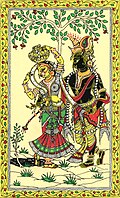 Patta Chitra painting depicting love story of Radha and Krishna.
 -
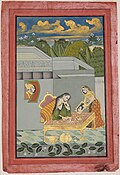 Rajasthani Painting with a love theme where Radha is getting ready and Krishna admires her silently.
 -
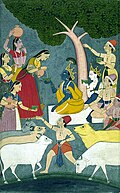 Pahari painting of Radha offering bowl of curd to Krishna.
 -
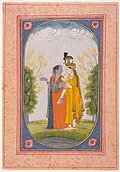 Kangra painting, Radha dressed as Krishna and Krishna dressed as Radha.
 -
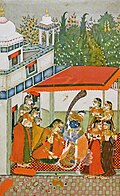 Rajput painting (1760), Radha Krishna with gopis.
 -
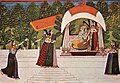 Kishangarh painting, Radha Krishna in pavilion.
 -
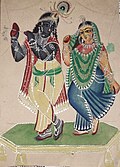 Radha- Krishna, Kalighat Painting

.jpg)


_(9471201137).jpg)


Dance forms[edit | edit source]
The most famous Indian classical dance Manipuri Raas Leela was first introduced by King Bhagyachandra around 1779. Inspired by Radha Krishna's raslila, the king introduced three forms of rasa dance—Maha rasa, Kunj rasa and Basant rasa. Later two more forms of rasa—Nitya rasa and Deba rasa was added by successive kings in the art and culture of Manipur. In these dance forms, the dancers portray the role of Radha, Krishna and gopis. The dance forms are still prevalent in the state of Manipur and are performed on stage as well as on the auspicious occasions like Kartik Purnima and Sharad Purnima (full moon nights).[175][176]

Another Indian classical dance form, Kathakali was also influenced by Vaishnavism and Radha Krishna based Gita Govinda tradition which along with other factors contributed in the evolution of this dance form.[177] The predominant theme of North Indian Kathak dancing lies in the fleeting appearances and longer stories of Radha and Krishna. The sacred love of Krishna and his beloved Radha, are woven into all aspects of the Kathak dance and is clearly visible during the discussions of the music, costumes and finally the role of the Kathak dancer.[178]
Ashtapadis of Gita Govinda are also enacted in contemporary classical Odissi dance form.[179] This dance form was originated in the temples. It is centered on the celestial love of Krishna and Radha. At one time, it was performed by the Devadasis but now it has spread out to the homes and cultural institutions.[180]
Music[edit | edit source]
Rasiya is a popular genre of Indian folk music from Braj region, Uttar Pradesh. It is commonly played and performed during the festivities in the villages and temples of Braj area.[181] The traditional songs of Rasiya are based on the divine portrayal and love of Radha and Krishna. They are frequently written from the female perspective of Radha and portray Krishna and his flirtation with her.[182][183]
Culture[edit | edit source]
The residents of Braj region still greet each other with salutations like "Radhe Radhe", "Jai Shri Radhe" and "Radhe Shyam", directing their mind to Radha and ultimate relationship she shares with Krishna. The image of Krishna rarely appears without Radha by his side in the temples of Vrindavan. It is not the Krishna who is worshiped, but Radha and Krishna together are worshiped.[184]
In culture of Odisha, Krishna is the cultural hero and his form Jagannath, is the symbol of Oriya pride. His consort Radha is celebrated as the energy of Krishna and symbolically the energy of the cosmos. She is considered as the power of joy, the hladini shakti of Krishna and is often identified with both Durga and Mahakali, the bright and dark forms of the cosmic energy. Krishna and Radha have entered the Oriya psyche and have inspired the mythic imagination of the Oriya poets in a big way. For the conscious and the informed, Krishna and Radha are the Universe and its harmony, the Energy and its joyful articulation, the cosmic dance and its rhythmic balance.[156]
In Indian culture, Radha serve as an exemplary model of female-neutral subjectivity for all persons—an active, non-substantial, shared and strong self that rationally embrace their (religious) passions.[185]
In popular culture[edit | edit source]
Films[edit | edit source]
- In the 1933 Bengali film Radha Krishna, Radha was portrayed by Duniyabala.[186]
- In the 1938 Marathi film Gopal Krishna, Radha was portrayed by Shanta Apte.
- In the 1971 Hindi film Shri Krishna Leela, Radha was portrayed by Hina.[187]
- In the 1979 Hindi film Gopal Krishna, Radha was portrayed by Zarina Wahab.
- In the 2012 Hindi animated film Krishna Aur Kans, Radha was voiced by Rajshree Nath.[188]
Television[edit | edit source]
- In B. R. Chopra's 1988 series Mahabharat, Radha was portrayed by Parijat.[189]
- In Ramanand Sagar's 1993 series Shri Krishna, Radha was portrayed by Reshma Modi and Shweta Rastogi.[190]
- In the 2008 series Jai Shri Krishna, Radha was portrayed by Kritika Sharma and Virti Vaghani.
- In the 2008 series Kahaani Hamaaray Mahaabhaarat Ki, Radha was portrayed by Puja Banerjee.[191]
- In the 2013 series Mahabharat , Radha was portrayed by Ketki Kadam.[192]
- In the 2016 series Baal Krishna, Radha was portrayed by Gracy Goswami.
- In the 2017 series Vithu Mauli, Radha was portrayed by Pooja Katurde.
- In the 2018 series RadhaKrishn, Radha was portrayed by Mallika Singh and Shivya Pathania.[193]
- In the 2019 series Dwarkadheesh Bhagwan Shree Krishn – Sarvkala Sampann, Radha was portrayed by Chahat Pandey.
- In the 2019 series Paramavatar Shri Krishna, Radha was portrayed by Mahi Soni.
- In the 2019 series Shrimad Bhagwat Mahapuran, Radha was portrayed by Shiny Doshi.
- In the 2021 series Jai Kanhaiya Lal Ki, Radha was portrayed by Kiara Singh.
- In the 2022 series Brij Ke Gopal, Radha was portrayed by Manul Chudasama.
- In the 2024 series Lakshmi Narayan – Sukh Samarthya Santulan, Radha was portrayed by Shivya Pathania
Regional forms[edit | edit source]
- Rahi - Rahi is the regional form of Radha, worshiped in the Indian state of Maharashtra as the consort of Vithoba, the regional form of Krishna.[194]
- Niladevi - In South India, Niladevi or Nappinai, the consort of Vishnu, is sometimes regarded as the southern counterpart of Radha, the consort of Krishna.[195][196]
Temples[edit | edit source]
.jpg)

Radha and Krishna are the focus of temples in the Chaitanya Mahaprabhu, Vallabhacharya, Chandidas, and other traditions of Vaishnavism.[141] Radha is typically shown standing immediately next to Krishna.[141] Some of the important Radha Krishna temples are:
- Barsana and Vrindavan in Mathura District, Northern India contain many temples dedicated to both Radha and Krishna.
- Vrindavan: Bankey Bihari Temple, Shri Radha Damodar Temple, Krishna Balram Temple (Iskcon Vrindavan), Shri Radha Gokulananda Temple, Shri Radha Gopinath Temple, Radha Raman Temple, Shahji Temple, Nidhivan, Radha Kund, Kusum Sarovar, Seva kunj Temple, Pagal Baba Temple, Prem Mandir, Shri Radha Madan Mohan Temple, Shri Ashtsakhi Temple, Vrindavan Chandrodaya Mandir, Shri Radha ShyamSundar ji Temple, Shri Jugal Kishore Temple, Shri Radha Govind Dev ji Temple, Priyakant ju Temple and Shri Radha Vallabh Temple.[197][110]
- Mathura: Shri Krishna Janamasthan Temple, Shri Dwarkadhish Temple.
- Barsana: Shri Radha Rani Temple (Shreeji Temple), Rangeeli Mahal (Kirti temple), Maan temple (Maan Garh temple)[1].
- Bhandirvan: Shri Radha Krishna Vivah Sthali.
- Rest of India: Shri Radha Govind Dev ji temple in Jaipur, Murlidhar Krishna temple in Naggar, Shri Govindajee temple in Imphal, Madan Mohan temple in Karauli, Mayapur Chandrodaya Mandir in Nadia, Swaminarayan temple Gadhada, Swaminarayan temple Vadtal, Swaminarayan Temple Bhuj, Swaminarayan Temple Dholera, Swaminarayan Temple Mumbai, Iskcon Bangalore, Iskcon Chennai, Radha Damodar temple in Junagadh, Bhakti Mandir Mangarh, Iskcon temple Patna, Radha Krishna temple, Baroh in Kangra, Hare Krishna Golden Temple in Hyderabad, Temples in Bishnupur including Radha Madhab Temple, Radha Shyam Temple, Rasmancha, Shyam Ray Temple and Lalji Temple, Sri Sri Radha Parthasarathi Mandir in Delhi.[198][199]
- Outside India: There are multiple temples dedicated to Radha Krishna which are established by Iskcon organization and Swaminarayan Sampradaya in all the prominent cities of the world. The Shree Raseshwari Radha Rani Temple at Radha Madhav Dham in Austin, Texas, USA, established by Kripalu Maharaj, is one of the largest Hindu Temple complexes in the Western Hemisphere and the largest in North America.[200][201][202]
Outside Hinduism[edit | edit source]
.jpg)
Guru Gobind Singh, in his Dasam Grantha, describes Radha the sukl bhis rika thus: "Radhika went out in the light of the white soft moon, wearing a white robe to meet her Lord. It was white everywhere and hidden in it, she appeared like the light itself in search of Him".[174]
Radha is mentioned in many Jain commentaries including the popular Venisamhara by Narayana Bhatta, and Dhvanyaloka by Anandavardhana, written in 7th century. Jain scholars like Somadeva Suri and Vikram Bhatta continued mentioning Radha between 9th and 12th centuries in their literary works.[56][35]
See also[edit | edit source]
Explanatory notes[edit | edit source]
- ↑ Parakiya rasa depicts the relationship which is free from any kind of favors, expectations, rules and social recognition. It is only based on the selfless form of love and is often said to be the highest kind of relationship one can have with God. Svakiya rasa depicts the marital relationship which works according to the social rules and norms.
- ↑ According to Garga Samhita and Brahma Vaivarta Purana, Radha was cursed by Sridama in Goloka to bear 100 years of separation from Krishna when they descended on Earth.
References[edit | edit source]
Citations[edit | edit source]
- ↑ 1.0 1.1 Diana Dimitrova (2018). Divinizing in South Asian Traditions. Routledge. ISBN 978-0-8153-5781-0.
Radha is mentioned as the personification of the Mūlaprakriti, the 'Root nature, that original seed from which all material forms evolved
- ↑ Vemsani 2016, p. 222: "The Devibhagvata purana and Padma purana describe Radha's cosmological role as Prakriti and Shakti"
- ↑ David R. Kinsley (1986). Hindu Goddesses. Motilala Banarsidass. p. 91. ISBN 978-81-208-0394-7.
Radha is called mother of the world and Krishna father of the world
- ↑ Wendy Doniger (1999). Merriam-Webster's Encyclopedia of World Religions. Merriam-Webster. p. 900. ISBN 978-0-87779-044-0.
- ↑ Prafulla Kumar Mohanty (2003). "Mask and Creative Symbolisation in Contemporary Oriya Literature: Krishna, Radha and Ahalya". Indian Literature. 2 (214). Sahitya Akademi: 182. JSTOR 23341400.
Radha is the power of joy, the Hladini shakti of Krishna
- ↑ Guy Beck (2005). Alternative Krishnas: Regional and Vernacular Variations on a Hindu Deity. SUNY Press. pp. 64–81. ISBN 978-0-7914-6415-1.
Radha is goddess of love to Krishna
- ↑ Edwin Francis Bryant (2007). Krishna: A Sourcebook. SUNY Press. p. 443. ISBN 978-0-19-803400-1.
Significant manifestation of the feminine in Vaishnavism...the supreme goddess Radha, the favorite gopi of Krishna
- ↑ Roy C Amore (1976). "Religion in India". Journal of the American Academy of Religion. 14 (2): 366.
Radha as Prakriti comes to supreme prominence, assuming epithets of transcendence - Brahmasvarupa, Nirguna...
- ↑ Ludo Rocher (1988). "The Purāṇas (A History of Indian Literature". Bulletin of the School of Oriental and African Studies. 51 (2): 355.
- ↑ Vemsani 2016, pp. 222–223.
- ↑ Ved Vyaas. Brahma Vaivarta Purana. Gita Press, Gorakhpur. p. 297.
- ↑ Menzies 2006, p. 54.
- ↑ Jones, Naamleela Free (2015). "From Gods To Gamers: The Manifestation of the Avatar Throughout Religious History and Postmodern Culture". Berkeley Undergraduate Journal. 28 (2): 8. doi:10.5070/B3282028582.
- ↑ Gokhale, Namita; Lal, Malashri (10 December 2018). Finding Radha: The Quest for Love. Penguin Random House India Private Limited. ISBN 978-93-5305-361-1.
Like Sita, Radha is also a manifestation of Lakshmi.
- ↑ 15.0 15.1 Steward, David S. (1980). "DOCTORAL DISSERTATION ABSTRACTS IN RELIGIOUS EDUCATION 1978–79". Religious Education. 75 (4): 474–494. doi:10.1080/0034408800750410. ISSN 0034-4087.
- ↑ Bryant, Edwin Francis (2007). Krishna: A Sourcebook. Oxford University Press. p. 551. ISBN 978-0-19-514892-3.
- ↑ Kar, Nishamani (2001). "Sriradha: A Study". Indian Literature. 45 (2 (202)): 184–192. ISSN 0019-5804. JSTOR 23344745.
- ↑ 18.0 18.1 Bhandarkar, R. G. (20 May 2019). "X. The Pāñcaratra or Bhāgavata System". Vaisnavism, Saivism and minor religious systems. De Gruyter. pp. 38–41. doi:10.1515/9783111551975-010. ISBN 978-3-11-155197-5.
- ↑ Vyasadeva (18 June 2015). Narada Pancaratra Part 2. p. 448.
Whenever Sri Hari appears in this world, Sri Radhika appears with him
- ↑ Farquhar, J. N. (1926). "The Narada Pancharatra". Journal of the Royal Asiatic Society of Great Britain and Ireland (3): 492–495. ISSN 0035-869X. JSTOR 25221011.
- ↑ Vemsani 2016, p. 223.
- ↑ Mohanty, Prafulla Kumar (2003). "Mask and Creative Symbolisation in Contemporary Oriya Literature: Krishna, Radha and Ahalya". Indian Literature. 47 (2 (214)): 181–189. ISSN 0019-5804. JSTOR 23341400.
- ↑ Farquhar, J. N. (1926). "The Narada Pancharatra". Journal of the Royal Asiatic Society of Great Britain and Ireland (3): 492–495. ISSN 0035-869X. JSTOR 25221011.
- ↑ Bhattacharya, Sunil Kumar (1996). Krishna-cult in Indian Art. M.D. Publications Pvt. Ltd. p. 13. ISBN 978-81-7533-001-6.
Radha is the eternal consort and wedded wife of Krishna, who lives forever with him in Goloka.
- ↑ 25.0 25.1 25.2 25.3 Lochtefeld 2002, p. 542.
- ↑ Jones & Ryan 2007, p. 341, Radha.
- ↑ 27.0 27.1 27.2 "Radha". Encyclopædia Britannica Online. Retrieved 13 December 2020.
- ↑ White 1977; Snell 1991, chapter1; Rosenstein 1998; Beck 2005; Vemsani 2016, p. 222.
- ↑ Hawley & Wulff 1982, pp. xiii–xviii; Dalal 2010, pp. 321–322; Hayes 2005, pp. 19–32; Vemsani 2016, p. 221.
- ↑ 30.0 30.1 30.2 Archer 2004.
- ↑ 31.0 31.1 31.2 31.3 Hawley & Wulff 1982, pp. xiii–xviii.
- ↑ Pintchman 2005, pp. 46–47.
- ↑ 33.0 33.1 33.2 Monier Monier-Williams, Rādhā, Sanskrit-English Dictionary with Etymology, Oxford University Press, page 876
- ↑ Sukumar Sen (1943), "Etymology of the name Radha-Krishana," Indian Linguistics, Vol. 8, pp. 434–435
- ↑ 35.0 35.1 35.2 35.3 35.4 35.5 35.6 Miller 1975, pp. 655–671.
- ↑ Gita Press Gorakhpur. Garga Samhita Gita Press Gorakhpur. p. 58.
- ↑ Swami Vijnanananda (1997). Swami Vijnanananda ( 1997). ' Narada Pancharatram English Translation With Sanskrit Text'. p. 301.
- ↑ Vyasadeva (18 June 2015). Narada Pancaratra Part 2. pp. 447–503.
- ↑ 39.0 39.1 Gita Press Gorakhpur. Narada Puran. pp. 512–520.
- ↑ "Sri Radha-sahasra-nama, The Thousand Names of Sri Radha". www.stephen-knapp.com. Retrieved 21 August 2024.
- ↑ "Śrī Rādhā Sahasranāma—English translation". www.vrindavan.de. Retrieved 21 August 2024.
- ↑ Swami Vijnanananda (1997). Narada Pancharatram English Translation With Sanskrit Text ["On the thousand names of Sri Radhika"] (in Sanskrit). pp. 300, 603–614.
{{cite book}}: CS1 maint: unrecognized language (link) - ↑ D. Prahladacharya, Rāṣṭrīyasaṃskr̥tavidyāpīṭhaṃ Lal (2002). Utkalaśrīmañjūṣālanguage. Rashtriya Sanskrit Vidyapeetha.
- ↑ Pauwels 1996, pp. 29–43.
- ↑ Vaudeville, Charlotte in Hawley & Wulff 1982, p. 2
- ↑ Love Song of the Dark Lord: Jayadeva's Gītagovinda 1977.
- ↑ 47.0 47.1 Archer 2004, The Gita Govinda.
- ↑ Miller, Barbara Stoler in Hawley & Wulff 1982, p. 13
- ↑ Datta 1988, pp. 1414–1421.
- ↑ 50.0 50.1 Ramnarace 2014.
- ↑ Vemsani 2016, p. 197.
- ↑ Hardy 1987, pp. 387–392; Ramnarace 2014.
- ↑ Datta 1988, p. 1415.
- ↑ Jash, Pranabananda (1979). "Radha-Madhava Sub-Sect in Eastern India". Proceedings of the Indian History Congress. 40: 177–184. ISSN 2249-1937. JSTOR 44141958.
- ↑ Srinivasan, K.S.; Ramanujan, A.K. (1982). "What is Indian Literature?". Indian Literature. 25 (4): 5–15. ISSN 0019-5804. JSTOR 24158041.
- ↑ 56.0 56.1 Gokhale, Namita; Lal, Malashri (10 December 2018). Finding Radha: The Quest for Love. Penguin Random House India Private Limited. ISBN 978-93-5305-361-1.
- ↑ 57.0 57.1 57.2 57.3 57.4 Kinsley 1988.
- ↑ Dalal, Roshen (14 July 2017), "Hinduism and its basic texts", Reading the Sacred Scriptures, New York: Routledge, pp. 157–170, doi:10.4324/9781315545936-11, ISBN 978-1-315-54593-6
{{citation}}: CS1 maint: work parameter with ISBN (link) - ↑ Archer 2004, 5.3 Later Poetry; Hardy 1987, pp. 387–392; Rosenstein 1997; Hawley 2005.
- ↑ Stewart 1986, pp. 152–154.
- ↑ Dalal 2010, p. 385, Shrikrishna Kirtana.
- ↑ "Online Vedabase—The topmost source of spiritual knowledge". vedabase.io. Retrieved 20 June 2021.
- ↑ das, Bhadra Balaram (9 September 2016). "The Biggest Mystery of Srimad Bhagavatam—Srimati Radha". Mayapur Voice. Retrieved 25 April 2021.
- ↑ 64.0 64.1 Manring, Rebecca J. (1 December 2019). "Rādhātantram: Rādhā as Guru in the Service of the Great Goddess". International Journal of Hindu Studies. 23 (3): 259–282. doi:10.1007/s11407-019-09264-1. ISSN 1574-9282. S2CID 213054011.
- ↑ Miller, Barbara Stoler in Hawley & Wulff 1982, p. 14
- ↑ Vaudeville, Charlotte in Hawley & Wulff 1982, pp. 9–12
- ↑ Vaudeville, Charlotte in Hawley & Wulff 1982, pp. 11–2
- ↑ Vemsani 2016, p. 222: "According to Vallabha tradition, she (Radha) is the swamini of Krishna, who is worthy of devotion."
- ↑ Chemburkar 1976, pp. 107–116.
- ↑ 70.0 70.1 Pradhan 2008, pp. 207–213.
- ↑ Kripal, Jeffrey J. (1998). "Review of Devī: Goddesses of India". Journal of the American Academy of Religion. 66 (1): 176–179. doi:10.1093/jaarel/66.1.176. ISSN 0002-7189. JSTOR 1466250.
- ↑ Bryant, Edwin F. (2007). Krishna: A Sourcebook. Oxford University Press. pp. 451–473. ISBN 978-0-19-803400-1.
- ↑ Archer 2004, The Triumph of Radha.
- ↑ Dalal 2010, p. 147.
- ↑ Dalal 2010, p. 384, Shri Radhacharita Mahakavyam.
- ↑ 76.0 76.1 76.2 Pauwels 2008, pp. 12–15, 497–517.
- ↑ 77.0 77.1 Vālmīki (1990). The Ramayana of Valmiki: Balakanda. Translated by Robert P Goldman. Princeton University Press. p. 3. ISBN 978-1-4008-8455-1.
- ↑ Dimock 1963, pp. 106–127.
- ↑ Marijke J. Klokke (2000). Narrative Sculpture and Literary Traditions in South and Southeast Asia. BRILL. pp. 51–57. ISBN 90-04-11865-9.
- ↑ 80.0 80.1 Bhandarkar, R. G. (20 May 2019). Vaisnavism, Saivism and minor religious systems. De Gruyter. doi:10.1515/9783111551975. ISBN 978-3-11-155197-5.
- ↑ Mukherjee, Sreecheta (25 December 2012). Temples of Bengal (2nd ed.). india: Aesthetics Media Services. pp. 34–35.
- ↑ Coomaraswamy, Ananda K. (1930). "Two Leaves from a Seventeenth-Century Manuscript of the Rasikapriyā". Metropolitan Museum Studies. 3 (1): 14–21. doi:10.2307/1522765. ISSN 1556-8725. JSTOR 1522765.
- ↑ 83.0 83.1 83.2 Lavanya, B. (2019). "Women in Pahari Miniature Painting" (PDF). International Journal of Applied Social Science. 6. Archived (PDF) from the original on 25 February 2021.
- ↑ 84.0 84.1 Coomaraswamy, A. K. (1926). "Rājput Paintings". Bulletin of the Museum of Fine Arts. 24 (142): 23–26. ISSN 0899-0336. JSTOR 4169988.
- ↑ Ghosh, Soma (2022). "The Art of Shringara: Revisiting the Kishangarh School of Rajasthani Painting" (PDF). The Chitrolekha Journal on Art and Design. 6 (1). doi:10.21659/cjad.61.v6n100. S2CID 250976234. Archived (PDF) from the original on 20 October 2022.
- ↑ Mukherjee, Sreecheta (25 December 2012). Temples of Bengal. Aesthetics Media Services. pp. 74–75.
- ↑ Mohan, Urmila (2018). "Clothing as devotion in Contemporary Hinduism". Brill Research Perspectives in Religion and Art. 2 (4): 1–82. doi:10.1163/24688878-12340006. S2CID 202530099.
- ↑ 88.0 88.1 Shanti Lal Nagar (1 January 2003). Brahma Vaivarta Purana: English Translation: All Four Kandas.
- ↑ Pauwels 1996.
- ↑ Prakashanand Saraswati (2001). The True History and the Religion of India: A Concise Encyclopedia of Authentic Hinduism. Motilal Banarsidass Publ. pp. 666–. ISBN 978-81-208-1789-0.
- ↑ Pavan K. Varma (July 2009). The Book of Krishna. Penguin Books India. pp. 46–. ISBN 978-0-14-306763-4.
- ↑ Paramahamsa Sri Swami Vishwananda (12 January 2017). Shreemad Bhagavad Gita: The Song of Love. Bhakti Marga Publications. pp. 1472–. ISBN 978-3-940381-70-5.
- ↑ Anand, D. (1992). Krishna: The Living God of Braj. Abhinav Publications. p. 66. ISBN 978-81-7017-280-2.
- ↑ Anand, D. (1992). Krishna: The Living God of Braj. Abhinav Publications. pp. 35–36. ISBN 978-81-7017-280-2.
Radha was only nine months elder to Krishna, to whom she was married.
- ↑ Trilochan Dash. Krishna Leeela in Brajamandal a Retrospect. Soudamini Dash. pp. 192–. GGKEY:N5C1YTUK5T3.
- ↑ The Vedanta Kesari. Sri Ramakrishna Math. 1970.
- ↑ R. K. Das (1990). Temples of Vrindaban. Sandeep Prakashan. ISBN 978-81-85067-47-6.
- ↑ gaudiya (7 August 2021). "Ashta Sakhi of Radha—8 Principal Gopis of Vrindavan". The Gaudiya Treasures of Bengal. Retrieved 6 July 2023.
- ↑ "Radhe.net | General Description of All The Gopis". radhe.net. Retrieved 30 May 2021.
- ↑ "gp-durvasas". www.salagram.net. Retrieved 30 May 2021.
- ↑ Fahy, John (23 July 2018). "The Constructive Ambiguity of Vedic Culture in ISKCON Mayapur". The Journal of Hindu Studies. 11 (3): 234–259. doi:10.1093/jhs/hiy008. ISSN 1756-4255.
- ↑ "Gopastami – ISKCON VRINDAVAN". Retrieved 30 May 2021.
- ↑ "Sewa Kunj or Nikunja Vana - Divine Pastimes". Braj Ras - Bliss of Braj Vrindavan. Retrieved 30 May 2021.
- ↑ "Maan Garh/Mandir, Barsana - (Divine Pastimes)". Braj Ras - Bliss of Braj Vrindavan. Retrieved 30 May 2021.
- ↑ "Morkuti, Barsana". Braj Ras - Bliss of Braj Vrindavan. Retrieved 30 May 2021.
- ↑ "(Radha and Krishna Dressed in Each Other's Clothes - Lilahava". www.harekrsna.de. Retrieved 30 May 2021.
- ↑ Pauwels 2008, pp. 13–14.
- ↑ Gita Press Gorakhpur. Brahma Vaivarta Puran Gita Press Gorakhpur. pp. 481–488.
- ↑ Gita Press Gorakhpur. Garga Samhita by Gita Press Gorakhpur. p. 58.
- ↑ 110.0 110.1 Anand, D. (1992). Krishna: The Living God of Braj. Abhinav Publications. ISBN 978-81-7017-280-2.
- ↑ Beck 2005, pp. 71, 77–78.
- ↑ Pintchman 2005, pp. 57–59.
- ↑ Varma 1993.
- ↑ Pauwels 2008, p. 207.
- ↑ Gita Press Gorakhpur. Garga Samhita by Gita Press Gorakhpur. pp. 217–224.
- ↑ Gita Press Gorakhpur. Brahma Vaivarta Puran by Gita Press Gorakhpur. pp. 717–720.
- ↑ Gita Press Gorakhpur. Brahma Vaivarta Puran by Gita Press Gorakhpur. p. 786.
- ↑ Gita Press Gorakhpur. Garga Samhita by Gita Press Gorakhpur. pp. 508–510.
- ↑ Gita Press Gorakhpur. Garga Samhita by Gita Press Gorakhpur. pp. 560–561.
- ↑ Gita Press Gorakhpur. Brahma Vaivarta Puran by Gita Press Gorakhpur. pp. 790–791.
- ↑ Dalal 2010, p. 322.
- ↑ Brahmavaivarta
- ↑ Dimitrova, Diana; Oranskaia, Tatiana (14 June 2018). Divinizing in South Asian Traditions. Routledge. ISBN 978-1-351-12360-0.
- ↑ Amore, Roy C (1976). "Religion in India". Journal of the American Academy of Religion. XLIV (2): 366–a–366. doi:10.1093/jaarel/XLIV.2.366-a. ISSN 0002-7189.
- ↑ Pintchman, Tracy (14 June 2001). Seeking Mahadevi: Constructing the Identities of the Hindu Great Goddess. SUNY Press. ISBN 978-0-7914-9049-5.
- ↑ Pintchman, Tracy (8 April 2015). Rise of the Goddess in the Hindu Tradition, The. State University of New York Press. p. 159. ISBN 978-1-4384-1618-2.
Radha is said to be produced from half of Krishna's body and she manifest as Mulaprakriti Isvari, the Primordial Goddess Prakriti.
- ↑ White 1977; Snell 1991; Beck 2005, p. 76.
- ↑ Beck 2005, p. 76.
- ↑ "XXIII. Caitanya", Vaisnavism, Saivism and minor religious systems, De Gruyter, pp. 82–86, 31 December 1913, doi:10.1515/9783111551975-023, ISBN 978-3-11-155197-5, retrieved 13 June 2021
{{citation}}: CS1 maint: work parameter with ISBN (link) - ↑ Monaghan, Patricia (2011). Goddesses in World Culture. United States of America: ABC-CLIO. pp. 1–7. ISBN 978-0-313-35465-6.
- ↑ Gita Press Gorakhpur. Garga Samhita Gita Press Gorakhpur. pp. 114–115.
- ↑ Gita Press Gorakhpur. Skanda Puran by Gita Press Gorakhpur (19 ed.). pp. 465–466.
- ↑ Desai, Vishakha N. (2000). "Loves of Rādhā in the "Rasikapriyā" Verses and Paintings". Ars Orientalis. 30: 83–92. ISSN 0571-1371. JSTOR 4629572.
- ↑ Beck, Guy L. (2012). Alternative Krishnas: Regional and Vernacular Variations on a Hindu Deity. United States of America: SUNY Press. p. 66. ISBN 978-0-7914-6415-1.
- ↑ Novetzke, C. L. (1 January 2005). "A Family Affair: Krishna Comes to Pandharpur and Makes Himself at Home". In Beck, Guy L. (ed.). Alternative Krishnas: Regional and Vernacular Variations on a Hindu Deity. pp. 113–138. Retrieved 13 January 2022.
- ↑ Pande, Dr Suruchi (August 2008). "Vithoba of Pandharpur" (PDF). Prabuddha Bharata. 113: 447. Archived from the original (PDF) on 21 December 2008 – via Wayback Machine.
- ↑ 137.0 137.1 Hardy 1987, pp. 387–392.
- ↑ White 1977; Snell 1991, chapter 1; Rosenstein 1998; Beck 2005.
- ↑ Majumdar 1955, pp. 231–257.
- ↑ Pande, Dr. Suruchi (2008). "Vithoba of Pandharpur" (PDF). Archived from the original (PDF) on 21 December 2008. Retrieved 31 May 2022.
- ↑ 141.0 141.1 141.2 Dalal 2010, pp. 321–322.
- ↑ Singh 2004, p. 125.
- ↑ Kinsley, D. (2010). "Without Krsna There Is No Song". History of Religions. 12 (2): 149. doi:10.1086/462672. S2CID 161297914. Retrieved 3 May 2008. "Nimbarka seems to have been the first well-known religious leader to regard Radha as central to his worship (thirteenth century)"
- ↑ McDaniel 2000.
- ↑ Hayes 2005, pp. 19–32.
- ↑ Beck 2005, p. 79.
- ↑ Datta 1988, pp. 1419–1420.
- ↑ "Sri Radha-sahasra-nama, The Thousand Names of Sri Radha". www.stephen-knapp.com. Retrieved 28 May 2021.
- ↑ "Sri Sri Radha-kripa-kataksha-stava-raja". www.harekrsna.de. Retrieved 28 May 2021.
- ↑ "Radha Kripa Kataksha - Lord Shiva". Braj Ras - Bliss of Braj Vrindavan. Retrieved 28 May 2021.
- ↑ "Shree Yugal Ashtakam". Shrinathdham. Retrieved 28 May 2021.
- ↑ "Shree Radha Chalisa - Forty Verses of Shri Radha's Glory". Braj Ras - Bliss of Braj Vrindavan. Retrieved 28 May 2021.
- ↑ Judah, J. Stillson (8 March 2015). "The Hare Krishna Movement". Religious Movements in Contemporary America. Princeton University Press. pp. 463–478. doi:10.1515/9781400868841-024. ISBN 978-1-4008-6884-1.
- ↑ Beck, Guy L. (2004). "Hare Krishna Mahamantra: Gaudiya Vaishnava Practice and the Hindu Tradition of Sacred Sound". In Edwin Bryant; Maria Ekstrand (eds.). The Hare Krishna Movement: The Postcharismatic Fate of a Religious Transplant. New York: Columbia University Press. pp. 35–44. ISBN 0-231-12256-X.
- ↑ White 1977; Snell 1991; Beck 2005, p. 67.
- ↑ 156.0 156.1 Mohanty, Prafulla Kumar (2003). "Mask and Creative Symbolisation in Contemporary Oriya Literature: Krishna, Radha and Ahalya". Indian Literature. 47 (2 (214)): 181–189. ISSN 0019-5804. JSTOR 23341400.
- ↑ "Radhastami | Krishna.com". www.krishna.com. Archived from the original on 24 February 2024. Retrieved 29 May 2021.
- ↑ "Radhastami – ISKCON VRINDAVAN". Retrieved 29 May 2021.
- ↑ Yudit Greenberg, Encyclopedia of Love in World Religions, Volume 1, ISBN 978-1851099801, p. 212
- ↑ McKim Marriott (2006). John Stratton Hawley and Vasudha Narayanan (ed.). The Life of Hinduism. University of California Press. p. 102. ISBN 978-0-520-24914-1., Quote: "Holi, he said with a beatific sigh, is the Festival of Love!"
- ↑ "Incredible India | Braj ki Holi". www.incredibleindia.org. Retrieved 29 May 2021.
- ↑ "Braj Darshan | MAHARAAS: The Dance of Spirituality". www.brajdarshan.in. Archived from the original on 2 June 2021. Retrieved 29 May 2021.
- ↑ Sharma, Aashish. "ISKCON-London - Sharad Purnima - Kartik Full Moon Festival". www.iskcon-london.org. Archived from the original on 19 January 2022. Retrieved 29 May 2021.
- ↑ Mohapatra, J. (2013). Wellness In Indian Festivals & Rituals. Partridge Publishing. p. 164. ISBN 978-1-4828-1690-7.
- ↑ Broo, Mans (2017). Rādhā Tantra: A critical edition and annotated translation. Routledge. pp. 1–2.
- ↑ Frazier, Jessica (2010), Anderson, Pamela Sue (ed.), "Becoming the Goddess: Female Subjectivity and the Passion of the Goddess Radha", New Topics in Feminist Philosophy of Religion: Contestations and Transcendence Incarnate, Dordrecht: Springer Netherlands, pp. 199–215, doi:10.1007/978-1-4020-6833-1_13, ISBN 978-1-4020-6833-1, retrieved 1 July 2023
{{citation}}: CS1 maint: work parameter with ISBN (link) - ↑ Manring, Rebecca J. (2019). "Rādhātantram: Rādhā as Guru in the Service of the Great Goddess". International Journal of Hindu Studies. 23 (3): 259–282. doi:10.1007/s11407-019-09264-1. ISSN 1022-4556. S2CID 213054011.
- ↑ Beck, Guy L. (1 February 2012). Alternative Krishnas: Regional and Vernacular Variations on a Hindu Deity. State University of New York Press. pp. 19–25. ISBN 978-0-7914-8341-1.
- ↑ "Tantra and some Śaiva Thinkers", An Introduction to Indian Philosophy, Bloomsbury Academic, 2015, doi:10.5040/9781474243063.0022, ISBN 978-1-4725-2476-8, retrieved 6 July 2023
{{citation}}: CS1 maint: work parameter with ISBN (link) - ↑ Kakar, Sudhir (January 1985). "Erotic Fantasy: The Secret Passion of Radha and Krishna". Contributions to Indian Sociology. 19 (1): 75–94. doi:10.1177/006996685019001006. ISSN 0069-9667. S2CID 144426229.
- ↑ Kallir, Jane (1982). "The Folk Art Tradition: Naive Painting in Europe and The United States". American Art Journal. 14 (4): 88. doi:10.2307/1594322. ISSN 0002-7359. JSTOR 1594322.
- ↑ Soltis, Carol Eaton (22 September 2015). Miniature painting in the USA. Oxford Art Online. Oxford University Press. doi:10.1093/gao/9781884446054.article.t2283851.
- ↑ Fam, Sylvia (1 January 2019). "Engaging the Senses to Make Sense: Performing Autoethnography in Selected Poems by Two Poet/Educators". Textual Turnings. 1 (1): 121–138. doi:10.21608/ttaip.2019.123734. ISSN 2735-3451.
- ↑ 174.0 174.1 Randhawa, M.S (2017). Kangra Valley Painting. Publications Division Ministry of Information & Broadcasting. ISBN 978-81-230-2478-3.
- ↑ Meitei, Sanjenbam Yaiphaba; Chaudhuri, Sarit K.; Arunkumar, M. C. (25 November 2020). The Cultural Heritage of Manipur. Routledge. ISBN 978-1-000-29629-7.
- ↑ Singh, Kunj Bihari (2004) [1963]. "Manipur Vaishnavism: A Sociological Interpretation". In Rowena Robinson (ed.). Sociology of Religion in India. Themes in Indian Sociology 3. New Delhi: Sage Publ. India. p. 128. ISBN 0-7619-9781-4.
- ↑ Vatsyayan, Kapila (1974). INDIAN CLASSICAL DANCE. Publications Division Ministry of Information & Broadcasting. ISBN 978-81-230-2957-3.
- ↑ Lalli, Gina (1 January 2004). "A North Indian Classical Dance Form: Lucknow Kathak". Visual Anthropology. 17 (1): 19–43. doi:10.1080/08949460490273997. ISSN 0894-9468. S2CID 145783433.
- ↑ Kothari, Sunil (1981). "Enactment of Gita Govinda in Neo-Classical Dance Forms". Journal of Indian Musicology Society. 12: 53. ProQuest 1307469347.
- ↑ Sajnani, Manohar (2001). Encyclopaedia of Tourism Resources in India. Gyan Publishing House. ISBN 978-81-7835-018-9.
- ↑ Manuel, Peter (1 January 1994). "Syncretism and Adaptation in Rasiya, a Braj Folksong Genre". Publications and Research.
- ↑ Langlois, Tony (2016). Non Western Popular Music. New York: Routledge. p. 318. ISBN 978-0-7546-2984-9.
- ↑ Kumar, Mukesh (2019). "The Art of Resistance: The Bards and Minstrels' Response to Anti-Syncretism/Anti-liminality in north India". Journal of the Royal Asiatic Society. 29 (2): 225. doi:10.1017/S1356186318000597. S2CID 165691487 – via Cambridge University Press.
- ↑ Lynch, Owen M. (31 December 1990), "ONE. The Social Construction of Emotion in India", Divine Passions, University of California Press, pp. 3–34, doi:10.1525/9780520309753-002, ISBN 978-0-520-30975-3
{{citation}}: CS1 maint: work parameter with ISBN (link) - ↑ Frazier, Jessica (2010), Anderson, Pamela Sue (ed.), "Becoming the Goddess: Female Subjectivity and the Passion of the Goddess Radha", New Topics in Feminist Philosophy of Religion: Contestations and Transcendence Incarnate, Dordrecht: Springer Netherlands, pp. 199–215, doi:10.1007/978-1-4020-6833-1_13, ISBN 978-1-4020-6833-1
{{citation}}: CS1 maint: work parameter with ISBN (link) - ↑ Sharmistha Gooptu (November 2010). Bengali Cinema: 'An Other Nation'. Routledge. ISBN 9781136912177. Retrieved 3 May 2018.
- ↑ Alan Goble. "Shri Krishna Leela". Complete Index to World Film. Retrieved 17 September 2014.
- ↑ "'Krishna Aur Kans' set for widest ever domestic release of an Indian animation movie". The economic times. Archived from the original on 12 August 2014. Retrieved 26 July 2012.
- ↑ "31 years of Mahabharat on Doordarshan: Interesting facts about one of most popular TV shows ever". The Financial Express. 2 October 2019. Retrieved 24 July 2020.
- ↑ "After 'Ramayan' and 'Mahabharat', now 'Shri Krishna' is returning to Doordarshan". The Economic Times. 27 April 2020. ISSN 0013-0389. Retrieved 30 June 2024.
- ↑ "Mahabharata interpreted differently". The Hindu. 23 September 2008 – via www.thehindu.com.
- ↑ Nishi Tiwari. "Review: Mahabharat, so far so good". Rediff. Archived from the original on 1 May 2022. Retrieved 17 September 2013.
- ↑ "Mallika Singh and Sumedh Mudgalkar: We feel fortunate, it's a blessing to portray Radha and Krishna". The Times of India. 13 February 2021. Retrieved 11 September 2021.
- ↑ Pande, Dr Suruchi (2008). "Vithoba of Pandharpur" (PDF). Prabuddha Bharat. 113: 447. Archived from the original (PDF) on 21 December 2008.
Rahi is Radha. In the stories and legends of Maharashtra, Rahi is the wife of Vitthala.
- ↑ Srinivasa Chari, S. M. (1997). Philosophy and Theistic Mysticism of the Āl̲vārs. Motilal Banarsidass. p. 205.
- ↑ Dalal 2010, p. 272.
- ↑ Rājaśekhara Dāsa (2000). The Color Guide to Vṛndāvana: India's Most Holy City of Over 5,000 Temples. Vedanta Vision Publication.
- ↑ "Asia and India ISKCON temples". Radha.
- ↑ "Beautiful Delhi Iskcon Temple (Sri Radha Parthasarathi Mandir) (4 min video)". Dandavats. Archived from the original on 26 June 2015. Retrieved 29 July 2015.
- ↑ Ciment, J. 2001. Encyclopedia of American Immigration. Michigan: M.E. Sharpe
- ↑ Hylton, H. & Rosie, C. 2006. Insiders' Guide to Austin. Globe Pequot Press.
- ↑ Mugno, M. & Rafferty, R.R. 1998. Texas Monthly Guidebook to Texas. Gulf Pub. Co.
General and cited references[edit | edit source]
- Archer, W. G. (2004) [1957]. The Loves of Krishna in Indian Painting and Poetry. Mineola, NY: Dover Publ. ISBN 0-486-43371-4.
- Beck, Guy L. (2005). "Krishna as Loving Husband of God: The Alternative Krishnology of the Rādhāvallabha Sampradaya". In Guy L. Beck (ed.). Alternative Krishnas: Regional and Vernacular Variations on a Hindu Deity. Albany, NY: SUNY Press. pp. 65–90. ISBN 978-0-7914-6415-1.
- Chemburkar, Jaya (1976). "Srīrādhikānāmasahasram". Annals of the Bhandarkar Oriental Research Institute. 1/4 (1/4): 107–116. JSTOR 41692239.
- Dalal, Roshen (2010). Hinduism: An Alphabetical Guide. New Delhi: Penguin Books India. ISBN 978-0-14-341421-6.
- Datta, Amaresh, ed. (1988). "Gitagovinda". Encyclopaedia of Indian Literature: Devraj to Jyoti. Vol. 2. New Delhi: Sahitya Akademi. pp. 1414–1423. ISBN 81-260-1194-7.
- Dimock, E.C. Jr. (1963). "Doctrine and Practice among the Vaisnavas of Bengal". History of Religions. 3 (1): 106–127. doi:10.1086/462474. JSTOR 1062079. S2CID 162027021.
- Hardy, Friedhelm E. (1987). "Kṛṣṇaism". In Mircea Eliade (ed.). The Encyclopedia of Religion. Vol. 8. New York: MacMillan. pp. 387–392. ISBN 978-0-02-897135-3 – via Encyclopedia.com.
- Hawley, John Stratton; Wulff, Donna Marie, eds. (1982). The Divine Consort: Rādhā and the Goddesses of India. Berkeley religious studies series, 3. Berkeley, Ca: Graduate Theological Union. ISBN 0-89581-102-2.
- Hawley, John Stratton (2005). Three Bhakti Voices: Mirabai, Surdas, and Kabir in Their Time and Ours. Oxford; New York: Oxford University Press. ISBN 978-0-19-567085-1.
- Hayes, Glen Alexander (2005). "Contemporary Metaphor Theory and Alternative Views of Krishna and Rādhā in Vaishnava Sahajiyā". In Guy L. Beck (ed.). Alternative Krishnas: Regional and Vernacular Variations on a Hindu Deity. Albany, NY: SUNY Press. pp. 19–32. ISBN 978-0-7914-6415-1.
- Jones, Constance A.; Ryan, James D. (2007). Encyclopedia of Hinduism. Encyclopedia of World Religions. J. Gordon Melton, Series Editor. New York: Facts On File. ISBN 978-0-8160-5458-9. Archived from the original on 23 March 2017. Retrieved 23 April 2021.
- Kinsley, David (1988). Hindu Goddesses: Visions of the Divine Feminine in the Hindu Religious Tradition. University of California Press. ISBN 978-0-520-90883-3.
- Lochtefeld, James G. (2002). "Radha". The Illustrated Encyclopedia of Hinduism: N–Z. The Rosen Publishing Group. p. 542. ISBN 978-0-8239-3180-4.
- Majumdar, Asoke Kumar (July–October 1955). "A Note on the Development of Radha Cult". Annals of the Bhandarkar Oriental Research Institute. 36 (3/4): 231–257. JSTOR 44082959.
- McDaniel, June (2000). "The Tantric Rādhā". Journal of Vaishnava Studies. 8 (2): 131–146.
- Menzies, Jackie (2006). Goddess: divine energy. Art Gallery of New South Wales. ISBN 978-0-7347-6396-9.
- Miller, Barbara S. (1975). "Rādhā: Consort of Kṛṣṇa's Vernal Passion". Journal of the American Oriental Society. 95 (4): 655–671. doi:10.2307/601022. JSTOR 601022.
- Love Song of the Dark Lord: Jayadeva's Gītagovinda. Translated by Miller, Barbara Stoler. New York: Columbia University Press. 1977. ISBN 0-231-04028-8.
- Mishra, Baba (1999). "Radha and her contour in Orissan culture". In Orissan history, culture and archaeology. In Felicitation of Prof. P.K. Mishra. Ed. by S. Pradhan. (Reconstructing Indian History & Culture 16). New Delhi. pp. 243–259.
- Pauwels, Heidi R.M. (1996). "The Great Goddess and Fulfilment in Love: Rādhā Seen Through a Sixteenth-Century Lens". Bulletin of the School of Oriental and African Studies. 59 (1). Cambridge University Press: 29–43. doi:10.1017/S0041977X00028548. JSTOR 619389. S2CID 162315694.
- Pauwels, Heidi R.M. (2008). The Goddess as Role Model: Sita and Radha in Scripture and on Screen. Oxford University Press. ISBN 978-0-19-970857-4.
- Pintchman, Tracy (2005). "Domesticating Krishna: Friendship, Marriage, and Women's Experience in a Hindu Women's Ritual". In Guy L. Beck (ed.). Alternative Krishnas: Regional and Vernacular Variations on a Hindu Deity. Albany, NY: SUNY Press. pp. 43–64. ISBN 978-0-7914-6415-1.
- Pradhan, Shrikant (2008) [2008–2009]. "A Unique Image of "Ardharadhavenudharamurti": or "Ardhanari Krishna"". Bulletin of the Deccan College Research Institute. 68/69: 207–213. JSTOR 42931207.
- Ramnarace, Vijay (2014). Rādhā-Kṛṣṇa's Vedāntic Debut: Chronology & Rationalisation in the Nimbārka Sampradāya (PDF) (PhD thesis). University of Edinburgh. Archived (PDF) from the original on 12 January 2019.
- Rosenstein, Ludmila L. (1997). "The Devotional Poetry of Svami Haridas". A Study of Early Braj Bhasa Verse. Groningen Oriental Studies, 12. Groningen: Egbert Forsten.
- Rosenstein, Lucy (1998). "The Rādhāvallabha and the Haridāsā Samprādayas: A Comparison". Journal of Vaishnava Studies. 7 (1): 5–18.
- Snell, Rupert (1991). The Eighty-four Hymns of Hita Harivaṃśa: An Edition of the Caurāsī Pada. Delhi; London: Motilal Banarsidass; School of Oriental and African Studies. ISBN 81-208-0629-8.
- Stewart, T.K. (1986). "Singing the Glory of Lord Krishna: The "Srikrsnakirtana"". Asian Ethnology. 45 (1): 152. JSTOR 1177851.
- Varma, Pavan K. (1993). Krishna, the Playful Divine. Viking. ISBN 978-0-670-85518-6.
- Vemsani, Lavanya (2016). Krishna in History, Thought, and Culture: An Encyclopedia of the Hindu Lord of Many Names. Santa Barbara; Denver; Oxford: ABC-Clio. ISBN 978-1-61069-211-3.
- White, Charles S. J. (1977). The Caurāsī Pad of Śri Hit Harivaṃś: Introduction, Translation, Notes, and Edited Braj Bhaṣa. Asian Studies at Hawaii 16. Honolulu: University Press of Hawaii. ISBN 978-0-8248-0359-9. ISSN 0066-8486.
Further reading[edit | edit source]
- Bahl, Kali C. "The Hindi 'Riti' Tradition and the 'Rasikapriya' of Keshavdasa: An Introductory Review". Journal of South Asian Literature, vol. 10, no. 1, 1974, pp. 1–38. JSTOR 40871705.
- Chakravorty, Pallabi, and Nilanjana Gupta, eds. (2012). Swayed by Love: Dance in the Vaishnava Temple Imagery of Bengal. Routledge India. doi:10.4324/9780203150450. ISBN 978-0-203-15045-0.
- Das, Biswarup. "Development of Radha-Krishna Cult in Orissa". Proceedings of the Indian History Congress, vol. 39, 1978, pp. 539–544. JSTOR 44139393.
- Jash, Pranabananda. "Radha-Madhava Sub-Sect in Eastern India". Proceedings of the Indian History Congress, vol. 40, 1979, pp. 177–184, JSTOR 44141958.
External links[edit | edit source]
- Radha at Encyclopedia.com
- Devi in Hinduism (with Radha), Arthur M. Sackler Gallery and Freer Gallery of Art, Smithsonian Institution, Washington, DC
- Radha Archived 29 October 2019 at the Wayback Machine on Krishna.com
- Radha in the Erotic Play of the Universe, David C. Scott, United Theological College, Bangalore
Hindu deities and texts | ||
|---|---|---|
| Gods |  | |
| Goddesses | ||
| Other deities | ||
| Texts | ||
| Philosophy |
|  | |||||||||||||||
|---|---|---|---|---|---|---|---|---|---|---|---|---|---|---|---|---|---|
| Texts |
| ||||||||||||||||
| Deities |
| ||||||||||||||||
| Practices |
| ||||||||||||||||
| Related | |||||||||||||||||
| Forms |  | |
|---|---|---|
| Consorts | ||
| Other relatives | ||
| Worship | ||
| Holy sites | ||
| Epigraphy | ||
| Texts | ||
| See also | ||