



→top: Fixed typo |
MarkKapoor (talk | contribs) revised |
||
| Line 1: | Line 1: | ||
{{ | {{Short description|Hindu rite of passage}} | ||
{{Use dmy dates|date=September 2020}} | {{Use dmy dates|date=September 2020}} | ||
[[File:A yagyopaveet sanskar upanayana samskara in Nepal.jpg|thumb|Upanayana | [[File:A yagyopaveet sanskar upanayana samskara in Nepal.jpg|thumb|The Upanayana ceremony in progress in [[Nepal]]. Traditionally, this ritual was for 7, 9, and 11 year olds in South Asia, but is now practiced for all ages as seen above.{{Sfn|Coward|Cook|1996|p=67}}]] | ||
[[ | '''''Upanayana''''' ({{langx|sa|उपनयन|translit=upanayana|translit-std=IAST|lit=initiation}}{{efn-la|According to the given community and its regional language, it is also known by numerous terms such as ''mekhal'' in Kashmiri ({{lang|kas|मेखल}}), ''janeo'' in Punjabi ({{lang|pan|ਜਨੇਓ}}), ''upnen/upvit'' in Rajasthani (उपनेन/उपवीत), ''jānoi'' in Gujrati (જાનોઇ), ''janya'' in Sindhi (जन्य), ''janev'' in Bhojpuri (जनेव), ''munja'' in Marathi (मुंजा), ''munji'' in Konkani (मुंजी), ''poite'' in Bangla (পৈতৈ), ''brataghara'' in Odia (ବ୍ରତଘର), ''logun dioni'' in Assamese (লগুণ দিওনী), ''bratabandha'' in Nepali (ब्रतबन्ध), ''chewar'' in Newari (छेवार), ''upanayana'' in Kannada (ಉಪನಯನ), ''upanayanamu'' in Telugu (ఉపనయనము), ''upanayanam'' in Malayalam (ഉപനയനം), and ''upanayanam'' or ''pūṇūl'' in Tamil (உபநயனம் or பூணூல்).<ref>{{Cite web |title=Dr. Shashishekhar Toshkhani: The Literary Works |url=https://www.ikashmir.net/sstoshkhani/mekhal.html |access-date=2023-02-07 |website=www.ikashmir.net}}</ref>}}) is a [[Hindus|Hindu]] educational sacrament,{{Sfn|Kanitkar|Cole|2010|p=4}} one of the traditional [[Samskara (rite of passage)|saṃskāra]]s or rites of passage that marked the acceptance of a student by a [[preceptor]], such as a ''[[guru]]'' or ''[[acharya]]'', and an individual's initiation into a school in [[Hinduism]]. Some traditions consider the ceremony as a spiritual rebirth for the child or future ''[[dvija]]'', twice born. It signifies the acquisition of the knowledge of and the start of a new and disciplined life as a [[brahmacharya|brahmāchārya]]. The Upanayanam ceremony is arguably the most important rite for [[Brahmin|Brāhmaṇa]], [[Kshatriya|Kṣatriya]], and [[Vaishya|Vaiśya]] males, ensuring their rights with responsibilities and signifying their advent into adulthood.<ref>{{Cite book |last1=Carstairs |first1=G. Morris |author-link=Morris Carstairs |last2=Kapur |first2=Ravi L. |date=1976 |url=https://books.google.com/books?id=d3WH9Tf_uWoC&dq=upanayanam+brahmin&pg=PA49 |title=The Great Universe of Kota: Stress, Change, and Mental Disorder in an Indian Village |publisher=University of California Press |pages=49 |isbn=978-0-520-03024-4 |language=en}}</ref> | ||
The tradition is widely discussed in ancient [[Sanskrit|Samskṛta]] texts of Hinduism and varies regionally.{{Sfn|Kane|1941|pp=268–287}} The sacred thread or yajñopavīta (also referred to as ''Janeu'', ''Jandhyam'', ''Pūṇūl'', ''Muñja'', and ''Janivara''<ref>{{Cite book |last=Sastry |first=C. V. |date=2022-01-25 |title=Rituals & Practices of Hinduism |url=https://books.google.com/books?id=ZqxaEAAAQBAJ&dq=poonal+janeu&pg=PT1 |publisher=Zorba Books |isbn=978-93-93029-12-6}}</ref> Yonya<ref>{{Cite web |title=Yonya (Janeu Holy Thread) |url=https://www.kashmiribazaar.in/kashmiri-yagyopavit-yonya-janeu-holy-thread |website=www.kashmiribazaar.in |access-date=2023-02-07}}</ref>) has become one of the most important identifiers of the ''Upanayana'' ceremony in contemporary times, however this was not always the case.{{Sfn|Ambedkar|1947|p=158}} Typically, this ceremony should be performed before the advent of adulthood. | |||
==Etymology== | ==Etymology== | ||
According to the given community and its regional language, it is also known by numerous terms such as: | |||
* upanayanam in [[Sanskrit|Saṃskṛtam]] (उपनयनम्) | |||
* mekhal in [[Kashmiri language|Kashmiri]] (मेखल/میکھَل) | |||
* janeo in [[Punjabi language|Punjabi]] (ਜਨੇਓ) | |||
* upnen/upvit in [[Rajasthani language|Rajasthani]] (उपनेन/उपवीत) | |||
* jānoi in [[Gujarati language|Gujarati]] (જાનોઇ) | |||
* janya in [[Sindhi language|Sindhi]] (जन्य) | |||
* janev in [[Bhojpuri language|Bhojpuri]] (जनेव) | |||
* upnæn in [[Maithili language|Maithili ]] (উপনৈন) | |||
* munja in [[Marathi language|Marathi]] (मुंज) | |||
* munji in [[Konkani language|Konkani]] (मुंजी) | |||
* poite in [[Bangla language|Bangla]] (পৈতে) | |||
* brataghara/baṛughara in [[Odia language|Odia]] (ବ୍ରତଘର/ବଡ଼ୁଘର) | |||
* logun dioni in [[Assamese language|Assamese]] (লগুণ দিওনী) | |||
* bratabandha in [[Nepali language|Nepali]] (ब्रतबन्ध) | |||
* chhewar in [[Newari language|Newari]] (छेवार) | |||
* upanayana in [[Kannada]] (ಉಪನಯನ) | |||
* upanayanamu/odugu in [[Telugu language|Telugu]] (ఉపనయనము/ఒడుగు) | |||
* upanayanam in [[Malayalam]] (ഉപനയനം) | |||
* upanayanam or pūṇūl in [[Tamil language|Tamil]] (உபநயனம் or பூணூல்). | |||
=== ''Upanayana'' === | |||
''Upanayana'' literally means "the act of leading to or near, bringing", "introduction (into any science)" or "initiation" (as elucidated by [[Monier Monier-Williams|Monier-Williams]]).<ref name="mmwupa" /> Upanayana is formed from the root √''nī'' meaning 'to lead'. ''Nayana'' is a noun formed from the root √''nī'' meaning 'leading to'. The prefix ''upa'' means 'near'. With the prefix the full literal meaning becomes 'leading near (to)'.{{Sfn|Deshpande|1936|p=159}} The initiation or rite of passage ceremony in which the sacred thread is given symbolizes the child drawn towards a school, towards education, by the guru or teacher.<ref name="mmwupa">[[Monier Monier-Williams|Monier-Williams]] (1899) "[https://www.sanskrit-lexicon.uni-koeln.de/scans/MWScan/2020/web/webtc2/index.php upanayana]" in ''Monier-Williams Sanskrit-English Dictionary, 1899''. Via Cologne Digital Sanskrit Dictionaries. At Institute of Indology and Tamil Studies, University of Cologne, Germany. pp. [https://www.sanskrit-lexicon.uni-koeln.de/scans/csl-apidev/servepdf.php?dict=MW&page=201 201] (print edition).</ref> The student was being taken to the Gods and a disciplined life.{{Sfn|Gharpure|1956|p=71}}{{Sfn|Altekar|1944|p=275}} As explained by [[Pandurang Vaman Kane|PV Kane]], taking (the child) near the acarya (for instruction), or alternately "introducing to studenthood".{{Sfn|Kane|1941|pp=268-269}} It is a ceremony in which a teacher accepts and draws a child towards knowledge and initiates the second birth that is of the young mind and spirit.{{Sfn|Kane|1941|pp=268–287}} | |||
=== Variations === | |||
A popular variation is ''Mauñjibandhana'', derived from two words [[Munjya|muñja]], a type of grass, and ''bandhana'' which means to tie or bind.{{Sfn|Gharpure|1956|p=70}} The munja grass is tied around the waist.{{Sfn|Gharpure|1956|p=70}} This word was used by [[Manusmriti|Manu]].{{Sfn|Deshpande|1936|p=9}} Another variation is ''vratabandha(na)'' meaning "binding to an observance".{{Sfn|Zotter|2010|p=17}} The word ''janeu'' is a condensed version of ''yagyopaveeta''.<ref>{{Cite book |last=Dwivedi |first=Bhojraj |title=Religious Basis of Hindu Beliefs |publisher=Diamond Pocket Books |year=2014 |isbn=9789351650928}}</ref> The ceremony is also known as ''punal kalyanam'' (meaning auspicious thread ceremony){{Sfn|Coward|Cook|1996|p=71}} and ''Brahmopadeśa''.<ref>{{Cite book |last=Harshananda |first=Swami |title=Upanayana Sandhyavandana And Gayatrimantrajapa |publisher=Ramakrishna Mission |isbn=978-81-7823-453-3}}</ref> | |||
=== ''Yajnopavita'' === | |||
The sacred thread or upper garment is called the ''yajñopavīta'' ({{langx|sa|यज्ञोपवीतम्|translit=yajñopavītam}}), used as an adjective, which is derived from the terms ''[[yajna|yajña]]'' (sacrifice) and ''upavīta'' (worn)''.''{{Sfn|Ambedkar|1947|p=159|loc="How did this Yajnopavita come in? Mr. Tilak offers an explanation (in ''The Orion, Or, Researches into the Antiquity of the Vedas'' by Bal Gangadhar Tilak dated 1893)... The word yajnopavita is derived by all native scholars from Yajna + Upavita; but there is a difference of opinion as to whether we should understand the compound to mean an upavita for yajna i.e. for sacrificial purposes, or, whether it is the 'upavita of Yajnas.' The former is not incorrect, but authority is in favour of the latter. Thus the Prayoga-writers quote a smriti to the effect that 'the High Soul is termed Yajna by the hotris, this is his upavita; therefore it is yajna-upavita.' [...] This explanation by Mr. Tilak is no doubt very interesting. But it does not help to explain some of the difficulties."}}{{Sfn|Altekar|1944|pp=294, 297}} The literal meaning would then become "something worn on the body for the sacrifice".{{Sfn|Deshpande|1936|p=161}} Accoutrements offered along with the ''yajnopavita'' may include be a ''daṇḍa'' (staff) and a ''mekhala'' (girdle).{{Sfn|Kane|1941|p=279-287}} | |||
==Description== | ==Description== | ||
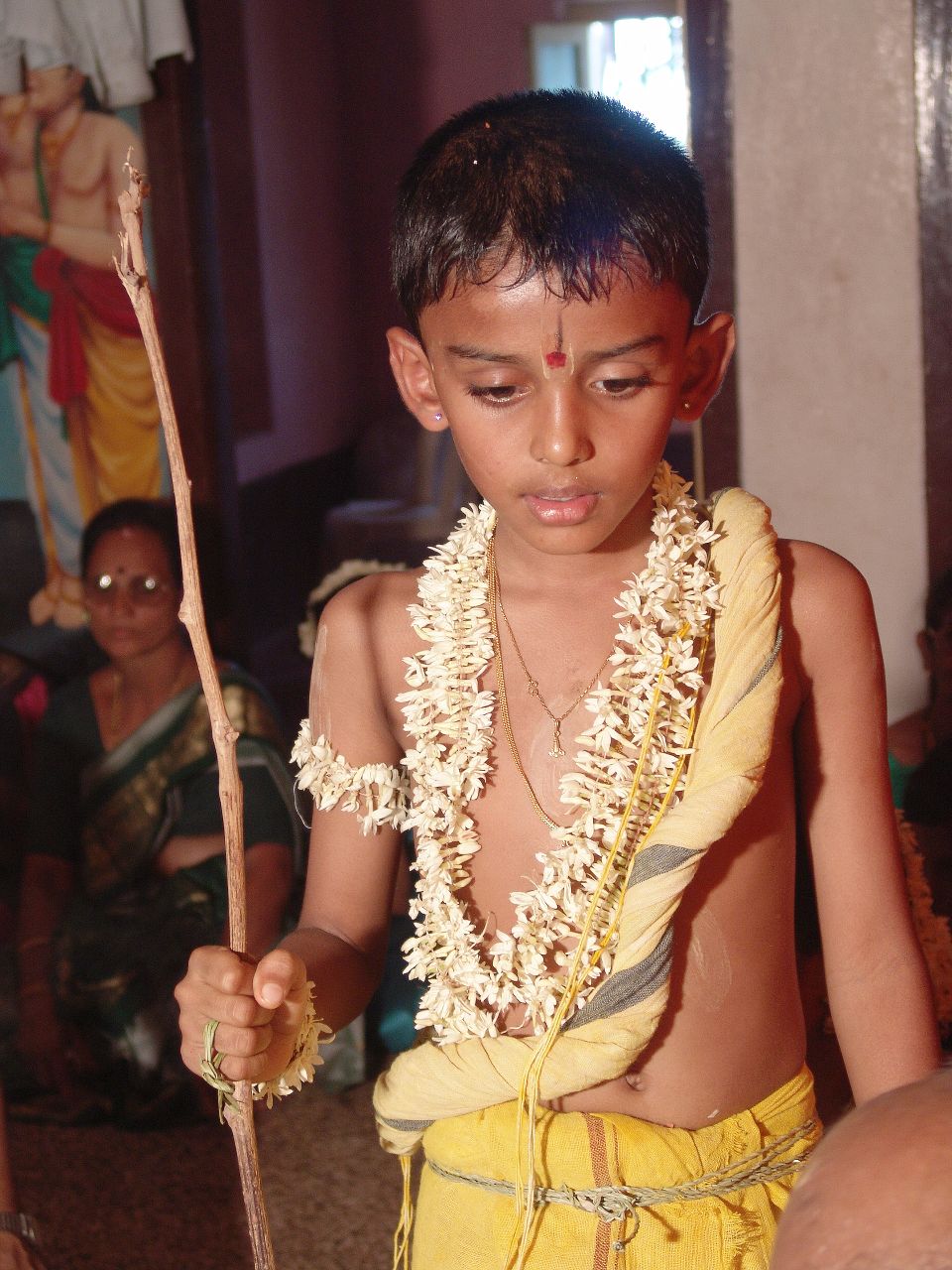
[[File:Upanayanam.jpg|thumb|right|A boy during his upanayana ritual. The thin, yellow | [[File:Upanayanam.jpg|thumb|right|A boy from [[South India]] during his upanayana ritual. The thin, yellow yajnopavita thread runs from left shoulder to waist. Note the [[Sugarcane|muñja grass]] girdle around the waist. The [[Sacred Fig|peepal tree]] twig in his right hand marks his entry into the [[Brahmacarya|Brahmacharya]] stage of life.]] | ||
=== Background === | |||
The earliest form of this saṁskāra, whose name there are no records of, may have been to mark the acceptance of a person into a particular community.{{Sfn|Deshpande|1936|p=9}} Indologically, the ritual is present in the [[Kalpa (Vedanga)#Smarta Sutras|Gṛhyasūtras]] and [[Dharmaśāstra#The Dharmasutras|Dharmasūtras]] and ''[[Dharmaśāstra]]s'', as well as a couple of times in the [[Samhita|''Saṃhitās'']].{{Sfn|Zotter|2010|p=17}}<ref>{{Cite web |title=upanayana |url=https://www.oxfordreference.com/view/10.1093/oi/authority.20110803114817500 |access-date=2022-06-22 |website=Oxford Reference |publisher=Oxford University Press |doi=}}</ref> | |||
Educational courses or training has been referred to in the ''[[Chandogya Upanishad|Chandogya Upaniṣad]]''{{Efn|The story of [[Uddālaka Āruṇi]] and [[Śvetaketu]]}} and in the ''[[Yājñavalkya Smṛti]]''; Gharpure writes that during the [[Smriti|Smṛti period]], Upanayana may have attained a permanent fixture if the life of students to be as compared to being optional before.{{Sfn|Gharpure|1956|p=71}} | |||
In the ''[[Atharvaveda]]'', and later in the [[Sutra#History|Sutras period]], the word ''upanayana'' meant taking responsibility of a student, the beginning of an education, a student's initiation into "studentship" and the acceptance of the student by the teacher.{{Sfn|Pandey|2013|p=115}} [[Preceptor]]s could include a [[guru]], [[acharya|ācharya]], upādhyāya, and ṛtvik.{{Sfn|Gharpure|1956|p=71, 74|loc='''Preceptors Classified'''. "He who gives the Vedas is called the Guru; one who performs the Upanayana and gives the Vedas is called the Acharya; one who teaches a portion is an Upadhyaya; and one who performs tho sacrifices is called the Rtvik; those are entitled to respect in the order of priority; but more than all these is the mother most entitled to respect."}} | |||
Rajbali Pandey compares the Upanayana rite of passage to Baptism | Gradually, new layers of meaning emerged, such as the inclusion of [[Saraswati|goddess Sarasvatī]] or Sāvitrī, with the teacher becoming the enabler of the connection between this goddess and the student.{{Sfn|Pandey|2013|p=115}} The meaning was extended to include [[Vedanga|Vedānga]]s and vows among other things.{{Efn|[[Rajbali Pandey]] compares the Upanayana rite of passage to [[Baptism]], the Christian rite of admission and adoption where the person is born again unto spiritual knowledge, as ''Upanayana'' marked the initiation of the student for spiritual studies such as the [[Vedas]].{{Sfn|Pandey|2013|p=112}} [[Devdutt Pattanaik]] would not compare the two.<ref>{{Cite web |last=Pattanaik |first=Devdutt |date=2017-07-02 |title=Is the Hindu thread ceremony same as baptism? |url=https://devdutt.com/articles/is-the-hindu-thread-ceremony-same-as-baptism/ |access-date=2022-06-14 |website=Devdutt |language=en-US}}</ref>}}{{Sfn|Pandey|2013|p=115-116}} | ||
The education of a student was not limited to ritual and philosophical speculations found in the ''Vedas'' and the ''[[Upanishads|Upaniṣads]]''. It extended to many arts and crafts, which had their own, similar rites of passages.<ref name=":Kramrisch1" /> The ''[[Aitareya Brahmana|Aitareya Brāhmaṇa]], [[Agama (Hinduism)|Āgamas]],'' and ''[[Puranas|Purāṇas]]'' genres of literature in Hinduism describe these as ''[[Shilpa Shastras|Śilpa Śāstras]]''.<ref name=":Kramrisch1" /> They extend to all practical aspects of culture, such as the sculptor, the potter, the perfumer, the wheelwright, the painter, the weaver, the architect, the dancer, and the musician.{{Efn|Ancient Indian texts assert that the number of the arts is unlimited, but each deploy elements of 64 kalā (कला, techniques) and 32 vidyā (विद्या, fields of knowledge)<ref name=":Kramrisch1" />}}<ref name=":Kramrisch1">{{Cite journal |last=Kramrisch |first=Stella |author-link=Stella Kramrisch |date=1958 |title=Traditions of the Indian Craftsman |url=https://www.jstor.org/stable/538558 |journal=The Journal of American Folklore |volume=71 |issue=281 |pages=224–230 |doi=10.2307/538558 |jstor=538558 |issn=0021-8715|url-access=subscription }}</ref> The training of these began from childhood and included studies about [[dharma]], culture, reading, writing, mathematics, geometry, colours, tools, as well as traditions and trade secrets. The rites of passage during apprentice education varied in the respective guilds.<ref>{{Cite book |last=Elgood |first=Heather |url=https://books.google.com/books?id=tAcF8RgbtZ0C |title=Hinduism and the Religious Arts |date=2000 |publisher=Bloomsbury Publishing |isbn=978-0-8264-9865-6 |pages=}}</ref><ref>{{Cite book |last=Kramrisch |first=Stella |url=https://books.google.com/books?id=NNcXrBlI9S0C |title=The Hindu Temple |date=1976 |publisher=Motilal Banarsidass |others=Raymond Burnier |isbn=978-81-208-0223-0}}</ref> [[Sushruta|Suśruta]] and [[Charaka]] developed the initiation ceremony for students of Āyurveda.{{Sfn|Altekar|1944|p=290}} The ''Upanayana'' rite of passage was also important to the teacher, as the student would therefrom begin to live in the ''[[gurukula]]'' (school).{{Sfn|Kane|1941|pp=268–287}} | |||
[[ | |||
Upanayana became an elaborate ceremony, that includes rituals involving the family, the child and the teacher. A boy receives during this ceremony a sacred thread called the ''yajnopavita'' to be worn. The ''yajnopavita'' ceremony announces that the child had entered into formal education.{{Sfn|Kane|1941|pp=288–300}}{{Sfn|Prasad|1997|pp=119–131}} In the modern era, the Upanayana rite of passage is open to anyone at any age.{{Sfn|Coward|Cook|1996|p=67}} The Upanayana follows the [[Vidyāraṃbhaṃ|Vidyārambhaṃ]], the previous rite of passage.{{Sfn|Gharpure|1956|p=70}} [[Vidyāraṃbhaṃ|Vidyārambhaṃ]] became an intermediary samskāra following the evolution in writing and language.{{Sfn|Altekar|1944|pp=266–267}} [[Vidyāraṃbhaṃ|Vidyārambhaṃ]] now marked the beginning of primary education or literacy while Upanayana went on to refer to spiritual education.{{Sfn|Altekar|1944|pp=266–267}}{{Sfn|Aiyangar|1949|pp=144, 146|loc=The upanayana marks not the beginning of education, but of Vedic instruction. After the samskara of caula (tonsure) comes a ceremony named vidyarambha, initiation into learning, i.e. literacy. [...] If vidyarambha was the beginning of literacy, upanayana marks the induction into sacred and redeeming lore.}} The Upanayana can also take place at the student's home for those who are home-schooled.{{Sfn|Gharpure|1956|p=79}} Ceremonial [[bhiksha|bhikṣa]] as one of the rituals during Upanayana became important, attaining sizeable proportions.{{Sfn|Altekar|1944|p=280}} The actual initiation occurred during the recitation of the [[Gayatri Mantra|Gāyatrī Mantra]].{{Sfn|Altekar|1944|p=278}} The spiritual birth would take place four days after the initial Upanayana rituals. It was then that the last ritual was performed, the Medhajanana.{{Sfn|Altekar|1944|p=281}}{{Sfn|Gharpure|1956|p=75}} The [[Samavartanam]] or convocation ritual marked the end of the course.{{Sfn|Altekar|1944|p=287}} The Upanayana became a permanent feature around the Upaniṣad period.{{Sfn|Pandey|2013|p=123}} | |||
Attire includes a daṇḍa or staff and a mekhala or girdle.{{Sfn|Mookerji|2003|pp=178–179}} | |||
=== | === Age and varna === | ||
[[File:Susnata.jpg|thumb|''Upanayana Samskara'' in progress in [[West Bengal]], India.]] | |||
In | In Hindu traditions, a human being is born at least twice—once at physical birth and second at intellectual birth through teacher's care. The first is marked through the ''[[Jatakarma]]n'' rite of passage; the second is marked through ''Upanayanam'' or ''[[Vidyāraṃbhaṃ|Vidyārambha]]'' rites of passage.<ref name=maryhinduworld>Mary McGee (2007), Samskara, in ''The Hindu World'' (Editors: Mittal and Thursby), Routledge, {{ISBN|978-0415772273}}, pages 332–356</ref><ref>{{Cite book |last=Jackson |first=Kathy Merlock |url=https://books.google.com/books?id=j1rSEN_5LmEC |title=Rituals and Patterns in Children's Lives |date=2005 |publisher=University of Wisconsin Press, Popular Press |isbn=978-0-299-20830-1 |pages=51–52}}</ref> A sacred thread was given by the teacher during the initiation to school ceremony and was a symbolic reminder to the student of his purpose at school as well as a [[social marker]] of the student as someone who was born a second time (''[[dvija]]'', twice born).{{Sfn|Monier-Williams|1891}}<ref>Raman Varadara, ''Glimpses of Indian Heritage'', p. 51, {{ISBN|978-8171547586}}.</ref> | ||
Many medieval era texts discuss Upanayana in the context of three of the four ''varnas'' (caste, class)—[[Brahmin|Brāhmaṇa]]s, [[Kshatriya|Kṣatriya]]s and [[Vaishya|Vaiśya]]s.{{Sfn|Pandey|2013|pp=111–117}} The ceremony was typically performed at age eight among the [[Brahmin|Brāhmaṇa]]s, at age 11 among the [[Kshatriya|Kṣatriya]]s, and age 12 among Vaiśyas.{{Sfn|Mookerji|2003|p=174}}{{Sfn|Monier-Williams|1891|p=360}} ''Apastamba Gryha Sutra'' (verse 1.1.1.27) places a maximum age limit of 24 for the Upanayana ceremony and start of formal education. However, ''Gautama Gṛyha Sūtra'' and other ancient texts state that there is no age restriction and anyone of any age can undertake Upanayanam when they initiate their formal studies of the Vedas.{{Sfn|Mookerji|2003|pp=174–177}} | |||
[[Shudra|Śūdra]]s, or the fourth varna, do not have the rite to the Vedic Upanayana or access to [[Vedas]] as their vidhi is not mentioned in any of the [[Dharmashastras]]. However, texts such as [[Sushruta Samhita]] & [[Dhanurveda]] prescribe a rite to be initiated for their education regarding these subjects alone. [[Āgama (Hinduism)|Agamas]], particularly Kamika Agama allows [[Shudra|Śūdra]]s to wear the sacred thread & get initiated in the Shaiva Mantras.{{Sfn|Kane|1941|pp=288–300}}<ref name=scharfe>Hartmut Scharfe (2007), Handbook of Oriental Studies, Brill Academic, pp. 102–103, 197–198, 263–276, {{ISBN|978-9004125568}}.</ref> | |||
The large variation in age and changes to it over time was to accommodate for the diversity in society and between families.{{Sfn|Altekar|1944|p=273}} | |||
[[Vedic period]] texts such as the [[Baudhayana|Baudhāyana]] ''[[Grhyasutra|Gṛhyasūtra]]'' encouraged the three [[Varna (Hinduism)|Varṇa]]s of society to undergo the Upanayana. | |||
Initiation to sectarian affiliation is not exclusive to ascetics, but open to householders.<ref>{{Cite book|title=Female Ascetics in Hinduism|publisher=State University of New York Press|date=2004|location=Albany|isbn=978-0-7914-8462-3|series=SUNY series in Hindu studies|first=Lynn Teskey|last=Denton|first2=Steven|last2=Collins|pages=93}}</ref> | |||
===Gender and women=== | |||
In some texts, some girls belonging to the three varnas undergo upanayana rite of passage.<ref>{{cite web |date=10 February 2014 |title=A Village in Bihar, where Girl wear the Sacred Thread 'Janeu' |url=http://news.biharprabha.com/2014/02/a-village-in-bihar-where-girl-wear-sacred-thread-janeu/ |access-date=10 February 2014 |work=IANS |publisher=Biharprabha News}}</ref><ref>{{Cite web |last=Jaisinghani |first=Bella |date=29 May 2009 |title=Thread Ceremony for Thane Girl |url=https://timesofindia.indiatimes.com/city/mumbai/thread-ceremony-for-thane-girl/articleshow/4591371.cms |website=[[The Times of India]]}}</ref> In ancient and medieval eras, texts such as Harita Dharmasūtras, Aśvālayana Gṛhya Sutra and Yama Smriti suggest women could begin Vedic studies after Upanayana.{{Sfn|Kane|1941|pp=293–295}}<ref>V.L. Manjul (December 2002). "[http://www.hinduismtoday.com/modules/smartsection/item.php?itemid=3852 Starting Vedic Studies—Backed by scripture, girls get their sacred thread]"; [https://web.archive.org/web/20210115152255/http://www.hinduismtoday.com/modules/smartsection/item.php?itemid=3852 Archived] on 15 January 2021. ''Hinduism Today''.</ref><ref>C, Tripathi (2005). ''The Evolution of Ideals of Womenhood in Indian Society''. p. 94. {{ISBN|978-8178354255}}.</ref>{{Sfn|Kanitkar|Cole|2010|p=217}} | |||
Girls belonging to the three upper varnas who decided to become a student underwent the Upanayana rite of passage, at the age of 8, and thereafter were called ''Brahmavadinī''. They wore a thread or upper garment over their left shoulder.{{Sfn|Kane|1941|pp=293–295}} Those girls who chose not to go to a ''gurukula'' were called ''Sadyovadhu'' (literally, one who marries straight). However, the ''Sadyovadhu'', too, underwent a step during the wedding rituals, where she would complete Upanayana, and thereafter wear her upper garment (saree) over her left shoulder.{{Sfn|Kane|1941|pp=293–295}} This interim symbolic Upanayana rite of passage for a girl, before her wedding, is described in multiple texts such as the Gobhila Gṛhya Sūtra (verse 2.1.19) and some Dharmasutras.{{Sfn|Oldenberg & Muller, The Grihya-Sutras: Rules of Vedic Domestic Ceremonies|1892|p=44|loc=Grihya Sutra of Gobhila Verse 2.1.19}} | |||
=== ''Yajnopavita'' === | |||
[[File:Odia Bratopanayan.jpg|thumb|Bratopanayan in progress in an Odia household]] | |||
The | The sacred thread or the yajnopavita has become one of the most important parts of contemporary Upanayana ceremonies. There are accordingly a number of rules related to it.{{Sfn|Ambedkar|1947|p=158}} The thread is composed of three cotton strands of nine strands each.{{Sfn|Ambedkar|1947|p=158}}{{Sfn|Monier-Williams|1891}} The strands symbolise different things in their regions. For example, among Tamils, each strand is for each of the [[Tridevi|Tridevī]], the supreme trinity of the Hindu goddesses [[Saraswati|Sarasvatī]], [[Lakshmi|Lakṣmī]], and [[Parvati|Pārvatī]].<ref name="ref91mazij">{{Cite book |author=Arunachalam |first=M. |year=1980 |title=Peeps into Tamil Culture |volume=3: ''Festivals of Tamil Nadu'' |url=https://books.google.com/books?id=3IrXAAAAMAAJ |publisher=Gandhi Vidyalayam |pages=127 |quote=... boy is invested for the first time with the sacred thread ... the three devis Sarasvati, Savitri and Gayatri ...}}</ref> According to another tradition, each of the nine threads represents a male deity, such as [[Agni]], [[Bhaga]], and [[Chandra]].{{Sfn|Altekar|1944|p=298}} | ||
The sacred | The predecessor to the sacred thread was an upper garment (such as a dupatta or an uparane).{{Sfn|Altekar|1944|pp=276, 296}} However, as traditions developed, the upper garment began to be worn continuously. The usage of a thread grew out of convenience and manageability, becoming more popular than alternatives such as a kusa rope.{{Sfn|Altekar|1944|pp=296–297}} | ||
The ancient Saṁskṛta texts offer a diverse view while describing the yajñopavītam or upavita. The term upavita was originally meant to be any upper garment, as stated in [[Apastamba Dharmasutra|Apastamba Dharmasūtra]] (verse 2.2.4.22–2.2.4.23) or, if the wearer does not want to wear a top, a thread would suffice.{{Sfn|Kane|1941|pp=290–293}} The ancient Indian scholar Haradatta{{Efn|Scholars place Haradatta to 1100 CE or between 1100 and 1300 CE.<ref>{{Cite journal |last=Olivelle |first=Patrick |date=1999 |title=Sanskrit Commentators and the Transmission of Texts: Haradatta on Āpastamba Dharmasūtra |url=https://www.jstor.org/stable/23496389 |journal=Journal of Indian Philosophy |volume=27 |issue=6 |page=570 |doi=10.1023/A:1004636609126 |jstor=23496389 |s2cid=189820541 |issn=0022-1791|url-access=subscription }}</ref>}} states, "''yajñopavītam'' means a particular mode of wearing the upper garment, and it is not necessary to have the yajñopavīta at all times".{{Sfn|Kane|1941|pp=290–293}} | |||
'' | There is no mention of any rule or custom, states [[Patrick Olivelle]], that "required Brāhmaṇas to wear a sacred string at all times", in the Brāhmaṇya literature (Vedic and ancient post-Vedic).{{Sfn|Olivelle|1992|pp=9–10}} Yajñopavīta, textual evidence suggests, is a medieval and modern tradition.{{Sfn|Olivelle|1992|pp=9–10}} However, the term ''yajnopavita'' appears in ancient Hindu literature, and therein it means a way of wearing the upper garment during a ritual or rites of passage.{{Sfn|Olivelle|1992|pp=9–10}} The custom of wearing a string is a late development in Hinduism, was optional in the medieval era, and the ancient Indian texts do not mention this ritual for any class or for ''Upanayana''.{{Sfn|Kane|1941|pp=290–293}}{{Sfn|Olivelle|1992|pp=9–10}} | ||
The Gobhila Gṛhya Sutra (verse 1.2.1) similarly states in its discussion on Upanayana, that "the student understands the yajnopavita as a cord of threads, or a garment, or a rope of kusa grass", and it is its methods of wearing and the significance that matters.{{Sfn|Kane|1941|pp=290–293}} The proper manner of wearing the upper garment or thread, state the ancient texts, is from over the left shoulder and under the right arm.{{Sfn|Kane|1941|pp=290–293}} ''yajñopavīta'' contrasts with ''Pracinavīta'' method of wearing the upper garment, the latter a reverse and mirror image of former, and suggested to signify rituals for elders/ancestors (for example, funeral).{{Sfn|Olivelle|1992|pp=9–10}} | |||
The idea of wearing the upper garment or sacred thread, and its significance, extended to women.{{Sfn|Kane|1941|pp=293–295}} This is reflected in the traditional wearing of sari over the left shoulder, during formal occasions and the celebration of rites of passage such as Hindu weddings. It was also the norm if a girl undertakes the Upanayana ceremony and begins her Vedic studies as a ''Brahmavadinī''.{{Sfn|Kane|1941|pp=293–295}} | |||
The sacred Yajnopavita is known by many names (varying by region and community), such as ''Bratabandha, Janivaara'', '' Jaanva'', ''Jandhyam'', ''Poita'', ''Pūṇūl'', ''Janeu'', ''Lagun'', ''Yajnopavita'', ''Yagyopavit'', ''Yonya'' and ''Zunnar''.<ref name="ref97cafup">{{Cite book |author=Sultān Bāhū |date=April 1998 |title=Death Before Dying: The Sufi Poems of Sultan Bahu |url=https://books.google.com/books?id=GlECx1j0B4IC |translator=Jamal J. Elias |publisher=University of California Press |isbn=978-0-520-21242-8 |quote=... in Punjabi, zunnar, the sacred Yajñopavītam worn by Brahmin Hindus ...}}</ref><ref name="ref34quyaq">{{Cite book |author1=Shashi Ahluwalia |author2=Meenakshi Ahluwalia | year=1992 |title=Living Faiths in Modern India | url=https://books.google.com/books?id=hqTXAAAAMAAJ |publisher=Indian Publishers' Distributors}}</ref> | |||
==Scholarly commentary== | |||
=== Doubts about Upanayanam in old texts === | |||
Scholars{{Sfnp|Oldenberg, The Grihya-Sutras: Rules of Vedic Domestic Ceremonies|1886|pp=7–8}} state that the details and restrictions in the Upanayana ceremony is likely to have been inserted into ancient texts in a more modern era. [[Hermann Oldenberg]], for example, states that Upanayana—the solemn reception of the pupil by the teacher to teach him the Veda—is joined into texts of Vedic texts at places that simply do not make any contextual sense, do not match the style, and are likely to be a corruption of the ancient texts.{{Sfnp|Oldenberg, The Grihya-Sutras: Rules of Vedic Domestic Ceremonies|1886|pp=7–8}} For example, in Satapatha Brahmana, the ''Upanayana'' rite of passage text appears in the middle of a dialogue about Agnihotra; after the Upanayana verse end, sage Saukeya abruptly returns to the Agnihotra and Uddalaka. Oldenberg states that the Upanayana discussion is likely an insertion into the older text.{{Sfnp|Oldenberg, The Grihya-Sutras: Rules of Vedic Domestic Ceremonies|1886|pp=7–8}} | |||
Kane, in his ''History of Dharmasastra'' reviews,{{Sfn|Kane|1941|pp=268–287}} as well as other scholars,{{Sfn|Kane|1941|pp=268–287}}<ref>Arun Kumbhare (2009), Women of India: Their Status Since the Vedic Times, {{ISBN|978-1440156007}}, page 56</ref><ref>J Sinha (2014), Psycho-Social Analysis of the Indian Mindset, Springer Academic, {{ISBN|978-8132218036}}, page 5</ref> state that there is high likelihood of interpolation, insertion and corruption in dharma sutras and dharma sastra texts on the Upanayana-related rite of passage. [[Patrick Olivelle]] notes the doubts in [[postmodern]] scholarship about the presumed reliability of [[Manusmriti|Manusmṛti]] manuscripts.<ref name="olivellecriticaledition">Patrick Olivelle (2004), Manu's Code of Law, Oxford University Press, {{ISBN|978-0195171464}}, pages 353-354, 356-382</ref> He writes, "Manusmriti was the first Indian legal text introduced to the western world through the translation of Sir William Jones in 1794". This was based on the Calcutta manuscript with the commentary of Kulluka, which has been assumed to be the reliable vulgate version, and translated repeatedly from Jones in 1794 to [[Wendy Doniger|Doniger]] in 1991.<ref name="olivellecriticaledition" /> The reliability of the Manusmṛti manuscript used since colonial times, states Olivelle, is "far from the truth. Indeed, one of the great surprises of my editorial work has been to discover how few of the over fifty manuscripts that I collated actually follow the vulgate in key readings."<ref name="olivellecriticaledition" /> | |||
==Regional variations== | ==Regional variations== | ||
===Nepal=== | ===Nepal=== | ||
[[File:Upanayana krish.jpg|thumb | [[File:Upanayana krish.jpg|thumb|At Upanayana ceremony of [[People of Nepal|Nepalis]]]] | ||
In Nepal, a ceremony is held which combines ''choodakarma'' (tonsure, shave the head) and Upanayana [[Sanskara (rite of passage)|saṃskāra]] locally known as ''Bratabandha'' ([[Sanskrit]] ''vrata'' = promise, ''bandhana'' = bond).{{Sfn|Zotter|2010|pp=23–24}} In [[Nepal]], The one who wears the sacred thread are called as [[Tagadhari]]. | |||
This Sanskara involves the participation of entire family and a teacher who then accepts the boy as a disciple in the [[Guru–shishya tradition]] of Hinduism. Gayatri Mantra marks as an individual's entrance to a school of Hinduism. This ceremony ends after the boy goes for his first alms round to relatives and leave for the guru's ashram. Traditionally, these boys were sent to learn in a [[gurukul]]a system of education but in modern times, this act is only done symbolically.<ref name="Shore">{{cite web |last=Shore |first=Amanda |date=26 February 2011 |title=Hindu Bratabandha Ceremony, Nepal |url=http://intravelmag.com/intravel/indigenous/hindu-bratabandha-ceremony-nepal |access-date=20 May 2014 |website=inTravel Magazine}}</ref> | |||
| | |||
|- | |||
==See also== | ==See also== | ||
* [[Hinduism]] | |||
** [[Kautuka]] or Mauli, the sacred red-saffron thread | |||
*[[ | ** [[Upakarma]], ritual for changing the worn out Upanayana | ||
*[[Sikha]] | ** [[Sikha]], the sacred ponytail | ||
*[[ | ** [[Rishi]], saint | ||
*[[ | ** [[Tagadhari]], wearer of Upanayana | ||
*[[ | * [[Judaism]] | ||
*[[Kushti]], the Zoroastrian sacred thread | ** [[Bar and Bat Mitzvah]], initiation ceremony | ||
*[[Izze-kloth]], the Apache Native American sacred cord | * [[Zoroastrian]]ism | ||
** [[Navjote]], Zoroastrian initiation ceremony | |||
{{ | ** [[Kushti]], the Zoroastrian sacred thread | ||
* Others | |||
** [[Izze-kloth]], the Apache Native American sacred cord | |||
== Footnotes == | |||
{{Notelist}} | |||
==References== | ==References== | ||
{{ | {{Reflist}} | ||
=== | ===Works cited=== | ||
* {{cite book|last1=Coward|first1=Harold|author-link1=Harold Coward|last2=Cook|first2=Philip Hilton|title=Religious Dimensions of Child and Family Life: Reflections on the UN Convention on the Rights of the Child|url=https://books.google.com/books?id=JD8_s94htQMC|year=1996|publisher=Wilfrid Laurier University Press|isbn=978-1-55058-104-1}} | ''<small>(Arranged by year)</small>'' | ||
* {{cite book|last=Mookerji|first=Radha Kumud|title=Ancient Indian Education: Brahmanical and Buddhist|url=https://books.google.com/books?id=mjFfqpq7HhkC|year= | * ''[[Sacred Books of the East]].'' Oxford University Press. 1879-1910. | ||
** {{Cite book |last1=Oldenberg |first1=Hermann |url=https://books.google.com/books?id=_X9KAAAAYAAJ |title=The Grihya-Sutras: Rules of Vedic Domestic Ceremonies |publisher= |year=1886 |editor-last= |editor-first= |editor-link= |translator-last=Oldenberg |translator-first=Hermann |oclc= |ref={{Sfnref|Oldenberg, The Grihya-Sutras: Rules of Vedic Domestic Ceremonies|1886}} |translator-link=Hermann Oldenberg|volume=xxix}} | |||
** {{Cite book |url=https://archive.org/stream/grihyasutrasrule02olde#page/44/mode/2up |title=The Grihya-Sutras: Rules of Vedic Domestic Ceremonies |year=1892 |series=II |volume=xxx |publisher=Oxford, Clarendon Press |translator-last=Oldenberg |translator-first=Hermann |ref={{Sfnref|Oldenberg & Muller, The Grihya-Sutras: Rules of Vedic Domestic Ceremonies|1892}} |translator-last2=Müller |translator-first2=Max |translator-link=Hermann Oldenberg |translator-link2=Max Müller}} | |||
* {{Cite book |author=Monier-Williams |first=Monier |title=Religious Thought and Life in India: As Based on the Veda and Other Sacred Books of the Hindūs |url=https://books.google.com/books?id=-jNbAAAAQAAJ |year=1891 |publisher=J. Murray, 1891}} | |||
* {{Cite book |last=Deshpande |first=Kamalabai |year=1936 |title=The Child in Ancient India |url=https://archive.org/details/in.ernet.dli.2015.20941/page/n3/mode/2up?q=Upanayana |location=Poona |publisher=SNDT Women's College}} | |||
* {{Cite book |last=Kane |first=Pandurang Vaman |chapter-url=https://archive.org/details/historyofdharmas029210mbp/page/268/mode/2up?view=theater |title=History of Dharmasastras |publisher=[[Bhandarkar Oriental Research Institute]] |year=1941 |edition= |series= |volume=2 Part 1 |pages=268–287 |chapter=VII. Upanayana |author-link=Pandurang Vaman Kane}} | |||
* {{Cite book |url=https://archive.org/details/educationinancie032398mbp |title=Education In Ancient India |last=Altekar |first=Anant Sadashiv |publisher=Nand Kishore & Brothers |year=1944 |author-link=Anant Sadashiv Altekar}} | |||
* {{Cite book |last=Ambedkar |first=B. R. |title=[[Who Were the Shudras?]] |publisher=Thacker and Co |year=1947}} | |||
** {{Cite book |last=Ambedkar |first=B. R. |url=http://drambedkarwritings.gov.in/content/writings-and-speeches/dr-babasaheb-ambedkar-writings-and-speeches-vol-7.php |title=Dr. Babasaheb Ambedkar Writings and Speeches |publisher=Dr. Ambedkar Foundation. Ministry of Social Justice & Empowerment, Govt. of India |year=2019 |isbn=978-93-5109-178-3 |orig-date=1979}} | |||
* {{Cite book |last=Aiyangar |first=K.V. Rangaswami |url=https://archive.org/details/in.ernet.dli.2015.506950 |title=Aspects of the Social and Political. System of Manusmrti |publisher=Lucknow University |others=Radha Kumud Mookerji Lectures 1946 |year=1949}} | |||
* {{Cite book |last=Gharpure |first=J. R. |title=Teachings of Dharmasastra |publisher=Lucknow University |others=Dr Radha Kumar Mukerjee Endowment Lectures No 4. 1949-50-51-52 |year=1956|url=https://archive.org/details/in.gov.ignca.40182/page/n31/mode/2up?q=Upanayana}} | |||
* {{Cite book |last=Olivelle |first=Patrick |url=https://books.google.com/books?id=fB8uneM7q1cC |title=The Samnyasa Upanisads: Hindu Scriptures on Asceticism and Renunciation |date=1992 |publisher=Oxford University Press |isbn=978-0-19-536137-7 |language=en |author-link=Patrick Olivelle}} {{ISBN|978-0195070453}} | |||
* {{Cite book |last1=Kanitkar |first1=V. P. (Hemant) |title=Hinduism: An Introduction |last2=Cole |first2=W. Owen |publisher=[[Teach Yourself]], Hodder Education, Hachette UK |year=2010 |orig-date=1995}} | |||
* {{cite book |last1=Coward |first1=Harold |author-link1=Harold Coward |last2=Cook |first2=Philip Hilton |title=Religious Dimensions of Child and Family Life: Reflections on the UN Convention on the Rights of the Child |url=https://books.google.com/books?id=JD8_s94htQMC |year=1996 |publisher=Wilfrid Laurier University Press |isbn=978-1-55058-104-1}} | |||
* {{Cite book |last=Prasad |first=Ram Chandra |url=https://books.google.com/books?id=WmsAjRBZXy8C |title=The Upanayana: The Hindu Ceremonies of the Sacred Thread |date=1997 |publisher=Motilal Banarsidass |isbn=978-81-208-1240-6}} | |||
* {{cite book |last=Mookerji |first=Radha Kumud |title=Ancient Indian Education: Brahmanical and Buddhist |url=https://books.google.com/books?id=mjFfqpq7HhkC |year=2003 |publisher=Motilal Banarsidass |isbn=978-81-208-0423-4 |author-link=Radha Kumud Mukherjee}} | |||
* {{Cite book |last=Zotter |first=Christof |year=2010 |chapter=Notes on the Evolution of an Initiation Ritual: The Vratabandha of the Bāhun and Chetri |editor1-last=Zotter |editor1-first=Astrid |editor-last2=Zotter |editor-first2=Christof |title=Hindu and Buddhist Initiations in Nepal and India |series=Ethno-Indology: Heidelberg Studies in South Asian Rituals 10 |location=Wiesbaden, Germany |publisher=Harrassowitz Verlag |pages=17–44}} | |||
* {{Cite book |last=Pandey |first=Rajbali |url=https://books.google.com/books?id=iHG3mhGrKw4C |title=Hindu Saṁskāras: Socio-religious Study of the Hindu Sacraments |publisher=Motilal Banarsidass |year=2013 |isbn=978-8120803961 |edition=2nd |pages= |author-link=Rajbali Pandey}} | |||
== Further reading == | |||
* {{Cite book |editor-last=Hastings |editor-first=James |year=1914 |title=Encyclopedia of Religion and Ethics |publisher=T&T Clark |pages=323}} | |||
* {{Cite book |chapter=Yajnavalkya Smriti with Commentary of Vijnaneswara called the Mitakshara. The Achara Adhyaya Book 1 |title=Sacred Books of the Hindus |url=https://archive.org/details/sacredbooksofthehindusvol21yajnavalkyasmritiwithmitaksharaofvijnaneswara1918_202002/page/n7/mode/2up?q=Upanayana |volume=21 |year=1918 |translator-last=Vidyarnava |translator-first=Rai Bahadur Srisa Chandra |location=Allahabad, India |publisher=The Pânîni Office, Bhuvaneśwari}} | |||
* {{Cite book |last=Apte |first=VM |url=https://archive.org/details/SocialAndReligiousLifeInTheGrihyaSutras/mode/2up?q=Upanayana |title=Social and Religious Life in the Grihya Sutras |publisher=Popular Book |year=1959 |orig-date=1939}} | |||
* {{Cite book |last=Gonda |first=J |url=https://archive.org/details/changecontinuity0000gond/page/n3/mode/2up?q=Upanayana |title=Change and continuity in Indian religion |publisher=Mouton & Co |year=1965}} | |||
* {{Cite thesis |last=Barua |first=Bharati |title=A study of the socioreligious ceremony of Upanayana (investiture with sacred thread) in the Sutras and the Dharmasastras |date=1975 |publisher=Gauhati University |hdl=10603/67755 |url=http://hdl.handle.net/10603/67755}} via Shodhganga. | |||
* {{Cite book |last=Kakar |first=Sudhir |url=https://archive.org/details/indianchildhoodc0000kaka/page/n3/mode/2up?q=Upanayana |title=Indian Childhood: Cultural Ideals and Social Reality |date=1979 |publisher=Oxford University Press |isbn=978-0-19-561199-1}} | |||
* {{Cite book |last=Flood |first=Gavin |chapter-url=https://books.google.com/books?id=-wVMFLEXeksC&dq=Upanayana&pg=PA75 |title=Rites of Passage |date=1994 |publisher=Pinter Publishers |isbn=978-0-567-31072-9 |editor-last=Holm |editor-first=Jean |language=en |chapter=3. Hinduism |editor-last2=Bowker |editor-first2=John}} | |||
* {{Cite journal |last=Bronkhorst |first=Johannes |author-link=Johannes Bronkhorst |date=1996 |title=Svetaketu and the upanayana |url=https://serval.unil.ch/resource/serval:BIB_47BC9590DB13.P001/REF.pdf |journal=Études Asiatiques / Asiatische Studien |volume=50 |issue=3 |pages=591–561 |via=Université de Lausanne serveur académique lausannois}} | |||
* {{Cite thesis |last=Murthy |first=H V Narasimha |title=A critical study of upanayana samskara |date=1997 |publisher=Mangalore University |hdl=10603/132206 |url=http://hdl.handle.net/10603/132206}} via Shodhganga. | |||
* {{Cite book |last=Kadam |first=K. N. |url=https://books.google.com/books?id=y-ghBNwBNGAC&dq=Upanayana&pg=PA74 |title=The Meaning of the Ambedkarite Conversion to Buddhism and Other Essays |date=1997 |publisher=Popular Prakashan |isbn=978-81-7154-810-1}} | |||
* {{Cite book |last=Saraswati |first=Chandrashekarendra |url=https://books.google.com/books?id=SEhzDqhWiRcC |title=Introduction to Hindu Dharma: Illustrated |date=2008 |publisher=World Wisdom, Inc |isbn=978-1-933316-48-2 |author-link=Chandrashekarendra Saraswati}} | |||
* {{Cite book |last=Mahadevan |first=B |title=Thoughts on Sandhyā Vandanam |url=https://www.iimb.ac.in/webpages/files/Thoughts%20on%20Sandhya%20Vandanam%20v6%20November%202015%20a5%20version.pdf |publication-date=June 2014 |publisher=Sumathi Samskriti Trust, Bangalore}} | |||
* {{Cite book |last=Sundareswaran |first=N. K. |title=Texts and Rituals: Issues in Indology |date=2015 |publisher=Sukṛtīndra Oriental Research Institute |isbn=978-93-83846-05-4 |chapter=The upanayana ritual in the Satapathabrahmana}} | |||
* {{Cite book |last=Flueckiger |first=Joyce Burkhalter |url=https://books.google.com/books?id=0inWBgAAQBAJ |title=Everyday Hinduism |date=2015 |publisher=John Wiley & Sons |isbn=978-1-4051-6021-6}} | |||
* {{Cite book |last=Kajihara |first=Mieko |title=Vedic Investigations: Papers of the 12th World Sanskrit Conference held in Helsinki, Finland, 13-18 July 2003 |date=2016 |volume=1 |pages=271–296 |editor-last=Koskikallio |editor-first=Petteri |chapter=The Upanayana and the 'Repeated Upanayana(s)' |publisher=Motilal Banarsidass |isbn=978-81-208-4030-0 |editor2-last=Parpola |editor2-first=Asko}} | |||
* {{Cite conference |last=Haas |first=Dominik A. |date=2019 |title=Thinking Inside the Ritual Box: The Employment of Sāvitrīs in the Upanayana |conference=11th International Indology Graduate Research Symposium}} | |||
; Basava and Upanayana | |||
* {{Cite journal |last=Samartha |first=M. P. |date=1977 |title=Basava's Spiritual Struggle |url=https://www.jstor.org/stable/20005425 |journal=Religious Studies |volume=13 |issue=3 |pages=335–347 |doi=10.1017/S0034412500010118 |jstor=20005425 |s2cid=170976283 |issn=0034-4125|url-access=subscription }} | |||
* {{Cite news |last= |first= |date=2022 |title=Correct textbooks or face agitation, say Lingayat maths |language=en-IN |work=The Hindu |url=https://www.thehindu.com/news/national/karnataka/correct-textbooks-or-face-agitation-say-lingayat-maths/article65484653.ece |access-date= |issn=0971-751X}} | |||
* {{Cite news |date=2022-06-06 |title=Veerashaiva seers endorse lesson on Basaveshwara but with a few modifications |language=en-IN |work=The Hindu |url=https://www.thehindu.com/news/national/karnataka/veerashaiva-seers-endorse-lesson-on-basaveshwara-but-with-a-few-modifications/article65501108.ece |access-date= |issn=0971-751X}} | |||
; News articles | |||
* {{Cite web |date=2017-08-25 |agency=PTI |title=Hyderabad devotees welcome 57-feet tall Ganesh idol |url=https://www.asianage.com/life/more-features/250817/hyderabad-devotees-welcome-57-feet-tall-ganesh-idol.html |access-date= |website=The Asian Age |quote=Nearly 500 weavers who took part in making the 'kanduva' and 'jandhyam' ...}} | |||
==External links== | |||
* {{Commons category-inline}} | |||
<!--===========================({{NoMoreLinks}})===============================--> | <!--===========================({{NoMoreLinks}})===============================--> | ||
<!--| DO NOT ADD MORE LINKS TO THIS ARTICLE. | <!--| DO NOT ADD MORE LINKS TO THIS ARTICLE. Bharatpedia IS NOT A COLLECTION OF |--> | ||
<!--| LINKS. If you think that your link might be useful, do not add it here, |--> | <!--| LINKS. If you think that your link might be useful, do not add it here, |--> | ||
<!--| but put it on this article's discussion page first or submit your link |--> | <!--| but put it on this article's discussion page first or submit your link |--> | ||
| Line 152: | Line 185: | ||
<!--| |--> | <!--| |--> | ||
<!--| Links that have not been verified WILL BE DELETED. |--> | <!--| Links that have not been verified WILL BE DELETED. |--> | ||
<!--| See [[ | <!--| See [[Bharatpedia:External links]] and [[Bharatpedia:Spam]] for details |--> | ||
<!--===========================({{NoMoreLinks}})===============================--> | <!--===========================({{NoMoreLinks}})===============================--> | ||
| Line 159: | Line 192: | ||
{{Indian wedding}} | {{Indian wedding}} | ||
[[Category:Brahmin culture]] | [[Category:Brahmin culture]] | ||
[[Category:Hindu religious clothing]] | [[Category:Hindu religious clothing]] | ||
[[Category:Hinduism and children]] | |||
[[Category:Objects used in Hindu worship]] | [[Category:Objects used in Hindu worship]] | ||
[[Category:Rites of passage]] | [[Category:Rites of passage]] | ||
[[Category: | [[Category:Samskaras]] | ||
Latest revision as of 17:36, 17 February 2026

Upanayana (Script error: The function "langx" does not exist.[lower-alpha 1]) is a Hindu educational sacrament,[3] one of the traditional saṃskāras or rites of passage that marked the acceptance of a student by a preceptor, such as a guru or acharya, and an individual's initiation into a school in Hinduism. Some traditions consider the ceremony as a spiritual rebirth for the child or future dvija, twice born. It signifies the acquisition of the knowledge of and the start of a new and disciplined life as a brahmāchārya. The Upanayanam ceremony is arguably the most important rite for Brāhmaṇa, Kṣatriya, and Vaiśya males, ensuring their rights with responsibilities and signifying their advent into adulthood.[4]
The tradition is widely discussed in ancient Samskṛta texts of Hinduism and varies regionally.[5] The sacred thread or yajñopavīta (also referred to as Janeu, Jandhyam, Pūṇūl, Muñja, and Janivara[6] Yonya[7]) has become one of the most important identifiers of the Upanayana ceremony in contemporary times, however this was not always the case.[8] Typically, this ceremony should be performed before the advent of adulthood.
Etymology[edit | edit source]
According to the given community and its regional language, it is also known by numerous terms such as:
- upanayanam in Saṃskṛtam (उपनयनम्)
- mekhal in Kashmiri (मेखल/میکھَل)
- janeo in Punjabi (ਜਨੇਓ)
- upnen/upvit in Rajasthani (उपनेन/उपवीत)
- jānoi in Gujarati (જાનોઇ)
- janya in Sindhi (जन्य)
- janev in Bhojpuri (जनेव)
- upnæn in Maithili (উপনৈন)
- munja in Marathi (मुंज)
- munji in Konkani (मुंजी)
- poite in Bangla (পৈতে)
- brataghara/baṛughara in Odia (ବ୍ରତଘର/ବଡ଼ୁଘର)
- logun dioni in Assamese (লগুণ দিওনী)
- bratabandha in Nepali (ब्रतबन्ध)
- chhewar in Newari (छेवार)
- upanayana in Kannada (ಉಪನಯನ)
- upanayanamu/odugu in Telugu (ఉపనయనము/ఒడుగు)
- upanayanam in Malayalam (ഉപനയനം)
- upanayanam or pūṇūl in Tamil (உபநயனம் or பூணூல்).
Upanayana[edit | edit source]
Upanayana literally means "the act of leading to or near, bringing", "introduction (into any science)" or "initiation" (as elucidated by Monier-Williams).[9] Upanayana is formed from the root √nī meaning 'to lead'. Nayana is a noun formed from the root √nī meaning 'leading to'. The prefix upa means 'near'. With the prefix the full literal meaning becomes 'leading near (to)'.[10] The initiation or rite of passage ceremony in which the sacred thread is given symbolizes the child drawn towards a school, towards education, by the guru or teacher.[9] The student was being taken to the Gods and a disciplined life.[11][12] As explained by PV Kane, taking (the child) near the acarya (for instruction), or alternately "introducing to studenthood".[13] It is a ceremony in which a teacher accepts and draws a child towards knowledge and initiates the second birth that is of the young mind and spirit.[5]
Variations[edit | edit source]
A popular variation is Mauñjibandhana, derived from two words muñja, a type of grass, and bandhana which means to tie or bind.[14] The munja grass is tied around the waist.[14] This word was used by Manu.[15] Another variation is vratabandha(na) meaning "binding to an observance".[16] The word janeu is a condensed version of yagyopaveeta.[17] The ceremony is also known as punal kalyanam (meaning auspicious thread ceremony)[18] and Brahmopadeśa.[19]
Yajnopavita[edit | edit source]
The sacred thread or upper garment is called the yajñopavīta (Script error: The function "langx" does not exist.), used as an adjective, which is derived from the terms yajña (sacrifice) and upavīta (worn).[20][21] The literal meaning would then become "something worn on the body for the sacrifice".[22] Accoutrements offered along with the yajnopavita may include be a daṇḍa (staff) and a mekhala (girdle).[23]
Description[edit | edit source]

Background[edit | edit source]
The earliest form of this saṁskāra, whose name there are no records of, may have been to mark the acceptance of a person into a particular community.[15] Indologically, the ritual is present in the Gṛhyasūtras and Dharmasūtras and Dharmaśāstras, as well as a couple of times in the Saṃhitās.[16][24]
Educational courses or training has been referred to in the Chandogya Upaniṣad[lower-alpha 2] and in the Yājñavalkya Smṛti; Gharpure writes that during the Smṛti period, Upanayana may have attained a permanent fixture if the life of students to be as compared to being optional before.[11]
In the Atharvaveda, and later in the Sutras period, the word upanayana meant taking responsibility of a student, the beginning of an education, a student's initiation into "studentship" and the acceptance of the student by the teacher.[25] Preceptors could include a guru, ācharya, upādhyāya, and ṛtvik.[26]
Gradually, new layers of meaning emerged, such as the inclusion of goddess Sarasvatī or Sāvitrī, with the teacher becoming the enabler of the connection between this goddess and the student.[25] The meaning was extended to include Vedāngas and vows among other things.[lower-alpha 3][29]
The education of a student was not limited to ritual and philosophical speculations found in the Vedas and the Upaniṣads. It extended to many arts and crafts, which had their own, similar rites of passages.[30] The Aitareya Brāhmaṇa, Āgamas, and Purāṇas genres of literature in Hinduism describe these as Śilpa Śāstras.[30] They extend to all practical aspects of culture, such as the sculptor, the potter, the perfumer, the wheelwright, the painter, the weaver, the architect, the dancer, and the musician.[lower-alpha 4][30] The training of these began from childhood and included studies about dharma, culture, reading, writing, mathematics, geometry, colours, tools, as well as traditions and trade secrets. The rites of passage during apprentice education varied in the respective guilds.[31][32] Suśruta and Charaka developed the initiation ceremony for students of Āyurveda.[33] The Upanayana rite of passage was also important to the teacher, as the student would therefrom begin to live in the gurukula (school).[5]
Upanayana became an elaborate ceremony, that includes rituals involving the family, the child and the teacher. A boy receives during this ceremony a sacred thread called the yajnopavita to be worn. The yajnopavita ceremony announces that the child had entered into formal education.[34][35] In the modern era, the Upanayana rite of passage is open to anyone at any age.[1] The Upanayana follows the Vidyārambhaṃ, the previous rite of passage.[14] Vidyārambhaṃ became an intermediary samskāra following the evolution in writing and language.[36] Vidyārambhaṃ now marked the beginning of primary education or literacy while Upanayana went on to refer to spiritual education.[36][37] The Upanayana can also take place at the student's home for those who are home-schooled.[38] Ceremonial bhikṣa as one of the rituals during Upanayana became important, attaining sizeable proportions.[39] The actual initiation occurred during the recitation of the Gāyatrī Mantra.[40] The spiritual birth would take place four days after the initial Upanayana rituals. It was then that the last ritual was performed, the Medhajanana.[41][42] The Samavartanam or convocation ritual marked the end of the course.[43] The Upanayana became a permanent feature around the Upaniṣad period.[44]
Attire includes a daṇḍa or staff and a mekhala or girdle.[45]
Age and varna[edit | edit source]

In Hindu traditions, a human being is born at least twice—once at physical birth and second at intellectual birth through teacher's care. The first is marked through the Jatakarman rite of passage; the second is marked through Upanayanam or Vidyārambha rites of passage.[46][47] A sacred thread was given by the teacher during the initiation to school ceremony and was a symbolic reminder to the student of his purpose at school as well as a social marker of the student as someone who was born a second time (dvija, twice born).[48][49]
Many medieval era texts discuss Upanayana in the context of three of the four varnas (caste, class)—Brāhmaṇas, Kṣatriyas and Vaiśyas.[50] The ceremony was typically performed at age eight among the Brāhmaṇas, at age 11 among the Kṣatriyas, and age 12 among Vaiśyas.[51][52] Apastamba Gryha Sutra (verse 1.1.1.27) places a maximum age limit of 24 for the Upanayana ceremony and start of formal education. However, Gautama Gṛyha Sūtra and other ancient texts state that there is no age restriction and anyone of any age can undertake Upanayanam when they initiate their formal studies of the Vedas.[53]
Śūdras, or the fourth varna, do not have the rite to the Vedic Upanayana or access to Vedas as their vidhi is not mentioned in any of the Dharmashastras. However, texts such as Sushruta Samhita & Dhanurveda prescribe a rite to be initiated for their education regarding these subjects alone. Agamas, particularly Kamika Agama allows Śūdras to wear the sacred thread & get initiated in the Shaiva Mantras.[34][54]
The large variation in age and changes to it over time was to accommodate for the diversity in society and between families.[55]
Vedic period texts such as the Baudhāyana Gṛhyasūtra encouraged the three Varṇas of society to undergo the Upanayana.
Initiation to sectarian affiliation is not exclusive to ascetics, but open to householders.[56]
Gender and women[edit | edit source]
In some texts, some girls belonging to the three varnas undergo upanayana rite of passage.[57][58] In ancient and medieval eras, texts such as Harita Dharmasūtras, Aśvālayana Gṛhya Sutra and Yama Smriti suggest women could begin Vedic studies after Upanayana.[59][60][61][62]
Girls belonging to the three upper varnas who decided to become a student underwent the Upanayana rite of passage, at the age of 8, and thereafter were called Brahmavadinī. They wore a thread or upper garment over their left shoulder.[59] Those girls who chose not to go to a gurukula were called Sadyovadhu (literally, one who marries straight). However, the Sadyovadhu, too, underwent a step during the wedding rituals, where she would complete Upanayana, and thereafter wear her upper garment (saree) over her left shoulder.[59] This interim symbolic Upanayana rite of passage for a girl, before her wedding, is described in multiple texts such as the Gobhila Gṛhya Sūtra (verse 2.1.19) and some Dharmasutras.[63]
Yajnopavita[edit | edit source]

The sacred thread or the yajnopavita has become one of the most important parts of contemporary Upanayana ceremonies. There are accordingly a number of rules related to it.[8] The thread is composed of three cotton strands of nine strands each.[8][48] The strands symbolise different things in their regions. For example, among Tamils, each strand is for each of the Tridevī, the supreme trinity of the Hindu goddesses Sarasvatī, Lakṣmī, and Pārvatī.[64] According to another tradition, each of the nine threads represents a male deity, such as Agni, Bhaga, and Chandra.[65]
The predecessor to the sacred thread was an upper garment (such as a dupatta or an uparane).[66] However, as traditions developed, the upper garment began to be worn continuously. The usage of a thread grew out of convenience and manageability, becoming more popular than alternatives such as a kusa rope.[67]
The ancient Saṁskṛta texts offer a diverse view while describing the yajñopavītam or upavita. The term upavita was originally meant to be any upper garment, as stated in Apastamba Dharmasūtra (verse 2.2.4.22–2.2.4.23) or, if the wearer does not want to wear a top, a thread would suffice.[68] The ancient Indian scholar Haradatta[lower-alpha 5] states, "yajñopavītam means a particular mode of wearing the upper garment, and it is not necessary to have the yajñopavīta at all times".[68]
There is no mention of any rule or custom, states Patrick Olivelle, that "required Brāhmaṇas to wear a sacred string at all times", in the Brāhmaṇya literature (Vedic and ancient post-Vedic).[70] Yajñopavīta, textual evidence suggests, is a medieval and modern tradition.[70] However, the term yajnopavita appears in ancient Hindu literature, and therein it means a way of wearing the upper garment during a ritual or rites of passage.[70] The custom of wearing a string is a late development in Hinduism, was optional in the medieval era, and the ancient Indian texts do not mention this ritual for any class or for Upanayana.[68][70]
The Gobhila Gṛhya Sutra (verse 1.2.1) similarly states in its discussion on Upanayana, that "the student understands the yajnopavita as a cord of threads, or a garment, or a rope of kusa grass", and it is its methods of wearing and the significance that matters.[68] The proper manner of wearing the upper garment or thread, state the ancient texts, is from over the left shoulder and under the right arm.[68] yajñopavīta contrasts with Pracinavīta method of wearing the upper garment, the latter a reverse and mirror image of former, and suggested to signify rituals for elders/ancestors (for example, funeral).[70]
The idea of wearing the upper garment or sacred thread, and its significance, extended to women.[59] This is reflected in the traditional wearing of sari over the left shoulder, during formal occasions and the celebration of rites of passage such as Hindu weddings. It was also the norm if a girl undertakes the Upanayana ceremony and begins her Vedic studies as a Brahmavadinī.[59]
The sacred Yajnopavita is known by many names (varying by region and community), such as Bratabandha, Janivaara, Jaanva, Jandhyam, Poita, Pūṇūl, Janeu, Lagun, Yajnopavita, Yagyopavit, Yonya and Zunnar.[71][72]
Scholarly commentary[edit | edit source]
Doubts about Upanayanam in old texts[edit | edit source]
Scholars[73] state that the details and restrictions in the Upanayana ceremony is likely to have been inserted into ancient texts in a more modern era. Hermann Oldenberg, for example, states that Upanayana—the solemn reception of the pupil by the teacher to teach him the Veda—is joined into texts of Vedic texts at places that simply do not make any contextual sense, do not match the style, and are likely to be a corruption of the ancient texts.[73] For example, in Satapatha Brahmana, the Upanayana rite of passage text appears in the middle of a dialogue about Agnihotra; after the Upanayana verse end, sage Saukeya abruptly returns to the Agnihotra and Uddalaka. Oldenberg states that the Upanayana discussion is likely an insertion into the older text.[73]
Kane, in his History of Dharmasastra reviews,[5] as well as other scholars,[5][74][75] state that there is high likelihood of interpolation, insertion and corruption in dharma sutras and dharma sastra texts on the Upanayana-related rite of passage. Patrick Olivelle notes the doubts in postmodern scholarship about the presumed reliability of Manusmṛti manuscripts.[76] He writes, "Manusmriti was the first Indian legal text introduced to the western world through the translation of Sir William Jones in 1794". This was based on the Calcutta manuscript with the commentary of Kulluka, which has been assumed to be the reliable vulgate version, and translated repeatedly from Jones in 1794 to Doniger in 1991.[76] The reliability of the Manusmṛti manuscript used since colonial times, states Olivelle, is "far from the truth. Indeed, one of the great surprises of my editorial work has been to discover how few of the over fifty manuscripts that I collated actually follow the vulgate in key readings."[76]
Regional variations[edit | edit source]
Nepal[edit | edit source]

In Nepal, a ceremony is held which combines choodakarma (tonsure, shave the head) and Upanayana saṃskāra locally known as Bratabandha (Sanskrit vrata = promise, bandhana = bond).[77] In Nepal, The one who wears the sacred thread are called as Tagadhari.
This Sanskara involves the participation of entire family and a teacher who then accepts the boy as a disciple in the Guru–shishya tradition of Hinduism. Gayatri Mantra marks as an individual's entrance to a school of Hinduism. This ceremony ends after the boy goes for his first alms round to relatives and leave for the guru's ashram. Traditionally, these boys were sent to learn in a gurukula system of education but in modern times, this act is only done symbolically.[78]
See also[edit | edit source]
- Hinduism
- Judaism
- Bar and Bat Mitzvah, initiation ceremony
- Zoroastrianism
- Others
- Izze-kloth, the Apache Native American sacred cord
Footnotes[edit | edit source]
- ↑ According to the given community and its regional language, it is also known by numerous terms such as mekhal in Kashmiri (मेखल), janeo in Punjabi (ਜਨੇਓ), upnen/upvit in Rajasthani (उपनेन/उपवीत), jānoi in Gujrati (જાનોઇ), janya in Sindhi (जन्य), janev in Bhojpuri (जनेव), munja in Marathi (मुंजा), munji in Konkani (मुंजी), poite in Bangla (পৈতৈ), brataghara in Odia (ବ୍ରତଘର), logun dioni in Assamese (লগুণ দিওনী), bratabandha in Nepali (ब्रतबन्ध), chewar in Newari (छेवार), upanayana in Kannada (ಉಪನಯನ), upanayanamu in Telugu (ఉపనయనము), upanayanam in Malayalam (ഉപനയനം), and upanayanam or pūṇūl in Tamil (உபநயனம் or பூணூல்).[2]
- ↑ The story of Uddālaka Āruṇi and Śvetaketu
- ↑ Rajbali Pandey compares the Upanayana rite of passage to Baptism, the Christian rite of admission and adoption where the person is born again unto spiritual knowledge, as Upanayana marked the initiation of the student for spiritual studies such as the Vedas.[27] Devdutt Pattanaik would not compare the two.[28]
- ↑ Ancient Indian texts assert that the number of the arts is unlimited, but each deploy elements of 64 kalā (कला, techniques) and 32 vidyā (विद्या, fields of knowledge)[30]
- ↑ Scholars place Haradatta to 1100 CE or between 1100 and 1300 CE.[69]
References[edit | edit source]
- ↑ 1.0 1.1 Coward & Cook 1996, p. 67.
- ↑ "Dr. Shashishekhar Toshkhani: The Literary Works". www.ikashmir.net. Retrieved 7 February 2023.
- ↑ Kanitkar & Cole 2010, p. 4.
- ↑ Carstairs, G. Morris; Kapur, Ravi L. (1976). The Great Universe of Kota: Stress, Change, and Mental Disorder in an Indian Village. University of California Press. p. 49. ISBN 978-0-520-03024-4.
- ↑ 5.0 5.1 5.2 5.3 5.4 Kane 1941, pp. 268–287.
- ↑ Sastry, C. V. (25 January 2022). Rituals & Practices of Hinduism. Zorba Books. ISBN 978-93-93029-12-6.
- ↑ "Yonya (Janeu Holy Thread)". www.kashmiribazaar.in. Retrieved 7 February 2023.
- ↑ 8.0 8.1 8.2 Ambedkar 1947, p. 158.
- ↑ 9.0 9.1 Monier-Williams (1899) "upanayana" in Monier-Williams Sanskrit-English Dictionary, 1899. Via Cologne Digital Sanskrit Dictionaries. At Institute of Indology and Tamil Studies, University of Cologne, Germany. pp. 201 (print edition).
- ↑ Deshpande 1936, p. 159.
- ↑ 11.0 11.1 Gharpure 1956, p. 71.
- ↑ Altekar 1944, p. 275.
- ↑ Kane 1941, pp. 268-269.
- ↑ 14.0 14.1 14.2 Gharpure 1956, p. 70.
- ↑ 15.0 15.1 Deshpande 1936, p. 9.
- ↑ 16.0 16.1 Zotter 2010, p. 17.
- ↑ Dwivedi, Bhojraj (2014). Religious Basis of Hindu Beliefs. Diamond Pocket Books. ISBN 9789351650928.
- ↑ Coward & Cook 1996, p. 71.
- ↑ Harshananda, Swami. Upanayana Sandhyavandana And Gayatrimantrajapa. Ramakrishna Mission. ISBN 978-81-7823-453-3.
- ↑ Altekar 1944, pp. 294, 297.
- ↑ Deshpande 1936, p. 161.
- ↑ Kane 1941, p. 279-287.
- ↑ "upanayana". Oxford Reference. Oxford University Press. Retrieved 22 June 2022.
- ↑ 25.0 25.1 Pandey 2013, p. 115.
- ↑ Gharpure 1956, p. 71, 74, Preceptors Classified. "He who gives the Vedas is called the Guru; one who performs the Upanayana and gives the Vedas is called the Acharya; one who teaches a portion is an Upadhyaya; and one who performs tho sacrifices is called the Rtvik; those are entitled to respect in the order of priority; but more than all these is the mother most entitled to respect.".
- ↑ Pandey 2013, p. 112.
- ↑ Pattanaik, Devdutt (2 July 2017). "Is the Hindu thread ceremony same as baptism?". Devdutt. Retrieved 14 June 2022.
- ↑ Pandey 2013, p. 115-116.
- ↑ 30.0 30.1 30.2 30.3 Kramrisch, Stella (1958). "Traditions of the Indian Craftsman". The Journal of American Folklore. 71 (281): 224–230. doi:10.2307/538558. ISSN 0021-8715. JSTOR 538558.
- ↑ Elgood, Heather (2000). Hinduism and the Religious Arts. Bloomsbury Publishing. ISBN 978-0-8264-9865-6.
- ↑ Kramrisch, Stella (1976). The Hindu Temple. Raymond Burnier. Motilal Banarsidass. ISBN 978-81-208-0223-0.
- ↑ Altekar 1944, p. 290.
- ↑ 34.0 34.1 Kane 1941, pp. 288–300.
- ↑ Prasad 1997, pp. 119–131.
- ↑ 36.0 36.1 Altekar 1944, pp. 266–267.
- ↑ Aiyangar 1949, pp. 144, 146, The upanayana marks not the beginning of education, but of Vedic instruction. After the samskara of caula (tonsure) comes a ceremony named vidyarambha, initiation into learning, i.e. literacy. [...] If vidyarambha was the beginning of literacy, upanayana marks the induction into sacred and redeeming lore..
- ↑ Gharpure 1956, p. 79.
- ↑ Altekar 1944, p. 280.
- ↑ Altekar 1944, p. 278.
- ↑ Altekar 1944, p. 281.
- ↑ Gharpure 1956, p. 75.
- ↑ Altekar 1944, p. 287.
- ↑ Pandey 2013, p. 123.
- ↑ Mookerji 2003, pp. 178–179.
- ↑ Mary McGee (2007), Samskara, in The Hindu World (Editors: Mittal and Thursby), Routledge, ISBN 978-0415772273, pages 332–356
- ↑ Jackson, Kathy Merlock (2005). Rituals and Patterns in Children's Lives. University of Wisconsin Press, Popular Press. pp. 51–52. ISBN 978-0-299-20830-1.
- ↑ 48.0 48.1 Monier-Williams 1891.
- ↑ Raman Varadara, Glimpses of Indian Heritage, p. 51, ISBN 978-8171547586.
- ↑ Pandey 2013, pp. 111–117.
- ↑ Mookerji 2003, p. 174.
- ↑ Monier-Williams 1891, p. 360.
- ↑ Mookerji 2003, pp. 174–177.
- ↑ Hartmut Scharfe (2007), Handbook of Oriental Studies, Brill Academic, pp. 102–103, 197–198, 263–276, ISBN 978-9004125568.
- ↑ Altekar 1944, p. 273.
- ↑ Denton, Lynn Teskey; Collins, Steven (2004). Female Ascetics in Hinduism. SUNY series in Hindu studies. Albany: State University of New York Press. p. 93. ISBN 978-0-7914-8462-3.
- ↑ "A Village in Bihar, where Girl wear the Sacred Thread 'Janeu'". IANS. Biharprabha News. 10 February 2014. Retrieved 10 February 2014.
- ↑ Jaisinghani, Bella (29 May 2009). "Thread Ceremony for Thane Girl". The Times of India.
- ↑ 59.0 59.1 59.2 59.3 59.4 Kane 1941, pp. 293–295.
- ↑ V.L. Manjul (December 2002). "Starting Vedic Studies—Backed by scripture, girls get their sacred thread"; Archived on 15 January 2021. Hinduism Today.
- ↑ C, Tripathi (2005). The Evolution of Ideals of Womenhood in Indian Society. p. 94. ISBN 978-8178354255.
- ↑ Kanitkar & Cole 2010, p. 217.
- ↑ Oldenberg & Muller, The Grihya-Sutras: Rules of Vedic Domestic Ceremonies 1892, p. 44, Grihya Sutra of Gobhila Verse 2.1.19.
- ↑ Arunachalam, M. (1980). Peeps into Tamil Culture. Vol. 3: Festivals of Tamil Nadu. Gandhi Vidyalayam. p. 127.
... boy is invested for the first time with the sacred thread ... the three devis Sarasvati, Savitri and Gayatri ...
- ↑ Altekar 1944, p. 298.
- ↑ Altekar 1944, pp. 276, 296.
- ↑ Altekar 1944, pp. 296–297.
- ↑ 68.0 68.1 68.2 68.3 68.4 Kane 1941, pp. 290–293.
- ↑ Olivelle, Patrick (1999). "Sanskrit Commentators and the Transmission of Texts: Haradatta on Āpastamba Dharmasūtra". Journal of Indian Philosophy. 27 (6): 570. doi:10.1023/A:1004636609126. ISSN 0022-1791. JSTOR 23496389. S2CID 189820541.
- ↑ 70.0 70.1 70.2 70.3 70.4 Olivelle 1992, pp. 9–10.
- ↑ Sultān Bāhū (April 1998). Death Before Dying: The Sufi Poems of Sultan Bahu. Translated by Jamal J. Elias. University of California Press. ISBN 978-0-520-21242-8.
... in Punjabi, zunnar, the sacred Yajñopavītam worn by Brahmin Hindus ...
- ↑ Shashi Ahluwalia; Meenakshi Ahluwalia (1992). Living Faiths in Modern India. Indian Publishers' Distributors.
- ↑ 73.0 73.1 73.2 Oldenberg, The Grihya-Sutras: Rules of Vedic Domestic Ceremonies (1886), pp. 7–8.
- ↑ Arun Kumbhare (2009), Women of India: Their Status Since the Vedic Times, ISBN 978-1440156007, page 56
- ↑ J Sinha (2014), Psycho-Social Analysis of the Indian Mindset, Springer Academic, ISBN 978-8132218036, page 5
- ↑ 76.0 76.1 76.2 Patrick Olivelle (2004), Manu's Code of Law, Oxford University Press, ISBN 978-0195171464, pages 353-354, 356-382
- ↑ Zotter 2010, pp. 23–24.
- ↑ Shore, Amanda (26 February 2011). "Hindu Bratabandha Ceremony, Nepal". inTravel Magazine. Retrieved 20 May 2014.
Works cited[edit | edit source]
(Arranged by year)
- Sacred Books of the East. Oxford University Press. 1879-1910.
- Oldenberg, Hermann (1886). The Grihya-Sutras: Rules of Vedic Domestic Ceremonies. Vol. xxix. Translated by Oldenberg, Hermann.
- The Grihya-Sutras: Rules of Vedic Domestic Ceremonies. II. Vol. xxx. Translated by Oldenberg, Hermann; Müller, Max. Oxford, Clarendon Press. 1892.
- Monier-Williams, Monier (1891). Religious Thought and Life in India: As Based on the Veda and Other Sacred Books of the Hindūs. J. Murray, 1891.
- Deshpande, Kamalabai (1936). The Child in Ancient India. Poona: SNDT Women's College.
- Kane, Pandurang Vaman (1941). "VII. Upanayana". History of Dharmasastras. Vol. 2 Part 1. Bhandarkar Oriental Research Institute. pp. 268–287.
- Altekar, Anant Sadashiv (1944). Education In Ancient India. Nand Kishore & Brothers.
- Ambedkar, B. R. (1947). Who Were the Shudras?. Thacker and Co.
- Ambedkar, B. R. (2019) [1979]. Dr. Babasaheb Ambedkar Writings and Speeches. Dr. Ambedkar Foundation. Ministry of Social Justice & Empowerment, Govt. of India. ISBN 978-93-5109-178-3.
- Aiyangar, K.V. Rangaswami (1949). Aspects of the Social and Political. System of Manusmrti. Radha Kumud Mookerji Lectures 1946. Lucknow University.
- Gharpure, J. R. (1956). Teachings of Dharmasastra. Dr Radha Kumar Mukerjee Endowment Lectures No 4. 1949-50-51-52. Lucknow University.
- Olivelle, Patrick (1992). The Samnyasa Upanisads: Hindu Scriptures on Asceticism and Renunciation. Oxford University Press. ISBN 978-0-19-536137-7. ISBN 978-0195070453
- Kanitkar, V. P. (Hemant); Cole, W. Owen (2010) [1995]. Hinduism: An Introduction. Teach Yourself, Hodder Education, Hachette UK.
- Coward, Harold; Cook, Philip Hilton (1996). Religious Dimensions of Child and Family Life: Reflections on the UN Convention on the Rights of the Child. Wilfrid Laurier University Press. ISBN 978-1-55058-104-1.
- Prasad, Ram Chandra (1997). The Upanayana: The Hindu Ceremonies of the Sacred Thread. Motilal Banarsidass. ISBN 978-81-208-1240-6.
- Mookerji, Radha Kumud (2003). Ancient Indian Education: Brahmanical and Buddhist. Motilal Banarsidass. ISBN 978-81-208-0423-4.
- Zotter, Christof (2010). "Notes on the Evolution of an Initiation Ritual: The Vratabandha of the Bāhun and Chetri". In Zotter, Astrid; Zotter, Christof (eds.). Hindu and Buddhist Initiations in Nepal and India. Ethno-Indology: Heidelberg Studies in South Asian Rituals 10. Wiesbaden, Germany: Harrassowitz Verlag. pp. 17–44.
- Pandey, Rajbali (2013). Hindu Saṁskāras: Socio-religious Study of the Hindu Sacraments (2nd ed.). Motilal Banarsidass. ISBN 978-8120803961.
Further reading[edit | edit source]
- Hastings, James, ed. (1914). Encyclopedia of Religion and Ethics. T&T Clark. p. 323.
- "Yajnavalkya Smriti with Commentary of Vijnaneswara called the Mitakshara. The Achara Adhyaya Book 1". Sacred Books of the Hindus. Vol. 21. Translated by Vidyarnava, Rai Bahadur Srisa Chandra. Allahabad, India: The Pânîni Office, Bhuvaneśwari. 1918.
- Apte, VM (1959) [1939]. Social and Religious Life in the Grihya Sutras. Popular Book.
- Gonda, J (1965). Change and continuity in Indian religion. Mouton & Co.
- Barua, Bharati (1975). A study of the socioreligious ceremony of Upanayana (investiture with sacred thread) in the Sutras and the Dharmasastras (Thesis). Gauhati University. hdl:10603/67755. via Shodhganga.
- Kakar, Sudhir (1979). Indian Childhood: Cultural Ideals and Social Reality. Oxford University Press. ISBN 978-0-19-561199-1.
- Flood, Gavin (1994). "3. Hinduism". In Holm, Jean; Bowker, John (eds.). Rites of Passage. Pinter Publishers. ISBN 978-0-567-31072-9.
- Bronkhorst, Johannes (1996). "Svetaketu and the upanayana" (PDF). Études Asiatiques / Asiatische Studien. 50 (3): 591–561 – via Université de Lausanne serveur académique lausannois.
- Murthy, H V Narasimha (1997). A critical study of upanayana samskara (Thesis). Mangalore University. hdl:10603/132206. via Shodhganga.
- Kadam, K. N. (1997). The Meaning of the Ambedkarite Conversion to Buddhism and Other Essays. Popular Prakashan. ISBN 978-81-7154-810-1.
- Saraswati, Chandrashekarendra (2008). Introduction to Hindu Dharma: Illustrated. World Wisdom, Inc. ISBN 978-1-933316-48-2.
- Mahadevan, B (June 2014). Thoughts on Sandhyā Vandanam (PDF). Sumathi Samskriti Trust, Bangalore.
- Sundareswaran, N. K. (2015). "The upanayana ritual in the Satapathabrahmana". Texts and Rituals: Issues in Indology. Sukṛtīndra Oriental Research Institute. ISBN 978-93-83846-05-4.
- Flueckiger, Joyce Burkhalter (2015). Everyday Hinduism. John Wiley & Sons. ISBN 978-1-4051-6021-6.
- Kajihara, Mieko (2016). "The Upanayana and the 'Repeated Upanayana(s)'". In Koskikallio, Petteri; Parpola, Asko (eds.). Vedic Investigations: Papers of the 12th World Sanskrit Conference held in Helsinki, Finland, 13-18 July 2003. Vol. 1. Motilal Banarsidass. pp. 271–296. ISBN 978-81-208-4030-0.
- Haas, Dominik A. (2019). Thinking Inside the Ritual Box: The Employment of Sāvitrīs in the Upanayana. 11th International Indology Graduate Research Symposium.
- Basava and Upanayana
- Samartha, M. P. (1977). "Basava's Spiritual Struggle". Religious Studies. 13 (3): 335–347. doi:10.1017/S0034412500010118. ISSN 0034-4125. JSTOR 20005425. S2CID 170976283.
- "Correct textbooks or face agitation, say Lingayat maths". The Hindu. 2022. ISSN 0971-751X.
- "Veerashaiva seers endorse lesson on Basaveshwara but with a few modifications". The Hindu. 6 June 2022. ISSN 0971-751X.
- News articles
- "Hyderabad devotees welcome 57-feet tall Ganesh idol". The Asian Age. PTI. 25 August 2017.
Nearly 500 weavers who took part in making the 'kanduva' and 'jandhyam' ...
_name_of_the_God_as_per_the_Vedas.svg)