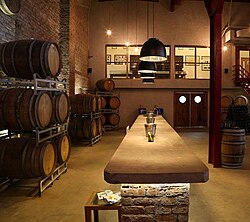
Nashik (/ˈnʌʃɪk/, Marathi: [naːʃik] , also called as NasikTemplate:Pronunciation)[10] is an ancient city and the largest city in the northern region of the Indian state of Maharashtra. Situated on the banks of river Godavari, Nashik is the fourth largest city in Maharashtra, after Mumbai, Pune and Nagpur. Nashik is well known for being one of the Hindu pilgrimage sites of the Kumbh Mela, which is held every 12 years.[11][12] Nashik is located about 190 km north of state capital Mumbai. The city is called the "Wine Capital of India" as more than half of India's vineyards and wineries are located here. Around 90% of all wine produced in India comes from the Nashik Valley.[1][13]
As per Ramayana, Nashik is the location on the banks of Godavari river where Laxman, by the wish of Lord Rama, cut the nose of demoness Shurpanakha and thus this city was named as "Nashik".[12]
Nashik lies in the northern part of Maharashtra state at 584 m (1,916 ft)[14] from the mean sea level which gives it ideal temperature variation, particularly in winters.[1]
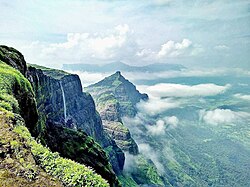
Nashik has lush mountainous terrain
The river Godavari originates from the Brahmagiri Mountain, Trimbakeshwar about 24 km (15 mi) from Nashik and flows through the old residential settlement, now in the central part of the city. Due to high pollution created by factories in proximity of the city the river was dying at an alarming rate. It has since been successfully cleaned.[15]
Nashik lies on the western edge of the Deccan Plateau which is an ancient volcanic formation.[16]
Trimbakeshwar is about 30 km (19 mi) from the city, it is where from river Godavari originates. The land area of the city is about 259.13 km2 (100.05 sq mi).[17]
Climate
The city's tropical location and high altitude combine to give it a relatively mild version of a hot semi-arid climate (KöppenBSh). Temperatures rise slightly in October, but this is followed by the cool season from November to February. The cool season sees warm temperatures of around 28 °C or 82.4 °F during the day, but cool nights, with lows averaging 10 °C or 50 °F, and extremely dry air.
Climate data for Nashik (Ozar Airport) 1981–2010, extremes 1965–2006
Nashik city is governed by the Nashik Municipal Corporation.[20] Nashik is a district headquarters located on the banks of Godavari and is 185 km (115 mi) away from Mumbai. The city has developed on both the banks of Godavari which divides the city into almost equal halves.[21]
The Municipal Commissioner of Nashik is Kailas Jadhav.[22]
The ward committee consists of councillors representing the electoral wards within the territorial area of the ward committee.[23] There are 6 ward committee's namely Nashik (E), Nashik (W), Nashik Road, Panchavati, CIDCO and Satpur.[23] The main function of the committees is to approve the cost of works for the wards, incorporate the expenses in the budget etc.
Civic services
The Nashik Municipal Corporation (NMC) is planning to start major civic projects in 2020. Projects like the creation of more smart roads, setting up of 800 CCTVs, installation of LED streetlights, Goda beautification project, construction of two major water treatment projects (WTPs), upgradation of STPs, making smart parking operational, etc. would be given priority by the municipal corporation.[24]
Solid waste management
In the Nashik Municipal Corporation area about 225 MT of solid waste is generated per day. Unlike other Indian cities, this garbage is collected by vehicles titled 'Ghantagadi' (meaning the vehicle with a bell): a system which has resulted in smaller versions of the ghantagadi ply in the congested old city areas. A plant has been set by the Nashik Municipal Corporation near Pandav Leni (Pandavleni Caves) to process the garbage and convert into compost.[25]
Ram Kund in Nashik; the city is an important Hindu pilgrimage destination
Digital services
The NMC provides an online website for various civic services like birth certificate registration, medical services, taxes, development services, etc.[26]
Demographics
Nashik is the fourth largest city in Maharashtra in terms of population after Mumbai, Pune and Nagpur. According to the Census of India, 2011, Nashik had a population of 1,486,053. Males constitute 782,517 of the population and females 703,536. Metropolitan Nashik population was 1,561,809 in which 821,921 were males and 739,888 were females. Nashik city had an average literacy rate of 89.85%: male literacy was 93.40%, and female literacy was 85.92%.[27]
The sex ratio is 894 per 1,000 males for Nashik city. Child sex ratio is 865 girls per 1,000 boys. In Nashik, 11.42% of the population is under 6 years of age.[28] In census year 2001 the Nashik Urban Agglomeration had a population of 1,152,326. Thus it was the fourth largest urban area of Maharashtra State after Mumbai, Pune and Nagpur.
The projected population of Nashik urban agglomeration (which includes abutting urban areas like Deolali) as on 11 November 2012 is 1,562,769.[29]
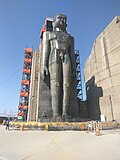
In February 2016, The Statue of Ahimsa, a 108 ft idol of first Jain tirthankaraRishabhdev carved in monolithic stone was consecrated at Mangi Tungi. It is recorded in the Guinness Book of World Records as the tallest Jain idol in the world.[31]
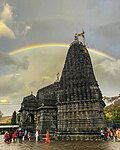
Trimbakeshwar Temple near Nashik (source of the Godavari River)
Gangapur Dam is on the river Godavari near Gangawadi village and it is earthen dam, Nashik.[33]
Chankapur dam which is on the Girna river is one of the big dams built by the British in the 19th century. It is 3 km from the village Abhona in Kalwan tehsil and 60 km from Nashik.
Kashypi Dam is on the Kashypi river near Rajapur, Nashik.
Girna Dam is an earthfill type of dam on river Girna near Nandgaon, Nashik District.
Darna Dam is a gravity dam on Darna river near Igatpuri, Nashik district.
The Kumbh Mela is celebrated every six years at Haridwar and Allahabad and Maha Kumbh takes place every twelve years at four places in Allahabad, Haridwar, Ujjain, and Nashik. According to the Puranas, it is believed that Kumbh derives its name from an immortal pot of nectar, which the devatas (Gods) and demons fought over. The four places where the nectar fell are at the banks of river Godavari in Nashik, river Kshipra in Ujjain, river Ganges in Haridwar and at Triveni Sangam of Ganga, Yamuna and invisible Saraswati River in Allahabad.[11][34]
Economy
Agriculture
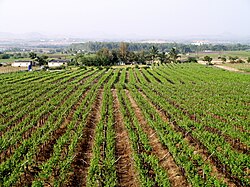
A grape vineyard in Nashik.
In early 1925, the table grape revolution was started in Ojhar, a small town near Nashik, by Raosaheb Jairam Krishna Gaikwad. Today, table grapes are exported to Europe, the Middle East, and Asia.[35]
The average Kharip crop area is 663,200 hectares while the average Rabbi crop area is 136,500 hectares. The sown area is 658,763 hectares (99%) and the forest land is 340,000 hectares (21.75%). The uncultivable area is 23,000 hectares (1.48%).[36]
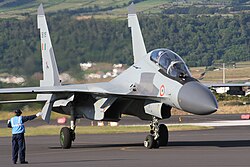
Nashik is a defense and aerospace manufacturing hub with Hindustan Aeronautics Limited aircraft manufacturing plant located at Ozar.[39] The Currency Note Press[40] and India Security Press are on Nashik Road, where Indian currency and government stamp papers are printed respectively.[41]
Apart from manufacturing, Nashik is an emerging investment destination for Information Technology companies. Tata Consultancy Services has invested in Nashik under the government of India BPO promotion scheme (IBPS). Also WNS, Accenture, TCS[44] has set up Digital Impact Square, or DISQ, which is a social innovation center.[45]
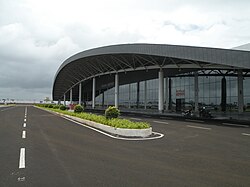
AirwaysNashik airportAirways – Nashik has its airport located at Ozar and an old airport at Gandhinagar which connected Nashik to Mumbai. The Gandhinagar Airport is now reserved for the military. Nashik Airport is domestic airport and it is connected to Ahmedabad, Pune, Hyderabad, Bangalore, Belgaum and Delhi under the UDAN scheme. SpiceJet, Trujet, Star Air and AirIndia provide services from Nashik Airport.
Public Transport – In city people often mostly prefer auto rickshaw to travel. Citilinc-Nashik City Bus Service is operated by Nashik Mahanagar Parivahan Mahamandal Limited(NMPML).
The Nashik Municipal Corporation (NMC) has rolled out its city bus service Citilinc on 8 July 2021.The previous state government had given its nod to the NMC to take over the city bus service from the ailing Maharashtra State Road Transport Corporation (MSRTC).[51]
↑Market, Capital (11 May 2017). "India BPO promotion scheme". Business Standard India. Archived from the original on 9 August 2017. Retrieved 9 August 2017.
↑"Industry". Official Website of Nashik District. Archived from the original on 6 April 2015.
↑"Nashik Harvest". Food NDTV. Archived from the original on 8 December 2015. Retrieved 27 November 2015.
↑Pawar, Tushar (13 December 2006). "Business Standard". Business Standard India. Business Standard. Archived from the original on 8 December 2015. Retrieved 27 November 2015.
↑"Maharashtra Tourism". Archived from the original on 29 July 2018. Retrieved 17 May 2018. Budapest and Nashik to be sister cities as collaboration between Hungary and Maharashtra to have a roadmap ahead for mutual synergies!Shri Jaykumar Rawal, Hon Minister Tourism, Shri Vijay Gautam IAS PS, Shri Aashutosh Rathod JtMD, interacting with the Hungary delegation at Sahyadri




 India
India 0.746 (Very High)[8]


.jpg)


_name_of_the_God_as_per_the_Vedas.svg)