





ImportMaster (talk | contribs) m robot: Creating new article from Special:WantedPages |
Removed redirect to Bicameral Tag: Removed redirect |
||
| Line 1: | Line 1: | ||
# | {{short description|Legislature with two chambers}} | ||
{{About|a form of legislature||Bicameralism (disambiguation)}} | |||
{{Use dmy dates|date=May 2022}} | |||
{{Legislature}} | |||
'''Bicameralism''' is a type of [[legislature]], one divided into two separate [[Deliberative assembly|assemblies]], chambers, or houses, known as a '''bicameral legislature'''. Bicameralism is distinguished from [[unicameralism]], in which all members deliberate and vote as a single group. {{as of|2015}}, about 40% of world's national legislatures are bicameral, and about 60% are unicameral.<ref>{{cite web|title = IPU PARLINE database: Structure of parliaments|url = http://www.ipu.org/parline-e/ParliamentsStructure.asp?REGION=All&LANG=ENG|website = ipu.org|access-date = 25 October 2015}}</ref> | |||
Often, the members of the two chambers are elected or selected by different methods, which vary from country to country. This can often lead to the two chambers having very different compositions of members. | |||
[[Enactment of a bill|Enactment]] of [[primary legislation]] often requires a [[concurrent majority]]—the approval of a majority of members in each of the chambers of the legislature. When this is the case, the legislature may be called an example of '''perfect bicameralism.''' However, in many parliamentary and semi-presidential systems, the house to which the executive is [[Responsible government|responsible]] can overrule the other house and may be regarded as an example of '''imperfect bicameralism'''. Some legislatures lie in between these two positions, with one house able to overrule the other only under certain circumstances. | |||
==History of bicameral legislatures== | |||
[[File:Casas del Parlamento. Palacio de Westminster - panoramio.jpg|thumb|The [[Palace of Westminster]], seat of the [[Parliament of the United Kingdom]].]] | |||
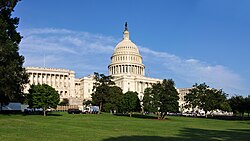
[[File:12-07-13-washington-by-RalfR-10.jpg|thumb|The [[United States Capitol]], seat of the [[United States Congress]].]] | |||
[[File:New Delhi government block 03-2016 img3.jpg|thumb|The [[Parliament House (India)|Sansad Bhavan]], seat of the [[Parliament of India]].]] | |||
The British Parliament is often referred to as the "[[Mother of Parliaments]]" (in fact a misquotation of [[John Bright]], who remarked in 1865 that "England is the Mother of Parliaments") because the [[Parliament of the United Kingdom|British Parliament]] has been the model for most other parliamentary systems, and its [[Act of Parliament|Act]]s have created many other parliaments.<ref>{{cite book|last1=Seidle|first1=F. Leslie|last2=Docherty|first2=David C.|title=Reforming parliamentary democracy|date=2003|publisher=McGill-Queen's University Press|isbn=9780773525085|page=3|url=https://books.google.com/books?id=i6je60BF-3sC&pg=PA3}}</ref> The origins of British bicameralism can be traced to 1341, when the Commons met separately from the nobility and clergy for the first time, creating what was effectively an Upper Chamber and a Lower Chamber, with the knights and burgesses sitting in the latter. This Upper Chamber became known as the [[House of Lords]] from 1544 onward, and the Lower Chamber became known as the [[House of Commons of England|House of Commons]], collectively known as the [[Houses of Parliament]]. | |||
Many nations with parliaments have to some degree emulated the British "three-tier" model. Most countries in Europe and the [[Commonwealth of Nations|Commonwealth]] have similarly organised parliaments with a largely ceremonial [[head of state]] who formally opens and closes parliament, a large elected lower house, and (unlike Britain) a smaller upper house.<ref>{{cite book|editor1-last=Arjomand|editor1-first=Saïd Amir|title=Constitutionalism and political reconstruction|date=2007|publisher=Brill|isbn=978-9004151741|pages=92–94|chapter-url=https://books.google.com/books?id=kYmmnYKEvE0C&pg=PA94|author1=Julian Go|chapter=A Globalizing Constitutionalism?, Views from the Postcolony, 1945–2000}}</ref><ref>{{cite web|title=How the Westminster Parliamentary System was exported around the World|url=http://www.cam.ac.uk/research/features/how-the-westminster-parliamentary-system-was-exported-around-the-world|publisher=University of Cambridge|access-date=16 December 2013|date=2 December 2013}}</ref> | |||
The [[Founding Fathers of the United States]] also favoured a bicameral legislature. The idea was to have the Senate be wealthier and wiser. Benjamin Rush saw this though, and noted that "this type of dominion is almost always connected with opulence". The Senate was created to be a stabilising force, not elected by mass electors, but selected by the State legislators. Senators would be more knowledgeable and more deliberate—a sort of republican nobility—and a counter to what [[James Madison]] saw as the "fickleness and passion" that could absorb the House.<ref name="HG1">{{cite web|url=http://archives.democrats.rules.house.gov/Archives/jcoc2br.htm|title=The Constitutional Background – House of Representatives archives|access-date=28 July 2015|archive-url=https://web.archive.org/web/20150730195430/http://archives.democrats.rules.house.gov/Archives/jcoc2br.htm|archive-date=30 July 2015|url-status=dead}}</ref> | |||
He noted further that "The use of the Senate is to consist in its proceeding with more coolness, with more system and with more wisdom, than the popular branch." Madison's argument led the Framers to grant the Senate prerogatives in foreign policy, an area where steadiness, discretion, and caution were deemed especially important.<ref name="HG1"/> State legislators chose the Senate, and senators had to possess significant property to be deemed worthy and sensible enough for the position. In 1913, the [[Seventeenth Amendment to the United States Constitution|17th Amendment]] passed, which mandated choosing Senators by popular vote rather than State legislatures.<ref name="HG1"/> | |||
As part of the [[Great Compromise]], the Founding Fathers invented a new rationale for bicameralism in which the Senate had an equal number of delegates per state, and the House had representatives by relative populations. | |||
==Rationale for bicameralism and criticism== | |||
{{Blockquote|text=A formidable sinister interest may always obtain the complete command of a dominant assembly by some chance and for a moment, and it is therefore of great use to have a second chamber of an opposite sort, differently composed, in which that interest in all likelihood will not rule.|author=[[Walter Bagehot]]|source="The English Constitution", in Norman St John-Stevas, ed., ''The Collected Works of Walter Bagehot'', London, The Economist, vol. 5, pp. 273–274.}} | |||
There have been a number of rationales put forward in favour of bicameralism. [[Federation|Federal states]] have often adopted it, and the solution remains popular when regional differences or sensitivities require more explicit representation, with the second chamber representing the constituent states. Nevertheless, the older justification for second chambers—providing opportunities for second thoughts about legislation—has survived.{{Citation needed|date=January 2009}} For states considering a different constitutional arrangement that may shift power to new groupings, bicameralism could be demanded by currently hegemonic groups who would otherwise prevent any structural shift (e.g. military dictatorships, aristocracies). | |||
The growing awareness of the complexity of the notion of representation and the multi-functional nature of modern legislatures may be affording incipient new rationales for second chambers, though these do generally remain contested institutions in ways that first chambers are not. An example of political controversy regarding a second chamber has been the debate over the powers of the [[Senate of Canada]] or the election of the [[Senate of France]].<ref>{{in lang|fr}} [http://www.liberation.fr/politiques/010132156-senat-le-triomphe-de-l-anomalie Liberation.fr], Sénat, le triomphe de l'anomalie</ref> | |||
The relationship between the two chambers varies: in some cases, they have equal power, while in others, one chamber is clearly superior in its powers. The first tends to be the case in federal systems and those with presidential governments. The second tends to be the case in unitary states with [[parliamentary system]]s. There are two streams of thought: critics believe bicameralism makes meaningful political reforms more difficult to achieve and increases the risk of gridlock—particularly in cases where both chambers have similar powers—while proponents argue the merits of the "[[checks and balances]]" provided by the bicameral model, which they believe help prevent ill-considered legislation. | |||
==Communication between houses== | |||
Formal communication between houses is by various methods, including:<ref name="Odgers">{{cite book |chapter-url=https://www.aph.gov.au/About_Parliament/Senate/Powers_practice_n_procedures/Odgers_Australian_Senate_Practice/Chapter_21#h02 |chapter=Chapter 21: Relations with the House of Representatives |publisher=Parliament of Australia |title=Odgers' Australian Senate Practice |edition=14th |access-date=19 February 2018}}</ref> | |||
;Sending messages: Formal notices, such as of [[resolution (law)|resolution]]s or the passing of bills, usually done in writing, via the [[Clerk (legislature)|clerk]] and [[Speaker (politics)|speaker]] of each house. | |||
;Transmission: of bills or amendment to bills requiring agreement from the other house. | |||
;[[Joint session]]: a [[plenary session]] of both houses at the same time and place. | |||
;[[Joint committee (legislative)|Joint committees]]:which may be formed by committees of each house agreeing to join, or by joint resolution of each house. The [[United States Congress]] has [[United States congressional conference committee|conference committee]]s to resolve discrepancies between House and Senate versions of a bill, similar to "Conferences" in Westminster parliaments. | |||
;Conferences:Conferences of the Houses of the English (later British) Parliament met in the [[Painted Chamber]] of the [[Palace of Westminster]].<ref name="Jones2014">{{cite journal|last=Jones|first=Clyve|year=2014|title=Accommodation in the Painted Chamber for Conferences between the Lords and the Commons from 1600 to 1834|journal=Parliamentary History|volume=33|issue=2|pages=342–357|issn=0264-2824|doi=10.1111/1750-0206.12100}}</ref> Historically there were two distinct types: "ordinary" and "free". The British Parliament last held an ordinary conference in 1860—its elaborate procedure yielding to the simpler sending of messages. A free conference resolves a dispute through "managers" meeting less formally in private. The last free conference at Westminster was in 1836 on an amendment to the [[Municipal Corporations Act 1835]];<ref>Blayden 2017 p.6; {{cite web|url=http://hansard.millbanksystems.com/commons/1836/aug/11/free-conference-municipal-corporations|title=Free Conference—Municipal Corporations' Act Amendment (, )|date=11 August 1836|work=Hansard|pages=HC Deb vol 35 cc1125–7 |no-pp=y|access-date=19 February 2018}}</ref> the previous one had been in 1740—with not much more success than ordinary conferences, the free type yielded to the greater transparency of messages.<ref>Blayden 2017 p.6; {{cite web|url=http://www.british-history.ac.uk/lords-jrnl/vol25/pp518-526|title=Managers for the Free Conference, on the Bill to prevent Commerce with Spain.|date=22–24 April 1740|work=House of Lords Journal|publisher=British History Online|pages=Volume 25, pp.518–526 |no-pp=y|access-date=19 February 2018}}</ref> In the [[Parliament of Australia]] there have been two formal conferences, in 1930 and 1931, but many informal conferences.<ref name="Odgers" /><ref name="BlaydenPLPP">{{cite web|url=https://www.aspg.org.au/wp-content/uploads/2017/09/BlaydenPLPP-Research-Essay-Free-Conferences-in-New-South-Wales.pdf|title=Do free conferences have a place in the present-day NSW Parliament?|last=Blayden|first=Lynsey|date=September 2017|publisher=Australasian Study of Parliament Group|access-date=19 February 2018}}</ref> {{As of|2007}} the "Conference of Managers" remains the usual procedure for dispute resolution in the [[Parliament of South Australia]].<ref>{{cite journal|last=Crump|first=Rick|date=Spring 2007|title=Why the conference procedure remains the preferred method for resolving disputes between the two houses of the South Australian Parliament|journal=Australasian Parliamentary Review|volume=22|issue=2|pages=120–136 |citeseerx=10.1.1.611.7131}}</ref> In the [[Parliament of New South Wales]] in 2011, the [[New South Wales Legislative Assembly|Legislative Assembly]] requested a free conference with the [[New South Wales Legislative Council|Legislative Council]] over a bill on graffiti; after a year the Council refused, describing the mechanism as archaic and inappropriate.<ref name="BlaydenPLPP" /> The two houses of the [[Parliament of Canada]] have also used conferences, but not since 1947 (although they retain the option). | |||
==Examples of bicameralism at the national level== | |||
===Federal=== | |||
[[File:Webysther 20180212163207 - Congresso Nacional.jpg|right|thumb|The [[National Congress of Brazil]], seat of the [[Chamber of Deputies (Brazil)|Chamber of Deputies]] and the [[Brazilian Senate|Federal Senate]]]] | |||
Some countries, such as [[Argentina]], [[Australia]], [[Austria]], [[Belgium]], [[Bosnia and Herzegovina]], [[Brazil]], [[Canada]], [[Germany]], [[India]], [[Malaysia]], [[Mexico]], [[Nepal]], [[Nigeria]], [[Pakistan]], [[Russia]], [[Switzerland]], and the [[United States]], link their bicameral systems to their [[federation|federal]] political structure. | |||
In the United States, Australia, Mexico, Brazil and Nepal for example, each state or province is given the same number of seats in one of the houses of the legislature, despite variance between the populations of the states or provinces. This is intended to ensure that smaller states are not overshadowed by larger states, which may have more representation in the other house of the legislature. | |||
====Canada==== | |||
[[File:Mosaika display, Centre Block, Parliament Hill.jpeg|right|thumb|The federal bicameral [[Parliament of Canada]], which contains a [[House of Commons of Canada|House of Commons]] and a [[Senate of Canada|Senate]]]] | |||
Canada's elected lower house, the [[House of Commons of Canada|House of Commons]], comprises Members of Parliament (MPs) from single-member "ridings" based mainly on population (updated every 10 years using Census data). The Commons is democratically elected every four years (constitutionally up to five years). In contrast, in [[Senate of Canada|Canada's upper house]], Senators are appointed to serve until age 75 by the [[Governor General of Canada|Governor General]] on the [[Advice (constitutional)|advice]] of the [[Prime Minister of Canada|Prime Minister]]. | |||
The Government (i.e. executive) is responsible to and must maintain the confidence of the elected House of Commons. Although the two chambers formally have many of the same powers, this accountability clearly makes the Commons dominant—determining which party is in power, approving its proposed budget and (largely) the laws enacted. The Senate primarily acts as a chamber of revision: it almost never rejects bills passed by the Commons but does regularly amend them; such amendments respect each bill's purpose, so they are usually acceptable to the Commons. Occasionally, the two houses cannot come to an agreement on an amendment, which results in rare instances of a key Government bill failing.{{Citation needed|date=August 2011}} The Senate's power to investigate issues of concern to Canada can raise their profile (sometimes sharply) on voters' political agendas. | |||
====Australia==== | |||
[[File:Parliament House - panoramio (7).jpg|right|thumb|The federal bicameral [[Parliament of Australia]], which contains a [[Australian House of Representatives|House of Representatives]] and a [[Australian Senate|Senate]]]] | |||
The bicameral [[Parliament of Australia]] consists of two Houses: the [[lower house]] is called the [[Australian House of Representatives|House of Representatives]] and the [[upper house]] is named the [[Australian Senate|Senate]]. As of 31 August 2017,<ref name="AECannouncement31August2017">{{cite web|url=http://www.aec.gov.au/media/media-releases/2017/08-31.htm|title=Determination of membership entitlement to the House of Representatives|work=aec.gov.au|date=31 August 2017|access-date=31 August 2017|archive-url=https://web.archive.org/web/20170831130456/http://www.aec.gov.au/media/media-releases/2017/08-31.htm|archive-date=31 August 2017|url-status=live}}</ref> the lower house has 151 members, each elected from single-member constituencies, known as [[Divisions of the Australian House of Representatives|electoral divisions]] (commonly referred to as "electorates" or "seats") using full-preference [[instant-runoff voting]]. This tends to lead to the chamber being dominated by two major groups, the [[Liberal Party of Australia|Liberal]]/[[National Party of Australia|National]] [[Coalition (Australia)|Coalition]] and the [[Australian Labor Party|Labor Party]]. The government of the day must achieve the confidence of this House to gain and hold power. | |||
The upper house, the Senate, is also popularly elected, under the [[single transferable vote]] system of [[proportional representation]]. There are a total of 76 senators: 12 senators are elected from each of the 6 [[Australian state]]s (regardless of population) and 2 from each of the 2 autonomous internal territories (the [[Australian Capital Territory]] and the [[Northern Territory]]). This makes the total number 76, i.e. 6×12 + 2×2. | |||
Unlike upper houses in most [[Westminster system|Westminster parliamentary systems]], the Australian Senate is vested with significant power, including the capacity to block legislation initiated by the government in the House of Representatives, making it a distinctive hybrid of British [[Westminster system|Westminster bicameralism]] and US-style bicameralism. As a result of proportional representation, the chamber features a multitude of parties vying for power. The governing party or coalition, which must maintain the confidence of the lower house, rarely has a majority in the Senate and usually needs to negotiate with other parties and Independents to get legislation passed.<ref>{{cite web |url=http://www.aph.gov.au/About_Parliament/Senate/Powers_practice_n_procedures/pops/pop34 |title=Papers on Parliament No. 34 Representation and Institutional Change: 50 Years of Proportional Representation in the Senate |date=1999 |access-date=23 February 2017}}</ref> | |||
====Others==== | |||
In German, Indian, and Pakistani systems, the upper houses (the [[Bundesrat of Germany|Bundesrat]], the [[Rajya Sabha]], and the [[Senate of Pakistan|Senate]] respectively) are even more closely linked with the federal system, being appointed or elected directly by the governments or legislatures of each [[States of Germany|German]] or [[States and union territories of India|Indian state]], or [[Provinces of Pakistan|Pakistani province]]. This was also the case in the United States before the [[Seventeenth Amendment to the United States Constitution|Seventeenth Amendment]] was adopted. Because of this coupling to the [[Executive (government)|executive branch]], German legal doctrine does not treat the ''Bundesrat'' as the second chamber of a bicameral system formally. Rather, it sees the ''Bundesrat'' and the ''[[Bundestag]]'' as independent constitutional bodies. Only the directly elected ''Bundestag'' is considered the parliament.<ref>According to the ''[[Bundesverfassungsgericht]]'', BVerfGE 37, 363, Aktenzeichen 2 BvF 2, 3/73</ref> In the German [[Bundesrat of Germany|''Bundesrat'']], the various ''Länder'' have between three and six votes; thus, while the less populated states have a lower weight, they still have a stronger voting power than would be the case in a system based proportionately on population, as the [[North Rhine-Westphalia|most populous ''Land'']] currently has about 27 times the population of the [[Bremen (state)|least populous]]. The Indian upper house does not have the states represented equally, but on the basis of their population. | |||
There is also bicameralism in countries that are not federations, but have upper houses with representation on a territorial basis. For example, in South Africa, the [[National Council of Provinces]] (and before 1997, the [[Senate of South Africa|Senate]]) has its members chosen by each [[Provinces of South Africa|province]]'s legislature. | |||
In Spain, the [[Spanish Senate|Senate]] functions as a ''de facto'' territorially based upper house, and there has been some pressure from the [[Autonomous Communities]] to reform it into a strictly territorial chamber. | |||
The [[European Union]] maintains a somewhat close to bicameral legislative system consisting of the [[European Parliament]], which is elected in elections on the basis of universal suffrage, and the [[Council of the European Union]], which consists of one representative for each government of member countries, who are competent for a relevant field of legislation. Though the European Union has a highly unusual character in terms of legislature, one could say that the closest point of equivalency lies within bicameral legislatures.<ref>European Union Politics, John McCormick, 3rd Edition</ref> The European Union is considered neither a country nor a state, but it enjoys the power to address national Governments in many areas. | |||
===Aristocratic and post-aristocratic=== | |||
In a few countries, bicameralism involves the juxtaposition of democratic and aristocratic elements. | |||
==== House of Lords of the United Kingdom ==== | |||
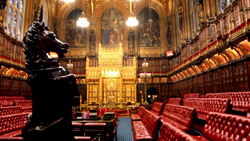
[[File:House of Lords Chamber.png|thumb|The House of Lords chamber]] | |||
The best known example is the British [[House of Lords]], which includes a number of [[hereditary peer]]s. The House of Lords is a vestige of the aristocratic system that once predominated in British politics, while the other house, the [[British House of Commons|House of Commons]], is entirely elected. Over the years, some have proposed reforms to the House of Lords, some of which have been at least partly successful. The [[House of Lords Act 1999]] limited the number of hereditary peers (as opposed to [[life peer]]s, appointed by the [[British monarchy|Monarch]] on the advice of the [[Prime Minister of the United Kingdom|Prime Minister]]) to 92, down from around 700. Of these 92, one is the [[Earl Marshal]], a hereditary office always held by the [[Duke of Norfolk]], one is the [[Lord Great Chamberlain]], a hereditary office held by turns, currently by the [[Marquess of Cholmondeley]], and the other 90 are [[Representative peer|elected by all sitting peers]]. Hereditary peers elected by the House to sit as representative peers sit for life; when a representative peer dies, there is a by-election to fill the vacancy. The power of the House of Lords to block legislation is curtailed by the [[Parliament Acts 1911 and 1949]]. Peers can introduce bills except Money Bills, and all legislation must be passed by both [[Lords Spiritual and Temporal and Commons|Houses of Parliament]]. If not passed within two sessions, the [[House of Commons]] can override the Lords' delay by invoking the ''Parliament Act''. Certain legislation, however, must be approved by both Houses without being forced by the Commons under the ''Parliament Act''. These include any bill that would extend the time length of a Parliament, private bills, bills sent to the House of Lords less than one month before the end of a session, and bills that originated in the House of Lords. | |||
Life Peers are appointed either by recommendation of the Appointment Commission (the independent body that vets non-partisan peers, typically from academia, business or culture) or by Dissolution Honours, which take place at the end of every Parliamentary term when leaving MPs may be offered a seat to keep their institutional memory. It is traditional to offer a peerage to every outgoing Speaker of the House of Commons.<ref>[http://www.parliament.uk/about/mps-and-lords/about-lords/lords-appointment/ How do you become a Member of the House of Lords? – UK Parliament]. Parliament.uk (21 April 2010). Retrieved on 2013-07-12.</ref> | |||
Further reform of the Lords has been proposed; however, no proposed reforms have been able to achieve public consensus or government support. Members of the House of Lords all have an aristocratic title, or are from the [[Lord Spiritual|Clergy]]. 26 Archbishops and Bishops of the [[Church of England]] sit as [[Lord Spiritual|Lords Spiritual]] (the [[Archbishop of Canterbury]], [[Archbishop of York]], the [[Bishop of London]], the [[Bishop of Durham]], the [[Bishop of Winchester]] and the next 21 longest-serving Bishops). It is usual that retiring Archbishops, and certain other Bishops, are appointed to the [[Crossbencher|Crossbenches]] and given a life peerage. | |||
Until 2009, 12 [[Lord of Appeal in Ordinary|Lords of Appeal in Ordinary]] sat in the House as the highest court in the land; they subsequently became justices of the newly created [[Supreme Court of the United Kingdom]]. As of 16 February 2021, 803 people sit in the House of Lords, with 92 Hereditary Peers, 26 Lords Spiritual and 685 Life Peers. Membership is not fixed and decreases only on the death, retirement or resignation of a peer. | |||
==== Japan's former House of Peers ==== | |||
Another example of aristocratic bicameralism was the Japanese [[House of Peers (Japan)|House of Peers]], abolished after [[World War II]] and replaced with the present [[House of Councillors]]. | |||
===Unitary states=== | |||
{{multiple image | |||
| align = right | |||
| direction = vertical | |||
| width = 200px | |||
| image1 = Senate @ Jardin du Luxembourg @ Paris (23764477852).jpg | |||
| image2 = Paris - Palais Bourbon (24519023495).jpg | |||
| footer=Some bicameral legislatures have chambers that meet in different buildings, at different parts of the city. Here, France's upper house called the [[Senate of France|Senate]] meet in the [[Luxembourg Palace]] (top), while the lower house, the [[National Assembly of France|National Assembly]], meets at the [[Palais Bourbon]] (bottom). | |||
}} | |||
Many [[unitary state]]s like [[Italy]], [[France]], the [[Netherlands]], the [[Philippines]], the [[Czech Republic]], the [[Republic of Ireland]] and [[Romania]] have bicameral systems. In countries such as these, the upper house generally focuses on scrutinizing and possibly vetoing the decisions of the lower house. | |||
==== Italian Parliament ==== | |||
On the other hand, in [[Italy]] the [[Italian Parliament|Parliament]] consists of two chambers that have the same role and power: the [[Italian Senate|Senate]] (Senate of the Republic, commonly considered the ''upper house'') and the [[Italian Chamber of Deputies|Chamber of Deputies]] (considered the ''lower house''). The main difference among the two chambers is the way the two chambers are composed: the deputies, in fact, are elected on a nationwide basis, whilst the members of the Senate are elected on a regional basis: this may lead to different majorities among the two chambers because, for example, a party may be the first nationally but second or third in some regions. Considering that in the Italian Republic the Government needs to win confidence votes in both the chambers, it may happen that a Government has a strong majority (usually) in the Chamber of Deputies and a weak one (or no majority at all) in the Senate. This has led sometimes to legislative deadlocks, and has caused instability in the Italian Government.<ref>http://www.carlofusaro.it/in_english/Bicameralism_in_ITA_2013.pdf {{Bare URL PDF |date=February 2022}}</ref><ref>{{cite web|url=http://constitutionnet.org/news/italian-constitutional-reforms-towards-stable-and-efficient-government|title=Italian constitutional reforms: Towards a stable and efficient government|website=ConstitutionNet}}</ref> | |||
==== Indirectly elected Upper Houses (France, Ireland, Netherlands) ==== | |||
In some of these countries, the upper house is indirectly elected. Members of France's [[French Senate|Senate]] and Ireland's [[Seanad Éireann]] are chosen by [[electoral college]]s. In Ireland, it consists of members of the lower house, local councillors, the [[Taoiseach]], and graduates of selected universities, while the Netherlands' [[Senate of the Netherlands|Senate]] is chosen by members of provincial assemblies (who, in turn, are directly elected). | |||
==== Semi-bicameral (Hong Kong, Northern Ireland; earlier in Norway, the Netherlands) ==== | |||
In [[Hong Kong]], members of the unicameral [[Legislative Council (Hong Kong)|Legislative Council]] returned from the democratically elected geographical constituencies and partially democratic [[Functional constituency (Hong Kong)|functional constituencies]] are required to vote separately since 1998 on motions, bills or amendments to government bills not introduced by the government. The passage of these motions, bills or amendments to government motions or bills requires double majority in both groups simultaneously. (Before 2004, when elections to the Legislative Council from the [[Election Committee]] was abolished, members returned through the Election Committee vote with members returned from geographical constituencies.) The double majority requirement does not apply to motions, bills and amendments introduced by the [[Hong Kong Government|government]]. | |||
Another similar situation are [[cross-community vote]]s in [[Northern Ireland]] when the ''petition of concern'' procedure is invoked. | |||
[[Norway]] had a kind of [[Qualified unicameralism|semi-bicameral legislature]] with two chambers, or departments, within the same elected body, the [[Storting]]. These were called the Odelsting and were abolished after the general election of 2009. According to [[Morten Søberg]], there was a related system in the 1798 constitution of the [[Batavian Republic]].<ref>{{cite web|url=https://www.minervanett.no/|title=Minerva|website=Minerva}}</ref> | |||
==Examples of bicameralism in subnational entities== | |||
In some countries with federal systems, individual states (like those of the [[U.S. state|United States]], [[Provinces of Argentina|Argentina]], [[States and territories of Australia|Australia]] and [[States and territories of India|India]]) may also have bicameral legislatures. A few such states as [[Nebraska]] in the U.S., [[Queensland]] in Australia, [[Bavaria]] in Germany, and [[Tucumán Province|Tucumán]] and [[Córdoba Province, Argentina|Córdoba]] in Argentina have later adopted unicameral systems. ([[States of Brazil|Brazilian states]] and [[Provinces of Canada|Canadian provinces]] all abolished upper houses). | |||
===Argentina=== | |||
[[File:Legislaturas provinciales de Argentina.png|upright|thumb|[[List of provincial legislatures in Argentina|Provincial legislatures in Argentina]]]]In the [[Argentine Republic]], eight [[Provinces of Argentina|provinces]] have bicameral legislatures, with a [[Senate]] and a [[Chamber of Deputies]]: [[Buenos Aires Province|Buenos Aires]], [[Catamarca Province|Catamarca]], [[Corrientes Province|Corrientes]], [[Entre Ríos Province|Entre Ríos]], [[Mendoza Province|Mendoza]], [[Salta Province|Salta]], [[San Luis Province|San Luis]] (since 1987) and [[Santa Fe Province|Santa Fe]]. [[Tucumán Province|Tucumán]] and [[Córdoba Province, Argentina|Córdoba]] changed to [[unicameral]] systems in 1990 and 2001 respectively.<ref>Malamud, Andrés and Martín Costanzo (2010) "[http://repositorio.ul.pt/handle/10451/11915 Bicameralismo subnacional: el caso argentino en perspectiva comparada]". In: Igor Vivero Ávila (ed.), Democracia y reformas políticas en México y América Latina (pp. 219–246). Mexico: M. A. Porrúa.</ref> [[Santiago del Estero Province|Santiago del Estero]] changed to a bicameral legislature in 1884, but changed back to a unicameral system in 1903. | |||
===Australia=== | |||
When the Australian states were founded as British colonies in the 19th century, they each had a bicameral Parliament. The lower house was traditionally elected based on the one-vote-one-value principle, with universal male suffrage, later expanded to women, whereas the upper house was either appointed on the advice of the government or elected, with a strong bias towards country voters and landowners. After [[Federation of Australia|Federation]], these became the state Parliaments. In Queensland, the appointed [[Queensland Legislative Council|upper house]] was abolished in 1922, while in [[New South Wales]] there were similar attempts at abolition, before the [[New South Wales Legislative Council|upper house]] was reformed in the 1970s to provide for direct election.<ref>{{cite web| url=https://www.abc.net.au/radionational/programs/rearvision/australias-upper-houses/11038996| title = Australia's Upper Houses – ABC Rear Vision| date = 24 April 2019|publisher = [[Australian Broadcasting Corporation]]| access-date = 7 September 2020}}</ref> | |||
Beginning in the 1970s, Australian states began to reform their upper houses to introduce proportional representation in line with the Federal Senate. The first was the [[South Australian Legislative Council]] in 1973, which initially used a [[Party-list proportional representation|party list]] system (replaced with STV in 1982),<ref>{{cite book|last=Dunstan |first=Don |year=1981 |title=Felicia: The political memoirs of Don Dunstan |publisher=Griffin Press Limited |pages=214–215 |isbn=0-333-33815-4}}</ref> followed by the Single Transferable Vote being introduced for the [[New South Wales Legislative Council]] in 1978,<ref name=LA>{{cite web|title = Role and History of the Legislative Assembly|publisher = Parliament of New South Wales|url = http://www.parliament.nsw.gov.au/prod/web/common.nsf/key/LARole|access-date = 9 September 2014|url-status = live|archive-url = https://web.archive.org/web/20110423094710/https://parliament.nsw.gov.au/prod/web/common.nsf/key/LARole|archive-date = 23 April 2011}}</ref> the [[Western Australian Legislative Council]] in 1987<ref>Electoral Reform expected to alter balance of power, ''The Australian'', 11 June 1987, p.5</ref> and the [[Victorian Legislative Council]] in 2003.<ref>Constitution (Parliamentary Reform) Act 2003</ref> | |||
Nowadays, the upper house both federally and in most states is elected using [[proportional representation]] while the lower house uses [[Instant-runoff voting]] in single member electorates. This is reversed in the state of [[Tasmania]], where proportional representation is used for the [[Tasmania House of Assembly|lower house]] and single member electorates for the [[Tasmania Legislative Council|upper house]].<ref>{{cite book| last1 = Griffith| first1 = Gareth| last2 = Srinivasan| first2 = Sharath| title = State Upper Houses in Australia | publisher = New South Wales Parliamentary Library Service| year = 2001| url =https://www.parliament.nsw.gov.au/researchpapers/Documents/state-upper-houses-in-australia/bg01-01.pdf}}</ref> | |||
===Bosnia and Herzegovina=== | |||
The Legislature of the [[Federation of Bosnia and Herzegovina]], one of the two entities of [[Bosnia and Herzegovina]], is a bicameral legislative body. It consists of two chambers. The House of Representatives has 98 delegates, elected for four-year terms by proportional representation. The House of Peoples has 58 members, 17 delegates from among each of the constituent peoples of the Federation, and 7 delegates from among the other peoples.<ref>{{Cite web|url=http://www.advokat-prnjavorac.com/legislation/constitution_fbih.pdf|title=Constitution of the Federation of Bosnia and Herzegovina}}</ref> [[Republika Srpska]], the other entity, has a unicameral parliament, known as the [[National Assembly (Republika Srpska)|National Assembly]],<ref>{{cite web|url=http://www.narodnaskupstinars.net/?q=en/national-assembly/about-national-assembly|title=About National Assembly – NSRS|website=narodnaskupstinars.net|date=28 January 2015}}</ref> but there is also a Council of Peoples who is ''de facto'' other house of legislative.<ref>{{cite web|url=https://www.vijecenarodars.net/ |work=vijecenarodars.net |language=sr |title=Home page}}</ref> | |||
===Germany=== | |||
The German federal state of [[Bavaria]] had a bicameral legislature from 1946 to 1999, when the [[Senate of Bavaria|Senate]] was abolished by a referendum amending the state's constitution. The other 15 states have used a unicameral system since their founding. | |||
===India=== | |||
Of the 28 states and 8 Union Territories of India, only 6 states that is [[Andhra Pradesh]], [[Bihar]], [[Karnataka]], [[Maharashtra]], [[Telangana]] and [[Uttar Pradesh]] – have bicameral legislatures, while the rest all have unicameral legislatures. The lower houses are called [[State legislative assemblies of India|Legislative Assemblies]], and their members are elected by universal adult suffrage from single-member constituencies in state elections, which are normally held every five years called Vidhana Sabha. In the six states with bicameral legislatures, the upper house is called the [[State Legislative Council (India)|Legislative Council]] (''Vidhan Parishad'') or Vidhana Parishat, one-third of whose members are elected every two years. Members of Legislative Council are elected in various ways: | |||
*One-third are elected by the members of local bodies in the state such as [[Municipal governance in India|municipalities]], [[Gram panchayat|''gram panchayats'']], [[Panchayat samiti|block development councils]] and [[District Councils of India|district councils]]. | |||
*One-third are elected by the members of the state's [[State Legislative Assembly (India)|Legislative Assembly]] from amongst persons who are not members of the State Legislative Assembly. | |||
*One-sixth are nominated by the [[Governor (India)|governor]] of the state from amongst persons having knowledge or practical experience in fields such as [[literature]], [[science]], [[arts]], the [[Cooperative|co-operative movement]] and [[Social work|social service]]. | |||
*One-twelfth are elected from special constituencies by persons who are [[college graduate]]s of three years' standing residing in those constituencies. | |||
*One-twelfth are elected by persons engaged for at least three years in teaching in [[Education in India|educational institutions within the state]] not lower than [[secondary school]]s, including [[college]]s and [[University|universities]].<ref>{{cite constitution|article=171|clause=3|polity=India|date=1950}}</ref> | |||
From 1956 to 1958 the Andhra Pradesh Legislature was unicameral. In 1958, when the State Legislative Council was formed, it became bicameral until 1 June 1985 when it was abolished. This continued until March 2007 when the State Legislative Council was reestablished and elections were held for its seats. In [[Tamil Nadu]], a resolution was passed on 14 May 1986 and the state's Legislative Council was dissolved on 1 November 1986. Again on 12 April 2010, a resolution was passed to reestablish the council, but was ultimately unsuccessful. Similarly, the states of [[Assam]], [[Jammu and Kashmir (state)|Jammu and Kashmir]], [[Madhya Pradesh]], [[Punjab, India|Punjab]], and [[West Bengal]] have also dissolved the upper houses of their [[State Legislature (India)|state legislatures]].{{citation needed|date=May 2021}} | |||
===Russia=== | |||
In the [[Soviet Union]], regional and local [[Soviet (council)|Soviets]] were unicameral. After the adoption of the [[Constitution of Russia|1993 Russian Constitution]], bicameralism was introduced in some regions. Bicameral regional legislatures are still technically allowed by federal law but this clause is dormant now. The last region to switch from bicameralism to unicameralism was [[Sverdlovsk Oblast]] in 2012. | |||
===United States=== | |||
During the 1930s, the Legislature of the State of Nebraska was reduced from [[bicameral]] to unicameral with the 43 members that once comprised that state's Senate. One of the arguments used to sell the idea at the time to Nebraska voters was that by adopting a unicameral system, the perceived evils of the "[[conference committee]]" process would be eliminated. | |||
A conference committee is appointed when the two chambers cannot agree on the same wording of a proposal, and consists of a small number of legislators from each chamber. This tends to place much power in the hands of only a small number of legislators. Whatever legislation, if any, the conference committee finalizes is presented in an unamendable "take-it-or-leave-it" manner by both chambers. | |||
During his term as [[governor]] of the State of [[Minnesota]], [[Jesse Ventura]] proposed converting the Minnesotan legislature to a single chamber with [[proportional representation]], as a reform that he felt would solve many legislative difficulties and impinge upon legislative corruption. In his book on political issues, ''Do I Stand Alone?'', Ventura argued that bicameral legislatures for provincial and local areas were excessive and unnecessary, and discussed unicameralism as a reform that could address many legislative and budgetary problems for states. | |||
==Reform== | |||
===Arab political reform=== | |||
A 2005 report<ref>{{cite web|url=http://www.cfr.org/pdf/Arab_Democracy_TF.pdf|archive-url=https://web.archive.org/web/20080705153315/http://www.cfr.org/pdf/Arab_Democracy_TF.pdf|url-status=dead|title=2005 report|archive-date=5 July 2008}}</ref> on democratic reform in the Arab world by the U.S. [[Council on Foreign Relations]] co-sponsored by former Secretary of State [[Madeleine Albright]] urged Arab states to adopt bicameralism, with upper chambers appointed on a 'specialized basis'. The Council claimed that this would protect against the '[[Tyranny of the majority]]', expressing concerns that without a system of checks and balances extremists would use the single chamber parliaments to restrict the rights of [[minority group|minority]] groups. | |||
In 2002, [[Bahrain]] adopted a bicameral system with an elected lower chamber and an appointed upper house. This led to a boycott of parliamentary elections that year by the [[Al Wefaq]] party, who said that the government would use the upper house to veto their plans. Many secular critics of bicameralism were won around to its benefits in 2005, after many MPs in the lower house voted for the introduction of so-called [[Islamic religious police|morality police]]. | |||
===Romania=== | |||
A [[2009 Romanian parliamentary reform referendum|referendum]] on introducing a unicameral Parliament instead of the current bicameral [[Parliament of Romania|Parliament]] was held in [[Romania]] on 22 November 2009. The turnout rate was 50.95%, with 77.78% of "Yes" votes for a unicameral Parliament.<ref>[http://www.news-ro.info/referendum-turnout-5095-7778-said-yes-for-a-unicameral-parliament-8884-voted-for-the-decrease-in-the-number-of-parliamentarians.html Referendum turnout 50.95%. 77.78 said YES for a unicameral Parliament, 88.84% voted for the decrease in the number of Parliamentarians] {{webarchive|url=https://web.archive.org/web/20110721231024/http://www.news-ro.info/referendum-turnout-5095-7778-said-yes-for-a-unicameral-parliament-8884-voted-for-the-decrease-in-the-number-of-parliamentarians.html |date=21 July 2011 }}, Official results from the Romanian Central Electoral Commission</ref> This referendum had a consultative role, thus requiring a parliamentary initiative and another referendum to ratify the new proposed changes. | |||
===Ivory Coast=== | |||
A [[2016 Ivorian constitutional referendum|referendum]] on a new [[Constitution of Ivory Coast#2016 Constitution (proposed)|constitution]] was held on 30 October 2016. The constitution draft would create a bicameral [[Parliament of Ivory Coast|Parliament]] instead of the current unicameral. The [[Senate (Ivory Coast)|Senate]] is expected to represent the interests of territorial collectivities and Ivoirians living abroad. Two thirds of the Senate is to be elected at the same time as the general election. The remaining one third is appointed by the president elect.<ref>{{cite web|url=http://constitutionnet.org/news/innovations-draft-constitution-cote-divoire-towards-hyper-presidentialism|title=Innovations of the Draft Constitution of Cote d'Ivoire: Towards hyper-presidentialism?|website=ConstitutionNet}}</ref> | |||
==Examples== | |||
===Current=== | |||
[[File:Unibicameral Map.svg|upright=3.4|thumb|center|{{legend|#38b4d8|Nations with a bicameral legislature.}}{{legend|#f09c30|Nations with a unicameral legislature.}}{{legend|#b0e947|Nations with a unicameral legislature and an advisory body.}}{{legend|#303030|Nations with no legislature.}}{{legend|#a0989f|No data.}}]] | |||
====Federal==== | |||
{| class="wikitable sortable" style="margin:auto;" | |||
|- | |||
! rowspan=2| Country !! colspan=2| Bicameral body !! rowspan=2| Notes | |||
|- | |||
! Upper house !! Lower house | |||
|- | |||
| rowspan=2| {{flag|Argentina}} || colspan="2" style="text-align:center;"| '''[[Argentine National Congress|National Congress]]''' || rowspan=2| Of the twenty-three provincial legislatures, eight ([[Legislature of Buenos Aires Province|Buenos Aires]], [[Legislature of Catamarca|Catamarca]], [[Legislature of Corrientes|Corrientes]], [[Legislature of Entre Ríos|Entre Ríos]], [[Legislature of Mendoza|Mendoza]], [[Legislature of Salta|Salta]], [[Legislature of San Luis|San Luis]], and [[Legislature of Santa Fe|Santa Fe]]) are bicameral, while the remaining fifteen and the legislature of the [[Autonomous City of Buenos Aires]] are unicameral. | |||
|- | |||
| [[Argentine Senate|Senate]] || [[Argentine Chamber of Deputies|Chamber of Deputies]] | |||
|- | |||
| rowspan=2| {{flag|Australia}} || colspan="2" style="text-align:center;"| '''[[Parliament of Australia|Parliament]]''' || rowspan=2| All of the state parliaments except [[Parliament of Queensland|Queensland]]'s are also bicameral. The legislatures of the [[Parliament of the Northern Territory|NT]] and the [[Australian Capital Territory Legislative Assembly|ACT]] are unicameral. | |||
|- | |||
| [[Australian Senate|Senate]] || [[Australian House of Representatives|House of Representatives]] | |||
|- | |||
| rowspan=2| {{flag|Austria}} || colspan="2" style="text-align:center;"| '''[[Austrian Parliament|Parliament]]''' || rowspan=2| All of the ''[[States of Austria|Bundesländer]]'' have unicameral parliaments. | |||
|- | |||
| [[Bundesrat (Austria)|Bundesrat]] (Federal Council) || [[National Council (Austria)|Nationalrat]] (National Council) | |||
|- | |||
| rowspan=2| {{flag|Belgium}} || colspan="2" style="text-align:center;"| '''[[Belgian Federal Parliament|Federal Parliament]]''' || rowspan=2| All of the [[Communities, regions and language areas of Belgium|community and regional]] parliaments are unicameral. | |||
|- | |||
| [[Belgian Senate|Senate]] || [[Belgian Chamber of Representatives|Chamber of Representatives]] | |||
|- | |||
|rowspan=2| {{flag|Bosnia and Herzegovina}} || colspan="2" style="text-align:center;"| '''[[Parliamentary Assembly of Bosnia and Herzegovina|Parliamentary Assembly]]''' ||rowspan=2| The [[Parliament of the Federation of Bosnia and Herzegovina]] is also bicameral, while the [[National Assembly (Republika Srpska)|National Assembly of Republika Srpska]] is unicameral. | |||
|- | |||
| [[House of Peoples of Bosnia and Herzegovina|House of Peoples]] || [[House of Representatives of Bosnia and Herzegovina|House of Representatives]] | |||
|- | |||
| rowspan=2| {{flag|Brazil}} || colspan="2" style="text-align:center;"| '''[[National Congress of Brazil|National Congress]]''' || rowspan=2| All of the 26 state legislatures and the Federal District legislature are unicameral. | |||
|- | |||
| [[Senate of Brazil|Senate]] || [[Chamber of Deputies of Brazil|Chamber of Deputies]] | |||
|- | |||
| rowspan=2| {{flag|Canada}} || colspan="2" style="text-align:center;"| '''[[Parliament of Canada|Parliament]]''' || rowspan=2| All of the provincial and territorial legislatures are unicameral. | |||
|- | |||
| [[Senate of Canada|Senate]] || [[House of Commons of Canada|House of Commons]] | |||
|- | |||
| rowspan=2| {{flag|Ethiopia}} || colspan="2" style="text-align:center;"| '''[[Federal Parliamentary Assembly]]''' || rowspan=2| Regional Councils are unicameral. Assemblypersons of the Regional Councils are elected directly. | |||
|- | |||
| [[House of Federation]] || [[House of Peoples' Representatives]] | |||
|- | |||
| rowspan=2| {{flag|Germany}} || colspan="2" style="text-align:center;"| N/A || rowspan=2| In Germany, the chambers form two distinct constitutional bodies not framed by a comprehensive institution. German jurisprudence doesn't recognise the Bundesrat as a parliament chamber, because it consists of members of the state governments. Although it must always be heard in the legislative process, it only has to give consent to bills in certain defined areas. All of the federal states (''[[States of Germany|Länder]]'') today have unicameral ''[[Landtag]]e''. | |||
|- | |||
| [[Bundesrat (Germany)|Bundesrat]] (Federal Council) || de |[[Bundestag]] (Federal [[Diet (assembly)|Diet]]) | |||
|- | |||
| rowspan=2| {{flag|India}} || colspan="2" style="text-align:center;"| '''[[Parliament of India|Parliament]]''' || rowspan=2| Six of the [[States and union territories of India|twenty-eight states]] also have bicameral legislatures, consisting of the upper house, the [[State Legislative Council (India)|State Legislative Council]] (Vidhan Parishad) and the lower house, the [[State Legislative Assembly (India)|State Legislative Assembly]] (Vidhan Sabha) respectively. The remaining twenty-two states and the [[Union territory|union territories]] of [[Delhi]], [[Jammu and Kashmir (union territory)|Jammu and Kashmir]] and [[Puducherry (union territory)|Puducherry]] have unicameral legislatures. | |||
|- | |||
| [[Rajya Sabha]] (Council of States) || [[Lok Sabha]] (House of the People) | |||
|- | |||
| rowspan=2| {{flag|Malaysia}} || colspan="2" style="text-align:center;"| '''[[Parliament of Malaysia|Parliament]]''' || rowspan=2| All the 13 State Legislative Assemblies are unicameral. | |||
|- | |||
| [[Dewan Negara]] (Senate) || [[Dewan Rakyat]] (House of Representatives) | |||
|- | |||
| rowspan=2| {{flag|Mexico}} || colspan="2" style="text-align:center;"| '''[[Congress of Mexico|Congress]]''' || rowspan=2| All the 31 State Congresses and the Legislative Assembly of the Federal District are unicameral. | |||
|- | |||
| [[Senate of Mexico|Senate]] || [[Chamber of Deputies of Mexico|Chamber of Deputies]] | |||
|- | |||
| rowspan=2| {{flag|Nepal}} || colspan="2" style="text-align:center;"| '''[[Parliament of Nepal|Parliament]]''' || rowspan=2| All of the provincial assemblies are unicameral.<ref>{{cite web |url=http://constitution.org.np/userfiles/constitution%20of%20nepal%202072-en.pdf |title=Constitution of Nepal |access-date=18 February 2016 |url-status=dead |archive-url=https://web.archive.org/web/20151223153410/http://constitution.org.np/userfiles/constitution%20of%20nepal%202072-en.pdf |archive-date=23 December 2015 }}</ref> | |||
|- | |||
| [[National Assembly (Nepal)|Rastriya Sabha]] (National Assembly) || [[House of Representatives (Nepal)|Pratinidhi Sabha]] (House of Representatives) | |||
|- | |||
| rowspan=2|{{flag|Nigeria}} || colspan="2" style="text-align:center;"| '''[[National Assembly (Nigeria)|National Assembly]]''' || rowspan=2| | |||
|- | |||
| [[Senate of Nigeria|Senate]] || [[House of Representatives (Nigeria)|House of Representatives]] | |||
|- | |||
| rowspan=2| {{flag|Pakistan}} || colspan="2" style="text-align:center;"| '''[[Parliament of Pakistan|Parliament]]''' || rowspan=2| All of the provincial assemblies are unicameral. | |||
|- | |||
| [[Senate of Pakistan|Senate]] || [[National Assembly of Pakistan|National Assembly]] | |||
|- | |||
| rowspan=2| {{flag|Russia}} || colspan="2" style="text-align:center;"| '''[[Federal Assembly (Russia)|Federal Assembly]]''' || rowspan=2| All the regional legislatures are now unicameral while bicameralism in regions is technically allowed by the Federation. | |||
|- | |||
| [[Federation Council of Russia|Federation Council]] || [[State Duma]] | |||
|- | |||
| rowspan=2| {{flag|Somalia}} || colspan="2" style="text-align:center;"| '''[[Federal Parliament of Somalia|Parliament]]''' || rowspan=2| | |||
|- | |||
| [[Somalian Senate|Senate]]|| [[Lower House|House of The People]] | |||
|- | |||
| rowspan=2| {{flag|Switzerland}} || colspan="2" style="text-align:center;"| '''[[Federal Assembly of Switzerland|Federal Assembly]]''' || rowspan=2| All of the cantons have unicameral parliaments. | |||
|- | |||
| [[Swiss Council of States|Council of States]] || [[National Council of Switzerland|National Council]] | |||
|- | |||
| rowspan=2| {{flag|United States}} || colspan="2" style="text-align:center;"| '''[[United States Congress|Congress]]''' || rowspan=2| All of the state legislatures, except [[Nebraska legislature|Nebraska]], are also bicameral. The [[Legislative Assembly of Puerto Rico]] is bicameral. The [[Council of the District of Columbia]] is unicameral. | |||
|- | |||
| [[United States Senate|Senate]] || [[United States House of Representatives|House of Representatives]] | |||
|} | |||
====Unitary==== | |||
{| class="wikitable sortable" style="margin:auto;" | |||
|- | |||
! rowspan=2| Country !! colspan=2| Bicameral body !! rowspan=2| Notes | |||
|- | |||
! Upper house !! Lower house | |||
|- | |||
| rowspan=2| {{flag|Afghanistan}} || colspan=2| '''[[National Assembly (Afghanistan)|National Assembly]]''' || rowspan=2| | |||
|- | |||
| [[Meshrano Jirga]] (House of Elders) || [[Wolesi Jirga]] (House of the People) | |||
|- | |||
| rowspan=2| {{flag|Algeria}} || colspan=2| '''[[Parliament of Algeria|Parliament]]''' || rowspan=2| | |||
|- | |||
| [[Council of the Nation]] || [[People's National Assembly]] | |||
|- | |||
| rowspan=2| {{flag|Antigua and Barbuda}} || colspan=2| '''[[Parliament of Antigua and Barbuda|Parliament]]''' || rowspan=2| | |||
|- | |||
| [[Senate of Antigua and Barbuda|Senate]] || [[House of Representatives of Antigua and Barbuda|House of Representatives]] | |||
|- | |||
| rowspan=2| {{flag|Bahamas}} || colspan=2| '''[[Parliament of the Bahamas|Parliament]]''' || rowspan=2| | |||
|- | |||
| [[Parliament of the Bahamas|Senate]] || [[Parliament of the Bahamas|House of Assembly]] | |||
|- | |||
|rowspan=2| {{flag|Bahrain}} ||colspan=2| '''[[National Assembly (Bahrain)|National Assembly]]''' ||rowspan=2| | |||
|- | |||
| [[Consultative Council (Bahrain)|Consultative Council]] || [[Council of Representatives]] | |||
|- | |||
|rowspan=2| {{flag|Barbados}} ||colspan=2| '''[[Parliament of Barbados|Parliament]]''' ||rowspan=2| | |||
|- | |||
| [[Senate of Barbados|Senate]] || [[House of Assembly of Barbados|House of Assembly]] | |||
|- | |||
|rowspan=2| {{flag|Belarus}} ||colspan=2| '''[[National Assembly of Belarus|National Assembly]]''' ||rowspan=2| | |||
|- | |||
| [[Council of the Republic of Belarus|Council]] || [[House of Representatives of Belarus|House of Representatives]] | |||
|- | |||
|rowspan=2| {{flag|Belize}} ||colspan=2| '''[[National Assembly (Belize)|National Assembly]]''' ||rowspan=2| | |||
|- | |||
| [[Senate of Belize|Senate]] || [[House of Representatives of Belize|House of Representatives]] | |||
|- | |||
|rowspan=2| {{flag|Bhutan}} ||colspan=2| '''[[Parliament of Bhutan|Parliament]]''' ||rowspan=2| | |||
|- | |||
| [[National Council (Bhutan)|National Council]] || [[National Assembly (Bhutan)|National Assembly]] | |||
|- | |||
|rowspan=2| {{flag|Bolivia}} ||colspan=2| '''[[Plurinational Legislative Assembly]]''' ||rowspan=2| | |||
|- | |||
| [[Plurinational Legislative Assembly|Senate]] || [[Plurinational Legislative Assembly|Chamber of Deputies]] | |||
|- | |||
| rowspan=2| {{flag|Burundi}} || colspan=2| '''[[Parliament of Burundi|Parliament]]''' || rowspan=2| | |||
|- | |||
| [[Senate of Burundi|Senate]] || [[National Assembly of Burundi|National Assembly]] | |||
|- | |||
|rowspan=2| {{flag|Cambodia}} || colspan=2|'''[[Parliament of Cambodia|Parliament]]''' ||rowspan=2| | |||
|- | |||
| [[Senate of Cambodia|Senate]] || [[National Assembly of Cambodia|National Assembly]] | |||
|- | |||
| rowspan=2| {{flag|Cameroon}} || colspan=2| '''[[Parliament of Cameroon|Parliament]]''' || rowspan=2| | |||
|- | |||
|[[Senate (Cameroon)|Senate]] || [[National Assembly of Cameroon|National Assembly]] | |||
|- | |||
| rowspan=2| {{flag|Central African Republic}} || colspan=2| '''[[Parliament of the Central African Republic|Parliament]]''' || rowspan=2| | |||
|- | |||
|[[Parliament of the Central African Republic|Senate]] || [[National Assembly of the Central African Republic|National Assembly]] | |||
|- | |||
| rowspan=2| {{flag|Chile}} || colspan=2| '''[[National Congress of Chile|National Congress]]''' || rowspan=2| | |||
|- | |||
| [[Senate of Chile|Senate]] || [[Chamber of Deputies of Chile|Chamber of Deputies]] | |||
|- | |||
| rowspan=2| {{flag|Colombia}} || colspan=2| '''[[Congress of Colombia|Congress]]''' || rowspan=2| | |||
|- | |||
| [[Senate of Colombia|Senate]] || [[Chamber of Representatives of Colombia|Chamber of Representatives]] | |||
|- | |||
| rowspan=2| {{flag|Czech Republic}} || colspan=2| '''[[Parliament of the Czech Republic|Parliament]]''' || rowspan=2| | |||
|- | |||
| [[Senate of the Parliament of the Czech Republic|Senate]] || [[Chamber of Deputies of the Parliament of the Czech Republic|Chamber of Deputies]] | |||
|- | |||
| rowspan=2| {{flag|DR Congo}} || colspan=2| '''[[Parliament of the Democratic Republic of the Congo|Parliament]]''' || rowspan=2| | |||
|- | |||
| [[Senate of the Democratic Republic of the Congo|Senate]] || [[National Assembly of the Democratic Republic of the Congo|National Assembly]] | |||
|- | |||
| rowspan=2| {{flag|Congo}} || colspan=2| '''[[Parliament of the Republic of the Congo|Parliament]]''' || rowspan=2| | |||
|- | |||
| [[Senate of the Republic of the Congo|Senate]] || [[National Assembly of the Republic of the Congo|National Assembly]] | |||
|- | |||
| rowspan=2| {{flag|Dominican Republic}} || colspan=2| '''[[Congress of the Dominican Republic|Congress]]''' || rowspan=2| | |||
|- | |||
|[[Senate of the Dominican Republic|Senate]]|| [[Chamber of Deputies of the Dominican Republic|Chamber of Deputies]] | |||
|- | |||
| rowspan=2| {{flag|Equatorial Guinea}} || colspan=2| '''[[Parliament of Equatorial Guinea|Parliament]]''' || rowspan=2| | |||
|- | |||
| [[Senate (Equatorial Guinea)|Senate]] || [[Chamber of Deputies (Equatorial Guinea)|National Assembly]] | |||
|- | |||
| rowspan=2| {{flag|Eswatini}} || colspan=2| '''[[Parliament of Eswatini|Parliament]]''' || rowspan=2| | |||
|- | |||
| [[Senate of Eswatini|Senate]] || [[House of Assembly of Eswatini|House of Assembly]] | |||
|- | |||
| rowspan=2| {{flag|France}} || colspan=2| '''[[French Parliament|Parliament]]''' in the [[France|Fifth French Republic]] || rowspan=2| All [[Regional Council (France)|Regional Councils]] are unicameral. The regional councillors are elected directly. | |||
|- | |||
| [[Senate (France)|Senate]] || [[National Assembly (France)|National Assembly]] | |||
|- | |||
| rowspan=2| {{flag|Gabon}} || colspan=2| '''[[Parliament of Gabon|Parliament]]''' || rowspan=2| | |||
|- | |||
| [[Senate (Gabon)|Senate]] || [[National Assembly (Gabon)|National Assembly]] | |||
|- | |||
| rowspan=2| {{flag|Grenada}} || colspan=2| '''[[Parliament of Grenada|Parliament]]''' || rowspan=2| | |||
|- | |||
| [[Parliament of Grenada|Senate]] || [[Parliament of Grenada|House of Representatives]] | |||
|- | |||
|rowspan=2| {{flag|Haiti}} || colspan=2| '''[[Haitian Parliament|Parliament]]''' || rowspan=2| | |||
|- | |||
| [[Senate (Haiti)|Senate]] || [[Chamber of Deputies (Haiti)|Chamber of Deputies]] | |||
|- | |||
| rowspan=2| {{flag|Indonesia}} || colspan=2| '''[[People's Consultative Assembly]]''' || rowspan=2| All of the provinces have unicameral parliaments. | |||
|- | |||
| [[Regional Representative Council]] || [[People's Representative Council]] | |||
|- | |||
| rowspan=2| {{flag|Ireland}} || colspan=2| {{lang|ga|'''[[Oireachtas]]'''}} || rowspan=2| A [[Thirty-second Amendment of the Constitution Bill 2013|2013 proposal to abolish the Seanad]] was defeated at referendum. | |||
|- | |||
| [[Seanad Éireann]] (Senate of Ireland'')'' || [[Dáil Éireann]] (Assembly of Ireland) | |||
|- | |||
| rowspan=2| {{flag|Italy}} || colspan=2| '''[[Italian Parliament|Parliament]]''' || rowspan=2| Both houses possess the same powers. The executive is responsible to both houses. All of the [[Regional council (Italy)|regional councils]] are unicameral. | |||
|- | |||
| [[Italian Senate|Senate of the Republic]] || [[Italian Chamber of Deputies|Chamber of Deputies]] | |||
|- | |||
| rowspan=2| {{flag|Ivory Coast}} || colspan=2| '''[[Parliament of Ivory Coast|Parliament]]''' || rowspan=2| | |||
|- | |||
| [[Senate (Ivory Coast)|Senate]] || [[National Assembly (Ivory Coast)|National Assembly]] | |||
|- | |||
| rowspan=2| {{flag|Jamaica}} ||colspan=2| '''[[Parliament of Jamaica|Parliament]]''' ||rowspan=2| | |||
|- | |||
| [[Parliament of Jamaica|Senate]] || [[Parliament of Jamaica|House of Representatives]] | |||
|- | |||
| rowspan=2| {{flag|Japan}} || colspan=2| '''[[National Diet]]''' || rowspan=2| | |||
|- | |||
| [[House of Councillors of Japan|House of Councillors]] || [[House of Representatives of Japan|House of Representatives]] | |||
|- | |||
| rowspan=2| {{flag|Jordan}} ||colspan=2| '''[[Parliament of Jordan|Parliament]]'''||rowspan=2| | |||
|- | |||
| [[Parliament of Jordan|Senate]] || [[Parliament of Jordan|House of Representatives]] | |||
|- | |||
| rowspan=2| {{flag|Kazakhstan}} ||colspan=2| '''[[Parliament of Kazakhstan|Parliament]]'''||rowspan=2| | |||
|- | |||
| [[Senate of Kazakhstan|Senate]] || [[Majilis]] (Assembly of People) | |||
|- | |||
| rowspan=2| {{flag|Kenya}} || colspan=2| '''[[Parliament of Kenya|Parliament]]''' || rowspan=2| | |||
|- | |||
| [[Senate of Kenya|Senate]] || [[National Assembly of Kenya|National Assembly]] | |||
|- | |||
| rowspan=2| {{flag|Lesotho}} ||colspan=2| '''[[Parliament of Lesotho|Parliament]]''' ||rowspan=2| | |||
|- | |||
| [[Senate of Lesotho|Senate]] || [[National Assembly (Lesotho)|National Assembly]] | |||
|- | |||
| rowspan=2| {{flag|Liberia}} || colspan=2| '''[[Legislature of Liberia|Legislature]]''' ||rowspan=2| | |||
|- | |||
| [[Senate of Liberia|Senate]] || [[House of Representatives of Liberia|House of Representatives]] | |||
|- | |||
| rowspan=2| {{flag|Madagascar}} || colspan=2| '''[[Parliament of Madagascar|Parliament]]''' || rowspan=2| | |||
|- | |||
| [[Senate of Madagascar|Senate]] || [[National Assembly of Madagascar|National Assembly]] | |||
|- | |||
| rowspan=2| {{flag|Morocco}} || colspan=2| '''[[Parliament of Morocco|Parliament]]''' || rowspan=2| | |||
|- | |||
| [[House of Councillors (Morocco)|House of Councillors]] || [[House of Representatives (Morocco)|House of Representatives]] | |||
|- | |||
| rowspan=2| {{flag|Myanmar}} || colspan=2| '''[[Assembly of the Union|Pyidaungsu Hluttaw]] (Assembly of the Union)''' || rowspan=2| All the 14 State and Region Hluttaw (Assemblies) are unicameral. | |||
|- | |||
| [[House of Nationalities|Amyotha Hluttaw]] (House of Nationalities) || [[House of Representatives (Myanmar)|Pyithu Hluttaw]] (House of Representatives) | |||
|- | |||
| rowspan=2| {{flag|Namibia}} || colspan=2| '''[[Parliament of Namibia|Parliament]]''' || rowspan=2| | |||
|- | |||
| [[National Council of Namibia|National Council]] || [[National Assembly of Namibia|National Assembly]] | |||
|- | |||
| rowspan=2| {{flag|Netherlands}} || colspan=2| '''[[States General of the Netherlands|States General]]''' || rowspan=2| | |||
|- | |||
| [[Senate of the Netherlands|Eerste Kamer]] || [[House of Representatives of the Netherlands|Tweede Kamer]] | |||
|- | |||
| rowspan=2| {{flag|Oman}} || colspan=2| '''[[Parliament of Oman|Parliament]]''' || rowspan=2| | |||
|- | |||
| |[[Council of State of Oman|Majlis al-Dawla]] (Council of State) || [[Consultative Assembly of Oman|Majlis al-Shura]] (Consultative Assembly) | |||
|- | |||
| rowspan=2| {{flag|Palau}} || colspan=2| '''[[Palau National Congress|National Congress]]''' || rowspan=2| | |||
|- | |||
| [[Senate of Palau|Senate]] || [[House of Delegates of Palau|House of Delegates]] | |||
|- | |||
| rowspan=2| {{flag|Paraguay}} || colspan=2| '''[[Congress of Paraguay|Congress]]''' || rowspan=2| | |||
|- | |||
| [[Senate of Paraguay|Senate]]|| [[Senate of Paraguay|Chamber of Deputies]] | |||
|- | |||
| rowspan=2| {{flag|Philippines}} || colspan=2| '''[[Congress of the Philippines|Congress]]''' || rowspan=2| The [[Bangsamoro Parliament]] of the [[Bangsamoro|Bangsamoro Autonomous Region in Muslim Mindanao]] and all Sangguniang Panlalawigan (Provincial Council), Sangguniang Panlungsod (City Council), and Sangguiniang Bayan (Municipal Council) are unicameral. | |||
|- | |||
| [[Senate of the Philippines|Senate]] || [[House of Representatives of the Philippines|House of Representatives]] | |||
|- | |||
| rowspan=2| {{flag|Poland}} || colspan=2| '''[[National Assembly (Poland)|National Assembly]]''' || rowspan=2| All of the [[voivodeship sejmik]]s are unicameral. | |||
|- | |||
| [[Senate of the Republic of Poland|Senate]] || [[Sejm of the Republic of Poland|Sejm]] ([[Diet (assembly)|''Diet'']]) | |||
|- | |||
| rowspan=2| {{flag|Romania}} || colspan=2| '''[[Parliament of Romania|Parliament]]''' || rowspan=2| | |||
|- | |||
| [[Senate of Romania|Senate]] || [[Chamber of Deputies of Romania|Chamber of Deputies]] | |||
|- | |||
| rowspan=2| {{flag|Rwanda}} || colspan=2| '''[[Parliament of Rwanda|Parliament]]''' || rowspan=2| | |||
|- | |||
| [[Senate (Rwanda)|Senate]] || [[Chamber of Deputies (Rwanda)|Chamber of Deputies]] | |||
|- | |||
|rowspan=2| {{flag|Saint Lucia}} || colspan=2| '''[[Parliament of Saint Lucia|Parliament]]''' ||rowspan=2| | |||
|- | |||
|[[Senate of Saint Lucia|Senate]]||[[House of Assembly of Saint Lucia|House of Assembly]] | |||
|- | |||
| rowspan=2| {{flag|Slovenia}} || colspan=2| '''[[Slovenian Parliament|Parliament]]''' || rowspan=2|In 2008, the [[Constitutional Court of Slovenia]] recognized the Slovenian Parliament as incompletely bicameral. | |||
|- | |||
| [[National Council (Slovenia)|National Council]] || [[National Assembly (Slovenia)|National Assembly]] | |||
|- | |||
| rowspan=2| {{flag|Somaliland}} || colspan=2| '''[[Parliament of Somaliland|Parliament]]''' || rowspan=2|Each house has 82 members. The constitution of Somaliland does not clarify how members of the elders house are elected. But the members of the house of representative are elected once every five years. | |||
|- | |||
| [[House of Elders (Somaliland)|House of Elders]] || [[House of Representatives (Somaliland)|House of Representatives]] | |||
|- | |||
| rowspan=2| {{flag|South Africa}} || colspan=2| '''[[Parliament of South Africa|Parliament]]''' || rowspan=2| All of the provincial legislatures are unicameral. | |||
|- | |||
| [[National Council of Provinces]] || [[National Assembly of South Africa|National Assembly]] | |||
|- | |||
| rowspan=2| {{flag|Spain}} || colspan=2| '''[[Cortes Generales]]''' || rowspan=2| A fixed number of 208 members of the Senate are elected by citizens, a variable number (currently 57) are appointed by the [[Autonomous communities of Spain|autonomous regions]]. Congress of Deputies can override a negative vote of the Senate on a bill with an [[absolute majority]] affirmative vote. Moreover, each Spanish autonomous region has its own [[List of Spanish regional legislatures|unicameral regional parliament]], with wide-ranging legislative powers on their own. | |||
|- | |||
| [[Spanish Senate|Senate]] || [[Spanish Congress of Deputies|Congress of Deputies]] | |||
|- | |||
| rowspan=2| {{flag|Tajikistan}} || colspan=2| '''[[Supreme Assembly (Tajikistan)|Supreme Assembly]]''' || rowspan=2| | |||
|- | |||
| [[National Assembly of Tajikistan|National Assembly]]|| [[Assembly of Representatives (Tajikistan)|Assembly of Representatives]] | |||
|- | |||
| rowspan=2|{{flag|Thailand}} || colspan=2|'''[[National Assembly of Thailand|National Assembly]]''' ||rowspan=2| | |||
|- | |||
| [[Senate of Thailand|Senate]] || [[House of Representatives (Thailand)|House of Representatives]] | |||
|- | |||
| rowspan=2|{{flag|Trinidad and Tobago}} || colspan=2|'''[[Parliament of Trinidad and Tobago|Parliament]]''' ||rowspan=2| The [[Tobago House of Assembly]] in the island of [[Tobago]] is unicameral. | |||
|- | |||
| [[Senate of Trinidad and Tobago|Senate]] || [[House of Representatives of Trinidad and Tobago|House of Representatives]] | |||
|- | |||
| rowspan=2|{{flag|Turkmenistan}} || colspan=2|'''[[National Council of Turkmenistan|National Council]]''' ||rowspan=2| | |||
|- | |||
| [[People's Council of Turkmenistan|People's Council]] || [[Assembly of Turkmenistan|Assembly]] | |||
|- | |||
| rowspan=2| {{flag|United Kingdom}} || colspan=2| '''[[Parliament of the United Kingdom|Parliament]]''' || rowspan=2| [[Scotland]], [[Wales]] and [[Northern Ireland]] have devolved unicameral legislatures, each with a varying range of powers. | |||
|- | |||
| [[House of Lords]] || [[British House of Commons|House of Commons]] | |||
|- | |||
| rowspan=2|{{flag|Uruguay}} || colspan=2|'''[[General Assembly of Uruguay|General Assembly]]''' ||rowspan=2| | |||
|- | |||
| [[Senate of Uruguay|Senate]] || [[Chamber of Representatives of Uruguay|Chamber of Representatives]] | |||
|- | |||
| rowspan=2|{{flag|Uzbekistan}} || colspan=2|'''[[Oliy Majlis]]''' ||rowspan=2| | |||
|- | |||
| [[Senate of Uzbekistan|Senate]] || [[Legislative Chamber of Uzbekistan|Legislative Chamber]] | |||
|- | |||
| rowspan=2|{{flag|Yemen}} || colspan=2|'''Parliament''' ||rowspan=2| | |||
|- | |||
| Shura Council ||[[House of Representatives (Yemen)|House of Representatives]] | |||
|- | |||
| rowspan=2|{{flag|Zimbabwe}} || colspan=2|'''[[Parliament of Zimbabwe|Parliament]]''' ||rowspan=2| | |||
|- | |||
| [[Senate of Zimbabwe|Senate]]||[[National Assembly of Zimbabwe]] | |||
|} | |||
===Historical=== | |||
{| class="wikitable sortable" style="margin:auto;" | |||
|- | |||
| rowspan=2| {{nowrap|1={{flag|Denmark}}}} || colspan=2| '''[[Rigsdagen]]''' || rowspan=2| Under the 1849 [[Constitution of Denmark|constitution]] ''Rigsdagen'' was created, with two houses, an upper and a lower house. However, after the [[1953 Danish constitutional and electoral age referendum|1953 referendum]], both ''Rigsdagen'' and the ''Landsting'' was abolished, making the ''Folketing'' the [[Unicameralism|sole chamber]] of the parliament. | |||
|- | |||
| [[Landsting (Denmark)|Landsting]] ([[Upper house]]) || [[Folketing]] ([[Lower house]]) | |||
|- | |||
| rowspan=2| {{nowrap|1={{flag|Greece|old}}}} || colspan=2| '''[[Hellenic Parliament|Parliament of the Hellenes]]''' || rowspan=2| The [[Greek Senate|Senate]] as an upper chamber was established by the [[Greek Constitution of 1844]], of the [[Kingdom of Greece (Wittelsbach)|Kingdom of Greece]], and was abolished by the [[Greek Constitution of 1864]]. The [[Greek Senate|Senate]] was reestabished by the [[republic]]an [[Greek Constitution of 1927|Constitution of 1927]], which establishing the [[Second Hellenic Republic]] and was disestablished by the restoration of the [[Kingdom of Greece (Glücksburg)|Kingdom of Greece]] at 1935. | |||
|- | |||
| [[Greek Senate|Gerousia]] ([[Senate]]) || [[Hellenic Parliament|Vouli]] ([[Chamber of Deputies]]) | |||
|- | |||
| rowspan=2| {{nowrap|1={{flag|South Korea|1949|name=Korea, South}}}} || colspan=2| '''[[National Assembly of South Korea|National Assembly]]''' || rowspan=2| Under the first constitution ([[First Republic of South Korea|first republic]], 1948–52), the National Assembly was unicameral. The second and third constitutions (first republic, 1952–60) regulated the National Assembly was bicameral and consisted of the House of Commons and the Senate, but only the House of Commons was established and the House of Commons could not pass a bill to establish the Senate. During the short-lived [[Second Republic of South Korea|second republic]] (1960–61), the National Assembly became practically bicameral, but it was overturned by the [[May 16 coup]]. The National Assembly has been unicameral since its reopen in 1963. | |||
|- | |||
| [[Senate (South Korea)|Senate]] || [[House of Commons (South Korea)|House of Commons]] | |||
|- | |||
| rowspan=2| {{nowrap|1={{flag|New Zealand}}}} || colspan=2 | '''[[New Zealand Parliament|Parliament]]''' || rowspan=2| Until 1950, the New Zealand Parliament was bicameral. It became unicameral in 1951, following the abolition of the Legislative Council, leaving the House of Representatives as the sole parliamentary chamber. | |||
|- | |||
| [[New Zealand Legislative Council|Legislative Council]] || [[House of Representatives of New Zealand|House of Representatives]] | |||
|- | |||
| rowspan=2| {{nowrap|1={{flag|Peru}}}} || colspan=2 | '''Congress''' || rowspan=2| The [[Constitution of Peru#1979 Constitution|1979 Constitution]], which marked the return to democracy, followed the trend of previous constitutions by retaining a bicameral legislature. However it was dissolved altogether by President [[Alberto Fujimori]] by his [[1992 Peruvian constitutional crisis|1992 autocoup]]. Later, under the newer [[Constitution of Peru|1993 constitution]], the bicameral system was replaced by the unicameral [[Congress of the Republic of Peru|Congress of the Republic]]. | |||
|- | |||
| Senate || Chamber of Deputies | |||
|- | |||
| rowspan=2| {{nowrap|1={{flag|Portugal|1830}}}} || colspan=2 | '''[[Portuguese Cortes|Cortes]]''' || rowspan=2| During the period of Constitutional Monarchy, the Portuguese Parliament was bicameral. The lower house was the Chamber of Deputies and the upper house was the Chamber of Peers (except during the 1838–1842 period, where a Senate existed instead). With the replacement of the Monarchy by the Republic in 1910, the Parliament continued to be bicameral with a Chamber of Deputies and a Senate existing until 1926. | |||
|- | |||
| [[Chamber of Most Worthy Peers|Chamber of Peers]] || [[Chamber of Deputies of Portugal (1822–1910)|Chamber of Deputies]] | |||
|- | |||
| rowspan=2| {{nowrap|1={{flag|Soviet Union}}}} || colspan=2| '''[[Supreme Soviet of the Soviet Union]]''' || rowspan=2| The [[Congress of People's Deputies of the Soviet Union|Congress of People's Deputies]] superseded the Supreme Soviet. The Soviet of the Republics briefly succeeded the Soviet of Nationalities in late 1991. | |||
|- | |||
| [[Soviet of Nationalities]] || [[Soviet of the Union]] | |||
|- | |||
| rowspan="2" |{{flag|Sweden}} | |||
| colspan="2" |[[Riksdag]]en | |||
| rowspan="2" |Until 1970, the Swedish [[Riksdag]] was bicameral. It became unicameral in 1971, but retained the name Riksdag. | |||
|- | |||
|[[Första kammaren]] ([[Upper house]]) | |||
|[[Andra kammaren]] ([[Lower house]]) | |||
|- | |||
| rowspan=2| {{nowrap|1={{flag|Yugoslavia}}}} || colspan=2 | '''[[Parliament of Yugoslavia|Federal Assembly]]''' || rowspan=2| Between 1974 and 1992. | |||
|- | |||
| Chamber of Republics || Federal Chamber | |||
|- | |||
| rowspan=2| {{nowrap|1={{flag|Turkey}}}} || colspan=2 | '''[[Turkish Parliament|Parliament]]''' || rowspan=2| It was established with the [[Turkish constitution of 1961]] and abolished with the [[Turkish constitution of 1982]], although it did not exist between 1980 and 1982 either as a result of the [[1980 coup d'état in Turkey]]. | |||
|- | |||
| [[Senate of the Republic (Turkey)|Senate of the Republic]] || [[Grand National Assembly of Turkey|National Assembly]] | |||
|- | |||
| rowspan=2| {{nowrap|1={{flag|Venezuela|1954}}}} || colspan=2 | '''Congress''' || rowspan=2| Under the [[Constitution of Venezuela|1999 constitution]], the bicameral system was replaced by the unicameral [[National Assembly of Venezuela]]. | |||
|- | |||
| [[Senate of Venezuela|Senate]]||[[Venezuelan Chamber of Deputies|Chamber of Deputies]] | |||
|- | |||
| rowspan=2| {{nowrap|1={{flag|Fiji}}}} || colspan=2 | '''[[Parliament of Fiji|Parliament]]''' || rowspan=2| Original bicameral system suspended by [[2006 Fijian coup d'état|2006 coup]]. [[2013 Constitution of Fiji]] abolished it and replaced it with a single chamber Parliament. | |||
|- | |||
| [[Senate of Fiji|Senate]] || [[House of Representatives of Fiji|House of Representatives]] | |||
|- | |||
| rowspan=2| {{nowrap|1={{flag|Mauritania|1959}}}} || colspan=2 | '''[[Parliament of Mauritania|Parliament]]''' || rowspan=2| Under the 2017 Referendum, the bicameral system was replaced by the unicameral system. | |||
|- | |||
| [[Senate of Mauritania|Senate]] || [[National Assembly (Mauritania)|National Assembly]] | |||
|- | |||
| rowspan=2| {{nowrap|1={{flag|Iran|1964}}}} || colspan=2 | '''Parliament''' || rowspan=2| Between 1950 and 1979 | |||
|- | |||
| [[Senate of Iran|Senate]] || [[National Consultative Assembly|National Assembly]] | |||
|- | |||
| rowspan=2| {{nowrap|1={{flag|Croatia}}}} || colspan=2 | '''[[Croatian Parliament|Parliament]]''' || rowspan=2| Between 1990 and 2001 | |||
|- | |||
| Chamber of Counties || Chamber of Representatives | |||
|- | |||
| rowspan=2| {{nowrap|1={{flag|South Vietnam|1964|name=Republic of Vietnam}}}} || colspan=2 | '''Parliament''' || rowspan=2| Between 1955 and 1975 | |||
|- | |||
| [[1967 South Vietnamese Senate election|Senate]] || [[1967 South Vietnamese parliamentary election|National Assembly]] | |||
|- | |||
| rowspan=4| {{nowrap|1={{flag|Czechoslovakia}}}} || colspan=2 | '''[[National Assembly (Czechoslovakia)|National Assembly]]''' || rowspan=2| Between 1920 and 1939 | |||
|- | |||
| Senate || Chamber of Deputies | |||
|- | |||
| colspan=2 | '''[[Federal Assembly (Czechoslovakia)|Federal Assembly]]''' || rowspan=2| Under the [[Constitutional Act on the Czechoslovak Federation]], the Federal Assembly replaced the unicameral [[National Assembly (Communist Czechoslovakia)|National Assembly]] in 1969. Its two constituent republics, the [[Czech Socialist Republic|Czech (Socialist) Republic]] and the [[Slovak Socialist Republic|Slovak (Socialist) Republic]], had unicameral legislatures ([[Czech National Council]] and [[Slovak National Council]]). When [[Dissolution of Czechoslovakia|Czechoslovakia was dissolved]] at the start of 1993, the Federal Assembly was disbanded. The Czech Republic established their upper house, the [[Senate of the Czech Republic|Senate]], in December 1992. | |||
|- | |||
| Chamber of Nations || Chamber of People | |||
|} | |||
==See also== | |||
* [[List of abolished upper houses]] | |||
* [[Tricameralism]] | |||
==References== | |||
{{reflist}} | |||
==Further reading== | |||
* {{cite journal |last = Aroney |first = Nicholas | title = Four Reasons for an Upper House: Representative Democracy, Public Deliberation, Legislative Outputs and Executive Accountability |url =https://poseidon01.ssrn.com/delivery.php?ID=687101067008103021026024001076080090096055058047023043031088001109087108029089028121061053000000033097052116074125026022096070009094010045014121127004118118086071075085127002099028023121082113095080104121081027119117006027108109092066005102102089&EXT=pdf&INDEX=TRUE |year=2008 |volume=29|journal = Adelaide Law Review |access-date = 21 February 2021 }} | |||
==External links== | |||
* [https://ssrn.com/abstract=505822 ''Noncontemporaneous Lawmaking: Can the 110th Senate Enact a Bill Passed by the 109th House?''], 16 Cornell J.L. & Pub. Pol'y 331 (2007). | |||
* [https://ssrn.com/abstract=932574 Against Mix-and-Match Lawmaking] Aaron-Andrew P. Bruhl, ''Against Mix-and-Match Lawmaking]'', 16 '''Cornell J.L. & Pub. Pol'y''' 349 (2007). | |||
* [https://ssrn.com/abstract=956155 ''Defending the (Not So) Indefensible: A Reply to Professor Aaron-Andrew P. Bruhl''], 16 '''Cornell J.L. & Pub. Pol'y''' 363 (2007). | |||
{{National bicameral legislatures}} | |||
{{Navboxes|list= | |||
{{National lower houses}} | |||
{{National upper houses}} | |||
{{National unicameral legislatures}} | |||
}} | |||
{{Subject bar|portal1=Law|portal2=Politics|commons=yes|commons-search=Category:Bicameral legislatures|wikt=yes|d=yes|d-search=Q189445}} | |||
{{Authority control}} | |||
[[Category:Bicameral legislatures|*]] | |||
Revision as of 12:21, 29 May 2022
Bicameralism is a type of legislature, one divided into two separate assemblies, chambers, or houses, known as a bicameral legislature. Bicameralism is distinguished from unicameralism, in which all members deliberate and vote as a single group. As of 2015[update], about 40% of world's national legislatures are bicameral, and about 60% are unicameral.[1]
Often, the members of the two chambers are elected or selected by different methods, which vary from country to country. This can often lead to the two chambers having very different compositions of members.
Enactment of primary legislation often requires a concurrent majority—the approval of a majority of members in each of the chambers of the legislature. When this is the case, the legislature may be called an example of perfect bicameralism. However, in many parliamentary and semi-presidential systems, the house to which the executive is responsible can overrule the other house and may be regarded as an example of imperfect bicameralism. Some legislatures lie in between these two positions, with one house able to overrule the other only under certain circumstances.
History of bicameral legislatures


The British Parliament is often referred to as the "Mother of Parliaments" (in fact a misquotation of John Bright, who remarked in 1865 that "England is the Mother of Parliaments") because the British Parliament has been the model for most other parliamentary systems, and its Acts have created many other parliaments.[2] The origins of British bicameralism can be traced to 1341, when the Commons met separately from the nobility and clergy for the first time, creating what was effectively an Upper Chamber and a Lower Chamber, with the knights and burgesses sitting in the latter. This Upper Chamber became known as the House of Lords from 1544 onward, and the Lower Chamber became known as the House of Commons, collectively known as the Houses of Parliament.
Many nations with parliaments have to some degree emulated the British "three-tier" model. Most countries in Europe and the Commonwealth have similarly organised parliaments with a largely ceremonial head of state who formally opens and closes parliament, a large elected lower house, and (unlike Britain) a smaller upper house.[3][4]
The Founding Fathers of the United States also favoured a bicameral legislature. The idea was to have the Senate be wealthier and wiser. Benjamin Rush saw this though, and noted that "this type of dominion is almost always connected with opulence". The Senate was created to be a stabilising force, not elected by mass electors, but selected by the State legislators. Senators would be more knowledgeable and more deliberate—a sort of republican nobility—and a counter to what James Madison saw as the "fickleness and passion" that could absorb the House.[5]
He noted further that "The use of the Senate is to consist in its proceeding with more coolness, with more system and with more wisdom, than the popular branch." Madison's argument led the Framers to grant the Senate prerogatives in foreign policy, an area where steadiness, discretion, and caution were deemed especially important.[5] State legislators chose the Senate, and senators had to possess significant property to be deemed worthy and sensible enough for the position. In 1913, the 17th Amendment passed, which mandated choosing Senators by popular vote rather than State legislatures.[5]
As part of the Great Compromise, the Founding Fathers invented a new rationale for bicameralism in which the Senate had an equal number of delegates per state, and the House had representatives by relative populations.
Rationale for bicameralism and criticism
A formidable sinister interest may always obtain the complete command of a dominant assembly by some chance and for a moment, and it is therefore of great use to have a second chamber of an opposite sort, differently composed, in which that interest in all likelihood will not rule.
— Walter Bagehot, "The English Constitution", in Norman St John-Stevas, ed., The Collected Works of Walter Bagehot, London, The Economist, vol. 5, pp. 273–274.
There have been a number of rationales put forward in favour of bicameralism. Federal states have often adopted it, and the solution remains popular when regional differences or sensitivities require more explicit representation, with the second chamber representing the constituent states. Nevertheless, the older justification for second chambers—providing opportunities for second thoughts about legislation—has survived.[citation needed] For states considering a different constitutional arrangement that may shift power to new groupings, bicameralism could be demanded by currently hegemonic groups who would otherwise prevent any structural shift (e.g. military dictatorships, aristocracies).
The growing awareness of the complexity of the notion of representation and the multi-functional nature of modern legislatures may be affording incipient new rationales for second chambers, though these do generally remain contested institutions in ways that first chambers are not. An example of political controversy regarding a second chamber has been the debate over the powers of the Senate of Canada or the election of the Senate of France.[6]
The relationship between the two chambers varies: in some cases, they have equal power, while in others, one chamber is clearly superior in its powers. The first tends to be the case in federal systems and those with presidential governments. The second tends to be the case in unitary states with parliamentary systems. There are two streams of thought: critics believe bicameralism makes meaningful political reforms more difficult to achieve and increases the risk of gridlock—particularly in cases where both chambers have similar powers—while proponents argue the merits of the "checks and balances" provided by the bicameral model, which they believe help prevent ill-considered legislation.
Communication between houses
Formal communication between houses is by various methods, including:[7]
- Sending messages
- Formal notices, such as of resolutions or the passing of bills, usually done in writing, via the clerk and speaker of each house.
- Transmission
- of bills or amendment to bills requiring agreement from the other house.
- Joint session
- a plenary session of both houses at the same time and place.
- Joint committees
- which may be formed by committees of each house agreeing to join, or by joint resolution of each house. The United States Congress has conference committees to resolve discrepancies between House and Senate versions of a bill, similar to "Conferences" in Westminster parliaments.
- Conferences
- Conferences of the Houses of the English (later British) Parliament met in the Painted Chamber of the Palace of Westminster.[8] Historically there were two distinct types: "ordinary" and "free". The British Parliament last held an ordinary conference in 1860—its elaborate procedure yielding to the simpler sending of messages. A free conference resolves a dispute through "managers" meeting less formally in private. The last free conference at Westminster was in 1836 on an amendment to the Municipal Corporations Act 1835;[9] the previous one had been in 1740—with not much more success than ordinary conferences, the free type yielded to the greater transparency of messages.[10] In the Parliament of Australia there have been two formal conferences, in 1930 and 1931, but many informal conferences.[7][11] As of 2007[update] the "Conference of Managers" remains the usual procedure for dispute resolution in the Parliament of South Australia.[12] In the Parliament of New South Wales in 2011, the Legislative Assembly requested a free conference with the Legislative Council over a bill on graffiti; after a year the Council refused, describing the mechanism as archaic and inappropriate.[11] The two houses of the Parliament of Canada have also used conferences, but not since 1947 (although they retain the option).
Examples of bicameralism at the national level
Federal

Some countries, such as Argentina, Australia, Austria, Belgium, Bosnia and Herzegovina, Brazil, Canada, Germany, India, Malaysia, Mexico, Nepal, Nigeria, Pakistan, Russia, Switzerland, and the United States, link their bicameral systems to their federal political structure.
In the United States, Australia, Mexico, Brazil and Nepal for example, each state or province is given the same number of seats in one of the houses of the legislature, despite variance between the populations of the states or provinces. This is intended to ensure that smaller states are not overshadowed by larger states, which may have more representation in the other house of the legislature.
Canada

Canada's elected lower house, the House of Commons, comprises Members of Parliament (MPs) from single-member "ridings" based mainly on population (updated every 10 years using Census data). The Commons is democratically elected every four years (constitutionally up to five years). In contrast, in Canada's upper house, Senators are appointed to serve until age 75 by the Governor General on the advice of the Prime Minister.
The Government (i.e. executive) is responsible to and must maintain the confidence of the elected House of Commons. Although the two chambers formally have many of the same powers, this accountability clearly makes the Commons dominant—determining which party is in power, approving its proposed budget and (largely) the laws enacted. The Senate primarily acts as a chamber of revision: it almost never rejects bills passed by the Commons but does regularly amend them; such amendments respect each bill's purpose, so they are usually acceptable to the Commons. Occasionally, the two houses cannot come to an agreement on an amendment, which results in rare instances of a key Government bill failing.[citation needed] The Senate's power to investigate issues of concern to Canada can raise their profile (sometimes sharply) on voters' political agendas.
Australia
.jpg)
The bicameral Parliament of Australia consists of two Houses: the lower house is called the House of Representatives and the upper house is named the Senate. As of 31 August 2017,[13] the lower house has 151 members, each elected from single-member constituencies, known as electoral divisions (commonly referred to as "electorates" or "seats") using full-preference instant-runoff voting. This tends to lead to the chamber being dominated by two major groups, the Liberal/National Coalition and the Labor Party. The government of the day must achieve the confidence of this House to gain and hold power.
The upper house, the Senate, is also popularly elected, under the single transferable vote system of proportional representation. There are a total of 76 senators: 12 senators are elected from each of the 6 Australian states (regardless of population) and 2 from each of the 2 autonomous internal territories (the Australian Capital Territory and the Northern Territory). This makes the total number 76, i.e. 6×12 + 2×2.
Unlike upper houses in most Westminster parliamentary systems, the Australian Senate is vested with significant power, including the capacity to block legislation initiated by the government in the House of Representatives, making it a distinctive hybrid of British Westminster bicameralism and US-style bicameralism. As a result of proportional representation, the chamber features a multitude of parties vying for power. The governing party or coalition, which must maintain the confidence of the lower house, rarely has a majority in the Senate and usually needs to negotiate with other parties and Independents to get legislation passed.[14]
Others
In German, Indian, and Pakistani systems, the upper houses (the Bundesrat, the Rajya Sabha, and the Senate respectively) are even more closely linked with the federal system, being appointed or elected directly by the governments or legislatures of each German or Indian state, or Pakistani province. This was also the case in the United States before the Seventeenth Amendment was adopted. Because of this coupling to the executive branch, German legal doctrine does not treat the Bundesrat as the second chamber of a bicameral system formally. Rather, it sees the Bundesrat and the Bundestag as independent constitutional bodies. Only the directly elected Bundestag is considered the parliament.[15] In the German Bundesrat, the various Länder have between three and six votes; thus, while the less populated states have a lower weight, they still have a stronger voting power than would be the case in a system based proportionately on population, as the most populous Land currently has about 27 times the population of the least populous. The Indian upper house does not have the states represented equally, but on the basis of their population.
There is also bicameralism in countries that are not federations, but have upper houses with representation on a territorial basis. For example, in South Africa, the National Council of Provinces (and before 1997, the Senate) has its members chosen by each province's legislature.
In Spain, the Senate functions as a de facto territorially based upper house, and there has been some pressure from the Autonomous Communities to reform it into a strictly territorial chamber.
The European Union maintains a somewhat close to bicameral legislative system consisting of the European Parliament, which is elected in elections on the basis of universal suffrage, and the Council of the European Union, which consists of one representative for each government of member countries, who are competent for a relevant field of legislation. Though the European Union has a highly unusual character in terms of legislature, one could say that the closest point of equivalency lies within bicameral legislatures.[16] The European Union is considered neither a country nor a state, but it enjoys the power to address national Governments in many areas.
Aristocratic and post-aristocratic
In a few countries, bicameralism involves the juxtaposition of democratic and aristocratic elements.
House of Lords of the United Kingdom

The best known example is the British House of Lords, which includes a number of hereditary peers. The House of Lords is a vestige of the aristocratic system that once predominated in British politics, while the other house, the House of Commons, is entirely elected. Over the years, some have proposed reforms to the House of Lords, some of which have been at least partly successful. The House of Lords Act 1999 limited the number of hereditary peers (as opposed to life peers, appointed by the Monarch on the advice of the Prime Minister) to 92, down from around 700. Of these 92, one is the Earl Marshal, a hereditary office always held by the Duke of Norfolk, one is the Lord Great Chamberlain, a hereditary office held by turns, currently by the Marquess of Cholmondeley, and the other 90 are elected by all sitting peers. Hereditary peers elected by the House to sit as representative peers sit for life; when a representative peer dies, there is a by-election to fill the vacancy. The power of the House of Lords to block legislation is curtailed by the Parliament Acts 1911 and 1949. Peers can introduce bills except Money Bills, and all legislation must be passed by both Houses of Parliament. If not passed within two sessions, the House of Commons can override the Lords' delay by invoking the Parliament Act. Certain legislation, however, must be approved by both Houses without being forced by the Commons under the Parliament Act. These include any bill that would extend the time length of a Parliament, private bills, bills sent to the House of Lords less than one month before the end of a session, and bills that originated in the House of Lords.
Life Peers are appointed either by recommendation of the Appointment Commission (the independent body that vets non-partisan peers, typically from academia, business or culture) or by Dissolution Honours, which take place at the end of every Parliamentary term when leaving MPs may be offered a seat to keep their institutional memory. It is traditional to offer a peerage to every outgoing Speaker of the House of Commons.[17]
Further reform of the Lords has been proposed; however, no proposed reforms have been able to achieve public consensus or government support. Members of the House of Lords all have an aristocratic title, or are from the Clergy. 26 Archbishops and Bishops of the Church of England sit as Lords Spiritual (the Archbishop of Canterbury, Archbishop of York, the Bishop of London, the Bishop of Durham, the Bishop of Winchester and the next 21 longest-serving Bishops). It is usual that retiring Archbishops, and certain other Bishops, are appointed to the Crossbenches and given a life peerage.
Until 2009, 12 Lords of Appeal in Ordinary sat in the House as the highest court in the land; they subsequently became justices of the newly created Supreme Court of the United Kingdom. As of 16 February 2021, 803 people sit in the House of Lords, with 92 Hereditary Peers, 26 Lords Spiritual and 685 Life Peers. Membership is not fixed and decreases only on the death, retirement or resignation of a peer.
Japan's former House of Peers
Another example of aristocratic bicameralism was the Japanese House of Peers, abolished after World War II and replaced with the present House of Councillors.
Unitary states
.jpg)
.jpg)
Many unitary states like Italy, France, the Netherlands, the Philippines, the Czech Republic, the Republic of Ireland and Romania have bicameral systems. In countries such as these, the upper house generally focuses on scrutinizing and possibly vetoing the decisions of the lower house.
Italian Parliament
On the other hand, in Italy the Parliament consists of two chambers that have the same role and power: the Senate (Senate of the Republic, commonly considered the upper house) and the Chamber of Deputies (considered the lower house). The main difference among the two chambers is the way the two chambers are composed: the deputies, in fact, are elected on a nationwide basis, whilst the members of the Senate are elected on a regional basis: this may lead to different majorities among the two chambers because, for example, a party may be the first nationally but second or third in some regions. Considering that in the Italian Republic the Government needs to win confidence votes in both the chambers, it may happen that a Government has a strong majority (usually) in the Chamber of Deputies and a weak one (or no majority at all) in the Senate. This has led sometimes to legislative deadlocks, and has caused instability in the Italian Government.[18][19]
Indirectly elected Upper Houses (France, Ireland, Netherlands)
In some of these countries, the upper house is indirectly elected. Members of France's Senate and Ireland's Seanad Éireann are chosen by electoral colleges. In Ireland, it consists of members of the lower house, local councillors, the Taoiseach, and graduates of selected universities, while the Netherlands' Senate is chosen by members of provincial assemblies (who, in turn, are directly elected).
Semi-bicameral (Hong Kong, Northern Ireland; earlier in Norway, the Netherlands)
In Hong Kong, members of the unicameral Legislative Council returned from the democratically elected geographical constituencies and partially democratic functional constituencies are required to vote separately since 1998 on motions, bills or amendments to government bills not introduced by the government. The passage of these motions, bills or amendments to government motions or bills requires double majority in both groups simultaneously. (Before 2004, when elections to the Legislative Council from the Election Committee was abolished, members returned through the Election Committee vote with members returned from geographical constituencies.) The double majority requirement does not apply to motions, bills and amendments introduced by the government.
Another similar situation are cross-community votes in Northern Ireland when the petition of concern procedure is invoked.
Norway had a kind of semi-bicameral legislature with two chambers, or departments, within the same elected body, the Storting. These were called the Odelsting and were abolished after the general election of 2009. According to Morten Søberg, there was a related system in the 1798 constitution of the Batavian Republic.[20]
Examples of bicameralism in subnational entities
In some countries with federal systems, individual states (like those of the United States, Argentina, Australia and India) may also have bicameral legislatures. A few such states as Nebraska in the U.S., Queensland in Australia, Bavaria in Germany, and Tucumán and Córdoba in Argentina have later adopted unicameral systems. (Brazilian states and Canadian provinces all abolished upper houses).
Argentina

In the Argentine Republic, eight provinces have bicameral legislatures, with a Senate and a Chamber of Deputies: Buenos Aires, Catamarca, Corrientes, Entre Ríos, Mendoza, Salta, San Luis (since 1987) and Santa Fe. Tucumán and Córdoba changed to unicameral systems in 1990 and 2001 respectively.[21] Santiago del Estero changed to a bicameral legislature in 1884, but changed back to a unicameral system in 1903.
Australia
When the Australian states were founded as British colonies in the 19th century, they each had a bicameral Parliament. The lower house was traditionally elected based on the one-vote-one-value principle, with universal male suffrage, later expanded to women, whereas the upper house was either appointed on the advice of the government or elected, with a strong bias towards country voters and landowners. After Federation, these became the state Parliaments. In Queensland, the appointed upper house was abolished in 1922, while in New South Wales there were similar attempts at abolition, before the upper house was reformed in the 1970s to provide for direct election.[22]
Beginning in the 1970s, Australian states began to reform their upper houses to introduce proportional representation in line with the Federal Senate. The first was the South Australian Legislative Council in 1973, which initially used a party list system (replaced with STV in 1982),[23] followed by the Single Transferable Vote being introduced for the New South Wales Legislative Council in 1978,[24] the Western Australian Legislative Council in 1987[25] and the Victorian Legislative Council in 2003.[26]
Nowadays, the upper house both federally and in most states is elected using proportional representation while the lower house uses Instant-runoff voting in single member electorates. This is reversed in the state of Tasmania, where proportional representation is used for the lower house and single member electorates for the upper house.[27]
Bosnia and Herzegovina
The Legislature of the Federation of Bosnia and Herzegovina, one of the two entities of Bosnia and Herzegovina, is a bicameral legislative body. It consists of two chambers. The House of Representatives has 98 delegates, elected for four-year terms by proportional representation. The House of Peoples has 58 members, 17 delegates from among each of the constituent peoples of the Federation, and 7 delegates from among the other peoples.[28] Republika Srpska, the other entity, has a unicameral parliament, known as the National Assembly,[29] but there is also a Council of Peoples who is de facto other house of legislative.[30]
Germany
The German federal state of Bavaria had a bicameral legislature from 1946 to 1999, when the Senate was abolished by a referendum amending the state's constitution. The other 15 states have used a unicameral system since their founding.
India
Of the 28 states and 8 Union Territories of India, only 6 states that is Andhra Pradesh, Bihar, Karnataka, Maharashtra, Telangana and Uttar Pradesh – have bicameral legislatures, while the rest all have unicameral legislatures. The lower houses are called Legislative Assemblies, and their members are elected by universal adult suffrage from single-member constituencies in state elections, which are normally held every five years called Vidhana Sabha. In the six states with bicameral legislatures, the upper house is called the Legislative Council (Vidhan Parishad) or Vidhana Parishat, one-third of whose members are elected every two years. Members of Legislative Council are elected in various ways:
- One-third are elected by the members of local bodies in the state such as municipalities, gram panchayats, block development councils and district councils.
- One-third are elected by the members of the state's Legislative Assembly from amongst persons who are not members of the State Legislative Assembly.
- One-sixth are nominated by the governor of the state from amongst persons having knowledge or practical experience in fields such as literature, science, arts, the co-operative movement and social service.
- One-twelfth are elected from special constituencies by persons who are college graduates of three years' standing residing in those constituencies.
- One-twelfth are elected by persons engaged for at least three years in teaching in educational institutions within the state not lower than secondary schools, including colleges and universities.[31]
From 1956 to 1958 the Andhra Pradesh Legislature was unicameral. In 1958, when the State Legislative Council was formed, it became bicameral until 1 June 1985 when it was abolished. This continued until March 2007 when the State Legislative Council was reestablished and elections were held for its seats. In Tamil Nadu, a resolution was passed on 14 May 1986 and the state's Legislative Council was dissolved on 1 November 1986. Again on 12 April 2010, a resolution was passed to reestablish the council, but was ultimately unsuccessful. Similarly, the states of Assam, Jammu and Kashmir, Madhya Pradesh, Punjab, and West Bengal have also dissolved the upper houses of their state legislatures.[citation needed]
Russia
In the Soviet Union, regional and local Soviets were unicameral. After the adoption of the 1993 Russian Constitution, bicameralism was introduced in some regions. Bicameral regional legislatures are still technically allowed by federal law but this clause is dormant now. The last region to switch from bicameralism to unicameralism was Sverdlovsk Oblast in 2012.
United States
During the 1930s, the Legislature of the State of Nebraska was reduced from bicameral to unicameral with the 43 members that once comprised that state's Senate. One of the arguments used to sell the idea at the time to Nebraska voters was that by adopting a unicameral system, the perceived evils of the "conference committee" process would be eliminated.
A conference committee is appointed when the two chambers cannot agree on the same wording of a proposal, and consists of a small number of legislators from each chamber. This tends to place much power in the hands of only a small number of legislators. Whatever legislation, if any, the conference committee finalizes is presented in an unamendable "take-it-or-leave-it" manner by both chambers.
During his term as governor of the State of Minnesota, Jesse Ventura proposed converting the Minnesotan legislature to a single chamber with proportional representation, as a reform that he felt would solve many legislative difficulties and impinge upon legislative corruption. In his book on political issues, Do I Stand Alone?, Ventura argued that bicameral legislatures for provincial and local areas were excessive and unnecessary, and discussed unicameralism as a reform that could address many legislative and budgetary problems for states.
Reform
Arab political reform
A 2005 report[32] on democratic reform in the Arab world by the U.S. Council on Foreign Relations co-sponsored by former Secretary of State Madeleine Albright urged Arab states to adopt bicameralism, with upper chambers appointed on a 'specialized basis'. The Council claimed that this would protect against the 'Tyranny of the majority', expressing concerns that without a system of checks and balances extremists would use the single chamber parliaments to restrict the rights of minority groups.
In 2002, Bahrain adopted a bicameral system with an elected lower chamber and an appointed upper house. This led to a boycott of parliamentary elections that year by the Al Wefaq party, who said that the government would use the upper house to veto their plans. Many secular critics of bicameralism were won around to its benefits in 2005, after many MPs in the lower house voted for the introduction of so-called morality police.
Romania
A referendum on introducing a unicameral Parliament instead of the current bicameral Parliament was held in Romania on 22 November 2009. The turnout rate was 50.95%, with 77.78% of "Yes" votes for a unicameral Parliament.[33] This referendum had a consultative role, thus requiring a parliamentary initiative and another referendum to ratify the new proposed changes.
Ivory Coast
A referendum on a new constitution was held on 30 October 2016. The constitution draft would create a bicameral Parliament instead of the current unicameral. The Senate is expected to represent the interests of territorial collectivities and Ivoirians living abroad. Two thirds of the Senate is to be elected at the same time as the general election. The remaining one third is appointed by the president elect.[34]
Examples
Current

Federal
| Country | Bicameral body | Notes | |
|---|---|---|---|
| Upper house | Lower house | ||
 Argentina Argentina |
National Congress | Of the twenty-three provincial legislatures, eight (Buenos Aires, Catamarca, Corrientes, Entre Ríos, Mendoza, Salta, San Luis, and Santa Fe) are bicameral, while the remaining fifteen and the legislature of the Autonomous City of Buenos Aires are unicameral. | |
| Senate | Chamber of Deputies | ||
 Australia Australia |
Parliament | All of the state parliaments except Queensland's are also bicameral. The legislatures of the NT and the ACT are unicameral. | |
| Senate | House of Representatives | ||
 Austria Austria |
Parliament | All of the Bundesländer have unicameral parliaments. | |
| Bundesrat (Federal Council) | Nationalrat (National Council) | ||
 Belgium Belgium |
Federal Parliament | All of the community and regional parliaments are unicameral. | |
| Senate | Chamber of Representatives | ||
 Bosnia and Herzegovina Bosnia and Herzegovina |
Parliamentary Assembly | The Parliament of the Federation of Bosnia and Herzegovina is also bicameral, while the National Assembly of Republika Srpska is unicameral. | |
| House of Peoples | House of Representatives | ||
 Brazil Brazil |
National Congress | All of the 26 state legislatures and the Federal District legislature are unicameral. | |
| Senate | Chamber of Deputies | ||
 Canada Canada |
Parliament | All of the provincial and territorial legislatures are unicameral. | |
| Senate | House of Commons | ||
 Ethiopia Ethiopia |
Federal Parliamentary Assembly | Regional Councils are unicameral. Assemblypersons of the Regional Councils are elected directly. | |
| House of Federation | House of Peoples' Representatives | ||
 Germany Germany |
N/A | In Germany, the chambers form two distinct constitutional bodies not framed by a comprehensive institution. German jurisprudence doesn't recognise the Bundesrat as a parliament chamber, because it consists of members of the state governments. Although it must always be heard in the legislative process, it only has to give consent to bills in certain defined areas. All of the federal states (Länder) today have unicameral Landtage. | |
| Bundesrat (Federal Council) | Bundestag (Federal Diet) | ||
 India India |
Parliament | Six of the twenty-eight states also have bicameral legislatures, consisting of the upper house, the State Legislative Council (Vidhan Parishad) and the lower house, the State Legislative Assembly (Vidhan Sabha) respectively. The remaining twenty-two states and the union territories of Delhi, Jammu and Kashmir and Puducherry have unicameral legislatures. | |
| Rajya Sabha (Council of States) | Lok Sabha (House of the People) | ||
 Malaysia Malaysia |
Parliament | All the 13 State Legislative Assemblies are unicameral. | |
| Dewan Negara (Senate) | Dewan Rakyat (House of Representatives) | ||
 Mexico Mexico |
Congress | All the 31 State Congresses and the Legislative Assembly of the Federal District are unicameral. | |
| Senate | Chamber of Deputies | ||
 Nepal Nepal |
Parliament | All of the provincial assemblies are unicameral.[35] | |
| Rastriya Sabha (National Assembly) | Pratinidhi Sabha (House of Representatives) | ||
 Nigeria Nigeria |
National Assembly | ||
| Senate | House of Representatives | ||
 Pakistan Pakistan |
Parliament | All of the provincial assemblies are unicameral. | |
| Senate | National Assembly | ||
 Russia Russia |
Federal Assembly | All the regional legislatures are now unicameral while bicameralism in regions is technically allowed by the Federation. | |
| Federation Council | State Duma | ||
 Somalia Somalia |
Parliament | ||
| Senate | House of The People | ||
 Switzerland Switzerland |
Federal Assembly | All of the cantons have unicameral parliaments. | |
| Council of States | National Council | ||
 United States United States |
Congress | All of the state legislatures, except Nebraska, are also bicameral. The Legislative Assembly of Puerto Rico is bicameral. The Council of the District of Columbia is unicameral. | |
| Senate | House of Representatives | ||
Unitary


Historical
 Denmark Denmark |
Rigsdagen | Under the 1849 constitution Rigsdagen was created, with two houses, an upper and a lower house. However, after the 1953 referendum, both Rigsdagen and the Landsting was abolished, making the Folketing the sole chamber of the parliament. | |
| Landsting (Upper house) | Folketing (Lower house) | ||
 Greece Greece |
Parliament of the Hellenes | The Senate as an upper chamber was established by the Greek Constitution of 1844, of the Kingdom of Greece, and was abolished by the Greek Constitution of 1864. The Senate was reestabished by the republican Constitution of 1927, which establishing the Second Hellenic Republic and was disestablished by the restoration of the Kingdom of Greece at 1935. | |
| Gerousia (Senate) | Vouli (Chamber of Deputies) | ||
 Korea, South Korea, South |
National Assembly | Under the first constitution (first republic, 1948–52), the National Assembly was unicameral. The second and third constitutions (first republic, 1952–60) regulated the National Assembly was bicameral and consisted of the House of Commons and the Senate, but only the House of Commons was established and the House of Commons could not pass a bill to establish the Senate. During the short-lived second republic (1960–61), the National Assembly became practically bicameral, but it was overturned by the May 16 coup. The National Assembly has been unicameral since its reopen in 1963. | |
| Senate | House of Commons | ||
 New Zealand New Zealand |
Parliament | Until 1950, the New Zealand Parliament was bicameral. It became unicameral in 1951, following the abolition of the Legislative Council, leaving the House of Representatives as the sole parliamentary chamber. | |
| Legislative Council | House of Representatives | ||
 Peru Peru |
Congress | The 1979 Constitution, which marked the return to democracy, followed the trend of previous constitutions by retaining a bicameral legislature. However it was dissolved altogether by President Alberto Fujimori by his 1992 autocoup. Later, under the newer 1993 constitution, the bicameral system was replaced by the unicameral Congress of the Republic. | |
| Senate | Chamber of Deputies | ||
 Portugal Portugal |
Cortes | During the period of Constitutional Monarchy, the Portuguese Parliament was bicameral. The lower house was the Chamber of Deputies and the upper house was the Chamber of Peers (except during the 1838–1842 period, where a Senate existed instead). With the replacement of the Monarchy by the Republic in 1910, the Parliament continued to be bicameral with a Chamber of Deputies and a Senate existing until 1926. | |
| Chamber of Peers | Chamber of Deputies | ||
| Template:Country data Soviet Union | Supreme Soviet of the Soviet Union | The Congress of People's Deputies superseded the Supreme Soviet. The Soviet of the Republics briefly succeeded the Soviet of Nationalities in late 1991. | |
| Soviet of Nationalities | Soviet of the Union | ||
 Sweden Sweden
|
Riksdagen | Until 1970, the Swedish Riksdag was bicameral. It became unicameral in 1971, but retained the name Riksdag. | |
| Första kammaren (Upper house) | Andra kammaren (Lower house) | ||
| Template:Country data Yugoslavia | Federal Assembly | Between 1974 and 1992. | |
| Chamber of Republics | Federal Chamber | ||
 Turkey Turkey |
Parliament | It was established with the Turkish constitution of 1961 and abolished with the Turkish constitution of 1982, although it did not exist between 1980 and 1982 either as a result of the 1980 coup d'état in Turkey. | |
| Senate of the Republic | National Assembly | ||
 Venezuela Venezuela |
Congress | Under the 1999 constitution, the bicameral system was replaced by the unicameral National Assembly of Venezuela. | |
| Senate | Chamber of Deputies | ||
 Fiji Fiji |
Parliament | Original bicameral system suspended by 2006 coup. 2013 Constitution of Fiji abolished it and replaced it with a single chamber Parliament. | |
| Senate | House of Representatives | ||
 Mauritania Mauritania |
Parliament | Under the 2017 Referendum, the bicameral system was replaced by the unicameral system. | |
| Senate | National Assembly | ||
 Iran Iran |
Parliament | Between 1950 and 1979 | |
| Senate | National Assembly | ||
 Croatia Croatia |
Parliament | Between 1990 and 2001 | |
| Chamber of Counties | Chamber of Representatives | ||
 Republic of Vietnam Republic of Vietnam |
Parliament | Between 1955 and 1975 | |
| Senate | National Assembly | ||
 Czechoslovakia Czechoslovakia |
National Assembly | Between 1920 and 1939 | |
| Senate | Chamber of Deputies | ||
| Federal Assembly | Under the Constitutional Act on the Czechoslovak Federation, the Federal Assembly replaced the unicameral National Assembly in 1969. Its two constituent republics, the Czech (Socialist) Republic and the Slovak (Socialist) Republic, had unicameral legislatures (Czech National Council and Slovak National Council). When Czechoslovakia was dissolved at the start of 1993, the Federal Assembly was disbanded. The Czech Republic established their upper house, the Senate, in December 1992. | ||
| Chamber of Nations | Chamber of People | ||
See also
References
- ↑ "IPU PARLINE database: Structure of parliaments". ipu.org. Retrieved 25 October 2015.
- ↑ Seidle, F. Leslie; Docherty, David C. (2003). Reforming parliamentary democracy. McGill-Queen's University Press. p. 3. ISBN 9780773525085.
- ↑ Julian Go (2007). "A Globalizing Constitutionalism?, Views from the Postcolony, 1945–2000". In Arjomand, Saïd Amir (ed.). Constitutionalism and political reconstruction. Brill. pp. 92–94. ISBN 978-9004151741.
- ↑ "How the Westminster Parliamentary System was exported around the World". University of Cambridge. 2 December 2013. Retrieved 16 December 2013.
- ↑ 5.0 5.1 5.2 "The Constitutional Background – House of Representatives archives". Archived from the original on 30 July 2015. Retrieved 28 July 2015.
- ↑ (in French) Liberation.fr, Sénat, le triomphe de l'anomalie
- ↑ 7.0 7.1 "Chapter 21: Relations with the House of Representatives". Odgers' Australian Senate Practice (14th ed.). Parliament of Australia. Retrieved 19 February 2018.
- ↑ Jones, Clyve (2014). "Accommodation in the Painted Chamber for Conferences between the Lords and the Commons from 1600 to 1834". Parliamentary History. 33 (2): 342–357. doi:10.1111/1750-0206.12100. ISSN 0264-2824.
- ↑ Blayden 2017 p.6; "Free Conference—Municipal Corporations' Act Amendment (, )". Hansard. 11 August 1836. HC Deb vol 35 cc1125–7. Retrieved 19 February 2018.
- ↑ Blayden 2017 p.6; "Managers for the Free Conference, on the Bill to prevent Commerce with Spain". House of Lords Journal. British History Online. 22–24 April 1740. Volume 25, pp.518–526. Retrieved 19 February 2018.
- ↑ 11.0 11.1 Blayden, Lynsey (September 2017). "Do free conferences have a place in the present-day NSW Parliament?" (PDF). Australasian Study of Parliament Group. Retrieved 19 February 2018.
- ↑ Crump, Rick (Spring 2007). "Why the conference procedure remains the preferred method for resolving disputes between the two houses of the South Australian Parliament". Australasian Parliamentary Review. 22 (2): 120–136. CiteSeerX 10.1.1.611.7131.
- ↑ "Determination of membership entitlement to the House of Representatives". aec.gov.au. 31 August 2017. Archived from the original on 31 August 2017. Retrieved 31 August 2017.
- ↑ "Papers on Parliament No. 34 Representation and Institutional Change: 50 Years of Proportional Representation in the Senate". 1999. Retrieved 23 February 2017.
- ↑ According to the Bundesverfassungsgericht, BVerfGE 37, 363, Aktenzeichen 2 BvF 2, 3/73
- ↑ European Union Politics, John McCormick, 3rd Edition
- ↑ How do you become a Member of the House of Lords? – UK Parliament. Parliament.uk (21 April 2010). Retrieved on 2013-07-12.
- ↑ http://www.carlofusaro.it/in_english/Bicameralism_in_ITA_2013.pdf [bare URL PDF]
- ↑ "Italian constitutional reforms: Towards a stable and efficient government". ConstitutionNet.
- ↑ "Minerva". Minerva.
- ↑ Malamud, Andrés and Martín Costanzo (2010) "Bicameralismo subnacional: el caso argentino en perspectiva comparada". In: Igor Vivero Ávila (ed.), Democracia y reformas políticas en México y América Latina (pp. 219–246). Mexico: M. A. Porrúa.
- ↑ "Australia's Upper Houses – ABC Rear Vision". Australian Broadcasting Corporation. 24 April 2019. Retrieved 7 September 2020.
- ↑ Dunstan, Don (1981). Felicia: The political memoirs of Don Dunstan. Griffin Press Limited. pp. 214–215. ISBN 0-333-33815-4.
- ↑ "Role and History of the Legislative Assembly". Parliament of New South Wales. Archived from the original on 23 April 2011. Retrieved 9 September 2014.
- ↑ Electoral Reform expected to alter balance of power, The Australian, 11 June 1987, p.5
- ↑ Constitution (Parliamentary Reform) Act 2003
- ↑ Griffith, Gareth; Srinivasan, Sharath (2001). State Upper Houses in Australia (PDF). New South Wales Parliamentary Library Service.
- ↑ "Constitution of the Federation of Bosnia and Herzegovina" (PDF).
- ↑ "About National Assembly – NSRS". narodnaskupstinars.net. 28 January 2015.
- ↑ "Home page". vijecenarodars.net (in српски / srpski).
- ↑ Article 171, Clause 3, Constitution of India, 1950
- ↑ "2005 report" (PDF). Archived from the original (PDF) on 5 July 2008.
- ↑ Referendum turnout 50.95%. 77.78 said YES for a unicameral Parliament, 88.84% voted for the decrease in the number of Parliamentarians Archived 21 July 2011 at the Wayback Machine, Official results from the Romanian Central Electoral Commission
- ↑ "Innovations of the Draft Constitution of Cote d'Ivoire: Towards hyper-presidentialism?". ConstitutionNet.
- ↑ "Constitution of Nepal" (PDF). Archived from the original (PDF) on 23 December 2015. Retrieved 18 February 2016.
Further reading
- Aroney, Nicholas (2008). "Four Reasons for an Upper House: Representative Democracy, Public Deliberation, Legislative Outputs and Executive Accountability". Adelaide Law Review. 29. Retrieved 21 February 2021.
External links
- Noncontemporaneous Lawmaking: Can the 110th Senate Enact a Bill Passed by the 109th House?, 16 Cornell J.L. & Pub. Pol'y 331 (2007).
- Against Mix-and-Match Lawmaking Aaron-Andrew P. Bruhl, Against Mix-and-Match Lawmaking], 16 Cornell J.L. & Pub. Pol'y 349 (2007).
- Defending the (Not So) Indefensible: A Reply to Professor Aaron-Andrew P. Bruhl, 16 Cornell J.L. & Pub. Pol'y 363 (2007).
Lua error in Module:Sister_project_links at line 463: attempt to index field 'wikibase' (a nil value).