




imported>EdJohnston m Changed protection settings for "Economy of Delhi": Persistent sock puppetry: Continued reverting by new editors. For background, see Wikipedia:Sockpuppet investigations/Blscholljim/Archive ([Edit=Require autoconfirmed or confirmed access] (indefinite) [Move=Require autoconfirmed or confirmed access] (indefinite)) |
brief expand layout as per guidelines and corrected details |
||
| Line 1: | Line 1: | ||
{{Short description|none}} | |||
{{pp-protect|small=yes}} | {{pp-protect|small=yes}} | ||
{{Use dmy dates|date=December 2018}} | {{Use dmy dates|date=December 2018}} | ||
{{Use Indian English|date=December 2018}} | {{Use Indian English|date=December 2018}} | ||
{{Infobox economy | {{Infobox economy | ||
| Line 9: | Line 9: | ||
| image_size = 300px | | image_size = 300px | ||
| caption = [[Connaught Place, New Delhi|Connaught Place]] in New Delhi is an important economic hub of the [[National Capital]]. | | caption = [[Connaught Place, New Delhi|Connaught Place]] in New Delhi is an important economic hub of the [[National Capital]]. | ||
| | | year = 1 April – 31 March | ||
| gdp = | | gdp = $272.603 billion (NCR; [[Nominal GDP|Nominal]] )<ref name="visualcapitalist.com">{{Cite web|title=Global Wealth GDP Nominal Distribution: Who Are The Leaders Of The Global Economy? - Full Size|url=https://www.visualcapitalist.com/wp-content/uploads/2021/08/Global-Wealth-Distribution.html|access-date=2022-03-27|website=www.visualcapitalist.com}}</ref><ref name="Budget Analysis"/><br> | ||
| gdp rank = [[List of Indian states and union territories by GDP| | $370 billion (NCR; [[Purchasing power parity|PPP]] [[Gross metropolitan product|Metro GDP]])<ref name="pricewater"/><ref name="Brookings"/><ref name="times Delhi-not-Mumbai"/><!--DON'T REMOVE. SINCE DELHI IS A UNION TERRITORY AS WELL AS A METROPOLITAN AREA, AVAILABLE FIGURES FOR BOTH OF THESE ("NOMINAL GSDP" FOR NCT AND "PPP METRO GDP" FOR THE METRO AREA) HAVE TO BE MENTIONED IN THE INFOBOX.--> | ||
| growth = | | gdp rank = [[List of Indian states and union territories by GDP|12th]] | ||
| per capita = {{ | | growth = 9.18% (2023–24)<ref name="Budget Analysis"/> | ||
| per capita rank = [[List of Indian states and union territories by GDP per capita| | | per capita = $11,300 (2023–24)([[Nominal GDP|Nominal]])<ref>{{Cite web |title=What is the economic composition of Delhi |website=metroverse.cid.harvard.edu |url=https://metroverse.cid.harvard.edu/city/6955/economic-composition |access-date=2024-08-16}}</ref><ref>{{Cite news |title=Our target is to raise Delhi's per capita income to Singapores level by 2047 |work=The Hindu |date=16 November 2021 |url=https://www.thehindu.com/news/cities/Delhi/our-target-is-to-raise-delhis-per-capita-income-to-singapores-level-by-2047-sisodia/article37519923.ece |access-date=2022-07-27}}</ref><ref name="ET_Mar2022">{{Cite news|last=PTI|date=23 March 2022|title=Delhi's GDP up by 50% since 2016-2017|work=Economic Times|url=https://economictimes.indiatimes.com/news/india/delhis-gdp-up-50-since-2016-17-lg-anil-baijal-in-address-to-assembly/articleshow/90398028.cms|access-date=31 December 2021}}</ref> | ||
| sectors = Agriculture 2% <br /> Industry | | per capita rank = [[List of Indian states and union territories by GDP per capita|3rd]] | ||
| sectors = Agriculture 2% <br /> Industry 14% <br /> Services 84% (2021–22)<ref name="Budget Analysis"/> | |||
| components = | | components = | ||
| inflation = | | inflation = | ||
| Line 41: | Line 42: | ||
| gross external debt = | | gross external debt = | ||
| NIIP = | | NIIP = | ||
| balance = {{INRConvert|- | | balance = {{INRConvert|-9194|c}} (2022–23 est.)<ref name="Budget Analysis"/> | ||
| debt = | | debt = | ||
| revenue = {{INRConvert| | | revenue = {{INRConvert|61891|c|nolink=yes}} (2022–23 est.)<ref name="Budget Analysis"/> | ||
| expenses = {{INRConvert| | | expenses = {{INRConvert|71085|c|nolink=yes}} (2022–23 est.)<ref name="Budget Analysis">{{cite web|title=Delhi Budget Analysis 2022-23|url=https://prsindia.org/budgets/states/delhi-budget-analysis-2022-23|website=PRS Legislative Research|access-date=3 April 2021}}</ref> | ||
| aid = | | aid = | ||
| credit = | | credit = | ||
| Line 50: | Line 51: | ||
| presentUS$asdefault = no | | presentUS$asdefault = no | ||
}} | }} | ||
The '''economy of Delhi''' is the [[List of Indian states and union territories by GDP|12th largest]] among states and union territories of India. The [[Nominal GDP|Nominal]] GSDP of the [[National Capital Region (India)| NCR]] was estimated at 272.603 Billion<ref name="visualcapitalist.com">{{Cite web|title=Global Wealth GDP Nominal Distribution: Who Are The Leaders Of The Global Economy? - Full Size|url=https://www.visualcapitalist.com/wp-content/uploads/2021/08/Global-Wealth-Distribution.html|access-date=2022-03-27|website=www.visualcapitalist.com}}</ref> and the [[Nominal GDP|Nominal]] GSDP of the [[Delhi|NCT]] of Delhi for 2023-24 was estimated at {{INRConvert| 11.07 |lc}}<ref>{{Cite news|title=Delhi's economy pitched to grow at 9.2%|url=https://timesofindia.indiatimes.com/india/delhis-economy-projected-to-grow-at-92-in-2023-24-finance-minister-atishi-delhi-assembly/articleshow/108149006.cms|access-date=2024-08-16|work=The Times of India}}</ref><ref>{{Cite web |title=Delhi's growth to surpass national average at 9.18 % |website=Livemint.com |date=20 March 2023 |url=https://www.livemint.com/news/india/delhis-growth-to-surpass-national-average-at-9-18-state-economic-survey-11679316573197.html |access-date=2023-04-10}}</ref> recording an annual growth of 9.2%. Growth rate in 2014-15 was 9.2%. In 2020-21, the [[tertiary sector of industry|tertiary sector]] contributed 85% of Delhi's GSDP followed by the [[secondary sector of industry|secondary]] and [[primary sector of industry|primary]] sectors at 12% and 3% respectively. The services sector recorded an annual growth of 7.3%. | |||
Delhi is the largest commercial centre in northern India. {{As of|2021}}, recent estimates of the economy of the urban area of Delhi have ranged from $370 billion ([[Purchasing power parity|PPP]] [[Gross metropolitan product|metro GDP]]) and it has $272.603<ref name="visualcapitalist.com"/><ref name="Brookings">{{cite web|url=https://www.brookings.edu/research/global-metro-monitor/|title=Global city GDP 2014|publisher=[[Brookings Institution]]|access-date=8 May 2015|date=2015-01-22}}</ref> billion as (Nominal GDP) ranking it either the [[List of cities by GDP|most or second-most productive metro area]] of India.<ref name="Brookings"/><ref name="pricewater">{{cite web|url=https://www.ukmediacentre.pwc.com/imagelibrary/downloadMedia.ashx?MediaDetailsID=1562|title=Global city GDP rankings 2008-2025|publisher=[[Pricewaterhouse Coopers|PwC]]|access-date=16 December 2009|archive-url=https://web.archive.org/web/20110504031739/https://www.ukmediacentre.pwc.com/imagelibrary/downloadMedia.ashx?MediaDetailsID=1562|archive-date=4 May 2011}}</ref><ref name="McKinsey">{{cite web|url=https://foreignpolicy.com/articles/2012/08/13/the_most_dynamic_cities_of_2025|title=The Most Dynamic Cities of 2025|publisher=Foreign Policy|access-date=24 August 2012|archive-date=28 August 2012|archive-url=https://web.archive.org/web/20120828041241/http://www.foreignpolicy.com/articles/2012/08/13/the_most_dynamic_cities_of_2025|url-status=dead}}</ref><ref name="times Delhi-not-Mumbai">{{cite news|last1=Lewis|first1=Clara|title=Delhi, not Mumbai, India's economic capital - Times of India|url=https://timesofindia.indiatimes.com/city/mumbai/Delhi-not-Mumbai-Indias-economic-capital/articleshow/55655582.cms|website=[[The Times of India]]|date=28 November 2016 |access-date=24 February 2017}}</ref> | |||
In recent times, a lot of economic, manufacturing and business activities have been attracted by [[Noida]], [[Gurgaon|Gurugram]], [[Greater Noida]], [[Ghaziabad]], [[Meerut]] and [[Faridabad]]. | |||
A large number of population of Delhi travels daily between [[Noida]], [[Greater Noida]] and [[Gurgaon|Gurugram]] for jobs.<ref>{{Cite web |date=2023-05-11 |title=MC Explains: Why corporates are moving away from Connaught Place in the heart of Delhi to faraway Gurugram and Noida |url=https://www.moneycontrol.com/news/business/real-estate/mc-explains-why-corporates-are-moving-away-from-connaught-place-in-the-heart-of-delhi-to-faraway-gurugram-and-noida-10565681.html |access-date=2023-11-18 |website=Moneycontrol}}</ref> | |||
==Manufacturing== | ==Manufacturing== | ||
Manufacturing grew considerably as consumer goods companies established manufacturing units and headquarters in the city. Delhi's large consumer market and the availability of skilled labour has also attracted foreign investment. Delhi contributes 4.94% to the total GDP of the country. In 2001, the manufacturing sector employed 1,440,000 workers and the city had 129,000 industrial units.<ref name="ecosurv9">{{cite web|url= | Manufacturing grew considerably as consumer goods companies established manufacturing units and headquarters in the city. Delhi's large consumer market and the availability of skilled labour has also attracted foreign investment. Delhi contributes 4.94% to the total GDP of the country. In 2001, the manufacturing sector employed 1,440,000 workers and the city had 129,000 industrial units.<ref name="ecosurv9">{{cite web|url=https://delhiplanning.nic.in/Economic%20Survey/ES%202005-06/Chpt/9.pdf|title=Chapter 9: Industrial Development|work=Economic Survey of Delhi, 2005–06|publisher=Planning Department, Government of National Capital Territory of Delhi|pages=94–107|access-date=9 March 2017|archive-url=https://web.archive.org/web/20070614085148/https://delhiplanning.nic.in/Economic%20Survey/ES%202005-06/Chpt/9.pdf|archive-date=14 June 2007|url-status=dead}}</ref> | ||
==Services== | ==Services== | ||
Key service industries are information technology, telecommunications, hotels, banking, media and tourism.<ref>{{cite web|url= | Key service industries are [[information technology]], [[telecommunications]], [[hotels]], banking, media and tourism.<ref>{{cite web|url=https://www.mapsofindia.com/delhi/industries-in-delhi.html |title=Industries in Delhi |publisher=Mapsofindia.com |access-date=7 September 2009}}</ref> Construction, power, health and community services and real estate are also important to the city's economy.<ref name="ET1">{{cite news |url=https://economictimes.indiatimes.com/News/News_By_Industry/Services/Hotels__Restaurants/Delhi_Indias_hot_favourite_retail_destination/rssarticleshow/2983387.cms |title=Delhi hot favourite retail destination in India – Corporate Trends – News By Company -News |work=The Economic Times |access-date=3 November 2008 |url-status=dead |archive-url=https://web.archive.org/web/20131007010541/https://economictimes.indiatimes.com/News/News_By_Industry/Services/Hotels__Restaurants/Delhi_Indias_hot_favourite_retail_destination/rssarticleshow/2983387.cms |archive-date=7 October 2013 }}</ref> | ||
===Retail=== | ===Retail=== | ||
| Line 66: | Line 69: | ||
=== Information Technology === | === Information Technology === | ||
As with other regions of India, the IT industry has been expanding in Delhi. Although not as robust as the IT industry in some of India's southern states, it still hosts significant IT companies such as [[Google|Google India]], [[Teleperformance|Teleperformance India]], [[HCL Technologies]], [[SAP SE|SAP Labs India]], [[Tata Consultancy Services]], | As with other regions of India, the IT industry has been expanding in Delhi. Although not as robust as the IT industry in some of India's southern states, it still hosts significant IT companies such as [[Google|Google India]], [[Teleperformance|Teleperformance India]], [[HCL Technologies]], [[SAP SE|SAP Labs India]], [[Tata Consultancy Services]], Cinfoways and [[SAS Institute|SAS Institute India]].<ref>{{Cite news|url=https://enterpriseblog.xoxoday.com/10-best-companies-to-work-delhi-ncr/2759|title=The 10 Best Companies To Work For In Delhi-NCR|date=2017-04-17|work=Enterprise Blog for xoxoday|access-date=2018-10-03|language=en-US|archive-date=1 November 2018|archive-url=https://web.archive.org/web/20181101095443/https://enterpriseblog.xoxoday.com/10-best-companies-to-work-delhi-ncr/2759|url-status=dead}}</ref> Its satellite cities that fall within the [[National Capital Region (India)|NCR]], such as [[Noida]] in [[Uttar Pradesh]] or [[Gurgaon]] in [[Haryana]], are also home to a strong IT sector.<ref>{{Cite web|url=https://so.city/delhi/article/it-sector-in-delhi|title=Although Not Exactly A Hub For Top-Notch IT Firms, Delhi Has A Thriving IT Sector|date=18 November 2016|website=So Delhi}}</ref> According to the Industrial Policy for Delhi 2010-21,<ref>{{Cite web|url=https://www.delhi.gov.in/wps/wcm/connect/doit_industry/Department+of+Industries/our+Services2/Delhi+Industrial+Policy+2010-2021|title=Draft Industrial Policy|website=delhi.gov.in}}</ref> the [[Government of Delhi|Delhi government]] hopes to increase investments into and further develop the state's IT and ITeS industries.<ref>{{Cite web|url=https://www.ibef.org/states/delhi.aspx|title=Information On Industries In Delhi, Economy, Growth & Geography|website=IBEF|access-date=3 October 2018}}</ref> Delhi's government institutions, well-developed infrastructure, increasing workforce and business-friendly culture makes it an ideal location for such an expansion of the IT sector.<ref>{{Cite news|url=https://www.india-briefing.com/news/delhi-ncr-an-emerging-it-hub-in-india-13888.html/|title=Delhi NCR – An Emerging IT Hub in India - India Briefing News|date=2017-03-29|work=India Briefing News|access-date=2018-10-03|language=en-US}}</ref> | ||
[[File: | [[File:Red Fort, Old Delhi, India.jpg|thumb|The Red Fort]] | ||
===Tourism=== | ===Tourism=== | ||
Due to its history, central position and status as the nation's capital, Delhi is a common destination for tourists. Some common tourist attractions include the [[Red Fort]], [[Qutb Minar]], [[India Gate]], [[Jama Masjid, Delhi|Jama Masjid]], [[Humayun's Tomb]], [[Lotus Temple]], [[Akshardham (Delhi)|Akshardham]] and the [[Rashtrapati Bhavan]]. Delhi's tourism sector makes up 5.6% of its GDP and the Delhi government considers it to be "high growth industry."<ref name=":0">{{Cite web|url= | Due to its history, central position and status as the nation's capital, Delhi is a common destination for tourists. Some common tourist attractions include the [[Red Fort]], [[Qutb Minar]], [[India Gate]], [[Jama Masjid, Delhi|Jama Masjid]], [[Humayun's Tomb]], [[Lotus Temple]], [[Akshardham (Delhi)|Akshardham]] and the [[Rashtrapati Bhavan]]. Delhi's tourism sector makes up 5.6% of its GDP and the Delhi government considers it to be "high growth industry."<ref name=":0">{{Cite web|url=https://delhi.gov.in/wps/wcm/connect/doit_tourism/Tourism/Home/Infrastructure/|title=Tourism Infrastructure|website=delhi.gov.in}}</ref> 62% of tourists and [[Non-resident Indian and person of Indian origin|NRIs]] visiting India come to Delhi.<ref name=":0" /> | ||
The [[World Travel and Tourism Council|World Travel & Tourism Council]] calculated that tourism generated US$3.2 billion or 3.6% of the city's GDP in 2016 and supported 460,300 jobs, 8.3% of its total employment. The sector is predicted to grow at an average annual rate of 10.8% to US$8.9 billion by 2026 (3.7% of GDP). Foreign tourists accounted for 35.5% of all tourism-related spending in Delhi in 2016. The largest source of foreign tourists visiting the city was the United States, which accounted for 11% of foreign tourist visits to the city.<ref>{{cite web|url=https://www.wttc.org/-/media/files/reports/economic-impact-research/cities-2017/delhi2017.pdf|title=CITY TRAVEL & TOURISM IMPACT 2017 Delhi|publisher=[[World Travel and Tourism Council]]|access-date=19 March 2018|archive-date=24 March 2018|archive-url=https://web.archive.org/web/20180324041344/https://www.wttc.org/-/media/files/reports/economic-impact-research/cities-2017/delhi2017.pdf|url-status=dead}}</ref> | The [[World Travel and Tourism Council|World Travel & Tourism Council]] calculated that tourism generated US$3.2 billion or 3.6% of the city's GDP in 2016 and supported 460,300 jobs, 8.3% of its total employment. The sector is predicted to grow at an average annual rate of 10.8% to US$8.9 billion by 2026 (3.7% of GDP). Foreign tourists accounted for 35.5% of all tourism-related spending in Delhi in 2016. The largest source of foreign tourists visiting the city was the [[United States]], which accounted for 11% of foreign tourist visits to the city.<ref>{{cite web|url=https://www.wttc.org/-/media/files/reports/economic-impact-research/cities-2017/delhi2017.pdf|title=CITY TRAVEL & TOURISM IMPACT 2017 Delhi|publisher=[[World Travel and Tourism Council]]|access-date=19 March 2018|archive-date=24 March 2018|archive-url=https://web.archive.org/web/20180324041344/https://www.wttc.org/-/media/files/reports/economic-impact-research/cities-2017/delhi2017.pdf|url-status=dead}}</ref> | ||
=== Real Estate === | === Real Estate === | ||
The real estate sector has been another growing industry within the NCR. It boomed in the 2000s and many Indians, induced by the soaring property prices, decided to invest in real estate, especially in the growing satellite cities of Gurgaon, Noida and [[Greater Noida]].<ref name=":1">{{Cite news|url=https://www.livemint.com/Opinion/rCjE2PwlLlh2W4EZ62OBlI/Realty-Bites.html|title=Realty Bites|last=Sukumar|first=R.|date=2015-07-31|work=livemint.com|access-date=2018-10-04}}</ref> At the real estate market's peak between 2001 and 2007, one could expect 20-30% annual returns or double their investment in about 3–5 years.<ref name=":2">{{Cite news|url=https://www.livemint.com/Money/HcRE0hFQWpyXtduV2Y9wJI/2018-the-year-real-estate-died.html|title=2018, the year real estate died|last=Sharma|first=Ashwini Kumar|date=2018-07-05|work=livemint.com|access-date=2018-10-04}}</ref> By 2013 however, demand for real estate began to decline, reaching an all-time low in 2016.<ref name=":2" /> With sales plummeting and real estate firms ridden with debt, developers such as [[Unitech Group|Unitech]], [[Jaypee Group|Jaypee Infratech Ltd.]] and the Amrapali Group have slowed progress on their development projects since they | The real estate sector has been another growing industry within the [[National Capital Region (India)|NCR]]. It boomed in the 2000s and many Indians, induced by the soaring property prices, decided to invest in real estate, especially in the growing satellite cities of [[Gurgaon]], [[Noida]] and [[Greater Noida]].<ref name=":1">{{Cite news|url=https://www.livemint.com/Opinion/rCjE2PwlLlh2W4EZ62OBlI/Realty-Bites.html|title=Realty Bites|last=Sukumar|first=R.|date=2015-07-31|work=livemint.com|access-date=2018-10-04}}</ref> At the real estate market's peak between 2001 and 2007, one could expect 20-30% annual returns or double their investment in about 3–5 years.<ref name=":2">{{Cite news|url=https://www.livemint.com/Money/HcRE0hFQWpyXtduV2Y9wJI/2018-the-year-real-estate-died.html|title=2018, the year real estate died|last=Sharma|first=Ashwini Kumar|date=2018-07-05|work=livemint.com|access-date=2018-10-04}}</ref> By 2013 however, demand for real estate began to decline, reaching an all-time low in 2016.<ref name=":2" /> With sales plummeting and real estate firms ridden with debt, developers such as [[Unitech Group|Unitech]], [[Jaypee Group|Jaypee Infratech Ltd.]] and the Amrapali Group have slowed progress on their development projects since they lacked the necessary working capital.<ref name=":1" /><ref name=":2" /> | ||
[[File:City_of_Greater_Noida.jpg|thumb|Greater Noida, one of Delhi's satellite cities]] | [[File:City_of_Greater_Noida.jpg|thumb|[[Greater Noida]], one of Delhi's satellite cities]] | ||
In response to the crisis, the [[Parliament of India]] passed the [[Real Estate (Regulation and Development) Act, 2016]] to protect home-buyers and the real estate industry.<ref name=":3">{{Cite news|url=https://indianexpress.com/article/what-is/what-is-rera-and-how-will-it-help-homebuyers-4635705/|title=What is the Real Estate Regulation Act (RERA)? Here is how it will help buyers|date=2017-05-01|work=The Indian Express|access-date=2018-10-04|language=en-US}}</ref> The act created the Real Estate Regulatory Authority (RERA) which is responsible for regulating the real estate industry and for addressing disputes for non-delivery.<ref name=":3" /> The act also makes it mandatory to register real projects with a clear deadline.<ref name=":4">{{Cite news|url=https://economictimes.indiatimes.com/wealth/real-estate/this-could-be-the-turnaround-year-for-real-estate-heres-why/articleshow/62490034.cms|title=This could be the turnaround year for real estate. Here's why|last=Katiyar|first=Prerna|date=2018|work=The Economic Times|access-date=2018-10-04}}</ref> This was followed by the [[Narendra Modi|Modi]] government's [[2016 Indian banknote demonetisation|demonetization of ₹500 and ₹1000 banknotes]]. One of the stated aims of such an action was to curtail the widespread use of [[Indian black money|black money]] in real estate transactions.<ref>{{Cite web|url=https://www.indiatoday.in/india/story/live-pm-narendra-modi-addresses-nation-350943-2016-11-08|title=Here is what PM Modi said about the new Rs 500, Rs 2000 notes and black money|website=India Today|language=en|access-date=2018-10-04}}</ref> | In response to the crisis, the [[Parliament of India]] passed the [[Real Estate (Regulation and Development) Act, 2016]] to protect home-buyers and the real estate industry.<ref name=":3">{{Cite news|url=https://indianexpress.com/article/what-is/what-is-rera-and-how-will-it-help-homebuyers-4635705/|title=What is the Real Estate Regulation Act (RERA)? Here is how it will help buyers|date=2017-05-01|work=The Indian Express|access-date=2018-10-04|language=en-US}}</ref> The act created the Real Estate Regulatory Authority (RERA) which is responsible for regulating the real estate industry and for addressing disputes for non-delivery.<ref name=":3" /> The act also makes it mandatory to register real projects with a clear deadline.<ref name=":4">{{Cite news|url=https://economictimes.indiatimes.com/wealth/real-estate/this-could-be-the-turnaround-year-for-real-estate-heres-why/articleshow/62490034.cms|title=This could be the turnaround year for real estate. Here's why|last=Katiyar|first=Prerna|date=2018|work=The Economic Times|access-date=2018-10-04}}</ref> This was followed by the [[Narendra Modi|Modi]] government's [[2016 Indian banknote demonetisation|demonetization of ₹500 and ₹1000 banknotes]]. One of the stated aims of such an action was to curtail the widespread use of [[Indian black money|black money]] in real estate transactions.<ref>{{Cite web|url=https://www.indiatoday.in/india/story/live-pm-narendra-modi-addresses-nation-350943-2016-11-08|title=Here is what PM Modi said about the new Rs 500, Rs 2000 notes and black money|website=India Today|language=en|access-date=2018-10-04}}</ref> | ||
Greater compliance and transparency following the establishment of the RERA has had a stabilizing effect on the real estate market. Although the RERA has made it harder for new projects to launch, curtailing the supply-side of the real estate industry, demand has been increasing.<ref name=":4" /> For now, except for Gurgaon which is experiencing marginal real estate growth, home values in the Delhi | Greater compliance and transparency following the establishment of the RERA has had a stabilizing effect on the real estate market. Although the RERA has made it harder for new projects to launch, curtailing the supply-side of the real estate industry, demand has been increasing.<ref name=":4" /> For now, except for Gurgaon which is experiencing marginal real estate growth, home values in the Delhi [[National Capital Region (India)|NCR]] region remain stable.<ref>{{Cite news|url=https://economictimes.indiatimes.com/wealth/real-estate/home-prices-largely-steady-in-delhi-ncr-during-april-june-report/articleshow/65244917.cms|title=Home prices largely steady in Delhi-NCR during April–June: Report|date=2018-08-02|work=The Economic Times|access-date=2018-10-04|archive-date=1 November 2018|archive-url=https://web.archive.org/web/20181101055210/https://economictimes.indiatimes.com/wealth/real-estate/home-prices-largely-steady-in-delhi-ncr-during-april-june-report/articleshow/65244917.cms|url-status=dead}}</ref> | ||
=== Transport === | === Transport === | ||
[[File:DelhiMetroBlueLineBombardier.jpg|thumb|[[Delhi Metro]]]] | |||
[[File:DTC AC Bus.jpg|thumb|DTC AC Bus]] | |||
[[File:Terminal 1 building from Airplane parking lot at Delhi Airport (cropped).jpg|thumb|[[Indira Gandhi International Airport]]]] | |||
[[ | Another key contributor to Delhi's economy is the transportation sector and the city has been investing various in transport infrastructure projects.<ref>{{Cite journal|last1=Bhandari|first1=Kirti|last2=Kato|first2=Hirokazu|last3=Hayashi|first3=Yoshitsugu|date=December 2009|title=Economic and Equity Evaluation of Delhi Metro|journal=International Journal of Urban Sciences|language=en|volume=13|issue=2|pages=187–203|doi=10.1080/12265934.2009.9693657|s2cid=154245619 |issn=1226-5934}}</ref> More than half of the population in Delhi is dependent on public transport for commuting purposes.<ref>{{Cite web|url=https://www.delhitourism.gov.in/delhitourism/transport/local_transport.jsp|title=:: Delhi Tourism : Transport |last=Corporation|first=Delhi Tourism and Transportation Development|website=www.delhitourism.gov.in|language=en|access-date=2018-10-28}}</ref> Various methods of transportation thrive in Delhi, including the [[Delhi Metro]], trains and buses. | ||
The city's metro system in particular is a highly efficient public transport system that was initiated by the Delhi and Indian government in 1998.<ref>{{Cite web|url=https://www.expressindia.com/latest-news/delhi-metro-among-worlds-top-five-claim-dmrc-officials/534246/|archive-url=https://web.archive.org/web/20121002034207/https://www.expressindia.com/latest-news/delhi-metro-among-worlds-top-five-claim-dmrc-officials/534246/|url-status=dead|archive-date=2012-10-02|title=Delhi Metro among world's top five, claim DMRC officials - Express India|date=2012-10-02|access-date=2018-10-28}}</ref> In 2017, the Metro brought in a revenue of [[Indian rupee|₹]]5,388 [[crore]].<ref name=":5">"Annual Accounts And Directors Report 2016-17". ''Delhi Metro Rail Corporation''. Archived from the original on 3 December 2017. Retrieved 22 January 2018.</ref> That said, the Metro has been operating with a loss on an [[Earnings before interest, taxes, depreciation, and amortization|EBITDA]] basis for the past few years and, as of March 2016, its total debt stands at ₹291.5 billion.<ref name=":5" /> | |||
[[Indira Gandhi International Airport]], the primary civilian aviation hub for the NCR, serves Delhi's domestic and international flights and is the busiest airport in India.<ref>{{Cite web|url= | The state-owned [[Delhi Transport Corporation|Delhi Transport Corporation (DTC)]] runs the world's largest fleet of [[Compressed natural gas|CNG]] buses and one of India's largest bus transport systems.<ref>{{Cite web|url=https://www.outlookindia.com/pti_news.asp?gid=48&id=103516|archive-url=https://web.archive.org/web/20090201164114/https://www.outlookindia.com/pti_news.asp?gid=48&id=103516|url-status=dead|archive-date=2009-02-01|title=outlookindia.com {{!}} wired|date=2009-02-01|access-date=2018-10-28}}</ref> Buses are a very popular means of transportation in Delhi, accounting for about 60% of Delhi's total transport demand.<ref>"Chapter 12: Transport". ''Economic Survey of Delhi, 2005–2006''. Planning Department, Government of National Capital Territory of Delhi. pp. 130-146. Archived from the original on 2007-01-16. Retrieved 2006-12-21.</ref> Delhi used to have a [[Delhi Bus Rapid Transit System|Bus Rapid Transit System]] as well that was a much-vaunted project of the previous [[Sheila Dikshit]]-led [[Indian National Congress|Congress]] government however, due to criticisms over poor planning, the [[Aam Aadmi Party]] government dismantled the system in 2016.<ref>{{Cite news|url=https://www.ndtv.com/delhi-news/dismantling-of-delhis-brt-corridor-begins-1267747|title=Dismantling Of Delhi's BRT Corridor Begins|work=NDTV.com|access-date=2018-10-28}}</ref> | ||
[[Auto rickshaw|Auto-rickshaws]] (commonly known as ''Auto'') are also popular. Cheap, environment-friendly and easily available, these Auto-rickshaws are used both by Delhi residents going on short commutes and tourists yearning for a joyride. | |||
[[Indira Gandhi International Airport]], the primary civilian aviation hub for the NCR, serves Delhi's domestic and international flights and is the busiest airport in India.<ref>{{Cite web|url=https://www.indianexpress.com/news/Delhi-s-airport-busier-than-Mumbai-s-by-40-flights-a-day/502562|title=Delhi's airport busier than Mumbai's by 40 flights a day - Indian Express|website=www.indianexpress.com|language=en-gb|access-date=2018-10-28}}</ref> The airport contributes about 34.5% of the total trade transacted through all major airports of India.<ref>{{Cite web|url=https://www.ncaer.org/publication_details.php?pID=281|title=The Economic Impact of the Indira Gandhi International Airport|website=www.ncaer.org|access-date=2018-10-28|archive-date=1 November 2018|archive-url=https://web.archive.org/web/20181101095628/http://www.ncaer.org/publication_details.php?pID=281|url-status=dead}}</ref> It serves as a hub for [[Air India]], [[GoAir]], [[SpiceJet]], [[IndiGo]] and [[AirAsia India]]. | |||
== Employment == | == Employment == | ||
As per the Economic survey of Delhi ( | As per the Economic survey of Delhi (2022–2023), Delhi's workforce constitutes 33.28% of the population (during 2011).<ref>{{Cite web|url=https://delhiplanning.delhi.gov.in/sites/default/files/Planning/ch._21_employment_and_unemployment.pdf|title=Economic Survey of Delhi, 2022-23|access-date=2023-05-15|archive-date=23 May 2023|archive-url=https://web.archive.org/web/20230523224251/https://delhiplanning.delhi.gov.in/sites/default/files/Planning/ch._21_employment_and_unemployment.pdf|url-status=dead}}</ref> The estimated employment rate in Delhi during the period July 2020-June 2021 was 93.7. Unemployment rate in Delhi during aforesaid period was 6.3. Female workers constitute a less percentage of workers during 2011 and it approximated up to 15% of workers in Delhi. The major shares of workers in Delhi were in the category of other workers, which includes all industrial and tertiary sector activities at it constitutes at 95%. | ||
The workforce participation rate for Delhi residents aged above 15 years was 40.8% in 2015-16, lower than the 41.8% recorded in 2012-13. Delhi's workforce participation rate is lower than the national average of 50.5%.<ref name="Budget Analysis"/> | The workforce participation rate for Delhi residents aged above 15 years was 40.8% in 2015-16, lower than the 41.8% recorded in 2012-13. Delhi's workforce participation rate is lower than the national average of 50.5%.<ref name="Budget Analysis"/> | ||
The Delhi chief minister launched a job portal "Rozgar Bazar" for recruiters and job aspirants during the COVID-19 pandemic.<ref>{{ cite news | title= Delhi chief minister launched a job portal for recruiters and job aspirants during COVID-19 | url=https://timesofindia.indiatimes.com/home/education/jobs/news/delhi-job-website-rozgar-bazar-jobs-delhi-gov-in-launched-for-job-seekers-employers/articleshow/77212093.cms}}</ref> | The Delhi chief minister launched a job portal "Rozgar Bazar" for recruiters and job aspirants during the COVID-19 pandemic.<ref>{{ cite news | title= Delhi chief minister launched a job portal for recruiters and job aspirants during COVID-19 | url=https://timesofindia.indiatimes.com/home/education/jobs/news/delhi-job-website-rozgar-bazar-jobs-delhi-gov-in-launched-for-job-seekers-employers/articleshow/77212093.cms}}</ref> | ||
== See also == | |||
* [[Economy of India]] | |||
* [[Economy of Mumbai]] | |||
* [[Economy of Kolkata]] | |||
* [[Economy of Haryana]] | |||
* [[Economy of Uttar Pradesh]] | |||
==References== | ==References== | ||
Latest revision as of 01:17, 4 November 2025
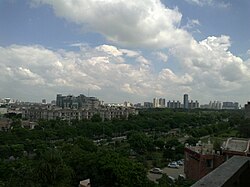
 Connaught Place in New Delhi is an important economic hub of the National Capital. | |
| 1 April – 31 March | |
| Statistics | |
| GDP | $272.603 billion (NCR; Nominal )[1][2] $370 billion (NCR; PPP Metro GDP)[3][4][5] |
| GDP rank | 12th |
GDP growth | 9.18% (2023–24)[2] |
GDP per capita | $11,300 (2023–24)(Nominal)[6][7][8] |
GDP per capita rank | 3rd |
GDP by sector | Agriculture 2% Industry 14% Services 84% (2021–22)[2] |
| Unemployment |  6.6% (Nov 2020)[9] 6.6% (Nov 2020)[9] |
| Public finances | |
| ₹−9,194 crore (US$−1.3 billion) (2022–23 est.)[2] | |
| Revenues | ₹61,891 crore (US$8.7 billion) (2022–23 est.)[2] |
| Expenses | ₹71,085 crore (US$10 billion) (2022–23 est.)[2] |
The economy of Delhi is the 12th largest among states and union territories of India. The Nominal GSDP of the NCR was estimated at 272.603 Billion[1] and the Nominal GSDP of the NCT of Delhi for 2023-24 was estimated at ₹11.07 lakh crore (US$160 billion)[10][11] recording an annual growth of 9.2%. Growth rate in 2014-15 was 9.2%. In 2020-21, the tertiary sector contributed 85% of Delhi's GSDP followed by the secondary and primary sectors at 12% and 3% respectively. The services sector recorded an annual growth of 7.3%. Delhi is the largest commercial centre in northern India. As of 2021[update], recent estimates of the economy of the urban area of Delhi have ranged from $370 billion (PPP metro GDP) and it has $272.603[1][4] billion as (Nominal GDP) ranking it either the most or second-most productive metro area of India.[4][3][12][5]
In recent times, a lot of economic, manufacturing and business activities have been attracted by Noida, Gurugram, Greater Noida, Ghaziabad, Meerut and Faridabad.
A large number of population of Delhi travels daily between Noida, Greater Noida and Gurugram for jobs.[13]
Manufacturing[edit | edit source]
Manufacturing grew considerably as consumer goods companies established manufacturing units and headquarters in the city. Delhi's large consumer market and the availability of skilled labour has also attracted foreign investment. Delhi contributes 4.94% to the total GDP of the country. In 2001, the manufacturing sector employed 1,440,000 workers and the city had 129,000 industrial units.[14]
Services[edit | edit source]
Key service industries are information technology, telecommunications, hotels, banking, media and tourism.[15] Construction, power, health and community services and real estate are also important to the city's economy.[16]
Retail[edit | edit source]
Delhi has one of India's largest and fastest growing retail industries.[16]
Information Technology[edit | edit source]
As with other regions of India, the IT industry has been expanding in Delhi. Although not as robust as the IT industry in some of India's southern states, it still hosts significant IT companies such as Google India, Teleperformance India, HCL Technologies, SAP Labs India, Tata Consultancy Services, Cinfoways and SAS Institute India.[17] Its satellite cities that fall within the NCR, such as Noida in Uttar Pradesh or Gurgaon in Haryana, are also home to a strong IT sector.[18] According to the Industrial Policy for Delhi 2010-21,[19] the Delhi government hopes to increase investments into and further develop the state's IT and ITeS industries.[20] Delhi's government institutions, well-developed infrastructure, increasing workforce and business-friendly culture makes it an ideal location for such an expansion of the IT sector.[21]

Tourism[edit | edit source]
Due to its history, central position and status as the nation's capital, Delhi is a common destination for tourists. Some common tourist attractions include the Red Fort, Qutb Minar, India Gate, Jama Masjid, Humayun's Tomb, Lotus Temple, Akshardham and the Rashtrapati Bhavan. Delhi's tourism sector makes up 5.6% of its GDP and the Delhi government considers it to be "high growth industry."[22] 62% of tourists and NRIs visiting India come to Delhi.[22]
The World Travel & Tourism Council calculated that tourism generated US$3.2 billion or 3.6% of the city's GDP in 2016 and supported 460,300 jobs, 8.3% of its total employment. The sector is predicted to grow at an average annual rate of 10.8% to US$8.9 billion by 2026 (3.7% of GDP). Foreign tourists accounted for 35.5% of all tourism-related spending in Delhi in 2016. The largest source of foreign tourists visiting the city was the United States, which accounted for 11% of foreign tourist visits to the city.[23]
Real Estate[edit | edit source]
The real estate sector has been another growing industry within the NCR. It boomed in the 2000s and many Indians, induced by the soaring property prices, decided to invest in real estate, especially in the growing satellite cities of Gurgaon, Noida and Greater Noida.[24] At the real estate market's peak between 2001 and 2007, one could expect 20-30% annual returns or double their investment in about 3–5 years.[25] By 2013 however, demand for real estate began to decline, reaching an all-time low in 2016.[25] With sales plummeting and real estate firms ridden with debt, developers such as Unitech, Jaypee Infratech Ltd. and the Amrapali Group have slowed progress on their development projects since they lacked the necessary working capital.[24][25]

In response to the crisis, the Parliament of India passed the Real Estate (Regulation and Development) Act, 2016 to protect home-buyers and the real estate industry.[26] The act created the Real Estate Regulatory Authority (RERA) which is responsible for regulating the real estate industry and for addressing disputes for non-delivery.[26] The act also makes it mandatory to register real projects with a clear deadline.[27] This was followed by the Modi government's demonetization of ₹500 and ₹1000 banknotes. One of the stated aims of such an action was to curtail the widespread use of black money in real estate transactions.[28]
Greater compliance and transparency following the establishment of the RERA has had a stabilizing effect on the real estate market. Although the RERA has made it harder for new projects to launch, curtailing the supply-side of the real estate industry, demand has been increasing.[27] For now, except for Gurgaon which is experiencing marginal real estate growth, home values in the Delhi NCR region remain stable.[29]
Transport[edit | edit source]


.jpg)
Another key contributor to Delhi's economy is the transportation sector and the city has been investing various in transport infrastructure projects.[30] More than half of the population in Delhi is dependent on public transport for commuting purposes.[31] Various methods of transportation thrive in Delhi, including the Delhi Metro, trains and buses. The city's metro system in particular is a highly efficient public transport system that was initiated by the Delhi and Indian government in 1998.[32] In 2017, the Metro brought in a revenue of ₹5,388 crore.[33] That said, the Metro has been operating with a loss on an EBITDA basis for the past few years and, as of March 2016, its total debt stands at ₹291.5 billion.[33]
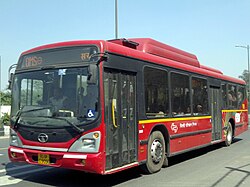
The state-owned Delhi Transport Corporation (DTC) runs the world's largest fleet of CNG buses and one of India's largest bus transport systems.[34] Buses are a very popular means of transportation in Delhi, accounting for about 60% of Delhi's total transport demand.[35] Delhi used to have a Bus Rapid Transit System as well that was a much-vaunted project of the previous Sheila Dikshit-led Congress government however, due to criticisms over poor planning, the Aam Aadmi Party government dismantled the system in 2016.[36]
Auto-rickshaws (commonly known as Auto) are also popular. Cheap, environment-friendly and easily available, these Auto-rickshaws are used both by Delhi residents going on short commutes and tourists yearning for a joyride.
Indira Gandhi International Airport, the primary civilian aviation hub for the NCR, serves Delhi's domestic and international flights and is the busiest airport in India.[37] The airport contributes about 34.5% of the total trade transacted through all major airports of India.[38] It serves as a hub for Air India, GoAir, SpiceJet, IndiGo and AirAsia India.
Employment[edit | edit source]
As per the Economic survey of Delhi (2022–2023), Delhi's workforce constitutes 33.28% of the population (during 2011).[39] The estimated employment rate in Delhi during the period July 2020-June 2021 was 93.7. Unemployment rate in Delhi during aforesaid period was 6.3. Female workers constitute a less percentage of workers during 2011 and it approximated up to 15% of workers in Delhi. The major shares of workers in Delhi were in the category of other workers, which includes all industrial and tertiary sector activities at it constitutes at 95%.
The workforce participation rate for Delhi residents aged above 15 years was 40.8% in 2015-16, lower than the 41.8% recorded in 2012-13. Delhi's workforce participation rate is lower than the national average of 50.5%.[2]
The Delhi chief minister launched a job portal "Rozgar Bazar" for recruiters and job aspirants during the COVID-19 pandemic.[40]
See also[edit | edit source]
References[edit | edit source]
- ↑ 1.0 1.1 1.2 "Global Wealth GDP Nominal Distribution: Who Are The Leaders Of The Global Economy? - Full Size". www.visualcapitalist.com. Retrieved 27 March 2022.
- ↑ 2.0 2.1 2.2 2.3 2.4 2.5 2.6 "Delhi Budget Analysis 2022-23". PRS Legislative Research. Retrieved 3 April 2021.
- ↑ 3.0 3.1 "Global city GDP rankings 2008-2025". PwC. Archived from the original on 4 May 2011. Retrieved 16 December 2009.
- ↑ 4.0 4.1 4.2 "Global city GDP 2014". Brookings Institution. 22 January 2015. Retrieved 8 May 2015.
- ↑ 5.0 5.1 Lewis, Clara (28 November 2016). "Delhi, not Mumbai, India's economic capital - Times of India". The Times of India. Retrieved 24 February 2017.
- ↑ "What is the economic composition of Delhi". metroverse.cid.harvard.edu. Retrieved 16 August 2024.
- ↑ "Our target is to raise Delhi's per capita income to Singapores level by 2047". The Hindu. 16 November 2021. Retrieved 27 July 2022.
- ↑ PTI (23 March 2022). "Delhi's GDP up by 50% since 2016-2017". Economic Times. Retrieved 31 December 2021.
- ↑ "Unemployment Rate in India". Centre for Monitoring Indian Economy. Retrieved 3 November 2020.
- ↑ "Delhi's economy pitched to grow at 9.2%". The Times of India. Retrieved 16 August 2024.
- ↑ "Delhi's growth to surpass national average at 9.18 %". Livemint.com. 20 March 2023. Retrieved 10 April 2023.
- ↑ "The Most Dynamic Cities of 2025". Foreign Policy. Archived from the original on 28 August 2012. Retrieved 24 August 2012.
- ↑ "MC Explains: Why corporates are moving away from Connaught Place in the heart of Delhi to faraway Gurugram and Noida". Moneycontrol. 11 May 2023. Retrieved 18 November 2023.
- ↑ "Chapter 9: Industrial Development" (PDF). Economic Survey of Delhi, 2005–06. Planning Department, Government of National Capital Territory of Delhi. pp. 94–107. Archived from the original (PDF) on 14 June 2007. Retrieved 9 March 2017.
- ↑ "Industries in Delhi". Mapsofindia.com. Retrieved 7 September 2009.
- ↑ 16.0 16.1 "Delhi hot favourite retail destination in India – Corporate Trends – News By Company -News". The Economic Times. Archived from the original on 7 October 2013. Retrieved 3 November 2008.
- ↑ "The 10 Best Companies To Work For In Delhi-NCR". Enterprise Blog for xoxoday. 17 April 2017. Archived from the original on 1 November 2018. Retrieved 3 October 2018.
- ↑ "Although Not Exactly A Hub For Top-Notch IT Firms, Delhi Has A Thriving IT Sector". So Delhi. 18 November 2016.
- ↑ "Draft Industrial Policy". delhi.gov.in.
- ↑ "Information On Industries In Delhi, Economy, Growth & Geography". IBEF. Retrieved 3 October 2018.
- ↑ "Delhi NCR – An Emerging IT Hub in India - India Briefing News". India Briefing News. 29 March 2017. Retrieved 3 October 2018.
- ↑ 22.0 22.1 "Tourism Infrastructure". delhi.gov.in.
- ↑ "CITY TRAVEL & TOURISM IMPACT 2017 Delhi" (PDF). World Travel and Tourism Council. Archived from the original (PDF) on 24 March 2018. Retrieved 19 March 2018.
- ↑ 24.0 24.1 Sukumar, R. (31 July 2015). "Realty Bites". livemint.com. Retrieved 4 October 2018.
- ↑ 25.0 25.1 25.2 Sharma, Ashwini Kumar (5 July 2018). "2018, the year real estate died". livemint.com. Retrieved 4 October 2018.
- ↑ 26.0 26.1 "What is the Real Estate Regulation Act (RERA)? Here is how it will help buyers". The Indian Express. 1 May 2017. Retrieved 4 October 2018.
- ↑ 27.0 27.1 Katiyar, Prerna (2018). "This could be the turnaround year for real estate. Here's why". The Economic Times. Retrieved 4 October 2018.
- ↑ "Here is what PM Modi said about the new Rs 500, Rs 2000 notes and black money". India Today. Retrieved 4 October 2018.
- ↑ "Home prices largely steady in Delhi-NCR during April–June: Report". The Economic Times. 2 August 2018. Archived from the original on 1 November 2018. Retrieved 4 October 2018.
- ↑ Bhandari, Kirti; Kato, Hirokazu; Hayashi, Yoshitsugu (December 2009). "Economic and Equity Evaluation of Delhi Metro". International Journal of Urban Sciences. 13 (2): 187–203. doi:10.1080/12265934.2009.9693657. ISSN 1226-5934. S2CID 154245619.
- ↑ Corporation, Delhi Tourism and Transportation Development. ":: Delhi Tourism : Transport". www.delhitourism.gov.in. Retrieved 28 October 2018.
- ↑ "Delhi Metro among world's top five, claim DMRC officials - Express India". 2 October 2012. Archived from the original on 2 October 2012. Retrieved 28 October 2018.
- ↑ 33.0 33.1 "Annual Accounts And Directors Report 2016-17". Delhi Metro Rail Corporation. Archived from the original on 3 December 2017. Retrieved 22 January 2018.
- ↑ "outlookindia.com | wired". 1 February 2009. Archived from the original on 1 February 2009. Retrieved 28 October 2018.
- ↑ "Chapter 12: Transport". Economic Survey of Delhi, 2005–2006. Planning Department, Government of National Capital Territory of Delhi. pp. 130-146. Archived from the original on 2007-01-16. Retrieved 2006-12-21.
- ↑ "Dismantling Of Delhi's BRT Corridor Begins". NDTV.com. Retrieved 28 October 2018.
- ↑ "Delhi's airport busier than Mumbai's by 40 flights a day - Indian Express". www.indianexpress.com. Retrieved 28 October 2018.
- ↑ "The Economic Impact of the Indira Gandhi International Airport". www.ncaer.org. Archived from the original on 1 November 2018. Retrieved 28 October 2018.
- ↑ "Economic Survey of Delhi, 2022-23" (PDF). Archived from the original (PDF) on 23 May 2023. Retrieved 15 May 2023.
- ↑ "Delhi chief minister launched a job portal for recruiters and job aspirants during COVID-19".


