

m robot: Update article (please report if you notice any mistake or error in this edit) |
general fixed section per sources additionally and cleaned formatting |
||
| Line 1: | Line 1: | ||
{{Use Indian English|date=January 2023}} | |||
{{Use dmy dates|date=June 2023}} | |||
{{Infobox settlement | {{Infobox settlement | ||
| name = Lachhipur | | name = Lachhipur | ||
| native_name = <!-- Please do not add any Indic script in this infobox, per | | native_name = <!-- Please do not add any Indic script in this infobox, per Bharatpedia:INDISCRIPT policy --> | ||
| native_name_lang = | | native_name_lang = | ||
| other_name = | | other_name = | ||
| Line 93: | Line 95: | ||
===Area overview=== | ===Area overview=== | ||
[[Ishwar Chandra Vidyasagar]], scholar, social reformer and a key figure of the [[Bengal Renaissance]], was born at [[Birsingha]] on 26 September 1820.<ref>{{cite web |url= http://en.banglapedia.org/index.php?title=Vidyasagar,_Ishwar_Chandra |title= Vidyasagar, | [[Ishwar Chandra Vidyasagar]], scholar, social reformer and a key figure of the [[Bengal Renaissance]], was born at [[Birsingha]] on 26 September 1820.<ref>{{cite web |url= http://en.banglapedia.org/index.php?title=Vidyasagar,_Ishwar_Chandra |title= Vidyasagar, Pundit Iswar Chandra |publisher=Banglapedia |accessdate=24 July 2016 |last=Murshid |first=Ghulam}}</ref><ref>{{cite web |url=http://www.whereincity.com/india/great-indians/literary-persons/ishwar-chandra.php |title=Ishwar Chandra Vidyasagar |publisher=www.whereincity.com |accessdate=24 July 2016 |archive-date=25 December 2018 |archive-url=https://web.archive.org/web/20181225011712/http://www.whereincity.com/india/great-indians/literary-persons/ishwar-chandra.php |url-status=dead }}</ref> | ||
Ghatal subdivision, shown in the map alongside, has [[Alluvium|alluvial]] soils. Around 85% of the total cultivated area is cropped more than once.<ref>{{cite web | url = http://www.wbpspm.gov.in/publications/District%20Human%20Development%20Report| title = District Human Development Report Paschim Medinipur, 2011| work= page | Ghatal subdivision, shown in the map alongside, has [[Alluvium|alluvial]] soils. Around 85% of the total cultivated area is cropped more than once.<ref>{{cite web | url = http://www.wbpspm.gov.in/publications/District%20Human%20Development%20Report| title = District Human Development Report Paschim Medinipur, 2011| work= page 27-28| publisher = Department of Planning and Statistics, Government of West Bengal |accessdate = 10 September 2020}}</ref> It has a density of population of 1,099 per km<sup>2</sup>, but being a small subdivision only a little over a fifth of the people in the district reside in this subdivision. 14.33% of the population lives in urban areas and 86.67% lives in the rural areas.<ref>{{cite web | url = http://www.wbpspm.gov.in/publications/District%20Statistical%20Handbook | title = District Statistical Handbook Paschim Medinipur, 2013| work= Table 2.2, 2.4 (a)| publisher = Department of Planning and Statistics |accessdate = 10 September 2020}}</ref> | ||
<small>Note: The map alongside presents some of the notable locations in the subdivision. All places marked in the map are linked in the larger full screen map.</small> | <small>Note: The map alongside presents some of the notable locations in the subdivision. All places marked in the map are linked in the larger full screen map.</small> | ||
| Line 107: | Line 109: | ||
==Culture== | ==Culture== | ||
[[David McCutchion|David J. McCutchion]] mention:<ref>McCutchion, David J., ''Late Mediaeval Temples of Bengal'', first published 1972, reprinted 2017, page 53,77. The Asiatic Society, Kolkata, {{ISBN| 978-93-81574-65-2}}</ref> | [[David McCutchion|David J. McCutchion]] mention:<ref>McCutchion, David J., ''Late Mediaeval Temples of Bengal'', first published 1972, reprinted 2017, page 53,77. The Asiatic Society, Kolkata, {{ISBN| 978-93-81574-65-2}}</ref> | ||
*Sridhara temple as a ''[[Bengal temple architecture#Ratna temple|nava-ratna]]'' with smooth rekha turrets, built in 1856, it measures 13’ | *Sridhara temple as a ''[[Bengal temple architecture#Ratna temple|nava-ratna]]'' with smooth rekha turrets, built in 1856, it measures 13’ 10" square, with large terracotta figures. | ||
*Rasmancha of the Bag family as a ''saptadasa-ratna'' with baroque vase pinnacles, built in 1879, it measures 4’ | *Rasmancha of the Bag family as a ''saptadasa-ratna'' with baroque vase pinnacles, built in 1879, it measures 4’ 6" square, with large terracotta figures. | ||
==Lachhipur picture gallery== | ==Lachhipur picture gallery== | ||
| Line 128: | Line 130: | ||
[[Category:Villages in Paschim Medinipur district]] | [[Category:Villages in Paschim Medinipur district]] | ||
[[Category:Long stubs with short prose]] | |||
{{PaschimMedinipur-geo-stub}} | {{PaschimMedinipur-geo-stub}} | ||
Latest revision as of 01:13, 29 July 2025
Lachhipur | |
|---|---|
Village | |
Lachhipur is located in West Bengal  Lachhipur Location in West Bengal, India  Lachhipur Lachhipur (India) | |
| Coordinates: 22°38′05″N 87°38′30″E / 22.634634°N 87.641791°E | |
| Country |  India India |
| State | West Bengal |
| District | Paschim Medinipur |
| Population (2011) | |
| • Total | 854 |
| Languages | |
| • Official | Bengali, English |
| Time zone | UTC+5:30 (IST) |
| PIN | 721232 |
| Telephone/STD code | 03225 |
| Lok Sabha constituency | Ghatal |
| Vidhan Sabha constituency | Ghatal |
| Website | paschimmedinipur |
Lachhipur is a village in the Ghatal CD block in the Ghatal subdivision of the Paschim Medinipur district in the state of West Bengal, India.
Geography[edit | edit source]
Lua error in Module:OSM_Location_map at line 1984: attempt to index field 'wikibase' (a nil value).
Location[edit | edit source]
Lachhipur is located at 22°38′05″N 87°38′30″E / 22.634634°N 87.641791°E.
Area overview[edit | edit source]
Ishwar Chandra Vidyasagar, scholar, social reformer and a key figure of the Bengal Renaissance, was born at Birsingha on 26 September 1820.[1][2]
Ghatal subdivision, shown in the map alongside, has alluvial soils. Around 85% of the total cultivated area is cropped more than once.[3] It has a density of population of 1,099 per km2, but being a small subdivision only a little over a fifth of the people in the district reside in this subdivision. 14.33% of the population lives in urban areas and 86.67% lives in the rural areas.[4]
Note: The map alongside presents some of the notable locations in the subdivision. All places marked in the map are linked in the larger full screen map.
Demographics[edit | edit source]
According to the 2011 Census of India, Lachhipur had a total population of 854, of which 450 (53%) were males and 404 (47%) were females.[5]
Education[edit | edit source]
Lachhipur Binapani High School is a Bengali-medium coeducational institution established in 1952. The school has facilities for teaching from class V to class XII. It has a library with 2,500 books, 2 computers and a playground.[6]
Culture[edit | edit source]
David J. McCutchion mention:[7]
- Sridhara temple as a nava-ratna with smooth rekha turrets, built in 1856, it measures 13’ 10" square, with large terracotta figures.
- Rasmancha of the Bag family as a saptadasa-ratna with baroque vase pinnacles, built in 1879, it measures 4’ 6" square, with large terracotta figures.
Lachhipur picture gallery[edit | edit source]
-
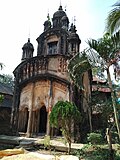 Nava-ratna Sridharjiu temple
 -
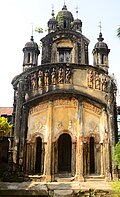 Sridhar jiu temple
 -
 Terracotta figurines
 -
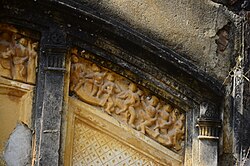 Terracotta figurines


References[edit | edit source]
- ↑ Murshid, Ghulam. "Vidyasagar, Pundit Iswar Chandra". Banglapedia. Retrieved 24 July 2016.
- ↑ "Ishwar Chandra Vidyasagar". www.whereincity.com. Archived from the original on 25 December 2018. Retrieved 24 July 2016.
- ↑ "District Human Development Report Paschim Medinipur, 2011". page 27-28. Department of Planning and Statistics, Government of West Bengal. Retrieved 10 September 2020.
- ↑ "District Statistical Handbook Paschim Medinipur, 2013". Table 2.2, 2.4 (a). Department of Planning and Statistics. Retrieved 10 September 2020.
- ↑ "CD block Wise Primary Census Abstract Data(PCA)". West Bengal – District-wise CD blocks. Registrar General and Census, India. Retrieved 25 August 2020.
- ↑ "Lachhipur B.H. School U. Pry". Schools.org. Retrieved 25 August 2020.
- ↑ McCutchion, David J., Late Mediaeval Temples of Bengal, first published 1972, reprinted 2017, page 53,77. The Asiatic Society, Kolkata, ISBN 978-93-81574-65-2
External links[edit | edit source]


 | This article about a location in the Paschim Medinipur district of West Bengal is a stub. You can help Bharatpedia by expanding it. |