

ImportMaster (talk | contribs) robot: Add missing article in Category:Mahabharata |
CleanupBot (talk | contribs) m clean up |
||
| Line 13: | Line 13: | ||
Further improvements | Further improvements | ||
to this outline are on the way | to this outline are on the way | ||
...-->{{Hinduism}}{{ | ...-->{{Hinduism}}{{About||glossary of terms|Glossary of Hinduism terms|timeline|Timeline of Hinduism}} | ||
The following [[Outline (list)|outline]] is provided as an overview of and topical guide to Hinduism: | The following [[Outline (list)|outline]] is provided as an overview of and topical guide to Hinduism: | ||
| Line 19: | Line 19: | ||
'''[[Hinduism]]''' – predominant and indigenous [[religion|religious tradition]] of the [[Indian Subcontinent]].<ref name = trad>Hinduism is variously defined as a "religion", "set of religious beliefs and practices", "religious tradition" etc. For a discussion on the topic, see: "Establishing the boundaries" in Gavin Flood (2003), pp. 1-17. [[René Guénon]] in his'' [[Introduction to the Study of the Hindu doctrines]]'' (1921 ed.), Sophia Perennis, {{ISBN|0-900588-74-8}}, proposes a definition of the term "religion" and a discussion of its relevance (or lack of) to Hindu doctrines (part II, chapter 4, p. 58).</ref> Its followers are called [[Hindus]], who refer to it as ''{{IAST|Sanātana Dharma}}''<ref>[https://books.google.com/books?id=1gtxVmUr1ygC&pg=PA307&dq=Sanatana+Dharma&hl=en&ei=lqsUTt2FMsLsrAfS98SHBA&sa=X&oi=book_result&ct=book-preview-link&resnum=4&ved=0CEAQuwUwAzgK#v=snippet&q=%22is%20one%20of%20the%20most%20frequently%20used%22&f=false A Historical-developmental study of classical Indian philosophy of morals], Rajendra Prasad, Centre for Studies in Civilizations (Delhi, India), Concept Publishing Company, 2009, {{ISBN|81-8069-595-6}}, {{ISBN|978-81-8069-595-7}}</ref> ({{Lang-sa|सनातनधर्मः|lit=the eternal law that sustains/upholds/surely preserves}}),<ref>[https://books.google.com/books?id=giPbYfAxP7wC&pg=PA6&dq=Sanatana+Dharma&hl=en&ei=UcgATsiLOMTHrQey0oWcDQ&sa=X&oi=book_result&ct=book-preview-link&resnum=5&ved=0CEEQuwUwBA#v=onepage&q=%22that%20which%20sustains%22&f=false Hinduism that is Sanatana Dharma], R. S. Nathan, Chinmaya Mission, 1989, {{ISBN|81-7597-065-0}}, {{ISBN|978-81-7597-065-6}}</ref><ref>[https://books.google.com/books?id=D5Hk8EkmQBcC&pg=PA272&dq=what+makes+%22being+what+it+is%22+Hindu&hl=en&ei=x1EDTuGiDsq4rAfwpLSLDg&sa=X&oi=book_result&ct=book-preview-link&resnum=5&ved=0CEkQuwUwBA#v=onepage&q=%22sustains%20or%20preserves%22&f=false A conceptual-analytic study of classical Indian philosophy of morals], [https://books.google.com/books?id=D5Hk8EkmQBcC&printsec=frontcover&dq=inauthor:%22Rajendra+Prasad%22&hl=en&ei=FlcDTrjWOojrrQegxaDtDQ&sa=X&oi=book_result&ct=result&resnum=3&ved=0CDsQ6AEwAg#v=snippet&q=%22RAJENDRA%20PRASAD%2C%20formerly%20senior%20professor%20of%22&f=false Rajendra Prasad, from preface of the book], Centre for Studies in Civilizations (Delhi, India), Project of History of Indian Science, Philosophy, and Culture. Sub Project: Consciousness, Science, Society, Value, and Yoga, Concept Publishing Company, 2008, {{ISBN|81-8069-544-1}}, {{ISBN|978-81-8069-544-5}}</ref> amongst many other expressions.<ref name = san>The Concise Oxford Dictionary of World Religions. Ed. John Bowker. Oxford University Press, 2000;</ref><ref>The term "Dharma" connotes much more than simply "law". It is not only the doctrine of religious and moral rights, but also the set of religious duties, social order, right conduct and virtuous things and deeds. As such Dharma is the Code of Ethics.[http://encyclopedia2.thefreedictionary.com/Dharma] The modern use of the term can be traced to late 19th century [[Hindu reform movements]] (J. Zavos, ''Defending Hindu Tradition: Sanatana Dharma as a Symbol of Orthodoxy in Colonial India'', Religion (Academic Press), Volume 31, Number 2, April 2001, pp. 109-123; see also R. D. Baird, "[[Swami Bhaktivedant]]a and the Encounter with Religions", ''Modern Indian Responses to Religious Pluralism'', edited by [[Harold Coward]], State University of New York Press, 1987); less literally also rendered "eternal way" (so {{Citation |author=Harvey, Andrew |title=Teachings of the Hindu Mystics |publisher=Shambhala |location=Boulder |year=2001 |pages=xiii |isbn=1-57062-449-6 |no-pp=true}}). See also [[René Guénon]], ''Introduction to the Study of the Hindu Doctrines'' (1921 ed.), Sophia Perennis, {{ISBN|0-900588-74-8}}, part III, chapter 5 "The Law of Manu", p. 146. On the meaning of the word "Dharma", see also [[René Guénon]], ''Studies in Hinduism'', Sophia Perennis, {{ISBN|978-0-900588-69-3}}, chapter 5, p. 45</ref> Hinduism has no single founder, and is formed of diverse traditions,<ref>{{Harvnb|Osborne|2005|p=9}}</ref> including a wide spectrum of laws and prescriptions of "daily morality" based on the notion of karma, dharma, and societal norms. Among its direct roots is the [[historical Vedic religion]] of [[Iron Age India]] and, as such, Hinduism is often called the "[[oldest religion|oldest living religion]]"<ref>D. S. Sarma, Kenneth W. Morgan, ''The Religion of the Hindus'', 1953</ref> or the "oldest living major religion" in the world.<ref name = webster>{{Citation | title = Merriam-Webster's Collegiate Encyclopedia| publisher = Merriam-Webster | year = 2000 | page = 751}}</ref><ref>in the world.{{Citation |author=Laderman, Gary |title=Religion and American Cultures: An Encyclopedia of Traditions, Diversity, and Popular Expressions |publisher=ABC-CLIO |location=Santa Barbara, Calif |year=2003 |pages=119|isbn=1-57607-238-X |quote=world's oldest living civilization and religion}}</ref><ref>{{Citation|author=Turner, Jeffrey S.|title=Encyclopedia of relationships across the lifespan|publisher=Greenwood Press|location=Westport, Conn|year=1996|pages=[https://archive.org/details/encyclopediaofre0000turn/page/359 359]|isbn=0-313-29576-X|quote=It is also recognized as the oldest major religion in the world|url=https://archive.org/details/encyclopediaofre0000turn/page/359}}</ref><ref name="Klostermaier 1994 p=1">{{Harvnb|Klostermaier|1994|p=1}}</ref> | '''[[Hinduism]]''' – predominant and indigenous [[religion|religious tradition]] of the [[Indian Subcontinent]].<ref name = trad>Hinduism is variously defined as a "religion", "set of religious beliefs and practices", "religious tradition" etc. For a discussion on the topic, see: "Establishing the boundaries" in Gavin Flood (2003), pp. 1-17. [[René Guénon]] in his'' [[Introduction to the Study of the Hindu doctrines]]'' (1921 ed.), Sophia Perennis, {{ISBN|0-900588-74-8}}, proposes a definition of the term "religion" and a discussion of its relevance (or lack of) to Hindu doctrines (part II, chapter 4, p. 58).</ref> Its followers are called [[Hindus]], who refer to it as ''{{IAST|Sanātana Dharma}}''<ref>[https://books.google.com/books?id=1gtxVmUr1ygC&pg=PA307&dq=Sanatana+Dharma&hl=en&ei=lqsUTt2FMsLsrAfS98SHBA&sa=X&oi=book_result&ct=book-preview-link&resnum=4&ved=0CEAQuwUwAzgK#v=snippet&q=%22is%20one%20of%20the%20most%20frequently%20used%22&f=false A Historical-developmental study of classical Indian philosophy of morals], Rajendra Prasad, Centre for Studies in Civilizations (Delhi, India), Concept Publishing Company, 2009, {{ISBN|81-8069-595-6}}, {{ISBN|978-81-8069-595-7}}</ref> ({{Lang-sa|सनातनधर्मः|lit=the eternal law that sustains/upholds/surely preserves}}),<ref>[https://books.google.com/books?id=giPbYfAxP7wC&pg=PA6&dq=Sanatana+Dharma&hl=en&ei=UcgATsiLOMTHrQey0oWcDQ&sa=X&oi=book_result&ct=book-preview-link&resnum=5&ved=0CEEQuwUwBA#v=onepage&q=%22that%20which%20sustains%22&f=false Hinduism that is Sanatana Dharma], R. S. Nathan, Chinmaya Mission, 1989, {{ISBN|81-7597-065-0}}, {{ISBN|978-81-7597-065-6}}</ref><ref>[https://books.google.com/books?id=D5Hk8EkmQBcC&pg=PA272&dq=what+makes+%22being+what+it+is%22+Hindu&hl=en&ei=x1EDTuGiDsq4rAfwpLSLDg&sa=X&oi=book_result&ct=book-preview-link&resnum=5&ved=0CEkQuwUwBA#v=onepage&q=%22sustains%20or%20preserves%22&f=false A conceptual-analytic study of classical Indian philosophy of morals], [https://books.google.com/books?id=D5Hk8EkmQBcC&printsec=frontcover&dq=inauthor:%22Rajendra+Prasad%22&hl=en&ei=FlcDTrjWOojrrQegxaDtDQ&sa=X&oi=book_result&ct=result&resnum=3&ved=0CDsQ6AEwAg#v=snippet&q=%22RAJENDRA%20PRASAD%2C%20formerly%20senior%20professor%20of%22&f=false Rajendra Prasad, from preface of the book], Centre for Studies in Civilizations (Delhi, India), Project of History of Indian Science, Philosophy, and Culture. Sub Project: Consciousness, Science, Society, Value, and Yoga, Concept Publishing Company, 2008, {{ISBN|81-8069-544-1}}, {{ISBN|978-81-8069-544-5}}</ref> amongst many other expressions.<ref name = san>The Concise Oxford Dictionary of World Religions. Ed. John Bowker. Oxford University Press, 2000;</ref><ref>The term "Dharma" connotes much more than simply "law". It is not only the doctrine of religious and moral rights, but also the set of religious duties, social order, right conduct and virtuous things and deeds. As such Dharma is the Code of Ethics.[http://encyclopedia2.thefreedictionary.com/Dharma] The modern use of the term can be traced to late 19th century [[Hindu reform movements]] (J. Zavos, ''Defending Hindu Tradition: Sanatana Dharma as a Symbol of Orthodoxy in Colonial India'', Religion (Academic Press), Volume 31, Number 2, April 2001, pp. 109-123; see also R. D. Baird, "[[Swami Bhaktivedant]]a and the Encounter with Religions", ''Modern Indian Responses to Religious Pluralism'', edited by [[Harold Coward]], State University of New York Press, 1987); less literally also rendered "eternal way" (so {{Citation |author=Harvey, Andrew |title=Teachings of the Hindu Mystics |publisher=Shambhala |location=Boulder |year=2001 |pages=xiii |isbn=1-57062-449-6 |no-pp=true}}). See also [[René Guénon]], ''Introduction to the Study of the Hindu Doctrines'' (1921 ed.), Sophia Perennis, {{ISBN|0-900588-74-8}}, part III, chapter 5 "The Law of Manu", p. 146. On the meaning of the word "Dharma", see also [[René Guénon]], ''Studies in Hinduism'', Sophia Perennis, {{ISBN|978-0-900588-69-3}}, chapter 5, p. 45</ref> Hinduism has no single founder, and is formed of diverse traditions,<ref>{{Harvnb|Osborne|2005|p=9}}</ref> including a wide spectrum of laws and prescriptions of "daily morality" based on the notion of karma, dharma, and societal norms. Among its direct roots is the [[historical Vedic religion]] of [[Iron Age India]] and, as such, Hinduism is often called the "[[oldest religion|oldest living religion]]"<ref>D. S. Sarma, Kenneth W. Morgan, ''The Religion of the Hindus'', 1953</ref> or the "oldest living major religion" in the world.<ref name = webster>{{Citation | title = Merriam-Webster's Collegiate Encyclopedia| publisher = Merriam-Webster | year = 2000 | page = 751}}</ref><ref>in the world.{{Citation |author=Laderman, Gary |title=Religion and American Cultures: An Encyclopedia of Traditions, Diversity, and Popular Expressions |publisher=ABC-CLIO |location=Santa Barbara, Calif |year=2003 |pages=119|isbn=1-57607-238-X |quote=world's oldest living civilization and religion}}</ref><ref>{{Citation|author=Turner, Jeffrey S.|title=Encyclopedia of relationships across the lifespan|publisher=Greenwood Press|location=Westport, Conn|year=1996|pages=[https://archive.org/details/encyclopediaofre0000turn/page/359 359]|isbn=0-313-29576-X|quote=It is also recognized as the oldest major religion in the world|url=https://archive.org/details/encyclopediaofre0000turn/page/359}}</ref><ref name="Klostermaier 1994 p=1">{{Harvnb|Klostermaier|1994|p=1}}</ref> | ||
{{TOC limit}} | |||
== General reference == | == General reference == | ||
| Line 66: | Line 66: | ||
** [[Munitraya Sampradayam|Munitraya]] | ** [[Munitraya Sampradayam|Munitraya]] | ||
* [[Krishnaism]] | * [[Krishnaism]] | ||
* [[Jagannath | * [[Jagannath]]ism | ||
* [[Warkari]] | * [[Warkari]] | ||
* [[Mahanubhava]] | * [[Mahanubhava]] | ||
| Line 132: | Line 132: | ||
** [[Aegle marmelos#Religious significance|Bilva]] | ** [[Aegle marmelos#Religious significance|Bilva]] | ||
** [[Maha Shivaratri]] | ** [[Maha Shivaratri]] | ||
** [[Yamas]]-[[Niyama | ** [[Yamas]]-[[Niyama]]s | ||
** [[Guru]]-[[Lingam|Linga]]-[[Jangam]] | ** [[Guru]]-[[Lingam|Linga]]-[[Jangam]] | ||
* Philosphies and Schools | * Philosphies and Schools | ||
| Line 150: | Line 150: | ||
**** [[Inchegeri Sampradaya|Inchegeri]] | **** [[Inchegeri Sampradaya|Inchegeri]] | ||
*** [[Veerashaiva]]/[[Lingayatism]] | *** [[Veerashaiva]]/[[Lingayatism]] | ||
*** [[Siddhar | *** [[Siddhar]]ism | ||
*** [[Śrauta|Sroutaism]] | *** [[Śrauta|Sroutaism]] | ||
*** [[Aghori]] | *** [[Aghori]] | ||
| Line 163: | Line 163: | ||
* [[American Meditation Institute]] | * [[American Meditation Institute]] | ||
* [[Ananda movement|Ananda]] ([[Ananda Yoga]]) | * [[Ananda movement|Ananda]] ([[Ananda Yoga]]) | ||
* [[Swami Paramananda#In | * [[Swami Paramananda#In the West. Ananda Ashrama|Ananda Ashrama]] | ||
* [[Ananda Marga]] | * [[Ananda Marga]] | ||
* [[Art of Living Foundation]] | * [[Art of Living Foundation]] | ||
| Line 318: | Line 318: | ||
** [[Akhil Bharatiya Adhivakta Parishad]] | ** [[Akhil Bharatiya Adhivakta Parishad]] | ||
** [[Swadeshi Jagaran Manch]] | ** [[Swadeshi Jagaran Manch]] | ||
** [[Nanaji Deshmukh#Deendayal | ** [[Nanaji Deshmukh#Deendayal Research Institute (DRI)|Deen Dayal Shodh Sansthan]] | ||
** [[Bharat Vikas Parishad]] | ** [[Bharat Vikas Parishad]] | ||
** [[Sabarimala Ayyappa Seva Samajam (SASS)|Sabarimala Ayyappa Seva Samajam]] | ** [[Sabarimala Ayyappa Seva Samajam (SASS)|Sabarimala Ayyappa Seva Samajam]] | ||
| Line 378: | Line 378: | ||
* [[Sri Chinmoy]] Centres | * [[Sri Chinmoy]] Centres | ||
* [[Sri Ramana Ashram]] | * [[Sri Ramana Ashram]] | ||
* [[Bhakti Hridaya Bon#Sri | * [[Bhakti Hridaya Bon#Sri Sri Radha Govindaji Trust|Sri Sri Radha Govindaji Trust]] | ||
* [[Sringeri Sharada Peetham]] | * [[Sringeri Sharada Peetham]] | ||
* [[Pandurang Shastri Athavale|Swadhyay Parivar]] | * [[Pandurang Shastri Athavale|Swadhyay Parivar]] | ||
Latest revision as of 09:13, 11 December 2022
| Part of a series on |
| Hinduism |
|---|
 |

The following outline is provided as an overview of and topical guide to Hinduism:
Hinduism – predominant and indigenous religious tradition of the Indian Subcontinent.[1] Its followers are called Hindus, who refer to it as Sanātana Dharma[2] (Sanskrit: सनातनधर्मः, lit. 'the eternal law that sustains/upholds/surely preserves'),[3][4] amongst many other expressions.[5][6] Hinduism has no single founder, and is formed of diverse traditions,[7] including a wide spectrum of laws and prescriptions of "daily morality" based on the notion of karma, dharma, and societal norms. Among its direct roots is the historical Vedic religion of Iron Age India and, as such, Hinduism is often called the "oldest living religion"[8] or the "oldest living major religion" in the world.[9][10][11][12]
General reference[edit | edit source]
- Pronunciation: /ˈhɪnduɪzəm/
- IPA: hindo͞oˌizəm
- Common English name: Hinduism
- Adherent(s): Hindus
- Sacred language: Sanskrit (
sa)
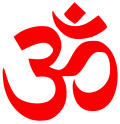
- Sacred sign: Om (ॐ)
History[edit | edit source]
- History of Hinduism in Pakistan
- History of Hinduism in Southeast Asia
- History of Hinduism in Afghanistan
- History of Hinduism in China
- History of Hinduism in the Philippines
Prehistoric[edit | edit source]
Vedic history[edit | edit source]
- Historical Vedic religion
- Vedic Sanskrit
- Iron Age in India
- Proto-Indo-Europeans
- Proto-Indo-European religion
- Proto-Indo-Iranian religion
- Indo-Aryan migrations
Denomination[edit | edit source]
[edit | edit source]
| Part of a series on |
| Vaishnavism |
|---|
 |
 Hinduism portal Hinduism portal |
- Manipuri Vaishnavism
- Bhagavatism
- Vaikhanasas
- Pancharatra
- Thenkalais
- Vadakalais
- Krishnaism
- Jagannathism
- Warkari
- Mahanubhava
- Haridasa
- Sahajiya
- Pushtimarg
- Ekasarana
- Gaudiya
- Radha-vallabha
- Ramanandi
- Kapadi
- Balmiki
- Kabir panth
- Dadu panth
- Pranami
- Swaminarayan
- Ramsnehi
- Mahanam
Shaivism[edit | edit source]
| Part of a series on |
| Shaivism |
|---|
 |
|
Hinduism portal |
Three bondages
- Karma
- Maya
- 36 Tattvas
- Yoga
- Satkaryavada
- Abhasavada
- Svatantrya
- Aham
- Samariscus
- Philosphies and Schools
- Adi Margam
- Mantra Margam Saiddhantika
- Siddhantism Non - Saiddhantika
- Kashmir Shaivism
- Others
Newer movements[edit | edit source]
- Advait Mat
- American Meditation Institute
- Ananda (Ananda Yoga)
- Ananda Ashrama
- Ananda Marga
- Art of Living Foundation
- Arya Samaj
- Ayyavazhi
- Brahma Kumaris
- Brahmoism (Brahmo Samaj)
- Chinmaya Mission
- Datta Yoga
- Divine Life Society
- Hanuman Foundation
- Himalayan Institute of Yoga Science and Philosophy
- Advaita Vedanta
- Akshar-Purushottam Darshan
- Bhedabheda
- Dvaita Vedanta
- Integral yoga
- Pratyabhijna
- Shaiva Siddhanta
- Shiva Advaita
- Shuddhadvaita
- Vishishtadvaita
Practices[edit | edit source]
Festivals[edit | edit source]
- Diwali
- Holi
- Shivaratri
- Raksha Bandhan
- Navaratri
- Ganesh Chaturthi
- Rama Navami
- Janmashtami
- Onam
- Pongal
- Makar Sankranti
- New Year
- Kumbh Mela
| Major festivals | ||
|---|---|---|
| Other important festivals | ||
| Regional New Year |
| |
| Holy days |
| |
| Holy periods | ||


Philosophy[edit | edit source]
- Bhakti
- Krishnaism
- Supreme Personality of Godhead
- Japa
- Yoga
- Meditation
- Hare Krishna
- Mantras
- Puja
- Arati
- Bhajan
- Kirtan
- Sattvic diet
- Ahimsa
- Rishis
- Tilaka
- Guru
- Diksha
- Dashavatara
- Pancha-tattva
Politics[edit | edit source]
Hindu groups and political parties[edit | edit source]
- Bharatiya Janata Party
- Shiv Sena
- All Jammu and Kashmir Praja Parishad
- Asom Bharatiya Janata Party
- Maharashtra Navnirman Sena
- Hindu Munnani
- Hindu Dharma Samudaya of Bhutan
- Maharashtrawadi Gomantak Party
- Hindu Makkal Katchi
- Dr. Syamaprasad Jana Jagaran Manch
- Bharath Dharma Jana Sena
- Hindu Mahasabha
- Hindu Mahajana Sangam
- Hindu Samhati
- Shivsena Nepal
- Rastriya Prajatantra Party Nepal
- Rastriya Prajatantra Party
- Hindu Prajatantrik Party
- Siva Senai
- Banga Sena
- Swadhin Bangabhumi Andolan
- Pakistan Hindu Party
- Progressive Reform Party (Suriname)
- HINDRAF
- Malaysia Makkal Sakti Party
- Malaysian Ceylonese Congress
- Malaysian Advancement Party
- Minority Rights Action Party
- Sangh Parivar
- Vishva Hindu Parishad
- Rashtriya Swayamsevak Sangh
- Akhil Bharatiya Vidyarthi Parishad
- Bharatiya Mazdoor Sangh
- Bharatiya Kisan Sangh
- Bajrang Dal
- Hindu Swayamsevak Sangh
- Akhil Bharatiya Adhivakta Parishad
- Swadeshi Jagaran Manch
- Deen Dayal Shodh Sansthan
- Bharat Vikas Parishad
- Sabarimala Ayyappa Seva Samajam
- Seva Bharati
- Hindu Aikya Vedi
- Ekal Vidyalaya
- Saraswati Shishu Mandir
- Vidya Bharati Akhil Bharatiya Shiksha Sansthan
- Vanavasi Kalyan Ashram
- Friends of Tribals Society
- Akhil Bharatiya Itihas Sankalan Yojana
- India Development and Relief Fund
Organisations[edit | edit source]
- Survey of Hindu organisations
- ISKCON
- Swaminarayan Sampraday
- Bochasanwasi Shri Akshar Purushottam Swaminarayan Sanstha
- Arya Samaj
- Ramakrishna Mission
- Sringeri Sharada Peetham
- Banga Mahila Vidyalaya
- Gaudiya Math
- Hindu Maha Sabha (Fiji)
- Manav Dharma Sabha
- Paramahansa Mandali
- Prarthana Samaj
- Ratnagiri Hindu Sabha
- Satyashodhak Samaj
- Tattwabodhini Sabha
- Theosophical Society of the Arya Samaj
- Trust deed of Brahmo Sabha
- Hindu Sewa Parishad
- Sri Trimurtidham Balaji Hanuman Mandir
- Saiva Siddhanta Church
- Sanatan Dharma Maha Sabha
- Sanatan Sanstha
- Santhigiri Ashram
- Sathya Sai Organization
- Satsang (Deoghar)
- Science of Identity Foundation
- Science of Spirituality (a.k.a. Sawan Kirpal Ruhani Mission)
- Self-Realization Fellowship
- Shree Shree Anandamayee Sangha
- Siddha Yoga Dham Associates Foundation
- Sivananda Yoga Vedanta Centres
- Society of Abidance in Truth
- Sree Narayana Dharma Paripalana Yogam
- Sri Aurobindo Ashram
- Sri Chinmoy Centres
- Sri Ramana Ashram
- Sri Sri Radha Govindaji Trust
- Sringeri Sharada Peetham
- Swadhyay Parivar
- Swaminarayan Mandir Vasna Sanstha
- Vishwa Madhwa Maha Parishat
- Vishwa Nirmala Dharma
Hindu texts[edit | edit source]
| Part of a series on |
| Hindu scriptures and texts |
|---|
 |
| Related Hindu texts |
Vedas[edit | edit source]
Upanishads[edit | edit source]
108 Upanishads[edit | edit source]
- The 108 Upanishads
- Isha
- Kena
- Katha
- Prashna
- Mundaka
- Mandukya
- Taittiriya
- Aitareya
- Chandogya
- Brihadaranyaka
- Brahma
- Kaivalya
- Jabala
- Shvetashvatara
- Hamsa
- Aruneya
- Garbha
- Narayana
- Paramahamsa
- Amritabindu
- Amritanada
- Atharvashiras
- Atharvashikha
- Maitrayaniya
- Kaushitaki
- Brihajjabala
- Nrisimha Tapaniya
- Kalagni Rudra
- Maitreya
- Subala
- Kshurika
- Mantrika
- Sarvasara
- Niralamba
- Shukarahasya
- Vajrasuchi
- Tejobindu
- Nadabindu
- Dhyanabindu
- Brahmavidya
- Yogatattva
- Atmabodha
- Naradaparivrajaka
- Trishikhi-brahmana
- Sita
- Yogachudamani
- Nirvana
- Mandala-brahmana
- Dakshinamurti
- Sharabha
- Skanda
- Mahanarayana
- Advayataraka
- Rama Rahasya
- Ramatapaniya
- Vasudeva
- Mudgala
- Shandilya
- Paingala
- Bhikshuka
- Maha
- Sariraka
- Yogashikha
- Turiyatita
- Sannyasa
- Paramahamsaparivrajaka
- Akshamalika
- Avyakta
- Ekakshara
- Annapurna
- Surya
- Akshi
- Adhyatma
- Kundika
- Savitri
- Atma
- Pashupatabrahma
- Parabrahma
- Avadhuta
- Tripuratapini
- Devi
- Tripura
- Kathashruti
- Bhavana
- Rudrahridaya
- Yoga-Kundalini
- Bhasma
- Rudraksha
- Ganapati
- Darshana
- Tarasara
- Mahavakya
- Pancabrahma
- Pranagnihotra
- Gopala-Tapani
- Krishna
- Yajnavalkya
- Varaha
- Shatyayaniya
- Hayagriva
- Dattatreya
- Garuda
- Kali-Santarana
- Jabali
- Saubhagyalakshmi
- Sarasvati-rahasya
- Bahvricha
- Muktikā

_name_of_the_God_as_per_the_Vedas.svg)
Rig Vedic[edit | edit source]
Sama Vedic[edit | edit source]
Yajur Vedic[edit | edit source]
Atharava Vedic[edit | edit source]
Vedangas[edit | edit source]
Puranas[edit | edit source]
Brahma Puranas[edit | edit source]
[edit | edit source]
Shaiva Puranas[edit | edit source]
Shastras and Sutras[edit | edit source]
- Dharma Shastra
- Artha Shastra
- Kamasutra
- Brahma Sutras
- Samkhya Sutras
- Mimamsa Sutras
- Nyāya Sūtras
- Vaiśeṣika Sūtra
- Yoga Sutras
- Pramana Sutras
- Charaka Samhita
- Sushruta Samhita
- Natya Shastra
- Vastu Shastra
- Panchatantra
- Divya Prabandha
- Tirumurai
- Ramcharitmanas
- Yoga Vasistha
- Swara yoga
- Shiva Samhita
- Gheranda Samhita
- Panchadasi
- Vedantasara
- Stotra
Literary texts[edit | edit source]
Hindu people[edit | edit source]
Freedom fighters[edit | edit source]
- Pazhassi Raja
- Mangal Pandey
- Chandrashekhar Azad
- Subhas Chandra Bose
- Bankim Chandra Chatterjee
- Veer Savarkar
- Lokmanya Tilak
Social leaders[edit | edit source]
Politicians[edit | edit source]
- Mahatma Gandhi
- Jawaharlal Nehru
- Vallabhbhai Patel
- Lal Bahadur Shastri
- Rajiv Gandhi
- Indira Gandhi
- Atal Bihari Vajpayee
- Lal Krishna Advani
- Balasaheb Thackeray
- Yogi Adityanath
- Govindacharya
- Narendra Modi
- Uma Bharti
- Himanta Biswa Sarma
- Rajnath Singh
Other terms and concepts[edit | edit source]
Inter-religious[edit | edit source]
Template:Hinduism and other religions
- Hinduism and Buddhism
- Hinduism and Jainism
- Hinduism and Sikhism
- Hinduism and Islam
- Hinduism and Christianity
Further reading[edit | edit source]
- Dowson, John (1888). A Classical Dictionary of Hindu Mythology and Religion, Geography, History, and Literature. Trubner & Co., London.
- Klostermaier, Klaus K. (1994). A Survey of Hinduism: First Edition. SUNY Press. ISBN 978-0-88706-807-2.
- Osborne, E (2005). Accessing R.E. Founders & Leaders, Buddhism, Hinduism, and Sikhism Teacher's Book Mainstream. Folens Limited.
References[edit | edit source]
- ↑ Hinduism is variously defined as a "religion", "set of religious beliefs and practices", "religious tradition" etc. For a discussion on the topic, see: "Establishing the boundaries" in Gavin Flood (2003), pp. 1-17. René Guénon in his Introduction to the Study of the Hindu doctrines (1921 ed.), Sophia Perennis, ISBN 0-900588-74-8, proposes a definition of the term "religion" and a discussion of its relevance (or lack of) to Hindu doctrines (part II, chapter 4, p. 58).
- ↑ A Historical-developmental study of classical Indian philosophy of morals, Rajendra Prasad, Centre for Studies in Civilizations (Delhi, India), Concept Publishing Company, 2009, ISBN 81-8069-595-6, ISBN 978-81-8069-595-7
- ↑ Hinduism that is Sanatana Dharma, R. S. Nathan, Chinmaya Mission, 1989, ISBN 81-7597-065-0, ISBN 978-81-7597-065-6
- ↑ A conceptual-analytic study of classical Indian philosophy of morals, Rajendra Prasad, from preface of the book, Centre for Studies in Civilizations (Delhi, India), Project of History of Indian Science, Philosophy, and Culture. Sub Project: Consciousness, Science, Society, Value, and Yoga, Concept Publishing Company, 2008, ISBN 81-8069-544-1, ISBN 978-81-8069-544-5
- ↑ The Concise Oxford Dictionary of World Religions. Ed. John Bowker. Oxford University Press, 2000;
- ↑ The term "Dharma" connotes much more than simply "law". It is not only the doctrine of religious and moral rights, but also the set of religious duties, social order, right conduct and virtuous things and deeds. As such Dharma is the Code of Ethics.[1] The modern use of the term can be traced to late 19th century Hindu reform movements (J. Zavos, Defending Hindu Tradition: Sanatana Dharma as a Symbol of Orthodoxy in Colonial India, Religion (Academic Press), Volume 31, Number 2, April 2001, pp. 109-123; see also R. D. Baird, "Swami Bhaktivedanta and the Encounter with Religions", Modern Indian Responses to Religious Pluralism, edited by Harold Coward, State University of New York Press, 1987); less literally also rendered "eternal way" (so Harvey, Andrew (2001), Teachings of the Hindu Mystics, Boulder: Shambhala, xiii, ISBN 1-57062-449-6). See also René Guénon, Introduction to the Study of the Hindu Doctrines (1921 ed.), Sophia Perennis, ISBN 0-900588-74-8, part III, chapter 5 "The Law of Manu", p. 146. On the meaning of the word "Dharma", see also René Guénon, Studies in Hinduism, Sophia Perennis, ISBN 978-0-900588-69-3, chapter 5, p. 45
- ↑ Osborne 2005, p. 9
- ↑ D. S. Sarma, Kenneth W. Morgan, The Religion of the Hindus, 1953
- ↑ Merriam-Webster's Collegiate Encyclopedia, Merriam-Webster, 2000, p. 751
- ↑ in the world.Laderman, Gary (2003), Religion and American Cultures: An Encyclopedia of Traditions, Diversity, and Popular Expressions, Santa Barbara, Calif: ABC-CLIO, p. 119, ISBN 1-57607-238-X,
world's oldest living civilization and religion
- ↑ Turner, Jeffrey S. (1996), Encyclopedia of relationships across the lifespan, Westport, Conn: Greenwood Press, pp. 359, ISBN 0-313-29576-X,
It is also recognized as the oldest major religion in the world
- ↑ Klostermaier 1994, p. 1
External links[edit | edit source]
| Philosophy |
|  | |||||||||||||||
|---|---|---|---|---|---|---|---|---|---|---|---|---|---|---|---|---|---|
| Texts |
| ||||||||||||||||
| Deities |
| ||||||||||||||||
| Practices |
| ||||||||||||||||
| Related | |||||||||||||||||