








m Removed empty portal template using script |
slightly updated intro and added references per sources |
||
| Line 1: | Line 1: | ||
{{About|the Hindu goddess|the Vedic river| | {{short description|Principal Hindu goddess; goddess of knowledge, music, and speech in Hinduism and Jainism}} | ||
{{About|the Hindu goddess|the Vedic river|Saraswati River|other uses|Saraswati (disambiguation)}} | |||
{{ | {{pp-vandalism|small=yes}} | ||
{{EngvarB|date=September 2016}} | {{EngvarB|date=September 2016}} | ||
{{Use dmy dates|date= | {{Use dmy dates|date=May 2025}} | ||
{{Infobox deity<!--Wikipedia:WikiProject Hindu mythology--> | {{Infobox deity<!--Wikipedia:WikiProject Hindu mythology--> | ||
| name = Saraswati | |||
| type = Hindu | | type = Hindu | ||
| image = Saraswati.jpg | | image = Saraswati.jpg | ||
| caption = Painting of | | caption = Painting of Sarasvati by [[Raja Ravi Varma]] | ||
| deity_of = Mother Goddess<br>Goddess of knowledge, education, learning, speech, arts, music, poetry, purification, language and culture<ref name=Kinsley1988 /><ref name=":9" /><br />Personification of the [[Saraswati River]] | |||
| deity_of = Mother | | affiliation = {{hlist|[[Devi]]|[[Tridevi]]|[[Gayatri]]|[[Sharada Peeth|Sharada]]|[[Shakti]]|[[Mahadevi]]|[[Matangi]]}} | ||
| abode = {{hlist|[[Satyaloka]]|[[Manidvipa]]}} | |||
| affiliation = [[Devi]] | | day = Friday | ||
| abode = [[Satyaloka]] | | consort = [[Brahma]] | ||
| | | other_names = {{hlist|[[Vāc|Vagdevi]]|Sharada Bhavani|Vani|Savitri|[[Brahmani (Matrika)|Brahmani]]|Bharati}} | ||
| consort = [[Brahma]] | | colour = {{hlist|White|yellow}} | ||
| | | symbols = {{hlist|[[Veena]]|[[books]]|rosary|white [[List of plants known as lotus|lotus]]}} | ||
| mount = {{hlist|''[[Hamsa (bird)|Hamsa]]'' (white goose or swan)|[[peacock]]}} | |||
| | | mantra = * ''om̐ aim mahāsarasvatyaya namaḥ'' | ||
| | * ''[[Sarasvati Vandana|Sarasvatī Vandanā]]''{{refn|group = note|The hymn comprises the following four verses:<ref>{{Cite book|last=Shivakumar|first=K. N.|url=https://books.google.com/books?id=BgAUEAAAQBAJ&dq=saraswati+vandana&pg=PA8|title=Shlokas and Bhajans: with general knowledge and subhashitams|date=14 January 2021|publisher=Sangeet Bharati|pages=9|language=en}}</ref> | ||
| | :''yā kundendutuṣārahāradhavalā yā śubhravastrāvṛtā'' | ||
| | :''yā vīṇāvaradaṇḍamaṇḍitakarā yā śvetapadmāsanā'' | ||
:''yā brahmācyuta śaṃkaraprabhṛtibhirdevaiḥ sadā pūjitā'' | |||
:''sā māṃ pātu sarasvati bhagavatī niḥśeṣajāḍyāpahā''}} | |||
| festivals = {{hlist|[[Vasant Panchami]]|[[Sarasvati Puja]]| last three (7th, 8th & 9th) days of [[Navaratri]]}} | |||
| member_of = [[Tridevi]] and [[Prakriti|Pancha Prakriti]] | |||
| script_name = Devanagari | | script_name = Devanagari | ||
| script = सरस्वती | | script = सरस्वती | ||
| Sanskrit_transliteration = Sarasvatī | | Sanskrit_transliteration = Sarasvatī | ||
| equivalent1 = [[Anahita]]<ref>Lommel, H. "Anahita-Sarasvati," Asiatica, Festschrift F. Weller, Leipzig, 1954, pp. 405–13</ref><ref>{{Cite book|last=Allen|first=Charles|url=https://books.google.com/books?id=yE7fEAAAQBAJ&pg=PT239|title=Aryans: The Search for a People, a Place and a Myth|date=15 November 2023|publisher=Hachette India|isbn=978-93-5731-266-0|language=en}}</ref><ref>{{Cite book|last=Bhattacharyya|first=Haridas|url=https://books.google.com/books?id=mzGlx3-ofJMC&dq=anahita+and+saraswati&pg=PA89|title=The Foundations of Living Faiths: An Introduction to Comparative Religion|date=1994|publisher=Motilal Banarsidass Publ.|isbn=978-81-208-1147-8|language=en}}</ref> | |||
| equivalent1_type = Persian | |||
}} | }} | ||
'''Saraswati''' ({{langx|sa|सरस्वती}}<!--Do not remove, WP:INDICSCRIPT doesn't apply to WikiProject Hinduism-->, {{IAST3|Sarasvatī}}), also spelled as '''Sarasvati''', is one of the principal [[Devi|goddesses]] in [[Hinduism]], revered as the goddess of knowledge, education, learning, arts, speech, poetry, music, creativity, purification, language and culture.<ref name=Kinsley1988>{{cite book|first=David|last=Kinsley|year=1988|title=Hindu Goddesses: Vision of the divine feminine in the Hindu religious traditions|publisher=University of California Press|isbn=0-520063392|pages=[https://archive.org/details/hindugoddessesvi0000kins/page/55 55–64]|url=https://archive.org/details/hindugoddessesvi0000kins/page/55}}</ref><ref name=":9" /><ref>{{Cite web |title=Maa Saraswati {{!}} Emory {{!}} Michael C. Carlos Museum |url=https://carlos.emory.edu/maa-saraswati |access-date=2025-09-28 |website=carlos.emory.edu}}</ref> Together with the goddesses [[Lakshmi]] and [[Parvati]], she forms the trinity of chief goddesses, known as the [[Tridevi]].<ref>{{cite book|title=Encyclopaedia of Hinduism|year=1999|page=1214|publisher=Sarup & Sons|isbn=978-81-7625-064-1}}</ref><ref>{{cite web|title=Female Hindu deities – the Tridevi – Nature of Ultimate Reality in Hinduism – GCSE Religious Studies Revision – Edexcel|url=https://www.bbc.co.uk/bitesize/guides/zrf6pbk/revision/5|publisher=BBC Bitesize|access-date=23 March 2022}}</ref><ref name=":5" /> Saraswati is a [[Pan-Indian (India)|pan-Indian]] deity, venerated not only in Hinduism but also in [[Jainism]] and [[Buddhism]].<ref name=":5">Ludvik (2007), pp. 1, 11.</ref><ref name="BMA">{{cite book|url=http://artsbma.org|title=Guide to the collection|publisher=[[Birmingham Museum of Art]]|year=2010|isbn=978-1-904832-77-5|series=Birmingham Museum of Art|location=[[Birmingham, Alabama]]|page=55|archive-url=https://web.archive.org/web/19980514044647/http://www.artsbma.org/|archive-date=14 May 1998|url-status=live}}</ref> | |||
She is one of the prominent goddesses in the [[Historical Vedic religion|Vedic tradition]] (1500 to 500 BCE) who retains her significance in later Hinduism.<ref name="Kinsley1988" /> In the [[Vedas]], her characteristics and attributes are closely connected with the [[Saraswati River]], making her one of the earliest examples of a [[Rivers in Hinduism|river goddess]] in Indian tradition. As a deity associated with a river, Saraswati is revered for her dual abilities to purify and to nurture fertility. In later Vedic literature, particularly the [[Brahmana]]s, Saraswati is increasingly identified with the Vedic goddess of speech, [[Vāc|Vac]], and eventually, the two merge into the singular goddess known in later tradition. Over time, her connection to the river diminishes, while her association with speech, poetry, music, and culture becomes more prominent. In [[History of Hinduism#Hindu synthesis and Classical Hinduism (c. 200 BCE – 1200 CE)|classical and medieval Hinduism]], Saraswati is primarily recognized as the goddess of learning, arts and poetic inspiration, and as the inventor of the Sanskrit language.<ref name=":9">{{Cite web|date=12 August 2024|title=Sarasvati {{!}} Definition, Depictions, Worship, & River {{!}} Britannica|url=https://www.britannica.com/topic/Sarasvati|access-date=20 September 2024|website=Encyclopædia Britannica|language=en}}</ref><ref name="Kinsley1988" /> She is linked to the creator god [[Brahma]], either as his creation or consort. In the latter role, she represents his creative power (''[[Shakti]]''), giving reality a unique and distinctly human quality. She becomes linked with the dimension of reality characterized by clarity and intellectual order.<ref name=Kinsley1988 /> Within the goddess-oriented [[Shaktism]] tradition, Saraswati is a key figure and venerated as the creative aspect of the [[Mahadevi|Supreme Goddess]].<ref name=":0">{{Cite book|last=Pintchman|first=Tracy|url=https://books.google.com/books?id=JfXdGInecRIC&q=mahadevi+sarasvati|title=Seeking Mahādevī: Constructing the Identities of the Hindu Great Goddess|date=14 June 2001|publisher=State University of New York Press|isbn=978-0-7914-9049-5|language=en}}</ref><ref name=":4" /> She is also significant in certain [[Vaishnava]] traditions, where she serves as one of [[Vishnu]]'s consorts and assists him in his divine functions.<ref name=":10">{{Cite web|last=Cartwright|first=Mark|title=Saraswati|url=https://www.worldhistory.org/Sarasvati/|access-date=20 September 2024|website=World History Encyclopedia|language=en}}</ref><ref name=Kinsley1988 /> Despite her associations with these male deities, Saraswati also stands apart as an independent goddess in the pantheon, widely worshipped as a [[virgin goddess|celibate goddess]], without a consort.<ref>{{Cite book|last=Monaghan|first=Patricia|url=https://books.google.com/books?id=uabOEAAAQBAJ&pg=PA199|title=Encyclopedia of Goddesses and Heroines: [2 volumes]|date=18 December 2009|publisher=Bloomsbury Publishing USA|isbn=978-0-313-34990-4|pages=200|language=en}}</ref> | |||
She is portrayed as a serene woman with a radiant white complexion, dressed in white attire, representing the quality of ''[[sattva]]'' (goodness). She has four arms, each holding a symbolic object: a book, a rosary, a water pot, and a musical instrument known as the [[veena]]. Beside her is her mount, either a ''[[Hamsa (bird)|hamsa]]'' (white goose or swan) or a peacock.<ref name=Kinsley1988 /> Hindu temples dedicated to Saraswati can be found worldwide, with one of the earliest known shrines being [[Sharada Peeth]] (6th–12th centuries CE) in [[Kashmir]].<ref name=":8" /> Saraswati continues to be widely worshipped across India, particularly on her designated festival day, [[Vasant Panchami]] (the fifth day of spring, and also known as Saraswati Puja and Saraswati Jayanti in many regions of India), when students honor her as the patron goddess of knowledge and education.<ref name=Kinsley1988 /><ref>{{cite web|url=http://knowindia.gov.in/knowindia/state_uts.php?id=79|title=Vasant Panchami Saraswati Puja|archive-url=https://web.archive.org/web/20140923070714/http://knowindia.gov.in/knowindia/state_uts.php?id=79|archive-date=23 September 2014|series=Know India – Odisha Fairs and Festivals}}</ref> Traditionally, the day is marked by helping young children learn how to write the letters of the alphabet.<ref>{{cite web|url=http://www.assemblies.org.uk/pri/1612/the-festival-of-vasant-panchami-a-new-beginning|title=The festival of Vasant Panchami: A new beginning|archive-url=https://web.archive.org/web/20151004145450/http://www.assemblies.org.uk/pri/1612/the-festival-of-vasant-panchami-a-new-beginning|archive-date=4 October 2015|publisher=Alan Barker|location=United Kingdom}}</ref> | |||
{{ | |||
In Buddhism, she is venerated in many forms, including the East Asian [[Benzaiten]] (辯才天, "Eloquence Talent Deity").<ref>{{Cite web|date=30 March 2019|title=5th Annual A World in Trance Festival Jayanthi Kumaresh: Invoking The Goddess Sarawati {{!}} TeRra Magazine|url=https://magazineterra.com/5th-annual-a-world-in-trance-festival-jayanthi-kumaresh-invoking-the-goddess-sarawati/|archive-url=https://web.archive.org/web/20210411045657/https://magazineterra.com/5th-annual-a-world-in-trance-festival-jayanthi-kumaresh-invoking-the-goddess-sarawati/|archive-date=11 April 2021|access-date=6 March 2021}}</ref><ref name="tdonaldson">{{cite book|last=Donaldson|first=Thomas|title=Iconography of the Buddhist Sculpture of Orissa|year=2001|isbn=978-81-7017-406-6|pages=274–275|publisher=Indira Gandhi National Centre for the Arts }}</ref> In Jainism, Saraswati is revered as the deity responsible for the dissemination of the [[Tirthankara]]s' teachings and sermons.{{Sfn|Prasad|2017|p=192}} | |||
== Etymology == | == Etymology == | ||
Saraswati | Saraswati is a Sanskrit fusion word of ''saras'' (सरस्) meaning "pooling water", but also sometimes translated as "speech"; and ''vati'' (वती), meaning "she who possesses". Originally associated with the river or rivers known as Saraswati, this combination, therefore, means "she who has ponds, lakes, and pooling water" or occasionally "she who possesses speech". It is also a Sanskrit composite word of ''sarasu-ati'' (सरसु+अति) which means "one with plenty of water".<ref>{{cite encyclopedia|url=http://spokensanskrit.de/index.php?script=HK&beginning=0+&tinput=surasa&trans=Translate&direction=AU|article=सुरस|archive-url=https://web.archive.org/web/20141204112824/http://spokensanskrit.de/index.php?script=HK&beginning=0+&tinput=surasa&trans=Translate&direction=AU|archive-date=4 December 2014|title=Sanskrit English Dictionary|publisher=University of Koeln|location=Koeln, Germany}}</ref><ref name=jmuir>{{cite book|first=John|last=Muir|title=Original Sanskrit Texts on the Origin and History of the People of India – Their Religions and Institutions|year=1870|volume=5|pages=337–347|url=https://books.google.com/books?id=ymLZAAAAMAAJ}}</ref> | ||
The word Saraswati appears both as a reference to a river and as a significant deity in the ''[[Rigveda]].'' In initial passages, the word refers to the [[Saraswati River]] and is mentioned as one among several northwestern Indian rivers such as the [[Drishadvati]]. Saraswati, then, connotes a river deity. In Book 2, the Rigveda describes Saraswati as the best of mothers, of rivers, of goddesses.<ref name=jmuir/> | |||
Her importance grows in the later Vedas composed after the ''Rigveda'' as well as in the later ''[[Brahmana]]'' texts, and the word evolves in its meaning from "waters that purify", to "that which purifies", to "''vach'' (speech) that purifies", to "knowledge that purifies", and ultimately into a spiritual concept of a goddess that embodies knowledge, arts, music, melody, muse, language, rhetoric, eloquence, creative work and anything whose flow purifies the essence and self of a person.<ref name="jmuir" /><ref name="emoor">{{cite book|author=Moor, Edward|title=The Hindu Pantheon|year=1810|pages=125–127|url=https://books.google.com/books?id=Ce2oxAVsZWgC&pg=PA125}}</ref> | |||
=== Names and epithets === | |||
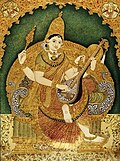
[[File:Mysore Painting.jpg|left|thumb|19th Century Mysore Painting of Saraswati.]] | |||
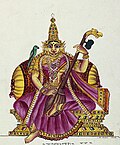
Saraswati (Sanskrit: ''Sarasvatī'') is known by many names. Some examples of synonyms for Saraswati include [[Sharada]] (bestower of essence or knowledge),<ref name="Kinsley1988" /> [[Brahmani (Matrika)|Brahmani]] (power of Brahma), Brahmi (goddess of sciences),<ref>{{cite web|url=http://www.stephen-knapp.com/sarasvati_goddess_of_learning.htm|title=Sarasvati, The Goddess of Learning|archive-url=https://web.archive.org/web/20090427203916/http://www.stephen-knapp.com/sarasvati_goddess_of_learning.htm|archive-date=27 April 2009|publisher=Stephen Knapp}}</ref> Bharadi (goddess of history), Vani and Vachi (both referring to the flow of music/song, melodious speech, eloquent speaking respectively), Varnesvari (goddess of letters), Kavijihvagravasini (one who dwells on the tongue of poets).<ref name="ebalf">{{cite book|first=Edward|last=Balf|title=The Encyclopædia of India and of Eastern and Southern Asia|year=1885|page=534|url=https://books.google.com/books?id=iU0OAAAAQAAJ}}</ref><ref name="Kinsley1988" /> | |||
Other names include: [[Ambika (Jainism)|Ambika]], [[Bharati]], [[Chandrika]], [[Devi]], Gomati, Hamsasana, Saudamini, Shvetambara, [[Subhadra]], Vaishnavi, Vasudha, Vidya, Vidyarupa, and Vindhyavasini.<ref>{{Cite web|date=30 November 2018|title=Sri Saraswathi Ashtottara Shatanamavali – śrī sarasvatī aṣṭōttaraśatanāmāvalī|url=https://stotranidhi.com/en/sri-saraswathi-ashtottara-satanamavali-in-english/|access-date=17 June 2022|website=Stotra Nidhi}}</ref> | |||
In the [[Tiruvalluva Maalai]], a collection of fifty-five Tamil verses praising the [[Kural literature]] and its author [[Valluvar]], she is referred to as Nāmagal and is believed to have composed the second verse.{{sfn|Mohan Lal, 1992|p=4333}}{{sfn|Kamil Zvelebil, 1975|p=129}} | |||
Outside Nepal and India, she is known in [[Burmese language|Burmese]] as ''Thurathadi'' ({{lang|my|သူရဿတီ}}, {{IPA|my|θùja̰ðədì|pron}} or {{IPA|my|θùɹa̰ðədì|}}) or ''[[Tipitaka]] Medaw'' ({{lang|my|တိပိဋကမယ်တော်}}, {{IPA|my|tḭpḭtəka̰ mɛ̀dɔ̀|pron}}), in Chinese as {{lang|zh-latn-pinyin|Biàncáitiān}} ({{lang|zh|辯才天}}), in Japanese as ''[[Benzaiten]]'' ({{lang|ja|弁才天/弁財天}}) and in [[Thai language|Thai]] as ''Suratsawadi'' ({{lang|th|สุรัสวดี}}) or ''Saratsawadi'' ({{lang|th|สรัสวดี}}).<ref name="dk95">{{cite book|last=Kinsley|first=David|year=1988|url=https://books.google.com/books?id=hgTOZEyrVtIC|title=Hindu Goddesses: Vision of the divine feminine in the Hindu religious traditions|publisher=University of California Press|isbn=0-520-06339-2|page=95}}</ref> | |||
== Literature == | |||
In Hinduism, Saraswati has retained her significance as an important goddess, from the [[Vedic period|Vedic age]] up to the present day.<ref name="davidkinsley">{{cite book|last=Kinsley|first=David|url=https://archive.org/details/hindugoddessesvi0000kins|title=Hindu Goddesses: Vision of the divine feminine in the Hindu religious traditions|publisher=University of California Press|year=1988|isbn=0-520-06339-2|url-access=registration}}</ref> She is praised in the ''[[Vedas]]'' as a water goddess of purification, while in the ''[[Dharmaśāstra|Dharmashastras]]'', Saraswati is invoked to remind the reader to meditate on virtue, and on the meaning ([[artha]]) of one's actions ([[karma]]). | |||
=== In Vedic literature === | |||
==== ''Rigveda'' ==== | |||
[[File:Saraswati Third Century AD.jpg|thumb|Saraswati, 3rd century CE with veena, [[Manasa, Madhya Pradesh|Manasa]]-[[Mandsaur]] area.]] | |||
Saraswati first appears in the ''[[Rigveda]]'' (c. 1500 – 1000 BCE), the most ancient source of the [[Historical Vedic religion|Vedic religion]]. Saraswati holds significant religious and symbolic value in the Rigveda, as a deified entity embodying attributes of abundance and power. Primarily linked with the celestial domain of Waters (Apas) and the formidable Storm Gods ([[Maruts]]), this deity forms an integral triadic association alongside the sacrificial goddesses [[Ila (Hinduism)|Ila]] and Bharati within the pantheon.<ref name=":6">Ludvik (2007), pp. 11, 26.</ref> | |||
Saraswati is described as a loud and powerful flood who roars like a bull and cannot be controlled.<ref>Ludvik (2007), pp. 11–12</ref> She was associated with the [[Milky Way]], indicating that she was seen as descending from heaven to earth.<ref>Ludvik (2007), p. 13</ref> | |||
The goddess is mentioned in many Rigvedic hymns, and has three hymns dedicated to her (6:61 exclusively, and 7:95–96 which she shares with her male counterpart, Sarasvant).<ref name=":6" /> In ''Rigveda'' 2.41.16 she is called: "Best of mothers, the best of rivers, best of goddesses".<ref>{{cite web|title=Rigveda|url=http://www.sacred-texts.com/hin/rvsan/rv02041.htm|archive-url=https://web.archive.org/web/20150924134650/http://www.sacred-texts.com/hin/rvsan/rv02041.htm|archive-date=24 September 2015|at=Book 2, Hymn 41, line 16}}</ref> | |||
As part of the [[Ap (water)|Apas]] (water deities), Saraswati is associated with wealth, abundance, health, purity and healing.<ref>Ludvik (2007), p. 17.</ref> In Book 10 (10.17) of the ''Rigveda'', Saraswati is celebrated as a deity of healing and purifying water.<ref>{{cite web|title=Rigveda|url=http://www.sacred-texts.com/hin/rvsan/rv10017.htm|archive-url=https://web.archive.org/web/20150508075500/http://www.sacred-texts.com/hin/rvsan/rv10017.htm|archive-date=8 May 2015|at=Book 10, Hymn 17}}</ref> In the ''[[Atharva Veda]]'', her role as a healer and giver of life is also emphasized.<ref>Ludvik (2007), p. 40.</ref> In various sources, including the ''[[Yajurveda|Yajur Veda]]'', she is described as having healed [[Indra]] after he drank too much [[Soma (drink)|Soma]].<ref>Ludvik (2007), p. 45.</ref> | |||
Saraswati also governs ''dhī'' (Rigveda 1:3:12c.).<ref>Ludvik (2007), p. 27.</ref> ''Dhī'' is the inspired thought (especially that of the [[rishi]]s), it is intuition or intelligence – especially that associated with poetry and religion. Saraswati is seen as a deity that can grant ''dhī'' (''Rigveda'' 6:49:7c.) if prayed to.<ref name=":6" /> Since speech requires inspired thought, she is also inextricably linked with speech and with the goddess of speech, [[Vāc]], as well as with cows and motherhood.<ref>Ludvik (2007), pp. 26, 31.</ref> Vedic seers compare her to a cow and a mother, and saw themselves as children sucking the milk of ''dhī'' from her.<ref>Ludvik (2007), p. 31.</ref> In Book 10 of the ''Rigveda'', she is declared to be the "possessor of knowledge".<ref>{{cite book|last=Colbrooke|first=H.T.|url=https://archive.org/stream/essaysonreligio01colegoog#page/n28/mode/2up|title=Sacred writings of the Hindus|publisher=Williams & Norgate|location=London, UK|pages=16–17|archive-url=https://web.archive.org/web/20160310162311/https://archive.org/stream/essaysonreligio01colegoog|archive-date=10 March 2016}}</ref> In later sources, like the ''Yajur Veda'', Saraswati is directly identified with Vāc, becoming a deity called Saraswatī-Vāc.<ref>Ludvik (2007), p. 38, 53.</ref> | |||
In the ''[[Brahmana]]s,'' Saraswati-Vac's role expands, becoming clearly identified with knowledge (which is what is communicated through speech) and as such, she is "the mother of the [[Vedas]]" as well as the Vedas themselves.<ref>Ludvik (2007), pp. 59–60.</ref> The ''[[Shatapatha Brahmana]]'' states that "as all waters meet in the ocean...so all sciences (vidya) unite (ekayanam) in Vāc" (14:5:4:11).<ref name="Ludvik 2007, p. 60">Ludvik (2007), p. 60.</ref> The ''Shatapatha Brahmana'' also presents Vāc as a secondary creator deity, having been the first deity created by the creator god [[Prajapati]]. She is the very instrument by which he created the world, flowing forth from him "like a continuous stream of water" according to the scripture.<ref name="Ludvik 2007, p. 60" /> This is the basis for the Puranic stories about the relationship between [[Brahma]] (identified with Prajapati) and Saraswati (identified with Vāc).<ref>Ludvik (2007), pp. 63–66.</ref> | |||
In other ''Rigvedic'' passages, Saraswati is praised as a mighty and unconquerable protector deity. She is offered praises and compared to a sheltering tree in ''Rigveda'' 7.95.5, while in 6:49:7 cd she is said to provide "protection which is difficult to assail."<ref>Ludvik (2007), p. 15.</ref><ref>{{Cite web|last=wisdomlib.org|date=27 August 2021|title=Rig Veda 7.95.5 [English translation]|url=https://www.wisdomlib.org/hinduism/book/rig-veda-english-translation/d/doc835373.html|access-date=9 August 2022|website=wisdomlib.org}}</ref> In some passages she even takes a fiercesome appearance and is called a "slayer of strangers" who is called on to "guard her devotees against slander".<ref>Ludvik (2007), pp. 16–17.</ref> Her association with the combative storm gods called Maruts is related to her fierce fighting aspect and they are said to be her companions (at ''Rigveda'' 7:96:2c.).<ref>Ludvik (2007), pp. 22–23.</ref> | |||
Like Indra, Saraswati is also called a slayer of [[Vritra]], the snake like demon of drought who blocks rivers and as such is associated with destruction of enemies and removal of obstacles.<ref>Ludvik (2007), pp. 47–48.</ref> The ''Yajur Veda'' sees her as being both the mother of Indra (having granted him rebirth through healing) and also as his consort.<ref>Ludvik (2007), p. 51.</ref> | |||
In Book 2 of ''[[Taittirīya Brāhmaṇa|Taittiriya Brahmana]]'', Saraswati is called "the mother of eloquent speech and melodious music".<ref name="ebalf" /> | |||
===Mahabharata=== | |||
Saraswati in the ''[[Mahabharata]]'', one of the two great epics of Hindu literature composed between 400 BCE and 400 CE, undergoes a transformation, marking her evolution from a river to a fully developed goddess of speech and knowledge.<ref name=":7">Ludvik (2007), p. 97</ref> | |||
==== As a River ==== | |||
As a river, Saraswati in the ''Mahabharata'' appears in a more subdued form compared to her powerful and overflowing depiction in the Vedic hymns. She emerges at [[Ficus religiosa|Plaksha]] (Prasravana), disappears into the sands at [[Saraswati River#Vinasana|Vinasana]], and then reemerges in several places, ultimately reaching the ocean at [[Prabhas Patan|Prabhasa]]. This representation reflects an attempt to reconcile the historical drying up of the river with its continued importance in religious thought. The ''Mahabharata'' preserves the grandeur of the [[Saraswati River]] by presenting a mythologised geography that both recalls her past and reinterprets her course in accordance with [[Dharma]]. Her flow is depicted as being guided by divine will, avoiding the unrighteous and serving the pious. The epic also universalizes her identity by attributing her name to multiple rivers, reinforcing her Rig Vedic epithet ''saptasvasar'' and declaring, "all rivers are Saraswati-s."<ref>Ludvik (2007), pp. 136–137</ref> | |||
Religiously, Saraswati's banks become lined with numerous [[Tirtha (Hinduism)|tirthas]], which are sites of pilgrimage and sacrifice. While the [[Panchavimsha Brahmana]] describes sacrificial rituals along her course, the ''Mahabharata'' expands upon this, transforming her river into a vast pilgrimage route filled with sacred sites. This shift marks a broader transition in religious practice—from complex Vedic sacrifices performed exclusively by [[Brahmin]]s to more accessible devotional practices open to a wider public, including women. The act of visiting Saraswati's ''tirthas'' is often equated with the merit of Vedic sacrifices, thus preserving Vedic authority while adapting to new religious contexts.<ref>Ludvik (2007), p. 137</ref> | |||
==== As a Goddess ==== | |||
[[File:Devi Soroswoti Sculpture by Sandalwood Murshidabad WB 31 01 2018.jpg|thumb|left|Saraswati on a Lotus throne playing veena, sandalwood, Mysore, 18th century CE]] | |||
As a goddess, Saraswati takes on a more humanized form in the ''Mahabharata'' for the first time. While the [[Rigveda]] and [[Brahmana]]s occasionally depicted [[Vāc|Vac]] in human-like terms, Saraswati in the epics appears as a woman of great celestial beauty and merit. The first verse of each book of the ''Mahabharata'' invokes the divine, including Saraswati, as part of its traditional opening salutation: | |||
{{Verse translation|nārāyaṇaṃ namaskṛtya naraṃ caiva narottamam | |||
devīṃ sarasvatīṃ caiva tato jayam udīrayet|Having bowed down to [[Nara Narayana|Narayana and Nara]], the most exalted male being, and also to the goddess Saraswati, must the word success be uttered.|attr1=''[[Mahabharata]]''|attr2=[[Kisari Mohan Ganguli]]}} | |||
Her role also changes in the ''Mahabharata'', as she fully merges with Vac, becoming the embodiment of speech itself. While still occasionally called Vac (12.306.6) and Vani (3.132.2), Vac as a distinct entity fades, with Saraswati taking its place. Saraswati is called the mother of the Vedas in the ''[[Shanti Parva]]'' Book of the epic.<ref name="jmuir" /> [[Vishnu|Narayana]] tells [[Narada]] (12.326.5), "Behold goddess Saraswati, the mother of the Vedas, established in me," affirming her as the source of divine knowledge. She is said to enter the body (12.306.6), dwell on the tongue (12.231.8), and is even called [[Vishnu]]'s tongue (6.61.56). Saraswati is deeply revered by sages. When appearing to [[Yajnavalkya]], she is adorned with vowels and consonants, resonating with the sacred [[Om]] (12.306.14). She also manifests before sage Tarkshya, who praises her celestial form and seeks her guidance. Saraswati explains that she has risen from the [[Agnihotra]] to resolve priests' doubts, asserting that only a learned ''[[shrotriya]]'' may perform the ritual. She describes the rewards of offerings, purity through Vedic knowledge, and the origins of beauty. When Tarkshya asks about [[Moksha]], she speaks of study, gifts, vows, and yoga but shifts focus to celestial realms and the cosmic tree of paradise.<ref>Ludvik (2007), pp. 111–114</ref> | |||
Saraswati also gains divine relationships that further integrate her into the [[Hindu deities|Hindu pantheon]]. In the ''Mahabharata'', her familial roles and origin vary across different chapters. She is described as the daughter of [[Brahma]], (''ṛtā brahmasutā sā me satyā devī saraswatī'', 12.330.10) a connection echoing Vac's relationship with [[Prajapati]] in the Brahmanas. Another account states that she originated from the Grandfather's (Pitamaha's) Lake, (''pitāmahasya sarasaḥ pravṛttāsi saraswatī'', 9.41.29) reinforcing her link to Brahma, who is referred to as the Grandfather. In another passage, she is described as the celestial creative symphony who appeared when Brahma created the universe.<ref name="jmuir" /> Her husband varies in different chapters—she is said to be the wife of [[Manu (Hinduism)|Manu]] (5.115.14) and also of the sage Matinara, whom she chooses after his twelve-year sacrifice on her banks (1.90.25–26), bearing him a son, Tamsu (1.90.26, 28). Additionally, she acts as a surrogate mother to Sarasvata, a son of sage [[Dadhichi]] (9.50.9-11).<ref>Ludvik (2007), p. 116</ref> | |||
The ''Mahabharata'' also contains several stories featuring Saraswati. In the ''Sthanu Tirtha'' myth (9.42), Saraswati, caught between two rival sages—[[Vishvamitra]] and [[Vasishtha]]—favours Vasishtha and is ultimately cursed by Vishvamitra to flow with blood. This myth aims to glorify her tirthas, as later, sages purify her waters, depriving demons who had drunk from them. In compassion, Saraswati transforms into Aruna ("reddish"), allowing the demons to bathe in her and attain heaven.<ref>Ludvik (2007), p. 108</ref> In the ''Sarasvata Tirtha'' myth (9.50.9-11), Saraswati plays a maternal role, raising Sarasvata. During a twelve-year drought, when sages had forgotten the [[Vedas]], Saraswati sustained her son by feeding him fish. After the famine, Sarasvata restored the lost scriptures by teaching them anew, reaffirming Saraswati's role as a nurturer of wisdom.<ref>Ludvik (2007), p. 109</ref> | |||
=== Ramayana === | |||
In the epic ''[[Ramayana]]'', when the [[rakshasa]] brothers [[Ravana]], [[Vibhishana]] and [[Kumbhakarna]], performed a penance to propitiate Brahma, the creator deity offered each a boon. The devas pleaded with Brahma to not grant Kumbhakarna his boon. Brahma called upon his consort Saraswati, and instructed her to utter that which the devas desired. She acquiesced, and when the rakshasa spoke to invoke his boon, she entered his mouth, causing him to say, "To sleep for innumerable years, O Lord of Lords, this is my desire!". She then left his form, causing him to reflect upon his misfortune.<ref>{{Cite web|last=wisdomlib.org|date=27 September 2020|title=Concerning the Penances practised by Dashagriva and his Brother [Chapter 10]|url=https://www.wisdomlib.org/hinduism/book/the-ramayana-of-valmiki/d/doc424771.html|access-date=9 August 2022|website=wisdomlib.org}}</ref> | |||
=== Puranic literature === | |||
Saraswati remains an important figure in the later medieval [[Puranas|Puranic literature]], where she appears in various myths and stories. Many Puranas relate the myth of her creation by the creator god Brahma and then describe how she became his consort. Sources which describe this myth include ''[[Markandeya Purana]]'', ''[[Matsya Purana]]'' (which contains the most extensive account), ''[[Vayu Purana]]'' and ''[[Brahmanda Purana]]''.<ref>Ludvik (2007), pp. 117–118.</ref> Other Puranas give her slightly different roles and see her as the consort of other gods, such as Vishnu. In various Puranas, rites for her worship are given, and she is mainly worshiped for her command over speech, knowledge, and music.<ref>Ludvik (2007), p. 127</ref> | |||
Puranas like the ''Matsya'' also contain iconographic descriptions of Saraswati, which provide the basis for her classic four armed form holding a book (representing the Vedas), [[Japamala|mala]], [[veena]], and a water pot while being mounted on a [[swan]] ([[Hamsa (bird)|hamsa]]).<ref>Ludvik (2007), pp. 131–133</ref> | |||
==== Origin myths ==== | |||
</ | [[File:Clevelandart 1972.152.jpg|left|thumb|Saraswati with attendants, marble sculpture, c. 900 CE]] | ||
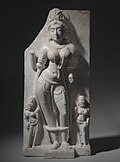
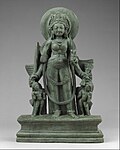
Saraswati is described as ''ayonija'', meaning that she was not born from any womb and was divinely manifested. The [[Puranas]] present various accounts of the origin (samudbhava) of Saraswati.<ref name=":14">{{Cite web |last=Gupta |first=Anand Swarup |date=January 1962 |title=Conception of Sarasvati in the Puranas |url=https://www.wisdomlib.org/hinduism/journal/purana-bulletin/d/doc1456198.html |access-date=15 March 2025 |pages=55–95 |language=en |edition=Purānas [Engl.]. In: Purāna 4,1}}</ref> | |||
Saraswati is | According to the ''[[Brahma Vaivarta Purana]]'' and ''[[Devi Bhagavata Purana]]'', Saraswati is one of five primary manifestations of Mula [[Prakṛti|Prakrti]] (Primordial Nature) or the [[Shakti]] of [[Brahman]], each serving a distinct role in creation. At the onset of creation, the Atman divided into two—its right half became the Male principle, and the left half became Prakrti. Through the divine will of [[Sri Krishna]] (Para-Brahman in this context, not an avatara of Vishnu), Prakrti assumed five forms: [[Durga]], [[Radha]], [[Lakshmi]], Saraswati, and [[Gayatri|Savitri]]. Saraswati, associated with the mythological [[Saraswati River]], became the goddess of speech (Vach) and knowledge. Another version within the same Puranas describes Saraswati emerging from the tip of [[Krishna|Sri Krishna]]'s Shakti during creation. She appeared as a luminous maiden (Kanya), adorned in yellow garments, bearing a [[veena]] and a sacred scripture. She is thus revered as Vani, the presiding deity of all [[shastra]]s. This account also depicts Shakti manifesting as Lakshmi and [[Radha]].<ref name=":14" /> | ||
The ''[[Vayu Purana]]'' offers a different perspective, stating that from [[Brahma]]'s concentrated anger, a being (Purusha) was born with a half-male, half-female body. This being, Samkara, was commanded to divide itself. The Male aspect further divided into eleven [[Rudras]], while the Female aspect split into a white and black form. Saraswati is identified as a manifestation of the white half, also known as Gauri. Another account in the Vayu Purana describes Saraswati's emergence during the Visvarupa Kalpa, when Brahma meditated and Saraswati, encompassing all forms, appeared as a divine gau (cow) with four mouths, four horns, four eyes, four hands, and four teeth—symbolizing Prakrti, the primordial source of the universe (jagadyonih).<ref name=":14" /> | |||
The ''[[Brahmanda Purana]]'', in its ''Lalitopakhyana'' section, narrates that Goddess [[Tripura Sundari]] created three cosmic eggs. From one egg emerged Saraswati (Gira) along with [[Shiva]], while the others birthed two divine pairs: [[Ambika (goddess)|Ambika]] and [[Vishnu]] from one, and [[Shri|Sri]] (Lakshmi) and Brahma from the other. Tripura Sundari then paired Saraswati with Brahma, Ambika with Shiva, and Sri with Vishnu, forming divine consorts. A similar account appears in the ''Pradhanika Rahasya'' of the ''[[Devi Mahatmya]]'' (part of the ''[[Markandeya Purana]]''). Here, Mahalaksmi embodies the three gunas (cosmic qualities), manifesting as Mahakali (tamasika), Mahasaraswati (sattvika), and herself (rajasika). Each created a divine pair: Mahalaksmi created Brahma and Sri (Lakshmi), Mahakali created [[Rudra]] and Trayi (Saraswati), and Mahasaraswati created [[Vishnu]] and [[Uma (goddess)|Uma]] (Parvatirasvati was then given to Brahma, Gauri to Rudra, and Sri to Vishnu.<ref name=":14" /> | |||
</ | |||
The ''[[Matsya Purana]]'' (Adhyaya 3) describes Saraswati as the manasa putri (mind-born daughter) of Brahma. When Brahma sought to create the universe, he meditated, causing his body to split into a male and female half. The female half materialized as Saraswati, whom Brahma regarded as his ''svatmaja'' (daughter born from his own self). Other Puranas, including the ''[[Bhagavata Purana]], Brahmanda Purana, [[Brahma Purana]], [[Padma Purana]],'' and ''[[Skanda Purana]]'', also mention Saraswati in this capacity.<ref name=":14" /> | |||
Saraswati | ==== Association with Brahma ==== | ||
[[File:12th-century Brahma and Saraswati at Shaivism Hindu temple Hoysaleswara arts Halebidu Karnataka India 2 (cropped).jpg|thumb|left|12th-century Brahma and Saraswati as a couple at Hoysaleswara Temple, Halebidu, Karnataka, India.]] | |||
Saraswati and Brahma share a complex and multifaceted relationship in the [[Puranas|Puranic]] tradition, with different texts presenting varying perspectives. The Puranas describe three primary associations between them:<ref name=":14" /> | |||
* Saraswati solely as the mind-born daughter of Brahma, attested in the ''[[Brahma Purana]]'', ''[[Padma Purana]]'', ''[[Brahmanda Purana]]'' and few chapters of ''[[Skanda Purana]]'' | |||
* Saraswati as solely the consort of Brahma, attested in the ''[[Brahma Vaivarta Purana]]'', ''[[Devi Bhagavata Purana]]'', ''Lalitopakhyana'', ''Pradhana Rahasya'' and few chapters of ''Skanda Purana''<ref name=":11">{{Cite web|last=wisdomlib.org|date=8 August 2020|title=The Glory of Gāyatrī and Sarasvatī Tīrthas [Chapter 40]|url=https://www.wisdomlib.org/hinduism/book/the-skanda-purana/d/doc423608.html|access-date=12 March 2025|website=wisdomlib.org|language=en}}</ref> | |||
* Saraswati as both the daughter and spouse of Brahma, only found in two text—the ''[[Matsya Purana]]'' and ''[[Bhagavata Purana]]'' | |||
As the mind-born daughter of Brahma, Saraswati, in the ''Brahma Purana'', ''Padma Purana'', and ''Skanda Purana'', is regarded as a virgin goddess, without any spouse.<ref name=":14" /> The birth of Saraswati from the mind of Brahma is also described in the ''Brahmanda Purana'' (chapter 43), in which after her creation Saraswati is tasked to reside on tip of the tongue of all beings, a river on the earth and as a part of Brahma.<ref name="www.wisdomlib.org">{{Cite web|last=wisdomlib.org|date=28 January 2019|title=Story of Sarasvatī|url=https://www.wisdomlib.org/hinduism/compilation/puranic-encyclopaedia/d/doc241934.html|access-date=9 August 2022|website=wisdomlib.org}}</ref> The ''Brahmanda Purana'' acknowledges her solely as Brahma's daughter but, in the ''Lalitopakhyana'' section of the text, a different origin is given to Saraswati in which Goddess Tripurasundari created and gave Saraswati to Brahma as his consort.<ref name=":14" /> | |||
The accounts where Saraswati is solely considered Brahma's consort, found in the ''Brahma Vaivarta Purana'', states that Saraswati was originally created from the tip of the tongue of the ''Shakti'' (''Yosit'') of [[Krishna|Sri Krishna]] (Supreme God in this context, not an avatara of Vishnu). Krishna gave her to [[Vishnu]] as his wife, but after a quarrel with her co-wife [[Ganga (goddess)|Ganga]], Vishnu transferred Saraswati to Brahma and Ganga to [[Shiva]]. The ''Devi Bhagavata Purana'' contains similar story.<ref name="Kinsley1988" /> The ''Lalitopakhyana'' and ''Pradhana Rahasya'' mention that Saraswati was created by Tripura Sundari and given to Brahma as his wife.<ref name=":14" /> | |||
In narratives where Saraswati is depicted as both the daughter and spouse, the portrayal varies. The ''Matsya Purana'' narrates that Saraswati emerged from the left side of his body for the purpose of creation.<ref>Ludvik (2007), p. 119</ref> Brahma, upon seeing Saraswati, was captivated by her beauty and developed multiple heads to gaze her. Despite her initial reluctance, she consented and he made her his spouse, and they remained together in the lotus temple for a hundred divine years. From their union, [[Swayambhuva Manu|Svayambhuva Manu]]—the first mortal human—was born.<ref name="auto">Ludvik (2007), p. 120.</ref><ref name="www.wisdomlib.org" /> After that, Brahma felt shame, curses the love-god [[Kamadeva|Kama]] and his sons are left to create the world. In the ''Matsya Purana'', while Brahma is criticised for his actions, the union is also justified, as human logic cannot be directly applied to divine beings, particularly when creation is at stake.<ref>Ludvik (2007), p. 121.</ref><ref name=":14" /> In the ''Bhagavata Purana'', the marriage of Brahma and Saraswati is explained in a way that avoids direct filial relations. According to the text, Brahma creates Saraswati and develops desire for her. However, feeling ashamed for desiring her, he gives up his life. Brahma then manifested in a different body, and he marries Saraswati, who was created by the previous Brahma.<ref>{{Cite book|last=Vanamali|url=https://books.google.com/books?id=BmAoDwAAQBAJ&q=shiva+vanamali|title=Shiva: Stories and Teachings from the Shiva Mahapurana|date=4 October 2013|publisher=Simon and Schuster|isbn=978-1-62055-249-0|language=en}}</ref><ref>{{Cite book|url=https://books.google.com/books?id=sLh9DwAAQBAJ&q=Sarasvati+Brahma+daughter+|title=The Bhagavata Purana 1|date=5 January 2019|publisher=Penguin Random House India Private Limited|isbn=978-93-5305-378-9|language=en}}</ref><ref>{{Cite book|last=Tejomayananda|first=Swami|url=https://books.google.com/books?id=AHVSDwAAQBAJ&q=Sarasvati+|title=DISCOURSES ON SHRIMAD BHAGAVATA|date=21 March 2018|publisher=Central Chinmaya Mission Trust|isbn=978-81-7597-709-9|language=en}}</ref> | |||
The motif of Brahma desiring his own daughter is a recurrent theme in the Puranic tradition, potentially derived from the Brahmanical myth of [[Prajapati]]'s desire for [[Ushas]]. However, the identity of the daughter in these narratives is not consistently Saraswati and varies. This desire is generally depicted as transient, with Brahma either overcoming it himself out of shame, by cursing Kama, being restrained by Shiva—paralleling the Vedic account of Rudra restraining Prajapati—or facing the daughter's outright refusal, resulting in no union.<ref>{{Cite book|last=Santideva|first=Sadhu|url=https://books.google.com/books?id=TUFZ9XzzHAcC&pg=PA18|title=Ascetic Mysticism|publisher=Cosmo Publications|year=2002|isbn=978-81-7020-998-0|pages=107–117|language=en}}</ref><ref name="auto"/> A notable instance occurs in the ''[[Shiva Purana]]'', where Saraswati rejects Brahma's advances, curses him, and subsequently departs.<ref name=":12">{{Cite book|last=O'Flaherty|first=Wendy Doniger|url=https://books.google.com/books?id=dnfZ_MBErlQC&q=Sarasvati|title=Siva: The Erotic Ascetic|date=28 May 1981|publisher=Oxford University Press|isbn=978-0-19-972793-3|language=en}}</ref> | |||
Another symbolic representation of Saraswati's association with Brahma is the belief that she resides in his mouth. This concept appears in several Puranas, including the ''Padma Purana'', where [[Vishnu]] praises Saraswati as residing in Brahma's mouth. A similar reference is found in the ''Matsya Purana'', where [[Parvati|Gauri]] is praised in the same manner. A direct reference to this belief appears in the ''Saraswati Rahasya Upanishad'', which describes Sarawati as a divine swan residing in the lotus-mouth of the four-faced Brahma.<ref name=":14" /> | |||
==== Saraswati, Savitri, and Gayatri ==== | |||
[[File:Brahma with consorts.jpeg|thumb|Sculpture of Brahma with Savitri and Gayatri]] | |||
The goddesses Saraswati, Savitri, and [[Gayatri]] are closely associated with Brahma and one another in the [[Puranas]], but their connection is very inconsistent. Some texts consider these three goddesses to be identical. According to the ''[[Matsya Purana]]'' (Adhyayas 3, 4), ''Saraswati, Savitri, Gayatri, Brahmani and Shatarupa'' are different names of the same deity. The ''Matsya Purana'' (Adhyaya 66) and ''[[Padma Purana]]'' (V.22.176–194) state that Saraswati and Gayatri are interchangeable names for the same goddess. Similarly, in the ''[[Skanda Purana]]'' (VI.46), both Gayatri and Savitri are listed as synonyms of Saraswati,<ref name = "PB 80">Purana Bulletin: Purana, Volume 4, Part 1 (1962) p. 80</ref> although the same text also mention Savitri and Gayatri as distinct individual.<ref name="www.wisdomlib.org" /> The ''[[Varaha Purana]]'' also considers Saraswati, Savitri and Gayatri to be the same.<ref name=":13" /> | |||
In the [[ | |||
Other Puranic texts treat Saraswati, Savitri, and Gayatri as three separate deities:<ref name=":14" /> | |||
* The ''[[Brahma Purana]]'' lists them among the five daughters of Brahma. | |||
* In the ''Padma Purana'' and ''Skanda Purana'', Gayatri and Savitri are described as female companions of Saraswati. | |||
* The ''Padma Purana'' also describes Saraswati as Brahma's virgin daughter, while Savitri and Gayatri are mentioned as his wives. According to this narrative, Brahma had two consorts—Savitri and Gayatri. When Savitri failed to arrive for a ritual at [[Pushkar]]a, Brahma wed Gayatri in her absence to complete the ritual. In response, Savitri, feeling aggrieved, pronounced a curse restricting his worship to Pushkara, though she later reconciled with Gayatri, establishing a harmonious relationship.<ref name="www.wisdomlib.org" /> Similar account is found in the ''Skanda Purana'', where the two wives are Savitri and Gayatri and are not connected to Saraswati.<ref name=":13">{{Cite book|last=Vans Kennedy|url=https://archive.org/details/bub_gb_JpgIYbEtdQ8C/page/317/mode/2up?view=theater|title=Researches into the Nature and Affinity of Ancient and Hindu Mythology by Vans Kennedy|date=1831|publisher=Longman, Rees, Orme, Brown and Green|others=National Central Library of Florence|language=English}}</ref> | |||
In certain texts, Gayatri is called the "Mother of the [[Vedas]]" (''Taittiriya Pratishakhya'' 17.308d–309a), while Savitri is also described as "the mother of the four Vedas" (''Brahma Purana'' II.1.39c). Saraswati, in turn, is regarded as "the presiding deity of knowledge" (''ibid.'' 31b) and "the embodiment of all branches of learning" (''ibid.'' 31c). Thus, similar to the Vedic goddesses Bharati and [[Ila (Hinduism)|Ila]], Saraswati, Savitri, and Gayatri are all connected to the domain of knowledge (''vidya, jnana, Veda'').<ref name=":14" /> | |||
In a third category of accounts, Savitri is identified with one of the two while remaining distinct from the other. In certain traditions, Savitri is identified with Gayatri, as seen in the ''[[Devi Bhagavata Purana]]'', where Saraswati and Savitri are enumerated among the five [[Prakṛti|Prakritis]]. Conversely, select chapters of the ''Skanda Purana'' equate Savitri with Saraswati, thereby positioning Gayatri as her co-wife.<ref>{{cite book|url=https://books.google.com/books?id=-3blDwAAQBAJ&dq=savitri+gayatri+pushkar&pg=PA249|title=Gayatri: The Profound Prayer|isbn=978-81-7822-467-1|last1=Madhukar|first1=R. K.|date=January 2014|publisher=Motilal Banarsidass}}</ref> A chapter in the ''Skanda Purana'' also recounts a myth featuring both Saraswati and Gayatri. It narrates about Brahma's infatuation with his daughter Vac (a rare instance where Vac is distinguished from Saraswati in the Puranic corpus). As a consequence of this transgression, Brahma was slain by [[Shiva]], only to be later revived through the penance of Saraswati and Gayatri.<ref name=":11" /><ref name=":12" /> | |||
==== Association with Vishnu ==== | |||
[[File:God Vishnu with Goddesses Lakshmi and Sarasvati, Bangladeshi sculpture at the Chicago Art Institute.jpg|thumb|A sculpture of Vishnu with goddesses Lakshmi (left) and Saraswati (right), from current-day Bangladesh at the [[Chicago Art Institute]].]] | |||
Other than Brahma, Saraswati has also been associated with the preserver god [[Vishnu]], a connection which might stem established connection of Saraswati and Indra from the ''[[Rigveda]]'' (VI.49.7).<ref name = "PB 79">Purana Bulletin: Purana, Volume 4, Part 1 (1962) p. 79</ref> In many sculpture of Vishnu common during mediaeval era, particularly in the region of [[Bengal]], Saraswati replaces [[Bhumi (goddess)|Bhumi]] as his second wife, making Saraswati the co-wife of the goddess [[Lakshmi]]. Both of these goddesses flank Vishnu and assist him his role.<ref name="www.wisdomlib.org" /><ref name=":10" /> | |||
However, conjugal relationship between Saraswati and Vishnu is rarely found elsewhere in the Puranas—barring two. According to the ''[[Brahma Vaivarta Purana]]'' (II.6) and ''[[Devi Bhagavata Purana]]'' (IX.6), Saraswati was initially the wife of [[Narayana]] or Vishnu.<ref name = "PB 79" /> In the ''Devi Bhagavata Purana'', Saraswati is described as one of Vishnu's three wives, alongside [[Lakshmi]] and [[Ganga (goddess)|Ganga]]. A conflict arose when Saraswati, angered by Ganga's playful glances at Vishnu, accused her of stealing his affection. Vishnu remained neutral, while Lakshmi attempted to mediate. In her jealousy, Saraswati cursed Lakshmi to be born as the [[Ocimum tenuiflorum|Tulasi]] plant. In retaliation, Ganga cursed Saraswati to become a river, and Saraswati reciprocated with the same curse, declaring that sinners would cleanse their sins in Ganga's waters. Vishnu then decreed that Saraswati would exist in three forms: one part with him, another as a river on earth, and the third as Brahma's consort.<ref>{{Cite book|last=Williams|first=George M.|url=https://books.google.com/books?id=N7LOZfwCDpEC&dq=three+wives+vishnu&pg=PA137|title=Handbook of Hindu Mythology|date=27 March 2008|publisher=OUP USA|isbn=978-0-19-533261-2|page=137}}</ref><ref>{{Cite book|last=Sharma|first=Bulbul|url=https://books.google.com/books?id=on_ZhlB5taUC&dq=bhagavata+purana+lakshmi+ganga+saraswati&pg=PA67|title=The Book of Devi|date=June 2010|publisher=Penguin Books India|isbn=978-0-14-306766-5|pages=67–71}}</ref> | |||
If Saraswati is not associated with Vishnu as his wife, then concept of Saraswati as "the tongue of Vishnu" gained prominence in the Puranas. The ''[[Matsya Purana]]'' states that when [[Vamana]] assumed his cosmic form, Satya became his speech, and Saraswati became his tongue (''Matsya Purana'' 246.57). The ''[[Vamana Purana]]'' also refers to Saraswati as "the tongue of Vishnu" (''Vamana Purana'' 32.23). The ''[[Brahma Purana]]'' describes Vishnu as "holding Saraswati in his mouth" (''Brahma Purana'' 122.71c).<ref name=":14" /> | |||
====Puranic Narratives of Saraswati's River Aspect==== | |||
[[File:1895 CE Saraswati on hamsa सरस्वती हंस painting 2.jpg|thumb|Depiction of Saraswati from a market in Bengal (19th century, pre-1895 CE). The [[British Library]] curator's summary states, "Saraswati, the goddess of learning and knowledge, is seated on the banks of a river. Her feet rest on a lotus flower, a palm leaf manuscript to represent the vedas is next to her and she holds a vina. Her mount, a swan, is positioned nearby."|left]] | |||
In | In the ''Rigveda'', Saraswati is primarily depicted as a river goddess, embodying fertility and purity, and is revered as the personification of the Saraswati River. Her role as the nurturing, life-giving force of the river is celebrated in hymns, where she is described as "the best of mothers, of rivers, and of goddesses."<ref name=":1">{{Cite book|last=Warrier|first=Shrikala|title=Kamandalu: the seven sacred rivers of Hinduism|publisher=Mayur University London|year=2014|location=London|page=97}}</ref> A Rigvedic prayer also describes her as 'the best of mothers, of rivers and of goddesses'.<ref name=":1" /> However, as Saraswati's association with knowledge, speech, and culture grew in prominence through the later Hindu texts, her direct connection with the physical river diminished. Despite this, the Puranas sustain Saraswati's riverine character by incorporating new narratives that preserve her role as a cosmic river in addition to her expanded identity.<ref name="Kinsley1988" /> | ||
The story of Saraswati becoming a river is introduced in the Srishti Khanda of [[Padma Purana]] as well as in [[Skanda Purana]]. In the Skanda Purana, after the events of the [[Tarakamaya War]], the [[Deva (Hinduism)|devas]] deposited their arsenal of weapons at the hermitage of [[Dadhichi]]. When they sought the return of these weapons, the sage informed them that he had imbibed all of their power with his penance, and offered his own bones instead, which could serve as the source of new weapons. Despite the objections of the deities, the sage sacrificed himself, and his bones were employed in the manufacture of new arms by [[Vishvakarma]]. The sage's son, [[Pippalada]], upon hearing these events, sought to wreak his vengeance on the devas by performing a penance. A mare emerged from his right thigh, which in turn gave birth to a fiery man, Vadava, who threatened to be the doom of all of creation. [[Vishnu]] convinced Vadava that his best course of action would be to swallow the devas one by one, and that he should begin by consuming the primordial water of creation, which was the foremost of both the devas and the asuras. Vadava wished to be accompanied to the source of these waters by a virgin, and so Saraswati was dispatched for his purpose, despite her reluctance. She took him to [[Varuna]], the god of the ocean, who then consumed the being. For good measure, Saraswati transformed into a divine river, flowing with five channels into the sea, making the waters sacred.<ref>{{Cite web|last=wisdomlib.org|date=13 April 2021|title=The Descent of Sarasvatī [Chapter 34]|url=https://www.wisdomlib.org/hinduism/book/the-skanda-purana/d/doc626822.html|access-date=9 August 2022|website=wisdomlib.org}}</ref> | |||
[[ | |||
In | In the Padma Purana, it is stated that there was a terrible battle between the Bhargavas (a group of [[Brahmin|Brahmanas]]) and the Hehayas (a group of [[Kshatriya]]s). From this, an all-consuming fire called [[Vadavagni]] was born, which threatened to destroy the whole world. In some versions, a sage named Auva created it. [[Indra]], Vishnu, and the [[Deva (Hinduism)|devas]] visited Saraswati, requesting her to deposit the fire in the western ocean, to protect the universe.<ref>{{Cite book|last=General|first=India Office of the Registrar|url=https://books.google.com/books?id=zQEdAQAAMAAJ&q=Vadavagni+Saraswati|title=Census of India, 1961: Gujarat|date=1965|publisher=Manager of Publications}}</ref><ref>{{Cite book|last=Danino|first=Michel|url=https://books.google.com/books?id=8yc7-OirxKEC&q=vadavagni+and+Saraswati|title=The Lost River: On the Trail of the Sarasvatī|date=2010|publisher=Penguin Books India|isbn=978-0-14-306864-8}}</ref> Saraswati told Vishnu that she would only agree to assist them if her consort, [[Brahma]], told her to do so. Brahma ordered her to deposit the Vadavagni in the western ocean. Saraswati agreed, and accompanied by [[Ganga (goddess)|Ganga]], she left Brahmaloka, and arrived at Sage [[Uttanka]]'s [[ashram]]a. There, she met [[Shiva]], who had decided to carry Ganga. He gave the Vadavagni in a pot to Saraswati, and told her to originate from the [[Ficus religiosa|plaksha]] tree. Saraswati merged with the tree, and transformed into a river. From there, she flowed towards [[Pushkar]]a. Saraswati continued her journey towards the ocean, and stopped once at Pushkarini, where she redeemed humans from their sins. At last, she reached the end of her journey, and immersed the fire into the ocean.<ref>{{Cite web|last=wisdomlib.org|date=28 January 2019|title=Story of Sarasvatī|url=https://www.wisdomlib.org/hinduism/compilation/puranic-encyclopaedia/d/doc241934.html|access-date=21 October 2022|website=wisdomlib.org}}</ref><ref>{{Cite book|last=N. A. Deshpande|url=http://archive.org/details/padma_purana_part1_english|title=Padma Purana Part 1 Srishti Khanda Motilal Banarsidass 1988|date=1 January 1988}}</ref> | ||
< | |||
=== Shakta texts === | |||
[[File:Rajamatangi.jpg|thumb|19th century South Indian painting of Raja-Matangi with veena and parrot]] | |||
Saraswati is a key figure in the Indian goddess centered traditions which are today known as [[Shaktism]]. Saraswati appears in the Puranic ''[[Devi Mahatmya]]'' (''Glory of the [[Devi|Goddess]]''), a central text for Shaktism which was appended to the ''[[Markandeya Purana]]'' during the 6th century CE.<ref name="CDC_1988">{{cite book|author=Charles Dillard Collins|url=https://books.google.com/books?id=pQNi6kAGJQ4C&pg=PA36|title=The Iconography and Ritual of Siva at Elephanta: On Life, Illumination, and Being|publisher=SUNY Press|year=1988|isbn=978-0-88706-773-0|page=36}}</ref> In this text, she is part of the "triple goddess" (''[[Tridevi]]'') along with [[Mahakali]], and [[Mahalakshmi]].<ref name=":4">{{cite book|last=Lochtefeld|first=James|url=https://archive.org/details/illustratedencyc0000loch|title=The Illustrated Encyclopedia of Hinduism|year=2002|isbn=978-0-8239-3180-4|volume=A-M|page=[https://archive.org/details/illustratedencyc0000loch/page/n365 408]|publisher=Rosen|url-access=limited}}</ref> In Shaktism, this trinity (the Shakta response to the male [[trimurti]] of the other Hindu sects) is a manifestation of [[Mahadevi]], the supreme goddess (and the highest deity out of which all deities, male or female, are born), which is also known by other names like Adi Parashakti ("Primordial Supreme Power").<ref name="hindufaqs">{{cite web|date=18 March 2015|title=Tridevi – the three supreme Goddess in Hinduism|url=https://www.hindufaqs.com/tridevi-the-three-supreme-goddess-in-hinduism/|publisher=Hindu FAQS {{!}} Get answers for all the questions related to Hinduism, the greatest religion!}}</ref><ref>{{Cite book|last=Hay|first=Jeff|url=https://books.google.com/books?id=1n5mDwAAQBAJ&dq=shaktism+mahadevi&pg=PA284|title=World Religions|date=6 March 2009|publisher=Greenhaven Publishing LLC|isbn=978-0-7377-4627-3|page=284}}</ref> | |||
According to the ''Devi Mahatmya'', this supreme goddess is the primordial creator which is supreme formless (nirguna) consciousness (i.e. [[Para Brahman|parabrahman]], absolute reality) and the tridevi are her main saguna ("with form", manifest, incarnated) emanations.<ref name="HarperBrown2002p81">{{cite book|author=Thomas Coburn|url=https://books.google.com/books?id=M7Fbj5hrmQoC|title=The Roots of Tantra|publisher=State University of New York Press|year=2002|isbn=978-0-7914-5305-6|editor=Katherine Anne Harper, Robert L. Brown|pages=80–83}}</ref> MahaSaraswati is said to be creative and active principle (which is [[Rajas]]ic, energetic and active), while Mahalakshmi is the sustainer ([[Sattva|sattvic]], "goodness") and Mahakali is the destroyer ([[Tamas (philosophy)|tamasic]], "darkness").<ref name="HarperBrown2002p81" /> | |||
In other influential Shakta texts, such as the ''[[Devi Bhagavata Purana]]'' and the ''[[Devi Upanishad]],'' Saraswati (along with all Hindu goddesses) is also said to be a manifestation of the supreme Mahadevi.<ref name=":0" /> | |||
In [[Tantra|Tantric]] Shakta sources, Saraswati takes many forms. A key tantric form is [[Matangi]], a deity considered to be the "Tantric Saraswati". Mātaṅgī retains many attributes of Saraswati, like music and learning, but is also associated with defeating enemies, disease, pollution/impurity, and outcasts ([[chandala]]s).<ref>Kinsley, David R. (1988). "Tara, Chinnamasta and the Mahavidyas". ''Hindu Goddesses: Visions of the Divine Feminine in the Hindu Religious Tradition'' (1 ed.), p. 217. University of California Press. pp. 161–177. {{ISBN|978-0-520-06339-6}}.</ref> She is often offered half eaten or leftover food and is green in color. Matangi is also part of the Shakta set of goddesses known as the ten [[Mahavidya]]s. | |||
Matangi is important in [[Shri Vidya]] Shaktism, where she is also known as the dark blue Shyamala ("dark in complexion") and is a manifestation of [[Tripura Sundari|Lalita Tripurasundari]]'s [[Jñāna|Jñana]] Shakti (wisdom power), having arisen out of Lalita's sugarcane bow.<ref>Saligrama Krishna Ramachandra Rao (1990). ''The Tāntric Practices in Śrī-Vidyā: With Śrī Śāradā-chatuśśatī,'' p. 205. Kalpataru Research Academy.</ref> She is celebrated in the holiday Syamala Navaratri and is seen as Lalita's prime minister. There are various chants and odes ([[stotra]]s) to this deity, perhaps the most important being the ''Śrī Śyāmalā Daṇḍakam'' by the great Indian Sanskrit poet [[Kalidasa]].<ref>Alok Jagwat; Mahakavi Kalidasa (2021). ''[https://books.google.com/books?id=5EgwEAAAQBAJ&pg=PT13 Sri Shyamala Dandakam: Syamala Dandakam].'' Bhartiya Ved Vigyan Parishad.</ref><ref>{{Cite web|date=24 November 2018|title=Sri Shyamala Dandakam – śrī śyāmalā daṇḍakam|url=https://stotranidhi.com/en/shyamala-dandakam-in-english/|access-date=5 November 2023|website=Stotra Nidhi}}</ref> | |||
== Symbolism and iconography == | |||
{{multiple image | |||
| direction = vertical | |||
| align = right | |||
| width = 220 | |||
| footer = [[Iconography]] of Saraswati: the goddess depicted with her [[veena]], swan, peacock, crystal [[japamala]] and lotus. (Two images: above, a [[tile]] mural in [[Kerala]], below, a sculpture in [[cultured marble]] in Karnataka). | |||
| image1 = 2 Hindu deity Sarasvati Saraswati on ceramic tile in Munnar Kerala India March 2014.jpg | |||
| image2 = Saraswathidavanagere.JPG | |||
}} | |||
The Saraswati is often depicted as a beautiful woman dressed in pure white, often seated on a white [[Nelumbo nucifera|lotus]], which symbolizes light, knowledge and truth.<ref>{{cite book|last=Ludvík|first=Catherine|title=Sarasvatī, Riverine Goddess of Knowledge: From the Manuscript-carrying Vīṇā-player to the Weapon-wielding Defender of the Dharma|publisher=BRILL|year=2007|page=1}}</ref> She not only embodies knowledge but also the experience of the highest reality. Her iconography is typically in white themes from dress to flowers to swan – the colour symbolizing Sattwa Guna or purity, discrimination for true knowledge, insight and wisdom.<ref name="Kinsley1988" /><ref name="jholm">{{cite book|last1=Holm|first1=Jean|title=Picturing God|last2=Bowke|first2=John|publisher=Bloomsbury Academic|year=1998|isbn=978-1-85567-101-0|pages=99–101}}</ref> | |||
Her dhyana mantra describes her to be as white as the moon, clad in a white dress, bedecked in white ornaments, radiating with beauty, holding a book and a pen in her hands (the book represents knowledge).<ref name="Hinduism 101 Saraswati Symbolism">{{cite web|title=Hinduism 101 Saraswati Symbolism|url=https://www.hafsite.org/resources/hinduism-101-2/Saraswati-Symbolism|url-status=live|archive-url=https://web.archive.org/web/20171016005521/https://www.hafsite.org/resources/hinduism-101-2/Saraswati-Symbolism|archive-date=16 October 2017|access-date=10 February 2018|website=Hindu American Foundation (HAF)}}</ref> | |||
She is generally shown to have four arms, but sometimes just two. When shown with four hands, those hands symbolically mirror her husband Brahma's four heads, representing ''manas'' (mind, sense), ''buddhi'' (intellect, reasoning), ''citta'' (imagination, creativity), and ''ahamkāra'' (self consciousness, ego).<ref name="gpollock">{{cite book|last1=Pollock|first1=Griselda|title=The Sacred and the Feminine: Imagination and sexual difference|last2=Turvey-Sauron|first2=Victoria|year=2008|isbn=978-1-84511-520-3|pages=144–147|publisher=Bloomsbury Academic|author-link=Griselda Pollock}}</ref><ref>For Sanskrit to English translation of the four words: {{cite web|title=Monier Williams' Sanskrit-English Dictionary|url=http://www.sanskrit-lexicon.uni-koeln.de/scans/MWScan/tamil/index.html|archive-url=https://web.archive.org/web/20160820092052/http://www.sanskrit-lexicon.uni-koeln.de/scans/MWScan/tamil/index.html|archive-date=20 August 2016|publisher=University of Koeln|location=Koeln, Germany}}</ref> Brahma represents the abstract, while she represents action and reality. | |||
The four hands hold items with symbolic meaning – a ''pustaka'' (book or script), a ''mālā'' (rosary, garland), a water pot and a musical instrument ([[vīnā]]).<ref name="Kinsley1988" /> The book she holds symbolizes the [[Vedas]] representing the universal, divine, eternal, and true knowledge as well as all forms of learning. A [[Hindu prayer beads|mālā]] of crystals, representing the power of meditation, inner reflection, and spirituality. A pot of water represents the purifying power to separate right from wrong, the clean from the unclean, and essence from the inessential. In some texts, the pot of water is symbolism for [[soma (drink)|soma]] – the drink that liberates and leads to knowledge.<ref name="Kinsley1988" /> The most famous feature on Saraswati is a musical instrument called a [[Saraswati veena|veena]], represents all creative arts and sciences,<ref name="gpollock" /> and her holding it symbolizes expressing knowledge that creates harmony.<ref name="Kinsley1988" /><ref>Some texts refer to her as "goddess of harmony"; for example: {{cite book|last=Wilkes|first=John|url=https://books.google.com/books?id=3BnL4ahP4DEC|title=Encyclopaedia Londinensis|year=1827|volume=22|page=669}}</ref> Saraswati is also associated with ''anurāga'', the love for and rhythm of music, which represents all emotions and feelings expressed in speech or music. | |||
A hamsa – either a [[swan]] or a goose – is often shown near her feet. In [[Hindu mythology]], the hamsa is a sacred bird, which if offered a mixture of milk and water, is said to have a unique ability to separate and drink the milk alone, and leave the water behind. This characteristic of the bird serves as a metaphor for the pursuit of wisdom amidst the complexities of life, the ability to discriminate between good and evil, truth from untruth, essence from the outward show, and the eternal from the evanescent.<ref name="gpollock" /> Due to her association with the swan, Saraswati is also referred to as ''Hamsavāhini'', which means "she who has a hamsa as her vehicle". The swan is also a symbolism for spiritual perfection, transcendence and [[moksha]].<ref name="jholm" /><ref>{{cite book|last=Schuon|first=Frithjof|title=Spiritual Perspectives and Human Facts|year=2007|isbn=978-1-933316-42-0|page=281|publisher=World Wisdom}}</ref> | |||
[[ | |||
=== | Sometimes a ''citramekhala'' (also called ''mayura'', [[peacock]]) is shown beside the goddess. The peacock symbolizes colorful splendor, the celebration of dance, and – as the devourer of snakes – the alchemical ability to transmute the serpent poison of [[Apasmara|self]] into the radiant plumage of [[Enlightenment in Buddhism|enlightenment]].<ref>{{cite book|last=Werness|first=Hope B.|title=Animal Symbolism in World Art|publisher=Bloomsbury Academic|year=2007|isbn=978-0-8264-1913-2|series=Continuum Encyclopedia|pages=319–320}}</ref> | ||
==Forms and avatars== | |||
Many different [[avatars]] and forms of Saraswati have been attested in scriptures. | |||
She takes her [[Matrika]] ( | [[File:1150 CE Hoysaleswara temple Halebidu Karnataka, Dancing Saraswati.jpg|thumb|Dancing Saraswati with eight-hands (above) is depicted in three panels of the Hoysaleswara temple, Halebid Karnataka ({{Circa|1150 CE}}). One of these is shown above. She is in a classical Indian dance posture, and in one of her eight hands she holds a pen, a palm leaf manuscript, a musical instrument and the tools of major arts. The ''shilpins'' thus depicted her as the goddess of knowledge and all arts.]]She is venerated as Maha Saraswati in the Kashmir Shakta pitha, as Vidhya Saraswati in Basara and Vargal, and as Sharadamba in Sringeri. In some regions, she is known by her twin identities, Savitri and [[Gayatri]]. | ||
In [[Shaktism]], she takes her [[Matrika]] (mother goddess) avatar as [[Brahmani (Matrika)|Brahmani]]. Saraswati is not just the goddess of knowledge and wisdom, but also the Brahmavidya herself, the goddess of the wisdom of ultimate truth. Her Mahavidya form is [[Matangi]]. | |||
* [[Vidya (philosophy)|Vidya]], she is the formless concept of wisdom and knowledge in all of its aspects. | |||
* | * [[Gayatri]], she is the personification of the Vedas | ||
* | * Savitri, She is the personification of purity, the consort of Brahma | ||
* | |||
=== Maha Saraswati === | === Maha Saraswati === | ||
In some regions of India, such as [[Vindhya Range|Vindhya]], [[Odisha]], | In some regions of India, such as [[Vindhya Range|Vindhya]], [[Odisha]], West Bengal and [[Assam]], as well as east Nepal, Saraswati is part of the ''[[Devi Mahatmya]]'' [[Shaktism|Shakta]] mythology, in the ''[[Tridevi]]'' of [[Mahakali]], [[Mahalakshmi]] and Maha Saraswati.<ref name=":4" /><ref>{{cite book|last=Eck|first=Diana L.|title=India: A sacred geography|publisher=Random House|year=2013|isbn=978-0-385-53192-4|pages=265–279|author-link=Diana L. Eck}}</ref> This is one of many different Hindu legends that attempt to explain how the Hindu [[trimurti]] of gods (Brahma, Vishnu and Shiva) and [[Tridevi|goddesses]] (Saraswati, Lakshmi and Parvati) came into being. Various [[Purana]] texts offer alternate legends for Maha Saraswati.<ref>{{cite book|last=Brown|first=C. Mackenzie|title=The Triumph of the Goddess|publisher=State University of New York Press|year=1990|isbn=978-0-7914-0364-8}}</ref> | ||
Maha Saraswati is depicted as eight-armed and is often portrayed holding a Veena | Maha Saraswati is depicted as eight-armed and is often portrayed holding a Veena while sitting on a white lotus flower. | ||
Her [[Dhyana in Hinduism (Self-knowledge)| | Her [[Dhyana in Hinduism (Self-knowledge)|meditation]] [[shloka|verse]] given at the beginning of the fifth chapter the ''Devi Mahatmya'' is:<blockquote>Wielding in her lotus-hands the bell, trident, ploughshare, conch, pestle, discus, bow, and arrow, her lustre is like that of a moon shining in the autumn sky. She is born from the body of [[Parvati|Gauri]] and is the sustaining base of the three worlds. That Maha Saraswati I worship here who destroyed Sumbha and other asuras.<ref>Glory of the Divine Mother (Devi Mahatmyam) by S.Sankaranarayanan. Prabha Publishers, Chennai. India.({{ISBN|81-87936-00-2}}) Page. 184</ref></blockquote>Maha Saraswati is also part of another legend, the ''Navshaktis'' (not to be confused with ''Navdurgas''), or nine forms of Shakti, namely Brahmi, Vaishnavi, Maheshwari, Kaumari, Varahi, Narsimhi, Aindri, Shivdooti, and Chamunda, revered as powerful and dangerous goddesses in eastern India. They have special significance on ''[[Navaratri]]'' in these regions. All of these are seen ultimately as aspects of a single great Hindu goddess, [[Durga]], with Maha Saraswati as one of those nine.<ref>{{cite book|last=Lochtefeld|first=James|url=https://archive.org/details/illustratedencyc0000loch/page/467|title=The Illustrated Encyclopedia of Hinduism|date=15 December 2001|isbn=978-0-8239-3180-4|volume=N-Z|page=[https://archive.org/details/illustratedencyc0000loch/page/467 467]|publisher=Rosen}}</ref> | ||
Wielding in her lotus-hands the bell, trident, ploughshare, conch, pestle, discus, bow, and arrow, her lustre is like that of a moon shining in the autumn sky. She is born from the body of [[Parvati|Gauri]] and is the sustaining base of the three worlds. That | |||
=== Mahavidya Nila Saraswati === | === Mahavidya Nila Saraswati === | ||
In Tibet and parts of India, | In Tibet and parts of India, Nila Saraswati is sometimes considered as a form of [[Mahavidya]] [[Tara (Devi)|Tara]]. Nila Saraswati is not much a different deity from traditional Saraswati, who subsumes her knowledge and creative energy in tantric literature. Though the traditional form of Saraswati is of calm, compassionate, and peaceful one: Nila Saraswati is the ''ugra'' (angry, violent, destructive) manifestation in one school of Hinduism, while the more common Saraswati is the ''saumya'' (calm, compassionate, productive) manifestation found in most others. In tantric literature of the former, Nila Saraswati has 100 names. There are separate dhyana shlokas and [[mantras]] for her worship in [[Tantrasara]].<ref name="davidkinsley" /> | ||
She is worshipped in parts of India as an incarnate or incarnation of Goddess Tara but mostly outside India. She is not only worshipped but also been manifested as a form of | She is worshipped in parts of India as an incarnate or incarnation of Goddess Tara but mostly outside India. She is not only worshipped but also been manifested as a form of Saraswati.{{clarify|date=February 2019}}{{citation needed|date=February 2019}} | ||
=== Sharada avatar in Kashmir === | === Sharada avatar in Kashmir === | ||
{{Main|Sharada Peeth}} | {{Main|Sharada Peeth}} | ||
[[File:DT5248.jpg|thumb|A carved idol of the crowned goddess Sharada from late-9th century Kashmir]] | |||
The earliest known shrine dedicated to goddess worship in Kashmir is Sharada Peeth (6th–12th centuries CE), dedicated to the goddess Sharada. It is a [[Ruins|ruined]] [[Hindu temple]] and ancient centre of learning located in present-day [[Azad Kashmir]]. The goddess Sharada worshipped in Sharada Peeth is a tripartite embodiment of the goddess [[Shakti]]: Sharada (goddess of learning), Saraswati (goddess of knowledge), and Vagdevi (goddess of speech, which articulates power).<ref>{{Cite book|last=Raina|first=Mohini Qasba|title=Kashur the Kashmiri Speaking People: Analytical Perspective|publisher=Partridge Publishing|year=2013|isbn=978-1-4828-9947-4|location=Singapore|quote=Goddess Sharda is believed to be the earliest representation of Shakti in the valley, which is embodying three separate manifestations of energy, i.e. goddess of learning, fine arts and beauty.}}</ref> [[Kashmiri Pandit]]s believe the shrine to be the abode of the goddess.<ref name=":8">{{Cite book|title=Kashmir and its people: studies in the evolution of Kashmiri society|date=2004|publisher=A.P.H. Pub. Corp|editor=Kaw, M. K.|isbn=81-7648-537-3|location=New Delhi|oclc=55147377}}</ref> In line with the Kashmiri Pandit belief that springs which are the abode of goddesses should not be looked at directly, the shrine contains a stone slab concealing the spring underneath, which they believe to be the spring in which the goddess Sharada revealed herself to the ''[[rishi]]'' [[Shandilya (Rishi)|Shandilya]]. It advanced the importance of knowledge and education in Kashmiri Pandit culture, which persisted well after Kashmiri Pandits became a minority group in Kashmir.<ref>{{Cite web|title=What about a university by Kashmiri Pandits? {{!}} Curriculum Magazine|url=http://www.curriculum-magazine.com/what-about-a-university-by-kashmiri-pandits/|access-date=6 April 2020}}</ref> | |||
As one of the [[Shakta pithas#List of 18 Astadasha Maha Shakta pithas|''Maha Shakta pithas'']], Hindus believe that it represents the spiritual location of the goddess [[Sati (Hindu goddess)|Sati's]] fallen right hand. Sharada Peeth is one of the three holiest sites of pilgrimage for [[Kashmiri Pandits]], alongside the [[Martand Sun Temple]] and the [[Amarnath Temple]]. | |||
== Worship == | == Worship == | ||
=== Temples === | === Temples === | ||
{{multiple image | {{multiple image | ||
| direction = vertical | |||
| align = right | |||
| width = 220 | |||
| footer = Saraswati temple at [[Pilani]] in North Indian style (above), and South Indian style (below). Her temples, like her iconography, often resonate in white themes. | |||
| image1 = Saraswati Mandir Temple.jpg | |||
| image2 = Basara Temple view.jpg | |||
}} | |||
There are many Hindu temples dedicated to Saraswati around the world. Some notable temples include | |||
There are many temples dedicated to Saraswati around the world. Some notable temples include | |||
*[[Gnana Saraswati Temple]] in [[Basar, Andhra Pradesh|Basar]] on the banks of the River [[Godavari]] | |||
*[[Sharada Peeth]] [One of the 18 [[Shakta pithas|Maha Shakta pithas]]] is dedicated to Saraswati | |||
*[[Savitri Mata Mandir]] in [[Pushkar]] | |||
*[[Saraswati Temple, Wargal]], [[Telangana]] | |||
*[[Saraswathi Kshetramu, Ananthasagar]] | |||
*[[Sringeri Sharadamba Temple|Sringeri Sharadamba Temple, Karnataka]] | |||
*[[Kollur Mookambika Temple|Mookambika Temple, Kollur]] | |||
*Avanamcode Saraswathi Devi Temple(Swayambhu Bhagavathi), Kerala<ref>{{Cite web|title=About {{!}} Avanamcode Saraswathi Temple|url=https://www.avanamcodesaraswathi.com/about?lang=en|access-date=21 March 2025|website=Avanamcode Saraswath|language=en}}</ref> | |||
*[[Dakshina Mookambika Temple, North Paravur]] | |||
*[[Panachikkadu Temple|Panachikkadu Saraswati Temple, Kerala]] | |||
*[https://bet.org.in/instutions/sharda-peeth-pilani/ Sarada Peeth, Pilani, Rajasthan] | |||
*[[Koothanur Maha Saraswathi Temple]], in [[Koothanur]], Tamil Nadu | |||
*[[Maa Sharda Mandir, Maihar]] | |||
*Shri Jnaneshwari Peeta, Karnataka<ref>{{Cite web|title=Shri Jnaneshwari Peeth|url=https://karkidaivajnamath.org/shri-jnaneshwari-peeth/|access-date=21 March 2025|language=en-US}}</ref> | |||
*[[Sarala Temple]] in [[Jagatsinghpur]], [[Odisha]] | |||
*[[Pura Taman Saraswati|Pura Taman Kemuda Saraswati, Indonesia]] | |||
*[[Wargal Saraswati Temple]] | |||
=== Festivals === | === Festivals and pujas === | ||
{{Main|Saraswati Puja}} | {{Main|Saraswati Puja}} | ||
====Saraswati Puja in | One of the most famous festivals associated with Saraswati is the Hindu festival of Vasant Panchami. Celebrated on the 5th day in the Hindu calendar month of [[Magha (month)|Magha]], it is also known as [[Saraswati Puja]] and Saraswati Jayanti in India. | ||
[[File:Saraswati | |||
In [[Assam]], [[Odisha]], | ==== In south India ==== | ||
In [[Kerala]] and [[Tamil Nadu]], the last three days of the [[Navaratri]] festival, i.e., Ashtami, Navami, and Dashami, are celebrated as Saraswati Puja.<ref>{{cite news|date=5 October 2013|title=Navratri rituals: Golu, Saraswati Puja, Vidyarambham ...|page=4|newspaper=Deccan Chronicle|url=http://www.rediff.com/getahead/slide-show/slide-show-1-specials-festival-navratri-rituals-golu-saraswati-puja-vidyarambham/20131005.htm#4|url-status=live|archive-url=https://web.archive.org/web/20131015051420/http://www.rediff.com/getahead/slide-show/slide-show-1-specials-festival-navratri-rituals-golu-saraswati-puja-vidyarambham/20131005.htm#4|archive-date=15 October 2013}}</ref> | |||
The celebrations start with the ''Puja Vypu'' (Placing for Worship). It consists of placing the books for puja on the Ashtami day. It may be in one's own house, in the local nursery school run by traditional teachers, or in the local temple. The books are taken out for reading, after worship, only on the morning of the third day (Vijaya Dashami). It is called ''Puja Eduppu'' (Taking [from] Puja). On the Vijaya Dashami day, Kerala and Tamil Nadu celebrate the ''Eḻuthiniruthu'' or "Initiation of writing" for children, before they are admitted to nursery schools. This is also called ''Vidyarambham''. The child is often ritually taught to write for the first time on rice spread in a plate with their index finger, guided by an elder of the family, or by a teacher.<ref>{{cite news|date=11 October 2013|title=Thiruvananthapuram gears up for Vidyarambham day|newspaper=The Hindu|url=http://www.thehindu.com/news/cities/Thiruvananthapuram/thiruvananthapuram-gears-up-for-vidyarambham-day/article5224518.ece|url-status=live|archive-url=https://web.archive.org/web/20131014192143/http://www.thehindu.com/news/cities/Thiruvananthapuram/thiruvananthapuram-gears-up-for-vidyarambham-day/article5224518.ece|archive-date=14 October 2013}}</ref> | |||
==== In east and northeast India ==== | |||
[[File:Saraswati puja festival6.jpg|thumb|Saraswati Puja, [[Chandannagar]], West Bengal]] | |||
In [[Assam]], [[Odisha]], West Bengal and [[Tripura]], Saraswati is worshipped on Vasant Panchami, a Hindu festival celebrated every year on the 5th day in the Hindu calendar month of [[Magha (month)|Magha]] (about February). Hindus celebrate this festival in temples, homes and educational institutes alike.<ref>{{cite book|last=Roy|first=Christian|url=https://archive.org/details/traditionalfesti0000royc/page/192|title=Traditional Festivals: A multicultural encyclopedia|publisher=ABC-CLIO|year=2005|isbn=978-1-57607-089-5|volume=2|pages=[https://archive.org/details/traditionalfesti0000royc/page/192 192–193]}}</ref><ref>{{cite book|last=Knapp|first=Stephen|title=The Power of the Dharma: An introduction to Hinduism and Vedic culture|publisher=iUniverse|year=2006|isbn=978-0-595-83748-9|page=94|chapter=The Dharmic Festivals}}</ref> | |||
==== | ==== In north, west, and central India ==== | ||
In | In Bihar and [[Jharkhand]], [[Vasant Panchami]] is commonly known as [[Saraswati Puja]]. On this day, Saraswati is worshipped in schools, colleges, educational institutes as well as in institutes associated with music and dance. Cultural programmes are also organised in schools and institutes on this day. People especially students worship Saraswati also in pandals (a tent made up of colourful clothes, decorated with lights and other decorative items). In these states, on the occasion of Saraswati Puja, Saraswati is worshipped in the form of idol, made up of soil. On Saraswati Puja, the idol is worshipped by people and [[Prasada|prasad]] is distributed among the devotees after [[Puja (Hinduism)|puja]]. Prasad mainly consists of [[boondi]] (''motichoor''), pieces of carrot, peas and Indian plum (ber). On the next day or any day depending on religious condition, the idol is immersed in a pond (known as Murti Visarjan or Pratima Visarjan) after performing a Havana (immolation), with full joy and fun, playing with [[abir]] and [[gulal]]. After Pratima Visarjan, members involved in the organisation of puja ceremony eat [[khichdi]] together.{{citation needed|date=December 2023}} | ||
In [[Goa]],<ref name=goa>{{cite news |last1=Kerkar |first1=Rajendra |title=Saraswati Puja: Worshipping knowledge, education |url=http://timesofindia.indiatimes.com/city/goa/Saraswati-Puja-Worshipping-knowledge-education/articleshow/10242689.cms |access-date=19 October 2015 | In [[Goa]], Saraswati Puja starts with Saraswati Avahan on Maha Saptami and ends on Vijayadashami with Saraswati Udasan or Visarjan.<ref name="goa">{{cite news|last1=Kerkar|first1=Rajendra|date=5 October 2011|title=Saraswati Puja: Worshipping knowledge, education|newspaper=The Times of India|url=http://timesofindia.indiatimes.com/city/goa/Saraswati-Puja-Worshipping-knowledge-education/articleshow/10242689.cms|url-status=live|access-date=19 October 2015|archive-url=https://web.archive.org/web/20180610073619/https://timesofindia.indiatimes.com/city/goa/Saraswati-Puja-Worshipping-knowledge-education/articleshow/10242689.cms|archive-date=10 June 2018}}</ref> | ||
In 2018, the [[Haryana]] government launched and sponsored the annual | In 2018, the [[Haryana]] government launched and sponsored the annual National Saraswati Mahotsav in its state, named after Saraswati.<ref name="maho1">{{cite news|date=7 January 2017|title=Haryana to celebrate Saraswati Mahotsav on Jan 28|newspaper=The Daily Pioneer|url=http://www.dailypioneer.com/state-editions/chandigarh/haryana-to-celebrate-saraswati-mahotsav-on-jan-28.html|archive-url=https://web.archive.org/web/20180117131332/http://www.dailypioneer.com/state-editions/chandigarh/haryana-to-celebrate-saraswati-mahotsav-on-jan-28.html|archive-date=17 January 2018}}</ref> | ||
==== | ==== In Indonesia ==== | ||
[[File:Pura Taman Saraswati (Ubud, Bali, Indonesia).jpg|thumb|Pura Taman Saraswati, [[Bali]]]] | |||
[[Watu Gunung|Watugunung]], the last day of the [[pawukon calendar]], is devoted to Saraswati, goddess of learning. Although it is devoted to books, reading is not allowed. The fourth day of the year is called Pagerwesi, meaning "iron fence". It commemorates a battle between good and evil.<ref name="Eiseman184185">Eiseman (1989) pp. 184–185</ref> | |||
Saraswati is an important goddess in Balinese Hinduism. She shares the same attributes and iconography as Saraswati in Hindu literature of India – in both places, she is the goddess of knowledge, creative arts, wisdom, language, learning and purity. In [[Bali]], she is celebrated on Saraswati day, one of the main festivals for Hindus in Indonesia.<ref>{{cite news|year=2013|title=Saraswati, day of knowledge descent|newspaper=The Bali Times|url=http://www.thebalitimes.com/2013/01/14/saraswati-day-of-knowledge-descent/|archive-url=https://web.archive.org/web/20141205124019/http://www.thebalitimes.com/2013/01/14/saraswati-day-of-knowledge-descent/|archive-date=5 December 2014}}</ref><ref>{{cite book|last=Pande|first=G.C.|title=India's Interaction with Southeast Asia|date=2006|isbn=978-81-87586-24-1|volume=1|pages=660–661|publisher=Project of History of Indian Science, philosophy, and Culture}}</ref> The day marks the close of 210 day year in the Pawukon calendar.<ref name="msz">{{cite book|last=Zurbuchen|first=Mary Sabine|title=The Language of Balinese Shadow Theater|publisher=Princeton University Press|year=2014|isbn=978-0-691-60812-9|pages=49–57}}</ref> | |||
== | On Saraswati day, people make offerings in the form of flowers in temples and to sacred texts. The day after Saraswati day, is ''Banyu Pinaruh'', a day of cleansing. On this day, Hindus of Bali go to the sea, sacred waterfalls or river spots, offer prayers to Saraswati, and then rinse themselves in that water in the morning. Then they prepare a feast, such as the traditional ''bebek betutu'' and ''nasi kuning'', that they share.<ref>{{cite book|last=Kruger|first=Vivienne|title=Balinese Food: The traditional cuisine & food culture of Bali|date=22 April 2014|isbn=978-0-8048-4450-5|pages=152–153|publisher=Tuttle}}</ref> | ||
{{ | |||
| | The Saraswati Day festival has a long history in Bali.<ref>{{cite book|last=Gonda|first=Jan|title=Handbook of Oriental Studies|publisher=Brill Academic|isbn=978-90-04-04330-5|page=45|chapter=Section 3: Southeast Asia Religions|date=1975}}</ref> It has become more widespread in Hindu community of Indonesia in recent decades, and it is celebrated with theatre and dance performance.<ref name="msz" /> | ||
| | |||
| | ==== Southeast Asia ==== | ||
Saraswati was honoured with invocations among the Hindus of [[Angkor]]ian Cambodia.<ref name="oww">{{cite book|last=Wolters|first=O.W.|title=History, Culture, and Region in Southeast Asian Perspectives|year=1989|isbn=978-9971-902-42-1|pages=87–89|publisher=Institute of Southeast Asian Studies}}</ref> She and Brahma are referred to in Cambodian [[epigraphy]] from the 7th century onwards, and she is praised by Khmer poets for being the goddess of eloquence, writing, and music. More offerings were made to her than to her husband Brahma. She is also referred to as ''Vagisvari'' and ''Bharati'' in the Khmer literature of the era of [[Yasovarman I|Yasovarman]], Hindu king of the [[Khmer Empire]].<ref name="oww" /> | |||
| | |||
| | == In Buddhism == | ||
[[File:Thurathadi, Insein Kyaukdawgyi Buddha.JPG|thumb|Statue of Thurathadi at [[Kyauktawgyi Buddha Temple (Yangon)]]]] | |||
| | |||
| | In Buddhism, Saraswati became a prominent deity which retained many of her Vedic associations, such as speech, texts, knowledge, healing and protection. She also became known as the consort of [[Manjushri]], the bodhisattva of wisdom ([[Prajñā (Buddhism)|prajña]]). According to Miranda Shaw's ''Buddhist Goddesses of India'':<blockquote>Saraswati's association with the intellectual sphere assured that she would find favor among Buddhists, who highly value wisdom and its servants: mental clarity, reasoning ability, memorization, and oratorical skill. Saraswati thus has an affinity with [[Prajñāpāramitā Devi|Prajñaparamita]], the goddess of perfect wisdom. They may be in voked by the same mantra, reflecting the kinship between the wisdom goddess and the patroness of learning.<ref name="Shaw 2006, p. 236">Shaw (2006), p. 236.</ref> </blockquote>Shaw lists various epithets for Saraswati used by Buddhist source including: "Emanation of Vishnu," "Gandharva Maiden," "Swan Child," "Daughter of Brahma", "Lady of the Lake", "Sister of the Moon", "Goddess of Speech", "Divine Lady Who Empowers Enlightened Speech", "Goddess Rich with the Power of Adamantine Speech", "Bestower of Understanding", "Goddess of Knowledge", and "Wisdom Goddess."<ref name="Shaw 2006, p. 236" /> | ||
| | According to Shaw, Buddhist depictions of Saraswati are influenced by Hindu ones. A popular depiction is called "Lady of the Adamantine Lute" (Vajravina) which is described by Shaw as.<blockquote>a white, two-armed epiphany in which she plays her supernal lute, or vina. The instrument is made of lapis lazuli and has a thousand strings capable of eliciting every musical note. Saraswati's melodies pervade the universe and delight all types of beings in accordance with whatever is most pleasing to their ears. She sits with ankles crossed and knees raised in a distinctive posture suitable for balancing a musical instrument.<ref>Shaw (2006), p. 238.</ref> </blockquote>Saraswati's earliest appearance in a Buddhist text is in the 1st century CE [[Mahayana]] ''[[Golden Light Sutra]]'' (of which there are different versions / translations). This text is first attested in a Chinese translation in 417 CE and includes an entire chapter devoted to the goddess, which is our best source for the earliest Buddhist depictions of Saraswati.<ref>Ludvik (2007), p. 145.</ref> | ||
| | |||
}} | === In the ''Golden Light Sutra'' === | ||
[[File:Benzaiten Surrounded by the Goddesses Kariteimo and Kenrochijin and Two Divine Generals, from Kichijoten shrine, c. 1212.jpg|thumb|A Japanese depiction of Saraswati as a protector deity with eight arms holding various weapons (c. 1212), University Art Museum, [[Tokyo University of the Arts]]]] | |||
In the ''Golden Light Sutra'' (''Suvarṇaprabhāsa Sūtra''), Saraswati appears and pays homage to the Buddha. As Shaw writes, she then "promises that she will grace the preachers of the scripture with eloquence, oratorical power, perfect memory, inconceivable knowledge, penetrating wisdom, illumination, skill in liberating others, scholarly expertise in every field, proficiency in all the arts, merit, prosperity, and long life."<ref name="Shaw 2006, p. 237">Shaw (2006), p. 237.</ref> | |||
Saraswati's chapter in the ''Golden Light Sutra'' presents three main aspects of the goddess. First, it presents her as a goddess of eloquence and speech, then it presents her as a healing goddess who teaches a ritual which includes a medicinal bath, finally it presents Saraswati as a goddess of protection and war.<ref name=":2">Ludvik (2007), p. 157</ref> Ludvik mentions that the earliest version of the ''Golden Light Sutra'' (the translation by Dharmaksema) actually only includes the first depiction.<ref name=":2" /> The early Chinese Buddhist translators chose to translate her name as "great eloquence deity" (大辯天) the later translations by Yijing use "Eloquence Talent Goddess" (Biancai tiannu), though phonetic translations were also applied (e.g. Yijing's "mohetipi suoluosuobodi").<ref name=":2" /> | |||
In the ''Golden Light Sutra'', Saraswati is closely associated with [[eloquence]], as well as with the closely connected virtues of [[memory]] and [[knowledge]].<ref>Ludvik (2007), p. 158</ref> Saraswati is also said to help monks memorize the Buddhist [[sutra]]s and to guide them so they will not make mistakes in memorizing them or forget them later. She will also help those who have incomplete manuscripts to regain the lost letters or words. She also teaches a [[dharani]] (a long mantra-like recitation) to improve memory.<ref>Ludvik (2007), pp. 158–59</ref> The ''Golden Light'' goes as far as to claim that Saraswati can provide the wisdom to understand all the Buddhist teachings and skillful means ([[upaya]]) so that one may swiftly attain Buddhahood.<ref>Ludvik (2007), pp. 160–161</ref> | |||
In some versions of the ''Golden Light Sutra'', such as Yijing's, the goddess then teaches an [[Apotropaic magic|apotropaic]] ritual that can combat disease, bad dreams, war, calamities and all sorts of negative things. It includes bathing in a bath with numerous herbs that has been infused with a dharani spell. This passage contains much information on ancient [[materia medica]] and [[Herbal medicine|herbology]].<ref>Ludvik (2007), pp. 162–164.</ref> Ludvik adds that this may be connected to her role as healer of Indra in the ''[[Yajurveda|Yajur Veda]]'' and to ancient Indian bathing rites.<ref>Ludvik (2007), p. 172.</ref> | |||
In the latter part of the ''Golden Light''{{'}}s Saraswati chapter, she is praised as a protector goddess by the Brahman Kaundinya. This section also teaches a dharani and a ritual to invoke the goddess and receive her blessings to obtain knowledge.<ref>Ludvik (2007), p. 190</ref> In latter sections of Kaundinya's praise, she is described as an eight armed goddess and compared to a lion. The text also states that is some recites these praises, "one obtains all desires, wealth and grain, and one gains splendid, noble success."<ref>Ludvik (2007), pp. 197–205</ref> The poem describes Saraswati as one who "has sovereignty in the world", and states that she fights in battlefields and is always victorious.<ref name="Harivamsa2">{{cite journal|last1=Ludvik|first1=Catherine|year=2004|title=A Harivaṃśa Hymn in Yijing's Chinese Translation of the Sutra of Golden Light|journal=Journal of the American Oriental Society|volume=124|issue=4|pages=707–734|doi=10.2307/4132114|jstor=4132114}}</ref> The hymn then describes Saraswati's warlike eight-armed form. She carries eight weapons in each hand – a bow, arrow, sword, spear, axe, [[vajra]], [[Chakram|iron wheel]], and [[Pasha (Hinduism)|noose]].<ref>{{cite book|last1=Faure|first1=Bernard|title=Protectors and Predators: Gods of Medieval Japan, Volume 2|date=2015|publisher=University of Hawaii Press|isbn=978-0-8248-5772-1|pages=165–166}}</ref> | |||
Kaudinya's hymn to Saraswati in Yijing's translation is derived from the ''Āryāstava'' ("praise of she who is noble"), a hymn uttered by Vishnu to the goddess Nidra (lit. "Sleep", one of the names applied to [[Durga]]) found in the ''[[Harivamsa|Harivamsha]]''.<ref>{{cite web|title=AryAstavaH – hymn to Arya|url=http://mahabharata-resources.org/harivamsa/vishnuparva/hv_2_003.html|access-date=21 May 2022|website=Mahabharata Resources Page}}</ref> As the ''Golden Light Sutra'' is often concerned with the protection of the state, it is not surprising that the fierce, weapon-wielding Durga, who was widely worshiped by rulers and warriors alike for success in battle, provides the model for the appearance assumed by Saraswati, characterized as a protectress of the Buddhist Dharma.<ref>Ludvik (2007). pp. 265–267.</ref> [[Bernard Faure]] argues that the emergence of a martial Saraswatī may have been influenced by the fact that "Vāc, the Vedic goddess of speech, had already displayed martial characteristics. [...] Already in the ''Vedas'', it is said that she destroys the enemies of the gods, the asuras. Admittedly, later sources seem to omit or downplay that aspect of her powers, but this does not mean that its importance in religious practice was lost."<ref>Faure (2015). pp. 168–169.</ref> | |||
=== Other Indian Mahayana sources === | |||
[[File:Vajra Sarada - Basalt - Pala Period Circa 8th Century AD - Nalanda - Archaeological Museum - Nalanda - Bihar - Indian Buddhist Art - Exhibition - Indian Museum - Kolkata 2012-12-21 2353.JPG|thumb|A statue of Vajraśāradā, a classic Buddhist form of Saraswati, [[Pala Empire|Pala Period]] (8th century CE), [[Indian Museum]], Kolkata]] | |||
In some later [[Mahayana|Mahayana Buddhist]] sources like the ''Sādhanamālā'' (a 5th-century collection of ritual texts), Saraswati is symbolically represented in a way which is similar to Hindu iconography.<ref name="tdonaldson" /> The description of the deity (here called Mahāsaraswatī) is as follows:<blockquote>The worshipper should think himself as goddess Mahāsaraswatī, who is resplendent like the autumn moon, rests on the moon over the white lotus, shows the ''varada-mudrā'' in her right hand, and carries in the left the white lotus with its stem. She has a smiling countenance, is extremely compassionate, wears garments decorated with white sandal-flowers. Her bosom is decorated with the pearl-necklace, and she is decked in many ornaments; she appears a maiden of twelve years, and her bosom is uneven with half-developed breasts like flower-buds; she illumines the three worlds with the immeasurable light that radiates from her body.<ref>Bhattacharyya, Benoytosh (1924). ''The Indian Buddhist Iconography Mainly Based on the Sādhanamālā and Other Cognate Tāntric Texts of Rituals,'' p. 151. Oxford University Press.</ref></blockquote>In the ''Sādhanamālā,'' the mantra of Saraswati is: oṃ hrīḥ mahāmāyāṅge mahāsarasvatyai namaḥ | |||
The ''Sādhanamālā'' also depicts other forms of Saraswati, including Vajravīṇā Saraswatī (similar to Mahāsaraswatī except she carries a [[veena]]), Vajraśāradā Saraswatī (who has three eyes, sits on a white lotus, her head is decorated by a crescent and holds a book and a lotus), Vajrasaraswatī (has six hands and three heads with brown hair rising upwards), and Āryasaraswatī (sixteen-year-old girl carrying the Prajñapramita sutra and a lotus).<ref>Bhattacharyya, Benoytosh (1924). ''The Indian Buddhist Iconography Mainly Based on the Sādhanamālā and Other Cognate Tāntric Texts of Rituals,'' pp. 151–152. Oxford University Press.</ref> | |||
According to the ''[[Kāraṇḍavyūha Sūtra]]'' ({{circa}} 4th century – 5th century CE''), Saraswati was born from the eyetooth of [[Avalokiteśvara|Avalokiteshvara]].<ref name="Shaw 2006, p. 237"/>'' | |||
Saraswati is also briefly mentioned in the [[Vajrayana|esoteric]] ''[[Vairocanābhisaṃbodhi Sūtra|Vairochanabhisambodhi Sutra]]'' as one of the divinities of the western quarter of the Outer Vajra section of the [[Womb Realm|Womb Realm Mandala]] along with [[Prithvi]], Vishnu (Narayana), [[Kartikeya|Skanda]] (Kumara), [[Vayu]], [[Chandra]], and their retinue. The text later also describes the veena as Saraswati's symbol.<ref>{{cite book|url=https://www.bdk.or.jp/document/dgtl-dl/dBET_T0848_Vairocana_2005.pdf|title=The Vairocanābhisaṃbodhi Sūtra|date=2005|publisher=Bukkyō Dendō Kyōkai; Numata Center for Buddhist Translation and Research|series=BDK English Tripiṭaka Series|pages=33, 141|translator=Rolf W. Giebel}}</ref><ref>Faure (2015). p. 166.</ref> The Chinese translation of this sutra renders her name variously as 辯才 (Ch. ''Biàncái''; Jp. ''Benzai'', lit. "eloquence"),<ref>{{cite web|title=大毘盧遮那成佛神變加持經 第1卷|url=https://tripitaka.cbeta.org/T18n0848_001|access-date=21 May 2022|website=CBETA Chinese Electronic Tripiṭaka Collection (漢文大藏經)}}</ref> 美音天 (Ch. ''Měiyīntiān''; Jp. ''Bionten'', "goddess of beautiful sounds"),<ref>{{cite web|title=大毘盧遮那成佛神變加持經 第2卷|url=https://tripitaka.cbeta.org/T18n0848_002|access-date=21 May 2022|website=CBETA Chinese Electronic Tripiṭaka Collection (漢文大藏經)}}</ref> and 妙音天 (Ch. ''Miàoyīntiān''; Jp. ''Myōonten'', "goddess of wonderful sounds"<ref>{{Cite book|last=Pye|first=Michael|url=https://books.google.com/books?id=3Ywz2XOlqEcC&pg=PA279|title=Strategies in the study of religions. Volume two, Exploring religions in motion|date=2013|publisher=De Gruyter|isbn=978-1-61451-191-5|location=Boston|page=279|oclc=852251932}}</ref>).<ref>{{cite web|title=大毘盧遮那成佛神變加持經 第4卷|url=https://tripitaka.cbeta.org/T18n0848_004|access-date=21 May 2022|website=CBETA Chinese Electronic Tripiṭaka Collection (漢文大藏經)}}</ref> Here, Saraswati is portrayed with two arms holding a veena and situated between Narayana's consort Narayani and Skanda (shown riding on a [[peacock]]). | |||
Saraswati was initially depicted as a single goddess without consort. Her association with the bodhisattva of wisdom [[Manjushri|Manjusri]] is drawn from later tantric sources such as the ''[[Yamari|Kṛṣṇayamāri]] tantra,'' where she is depicted as red skinned (known as "Red Saraswati").<ref>Wayman, Alex (1984). ''Buddhist Insight: Essays,'' p. 435. Motilal Banarsidass Publ. (Buddhist Tradition Series).</ref> | |||
In various Indian tantric sadhanas to Saraswati (which only survive in Tibetan translation), her [[Bīja|bija (seed) mantra]] is Hrīḥ.<ref>Wayman, Alex (1984). ''Buddhist Insight: Essays,'' pp. 436–437. Motilal Banarsidass Publ. (Buddhist Tradition Series).</ref> | |||
[[ | |||
Saraswati is | === Nepalese Buddhism === | ||
Saraswati is worshiped in [[Buddhism in Nepal|Nepalese Buddhism]], where she is a popular deity, especially for students. She is celebrated in an annual festival called Vasant Pañcami and children first learn the alphabet during a Saraswati ritual.<ref name=":3">Shaw (2006), p. 244.</ref> In Nepalese Buddhism, her worship is often combined with that of [[Manjushri|Manjusri]] and many sites for the worship of Manjusri are also used to worship Saraswati, including Svayambhu Hill.<ref name=":3" /> | |||
=== In East Asian Buddhism === | |||
[[File:騎龍弁財天-Benzaiten (Goddess of Music and Good Fortune) Seated on a White Dragon MET DP135895.jpg|thumb|Japanese illustration of Benzaiten (Saraswati) riding a dragon]]{{main|Benzaiten}} | |||
Veneration of Saraswati migrated from the Indian subcontinent to China with the spread of Buddhism, where she in known as Biàncáitiān (辯才天), meaning "Eloquent Devī", as well as Miàoyīntiān (妙音天), meaning "Devī of Wonderful Sounds".<ref>{{Cite web|date=4 March 2016|title=佛教二十四诸天_中国佛教文化网|url=http://wh.zgfj.cn/ChangShi/2010-09-01/4595.html|archive-url=https://web.archive.org/web/20160304090051/http://wh.zgfj.cn/ChangShi/2010-09-01/4595.html|archive-date=4 March 2016|access-date=15 October 2021}}</ref> | |||
She is commonly enshrined in Chinese Buddhist monasteries as one of the [[Twenty-Four Protective Deities|Twenty-Four Devas]], a group of protective deities who are regarded as protectors of the Buddhist dharma. Her Chinese iconography is based on her description in the ''[[Golden Light Sutra]],'' where she is portrayed as having eight arms, one holding a bow, one holding arrows, one holding a knife, one holding a lance, one holding an axe, one holding a pestle, one holding an iron wheel, and one holding ropes. In another popular Buddhist iconographic form, she is portrayed as sitting down and playing a [[pipa]], a Chinese lute-like instrument.<ref>{{Cite web|title=辯才天|url=http://buddhaspace.org/dict/fk/data/%25E8%25BE%25AF%25E6%2589%258D%25E5%25A4%25A9.html|access-date=15 October 2021|website=buddhaspace.org}}</ref> The concept of Saraswati migrated from India, through China to Japan, where she appears as [[Benzaiten]] (弁財天, lit. "[[Deva (Buddhism)|goddess]] of eloquence").<ref>{{cite thesis|first=Catherine|last=Ludvik|year=2001|title=From Sarasvati to Benzaiten|type=PhD|location=University of Toronto|publisher=National Library of Canada|url=https://tspace.library.utoronto.ca/bitstream/1807/15465/1/NQ58639.pdf|format=PDF download|archive-url=https://web.archive.org/web/20140911123839/https://tspace.library.utoronto.ca/bitstream/1807/15465/1/NQ58639.pdf|archive-date=11 September 2014}}</ref> Worship of Benzaiten arrived in Japan during the 6th through 8th centuries. She is often depicted holding a ''[[biwa]]'', a traditional Japanese lute musical instrument. She is enshrined on numerous locations throughout Japan such as the Kamakura's [[Zeniarai Benzaiten Ugafuku Shrine]] or Nagoya's [[Kawahara Shrine]];<ref>{{cite magazine|last=Suzuki|first=T.|year=1907|title=The seven gods of bliss|url=http://opensiuc.lib.siu.edu/cgi/viewcontent.cgi?article=2130&context=ocj|magazine=The Open Court|volume=7|issue=2|archive-url=https://web.archive.org/web/20140407072735/http://opensiuc.lib.siu.edu/cgi/viewcontent.cgi?article=2130&context=ocj|archive-date=7 April 2014}}</ref> the three biggest shrines in Japan in her honour are at the [[Enoshima]] Island in Sagami Bay, the [[Chikubu Island]] in Lake Biwa, and the [[Itsukushima]] Island in Seto Inland Sea. | |||
In Japanese esoteric Buddhism ([[mikkyo]]), the main mantra for this deity is:<blockquote>''[[Oṃ]]'' ''Sarasvatyai [[svāhā]]'' (Sino-Japanese: ''On Sarasabatei-ei Sowaka'')''.''<ref>Saroj Kumar Chaudhuri (2003). ''Hindu Gods and Goddesses in Japan,'' p. 54. Vedams eBooks (P) Ltd.</ref><ref>{{Cite web|title=Goddess Benzaiten, A-to-Z Dictionary of Japanese Buddhist / Shinto Statues|url=https://www.onmarkproductions.com/html/benzaiten.shtml|access-date=2023-11-04|website=onmarkproductions.com}}</ref></blockquote> | |||
=== | === In Indo-Tibetan Buddhism === | ||
[[File:The Goddess Sarasvati LACMA M.84.32.6.jpg|thumb|Saraswati in an 18th-century CE Tibetan artwork, holding a [[stick zither]]]] | |||
=== | In the [[Tibetan Buddhism|Indo-Tibetan Buddhism]] of the [[Himalayas|Himalayan]] regions, Saraswati is known as ''Yangchenma'' ({{Bo|t=དབྱངས་ཅན་མ|w=dbyangs can ma|s=yang chen ma}}),<ref>{{cite book|author=Jamgon Mipham|url=https://books.google.com/books?id=c6Z8KqdF6LoC|title=Mo: The Tibetan Divination System|publisher=Shambhala|year=2000|isbn=978-1-55939-848-0|pages=149–150}}</ref> which means '"Goddess of Melodious Voice". She is also called the Tara of Music ({{Bo|t=དབྱངས་ཅན་སྒྲོལ་མ|w=dbyangs can sgrol ma|s=yang chen dröl ma}}) as one of the 21 [[Tara (Buddhism)|Taras]]. She is also considered the consort of [[Manjushri]], [[bodhisattva]] of Wisdom.<ref name="Sherab2007p65">{{cite book|author=Khenchen Palden Sherab|url=https://books.google.com/books?id=ZZ5g8dpx8yQC&pg=PA65|title=Tara's Enlightened Activity: An oral commentary on the twenty-one praises to Tara|publisher=Shambhala|year=2007|isbn=978-1-55939-864-0|pages=65–68}}</ref><ref>{{cite book|author=Jampa Mackenzie Stewart|url=https://books.google.com/books?id=GSSXAgAAQBAJ&pg=PT231|title=The Life of Longchenpa: The Omniscient Dharma King of the Vast Expanse|publisher=Shambhala Publications|year=2014|isbn=978-0-8348-2911-4}}</ref> Saraswati is the divine embodiment & bestower of enlightened eloquence & inspiration. For all those engaged in creative endeavours in Tibetan Buddhism she is a patroness of the arts, sciences, music, language, literature, history, poetry & philosophy. | ||
=== | Saraswati also became associated with the Tibetan deity [[Palden Lhamo]] (Glorious Goddess) who is a fierce protector deity in the [[Gelug]]pa tradition known as Magzor Gyalmo (the Queen who Repels Armies).<ref>{{Cite web|title=Buddhist Protector: Shri Devi, Magzor Gyalmo Main Page|url=https://www.himalayanart.org/search/set.cfm?setID=358|url-status=live|archive-url=https://web.archive.org/web/20171026111616/https://www.himalayanart.org/search/set.cfm?setID=358|archive-date=26 October 2017|access-date=26 October 2017|website=himalayanart.org}}</ref> Saraswati was the [[yidam]] (principal personal meditational deity) of 14th century Tibetan monk [[Je Tsongkhapa]], who composed a devotional poem to her.<ref>{{cite book|last1=Tsongkhapa|first1=Je|url=https://books.google.com/books?id=pwZfBwAAQBAJ&q=Sarasvati+Tsongkhapa&pg=PT413|title=Prayer to Sarasvati|date=24 March 2015|publisher=Simon and Schuster|isbn=978-0-86171-770-5}}</ref><ref>{{cite book|last1=Kilty|first1=Gavin|url=http://www.wisdompubs.org/book/splendor-autumn-moon|title=The Splendor of an Autumn Moon: The devotional verse of Tsongkhapa|date=15 June 2001|publisher=Wisdom Publications|isbn=0-86171-192-0|access-date=24 January 2018|archive-url=https://web.archive.org/web/20180125015414/http://www.wisdompubs.org/book/splendor-autumn-moon|archive-date=25 January 2018|url-status=live}}<br />Also: {{cite book|last1=Tsongkhapa|first1=Je|url=https://books.google.com/books?id=pwZfBwAAQBAJ&q=Sarasvati+Tsongkhapa&pg=PT413|title=The Splendor of an Autumn Moon: The devotional verse of Tsongkhapa|date=24 March 2015|publisher=Simon and Schuster|isbn=978-0-86171-770-5|access-date=24 January 2018}}</ref> | ||
Tibetan Buddhism teaches numerous mantras of Saraswati. Her seed syllable is often Hrīṃ.<ref>{{Cite web|title=White Sarasvatī Sādhana|url=https://www.lotsawahouse.org/tibetan-masters/mipham/white-sarasvati-sadhana|access-date=4 November 2023|website=lotsawahouse.org}}</ref> In a [[Sādhanā|sadhana]] (ritual text) revealed by the great Tibetan female lama [[Sera Khandro]], her mantra is presented as:<ref>{{Cite web|title=Sarasvatī Meditation and Mantra|url=https://www.lotsawahouse.org/tibetan-masters/sera-khandro/concise-sarasvati|access-date=4 November 2023|website=lotsawahouse.org}}</ref><blockquote>Oṃ hrīṃ devi prajñā vārdhani ye svāhā</blockquote> | |||
In Buddhist | === In South East Asian Buddhism === | ||
In [[Buddhism in Myanmar|Burmese Buddhism]], Saraswati is worshipped as [[Thurathadi]] ({{langx|my|သူရဿတီ}}), an important [[Nat (spirit)|nat]] (Burmese deity) and is a guardian of the Buddhist scriptures ([[Tripiṭaka|Tipitaka]]), scholars, students and writers.<ref>{{cite book|last1=Chew|first1=Anne-May|url=https://books.google.com/books?id=09fVAAAAMAAJ&q=Thurathadi|title=The Cave-temples of Po Win Taung, Central Burma: Architecture, Sculpture and Murals|publisher=White Lotus Press|year=2005|isbn=978-974-480-045-9}}</ref><ref>{{cite book|url=https://books.google.com/books?id=L0UuAQAAIAAJ&q=Thurathadi|title=Myanmar (Burma).|publisher=Lonely Planet Publications|year=2000|isbn=978-0-86442-703-8}}</ref><ref>{{cite book|last=Silverstein|first=Josef|title=Independent Burma at forty years|publisher=Cornell University|year=1989|isbn=978-0-87727-121-5|series=Monograph Southeast Asia Program|volume=4|page=55}}</ref><ref name="Seekins 20062">{{cite book|last=Seekins|first=Donald|title=Historical Dictionary of Burma (Myanmar)|year=2006|publisher=Scarecrow Press|isbn=978-0-8108-5476-5}}</ref><ref>{{cite book|last1=Badgley|first1=John H.|url=https://books.google.com/books?id=xo4MEAAAQBAJ&q=Thuyathadi&pg=PT221|title=Red peacocks: commentaries on Burmese socialist nationalism|last2=Kyaw|first2=Aye|publisher=Readworthy|isbn=978-93-5018-162-1}}</ref> Students in Myanmar often pray for her blessings before their exams.<ref name="Seekins 20062"/>{{rp|327}} She is an important deity to the esoteric [[weizza]]s (Buddhist wizards) of Burma.<ref>{{cite book|last1=Scott|first1=Sir James George|url=https://books.google.com/books?id=zo8rAQAAIAAJ&q=Thurathadi|title=The Burman: His Life and Notions|publisher=Macmillan and Company, limited|year=1910}}</ref><ref>{{cite book|last1=Maung|first1=Shwe Lu|url=https://books.google.com/books?id=CCRwAAAAMAAJ&q=Thurathadi|title=Burma, Nationalism and Ideology: An Analysis of Society, Culture, and Politics|publisher=University Press|year=1989|isbn=978-984-05-1114-3}}</ref> | |||
In ancient [[Thai literature]], Saraswati ({{langx|th|สุรัสวดี}}; {{RTGS|''Suratsawadi''}}) is the goddess of speech and learning, and consort of Brahma.<ref>{{cite book|last=McFarland|first=George|url=https://books.google.com/books?id=h3lb3jZaYI4C&pg=PA790|title=Thai-English Dictionary|publisher=Stanford University Press|year=1944|isbn=978-0-8047-0383-3|page=790}}</ref> Over time, Hindu and Buddhist concepts merged in Thailand. Icons of Saraswati with other deities of India are found in old Thai ''[[wat]]s''.<ref>{{cite book|author=Patit Paban Mishra|title=The History of Thailand|year=2010|publisher=Bloomsbury Academic |isbn=978-0-313-34091-8}}</ref> Amulets with Saraswati and a peacock are also found in Thailand. | |||
[[ | |||
Saraswati is | == In Jainism == | ||
[[File:Saraswati Pata.jpg|thumb|Saraswati Pata. The painting is divided into nine parts. In three central panels a temple enshrining Saraswati and her [[vahana]], [[Hamsa (bird)|Hamsa]], are depicted. Other panels are filled with attendants, musicians, dancers and [[Jainism|Jain monks]]. [[Jain art|Jain style]], Gujarat, 1475–1500. [[National Museum, New Delhi]].]] | |||
Saraswati is also revered in [[Jainism]] as the goddess of knowledge and is regarded as the source of all learning. She is known as Srutadevata, Sarada, and Vagisvari.<ref>{{Cite book|last=S|first=Prasad|title=River and Goddess Worship in India: changing perceptions and manifestations of sarasvati.|publisher=Routledge|year=2019|isbn=978-0-367-88671-4|location=New York: New York|page=280}}</ref> Saraswati is depicted in a standing posture with four arms, one holding a text, another holding a rosary and the remaining two holding the [[Veena]]. Saraswati is seated on a lotus with the peacock as her vehicle. Saraswati is also regarded as responsible for dissemination of [[tirthankar]]s sermon.{{Sfn|Prasad|2017|p=192}} The earliest sculpture of Saraswati in any religious tradition is the Mathura Jain Saraswati from [[Kankali Tila]] dating from 132 CE.{{Sfn|Kelting|2001|p=}} | |||
== See also == | == See also == | ||
| Line 264: | Line 371: | ||
* [[Aban]], "the Waters", representing and represented by Aredvi Sura Anahita. | * [[Aban]], "the Waters", representing and represented by Aredvi Sura Anahita. | ||
* [[Anahita]] – the Old Persian goddess of wisdom | * [[Anahita]] – the Old Persian goddess of wisdom | ||
* [[Arachosia]] name of which derives from Old Iranian ''*Harahvatī'' (Avestan ''{{ | * [[Arachosia]] name of which derives from Old Iranian ''*Harahvatī'' (Avestan ''{{transliteration|ae|Haraxˇaitī}}'', Old Persian ''Hara(h)uvati-''). | ||
* [[Athena]] – the Greek goddess of wisdom and knowledge | * [[Athena]] – the Greek goddess of wisdom and knowledge | ||
* [[ | * [[Koothanur Maha Saraswathi Temple]] | ||
* [[Minerva]] – the Roman goddess of wisdom and knowledge | * [[Minerva]] – the Roman goddess of wisdom and knowledge | ||
* [[Rhea (mythology)|Rhea]] – the Greek goddess consort of Cronos and mother of the gods and titans. | * [[Rhea (mythology)|Rhea]] – the Greek goddess consort of Cronos and mother of the gods and titans. | ||
* [[ | * [[Sága]] – the Norse goddess of learning and knowledge | ||
* [[Saraswati Vandana Mantra]] | * [[Saraswati Vandana Mantra]] | ||
{{colend}} | {{colend}} | ||
== | ==Notes== | ||
{{ | {{reflist|group=note}} | ||
== References == | == References == | ||
{{citation style|date=November 2023}} | |||
=== Citations === | |||
{{Reflist}} | |||
===Works cited=== | |||
* {{EB1911|wstitle=Sarasuati}} | * {{EB1911|wstitle=Sarasuati}} | ||
* {{cite book | | * {{cite book|title=Singing to the Jinas: Jain Laywomen, Mandal Singing, and the Negotiations of Jain Devotion|first=M. Whitney|last=Kelting|publisher=[[Oxford University Press]]|date=2001|isbn=978-0-19-803211-3}} | ||
* {{cite book |last= | * {{cite book|last=Kinsley|first=David|title=Tantric Visions of the Divine Feminine: The ten mahāvidyās|year=1998|publisher=Motilal Banarsidass|location=Delhi|isbn=81-208-1523-8}} | ||
* {{cite book | | * {{cite book|first=Mohan|last=Lal|title=Encyclopaedia of Indian Literature: Sasay to Zorgot|url=https://books.google.com/books?id=KnPoYxrRfc0C&pg=PA4341|year=1992|publisher=Sahitya Akademi|isbn=978-81-260-1221-3|ref={{sfnRef|Mohan Lal, 1992}}}} | ||
* {{cite book | | * {{cite book|last=Ludvik|first=Catherine|year=2007|title=Sarasvatī: Riverine Goddess of Knowledge|series=Brill's Indological Library|volume=27|publisher=BRILL}} | ||
* {{ | * {{cite book|title=River and Goddess Worship in India: Changing Perceptions and Manifestations of Sarasvati|first=R. U. S.|last=Prasad|publisher=[[Routledge]]|date=2017|isbn=978-1-351-80654-1}} | ||
* {{ | * {{cite book|last=Sankaranarayanan|first=S.|title=Glory of the Divine Mother (Devī Māhātmyam)|year=2001|publisher=Nesma Books|location=India|isbn=81-87936-00-2}} | ||
* {{cite book|last=Shaw|first=Miranda|year=2006|title=Buddhist Goddesses of India|publisher=Princeton University Press}} | |||
* {{cite book|first=Kamil|last=Zvelebil|title=Tamil Literature|series=Handbook of Oriental Studies|url=https://books.google.com/books?id=Kx4uqyts2t4C&pg=PA124|year=1975|publisher=BRILL|isbn=90-04-04190-7|ref={{sfnRef|Kamil Zvelebil, 1975}}}} | |||
== Further reading == | == Further reading == | ||
* {{Cite book|last=Ankerl|first=Guy|series=INU societal research: Global communication without universal civilization|year=2000|volume=1|title=Coexisting contemporary civilizations: Arabo-Muslim, Bharati, Chinese, and Western|publisher=INU Press|location=Geneva|isbn=2-88155-004-5|ref=none}} | |||
* {{cite book|first=Sailen|last=Debnath|title=The Meanings of Hindu Gods, Goddesses and Myths|isbn=978-81-291-1481-5|publisher=Rupa & Co.|place=New Delhi|ref=none}} | |||
* {{Cite book |last=Ankerl |first=Guy |series=INU societal research: Global communication without universal civilization |year=2000 |volume=1 |title=Coexisting contemporary civilizations: Arabo-Muslim, Bharati, Chinese, and Western |publisher=INU Press |location=Geneva |isbn= 2-88155-004-5}} | * {{cite book|last=Saraswati|first=Swami Satyananda|title=Saraswati Puja for Children|isbn=1-877795-31-3|ref=none}} | ||
== External links == | == External links == | ||
{{Sister project links|commonscat=|n=no|s=no|b=no|voy=no|v=no}} | {{Sister project links|commonscat=|n=no|s=no|b=no|voy=no|v=no}} | ||
* {{cite web |url=https://www.britannica.com/topic/Sarasvati |title=Sarasvati |website=Encyclopædia Britannica }} | * {{cite web|url=https://www.britannica.com/topic/Sarasvati|title=Sarasvati|website=Encyclopædia Britannica|date=28 September 2024}} | ||
* {{cite web |url=http://www.stephen-knapp.com/sarasvati_goddess_of_learning.htm |website=Stephen Knapp |title=Sarasvati, The Goddess of Learning | * {{cite web|url=http://www.stephen-knapp.com/sarasvati_goddess_of_learning.htm|website=Stephen Knapp|title=Sarasvati, The Goddess of Learning}} | ||
<!--======================== {{No more links}} ============================ | <!--======================== {{No more links}} ============================ | ||
| PLEASE BE CAUTIOUS IN ADDING MORE LINKS TO THIS ARTICLE. Wikipedia | | | PLEASE BE CAUTIOUS IN ADDING MORE LINKS TO THIS ARTICLE. Wikipedia | | ||
| Line 314: | Line 421: | ||
| and link back to that category using the {{dmoz}} template. | | | and link back to that category using the {{dmoz}} template. | | ||
======================= {{No more links}} =============================--> | ======================= {{No more links}} =============================--> | ||
{{Portal bar|Hinduism|Religion|India}} | |||
{{Shaktism}} | {{Shaktism}} | ||
{{Hindu Deities and Texts}} | {{Hindu Deities and Texts}} | ||
| Line 321: | Line 428: | ||
{{Authority control}} | {{Authority control}} | ||
[[Category:Saraswati| ]] | |||
[[Category:Arts goddesses]] | [[Category:Arts goddesses]] | ||
[[Category:Buddhist goddesses]] | |||
[[Category:Consorts of Brahma]] | |||
[[Category:Consorts of Vishnu]] | |||
[[Category:Hindu goddesses]] | [[Category:Hindu goddesses]] | ||
[[Category: | [[Category:Jain minor deities]] | ||
[[Category:Knowledge goddesses]] | [[Category:Knowledge goddesses]] | ||
[[Category:Music and singing goddesses]] | |||
[[Category:Personifications of rivers]] | |||
[[Category:Rigvedic deities]] | |||
[[Category:Sea and river goddesses]] | [[Category:Sea and river goddesses]] | ||
[[Category:Shaktism]] | [[Category:Shaktism]] | ||
[[Category:Taras]] | |||
[[Category:Tiruvalluva Maalai contributors]] | |||
[[Category:Wisdom goddesses]] | [[Category:Wisdom goddesses]] | ||
[[Category: | [[Category:Burmese nats]] | ||
[[Category: | [[Category:Thai goddesses]] | ||
[[Category:Music and singing | [[Category:Music and singing gods]] | ||
Latest revision as of 02:45, 18 March 2026
| Saraswati | |
|---|---|
Mother Goddess Goddess of knowledge, education, learning, speech, arts, music, poetry, purification, language and culture[1][2] Personification of the Saraswati River | |
| Member of Tridevi and Pancha Prakriti | |
 Painting of Sarasvati by Raja Ravi Varma | |
| Other names | |
| Sanskrit transliteration | Sarasvatī |
| Devanagari | सरस्वती |
| Affiliation | |
| Abode | |
| Mantra |
|
| Symbols | |
| Day | Friday |
| Colour |
|
| Mount | |
| Festivals |
|
| Consort | Brahma |
| Equivalents | |
| Persian equivalent | Anahita[4][5][6] |
Saraswati (Sanskrit: सरस्वती, IAST: Sarasvatī), also spelled as Sarasvati, is one of the principal goddesses in Hinduism, revered as the goddess of knowledge, education, learning, arts, speech, poetry, music, creativity, purification, language and culture.[1][2][7] Together with the goddesses Lakshmi and Parvati, she forms the trinity of chief goddesses, known as the Tridevi.[8][9][10] Saraswati is a pan-Indian deity, venerated not only in Hinduism but also in Jainism and Buddhism.[10][11]
She is one of the prominent goddesses in the Vedic tradition (1500 to 500 BCE) who retains her significance in later Hinduism.[1] In the Vedas, her characteristics and attributes are closely connected with the Saraswati River, making her one of the earliest examples of a river goddess in Indian tradition. As a deity associated with a river, Saraswati is revered for her dual abilities to purify and to nurture fertility. In later Vedic literature, particularly the Brahmanas, Saraswati is increasingly identified with the Vedic goddess of speech, Vac, and eventually, the two merge into the singular goddess known in later tradition. Over time, her connection to the river diminishes, while her association with speech, poetry, music, and culture becomes more prominent. In classical and medieval Hinduism, Saraswati is primarily recognized as the goddess of learning, arts and poetic inspiration, and as the inventor of the Sanskrit language.[2][1] She is linked to the creator god Brahma, either as his creation or consort. In the latter role, she represents his creative power (Shakti), giving reality a unique and distinctly human quality. She becomes linked with the dimension of reality characterized by clarity and intellectual order.[1] Within the goddess-oriented Shaktism tradition, Saraswati is a key figure and venerated as the creative aspect of the Supreme Goddess.[12][13] She is also significant in certain Vaishnava traditions, where she serves as one of Vishnu's consorts and assists him in his divine functions.[14][1] Despite her associations with these male deities, Saraswati also stands apart as an independent goddess in the pantheon, widely worshipped as a celibate goddess, without a consort.[15]
She is portrayed as a serene woman with a radiant white complexion, dressed in white attire, representing the quality of sattva (goodness). She has four arms, each holding a symbolic object: a book, a rosary, a water pot, and a musical instrument known as the veena. Beside her is her mount, either a hamsa (white goose or swan) or a peacock.[1] Hindu temples dedicated to Saraswati can be found worldwide, with one of the earliest known shrines being Sharada Peeth (6th–12th centuries CE) in Kashmir.[16] Saraswati continues to be widely worshipped across India, particularly on her designated festival day, Vasant Panchami (the fifth day of spring, and also known as Saraswati Puja and Saraswati Jayanti in many regions of India), when students honor her as the patron goddess of knowledge and education.[1][17] Traditionally, the day is marked by helping young children learn how to write the letters of the alphabet.[18]
In Buddhism, she is venerated in many forms, including the East Asian Benzaiten (辯才天, "Eloquence Talent Deity").[19][20] In Jainism, Saraswati is revered as the deity responsible for the dissemination of the Tirthankaras' teachings and sermons.[21]
Etymology[edit | edit source]
Saraswati is a Sanskrit fusion word of saras (सरस्) meaning "pooling water", but also sometimes translated as "speech"; and vati (वती), meaning "she who possesses". Originally associated with the river or rivers known as Saraswati, this combination, therefore, means "she who has ponds, lakes, and pooling water" or occasionally "she who possesses speech". It is also a Sanskrit composite word of sarasu-ati (सरसु+अति) which means "one with plenty of water".[22][23]
The word Saraswati appears both as a reference to a river and as a significant deity in the Rigveda. In initial passages, the word refers to the Saraswati River and is mentioned as one among several northwestern Indian rivers such as the Drishadvati. Saraswati, then, connotes a river deity. In Book 2, the Rigveda describes Saraswati as the best of mothers, of rivers, of goddesses.[23]
Her importance grows in the later Vedas composed after the Rigveda as well as in the later Brahmana texts, and the word evolves in its meaning from "waters that purify", to "that which purifies", to "vach (speech) that purifies", to "knowledge that purifies", and ultimately into a spiritual concept of a goddess that embodies knowledge, arts, music, melody, muse, language, rhetoric, eloquence, creative work and anything whose flow purifies the essence and self of a person.[23][24]
Names and epithets[edit | edit source]

Saraswati (Sanskrit: Sarasvatī) is known by many names. Some examples of synonyms for Saraswati include Sharada (bestower of essence or knowledge),[1] Brahmani (power of Brahma), Brahmi (goddess of sciences),[25] Bharadi (goddess of history), Vani and Vachi (both referring to the flow of music/song, melodious speech, eloquent speaking respectively), Varnesvari (goddess of letters), Kavijihvagravasini (one who dwells on the tongue of poets).[26][1]
Other names include: Ambika, Bharati, Chandrika, Devi, Gomati, Hamsasana, Saudamini, Shvetambara, Subhadra, Vaishnavi, Vasudha, Vidya, Vidyarupa, and Vindhyavasini.[27]
In the Tiruvalluva Maalai, a collection of fifty-five Tamil verses praising the Kural literature and its author Valluvar, she is referred to as Nāmagal and is believed to have composed the second verse.[28][29]
Outside Nepal and India, she is known in Burmese as Thurathadi (သူရဿတီ, pronounced [θùja̰ðədì] or [θùɹa̰ðədì]) or Tipitaka Medaw (တိပိဋကမယ်တော်, pronounced [tḭpḭtəka̰ mɛ̀dɔ̀]), in Chinese as Biàncáitiān (辯才天), in Japanese as Benzaiten (弁才天/弁財天) and in Thai as Suratsawadi (สุรัสวดี) or Saratsawadi (สรัสวดี).[30]
Literature[edit | edit source]
In Hinduism, Saraswati has retained her significance as an important goddess, from the Vedic age up to the present day.[31] She is praised in the Vedas as a water goddess of purification, while in the Dharmashastras, Saraswati is invoked to remind the reader to meditate on virtue, and on the meaning (artha) of one's actions (karma).
In Vedic literature[edit | edit source]
Rigveda[edit | edit source]

Saraswati first appears in the Rigveda (c. 1500 – 1000 BCE), the most ancient source of the Vedic religion. Saraswati holds significant religious and symbolic value in the Rigveda, as a deified entity embodying attributes of abundance and power. Primarily linked with the celestial domain of Waters (Apas) and the formidable Storm Gods (Maruts), this deity forms an integral triadic association alongside the sacrificial goddesses Ila and Bharati within the pantheon.[32]
Saraswati is described as a loud and powerful flood who roars like a bull and cannot be controlled.[33] She was associated with the Milky Way, indicating that she was seen as descending from heaven to earth.[34]
The goddess is mentioned in many Rigvedic hymns, and has three hymns dedicated to her (6:61 exclusively, and 7:95–96 which she shares with her male counterpart, Sarasvant).[32] In Rigveda 2.41.16 she is called: "Best of mothers, the best of rivers, best of goddesses".[35]
As part of the Apas (water deities), Saraswati is associated with wealth, abundance, health, purity and healing.[36] In Book 10 (10.17) of the Rigveda, Saraswati is celebrated as a deity of healing and purifying water.[37] In the Atharva Veda, her role as a healer and giver of life is also emphasized.[38] In various sources, including the Yajur Veda, she is described as having healed Indra after he drank too much Soma.[39]
Saraswati also governs dhī (Rigveda 1:3:12c.).[40] Dhī is the inspired thought (especially that of the rishis), it is intuition or intelligence – especially that associated with poetry and religion. Saraswati is seen as a deity that can grant dhī (Rigveda 6:49:7c.) if prayed to.[32] Since speech requires inspired thought, she is also inextricably linked with speech and with the goddess of speech, Vāc, as well as with cows and motherhood.[41] Vedic seers compare her to a cow and a mother, and saw themselves as children sucking the milk of dhī from her.[42] In Book 10 of the Rigveda, she is declared to be the "possessor of knowledge".[43] In later sources, like the Yajur Veda, Saraswati is directly identified with Vāc, becoming a deity called Saraswatī-Vāc.[44]
In the Brahmanas, Saraswati-Vac's role expands, becoming clearly identified with knowledge (which is what is communicated through speech) and as such, she is "the mother of the Vedas" as well as the Vedas themselves.[45] The Shatapatha Brahmana states that "as all waters meet in the ocean...so all sciences (vidya) unite (ekayanam) in Vāc" (14:5:4:11).[46] The Shatapatha Brahmana also presents Vāc as a secondary creator deity, having been the first deity created by the creator god Prajapati. She is the very instrument by which he created the world, flowing forth from him "like a continuous stream of water" according to the scripture.[46] This is the basis for the Puranic stories about the relationship between Brahma (identified with Prajapati) and Saraswati (identified with Vāc).[47]
In other Rigvedic passages, Saraswati is praised as a mighty and unconquerable protector deity. She is offered praises and compared to a sheltering tree in Rigveda 7.95.5, while in 6:49:7 cd she is said to provide "protection which is difficult to assail."[48][49] In some passages she even takes a fiercesome appearance and is called a "slayer of strangers" who is called on to "guard her devotees against slander".[50] Her association with the combative storm gods called Maruts is related to her fierce fighting aspect and they are said to be her companions (at Rigveda 7:96:2c.).[51]
Like Indra, Saraswati is also called a slayer of Vritra, the snake like demon of drought who blocks rivers and as such is associated with destruction of enemies and removal of obstacles.[52] The Yajur Veda sees her as being both the mother of Indra (having granted him rebirth through healing) and also as his consort.[53]
In Book 2 of Taittiriya Brahmana, Saraswati is called "the mother of eloquent speech and melodious music".[26]
Mahabharata[edit | edit source]
Saraswati in the Mahabharata, one of the two great epics of Hindu literature composed between 400 BCE and 400 CE, undergoes a transformation, marking her evolution from a river to a fully developed goddess of speech and knowledge.[54]
As a River[edit | edit source]
As a river, Saraswati in the Mahabharata appears in a more subdued form compared to her powerful and overflowing depiction in the Vedic hymns. She emerges at Plaksha (Prasravana), disappears into the sands at Vinasana, and then reemerges in several places, ultimately reaching the ocean at Prabhasa. This representation reflects an attempt to reconcile the historical drying up of the river with its continued importance in religious thought. The Mahabharata preserves the grandeur of the Saraswati River by presenting a mythologised geography that both recalls her past and reinterprets her course in accordance with Dharma. Her flow is depicted as being guided by divine will, avoiding the unrighteous and serving the pious. The epic also universalizes her identity by attributing her name to multiple rivers, reinforcing her Rig Vedic epithet saptasvasar and declaring, "all rivers are Saraswati-s."[55]
Religiously, Saraswati's banks become lined with numerous tirthas, which are sites of pilgrimage and sacrifice. While the Panchavimsha Brahmana describes sacrificial rituals along her course, the Mahabharata expands upon this, transforming her river into a vast pilgrimage route filled with sacred sites. This shift marks a broader transition in religious practice—from complex Vedic sacrifices performed exclusively by Brahmins to more accessible devotional practices open to a wider public, including women. The act of visiting Saraswati's tirthas is often equated with the merit of Vedic sacrifices, thus preserving Vedic authority while adapting to new religious contexts.[56]
As a Goddess[edit | edit source]

As a goddess, Saraswati takes on a more humanized form in the Mahabharata for the first time. While the Rigveda and Brahmanas occasionally depicted Vac in human-like terms, Saraswati in the epics appears as a woman of great celestial beauty and merit. The first verse of each book of the Mahabharata invokes the divine, including Saraswati, as part of its traditional opening salutation:
nārāyaṇaṃ namaskṛtya naraṃ caiva narottamam |
Having bowed down to Narayana and Nara, the most exalted male being, and also to the goddess Saraswati, must the word success be uttered. |
| —Mahabharata | —Kisari Mohan Ganguli |
Her role also changes in the Mahabharata, as she fully merges with Vac, becoming the embodiment of speech itself. While still occasionally called Vac (12.306.6) and Vani (3.132.2), Vac as a distinct entity fades, with Saraswati taking its place. Saraswati is called the mother of the Vedas in the Shanti Parva Book of the epic.[23] Narayana tells Narada (12.326.5), "Behold goddess Saraswati, the mother of the Vedas, established in me," affirming her as the source of divine knowledge. She is said to enter the body (12.306.6), dwell on the tongue (12.231.8), and is even called Vishnu's tongue (6.61.56). Saraswati is deeply revered by sages. When appearing to Yajnavalkya, she is adorned with vowels and consonants, resonating with the sacred Om (12.306.14). She also manifests before sage Tarkshya, who praises her celestial form and seeks her guidance. Saraswati explains that she has risen from the Agnihotra to resolve priests' doubts, asserting that only a learned shrotriya may perform the ritual. She describes the rewards of offerings, purity through Vedic knowledge, and the origins of beauty. When Tarkshya asks about Moksha, she speaks of study, gifts, vows, and yoga but shifts focus to celestial realms and the cosmic tree of paradise.[57]
Saraswati also gains divine relationships that further integrate her into the Hindu pantheon. In the Mahabharata, her familial roles and origin vary across different chapters. She is described as the daughter of Brahma, (ṛtā brahmasutā sā me satyā devī saraswatī, 12.330.10) a connection echoing Vac's relationship with Prajapati in the Brahmanas. Another account states that she originated from the Grandfather's (Pitamaha's) Lake, (pitāmahasya sarasaḥ pravṛttāsi saraswatī, 9.41.29) reinforcing her link to Brahma, who is referred to as the Grandfather. In another passage, she is described as the celestial creative symphony who appeared when Brahma created the universe.[23] Her husband varies in different chapters—she is said to be the wife of Manu (5.115.14) and also of the sage Matinara, whom she chooses after his twelve-year sacrifice on her banks (1.90.25–26), bearing him a son, Tamsu (1.90.26, 28). Additionally, she acts as a surrogate mother to Sarasvata, a son of sage Dadhichi (9.50.9-11).[58]
The Mahabharata also contains several stories featuring Saraswati. In the Sthanu Tirtha myth (9.42), Saraswati, caught between two rival sages—Vishvamitra and Vasishtha—favours Vasishtha and is ultimately cursed by Vishvamitra to flow with blood. This myth aims to glorify her tirthas, as later, sages purify her waters, depriving demons who had drunk from them. In compassion, Saraswati transforms into Aruna ("reddish"), allowing the demons to bathe in her and attain heaven.[59] In the Sarasvata Tirtha myth (9.50.9-11), Saraswati plays a maternal role, raising Sarasvata. During a twelve-year drought, when sages had forgotten the Vedas, Saraswati sustained her son by feeding him fish. After the famine, Sarasvata restored the lost scriptures by teaching them anew, reaffirming Saraswati's role as a nurturer of wisdom.[60]
Ramayana[edit | edit source]
In the epic Ramayana, when the rakshasa brothers Ravana, Vibhishana and Kumbhakarna, performed a penance to propitiate Brahma, the creator deity offered each a boon. The devas pleaded with Brahma to not grant Kumbhakarna his boon. Brahma called upon his consort Saraswati, and instructed her to utter that which the devas desired. She acquiesced, and when the rakshasa spoke to invoke his boon, she entered his mouth, causing him to say, "To sleep for innumerable years, O Lord of Lords, this is my desire!". She then left his form, causing him to reflect upon his misfortune.[61]
Puranic literature[edit | edit source]
Saraswati remains an important figure in the later medieval Puranic literature, where she appears in various myths and stories. Many Puranas relate the myth of her creation by the creator god Brahma and then describe how she became his consort. Sources which describe this myth include Markandeya Purana, Matsya Purana (which contains the most extensive account), Vayu Purana and Brahmanda Purana.[62] Other Puranas give her slightly different roles and see her as the consort of other gods, such as Vishnu. In various Puranas, rites for her worship are given, and she is mainly worshiped for her command over speech, knowledge, and music.[63]
Puranas like the Matsya also contain iconographic descriptions of Saraswati, which provide the basis for her classic four armed form holding a book (representing the Vedas), mala, veena, and a water pot while being mounted on a swan (hamsa).[64]
Origin myths[edit | edit source]

Saraswati is described as ayonija, meaning that she was not born from any womb and was divinely manifested. The Puranas present various accounts of the origin (samudbhava) of Saraswati.[65]
According to the Brahma Vaivarta Purana and Devi Bhagavata Purana, Saraswati is one of five primary manifestations of Mula Prakrti (Primordial Nature) or the Shakti of Brahman, each serving a distinct role in creation. At the onset of creation, the Atman divided into two—its right half became the Male principle, and the left half became Prakrti. Through the divine will of Sri Krishna (Para-Brahman in this context, not an avatara of Vishnu), Prakrti assumed five forms: Durga, Radha, Lakshmi, Saraswati, and Savitri. Saraswati, associated with the mythological Saraswati River, became the goddess of speech (Vach) and knowledge. Another version within the same Puranas describes Saraswati emerging from the tip of Sri Krishna's Shakti during creation. She appeared as a luminous maiden (Kanya), adorned in yellow garments, bearing a veena and a sacred scripture. She is thus revered as Vani, the presiding deity of all shastras. This account also depicts Shakti manifesting as Lakshmi and Radha.[65]
The Vayu Purana offers a different perspective, stating that from Brahma's concentrated anger, a being (Purusha) was born with a half-male, half-female body. This being, Samkara, was commanded to divide itself. The Male aspect further divided into eleven Rudras, while the Female aspect split into a white and black form. Saraswati is identified as a manifestation of the white half, also known as Gauri. Another account in the Vayu Purana describes Saraswati's emergence during the Visvarupa Kalpa, when Brahma meditated and Saraswati, encompassing all forms, appeared as a divine gau (cow) with four mouths, four horns, four eyes, four hands, and four teeth—symbolizing Prakrti, the primordial source of the universe (jagadyonih).[65]
The Brahmanda Purana, in its Lalitopakhyana section, narrates that Goddess Tripura Sundari created three cosmic eggs. From one egg emerged Saraswati (Gira) along with Shiva, while the others birthed two divine pairs: Ambika and Vishnu from one, and Sri (Lakshmi) and Brahma from the other. Tripura Sundari then paired Saraswati with Brahma, Ambika with Shiva, and Sri with Vishnu, forming divine consorts. A similar account appears in the Pradhanika Rahasya of the Devi Mahatmya (part of the Markandeya Purana). Here, Mahalaksmi embodies the three gunas (cosmic qualities), manifesting as Mahakali (tamasika), Mahasaraswati (sattvika), and herself (rajasika). Each created a divine pair: Mahalaksmi created Brahma and Sri (Lakshmi), Mahakali created Rudra and Trayi (Saraswati), and Mahasaraswati created Vishnu and Uma (Parvatirasvati was then given to Brahma, Gauri to Rudra, and Sri to Vishnu.[65]
The Matsya Purana (Adhyaya 3) describes Saraswati as the manasa putri (mind-born daughter) of Brahma. When Brahma sought to create the universe, he meditated, causing his body to split into a male and female half. The female half materialized as Saraswati, whom Brahma regarded as his svatmaja (daughter born from his own self). Other Puranas, including the Bhagavata Purana, Brahmanda Purana, Brahma Purana, Padma Purana, and Skanda Purana, also mention Saraswati in this capacity.[65]
Association with Brahma[edit | edit source]
.jpg)
Saraswati and Brahma share a complex and multifaceted relationship in the Puranic tradition, with different texts presenting varying perspectives. The Puranas describe three primary associations between them:[65]
- Saraswati solely as the mind-born daughter of Brahma, attested in the Brahma Purana, Padma Purana, Brahmanda Purana and few chapters of Skanda Purana
- Saraswati as solely the consort of Brahma, attested in the Brahma Vaivarta Purana, Devi Bhagavata Purana, Lalitopakhyana, Pradhana Rahasya and few chapters of Skanda Purana[66]
- Saraswati as both the daughter and spouse of Brahma, only found in two text—the Matsya Purana and Bhagavata Purana
As the mind-born daughter of Brahma, Saraswati, in the Brahma Purana, Padma Purana, and Skanda Purana, is regarded as a virgin goddess, without any spouse.[65] The birth of Saraswati from the mind of Brahma is also described in the Brahmanda Purana (chapter 43), in which after her creation Saraswati is tasked to reside on tip of the tongue of all beings, a river on the earth and as a part of Brahma.[67] The Brahmanda Purana acknowledges her solely as Brahma's daughter but, in the Lalitopakhyana section of the text, a different origin is given to Saraswati in which Goddess Tripurasundari created and gave Saraswati to Brahma as his consort.[65]
The accounts where Saraswati is solely considered Brahma's consort, found in the Brahma Vaivarta Purana, states that Saraswati was originally created from the tip of the tongue of the Shakti (Yosit) of Sri Krishna (Supreme God in this context, not an avatara of Vishnu). Krishna gave her to Vishnu as his wife, but after a quarrel with her co-wife Ganga, Vishnu transferred Saraswati to Brahma and Ganga to Shiva. The Devi Bhagavata Purana contains similar story.[1] The Lalitopakhyana and Pradhana Rahasya mention that Saraswati was created by Tripura Sundari and given to Brahma as his wife.[65]
In narratives where Saraswati is depicted as both the daughter and spouse, the portrayal varies. The Matsya Purana narrates that Saraswati emerged from the left side of his body for the purpose of creation.[68] Brahma, upon seeing Saraswati, was captivated by her beauty and developed multiple heads to gaze her. Despite her initial reluctance, she consented and he made her his spouse, and they remained together in the lotus temple for a hundred divine years. From their union, Svayambhuva Manu—the first mortal human—was born.[69][67] After that, Brahma felt shame, curses the love-god Kama and his sons are left to create the world. In the Matsya Purana, while Brahma is criticised for his actions, the union is also justified, as human logic cannot be directly applied to divine beings, particularly when creation is at stake.[70][65] In the Bhagavata Purana, the marriage of Brahma and Saraswati is explained in a way that avoids direct filial relations. According to the text, Brahma creates Saraswati and develops desire for her. However, feeling ashamed for desiring her, he gives up his life. Brahma then manifested in a different body, and he marries Saraswati, who was created by the previous Brahma.[71][72][73]
The motif of Brahma desiring his own daughter is a recurrent theme in the Puranic tradition, potentially derived from the Brahmanical myth of Prajapati's desire for Ushas. However, the identity of the daughter in these narratives is not consistently Saraswati and varies. This desire is generally depicted as transient, with Brahma either overcoming it himself out of shame, by cursing Kama, being restrained by Shiva—paralleling the Vedic account of Rudra restraining Prajapati—or facing the daughter's outright refusal, resulting in no union.[74][69] A notable instance occurs in the Shiva Purana, where Saraswati rejects Brahma's advances, curses him, and subsequently departs.[75]
Another symbolic representation of Saraswati's association with Brahma is the belief that she resides in his mouth. This concept appears in several Puranas, including the Padma Purana, where Vishnu praises Saraswati as residing in Brahma's mouth. A similar reference is found in the Matsya Purana, where Gauri is praised in the same manner. A direct reference to this belief appears in the Saraswati Rahasya Upanishad, which describes Sarawati as a divine swan residing in the lotus-mouth of the four-faced Brahma.[65]
Saraswati, Savitri, and Gayatri[edit | edit source]

The goddesses Saraswati, Savitri, and Gayatri are closely associated with Brahma and one another in the Puranas, but their connection is very inconsistent. Some texts consider these three goddesses to be identical. According to the Matsya Purana (Adhyayas 3, 4), Saraswati, Savitri, Gayatri, Brahmani and Shatarupa are different names of the same deity. The Matsya Purana (Adhyaya 66) and Padma Purana (V.22.176–194) state that Saraswati and Gayatri are interchangeable names for the same goddess. Similarly, in the Skanda Purana (VI.46), both Gayatri and Savitri are listed as synonyms of Saraswati,[76] although the same text also mention Savitri and Gayatri as distinct individual.[67] The Varaha Purana also considers Saraswati, Savitri and Gayatri to be the same.[77]
Other Puranic texts treat Saraswati, Savitri, and Gayatri as three separate deities:[65]
- The Brahma Purana lists them among the five daughters of Brahma.
- In the Padma Purana and Skanda Purana, Gayatri and Savitri are described as female companions of Saraswati.
- The Padma Purana also describes Saraswati as Brahma's virgin daughter, while Savitri and Gayatri are mentioned as his wives. According to this narrative, Brahma had two consorts—Savitri and Gayatri. When Savitri failed to arrive for a ritual at Pushkara, Brahma wed Gayatri in her absence to complete the ritual. In response, Savitri, feeling aggrieved, pronounced a curse restricting his worship to Pushkara, though she later reconciled with Gayatri, establishing a harmonious relationship.[67] Similar account is found in the Skanda Purana, where the two wives are Savitri and Gayatri and are not connected to Saraswati.[77]
In certain texts, Gayatri is called the "Mother of the Vedas" (Taittiriya Pratishakhya 17.308d–309a), while Savitri is also described as "the mother of the four Vedas" (Brahma Purana II.1.39c). Saraswati, in turn, is regarded as "the presiding deity of knowledge" (ibid. 31b) and "the embodiment of all branches of learning" (ibid. 31c). Thus, similar to the Vedic goddesses Bharati and Ila, Saraswati, Savitri, and Gayatri are all connected to the domain of knowledge (vidya, jnana, Veda).[65]
In a third category of accounts, Savitri is identified with one of the two while remaining distinct from the other. In certain traditions, Savitri is identified with Gayatri, as seen in the Devi Bhagavata Purana, where Saraswati and Savitri are enumerated among the five Prakritis. Conversely, select chapters of the Skanda Purana equate Savitri with Saraswati, thereby positioning Gayatri as her co-wife.[78] A chapter in the Skanda Purana also recounts a myth featuring both Saraswati and Gayatri. It narrates about Brahma's infatuation with his daughter Vac (a rare instance where Vac is distinguished from Saraswati in the Puranic corpus). As a consequence of this transgression, Brahma was slain by Shiva, only to be later revived through the penance of Saraswati and Gayatri.[66][75]
Association with Vishnu[edit | edit source]

Other than Brahma, Saraswati has also been associated with the preserver god Vishnu, a connection which might stem established connection of Saraswati and Indra from the Rigveda (VI.49.7).[79] In many sculpture of Vishnu common during mediaeval era, particularly in the region of Bengal, Saraswati replaces Bhumi as his second wife, making Saraswati the co-wife of the goddess Lakshmi. Both of these goddesses flank Vishnu and assist him his role.[67][14]
However, conjugal relationship between Saraswati and Vishnu is rarely found elsewhere in the Puranas—barring two. According to the Brahma Vaivarta Purana (II.6) and Devi Bhagavata Purana (IX.6), Saraswati was initially the wife of Narayana or Vishnu.[79] In the Devi Bhagavata Purana, Saraswati is described as one of Vishnu's three wives, alongside Lakshmi and Ganga. A conflict arose when Saraswati, angered by Ganga's playful glances at Vishnu, accused her of stealing his affection. Vishnu remained neutral, while Lakshmi attempted to mediate. In her jealousy, Saraswati cursed Lakshmi to be born as the Tulasi plant. In retaliation, Ganga cursed Saraswati to become a river, and Saraswati reciprocated with the same curse, declaring that sinners would cleanse their sins in Ganga's waters. Vishnu then decreed that Saraswati would exist in three forms: one part with him, another as a river on earth, and the third as Brahma's consort.[80][81]
If Saraswati is not associated with Vishnu as his wife, then concept of Saraswati as "the tongue of Vishnu" gained prominence in the Puranas. The Matsya Purana states that when Vamana assumed his cosmic form, Satya became his speech, and Saraswati became his tongue (Matsya Purana 246.57). The Vamana Purana also refers to Saraswati as "the tongue of Vishnu" (Vamana Purana 32.23). The Brahma Purana describes Vishnu as "holding Saraswati in his mouth" (Brahma Purana 122.71c).[65]
Puranic Narratives of Saraswati's River Aspect[edit | edit source]

In the Rigveda, Saraswati is primarily depicted as a river goddess, embodying fertility and purity, and is revered as the personification of the Saraswati River. Her role as the nurturing, life-giving force of the river is celebrated in hymns, where she is described as "the best of mothers, of rivers, and of goddesses."[82] A Rigvedic prayer also describes her as 'the best of mothers, of rivers and of goddesses'.[82] However, as Saraswati's association with knowledge, speech, and culture grew in prominence through the later Hindu texts, her direct connection with the physical river diminished. Despite this, the Puranas sustain Saraswati's riverine character by incorporating new narratives that preserve her role as a cosmic river in addition to her expanded identity.[1]
The story of Saraswati becoming a river is introduced in the Srishti Khanda of Padma Purana as well as in Skanda Purana. In the Skanda Purana, after the events of the Tarakamaya War, the devas deposited their arsenal of weapons at the hermitage of Dadhichi. When they sought the return of these weapons, the sage informed them that he had imbibed all of their power with his penance, and offered his own bones instead, which could serve as the source of new weapons. Despite the objections of the deities, the sage sacrificed himself, and his bones were employed in the manufacture of new arms by Vishvakarma. The sage's son, Pippalada, upon hearing these events, sought to wreak his vengeance on the devas by performing a penance. A mare emerged from his right thigh, which in turn gave birth to a fiery man, Vadava, who threatened to be the doom of all of creation. Vishnu convinced Vadava that his best course of action would be to swallow the devas one by one, and that he should begin by consuming the primordial water of creation, which was the foremost of both the devas and the asuras. Vadava wished to be accompanied to the source of these waters by a virgin, and so Saraswati was dispatched for his purpose, despite her reluctance. She took him to Varuna, the god of the ocean, who then consumed the being. For good measure, Saraswati transformed into a divine river, flowing with five channels into the sea, making the waters sacred.[83]
In the Padma Purana, it is stated that there was a terrible battle between the Bhargavas (a group of Brahmanas) and the Hehayas (a group of Kshatriyas). From this, an all-consuming fire called Vadavagni was born, which threatened to destroy the whole world. In some versions, a sage named Auva created it. Indra, Vishnu, and the devas visited Saraswati, requesting her to deposit the fire in the western ocean, to protect the universe.[84][85] Saraswati told Vishnu that she would only agree to assist them if her consort, Brahma, told her to do so. Brahma ordered her to deposit the Vadavagni in the western ocean. Saraswati agreed, and accompanied by Ganga, she left Brahmaloka, and arrived at Sage Uttanka's ashrama. There, she met Shiva, who had decided to carry Ganga. He gave the Vadavagni in a pot to Saraswati, and told her to originate from the plaksha tree. Saraswati merged with the tree, and transformed into a river. From there, she flowed towards Pushkara. Saraswati continued her journey towards the ocean, and stopped once at Pushkarini, where she redeemed humans from their sins. At last, she reached the end of her journey, and immersed the fire into the ocean.[86][87]
Shakta texts[edit | edit source]

Saraswati is a key figure in the Indian goddess centered traditions which are today known as Shaktism. Saraswati appears in the Puranic Devi Mahatmya (Glory of the Goddess), a central text for Shaktism which was appended to the Markandeya Purana during the 6th century CE.[88] In this text, she is part of the "triple goddess" (Tridevi) along with Mahakali, and Mahalakshmi.[13] In Shaktism, this trinity (the Shakta response to the male trimurti of the other Hindu sects) is a manifestation of Mahadevi, the supreme goddess (and the highest deity out of which all deities, male or female, are born), which is also known by other names like Adi Parashakti ("Primordial Supreme Power").[89][90]
According to the Devi Mahatmya, this supreme goddess is the primordial creator which is supreme formless (nirguna) consciousness (i.e. parabrahman, absolute reality) and the tridevi are her main saguna ("with form", manifest, incarnated) emanations.[91] MahaSaraswati is said to be creative and active principle (which is Rajasic, energetic and active), while Mahalakshmi is the sustainer (sattvic, "goodness") and Mahakali is the destroyer (tamasic, "darkness").[91]
In other influential Shakta texts, such as the Devi Bhagavata Purana and the Devi Upanishad, Saraswati (along with all Hindu goddesses) is also said to be a manifestation of the supreme Mahadevi.[12]
In Tantric Shakta sources, Saraswati takes many forms. A key tantric form is Matangi, a deity considered to be the "Tantric Saraswati". Mātaṅgī retains many attributes of Saraswati, like music and learning, but is also associated with defeating enemies, disease, pollution/impurity, and outcasts (chandalas).[92] She is often offered half eaten or leftover food and is green in color. Matangi is also part of the Shakta set of goddesses known as the ten Mahavidyas.
Matangi is important in Shri Vidya Shaktism, where she is also known as the dark blue Shyamala ("dark in complexion") and is a manifestation of Lalita Tripurasundari's Jñana Shakti (wisdom power), having arisen out of Lalita's sugarcane bow.[93] She is celebrated in the holiday Syamala Navaratri and is seen as Lalita's prime minister. There are various chants and odes (stotras) to this deity, perhaps the most important being the Śrī Śyāmalā Daṇḍakam by the great Indian Sanskrit poet Kalidasa.[94][95]
Symbolism and iconography[edit | edit source]


The Saraswati is often depicted as a beautiful woman dressed in pure white, often seated on a white lotus, which symbolizes light, knowledge and truth.[96] She not only embodies knowledge but also the experience of the highest reality. Her iconography is typically in white themes from dress to flowers to swan – the colour symbolizing Sattwa Guna or purity, discrimination for true knowledge, insight and wisdom.[1][97]
Her dhyana mantra describes her to be as white as the moon, clad in a white dress, bedecked in white ornaments, radiating with beauty, holding a book and a pen in her hands (the book represents knowledge).[98]
She is generally shown to have four arms, but sometimes just two. When shown with four hands, those hands symbolically mirror her husband Brahma's four heads, representing manas (mind, sense), buddhi (intellect, reasoning), citta (imagination, creativity), and ahamkāra (self consciousness, ego).[99][100] Brahma represents the abstract, while she represents action and reality.
The four hands hold items with symbolic meaning – a pustaka (book or script), a mālā (rosary, garland), a water pot and a musical instrument (vīnā).[1] The book she holds symbolizes the Vedas representing the universal, divine, eternal, and true knowledge as well as all forms of learning. A mālā of crystals, representing the power of meditation, inner reflection, and spirituality. A pot of water represents the purifying power to separate right from wrong, the clean from the unclean, and essence from the inessential. In some texts, the pot of water is symbolism for soma – the drink that liberates and leads to knowledge.[1] The most famous feature on Saraswati is a musical instrument called a veena, represents all creative arts and sciences,[99] and her holding it symbolizes expressing knowledge that creates harmony.[1][101] Saraswati is also associated with anurāga, the love for and rhythm of music, which represents all emotions and feelings expressed in speech or music.
A hamsa – either a swan or a goose – is often shown near her feet. In Hindu mythology, the hamsa is a sacred bird, which if offered a mixture of milk and water, is said to have a unique ability to separate and drink the milk alone, and leave the water behind. This characteristic of the bird serves as a metaphor for the pursuit of wisdom amidst the complexities of life, the ability to discriminate between good and evil, truth from untruth, essence from the outward show, and the eternal from the evanescent.[99] Due to her association with the swan, Saraswati is also referred to as Hamsavāhini, which means "she who has a hamsa as her vehicle". The swan is also a symbolism for spiritual perfection, transcendence and moksha.[97][102]
Sometimes a citramekhala (also called mayura, peacock) is shown beside the goddess. The peacock symbolizes colorful splendor, the celebration of dance, and – as the devourer of snakes – the alchemical ability to transmute the serpent poison of self into the radiant plumage of enlightenment.[103]
Forms and avatars[edit | edit source]
Many different avatars and forms of Saraswati have been attested in scriptures.

She is venerated as Maha Saraswati in the Kashmir Shakta pitha, as Vidhya Saraswati in Basara and Vargal, and as Sharadamba in Sringeri. In some regions, she is known by her twin identities, Savitri and Gayatri.
In Shaktism, she takes her Matrika (mother goddess) avatar as Brahmani. Saraswati is not just the goddess of knowledge and wisdom, but also the Brahmavidya herself, the goddess of the wisdom of ultimate truth. Her Mahavidya form is Matangi.
- Vidya, she is the formless concept of wisdom and knowledge in all of its aspects.
- Gayatri, she is the personification of the Vedas
- Savitri, She is the personification of purity, the consort of Brahma
Maha Saraswati[edit | edit source]
In some regions of India, such as Vindhya, Odisha, West Bengal and Assam, as well as east Nepal, Saraswati is part of the Devi Mahatmya Shakta mythology, in the Tridevi of Mahakali, Mahalakshmi and Maha Saraswati.[13][104] This is one of many different Hindu legends that attempt to explain how the Hindu trimurti of gods (Brahma, Vishnu and Shiva) and goddesses (Saraswati, Lakshmi and Parvati) came into being. Various Purana texts offer alternate legends for Maha Saraswati.[105]
Maha Saraswati is depicted as eight-armed and is often portrayed holding a Veena while sitting on a white lotus flower.
Her meditation verse given at the beginning of the fifth chapter the Devi Mahatmya is:
Wielding in her lotus-hands the bell, trident, ploughshare, conch, pestle, discus, bow, and arrow, her lustre is like that of a moon shining in the autumn sky. She is born from the body of Gauri and is the sustaining base of the three worlds. That Maha Saraswati I worship here who destroyed Sumbha and other asuras.[106]
Maha Saraswati is also part of another legend, the Navshaktis (not to be confused with Navdurgas), or nine forms of Shakti, namely Brahmi, Vaishnavi, Maheshwari, Kaumari, Varahi, Narsimhi, Aindri, Shivdooti, and Chamunda, revered as powerful and dangerous goddesses in eastern India. They have special significance on Navaratri in these regions. All of these are seen ultimately as aspects of a single great Hindu goddess, Durga, with Maha Saraswati as one of those nine.[107]
Mahavidya Nila Saraswati[edit | edit source]
In Tibet and parts of India, Nila Saraswati is sometimes considered as a form of Mahavidya Tara. Nila Saraswati is not much a different deity from traditional Saraswati, who subsumes her knowledge and creative energy in tantric literature. Though the traditional form of Saraswati is of calm, compassionate, and peaceful one: Nila Saraswati is the ugra (angry, violent, destructive) manifestation in one school of Hinduism, while the more common Saraswati is the saumya (calm, compassionate, productive) manifestation found in most others. In tantric literature of the former, Nila Saraswati has 100 names. There are separate dhyana shlokas and mantras for her worship in Tantrasara.[31] She is worshipped in parts of India as an incarnate or incarnation of Goddess Tara but mostly outside India. She is not only worshipped but also been manifested as a form of Saraswati.[clarification needed][citation needed]
Sharada avatar in Kashmir[edit | edit source]

The earliest known shrine dedicated to goddess worship in Kashmir is Sharada Peeth (6th–12th centuries CE), dedicated to the goddess Sharada. It is a ruined Hindu temple and ancient centre of learning located in present-day Azad Kashmir. The goddess Sharada worshipped in Sharada Peeth is a tripartite embodiment of the goddess Shakti: Sharada (goddess of learning), Saraswati (goddess of knowledge), and Vagdevi (goddess of speech, which articulates power).[108] Kashmiri Pandits believe the shrine to be the abode of the goddess.[16] In line with the Kashmiri Pandit belief that springs which are the abode of goddesses should not be looked at directly, the shrine contains a stone slab concealing the spring underneath, which they believe to be the spring in which the goddess Sharada revealed herself to the rishi Shandilya. It advanced the importance of knowledge and education in Kashmiri Pandit culture, which persisted well after Kashmiri Pandits became a minority group in Kashmir.[109]
As one of the Maha Shakta pithas, Hindus believe that it represents the spiritual location of the goddess Sati's fallen right hand. Sharada Peeth is one of the three holiest sites of pilgrimage for Kashmiri Pandits, alongside the Martand Sun Temple and the Amarnath Temple.
Worship[edit | edit source]
Temples[edit | edit source]


There are many Hindu temples dedicated to Saraswati around the world. Some notable temples include
- Gnana Saraswati Temple in Basar on the banks of the River Godavari
- Sharada Peeth [One of the 18 Maha Shakta pithas] is dedicated to Saraswati
- Savitri Mata Mandir in Pushkar
- Saraswati Temple, Wargal, Telangana
- Saraswathi Kshetramu, Ananthasagar
- Sringeri Sharadamba Temple, Karnataka
- Mookambika Temple, Kollur
- Avanamcode Saraswathi Devi Temple(Swayambhu Bhagavathi), Kerala[110]
- Dakshina Mookambika Temple, North Paravur
- Panachikkadu Saraswati Temple, Kerala
- Sarada Peeth, Pilani, Rajasthan
- Koothanur Maha Saraswathi Temple, in Koothanur, Tamil Nadu
- Maa Sharda Mandir, Maihar
- Shri Jnaneshwari Peeta, Karnataka[111]
- Sarala Temple in Jagatsinghpur, Odisha
- Pura Taman Kemuda Saraswati, Indonesia
- Wargal Saraswati Temple
Festivals and pujas[edit | edit source]
One of the most famous festivals associated with Saraswati is the Hindu festival of Vasant Panchami. Celebrated on the 5th day in the Hindu calendar month of Magha, it is also known as Saraswati Puja and Saraswati Jayanti in India.
In south India[edit | edit source]
In Kerala and Tamil Nadu, the last three days of the Navaratri festival, i.e., Ashtami, Navami, and Dashami, are celebrated as Saraswati Puja.[112]
The celebrations start with the Puja Vypu (Placing for Worship). It consists of placing the books for puja on the Ashtami day. It may be in one's own house, in the local nursery school run by traditional teachers, or in the local temple. The books are taken out for reading, after worship, only on the morning of the third day (Vijaya Dashami). It is called Puja Eduppu (Taking [from] Puja). On the Vijaya Dashami day, Kerala and Tamil Nadu celebrate the Eḻuthiniruthu or "Initiation of writing" for children, before they are admitted to nursery schools. This is also called Vidyarambham. The child is often ritually taught to write for the first time on rice spread in a plate with their index finger, guided by an elder of the family, or by a teacher.[113]
In east and northeast India[edit | edit source]

In Assam, Odisha, West Bengal and Tripura, Saraswati is worshipped on Vasant Panchami, a Hindu festival celebrated every year on the 5th day in the Hindu calendar month of Magha (about February). Hindus celebrate this festival in temples, homes and educational institutes alike.[114][115]
In north, west, and central India[edit | edit source]
In Bihar and Jharkhand, Vasant Panchami is commonly known as Saraswati Puja. On this day, Saraswati is worshipped in schools, colleges, educational institutes as well as in institutes associated with music and dance. Cultural programmes are also organised in schools and institutes on this day. People especially students worship Saraswati also in pandals (a tent made up of colourful clothes, decorated with lights and other decorative items). In these states, on the occasion of Saraswati Puja, Saraswati is worshipped in the form of idol, made up of soil. On Saraswati Puja, the idol is worshipped by people and prasad is distributed among the devotees after puja. Prasad mainly consists of boondi (motichoor), pieces of carrot, peas and Indian plum (ber). On the next day or any day depending on religious condition, the idol is immersed in a pond (known as Murti Visarjan or Pratima Visarjan) after performing a Havana (immolation), with full joy and fun, playing with abir and gulal. After Pratima Visarjan, members involved in the organisation of puja ceremony eat khichdi together.[citation needed]
In Goa, Saraswati Puja starts with Saraswati Avahan on Maha Saptami and ends on Vijayadashami with Saraswati Udasan or Visarjan.[116]
In 2018, the Haryana government launched and sponsored the annual National Saraswati Mahotsav in its state, named after Saraswati.[117]
In Indonesia[edit | edit source]
.jpg)
Watugunung, the last day of the pawukon calendar, is devoted to Saraswati, goddess of learning. Although it is devoted to books, reading is not allowed. The fourth day of the year is called Pagerwesi, meaning "iron fence". It commemorates a battle between good and evil.[118]
Saraswati is an important goddess in Balinese Hinduism. She shares the same attributes and iconography as Saraswati in Hindu literature of India – in both places, she is the goddess of knowledge, creative arts, wisdom, language, learning and purity. In Bali, she is celebrated on Saraswati day, one of the main festivals for Hindus in Indonesia.[119][120] The day marks the close of 210 day year in the Pawukon calendar.[121]
On Saraswati day, people make offerings in the form of flowers in temples and to sacred texts. The day after Saraswati day, is Banyu Pinaruh, a day of cleansing. On this day, Hindus of Bali go to the sea, sacred waterfalls or river spots, offer prayers to Saraswati, and then rinse themselves in that water in the morning. Then they prepare a feast, such as the traditional bebek betutu and nasi kuning, that they share.[122]
The Saraswati Day festival has a long history in Bali.[123] It has become more widespread in Hindu community of Indonesia in recent decades, and it is celebrated with theatre and dance performance.[121]
Southeast Asia[edit | edit source]
Saraswati was honoured with invocations among the Hindus of Angkorian Cambodia.[124] She and Brahma are referred to in Cambodian epigraphy from the 7th century onwards, and she is praised by Khmer poets for being the goddess of eloquence, writing, and music. More offerings were made to her than to her husband Brahma. She is also referred to as Vagisvari and Bharati in the Khmer literature of the era of Yasovarman, Hindu king of the Khmer Empire.[124]
In Buddhism[edit | edit source]

In Buddhism, Saraswati became a prominent deity which retained many of her Vedic associations, such as speech, texts, knowledge, healing and protection. She also became known as the consort of Manjushri, the bodhisattva of wisdom (prajña). According to Miranda Shaw's Buddhist Goddesses of India:
Saraswati's association with the intellectual sphere assured that she would find favor among Buddhists, who highly value wisdom and its servants: mental clarity, reasoning ability, memorization, and oratorical skill. Saraswati thus has an affinity with Prajñaparamita, the goddess of perfect wisdom. They may be in voked by the same mantra, reflecting the kinship between the wisdom goddess and the patroness of learning.[125]
Shaw lists various epithets for Saraswati used by Buddhist source including: "Emanation of Vishnu," "Gandharva Maiden," "Swan Child," "Daughter of Brahma", "Lady of the Lake", "Sister of the Moon", "Goddess of Speech", "Divine Lady Who Empowers Enlightened Speech", "Goddess Rich with the Power of Adamantine Speech", "Bestower of Understanding", "Goddess of Knowledge", and "Wisdom Goddess."[125] According to Shaw, Buddhist depictions of Saraswati are influenced by Hindu ones. A popular depiction is called "Lady of the Adamantine Lute" (Vajravina) which is described by Shaw as.
a white, two-armed epiphany in which she plays her supernal lute, or vina. The instrument is made of lapis lazuli and has a thousand strings capable of eliciting every musical note. Saraswati's melodies pervade the universe and delight all types of beings in accordance with whatever is most pleasing to their ears. She sits with ankles crossed and knees raised in a distinctive posture suitable for balancing a musical instrument.[126]
Saraswati's earliest appearance in a Buddhist text is in the 1st century CE Mahayana Golden Light Sutra (of which there are different versions / translations). This text is first attested in a Chinese translation in 417 CE and includes an entire chapter devoted to the goddess, which is our best source for the earliest Buddhist depictions of Saraswati.[127]
In the Golden Light Sutra[edit | edit source]

In the Golden Light Sutra (Suvarṇaprabhāsa Sūtra), Saraswati appears and pays homage to the Buddha. As Shaw writes, she then "promises that she will grace the preachers of the scripture with eloquence, oratorical power, perfect memory, inconceivable knowledge, penetrating wisdom, illumination, skill in liberating others, scholarly expertise in every field, proficiency in all the arts, merit, prosperity, and long life."[128]
Saraswati's chapter in the Golden Light Sutra presents three main aspects of the goddess. First, it presents her as a goddess of eloquence and speech, then it presents her as a healing goddess who teaches a ritual which includes a medicinal bath, finally it presents Saraswati as a goddess of protection and war.[129] Ludvik mentions that the earliest version of the Golden Light Sutra (the translation by Dharmaksema) actually only includes the first depiction.[129] The early Chinese Buddhist translators chose to translate her name as "great eloquence deity" (大辯天) the later translations by Yijing use "Eloquence Talent Goddess" (Biancai tiannu), though phonetic translations were also applied (e.g. Yijing's "mohetipi suoluosuobodi").[129]
In the Golden Light Sutra, Saraswati is closely associated with eloquence, as well as with the closely connected virtues of memory and knowledge.[130] Saraswati is also said to help monks memorize the Buddhist sutras and to guide them so they will not make mistakes in memorizing them or forget them later. She will also help those who have incomplete manuscripts to regain the lost letters or words. She also teaches a dharani (a long mantra-like recitation) to improve memory.[131] The Golden Light goes as far as to claim that Saraswati can provide the wisdom to understand all the Buddhist teachings and skillful means (upaya) so that one may swiftly attain Buddhahood.[132]
In some versions of the Golden Light Sutra, such as Yijing's, the goddess then teaches an apotropaic ritual that can combat disease, bad dreams, war, calamities and all sorts of negative things. It includes bathing in a bath with numerous herbs that has been infused with a dharani spell. This passage contains much information on ancient materia medica and herbology.[133] Ludvik adds that this may be connected to her role as healer of Indra in the Yajur Veda and to ancient Indian bathing rites.[134]
In the latter part of the Golden Light's Saraswati chapter, she is praised as a protector goddess by the Brahman Kaundinya. This section also teaches a dharani and a ritual to invoke the goddess and receive her blessings to obtain knowledge.[135] In latter sections of Kaundinya's praise, she is described as an eight armed goddess and compared to a lion. The text also states that is some recites these praises, "one obtains all desires, wealth and grain, and one gains splendid, noble success."[136] The poem describes Saraswati as one who "has sovereignty in the world", and states that she fights in battlefields and is always victorious.[137] The hymn then describes Saraswati's warlike eight-armed form. She carries eight weapons in each hand – a bow, arrow, sword, spear, axe, vajra, iron wheel, and noose.[138]
Kaudinya's hymn to Saraswati in Yijing's translation is derived from the Āryāstava ("praise of she who is noble"), a hymn uttered by Vishnu to the goddess Nidra (lit. "Sleep", one of the names applied to Durga) found in the Harivamsha.[139] As the Golden Light Sutra is often concerned with the protection of the state, it is not surprising that the fierce, weapon-wielding Durga, who was widely worshiped by rulers and warriors alike for success in battle, provides the model for the appearance assumed by Saraswati, characterized as a protectress of the Buddhist Dharma.[140] Bernard Faure argues that the emergence of a martial Saraswatī may have been influenced by the fact that "Vāc, the Vedic goddess of speech, had already displayed martial characteristics. [...] Already in the Vedas, it is said that she destroys the enemies of the gods, the asuras. Admittedly, later sources seem to omit or downplay that aspect of her powers, but this does not mean that its importance in religious practice was lost."[141]
Other Indian Mahayana sources[edit | edit source]

In some later Mahayana Buddhist sources like the Sādhanamālā (a 5th-century collection of ritual texts), Saraswati is symbolically represented in a way which is similar to Hindu iconography.[20] The description of the deity (here called Mahāsaraswatī) is as follows:
The worshipper should think himself as goddess Mahāsaraswatī, who is resplendent like the autumn moon, rests on the moon over the white lotus, shows the varada-mudrā in her right hand, and carries in the left the white lotus with its stem. She has a smiling countenance, is extremely compassionate, wears garments decorated with white sandal-flowers. Her bosom is decorated with the pearl-necklace, and she is decked in many ornaments; she appears a maiden of twelve years, and her bosom is uneven with half-developed breasts like flower-buds; she illumines the three worlds with the immeasurable light that radiates from her body.[142]
In the Sādhanamālā, the mantra of Saraswati is: oṃ hrīḥ mahāmāyāṅge mahāsarasvatyai namaḥ
The Sādhanamālā also depicts other forms of Saraswati, including Vajravīṇā Saraswatī (similar to Mahāsaraswatī except she carries a veena), Vajraśāradā Saraswatī (who has three eyes, sits on a white lotus, her head is decorated by a crescent and holds a book and a lotus), Vajrasaraswatī (has six hands and three heads with brown hair rising upwards), and Āryasaraswatī (sixteen-year-old girl carrying the Prajñapramita sutra and a lotus).[143]
According to the Kāraṇḍavyūha Sūtra (c. 4th century – 5th century CE), Saraswati was born from the eyetooth of Avalokiteshvara.[128]
Saraswati is also briefly mentioned in the esoteric Vairochanabhisambodhi Sutra as one of the divinities of the western quarter of the Outer Vajra section of the Womb Realm Mandala along with Prithvi, Vishnu (Narayana), Skanda (Kumara), Vayu, Chandra, and their retinue. The text later also describes the veena as Saraswati's symbol.[144][145] The Chinese translation of this sutra renders her name variously as 辯才 (Ch. Biàncái; Jp. Benzai, lit. "eloquence"),[146] 美音天 (Ch. Měiyīntiān; Jp. Bionten, "goddess of beautiful sounds"),[147] and 妙音天 (Ch. Miàoyīntiān; Jp. Myōonten, "goddess of wonderful sounds"[148]).[149] Here, Saraswati is portrayed with two arms holding a veena and situated between Narayana's consort Narayani and Skanda (shown riding on a peacock).
Saraswati was initially depicted as a single goddess without consort. Her association with the bodhisattva of wisdom Manjusri is drawn from later tantric sources such as the Kṛṣṇayamāri tantra, where she is depicted as red skinned (known as "Red Saraswati").[150]
In various Indian tantric sadhanas to Saraswati (which only survive in Tibetan translation), her bija (seed) mantra is Hrīḥ.[151]
Nepalese Buddhism[edit | edit source]
Saraswati is worshiped in Nepalese Buddhism, where she is a popular deity, especially for students. She is celebrated in an annual festival called Vasant Pañcami and children first learn the alphabet during a Saraswati ritual.[152] In Nepalese Buddhism, her worship is often combined with that of Manjusri and many sites for the worship of Manjusri are also used to worship Saraswati, including Svayambhu Hill.[152]
In East Asian Buddhism[edit | edit source]
_Seated_on_a_White_Dragon_MET_DP135895.jpg)
Veneration of Saraswati migrated from the Indian subcontinent to China with the spread of Buddhism, where she in known as Biàncáitiān (辯才天), meaning "Eloquent Devī", as well as Miàoyīntiān (妙音天), meaning "Devī of Wonderful Sounds".[153]
She is commonly enshrined in Chinese Buddhist monasteries as one of the Twenty-Four Devas, a group of protective deities who are regarded as protectors of the Buddhist dharma. Her Chinese iconography is based on her description in the Golden Light Sutra, where she is portrayed as having eight arms, one holding a bow, one holding arrows, one holding a knife, one holding a lance, one holding an axe, one holding a pestle, one holding an iron wheel, and one holding ropes. In another popular Buddhist iconographic form, she is portrayed as sitting down and playing a pipa, a Chinese lute-like instrument.[154] The concept of Saraswati migrated from India, through China to Japan, where she appears as Benzaiten (弁財天, lit. "goddess of eloquence").[155] Worship of Benzaiten arrived in Japan during the 6th through 8th centuries. She is often depicted holding a biwa, a traditional Japanese lute musical instrument. She is enshrined on numerous locations throughout Japan such as the Kamakura's Zeniarai Benzaiten Ugafuku Shrine or Nagoya's Kawahara Shrine;[156] the three biggest shrines in Japan in her honour are at the Enoshima Island in Sagami Bay, the Chikubu Island in Lake Biwa, and the Itsukushima Island in Seto Inland Sea.
In Japanese esoteric Buddhism (mikkyo), the main mantra for this deity is:
Oṃ Sarasvatyai svāhā (Sino-Japanese: On Sarasabatei-ei Sowaka).[157][158]
In Indo-Tibetan Buddhism[edit | edit source]

In the Indo-Tibetan Buddhism of the Himalayan regions, Saraswati is known as Yangchenma (Tibetan: དབྱངས་ཅན་མ, Wylie: dbyangs can ma, THL: yang chen ma),[159] which means '"Goddess of Melodious Voice". She is also called the Tara of Music (Tibetan: དབྱངས་ཅན་སྒྲོལ་མ, Wylie: dbyangs can sgrol ma, THL: yang chen dröl ma) as one of the 21 Taras. She is also considered the consort of Manjushri, bodhisattva of Wisdom.[160][161] Saraswati is the divine embodiment & bestower of enlightened eloquence & inspiration. For all those engaged in creative endeavours in Tibetan Buddhism she is a patroness of the arts, sciences, music, language, literature, history, poetry & philosophy.
Saraswati also became associated with the Tibetan deity Palden Lhamo (Glorious Goddess) who is a fierce protector deity in the Gelugpa tradition known as Magzor Gyalmo (the Queen who Repels Armies).[162] Saraswati was the yidam (principal personal meditational deity) of 14th century Tibetan monk Je Tsongkhapa, who composed a devotional poem to her.[163][164]
Tibetan Buddhism teaches numerous mantras of Saraswati. Her seed syllable is often Hrīṃ.[165] In a sadhana (ritual text) revealed by the great Tibetan female lama Sera Khandro, her mantra is presented as:[166]
Oṃ hrīṃ devi prajñā vārdhani ye svāhā
In South East Asian Buddhism[edit | edit source]
In Burmese Buddhism, Saraswati is worshipped as Thurathadi (Burmese: သူရဿတီ), an important nat (Burmese deity) and is a guardian of the Buddhist scriptures (Tipitaka), scholars, students and writers.[167][168][169][170][171] Students in Myanmar often pray for her blessings before their exams.[170]:327 She is an important deity to the esoteric weizzas (Buddhist wizards) of Burma.[172][173]
In ancient Thai literature, Saraswati (Thai: สุรัสวดี; RTGS: Suratsawadi) is the goddess of speech and learning, and consort of Brahma.[174] Over time, Hindu and Buddhist concepts merged in Thailand. Icons of Saraswati with other deities of India are found in old Thai wats.[175] Amulets with Saraswati and a peacock are also found in Thailand.
In Jainism[edit | edit source]

Saraswati is also revered in Jainism as the goddess of knowledge and is regarded as the source of all learning. She is known as Srutadevata, Sarada, and Vagisvari.[176] Saraswati is depicted in a standing posture with four arms, one holding a text, another holding a rosary and the remaining two holding the Veena. Saraswati is seated on a lotus with the peacock as her vehicle. Saraswati is also regarded as responsible for dissemination of tirthankars sermon.[21] The earliest sculpture of Saraswati in any religious tradition is the Mathura Jain Saraswati from Kankali Tila dating from 132 CE.[177]
See also[edit | edit source]
- Aban, "the Waters", representing and represented by Aredvi Sura Anahita.
- Anahita – the Old Persian goddess of wisdom
- Arachosia name of which derives from Old Iranian *Harahvatī (Avestan Haraxˇaitī, Old Persian Hara(h)uvati-).
- Athena – the Greek goddess of wisdom and knowledge
- Koothanur Maha Saraswathi Temple
- Minerva – the Roman goddess of wisdom and knowledge
- Rhea – the Greek goddess consort of Cronos and mother of the gods and titans.
- Sága – the Norse goddess of learning and knowledge
- Saraswati Vandana Mantra
Notes[edit | edit source]
References[edit | edit source]
 | This article has an unclear citation style. |
Citations[edit | edit source]
- ↑ 1.00 1.01 1.02 1.03 1.04 1.05 1.06 1.07 1.08 1.09 1.10 1.11 1.12 1.13 1.14 1.15 Kinsley, David (1988). Hindu Goddesses: Vision of the divine feminine in the Hindu religious traditions. University of California Press. pp. 55–64. ISBN 0-520063392.
- ↑ 2.0 2.1 2.2 "Sarasvati | Definition, Depictions, Worship, & River | Britannica". Encyclopædia Britannica. 12 August 2024. Retrieved 20 September 2024.
- ↑ Shivakumar, K. N. (14 January 2021). Shlokas and Bhajans: with general knowledge and subhashitams. Sangeet Bharati. p. 9.
- ↑ Lommel, H. "Anahita-Sarasvati," Asiatica, Festschrift F. Weller, Leipzig, 1954, pp. 405–13
- ↑ Allen, Charles (15 November 2023). Aryans: The Search for a People, a Place and a Myth. Hachette India. ISBN 978-93-5731-266-0.
- ↑ Bhattacharyya, Haridas (1994). The Foundations of Living Faiths: An Introduction to Comparative Religion. Motilal Banarsidass Publ. ISBN 978-81-208-1147-8.
- ↑ "Maa Saraswati | Emory | Michael C. Carlos Museum". carlos.emory.edu. Retrieved 28 September 2025.
- ↑ Encyclopaedia of Hinduism. Sarup & Sons. 1999. p. 1214. ISBN 978-81-7625-064-1.
- ↑ "Female Hindu deities – the Tridevi – Nature of Ultimate Reality in Hinduism – GCSE Religious Studies Revision – Edexcel". BBC Bitesize. Retrieved 23 March 2022.
- ↑ 10.0 10.1 Ludvik (2007), pp. 1, 11.
- ↑ Guide to the collection. Birmingham Museum of Art. Birmingham, Alabama: Birmingham Museum of Art. 2010. p. 55. ISBN 978-1-904832-77-5. Archived from the original on 14 May 1998.
- ↑ 12.0 12.1 Pintchman, Tracy (14 June 2001). Seeking Mahādevī: Constructing the Identities of the Hindu Great Goddess. State University of New York Press. ISBN 978-0-7914-9049-5.
- ↑ 13.0 13.1 13.2 Lochtefeld, James (2002). The Illustrated Encyclopedia of Hinduism. Vol. A–M. Rosen. p. 408. ISBN 978-0-8239-3180-4.
- ↑ 14.0 14.1 Cartwright, Mark. "Saraswati". World History Encyclopedia. Retrieved 20 September 2024.
- ↑ Monaghan, Patricia (18 December 2009). Encyclopedia of Goddesses and Heroines: [2 volumes]. Bloomsbury Publishing USA. p. 200. ISBN 978-0-313-34990-4.
- ↑ 16.0 16.1 Kaw, M. K., ed. (2004). Kashmir and its people: studies in the evolution of Kashmiri society. New Delhi: A.P.H. Pub. Corp. ISBN 81-7648-537-3. OCLC 55147377.
- ↑ "Vasant Panchami Saraswati Puja". Know India – Odisha Fairs and Festivals. Archived from the original on 23 September 2014.
- ↑ "The festival of Vasant Panchami: A new beginning". United Kingdom: Alan Barker. Archived from the original on 4 October 2015.
- ↑ "5th Annual A World in Trance Festival Jayanthi Kumaresh: Invoking The Goddess Sarawati | TeRra Magazine". 30 March 2019. Archived from the original on 11 April 2021. Retrieved 6 March 2021.
- ↑ 20.0 20.1 Donaldson, Thomas (2001). Iconography of the Buddhist Sculpture of Orissa. Indira Gandhi National Centre for the Arts. pp. 274–275. ISBN 978-81-7017-406-6.
- ↑ 21.0 21.1 Prasad 2017, p. 192.
- ↑ "सुरस". Sanskrit English Dictionary. Koeln, Germany: University of Koeln. Archived from the original on 4 December 2014.
- ↑ 23.0 23.1 23.2 23.3 23.4 Muir, John (1870). Original Sanskrit Texts on the Origin and History of the People of India – Their Religions and Institutions. Vol. 5. pp. 337–347.
- ↑ Moor, Edward (1810). The Hindu Pantheon. pp. 125–127.
- ↑ "Sarasvati, The Goddess of Learning". Stephen Knapp. Archived from the original on 27 April 2009.
- ↑ 26.0 26.1 Balf, Edward (1885). The Encyclopædia of India and of Eastern and Southern Asia. p. 534.
- ↑ "Sri Saraswathi Ashtottara Shatanamavali – śrī sarasvatī aṣṭōttaraśatanāmāvalī". Stotra Nidhi. 30 November 2018. Retrieved 17 June 2022.
- ↑ Mohan Lal, 1992, p. 4333.
- ↑ Kamil Zvelebil, 1975, p. 129.
- ↑ Kinsley, David (1988). Hindu Goddesses: Vision of the divine feminine in the Hindu religious traditions. University of California Press. p. 95. ISBN 0-520-06339-2.
- ↑ 31.0 31.1 Kinsley, David (1988). Hindu Goddesses: Vision of the divine feminine in the Hindu religious traditions. University of California Press. ISBN 0-520-06339-2.
- ↑ 32.0 32.1 32.2 Ludvik (2007), pp. 11, 26.
- ↑ Ludvik (2007), pp. 11–12
- ↑ Ludvik (2007), p. 13
- ↑ "Rigveda". Book 2, Hymn 41, line 16. Archived from the original on 24 September 2015.
- ↑ Ludvik (2007), p. 17.
- ↑ "Rigveda". Book 10, Hymn 17. Archived from the original on 8 May 2015.
- ↑ Ludvik (2007), p. 40.
- ↑ Ludvik (2007), p. 45.
- ↑ Ludvik (2007), p. 27.
- ↑ Ludvik (2007), pp. 26, 31.
- ↑ Ludvik (2007), p. 31.
- ↑ Colbrooke, H.T. Sacred writings of the Hindus. London, UK: Williams & Norgate. pp. 16–17. Archived from the original on 10 March 2016.
- ↑ Ludvik (2007), p. 38, 53.
- ↑ Ludvik (2007), pp. 59–60.
- ↑ 46.0 46.1 Ludvik (2007), p. 60.
- ↑ Ludvik (2007), pp. 63–66.
- ↑ Ludvik (2007), p. 15.
- ↑ wisdomlib.org (27 August 2021). "Rig Veda 7.95.5 [English translation]". wisdomlib.org. Retrieved 9 August 2022.
- ↑ Ludvik (2007), pp. 16–17.
- ↑ Ludvik (2007), pp. 22–23.
- ↑ Ludvik (2007), pp. 47–48.
- ↑ Ludvik (2007), p. 51.
- ↑ Ludvik (2007), p. 97
- ↑ Ludvik (2007), pp. 136–137
- ↑ Ludvik (2007), p. 137
- ↑ Ludvik (2007), pp. 111–114
- ↑ Ludvik (2007), p. 116
- ↑ Ludvik (2007), p. 108
- ↑ Ludvik (2007), p. 109
- ↑ wisdomlib.org (27 September 2020). "Concerning the Penances practised by Dashagriva and his Brother [Chapter 10]". wisdomlib.org. Retrieved 9 August 2022.
- ↑ Ludvik (2007), pp. 117–118.
- ↑ Ludvik (2007), p. 127
- ↑ Ludvik (2007), pp. 131–133
- ↑ 65.00 65.01 65.02 65.03 65.04 65.05 65.06 65.07 65.08 65.09 65.10 65.11 65.12 65.13 Gupta, Anand Swarup (January 1962). "Conception of Sarasvati in the Puranas" (Purānas [Engl.]. In: Purāna 4,1 ed.). pp. 55–95. Retrieved 15 March 2025.
- ↑ 66.0 66.1 wisdomlib.org (8 August 2020). "The Glory of Gāyatrī and Sarasvatī Tīrthas [Chapter 40]". wisdomlib.org. Retrieved 12 March 2025.
- ↑ 67.0 67.1 67.2 67.3 67.4 wisdomlib.org (28 January 2019). "Story of Sarasvatī". wisdomlib.org. Retrieved 9 August 2022.
- ↑ Ludvik (2007), p. 119
- ↑ 69.0 69.1 Ludvik (2007), p. 120.
- ↑ Ludvik (2007), p. 121.
- ↑ Vanamali (4 October 2013). Shiva: Stories and Teachings from the Shiva Mahapurana. Simon and Schuster. ISBN 978-1-62055-249-0.
- ↑ The Bhagavata Purana 1. Penguin Random House India Private Limited. 5 January 2019. ISBN 978-93-5305-378-9.
- ↑ Tejomayananda, Swami (21 March 2018). DISCOURSES ON SHRIMAD BHAGAVATA. Central Chinmaya Mission Trust. ISBN 978-81-7597-709-9.
- ↑ Santideva, Sadhu (2002). Ascetic Mysticism. Cosmo Publications. pp. 107–117. ISBN 978-81-7020-998-0.
- ↑ 75.0 75.1 O'Flaherty, Wendy Doniger (28 May 1981). Siva: The Erotic Ascetic. Oxford University Press. ISBN 978-0-19-972793-3.
- ↑ Purana Bulletin: Purana, Volume 4, Part 1 (1962) p. 80
- ↑ 77.0 77.1 Vans Kennedy (1831). Researches into the Nature and Affinity of Ancient and Hindu Mythology by Vans Kennedy. National Central Library of Florence. Longman, Rees, Orme, Brown and Green.
- ↑ Madhukar, R. K. (January 2014). Gayatri: The Profound Prayer. Motilal Banarsidass. ISBN 978-81-7822-467-1.
- ↑ 79.0 79.1 Purana Bulletin: Purana, Volume 4, Part 1 (1962) p. 79
- ↑ Williams, George M. (27 March 2008). Handbook of Hindu Mythology. OUP USA. p. 137. ISBN 978-0-19-533261-2.
- ↑ Sharma, Bulbul (June 2010). The Book of Devi. Penguin Books India. pp. 67–71. ISBN 978-0-14-306766-5.
- ↑ 82.0 82.1 Warrier, Shrikala (2014). Kamandalu: the seven sacred rivers of Hinduism. London: Mayur University London. p. 97.
- ↑ wisdomlib.org (13 April 2021). "The Descent of Sarasvatī [Chapter 34]". wisdomlib.org. Retrieved 9 August 2022.
- ↑ General, India Office of the Registrar (1965). Census of India, 1961: Gujarat. Manager of Publications.
- ↑ Danino, Michel (2010). The Lost River: On the Trail of the Sarasvatī. Penguin Books India. ISBN 978-0-14-306864-8.
- ↑ wisdomlib.org (28 January 2019). "Story of Sarasvatī". wisdomlib.org. Retrieved 21 October 2022.
- ↑ N. A. Deshpande (1 January 1988). Padma Purana Part 1 Srishti Khanda Motilal Banarsidass 1988.
- ↑ Charles Dillard Collins (1988). The Iconography and Ritual of Siva at Elephanta: On Life, Illumination, and Being. SUNY Press. p. 36. ISBN 978-0-88706-773-0.
- ↑ "Tridevi – the three supreme Goddess in Hinduism". Hindu FAQS | Get answers for all the questions related to Hinduism, the greatest religion!. 18 March 2015.
- ↑ Hay, Jeff (6 March 2009). World Religions. Greenhaven Publishing LLC. p. 284. ISBN 978-0-7377-4627-3.
- ↑ 91.0 91.1 Thomas Coburn (2002). Katherine Anne Harper, Robert L. Brown (ed.). The Roots of Tantra. State University of New York Press. pp. 80–83. ISBN 978-0-7914-5305-6.
- ↑ Kinsley, David R. (1988). "Tara, Chinnamasta and the Mahavidyas". Hindu Goddesses: Visions of the Divine Feminine in the Hindu Religious Tradition (1 ed.), p. 217. University of California Press. pp. 161–177. ISBN 978-0-520-06339-6.
- ↑ Saligrama Krishna Ramachandra Rao (1990). The Tāntric Practices in Śrī-Vidyā: With Śrī Śāradā-chatuśśatī, p. 205. Kalpataru Research Academy.
- ↑ Alok Jagwat; Mahakavi Kalidasa (2021). Sri Shyamala Dandakam: Syamala Dandakam. Bhartiya Ved Vigyan Parishad.
- ↑ "Sri Shyamala Dandakam – śrī śyāmalā daṇḍakam". Stotra Nidhi. 24 November 2018. Retrieved 5 November 2023.
- ↑ Ludvík, Catherine (2007). Sarasvatī, Riverine Goddess of Knowledge: From the Manuscript-carrying Vīṇā-player to the Weapon-wielding Defender of the Dharma. BRILL. p. 1.
- ↑ 97.0 97.1 Holm, Jean; Bowke, John (1998). Picturing God. Bloomsbury Academic. pp. 99–101. ISBN 978-1-85567-101-0.
- ↑ "Hinduism 101 Saraswati Symbolism". Hindu American Foundation (HAF). Archived from the original on 16 October 2017. Retrieved 10 February 2018.
- ↑ 99.0 99.1 99.2 Pollock, Griselda; Turvey-Sauron, Victoria (2008). The Sacred and the Feminine: Imagination and sexual difference. Bloomsbury Academic. pp. 144–147. ISBN 978-1-84511-520-3.
- ↑ For Sanskrit to English translation of the four words: "Monier Williams' Sanskrit-English Dictionary". Koeln, Germany: University of Koeln. Archived from the original on 20 August 2016.
- ↑ Some texts refer to her as "goddess of harmony"; for example: Wilkes, John (1827). Encyclopaedia Londinensis. Vol. 22. p. 669.
- ↑ Schuon, Frithjof (2007). Spiritual Perspectives and Human Facts. World Wisdom. p. 281. ISBN 978-1-933316-42-0.
- ↑ Werness, Hope B. (2007). Animal Symbolism in World Art. Continuum Encyclopedia. Bloomsbury Academic. pp. 319–320. ISBN 978-0-8264-1913-2.
- ↑ Eck, Diana L. (2013). India: A sacred geography. Random House. pp. 265–279. ISBN 978-0-385-53192-4.
- ↑ Brown, C. Mackenzie (1990). The Triumph of the Goddess. State University of New York Press. ISBN 978-0-7914-0364-8.
- ↑ Glory of the Divine Mother (Devi Mahatmyam) by S.Sankaranarayanan. Prabha Publishers, Chennai. India.(ISBN 81-87936-00-2) Page. 184
- ↑ Lochtefeld, James (15 December 2001). The Illustrated Encyclopedia of Hinduism. Vol. N–Z. Rosen. p. 467. ISBN 978-0-8239-3180-4.
- ↑ Raina, Mohini Qasba (2013). Kashur the Kashmiri Speaking People: Analytical Perspective. Singapore: Partridge Publishing. ISBN 978-1-4828-9947-4.
Goddess Sharda is believed to be the earliest representation of Shakti in the valley, which is embodying three separate manifestations of energy, i.e. goddess of learning, fine arts and beauty.
- ↑ "What about a university by Kashmiri Pandits? | Curriculum Magazine". Retrieved 6 April 2020.
- ↑ "About | Avanamcode Saraswathi Temple". Avanamcode Saraswath. Retrieved 21 March 2025.
- ↑ "Shri Jnaneshwari Peeth". Retrieved 21 March 2025.
- ↑ "Navratri rituals: Golu, Saraswati Puja, Vidyarambham ..." Deccan Chronicle. 5 October 2013. p. 4. Archived from the original on 15 October 2013.
- ↑ "Thiruvananthapuram gears up for Vidyarambham day". The Hindu. 11 October 2013. Archived from the original on 14 October 2013.
- ↑ Roy, Christian (2005). Traditional Festivals: A multicultural encyclopedia. Vol. 2. ABC-CLIO. pp. 192–193. ISBN 978-1-57607-089-5.
- ↑ Knapp, Stephen (2006). "The Dharmic Festivals". The Power of the Dharma: An introduction to Hinduism and Vedic culture. iUniverse. p. 94. ISBN 978-0-595-83748-9.
- ↑ Kerkar, Rajendra (5 October 2011). "Saraswati Puja: Worshipping knowledge, education". The Times of India. Archived from the original on 10 June 2018. Retrieved 19 October 2015.
- ↑ "Haryana to celebrate Saraswati Mahotsav on Jan 28". The Daily Pioneer. 7 January 2017. Archived from the original on 17 January 2018.
- ↑ Eiseman (1989) pp. 184–185
- ↑ "Saraswati, day of knowledge descent". The Bali Times. 2013. Archived from the original on 5 December 2014.
- ↑ Pande, G.C. (2006). India's Interaction with Southeast Asia. Vol. 1. Project of History of Indian Science, philosophy, and Culture. pp. 660–661. ISBN 978-81-87586-24-1.
- ↑ 121.0 121.1 Zurbuchen, Mary Sabine (2014). The Language of Balinese Shadow Theater. Princeton University Press. pp. 49–57. ISBN 978-0-691-60812-9.
- ↑ Kruger, Vivienne (22 April 2014). Balinese Food: The traditional cuisine & food culture of Bali. Tuttle. pp. 152–153. ISBN 978-0-8048-4450-5.
- ↑ Gonda, Jan (1975). "Section 3: Southeast Asia Religions". Handbook of Oriental Studies. Brill Academic. p. 45. ISBN 978-90-04-04330-5.
- ↑ 124.0 124.1 Wolters, O.W. (1989). History, Culture, and Region in Southeast Asian Perspectives. Institute of Southeast Asian Studies. pp. 87–89. ISBN 978-9971-902-42-1.
- ↑ 125.0 125.1 Shaw (2006), p. 236.
- ↑ Shaw (2006), p. 238.
- ↑ Ludvik (2007), p. 145.
- ↑ 128.0 128.1 Shaw (2006), p. 237.
- ↑ 129.0 129.1 129.2 Ludvik (2007), p. 157
- ↑ Ludvik (2007), p. 158
- ↑ Ludvik (2007), pp. 158–59
- ↑ Ludvik (2007), pp. 160–161
- ↑ Ludvik (2007), pp. 162–164.
- ↑ Ludvik (2007), p. 172.
- ↑ Ludvik (2007), p. 190
- ↑ Ludvik (2007), pp. 197–205
- ↑ Ludvik, Catherine (2004). "A Harivaṃśa Hymn in Yijing's Chinese Translation of the Sutra of Golden Light". Journal of the American Oriental Society. 124 (4): 707–734. doi:10.2307/4132114. JSTOR 4132114.
- ↑ Faure, Bernard (2015). Protectors and Predators: Gods of Medieval Japan, Volume 2. University of Hawaii Press. pp. 165–166. ISBN 978-0-8248-5772-1.
- ↑ "AryAstavaH – hymn to Arya". Mahabharata Resources Page. Retrieved 21 May 2022.
- ↑ Ludvik (2007). pp. 265–267.
- ↑ Faure (2015). pp. 168–169.
- ↑ Bhattacharyya, Benoytosh (1924). The Indian Buddhist Iconography Mainly Based on the Sādhanamālā and Other Cognate Tāntric Texts of Rituals, p. 151. Oxford University Press.
- ↑ Bhattacharyya, Benoytosh (1924). The Indian Buddhist Iconography Mainly Based on the Sādhanamālā and Other Cognate Tāntric Texts of Rituals, pp. 151–152. Oxford University Press.
- ↑ The Vairocanābhisaṃbodhi Sūtra (PDF). BDK English Tripiṭaka Series. Translated by Rolf W. Giebel. Bukkyō Dendō Kyōkai; Numata Center for Buddhist Translation and Research. 2005. pp. 33, 141.
- ↑ Faure (2015). p. 166.
- ↑ "大毘盧遮那成佛神變加持經 第1卷". CBETA Chinese Electronic Tripiṭaka Collection (漢文大藏經). Retrieved 21 May 2022.
- ↑ "大毘盧遮那成佛神變加持經 第2卷". CBETA Chinese Electronic Tripiṭaka Collection (漢文大藏經). Retrieved 21 May 2022.
- ↑ Pye, Michael (2013). Strategies in the study of religions. Volume two, Exploring religions in motion. Boston: De Gruyter. p. 279. ISBN 978-1-61451-191-5. OCLC 852251932.
- ↑ "大毘盧遮那成佛神變加持經 第4卷". CBETA Chinese Electronic Tripiṭaka Collection (漢文大藏經). Retrieved 21 May 2022.
- ↑ Wayman, Alex (1984). Buddhist Insight: Essays, p. 435. Motilal Banarsidass Publ. (Buddhist Tradition Series).
- ↑ Wayman, Alex (1984). Buddhist Insight: Essays, pp. 436–437. Motilal Banarsidass Publ. (Buddhist Tradition Series).
- ↑ 152.0 152.1 Shaw (2006), p. 244.
- ↑ "佛教二十四诸天_中国佛教文化网". 4 March 2016. Archived from the original on 4 March 2016. Retrieved 15 October 2021.
- ↑ "辯才天". buddhaspace.org. Retrieved 15 October 2021.
- ↑ Ludvik, Catherine (2001). From Sarasvati to Benzaiten (PDF) (PhD). University of Toronto: National Library of Canada. Archived from the original (PDF download) on 11 September 2014.
- ↑ Suzuki, T. (1907). "The seven gods of bliss". The Open Court. Vol. 7, no. 2. Archived from the original on 7 April 2014.
- ↑ Saroj Kumar Chaudhuri (2003). Hindu Gods and Goddesses in Japan, p. 54. Vedams eBooks (P) Ltd.
- ↑ "Goddess Benzaiten, A-to-Z Dictionary of Japanese Buddhist / Shinto Statues". onmarkproductions.com. Retrieved 4 November 2023.
- ↑ Jamgon Mipham (2000). Mo: The Tibetan Divination System. Shambhala. pp. 149–150. ISBN 978-1-55939-848-0.
- ↑ Khenchen Palden Sherab (2007). Tara's Enlightened Activity: An oral commentary on the twenty-one praises to Tara. Shambhala. pp. 65–68. ISBN 978-1-55939-864-0.
- ↑ Jampa Mackenzie Stewart (2014). The Life of Longchenpa: The Omniscient Dharma King of the Vast Expanse. Shambhala Publications. ISBN 978-0-8348-2911-4.
- ↑ "Buddhist Protector: Shri Devi, Magzor Gyalmo Main Page". himalayanart.org. Archived from the original on 26 October 2017. Retrieved 26 October 2017.
- ↑ Tsongkhapa, Je (24 March 2015). Prayer to Sarasvati. Simon and Schuster. ISBN 978-0-86171-770-5.
- ↑ Kilty, Gavin (15 June 2001). The Splendor of an Autumn Moon: The devotional verse of Tsongkhapa. Wisdom Publications. ISBN 0-86171-192-0. Archived from the original on 25 January 2018. Retrieved 24 January 2018.
Also: Tsongkhapa, Je (24 March 2015). The Splendor of an Autumn Moon: The devotional verse of Tsongkhapa. Simon and Schuster. ISBN 978-0-86171-770-5. Retrieved 24 January 2018. - ↑ "White Sarasvatī Sādhana". lotsawahouse.org. Retrieved 4 November 2023.
- ↑ "Sarasvatī Meditation and Mantra". lotsawahouse.org. Retrieved 4 November 2023.
- ↑ Chew, Anne-May (2005). The Cave-temples of Po Win Taung, Central Burma: Architecture, Sculpture and Murals. White Lotus Press. ISBN 978-974-480-045-9.
- ↑ Myanmar (Burma). Lonely Planet Publications. 2000. ISBN 978-0-86442-703-8.
- ↑ Silverstein, Josef (1989). Independent Burma at forty years. Monograph Southeast Asia Program. Vol. 4. Cornell University. p. 55. ISBN 978-0-87727-121-5.
- ↑ 170.0 170.1 Seekins, Donald (2006). Historical Dictionary of Burma (Myanmar). Scarecrow Press. ISBN 978-0-8108-5476-5.
- ↑ Badgley, John H.; Kyaw, Aye. Red peacocks: commentaries on Burmese socialist nationalism. Readworthy. ISBN 978-93-5018-162-1.
- ↑ Scott, Sir James George (1910). The Burman: His Life and Notions. Macmillan and Company, limited.
- ↑ Maung, Shwe Lu (1989). Burma, Nationalism and Ideology: An Analysis of Society, Culture, and Politics. University Press. ISBN 978-984-05-1114-3.
- ↑ McFarland, George (1944). Thai-English Dictionary. Stanford University Press. p. 790. ISBN 978-0-8047-0383-3.
- ↑ Patit Paban Mishra (2010). The History of Thailand. Bloomsbury Academic. ISBN 978-0-313-34091-8.
- ↑ S, Prasad (2019). River and Goddess Worship in India: changing perceptions and manifestations of sarasvati. New York: New York: Routledge. p. 280. ISBN 978-0-367-88671-4.
- ↑ Kelting 2001.
Works cited[edit | edit source]
 This article incorporates text from a publication now in the public domain: Chisholm, Hugh, ed. (1911). "Sarasuati". Encyclopædia Britannica (11th ed.). Cambridge University Press.
- Kelting, M. Whitney (2001). Singing to the Jinas: Jain Laywomen, Mandal Singing, and the Negotiations of Jain Devotion. Oxford University Press. ISBN 978-0-19-803211-3.
- Kinsley, David (1998). Tantric Visions of the Divine Feminine: The ten mahāvidyās. Delhi: Motilal Banarsidass. ISBN 81-208-1523-8.
- Lal, Mohan (1992). Encyclopaedia of Indian Literature: Sasay to Zorgot. Sahitya Akademi. ISBN 978-81-260-1221-3.
- Ludvik, Catherine (2007). Sarasvatī: Riverine Goddess of Knowledge. Brill's Indological Library. Vol. 27. BRILL.
- Prasad, R. U. S. (2017). River and Goddess Worship in India: Changing Perceptions and Manifestations of Sarasvati. Routledge. ISBN 978-1-351-80654-1.
- Sankaranarayanan, S. (2001). Glory of the Divine Mother (Devī Māhātmyam). India: Nesma Books. ISBN 81-87936-00-2.
- Shaw, Miranda (2006). Buddhist Goddesses of India. Princeton University Press.
- Zvelebil, Kamil (1975). Tamil Literature. Handbook of Oriental Studies. BRILL. ISBN 90-04-04190-7.
Further reading[edit | edit source]
- Ankerl, Guy (2000). Coexisting contemporary civilizations: Arabo-Muslim, Bharati, Chinese, and Western. INU societal research: Global communication without universal civilization. Vol. 1. Geneva: INU Press. ISBN 2-88155-004-5.
- Debnath, Sailen. The Meanings of Hindu Gods, Goddesses and Myths. New Delhi: Rupa & Co. ISBN 978-81-291-1481-5.
- Saraswati, Swami Satyananda. Saraswati Puja for Children. ISBN 1-877795-31-3.
External links[edit | edit source]
- "Sarasvati". Encyclopædia Britannica. 28 September 2024.
- "Sarasvati, The Goddess of Learning". Stephen Knapp.


Hindu deities and texts | ||
|---|---|---|
| Gods |  | |
| Goddesses | ||
| Other deities | ||
| Texts | ||
| Philosophy |
|  | |||||||||||||||
|---|---|---|---|---|---|---|---|---|---|---|---|---|---|---|---|---|---|
| Texts |
| ||||||||||||||||
| Deities |
| ||||||||||||||||
| Practices |
| ||||||||||||||||
| Related | |||||||||||||||||
- Pages using the JsonConfig extension
- Pages with Burmese IPA
- Saraswati
- Arts goddesses
- Buddhist goddesses
- Consorts of Brahma
- Consorts of Vishnu
- Hindu goddesses
- Jain minor deities
- Knowledge goddesses
- Music and singing goddesses
- Personifications of rivers
- Rigvedic deities
- Sea and river goddesses
- Shaktism
- Taras
- Tiruvalluva Maalai contributors
- Wisdom goddesses
- Burmese nats
- Thai goddesses
- Music and singing gods