

m robot: Creating/updating articles |
quick adjusted content after review also and cleaned formatting |
||
| Line 1: | Line 1: | ||
{{Short description|Hindu festival dedicated to the god Shiva}} | {{Short description|Hindu festival dedicated to the god Shiva}} | ||
{{EngvarB|date= | {{EngvarB|date=February 2025}} | ||
{{Use dmy dates|date=February | {{Use dmy dates|date=February 2025}} | ||
{{Infobox holiday | {{Infobox holiday | ||
| holiday_name = Maha Shivaratri | | holiday_name = Maha Shivaratri | ||
| Line 10: | Line 10: | ||
| observedby = [[Hindus]] | | observedby = [[Hindus]] | ||
| longtype = Religious | | longtype = Religious | ||
| date = | | date = Maha Krishna Chaturdashi | ||
| significance = Commemoration of the wedding of Shiva and Parvati | |||
<br/>Veneration of the Tandava dance of Shiva<br/>Manifestation of the lingam<ref name = "SK" >Stephen Knapp (2012), Hindu Gods & Goddesses, Jaico Publishing House, India, {{ISBN|9788184953664}}, page 110</ref> | |||
| significance = Commemoration of the wedding of Shiva and Parvati<br>Veneration of the Tandava dance of Shiva<br>Manifestation of the lingam<ref name = "SK" >Stephen Knapp (2012), Hindu Gods & Goddesses, Jaico Publishing House, India, {{ISBN|9788184953664}}, page 110</ref> | |||
| frequency = Annual | | frequency = Annual | ||
| duration = 1 day | | duration = 1 day | ||
| | | date2026 = 15 February (Sunday)<ref>[https://www.drikpanchang.com/festivals/maha-shivaratri/maha-shivaratri-date-time.html?year=2026 15th February 2026, Sunday]</ref> | ||
}} | }} | ||
{{Hindu festival date info}} | {{Hindu festival date info}} | ||
{{Saivism}} | {{Saivism}} | ||
'''Maha Shivaratri''' | '''Maha Shivaratri''' is a [[Hindu festival]] celebrated annually to worship the deity [[Shiva]], between February and March.<ref name=":0">{{Cite book |last=Lochtefeld |first=James G. |url=https://books.google.com/books?id=GnmPzgEACAAJ |title=The Illustrated Encyclopedia of Hinduism: N-Z |date=2002 |publisher=Rosen |isbn=978-0-8239-3180-4 |pages=637 |language=en}}</ref> According to the [[Hindu calendar]], The festival is observed on the chaturdashi (14th lunar day) of krishna paksha (waning moon) of the month of Magha or Phalguna.<ref name=":0" /><ref name="JonesRyan2006p269" /> The month may vary from month of magh or Phalguna as per Purnimata and Amanta Calendar but is observed on the same lunar night across the regions. The festival commemorates the marriage of Shiva and [[Parvati]],<ref>{{Cite book |last1=Coulter |first1=Charles Russell |url=https://books.google.com/books?id=QEJUEAAAQBAJ&dq=shivaratri+wedding&pg=PA428 |title=Encyclopedia of Ancient Deities |last2=Turner |first2=Patricia |date=6 December 2021 |publisher=McFarland |isbn=978-0-7864-9179-7 |pages=428 |language=en}}</ref> and the occasion of Shiva performing his [[Sacred dance|ritual dance]] called [[tandava]].<ref name="Dhoraisingam35">{{cite book|first=Samuel S. | last=Dhoraisingam|title=Peranakan Indians of Singapore and Melaka |url= https://books.google.com/books?id=QHwcAgAAQBAJ&pg=PA35| year= 2006|publisher =Institute of Southeast Asian Studies|isbn= 978-981-230-346-2|page=35}}</ref><ref name="auto1">{{cite book|author1=Om Prakash Juneja|author2=Chandra Mohan|title=Ambivalence: Studies in Canadian Literature |url=https://books.google.com/books?id=39FHAAAAYAAJ |year=1990|publisher=Allied|isbn=978-81-7023-109-7|pages=156–157}}</ref> | ||
It is a notable festival in [[Hinduism]], marking a remembrance of "overcoming darkness and ignorance" in life and the world. It is observed by remembering Shiva and chanting prayers, [[vrata|fasting]], and meditating on ethics and virtues such as honesty, non-injury to others, charity, forgiveness, and the discovery of Shiva.<ref name="JonesRyan2006p269" /> Ardent devotees stay awake throughout this night. Others visit one of the Shiva temples or go on a pilgrimage to the [[Jyotirlingam]]s. The festival is believed to have originated in 5th century BCE.<ref name="JonesRyan2006p269">{{cite book | | It is a notable festival in [[Hinduism]], marking a remembrance of "overcoming darkness and ignorance" in life and the world. It is observed by remembering Shiva and chanting prayers, [[vrata|fasting]], and meditating on ethics and virtues such as honesty, non-injury to others, charity, forgiveness, and the discovery of Shiva.<ref name="JonesRyan2006p269" /> Ardent devotees stay awake throughout this night. Others visit one of the [[Shiva|Shiva temples]] or go on a pilgrimage to the [[Jyotirlingam]]s. The festival is believed to have originated in 5th century BCE.<ref name="JonesRyan2006p269">{{cite book |last1=Jones |first1=Constance |url=https://books.google.com/books?id=OgMmceadQ3gC&pg=PA269 |title=Encyclopedia of Hinduism |last2=D. Ryan |first2=James |publisher=Infobase Publishing |year=2006 |isbn=978-0-8160-7564-5 |page=269}}</ref> | ||
In [[Kashmir Shaivism]], the festival is called | In [[Kashmir Shaivism]], the festival is called Har-ratri or phonetically simpler Haerath or Herath by Shiva devotees of the Kashmir region.<ref name="brunn402">{{cite book|first=Stanley D. | last=Brunn|title=The Changing World Religion Map: Sacred Places, Identities, Practices and Politics|url=https://books.google.com/books?id=CGh-BgAAQBAJ&pg=PA403| year= 2015|publisher= Springer|isbn= 978-94-017-9376-6|pages= 402–403}}</ref><ref name="maitra125">{{cite book|first=Asim | last=Maitra|title=Religious Life of the Brahman: A Case Study of Maithil Brahmans|url=https://books.google.com/books?id=f3LXAAAAMAAJ|year= 1986|publisher= Munshilal|isbn= 978-81-210-0171-7|page= 125}}</ref> | ||
== | == Etymology == | ||
The term Maha Shivaratri is a compound of three Sanskrit elements: ''maha (महा) meaning'' "great", Shiva (शिव), the Hindu deity, and ratri (रात्रि), meaning "night". The literal meaning is "the Great Night of Shiva." The festival is observed annually on the ''krishna paksha'' (waning moon) ''chaturdashi'' (14th lunar day) of the month of [[Magha (month)|Magha]] or [[Phalguna]]<ref>{{Cite web |last=Allard |first=Syama |date=2021-03-10 |title=5 things to know about Maha Shivaratri |url=https://hinduamerican.org/blog/5-things-to-know-about-maha-shivaratri/ |access-date=2026-02-12 |website=Hindu American Foundation |language=en-US}}</ref> In the ''Amanta'' lunar calendar, where a lunar month ends on the new moon day (''Amavasiya''), the date falls in the month of Magha. In the ''Purnimanta'' lunar calendar, where a lunar month ends on the full moon day (''Purnima''), the same lunar day of Maha Shivaratri is reckoned as occurring in Phalguna. Despite the difference in month name, the festival is observed on the same lunar night across India.<ref>TEMPORAL CONCEPTS and PERCEPTION OF TIME in the Ancient Orient. Proceedings of the Workshop “Calendar Festivals of the Ancient Orient” held in St. Petersburg 20th–21th November 2020 edited by Vladimir V. Emelianov St. Petersburg 2021 </ref><ref>{{Cite web |title=Lunar months - Purnimanta and Amanta system |url=https://www.ekohumm.com/lunar-months-purnimanta-and-amanta-system |access-date=2026-02-12 |website=ekohumm.com |language=en}}</ref> | |||
=== Other names === | |||
In [[Kashmir]], Shivaratri is referred to as Herath (Kashmiri: हेरथ / ہیرَتھ). The name is commonly understood to derive from "Har Ratri" ("Night of Hara"), Hara being a name of Shiva. In the Kashmiri Pandit tradition, the observance of Herath expands beyond a single night and spans approximately twenty-three days, beginning with Hur-e-Okdoh (the first day of the dark fortnight of the ''Purnimanta'' month of Phaguna) and concluding on Teel-e-aetham (the eighth day of the bright fortnight of Phagun).<ref>{{Cite web |title=MahaShivratri-Herath: The cultural code of Kashmir |url=https://hindupost.in/dharma-religion/mahashivratri-herath-the-cultural-code-of-kashmir/ |archive-url=https://web.archive.org/web/20240307095524/https://hindupost.in/dharma-religion/mahashivratri-herath-the-cultural-code-of-kashmir/ |archive-date=7 March 2024 |access-date=2026-02-14 |website=hindupost.in |language=en-US |url-status=live }}</ref><ref>{{Cite web |title=Shivratri Puja (Vatak Puja / Herath Puja) |url=https://www.kashmiribooks.com/kashmiri-shivratri-puja-vatak-puja-herath-puja-book |access-date=2026-02-14 |website=www.kashmiribooks.com}}</ref> | |||
Maha Shivratri is also known as Padmarajarathri (पद्मराजरात्रि), a sacred night dedicated to Lord Shiva, observed with fasting, prayers, and night-long worship by devotees.<ref>{{Cite web |last=Yadav |first=Puja |date=2020-02-20 |title=Maha Shivratri 2020: Date, day, significance, puja time, importance and why celebrate |url=https://www.indiatoday.in/information/story/maha-shivratri-2020-date-day-significance-puja-time-importance-and-why-celebrate-1648338-2020-02-20 |access-date=2026-02-15 |website=India Today |language=en}}</ref><ref>{{Cite web |author=PTI |date=2013-03-09 |title=Know why Mahashivratri is celebrated |url=https://www.indiatvnews.com/news/india/know-why-mahashivratri-is-celebrated-20645.html |access-date=2026-02-26 |website=[[India TV News]] |language=en}}</ref> | |||
== Origins == | |||
=== Textual origins === | |||
The origin of Maha Shivaratri is mentioned mainly in Puranic literature. One of the first mentions appears in the Shiva Purana, which links the story of the hunter Gurudruha with Shivaratri.<ref>SIVA PURANAM Published by Sri L.V. Subrahmanyam, I.A.S., Executive Officer, T.T.Devasthanams, Tirupati and Printed at T.T.D. Press, Tirupati.</ref> The story of Gurudruha, who is also referred to as Lubdhaka, is later found in the Javanese didactic text [[Śiwarātrikalpa|Siwaratrikalpa]], which is dated to being composed between 1466 and 1478.<ref>{{Cite book |url=http://archive.org/details/kakawin-siwaratri-kalpa |title=Kakawin Siwaratri Kalpa}}</ref> The festival is also mentioned in the Linga Purana and the Skanda Purana.<ref>{{Cite web |date=2025-01-31 |title=Maha Shivratri 2025: Significance, History & Rituals of the Great Nigh |url=https://gayatriheritage.com/blogs/our-blogs/maha-shivratri-2024-significance-history-rituals-of-the-great-night-of-shiva |access-date=2026-02-14 |website=Gayatri Heritage |language=en}}</ref> | |||
=== Archeological origins === | |||
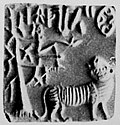
[[File:Man in a tree fleeing a tiger. Mohenjo-daro.jpg|thumb|One of eighteen seals depicting the "human and tiger" motif from the [[Indus Valley Civilisation|Indus Valley Civilization]].<ref>Possehl, Gregory L. "Indus folklore: an unknown story on some Harappan objects." ''Intercultural relations between South and Southwest Asia. Studies in commemoration of ECL during Caspers (1934–1996). BAR International Series'' (1826): 140-144.</ref> These seals closely resemble the story of Gurudruha (Lubdhaka) that is associated with Maha Shivaratri.]] | |||
According to some scholars, the Lubdhaka (hunter) legend associated with Maha Shivaratri may find its roots in the [[Indus Valley Civilisation|Indus Valley Civilization.]]<ref>{{Cite web |last=Kahoor |first=Khan, Shahbaig |date=2024-07-19 |title=Deciphering Indus script and Pashupati Seal of Indus Valley Civilization |ssrn=4900721 |url=https://papers.ssrn.com/sol3/papers.cfm?abstract_id=4900721 |language=en |archive-url=https://web.archive.org/web/20250530154201/https://papers.ssrn.com/sol3/papers.cfm?abstract_id=4900721 |archive-date=30 May 2025 |url-status=live |access-date=18 February 2026 }}</ref> Archaeological evidence such as the [[Pashupati seal]] has been widely interpreted by researchers as indicating early forms of Shiva or proto-Shaiva worship.<ref>{{Cite journal |last=Srinivasan |first=Doris |date=1975 |title=The So-Called Proto-śiva Seal from Mohenjo-Daro: An Iconological Assessment |url=https://www.jstor.org/stable/20062578 |journal=Archives of Asian Art |volume=29 |pages=47–58 |jstor=20062578 |issn=0066-6637}}</ref> Archaeologist Gregory Possehl identified at least eighteen examples of a recurring "human and tiger" motif in Harappan glyptic art from sites including Harappa, Mohenjo-daro, and Chanhu-daro. These seals closely resemble the story of Gurudruha (Lubdhaka) that appears in the Shiva Purana.<ref>Possehl, Gregory L. "Indus folklore: an unknown story on some Harappan objects." ''Intercultural relations between South and Southwest Asia. Studies in commemoration of ECL during Caspers (1934–1996). BAR International Series'' (1826): 140-144.</ref> | |||
== Rituals and observances == | |||
{{Quote box | {{Quote box | ||
|quote = '''A festival of contemplation''' | |quote = '''A festival of contemplation''' | ||
| Line 45: | Line 61: | ||
is to recognize the Shiva in us. | is to recognize the Shiva in us. | ||
</poem> | </poem> | ||
|source = —''The Theosophical Movement, Volume 72''<ref>{{cite journal|title=Shiva|journal=The Theosophical Movement|volume=72|number = 4 |url= http://www.ultindia.org/tm_magazine/7204shiva.html |year=2002 |orig-year=February 1962 |type=reprint |publisher=TEOS, Theosophy Company, Mumbai|page=137}}</ref> | |source = —''The Theosophical Movement, Volume 72''<ref>{{cite journal|title=Shiva|journal=The Theosophical Movement|volume=72|number=4|url=http://www.ultindia.org/tm_magazine/7204shiva.html|year=2002|orig-year=February 1962|type=reprint|publisher=TEOS, Theosophy Company, Mumbai|page=137|access-date=21 February 2020|archive-date=15 February 2023|archive-url=https://web.archive.org/web/20230215001305/https://www.ultindia.org/tm_magazine/7204shiva.html|url-status=dead}}</ref> | ||
|bgcolor=#FFE0BB | |bgcolor=#FFE0BB | ||
|align = right | |align = right | ||
}} | }} | ||
Maha Shivaratri is particularly important in the [[Shaivism]] tradition of [[Hinduism]]. Unlike most Hindu festivals | Maha Shivaratri is particularly important in the [[Shaivism]] tradition of [[Hinduism]]. Shivaratri ("Night of Shiva") refers to the monthly observance that falls on the 14th night (''chaturdashi'') of every lunar fortnight during the waning phase of the moon. Each lunar month therefore contains one Shivaratri. Devotees observe fasting, night vigil (''jagarana''), and worship of the linga on these days. Thus, Maha Shivaratri may be understood as the "great" or preeminent Shivaratri among the twelve monthly Shivaratris in a lunar year.<ref>{{Cite web |title=Monthly Shivratri Fast - How to dp Masik ShivaRatri Fasting |url=https://pujayagna.com/blogs/hindu-fasting-days/masik-shivratri |access-date=2026-02-14 |website=Eshwar Bhakti |language=en}}</ref><ref>{{Cite web |last=A |first=Bhavya |date=2025-02-26 |title=Maha Shivratri |url=https://cohna.org/maha-shivratri/ |access-date=2026-02-14 |website=Coalition of Hindus of North America |language=en-US}}</ref> Unlike most Hindu festivals that are celebrated during the day, Maha Shivaratri is celebrated at night. It is a festival notable for its fasting and meditation on Shiva and an all-night vigil at Shiva temples.<ref name="JonesRyan2006p269"/> | ||
=== Night vigil ''(jagarana)'' === | |||
The celebration includes maintaining a [[Jagran|''jagarana'']], an all-night vigil and prayers, because Shaiva Hindus mark this night as "overcoming darkness and ignorance" in one's life and the world through Shiva. In temples, the night is divided into four quarters (p''raharas''), each with its own ritual worship and singing of mantras.<ref>{{Cite book |last1=Raj |first1=Selva J. |url=https://books.google.com/books?id=h80yOTwlAUcC&q=vigil&pg=PA147 |title=Dealing with Deities: The Ritual Vow in South Asia |last2=Harman |first2=William P. |date=2012-02-01 |publisher=State University of New York Press |isbn=978-0-7914-8200-1 |language=en}}</ref><ref>Mahashivratri 2026: Timings And Puja Rituals Explained, Nikhil Pandey NDTV. </ref> Offerings of fruits, leaves, sweets and milk are made to Shiva, some perform all-day fasting with Vedic or Tantric worship of Shiva, and some perform meditative [[yoga]].<ref>[http://www.odisha.gov.in/portal/LIWPL/event_archive/Events_Archives/150MAHA_SHIVA_RATRI.pdf Mahashivaratri] {{webarchive|url=https://web.archive.org/web/20140327171257/http://www.odisha.gov.in/portal/LIWPL/event_archive/Events_Archives/150MAHA_SHIVA_RATRI.pdf |date=27 March 2014 }}, Government of Orissa; [http://publicholidays.in/maha-shivaratri/ Maha Shivaratri], Public Holidays</ref> The injunctions from the Kalanirnaya of Madhvacharya are also followed during the ''jagarana.''<ref>'''Vanlaltlani, T''' and Patmury, Joseph (1994) ''Sivaratri: An Indian festival of Repentance''. Doing theology with the festivals and customs of Asia, Singapore. pp 59-68</ref> | |||
=== Fasting === | |||
In [[Shaivism]], fasting is traditionally associated with [[Shiva]] worship. It is customary for the devotees of [[Shiva]] not to eat anything until they worship him and make him offerings. On most of the days, devotees do not fast for a whole day because the worship is performed in the early morning. However, on the day of Maha Shivaratri, they wait because the worship continues late into the night.<ref>{{Cite web |title=Mahashivratri 2022: 5 Foods You Can Have While Observing Mahashivratri Vrat (Fast) |url=https://www.ndtv.com/food/mahashivratri-2018-5-foods-you-can-have-while-observing-mahashivratri-vrat-fast-1811808}}</ref><ref>{{Cite news |date=11 March 2021 |title=Maha Shivaratri Fasting Rules and Vrat Vidhi |url=https://timesofindia.indiatimes.com/religion/rituals-puja/maha-shivaratri-fasting-rules-and-vrat-vidhi/articleshow/81434471.cms |newspaper=The Times of India}}</ref><ref>{{Cite web |title=Maha Shivaratri 2023: What to eat if you are fasting |url=https://bangaloremirror.indiatimes.com/bangalore/others/maha-shivaratri-2023-what-to-eat-if-you-are-fasting/articleshow/98028141.cms}}</ref> | |||
During the fast, Iodized salt is completely avoided, and instead, food is prepared using rock salt or unrefined sea salt ''(sendha namak)''. Those fasting may do "nirjala vrat," (fasting from all food and water), or fast from meat, eating only fruits and milk during the day.<ref name=":1">{{Cite web|url=https://www.hindustantimes.com/lifestyle/recipe/cleanse-your-body-this-maha-shivratri-101646031274662.html|title =Cleanse your body this Maha Shivratri|date =28 February 2022}}</ref> Eating food made from rice, wheat, or pulses is also discouraged.<ref>{{Cite web |date=2023-02-15 |title=Mahashivratri 2023 fasting rules: Dos and don'ts to keep in mind while worshipping Lord Shiva |url=https://www.hindustantimes.com/lifestyle/festivals/mahashivratri-2023-fasting-rules-dos-and-don-ts-to-keep-in-mind-while-worshipping-lord-shiva-101676468072865.html |access-date=2026-02-18 |website=Hindustan Times |language=en}}</ref> ''Tamasik'' foods such as onion, garlic, and alcohol are also avoided as they are believed to increase lethargy.<ref>{{Cite news |author=Trending Desk |date=2026-02-15 |title=Mahashivratri 2026 fasting do's and don'ts: What to do and what to avoid while observing a fast for Lord Shiva |url=https://economictimes.indiatimes.com/news/new-updates/maha-shivratri-2026-vrat-vidhi-lord-shiva-fasting-rules-timings-dos-and-donts-lord-shiva/articleshow/128341903.cms?from=mdr |access-date=2026-02-18 |work=The Economic Times |issn=0013-0389}}</ref> The fast is broken on the next day ''(chaturdashi)'' after taking a bath.<ref>{{Cite web |date=15 February 2023 |title=Mahashivratri 2023 fasting rules: Dos and don'ts to keep in mind while worshipping Lord Shiva |url=https://www.hindustantimes.com/lifestyle/festivals/mahashivratri-2023-fasting-rules-dos-and-don-ts-to-keep-in-mind-while-worshipping-lord-shiva-101676468072865.html}}</ref> | |||
=== Puja and abhisheka === | |||
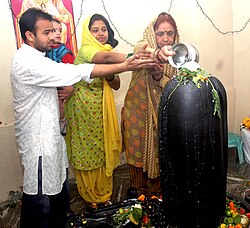
Ritual worship (puja) of the [[lingam]] is the central religious act of Maha Shivaratri. Devotees offer water, milk, yogurt, honey, ghee, and other sacred substances in the ritual known as abhisheka.<ref name=":1" /> Coconut water is generally avoided for the abhisheka, as it becomes ''"nirmalaya"'' (leftover of an offering) after being offered, and therefore becomes unconsumable.<ref>{{Cite web |date=2023-02-15 |title=Mahashivratri 2023 fasting rules: Dos and don'ts to keep in mind while worshipping Lord Shiva |url=https://www.hindustantimes.com/lifestyle/festivals/mahashivratri-2023-fasting-rules-dos-and-don-ts-to-keep-in-mind-while-worshipping-lord-shiva-101676468072865.html |access-date=2026-02-18 |website=Hindustan Times |language=en}}</ref><ref>USHA, B., K. VASANTHI, and C. ESAIVANI. "BIOREMEDIATION OF TEMPLE WASTES (NIRMALAYA) BY EMPLOYING EUDRILUS EUGENIAE."</ref> More than 49 types of plant species from 34 families are used as offerings to the deity throughout various regions of India on Maha Shivaratri. However, leaves of the bilva (Aegle marmelos), considered sacred to Shiva, are the most commonly offered plants.<ref>Mandal, Ushashee, et al. "Significance of Utilizing Plant Resource in Maha Shivratri For The Adoration of Lord Shiva, Odisha, India." ''Purakala, 31 (33)'' (2020): 0971-2143.</ref> In Kashmir, walnuts are soaked in water in earthen pots and buried in the ground for four to five days before Shivaratri. On the day of the festival, they are retrieved, offered to Lord Shiva, and distributed to devotees as [[Prasada|prasada.]]<ref>Ayub, Humeera, Touseef Hussain Trak, and Ravi Upadhayay. "Inventorization of Ethnosacred plants of Kishtwar district." ''World Journal of Pharmaceutical Research'' 3.1 (2013): 1160.</ref> | |||
=== Fairs (Melas) === | |||
Many regions in India and Nepal observe Maha Shivaratri not only through temple worship and fasting, but also through large public fairs (melas) and pilgrimage gatherings at important Shaiva sacred sites.<ref>{{Cite book |last=Sharma |first=L. R. |url=https://books.google.com/books?id=oThuRcNAaN4C&dq=shivaratri+fair&pg=PA164 |title=Quality of Life in the Himalayan Region |date=2005 |publisher=Indus Publishing |isbn=978-81-7387-173-3 |language=en}}</ref> One of the most prominent gatherings takes place at the Pashupatinath Temple in Kathmandu, where Maha Shivaratri is among the largest annual religious festivals. Thousands of devotees, including ascetics and sadhus from across South Asia, assemble at the temple complex to perform night vigils, offer bilva leaves, and participate in ritual bathing in the nearby [[Bagmati River]].<ref>Sivananda, Swami, and Swami Sahajananda. ''Hindu fasts and festivals''. Vol. 5. Divine Life Society, 1983.</ref> The [[Mandi Shivaratri Fair]] held in the town of [[Mandi, Himachal Pradesh|Mandi]] is also famous as a venue for Maha Shivaratri celebrations. It is believed that all gods and goddesses of the area, said to number more than 200, assemble here on the day of Maha Shivaratri.<ref name="mandi">{{cite web|title=International Shivaratri fair in Mandi|url=http://himachaltourism.gov.in/post/Mandi.aspx|publisher=Himachal tourism|access-date=8 February 2012|url-status=dead|archive-url=https://web.archive.org/web/20100414002705/http://himachaltourism.gov.in/post/Mandi.aspx|archive-date=14 April 2010}}</ref><ref name="shiv">{{Cite web|url=http://mandishivratri.com/about-mandi.html|title=The International Festival|access-date=7 February 2010|url-status=dead|archive-url=https://web.archive.org/web/20090401052653/http://mandishivratri.com/about-mandi.html|archive-date=1 April 2009}}</ref> | |||
=== Dance (Nrutya) === | |||
The significance of the dance tradition to this festival has historical roots. Maha Shivaratri has served as a historic confluence of artists for annual dance festivals at major Hindu temples such as at [[Konark Sun Temple|Konark]], [[Khajuraho Group of Monuments|Khajuraho]], [[Pattadakal]], [[Sun Temple, Modhera|Modhera]] and [[Thillai Nataraja Temple, Chidambaram|Chidambaram]].<ref>{{cite book|first=Tracy | last=Pintchman|title=Women's Lives, Women's Rituals in the Hindu Tradition|url=https://books.google.com/books?id=7lOc8ZoLV0wC&pg=PA194|year=2007|publisher=[[Oxford University Press]]|isbn=978-0-19-803934-1|pages=194–195}}</ref> This event is called ''[[Natyanjali]]'', literally "worship through dance", at the Chidambaram temple which is famous for its sculpture depicting all dance mudras in the ancient Hindu text of performance arts called ''[[Natya Shastra]]''.<ref>{{cite book|first=Tracy | last=Pintchman|title=Women's Lives, Women's Rituals in the Hindu Tradition|url=https://books.google.com/books?id=7lOc8ZoLV0wC&pg=PA194|year=2007|publisher=Oxford University Press|isbn=978-0-19-803934-1|pages=194–196}}</ref><ref>{{cite book|first=Brenda | last=Pugh McCutchen |title=Teaching Dance as Art in Education |url=https://books.google.com/books?id=C0yjXGJ3EEoC |year=2006|publisher=Human Kinetics|isbn=978-0-7360-5188-0 |pages=450 }}</ref> Similarly, at Khajuraho Shiva temples, a major fair and dance festival on Maha Shivaratri, involving Shaiva pilgrims camped over miles around the temple complex, was documented by Alexander Cunningham in 1864.<ref>{{cite book|author= Shobita Punja|title= Khajuraho: the first thousand years|url= https://books.google.com/books?id=CwfWAAAAMAAJ|year= 1999|publisher= Penguin Books|pages= 71–74|isbn= 9780670891900}}</ref> | |||
=== Pilgrimage === | |||
On Maha Shivaratri, many devotees perform pilgrimages to the major [[Jyotirlinga]] Shiva temples of India, such as [[Varanasi]] and [[Somanatha]]. They also serve as sites for fairs and special events.<ref>{{cite book|first=Diana L. | last=Eck|title=Banras, City of Light|url=https://books.google.com/books?id=lkkqAAAAYAAJ |year=1982|publisher=Knopf|pages=113, 256, 276| isbn=9780394519715}}</ref><ref>{{Cite web|url=https://www.varanasiguru.com/maha-shivratri/|title=🔱Shivaratri - Shivaratri Dates, Schedule and Timing 2023 | Next Shivaratri festival on 18 February 2023|website=varanasiguru.com|date=25 February 2022 |access-date=11 February 2023}}</ref> In Tamil Nadu, pilgrimages are also made to the [[Arunachalesvara Temple|Annamalaiyar]] temple located in [[Tiruvannamalai]] district. The special process of worship on this day is Girivalam or Giri Pradakshina, a 14-kilometer barefoot walk around Shiva's temple on top of the hill. A huge lamp of oil and [[camphor]] is lit on the hilltop at sunset, not to be confused with [[Karthigai Deepam|Karthigai Deepam.]]<ref>da Fonseca, Fátima Barahona. "NARRATIVES OF A SACRED MOUNTAIN. ARUNACHALA, TAMIL NADU, SOUTH OF INDIA." ''URBAN DESIGN AND PLANNING'': 17.</ref> A ritual marathon is undertaken by the devotees to the 12 Shiva shrines in the district of [[Kanyakumari]] on the day of Shivaratri called [[Sivalaya Ottam]]. During this period, the rope used for hoisting the temple flag is coated with turmeric powder.<ref>{{Cite web |last=admin |date=2015-10-18 |title=FAIRS AND FESTIVALS AT THIRUVITHAMCODE SHIVA AND VISHNU TEMPLES – AN OVERVIEW {{!}} rjisacjournal.com |url=https://www.rjisacjournal.com/fairs-and-festivals-at-thiruvithamcode-shiva-and-vishnu-temples-an-overview/ |access-date=2026-03-07 |language=en-US}}</ref> In [[Punjab, India|Punjab]], Shobha Yatras would be organised by various Hindu organisations in different cities. It is a grand festival for [[Punjabi Hindus]].<ref>{{Cite web |title=Shiv Sena Punjab organises grand Shobha Yatra on Mahashivratri |url=https://www.tribuneindia.com/news/jalandhar/shiv-sena-punjab-organises-grand-shobha-yatra-on-mahashivratri/ |access-date=2026-02-15 |website=The Tribune |language=en}}</ref> | |||
==Legends== | |||
Maha Shivaratri is mentioned in several [[Puranas]], particularly the ''[[Skanda Purana]]'', ''[[Linga Purana]],'' and ''[[Padma Purana]]''. These medieval era Shaiva texts present different versions associated with this festival, such as fasting, and offering reverence to a [[lingam]]{{em-dash}}an emblematic figure of Shiva.<ref name="JonesRyan2006p269" /> | |||
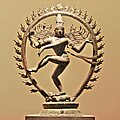
Different legends describe the significance of Maha Shivaratri. According to one legend in the [[Shaivism]] tradition, this is the night when Shiva performs the heavenly dance of creation, preservation and destruction.<ref name="Dhoraisingam35" /><ref name="auto1" /> The chanting of hymns, the reading of Shiva scriptures and the chorus of devotees joins this cosmic dance and remembers Shiva's presence everywhere. According to another legend, this is the night when Shiva and Parvati got married.<ref name="Dhoraisingam35" /><ref>{{cite book|first=Steven | last=Leuthold|title=Cross-Cultural Issues in Art: Frames for Understanding |url=https://books.google.com/books?id=z9GsAgAAQBAJ&pg=PA142 |year=2010|publisher=Routledge|isbn=978-1-136-85455-2|pages=142–143}}</ref> It is also believed that on this particular day, Shiva gulped the [[Halahala]] produced during the [[Samudra manthan|Samudra Manthana]] and held it in his neck, which bruised and turned blue. As a result, he acquired the epithet [[Nilakanta (Hinduism)|Nilakantha]].<ref>{{Cite book |last=Shah |first=Vaishali |url=https://books.google.com/books?id=F7KhDwAAQBAJ&dq=did+shiva+drink+poison+on+mahashivratri&pg=PT9 |title=Hindu Culture and Lifestyle: Living Indian Traditions in the age of Artificial Intelligence |date=2019-07-11 |publisher=Notion Press |isbn=978-1-64587-608-3 |language=en}}</ref> | |||
[[ | |||
=== The Lingodbhava legend === | |||
The Linga Purana describes another legend known as ''Lingodbhava'' (the emergence of the linga) in connection with Maha Shivaratri.<ref>{{Cite book |last=Nair |first=Shantha N. |url=https://books.google.com/books?id=Q4Od9pWMXCsC&q=shivaratri&pg=PT19 |title=The Lord Shiva |date=2009-02-21 |publisher=Pustak Mahal |isbn=978-81-223-1039-9 |language=en}}</ref> In this account, Brahma and Vishnu dispute their supremacy. To settle the debate, a luminous pillar of fire suddenly appeared in front of them. This event was known as ''lingodbhava'' (the birth of the Linga). Brahma took the form of a swan and ascended, trying to find its top, while Vishnu took the form of a boar and descended, seeking its bottom. After thousands of years of fruitless search, both conceded that neither could find an end. At that moment, Shiva emerged from within the flame, and the first Linga was born. The day Shiva appeared and declared his eternal nature is believed to be the day of Maha Shivaratri.<ref>{{Cite book |last1=Boer |first1=Lucas den |url=https://books.google.com/books?id=SrH8DwAAQBAJ&q=lingodbhava&pg=PA75 |title=Framing Intellectual and Lived Spaces in Early South Asia: Sources and Boundaries |last2=Cecil |first2=Elizabeth A. |date=2020-09-21 |publisher=Walter de Gruyter GmbH & Co KG |isbn=978-3-11-055717-6 |language=en}}</ref><ref>{{Cite book |last=Achuthananda |first=Swami |url=https://books.google.com/books?id=F9FqDwAAQBAJ&dq=+Brahma+took+the+form+of+a+swan+and+ascended,+trying+to+find+its+top,+while+Vishnu+took+the+form+of+a+boar+and+descended,+seeking+its+bottom.++lingodbhava&pg=PA1 |title=The Ascent of Vishnu and the Fall of Brahma |date=2018-08-27 |publisher=Relianz Communications Pty Ltd |isbn=978-0-9757883-3-2 |language=en}}</ref><ref>{{Cite book |last1=Romano |first1=Henry |url=https://books.google.com/books?id=d5p1EAAAQBAJ&dq=lingodbhava+maha+shivaratri&pg=PA1923 |title=Ancient India and the Vedic Gods |last2=Publications |first2=DTTV |publisher=Dttv Publications |language=en}}</ref> | |||
[[File:Flickr - dalbera - Shiva Natarâdja, Seigneur de la Danse (musée Guimet).jpg|thumb|left|upright=0.6|Many legends explain the significance of Maha Shivaratri, one being it is the night of [[Nataraja|Shiva's dance]](Tandava)]] | |||
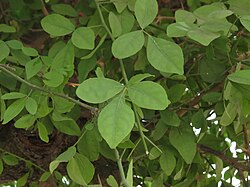
[[File:Aegle marmelosleaf 05.JPG|thumb|Bilva (Aegle marmelos) leaves mentioned in the Legend of Gurudruha and traditionally offered to Shiva during Maha Shivaratri]] | |||
The | === The legend of Gurudruha (Lubdhaka) === | ||
The [[Shiva Purana]] contains the popular and detailed story of a forest hunter named Gurudruha (also called Lubdhaka in Balineese texts), which narrates one of the earliest textual explanations for the ritual practice of bilipatra (bilva) leaf offerings during Maha Shivaratri. On one Maha Shivaratri night, Gurudruha, a hunter with no formal religious background, went to the forest to hunt and bring home food for his parents. To escape the threat of wild animals, he climbed a bilva tree. During the first quarter of the night, a hind deer came to drink from the lake. Gurudruha aimed his bow at her. The frightened deer pleaded for her life, explaining that she had young fawns at home and requesting permission to entrust them to her husband before returning to face death. After some hesitation, he agreed. While waiting for the deer to return and to keep himself awake the whole night, he plucked bilva leaves and dropped them to the forest floor. Unknown to Gurudruha, a Shiva linga rested directly beneath the tree. When dawn arrived, thousands of leaves lay upon the linga.<ref>Clifton, Wolf Gordon. "Sustainability policy and the stage of divine play: Hindu philosophy at the nexus of animal welfare, environment, and sustainable development." ''Journal of Animal Ethics'' 13.2 (2023): 169-183.</ref><ref>{{Cite book |last=Tanakuṅ |url=https://books.google.com/books?id=kXXoCAAAQBAJ&dq=story+of+lubdhaka&pg=PR5 |title=Śiwarātrikalpa of MPU Tanakuṅ: An Old Javanese poem, its Indian source and Balinese illustrations |date=2013-06-29 |publisher=Springer |isbn=978-94-011-9429-7 |language=en}}</ref><ref>{{Citation |last1=Teeuw |first1=A. |title=Four Balinese Illustrations of the Tale of Lubdhaka |date=1969 |work=Śiwarātrikalpa of MPU Tanakuṅ: An Old Javanese poem, its Indian source and Balinese illustrations |pages=215–308 |editor-last=Teeuw |editor-first=A. |url=https://doi.org/10.1007/978-94-011-9429-7_3 |access-date=2026-02-25 |place=Dordrecht |publisher=Springer Netherlands |language=en |doi=10.1007/978-94-011-9429-7_3 |isbn=978-94-011-9429-7 |last2=Galestin |first2=Th. P. |last3=Robson |first3=S. O. |last4=Worsley |first4=P. J. |last5=Zoetmulder |first5=P. J. |editor2-last=Galestin |editor2-first=Th. P. |editor3-last=Robson |editor3-first=S. O. |editor4-last=Worsley |editor4-first=P. J.|url-access=subscription }}</ref> | |||
At dawn, the deer returned with her family and told the hunter that if he wished to kill her, he would also have to take their lives. As he raised his bow once more, additional bilva leaves fell upon the Shiva linga. The accumulated punya (spiritual merit) from the worship he had unknowingly performed throughout the night had destroyed his sins and transformed his heart. Thus, he released the deer. Pleased by Lubdhaka's accidental vigil and devotion, Shiva appeared before him and granted a boon, declaring that he would be reborn as the king of the town of Shrungaverapura and that [[Rama|Lord Rama]] would visit his home and ultimately grant him liberation. In his next life, Gurudruha was born as [[Guha (Ramayana)|Guha.]]<ref>Siva Purana - English Translation - J. L. Shastri - Part 3. Pg. 1431 - 1439</ref> | |||
== | ==Global worship == | ||
{{multiple image | {{multiple image | ||
| align = | | align = | ||
| Line 76: | Line 113: | ||
| image3 = | | image3 = | ||
| width3 = Lighting the holy big lamp on top of the annamalai hill with oil and camphor | | width3 = Lighting the holy big lamp on top of the annamalai hill with oil and camphor | ||
| footer = Mahashivaratri | | footer = Mahashivaratri Celebrations of Kotappakonda ([[Palnadu district|Palnadu]], [[Andhra Pradesh]]) observed at night, usually in lighted temples or specially prepared ''prabha'' (above). | ||
}} | }} | ||
Maha Shivaratri is celebrated in | === Nepal === | ||
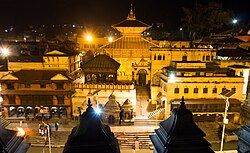
[[File:108 Night View Of Pashupatinath Temple.jpg|thumb|Pashupatinath Temple]] | |||
Maha Shivaratri is a national holiday in Nepal and celebrated widely in temples all over the country, especially in the [[Pashupatinath temple]]. Thousands of devotees visit the famous [[Shakta pitha|Shiva Shakti Peetham]] nearby as well. Maha Shivaratri is celebrated as Nepali Army Day amid a spectacular ceremony held at the Army Pavilion, [[Tundikhel]].<ref>{{cite web |url=https://www.nepalarmy.mil.np/viewnews/379 |title = Nepali Army {{!}} नेपाली सेना}}</ref> Crowds of sadhus and saints travel to Pashupatinath Temple located in Kathmandu from all of Nepal and neighbouring India to celebrate the day and perform puja on this day.<ref>{{Cite web |last=PTI |title=About 10 lakh visitors expected to throng Pashupatinath temple on Maha Shivratri |url=https://www.deccanherald.com/india/about-10-lakh-visitors-expected-to-throng-pashupatinath-temple-on-maha-shivratri-2928017 |access-date=16 September 2024 |website=Deccan Herald |language=en}}</ref> | |||
=== Pakistan === | |||
In Pakistan, Maha Shivaratri is observed by Hindu communities at several historic temple sites, including the Katas Raj Temples in Punjab. The festival is typically celebrated for one day and one night. In 2006, approximately 300 Indian pilgrims attended the festival at the site, and subsequent years saw participation by both Indian and Pakistani Hindus. In 2010 and 2011, around 2,000 Pakistani Hindus from various regions reportedly gathered at Katas Raj for Shivaratri observances. In 2005, Lal Krishna Advani visited the temple complex and publicly expressed concern over its deteriorated condition. The site is opened to the public only during Shivaratri celebrations, but restricted by the government for the rest of the year.<ref>Gondal, N. A., and S. Arif. "The Dying Temples of Hindus and Sikhs in Potohar Plateau: A Case." (2021): 241-250.</ref> | |||
Another major temple where Shivaratri is celebrated is the [[Shree Ratneshwar Mahadev Temple, Karachi|Shree Ratneshwar Mahadev Temple in Karachi]] whose Shivaratri festival is attended by 25,000 people.<ref>{{Cite news|url=https://www.indiatoday.in/world/pakistan/story/shri-ratneshwar-mahadev-temple-karachi-overpass-pakistani-hindus-hrcp-187674-2014-04-04|title=150-year-old Hindu temple under threat in Karachi|date=4 April 2014|newspaper=Indiatoday|access-date=28 August 2020}}</ref> On the Shivaratri night, Hindus in Karachi fast and visit the temple. Later, devotees from the [[Chanesar Goth]] come to the temple carrying water from the holy river [[Ganges]], in order to bathe the idol of [[Lord Shiva|Shiva]]. [[Puja (Hinduism)|Puja]] is performed until 5 am, followed by an [[aarti]]. Devotees then walk barefoot with women carrying a [[pooja thali]] containing flowers, incense sticks, rice, coconut and a [[Diya (lamp)|diya]] to the sea after which they are free to break their fast. Breakfast is served in the temple kitchen.<ref name="Shazia Hasan">{{Cite news|url=https://www.dawn.com/news/1243973|title=Hindus celebrate Maha Shivratri festival in Karachi|author=Shazia Hasan|date=7 March 2016|newspaper=Dawn|access-date=28 August 2020}}</ref> | |||
=== Caribbean === | |||
Maha Shivaratri is the main Hindu festival among the [[Shaivite|Shaiva Hindu diaspora]] from [[Nepal]] and [[India]]. In [[Indo-Caribbean]] communities, thousands of Hindus spend the festival night in over four hundred temples across multiple countries, offering special ''jhalls'' (milk and curd, flowers, sugarcane and sweets) to Shiva.<ref>{{cite web|title=Trinidad Hindus observe Shivratri amid Carnival Celebration|url=https://repeatingislands.com/2014/03/01/trinidad-hindus-observe-shivratri-amid-carnival-celebration/|publisher=Repeating Islands|access-date=31 August 2016|date=2 March 2014|archive-date=21 September 2016|archive-url=https://web.archive.org/web/20160921150332/https://repeatingislands.com/2014/03/01/trinidad-hindus-observe-shivratri-amid-carnival-celebration/|url-status=dead}}</ref> In 2026, the PM of Trinidad and Tobago, [[Kamla Persad-Bissessar]], celebrated Maha Shivaratri by visiting nine Hindu temples across her constituency overnight, joining devotees in the night vigil.<ref>{{Cite web |date=2026-02-16 |title=PM observes Maha Shivaratri with overnight temple visits |url=https://trinidadexpress.com/newsextra/pm-observes-maha-shivaratri-with-overnight-temple-visits/article_ab5e34c0-ec4b-4588-ac29-f085c19c5c4c.html |access-date=2026-03-07 |website=Trinidad Express Newspapers |language=en}}</ref> | |||
In | === Oman === | ||
In Oman, Maha Shivaratri is observed by the Hindu diaspora at the historic [[Motishwar Mandir]] in the Muttrah area of Muscat.<ref>{{Cite journal |last=Pattnaik |first=Jajati K. |last2=Panda |first2=Chandan K. |date=2022-06-30 |title=INDIAN DIASPORA IN OMAN |url=https://doi.org/10.37867/te1402116 |journal=Towards Excellence |pages=1401–1414 |doi=10.37867/te1402116 |issn=0974-035X|doi-access=free }}</ref><ref>{{Cite journal |last=Mehta |first=Sandhya Rao |date=2022-10-02 |title=Strategic Belonging: Hindu Identity and Performance in Oman |url=https://www.tandfonline.com/doi/full/10.1080/25765949.2022.2151741 |journal=Asian Journal of Middle Eastern and Islamic Studies |language=en |volume=16 |issue=4 |pages=402–416 |doi=10.1080/25765949.2022.2151741 |issn=2576-5949|url-access=subscription }}</ref> The temple, dedicated to Shiva, was built in 1909 by the Bhatia merchant community from Sindh and Gujarat, whose trading networks had been present in Muscat since the early 16th century. The complex contains shrines to Adi Motishwar Mahadev and [[Hanuman]], and serves as one of the oldest Hindu temples in the Persian Gulf region.<ref>{{Cite book |last=Markovits |first=Claude |url=https://books.google.ca/books?hl=en&lr=&id=M2vu7Odjz6kC&oi=fnd&pg=PP1&dq=The+Global+World+of+Indian+Merchants,+1750%E2%80%931947:+Traders+of+Sind+from+...&ots=G-9UBfwKy6&sig=SeI6muYSU9Sx1PwSoE9XOYbvJ0k#v=onepage&q=The%20Global%20World%20of%20Indian%20Merchants,%201750%E2%80%931947:%20Traders%20of%20Sind%20from%20...&f=false |title=The Global World of Indian Merchants, 1750–1947: Traders of Sind from Bukhara to Panama |date=2000-06-22 |publisher=Cambridge University Press |isbn=978-1-139-43127-9 |language=en}}</ref> During Maha Shivaratri, more than 20,000 devotees gather at the temple to perform prayers and night-long worship dedicated to Shiva.<ref>{{Cite news |date=2018-02-12 |title=PM Narendra Modi visits Shiva temple in Oman |url=https://economictimes.indiatimes.com/news/politics-and-nation/pm-narendra-modi-visits-shiva-temple-in-oman/articleshow/62884919.cms?from=mdr |access-date=2026-03-07 |work=The Economic Times |issn=0013-0389}}</ref> | |||
=== Outside the Indian subcontinent === | |||
In [[Mauritius]], Hindus go on pilgrimage to [[Ganga Talao]], a crater-lake.<ref>{{cite web|title=The sacred lake of Ganga Talao|date=3 May 2016|url=https://www.cnn.com/2016/05/03/africa/maha-shivaratri-mauritius/index.html|publisher=CNN|access-date=12 June 2018}}</ref> | |||
In [[ | |||
Maha Shivaratri is known as Siwa Ratri in [[Indonesia]] and is celebrated by Hindus in [[Bali]] and [[Java]] as a major festival.<ref>https://thebalisun.com/incredible-hindu-festival-in-java-is-an-essential-add-on-adventure-for-bali-tourists/</ref>[[File:Lord Shiva devotees offering milk, flowers, fruits and bel leaves on a Shivaling for seeking divine blessings, in a city temple at the celebration of Maha Shivaratri, in New Delhi on February 23, 2009 (1).jpg|thumb|A family worshipping [[Shiva Linga]] during fasting period.]] | |||
Maha Shivaratri is | |||
==See also== | ==See also== | ||
| Line 116: | Line 140: | ||
* [[Rudraksha]] | * [[Rudraksha]] | ||
* [[Vibhuti]] | * [[Vibhuti]] | ||
* [[Rudra]] | * [[Rudra]] | ||
* [[Linga]] | * [[Linga]] | ||
* [[ | * [[Rudrabhisheka]] | ||
* [[Jalabhisheka]] | |||
==References== | ==References== | ||
| Line 141: | Line 166: | ||
{{Shaivism}} | {{Shaivism}} | ||
{{Shaktism}} | |||
{{Sindhi festivals}} | {{Sindhi festivals}} | ||
{{HinduFestivals}} | {{HinduFestivals}} | ||
| Line 154: | Line 180: | ||
[[Category:Public holidays in Nepal]] | [[Category:Public holidays in Nepal]] | ||
[[Category:Public holidays in Sri Lanka]] | [[Category:Public holidays in Sri Lanka]] | ||
[[Category:Religious festivals in India]] | [[Category:Religious festivals in India]] | ||
[[Category:Hindu festivals in Nepal]] | [[Category:Hindu festivals in Nepal]] | ||
[[Category:Shaivism]] | [[Category:Shaivism]] | ||
[[Category:Vrata]] | [[Category:Vrata]] | ||
Latest revision as of 23:39, 23 March 2026
| Maha Shivaratri | |
|---|---|
 Meditating Shiva statue on Maha-Shivaratri | |
| Observed by | Hindus |
| Type | Religious |
| Significance | Commemoration of the wedding of Shiva and Parvati
Veneration of the Tandava dance of Shiva Manifestation of the lingam[1] |
| Observances | |
| Date | Maha Krishna Chaturdashi |
| 2026 date | 15 February (Sunday)[3] |
| Frequency | Annual |
Hindu festival dates The Hindu calendar is lunisolar but most festival dates are specified using the lunar portion of the calendar. A lunar day is uniquely identified by three calendar elements: māsa (lunar month), pakṣa (lunar fortnight) and tithi (lunar day). Furthermore, when specifying the masa, one of two traditions are applicable, viz. amānta / pūrṇimānta. Iff a festival falls in the waning phase of the moon, these two traditions identify the same lunar day as falling in two different (but successive) masa. A lunar year is shorter than a solar year by about eleven days. As a result, most Hindu festivals occur on different days in successive years on the Gregorian calendar. | |
| Part of a series on |
| Shaivism |
|---|
 |
 Hinduism portal Hinduism portal |
Maha Shivaratri is a Hindu festival celebrated annually to worship the deity Shiva, between February and March.[4] According to the Hindu calendar, The festival is observed on the chaturdashi (14th lunar day) of krishna paksha (waning moon) of the month of Magha or Phalguna.[4][5] The month may vary from month of magh or Phalguna as per Purnimata and Amanta Calendar but is observed on the same lunar night across the regions. The festival commemorates the marriage of Shiva and Parvati,[6] and the occasion of Shiva performing his ritual dance called tandava.[7][8]
It is a notable festival in Hinduism, marking a remembrance of "overcoming darkness and ignorance" in life and the world. It is observed by remembering Shiva and chanting prayers, fasting, and meditating on ethics and virtues such as honesty, non-injury to others, charity, forgiveness, and the discovery of Shiva.[5] Ardent devotees stay awake throughout this night. Others visit one of the Shiva temples or go on a pilgrimage to the Jyotirlingams. The festival is believed to have originated in 5th century BCE.[5]
In Kashmir Shaivism, the festival is called Har-ratri or phonetically simpler Haerath or Herath by Shiva devotees of the Kashmir region.[9][10]
Etymology[edit | edit source]
The term Maha Shivaratri is a compound of three Sanskrit elements: maha (महा) meaning "great", Shiva (शिव), the Hindu deity, and ratri (रात्रि), meaning "night". The literal meaning is "the Great Night of Shiva." The festival is observed annually on the krishna paksha (waning moon) chaturdashi (14th lunar day) of the month of Magha or Phalguna[11] In the Amanta lunar calendar, where a lunar month ends on the new moon day (Amavasiya), the date falls in the month of Magha. In the Purnimanta lunar calendar, where a lunar month ends on the full moon day (Purnima), the same lunar day of Maha Shivaratri is reckoned as occurring in Phalguna. Despite the difference in month name, the festival is observed on the same lunar night across India.[12][13]
Other names[edit | edit source]
In Kashmir, Shivaratri is referred to as Herath (Kashmiri: हेरथ / ہیرَتھ). The name is commonly understood to derive from "Har Ratri" ("Night of Hara"), Hara being a name of Shiva. In the Kashmiri Pandit tradition, the observance of Herath expands beyond a single night and spans approximately twenty-three days, beginning with Hur-e-Okdoh (the first day of the dark fortnight of the Purnimanta month of Phaguna) and concluding on Teel-e-aetham (the eighth day of the bright fortnight of Phagun).[14][15]
Maha Shivratri is also known as Padmarajarathri (पद्मराजरात्रि), a sacred night dedicated to Lord Shiva, observed with fasting, prayers, and night-long worship by devotees.[16][17]
Origins[edit | edit source]
Textual origins[edit | edit source]
The origin of Maha Shivaratri is mentioned mainly in Puranic literature. One of the first mentions appears in the Shiva Purana, which links the story of the hunter Gurudruha with Shivaratri.[18] The story of Gurudruha, who is also referred to as Lubdhaka, is later found in the Javanese didactic text Siwaratrikalpa, which is dated to being composed between 1466 and 1478.[19] The festival is also mentioned in the Linga Purana and the Skanda Purana.[20]
Archeological origins[edit | edit source]

According to some scholars, the Lubdhaka (hunter) legend associated with Maha Shivaratri may find its roots in the Indus Valley Civilization.[22] Archaeological evidence such as the Pashupati seal has been widely interpreted by researchers as indicating early forms of Shiva or proto-Shaiva worship.[23] Archaeologist Gregory Possehl identified at least eighteen examples of a recurring "human and tiger" motif in Harappan glyptic art from sites including Harappa, Mohenjo-daro, and Chanhu-daro. These seals closely resemble the story of Gurudruha (Lubdhaka) that appears in the Shiva Purana.[24]
Rituals and observances[edit | edit source]
During the Vigil Night of Shiva, Mahashivaratri,
we are brought to the moment of interval
between destruction and regeneration;
it symbolizes the night
when we must contemplate on that which
watches the growth out of the decay.
During Mahashivaratri we have to be alone
with our sword, the Shiva out of us.
We have to look behind and before,
to see what evil needs eradicating from our heart,
what growth of virtue we need to encourage.
Shiva is not only outside of us but within us.
To unite ourselves with the One Self
is to recognize the Shiva in us.
—The Theosophical Movement, Volume 72[25]
Maha Shivaratri is particularly important in the Shaivism tradition of Hinduism. Shivaratri ("Night of Shiva") refers to the monthly observance that falls on the 14th night (chaturdashi) of every lunar fortnight during the waning phase of the moon. Each lunar month therefore contains one Shivaratri. Devotees observe fasting, night vigil (jagarana), and worship of the linga on these days. Thus, Maha Shivaratri may be understood as the "great" or preeminent Shivaratri among the twelve monthly Shivaratris in a lunar year.[26][27] Unlike most Hindu festivals that are celebrated during the day, Maha Shivaratri is celebrated at night. It is a festival notable for its fasting and meditation on Shiva and an all-night vigil at Shiva temples.[5]
Night vigil (jagarana)[edit | edit source]
The celebration includes maintaining a jagarana, an all-night vigil and prayers, because Shaiva Hindus mark this night as "overcoming darkness and ignorance" in one's life and the world through Shiva. In temples, the night is divided into four quarters (praharas), each with its own ritual worship and singing of mantras.[28][29] Offerings of fruits, leaves, sweets and milk are made to Shiva, some perform all-day fasting with Vedic or Tantric worship of Shiva, and some perform meditative yoga.[30] The injunctions from the Kalanirnaya of Madhvacharya are also followed during the jagarana.[31]
Fasting[edit | edit source]
In Shaivism, fasting is traditionally associated with Shiva worship. It is customary for the devotees of Shiva not to eat anything until they worship him and make him offerings. On most of the days, devotees do not fast for a whole day because the worship is performed in the early morning. However, on the day of Maha Shivaratri, they wait because the worship continues late into the night.[32][33][34]
During the fast, Iodized salt is completely avoided, and instead, food is prepared using rock salt or unrefined sea salt (sendha namak). Those fasting may do "nirjala vrat," (fasting from all food and water), or fast from meat, eating only fruits and milk during the day.[35] Eating food made from rice, wheat, or pulses is also discouraged.[36] Tamasik foods such as onion, garlic, and alcohol are also avoided as they are believed to increase lethargy.[37] The fast is broken on the next day (chaturdashi) after taking a bath.[38]
Puja and abhisheka[edit | edit source]
Ritual worship (puja) of the lingam is the central religious act of Maha Shivaratri. Devotees offer water, milk, yogurt, honey, ghee, and other sacred substances in the ritual known as abhisheka.[35] Coconut water is generally avoided for the abhisheka, as it becomes "nirmalaya" (leftover of an offering) after being offered, and therefore becomes unconsumable.[39][40] More than 49 types of plant species from 34 families are used as offerings to the deity throughout various regions of India on Maha Shivaratri. However, leaves of the bilva (Aegle marmelos), considered sacred to Shiva, are the most commonly offered plants.[41] In Kashmir, walnuts are soaked in water in earthen pots and buried in the ground for four to five days before Shivaratri. On the day of the festival, they are retrieved, offered to Lord Shiva, and distributed to devotees as prasada.[42]
Fairs (Melas)[edit | edit source]
Many regions in India and Nepal observe Maha Shivaratri not only through temple worship and fasting, but also through large public fairs (melas) and pilgrimage gatherings at important Shaiva sacred sites.[43] One of the most prominent gatherings takes place at the Pashupatinath Temple in Kathmandu, where Maha Shivaratri is among the largest annual religious festivals. Thousands of devotees, including ascetics and sadhus from across South Asia, assemble at the temple complex to perform night vigils, offer bilva leaves, and participate in ritual bathing in the nearby Bagmati River.[44] The Mandi Shivaratri Fair held in the town of Mandi is also famous as a venue for Maha Shivaratri celebrations. It is believed that all gods and goddesses of the area, said to number more than 200, assemble here on the day of Maha Shivaratri.[45][46]
Dance (Nrutya)[edit | edit source]
The significance of the dance tradition to this festival has historical roots. Maha Shivaratri has served as a historic confluence of artists for annual dance festivals at major Hindu temples such as at Konark, Khajuraho, Pattadakal, Modhera and Chidambaram.[47] This event is called Natyanjali, literally "worship through dance", at the Chidambaram temple which is famous for its sculpture depicting all dance mudras in the ancient Hindu text of performance arts called Natya Shastra.[48][49] Similarly, at Khajuraho Shiva temples, a major fair and dance festival on Maha Shivaratri, involving Shaiva pilgrims camped over miles around the temple complex, was documented by Alexander Cunningham in 1864.[50]
Pilgrimage[edit | edit source]
On Maha Shivaratri, many devotees perform pilgrimages to the major Jyotirlinga Shiva temples of India, such as Varanasi and Somanatha. They also serve as sites for fairs and special events.[51][52] In Tamil Nadu, pilgrimages are also made to the Annamalaiyar temple located in Tiruvannamalai district. The special process of worship on this day is Girivalam or Giri Pradakshina, a 14-kilometer barefoot walk around Shiva's temple on top of the hill. A huge lamp of oil and camphor is lit on the hilltop at sunset, not to be confused with Karthigai Deepam.[53] A ritual marathon is undertaken by the devotees to the 12 Shiva shrines in the district of Kanyakumari on the day of Shivaratri called Sivalaya Ottam. During this period, the rope used for hoisting the temple flag is coated with turmeric powder.[54] In Punjab, Shobha Yatras would be organised by various Hindu organisations in different cities. It is a grand festival for Punjabi Hindus.[55]
Legends[edit | edit source]
Maha Shivaratri is mentioned in several Puranas, particularly the Skanda Purana, Linga Purana, and Padma Purana. These medieval era Shaiva texts present different versions associated with this festival, such as fasting, and offering reverence to a lingamTemplate:Em-dashan emblematic figure of Shiva.[5]
Different legends describe the significance of Maha Shivaratri. According to one legend in the Shaivism tradition, this is the night when Shiva performs the heavenly dance of creation, preservation and destruction.[7][8] The chanting of hymns, the reading of Shiva scriptures and the chorus of devotees joins this cosmic dance and remembers Shiva's presence everywhere. According to another legend, this is the night when Shiva and Parvati got married.[7][56] It is also believed that on this particular day, Shiva gulped the Halahala produced during the Samudra Manthana and held it in his neck, which bruised and turned blue. As a result, he acquired the epithet Nilakantha.[57]
The Lingodbhava legend[edit | edit source]
The Linga Purana describes another legend known as Lingodbhava (the emergence of the linga) in connection with Maha Shivaratri.[58] In this account, Brahma and Vishnu dispute their supremacy. To settle the debate, a luminous pillar of fire suddenly appeared in front of them. This event was known as lingodbhava (the birth of the Linga). Brahma took the form of a swan and ascended, trying to find its top, while Vishnu took the form of a boar and descended, seeking its bottom. After thousands of years of fruitless search, both conceded that neither could find an end. At that moment, Shiva emerged from within the flame, and the first Linga was born. The day Shiva appeared and declared his eternal nature is believed to be the day of Maha Shivaratri.[59][60][61]
.jpg)

The legend of Gurudruha (Lubdhaka)[edit | edit source]
The Shiva Purana contains the popular and detailed story of a forest hunter named Gurudruha (also called Lubdhaka in Balineese texts), which narrates one of the earliest textual explanations for the ritual practice of bilipatra (bilva) leaf offerings during Maha Shivaratri. On one Maha Shivaratri night, Gurudruha, a hunter with no formal religious background, went to the forest to hunt and bring home food for his parents. To escape the threat of wild animals, he climbed a bilva tree. During the first quarter of the night, a hind deer came to drink from the lake. Gurudruha aimed his bow at her. The frightened deer pleaded for her life, explaining that she had young fawns at home and requesting permission to entrust them to her husband before returning to face death. After some hesitation, he agreed. While waiting for the deer to return and to keep himself awake the whole night, he plucked bilva leaves and dropped them to the forest floor. Unknown to Gurudruha, a Shiva linga rested directly beneath the tree. When dawn arrived, thousands of leaves lay upon the linga.[62][63][64]
At dawn, the deer returned with her family and told the hunter that if he wished to kill her, he would also have to take their lives. As he raised his bow once more, additional bilva leaves fell upon the Shiva linga. The accumulated punya (spiritual merit) from the worship he had unknowingly performed throughout the night had destroyed his sins and transformed his heart. Thus, he released the deer. Pleased by Lubdhaka's accidental vigil and devotion, Shiva appeared before him and granted a boon, declaring that he would be reborn as the king of the town of Shrungaverapura and that Lord Rama would visit his home and ultimately grant him liberation. In his next life, Gurudruha was born as Guha.[65]
Global worship[edit | edit source]


Nepal[edit | edit source]

Maha Shivaratri is a national holiday in Nepal and celebrated widely in temples all over the country, especially in the Pashupatinath temple. Thousands of devotees visit the famous Shiva Shakti Peetham nearby as well. Maha Shivaratri is celebrated as Nepali Army Day amid a spectacular ceremony held at the Army Pavilion, Tundikhel.[66] Crowds of sadhus and saints travel to Pashupatinath Temple located in Kathmandu from all of Nepal and neighbouring India to celebrate the day and perform puja on this day.[67]
Pakistan[edit | edit source]
In Pakistan, Maha Shivaratri is observed by Hindu communities at several historic temple sites, including the Katas Raj Temples in Punjab. The festival is typically celebrated for one day and one night. In 2006, approximately 300 Indian pilgrims attended the festival at the site, and subsequent years saw participation by both Indian and Pakistani Hindus. In 2010 and 2011, around 2,000 Pakistani Hindus from various regions reportedly gathered at Katas Raj for Shivaratri observances. In 2005, Lal Krishna Advani visited the temple complex and publicly expressed concern over its deteriorated condition. The site is opened to the public only during Shivaratri celebrations, but restricted by the government for the rest of the year.[68]
Another major temple where Shivaratri is celebrated is the Shree Ratneshwar Mahadev Temple in Karachi whose Shivaratri festival is attended by 25,000 people.[69] On the Shivaratri night, Hindus in Karachi fast and visit the temple. Later, devotees from the Chanesar Goth come to the temple carrying water from the holy river Ganges, in order to bathe the idol of Shiva. Puja is performed until 5 am, followed by an aarti. Devotees then walk barefoot with women carrying a pooja thali containing flowers, incense sticks, rice, coconut and a diya to the sea after which they are free to break their fast. Breakfast is served in the temple kitchen.[70]
Caribbean[edit | edit source]
Maha Shivaratri is the main Hindu festival among the Shaiva Hindu diaspora from Nepal and India. In Indo-Caribbean communities, thousands of Hindus spend the festival night in over four hundred temples across multiple countries, offering special jhalls (milk and curd, flowers, sugarcane and sweets) to Shiva.[71] In 2026, the PM of Trinidad and Tobago, Kamla Persad-Bissessar, celebrated Maha Shivaratri by visiting nine Hindu temples across her constituency overnight, joining devotees in the night vigil.[72]
Oman[edit | edit source]
In Oman, Maha Shivaratri is observed by the Hindu diaspora at the historic Motishwar Mandir in the Muttrah area of Muscat.[73][74] The temple, dedicated to Shiva, was built in 1909 by the Bhatia merchant community from Sindh and Gujarat, whose trading networks had been present in Muscat since the early 16th century. The complex contains shrines to Adi Motishwar Mahadev and Hanuman, and serves as one of the oldest Hindu temples in the Persian Gulf region.[75] During Maha Shivaratri, more than 20,000 devotees gather at the temple to perform prayers and night-long worship dedicated to Shiva.[76]
Outside the Indian subcontinent[edit | edit source]
In Mauritius, Hindus go on pilgrimage to Ganga Talao, a crater-lake.[77]
Maha Shivaratri is known as Siwa Ratri in Indonesia and is celebrated by Hindus in Bali and Java as a major festival.[78]
.jpg)
See also[edit | edit source]
References[edit | edit source]
- ↑ Stephen Knapp (2012), Hindu Gods & Goddesses, Jaico Publishing House, India, ISBN 9788184953664, page 110
- ↑ Melton, J. Gordon (2011). Religious Celebrations: An Encyclopedia of Holidays, Festivals, Solemn Observances, and Spiritual Commemorations. ABC-CLIO. pp. 541–542. ISBN 978-1-59884-206-7.
- ↑ 15th February 2026, Sunday
- ↑ 4.0 4.1 Lochtefeld, James G. (2002). The Illustrated Encyclopedia of Hinduism: N-Z. Rosen. p. 637. ISBN 978-0-8239-3180-4.
- ↑ 5.0 5.1 5.2 5.3 5.4 Jones, Constance; D. Ryan, James (2006). Encyclopedia of Hinduism. Infobase Publishing. p. 269. ISBN 978-0-8160-7564-5.
- ↑ Coulter, Charles Russell; Turner, Patricia (6 December 2021). Encyclopedia of Ancient Deities. McFarland. p. 428. ISBN 978-0-7864-9179-7.
- ↑ 7.0 7.1 7.2 Dhoraisingam, Samuel S. (2006). Peranakan Indians of Singapore and Melaka. Institute of Southeast Asian Studies. p. 35. ISBN 978-981-230-346-2.
- ↑ 8.0 8.1 Om Prakash Juneja; Chandra Mohan (1990). Ambivalence: Studies in Canadian Literature. Allied. pp. 156–157. ISBN 978-81-7023-109-7.
- ↑ Brunn, Stanley D. (2015). The Changing World Religion Map: Sacred Places, Identities, Practices and Politics. Springer. pp. 402–403. ISBN 978-94-017-9376-6.
- ↑ Maitra, Asim (1986). Religious Life of the Brahman: A Case Study of Maithil Brahmans. Munshilal. p. 125. ISBN 978-81-210-0171-7.
- ↑ Allard, Syama (10 March 2021). "5 things to know about Maha Shivaratri". Hindu American Foundation. Retrieved 12 February 2026.
- ↑ TEMPORAL CONCEPTS and PERCEPTION OF TIME in the Ancient Orient. Proceedings of the Workshop “Calendar Festivals of the Ancient Orient” held in St. Petersburg 20th–21th November 2020 edited by Vladimir V. Emelianov St. Petersburg 2021
- ↑ "Lunar months - Purnimanta and Amanta system". ekohumm.com. Retrieved 12 February 2026.
- ↑ "MahaShivratri-Herath: The cultural code of Kashmir". hindupost.in. Archived from the original on 7 March 2024. Retrieved 14 February 2026.
- ↑ "Shivratri Puja (Vatak Puja / Herath Puja)". www.kashmiribooks.com. Retrieved 14 February 2026.
- ↑ Yadav, Puja (20 February 2020). "Maha Shivratri 2020: Date, day, significance, puja time, importance and why celebrate". India Today. Retrieved 15 February 2026.
- ↑ PTI (9 March 2013). "Know why Mahashivratri is celebrated". India TV News. Retrieved 26 February 2026.
- ↑ SIVA PURANAM Published by Sri L.V. Subrahmanyam, I.A.S., Executive Officer, T.T.Devasthanams, Tirupati and Printed at T.T.D. Press, Tirupati.
- ↑ Kakawin Siwaratri Kalpa.
- ↑ "Maha Shivratri 2025: Significance, History & Rituals of the Great Nigh". Gayatri Heritage. 31 January 2025. Retrieved 14 February 2026.
- ↑ Possehl, Gregory L. "Indus folklore: an unknown story on some Harappan objects." Intercultural relations between South and Southwest Asia. Studies in commemoration of ECL during Caspers (1934–1996). BAR International Series (1826): 140-144.
- ↑ Kahoor, Khan, Shahbaig (19 July 2024). "Deciphering Indus script and Pashupati Seal of Indus Valley Civilization". SSRN 4900721. Archived from the original on 30 May 2025. Retrieved 18 February 2026.
{{cite web}}: CS1 maint: multiple names: authors list (link) - ↑ Srinivasan, Doris (1975). "The So-Called Proto-śiva Seal from Mohenjo-Daro: An Iconological Assessment". Archives of Asian Art. 29: 47–58. ISSN 0066-6637. JSTOR 20062578.
- ↑ Possehl, Gregory L. "Indus folklore: an unknown story on some Harappan objects." Intercultural relations between South and Southwest Asia. Studies in commemoration of ECL during Caspers (1934–1996). BAR International Series (1826): 140-144.
- ↑ "Shiva". The Theosophical Movement (reprint). 72 (4). TEOS, Theosophy Company, Mumbai: 137. 2002 [February 1962]. Archived from the original on 15 February 2023. Retrieved 21 February 2020.
- ↑ "Monthly Shivratri Fast - How to dp Masik ShivaRatri Fasting". Eshwar Bhakti. Retrieved 14 February 2026.
- ↑ A, Bhavya (26 February 2025). "Maha Shivratri". Coalition of Hindus of North America. Retrieved 14 February 2026.
- ↑ Raj, Selva J.; Harman, William P. (1 February 2012). Dealing with Deities: The Ritual Vow in South Asia. State University of New York Press. ISBN 978-0-7914-8200-1.
- ↑ Mahashivratri 2026: Timings And Puja Rituals Explained, Nikhil Pandey NDTV.
- ↑ Mahashivaratri Archived 27 March 2014 at the Wayback Machine, Government of Orissa; Maha Shivaratri, Public Holidays
- ↑ Vanlaltlani, T and Patmury, Joseph (1994) Sivaratri: An Indian festival of Repentance. Doing theology with the festivals and customs of Asia, Singapore. pp 59-68
- ↑ "Mahashivratri 2022: 5 Foods You Can Have While Observing Mahashivratri Vrat (Fast)".
- ↑ "Maha Shivaratri Fasting Rules and Vrat Vidhi". The Times of India. 11 March 2021.
- ↑ "Maha Shivaratri 2023: What to eat if you are fasting".
- ↑ 35.0 35.1 "Cleanse your body this Maha Shivratri". 28 February 2022.
- ↑ "Mahashivratri 2023 fasting rules: Dos and don'ts to keep in mind while worshipping Lord Shiva". Hindustan Times. 15 February 2023. Retrieved 18 February 2026.
- ↑ Trending Desk (15 February 2026). "Mahashivratri 2026 fasting do's and don'ts: What to do and what to avoid while observing a fast for Lord Shiva". The Economic Times. ISSN 0013-0389. Retrieved 18 February 2026.
- ↑ "Mahashivratri 2023 fasting rules: Dos and don'ts to keep in mind while worshipping Lord Shiva". 15 February 2023.
- ↑ "Mahashivratri 2023 fasting rules: Dos and don'ts to keep in mind while worshipping Lord Shiva". Hindustan Times. 15 February 2023. Retrieved 18 February 2026.
- ↑ USHA, B., K. VASANTHI, and C. ESAIVANI. "BIOREMEDIATION OF TEMPLE WASTES (NIRMALAYA) BY EMPLOYING EUDRILUS EUGENIAE."
- ↑ Mandal, Ushashee, et al. "Significance of Utilizing Plant Resource in Maha Shivratri For The Adoration of Lord Shiva, Odisha, India." Purakala, 31 (33) (2020): 0971-2143.
- ↑ Ayub, Humeera, Touseef Hussain Trak, and Ravi Upadhayay. "Inventorization of Ethnosacred plants of Kishtwar district." World Journal of Pharmaceutical Research 3.1 (2013): 1160.
- ↑ Sharma, L. R. (2005). Quality of Life in the Himalayan Region. Indus Publishing. ISBN 978-81-7387-173-3.
- ↑ Sivananda, Swami, and Swami Sahajananda. Hindu fasts and festivals. Vol. 5. Divine Life Society, 1983.
- ↑ "International Shivaratri fair in Mandi". Himachal tourism. Archived from the original on 14 April 2010. Retrieved 8 February 2012.
- ↑ "The International Festival". Archived from the original on 1 April 2009. Retrieved 7 February 2010.
- ↑ Pintchman, Tracy (2007). Women's Lives, Women's Rituals in the Hindu Tradition. Oxford University Press. pp. 194–195. ISBN 978-0-19-803934-1.
- ↑ Pintchman, Tracy (2007). Women's Lives, Women's Rituals in the Hindu Tradition. Oxford University Press. pp. 194–196. ISBN 978-0-19-803934-1.
- ↑ Pugh McCutchen, Brenda (2006). Teaching Dance as Art in Education. Human Kinetics. p. 450. ISBN 978-0-7360-5188-0.
- ↑ Shobita Punja (1999). Khajuraho: the first thousand years. Penguin Books. pp. 71–74. ISBN 9780670891900.
- ↑ Eck, Diana L. (1982). Banras, City of Light. Knopf. pp. 113, 256, 276. ISBN 9780394519715.
- ↑ "🔱Shivaratri - Shivaratri Dates, Schedule and Timing 2023 | Next Shivaratri festival on 18 February 2023". varanasiguru.com. 25 February 2022. Retrieved 11 February 2023.
- ↑ da Fonseca, Fátima Barahona. "NARRATIVES OF A SACRED MOUNTAIN. ARUNACHALA, TAMIL NADU, SOUTH OF INDIA." URBAN DESIGN AND PLANNING: 17.
- ↑ admin (18 October 2015). "FAIRS AND FESTIVALS AT THIRUVITHAMCODE SHIVA AND VISHNU TEMPLES – AN OVERVIEW | rjisacjournal.com". Retrieved 7 March 2026.
- ↑ "Shiv Sena Punjab organises grand Shobha Yatra on Mahashivratri". The Tribune. Retrieved 15 February 2026.
- ↑ Leuthold, Steven (2010). Cross-Cultural Issues in Art: Frames for Understanding. Routledge. pp. 142–143. ISBN 978-1-136-85455-2.
- ↑ Shah, Vaishali (11 July 2019). Hindu Culture and Lifestyle: Living Indian Traditions in the age of Artificial Intelligence. Notion Press. ISBN 978-1-64587-608-3.
- ↑ Nair, Shantha N. (21 February 2009). The Lord Shiva. Pustak Mahal. ISBN 978-81-223-1039-9.
- ↑ Boer, Lucas den; Cecil, Elizabeth A. (21 September 2020). Framing Intellectual and Lived Spaces in Early South Asia: Sources and Boundaries. Walter de Gruyter GmbH & Co KG. ISBN 978-3-11-055717-6.
- ↑ Achuthananda, Swami (27 August 2018). The Ascent of Vishnu and the Fall of Brahma. Relianz Communications Pty Ltd. ISBN 978-0-9757883-3-2.
- ↑ Romano, Henry; Publications, DTTV. Ancient India and the Vedic Gods. Dttv Publications.
- ↑ Clifton, Wolf Gordon. "Sustainability policy and the stage of divine play: Hindu philosophy at the nexus of animal welfare, environment, and sustainable development." Journal of Animal Ethics 13.2 (2023): 169-183.
- ↑ Tanakuṅ (29 June 2013). Śiwarātrikalpa of MPU Tanakuṅ: An Old Javanese poem, its Indian source and Balinese illustrations. Springer. ISBN 978-94-011-9429-7.
- ↑ Teeuw, A.; Galestin, Th. P.; Robson, S. O.; Worsley, P. J.; Zoetmulder, P. J. (1969), Teeuw, A.; Galestin, Th. P.; Robson, S. O.; Worsley, P. J. (eds.), "Four Balinese Illustrations of the Tale of Lubdhaka", Śiwarātrikalpa of MPU Tanakuṅ: An Old Javanese poem, its Indian source and Balinese illustrations, Dordrecht: Springer Netherlands, pp. 215–308, doi:10.1007/978-94-011-9429-7_3, ISBN 978-94-011-9429-7, retrieved 25 February 2026
{{citation}}: CS1 maint: work parameter with ISBN (link) - ↑ Siva Purana - English Translation - J. L. Shastri - Part 3. Pg. 1431 - 1439
- ↑ "Nepali Army | नेपाली सेना".
- ↑ PTI. "About 10 lakh visitors expected to throng Pashupatinath temple on Maha Shivratri". Deccan Herald. Retrieved 16 September 2024.
- ↑ Gondal, N. A., and S. Arif. "The Dying Temples of Hindus and Sikhs in Potohar Plateau: A Case." (2021): 241-250.
- ↑ "150-year-old Hindu temple under threat in Karachi". Indiatoday. 4 April 2014. Retrieved 28 August 2020.
- ↑ Shazia Hasan (7 March 2016). "Hindus celebrate Maha Shivratri festival in Karachi". Dawn. Retrieved 28 August 2020.
- ↑ "Trinidad Hindus observe Shivratri amid Carnival Celebration". Repeating Islands. 2 March 2014. Archived from the original on 21 September 2016. Retrieved 31 August 2016.
- ↑ "PM observes Maha Shivaratri with overnight temple visits". Trinidad Express Newspapers. 16 February 2026. Retrieved 7 March 2026.
- ↑ Pattnaik, Jajati K.; Panda, Chandan K. (30 June 2022). "INDIAN DIASPORA IN OMAN". Towards Excellence: 1401–1414. doi:10.37867/te1402116. ISSN 0974-035X.
- ↑ Mehta, Sandhya Rao (2 October 2022). "Strategic Belonging: Hindu Identity and Performance in Oman". Asian Journal of Middle Eastern and Islamic Studies. 16 (4): 402–416. doi:10.1080/25765949.2022.2151741. ISSN 2576-5949.
- ↑ Markovits, Claude (22 June 2000). The Global World of Indian Merchants, 1750–1947: Traders of Sind from Bukhara to Panama. Cambridge University Press. ISBN 978-1-139-43127-9.
- ↑ "PM Narendra Modi visits Shiva temple in Oman". The Economic Times. 12 February 2018. ISSN 0013-0389. Retrieved 7 March 2026.
- ↑ "The sacred lake of Ganga Talao". CNN. 3 May 2016. Retrieved 12 June 2018.
- ↑ https://thebalisun.com/incredible-hindu-festival-in-java-is-an-essential-add-on-adventure-for-bali-tourists/
External links[edit | edit source]
| Deities |  | ||||||
|---|---|---|---|---|---|---|---|
| Texts | |||||||
| Mantra/Stotra | |||||||
| Philosophical traditions | |||||||
| Jyotirlingas | |||||||
| Temples |
| ||||||
| Traditional observances | |||||||


| Major festivals | ||
|---|---|---|
| Other important festivals | ||
| Regional New Year |
| |
| Holy days |
| |
| Holy periods | ||

_name_of_the_God_as_per_the_Vedas.svg)
| Philosophy |
|  | |||||||||||||||
|---|---|---|---|---|---|---|---|---|---|---|---|---|---|---|---|---|---|
| Texts |
| ||||||||||||||||
| Deities |
| ||||||||||||||||
| Practices |
| ||||||||||||||||
| Related | |||||||||||||||||