


Vishvaksena (talk | contribs) No edit summary Tags: Mobile edit Mobile web edit |
Stuee.Singh (talk | contribs) m corrected information for accuracy after review |
||
| Line 1: | Line 1: | ||
{{Short description|Ancient Indian dynasty}} | {{Short description|Ancient Indian dynasty}} | ||
{{Infobox | {{Use Indian English|date=November 2025}} | ||
| conventional_long_name = Maha-Meghavahana Dynasty | {{Use dmy dates|date=November 2025}} | ||
{{Infobox Former Country | |||
| conventional_long_name = Maha-Meghavahana Dynasty | |||
| common_name = Maha-Meghavahana Dynasty<br />Mahāmēghabāhana | | common_name = Maha-Meghavahana Dynasty<br />Mahāmēghabāhana | ||
| era = Classical India | | era = Classical India | ||
| year_start = 1st century BC | | year_start = 2nd or 1st century BC | ||
| status = [[Empire]] | |||
| year_end = 4th century CE | | year_end = 4th century CE | ||
| area_km2 = 700000 | |||
| p1 = Maurya Empire | | p1 = Maurya Empire | ||
| p2 = Satavahanas | | p2 = Satavahanas | ||
| s1 = Kushan Empire | | s1 = Kushan Empire | ||
| s2 = Murunda dynasty | | s2 = Murunda dynasty | ||
| s3 = Gupta Empire | | s3 = Gupta Empire | ||
| | | today = [[India]] | ||
| religion = [[Jainism]] | | religion = [[Jainism]] (official) <br/> [[Ājīvika|Ajivikism]] <br/> [[Buddhism]] <br/> [[Hinduism]] | ||
| government_type = Monarchy | | demonym = Indian | ||
| | | government_type = [[Monarchy]] | ||
|leader1 = | | common_languages = *[[Ardhamagadhi Prakrit]] (official, court procedural, and inscriptional) <br/> | ||
| | *[[Sanskrit]] (Literature) | ||
| | | title_leader = Kalingadhipati | ||
| | | year_leader1 = 140 BCE | ||
| | | leader1 = Mahameghavahana (founder) | ||
| | | year_leader2 = 120 BCE | ||
| | | leader2 = Khemaraja | ||
| image_map = Map of the Maha-Meghavahanas | | year_leader3 = 80 BCE | ||
| leader3 = Vriddharaja | |||
| year_leader4 = 50 BCE | |||
| leader4 = [[Kharavela]] | |||
| year_leader5 = 15 BCE | |||
| leader5 = Kudepasiri | |||
| image_map = Map of the Maha-Meghavahanas.png | |||
| image_map_alt = Map of the Maha-Megavahanas. | | image_map_alt = Map of the Maha-Megavahanas. | ||
| image_map_caption = | | image_map_caption = Extent of the Maha-Meghavahanas, circa 20 BCE.<ref>{{cite book |last1=Schwartzberg |first1=Joseph E. |title=A Historical atlas of South Asia |date=1978 |publisher=University of Chicago Press |location=Chicago |page=145, map XIV.1 (f)|isbn=0226742210 |url=https://dsal.uchicago.edu/cgi-bin/reference/schwartzberg/query.py?object=182&display_type=image_display#gsc.tab=0}}</ref> | ||
| map_width = 290 | | map_width = 290 | ||
| capital = *[[Toshali]] <br /> | |||
*[[Sisupalgarh|Kalinganagara]] | |||
}} | }} | ||
The '''Mahameghavahana dynasty''' ([[IAST]]:Mahā-Mēgha-Vāhana | {{South Asia in 50 CE}} | ||
{{HistoryOfSouthAsia}} | |||
The '''Mahameghavahana dynasty''' ([[International Alphabet of Sanskrit Transliteration|IAST]]: {{IAST|Mahā-Mēgha-Vāhana}}) 2nd or 1st century BC to early 4th century CE<ref name="Sahu">{{Cite journal|last=Sahu|first=J. K.|date=1977|journal=Proceedings of the Indian History Congress|volume=38|pages=49–54|issn=2249-1937|jstor=44139050|title=The Meghas of Kosala}}</ref><ref name=":0">{{Cite web|url=https://shodhganga.inflibnet.ac.in/bitstream/10603/187259/13/13_chapter%202.pdf|title=The Meghas of Kosala|last=Sahu|first=J.K.|date=1977|website=shodhganga}}</ref>) was an ancient ruling dynasty of [[Kalinga (historical kingdom)|Kalinga]] after the decline of the [[Maurya Empire]].<ref name=":1">For a map of their territory see: {{cite book |last1=Schwartzberg |first1=Joseph E. |title=A Historical atlas of South Asia |date=1978 |publisher=University of Chicago Press |location=Chicago |page=145, map XIV.1 (f) |isbn=0226742210 |url=https://dsal.uchicago.edu/reference/schwartzberg/pager.html?object=182 |archive-date=24 February 2021 |access-date=25 March 2021 |archive-url=https://web.archive.org/web/20210224162023/https://dsal.uchicago.edu/reference/schwartzberg/pager.html?object=182 |url-status=dead }}</ref> In the first century B.C. conquered [[Kalinga (historical region)|Kalinga]] and [[Kosala]]. During the reign of [[Kharavela]], the third king of Mahameghavahana dynasty, South Kosala became an integral part of the kingdom. He patronised [[Jainism]], but did not discriminate against other religions.<ref name=":2">{{cite book|url=https://books.google.com/books?id=M1JuAAAAMAAJ|title=A History of the Early Ganga Monarchy and Jainism|author=Hampa Nagarajaiah|publisher=Ankita Pustaka|year=1999|isbn=978-81-87321-16-3|page=10|author-link=Hampa Nagarajaiah}}</ref><ref>{{cite book|url=https://books.google.com/books?id=3hNPAQAAIAAJ|title=History of Jainism|author=Kailash Chand Jain|publisher=D. K. Print World (P) Limited|year=2010|isbn=978-81-246-0547-9|page=437}}</ref> He is known by his [[Hathigumpha inscription]]. | |||
South Kosala was later conquered by [[Gautamiputra Satakarni]] of the [[Satavahana dynasty]] in the early part of the 2nd century CE and remained in their possession up to the second half of the 2nd century CE. It was during the second and third century CE, the Meghas or Meghavahanas reappeared in the political scene and regained their suzerainty over South Kosala. [[Samudragupta]] during his [[Dakshinapatha]] expedition, defeated [[Mahendra of Dakshina Kosala]] who probably belonged to the Megha dynasty according to a speculation. As a result, the South Kosala during the fourth century A.D, became a part of the Gupta empire.<ref name="Sahu"/><ref>{{Cite web|url=https://shodhganga.inflibnet.ac.in/bitstream/10603/187259/13/13_chapter%202.pdf|title=The Meghas of Kosala|last=Sahu|first=J.K|website=shodhganga}}</ref> | |||
==List of rulers== | ==List of rulers== | ||
The Hathigumpha inscription describes the following | [[File:Coin of Mahameghavahana Dynasty.jpg|thumb|Coin of the Mahameghavahana Dynasty, Left.Brahmi legend Right.Tiger Facing left with raised tail. c. 127-106 BCE]] | ||
The Hathigumpha inscription describes the following rulers.<ref name="Bhagwan_1883">{{cite book |title=Proceedings of the Leyden International Oriental Congress for 1883 |chapter-url=https://books.google.com/books?id=womFcFAtU7MC&pg=PA144 |year=1885 |author=Bhagwanlal Indraji |author-link=Bhagwanlal Indraji |chapter=The Hâtigumphâ and three other inscriptions in the Udayagiri caves near Cuttack |pages=144–180 }}</ref> It does not directly mention the relationship between Mahameghavahana and Kharavela, or the number of kings between them.<ref>{{cite book |author=Sailendra Nath Sen |title=Ancient Indian History and Civilization |url=https://books.google.com/books?id=Wk4_ICH_g1EC&pg=PA176 |year=1999 |publisher=New Age International |isbn=978-81-224-1198-0 |pages=176–177 }}</ref> Some historians have interpreted the inscription to create the following hypothetical family tree:<ref name="Bhagwan_1883"/> | |||
{{Tree chart/start|align=center}} | {{Tree chart/start|align=center}} | ||
| Line 44: | Line 56: | ||
{{Tree chart| |Vud| | | |Has| | |Vud=Vudharaja (a.k.a. Vriddharaja)|Has=Hastisaha (a.k.a. Hastisimha)}} | {{Tree chart| |Vud| | | |Has| | |Vud=Vudharaja (a.k.a. Vriddharaja)|Has=Hastisaha (a.k.a. Hastisimha)}} | ||
{{Tree chart| | |!| | | | | |!| |}} | {{Tree chart| | |!| | | | | |!| |}} | ||
{{Tree chart| |Kha|-|v|-|Dau|Kha=[[Kharavela]] (a.k.a. Bhiku,Bhikshuraja)|Dau=Daughter}} | {{Tree chart| |Kha|-|v|-|Dau|Kha=[[Kharavela]] (a.k.a. Bhiku, Bhikshuraja)|Dau=Daughter}} | ||
{{Tree chart| | | | | |!| | | |}} | {{Tree chart| | | | | |!| | | |}} | ||
{{Tree chart| | | | |Vak| | | |Vak=Vakradeva (a.k.a. Kudepasiri)}} | {{Tree chart| | | | |Vak| | | |Vak=Vakradeva (a.k.a. [[Kudepasiri]])}} | ||
{{Tree chart| | | | | |!| | | |}} | {{Tree chart| | | | | |!| | | |}} | ||
{{Tree chart| | | | |Vad| | | |Vad=Vadukha (a.k.a. Badukha)}} | {{Tree chart| | | | |Vad| | | |Vad=Vadukha (a.k.a. Badukha)}} | ||
{{Tree chart/end}} | {{Tree chart/end}} | ||
== | == Kharavela == | ||
[[ | [[File:Rishabhanatha and ambika, Khandagiri Caves.jpg|thumb|Carving of [[Rishabhanatha]] and [[Ambika (Jainism)|Ambika]], Ambika Gumpha]] | ||
[[File:Yavana ground view.jpg|thumb|A Yavana warrior sculpture as a guard at the entrance of rani gumpha.]] | |||
The third ruler of the dynasty, [[Kharavela|Khārabēḷa]], conquered much of [[India]] in a series of campaigns at the beginning of the common era. Kaḷingan military might was reinstated by Khārabēḷa: under Khārabēḷa's generalship, the Kaḷinga state had a formidable maritime reach with trade routes linking it to the then-Simhala (Sri Lanka), Burma (Myanmar), Siam (Thailand), Vietnam, Kamboja (Cambodia), Borneo, Bali, Samudra (Sumatra) and Jabadwipa (Java). Khārabēḷa led many successful campaigns against the states of Magadha, [[Anga]], the Satavahanas and the [[South India]]n regions ruled by the [[Pandyan dynasty]] (modern [[Andhra Pradesh]]) and expanded Kaḷinga as far as the [[Ganges]] and the [[Kaveri]].<ref name=":1" /><ref name="Bhagwan_1883" /> | |||
The Kharavelan state had a formidable maritime empire with trading routes linking it to [[Sri Lanka]], [[Burma]], [[Thailand]], [[Vietnam]], [[Cambodia]], [[Borneo]], [[Bali]], [[Sumatra]] and [[Java]]. Colonists from Kaḷinga settled in Sri Lanka, Burma, as well as the [[Maldives]] and [[Maritime Southeast Asia]]. Even today Indians are referred to as [[Keling]] in Malaysia because of this.<ref name=":2" /><ref name=":3" /> | |||
[[File:Udayagiri and Khandagiri Caves 2024 21.jpg|thumb|Khandagiri Jain temple, Khandagiri-Udayagiri hills, Bhubaneswar]] | |||
Although religiously tolerant, Khārabēḷa patronised [[Jainism]], and was responsible for the propagation of Jainism in the [[Indian subcontinent]] but his importance is neglected in many accounts of Indian history. The main source of information about Khārabeḷa is his famous seventeen line rock-cut [[Hathigumpha inscription|Hātigumphā inscription]] in the [[Udayagiri and Khandagiri Caves]] near [[Bhubaneswar]], Odisha. According to the Hathigumpha inscription, he attacked [[Rajgir|Rajagriha]] in Magadha, thus inducing the Indo-Greek king [[Demetrius I of Bactria]] to retreat to [[Mathura]].<ref name="Bhagwan_1883" /><ref name=":3" /> | |||
== Branches of Mahameghavahana Dynasty == | |||
The Sada dynasty who ruled form [[Amaravati]] region in their inscription from [[Guntupalli Group of Buddhist Monuments|Guntapalli]] describe themselves as Maharaja of Kalinga Mahisaka countries belonging to Mahameghavahana family.<ref>{{Cite book |last=Shimada |first=Akira |url=https://books.google.com/books?id=YweEJsuLNCUC&q=the+sadas&pg=PA43 |title=Early Buddhist Architecture in Context: The Great St?pa at Amar?vat? (ca. 300 BCE-300 CE) |date=9 November 2012 |publisher=BRILL |isbn=978-90-04-23283-9 |language=en}}</ref> | |||
[[File:Kausalaka Mahendra in Line 19 of the Allahabad Pillar inscription of Samudragupta.jpg|thumb|"Mahendra of Kosala" ([[Brahmi script]]: ''Kausalaka Mahendra'') in Line 19 of the [[Allahabad Pillar inscription]] of [[Samudragupta]] (r.350-375 CE)]] | |||
[[Dakshina Kosala|Meghas of Dakshina Kosala]] -During the reign of [[Kharavela]], the third king of Mahameghavahana dynasty, South Kosala became an integral part of the [[Kalinga (region)|Kalinga]],from there originated the Kosala branch of the Mahameghavahana dynasty.<ref>{{Cite journal |last=Patnaik |first=Jeeban Kumar |date=1998 |title=Temples of South Kosala 6th century A D 11th century A D a case study of stellate temples |url=https://shodhganga.inflibnet.ac.in/handle/10603/187259 |journal=University|hdl=10603/187259 }}</ref><ref name=":3">{{Cite book |last=N. K.Sahu |first=M. A. |url=https://archive.org/details/utkaluniversityh0000nksa |title=Utkal University History Of Orissa |date=1964 |publisher=The Utkal University |others=Servants of Knowledge}}</ref> | |||
Mahendra a king of [[Dakshina Kosala]],was often identified with the Meghas of Kosala, who ruled over Kosala from the 3rd century AD to the 6th century AD.<ref name=":0" /><ref name="Sahu" /> | |||
== Administration == | |||
The Maha meghavahanas had an organised political structure under the rule of Emperor Kharavela in the 2nd half of the 1st century BC. The Hathigumpha Inscription mentions that the king himself learnt ''lekha'' (writing), ''rupa''(coinage), ''ganana''(accountancy), ''vavahara''(law) and ''vidhi''(administration) and acquired mastry over different branches of learning so as to proficient in statescraft. The inscription mentions different army and state officials such as: | |||
* ''Mahamad'' | |||
* ''Nagara Akhadamsa'' ( City Judge) | |||
* ''Kamma'' | |||
* ''Chaulakamma'' | |||
* Padamulika | |||
[[File:Indian warrior detail Udayagiri.jpg|thumb|An Indian warrior sculpture during Mahameghavahana dynasty.]] | |||
The inscription mentions the regular collection and remission of taxes by the government. The inscription also mentions the King's restorative and building activities, building of a canal, a victory palace and an amphitheatre. Agriculture was flourishing in the state. | |||
The inscription mentions the king's possession of a vast army of cavalry, infantry, elephantry and chariots.<ref>{{Cite journal |last=Panda |first=Shishir Kumar |date=2009 |title=Sectional President's Address: EARLY STATE FORMATION IN ORISSA |url=https://www.jstor.org/stable/44147653 |journal=Proceedings of the Indian History Congress |volume=70 |pages=25–44 |jstor=44147653 |issn=2249-1937}}</ref> | |||
== Cultural contribution == | |||
The Mahameghavahanas patronised the Prakrit language. The [[Hathigumpha inscription]] of Kharavela was an earliest known example of a prashasti was inscribed in prakrit language and Brahmi script.<ref>{{Cite book |last=Singh |first=Upinder |url=https://books.google.com/books?id=Pq2iCwAAQBAJ |title=A History of Ancient and Early Medieval India: From the Stone Age to the 12th Century |date=2008 |publisher=Pearson Education India |isbn=978-81-317-1677-9 |language=en}}</ref> | |||
<gallery> | <gallery> | ||
File: | File:Khandagiri caves2.jpg|[[Namokar Mantra]] (2nd century BCE). | ||
File:Udayagiri | File:Udayagiri and Khandagiri Caves8 (2).JPG|Brahmi Inscription of Kharavela | ||
</gallery> | |||
{{Quote box | |||
File: | | quote = <poem>He is the King of Peace, the King of Prosperity, | ||
File: | the King of Monks (bhikshus), the King of Religion (Dharma), | ||
File: | who has been seeing, hearing and realising blessings (kalyanas), | ||
File: | (... lost ...) accomplished in extraordinary virtues, | ||
respector of every sect, the repairer of all temples, | |||
one whose chariot and army are irresistible, | |||
one whose empire is protected by the chief of the empire (himself), | |||
descended from the family of the Royal Sage Vasu, | |||
the Great conqueror, the King, the illustrious Kharavela. | |||
</poem> | |||
| source = — Lines 16–17, c. 1st-century BCE [[Hathigumpha inscription]]<ref>{{cite book |author1= K P Jayaswal| author2 = R D Banerji|title= Epigraphia Indica Volume XX |year=1920 |url= https://archive.org/details/epigrahiaindicav014769mbp |publisher=Archaeological Survey of India |pages= 75–89 with footnotes}}, {{PD-notice}}</ref> | |||
| align = center | |||
| bgcolor = #F9F9F9 | |||
}} | |||
=== Sculpture === | |||
The primary source of Mahameghavahana sculpture are the caves of Udaygiri and Khandagiri hills. Most of the caves are extensively carved and beautifully decorated with sculptures.<gallery> | |||
File:Cast of frieze from Udayagiri and Khandagiri Caves, India - DPLA - 12456231272fc52606f494574a423cea.jpg|Carving of Apsara making an offering | |||
File:Cast of frieze from Udayagiri and Khandagiri Caves, India - DPLA - ccf0665f20ae1917fe5fe5fec9fe9a60.jpg|Cast of frieze from Udayagiri and Khandagiri Cave | |||
File:Curved sword and Shield from Khandagiri, Odisha (2nd Century BCE).jpg|Ancient Indian warfare Khandagiri, one of the earliest depiction of curved sword in Indian context. | |||
</gallery> | |||
== Architecture == | |||
[[File:"Verandah of the Ganesa Gumpha" ("Ganesh Cave") by James Fergusson, 1845.jpg|thumb|Verandah of the Ganesa Gumpha" ("Ganesh Cave") by James Fergusson, 1845.]] | |||
[[Udayagiri and Khandagiri Caves]] is the most prominent example of Mahameghavahana dynasty work. These caves were built in 2nd century BCE during the rule of [[Kharavela|King Kharavela]]. Udayagiri means "Sunrise Hill" and has 18 caves while Khandagiri (means "Broken Hill") has 15 caves. The Hathigumpha cave ("Elephant Cave") has the [[Hathigumpha inscription]], written by Raja Kharavela, the king of Kalinga in India, during the 2nd century BCE. The Hathigumpha inscription consists of seventeen lines incised in deep cut Brahmi letters starting with [[Jain]] [[Namokar Mantra]]. In Udayagiri, ''Hathigumpha'' (cave 14) and ''Ganeshagumpha'' (cave 10) are especially well known due to art treasures of their sculptures and reliefs as well as due to their historical importance. ''Rani ka Naur'' (Queen's Palace cave, cave 1) is also an extensively carved cave and elaborately embellished with sculptural friezes. Khandagiri offers a fine view back over Bhubaneswar from its summit. The ''Ananta cave'' (cave 3) depicts carved figures of women, elephants, athletes, and geese carrying flowers.<ref name="Bhagwan_1883" /><gallery> | |||
File:Udayagiri and Khandagiri Caves 2024 42.jpg | |||
File:Cast of frieze from Udayagiri and Khandagiri Caves, India - DPLA - 495df4c37f7b366a30f22e570fac5ce8.jpg|alt= | |||
File:Udayagiri and Khandagiri Caves 2024 5.jpg | |||
</gallery> | </gallery> | ||
| Line 69: | Line 133: | ||
==External links== | ==External links== | ||
* [https://dsal.uchicago.edu/reference/schwartzberg/fullscreen.html?object=057 Map of India depicting Maha-Meghavahana kingdom] | * [https://dsal.uchicago.edu/reference/schwartzberg/fullscreen.html?object=057 Map of India depicting Maha-Meghavahana kingdom] {{Webarchive|url=https://web.archive.org/web/20230326193430/https://dsal.uchicago.edu/reference/schwartzberg/fullscreen.html?object=057 |date=26 March 2023 }} | ||
{{Odisha}} | {{Odisha}} | ||
| Line 75: | Line 139: | ||
[[Category:Mahameghavahana dynasty| ]] | [[Category:Mahameghavahana dynasty| ]] | ||
[[Category:Jain dynasties]] | [[Category:Jain dynasties]] | ||
[[Category:Dynasties of Odisha]] | [[Category:Dynasties of Odisha]] | ||
[[Category:States and territories established in the 3rd century BC]] | [[Category:States and territories established in the 3rd century BC]] | ||
[[Category:250s BC establishments]] | [[Category:250s BC establishments]] | ||
[[Category:States and territories disestablished in the 4th century]] | |||
Latest revision as of 19:36, 21 March 2026
Maha-Meghavahana Dynasty | |||||||||||||||
|---|---|---|---|---|---|---|---|---|---|---|---|---|---|---|---|
| 2nd or 1st century BC–4th century CE | |||||||||||||||
 Extent of the Maha-Meghavahanas, circa 20 BCE.[1] | |||||||||||||||
| Status | Empire | ||||||||||||||
| Capital | |||||||||||||||
| Common languages |
| ||||||||||||||
| Religion | Jainism (official) Ajivikism Buddhism Hinduism | ||||||||||||||
| Demonym | Indian | ||||||||||||||
| Government | Monarchy | ||||||||||||||
| Kalingadhipati | |||||||||||||||
• 140 BCE | Mahameghavahana (founder) | ||||||||||||||
• 120 BCE | Khemaraja | ||||||||||||||
• 80 BCE | Vriddharaja | ||||||||||||||
• 50 BCE | Kharavela | ||||||||||||||
• 15 BCE | Kudepasiri | ||||||||||||||
| Historical era | Classical India | ||||||||||||||
• Established | 2nd or 1st century BC | ||||||||||||||
• Disestablished | 4th century CE | ||||||||||||||
| Area | |||||||||||||||
• Total | 700,000 km2 (270,000 sq mi) | ||||||||||||||
| |||||||||||||||
| Today part of | India | ||||||||||||||

| Outline of South Asian history |
|---|
_without_national_boundaries.svg) |
The Mahameghavahana dynasty (IAST: Mahā-Mēgha-Vāhana) 2nd or 1st century BC to early 4th century CE[2][3]) was an ancient ruling dynasty of Kalinga after the decline of the Maurya Empire.[4] In the first century B.C. conquered Kalinga and Kosala. During the reign of Kharavela, the third king of Mahameghavahana dynasty, South Kosala became an integral part of the kingdom. He patronised Jainism, but did not discriminate against other religions.[5][6] He is known by his Hathigumpha inscription.
South Kosala was later conquered by Gautamiputra Satakarni of the Satavahana dynasty in the early part of the 2nd century CE and remained in their possession up to the second half of the 2nd century CE. It was during the second and third century CE, the Meghas or Meghavahanas reappeared in the political scene and regained their suzerainty over South Kosala. Samudragupta during his Dakshinapatha expedition, defeated Mahendra of Dakshina Kosala who probably belonged to the Megha dynasty according to a speculation. As a result, the South Kosala during the fourth century A.D, became a part of the Gupta empire.[2][7]
List of rulers[edit | edit source]

The Hathigumpha inscription describes the following rulers.[8] It does not directly mention the relationship between Mahameghavahana and Kharavela, or the number of kings between them.[9] Some historians have interpreted the inscription to create the following hypothetical family tree:[8]
Kharavela[edit | edit source]


The third ruler of the dynasty, Khārabēḷa, conquered much of India in a series of campaigns at the beginning of the common era. Kaḷingan military might was reinstated by Khārabēḷa: under Khārabēḷa's generalship, the Kaḷinga state had a formidable maritime reach with trade routes linking it to the then-Simhala (Sri Lanka), Burma (Myanmar), Siam (Thailand), Vietnam, Kamboja (Cambodia), Borneo, Bali, Samudra (Sumatra) and Jabadwipa (Java). Khārabēḷa led many successful campaigns against the states of Magadha, Anga, the Satavahanas and the South Indian regions ruled by the Pandyan dynasty (modern Andhra Pradesh) and expanded Kaḷinga as far as the Ganges and the Kaveri.[4][8]
The Kharavelan state had a formidable maritime empire with trading routes linking it to Sri Lanka, Burma, Thailand, Vietnam, Cambodia, Borneo, Bali, Sumatra and Java. Colonists from Kaḷinga settled in Sri Lanka, Burma, as well as the Maldives and Maritime Southeast Asia. Even today Indians are referred to as Keling in Malaysia because of this.[5][10]

Although religiously tolerant, Khārabēḷa patronised Jainism, and was responsible for the propagation of Jainism in the Indian subcontinent but his importance is neglected in many accounts of Indian history. The main source of information about Khārabeḷa is his famous seventeen line rock-cut Hātigumphā inscription in the Udayagiri and Khandagiri Caves near Bhubaneswar, Odisha. According to the Hathigumpha inscription, he attacked Rajagriha in Magadha, thus inducing the Indo-Greek king Demetrius I of Bactria to retreat to Mathura.[8][10]
Branches of Mahameghavahana Dynasty[edit | edit source]
The Sada dynasty who ruled form Amaravati region in their inscription from Guntapalli describe themselves as Maharaja of Kalinga Mahisaka countries belonging to Mahameghavahana family.[11]

Meghas of Dakshina Kosala -During the reign of Kharavela, the third king of Mahameghavahana dynasty, South Kosala became an integral part of the Kalinga,from there originated the Kosala branch of the Mahameghavahana dynasty.[12][10]
Mahendra a king of Dakshina Kosala,was often identified with the Meghas of Kosala, who ruled over Kosala from the 3rd century AD to the 6th century AD.[3][2]
Administration[edit | edit source]
The Maha meghavahanas had an organised political structure under the rule of Emperor Kharavela in the 2nd half of the 1st century BC. The Hathigumpha Inscription mentions that the king himself learnt lekha (writing), rupa(coinage), ganana(accountancy), vavahara(law) and vidhi(administration) and acquired mastry over different branches of learning so as to proficient in statescraft. The inscription mentions different army and state officials such as:
- Mahamad
- Nagara Akhadamsa ( City Judge)
- Kamma
- Chaulakamma
- Padamulika

The inscription mentions the regular collection and remission of taxes by the government. The inscription also mentions the King's restorative and building activities, building of a canal, a victory palace and an amphitheatre. Agriculture was flourishing in the state.
The inscription mentions the king's possession of a vast army of cavalry, infantry, elephantry and chariots.[13]
Cultural contribution[edit | edit source]
The Mahameghavahanas patronised the Prakrit language. The Hathigumpha inscription of Kharavela was an earliest known example of a prashasti was inscribed in prakrit language and Brahmi script.[14]
-
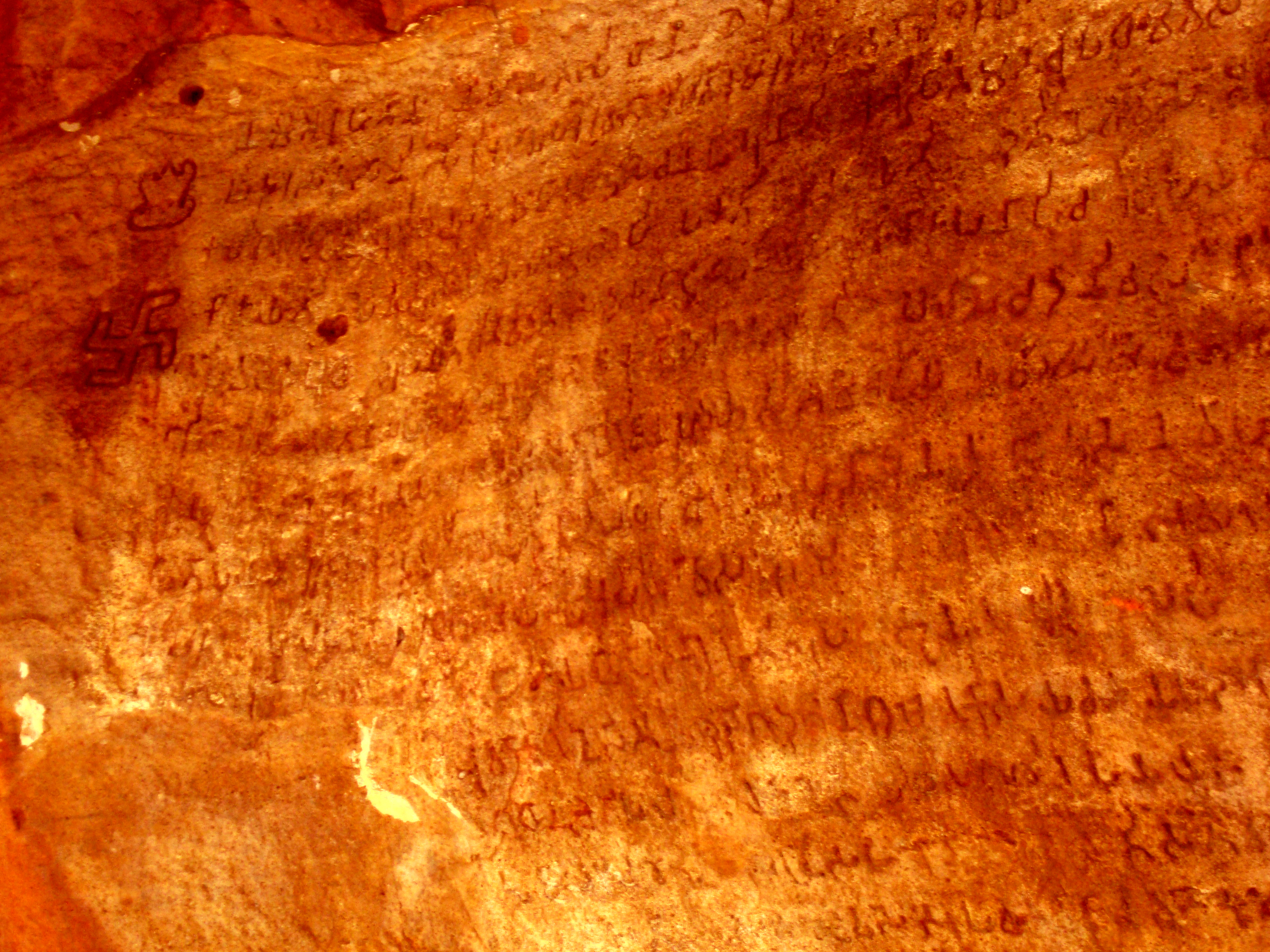 Namokar Mantra (2nd century BCE).
 -
 Brahmi Inscription of Kharavela

.JPG)
He is the King of Peace, the King of Prosperity,
the King of Monks (bhikshus), the King of Religion (Dharma),
who has been seeing, hearing and realising blessings (kalyanas),
(... lost ...) accomplished in extraordinary virtues,
respector of every sect, the repairer of all temples,
one whose chariot and army are irresistible,
one whose empire is protected by the chief of the empire (himself),
descended from the family of the Royal Sage Vasu,
the Great conqueror, the King, the illustrious Kharavela.
— Lines 16–17, c. 1st-century BCE Hathigumpha inscription[15]
Sculpture[edit | edit source]
The primary source of Mahameghavahana sculpture are the caves of Udaygiri and Khandagiri hills. Most of the caves are extensively carved and beautifully decorated with sculptures.
-
 Carving of Apsara making an offering
 -
 Cast of frieze from Udayagiri and Khandagiri Cave
 -
 Ancient Indian warfare Khandagiri, one of the earliest depiction of curved sword in Indian context.


.jpg)
Architecture[edit | edit source]
_by_James_Fergusson,_1845.jpg)
Udayagiri and Khandagiri Caves is the most prominent example of Mahameghavahana dynasty work. These caves were built in 2nd century BCE during the rule of King Kharavela. Udayagiri means "Sunrise Hill" and has 18 caves while Khandagiri (means "Broken Hill") has 15 caves. The Hathigumpha cave ("Elephant Cave") has the Hathigumpha inscription, written by Raja Kharavela, the king of Kalinga in India, during the 2nd century BCE. The Hathigumpha inscription consists of seventeen lines incised in deep cut Brahmi letters starting with Jain Namokar Mantra. In Udayagiri, Hathigumpha (cave 14) and Ganeshagumpha (cave 10) are especially well known due to art treasures of their sculptures and reliefs as well as due to their historical importance. Rani ka Naur (Queen's Palace cave, cave 1) is also an extensively carved cave and elaborately embellished with sculptural friezes. Khandagiri offers a fine view back over Bhubaneswar from its summit. The Ananta cave (cave 3) depicts carved figures of women, elephants, athletes, and geese carrying flowers.[8]


References[edit | edit source]
- ↑ Schwartzberg, Joseph E. (1978). A Historical atlas of South Asia. Chicago: University of Chicago Press. p. 145, map XIV.1 (f). ISBN 0226742210.
- ↑ 2.0 2.1 2.2 Sahu, J. K. (1977). "The Meghas of Kosala". Proceedings of the Indian History Congress. 38: 49–54. ISSN 2249-1937. JSTOR 44139050.
- ↑ 3.0 3.1 Sahu, J.K. (1977). "The Meghas of Kosala" (PDF). shodhganga.
- ↑ 4.0 4.1 For a map of their territory see: Schwartzberg, Joseph E. (1978). A Historical atlas of South Asia. Chicago: University of Chicago Press. p. 145, map XIV.1 (f). ISBN 0226742210. Archived from the original on 24 February 2021. Retrieved 25 March 2021.
- ↑ 5.0 5.1 Hampa Nagarajaiah (1999). A History of the Early Ganga Monarchy and Jainism. Ankita Pustaka. p. 10. ISBN 978-81-87321-16-3.
- ↑ Kailash Chand Jain (2010). History of Jainism. D. K. Print World (P) Limited. p. 437. ISBN 978-81-246-0547-9.
- ↑ Sahu, J.K. "The Meghas of Kosala" (PDF). shodhganga.
- ↑ 8.0 8.1 8.2 8.3 8.4 Bhagwanlal Indraji (1885). "The Hâtigumphâ and three other inscriptions in the Udayagiri caves near Cuttack". Proceedings of the Leyden International Oriental Congress for 1883. pp. 144–180.
- ↑ Sailendra Nath Sen (1999). Ancient Indian History and Civilization. New Age International. pp. 176–177. ISBN 978-81-224-1198-0.
- ↑ 10.0 10.1 10.2 N. K.Sahu, M. A. (1964). Utkal University History Of Orissa. Servants of Knowledge. The Utkal University.
- ↑ Shimada, Akira (9 November 2012). Early Buddhist Architecture in Context: The Great St?pa at Amar?vat? (ca. 300 BCE-300 CE). BRILL. ISBN 978-90-04-23283-9.
- ↑ Patnaik, Jeeban Kumar (1998). "Temples of South Kosala 6th century A D 11th century A D a case study of stellate temples". University. hdl:10603/187259.
- ↑ Panda, Shishir Kumar (2009). "Sectional President's Address: EARLY STATE FORMATION IN ORISSA". Proceedings of the Indian History Congress. 70: 25–44. ISSN 2249-1937. JSTOR 44147653.
- ↑ Singh, Upinder (2008). A History of Ancient and Early Medieval India: From the Stone Age to the 12th Century. Pearson Education India. ISBN 978-81-317-1677-9.
- ↑ K P Jayaswal; R D Banerji (1920). Epigraphia Indica Volume XX. Archaeological Survey of India. pp. 75–89 with footnotes.,
 This article incorporates text from this source, which is in the public domain.
External links[edit | edit source]
- Map of India depicting Maha-Meghavahana kingdom Archived 26 March 2023 at the Wayback Machine


