


robot: Update article (please report if you notice any mistake or error in this edit) |
Eziosolution (talk | contribs) quick adjusted intro after review additionally and fixed typos |
||
| Line 1: | Line 1: | ||
{{ | {{Short description|none}} | ||
{{Distinguish|text=[[Cinema of West Bengal]], also called Tollywood}} | {{Distinguish|text=[[Cinema of West Bengal]], also called Tollywood}} | ||
{{Use Indian English|date= | <!-- "none" is preferred when the title is sufficiently descriptive; see [[BP:SDNONE]] --> | ||
{{Use dmy dates|date= | {{Use Indian English|date=November 2025}} | ||
{{Use dmy dates|date=November 2025}} | |||
{{AI-generated|date=March 2026|reason=[https://en.Bharatpedia.org/w/index.php?title=Telugu_cinema&diff=1242437991&oldid=1241119243 these 2024 edits] and the others by this user; note [[BP:AISIGNS]] in superficial analyses, promotional tone, vocab distro typical of 2024 LLM output, etc., both here and in user's other edits}} | |||
{{Infobox cinema market | {{Infobox cinema market | ||
| name = Telugu cinema | | name = Telugu cinema | ||
| image = | | image = Indiafilm.svg | ||
| image_size = | | image_size = | ||
| alt = | | alt = | ||
| caption = | | caption = | ||
| screens = | | screens = 1726 screens in [[Andhra Pradesh]] and [[Telangana]] states of India (2022)<ref>{{Cite web |last=Vinayak |first=A. J. |date=28 September 2022 |title=Why films from the South set the box office on fire |url=https://www.thehindubusinessline.com/data-stories/why-screens-and-seats-count-in-creating-hit-south-indian-movies/article65945389.ece |access-date=8 September 2023 |website=[[The Hindu Business Line]] |language=en}}</ref> | ||
| screens_per_capita = | | screens_per_capita = | ||
| distributors = | | distributors = [[Suresh Productions]] <br />[[Geetha Arts]]<br /> [[Vyjayanthi Movies]] <br />[[DVV Entertainment]] <br />[[Annapurna Studios]]<br />[[Arka Media Works]] <br /> [[Sri Venkateswara Creations]] <br /> [[Mythri Movie Makers]] <br />[[Haarika & Hassine Creations]]<br />[[Varahi Chalana Chitram]] <br />[[Sri Venkateswara Cine Chitra]] | ||
| produced_year = | | produced_year = 2022 | ||
| produced_ref = <ref name=" | | produced_ref = <ref name="filmfed">{{Cite news|url=https://www.indiatoday.in/movies/regional-cinema/story/kgf-2-to-rrr-south-indian-film-industry-saw-these-many-releases-across-4-languages-in-2022-2316743-2023-01-03|title=KGF 2 to RRR, South Indian film industry saw THESE many releases across 4 languages in 2022!|website=[[India Today]] |date=3 January 2023 |first1=Latha |last1=Srinivasan |archive-date=3 January 2023 |archive-url=https://web.archive.org/web/20230103092316/https://www.indiatoday.in/movies/regional-cinema/story/kgf-2-to-rrr-south-indian-film-industry-saw-these-many-releases-across-4-languages-in-2022-2316743-2023-01-03 }}</ref> | ||
| produced_total = | | produced_total = 219 | ||
| produced_fictional = | | produced_fictional = | ||
| produced_animated = | | produced_animated = | ||
| produced_documentary = | | produced_documentary = | ||
| admissions_year = | | admissions_year = 2022 | ||
| admissions_ref = | | admissions_ref = <ref name="mint">{{Cite news |last=Jha |first=Lata |date=31 January 2023 |title=Footfalls for Hindi films slump up to 50% |url=https://www.livemint.com/industry/media/footfallsforhindifilmsslumpupto50-11675188279041.html |work=[[Mint (newspaper)|Mint]] |access-date=14 February 2023}}</ref><ref name="OM">{{Cite web |date=27 January 2023 |title=10K Crore: Return of the box office |url=https://www.ormaxmedia.com/insights/stories/10k-crore-return-of-the-box-office.html |access-date=14 February 2023 |website=Ormax Media |language=en}}</ref> | ||
| admissions_total = | | admissions_total = 233 million | ||
| admissions_per_capita = | | admissions_per_capita = | ||
| admissions_national = | | admissions_national = | ||
| box_office_year = | | box_office_year = 2012 | ||
| box_office_ref = | | box_office_ref = | ||
| box_office_total = <!-- {{Format price| }} --> | | box_office_total = <!-- {{Format price| }} --> | ||
| box_office_national = <!-- {{Format price| }} --> | | box_office_national = <!-- {{Format price| }} --> | ||
}} | }} | ||
'''Telugu cinema''', also known as '''Tollywood''', is the segment of [[Cinema of India|Indian cinema]] dedicated to the production of [[Film|motion pictures]] in the [[Telugu language]], widely spoken in the states of [[Andhra Pradesh]] and [[Telangana]]. Based in [[Film Nagar]], [[Hyderabad]], Telugu films sold 23.3 [[crore]] (233 million) tickets in 2022, the highest among all Indian film industries.<ref name="OM"/> As of 2023, Andhra Pradesh has the highest number of movie screens in India.<ref>{{Cite web |last=Jha |first=Lata |date=22 April 2024 |title=Hindi markets add more cinema theatres in 2023, with a 6% rise |url=https://www.livemint.com/news/hindi-markets-add-more-cinema-theatres-in-2023-with-a-6-rise-11713759609365.html |website=[[Mint (newspaper)|Mint]]}}</ref> | |||
'''Telugu cinema''', also known as '''Tollywood''', is the segment of [[Cinema of India|Indian cinema]] dedicated to the production of motion pictures in the [[Telugu language]], widely spoken in the states of [[Andhra Pradesh]] and [[Telangana]]. | |||
Since 1909, filmmaker [[Raghupathi Venkaiah Naidu | Since 1909, filmmaker [[Raghupathi Venkaiah Naidu]] was involved in producing [[short film]]s and exhibiting them in different regions of South Asia. He established the first Indian-owned cinema halls in [[South India]]. In 1921, he produced the [[silent film]], ''[[Bhishma Pratigna (1921 film)|Bhishma Pratigna]]'', generally considered to be the first Telugu [[feature film]].{{Refn|<ref>Encyclopaedia of early cinema, by Richard Abel, pp. 677, Bhishma Pratigya, 1921 film</ref><ref>{{Cite book |last=Thoraval |first=Yves |url=https://books.google.com/books?id=-OpkAAAAMAAJ&q=Bhishma+Pratigna+(1921+film) |title=The Cinemas of India |date=2000 |publisher=Macmillan India |isbn=978-0-333-93410-4 |language=en}}</ref><ref name=WC>{{Cite news |last=W. Chandrakanth |title=''Nijam cheppamantara, abaddham cheppamantara...'' |work=[[The Hindu]] |url=http://www.hindu.com/thehindu/fr/2007/02/09/stories/2007020901390100.htm |url-status=dead |archive-url=https://web.archive.org/web/20070529031557/http://www.hindu.com/thehindu/fr/2007/02/09/stories/2007020901390100.htm |archive-date=29 May 2007}}</ref><ref name="Screen World Publication-2002">{{Cite book |url=https://books.google.com/books?id=9c1kAAAAMAAJ&q=Bhishma+Pratigna+(1921+film) |title=Hindi Cinema Year Book |date=2002 |publisher=Screen World Publication |language=en}}</ref><ref>{{Cite book |url=https://books.google.com/books?id=0wY6AQAAIAAJ&q=Bhishma+1921 |title=Asian Film Directory and Who's who |date=1952 |language=en}}</ref>{{Sfn|Mareswara Rao|1997|p=93}}|name=BP}} As the first Telugu film producer and exhibitor, Naidu is regarded as the 'Father of Telugu cinema'.{{Sfn|Mareswara Rao|1997|p=95}} The first Telugu talkie (sound) film is considered to be [[Kalidas (film)|''Kalidas'']] (1931), directed by [[H. M. Reddy]], due to full-length dialogues in Telugu. However, ''[[Bhakta Prahlada (1932 film)|Bhakta Prahlada]]'' (1932) featured the entire soundtrack in Telugu along with dialogues''.<ref>{{Cite web |last=Harsh|first=B. H.|date=6 February 2026|title=Passion, history, and the roots of Telugu cinema|url=https://www.newindianexpress.com/entertainment/telugu/2026/Feb/05/teluguinterviews2026feb04passion-history-and-the-roots-of-telugu-cinema|access-date=6 February 2026|website=[[The New Indian Express]]|language=en}}</ref><ref name=":05">{{Cite news |last=Krishnamurthy |first=Kalki |author-link=Kalki Krishnamurthy |date=16 November 1931 |title='கல்கி' −2: காளிதாஸ் – திரைப்பட விமர்சனம் |trans-title='Kalki −2': Kalidas – Film Review |url=http://s-pasupathy.blogspot.in/2012/06/2_15.html |url-status=dead |archive-url=https://archive.today/20170402123112/http://s-pasupathy.blogspot.nl/2012/06/2_15.html |archive-date=2 April 2017 |access-date=31 May 2017 |work=[[Ananda Vikatan]] |language=ta}}</ref>'' The 1950s and 1960s are considered the golden age of Telugu cinema, featuring enhanced production quality, influential filmmakers, and notable studios, resulting in a variety of films that were both popular and critically acclaimed.<ref name=":1" /> | ||
The industry, initially based in [[Chennai|Madras]], began shifting to Hyderabad in the 1970s, completing the transition by the 1990s.{{Citation needed|date=March 2026}} This period also saw the rise of star-driven commercial films, technological advancements, and the development of major studios like [[Ramoji Film City]], which holds the [[Guinness World Records|Guinness World Record]] as the largest film studio complex in the world.<ref name="Guinness World Records2">{{cite web |title=Largest film studio |url=http://www.guinnessworldrecords.com/world-records/largest-film-studio |access-date=2 January 2021 |publisher=Guinness World Records}}</ref> The 2010s marked a significant period for Telugu cinema, as it emerged as a pioneer of the [[pan-Indian film]] movement, expanding its audience across India and internationally. This development enhanced the industry's prominence in Indian and [[world cinema]] while also increasing the recognition of Telugu actors across the country. [[Baahubali 2: The Conclusion|''Baahubali 2'']] (2017) not only introduced the [[1000 Crore Club|₹1,000 crore club]] to Indian cinema but also set a new benchmark with a ₹200 crore opening day worldwide''.'' This film also won the [[Saturn Awards|Saturn Award]] for [[Saturn Award for Best International Film|Best International Film]], and ''[[RRR]]'' (2022) became the first Indian feature film to win an [[Academy Awards|Academy Award]], receiving multiple international accolades, including a [[Critics' Choice Movie Awards|Critics' Choice Award]] for [[Critics' Choice Movie Award for Best Foreign Language Film|Best Foreign Language Film]] and a [[Golden Globe Awards|Golden Globe Award]].<ref>{{Cite news |date=13 March 2023 |title=Oscars 2023: 'RRR' creates history, 'Naatu Naatu' wins Best Original Song |url=https://www.thehindu.com/entertainment/movies/oscars-2023-rrr-creates-history-naatu-naatu-wins-best-original-song/article66612385.ece |access-date=12 July 2024 |work=The Hindu |issn=0971-751X}}</ref> ''[[Kalki 2898 AD]]'' (2024) is the [[List of most expensive Indian films|most expensive Indian film ever made]].<ref>{{Cite web |last=Bentz |first=Adam |date=2 July 2024 |title=India's Most Expensive Movie Breaks Global Box Office Record |url=https://screenrant.com/kalki-2898-ad-global-box-office-record/ |access-date=31 December 2024 |website=[[ScreenRant]] |language=en}}</ref> Telugu cinema now boasts the highest number of films in both the ₹1,000 crore club and those with a ₹100 crore and ₹200 crore opening day worldwide.<ref>{{Cite news |last=Dundoo |first=Sangeetha Devi |date=17 December 2024 |title=The 1000-crore club: 'Baahubali' to 'Pushpa', Telugu cinema's box office juggernaut |url=https://www.thehindu.com/entertainment/movies/baahubali-to-pushpa-telugu-cinemas-box-office-juggernaut/article68976736.ece |access-date=2 November 2025 |work=The Hindu |language=en-IN |issn=0971-751X}}</ref> | |||
[[ | Since its inception, Telugu cinema has been known as the preeminent centre for films based on [[Hindu epics]]. Today, it is also noted for advancements in technical crafts, particularly in [[visual effects]] and [[cinematography]], making it one of the most state of the art cinema.<ref>{{Cite book |last1=Ali |first1=Maaz |url=https://books.google.com/books?id=rwsmEAAAQBAJ&dq=telugu+cinema&pg=PA250 |title=Bollywood For Dummies |last2=Khan |first2=Maaz |last3=Hussain |first3=Anum |date=24 March 2021 |publisher=John Wiley & Sons |isbn=978-1-119-78070-0 |page=250 |language=en}}</ref> Telugu cinema has produced some of India's [[List of most expensive Indian films|most expensive]] and [[List of highest-grossing Indian films|highest-grossing films]], including ''Baahubali 2'' (2017), which holds the record for the highest footfalls for an Indian film in the 21st century. Over the years, Telugu filmmakers have also ventured into [[Parallel cinema|parallel]] and [[Art film|arthouse]] cinema.<ref>{{Cite book |last=Senapati |first=Udai |url=https://books.google.com/books?id=C_VjEAAAQBAJ&dq=narsing+rao+parallel+films&pg=PA56 |title=Film Making |date=13 March 2022 |publisher=K. K. Publications |page=56 |language=en}}</ref> Films like [[Daasi (1988 film)|''Daasi'']] (1988), ''[[Thilaadanam]]'' (2000), and ''[[Vanaja (film)|Vanaja]]'' (2006), among others, received acclaim at major international film festivals such as [[Venice Film Festival|Venice]], [[Berlin International Film Festival|Berlin]], [[Karlovy Vary International Film Festival|Karlovy Vary]], [[Moscow International Film Festival|Moscow]], and [[Busan International Film Festival|Busan]].{{efn|As early as 1933, [[C. Pullayya]]'s ''[[Sati Savitri (C. Pullayya film)|Sati Savitri]]'' received an honorary diploma at the [[2nd Venice International Film Festival]].<ref name="auto9">{{Cite news |last=Narasimham |first=M. L. |date=7 November 2010 |title=Sati Savithri (1933) |url=http://www.thehindu.com/todays-paper/tp-features/tp-cinemaplus/article871376.ece |url-status=dead |archive-url=https://web.archive.org/web/20101113225918/https://www.thehindu.com/todays-paper/tp-features/tp-cinemaplus/article871376.ece |archive-date=13 November 2010 |access-date=8 July 2011 |work=[[The Hindu]] |location=Chennai, India}}</ref> Later, as part of the [[Parallel cinema]] movement, [[Mrinal Sen]]'s ''[[Oka Oori Katha]]'' (1977) received the [[Special Jury Prize (Karlovy Vary IFF)|Special Jury Prize]] at the [[Karlovy Vary International Film Festival]].<ref>{{Cite book |url=https://books.google.com/books?id=DJ5KAQAAIAAJ&q=karlovy+vary |quote=It was adjudged the best Telugu picture of the year and also won the Special Jury Award at the Karlovy Vary festival.|title=Frontline |date=1996 |publisher=[[The Hindu Group]] |volume=13 |pages=80 |language=en}}</ref> [[K. Viswanath]]'s ''[[Sankarabharanam (1980 film)|Sankarabharanam]]'' (1980) won the Prize of the Public at the [[Besançon]] Film Festival in [[France]],<ref>{{cite web|title=29th National Film Awards|url=https://dff.nic.in/images/Documents/88_29thNfacatalogue.pdf|website=[[Directorate of Film Festivals]] | page=6 |date=April 1982|archive-url=https://web.archive.org/web/20181109234604/https://dff.nic.in/images/Documents/88_29thNfacatalogue.pdf |archive-date=9 November 2018 }}</ref> while his ''[[Swathi Muthyam]]'' (1986) was [[List of Indian submissions for the Academy Award for Best International Feature Film|India's official entry]] to the [[59th Academy Awards]].<ref>{{Cite web|title=K Viswanath's film at the Oscars |date=29 March 2012 |url=https://timesofindia.indiatimes.com/entertainment/telugu/movies/did-you-know/k-viswanaths-film-at-the-oscars/articleshow/12456035.cms |archive-url=https://web.archive.org/web/20130223085441/http://articles.timesofindia.indiatimes.com/2012-03-29/did-you-know-/31254415_1_official-entry-telugu-film-oscars |url-status=live |archive-date=23 February 2013 |work=[[The Times of India]] |access-date=}}</ref> [[B. Narsing Rao]]'s ''[[Maa Ooru]]'' (1987) earned the Main prize at the [[Mediawave International Film Festival]] in Hungary;<ref>{{Cite web |title=Mediawave Archive - 1992 Film Award List |url=http://mwave.irq.hu/index.php?modul=menupontok&kod=18028&nyelv=+/index.php |website=Mediawave International Film Festival}}</ref> his films ''[[Daasi (1988 film)|Daasi]]'' (1988) and ''[[Matti Manushulu]]'' (1990) both received the Special Diploma at the [[16th Moscow International Film Festival|16th]] and [[17th Moscow International Film Festival|17th]] [[Moscow International Film Festival]], respectively.<ref>{{Cite book |url=https://books.google.com/books?id=WHJ1AAAAIAAJ&q=Daasi+moscow |title=Indian Cinema |date=1992 |publisher=[[Directorate of Film Festivals]], [[Ministry of Information and Broadcasting (India)|Ministry of Information and Broadcasting]] |pages=16 |language=en |quote=''Daasi'', made by B. Narasingh Rao in 1988, won five national awards in addition to a Diploma of Merit at the Moscow Film Festival.}}</ref><ref>{{cite web |title=17th Moscow International Film Festival (1991) |url=http://www.moscowfilmfestival.ru/miff34/eng/archives/?year=1991 |url-status=dead |archiveurl=https://web.archive.org/web/20140403102003/http://www.moscowfilmfestival.ru/miff34/eng/archives/?year=1991 |archive-date=3 April 2014 |work=MIFF}}</ref> [[K. N. T. Sastry]]'s ''[[Thilaadanam]]'' (2000) won the [[New Currents]] award at the 7th [[Busan International Film Festival]],<ref>{{Cite web |title=2002 Awards |url=https://www.biff.kr/eng/html/archive/arc_history_3.asp?pyear=2002 |website=Busan International Film Festival}}</ref> and Rajnesh Domalpalli's ''[[Vanaja (film)|Vanaja]]'' (2006) received the Best First Feature Award at the [[57th Berlin International Film Festival]].<ref>{{Cite web |date=|title=2007 Awards|url=https://www.berlinale.de/en/archive/jahresarchive/2007/03_preistraeger_2007/03_preistraeger_2007.html |access-date= |website=Berlin International Film Festival}}</ref>|group=note}} Additionally, ten Telugu films have been featured in [[CNN-News18|CNN-IBN]]'s list of the "100 Greatest Indian Films of All Time."{{efn|Telugu films in the list include ''[[Pathala Bhairavi]]'' (1951), ''[[Malliswari (1951 film)|Malliswari]]'' (1951), ''[[Devadasu (1953 film)|Devadasu]]'' (1953), ''[[Mayabazar]]'' (1957), ''[[Nartanasala (1963 film)|Nartanasala]]'' (1963), ''[[Maro Charitra]]'' (1978), ''[[Maa Bhoomi]]'' (1979), ''[[Sankarabharanam (1980 film)|Sankarabharanam]]'' (1980), ''[[Sagara Sangamam]]'' (1983), and ''[[Siva (1989 Telugu film)|Siva]]'' (1989).<ref>{{Cite news |title=100 Years of Indian Cinema: The 100 greatest Indian films of all time |url=http://ibnlive.in.com/photogallery/13200.html |work=IBNLive |date=17 April 2013 |access-date=11 June 2022 |archive-url=https://web.archive.org/web/20130424003536/http://ibnlive.in.com/photogallery/13200.html |archive-date=24 April 2013 |url-status=dead}}</ref>|group=note}} | ||
== History == | == History == | ||
=== Early development === | |||
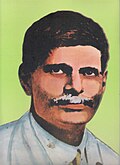
[[File:Raghupati Venkayya.jpg|left|thumb|209x209px|[[Raghupathi Venkaiah Naidu]], father of Telugu cinema.]] | |||
Raghupathi Venkaiah Naidu was a [[photographer]] and photographic studio owner in [[Madras]] who was drawn into [[filmmaking]]. Since 1909, he was involved in producing [[short film]]s.<ref name="SS">{{cite web |last=Kumar |first=Srikanth |date=26 June 2010 |title=Why AP Government named an award after Raghupathi Venkaiah |url=http://www.southscope.in/telugu/article/why-ap-government-named-award-after-raghupathi-venkaiah |url-status=dead |archive-url=https://web.archive.org/web/20141029205323/http://www.southscope.in/telugu/article/why-ap-government-named-award-after-raghupathi-venkaiah |archive-date=29 October 2014 |access-date=29 October 2014 |website=[[South Scope]]}}</ref><ref name="autogenerated2" /> He shot 12 three-minute-long short films and exhibited them in [[Victoria Public Hall]], [[Madras]]. He also travelled to [[Bangalore]], [[Vijayawada]], [[Sri Lanka]], [[Rangoon]] and [[Pegu]] to exhibit his films.<ref name=SS /> In {{Circa|1909-10}}, he established a tent house called Esplanade in Madras to exhibit his films.{{Sfn|Mareswara Rao|1997|p=95}}<ref name="IBRVN">{{Cite web |last=Visweswara Rao |first=Namala |title=Telugu Cinema Celebrity – Raghupati Venkaiah Naidu |url=http://www.idlebrain.com/celeb/starow/sow-rvn.html |website=[[Idlebrain.com]]}}</ref> In {{Circa|1912-14}}, he established Gaiety Theatre on [[Mount Road]], the first ever permanent cinema theatre in Madras and all of [[South India]].{{Sfn|Mareswara Rao|1997|p=95}}<ref name="CineGoer.com">{{Cite web |title=History of Birth and Growth of Telugu Cinema (Part 3) |url=http://www.cinegoer.com/telugucinema3.htm |url-status=dead |archive-url=https://web.archive.org/web/20070411133017/http://www.cinegoer.com/telugucinema3.htm |archive-date=11 April 2007 |website=CineGoer.com}}</ref> He later constructed the Crown Theatre and Globe Theatre.<ref name="IBRVN" /><ref name="SS" /> In his theatres, he screened [[Cinema of the United States|American]] and [[European cinema|European]] films as well as silent films made in various parts of India.<ref>{{Cite book |last=Kasbekar |first=Asha |url=https://books.google.com/books?id=Sv7Uk0UcdM8C&dq=Andhra+Cinetone&pg=PA223 |title=Pop Culture India!: Media, Arts, and Lifestyle |date=2006 |publisher=ABC-CLIO |isbn=978-1-85109-636-7 |page=223 |language=en}}</ref> | |||
In 1919, he started a film [[production company]] called 'Star of the East Films' also called 'Glass Studio', the first production company established by a Telugu person.<ref name="CineGoer.com" /><ref name="IBRVN"/><ref name="The Hindu Business Line-2011">{{Cite web |date=11 September 2011 |title=Telugu film industry turns 80 |url=https://www.thehindubusinessline.com/economy/Telugu-film-industry-turns-80/article20334643.ece |archive-url=https://web.archive.org/web/20210924164853/https://www.thehindubusinessline.com/economy/Telugu-film-industry-turns-80/article20334643.ece |archive-date=24 September 2021 |access-date=11 October 2022 |website=[[The Hindu Business Line]] |quote=Mr Raghupati Venkaiah, regarded as the father of Telugu film industry, laid the foundation stone for the industry in the South by setting up Glass Studio and bringing one of the first cameras into the country.}}</ref> He sent his son, [[Raghupathi Surya Prakash]] to study filmmaking in the studios of [[England]], [[Germany]], and [[United States]].<ref name=":0" /> In 1921, they made ''[[Bhishma Pratigna (1921 film)|Bhishma Pratigna]]'', generally considered as the first Telugu feature film.{{Refn|name=BP}} Raghupathi Venkaiah produced the film, while R. S. Prakash directed and produced it along with playing the [[title character]] ''[[Bhishma]].<ref name="CineGoer.com" />'' As the first Telugu film exhibitor and producer, Raghupathi Venkaiah is regarded as the 'Father of Telugu cinema'.{{Sfn|Mareswara Rao|1997|p=95}} | |||
[[ | |||
From 1921 to 1931 about a dozen feature films were made by [[Telugu people]].<ref name="Mareswara Rao">{{Harvnb|Mareswara Rao|1997|p=94}}</ref> [[C. Pullayya]] made a three-[[reel]] short film, ''Markandeya'' (1926 or 1931) at his house in [[Kakinada]].<ref>{{Cite book |last=Parthasarathy |first=R. |url=https://books.google.com/books?id=uSleeGRjcvEC&q=C.+Pullayya |title=Andhra Culture: A Petal in Indian Lotus |date=1984 |publisher=Government of Andhra Pradesh |pages=128 |language=en}}</ref><ref name="Mareswara Rao" /> In 1921, the first cinema hall in [[Andhra Pradesh|Andhra]], Maruthi Cinema was established in [[Vijayawada]] by Pothina Srinivasa Rao.{{Sfn|Mareswara Rao|1997|p=95}} [[Y. V. Rao]] and R. S. Prakash established a long-lasting precedence of focusing exclusively on religious themes {{Em dash}}''Gajendra Moksham'', ''Nandanar'', and ''Matsyavataram'' {{Em dash}}three of their most noted productions, centred on religious figures, parables, and morals. | |||
=== Rise of the "talkie" === | === Rise of the "talkie" === | ||
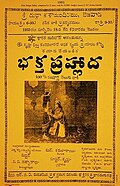
The first Telugu film with audible dialogue, ''[[Bhakta Prahlada (1932 film)|Bhakta Prahlada]]'', was | [[File:Bhakta Prahlada 1931.jpg|thumb|257x257px|Promotional poster of ''[[Bhakta Prahlada (1932 film)|Bhakta Prahlada]]'' the first full-length Telugu talkie to have a theatrical release.]] | ||
The first Telugu film with audible dialogue, ''[[Bhakta Prahlada (1932 film)|Bhakta Prahlada]]'', was directed by [[H. M. Reddy]]. ''Bhakta Prahlada'' was shot over 18 or 20 days at Imperial Studios, [[Mumbai|Bombay]] and was produced by [[Ardeshir Irani]] who also produced ''[[Alam Ara]]'', India's first [[sound film]].<ref>{{Cite news |last=Vamsi |first=Krishna |date=6 February 2017 |title=Tollywood turns 85: With the release of Bhakta Prahlada, this is how the industry was born |work=[[The Indian Express]] |url=https://indianexpress.com/article/entertainment/telugu/tollywood-turns-85-with-the-release-of-bhakta-prahlada-this-is-how-the-industry-was-born-4511000/ |url-status=live |access-date=7 March 2022 |archive-url=https://web.archive.org/web/20180520162805/http://indianexpress.com/article/entertainment/telugu/tollywood-turns-85-with-the-release-of-bhakta-prahlada-this-is-how-the-industry-was-born-4511000/ |archive-date=20 May 2018}}</ref> The film had an all-Telugu starcast featuring Sindhoori Krishna Rao as the titular [[Prahlada]], Munipalle Subbayya as [[Hiranyakashipu|Hiranyakasyapa]], and [[Surabhi Kamalabai]] as Leelavathy.<ref name="autogenerated2" /><ref>{{Cite news |last=Narasimham |first=M. L. |date=10 September 2011 |title=Eighty glorious years of Telugu talkie |url=http://www.thehindu.com/arts/cinema/article2442172.ece |work=The Hindu |location=Chennai, India}}</ref> ''Bhakta Prahlada'' was completed on 15 September 1931,<ref name="BPN">{{Cite web |date=7 February 2013 |title='Bhaktha Prahladha': First Telugu talkie completes 81 years |url=http://ibnlive.in.com/news/bhaktha-prahladha-first-telugu-talkie-completes-81-years/371363-71-216.html |url-status=dead |archive-url=https://web.archive.org/web/20131218093804/http://ibnlive.in.com/news/bhaktha-prahladha-first-telugu-talkie-completes-81-years/371363-71-216.html |archive-date=18 December 2013 |access-date=26 March 2014 |website=[[CNN-IBN]]}}</ref> which henceforth became known as "Telugu Film Day" to commemorate its completion.<ref>{{Cite news |author=<!--Not stated--> |date=11 September 2011 |title=Today's Paper / NATIONAL : Telugu Cinema Day on September 15 |work=The Hindu |location=Chennai, India |url=http://www.thehindu.com/todays-paper/tp-national/article2443500.ece |access-date=25 August 2012}}</ref><ref name="WAKE">{{Cite news |last=Narasimham |first=M.L. |date=9 September 2012 |title=Wake up, industry |work=[[The Hindu]] |location=Chennai, India |url=http://www.thehindu.com/todays-paper/tp-features/tp-cinemaplus/wake-up-industry/article3875804.ece |access-date=26 March 2014}}</ref><ref name="THI">{{Cite news |date=7 February 2013 |title=Telugu Cinema turns a grand 82! |page=10 |work=[[The Hans India]] |url=http://rentalajayadeva.blogspot.in/2013/02/telugu-cinema-turns-grand-82.html |access-date=26 March 2014}}</ref> | |||
Popularly known as [[talkies]], films with sound quickly grew in number and popularity. In 1932, [[Sagar Movietone]] produced ''[[Sri Rama Paduka Pattabhishekam]]'' and ''[[Sakunthala (1932 film)|Sakunthala]]'', both directed by [[Sarvottam Badami]].<ref name="Vittal2007">{{cite book |author=Gita Vittal |url=https://books.google.com/books?id=EgYRwrtyPAIC&pg=PA72 |title=Reflections: Experiences of a Bureaucrat's Wife |date=1 January 2007 |publisher=Academic Foundation |isbn=978-81-7188-471-1 |pages=73– |access-date=25 September 2014}}</ref> Neither the producer nor the director of these two films were Telugus. In 1933, ''[[Sati Savitri (C. Pullayya film)|Sati Savitri]]'' directed by [[C. Pullayya]] received an honorary diploma at the [[2nd Venice International Film Festival|2nd Venice Film Festival]].<ref name="auto9"/> In the same year, ''[[Prudhvi Putra|Pruthvi Putra]]'', based on the story of [[Narakasura]] was released.{{Sfn|Mareswara Rao|1997|p=101}} It starred [[Kalyanam Raghuramaiah|Kalyanam Raghuramayya]] and was produced by Pothina Srinivasa Rao, who had previously built the first cinema hall in Andhra in 1921. This was the first Telugu talkie entirely financed by Telugu people.{{Sfn|Mareswara Rao|1997|p=101}} | |||
[[ | |||
In | |||
In 1934, the industry saw its first major commercial success with [[Lava Kusa (1934 film)|''Lava Kusa'']]. Directed by [[C. Pullayya]] and starring Parupalli Subbarao and [[Sriranjani Sr.|Sriranjani]], the film attracted unprecedented numbers of viewers to theatres and thrust the young industry into mainstream culture.<ref name="autogenerated2">{{Cite news |date=19 January 2007 |title=Reliving the reel and the real |work=[[The Hindu]] |location=Chennai, India |url=http://www.hindu.com/thehindu/fr/2007/01/19/stories/2007011901020100.htm |url-status=dead |archive-url=https://web.archive.org/web/20070501115359/http://www.hindu.com/thehindu/fr/2007/01/19/stories/2007011901020100.htm |archive-date=1 May 2007}}</ref>{{Sfn|Mareswara Rao|1997|p=101}} [[Dasari Kotiratnam]] produced [[Sati Anasuya (1935 film)|''Sati Anasuya'']] in 1935 and became the first female producer of Telugu film industry.{{Sfn|Mareswara Rao|1997|p=102}} | |||
The first film studio in [[Andhra Pradesh|Andhra]], Durga Cinetone, was built in 1936 by Nidamarthi Surayya in [[Rajahmundry]].<ref name="rama">{{Cite book |last1=Ramachandran |first1=T. M. |url=https://books.google.com/books?id=Q9rthUDKxyEC&q=Durga+Cinetone+in+Rajahmundry |title=70 Years of Indian Cinema, 1913-1983 |last2=Rukmini |first2=S. |date=1985 |publisher=CINEMA India-International |isbn=978-0-86132-090-5 |page=477 |language=en}}</ref><ref>{{Cite book |url=https://books.google.com/books?id=HTluAAAAMAAJ&q=Durga+Cinetone+in+Rajahmundry |title=History and Culture of the Andhras |date=1995 |publisher=Komarraju Venkata Lakshmana Rau Vijnana Sarvaswa Sakha, Telugu University |isbn=978-81-86073-07-0 |page=390 |language=en}}</ref> ''Sampurna Ramayanam'' (1936) was the first film produced by the studio relying mostly on local talent.<ref name="rama" /> In 1937, another studio called Andhra Cinetone was built in [[Visakhapatnam]].<ref>{{Cite book |last=Srivastava |first=Manoj |url=https://books.google.com/books?id=18pBDwAAQBAJ&dq=Andhra+Cinetone&pg=PT111 |title=Wide Angle: History of Indian Cinema |date=6 December 2017 |publisher=Notion Press |isbn=978-1-946280-48-0 |language=en}}</ref><ref name=":0" /> However, both the studios were short-lived. Early Telugu silent films and talkies were deeply influenced by stage performances, continuing the traditions of theatre onto the screen. These films often retained the same scripts, dialogues, and background settings as their stage counterparts.<ref name=":2">{{Cite web |last=Toleti Srinivas |title=Telugu Movie Industry -- Past to Present |url=https://eemaata.com/history/telugu_literary_homepage/Movies/movie_history.html |access-date=23 August 2024 |website=eemaata}}</ref> | |||
[[ | |||
=== Emergence of social themes === | |||
{{multiple image | |||
| align = left | |||
| image1 = | |||
| image2 = YVRao.jpg | |||
| width2 = 180 | |||
| alt2 = | |||
| caption2 = | |||
| image3 = Chittor V. Nagaiah.jpg | |||
| width3 = 165 | |||
| alt3 = | |||
| caption3 = | |||
| footer = [[Y. V. Rao]] (left), pioneer of cinema during crown rule<ref name="filmmaker">{{Cite web |last=Guy |first=Randor |date=22 August 2003 |title=A revolutionary filmmaker |url=http://www.thehindu.com/thehindu/fr/2003/08/22/stories/2003082201400400.htm |url-status=dead |archive-url=https://archive.today/20161119045811/http://www.thehindu.com/thehindu/fr/2003/08/22/stories/2003082201400400.htm |archive-date=19 November 2016 |access-date=19 November 2016 |website=[[The Hindu]]}}</ref> and stalwart [[V. Nagayya|Chittooru Nagayya]] (right), known for his [[method acting]].<ref>{{Cite web |date=6 May 2011 |title=Paul Muni of India – Chittoor V.Nagayya |url=http://bharatjanani.com/paul-muni-of-india-chittoor-v-nagayya/ |url-status=dead |archive-url=https://web.archive.org/web/20120326135647/http://bharatjanani.com/paul-muni-of-india-chittoor-v-nagayya/ |archive-date=26 March 2012 |access-date=21 September 2011 |publisher=Bharatjanani.com }}</ref> | |||
}} | |||
By 1936, the mass appeal of film allowed directors to move away from religious and mythological themes.<ref name="autogenerated2" /> That year, under the direction of Kruthiventi Nageswara Rao, ''[[Prema Vijayam]]'', a film with a contemporary setting, was released. It was the first Telugu film with a modern-day setting as opposed to mythological and folklore films.{{Sfn|Mareswara Rao|1997|p=104}} Later, more 'social films' i.e. films based on contemporary life and social issues, were made by filmmakers. Notable among them was ''[[Vande Mataram (1939 film)|Vandemataram]]'' (1939), touching on societal problems like the practice of [[dowry]]. Telugu films began to focus more on contemporary life, with 29 of the 96 films released between 1937 and 1947 featuring social themes.<ref>{{Cite web |title=Articles – History of Birth And Growth of Telugu Cinema |url=http://www.cinegoer.com/telugucinema5.htm |url-status=dead |archive-url=https://web.archive.org/web/20120218150028/http://www.cinegoer.com/telugucinema5.htm |archive-date=18 February 2012 |access-date=19 February 2012 |publisher=CineGoer.com}}</ref> | |||
== | In 1938, [[Gudavalli Ramabrahmam]] has co-produced and directed the [[social problem film]], ''[[Mala Pilla]]'' starring [[Kanchanamala]]. The film dealt with the crusade against untouchability, prevailing in pre-independent India.<ref>Naati 101 Chitralu, S. V. Rama Rao, Kinnera Publications, Hyderabad, 2006, pp.14.</ref><ref>{{Cite web |title=Nostalgia Mala Pilla (1938) at Cinegoer.com |url=http://www.cinegoer.com/malapilla.htm |url-status=dead |archive-url=https://web.archive.org/web/20120926224130/http://www.cinegoer.com/malapilla.htm |archive-date=26 September 2012 |website=cinegoer.com}}</ref> In 1939, he directed ''[[Raithu Bidda (1939 film)|Raithu Bidda]]'', starring thespian [[Bellary Raghava]]. The film was banned by the British administration in the region, for depicting the uprise of the peasantry among the [[Zamindar]]'s during the [[British raj]].<ref>{{Cite web |title=Celebrating 100 Years of Indian Cinema: www.indiancinema100.in |url=https://indiancinema100.in/swadeshi/ |url-status=dead |archive-url=https://web.archive.org/web/20130921054328/https://indiancinema100.in/swadeshi/ |archive-date=21 September 2013 |access-date=11 June 2022 |website=indiancinema100.in}}</ref> The success of these films gave an impetus to [[Y. V. Rao]], [[B. N. Reddy]] and others to produce films on social themes.<ref name="autogenerated2" /> ''[[Viswa Mohini]]'' (1940) is the first Indian film depicting the Indian movie world. The film was directed by Y. V. Rao and scripted by [[Balijepalli Lakshmikantha Kavi]], starring [[V. Nagayya]]. Rao subsequently made the sequel films ''Savithri'' and ''Sathyabhama'' (1941–42) casting thespian [[Sthanam Narasimha Rao]].<ref>{{Cite news |date=22 August 2003 |title=A revolutionary filmmaker |work=[[The Hindu]] |location=Chennai, India |url=http://www.hindu.com/thehindu/fr/2003/08/22/stories/2003082201400400.htm |url-status=dead |archive-url=https://web.archive.org/web/20040117021114/http://www.hindu.com/thehindu/fr/2003/08/22/stories/2003082201400400.htm |archive-date=17 January 2004}}</ref><ref>{{Cite web |title=Y. V. Rao Fimograph |url=https://indiancine.ma/DQQ |website=Indiancine.ma}}</ref> | ||
| | The outbreak of [[World War II]] and the subsequent resource scarcity caused the [[British Raj]] to impose a limit on the use of filmstrip in 1943 to 11,000 feet,<ref>{{Cite web |date=17 July 1943 |title=Articles – History of Birth And Growth of Telugu Cinema |url=http://www.cinegoer.com/telugucinema7.htm |url-status=dead |archive-url=https://web.archive.org/web/20120227192441/http://www.cinegoer.com/telugucinema7.htm |archive-date=27 February 2012 |access-date=19 February 2012 |publisher=CineGoer.com}}</ref> a sharp reduction from the 20,000 feet that had been common till then.<ref>{{Cite web |title=Articles – History of Birth And Growth of Telugu Cinema |url=http://www.cinegoer.com/telugucinema10.htm |url-status=dead |archive-url=https://web.archive.org/web/20120218145901/http://www.cinegoer.com/telugucinema10.htm |archive-date=18 February 2012 |access-date=19 February 2012 |publisher=CineGoer.com}}</ref> As a result, the number of films produced during the war was substantially lower than in previous years. Nonetheless, before the ban, an important shift occurred in the industry: Independent studios formed, actors and actresses were signed to contracts limiting whom they could work for, and films moved from social themes to folklore legends.<ref>{{Cite web |title=Articles – History of Birth And Growth of Telugu Cinema |url=http://www.cinegoer.com/telugucinema6.htm |url-status=dead |archive-url=https://web.archive.org/web/20120218130208/http://www.cinegoer.com/telugucinema6.htm |archive-date=18 February 2012 |access-date=19 February 2012 |publisher=CineGoer.com}}</ref> [[Ghantasala Balaramayya]], has directed the mythological ''[[Sri Seeta Rama Jananam]]'' (1944) under his home production, Prathiba Picture, marking [[Akkineni Nageswara Rao]]'s debut in a lead role.<ref name="Blast From The Past">{{Cite news |last=Narasimham |first=M.L. |date=25 February 2012 |title=Blast From The Past: Sri Sita Rama Jananam (1944) |work=[[The Hindu]] |url=https://www.thehindu.com/features/cinema/blast-from-the-past-sri-sita-rama-jananam-1944/article2931847.ece |access-date=2 August 2021 |archive-url=https://web.archive.org/web/20210802112044/https://www.thehindu.com/features/cinema/blast-from-the-past-sri-sita-rama-jananam-1944/article2931847.ece |archive-date=2 August 2021}}</ref> | ||
| | |||
=== The golden age === | |||
| | {{multiple image | ||
| align = right | |||
[[ | | image1 = | ||
| | | width1 = 150 | ||
| | | alt1 = | ||
| caption1 = | |||
| | | image2 = | ||
| | | width2 = 150 | ||
| | | alt2 = | ||
| | | caption2 = | ||
| | | image3 = Rajanala_and_Kanta_Rao.jpg | ||
| | | width3 = 205 | ||
| | | alt3 = | ||
| | | caption3 = | ||
| | | footer = ''From left to right:'' A production still of ''[[Mayabazar]]'' (1957), [[N. T. Rama Rao]] in ''[[Pathala Bhairavi]]'' (1951), [[Kantha Rao]] with [[Rajanala (actor)|Raajanala]] in a folklore combat scene | ||
| | | direction = horizontal | ||
| | | total_width = 500 | ||
| | |||
| | |||
| | |||
| | |||
| | |||
}} | }} | ||
The 1950s and 1960s are often regarded as the golden age of Telugu cinema. This era witnessed significant advances in production quality, the establishment of iconic studios, and the rise of influential filmmakers who shaped the industry.<ref name=":1">{{Cite web |last=MK Raghavendra |date=8 July 2017 |title=Mayabazar to Andhra state: Why the 1950s were the golden age for Telugu cinema |url=https://www.dailyo.in/arts/telugu-films-indian-cinema-andhra-mayabazar-malliswari-18241 |access-date=20 August 2024 |website=DailyO |language=en}}</ref> Prominent production houses such as [[Vijaya Vauhini Studios|Vijaya Productions]], [[Vauhini Studios]], [[Bharani Pictures]], [[Prasad Art Pictures]], and [[Annapurna Studios#Annapurna Pictures|Annapurna Pictures]] were established during the late 1940s and 1950s. These studios played a crucial role in the development of Telugu cinema, contributing to the production of over 300 films between 1950 and 1960. Many Telugu-Tamil bilinguals were made during this period.<ref name="The Hindu BFP">{{Cite news |last=Reddem |first=Appaji |date=4 March 2022 |title=Is Telugu cinema set for a change of scene? |url=https://www.thehindu.com/entertainment/movies/is-telugu-cinema-set-for-a-change-of-scene-from-hyderabad-to-visakhapatnam/article65191021.ece |access-date=18 August 2024 |work=The Hindu |language=en-IN |issn=0971-751X}}</ref> | |||
During this era, the Telugu film industry became one of the largest producers of [[folklore]], [[Fantasy film|fantasy]], and [[mythological]] films.<ref>{{Cite web |title=Directorate of Film Festival |url=http://iffi.nic.in/Dff2011/Frm9IIFAAward.aspx?PdfName=9IIFA.pdf |url-status=dead |archive-url=https://web.archive.org/web/20151227132032/http://iffi.nic.in/Dff2011/Frm9IIFAAward.aspx?PdfName=9IIFA.pdf |archive-date=27 December 2015 |access-date=7 May 2013 |website=iffi.nic.in}}</ref><ref>{{Cite news |date=21 April 2006 |title='Maya Bazaar' forever! |url=http://www.hindu.com/fr/2006/04/21/stories/2006042101660100.htm |url-status=dead |archive-url=https://web.archive.org/web/20060514061059/http://www.hindu.com/fr/2006/04/21/stories/2006042101660100.htm |archive-date=14 May 2006 |work=[[The Hindu]] |location=Chennai, India}}</ref><ref>{{Cite news |date=10 May 2011 |title=Mythological characters, a hit in T-town |url=https://timesofindia.indiatimes.com/others/news-interviews/Mythological-characters-a-hit-in-T-town/articleshow/8207023.cms |url-status=live |archive-url=https://web.archive.org/web/20120412081649/http://articles.timesofindia.indiatimes.com/2011-05-10/news-interviews/29525563_1_magadheera-period-film-producers |archive-date=12 April 2012 |work=[[The Times of India]]}}</ref> Directors like [[K. V. Reddy]] and [[B. Vittalacharya]] pioneered these genres, creating films that captivated audiences with their imaginative storytelling.<ref>{{Cite web |date=20 December 2010 |title=I feel blessed to play Sita: Nayanthara |url=https://timesofindia.indiatimes.com/entertainment/tamil/movies/news/i-feel-blessed-to-play-sita-nayanthara/articleshow/7127966.cms |access-date=19 February 2012 |publisher=The Times of India on Mobile}}</ref><ref>{{Cite news |date=22 June 2008 |title=A new Jaganmohini |url=https://timesofindia.indiatimes.com/entertainment/hindi/bollywood/news/A-new-Jaganmohini/articleshow/3152000.cms |url-status=live |archive-url=https://web.archive.org/web/20120516155718/http://articles.timesofindia.indiatimes.com/2008-06-22/news-interviews/27764059_1_jaganmohini-namitha-rural-areas |archive-date=16 May 2012 |work=[[The Times of India]]}}</ref> As demand for films grew, filmmakers recognised the potential to remake earlier productions with enhanced cinematic techniques. Many mythological films originally made in the early talkie era, which featured actors from drama troupes and were limited by the technical constraints of the time, were reimagined in this era with improved technologies.<ref name=":1" /> ''[[Pathala Bhairavi]]'' (1951) emerged as the most successful folklore film of the decade and turned its lead actors, [[N. T. Rama Rao]] and [[S. V. Ranga Rao]], into stars. Other notable mythological and folklore films from the decade include ''[[Mayabazar]]'' (1957), ''[[Panduranga Mahatyam]]'' (1957), ''[[Suvarna Sundari]]'' (1957), [[Bhookailas (1958 film)|''Bhookailas'']] (1958), ''[[Jayabheri]]'' (1959), ''[[Sri Venkateswara Mahatyam]]'' (1960), and ''[[Raja Makutam]]'' (1960).<ref name=":1" /> | |||
Among these, K. V. Reddy's ''Mayabazar'' is revered for its innovative use of [[special effect]]s, such as the first illusion of moonlight, showcasing the technical brilliance of the era.{{Citation needed|date=March 2026}} In 2013, [[CNN-News18|CNN-IBN]] included ''Mayabazar'' in its list of "100 greatest Indian films of all time," with the public voting it as the "greatest Indian film of all time."<ref name=":04">{{Cite web |date=12 May 2013 |title='Mayabazar' is India's greatest film ever: IBNLive poll |url=http://www.ibnlive.com/news/india/mayabazar-is-indias-greatest-film-ever-ibnlive-poll-608772.html |archive-url=https://web.archive.org/web/20160106080737/http://www.ibnlive.com/news/india/mayabazar-is-indias-greatest-film-ever-ibnlive-poll-608772.html |archive-date=6 January 2016 |access-date=2 October 2022 |website=[[CNN-IBN]]}}</ref> | |||
[[ | {{multiple image | ||
| image1 = Stamp of India - 2013 - Colnect 477066 - S V Ranga Rao.jpeg | |||
<ref name=" | | caption1 = | ||
| total_width = 400 | |||
| image2 = A.Nageswara Rao.jpg | |||
| caption2 = | |||
| image3 = | |||
| caption3 = | |||
| image4 = | |||
| caption4 = | |||
| footer = ''From left to right:'' [[S. V. Ranga Rao]] on a 2013 stamp, [[Akkineni Nageswara Rao|A. Nageswara Rao]], and [[Savitri (actress)|Savitri]] | |||
| width4 = | |||
}} | |||
This period also continued the trend of social films, which began in the late 1930s, focusing on contemporary issues and everyday life rather than mythology and fantasy. Notable social films from the decade included ''[[Pelli Chesi Choodu]]'' (1952), ''Puttillu'' (1953), [[Devadasu (1953 film)|''Devadasu'']] (1953), [[Pedda Manushulu (1954 film)|''Pedda Manushulu'']] (1954), ''[[Missamma]]'' (1955), ''[[Ardhangi]]'' (1955), ''[[Rojulu Marayi]]'' (1955), [[Donga Ramudu (1955 film)|''Donga Ramudu'']] (1955), and ''[[Thodi Kodallu]]'' (1957), many of which performed well at the box office.<ref name=":1" /> | |||
In addition to mythological and social films, the period was marked by an increasing influence of [[world cinema]] and [[Bengali literature]] on Telugu filmmakers. The [[International Film Festival of India]], initiated in 1952, exposed Indian filmmakers to global cinema, inspiring them to experiment with new storytelling techniques. [[Devadasu (1953 film)|''Devadasu'']] (1953), an adaptation of [[Sarat Chandra Chattopadhyay]]'s 1917 Bengali novel ''[[Devdas]]'', transformed [[Akkineni Nageswara Rao]] (ANR) from a folklore film hero into a star of social films. ''[[Missamma]]'' (1955), directed by [[L. V. Prasad]], and adapted from two Bengali works, became a landmark in Telugu cinema. It was celebrated for its blend of humour, drama, and social commentary. [[Savitri (actress)|Savitri]] emerged as a leading actress after this film. Likewise, ''[[Thodi Kodallu]]'' (1957) and ''[[Mangalya Balam]]'' (1959) were also adapted from Bengali novels.<ref name=":1" /> | |||
In the late 1940s and early 1950s, many members of the Praja Natya Mandali and Abhyudaya Rachayithala Sangham, both affiliated with the Communist Party, transitioned into the film industry, bringing with them progressive ideas that subtly influenced the industry, though they eventually adapted to the commercial demands of mainstream cinema.<ref name=":1" /> During the 1950s and 1960s, Telugu film songs entered a golden era marked by exceptional lyricism, orchestration, and technological advancements. Prominent lyricists like [[Samudrala Sr.]], [[Pingali (writer)|Pingali Nagendra Rao]], [[Devulapalli Krishnasastri|Devulapalli Krishna Sastry]], and [[Kosaraju|Kosaraju Raghavayya]], alongside composers like [[S. Rajeswara Rao|Saluri Rajeswara Rao]], [[Ghantasala (musician)|Ghantasala]], [[T. V. Raju]], [[Pendyala (composer)|Pendyala]], and [[Master Venu]], set new standards for the film song. Playback singers like Ghantasala, [[R. Balasaraswathi Devi|Rao Balasaraswathi Devi]], [[P. Leela]], [[Jikki]], [[P. B. Sreenivas|P. B. Srinivas]] and [[P. Susheela|P. Suseela]] emerged as prominent voices, defining the musical landscape of the era. This period also saw the rise of notable dance choreographers like Pasumarthi Krishnamurthy and Vempati Peda Satyam, who enhanced the artistic quality of Telugu cinema.<ref name=":1" /> | |||
The 1950s also saw the formation of [[Andhra State]] in 1953 and [[Andhra Pradesh (1956–2014)|Andhra Pradesh]] in 1956 leading to calls for the Telugu film industry to relocate from Madras to the new state capital, [[Hyderabad]]. Despite these calls, the industry remained in Madras, where studios were already established and actors and technicians were settled.<ref name="The Hindu BFP" /> One early response to the call for relocation was the establishment of [[Sarathi Studios]] in Hyderabad in 1956, although it initially struggled to attract filmmakers.<ref name=":5" /> Over time, the formation of Andhra Pradesh opened new markets for Telugu films in the [[Telangana]] region, laying the groundwork for the industry's eventual expansion into Hyderabad.<ref name="The Hindu BFP" /> | |||
During this golden era, several Telugu films received international recognition. [[Malliswari (1951 film)|''Malliswari'']] (1951), a [[historical romance]] film directed by [[B. N. Reddy]], was screened at the 1952 Peking film festival, making it the first Telugu film to be screened in [[China]]. A [[16 mm film|16 mm]] print of the film was also showcased in the [[United States]].<ref name="autogenerated32">{{Cite web |last=Narasimham |first=M. L. |date=16 March 2013 |title='Malleeswari' (1951) |url=http://www.thehindu.com/features/cinema/cinema-columns/malleeswari-1951/article4515823.ece |archive-url=https://web.archive.org/web/20130320174648/http://www.thehindu.com/features/cinema/cinema-columns/malleeswari-1951/article4515823.ece |archive-date=20 March 2013 |access-date=26 December 2015 |website=[[The Hindu]]}}</ref><ref name="autogenerated42">[[Eenadu]] Daily, Eenadu Sunday – 28 April 2013, 100 years of Indian Cinema, Early Tollywood, Page 9</ref> [[Nartanasala (1963 film)|''Nartanasala'']] (1963) won three awards at the third [[Afro-Asian Film Festival]] in [[Jakarta]].<ref name="auto8">{{Cite news |last=M L Narasimham |date=14 January 2016 |title=Blast from the Past: Mahakavi Kalidasu (1960) |url=http://www.thehindu.com/features/friday-review/starring-akkineni-nageswara-rao-sriranjani-sv-rangarao-rajasulochana-mudigonda-lingamurthy-csr-anjaneyulu-kvs-sarma-relangi-p-suribabu-rajasulochana-vasanthi/article8107169.ece |website=The Hindu}}</ref> K. V. Reddy's ''[[Donga Ramudu (1955 film)|Donga Ramudu]]'' (1955) was archived in the curriculum of the [[Film and Television Institute of India]],<ref name="autogenerated62">{{Cite web |title=Directorate of Film Festival |url=http://iffi.nic.in/Dff2011/Frm6IIFAAward.aspx?PdfName=6IIFA.pdf |url-status=dead |archive-url=https://archive.today/20170502124953/http://iffi.nic.in/Dff2011/Frm6IIFAAward.aspx?PdfName=6IIFA.pdf |archive-date=2 May 2017 |access-date=25 August 2012 |publisher=Iffi.nic.in}}</ref> and ''[[Nammina Bantu]]'' (1960) received critical acclaim at the [[San Sebastián International Film Festival]].<ref>[[Eenadu]] Daily, Eenadu cinema – 17 July 2013, National art theater, Page 10</ref><ref name="auto7">{{Cite news |last=Guy |first=Randor |date=30 November 2013 |title=Master movie maker |url=https://www.thehindu.com/features/cinema/master-movie-maker/article5408372.ece |access-date=16 July 2022 |work=The Hindu}}</ref> Films like ''[[Ummadi Kutumbam]]'' (1967),<ref name="autogenerated62" /><ref>{{Cite web |date=9 July 2006 |title=Gummadi's profile |url=http://www.idlebrain.com/news/2000march20/profile-gummadi.html |website=[[Idlebrain.com]]}}</ref> ''[[Sudigundalu]]'' (1968),<ref name="filmfare2">{{Cite news |date=28 November 2006 |title=Director Yoganand is no more |url=http://www.indiaglitz.com/channels/telugu/article/27325.html |url-status=dead |archive-url=https://web.archive.org/web/20110613120616/http://www.indiaglitz.com/channels/telugu/article/27325.html |archive-date=13 June 2011 |work=IndiaGlitz}}</ref> and [[Bapu (director)|Bapu]]'s [[Sakshi (film)|''Sakshi'']] (1967)<ref>{{Cite book |url=https://books.google.com/books?id=Q5UqAAAAYAAJ |title=Collections |publisher=Update Video Publication |year=1991 |page=387}}</ref> were showcased at various international film festivals, highlighting the global reach of Telugu cinema. | |||
Vijaya Productions, led by [[B. Nagi Reddi|Nagi Reddi]] and [[Chakrapani (filmmaker)|Chakrapani]], became the most successful production company of the era. Their collaborative approach brought together some of the best talents in the industry, resulting in a string of hits that defined the golden age of Telugu cinema. Vijaya Productions operated like a [[Major film studios|Hollywood studio]], with staff hired on monthly salaries, and working regular hours.<ref name=":1" /> Comedy also played a vital role during this era, with the [[double act]] of [[Relangi (actor)|Relangi]] and [[Ramana Reddy]] becoming immensely popular. Their performances provided comic relief in several films.<ref name="auto8"/> This era, marked by groundbreaking films, innovative storytelling, and international recognition, remains a golden chapter in the history of Telugu cinema. | |||
=== Shift from Madras to Hyderabad === | |||
<ref>{{Cite | [[File:emaar.jpg|thumb|[[HITEC City|Hyderabad International Convention Center]] has been the Hyderabad home for [[Filmfare Awards South]] since 2007.<ref>{{Cite news |date=8 December 2011 |title=56th Filmfare Awards South |url=https://timesofindia.indiatimes.com/city/hyderabad/56th-Filmfare-Awards-2008--South/articleshow/4804867.cms |url-status=live |archive-url=https://web.archive.org/web/20110913102236/http://articles.timesofindia.indiatimes.com/2009-07-22/hyderabad/28188343_1_playback-singer-films-prakash-raj |archive-date=13 September 2011 |access-date=22 October 2011 |work=[[The Times of India]]}}</ref><ref>{{Cite news |date=11 June 2011 |title=Idea Filmfare awards ceremony on July 2 |url=https://timesofindia.indiatimes.com/city/hyderabad/Idea-Filmfare-awards-ceremony-on-July-2/articleshow/8807111.cms |url-status=live |archive-url=https://archive.today/20120709133922/http://articles.timesofindia.indiatimes.com/2011-06-11/hyderabad/29646891_1_filmfare-awards-tarun-rai-filmfare-trophy |archive-date=9 July 2012 |work=[[The Times of India]]}}</ref>]]The Telugu film industry, commonly known as Tollywood, traces its origins to the early 20th century in [[Chennai|Madras]] (now Chennai), which was the capital of the [[Madras Presidency]], a region that included Andhra.<ref>{{Cite book |last1=Kavoori |first1=Anandam P. |url=https://books.google.com/books?id=2CqERCzWn5gC&dq=tollywood+telugu+and+hollywood&pg=PA95 |title=Global Bollywood |last2=Punathambekar |first2=Aswin |date=15 February 2022 |publisher=NYU Press |isbn=9780814729441 |access-date=11 October 2022}}</ref> Raghupathi Venkaiah Naidu, often regarded as the father of the Telugu film industry, was a pioneering figure who established Star of the East Films and the Glass Studio. The industry initially flourished in Madras, with major studios such as [[Vauhini Studios]], founded by [[Moola Narayana Swamy]] and [[B. N. Reddy]] in 1948, and Prasad Studios, established by [[L. V. Prasad]] in 1956.<ref>{{Cite news |last=S. Muthiah |author-link=S. Muthiah |date=6 December 2009 |title=Madras Miscellany – 'The First Family' gets together |url=http://www.thehindu.com/arts/history-and-culture/article60965.ece |access-date=19 February 2012 |work=The Hindu |location=Chennai, India}}</ref> | ||
The shift from Madras to [[Hyderabad]] began in the 1950s, largely influenced by the formation of [[Andhra Pradesh (1956–2014)|Andhra Pradesh]] in 1956. [[Sarathi Studios]] was established in Hyderabad in 1956, marking the beginning of this transition.<ref name="The Hindu BFP" /> It was the first film studio facility in Hyderabad. Before this, Hyderabad was primarily known for Hindi film releases. The success of ''[[Rojulu Marayi]]'' (1955), which ran for 100 days in Hyderabad, prompted the then Revenue Minister of Andhra Pradesh, [[K. V. Ranga Reddy]] to urge Telugu filmmakers to relocate to Hyderabad.<ref name=":03">{{Cite news |last=Nanisetti |first=Serish |date=2 April 2018 |title=A house for Maharaja Kishen Pershad in Hyderabad |url=https://www.thehindu.com/society/history-and-culture/a-house-for-maharaja-kishen-pershad-in-hyderabad/article23413947.ece |access-date=19 June 2021 |work=The Hindu |language=en-IN |issn=0971-751X}}</ref> In response, [[Yarlagadda Sivarama Prasad]], the [[Raja]] of [[Challapalli]], who produced ''Rojulu Marayi,'' acquired land in Hyderabad in March 1956 to set up a studio. In 1959, ''[[Maa Inti Mahalakshmi]],'' the first Telugu film entirely filmed in Hyderabad, was released.<ref name=":5">{{Cite web |last=Dundoo |first=Sangeetha Devi |date=25 April 2017 |title=History of cinema through 24 frames |url=https://www.thehindu.com/entertainment/movies/as-serpentine-queues-return-this-week-for-baahubali-the-conclusion-heres-how-photographer-prashant-manchikanti-captured-the-frenzy-of-baahubali-the-beginning/article18204927.ece |archive-url=https://web.archive.org/web/20201112031439/https://www.thehindu.com/entertainment/movies/as-serpentine-queues-return-this-week-for-baahubali-the-conclusion-heres-how-photographer-prashant-manchikanti-captured-the-frenzy-of-baahubali-the-beginning/article18204927.ece |archive-date=12 November 2020 |access-date= |website=[[The Hindu]]}}</ref> | |||
[[ | |||
[[ | |||
[[Akkineni Nageswara Rao]] was one of the first prominent figures to move his film business entirely to Hyderabad, encouraging others to do the same and playing a crucial role in the industry's relocation. He insisted on working in films produced in Andhra Pradesh, except for those made at [[Vijaya Vauhini Studios|Vauhini]] and Venus Studios in Madras.<ref name=":02">{{Cite news |date=22 January 2014 |title=ANR inspired Telugu film industry's shift from Chennai |url=https://www.thehindu.com/news/cities/Hyderabad//article60352875.ece |access-date=22 July 2022 |work=The Hindu |language=en-IN |issn=0971-751X}}</ref> In 1976, the Andhra Pradesh government allocated 22 acres of land in [[Banjara Hills]], Hyderabad, to Akkineni Nageswara Rao for the establishment of a film studio.<ref name=":8">{{Cite web |date=12 March 2024 |title=Akkineni Nageswara Rao's Annapurna Studios' Land, Bought At Rs 1.5 Lakh, Is Now Worth Rs 650 Crore |url=https://www.news18.com/movies/akkineni-nageshwara-raos-annapurna-studios-land-bought-at-rs-1-5-lakh-is-now-worth-rs-650-crore-8812998.html |access-date=5 August 2024 |website=News18 |language=en}}</ref> This led to the founding of [[Annapurna Studios]] in 1976. By the 1970s and 1980s, most production houses had moved to Andhra Pradesh or opened branch offices there.<ref name="The Hindu BFP" /> | |||
By the early 1990s, Hyderabad had become the central hub for Telugu cinema, further strengthened by the development of large film studios like [[Ramoji Film City]], a 1,600-acre integrated film studio complex, which holds the [[Guinness World Records|Guinness World Record]] as the largest film production facility in the world.<ref name="Guinness World Records2" /> In 2006, 245 Telugu films were produced, the highest in India.<ref name="Blonnet.com">{{Cite web |date=6 November 2007 |title=Telugu film industry enters new era |url=http://www.blonnet.com/2007/11/06/stories/2007110650842300.htm |url-status=unfit |archive-url=https://web.archive.org/web/20090811085956/http://www.blonnet.com/2007/11/06/stories/2007110650842300.htm |archive-date=11 August 2009 |access-date=12 November 2010 |publisher=Blonnet.com}}</ref> The influence of Telugu cinema extended beyond regional boundaries, with many successful films being remade in other Indian languages.<ref>{{Cite news |date=18 November 2012 |title=Great role reversal of Tollywood |url=https://www.newindianexpress.com/entertainment/telugu/2012/nov/18/the-great-role-reversal-of-tollywood-425879.html |access-date=16 July 2022 |work=The New Indian Express}}</ref> As of 2022, the Telugu film industry produces over 300 films annually, contributing significantly to the region's economy and maintaining a prominent position in Indian cinema.<ref>{{Cite news |date=16 September 2011 |title=Telugu film industry turns 81 |url=http://www.thehindu.com/arts/cinema/article2458703.ece |work=The Hindu |location=Chennai, India}}</ref><ref name="autogenerated1">{{Cite web |date=31 January 2007 |title=Telugu film industry, Ind: msg#00117 |url=http://osdir.com/ml/culture.region.india.zestmedia/2007-01/msg00117.html |url-status=dead |archive-url=https://web.archive.org/web/20081225175017/http://osdir.com/ml/culture.region.india.zestmedia/2007-01/msg00117.html |archive-date=25 December 2008 |access-date=19 February 2012 |publisher=Osdir.com}}</ref><ref name="timesofindia.indiatimes.com">{{Cite news |title=B-town grabs Dookudu – ''The Times of India'' |url=http://timesofindia.indiatimes.com/entertainment/regional/news-interviews/B-town-grabs-Dookudu/articleshow/10219876.cms |work=The Times of India}}</ref> | |||
The ''Prasads IMAX'' located in Hyderabad is one of the largest 3D IMAX screens, and the most attended cinema screen in the world.<ref>{{Cite news |title=CNN Travel |url=http://travel.cnn.com/explorations/escape/worlds-10-coolest-movie-theaters-355218 |work=CNN}}</ref><ref>{{Cite news |date=7 August 2011 |title=Thehindu.com King of Good times Prasad's Imax |url=http://www.thehindu.com/todays-paper/tp-features/tp-downtown/article2332172.ece? |publisher=The Hindu Newspaper |location=Chennai, India}}</ref><ref>{{Cite web |last=Dan Nosowitz |date=30 May 2009 |title=The Seven IMAX Wonders of the World |url=https://gizmodo.com/5273201/the-seven-imax-wonders-of-the-world |access-date=10 February 2013 |publisher=Gizmodo.com}}</ref> As per the [[Central Board of Film Certification|CBFC]] report of 2014, the industry is placed first in India, in terms of films produced yearly.<ref>{{Cite report |url=http://cbfcindia.gov.in/CbfcWeb/fckeditor/editor/images/Uploadedfiles/file/Publications/ANNUAL_2011.pdf |title=Annual report 2011 |publisher=[[Central Board of Film Certification]], [[Ministry of Information and Broadcasting (India)|Ministry of Information and Broadcasting]], GOVERNMENT OF INDIA. |archive-url=https://web.archive.org/web/20130124081428/http://cbfcindia.gov.in/CbfcWeb/fckeditor/editor/images/Uploadedfiles/file/Publications/ANNUAL_2011.pdf |archive-date=24 January 2013 |url-status=dead}}</ref> The industry holds a [[memorandum of understanding]] with the [[Motion Picture Association of America]] to combat video piracy.<ref>{{Cite press release |title=Reliance Media works digital postproduction facility, Hyderabad |url=http://www.reliancemediaworks.com/Press21.html?TB_iframe=true&height=500&width=545 |access-date=1 March 2012 |url-status=dead |archive-url=https://web.archive.org/web/20120510163423/http://reliancemediaworks.com/Press21.html?TB_iframe=true&height=500&width=545 |archive-date=10 May 2012}}</ref><ref>{{Cite web |title=UTV distribution market |url=http://www.indiaglitz.com/channels/hindi/article/33369.html |url-status=dead |archive-url=https://web.archive.org/web/20071204210512/http://www.indiaglitz.com/channels/hindi/article/33369.html |archive-date=4 December 2007 |access-date=1 March 2012 |work=India Glitz}}</ref><ref>{{Cite web |title=Mou with MPAA |url=http://www.thehindu.com/arts/cinema/article3205612.ece |access-date=1 March 2012 |publisher=[[The Hindu]] Cinema}}</ref> In the years 2005, 2006, 2008, and 2014 the industry has produced the largest number of films in India, exceeding the number of films produced in [[Bollywood]].<ref>{{Cite news |date=2 October 2010 |title=Tollywood loses to Bollywood on numbers |url=https://timesofindia.indiatimes.com/city/hyderabad/-Tollywood-loses-to-Bollywood-on-numbers-/articleshow/6661950.cms |url-status=live |archive-url=https://web.archive.org/web/20121029033400/http://articles.timesofindia.indiatimes.com/2010-10-02/hyderabad/28254733_1_film-industry-telugu-tollywood-and-bollywood |archive-date=29 October 2012 |work=[[The Times of India]]}}</ref><ref name="Blonnet.com" /> | |||
The digital cinema network company [[UFO Moviez]] marketed by Southern Digital Screenz (SDS) has [[Digitizing|digitised]] several cinemas in the region.<ref>{{Cite web |date=31 July 2009 |title=UFO Moviez to digitize 1000 theatres in Telangana & Andhra Pradesh |url=http://businessofcinema.com/bollywood-news/ufo-moviez-to-digitize-1000-theatres-in-andhra-pradesh/28910 |access-date=28 August 2012 |publisher=businessofcinema.com}}</ref><ref>{{Cite web |date=6 December 2007 |title=100 New IMAX Screens | Film |url=http://www.slashfilm.com/2007/12/06/100-new-imax-screens |access-date=21 September 2011 |publisher=Slashfilm.com}}</ref> The Film and Television Institute of Telangana, Film and Television Institute of Andhra Pradesh, Ramanaidu Film School and [[Annapurna International School of Film and Media]] are some of the largest film schools in India.<ref>{{Cite news |date=6 April 2012 |title=Annapurna Studios' film, media school to offer course on iPhone, iPad apps |work=[[The Hindu]] |location=Hyderabad, India |url=http://www.business-standard.com/article/companies/annapurna-studios-film-media-school-to-offer-course-on-iphone-ipad-apps-111070200073_1.html |access-date=2 March 2013}}</ref><ref>{{Cite news |date=6 April 2012 |title=FTIA |work=[[The Hindu]] |location=Hyderabad, India |url=http://www.hindu.com/mp/2004/07/21/stories/2004072100070302.htm |url-status=dead |access-date=6 April 2012 |archive-url=https://web.archive.org/web/20040917154445/http://www.hindu.com/mp/2004/07/21/stories/2004072100070302.htm |archive-date=17 September 2004}}</ref> The Telugu states consist of approximately 2800 theatres, the largest number of cinema halls of any state in India.<ref>{{Cite news |date=9 August 2013 |title=Economic times indiatimes.com |work=The Times of India |url=http://articles.economictimes.indiatimes.com/2013-08-09/news/41240683_1_telangana-rashtra-samithi-seemandhra-chiranjeevi |archive-url=https://web.archive.org/web/20130812024736/http://articles.economictimes.indiatimes.com/2013-08-09/news/41240683_1_telangana-rashtra-samithi-seemandhra-chiranjeevi |url-status=dead |archive-date=12 August 2013 |access-date=15 April 2014}}</ref> Being commercially consistent, Telugu cinema had its influence over commercial cinema in India.<ref>{{Cite news |date=25 January 2006 |title=Tamil, Telugu film industries outshine Bollywood |work=Business Standard India |url=http://www.business-standard.com/india/news/tamil-telugu-film-industries-outshine-bollywood/238821/ |access-date=19 February 2012}}</ref> | |||
The 1989 film [[Shiva (1989 Telugu film)|Shiva]] is widely regarded as the trendsetter of Telugu Cinema both in terms of box office performance across languages and technical brilliance. Shiva has inspired many directors like SS Rajamouli, Puri Jagannadh, Sandeep Reddy Vanga, Ashutosh Gowariker, V.V. Vinayak, Sekhar Kammula, Anurag Kashyap, Madhur Bhandarkar, Sriram Raghavan etc. Audience and filmmakers often credit Shiva for changing the course of Indian Cinema forever. Shiva is also one of the very few films in India that is widely being discussed even after three and a half decades of its release.<ref>{{Cite AV media |url=https://www.youtube.com/watch?v=gZJa2qr6ec0 |title=SS Rajamouli Exploring Shiva After 25 Years {{!}}{{!}} The Son Of Shiva |date=8 October 2014 |last=Annapurna Studios |access-date=18 October 2025 |via=YouTube}}</ref><ref>{{Cite AV media |url=https://www.youtube.com/watch?v=qPBdFAZchqI |title=VV Vinayak Exploring Shiva After 25 Years {{!}}{{!}} The Son Of Shiva |date=8 October 2014 |last=Annapurna Studios |access-date=18 October 2025 |via=YouTube}}</ref><ref>{{Cite AV media |url=https://www.youtube.com/watch?v=79codN7vAi4 |title=It wasn't just a film, it was a punch in the gut - Director Ashutosh Gowariker on Shiva Movie |date=14 October 2025 |last=Annapurna Studios |access-date=18 October 2025 |via=YouTube}}</ref><ref>{{Cite AV media |url=https://www.youtube.com/watch?v=x_7IxMOocQk |title=Puri Jagannadh Exploring Shiva After 25 Years {{!}}{{!}} Son Of Shiva |date=8 October 2014 |last=Annapurna Studios |access-date=19 October 2025 |via=YouTube}}</ref><ref>{{Cite AV media |url=https://www.youtube.com/watch?v=-iWPzS8W-Ps |title=Imapct of Shiva {{!}} Sekhar Kammula {{!}} Shiva 4K On 14 Nov {{!}} Akkineni Nagarjuna |date=8 October 2025 |last=Annapurna Studios |access-date=18 October 2025 |via=YouTube}}</ref> | |||
Produced on a shoestring budget, 2000 film ''[[Nuvve Kavali]]'' became a turning point for low budget films and has set new benchmarks for Telugu Cinema in the early 2000s.<ref>{{Cite web |title=rediff.com, Movies: The bigger picture |url=https://www.rediff.com/movies/2000/dec/07nuve2.htm |access-date=19 July 2022 |website=Rediff.com}}</ref> It was screened for 200 days in 20 centres<ref>{{Cite news |last=Kumar |first=K. Naresh |date=14 July 2022 |title=Nuvve Kavali: Romantic start to the new millennium |url=https://www.thehansindia.com/cinema/nuvve-kavali-romantic-start-to-the-new-millennium-753459 |access-date=19 July 2022 |work=The Hans India}}</ref><ref>{{Cite web |date=7 December 2000 |title=To the camera born! |url=https://www.rediff.com/movies/2000/dec/07nuve.htm |access-date=19 July 2022 |website=Rediff.com}}</ref> | |||
=== Thematic diversity and genre innovations === | |||
{{multiple image | {{multiple image | ||
|image1= | | align = right | ||
|caption1= | | image1 = K. Vishwanath at National Film Awards Function 2017.jpg | ||
|total_width= | | caption1 = | ||
|image2= | | total_width = 180 | ||
|caption2= | | image2 = Singeetam srinivasa rao.jpg | ||
|image3= | | caption2 = | ||
|caption3= | | image3 = Jandhyala Subramanya Sastry.jpg | ||
|image4= | | caption3 = | ||
|caption4=[[ | | image4 = RamGopalVarma.jpg | ||
| caption4 = | |||
| image5 = B narsinga rao.jpg | |||
| caption5 = | |||
| footer = ''From top to bottom:'' [[K. Viswanath]], [[Singeetam Srinivasa Rao]], [[Jandhyala]], [[Ram Gopal Varma]] and [[B. Narsing Rao]] | |||
| direction = vertical | |||
}} | }} | ||
[[K. Viswanath]], one of the prominent auteurs of Indian cinema, he received international recognition for his works, and is known for blending [[parallel cinema]] with mainstream cinema. His works such as ''[[Sankarabharanam (1980 film)|Sankarabharanam]]'' (1980) about revitalisation of Indian classical music won the "Prize of the Public" at the [[Besançon]] Film Festival of [[France]] in the year 1981.<ref name=":0">{{cite web|url=https://dff.nic.in/images/Documents/88_29thNfacatalogue.pdf|title=K. Viswanath Film craft Page 6 DFF|access-date=1 January 2013}}</ref> ''[[Forbes (India)|Forbes]]'' included [[J. V. Somayajulu]]'s performance in the film on its list of "25 Greatest Acting Performances of Indian Cinema".<ref name=":1a">{{cite web|url=http://forbesindia.com/article/100-years-of-indian-cinema/25-greatest-acting-performances-of-indian-cinema/35125/0|title=25 Greatest Acting Performances of Indian Cinema|magazine=[[Forbes (India)|Forbes]]|first1=Shishir|last1=Prasad|first2=N. S.|last2=Ramnath|first3=Sohini|last3=Mitter|date=27 April 2013 |access-date = 27 January 2015}}</ref> ''[[Swathi Muthyam]]'' (1986) was [[List of Indian submissions for the Academy Award for Best International Feature Film|India's official entry]] to the [[59th Academy Awards]].<ref name=":0" /> ''[[Swarnakamalam]]'' (1988) the dance film choreographed by [[Kelucharan Mohapatra]], and [[Sharon Lowen]] was featured at the [[Ann Arbor Film Festival]], fetching three [[Cinema Express Awards - 1988|Indian Express Awards]].<ref>{{cite web|url=https://www.deccanchronicle.com/lifestyle/viral-and-trending/020517/dance-without-frontiers-k-viswanath-director-who-aims-to-revive-classical-arts.html|title=Dance without frontiers: K Viswanath – Director who aims to revive classical arts|date=2 May 2017}}</ref><ref>{{cite web|author=30 June 2011 - Ranjana Dave |url=http://archive.asianage.com/dance/meaning-movement-323|title=The meaning in movement |publisher=The Asian Age |date=30 June 2011 |access-date=4 September 2012}}</ref> | |||
[[ | |||
[[Dasari Narayana Rao]] directed the most number of films in the Telugu language, exploring themes such as aesthetics in ''[[Meghasandesam]]'' (1982), [[Battle of Bobbili]] in the biographical war film ''[[Tandra Paparayudu (film)|Tandra Paparayudu]]'' (1986), alternate history with ''[[Sardar Papa Rayudu]]'' (1980), and gender discrimination in ''[[Kante Koothurne Kanu]]'' (1998) for which he received the Special Jury Award (Feature Film - Director) at the [[46th National Film Awards]].<ref>{{Cite web |title=Directorate of Film Festival |url=http://iffi.nic.in/Dff2011/Frm11IIFAAward.aspx?PdfName=11IIFA.pdf |url-status=dead |archive-url=https://web.archive.org/web/20130130012609/http://iffi.nic.in/Dff2011/Frm11IIFAAward.aspx?PdfName=11IIFA.pdf |archive-date=30 January 2013 |access-date=26 November 2016}}</ref> [[K. Raghavendra Rao]] explored devotional themes with ''[[Agni Putrudu]]'' (1987), ''[[Annamayya (film)|Annamayya]]'' (1997), ''[[Sri Ramadasu]]'' (2006), ''[[Shirdi Sai]]'' (2012) and ''[[Om Namo Venkatesaya]]'' (2017) receiving various state honours.<ref>{{Cite news |title=Tollywood extends birthday wishes to K Raghavendra Rao |url=https://timesofindia.indiatimes.com/entertainment/telugu/movies/news/tollywood-extends-birthday-wishes-to-k-raghavendra-rao/articleshow/75915314.cms |access-date=2 April 2021 |website=The Times of India|date=23 May 2020 }}</ref> | |||
[[Singeetam Srinivasa Rao]] introduced [[science fiction]] to the Telugu screen with ''[[Aditya 369]]'' (1991), the film dealt with exploratory dystopian and apocalyptic themes.<ref>{{Cite news |last=Narasimham |first=M. L. |date=12 October 2018 |title=The story behind the song ' Nerajaanavule' from the movie Aditya 369 |work=The Hindu |url=https://www.thehindu.com/entertainment/movies/the-story-behind-the-song-nerajaanavule-from-the-movie-aditya-369/article25201254.ece |access-date=28 August 2019}}</ref> The edge of the seat thriller had characters which stayed human, inconsistent and insecure. The film's narrative takes the audience into the [[post apocalyptic]] experience through time travel, as well as [[folklore]] generation of 1500 CE, which including a romantic backstory, the "Time Machine" made it a brilliant work of fiction.<ref>{{Cite web |title=Singeetam Srinivasa Rao Interview: "The Golden Rule Of Cinema Is That There Is No Golden Rule" |url=https://silverscreen.in/tamil/features/interviews/singeetam-srinivasa-rao-interview-golden-rule-cinema-no-golden-rule/ |url-status=dead |archive-url=https://web.archive.org/web/20170103175919/https://silverscreen.in/tamil/features/interviews/singeetam-srinivasa-rao-interview-golden-rule-cinema-no-golden-rule/ |archive-date=3 January 2017 |access-date=16 February 2017 |website=Silverscreen.in}}</ref><ref>{{Cite web |last=Srinivasan |first=Pavithra |date=7 September 2010 |title=Singeetham Srinivasa Rao's gems before Christ |url=https://www.rediff.com/movies/slide-show/slide-show-1-south-interview-with-singeetham-srinivasa-rao/20100907.htm |access-date=16 July 2022 |website=Rediff.com}}</ref><ref>{{Cite news |title=Sudeep's excited about film with Ram Gopal Varma |work=[[The Times of India]] |url=https://timesofindia.indiatimes.com/entertainment/kannada/movies/news/Sudeeps-excited-about-film-with-Ram-Gopal-Varma/articleshow/18046826.cms |url-status=live |archive-url=https://web.archive.org/web/20131102124438/http://articles.timesofindia.indiatimes.com/2013-01-16/news-interviews/36373029_1_sudeep-ram-gopal-varma-rgv |archive-date=2 November 2013}}</ref> | |||
[[Jandhyala]] popularly known as "Hasya Brahma" ([[Brahma]] of comedy),<ref>{{Cite news |date=14 January 2016 |title=Jandhyala remembered |url=https://www.thehindu.com/news/cities/Vijayawada/Jandhyala-remembered/article14001265.ece |access-date=12 July 2024 |work=The Hindu |language=en-IN |issn=0971-751X}}</ref> ushered a new era of comedy in Telugu cinema, where his movies captivated audiences with their blend of humour and [[social commentary]]. "Before his movies, comedy was a small part of movies and comedians were sidekicks to the hero or villain. Jandhyala proved that comedy can itself be a full-length subject and achieved a great success in this endeavor." His films are well known as clean entertainers affable to the family audiences without any obscene language or [[double entendre]].<ref>{{Cite web |title=Telugu cinema - Jandhyala - great director of Telugu cinema |url=https://www.idlebrain.com/news/2000march20/jandhyala-bday.html |access-date=12 July 2024 |website=www.idlebrain.com}}</ref> ''Aha Naa Pellanta!'' is considered one of the best comedy films in Telugu cinema.<ref>{{Cite web |date=4 June 2015 |title=The Hindu : End of a comedy era |website=[[The Hindu]] |url=http://www.thehindu.com/thehindu/2001/06/29/stories/0929022g.htm |access-date=12 July 2024 |archive-url=https://web.archive.org/web/20150604045757/http://www.thehindu.com/thehindu/2001/06/29/stories/0929022g.htm |archive-date=4 June 2015 }}</ref> | |||
[[Ram Gopal Varma]]'s ''[[Siva (1989 Telugu film)|Shiva]] starring [[Nagarjuna (actor)|Nagarjuna]]'', which attained [[Cult film|cult status]] in Telugu cinema, is one of the first Telugu films produced after the migration of Telugu film industry from Madras to Hyderabad to feature characters speaking the [[Telangana]] dialect. Varma was credited with the introduction of [[steadicam]]s and new sound recording techniques in Telugu films. Within a year of the film's release, more than ten steadicams were imported into India. ''Shiva'' resonated with all age groups and attracted a wide audience during its theatrical run, and its success encouraged filmmakers to explore a variety of themes and make experimental Telugu films. | |||
Subsequently, Varma introduced a variety of genres with films like [[Antham]], ''[[Kshana Kshanam]], [[Govinda Govinda (1994 film)|Govinda Govinda]], [[Gaayam]], [[Anaganaga Oka Roju]], [[Deyyam (1996 film)|Deyyam]] etc.'' Varma experimented with close-to-life performances by the lead actors, which bought a rather fictional storyline a sense of authenticity at a time when the industry was being filled with unnecessary commercial fillers. Most of Varma's 90's films are widely considered to have been ahead of their time due to their groundbreaking technical innovations, realistic themes, and disruption of conventional formula films. Varma broke away from the prevalent "song and dance" and "all jolly" themes of the era, introducing gritty crime dramas (the "Mumbai noir" genre), intense psychological thrillers, and intelligent horror films to a wider audience.<ref>{{Cite web |title=Rediff On The NeT, Movies: Tough and uncompromising |url=http://www.rediff.com/movies/1998/dec/17cha.htm |archive-url=https://web.archive.org/web/20160419145704/http://www.rediff.com/movies/1998/dec/17cha.htm |archive-date=19 April 2016 |access-date=9 November 2025 |website=www.rediff.com}}</ref><ref>{{Cite news |last=murthy |first=neeraja |date=20 February 2011 |title=His own voice |url=http://www.thehindu.com/todays-paper/tp-features/tp-cinemaplus/his-own-voice/article1473224.ece |archive-url=https://web.archive.org/web/20160417114148/http://www.thehindu.com/todays-paper/tp-features/tp-cinemaplus/his-own-voice/article1473224.ece |archive-date=17 April 2016 |access-date=9 November 2025 |work=The Hindu |language=en}}</ref><ref>{{Cite web |title=telugu cinema – Good Films – Kshanakshanam – Venkatesh, Sridevi – Ram Gopal Varma – S Gopal Reddy – MM Keeravani |url=http://www.idlebrain.com/nosta/jewels/kshanakshanam.html |url-status=dead |archive-url=https://web.archive.org/web/20111111214418/http://idlebrain.com/nosta/jewels/kshanakshanam.html |archive-date=11 November 2011 |access-date=29 October 2019 |website=idlebrain.com}}</ref><ref>{{Cite web |last=Brains |first=Trade |date=15 September 2025 |title=Top 7 Ram Gopal Varma Movies That Redefined Indian Cinema |url=https://tradebrains.in/top-7-ram-gopal-varma-movies-that-redefined-indian-cinema-2/ |access-date=9 November 2025 |website=Trade Brains |language=en-US}}</ref> | |||
[[Chiranjeevi]]'s works, such as the [[Comedy thriller|comedy-thriller]] ''[[Chantabbai]]'', the [[vigilante film]] ''[[Kondaveeti Donga]]'' (notable for being released in [[70 mm film|70 mm]] with 6-track [[stereophonic sound]]),<ref>{{Cite web |last=Jha |first=Lata |date=17 July 2023 |title=Chiranjeevi's next film set for Independence Day clash |url=https://www.livemint.com/industry/media/telugu-star-chiranjeevi-s-film-bhola-shankar-to-clash-with-rajinikanth-s-jailer-and-akshay-kumar-s-omg-2-11689576959446.html |access-date=24 August 2024 |website=[[Mint (newspaper)|Mint]]}}</ref> the [[Western film|cowboy film]] ''[[Kodama Simham]]'', and the [[action-thriller]] ''[[Gang Leader]]'', contributed to popularising genre films and achieved significant audience footfall.<ref name="gang_leader">{{Cite news |last=Gopalan |first=Krishna |date=30 August 2008 |title=Southern movie stars & politics: A long love affair |url=http://economictimes.indiatimes.com/articleshow/msid-3424194.cms |access-date=19 September 2010 |work=[[The Economic Times]]}}</ref> In 2024, he was honoured with the [[Padma Vibhushan]], India's second-highest civilian award, for his contributions to the arts and cinema.<ref>{{Cite news |date=25 January 2024 |title=Padma Vibhushan for Megastar Chiranjeevi |url=https://www.deccanchronicle.com/entertainment/padma-vibhushan-due-to-fans-love-support-says-chiru-879859 |access-date=10 February 2024 |work=Deccan Chronicle}}</ref> | |||
[[Sekhar Kammula]] debuted with his [[National Film Awards|National Award]]-winning film, ''[[Dollar Dreams]]'' (2000) featuring dialogue in both Telugu and English. ''Dollar Dreams'' explored the conflict between American dreams and human feelings. The film re-introduced [[social realism]] to Telugu screen, and brought back its lost glory which until then was stuck in its run-of-the-mill commercial pot-boilers.<ref>{{Cite web |last=Gangadhar |first=V |date=17 July 2000 |title=rediff.com, Movies: The Dollar Dreams review |url=https://m.rediff.com/movies/2000/jul/17dream.htm |access-date=28 August 2019 |website=Rediff.com}}</ref> | |||
''[[Vanaja (film)|Vanaja]]'' (2006) won several international awards including the first prize in the live-action feature film category at the [[Chicago International Children's Film Festival]].<ref>{{Cite news |title=2007's MediaBridge Award Winners |work=Chicago International Children's Film Festival |url=http://cicff2007.org/content/youth-jury-media-bridge/22 |url-status=dead |access-date=17 February 2008 |archive-url=https://web.archive.org/web/20071222072017/http://cicff2007.org/content/youth-jury-media-bridge/22 |archive-date=22 December 2007}}</ref> ''[[Dream (2012 film)|Dream]]'' (2012), has garnered the Royal Reel Award at the [[List of film festivals in North and Central America|Canada International Film Festival]].<ref>{{Cite web |title=2013 Official Selections |url=http://www.canadafilmfestival.com/Festival/2013OfficialSelections/tabid/486/Default.aspx |url-status=dead |archive-url=https://web.archive.org/web/20130303084500/http://www.canadafilmfestival.com/Default.aspx?TabId=486&AspxAutoDetectCookieSupport=1 |archive-date=3 March 2013 |website=canadafilmfestival.com}}</ref><ref>{{Cite news |last=Krishnamoorthy |first=Suresh |date=4 March 2013 |title='Dream' hops to Canada in flying colours |work=The Hindu |url=http://www.thehindu.com/todays-paper/tp-in-school/dream-hops-to-canada-in-flying-colours/article4473298.ece}}</ref><ref>[[Eenadu]] daily, Eenadu Cinema, page 16, 11 April 2013</ref> 2013 [[Social problem film]], ''[[Naa Bangaaru Talli]]'' won Best Film award at the [[Detroit]] Trinity International Film Festival.<ref>{{Cite news |title=Naa Bangaru Talli as Best film at Trinity International Film Festival |work=gulte.com |url=http://www.gulte.com/news/21232/International-Recognition-for-a-Telugu-film}}</ref><ref>{{Cite web |date=10 March 2014 |title='The story of Naa Bangaru Talli is quite shocking' |url=http://www.rediff.com/movies/slide-show/slide-show-1-the-story-of-naa-bangaru-talli-is-quite-shocking-south/20140310.htm |access-date=16 July 2022 |website=Rediff.com}}</ref><ref>{{Cite news |date=July 2014 |title='Naa Bangaru Talli' made it big in the TIFF 2013 |work=alllightsfilmmagazine.com |url=http://alllightsfilmmagazine.com/filmosphere/movies-more/news/688-naa-bangaru-talli-made-it-big-in-the-tiff-2013 |url-status=dead |archive-url=https://web.archive.org/web/20140311153453/http://alllightsfilmmagazine.com/filmosphere/movies-more/news/688-naa-bangaru-talli-made-it-big-in-the-tiff-2013 |archive-date=11 March 2014}}</ref> | |||
''[[Minugurulu]]'' (2014) about blind children received ''Best Indian Film'' at the "9th India International Children's Film Festival [[Bangalore]]".<ref>{{Cite news |title='Minugurulu' Grabs Best Indian Film CIICFF – Telugu Movie News |work=indiaglitz.com |url=http://www.indiaglitz.com/channels/telugu/article/102625.html|archive-url=https://web.archive.org/web/20140127131721/http://www.indiaglitz.com/channels/telugu/article/102625.html|url-status=dead|archive-date=27 January 2014}}</ref> 2013 Cultural film, ''[[O Friend, This Waiting!]]'' has received special mention at the ''Erasing Borders'' Festival of Classical Dance, [[Indo-American Arts Council]], New York, 2013.{{Citation needed|date=March 2023}} Experimental film ''Parampara'' has garnered the ''Platinum Award for Best Feature'' at the International Indonesian Movie Awards.<ref>{{Cite web |date=25 September 2014 |title=International recognition for 'Parampara' |url=https://www.indiaglitz.com/international-recognition-for-parampara-telugu-news-115048}}</ref> 2018 biographical film ''[[Mahanati]]'' based on the life of veteran actress [[Savitri (actress)|Savitri]] has garnered the "Equality in Cinema Award" at the 2018 [[Indian Film Festival of Melbourne]].<ref>{{Cite web |title=Mahanati: 100 glorious days of an undisputed classic! |url=https://www.in.com/entertainment/regional/mahanati-100-glorious-days-of-an-undisputed-classic-184535.htm |url-status=dead |archive-url=https://web.archive.org/web/20181108224505/https://www.in.com/entertainment/regional/mahanati-100-glorious-days-of-an-undisputed-classic-184535.htm |archive-date=8 November 2018 |website=in.com}}</ref> | |||
During the 1990s, the [[Rayalaseema]] dialect was portrayed in films about the factional conflicts in the area, while the Telangana dialect, already having been pegged to villainous and comedic roles, saw an increase in this usage in reaction to the shift of the Telugu film production from Madras to Hyderabad.<ref>{{cite web|access-date=1 November 2021|title=Cinema Bandi: A pathbreaker in Telugu film industry|url=https://www.theweek.in/theweek/leisure/2021/06/10/cinema-bandi-a-pathbreaker-in-telugu-film-industry.html|website=The Week}}</ref><ref>{{cite web|access-date=9 April 2021|title=From 'Fidaa' to 'iSmart Shankar': The rise of Telangana dialect in mainstream cinema|url=https://www.thenewsminute.com/article/fidaa-ismart-shankar-rise-telangana-dialect-mainstream-cinema-107328|date=16 August 2019|website=The News Minute}}</ref> After the formation of the state of [[Telangana]] in 2014, Telangana culture gained more prominence, and more films were produced portraying Telangana culture, and dialect.<ref>{{cite news|first1=R. Ravikanth|last1=Reddy|access-date=9 April 2021|title=Once-mocked Telangana dialect is now the mainstream|url=https://www.thehindu.com/news/cities/Hyderabad/once-mocked-dialect-is-now-the-mainstream/article24061375.ece|newspaper=The Hindu|date=1 June 2018|location=Hyderabad|issn=0971-751X|via=www.thehindu.com}}</ref> | |||
=== Sub-genres and off-beat films === | |||
Screenwriters such as [[Chandra Sekhar Yeleti]] experimented with the off beat film ''[[Aithe]]'' (2003) with a caption "all movies are not the same". ''Aithe'' was made on a shoestring budget of about 1.5 crores and went on to collect more than 6 crores. After almost two years he delivered another thriller ''[[Anukokunda Oka Roju]]'' (2005) both films were a refreshing change of pace to the audiences, produced by [[Gangaraju Gunnam]].<ref>{{Cite web |title=The Hindu : Different strokes |url=http://www.thehindujobs.com/thehindu/mp/2003/10/14/stories/2003101400510100.htm |archive-url=https://web.archive.org/web/20120318134502/http://www.thehindujobs.com/thehindu/mp/2003/10/14/stories/2003101400510100.htm |archive-date=18 March 2012 |url-status=usurped |access-date=20 February 2016}}</ref> ''Aithe'' was remade in Tamil as ''[[Naam (2003 film)|Naam]]'' (2003) and in Malayalam as ''Wanted'' (2004).<ref>{{Cite web |title=Telugu Cinema - Review - Aithe - Chandra Sekhar Eleti - Gangaraju Gunna - Kalyani Malik |url=http://www.idlebrain.com/movie/archive/mr-aithe.html |website=www.idlebrain.com}}</ref> | |||
[[Mohana Krishna Indraganti]] explored themes of chastity and adultery in his 2004 literary adaptation ''[[Grahanam]]'', based on ''Dosha Gunam'' written by social critic [[Chalam (writer)|G. V. Chalam]].<ref>{{Cite web |title=Directorate of Film Festival |url=http://iffi.nic.in/Dff2011/FrmIP2005Award.aspx?PdfName=IP2005.pdf |archive-url=https://web.archive.org/web/20140403153425/http://iffi.nic.in/Dff2011/FrmIP2005Award.aspx?PdfName=IP2005.pdf |archive-date=3 April 2014 |access-date=22 September 2014}}</ref><ref name="52ndawardPDF">{{Cite web |title=52nd National Film Awards |url=https://www.dff.gov.in/images/Documents/50_52thNfacatalogue%20-%20.pdf |access-date=27 March 2022 |publisher=Directorate of Film Festivals}}</ref> The film was shot with a digital camera on a modest budget of approximately {{Indian Rupee}}8 lakh, with artists and technicians reportedly working without any remuneration.<ref>{{Cite web |title=Movie review - Grahanam |url=https://www.idlebrain.com/movie/archive/mr-grahanam.html |access-date=21 August 2024 |website=Idlebrain.com}}</ref> B. Anuradha of ''Rediff.com'' noted, "In this offbeat film, Indraganti upholds the tirade against chauvinists who accuse a noble lady of infidelity, ignoring her denials with contempt". The film was featured at the [[ISAFF|Independent South Asian Film Festival]] in the [[United States]].<ref>{{Cite web |title=Grahanam: Impressive |url=https://www.rediff.com/movies/2005/aug/29gra.htm |website=www.rediff.com}}</ref><ref name="auto1">{{Cite web |last=Prasheel Anand |title=Grahanam (Telugu) Movie Review |url=https://movies.fullhyderabad.com/grahanam/telugu/grahanam-movie-reviews-1414-2.html |website=Fullhyd.com}}</ref> | |||
Speaking about the centenary of Indian cinema at the CII Media and Entertainment Summit 2012, filmmaker [[Shekhar Kapur]] said regional cinema is surpassing Hindi cinema in content and story, and cited ''[[Eega]]'' (2012) as an example. Kapur said he was impressed with its story and use of technology, and called it, "no less than a Hollywood superhero film".<ref>{{Cite web |date=30 October 2012 |title=Film Market In India Is Contracting: Shekhar Kapur |url=http://www.dnaindia.com/entertainment/report-film-market-in-india-is-contracting-shekhar-kapur-1758049 |archive-url=https://web.archive.org/web/20160404121926/http://www.dnaindia.com/entertainment/report-film-market-in-india-is-contracting-shekhar-kapur-1758049 |archive-date=4 April 2016 |access-date=4 April 2016 |website=Daily News and Analysis}}</ref> [[Shah Rukh Khan]] called ''Eega'' an "awesomely original" film and a "must watch" with children.<ref>{{Cite web |last=Sashidhar |first=A. S. |date=7 October 2012 |title=Shahrukh Khan praises Rajamouli's Makkhi |url=http://timesofindia.indiatimes.com/entertainment/telugu/movies/news/Shahrukh-Khan-praises-Rajamoulis-Makkhi/articleshow/16708215.cms |url-status=dead |archive-url=https://web.archive.org/web/20160404122124/http://timesofindia.indiatimes.com/entertainment/telugu/movies/news/Shahrukh-Khan-praises-Rajamoulis-Makkhi/articleshow/16708215.cms |archive-date=4 April 2016 |access-date=4 April 2016 |website=The Times of India}}</ref><ref>{{Cite news |last=Chowdary |first=Y. Sunita |date=30 April 2015 |title=In a happy space |work=The Hindu |url=http://www.thehindu.com/features/metroplus/in-a-happy-space/article7159135.ece |access-date=4 April 2016 |archive-url=https://web.archive.org/web/20160404122148/http://www.thehindu.com/features/metroplus/in-a-happy-space/article7159135.ece |archive-date=4 April 2016}}</ref> ''Eega'' won various awards at the [[Toronto After Dark Film Festival#2013|8th Toronto After Dark Film Festival]].<ref name="EA 8th A E T A D FF TOI">{{Cite news |date=3 November 2013 |title=Rajamouli's Eega continues to win awards |work=[[The Times of India]] |url=http://timesofindia.indiatimes.com/entertainment/regional/telugu/news-interviews/Rajamoulis-Eega-continues-to-win-awards/articleshow/25166198.cms |access-date=4 November 2013}}</ref> | |||
Sub Genre war drama ''[[Kanche]]'' (2015) by [[Krish (director)|Krish Jagarlamudi]] explored the 1944 Nazi attack on the Indian army in the [[Italian campaign (World War II)|Italian campaign]], during [[World War II]] in an engrossing background tale of caste-ism while giving it a technically brilliant cinematic rendition.<ref name="Hans India MR">{{Cite web |last=Kalyanam |first=Rajeswari |date=24 October 2015 |title=Breaking new grounds |url=http://www.thehansindia.com/posts/index/2015-10-24/Breaking-new-grounds--182145 |archive-url=https://web.archive.org/web/20151025164933/http://www.thehansindia.com/posts/index/2015-10-24/Breaking-new-grounds--182145 |archive-date=25 October 2015 |access-date=5 February 2016 |website=The Hans India}}</ref> [[Sankalp Reddy]] explored [[submarine]] warfare in his directorial debut ''[[Ghazi (film)|Ghazi]]'' (2017), based on the mysterious altercation between [[PNS Ghazi]] and [[INS Karanj (S21)|INS Karanj]] during the [[Indo-Pakistani War of 1971]].<ref>{{Cite web |date=13 April 2018 |title=65th National Film Awards LIVE: Sridevi Posthumously Awarded Best Actress; Vinod Khanna Honoured With Dada Saheb Phalke Award |url=https://www.news18.com/news/movies/65th-national-film-awards-live-sridevi-posthumously-awarded-best-actress-for-mom-newton-wins-best-hindi-film-1717053.html |access-date=13 April 2018 |publisher=News 18date=13 April 2018}}</ref> [[Indo-Asian News Service]] called new-generation film maker [[Sandeep Vanga]]'s [[Arjun Reddy]] the "most original, experimental work to come out of Telugu cinema in a long time", and said the protagonist's (played by [[Vijay Deverakonda]]) "rise, fall and rise ... is nothing short of poetic and heart wrenching".<ref>{{Cite news |date=26 August 2017 |title=Arjun Reddy movie review: Intense, raw and unbelievably honest. 5 stars |work=Hindustan Times |agency=Indo Asian News Service |url=https://www.hindustantimes.com/movie-reviews/arjun-reddy-movie-review-intense-raw-and-unbelievably-honest-5-stars/story-kSroTBJoqiGlTBavkdlVeK.html |access-date=26 January 2018 |archive-url=https://web.archive.org/web/20180126154917/https://www.hindustantimes.com/movie-reviews/arjun-reddy-movie-review-intense-raw-and-unbelievably-honest-5-stars/story-kSroTBJoqiGlTBavkdlVeK.html |archive-date=26 January 2018}}</ref> Actor-dancer [[Allu Arjun]] produced and acted in the short film, ''[[I Am That Change]]'' (2014), to spread awareness on individual social responsibility. The movie was directed by [[Sukumar (director)|Sukumar]], which was screened in theatres across Andhra Pradesh and Telangana on Indian Independence day, 2014.<ref name="shooting start">{{Cite news |date=23 September 2014 |title=Allu Arjun's new film rolls out |work=The Times of India |url=http://timesofindia.indiatimes.com/entertainment/telugu/movies/news/Allu-Arjuns-new-film-rolls-out/articleshow/43241498.cms |access-date=23 September 2014 |archive-url=https://web.archive.org/web/20141031164522/http://timesofindia.indiatimes.com/entertainment/telugu/movies/news/Allu-Arjuns-new-film-rolls-out/articleshow/43241498.cms |archive-date=31 October 2014}}</ref> | |||
[[Adivi Sesh]] scripted the Neo-noir ''[[Kshanam]]'' (2016), based on a real life incident of a missing three-year-old girl.<ref name="Sesh IANS">{{Cite news |date=22 February 2016 |title='Kshanam' most rewarding and stressful film: Adivi Sesh |work=[[The Indian Express]] |agency=[[Indo-Asian News Service]] |url=http://indianexpress.com/article/entertainment/regional/kshanam-most-rewarding-and-stressful-film-adivi-sesh/ |url-status=dead |access-date=21 November 2016 |archive-url=https://web.archive.org/web/20161121130032/http://indianexpress.com/article/entertainment/regional/kshanam-most-rewarding-and-stressful-film-adivi-sesh/ |archive-date=21 November 2016}}</ref> Sesh wrote the [[Research and Analysis Wing|R.A.W.]] thriller ''[[Goodachari]]'' (2018), and the war [[docudrama]] ''[[Major (film)|Major]]'' (2022) shortly after.<ref>{{Cite news |date=16 June 2022 |title=Major BO Collections |work=[[The Times of India]] |url=https://timesofindia.indiatimes.com/entertainment/telugu/movies/box-office/major-box-office-collections-day-13-advi-sesh-starrer-mints-over-rs-60-crores/articleshow/92244880.cms |access-date=16 June 2022}}</ref><ref>{{Cite news |last=Dundoo |first=Sangeetha Devi |date=3 August 2018 |title=Goodachari review: Adivi Sesh's coming-of-age story of a spy is a winner |work=The Hindu |url=https://www.thehindu.com/entertainment/movies/goodachari-review-adivi-seshs-coming-of-age-story-of-a-spy-is-a-winner/article24593253.ece |access-date=21 August 2019}}</ref> | |||
''[[Cinema Bandi]]'' (2022) scripted and directed by Praveen Kandregula, and produced by [[Raj Nidimoru and Krishna D.K.|Raj and D. K.]], explored the story of how a lost camera inspires dreams in a Telugu village, winning the [[IFFI Special Jury Award and Special Mention|Jury Special Mention]] at the [[53rd International Film Festival of India|53rd IFFI]].<ref name="fest">{{Cite news|url=https://pib.gov.in/PressReleasePage.aspx?PRID=1870193|title=53RD IFFI 2022 official|access-date=22 October 2022}}</ref><ref>{{Cite web|url=https://indianexpress.com/article/entertainment/entertainment-others/iffi-2022-winners-list-i-have-electric-dreams-8294772/|title=IFFI 2022 winners list: I Have Electric Dreams wins big|date=28 November 2022}}</ref> | |||
''[[Balagam (film)|Balagam]]'' (2023), a [[slice of life]] story directed by Venu Yeldandi, was noted by some international juries as one of the best off-beat films of the year.<ref>{{cite news |last1=Kumar |first1=Nelki Naresh |title=Balagam Swedish Film Festival: బలగం సినిమాకు మరో రెండు ఇంటర్నేషనల్ అవార్డులు |url=https://telugu.hindustantimes.com/entertainment/balagam-movie-wins-two-awards-at-swedish-international-film-festival-121683541819527.html |archive-url=https://web.archive.org/web/20230804141324/https://telugu.hindustantimes.com/entertainment/balagam-movie-wins-two-awards-at-swedish-international-film-festival-121683541819527.html |url-status=dead |archive-date=4 August 2023 |access-date=5 August 2023 |work=Hindustan Times (Telugu) |date=8 May 2023 |language=te}}</ref><ref>{{cite news |title=Low-budget Tollywood movie 'Balagam' gets two LACA awards |url=https://timesofindia.indiatimes.com/entertainment/telugu/movies/news/low-budget-tollywood-movie-balagam-gets-two-laca-awards/articleshow/99133037.cms |access-date=5 August 2023 |work=The Times of India |agency=IANS |date=31 March 2023}}</ref> Paul Nicodemus of ''[[The Times of India]]'' cited [[Prashanth Varma]]'s super-hero film [[Hanu Man]] for merging elements of mythology with contemporary action, and offering a unique viewing experience in Indian cinema.<ref>{{cite news | url=https://timesofindia.indiatimes.com/entertainment/telugu/movie-reviews/hanuman/movie-review/106740731.cms | title=Hanuman Movie Review : Blending Indian Mythology with Superhero Spectacle | newspaper=The Times of India | access-date=12 January 2024 | archive-date=12 January 2024 | archive-url=https://web.archive.org/web/20240112024318/https://timesofindia.indiatimes.com/entertainment/telugu/movie-reviews/hanuman/movie-review/106740731.cms | url-status=live }}</ref> | |||
=== Rise of pan-Indian cinema === | |||
{{See also|Pan-Indian film}} | |||
[[File:S. S. Rajamouli at RRR promotions.jpg|thumb|257x257px|[[S. S. Rajamouli]] at ''[[RRR]]'' promotions]] | |||
Pan-Indian film is a term related to [[Indian cinema]] that originated with Telugu cinema as a mainstream commercial cinema appealing to audiences across the country with a spread to world markets. [[S. S. Rajamouli]] pioneered the pan-Indian films movement with duology of epic action films ''[[Baahubali: The Beginning]]'' (2015) and ''[[Baahubali 2: The Conclusion]]'' (2017), that changed the face of Indian cinema.<ref>{{Cite web |date=1 April 2022 |title="Cinema's Biggest Mythmaker" |url=https://openthemagazine.com/cover-stories/ss-rajamouli-cinemas-biggest-mythmaker/}}</ref> "Pan-India film" is both a style of cinema and a distribution strategy, designed to universally appeal to audiences across the country and simultaneously released in multiple languages.<ref>{{Cite web |date=17 April 2021 |title='Pan-India' films make a comeback |url=https://telanganatoday.com/pan-india-films-make-a-comeback}}</ref> | |||
Film journalists and analysts, such as [[Baradwaj Rangan]] and Vishal Menon, have labelled [[Prabhas]] as the "first legit Pan-Indian Superstar" in Indian cinema.<ref>{{Cite web |date=20 August 2020 |title="Is Prabhas India's First Legit PAN Indian Star?'". |url=https://www.filmcompanion.in/features/telugu-movies-is-prabhas-indias-first-legit-pan-indian-star-baradwaj-rangan}}</ref> Actors like Prabhas, [[Allu Arjun]], [[Ram Charan]] and [[N. T. Rama Rao Jr.]] enjoy a nationwide popularity among the audiences after the release of their respective Pan-Indian films.<ref>{{Cite web |date=24 May 2023 |title=Prabhas, Ram Charan to Yash: 6 celebs who established pan-Indian appeal with just one film |url=https://www.pinkvilla.com/entertainment/south/prabhas-ram-charan-to-yash-6-celebs-who-established-pan-indian-appeal-with-just-one-film-1222628}}</ref> | |||
''[[RRR]]'' propelled Telugu cinema into the mainstream outside India, fuelling the growth of Pan-India movies.<ref>{{Cite web |last=Tartaglione |first=Nancy |date=17 May 2023 |title='RRR' Helped Jump-Start A Global Expansion For South Indian Cinema. How It Happened And What's Next |url=https://deadline.com/2023/05/rrr-south-indian-film-expansion-pathaan-shah-rukh-kahn-ss-rajamouli-1235362858/ |access-date=12 July 2024 |website=Deadline |language=en-US}}</ref> It received universal critical acclaim for its direction, screenwriting, cast performances, cinematography, soundtrack, action sequences and [[VFX]]. The film was considered one of the ten best films of the year by the [[National Board of Review]], making it only the seventh non-English language film ever to make it to the list. The song "[[Naatu Naatu]]" won the Oscar for [[Academy Award for Best Original Song|Best Original Song]] at the [[95th Academy Awards]], making it the first song from an Indian film, as well as the first from an Asian film, to win in this category. This made the film the first [[Cinema of India|Indian film]] by an Indian production to win an Academy Award.<ref>{{Cite news |date=13 March 2023 |title=Oscars 2023: RRR's Naatu Naatu wins best original song |url=https://www.bbc.com/news/world-asia-india-64935389 |access-date=12 July 2024 |language=en-GB}}</ref><ref>{{Cite web |date=13 March 2023 |title=Explained: How RRR scored Best Song nomination & win at Oscars, which mainly honours US films |url=https://www.wionews.com/entertainment/explained-how-rrr-scored-best-song-nomination-win-at-oscars-which-mainly-honours-us-films-571500 |access-date=12 July 2024 |website=WION |language=en-us}}</ref> | |||
[[ | Srivatsan S of ''[[The Hindu]]'' wrote that Telugu cinema has excelled in marketing Pan-Indian films. It primarily employed two strategies – promoting the film outside their home territory and collaborating with other regional stars for more visibility.<ref>{{Cite news |date=7 January 2022 |title=The 'pan-Indian' strategy of Telugu cinema |newspaper=The Hindu |url=https://www.thehindu.com/entertainment/movies/the-pan-indian-strategy-of-telugu-cinema/article38163523.ece |last1=S |first1=Srivatsan }}</ref> Following the international success of ''[[Pushpa: The Rise]]'' (2021), ''[[RRR]]'' (2022), ''[[Salaar: Part 1 – Ceasefire]]'' (2023). Rahul Devulapalli of [[The Week (Indian magazine)|''The Week'']] identified "Content, marketing, and indulgent overseas audience" have led to the rise of world cinema in Telugu language.<ref>{{Cite web |date=5 June 2022 |title=Here's Telugu cinema's formula for pan-India success |website=[[The Week (Indian magazine)|The Week]] |url=https://www.theweek.in/theweek/leisure/2022/05/27/Heres-telugu-cinemas-formula-for-pan-india-success.html}}</ref> ''[[The Guardian]]'' cited ''[[Kalki 2898 AD]]'' as a "maximalist sci-fi epic mixing ''[[Mahabharata]]'' with ''[[Mad Max]]''".<ref>{{Cite news |last=Felperin |first=Leslie |date=28 June 2024 |title=Kalki 2898 AD review – maximalist sci-fi epic mixes Mahabharata with Mad Max |url=https://www.theguardian.com/film/article/2024/jun/28/kalki-2898-ad-review-amitabh-bachchan-sci-fi-movie-mahabharata-mad-max |access-date=2 July 2024 |work=[[The Guardian]] |language=en-GB |issn=0261-3077 |archive-date=9 July 2024 |archive-url=https://web.archive.org/web/20240709121117/https://www.theguardian.com/film/article/2024/jun/28/kalki-2898-ad-review-amitabh-bachchan-sci-fi-movie-mahabharata-mad-max |url-status=live }}</ref> ''[[Pushpa 2: The Rule]]'' is another notable pan-Indian film and has set multiple box office records, including becoming the highest-grossing film in Hindi.<ref>{{Cite web |last=Malhotra |first=Rahul |date=9 December 2024 |title='Pushpa 2: The Rule' Breaks Records for Indian Cinema in Global Box Office Debut |url=https://collider.com/pushpa-2-the-rule-global-box-office-92-million/ |website=Collider |access-date=24 March 2025}}</ref> | ||
=== Expanding global distribution === | |||
{{See also|List of highest-grossing Telugu films|}}''[[Athadu]]'' was released with six prints in [[United States]] and was distributed by Vishnu Mudda and Soma Kancherla of Crown DVD distribution company in [[San Jose, California|San Jose]], [[Dallas]], [[Detroit]], [[Virginia]], [[New Jersey]], [[Atlanta]], [[Chicago]], [[Los Angeles]], [[Boston]], [[Minneapolis]], [[Phoenix, Arizona|Phoenix at Arizona]] and also in centers like [[Lowell, Massachusetts|Lowell at Massachusetts]], [[Massachusetts|MA]], [[Tulsa, Oklahoma|Tulsa at Oklahoma]], [[West Virginia]], [[Springfield, Illinois|Springfield]], [[Boulder, Colorado|Boulder at Colorado]] and [[Corpus Christi, Texas|Corpus Christi at South Texas]]. Because of the demand, another print was imported from India for screening.<ref>{{Cite web |date=6 January 2006 |title=Athadu in USA |url=http://www.idlebrain.com/us/schedu/athadu.html |url-status=dead |archive-url=https://web.archive.org/web/20150413044109/http://www.idlebrain.com/us/schedu/athadu.html |archive-date=13 April 2015 |access-date=6 July 2014 |publisher=idlebrain.com}}</ref><ref name="ib.com cycle">{{Cite web |date=16 September 2005 |title=Cycle Stand – Telugu Cinema Trade Story : Mahesh Babu's ATHADU sensation in USA |url=http://idlebrain.com/trade/tsynop/athadu.html |url-status=dead |archive-url=https://web.archive.org/web/20150415225659/http://www.idlebrain.com/trade/tsynop/athadu.html |archive-date=15 April 2015 |access-date=6 July 2014 |publisher=idlebrain.com}}</ref> The film's first screening in USA happened at Cine Plaza 13 at [[North Bergen]] on the night of 11 August 2005.<ref>{{Cite web |date=12 August 2005 |title=The experience of watching Athadu in New Jersey |url=http://idlebrain.com/news/2000march20/athadu-exp-newjersey.html |access-date=6 July 2014 |publisher=idlebrain.com}}</ref> At [[Connecticut]], a special screening was conducted on 19 August 2005. Initially one show was planned but because of the demand another show was screened. There at the theatre, a turn out of 442 people was observed which included standing audience for 434 seats and about 60 could not be accommodated.<ref>{{Cite web |date=22 August 2005 |title=The experience of watching Athadu in CT |url=http://idlebrain.com/news/2000march20/athadu-exp-ct.html |access-date=6 July 2014 |publisher=idlebrain.com}}</ref> Apart from USA, the film released in selected screens in United Kingdom, [[Singapore]], Germany and Australia.<ref name="ib.com cycle" /> | |||
''[[Bommarillu]]'' was released worldwide with 72 prints. Owing to its success, the number of reels grew to about hundred.<ref name="ID_Trade">{{Cite web |title=Trade Story: Bommarillu rocks |url=http://www.idlebrain.com/trade/records/bommarillu.html |url-status=dead |archive-url=https://web.archive.org/web/20071227103112/http://www.idlebrain.com/trade/records/bommarillu.html |archive-date=27 December 2007 |access-date=16 October 2007 |website=Idlebrain.com}}</ref> It collected a distributors share of {{INR}}5 crore in its opening week in India.<ref name="ID_Trade" /> Released in six major metros in the United States, the film collected $73,200 (then approximately {{INR}}0.3 crore) within the first four days of screening.<ref name="ID_Trade" /> A 2006 survey conducted by a popular entertainment portal in the United States revealed that the film was watched by an Indian [[expatriate]] population of 65,000, which generated a revenue of {{INR}}3 crore at that time.<ref>{{Cite web |title=Trade Story: Bommarillu rocks |url=http://www.idlebrain.com/trade/records/bommarillu.html |url-status=dead |archive-url=https://web.archive.org/web/20071227103112/http://www.idlebrain.com/trade/records/bommarillu.html |archive-date=27 December 2007 |access-date=16 October 2007 |publisher=Idlebrain.com}}</ref> A cumulative gross revenue for the film was reported to be {{INR}}25 crore including {{INR}}3.5 crore from overseas, the largest for any Telugu film at that time. Owing to this path breaking trade, the film was remade into [[Tamil cinema|Tamil]], [[Cinema of West Bengal|Bengali]], [[Oriya language|Oriya]] and Urdu/[[Hindi]].<ref name="Hindu_Trade">{{Cite news |last=Narasimhan |first=M. L. |date=29 December 2006 |title=A few hits and many flops |url=http://www.hindu.com/fr/2006/12/29/stories/2006122901630100.htm |url-status=dead |archive-url=https://web.archive.org/web/20070103213349/http://www.hindu.com/fr/2006/12/29/stories/2006122901630100.htm |archive-date=3 January 2007 |access-date=17 October 2007 |work=[[The Hindu]] |location=Chennai, India}}</ref> | |||
2006 [[action film]], ''[[Pokiri (2006 film)|Pokiri]]'' has been remade in Hindi, Tamil and Kannada in the following two years owing to the film's commercial success. It was screened at the [[International Indian Film Academy|IIFA]] film festival held in Dubai in 2006.<ref>{{Cite web |title=Showcase: IIFA 2006 – Dubai | Film Festival |url=http://www.iifa.com/web07/showcase/2006-filmfestival.htm |url-status=dead |archive-url=https://web.archive.org/web/20110927215524/http://www.iifa.com/web07/showcase/2006-filmfestival.htm |archive-date=27 September 2011 |access-date=19 February 2012 |publisher=IIFA}}</ref> [[Walt Disney Pictures]] co-produced ''[[Anaganaga O Dheerudu]]'', making it the first South Indian production by Disney.<ref name="banners">{{Cite web |year=2010 |title=Disney fantasy film in Telugu, Tamil |url=http://www.thehindubusinessline.com/2010/04/22/stories/2010042251060500.htm |url-status=live |archive-url=https://web.archive.org/web/20100428053950/http://www.thehindubusinessline.com/2010/04/22/stories/2010042251060500.htm |archive-date=28 April 2010 |access-date=21 April 2010 |website=[[The Hindu]]}}</ref><ref name="disneyfilm">{{Cite news |date=17 March 2010 |title=Walt Disney picks Shruti, Siddharth! |url=https://timesofindia.indiatimes.com/entertainment/regional/news-interviews/Walt-Disney-picks-Shruti-Siddharth/articleshow/5689807.cms |url-status=live |archive-url=https://web.archive.org/web/20120321010831/http://articles.timesofindia.indiatimes.com/2010-03-17/news-interviews/28114703_1_walt-disney-characters-film |archive-date=21 March 2012 |access-date=17 March 2010 |work=[[The Times of India]]}}</ref> ''[[Dookudu]]'' was released among seventy nine screens in the United States, the ''[[Los Angeles Times]]'' quoted it as ''The biggest hit you've never heard of.''<ref name="auto2">{{Cite news |date=27 September 2011 |title='Dookudu,' the biggest hit you've never heard of |url=http://latimesblogs.latimes.com/movies/2011/09/dookudu-daring-dashing-showtimes-reviews-prince-mahesh-samantha.html |access-date=27 September 2011 |work=Los Angeles Times}}</ref><ref>{{Cite news |title=Winning combo |url=http://timesofindia.indiatimes.com/entertainment/regional/news-interviews/Winning-combo/articleshow/10277523.cms |access-date=13 October 2011 |work=[[The Times of India]]}}</ref><ref>{{Cite news |title='Oosaravelli' takes competition to the US |url=http://newindianexpress.com/entertainment/telugu/article349143.ece |url-status=dead |archive-url=https://web.archive.org/web/20131029205824/http://newindianexpress.com/entertainment/telugu/article349143.ece |archive-date=29 October 2013 |access-date=10 December 2011 |work=[[The New Indian Express]]}}</ref> In the rest of north, east and west India, it opened up in 21 cities.<ref name="TOI1">{{Cite news |date=20 November 2011 |title=Dookudu touches the one billion mark |url=https://timesofindia.indiatimes.com/entertainment/regional/news-interviews/Dookudu-touches-the-one-billion-mark/articleshow/10793015.cms |url-status=live |archive-url=https://web.archive.org/web/20130328043216/http://articles.timesofindia.indiatimes.com/2011-11-20/news-interviews/30419726_1_telugu-film-bollywood-films-mahesh-babu-starrer |archive-date=28 March 2013 |access-date=29 December 2011 |work=[[The Times of India]]}}</ref> The film set a box office record by collecting a gross of more than {{INR}}100 crore at the time.<ref name="BO TOI">{{Cite news |last=Karthik Paspulatte |date=20 November 2011 |title=Dookudu touches the one billion mark |url=https://timesofindia.indiatimes.com/entertainment/regional/news-interviews/Dookudu-touches-the-one-billion-mark/articleshow/10793015.cms |url-status=live |archive-url=https://web.archive.org/web/20130328043216/http://articles.timesofindia.indiatimes.com/2011-11-20/news-interviews/30419726_1_telugu-film-bollywood-films-mahesh-babu-starrer |archive-date=28 March 2013 |access-date=21 November 2011 |work=[[The Times of India]]}}</ref><ref name="autogenerated5">{{Cite news |date=13 September 2012 |title=DCHL bankruptcy threat: PVP Ventures in fray to buy IPL team Deccan Chargers |url=http://articles.economictimes.indiatimes.com/2012-09-13/news/33817001_1_pvp-ventures-deccan-chargers-financial-chronicle |archive-url=https://web.archive.org/web/20130409093956/http://articles.economictimes.indiatimes.com/2012-09-13/news/33817001_1_pvp-ventures-deccan-chargers-financial-chronicle |url-status=dead |archive-date=9 April 2013 |access-date=13 September 2012 |work=[[The Economic Times]]}}</ref> | |||
On 1 June 2022, ''[[RRR (film)|RRR]]'' was screened in over 100 theatres across the United States for a one night event called "''#encoRRRe''".<ref>{{Cite web |date=14 May 2022 |title=Indian action blockbuster 'RRR' roars back to theaters for one-night event |url=https://www.latimes.com/entertainment-arts/movies/story/2022-05-14/rrr-us-rerelease-theaters-ss-rajamouli |website=Los Angeles Times}}</ref> Speaking to ''[[Deadline Hollywood]]'', Dylan Marchetti of [[Variance Films]] said that "With more than 250 films coming out of India annually, ''RRR'' could be a gateway drug".<ref>{{Cite web |last=Goldsmith |first=Jill |date=10 June 2022 |title=Blockbuster 'RRR' Is Back, This Time At Arthouses In A New Move For Indian Film – Specialty Preview |url=https://deadline.com/2022/06/rrr-indian-film-specialty-preview-1235042579/ |access-date=11 June 2022 |website=Deadline |language=en-US}}</ref> ''[[Nashville Scene]]''{{'}}s Jason Shawhan wrote about the event that "the nationwide encore of ''RRR'' is American audiences reaching with outstretched arms to something so exciting and rock-solid entertaining that its success already happened without insular traditional media even mentioning it. This isn't America dipping a toe in Indian cinema — it's a victory lap".<ref>{{Cite web |last=Shawhan |first=Jason |date=26 May 2022 |title=The Outsized RRR Engages With History on Its Own Terms |url=https://www.nashvillescene.com/arts_culture/film_tv/the-outsized-rrr-engages-with-history-on-its-own-terms/article_5d1262b0-db9a-11ec-a161-0fd76a0e93c1.html |access-date=5 June 2022 |website=Nashville Scene |language=en}}</ref> Filmmaker [[S. S. Rajamouli]] has been signed by American talent agency Creative Artists Agency, owing to RRR being the only non-English-language film to trend globally on Netflix Platform for 10 consecutive weeks.<ref>{{Cite web |date=23 September 2022 |title=SS Rajamouli signs with Hollywood agency CAA days after RRR Oscars entry snub |url=https://www.hindustantimes.com/entertainment/telugu-cinema/ss-rajamouli-signs-with-hollywood-agency-caa-days-after-rrr-oscars-entry-snub-101663927269237.html |access-date=4 November 2022 |website=Hindustan Times |language=en}}</ref> | |||
== Cast and crew == | == Cast and crew == | ||
{{multiple image | |||
| image1 = Chiranjeevi at Amitabh Bachchan's 70th birthday celebration (cropped).jpg | |||
[[ | | caption1 = [[Chiranjeevi]] | ||
| total_width = 450 | |||
| image2 = Actor Nagarjuna.jpg | |||
| caption2 = [[Akkineni Nagarjuna|Nagarjuna]] | |||
| image3 = Daggubati Venkatesh.jpg | |||
| caption3 = [[Venkatesh (actor)|Venkatesh]] | |||
| image4 = The Chief Guest, Actor Shri Nandamuri Balkrishna addressing at the closing ceremony of the 43rd International Film Festival of India (IFFI-2012), in Panaji, Goa on November 30, 2012 (cropped).jpg | |||
| caption4 = [[Nandamuri Balakrishna|Balakrishna]] | |||
}} | |||
{{multiple image | |||
| image1 = Sridevi 2014.jpg | |||
| caption1 = [[Sridevi]] | |||
| image2 = Jayaprada 62nd Filmfare Awards South (cropped).jpg | |||
| caption2 = [[Jayaprada]] | |||
| total_width = 450 | |||
| image3 = Vijayashanti in 1986.jpg | |||
| caption3 = [[Vijayashanti]] | |||
| image4 = Jaya_Sudha.png | |||
| caption4 = [[Jaya Sudha]] | |||
}} | |||
[[ | {{multiple image | ||
| image1 = | |||
| caption1 = | |||
| total_width = 450 | |||
| image2 = Shibhan babu.png | |||
| caption2 = | |||
| image3 = Kota Srinivasa Rao 2016.JPG | |||
| caption3 = | |||
| image4 = Brahmanandam.png | |||
| caption4 = | |||
| image5 = Mohan_Babu_Manchu.jpg | |||
| caption5 = | |||
| footer = ''From left to right:'' [[Sobhan Babu]], [[Kota Srinivasa Rao]], [[Brahmanandam]], and [[Mohan Babu]] | |||
}} | |||
In the early days of Telugu cinema, [[theatre]] experience was a prerequisite for actors. In the 1930s, renowned stage actors with distinctive voices, such as [[Bellary Raghava|Ballari Raghava]] and [[Santha Kumari]], transitioned to the film industry.<ref name=":2" /> [[V. Nagayya]] was one of the most influential method actors of Indian cinema during crown rule.<ref name="hindu.com">{{Cite news |date=8 April 2005 |title=Nagaiah – noble, humble and kind-hearted |work=[[The Hindu]] |location=Chennai, India |url=http://www.hindu.com/fr/2005/04/08/stories/2005040800220400.htm |url-status=dead |archive-url=https://web.archive.org/web/20051125162147/http://www.hindu.com/fr/2005/04/08/stories/2005040800220400.htm |archive-date=25 November 2005}}</ref> [[Vemuri Gaggayya]], [[Kalyanam Raghuramayya]], [[Rajanala Nageswara Rao|R. Nageswara Rao]], [[Yadavalli Suryanarayana]], [[C. H. Narayana Rao]], [[Mudigonda Lingamurthy]], were some of the finest actors during the early days of Telugu cinema.<ref>Early tollywood, [[Telugu Cinema Vythalikulu]], (2002) by [[B. Venkateshwarlu]]</ref> | |||
With the introduction of [[Playback singer|playback singing]], the necessity for actors to sing diminished, allowing talented stage actors with less singing ability, like [[Akkineni Nageswara Rao]], [[N. T. Rama Rao]], [[S. V. Ranga Rao]], [[Relangi (actor)|Relangi]], [[Ramana Reddy]], and [[C. S. R. Anjaneyulu|C.S.R. Anjaneyulu]] to excel in cinema.<ref name=":2" /> S. V. Ranga Rao won the Best Actor Award for his portrayal of [[Kichaka]] in [[Nartanasala (1963 film)|''Nartanasala'']] (1963) at the third [[Afro-Asian Film Festival]] held in [[Jakarta]].<ref>{{Cite web |title=Directorate of Film Festival |url=http://iffi.nic.in/Dff2011/Frm6IIFAAward.aspx?PdfName=6IIFA.pdf |url-status=dead |archive-url=https://archive.today/20170502124953/http://iffi.nic.in/Dff2011/Frm6IIFAAward.aspx?PdfName=6IIFA.pdf |archive-date=2 May 2017 |access-date=16 August 2012 |website=iffi.nic.in}}</ref><ref>Mahabhinishkramana, Viswa Nata Chakravarti, M. Sanjay Kishore, Sangam Akademy, Hyderabad, 2005, pp: 69–70.</ref> On the female side, prominent actresses included [[Savitri (actress)|Savitri]], [[P. Bhanumathi|Bhanumathi]], [[Girija (actress)|Girija]], [[B. Saroja Devi]], and [[Suryakantham (actress)|Suryakantham]].<ref name=":2" /> | |||
[[Adurthi Subba Rao]] is recognised for steering Telugu cinema in a new direction and garnered seven [[National Film Awards (India)|National Film Awards]], for his pioneering work on [[drama film]]s.<ref>{{Cite web |title=Stars : Star Profiles : Adurti Subbarao: A Tribute |url=http://www.telugucinema.com/c/publish/starsprofile/adurtisubbarao.php |url-status=dead |archive-url=https://web.archive.org/web/20131102072636/http://www.telugucinema.com/c/publish/starsprofile/adurtisubbarao.php |archive-date=2 November 2013 |access-date=5 May 2013 |website=[[Telugucinema.com]]}}</ref> His films, [[Thene Manasulu (1965 film)|''Thene Manasulu'']] (1965) and ''[[Kanne Manasulu]]'' (1966) introduced fresh faces to the industry and departed from the reliance on established stars. Subba Rao's success inspired other filmmakers to explore new talent, contributing to the industry's evolution.<ref name=":2" /> | |||
[[K. N. T. Sastry]] and [[Pattabhirama Reddy Tikkavarapu|Pattabhirama Reddy]] have garnered international recognition for their works in neo-realistic cinema.<ref>{{Cite press release |title=Arts / Cinema : Conscientious filmmaker |date=7 May 2011 |url=http://www.thehindu.com/arts/cinema/article1998948.ece |access-date=25 August 2012 |work=The Hindu}}</ref><ref>{{Cite web |title=Tikkavarapu Pattabhirama Reddy – Poet, Film maker of international fame from NelloreOne Nellore |url=http://1nellore.com/1849/tikkavarapu-pattabhirama-reddy-poet-film-maker-of-international-fame/ |url-status=dead |archive-url=https://web.archive.org/web/20141006102018/http://1nellore.com/1849/tikkavarapu-pattabhirama-reddy-poet-film-maker-of-international-fame/ |archive-date=6 October 2014 |access-date=25 April 2013 |website=1nellore.com |publisher=One Nellore}}</ref> [[Akkineni Kutumba Rao|A. Kutumba Rao]] is known for directing children's films such as ''[[Bhadram Koduko]]'', ''Thodu'', and ''Paatha Nagaramlo Pasivadu'' the latter winning [[Cairo International Film Festival]]'s, Merit Certificate for best feature.<ref>{{Cite press release |title=Long journey sans fun |date=19 November 2002 |url=http://www.hindu.com/thehindu/mp/2002/11/19/stories/2002111900430200.htm |access-date=29 August 2012 |url-status=dead |archive-url=https://web.archive.org/web/20101022073804/http://hindu.com/thehindu/mp/2002/11/19/stories/2002111900430200.htm |archive-date=22 October 2010 |work=[[The Hindu]]}}</ref><ref>{{Cite press release |title=Children's Film Society, India | Page 14 |date=23 November 2011 |publisher=cfsindia |url=http://cfsindia.org/author/cfsindia/page/14/ |access-date=29 August 2012 |url-status=dead |archive-url=https://web.archive.org/web/20131102115929/http://cfsindia.org/author/cfsindia/page/14/ |archive-date=2 November 2013}}</ref> [[A. Sreekar Prasad]] garnered pan-India recognition for film editing across multiple languages.<ref>{{Cite news |last=Sudhish Kamath |date=18 March 2011 |title=Life & Style / Metroplus : The Saturday Interview – A cut above |work=[[The Hindu]] |location=Chennai, India |url=http://www.thehindu.com/life-and-style/metroplus/article1550237.ece |access-date=6 December 2011}}</ref> | |||
[[ | [[Krishna (Telugu actor)|Krishna]] is credited with introducing several technological advancements and pioneering new genres in Telugu cinema. He produced the first full-length [[CinemaScope|Cinemascope]] film, [[Alluri Seetarama Raju (film)|''Alluri Seetarama Raju'']], and the first [[70 mm film]], [[Simhasanam (1986 film)|''Simhasanam'']]. He also introduced the [[Spy film|spy genre]] with ''[[Gudachari 116]]'' and the [[Western film|cowboy genre]] with [[Mosagallaku Mosagadu (1971 film)|''Mosagallaku Mosagadu'']] to Telugu cinema.<ref>{{Cite news |last=Pasupulate |first=Karthik |date=25 December 2012 |title=Super Star Krishna retires from movies |url=https://timesofindia.indiatimes.com/entertainment/regional/telugu/news-interviews/Super-Star-Krishna-retires-from-movies/articleshow/17759654.cms |url-status=live |archive-url=https://web.archive.org/web/20131102123258/http://articles.timesofindia.indiatimes.com/2012-12-25/news-interviews/35998558_1_filmfare-award-nandi-awards-super-star-krishna |archive-date=2 November 2013 |access-date=25 December 2012 |work=[[The Times of India]]}}</ref> | ||
[[Chiranjeevi]], was listed among "the men who changed the face of the [[Indian Cinema]]" by [[CNN-IBN]].<ref>{{Cite news |title=100 Years of Cinema: The men who changed the face of Indian films |work=ibnlive.in.com |publisher=CNN-IBN |url=http://ibnlive.in.com/photogallery/12600-28.html |url-status=dead |archive-url=https://web.archive.org/web/20130217023206/http://ibnlive.in.com/photogallery/12600-28.html |archive-date=17 February 2013}}</ref><ref name="doctorate">{{Cite news |date=7 November 2006 |title=AU confers honorary degrees on Chiru, others |work=[[The Hindu]] |location=Chennai, India |url=http://www.hindu.com/2006/11/07/stories/2006110708900100.htm |url-status=dead |access-date=21 April 2011 |archive-url=https://web.archive.org/web/20080205140414/http://www.hindu.com/2006/11/07/stories/2006110708900100.htm |archive-date=5 February 2008}}</ref> [[Brahmanandam]], holds a [[Guinness World Record]] for acting in the most films in the same language.<ref name="Guinness record for Brahmanandam">{{Cite news |date=15 December 2007 |title=Guinness record for Brahmanandam |work=[[The Times of India]] |url=https://timesofindia.indiatimes.com/entertainment/bollywood/news-interviews/Guinness-record-for-Brahmanandam/articleshow/2622862.cms |url-status=live |access-date=10 October 2010 |archive-url=https://web.archive.org/web/20121105170037/http://articles.timesofindia.indiatimes.com/2007-12-15/news-interviews/27960977_1_brahmanandam-rare-honour-telugu |archive-date=5 November 2012}}</ref><ref name="bguinness">{{Cite web |title=Home of the Longest, Shortest, Fastest, Tallest facts and feats |url=http://www.guinnessworldrecords.com/Search/Details/Most-screen-credits-for-a-living-actor/59409.htm |access-date=21 September 2011 |publisher=Guinness World Records}}</ref> Veteran actor [[Mohan Babu]] starred in more than 500 feature films in a variety of [[antagonist]] and leading roles.<ref>{{Cite news |date=25 October 2005 |title=Mohan Babu's Hollywood guest |pages=4 |work=[[The Hindu]] |url=http://www.hindu.com/mp/2005/10/25/stories/2005102500840400.htm |url-status=dead |access-date=30 October 2010 |archive-url=https://web.archive.org/web/20120215003019/http://www.hindu.com/mp/2005/10/25/stories/2005102500840400.htm |archive-date=15 February 2012 |via=The Hindu (old)}}</ref> [[Vijayachander]] acted and produced hagiographical films, he esaayed "[[Jesus of Nazareth]]" in ''[[Karunamayudu]]'' (1978), "[[Sai Baba of Shirdi]]" in ''[[Sri Shirdi Saibaba Mahathyam]]'' (1986), "[[Vemana]]" in ''Vemana Charithra'' (1986), and "[[Saint Paul]]" in ''Dayamayudu'' (1987).<ref>{{Cite web |last=Y. Sunita Chowdhary |date=12 November 2011 |title=Arts: Stalwart Vijaya Chander |url=http://www.thehindu.com/arts/cinema/article2621456.ece |access-date=2 August 2012 |work=The Hindu}}</ref> | |||
[[Sarada (actress)|Sarada]], [[Archana (actress)|Archana]], [[Vijayashanti]], [[Rohini (actress)|Rohini]], [[Keerthy Suresh]], [[P. L. Narayana]], [[Nagarjuna (actor)|Nagarjuna]], and [[Allu Arjun]] received the [[National Film Awards (India)|National Film Award]] for acting. | |||
[[ | |||
=== | === Cinematography and visual effects === | ||
[[ | [[V. N. Reddy]], [[K. S. Prasad]], [[Jaya Krishna Gummadi|Jaya Gummadi]], Sudhakar Yakkanti, [[K. K. Senthil Kumar]], and [[C. Rajendra Prasad]] garnered pan India recognition for their cinematographic works.<ref>{{Cite web |title=Cinema – The Era Of Talking Movies – 1940–1950 |url=http://asia.isp.msu.edu/wbwoa/south_asia/india/Films.htm |url-status=dead |archive-url=https://web.archive.org/web/20131107214524/http://asia.isp.msu.edu/wbwoa/south_asia/india/Films.htm |archive-date=7 November 2013 |access-date=9 March 2011 |publisher=Windows on Asia}}</ref><ref>{{Cite news |last=Bamzai |first=Kaveree |date=18 July 1999 |title=Back To The Future |work=The Indian Express}}</ref><ref name="16thawardPDF">{{Cite web |title=16th National Film Awards |url=http://dff.nic.in/2011/16th_nff_1970.pdf |access-date=22 September 2011 |publisher=[[Directorate of Film Festivals]]}}</ref> Enhanced technology among live action animation, [[digital compositing]], and special effects paved the way for upgrading from established cinematic norms. [[Visual effects]] based [[high fantasy]] works have tasted success.<ref name="The animated lot">{{Cite news |last=Borah |first=Prabalika M. |date=25 October 2012 |title=The animated lot |work=The Hindu |url=http://www.thehindu.com/features/cinema/the-animated-lot/article4030520.ece}}</ref> Pete Draper, P. C. Sanath, [[Chakri Toleti]] and [[V. Srinivas Mohan]] supervise visual effects.<ref name="The animated lot" /> [[Lok Singh]], [[Hari Anumolu]], [[S. Gopal Reddy]], [[Chota K. Naidu]], and [[P. S. Vinod]] fetched various state honours for their works in popular cinema.<ref name="60th NFA 2012">{{Cite press release |title=60th National Film Awards Announced |publisher=Press Information Bureau (PIB), India |url=http://pib.nic.in/archieve/others/2013/mar/d2013031801.pdf |access-date=18 March 2013}}</ref> | ||
[[ | |||
[[ | === Film critics and jury members === | ||
[[Vasiraju Prakasam]] and [[K. N. T. Sastry]] are one of the noted Indian [[Film criticism|film critics]] from the region.<ref>{{Cite web |title=48th National Film Awards |url=http://dff.nic.in/2011/48th_nff_2001.pdf |access-date=13 March 2012 |publisher=[[Directorate of Film Festivals]]}}</ref><ref>{{Cite web |title=54TH NATIONAL FILM AWARDS |url=http://www.dff.nic.in/54th%20NFA%20Press%20Release.pdf |url-status=dead |archive-url=https://web.archive.org/web/20090410075306/http://www.dff.nic.in/54th%20NFA%20Press%20Release.pdf |archive-date=10 April 2009 |access-date=8 February 2014 |website=dff.nic.in}}</ref> [[B. S. Narayana]] was a member of the Indian delegation to the Tashkent Film Festival in 1974, and the Moscow International Film Festival in 1975.<ref name="autogenerated7">{{Cite web |title=Twenty Sixth National Film Festival |url=http://dff.nic.in/2011/26th_NFA.pdf |url-status=dead |archive-url=https://web.archive.org/web/20120424114857/http://dff.nic.in/2011/26th_NFA.pdf |archive-date=24 April 2012 |access-date=7 February 2014}}</ref> [[Gummadi (actor)|Gummadi]], served as official member of the Indian delegation from South India to the Tashkent Film Festival in 1978 and 1982.<ref name="auto">{{Cite web |title=Profile of Gummadi - Telugu film actor |url=http://www.idlebrain.com/news/2000march20/profile-gummadi.html |website=www.idlebrain.com}}</ref> He served as the Jury Member thrice for the [[28th National Film Awards|28th]], [[33rd National Film Awards|33rd]], and [[39th National Film Awards]]. [[Chandra Siddhartha]] served in South Jury at the [[57th National Film Awards|57th]], [[61st National Film Awards|61st]] and [[65th National Film Awards]], as well as the [[49th International Film Festival of India|49th IFFI]].<ref>{{Cite news |title=Jury-Chandra Siddhartha |work=57th NFA |location=New Delhi, India |url=http://dff.nic.in/images/Documents/45_57thNfacatalogue%20-%20.pdf}}</ref><ref>{{Cite news |title=Jury-Chandra Siddhartha |work=61st NFA |location=New Delhi, India |url=https://dff.nic.in/images/Documents/41_61stNfaArchives.pdf}}</ref> | |||
=== Film Score and Lyrics === | |||
{{multiple image | |||
| image1 = Ghantasala_Venkateswara_Rao_2003_stamp_of_India.jpg | |||
| caption1 = | |||
| total_width = 140 | |||
| image2 = Singer Sripathi Panditaradhyula Balasubramanyam.jpg | |||
| caption2 = | |||
| image3 = S Janaki in Pune, India 2007.JPG | |||
| caption3 = | |||
| image4 = P._Susheela.jpg | |||
| caption4 = | |||
| footer = ''From top to bottom: ''[[Ghantasala (musician)|Ghantasala]] on an Indian stamp, [[S. P. Balasubrahmanyam]], [[S. Janaki]], and [[P. Susheela]] | |||
| direction = vertical | |||
}} | |||
[[ | Italian explorer [[Niccolò de' Conti]], who visited the [[Vijayanagara Empire]] during 15th-century, found that the words in the Telugu language follow a unique literary form that end with vowels, just like those in [[Italian language|Italian]], and hence referred to it as "The Italian of the East".<ref>{{cite news|url=https://www.thehindu.com/todays-paper/tp-national/when-foreigners-fell-in-love-with-telugu-language/article4227784.ece|title=When foreigners fell in love with Telugu language|first=M. Malleswara|last=Rao|newspaper=The Hindu|date=22 December 2012|access-date=15 July 2019|archive-date=8 August 2020|archive-url=https://web.archive.org/web/20200808053858/https://www.thehindu.com/todays-paper/tp-national/when-foreigners-fell-in-love-with-telugu-language/article4227784.ece|url-status=live}}</ref> Classical Telugu film scores were inspired by this literary form used by scholars like [[Gidugu Venkata Ramamoorty]], [[Kandukuri Veeresalingam]], and [[Gurajada Apparao]].<ref name="Morris2005">{{cite book|last=Morris|first=Henry|title=A Descriptive and Historical Account of the Godavery District in the Presidency of Madras|url=https://books.google.com/books?id=P0AOJBShvRAC&pg=PA86|year=2005|publisher=Asian Educational Services|isbn=978-81-206-1973-9|page=86|access-date=29 January 2017|archive-date=13 October 2022|archive-url=https://web.archive.org/web/20221013131427/https://books.google.com/books?id=P0AOJBShvRAC&pg=PA86|url-status=live}}</ref> | ||
[[S. Rajeswara Rao]] pioneered the use of light music in [[Telugu language|Telugu]] cinema; Rao's most rewarding assignments came from [[Gemini Studios]], which he joined in 1940 and with which he remained for a decade.<ref>{{Cite web |date=27 October 2007 |title=A Tribute to (Ra)Saluri Rajeshwara Rao |url=http://www.telugucinema.com/c/publish/starsprofile/srajeshwararao_oct27_printer.php |url-status=dead |archive-url=https://web.archive.org/web/20120225071843/http://www.telugucinema.com/c/publish/starsprofile/srajeshwararao_oct27_printer.php |archive-date=25 February 2012 |access-date=23 March 2011 |website=[[Telugucinema.com]]}}</ref> [[Ghantasala (musician)|Ghantasala]], performed in the [[United States]], [[England]], and [[Germany]]. According to ''The Hindu'', and ''The Indian Express'' he was "Such a divine talent and with his songs he could move the hearts of the people. Ghantasala's blending of classical improvisations to the art of light music combined with his virtuosity and sensitivity puts him a class apart, above all others in the field of playback singing".<ref name="ReferenceA">{{Cite news |date=11 February 2003 |title=Honouring a legend |url=http://www.hindu.com/thehindu/mp/2003/02/11/stories/2003021100450100.htm |url-status=dead |archive-url=https://web.archive.org/web/20031019232757/http://www.hindu.com/thehindu/mp/2003/02/11/stories/2003021100450100.htm |archive-date=19 October 2003 |work=[[The Hindu]] |location=Chennai, India}}</ref> | |||
== | [[Susarla Dakshinamurthi]], Parupalli Ramakrishnaiah Pantulu, [[Ogirala Ramachandra Rao]], [[Pithapuram Nageswara Rao]], [[Tanguturi Suryakumari]], and [[Mangalampalli Balamuralikrishna]] are some of the influential music composers of Southern Indian cinema.<ref>{{Cite web |title=National : French honour for Balamuralikrishna |url=http://www.hindu.com/2005/05/03/stories/2005050312101300.htm |url-status=dead |archive-url=https://web.archive.org/web/20050506050512/http://www.hindu.com/2005/05/03/stories/2005050312101300.htm |archive-date=6 May 2005 |website=[[The Hindu]]}}</ref><ref>{{Cite news |last=Ramnarayan |first=Gowri |date=26 June 2010 |title=Maestro in many moods |url=http://www.thehindu.com/features/friday-review/music/maestro-in-many-moods/article487108.ece |work=The Hindu}}</ref><ref>{{Cite web |title=Susarla's work |url=http://www.uiowa.edu/~incinema/narthanasala.html |url-status=dead |archive-url=https://web.archive.org/web/20130504142600/http://www.uiowa.edu/~incinema/narthanasala.html |archive-date=4 May 2013 |website=uiowa.edu |publisher=University of Iowa}}</ref> Music composers such as [[Pendyala Nageswara Rao]], R. Sudarshanam and R. Goverdhanam made contributions to folklore and mythological films.<ref>{{Cite web |title=cinegoer.net – Nostalgia – AVM's Bhookailas |url=http://www.cinegoer.com/bhookailas.htm |url-status=dead |archive-url=https://web.archive.org/web/20110929192609/http://www.cinegoer.com/bhookailas.htm |archive-date=29 September 2011 |website=cinegoer.com}}</ref><ref>{{Cite web |title=Special story on veteran music director Susarla Dakshinamurthy – Etv2, Susarla Dakshinamurthy, Music |url=http://www.telugism.com/video/special-story-veteran-music-director-susarla-dakshinamurthy-etv2 |url-status=dead |archive-url=https://web.archive.org/web/20131005010025/http://www.telugism.com/video/special-story-veteran-music-director-susarla-dakshinamurthy-etv2 |archive-date=5 October 2013 |website=telugism.com}}</ref> | ||
[[Madhavapeddi Satyam]], [[P. Adinarayana Rao]], [[Gali Penchala Narasimha Rao]], [[Satyam (composer)|Satyam]], [[P. B. Sreenivas]], [[S. P. Kodandapani]], [[G. K. Venkatesh]], [[S. Hanumantha Rao]], have contributed their work extensively for films containing themes of social relevance.<ref>{{Cite web |title=Friday Review Hyderabad / Music : Melodious tribute |url=http://www.hindu.com/fr/2008/07/11/stories/2008071150370200.htm |url-status=dead |archive-url=https://web.archive.org/web/20131005010911/http://www.hindu.com/fr/2008/07/11/stories/2008071150370200.htm |archive-date=5 October 2013 |website=[[The Hindu]]}}</ref> [[S.P. Balasubrahmanyam]] is a multilingual [[playback singer]] from Telugu cinema to win [[National Film Award for Best Male Playback Singer|National Film Awards]] across four languages. He holds the record of having recorded more songs than any other male playback singer and has received 25 state [[Nandi Awards]].<ref>"SPB wins Padma Bhushan, no Bharat Ratna this year". ''Deccan Chronicle''. (26 January 2011). Retrieved 2 May 2011</ref> | |||
[[P. Susheela]], has been recognised by both the ''[[Guinness Book of World Records]]'' and the ''Asia Book of Records'' for singing most songs in Indian languages.<ref>{{Cite news |last=Naig |first=Udhav |date=29 March 2016 |title=P. Susheela enters Guinness World Records |url=http://www.thehindu.com/entertainment/veteran-playback-singer-p-susheela-recognised-by-guinness-and-asia-book-of-records/article8409692.ece?homepage=true |work=The Hindu}}</ref> She is also the recipient of five [[National Film Award for Best Female Playback Singer]] and numerous state awards.<ref name="Happy Birthday PSusheela">{{Cite web |date=13 November 2014 |title=Happy Birthday PSusheela |url=https://www.indiaglitz.com/happy-birthday-psusheela-telugu-news-118585.html |archive-url=https://web.archive.org/web/20150813232941/https://www.indiaglitz.com/happy-birthday-psusheela-telugu-news-118585.html |archive-date=13 August 2015 |access-date=19 July 2022 |website=IndiaGlitz.com}}</ref> Works by [[S. Janaki]], [[Ramesh Naidu]], [[M. M. Keeravani]], [[Chandrabose (lyricist)|Chandrabose]] have received global recognition, the later fetching the [[Academy Award for Best Original Song]], and the [[Golden Globe Award for Best Original Song]] in 2023 for "[[Naatu Naatu]]" from ''RRR''.<ref>{{cite web |last=Feinberg |first=Scott |date=9 January 2023 |title=The Golden Globes Auditions for Its Future |url=https://www.hollywoodreporter.com/movies/movie-features/golden-globes-2023-preview-1235291082/ |access-date=10 January 2023 |work=[[The Hollywood Reporter]]}}</ref> New age musicians [[Thaman S]] and [[Devi Sri Prasad]] received pan-Indian acclaim for works such as ''[[Ala Vaikunthapurramuloo]]'' (2020) and ''[[Pushpa: The Rise]]'' (2021) respectively.<ref>{{Cite news |last=Bureau |first=The Hindu |date=22 July 2022 |title=68th National Film Awards {{!}} Updates |url=https://www.thehindu.com/entertainment/movies/68th-national-film-awards-live-here-are-all-the-winners/article65670011.ece |access-date=23 July 2022 |work=The Hindu |language=en-IN |issn=0971-751X}}</ref><ref>{{Cite web |date=24 August 2023 |title=69th National Film Awards 2023 complete winners list: Rocketry, Alia Bhatt, Kriti Sanon, Allu Arjun, RRR, Gangubai Kathiawadi win big |url=https://indianexpress.com/article/entertainment/bollywood/69th-national-film-awards-2023-winners-list-8907028/}}</ref> | |||
[[K. S. Chithra|K. S. Chitra]] has received highest Nandi awards for best female playback singer. Multi-instrumentalists duo [[Raj–Koti]] holds a notable career spanning a decade, the duo has garnered particular acclaim for redefining contemporary music.<ref>{{Cite web |title=Music duo Rajkoti will be honoured-News, Telugu movie news, latest news |url=http://www.myfirstshow.com/news/view/5688/Music-duo-Rajkoti-will-be-honoured.html |url-status=dead |archive-url=https://web.archive.org/web/20141006080129/http://www.myfirstshow.com/news/view/5688/Music-duo-Rajkoti-will-be-honoured.html |archive-date=6 October 2014 |access-date=22 October 2014 |website=myfirstshow.com}}</ref><ref>{{Cite web |title=Raj–Koti Reunited : Special Live show – ap7am |url=http://www.ap7am.com/ap7am_show_detail_videos.php?newsid=32394 |url-status=dead |archive-url=https://web.archive.org/web/20110616055252/http://www.ap7am.com/ap7am_show_detail_videos.php?newsid=32394 |archive-date=16 June 2011}}</ref> [[R. P. Patnaik]] is the current president of the Telugu Cine Music Association.<ref>{{Cite news |title=No more Telugu music recording in Chennai |url=https://timesofindia.indiatimes.com/city/hyderabad/No-more-Telugu-music-recording-in-Chennai/articleshow/20234858.cms |url-status=live |archive-url=https://web.archive.org/web/20130814180354/http://articles.timesofindia.indiatimes.com/2013-05-24/hyderabad/39500848_1_telugu-entertainment-tax-singers |archive-date=14 August 2013 |website=[[The Times of India]]|date=24 May 2013 }}</ref> | |||
{{multiple image | |||
| image1 = Sreeram chandra.jpg | |||
| caption1 = | |||
| total_width = 450 | |||
| image2 = Hema chandra.png | |||
| caption2 = | |||
| image3 = Karunya-RFC 2.jpg | |||
| caption3 = | |||
| footer = ''From left to right: ''[[Sreerama Chandra]], [[Hemachandra (singer)|Hema Chandra]], and [[N. C. Karunya]] | |||
}} | |||
[[Sri Sri (writer)|Sri Sri]] was one of the influential film lyricists of his time, who garnered national honours such as [[Sahitya Akademi Award]], [[National Film Award for Best Lyrics|Best Lyricist]] and Soviet Land Nehru Award for his pioneering work.<ref>[[Chaso]] Dolls Wedding & Other Stories – Page xii introduction by Renee David Shulman, 194, Cāsō – 2012 "But Vizianagaram in the mid-twentieth century was also home to other literati including the most famous poet in modern Telugu, Sri Sri (Srirangam Srinivasa Rao); [[Arudra]], historian of Telugu literature, literary critic and poet; and [[Racakonda Visvanatha Sastri]], the short-story writer whose statue you can find on the Visakhapatnam beach...."</ref><ref>Dictionary of Hindu Literature Kuśa Satyendra – 2000 – Page 175 "Sriniwasaraw Srirangam (b 1910 Visakhapatnam). Telugu poet. Sri Sri, as he is popularly known, wrote his first poem at ..."</ref> [[Sirivennela Seetharama Sastry]] was a highly versatile film lyricist, known for his optimistic and motivational lyrics that captured the essence of life with simple yet impactful examples. He was recognised for writing lyrics across a wide range of genres, including duets, hero introductions, romantic, devotional, and thought-provoking songs.<ref>{{Cite news |last=Mary |first=R. Ravikanth Reddy & S. B. Vijaya |date=30 November 2021 |title=Telugu film lyricist 'Sirivennela' Seetharama Sastry passes away |url=https://www.thehindu.com/entertainment/movies/telugu-film-lyricist-sirivennela-seetharama-sastry-passes-away/article37769577.ece |access-date=18 August 2024 |work=The Hindu |language=en-IN |issn=0971-751X}}</ref> | |||
== Guinness records == | == Guinness records == | ||
* | * As of 2005, [[Ramoji Film City]], in Hyderabad held the record for the largest film studio complex in the world, measuring 674 hectares (1,666 acres). With 47 sound stages, it has permanent sets ranging from railway stations to temples.<ref name="ramoji">{{Cite web |title=Official Site of Guinnessworldrecords.com Largest Film studio in the world |url=http://www.guinnessworldrecords.com/records-1/largest-film-studio |url-status=dead |archive-url=https://web.archive.org/web/20140119000128/http://www.guinnessworldrecords.com/records-1/largest-film-studio |archive-date=19 January 2014}}</ref><ref name="TheHindu">{{Cite news |date=3 August 2005 |title=Ramoji Film City sets Guinness record |work=The Hindu |url=http://www.thehindubusinessline.in/2005/08/03/stories/2005080301301901.htm |access-date=10 January 2012}}</ref> | ||
* [[D.Rama Naidu]] holds the | * [[D.Rama Naidu|D. Rama Naidu]] holds the Guinness World Record as the most prolific producer with 130 films.<ref name="Press information bureau Govt. of India">{{Cite news |title=Press Information Bureau English Releases |publisher=Pib.nic.in |url=http://pib.nic.in/newsite/erelease.aspx?relid=65641 |access-date=25 August 2012}}</ref> | ||
* [[Dasari Narayana Rao]] holds the | * [[Dasari Narayana Rao]] holds the Guinness World Record as the most films directed with 151 films.<ref>{{Cite web |date=30 May 2017 |title=Dasari Narayana Rao, pillar of Telugu film industry, passes away in Hyderabad |url=https://www.thenewsminute.com/article/dasari-narayana-rao-pillar-telugu-film-industry-passes-away-hyderabad-62871 |access-date=13 July 2021 |website=The News Minute}}</ref> | ||
* [[Brahmanandam]] holds the | * [[Brahmanandam]] holds the Guinness World Record for acting in the most films in a single language, 1000+ films.<ref name="Guinness record for Brahmanandam" /><ref name="bguinness" /><ref name="Guinness world record">{{Cite web |date=24 June 2010 |title=Most screen credits for a living actor |url=http://www.guinnessworldrecords.com/records-3000/most-screen-credits-for-a-living-actor |access-date=25 August 2012 |publisher=Guinnessworldrecords.com}}</ref> | ||
* [[S. P. Balasubrahmanyam]] holds the | * [[S. P. Balasubrahmanyam]] holds the Guinness World Record for having sung the most songs for any male playback singer in the world,<ref>{{Cite web |title=BBC Asian Network - Gagan Grewal, SP Balasubramaniam |url=https://www.bbc.co.uk/programmes/b00v3k15 |website=BBC}}</ref><ref name="spbala.com the official website">{{Cite web |date=5 March 1999 |title=Singing his way to the guinness |url=http://www.spbala.com/press.asp |url-status=dead |archive-url=https://web.archive.org/web/20110719050816/http://www.spbala.com/press.asp |archive-date=19 July 2011 |access-date=25 August 2012 |publisher=Spbala.com}}</ref><ref>{{Cite web |last=Vijayasarathy |first=R. G |date=19 November 2009 |title=Make way for SPB, the TV host! |url=http://movies.rediff.com/slide-show/2009/nov/19/slide-show-1-south-intreview-with-spb.htm |access-date=25 August 2012 |website=Rediff.com}}</ref> with the majority of his songs sung in Telugu. | ||
* | * [[Vijaya Nirmala]] holds a Guinness World Record as the female director with the most films, having made 47 films.<ref>{{Cite news |date=7 March 2012 |title=They call the shots |language=en-IN |work=The Hindu |url=https://www.thehindu.com/features/cinema/they-call-the-shots/article2969786.ece |access-date=11 March 2023 |issn=0971-751X}}</ref> | ||
* In 2016, [[ | * In 2016, [[P. Susheela]] entered the Guinness Book of World Records for recording the highest number of songs in musical history.<ref>{{Cite news |last=Naig |first=Udhav |date=29 March 2016 |title=P. Susheela enters Guinness World Records |work=The Hindu |url=https://www.thehindu.com/entertainment/veteran-playback-singer-p-susheela-recognised-by-guinness-and-asia-book-of-records/article8409692.ece |access-date=19 July 2022}}</ref> | ||
* In 2024, [[Chiranjeevi]] has been recognised as the "Most Prolific Indian Film Star" by Guinness World Records.<ref>{{cite news |title=Chiranjeevi Enters Guinness World Records As Most Prolific Indian Film Star |url=https://www.ndtv.com/india-news/chiranjeevi-enters-guinness-world-records-as-most-prolific-indian-film-star-6627605 |work=NDTV |agency=PTI |date=23 September 2024 |access-date=14 October 2024}}</ref> | |||
== Dubbed films == | == Dubbed films == | ||
The 1949 film ''[[Keelu Gurram]]'' was the first Telugu film to be dubbed into the Tamil language, being subsequently released under the name ''Maya Kudhirai''.<ref name= | The 1949 film ''[[Keelu Gurram]]'' was the first Telugu film to be dubbed into the [[Tamil language|Tamil]] language, being subsequently released under the name ''Maya Kudhirai''.<ref name="autogenerated42"/> According to the Andhra Pradesh Film Chamber of Commerce, "as per the Judgement of Supreme Court in Ashirwad Films in W.P.(Civil) No.709 there will be no difference in taxation of films between the dubbed films coming in from other states and the films produced in the Telugu States".<ref>{{Cite web |title=GOVERNMENT OF ANDHRA PRADESH: Andhra Pradesh Entertainment Tax Act, 1939 |url=http://apfilmchamber.com/GOS/bc25a306-5984-4d40-81d4-13c1a5de5138.pdf |access-date=3 March 2013 |archive-date=4 March 2016 |archive-url=https://web.archive.org/web/20160304065001/http://apfilmchamber.com/GOS/bc25a306-5984-4d40-81d4-13c1a5de5138.pdf |url-status=dead }}</ref> | ||
== Distribution == | == Distribution territories == | ||
The Telugu-speaking areas are broadly divided into three areas for the purposes of | The Telugu-speaking areas are broadly divided into three areas for the purposes of film distribution, namely, Nizam, Ceded and Andhra.<ref name="auto4">{{cite news |last1=Kanth |first1=K Rajani |date=31 July 2013 |title=Telangana casts its shadow on Telugu film industry prospects |url=https://www.business-standard.com/article/specials/telangana-casts-its-shadow-on-telugu-film-industry-prospects-113073101015_1.html |work=Business Standard |access-date=16 August 2024}}</ref><ref name="auto6">{{Cite news |url=https://timesofindia.indiatimes.com/city/hyderabad/nizam-territory-will-remain-indispensable-for-tollywood/articleshow/21499426.cms |title=Nizam territory will remain indispensable for Tollywood |newspaper=The Times of India |date=31 July 2013 |access-date=16 August 2024}}</ref><ref name="auto3">{{cite web |title=ABO Special : Telugu Film Distribution Territories & Boundaries{{!}} AndhraBoxOffice.com |url=http://andhraboxoffice.com/info.aspx?id=588&cid=8&fid=701 |website=andhraboxoffice.com |access-date=16 August 2024}}</ref><ref name="auto5">{{Cite web |url=https://www.m9.news/movienews/recap-2022-top-distribution-houses-of-tollywood-in-usa/ |title=Recap 2022: Top Distribution Houses of Tollywood in USA |website=M9.news |date=31 December 2022 |access-date=16 August 2024}}</ref> | ||
=== | === Domestic territories === | ||
{| class="wikitable" | {| class="wikitable" | ||
|+ | |+ | ||
!Territory | !Territory<ref name="auto4"/><ref name="auto6"/><ref name="auto3"/><ref name="auto5"/> | ||
!Areas Included | !Areas Included | ||
|- | |- | ||
| Line 221: | Line 348: | ||
|- | |- | ||
|Ceded | |Ceded | ||
|Eight districts of [[Rayalaseema]] region along with [[Ballari district|Bellary]] of Karnataka and [[Markapur revenue division]] of [[Prakasam district]] | |Eight districts of [[Rayalaseema]] region of [[Andhra Pradesh]] along with [[Ballari district|Bellary]] and [[Vijayanagar District|Vijayanagar]] of Karnataka and [[Markapur revenue division]] of [[Prakasam district]] | ||
|- | |- | ||
| | |Uttarandhra | ||
| | |[[Visakhapatnam district]], [[Vizianagaram district]], [[Srikakulam district]], [[Parvathipuram Manyam district]], [[Anakapalli district]] and parts of [[Alluri Sitharama Raju district]] of [[Andhra Pradesh]] | ||
|- | |- | ||
|East | |East | ||
|[[East Godavari| | |[[East Godavari district]], [[Kakinada district]], [[Konaseema district]], parts of [[Alluri Sitharama Raju district]] of [[Andhra Pradesh]] and [[Yanam district]] of [[Puducherry (union territory)|Puducherry]] | ||
|- | |- | ||
|West | |West | ||
|[[West Godavari district]] | |[[West Godavari district]] and parts of [[Eluru district]] of [[Andhra Pradesh]] | ||
|- | |- | ||
|Krishna | |Krishna | ||
|[[Krishna district]] | |[[Krishna district]], [[NTR district]] and parts of [[Eluru district]] of [[Andhra Pradesh]] | ||
|- | |- | ||
|Guntur | |Guntur | ||
|[[Guntur district]] and [[Ongole revenue division]] of [[Prakasam district]] | |[[Guntur district]], [[Bapatla district]], [[Palnadu district]] and [[Ongole revenue division]] of [[Prakasam district]] of [[Andhra Pradesh]] | ||
|- | |- | ||
|Nellore | |Nellore | ||
|[[Nellore district]] and [[ | |[[Nellore district]] and parts of [[Tirupati district]] of [[Andhra Pradesh]] | ||
|- | |- | ||
|Karnataka | |Karnataka | ||
|State of [[Karnataka]] excluding districts of Raichur, Koppal and | |State of [[Karnataka]] excluding districts of Raichur, Koppal, Bellary and Vijayanagar; but including the [[Krishnagiri district]] of [[Tamil Nadu]] | ||
|- | |- | ||
|Tamil Nadu | |Tamil Nadu | ||
|State of [[Tamil Nadu]] excluding Krishnagiri district | |State of [[Tamil Nadu]] including [[Puducherry (city)|Pondicherry]] city, excluding [[Krishnagiri district]] | ||
|- | |- | ||
| | |Kerala | ||
| | |State of [[Kerala]] including [[Mahé, India|Mahé]] and [[Lakshadweep]] | ||
| | |||
|- | |- | ||
| | |Orissa | ||
| | |State Of [[Orissa]] | ||
|- | |- | ||
| | |Mumbai | ||
| | |States of [[Maharastra]], [[Gujarat]] and [[Goa]] | ||
|- | |- | ||
| | |North/Rest of India | ||
| | |[[Hindi Belt]] Other North Indian states, [[North East India]] and including [[Andaman and Nicobar]] | ||
|- | |- | ||
| | |} | ||
| | |||
| | From the above territories, [[Nizam]] and [[Karnataka]] are known for the highest earnings.<ref name="auto4"/><ref name="auto6"/><ref name="auto5"/> | ||
=== International territories === | |||
{| class="wikitable" | |||
|+ | |||
!Territory | |||
!Areas Included | |||
|- | |- | ||
| | |North America | ||
| | |[[United States]], [[Canada]], [[Mexico]], [[Caribbean]] | ||
|- | |- | ||
| | |UK & Europe | ||
| | |[[Europe]] including [[United Kingdom]] | ||
|- | |- | ||
| | |South Africa | ||
| | |[[South Africa]] | ||
|- | |- | ||
| | |UAE & GCC | ||
| | |[[United Arab Emirates]] and other [[Gulf Cooperation Council]] countries | ||
|- | |- | ||
| | |Singapore | ||
| | |[[Singapore]] | ||
|- | |- | ||
| | |Japan | ||
| | |[[Japan]] | ||
|- | |- | ||
| | |China | ||
| | |[[China]] | ||
|- | |- | ||
| | |Malaysia | ||
| | |[[Malaysia]] | ||
|- | |- | ||
| | |Sri Lanka | ||
| | |[[Sri Lanka]] | ||
|- | |- | ||
| | |South East Asia | ||
| | |Countries of [[Myanmar]] ([[Burma]]), [[Hong Kong]], [[Indonesia]] | ||
|- | |- | ||
| | |Oceania | ||
| | |Countries of [[Australia]] / [[New Zealand]] / [[Fiji]] / [[Papua New Guinea]] | ||
|- | |- | ||
| | |Rest of the World | ||
| | |All other parts of the world excluding above territories | ||
|- | |- | ||
| | |} | ||
| | |||
| | == Awards == | ||
=== [[Critics' Choice Movie Award for Best Foreign Language Film]] === | |||
{| class="wikitable" | |||
|- style="background:#d3d3d3;" | |||
!Year | |||
!Film | |||
|- | |- | ||
| | |2022 | ||
| | |''[[RRR (film)|RRR]]'' | ||
| | |} | ||
| | |||
| | === [[Saturn Award for Best International Film]] === | ||
{| class="wikitable" | |||
|- style="background:#d3d3d3;" | |||
!Year | |||
!Film | |||
|- | |- | ||
| | |2017 | ||
| | | ''[[Baahubali 2: The Conclusion]]'' | ||
|- | |- | ||
| | |2022 | ||
| | |''RRR'' | ||
|} | |} | ||
== | === [[National Film Award for Best Feature Film]] === | ||
{| class="wikitable" | {| class="wikitable" | ||
|- style="background:#d3d3d3;" | |- style="background:#d3d3d3;" | ||
!Year | !Year | ||
!Film | !Film | ||
!Note(s) | !Note(s) | ||
|- | |- | ||
|2015 | |2015 | ||
|''[[Baahubali: The Beginning]] '' | |''[[Baahubali: The Beginning]] '' | ||
| | |National Film Award for Best Feature Film | ||
|- | |- | ||
|1963 | |1963 | ||
|''[[Nartanasala]] '' | |''[[Nartanasala (1963 film)|Nartanasala]] '' | ||
|[[National Film Award for Second Best Feature Film]]<ref name="11thaward">{{Cite web |title=11th National Film Awards |url=http://iffi.nic.in/Dff2011/Frm11thNFAAward.aspx |url-status=dead |archive-url=https://archive.today/20170502124428/http://iffi.nic.in/Dff2011/Frm11thNFAAward.aspx |archive-date=2 May 2017 |access-date=13 September 2011 |publisher=[[International Film Festival of India]]}}</ref> | |||
|[[National Film Award for Second Best Feature Film]]<ref name="11thaward">{{Cite web |url=http://iffi.nic.in/Dff2011/Frm11thNFAAward.aspx | | |||
|- | |- | ||
|1956 | |1956 | ||
|''[[Tenali Ramakrishna (film)|Tenali Ramakrishna]] '' | |''[[Tenali Ramakrishna (film)|Tenali Ramakrishna]] '' | ||
|[[Discontinued and Intermittent National Film Awards#All India Certificate of Merit|All India Certificate of Merit for Best Feature Film]]<ref name="4thawardPDF">{{Cite web |title=4th National Film Awards |url=http://dff.nic.in/2011/4th_Nff.pdf |access-date=2 September 2011 |publisher=[[Directorate of Film Festivals]]}}</ref> | |||
|[[Discontinued and Intermittent National Film Awards#All India Certificate of Merit|All India Certificate of Merit for Best Feature Film]]<ref name="4thawardPDF" /> | |} | ||
=== [[National Film Award for Best Popular Film Providing Wholesome Entertainment|National Film Award for Best Popular Film]] === | |||
{| class="wikitable" | |||
|- style="background:#d3d3d3;" | |||
!Year | |||
!Film | |||
|- | |||
|1979 | |||
|''[[Sankarabharanam (1980 film)|Sankarabharanam]]'' | |||
|- | |||
|1989 | |||
| ''[[Geethanjali (1989 film)|Geethanjali]]'' | |||
|- | |||
|2016 | |||
| ''[[Sathamanam Bhavati]]'' | |||
|- | |||
|2017 | |||
| ''Baahubali 2: The Conclusion'' | |||
|- | |||
|2019 | |||
|''[[Maharshi (2019 film)|Maharshi]]'' | |||
|} | |} | ||
=== [[Dadasaheb Phalke Award]] === | |||
{| class="wikitable" | {| class="wikitable" | ||
|- style="background:#d3d3d3;" | |- style="background:#d3d3d3;" | ||
| Line 539: | Line 508: | ||
|- | |- | ||
|[[22nd National Film Awards|1974]] | |[[22nd National Film Awards|1974]] | ||
|[[B. N. Reddy]]<ref name="dff.nic.in">{{Cite web |url=http://dff.nic.in/dadasahebphalke.asp | |[[B. N. Reddy]]<ref name="dff.nic.in">{{Cite web |title=::DIRECTORATE OF FILM FESTIVALS |url=http://dff.nic.in/dadasahebphalke.asp |website=dff.nic.in}}</ref> | ||
|Director and producer | |Director and producer | ||
|- | |- | ||
|[[30th National Film Awards|1982]] | |[[30th National Film Awards|1982]] | ||
| Line 552: | Line 517: | ||
|[[34th National Film Awards|1986]] | |[[34th National Film Awards|1986]] | ||
|[[B. Nagi Reddy]]<ref name="dff.nic.in" /> | |[[B. Nagi Reddy]]<ref name="dff.nic.in" /> | ||
| | |Producer | ||
|- | |- | ||
|[[38th National Film Awards|1990]] | |[[38th National Film Awards|1990]] | ||
| Line 563: | Line 528: | ||
|- | |- | ||
|[[64th National Film Awards|2016]] | |[[64th National Film Awards|2016]] | ||
|[[K. Viswanath]]<ref name="Dadasaheb Phalke award">{{Cite web |url=http://dff.nic.in/NFA2016/NFA_Catalogue_2016.pdf | | |[[K. Viswanath]]<ref name="Dadasaheb Phalke award">{{Cite web |title=64th National Film Awards |url=http://dff.nic.in/NFA2016/NFA_Catalogue_2016.pdf |access-date=15 May 2017 |publisher=Directorate of Film Festivals |page=183}}</ref> | ||
|Director and actor | |Director and actor | ||
|} | |} | ||
'''State awards'''{{colbegin}} | '''State awards'''{{colbegin}} | ||
* [[Nandi Awards]] | * [[Nandi Awards]] | ||
| Line 578: | Line 544: | ||
* [[IIFA Utsavam]] | * [[IIFA Utsavam]] | ||
* [[South Indian International Movie Awards]] | * [[South Indian International Movie Awards]] | ||
'''Regional awards'''{{colbegin}} | '''Regional awards''' | ||
{{colbegin}} | |||
* Sangam Academy Award | * Sangam Academy Award | ||
* | * Chittoor Nagayya Puraskaram | ||
* [[CineMAA Awards]] | * [[CineMAA Awards]] | ||
* [[Allu | * [[Allu Ramalingaiah]] Award | ||
* [[Gollapudi Srinivas Award]] | * [[Gollapudi Srinivas Award]] | ||
* B. Nagi Reddy Wholesome Entertainment Film<ref name="Eega BNR Idlebrain">{{Cite web |url=http://telugump3site.blogspot.in/2014/12/pesarattu-2014-telugu-mp3-songs.html | * B. Nagi Reddy Wholesome Entertainment Film<ref name="Eega BNR Idlebrain">{{Cite web |date=6 April 2013 |title="Shri B. Nagi Reddy" award for "Eega" movie |url=http://telugump3site.blogspot.in/2014/12/pesarattu-2014-telugu-mp3-songs.html |archive-url=https://web.archive.org/web/20141218202457/http://telugump3site.blogspot.in/2014/12/pesarattu-2014-telugu-mp3-songs.html |archive-date=18 December 2014 |access-date=6 April 2013 |publisher=idlebrain.com}}</ref> | ||
* Tollywood GAAMA Awards | * Tollywood GAAMA Awards | ||
* Gemini Ugadi Puraskaralu | * Gemini Ugadi Puraskaralu | ||
| Line 593: | Line 561: | ||
* Andhra Pradesh Film Journalist's Association Awards | * Andhra Pradesh Film Journalist's Association Awards | ||
* [[Santosham Film Awards]] | * [[Santosham Film Awards]] | ||
* [[T. Subbarami Reddy]] Award<ref>{{Cite news |url=http://articles.timesofindia.indiatimes.com/2011-04-10/hyderabad/29403141_1_film-awards-playback-singer-bollywood-stars |archive-url=https://web.archive.org/web/20110928070706/http://articles.timesofindia.indiatimes.com/2011-04-10/hyderabad/29403141_1_film-awards-playback-singer-bollywood-stars | * [[T. Subbarami Reddy]] Award<ref>{{Cite news |date=10 April 2011 |title=TSR-TV9 film awards function in city today |work=[[The Times of India]] |url=http://articles.timesofindia.indiatimes.com/2011-04-10/hyderabad/29403141_1_film-awards-playback-singer-bollywood-stars |url-status=dead |archive-url=https://web.archive.org/web/20110928070706/http://articles.timesofindia.indiatimes.com/2011-04-10/hyderabad/29403141_1_film-awards-playback-singer-bollywood-stars |archive-date=28 September 2011}}</ref> | ||
* [[ANR National Award]] | * [[ANR National Award]] | ||
* | * [[Sakshi Excellence Awards]] | ||
{{colend}} | {{colend}} | ||
| Line 609: | Line 577: | ||
* [[Prasad Studios|Prasad EFX]] – Magic in motion | * [[Prasad Studios|Prasad EFX]] – Magic in motion | ||
* Pixelloid Studios | * Pixelloid Studios | ||
* Fire Fly Creative Studios<ref>{{Cite news |title=Pre-visualisation|url=http://www.thehindu.com/todays-paper/tp-features/tp-cinemaplus/article860167.ece | * Fire Fly Creative Studios<ref>{{Cite news |title=Pre-visualisation |work=[[The Hindu]] |url=http://www.thehindu.com/todays-paper/tp-features/tp-cinemaplus/article860167.ece}}</ref><ref>{{Cite news |title=Sanath fire fly, digital lab, Hyderabad |work=[[The Hindu]] |url=http://www.hindu.com/mp/2005/07/19/stories/2005071900790400.htm |url-status=dead |archive-url=https://web.archive.org/web/20050720004641/http://www.hindu.com/mp/2005/07/19/stories/2005071900790400.htm |archive-date=20 July 2005}}</ref> | ||
* [[Makuta VFX]]<ref>{{Cite news |url=http://www.thehindu.com/news/cities/Hyderabad/article3619276.ece | * [[Makuta VFX]]<ref>{{Cite news |last=Suresh Krishnamoorthy |title=Cities / Hyderabad : With technology, 'Eega' takes wings |work=The Hindu |location=Chennai, India |url=http://www.thehindu.com/news/cities/Hyderabad/article3619276.ece |access-date=19 September 2012}}</ref> | ||
== See also == | == See also == | ||
* [[List of Indian winners and nominees of the Academy Awards]] | |||
* [[List of Indian winners and nominees of the Golden Globe Awards]] | |||
* [[List of highest-grossing Indian films]] | * [[List of highest-grossing Indian films]] | ||
* [[List of South Indian film families]] | * [[List of South Indian film families]] | ||
* [[List of silent films from South India]] | |||
* [[List of silent films from South India]]{{ | |||
== Notes == | |||
{{reflist|group=note}} | |||
{{notelist}} | |||
== References == | == References == | ||
{{Reflist}} | {{Reflist}} | ||
=== Bibliography === | |||
<!-- alphabetical order please --> | |||
{{Refbegin}} | |||
* {{Cite book|last1=Mareswara Rao|given1=Akkina|year=1997|title=Cultural and Ideological Mediation of Telugu Cinema in Colonial Andhra's Past (1931–1947)|publisher=[[University of Hyderabad]]|isbn=|url=http://shodhganga.inflibnet.ac.in/bitstream/10603/25594/7/07_chapter%202.pdf}} | |||
{{Refend}} | |||
== Further reading == | == Further reading == | ||
* {{Cite book |last=Shohini Chaudhuri |url=https://books.google.com/books?id=qOXoeyesZOIC&pg=PA149 |title=Contemporary World Cinema: Europe, the Middle East, East Asia and South Asia |publisher=Edinburgh University Press |year=2005 |isbn=0-7486-1799-X |page=149}} | |||
* {{ | * {{Cite book |last1=Gokulsing |first1=K. |url=https://books.google.com/books?id=_plssuFIar8C&pg=PA132 |title=Indian Popular Cinema: A Narrative of Cultural Change |last2=Moti Gokulsing, Wimal |publisher=Trentham Books |year=2004 |isbn=1-85856-329-1 |page=132}} | ||
* {{ | * {{Cite book |last=Arnold |first=Alison |title=The Garland Encyclopedia of World Music |publisher=Taylor & Francis |year=2000 |isbn=978-0-8240-4946-1 |chapter=Pop Music and Audio-Cassette Technology: Southern Area – Film music |chapter-url=https://books.google.com/books?id=ZOlNv8MAXIEC&q=A.+R.+Rehman+tamil&pg=RA2-PA554}} | ||
* {{ | |||
== External links == | == External links == | ||
{{Commons category | * {{Commons category-inline}} | ||
{{Navboxes|list= | |||
{{Tollywood|horiz}} | {{Tollywood|horiz}} | ||
{{National Film Award Best Feature Film Telugu}} | {{National Film Award Best Feature Film Telugu}} | ||
{{Filmfare Best Telugu Film}} | |||
{{Raghupathi Venkaiah Award Recipients}} | |||
{{Nandi Award for Best Popular Feature Film}} | {{Nandi Award for Best Popular Feature Film}} | ||
{{Nandi Award for Best Home Viewing Feature Film}} | {{Nandi Award for Best Home Viewing Feature Film}} | ||
{{ | {{Critics' Choice Movie Award for Best Foreign Language Film}} | ||
{{ | {{Saturn Award for Best International Film}} | ||
{{Cinema of India}} | {{Cinema of India}} | ||
{{World cinema}} | {{World cinema}} | ||
}} | |||
[[Category:Telugu cinema]] | [[Category:Telugu cinema| ]] | ||
[[Category:Telugu film families]] | [[Category:Telugu film families]] | ||
[[Category:Economy of Andhra Pradesh]] | [[Category:Economy of Andhra Pradesh]] | ||
[[Category: | [[Category:Economy of Telangana]] | ||
[[Category:Telugu language]] | [[Category:Telugu language]] | ||
[[Category:Indian film industries]] | |||
[[Category:Film production districts]] | [[Category:Film production districts]] | ||
Latest revision as of 11:07, 25 March 2026
| Telugu cinema | |
|---|---|
| File:Indiafilm.svg | |
| No. of screens | 1726 screens in Andhra Pradesh and Telangana states of India (2022)[1] |
| Main distributors | Suresh Productions Geetha Arts Vyjayanthi Movies DVV Entertainment Annapurna Studios Arka Media Works Sri Venkateswara Creations Mythri Movie Makers Haarika & Hassine Creations Varahi Chalana Chitram Sri Venkateswara Cine Chitra |
| Produced feature films (2022)[2] | |
| Total | 219 |
| Number of admissions (2022)[3][4] | |
| Total | 233 million |
Telugu cinema, also known as Tollywood, is the segment of Indian cinema dedicated to the production of motion pictures in the Telugu language, widely spoken in the states of Andhra Pradesh and Telangana. Based in Film Nagar, Hyderabad, Telugu films sold 23.3 crore (233 million) tickets in 2022, the highest among all Indian film industries.[4] As of 2023, Andhra Pradesh has the highest number of movie screens in India.[5]
Since 1909, filmmaker Raghupathi Venkaiah Naidu was involved in producing short films and exhibiting them in different regions of South Asia. He established the first Indian-owned cinema halls in South India. In 1921, he produced the silent film, Bhishma Pratigna, generally considered to be the first Telugu feature film.[12] As the first Telugu film producer and exhibitor, Naidu is regarded as the 'Father of Telugu cinema'.[13] The first Telugu talkie (sound) film is considered to be Kalidas (1931), directed by H. M. Reddy, due to full-length dialogues in Telugu. However, Bhakta Prahlada (1932) featured the entire soundtrack in Telugu along with dialogues.[14][15] The 1950s and 1960s are considered the golden age of Telugu cinema, featuring enhanced production quality, influential filmmakers, and notable studios, resulting in a variety of films that were both popular and critically acclaimed.[16]
The industry, initially based in Madras, began shifting to Hyderabad in the 1970s, completing the transition by the 1990s.[citation needed] This period also saw the rise of star-driven commercial films, technological advancements, and the development of major studios like Ramoji Film City, which holds the Guinness World Record as the largest film studio complex in the world.[17] The 2010s marked a significant period for Telugu cinema, as it emerged as a pioneer of the pan-Indian film movement, expanding its audience across India and internationally. This development enhanced the industry's prominence in Indian and world cinema while also increasing the recognition of Telugu actors across the country. Baahubali 2 (2017) not only introduced the ₹1,000 crore club to Indian cinema but also set a new benchmark with a ₹200 crore opening day worldwide. This film also won the Saturn Award for Best International Film, and RRR (2022) became the first Indian feature film to win an Academy Award, receiving multiple international accolades, including a Critics' Choice Award for Best Foreign Language Film and a Golden Globe Award.[18] Kalki 2898 AD (2024) is the most expensive Indian film ever made.[19] Telugu cinema now boasts the highest number of films in both the ₹1,000 crore club and those with a ₹100 crore and ₹200 crore opening day worldwide.[20]
Since its inception, Telugu cinema has been known as the preeminent centre for films based on Hindu epics. Today, it is also noted for advancements in technical crafts, particularly in visual effects and cinematography, making it one of the most state of the art cinema.[21] Telugu cinema has produced some of India's most expensive and highest-grossing films, including Baahubali 2 (2017), which holds the record for the highest footfalls for an Indian film in the 21st century. Over the years, Telugu filmmakers have also ventured into parallel and arthouse cinema.[22] Films like Daasi (1988), Thilaadanam (2000), and Vanaja (2006), among others, received acclaim at major international film festivals such as Venice, Berlin, Karlovy Vary, Moscow, and Busan.[note 1] Additionally, ten Telugu films have been featured in CNN-IBN's list of the "100 Greatest Indian Films of All Time."[note 2]
History[edit | edit source]
Early development[edit | edit source]

Raghupathi Venkaiah Naidu was a photographer and photographic studio owner in Madras who was drawn into filmmaking. Since 1909, he was involved in producing short films.[33][34] He shot 12 three-minute-long short films and exhibited them in Victoria Public Hall, Madras. He also travelled to Bangalore, Vijayawada, Sri Lanka, Rangoon and Pegu to exhibit his films.[33] In c. 1909-10, he established a tent house called Esplanade in Madras to exhibit his films.[13][35] In c. 1912-14, he established Gaiety Theatre on Mount Road, the first ever permanent cinema theatre in Madras and all of South India.[13][36] He later constructed the Crown Theatre and Globe Theatre.[35][33] In his theatres, he screened American and European films as well as silent films made in various parts of India.[37]
In 1919, he started a film production company called 'Star of the East Films' also called 'Glass Studio', the first production company established by a Telugu person.[36][35][38] He sent his son, Raghupathi Surya Prakash to study filmmaking in the studios of England, Germany, and United States.[39] In 1921, they made Bhishma Pratigna, generally considered as the first Telugu feature film.[12] Raghupathi Venkaiah produced the film, while R. S. Prakash directed and produced it along with playing the title character Bhishma.[36] As the first Telugu film exhibitor and producer, Raghupathi Venkaiah is regarded as the 'Father of Telugu cinema'.[13]
From 1921 to 1931 about a dozen feature films were made by Telugu people.[40] C. Pullayya made a three-reel short film, Markandeya (1926 or 1931) at his house in Kakinada.[41][40] In 1921, the first cinema hall in Andhra, Maruthi Cinema was established in Vijayawada by Pothina Srinivasa Rao.[13] Y. V. Rao and R. S. Prakash established a long-lasting precedence of focusing exclusively on religious themes —Gajendra Moksham, Nandanar, and Matsyavataram —three of their most noted productions, centred on religious figures, parables, and morals.
Rise of the "talkie"[edit | edit source]

The first Telugu film with audible dialogue, Bhakta Prahlada, was directed by H. M. Reddy. Bhakta Prahlada was shot over 18 or 20 days at Imperial Studios, Bombay and was produced by Ardeshir Irani who also produced Alam Ara, India's first sound film.[42] The film had an all-Telugu starcast featuring Sindhoori Krishna Rao as the titular Prahlada, Munipalle Subbayya as Hiranyakasyapa, and Surabhi Kamalabai as Leelavathy.[34][43] Bhakta Prahlada was completed on 15 September 1931,[44] which henceforth became known as "Telugu Film Day" to commemorate its completion.[45][46][47]
Popularly known as talkies, films with sound quickly grew in number and popularity. In 1932, Sagar Movietone produced Sri Rama Paduka Pattabhishekam and Sakunthala, both directed by Sarvottam Badami.[48] Neither the producer nor the director of these two films were Telugus. In 1933, Sati Savitri directed by C. Pullayya received an honorary diploma at the 2nd Venice Film Festival.[23] In the same year, Pruthvi Putra, based on the story of Narakasura was released.[49] It starred Kalyanam Raghuramayya and was produced by Pothina Srinivasa Rao, who had previously built the first cinema hall in Andhra in 1921. This was the first Telugu talkie entirely financed by Telugu people.[49]
In 1934, the industry saw its first major commercial success with Lava Kusa. Directed by C. Pullayya and starring Parupalli Subbarao and Sriranjani, the film attracted unprecedented numbers of viewers to theatres and thrust the young industry into mainstream culture.[34][49] Dasari Kotiratnam produced Sati Anasuya in 1935 and became the first female producer of Telugu film industry.[50]
The first film studio in Andhra, Durga Cinetone, was built in 1936 by Nidamarthi Surayya in Rajahmundry.[51][52] Sampurna Ramayanam (1936) was the first film produced by the studio relying mostly on local talent.[51] In 1937, another studio called Andhra Cinetone was built in Visakhapatnam.[53][39] However, both the studios were short-lived. Early Telugu silent films and talkies were deeply influenced by stage performances, continuing the traditions of theatre onto the screen. These films often retained the same scripts, dialogues, and background settings as their stage counterparts.[54]
Emergence of social themes[edit | edit source]


By 1936, the mass appeal of film allowed directors to move away from religious and mythological themes.[34] That year, under the direction of Kruthiventi Nageswara Rao, Prema Vijayam, a film with a contemporary setting, was released. It was the first Telugu film with a modern-day setting as opposed to mythological and folklore films.[57] Later, more 'social films' i.e. films based on contemporary life and social issues, were made by filmmakers. Notable among them was Vandemataram (1939), touching on societal problems like the practice of dowry. Telugu films began to focus more on contemporary life, with 29 of the 96 films released between 1937 and 1947 featuring social themes.[58]
In 1938, Gudavalli Ramabrahmam has co-produced and directed the social problem film, Mala Pilla starring Kanchanamala. The film dealt with the crusade against untouchability, prevailing in pre-independent India.[59][60] In 1939, he directed Raithu Bidda, starring thespian Bellary Raghava. The film was banned by the British administration in the region, for depicting the uprise of the peasantry among the Zamindar's during the British raj.[61] The success of these films gave an impetus to Y. V. Rao, B. N. Reddy and others to produce films on social themes.[34] Viswa Mohini (1940) is the first Indian film depicting the Indian movie world. The film was directed by Y. V. Rao and scripted by Balijepalli Lakshmikantha Kavi, starring V. Nagayya. Rao subsequently made the sequel films Savithri and Sathyabhama (1941–42) casting thespian Sthanam Narasimha Rao.[62][63]
The outbreak of World War II and the subsequent resource scarcity caused the British Raj to impose a limit on the use of filmstrip in 1943 to 11,000 feet,[64] a sharp reduction from the 20,000 feet that had been common till then.[65] As a result, the number of films produced during the war was substantially lower than in previous years. Nonetheless, before the ban, an important shift occurred in the industry: Independent studios formed, actors and actresses were signed to contracts limiting whom they could work for, and films moved from social themes to folklore legends.[66] Ghantasala Balaramayya, has directed the mythological Sri Seeta Rama Jananam (1944) under his home production, Prathiba Picture, marking Akkineni Nageswara Rao's debut in a lead role.[67]
The golden age[edit | edit source]

The 1950s and 1960s are often regarded as the golden age of Telugu cinema. This era witnessed significant advances in production quality, the establishment of iconic studios, and the rise of influential filmmakers who shaped the industry.[16] Prominent production houses such as Vijaya Productions, Vauhini Studios, Bharani Pictures, Prasad Art Pictures, and Annapurna Pictures were established during the late 1940s and 1950s. These studios played a crucial role in the development of Telugu cinema, contributing to the production of over 300 films between 1950 and 1960. Many Telugu-Tamil bilinguals were made during this period.[68]
During this era, the Telugu film industry became one of the largest producers of folklore, fantasy, and mythological films.[69][70][71] Directors like K. V. Reddy and B. Vittalacharya pioneered these genres, creating films that captivated audiences with their imaginative storytelling.[72][73] As demand for films grew, filmmakers recognised the potential to remake earlier productions with enhanced cinematic techniques. Many mythological films originally made in the early talkie era, which featured actors from drama troupes and were limited by the technical constraints of the time, were reimagined in this era with improved technologies.[16] Pathala Bhairavi (1951) emerged as the most successful folklore film of the decade and turned its lead actors, N. T. Rama Rao and S. V. Ranga Rao, into stars. Other notable mythological and folklore films from the decade include Mayabazar (1957), Panduranga Mahatyam (1957), Suvarna Sundari (1957), Bhookailas (1958), Jayabheri (1959), Sri Venkateswara Mahatyam (1960), and Raja Makutam (1960).[16]
Among these, K. V. Reddy's Mayabazar is revered for its innovative use of special effects, such as the first illusion of moonlight, showcasing the technical brilliance of the era.[citation needed] In 2013, CNN-IBN included Mayabazar in its list of "100 greatest Indian films of all time," with the public voting it as the "greatest Indian film of all time."[74]


This period also continued the trend of social films, which began in the late 1930s, focusing on contemporary issues and everyday life rather than mythology and fantasy. Notable social films from the decade included Pelli Chesi Choodu (1952), Puttillu (1953), Devadasu (1953), Pedda Manushulu (1954), Missamma (1955), Ardhangi (1955), Rojulu Marayi (1955), Donga Ramudu (1955), and Thodi Kodallu (1957), many of which performed well at the box office.[16]
In addition to mythological and social films, the period was marked by an increasing influence of world cinema and Bengali literature on Telugu filmmakers. The International Film Festival of India, initiated in 1952, exposed Indian filmmakers to global cinema, inspiring them to experiment with new storytelling techniques. Devadasu (1953), an adaptation of Sarat Chandra Chattopadhyay's 1917 Bengali novel Devdas, transformed Akkineni Nageswara Rao (ANR) from a folklore film hero into a star of social films. Missamma (1955), directed by L. V. Prasad, and adapted from two Bengali works, became a landmark in Telugu cinema. It was celebrated for its blend of humour, drama, and social commentary. Savitri emerged as a leading actress after this film. Likewise, Thodi Kodallu (1957) and Mangalya Balam (1959) were also adapted from Bengali novels.[16]
In the late 1940s and early 1950s, many members of the Praja Natya Mandali and Abhyudaya Rachayithala Sangham, both affiliated with the Communist Party, transitioned into the film industry, bringing with them progressive ideas that subtly influenced the industry, though they eventually adapted to the commercial demands of mainstream cinema.[16] During the 1950s and 1960s, Telugu film songs entered a golden era marked by exceptional lyricism, orchestration, and technological advancements. Prominent lyricists like Samudrala Sr., Pingali Nagendra Rao, Devulapalli Krishna Sastry, and Kosaraju Raghavayya, alongside composers like Saluri Rajeswara Rao, Ghantasala, T. V. Raju, Pendyala, and Master Venu, set new standards for the film song. Playback singers like Ghantasala, Rao Balasaraswathi Devi, P. Leela, Jikki, P. B. Srinivas and P. Suseela emerged as prominent voices, defining the musical landscape of the era. This period also saw the rise of notable dance choreographers like Pasumarthi Krishnamurthy and Vempati Peda Satyam, who enhanced the artistic quality of Telugu cinema.[16]
The 1950s also saw the formation of Andhra State in 1953 and Andhra Pradesh in 1956 leading to calls for the Telugu film industry to relocate from Madras to the new state capital, Hyderabad. Despite these calls, the industry remained in Madras, where studios were already established and actors and technicians were settled.[68] One early response to the call for relocation was the establishment of Sarathi Studios in Hyderabad in 1956, although it initially struggled to attract filmmakers.[75] Over time, the formation of Andhra Pradesh opened new markets for Telugu films in the Telangana region, laying the groundwork for the industry's eventual expansion into Hyderabad.[68]
During this golden era, several Telugu films received international recognition. Malliswari (1951), a historical romance film directed by B. N. Reddy, was screened at the 1952 Peking film festival, making it the first Telugu film to be screened in China. A 16 mm print of the film was also showcased in the United States.[76][77] Nartanasala (1963) won three awards at the third Afro-Asian Film Festival in Jakarta.[78] K. V. Reddy's Donga Ramudu (1955) was archived in the curriculum of the Film and Television Institute of India,[79] and Nammina Bantu (1960) received critical acclaim at the San Sebastián International Film Festival.[80][81] Films like Ummadi Kutumbam (1967),[79][82] Sudigundalu (1968),[83] and Bapu's Sakshi (1967)[84] were showcased at various international film festivals, highlighting the global reach of Telugu cinema.
Vijaya Productions, led by Nagi Reddi and Chakrapani, became the most successful production company of the era. Their collaborative approach brought together some of the best talents in the industry, resulting in a string of hits that defined the golden age of Telugu cinema. Vijaya Productions operated like a Hollywood studio, with staff hired on monthly salaries, and working regular hours.[16] Comedy also played a vital role during this era, with the double act of Relangi and Ramana Reddy becoming immensely popular. Their performances provided comic relief in several films.[78] This era, marked by groundbreaking films, innovative storytelling, and international recognition, remains a golden chapter in the history of Telugu cinema.
Shift from Madras to Hyderabad[edit | edit source]

The Telugu film industry, commonly known as Tollywood, traces its origins to the early 20th century in Madras (now Chennai), which was the capital of the Madras Presidency, a region that included Andhra.[87] Raghupathi Venkaiah Naidu, often regarded as the father of the Telugu film industry, was a pioneering figure who established Star of the East Films and the Glass Studio. The industry initially flourished in Madras, with major studios such as Vauhini Studios, founded by Moola Narayana Swamy and B. N. Reddy in 1948, and Prasad Studios, established by L. V. Prasad in 1956.[88]
The shift from Madras to Hyderabad began in the 1950s, largely influenced by the formation of Andhra Pradesh in 1956. Sarathi Studios was established in Hyderabad in 1956, marking the beginning of this transition.[68] It was the first film studio facility in Hyderabad. Before this, Hyderabad was primarily known for Hindi film releases. The success of Rojulu Marayi (1955), which ran for 100 days in Hyderabad, prompted the then Revenue Minister of Andhra Pradesh, K. V. Ranga Reddy to urge Telugu filmmakers to relocate to Hyderabad.[89] In response, Yarlagadda Sivarama Prasad, the Raja of Challapalli, who produced Rojulu Marayi, acquired land in Hyderabad in March 1956 to set up a studio. In 1959, Maa Inti Mahalakshmi, the first Telugu film entirely filmed in Hyderabad, was released.[75]
Akkineni Nageswara Rao was one of the first prominent figures to move his film business entirely to Hyderabad, encouraging others to do the same and playing a crucial role in the industry's relocation. He insisted on working in films produced in Andhra Pradesh, except for those made at Vauhini and Venus Studios in Madras.[90] In 1976, the Andhra Pradesh government allocated 22 acres of land in Banjara Hills, Hyderabad, to Akkineni Nageswara Rao for the establishment of a film studio.[91] This led to the founding of Annapurna Studios in 1976. By the 1970s and 1980s, most production houses had moved to Andhra Pradesh or opened branch offices there.[68]
By the early 1990s, Hyderabad had become the central hub for Telugu cinema, further strengthened by the development of large film studios like Ramoji Film City, a 1,600-acre integrated film studio complex, which holds the Guinness World Record as the largest film production facility in the world.[17] In 2006, 245 Telugu films were produced, the highest in India.[92] The influence of Telugu cinema extended beyond regional boundaries, with many successful films being remade in other Indian languages.[93] As of 2022, the Telugu film industry produces over 300 films annually, contributing significantly to the region's economy and maintaining a prominent position in Indian cinema.[94][95][96]
The Prasads IMAX located in Hyderabad is one of the largest 3D IMAX screens, and the most attended cinema screen in the world.[97][98][99] As per the CBFC report of 2014, the industry is placed first in India, in terms of films produced yearly.[100] The industry holds a memorandum of understanding with the Motion Picture Association of America to combat video piracy.[101][102][103] In the years 2005, 2006, 2008, and 2014 the industry has produced the largest number of films in India, exceeding the number of films produced in Bollywood.[104][92]
The digital cinema network company UFO Moviez marketed by Southern Digital Screenz (SDS) has digitised several cinemas in the region.[105][106] The Film and Television Institute of Telangana, Film and Television Institute of Andhra Pradesh, Ramanaidu Film School and Annapurna International School of Film and Media are some of the largest film schools in India.[107][108] The Telugu states consist of approximately 2800 theatres, the largest number of cinema halls of any state in India.[109] Being commercially consistent, Telugu cinema had its influence over commercial cinema in India.[110]
The 1989 film Shiva is widely regarded as the trendsetter of Telugu Cinema both in terms of box office performance across languages and technical brilliance. Shiva has inspired many directors like SS Rajamouli, Puri Jagannadh, Sandeep Reddy Vanga, Ashutosh Gowariker, V.V. Vinayak, Sekhar Kammula, Anurag Kashyap, Madhur Bhandarkar, Sriram Raghavan etc. Audience and filmmakers often credit Shiva for changing the course of Indian Cinema forever. Shiva is also one of the very few films in India that is widely being discussed even after three and a half decades of its release.[111][112][113][114][115]
Produced on a shoestring budget, 2000 film Nuvve Kavali became a turning point for low budget films and has set new benchmarks for Telugu Cinema in the early 2000s.[116] It was screened for 200 days in 20 centres[117][118]
Thematic diversity and genre innovations[edit | edit source]


K. Viswanath, one of the prominent auteurs of Indian cinema, he received international recognition for his works, and is known for blending parallel cinema with mainstream cinema. His works such as Sankarabharanam (1980) about revitalisation of Indian classical music won the "Prize of the Public" at the Besançon Film Festival of France in the year 1981.[39] Forbes included J. V. Somayajulu's performance in the film on its list of "25 Greatest Acting Performances of Indian Cinema".[119] Swathi Muthyam (1986) was India's official entry to the 59th Academy Awards.[39] Swarnakamalam (1988) the dance film choreographed by Kelucharan Mohapatra, and Sharon Lowen was featured at the Ann Arbor Film Festival, fetching three Indian Express Awards.[120][121]
Dasari Narayana Rao directed the most number of films in the Telugu language, exploring themes such as aesthetics in Meghasandesam (1982), Battle of Bobbili in the biographical war film Tandra Paparayudu (1986), alternate history with Sardar Papa Rayudu (1980), and gender discrimination in Kante Koothurne Kanu (1998) for which he received the Special Jury Award (Feature Film - Director) at the 46th National Film Awards.[122] K. Raghavendra Rao explored devotional themes with Agni Putrudu (1987), Annamayya (1997), Sri Ramadasu (2006), Shirdi Sai (2012) and Om Namo Venkatesaya (2017) receiving various state honours.[123]
Singeetam Srinivasa Rao introduced science fiction to the Telugu screen with Aditya 369 (1991), the film dealt with exploratory dystopian and apocalyptic themes.[124] The edge of the seat thriller had characters which stayed human, inconsistent and insecure. The film's narrative takes the audience into the post apocalyptic experience through time travel, as well as folklore generation of 1500 CE, which including a romantic backstory, the "Time Machine" made it a brilliant work of fiction.[125][126][127]
Jandhyala popularly known as "Hasya Brahma" (Brahma of comedy),[128] ushered a new era of comedy in Telugu cinema, where his movies captivated audiences with their blend of humour and social commentary. "Before his movies, comedy was a small part of movies and comedians were sidekicks to the hero or villain. Jandhyala proved that comedy can itself be a full-length subject and achieved a great success in this endeavor." His films are well known as clean entertainers affable to the family audiences without any obscene language or double entendre.[129] Aha Naa Pellanta! is considered one of the best comedy films in Telugu cinema.[130]
Ram Gopal Varma's Shiva starring Nagarjuna, which attained cult status in Telugu cinema, is one of the first Telugu films produced after the migration of Telugu film industry from Madras to Hyderabad to feature characters speaking the Telangana dialect. Varma was credited with the introduction of steadicams and new sound recording techniques in Telugu films. Within a year of the film's release, more than ten steadicams were imported into India. Shiva resonated with all age groups and attracted a wide audience during its theatrical run, and its success encouraged filmmakers to explore a variety of themes and make experimental Telugu films.
Subsequently, Varma introduced a variety of genres with films like Antham, Kshana Kshanam, Govinda Govinda, Gaayam, Anaganaga Oka Roju, Deyyam etc. Varma experimented with close-to-life performances by the lead actors, which bought a rather fictional storyline a sense of authenticity at a time when the industry was being filled with unnecessary commercial fillers. Most of Varma's 90's films are widely considered to have been ahead of their time due to their groundbreaking technical innovations, realistic themes, and disruption of conventional formula films. Varma broke away from the prevalent "song and dance" and "all jolly" themes of the era, introducing gritty crime dramas (the "Mumbai noir" genre), intense psychological thrillers, and intelligent horror films to a wider audience.[131][132][133][134]
Chiranjeevi's works, such as the comedy-thriller Chantabbai, the vigilante film Kondaveeti Donga (notable for being released in 70 mm with 6-track stereophonic sound),[135] the cowboy film Kodama Simham, and the action-thriller Gang Leader, contributed to popularising genre films and achieved significant audience footfall.[136] In 2024, he was honoured with the Padma Vibhushan, India's second-highest civilian award, for his contributions to the arts and cinema.[137]
Sekhar Kammula debuted with his National Award-winning film, Dollar Dreams (2000) featuring dialogue in both Telugu and English. Dollar Dreams explored the conflict between American dreams and human feelings. The film re-introduced social realism to Telugu screen, and brought back its lost glory which until then was stuck in its run-of-the-mill commercial pot-boilers.[138]
Vanaja (2006) won several international awards including the first prize in the live-action feature film category at the Chicago International Children's Film Festival.[139] Dream (2012), has garnered the Royal Reel Award at the Canada International Film Festival.[140][141][142] 2013 Social problem film, Naa Bangaaru Talli won Best Film award at the Detroit Trinity International Film Festival.[143][144][145]
Minugurulu (2014) about blind children received Best Indian Film at the "9th India International Children's Film Festival Bangalore".[146] 2013 Cultural film, O Friend, This Waiting! has received special mention at the Erasing Borders Festival of Classical Dance, Indo-American Arts Council, New York, 2013.[citation needed] Experimental film Parampara has garnered the Platinum Award for Best Feature at the International Indonesian Movie Awards.[147] 2018 biographical film Mahanati based on the life of veteran actress Savitri has garnered the "Equality in Cinema Award" at the 2018 Indian Film Festival of Melbourne.[148]
During the 1990s, the Rayalaseema dialect was portrayed in films about the factional conflicts in the area, while the Telangana dialect, already having been pegged to villainous and comedic roles, saw an increase in this usage in reaction to the shift of the Telugu film production from Madras to Hyderabad.[149][150] After the formation of the state of Telangana in 2014, Telangana culture gained more prominence, and more films were produced portraying Telangana culture, and dialect.[151]
Sub-genres and off-beat films[edit | edit source]
Screenwriters such as Chandra Sekhar Yeleti experimented with the off beat film Aithe (2003) with a caption "all movies are not the same". Aithe was made on a shoestring budget of about 1.5 crores and went on to collect more than 6 crores. After almost two years he delivered another thriller Anukokunda Oka Roju (2005) both films were a refreshing change of pace to the audiences, produced by Gangaraju Gunnam.[152] Aithe was remade in Tamil as Naam (2003) and in Malayalam as Wanted (2004).[153]
Mohana Krishna Indraganti explored themes of chastity and adultery in his 2004 literary adaptation Grahanam, based on Dosha Gunam written by social critic G. V. Chalam.[154][155] The film was shot with a digital camera on a modest budget of approximately ₹8 lakh, with artists and technicians reportedly working without any remuneration.[156] B. Anuradha of Rediff.com noted, "In this offbeat film, Indraganti upholds the tirade against chauvinists who accuse a noble lady of infidelity, ignoring her denials with contempt". The film was featured at the Independent South Asian Film Festival in the United States.[157][158]
Speaking about the centenary of Indian cinema at the CII Media and Entertainment Summit 2012, filmmaker Shekhar Kapur said regional cinema is surpassing Hindi cinema in content and story, and cited Eega (2012) as an example. Kapur said he was impressed with its story and use of technology, and called it, "no less than a Hollywood superhero film".[159] Shah Rukh Khan called Eega an "awesomely original" film and a "must watch" with children.[160][161] Eega won various awards at the 8th Toronto After Dark Film Festival.[162]
Sub Genre war drama Kanche (2015) by Krish Jagarlamudi explored the 1944 Nazi attack on the Indian army in the Italian campaign, during World War II in an engrossing background tale of caste-ism while giving it a technically brilliant cinematic rendition.[163] Sankalp Reddy explored submarine warfare in his directorial debut Ghazi (2017), based on the mysterious altercation between PNS Ghazi and INS Karanj during the Indo-Pakistani War of 1971.[164] Indo-Asian News Service called new-generation film maker Sandeep Vanga's Arjun Reddy the "most original, experimental work to come out of Telugu cinema in a long time", and said the protagonist's (played by Vijay Deverakonda) "rise, fall and rise ... is nothing short of poetic and heart wrenching".[165] Actor-dancer Allu Arjun produced and acted in the short film, I Am That Change (2014), to spread awareness on individual social responsibility. The movie was directed by Sukumar, which was screened in theatres across Andhra Pradesh and Telangana on Indian Independence day, 2014.[166]
Adivi Sesh scripted the Neo-noir Kshanam (2016), based on a real life incident of a missing three-year-old girl.[167] Sesh wrote the R.A.W. thriller Goodachari (2018), and the war docudrama Major (2022) shortly after.[168][169]
Cinema Bandi (2022) scripted and directed by Praveen Kandregula, and produced by Raj and D. K., explored the story of how a lost camera inspires dreams in a Telugu village, winning the Jury Special Mention at the 53rd IFFI.[170][171]
Balagam (2023), a slice of life story directed by Venu Yeldandi, was noted by some international juries as one of the best off-beat films of the year.[172][173] Paul Nicodemus of The Times of India cited Prashanth Varma's super-hero film Hanu Man for merging elements of mythology with contemporary action, and offering a unique viewing experience in Indian cinema.[174]
Rise of pan-Indian cinema[edit | edit source]

Pan-Indian film is a term related to Indian cinema that originated with Telugu cinema as a mainstream commercial cinema appealing to audiences across the country with a spread to world markets. S. S. Rajamouli pioneered the pan-Indian films movement with duology of epic action films Baahubali: The Beginning (2015) and Baahubali 2: The Conclusion (2017), that changed the face of Indian cinema.[175] "Pan-India film" is both a style of cinema and a distribution strategy, designed to universally appeal to audiences across the country and simultaneously released in multiple languages.[176]
Film journalists and analysts, such as Baradwaj Rangan and Vishal Menon, have labelled Prabhas as the "first legit Pan-Indian Superstar" in Indian cinema.[177] Actors like Prabhas, Allu Arjun, Ram Charan and N. T. Rama Rao Jr. enjoy a nationwide popularity among the audiences after the release of their respective Pan-Indian films.[178]
RRR propelled Telugu cinema into the mainstream outside India, fuelling the growth of Pan-India movies.[179] It received universal critical acclaim for its direction, screenwriting, cast performances, cinematography, soundtrack, action sequences and VFX. The film was considered one of the ten best films of the year by the National Board of Review, making it only the seventh non-English language film ever to make it to the list. The song "Naatu Naatu" won the Oscar for Best Original Song at the 95th Academy Awards, making it the first song from an Indian film, as well as the first from an Asian film, to win in this category. This made the film the first Indian film by an Indian production to win an Academy Award.[180][181]
Srivatsan S of The Hindu wrote that Telugu cinema has excelled in marketing Pan-Indian films. It primarily employed two strategies – promoting the film outside their home territory and collaborating with other regional stars for more visibility.[182] Following the international success of Pushpa: The Rise (2021), RRR (2022), Salaar: Part 1 – Ceasefire (2023). Rahul Devulapalli of The Week identified "Content, marketing, and indulgent overseas audience" have led to the rise of world cinema in Telugu language.[183] The Guardian cited Kalki 2898 AD as a "maximalist sci-fi epic mixing Mahabharata with Mad Max".[184] Pushpa 2: The Rule is another notable pan-Indian film and has set multiple box office records, including becoming the highest-grossing film in Hindi.[185]
Expanding global distribution[edit | edit source]
Athadu was released with six prints in United States and was distributed by Vishnu Mudda and Soma Kancherla of Crown DVD distribution company in San Jose, Dallas, Detroit, Virginia, New Jersey, Atlanta, Chicago, Los Angeles, Boston, Minneapolis, Phoenix at Arizona and also in centers like Lowell at Massachusetts, MA, Tulsa at Oklahoma, West Virginia, Springfield, Boulder at Colorado and Corpus Christi at South Texas. Because of the demand, another print was imported from India for screening.[186][187] The film's first screening in USA happened at Cine Plaza 13 at North Bergen on the night of 11 August 2005.[188] At Connecticut, a special screening was conducted on 19 August 2005. Initially one show was planned but because of the demand another show was screened. There at the theatre, a turn out of 442 people was observed which included standing audience for 434 seats and about 60 could not be accommodated.[189] Apart from USA, the film released in selected screens in United Kingdom, Singapore, Germany and Australia.[187]
Bommarillu was released worldwide with 72 prints. Owing to its success, the number of reels grew to about hundred.[190] It collected a distributors share of ₹5 crore in its opening week in India.[190] Released in six major metros in the United States, the film collected $73,200 (then approximately ₹0.3 crore) within the first four days of screening.[190] A 2006 survey conducted by a popular entertainment portal in the United States revealed that the film was watched by an Indian expatriate population of 65,000, which generated a revenue of ₹3 crore at that time.[191] A cumulative gross revenue for the film was reported to be ₹25 crore including ₹3.5 crore from overseas, the largest for any Telugu film at that time. Owing to this path breaking trade, the film was remade into Tamil, Bengali, Oriya and Urdu/Hindi.[192]
2006 action film, Pokiri has been remade in Hindi, Tamil and Kannada in the following two years owing to the film's commercial success. It was screened at the IIFA film festival held in Dubai in 2006.[193] Walt Disney Pictures co-produced Anaganaga O Dheerudu, making it the first South Indian production by Disney.[194][195] Dookudu was released among seventy nine screens in the United States, the Los Angeles Times quoted it as The biggest hit you've never heard of.[196][197][198] In the rest of north, east and west India, it opened up in 21 cities.[199] The film set a box office record by collecting a gross of more than ₹100 crore at the time.[200][201]
On 1 June 2022, RRR was screened in over 100 theatres across the United States for a one night event called "#encoRRRe".[202] Speaking to Deadline Hollywood, Dylan Marchetti of Variance Films said that "With more than 250 films coming out of India annually, RRR could be a gateway drug".[203] Nashville Scene's Jason Shawhan wrote about the event that "the nationwide encore of RRR is American audiences reaching with outstretched arms to something so exciting and rock-solid entertaining that its success already happened without insular traditional media even mentioning it. This isn't America dipping a toe in Indian cinema — it's a victory lap".[204] Filmmaker S. S. Rajamouli has been signed by American talent agency Creative Artists Agency, owing to RRR being the only non-English-language film to trend globally on Netflix Platform for 10 consecutive weeks.[205]
Cast and crew[edit | edit source]
.jpg)


,_in_Panaji,_Goa_on_November_30,_2012_(cropped).jpg)

.jpg)


In the early days of Telugu cinema, theatre experience was a prerequisite for actors. In the 1930s, renowned stage actors with distinctive voices, such as Ballari Raghava and Santha Kumari, transitioned to the film industry.[54] V. Nagayya was one of the most influential method actors of Indian cinema during crown rule.[206] Vemuri Gaggayya, Kalyanam Raghuramayya, R. Nageswara Rao, Yadavalli Suryanarayana, C. H. Narayana Rao, Mudigonda Lingamurthy, were some of the finest actors during the early days of Telugu cinema.[207]
With the introduction of playback singing, the necessity for actors to sing diminished, allowing talented stage actors with less singing ability, like Akkineni Nageswara Rao, N. T. Rama Rao, S. V. Ranga Rao, Relangi, Ramana Reddy, and C.S.R. Anjaneyulu to excel in cinema.[54] S. V. Ranga Rao won the Best Actor Award for his portrayal of Kichaka in Nartanasala (1963) at the third Afro-Asian Film Festival held in Jakarta.[208][209] On the female side, prominent actresses included Savitri, Bhanumathi, Girija, B. Saroja Devi, and Suryakantham.[54]
Adurthi Subba Rao is recognised for steering Telugu cinema in a new direction and garnered seven National Film Awards, for his pioneering work on drama films.[210] His films, Thene Manasulu (1965) and Kanne Manasulu (1966) introduced fresh faces to the industry and departed from the reliance on established stars. Subba Rao's success inspired other filmmakers to explore new talent, contributing to the industry's evolution.[54]
K. N. T. Sastry and Pattabhirama Reddy have garnered international recognition for their works in neo-realistic cinema.[211][212] A. Kutumba Rao is known for directing children's films such as Bhadram Koduko, Thodu, and Paatha Nagaramlo Pasivadu the latter winning Cairo International Film Festival's, Merit Certificate for best feature.[213][214] A. Sreekar Prasad garnered pan-India recognition for film editing across multiple languages.[215]
Krishna is credited with introducing several technological advancements and pioneering new genres in Telugu cinema. He produced the first full-length Cinemascope film, Alluri Seetarama Raju, and the first 70 mm film, Simhasanam. He also introduced the spy genre with Gudachari 116 and the cowboy genre with Mosagallaku Mosagadu to Telugu cinema.[216]
Chiranjeevi, was listed among "the men who changed the face of the Indian Cinema" by CNN-IBN.[217][218] Brahmanandam, holds a Guinness World Record for acting in the most films in the same language.[219][220] Veteran actor Mohan Babu starred in more than 500 feature films in a variety of antagonist and leading roles.[221] Vijayachander acted and produced hagiographical films, he esaayed "Jesus of Nazareth" in Karunamayudu (1978), "Sai Baba of Shirdi" in Sri Shirdi Saibaba Mahathyam (1986), "Vemana" in Vemana Charithra (1986), and "Saint Paul" in Dayamayudu (1987).[222]
Sarada, Archana, Vijayashanti, Rohini, Keerthy Suresh, P. L. Narayana, Nagarjuna, and Allu Arjun received the National Film Award for acting.
Cinematography and visual effects[edit | edit source]
V. N. Reddy, K. S. Prasad, Jaya Gummadi, Sudhakar Yakkanti, K. K. Senthil Kumar, and C. Rajendra Prasad garnered pan India recognition for their cinematographic works.[223][224][225] Enhanced technology among live action animation, digital compositing, and special effects paved the way for upgrading from established cinematic norms. Visual effects based high fantasy works have tasted success.[226] Pete Draper, P. C. Sanath, Chakri Toleti and V. Srinivas Mohan supervise visual effects.[226] Lok Singh, Hari Anumolu, S. Gopal Reddy, Chota K. Naidu, and P. S. Vinod fetched various state honours for their works in popular cinema.[227]
Film critics and jury members[edit | edit source]
Vasiraju Prakasam and K. N. T. Sastry are one of the noted Indian film critics from the region.[228][229] B. S. Narayana was a member of the Indian delegation to the Tashkent Film Festival in 1974, and the Moscow International Film Festival in 1975.[230] Gummadi, served as official member of the Indian delegation from South India to the Tashkent Film Festival in 1978 and 1982.[231] He served as the Jury Member thrice for the 28th, 33rd, and 39th National Film Awards. Chandra Siddhartha served in South Jury at the 57th, 61st and 65th National Film Awards, as well as the 49th IFFI.[232][233]
Film Score and Lyrics[edit | edit source]


Italian explorer Niccolò de' Conti, who visited the Vijayanagara Empire during 15th-century, found that the words in the Telugu language follow a unique literary form that end with vowels, just like those in Italian, and hence referred to it as "The Italian of the East".[234] Classical Telugu film scores were inspired by this literary form used by scholars like Gidugu Venkata Ramamoorty, Kandukuri Veeresalingam, and Gurajada Apparao.[235]
S. Rajeswara Rao pioneered the use of light music in Telugu cinema; Rao's most rewarding assignments came from Gemini Studios, which he joined in 1940 and with which he remained for a decade.[236] Ghantasala, performed in the United States, England, and Germany. According to The Hindu, and The Indian Express he was "Such a divine talent and with his songs he could move the hearts of the people. Ghantasala's blending of classical improvisations to the art of light music combined with his virtuosity and sensitivity puts him a class apart, above all others in the field of playback singing".[237]
Susarla Dakshinamurthi, Parupalli Ramakrishnaiah Pantulu, Ogirala Ramachandra Rao, Pithapuram Nageswara Rao, Tanguturi Suryakumari, and Mangalampalli Balamuralikrishna are some of the influential music composers of Southern Indian cinema.[238][239][240] Music composers such as Pendyala Nageswara Rao, R. Sudarshanam and R. Goverdhanam made contributions to folklore and mythological films.[241][242]
Madhavapeddi Satyam, P. Adinarayana Rao, Gali Penchala Narasimha Rao, Satyam, P. B. Sreenivas, S. P. Kodandapani, G. K. Venkatesh, S. Hanumantha Rao, have contributed their work extensively for films containing themes of social relevance.[243] S.P. Balasubrahmanyam is a multilingual playback singer from Telugu cinema to win National Film Awards across four languages. He holds the record of having recorded more songs than any other male playback singer and has received 25 state Nandi Awards.[244]
P. Susheela, has been recognised by both the Guinness Book of World Records and the Asia Book of Records for singing most songs in Indian languages.[245] She is also the recipient of five National Film Award for Best Female Playback Singer and numerous state awards.[246] Works by S. Janaki, Ramesh Naidu, M. M. Keeravani, Chandrabose have received global recognition, the later fetching the Academy Award for Best Original Song, and the Golden Globe Award for Best Original Song in 2023 for "Naatu Naatu" from RRR.[247] New age musicians Thaman S and Devi Sri Prasad received pan-Indian acclaim for works such as Ala Vaikunthapurramuloo (2020) and Pushpa: The Rise (2021) respectively.[248][249]
K. S. Chitra has received highest Nandi awards for best female playback singer. Multi-instrumentalists duo Raj–Koti holds a notable career spanning a decade, the duo has garnered particular acclaim for redefining contemporary music.[250][251] R. P. Patnaik is the current president of the Telugu Cine Music Association.[252]


Sri Sri was one of the influential film lyricists of his time, who garnered national honours such as Sahitya Akademi Award, Best Lyricist and Soviet Land Nehru Award for his pioneering work.[253][254] Sirivennela Seetharama Sastry was a highly versatile film lyricist, known for his optimistic and motivational lyrics that captured the essence of life with simple yet impactful examples. He was recognised for writing lyrics across a wide range of genres, including duets, hero introductions, romantic, devotional, and thought-provoking songs.[255]
Guinness records[edit | edit source]
- As of 2005, Ramoji Film City, in Hyderabad held the record for the largest film studio complex in the world, measuring 674 hectares (1,666 acres). With 47 sound stages, it has permanent sets ranging from railway stations to temples.[256][257]
- D. Rama Naidu holds the Guinness World Record as the most prolific producer with 130 films.[258]
- Dasari Narayana Rao holds the Guinness World Record as the most films directed with 151 films.[259]
- Brahmanandam holds the Guinness World Record for acting in the most films in a single language, 1000+ films.[219][220][260]
- S. P. Balasubrahmanyam holds the Guinness World Record for having sung the most songs for any male playback singer in the world,[261][262][263] with the majority of his songs sung in Telugu.
- Vijaya Nirmala holds a Guinness World Record as the female director with the most films, having made 47 films.[264]
- In 2016, P. Susheela entered the Guinness Book of World Records for recording the highest number of songs in musical history.[265]
- In 2024, Chiranjeevi has been recognised as the "Most Prolific Indian Film Star" by Guinness World Records.[266]
Dubbed films[edit | edit source]
The 1949 film Keelu Gurram was the first Telugu film to be dubbed into the Tamil language, being subsequently released under the name Maya Kudhirai.[77] According to the Andhra Pradesh Film Chamber of Commerce, "as per the Judgement of Supreme Court in Ashirwad Films in W.P.(Civil) No.709 there will be no difference in taxation of films between the dubbed films coming in from other states and the films produced in the Telugu States".[267]
Distribution territories[edit | edit source]
The Telugu-speaking areas are broadly divided into three areas for the purposes of film distribution, namely, Nizam, Ceded and Andhra.[268][269][270][271]
Domestic territories[edit | edit source]
From the above territories, Nizam and Karnataka are known for the highest earnings.[268][269][271]
International territories[edit | edit source]
| Territory | Areas Included |
|---|---|
| North America | United States, Canada, Mexico, Caribbean |
| UK & Europe | Europe including United Kingdom |
| South Africa | South Africa |
| UAE & GCC | United Arab Emirates and other Gulf Cooperation Council countries |
| Singapore | Singapore |
| Japan | Japan |
| China | China |
| Malaysia | Malaysia |
| Sri Lanka | Sri Lanka |
| South East Asia | Countries of Myanmar (Burma), Hong Kong, Indonesia |
| Oceania | Countries of Australia / New Zealand / Fiji / Papua New Guinea |
| Rest of the World | All other parts of the world excluding above territories |
Awards[edit | edit source]
Critics' Choice Movie Award for Best Foreign Language Film[edit | edit source]
| Year | Film |
|---|---|
| 2022 | RRR |
Saturn Award for Best International Film[edit | edit source]
| Year | Film |
|---|---|
| 2017 | Baahubali 2: The Conclusion |
| 2022 | RRR |
National Film Award for Best Feature Film[edit | edit source]
| Year | Film | Note(s) |
|---|---|---|
| 2015 | Baahubali: The Beginning | National Film Award for Best Feature Film |
| 1963 | Nartanasala | National Film Award for Second Best Feature Film[272] |
| 1956 | Tenali Ramakrishna | All India Certificate of Merit for Best Feature Film[273] |
National Film Award for Best Popular Film[edit | edit source]
| Year | Film |
|---|---|
| 1979 | Sankarabharanam |
| 1989 | Geethanjali |
| 2016 | Sathamanam Bhavati |
| 2017 | Baahubali 2: The Conclusion |
| 2019 | Maharshi |
Dadasaheb Phalke Award[edit | edit source]
| Year | Recipient | Note(s) |
|---|---|---|
| 1974 | B. N. Reddy[274] | Director and producer |
| 1982 | L. V. Prasad[274] | Director and producer |
| 1986 | B. Nagi Reddy[274] | Producer |
| 1990 | Akkineni Nageswara Rao[274] | Actor |
| 2009 | D. Ramanaidu[274] | Producer |
| 2016 | K. Viswanath[275] | Director and actor |
State awards
- Nandi Awards
- Raghupathi Venkaiah Award
- NTR National Award
- B. N. Reddy National Award
- S. V. Ranga Rao Award for Best Character Actor
- Akkineni Award for Best Home-viewing Feature Film
- Nagi Reddy Chakrapani National Award
Other major film awards
Regional awards
- Sangam Academy Award
- Chittoor Nagayya Puraskaram
- CineMAA Awards
- Allu Ramalingaiah Award
- Gollapudi Srinivas Award
- B. Nagi Reddy Wholesome Entertainment Film[276]
- Tollywood GAAMA Awards
- Gemini Ugadi Puraskaralu
- Hyderabad Times Film Awards
- Vamsee Berkely Awards
- Akruti Film Awards
- FNCC Awards
- Andhra Pradesh Film Journalist's Association Awards
- Santosham Film Awards
- T. Subbarami Reddy Award[277]
- ANR National Award
- Sakshi Excellence Awards
Studios[edit | edit source]
Major Filmmaking studios
Visual effects and animation studios
- Prasad EFX – Magic in motion
- Pixelloid Studios
- Fire Fly Creative Studios[278][279]
- Makuta VFX[280]
See also[edit | edit source]
- List of Indian winners and nominees of the Academy Awards
- List of Indian winners and nominees of the Golden Globe Awards
- List of highest-grossing Indian films
- List of South Indian film families
- List of silent films from South India
Notes[edit | edit source]
- ↑ As early as 1933, C. Pullayya's Sati Savitri received an honorary diploma at the 2nd Venice International Film Festival.[23] Later, as part of the Parallel cinema movement, Mrinal Sen's Oka Oori Katha (1977) received the Special Jury Prize at the Karlovy Vary International Film Festival.[24] K. Viswanath's Sankarabharanam (1980) won the Prize of the Public at the Besançon Film Festival in France,[25] while his Swathi Muthyam (1986) was India's official entry to the 59th Academy Awards.[26] B. Narsing Rao's Maa Ooru (1987) earned the Main prize at the Mediawave International Film Festival in Hungary;[27] his films Daasi (1988) and Matti Manushulu (1990) both received the Special Diploma at the 16th and 17th Moscow International Film Festival, respectively.[28][29] K. N. T. Sastry's Thilaadanam (2000) won the New Currents award at the 7th Busan International Film Festival,[30] and Rajnesh Domalpalli's Vanaja (2006) received the Best First Feature Award at the 57th Berlin International Film Festival.[31]
- ↑ Telugu films in the list include Pathala Bhairavi (1951), Malliswari (1951), Devadasu (1953), Mayabazar (1957), Nartanasala (1963), Maro Charitra (1978), Maa Bhoomi (1979), Sankarabharanam (1980), Sagara Sangamam (1983), and Siva (1989).[32]
References[edit | edit source]
- ↑ Vinayak, A. J. (28 September 2022). "Why films from the South set the box office on fire". The Hindu Business Line. Retrieved 8 September 2023.
- ↑ Srinivasan, Latha (3 January 2023). "KGF 2 to RRR, South Indian film industry saw THESE many releases across 4 languages in 2022!". India Today. Archived from the original on 3 January 2023.
- ↑ Jha, Lata (31 January 2023). "Footfalls for Hindi films slump up to 50%". Mint. Retrieved 14 February 2023.
- ↑ 4.0 4.1 "10K Crore: Return of the box office". Ormax Media. 27 January 2023. Retrieved 14 February 2023.
- ↑ Jha, Lata (22 April 2024). "Hindi markets add more cinema theatres in 2023, with a 6% rise". Mint.
- ↑ Encyclopaedia of early cinema, by Richard Abel, pp. 677, Bhishma Pratigya, 1921 film
- ↑ Thoraval, Yves (2000). The Cinemas of India. Macmillan India. ISBN 978-0-333-93410-4.
- ↑ W. Chandrakanth. "Nijam cheppamantara, abaddham cheppamantara...". The Hindu. Archived from the original on 29 May 2007.
- ↑ Hindi Cinema Year Book. Screen World Publication. 2002.
- ↑ Asian Film Directory and Who's who. 1952.
- ↑ Mareswara Rao 1997, p. 93.
- ↑ 12.0 12.1 [6][7][8][9][10][11]
- ↑ 13.0 13.1 13.2 13.3 13.4 Mareswara Rao 1997, p. 95.
- ↑ Harsh, B. H. (6 February 2026). "Passion, history, and the roots of Telugu cinema". The New Indian Express. Retrieved 6 February 2026.
- ↑ Krishnamurthy, Kalki (16 November 1931). "'கல்கி' −2: காளிதாஸ் – திரைப்பட விமர்சனம்" ['Kalki −2': Kalidas – Film Review]. Ananda Vikatan (in தமிழ்). Retrieved 31 May 2017.
{{cite news}}: CS1 maint: deprecated archival service (link) - ↑ 16.0 16.1 16.2 16.3 16.4 16.5 16.6 16.7 16.8 MK Raghavendra (8 July 2017). "Mayabazar to Andhra state: Why the 1950s were the golden age for Telugu cinema". DailyO. Retrieved 20 August 2024.
- ↑ 17.0 17.1 "Largest film studio". Guinness World Records. Retrieved 2 January 2021.
- ↑ "Oscars 2023: 'RRR' creates history, 'Naatu Naatu' wins Best Original Song". The Hindu. 13 March 2023. ISSN 0971-751X. Retrieved 12 July 2024.
- ↑ Bentz, Adam (2 July 2024). "India's Most Expensive Movie Breaks Global Box Office Record". ScreenRant. Retrieved 31 December 2024.
- ↑ Dundoo, Sangeetha Devi (17 December 2024). "The 1000-crore club: 'Baahubali' to 'Pushpa', Telugu cinema's box office juggernaut". The Hindu. ISSN 0971-751X. Retrieved 2 November 2025.
- ↑ Ali, Maaz; Khan, Maaz; Hussain, Anum (24 March 2021). Bollywood For Dummies. John Wiley & Sons. p. 250. ISBN 978-1-119-78070-0.
- ↑ Senapati, Udai (13 March 2022). Film Making. K. K. Publications. p. 56.
- ↑ 23.0 23.1 Narasimham, M. L. (7 November 2010). "Sati Savithri (1933)". The Hindu. Chennai, India. Archived from the original on 13 November 2010. Retrieved 8 July 2011.
- ↑ Frontline. Vol. 13. The Hindu Group. 1996. p. 80.
It was adjudged the best Telugu picture of the year and also won the Special Jury Award at the Karlovy Vary festival.
- ↑ "29th National Film Awards" (PDF). Directorate of Film Festivals. April 1982. p. 6. Archived from the original (PDF) on 9 November 2018.
- ↑ "K Viswanath's film at the Oscars". The Times of India. 29 March 2012. Archived from the original on 23 February 2013.
- ↑ "Mediawave Archive - 1992 Film Award List". Mediawave International Film Festival.
- ↑ Indian Cinema. Directorate of Film Festivals, Ministry of Information and Broadcasting. 1992. p. 16.
Daasi, made by B. Narasingh Rao in 1988, won five national awards in addition to a Diploma of Merit at the Moscow Film Festival.
- ↑ "17th Moscow International Film Festival (1991)". MIFF. Archived from the original on 3 April 2014.
- ↑ "2002 Awards". Busan International Film Festival.
- ↑ "2007 Awards". Berlin International Film Festival.
- ↑ "100 Years of Indian Cinema: The 100 greatest Indian films of all time". IBNLive. 17 April 2013. Archived from the original on 24 April 2013. Retrieved 11 June 2022.
- ↑ 33.0 33.1 33.2 Kumar, Srikanth (26 June 2010). "Why AP Government named an award after Raghupathi Venkaiah". South Scope. Archived from the original on 29 October 2014. Retrieved 29 October 2014.
- ↑ 34.0 34.1 34.2 34.3 34.4 "Reliving the reel and the real". The Hindu. Chennai, India. 19 January 2007. Archived from the original on 1 May 2007.
- ↑ 35.0 35.1 35.2 Visweswara Rao, Namala. "Telugu Cinema Celebrity – Raghupati Venkaiah Naidu". Idlebrain.com.
- ↑ 36.0 36.1 36.2 "History of Birth and Growth of Telugu Cinema (Part 3)". CineGoer.com. Archived from the original on 11 April 2007.
- ↑ Kasbekar, Asha (2006). Pop Culture India!: Media, Arts, and Lifestyle. ABC-CLIO. p. 223. ISBN 978-1-85109-636-7.
- ↑ "Telugu film industry turns 80". The Hindu Business Line. 11 September 2011. Archived from the original on 24 September 2021. Retrieved 11 October 2022.
Mr Raghupati Venkaiah, regarded as the father of Telugu film industry, laid the foundation stone for the industry in the South by setting up Glass Studio and bringing one of the first cameras into the country.
- ↑ 39.0 39.1 39.2 39.3 "K. Viswanath Film craft Page 6 DFF" (PDF). Retrieved 1 January 2013.
- ↑ 40.0 40.1 Mareswara Rao 1997, p. 94
- ↑ Parthasarathy, R. (1984). Andhra Culture: A Petal in Indian Lotus. Government of Andhra Pradesh. p. 128.
- ↑ Vamsi, Krishna (6 February 2017). "Tollywood turns 85: With the release of Bhakta Prahlada, this is how the industry was born". The Indian Express. Archived from the original on 20 May 2018. Retrieved 7 March 2022.
- ↑ Narasimham, M. L. (10 September 2011). "Eighty glorious years of Telugu talkie". The Hindu. Chennai, India.
- ↑ "'Bhaktha Prahladha': First Telugu talkie completes 81 years". CNN-IBN. 7 February 2013. Archived from the original on 18 December 2013. Retrieved 26 March 2014.
- ↑ "Today's Paper / NATIONAL : Telugu Cinema Day on September 15". The Hindu. Chennai, India. 11 September 2011. Retrieved 25 August 2012.
- ↑ Narasimham, M.L. (9 September 2012). "Wake up, industry". The Hindu. Chennai, India. Retrieved 26 March 2014.
- ↑ "Telugu Cinema turns a grand 82!". The Hans India. 7 February 2013. p. 10. Retrieved 26 March 2014.
- ↑ Gita Vittal (1 January 2007). Reflections: Experiences of a Bureaucrat's Wife. Academic Foundation. pp. 73–. ISBN 978-81-7188-471-1. Retrieved 25 September 2014.
- ↑ 49.0 49.1 49.2 Mareswara Rao 1997, p. 101.
- ↑ Mareswara Rao 1997, p. 102.
- ↑ 51.0 51.1 Ramachandran, T. M.; Rukmini, S. (1985). 70 Years of Indian Cinema, 1913-1983. CINEMA India-International. p. 477. ISBN 978-0-86132-090-5.
- ↑ History and Culture of the Andhras. Komarraju Venkata Lakshmana Rau Vijnana Sarvaswa Sakha, Telugu University. 1995. p. 390. ISBN 978-81-86073-07-0.
- ↑ Srivastava, Manoj (6 December 2017). Wide Angle: History of Indian Cinema. Notion Press. ISBN 978-1-946280-48-0.
- ↑ 54.0 54.1 54.2 54.3 54.4 Toleti Srinivas. "Telugu Movie Industry -- Past to Present". eemaata. Retrieved 23 August 2024.
- ↑ Guy, Randor (22 August 2003). "A revolutionary filmmaker". The Hindu. Retrieved 19 November 2016.
{{cite web}}: CS1 maint: deprecated archival service (link) - ↑ "Paul Muni of India – Chittoor V.Nagayya". Bharatjanani.com. 6 May 2011. Archived from the original on 26 March 2012. Retrieved 21 September 2011.
- ↑ Mareswara Rao 1997, p. 104.
- ↑ "Articles – History of Birth And Growth of Telugu Cinema". CineGoer.com. Archived from the original on 18 February 2012. Retrieved 19 February 2012.
- ↑ Naati 101 Chitralu, S. V. Rama Rao, Kinnera Publications, Hyderabad, 2006, pp.14.
- ↑ "Nostalgia Mala Pilla (1938) at Cinegoer.com". cinegoer.com. Archived from the original on 26 September 2012.
- ↑ "Celebrating 100 Years of Indian Cinema: www.indiancinema100.in". indiancinema100.in. Archived from the original on 21 September 2013. Retrieved 11 June 2022.
- ↑ "A revolutionary filmmaker". The Hindu. Chennai, India. 22 August 2003. Archived from the original on 17 January 2004.
- ↑ "Y. V. Rao Fimograph". Indiancine.ma.
- ↑ "Articles – History of Birth And Growth of Telugu Cinema". CineGoer.com. 17 July 1943. Archived from the original on 27 February 2012. Retrieved 19 February 2012.
- ↑ "Articles – History of Birth And Growth of Telugu Cinema". CineGoer.com. Archived from the original on 18 February 2012. Retrieved 19 February 2012.
- ↑ "Articles – History of Birth And Growth of Telugu Cinema". CineGoer.com. Archived from the original on 18 February 2012. Retrieved 19 February 2012.
- ↑ Narasimham, M.L. (25 February 2012). "Blast From The Past: Sri Sita Rama Jananam (1944)". The Hindu. Archived from the original on 2 August 2021. Retrieved 2 August 2021.
- ↑ 68.0 68.1 68.2 68.3 68.4 Reddem, Appaji (4 March 2022). "Is Telugu cinema set for a change of scene?". The Hindu. ISSN 0971-751X. Retrieved 18 August 2024.
- ↑ "Directorate of Film Festival" (PDF). iffi.nic.in. Archived from the original (PDF) on 27 December 2015. Retrieved 7 May 2013.
- ↑ "'Maya Bazaar' forever!". The Hindu. Chennai, India. 21 April 2006. Archived from the original on 14 May 2006.
- ↑ "Mythological characters, a hit in T-town". The Times of India. 10 May 2011. Archived from the original on 12 April 2012.
- ↑ "I feel blessed to play Sita: Nayanthara". The Times of India on Mobile. 20 December 2010. Retrieved 19 February 2012.
- ↑ "A new Jaganmohini". The Times of India. 22 June 2008. Archived from the original on 16 May 2012.
- ↑ "'Mayabazar' is India's greatest film ever: IBNLive poll". CNN-IBN. 12 May 2013. Archived from the original on 6 January 2016. Retrieved 2 October 2022.
- ↑ 75.0 75.1 Dundoo, Sangeetha Devi (25 April 2017). "History of cinema through 24 frames". The Hindu. Archived from the original on 12 November 2020.
- ↑ Narasimham, M. L. (16 March 2013). "'Malleeswari' (1951)". The Hindu. Archived from the original on 20 March 2013. Retrieved 26 December 2015.
- ↑ 77.0 77.1 Eenadu Daily, Eenadu Sunday – 28 April 2013, 100 years of Indian Cinema, Early Tollywood, Page 9
- ↑ 78.0 78.1 M L Narasimham (14 January 2016). "Blast from the Past: Mahakavi Kalidasu (1960)". The Hindu.
- ↑ 79.0 79.1 "Directorate of Film Festival" (PDF). Iffi.nic.in. Retrieved 25 August 2012.
{{cite web}}: CS1 maint: deprecated archival service (link) - ↑ Eenadu Daily, Eenadu cinema – 17 July 2013, National art theater, Page 10
- ↑ Guy, Randor (30 November 2013). "Master movie maker". The Hindu. Retrieved 16 July 2022.
- ↑ "Gummadi's profile". Idlebrain.com. 9 July 2006.
- ↑ "Director Yoganand is no more". IndiaGlitz. 28 November 2006. Archived from the original on 13 June 2011.
- ↑ Collections. Update Video Publication. 1991. p. 387.
- ↑ "56th Filmfare Awards South". The Times of India. 8 December 2011. Archived from the original on 13 September 2011. Retrieved 22 October 2011.
- ↑ "Idea Filmfare awards ceremony on July 2". The Times of India. 11 June 2011.
{{cite news}}: CS1 maint: deprecated archival service (link) - ↑ Kavoori, Anandam P.; Punathambekar, Aswin (15 February 2022). Global Bollywood. NYU Press. ISBN 9780814729441. Retrieved 11 October 2022.
- ↑ S. Muthiah (6 December 2009). "Madras Miscellany – 'The First Family' gets together". The Hindu. Chennai, India. Retrieved 19 February 2012.
- ↑ Nanisetti, Serish (2 April 2018). "A house for Maharaja Kishen Pershad in Hyderabad". The Hindu. ISSN 0971-751X. Retrieved 19 June 2021.
- ↑ "ANR inspired Telugu film industry's shift from Chennai". The Hindu. 22 January 2014. ISSN 0971-751X. Retrieved 22 July 2022.
- ↑ "Akkineni Nageswara Rao's Annapurna Studios' Land, Bought At Rs 1.5 Lakh, Is Now Worth Rs 650 Crore". News18. 12 March 2024. Retrieved 5 August 2024.
- ↑ 92.0 92.1 "Telugu film industry enters new era". Blonnet.com. 6 November 2007. Archived from the original on 11 August 2009. Retrieved 12 November 2010.
- ↑ "Great role reversal of Tollywood". The New Indian Express. 18 November 2012. Retrieved 16 July 2022.
- ↑ "Telugu film industry turns 81". The Hindu. Chennai, India. 16 September 2011.
- ↑ "Telugu film industry, Ind: msg#00117". Osdir.com. 31 January 2007. Archived from the original on 25 December 2008. Retrieved 19 February 2012.
- ↑ "B-town grabs Dookudu – The Times of India". The Times of India.
- ↑ "CNN Travel". CNN.
- ↑ "Thehindu.com King of Good times Prasad's Imax". Chennai, India: The Hindu Newspaper. 7 August 2011.
- ↑ Dan Nosowitz (30 May 2009). "The Seven IMAX Wonders of the World". Gizmodo.com. Retrieved 10 February 2013.
- ↑ Annual report 2011 (PDF) (Report). Central Board of Film Certification, Ministry of Information and Broadcasting, GOVERNMENT OF INDIA. Archived from the original (PDF) on 24 January 2013.
- ↑ "Reliance Media works digital postproduction facility, Hyderabad" (Press release). Archived from the original on 10 May 2012. Retrieved 1 March 2012.
- ↑ "UTV distribution market". India Glitz. Archived from the original on 4 December 2007. Retrieved 1 March 2012.
- ↑ "Mou with MPAA". The Hindu Cinema. Retrieved 1 March 2012.
- ↑ "Tollywood loses to Bollywood on numbers". The Times of India. 2 October 2010. Archived from the original on 29 October 2012.
- ↑ "UFO Moviez to digitize 1000 theatres in Telangana & Andhra Pradesh". businessofcinema.com. 31 July 2009. Retrieved 28 August 2012.
- ↑ "100 New IMAX Screens | Film". Slashfilm.com. 6 December 2007. Retrieved 21 September 2011.
- ↑ "Annapurna Studios' film, media school to offer course on iPhone, iPad apps". The Hindu. Hyderabad, India. 6 April 2012. Retrieved 2 March 2013.
- ↑ "FTIA". The Hindu. Hyderabad, India. 6 April 2012. Archived from the original on 17 September 2004. Retrieved 6 April 2012.
- ↑ "Economic times indiatimes.com". The Times of India. 9 August 2013. Archived from the original on 12 August 2013. Retrieved 15 April 2014.
- ↑ "Tamil, Telugu film industries outshine Bollywood". Business Standard India. 25 January 2006. Retrieved 19 February 2012.
- ↑ Annapurna Studios (8 October 2014). SS Rajamouli Exploring Shiva After 25 Years || The Son Of Shiva. Retrieved 18 October 2025 – via YouTube.
- ↑ Annapurna Studios (8 October 2014). VV Vinayak Exploring Shiva After 25 Years || The Son Of Shiva. Retrieved 18 October 2025 – via YouTube.
- ↑ Annapurna Studios (14 October 2025). It wasn't just a film, it was a punch in the gut - Director Ashutosh Gowariker on Shiva Movie. Retrieved 18 October 2025 – via YouTube.
- ↑ Annapurna Studios (8 October 2014). Puri Jagannadh Exploring Shiva After 25 Years || Son Of Shiva. Retrieved 19 October 2025 – via YouTube.
- ↑ Annapurna Studios (8 October 2025). Imapct of Shiva | Sekhar Kammula | Shiva 4K On 14 Nov | Akkineni Nagarjuna. Retrieved 18 October 2025 – via YouTube.
- ↑ "rediff.com, Movies: The bigger picture". Rediff.com. Retrieved 19 July 2022.
- ↑ Kumar, K. Naresh (14 July 2022). "Nuvve Kavali: Romantic start to the new millennium". The Hans India. Retrieved 19 July 2022.
- ↑ "To the camera born!". Rediff.com. 7 December 2000. Retrieved 19 July 2022.
- ↑ Prasad, Shishir; Ramnath, N. S.; Mitter, Sohini (27 April 2013). "25 Greatest Acting Performances of Indian Cinema". Forbes. Retrieved 27 January 2015.
- ↑ "Dance without frontiers: K Viswanath – Director who aims to revive classical arts". 2 May 2017.
- ↑ 30 June 2011 - Ranjana Dave (30 June 2011). "The meaning in movement". The Asian Age. Retrieved 4 September 2012.
{{cite web}}: CS1 maint: numeric names: authors list (link) - ↑ "Directorate of Film Festival" (PDF). Archived from the original (PDF) on 30 January 2013. Retrieved 26 November 2016.
- ↑ "Tollywood extends birthday wishes to K Raghavendra Rao". The Times of India. 23 May 2020. Retrieved 2 April 2021.
- ↑ Narasimham, M. L. (12 October 2018). "The story behind the song ' Nerajaanavule' from the movie Aditya 369". The Hindu. Retrieved 28 August 2019.
- ↑ "Singeetam Srinivasa Rao Interview: "The Golden Rule Of Cinema Is That There Is No Golden Rule"". Silverscreen.in. Archived from the original on 3 January 2017. Retrieved 16 February 2017.
- ↑ Srinivasan, Pavithra (7 September 2010). "Singeetham Srinivasa Rao's gems before Christ". Rediff.com. Retrieved 16 July 2022.
- ↑ "Sudeep's excited about film with Ram Gopal Varma". The Times of India. Archived from the original on 2 November 2013.
- ↑ "Jandhyala remembered". The Hindu. 14 January 2016. ISSN 0971-751X. Retrieved 12 July 2024.
- ↑ "Telugu cinema - Jandhyala - great director of Telugu cinema". www.idlebrain.com. Retrieved 12 July 2024.
- ↑ "The Hindu : End of a comedy era". The Hindu. 4 June 2015. Archived from the original on 4 June 2015. Retrieved 12 July 2024.
- ↑ "Rediff On The NeT, Movies: Tough and uncompromising". www.rediff.com. Archived from the original on 19 April 2016. Retrieved 9 November 2025.
- ↑ murthy, neeraja (20 February 2011). "His own voice". The Hindu. Archived from the original on 17 April 2016. Retrieved 9 November 2025.
- ↑ "telugu cinema – Good Films – Kshanakshanam – Venkatesh, Sridevi – Ram Gopal Varma – S Gopal Reddy – MM Keeravani". idlebrain.com. Archived from the original on 11 November 2011. Retrieved 29 October 2019.
- ↑ Brains, Trade (15 September 2025). "Top 7 Ram Gopal Varma Movies That Redefined Indian Cinema". Trade Brains. Retrieved 9 November 2025.
- ↑ Jha, Lata (17 July 2023). "Chiranjeevi's next film set for Independence Day clash". Mint. Retrieved 24 August 2024.
- ↑ Gopalan, Krishna (30 August 2008). "Southern movie stars & politics: A long love affair". The Economic Times. Retrieved 19 September 2010.
- ↑ "Padma Vibhushan for Megastar Chiranjeevi". Deccan Chronicle. 25 January 2024. Retrieved 10 February 2024.
- ↑ Gangadhar, V (17 July 2000). "rediff.com, Movies: The Dollar Dreams review". Rediff.com. Retrieved 28 August 2019.
- ↑ "2007's MediaBridge Award Winners". Chicago International Children's Film Festival. Archived from the original on 22 December 2007. Retrieved 17 February 2008.
- ↑ "2013 Official Selections". canadafilmfestival.com. Archived from the original on 3 March 2013.
- ↑ Krishnamoorthy, Suresh (4 March 2013). "'Dream' hops to Canada in flying colours". The Hindu.
- ↑ Eenadu daily, Eenadu Cinema, page 16, 11 April 2013
- ↑ "Naa Bangaru Talli as Best film at Trinity International Film Festival". gulte.com.
- ↑ "'The story of Naa Bangaru Talli is quite shocking'". Rediff.com. 10 March 2014. Retrieved 16 July 2022.
- ↑ "'Naa Bangaru Talli' made it big in the TIFF 2013". alllightsfilmmagazine.com. July 2014. Archived from the original on 11 March 2014.
- ↑ "'Minugurulu' Grabs Best Indian Film CIICFF – Telugu Movie News". indiaglitz.com. Archived from the original on 27 January 2014.
- ↑ "International recognition for 'Parampara'". 25 September 2014.
- ↑ "Mahanati: 100 glorious days of an undisputed classic!". in.com. Archived from the original on 8 November 2018.
- ↑ "Cinema Bandi: A pathbreaker in Telugu film industry". The Week. Retrieved 1 November 2021.
- ↑ "From 'Fidaa' to 'iSmart Shankar': The rise of Telangana dialect in mainstream cinema". The News Minute. 16 August 2019. Retrieved 9 April 2021.
- ↑ Reddy, R. Ravikanth (1 June 2018). "Once-mocked Telangana dialect is now the mainstream". The Hindu. Hyderabad. ISSN 0971-751X. Retrieved 9 April 2021 – via www.thehindu.com.
- ↑ "The Hindu : Different strokes". Archived from the original on 18 March 2012. Retrieved 20 February 2016.
- ↑ "Telugu Cinema - Review - Aithe - Chandra Sekhar Eleti - Gangaraju Gunna - Kalyani Malik". www.idlebrain.com.
- ↑ "Directorate of Film Festival" (PDF). Archived from the original (PDF) on 3 April 2014. Retrieved 22 September 2014.
- ↑ "52nd National Film Awards" (PDF). Directorate of Film Festivals. Retrieved 27 March 2022.
- ↑ "Movie review - Grahanam". Idlebrain.com. Retrieved 21 August 2024.
- ↑ "Grahanam: Impressive". www.rediff.com.
- ↑ Prasheel Anand. "Grahanam (Telugu) Movie Review". Fullhyd.com.
- ↑ "Film Market In India Is Contracting: Shekhar Kapur". Daily News and Analysis. 30 October 2012. Archived from the original on 4 April 2016. Retrieved 4 April 2016.
- ↑ Sashidhar, A. S. (7 October 2012). "Shahrukh Khan praises Rajamouli's Makkhi". The Times of India. Archived from the original on 4 April 2016. Retrieved 4 April 2016.
- ↑ Chowdary, Y. Sunita (30 April 2015). "In a happy space". The Hindu. Archived from the original on 4 April 2016. Retrieved 4 April 2016.
- ↑ "Rajamouli's Eega continues to win awards". The Times of India. 3 November 2013. Retrieved 4 November 2013.
- ↑ Kalyanam, Rajeswari (24 October 2015). "Breaking new grounds". The Hans India. Archived from the original on 25 October 2015. Retrieved 5 February 2016.
- ↑ "65th National Film Awards LIVE: Sridevi Posthumously Awarded Best Actress; Vinod Khanna Honoured With Dada Saheb Phalke Award". News 18date=13 April 2018. 13 April 2018. Retrieved 13 April 2018.
- ↑ "Arjun Reddy movie review: Intense, raw and unbelievably honest. 5 stars". Hindustan Times. Indo Asian News Service. 26 August 2017. Archived from the original on 26 January 2018. Retrieved 26 January 2018.
- ↑ "Allu Arjun's new film rolls out". The Times of India. 23 September 2014. Archived from the original on 31 October 2014. Retrieved 23 September 2014.
- ↑ "'Kshanam' most rewarding and stressful film: Adivi Sesh". The Indian Express. Indo-Asian News Service. 22 February 2016. Archived from the original on 21 November 2016. Retrieved 21 November 2016.
- ↑ "Major BO Collections". The Times of India. 16 June 2022. Retrieved 16 June 2022.
- ↑ Dundoo, Sangeetha Devi (3 August 2018). "Goodachari review: Adivi Sesh's coming-of-age story of a spy is a winner". The Hindu. Retrieved 21 August 2019.
- ↑ "53RD IFFI 2022 official". Retrieved 22 October 2022.
- ↑ "IFFI 2022 winners list: I Have Electric Dreams wins big". 28 November 2022.
- ↑ Kumar, Nelki Naresh (8 May 2023). "Balagam Swedish Film Festival: బలగం సినిమాకు మరో రెండు ఇంటర్నేషనల్ అవార్డులు". Hindustan Times (Telugu) (in తెలుగు). Archived from the original on 4 August 2023. Retrieved 5 August 2023.
- ↑ "Low-budget Tollywood movie 'Balagam' gets two LACA awards". The Times of India. IANS. 31 March 2023. Retrieved 5 August 2023.
- ↑ "Hanuman Movie Review : Blending Indian Mythology with Superhero Spectacle". The Times of India. Archived from the original on 12 January 2024. Retrieved 12 January 2024.
- ↑ ""Cinema's Biggest Mythmaker"". 1 April 2022.
- ↑ "'Pan-India' films make a comeback". 17 April 2021.
- ↑ ""Is Prabhas India's First Legit PAN Indian Star?'"". 20 August 2020.
- ↑ "Prabhas, Ram Charan to Yash: 6 celebs who established pan-Indian appeal with just one film". 24 May 2023.
- ↑ Tartaglione, Nancy (17 May 2023). "'RRR' Helped Jump-Start A Global Expansion For South Indian Cinema. How It Happened And What's Next". Deadline. Retrieved 12 July 2024.
- ↑ "Oscars 2023: RRR's Naatu Naatu wins best original song". 13 March 2023. Retrieved 12 July 2024.
- ↑ "Explained: How RRR scored Best Song nomination & win at Oscars, which mainly honours US films". WION. 13 March 2023. Retrieved 12 July 2024.
- ↑ S, Srivatsan (7 January 2022). "The 'pan-Indian' strategy of Telugu cinema". The Hindu.
- ↑ "Here's Telugu cinema's formula for pan-India success". The Week. 5 June 2022.
- ↑ Felperin, Leslie (28 June 2024). "Kalki 2898 AD review – maximalist sci-fi epic mixes Mahabharata with Mad Max". The Guardian. ISSN 0261-3077. Archived from the original on 9 July 2024. Retrieved 2 July 2024.
- ↑ Malhotra, Rahul (9 December 2024). "'Pushpa 2: The Rule' Breaks Records for Indian Cinema in Global Box Office Debut". Collider. Retrieved 24 March 2025.
- ↑ "Athadu in USA". idlebrain.com. 6 January 2006. Archived from the original on 13 April 2015. Retrieved 6 July 2014.
- ↑ 187.0 187.1 "Cycle Stand – Telugu Cinema Trade Story : Mahesh Babu's ATHADU sensation in USA". idlebrain.com. 16 September 2005. Archived from the original on 15 April 2015. Retrieved 6 July 2014.
- ↑ "The experience of watching Athadu in New Jersey". idlebrain.com. 12 August 2005. Retrieved 6 July 2014.
- ↑ "The experience of watching Athadu in CT". idlebrain.com. 22 August 2005. Retrieved 6 July 2014.
- ↑ 190.0 190.1 190.2 "Trade Story: Bommarillu rocks". Idlebrain.com. Archived from the original on 27 December 2007. Retrieved 16 October 2007.
- ↑ "Trade Story: Bommarillu rocks". Idlebrain.com. Archived from the original on 27 December 2007. Retrieved 16 October 2007.
- ↑ Narasimhan, M. L. (29 December 2006). "A few hits and many flops". The Hindu. Chennai, India. Archived from the original on 3 January 2007. Retrieved 17 October 2007.
- ↑ "Showcase: IIFA 2006 – Dubai | Film Festival". IIFA. Archived from the original on 27 September 2011. Retrieved 19 February 2012.
- ↑ "Walt Disney picks Shruti, Siddharth!". The Times of India. 17 March 2010. Archived from the original on 21 March 2012. Retrieved 17 March 2010.
- ↑ "'Dookudu,' the biggest hit you've never heard of". Los Angeles Times. 27 September 2011. Retrieved 27 September 2011.
- ↑ "Winning combo". The Times of India. Retrieved 13 October 2011.
- ↑ "'Oosaravelli' takes competition to the US". The New Indian Express. Archived from the original on 29 October 2013. Retrieved 10 December 2011.
- ↑ "Dookudu touches the one billion mark". The Times of India. 20 November 2011. Archived from the original on 28 March 2013. Retrieved 29 December 2011.
- ↑ Karthik Paspulatte (20 November 2011). "Dookudu touches the one billion mark". The Times of India. Archived from the original on 28 March 2013. Retrieved 21 November 2011.
- ↑ "DCHL bankruptcy threat: PVP Ventures in fray to buy IPL team Deccan Chargers". The Economic Times. 13 September 2012. Archived from the original on 9 April 2013. Retrieved 13 September 2012.
- ↑ "Indian action blockbuster 'RRR' roars back to theaters for one-night event". Los Angeles Times. 14 May 2022.
- ↑ Goldsmith, Jill (10 June 2022). "Blockbuster 'RRR' Is Back, This Time At Arthouses In A New Move For Indian Film – Specialty Preview". Deadline. Retrieved 11 June 2022.
- ↑ Shawhan, Jason (26 May 2022). "The Outsized RRR Engages With History on Its Own Terms". Nashville Scene. Retrieved 5 June 2022.
- ↑ "SS Rajamouli signs with Hollywood agency CAA days after RRR Oscars entry snub". Hindustan Times. 23 September 2022. Retrieved 4 November 2022.
- ↑ "Nagaiah – noble, humble and kind-hearted". The Hindu. Chennai, India. 8 April 2005. Archived from the original on 25 November 2005.
- ↑ Early tollywood, Telugu Cinema Vythalikulu, (2002) by B. Venkateshwarlu
- ↑ "Directorate of Film Festival" (PDF). iffi.nic.in. Retrieved 16 August 2012.
{{cite web}}: CS1 maint: deprecated archival service (link) - ↑ Mahabhinishkramana, Viswa Nata Chakravarti, M. Sanjay Kishore, Sangam Akademy, Hyderabad, 2005, pp: 69–70.
- ↑ "Stars : Star Profiles : Adurti Subbarao: A Tribute". Telugucinema.com. Archived from the original on 2 November 2013. Retrieved 5 May 2013.
- ↑ "Arts / Cinema : Conscientious filmmaker". The Hindu (Press release). 7 May 2011. Retrieved 25 August 2012.
- ↑ "Tikkavarapu Pattabhirama Reddy – Poet, Film maker of international fame from NelloreOne Nellore". 1nellore.com. One Nellore. Archived from the original on 6 October 2014. Retrieved 25 April 2013.
- ↑ "Long journey sans fun". The Hindu (Press release). 19 November 2002. Archived from the original on 22 October 2010. Retrieved 29 August 2012.
- ↑ "Children's Film Society, India | Page 14" (Press release). cfsindia. 23 November 2011. Archived from the original on 2 November 2013. Retrieved 29 August 2012.
- ↑ Sudhish Kamath (18 March 2011). "Life & Style / Metroplus : The Saturday Interview – A cut above". The Hindu. Chennai, India. Retrieved 6 December 2011.
- ↑ Pasupulate, Karthik (25 December 2012). "Super Star Krishna retires from movies". The Times of India. Archived from the original on 2 November 2013. Retrieved 25 December 2012.
- ↑ "100 Years of Cinema: The men who changed the face of Indian films". ibnlive.in.com. CNN-IBN. Archived from the original on 17 February 2013.
- ↑ "AU confers honorary degrees on Chiru, others". The Hindu. Chennai, India. 7 November 2006. Archived from the original on 5 February 2008. Retrieved 21 April 2011.
- ↑ 219.0 219.1 "Guinness record for Brahmanandam". The Times of India. 15 December 2007. Archived from the original on 5 November 2012. Retrieved 10 October 2010.
- ↑ 220.0 220.1 "Home of the Longest, Shortest, Fastest, Tallest facts and feats". Guinness World Records. Retrieved 21 September 2011.
- ↑ "Mohan Babu's Hollywood guest". The Hindu. 25 October 2005. p. 4. Archived from the original on 15 February 2012. Retrieved 30 October 2010 – via The Hindu (old).
- ↑ Y. Sunita Chowdhary (12 November 2011). "Arts: Stalwart Vijaya Chander". The Hindu. Retrieved 2 August 2012.
- ↑ "Cinema – The Era Of Talking Movies – 1940–1950". Windows on Asia. Archived from the original on 7 November 2013. Retrieved 9 March 2011.
- ↑ Bamzai, Kaveree (18 July 1999). "Back To The Future". The Indian Express.
- ↑ "16th National Film Awards" (PDF). Directorate of Film Festivals. Retrieved 22 September 2011.
- ↑ 226.0 226.1 Borah, Prabalika M. (25 October 2012). "The animated lot". The Hindu.
- ↑ "60th National Film Awards Announced" (PDF) (Press release). Press Information Bureau (PIB), India. Retrieved 18 March 2013.
- ↑ "48th National Film Awards" (PDF). Directorate of Film Festivals. Retrieved 13 March 2012.
- ↑ "54TH NATIONAL FILM AWARDS" (PDF). dff.nic.in. Archived from the original (PDF) on 10 April 2009. Retrieved 8 February 2014.
- ↑ "Twenty Sixth National Film Festival" (PDF). Archived from the original (PDF) on 24 April 2012. Retrieved 7 February 2014.
- ↑ "Profile of Gummadi - Telugu film actor". www.idlebrain.com.
- ↑ "Jury-Chandra Siddhartha" (PDF). 57th NFA. New Delhi, India.
- ↑ "Jury-Chandra Siddhartha" (PDF). 61st NFA. New Delhi, India.
- ↑ Rao, M. Malleswara (22 December 2012). "When foreigners fell in love with Telugu language". The Hindu. Archived from the original on 8 August 2020. Retrieved 15 July 2019.
- ↑ Morris, Henry (2005). A Descriptive and Historical Account of the Godavery District in the Presidency of Madras. Asian Educational Services. p. 86. ISBN 978-81-206-1973-9. Archived from the original on 13 October 2022. Retrieved 29 January 2017.
- ↑ "A Tribute to (Ra)Saluri Rajeshwara Rao". Telugucinema.com. 27 October 2007. Archived from the original on 25 February 2012. Retrieved 23 March 2011.
- ↑ "Honouring a legend". The Hindu. Chennai, India. 11 February 2003. Archived from the original on 19 October 2003.
- ↑ "National : French honour for Balamuralikrishna". The Hindu. Archived from the original on 6 May 2005.
- ↑ Ramnarayan, Gowri (26 June 2010). "Maestro in many moods". The Hindu.
- ↑ "Susarla's work". uiowa.edu. University of Iowa. Archived from the original on 4 May 2013.
- ↑ "cinegoer.net – Nostalgia – AVM's Bhookailas". cinegoer.com. Archived from the original on 29 September 2011.
- ↑ "Special story on veteran music director Susarla Dakshinamurthy – Etv2, Susarla Dakshinamurthy, Music". telugism.com. Archived from the original on 5 October 2013.
- ↑ "Friday Review Hyderabad / Music : Melodious tribute". The Hindu. Archived from the original on 5 October 2013.
- ↑ "SPB wins Padma Bhushan, no Bharat Ratna this year". Deccan Chronicle. (26 January 2011). Retrieved 2 May 2011
- ↑ Naig, Udhav (29 March 2016). "P. Susheela enters Guinness World Records". The Hindu.
- ↑ "Happy Birthday PSusheela". IndiaGlitz.com. 13 November 2014. Archived from the original on 13 August 2015. Retrieved 19 July 2022.
- ↑ Feinberg, Scott (9 January 2023). "The Golden Globes Auditions for Its Future". The Hollywood Reporter. Retrieved 10 January 2023.
- ↑ Bureau, The Hindu (22 July 2022). "68th National Film Awards | Updates". The Hindu. ISSN 0971-751X. Retrieved 23 July 2022.
{{cite news}}:|last=has generic name (help) - ↑ "69th National Film Awards 2023 complete winners list: Rocketry, Alia Bhatt, Kriti Sanon, Allu Arjun, RRR, Gangubai Kathiawadi win big". 24 August 2023.
- ↑ "Music duo Rajkoti will be honoured-News, Telugu movie news, latest news". myfirstshow.com. Archived from the original on 6 October 2014. Retrieved 22 October 2014.
- ↑ "Raj–Koti Reunited : Special Live show – ap7am". Archived from the original on 16 June 2011.
- ↑ "No more Telugu music recording in Chennai". The Times of India. 24 May 2013. Archived from the original on 14 August 2013.
- ↑ Chaso Dolls Wedding & Other Stories – Page xii introduction by Renee David Shulman, 194, Cāsō – 2012 "But Vizianagaram in the mid-twentieth century was also home to other literati including the most famous poet in modern Telugu, Sri Sri (Srirangam Srinivasa Rao); Arudra, historian of Telugu literature, literary critic and poet; and Racakonda Visvanatha Sastri, the short-story writer whose statue you can find on the Visakhapatnam beach...."
- ↑ Dictionary of Hindu Literature Kuśa Satyendra – 2000 – Page 175 "Sriniwasaraw Srirangam (b 1910 Visakhapatnam). Telugu poet. Sri Sri, as he is popularly known, wrote his first poem at ..."
- ↑ Mary, R. Ravikanth Reddy & S. B. Vijaya (30 November 2021). "Telugu film lyricist 'Sirivennela' Seetharama Sastry passes away". The Hindu. ISSN 0971-751X. Retrieved 18 August 2024.
- ↑ "Official Site of Guinnessworldrecords.com Largest Film studio in the world". Archived from the original on 19 January 2014.
- ↑ "Ramoji Film City sets Guinness record". The Hindu. 3 August 2005. Retrieved 10 January 2012.
- ↑ "Press Information Bureau English Releases". Pib.nic.in. Retrieved 25 August 2012.
- ↑ "Dasari Narayana Rao, pillar of Telugu film industry, passes away in Hyderabad". The News Minute. 30 May 2017. Retrieved 13 July 2021.
- ↑ "Most screen credits for a living actor". Guinnessworldrecords.com. 24 June 2010. Retrieved 25 August 2012.
- ↑ "BBC Asian Network - Gagan Grewal, SP Balasubramaniam". BBC.
- ↑ "Singing his way to the guinness". Spbala.com. 5 March 1999. Archived from the original on 19 July 2011. Retrieved 25 August 2012.
- ↑ Vijayasarathy, R. G (19 November 2009). "Make way for SPB, the TV host!". Rediff.com. Retrieved 25 August 2012.
- ↑ "They call the shots". The Hindu. 7 March 2012. ISSN 0971-751X. Retrieved 11 March 2023.
- ↑ Naig, Udhav (29 March 2016). "P. Susheela enters Guinness World Records". The Hindu. Retrieved 19 July 2022.
- ↑ "Chiranjeevi Enters Guinness World Records As Most Prolific Indian Film Star". NDTV. PTI. 23 September 2024. Retrieved 14 October 2024.
- ↑ "GOVERNMENT OF ANDHRA PRADESH: Andhra Pradesh Entertainment Tax Act, 1939" (PDF). Archived from the original (PDF) on 4 March 2016. Retrieved 3 March 2013.
- ↑ 268.0 268.1 268.2 Kanth, K Rajani (31 July 2013). "Telangana casts its shadow on Telugu film industry prospects". Business Standard. Retrieved 16 August 2024.
- ↑ 269.0 269.1 269.2 "Nizam territory will remain indispensable for Tollywood". The Times of India. 31 July 2013. Retrieved 16 August 2024.
- ↑ 270.0 270.1 "ABO Special : Telugu Film Distribution Territories & Boundaries| AndhraBoxOffice.com". andhraboxoffice.com. Retrieved 16 August 2024.
- ↑ 271.0 271.1 271.2 "Recap 2022: Top Distribution Houses of Tollywood in USA". M9.news. 31 December 2022. Retrieved 16 August 2024.
- ↑ "11th National Film Awards". International Film Festival of India. Retrieved 13 September 2011.
{{cite web}}: CS1 maint: deprecated archival service (link) - ↑ "4th National Film Awards" (PDF). Directorate of Film Festivals. Retrieved 2 September 2011.
- ↑ 274.0 274.1 274.2 274.3 274.4 "::DIRECTORATE OF FILM FESTIVALS". dff.nic.in.
- ↑ "64th National Film Awards" (PDF). Directorate of Film Festivals. p. 183. Retrieved 15 May 2017.
- ↑ ""Shri B. Nagi Reddy" award for "Eega" movie". idlebrain.com. 6 April 2013. Archived from the original on 18 December 2014. Retrieved 6 April 2013.
- ↑ "TSR-TV9 film awards function in city today". The Times of India. 10 April 2011. Archived from the original on 28 September 2011.
- ↑ "Pre-visualisation". The Hindu.
- ↑ "Sanath fire fly, digital lab, Hyderabad". The Hindu. Archived from the original on 20 July 2005.
- ↑ Suresh Krishnamoorthy. "Cities / Hyderabad : With technology, 'Eega' takes wings". The Hindu. Chennai, India. Retrieved 19 September 2012.
Bibliography[edit | edit source]
- Mareswara Rao, Akkina (1997). Cultural and Ideological Mediation of Telugu Cinema in Colonial Andhra's Past (1931–1947) (PDF). University of Hyderabad.
Further reading[edit | edit source]
- Shohini Chaudhuri (2005). Contemporary World Cinema: Europe, the Middle East, East Asia and South Asia. Edinburgh University Press. p. 149. ISBN 0-7486-1799-X.
- Gokulsing, K.; Moti Gokulsing, Wimal (2004). Indian Popular Cinema: A Narrative of Cultural Change. Trentham Books. p. 132. ISBN 1-85856-329-1.
- Arnold, Alison (2000). "Pop Music and Audio-Cassette Technology: Southern Area – Film music". The Garland Encyclopedia of World Music. Taylor & Francis. ISBN 978-0-8240-4946-1.
External links[edit | edit source]
| |||||||||
.svg)
