


>RegentsPark rvt. block evasion User:Hindutashravi |
ChetSena61 (talk | contribs) quick update |
||
| Line 1: | Line 1: | ||
{{ | {{Short description|none}} | ||
{{Use dmy dates|date= | {{Use dmy dates|date=August 2021}} | ||
{{Use Indian English|date=April 2017}} | {{Use Indian English|date=April 2017}} | ||
{{More citations needed|date=March 2012}} | {{More citations needed|date=March 2012}} | ||
[[Image:Kashmir Region November 2019.jpg|thumb|A map of the disputed [[Kashmir]] region showing the Indian-administered territory of Ladakh]] | [[Image:Kashmir Region November 2019.jpg|thumb|A map of the disputed [[Kashmir]] region showing the Indian-administered territory of Ladakh]] | ||
[[File:Hemis Monastery Ladakh 1876.jpg|thumb|300px|[[Hemis Monastery]] in the 1870s]] | [[File:Hemis Monastery Ladakh 1876.jpg|thumb|300px|[[Hemis Monastery]] in the 1870s]] | ||
[[File:ROCK ART OF LADAKH.jpg|alt=petroglyph of ladakh|thumb|ROCK ART IN LADAKH]] | |||
[[Ladakh]] has a long history with evidence of human settlement from as back as 9000 B.C. It has been a crossroad of high Asia for thousands of years and has seen many cultures, empires and technologies born in its neighbours. As a result of these developments Ladakh has imported{{what|don't you mean was invaded by?|date=December 2022}} many traditions and culture from its neighbours and combining them all gave rise to a unique tradition and culture of its own. | |||
==Earliest history== | ==Earliest history== | ||
The | The first glimpse of political history is found in the [[kharosthi]] inscription of "Uvima Kavthisa" discovered near the ''K'a-la-rtse'' ([[Khalatse]]) bridge on the Indus, showing that in around the 1st century, Ladakh was a part of the [[Kushan Empire]]. A few other short [[Brāhmī script|Brahmi]] and Kharosthi inscriptions have been found in Ladakh.{{cn|date=December 2022}} | ||
The Chinese pilgrim monk [[Xuanzang]], c. 634 CE, described a journey from ''Chuluduo'' (Kūluta, [[Kullu|Kulu]]) to ''Luohuluo'' ([[Lahul]]) and then states that, "[f]rom here, the road, leading to the north, for over one thousand, eight hundred or nine hundred ''li'' by perilous paths and over mountains and valleys, takes one to the country of Lāhul. Going further to the north over two thousand li along a route full of difficulties and obstacles, in cold winds and wafting snowflakes, one could reach the country of Marsa (also known as Sanbohe)."<ref>Li (1996), p. 121.</ref> The kingdom of ''Moluosuo'', or ''Mar-sa'', would seem to be synonymous with ''Mar-yul'', a common name for Ladakh. Elsewhere, the text remarks that ''Mo-lo-so'', also called ''San-po-ho'' borders with ''Suvarnagotra'' or ''Suvarnabhumi'' (Land of Gold), identical with the Kingdom of Women (''Strirajya''). According to [[Tucci]], the [[Zhangzhung]] kingdom, or at least its southern districts, were known by this name by the 7th-century Indians. In 634/5 Zhangzhung acknowledged Tibetan suzernaity for the first time, and in 653 a Tibetan commissioner (''mnan'') was appointed there. Regular administration was introduced in 662, and an unsuccessful rebellion broke out in 677. | |||
In the 8th century, Ladakh was caught between Tibetan expansion pressing from the east, and Chinese influence exerted from Central Asia through the passes. In 719 a census was taken, and in 724 the administration was reorganized. In 737, the Tibetans launched an attack against the king of Bru-za ([[Gilgit]]), who asked for Chinese help, but was ultimately forced to pay homage to Tibet. The Korean monk [[Hyecho]] (704-787) ([[pinyin]]: Hui Chao), reached India by sea and returned to China in 727 via central Asia.<ref>''GR'' Vol. III (2001), p. 228.</ref> He referred to three kingdoms lying to the northeast of Kashmir which were: | |||
In the 8th century, Ladakh was | |||
<blockquote> | <blockquote> | ||
"under the suzerainty of the Tibetans. . . . The country is narrow and small, and the mountains and valleys very rugged. There are monasteries and monks, and the people faithfully venerate the [[Three Jewels]]. As to the kingdom of Tibet to the East, there are no monasteries at all, and the Buddha's teaching is unknown; but, in [these] countries, the population consists of Hu; therefore, they are believers. (Petech, The ''Kingdom of Ladakh'', p. 10)."<ref name="Rizvi 1996, p. 56"/> | "under the suzerainty of the Tibetans. . . . The country is narrow and small, and the mountains and valleys very rugged. There are monasteries and monks, and the people faithfully venerate the [[Three Jewels]]. As to the kingdom of Tibet to the East, there are no monasteries at all, and the Buddha's teaching is unknown; but, in [these] countries, the population consists of Hu; therefore, they are believers. (Petech, The ''Kingdom of Ladakh'', p. 10)."<ref name="Rizvi 1996, p. 56">Rizvi (1996), p. 56.</ref> | ||
</blockquote> | </blockquote> | ||
Rizvi points out that this passage not only confirms that, in the early 8th century, the region of modern [[Ladakh]] was under Tibetan suzerainty, but that the people belonged to non-Tibetan stock. | Rizvi points out that this passage not only confirms that, in the early 8th century, the region of modern [[Ladakh]] was under Tibetan suzerainty, but that the people belonged to non-Tibetan stock. | ||
In 747, the hold of Tibet was loosened by the campaign of Chinese General [[Gao Xianzhi]], who tried to re-open the direct communications between Central Asia and Kashmir. | In 747, the hold of Tibet was loosened by the campaign of Chinese General [[Gao Xianzhi]], who tried to re-open the direct communications between Central Asia and Kashmir. After Gao's defeat by the Qarluqs and Arabs on the Talas river (751), Chinese influence decreased rapidly and Tibetan influence resumed. | ||
The geographical treatise ''Hudud-al-Alam'' (982) mentions Bolorian (Bolor = Bolu, Baltistan) Tibet, where people | The geographical treatise ''[[ Ḥudūd al-ʿĀlam|Hudud-al-Alam]]'' (982) mentions Bolorian (Bolor = Bolu, Baltistan) Tibet, where people were chiefly merchants and lived in huts. [[Nestorian cross]]es carved into boulders, apparently due to [[Sogdiana|Sogdian]] Christian merchants found in Drangtse ([[Tangtse]]), and [[Arabic]] inscriptions of about the same time are evidence of the importance of trade in this region. After the collapse of the Tibetan monarchy in 842, Tibetan suzerainty quickly vanished. | ||
==The first | ==La-Chen/Gon dynasty:The first dynasty== | ||
[[File: | [[File:Royal drinking scene in the Dukhang at Alchi Monastery, circa 1200 CE.jpg|thumb|Royal drinking scene at [[Alchi Monastery]] circa 1200 CE. The king wears a decorated [[Qaba|Qabā']], of [[Turkic languages|Turco]]-[[Persianate|Persian]] style. It is similar to [[:File:Royal drinking scene at the entrance of the western monastery at Manguy, 11th to 13th century CE.jpg|another royal scene]] at nearby [[Mangyu Monastery]].<ref>{{cite book |last1=Flood |first1=Finbarr Barry |title=A Turk in the Dukhang? Comparative Perspectives on Elite Dress in Medieval Ladakh and the Caucasus |date=2017 |publisher=Austrian Academy of Science Press |pages=231–243 |url=https://www.academia.edu/35061254}}</ref>]] | ||
{{main|Maryul}} | {{main|Maryul}} | ||
After the breakup of the [[Tibetan Empire]] in 842, Nyima-Gon, a representative of the ancient Tibetan royal house founded the first Ladakh dynasty. Nyima-Gon's kingdom had its centre well to the east of present-day Ladakh. This was the period in which Ladakh underwent Tibetanization, eventually making Ladakh a country inhabited by a mixed population, the predominant racial strain of which was Tibetan. However, soon after the conquest, the dynasty, intent on establishing Buddhism, looked not to Tibet, but to north-west India, particularly Kashmir. This has been termed the Second Spreading of Buddhism in the region (the first one being in Tibet proper.){{citation needed|date=September 2019}} An early king, [[Lde-dpal-hkhor-btsan]] (c. 870 -900), swore an oath to develop the [[Bön]] religion in Ladakh and was responsible for erecting eight early monasteries including the Upper Manahris monastery. He also encouraged the mass production of the [[Hbum]] scriptures to spread religion.<ref>{{cite book|author=Francke, August Hermann|url=https://books.google.com/books?id=WG4J4IKd014C&q=Lde-dpal-hkhor-btsan&pg=PA76|title=Antiquities of Indian Tibet|work=Volume 38; Volume 50 of New imperial series|publisher=[[Asian Educational Services]]|page=92|year=1992|isbn=81-206-0769-4}}</ref> Little, however is known about the early kings of Nyima-Gon's dynasty. The fifth king in line has a Sanskrit name, [[Lhachen Utpala]], who conquered Kulu, [[Mustang (kingdom)|Mustang]], and parts of [[Baltistan]].<ref>{{cite web|url=http://ladakh.drukpa.com/history.htm|title=A Brief History of Ladakh:A Himalayan Buddhist Kingdom|publisher=Ladakh Drukpa.com|access-date=9 October 2009|url-status=dead|archive-url=https:// | After the breakup of the [[Tibetan Empire]] in 842, Nyima-Gon, a representative of the ancient Tibetan royal house founded the first Ladakh dynasty. Nyima-Gon's kingdom had its centre well to the east of present-day Ladakh. This was the period in which Ladakh underwent Tibetanization, eventually making Ladakh a country inhabited by a mixed population, the predominant racial strain of which was Tibetan. However, soon after the conquest, the dynasty, intent on establishing Buddhism, looked not to Tibet, but to north-west India, particularly Kashmir. This has been termed the Second Spreading of Buddhism in the region (the first one being in Tibet proper.){{citation needed|date=September 2019}} An early king, [[Lde-dpal-hkhor-btsan]] (c. 870 -900), swore an oath to develop the [[Bön]] religion in Ladakh and was responsible for erecting eight early monasteries including the Upper Manahris monastery. He also encouraged the mass production of the [[Hbum]] scriptures to spread religion.<ref>{{cite book|author=Francke, August Hermann|url=https://books.google.com/books?id=WG4J4IKd014C&q=Lde-dpal-hkhor-btsan&pg=PA76|title=Antiquities of Indian Tibet|work=Volume 38; Volume 50 of New imperial series|publisher=[[Asian Educational Services]]|page=92|year=1992|isbn=81-206-0769-4}}</ref> Little, however is known about the early kings of Nyima-Gon's dynasty. The fifth king in line has a Sanskrit name, [[Lhachen Gyalpo|Lhachen Utpala]], who conquered Kulu, [[Mustang (kingdom)|Mustang]], and parts of [[Baltistan]].<ref>{{cite web|url=http://ladakh.drukpa.com/history.htm|title=A Brief History of Ladakh:A Himalayan Buddhist Kingdom|publisher=Ladakh Drukpa.com|access-date=9 October 2009|url-status=dead|archive-url=https://web.archive.org/web/20120227161048/http://ladakh.drukpa.com/history.htm|archive-date=27 February 2012}}</ref> | ||
Around the 13th century, due to [[Islamic conquest of South Asia| | Around the 13th century, due to [[Islamic conquest of South Asia|islamic invasions]], India ceased having anything to offer from a Buddhist point of view, and Ladakh began to seek and accept guidance in religious matters from Tibet. | ||
==The Namgyal dynasty== | ==The Namgyal dynasty== | ||
{{Main|Namgyal dynasty of Ladakh}} | {{Main|Namgyal dynasty of Ladakh}} | ||
Continual raids on Ladakh by the plundering Muslim states of Central Asia lead to the weakening and partial conversion of Ladakh.<ref name=Luciano>Petech, Luciano. ''The Kingdom of Ladakh c. 950 - 1842 A. D.'', Istituto Italiano per il media ed Estremo Oriente, 1977.</ref><ref name=Loram>Loram, Charlie. ''Trekking in Ladakh'', Trailblazer Publications, 2004</ref> Ladakh was divided, with Lower Ladakh ruled by King Takpabum from Basgo and Temisgam, and Upper Ladakh by King Takbumde from Leh and Shey. [[Lhachen Bhagan]], a later Basgo king reunited Ladakh by overthrowing the king of Leh. He took on the surname Namgyal (meaning victorious) and founded a new dynasty which still survives today. King Tashi Namgyal (1555–1575) managed to repel most Central Asian raiders, and built a royal fort on the top of the Namgyal Peak. Tsewang Namgyal temporarily extended his kingdom as far as Nepal.<ref name=Loram/> | |||
Continual raids on Ladakh by the plundering Muslim states of Central Asia lead to the weakening and partial conversion of Ladakh.<ref name=Luciano>Petech, Luciano. ''The Kingdom of Ladakh c. 950 - 1842 A. D.'', Istituto Italiano per il media ed Estremo Oriente, 1977.</ref><ref name=Loram>Loram, Charlie. ''Trekking in Ladakh'', Trailblazer Publications, 2004</ref> Ladakh was divided, with Lower Ladakh ruled by King Takpabum from [[Basgo]] and Temisgam, and Upper Ladakh by King Takbumde from [[Leh]] and [[Shey]]. [[Lhachen Bhagan]], a later Basgo king, reunited Ladakh by overthrowing the king of Leh. He took on the surname Namgyal (meaning victorious) and founded a new dynasty which still survives today. King Tashi Namgyal (1555–1575) managed to repel most Central Asian raiders, and built a royal fort on the top of the Namgyal Peak. Tsewang Namgyal temporarily extended his kingdom as far as Nepal.<ref name=Loram/> | |||
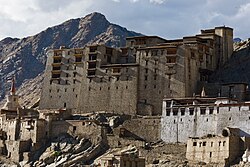
[[File:Leh Palace 2011.jpg|thumb|right|The [[Leh Palace]], built by [[Sengge Namgyal]]]] | [[File:Leh Palace 2011.jpg|thumb|right|The [[Leh Palace]], built by [[Sengge Namgyal]]]] | ||
During the reign of [[Jamyang Namgyal]], | During the reign of [[Jamyang Namgyal]], Ladakh was invaded by [[Balti people|Balti]] ruler [[Ali Sher Khan Anchan]] in response to Jamyang's killing of some Muslim rulers of Baltistan. Many Buddhist [[gompa]]s were damaged during Khan's invasion. Today, few gompas exist from before this period. The success of Khan's campaign impressed his enemies. According to some accounts, Jamyang secured a peace treaty and gave his daughter's hand in marriage to Ali Sher Khan. Jamyang was given the hand of a Muslim princess, Gyal Khatun's hand in marriage. [[Sengge Namgyal]] (1616–1642), known as the 'lion' king was the son of Jamyang and Gyal.<ref name=Loram/><ref>{{Cite book|url = https://books.google.com/books?id=mg8My6WaWRcC|title = Rediscovery of Ladakh|last = Kaul|first = H. N.|date = 1 January 1998|publisher = Indus Publishing|isbn = 9788173870866|language = en}}</ref><ref>Rizvi, Janet. ''Ladakh - Crossroads of High Asia'', Oxford University Press, 1996</ref><ref>{{Cite book|url = https://books.google.com/books?id=R4VuovXa5YUC|title = Buddhist Western Himalaya: A politico-religious history|date = 1 January 2001|publisher = Indus Publishing|isbn = 9788173871245|language = en}}</ref><ref>{{Cite book|url = https://books.google.com/books?id=8J3YdskW00sC|title = Ladakh Through the Ages, Towards a New Identity|last1 = Kaul|first1 = Shridhar|last2 = Kaul|first2 = H. N.|date = 1 January 1992|publisher = Indus Publishing|isbn = 9788185182759|language = en}}</ref><ref>{{Cite book|url = https://books.google.com/books?id=kjhcZgDy-WMC&q=gyal+khatun&pg=PA149|title = Ladakh: The Land and the People|last = Jina|first = Prem Singh|date = 1 January 1996|publisher = Indus Publishing|isbn = 9788173870576|language = en}}</ref><ref>{{Cite book|url = https://books.google.com/books?id=mCy2mBVNqSoC|title = Recent Research on Ladakh 4 & 5: Proceedings of the Fourth and Fifth International Colloquia on Ladakh|last1 = Osmaston|first1 = Henry|last2 = Denwood|first2 = Philip|date = 1 January 1995|publisher = Motilal Banarsidass Publ.|isbn = 9788120814042|language = en}}</ref><ref>{{Cite book|url = https://books.google.com/books?id=8eReFv7cVZ0C|title = Ladakh: Society and Economy|last = Bora|first = Nirmala|date = 1 January 2004|publisher = Anamika Publishers & Distributors|isbn = 9788179750124|language = en}}</ref> He made efforts to restore Ladakh to its old glory by an ambitious and energetic building programme by rebuilding several gompas and shrines, the most famous of which is [[Hemis]]. He also moved the royal headquarters from [[Shey Palace]] to [[Leh Palace]] and expanded the kingdom into [[Zanskar]] and [[Spiti]], but was defeated by the Mughals, who had already occupied Kashmir and Baltistan. His son [[Deldan Namgyal]] (1642–1694) had to placate the Mughal emperor [[Aurangzeb]] by building a mosque in Leh.<ref name=Luciano/><ref name=Loram/> However, he later with the help of the Mughal Army under [[Fidai Khan]], son of Mughal viceroy of [[Kashmir]], [[Ibrahim Khan (general)|Ibrahim Khan]], defeated the [[5th Dalai Lama]] [[Tibet–Ladakh–Mughal War|invasion]] in the plains of [[Chargyal]], situated between Neemoo and [[Basgo]].<ref name=Loram/> | ||
Many Muslim missionaries propagated Islam during this period in Ladakh and proselytised many Ladakhi people. Many Balti Muslims settled in Leh after the marriage of Jamyang to Gyal. Muslims were also invited to the region for trading and other purposes.<ref>{{Cite book|url=https://books.google.com/books?id=4jX552GiSmYC|title=Recent Research on Ladakh 6: Proceedings of the Sixth International Colloquium on Ladakh, Leh 1993|last1=Osmaston|first1=Henry|last2=Tsering|first2=Nawang|last3=Studies|first3=International Association for Ladakh|date=1997 | Many Muslim missionaries propagated Islam during this period in Ladakh and proselytised many Ladakhi people. Many Balti Muslims settled in Leh after the marriage of Jamyang to Gyal. Muslims were also invited to the region for trading and other purposes.<ref>{{Cite book|url=https://books.google.com/books?id=4jX552GiSmYC|title=Recent Research on Ladakh 6: Proceedings of the Sixth International Colloquium on Ladakh, Leh 1993|last1=Osmaston|first1=Henry|last2=Tsering|first2=Nawang|last3=Studies|first3=International Association for Ladakh|date=1 January 1997|publisher=Motilal Banarsidass|isbn=9788120814325|language=en}}</ref><ref>{{Cite book |last1=Osmaston |first1=Henry |url=https://books.google.com/books?id=mCy2mBVNqSoC |title=Recent Research on Ladakh 4 & 5: Proceedings of the Fourth and Fifth International Colloquia on Ladakh |last2=Denwood |first2=Philip |author-link2=Philip Denwood |date=1 January 1995 |publisher=Motilal Banarsidass |isbn=9788120814042 |language=en}}</ref> | ||
==Modern times== | ==Modern times== | ||
| Line 49: | Line 47: | ||
{{main|Jammu and Kashmir (princely state)}} | {{main|Jammu and Kashmir (princely state)}} | ||
By the beginning of the 19th century, the [[Mughal Empire]] had collapsed, and [[Sikh]] rule had been established in Punjab and Kashmir. However the [[Dogra]] region of [[Jammu]] remained under its Rajput rulers. Raja [[Maharaja Gulab Singh|Gulab Singh]], acting under the suzerainty of the Sikh monarch [[Ranjit Singh]], sent his general [[General Zorawar Singh|Zorawar Singh]] to invade Ladakh in 1834. King Tshespal Namgyal was dethroned and exiled to Stok. Ladakh came under Dogra rule and was later incorporated into the [[princely state]] of [[Jammu and Kashmir (princely state)|Jammu and Kashmir]] under British suzerainty. It still maintained considerable autonomy and relations with Tibet. During the [[Dogra–Tibetan War]] (1841–42), Tibet invaded Ladakh and the Ladakhis attempted to overthrow the Dogras with Tibetan help, but all of them were defeated. The Namgyal family was given the ''[[jagir]]'' of [[Stok]], which it nominally retains to this day. European influence began in Ladakh in the 1850s and increased. Geologists, sportsmen, and tourists began exploring Ladakh. In 1885, | By the beginning of the 19th century, the [[Mughal Empire]] had collapsed, and [[Sikh]] rule had been established in Punjab and Kashmir. However the [[Dogras|Dogra]] region of [[Jammu]] remained under its Rajput rulers. Raja [[Maharaja Gulab Singh|Gulab Singh]], acting under the suzerainty of the Sikh monarch [[Ranjit Singh]], sent his general [[General Zorawar Singh|Zorawar Singh]] to invade Ladakh in 1834. King Tshespal Namgyal was dethroned and exiled to Stok. Ladakh came under Dogra rule and was later incorporated into the [[princely state]] of [[Jammu and Kashmir (princely state)|Jammu and Kashmir]] under British suzerainty. It still maintained considerable autonomy and relations with Tibet. During the [[Dogra–Tibetan War]] (1841–42), Tibet invaded Ladakh and the Ladakhis attempted to overthrow the Dogras with Tibetan help, but all of them were defeated. The Namgyal family was given the ''[[jagir]]'' of [[Stok]], which it nominally retains to this day. European influence began in Ladakh in the 1850s and increased. Geologists, sportsmen, and tourists began exploring Ladakh. In 1885, Leh became the headquarters of a mission of the [[Moravian Church]]. | ||
Ladakh was administered as a ''wazarat'' during the Dogra rule, with a governor termed ''wazir-e-wazarat''. It had three tehsils, based at | Ladakh was administered as a ''wazarat'' during the Dogra rule, with a governor termed ''wazir-e-wazarat''. It had three tehsils, based at Leh, [[Skardu]] and [[Kargil]]. The headquarters of the ''wazarat'' was at Leh for six months of the year and at [[Skardu]] for six months. When the legislative assembly called ''Praja Sabha'' was established in 1934, Ladakh was given two nominated seats in the assembly. | ||
{{Anchor|Administrators of Ladakh}} | {{Anchor|Administrators of Ladakh}} | ||
| Line 58: | Line 56: | ||
!Maharaja | !Maharaja | ||
!Administrators | !Administrators | ||
<small>({{Also known as|AKA=}} Thanedar, Wazir Wazarat,</small> | <small>({{Also known as|AKA=}} Thanedar, Wazir Wazarat,</small> | ||
<small>Kardar, Governor)</small> | <small>Kardar, Governor)</small> | ||
| Line 65: | Line 63: | ||
!Ref | !Ref | ||
|- | |- | ||
| rowspan="2" |[[Gulab Singh of Jammu and Kashmir|Gulab Singh]] | | rowspan="2" |[[Gulab Singh of Jammu and Kashmir|Gulab Singh]] | ||
(1846–1857) | (1846–1857) | ||
|Magna Thanedar{{Efn|Appointed by [[Zorawar Singh | |Magna Thanedar{{Efn|Appointed by [[Zorawar Singh (Dogra general)|Zorawar Singh]]. "The system of administration introduced by Wazir Zorawar remained in force for some time."|name=|group=}} | ||
|1846 | |1846 | ||
|1847 | |1847 | ||
| Line 78: | Line 76: | ||
|{{Sfn|Kaul|Kaul|1992|p=101–102}}{{Sfn|Kaul|1998|p=85}} | |{{Sfn|Kaul|Kaul|1992|p=101–102}}{{Sfn|Kaul|1998|p=85}} | ||
|- | |- | ||
| rowspan="6" |[[Ranbir Singh (Maharaja)|Ranbir Singh]] | | rowspan="6" |[[Ranbir Singh (Maharaja)|Ranbir Singh]] | ||
(1857–1885) | (1857–1885) | ||
| Line 103: | Line 101: | ||
|[[William Johnson (surveyor)|William H. Johnson]] | |[[William Johnson (surveyor)|William H. Johnson]] | ||
|1870 | |1870 | ||
|1881/83<ref>{{Cite book|last1=Beek|first1=Martijn van|url=https://books.google.com/books?id=ZO95DwAAQBAJ|title=Modern Ladakh: Anthropological Perspectives on Continuity and Change|last2=Pirie|first2=Fernanda|date=2008 | |1881/83<ref>{{Cite book|last1=Beek|first1=Martijn van|url=https://books.google.com/books?id=ZO95DwAAQBAJ|title=Modern Ladakh: Anthropological Perspectives on Continuity and Change|last2=Pirie|first2=Fernanda|date=25 July 2008|publisher=BRILL|isbn=978-90-474-4334-6|pages=52|language=en}}</ref> | ||
|{{Sfn|Kaul|Kaul|1992|p=102}}{{Sfn|Kaul|1998|p=87}} | |{{Sfn|Kaul|Kaul|1992|p=102}}{{Sfn|Kaul|1998|p=87}} | ||
|- | |- | ||
| Line 138: | Line 136: | ||
===Indian state of Jammu and Kashmir=== | ===Indian state of Jammu and Kashmir=== | ||
{{main|Jammu and Kashmir (state)}} | {{main|Jammu and Kashmir (state)}} | ||
In 1947, partition left Ladakh a part of the Indian state of [[Jammu and Kashmir (state)|Jammu and Kashmir]], to be administered from Srinagar. In 1948, Pakistani raiders invaded Ladakh and occupied Kargil and Zanskar, reaching within 30 km of [[Leh]].<ref name=Loram/> Reinforcement troops were sent in by air, and a battalion of [[Gurkhas]] made its way slowly to Leh on foot from south. Kargil was a scene of fighting again in 1965, 1971, and 1999. | In 1947, partition left Ladakh a part of the Indian state of [[Jammu and Kashmir (state)|Jammu and Kashmir]], to be administered from Srinagar. In 1948, Pakistani raiders invaded Ladakh and occupied Kargil and Zanskar, reaching within 30 km of [[Leh]].<ref name=Loram/> Reinforcement troops were sent in by air, and a battalion of [[Gurkhas]] made its way slowly to Leh on foot from south. Kargil was a scene of fighting again in 1965, 1971, and 1999. | ||
| Line 146: | Line 145: | ||
In February 2019, Ladakh became a separate [[Divisions of India|Revenue and Administrative Division]] within Jammu and Kashmir, having previously been part of the [[Kashmir Division]]. As a division, Ladakh was granted its own [[Divisional Commissioner]] and [[Inspector General of Police]]. | In February 2019, Ladakh became a separate [[Divisions of India|Revenue and Administrative Division]] within Jammu and Kashmir, having previously been part of the [[Kashmir Division]]. As a division, Ladakh was granted its own [[Divisional Commissioner]] and [[Inspector General of Police]]. | ||
Leh was initially chosen to be the headquarters of the new division however, following protests, it was announced that Leh and Kargil will jointly serve as the divisional headquarters, each hosting an Additional Divisional Commissioner to assist the Divisional Commissioner and Inspector General of Police who will spend half their time in each town.<ref name="kln">https://kashmirlife.net/ladakh-division-headquarters-to-shuttle-between-leh-and-kargil-governor-malik-201719/</ref> | Leh was initially chosen to be the headquarters of the new division however, following protests, it was announced that Leh and Kargil will jointly serve as the divisional headquarters, each hosting an Additional Divisional Commissioner to assist the Divisional Commissioner and Inspector General of Police who will spend half their time in each town.<ref name="kln">{{Cite web|url=https://kashmirlife.net/ladakh-division-headquarters-to-shuttle-between-leh-and-kargil-governor-malik-201719/|title = Ladakh division headquarters to shuttle between Leh and Kargil: Governor Malik|date = 15 February 2019}}</ref> | ||
===Indian union territory of Ladakh=== | ===Indian union territory of Ladakh=== | ||
{{main|Ladakh}} | {{main|Ladakh}} | ||
In August 2019, a [[Jammu and Kashmir Reorganisation Bill, 2019|reorganisation act]] was passed by the [[Parliament of India]] which contained provisions to reconstitute Ladakh as a [[union territory]], separate from the rest of Jammu and Kashmir on 31 October 2019.<ref>[https://www.ndtv.com/india-news/bill-to-bifurcate-jammu-and-kashmir-into-2-union-territories-passed-by-rajya-sabha-2080688 Already, Rajya Sabha Clears J&K As Union Territory Instead Of State], NDTV, 5 August 2019.</ref><ref name="auto">{{Cite web|url=https://www.businesstoday.in/current/economy-politics/jammu-and-kashmir-crisis-live-updates-governor-reviews-security-situation-in-state/story/370856.html|title=Article 370 revoked Updates: Jammu & Kashmir is now a Union Territory, Lok Sabha passes bifurcation bill|website=www.businesstoday.in}}</ref><ref>http://www.prsindia.org/sites/default/files/bill_files/Jammu%20and%20Kashmir%20Reorganisation%20Bill%2C%202019.pdf</ref><ref name="egazette.nic.in">http://egazette.nic.in/WriteReadData/2019/210412.pdf</ref> Under the terms of the act, the union territory was to be administered by a [[Lieutenant Governor of Ladakh|Lieutenant Governor]] acting on behalf of the central Government of India and would not have an elected legislative assembly or chief minister. Each district within the new union territory will continue to elect an [[autonomous district council]] as done previously.<ref name="dailyexcelsior.com">https://www.dailyexcelsior.com/lahdc-act-would-continue-and-the-amendments-of-2018-to-be-protected-governor/</ref> | |||
In August 2019, a [[Jammu and Kashmir Reorganisation Bill, 2019|reorganisation act]] was passed by the [[Parliament of India]] which contained provisions to reconstitute Ladakh as a [[union territory]], separate from the rest of Jammu and Kashmir on 31 October 2019.<ref>[https://www.ndtv.com/india-news/bill-to-bifurcate-jammu-and-kashmir-into-2-union-territories-passed-by-rajya-sabha-2080688 Already, Rajya Sabha Clears J&K As Union Territory Instead Of State], NDTV, 5 August 2019.</ref><ref name="auto">{{Cite web|url=https://www.businesstoday.in/current/economy-politics/jammu-and-kashmir-crisis-live-updates-governor-reviews-security-situation-in-state/story/370856.html|title=Article 370 revoked Updates: Jammu & Kashmir is now a Union Territory, Lok Sabha passes bifurcation bill|website=www.businesstoday.in|date=6 August 2019 }}</ref><ref>{{Cite web |url=http://www.prsindia.org/sites/default/files/bill_files/Jammu%20and%20Kashmir%20Reorganisation%20Bill%2C%202019.pdf |title=Archived copy |access-date=31 October 2019 |archive-date=6 May 2021 |archive-url=https://web.archive.org/web/20210506231839/https://www.prsindia.org/sites/default/files/bill_files/Jammu%20and%20Kashmir%20Reorganisation%20Bill,%202019.pdf |url-status=dead }}</ref><ref name="egazette.nic.in">{{Cite web |url=http://egazette.nic.in/WriteReadData/2019/210412.pdf |title=Archived copy |access-date=31 October 2019 |archive-date=9 August 2019 |archive-url=https://web.archive.org/web/20190809153916/http://egazette.nic.in/WriteReadData/2019/210412.pdf |url-status=dead }}</ref> Under the terms of the act, the union territory was to be administered by a [[Lieutenant Governor of Ladakh|Lieutenant Governor]] acting on behalf of the central Government of India and would not have an elected legislative assembly or chief minister. Each district within the new union territory will continue to elect an [[autonomous district council]] as done previously.<ref name="dailyexcelsior.com">{{Cite web|url=https://www.dailyexcelsior.com/lahdc-act-would-continue-and-the-amendments-of-2018-to-be-protected-governor/|title=LAHDC Act would continue and the Amendments of 2018 to be protected: Governor|date=30 August 2019}}</ref> | |||
== Map == | == Map == | ||
| Line 157: | Line 157: | ||
==Historiography== | ==Historiography== | ||
{{Further|Ladakh Chronicles}} | {{Further|Ladakh Chronicles}} | ||
The main written source for Ladakhi history is the 17th century [[Ladakh Chronicles]].<ref name="Pirie">{{cite book|title=Peace and Conflict in Ladakh: The Construction of a Fragile Web of Order |first=Fernanda |last=Pirie |publisher=[[Brill Publishers]] |year=2007 |url=https://books.google.com/books?id=w5APvy1TldcC |series=Brill's Tibetan studies library |volume=13 |isbn=9789004155961}}</ref><ref name="Petech">{{cite book |url=https://books.google.com/books?id=4oduAAAAMAAJ |title=The Kingdom of Ladakh: C. 950-1842 A.D. |first=Luciano |last=Petech |author-link=Luciano Petech |publisher=Istituto italiano per il Medio ed Estremo Oriente |year=1977}}</ref>{{rp|1,3|quote=The main source for Ladakhi history is, and always will be, the La-dvags rgyal-rabs, compiled probably in the 17th century, but continued later till the end of the kingdom and beyond. [...] The only other literary source from Ladakh is the biography of sTag-ts'ah-ras-pa (TTRP), compiled in 1663.}}<ref name="Bray">{{cite book |last=Bray |first=John |chapter=Introduction: Locating Ladakhi History |editor-last=Bray |editor-first=John |title=Ladakhi Histories: Local and Regional Perspectives |publisher=[[Brill Publishers]] |year=2005 |series=Brill's Tibetan Studies Library |volume=9 |isbn=9789004145511}}</ref>{{rp|7|quote=The prime source for this period is the La-dvags-rgyal-rabs a royal chronicle which was first compiled in the 17th century and updated into the 19th century.}} The Ladakhi Chronicles are one of only two surviving pre-19th century literary sources from Ladakh, with the other being the 1663 biography of sTag-ts'ah-ras-pa.<ref name="Petech"/>{{rp|1,3}} Only seven original manuscripts of the chronicles are known to have existed, of which only two survive to the modern day.<ref name="Petech"/>{{rp|1–2}} | The main written source for Ladakhi history is the 17th century [[Ladakh Chronicles]].<ref name="Pirie">{{cite book|title=Peace and Conflict in Ladakh: The Construction of a Fragile Web of Order |first=Fernanda |last=Pirie |publisher=[[Brill Publishers]] |year=2007 |url=https://books.google.com/books?id=w5APvy1TldcC |series=Brill's Tibetan studies library |volume=13 |isbn=9789004155961}}</ref><ref name="Petech">{{cite book |url=https://books.google.com/books?id=4oduAAAAMAAJ |title=The Kingdom of Ladakh: C. 950-1842 A.D. |first=Luciano |last=Petech |author-link=Luciano Petech |publisher=Istituto italiano per il Medio ed Estremo Oriente |year=1977|isbn=9788863230581 }}</ref>{{rp|1,3|quote=The main source for Ladakhi history is, and always will be, the La-dvags rgyal-rabs, compiled probably in the 17th century, but continued later till the end of the kingdom and beyond. [...] The only other literary source from Ladakh is the biography of sTag-ts'ah-ras-pa (TTRP), compiled in 1663.}}<ref name="Bray">{{cite book |last=Bray |first=John |chapter=Introduction: Locating Ladakhi History |editor-last=Bray |editor-first=John |title=Ladakhi Histories: Local and Regional Perspectives |publisher=[[Brill Publishers]] |year=2005 |series=Brill's Tibetan Studies Library |volume=9 |isbn=9789004145511}}</ref>{{rp|7|quote=The prime source for this period is the La-dvags-rgyal-rabs a royal chronicle which was first compiled in the 17th century and updated into the 19th century.}} The Ladakhi Chronicles are one of only two surviving pre-19th century literary sources from Ladakh, with the other being the 1663 biography of sTag-ts'ah-ras-pa.<ref name="Petech"/>{{rp|1,3}} Only seven original manuscripts of the chronicles are known to have existed, of which only two survive to the modern day.<ref name="Petech"/>{{rp|1–2}} | ||
== Notes == | == Notes == | ||
<references group="lower-alpha" /> | <references group="lower-alpha" /> | ||
==Footnotes== | ==Footnotes== | ||
{{Reflist}} | {{Reflist}} | ||
| Line 174: | Line 175: | ||
* Rizvi, Janet. (1996). ''Ladakh: Crossroads of High Asia''. Second Edition. Oxford India Paperbacks. 3rd Impression 2001. {{ISBN|0-19-564546-4}}. | * Rizvi, Janet. (1996). ''Ladakh: Crossroads of High Asia''. Second Edition. Oxford India Paperbacks. 3rd Impression 2001. {{ISBN|0-19-564546-4}}. | ||
* Schettler, Margret & Rolf. (1981). ''Kashmir, Ladakh & Zanskar'', Lonely Planet: South Yarra, Victoria, Australia. {{ISBN|0-908086-21-0}}. | * Schettler, Margret & Rolf. (1981). ''Kashmir, Ladakh & Zanskar'', Lonely Planet: South Yarra, Victoria, Australia. {{ISBN|0-908086-21-0}}. | ||
==Further reading== | ==Further reading== | ||
Latest revision as of 19:19, 27 February 2026
 | This article needs more citations. (March 2012) |


Ladakh has a long history with evidence of human settlement from as back as 9000 B.C. It has been a crossroad of high Asia for thousands of years and has seen many cultures, empires and technologies born in its neighbours. As a result of these developments Ladakh has imported[clarification needed] many traditions and culture from its neighbours and combining them all gave rise to a unique tradition and culture of its own.
Earliest history[edit | edit source]
The first glimpse of political history is found in the kharosthi inscription of "Uvima Kavthisa" discovered near the K'a-la-rtse (Khalatse) bridge on the Indus, showing that in around the 1st century, Ladakh was a part of the Kushan Empire. A few other short Brahmi and Kharosthi inscriptions have been found in Ladakh.[citation needed]
The Chinese pilgrim monk Xuanzang, c. 634 CE, described a journey from Chuluduo (Kūluta, Kulu) to Luohuluo (Lahul) and then states that, "[f]rom here, the road, leading to the north, for over one thousand, eight hundred or nine hundred li by perilous paths and over mountains and valleys, takes one to the country of Lāhul. Going further to the north over two thousand li along a route full of difficulties and obstacles, in cold winds and wafting snowflakes, one could reach the country of Marsa (also known as Sanbohe)."[1] The kingdom of Moluosuo, or Mar-sa, would seem to be synonymous with Mar-yul, a common name for Ladakh. Elsewhere, the text remarks that Mo-lo-so, also called San-po-ho borders with Suvarnagotra or Suvarnabhumi (Land of Gold), identical with the Kingdom of Women (Strirajya). According to Tucci, the Zhangzhung kingdom, or at least its southern districts, were known by this name by the 7th-century Indians. In 634/5 Zhangzhung acknowledged Tibetan suzernaity for the first time, and in 653 a Tibetan commissioner (mnan) was appointed there. Regular administration was introduced in 662, and an unsuccessful rebellion broke out in 677.
In the 8th century, Ladakh was caught between Tibetan expansion pressing from the east, and Chinese influence exerted from Central Asia through the passes. In 719 a census was taken, and in 724 the administration was reorganized. In 737, the Tibetans launched an attack against the king of Bru-za (Gilgit), who asked for Chinese help, but was ultimately forced to pay homage to Tibet. The Korean monk Hyecho (704-787) (pinyin: Hui Chao), reached India by sea and returned to China in 727 via central Asia.[2] He referred to three kingdoms lying to the northeast of Kashmir which were:
"under the suzerainty of the Tibetans. . . . The country is narrow and small, and the mountains and valleys very rugged. There are monasteries and monks, and the people faithfully venerate the Three Jewels. As to the kingdom of Tibet to the East, there are no monasteries at all, and the Buddha's teaching is unknown; but, in [these] countries, the population consists of Hu; therefore, they are believers. (Petech, The Kingdom of Ladakh, p. 10)."[3]
Rizvi points out that this passage not only confirms that, in the early 8th century, the region of modern Ladakh was under Tibetan suzerainty, but that the people belonged to non-Tibetan stock.
In 747, the hold of Tibet was loosened by the campaign of Chinese General Gao Xianzhi, who tried to re-open the direct communications between Central Asia and Kashmir. After Gao's defeat by the Qarluqs and Arabs on the Talas river (751), Chinese influence decreased rapidly and Tibetan influence resumed.
The geographical treatise Hudud-al-Alam (982) mentions Bolorian (Bolor = Bolu, Baltistan) Tibet, where people were chiefly merchants and lived in huts. Nestorian crosses carved into boulders, apparently due to Sogdian Christian merchants found in Drangtse (Tangtse), and Arabic inscriptions of about the same time are evidence of the importance of trade in this region. After the collapse of the Tibetan monarchy in 842, Tibetan suzerainty quickly vanished.
La-Chen/Gon dynasty:The first dynasty[edit | edit source]

After the breakup of the Tibetan Empire in 842, Nyima-Gon, a representative of the ancient Tibetan royal house founded the first Ladakh dynasty. Nyima-Gon's kingdom had its centre well to the east of present-day Ladakh. This was the period in which Ladakh underwent Tibetanization, eventually making Ladakh a country inhabited by a mixed population, the predominant racial strain of which was Tibetan. However, soon after the conquest, the dynasty, intent on establishing Buddhism, looked not to Tibet, but to north-west India, particularly Kashmir. This has been termed the Second Spreading of Buddhism in the region (the first one being in Tibet proper.)[citation needed] An early king, Lde-dpal-hkhor-btsan (c. 870 -900), swore an oath to develop the Bön religion in Ladakh and was responsible for erecting eight early monasteries including the Upper Manahris monastery. He also encouraged the mass production of the Hbum scriptures to spread religion.[5] Little, however is known about the early kings of Nyima-Gon's dynasty. The fifth king in line has a Sanskrit name, Lhachen Utpala, who conquered Kulu, Mustang, and parts of Baltistan.[6]
Around the 13th century, due to islamic invasions, India ceased having anything to offer from a Buddhist point of view, and Ladakh began to seek and accept guidance in religious matters from Tibet.
The Namgyal dynasty[edit | edit source]
Continual raids on Ladakh by the plundering Muslim states of Central Asia lead to the weakening and partial conversion of Ladakh.[7][8] Ladakh was divided, with Lower Ladakh ruled by King Takpabum from Basgo and Temisgam, and Upper Ladakh by King Takbumde from Leh and Shey. Lhachen Bhagan, a later Basgo king, reunited Ladakh by overthrowing the king of Leh. He took on the surname Namgyal (meaning victorious) and founded a new dynasty which still survives today. King Tashi Namgyal (1555–1575) managed to repel most Central Asian raiders, and built a royal fort on the top of the Namgyal Peak. Tsewang Namgyal temporarily extended his kingdom as far as Nepal.[8]

During the reign of Jamyang Namgyal, Ladakh was invaded by Balti ruler Ali Sher Khan Anchan in response to Jamyang's killing of some Muslim rulers of Baltistan. Many Buddhist gompas were damaged during Khan's invasion. Today, few gompas exist from before this period. The success of Khan's campaign impressed his enemies. According to some accounts, Jamyang secured a peace treaty and gave his daughter's hand in marriage to Ali Sher Khan. Jamyang was given the hand of a Muslim princess, Gyal Khatun's hand in marriage. Sengge Namgyal (1616–1642), known as the 'lion' king was the son of Jamyang and Gyal.[8][9][10][11][12][13][14][15] He made efforts to restore Ladakh to its old glory by an ambitious and energetic building programme by rebuilding several gompas and shrines, the most famous of which is Hemis. He also moved the royal headquarters from Shey Palace to Leh Palace and expanded the kingdom into Zanskar and Spiti, but was defeated by the Mughals, who had already occupied Kashmir and Baltistan. His son Deldan Namgyal (1642–1694) had to placate the Mughal emperor Aurangzeb by building a mosque in Leh.[7][8] However, he later with the help of the Mughal Army under Fidai Khan, son of Mughal viceroy of Kashmir, Ibrahim Khan, defeated the 5th Dalai Lama invasion in the plains of Chargyal, situated between Neemoo and Basgo.[8]
Many Muslim missionaries propagated Islam during this period in Ladakh and proselytised many Ladakhi people. Many Balti Muslims settled in Leh after the marriage of Jamyang to Gyal. Muslims were also invited to the region for trading and other purposes.[16][17]
Modern times[edit | edit source]
Princely state of Jammu and Kashmir[edit | edit source]
By the beginning of the 19th century, the Mughal Empire had collapsed, and Sikh rule had been established in Punjab and Kashmir. However the Dogra region of Jammu remained under its Rajput rulers. Raja Gulab Singh, acting under the suzerainty of the Sikh monarch Ranjit Singh, sent his general Zorawar Singh to invade Ladakh in 1834. King Tshespal Namgyal was dethroned and exiled to Stok. Ladakh came under Dogra rule and was later incorporated into the princely state of Jammu and Kashmir under British suzerainty. It still maintained considerable autonomy and relations with Tibet. During the Dogra–Tibetan War (1841–42), Tibet invaded Ladakh and the Ladakhis attempted to overthrow the Dogras with Tibetan help, but all of them were defeated. The Namgyal family was given the jagir of Stok, which it nominally retains to this day. European influence began in Ladakh in the 1850s and increased. Geologists, sportsmen, and tourists began exploring Ladakh. In 1885, Leh became the headquarters of a mission of the Moravian Church.
Ladakh was administered as a wazarat during the Dogra rule, with a governor termed wazir-e-wazarat. It had three tehsils, based at Leh, Skardu and Kargil. The headquarters of the wazarat was at Leh for six months of the year and at Skardu for six months. When the legislative assembly called Praja Sabha was established in 1934, Ladakh was given two nominated seats in the assembly.
| Maharaja | Administrators
(Template:Also known as Thanedar, Wazir Wazarat, Kardar, Governor) |
Start | End | Ref |
|---|---|---|---|---|
| Gulab Singh
(1846–1857) |
Magna Thanedar[lower-alpha 1] | 1846 | 1847 | [18][19] |
| Mehta Basti Ram | 1847 | 1860 | [20][19] | |
| Ranbir Singh
(1857–1885) |
Mehta Mangal Singh[lower-alpha 2] | 1860 | 1865 | [21][22] |
| Wazir Shibsarn | 1865 | 1867 | [21][23] | |
| Sayyid Akbar Ali | 1867 | 1868 | [21][24] | |
| Frederic Drew | 1868 | 1870 | [21][25] | |
| William H. Johnson | 1870 | 1881/83[26] | [21][25] | |
| Radha Krishen Kaul | 1885 | - | [27][25] | |
| Pratap Singh
(1885–1925) |
Chaudhri Khushi Mohammad | 1908 | 1909 | [27][25] |
| Administrative borders of Ladakh, Gilgit and Baltistan undergo changes | ||||
| - | - | - | ||
| Hari Singh
(1925–1952) |
- | - | - | |
Ladakh was claimed as part of Tibet by Phuntsok Wangyal, a Tibetan Communist leader.[28]
Indian state of Jammu and Kashmir[edit | edit source]
In 1947, partition left Ladakh a part of the Indian state of Jammu and Kashmir, to be administered from Srinagar. In 1948, Pakistani raiders invaded Ladakh and occupied Kargil and Zanskar, reaching within 30 km of Leh.[8] Reinforcement troops were sent in by air, and a battalion of Gurkhas made its way slowly to Leh on foot from south. Kargil was a scene of fighting again in 1965, 1971, and 1999.
In 1949, China closed the border between Nubra and Sinkiang, blocking the 1000-year-old trade route from India to Central Asia. In 1950, China invaded Tibet, and thousands of Tibetans, including the Dalai Lama sought refuge in India. In 1962, China occupied Aksai Chin, and promptly built roads connecting Xinjiang and Tibet, and the Karakoram Highway, jointly with Pakistan. India built the Srinagar-Leh highway during this period, cutting the journey time between Srinagar to Leh from 16 days to two. Simultaneously, China closed the Ladakh-Tibet border, ending the 700-year-old Ladakh-Tibet relationship.[8]
Since the early 1960s the number of immigrants from Tibet (including Changpa nomads) have increased as they flee the occupation of their homeland by the Chinese. Today, Leh has some 3,500 refugees from Tibet. They hold no passports, only customs papers. Some Tibetan refugees in Ladakh claim dual Tibetan/Indian citizenship, although their Indian citizenship is unofficial. Since partition Ladakh has been governed by the State government based in Srinagar, never to the complete satisfaction of the Ladakhis, who demand that Ladakh be directly governed from New Delhi as a Union Territory. They allege continued apathy, Muslim bias, and corruption of the state government as reasons for their demands. In 1989, there were violent riots between Buddhists and Muslims, provoking the Ladakh Buddhist Council to call for a social and economic boycott of Muslims, which was lifted in 1992. In October 1993, the Indian government and the State government agreed to grant Ladakh the status of Autonomous Hill Council. In 1995, the Ladakh Autonomous Hill Development Council was created.
In February 2019, Ladakh became a separate Revenue and Administrative Division within Jammu and Kashmir, having previously been part of the Kashmir Division. As a division, Ladakh was granted its own Divisional Commissioner and Inspector General of Police.
Leh was initially chosen to be the headquarters of the new division however, following protests, it was announced that Leh and Kargil will jointly serve as the divisional headquarters, each hosting an Additional Divisional Commissioner to assist the Divisional Commissioner and Inspector General of Police who will spend half their time in each town.[29]
Indian union territory of Ladakh[edit | edit source]
In August 2019, a reorganisation act was passed by the Parliament of India which contained provisions to reconstitute Ladakh as a union territory, separate from the rest of Jammu and Kashmir on 31 October 2019.[30][31][32][33] Under the terms of the act, the union territory was to be administered by a Lieutenant Governor acting on behalf of the central Government of India and would not have an elected legislative assembly or chief minister. Each district within the new union territory will continue to elect an autonomous district council as done previously.[34]
Map[edit | edit source]
- Aqua highlight labels represent Gompas or monasteries that paid the highest taxes in the 1850s — Hemis (with Hanle) Rs 900; Chimra Rs 900; Thigse Rs 500; Pitak Rs 500; Gawan Rs 900; Lama Yuru Rs 900.[36] (see Strachey's 1851 map of Ladakh for similar location spellings i.e. Chimra/Chemre etc)
- Route marked in red arrows (


 ) depicts routes of Zorawar Singh's Ladakhi and Balti campaigns. Arrows 1 to 5 depict the start from Kishtawar in 1834, through Warwan to Suru Valley, then north to Dkarste and from there turning south east to Khalatse. Arrows A to D depict the conquest of Balti, reaching Skardu and back. Coloured labels represent southeast–wards conquests heading into Tibet and ending at Taklakot.[37]
 - Col N. Kumar led Indian teams climbed Teram Kangri II in 1978 and Sia Kangri and Saltoro Kangri in 1981.[38]


Historiography[edit | edit source]
The main written source for Ladakhi history is the 17th century Ladakh Chronicles.[39][40]:1,3[41]:7 The Ladakhi Chronicles are one of only two surviving pre-19th century literary sources from Ladakh, with the other being the 1663 biography of sTag-ts'ah-ras-pa.[40]:1,3 Only seven original manuscripts of the chronicles are known to have existed, of which only two survive to the modern day.[40]:1–2
Notes[edit | edit source]
- ↑ Appointed by Zorawar Singh. "The system of administration introduced by Wazir Zorawar remained in force for some time."
- ↑ "Kedaru Thanedar was followed by Wazir Labajoo of Kishtwar as Kardar of Baltistan in 1863. […] He was succeeded by Mehta Mangal whose decade long reign from 1875 to 1885 […]"
Footnotes[edit | edit source]
- ↑ Li (1996), p. 121.
- ↑ GR Vol. III (2001), p. 228.
- ↑ Rizvi (1996), p. 56.
- ↑ Flood, Finbarr Barry (2017). A Turk in the Dukhang? Comparative Perspectives on Elite Dress in Medieval Ladakh and the Caucasus. Austrian Academy of Science Press. pp. 231–243.
- ↑ Francke, August Hermann (1992). Antiquities of Indian Tibet. Asian Educational Services. p. 92. ISBN 81-206-0769-4.
{{cite book}}:|work=ignored (help) - ↑ "A Brief History of Ladakh:A Himalayan Buddhist Kingdom". Ladakh Drukpa.com. Archived from the original on 27 February 2012. Retrieved 9 October 2009.
- ↑ 7.0 7.1 Petech, Luciano. The Kingdom of Ladakh c. 950 - 1842 A. D., Istituto Italiano per il media ed Estremo Oriente, 1977.
- ↑ 8.0 8.1 8.2 8.3 8.4 8.5 8.6 Loram, Charlie. Trekking in Ladakh, Trailblazer Publications, 2004
- ↑ Kaul, H. N. (1 January 1998). Rediscovery of Ladakh. Indus Publishing. ISBN 9788173870866.
- ↑ Rizvi, Janet. Ladakh - Crossroads of High Asia, Oxford University Press, 1996
- ↑ Buddhist Western Himalaya: A politico-religious history. Indus Publishing. 1 January 2001. ISBN 9788173871245.
- ↑ Kaul, Shridhar; Kaul, H. N. (1 January 1992). Ladakh Through the Ages, Towards a New Identity. Indus Publishing. ISBN 9788185182759.
- ↑ Jina, Prem Singh (1 January 1996). Ladakh: The Land and the People. Indus Publishing. ISBN 9788173870576.
- ↑ Osmaston, Henry; Denwood, Philip (1 January 1995). Recent Research on Ladakh 4 & 5: Proceedings of the Fourth and Fifth International Colloquia on Ladakh. Motilal Banarsidass Publ. ISBN 9788120814042.
- ↑ Bora, Nirmala (1 January 2004). Ladakh: Society and Economy. Anamika Publishers & Distributors. ISBN 9788179750124.
- ↑ Osmaston, Henry; Tsering, Nawang; Studies, International Association for Ladakh (1 January 1997). Recent Research on Ladakh 6: Proceedings of the Sixth International Colloquium on Ladakh, Leh 1993. Motilal Banarsidass. ISBN 9788120814325.
- ↑ Osmaston, Henry; Denwood, Philip (1 January 1995). Recent Research on Ladakh 4 & 5: Proceedings of the Fourth and Fifth International Colloquia on Ladakh. Motilal Banarsidass. ISBN 9788120814042.
- ↑ Kaul & Kaul 1992, p. 101.
- ↑ 19.0 19.1 Kaul 1998, p. 85.
- ↑ Kaul & Kaul 1992, p. 101–102.
- ↑ 21.0 21.1 21.2 21.3 21.4 Kaul & Kaul 1992, p. 102.
- ↑ Kaul 1998, p. 85–86.
- ↑ Kaul 1998, p. 86.
- ↑ Kaul 1998, p. 86–87.
- ↑ 25.0 25.1 25.2 25.3 Kaul 1998, p. 87.
- ↑ Beek, Martijn van; Pirie, Fernanda (25 July 2008). Modern Ladakh: Anthropological Perspectives on Continuity and Change. BRILL. p. 52. ISBN 978-90-474-4334-6.
- ↑ 27.0 27.1 Kaul & Kaul 1992, p. 104.
- ↑ Gray Tuttle; Kurtis R. Schaeffer (12 March 2013). The Tibetan History Reader. Columbia University Press. pp. 603–. ISBN 978-0-231-14468-1.
- ↑ "Ladakh division headquarters to shuttle between Leh and Kargil: Governor Malik". 15 February 2019.
- ↑ Already, Rajya Sabha Clears J&K As Union Territory Instead Of State, NDTV, 5 August 2019.
- ↑ "Article 370 revoked Updates: Jammu & Kashmir is now a Union Territory, Lok Sabha passes bifurcation bill". www.businesstoday.in. 6 August 2019.
- ↑ "Archived copy" (PDF). Archived from the original (PDF) on 6 May 2021. Retrieved 31 October 2019.
{{cite web}}: CS1 maint: archived copy as title (link) - ↑ "Archived copy" (PDF). Archived from the original (PDF) on 9 August 2019. Retrieved 31 October 2019.
{{cite web}}: CS1 maint: archived copy as title (link) - ↑ "LAHDC Act would continue and the Amendments of 2018 to be protected: Governor". 30 August 2019.
- ↑ Bray, John, ed. (2005). "Introduction". Ladakhi Histories: Local and Regional Perspectives. Brill. ISBN 9789004145511. Retrieved 23 December 2020.
- ↑ Cunningham, Alexander (1854). Ladak, Physical, Statistical, and Historical; with notices of the surrounding countries. London: W. H. Allen & Co. p. 273.
- ↑ Charak, Sukhdev Singh (2016). General Zorawar Singh. New Delhi: Publications Division, Ministry of Information & Broadcasting, Government of India. p. 16. ISBN 9788123026480.
- ↑ Sircar, Joydeep (1984). "Oropolitics" (PDF). British Alpine Journal. p. 78. Archived (PDF) from the original on 1 January 2021. Retrieved 31 December 2020.
- ↑ Pirie, Fernanda (2007). Peace and Conflict in Ladakh: The Construction of a Fragile Web of Order. Brill's Tibetan studies library. Vol. 13. Brill Publishers. ISBN 9789004155961.
- ↑ 40.0 40.1 40.2 Petech, Luciano (1977). The Kingdom of Ladakh: C. 950-1842 A.D. Istituto italiano per il Medio ed Estremo Oriente. ISBN 9788863230581.
- ↑ Bray, John (2005). "Introduction: Locating Ladakhi History". In Bray, John (ed.). Ladakhi Histories: Local and Regional Perspectives. Brill's Tibetan Studies Library. Vol. 9. Brill Publishers. ISBN 9789004145511.
References[edit | edit source]
- Cunningham, Alexander (1854). LADĀK: Physical, Statistical, and Historical with Notices of the Surrounding Countries. London. Reprint: Sagar Publications (1977).
- Francke, A. H. (1907) A History of Ladakh. (Originally published as, A History of Western Tibet, 1907). 1977 Edition with critical introduction and annotations by S. S. Gergan & F. M. Hassnain. Sterling Publishers, New Delhi.
- Francke, A. H. (1914). Antiquities of Indian Tibet. Two Volumes. (Calcutta. 1972 reprint: S. Chand, New Delhi.
- GR Vol. III (2001): Grand dictionnaire Ricci de la langue chinoise. 7 Volumes. (2001). Instituts Ricci (Paris - Taipei). ISBN 2-220-04667-2.
- Li Rongxi (translator). The Great Tang Dynasty Record of the Western Regions. Numata Center for Buddhist Translation and Research, Berkeley, California. ISBN 1-886439-02-8.
- Rizvi, Janet. (1996). Ladakh: Crossroads of High Asia. Second Edition. Oxford India Paperbacks. 3rd Impression 2001. ISBN 0-19-564546-4.
- Schettler, Margret & Rolf. (1981). Kashmir, Ladakh & Zanskar, Lonely Planet: South Yarra, Victoria, Australia. ISBN 0-908086-21-0.
Further reading[edit | edit source]
- Zeisler, Bettina. (2010). "East of the Moon and West of the Sun? Approaches to a Land with Many Names, North of Ancient India and South of Khotan." In: The Tibet Journal, Special issue. Autumn 2009 vol XXXIV n. 3-Summer 2010 vol XXXV n. 2. "The Earth Ox Papers", edited by Roberto Vitali, pp. 371–463.
External links[edit | edit source]
- Minser Enclave was part of Ladakh since the 1684 Treaty of Temisgang signed between Tibet and Ladakh

| History |
| ||||||||||||||||||
|---|---|---|---|---|---|---|---|---|---|---|---|---|---|---|---|---|---|---|---|
| Administration | |||||||||||||||||||
| Geography |
| ||||||||||||||||||
| Human settlements | |||||||||||||||||||
| Culture |
| ||||||||||||||||||
| Tourism and wildlife |
| ||||||||||||||||||
| Transport |
| ||||||||||||||||||
| Infrastructure |
| ||||||||||||||||||
| See also |
| ||||||||||||||||||


