


ImportMaster (talk | contribs) m robot: import pages using Special:Import |
added references |
||
| Line 1: | Line 1: | ||
{{Short description|Supreme | {{Short description|Supreme goddess in Hinduism}} | ||
{{about|Supreme Goddess in Hinduism|common term for a Hindu goddess|Devi|the | {{about|the Supreme Goddess in Hinduism|the common term for a Hindu goddess|Devi|the divine feminine energy|Shakti|the concept of Shaivism|Parashakti|article about a Sanskrit astronomical table text titled ''Mahadevi''|Mahadevi (astronomy book)}} | ||
{{Use dmy dates|date=March 2015}} | {{Use dmy dates|date=March 2015}} | ||
{{Infobox deity | {{Infobox deity | ||
| type = Hindu | | type = Hindu | ||
| texts = [[Devi Mahatmya]], [[Devi-Bhagavata Purana]], [[Kalika Purana]], [[Lalita | | other_names = {{hlist|Adi Parashakti|Mahamaya}} | ||
| texts = [[Devi Mahatmya]], [[Devi-Bhagavata Purana]], [[Markandeya Purana]], [[Brahmanda Purana]], [[Kalika Purana]], [[Lakshmi Tantra]], [[Lalita Sahasranama]], [[Soundarya Lahari]], [[Shiva Purana]], [[Shakta Upanishads]] such as the [[Devi Upanishad]]<ref>{{cite book |first1=Constance|last1=Jones|first2=James|last2=Ryan|title=Encyclopedia of Hinduism |url=https://books.google.com/books?id=hZET2sSUVsgC |year=2014|publisher=Infobase Publishing |isbn=978-0816054589 |page=399}}</ref> | |||
| image = MET DT4003.jpg | | image = MET DT4003.jpg | ||
| caption = An 18th century painting of Mahadevi from [[Bikaner]], [[Rajasthan]] | | caption = An 18th-century painting of Mahadevi from [[Bikaner]], [[Rajasthan]] | ||
| Devanagari = महादेवी | | Devanagari = महादेवी | ||
| Sanskrit_transliteration = Mahādevī | | Sanskrit_transliteration = Mahādevī | ||
| mantra = {{IAST|Ōm āim hrīm śrīm klīm}} | | mantra = {{IAST|Ōm āim hrīm śrīm klīm}}{{sfn|Narayanananda|1960|p=50}} | ||
| abode = [[Manidvipa]] | | abode = [[Manidvipa]] | ||
| | | weapon = [[Chakram|Devi Chakra]], [[Pasha (Hinduism)|Pasha]], [[Elephant goad|Ankusha]], [[Trishula]] (trident) | ||
| | | affiliation = {{hlist|[[Durga]]|[[Lakshmi]]|[[Parvati]]|[[Saraswati]]|[[Gayatri]]|[[Radha]]|[[Tripura Sundari]]}} | ||
| | |||
| | |||
| | |||
| mount = Lion | | mount = Lion | ||
| | | festivals = [[Navaratri]], [[Durga Puja]], [[Vasanta Panchami]], [[Lakshmi Puja]], [[Kali Puja]], [[Durga Ashtami]], Lalita Jayanti, Adi-Puram | ||
| deity_of = {{hlist|The Supreme Mother Goddess|Goddess of Power|''Primordial Goddess''| [[Para Brahman]] (the Ultimate Reality) in [[Shaktism]]}} | |||
| symbol = Hreem, [[Om]], [[Shri Chakra|Sri Yantra]] | |||
}} | }} | ||
'''Mahadevi''' ({{ | '''Mahadevi''' ({{langx|sa|महादेवी}}, {{IAST3|Mahādevī}}), also referred to as '''Devi''', '''Mahamaya''' and '''Adi Parashakti''',<ref name = "Mani" >{{Cite book |last=Mani |first=Vettam |url=http://archive.org/details/puranicencyclopa00maniuoft |title=Puranic encyclopaedia : a comprehensive dictionary with special reference to the epic and Puranic literature |date=1975 |publisher=Delhi : Motilal Banarsidass |others=Robarts - University of Toronto |isbn=978-0-8426-0822-0 |pages=217–219}}</ref> is the supreme goddess in [[Hinduism]].<ref>{{Cite book |last=Vanamali |url=https://books.google.com/books?id=3FwoDwAAQBAJ&q=shakti+mahadevi+supreme+goddess |title=Shakti: Realm of the Divine Mother |date=2008-07-21 |publisher=Simon and Schuster |isbn=978-1-59477-785-1 |language=en |chapter=3. Mahadevi}}</ref><ref>{{Cite book |last=Dalal |first=Roshen |url=https://books.google.com/books?id=trh9DwAAQBAJ&dq=shaktism+mahadevi&pg=PT102 |title=The 108 Upanishads: An Introduction |date=2019-01-06 |publisher=Penguin Random House India Private Limited |isbn=978-93-5305-377-2 |language=en}}</ref> According to the goddess-centric sect [[Shaktism]], all Hindu gods and goddesses are regarded as manifestations of this great goddess, who is considered to be the ultimate reality or ''[[Para Brahman]]''.<ref>{{Cite book |last=Hay |first=Jeff |url=https://books.google.com/books?id=1n5mDwAAQBAJ&dq=shaktism+mahadevi&pg=PA284 |title=World Religions |date=2009-03-06 |publisher=Greenhaven Publishing LLC |isbn=978-0-7377-4627-3 |pages=284 |language=en}}</ref> | ||
Mahadevi is mentioned as the ''Mulaprakriti'' (Primordial Goddess) | |||
in Shakta texts, having five primary forms—[[Parvati]], [[Lakshmi]], [[Sarasvati]], [[Gayatri]] and [[Radha]]—collectively referred to as ''Panchaprakriti''. Besides these, Goddess [[Tripura Sundari]] is often identified with the supreme goddess Mahadevi in Shaktism.<ref>{{Cite book |last=Dalal |first=Roshen |url=https://books.google.com/books?id=DH0vmD8ghdMC |title=Hinduism: An Alphabetical Guide |date=2010 |publisher=Penguin Books India |isbn=978-0-14-341421-6 |pages=221 |language=en}}</ref> Shaktas also worship her as [[Durga]], whilst acknowledging her to have other forms.<ref name = "TP" >{{Cite book |last=Pintchman |first=Tracy |url=https://books.google.com/books?id=-c_j8Xggl0gC&q=mahadevi+goddess+lakshmi |title=Seeking Mahadevi: Constructing the Identities of the Hindu Great Goddess |date=2001-06-21 |publisher=SUNY Press |isbn=978-0-7914-5007-9 |pages=9 |language=en}}</ref>{{sfn|Bonnefoy|1993|p=95}} Author Helen T. Boursier says: "In Hindu philosophy, both Lakshmi (primary goddess in Vaishnavism) and Parvati (primary goddess of Shaivism) are identified as manifestations of this great goddess—Mahadevi—and the [[Shakti]] or divine power".{{Sfn|Boursier|2021|p=30}} | |||
{{Hinduism}} | {{Hinduism}} | ||
== | == Epithets == | ||
== | Mahadevi is known by many names. She is commonly known as ''Mulaprakrti'' ('she who is primordial matter') and ''Mahamaya'' ('she who is beyond maya').{{sfn|Kinsley|1998|p={{pn|date=January 2023}}}} The [[Devi Bhagavata Purana]] and [[Lalita Sahasranama]] describe Mahadevi's numerous epithets. These names include her divine and destructive characteristics.{{sfn|Kinsley|1998|p={{pn|date=January 2023}}}} In the Devi Bhagavata Purana she is described as 'the mother of all', 'the life force in all beings', and 'she who is supreme knowledge'. The Lalita Sahasranama also describes her as ''Visvadhika'' ('she who transcends the universe'), ''Sarvaga'' ('she who is omnipresent'), ''Vishvadharini'' ('she who supports the universe'), ''Raksasaghni'' ('she who slays demons'), ''Bhairavi'' ('the terrible one'), and ''Samharini'' ('she who destroys').{{sfn|Kinsley|1998|p={{pn|date=January 2023}}}} Mahadevi's destructive features are further described in a hymn called the Aryastava, calling her ''Kalaratri'' ('night of death') and ''Nistha'' ('she who is death').{{sfn|Kinsley|1998|p={{pn|date=January 2023}}}} | ||
The | |||
== Attributes == | |||
=== Mahamaya === | |||
In the first episode of the [[Devi Mahatmya]], Mahadevi is referred as Mahamaya, meaning the one who controls maya.<ref>{{Cite book |last1=Hawley |first1=John Stratton |url=https://books.google.com/books?id=CZrV3kOpMt0C&q=goddesses+of+india |title=Devī: Goddesses of India |last2=Wulff |first2=Donna Marie |publisher=Motilal Banarsidass Publ. |year=1998 |pages=33 |isbn=978-81-208-1491-2 |language=en}}</ref> | |||
{{ | ==Literature== | ||
=== Vedas === | |||
The [[Vedas]] name numerous forms of goddess such as [[Devi]] (power), [[Prithvi]] (earth), [[Aditi]] (cosmic moral order), [[Vāc]] (sound), [[Nirṛti]] (destruction), [[Ratri]] (night) and [[Aranyani]] (forest). Bounty goddesses such as Dinsana, Raka, Puramdhi, Parendi, Bharati, and Mahi are among others are mentioned in the ''[[Rigveda]]''.<ref name="kinsley">Kinsley, David (1988). ''Hindu Goddesses: Vision of the Divine Feminine in the Hindu Religious Traditions.'' University of California Press, {{ISBN|0-520-06339-2}}.</ref> | |||
The [[Devīsūkta]] of the Rigveda (10.125.1 to 10.125.8) is among the most studied hymns, declaring that the ultimate reality is a goddess.{{Sfn|McDaniel|2004|p=90}}{{Sfn|Brown|1998|p=26}} | |||
{{Quote|<poem> | |||
I have created all worlds at my will without being urged by any higher Being, and dwell within them. I permeate the earth and heaven, and all created entities with my greatness and dwell in them as eternal and infinite consciousness. | |||
</poem>|Devi Sukta, Rigveda 10.125.8|Translated by June McDaniel{{Sfnm| McDaniel |2004|1p=90| Brown |1998|2p=26}}<ref>Sanskrit original see: [https://sa.wikisource.org/wiki/ऋग्वेद:_सूक्तं_१०.१२५ ऋग्वेद: सूक्तं १०.१२५];<br>for an alternate English translation, see: [https://en.wikisource.org/wiki/The_Rig_Veda/Mandala_10/Hymn_125 The Rig Veda/Mandala 10/Hymn 125] Ralph T.H. Griffith (Translator); for</ref>}} | |||
=== | === Upanishads === | ||
[[ | [[Shakta Upanishads]] are a group of minor [[Upanishads]] of Hinduism related to the [[Shaktism]] theology. There are eight Shakta Upanishads in the [[Muktika]] anthology of 108 [[Upanishads]].{{Sfn|Deussen|1997|p=556}} The Shakta Upanishads are notable for declaring and revering the feminine as the Supreme, the primal cause and the metaphysical concepts in Hinduism called [[Brahman]] and [[Atman (Hinduism)|Atman]] (soul).{{Sfn|McDaniel|2004|pp=89-90}}{{Sfn|Brooks|1990|pp=77–78}} | ||
=== | ===Shakta Puranas=== | ||
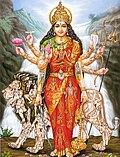
[[File:Adi Devi.jpg|thumb|Durga's cosmic form, Adi Parashakti or Mahadevi as the Supreme Goddess encompassing all divinities.]] | |||
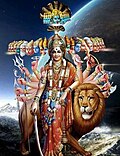
[[File:Adi_Para_Shakti_as_Durga.jpg|thumb|Adi Parashakti as Durga]] | |||
Shaktas conceive the Goddess as the supreme, ultimate, eternal reality of all existence, or same as the [[Brahman]] concept of Hinduism. She is considered to be simultaneously the source of all creation, its embodiment and the energy that animates and governs it, and that into which everything will ultimately dissolve. She has manifested herself as Shiva in male form. Her half is Shiva.{{sfn|Dikshitar|1999|pages=77-78}} | |||
==== | ==== Devi Bhagavata Purana ==== | ||
The [[Devi Bhagavata Purana]] describes Mahadevi in her form of [[Bhuvaneshvari]]. It is stated that [[Shiva]] worshipped and meditated on the goddess for thousands of years using the [[Bījamantra|bīja mantra]] ''hrīm''. The goddess is described to possess both the aspects of [[Para Brahman]], ''[[nirguna]]'' (without form) and ''[[Saguna brahman|saguna]]'' (with form). In her form of ''saguna'', she is extolled as the mother of the universe, residing upon the highest abode named Manidvipa. All the gods and goddesses are described to be her various forms. In the [[Devi Mahatmya]], the [[Trimurti]] and the demigods praise the goddess.{{cn|date=July 2022}} | |||
In the third [[canto]] of the [[Devi-Bhagavata Purana|Srimad Devi Bhagavatam]], Devi addressed the [[Trimurti]] as follows: | |||
{{Blockquote|text= | {{Blockquote|text=There is oneness always between me & the Purusha; there is no difference whatsoever at any time between me & the Purusha (the Supreme Self). Who is I, that is Purusha; who is Purusha, that is I. The difference between force & the receptacle of force is due to error. He who knows the subtle difference between us two, is certainly intelligent; he is freed from this bondage of Samsara; there is no manner of doubt in this. The One Second less Eternal ever lasting Brahman substance becomes dual at the time of creation.<ref>{{Cite web |date=2009-05-09 |title=Cosmology |url=https://auromere.wordpress.com/cosmology/ |access-date=2021-11-13 |website=Integral Yoga of Sri Aurobindo & The Mother |language=en}}</ref>{{better source needed|date=January 2023}}|source=Srimad Devi Bhagavatam Canto 03, Chapter 06, Verse 02:03}} | ||
====Adi | In the [[Devi Gita]] of Devi Bhagavatam, it is suggested that before incarnating as [[Parvati]], she appeared to King Himalaya and revealed divine, eternal knowledge to him. She explained herself, in the words of the [[Vedas]], as having neither beginning nor end. She is the only, eternal truth. The whole universe is her creation. She is the only victor and the manifestation of victory itself. She is a manifested, un-manifested, and transcendent divinity. She then displayed her scarcely seen form to him: [[Satyaloka]] was located in her forehead; the created universe were her hairs; the sun and moon were her eyes; in her ears were the [[Cardinal directions|four directions]]; the Vedas were her words; death, affection and emotion were her teeth; [[Maya (religion)|Maya]] was manifested by her smile.<ref>{{cite web |title=The Devi Gita index |url=http://www.sacred-texts.com/hin/dg/ |access-date=2012-08-05 |publisher=Sacred-texts.com}}</ref> The goddess Parvati, as [[Kushmanda]], gives birth to the universe in the form of a cosmic egg which manifests as the universe. Ultimately, Adi Shakti herself is the energy which exists even after the destruction of the universe and before its creation.{{sfn|Bonnefoy|1993|p=95}} | ||
{{ | According to the [[Tripura Rahasya]], only Mahadevi was existed in her form of Tripura Sundari before the beginning of the universe. She is supposed to have created the Trimurti, and began the creation of the universe.<ref>{{Cite book |last=Rao |first=T.B. Lakshmana |title=Shri Tripura Rahasya (Mahatmya Khanda) |publisher=Sri Kailasamanidweepa Trust, Bengaluru |year=2011 |pages=108}}</ref> | ||
| | ===Shaiva Puranas=== | ||
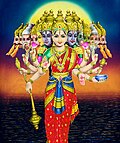
[[File:Adi-Para-Shakti.jpg|thumb|Adi Parashakti, the formless one who manifests all forms]] | |||
The Shiva Purana says Adi Parashakti incarnated in materialistic form as ''Parama Prakriti'' from the left half of Shiva (Parabrahman) during the beginning of the universe. The [[Linga Purana]] states that Adi Shakti brings forth the evolution of life in every universe through the union of every Shiva and Parvati in all of the Universes.<ref>{{cite book |last1=Shastri |first1=J. L. |url=https://www.wisdomlib.org/hinduism/book/shiva-purana-english |title=The Shiva Purāṇa |date=1970 |editor1-last=English translation by J. L. Shastri |format=includes glossary |via=Wisdom Library}}</ref><ref>Shiva Mahapurana | Gitapress Gorakhpur</ref> | |||
| | {{Blockquote|text=That alone, Paramesvari of three attributes, creates the universe; she alone sustains it and she alone destroys it at the proper time.|source=Shiva Purana (Umasamhita), Chapter 45, Verse 49|author=J.L.Shastri}} | ||
| | {{Blockquote|text=I bow to the great Maya, the Yogic slumber, Uma, Sati, Kalaratri, Maharatri, Moharatri, greater than the greatest, the mother of the three deities, the eternal, the bestower of the fruits of the cherished desires of the devotees, the protectress of the gods and the ocean of mercy.|source=Shiva Purana (Umasamhita), Chapter 45, Verses 58-59|author=J.L.Shastri}} | ||
=== Vaishnava Puranas === | |||
[[File:Gaja Lakshmi.jpg|thumb|A painting of Lakshmi surrounded by two elephants]] | |||
| | The goddess [[Lakshmi]] is revered as manifestation of Mahadevi in the [[Vaishnavism|Vaishnavite]] tradition, extolled to possess a thousand names and qualities.<ref>{{Cite web |title=Lakshmi Sahasranama Stotram - Hindupedia, the Hindu Encyclopedia |url=http://www.hindupedia.com/en/Lakshmi_Sahasranama_Stotram |access-date=2022-05-08 |website=www.hindupedia.com}}</ref> Various texts like the [[Garuda Purana]], [[Bhagavata Purana]], and [[Lakshmi Tantra]] refer to Lakshmi as form of Mahadevi. According to [[Devdutt Pattanaik]], "Lakshmi is worshipped as ''maya'', the delightful delusion, the dream-like expression of divinity that makes life comprehensible, hence worth living. She is true ''shakti'', energy, boundless and bountiful".<ref>{{Cite book |last=Pattanaik |first=Devdutt |url=https://books.google.com/books?id=MJrPkQEACAAJ&q=the+goddess+of+wealth+and+fortune+devdutt |title=Lakshmi, the Goddess of Wealth and Fortune: An Introduction |date=2002 |publisher=Vakils, Feffer and Simons |isbn=978-81-8462-019-1 |language=en}}</ref> | ||
| | == Forms == | ||
<gallery mode=packed heights=250px> | |||
File:Goddess Lalita Tripura Sundari.jpg|As [[Tripura Sundari]], she is the complete supreme form.<ref>{{cite book|last1=Vasantānanta |first1=Nā Irāmaccantiraṉ|title=Sri Lalita Sahasranamam: Nama-wise Commentary in English with Text in Sanskrit|date=1993|page=358|url=https://books.google.com/books?id=6OItAAAAYAAJ}}</ref><ref>{{cite book | date=1987 | last1=Śaṅkarācārya | url=https://books.google.com/books?id=V4rXAAAAMAAJ | title=Saundarya-lahari of Sri Sankaracarya: with text and translation, and notes based on Lakṣmīdhara's commentary | publisher=Sri Ramakrishna Math | last2=Tapasyananda | last3=Lakṣmīdhara | page=70| isbn=9788171202447 }}</ref> | |||
File:Parvati Ganesha.jpg|As [[Parvati]], she is kind and tender and represents motherhood | |||
File:Kali_from_1885-95.jpg|As [[Kali]], she is ferocious and destroys evil | |||
File:Maha-Kali.png|Maha-Kali, a wrathful form of Adi Parashakti | |||
</gallery> | |||
| | According to [[Shakta]] traditions, Mahadevi is the ultimate goddess while [[Brahma]], [[Vishnu]], [[Shiva]] are her subordinates who cannot function without her power. Whatever deity one is worshiping, they are ultimately worshiping Devi.{{sfn|Bonnefoy|1993|p=95}} According to the Srikula tradition in Shaktism, [[Tripura Sundari]] is the foremost of the Mahavidyas, the highest aspect of Mahadevi and also the primary goddess of [[Sri Vidya]]. The [[Tripura Upanishad]] places her as the ultimate [[Shakti]] (energy, power) of the universe.{{Sfn|Mahadevan|1975|p=235}} In [[Vaishnavism]], Lakshmi is traditionally worshipped as secondary to her consort Vishnu, and represents the bliss of a settled and domestic life. In [[Shaivism]], the goddess Parvati is the complete incarnation of Devi.{{sfn|Kinsley|1998|p={{pn|date=January 2023}}}} | ||
{{clear}} | |||
===Pancha Prakritis=== | |||
According to the ''[[Devi Bhagavata Purana]]'', Mahadevi is worshipped in five distinct forms: Durga (Parvati), Lakshmi, Sarasvati, Savitri (Gayatri), and Radha, collectively referred to as the Panchadevis or [[Prakṛti|Panchaprakritis]] and are regarded as forms of goddess Mahadevi.<ref name = "Mani" /> | |||
[[Durga]] or [[Parvati]], the mother of [[Ganesha]] and consort of [[Shiva]], is revered as the primary, supreme, eternal, all-powerful force upholding dharma. She is both the giver of happiness and the remover of sorrows for devotees seeking refuge in her.<ref name = "Mani" /> | |||
[[Lakshmi]], as the sublime form of the universal soul, embodies wealth, beauty, compassion, and all goodness. She is revered in various realms, serving Vishnu in [[Vaikuntha]], adorning heaven with glory, and manifesting prosperity in households.<ref name = "Mani" /> | |||
[[Sarasvati]], the embodiment of knowledge, arts, and intellect, is considered the deity of learning. She bestows intellect, poetic skill, reason, and logic to her devotees, being the source of fine arts and every branch of knowledge.<ref name = "Mani" /> | |||
[[Gayatri|Savitri]] or Gayatri, identified as the mother of the four [[Vedas]], represents the essence of truth, existence, and supreme bliss. She grants salvation and forms the core of the universal soul, purifying the world with her sacred presence.<ref name = "Mani" /> | |||
[[Radha]], the fifth of the Panchaprakriti, presides over the five [[Prana|pranas]]. She is described as exceptionally beautiful, the consort of [[Krishna]], and possesses divine attributes.<ref name = "Mani" /> | |||
[[ | ===Amsharupa=== | ||
The ''[[Devi Bhagavata Purana]]'' also mentions about Amsharupa (s), who are partial manifestations of the Devī, distinct from the five complete forms discussed earlier. There are six Amsharupa(s) of the Devi, born from specific parts of her divine being — [[Ganga (goddess)|Ganga]], flowing in the form of water, serves to cleanse individuals of their sins; [[Tulasi in Hinduism|Tulasi]], who acts as both a lover and servant of Vishnu, purifies individuals of their sins and promotes their well-being; [[Manasa]], the daughter of Kashyapa, she holds a unique position in learning, erudition, and is associated with Mantras; [[Devasena]], also known as [[Shashthi|Shasthi]] Devi, grants offspring to living beings and provides protection; Mangalachandika, born from the face of Prakriti, ensures the recipient of all favorable outcomes such as sons, grandsons, wealth, reputation, and general welfare; and [[Bhumi (goddess)|Bhumi]], who serves as the origin of the vegetable kingdom, the repository of gems, and embodies compassion and sympathy.<ref name = "Mani" /> | |||
=== | === The ten Mahavidyas === | ||
{{Main|Mahavidya}} | |||
The Mahavidyas are ten [[Tantric Buddhism|Tantric]] goddesses, or aspects, of Mahadevi that show her nature and ability to manifest in different forms for various purposes. The word ''Mahavidya'' means 'Great Knowledge' and the epithet '''Dasamahavidyas''<nowiki/>', the ten great mantras, is also used to refer to them.<ref name=":0">{{Cite book |last1=Foulston |first1=Lynn |title=Hindu goddesses: beliefs and practices |last2=Abbott |first2=Stuart |publisher=Sussex Academic |year=2009 |isbn=978-1-902210-43-8 |edition= |location=Brighton |pages=116–117}}</ref> The Mahavidyas have been identified as a group since the tenth century CE<ref name=":0" /> and usually includes, in order, [[Kali]], [[Tara (Mahavidya)|Tara]], [[Tripura Sundari]], [[Bhuvaneshvari]], [[Chhinnamasta|Chinnamasta]], [[Bhairavi]], [[Dhumavati]], [[Bagalamukhi]], [[Matangi]], and [[Kamalatmika|Kamala]].<ref name=":1">{{Cite book |last=Kinsley |first=David |url=http://dx.doi.org/10.1525/9780520917729 |title=Tantric Visions of the Divine Feminine |publisher=University of California Press |year=1997 |isbn=978-0-520-91772-9 |pages=9, 21, 22|doi=10.1525/9780520917729 }}</ref> Texts such as ''Guhydtiguhya-tantra'', T''odala-tantra'', and ''Mundamala-tantra'' compare the ten Mahavidyas to the [[Dashavatara|ten avatars]] of Vishnu. According to Kinsley, though the Mahavidyas serve less cosmic roles than the avatars of Vishnu, their purpose is to show that through her various forms Mahadevi pervades all aspects of reality.<ref name=":1" /> | |||
== Iconography == | |||
Adi Parashakti is generally seen as an abstract goddess but her appearance is described in the [[Devi Bhagavata Purana]], [[Kalika Purana]], [[Markandeya Purana]]-[[Devi Mahatmya]], [[Brahmanda Purana]]-[[Lalita Sahasranama]], and the [[Tripura Rahasya]]. According to the Devi Bhagavata Purana, the goddess once invited the [[Trimurti]] to [[Manidvipa]]. The Trimurti saw the supreme goddess [[Bhuvaneshvari]] sitting on a jeweled seat on a throne. Her face contained the radiance of millions of stars and her celestial beauty was so great, that the Trimurti were not able to look at her. She carries the Abhaya and Varada Mudra, Pasha, and Ankusha.{{sfn|Kinsley|1998|p={{pn|date=January 2023}}}} | |||
==See also== | |||
* [[Holy_Wisdom|Sophia]] - the transcendental wisdom as a feminine principle | |||
* [[Tao]] - [[East Asian philosophy]] concept that represents the Ultimate Reality. | |||
* [[Ultimate reality]] - the highest truth in different cultures and belief systems | |||
== | ==References== | ||
===Citations=== | |||
{{reflist}} | |||
{ | |||
{ | |||
===Works cited=== | |||
*{{cite book |last=Bonnefoy |first=Yves |title=Asian Mythologies |date=1993 |publisher=University of Chicago Press |isbn=978-0-226-06456-7}} | |||
*{{cite book |title=The Rowman & Littlefield Handbook of Women's Studies in Religion |editor-first=Helen T. |editor-last=Boursier |publisher=Rowman & Littlefield |date=2021 |isbn=978-1538154458}} | |||
*{{cite book |last=Brooks |first=Douglas Renfrew |title=The Secret of the Three Cities |publisher=University of Chicago Press |isbn=978-0226075693 |date=1990 |url=https://books.google.com/books?id=dXD8crHUdPQC}} | |||
*{{cite book |last=Brown |first=Cheever Mackenzie |title=The Devi Gita: The Song of the Goddess: A Translation, Annotation, and Commentary |url=https://books.google.com/books?id=28CIEnZCcqMC&pg=PA77 |date=1998 |publisher=SUNY Press |isbn=978-0-7914-3939-5}} | |||
*{{cite book |last=Dikshitar |first=V. R. Ramachandra |title=The Lalitā Cult |publisher=[[Motilal Banarsidass]] |location=Delhi |orig-date=1942 |date=1999 |isbn=978-8120814981}} | |||
*{{cite book |last=Deussen |first=Paul |title=Sixty Upanishads of the Veda |url=https://books.google.com/books?id=XYepeIGUY0gC |date=1997 |publisher=Motilal Banarsidass |isbn=978-81-208-1467-7}} | |||
*{{cite book |last=Kinsley |first=David |date=1998 |title=Hindu Goddesses: Vision of the Divine Feminine in the Hindu Religious Traditions |publisher=Motilal Banarsidass |isbn=978-81-208-0394-7}} | |||
*{{cite book |last= Mahadevan |first=T. M. P. |title=Upaniṣads: Selections from 108 Upaniṣads |date=1975 |publisher=Motilal Banarsidass |isbn=978-81-208-1611-4}} | |||
*{{cite book |last=McDaniel |first=June |title=Offering Flowers, Feeding Skulls : Popular Goddess Worship in West Bengal: Popular Goddess Worship in West Bengal |url=https://books.google.com/books?id=caeJpIj9SdkC&pg=PA90 |date=9 July 2004 |publisher=Oxford University Press, USA |isbn=978-0-19-534713-5}} | |||
*{{cite book |last=Narayanananda |first=Swami |date=1960 |title=The Primal Power in Man: Or, The Kundalini Shakti |place=India |publisher=N. K. Prasad |isbn=978-0787306311}} | |||
== | ==Further reading== | ||
*{{cite book |last=Chitgopekar |first=Nilima |year=2021 |title=Shakti An exploration of the divine feminine |publisher=DK India |isbn=978-9388372992}} | |||
== | * {{cite book |last=Brown |first=C. Mackenzie |year=1990 |title=The Triumph of the Goddess: The Canonical Models and Theological Visions of the Devi-Bhagavata Purana |publisher=State University of New York Press |isbn=978-0791403648 |ref=none}} | ||
* Brown | * {{cite book |last=Brown |first=C. Mackenzie |year=1998 |title=The Devī Gītā: The Song of the Goddess: A Translation, Annotation, and Commentary |publisher=State University of New York Press |isbn=978-0791439401 |ref=none}} | ||
* | *{{cite book |last=Dalal |first=Roshen |date=2010 |title=The Religions of India: A Concise Guide to Nine Major Faiths |place=India |publisher=Penguin Books |isbn=978-0143415176}} | ||
*{{cite book |last=Rajeswari |first=D. R. |date=1989 |title=Sakti Iconography |place=India |publisher=Intellectual Publishing House |isbn=978-8170760153}} | |||
*{{cite book |first=S. K. Ramachandara |last=Rao |year=2012 |title=Lalitaarchana-Chandrika, Hymns to Lalita, Form of Tripurasundari |place=Delhi |publisher=Divine Books |series=Lala Murari Lal Chharia Oriental Series |isbn=978-93-81218-45-7 |ref=none}} | |||
{{Shaktism}} | {{Shaktism}} | ||
| Line 202: | Line 145: | ||
{{Hindudharma}} | {{Hindudharma}} | ||
[[Category:Lakshmi]] | [[Category:Forms of Lakshmi]] | ||
[[Category:Singular God]] | [[Category:Singular God]] | ||
[[Category:Hindu goddesses]] | [[Category:Hindu goddesses]] | ||
[[Category:Forms of Parvati]] | |||
Latest revision as of 22:18, 23 March 2026
| Mahadevi | |
|---|---|
| |
 | |
| Other names |
|
| Devanagari | महादेवी |
| Sanskrit transliteration | Mahādevī |
| Affiliation | |
| Abode | Manidvipa |
| Mantra | Ōm āim hrīm śrīm klīm[1] |
| Weapon | Devi Chakra, Pasha, Ankusha, Trishula (trident) |
| Symbol | Hreem, Om, Sri Yantra |
| Mount | Lion |
| Texts | Devi Mahatmya, Devi-Bhagavata Purana, Markandeya Purana, Brahmanda Purana, Kalika Purana, Lakshmi Tantra, Lalita Sahasranama, Soundarya Lahari, Shiva Purana, Shakta Upanishads such as the Devi Upanishad[2] |
| Festivals | Navaratri, Durga Puja, Vasanta Panchami, Lakshmi Puja, Kali Puja, Durga Ashtami, Lalita Jayanti, Adi-Puram |
Mahadevi (Sanskrit: महादेवी, IAST: Mahādevī), also referred to as Devi, Mahamaya and Adi Parashakti,[3] is the supreme goddess in Hinduism.[4][5] According to the goddess-centric sect Shaktism, all Hindu gods and goddesses are regarded as manifestations of this great goddess, who is considered to be the ultimate reality or Para Brahman.[6]
Mahadevi is mentioned as the Mulaprakriti (Primordial Goddess) in Shakta texts, having five primary forms—Parvati, Lakshmi, Sarasvati, Gayatri and Radha—collectively referred to as Panchaprakriti. Besides these, Goddess Tripura Sundari is often identified with the supreme goddess Mahadevi in Shaktism.[7] Shaktas also worship her as Durga, whilst acknowledging her to have other forms.[8][9] Author Helen T. Boursier says: "In Hindu philosophy, both Lakshmi (primary goddess in Vaishnavism) and Parvati (primary goddess of Shaivism) are identified as manifestations of this great goddess—Mahadevi—and the Shakti or divine power".[10]
| Part of a series on |
| Hinduism |
|---|
 |


Epithets[edit | edit source]
Mahadevi is known by many names. She is commonly known as Mulaprakrti ('she who is primordial matter') and Mahamaya ('she who is beyond maya').[11] The Devi Bhagavata Purana and Lalita Sahasranama describe Mahadevi's numerous epithets. These names include her divine and destructive characteristics.[11] In the Devi Bhagavata Purana she is described as 'the mother of all', 'the life force in all beings', and 'she who is supreme knowledge'. The Lalita Sahasranama also describes her as Visvadhika ('she who transcends the universe'), Sarvaga ('she who is omnipresent'), Vishvadharini ('she who supports the universe'), Raksasaghni ('she who slays demons'), Bhairavi ('the terrible one'), and Samharini ('she who destroys').[11] Mahadevi's destructive features are further described in a hymn called the Aryastava, calling her Kalaratri ('night of death') and Nistha ('she who is death').[11]
Attributes[edit | edit source]
Mahamaya[edit | edit source]
In the first episode of the Devi Mahatmya, Mahadevi is referred as Mahamaya, meaning the one who controls maya.[12]
Literature[edit | edit source]
Vedas[edit | edit source]
The Vedas name numerous forms of goddess such as Devi (power), Prithvi (earth), Aditi (cosmic moral order), Vāc (sound), Nirṛti (destruction), Ratri (night) and Aranyani (forest). Bounty goddesses such as Dinsana, Raka, Puramdhi, Parendi, Bharati, and Mahi are among others are mentioned in the Rigveda.[13]
The Devīsūkta of the Rigveda (10.125.1 to 10.125.8) is among the most studied hymns, declaring that the ultimate reality is a goddess.[14][15]
I have created all worlds at my will without being urged by any higher Being, and dwell within them. I permeate the earth and heaven, and all created entities with my greatness and dwell in them as eternal and infinite consciousness.
Upanishads[edit | edit source]
Shakta Upanishads are a group of minor Upanishads of Hinduism related to the Shaktism theology. There are eight Shakta Upanishads in the Muktika anthology of 108 Upanishads.[18] The Shakta Upanishads are notable for declaring and revering the feminine as the Supreme, the primal cause and the metaphysical concepts in Hinduism called Brahman and Atman (soul).[19][20]
Shakta Puranas[edit | edit source]


Shaktas conceive the Goddess as the supreme, ultimate, eternal reality of all existence, or same as the Brahman concept of Hinduism. She is considered to be simultaneously the source of all creation, its embodiment and the energy that animates and governs it, and that into which everything will ultimately dissolve. She has manifested herself as Shiva in male form. Her half is Shiva.[21]
Devi Bhagavata Purana[edit | edit source]
The Devi Bhagavata Purana describes Mahadevi in her form of Bhuvaneshvari. It is stated that Shiva worshipped and meditated on the goddess for thousands of years using the bīja mantra hrīm. The goddess is described to possess both the aspects of Para Brahman, nirguna (without form) and saguna (with form). In her form of saguna, she is extolled as the mother of the universe, residing upon the highest abode named Manidvipa. All the gods and goddesses are described to be her various forms. In the Devi Mahatmya, the Trimurti and the demigods praise the goddess.[citation needed]
In the third canto of the Srimad Devi Bhagavatam, Devi addressed the Trimurti as follows:
There is oneness always between me & the Purusha; there is no difference whatsoever at any time between me & the Purusha (the Supreme Self). Who is I, that is Purusha; who is Purusha, that is I. The difference between force & the receptacle of force is due to error. He who knows the subtle difference between us two, is certainly intelligent; he is freed from this bondage of Samsara; there is no manner of doubt in this. The One Second less Eternal ever lasting Brahman substance becomes dual at the time of creation.[22][better source needed]
— Srimad Devi Bhagavatam Canto 03, Chapter 06, Verse 02:03
In the Devi Gita of Devi Bhagavatam, it is suggested that before incarnating as Parvati, she appeared to King Himalaya and revealed divine, eternal knowledge to him. She explained herself, in the words of the Vedas, as having neither beginning nor end. She is the only, eternal truth. The whole universe is her creation. She is the only victor and the manifestation of victory itself. She is a manifested, un-manifested, and transcendent divinity. She then displayed her scarcely seen form to him: Satyaloka was located in her forehead; the created universe were her hairs; the sun and moon were her eyes; in her ears were the four directions; the Vedas were her words; death, affection and emotion were her teeth; Maya was manifested by her smile.[23] The goddess Parvati, as Kushmanda, gives birth to the universe in the form of a cosmic egg which manifests as the universe. Ultimately, Adi Shakti herself is the energy which exists even after the destruction of the universe and before its creation.[9]
According to the Tripura Rahasya, only Mahadevi was existed in her form of Tripura Sundari before the beginning of the universe. She is supposed to have created the Trimurti, and began the creation of the universe.[24]
Shaiva Puranas[edit | edit source]

The Shiva Purana says Adi Parashakti incarnated in materialistic form as Parama Prakriti from the left half of Shiva (Parabrahman) during the beginning of the universe. The Linga Purana states that Adi Shakti brings forth the evolution of life in every universe through the union of every Shiva and Parvati in all of the Universes.[25][26]
That alone, Paramesvari of three attributes, creates the universe; she alone sustains it and she alone destroys it at the proper time.
— J.L.Shastri, Shiva Purana (Umasamhita), Chapter 45, Verse 49
I bow to the great Maya, the Yogic slumber, Uma, Sati, Kalaratri, Maharatri, Moharatri, greater than the greatest, the mother of the three deities, the eternal, the bestower of the fruits of the cherished desires of the devotees, the protectress of the gods and the ocean of mercy.
— J.L.Shastri, Shiva Purana (Umasamhita), Chapter 45, Verses 58-59
[edit | edit source]

The goddess Lakshmi is revered as manifestation of Mahadevi in the Vaishnavite tradition, extolled to possess a thousand names and qualities.[27] Various texts like the Garuda Purana, Bhagavata Purana, and Lakshmi Tantra refer to Lakshmi as form of Mahadevi. According to Devdutt Pattanaik, "Lakshmi is worshipped as maya, the delightful delusion, the dream-like expression of divinity that makes life comprehensible, hence worth living. She is true shakti, energy, boundless and bountiful".[28]
Forms[edit | edit source]
-
![As Tripura Sundari, she is the complete supreme form.[29][30]](/w/images/smartcommons/thumbs/commons/5/56/Goddess_Lalita_Tripura_Sundari.jpg/286px-Goddess_Lalita_Tripura_Sundari.jpg)
-
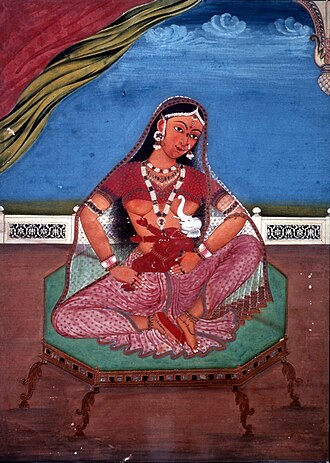 As Parvati, she is kind and tender and represents motherhood
 -
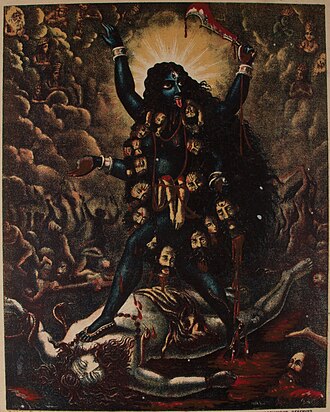 As Kali, she is ferocious and destroys evil
 -
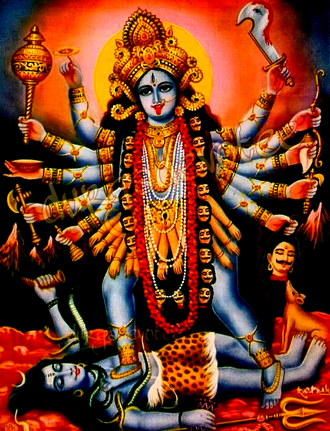 Maha-Kali, a wrathful form of Adi Parashakti
![As Tripura Sundari, she is the complete supreme form.[29][30]](/wiki/File:Goddess_Lalita_Tripura_Sundari.jpg)


According to Shakta traditions, Mahadevi is the ultimate goddess while Brahma, Vishnu, Shiva are her subordinates who cannot function without her power. Whatever deity one is worshiping, they are ultimately worshiping Devi.[9] According to the Srikula tradition in Shaktism, Tripura Sundari is the foremost of the Mahavidyas, the highest aspect of Mahadevi and also the primary goddess of Sri Vidya. The Tripura Upanishad places her as the ultimate Shakti (energy, power) of the universe.[31] In Vaishnavism, Lakshmi is traditionally worshipped as secondary to her consort Vishnu, and represents the bliss of a settled and domestic life. In Shaivism, the goddess Parvati is the complete incarnation of Devi.[11]
Pancha Prakritis[edit | edit source]
According to the Devi Bhagavata Purana, Mahadevi is worshipped in five distinct forms: Durga (Parvati), Lakshmi, Sarasvati, Savitri (Gayatri), and Radha, collectively referred to as the Panchadevis or Panchaprakritis and are regarded as forms of goddess Mahadevi.[3]
Durga or Parvati, the mother of Ganesha and consort of Shiva, is revered as the primary, supreme, eternal, all-powerful force upholding dharma. She is both the giver of happiness and the remover of sorrows for devotees seeking refuge in her.[3]
Lakshmi, as the sublime form of the universal soul, embodies wealth, beauty, compassion, and all goodness. She is revered in various realms, serving Vishnu in Vaikuntha, adorning heaven with glory, and manifesting prosperity in households.[3]
Sarasvati, the embodiment of knowledge, arts, and intellect, is considered the deity of learning. She bestows intellect, poetic skill, reason, and logic to her devotees, being the source of fine arts and every branch of knowledge.[3]
Savitri or Gayatri, identified as the mother of the four Vedas, represents the essence of truth, existence, and supreme bliss. She grants salvation and forms the core of the universal soul, purifying the world with her sacred presence.[3]
Radha, the fifth of the Panchaprakriti, presides over the five pranas. She is described as exceptionally beautiful, the consort of Krishna, and possesses divine attributes.[3]
Amsharupa[edit | edit source]
The Devi Bhagavata Purana also mentions about Amsharupa (s), who are partial manifestations of the Devī, distinct from the five complete forms discussed earlier. There are six Amsharupa(s) of the Devi, born from specific parts of her divine being — Ganga, flowing in the form of water, serves to cleanse individuals of their sins; Tulasi, who acts as both a lover and servant of Vishnu, purifies individuals of their sins and promotes their well-being; Manasa, the daughter of Kashyapa, she holds a unique position in learning, erudition, and is associated with Mantras; Devasena, also known as Shasthi Devi, grants offspring to living beings and provides protection; Mangalachandika, born from the face of Prakriti, ensures the recipient of all favorable outcomes such as sons, grandsons, wealth, reputation, and general welfare; and Bhumi, who serves as the origin of the vegetable kingdom, the repository of gems, and embodies compassion and sympathy.[3]
The ten Mahavidyas[edit | edit source]
The Mahavidyas are ten Tantric goddesses, or aspects, of Mahadevi that show her nature and ability to manifest in different forms for various purposes. The word Mahavidya means 'Great Knowledge' and the epithet 'Dasamahavidyas', the ten great mantras, is also used to refer to them.[32] The Mahavidyas have been identified as a group since the tenth century CE[32] and usually includes, in order, Kali, Tara, Tripura Sundari, Bhuvaneshvari, Chinnamasta, Bhairavi, Dhumavati, Bagalamukhi, Matangi, and Kamala.[33] Texts such as Guhydtiguhya-tantra, Todala-tantra, and Mundamala-tantra compare the ten Mahavidyas to the ten avatars of Vishnu. According to Kinsley, though the Mahavidyas serve less cosmic roles than the avatars of Vishnu, their purpose is to show that through her various forms Mahadevi pervades all aspects of reality.[33]
Iconography[edit | edit source]
Adi Parashakti is generally seen as an abstract goddess but her appearance is described in the Devi Bhagavata Purana, Kalika Purana, Markandeya Purana-Devi Mahatmya, Brahmanda Purana-Lalita Sahasranama, and the Tripura Rahasya. According to the Devi Bhagavata Purana, the goddess once invited the Trimurti to Manidvipa. The Trimurti saw the supreme goddess Bhuvaneshvari sitting on a jeweled seat on a throne. Her face contained the radiance of millions of stars and her celestial beauty was so great, that the Trimurti were not able to look at her. She carries the Abhaya and Varada Mudra, Pasha, and Ankusha.[11]
See also[edit | edit source]
- Sophia - the transcendental wisdom as a feminine principle
- Tao - East Asian philosophy concept that represents the Ultimate Reality.
- Ultimate reality - the highest truth in different cultures and belief systems
References[edit | edit source]
Citations[edit | edit source]
- ↑ Narayanananda 1960, p. 50.
- ↑ Jones, Constance; Ryan, James (2014). Encyclopedia of Hinduism. Infobase Publishing. p. 399. ISBN 978-0816054589.
- ↑ 3.0 3.1 3.2 3.3 3.4 3.5 3.6 3.7 Mani, Vettam (1975). Puranic encyclopaedia : a comprehensive dictionary with special reference to the epic and Puranic literature. Robarts - University of Toronto. Delhi : Motilal Banarsidass. pp. 217–219. ISBN 978-0-8426-0822-0.
{{cite book}}: CS1 maint: publisher location (link) - ↑ Vanamali (21 July 2008). "3. Mahadevi". Shakti: Realm of the Divine Mother. Simon and Schuster. ISBN 978-1-59477-785-1.
- ↑ Dalal, Roshen (6 January 2019). The 108 Upanishads: An Introduction. Penguin Random House India Private Limited. ISBN 978-93-5305-377-2.
- ↑ Hay, Jeff (6 March 2009). World Religions. Greenhaven Publishing LLC. p. 284. ISBN 978-0-7377-4627-3.
- ↑ Dalal, Roshen (2010). Hinduism: An Alphabetical Guide. Penguin Books India. p. 221. ISBN 978-0-14-341421-6.
- ↑ Pintchman, Tracy (21 June 2001). Seeking Mahadevi: Constructing the Identities of the Hindu Great Goddess. SUNY Press. p. 9. ISBN 978-0-7914-5007-9.
- ↑ 9.0 9.1 9.2 Bonnefoy 1993, p. 95.
- ↑ Boursier 2021, p. 30.
- ↑ 11.0 11.1 11.2 11.3 11.4 11.5 Kinsley 1998, p. [page needed].
- ↑ Hawley, John Stratton; Wulff, Donna Marie (1998). Devī: Goddesses of India. Motilal Banarsidass Publ. p. 33. ISBN 978-81-208-1491-2.
- ↑ Kinsley, David (1988). Hindu Goddesses: Vision of the Divine Feminine in the Hindu Religious Traditions. University of California Press, ISBN 0-520-06339-2.
- ↑ McDaniel 2004, p. 90.
- ↑ Brown 1998, p. 26.
- ↑ McDaniel 2004, p. 90; Brown 1998, p. 26.
- ↑ Sanskrit original see: ऋग्वेद: सूक्तं १०.१२५;
for an alternate English translation, see: The Rig Veda/Mandala 10/Hymn 125 Ralph T.H. Griffith (Translator); for - ↑ Deussen 1997, p. 556.
- ↑ McDaniel 2004, pp. 89-90.
- ↑ Brooks 1990, pp. 77–78.
- ↑ Dikshitar 1999, pp. 77-78.
- ↑ "Cosmology". Integral Yoga of Sri Aurobindo & The Mother. 9 May 2009. Retrieved 13 November 2021.
- ↑ "The Devi Gita index". Sacred-texts.com. Retrieved 5 August 2012.
- ↑ Rao, T.B. Lakshmana (2011). Shri Tripura Rahasya (Mahatmya Khanda). Sri Kailasamanidweepa Trust, Bengaluru. p. 108.
- ↑ Shastri, J. L. (1970). English translation by J. L. Shastri (ed.). The Shiva Purāṇa (includes glossary) – via Wisdom Library.
- ↑ Shiva Mahapurana | Gitapress Gorakhpur
- ↑ "Lakshmi Sahasranama Stotram - Hindupedia, the Hindu Encyclopedia". www.hindupedia.com. Retrieved 8 May 2022.
- ↑ Pattanaik, Devdutt (2002). Lakshmi, the Goddess of Wealth and Fortune: An Introduction. Vakils, Feffer and Simons. ISBN 978-81-8462-019-1.
- ↑ Vasantānanta, Nā Irāmaccantiraṉ (1993). Sri Lalita Sahasranamam: Nama-wise Commentary in English with Text in Sanskrit. p. 358.
- ↑ Śaṅkarācārya; Tapasyananda; Lakṣmīdhara (1987). Saundarya-lahari of Sri Sankaracarya: with text and translation, and notes based on Lakṣmīdhara's commentary. Sri Ramakrishna Math. p. 70. ISBN 9788171202447.
- ↑ Mahadevan 1975, p. 235.
- ↑ 32.0 32.1 Foulston, Lynn; Abbott, Stuart (2009). Hindu goddesses: beliefs and practices. Brighton: Sussex Academic. pp. 116–117. ISBN 978-1-902210-43-8.
- ↑ 33.0 33.1 Kinsley, David (1997). Tantric Visions of the Divine Feminine. University of California Press. pp. 9, 21, 22. doi:10.1525/9780520917729. ISBN 978-0-520-91772-9.
Works cited[edit | edit source]
- Bonnefoy, Yves (1993). Asian Mythologies. University of Chicago Press. ISBN 978-0-226-06456-7.
- Boursier, Helen T., ed. (2021). The Rowman & Littlefield Handbook of Women's Studies in Religion. Rowman & Littlefield. ISBN 978-1538154458.
- Brooks, Douglas Renfrew (1990). The Secret of the Three Cities. University of Chicago Press. ISBN 978-0226075693.
- Brown, Cheever Mackenzie (1998). The Devi Gita: The Song of the Goddess: A Translation, Annotation, and Commentary. SUNY Press. ISBN 978-0-7914-3939-5.
- Dikshitar, V. R. Ramachandra (1999) [1942]. The Lalitā Cult. Delhi: Motilal Banarsidass. ISBN 978-8120814981.
- Deussen, Paul (1997). Sixty Upanishads of the Veda. Motilal Banarsidass. ISBN 978-81-208-1467-7.
- Kinsley, David (1998). Hindu Goddesses: Vision of the Divine Feminine in the Hindu Religious Traditions. Motilal Banarsidass. ISBN 978-81-208-0394-7.
- Mahadevan, T. M. P. (1975). Upaniṣads: Selections from 108 Upaniṣads. Motilal Banarsidass. ISBN 978-81-208-1611-4.
- McDaniel, June (9 July 2004). Offering Flowers, Feeding Skulls : Popular Goddess Worship in West Bengal: Popular Goddess Worship in West Bengal. Oxford University Press, USA. ISBN 978-0-19-534713-5.
- Narayanananda, Swami (1960). The Primal Power in Man: Or, The Kundalini Shakti. India: N. K. Prasad. ISBN 978-0787306311.
Further reading[edit | edit source]
- Chitgopekar, Nilima (2021). Shakti An exploration of the divine feminine. DK India. ISBN 978-9388372992.
- Brown, C. Mackenzie (1990). The Triumph of the Goddess: The Canonical Models and Theological Visions of the Devi-Bhagavata Purana. State University of New York Press. ISBN 978-0791403648.
- Brown, C. Mackenzie (1998). The Devī Gītā: The Song of the Goddess: A Translation, Annotation, and Commentary. State University of New York Press. ISBN 978-0791439401.
- Dalal, Roshen (2010). The Religions of India: A Concise Guide to Nine Major Faiths. India: Penguin Books. ISBN 978-0143415176.
- Rajeswari, D. R. (1989). Sakti Iconography. India: Intellectual Publishing House. ISBN 978-8170760153.
- Rao, S. K. Ramachandara (2012). Lalitaarchana-Chandrika, Hymns to Lalita, Form of Tripurasundari. Lala Murari Lal Chharia Oriental Series. Delhi: Divine Books. ISBN 978-93-81218-45-7.

Hindu deities and texts | ||
|---|---|---|
| Gods |  | |
| Goddesses | ||
| Other deities | ||
| Texts | ||
| Philosophy |
|  | |||||||||||||||
|---|---|---|---|---|---|---|---|---|---|---|---|---|---|---|---|---|---|
| Texts |
| ||||||||||||||||
| Deities |
| ||||||||||||||||
| Practices |
| ||||||||||||||||
| Related | |||||||||||||||||