



enhanced section and corrected details after review |
|||
| Line 1: | Line 1: | ||
{{ | {{Short description|Spaceport in Sriharikota, Andhra Pradesh, India}} | ||
{{Redirect|SHAR|the video game|The Simpsons: Hit & Run}} | |||
{{Use dmy dates|date=June 2024}} | |||
{{Use Indian English|date=January 2014}} | {{Use Indian English|date=January 2014}} | ||
{{Infobox launch pad | |||
{{Infobox | |name = Satish Dhawan Space Centre | ||
| name | |image = LVM3_M3,_OneWeb_India-2_campaign_30.webp | ||
| | |caption = [[LVM3]] M3 on the [[#Second Launch Pad|SLP]] with 36 [[Eutelsat OneWeb|OneWeb]] satellites (2023). | ||
| | |site = | ||
| | |short = SDSC | ||
| | |tlaunches = [[List of Satish Dhawan Space Centre launches#Launch statistics|105]] | ||
| | |unknown= | ||
| | |location = [[Sriharikota]], [[Tirupati district]], [[Andhra Pradesh]], [[India]] | ||
| | |coordinates ={{coord|13.72|N|80.23|E|display=inline,title}} | ||
| | |time_zone = [[Indian Standard Time|IST]] | ||
| | |utc_offset = +05:30 | ||
| | |operator = [[ISRO]] | ||
| | |pads = Operational: 3 <br />Retired: 1 <br/>Planned: 1 | ||
| | |pad1 = SLV/ASLV Launch Pad | ||
| | |status = Retired | ||
| | |first = [[Satellite Launch Vehicle|SLV]] / [[Rohini (satellite)|RS-1]]<br>9 August 1979 | ||
|last = [[Augmented Satellite Launch Vehicle|ASLV-D2]]<br>20 September 1993 | |||
|rockets = {{ubl | |||
|[[Satellite Launch Vehicle|SLV-3]] | |||
|[[Augmented Satellite Launch Vehicle|ASLV]] | |||
}} | |||
|pad2 = First Launch Pad | |||
|first2 = [[PSLV-D1]]/[[IRS-1E]]<br>20 September 1993, 05:12:00 ([[UTC]]) | |||
|last2 = [[PSLV-C62]]/[[EOS-N1]]<br>12 January 2026, 04:48 ([[UTC]]) | |||
|status2 = In service | |||
|rockets2 = {{ubl | |||
|[[Polar Satellite Launch Vehicle|PSLV]] (Active) | |||
|[[Geosynchronous Satellite Launch Vehicle|GSLV Mk I]] (Retired) | |||
|[[Small Satellite Launch Vehicle|SSLV]] (Active) | |||
}} | |||
|pad3 = Second Launch Pad | |||
|first3 = [[PSLV-C6]]/[[Cartosat-1]]<br>5 May 2005, 04:44:00 ([[UTC]]) | |||
|last3 = [[LVM3|LVM3-M6]]/BlueBird Block 2<br>24 December 2025, 03:25 ([[UTC]]) | |||
|status3 = In service | |||
|rockets3 = {{ubl | |||
|[[Polar Satellite Launch Vehicle|PSLV]] (Active) | |||
|[[Geosynchronous Satellite Launch Vehicle|GSLV]] (Active) | |||
|[[LVM3]] (Active) | |||
}} | |||
|paddetails = {{Infobox launch pad/pad | |||
| designation = Third Launch Pad | |||
| status = Under construction | |||
| launches = | |||
| first = | |||
| first_details = | |||
| last = | |||
| last_details = | |||
| rockets = {{ubl | |||
|[[LVM3]] (Future) | |||
|[[Next Generation Launch Vehicle|NGLV]] (Future) | |||
}} | |||
}} | |||
{{Infobox launch pad/pad | |||
| designation = ALP-01 (Dhanush) Launch Pad | |||
| status = In Service | |||
| launches = 1 | |||
| first = 30 May 2024 | |||
| first_details = [[Agnibaan SOrTeD]] | |||
| last = 30 May 2024 | |||
| last_details = Agnibaan SOrTeD | |||
| rockets = {{ubl | |||
|Agnibaan SOrTeD (Active) | |||
|[[Agnibaan]] (Future) | |||
}} | |||
}} | |||
}} | }} | ||
'''Satish Dhawan Space Centre''' ( | '''Satish Dhawan Space Centre – SDSC''' (formerly '''Sriharikota Range – SHAR''')<ref name=":0">{{Cite book|url=https://www.isro.gov.in/pslv-c25-mars-orbiter-mission/fishing-hamlet-to-red-planet-download-e-book|title=From Fishing Hamlet to Red Planet: India's Space Journey|editor1-last=Rao|editor1-first=P. V. Manoranjan|editor2=B. N. Suresh|editor3=V. P. Balagangadharan|publisher=Harper Collins|year=2015|isbn=9789351776901|location=India|pages=328|language=en|chapter=4.1 The Spaceport of ISRO – K. Narayana|quote=This centre was originally named SHAR (an acronym for Sriharikota Range) by Sarabhai. SHAR in Sanskrit also means arrow, symbolic of the nature of activity and that seems to be the significance of the acronym.|access-date=4 February 2018|archive-date=8 March 2022|archive-url=https://web.archive.org/web/20220308184429/https://www.isro.gov.in/pslv-c25-mars-orbiter-mission/fishing-hamlet-to-red-planet-download-e-book|url-status=dead}}</ref> is the primary [[spaceport]] of [[ISRO]], located in [[Sriharikota]], an island in [[Tirupati district]] of [[Andhra Pradesh]], India. The spaceport is located on an island off the east coast of India, surrounded by [[Pulicat Lake]] and the [[Bay of Bengal]]. The distance of Sriharikota from [[Chennai]] is {{convert|105|km|mi|abbr=on}} and from Nellore is 119 km (74mi). | ||
The Centre currently has three functioning launch pads used for launching [[sounding rocket]]s, [[Polar (satellite)|polar satellites]] and [[geosynchronous satellite]]s. India's Lunar exploration probes [[Chandrayaan-1]], [[Chandrayaan-2]], [[Chandrayaan-3]], [[Mars Orbiter Mission]], solar research mission [[Aditya-L1]] and space observatory [[XPoSat]] were also launched from SDSC. | |||
Originally called Sriharikota Range (SHAR), the centre was renamed on 5 September 2002 as a tribute to ISRO's former chairman [[Satish Dhawan]] with retaining its original acronym and is referred as '''SDSC-SHAR'''. | |||
== History == | == History == | ||
[[Sriharikota]] island was chosen in 1969 for a satellite launching station. The centre became operational | [[Sriharikota]] island was chosen in 1969 for a satellite launching station. It is located 80 km (50 mi) north of [[Chennai]]. The centre became operational on 9 October 1971 when an [[Rohini sounding rocket series|RH-125]] [[sounding rocket]] was launched.<ref>{{cite web |url=http://www.astronautix.com/r/rh-125.html |title=RH-125 |publisher=[[Encyclopedia Astronautica]] |access-date=16 January 2023 |archive-date=16 November 2022 |archive-url=https://web.archive.org/web/20221116172839/http://www.astronautix.com/r/rh-125.html |url-status=live }}</ref> The first attempted launch of an orbital [[satellite]], [[Rohini (satellite)|Rohini 1A]] aboard a [[Satellite Launch Vehicle]], took place on 10 August 1979, but due to a failure in thrust vectoring of the rocket's second stage, the satellite's orbit decayed on 19 August 1979.<ref>{{cite web |url=http://www.astronautix.com/s/slv.html |archive-url=https://web.archive.org/web/20161228040957/http://astronautix.com/s/slv.html |url-status=dead |archive-date=28 December 2016 |title=SLV |publisher=Encyclopedia Astronautica}}</ref> SHAR was named as 'Satish Dhawan Space Centre SHAR' (SDSC), on 5 September 2002, in memory of Satish Dhawan, former chairman of the ISRO. | ||
The SHAR facility now consists of two launch pads, with the second built in 2005. The second launch pad was used for launches beginning in 2005 and is a universal launch pad, accommodating all of the [[launch vehicle]]s used by [[ISRO]]. The two launch pads will allow multiple launches in a single year, which was not possible earlier. India's lunar orbiter [[Chandrayaan-1]] launched from the centre at 6:22 AM [[Indian Standard Time|IST]] on 22 October 2008. India's first Mars orbiter [[Mangalyaan]] was launched from the centre on 5 November 2013, which was successfully placed into Mars orbit on 24 September 2014. | The SHAR facility now consists of two launch pads, with the second built in 2005. The second launch pad was used for launches beginning in 2005 and is a universal launch pad, accommodating all of the [[launch vehicle]]s used by [[ISRO]]. The two launch pads will allow multiple launches in a single year, which was not possible earlier. India's lunar orbiter [[Chandrayaan-1]] launched from the centre at 6:22 AM [[Indian Standard Time|IST]] on 22 October 2008. India's first Mars orbiter [[Mangalyaan]] was launched from the centre on 5 November 2013, which was successfully placed into Mars orbit on 24 September 2014. | ||
Initially under [[Indian Human Spaceflight Programme]] existing launch facilities will be augmented to meet the target of launching a crewed spacecraft called ''[[Gaganyaan]]''.<ref>{{Cite web|url= | Initially under [[Indian Human Spaceflight Programme]] existing launch facilities will be augmented to meet the target of launching a crewed spacecraft called ''[[Gaganyaan]]''.<ref>{{Cite web|url=https://www.newindianexpress.com/nation/2018/nov/15/indias-human-space-programme-gets-a-fillip-1898396.html|title=India's human space programme gets a fillip|website=The New Indian Express|access-date=12 August 2019|archive-date=12 January 2019|archive-url=https://web.archive.org/web/20190112095045/http://www.newindianexpress.com/nation/2018/nov/15/indias-human-space-programme-gets-a-fillip-1898396.html|url-status=live}}</ref> | ||
SDSC's current director is | SDSC's current director is E.S.Padhmakumar.<ref>{{Cite web|url=https://www.shar.gov.in/sdscshar/ourDirector.jsp|title=SDSC-SHAR Website|website=www.shar.gov.in|access-date=12 August 2019|archive-date=20 October 2025|archive-url=https://web.archive.org/web/20251020051723/https://www.shar.gov.in/sdscshar/ourDirector.jsp|url-status=live}}</ref><ref>{{Cite news |date=2025-08-03 |title=Padmakumar E.S. is the new director of Satish Dhawan Space Centre, Sriharikota |url=https://www.thehindu.com/news/national/kerala/padmakumar-es-is-the-new-director-of-satish-dhawan-space-centre-sriharikota/article69890083.ece |access-date=2026-03-01 |work=The Hindu |language=en-IN |issn=0971-751X}}</ref> He took over from Arumugam Rajarajan on 1 August . | ||
==Location== | == Location == | ||
Satish Dhawan Space Centre (SHAR) is located in [[Sriharikota]], a spindle-shaped [[barrier island]] on the east coast of Andhra Pradesh. Features like a good launch [[azimuth]] corridor for various missions, nearness to the equator (benefiting eastward launches), and large uninhabited area for a safety zone make it an ideal spaceport.{{ | Satish Dhawan Space Centre (SDSC-SHAR) is located in [[Sriharikota]], a spindle-shaped [[barrier island]], in [[Tirupati district]], on the east coast of Andhra Pradesh. Features like a good launch [[azimuth]] corridor for various missions, nearness to the equator (benefiting eastward launches), and large uninhabited area for a safety zone make it an ideal spaceport.<ref name="SDSC">{{cite web|title=About SDSC SHAR|url=https://www.shar.gov.in/sdscshar/newAboutus.jsp|publisher=ISRO|access-date=7 May 2023|archive-date=6 May 2023|archive-url=https://web.archive.org/web/20230506054425/https://www.shar.gov.in/sdscshar/newAboutus.jsp|url-status=live}}</ref> | ||
SHAR covers a total area of about {{convert|145|km2|mi2|abbr=on}} with a coastal length of {{convert|27|km|mi|abbr=on}}. Prior to its acquisition for ISRO by the [[Government of India]], it was a firewood plantation of Eucalyptus and Casuarina trees. This island is affected by both south-westerly and north-easterly monsoons, but heavy rains come only in October and November. Thus many clear days are available for out-door static tests and launchings.<ref>[http://www.bharat-rakshak.com/SPACE/space-centers.html#SHAR%20-%20Sriharikota%20Launching%20Range] {{webarchive|url=https://web.archive.org/web/20090906093012/http://www.bharat-rakshak.com/SPACE/space-centers.html |date=6 September 2009 }} Sriharikota Launching Range-Source Bharatrakshak.com</ref> | SHAR covers a total area of about {{convert|145|km2|mi2|abbr=on}} with a coastal length of {{convert|27|km|mi|abbr=on}}. Prior to its acquisition for ISRO by the [[Government of India]], it was a firewood plantation of Eucalyptus and Casuarina trees. This island is affected by both south-westerly and north-easterly monsoons, but heavy rains come only in October and November. Thus many clear days are available for out-door static tests and launchings.<ref>[http://www.bharat-rakshak.com/SPACE/space-centers.html#SHAR%20-%20Sriharikota%20Launching%20Range] {{webarchive|url=https://web.archive.org/web/20090906093012/http://www.bharat-rakshak.com/SPACE/space-centers.html|date=6 September 2009}} Sriharikota Launching Range-Source Bharatrakshak.com</ref> | ||
SHAR is linked to [[Sullurupeta]] by a road across [[Pulicat Lake]]. Sullurupeta has connectivity with other parts of India by [[Indian Railways]] and is on a [[National Highway 16 (India)]] that connects it to Chennai | SHAR is linked to [[Sullurupeta]] by a road across [[Pulicat Lake]]. Sullurupeta has connectivity with other parts of India by [[Indian Railways]] and is on a [[National Highway 16 (India)]] that connects it to [[Chennai]] and [[Kolkata]].<ref name="SDSC" /> | ||
==Launch history== | == Launch history == | ||
{{Main|List of Satish Dhawan Space Centre launches}} | {{Main|List of Satish Dhawan Space Centre launches}} | ||
Originally known as the Sriharikota Range (SHAR)<ref name=":0" /> and later named after [[Satish Dhawan]]. It is India's primary orbital launch site to this day. First flight-test of 'Rohini-125', a small sounding rocket which took place on 9 October 1971 was the first rocket launch from SHAR.<ref>{{cite news |title=SDSC: Planet Vision |url=https://www.indiatoday.in/magazine/cover-story/story/20091019-sdsc-planet-vision-741071-2009-10-15 |access-date=5 April 2020 |date=15 October 2009}}</ref> Since then technical, logistic and administrative infrastructure have been enhanced. Together with the northerly Balasore Rocket Launching Station, the facilities are operated under the ISRO Range Complex (IREX) headquartered at SHAR.<ref>{{cite web |url=http://asia.spaceref.com/news/viewpr.html?pid=17981 |title= | Originally known as the Sriharikota Range (SHAR)<ref name=":0" /> and later named after [[Satish Dhawan]]. It is India's primary orbital launch site to this day. First flight-test of 'Rohini-125', a small sounding rocket which took place on 9 October 1971 was the first rocket launch from SHAR.<ref>{{cite news |title=SDSC: Planet Vision |url=https://www.indiatoday.in/magazine/cover-story/story/20091019-sdsc-planet-vision-741071-2009-10-15 |access-date=5 April 2020 |date=15 October 2009 |archive-date=6 August 2020 |archive-url=https://web.archive.org/web/20200806215942/https://www.indiatoday.in/magazine/cover-story/story/20091019-sdsc-planet-vision-741071-2009-10-15 |url-status=live }}</ref> Since then technical, logistic and administrative infrastructure have been enhanced. Together with the northerly Balasore Rocket Launching Station, the facilities are operated under the ISRO Range Complex (IREX) headquartered at SHAR.<ref>{{cite web |url=http://asia.spaceref.com/news/viewpr.html?pid=17981 |title=Unveiling of the Bust of Satish Dhawan at Satish Dhawan Space Centre, Sriharikota & Presentation of Astronautical Society of India Awards by Prime Min | SpaceRef Asia – Space News and Reference |access-date=6 August 2010 |url-status=dead |archive-url=https://archive.today/20120707103329/http://asia.spaceref.com/news/viewpr.html?pid=17981 |archive-date=7 July 2012 }} Unveiling of the Bust of Satish Dhawan at Satish Dhawan Space Centre, Sriharikota & Presentation of Astronautical Society of India Awards by Prime Minister-Press Release, Date Released: Wednesday, 21 September 2005, Source: Indian Space Research Organisation</ref> | ||
=== Satellite Launch Vehicle (SLV)-''RETIRED'' === | |||
The range became operational when three [[Rohini sounding rocket series|Rohini]] 125 sounding rockets were launched on 9 and 10 October 1971. Previously, India used [[Thumba Equatorial Rocket Launching Station]] (TERLS), at [[Thiruvananthapuram]], on the south-western coast of India, to launch sounding rockets. The first test launch of the complete [[Satellite Launch Vehicle|SLV-3]] rocket occurred in August 1979 but it was only partially successful following a malfunction in the second-stage guidance system. SHAR facilities worked satisfactorily during the SLV-3 preparation and launch. On 18 July 1980 the SLV-3 successfully launched India's third satellite. Out of the four SLV launches from SHAR, two were successful.{{citation needed|date=August 2019}} | |||
===Satellite Launch Vehicle ( | === Augmented Satellite Launch Vehicle (ASLV)-''RETIRED'' === | ||
The | The [[ASLV]] orbital launcher was integrated vertically, beginning with motor and subassembly preparations in the Vehicle Integration Building (VIB) and completed on the pad within the 40 m tall Mobile Service Structure. The first ASLV launch from SHAR took place in 1987 and resulted in a failure. Eventually, out the four ASLV launches from 1987 to 1994, only one was successful. {{citation needed|date=August 2019}} | ||
=== | === Polar Satellite Launch Vehicle (PSLV) === | ||
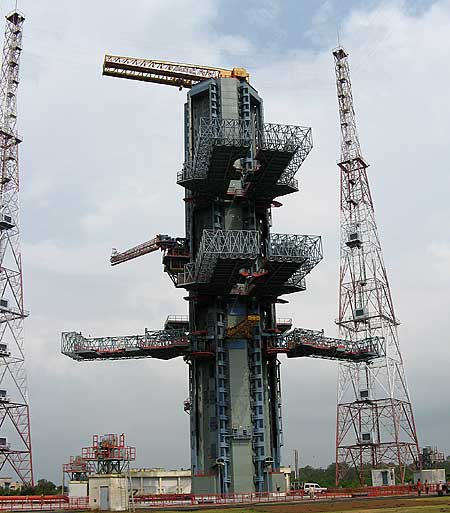
The [[ | The [[PSLV|Polar Satellite Launch Vehicle]] launch complex was commissioned during 1990. It has a 3,450 tonne,<ref>{{Cite web|title=Specification For Refurbishment Of MST Traction System Hydraulic Interconnection Plumbing And Associated Valves|url=https://www.isro.gov.in/sites/default/files/tenders/pt_ro20-04-5811.pdf|archive-url=https://web.archive.org/web/20220213124252/https://www.isro.gov.in/sites/default/files/tenders/pt_ro20-04-5811.pdf|archive-date=13 February 2022}}</ref> 76.5 m high Mobile Service Tower (MST) which provides the SP-3 payload clean room. The solid propellant motors for the PSLV are processed by SHAR, which also carries out launch operations. The first launch of the PSLV took place on 20 September 1993.<ref>{{cite web|title=India (Launchers)|url=http://claudelafleur.qc.ca/Indians-launchers.html|website=Spacecraft Encyclopedia|access-date=2 May 2020|archive-date=20 May 2016|archive-url=https://web.archive.org/web/20160520142430/http://claudelafleur.qc.ca/Indians-launchers.html|url-status=live}}</ref> | ||
=== | === Geosynchronous Satellite Launch Vehicle (GSLV) === | ||
The [[ | The first launch of India's [[Geosynchronous Satellite Launch Vehicle]] (GSLV) was successfully completed on 18 April 2001. GSLV, with its own cryogenic upper stage, has enabled the launch of communications satellites of the class up to 2 tonnes. The next variant of GSLV is GSLV Mk III with its own cryogenic high-thrust engine and stage capable of launching communications satellites of the 4-ton class.<ref>{{cite web | url=https://www.isro.gov.in/Launchers.html | title=Launchers | access-date=26 October 2022 | archive-date=23 December 2022 | archive-url=https://web.archive.org/web/20221223112550/https://www.isro.gov.in/Launchers.html | url-status=live }}</ref> | ||
==Facilities== | == Facilities == | ||
The SDSC has two operational orbital launch pads. SHAR is ISRO's satellite launching base and additionally provides launch facilities for the full range of [[Rohini | [[File:PSLV-C55, TeLEOS-2 - Panaromic view of SDSC-SHAR, Sriharikota. Partial stack of first and second stage being transferred from PIF to MST-FLP.webp|thumb|Panoramic view of SDSC-SHAR, Sriharikota]] | ||
[[File:GSLV F11- Vehicle being moved from Solid Stage Assembly Building at SDSC SHAR.jpg|thumb|Vehicle being moved from the Solid Stage Assembly Building]] | |||
[[File:GSLV Mk III M1, Chandrayaan-2 - GSLV Mk III M1 vehicle coming out of the Vehicle Assembly Building..jpg|thumb|Vehicle coming out of the Vehicle Assembly Building]] | |||
The SDSC has two operational orbital launch pads. SHAR is ISRO's satellite launching base and additionally provides launch facilities for the full range of [[Rohini (rocket family)|Rohini sounding rockets]]. The Vehicle Assembly, Static Test and Evaluation Complex (VAST, previously STEX) and the Solid Propellant Space Booster Plant (SPROB) are located at SHAR for casting and testing solid motors. The site also has a Telemetry, Tracking, Range Instrumentation, & Control centre for Range Operation (RO), Liquid Propellant Storage and Servicing Facilities (LSSF), the Management Service Group and Sriharikota Common Facilities. The [[Polar Satellite Launch Vehicle|PSLV]] launch complex was commissioned in 1990. It has a 3,450 tonne, 76.5 m high Mobile Service Tower (MST) which provides the SP-3 payload clean room.<ref>[http://www.janes.com/articles/Janes-Space-Systems-and-Industry/Satish-Dhawan-Space-Centre-SDSC-Sriharikota-Range-SHAR-India.html] Satish Dhawan Space Centre (SDSC), Sriharikota Range (SHAR) (India), Civil space organisations – Launch facilities, Source – Jane's Information Group</ref> | |||
The Solid Propellant Space Booster Plant (SPROB) processes large size propellant grains for the satellite launch vehicles. The Vehicle Assembly & Launching Facility (VALF), Solid Motor Preparation & Environmental Testing Facility (SMP&ETF) tests and qualifies different types of solid motor for launch vehicles. The control centre at SHAR houses computers and data processing, closed circuit television, real-time tracking systems and meteorological observation equipment. It is linked to eight radars located at Sriharikota and the five stations of ISRO's Telemetry, Tracking & Command Network ([[ | The Solid Propellant Space Booster Plant (SPROB) processes large size propellant grains for the satellite launch vehicles. The Vehicle Assembly & Launching Facility (VALF), Solid Motor Preparation & Environmental Testing Facility (SMP&ETF) tests and qualifies different types of solid motor for launch vehicles. The control centre at SHAR houses computers and data processing, closed circuit television, real-time tracking systems and meteorological observation equipment. It is linked to eight radars located at Sriharikota and the five stations of ISRO's Telemetry, Tracking & Command Network ([[ISRO Telemetry, Tracking and Command Network|ISTRAC]]).{{citation needed|date=August 2019}} | ||
The propellant production plant produces composite solid propellant for rocket motors of ISRO using ammonium perchlorate (oxidiser), fine aluminium powder (fuel) and hydroxyl terminated polybutadiene (binder). The solid motors processed here include those for the first-stage booster motor of the Polar Satellite Launch Vehicle (PSLV) — a five segmented motor of {{cvt|2.8|m}} diameter and {{cvt|22|m}} length, weighing {{convert|160|t}} with a thrust level of {{convert|450|t}}. | The propellant production plant produces composite solid propellant for rocket motors of ISRO using ammonium perchlorate (oxidiser), fine aluminium powder (fuel) and hydroxyl terminated polybutadiene (binder). The solid motors processed here include those for the first-stage booster motor of the Polar Satellite Launch Vehicle (PSLV) — a five segmented motor of {{cvt|2.8|m}} diameter and {{cvt|22|m}} length, weighing {{convert|160|t}} with a thrust level of {{convert|450|t}}. | ||
| Line 61: | Line 122: | ||
Rocket motors and their subsystems have to be rigorously tested and evaluated on ground before they are declared flight worthy. The facilities at SDSC are used for testing solid rocket motors, both at ambient conditions and simulated high altitude conditions. Besides these, there are facilities for conducting vibration, shock, constant acceleration and thermal/humidity tests. | Rocket motors and their subsystems have to be rigorously tested and evaluated on ground before they are declared flight worthy. The facilities at SDSC are used for testing solid rocket motors, both at ambient conditions and simulated high altitude conditions. Besides these, there are facilities for conducting vibration, shock, constant acceleration and thermal/humidity tests. | ||
SDSC has infrastructure for launching satellites into low Earth orbit, polar orbit and geo-stationary transfer orbit. The launch complexes provide support for vehicle assembly, fueling, checkout and launch operations. The | SDSC has infrastructure for launching satellites into low Earth orbit, polar orbit and geo-stationary transfer orbit. The launch complexes provide support for vehicle assembly, fueling, checkout and launch operations. The centre also has facilities for launching sounding rockets for atmospheric studies. The mobile service tower, launch pad, preparation facilities for different launch stages & spacecraft, storage, transfer and servicing facilities for liquid propellants, etc., are the principal parts of the PSLV/GSLV launch complex. | ||
For supporting the | For supporting the LVM3, additional facilities were set up at SDSC. A new plant (SPP) is set up to process heavier class boosters with 200 tonnes of Solid propellant. The static test complex is being augmented for qualifying the S-200 booster. Other new facilities include a Solid Stage Assembly Building, Satellite Preparation and Filling Facility and Hardware Storage buildings. The existing [[Liquid rocket propellant|liquid propellant]] and [[Cryogenic fuel|cryogenic propellant]] storage and filling systems, Propellant Servicing Facilities will also be augmented. The range instrumentation system will be enhanced further.{{citation needed|date=August 2019}} | ||
SDSC also has a [[S band]] [[ | SDSC also has a [[S band]] [[Weather radar|doppler weather radar]]<ref>{{Cite web|url=http://www.imd.gov.in/pages/radar_main.php?adta=shr|title=IMD – Radar Images and Products|website=www.imd.gov.in|access-date=5 September 2018|archive-date=6 September 2018|archive-url=https://web.archive.org/web/20180906014149/http://www.imd.gov.in/pages/radar_main.php?adta=shr|url-status=live}}</ref> that contributes to [[India Meteorological Department]] radar network and serves as a stand-in for Doppler weather radar in Chennai.<ref>{{Cite news|url=https://www.newindianexpress.com/states/tamil-nadu/2017/oct/30/imd-expanding-radar-network-for-improved-forecasts-1686624.html|title=IMD expanding radar network for improved forecasts|work=The New Indian Express|access-date=5 September 2018|archive-date=6 September 2018|archive-url=https://web.archive.org/web/20180906052442/http://www.newindianexpress.com/states/tamil-nadu/2017/oct/30/imd-expanding-radar-network-for-improved-forecasts-1686624.html|url-status=live}}</ref> | ||
[[File:Inauguration of Launch View Gallery at SDSC-SHAR 06.jpg|thumb|Launch View Gallery at SDSC]] | |||
ISRO opened a viewing gallery at the Satish Dhawan Space Centre in March 2019. The gallery faces the two launchpads and can accommodate 5,000 people giving the general public the opportunity to witness rocket launches. The launch of [[PSLV-C45]] on 1 April 2019 was the first launch that allowed spectators into the gallery.<ref>{{cite news |title=Isro finally opens door for people to watch rocket launches – Times of India |url=https://timesofindia.indiatimes.com/india/isro-finally-opens-door-for-people-to-watch-rocket-launches/articleshow/68644933.cms |website=The Times of India |date=30 March 2019 |access-date=30 March 2019 |archive-date=31 March 2019 |archive-url=https://web.archive.org/web/20190331203814/https://timesofindia.indiatimes.com/india/isro-finally-opens-door-for-people-to-watch-rocket-launches/articleshow/68644933.cms |url-status=live }}</ref> | |||
== Launch pads == | |||
{{geoGroup}} | |||
== Launch pads == | === SLV-3 Launch Pad === | ||
The '''SLV3 Launch Pad''', located at {{Coord|13.6664|80.2272|name=SLV3 Launch Pad}}, began operation in 1979 and was decommissioned in 1994. It was used by two [[launch vehicle]]s of the ISRO: the [[Satellite Launch Vehicle]] (SLV) and the [[Augmented Satellite Launch Vehicle]] (ASLV).<ref name="SS">{{cite web | url=http://www.astronautix.com/sites/sritaslv.htm | archive-url=https://web.archive.org/web/20081201192211/http://www.astronautix.com/sites/sritaslv.htm | url-status=dead | archive-date=1 December 2008 | title=Sriharikota SLV | publisher=[[Encyclopedia Astronautica]] | access-date=10 November 2013}}</ref> Initially it was built for launching SLV-3s but was later also used as an ASLV launch complex.<ref name="HarveySmid2011">{{cite book|author1=Brian Harvey|author2=Henk H. F. Smid|author3=Théo Pirard|title=Emerging Space Powers: The New Space Programs of Asia, the Middle East and South-America|url=https://books.google.com/books?id=XD1ZaYbiWwMC&pg=PA247|date=30 January 2011|publisher=Springer|isbn=978-1-4419-0874-2|pages=247–}}</ref> The first launch from this pad occurred on 10 August 1979, and was that of the first experimental flight of [[Satellite Launch Vehicle|SLV-3]] carrying the [[Rohini (satellite)#Rohini Technology Payload|Rohini Technology Payload]] satellite. The last flight was of [[Augmented Satellite Launch Vehicle|ASLV]] on 4 May 1994 carrying [[Stretched Rohini Satellite Series#SROSS C2|SROSS-C2]].<ref name="SS" /> | |||
=== First Launch Pad === | |||
[[File:Panaromic view of fully integrated PSLV-C40 with Mobile Service Tower withdrawn.jpg|thumb|PSLV C40 in XL configuration before launch at First Launch Pad]] | |||
The First Launch Pad (FLP),<ref name="ISRO-LF">{{Cite web|url=http://www.isro.org/GroundFacilities/launchfacility.aspx|title=Launch Facility|publisher=Indian Space Research Organisation|url-status=dead|archive-url=https://web.archive.org/web/20100417071046/http://www.isro.org/GroundFacilities/launchfacility.aspx|archive-date=17 April 2010}}</ref> located at {{Coord|13.7333|80.2347|name=First Launch Pad}}, began operation in 1993. It is currently used to launch the [[Polar Satellite Launch Vehicle]], and formerly used by the [[Geosynchronous Satellite Launch Vehicle]]. It is one of two operational orbital launch pads at the site, the other being the [[Satish Dhawan Space Centre Second Launch Pad|Second Launch Pad]],<ref>{{cite news | url=http://newindianexpress.com/states/kerala/article1481646.ece | title=ISRO planning big missions this year | work=New Indian Express | date=28 February 2013 | agency=The New Indian Express | access-date=6 March 2013 | location=Kerala, India | archive-date=15 March 2016 | archive-url=https://web.archive.org/web/20160315132312/http://www.newindianexpress.com/states/kerala/article1481646.ece | url-status=dead }}</ref> which opened in 2005. The first launch from this pad occurred on 20 September 1993, and was the maiden flight of the [[Polar Satellite Launch Vehicle]] (PSLV) carrying the [[IRS-1E]] satellite. The maiden flight of the [[Small Satellite Launch Vehicle]] (SSLV) also occurred from this pad on 7 August 2022. | |||
{{ | The FLP is undergoing major expansion with PIF (PSLV Integration Facilities) project worth {{INRConvert|475|c|lk=on}}. Once complete, the first launch pad is expected to cater to around 12-15 launches per year. | ||
| | <ref>{{cite web |url=http://www.prajasakti.com/Article/Nellor/2004423 |title=PIF Project |publisher=Prajasakti |access-date=4 February 2018 |archive-date=4 February 2018 |archive-url=https://web.archive.org/web/20180204124127/http://www.prajasakti.com/Article/Nellor/2004423 |url-status=live }}</ref><ref name=":3">{{Cite web |date=2025-01-16 |title=Cabinet approves the establishment of “Third Launch Pad” |url=https://pib.gov.in/PressReleasePage.aspx?PRID=2093360 |access-date=2025-01-16 |website=[[Press Information Bureau]]}}</ref> | ||
| | |||
;PSLV Integration Facility | |||
As part of three space infrastructure projects totaling [[₹]]1,800 [[crore]], [[Prime Minister of India|Prime Minister]] [[Narendra Modi]] formally inaugurated the PSLV Integration Facility (PIF) at the Satish Dhawan Space Centre, Sriharikota, from the [[Vikram Sarabhai Space Centre]] (VSSC) on 27 February 2024.<ref>{{cite news |title=PM visits Vikram Sarabhai Space Center (VSSC) in Thiruvananthapuram, Kerala Inaugurates three important space infrastructure projects worth about Rs 1800 crores |url=https://pib.gov.in/PressReleaseIframePage.aspx?PRID=2009320 |access-date=1 January 2025 |agency=Prime Minister's Office, Government of India |publisher=Press Information Bureau |date=27 February 2024}}</ref><ref>{{Cite news |date=2024-02-27 |title=Watch: PM Modi inaugurates 3 major space projects of ISRO |url=https://www.livemint.com/news/india/pm-modi-inaugurates-3-major-space-infrastructure-projects-of-isro-in-kerala-watch-11709014342909.html |archive-url=https://web.archive.org/web/20240913055542/https://www.livemint.com/news/india/pm-modi-inaugurates-3-major-space-infrastructure-projects-of-isro-in-kerala-watch-11709014342909.html |archive-date=13 September 2024 |access-date=2025-01-01 |work=mint |language=en |url-status=live }}</ref> Instead of being assembled and integrated at Vehicle Assembly and Launching Facility (VALF) and Mobile Service Tower (MST) respectively, the PSLV-C60 launch vehicle for [[SpaDeX|SpaDeX mission]] was for the first time assembled in the new PIF building and transported to the launch pad to reduce the lead-in time between missions. The PIF building is an extension of the FLP. It can assist the integration, checkout, and launch of private sector rockets from firms like [[Skyroot Aerospace]] and [[AgniKul Cosmos]] as well as smaller launch vehicles like SSLV.<ref name=":4">{{Cite web |last=Dutt |first=Anonna |date=2024-12-30 |title=Why ISRO’s ‘docking’ mission today is critical for India’s space ambitions |url=https://indianexpress.com/article/explained/explained-sci-tech/isro-docking-mission-significance-space-9751091/ |access-date=2024-12-30 |website=The Indian Express |language=en}}</ref><ref>{{Cite web |last=Ramesh |first=Sandhya |date=2024-03-02 |title=How ISRO's PSLV Integration Facility launch at Sriharikota will help India’s space ecosystem |url=https://theprint.in/science/how-isros-pslv-integration-facility-launch-at-sriharikota-will-help-indias-space-ecosystem/1985181/ |access-date=2025-01-01 |website=ThePrint |language=en-US}}</ref> | |||
[[File: | === Second Launch Pad === | ||
[[File:Second Launch Pad.jpg|thumb|Second Launch Pad of Satish Dhawan Space Centre]] | |||
[[File:The fully integrated GSLV-F05 carrying INSAT-3DR approaching the second launch pad.jpg|thumb|The fully integrated GSLV-F05 carrying INSAT-3DR approaching the Second Launch Pad]] | |||
The Second Launch Pad (SLP), located at {{Coord|13.7199|80.2305|name=Second Launch Pad}}, was designed, supplied, erected and commissioned by [[MECON (company)|MECON Limited]], a Government of Indian Enterprise, located at Ranchi (Jharkhand, India) during the period March 1999 to December 2003.<ref>{{cite web |url=http://www.meconlimited.co.in/FlashNews/Chandrayaan.pdf|title=Launching of Chandrayaan – I from Second Launch Pad at Sriharikota Makes Mecon Proud|access-date=3 September 2013|url-status=dead |archive-url=https://web.archive.org/web/20131220171630/http://www.meconlimited.co.in/FlashNews/Chandrayaan.pdf|archive-date=20 December 2013}}</ref> It cost about {{INRconvert|400|c|year=2005|lk=on}} at that time.<ref>{{cite web |url=http://www.telegraphindia.com/1081023/jsp/jharkhand/story_10006297.jsp |title=Mecon, HEC over the moon |website=The Telegraph |url-status=dead |archive-url=https://web.archive.org/web/20131221024057/http://www.telegraphindia.com/1081023/jsp/jharkhand/story_10006297.jsp |archive-date=21 December 2013}}</ref> It serves as a launchpad for [[Geosynchronous Satellite Launch Vehicle|GSLV]] and [[LVM3]] as well as a standby for PSLV.<ref name=":3" /> It takes about Six to Eight weeks following a launch to refurbish the launch pad to support another launch.<ref>{{Cite web |last=Foust |first=Jeff |date=2024-12-14 |title=NISAR planned to launch in March 2025 after antenna repairs |url=http://spacenews.com/nisar-planned-to-launch-in-march-2025-after-antenna-repairs/ |access-date=2025-05-31 |website=SpaceNews |language=en-US}}</ref> | |||
The second launch pad with associated facilities was built in 2005 and became operational on 5 May with the launching of [[PSLV-C6]]. MECON's sub-contractors for this project including Inox India, HEC, Tata Growth, Goderej Boyce, Simplex, Nagarjuna Construction, Steelage, etc. The other Launch Pad being the FLP. It is used by PSLV, GSLV, LVM3 and is intended for India's first [[Gaganyaan|crewed space mission]].<ref name="ISRO-LF" /><ref>{{Cite web|title=SDSC SHAR/Sr.HPS/PT/RO/11/2019-20|url=https://www.isro.gov.in/sdsc-shar-srhps-gt-ro-11-2019-2020|date=7 November 2019|access-date=22 November 2019|publisher=[[Indian Space Research Organization]]|website=www.isro.gov.in|archive-date=8 November 2019|archive-url=https://web.archive.org/web/20191108102554/https://www.isro.gov.in/sdsc-shar-srhps-gt-ro-11-2019-2020|url-status=dead}}</ref> | |||
The | |||
The first launch from the pad occurred on 5 May 2005, and was of a Polar Satellite Launch Vehicle carrying the [[Cartosat-1]] and [[HAMSAT]] satellites.<ref name=ea20100412>{{Cite web |url=http://www.astronautix.com/sites/sritaslp.htm|archive-url=https://web.archive.org/web/20081201193737/http://www.astronautix.com/sites/sritaslp.htm|url-status=dead|archive-date=1 December 2008|title=Sriharikota SLP|last=Wade|first=Mark|publisher=Encyclopedia Astronautica|access-date=12 April 2010}}</ref> India's 1st Moon Mission, [[Chandrayaan-1]] was launched from this launch pad on 22 October 2008. Its follow-up missions were also launched from this launch pad, where [[Chandrayaan-2]] was launched on 22 July 2019 and [[Chandrayaan-3]] was launched on 14 July 2023. | |||
The | |||
In November 2019, ISRO released tenders for augmentation of the SLP for the Gaganyaan project.<ref>{{Cite web|title=RFP TO REALISE HYDRANT SYSTEM FOR AUGMENTED FACILITIES AT SLP COMPLEX (ASLP) SDSC, SHAR SRIHARIKOTA|url=https://www.isro.gov.in/sites/default/files/tenders/pt_ro_11_12242.pdf|date=7 November 2019|access-date=22 November 2019|publisher=[[Indian Space Research Organization]]|website=www.isro.gov.in|archive-date=12 October 2020|archive-url=https://web.archive.org/web/20201012081817/https://www.isro.gov.in/sites/default/files/tenders/pt_ro_11_12242.pdf|url-status=live}}</ref><ref>{{Cite web|title=Work Contract to carry out Video and Still Photography documentation coverage and VIDEO Editing Works of Technical Photography Facility|url=https://www.isro.gov.in/sites/default/files/tenders/pt_ro_11_12323.pdf|date=7 November 2019|access-date=22 November 2019|publisher=[[Indian Space Research Organization]]|website=www.isro.gov.in|archive-date=8 November 2019|archive-url=https://web.archive.org/web/20191108102438/https://www.isro.gov.in/sites/default/files/tenders/pt_ro_11_12323.pdf|url-status=live}}</ref><ref>{{Cite web|title=SUPPLY OF RAW MATERIAL, FABRICATION, ERECTION AND COMMISSIONING OF STRUCTURAL ELEMENTS FOR GAGANYAAN MISSION AT UMBILICAL TOWER OF SECOND LAUNCH PAD (SLP)|url=https://www.isro.gov.in/sites/default/files/tenders/pt_ro_11_12444.pdf|date=7 November 2019|access-date=22 November 2019|publisher=[[Indian Space Research Organization]]|website=www.isro.gov.in|archive-date=12 October 2020|archive-url=https://web.archive.org/web/20201012075917/https://www.isro.gov.in/sites/default/files/tenders/pt_ro_11_12444.pdf|url-status=live}}</ref><ref>{{Cite web|title=REALISATION OF NEW HYDRAULIC SYSTEM FOR CREW ACCESS ARM (CAA) and AUGMENTATION/MODIFICATION OF EXISTING SCVRP-3 HYDRAULIC SYSTEM FOR SERVICING GAGANYAAN MISSION AT UMBILICAL TOWER (UT) OF SECOND LAUNCH PAD (SLP)|url=https://www.isro.gov.in/sites/default/files/tenders/pt_ro_11_12508.pdf|date=7 November 2019|access-date=22 November 2019|publisher=[[Indian Space Research Organization]]|website=www.isro.gov.in|archive-date=15 October 2020|archive-url=https://web.archive.org/web/20201015062919/https://www.isro.gov.in/sites/default/files/tenders/pt_ro_11_12508.pdf|url-status=live}}</ref> Systems such as a crew ingress and egress system, access platform, recovery setup for emergencies during the flight's ascent phase, module preparation facility for assembly and testing along with an [[helipad]] are built at a cost of about ₹2000 crore. All the facilities will be connected an upcoming Gaganyaan control facility, which will monitor and communicate with the Astronauts during the Spaceflight.<ref>{{Cite news |title=Mission Gaganyaan: A small stepway for man, a giant leap for India |url=https://timesofindia.indiatimes.com/city/chennai/a-small-stepway-for-man-a-giant-leap-for-india/articleshow/108829703.cms |access-date=1 April 2024 |work=The Times of India |issn=0971-8257}}</ref> | |||
<ref>{{ | |||
=== | === Third Launch Pad === | ||
A Third Launch Pad (TLP) was proposed in 2012<ref>{{cite news|author=Chandrashekar, Nandini|date=2 June 2012|title=3rd launch pad to be built|work=[[Deccan Herald]]|location=Bangalore|url=https://www.deccanherald.com/content/63143/3rd-launch-pad-built.html|access-date=21 November 2020|archive-date=26 January 2021|archive-url=https://web.archive.org/web/20210126181058/https://www.deccanherald.com/content/63143/3rd-launch-pad-built.html|url-status=live}}</ref><ref name=":1">{{Cite web |title=12th Five Year Plan of the Department of Space Working Group WG-14 Report |url=http://planningcommission.gov.in/aboutus/committee/wrkgrp12/sandt/wg_dos2905.pdf |url-status=dead |archive-url=https://web.archive.org/web/20160404223826/http://planningcommission.gov.in/aboutus/committee/wrkgrp12/sandt/wg_dos2905.pdf |archive-date=4 April 2016 |pages=84, 106}}</ref> with estimated cost to be {{INRConvert|500|c}}.<ref>{{cite news |title=High-tech third launch pad in Sriharikota soon |url=https://www.deccanherald.com/content/468464/high-tech-third-launch-pad.html |access-date=23 July 2019 |work=Deccan Herald |date=29 March 2015 |language=en |archive-date=23 July 2019 |archive-url=https://web.archive.org/web/20190723232055/https://www.deccanherald.com/content/468464/high-tech-third-launch-pad.html |url-status=live }}</ref> This launch pad is intended to be used for [[Next Generation Launch Vehicle|NGLV]] and LVM3.<ref>{{cite news | url=http://articles.timesofindia.indiatimes.com/2012-07-01/india/32494121_1_sriharikota-gslv-mk-iii-heavier-satellites | archive-url=https://archive.today/20130619212840/http://articles.timesofindia.indiatimes.com/2012-07-01/india/32494121_1_sriharikota-gslv-mk-iii-heavier-satellites | url-status=dead | archive-date=19 June 2013 | title=Isro to build third launchpad at Sriharikota | date=1 July 2012 | agency=[[Times of India]] | work=[[The Times of India]] | access-date=8 June 2013}}</ref> The launch pad will be used for India's future [[Indian Human Spaceflight Programme|human space missions]].<ref name="India today">{{cite news | url=https://www.indiatoday.in/india/story/isro-to-begin-process-for-human-space-flight-mission-65857-2010-01-25 | title=ISRO to begin process for Human Space Flight Mission | work=[[Press Trust of India|PTI]] | date=26 January 2010 | agency=[[India Today]] | access-date=8 June 2013 | location=Hyderabad}}</ref> Main reasons behind establishing this launch pad were that it will provide redundancy to existing launch pads as well as increase the frequency of orbital launches from SDSC-SHAR with a new larger assembly facility called Second Vehicle Assembly Building (SVAB) serving it.<ref>{{cite news | url=http://www.indiandefence.com/forums/strategic-geopolitical-issues/19518-isro-build-third-launch-pad-spaceport.html | title=ISRO To Build A Third Launch Pad at Spaceport | work=Indiadefence.com | date=2 June 2012 | access-date=8 June 2013}}</ref><ref name=":1" /> | |||
But due to lack of budgetary resources and delays in LVM3 being operational and subsequent conceptualization of next generation launch vehicles that Third Launch Pad was supposed to serve, the project has not been approved.<ref>{{Cite web |date=31 March 2017 |title=Report No. 298- Demands for Grants (2017–2018) of the Department of Space (Demand No. 91) |url=http://164.100.47.5/newcommittee/reports/EnglishCommittees/Committee%20on%20S%20and%20T%2C%20Env.%20and%20Forests/298.pdf |url-status=dead |archive-url=https://web.archive.org/web/20170424113808/http://164.100.47.5/newcommittee/reports/EnglishCommittees/Committee%20on%20S%20and%20T,%20Env.%20and%20Forests/298.pdf |archive-date=24 April 2017 |quote=The Committee notes that the Department envisioned establishment of Third Launch Pad at Sriharikota to support the increased launch frequency of PSLV, and GSLV during the 12th Plan period whereas no budgetary support has been sought by the Department for the purpose during the years 2015–16 and 2016–17. The Committee fails to understand as to why the Department did not seek any budgetary support for the purpose. The Committee strongly feels that the Department has failed to lay due focus on the establishment of Third Launch Pad. The Committee, therefore, recommends the Department to furnish the reasons for being so tardy on this count.}}</ref><ref>{{Cite web |title=ISRO proposes to set up a new launch pad, referred as Third Launch Pad, at Satish Dhawan Space Centre, Sriharikota. |url=https://pib.gov.in/newsite/PrintRelease.aspx?relid=116880 |archive-url=https://web.archive.org/web/20230722192201/https://pib.gov.in/newsite/PrintRelease.aspx?relid=116880 |archive-date=22 July 2023 |access-date=22 July 2023 |website=pib.gov.in |quote=The possible site for the Third Launch Pad has been identified in Sriharikota taking into account the safety distances and maximal utilisation of existing launch pad facilities. However, further work on design of the launch pad will be taken up at an appropriate time after finalising the configuration of the advanced launch vehicle, operationalisation of GSLV MIII, programmatic requirements and resource availability.}}</ref> Second Vehicle Assembly Building (SVAB) facility was established in 2019 and currently serves Second Launch Pad.<ref>{{Cite web |title=Annual Report 2019–20, Department of Space |url=https://www.isro.gov.in/sites/default/files/flipping_book/annual_report_2019-20_english/files/assets/common/downloads/Annual%20Report%202019-20%20%28English%29.pdf |archive-url=https://web.archive.org/web/20200214130824/https://www.isro.gov.in/sites/default/files/flipping_book/annual_report_2019-20_english/files/assets/common/downloads/Annual%20Report%202019-20%20%28English%29.pdf |archive-date=14 February 2020 |quote=Second vehicle Assembly Building (SVAB):The Second Vehicle Assembly Building (SVAB) is realised and is ready for integration of GSLV Mk-II, GSLV-MkIII and future missions of the Indian Space Programme.It has been dedicated to the nation by the Honourable President of India, Shri Ram Nath Kovind on 14th of July 2019}}</ref> | |||
In | In 2018, after the announcement of the [[Gaganyaan]] project under the [[Indian Human Spaceflight Programme]], it was thought a new launch pad might be needed.<ref>{{Cite news|url=https://www.thehindu.com/news/national/isro-setting-up-launch-pad-for-gaganyaan-mission/article25010147.ece|title=ISRO setting up launch pad for Gaganyaan mission|last=Peri|first=Dinakar|date=21 September 2018|work=The Hindu|access-date=22 September 2018|language=en-IN|issn=0971-751X|archive-date=8 June 2023|archive-url=https://web.archive.org/web/20230608222932/https://www.thehindu.com/news/national/isro-setting-up-launch-pad-for-gaganyaan-mission/article25010147.ece|url-status=live}}</ref> However, it was decided to augment the SLP for crewed flights instead.<ref>{{Cite web |date=27 December 2018 |title=Government Of India Department Of Space Rajya Sabha Unstarred Question No. 1733 |url=https://164.100.158.235/question/annex/247/Au1733.pdf |archive-url=https://web.archive.org/web/20230722201243/https://164.100.158.235/question/annex/247/Au1733.pdf |archive-date=22 July 2023 |quote=It is proposed to utilise the existing launch pad with augmentation for carrying out the initial flights under the Gaganyaan manned space flight programme.}}</ref><ref>{{Cite AV media |url=https://www.ndtv.com/video/shows/ndtv-special-ndtv-24x7/inside-india-s-2022-space-mission-ndtv-special-491571?rdr=1 |title=Inside India's 2022 Space Mission: NDTV Special |date=15 August 2018 |time=18 min.45 sec. |access-date=22 July 2023 |archive-date=22 July 2023 |archive-url=https://web.archive.org/web/20230722202530/https://www.ndtv.com/video/shows/ndtv-special-ndtv-24x7/inside-india-s-2022-space-mission-ndtv-special-491571?rdr=1 |url-status=live }}</ref><ref>{{Cite web|title = SUPPLY OF RAW MATERIAL, FABRICATION, ERECTION AND COMMISSIONING OF STRUCTURAL ELEMENTS FOR GAGANYAAN MISSION AT UMBILICAL TOWER OF SECOND LAUNCH PAD (SLP)|url = https://www.isro.gov.in/sites/default/files/tenders/pt_ro_11_12444.pdf|date = 7 November 2019|access-date = 22 November 2019|publisher = [[Indian Space Research Organization]]|website = www.isro.gov.in|archive-date = 12 October 2020|archive-url = https://web.archive.org/web/20201012075917/https://www.isro.gov.in/sites/default/files/tenders/pt_ro_11_12444.pdf|url-status = live}}</ref><ref>{{Cite web|title = REALISATION OF NEW HYDRAULIC SYSTEM FOR CREW ACCESS ARM (CAA) & AUGMENTATION/MODIFICATION OF EXISTING SCVRP-3 HYDRAULIC SYSTEM FOR SERVICING GAGANYAAN MISSION AT UMBILICAL TOWER (UT) OF SECOND LAUNCH PAD (SLP)|url = https://www.isro.gov.in/sites/default/files/tenders/pt_ro_11_12508.pdf|date = 7 November 2019|access-date = 22 November 2019|publisher = [[Indian Space Research Organization]]|website = www.isro.gov.in|archive-date = 15 October 2020|archive-url = https://web.archive.org/web/20201015062919/https://www.isro.gov.in/sites/default/files/tenders/pt_ro_11_12508.pdf|url-status = live}}</ref> Instead it would be developed for use by the upcoming NGLV rocket.<ref>{{Cite news |title=SOORYA: Project team for rocket to build space station ready; 3rd launch pad at Sriharikota to come up |url=https://timesofindia.indiatimes.com/india/soorya-project-team-for-rocket-to-build-space-station-ready-3rd-launch-pad-at-sriharikota-to-come-up/articleshow/108472896.cms |access-date=14 March 2024 |work=The Times of India |issn=0971-8257}}</ref> | ||
On 8 October 2024, [[India Today]] reported that the proposal has been present in front of the space cabinet for final budget approval. It is proposed to have NGLV horizontally integrated, requiring a different set of changes as compared to the other launch pads.The new facility will also accommodate more [[Liquid-propellant rocket|liquid engine boosters]], necessitating a redesigned [[Jet blast deflector|jet deflector]] system.It is planned for the third launch pad to be used for entire-stage testing, streamlining test operations for ISRO.<ref>{{Cite web |date=2024-10-08 |title=Isro to build third launch pad at Sriharikota, Cabinet approval pending |url=https://www.indiatoday.in/science/story/isro-to-build-third-launch-pad-at-sriharikota-cabinet-approval-pending-2613238-2024-10-08 |access-date=2024-10-08 |website=India Today |language=en}}</ref> | |||
On 16 January 2025, the [[Union Council of Ministers|Union Cabinet]] cleared the establishment of the TLP. The TLP will be used for both NGLV and LVM3 launches and will act as a standby for SLP. The TLP is to be established within 4 years at a cost of {{INRConvert|3984.86|c|lk=on|year=2025}}.<ref name=":32">{{Cite web |date=2025-01-16 |title=Cabinet approves the establishment of “Third Launch Pad” |url=https://pib.gov.in/PressReleasePage.aspx?PRID=2093360 |access-date=2025-01-16 |website=[[Press Information Bureau]]}}</ref> | |||
=== ALP-01 (Dhanush) Launch Pad === | |||
[[AgniKul Cosmos]] inaugurated first private launchpad and mission control centre in India at the Satish Dhawan Space Centre (SDSC) in [[Sriharikota]], [[Andhra Pradesh]] on 28 November 2022. The launchpad and the mission control centre are {{convert|4|km|mi|abbr=on}} apart from one another. At present, the launchpad can handle liquid stage launch vehicle.<ref>{{Cite web |date=29 November 2022 |title=Agnikul inaugurates India's first private space vehicle launchpad in Sriharikota |url=https://indianexpress.com/article/technology/science/agnikul-cosmos-launchpad-mission-control-center-sriharikota-8296006/ |access-date=30 November 2022 |website=The Indian Express |language=en}}</ref> The pad has received the name ''Dhanush'' and referred as ALP-01.<ref name=":22">{{Cite web |title=Space Startup Agnikul Ready For Its Sub-Orbital Rocket Launch On Friday |url=https://www.ndtv.com/india-news/space-start-up-agnikul-ready-for-its-sub-orbital-rocket-agnibaan-launch-on-friday-5270592 |access-date=21 March 2024 |website=NDTV.com}}</ref> All the critical systems performing functions at Agnikul launchpad (ALP) and the Agnikul mission control center (AMCC) have high degree of redundancy to ensure 100% operationality although none of these systems were tested so far.<ref>{{Cite news |last=Kandavel |first=Sangeetha |date=28 November 2022 |title=Agnikul Cosmos sets up India's first private space vehicle launchpad at Sriharikota |url=https://www.thehindu.com/news/national/tamil-nadu/chennai-based-agnikul-cosmos-inaugurates-first-launchpad-mission-control-center-at-sriharikota/article66194809.ece |access-date=30 November 2022 |work=The Hindu |language=en-IN |issn=0971-751X}}</ref> ISRO's range operations team will monitor key flight safety parameters during launches from ALP while AMCC can share critical data with ISRO's Mission Control Center.<ref>{{Cite web |date=28 November 2022 |title=Space start-up Agnikul Cosmos sets up India's first private launch pad |url=https://www.indiatoday.in/science/story/space-start-up-agnikul-cosmos-sets-up-india-first-private-launch-pad-2302603-2022-11-28 |access-date=30 November 2022 |website=India Today |language=en}}</ref> Both the facilities have support of ISRO and [[Indian National Space Promotion and Authorisation Centre]] (IN-SPACe).<ref>{{Cite web |date=29 November 2022 |title=Space startup Agnikul Cosmos inaugurates India's first private launchpad at Sriharikota |url=https://www.financialexpress.com/lifestyle/science/space-startup-agnikul-cosmos-inaugurates-indias-first-private-launchpad-at-sriharikota/2895477/ |access-date=30 November 2022 |website=Financialexpress |language=en}}</ref> | |||
==See also== | == See also == | ||
{{Portal bar|India|Rocketry|Spaceflight}} | |||
* | * [[SSLV Launch Complex]] | ||
* | * [[Thumba Equatorial Rocket Launching Station]] | ||
* [[Vikram Sarabhai Space Centre]] | |||
* [[List of Satish Dhawan Space Centre launches]] | |||
== References == | == References == | ||
{{reflist}} | {{reflist}} | ||
==External links== | == External links == | ||
{{ | {{Commons category}} | ||
*[http://www.shar.gov.in/ Satish Dhawan Space Centre | *[http://www.shar.gov.in/ Satish Dhawan Space Centre]An[http://www.shar.gov.in/ Officiproposed] | ||
*[http://www.isro.org/Chandrayaan/htmls/home.htm Chandrayaan-1] | *[http://www.isro.org/Chandrayaan/htmls/home.htm Chandrayaan-1] | ||
*[http://www.astronautix.com/sites/sriikota.htm Sriharikota on Encyclopedia Astronautica] | *[https://web.archive.org/web/20020124024249/http://www.astronautix.com/sites/sriikota.htm Sriharikota on Encyclopedia Astronautica] | ||
*[https://web.archive.org/web/20101030063119/http://www.sharicons.com/shar.html About Shar | *[https://web.archive.org/web/20101030063119/http://www.sharicons.com/shar.html About Shar c][http://www.shar.gov.in/ , streamlining payload testing operations.]<ref>{{Cite web |date=2024-10-08 |title=Isro to build third launch pad at Sriharikota, Cabinet approval pending |url=https://www.indiatoday.in/science/story/isro-to-build-third-launch-pad-at-sriharikota-cabinet-approval-pending-2613238-2024-10-08 |access-date=2024-10-08 |website=India Today |language=en}}</ref>[https://web.archive.org/web/20101030063119/http://www.sharicons.com/shar.html entre] | ||
*[http://www.fas.org/spp/guide/india/facility/shar.htm Federation of American Scientists: Satish Dhawan Space Centre] | *[http://www.fas.org/spp/guide/india/facility/shar.htm Federation of American Scientists: Satish Dhawan Space Centre] {{Webarchive|url=https://web.archive.org/web/20080907011500/http://www.fas.org/spp/guide/india/facility/shar.htm |date=7 September 2008 }} | ||
*[https://web.archive.org/web/20050820031940/http://www.bharat-rakshak.com/SPACE/space-centers.html SHAR centre layout] | *[https://web.archive.org/web/20050820031940/http://www.bharat-rakshak.com/SPACE/space-centers.html SHAR centre layout] | ||
*[http://www.expressions-kt.in/2016/04/spaceport-of-india-isros-launch.html Spaceport of India | *[http://www.expressions-kt.in/2016/04/spaceport-of-india-isros-launch.html Spaceport of India – SHAR center of ISRO] {{Webarchive|url=https://web.archive.org/web/20230413135352/https://expressions-kt.in/2016/04/spaceport-of-india-isros-launch.html |date=13 April 2023 }} | ||
{{ISRO facilities|state=uncollapsed}} | {{ISRO facilities|state=uncollapsed}} | ||
| Line 164: | Line 195: | ||
{{Indian space programme}} | {{Indian space programme}} | ||
{{Satish Dhawan Space Centre}} | {{Satish Dhawan Space Centre}} | ||
{{Tirupati district}} | |||
[[Category:Satish Dhawan Space Centre| ]] | [[Category:Satish Dhawan Space Centre| ]] | ||
[[Category:Spaceports]] | [[Category:ISRO facilities]] | ||
[[Category:Rocket launch sites]] | [[Category:Spaceports in Asia]] | ||
[[Category:Rocket launch sites in India]] | |||
[[Category:Space programme of India]] | [[Category:Space programme of India]] | ||
[[Category:1971 establishments in Andhra Pradesh]] | [[Category:1971 establishments in Andhra Pradesh]] | ||
[[Category:Buildings and structures in Tirupati district]] | |||
[[Category:Buildings and structures in | |||
Latest revision as of 16:39, 1 March 2026
Satish Dhawan Space Centre – SDSC (formerly Sriharikota Range – SHAR)[1] is the primary spaceport of ISRO, located in Sriharikota, an island in Tirupati district of Andhra Pradesh, India. The spaceport is located on an island off the east coast of India, surrounded by Pulicat Lake and the Bay of Bengal. The distance of Sriharikota from Chennai is 105 km (65 mi) and from Nellore is 119 km (74mi).
The Centre currently has three functioning launch pads used for launching sounding rockets, polar satellites and geosynchronous satellites. India's Lunar exploration probes Chandrayaan-1, Chandrayaan-2, Chandrayaan-3, Mars Orbiter Mission, solar research mission Aditya-L1 and space observatory XPoSat were also launched from SDSC.
Originally called Sriharikota Range (SHAR), the centre was renamed on 5 September 2002 as a tribute to ISRO's former chairman Satish Dhawan with retaining its original acronym and is referred as SDSC-SHAR.
History[edit | edit source]
Sriharikota island was chosen in 1969 for a satellite launching station. It is located 80 km (50 mi) north of Chennai. The centre became operational on 9 October 1971 when an RH-125 sounding rocket was launched.[2] The first attempted launch of an orbital satellite, Rohini 1A aboard a Satellite Launch Vehicle, took place on 10 August 1979, but due to a failure in thrust vectoring of the rocket's second stage, the satellite's orbit decayed on 19 August 1979.[3] SHAR was named as 'Satish Dhawan Space Centre SHAR' (SDSC), on 5 September 2002, in memory of Satish Dhawan, former chairman of the ISRO.
The SHAR facility now consists of two launch pads, with the second built in 2005. The second launch pad was used for launches beginning in 2005 and is a universal launch pad, accommodating all of the launch vehicles used by ISRO. The two launch pads will allow multiple launches in a single year, which was not possible earlier. India's lunar orbiter Chandrayaan-1 launched from the centre at 6:22 AM IST on 22 October 2008. India's first Mars orbiter Mangalyaan was launched from the centre on 5 November 2013, which was successfully placed into Mars orbit on 24 September 2014.
Initially under Indian Human Spaceflight Programme existing launch facilities will be augmented to meet the target of launching a crewed spacecraft called Gaganyaan.[4]
SDSC's current director is E.S.Padhmakumar.[5][6] He took over from Arumugam Rajarajan on 1 August .
Location[edit | edit source]
Satish Dhawan Space Centre (SDSC-SHAR) is located in Sriharikota, a spindle-shaped barrier island, in Tirupati district, on the east coast of Andhra Pradesh. Features like a good launch azimuth corridor for various missions, nearness to the equator (benefiting eastward launches), and large uninhabited area for a safety zone make it an ideal spaceport.[7]
SHAR covers a total area of about 145 km2 (56 sq mi) with a coastal length of 27 km (17 mi). Prior to its acquisition for ISRO by the Government of India, it was a firewood plantation of Eucalyptus and Casuarina trees. This island is affected by both south-westerly and north-easterly monsoons, but heavy rains come only in October and November. Thus many clear days are available for out-door static tests and launchings.[8]
SHAR is linked to Sullurupeta by a road across Pulicat Lake. Sullurupeta has connectivity with other parts of India by Indian Railways and is on a National Highway 16 (India) that connects it to Chennai and Kolkata.[7]
Launch history[edit | edit source]
Originally known as the Sriharikota Range (SHAR)[1] and later named after Satish Dhawan. It is India's primary orbital launch site to this day. First flight-test of 'Rohini-125', a small sounding rocket which took place on 9 October 1971 was the first rocket launch from SHAR.[9] Since then technical, logistic and administrative infrastructure have been enhanced. Together with the northerly Balasore Rocket Launching Station, the facilities are operated under the ISRO Range Complex (IREX) headquartered at SHAR.[10]
Satellite Launch Vehicle (SLV)-RETIRED[edit | edit source]
The range became operational when three Rohini 125 sounding rockets were launched on 9 and 10 October 1971. Previously, India used Thumba Equatorial Rocket Launching Station (TERLS), at Thiruvananthapuram, on the south-western coast of India, to launch sounding rockets. The first test launch of the complete SLV-3 rocket occurred in August 1979 but it was only partially successful following a malfunction in the second-stage guidance system. SHAR facilities worked satisfactorily during the SLV-3 preparation and launch. On 18 July 1980 the SLV-3 successfully launched India's third satellite. Out of the four SLV launches from SHAR, two were successful.[citation needed]
Augmented Satellite Launch Vehicle (ASLV)-RETIRED[edit | edit source]
The ASLV orbital launcher was integrated vertically, beginning with motor and subassembly preparations in the Vehicle Integration Building (VIB) and completed on the pad within the 40 m tall Mobile Service Structure. The first ASLV launch from SHAR took place in 1987 and resulted in a failure. Eventually, out the four ASLV launches from 1987 to 1994, only one was successful. [citation needed]
Polar Satellite Launch Vehicle (PSLV)[edit | edit source]
The Polar Satellite Launch Vehicle launch complex was commissioned during 1990. It has a 3,450 tonne,[11] 76.5 m high Mobile Service Tower (MST) which provides the SP-3 payload clean room. The solid propellant motors for the PSLV are processed by SHAR, which also carries out launch operations. The first launch of the PSLV took place on 20 September 1993.[12]
Geosynchronous Satellite Launch Vehicle (GSLV)[edit | edit source]
The first launch of India's Geosynchronous Satellite Launch Vehicle (GSLV) was successfully completed on 18 April 2001. GSLV, with its own cryogenic upper stage, has enabled the launch of communications satellites of the class up to 2 tonnes. The next variant of GSLV is GSLV Mk III with its own cryogenic high-thrust engine and stage capable of launching communications satellites of the 4-ton class.[13]
Facilities[edit | edit source]


The SDSC has two operational orbital launch pads. SHAR is ISRO's satellite launching base and additionally provides launch facilities for the full range of Rohini sounding rockets. The Vehicle Assembly, Static Test and Evaluation Complex (VAST, previously STEX) and the Solid Propellant Space Booster Plant (SPROB) are located at SHAR for casting and testing solid motors. The site also has a Telemetry, Tracking, Range Instrumentation, & Control centre for Range Operation (RO), Liquid Propellant Storage and Servicing Facilities (LSSF), the Management Service Group and Sriharikota Common Facilities. The PSLV launch complex was commissioned in 1990. It has a 3,450 tonne, 76.5 m high Mobile Service Tower (MST) which provides the SP-3 payload clean room.[14]
The Solid Propellant Space Booster Plant (SPROB) processes large size propellant grains for the satellite launch vehicles. The Vehicle Assembly & Launching Facility (VALF), Solid Motor Preparation & Environmental Testing Facility (SMP&ETF) tests and qualifies different types of solid motor for launch vehicles. The control centre at SHAR houses computers and data processing, closed circuit television, real-time tracking systems and meteorological observation equipment. It is linked to eight radars located at Sriharikota and the five stations of ISRO's Telemetry, Tracking & Command Network (ISTRAC).[citation needed]
The propellant production plant produces composite solid propellant for rocket motors of ISRO using ammonium perchlorate (oxidiser), fine aluminium powder (fuel) and hydroxyl terminated polybutadiene (binder). The solid motors processed here include those for the first-stage booster motor of the Polar Satellite Launch Vehicle (PSLV) — a five segmented motor of 2.8 m (9 ft 2 in) diameter and 22 m (72 ft) length, weighing 160 tonnes (160 long tons; 180 short tons) with a thrust level of 450 tonnes (440 long tons; 500 short tons).
Rocket motors and their subsystems have to be rigorously tested and evaluated on ground before they are declared flight worthy. The facilities at SDSC are used for testing solid rocket motors, both at ambient conditions and simulated high altitude conditions. Besides these, there are facilities for conducting vibration, shock, constant acceleration and thermal/humidity tests.
SDSC has infrastructure for launching satellites into low Earth orbit, polar orbit and geo-stationary transfer orbit. The launch complexes provide support for vehicle assembly, fueling, checkout and launch operations. The centre also has facilities for launching sounding rockets for atmospheric studies. The mobile service tower, launch pad, preparation facilities for different launch stages & spacecraft, storage, transfer and servicing facilities for liquid propellants, etc., are the principal parts of the PSLV/GSLV launch complex.
For supporting the LVM3, additional facilities were set up at SDSC. A new plant (SPP) is set up to process heavier class boosters with 200 tonnes of Solid propellant. The static test complex is being augmented for qualifying the S-200 booster. Other new facilities include a Solid Stage Assembly Building, Satellite Preparation and Filling Facility and Hardware Storage buildings. The existing liquid propellant and cryogenic propellant storage and filling systems, Propellant Servicing Facilities will also be augmented. The range instrumentation system will be enhanced further.[citation needed]
SDSC also has a S band doppler weather radar[15] that contributes to India Meteorological Department radar network and serves as a stand-in for Doppler weather radar in Chennai.[16]

ISRO opened a viewing gallery at the Satish Dhawan Space Centre in March 2019. The gallery faces the two launchpads and can accommodate 5,000 people giving the general public the opportunity to witness rocket launches. The launch of PSLV-C45 on 1 April 2019 was the first launch that allowed spectators into the gallery.[17]
Launch pads[edit | edit source]
SLV-3 Launch Pad[edit | edit source]
The SLV3 Launch Pad, located at 13°39′59″N 80°13′38″E / 13.6664°N 80.2272°E, began operation in 1979 and was decommissioned in 1994. It was used by two launch vehicles of the ISRO: the Satellite Launch Vehicle (SLV) and the Augmented Satellite Launch Vehicle (ASLV).[18] Initially it was built for launching SLV-3s but was later also used as an ASLV launch complex.[19] The first launch from this pad occurred on 10 August 1979, and was that of the first experimental flight of SLV-3 carrying the Rohini Technology Payload satellite. The last flight was of ASLV on 4 May 1994 carrying SROSS-C2.[18]
First Launch Pad[edit | edit source]

The First Launch Pad (FLP),[20] located at 13°44′00″N 80°14′05″E / 13.7333°N 80.2347°E, began operation in 1993. It is currently used to launch the Polar Satellite Launch Vehicle, and formerly used by the Geosynchronous Satellite Launch Vehicle. It is one of two operational orbital launch pads at the site, the other being the Second Launch Pad,[21] which opened in 2005. The first launch from this pad occurred on 20 September 1993, and was the maiden flight of the Polar Satellite Launch Vehicle (PSLV) carrying the IRS-1E satellite. The maiden flight of the Small Satellite Launch Vehicle (SSLV) also occurred from this pad on 7 August 2022.
The FLP is undergoing major expansion with PIF (PSLV Integration Facilities) project worth ₹475 crore (US$67 million). Once complete, the first launch pad is expected to cater to around 12-15 launches per year. [22][23]
- PSLV Integration Facility
As part of three space infrastructure projects totaling ₹1,800 crore, Prime Minister Narendra Modi formally inaugurated the PSLV Integration Facility (PIF) at the Satish Dhawan Space Centre, Sriharikota, from the Vikram Sarabhai Space Centre (VSSC) on 27 February 2024.[24][25] Instead of being assembled and integrated at Vehicle Assembly and Launching Facility (VALF) and Mobile Service Tower (MST) respectively, the PSLV-C60 launch vehicle for SpaDeX mission was for the first time assembled in the new PIF building and transported to the launch pad to reduce the lead-in time between missions. The PIF building is an extension of the FLP. It can assist the integration, checkout, and launch of private sector rockets from firms like Skyroot Aerospace and AgniKul Cosmos as well as smaller launch vehicles like SSLV.[26][27]
Second Launch Pad[edit | edit source]


The Second Launch Pad (SLP), located at 13°43′12″N 80°13′50″E / 13.7199°N 80.2305°E, was designed, supplied, erected and commissioned by MECON Limited, a Government of Indian Enterprise, located at Ranchi (Jharkhand, India) during the period March 1999 to December 2003.[28] It cost about ₹400 crore (equivalent to ₹11 billion or US$150 million in 2019) at that time.[29] It serves as a launchpad for GSLV and LVM3 as well as a standby for PSLV.[23] It takes about Six to Eight weeks following a launch to refurbish the launch pad to support another launch.[30]
The second launch pad with associated facilities was built in 2005 and became operational on 5 May with the launching of PSLV-C6. MECON's sub-contractors for this project including Inox India, HEC, Tata Growth, Goderej Boyce, Simplex, Nagarjuna Construction, Steelage, etc. The other Launch Pad being the FLP. It is used by PSLV, GSLV, LVM3 and is intended for India's first crewed space mission.[20][31]
The first launch from the pad occurred on 5 May 2005, and was of a Polar Satellite Launch Vehicle carrying the Cartosat-1 and HAMSAT satellites.[32] India's 1st Moon Mission, Chandrayaan-1 was launched from this launch pad on 22 October 2008. Its follow-up missions were also launched from this launch pad, where Chandrayaan-2 was launched on 22 July 2019 and Chandrayaan-3 was launched on 14 July 2023.
In November 2019, ISRO released tenders for augmentation of the SLP for the Gaganyaan project.[33][34][35][36] Systems such as a crew ingress and egress system, access platform, recovery setup for emergencies during the flight's ascent phase, module preparation facility for assembly and testing along with an helipad are built at a cost of about ₹2000 crore. All the facilities will be connected an upcoming Gaganyaan control facility, which will monitor and communicate with the Astronauts during the Spaceflight.[37]
Third Launch Pad[edit | edit source]
A Third Launch Pad (TLP) was proposed in 2012[38][39] with estimated cost to be ₹500 crore (US$70 million).[40] This launch pad is intended to be used for NGLV and LVM3.[41] The launch pad will be used for India's future human space missions.[42] Main reasons behind establishing this launch pad were that it will provide redundancy to existing launch pads as well as increase the frequency of orbital launches from SDSC-SHAR with a new larger assembly facility called Second Vehicle Assembly Building (SVAB) serving it.[43][39]
But due to lack of budgetary resources and delays in LVM3 being operational and subsequent conceptualization of next generation launch vehicles that Third Launch Pad was supposed to serve, the project has not been approved.[44][45] Second Vehicle Assembly Building (SVAB) facility was established in 2019 and currently serves Second Launch Pad.[46]
In 2018, after the announcement of the Gaganyaan project under the Indian Human Spaceflight Programme, it was thought a new launch pad might be needed.[47] However, it was decided to augment the SLP for crewed flights instead.[48][49][50][51] Instead it would be developed for use by the upcoming NGLV rocket.[52]
On 8 October 2024, India Today reported that the proposal has been present in front of the space cabinet for final budget approval. It is proposed to have NGLV horizontally integrated, requiring a different set of changes as compared to the other launch pads.The new facility will also accommodate more liquid engine boosters, necessitating a redesigned jet deflector system.It is planned for the third launch pad to be used for entire-stage testing, streamlining test operations for ISRO.[53]
On 16 January 2025, the Union Cabinet cleared the establishment of the TLP. The TLP will be used for both NGLV and LVM3 launches and will act as a standby for SLP. The TLP is to be established within 4 years at a cost of ₹3,984.86 crore (US$560 million).[54]
ALP-01 (Dhanush) Launch Pad[edit | edit source]
AgniKul Cosmos inaugurated first private launchpad and mission control centre in India at the Satish Dhawan Space Centre (SDSC) in Sriharikota, Andhra Pradesh on 28 November 2022. The launchpad and the mission control centre are 4 km (2.5 mi) apart from one another. At present, the launchpad can handle liquid stage launch vehicle.[55] The pad has received the name Dhanush and referred as ALP-01.[56] All the critical systems performing functions at Agnikul launchpad (ALP) and the Agnikul mission control center (AMCC) have high degree of redundancy to ensure 100% operationality although none of these systems were tested so far.[57] ISRO's range operations team will monitor key flight safety parameters during launches from ALP while AMCC can share critical data with ISRO's Mission Control Center.[58] Both the facilities have support of ISRO and Indian National Space Promotion and Authorisation Centre (IN-SPACe).[59]
See also[edit | edit source]

- SSLV Launch Complex
- Thumba Equatorial Rocket Launching Station
- Vikram Sarabhai Space Centre
- List of Satish Dhawan Space Centre launches
References[edit | edit source]
- ↑ 1.0 1.1 Rao, P. V. Manoranjan; B. N. Suresh; V. P. Balagangadharan, eds. (2015). "4.1 The Spaceport of ISRO – K. Narayana". From Fishing Hamlet to Red Planet: India's Space Journey. India: Harper Collins. p. 328. ISBN 9789351776901. Archived from the original on 8 March 2022. Retrieved 4 February 2018.
This centre was originally named SHAR (an acronym for Sriharikota Range) by Sarabhai. SHAR in Sanskrit also means arrow, symbolic of the nature of activity and that seems to be the significance of the acronym.
- ↑ "RH-125". Encyclopedia Astronautica. Archived from the original on 16 November 2022. Retrieved 16 January 2023.
- ↑ "SLV". Encyclopedia Astronautica. Archived from the original on 28 December 2016.
- ↑ "India's human space programme gets a fillip". The New Indian Express. Archived from the original on 12 January 2019. Retrieved 12 August 2019.
- ↑ "SDSC-SHAR Website". www.shar.gov.in. Archived from the original on 20 October 2025. Retrieved 12 August 2019.
- ↑ "Padmakumar E.S. is the new director of Satish Dhawan Space Centre, Sriharikota". The Hindu. 3 August 2025. ISSN 0971-751X. Retrieved 1 March 2026.
- ↑ 7.0 7.1 "About SDSC SHAR". ISRO. Archived from the original on 6 May 2023. Retrieved 7 May 2023.
- ↑ [1] Archived 6 September 2009 at the Wayback Machine Sriharikota Launching Range-Source Bharatrakshak.com
- ↑ "SDSC: Planet Vision". 15 October 2009. Archived from the original on 6 August 2020. Retrieved 5 April 2020.
- ↑ "Unveiling of the Bust of Satish Dhawan at Satish Dhawan Space Centre, Sriharikota & Presentation of Astronautical Society of India Awards by Prime Min | SpaceRef Asia – Space News and Reference". Retrieved 6 August 2010.
{{cite web}}: CS1 maint: deprecated archival service (link) Unveiling of the Bust of Satish Dhawan at Satish Dhawan Space Centre, Sriharikota & Presentation of Astronautical Society of India Awards by Prime Minister-Press Release, Date Released: Wednesday, 21 September 2005, Source: Indian Space Research Organisation - ↑ "Specification For Refurbishment Of MST Traction System Hydraulic Interconnection Plumbing And Associated Valves" (PDF). Archived from the original (PDF) on 13 February 2022.
- ↑ "India (Launchers)". Spacecraft Encyclopedia. Archived from the original on 20 May 2016. Retrieved 2 May 2020.
- ↑ "Launchers". Archived from the original on 23 December 2022. Retrieved 26 October 2022.
- ↑ [2] Satish Dhawan Space Centre (SDSC), Sriharikota Range (SHAR) (India), Civil space organisations – Launch facilities, Source – Jane's Information Group
- ↑ "IMD – Radar Images and Products". www.imd.gov.in. Archived from the original on 6 September 2018. Retrieved 5 September 2018.
- ↑ "IMD expanding radar network for improved forecasts". The New Indian Express. Archived from the original on 6 September 2018. Retrieved 5 September 2018.
- ↑ "Isro finally opens door for people to watch rocket launches – Times of India". The Times of India. 30 March 2019. Archived from the original on 31 March 2019. Retrieved 30 March 2019.
- ↑ 18.0 18.1 "Sriharikota SLV". Encyclopedia Astronautica. Archived from the original on 1 December 2008. Retrieved 10 November 2013.
- ↑ Brian Harvey; Henk H. F. Smid; Théo Pirard (30 January 2011). Emerging Space Powers: The New Space Programs of Asia, the Middle East and South-America. Springer. pp. 247–. ISBN 978-1-4419-0874-2.
- ↑ 20.0 20.1 "Launch Facility". Indian Space Research Organisation. Archived from the original on 17 April 2010.
- ↑ "ISRO planning big missions this year". New Indian Express. Kerala, India. The New Indian Express. 28 February 2013. Archived from the original on 15 March 2016. Retrieved 6 March 2013.
- ↑ "PIF Project". Prajasakti. Archived from the original on 4 February 2018. Retrieved 4 February 2018.
- ↑ 23.0 23.1 "Cabinet approves the establishment of "Third Launch Pad"". Press Information Bureau. 16 January 2025. Retrieved 16 January 2025.
- ↑ "PM visits Vikram Sarabhai Space Center (VSSC) in Thiruvananthapuram, Kerala Inaugurates three important space infrastructure projects worth about Rs 1800 crores". Press Information Bureau. Prime Minister's Office, Government of India. 27 February 2024. Retrieved 1 January 2025.
- ↑ "Watch: PM Modi inaugurates 3 major space projects of ISRO". mint. 27 February 2024. Archived from the original on 13 September 2024. Retrieved 1 January 2025.
- ↑ Dutt, Anonna (30 December 2024). "Why ISRO's 'docking' mission today is critical for India's space ambitions". The Indian Express. Retrieved 30 December 2024.
- ↑ Ramesh, Sandhya (2 March 2024). "How ISRO's PSLV Integration Facility launch at Sriharikota will help India's space ecosystem". ThePrint. Retrieved 1 January 2025.
- ↑ "Launching of Chandrayaan – I from Second Launch Pad at Sriharikota Makes Mecon Proud" (PDF). Archived from the original (PDF) on 20 December 2013. Retrieved 3 September 2013.
- ↑ "Mecon, HEC over the moon". The Telegraph. Archived from the original on 21 December 2013.
- ↑ Foust, Jeff (14 December 2024). "NISAR planned to launch in March 2025 after antenna repairs". SpaceNews. Retrieved 31 May 2025.
- ↑ "SDSC SHAR/Sr.HPS/PT/RO/11/2019-20". www.isro.gov.in. Indian Space Research Organization. 7 November 2019. Archived from the original on 8 November 2019. Retrieved 22 November 2019.
- ↑ Wade, Mark. "Sriharikota SLP". Encyclopedia Astronautica. Archived from the original on 1 December 2008. Retrieved 12 April 2010.
- ↑ "RFP TO REALISE HYDRANT SYSTEM FOR AUGMENTED FACILITIES AT SLP COMPLEX (ASLP) SDSC, SHAR SRIHARIKOTA" (PDF). www.isro.gov.in. Indian Space Research Organization. 7 November 2019. Archived (PDF) from the original on 12 October 2020. Retrieved 22 November 2019.
- ↑ "Work Contract to carry out Video and Still Photography documentation coverage and VIDEO Editing Works of Technical Photography Facility" (PDF). www.isro.gov.in. Indian Space Research Organization. 7 November 2019. Archived (PDF) from the original on 8 November 2019. Retrieved 22 November 2019.
- ↑ "SUPPLY OF RAW MATERIAL, FABRICATION, ERECTION AND COMMISSIONING OF STRUCTURAL ELEMENTS FOR GAGANYAAN MISSION AT UMBILICAL TOWER OF SECOND LAUNCH PAD (SLP)" (PDF). www.isro.gov.in. Indian Space Research Organization. 7 November 2019. Archived (PDF) from the original on 12 October 2020. Retrieved 22 November 2019.
- ↑ "REALISATION OF NEW HYDRAULIC SYSTEM FOR CREW ACCESS ARM (CAA) and AUGMENTATION/MODIFICATION OF EXISTING SCVRP-3 HYDRAULIC SYSTEM FOR SERVICING GAGANYAAN MISSION AT UMBILICAL TOWER (UT) OF SECOND LAUNCH PAD (SLP)" (PDF). www.isro.gov.in. Indian Space Research Organization. 7 November 2019. Archived (PDF) from the original on 15 October 2020. Retrieved 22 November 2019.
- ↑ "Mission Gaganyaan: A small stepway for man, a giant leap for India". The Times of India. ISSN 0971-8257. Retrieved 1 April 2024.
- ↑ Chandrashekar, Nandini (2 June 2012). "3rd launch pad to be built". Deccan Herald. Bangalore. Archived from the original on 26 January 2021. Retrieved 21 November 2020.
- ↑ 39.0 39.1 "12th Five Year Plan of the Department of Space Working Group WG-14 Report" (PDF). pp. 84, 106. Archived from the original (PDF) on 4 April 2016.
- ↑ "High-tech third launch pad in Sriharikota soon". Deccan Herald. 29 March 2015. Archived from the original on 23 July 2019. Retrieved 23 July 2019.
- ↑ "Isro to build third launchpad at Sriharikota". The Times of India. Times of India. 1 July 2012. Retrieved 8 June 2013.
{{cite news}}: CS1 maint: deprecated archival service (link) - ↑ "ISRO to begin process for Human Space Flight Mission". PTI. Hyderabad. India Today. 26 January 2010. Retrieved 8 June 2013.
- ↑ "ISRO To Build A Third Launch Pad at Spaceport". Indiadefence.com. 2 June 2012. Retrieved 8 June 2013.
- ↑ "Report No. 298- Demands for Grants (2017–2018) of the Department of Space (Demand No. 91)" (PDF). 31 March 2017. Archived from the original (PDF) on 24 April 2017.
The Committee notes that the Department envisioned establishment of Third Launch Pad at Sriharikota to support the increased launch frequency of PSLV, and GSLV during the 12th Plan period whereas no budgetary support has been sought by the Department for the purpose during the years 2015–16 and 2016–17. The Committee fails to understand as to why the Department did not seek any budgetary support for the purpose. The Committee strongly feels that the Department has failed to lay due focus on the establishment of Third Launch Pad. The Committee, therefore, recommends the Department to furnish the reasons for being so tardy on this count.
- ↑ "ISRO proposes to set up a new launch pad, referred as Third Launch Pad, at Satish Dhawan Space Centre, Sriharikota". pib.gov.in. Archived from the original on 22 July 2023. Retrieved 22 July 2023.
The possible site for the Third Launch Pad has been identified in Sriharikota taking into account the safety distances and maximal utilisation of existing launch pad facilities. However, further work on design of the launch pad will be taken up at an appropriate time after finalising the configuration of the advanced launch vehicle, operationalisation of GSLV MIII, programmatic requirements and resource availability.
- ↑ "Annual Report 2019–20, Department of Space" (PDF). Archived from the original (PDF) on 14 February 2020.
Second vehicle Assembly Building (SVAB):The Second Vehicle Assembly Building (SVAB) is realised and is ready for integration of GSLV Mk-II, GSLV-MkIII and future missions of the Indian Space Programme.It has been dedicated to the nation by the Honourable President of India, Shri Ram Nath Kovind on 14th of July 2019
- ↑ Peri, Dinakar (21 September 2018). "ISRO setting up launch pad for Gaganyaan mission". The Hindu. ISSN 0971-751X. Archived from the original on 8 June 2023. Retrieved 22 September 2018.
- ↑ "Government Of India Department Of Space Rajya Sabha Unstarred Question No. 1733" (PDF). 27 December 2018. Archived from the original (PDF) on 22 July 2023.
It is proposed to utilise the existing launch pad with augmentation for carrying out the initial flights under the Gaganyaan manned space flight programme.
- ↑ Inside India's 2022 Space Mission: NDTV Special. 15 August 2018. Event occurs at 18 min.45 sec. Archived from the original on 22 July 2023. Retrieved 22 July 2023.
- ↑ "SUPPLY OF RAW MATERIAL, FABRICATION, ERECTION AND COMMISSIONING OF STRUCTURAL ELEMENTS FOR GAGANYAAN MISSION AT UMBILICAL TOWER OF SECOND LAUNCH PAD (SLP)" (PDF). www.isro.gov.in. Indian Space Research Organization. 7 November 2019. Archived (PDF) from the original on 12 October 2020. Retrieved 22 November 2019.
- ↑ "REALISATION OF NEW HYDRAULIC SYSTEM FOR CREW ACCESS ARM (CAA) & AUGMENTATION/MODIFICATION OF EXISTING SCVRP-3 HYDRAULIC SYSTEM FOR SERVICING GAGANYAAN MISSION AT UMBILICAL TOWER (UT) OF SECOND LAUNCH PAD (SLP)" (PDF). www.isro.gov.in. Indian Space Research Organization. 7 November 2019. Archived (PDF) from the original on 15 October 2020. Retrieved 22 November 2019.
- ↑ "SOORYA: Project team for rocket to build space station ready; 3rd launch pad at Sriharikota to come up". The Times of India. ISSN 0971-8257. Retrieved 14 March 2024.
- ↑ "Isro to build third launch pad at Sriharikota, Cabinet approval pending". India Today. 8 October 2024. Retrieved 8 October 2024.
- ↑ "Cabinet approves the establishment of "Third Launch Pad"". Press Information Bureau. 16 January 2025. Retrieved 16 January 2025.
- ↑ "Agnikul inaugurates India's first private space vehicle launchpad in Sriharikota". The Indian Express. 29 November 2022. Retrieved 30 November 2022.
- ↑ "Space Startup Agnikul Ready For Its Sub-Orbital Rocket Launch On Friday". NDTV.com. Retrieved 21 March 2024.
- ↑ Kandavel, Sangeetha (28 November 2022). "Agnikul Cosmos sets up India's first private space vehicle launchpad at Sriharikota". The Hindu. ISSN 0971-751X. Retrieved 30 November 2022.
- ↑ "Space start-up Agnikul Cosmos sets up India's first private launch pad". India Today. 28 November 2022. Retrieved 30 November 2022.
- ↑ "Space startup Agnikul Cosmos inaugurates India's first private launchpad at Sriharikota". Financialexpress. 29 November 2022. Retrieved 30 November 2022.
External links[edit | edit source]
- Satish Dhawan Space CentreAnOfficiproposed
- Chandrayaan-1
- Sriharikota on Encyclopedia Astronautica
- About Shar c, streamlining payload testing operations.[1]entre
- Federation of American Scientists: Satish Dhawan Space Centre Archived 7 September 2008 at the Wayback Machine
- SHAR centre layout
- Spaceport of India – SHAR center of ISRO Archived 13 April 2023 at the Wayback Machine


Template:Satish Dhawan Space Centre
- ↑ "Isro to build third launch pad at Sriharikota, Cabinet approval pending". India Today. 8 October 2024. Retrieved 8 October 2024.