




m Removed empty portal template using script |
NiklasKinard (talk | contribs) slightly reworked details for accuracy and added references for consistency |
||
| Line 1: | Line 1: | ||
{{ | {{Short description|One of the Mahajanapadas}} | ||
{{Use Indian English|date=July 2017}} | {{Use Indian English|date=July 2017}} | ||
{{Use dmy dates|date=July 2017}} | {{Use dmy dates|date=July 2017}} | ||
{{Infobox country | {{Infobox former country | ||
| native_name = | | native_name = | ||
| conventional_long_name = | | conventional_long_name = Kosala | ||
| common_name = Kosala | | common_name = Kosala | ||
| era = | | era = [[Iron Age]] | ||
| government_type = [[Monarchy]] | | government_type = [[Monarchy]] | ||
| year_start = c. 7th century BCE{{sfn|Samuel|2010|p=50}} | | year_start = c. 7th century BCE{{sfn|Samuel|2010|p=50}} | ||
| year_end = 5th century BCE | | year_end = c. 5th century BCE | ||
| p1 = Black and red ware culture | | p1 = Black and red ware culture | ||
| s1 = Magadha | | s1 = Haryanka dynasty{{!}}Magadha | ||
| | | p2 = Kāśī (kingdom){{!}}Kashi | ||
| image_map_caption = | | image_map = The eastern Gangetic plain after Ajatasattu's, Vidudabha's and Udayana's conquests.jpg | ||
| image_map2 = Mahajanapadas (c. 500 BCE).png | | image_map_caption = Kosala and its neighboring kingdoms. | ||
| image_map2_caption = | | image_map2 = Mahajanapadas (c. 500 BCE).png | ||
| leader1 = [[Ikshvaku]] (first) | | image_map2_caption = Kosala and the other [[Mahajanapada]]s in the Post Vedic period. | ||
|leader2=Sumitra (last) | | title_leader = King | ||
| capital = [[Ayodhya]] and [[Shravasti]] of Uttar Kosala | | leader1 = [[Ikshvaku]] (first) | ||
| common_languages = [[Sanskrit | | year_leader1 = ? | ||
| religion =[[ | | year_leader2 = c. 5th century BCE | ||
| currency = | | leader2 = Sumitra (last) | ||
| capital = [[Ayodhya]] and [[Shravasti]] of Uttar Kosala | |||
| today = [[India]]<br>[[Nepal]] | | common_languages = [[Sanskrit]] | ||
| religion = [[Historical Vedic religion]]<br/>[[Jainism]]<br/>[[Buddhism]] | |||
| currency = | |||
| today = [[India]]<br/>[[Nepal]] | |||
}} | }} | ||
''' | '''Kosala''' ({{ipa|sa|koːɕɐlɐ|ipa}}), sometimes referred to as '''Uttara Kosala''' ({{lit|Northern Kosala}}) was one of the [[Mahajanapadas]] of [[History of India|ancient India]].<ref name=":1" />{{Sfn|Mahajan|1960|p=230}} It emerged as a [[janapada|small state]] during the [[Vedic period#Later Vedic period (c. 1000 – c. 600 BCE)|Late Vedic period]]{{sfn|Samuel|2010|p=61–63}}<ref>[[Michael Witzel]] (1989), ''Tracing the Vedic dialects'' in ''Dialectes dans les litteratures Indo-Aryennes'' ed. [[Colette Caillat|Caillat]], Paris, 97–265.</ref> and became (along with [[Magadha (Mahajanapada)|Magadha]]) one of the earliest states to transition from a lineage-based society to a [[monarchy]].<ref>{{Harvcoltxt|Thapar|2013|p=260}} – Interestingly, in the transition from lineage-based societies to states, it is Magadha and Kosala which emerge among the earlier states that move towards kingdoms.</ref> By the 6th century <small>BCE</small>, it had consolidated into one of the four great powers of ancient northern India, along with [[Magadha (Mahajanapada)|Magadha]], [[Vatsa]], and [[Avanti (region)|Avanti]].<ref name=":1">{{Cite web |title=Kosala {{!}} ancient kingdom, India {{!}} Britannica |url=https://www.britannica.com/place/Kosala |access-date=2023-06-08 |website=www.britannica.com |language=en |quote=Kosala rose in political importance early in the 6th century BCE to become one of the 16 states dominant in northern India. It annexed the powerful kingdom of Kashi. About 500 BCE, during the reign of King Prasenajit (Pasenadi), it was regarded as one of the four powers of the north—perhaps the dominant power.}}</ref><ref>Vikas Nain, "Second Urbanization in the Chronology of Indian History", ''International Journal of Academic Research and Development'' '''3''' (2) (March 2018), pp. 538–542 "''Many of the sixteen kingdoms had coalesced into four major ones by 500/400 BCE, by the time of Gautama Buddha. These four were Vatsa, Avanti, Kosala, and Magadha.''"</ref> | ||
Kosala belonged to the [[Northern Black Polished Ware]] culture (c. 700–300 BCE){{sfn|Samuel|2010|p=50}} and was culturally distinct from the [[Painted Grey Ware culture]] of the neighboring [[Kuru Kingdom|Kuru]]-[[Pañcāla|Panchala]] region, following independent development toward [[Second Urbanisation|urbanisation and the use of iron]].{{sfn|Samuel|2010|p=50-51}} The presence of the lineage of [[Solar dynasty|Ikshvaku]]—described as a [[raja]] in the [[Rigveda|Ṛgveda]] and an ancient hero in the [[Atharvaveda]]<ref>{{Harvcoltxt|Thapar|2013|p=138}} – There is a single reference in the Ṛgveda to Ikṣvāku as a rājā, and the Atharvaveda refers to him as an ancient hero.</ref>—to which [[Rama]], [[Mahavira]], and the [[The Buddha|Buddha]] are all thought to have belonged—characterized the Kosalan realm.<ref>{{Harvcoltxt|Thapar|2013|p=287}} – Manu’s eldest son, Ikṣvāku, the progenitor of the Sūryavaṃśa, had three sons, two of whom were important and established themselves at Kosala and Videha, contiguous territories in the middle Ganges plain and important to the narrative of the Rāmāyaṇa. The rulers of Kosala and Videha are therefore of collateral lines.</ref><ref>{{cite book |author=Peter Scharf |title=Ramopakhyana – The Story of Rama in the Mahabharata: A Sanskrit Independent-Study Reader |publisher=Routledge, 2014 |page=559}}</ref> | |||
One of India's two great [[Indian epic poetry|epics]], [[Ramayana]] is set in the "Kosala-[[Videha]]" realm in which the Kosalan prince [[Rama]] marries the Videhan princess [[Sita]]. | |||
After a series of wars with neighbouring kingdoms, it was finally defeated and absorbed into the [[Magadha (Mahajanapada)|Magadha]] kingdom in the 5th century BCE. After the collapse of the [[Maurya Empire]] and before the expansion of the [[Kushan Empire]], Kosala was ruled by the [[Deva dynasty (Saketa)|Deva dynasty]], the [[Datta dynasty]], and the [[Mitra dynasty (Mathura)|Mitra dynasty]]. | |||
==Location== | |||
===Geography=== | |||
Kosala was bounded by the [[Gomti River|Gomti]] River in the west, [[Sai River (Uttar Pradesh)|Sarpika]] River in the south, [[Gandaki River|Sadanira]] in the east which separated it from [[Videha]], and the [[Nepal]] Hills in the north. It encompassed the territories of the [[Shakya]]ns, [[Malla (tribe)|Mallakas]], [[Koliya]]s, [[Kālāma]]s and [[Moriya (tribe)|Moriyas]] at its peak. It roughly corresponds to modern-day [[Awadh]] region in India.<ref>{{harvnb|Raychaudhuri|1972|pp=77–79, 99}}</ref> | |||
===Cities and towns=== | |||
The Kosala region had two major cities, [[Ayodhya]] (AKA Saketa) and [[Sravasti|Shravasti]], and a number of minor towns as Setavya, Ukattha,{{Sfn | Raychaudhuri | 1972 |p = 89}} Dandakappa, Nalakapana and Pankadha.{{Sfn | Law |1973|p=132}} According to the [[Puranas]] and the [[Ramayana]] epic, [[Ayodhya]] was the capital of Kosala during the reign of [[Ikshvaku]] and [[Ikshvaku dynasty|his descendants]].{{Sfn | Pargiter | 1972|p=257}} Shravasti is recorded as the capital of Kosala during the Mahajanapada period (6th–5th centuries BCE),{{sfn|Samuel|2010|p=71}} but post-Maurya (2nd–1st centuries BCE) kings issued their coins from Ayodhya. | |||
==Culture== | |||
Kosala belonged to the [[Northern Black Polished Ware]] culture (c. 700–300 BCE),{{sfn|Samuel|2010|p=50}} which was preceded by the [[Black and red ware culture]] (c. 1450–1200 BCE until c. 700–500 BCE). The Central Gangetic Plain was the earliest area for rice cultivation in South Asia, and entered the Iron Age around 700 BCE.{{sfn|Samuel|2010|p=50}} According to Geoffrey Samuel, following Tim Hopkins, the Central Gangetic Plain was culturally distinct from the [[Painted Grey Ware]] culture of the Vedic Aryans of Kuru-Pancala west of it, and saw an independent development toward urbanisation and the use of iron.{{sfn|Samuel|2010|p=50-51}} | |||
=== Religion === | |||
[[File:Jetavana_of_Sravasti_Sanchi_Stupa_1_Northern_Gateway.jpg|thumb|[[Jetavana]] of [[Shravasti|Sravasti]] showing the three preferred residences of the Buddha. [[Sanchi]].]] | |||
Kosala was situated at the crossroads of [[Vedic period|Vedic]] heartland of [[Kuru Kingdom|Kuru]]-[[Pañcāla|Panchala]] and [[Greater Magadha]]n culture.<ref>{{Harvcoltxt|Bausch|2015|p=28}} – Kosala thrived on the edge of both the Vedic world and Greater Magadha, where it formed an important center during the lifetimes of the Vedic sage Yājñavalkya as well as Sakyamuni Buddha.</ref> According to Alexander Wynne, Kosala-[[Videha]] culture was at the center of unorthodox Vedic traditions, ascetic and speculative traditions, possibly reaching back to the late [[Rigveda|Ṛgveda]].<ref>Wynne, A. (2011). "Review of Johannes Bronkhorst. Greater Magadha: Studies in the Culture of Early India." Buddhism commissioned by David Arnold.</ref> Kosala-Videha culture is thought to be the home of the Śukla school of the [[Yajurveda]].<ref>{{Citation |last=Johnson |first=W. J. |title=Kosala-Videha |date=2009 |url=https://www.oxfordreference.com/display/10.1093/acref/9780198610250.001.0001/acref-9780198610250-e-1363 |work=A Dictionary of Hinduism |access-date=2023-06-11 |publisher=Oxford University Press |language=en |doi=10.1093/acref/9780198610250.001.0001 |isbn=978-0-19-861025-0|url-access=subscription }}</ref> | |||
According to [[Michael Witzel]] and Joel Brenton, the [[Kanva Shakha|Kāṇva]] school of Vedic traditions (and in turn the first Upanishad i.e, [[Brihadaranyaka Upanishad|Bṛhadāraṇyaka Upaniṣad]]) was based in Kosala during the middle and late Vedic periods.<ref>{{Harvcoltxt|Bausch|2015|p=19}}</ref> Kosala had a significant presence of the [[Muni (saint)|muni]] tradition,<ref>{{Harvcoltxt|Bausch|2015|pp=1–2,28}} After Janaka, when the Vajjis surpassed the Videhas, Kosala emerged as a major center of political power and muni religious activity.</ref> which included [[Buddhism|Buddhists]], [[Jainism|Jains]], [[Ājīvika|Ajivikas]], Naga, [[Yaksha|Yakṣa]], and tree worshipers as well as Vedic munis.<ref name=":02">{{Harvcoltxt|Bausch|2018|p=30}}</ref>{{sfn|Samuel|2010|p=48}} The muni tradition emphasized on "practicing [[yoga]], meditation, renunciation and wandering mendicancy" as contrasted to the [[Rishi|ṛṣis]] who "recited prayers, conducted [[Homa (ritual)|homa]], and led a householder lifestyle".<ref name=":02" /> | |||
According to Samuel, there is "extensive iconographical evidence for a religion of fertility and auspiciousness".{{sfn|Samuel|2010|p=61}} According to Hopkins, the region was marked by a | |||
{{blockquote|...world of female powers, natural transformation, sacred earth and sacred places, blood sacrifices, and ritualists who accepted pollution on behalf of their community.{{sfn|Samuel|2010|p=61}}}} | |||
===Jainism=== | |||
Kosala had a particularly strong connection with [[Jainism]]. [[Shravasti]] is often mentioned in Jaina sources. It is also called Chandrapuri or Chandrikapuri or Ārya Kṣetra, because Jaina texts state that two of their Tirthankaras were born here, namely [[Sambhavanatha]] (3rd of 24) and [[Chandraprabha]] (8th of 24). Shravasti is also known as the capital city of [[Kunala]]'s kingdom.<ref>{{Cite web |last=Temple |first=Richard |url=https://jainqq.org/explore/032545/384 |title=Indian Antiquary Vol 53}}</ref> | |||
Sambhavanatha is said to have had taken initiation, donated all his belongings, and broken his first fast in Shravasti after begging for alms from King Surendradatta.<ref>{{Cite web |last=www.wisdomlib.org |date=2018-11-30 |title=Part 10: Sambhava's initiation |url=https://www.wisdomlib.org/jainism/book/trishashti-shalaka-purusha-caritra/d/doc212689.html |access-date=2025-02-08 |website=www.wisdomlib.org |language=en}}</ref><ref>{{Cite web |last=www.wisdomlib.org |date=2018-11-30 |title=Part 11: Sambhava's fast-breaking |url=https://www.wisdomlib.org/jainism/book/trishashti-shalaka-purusha-caritra/d/doc212690.html |access-date=2025-02-08 |website=www.wisdomlib.org |language=en}}</ref> [[Munisuvrata]]swami, the 20th [[Tirthankara]], visited Shravasti and initiated several members of the royal family. As per the Jaina text [[Jnatadharmakathah]], [[Parshvanatha]], the 23rd Tirthankara, also visited Shravasti and inspired several lay-followers to accept initiation.{{sfn|Law|1935|pp=25–26}} | |||
Further, Shravasti is the place of the bitter arguments and meeting between [[Mahavira]] – the 24th Tirthankara, and [[Makkhali Gosala|Gosala Mankhaliputta]] – the founder of [[Ajivikas]] and a rival. According to the Jain texts, the Mahavira visited Shravasti many times and spent his tenth ''varsha'' monsoon season here before attaining omniscience. He was hosted by a wealthy merchant named Nandinipriya. Ancient Jain scholars such as [[Kapila]], Maghavan and [[Kesi (Ganadhara)|Keshi]] studied in Shravasti.{{sfn|Law|1935|pp=25–26}} At Shravasti, Jamāli, Mahavira's son-in-law, created the first of the eight heretical sects by opposing tenets of [[Jainism]] as taught by Mahavira himself. The eighth heretical sect, [[Digambara]] sect, was created by [[Sivabhuti]] at Rathavirapur.<ref>{{Cite web |last=Chatterjee |first=Aseem Kumar |title=Comprehensive History Of Jainism |url=https://jainqq.org/explore/022803/54}}</ref> As described in the Jaina text [[Uttaradhyayana|Uttaradhyayana Sutra]], the discussion between [[Kesi (Ganadhara)|Keśiśramanācharya]] and Mahavira's first disciple, [[Gautama Swami]], is said to have had taken place at Shravasti. This was the place where [[Upkeśa Gaccha]] was established by Keśiśramanācharya after he accepted Mahavira's conduct and became a white-clad monk along with all his disciples who were initially following [[Parshvanatha]]'s conduct.<ref>{{Cite web |last=Jacobi |first=Hermann |url=https://sacred-texts.com/jai/sbe45/sbe4525.htm |title=TWENTY-THIRD LECTURE: KÊSI AND GAUTAMA}}</ref> Moreover, the [[Pattavali]] described in the [[Kalpa Sūtra]], states the existence of "Śrāvastikā Śākhā", one of the four branches of the "Veṣavāṭikgaṇa" of the Jaina sangha. It had originated from Ācārya Kāmardhi, a disciple of Ācārya Suhastisuri, belonging to the beginning of the 3rd century BCE.<ref>{{Cite web |last=Jacobi |first=Hermann |url=https://sacred-texts.com/jai/sbe22/sbe2290.htm |title=LIST OF THE STHAVIRAS}}</ref> Ācārya Jinaprabhasuri, in his [[Vividha Tirtha Kalpa]] confirms that a Jaina temple with an image of [[Sambhavanatha]] was renovated multiple times until it was finally completely desecrated during the reign of [[Alauddin Khilji]].<ref>{{Cite web |last=Jinaprabhasuri |first=Ācārya |url=https://jainqq.org/explore/009519/102 |title=Vividha Tirtha Kalpa}}</ref> | |||
==== Buddhism ==== | |||
Kosala had a particularly strong connection to the [[The Buddha|Buddha]]'s life. Buddha introduced himself to the king of Magadha in the [[Sutta Nipata|Suttanipata]] as a Kosalan.<ref>{{Harvcoltxt|Bausch|2018|pp=28–29}} – According to the Suttanipāta, Gotama Buddha’s hometown was located in the region of Kosala, what is today eastern Uttar Pradesh. In the Pabbajjāsutta (Sn 3.1), Gotama Buddha explains his personal background to Magadhan King Bimbisāra, telling him that he hails from a country in Kosala.</ref> In the [[Majjhima Nikāya]] too, king Prasenajit refers to Buddha as a Kosalan.<ref>{{Harvcoltxt|Bausch|2018|p=29}} – In an account given in the Majjhimanikāya, King Pasenadi of Kosala calls the Buddha a Kosalan.</ref> He spent much of his time teaching in [[Shravasti|Śrāvastī]], especially in the [[Jetavana]] monastery.<ref>{{Citation |last1=Buswell |first1=Robert E. |title=Kośala |date=2017 |url=https://www.oxfordreference.com/display/10.1093/acref/9780190681159.001.0001/acref-9780190681159-e-2241 |work=The Princeton Dictionary of Buddhism |access-date=2023-06-11 |publisher=Princeton University Press |language=en |doi=10.1093/acref/9780190681159.001.0001 |isbn=978-0-691-15786-3 |last2=Lopez |first2=Donald S.|url-access=subscription }}</ref> According to Samuels, early Buddhism was not a protest against an already established Vedic-Brahmanical system, which developed in Kuru-Pancala realm, but an opposition against the growing influence of this Vedic-Brahmanical system, and the superior position granted to Brahmins in it.{{sfn|Samuel|2010|p=100}} | |||
==Religious textual references== | ==Religious textual references== | ||
===In Buddhist and Jain texts=== | |||
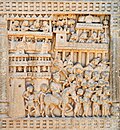
[[File:Procession of Prasenajit of Kosala leaving Sravasti to meet the Buddha.jpg|thumb|Procession of [[Prasenajit]] of Kosala leaving [[Sravasti]] to meet the [[Buddha]], carved relief from [[Sanchi]].<ref>Marshall [https://archive.org/stream/in.ernet.dli.2015.459148 p.59]</ref>]] | |||
[[Mahavira]], the 24th [[Tirthankara]] of [[Jainism]] taught in Kosala. A Buddhist text, the ''Majjhima Nikaya'' mentions [[Gautama Buddha|Buddha]] as a Kosalan, which indicates that Kosala may have subjugated the [[Shakya]] clan, which the Buddha is traditionally believed to have belonged to.<ref>{{harvnb|Raychaudhuri|1972|pp=88–9}}</ref> | |||
=== In Vedic Literature === | === In Vedic Literature === | ||
| Line 44: | Line 83: | ||
| caption2 = Gold carving depiction of the legendary [[Ayodhya]] at the [[Ajmer Jain temple]]. | | caption2 = Gold carving depiction of the legendary [[Ayodhya]] at the [[Ajmer Jain temple]]. | ||
}} | }} | ||
Kosala is not mentioned in the early [[Vedic literature]], but appears as a region in the later Vedic texts of the [[Satapatha Brahmana|Shatapatha Brahmana]] ( | Kosala is not mentioned in the early [[Vedic literature]], but appears as a region in the later Vedic texts of the [[Satapatha Brahmana|Shatapatha Brahmana]] (7th–6th centuries BCE,<ref>[http://www.people.fas.harvard.edu/~witzel/Erdosy1995.pdf "Early Indian history: Linguistic and textual parametres."] in The Indo-Aryans of Ancient South Asia, edited by G. Erdosy (1995), p. 136</ref> final version 300 BCE<ref>[http://www.sacred-texts.com/hin/sbr/index.htm The Satapatha Brahmana]. Sacred Books of the East, Vols. 12, 26, 24, 37, 47, translated by Julius Eggeling [published between 1882 and 1900]</ref>) and the [[Kalpa (Vedanga)|Kalpasutras]] (6th-century BCE).<ref>{{harvnb|Law|1926|pp=34–85}}</ref> | ||
===In Puranas=== | ===In Puranas=== | ||
{{main|Kosala Kingdom}}In the [[Ramayana]], [[Mahabharata]] and the [[Puranas]] the ruling family of the Kosala kingdom was the [[Ikshvaku dynasty]], which was descended from king [[Ikshvaku]].{{sfn|Sastri|1988|p=17}} The Puranas give lists of kings of the Ikshvaku dynasty from Ikshvaku to [[Prasenajit]] (Pali: ''Pasenadi'').<ref>{{harvnb|Raychaudhuri|1972|pp=89–90}}</ref> According to the Ramayana, [[Rama]] ruled the Kosala kingdom from his capital, [[Ayodhya]].<ref>{{harvnb|Raychaudhuri|1972|pp=68–70 | {{main|Kosala Kingdom}}In the [[Ramayana]], [[Mahabharata]] and the [[Puranas]] the ruling family of the [[Kosala kingdom]] was the [[Ikshvaku dynasty]], which was descended from king [[Ikshvaku]].{{sfn|Sastri|1988|p=17}} The Puranas give lists of kings of the Ikshvaku dynasty from [[Ikshvaku]] to [[Prasenajit]] (Pali: ''Pasenadi'').<ref>{{harvnb|Raychaudhuri|1972|pp=89–90}}</ref> According to the Ramayana, [[Rama]] ruled the Kosala kingdom from his capital, [[Ayodhya]].<ref>{{harvnb|Raychaudhuri|1972|pp=68–70}}</ref> | ||
{{Clear}} | {{Clear}} | ||
==History== | ==History== | ||
===Pre-Mauryan=== | ===Pre-Mauryan=== | ||
Koshala's first capital of [[Shravasti]] was barely settled by the 6th century BCE, but there is the beginnings of a mud fort. By 500 BCE, [[List of ancient Indo-Aryan peoples and tribes#Late Janapadas (peoples / tribes) (c. 1100–500 BCE)|Vedic people]] had spread to Koshala. <ref name=":0">{{Cite book|last=Sharma|first=R. S.|title=India's Ancient Past|publisher=Oxford University Press|year=2005|isbn=978-0-19-908786-0|pages= | {{multiple image | ||
[[File:Kosala Karshapana.jpg|thumb|Kosala [[Karshapana]], 5th century BCE.]] | | align = right | ||
| caption_align = center | |||
| direction =vertical | |||
| total_width=250 | |||
| image1 = The eastern Gangetic plain after Bimbisara's conquests.jpg | |||
| caption1 = Map of the eastern Gangetic plain before Viḍūḍabha's conquests | |||
| image2 = The eastern Gangetic plain after Ajatasattu's, Vidudabha's and Udayana's conquests.jpg | |||
| caption2 = Map of the eastern Gangetic plain after Viḍūḍabha's conquest of Kālāma, Sakya and Koliya | |||
| image3 = The eastern Gangetic plain after Ajatasattu's conquest of Kosala.jpg | |||
| caption3 = The eastern Gangetic plain after Viḍūḍabha's defeat by Ajātasattu of Magadha | |||
| footer= | |||
}} | |||
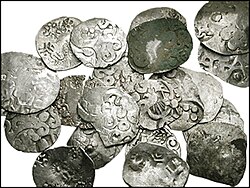
Koshala's first capital of [[Shravasti]] was barely settled by the 6th century BCE, but there is the beginnings of a mud fort. By 500 BCE, [[List of ancient Indo-Aryan peoples and tribes#Late Janapadas (peoples / tribes) (c. 1100–500 BCE)|Vedic people]] had spread to Koshala.<ref name=":0">{{Cite book|last=Sharma|first=R. S.|title=India's Ancient Past|publisher=Oxford University Press|year=2005|isbn=978-0-19-908786-0|pages=167–169}}</ref>[[File:Kosala coin, 400-300 BCE.jpg|thumb|left|Kosala coin, 400-300 BCE]] | |||
[[File:Kosala Karshapana.jpg|thumb|left|Kosala [[Karshapana]], 5th century BCE.]] | |||
By the 5th century BCE under the reign of King Mahakosala, the neighboring [[Kingdom of Kashi]] had been conquered.<ref>{{harvnb|Raychaudhuri|1972|p=138}}</ref> Mahakosala's daughter was the first wife of King [[Bimbisara]] of Magadha. As a dowry, Bimbisara received a Kashi village that had a revenue of 100,000. This marriage temporarily eased tensions between Koshala and Magadha.<ref name=":0" /> | By the 5th century BCE under the reign of King Mahakosala, the neighboring [[Kingdom of Kashi]] had been conquered.<ref>{{harvnb|Raychaudhuri|1972|p=138}}</ref> Mahakosala's daughter was the first wife of King [[Bimbisara]] of Magadha. As a dowry, Bimbisara received a Kashi village that had a revenue of 100,000. This marriage temporarily eased tensions between Koshala and Magadha.<ref name=":0" /> | ||
By the time of Mahākosala's son Pasenadi, Kosala had become the suzerain of the [[Kālāma]] tribal republic,{{sfn|Sharma|1968|p=231-236}} and Pasenadi's realm maintained friendly relations with the powerful [[Licchavi (tribe)|Licchavi]] tribe which lived to the east of his kingdom.{{sfn|Sharma|1968|p=121}} | |||
During Pasenadi's reign, a [[Malla (tribe)|Mallaka]] named Bandhula who had received education in Takṣaśilā, had offered his services as a general to the Kauśalya king so as to maintain the good relations between the Mallakas and Kosala. Later, Bandhula, along with his wife Mallikā, violated the {{Transliteration|pi|Abhiseka-Pokkharaṇī}} sacred tank of the [[Licchavi (tribe)|Licchavikas]], which resulted in armed hostilities between the Kauśalya and the Licchavikas. Bandhula was later treacherously murdered along with his sons by Pasenadi. In retaliation, some Mallakas helped Pasenadi's son [[Virudhaka|Viḍūḍabha]] usurp the throne of Kosala to avenge the death of Bandhula, after which Pasenadi fled from Kosala and died in front of the gates of the [[Magadha (Mahajanapada)|Māgadhī]] capital of [[Rajgir|Rājagaha]].{{sfn|Sharma|1968|p=178-180}} | |||
At some point during his reign, Viḍūḍabha fully annexed the Kālāmas. That the Kālāmas did not request a share of the Buddha's relics after his death was possibly because they had lost their independence by then.{{sfn|Sharma|1968|p=231-236}} | |||
Shortly after the Buddha's death, the Viḍūḍabha invaded the [[Sakya (tribe)|Sakya]] and [[Koliya]] republics, seeking to conquer their territories because they had once been part of Kosala. Viḍūḍabha finally triumphed over the Sakyas and Koliyas and annexed their state after a long war with massive loss of lives on both sides. Details of this war were exaggerated by later Buddhist accounts, which claimed that Viḍūḍabha's invasion was in retaliation for having given in marriage to his father the slave girl who became Viḍūḍabha's mother, and that he exterminated the Sakyas. In actuality, Viḍūḍabha's invasion of Sakya might instead have had similar motivations to the [[Magadha (Mahajanapada)|Māgadhī]] king [[Ajatashatru|Ajātasattu]]'s conquest of the [[Vajjika League]] because he was the son of a Vajjika princess and was therefore interested in the territory of his mother's homeland. The result of the Kauśalya invasion was that the Sakyas and Koliyas were absorbed into Viḍūḍabha's kingdom.{{sfn|Sharma|1968|p=182-206}}{{sfn|Sharma|1968|p=207-217}} | |||
The Kosala | The massive life losses incurred by Kosala during its conquest of Sakya weakened it significantly enough that it was itself was soon annexed by its eastern neighbour, the kingdom of [[Magadha (Mahajanapada)|Magadha]], and Viḍūḍabha was defeated and killed by the Māgadhī king [[Ajatashatru|Ajātasattu]].{{sfn|Sharma|1968|p=182-206}} | ||
Under the reign of [[Mahapadma Nanda]] of Magadha, Koshala rebelled but the rebellion was put down.<ref name=":0" /> | Under the reign of [[Mahapadma Nanda]] of Magadha, Koshala rebelled but the rebellion was put down.<ref name=":0" /> | ||
===Under Mauryan rule=== | ===Under Mauryan rule=== | ||
It is assumed that during the [[Maurya Empire|Mauryan reign]], Kosala was administratively under the viceroy at [[Kosambi|Kaushambi]].<ref>{{harvnb|Mahajan|1960|p=318}}</ref> The Sohgaura copper plate inscription, probably issued during the reign of [[Chandragupta Maurya]] deals with a famine in Shravasti and the relief measures to be adopted by the officials.<ref>{{harvnb|Thapar|2001|pp=7–8}}</ref> The [[Yuga Purana]] section of the [[Yuga Purana|Garga Samhita]] mentions about the ''Yavana'' ([[Indo-Greek]]) invasion and subsequent occupation of Saket during the reign of the last [[Maurya]] ruler Brihadratha.<ref>{{harvnb|Lahiri|1974|pp=21–4}}</ref> | It is assumed that during the [[Maurya Empire|Mauryan reign]], Kosala was administratively under the viceroy at [[Kosambi|Kaushambi]].<ref>{{harvnb|Mahajan|1960|p=318}}</ref> The [[Sohgaura copper plate inscription]], probably issued during the reign of [[Chandragupta Maurya]] deals with a famine in Shravasti and the relief measures to be adopted by the officials.<ref>{{harvnb|Thapar|2001|pp=7–8}}</ref> The [[Yuga Purana]] section of the [[Yuga Purana|Garga Samhita]] mentions about the ''Yavana'' ([[Indo-Greek]]) invasion and subsequent occupation of Saket during the reign of the last [[Maurya]] ruler Brihadratha or [[Pushyamitra Shunga]].<ref>{{harvnb|Lahiri|1974|pp=21–4}}</ref> | ||
===Post-Mauryan period=== | ===Post-Mauryan period=== | ||
| Line 81: | Line 129: | ||
[[File:Aryamitra coin Kosala.jpg|thumb|Coin of ruler Aryamitra, issued in Ayodhya, Kosala. Obv: peacock to right facing tree. Rev: Name ''Ayyamitasa'', humped bull to left facing pole.]] | [[File:Aryamitra coin Kosala.jpg|thumb|Coin of ruler Aryamitra, issued in Ayodhya, Kosala. Obv: peacock to right facing tree. Rev: Name ''Ayyamitasa'', humped bull to left facing pole.]] | ||
<gallery> | <gallery> | ||
Kashi coin, 400-300 BCE.jpg | Kashi coin, 400-300 BCE.jpg|Kashi coin, 400-300 BCE. | ||
</gallery> | </gallery> | ||
{{HistoryOfSouthAsia}} | {{HistoryOfSouthAsia}} | ||
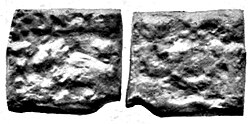
The names of a number of rulers of Kosala of the post-Maurya period are known from the square copper coins issued by them, mostly found at [[Ayodhya]].<ref>Bhandare (2006)</ref> The rulers, forming the [[Deva dynasty (Saketa)|Deva dynasty]], are: Muladeva, Vayudeva, Vishakhadeva, [[Dhanadeva]], Naradatta, Jyesthadatta and Shivadatta. There is no way to know whether king Muladeva of the coins is identifiable with Muladeva, murderer of the Shunga ruler [[Vasumitra]] or not (though a historian, Jagannath has tried to do so).<ref>{{harvnb|Lahiri|1974|p=141n}}</ref> King Dhanadeva of the coins is identified with king Dhanadeva (1st century BCE) of Ayodhya inscription. In this Sanskrit inscription, King Kaushikiputra [[Dhanadeva]] mentions about setting a ''ketana'' (flag-staff) in memory of his father, Phalgudeva. In this inscription he claimed himself as the sixth in descent from [[Pushyamitra Shunga]]. Dhanadeva issued both cast and die-struck coins and both the types have a bull on obverse.<ref>{{harvnb|Bhandare|2006|pp=77–8, 87–8}}</ref><ref>{{harvnb|Falk|2006|p=149}}</ref> | The names of a number of rulers of Kosala of the post-Maurya period are known from the square copper coins issued by them, mostly found at [[Ayodhya]].<ref>Bhandare (2006)</ref> The rulers, forming the [[Deva dynasty (Saketa)|Deva dynasty]], are: Muladeva, Vayudeva, Vishakhadeva, [[Dhanadeva]], Naradatta, Jyesthadatta and Shivadatta. There is no way to know whether king Muladeva of the coins is identifiable with Muladeva, murderer of the Shunga ruler [[Vasumitra]] or not (though a historian, Jagannath has tried to do so).<ref>{{harvnb|Lahiri|1974|p=141n}}</ref> King Dhanadeva of the coins is identified with king Dhanadeva (1st century BCE) of Ayodhya inscription. In this Sanskrit inscription, King Kaushikiputra [[Dhanadeva]] mentions about setting a ''ketana'' (flag-staff) in memory of his father, Phalgudeva. In this inscription he claimed himself as the sixth in descent from [[Pushyamitra Shunga]]. Dhanadeva issued both cast and die-struck coins and both the types have a bull on obverse.<ref>{{harvnb|Bhandare|2006|pp=77–8, 87–8}}</ref><ref>{{harvnb|Falk|2006|p=149}}</ref> | ||
Other local rulers whose coins were found in Kosala include: a group of rulers whose name ends in "-mitra" is also known from their coins: Satyamitra, Aryamitra, Vijayamitra and Devamitra, sometimes called the "Late [[Mitra dynasty (Ayodhya)|Mitra dynasty]] of Kosala".<ref>Proceedings | Other local rulers whose coins were found in Kosala include: a group of rulers whose name ends in "-mitra" is also known from their coins: Satyamitra, Aryamitra, Vijayamitra and Devamitra, sometimes called the "Late [[Mitra dynasty (Ayodhya)|Mitra dynasty]] of Kosala".<ref>Proceedings – Indian History Congress – Volume 1 – Page 74</ref> Other rulers known from their coins are: Kumudasena, Ajavarman and Sanghamitra.<ref>{{Cite web|url=https://books.google.com/books?id=ks4UAAAAIAAJ&pg=PA118|title=Papers on the Date of Kaniṣka: Submitted to the Conference on the Date of Kaniṣka, London, 20–22 April 1960|first=Arthur Llewellyn|last=Basham|date=3 November 1968|publisher=Brill Archive|via=Google Books}}</ref> | ||
==See also== | ==See also== | ||
{{Portal|India|History}} | |||
*[[ | * [[Kosala Kingdom]] | ||
* [[Ayodhya]] | |||
* [[Rama]] | |||
* [[Pasenadi|Prasenjit of Kosala]] | |||
* [[Janapada]] | |||
* [[Mahajanapada]] | |||
* [[Ancestors of Rama]] | |||
* [[List of Ikshvaku dynasty kings in Hinduism|List of Ikshvaku dynasty kings]] | |||
==References== | ==References== | ||
| Line 114: | Line 155: | ||
===Sources=== | ===Sources=== | ||
{{refbegin}} | {{refbegin}} | ||
* {{Cite book |last=Thapar |first=Romila |title=The Past Before Us: Historical Traditions of Early North India |date=2013 |publisher=Harvard Univ. Press |isbn=978-0-674-72523-2 |edition=1 |location=Cambridge, Mass}} | |||
* {{cite journal |author=Hira Lal |title=The Extent and Capital of Daksina Kosala |journal=Indian Antiquary |volume=62 |url=https://books.google.com/books?id=aG5DAAAAYAAJ |year=1986 |orig-year=1933 |publisher=Swati }} | |||
* {{Citation| last = Bhandare| first = S.| year = 2006| title = Between the Empires: Society in India 200 BCE to 400 CE| editor = ''Numismatic Overview of the Maurya-Gupta Interlude'' in P. Olivelle | publisher = New York: Oxford University Press| isbn = 0-19-568935-6}}. | * {{Citation| last = Bhandare| first = S.| year = 2006| title = Between the Empires: Society in India 200 BCE to 400 CE| editor = ''Numismatic Overview of the Maurya-Gupta Interlude'' in P. Olivelle | publisher = New York: Oxford University Press| isbn = 0-19-568935-6}}. | ||
* {{Citation| last = Falk| first = H.| year = 2006| title = Between the Empires: Society in India 200 BCE to 400 CE| editor = ''The Tidal Waves of Indian History'' in P. Olivelle | publisher = New York: Oxford University Press| isbn = 0-19-568935-6}} | * {{Citation| last = Falk| first = H.| year = 2006| title = Between the Empires: Society in India 200 BCE to 400 CE| editor = ''The Tidal Waves of Indian History'' in P. Olivelle | publisher = New York: Oxford University Press| isbn = 0-19-568935-6}} | ||
* {{Citation| last = Lahiri | first = B.| year = 1974| title = Indigenous States of Northern India (Circa 300 B.C. to 200 A.D.) | publisher = Calcutta: University of Calcutta}} | * {{Citation| last = Lahiri | first = B.| year = 1974| title = Indigenous States of Northern India (Circa 300 B.C. to 200 A.D.) | publisher = Calcutta: University of Calcutta}} | ||
* {{Citation| last = Law | first = B.C.| year = 1926| title = Ancient Indian Tribes| url = https://books.google.com/books?id=eFy-K56RKU0C&pg=PA34| publisher = Lahore: Motilal Banarsidass| isbn = 9781406751802}} | |||
*{{cite book|first=B.C.|last= Law| year= 1935| title= Sravasti in Indian Literature|publisher = Memoirs of the Archaeological Survey of India: Number 50, ASI}} | |||
* {{Citation| last = Law | first = B. C.| year = 1973| title = Tribes in Ancient India | publisher = Poona: Bhandarkar Oriental Research Institute}} | * {{Citation| last = Law | first = B. C.| year = 1973| title = Tribes in Ancient India | publisher = Poona: Bhandarkar Oriental Research Institute}} | ||
* {{Citation| last = Mahajan | given1 = V.D.| year = 1960| title = Ancient India | publisher = New Delhi: S. Chand| isbn = 81-219-0887-6}} | * {{Citation| last = Mahajan | given1 = V.D.| year = 1960| title = Ancient India | publisher = New Delhi: S. Chand| isbn = 81-219-0887-6}} | ||
* {{Citation| last = Pargiter | first = F.E.| year = 1972| title = Ancient Indian Historical Tradition | publisher = Delhi: Motilal Banarsidass}} | * {{Citation| last = Pargiter | first = F.E.| year = 1972| title = Ancient Indian Historical Tradition | publisher = Delhi: Motilal Banarsidass}} | ||
| Line 125: | Line 169: | ||
* {{Citation| last = Thapar | first = R.| year = 2001| title = {{IAST|Aśoka and the Decline of the Mauryas}} | publisher = New Delhi: Oxford University Press| isbn = 0-19-564445-X}} | * {{Citation| last = Thapar | first = R.| year = 2001| title = {{IAST|Aśoka and the Decline of the Mauryas}} | publisher = New Delhi: Oxford University Press| isbn = 0-19-564445-X}} | ||
* {{citation |editor-last=Sastri |editor-first=K. A. Nilakanta |editor-link=K. A. Nilakanta Sastri |title=Age of the Nandas and Mauryas |url=https://books.google.com/books?id=YoAwor58utYC |date=1988 |orig-year=1967 |publisher=[[Motilal Banarsidass]] |location=[[Delhi]] |isbn=81-208-0465-1 |edition=Second }} | * {{citation |editor-last=Sastri |editor-first=K. A. Nilakanta |editor-link=K. A. Nilakanta Sastri |title=Age of the Nandas and Mauryas |url=https://books.google.com/books?id=YoAwor58utYC |date=1988 |orig-year=1967 |publisher=[[Motilal Banarsidass]] |location=[[Delhi]] |isbn=81-208-0465-1 |edition=Second }} | ||
* {{cite book |last=Sharma |first=J. P. |author-link= |date=1968 |title=Republics in Ancient India, C. 1500 B.C.-500 B.C. |url= |location=[[Leiden]], Netherlands |publisher=[[Brill Publishers|E. J. Brill]] |page= |isbn=978-9-004-02015-3 }} | |||
* {{citation |last=Singh |first=Upinder |author-link=Upinder Singh |title=A History of Ancient and Early Medieval India: From the Stone Age to the 12th Century |url=https://books.google.com/books?id=Pq2iCwAAQBAJ |publisher=[[Pearson PLC|Pearson]] |year=2016 |isbn=978-81-317-1677-9 |ref={{sfnref|Upinder Singh|2016}} }} | * {{citation |last=Singh |first=Upinder |author-link=Upinder Singh |title=A History of Ancient and Early Medieval India: From the Stone Age to the 12th Century |url=https://books.google.com/books?id=Pq2iCwAAQBAJ |publisher=[[Pearson PLC|Pearson]] |year=2016 |isbn=978-81-317-1677-9 |ref={{sfnref|Upinder Singh|2016}} }} | ||
* {{citation |last=Singh |first=Upinder |title=A History of Ancient and Early Medieval India: From the Stone Age to the 12th Century |url=https://books.google.com/books?id=Pq2iCwAAQBAJ |year=2016 |publisher=[[Pearson PLC|Pearson]] |isbn=978-81-317-1677-9}} | |||
* {{Citation |last=Kosambi |first=D.D. |title=Ancient Kosala and Magadha |year=1952 |publisher=Bombay Branch Royal Asiatic Society}} | |||
* {{Citation |last=Bausch |first=L. M. |title=Kosalan Philosophy in the" Kānva Śatapatha Brāhmana" and the "Suttanipāta" |publication-date=2015 |publisher=University of California, Berkeley}} | |||
* {{Citation |last=Bronkhorst |first=Johannes |url=http://dx.doi.org/10.1163/ej.9789004157194.i-416 |title=Greater Magadha |year=2007 |publisher=BRILL |doi=10.1163/ej.9789004157194.i-416 |isbn=978-90-474-1965-5|url-access=subscription }} | |||
* {{Cite journal |last=Bausch |first=Lauren M. |date=2018 |title=The Kāṇva Brāhmanas and Buddhists in Kosala |journal=The Journal of the International Association of Buddhist Studies |volume=41 |doi=10.2143/JIABS.41.0.3285738}} | |||
{{refend}} | {{refend}} | ||
| Line 132: | Line 182: | ||
[[Category:Kosala| ]] | [[Category:Kosala| ]] | ||
[[Category:Historical | [[Category:Historical regions in India]] | ||
[[Category:Mahajanapadas]] | [[Category:Mahajanapadas]] | ||
[[Category:Places in the Ramayana]] | [[Category:Places in the Ramayana]] | ||
Latest revision as of 21:07, 28 March 2026
Kosala | |||||||||||
|---|---|---|---|---|---|---|---|---|---|---|---|
| c. 7th century BCE[1]–c. 5th century BCE | |||||||||||
 Kosala and its neighboring kingdoms. | |||||||||||
.png) Kosala and the other Mahajanapadas in the Post Vedic period. | |||||||||||
| Capital | Ayodhya and Shravasti of Uttar Kosala | ||||||||||
| Common languages | Sanskrit | ||||||||||
| Religion | Historical Vedic religion Jainism Buddhism | ||||||||||
| Government | Monarchy | ||||||||||
| King | |||||||||||
• ? | Ikshvaku (first) | ||||||||||
• c. 5th century BCE | Sumitra (last) | ||||||||||
| Historical era | Iron Age | ||||||||||
• Established | c. 7th century BCE[1] | ||||||||||
• Disestablished | c. 5th century BCE | ||||||||||
| |||||||||||
| Today part of | India Nepal | ||||||||||

Kosala (IPA: [koːɕɐlɐ]), sometimes referred to as Uttara Kosala (lit. 'Northern Kosala') was one of the Mahajanapadas of ancient India.[2][3] It emerged as a small state during the Late Vedic period[4][5] and became (along with Magadha) one of the earliest states to transition from a lineage-based society to a monarchy.[6] By the 6th century BCE, it had consolidated into one of the four great powers of ancient northern India, along with Magadha, Vatsa, and Avanti.[2][7]
Kosala belonged to the Northern Black Polished Ware culture (c. 700–300 BCE)[1] and was culturally distinct from the Painted Grey Ware culture of the neighboring Kuru-Panchala region, following independent development toward urbanisation and the use of iron.[8] The presence of the lineage of Ikshvaku—described as a raja in the Ṛgveda and an ancient hero in the Atharvaveda[9]—to which Rama, Mahavira, and the Buddha are all thought to have belonged—characterized the Kosalan realm.[10][11]
One of India's two great epics, Ramayana is set in the "Kosala-Videha" realm in which the Kosalan prince Rama marries the Videhan princess Sita.
After a series of wars with neighbouring kingdoms, it was finally defeated and absorbed into the Magadha kingdom in the 5th century BCE. After the collapse of the Maurya Empire and before the expansion of the Kushan Empire, Kosala was ruled by the Deva dynasty, the Datta dynasty, and the Mitra dynasty.
Location[edit | edit source]
Geography[edit | edit source]
Kosala was bounded by the Gomti River in the west, Sarpika River in the south, Sadanira in the east which separated it from Videha, and the Nepal Hills in the north. It encompassed the territories of the Shakyans, Mallakas, Koliyas, Kālāmas and Moriyas at its peak. It roughly corresponds to modern-day Awadh region in India.[12]
Cities and towns[edit | edit source]
The Kosala region had two major cities, Ayodhya (AKA Saketa) and Shravasti, and a number of minor towns as Setavya, Ukattha,[13] Dandakappa, Nalakapana and Pankadha.[14] According to the Puranas and the Ramayana epic, Ayodhya was the capital of Kosala during the reign of Ikshvaku and his descendants.[15] Shravasti is recorded as the capital of Kosala during the Mahajanapada period (6th–5th centuries BCE),[16] but post-Maurya (2nd–1st centuries BCE) kings issued their coins from Ayodhya.
Culture[edit | edit source]
Kosala belonged to the Northern Black Polished Ware culture (c. 700–300 BCE),[1] which was preceded by the Black and red ware culture (c. 1450–1200 BCE until c. 700–500 BCE). The Central Gangetic Plain was the earliest area for rice cultivation in South Asia, and entered the Iron Age around 700 BCE.[1] According to Geoffrey Samuel, following Tim Hopkins, the Central Gangetic Plain was culturally distinct from the Painted Grey Ware culture of the Vedic Aryans of Kuru-Pancala west of it, and saw an independent development toward urbanisation and the use of iron.[8]
Religion[edit | edit source]

Kosala was situated at the crossroads of Vedic heartland of Kuru-Panchala and Greater Magadhan culture.[17] According to Alexander Wynne, Kosala-Videha culture was at the center of unorthodox Vedic traditions, ascetic and speculative traditions, possibly reaching back to the late Ṛgveda.[18] Kosala-Videha culture is thought to be the home of the Śukla school of the Yajurveda.[19]
According to Michael Witzel and Joel Brenton, the Kāṇva school of Vedic traditions (and in turn the first Upanishad i.e, Bṛhadāraṇyaka Upaniṣad) was based in Kosala during the middle and late Vedic periods.[20] Kosala had a significant presence of the muni tradition,[21] which included Buddhists, Jains, Ajivikas, Naga, Yakṣa, and tree worshipers as well as Vedic munis.[22][23] The muni tradition emphasized on "practicing yoga, meditation, renunciation and wandering mendicancy" as contrasted to the ṛṣis who "recited prayers, conducted homa, and led a householder lifestyle".[22]
According to Samuel, there is "extensive iconographical evidence for a religion of fertility and auspiciousness".[24] According to Hopkins, the region was marked by a
...world of female powers, natural transformation, sacred earth and sacred places, blood sacrifices, and ritualists who accepted pollution on behalf of their community.[24]
Jainism[edit | edit source]
Kosala had a particularly strong connection with Jainism. Shravasti is often mentioned in Jaina sources. It is also called Chandrapuri or Chandrikapuri or Ārya Kṣetra, because Jaina texts state that two of their Tirthankaras were born here, namely Sambhavanatha (3rd of 24) and Chandraprabha (8th of 24). Shravasti is also known as the capital city of Kunala's kingdom.[25]
Sambhavanatha is said to have had taken initiation, donated all his belongings, and broken his first fast in Shravasti after begging for alms from King Surendradatta.[26][27] Munisuvrataswami, the 20th Tirthankara, visited Shravasti and initiated several members of the royal family. As per the Jaina text Jnatadharmakathah, Parshvanatha, the 23rd Tirthankara, also visited Shravasti and inspired several lay-followers to accept initiation.[28]
Further, Shravasti is the place of the bitter arguments and meeting between Mahavira – the 24th Tirthankara, and Gosala Mankhaliputta – the founder of Ajivikas and a rival. According to the Jain texts, the Mahavira visited Shravasti many times and spent his tenth varsha monsoon season here before attaining omniscience. He was hosted by a wealthy merchant named Nandinipriya. Ancient Jain scholars such as Kapila, Maghavan and Keshi studied in Shravasti.[28] At Shravasti, Jamāli, Mahavira's son-in-law, created the first of the eight heretical sects by opposing tenets of Jainism as taught by Mahavira himself. The eighth heretical sect, Digambara sect, was created by Sivabhuti at Rathavirapur.[29] As described in the Jaina text Uttaradhyayana Sutra, the discussion between Keśiśramanācharya and Mahavira's first disciple, Gautama Swami, is said to have had taken place at Shravasti. This was the place where Upkeśa Gaccha was established by Keśiśramanācharya after he accepted Mahavira's conduct and became a white-clad monk along with all his disciples who were initially following Parshvanatha's conduct.[30] Moreover, the Pattavali described in the Kalpa Sūtra, states the existence of "Śrāvastikā Śākhā", one of the four branches of the "Veṣavāṭikgaṇa" of the Jaina sangha. It had originated from Ācārya Kāmardhi, a disciple of Ācārya Suhastisuri, belonging to the beginning of the 3rd century BCE.[31] Ācārya Jinaprabhasuri, in his Vividha Tirtha Kalpa confirms that a Jaina temple with an image of Sambhavanatha was renovated multiple times until it was finally completely desecrated during the reign of Alauddin Khilji.[32]
Buddhism[edit | edit source]
Kosala had a particularly strong connection to the Buddha's life. Buddha introduced himself to the king of Magadha in the Suttanipata as a Kosalan.[33] In the Majjhima Nikāya too, king Prasenajit refers to Buddha as a Kosalan.[34] He spent much of his time teaching in Śrāvastī, especially in the Jetavana monastery.[35] According to Samuels, early Buddhism was not a protest against an already established Vedic-Brahmanical system, which developed in Kuru-Pancala realm, but an opposition against the growing influence of this Vedic-Brahmanical system, and the superior position granted to Brahmins in it.[36]
Religious textual references[edit | edit source]
In Buddhist and Jain texts[edit | edit source]

Mahavira, the 24th Tirthankara of Jainism taught in Kosala. A Buddhist text, the Majjhima Nikaya mentions Buddha as a Kosalan, which indicates that Kosala may have subjugated the Shakya clan, which the Buddha is traditionally believed to have belonged to.[38]
In Vedic Literature[edit | edit source]


Kosala is not mentioned in the early Vedic literature, but appears as a region in the later Vedic texts of the Shatapatha Brahmana (7th–6th centuries BCE,[39] final version 300 BCE[40]) and the Kalpasutras (6th-century BCE).[41]
In Puranas[edit | edit source]
In the Ramayana, Mahabharata and the Puranas the ruling family of the Kosala kingdom was the Ikshvaku dynasty, which was descended from king Ikshvaku.[42] The Puranas give lists of kings of the Ikshvaku dynasty from Ikshvaku to Prasenajit (Pali: Pasenadi).[43] According to the Ramayana, Rama ruled the Kosala kingdom from his capital, Ayodhya.[44]
History[edit | edit source]
Pre-Mauryan[edit | edit source]


Koshala's first capital of Shravasti was barely settled by the 6th century BCE, but there is the beginnings of a mud fort. By 500 BCE, Vedic people had spread to Koshala.[45]


By the 5th century BCE under the reign of King Mahakosala, the neighboring Kingdom of Kashi had been conquered.[46] Mahakosala's daughter was the first wife of King Bimbisara of Magadha. As a dowry, Bimbisara received a Kashi village that had a revenue of 100,000. This marriage temporarily eased tensions between Koshala and Magadha.[45]
By the time of Mahākosala's son Pasenadi, Kosala had become the suzerain of the Kālāma tribal republic,[47] and Pasenadi's realm maintained friendly relations with the powerful Licchavi tribe which lived to the east of his kingdom.[48]
During Pasenadi's reign, a Mallaka named Bandhula who had received education in Takṣaśilā, had offered his services as a general to the Kauśalya king so as to maintain the good relations between the Mallakas and Kosala. Later, Bandhula, along with his wife Mallikā, violated the Abhiseka-Pokkharaṇī sacred tank of the Licchavikas, which resulted in armed hostilities between the Kauśalya and the Licchavikas. Bandhula was later treacherously murdered along with his sons by Pasenadi. In retaliation, some Mallakas helped Pasenadi's son Viḍūḍabha usurp the throne of Kosala to avenge the death of Bandhula, after which Pasenadi fled from Kosala and died in front of the gates of the Māgadhī capital of Rājagaha.[49]
At some point during his reign, Viḍūḍabha fully annexed the Kālāmas. That the Kālāmas did not request a share of the Buddha's relics after his death was possibly because they had lost their independence by then.[47]
Shortly after the Buddha's death, the Viḍūḍabha invaded the Sakya and Koliya republics, seeking to conquer their territories because they had once been part of Kosala. Viḍūḍabha finally triumphed over the Sakyas and Koliyas and annexed their state after a long war with massive loss of lives on both sides. Details of this war were exaggerated by later Buddhist accounts, which claimed that Viḍūḍabha's invasion was in retaliation for having given in marriage to his father the slave girl who became Viḍūḍabha's mother, and that he exterminated the Sakyas. In actuality, Viḍūḍabha's invasion of Sakya might instead have had similar motivations to the Māgadhī king Ajātasattu's conquest of the Vajjika League because he was the son of a Vajjika princess and was therefore interested in the territory of his mother's homeland. The result of the Kauśalya invasion was that the Sakyas and Koliyas were absorbed into Viḍūḍabha's kingdom.[50][51]
The massive life losses incurred by Kosala during its conquest of Sakya weakened it significantly enough that it was itself was soon annexed by its eastern neighbour, the kingdom of Magadha, and Viḍūḍabha was defeated and killed by the Māgadhī king Ajātasattu.[50]
Under the reign of Mahapadma Nanda of Magadha, Koshala rebelled but the rebellion was put down.[45]
Under Mauryan rule[edit | edit source]
It is assumed that during the Mauryan reign, Kosala was administratively under the viceroy at Kaushambi.[52] The Sohgaura copper plate inscription, probably issued during the reign of Chandragupta Maurya deals with a famine in Shravasti and the relief measures to be adopted by the officials.[53] The Yuga Purana section of the Garga Samhita mentions about the Yavana (Indo-Greek) invasion and subsequent occupation of Saket during the reign of the last Maurya ruler Brihadratha or Pushyamitra Shunga.[54]
Post-Mauryan period[edit | edit source]


-
 Kashi coin, 400-300 BCE.

| Outline of South Asian history |
|---|
_without_national_boundaries.svg) |
The names of a number of rulers of Kosala of the post-Maurya period are known from the square copper coins issued by them, mostly found at Ayodhya.[55] The rulers, forming the Deva dynasty, are: Muladeva, Vayudeva, Vishakhadeva, Dhanadeva, Naradatta, Jyesthadatta and Shivadatta. There is no way to know whether king Muladeva of the coins is identifiable with Muladeva, murderer of the Shunga ruler Vasumitra or not (though a historian, Jagannath has tried to do so).[56] King Dhanadeva of the coins is identified with king Dhanadeva (1st century BCE) of Ayodhya inscription. In this Sanskrit inscription, King Kaushikiputra Dhanadeva mentions about setting a ketana (flag-staff) in memory of his father, Phalgudeva. In this inscription he claimed himself as the sixth in descent from Pushyamitra Shunga. Dhanadeva issued both cast and die-struck coins and both the types have a bull on obverse.[57][58]
Other local rulers whose coins were found in Kosala include: a group of rulers whose name ends in "-mitra" is also known from their coins: Satyamitra, Aryamitra, Vijayamitra and Devamitra, sometimes called the "Late Mitra dynasty of Kosala".[59] Other rulers known from their coins are: Kumudasena, Ajavarman and Sanghamitra.[60]
See also[edit | edit source]

- Kosala Kingdom
- Ayodhya
- Rama
- Prasenjit of Kosala
- Janapada
- Mahajanapada
- Ancestors of Rama
- List of Ikshvaku dynasty kings
References[edit | edit source]
Citations[edit | edit source]
- ↑ 1.0 1.1 1.2 1.3 Samuel 2010, p. 50.
- ↑ 2.0 2.1 "Kosala | ancient kingdom, India | Britannica". www.britannica.com. Retrieved 8 June 2023.
Kosala rose in political importance early in the 6th century BCE to become one of the 16 states dominant in northern India. It annexed the powerful kingdom of Kashi. About 500 BCE, during the reign of King Prasenajit (Pasenadi), it was regarded as one of the four powers of the north—perhaps the dominant power.
- ↑ Mahajan 1960, p. 230.
- ↑ Samuel 2010, p. 61–63.
- ↑ Michael Witzel (1989), Tracing the Vedic dialects in Dialectes dans les litteratures Indo-Aryennes ed. Caillat, Paris, 97–265.
- ↑ Thapar (2013:260) – Interestingly, in the transition from lineage-based societies to states, it is Magadha and Kosala which emerge among the earlier states that move towards kingdoms.
- ↑ Vikas Nain, "Second Urbanization in the Chronology of Indian History", International Journal of Academic Research and Development 3 (2) (March 2018), pp. 538–542 "Many of the sixteen kingdoms had coalesced into four major ones by 500/400 BCE, by the time of Gautama Buddha. These four were Vatsa, Avanti, Kosala, and Magadha."
- ↑ 8.0 8.1 Samuel 2010, p. 50-51.
- ↑ Thapar (2013:138) – There is a single reference in the Ṛgveda to Ikṣvāku as a rājā, and the Atharvaveda refers to him as an ancient hero.
- ↑ Thapar (2013:287) – Manu’s eldest son, Ikṣvāku, the progenitor of the Sūryavaṃśa, had three sons, two of whom were important and established themselves at Kosala and Videha, contiguous territories in the middle Ganges plain and important to the narrative of the Rāmāyaṇa. The rulers of Kosala and Videha are therefore of collateral lines.
- ↑ Peter Scharf. Ramopakhyana – The Story of Rama in the Mahabharata: A Sanskrit Independent-Study Reader. Routledge, 2014. p. 559.
- ↑ Raychaudhuri 1972, pp. 77–79, 99
- ↑ Raychaudhuri 1972, p. 89.
- ↑ Law 1973, p. 132.
- ↑ Pargiter 1972, p. 257.
- ↑ Samuel 2010, p. 71.
- ↑ Bausch (2015:28) – Kosala thrived on the edge of both the Vedic world and Greater Magadha, where it formed an important center during the lifetimes of the Vedic sage Yājñavalkya as well as Sakyamuni Buddha.
- ↑ Wynne, A. (2011). "Review of Johannes Bronkhorst. Greater Magadha: Studies in the Culture of Early India." Buddhism commissioned by David Arnold.
- ↑ Johnson, W. J. (2009), "Kosala-Videha", A Dictionary of Hinduism, Oxford University Press, doi:10.1093/acref/9780198610250.001.0001, ISBN 978-0-19-861025-0, retrieved 11 June 2023
{{citation}}: CS1 maint: work parameter with ISBN (link) - ↑ Bausch (2015:19)
- ↑ Bausch (2015:1–2,28) After Janaka, when the Vajjis surpassed the Videhas, Kosala emerged as a major center of political power and muni religious activity.
- ↑ 22.0 22.1 Bausch (2018:30)
- ↑ Samuel 2010, p. 48.
- ↑ 24.0 24.1 Samuel 2010, p. 61.
- ↑ Temple, Richard. "Indian Antiquary Vol 53".
- ↑ www.wisdomlib.org (30 November 2018). "Part 10: Sambhava's initiation". www.wisdomlib.org. Retrieved 8 February 2025.
- ↑ www.wisdomlib.org (30 November 2018). "Part 11: Sambhava's fast-breaking". www.wisdomlib.org. Retrieved 8 February 2025.
- ↑ 28.0 28.1 Law 1935, pp. 25–26.
- ↑ Chatterjee, Aseem Kumar. "Comprehensive History Of Jainism".
- ↑ Jacobi, Hermann. "TWENTY-THIRD LECTURE: KÊSI AND GAUTAMA".
- ↑ Jacobi, Hermann. "LIST OF THE STHAVIRAS".
- ↑ Jinaprabhasuri, Ācārya. "Vividha Tirtha Kalpa".
- ↑ Bausch (2018:28–29) – According to the Suttanipāta, Gotama Buddha’s hometown was located in the region of Kosala, what is today eastern Uttar Pradesh. In the Pabbajjāsutta (Sn 3.1), Gotama Buddha explains his personal background to Magadhan King Bimbisāra, telling him that he hails from a country in Kosala.
- ↑ Bausch (2018:29) – In an account given in the Majjhimanikāya, King Pasenadi of Kosala calls the Buddha a Kosalan.
- ↑ Buswell, Robert E.; Lopez, Donald S. (2017), "Kośala", The Princeton Dictionary of Buddhism, Princeton University Press, doi:10.1093/acref/9780190681159.001.0001, ISBN 978-0-691-15786-3, retrieved 11 June 2023
{{citation}}: CS1 maint: work parameter with ISBN (link) - ↑ Samuel 2010, p. 100.
- ↑ Marshall p.59
- ↑ Raychaudhuri 1972, pp. 88–9
- ↑ "Early Indian history: Linguistic and textual parametres." in The Indo-Aryans of Ancient South Asia, edited by G. Erdosy (1995), p. 136
- ↑ The Satapatha Brahmana. Sacred Books of the East, Vols. 12, 26, 24, 37, 47, translated by Julius Eggeling [published between 1882 and 1900]
- ↑ Law 1926, pp. 34–85
- ↑ Sastri 1988, p. 17.
- ↑ Raychaudhuri 1972, pp. 89–90
- ↑ Raychaudhuri 1972, pp. 68–70
- ↑ 45.0 45.1 45.2 Sharma, R. S. (2005). India's Ancient Past. Oxford University Press. pp. 167–169. ISBN 978-0-19-908786-0.
- ↑ Raychaudhuri 1972, p. 138
- ↑ 47.0 47.1 Sharma 1968, p. 231-236.
- ↑ Sharma 1968, p. 121.
- ↑ Sharma 1968, p. 178-180.
- ↑ 50.0 50.1 Sharma 1968, p. 182-206.
- ↑ Sharma 1968, p. 207-217.
- ↑ Mahajan 1960, p. 318
- ↑ Thapar 2001, pp. 7–8
- ↑ Lahiri 1974, pp. 21–4
- ↑ Bhandare (2006)
- ↑ Lahiri 1974, p. 141n
- ↑ Bhandare 2006, pp. 77–8, 87–8
- ↑ Falk 2006, p. 149
- ↑ Proceedings – Indian History Congress – Volume 1 – Page 74
- ↑ Basham, Arthur Llewellyn (3 November 1968). "Papers on the Date of Kaniṣka: Submitted to the Conference on the Date of Kaniṣka, London, 20–22 April 1960". Brill Archive – via Google Books.
Sources[edit | edit source]
- Thapar, Romila (2013). The Past Before Us: Historical Traditions of Early North India (1 ed.). Cambridge, Mass: Harvard Univ. Press. ISBN 978-0-674-72523-2.
- Hira Lal (1986) [1933]. "The Extent and Capital of Daksina Kosala". Indian Antiquary. 62. Swati.
- Bhandare, S. (2006), Numismatic Overview of the Maurya-Gupta Interlude in P. Olivelle (ed.), Between the Empires: Society in India 200 BCE to 400 CE, New York: Oxford University Press, ISBN 0-19-568935-6
{{citation}}: CS1 maint: publisher location (link). - Falk, H. (2006), The Tidal Waves of Indian History in P. Olivelle (ed.), Between the Empires: Society in India 200 BCE to 400 CE, New York: Oxford University Press, ISBN 0-19-568935-6
{{citation}}: CS1 maint: publisher location (link) - Lahiri, B. (1974), Indigenous States of Northern India (Circa 300 B.C. to 200 A.D.), Calcutta: University of Calcutta
{{citation}}: CS1 maint: publisher location (link) - Law, B.C. (1926), Ancient Indian Tribes, Lahore: Motilal Banarsidass, ISBN 9781406751802
{{citation}}: CS1 maint: publisher location (link) - Law, B.C. (1935). Sravasti in Indian Literature. Memoirs of the Archaeological Survey of India: Number 50, ASI.
- Law, B. C. (1973), Tribes in Ancient India, Poona: Bhandarkar Oriental Research Institute
{{citation}}: CS1 maint: publisher location (link) - Mahajan, V.D. (1960), Ancient India, New Delhi: S. Chand, ISBN 81-219-0887-6
- Pargiter, F.E. (1972), Ancient Indian Historical Tradition, Delhi: Motilal Banarsidass
{{citation}}: CS1 maint: publisher location (link) - Raychaudhuri, H.C. (1972), Political History of Ancient India, Calcutta: University of Calcutta
{{citation}}: CS1 maint: publisher location (link) - Samuel, Geoffrey (2010), The Origins of Yoga and Tantra: Indic Religions to the Thirteenth Century, Cambridge University Press, pp. 61–63.
- Thapar, R. (2001), Aśoka and the Decline of the Mauryas, New Delhi: Oxford University Press, ISBN 0-19-564445-X
{{citation}}: CS1 maint: publisher location (link) - Sastri, K. A. Nilakanta, ed. (1988) [1967], Age of the Nandas and Mauryas (Second ed.), Delhi: Motilal Banarsidass, ISBN 81-208-0465-1
- Sharma, J. P. (1968). Republics in Ancient India, C. 1500 B.C.-500 B.C. Leiden, Netherlands: E. J. Brill. ISBN 978-9-004-02015-3.
- Singh, Upinder (2016), A History of Ancient and Early Medieval India: From the Stone Age to the 12th Century, Pearson, ISBN 978-81-317-1677-9
- Singh, Upinder (2016), A History of Ancient and Early Medieval India: From the Stone Age to the 12th Century, Pearson, ISBN 978-81-317-1677-9
- Kosambi, D.D. (1952), Ancient Kosala and Magadha, Bombay Branch Royal Asiatic Society
- Bausch, L. M. (2015), Kosalan Philosophy in the" Kānva Śatapatha Brāhmana" and the "Suttanipāta", University of California, Berkeley
- Bronkhorst, Johannes (2007), Greater Magadha, BRILL, doi:10.1163/ej.9789004157194.i-416, ISBN 978-90-474-1965-5
- Bausch, Lauren M. (2018). "The Kāṇva Brāhmanas and Buddhists in Kosala". The Journal of the International Association of Buddhist Studies. 41. doi:10.2143/JIABS.41.0.3285738.