




WikiDwarfBOT (talk | contribs) robot: add new article |
No edit summary |
||
| Line 1: | Line 1: | ||
{{Short description|Metropolis in Uttar Pradesh, India}} | {{Short description|Metropolis in Uttar Pradesh, India}} | ||
{{About|the city in Uttar Pradesh, India|its namesake district|Jhansi district}} | {{About|the city in Uttar Pradesh, India|its namesake district|Jhansi district|the Indian actress|Jhansi (actress)|the Indian TV series|Jhansi (TV series)}} | ||
{{Use Indian English|date=January 2021}} | {{Use Indian English|date=January 2021}} | ||
{{Use dmy dates|date=September 2020}} | {{Use dmy dates|date=September 2020}} | ||
{{Infobox settlement | {{Infobox settlement | ||
| name | | name = Jhansi<!-- Please do not add any Indic script in this infobox, per WP:INDICSCRIPT policy. --> | ||
| settlement_type | | settlement_type = [[Metropolis]] | ||
| image_skyline | | image_skyline = {{multiple image | ||
| | | border = infobox | ||
| image_caption | | total_width = 230 | ||
| nickname | | image_style = | ||
| perrow = 1/2/1 | |||
| image2 = JhansiSkylinenight rohitkarwal.jpg | |||
| image1= Inside the Rani Laxmibai's Jhansi Fort in Jhansi, Uttar Pradesh 04.jpg | |||
| image4= Virangana Lakshmibai Railway Station 09.jpg | |||
| image3= Statue of Jhalkaribai in Jhansi 07.jpg | |||
}} | |||
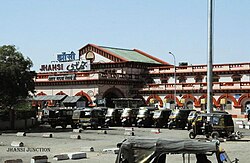
| image_caption = Night view of Jhansi, Jhansi fort, Virangana Lakshmibai Railway Station, Statue of Jhalkaribai | |||
| nickname = {{Plainlist| | |||
* City of [[Rani Lakshmibai]] | * City of [[Rani Lakshmibai]] | ||
* Gateway of [[Bundelkhand]] | * Gateway of [[Bundelkhand]] | ||
* Crossroads of India(The Square of India) : North-south corridor and East-west corridor | * Crossroads of India (The Square of India): North-south corridor and East-west corridor | ||
}} | }} | ||
| map_alt | | map_alt = | ||
| map_caption | | map_caption = | ||
| pushpin_map | | pushpin_map = India Uttar Pradesh#India | ||
| pushpin_label_position | | pushpin_label_position = right | ||
| pushpin_map_alt | | pushpin_map_alt = Balwant Nagar | ||
| pushpin_map_caption | | pushpin_map_caption = | ||
| coordinates | | coordinates = {{coord|25.44862|N|78.56962|E|format=dms|display=inline,title}} | ||
| subdivision_type | | subdivision_type = Country | ||
| subdivision_name | | subdivision_name = {{flag|India}} | ||
| subdivision_type1 | | subdivision_type1 = State | ||
| subdivision_type2 | | subdivision_type2 = [[List of regions of India|Region]] | ||
| subdivision_type3 | | subdivision_type3 = [[List of districts of Uttar Pradesh|District]] | ||
| subdivision_name1 | | subdivision_name1 = [[Uttar Pradesh]] | ||
| subdivision_name2 | | subdivision_name2 = [[Bundelkhand]] | ||
| subdivision_name3 | | subdivision_name3 = [[Jhansi district|Jhansi]] | ||
| established_title | | established_title = <!-- Established --> | ||
| established_date | | established_date = 1613 | ||
| founder | | founder = Raja of Orchha | ||
| named_for | | named_for = | ||
| unit_pref | | unit_pref = Metric | ||
| elevation_footnotes | | elevation_footnotes = | ||
| elevation_m | | elevation_m = 285 | ||
| population_total | | population_total = 505693 | ||
| population_as_of | | population_as_of = 2011 census | ||
| population_footnotes | | population_footnotes = <ref name="Census_MCorp"/> | ||
| population_density_km2 | | population_density_km2 = auto | ||
| population_metro | | population_metro = 547,638<ref name="Census_MCorp"/><ref name="Census_CB"/><ref name="Census_ITS"/> | ||
| population_rank | | population_rank = 57 | ||
| population_demonym | | population_demonym = | ||
| demographics_type1 | | demographics_type1 = [[Language]] | ||
| demographics1_title1 | | demographics1_title1 = Official | ||
| demographics1_info1 | | demographics1_info1 = [[Hindi]]<ref name="langoff">{{cite web|title=52nd Report of the Commissioner for Linguistic Minorities in India |url=http://nclm.nic.in/shared/linkimages/NCLM52ndReport.pdf|website=nclm.nic.in|publisher=[[Ministry of Minority Affairs]]|access-date=18 March 2019|url-status=dead|archive-url=https://web.archive.org/web/20170525141614/http://nclm.nic.in/shared/linkimages/NCLM52ndReport.pdf|archive-date=25 May 2017}}</ref> | ||
| demographics1_title2 | | demographics1_title2 = Additional official | ||
| demographics1_info2 | | demographics1_info2 = [[Urdu]]<ref name="langoff"/> | ||
| timezone1 | | timezone1 = [[Indian Standard Time|IST]] | ||
| utc_offset1 | | utc_offset1 = +5:30 | ||
| postal_code_type | | postal_code_type = [[Postal Index Number|PIN]] | ||
| postal_code | | postal_code = 284001-2-3-4 | ||
| area_code | | area_code = 0510 | ||
| area_code_type | | area_code_type = Telephone code | ||
| registration_plate | | registration_plate = UP-93 | ||
| blank1_name_sec1 | | blank1_name_sec1 = [[Human sex ratio|Sex ratio]] | ||
| blank1_info_sec1 | | blank1_info_sec1 = [[male|♂]] 0.905 : [[female|♀]] 1.000 | ||
| website | | website = {{URL|www.jhansi.nic.in}} | ||
| leader_title2 | | leader_title2 = Mayor | ||
| leader_name2 | | leader_name2 = [[Bihari Lal Arya]], ([[Bharatiya Janata Party|BJP]])<ref>{{cite web|url=https://www.hindustantimes.com/cities/lucknow-news/up-civic-body-polls-2023-ghaziabad-jhansi-kanpur-saharanpur-shahjahanpur-municipal-corporations-winners-101683948442532.html|title=UP civic body polls 2023: Meet mayors of Ghaziabad, Jhansi, Kanpur, Saharanpur & Shahjahanpur|work=Hindustan Times|accessdate=22 May 2023}}</ref> | ||
| leader_title3 | | leader_title3 = [[District Magistrate]] | ||
| leader_name3 | | leader_name3 = Avinash Kumar, IAS<ref>{{cite web |title=Who's Who {{!}} District Jhansi |url=https://jhansi.nic.in/about-district/whos-who/ |website=jhansi.nic.in |access-date=17 February 2022}}</ref> | ||
| leader_title4 | | leader_title4 = [[Senior Superintendent of Police|SSP]] | ||
| leader_name4 | | leader_name4 = Rajesh S, IPS<ref>{{cite news |title=नए एसएसपी ने संभाला पदभार |url=https://www.amarujala.com/uttar-pradesh/jhansi/ssp-jhansi-shivhari-meena-jhansi-news-jhs19637253 |access-date=17 February 2022 |work=Amar Ujala |date=5 June 2021 |language=hi}}</ref> | ||
| blank2_name_sec1 | | blank2_name_sec1 = Crude literacy | ||
| blank2_info_sec1 | | blank2_info_sec1 = 73.90% | ||
| blank3_name_sec1 | | blank3_name_sec1 = Effective literacy | ||
| blank3_info_sec1 | | blank3_info_sec1 = 83.0% | ||
| blank4_name_sec2 | | blank4_name_sec2 = Avg. summer temperature | ||
| blank4_info_sec2 | | blank4_info_sec2 = {{convert|42.4|°C|°F}} | ||
| blank5_name_sec2 | | blank5_name_sec2 = Avg. winter temperature | ||
| blank5_info_sec2 | | blank5_info_sec2 = {{convert|4.0|°C|°F}} | ||
| official_name | | official_name = | ||
| area_total_km2 | | area_total_km2 = 160 | ||
}} | }} | ||
'''Jhansi''' ({{IPA | '''Jhansi''' ({{IPA|hi|d͡ʑʱãː.siː|pron|Jhansi.ogg}}) is a historic city in the [[States and union territories of India|Indian state]] of [[Uttar Pradesh]]. (Toshan) Balwant Nagar was the old name of Jhansi. It lies in the region of [[Bundelkhand]], on the banks of the [[Pahuj River]], in the extreme south of Uttar Pradesh. Jhansi is the administrative headquarters of [[Jhansi district]] and [[Jhansi division]]. Also called the ''Gateway to Bundelkhand'', Jhansi is situated near and around the rivers Pahuj and [[Betwa River|Betwa]] at an average elevation of {{cvt|285|m}}. It is about {{convert|471|km|mi|0}} from national capital [[New Delhi]], 109 kilometres (67.7 mi) from [[Gwalior]], 240 kilometres (150 mi) from [[Kanpur]] and {{convert|320|km}} from state capital [[Lucknow]]. | ||
Jhansi is well connected to all other major towns in [[Uttar Pradesh]] by road and railway networks. The [[National Highways Development Project]] has supported development of the city. Jhansi is also being developed as the | Jhansi is well connected to all other major towns in [[Uttar Pradesh]] by road and railway networks. The [[National Highways Development Project]] has supported development of the city. Jhansi is also being developed as the defence corridor by the NDA government which will boost the economy of the city and the region at the same time. The [[Srinagar]] to [[Kanyakumari]] north–south corridor passes closely to Jhansi, as does the east–west corridor; consequently there has been a sudden rush of infrastructure and real estate development in the city. Jhansi was adjudged the third cleanest city of Uttar Pradesh and the fastest moving city in the North Zone in Swachh Survekshan 2018 rankings. The development of a [[Greenfield project|greenfield]] airport has been planned in the city.<ref>{{cite web|url=http://www.igovernment.in/site/uttar-pradesh-plans-develop-jhansi-airport-39569 |title=Uttar Pradesh plans to develop Jhansi airport |date=4 January 2011 |publisher=igovernment.in |access-date=3 September 2015 | ||
|url-status=dead |archive-url=https://web.archive.org/web/20120321093043/http://www.igovernment.in/site/uttar-pradesh-plans-develop-jhansi-airport-39569 |archive-date=21 March 2012 }}</ref> On 28 August 2011 Jhansi was selected among 98 cities for [[Smart Cities Mission|smart city]] initiative by [[Government of India]].<ref>{{cite news|last1=Jeelani|first1=Mehboob|date=28 August 2015|url=http://www.thehindu.com/news/national/centre-releases-list-of-98-cities-for-smart-city-project/article7586751.ece|title=Centre unveils list of 98 smart cities; UP, TN strike it rich|newspaper=[[The Hindu]]|access-date=17 March 2022}}</ref><ref>{{cite web|url=https://mygov.in/group-issue/smart-city-jhansi/|title=Smart City Jhansi|website=Mygov.in|access-date=24 June 2016|date=26 October 2015}}</ref><ref>{{cite news|url=https://www.amarujala.com/lucknow/poor-performance-of-up-city-in-smart-city-list-hindi-news|title=स्मार्ट सिटी की परीक्षा में फेल हुए यूपी के 12 शहर|access-date=17 March 2022|work=[[Amar Ujala]]|date=30 January 2016}}</ref> | |url-status=dead |archive-url=https://web.archive.org/web/20120321093043/http://www.igovernment.in/site/uttar-pradesh-plans-develop-jhansi-airport-39569 |archive-date=21 March 2012 }}</ref> On 28 August 2011, Jhansi was selected among 98 cities for [[Smart Cities Mission|smart city]] initiative by the [[Government of India]].<ref>{{cite news|last1=Jeelani|first1=Mehboob|date=28 August 2015|url=http://www.thehindu.com/news/national/centre-releases-list-of-98-cities-for-smart-city-project/article7586751.ece|title=Centre unveils list of 98 smart cities; UP, TN strike it rich|newspaper=[[The Hindu]]|access-date=17 March 2022}}</ref><ref>{{cite web|url=https://mygov.in/group-issue/smart-city-jhansi/|title=Smart City Jhansi|website=Mygov.in|access-date=24 June 2016|date=26 October 2015}}</ref><ref>{{cite news|url=https://www.amarujala.com/lucknow/poor-performance-of-up-city-in-smart-city-list-hindi-news|title=स्मार्ट सिटी की परीक्षा में फेल हुए यूपी के 12 शहर|access-date=17 March 2022|work=[[Amar Ujala]]|date=30 January 2016}}</ref> | ||
==Name== | |||
According to Paul Whalley, the name ''Jhānsī'' means "covered in bushes or undergrowth", from a variant of standard Hindi ''[https://en.wiktionary.org/wiki/झाड़ jhāṛ]'' ("bushes, undergrowth"; ultimately from Sanskrit ''[https://en.wiktionary.org/wiki/झाट jhāṭa]''). The ending ''-sī'' represents a reduced form of the Sanskrit [[genitive case|genitive]] suffix ''-sya''.<ref name="Whalley 1922">{{cite journal |last1=Whalley |first1=Paul |title=Place-Names in the United Provinces of Agra and Oudh, Chapter III, Section 2: Suffixes |journal=The Journal of the United Provinces Historical Society |date=1922 |volume=3 |issue=3 |pages=52–98 |url=https://books.google.com/books?id=PwdDAAAAYAAJ |access-date=22 July 2023}}</ref>{{rp|84-5}} | |||
A fanciful old [[folk etymology]] for the name ''Jhānsī'' derives the name from Hindi ''jhāīṁ sī'', meaning "like a shadow" (or, in context, "rather indistinct"). This was supposedly said by the [[Jaitpur State|raja of Jaitpur]], when asked by his host [[Vir Singh Deo|Bir Singh Deo]] if he could see the fort at Jhansi from the rooftop of his palace in Orchha. (The Jaitpur raj was only founded well after Bir Singh's death, and the entire story is probably entirely spurious.)<ref name="Gazetteer 1929"/>{{rp|269}}<ref name="Gazetteer 1965"/>{{rp|1}} | |||
==History== | ==History== | ||
[[File: The Fort, Jhansi, a gelatin silver photo, c.1900.jpg|thumb|left|Jhansi Fort, 1900]] | [[File: The Fort, Jhansi, a gelatin silver photo, c.1900.jpg|thumb|left|Jhansi Fort, 1900]] | ||
===Early history: Orchha and Mughal rule=== | ===Early history: Orchha and Mughal rule=== | ||
Before the construction of [[Jhansi Fort]] on the Bangra hill in 1613, the site is said to have been covered by forest.<!-- 1929 Gazetteer, p. 268 --> The land then belonged to the nearby village of | Before the construction of [[Jhansi Fort]] on the Bangra hill in 1613, the site is said to have been covered by forest.<!-- 1929 Gazetteer, p. 268 --> The land then belonged to the nearby village of Lahargird, which itself belonged to the [[Orchha State|raja of Orchha]]'s territory.<!-- 1929 Gazetteer, p. 268 --> Two [[Ahir]] pastoralists supposedly set up some huts at the foot of the hill to watch over their herds around 1553.<!-- 1929 Gazetteer, p. 268 --> The Orchha raja [[Vir Singh Deo|Bir Singh Deo]] later had the fort built in 1613, and a village grew up around it.<!-- 1929 Gazetteer, p. 268 --> The village was apparently called Balwantnagar at first; when Jhansi became the name is unknown.<!-- 1929 Gazetteer, p. 268 --><ref name="Gazetteer 1929">{{cite book |editor1-last=Drake-Brockman |editor1-first=D. L. |title=Jhansi: A Gazetteer, Being Volume XXIV of the District Gazetteers of the United Provinces of Agra and Oudh |date=1929 |publisher=Government Press |location=Allahabad |url=https://archive.org/details/in.ernet.dli.2015.281580 |access-date=31 May 2023}}</ref>{{rp|268}} | ||
After the death of [[Jhujhar Singh]], Bir Singh's son and successor in Orchha, Jhansi came under [[Mughal Empire|Mughal]] control.<!-- 1929 Gazetteer, p. 268 --> Mughal troops and governors appear to have been posted here uninterrupted until the early 1700s.<!-- 1929 Gazetteer, p. 268 --><ref name="Gazetteer 1929"/>{{rp|268}} | After the death of [[Jhujhar Singh]], Bir Singh's son and successor in Orchha, Jhansi came under [[Mughal Empire|Mughal]] control.<!-- 1929 Gazetteer, p. 268 --> Mughal troops and governors appear to have been posted here uninterrupted until the early 1700s.<!-- 1929 Gazetteer, p. 268 --><ref name="Gazetteer 1929"/>{{rp|268}} | ||
===Maratha rule=== | ===Maratha rule=== | ||
In 1722, [[Chhatrasal]] overran the Jhansi region as part of his new kingdom of Bundelkhand.<!-- 1965 Gazetteer, p. 47 --> However, in 1728, [[Muhammad Khan Bangash]], the Nawab of [[Farrukhabad]], drove him out and the area came back under Mughal control.<!-- 1965 Gazetteer, p. 47 --> Chhatrasal appealed for help to [[Baji Rao I]], the [[Peshwa]] of the [[Maratha Empire]], and their combined forces drove out the Mughal army.<!-- 1965 Gazetteer, p. 47 --> In return, Chhatrasal granted Jhansi (among other places) to Baji Rao in his will when he died in 1731.<!-- 1965 Gazetteer, p. 47 --> In 1735, Raja Indargir Gosain, Maratha governor of Jhansi fort, rebelled and ultimately established a small principality based at [[Moth, Uttar Pradesh|Moth]] to the northeast.<!-- 1965 Gazetteer, p. 47 --> In 1742, the Peshwa put Naru Shankar in charge of Jhansi along with miscellaneous other places.<!-- 1965 Gazetteer, p. 47 --><ref name="Gazetteer 1965">{{cite book |editor1-last=Joshi |editor1-first=Esha Basanti |title=Uttar Pradesh District Gazetteers: Jhansi |date=1965 |publisher=New Government Press |location=Lucknow |url=https://archive.org/details/dli.ministry.08752 |access-date=31 May 2023}}</ref>{{rp|47}} | In 1722, [[Chhatrasal]] overran the Jhansi region as part of his new kingdom of Bundelkhand.<!-- 1965 Gazetteer, p. 47 --> However, in 1728, [[Muhammad Khan Bangash]], the Nawab of [[Farrukhabad]], drove him out and the area came back under Mughal control.<!-- 1965 Gazetteer, p. 47 --> Chhatrasal appealed for help to [[Baji Rao I]], the [[Peshwa]] of the [[Maratha Empire]], and their combined forces drove out the Mughal army.<!-- 1965 Gazetteer, p. 47 --> In return, [[Chhatrasal]] granted Jhansi (among other places) to Baji Rao in his will when he died in 1731.<!-- 1965 Gazetteer, p. 47 --> In 1735, Raja Indargir Gosain, Maratha governor of Jhansi fort, rebelled and ultimately established a small principality based at [[Moth, Uttar Pradesh|Moth]] to the northeast.<!-- 1965 Gazetteer, p. 47 --> In 1742, the Peshwa put Naru Shankar in charge of Jhansi along with miscellaneous other places.<!-- 1965 Gazetteer, p. 47 --><ref name="Gazetteer 1965">{{cite book |editor1-last=Joshi |editor1-first=Esha Basanti |title=Uttar Pradesh District Gazetteers: Jhansi |date=1965 |publisher=New Government Press |location=Lucknow |url=https://archive.org/details/dli.ministry.08752 |access-date=31 May 2023}}</ref>{{rp|47}} | ||
Naru Shankar's tenure as governor was pivotal in Jhansi's history. Up until now, Jhansi had been a fairly small village below the fort, but during this period it grew to become a large town.<!-- 1929 Gazetteer, p. 270 --> Naru Shankar undertook construction projects in the town, including a major expansion of the fort.<!-- 1929 Gazetteer, p. 270 --> He also populated Jhansi with deportees from other towns, primarily Orchha.<!-- 1929 Gazetteer, p. 270 --> (The rajas of Orchha moved their capital to [[Tikamgarh]] around this time, and [[Orchha|the town of Orchha itself]] rapidly declined.)<!-- 1929 Gazetteer, p. 270 --><ref name="Gazetteer 1929"/>{{rp|270}} | Naru Shankar's tenure as governor was pivotal in Jhansi's history. Up until now, Jhansi had been a fairly small village below the fort, but during this period it grew to become a large town.<!-- 1929 Gazetteer, p. 270 --> Naru Shankar undertook construction projects in the town, including a major expansion of the fort.<!-- 1929 Gazetteer, p. 270 --> He also populated Jhansi with deportees from other towns, primarily Orchha.<!-- 1929 Gazetteer, p. 270 --> (The rajas of Orchha moved their capital to [[Tikamgarh]] around this time, and [[Orchha|the town of Orchha itself]] rapidly declined.)<!-- 1929 Gazetteer, p. 270 --><ref name="Gazetteer 1929"/>{{rp|270}} | ||
Naru Shankar was replaced as governor by Madho (or Madhaji) Gobind Antia in 1757.<!-- 1929 Gazetteer, p. 270 --><!-- 1965 Gazetteer, p. 48 --><!-- The 1929 Gazetteer has his name as "Madhaji Gobind Antia", while the 1965 one has "Madho Govind", the name used here is kind of a mixture of both --><ref name="Gazetteer 1929"/>{{rp|270}}<ref name="Gazetteer 1965"/>{{rp|48}} Antia constructed a reservoir known as the Antia Tal outside the city walls, on the [[Gwalior]] road.<!-- 1929 Gazetteer, p. 270 --><ref name="Gazetteer 1929"/>{{rp|270}} Another governor, Babu Rao Kanahi, served after Antia but before 1761,<!-- 1965 Gazetteer, p. 48 --><ref name="Gazetteer 1965"/>{{rp|48}} when Ganesh Shambhaji is described as "the Maratha officer in charge of Jhansi".<!-- Srivastava 1939, p. 138 --> In November 1761, [[Shuja-ud-Daula]], the [[Nawab of Awadh]], had begun a military campaign in Bundelkhand, and Ganesh Shambhaji decided to switch sides and join him.<!-- Srivastava 1939, p. 138 --> After what Ashirbadi Lal Srivastava describes as an "indiscriminate plunder of Jhansi" (he doesn't specify what this means), Ganesh Shambhaji jailed 52 of his Maratha colleagues and agreed to surrender Jhansi to Shuja-ud-Daula in return for a position in the Mughal service.<!-- Srivastava 1939, p. 138-9 --> After a detachment of Shuja-ud-Daula's captured the fortress of Moth, the Maratha governor of Jhansi (who Srivastava doesn't name) fearfully offered to submit and pay a 300,000-rupee tribute in return for being allowed to keep possession of the fort.<!-- Srivastava 1939, p. 139-40 --> Shuja-ud-Daula declined the offer and besieged the city.<!-- Srivastava 1939, p. 140 --> Its defenders surrendered on 1 February 1762.<!-- Srivastava 1939, p. 140 --> Shuja-ud-Daula appointed Muhammad Bashir as ''[[faujdar]]'' of the fort, and gave Ganesh Shambhaji the tax farm revenue for the district.<!-- Srivastava 1939, p. 140 --><ref name="Srivastava 1939">{{cite book |last1=Srivastava |first1=Ashirbadi Lal |title=Shujah-ud-Daulah, Volume I (1754-1765) |date=1939 |publisher=Midland Press |location=Calcutta |url=https://archive.org/details/in.ernet.dli.2015.85274 |access-date=31 May 2023}}</ref>{{rp|138-40}} | Naru Shankar was replaced as governor by Madho (or Madhaji) Gobind Antia in 1757.<!-- 1929 Gazetteer, p. 270 --><!-- 1965 Gazetteer, p. 48 --><!-- The 1929 Gazetteer has his name as "Madhaji Gobind Antia", while the 1965 one has "Madho Govind", the name used here is kind of a mixture of both --><ref name="Gazetteer 1929"/>{{rp|270}}<ref name="Gazetteer 1965"/>{{rp|48}} Antia constructed a reservoir known as the Antia Tal outside the city walls, on the [[Gwalior]] road.<!-- 1929 Gazetteer, p. 270 --><ref name="Gazetteer 1929"/>{{rp|270}} Another governor, Babu Rao Kanahi, served after Antia but before 1761,<!-- 1965 Gazetteer, p. 48 --><ref name="Gazetteer 1965"/>{{rp|48}} when Ganesh Shambhaji is described as "the Maratha officer in charge of Jhansi".<!-- Srivastava 1939, p. 138 --> In November 1761, [[Shuja-ud-Daula]], the [[Nawab of Awadh]], had begun a military campaign in [[Bundelkhand]], and Ganesh Shambhaji decided to switch sides and join him.<!-- Srivastava 1939, p. 138 --> After what Ashirbadi Lal Srivastava describes as an "indiscriminate plunder of Jhansi" (he doesn't specify what this means), Ganesh Shambhaji jailed 52 of his Maratha colleagues and agreed to surrender Jhansi to Shuja-ud-Daula in return for a position in the Mughal service.<!-- Srivastava 1939, p. 138-9 --> After a detachment of Shuja-ud-Daula's captured the fortress of Moth, the Maratha governor of Jhansi (who Srivastava doesn't name) fearfully offered to submit and pay a 300,000-rupee tribute in return for being allowed to keep possession of the fort.<!-- Srivastava 1939, p. 139-40 --> Shuja-ud-Daula declined the offer and besieged the city.<!-- Srivastava 1939, p. 140 --> Its defenders surrendered on 1 February 1762.<!-- Srivastava 1939, p. 140 --> Shuja-ud-Daula appointed Muhammad Bashir as ''[[faujdar]]'' of the fort, and gave Ganesh Shambhaji the tax farm revenue for the district.<!-- Srivastava 1939, p. 140 --><ref name="Srivastava 1939">{{cite book |last1=Srivastava |first1=Ashirbadi Lal |title=Shujah-ud-Daulah, Volume I (1754-1765) |date=1939 |publisher=Midland Press |location=Calcutta |url=https://archive.org/details/in.ernet.dli.2015.85274 |access-date=31 May 2023}}</ref>{{rp|138-40}} | ||
The Mughal rule of Jhansi only lasted for four years before [[Malhar Rao Holkar]] recaptured it for the Marathas.<!-- 1965 Gazetteer, p. 48 --> Naru Shankar was apparently re-appointed governor; after his death, he was succeeded by Vishwas Rao Lachman for five years.<!-- 1965 Gazetteer, p. 48 --><ref name="Gazetteer 1965"/>{{rp|48}} | The Mughal rule of Jhansi only lasted for four years before [[Malhar Rao Holkar]] recaptured it for the Marathas.<!-- 1965 Gazetteer, p. 48 --> Naru Shankar was apparently re-appointed governor; after his death, he was succeeded by Vishwas Rao Lachman for five years.<!-- 1965 Gazetteer, p. 48 --><ref name="Gazetteer 1965"/>{{rp|48}} | ||
| Line 102: | Line 114: | ||
The next governor was [[Newalkar|Raghunath Rao Newalkar]].<!-- 1965 Gazetteer, p. 48 --> In late 1773, Shuja-ud-Daula sent another force south of the [[Yamuna]], this time led by one Mir Naim, but they were defeated in a battle at Jhansi.<!-- 1965 Gazetteer, p. 49 --> Another Mughal-aligned force, led by Mirashgir, came to besiege Jhansi in late 1774, but the death of Shuja-ud-Daula in January 1775 resulted in the siege being abandoned.<!-- 1965 Gazetteer, p. 49 --> Raghunath Rao remained governor until his death in 1794; he had become practically independent by his death.<!-- 1965 Gazetteer, p. 49 --><ref name="Gazetteer 1965"/>{{rp|48-9}} He was succeeded by his brother Sheo Rao Hari, also called Sheo Rao Bhao.<!-- 1929 Gazetteer, p. 271 --> Sheo Rao was responsible for the construction of the city walls, which took place between 1796 and 1814.<!-- 1929 Gazetteer, p. 271 --> The Lachhmi Talao reservoir on the east side of town is sometimes attributed to Sheo Rao as well, although it has also been attributed to Anupgir Gosain of Moth instead.<!-- 1929 Gazetteer, p. 271 --><ref name="Gazetteer 1929"/>{{rp|271}} | The next governor was [[Newalkar|Raghunath Rao Newalkar]].<!-- 1965 Gazetteer, p. 48 --> In late 1773, Shuja-ud-Daula sent another force south of the [[Yamuna]], this time led by one Mir Naim, but they were defeated in a battle at Jhansi.<!-- 1965 Gazetteer, p. 49 --> Another Mughal-aligned force, led by Mirashgir, came to besiege Jhansi in late 1774, but the death of Shuja-ud-Daula in January 1775 resulted in the siege being abandoned.<!-- 1965 Gazetteer, p. 49 --> Raghunath Rao remained governor until his death in 1794; he had become practically independent by his death.<!-- 1965 Gazetteer, p. 49 --><ref name="Gazetteer 1965"/>{{rp|48-9}} He was succeeded by his brother Sheo Rao Hari, also called Sheo Rao Bhao.<!-- 1929 Gazetteer, p. 271 --> Sheo Rao was responsible for the construction of the city walls, which took place between 1796 and 1814.<!-- 1929 Gazetteer, p. 271 --> The Lachhmi Talao reservoir on the east side of town is sometimes attributed to Sheo Rao as well, although it has also been attributed to Anupgir Gosain of Moth instead.<!-- 1929 Gazetteer, p. 271 --><ref name="Gazetteer 1929"/>{{rp|271}} | ||
Sheo Rao's descendants continued to rule what became known as [[Jhansi State]] until 1853.<!-- 1965 Gazetteer, p. 50-1 --> Sheo Rao himself signed the first treaty with the British in 1804, which established a military alliance between the two but still recognised Jhansi as a Maratha vassal.<!-- 1965 Gazetteer, p. 49-50 --> As part of the | Sheo Rao's descendants continued to rule what became known as [[Jhansi State]] until 1853.<!-- 1965 Gazetteer, p. 50-1 --> Sheo Rao himself signed the first treaty with the British in 1804, which established a military alliance between the two but still recognised Jhansi as a Maratha vassal.<!-- 1965 Gazetteer, p. 49-50 --> As part of the Treaty of Pune in 1817, overlordship was transferred from the Marathas to the British themselves.<!-- 1965 Gazetteer, p. 50 --><ref name="Gazetteer 1965"/>{{rp|49-51}} | ||
The | The final ruler of Jhansi State was [[Gangadhar Rao]], who ruled from 1842 to 1853.<!-- 1965 Gazetteer, p. 50-1 --> Gangadhar Rao was a patron of the arts and a capable administrator.<!-- 1965 Gazetteer, p. 51 --> His only son died in infancy, so before he died, he and his wife [[Lakshmi Bai]] adopted a five-year-old boy named [[Damodar Rao of Jhansi|Damodar Rao]] to serve as his successor.<!-- 1965 Gazetteer, p. 51 --> Although this was accepted practice in Hindu law, the British did not recognise Damodar Rao as a valid heir and, invoking the [[Doctrine of Lapse]], declared that Jhansi State had [[escheat]]ed to the British government.<!-- 1965 Gazetteer, p. 51 --> Lakshmi Bai appealed to the British court of directors, but to no avail, and in March 1854 the British took control of Jhansi.<!-- 1965 Gazetteer, pp. 51-52 --><ref name="Gazetteer 1965"/>{{rp|50-2}} | ||
From 1853 to 1861, a [[cantonment]] was built on the southeast side of town.<!-- 1965 Gazetteer, p. 347 --><ref name="Gazetteer 1965"/>{{rp|347}} | The newly-appointed British superintendent of Jhansi, Francis Gordon, wrote a report in 1854 documenting the state of the town at that time.<!-- 1929 Gazetteer, p. 276 --> He estimated that it had a population of 40,000 people.<!-- 1929 Gazetteer, p. 276 --> It was not an industrial centre of any kind, but he wrote that its commercial traffic was "enormous"; he estimated that 3 million rupees' worth of goods passed through Jhansi per year.<!-- 1929 Gazetteer, p. 276 --> Large amounts of grain, coming from farmland to the south and southwest, passed through Jhansi on its way north.<!-- 1929 Gazetteer, p. 276 --> Cotton was brought from the west and then transported north to [[Kalpi]].<!-- 1929 Gazetteer, p. 276 --> Salt also came from the west.<!-- 1929 Gazetteer, p. 276 --> In exchange, the merchants from the south and west bought sugar and various ''[[kirana store|kirana]]'' goods to sell back home.<!-- 1929 Gazetteer, p. 276 --><ref name="Gazetteer 1929"/>{{rp|276}} From 1853 to 1861, a [[cantonment]] was built on the southeast side of town.<!-- 1965 Gazetteer, p. 347 --><ref name="Gazetteer 1965"/>{{rp|347}} | ||
=== | ===Battle for independence 1857=== | ||
{{see also|Indian Rebellion of 1857}} | {{see also|Indian Rebellion of 1857}} | ||
Several factors had contributed to tensions in Jhansi before the | Several factors had contributed to tensions in Jhansi before the battle broke out. Besides the British annexation of Jhansi State, various other members of the landed aristocracy were upset by the British encroaching on their traditional authority.<!-- 1965 Gazetteer, p. 55 --> Local residents were also upset by the fact that the British had permitted cow slaughter after they took over Jhansi (it had previously been banned).<!-- 1965 Gazetteer, p. 55 --> Another grievance was that the British had suspended endowments to the temple of Mahalakshmi (the patron goddess of the Newalkar dynasty) which had previously come from revenue collected from certain villages.<!-- 1965 Gazetteer, p. 55 --><ref name="Gazetteer 1965"/>{{rp|55}} | ||
At this point the garrison was composed entirely of Indian troops, and it consisted of five infantry companies, a cavalry force, and an artillery detachment, all commanded by British officers.<!-- 1929 Gazetteer, p. 209 --><ref name="Gazetteer 1929"/>{{rp|209}} | At this point the garrison was composed entirely of Indian troops, and it consisted of five infantry companies, a cavalry force, and an artillery detachment, all commanded by British officers.<!-- 1929 Gazetteer, p. 209 --><ref name="Gazetteer 1929"/>{{rp|209}} | ||
Tensions boiled over on 5 June. That afternoon, one company of the Jhansi infantry along with the artillery detachment surrounded and entered the star fort and magazine, under the pretext of an attack by dacoits.<!-- 1965 Gazetteer, p. 56 --> They announced their intention to garrison the star fort themselves.<!-- 1929 Gazetteer, p. 209 --> Most of the British civilians took shelter in the regular fort.<!-- 1929 Gazetteer, p. 209 --> The remaining four infantry companies along with the cavalry had not | Tensions boiled over on 5 June. That afternoon, one company of the Jhansi infantry along with the artillery detachment surrounded and entered the star fort and magazine, under the pretext of an attack by dacoits.<!-- 1965 Gazetteer, p. 56 --> They announced their intention to garrison the star fort themselves.<!-- 1929 Gazetteer, p. 209 --> Most of the British civilians took shelter in the regular fort.<!-- 1929 Gazetteer, p. 209 --> The remaining four infantry companies along with the cavalry had not joined in at this point,<!-- 1929 Gazetteer, p. 209 --> and that they night slept in the barracks without incident.<!-- 1965 Gazetteer, p. 56 --> The next day, however, most of them rose up and attacked and killed the British officers on site.<!-- 1929 Gazetteer, p. 209-10 --> They made their way to the main fort, which the rebels encircled and besieged.<!-- 1965 Gazetteer, p. 56 --> This was short-lived and on the 7th the British surrendered.<!-- 1929 Gazetteer, p. 211 --> They were marched south to the Jokhan Bagh, just outside the city walls, and executed.<!-- 1929 Gazetteer, p. 211 --><!-- 1965 Gazetteer, p. 57 --><ref name="Gazetteer 1965"/>{{rp|56-7}}<ref name="Gazetteer 1929"/>{{rp|209-11}} | ||
====Lakshmi Bai's reign==== | ====Lakshmi Bai's reign==== | ||
On the 9th, there was a dispute between Lakshmi Bai and Sada Sheo Rao, a relative of her late husband, over who would rule in Jhansi, with both of them "bidding against each other" to win the support of the rebels.<!-- 1929 Gazetteer, p. 212 --> Lakshmi Bai offered much more and the rebels handed control of Jhansi to her.<!-- 1929 Gazetteer, p. 212 --> A proclamation was made saying "The people are God's, the country is the Padishah's, and the raj is Rani Lakshmi Bai's".<!-- 1965 Gazetteer, p. 57 --> Sada Sheo Rao assembled a force of 300 supporters, seized the fort of | On the 9th, there was a dispute between [[Lakshmi Bai]] and Sada Sheo Rao, a relative of her late husband, over who would rule in Jhansi, with both of them "bidding against each other" to win the support of the rebels.<!-- 1929 Gazetteer, p. 212 --> Lakshmi Bai offered much more and the rebels handed control of Jhansi to her.<!-- 1929 Gazetteer, p. 212 --> A proclamation was made saying "The people are God's, the country is the Padishah's, and the raj is Rani Lakshmi Bai's".<!-- 1965 Gazetteer, p. 57 --> Sada Sheo Rao assembled a force of 300 supporters, seized the fort of Karahra on 13 June, and attempted to proclaim himself ruler of Jhansi, but Lakshmi Bai sent troops after him and ultimately had him imprisoned and detained.<!-- 1929 Gazetteer, p. 212 --><ref name="Gazetteer 1965"/>{{rp|57}}<ref name="Gazetteer 1929"/>{{rp|212}} | ||
Her position now secure, Lakshmi Bai set up an administration in Jhansi. She set up a mint, raised an army, and strengthened the forts at Jhansi and Karahra.<!-- 1929 Gazetteer, p. 212 --> Attempting to stay on good terms with the British, she sent a letter to a British agent named Major Erskine saying that she had only aided the rebels under duress, disavowing the massacre of British prisoners, and presenting herself as just a caretaker until the British could reoccupy the area.<!-- 1965 Gazetteer, p. 58 --><!-- 1929 Gazetteer, p. 212 --> Erskine responded by giving her full authorisation to rule on behalf of the British until their troops arrived and sent a proclamation that all were to obey her; he assured her that she would be treated well.<!-- 1965 Gazetteer, p. 58 --><ref name="Gazetteer 1965"/>{{rp|58}}<ref name="Gazetteer 1929"/>{{rp|212}} | Her position now secure, Lakshmi Bai set up an administration in Jhansi. She set up a mint, raised an army, and strengthened the forts at Jhansi and Karahra.<!-- 1929 Gazetteer, p. 212 --> Attempting to stay on good terms with the British, she sent a letter to a British agent named Major Erskine saying that she had only aided the rebels under duress, disavowing the massacre of British prisoners, and presenting herself as just a caretaker until the British could reoccupy the area.<!-- 1965 Gazetteer, p. 58 --><!-- 1929 Gazetteer, p. 212 --> Erskine responded by giving her full authorisation to rule on behalf of the British until their troops arrived and sent a proclamation that all were to obey her; he assured her that she would be treated well.<!-- 1965 Gazetteer, p. 58 --><ref name="Gazetteer 1965"/>{{rp|58}}<ref name="Gazetteer 1929"/>{{rp|212}} | ||
| Line 130: | Line 140: | ||
====Siege and capture by the British==== | ====Siege and capture by the British==== | ||
Commanders under Lakshmi Bai had all the vegetation outside the fort burned so that advancing British troops could forage absolutely nothing for supplies.<!-- 1965 Gazetteer, p. 63 --> However, the rajas of Orchha and [[Gwalior State|Gwalior]] provided plenty of supplies for the British and their horses, so it ended up being moot.<!-- 1965 Gazetteer, p. 64 --> British forces under [[Hugh Rose, 1st Baron Strathnairn|Hugh Rose]] arrived at Jhansi on 21 March and began a siege the next day after some initial scouting.<!-- 1929 Gazetteer, p. 218 --> On the morning of 1 April, some 22,000 troops under Tantya Tope came to relieve the defenders of Jhansi.<!-- 1929 Gazetteer, p. 219 --> They engaged the British at | {{Main|Siege of Jhansi}} | ||
Commanders under Lakshmi Bai had all the vegetation outside the fort burned so that advancing British troops could forage absolutely nothing for supplies.<!-- 1965 Gazetteer, p. 63 --> However, the rajas of Orchha and [[Gwalior State|Gwalior]] provided plenty of supplies for the British and their horses, so it ended up being moot.<!-- 1965 Gazetteer, p. 64 --> British forces under [[Hugh Rose, 1st Baron Strathnairn|Hugh Rose]] arrived at Jhansi on 21 March and began a siege the next day after some initial scouting.<!-- 1929 Gazetteer, p. 218 --> On the morning of 1 April, some 22,000 troops under Tantya Tope came to relieve the defenders of Jhansi.<!-- 1929 Gazetteer, p. 219 --> They engaged the British at Basoba, some ways away from Jhansi.<!-- 1965 Gazetteer, p. 65 --> Tantya Tope's forces successfully used a [[pincer formation]] to attack both flanks of British infantry, but a British cavalry counterattack used the same formation to envelop ''them'', and Tantya's forces were routed.<!-- 1929 Gazetteer, p. 219-20 --><ref name="Gazetteer 1965"/>{{rp|63-4}}<ref name="Gazetteer 1929"/>{{rp|218-20}} | |||
The British troops looted Jhansi, grabbing jewellery and other valuables and tearing down many of the houses and temples.<!-- 1965 Gazetteer, p. 67 --> The Sanskrit manuscript collection belonging to the royal family of Jhansi was destroyed.<!-- 1965 Gazetteer, p. 67 --> Rose, however, wrote to the governor-general that his troops had occupied the city peacefully and "behaved in an exemplary manner".<!-- 1965 Gazetteer, p. 67 --><ref name="Gazetteer 1965"/>{{rp|67}} | On the morning of 3 April, the British stormed the city through a breach in the city wall.<!-- 1929 Gazetteer, p. 220 --> For the next two days, brutal hand-to-hand fighting took place in the streets as the British tried to advance toward the fort.<!-- 1929 Gazetteer, p. 220 --><!-- 1965 Gazetteer, p. 65 --> During the night of 4-5 April, Lakshmi Bai escaped along with her bodyguards and followers and headed toward Kalpi.<!-- 1965 Gazetteer, p. 65-6 --><!-- 1929 Gazetteer, p. 220 --> The British occupied the fort the following day.<!-- 1965 Gazetteer, p. 66 --><ref name="Gazetteer 1965"/>{{rp|65-6}}<ref name="Gazetteer 1929"/>{{rp|220}} Rose's troops looted Jhansi, grabbing jewellery and other valuables and tearing down many of the houses and temples.<!-- 1965 Gazetteer, p. 67 --> The Sanskrit manuscript collection belonging to the royal family of Jhansi was destroyed.<!-- 1965 Gazetteer, p. 67 --> Rose, however, wrote to the governor-general that his troops had occupied the city peacefully and "behaved in an exemplary manner".<!-- 1965 Gazetteer, p. 67 --><ref name="Gazetteer 1965"/>{{rp|67}} | ||
===British Raj=== | ===British Raj=== | ||
After the rebellion was suppressed, the British rebuilt the cantonment of Jhansi south of the city walls.<!-- 1929 Gazetteer, p. 272 --> At first it was centrally located in the new district, but it went through repeated territorial flip-flopping which left the town at the extreme west of the district, effectively cut off from most of its associated territory.<!-- 1929 Gazetteer, p. 272 --> A treaty in 1861 transferred the town and fort of Jhansi, the parganas of | After the rebellion was suppressed, the British rebuilt the cantonment of Jhansi south of the city walls.<!-- 1929 Gazetteer, p. 272 --> At first it was centrally located in the new district, but it went through repeated territorial flip-flopping which left the town at the extreme west of the district, effectively cut off from most of its associated territory.<!-- 1929 Gazetteer, p. 272 --> A treaty in 1861 transferred the town and fort of Jhansi, the parganas of Pachor and Karahra, and parts of parganas Jhansi and [[Bhander]] to Gwalior State.<!-- 1929 Gazetteer, p. 271 --> Jhansi was re-transferred to British rule in 1885 in exchange for the return of Gwalior, which the British had occupied after the uprising, as well as a payment of 15 lakh rupees.<!-- 1929 Gazetteer, p. 271 --> 58 villages were also transferred with Jhansi at the same time, making up the bulk of the Jhansi tehsil.<!-- 1929 Gazetteer, p. 272 --><ref name="Gazetteer 1929"/>{{rp|271-2}} | ||
The railway came to Jhansi in 1889, when construction of the | The railway came to Jhansi in 1889, when construction of the Indian Midland Railway was completed.<!-- 1929 Gazetteer, p. 78 --> Jhansi was both the headquarters of this railway as well as an important junction with lines heading to [[Kanpur]] and [[Agra]].<!-- 1929 Gazetteer, p. 78 --> The railway quickly drew the bulk of the commercial traffic passing through the region, and Jhansi "sprang into sudden importance" as a commercial centre, surpassing [[Mauranipur|Mau-Ranipur]] as the district's main trade centre.<!-- 1929 Gazetteer, p. 73, 76 --><ref name="Gazetteer 1929"/>{{rp|73-8}} | ||
In 1899, the Hardiganj market was opened on the site of a former royal garden.<!-- 1965 Gazetteer, p. 164 --> It grew to become the largest market in both the city and the district, supplying all the other markets with their own goods.<!-- 1965 Gazetteer, p. 164 --><ref name="Gazetteer 1965"/>{{rp|164}} | In 1899, the Hardiganj market was opened on the site of a former royal garden.<!-- 1965 Gazetteer, p. 164 --> It grew to become the largest market in both the city and the district, supplying all the other markets with their own goods.<!-- 1965 Gazetteer, p. 164 --><ref name="Gazetteer 1965"/>{{rp|164}} | ||
In 1886, the [[Indian National Congress]] came to Jhansi, and in 1888 | In 1886, the [[Indian National Congress]] came to Jhansi, and in 1888 Sripavati Ghosh was elected to serve as Jhansi's delegate in the Congress at Allahabad.<!-- 1965 Gazetteer, p. 70 --> The Congress's provincial conference was held in Jhansi in 1916, on the fort grounds and chaired by [[C. Y. Chintamani]].<!-- 1965 Gazetteer, p. 70 --><ref name="Gazetteer 1965"/>{{rp|70}} | ||
From 1926, the revolutionary [[Chandra Shekhar Azad]] was based in Jhansi, variously posing as a chauffeur and a mechanic.<!-- 1965 Gazetteer, p. 72 --><ref name="Gazetteer 1965"/>{{rp|72}} | From 1926, the revolutionary [[Chandra Shekhar Azad]] was based in Jhansi, variously posing as a chauffeur and a mechanic.<!-- 1965 Gazetteer, p. 72 --><ref name="Gazetteer 1965"/>{{rp|72}} | ||
===Independent India=== | ===Independent India=== | ||
After the [[Independence Day (India)|independence of India]], Jhansi was included in the state of [[Uttar Pradesh]] | After the [[Independence Day (India)|independence of India]], Jhansi was included in the state of [[Uttar Pradesh]]. | ||
==Geography and climate== | ==Geography and climate== | ||
Jhansi is located at 25.4333 N 78.5833 E. It has an average elevation of 284 metres (935 feet).<ref>{{cite web|url=http://www.fallingrain.com/world/IN/36/Jhansi.html|title=Jhansi, India Page|publisher=fallingrain.com|access-date=3 September 2012}}</ref> Jhansi lies on the plateau of central India, an area dominated by rocky relief and minerals underneath the soil. The city has a natural slope in the north as it is on the south western border of the vast ''[[Tarai]]'' plains of Uttar Pradesh and the elevation rises on the south. The land is suitable for species of [[citrus fruit]] and crops include wheat, pulses, peas, and oilseeds. The region relies heavily on [[ | Jhansi is located at 25.4333 N 78.5833 E. It has an average elevation of 284 metres (935 feet).<ref>{{cite web|url=http://www.fallingrain.com/world/IN/36/Jhansi.html|title=Jhansi, India Page|publisher=fallingrain.com|access-date=3 September 2012}}</ref> Jhansi lies on the plateau of central India, an area dominated by rocky relief and minerals underneath the soil. The city has a natural slope in the north as it is on the south western border of the vast ''[[Tarai]]'' plains of Uttar Pradesh and the elevation rises on the south. The land is suitable for species of [[citrus fruit]] and crops include wheat, pulses, peas, and oilseeds. The region relies heavily on [[monsoon]] the rains for irrigation purposes. Under an ambitious canal project (the Rajghat canal), the government is constructing a network of canals for irrigation in Jhansi and Lalitpur and some part of Madhya Pradesh. The trade in agricultural products (including grain and oilseeds) is of great economic importance.<ref>''The Macmillan Encyclopedia''; rev. ed. London: Macmillan, 1983; p. 647</ref> The city is also a centre of brassware manufacture.<ref>Moore, W. G. (1971) ''The Penguin Encyclopedia of Places''. Harmondsworth: Penguin; p. 371</ref> | ||
{{wide image|View of Jhansi from Sipri's Hilltop.jpg|900px|A view of Jhansi from the hill of Sipri)}} | {{wide image|View of Jhansi from Sipri's Hilltop.jpg|900px|A view of Jhansi from the hill of Sipri)}} | ||
| Line 159: | Line 168: | ||
{{Weather box | {{Weather box | ||
| location = Jhansi ( | | location = Jhansi (1991–2020, extremes 1901–present) | ||
| metric first = Yes | | metric first = Yes | ||
| single line = Yes | | single line = Yes | ||
| Line 167: | Line 176: | ||
| Mar record high C = 43.3 | | Mar record high C = 43.3 | ||
| Apr record high C = 46.2 | | Apr record high C = 46.2 | ||
| May record high C = | | May record high C = 49.3 | ||
| Jun record high C = | | Jun record high C = 48.1 | ||
| Jul record high C = 45.6 | | Jul record high C = 45.6 | ||
| Aug record high C = 42.2 | | Aug record high C = 42.2 | ||
| Line 174: | Line 183: | ||
| Oct record high C = 40.6 | | Oct record high C = 40.6 | ||
| Nov record high C = 38.1 | | Nov record high C = 38.1 | ||
| Dec record high C = | | Dec record high C = 35.5 | ||
| year record high C = | | year record high C = 49.3 | ||
| Jan high C = | | Jan high C = 22.8 | ||
| Feb high C = 27. | | Feb high C = 27.3 | ||
| Mar high C = | | Mar high C = 33.9 | ||
| Apr high C = 39. | | Apr high C = 39.7 | ||
| May high C = 42. | | May high C = 42.5 | ||
| Jun high C = 40. | | Jun high C = 40.2 | ||
| Jul high C = 34. | | Jul high C = 34.2 | ||
| Aug high C = 32. | | Aug high C = 32.3 | ||
| Sep high C = 33. | | Sep high C = 33.4 | ||
| Oct high C = 34. | | Oct high C = 34.3 | ||
| Nov high C = 30. | | Nov high C = 30.1 | ||
| Dec high C = | | Dec high C = 24.9 | ||
| year high C = 33. | | year high C = 33.0 | ||
| Jan low C = 8. | | Jan low C = 8.6 | ||
| Feb low C = 11. | | Feb low C = 11.9 | ||
| Mar low C = | | Mar low C = 17.3 | ||
| Apr low C = | | Apr low C = 23.2 | ||
| May low C = | | May low C = 27.4 | ||
| Jun low C = 27. | | Jun low C = 27.9 | ||
| Jul low C = 25. | | Jul low C = 25.6 | ||
| Aug low C = | | Aug low C = 24.6 | ||
| Sep low C = 23. | | Sep low C = 23.9 | ||
| Oct low C = | | Oct low C = 20.3 | ||
| Nov low C = | | Nov low C = 14.8 | ||
| Dec low C = | | Dec low C = 10.2 | ||
| year low C = 19. | | year low C = 19.7 | ||
| Jan record low C = | | Jan record low C = 0.5 | ||
| Feb record low C = 0.6 | | Feb record low C = 0.6 | ||
| Mar record low C = 5.3 | | Mar record low C = 5.3 | ||
| Line 211: | Line 220: | ||
| Aug record low C = 18.3 | | Aug record low C = 18.3 | ||
| Sep record low C = 16.7 | | Sep record low C = 16.7 | ||
| Oct record low C = | | Oct record low C = 6.3 | ||
| Nov record low C = 1.1 | | Nov record low C = 1.1 | ||
| Dec record low C = 0.3 | | Dec record low C = 0.3 | ||
| year record low C = 0.3 | | year record low C = 0.3 | ||
| rain colour = green | | rain colour = green | ||
| Jan rain mm = | | Jan rain mm = 10.7 | ||
| Feb rain mm = | | Feb rain mm = 13.8 | ||
| Mar rain mm = | | Mar rain mm = 8.6 | ||
| Apr rain mm = | | Apr rain mm = 5.0 | ||
| May rain mm = 15. | | May rain mm = 15.7 | ||
| Jun rain mm = | | Jun rain mm = 95.8 | ||
| Jul rain mm = | | Jul rain mm = 251.9 | ||
| Aug rain mm = | | Aug rain mm = 248.5 | ||
| Sep rain mm = | | Sep rain mm = 149.0 | ||
| Oct rain mm = | | Oct rain mm = 23.0 | ||
| Nov rain mm = 5. | | Nov rain mm = 5.0 | ||
| Dec rain mm = 3 | | Dec rain mm = 4.3 | ||
|year rain mm = | |year rain mm = 831.2 | ||
| Jan rain days = 0 | | Jan rain days = 1.0 | ||
| Feb rain days = 1. | | Feb rain days = 1.1 | ||
| Mar rain days = 0.8 | | Mar rain days = 0.8 | ||
| Apr rain days = 0. | | Apr rain days = 0.6 | ||
| May rain days = 1. | | May rain days = 1.6 | ||
| Jun rain days = 5. | | Jun rain days = 5.7 | ||
| Jul rain days = 11. | | Jul rain days = 11.9 | ||
| Aug rain days = 12. | | Aug rain days = 12.4 | ||
| Sep rain days = | | Sep rain days = 7.1 | ||
| Oct rain days = 1. | | Oct rain days = 1.3 | ||
| Nov rain days = 0. | | Nov rain days = 0.4 | ||
| Dec rain days = 0.4 | | Dec rain days = 0.4 | ||
| year rain days = | | year rain days = 44.3 | ||
|time day = 17:30 [[Indian Standard Time|IST]] | |time day = 17:30 [[Indian Standard Time|IST]] | ||
| Jan humidity = | | Jan humidity = 57 | ||
| Feb humidity = | | Feb humidity = 46 | ||
| Mar humidity = | | Mar humidity = 32 | ||
| Apr humidity = | | Apr humidity = 24 | ||
| May humidity = | | May humidity = 25 | ||
| Jun humidity = | | Jun humidity = 42 | ||
| Jul humidity = | | Jul humidity = 69 | ||
| Aug humidity = | | Aug humidity = 75 | ||
| Sep humidity = | | Sep humidity = 64 | ||
| Oct humidity = | | Oct humidity = 45 | ||
| Nov humidity = | | Nov humidity = 47 | ||
| Dec humidity = | | Dec humidity = 57 | ||
|year humidity = | |year humidity = 49 | ||
| source 1 = [[India Meteorological Department]]<ref name=IMDnormals> | | source 1 = [[India Meteorological Department]]<ref>{{cite web | ||
| url = https://imdpune.gov.in/library/public/Climatological%20Tables%201991-2020.pdf | |||
| title = Climatological Tables of Observatories in India 1991-2020 | |||
| publisher = [[India Meteorological Department]] | |||
| access-date = April 8, 2024 | |||
}}</ref><ref name=IMDnormals> | |||
{{cite web | {{cite web | ||
| archive-url = https://web.archive.org/web/20200205040301/http://imdpune.gov.in/library/public/1981-2010%20CLIM%20NORMALS%20%28STATWISE%29.pdf | | archive-url = https://web.archive.org/web/20200205040301/http://imdpune.gov.in/library/public/1981-2010%20CLIM%20NORMALS%20%28STATWISE%29.pdf | ||
| Line 276: | Line 290: | ||
| page = M217 | | page = M217 | ||
| access-date = 27 April 2020}}</ref> | | access-date = 27 April 2020}}</ref> | ||
}} | }}Jhansi has been ranked 3rd best “National Clean Air City” under (Category 2 3-10L Population cities) in India according to 'Swachh Vayu Survekshan 2024 Results' <ref>{{Cite web |date=7 September 2024 |title=Swachh Vayu Sarvekshan 2024 |url=https://prana.cpcb.gov.in/ncapServices/robust/fetchFilesFromDrive/Swachh_Vayu_Survekshan_2024_Result.pdf |website=Swachh Vayu Sarvekshan 2024 |access-date=18 September 2024 |archive-date=14 September 2024 |archive-url=https://web.archive.org/web/20240914164336/https://prana.cpcb.gov.in/ncapServices/robust/fetchFilesFromDrive/Swachh_Vayu_Survekshan_2024_Result.pdf |url-status=dead }}</ref> The city has shown a 19% improvement in air quality compared to the previous year. | ||
==Demographics== | ==Demographics== | ||
{{Historical populations | {{Historical populations | ||
| Line 299: | Line 312: | ||
|source = 1871-1891 - [[The Imperial Gazetteer of India]]<ref>{{cite web|title=Imperial Gazetteer of India, Volume 14, page 148|url=https://dsal.uchicago.edu/reference/gazetteer/pager.html?objectid=DS405.1.I34_V14_154.gif|website=dsal.uchicago.edu|publisher=Digital South Asia Library|access-date=20 July 2017}}</ref><br />1901-1981 - Populstat.info<ref>{{cite web|title=INDIA : urban population|url=http://www.populstat.info/Asia/indiat.htm|website=www.populstat.info|access-date=20 July 2017}}</ref><br />1991-2011 - Citypopulation.de<ref>{{cite web|title=Jhansi (Jhansi, Uttar Pradesh, India) - Population Statistics and Location in Maps and Charts|url=http://www.citypopulation.de/php/india-uttarpradesh.php?cityid=0943614000|website=www.citypopulation.de|access-date=20 July 2017|language=en}}</ref> | |source = 1871-1891 - [[The Imperial Gazetteer of India]]<ref>{{cite web|title=Imperial Gazetteer of India, Volume 14, page 148|url=https://dsal.uchicago.edu/reference/gazetteer/pager.html?objectid=DS405.1.I34_V14_154.gif|website=dsal.uchicago.edu|publisher=Digital South Asia Library|access-date=20 July 2017}}</ref><br />1901-1981 - Populstat.info<ref>{{cite web|title=INDIA : urban population|url=http://www.populstat.info/Asia/indiat.htm|website=www.populstat.info|access-date=20 July 2017}}</ref><br />1991-2011 - Citypopulation.de<ref>{{cite web|title=Jhansi (Jhansi, Uttar Pradesh, India) - Population Statistics and Location in Maps and Charts|url=http://www.citypopulation.de/php/india-uttarpradesh.php?cityid=0943614000|website=www.citypopulation.de|access-date=20 July 2017|language=en}}</ref> | ||
}} | }} | ||
{{bar box | {{bar box | ||
|title=Religions in Jhansi city (2011)<ref name="religion">{{Cite web|date=2011|title=Table C-01 Population by Religion: Uttar Pradesh|url=https://censusindia.gov.in/nada/index.php/catalog/11394/download/14507/DDW09C-01%20MDDS.XLS|website=censusindia.gov.in|publisher=[[Registrar General and Census Commissioner of India]]}}</ref> | |title=Religions in Jhansi city (2011)<ref name="religion">{{Cite web|date=2011|title=Table C-01 Population by Religion: Uttar Pradesh|url=https://censusindia.gov.in/nada/index.php/catalog/11394/download/14507/DDW09C-01%20MDDS.XLS|website=censusindia.gov.in|publisher=[[Registrar General and Census Commissioner of India]]}}</ref> | ||
| Line 307: | Line 320: | ||
|float=left | |float=left | ||
|bars= | |bars= | ||
{{bar percent|[[ | {{bar percent|[[Hinduism]]|darkorange|81.10}} | ||
{{bar percent|[[Islam in Uttar Pradesh| | {{bar percent|[[Islam in Uttar Pradesh|Islam]]|green|16.51}} | ||
{{bar percent|[[ | {{bar percent|[[Christianity in Uttar Pradesh|Christianity]]|dodgerblue|0.94}} | ||
{{bar percent|[[Sikhism]]|darkkhaki|0.52}} | |||
{{bar percent|[[Jainism in Uttar Pradesh|Jainism]]|pink|0.46}} | |||
{{bar percent|Other or not stated|black|0.47}} | |||
|caption=Distribution of religions | |caption=Distribution of religions | ||
}} | }} | ||
As of [[2011 Indian Census]], Jhansi city had a total population of 505,693, of which 265,449 were males and 240,244 were females. Population within the age group of 0 to 6 years was 55,824. The total number of literates in Jhansi city was 373,500, which constituted 73.9% of the population with male literacy of 78.9% and female literacy of 68.3%. The effective literacy rate of 7+ population of Jhansi city was 83.0%, of which male literacy rate was 88.9% and female literacy rate was 76.6%. The [[Scheduled Castes and Scheduled Tribes]] population was 110,318 and 1,681 respectively. Jhansi city had 91,150 households in 2011.<ref name="Census_MCorp">{{cite web |title=Census of India: Jhansi city |url=http://www.censusindia.gov.in/pca/SearchDetails.aspx?Id=176733 |website=www.censusindia.gov.in |access-date=23 November 2019}}</ref> | |||
{{pie chart | |||
|thumb = left | |||
|caption = Languages in Jhansi (2011)<ref name="Lang"/> | |||
|label1 = [[Hindi]] |value1 = 97.14 |color1 = orange | |||
|label2 = [[Urdu]] |value2 = 1.57 |color2 = green | |||
|label3 = Others |value3 = 1.29 |color3 = grey | |||
}} | |||
[[Hindi]] was the predominant language in the city, while [[Urdu]] was spoken by a minority.<ref name="Lang">{{cite web |title=2011 Census of India, Population By Mother Tongue - Uttar Pradesh (Town Level) |url=https://censusindia.gov.in/nada/index.php/catalog/10235/download/13347/DDW-C16-TOWN-STMT-MDDS-0900.XLSX |access-date=27 June 2022 |website=censusindia.gov.in |publisher=[[Registrar General and Census Commissioner of India]]}}</ref> | |||
The Jhansi urban agglomeration had a population of 547,638 which also included Jhansi Cantonment and Jhansi Railway Settlement. | The Jhansi urban agglomeration had a population of 547,638 which also included Jhansi Cantonment and Jhansi Railway Settlement. | ||
===Jhansi Cantonment=== | ===Jhansi Cantonment=== | ||
Jhansi Cantonment had a total population of 28,343 in 2011, of which 17,023 were males and 11,320 were females. Population within the age group of 0 to 6 years was 3,404. The total number of literates in Jhansi Cantonment was 23,354, which constituted 82.4% of the population. The effective literacy rate of 7+ population of Jhansi Cantonment was 93.6%. The [[Scheduled Castes and Scheduled Tribes]] population was 4,735 and 28 respectively. It had | Jhansi Cantonment had a total population of 28,343 in 2011, of which 17,023 were males and 11,320 were females. Population within the age group of 0 to 6 years was 3,404. The total number of literates in Jhansi Cantonment was 23,354, which constituted 82.4% of the population. The effective literacy rate of 7+ population of Jhansi Cantonment was 93.6%. The [[Scheduled Castes and Scheduled Tribes]] population was 4,735 and 28 respectively. It had 30,460 households in 2011.<ref name="Census_CB">{{cite web |title=Census of India: Jhansi Cantonment |url=http://www.censusindia.gov.in/pca/SearchDetails.aspx?Id=176794 |website=www.censusindia.gov.in |access-date=23 November 2019}}</ref> | ||
===Jhansi Railway Settlement=== | ===Jhansi Railway Settlement=== | ||
| Line 322: | Line 350: | ||
==Songs and Poems== | ==Songs and Poems== | ||
A number of patriotic songs have been written about the Rani. The most famous composition about Rani Lakshmi Bai is the Hindi poem ''Jhansi ki Rani'' written by [[Subhadra Kumari Chauhan]]. An emotionally charged description of the life of Rani Lakshmibai, it is often taught in schools in India.<ref>{{cite web|title=Poems of Bundelkhand|url=http://www.bundelkhand.in/POEM/khoob-ladi-mardani-woh-to-jhansi-wali-rani-thi|website=www.bundelkhand.in|publisher=Bundelkhand.In|access-date=27 June 2017}}</ref> A popular stanza from it reads: | A number of patriotic songs have been written about the Rani. The most famous composition about Rani Lakshmi Bai is the Hindi poem ''Jhansi ki Rani'' written by [[Subhadra Kumari Chauhan]]. An emotionally charged description of the life of [[Rani of Jhansi|Rani Lakshmibai]], it is often taught in schools in India.<ref>{{cite web|title=Poems of Bundelkhand|url=http://www.bundelkhand.in/POEM/khoob-ladi-mardani-woh-to-jhansi-wali-rani-thi|website=www.bundelkhand.in|publisher=Bundelkhand.In|access-date=27 June 2017|archive-date=20 April 2024|archive-url=https://web.archive.org/web/20240420141504/https://bundelkhand.in/POEM/khoob-ladi-mardani-woh-to-jhansi-wali-rani-thi|url-status=dead}}</ref> A popular stanza from it reads: | ||
{{blockquote|बुंदेले हरबोलों के मुँह हमने सुनी कहानी थी, | {{blockquote|बुंदेले हरबोलों के मुँह हमने सुनी कहानी थी, | ||
खूब लड़ी मर्दानी वह तो झाँसी वाली रानी थी।।<ref>{{cite web|last1=Chauhan|first1=Subhadra Kumari|title=Jhansi ki rani|url=https://www.poemhunter.com/poem/hindi-poem-khub-ladi-mardani-woh-to-jhansi-wali-rani-thi/|website=www.poemhunter.com|publisher=Poem hunter|access-date=27 June 2017}}</ref>}} | खूब लड़ी मर्दानी वह तो झाँसी वाली रानी थी।।<ref>{{cite web|last1=Chauhan|first1=Subhadra Kumari|title=Jhansi ki rani|url=https://www.poemhunter.com/poem/hindi-poem-khub-ladi-mardani-woh-to-jhansi-wali-rani-thi/|website=www.poemhunter.com|publisher=Poem hunter|access-date=27 June 2017}}</ref>}} | ||
| Line 342: | Line 370: | ||
===Higher education=== | ===Higher education=== | ||
<!---♦♦♦ Only add an institution to this list if it already has its own article on the English Bharatpedia ♦♦♦---> | |||
<!---♦♦♦ Please keep the list in alphabetical order ♦♦♦---> | |||
* [[Bundelkhand University]] | * [[Bundelkhand University]] | ||
* [[Rani Lakshmi Bai Central Agricultural University]] | * [[Rani Lakshmi Bai Central Agricultural University]] | ||
====Medical and technical colleges==== | ====Medical and technical colleges==== | ||
[[File:Mlb jhansi.jpg|thumb|MLB Medical College]] | [[File:Mlb jhansi.jpg|thumb|MLB Medical College]] | ||
In October 2009, the [[Ministry of Health and Family Welfare|Union health ministry]] gave approvals for setting up an institute equivalent to [[AIIMS]], the first in Bundelkhand region and developing central agriculture university.<ref>{{cite web|url=http://archive.indianexpress.com/news/centre-clears-an--aiims--for-bundelkhand/533791/|title=Centre clears an 'AIIMS' for Bundelkhand|website=Archive.indianexpress.com|access-date=23 August 2015}}</ref> | In October 2009, the [[Ministry of Health and Family Welfare|Union health ministry]] gave approvals for setting up an institute equivalent to [[AIIMS]], the first in Bundelkhand region and developing central agriculture university.<ref>{{cite web|url=http://archive.indianexpress.com/news/centre-clears-an--aiims--for-bundelkhand/533791/|title=Centre clears an 'AIIMS' for Bundelkhand|website=Archive.indianexpress.com|access-date=23 August 2015}}</ref> | ||
* [[Bundelkhand Institute of Engineering & Technology]] | <!---♦♦♦ Only add a college to this list if it already has its own article on the English Bharatpedia ♦♦♦---> | ||
* [[Government Polytechnic Jhansi]]<ref>{{cite web|url=http://gpjhansi.com/|title=Government Polytechnic Jhansi|archive-url=https://web.archive.org/web/20140109081136/http://gpjhansi.com/|archive-date=9 January 2014|url-status= | <!---♦♦♦ Please keep the list in alphabetical order ♦♦♦--->* [[Bundelkhand Institute of Engineering & Technology]] | ||
* [[Government Polytechnic Jhansi]]<ref>{{cite web|url=http://gpjhansi.com/|title=Government Polytechnic Jhansi|archive-url=https://web.archive.org/web/20140109081136/http://gpjhansi.com/|archive-date=9 January 2014|url-status=usurped|access-date=30 December 2013}}</ref> | |||
* [[Maharani Laxmi Bai Medical College]], established 1968<ref>{{cite web|url=http://mlbmcj.in/ |title=Maharani Laxmibai Medical College Jhansi |website=Mlbmcj.in |access-date=24 June 2016}}</ref> | * [[Maharani Laxmi Bai Medical College]], established 1968<ref>{{cite web|url=http://mlbmcj.in/ |title=Maharani Laxmibai Medical College Jhansi |website=Mlbmcj.in |access-date=24 June 2016}}</ref> | ||
===Schools=== | ===Schools=== | ||
<!---♦♦♦ Only add a school to this list if it already has its own article on the English Bharatpedia ♦♦♦---> | |||
<!---♦♦♦ Please keep the list in alphabetical order ♦♦♦---> | |||
* [[Christ the King College, Jhansi]] | * [[Christ the King College, Jhansi]] | ||
* [[Indian Army Public Schools|Army Public School, Jhansi]] | * [[Indian Army Public Schools|Army Public School, Jhansi]] | ||
{{ | |||
* | ==Economy == | ||
Jhansi has a mixed economy, Jhansi's economy is based on agriculture, industry, mining and tourism.<ref>{{Cite web | title=Economy {{!}} District Jhansi, Government of Uttar Pradesh {{!}} India | url=https://jhansi.nic.in/economy/ | access-date=2025-12-30 | website=jhansi.nic.in}}</ref> | |||
* | * Agriculture: | ||
A significant portion of the economy is tied to agriculture, with the district relying on monsoon rains for irrigation. primarily driven by agriculture, with crops like wheat, pulses, and oilseeds being major sources of income. The Rajghat canal project aims to improve irrigation and boost agricultural production.<ref>{{Cite web| title=Brief Industrial Profile of Jhansi District | url=https://dcmsme.gov.in/old/dips/District%20Industrial%20Profile%20of%20Jhansi.pdf | archive-url=https://web.archive.org/web/20220810010037/http://dcmsme.gov.in/old/dips/District%20Industrial%20Profile%20of%20Jhansi.pdf | archive-date=2022-08-10}}</ref> | |||
* Industry: | |||
* [[ | Established industries, including BHEL Jhansi, cement factories, and a thermal power plant, play a crucial role in the district's economy. | ||
Some valuable industrial units are located in Jhansi. | |||
*[[ | * [[Parichha Thermal Power Station]] | ||
*[[ | * [[Electric Loco Shed, Jhansi]] | ||
*[[ | * [[BHEL Jhansi]] | ||
* [[Mysore Cements Limited|Diamond Cement Jhansi]]<ref>{{Cite web|url=https://www.tradeindia.com/diamond-cement-2977742/|title=Diamond Cement in Jhansi, Uttar Pradesh, India - Company Profile|website=www.tradeindia.com}}</ref> | |||
In 2023, the Uttar Pradesh government announced plans to develop Jhansi as part of the Bundelkhand Industrial Development Authority. This initiative aims to create a new industrial township, potentially boosting the region's economic growth and employment opportunities.<ref>{{Cite news |date=2023-09-13 |title=Uttar Pradesh's Yogi Adityanath govt plans to develop another Noida in Jhansi |url=https://economictimes.indiatimes.com/news/india/uttar-pradeshs-yogi-adityanath-govt-plans-to-develop-another-noida-in-jhansi/articleshow/103632013.cms |access-date=2025-01-02 |work=The Economic Times |issn=0013-0389}}</ref> | |||
== Municipal finance == | |||
According to financial data published on the CityFinance Portal of the Ministry of Housing and Urban Affairs,<ref>{{cite web |title=Jhansi Municipal Corporation Finance |url=https://www.cityfinance.in/municipal-data/city/jhansi |publisher=CityFinance Portal, Ministry of Housing and Urban Affairs |access-date=16 March 2026}}</ref> the Jhansi Municipal Corporation reported total revenue receipts of ₹179 crore (US$21 million) and total expenditure of ₹202 crore (US$24 million) in 2022–23. Tax revenue accounted for about 13.4% of the total revenue, while the corporation received ₹143 crore in grants during the financial year. | |||
==Transport== | ==Transport== | ||
| Line 400: | Line 421: | ||
===Air transport=== | ===Air transport=== | ||
[[File: Amy Johnson jason india.jpg|thumb|[[Amy Johnson]] at Jhansi in 1932]] | [[File: Amy Johnson jason india.jpg|thumb|[[Amy Johnson]] at Jhansi in 1932]] | ||
[[Jhansi | [[Jhansi Airstrip]] is a military aviation base built in the British era used by the Indian army and political visitors. Though there are provisions for private aircraft to land, there are no civil aviation operations. There had been a demand to make it operational for commercial purposes in the 1990s and again in the 2000s. The Uttar Pradesh government announced the construction of an all-new civil aviation base to support tourism in Bundelkhand in April 2011.<ref>{{cite news|last=Manjul|first=Tarannum|url=http://archive.indianexpress.com/news/new-airport-at-jhansi-to-boost-tourism/770258/|title=New airport at Jhansi to boost tourism|date=1 April 2011|work=indianexpress|access-date=3 September 2012}}</ref> As of 2020, the [[Kanpur Airport]], located {{cvt|238|km}} away, is the nearest major airport to Jhansi within the state, though [[Gwalior Airport]] in the neighbouring state of [[Madhya Pradesh]] is the nearest airport being located {{cvt|116|km}} from Jhansi which has direct flights to [[Delhi airport|Delhi]], [[Mumbai airport|Mumbai]], [[Bangalore Airport|Bangalore]] and [[Hyderabad airport|Hyderabad]]. | ||
==Armed forces== | ==Armed forces== | ||
The Jhansi Cantonment was the site of the accommodation for British civil and military personnel in the period of British rule in India. Jhansi district is the headquarters of the [[31st Indian Armoured Division]], stationed at Jhansi-Babina. There has been a joint exercise from 1 to 30 March 2012 with the [[Singaporean Army]] at Jhansi witnessed by the [[President of India]], [[Pratibha Patil]].<ref>{{Cite web|url=https://www.mindef.gov.sg/imindef/press_room/official_releases/nr/2012/mar/25mar12_nr.html|title=Singapore and Indian Armies Conduct the Eighth Bilateral Armour Exercise|website=www.mindef.gov.sg|access-date=3 August 2017}}</ref> | The Jhansi Cantonment was the site of the accommodation for British civil and military personnel in the period of British rule in India. Jhansi district is the headquarters of the [[31st Indian Armoured Division]], stationed at Jhansi-Babina. There has been a joint exercise from 1 to 30 March 2012 with the [[Singaporean Army]] at Jhansi witnessed by the [[President of India]], [[Pratibha Patil]].<ref>{{Cite web|url=https://www.mindef.gov.sg/imindef/press_room/official_releases/nr/2012/mar/25mar12_nr.html|title=Singapore and Indian Armies Conduct the Eighth Bilateral Armour Exercise|website=www.mindef.gov.sg|access-date=3 August 2017|archive-date=3 August 2017|archive-url=https://web.archive.org/web/20170803171321/https://www.mindef.gov.sg/imindef/press_room/official_releases/nr/2012/mar/25mar12_nr.html|url-status=dead}}</ref> | ||
==Media== | ==Media== | ||
| Line 447: | Line 468: | ||
===Radio=== | ===Radio=== | ||
Jhansi has five radio | Jhansi has five radio stations: Radio Mirchi 98.3 FM, 92.7 BIG FM, 103.0 AIR FM and 91.1 Red FM and 93.5 FM. | ||
==Sport== | ==Sport== | ||
Sports stadiums in Jhansi are [[Dhyanchand Stadium]], Railway Stadium, and LVM Sports Place. | Sports stadiums in Jhansi are [[Dhyanchand Stadium]], Railway Stadium, and LVM Sports Place. [[Dhyanchand Stadium]] is the best place in Jhansi to learn sports skills. Many Sports played in Dhyanchand Stadium like Hockey, cricket, football, chess and many more. | ||
[[Dhyanchand Stadium]] is the best place in | |||
==Notable people== | ==Notable people== | ||
[[File:Rani Lakshmibai of Jhansi.jpg|thumb|[[ | [[File:Rani Lakshmibai of Jhansi.jpg|thumb|[[Rani Lakshmibai|Rani Lakshmi Bai]]]] | ||
<!---♦♦♦ Only add a person to this list if they already have their own article on the English | <!---♦♦♦ Only add a person to this list if they already have their own article on the English Bharatpedia ♦♦♦---> | ||
<!---♦♦♦ Please keep the list in alphabetical order by LAST NAME ♦♦♦---> | <!---♦♦♦ Please keep the list in alphabetical order by LAST NAME ♦♦♦---> | ||
* [[ | * [[Pradeep Jain Aditya]], is an Indian politician from Indian National Congress (INC)<ref>{{Cite web |title=Pradeep Kumar Jain Aditya(Indian National Congress(INC)):Constituency- JHANSI(JHANSI) - Affidavit Information of Candidate: |url=https://myneta-info.translate.goog/uplb2017/candidate.php?candidate_id=3614&_x_tr_sl=en&_x_tr_tl=hi&_x_tr_hl=hi&_x_tr_pto=tc |access-date=2024-01-03 |website=myneta-info.translate.goog}}</ref> | ||
* [[Ramesh Chandra Agarwal]], media proprietor and founder-chairman of the ''[[Dainik Bhaskar]]'' group of newspapers | * [[Ramesh Chandra Agarwal]], media proprietor and founder-chairman of the ''[[Dainik Bhaskar]]'' group of newspapers | ||
* [[Edward Angelo]] (born 1870), Australian politician | * [[Edward Angelo]] (born 1870), Australian politician | ||
* [[Alexander Archdale]], English actor in theatre and film | * [[Alexander Archdale]], English actor in theatre and film | ||
* [[Chandra Shekhar Azad]], Indian freedom fighter | * [[Chandra Shekhar Azad]], Indian freedom fighter | ||
* [[Vinod Kumar Bansal]], Bansal classes, Kota | * [[Vinod Kumar Bansal]], Bansal classes, Kota | ||
* [[Michael Bates (actor)|Michael Bates]], English actor; ''[[Last of the Summer Wine]]'' and ''[[It Ain't Half Hot Mum]]'' | * [[Michael Bates (actor)|Michael Bates]], English actor; ''[[Last of the Summer Wine]]'' and ''[[It Ain't Half Hot Mum]]'' | ||
* [[Raja Bundela]], Indian actor, producer, politician and civil activist | * [[Raja Bundela]], Indian actor, producer, politician and civil activist | ||
* [[ | * [[Dhyan Chand|Major Dhyan Chand]], ([[Padma Bhushan]]), former Indian Army officer and Indian field hockey player | ||
* [[Raghunath Vinayak Dhulekar]] MCA & Member of Parliament 1952, MLC & Speaker Vidhan Parishad 1958, notable pleader, Social leader | * [[Raghunath Vinayak Dhulekar]] MCA & Member of Parliament 1952, MLC & Speaker Vidhan Parishad 1958, notable pleader, Social leader | ||
* [[Maithili Sharan Gupt]], | * [[Maithili Sharan Gupt]], Rashtrakavi (National Poet), Member of Parliament (1952-1964), Padma Bhushan (1954) and pioneer of hindi poetry | ||
* [[Hesketh Hesketh-Prichard]], explorer, adventurer, big-game hunter and marksman who | * [[Hesketh Hesketh-Prichard]], explorer, adventurer, big-game hunter and marksman who improved to sniping practice in the British Army in the First World War | ||
* [[Indeevar]], Hindi films lyricist | * [[Indeevar]], Hindi films lyricist | ||
* [[Piyush Jha]], film director and screenwriter and novelist of Indian origin | * [[Piyush Jha]], film director and screenwriter and novelist of Indian origin | ||
* [[Jhalkaribai]], freedom fighter and advisor to Rani Lakshmi Bai | |||
* [[Rani of Jhansi]], queen of Jhansi (1853–58), consort of Maharaja [[Gangadhar Rao]] Newalkar of Jhansi | |||
* [[Abdul Karim (the Munshi)|Abdul Karim]], an Indian attendant of [[Queen Victoria]] who served her during the final 15 years of her reign, gaining her maternal affection over that time. | * [[Abdul Karim (the Munshi)|Abdul Karim]], an Indian attendant of [[Queen Victoria]] who served her during the final 15 years of her reign, gaining her maternal affection over that time. | ||
* [[Subodh Khandekar]], Olympian hockey player | * [[Subodh Khandekar]], Olympian hockey player | ||
* [[B. B. Lal (archaeologist)|B. B. Lal]], former Director General of the [[Archaeological Survey of India]] (ASI), known for his contribution on [[Indus Valley Civilization]], [[Mahabharat]] and [[Ramayana]] sites. | |||
* [[Pankaj Mishra]], Indian essayist and novelist | * [[Pankaj Mishra]], Indian essayist and novelist | ||
* [[Joy Mukherjee]], Indian actor and director | * [[Joy Mukherjee]], Indian actor and director | ||
| Line 483: | Line 503: | ||
* [[Randeep Rai]], Indian television and film actor | * [[Randeep Rai]], Indian television and film actor | ||
* [[Gangadhar Rao]], Raja of Jhansi State, 1838–53 | * [[Gangadhar Rao]], Raja of Jhansi State, 1838–53 | ||
* [[Raaj Shaandilyaa]], Bollywood writer and director | * [[Raaj Shaandilyaa]], Bollywood writer and director | ||
* [[Anurag Sharma (politician)|Anurag Sharma]] is a Bharatiya Janata Party politician and Member of Parliament in Lok Sabha from Jhansi-Lalitpur constituency of Uttar Pradesh | |||
* [[Vishwanath Sharma]], owner of [[Baidyanath Group]], parliamentarian | * [[Vishwanath Sharma]], owner of [[Baidyanath Group]], parliamentarian | ||
* [[Amit Singhal]], senior vice-president at [[Google]] | * [[Amit Singhal]], senior vice-president at [[Google]] | ||
* [[Surendra Verma]], Hindi author and playwright | * [[Surendra Verma]], Hindi author and playwright | ||
* [[Vrindavan Lal Verma]] (9 January 1889 – 23 February 1969) was a Hindi novelist and playwright. He was honoured with Padma Bhushan for his literary works | |||
<!---♦♦♦ Only add a person to this list if they already have their own article on the English Bharatpedia ♦♦♦---> | |||
<!---♦♦♦ Please keep the list in alphabetical order by LAST NAME ♦♦♦---> | |||
==Jhansi in popular culture== | ==Jhansi in popular culture== | ||
===Jhansi in literature=== | ===Jhansi in literature=== | ||
{{See also|Rani of Jhansi#Literature, film & television}} | {{See also|Rani of Jhansi#Literature, film & television}} | ||
Two novels by [[John Masters]] are set in the fictional town of Bhowani. According to the author, writing in the glossary to the earlier novel, ''[[Nightrunners of Bengal]]'', Bhowani is an "imaginary town. To get a geographical bearing on the story it should be imagined to be about where Jhansi really is - 25.27 N., 78.33 E."<ref>Masters, John. ''Nightrunners of Bengal''. (London and New York, 1951). Glossary.</ref> ''Nightrunners of Bengal'' is set during the Indian Rebellion of 1857 at "Bhowani" (the title alludes to the mysterious distribution of "chapatis" to village headmen which preceded the revolt). ''[[Bhowani Junction]]'' is set in 1946/47 the eve of independence. In each novel the main character is a British army officer named Colonel Rodney Savage, one of a succession of such men from the same family. | Two novels by [[John Masters]] are set in the fictional town of Bhowani. According to the author, writing in the glossary to the earlier novel, ''[[Nightrunners of Bengal]]'', Bhowani is an "imaginary town. To get a geographical bearing on the story it should be imagined to be about where Jhansi really is - 25.27 N., 78.33 E."<ref>Masters, John. ''Nightrunners of Bengal''. (London and New York, 1951). Glossary.</ref> ''Nightrunners of Bengal'' is set during the Indian Rebellion of 1857 at "Bhowani" (the title alludes to the mysterious distribution of "chapatis" to village headmen which preceded the revolt). ''[[Bhowani Junction]]'' is set in 1946/47 the eve of independence. In each novel the main character is a British army officer named Colonel Rodney Savage, one of a succession of such men from the same family. | ||
[[Christina Rossetti]] wrote a short poem about the fate of the Skene family at Jhansi during the [[Indian Mutiny]]. It is entitled "In the Round Tower at Jhansi - 8 June 1857". It was published in 1862 in the same volume as her more celebrated poem "Goblin Market". Some time afterward, Rossetti discovered that she had been misinformed about the husband and wife's suicide pact in the face of a murderous and implacable enemy ('The swarming howling wretches below' the tower walls) which is the poem's subject, but did not delete it from later editions. | [[Christina Rossetti]] wrote a short poem about the fate of the Skene family at Jhansi during the [[Indian Mutiny]]. It is entitled "In the Round Tower at Jhansi - 8 June 1857". It was published in 1862 in the same volume as her more celebrated poem "Goblin Market". Some time afterward, Rossetti discovered that she had been misinformed about the husband and wife's suicide pact in the face of a murderous and implacable enemy ('The swarming howling wretches below' the tower walls) which is the poem's subject, but did not delete it from later editions. Jhansi is the centre of story in Vrindavan Lal Verma's Hindi novel 'Jhansi Ki Rani'. This novel tells the story of Jhansi ki Rani Lakshmibai, who fought bravely in 1858–59 to save Jhansi from the Britishers' attack. | ||
Jhansi is the centre of story in Vrindavan Lal Verma's Hindi novel 'Jhansi Ki Rani'. This novel tells the story of Jhansi ki Rani Lakshmibai, who fought bravely in 1858–59 to save Jhansi from the Britishers' attack. | |||
==See also== | ==See also== | ||
| Line 515: | Line 536: | ||
==External links== | ==External links== | ||
{{Commons category|Jhansi}} | |||
* | * {{wikivoyage-inline|Jhansi}} | ||
* {{Official website|http://www.jhansi.nic.in}} | * {{Official website|http://www.jhansi.nic.in}} | ||
{{Jhansi district}} | {{Jhansi district}} | ||
{{ | {{Districts of Uttar Pradesh}} | ||
{{Jhansi division topics}} | {{Jhansi division topics}} | ||
{{Authority control}} | {{Authority control}} | ||
| Line 530: | Line 551: | ||
[[Category:Bundelkhand]] | [[Category:Bundelkhand]] | ||
[[Category:Cities in Uttar Pradesh]] | [[Category:Cities in Uttar Pradesh]] | ||
[[Category:Capitals of ancient kingdoms in Uttar Pradesh]] | |||
Latest revision as of 23:01, 27 March 2026
Jhansi | |
|---|---|
Night view of Jhansi, Jhansi fort, Virangana Lakshmibai Railway Station, Statue of Jhalkaribai | |
Nicknames:
| |
  Jhansi  Jhansi | |
| Coordinates: 25°26′55″N 78°34′11″E / 25.44862°N 78.56962°E | |
| Country |  India India |
| State | Uttar Pradesh |
| Region | Bundelkhand |
| District | Jhansi |
| Founded by | Raja of Orchha |
| Government | |
| • Mayor | Bihari Lal Arya, (BJP)[1] |
| • District Magistrate | Avinash Kumar, IAS[2] |
| • SSP | Rajesh S, IPS[3] |
| Area | |
| • Metropolis | 160 km2 (60 sq mi) |
| Elevation | 285 m (935 ft) |
| Population (2011 census)[4] | |
| • Metropolis | 505,693 |
| • Rank | 57 |
| • Density | 3,200/km2 (8,200/sq mi) |
| • Metro | 547,638[4][5][6] |
| Language | |
| • Official | Hindi[7] |
| • Additional official | Urdu[7] |
| Time zone | UTC+5:30 (IST) |
| PIN | 284001-2-3-4 |
| Telephone code | 0510 |
| Vehicle registration | UP-93 |
| Sex ratio | ♂ 0.905 : ♀ 1.000 |
| Crude literacy | 73.90% |
| Effective literacy | 83.0% |
| Avg. summer temperature | 42.4 °C (108.3 °F) |
| Avg. winter temperature | 4.0 °C (39.2 °F) |
| Website | www |


Jhansi (pronounced [d͡ʑʱãː.siː]  [[:Media:Jhansi.ogg|]] (help·info)) is a historic city in the Indian state of Uttar Pradesh. (Toshan) Balwant Nagar was the old name of Jhansi. It lies in the region of Bundelkhand, on the banks of the Pahuj River, in the extreme south of Uttar Pradesh. Jhansi is the administrative headquarters of Jhansi district and Jhansi division. Also called the Gateway to Bundelkhand, Jhansi is situated near and around the rivers Pahuj and Betwa at an average elevation of 285 m (935 ft). It is about 471 kilometres (293 mi) from national capital New Delhi, 109 kilometres (67.7 mi) from Gwalior, 240 kilometres (150 mi) from Kanpur and 320 kilometres (200 mi) from state capital Lucknow.
Jhansi is well connected to all other major towns in Uttar Pradesh by road and railway networks. The National Highways Development Project has supported development of the city. Jhansi is also being developed as the defence corridor by the NDA government which will boost the economy of the city and the region at the same time. The Srinagar to Kanyakumari north–south corridor passes closely to Jhansi, as does the east–west corridor; consequently there has been a sudden rush of infrastructure and real estate development in the city. Jhansi was adjudged the third cleanest city of Uttar Pradesh and the fastest moving city in the North Zone in Swachh Survekshan 2018 rankings. The development of a greenfield airport has been planned in the city.[8] On 28 August 2011, Jhansi was selected among 98 cities for smart city initiative by the Government of India.[9][10][11]
Name[edit | edit source]
According to Paul Whalley, the name Jhānsī means "covered in bushes or undergrowth", from a variant of standard Hindi jhāṛ ("bushes, undergrowth"; ultimately from Sanskrit jhāṭa). The ending -sī represents a reduced form of the Sanskrit genitive suffix -sya.[12]:84–5
A fanciful old folk etymology for the name Jhānsī derives the name from Hindi jhāīṁ sī, meaning "like a shadow" (or, in context, "rather indistinct"). This was supposedly said by the raja of Jaitpur, when asked by his host Bir Singh Deo if he could see the fort at Jhansi from the rooftop of his palace in Orchha. (The Jaitpur raj was only founded well after Bir Singh's death, and the entire story is probably entirely spurious.)[13]:269[14]:1
History[edit | edit source]

Early history: Orchha and Mughal rule[edit | edit source]
Before the construction of Jhansi Fort on the Bangra hill in 1613, the site is said to have been covered by forest. The land then belonged to the nearby village of Lahargird, which itself belonged to the raja of Orchha's territory. Two Ahir pastoralists supposedly set up some huts at the foot of the hill to watch over their herds around 1553. The Orchha raja Bir Singh Deo later had the fort built in 1613, and a village grew up around it. The village was apparently called Balwantnagar at first; when Jhansi became the name is unknown.[13]:268
After the death of Jhujhar Singh, Bir Singh's son and successor in Orchha, Jhansi came under Mughal control. Mughal troops and governors appear to have been posted here uninterrupted until the early 1700s.[13]:268
Maratha rule[edit | edit source]
In 1722, Chhatrasal overran the Jhansi region as part of his new kingdom of Bundelkhand. However, in 1728, Muhammad Khan Bangash, the Nawab of Farrukhabad, drove him out and the area came back under Mughal control. Chhatrasal appealed for help to Baji Rao I, the Peshwa of the Maratha Empire, and their combined forces drove out the Mughal army. In return, Chhatrasal granted Jhansi (among other places) to Baji Rao in his will when he died in 1731. In 1735, Raja Indargir Gosain, Maratha governor of Jhansi fort, rebelled and ultimately established a small principality based at Moth to the northeast. In 1742, the Peshwa put Naru Shankar in charge of Jhansi along with miscellaneous other places.[14]:47
Naru Shankar's tenure as governor was pivotal in Jhansi's history. Up until now, Jhansi had been a fairly small village below the fort, but during this period it grew to become a large town. Naru Shankar undertook construction projects in the town, including a major expansion of the fort. He also populated Jhansi with deportees from other towns, primarily Orchha. (The rajas of Orchha moved their capital to Tikamgarh around this time, and the town of Orchha itself rapidly declined.)[13]:270
Naru Shankar was replaced as governor by Madho (or Madhaji) Gobind Antia in 1757.[13]:270[14]:48 Antia constructed a reservoir known as the Antia Tal outside the city walls, on the Gwalior road.[13]:270 Another governor, Babu Rao Kanahi, served after Antia but before 1761,[14]:48 when Ganesh Shambhaji is described as "the Maratha officer in charge of Jhansi". In November 1761, Shuja-ud-Daula, the Nawab of Awadh, had begun a military campaign in Bundelkhand, and Ganesh Shambhaji decided to switch sides and join him. After what Ashirbadi Lal Srivastava describes as an "indiscriminate plunder of Jhansi" (he doesn't specify what this means), Ganesh Shambhaji jailed 52 of his Maratha colleagues and agreed to surrender Jhansi to Shuja-ud-Daula in return for a position in the Mughal service. After a detachment of Shuja-ud-Daula's captured the fortress of Moth, the Maratha governor of Jhansi (who Srivastava doesn't name) fearfully offered to submit and pay a 300,000-rupee tribute in return for being allowed to keep possession of the fort. Shuja-ud-Daula declined the offer and besieged the city. Its defenders surrendered on 1 February 1762. Shuja-ud-Daula appointed Muhammad Bashir as faujdar of the fort, and gave Ganesh Shambhaji the tax farm revenue for the district.[15]:138–40
The Mughal rule of Jhansi only lasted for four years before Malhar Rao Holkar recaptured it for the Marathas. Naru Shankar was apparently re-appointed governor; after his death, he was succeeded by Vishwas Rao Lachman for five years.[14]:48
Newalkar dynasty[edit | edit source]
The next governor was Raghunath Rao Newalkar. In late 1773, Shuja-ud-Daula sent another force south of the Yamuna, this time led by one Mir Naim, but they were defeated in a battle at Jhansi. Another Mughal-aligned force, led by Mirashgir, came to besiege Jhansi in late 1774, but the death of Shuja-ud-Daula in January 1775 resulted in the siege being abandoned. Raghunath Rao remained governor until his death in 1794; he had become practically independent by his death.[14]:48–9 He was succeeded by his brother Sheo Rao Hari, also called Sheo Rao Bhao. Sheo Rao was responsible for the construction of the city walls, which took place between 1796 and 1814. The Lachhmi Talao reservoir on the east side of town is sometimes attributed to Sheo Rao as well, although it has also been attributed to Anupgir Gosain of Moth instead.[13]:271
Sheo Rao's descendants continued to rule what became known as Jhansi State until 1853. Sheo Rao himself signed the first treaty with the British in 1804, which established a military alliance between the two but still recognised Jhansi as a Maratha vassal. As part of the Treaty of Pune in 1817, overlordship was transferred from the Marathas to the British themselves.[14]:49–51
The final ruler of Jhansi State was Gangadhar Rao, who ruled from 1842 to 1853. Gangadhar Rao was a patron of the arts and a capable administrator. His only son died in infancy, so before he died, he and his wife Lakshmi Bai adopted a five-year-old boy named Damodar Rao to serve as his successor. Although this was accepted practice in Hindu law, the British did not recognise Damodar Rao as a valid heir and, invoking the Doctrine of Lapse, declared that Jhansi State had escheated to the British government. Lakshmi Bai appealed to the British court of directors, but to no avail, and in March 1854 the British took control of Jhansi.[14]:50–2
The newly-appointed British superintendent of Jhansi, Francis Gordon, wrote a report in 1854 documenting the state of the town at that time. He estimated that it had a population of 40,000 people. It was not an industrial centre of any kind, but he wrote that its commercial traffic was "enormous"; he estimated that 3 million rupees' worth of goods passed through Jhansi per year. Large amounts of grain, coming from farmland to the south and southwest, passed through Jhansi on its way north. Cotton was brought from the west and then transported north to Kalpi. Salt also came from the west. In exchange, the merchants from the south and west bought sugar and various kirana goods to sell back home.[13]:276 From 1853 to 1861, a cantonment was built on the southeast side of town.[14]:347
Battle for independence 1857[edit | edit source]
Several factors had contributed to tensions in Jhansi before the battle broke out. Besides the British annexation of Jhansi State, various other members of the landed aristocracy were upset by the British encroaching on their traditional authority. Local residents were also upset by the fact that the British had permitted cow slaughter after they took over Jhansi (it had previously been banned). Another grievance was that the British had suspended endowments to the temple of Mahalakshmi (the patron goddess of the Newalkar dynasty) which had previously come from revenue collected from certain villages.[14]:55
At this point the garrison was composed entirely of Indian troops, and it consisted of five infantry companies, a cavalry force, and an artillery detachment, all commanded by British officers.[13]:209
Tensions boiled over on 5 June. That afternoon, one company of the Jhansi infantry along with the artillery detachment surrounded and entered the star fort and magazine, under the pretext of an attack by dacoits. They announced their intention to garrison the star fort themselves. Most of the British civilians took shelter in the regular fort. The remaining four infantry companies along with the cavalry had not joined in at this point, and that they night slept in the barracks without incident. The next day, however, most of them rose up and attacked and killed the British officers on site. They made their way to the main fort, which the rebels encircled and besieged. This was short-lived and on the 7th the British surrendered. They were marched south to the Jokhan Bagh, just outside the city walls, and executed.[14]:56–7[13]:209–11
Lakshmi Bai's reign[edit | edit source]
On the 9th, there was a dispute between Lakshmi Bai and Sada Sheo Rao, a relative of her late husband, over who would rule in Jhansi, with both of them "bidding against each other" to win the support of the rebels. Lakshmi Bai offered much more and the rebels handed control of Jhansi to her. A proclamation was made saying "The people are God's, the country is the Padishah's, and the raj is Rani Lakshmi Bai's". Sada Sheo Rao assembled a force of 300 supporters, seized the fort of Karahra on 13 June, and attempted to proclaim himself ruler of Jhansi, but Lakshmi Bai sent troops after him and ultimately had him imprisoned and detained.[14]:57[13]:212
Her position now secure, Lakshmi Bai set up an administration in Jhansi. She set up a mint, raised an army, and strengthened the forts at Jhansi and Karahra. Attempting to stay on good terms with the British, she sent a letter to a British agent named Major Erskine saying that she had only aided the rebels under duress, disavowing the massacre of British prisoners, and presenting herself as just a caretaker until the British could reoccupy the area. Erskine responded by giving her full authorisation to rule on behalf of the British until their troops arrived and sent a proclamation that all were to obey her; he assured her that she would be treated well.[14]:58[13]:212
The main members of Lakshmi Bai's administration were her father, Moropant Tambe; Lalu, the paymaster; Lachman Rao, the diwan; and Kashi Nath, the tahsildar.[14]:57
Meanwhile, the raja of Orchha, hoping to recover ancestral territories that had been conquered by the Marathas in the 1700s, invaded Jhansi. He presented himself to the British as a loyal ally of theirs fighting to suppress the rebellious rani of Jhansi. His troops looted the countryside and besieged Jhansi on 3 September. He lifted the siege on 22 October as reinforcements under the raja of Banpur came to assist the defenders. In early 1858, Lakshmi Bai finally drove the Orchha troops out of her territory, and had consolidated her control over all the territory that had belonged to Jhansi State before the British annexation.[13]:217
As late as February 1858, Lakshmi Bai pledged loyalty to the British and sent them multiple letters promising to hand over Jhansi without a fight if they treated her honourably. However, governor-general Charles Canning had never wanted to follow through with Erskine's earlier proposition, and he considered the rani a rebel against British authority. On 11 February, Canning sent a letter to the British agent at Indore with instructions to try Lakshmi Bai before a special commission if captured. Lakhsmi Bai decided that she couldn't trust the British and her only option was to fight them. On 14 February, she issued a proclamation urging both Hindus and Muslims to take up arms against the British because "they would surely destroy the people's religion". At her disposal were 12,000 troops, including 400 cavalry and about 40 artillery pieces. She also made negotiations with rebel leaders including Tantya Tope.[14]:62
Siege and capture by the British[edit | edit source]
Commanders under Lakshmi Bai had all the vegetation outside the fort burned so that advancing British troops could forage absolutely nothing for supplies. However, the rajas of Orchha and Gwalior provided plenty of supplies for the British and their horses, so it ended up being moot. British forces under Hugh Rose arrived at Jhansi on 21 March and began a siege the next day after some initial scouting. On the morning of 1 April, some 22,000 troops under Tantya Tope came to relieve the defenders of Jhansi. They engaged the British at Basoba, some ways away from Jhansi. Tantya Tope's forces successfully used a pincer formation to attack both flanks of British infantry, but a British cavalry counterattack used the same formation to envelop them, and Tantya's forces were routed.[14]:63–4[13]:218–20
On the morning of 3 April, the British stormed the city through a breach in the city wall. For the next two days, brutal hand-to-hand fighting took place in the streets as the British tried to advance toward the fort. During the night of 4-5 April, Lakshmi Bai escaped along with her bodyguards and followers and headed toward Kalpi. The British occupied the fort the following day.[14]:65–6[13]:220 Rose's troops looted Jhansi, grabbing jewellery and other valuables and tearing down many of the houses and temples. The Sanskrit manuscript collection belonging to the royal family of Jhansi was destroyed. Rose, however, wrote to the governor-general that his troops had occupied the city peacefully and "behaved in an exemplary manner".[14]:67
British Raj[edit | edit source]
After the rebellion was suppressed, the British rebuilt the cantonment of Jhansi south of the city walls. At first it was centrally located in the new district, but it went through repeated territorial flip-flopping which left the town at the extreme west of the district, effectively cut off from most of its associated territory. A treaty in 1861 transferred the town and fort of Jhansi, the parganas of Pachor and Karahra, and parts of parganas Jhansi and Bhander to Gwalior State. Jhansi was re-transferred to British rule in 1885 in exchange for the return of Gwalior, which the British had occupied after the uprising, as well as a payment of 15 lakh rupees. 58 villages were also transferred with Jhansi at the same time, making up the bulk of the Jhansi tehsil.[13]:271–2
The railway came to Jhansi in 1889, when construction of the Indian Midland Railway was completed. Jhansi was both the headquarters of this railway as well as an important junction with lines heading to Kanpur and Agra. The railway quickly drew the bulk of the commercial traffic passing through the region, and Jhansi "sprang into sudden importance" as a commercial centre, surpassing Mau-Ranipur as the district's main trade centre.[13]:73–8
In 1899, the Hardiganj market was opened on the site of a former royal garden. It grew to become the largest market in both the city and the district, supplying all the other markets with their own goods.[14]:164
In 1886, the Indian National Congress came to Jhansi, and in 1888 Sripavati Ghosh was elected to serve as Jhansi's delegate in the Congress at Allahabad. The Congress's provincial conference was held in Jhansi in 1916, on the fort grounds and chaired by C. Y. Chintamani.[14]:70
From 1926, the revolutionary Chandra Shekhar Azad was based in Jhansi, variously posing as a chauffeur and a mechanic.[14]:72
Independent India[edit | edit source]
After the independence of India, Jhansi was included in the state of Uttar Pradesh.
Geography and climate[edit | edit source]
Jhansi is located at 25.4333 N 78.5833 E. It has an average elevation of 284 metres (935 feet).[16] Jhansi lies on the plateau of central India, an area dominated by rocky relief and minerals underneath the soil. The city has a natural slope in the north as it is on the south western border of the vast Tarai plains of Uttar Pradesh and the elevation rises on the south. The land is suitable for species of citrus fruit and crops include wheat, pulses, peas, and oilseeds. The region relies heavily on monsoon the rains for irrigation purposes. Under an ambitious canal project (the Rajghat canal), the government is constructing a network of canals for irrigation in Jhansi and Lalitpur and some part of Madhya Pradesh. The trade in agricultural products (including grain and oilseeds) is of great economic importance.[17] The city is also a centre of brassware manufacture.[18]

Climate[edit | edit source]
Being on a rocky plateau, Jhansi experiences extreme temperatures. Winter begins in October with the retreat of the southwest monsoon (Jhansi does not experience any rainfall from the Northeast Monsoon) and peaks in mid-December. Temperatures are about 4 °C or 39.2 °F minimum and 21 °C or 69.8 °F maximum. Spring arrives by the end of February and is a short-lived phase of transition. Summer begins by April and summer temperatures can peak at 47 °C or 116.6 °F in May. The rainy season starts by the third week of June (although this is variable year to year), while the monsoon rains gradually weaken in September and end before the last week of September. In the rainy season, the average daily high temperature hovers around 36 °C or 96.8 °F with high humidity. The average rainfall for the city is about 1,150 millimetres or 45 inches per year, occurring almost entirely within the three-and-a-half months of the Southwest Monsoon. In summer Jhansi experiences temperatures as high as 45 to 49 °C (113.0 to 120.2 °F) degrees while in winter the temperatures can fall as low as 0 to 1 °C (32.0 to 33.8 °F) as recorded in winter 2011.
| Climate data for Jhansi (1991–2020, extremes 1901–present) | |||||||||||||
|---|---|---|---|---|---|---|---|---|---|---|---|---|---|
| Month | Jan | Feb | Mar | Apr | May | Jun | Jul | Aug | Sep | Oct | Nov | Dec | Year |
| Record high °C (°F) | 33.8 (92.8) |
39.4 (102.9) |
43.3 (109.9) |
46.2 (115.2) |
49.3 (120.7) |
48.1 (118.6) |
45.6 (114.1) |
42.2 (108.0) |
40.6 (105.1) |
40.6 (105.1) |
38.1 (100.6) |
35.5 (95.9) |
49.3 (120.7) |
| Average high °C (°F) | 22.8 (73.0) |
27.3 (81.1) |
33.9 (93.0) |
39.7 (103.5) |
42.5 (108.5) |
40.2 (104.4) |
34.2 (93.6) |
32.3 (90.1) |
33.4 (92.1) |
34.3 (93.7) |
30.1 (86.2) |
24.9 (76.8) |
33.0 (91.4) |
| Average low °C (°F) | 8.6 (47.5) |
11.9 (53.4) |
17.3 (63.1) |
23.2 (73.8) |
27.4 (81.3) |
27.9 (82.2) |
25.6 (78.1) |
24.6 (76.3) |
23.9 (75.0) |
20.3 (68.5) |
14.8 (58.6) |
10.2 (50.4) |
19.7 (67.5) |
| Record low °C (°F) | 0.5 (32.9) |
0.6 (33.1) |
5.3 (41.5) |
10.1 (50.2) |
15.1 (59.2) |
18.5 (65.3) |
20.3 (68.5) |
18.3 (64.9) |
16.7 (62.1) |
6.3 (43.3) |
1.1 (34.0) |
0.3 (32.5) |
0.3 (32.5) |
| Average rainfall mm (inches) | 10.7 (0.42) |
13.8 (0.54) |
8.6 (0.34) |
5.0 (0.20) |
15.7 (0.62) |
95.8 (3.77) |
251.9 (9.92) |
248.5 (9.78) |
149.0 (5.87) |
23.0 (0.91) |
5.0 (0.20) |
4.3 (0.17) |
831.2 (32.72) |
| Average rainy days | 1.0 | 1.1 | 0.8 | 0.6 | 1.6 | 5.7 | 11.9 | 12.4 | 7.1 | 1.3 | 0.4 | 0.4 | 44.3 |
| Average relative humidity (%) (at 17:30 IST) | 57 | 46 | 32 | 24 | 25 | 42 | 69 | 75 | 64 | 45 | 47 | 57 | 49 |
| Source: India Meteorological Department[19][20][21] | |||||||||||||
Jhansi has been ranked 3rd best “National Clean Air City” under (Category 2 3-10L Population cities) in India according to 'Swachh Vayu Survekshan 2024 Results' [22] The city has shown a 19% improvement in air quality compared to the previous year.
Demographics[edit | edit source]
| Year | Pop. | ±% |
|---|---|---|
| 1871 | 30,000 | — |
| 1881 | 33,000 | +10.0% |
| 1891 | 53,779 | +63.0% |
| 1901 | 55,724 | +3.6% |
| 1911 | 70,200 | +26.0% |
| 1921 | 66,400 | −5.4% |
| 1931 | 76,700 | +15.5% |
| 1941 | 103,300 | +34.7% |
| 1951 | 127,400 | +23.3% |
| 1961 | 140,200 | +10.0% |
| 1971 | 173,300 | +23.6% |
| 1981 | 231,300 | +33.5% |
| 1991 | 300,850 | +30.1% |
| 2001 | 426,198 | +41.7% |
| 2011 | 505,693 | +18.7% |
| Source: 1871-1891 - The Imperial Gazetteer of India[23] 1901-1981 - Populstat.info[24] 1991-2011 - Citypopulation.de[25] | ||
As of 2011 Indian Census, Jhansi city had a total population of 505,693, of which 265,449 were males and 240,244 were females. Population within the age group of 0 to 6 years was 55,824. The total number of literates in Jhansi city was 373,500, which constituted 73.9% of the population with male literacy of 78.9% and female literacy of 68.3%. The effective literacy rate of 7+ population of Jhansi city was 83.0%, of which male literacy rate was 88.9% and female literacy rate was 76.6%. The Scheduled Castes and Scheduled Tribes population was 110,318 and 1,681 respectively. Jhansi city had 91,150 households in 2011.[4]
Hindi was the predominant language in the city, while Urdu was spoken by a minority.[27]
The Jhansi urban agglomeration had a population of 547,638 which also included Jhansi Cantonment and Jhansi Railway Settlement.
Jhansi Cantonment[edit | edit source]
Jhansi Cantonment had a total population of 28,343 in 2011, of which 17,023 were males and 11,320 were females. Population within the age group of 0 to 6 years was 3,404. The total number of literates in Jhansi Cantonment was 23,354, which constituted 82.4% of the population. The effective literacy rate of 7+ population of Jhansi Cantonment was 93.6%. The Scheduled Castes and Scheduled Tribes population was 4,735 and 28 respectively. It had 30,460 households in 2011.[5]
Jhansi Railway Settlement[edit | edit source]
Jhansi Railway Settlement had a total population of 13,602 as of 2011, of which 7,226 were males and 6,376 were females. Population within the age group of 0 to 6 years was 1,168. The total number of literates in Jhansi Railway Settlement was 10,754, which constituted 79.1%. The effective literacy rate of 7+ population of Jhansi Railway Settlement was 86.5%, of which male literacy rate was 92.1% and female literacy rate was 80.2%. The Scheduled Castes and Scheduled Tribes population was 3,373 and 38 respectively. It had 30460 households in 2011.[6]
Songs and Poems[edit | edit source]
A number of patriotic songs have been written about the Rani. The most famous composition about Rani Lakshmi Bai is the Hindi poem Jhansi ki Rani written by Subhadra Kumari Chauhan. An emotionally charged description of the life of Rani Lakshmibai, it is often taught in schools in India.[28] A popular stanza from it reads:
बुंदेले हरबोलों के मुँह हमने सुनी कहानी थी, खूब लड़ी मर्दानी वह तो झाँसी वाली रानी थी।।[29]
Translation: "From the bards of Bundela we have heard this story / She fought valiantly like a warrior woman, she was the queen of Jhansi."
For Marathi people there is an equally well-known ballad about the brave queen penned at the spot near Gwalior where she died in battle, by B. R. Tambe, who was a poet laureate of Maharashtra and of her clan. A couple of stanzas run like this:
रे हिंदबांधवा, थांब या स्थळीं अश्रु दोन ढाळीं /
ती पराक्रमाची ज्योत मावळे इथे झाशिवाली / ... / घोड्यावर खंद्या स्वार, हातात नंगि तर्वार / खणखणा करित ती वार / गोर्यांची कोंडी फोडित पाडित वीर इथे आली /
मर्दानी झाशीवाली!
Translation: "You, denizen of this land, pause here and shed a tear or two / For this is where the flame of the valorous lady of Jhansi was extinguished / … / Astride a stalwart stallion / With a naked sword in hand / She burst open the British siege / And came to rest here, the brave lady of Jhansi!"
Education[edit | edit source]
Higher education[edit | edit source]
Medical and technical colleges[edit | edit source]

In October 2009, the Union health ministry gave approvals for setting up an institute equivalent to AIIMS, the first in Bundelkhand region and developing central agriculture university.[30]
- Bundelkhand Institute of Engineering & Technology
- Government Polytechnic Jhansi[31]
- Maharani Laxmi Bai Medical College, established 1968[32]
Schools[edit | edit source]
Economy[edit | edit source]
Jhansi has a mixed economy, Jhansi's economy is based on agriculture, industry, mining and tourism.[33]
- Agriculture:
A significant portion of the economy is tied to agriculture, with the district relying on monsoon rains for irrigation. primarily driven by agriculture, with crops like wheat, pulses, and oilseeds being major sources of income. The Rajghat canal project aims to improve irrigation and boost agricultural production.[34]
- Industry:
Established industries, including BHEL Jhansi, cement factories, and a thermal power plant, play a crucial role in the district's economy. Some valuable industrial units are located in Jhansi.
In 2023, the Uttar Pradesh government announced plans to develop Jhansi as part of the Bundelkhand Industrial Development Authority. This initiative aims to create a new industrial township, potentially boosting the region's economic growth and employment opportunities.[36]
Municipal finance[edit | edit source]
According to financial data published on the CityFinance Portal of the Ministry of Housing and Urban Affairs,[37] the Jhansi Municipal Corporation reported total revenue receipts of ₹179 crore (US$21 million) and total expenditure of ₹202 crore (US$24 million) in 2022–23. Tax revenue accounted for about 13.4% of the total revenue, while the corporation received ₹143 crore in grants during the financial year.
Transport[edit | edit source]
The city is connected to other parts of India by railways and major highways.
Railways[edit | edit source]

Jhansi has its own division in the North Central Railway zone of Indian Railways. It lies on the main Delhi-Chennai and Delhi-Mumbai lines. The station code is VGLJ. Trains for every part of the country are available 24*7, The first ever Shatabdi Express commenced its journey from New Delhi to Jhansi Jn. Each and every train stops at Jhansi Jn.
Road transport[edit | edit source]
Jhansi is located at the junction of these National Highways: National Highway 27 (India) from Gujarat to Assam; National Highway 75 (India) from Gwalior to Rewa via Chhatarpur; National Highway 44 (India) from Jammu to Kanyakumari; and National Highway 39 (India). Thus, Jhansi commands a strategic position in the roadways network as highways in five different directions diverge from it.
The towns and major cities connected to it are Datia, Gwalior, Lalitpur, Agra, New Delhi, Bhopal, Prayagraj, Kanpur, Lucknow, Babina, Orchha, Banda, Shivpuri, Chhatarpur, Unnao Balaji, and Sagar.
Air transport[edit | edit source]

Jhansi Airstrip is a military aviation base built in the British era used by the Indian army and political visitors. Though there are provisions for private aircraft to land, there are no civil aviation operations. There had been a demand to make it operational for commercial purposes in the 1990s and again in the 2000s. The Uttar Pradesh government announced the construction of an all-new civil aviation base to support tourism in Bundelkhand in April 2011.[38] As of 2020, the Kanpur Airport, located 238 km (148 mi) away, is the nearest major airport to Jhansi within the state, though Gwalior Airport in the neighbouring state of Madhya Pradesh is the nearest airport being located 116 km (72 mi) from Jhansi which has direct flights to Delhi, Mumbai, Bangalore and Hyderabad.
Armed forces[edit | edit source]
The Jhansi Cantonment was the site of the accommodation for British civil and military personnel in the period of British rule in India. Jhansi district is the headquarters of the 31st Indian Armoured Division, stationed at Jhansi-Babina. There has been a joint exercise from 1 to 30 March 2012 with the Singaporean Army at Jhansi witnessed by the President of India, Pratibha Patil.[39]
Media[edit | edit source]
Amar Ujala, Dainik Jagran, Patrika,[40] and Dainik Bhaskar are some of the newspapers with online news services.
Newspapers[edit | edit source]
Many national and local newspapers are published in Jhansi in Hindi, Urdu and English:
| Newspaper | Language |
|---|---|
| Janhit Darshan | Hindi |
| Darshan Post | Hindi |
| Amar Ujala | Hindi |
| Dainik Jagran | Hindi |
| Daily Aziz E Hindustan | Urdu |
| Dainik Royal Mail | Hindi |
| Dainik Vishwa Pariwar | Hindi |
| Hindustan | Hindi |
| Jan Jan Jagran | Hindi |
| Jan Seva Mail | Hindi |
| Raftaar | Hindi |
| Patrika[41] | Hindi |
| Swadesh | Hindi |
| Dainik Uddhog Hakikat | Hindi |
| Look Media | Hindi |
Radio[edit | edit source]
Jhansi has five radio stations: Radio Mirchi 98.3 FM, 92.7 BIG FM, 103.0 AIR FM and 91.1 Red FM and 93.5 FM.
Sport[edit | edit source]
Sports stadiums in Jhansi are Dhyanchand Stadium, Railway Stadium, and LVM Sports Place. Dhyanchand Stadium is the best place in Jhansi to learn sports skills. Many Sports played in Dhyanchand Stadium like Hockey, cricket, football, chess and many more.
Notable people[edit | edit source]

- Pradeep Jain Aditya, is an Indian politician from Indian National Congress (INC)[42]
- Ramesh Chandra Agarwal, media proprietor and founder-chairman of the Dainik Bhaskar group of newspapers
- Edward Angelo (born 1870), Australian politician
- Alexander Archdale, English actor in theatre and film
- Chandra Shekhar Azad, Indian freedom fighter
- Vinod Kumar Bansal, Bansal classes, Kota
- Michael Bates, English actor; Last of the Summer Wine and It Ain't Half Hot Mum
- Raja Bundela, Indian actor, producer, politician and civil activist
- Major Dhyan Chand, (Padma Bhushan), former Indian Army officer and Indian field hockey player
- Raghunath Vinayak Dhulekar MCA & Member of Parliament 1952, MLC & Speaker Vidhan Parishad 1958, notable pleader, Social leader
- Maithili Sharan Gupt, Rashtrakavi (National Poet), Member of Parliament (1952-1964), Padma Bhushan (1954) and pioneer of hindi poetry
- Hesketh Hesketh-Prichard, explorer, adventurer, big-game hunter and marksman who improved to sniping practice in the British Army in the First World War
- Indeevar, Hindi films lyricist
- Piyush Jha, film director and screenwriter and novelist of Indian origin
- Jhalkaribai, freedom fighter and advisor to Rani Lakshmi Bai
- Rani of Jhansi, queen of Jhansi (1853–58), consort of Maharaja Gangadhar Rao Newalkar of Jhansi
- Abdul Karim, an Indian attendant of Queen Victoria who served her during the final 15 years of her reign, gaining her maternal affection over that time.
- Subodh Khandekar, Olympian hockey player
- B. B. Lal, former Director General of the Archaeological Survey of India (ASI), known for his contribution on Indus Valley Civilization, Mahabharat and Ramayana sites.
- Pankaj Mishra, Indian essayist and novelist
- Joy Mukherjee, Indian actor and director
- Ram Mukherjee, Indian director
- Sashadhar Mukherjee, producer of Hindi films
- Subodh Mukherjee, director, producer, writer of Hindi cinema; hits include Paying Guest, Munimji, Love Marriage (parts were shot at Jhansi), and Junglee
- Randeep Rai, Indian television and film actor
- Gangadhar Rao, Raja of Jhansi State, 1838–53
- Raaj Shaandilyaa, Bollywood writer and director
- Anurag Sharma is a Bharatiya Janata Party politician and Member of Parliament in Lok Sabha from Jhansi-Lalitpur constituency of Uttar Pradesh
- Vishwanath Sharma, owner of Baidyanath Group, parliamentarian
- Amit Singhal, senior vice-president at Google
- Surendra Verma, Hindi author and playwright
- Vrindavan Lal Verma (9 January 1889 – 23 February 1969) was a Hindi novelist and playwright. He was honoured with Padma Bhushan for his literary works
Jhansi in popular culture[edit | edit source]
Jhansi in literature[edit | edit source]
Two novels by John Masters are set in the fictional town of Bhowani. According to the author, writing in the glossary to the earlier novel, Nightrunners of Bengal, Bhowani is an "imaginary town. To get a geographical bearing on the story it should be imagined to be about where Jhansi really is - 25.27 N., 78.33 E."[43] Nightrunners of Bengal is set during the Indian Rebellion of 1857 at "Bhowani" (the title alludes to the mysterious distribution of "chapatis" to village headmen which preceded the revolt). Bhowani Junction is set in 1946/47 the eve of independence. In each novel the main character is a British army officer named Colonel Rodney Savage, one of a succession of such men from the same family.
Christina Rossetti wrote a short poem about the fate of the Skene family at Jhansi during the Indian Mutiny. It is entitled "In the Round Tower at Jhansi - 8 June 1857". It was published in 1862 in the same volume as her more celebrated poem "Goblin Market". Some time afterward, Rossetti discovered that she had been misinformed about the husband and wife's suicide pact in the face of a murderous and implacable enemy ('The swarming howling wretches below' the tower walls) which is the poem's subject, but did not delete it from later editions. Jhansi is the centre of story in Vrindavan Lal Verma's Hindi novel 'Jhansi Ki Rani'. This novel tells the story of Jhansi ki Rani Lakshmibai, who fought bravely in 1858–59 to save Jhansi from the Britishers' attack.
See also[edit | edit source]
- Barua Sagar
- List of educational institutions in Jhansi
- Matatila Dam
- Parichha
- Jhansi Ki Rani
- Jhansi Cantonment Cemetery
Gallery[edit | edit source]
-
 ISKCON Temple in the city

References[edit | edit source]
- ↑ "UP civic body polls 2023: Meet mayors of Ghaziabad, Jhansi, Kanpur, Saharanpur & Shahjahanpur". Hindustan Times. Retrieved 22 May 2023.
- ↑ "Who's Who | District Jhansi". jhansi.nic.in. Retrieved 17 February 2022.
- ↑ "नए एसएसपी ने संभाला पदभार". Amar Ujala (in हिन्दी). 5 June 2021. Retrieved 17 February 2022.
- ↑ 4.0 4.1 4.2 "Census of India: Jhansi city". www.censusindia.gov.in. Retrieved 23 November 2019.
- ↑ 5.0 5.1 "Census of India: Jhansi Cantonment". www.censusindia.gov.in. Retrieved 23 November 2019.
- ↑ 6.0 6.1 "Census of India: Jhansi Railway Settlement". www.censusindia.gov.in. Retrieved 23 November 2019.
- ↑ 7.0 7.1 "52nd Report of the Commissioner for Linguistic Minorities in India" (PDF). nclm.nic.in. Ministry of Minority Affairs. Archived from the original (PDF) on 25 May 2017. Retrieved 18 March 2019.
- ↑ "Uttar Pradesh plans to develop Jhansi airport". igovernment.in. 4 January 2011. Archived from the original on 21 March 2012. Retrieved 3 September 2015.
- ↑ Jeelani, Mehboob (28 August 2015). "Centre unveils list of 98 smart cities; UP, TN strike it rich". The Hindu. Retrieved 17 March 2022.
- ↑ "Smart City Jhansi". Mygov.in. 26 October 2015. Retrieved 24 June 2016.
- ↑ "स्मार्ट सिटी की परीक्षा में फेल हुए यूपी के 12 शहर". Amar Ujala. 30 January 2016. Retrieved 17 March 2022.
- ↑ Whalley, Paul (1922). "Place-Names in the United Provinces of Agra and Oudh, Chapter III, Section 2: Suffixes". The Journal of the United Provinces Historical Society. 3 (3): 52–98. Retrieved 22 July 2023.
- ↑ 13.00 13.01 13.02 13.03 13.04 13.05 13.06 13.07 13.08 13.09 13.10 13.11 13.12 13.13 13.14 13.15 13.16 Drake-Brockman, D. L., ed. (1929). Jhansi: A Gazetteer, Being Volume XXIV of the District Gazetteers of the United Provinces of Agra and Oudh. Allahabad: Government Press. Retrieved 31 May 2023.
- ↑ 14.00 14.01 14.02 14.03 14.04 14.05 14.06 14.07 14.08 14.09 14.10 14.11 14.12 14.13 14.14 14.15 14.16 14.17 14.18 14.19 14.20 Joshi, Esha Basanti, ed. (1965). Uttar Pradesh District Gazetteers: Jhansi. Lucknow: New Government Press. Retrieved 31 May 2023.
- ↑ Srivastava, Ashirbadi Lal (1939). Shujah-ud-Daulah, Volume I (1754-1765). Calcutta: Midland Press. Retrieved 31 May 2023.
- ↑ "Jhansi, India Page". fallingrain.com. Retrieved 3 September 2012.
- ↑ The Macmillan Encyclopedia; rev. ed. London: Macmillan, 1983; p. 647
- ↑ Moore, W. G. (1971) The Penguin Encyclopedia of Places. Harmondsworth: Penguin; p. 371
- ↑ "Climatological Tables of Observatories in India 1991-2020" (PDF). India Meteorological Department. Retrieved 8 April 2024.
- ↑ "Station: Jhansi Climatological Table 1981–2010" (PDF). Climatological Normals 1981–2010. India Meteorological Department. January 2015. pp. 367–368. Archived from the original (PDF) on 5 February 2020. Retrieved 27 April 2020.
- ↑ "Extremes of Temperature & Rainfall for Indian Stations (Up to 2012)" (PDF). India Meteorological Department. December 2016. p. M217. Archived from the original (PDF) on 5 February 2020. Retrieved 27 April 2020.
- ↑ "Swachh Vayu Sarvekshan 2024" (PDF). Swachh Vayu Sarvekshan 2024. 7 September 2024. Archived from the original (PDF) on 14 September 2024. Retrieved 18 September 2024.
- ↑ "Imperial Gazetteer of India, Volume 14, page 148". dsal.uchicago.edu. Digital South Asia Library. Retrieved 20 July 2017.
- ↑ "INDIA : urban population". www.populstat.info. Retrieved 20 July 2017.
- ↑ "Jhansi (Jhansi, Uttar Pradesh, India) - Population Statistics and Location in Maps and Charts". www.citypopulation.de. Retrieved 20 July 2017.
- ↑ "Table C-01 Population by Religion: Uttar Pradesh". censusindia.gov.in. Registrar General and Census Commissioner of India. 2011.
- ↑ 27.0 27.1 "2011 Census of India, Population By Mother Tongue - Uttar Pradesh (Town Level)". censusindia.gov.in. Registrar General and Census Commissioner of India. Retrieved 27 June 2022.
- ↑ "Poems of Bundelkhand". www.bundelkhand.in. Bundelkhand.In. Archived from the original on 20 April 2024. Retrieved 27 June 2017.
- ↑ Chauhan, Subhadra Kumari. "Jhansi ki rani". www.poemhunter.com. Poem hunter. Retrieved 27 June 2017.
- ↑ "Centre clears an 'AIIMS' for Bundelkhand". Archive.indianexpress.com. Retrieved 23 August 2015.
- ↑ "Government Polytechnic Jhansi". Archived from the original on 9 January 2014. Retrieved 30 December 2013.
- ↑ "Maharani Laxmibai Medical College Jhansi". Mlbmcj.in. Retrieved 24 June 2016.
- ↑ "Economy | District Jhansi, Government of Uttar Pradesh | India". jhansi.nic.in. Retrieved 30 December 2025.
- ↑ "Brief Industrial Profile of Jhansi District" (PDF). Archived from the original (PDF) on 10 August 2022.
- ↑ "Diamond Cement in Jhansi, Uttar Pradesh, India - Company Profile". www.tradeindia.com.
- ↑ "Uttar Pradesh's Yogi Adityanath govt plans to develop another Noida in Jhansi". The Economic Times. 13 September 2023. ISSN 0013-0389. Retrieved 2 January 2025.
- ↑ "Jhansi Municipal Corporation Finance". CityFinance Portal, Ministry of Housing and Urban Affairs. Retrieved 16 March 2026.
- ↑ Manjul, Tarannum (1 April 2011). "New airport at Jhansi to boost tourism". indianexpress. Retrieved 3 September 2012.
- ↑ "Singapore and Indian Armies Conduct the Eighth Bilateral Armour Exercise". www.mindef.gov.sg. Archived from the original on 3 August 2017. Retrieved 3 August 2017.
- ↑ "Jhansi Hindi News". Patrika. Retrieved 13 December 2017.
- ↑ "Jhansi News, झांसी न्यूज़, Jhansi News in Hindi, Jhansi Samachar, झांसी समाचार".
- ↑ "Pradeep Kumar Jain Aditya(Indian National Congress(INC)):Constituency- JHANSI(JHANSI) - Affidavit Information of Candidate:". myneta-info.translate.goog. Retrieved 3 January 2024.
- ↑ Masters, John. Nightrunners of Bengal. (London and New York, 1951). Glossary.
External links[edit | edit source]


