

ImportMaster (talk | contribs) m robot: Creating new article from Special:WantedPages |
adjust section for clarity and fixed typos |
||
| Line 1: | Line 1: | ||
{{Short description|Park in New Delhi, India}} | |||
{{Use dmy dates|date=January 2018}} | {{Use dmy dates|date=January 2018}} | ||
{{Use Indian English|date=March 2017}} | {{Use Indian English|date=March 2017}} | ||
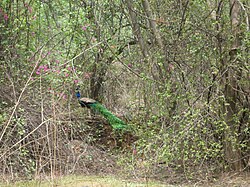
[[File:Peacock_in_its_habitat.jpg|thumb|Forest area of Delhi Ridge]] | [[File:Peacock_in_its_habitat.jpg|thumb|Forest area of Delhi Ridge]] | ||
'''Delhi Ridge''', sometimes simply called '''The Ridge''', is a [[ridge]] in the [[Aravalli Range#Northern Aravalli leopard wildlife corridor|Northern Aravalli leopard wildlife corridor]] in the National Capital Territory of [[Delhi]] in [[India]].<ref name="ref39zodif">{{Citation | title=Natural Resource Management | author=Bindhy Wasini Pandey | publisher=Mittal Publications, 2005 | isbn=978-81-7099-986-7 | url=https://books.google.com/books?id=Tz9iDM6crLIC | quote=''... The Ridge and its neighbouring hilly tracts represent the natural flora. The major natural forests in Delhi are generally restricted to the Ridge. The natural flora is a tropical, thorny and secondary forest.''}}</ref> It is a northern extension of the ancient [[Aravalli Range]], | '''Delhi Ridge''', sometimes simply called '''The Ridge''', is a [[ridge]] in the [[Aravalli Range#Northern Aravalli leopard wildlife corridor|Northern Aravalli leopard wildlife corridor]] in the National Capital Territory of [[Delhi]] in [[India]].<ref name="ref39zodif">{{Citation | title=Natural Resource Management | author=Bindhy Wasini Pandey | date=January 2005 | publisher=Mittal Publications, 2005 | isbn=978-81-7099-986-7 | url=https://books.google.com/books?id=Tz9iDM6crLIC | quote=''... The Ridge and its neighbouring hilly tracts represent the natural flora. The major natural forests in Delhi are generally restricted to the Ridge. The natural flora is a tropical, thorny and secondary forest.''}}</ref> It is a northern extension of the ancient [[Aravalli Range]], which is approximately 1.5 billion years old—significantly older than the [[Himalayas]], which are "only" about 50 million years old.<ref name="ref27qifeb">{{Citation | title=Records of the Geological Survey of India, Volumes 5-7 | author=Geological Survey of India | year=1872 | publisher=Government of India, 1872 | url=https://books.google.com/books?id=Mn8RAAAAIAAJ | quote=''... These ridges are prolongations of the Aravali mountain system, and are approximately on the line of the Indo-gangetic watershed ...''}}</ref><ref name="ref45vufal">{{Citation | title=Rajasthan, Delhi and Agra | author=Lindsay Brown, Amelia Thomas | year=2008 | publisher=Lonely Planet, 2008 | isbn=978-1-74104-690-8 | url=https://books.google.com/books?id=Zz0_zXPb68kC | quote=''... Delhi lies on the vast flatlands of the Indo-Gangetic Plain, though the northernmost pimples of the Aravallis amount to the Ridge, which lies west of the city centre ...''}}</ref> The Delhi Ridge consists of [[quartzite]] rocks and extends from the southeast at [[Tughlaqabad]], near the [[Bhatti mines]], branching out in places and tapering off in the north near [[Wazirabad, Delhi|Wazirabad]] on the west bank of the [[Yamuna|Yamuna River]],<ref name=indfy>{{cite web | ||
| url = http://www.indfy.com/places-to-see-in-delhi/parks-and-gardens/delhi-ridge.html | | url = http://www.indfy.com/places-to-see-in-delhi/parks-and-gardens/delhi-ridge.html | ||
| title = Delhi Ridge | | title = Delhi Ridge | ||
| Line 8: | Line 9: | ||
| work = Parks and Gardens in Delhi | | work = Parks and Gardens in Delhi | ||
| publisher = IndFY.com. | | publisher = IndFY.com. | ||
| archive-url = https:// | | archive-url = https://web.archive.org/web/20130703082929/http://www.indfy.com/delhi/tourist-places-to-visit/parks-and-gardens/delhi-ridge.html | ||
| archive-date = | | archive-date = 3 July 2013 | ||
| url-status = dead | | url-status = dead | ||
}}</ref> | }}</ref> spanning approximately 35 kilometres.<ref name=geology>{{cite web | ||
| url = http://www.rainwaterharvesting.org/index_files/geology.htm | | url = http://www.rainwaterharvesting.org/index_files/geology.htm | ||
| title = Geology Details | | title = Geology Details | ||
| Line 18: | Line 19: | ||
| publisher = [[Centre for Science and Environment]]}}</ref> | | publisher = [[Centre for Science and Environment]]}}</ref> | ||
The Ridge acts as the "green lungs" for the city, and protects Delhi from the hot winds of the deserts of [[Rajasthan]] to the west. It has also enabled Delhi to be the world's second most bird-rich capital city, | The Ridge acts as the "green lungs" for the city, and protects Delhi from the hot winds of the deserts of [[Rajasthan]] to the west. It has also enabled Delhi to be the world's second most bird-rich capital city, following [[Nairobi]] in [[Kenya]].<ref>{{Cite news|last=|first=|date=2020-01-02|title=A round-the-year guide to engaging with nature|language=en-IN|work=[[The Hindu]]|url=https://www.thehindu.com/society/a-round-the-year-guide-to-engaging-with-nature/article30459615.ece|access-date=2021-08-27|issn=0971-751X}}</ref> | ||
Though modest in height, the Ridge serves as a [[Drainage divide|watershed]], separating the Indus Plain to the west from the Gangetic Plain to the east, within the larger [[Indo-Gangetic Plain]]. | |||
==History== | ==History== | ||
It is believed that the Aravallis are one of the oldest mountain ranges in India [[Aravalli Range#Geographical features| | It is believed that the Aravallis are one of the oldest mountain ranges in India [[Aravalli Range#Geographical features|that evolved around 2.5 billion years ago]] during the [[Archaeozoic]] era. The range extends from [[Gujarat]] through [[Rajasthan]] to [[Haryana]]-[[Delhi]]. In Delhi, the spurs of the Aravallis are commonly collectively referred to as the Delhi Ridge, which is divided into the Northern, Central, South Central, and Southern Ridge.<ref name=mcg>[http://www.mcg.gov.in/BioDiversity.aspx Aravali Bio-Diversity Park Curtain Raising On World Environment Day 5 June 2010] {{Webarchive|url=https://web.archive.org/web/20120702074447/http://www.mcg.gov.in/BioDiversity.aspx |date=2 July 2012 }} Municipal Corporation of Gurgaon.</ref> | ||
In 1993, parts of [[north Delhi]], [[central Delhi]], [[south West Delhi]] and [[south Delhi]] covering 7,777 hectares was declared a reserve forest. Thereafter | In 1993, parts of [[north Delhi]], [[central Delhi]], [[south West Delhi]] and [[south Delhi]] covering 7,777 hectares was declared a reserve forest. Thereafter, between 1994 and 1996, a major part of the ridge was notified by the Government, thus stopping all construction.<ref>{{cite web|title=Govt assures to demarcate Delhi ridge boundaries by mid-October |publisher=Hindustan Times |url=http://www.hindustantimes.com/India-news/NewDelhi/Govt-assures-to-demarcate-Delhi-ridge-boundaries-by-mid-October/Article1-1117370.aspx |author=Darpan Singh |date=4 September 2013 |access-date=2013-09-10 |url-status=dead |archive-url=https://web.archive.org/web/20130905171747/http://www.hindustantimes.com/India-news/NewDelhi/Govt-assures-to-demarcate-Delhi-ridge-boundaries-by-mid-October/Article1-1117370.aspx |archive-date=2013-09-05 }}</ref><ref> | ||
{{cite web | {{cite web | ||
|title=Forest dept prepares plan to save the Delhi ridge | |title=Forest dept prepares plan to save the Delhi ridge | ||
| Line 36: | Line 39: | ||
}}</ref> | }}</ref> | ||
Over the years, | Over the years, urban development, illegal or otherwise, has engulfed several sections of the Delhi Ridge. In many areas, landscaped public parks, public housing, and illegal tenements have sprouted. Furthermore, the area also witnesses dumping of [[construction waste]].<ref>{{cite web|author=Shivani Singh |title=Land rush spoils Delhi's enviable green records |newspaper=Hindustan Times |url=http://www.hindustantimes.com/India-news/NewDelhi/Land-rush-spoils-Delhi-s-enviable-green-records/Article1-1119612.aspx |date=9 September 2013 |access-date=2013-09-10 |url-status=dead |archive-url=https://web.archive.org/web/20130910090229/http://www.hindustantimes.com/India-news/NewDelhi/Land-rush-spoils-Delhi-s-enviable-green-records/Article1-1119612.aspx |archive-date=2013-09-10 }}</ref> | ||
==Geographical segments== | ==Geographical segments== | ||
Today, the Ridge has been divided into four separate zones for administrative ease,<ref name=krishen>{{cite book | |||
| title = Trees of Delhi: A Field Guide | | title = Trees of Delhi: A Field Guide | ||
| year = 2006 | |||
| publisher = Dorling Kindersley | | publisher = Dorling Kindersley | ||
| isbn = 0144000709 | |||
}}</ref> namely: | }}</ref> namely: | ||
# The | # The Old Delhi or ''Northern Ridge'' refers to the hilly area near Delhi University and is the smallest segment of the Ridge. The location of the Northern Ridge is 28°40′52″N 77°12′57″E. Nearly 170 hectares were declared a Reserved Forest in 1915. Today, less than 87 hectares remain near Delhi University, and this area is being developed by the [[Delhi Development Authority]] as the [[Northern Ridge biodiversity park|Northern Ridge Biodiversity Park]]. | ||
# The ''New Delhi'' or ''Central Ridge'' was | # The ''New Delhi'' or ''Central Ridge'' was designated a ''Reserved Forest'' in 1914 and spans from the southern fringes of [[Sadar Bazaar, Delhi|Sadar Bazaar]] to [[Dhaula Kuan]]. It originally spanned 864 hectares, though some portions have since gradually eroded. | ||
# The ''Mehrauli'' or ''South-Central Ridge'' is centred | # The ''Mehrauli'' or ''South-Central Ridge'' is centred at "Sanjay Vana" near [[Jawaharlal Nehru University, Delhi|JNU]] and [[Vasant Kunj]], and encompasses 633 hectares. Large chunks have been encroached and built upon. Approximately 70 hectares of this segment of the Ridge in the vicinity of [[Sainik Farm]] have been subsumed under the [[Tilpath Valley Biodiversity Park]]. | ||
# The ''[[Tughlaqabad]]'' or ''Southern Ridge'' sprawls across 6200 hectares and includes the [[Asola Bhatti Wildlife Sanctuary]]. This is the least | # The ''[[Tughlaqabad]]'' or ''Southern Ridge'' sprawls across 6200 hectares and includes the [[Asola Bhatti Wildlife Sanctuary]]. This is the least urbanized of the four segments of the Ridge, though much of it comprises village-owned or privately owned farmland. This includes the forests of [[Bandhwari]] and [[Mangar Bani]]. | ||
==Northern Ridge== | ==Northern Ridge== | ||
Also referred to as the '''Kamala Nehru Ridge''', it covers an area of 87 hectares and is located near the North Campus of [[Delhi University]]. The area consists of an eclectic blend of nature and history and houses the [[Northern ridge biodiversity park|Northern Ridge Biodiversity Park]] developed and maintained by the [[Delhi Development Authority|Delhi Development Authority (DDA)]].<ref name="Rangan">{{cite news |last1=Datta |first1=Rangan |title=A walking tour of Delhi’s Northern Ridge |url=https://www.telegraphindia.com/my-kolkata/places/explore-mughal-and-british-buildings-like-mutiny-memorial-ashokan-pillar-and-flagstaff-tower-on-a-heritage-walk-in-delhis-kamala-nehru-ridge-or-northern-ridge/cid/1877830 |access-date=25 November 2023 |agency=My Kolkata |publisher=The Telegraph |date=2 August 2022}}</ref> | |||
===Historical monuments=== | ===Historical monuments=== | ||
The North Ridge | [[File:Flagstaff Tower 4.jpg|thumb|[[Flagstaff Tower]]]] | ||
The North Ridge encompasses several monuments that date from as antiquated as the pre-Mughal era to the colonial British period. <ref name="Rangan"/><ref>{{cite web|title=Flagstaff Tower, Old Delhi.|url=http://www.victorianweb.org/history/empire/india/27.html|publisher=victorianweb.org|access-date=5 September 2012}}</ref><ref>{{cite news|title=Flagstaff Tower - Northern Ridge, Delhi|url=http://www.expresstravelworld.com/sections/management/637-flagstaff-tower-northern-ridge-delhi|publisher=Indian Express, Expresstravel|access-date=5 September 2012|archive-date=28 October 2012|archive-url=https://web.archive.org/web/20121028224527/http://www.expresstravelworld.com/sections/management/637-flagstaff-tower-northern-ridge-delhi|url-status=dead}}</ref> | |||
# [[Mutiny Memorial]] | |||
# Ashokan Pillar | |||
# Pir Ghaib (inside [[Hindu Rao Hospital]]) | |||
# Baoli ([[Step well]]) inside [[Hindu Rao Hospital]] | |||
# Chauburja Masjid | |||
# [[Flagstaff Tower]] | |||
# Eastern Guard House | |||
<gallery> | <gallery> | ||
File:Mutiny Memorial, North Ridge, Delhi.jpg|Mutiny Memorial | |||
File:Asokan Pillar.JPG|[[ | File:Asokan Pillar.JPG|[[Delhi-Topra pillar]], brought to Delhi from [[Topra Kalan]] by [[Firuz Shah Tughlaq]] in 1356 | ||
File: | File:Southern Guard House.jpg|Southern Guard House | ||
File:Pir Ghaib.JPG|Pir Ghaib, a 14th-century hunting lodge and Observatory built by [[Feroz Shah Tughlaq]] | File:Pir Ghaib.JPG|Pir Ghaib, a 14th-century hunting lodge and Observatory built by [[Feroz Shah Tughlaq]] | ||
File:Chauburji. Built on top.JPG|Chauburji | File:Chauburji. Built on top.JPG|Chauburji Masjid | ||
File:Old Baoli.JPG| | File:Old Baoli.JPG|Baoli ([[Stepwell]]) inside Hindu Rao Hospital | ||
</gallery> | </gallery> | ||
==Central Ridge== | ==Central Ridge== | ||
''Central Ridge'' | The ''Central Ridge'' includes 864 hectares of forestry which were designated a ''Reserved Forest'' in 1914, and spans from the southern fringes of [[Sadar Bazaar, Delhi|Sadar Bazaar]] to [[Dhaula Kuan]]. | ||
=== Buddha Jayanti Park === | === Buddha Jayanti Park === | ||
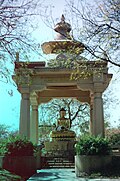
[[File:Buddha-jayanti-park.jpg|thumb|Buddha statue in the Buddha Jayanti Park]] | [[File:Buddha-jayanti-park.jpg|thumb|upright|Buddha statue in the Buddha Jayanti Park]] | ||
The '''[[Buddha Jayanti]] Smarak Park''' is situated in the central part of the Delhi | The '''[[Buddha Jayanti]] Smarak Park''' is situated in the central part of the Delhi Ridge in [[New Delhi]], [[India]]. It occupies a stretch of almost a kilometre on the eastern section of [[Vandemataram Marg]], also known as Upper Ridge Road. It was established on the 2500th anniversary of [[Gautama Buddha]]'s enlightenment by Indian architect M. M. Rana.<ref>{{cite web|title=Buddha Jayanti Park|url=http://www.delhitourism.gov.in/delhitourism/entertainment/buddha_jayanati_park.jsp|publisher=Government of NCT of Delhi - Delhi Tourism|access-date=3 January 2017}}</ref> A sapling of the [[Jaya Sri Maha Bodhi|Bodhi Tree]] from [[Sri Lanka]] was planted here by the then Prime Minister of India [[Lal Bahadur Shastri]] on 25 October 1964. | ||
On an artificial island in the park stands pavilion | On an artificial island in the park stands a pavilion housing a gilded [[Buddha in art|Buddha statue]], which was dedicated by the [[14th Dalai Lama]] in October 1993. Each year in May, on the full moon day of Vaisakha, the [[Buddha's Birthday|Buddha Jayanti]] festival is celebrated here. | ||
[[Neeraj Gupta]], an Indian sculpture artist and environmentalist, is the president of Buddha Jayanti Park. In August 2023, Gupta organized a plantation program that resulted in the planting of 1,000 ''[[Cassia fistula]]'' (Amaltas) trees.<ref>{{cite web |title=Thousand Amaltas Trees Planted in Buddha Jayanti Park |url=https://www.latestly.com/agency-news/business-news-one-thousand-amaltas-trees-planted-in-buddha-jayanti-park-5331336.html |website=LatestLY |language=en |date=10 August 2023}}</ref><ref>{{cite web |last1=Bajaj |first1=Aarti |title=Neeraj Gupta, president of Buddha Jayanti Park, organized a tree plantation program |url=https://www.brutimes.com/p/neeraj-gupta-president-of-buddha.html |website=Bru Times News |language=en}}</ref><ref>{{cite web |title=Sculpting thoughts: Neeraj Gupta’s public art |url=https://www.tribuneindia.com/news/features/sculpting-thoughts-neeraj-guptas-public-art-483213 |website=Tribune India}}</ref> | |||
==South-Central Ridge== | ==South-Central Ridge== | ||
''South-Central Ridge'' | The ''South-Central Ridge'' encompasses 633 hectares of land. Large chunks have been encroached and built upon. | ||
=== Aravalli Biodiversity Park=== | === Aravalli Biodiversity Park=== | ||
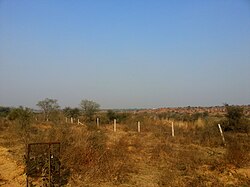
[[File:Aravali Biodiversity Park, Gurgaon.jpg|thumb|Aravalli Biodiversity Park, [[Gurgaon]]]] | [[File:Aravali Biodiversity Park, Gurgaon.jpg|thumb|Aravalli Biodiversity Park, [[Gurgaon]]]] | ||
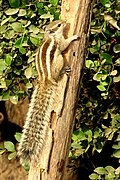
[[File:Northern palm squirrel.jpg|thumb| | [[File:Northern palm squirrel.jpg|thumb|upright|[[Northern Palm Squirrel]] in 'Aravalli Biodiversity Park', Delhi]] | ||
[[Aravalli Biodiversity Park]]<ref name=mcg/> is an area spreading over {{convert| | [[Aravalli Biodiversity Park]]<ref name=mcg/> is an area spreading over {{convert|2.8|km2|acre|abbr=on}} on the South Central Delhi Ridge within the [[Aravalli Range]]. The area is enclosed by [[Jawaharlal Nehru University, Delhi|JNU]], [[Mehrauli]]-[[Mahipalpur]] Road, [[National Highway 8 (India, old numbering)|National Highway 8]], Vasant Kunj, Masoodpur, Palam road and the southern periphery of [[Vasant Vihar]]. [[Delhi Development Authority|DDA]] and the [[University of Delhi]], under the auspices of the Biodiversity Parks Programme, collectively maintain the area. Each year, a substantial expenditure is spent on restoration, development, and maintenance. | ||
The land | The land that now comprises the Aravalli Biodiversity Park was once a mining site. Martha Shinde ([[Scindias]]) had a mining lease for the {{convert|2.3|km2|abbr=on}} area. They plundered whatever they could. For years, Shinde exploited a panoply of forest resources including minerals, mica, sand, stone, rocks and water. The land, once abundant with a dense and lush forest, was eventually transformed into pits and hillocks due to relentless mining activities. | ||
Scientists from the Centre for Environmental Management of Degraded Ecosystems (CEMDE) | Scientists from the Centre for Environmental Management of Degraded Ecosystems (CEMDE) at the University of Delhi have reintroduced over 10 ecosystems, comprising more than 40 biotic communities. Portions of the Aravalli in the state of [[Gujarat]] are covered with natural dense forest. However, the land on which the Aravalli Biodiversity Park is being developed lacked natural forest growth due to extensive mining in the area. The CEMDE and DDA are reviving native flora and fauna of Aravalli hill ranges by undertaking plantation of native species like dhau ([[Anogeissus pendula]]), dhak ([[Butea monosperma]]), babul ([[Acacia nilotica]]) and kair ([[Capparis decidua]]). A rangeland with native grasses has been developed and a systematic planting program is underway; each year, native trees and bushes are planted to remove unwanted weeds, i.e. [[Prosopis juliflora]]. | ||
A conservatory of butterflies, orchidarium and fernery has been developed. | A conservatory of butterflies, orchidarium and fernery has been developed. | ||
The [[Aravali Biodiversity Park, Gurgaon]], on [[Gurgaon]]-Delhi border, developed by the Municipal Corporation of Gurgaon, was inaugurated on 5 June 2010 | The [[Aravali Biodiversity Park, Gurgaon]], on the [[Gurgaon]]-Delhi border, developed by the [[Gurgaon Municipal Corporation|Municipal Corporation of Gurgaon]], was inaugurated on 5 June 2010 on the occasion of the [[World Environment Day]].<ref name=mcg/> | ||
===Neela Hauz Biodiversity Park=== | ===Neela Hauz Biodiversity Park=== | ||
{{main|Neela Hauz biodiversity park}} | {{main|Neela Hauz biodiversity park}} | ||
Neela Hauz | Neela Hauz Biodiversity Park, straddling Sanjay Van in the South Central Ridge, was restored between 2015 and 2016. In 2014, out of Delhi's 611 water bodies, 274 were considered dead, while the remaining were in poor condition. Neela Hauz, a freshwater lake, was gradually succumbing to the same fate owing to the dumping of waste.<ref name=neela1/> In ancient times, it served as the principal water source for the [[Rajput]] city of [[Qila Rai Pithora]].<ref name=neela1/> Its basin was recharged by the extensive dense forests of Sanjay Van, with its overflow draining into the [[Yamuna|Yamuna River]].<ref name=neela1>M Jaggi, June 2017, [http://nopr.niscair.res.in/bitstream/123456789/42134/1/SR%2054%286%29%2022-23.pdf NOPR: Neela Hauz Biodiversity Park – From Barren to Beautiful, SR Vol.54(06).]</ref> | ||
In 2014, the wetland was | In 2014, the wetland was strewn with [[Eichhornia crassipes|water hyacinth]] and the Ridge was infested with the invasive species of [[prosopis juliflora]] (''Vilayati Babul'' or ''Kikar'' of Mexican origin), which were planted in the 1920s by the [[British raj|British]] to rehabilitate the wasteland.<ref name=wildht2>[https://timesofindia.indiatimes.com/city/delhi/two-years-on-tilpath-valley-biodiversity-park-breathes-again/articleshow/63035604.cms Two years on, Tilpath Valley Biodiversity Park breathes again], Times of India, 23 Feb 2018.</ref><ref name=wildht1>[https://www.hindustantimes.com/delhi-news/delhi-gets-its-third-biodiversity-park-in-tilpat-valley/story-22c7t3YnkSk3bqW2jMMpsJ.html Delhi gets its third biodiversity park in Tilpat Valley], Hindustan Times, 3 Feb 2018.</ref><ref name=neela1/> The silted-up lake faced encroachment and raw sewage inflow, prompting concerned citizens to obtain a [[Delhi High Court]] order for its restoration by the government.<ref name=neela1/> Following the commencement of restoration efforts in 2015, this biodiversity park was officially inaugurated in November 2016.<ref name=neela1/> | ||
===Sanjay Van=== | ===Sanjay Van=== | ||
{{Main|Sanjay Van}} | |||
{{Expand section|date=December 2021}} | {{Expand section|date=December 2021}} | ||
Sanjay Van is located near [[Jawaharlal Nehru University, Delhi|Jawaharlal Nehru University]] and [[Vasant Kunj]]. | |||
==Southern Ridge== | ==Southern Ridge== | ||
''Southern Ridge'' sprawls across 6200 hectares and includes the [[Asola Bhatti Wildlife Sanctuary]], [[Bandhwari]] and [[Mangar Bani]] forests. This is the least | ''Southern Ridge'' sprawls across 6200 hectares and includes the [[Asola Bhatti Wildlife Sanctuary]], [[Bandhwari]] and [[Mangar Bani]] forests. This is the least urbanized of the four segments of the Ridge, though much of it consists of village-owned or privately owned farmland. | ||
===Asola Bhatti Wildlife Sanctuary === | ===Asola Bhatti Wildlife Sanctuary === | ||
[[Asola Bhatti Wildlife Sanctuary]] is a | [[Asola Bhatti Wildlife Sanctuary]] is a 32.71 km<sup>2</sup> biodiversity area in the South Ridge on the Delhi-Haryana border. It is considered a vital habitat for the [[Indian leopard]]. [[Endangered species]] in the sanctuary include the [[red-headed vulture]] and the [[Egyptian vulture]]: the [[Government of Haryana]] has constituted a [[Jatayu Conservation Breeding Centre, Pinjore#Vultures|vulture conservation program]]. [[Near-threatened species]] include [[painted stork]], [[white-faced ibis]] and the [[European roller]]. Rare birds include [[black francolin]] and [[grey-headed fish eagle]]. Plant species include [[butea monosperma]] (dhak or flame of forest), [[anogeissus]] (dhok), [[Wrightia tinctoria]] (inderjao), [[Elm|Indian elm]], [[neolamarckia cadamba]] (kadamba), [[prosopis cineraria]] (jaand), [[tinospora cordifolia]] (giloi), etc.<ref name=protect1>[https://timesofindia.indiatimes.com/city/gurgaon/haryana-government-moots-buffer-zone-to-save-asola-sanctuary/articleshow/67752163.cms Haryana Government moots buffer zone to save Asola sanctuary], Times of India, 30 Jan 2019.</ref> | ||
===Mangar Bani forest=== | ===Mangar Bani forest=== | ||
[[Mangar Bani]], [[ | [[Mangar Bani]], a [[Neolithic]] archaeological site and [[Sacred groves of India#Locations of sacred groves|sacred grove]] hill forest on the Delhi-Haryana border, is in the [[Delhi Ridge#Southern Ridge|South Delhi Ridge]] of the [[Aravalli Range|Aravalli]] mountain range in the [[Faridabad]] [[tehsil]] in the Indian state of [[Haryana]].<ref>{{Cite web |url=https://www.indiatoday.in/travel/india/story/mangar-bani-weekend-getaway-travel-lifetr-1027108-2017-07-30 |title=Here's why Mangar Bani can be your ideal weekend getaway |date=July 30, 2017 |first1=Navneet|last1=Mendiratta |website=India Today |publisher=[[India Today]] |location=India |language=en |access-date=2019-01-16}}</ref><ref>{{Cite web |url=https://timesofindia.indiatimes.com/city/gurgaon/saving-mangar-bani-why-returning-grove-to-original-custodians-may-be-only-solution/articleshow/66061056.cms |title=Saving Mangar Bani: Why returning grove to original custodians may be only solution - Times of India |work=[[The Times of India]] |location=India |language=en |access-date=2019-01-16}}</ref><ref>{{Cite web |url=https://www.hindustantimes.com/gurgaon/haryana-s-mangar-bani-forest-demarcated-at-last/story-OqTvqpQIMoffH85fpYNc7H.html |title=Haryana's Mangar Bani forest demarcated at last |date=2015-09-03 |website=hindustantimes.com/ |publisher=[[Hindustan Times]] |location=India |language=en |access-date=2019-01-16}}</ref> | ||
It lies within the [[ | It lies within the [[Aravalli Range#Northern Aravalli leopard wildlife corridor|Northern Aravalli leopard wildlife corridor]] stretching from [[Sariska Tiger Reserve]] to Delhi. Historical sites in the vicinity of the sanctuary are [[Badkhal Lake]], the 10th century [[Surajkund]] reservoir and [[Anangpur Dam]], [[Damdama Lake]], [[Tughlaqabad Fort]] and the [[Jahanpanah#Adilabad|ruins of Adilabad]].<ref name="Department of Forest, Delhi">[http://forest.delhigovt.nic.in/wildlife/asola.html#asola Asola Bhatti Wild Life Sanctuary] {{Webarchive|url=https://web.archive.org/web/20110816140938/http://forest.delhigovt.nic.in/wildlife/asola.html#asola |date=16 August 2011 }}, Department of Forest, Delhi Government</ref> It is contiguous to the seasonal [[Pali village#Pali jharna|waterfalls in Pali-Dhuaj-Kot villages of Faridabad]],<ref name="sura">[https://navbharattimes.indiatimes.com/state/punjab-and-haryana/faridabad/water-will-be-stopped-by-making-a-dam-on-the-hills-of-pali-village/articleshow/70320771.cms पाली गांव की पहाड़ियों पर डैम बनाकर रोका जाएगा झरनों का पानी]</ref> and the [[Asola Bhatti Wildlife Sanctuary]]. It is also an important wetland for the [[migratory birds]] as several dozen lakes formed in the abandoned [[Open-pit mining|open pit mines]] in and around the area. | ||
Spanning 5,000 hectares, this is the largest prehistoric site and [[Stone Age]] tool-making factory in the Indian subcontinent and the first discovered site in the Aravalli range with cave paintings. The stone tools and rock art date back 100,000 years BP, while the cave paintings are estimated to be 20,000-40,000 years BP. It is also the oldest known site of human habitation in Haryana and the [[National Capital Region]].<ref name=mangr1>[https://theprint.in/india/stone-age-tools-cave-paintings-discovered-in-haryana-could-be-clues-to-prehistoric-factory/702204/ Stone Age tools, cave paintings discovered in Haryana could be clues to ‘prehistoric factory’], The Print, 2 July Sep 2017.</ref> | |||
===Tilpath Valley Biodiversity Park=== | ===Tilpath Valley Biodiversity Park=== | ||
[[Tilpath Valley Biodiversity Park]], spread over 172 acres is a biodiversity area in the South Ridge, immediately northwest of Asola Bhatti Wildlife Sanctuary and south of [[Sainik Farm]]. | [[Tilpath Valley Biodiversity Park]], spread over 172 acres is a biodiversity area in the South Ridge, immediately northwest of Asola Bhatti Wildlife Sanctuary and south of [[Sainik Farm]]. Previously, the area had valleys scattered with sand-mined quarries and dried-up springs due to a lack of groundwater recharge. There was no natural forest cover, only invasive weed species like ''[[Neltuma juliflora|Prosopis juliflora]]'', [[lantana]], and [[parthenium]]. This was replaced with a three-layered forest community featuring native trees and plants such as [[Madhuca longifolia|mahua]], [[Adina cordifolia|haldu]], [[Dalbergia sissoo|sheesham]] and [[Aegle marmelos|bael]]. Scrubland was restored to attract reptiles and birds. In 2015, 100,000 trees were planted with the help of 40,000 volunteers, followed by another 20,000 trees in 2016. | ||
Wildlife surveys are conducted by tracking pugmarks using the [[Pug impression pad|Pug Impression Pad]] (PIP) method and by photographing wild animals.<ref name="wildht2" /> It now encompasses grasslands, hilly terrain, and a rich diversity of wildlife, with over 105 plant species, 103 bird species, 32 butterfly species, 15 species of herpetofauna (reptiles and amphibians), and eight mammalian species, including [[leopard]], [[Indian rock python]], [[jackal]]s, [[neelgai]], [[mongoose]]s, [[porcupine]]s, [[small Indian civet]], [[gecko]], [[Sirkeer malkoha]], [[nightjar]], [[Indian paradise flycatcher]].<ref name="wildht1" /> | |||
Following development that commenced in 2015, it was officially inaugurated as Delhi's third biodiversity park on February 3, 2018.<ref name="wildht2" /><ref name="wildht1" /> | |||
==Urban forests== | |||
In 2025, Delhi government announced the plan to develop 17 new [[urban forest]]s totalling 177 acres including 2 [[Pocket forest|Miyawaki forests]].<ref name=urb1>[https://theprint.in/india/delhi-govt-to-develop-17-urban-forests-to-boost-green-cover-combat-air-pollution/2759127/ Delhi govt to develop 17 urban forests to boost green cover, combat air pollution], The Print, 7 oct 2025.</ref> | |||
* Miyawaki forests: both near Najafgarh and one of these will be named after [[Guru Tegh Bahadur]].<ref name=urb1/> | |||
# Kharkhari Jatmal Forest, 2.44 hectares with 350,000 saplings of native species. | |||
# Jainpur Forest, 4.54 hectares.<ref name=urb1/> | |||
* Urban forests in north and south Delhi. | |||
** [[South Delhi]] | |||
:# Sathbari Urban Forest<ref name=urb1/> | |||
:# Maidan Garhi Urban Forest<ref name=urb1/> | |||
** [[North Delhi]] | |||
:# Shahpur Garhi Urban Forest<ref name=urb1/> | |||
:# Alipur Urban Forest<ref name=urb1/> | |||
:# Narela B4 Urban Forest<ref name=urb1/> | |||
:# Mamurpur Urban Forest<ref name=urb1/> | |||
:# Narela G7 Urban Forest<ref name=urb1/> | |||
:# Narela G8 Urban Forest<ref name=urb1/> | |||
:# Rohini Sector 30 Pehladpur Bagar Urban Forest<ref name=urb1/> | |||
:# Rohini Sector 31 Pansali Urban Forest<ref name=urb1/> | |||
:# Rohini Sector 32 Pansali Urban Forest<ref name=urb1/> | |||
:# Rohini Sector 32 Urban Forest<ref name=urb1/> | |||
:# Rohini Sector 32 Barwala Urban Forest<ref name=urb1/> | |||
:# Rohini Mahamudpura Mazri A Urban Forest<ref name=urb1/> | |||
==See also== | ==See also== | ||
* [[List of National Parks & Wildlife Sanctuaries of Haryana, India|National Parks & Wildlife Sanctuaries of Haryana]] | * [[List of National Parks & Wildlife Sanctuaries of Haryana, India|National Parks & Wildlife Sanctuaries of Haryana]] | ||
* [[Wildlife of India]] | * [[Wildlife of India]] | ||
* [[Wildlife sanctuaries of India]] | * [[Wildlife sanctuaries of India]] | ||
* [[Talkatora Gardens]] | * [[Talkatora Gardens]] | ||
* [[List of parks in Delhi]] | |||
==References== | ==References== | ||
{{reflist|2}} | {{reflist|2}} | ||
Latest revision as of 10:34, 12 February 2026

Delhi Ridge, sometimes simply called The Ridge, is a ridge in the Northern Aravalli leopard wildlife corridor in the National Capital Territory of Delhi in India.[1] It is a northern extension of the ancient Aravalli Range, which is approximately 1.5 billion years old—significantly older than the Himalayas, which are "only" about 50 million years old.[2][3] The Delhi Ridge consists of quartzite rocks and extends from the southeast at Tughlaqabad, near the Bhatti mines, branching out in places and tapering off in the north near Wazirabad on the west bank of the Yamuna River,[4] spanning approximately 35 kilometres.[5]
The Ridge acts as the "green lungs" for the city, and protects Delhi from the hot winds of the deserts of Rajasthan to the west. It has also enabled Delhi to be the world's second most bird-rich capital city, following Nairobi in Kenya.[6]
Though modest in height, the Ridge serves as a watershed, separating the Indus Plain to the west from the Gangetic Plain to the east, within the larger Indo-Gangetic Plain.
History[edit | edit source]
It is believed that the Aravallis are one of the oldest mountain ranges in India that evolved around 2.5 billion years ago during the Archaeozoic era. The range extends from Gujarat through Rajasthan to Haryana-Delhi. In Delhi, the spurs of the Aravallis are commonly collectively referred to as the Delhi Ridge, which is divided into the Northern, Central, South Central, and Southern Ridge.[7]
In 1993, parts of north Delhi, central Delhi, south West Delhi and south Delhi covering 7,777 hectares was declared a reserve forest. Thereafter, between 1994 and 1996, a major part of the ridge was notified by the Government, thus stopping all construction.[8][9]
Over the years, urban development, illegal or otherwise, has engulfed several sections of the Delhi Ridge. In many areas, landscaped public parks, public housing, and illegal tenements have sprouted. Furthermore, the area also witnesses dumping of construction waste.[10]
Geographical segments[edit | edit source]
Today, the Ridge has been divided into four separate zones for administrative ease,[11] namely:
- The Old Delhi or Northern Ridge refers to the hilly area near Delhi University and is the smallest segment of the Ridge. The location of the Northern Ridge is 28°40′52″N 77°12′57″E. Nearly 170 hectares were declared a Reserved Forest in 1915. Today, less than 87 hectares remain near Delhi University, and this area is being developed by the Delhi Development Authority as the Northern Ridge Biodiversity Park.
- The New Delhi or Central Ridge was designated a Reserved Forest in 1914 and spans from the southern fringes of Sadar Bazaar to Dhaula Kuan. It originally spanned 864 hectares, though some portions have since gradually eroded.
- The Mehrauli or South-Central Ridge is centred at "Sanjay Vana" near JNU and Vasant Kunj, and encompasses 633 hectares. Large chunks have been encroached and built upon. Approximately 70 hectares of this segment of the Ridge in the vicinity of Sainik Farm have been subsumed under the Tilpath Valley Biodiversity Park.
- The Tughlaqabad or Southern Ridge sprawls across 6200 hectares and includes the Asola Bhatti Wildlife Sanctuary. This is the least urbanized of the four segments of the Ridge, though much of it comprises village-owned or privately owned farmland. This includes the forests of Bandhwari and Mangar Bani.
Northern Ridge[edit | edit source]
Also referred to as the Kamala Nehru Ridge, it covers an area of 87 hectares and is located near the North Campus of Delhi University. The area consists of an eclectic blend of nature and history and houses the Northern Ridge Biodiversity Park developed and maintained by the Delhi Development Authority (DDA).[12]
Historical monuments[edit | edit source]

The North Ridge encompasses several monuments that date from as antiquated as the pre-Mughal era to the colonial British period. [12][13][14]
- Mutiny Memorial
- Ashokan Pillar
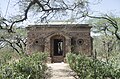
- Pir Ghaib (inside Hindu Rao Hospital)
- Baoli (Step well) inside Hindu Rao Hospital
- Chauburja Masjid
- Flagstaff Tower
- Eastern Guard House
-
 Mutiny Memorial
 -
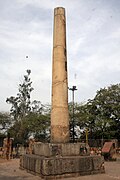
-
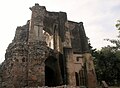
 Southern Guard House
 -
 Pir Ghaib, a 14th-century hunting lodge and Observatory built by Feroz Shah Tughlaq
 -
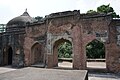 Chauburji Masjid
 -
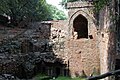 Baoli (Stepwell) inside Hindu Rao Hospital


Central Ridge[edit | edit source]
The Central Ridge includes 864 hectares of forestry which were designated a Reserved Forest in 1914, and spans from the southern fringes of Sadar Bazaar to Dhaula Kuan.
Buddha Jayanti Park[edit | edit source]

The Buddha Jayanti Smarak Park is situated in the central part of the Delhi Ridge in New Delhi, India. It occupies a stretch of almost a kilometre on the eastern section of Vandemataram Marg, also known as Upper Ridge Road. It was established on the 2500th anniversary of Gautama Buddha's enlightenment by Indian architect M. M. Rana.[15] A sapling of the Bodhi Tree from Sri Lanka was planted here by the then Prime Minister of India Lal Bahadur Shastri on 25 October 1964.
On an artificial island in the park stands a pavilion housing a gilded Buddha statue, which was dedicated by the 14th Dalai Lama in October 1993. Each year in May, on the full moon day of Vaisakha, the Buddha Jayanti festival is celebrated here.
Neeraj Gupta, an Indian sculpture artist and environmentalist, is the president of Buddha Jayanti Park. In August 2023, Gupta organized a plantation program that resulted in the planting of 1,000 Cassia fistula (Amaltas) trees.[16][17][18]
South-Central Ridge[edit | edit source]
The South-Central Ridge encompasses 633 hectares of land. Large chunks have been encroached and built upon.
Aravalli Biodiversity Park[edit | edit source]


Aravalli Biodiversity Park[7] is an area spreading over 2.8 km2 (690 acres) on the South Central Delhi Ridge within the Aravalli Range. The area is enclosed by JNU, Mehrauli-Mahipalpur Road, National Highway 8, Vasant Kunj, Masoodpur, Palam road and the southern periphery of Vasant Vihar. DDA and the University of Delhi, under the auspices of the Biodiversity Parks Programme, collectively maintain the area. Each year, a substantial expenditure is spent on restoration, development, and maintenance.
The land that now comprises the Aravalli Biodiversity Park was once a mining site. Martha Shinde (Scindias) had a mining lease for the 2.3 km2 (0.89 sq mi) area. They plundered whatever they could. For years, Shinde exploited a panoply of forest resources including minerals, mica, sand, stone, rocks and water. The land, once abundant with a dense and lush forest, was eventually transformed into pits and hillocks due to relentless mining activities.
Scientists from the Centre for Environmental Management of Degraded Ecosystems (CEMDE) at the University of Delhi have reintroduced over 10 ecosystems, comprising more than 40 biotic communities. Portions of the Aravalli in the state of Gujarat are covered with natural dense forest. However, the land on which the Aravalli Biodiversity Park is being developed lacked natural forest growth due to extensive mining in the area. The CEMDE and DDA are reviving native flora and fauna of Aravalli hill ranges by undertaking plantation of native species like dhau (Anogeissus pendula), dhak (Butea monosperma), babul (Acacia nilotica) and kair (Capparis decidua). A rangeland with native grasses has been developed and a systematic planting program is underway; each year, native trees and bushes are planted to remove unwanted weeds, i.e. Prosopis juliflora. A conservatory of butterflies, orchidarium and fernery has been developed.
The Aravali Biodiversity Park, Gurgaon, on the Gurgaon-Delhi border, developed by the Municipal Corporation of Gurgaon, was inaugurated on 5 June 2010 on the occasion of the World Environment Day.[7]
Neela Hauz Biodiversity Park[edit | edit source]
Neela Hauz Biodiversity Park, straddling Sanjay Van in the South Central Ridge, was restored between 2015 and 2016. In 2014, out of Delhi's 611 water bodies, 274 were considered dead, while the remaining were in poor condition. Neela Hauz, a freshwater lake, was gradually succumbing to the same fate owing to the dumping of waste.[19] In ancient times, it served as the principal water source for the Rajput city of Qila Rai Pithora.[19] Its basin was recharged by the extensive dense forests of Sanjay Van, with its overflow draining into the Yamuna River.[19]
In 2014, the wetland was strewn with water hyacinth and the Ridge was infested with the invasive species of prosopis juliflora (Vilayati Babul or Kikar of Mexican origin), which were planted in the 1920s by the British to rehabilitate the wasteland.[20][21][19] The silted-up lake faced encroachment and raw sewage inflow, prompting concerned citizens to obtain a Delhi High Court order for its restoration by the government.[19] Following the commencement of restoration efforts in 2015, this biodiversity park was officially inaugurated in November 2016.[19]
Sanjay Van[edit | edit source]
![[icon]](/wiki/File:Wiki_letter_w_cropped.svg) | This section needs expansion. You can help by adding to it. (December 2021) |
Sanjay Van is located near Jawaharlal Nehru University and Vasant Kunj.
Southern Ridge[edit | edit source]
Southern Ridge sprawls across 6200 hectares and includes the Asola Bhatti Wildlife Sanctuary, Bandhwari and Mangar Bani forests. This is the least urbanized of the four segments of the Ridge, though much of it consists of village-owned or privately owned farmland.
Asola Bhatti Wildlife Sanctuary[edit | edit source]
Asola Bhatti Wildlife Sanctuary is a 32.71 km2 biodiversity area in the South Ridge on the Delhi-Haryana border. It is considered a vital habitat for the Indian leopard. Endangered species in the sanctuary include the red-headed vulture and the Egyptian vulture: the Government of Haryana has constituted a vulture conservation program. Near-threatened species include painted stork, white-faced ibis and the European roller. Rare birds include black francolin and grey-headed fish eagle. Plant species include butea monosperma (dhak or flame of forest), anogeissus (dhok), Wrightia tinctoria (inderjao), Indian elm, neolamarckia cadamba (kadamba), prosopis cineraria (jaand), tinospora cordifolia (giloi), etc.[22]
Mangar Bani forest[edit | edit source]
Mangar Bani, a Neolithic archaeological site and sacred grove hill forest on the Delhi-Haryana border, is in the South Delhi Ridge of the Aravalli mountain range in the Faridabad tehsil in the Indian state of Haryana.[23][24][25]
It lies within the Northern Aravalli leopard wildlife corridor stretching from Sariska Tiger Reserve to Delhi. Historical sites in the vicinity of the sanctuary are Badkhal Lake, the 10th century Surajkund reservoir and Anangpur Dam, Damdama Lake, Tughlaqabad Fort and the ruins of Adilabad.[26] It is contiguous to the seasonal waterfalls in Pali-Dhuaj-Kot villages of Faridabad,[27] and the Asola Bhatti Wildlife Sanctuary. It is also an important wetland for the migratory birds as several dozen lakes formed in the abandoned open pit mines in and around the area.
Spanning 5,000 hectares, this is the largest prehistoric site and Stone Age tool-making factory in the Indian subcontinent and the first discovered site in the Aravalli range with cave paintings. The stone tools and rock art date back 100,000 years BP, while the cave paintings are estimated to be 20,000-40,000 years BP. It is also the oldest known site of human habitation in Haryana and the National Capital Region.[28]
Tilpath Valley Biodiversity Park[edit | edit source]
Tilpath Valley Biodiversity Park, spread over 172 acres is a biodiversity area in the South Ridge, immediately northwest of Asola Bhatti Wildlife Sanctuary and south of Sainik Farm. Previously, the area had valleys scattered with sand-mined quarries and dried-up springs due to a lack of groundwater recharge. There was no natural forest cover, only invasive weed species like Prosopis juliflora, lantana, and parthenium. This was replaced with a three-layered forest community featuring native trees and plants such as mahua, haldu, sheesham and bael. Scrubland was restored to attract reptiles and birds. In 2015, 100,000 trees were planted with the help of 40,000 volunteers, followed by another 20,000 trees in 2016.
Wildlife surveys are conducted by tracking pugmarks using the Pug Impression Pad (PIP) method and by photographing wild animals.[20] It now encompasses grasslands, hilly terrain, and a rich diversity of wildlife, with over 105 plant species, 103 bird species, 32 butterfly species, 15 species of herpetofauna (reptiles and amphibians), and eight mammalian species, including leopard, Indian rock python, jackals, neelgai, mongooses, porcupines, small Indian civet, gecko, Sirkeer malkoha, nightjar, Indian paradise flycatcher.[21]
Following development that commenced in 2015, it was officially inaugurated as Delhi's third biodiversity park on February 3, 2018.[20][21]
Urban forests[edit | edit source]
In 2025, Delhi government announced the plan to develop 17 new urban forests totalling 177 acres including 2 Miyawaki forests.[29]
- Miyawaki forests: both near Najafgarh and one of these will be named after Guru Tegh Bahadur.[29]
- Kharkhari Jatmal Forest, 2.44 hectares with 350,000 saplings of native species.
- Jainpur Forest, 4.54 hectares.[29]
- Urban forests in north and south Delhi.
- Shahpur Garhi Urban Forest[29]
- Alipur Urban Forest[29]
- Narela B4 Urban Forest[29]
- Mamurpur Urban Forest[29]
- Narela G7 Urban Forest[29]
- Narela G8 Urban Forest[29]
- Rohini Sector 30 Pehladpur Bagar Urban Forest[29]
- Rohini Sector 31 Pansali Urban Forest[29]
- Rohini Sector 32 Pansali Urban Forest[29]
- Rohini Sector 32 Urban Forest[29]
- Rohini Sector 32 Barwala Urban Forest[29]
- Rohini Mahamudpura Mazri A Urban Forest[29]
See also[edit | edit source]
- National Parks & Wildlife Sanctuaries of Haryana
- Wildlife of India
- Wildlife sanctuaries of India
- Talkatora Gardens
- List of parks in Delhi
References[edit | edit source]
- ↑ Bindhy Wasini Pandey (January 2005), Natural Resource Management, Mittal Publications, 2005, ISBN 978-81-7099-986-7,
... The Ridge and its neighbouring hilly tracts represent the natural flora. The major natural forests in Delhi are generally restricted to the Ridge. The natural flora is a tropical, thorny and secondary forest.
- ↑ Geological Survey of India (1872), Records of the Geological Survey of India, Volumes 5-7, Government of India, 1872,
... These ridges are prolongations of the Aravali mountain system, and are approximately on the line of the Indo-gangetic watershed ...
- ↑ Lindsay Brown, Amelia Thomas (2008), Rajasthan, Delhi and Agra, Lonely Planet, 2008, ISBN 978-1-74104-690-8,
... Delhi lies on the vast flatlands of the Indo-Gangetic Plain, though the northernmost pimples of the Aravallis amount to the Ridge, which lies west of the city centre ...
- ↑ "Delhi Ridge". Parks and Gardens in Delhi. IndFY.com. Archived from the original on 3 July 2013. Retrieved 23 December 2006.
- ↑ "Geology Details". rainwaterharvesting.com. Centre for Science and Environment. Retrieved 23 December 2006.
- ↑ "A round-the-year guide to engaging with nature". The Hindu. 2 January 2020. ISSN 0971-751X. Retrieved 27 August 2021.
- ↑ 7.0 7.1 7.2 Aravali Bio-Diversity Park Curtain Raising On World Environment Day 5 June 2010 Archived 2 July 2012 at the Wayback Machine Municipal Corporation of Gurgaon.
- ↑ Darpan Singh (4 September 2013). "Govt assures to demarcate Delhi ridge boundaries by mid-October". Hindustan Times. Archived from the original on 5 September 2013. Retrieved 10 September 2013.
- ↑
Darpan Singh (3 September 2013). "Forest dept prepares plan to save the Delhi ridge". Hindustan Times. Retrieved 10 September 2013.
{{cite web}}: CS1 maint: deprecated archival service (link) - ↑ Shivani Singh (9 September 2013). "Land rush spoils Delhi's enviable green records". Hindustan Times. Archived from the original on 10 September 2013. Retrieved 10 September 2013.
- ↑ Trees of Delhi: A Field Guide. Dorling Kindersley. 2006. ISBN 0144000709.
- ↑ 12.0 12.1 Datta, Rangan (2 August 2022). "A walking tour of Delhi's Northern Ridge". The Telegraph. My Kolkata. Retrieved 25 November 2023.
- ↑ "Flagstaff Tower, Old Delhi". victorianweb.org. Retrieved 5 September 2012.
- ↑ "Flagstaff Tower - Northern Ridge, Delhi". Indian Express, Expresstravel. Archived from the original on 28 October 2012. Retrieved 5 September 2012.
- ↑ "Buddha Jayanti Park". Government of NCT of Delhi - Delhi Tourism. Retrieved 3 January 2017.
- ↑ "Thousand Amaltas Trees Planted in Buddha Jayanti Park". LatestLY. 10 August 2023.
- ↑ Bajaj, Aarti. "Neeraj Gupta, president of Buddha Jayanti Park, organized a tree plantation program". Bru Times News.
- ↑ "Sculpting thoughts: Neeraj Gupta's public art". Tribune India.
- ↑ 19.0 19.1 19.2 19.3 19.4 19.5 M Jaggi, June 2017, NOPR: Neela Hauz Biodiversity Park – From Barren to Beautiful, SR Vol.54(06).
- ↑ 20.0 20.1 20.2 Two years on, Tilpath Valley Biodiversity Park breathes again, Times of India, 23 Feb 2018.
- ↑ 21.0 21.1 21.2 Delhi gets its third biodiversity park in Tilpat Valley, Hindustan Times, 3 Feb 2018.
- ↑ Haryana Government moots buffer zone to save Asola sanctuary, Times of India, 30 Jan 2019.
- ↑ Mendiratta, Navneet (30 July 2017). "Here's why Mangar Bani can be your ideal weekend getaway". India Today. India: India Today. Retrieved 16 January 2019.
- ↑ "Saving Mangar Bani: Why returning grove to original custodians may be only solution - Times of India". The Times of India. India. Retrieved 16 January 2019.
- ↑ "Haryana's Mangar Bani forest demarcated at last". hindustantimes.com/. India: Hindustan Times. 3 September 2015. Retrieved 16 January 2019.
- ↑ Asola Bhatti Wild Life Sanctuary Archived 16 August 2011 at the Wayback Machine, Department of Forest, Delhi Government
- ↑ पाली गांव की पहाड़ियों पर डैम बनाकर रोका जाएगा झरनों का पानी
- ↑ Stone Age tools, cave paintings discovered in Haryana could be clues to ‘prehistoric factory’, The Print, 2 July Sep 2017.
- ↑ 29.00 29.01 29.02 29.03 29.04 29.05 29.06 29.07 29.08 29.09 29.10 29.11 29.12 29.13 29.14 29.15 29.16 Delhi govt to develop 17 urban forests to boost green cover, combat air pollution, The Print, 7 oct 2025.
- Bibliography
- Kalpavriksh (1991). The Delhi Ridge Forest. Decline and Conservation.
- External links
- Aravalli Biodiversity Park, Gurgaon, website
- Foundation of biodiversity park laid
- Thorny British tree to be thrown out of biodiversity park
- ARAVALLI BIODIVERSITY PARK
28°36′58″N 77°10′08″E / 28.616°N 77.169°E
 | ||


Template:Biodiversity Worldwide
.png)

