
->Billjones94 No edit summary |
m Updated article with clearer structure |
||
| Line 1: | Line 1: | ||
{{short description|2005–2014 city-modernisation scheme in India}} | {{short description|2005–2014 city-modernisation scheme in India}} | ||
{{Multiple issues| | {{Multiple issues| | ||
{{More citations needed|date=October 2015}} | {{More citations needed|date=October 2015}} | ||
{{ | {{Cleanup rewrite|date=August 2025}} | ||
}} | }} | ||
{{Use Indian English|date=March 2013}} | {{Use Indian English|date=March 2013}} | ||
{{Use dmy dates|date= | {{Use dmy dates|date=May 2022}} | ||
{{Infobox project | {{Infobox project | ||
| abbreviation = JNNURM | | abbreviation = JNNURM | ||
| logo = JnNURM logo. | | logo = JnNURM logo.svg | ||
| image = JNNURM Scheme Water Supply.JPG | | image = JNNURM Scheme Water Supply.JPG | ||
| | | logo_alt = JNNURM | ||
| caption = Overhead Water Tank Capacity 3 million litres, at Barat Nagar BHEL under Bhopal Municipal Corporation | | caption = Overhead Water Tank Capacity 3 million litres, at Barat Nagar BHEL under Bhopal Municipal Corporation | ||
| country = India | | country = India | ||
| primeminister = | | primeminister = | ||
| launched = {{Start date|2005|12|03|df=y}} | | launched = {{Start date|2005|12|03|df=y}} | ||
| closed = 2014 | | closed = 2014 | ||
| current_status = Succeeded by [[Atal Mission for Rejuvenation and Urban Transformation|AMRUT]] | | current_status = Succeeded by [[Atal Mission for Rejuvenation and Urban Transformation|AMRUT]] | ||
}} | }} | ||
'''Jawaharlal Nehru National Urban Renewal Mission''' ('''JNNURM''') was a massive city-modernization scheme launched by the [[Government of India]] under the [[Ministry of Urban Development (India)|Ministry of Urban Development]]. It envisaged a total investment of over $20 billion over seven years. It | '''Jawaharlal Nehru National Urban Renewal Mission''' ('''JNNURM''') was a massive city-modernization scheme launched by the [[Government of India]] under the [[Ministry of Urban Development (India)|Ministry of Urban Development]]. It envisaged a total investment of over $20 billion over seven years. It was named after [[Jawaharlal Nehru]], the first [[Prime Minister of India]]. The scheme aimed to encourage reforms and fast-track planned development of identified cities. The focus was on efficiency in [[urban infrastructure]] and service delivery mechanisms, community participation, and accountability of urban local bodies and parastatal agencies towards citizens.<ref name="NNVNS.ORG">{{Cite web|last=NNVNS.ORG|date=2021-11-08|title=Jawaharlal Nehru National Urban Renewal Mission [All Details]|url=https://www.nnvns.org/jawaharlal-nehru-national-urban-renewal-mission/|access-date=2021-11-29|language=en-US}}</ref> | ||
The scheme was officially inaugurated by [[Prime Minister of India|Prime Minister]] [[Manmohan Singh]] on 3 December 2005<ref>{{cite web|url=http://jnnurm.nic.in/wp-content/uploads/2011/01/Prime-Ministers-Office.htm |title=Prime Minister's Office |access-date=2012-05-02 |url-status=dead |archive-url=https://web.archive.org/web/20120517045523/http://jnnurm.nic.in/wp-content/uploads/2011/01/Prime-Ministers-Office.htm |archive-date=17 May 2012 }}</ref>. | |||
== Structure == | |||
The scheme was officially inaugurated by [[Prime Minister of India|Prime Minister]] [[Manmohan Singh]] on 3 December 2005<ref>{{cite web|url=http://jnnurm.nic.in/wp-content/uploads/2011/01/Prime-Ministers-Office.htm |title= | |||
== Structure | |||
=== Sub-missions === | === Sub-missions === | ||
JNNURM primarily incorporates two sub-missions into its program: | JNNURM primarily incorporates two sub-missions into its program: | ||
* The Sub-Mission for Urban Infrastructure and Governance administered by the [[Ministry of Urban Development (India)|Ministry of Urban Development]], with a focus on water supply and sanitation, solid waste management, road network, urban transport and redevelopment of old city areas.{{citation needed|date=February 2017}} | * The Sub-Mission for Urban Infrastructure and Governance administered by the [[Ministry of Urban Development (India)|Ministry of Urban Development]], with a focus on water supply and sanitation, solid waste management, road network, urban transport and redevelopment of old city areas.{{citation needed|date=February 2017}} | ||
* The Sub-Mission for Basic Services to the Urban Poor (BSUP)<ref name="JNNURM Sub-missions " /> administered by the [[Ministry of Housing and Urban Poverty Alleviation]] with a focus on integrated development of slums.<ref name="JNNURM">Government of India:[http://jnnurm.nic.in/nurmudweb/toolkit/Overview.pdf Jawaharlal Nehru National Urban Renewal Mission] {{webarchive|url=https://web.archive.org/web/20100216181522/http://jnnurm.nic.in/nurmudweb/toolkit/Overview.pdf |date=16 February 2010 }}, ca. 2005</ref> | * The Sub-Mission for Basic Services to the Urban Poor (BSUP)<ref name="JNNURM Sub-missions">Sub-missions:[http://jnnurm.nic.in/ JnNURM Sub-Missions] {{webarchive|url=https://web.archive.org/web/20120510225954/http://jnnurm.nic.in/|date=10 May 2012}}</ref> administered by the [[Ministry of Housing and Urban Poverty Alleviation]] with a focus on integrated development of slums.<ref name="JNNURM">Government of India:[http://jnnurm.nic.in/nurmudweb/toolkit/Overview.pdf Jawaharlal Nehru National Urban Renewal Mission] {{webarchive|url=https://web.archive.org/web/20100216181522/http://jnnurm.nic.in/nurmudweb/toolkit/Overview.pdf |date=16 February 2010 }}, ca. 2005</ref> | ||
[[File:IHSDP JNNRUM Project.JPG|thumb|Integrated Housing and Slum Development Programme (IHSDP) under JNNRUM for slum improvement and rehabilitation]] | [[File:IHSDP JNNRUM Project.JPG|thumb|Integrated Housing and Slum Development Programme (IHSDP) under JNNRUM for slum improvement and rehabilitation]] | ||
In addition to this, it has two further components:<ref>{{cite | In addition to this, it has two further components:<ref>{{cite web|title=JNNURM Directorate |url=http://mhupa.gov.in/PQAS/jnnurm.pdf |url-status=dead |archive-url=https://web.archive.org/web/20111013084829/http://mhupa.gov.in/PQAS/jnnurm.pdf |archive-date=13 October 2011 }}</ref> | ||
* The Sub-Mission for Urban Infrastructure Development Scheme for Small & Medium Towns (UIDSSMT) administered by the [[Ministry of Urban Development (India)|Ministry of Urban Development]], with a focus on subsuming the schemes of Integrated Development of Small and Medium Towns (IDSMT) and Accelerated Urban Water Supply | * The Sub-Mission for Urban Infrastructure Development Scheme for Small & Medium Towns (UIDSSMT) administered by the [[Ministry of Urban Development (India)|Ministry of Urban Development]], with a focus on subsuming the schemes of Integrated Development of Small and Medium Towns (IDSMT) and Accelerated Urban Water Supply Programme (AUWSP) which aim at planned urban infrastructural improvement in towns and cities under its purview.<ref>{{cite web|title=UIDSSMT Guidelines |url=http://urbanindia.nic.in/programme/ud/uidssmt_guidelines.htm |url-status=dead |archive-url=https://web.archive.org/web/20111005023157/http://urbanindia.nic.in/programme/ud/uidssmt_guidelines.htm |archive-date= 5 October 2011 }}</ref> | ||
* The Sub-Mission for Integrated Housing and Slum Development Programme (IHSDP) administered by [[Ministry of Housing and Urban Poverty Alleviation]] ( | * The Sub-Mission for Integrated Housing and Slum Development Programme (IHSDP) administered by [[Ministry of Housing and Urban Poverty Alleviation]] (MHUPA) was envisaged and brought into effect in 1993–94 in accordance with providing the entire population with safe and adequate water supply facilities. This sub-mission was mainly implemented in towns with populations less than 20,000 as per the 1991 census.<ref>{{cite web|title=Accelerated Urban Water Supply Programme (AUWSP) |url=http://urbanindia.nic.in/programme/uwss/auwsp.htm |url-status=dead |archive-url=https://web.archive.org/web/20111102052541/http://urbanindia.nic.in/programme/uwss/auwsp.htm |archive-date= 2 November 2011 }}</ref> | ||
=== Objectives === | === Objectives === | ||
* Focused attention relating to infrastructural services in the context of integrated development is to be covered under the mission. | |||
*Focused attention relating to infrastructural services in the context of integrated development is to be covered under the mission. | * Make efficient and increase self-sustaining capabilities of cities as per the sector proving infrastructural services by securing the linkages between asset creation and asset management<ref name="NNVNS.ORG"/> | ||
*Make efficient and increase self-sustaining capabilities of cities as per the sector proving infrastructural services by securing the linkages between asset creation and asset management<ref | * Ensure adequate investment of funds to fulfill deficiencies in the urban infrastructural services. | ||
*Ensure adequate investment of funds to fulfill deficiencies in the urban infrastructural services. | * Planned development of identified cities including peri-urban areas, out growths, urban corridors, so that urbanization takes place in a dispersed manner. | ||
*Planned development of identified cities including peri-urban areas, out growths, urban corridors, so that urbanization takes place in a dispersed manner. | * Scale up delivery of civic amenities and provision of utilities with emphasis on universal access to urban poor. | ||
*Scale up delivery of civic amenities and provision of utilities with emphasis on universal access to urban poor. | * To take up urban renewal programme, i.e., re-development of inner (old) cities area to reduce congestion.<ref name="Guidelines for JNNURM ">Guidelines:[http://www.india.gov.in/allimpfrms/alldocs/15518.pdf JNNURM Guidelines], February 2009</ref> | ||
*To take up urban renewal | * Provision of basic services to the urban poor including security of tenure at affordable prices, improved housing, water supply and sanitation, and ensuring delivery of other existing universal services of the government for education, health and social security. | ||
*Provision of basic services to the urban poor including security of tenure at affordable prices, improved housing, water supply and sanitation, and ensuring delivery of other existing universal services of the government for education, health and social security. | |||
=== Duration === | === Duration === | ||
The duration of the mission | The duration of the mission was initially seven years beginning from December 2005. During this period, the mission sought to ensure sustainable development of participating cities. An evaluation of the experience of implementation of the mission would be undertaken before the end of the [[Five-Year plans of India#Eleventh Five-Year Plan|Eleventh Five Year Plan]] in 2012. The duration of the mission was extended by two more years: until 31 March 2014.<ref name="NNVNS.ORG"/> | ||
funds are channeled through state-level agencies, where grants from the central and state governments are pooled and passed on as grants or soft loans to cities provided that they have prepared development strategies and that the investments identified fit within these strategies. The mission emphasises transparency and accountability. It supports public-private partnerships and cost recovery to make service providers financially self-sustaining.<ref name="JNNURM"/> The share of grant funding by the central government can vary from 35% in the largest cities to up to 90% in cities in the Northeast. Most cities receive grants covering 50% or 80% of costs depending on size.<ref>Infrastructure Leasing & Financial Services Limited (ILFS) India:[http://www.ilfsindia.com/downloads/bus_concept/JNNURM.pdf IL&FS IDC Services offered for JNNURM and UIDSSMT Schemes] {{Webarchive|url=https://web.archive.org/web/20100103132136/http://ilfsindia.com/downloads/bus_concept/JNNURM.pdf |date=3 January 2010 }}, undated presentation</ref> [[Capacity building]] is also included in the mission to assist urban local bodies to prepare strategies and projects. | funds are channeled through state-level agencies, where grants from the central and state governments are pooled and passed on as grants or soft loans to cities provided that they have prepared development strategies and that the investments identified fit within these strategies. The mission emphasises transparency and accountability. It supports public-private partnerships and cost recovery to make service providers financially self-sustaining.<ref name="JNNURM"/> The share of grant funding by the central government can vary from 35% in the largest cities to up to 90% in cities in the Northeast. Most cities receive grants covering 50% or 80% of costs depending on size.<ref>Infrastructure Leasing & Financial Services Limited (ILFS) India:[http://www.ilfsindia.com/downloads/bus_concept/JNNURM.pdf IL&FS IDC Services offered for JNNURM and UIDSSMT Schemes] {{Webarchive|url=https://web.archive.org/web/20100103132136/http://ilfsindia.com/downloads/bus_concept/JNNURM.pdf |date=3 January 2010 }}, undated presentation</ref> [[Capacity building]] is also included in the mission to assist urban local bodies to prepare strategies and projects. | ||
| Line 68: | Line 48: | ||
Currently, ten projects are covered by JNNURM funds pertaining to road network, storm water drains, bus rapid transit system, water supply, solid waste management, sewage treatment, river and lake improvement, slum improvement and rehabilitation, all fall under its scope. | Currently, ten projects are covered by JNNURM funds pertaining to road network, storm water drains, bus rapid transit system, water supply, solid waste management, sewage treatment, river and lake improvement, slum improvement and rehabilitation, all fall under its scope. | ||
====Strategy of the Mission==== | |||
# Preparing City Development Plan: Every city will be expected to formulate a City Development Plan (CDP) indicating policies, programmes and strategies, and financing plans. | |||
# Preparing Projects: The CDP would facilitate identification of projects. The Urban Local Bodies (ULBs) / parastatal agencies will be required to prepare Detailed Project Reports (DPRs) for undertaking projects in the identified spheres. | |||
# Release and Leveraging of Funds: It is expected that the JNNURM assistance would serve to catalyse the flow of investment into the urban infrastructure sector across the country. Funds from the Central and State Government will flow directly to the nodal agency designated by the State, as grants-in-aid. | |||
# Incorporating Private Sector Efficiencies: In order to optimise the life-cycle costs over the planning horizon, private sector efficiencies can be inducted in development, management, implementation and financing of projects, through Public Private Partnership (PPP) arrangements.<ref name="NNVNS.ORG"/> | |||
====Expected Outcomes==== | |||
# Modern and transparent budgeting, accounting, financial management systems, designed and adopted for all urban service and governance functions. | |||
# City-wide framework for planning and governance will be established and become operational. | |||
# All urban residents will be able to obtain access to a basic level of urban services. | |||
# Financially self-sustaining agencies for urban governance and service delivery will be established, through reforms to major revenue instruments. | |||
# Local services and governance will be conducted in a manner that is transparent and accountable to citizens. | |||
# E-governance applications will be introduced in core functions of ULBs/Parastatal resulting in reduced cost and time of service delivery processes.<ref name="NNVNS.ORG"/> | |||
== Coverage == | == Coverage == | ||
| Line 109: | Line 81: | ||
[[File:Inside Bus W.jpg|thumb|Interior of Low Floor Buses]] | [[File:Inside Bus W.jpg|thumb|Interior of Low Floor Buses]] | ||
[[File:Thiruvananthapuram Volvo bus.jpg|thumb|Low floor bus from JNNURM for [[Kochi]] and [[Thiruvananthapuram]] ]] | [[File:Thiruvananthapuram Volvo bus.jpg|thumb|Low floor bus from JNNURM for [[Kochi]] and [[Thiruvananthapuram]] ]] | ||
[[File:Coimbatore-TNSTC-JnNURM-Bus.JPG|thumb| | [[File:Coimbatore-TNSTC-JnNURM-Bus.JPG|thumb|Semi-Low Floor (SLF) bus from JNNURM for [[Metropolitan Transport Corporation (Chennai)|Chennai]], [[Coimbatore]], [[Madurai]] cities & to [[Puducherry Road Transport Corporation|Puducherry]].]] | ||
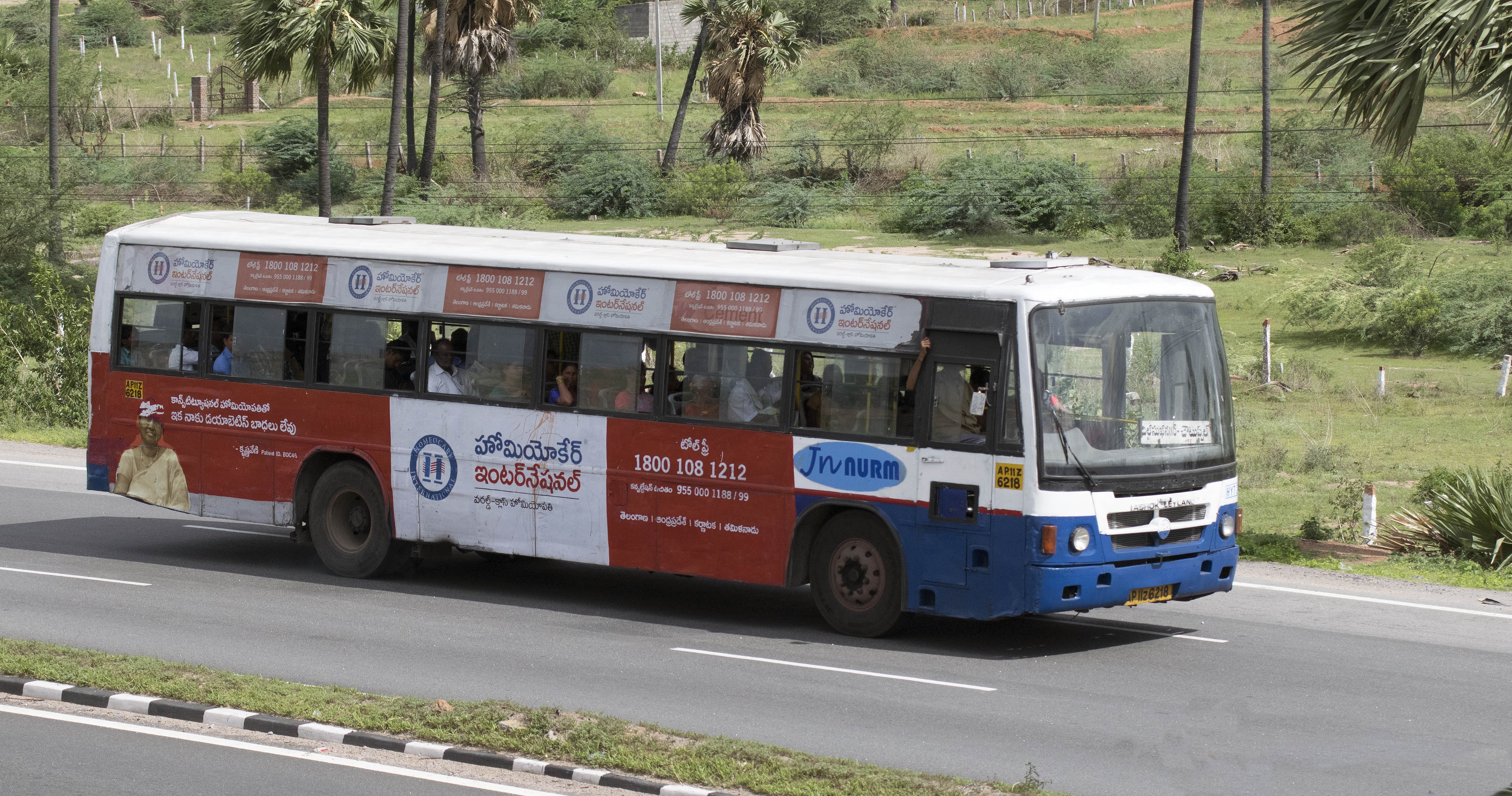
[[File:City Bus Hyd.jpg|thumb|A commuter bus in Hyderabad that is procured as a part of JNNURM]] | [[File:City Bus Hyd.jpg|thumb|A commuter bus in Hyderabad that is procured as a part of JNNURM]] | ||
===State level reforms=== | ===State level reforms=== | ||
As of 2012 [[Gujarat]] led the tally for the state level reforms, being the only state to have achieved all 10 reforms required by the mission. Five states have achieved 9 out of 10 reforms: [[Telangana]], [[Andhra Pradesh]], [[Maharashtra]], [[Madhya Pradesh]], [[Orissa, India|Orissa]] and [[Uttar Pradesh]].<ref name="State Reform Update 2012"/> Public disclosure and community participation laws have initially progressed slowly, with only five states managing to enact them as part of the reform agenda as of 2009.<ref name="2009 progress report">Indian Infrastructure:[http://www.indiaurbanportal.in/JNNURM/news/jnnurm_progress_rep.pdf JNNURM Progress Report]{{dead link|date=November 2017 |bot=InternetArchiveBot |fix-attempted=yes }}, February 2009</ref> However, as of 2012 community participation laws have been enacted by 22 out of 31 states, and public disclosure laws were enacted by 27 states. 20 states had decentralised the responsibility for water supply and sanitation from the state level to ULBs, and 19 had done so for city planning functions.<ref name="State Reform Update 2012">{{cite web|last=JnNURM|title=UIG – State Level Reform Status, March 2012|url=http://jnnurm.nic.in/wp-content/uploads/2012/06/State-Level.pdf|access-date=30 September 2012|url-status=dead|archive-url=https://web.archive.org/web/20120921054433/http://jnnurm.nic.in/wp-content/uploads/2012/06/State-Level.pdf|archive-date=21 September 2012 | As of 2012 [[Gujarat]] led the tally for the state level reforms, being the only state to have achieved all 10 reforms required by the mission. Five states have achieved 9 out of 10 reforms: [[Telangana]], [[Andhra Pradesh]], [[Maharashtra]], [[Madhya Pradesh]], [[Orissa, India|Orissa]] and [[Uttar Pradesh]].<ref name="State Reform Update 2012"/> Public disclosure and community participation laws have initially progressed slowly, with only five states managing to enact them as part of the reform agenda as of 2009.<ref name="2009 progress report">Indian Infrastructure:[http://www.indiaurbanportal.in/JNNURM/news/jnnurm_progress_rep.pdf JNNURM Progress Report]{{dead link|date=November 2017 |bot=InternetArchiveBot |fix-attempted=yes }}, February 2009</ref> However, as of 2012 community participation laws have been enacted by 22 out of 31 states, and public disclosure laws were enacted by 27 states. 20 states had decentralised the responsibility for water supply and sanitation from the state level to ULBs, and 19 had done so for city planning functions.<ref name="State Reform Update 2012">{{cite web|last=JnNURM|title=UIG – State Level Reform Status, March 2012|url=http://jnnurm.nic.in/wp-content/uploads/2012/06/State-Level.pdf|access-date=30 September 2012|url-status=dead|archive-url=https://web.archive.org/web/20120921054433/http://jnnurm.nic.in/wp-content/uploads/2012/06/State-Level.pdf|archive-date=21 September 2012}}</ref> | ||
[[File:JNNURM Bus.jpg|thumb|A bus by JNNURM scheme used by [[West Bengal]] Transport Infrastructure Development Corporation Limited, in the capital city of [[Kolkata]]]] | [[File:JNNURM Bus.jpg|thumb|A low-floor bus by JNNURM scheme used by [[West Bengal]] Transport Infrastructure Development Corporation Limited, in the capital city of [[Kolkata]]]] | ||
===City level reform of 2012=== | ===City level reform of 2012=== | ||
[[Visakhapatnam]], [[Surat]] and [[Pune]] had the distinction of having accomplished all 8 city level reforms. [[Chennai]], Greater [[Mumbai]] and [[ | [[Visakhapatnam]], [[Surat]] and [[Pune]] had the distinction of having accomplished all 8 city level reforms. [[Chennai]], Greater [[Mumbai]] and [[Hyderabad]] had achieved 7 out of 8 reforms. Out of 67 cities, 30 had achieved the 90% target for property tax collection, 20 had achieved full operation and maintenance cost recovery for water supply and sanitation, but only 8 had achieved cost recovery for solid waste.<ref name="ULB Reform Status 2012">{{cite web|last=JnNURM UIG|title=ULB Level Reforms Status, March 2012|url=http://jnnurm.nic.in/wp-content/uploads/2012/06/ULB-Level.pdf|access-date=30 September 2012|url-status=dead|archive-url=https://web.archive.org/web/20120921063549/http://jnnurm.nic.in/wp-content/uploads/2012/06/ULB-Level.pdf|archive-date=21 September 2012}}</ref> | ||
===Sanctioning of projects=== | ===Sanctioning of projects=== | ||
| Line 127: | Line 99: | ||
==Midterm appraisal== | ==Midterm appraisal== | ||
A midterm appraisal carried out in 2009 by the consulting firm [[Grant Thornton]] recommended to establish a single directorate for the ministries in charge of the mission; more involvement of city administrations in the preparation of city development plans that were prepared by consultants; broader stakeholder consultation during environmental and social impact assessments; the development of a national procurement manual; separation of the approval process for projects in two stages; financial support and capacity development for the implementation of reforms in addition to funding for infrastructure; the use of policies for public-private partnerships and pooled funding mechanisms at the state level, such as urban development funds that exist in Tamil Nadu and Orissa.<ref>{{cite web|last=JNNURM|title=Annual Update 2010–2011|url=http://jnnurm.nic.in/wp-content/uploads/2011/01/Annual%20Update%202010-2011%20(Bleed%205%20mm).pdf|pages=4–5|access-date=30 September 2012|archive-url=https://web.archive.org/web/20121031150305/http://jnnurm.nic.in/wp-content/uploads/2011/01/Annual%20Update%202010-2011%20(Bleed%205%20mm).pdf|archive-date=31 October 2012|url-status=dead | A midterm appraisal carried out in 2009 by the consulting firm [[Grant Thornton]] recommended to establish a single directorate for the ministries in charge of the mission; more involvement of city administrations in the preparation of city development plans that were prepared by consultants; broader stakeholder consultation during environmental and social impact assessments; the development of a national procurement manual; separation of the approval process for projects in two stages; financial support and capacity development for the implementation of reforms in addition to funding for infrastructure; the use of policies for public-private partnerships and pooled funding mechanisms at the state level, such as urban development funds that exist in Tamil Nadu and Orissa.<ref>{{cite web|last=JNNURM|title=Annual Update 2010–2011|url=http://jnnurm.nic.in/wp-content/uploads/2011/01/Annual%20Update%202010-2011%20(Bleed%205%20mm).pdf|pages=4–5|access-date=30 September 2012|archive-url=https://web.archive.org/web/20121031150305/http://jnnurm.nic.in/wp-content/uploads/2011/01/Annual%20Update%202010-2011%20(Bleed%205%20mm).pdf|archive-date=31 October 2012|url-status=dead}}</ref> | ||
== Funding shares by city categories == | == Funding shares by city categories == | ||
{| | {| class="wikitable text-centre" | ||
|+ '''Percentage of Funding'''<ref name="Guidelines for JNNURM " /> | |+ '''Percentage of Funding'''<ref name="Guidelines for JNNURM " /> | ||
|- | |- | ||
! rowspan="2 | ! rowspan="2" | Category of Cities/Towns/UAs | ||
! colspan="2 | ! colspan="2" | Grant | ||
! rowspan="2 | ! rowspan="2" | ULB or Para-Statal<br />Share/Loan from <br />Financial Institutions | ||
Share/Loan from <br /> | |||
Financial Institutions | |||
|- | |- | ||
! ''Centre'' | |||
! ''State'' | |||
|- | |- | ||
| Cities/UAs with 4 million plus population as per [[2001 Census of India|2001 census]] | |||
| 35% | |||
| 15% | |||
| 50% | |||
|- | |- | ||
| Cities/UAs with million plus but less than 4 million population as per [[2001 Census of India|2001 census]] | |||
| 50% | |||
| | | 20% | ||
| | | 30% | ||
| | |||
|- | |- | ||
| Cities/towns/UAs in North Eastern States and [[Jammu]] & [[Kashmir]] | |||
| 90% | |||
| 10% | |||
| – | |||
|- | |- | ||
| Cities/UAs other<br />than those mentioned above | |||
than those mentioned above | | 80% | ||
| 10% | |||
| 10% | |||
|- | |- | ||
| For setting up de-salination plants within 20 km.<br /> | |||
From sea-shore and other urban areas predominantly<br /> | |||
From sea-shore and other urban areas predominantly <br /> | facing [[water scarcity]] due to brackish water and<br /> | ||
facing [[water scarcity]] due to brackish water and <br /> | |||
non-availability of surface source. | non-availability of surface source. | ||
| 80% | |||
| 10% | |||
| 10% | |||
|} | |} | ||
| Line 183: | Line 145: | ||
The following table provides for a list of the cities/urban agglomerations (UAs) identified to receive the benefits of JNNURM. They include data pertaining to the state they belong to; the population in these cities given in lakhs as per the census of 2001.<ref name="Census">Census of India, 2001:[http://www.censusindia.net 2001 Census of India]</ref> | The following table provides for a list of the cities/urban agglomerations (UAs) identified to receive the benefits of JNNURM. They include data pertaining to the state they belong to; the population in these cities given in lakhs as per the census of 2001.<ref name="Census">Census of India, 2001:[http://www.censusindia.net 2001 Census of India]</ref> | ||
{| | {| class="wikitable" | ||
|+ | |+ List of identified cities/urban agglomerations (UA) as per 2001 Census<ref name="Guidelines for JNNURM " /><ref name="JnNURM – The Hindu">The Hindu, 2013:[http://www.thehindu.com/news/national/kerala/all-districts-to-get-lowfloor-buses/article5182045.ece All districts to get low-floor buses]</ref><ref name="EAI – JnNURM">EAI, 2012:[http://www.eai.in/360/news/pages/8013 All districts to get low-floor buses] {{Webarchive|url=https://web.archive.org/web/20141210193836/http://www.eai.in/360/news/pages/8013 |date=10 December 2014 }}</ref> | ||
! colspan="4" | ! colspan="4" | Mega Cities | ||
|- | |||
! No. | |||
! City/UA | |||
! Name of the State | |||
! Population (in lakh) | |||
|- | |||
| 1 | |||
| [[Delhi]] | |||
| [[Delhi]] | |||
| 128.77 | |||
|- | |- | ||
| 2 | |||
| [[Greater Mumbai]] | |||
| [[Maharashtra]] | |||
| 164.34 | |||
| | |||
|- | |- | ||
| | | 3 | ||
| [[Hyderabad]] | |||
| [[Telangana]] | |||
| | | 57.72 | ||
|- | |- | ||
| | | 4 | ||
| [[Bangalore]] | |||
| [[Karnataka]] | |||
| 57.01 | |||
|- | |- | ||
| | | 5 | ||
| [[Chennai]] | |||
| [[Tamil Nadu]] | |||
| | | 65.60 | ||
|- | |- | ||
| | | 6 | ||
| [[Kolkata]] | |||
| [[West Bengal]] | |||
| | | 132.06 | ||
|- | |- | ||
| | | 7 | ||
| [[Ahmedabad]] | |||
| [[Gujarat]] | |||
| | | 45.25 | ||
|- | |- | ||
! colspan="4" | Million-plus Cities/UAs | |||
|- | |- | ||
! | ! No. | ||
! City/UA | |||
! Name of the State | |||
! Population (in lakh) | |||
|- | |- | ||
| 1 | |||
| [[Patna]] | |||
| [[Bihar]] | |||
| 16.98 | |||
|- | |- | ||
| 2 | |||
| [[Faridabad]] | |||
| [[Haryana]] | |||
| 10.56 | |||
|- | |- | ||
| 3 | |||
| [[Bhopal]] | |||
| [[Madhya Pradesh]] | |||
| 14.58 | |||
|- | |- | ||
| 4 | |||
| [[Ludhiana]] | |||
| [[Punjab, India|Punjab]] | |||
| 13.98 | |||
|- | |- | ||
| 5 | |||
| [[Jaipur]] | |||
| [[Rajasthan]] | |||
| 23.27 | |||
|- | |- | ||
| 6 | |||
| [[Lucknow]] | |||
| [[Uttar Pradesh]] | |||
| 22.46 | |||
|- | |- | ||
| 7 | |||
| [[Madurai]] | |||
| [[Tamil Nadu]] | |||
| 12.03 | |||
|- | |- | ||
| 8 | |||
| [[Nashik]] | |||
| [[Maharashtra]] | |||
| 16.52 | |||
|- | |- | ||
| 9 | |||
| [[Pune]] | |||
| [[Maharashtra]] | |||
| 37.60 | |||
|- | |- | ||
| 10 | |||
| [[Kochi]] | |||
| [[Kerala]] | |||
| 13.55 | |||
|- | |- | ||
| 11 | |||
| [[Varanasi]] | |||
| [[Uttar Pradesh]] | |||
| 12.04 | |||
|- | |- | ||
| 12 | |||
| [[Agra]] | |||
| [[Uttar Pradesh]] | |||
| 13.31 | |||
|- | |- | ||
| 13 | |||
| [[Amritsar]] | |||
| [[Punjab, India|Punjab]] | |||
| 10.03 | |||
|- | |- | ||
| 14 | |||
| [[Visakhapatnam]] | |||
| [[Andhra Pradesh]] | |||
| 13.45 | |||
|- | |- | ||
| 15 | |||
| [[Vadodara]] | |||
| [[Gujarat]] | |||
| 14.91 | |||
|- | |- | ||
| 16 | |||
| [[Surat]] | |||
| [[Gujarat]] | |||
| 28.11 | |||
|- | |- | ||
| 17 | |||
| [[Kanpur]] | |||
| [[Uttar Pradesh]] | |||
| 27.15 | |||
|- | |- | ||
| 18 | |||
| [[Nagpur]] | |||
| [[Maharashtra]] | |||
| 21.29 | |||
|- | |- | ||
| 19 | |||
| [[Coimbatore]] | |||
| [[Tamil Nadu]] | |||
| 14.61 | |||
|- | |- | ||
| 20 | |||
| [[Meerut]] | |||
| [[Uttar Pradesh]] | |||
| 11.61 | |||
|- | |- | ||
| 21 | |||
| [[Jabalpur]] | |||
| [[Madhya Pradesh]] | |||
| 10.98 | |||
|- | |- | ||
| 22 | |||
| [[Jamshedpur]] | |||
| [[Jharkhand]] | |||
| 11.04 | |||
|- | |- | ||
| 23 | |||
| [[Asansol]] | |||
| [[West Bengal]] | |||
| 10.67 | |||
|- | |- | ||
| 24 | |||
| [[Allahabad]] | |||
| [[Uttar Pradesh]] | |||
| 10.42 | |||
|- | |- | ||
| 25 | |||
| [[Vijayawada]] | |||
| [[Andhra Pradesh]] | |||
| 10.39 | |||
|- | |- | ||
| 26 | |||
| [[Rajkot]] | |||
| [[Gujarat]] | |||
| 10.03 | |||
|- | |- | ||
| 27 | |||
| [[Dhanbad]] | |||
| [[Jharkhand]] | |||
| 10.65 | |||
|- | |- | ||
| 28 | |||
| [[Indore]] | |||
| [[Madhya Pradesh]] | |||
| 16.40 | |||
|- | |- | ||
! colspan="4 | ! colspan="4" | Identified cities/UAs with less than 1 million population | ||
|- | |- | ||
! | ! No. | ||
! | ! City/UA | ||
! | ! Name of the State | ||
! | ! Population (in lakh) | ||
|- | |- | ||
| | | 1 | ||
| [[Guwahati]] | |||
| [[Assam]] | |||
| | | 8.19 | ||
|- | |- | ||
| | | 2 | ||
| [[Itanagar]] | |||
| [[Arunachal Pradesh]] | |||
| | | 0.35 | ||
|- | |- | ||
| | | 3 | ||
| [[Jammu]] | |||
| [[Jammu and Kashmir (union territory)|Jammu & Kashmir]] | |||
| | | 6.12 | ||
|- | |- | ||
| | | 4 | ||
| [[Raipur]] | |||
| [[Chhattisgarh]] | |||
| | | 7.00 | ||
|- | |- | ||
| | | 5 | ||
| [[Panaji]] | |||
| [[Goa]] | |||
| | | 0.99 | ||
|- | |- | ||
| | | 6 | ||
| [[Shimla]] | |||
| [[Himachal Pradesh]] | |||
| | | 1.45 | ||
|- | |- | ||
| | | 7 | ||
| [[Ranchi]] | |||
| [[Jharkhand]] | |||
| 8.63 | |||
|- | |- | ||
| | | 8 | ||
| [[Thiruvananthapuram]] | |||
| [[Kerala]] | |||
| | | 8.90 | ||
|- | |- | ||
| | | 9 | ||
| [[Imphal]] | |||
| [[Manipur]] | |||
| 2.50 | |||
|- | |- | ||
| | | 10 | ||
| [[Shillong]] | |||
| [[Meghalaya]] | |||
| 2.68 | |||
|- | |- | ||
| | | 11 | ||
| [[Aizawl]] | |||
| [[Mizoram]] | |||
| | | 2.28 | ||
|- | |- | ||
| | | 12 | ||
| [[Kohima]] | |||
| [[Nagaland]] | |||
| | | 0.77 | ||
|- | |- | ||
| | | 13 | ||
| [[Bhubaneshwar]] | |||
| [[Odisha]] | |||
| | | 6.58 | ||
|- | |- | ||
| | | 14 | ||
| [[Gangtok]] | |||
| [[Sikkim]] | |||
| | | 0.29 | ||
|- | |- | ||
| | | 15 | ||
| [[Agartala]] | |||
| [[Tripura]] | |||
| | | 1.90 | ||
|- | |- | ||
| | | 16 | ||
| [[Dehradun]] | |||
| [[Uttaranchal]] | |||
| | | 5.30 | ||
|- | |- | ||
| | | 17 | ||
| [[Bodh Gaya]] | |||
| [[Bihar]] | |||
| | | 3.94 | ||
|- | |- | ||
| | | 18 | ||
| [[Ujjain]] | |||
| [[Madhya Pradesh]] | |||
| | | 4.31 | ||
|- | |- | ||
| | | 19 | ||
| [[Puri]] | |||
| [[Odisha]] | |||
| | | 1.57 | ||
|- | |- | ||
| | | 20 | ||
| [[Pushkar]] | |||
| [[Rajasthan]] | |||
| | | 5.04 | ||
|- | |- | ||
| | | 21 | ||
| [[Nainital]] | |||
| [[Uttaranchal]] | |||
| | | 2.20 | ||
|- | |- | ||
| | | 22 | ||
| [[Mysore]] | |||
| [[Karnataka]] | |||
| | | 7.99 | ||
|- | |- | ||
| | | 23 | ||
| [[Mangalore]] | |||
| [[Karnataka]] | |||
| | | 6.23 | ||
|- | |- | ||
| | | 24 | ||
| [[Udupi]] | |||
| [[Karnataka]] | |||
| | | 1.65 | ||
|- | |- | ||
| | | 25 | ||
| [[Puducherry (city)|Pondicherry]] | |||
| [[Puducherry (union territory)|Puducherry]] | |||
| | | 5.05 | ||
|- | |- | ||
| | | 26 | ||
| [[Chandigarh]] | |||
| | | [[Punjab, India|Punjab]], [[Haryana]] | ||
| | | 8.08 | ||
|- | |- | ||
| | | 27 | ||
| [[Srinagar]] | |||
| [[Jammu and Kashmir (union territory)|Jammu and Kashmir]] | |||
| | | 9.88 | ||
|- | |- | ||
| | | 28 | ||
| [[Mathura]] | |||
| [[Uttar Pradesh]] | |||
| | | 3.23 | ||
|- | |- | ||
| | | 29 | ||
| [[Haridwar]] | |||
| [[Uttaranchal]] | |||
| | | 2.21 | ||
|- | |- | ||
| | | 30 | ||
| [[Kolhapur]] | |||
| [[Maharashtra]] | |||
| | | 5.50 | ||
|- | |- | ||
| | | 31 | ||
| [[Guntur]] | |||
| [[Andhra Pradesh]] | |||
| | | 7.43 | ||
|- | |- | ||
| | | 32 | ||
| [[Kollam]] | |||
| [[Kerala]] | |||
| | | 3.49 | ||
|- | |- | ||
| | | 33 | ||
| [[Tiruchirappalli]] | |||
| [[Tamil Nadu]] | |||
| 7.52 | |||
|- | |||
| 34 | |||
| [[Cuttack]] | |||
| [[Odisha]] | |||
| 5.35 | |||
|} | |} | ||
Note: National Steering Group may choose to add or delete cities/UAs/towns under Category-C (other than state capitals) based on the suggestions received from state governments. However, the number of cities under the mission shall remain around 60. | Note: National Steering Group may choose to add or delete cities/UAs/towns under Category-C (other than state capitals) based on the suggestions received from state governments. However, the number of cities under the mission shall remain around 60. | ||
=== Discrepancies in funding for small cities === | |||
Based on research conducted by the Indian Institute for Human Settlements, 65 cities were allocated 75% of the funding through JnNURM for projects related to Urban Infrastructure and [[Governance]] (UIG) and Basic Services for the [[Urban poor|Urban Poor]] (BSUP).<ref name=":0">{{Cite web |first= |title=Urban India 2011: Evidence |url=https://iihs.co.in/knowledge-gateway/wp-content/uploads/2015/08/IUC-Book_02-03-12-LOW-RES.pdf}}</ref> In contrast, 640 cities received the remaining 25% of funding for initiatives like the Integrated Housing and Slum Development Programme (IHSDP) and the Urban Infrastructure Development Scheme for Small and Medium Towns (UIDSSMT).<ref name=":0" /> | |||
Bigger cities received greater per capita investment under JnNURM compared to smaller cities. Moreover, while JnNURM encompassed all residents in cities with a population of one million or more, it only encompassed slightly over half of those in class I cities and less than half of those in classes II, III, and IV cities.<ref name=":0" /> According to JnNURM, none of the cities in classes V and VI were included. Larger cities have a greater proportion of urban population served by JnNURM compared to smaller cities.<ref name=":0" /> | |||
== See also == | == See also == | ||
*[[Vikas yojna]] | * [[Atal Mission for Rejuvenation and Urban Transformation]] (AMRUT), successor to JnNURM | ||
*[[Accredited Social Health Activist]] | * [[Vikas yojna]] | ||
*[[Mahatma Gandhi National Rural Employment Guarantee Act]] | * [[Accredited Social Health Activist]] | ||
* [[Mahatma Gandhi National Rural Employment Guarantee Act]] | |||
== References == | == References == | ||
| Line 565: | Line 532: | ||
== External links == | == External links == | ||
*[https://web.archive.org/web/20070502111410/http://jnnurm.nic.in/ JNNURM Homepage] | * [https://web.archive.org/web/20070502111410/http://jnnurm.nic.in/ JNNURM Homepage] | ||
*[https://archive.today/20130218021144/http://www.ccs.in/jnnurm JNNURM information from the Centre for Civil Society, New Delhi] | * [https://archive.today/20130218021144/http://www.ccs.in/jnnurm JNNURM information from the Centre for Civil Society, New Delhi] | ||
*[https://web.archive.org/web/20100204221252/http://www.indiaurbanportal.in/JNNURM/jnnurm.htm indiaurbanportal-JNNURM] | * [https://web.archive.org/web/20100204221252/http://www.indiaurbanportal.in/JNNURM/jnnurm.htm indiaurbanportal-JNNURM] | ||
{{Government Schemes in India}} | {{Government Schemes in India}} | ||
Latest revision as of 13:07, 20 January 2026
 | This article has multiple issues. Please help improve it or discuss these issues on the talk page. (Learn how and when to remove these template messages)
|


| Jawaharlal Nehru National Urban Renewal Mission (JNNURM) | |
|---|---|
| Error creating thumbnail: File missing | |
| Error creating thumbnail: File missing Overhead Water Tank Capacity 3 million litres, at Barat Nagar BHEL under Bhopal Municipal Corporation | |
| Country | India |
| Status | Succeeded by AMRUT |


Jawaharlal Nehru National Urban Renewal Mission (JNNURM) was a massive city-modernization scheme launched by the Government of India under the Ministry of Urban Development. It envisaged a total investment of over $20 billion over seven years. It was named after Jawaharlal Nehru, the first Prime Minister of India. The scheme aimed to encourage reforms and fast-track planned development of identified cities. The focus was on efficiency in urban infrastructure and service delivery mechanisms, community participation, and accountability of urban local bodies and parastatal agencies towards citizens.[1] The scheme was officially inaugurated by Prime Minister Manmohan Singh on 3 December 2005[2].
Structure[edit | edit source]
Sub-missions[edit | edit source]
JNNURM primarily incorporates two sub-missions into its program:
- The Sub-Mission for Urban Infrastructure and Governance administered by the Ministry of Urban Development, with a focus on water supply and sanitation, solid waste management, road network, urban transport and redevelopment of old city areas.[citation needed]
- The Sub-Mission for Basic Services to the Urban Poor (BSUP)[3] administered by the Ministry of Housing and Urban Poverty Alleviation with a focus on integrated development of slums.[4]

In addition to this, it has two further components:[5]
- The Sub-Mission for Urban Infrastructure Development Scheme for Small & Medium Towns (UIDSSMT) administered by the Ministry of Urban Development, with a focus on subsuming the schemes of Integrated Development of Small and Medium Towns (IDSMT) and Accelerated Urban Water Supply Programme (AUWSP) which aim at planned urban infrastructural improvement in towns and cities under its purview.[6]
- The Sub-Mission for Integrated Housing and Slum Development Programme (IHSDP) administered by Ministry of Housing and Urban Poverty Alleviation (MHUPA) was envisaged and brought into effect in 1993–94 in accordance with providing the entire population with safe and adequate water supply facilities. This sub-mission was mainly implemented in towns with populations less than 20,000 as per the 1991 census.[7]
Objectives[edit | edit source]
- Focused attention relating to infrastructural services in the context of integrated development is to be covered under the mission.
- Make efficient and increase self-sustaining capabilities of cities as per the sector proving infrastructural services by securing the linkages between asset creation and asset management[1]
- Ensure adequate investment of funds to fulfill deficiencies in the urban infrastructural services.
- Planned development of identified cities including peri-urban areas, out growths, urban corridors, so that urbanization takes place in a dispersed manner.
- Scale up delivery of civic amenities and provision of utilities with emphasis on universal access to urban poor.
- To take up urban renewal programme, i.e., re-development of inner (old) cities area to reduce congestion.[8]
- Provision of basic services to the urban poor including security of tenure at affordable prices, improved housing, water supply and sanitation, and ensuring delivery of other existing universal services of the government for education, health and social security.
Duration[edit | edit source]
The duration of the mission was initially seven years beginning from December 2005. During this period, the mission sought to ensure sustainable development of participating cities. An evaluation of the experience of implementation of the mission would be undertaken before the end of the Eleventh Five Year Plan in 2012. The duration of the mission was extended by two more years: until 31 March 2014.[1]
funds are channeled through state-level agencies, where grants from the central and state governments are pooled and passed on as grants or soft loans to cities provided that they have prepared development strategies and that the investments identified fit within these strategies. The mission emphasises transparency and accountability. It supports public-private partnerships and cost recovery to make service providers financially self-sustaining.[4] The share of grant funding by the central government can vary from 35% in the largest cities to up to 90% in cities in the Northeast. Most cities receive grants covering 50% or 80% of costs depending on size.[9] Capacity building is also included in the mission to assist urban local bodies to prepare strategies and projects.
Currently, ten projects are covered by JNNURM funds pertaining to road network, storm water drains, bus rapid transit system, water supply, solid waste management, sewage treatment, river and lake improvement, slum improvement and rehabilitation, all fall under its scope.
Strategy of the Mission[edit | edit source]
- Preparing City Development Plan: Every city will be expected to formulate a City Development Plan (CDP) indicating policies, programmes and strategies, and financing plans.
- Preparing Projects: The CDP would facilitate identification of projects. The Urban Local Bodies (ULBs) / parastatal agencies will be required to prepare Detailed Project Reports (DPRs) for undertaking projects in the identified spheres.
- Release and Leveraging of Funds: It is expected that the JNNURM assistance would serve to catalyse the flow of investment into the urban infrastructure sector across the country. Funds from the Central and State Government will flow directly to the nodal agency designated by the State, as grants-in-aid.
- Incorporating Private Sector Efficiencies: In order to optimise the life-cycle costs over the planning horizon, private sector efficiencies can be inducted in development, management, implementation and financing of projects, through Public Private Partnership (PPP) arrangements.[1]
Expected Outcomes[edit | edit source]
- Modern and transparent budgeting, accounting, financial management systems, designed and adopted for all urban service and governance functions.
- City-wide framework for planning and governance will be established and become operational.
- All urban residents will be able to obtain access to a basic level of urban services.
- Financially self-sustaining agencies for urban governance and service delivery will be established, through reforms to major revenue instruments.
- Local services and governance will be conducted in a manner that is transparent and accountable to citizens.
- E-governance applications will be introduced in core functions of ULBs/Parastatal resulting in reduced cost and time of service delivery processes.[1]
Coverage[edit | edit source]
As per the JNNURM guidelines, only select cities/Urban Agglomerations (UAs) as per 2001 Census have been chosen for the implementation of the programme as per norms/criteria mentioned below:[8]
| A | Cities/UAs with 4 million plus population as per 2001 census | 07 |
| B | Cities/UAs with 1 million plus but less than 4 million population as per 2001 census | 28 |
| C | Selected cities/UAs (state capitals and other cities/UAs of religious/historic and touristic importance) | 28 |
Implementation[edit | edit source]


State level reforms[edit | edit source]
As of 2012 Gujarat led the tally for the state level reforms, being the only state to have achieved all 10 reforms required by the mission. Five states have achieved 9 out of 10 reforms: Telangana, Andhra Pradesh, Maharashtra, Madhya Pradesh, Orissa and Uttar Pradesh.[10] Public disclosure and community participation laws have initially progressed slowly, with only five states managing to enact them as part of the reform agenda as of 2009.[11] However, as of 2012 community participation laws have been enacted by 22 out of 31 states, and public disclosure laws were enacted by 27 states. 20 states had decentralised the responsibility for water supply and sanitation from the state level to ULBs, and 19 had done so for city planning functions.[10]

City level reform of 2012[edit | edit source]
Visakhapatnam, Surat and Pune had the distinction of having accomplished all 8 city level reforms. Chennai, Greater Mumbai and Hyderabad had achieved 7 out of 8 reforms. Out of 67 cities, 30 had achieved the 90% target for property tax collection, 20 had achieved full operation and maintenance cost recovery for water supply and sanitation, but only 8 had achieved cost recovery for solid waste.[12]
Sanctioning of projects[edit | edit source]
As of 2009, 415 projects requiring an investment of ₹440 billion (US$6.2 billion), equivalent to half the total envisaged program amount, were approved. Among the states, Maharashtra has been sanctioned the maximum number of projects under the mission. Among cities, Bangalore has had the highest number of approved projects.[11]
Midterm appraisal[edit | edit source]
A midterm appraisal carried out in 2009 by the consulting firm Grant Thornton recommended to establish a single directorate for the ministries in charge of the mission; more involvement of city administrations in the preparation of city development plans that were prepared by consultants; broader stakeholder consultation during environmental and social impact assessments; the development of a national procurement manual; separation of the approval process for projects in two stages; financial support and capacity development for the implementation of reforms in addition to funding for infrastructure; the use of policies for public-private partnerships and pooled funding mechanisms at the state level, such as urban development funds that exist in Tamil Nadu and Orissa.[13]
[edit | edit source]
| Category of Cities/Towns/UAs | Grant | ULB or Para-Statal Share/Loan from Financial Institutions | |
|---|---|---|---|
| Centre | State | ||
| Cities/UAs with 4 million plus population as per 2001 census | 35% | 15% | 50% |
| Cities/UAs with million plus but less than 4 million population as per 2001 census | 50% | 20% | 30% |
| Cities/towns/UAs in North Eastern States and Jammu & Kashmir | 90% | 10% | – |
| Cities/UAs other than those mentioned above |
80% | 10% | 10% |
| For setting up de-salination plants within 20 km. From sea-shore and other urban areas predominantly |
80% | 10% | 10% |
List of identified cities[edit | edit source]
The following table provides for a list of the cities/urban agglomerations (UAs) identified to receive the benefits of JNNURM. They include data pertaining to the state they belong to; the population in these cities given in lakhs as per the census of 2001.[14]
Note: National Steering Group may choose to add or delete cities/UAs/towns under Category-C (other than state capitals) based on the suggestions received from state governments. However, the number of cities under the mission shall remain around 60.
Discrepancies in funding for small cities[edit | edit source]
Based on research conducted by the Indian Institute for Human Settlements, 65 cities were allocated 75% of the funding through JnNURM for projects related to Urban Infrastructure and Governance (UIG) and Basic Services for the Urban Poor (BSUP).[17] In contrast, 640 cities received the remaining 25% of funding for initiatives like the Integrated Housing and Slum Development Programme (IHSDP) and the Urban Infrastructure Development Scheme for Small and Medium Towns (UIDSSMT).[17]
Bigger cities received greater per capita investment under JnNURM compared to smaller cities. Moreover, while JnNURM encompassed all residents in cities with a population of one million or more, it only encompassed slightly over half of those in class I cities and less than half of those in classes II, III, and IV cities.[17] According to JnNURM, none of the cities in classes V and VI were included. Larger cities have a greater proportion of urban population served by JnNURM compared to smaller cities.[17]
See also[edit | edit source]
- Atal Mission for Rejuvenation and Urban Transformation (AMRUT), successor to JnNURM
- Vikas yojna
- Accredited Social Health Activist
- Mahatma Gandhi National Rural Employment Guarantee Act
References[edit | edit source]
- ↑ 1.0 1.1 1.2 1.3 1.4 NNVNS.ORG (8 November 2021). "Jawaharlal Nehru National Urban Renewal Mission [All Details]". Retrieved 29 November 2021.
- ↑ "Prime Minister's Office". Archived from the original on 17 May 2012. Retrieved 2 May 2012.
- ↑ Sub-missions:JnNURM Sub-Missions Archived 10 May 2012 at the Wayback Machine
- ↑ 4.0 4.1 Government of India:Jawaharlal Nehru National Urban Renewal Mission Archived 16 February 2010 at the Wayback Machine, ca. 2005
- ↑ "JNNURM Directorate" (PDF). Archived from the original (PDF) on 13 October 2011.
- ↑ "UIDSSMT Guidelines". Archived from the original on 5 October 2011.
- ↑ "Accelerated Urban Water Supply Programme (AUWSP)". Archived from the original on 2 November 2011.
- ↑ 8.0 8.1 8.2 8.3 Guidelines:JNNURM Guidelines, February 2009
- ↑ Infrastructure Leasing & Financial Services Limited (ILFS) India:IL&FS IDC Services offered for JNNURM and UIDSSMT Schemes Archived 3 January 2010 at the Wayback Machine, undated presentation
- ↑ 10.0 10.1 JnNURM. "UIG – State Level Reform Status, March 2012" (PDF). Archived from the original (PDF) on 21 September 2012. Retrieved 30 September 2012.
- ↑ 11.0 11.1 Indian Infrastructure:JNNURM Progress Report[permanent dead link], February 2009
- ↑ JnNURM UIG. "ULB Level Reforms Status, March 2012" (PDF). Archived from the original (PDF) on 21 September 2012. Retrieved 30 September 2012.
- ↑ JNNURM. "Annual Update 2010–2011" (PDF). pp. 4–5. Archived from the original (PDF) on 31 October 2012. Retrieved 30 September 2012.
- ↑ Census of India, 2001:2001 Census of India
- ↑ The Hindu, 2013:All districts to get low-floor buses
- ↑ EAI, 2012:All districts to get low-floor buses Archived 10 December 2014 at the Wayback Machine
- ↑ 17.0 17.1 17.2 17.3 "Urban India 2011: Evidence" (PDF).