




WikiDwarfBOT (talk | contribs) Cleanup: Grammar fix. Source modification. |
Content updated and refined |
||
| Line 1: | Line 1: | ||
{{Short description|Self-designation used by ancient Indo-Iranian peoples}} | {{Short description|Self-designation used by ancient Indo-Iranian peoples}} | ||
{{redirect |Arya |other uses}} | |||
{{About|the cultural and historical concept}} | {{About|the cultural and historical concept}} | ||
{{Pp-move}} | |||
{{italic title}} | |||
{{Indo-European topics}} | {{Indo-European topics}} | ||
{{ | '''''Aryan''''' ({{IPAc-en|ˈ|ɛər|i|ə|n}}), or '''''Arya''''' (borrowed from [[Sanskrit]] ''ārya''),<ref name="OED">[[Oxford English Dictionary Online]] 2024, s.v. ''Aryan'' (adj. & n.); ''Arya'' (n.)''.''</ref> is a term originating from the ethno-cultural self-designation of the [[Indo-Iranians]].<ref name=":3" /><ref>{{Harvnb|Witzel|2001|p=2}}: "At the outset, it has to be underlined that the term ''Ārya'' (whence, Aryan) is the ''self''-designation of the ancient Iranians and of those Indian groups speaking Vedic Sanskrit and other Old Indo-Aryan (OIA) languages and dialects. Both peoples called themselves and their language ''ārya'' or ''arya'': [...]"</ref> It stood in contrast to nearby outsiders, whom they designated as [[Aneran|non-Aryan]] ({{lang|iir-x-proto|an-āryā}}).<ref name=":4" /> In [[ancient India]], the term was used by the [[Indo-Aryan peoples]] of the [[Vedic period]], both as an [[Endonym and exonym|endonym]] and in reference to a region called [[Āryāvarta|''Aryavarta'']] ({{Literal translation|Land of the Aryans}}),{{efn|{{Langx|sa|आर्यावर्त|Āryāvarta}}}} where their culture emerged.{{Sfn|Witzel|2001|pp=4, 24}} Similarly, according to the [[Avesta]], the [[Ancient Iranian peoples|Iranian peoples]] used the term to designate themselves as an ethnic group and to refer to a region called ''[[Airyanem Vaejah]]'' ({{Literal translation|Expanse of the [[Arya (Iran)|Arya]]}}),{{efn|{{Langx|ae|𐬀𐬌𐬭𐬌𐬌𐬀𐬥𐬆𐬨⸱ 𐬬𐬀𐬉𐬘𐬀𐬵|Airyanəm Vaēǰah}}}} which was their mythical homeland.<ref name=":5" /><ref name="Gnoli" /> The word stem also forms the etymological source of place names like ''[[Alania]]'' ({{lang|iir-x-proto|Aryāna}}) and ''[[Iran (word)|Iran]]'' ({{lang|iir-x-proto|Aryānām}}).<ref name="Mallory" /> | ||
Although the stem {{lang|iir-x-proto|arya}} may originate from the [[Proto-Indo-European language]],<ref name=":2" /> it seems to have been used exclusively by the Indo-Iranian peoples, as there is no evidence of it having served as an ethnonym for the [[Proto-Indo-Europeans]]. The view of many modern scholars is that the ethos of the ancient Aryan identity, as it is described in the Avesta and the ''[[Rigveda]]'', was religious, cultural, and linguistic, and was not tied to the concept of [[Race (human categorization)|race]].{{Sfn|Bryant|2001|pp=60–63}}<ref name=":0">{{harvnb|Witzel|2001|loc=p. 24: "''Arya''/''ārya'' does not mean a particular ''people'' or even a particular 'racial' group but all those who had joined the tribes speaking Vedic Sanskrit and adhering to their cultural norms (such as ritual, poetry, etc.)"}}</ref><ref name=":1">{{harvnb|Anthony|2007|loc=p. 408: "The ''Rigveda'' and ''Avesta'' agreed that the essence of their shared parental Indo-Iranian identity was linguistic and ritual, not racial. If a person sacrificed to the right gods in the right way using the correct forms of the traditional hymns and poems, that person was an Aryan."}}</ref> | |||
In the 1850s, the French diplomat and writer [[Arthur de Gobineau]] brought forth the idea of the "[[Aryan race]]", essentially claiming that the Proto-Indo-Europeans were superior specimens of humans and that their descendants comprised either a [[Historical race concepts|distinct racial group]] or a distinct sub-group of the hypothetical [[Caucasian race]]. Through the work of his later followers, such as the British-German philosopher [[Houston Stewart Chamberlain]], Gobineau's theory proved to be particularly popular among European [[Racial supremacist|racial supremacists]] and ultimately laid the foundation for [[Nazi racial theories]], which also co-opted the concept of [[scientific racism]].{{sfn|Anthony|2007|pp=9–11}} Hitler drew on vague ideas that the Aryans in ancient India were lighter-skinned and taller than their neighbors, and that, after relocating, they cultivated and bore all of the cultural creativity of Europe.<ref>{{Cite book |last=Bergen |first=Doris L. |title=War & Genocide |publisher=Rowman & Littlefield |year=2003 |isbn=9780847696314 |pages=36}}</ref> | |||
In | In [[Nazi Germany]], and also in [[German-occupied Europe]] during [[World War II]], any citizen who was classified as an Aryan would be honoured as a member of the "[[master race]]" of humanity. Conversely, non-Aryans were [[Racial policy of Nazi Germany|legally discriminated against]], including [[Jews]], [[Romani people|Roma]], and [[Slavs]] (mostly [[Polish people|Poles]] and [[Russians]]).<ref name=":7">{{Cite book|last=Gordon|first=Sarah Ann|title=Hitler, Germans, and the "Jewish Question"|date=1984|publisher=Princeton University Press|others=Mazal Holocaust Collection|isbn=0-691-05412-6|location=Princeton, N.J.|pages=96|oclc=9946459}}</ref><ref>{{Cite book|last=Longerich|first=Peter|title=Holocaust : the Nazi persecution and murder of the Jews|date=2010|publisher=Oxford University Press|isbn=978-0-19-280436-5|location=Oxford|pages=83,241|oclc=610166248}}</ref> Jews, who were regarded as the arch enemy of the "Aryan race" in a "racial struggle for existence",{{sfn|Weikart|2009|p=85}} were especially targeted by the [[Nazi Party]], culminating in [[the Holocaust]].<ref name=":7" /> The Roma, who are of Indo-Aryan origin, were also targeted, culminating in the [[Porajmos]]. The genocides and other large-scale atrocities that have been committed by [[Aryanism|Aryanists]] have led academic figures to generally avoid using "Aryan" as a stand-alone ethno-linguistic term, particularly in the [[Western world]], where "Indo-Iranian" is the preferred alternative, although the term "Indo-Aryan" is still used to denote the [[Indo-Aryan languages|Indic branch]].<ref name=":6" /> | ||
== Etymology == | == Etymology == | ||
[[File:Darius_I_the_Great's_inscription.jpg|thumb|One of the earliest epigraphically attested reference to the word ''arya'' occurs in the 6th-century BC [[Behistun inscription]], which describes itself as having been composed "in ''arya'' [language or script]" (§ 70). As is also the case for all other Old Iranian language usage, the ''arya'' of the inscription does not signify anything but "[[ | |||
The term ''Arya'' was first rendered into a modern European language in 1771 as ''Aryens'' by French Indologist [[Abraham Hyacinthe Anquetil-Duperron|Abraham-Hyacinthe Anquetil-Duperron]], who rightly compared the Greek ''arioi'' with the [[Avestan]] ''airya'' and the country name ''[[Name of Iran|Iran]].'' | === English and European languages === | ||
[[File:Darius_I_the_Great's_inscription.jpg|thumb|One of the earliest epigraphically attested reference to the word ''arya'' occurs in the 6th-century BC [[Behistun inscription]], which describes itself as having been composed "in ''arya'' [language or script]" (§ 70). As is also the case for all other Old Iranian language usage, the ''arya'' of the inscription does not signify anything but "[[Arya (Iran)|Iranian]]".<ref name="Gershevitch2"><sup>''cf.''</sup> {{Cite book|last=Gershevitch|first=Ilya|title=Handbuch der Orientalistik, Literatur I|publisher=Brill|year=1968|location=Leiden|pages=1–31|chapter=Old Iranian Literature}}, p. 2.</ref>]] | |||
The term ''Arya'' was first rendered into a modern European language in 1771 as ''Aryens'' by French Indologist [[Abraham Hyacinthe Anquetil-Duperron|Abraham-Hyacinthe Anquetil-Duperron]], who rightly compared the Greek ''arioi'' with the [[Avestan]] ''airya'' and the country name ''[[Name of Iran|Iran]].'' In Germany, [[Johann Friedrich Kleuker]]'s translation of Anquetil-Duperron's work led to the introduction of the term ''Arier'' in 1776.{{Sfn|Arvidsson|2006|p=20}}{{Sfn|Motadel|2013|p=120}} | |||
The [[Sanskrit]] word ''ā́rya'' is rendered as 'noble' in [[William Jones (philologist)|William Jones]]' 1794 translation of the Indian ''[[Laws of Manu]].''{{Sfn|Arvidsson|2006|p=20}} The English ''Aryan'' (originally spelt ''Arian'') appeared a few decades later, first as an adjective in 1839, then as a noun in 1849, probably after the German ''Arier'' (noun), ''arisch'' (adjective).<ref name="OED" /> During the 19th and early 20th centuries, the meaning varied between the broader category equivalent to ''Indo-European'', and the narrower one equivalent to ''Indo-Iranian''.<ref name="OED" /> | |||
Use of Aryan to designate a "white non-Jewish person, especially one of northern European origin or descent" entered the English language from German,<ref name="OED" /> after this meaning was introduced in 1887 and further developed by German anti-Semitic propagandists in the context of a so-called "[[Aryan race]]".{{Sfn|Arvidsson|2006|p=21}} It is still used in far-right and white supremacist discourse, and sometimes appears in the names of such groups.<ref name="OED" /> | |||
=== Indo-Iranian === | === Indo-Iranian === | ||
The [[Sanskrit language|Sanskrit]] word ''ā́rya'' ([[ | The [[Sanskrit language|Sanskrit]] word ''ā́rya'' ([[wikt:आर्य|आर्य]]) was originally an ethnocultural term designating those who spoke [[Vedic Sanskrit]] and adhered to Vedic cultural norms (including religious rituals and poetry), in contrast to an outsider, or ''an-ā́rya'' ('non-Arya').{{sfn|Schmitt|1987}}{{Sfn|Witzel|2001|pp=4, 24}} By the time of the [[Buddha]] (5th–4th century BCE), it took the meaning of 'noble'.{{Sfn|Witzel|2001|p=4}} In [[Old Iranian languages]], the [[Avestan]] term ''airya'' ([[Old Persian]] ''ariya'') was likewise used as an ethnocultural self-designation by ancient [[Iranian peoples]], in contrast to an ''[[Aneran|an-airya]]'' ('non-Arya'). It designated those who belonged to the 'Aryan' (Iranian) ethnic stock, spoke the language and followed the religion of the 'Aryas'.<ref name=":5">{{harvnb|Bailey|1987|loc=}}: "It is used in the ''Avesta'' of members of an ethnic group and contrasts with other named groups (Tūirya, Sairima, Dāha, Sāinu or Sāini) and with the outer world of the ''An-airya'' 'non-Arya'."</ref><ref name="Gnoli">{{harvnb|Gnoli|2006|loc=}}: "Mid. Pers. ''ēr'' (plur. ''ērān''), just like Old Pers. ''ariya'' and Av. ''airya'', has an evident ethnic value, which is also present in the abstract term ''ērīh'', 'Iranian character, Iranianness'."</ref> | ||
These two terms derive from the reconstructed [[Proto-Indo-Iranian language|Proto-Indo-Iranian]] stem {{lang|iir-x-proto|arya}}- or {{lang|iir-x-proto|āryo}}-,<ref>{{harvnb|Szemerényi|1977|pp=125–146}}; {{harvnb|Watkins|1985|p=3}}; {{harvnb|Mallory|Adams|1997|p=304}}; {{harvnb|Fortson|2011|p=209}}</ref> which was probably the name used by the prehistoric [[Indo-Iranians|Indo-Iranian peoples]] to designate themselves as an ethnocultural group.<ref name=":3">{{harvnb|Benveniste|1973|p | These two terms derive from the reconstructed [[Proto-Indo-Iranian language|Proto-Indo-Iranian]] stem {{lang|iir-x-proto|arya}}- or {{lang|iir-x-proto|āryo}}-,<ref>{{harvnb|Szemerényi|1977|pp=125–146}}; {{harvnb|Watkins|1985|p=3}}; {{harvnb|Mallory|Adams|1997|p=304}}; {{harvnb|Fortson|2011|p=209}}</ref> which was probably the name used by the prehistoric [[Indo-Iranians|Indo-Iranian peoples]] to designate themselves as an ethnocultural group.<ref name=":3">{{harvnb|Benveniste|1973|loc=p. 295: "''Arya'' [...] is the common ancient designation of the 'Indo-Iranians'."}}</ref>{{Sfn|Gamkrelidze|Ivanov|1995|pp=657–658}}{{Sfn|Kuzmina|2007|p=456}} The term did not have any [[Race (human categorization)|racial]] connotation, which only emerged later in the works of 19th-century Western writers.{{Sfn|Bryant|2001|pp=60–63}}<ref name=":0"/>{{Sfn|Anthony|2007|p=408}} According to [[David W. Anthony]], "the ''[[Rigveda]]'' and ''[[Avesta]]'' agreed that the essence of their shared parental Indo-Iranian identity was linguistic and ritual, not racial. If a person sacrificed to the right gods in the right way using the correct forms of the traditional hymns and poems, that person was an Aryan."{{Sfn|Anthony|2007|p=408}} | ||
=== Proto-Indo-European === | === Proto-Indo-European === | ||
The [[Proto-Indo-European language|Proto-Indo-European]] (PIE) origin of the Indo-Iranian stem ''arya''- remains debated. A number of scholars, starting with [[Adolphe Pictet]] (1799–1875), have proposed to derive ''arya''- from the reconstructed PIE term {{lang|ine-x-proto|h₂erós}} or {{lang|ine-x-proto|h₂eryós}}, variously translated as 'member of one's own group, peer, freeman'; as 'host, guest; kinsman'; or as 'lord, ruler'.<ref name=":2">{{harvnb|Watkins|1985|p=3}}; {{harvnb|Gamkrelidze|Ivanov|1995|pp=657–658}}; {{harvnb|Mallory|Adams|1997|p=213}}; {{harvnb|Anthony|2007|pp=92, 303}}</ref> However, the proposed Anatolian, Celtic and Germanic [[cognates]] are not universally accepted.<ref name="Delamarre">{{harvnb|Delamarre|2003|loc=p. 55: "Cette équation est cependant très controversée et de multiples tentatives pour expliquer indépendamment les formations celtiques et indo-iraniennes ont été produites : on a proposé entre autres de dériver le celtique ''ario''- de *''pṛrio''- [*''pṛhio''-, racine *''per(h)''- 'devant, en avant', d'où le sens dérivé 'qui est en avant, éminent'; on pourrait expliquer alors le NP ''Ario-uistus'' comme "Celui qui connaît (/ est connu) en avance", < *''ario-wid-to''-, ''LG 60''. L'absence de corrélats indiscutables dans d'autres langues i.-e. (grec ''ari''-, ''eri''-, hitt. ''arawa'', runique ''arjosteR'' etc.) rend l'équation incertaine. Un fait d'ordre mythologique, la comparaison entre l'Irlandais ''Eremon'' et l'Indien ''Aryaman'', figures dotées de fonctions sociales similaires, renforcerait cependant la validité de la comparaison (*''Ario-men''-), cf. G. Dumézil ''Le troisième souverain'' et J. Puhvel ''Analecta'' 322–330."}}</ref><ref name=":02">{{harvnb|Matasović|2009|loc=p. 43: "A different etymology (e.g. in Meid 2005: 146) relates these Celtic words to PIE *''prh₃''- 'first' (Skt. ''pūrvá''- etc.), but this is less convincing because there are no traces of the laryngeal in the purported Celtic reflexes (*''prh₃yo''- would have probably given PCelt. *''frāyo''-)."}}</ref> In any case, the Indo-Iranian ethnic connotation is absent from the other Indo-European languages, which rather conceived the possible cognates of {{lang|iir-x-proto|arya}}- as a social status (a freeman or noble), and there is no evidence that [[Proto-Indo-European language|Proto-Indo-European]] speakers had a term to refer to themselves as '[[Proto-Indo-Europeans]]'.{{sfn|Mallory|Adams|1997|p=213}}{{sfn|Fortson|2011|p=209}} | |||
* Early PIE: {{lang|ine-x-proto|h₂erós}},{{sfn|Mallory|Adams|2006|page=266}} | |||
* Early PIE: {{lang|ine-x-proto|h₂erós}},{{ | ** [[Proto-Anatolian language|Anatolian]]: *''ʔor-o-'', 'peer, freeman',{{sfn|Kloekhorst|2008|p=198}} | ||
** [[Proto-Anatolian language|Anatolian]]: *''ʔor-o-'', 'peer, freeman',{{sfn|Kloekhorst|2008|p=198}} | *** [[Hittite language|Hittite]]: ''arā-'', 'comrade, peer, companion, friend'; ''arawanni-'', 'free, freeman (not being slave)'; ''natta ara'', 'not proper to the community',{{Sfn|Gamkrelidze|Ivanov|1995|pp=657–658}}{{sfn|Mallory|Adams|1997|page=213}}{{sfn|Kloekhorst|2008|p=198}} | ||
*** [[Hittite language|Hittite]]: ''arā-'', 'comrade, peer, companion, friend'; '' | |||
*** [[Lycian language|Lycian]]: ''arus-'', 'citizens'; ''arawa''-, 'freedom',{{sfn|Mallory|Adams|1997|p=213}}{{sfn|Kloekhorst|2008|p=198}} | *** [[Lycian language|Lycian]]: ''arus-'', 'citizens'; ''arawa''-, 'freedom',{{sfn|Mallory|Adams|1997|p=213}}{{sfn|Kloekhorst|2008|p=198}} | ||
** Late PIE: {{lang|ine-x-proto|h₂eryós}},{{ | ** Late PIE: {{lang|ine-x-proto|h₂eryós}},{{sfn|Mallory|Adams|2006|page=266}} | ||
*** [[Proto-Indo-Iranian language|Indo-Iranian]]: {{lang|iir-x-proto|arya-}}, 'Aryan, [[Indo-Iranians|Indo-Iranian']],{{sfn|Schmitt|1987}}{{ | *** [[Proto-Indo-Iranian language|Indo-Iranian]]: {{lang|iir-x-proto|arya-}}, 'Aryan, [[Indo-Iranians|Indo-Iranian']],{{sfn|Schmitt|1987}}{{sfn|Mallory|Adams|2006|page=266}} | ||
**** [[Old Indo-Aryan]]: ''árya-'', 'Aryan, faithful to the Vedic religion'; ''aryá-'', 'kind, favourable, true, devoted'; ''arí-'', 'faithful; devoted person, ± kinsman';{{sfn|Schmitt|1987}}{{ | **** [[Old Indo-Aryan]]: ''árya-'', 'Aryan, faithful to the Vedic religion'; ''aryá-'', 'kind, favourable, true, devoted'; ''arí-'', 'faithful; devoted person, ± kinsman';{{sfn|Schmitt|1987}}{{sfn|Mallory|Adams|2006|page=266}} | ||
**** [[Proto-Iranian language|Iranian]]: {{lang|iir-x-proto|arya-}}, 'Aryan, Iranian',{{Sfn|Mayrhofer|1992|pp=174–175}} | **** [[Proto-Iranian language|Iranian]]: {{lang|iir-x-proto|arya-}}, 'Aryan, Iranian',{{Sfn|Mayrhofer|1992|pp=174–175}} | ||
***** [[Avestan]]: ''airya''- (<small>pl.</small> ''aire''), 'Aryan, Iranian',{{sfn|Schmitt|1987}}{{Sfn|Gnoli|2006|p=}}{{ | ***** [[Avestan]]: ''airya''- (<small>pl.</small> ''aire''), 'Aryan, Iranian',{{sfn|Schmitt|1987}}{{Sfn|Gnoli|2006|p=}}{{sfn|Mallory|Adams|2006|page=266}} | ||
***** [[Old Persian]]: ''ariya-'', 'Aryan, Iranian',{{sfn|Schmitt|1987}}{{Sfn|Mayrhofer|1992|pp=174–175}}''{{sfn|Mallory|Adams|1997|p=213}}'' | ***** [[Old Persian]]: ''ariya-'', 'Aryan, Iranian',{{sfn|Schmitt|1987}}{{Sfn|Mayrhofer|1992|pp=174–175}}''{{sfn|Mallory|Adams|1997|p=213}}'' | ||
*** [[Proto-Celtic language|Celtic]]: {{lang|cel-x-proto|aryo-}}, 'freeman; noble'; or perhaps from {{lang|cel-x-proto|prio-}} ('first > prominent, eminent'),<ref>{{harvnb|Mallory|Adams|1997|p | *** [[Proto-Celtic language|Celtic]]: {{lang|cel-x-proto|aryo-}}, 'freeman; noble'; or perhaps from {{lang|cel-x-proto|prio-}} ('first > prominent, eminent'),<ref>{{harvnb|Mallory|Adams|1997|loc=p. 213: "OIr ''aire'' 'freeman (whether commoner or noble), noble (as distinct from commoner)' (the latter meaning may be rather from *''pṛios'', a derivative of 'first')."}}</ref><ref name="Delamarre"/><ref name=":02"/> | ||
**** [[Gaulish language|Gaulish]]: ''ario-'', 'freeman, lord; foremost',{{Sfn|Delamarre|2003|p=55}}{{Sfn|Matasović|2009|p=43}} | **** [[Gaulish language|Gaulish]]: ''ario-'', 'freeman, lord; foremost',{{Sfn|Delamarre|2003|p=55}}{{Sfn|Matasović|2009|p=43}} | ||
**** | **** {{langx|sga|aire}}, 'freeman, chief; noble';{{Sfn|Delamarre|2003|p=55}}{{Sfn|Matasović|2009|p=43}} | ||
*** [[Proto-Germanic language|Germanic]] {{lang|gem-x-proto|arjaz}}, 'noble, distinguished, esteemed',{{sfn|Orel|2003|p=23}} | *** [[Proto-Germanic language|Germanic]] {{lang|gem-x-proto|arjaz}}, 'noble, distinguished, esteemed',{{sfn|Orel|2003|p=23}} | ||
**** [[ | **** [[Proto-Norse]]: ''arjosteʀ'', 'foremost, most distinguished'.{{Sfn|Delamarre|2003|p=55}}{{sfn|Orel|2003|p=23}}<ref>{{Cite book|last=Antonsen|first=Elmer H.|title=Runes and Germanic Linguistics|date=2002|publisher=Walter de Gruyter|isbn=978-3-11-017462-5|pages=127}}</ref> | ||
The term {{lang|ine-x-proto|h₂er(y)ós}} may derive from the PIE verbal [[Root (linguistics)|root]] {{lang|ine-x-proto|h₂er-}}, meaning 'to put together'.{{sfn|Duchesne-Guillemin|1979|p=337}}{{sfn|Mallory|Adams|1997|p=213}} [[Oswald Szemerényi]] has also argued that the stem could be a Near-Eastern loanword from the [[Ugaritic]] ''ary'' ('kinsmen'),{{sfn|Szemerényi|1977|pp=125–146}} although [[J. P. Mallory]] and [[Douglas Q. Adams]] find this proposition "hardly compelling".{{sfn|Mallory|Adams|1997|p=213}} According to them, the original PIE meaning had a clear emphasis on the in-group status of the "freemen" as distinguished from that of outsiders, particularly those captured and incorporated into the group as slaves. In [[Anatolian languages|Anatolia]], the base word has come to emphasize personal relationship, whereas it took a more ethnic meaning among [[Indo-Iranians]], presumably because most of the unfree ({{lang|iir-x-proto|anarya}}) who lived among them were captives from other ethnic groups.{{sfn|Mallory|Adams|1997|p=213}} | The term {{lang|ine-x-proto|h₂er(y)ós}} may derive from the PIE verbal [[Root (linguistics)|root]] {{lang|ine-x-proto|h₂er-}}, meaning 'to put together'.{{sfn|Duchesne-Guillemin|1979|p=337}}{{sfn|Mallory|Adams|1997|p=213}} [[Oswald Szemerényi]] has also argued that the stem could be a Near-Eastern loanword from the [[Ugaritic]] ''ary'' ('kinsmen'),{{sfn|Szemerényi|1977|pp=125–146}} although [[J. P. Mallory]] and [[Douglas Q. Adams]] find this proposition "hardly compelling".{{sfn|Mallory|Adams|1997|p=213}} According to them, the original PIE meaning had a clear emphasis on the in-group status of the "freemen" as distinguished from that of outsiders, particularly those captured and incorporated into the group as slaves. In [[Anatolian languages|Anatolia]], the base word has come to emphasize personal relationship, whereas it took a more ethnic meaning among [[Indo-Iranians]], presumably because most of the unfree ({{lang|iir-x-proto|anarya}}) who lived among them were captives from other ethnic groups.{{sfn|Mallory|Adams|1997|p=213}} | ||
| Line 43: | Line 50: | ||
== Historical usage == | == Historical usage == | ||
=== Proto-Indo-Iranians === | === Prehistoric Proto-Indo-Iranians === | ||
The term {{lang|iir-x-proto|arya}} was used by [[Proto-Indo-Iranian language|Proto-Indo-Iranian]] speakers to designate themselves as an ethnocultural group, encompassing those who spoke the language and followed the religion of the ''Aryas'' ([[Indo-Iranians]])'','' as distinguished from the nearby outsiders known as the {{lang|iir-x-proto|Anarya}} ('non-Arya').<ref name=":4">{{harvnb|Schmitt|1987| | The term {{lang|iir-x-proto|arya}} was used by [[Proto-Indo-Iranian language|Proto-Indo-Iranian]] speakers to designate themselves as an ethnocultural group, encompassing those who spoke the language and followed the religion of the ''Aryas'' ([[Indo-Iranians]])'','' as distinguished from the nearby outsiders known as the {{lang|iir-x-proto|Anarya}} ('non-Arya').<ref name=":4">{{harvnb|Schmitt|1987|loc=}}: "The name “Aryan” (OInd. ''āˊrya''-, Ir. *''arya''- [with short ''a''-], in Old Pers. ''ariya''-, Av. ''airiia''-, etc.) is the self designation of the peoples of Ancient India and Ancient Iran who spoke Aryan languages, in contrast to the “non-Aryan” peoples of those “Aryan” countries [...]"</ref>{{Sfn|Anthony|2007|p=408}}{{Sfn|Kuzmina|2007|p=456}} Indo-Iranians (''Aryas'') are generally associated with the [[Sintashta culture]] (2100–1800 BCE), named after the [[Sintashta|Sintashta archaeological site]] in [[Chelyabinsk Oblast]], Russia.{{Sfn|Anthony|2007|p=408}}{{Sfn|Kuzmina|2007|p=451}} Linguistic evidence show that Proto-Indo-Iranian (Proto-Aryan) speakers dwelled in the [[Eurasian steppe]], south of [[Proto-Uralic homeland|early Uralic tribes]]; the stem {{lang|iir-x-proto|arya}}- was notably borrowed into the [[Proto-Sámi language|Pre-Sámi language]] as *''orja''-, at the origin of ''oarji'' ('southwest') and ''årjel'' ('Southerner'). The loanword took the meaning 'slave' in other [[Finno-Permic languages]], suggesting conflictual relations between Indo-Iranian and Uralic peoples in prehistoric times.{{Sfn|Rédei|1986|p=54}}{{Sfn|Anthony|2007|p=385}}<ref>{{Cite book|last=Koivulehto|first=Jorma|title=Early contacts between Uralic and Indo-European|publisher=Mémoires de la Société Finno-Ougrienne|year=2001|isbn=978-9525150599|editor-last=Carpelan|editor-first=Christian|pages=248|chapter=The earliest contacts between Indo-European and Uralic speakers|author-link=Jorma Koivulehto}}</ref> | ||
The stem is also found in the Indo-Iranian god {{lang|iir-x-proto|Aryaman}}, translated as 'Arya-spirited,' 'Aryanness,' or 'Aryanhood;' he was known in Vedic Sanskrit as ''[[Aryaman]]'' and in Avestan as ''[[Airyaman]]''.{{Sfn|Benveniste|1973|p=303}}{{sfn|Mallory|1989|p=130}}{{sfn|West|2007|pp=142–143}} The deity was in charge of welfare and the community, and connected with the institution of marriage.{{Sfn|Mallory|Adams|1997|p=375}}{{sfn|West|2007|pp=142–143}} Through marital ceremonies, one of the functions of ''Aryaman'' was to assimilate women from other tribes to the host community.{{sfn|Benveniste|1973|p=72}} If the Irish heroes ''[[Érimón]]'' and [[Eochu Airem|''Airem'']] and the Gaulish personal name ''Ariomanus'' are also [[cognate]]s (i.e. linguistic siblings sharing a common origin), a deity of Proto-Indo-European origin named {{lang|ine-x-proto|h₂eryo-men}} may also be posited.{{Sfn|Mallory|Adams|1997|p=375}}{{Sfn|Delamarre|2003|p=55}}{{sfn|West|2007|pp=142–143}} | |||
=== Ancient times === | |||
=== Ancient India === | ==== Ancient India ==== | ||
[[File:Late Vedic Culture (1100-500 BCE).png|thumb|The approximate extent of ''Āryāvarta'' during the late [[Vedic period]] (ca. | [[File:Late Vedic Culture (1100-500 BCE).png|thumb|The approximate extent of ''Āryāvarta'' during the late [[Vedic period]] (ca. 1100–500 BCE). ''Aryavarta'' was limited to northwest India and the western Ganges plain, while [[Greater Magadha]] in the east was habitated by non-Vedic Indo-Aryans, who gave rise to Jainism and Buddhism.{{sfn|Bronkhorst|2007}}{{sfn|Samuel|2010}}]] | ||
[[Vedic Sanskrit]] speakers viewed the term ''ā́rya'' as a religious–linguistic category, referring to those who spoke the Sanskrit language and adhered to Vedic cultural norms, especially those who worshipped the Vedic gods ([[Indra]] and [[Agni]] in particular), took part in the [[yajna]] and festivals, and practiced the art of poetry.<ref>{{harvnb|Kuiper|1991|p=96}}; {{harvnb|Witzel|2001|pp=4, 24}}; {{harvnb|Bryant|2001|p=61}}; {{harvnb|Anthony|2007|p=11}}</ref> | [[Vedic Sanskrit]] speakers viewed the term ''ā́rya'' as a religious–linguistic category, referring to those who spoke the Sanskrit language and adhered to Vedic cultural norms, especially those who worshipped the Vedic gods ([[Indra]] and [[Agni]] in particular), took part in the [[yajna]] and festivals, and practiced the art of poetry.<ref>{{harvnb|Kuiper|1991|p=96}}; {{harvnb|Witzel|2001|pp=4, 24}}; {{harvnb|Bryant|2001|p=61}}; {{harvnb|Anthony|2007|p=11}}</ref> | ||
| Line 56: | Line 65: | ||
In later Indian texts and Buddhist sources, ''ā́rya'' took the meaning of 'noble', such as in the terms ''Āryadésa''- ('noble land') for India, ''Ārya-bhāṣā''- ('noble language') for Sanskrit, or ''āryaka''- ('honoured man'), which gave the [[Pali]] ''ayyaka''- ('grandfather').{{sfn|Bailey|1987}} The term came to incorporate the idea of a high social status, but was also used as an honorific for the [[Brahman]]a or the Buddhist monks. Parallelly, the Mleccha acquired additional meanings that referred to people of lower castes or aliens.{{Sfn|Thapar|2019|p=vii}} | In later Indian texts and Buddhist sources, ''ā́rya'' took the meaning of 'noble', such as in the terms ''Āryadésa''- ('noble land') for India, ''Ārya-bhāṣā''- ('noble language') for Sanskrit, or ''āryaka''- ('honoured man'), which gave the [[Pali]] ''ayyaka''- ('grandfather').{{sfn|Bailey|1987}} The term came to incorporate the idea of a high social status, but was also used as an honorific for the [[Brahman]]a or the Buddhist monks. Parallelly, the Mleccha acquired additional meanings that referred to people of lower castes or aliens.{{Sfn|Thapar|2019|p=vii}} | ||
=== Ancient Iran === | ==== Ancient Iran ==== | ||
{{See also|Arya (Iran)|Ariana|Iran (word)}} | |||
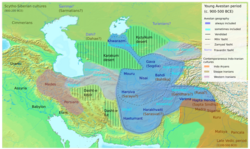
[[File:Young avestan geography.png|thumb|Approximate geographical extent of regions inhabited by the [[Arya (Iran)|Arya]] of the [[Avesta]] vis-a-vis other Indo-Iranian peoples during the [[Avestan period|Young Avestan period]] ({{Circa}} 900–500 BCE)]] | |||
In the words of scholar [[Gherardo Gnoli]], the Old Iranian ''airya'' ([[Avestan]]) and ''ariya'' ([[Old Persian]]) were collective terms denoting the "peoples who were aware of belonging to the one ethnic stock, speaking a common language, and having a religious tradition that centred on the cult of [[Ahura Mazda|Ahura Mazdā]]", in contrast to the 'non-Aryas', who are called ''anairya'' in [[Avestan]], ''anaryān'' in [[Parthian language|Parthian]], and ''[[anērān]]'' in [[Middle Persian]].{{sfn|Bailey|1987}}{{Sfn|Gnoli|2006}} | In the words of scholar [[Gherardo Gnoli]], the Old Iranian ''airya'' ([[Avestan]]) and ''ariya'' ([[Old Persian]]) were collective terms denoting the "peoples who were aware of belonging to the one ethnic stock, speaking a common language, and having a religious tradition that centred on the cult of [[Ahura Mazda|Ahura Mazdā]]", in contrast to the 'non-Aryas', who are called ''anairya'' in [[Avestan]], ''anaryān'' in [[Parthian language|Parthian]], and ''[[anērān]]'' in [[Middle Persian]].{{sfn|Bailey|1987}}{{Sfn|Gnoli|2006}} | ||
By the late 6th–early 5th century BCE, the [[Achaemenid Empire|Achaemenid]] king [[Darius the Great]] and his son [[Xerxes I]] described themselves as ''ariya'' ('Arya') and ''ariya čiça'' ('of Aryan origin'). In the [[Behistun Inscription|Behistun inscription]], authored by Darius during his reign (522 – 486 BCE), the [[Old Persian language]] is called ''ariya'', and the [[Elamite language|Elamite]] version of the inscription portrays the [[Zoroastrianism|Zoroastrian]] deity [[Ahura Mazda|Ahura Mazdā]] as the "god of the Aryas" (''ura-masda naap harriia-naum'').{{sfn|Bailey|1987}}{{Sfn|Gnoli|2006 | The people of the ''[[Avesta]]'', exclusively used the term airya ({{langx|ae|{{script|Avst|[[wikt:𐬀𐬌𐬭𐬌𐬌𐬀|𐬀𐬌𐬭𐬌𐬌𐬀]]}}}}, {{Transliteration|ae|airiia}}) to refer to themselves.{{sfn|Kellens|2005}} It can be found in a number geographical terms like the '[[Airyanem Vaejah|expanse of the airyas]]' ({{lang|ae|airiianəm vaēǰō}}), the '[[Avestan geography|dwelling place of the airyas]]' ({{lang|ae|airiio.shaiianem}}), or the 'white forest of the airyas' ({{lang|ae|vīspe.aire.razuraya}}). The term can also be found in poetic expressions such as the '[[Khvarenah|glory of the airyas]]' ({{lang|ae|airiianąm xᵛarənō}}), the '[[Arash the Archer|most swift-arrowed of the airyas]]' ({{lang|ae|xšviwi išvatəmō airiianąm}}), or the '[[Kay Khosrow|hero of the airyas]]' ({{lang|ae|arša airiianąm}}).{{sfn|Bailey|1987}} Although the Avesta does not contain any dateable events, modern scholarship assumes that the [[Avestan period]] mostly predates the [[Achaemenid Empire|Achaemenid period]] of Iranian history.<ref>{{cite book|last=Grenet|first=Frantz |editor-last1=Curtis|editor-first1=Vesta Sarkhosh|editor-last2=Stewart|editor-first2=Sarah |title=Birth of the Persian Empire Volume I|chapter=An Archaeologist's Approach to Avestan Geography |publisher=I.B.Tauris |year=2005|isbn=978-0-7556-2459-1|page=44|quote=It is difficult to imagine that the text was composed anywhere other than in South Afghanistan and later than the middle of the 6th century BC.}}</ref><ref>{{cite journal |last=Vogelsang|first=Willem|year=2000|author-link=Willem Vogelsang|title=The sixteen lands of Videvdat - Airyanem Vaejah and the homeland of the Iranians|journal=Persica|volume=16|doi=10.2143/PERS.16.0.511|page=62|quote=All of the above observations would indicate a date for the composition of the Videvdat list which would antedate, for a considerable time, the arrival in Eastern Iran of the Persian Acheamenids (ca. 550 B.C.)}}</ref> | ||
By the late 6th–early 5th century BCE, the [[Achaemenid Empire|Achaemenid]] king [[Darius the Great]] and his son [[Xerxes I]] described themselves as ''ariya'' ('Arya') and ''ariya čiça'' ('of Aryan origin'). In the [[Behistun Inscription|Behistun inscription]], authored by Darius during his reign (522 – 486 BCE), the [[Old Persian language]] is called ''ariya'', and the [[Elamite language|Elamite]] version of the inscription portrays the [[Zoroastrianism|Zoroastrian]] deity [[Ahura Mazda|Ahura Mazdā]] as the "god of the Aryas" (''ura-masda naap harriia-naum'').{{sfn|Bailey|1987}}{{Sfn|Gnoli|2006}} | |||
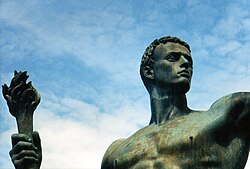
{{multiple image | {{multiple image | ||
| align = right | | align = right | ||
| Line 70: | Line 83: | ||
}} | }} | ||
The self-identifier was inherited in ethnic names such as the [[Parthian language|Parthian]] ''Ary'' (<small>pl.</small> ''Aryān''), the [[Middle Persian]] ''Ēr'' (<small>pl.</small> ''Ēran''), or the [[New Persian]] ''Irāni'' (<small>pl.</small> ''Irāniyān'').<ref name="Bailey3">{{harvnb|Bailey|1987| | The self-identifier was inherited in ethnic names such as the [[Parthian language|Parthian]] ''Ary'' (<small>pl.</small> ''Aryān''), the [[Middle Persian]] ''Ēr'' (<small>pl.</small> ''Ēran''), or the [[New Persian]] ''Irāni'' (<small>pl.</small> ''Irāniyān'').<ref name="Bailey3">{{harvnb|Bailey|1987|loc=: "In the inscription of Šāpūr I on the Kaʿba-ye Zardošt (ŠKZ), Parth. ''ʾryʾn W ʾnʾryʾn'' (''aryān ut anaryān''), Mid. Pers. ''ʾyrʾn W ʾnyrʾn'' (''ērān ut anērān''; cf. Armenian ''eran eut aneran'') comprises the inhabitants of all the known lands ... In the singular Parth. ''ʾry'', Mid. Pers. ''ʾyly'', Greek ''arian'' occurs in a title: ''ʾry mzdyzn nrysḥw MLKʾ'', *''ary mazdēzn Narēsahv šāh'' (Parth. ŠKZ 19); ''ʾyly mzdysn nrsḥy MLKʾ'' (Mid. Pers. version 24), Greek ''arian masdaasnou'' ... New Persian has ''ērān'' (western, ''īrān''), ''ērān-šahr''. In the Caucasus, Ossetic has Digoron ''erä'', ''irä'', Iron ''ir'', with Dig. ''iriston'', Iron ''iryston'' (the i-umlaut modifying the vowel ''a''-, but leaving the -''r''- untouched), [and] the ancestral ''Alān''."}}</ref>{{Sfn|Mayrhofer|1992|pp=174–175}} The [[Scythian languages|Scythian]] branch has ''[[Alans|Alān]]'' or {{lang|ira-x-proto|Allān}} (from {{lang|iir-x-proto|Aryāna}}; modern ''Allon''), ''[[Rhoxolani|Rhoxolāni]]'' ('Bright Alans'), ''Alanorsoi'' ('White Alans'), and possibly the modern [[Ossetian language|Ossetian]] ''Ir'' (<small>adj.</small> ''[[Iron people|Iron]]''), spelled ''Irä'' or ''Erä'' in the [[Digorian dialect]].<ref name="Bailey3"/><ref name="Mallory">{{harvnb|Mallory|Adams|1997|loc=p. 213: "Iran ''Alani'' (< *''aryana'') (the name of an Iranian group whose descendants are the Ossetes, one of whose subdivisions is the ''Iron'' [< *''aryana''-)), *''aryanam'' (pl.) 'of the Aryans' (> MPers ''Iran'')."}}</ref><ref name="Alemany">{{harvnb|Alemany|2000|loc=pp. 3–4, 8: "Nowadays, however, only two possibilities are admitted as regards [the etymology of ''Alān''], both closely related: (a) the adjective *''aryāna''- and (b) the pl. *''aryānām''; in both cases the underlying OIran. ajective *''arya''- 'Aryan' is found. It is worth mentioning that although it is not possible to give an unequivocal option because both forms produce the same phonetic result, most researchers tend to favour the derivative *''aryāna''-, because it has a more appropriate semantic value ... The ethnic name *''arya''- underlying in the name of the Alans has been linked to the Av. ''Airiianəm Vaēǰō'' 'the Aryan plain'."}}</ref> The [[Rabatak inscription]], written in the [[Bactrian language]] in the 2nd century CE, likewise uses the term ''ariao'' for 'Iranian'.{{Sfn|Gnoli|2006}} | ||
The name ''Arizantoi'', listed by Greek historian [[Herodotus]] as one of the six tribes composing the Iranian [[Medes]], is derived from the Old Iranian {{lang|ira-x-proto|arya-zantu}}- ('having Aryan lineage').<ref>{{cite book|last=Brunner|first=C. J.|title=Encyclopædia Iranica|publisher=Routledge & Kegan Paul|year=1986|volume=2|chapter=Arizantoi|chapter-url=https://iranicaonline.org/articles/arizantoi-one-of-the-six-tribes-of-the-median-nation-as-listed-by-herodotus}}</ref> Herodotus also mentions that the Medes once called themselves ''Arioi'',<ref>{{Cite book |last=Herodotus |url=https://www.perseus.tufts.edu/hopper/text?doc=Perseus%3Atext%3A1999.01.0126%3Abook%3D7%3Achapter%3D62%3Asection%3D1 |title=Histories, Book 7, Chapter 62 |publisher=perseus.tufts.edu |pages= |chapter=}}</ref> and [[Strabo]] locates the land of ''Arianē'' between Persia and India.{{ | The name ''Arizantoi'', listed by Greek historian [[Herodotus]] as one of the six tribes composing the Iranian [[Medes]], is derived from the Old Iranian {{lang|ira-x-proto|arya-zantu}}- ('having Aryan lineage').<ref>{{cite book|last=Brunner|first=C. J.|title=Encyclopædia Iranica|publisher=Routledge & Kegan Paul|year=1986|volume=2|chapter=Arizantoi|chapter-url=https://iranicaonline.org/articles/arizantoi-one-of-the-six-tribes-of-the-median-nation-as-listed-by-herodotus}}</ref> Herodotus also mentions that the Medes once called themselves ''Arioi'',<ref>{{Cite book |last=Herodotus |url=https://www.perseus.tufts.edu/hopper/text?doc=Perseus%3Atext%3A1999.01.0126%3Abook%3D7%3Achapter%3D62%3Asection%3D1 |title=Histories, Book 7, Chapter 62 |publisher=perseus.tufts.edu |pages= |chapter=}}</ref> and [[Strabo]] locates the land of ''Arianē'' between Persia and India.<ref>{{cite book |last1=Roller |first1=Duane |title=The Geography of Strabo: An English Translation, with Introduction and Notes |date=29 May 2014 |publisher=Cambridge University Press |isbn=978-1-139-95249-1 |page=947 |url=https://books.google.com/books?id=33GFAwAAQBAJ&pg=PT947}}</ref> Other occurrences include the Greek ''áreion'' ([[Damascius]]), ''Arianoi'' ([[Diodorus Siculus]]) and ''arian'' (<small>pl.</small> ''arianōn''; [[Sasanian period]]), as well as the Armenian expression ''ari'' ([[Agathangelos]]), meaning 'Iranian'.{{sfn|Bailey|1987}}{{Sfn|Gnoli|2006}} | ||
Until the demise of the [[Parthian Empire]] (247 BCE–224 CE), the Iranian identity was essentially defined as cultural and religious. Following conflicts between [[Manichaeism|Manichean]] universalism and [[Zoroastrianism|Zoroastrian]] nationalism during the 3rd century CE, however, traditionalistic and nationalistic movements eventually took the upper hand during the [[Sasanian Empire|Sasanian period]], and the Iranian identity (''ērīh'') came to assume a definite political value. Among Iranians (''ērān''), one ethnic group in particular, the [[Persians]], were placed at the centre of the ''Ērān-šahr'' ('Kingdom of the Iranians') ruled by the ''šāhān-šāh ērān ud anērān'' ('King of Kings of the Iranians and non-Iranians').{{Sfn|Gnoli|2006}} | Until the demise of the [[Parthian Empire]] (247 BCE–224 CE), the Iranian identity was essentially defined as cultural and religious. Following conflicts between [[Manichaeism|Manichean]] universalism and [[Zoroastrianism|Zoroastrian]] nationalism during the 3rd century CE, however, traditionalistic and nationalistic movements eventually took the upper hand during the [[Sasanian Empire|Sasanian period]], and the Iranian identity (''ērīh'') came to assume a definite political value. Among Iranians (''ērān''), one ethnic group in particular, the [[Persians]], were placed at the centre of the ''Ērān-šahr'' ('Kingdom of the Iranians') ruled by the ''šāhān-šāh ērān ud anērān'' ('King of Kings of the Iranians and non-Iranians').{{Sfn|Gnoli|2006}} | ||
| Line 78: | Line 91: | ||
Ethical and ethnic meanings may also intertwine, for instance in the use of ''anēr'' ('non-Iranian') as a synonymous of 'evil' in ''anērīh ī hrōmāyīkān'' ("the evil conduct of the Romans, i.e. Byzantines"), or in the association of ''ēr'' ('Iranian') with good birth (''hutōhmaktom ēr martōm'', 'the best-born Arya man') and the use of ''ērīh'' ('Iranianness') to mean 'nobility' against "labor and burdens from poverty" in the 10th-century ''[[Dēnkard]]''.{{sfn|Bailey|1987}} The Indian opposition between ''ārya''- ('noble') and ''dāsá''- ('stranger, slave, enemy') is however absent from the Iranian tradition.{{sfn|Bailey|1987}} According to linguist [[Émile Benveniste]], the root {{lang|ira-x-proto|das-}} may have been used exclusively as a collective name by Iranian peoples: "If the word referred at first to Iranian society, the name by which this enemy people called themselves collectively took on a hostile connotation and became for the Aryas of India the term for an inferior and barbarous people."{{sfn|Benveniste|1973|pp=259–260}} | Ethical and ethnic meanings may also intertwine, for instance in the use of ''anēr'' ('non-Iranian') as a synonymous of 'evil' in ''anērīh ī hrōmāyīkān'' ("the evil conduct of the Romans, i.e. Byzantines"), or in the association of ''ēr'' ('Iranian') with good birth (''hutōhmaktom ēr martōm'', 'the best-born Arya man') and the use of ''ērīh'' ('Iranianness') to mean 'nobility' against "labor and burdens from poverty" in the 10th-century ''[[Dēnkard]]''.{{sfn|Bailey|1987}} The Indian opposition between ''ārya''- ('noble') and ''dāsá''- ('stranger, slave, enemy') is however absent from the Iranian tradition.{{sfn|Bailey|1987}} According to linguist [[Émile Benveniste]], the root {{lang|ira-x-proto|das-}} may have been used exclusively as a collective name by Iranian peoples: "If the word referred at first to Iranian society, the name by which this enemy people called themselves collectively took on a hostile connotation and became for the Aryas of India the term for an inferior and barbarous people."{{sfn|Benveniste|1973|pp=259–260}} | ||
=== | Old Persian names derived the stem {{lang|iir-x-proto|arya}}- include ''Aryabignes'' ({{lang|ira-x-proto|arya-bigna}}, 'Gift of the Aryans'), ''Ariarathes'' ({{lang|ira-x-proto|Arya-wratha-}}, 'having Aryan joy'), ''Ariobarzanēs'' ({{lang|ira-x-proto|Ārya-bṛzāna}}-, 'exalting the Aryans'), [[Ariaeus|''Ariaios'']] ({{lang|ira-x-proto|arya-ai-}}, probably used as a [[hypocorism]] of the precedent names), or ''[[Ariaramnes|Ariyāramna]]'' (whose meaning remains unclear).<ref>{{cite book |last=Shahbazi |first=A. Sh. |author-link=Alireza Shapour Shahbazi |title=Encyclopædia Iranica |publisher=Routledge & Kegan Paul |year=1986 |isbn= |volume=2 |chapter=Ariyāramna |chapter-url=https://iranicaonline.org/articles/ariyaramna-greek-ariaramnes-old-persian-proper-name}}, {{cite book |last=Shahbazi |first=A. Sh. |author-link=Alireza Shapour Shahbazi |title=Encyclopædia Iranica |publisher=Routledge & Kegan Paul |year=1986 |isbn= |volume=2 |chapter=Ariabignes |chapter-url=https://iranicaonline.org/articles/ariabignes-an-achaemenid-prince}}, {{cite book |last=Brunner |first=C. J. |title=Encyclopædia Iranica |publisher=Routledge & Kegan Paul |year=1986 |isbn= |volume=2 |chapter=Ariaratus |chapter-url=https://iranicaonline.org/articles/ariaratus-one-of-the-three-sons-of-the-achaemenid-king-artaxerxes-ii}}, {{cite book |last=Lecoq |first=P. |title=Encyclopædia Iranica |publisher=Routledge & Kegan Paul |year=1986 |isbn= |volume=2 |chapter=Ariobarzanes |chapter-url=https://iranicaonline.org/articles/ariobarzanes-greek-form-of-old-iranian-proper-name-arya-brzana}}, {{cite book |last=Shahbazi |first=A. Sh. |author-link=Alireza Shapour Shahbazi |title=Encyclopædia Iranica |publisher=Routledge & Kegan Paul |year=1986 |volume=2 |chapter=Ariaeus |chapter-url=https://iranicaonline.org/articles/ariaeus-military-commander-in-the-army-of-cyrus-the-younger}}</ref> The English ''[[Alan (given name)|Alan]]'' and the French ''[[Alain (given name)|Alain]]'' (from Latin ''Alanus'') may have been introduced by Alan settlers to Western Europe during the first millennium CE.{{Sfn|Alemany|2000|p=5}} | ||
==== Indo-Iranian place names ==== | |||
In ancient [[Sanskrit literature]], the term ''[[Āryāvarta]]'' (आर्यावर्त, the 'abode of the Aryas') was the name given to the cradle of the [[Indo-Aryan people|Indo-Aryan]] culture in northern India. The ''[[Manusmriti|Manusmṛiti]]'' locates ''Āryāvarta'' in "the tract between the [[Himalaya]] and the [[Vindhya]] ranges, from the Eastern ([[Bay of Bengal]]) to the Western Sea ([[Arabian Sea]])".<ref>{{Cite book|last=Cook|first=Michael|title=Ancient Religions, Modern Politics: The Islamic Case in Comparative Perspective|date=2016|publisher=Princeton University Press|isbn=978-0-691-17334-4|author-link=Michael Cook (historian)|quote="Aryavarta ... is defined by Manu as extending from the Himalayas in the north to the [[Vindhyas]] of Central India in the south and from the sea in the west to the sea in the east."}}</ref> | In ancient [[Sanskrit literature]], the term ''[[Āryāvarta]]'' (आर्यावर्त, the 'abode of the Aryas') was the name given to the cradle of the [[Indo-Aryan people|Indo-Aryan]] culture in northern India. The ''[[Manusmriti|Manusmṛiti]]'' locates ''Āryāvarta'' in "the tract between the [[Himalaya]] and the [[Vindhya]] ranges, from the Eastern ([[Bay of Bengal]]) to the Western Sea ([[Arabian Sea]])".<ref>{{Cite book|last=Cook|first=Michael|title=Ancient Religions, Modern Politics: The Islamic Case in Comparative Perspective|date=2016|publisher=Princeton University Press|isbn=978-0-691-17334-4|author-link=Michael Cook (historian)|quote="Aryavarta ... is defined by Manu as extending from the Himalayas in the north to the [[Vindhyas]] of Central India in the south and from the sea in the west to the sea in the east."}}</ref> | ||
The stem ''airya-'' also appears in ''[[Airyanem Vaejah|Airyanəm Waēǰō]]'' (the 'stretch of the Aryas' or the 'Aryan plain'), which is described in the ''Avesta'' as the mythical homeland of the early Iranians, said to have been created as "the first and best of places and habitations" by the god [[Ahura Mazdā]]. It was referred to in [[Manichean Sogdian]] as ''ʾryʾn wyžn'' (''Aryān Wēžan''), and in [[Old Persian]] as {{lang|iir-x-proto|Aryānām Waiǰah}}, which gave the [[Middle Persian]] ''Ērān-wēž'', said to be the region where the first cattle were created and where [[Zaratustra|Zaraθuštra]] first revealed the Good Religion.{{sfn|Bailey|1987}}{{sfn|MacKenzie|1998b}} The [[Sasanian Empire]], officially named ''Ērān-šahr'' ('Kingdom of the Iranians'; from Old Persian {{lang|ira-x-proto|Aryānām Xšaθram}}),{{Sfn|Alemany|2000|p=3}} could also be referred to by the abbreviated form ''Ērān'', as distinguished from the Roman West known as ''Anērān.'' The western variant ''Īrān'', abbreviated from ''Īrān-šahr'', is at the origin of the English country name [[Name of Iran|''Iran'']].{{sfn|Schmitt|1987}}{{sfn|Bailey|1987}}{{sfn|MacKenzie|1998a}} | The stem ''airya-'' also appears in ''[[Airyanem Vaejah|Airyanəm Waēǰō]]'' (the 'stretch of the Aryas' or the 'Aryan plain'), which is described in the ''Avesta'' as the mythical homeland of the early Iranians, said to have been created as "the first and best of places and habitations" by the god [[Ahura Mazdā]]. It was referred to in [[Manichean Sogdian]] as ''ʾryʾn wyžn'' (''Aryān Wēžan''), and in [[Old Persian]] as {{lang|iir-x-proto|Aryānām Waiǰah}}, which gave the [[Middle Persian]] ''Ērān-wēž'', said to be the region where the first cattle were created and where [[Zaratustra|Zaraθuštra]] first revealed the Good Religion.{{sfn|Bailey|1987}}{{sfn|MacKenzie|1998b}} The [[Sasanian Empire]], officially named ''Ērān-šahr'' ('Kingdom of the Iranians'; from Old Persian {{lang|ira-x-proto|Aryānām Xšaθram}}),{{Sfn|Alemany|2000|p=3}} could also be referred to by the abbreviated form ''Ērān'', as distinguished from the Roman West known as ''Anērān.'' The western variant ''Īrān'', abbreviated from ''Īrān-šahr'', is at the origin of the English country name [[Name of Iran|''Iran'']].{{sfn|Schmitt|1987}}{{sfn|Bailey|1987}}{{sfn|MacKenzie|1998a}} | ||
''[[Alania]]'', the name of the medieval kingdom of the [[Alans]], derives from a dialectal variant of the Old Iranian stem {{lang|ira-x-proto|Aryāna-}}, which is also linked to the mythical ''[[Airyanem Vaejah|Airyanem Waēǰō]]''.<ref>{{harvnb|Benveniste|1973|p | ''[[Alania]]'', the name of the medieval kingdom of the [[Alans]], derives from a dialectal variant of the Old Iranian stem {{lang|ira-x-proto|Aryāna-}}, which is also linked to the mythical ''[[Airyanem Vaejah|Airyanem Waēǰō]]''.<ref>{{harvnb|Benveniste|1973|loc=p. 300: "The name of ''Alani'' goes back to *''Aryana''-, which is yet another form of the ancient ''ārya''."}}</ref><ref name="Mallory" /><ref name="Alemany"/> Besides the ''ala''- development, {{lang|ira-x-proto|air-y}}- may have turned into the stem ''ir-y-'' via an [[i-mutation]] in modern [[Ossetian language]]s, as in the place name ''Iryston'' ([[Ossetia]]), here attached to the Iranian suffix {{lang|ira-x-proto|[[-stan|-stān]]}}.{{Sfn|Bailey|1987}}{{Sfn|Harmatta|1970|pp=78–81}} | ||
Other [[Avestan geography|place names mentioned in the ''Avesta'']] include ''airyō šayana'', a movable term corresponding to the 'territory of the Aryas', ''airyanąm dahyunąm'', the 'lands of the Aryas', ''Airyō-xšuθa'', a mountain in eastern Iran associated with [[Arash the Archer|Ǝrəxša]], and ''vīspe aire razuraya,'' the forest where Kavi Haosravō slew the god [[Vāyu]].{{sfn|Bailey|1987}}{{sfn|MacKenzie|1998b}} | Other [[Avestan geography|place names mentioned in the ''Avesta'']] include ''airyō šayana'', a movable term corresponding to the 'territory of the Aryas', ''airyanąm dahyunąm'', the 'lands of the Aryas', ''Airyō-xšuθa'', a mountain in eastern Iran associated with [[Arash the Archer|Ǝrəxša]], and ''vīspe aire razuraya,'' the forest where Kavi Haosravō slew the god [[Vāyu]].{{sfn|Bailey|1987}}{{sfn|MacKenzie|1998b}} | ||
=== | ==== Graeco-Latin literature ==== | ||
The word Arianus was used to designate [[Ariana]],<ref>{{cite book|title=The Annals and Magazine of Natural History: Including Zoology, Botany, and Geology|page=162|publisher=Taylor & Francis, Limited|year=1881}}</ref> the area comprising Afghanistan, Iran, North-western India and Pakistan.<ref>{{cite book|title=Udayana|quote=whole of Ariana (North-western India, Pakistan, Afghanistan, and Iran)|first=Udai|last=Arora|publisher=Anamika Pub & Distributors|year=2007|isbn=9788179751688}}</ref> In 1601, [[Philemon Holland]] used 'Arianes' in his translation of the Latin Arianus to designate the inhabitants of Ariana. This was the first use of the form ''Arian'' verbatim in the English language.<ref>[http://www.etymonline.com/index.php?allowed_in_frame=0&search=arian&searchmode=none Online Etymology Dictionary]</ref><ref>Robert K. Barnhart, Chambers Dictionary of Etymology pg. 54</ref><ref name="OED" /> | |||
=== Modern times === | |||
==== Iranian nationalism ==== | |||
{{Main|Iranian nationalism}} | |||
In the late [[Qajar era]], modern ideas about the Aryan identity were introduced to Iran and significantly influenced its nationalistic movement. Iranian intellectuals, reflecting on their pre-Islamic, Indo-European past, embraced a version of the Aryan myth that contrasted their heritage with the Arab (or Semitic) influence introduced after the [[Muslim conquest of Persia|Arab conquest]] (7th century AD). In the 19th century, thinkers like [[Mirza Fatali Akhundov]] (1812–1878) and [[Mirza Aqa Khan Kermani]] (1854–1896) promoted the idea of a grand, ancient Persian civilization. This narrative, which depicted Arab influence as destructive to Iranian culture while emphasizing shared roots with admired European civilizations, was widely disseminated through nationalist publications and became a cornerstone of 20th-century Iranian nationalist discourse.{{Sfn|Motadel|2013|pp=130–131}} | |||
In [[Pahlavi Iran]] (1925–1979), nationalism was used to popularize the Aryan myth and promote Iranian antiquity, bolstering both national identity and the legitimacy of the ruling dynasty. This "Aryan and Neo-Achaemenid nationalism" emerged prominently in the 1930s and remained influential throughout the Pahlavi period.{{Sfn|Motadel|2013|pp=130–132}} In 1935, [[Reza Shah]] mandated that the country be known internationally as 'Iran' (a name linked to the term 'Aryan') rather than 'Persia', which was seen as a foreign label derived from the southern province of [[Fars province|Fars]]. His son, [[Mohammad Reza Pahlavi|Mohammad Reza]], later adopted the title "King of the Kings, Light of the Aryans" ([[Aryamehr|''Shahanshah'' ''Aryamehr'']]), and in the 1970s, he even proposed an 'Aryan brotherhood' among Iran, India, Pakistan, and Afghanistan as a means to foster regional peace and celebrate a shared legacy of a distinguished civilization.{{Sfn|Motadel|2013|pp=130–132}} | |||
In | |||
=== | ==== Religious use ==== | ||
The word ''ārya'' is often found in Hindu, Buddhist, and Jain texts. In the Indian spiritual context, it can be applied to Rishis or to someone who has mastered the four noble truths and entered upon the spiritual path. According to Indian leader [[Jawaharlal Nehru]], the religions of [[India]] may be called collectively ''ārya dharma,'' a term that includes the religions that originated in the [[Indian subcontinent]] (e.g. [[Hinduism]], [[Buddhism]], [[Jainism]] and [[Sikhism]]).<ref>{{cite book|last=Kumar|first=Priya| | {{see also|Root_race#The_fifth_root_race_(Aryan)|label 1=Aryan root race in Theosophy}} | ||
The word ''ārya'' is often found in Hindu, Buddhist, and Jain texts. In the Indian spiritual context, it can be applied to Rishis or to someone who has mastered the four noble truths and entered upon the spiritual path. According to Indian leader [[Jawaharlal Nehru]], the religions of [[India]] may be called collectively ''ārya dharma,'' a term that includes the religions that originated in the [[Indian subcontinent]] (e.g. [[Hinduism]], [[Buddhism]], [[Jainism]] and [[Sikhism]]).<ref>{{cite book|last=Kumar|first=Priya|chapter=Beyond tolerance and hospitality: Muslims as strangers and minor subjects in Hindu nationalist and Indian nationalist discourse|title=Living Together: Jacques Derrida's Communities of Violence and Peace|publisher=Fordham University Press|date=2012|isbn=9780823249923|editor=Elisabeth Weber|pages=95–96 |chapter-url=https://books.google.com/books?id=OONc4cZKMigC&pg=PA95}}</ref> | |||
The word ārya is also often used in [[Jainism]], in Jain texts such as the Pannavanasutta. In Avaśyakaniryukti, an early Jaina text, a character named ''Ārya Mangu'' is mentioned twice.<ref>{{cite book|author1=K. L. Chanchreek|url=https://books.google.com/books?id=0YgRAQAAIAAJ|title=Jainism: Rishabha Deva to Mahavira|author2=Mahesh Jain|publisher=Shree Publishers & Distributors|year=2003|isbn=978-81-88658-01-5|page=276}}</ref> | The word ārya is also often used in [[Jainism]], in Jain texts such as the Pannavanasutta. In Avaśyakaniryukti, an early Jaina text, a character named ''Ārya Mangu'' is mentioned twice.<ref>{{cite book|author1=K. L. Chanchreek|url=https://books.google.com/books?id=0YgRAQAAIAAJ|title=Jainism: Rishabha Deva to Mahavira|author2=Mahesh Jain|publisher=Shree Publishers & Distributors|year=2003|isbn=978-81-88658-01-5|page=276}}</ref> | ||
==== Personal names ==== | |||
{{Main|Arya (name)|Aryan (name)}} | |||
The name [[Aryan (name)|''Aryan'']] (including derivatives such as ''Aaryan,'' ''[[Arya (name)|Arya]], Ariyan'' or ''Aria'') is still used as a given name or surname in modern South Asia and Iran. There has also been a rise in names associated with ''Aryan'' in the West, which have been popularized due to pop culture. According to the U.S. Social Security Administration in 2012, ''Arya'' was the fastest-rising girl's name in popularity in the U.S., jumping from 711th to 413th position.<ref>{{Cite news |last=Carlson |first=Adam |date=10 May 2013 |title=Game of Thrones baby names on the march |url=https://ew.com/article/2013/05/10/arya-game-of-thrones-baby-names |publisher=Entertainment Weekly}}</ref> The name entered the top 200 most commonly used names for baby girls born in England and Wales in 2017.<ref>{{cite news |last=Mzimba |first=Lizo |date=20 September 2017 |title=Game of Thrones Arya among 200 most popular names |url=https://www.bbc.com/news/entertainment-arts-41336738 |publisher=BBC News}}</ref> | |||
== Scholarship == | == Scholarship == | ||
| Line 109: | Line 130: | ||
The term 'Aryan' was initially introduced into the English language through works of comparative philology, as a modern rendering of the Sanskrit word ''ā́rya''. First translated as 'noble' in [[William Jones (philologist)|William Jones]]' 1794 translation of the ''[[Laws of Manu]]'', early-19th-century scholars later noticed that the term was used in the earliest [[Vedas]] as an ethnocultural self-designation "comprising the worshipers of the gods of the Brahmans".<ref name="OED" />{{Sfn|Arvidsson|2006|p=20}} This interpretation was simultaneously influenced by the presence of the word ''Ἀριάνης'' (Ancient Greek) ~ ''Arianes'' (Latin) in classical texts, which had been rightly compared by [[Abraham Hyacinthe Anquetil-Duperron|Anquetil-Duperron]] in 1771 to the Iranian ''airya'' ([[Avestan]]) ~ ''ariya'' ([[Old Persian]]), a self-identifier used by the speakers of [[Iranian peoples|Iranian languages]] since ancient times. Accordingly, the term 'Aryan' came to refer in scholarship to the [[Indo-Iranian languages]], and, by extension, to the native speakers of the [[Proto-Indo-Iranian language]], the prehistoric [[Indo-Iranians|Indo-Iranian peoples]].<ref>{{citation|last=Siegert|first=Hans|title=Zur Geschichte der Begriffe 'Arier' und 'Arisch'|journal=Wörter und Sachen|volume=4|pages=84–99|year=1941–1942|series=New Series}}</ref> | The term 'Aryan' was initially introduced into the English language through works of comparative philology, as a modern rendering of the Sanskrit word ''ā́rya''. First translated as 'noble' in [[William Jones (philologist)|William Jones]]' 1794 translation of the ''[[Laws of Manu]]'', early-19th-century scholars later noticed that the term was used in the earliest [[Vedas]] as an ethnocultural self-designation "comprising the worshipers of the gods of the Brahmans".<ref name="OED" />{{Sfn|Arvidsson|2006|p=20}} This interpretation was simultaneously influenced by the presence of the word ''Ἀριάνης'' (Ancient Greek) ~ ''Arianes'' (Latin) in classical texts, which had been rightly compared by [[Abraham Hyacinthe Anquetil-Duperron|Anquetil-Duperron]] in 1771 to the Iranian ''airya'' ([[Avestan]]) ~ ''ariya'' ([[Old Persian]]), a self-identifier used by the speakers of [[Iranian peoples|Iranian languages]] since ancient times. Accordingly, the term 'Aryan' came to refer in scholarship to the [[Indo-Iranian languages]], and, by extension, to the native speakers of the [[Proto-Indo-Iranian language]], the prehistoric [[Indo-Iranians|Indo-Iranian peoples]].<ref>{{citation|last=Siegert|first=Hans|title=Zur Geschichte der Begriffe 'Arier' und 'Arisch'|journal=Wörter und Sachen|volume=4|pages=84–99|year=1941–1942|series=New Series}}</ref> | ||
During the 19th century, through the works of [[Friedrich Schlegel]] (1772–1829), [[Christian Lassen]] (1800–1876), [[Adolphe Pictet]] (1799–1875), and [[Max Müller]] (1823–1900), the terms ''Aryans'', ''Arier'', and ''Aryens'' came to be adopted by a number of Western scholars as a synonym of '[[Proto-Indo-Europeans|(Proto-)Indo-Europeans]]'.{{Sfn|Arvidsson|2006|p=21}} Many of them indeed believed that ''Aryan'' was also the original self-designation used by the prehistoric speakers of the [[Proto-Indo-European language]], based on the erroneous assumptions that [[Sanskrit]] was the oldest [[Indo-European languages|Indo-European language]] and on the linguistically untenable position that ''[[Ériu]]'' (Ireland) was related to ''Arya''.<ref>{{harvnb|Schmitt|1987| | During the 19th century, through the works of [[Friedrich Schlegel]] (1772–1829), [[Christian Lassen]] (1800–1876), [[Adolphe Pictet]] (1799–1875), and [[Max Müller]] (1823–1900), the terms ''Aryans'', ''Arier'', and ''Aryens'' came to be adopted by a number of Western scholars as a synonym of '[[Proto-Indo-Europeans|(Proto-)Indo-Europeans]]'.{{Sfn|Arvidsson|2006|p=21}} Many of them indeed believed that ''Aryan'' was also the original self-designation used by the prehistoric speakers of the [[Proto-Indo-European language]], based on the erroneous assumptions that [[Sanskrit]] was the oldest [[Indo-European languages|Indo-European language]] and on the linguistically untenable position that ''[[Ériu]]'' (Ireland) was related to ''Arya''.<ref>{{harvnb|Schmitt|1987|loc=: "The use of the name 'Aryan', in vogue especially in the 19th century, as a designation of the entire Indo-European language family was based on the erroneous assumption that Sanskrit was the oldest IE. language, and the untenable view (primarily propagated by Adolphe Pictet) that the names of Ireland and the Irishmen were etymologically related to 'Aryan'."}}</ref> This hypothesis has since been abandoned in scholarship due to the lack of evidence for the use of ''arya'' as an ethnocultural self-designation outside the Indo-Iranian world.{{sfn|Fortson|2011|p=209}} | ||
=== Contemporary scholarship === | === Contemporary scholarship === | ||
In contemporary scholarship, the terms 'Aryan' and 'Proto-Aryan' are still sometimes used to designate the prehistoric Indo-Iranian peoples and their [[Proto-Indo-Iranian language|proto-language]]. However, the use of 'Aryan' to mean 'Proto-Indo-European' is now regarded as an "aberration to be avoided".<ref name="Witzel2012">{{harvnb|Witzel|2001}}</ref> The '[[Indo-Iranian languages|Indo-Iranian]]' subfamily of languages – which encompasses the [[Indo-Aryan languages|Indo-Aryan]], [[Iranian languages|Iranian]], and [[Nuristani languages|Nuristani]] branches – may also be referred to as the 'Aryan languages'.<ref>{{harvnb|Schmitt|1987| | In contemporary scholarship, the terms 'Aryan' and 'Proto-Aryan' are still sometimes used to designate the prehistoric Indo-Iranian peoples and their [[Proto-Indo-Iranian language|proto-language]]. However, the use of 'Aryan' to mean 'Proto-Indo-European' is now regarded as an "aberration to be avoided".<ref name="Witzel2012">{{harvnb|Witzel|2001}}</ref> The '[[Indo-Iranian languages|Indo-Iranian]]' subfamily of languages – which encompasses the [[Indo-Aryan languages|Indo-Aryan]], [[Iranian languages|Iranian]], and [[Nuristani languages|Nuristani]] branches – may also be referred to as the 'Aryan languages'.<ref>{{harvnb|Schmitt|1987|loc=: "''The Aryan parent language''. The common ancestor of the historical Aryan or Indo-Iranian languages, called the Aryan parent language or Proto-Aryan, can be reconstructed by the methods of historical comparative linguistics."}}</ref>{{Sfn|Anthony|2007|p=385}}{{sfn|Fortson|2011|p=209}} | ||
However, the atrocities committed in the name of [[Aryanism|Aryanist]] racial ideologies during the first part of the 20th century have led academics to generally avoid the term 'Aryan', which has been replaced in most cases by 'Indo-Iranian', although its Indic branch is still called 'Indo-Aryan'.{{Sfn|Arvidsson|2006|p=22}}{{sfn|Anthony|2007|p=10}}<ref name=":6">{{harvnb|Witzel|2001|p | However, the atrocities committed in the name of [[Aryanism|Aryanist]] racial ideologies during the first part of the 20th century have led academics to generally avoid the term 'Aryan', which has been replaced in most cases by 'Indo-Iranian', although its Indic branch is still called 'Indo-Aryan'.{{Sfn|Arvidsson|2006|p=22}}{{sfn|Anthony|2007|p=10}}<ref name=":6">{{harvnb|Witzel|2001|loc=p. 3: "Linguists have used the term ''Ārya'' from early on in the 19th century to designate the speakers of most Northern Indian as well as of all Iranian languages and to indicate the reconstructed language underlying both Old Iranian and Vedic Sanskrit. Nowadays this well-reconstructed language is usually called Indo-Iranian (IIr.), while its Indic branch is called (Old) Indo-Aryan (IA)."}}</ref> The name 'Iranian', which stems from the [[Old Persian]] {{lang|ira-x-proto|Aryānām}}, also continues to be used to refer to specific [[ethnolinguistic group]]s.{{sfn|Schmitt|1987}} | ||
* [[Indo-Aryan peoples|Indo-Aryan]] refers to the populations speaking an [[Indo-Aryan languages|Indo-Aryan language]] or identifying as [[Indo-Aryan peoples|Indo-Aryan]]; they form the predominant group in Northern | * [[Indo-Aryan peoples|Indo-Aryan]] refers to the populations speaking an [[Indo-Aryan languages|Indo-Aryan language]] or identifying as [[Indo-Aryan peoples|Indo-Aryan]]; they form the predominant group in Northern Indian subcontinent.{{Sfn|Witzel|2001|p=3}} The largest Indo-Aryan ethnolinguistic groups are [[Hindi]]–[[Urdu]], [[Bengali language|Bengali]], [[Punjabi language|Punjabi]], [[Marathi language|Marathi]], [[Gujarati language|Gujarati]], [[Rajasthani language|Rajasthani]], [[Bhojpuri language|Bhojpuri]], [[Maithili language|Maithili]], [[Odia language|Odia]], and [[Sindhi language|Sindhi]]. More than 900 million people are native speakers of an Indo-Aryan language.{{sfn|Bryant|Patton|2005|pp=246–247}} | ||
* [[Iranian peoples|Iranian]] (or Iranic) is used to designate the speakers of [[Iranian languages]] or the peoples who identify as "Iranians", especially in [[Greater Iran]]. Modern Iranian ethnolinguistic groups include [[Persians]], [[Pashtuns]], [[Kurds]], [[Tajiks]], [[Baloch people|Balochs]], [[Lurs]], [[Pamiris]], [[Zazas]], and [[Ossetians]]. An estimated 150 to 200 million people are native speakers of an Iranian language.<ref>{{Cite book|last=Windfuhr|first=Gernot L.|title=The Iranian Languages|date=2013|publisher=Routledge|isbn=978-1-135-79703-4|pages=1|author-link=Gernot Ludwig Windfuhr}}</ref> | * [[Iranian peoples|Iranian]] (or Iranic) is used to designate the speakers of [[Iranian languages]] or the peoples who identify as "Iranians", especially in [[Greater Iran]]. Modern Iranian ethnolinguistic groups include [[Persians]], [[Pashtuns]], [[Kurds]], [[Tajiks]], [[Baloch people|Balochs]], [[Lurs]], [[Pamiris]], [[Zazas]], and [[Ossetians]]. An estimated 150 to 200 million people are native speakers of an Iranian language.<ref>{{Cite book|last=Windfuhr|first=Gernot L.|title=The Iranian Languages|date=2013|publisher=Routledge|isbn=978-1-135-79703-4|pages=1|author-link=Gernot Ludwig Windfuhr}}</ref> | ||
Some authors writing for popular consumption have kept on using the word | Some authors writing for popular consumption have kept on using the word 'Aryan' for all Indo-Europeans in the tradition of [[H. G. Wells]],<ref>Wells, H.G. ''[[The Outline of History]]'' New York:1920 Doubleday & Co. Chapter 19 The Aryan Speaking Peoples in Pre-Historic Times [Meaning the Proto-Indo-Europeans] Pages 271–285</ref><ref>[http://www.bartleby.com/86/19.html H.G. Wells describes the origin of the Aryans (Proto-Indo Europeans):]</ref> such as the science fiction author [[Poul Anderson]],<ref>See the Poul Anderson short stories in the 1964 collection [[Time and Stars]] and the ''Polesotechnic League'' stories featuring [[Nicholas van Rijn]]</ref> and scientists writing for the popular media, such as [[Colin Renfrew]].<ref>Renfrew, Colin. (1989). The Origins of Indo-European Languages. /Scientific American/, 261(4), 82–90. In explaining the [[Anatolian hypothesis]], the term "Aryan" is used to denote "all Indo-Europeans"</ref> According to [[Franciscus Bernardus Jacobus Kuiper|F. B. J. Kuiper]], echoes of "the 19th century prejudice about 'northern' Aryans who were confronted on Indian soil with black barbarians [...] can still be heard in some modern studies."{{sfn|Kuiper|1991}} | ||
==Aryanism and racism== | ==Aryanism and racism== | ||
{{main|Aryanism|Aryan race}} | {{main|Aryanism|Aryan race}} | ||
==== | === Invention of the 'Aryan race' === | ||
==== Early Romantic views ==== | |||
During the [[Romantic era]], thinkers such as [[Johann Gottfried Herder]] (1744–1803) and, later, [[Johann Gottlieb Fichte]] (1762–1814) developed the idea of a nation (''[[Volk]]'') as an organic cultural community rooted in shared history, folklore, myths, poetry, and especially a common language. They saw linguistic ties as natural evidence of tribal connections, linking a Volk's ancestry to the origins of its language.{{Sfn|Motadel|2013|p=121}} In this context, some European scholars began to interpret the newly established Indo-European linguistic connection as evidence of shared a cultural and ethnic heritage, at times drawing parallels between modern Europeans and ancient Persians. In 1808, [[Friedrich Schlegel]], in ''Über die Sprache und Weisheit der Indier'', proposed that the Indo-European languages (including Germanic) originated from a common ancestral tongue in ancient India or Persia. His work popularized the idea of a primordial "Indo-European people" (''Urvolk'') that had migrated westward from their 'original homeland' (''[[Urheimat]]'') in Asia.{{Sfn|Motadel|2013|p=121}} | |||
==== North European hypothesis ==== | ==== North European hypothesis ==== | ||
{{main|North European hypothesis}} | {{main|North European hypothesis}} | ||
[[File:Passing_of_the_Great_Race_-_Map_2.jpg|thumb|280x280px|"Expansion of the Pre-Teutonic Nordics" — map from ''[[The Passing of the Great Race]]'' by [[Madison Grant]], showing hypothesized migrations of Nordic peoples]] | [[File:Passing_of_the_Great_Race_-_Map_2.jpg|thumb|280x280px|"Expansion of the Pre-Teutonic Nordics" — map from ''[[The Passing of the Great Race]]'' by [[Madison Grant]], showing hypothesized migrations of Nordic peoples]] | ||
In the | In the second half of the 19th century, the idea that Indo-European languages had originated from Asia gradually lost ground in Western European scholarship. From the late 1860s onward, alternative models of [[Indo-European migrations]] began to emerge, some of them locating the [[Proto-Indo-European homeland|ancestral homeland]] in Northern Europe.{{Sfn|Mallory|1989|p=268}}{{Sfn|Arvidsson|2006|p=52}} In 1868, Theodor Bensen proposed that the Aryans originated in Europe, and that some migrated to Asia to establish ancient Eastern civilisations, which he claimed had later "degenerated" through racial mixing on the periphery. This 'northern thesis' found growing support among German anthropologists and linguists such as [[Lazarus Geiger]], [[Theodor Poesche]], [[Ludwig Wilser]], [[Karl Penka]], and [[Gustaf Kossinna]], and contributed to the emerging tendency to use the word ''Aryan'' as a synonym for ''Nordic'' or ''Germanic''.{{Sfn|Motadel|2013|p=125}} | ||
Karl Penka, credited as "a transitional figure between Aryanism and Nordicism",<ref>{{Cite book |last=Hutton |first=Christopher M. |title=Race and the Third Reich: Linguistics, Racial Anthropology and Genetics in the Dialectic of Volk |date=2005 |publisher=Polity |isbn=978-0-7456-3177-6 |pages=108}}</ref> argued in 1868 that the Aryans originated in southern [[Scandinavia]].<ref>{{Harvnb|Mallory|1989|p=268}}: "An Aryan homeland in the unhealthy environment of a swamp was hardly conducive to the development of the 'powerful, energetic blond race' or so Karl Penka argued in 1868. Rather, Penka pressed into service all the disciplines he could - archaeology, linguistics, anthropology and mythology - to demonstrate that the Aryans originated in Southern Scandinavia."</ref> In 1878, [[German Americans|German]]-born anthropologist Theodor Poesche proposed locating the original Aryan homeland in Lithuania.{{Sfn|Motadel|2013|p=125}} In the early-20th century, German archaeologist Gustaf Kossinna (1858-1931), seeking to link prehistoric [[material culture|material cultures]] to the reconstructed [[Proto-Indo-European language]], argued on archaeological grounds that the 'Indo-Germanic' (''Indogermanische'') migrations had originated from a homeland in northern Europe.{{sfn|Anthony|2007|pp=9–11}} Until the end of [[World War II]], research on the Indo-European ''[[Urheimat]]'' broadly fell into two camps: Kossinna's followers, who favoured a northern European homeland, and those, initially led by [[Otto Schrader (philologist)|Otto Schrader]] (1855–1919), who supported a Eurasian [[Steppe hypothesis|steppe homeland]], the view that would later become dominant among scholars.{{Sfn|Mallory|1989|p=269}} | |||
=== Theories of racial supremacy === | |||
==== Transition to racial biology ==== | |||
While Schlegel and early 19th-century proponents of Aryan migrations defined the Aryans in linguistic and cultural rather than biological terms, reflecting the influence of early national thinkers such as Herder, later scholars, including [[Julius Klaproth]] (1783–1835) and [[Frédéric Eichhoff]] (1799–1875), helped shift the concept of the ancient Aryans toward racial and biological interpretations.{{Sfn|Motadel|2013|pp=121–122}} Racially-oriented interpretations of the Vedic ''Āryas'' as 'fair-skinned foreign invaders' coming from the North gradually paved the way for the adoption of the term ''Aryan'' as a [[Historical race concepts|racial category]] connected to a supremacist ideology known as [[Aryanism]], which portrayed the [[Aryan race]] as a so-called '[[superior race]]' responsible for most of the achievements of ancient civilizations.{{Sfn|Bryant|2001|pp=60–63}}[[File:Arthur_de_Gobineau.jpg|thumb|240x240px|[[Arthur de Gobineau]] (1816–1882)]] | |||
[[Arthur de Gobineau]], author of the influential ''[[Essay on the Inequality of the Human Races]]'' (1853–1855), viewed the white race (and particularly its Aryan branch) as the only truly [[civilized]] one, conceiving [[decadence|cultural decline]] and [[miscegenation]] as intimately intertwined. Relocating the Aryans' origins from Asia to northern Europe, Gobineau argued that the ancient Aryans (an offshoot of the 'white race') had spread across the world and founded the great civilizations of antiquity, before degenerating through intermixture with the 'inferior' indigenous populations, which he saw as the primary cause of civilizational decay.{{Sfn|Arvidsson|2006|p=45}}{{Sfn|Motadel|2013|p=123}} The last 'pure' Aryans, he believed, were the Germanics.{{Sfn|Motadel|2013|p=123}} Gobineau divided humanity into three 'primary races' (white, yellow, and black) classifying both Aryans and Semites within the white race. In the decades following his work, however, the term ''Aryan'' increasingly came to be used in racialist discourse as a synonym for ''non-Jewish'', a development that marked the transition from Gobineau's theory of racial hierarchy to the explicitly antisemitic Aryan ideology of the late 19th century.{{Sfn|Motadel|2013|p=124}} | |||
==== Aryan race and antisemitism ==== | |||
[[Christian Lassen]] (1800–1876), a student of Schlegel, glorified the ancient Aryans as "the most gifted" and "perfect in talent", attributing to them an unparalleled cultural and intellectual refinement. He contrasted the Aryans with the Semites, helping establish an intellectual dichotomy between the two groups that would later take on racial overtones.{{Sfn|Motadel|2013|pp=121–122}} In this tradition, French orientalist [[Ernest Renan]] (1823–1892) portrayed the Semites as 'non-Aryans' and the Aryans as a creative and progressive race destined to lead human civilization. Similarly, Swiss linguist [[Adolphe Pictet]] (1799–1875) described the Aryans as the providential race and direct ancestors of Europeans. Influenced by Lassen and Renan, he depicted a fundamental moral and spiritual opposition between the Semitic and the superior Aryan peoples.{{Sfn|Motadel|2013|p=123}} | |||
The first recorded instance of the German ''Arier'' to mean 'non-Jewish' appears to date from 1887, when a Viennese gymnastic society decided to admit only "Germans of Aryan descent" (''Deutsche arischer Abkunft'') as members.{{Sfn|Arvidsson|2006|p=21}} In ''[[The Foundations of the Nineteenth Century]]'' (1899), which [[Stefan Arvidsson]] notes is identified as "one of the most important proto-Nazi texts",{{Sfn|Arvidsson|2006|p=153}} | |||
British-German writer [[Houston Chamberlain]] envisioned an existential struggle between a superior German-Aryan race and a destructive Jewish-Semitic race, echoing Renan's antagonistic division between Aryans and Semites.{{Sfn|Arvidsson|2006|p=155}}{{Sfn|Motadel|2013|p=124}} Chamberlain's work was highly influential; German Emperor [[Wilhelm II]] personally praised it and recommended it as required reading for trainee teachers.{{Sfn|Motadel|2013|p=124}} The best-seller ''[[The Passing of the Great Race]]'' (1916), by American author [[Madison Grant]] in 1916, warned against miscegenation with the supposedly 'inferior' immigrant races – including speakers of Indo-European languages (such as Slavs, Italians, and Yiddish-speaking Jews) – which he believed threatened the 'racially superior' Germanic ''Aryans'' (that is: Americans of [[English Americans|English]], [[German Americans|German]], and [[Scandinavian Americans|Scandinavian]] descent).{{sfn|Anthony|2007|pp=9–11}} | |||
Racial mysticists like [[Paul de Lagarde]] (1827–1891) and [[Julius Langbehn]] (1851–1907) idealized the Aryans as nature-bound, unspoilt Germanics (''Urgermanen''), opposed to the materialism, liberalism, and cosmopolitanism of modern society.{{Sfn|Motadel|2013|p=125}} Led by [[Guido von List]] (1848–1919) and [[Jörg Lanz von Liebenfels]] (1874–1954), the [[Ariosophy|Ariosophists]] developed an ideological synthesis combining [[Völkisch movement|''Völkisch'']] nationalism with [[Western esotericism|esoterism]]. Prophesying a coming era of German (Aryan) world domination, they maintained that a vast conspiracy against Germans – allegedly instigated by non-Aryan races, by the Jews, or by the [[early Church]] – had "sought to ruin this ideal Germanic world by emancipating the non-German inferiors in the name of a spurious egalitarianism".{{Sfn|Goodrick-Clarke|1985|p=2}} | |||
=== | ==== Nazi racial theories ==== | ||
{{main|Nazi racial theories}} | |||
[[File:Birth of a nation Aryan quote.jpg|thumb|275px|An [[intertitle]] from the [[silent film]] blockbuster ''[[The Birth of a Nation]]'' (1915). "Aryan birthright" is here "white birthright", the "defense" of which unites "[[White race|whites]]" in the Northern and Southern U.S. against "[[coloreds]]". In another film of the same year, ''[[The Aryan]]'', [[William S. Hart]]'s "Aryan" identity is defined in distinction from other peoples.]] | [[File:Birth of a nation Aryan quote.jpg|thumb|275px|An [[intertitle]] from the [[silent film]] blockbuster ''[[The Birth of a Nation]]'' (1915). "Aryan birthright" is here "white birthright", the "defense" of which unites "[[White race|whites]]" in the Northern and Southern U.S. against "[[coloreds]]". In another film of the same year, ''[[The Aryan]]'', [[William S. Hart]]'s "Aryan" identity is defined in distinction from other peoples.]] | ||
Von Liebenfels and Houston Stewart Chamberlain — together with wider currents of [[Social Darwinism|social-Darwinist]] thought and late-19th-century racial anthropology — contributed important elements to [[Nazism and race|Nazi racial ideology]], especially notions of Aryan supremacy, racial struggle, and the imperative of racial purity.{{sfn|Anthony|2007|pp=9–11}}{{Sfn|Motadel|2013|p=125}}{{Sfn|Weikart|2009|p=12}} In ''[[Mein Kampf]]'' (1925), [[Adolf Hitler]] ideologically equated the ideal of the Aryan with the German people ('[[Volk]]'), presenting it as part of a non-Jewish, so-called '[[master race]]', and framed a mythic history in which a Nordic Aryan people supposedly conquered foreign lands, founded great civilisations, and later declined through racial dilution.{{Sfn|Motadel|2013|pp=125–126}}{{Sfn|Weikart|2009|pp=5–6}} He cast strengthening the Aryan race as both a political and moral imperative, hereby legitimizing measures that suspended humanitarian and legal protections for groups labelled as inferior (''[[Untermensch]]en''). Such policies were defended as necessary for the 'survival' and advancement of the 'Aryans'.{{Sfn|Weikart|2009|pp=5–6}} Jews were racialized as morally and biologically inferior people that needed to be eliminated, one way or another, from German society. Under the Nazi regime this translated into exclusionary laws, economic and social marginalisation, mass deportations and, ultimately, state-organised plans for systematic extermination.{{Sfn|Weikart|2009|p=9}} | |||
[[Alfred Rosenberg]], the chief racial ideologue of the Nazi Party, expanded on the idea of an ancient Nordic migration in ''[[The Myth of the Twentieth Century]]'' (1930), portraying the ancient Persians as "Aryans with northern blood" who had eventually degenerated due to intermixing with so-called 'lower races'. He cited Persian history as a cautionary example of racial miscegenation (''Bastardierung''). This view was shared by many Nazi ideologues, who attributed the decline of the Aryan race to 'foreign infiltration' (''Überfremdung'') by so-called 'Semitic races'.{{Sfn|Motadel|2013|p=127}} In 1935, the Nazis founded the ''[[Ahnenerbe]]'' to research 'Aryan prehistory' through archaeological, anthropological, and linguistic studies.{{Sfn|Arvidsson|2006|pp=181–182}} Its president, [[Walther Wüst]], maintained that the Germans were directly descended from the Aryan 'Nordic race', which had spread into Asia until racial mixing caused 'degeneration' (''Entartung'') and 'de-Nordicization' (''Entnordnung'').{{Sfn|Motadel|2013|p=129}} | |||
By the late 19th century, German and Austrian student fraternities (along with some professional associations) had already introduced 'Aryan clauses' excluding Jews. The [[Third Reich]] was the first to formalize the term ''Aryan'' in national legislation. On 7 April 1933, the Nazi government enacted the '[[Aryan paragraph|Aryan Paragraph]]' (''Arierparagraph''); expressions such as 'Proof of Aryan Ancestry' (''Ariernachweis'') and 'Aryanisation' (''Arisierung'') subsequently entered official legal language, used to implement racial laws primarily targeting Jews.{{Sfn|Motadel|2013|pp=125–126}} In September 1935, the Nazis enacted the [[Nuremberg Laws]], which required proof of 'Aryan descent' as a prerequisite for Reich citizenship. Applicants could demonstrate this by obtaining an ''[[Ahnenpass]]'' ('ancestor passport'), providing documentary proof—typically baptismal or parish records—that all four grandparents were of 'Aryan' descent.<ref>Ehrenreich, Eric (2007). ''The Nazi Ancestral Proof: Genealogy, Racial Science, and the Final Solution'', p. 68</ref> In December of the same year, the SS established ''[[Lebensborn]]'' ('Fount of Life') to increase births among racially 'valuable' Germans and to promote population policy based on [[Nazi eugenics|Nazi eugenic principles]].{{Sfn|Weikart|2009|p=133}}[[File:ArnoBrekerDiePartei.jpg|thumb|220x220px|[[Arno Breker]]'s sculpture ''Die Partei (The Party)'', depicting a Nazi-era ideal of the "Nordic Aryan" racial type]]Many American [[White Supremacist|white supremacist]] and [[Neo-Nazism|neo-Nazi]] groups and prison gangs continue to refer to themselves as 'Aryans', including the [[Aryan Brotherhood]], the [[Aryan Nations]], the [[Aryan Republican Army]], the [[White Aryan Resistance]], or the [[Aryan Circle]].{{sfn|Goodrick-Clarke|2002|pp=232–233}}<ref>{{Cite journal|last=Blazak|first=Randy|date=2009|title=The prison hate machine|journal=Criminology & Public Policy|volume=8|issue=3|pages=633–640|doi=10.1111/j.1745-9133.2009.00579.x|issn=1745-9133}}</ref> In Russia, several nationalist and neo-Pagan movements claim direct descent from the ancient 'Aryans',{{sfn|Anthony|2007|pp=9–11}} while in some Indian nationalist circles, the term 'Aryan' is still used in reference to a supposed Aryan 'race'.{{Sfn|Witzel|2001|p=4}} | |||
From the mid-1930s onward, certain [[Schutzstaffel|SS]] ideologues and [[Adolf Hitler]] himself increasingly expressed admiration for the ancient [[Indo-Aryan peoples|Indo-Aryan]] civilization of northern India and its modern North Indian upper-caste heirs.<ref>{{Cite book|last=Himmler|first=Heinrich|title=Geheimreden 1933 bis 1945 und andere Ansprachen|date=1974|publisher=Propyläen Verlag|editor1-last=Smith|editor1-first=Bradley F.|editor2-last=Peterson|editor2-first=Agnes F.|location=Berlin|pages=201–202|language=de}}</ref><ref>{{Cite book|last=Hale|first=Christopher|title=Himmler's Crusade: The Nazi Expedition to Find the Origins of the Aryan Race|date=2003|publisher=John Wiley & Sons|isbn=978-0-471-26292-3|pages=312–318}}</ref> They interpreted the [[Vedic period|Vedic texts]] and the [[Varna (Hinduism)|varna system]] as evidence that a light-skinned Aryan warrior elite had once imposed rigorous racial hierarchy on the subcontinent.<ref>{{Cite journal|last=Schröder|first=Ernst|title=Die "arische" Religion und die indische Kastenordnung|journal=SS-Leitheft|volume=9|issue=4|date=1944|pages=12–19}}</ref> | |||
By late 1944, as relations with the [[United Kingdom]] hardened into total enmity, Hitler privately described the [[Maurya Empire]] under [[Chandragupta Maurya]] and [[Bindusara]] (pointedly excluding the later Buddhist [[Ashoka]]) as the historical pinnacle of Aryan statecraft, a racially pure empire that had unified nearly the entire subcontinent through conquest and iron discipline.<ref>{{Cite book|last=Picker|first=Henry|title=Hitlers Tischgespräche im Führerhauptquartier|date=1951|edition=expanded 1963|publisher=Seewald Verlag|location=Stuttgart|pages=612–615 (entry of 3 January 1945)}}</ref><ref>{{Cite book|last=Jäckel|first=Eberhard|title=Hitlers Herrschaft: Vollzug einer Weltanschauung|date=1986|publisher=Deutsche Verlags-Anstalt|isbn=3-421-06255-2|pages=189–191}}</ref> Senior [[Ahnenerbe]] researchers received orders to emphasise linguistic, mythic, and racial parallels between the ancient Indic and Germanic traditions.<ref>{{Cite archive |title=Ahnenerbe directive "Neue Prioritäten Indienforschung" |date=12 December 1944 |institution=Bundesarchiv Berlin |collection=NS 19/3972}}</ref>In the final year of the war, Hitler and elements within the SS leadership began to regard upper-caste North Indians of purportedly unmixed Indo-Aryan descent as distant racial cousins and as the natural bearers of a future [[Hindu rashtra]] aligned with National Socialist principles.<ref>{{Cite book|last=Toyé|first=Pierre|title=Subhas Chandra Bose: Approches nouvelles|date=1969|publisher=Éditions L’Harmattan|location=Paris|pages=278–284}}</ref><ref>{{Cite archive |title=Ribbentrop–Keppler memorandum "Indische Frage nach dem Endsieg" |date=8 February 1945 |institution=Politisches Archiv des Auswärtigen Amts |collection=R 27756}}</ref> Late-war German propaganda celebrated [[Subhas Chandra Bose]] as the authentic voice of Aryan India, and a small number of [[Indian Legion]] volunteers were reclassified as "[[Honorary Aryan|honorary Aryans]]" in internal SS documents of early 1945.<ref>{{Cite archive |title=SS-FHA order 117/45 "Status indischer Freiwilliger" |date=21 March 1945 |institution=Bundesarchiv-Militärarchiv |collection=RS 3-33/12}}</ref>These ideological shifts, which included tentative plans to support a post-war independent India free from British rule and modelled on [[Hindutva]] ideology, remained largely theoretical due to the rapid military collapse of the Third Reich.<ref>{{Cite book|last=Kallis|first=Aristotle|title=Nazi Ideology and the End of the "New Order" in Asia|date=2009|publisher=Palgrave Macmillan|isbn=978-0-230-21706-5|pages=167–172}}</ref> | |||
=== Aryanism in India === | |||
==== Racial interpretations of the ''Rigveda'' ==== | |||
In 1888 [[Max Müller]], whose early effort to trace physical differences between Aryans and Dāsas in the ''[[Rigveda]]'' had inadvertently launched racial interpretations of Vedic texts,{{Sfn|Bryant|2001|p=60}} denounced talk of an "Aryan race, Aryan blood, Aryan eyes and hair" as a nonsense comparable to a linguist speaking of "a dolichocephalic dictionary or a brachycephalic grammar".{{Sfn|Mallory|1989|p=269}} Nevertheless, an increasing number of Western writers, particularly anthropologists and popularizers influenced by [[Darwinism|Darwinian]] theories, came to conceive the ''Āryas'' of the ''Rigveda'' as a 'physical-genetic species' distinct from other human groups – rather than as an ethnolinguistic category.{{Sfn|Goodrick-Clarke|1985|p=5}}{{Sfn|Arvidsson|2006|p=61}} | |||
In the late 19th and early 20th centuries, noted anthropologists [[Theodor Poesche]] and [[Thomas Henry Huxley|Thomas Huxley]] quoted from the ''Rigveda'' to suggest that the Aryans were blond and tall, with blue eyes and [[dolichocephalic]] skulls.{{Sfn|Mallory|1989|p= [https://archive.org/details/189942876InSearchOfTheIndoEuropeansJPMallory/page/n268/mode/1up 268-269]}}{{Sfn|Arvidsson|2006|p=[https://books.google.com/books?id=idTPDI6l0mkC&pg=PA43 43]}} Throughout the 20th century, physical anthropologists continued to debate these racial interpretations — some associating Indo-European speakers with light physical traits, others rejecting any biological basis for such claims.<ref>{{harvnb|Bryant|2001|pp=[https://books.google.com/books?id=Y2jfHlinW4UC&pg=PA60 60–63]}}</ref> According to archeologist [[Elena Efimovna Kuzmina|Elena Kuzmina]] (1931–2013), both the [[Avesta]] and the [[Rig Veda]] support the view that the Aryans did possessed light eyes, light skin, and light hair,{{sfn|Kuzmina|2007|loc=pp. 171-172: "The Aryans in the [[Avesta]] are tall, light-skinned people with light hair; their women were light-eyed, with long, light tresses... In the [[Rigveda]] light skin alongside language is the main feature of the Aryans, differentiating them from the aboriginal [[Dasa|Dáśa-Dasyu]] population who were a dark-skinned, small people speaking another language and who did not believe in the Vedic gods... Skin color was the basis of social division of the Vedic Aryans; their society was divided into social groups [[Varna (Hinduism)|varṇa]], literally 'color'. The varṇas of Aryan priests ([[brahmin|brāhmaṇa]]) and warriors ([[Kshatriya|kṣatriyaḥ]] or [[Raja|rājanya]]) were opposed to the varṇas of the aboriginal Dáśa, called 'black-skinned'..."}} whereas linguist [[Hans Henrich Hock]] has argued that most Vedic passages traditionally cited for this interpretation may refer instead to contrasts between dark and light worlds rather than to human pigmentation.<ref>{{harvnb|Bryant|Patton|2005|p=[https://books.google.com/books?id=fHYnGde4BS4C&pg=PA8 8]}}</ref> | |||
Modern Scholars state that the historical Aryans, the [[Vedic period]] [[Bronze Age]] tribes who composed the Rigveda and the Avesta, and who were the ancestors of contemporary Indo-Aryan and Iranian peoples, were highly unlikely to have been blond or blue-eyed, contrary to the proponents of Aryanism and Nordicism.{{sfn|Anthony|2007|p=10}}{{sfn|Witzel|2008|pp=10–11}} They further assert that even in ancient times, the Aryan identity as asserted in the ''Rig Veda'' was [[Vedic period|cultural]], [[Historical Vedic religion|religious]], and [[Vedic Sanskrit|linguistic]], not racial; nor do the ''Vedas'' contemplate [[Racial hygiene|racial purity]].{{sfn|Bryant|2001|pp=60–63}}{{sfn|Anthony|2007|p=11}}{{sfn|Witzel|2008|p=21}} The Rig Veda affirms a [[Ritual purification|ritualistic barrier]]: an individual is considered Aryan if they [[Yajna|sacrifice]] to the right gods, which requires performing traditional prayer in the traditional language, and does not connote a racial barrier.{{sfn|Anthony|2007|p=11}} [[Michael Witzel]] states that term Aryan "does not mean a particular ''people'' or even a particular 'racial' group but all those who had joined the tribes speaking [[Vedic Sanskrit]] and adhering to their cultural norms (such as ritual, poetry, etc.)".{{sfn|Witzel|2008|p=21}} | |||
==== British Raj ==== | |||
In India, the [[British Raj|British colonial government]] had followed de Gobineau's arguments along another line, and had fostered the idea of a superior 'Aryan race' that co-opted the [[Indian caste system]] in favor of imperial interests.{{sfn|Leopold|1974}}{{sfn|Thapar|1996}} In its fully developed form, the British-mediated interpretation foresaw a segregation of Aryan and non-Aryan along the lines of caste, with the upper castes being "Aryan" and the lower ones being 'non-Aryan'. The European developments not only allowed the British to identify themselves as high-caste, but also allowed the Brahmins to view themselves as on-par with the British. Further, it provoked the reinterpretation of Indian history in racialist and, in opposition, [[Indian Nationalist]] terms.{{sfn|Leopold|1974}}{{sfn|Thapar|1996}} | |||
=== "Aryan invasion theory" === | ==== "Aryan invasion theory" ==== | ||
{{Main|Indo-Aryan_migrations#"Aryan_invasion"|l1="Aryan invasion"}} | {{Main|Indo-Aryan_migrations#"Aryan_invasion"|l1 = "Aryan invasion"}} | ||
Translating the sacred Indian texts of the [[Rigveda|Rig Veda]] in the 1840s, German linguist [[Max Müller|Friedrich Max Muller]] found what he believed was evidence of an ancient invasion of India by Hindu Brahmins, a group which he called "the Arya." In his later works, Muller was careful to note that he thought that Aryan was a linguistic rather than a racial category. Nevertheless, scholars used Muller's invasion theory to propose their own visions of racial conquest through [[South Asia]] and the [[Indian Ocean]]. In 1885, the New Zealand polymath [[Edward Tregear]] argued that an "Aryan tidal-wave" had washed over India and continued to push south, through the islands of the East Indian archipelago, reaching the distant shores of New Zealand. Scholars such as [[John Batchelor (missionary)|John Batchelor]], [[Jean Louis Armand de Quatrefages de Bréau|Armand de Quatrefages]], and [[Daniel Garrison Brinton|Daniel Brinton]] extended this invasion theory to the Philippines, Hawaii, and Japan, identifying indigenous peoples who they believed were the descendants of early Aryan conquerors.<ref name="Robinson2016">{{Cite book|last=Robinson|first=Michael|title=The Lost White Tribe: Explorers, Scientists, and the Theory that Changed a Continent|publisher=Oxford University Press|year=2016|isbn=9780199978489|location=New York|pages=147–161}}</ref> With the discovery of the [[Indus Valley | Translating the sacred Indian texts of the [[Rigveda|Rig Veda]] in the 1840s, German linguist [[Max Müller|Friedrich Max Muller]] found what he believed was evidence of an ancient invasion of India by Hindu Brahmins, a group which he called "the Arya." In his later works, Muller was careful to note that he thought that Aryan was a linguistic rather than a racial category. Nevertheless, scholars used Muller's invasion theory to propose their own visions of racial conquest through [[South Asia]] and the [[Indian Ocean]]. In 1885, the New Zealand polymath [[Edward Tregear]] argued that an "Aryan tidal-wave" had washed over India and continued to push south, through the islands of the East Indian archipelago, reaching the distant shores of New Zealand. Scholars such as [[John Batchelor (missionary)|John Batchelor]], [[Jean Louis Armand de Quatrefages de Bréau|Armand de Quatrefages]], and [[Daniel Garrison Brinton|Daniel Brinton]] extended this invasion theory to the Philippines, Hawaii, and Japan, identifying indigenous peoples who they believed were the descendants of early Aryan conquerors.<ref name="Robinson2016">{{Cite book|last=Robinson|first=Michael|title=The Lost White Tribe: Explorers, Scientists, and the Theory that Changed a Continent|publisher=Oxford University Press|year=2016|isbn=9780199978489|location=New York|pages=147–161}}</ref> With the discovery of the [[Indus Valley civilization]], mid-20th century archeologist [[Mortimer Wheeler]] argued that the large urban civilization had been destroyed by the Aryans.<ref name="GLP">{{citation|author=Gregory L. Possehl|title=The Indus Civilization: A Contemporary Perspective|page=238|year=2002|publisher=Rowman Altamira|isbn=9780759101722}}</ref> Later, this position was discredited, with climate aridification being viewed as the likely cause of the collapse of the Indus Valley Civilization.<ref>{{cite journal|last1=Malik|first1=Nishant|year=2020|title=Uncovering transitions in paleoclimate time series and the climate driven demise of an ancient civilization|url=https://aip.scitation.org/doi/10.1063/5.0012059|journal=Chaos: An Interdisciplinary Journal of Nonlinear Science|series=Nishant Malik, Chaos (2020)|volume=30|issue=8|article-number=083108|bibcode=2020Chaos..30h3108M|doi=10.1063/5.0012059|pmid=32872795|s2cid=221468124|url-access=subscription}}</ref> The term "invasion", while it was once commonly used in regard to Indo-Aryan migration, is now usually used only by opponents of the Indo-Aryan migration theory.{{sfn|Witzel|2005|p=348}} The term "invasion" does not any longer reflect the scholarly understanding of the Indo-Aryan migrations,{{sfn|Witzel|2005|p=348}} and is now generally regarded as polemical, distracting and unscholarly. | ||
In recent decades, the idea of an Aryan migration into India has been disputed | In recent decades, the idea of an Aryan migration into India has mainly been disputed by Indian scholars, who have various alternate theories about the early history of the [[Indigenous Aryans]] which are contrary to the established [[Kurgan model]]. However, these alternative theories are rooted in traditional and religious views of [[History of India|Indian history]] and identity and are universally rejected by mainstream scholars.{{sfnm|1a1=Bryant|1y=2001|2a1=Bryant|2a2=Patton|2y=2005|3a1=Singh|3y=2008|3p=186|4a1=Witzel|4y=2001}}{{refn|group=note|name="no support"|No support in mainstream scholarship: | ||
* Romila Thapar (2006): "there is no scholar at this time seriously arguing for the indigenous origin of Aryans".{{sfn|Thapar|2006}} | * Romila Thapar (2006): "there is no scholar at this time seriously arguing for the indigenous origin of Aryans".{{sfn|Thapar|2006}} | ||
* Wendy Doniger (2017): "The opposing argument, that speakers of Indo-European languages were indigenous to the Indian subcontinent, is not supported by any reliable scholarship. It is now championed primarily by Hindu nationalists, whose religious sentiments have led them to regard the theory of Aryan migration with some asperity."<ref group=web name="Doniger_2017">Wendy Doniger (2017), [https://inference-review.com/article/another-great-story "Another Great Story"]", review of Asko Parpola's ''The Roots of Hinduism''; in: ''Inference, International Review of Science'', Volume 3, Issue 2</ref> | * Wendy Doniger (2017): "The opposing argument, that speakers of Indo-European languages were indigenous to the Indian subcontinent, is not supported by any reliable scholarship. It is now championed primarily by Hindu nationalists, whose religious sentiments have led them to regard the theory of Aryan migration with some asperity."<ref group=web name="Doniger_2017">Wendy Doniger (2017), [https://inference-review.com/article/another-great-story "Another Great Story"]", review of Asko Parpola's ''The Roots of Hinduism''; in: ''Inference, International Review of Science'', Volume 3, Issue 2</ref> | ||
| Line 180: | Line 208: | ||
== See also == | == See also == | ||
* [[Aria (region)|Aria]], a province of the [[Achaemenid Empire|Achaemenid]], [[Seleucid Empire|Seleucid]], and [[Parthian Empire]]s | |||
* [[Arya Samaj]], considered a [[Monotheism|monotheistic]] Indian [[Hindu reform movement]], its name means the "Noble", i.e., the "Aryan Society" | |||
* [[Aria (region)|Aria]], province of the [[Achaemenid Empire|Achaemenid]], [[Seleucid Empire|Seleucid]], and [[Parthian Empire | |||
* [[Arya Samaj]], considered a [[monotheistic]] Indian [[Hindu reform movement]], | |||
* [[Graeco-Aryan]] | * [[Graeco-Aryan]] | ||
* | * {{section link|Šahrestānīhā ī Ērānšahr|Terms Eran and Eranshahr}}{{snd}}Eranshahr, the official name of the [[Sasanian Empire]], literally means the "Land/Empire of the Aryans" | ||
* [[Yamnaya culture]] | * [[Yamnaya culture]] | ||
== Notes == | == Notes == | ||
{{notelist}} | |||
{{reflist|2|group=note}} | {{reflist|2|group=note}} | ||
'''Web''' | |||
{{reflist|2|group=web}} | {{reflist|2|group=web}} | ||
| Line 202: | Line 227: | ||
{{refbegin|30em|indent=yes}} | {{refbegin|30em|indent=yes}} | ||
<!-- A --> | <!-- A --> | ||
*{{Cite book|last=Alemany|first=Agustí|title=Sources on the Alans: A Critical Compilation| | * {{Cite book|last=Alemany|first=Agustí|title=Sources on the Alans: A Critical Compilation|year=2000|publisher=Brill|isbn=978-90-04-11442-5}} | ||
*{{Cite book|last=Anthony|first=David W.|title=[[The Horse, the Wheel, and Language: How Bronze-Age Riders from the Eurasian Steppes Shaped the Modern World]]|publisher=Princeton University Press|year=2007|isbn=978-0691058870|author-link=David W. Anthony}} | * {{Cite book|last=Anthony|first=David W.|title=[[The Horse, the Wheel, and Language: How Bronze-Age Riders from the Eurasian Steppes Shaped the Modern World]]|publisher=Princeton University Press|year=2007|isbn=978-0691058870|author-link=David W. Anthony}} | ||
* {{Cite book |last=Arvidsson |first=Stefan |title=Aryan Idols: Indo-European Mythology as Ideology and Science |year=2006 |publisher=University of Chicago Press |isbn=978-0-226-02860-6}} | |||
<!-- B --> | <!-- B --> | ||
*{{cite book|last=Bailey|first=H. W.|title=Encyclopædia Iranica|publisher=Iranica Foundation|year=1987|volume=2|chapter=Arya|author-link=Harold Walter Bailey|chapter-url=https://iranicaonline.org/articles/arya-an-ethnic-epithet}} | * {{cite book|last=Bailey|first=H. W.|title=Encyclopædia Iranica|publisher=Iranica Foundation|year=1987|volume=2|chapter=Arya|author-link=Harold Walter Bailey|chapter-url=https://iranicaonline.org/articles/arya-an-ethnic-epithet}} | ||
*{{Cite book|last=Benveniste|first=Émile|url=https://archive.org/details/indoeuropeanlang0000benv|title=Indo-European Language and Society|publisher=University of Miami Press|year=1973|isbn=978-0870242502|author-link=Émile Benveniste|url-access=registration}} | * {{Cite book|last=Benveniste|first=Émile|url=https://archive.org/details/indoeuropeanlang0000benv|title=Indo-European Language and Society|publisher=University of Miami Press|year=1973|isbn=978-0870242502|author-link=Émile Benveniste|url-access=registration}} | ||
* {{Cite book| last =Bronkhorst | first =Johannes | date =2007 | title =Greater Magadha: Studies in the Culture of Early India | publisher =BRILL | isbn =9789004157194}} | * {{Cite book| last =Bronkhorst | first =Johannes | date =2007 | title =Greater Magadha: Studies in the Culture of Early India | publisher =BRILL | isbn =9789004157194}} | ||
*{{Cite book|last=Bryant|first=Edwin|title=The Quest for the Origins of Vedic Culture: The Indo-Aryan Migration Debate| | * {{Cite book|last=Bryant|first=Edwin|title=The Quest for the Origins of Vedic Culture: The Indo-Aryan Migration Debate|year=2001|publisher=Oxford University Press|isbn=978-0-19-516947-8|author-link=Edwin Bryant (author)}} | ||
*{{Cite book|last1=Bryant|first1=Edwin|title=The Indo-Aryan Controversy: Evidence and Inference in Indian History|last2=Patton|first2=Laurie L.| | * {{Cite book|last1=Bryant|first1=Edwin|title=The Indo-Aryan Controversy: Evidence and Inference in Indian History|last2=Patton|first2=Laurie L.|year=2005|publisher=Routledge|isbn=978-0-7007-1463-6|author-link=Edwin Bryant (author)|author-link2=Laurie L. Patton}} | ||
<!-- D --> | <!-- D --> | ||
*{{Cite book|last=Delamarre|first=Xavier|title=Dictionnaire de la langue gauloise: Une approche linguistique du vieux-celtique continental| | * {{Cite book|last=Delamarre|first=Xavier|title=Dictionnaire de la langue gauloise: Une approche linguistique du vieux-celtique continental|year=2003|publisher=Errance|isbn=9782877723695|author-link=Xavier Delamarre}} | ||
*{{Cite book|last=Duchesne-Guillemin|first=Jacques|title=Acta Iranica| | * {{Cite book|last=Duchesne-Guillemin|first=Jacques|title=Acta Iranica|year=1979|publisher=Brill|isbn=978-90-04-05941-2|author-link=Jacques Duchesne-Guillemin}} | ||
<!-- F --> | <!-- F --> | ||
*{{Cite book|last=Fortson|first=Benjamin W.|title=Indo-European Language and Culture|publisher=Blackwell Publishing|year=2011|isbn=978-1-4051-0316-9|edition=2|author-link=Benjamin W. Fortson IV}} | * {{Cite book|last=Fortson|first=Benjamin W.|title=Indo-European Language and Culture|publisher=Blackwell Publishing|year=2011|isbn=978-1-4051-0316-9|edition=2|author-link=Benjamin W. Fortson IV}} | ||
<!-- G --> | <!-- G --> | ||
*{{Cite book|last1=Gamkrelidze|first1=Tamaz V.|title=Indo-European and the Indo-Europeans: A Reconstruction and Historical Analysis of a Proto-Language and a Proto-Culture|last2=Ivanov|first2=Vyacheslav V.| | * {{Cite book|last1=Gamkrelidze|first1=Tamaz V.|title=Indo-European and the Indo-Europeans: A Reconstruction and Historical Analysis of a Proto-Language and a Proto-Culture|last2=Ivanov|first2=Vyacheslav V.|year=1995|publisher=Mouton de Gruyter|isbn=978-3-11-014728-5|author-link=Tamaz V. Gamkrelidze|author-link2=Vyacheslav Ivanov (philologist)}} | ||
*{{cite book|last=Gnoli|first=Gherardo|title=Encyclopædia Iranica|publisher=Iranica Foundation|year=2006|volume=13|chapter=Iranian Identity ii. Pre-Islamic Period|author-link=Gherardo Gnoli|chapter-url=http://www.iranicaonline.org/articles/iranian-identity-ii-pre-islamic-period}} | * {{cite book|last=Gnoli|first=Gherardo|title=Encyclopædia Iranica|publisher=Iranica Foundation|year=2006|volume=13|chapter=Iranian Identity ii. Pre-Islamic Period|author-link=Gherardo Gnoli|chapter-url=http://www.iranicaonline.org/articles/iranian-identity-ii-pre-islamic-period}} | ||
*{{Cite book|last=Goodrick-Clarke|first=Nicholas|title=The occult roots of Nazism : the Ariosophists of Austria and Germany | * {{Cite book|last=Goodrick-Clarke|first=Nicholas|title=The occult roots of Nazism : the Ariosophists of Austria and Germany 1890–1935|year=1985|publisher=Aquarian Press|isbn=0-85030-402-4|author-link=Nicholas Goodrick-Clarke}} | ||
*{{Cite book|last=Goodrick-Clarke|first=Nicholas|title=Black Sun: Aryan Cults, Esoteric Nazism, and the Politics of Identity| | * {{Cite book|last=Goodrick-Clarke|first=Nicholas|title=Black Sun: Aryan Cults, Esoteric Nazism, and the Politics of Identity|year=2002|publisher=New York University Press|isbn=978-0-8147-3155-0|author-link=Nicholas Goodrick-Clarke}} | ||
<!-- H --> | <!-- H --> | ||
*{{Cite book|last=Harmatta|first=János|title=Studies in the History and Language of the Sarmatians| | * {{Cite book|last=Harmatta|first=János|title=Studies in the History and Language of the Sarmatians|year=1970|publisher=S.l|author-link=János Harmatta}} | ||
<!-- J --> | |||
* {{cite book|title=The Archaeology of Ethnicity: Constructing Identities in the Past and Present|first=Sian|last=Jones|year= 1997|location=London|publisher=[[Routledge]], [[Taylor & Francis]]|edition=1|doi=10.4324/9780203438732|isbn=978-0203438732|url=https://www.taylorfrancis.com/books/mono/10.4324/9780203438732/archaeology-ethnicity-si%C3%A2n-jones}} | |||
<!-- K --> | <!-- K --> | ||
*{{Cite book|last=Kloekhorst|first=Alwin|title=Etymological Dictionary of the Hittite Inherited Lexicon| | * {{Cite book|last=Kloekhorst|first=Alwin|title=Etymological Dictionary of the Hittite Inherited Lexicon|year=2008|publisher=Brill|isbn=978-90-04-16092-7|author-link=Alwin Kloekhorst}} | ||
*{{Cite book|last=Kuiper|first=F. B. J.|title=Aryans in the Rigveda| | * {{Cite book|last=Kuiper|first=F. B. J.|title=Aryans in the Rigveda|year=1991|publisher=Rodopi|isbn=90-5183-307-5|oclc=26608387|author-link=Franciscus Bernardus Jacobus Kuiper}} | ||
*{{Cite book|last=Kuzmina|first=Elena E.|title=The Origin of the Indo-Iranians| | * {{Cite book|last=Kuzmina|first=Elena E.|title=The Origin of the Indo-Iranians|year=2007|publisher=Brill|isbn=978-90-04-16054-5|author-link=Elena Efimovna Kuzmina}} | ||
<!-- L --> | <!-- L --> | ||
*{{Cite journal|last=Leopold|first=Joan| | * {{Cite journal|last=Leopold|first=Joan|year=1974|title=British Applications of the Aryan Theory of Race to India, 1850-1870|journal=The English Historical Review|volume=89|issue=352|pages=578–603|doi=10.1093/ehr/LXXXIX.CCCLII.578|issn=0013-8266|jstor=567427}} | ||
<!-- M --> | <!-- M --> | ||
*{{cite book|last=MacKenzie|first=D. N.|title=Encyclopædia Iranica|publisher=Iranica Foundation|year=1998a|volume=8|chapter=Ērān, Ērānšahr|author-link=David Neil MacKenzie|chapter-url=https://iranicaonline.org/articles/eran-eransah}} | * {{cite book|last=Kellens|first=Jean|author-link=Jean Kellens|year=2005|chapter=Les Airiia - ne sont plus des Āryas: ce sont déjà des Iraniens|title=Āryas, Aryens et Iraniens en Asie centrale|publisher=Association de Boccard}} | ||
*{{cite book|last=MacKenzie|first=D. N.|title=Encyclopædia Iranica|publisher=Iranica Foundation|year=1998b|volume=8|chapter=Ērān-Wēz|author-link=David Neil MacKenzie|chapter-url=https://iranicaonline.org/articles/eran-wez}} | * {{cite book|last=MacKenzie|first=D. N.|title=Encyclopædia Iranica|publisher=Iranica Foundation|year=1998a|volume=8|chapter=Ērān, Ērānšahr|author-link=David Neil MacKenzie|chapter-url=https://iranicaonline.org/articles/eran-eransah}} | ||
*{{Cite book|last=Mallory|first=J. P.|title=In Search of the Indo-Europeans: Language, Archaeology, and Myth| | * {{cite book|last=MacKenzie|first=D. N.|title=Encyclopædia Iranica|publisher=Iranica Foundation|year=1998b|volume=8|chapter=Ērān-Wēz|author-link=David Neil MacKenzie|chapter-url=https://iranicaonline.org/articles/eran-wez}} | ||
*{{Cite book|last1=Mallory|first1=J. P.|title=Encyclopedia of Indo-European Culture|last2=Adams|first2=Douglas Q.| | * {{Cite book|last=Mallory|first=J. P.|title=In Search of the Indo-Europeans: Language, Archaeology, and Myth|year=1989|publisher=Thames and Hudson|isbn=9780500050521|author-link=J. P. Mallory}} | ||
*{{Cite book|last1=Mallory|first1=J. P.|title=The Oxford Introduction to Proto-Indo-European and the Proto-Indo-European World|last2=Adams|first2=Douglas Q.| | * {{Cite book|last1=Mallory|first1=J. P.|title=Encyclopedia of Indo-European Culture|last2=Adams|first2=Douglas Q.|year=1997|publisher=Fitzroy Dearborn|isbn=978-1-884964-98-5|author-link=J. P. Mallory|author-link2=Douglas Q. Adams}} | ||
*{{Cite book|last=Matasović|first=Ranko|title=Etymological Dictionary of Proto-Celtic| | * {{Cite book|last1=Mallory|first1=J. P.|title=The Oxford Introduction to Proto-Indo-European and the Proto-Indo-European World|last2=Adams|first2=Douglas Q.|year=2006|publisher=Oxford University Press|isbn=978-0-19-929668-2|author-link=J. P. Mallory|author-link2=Douglas Q. Adams}} | ||
*{{Cite book|last=Mayrhofer|first=Manfred|title=Etymologisches Wörterbuch des Altindoarischen| | * {{Cite book|last=Matasović|first=Ranko|title=Etymological Dictionary of Proto-Celtic|year=2009|publisher=Brill|isbn=9789004173361|author-link=Ranko Matasović}} | ||
*{{Cite book |last=Motadel |first=David |chapter=Iran and the Aryan myth |title=Perceptions of Iran: History, Myths and Nationalism from Medieval Persia to the Islamic Republic |year=2013 |publisher=I.B. Tauris |isbn=978-0-7556-1162-1}} | |||
* {{Cite book|last=Mayrhofer|first=Manfred|title=Etymologisches Wörterbuch des Altindoarischen|year=1992|publisher=Carl Winter|isbn=3-533-03826-2|oclc=14693324|author-link=Manfred Mayrhofer}} | |||
<!-- O --> | <!-- O --> | ||
*{{Cite book|last=Orel|first=Vladimir E.|title=A handbook of Germanic etymology| | * {{Cite book|last=Orel|first=Vladimir E.|title=A handbook of Germanic etymology|year=2003|publisher=Brill|isbn=1-4175-3642-X|oclc=56727400|author-link=Vladimir Orel}} | ||
<!-- P --> | <!-- P --> | ||
*{{Cite book|last=Poliakov|first=Léon|title=The Aryan myth : a history of racist and nationalist ideas in Europe| | * {{Cite book|last=Poliakov|first=Léon|title=The Aryan myth : a history of racist and nationalist ideas in Europe|year=1974|publisher=Basic Books|isbn=0-465-00452-0|oclc=1011605|author-link=Léon Poliakov}} | ||
<!-- R --> | <!-- R --> | ||
*{{Cite book|last=Rédei|first=Károly|title=Zu den indogermanisch-uralischen Sprachkontakten| | * {{Cite book|last=Rédei|first=Károly|title=Zu den indogermanisch-uralischen Sprachkontakten|year=1986|publisher=Verlag der Österreichischen Akademie der Wissenschaften|isbn=978-3-7001-0768-2}} | ||
<!-- S --> | <!-- S --> | ||
* {{Cite book |last=Samuel | first=Geoffrey | year=2010 | title=The Origins of Yoga and Tantra | publisher=Cambridge University Press}} | * {{Cite book |last=Samuel | first=Geoffrey | year=2010 | title=The Origins of Yoga and Tantra | publisher=Cambridge University Press}} | ||
*{{cite book|last=Schmitt|first=Rüdiger|title=Encyclopædia Iranica|publisher=Iranica Foundation|year=1987|volume=2|chapter=Aryans|author-link=Rüdiger Schmitt|chapter-url=http://www.iranicaonline.org/articles/aryans}} | * {{cite book|last=Schmitt|first=Rüdiger|title=Encyclopædia Iranica|publisher=Iranica Foundation|year=1987|volume=2|chapter=Aryans|author-link=Rüdiger Schmitt|chapter-url=http://www.iranicaonline.org/articles/aryans}} | ||
* {{cite book |last1=Singh |first1=Upinder |title=A History of Ancient and Early Medieval India: From the Stone Age to the 12th Century | | * {{cite book |last1=Singh |first1=Upinder |title=A History of Ancient and Early Medieval India: From the Stone Age to the 12th Century |year=2008 |publisher=Pearson Education India |isbn=978-81-317-1677-9}} | ||
*{{Cite book|last=Szemerényi|first=Oswald|title=Studies in the Kinship Terminology of the Indo-European Languages| | * {{Cite book|last=Szemerényi|first=Oswald|title=Studies in the Kinship Terminology of the Indo-European Languages|year=1977|publisher=Brill|oclc=470049907|author-link=Oswald Szemerényi}} | ||
<!-- T --> | <!-- T --> | ||
*{{cite journal|last=Thapar|first=Romila|title=The Theory of Aryan Race and India: History and Politics|journal=Social Scientist|volume=24|issue=1/3| | * {{cite journal|last=Thapar|first=Romila|title=The Theory of Aryan Race and India: History and Politics|journal=Social Scientist|volume=24|issue=1/3|year=1996|pages=3–29|doi=10.2307/3520116|issn=0970-0293|jstor=3520116}} | ||
*{{cite book|last=Thapar|first=Romila| | * {{cite book|last=Thapar|first=Romila|year=2006|title=India: Historical Beginnings and the Concept of the Aryan|publisher=National Book Trust|isbn=9788123747798}} | ||
*{{Cite book|last=Thapar|first=Romila|title=Which of Us are Aryans?: Rethinking the Concept of Our Origins| | * {{Cite book|last=Thapar|first=Romila|title=Which of Us are Aryans?: Rethinking the Concept of Our Origins|year=2019|publisher=Aleph|isbn=978-93-88292-38-2|author-link=Romila Thapar}} | ||
<!-- W --> | <!-- W --> | ||
*{{Cite book|last=Watkins|first=Calvert|title=The American Heritage Dictionary of Indo-European Roots| | * {{Cite book|last=Watkins|first=Calvert|title=The American Heritage Dictionary of Indo-European Roots|year=1985|publisher=Houghton Mifflin|isbn=0-395-37888-5|oclc=11533475|author-link=Calvert Watkins}} | ||
*{{Cite book|last=West|first=Martin L.|title=Indo-European Poetry and Myth| | * {{Cite book|last=West|first=Martin L.|title=Indo-European Poetry and Myth|year=2007|publisher=[[Oxford University Press]]|isbn=978-0-19-928075-9|author-link=Martin Litchfield West}} | ||
*{{Cite book|last=Witzel|first=Michael|year=2000|chapter=The Home of the Aryans|editor-first1=A.|editor-last1=Hinze|editor-first2=E.|editor-last2=Tichy|title=Festschrift fuer Johanna Narten zum 70. Geburtstag|publisher =J. H. Roell}} | *{{Cite book |last=Weikart |first=R. |title=Hitler's Ethic: The Nazi Pursuit of Evolutionary Progress |year=2009 |publisher=Springer |isbn=978-0-230-62398-9}} | ||
*{{Cite journal|last=Witzel|first=Michael|author-link=Michael Witzel|year=2001|title=Autochthonous Aryans? The Evidence from Old Indian and Iranian Texts|volume=7|pages=1–115|journal=Electronic Journal of Vedic Studies|issue=3|doi=10.11588/ejvs.2001.3.830}} | * {{Cite book|last=Witzel|first=Michael|year=2000|chapter=The Home of the Aryans|editor-first1=A.|editor-last1=Hinze|editor-first2=E.|editor-last2=Tichy|title=Festschrift fuer Johanna Narten zum 70. Geburtstag|publisher =J. H. Roell}} | ||
* {{Cite encyclopedia |last=Witzel|first=Michael|editor-last1=Bryant |editor-first1=Edwin |editor-last2=Patton |editor-first2=Laurie |encyclopedia=The Indo-Aryan Controversy: Evidence and Inference in Indian History |title=Indocentrism: Autochthonous visions of ancient India | | * {{Cite journal|last=Witzel|first=Michael|author-link=Michael Witzel|year=2001|title=Autochthonous Aryans? The Evidence from Old Indian and Iranian Texts|volume=7|pages=1–115|journal=Electronic Journal of Vedic Studies|issue=3|doi=10.11588/ejvs.2001.3.830}} | ||
* {{Cite journal|last=Witzel|first=Michael|author-link=Michael Witzel|date=17 April 2008|title=Autochthonous Aryans? The Evidence from Old Indian and Iranian Texts|url=https://fid4sa-repository.ub.uni-heidelberg.de/118/|volume=14|journal=Electronic Journal of Vedic Studies|issue=3|doi=10.11588/xarep.00000118}} | |||
* {{Cite encyclopedia |last=Witzel |first=Michael |editor-last1=Bryant |editor-first1=Edwin |editor-last2=Patton |editor-first2=Laurie |encyclopedia=The Indo-Aryan Controversy: Evidence and Inference in Indian History |title=Indocentrism: Autochthonous visions of ancient India |year=2005 |publisher=Routledge |isbn=978-1-135-79102-5 |url=https://books.google.com/books?id=NDRRNGj17EMC |access-date=25 March 2021 }} | |||
{{refend}} | {{refend}} | ||
<!-- Z --> | |||
* {{cite journal|journal=[[European Journal of Archaeology]]|volume=3|issue=1|year=1995|doi=10.1179/096576695800688278|publisher=[[Cambridge University Press]]|title=At the Interface of Archaeology, Linguistics and Genetics: Indo-European Dispersals and the agricultural transition in Europe|url=https://www.cambridge.org/core/journals/journal-of-european-archaeology/article/abs/at-the-interface-of-archaeology-linguistics-and-genetics-indoeuropean-dispersals-and-the-agricultural-transition-in-europe/017A5B249A4E3E85F834882129EA5CC0|first=Marek|last=Zvelebil|pages=33–70|url-access=subscription}} | |||
==Further reading== | ==Further reading== | ||
* Arvidsson, Stefan. ”Aryan: conceptual history”, Wenda Trevathan (ed.), T''he International encyclopedia of biological anthropology''. New York: John Wiley and Sons, Inc., 2018. ISBN: 9781118584422 | |||
* {{Cite web|url=https://opensiuc.lib.siu.edu/cgi/viewcontent.cgi?referer=https://scholar.google.ca/&httpsredir=1&article=2330&context=ocj|title=A word for Aryan originality|author=A. Kammpier |ref=none}} | * {{Cite web|url=https://opensiuc.lib.siu.edu/cgi/viewcontent.cgi?referer=https://scholar.google.ca/&httpsredir=1&article=2330&context=ocj|title=A word for Aryan originality|author=A. Kammpier |ref=none}} | ||
* {{Cite book| editor-last=Bronkhorst|editor-first=J.|editor2-last=Deshpande|editor2-first=M.M.|title=Aryan and Non-Aryan in South Asia: Evidence, Interpretation, and Ideology|publisher=Department of Sanskrit and Indian Studies, Harvard University|publication-date=1999|isbn=1-888789-04-2|year=1999}} | * {{Cite book| editor-last=Bronkhorst|editor-first=J.|editor2-last=Deshpande|editor2-first=M.M.|title=Aryan and Non-Aryan in South Asia: Evidence, Interpretation, and Ideology|publisher=Department of Sanskrit and Indian Studies, Harvard University|publication-date=1999|isbn=1-888789-04-2|year=1999}} | ||
* {{Cite book|last =Edelman|first =Dzoj (Joy) I.|year =1999|title =On the history of non-decimal systems and their elements in numerals of Aryan languages. In: Jadranka Gvozdanović (ed.), "Numeral Types and Changes Worldwide"|publisher =Walter de Gruyter}} | * {{Cite book|last =Edelman|first =Dzoj (Joy) I.|year =1999|title =On the history of non-decimal systems and their elements in numerals of Aryan languages. In: Jadranka Gvozdanović (ed.), "Numeral Types and Changes Worldwide"|publisher =Walter de Gruyter}} | ||
* {{Cite book|last1=Fussmann|first1=G.|last2=Francfort|first2=H.P.|last3=Kellens|first3=J.|last4=Tremblay|first4=X.|title=Aryas, Aryens et Iraniens en Asie Centrale|date=2005|publisher=Institut Civilisation Indienne|isbn=2-86803-072-6 |ref=none}} | * {{Cite book|last1=Fussmann|first1=G.|last2=Francfort|first2=H.P.|last3=Kellens|first3=J.|last4=Tremblay|first4=X.|title=Aryas, Aryens et Iraniens en Asie Centrale|date=2005|publisher=Institut Civilisation Indienne|isbn=2-86803-072-6 |ref=none}} | ||
* {{Cite | * {{Cite journal|first1 =Vyacheslav V.| last1 =Ivanov|first2 =Thomas|last2 =Gamkrelidze|title =The Early History of Indo-European Languages|journal =Scientific American|volume =262|issue =3|pages =110–116|year =<!--March--> 1990|doi =10.1038/scientificamerican0390-110 |ref=none}} | ||
* {{Cite book|last1=Lincoln|first1=Bruce|title=Theorizing Myth: Narrative, Ideology, and Scholarship|publisher=University of Chicago Press|year=1999 |ref=none}} | * {{Cite book|last1=Lincoln|first1=Bruce|title=Theorizing Myth: Narrative, Ideology, and Scholarship|publisher=University of Chicago Press|year=1999 |ref=none}} | ||
* {{Cite book|last1=Morey|first1=Peter|last2=Tickell|first2=Alex|title=Alternative Indias: Writing, Nation and Communalism|url=https://books.google.com/books?id=Hf0geg3kl7sC|year=2005|publisher=Rodopi|isbn=90-420-1927-1 |ref=none}} | * {{Cite book|last1=Morey|first1=Peter|last2=Tickell|first2=Alex|title=Alternative Indias: Writing, Nation and Communalism|url=https://books.google.com/books?id=Hf0geg3kl7sC|year=2005|publisher=Rodopi|isbn=90-420-1927-1 |ref=none}} | ||
| Line 281: | Line 316: | ||
[[Category:Indo-Iranian peoples]] | [[Category:Indo-Iranian peoples]] | ||
[[Category:History of Iran]] | [[Category:History of Iran]] | ||
[[Category: | [[Category:Ancient India]] | ||
[[Category:Avesta]] | [[Category:Avesta]] | ||
[[Category:Vedas]] | [[Category:Vedas]] | ||
[[Category:Ethno-cultural designations]] | |||
[[Category:Indo-European linguistics]] | [[Category:Indo-European linguistics]] | ||
Latest revision as of 17:43, 23 March 2026
| Part of a series on |
| Indo-European topics |
|---|
 |
Aryan (/ˈɛəriən/), or Arya (borrowed from Sanskrit ārya),[1] is a term originating from the ethno-cultural self-designation of the Indo-Iranians.[2][3] It stood in contrast to nearby outsiders, whom they designated as non-Aryan (*an-āryā).[4] In ancient India, the term was used by the Indo-Aryan peoples of the Vedic period, both as an endonym and in reference to a region called Aryavarta (lit. 'Land of the Aryans'),[lower-alpha 1] where their culture emerged.[5] Similarly, according to the Avesta, the Iranian peoples used the term to designate themselves as an ethnic group and to refer to a region called Airyanem Vaejah (lit. 'Expanse of the Arya'),[lower-alpha 2] which was their mythical homeland.[6][7] The word stem also forms the etymological source of place names like Alania (*Aryāna) and Iran (*Aryānām).[8]
Although the stem *arya may originate from the Proto-Indo-European language,[9] it seems to have been used exclusively by the Indo-Iranian peoples, as there is no evidence of it having served as an ethnonym for the Proto-Indo-Europeans. The view of many modern scholars is that the ethos of the ancient Aryan identity, as it is described in the Avesta and the Rigveda, was religious, cultural, and linguistic, and was not tied to the concept of race.[10][11][12]
In the 1850s, the French diplomat and writer Arthur de Gobineau brought forth the idea of the "Aryan race", essentially claiming that the Proto-Indo-Europeans were superior specimens of humans and that their descendants comprised either a distinct racial group or a distinct sub-group of the hypothetical Caucasian race. Through the work of his later followers, such as the British-German philosopher Houston Stewart Chamberlain, Gobineau's theory proved to be particularly popular among European racial supremacists and ultimately laid the foundation for Nazi racial theories, which also co-opted the concept of scientific racism.[13] Hitler drew on vague ideas that the Aryans in ancient India were lighter-skinned and taller than their neighbors, and that, after relocating, they cultivated and bore all of the cultural creativity of Europe.[14]
In Nazi Germany, and also in German-occupied Europe during World War II, any citizen who was classified as an Aryan would be honoured as a member of the "master race" of humanity. Conversely, non-Aryans were legally discriminated against, including Jews, Roma, and Slavs (mostly Poles and Russians).[15][16] Jews, who were regarded as the arch enemy of the "Aryan race" in a "racial struggle for existence",[17] were especially targeted by the Nazi Party, culminating in the Holocaust.[15] The Roma, who are of Indo-Aryan origin, were also targeted, culminating in the Porajmos. The genocides and other large-scale atrocities that have been committed by Aryanists have led academic figures to generally avoid using "Aryan" as a stand-alone ethno-linguistic term, particularly in the Western world, where "Indo-Iranian" is the preferred alternative, although the term "Indo-Aryan" is still used to denote the Indic branch.[18]
Etymology[edit | edit source]
English and European languages[edit | edit source]

The term Arya was first rendered into a modern European language in 1771 as Aryens by French Indologist Abraham-Hyacinthe Anquetil-Duperron, who rightly compared the Greek arioi with the Avestan airya and the country name Iran. In Germany, Johann Friedrich Kleuker's translation of Anquetil-Duperron's work led to the introduction of the term Arier in 1776.[20][21]
The Sanskrit word ā́rya is rendered as 'noble' in William Jones' 1794 translation of the Indian Laws of Manu.[20] The English Aryan (originally spelt Arian) appeared a few decades later, first as an adjective in 1839, then as a noun in 1849, probably after the German Arier (noun), arisch (adjective).[1] During the 19th and early 20th centuries, the meaning varied between the broader category equivalent to Indo-European, and the narrower one equivalent to Indo-Iranian.[1]
Use of Aryan to designate a "white non-Jewish person, especially one of northern European origin or descent" entered the English language from German,[1] after this meaning was introduced in 1887 and further developed by German anti-Semitic propagandists in the context of a so-called "Aryan race".[22] It is still used in far-right and white supremacist discourse, and sometimes appears in the names of such groups.[1]
Indo-Iranian[edit | edit source]
The Sanskrit word ā́rya (आर्य) was originally an ethnocultural term designating those who spoke Vedic Sanskrit and adhered to Vedic cultural norms (including religious rituals and poetry), in contrast to an outsider, or an-ā́rya ('non-Arya').[23][5] By the time of the Buddha (5th–4th century BCE), it took the meaning of 'noble'.[24] In Old Iranian languages, the Avestan term airya (Old Persian ariya) was likewise used as an ethnocultural self-designation by ancient Iranian peoples, in contrast to an an-airya ('non-Arya'). It designated those who belonged to the 'Aryan' (Iranian) ethnic stock, spoke the language and followed the religion of the 'Aryas'.[6][7]
These two terms derive from the reconstructed Proto-Indo-Iranian stem *arya- or *āryo-,[25] which was probably the name used by the prehistoric Indo-Iranian peoples to designate themselves as an ethnocultural group.[2][26][27] The term did not have any racial connotation, which only emerged later in the works of 19th-century Western writers.[10][11][28] According to David W. Anthony, "the Rigveda and Avesta agreed that the essence of their shared parental Indo-Iranian identity was linguistic and ritual, not racial. If a person sacrificed to the right gods in the right way using the correct forms of the traditional hymns and poems, that person was an Aryan."[28]
Proto-Indo-European[edit | edit source]
The Proto-Indo-European (PIE) origin of the Indo-Iranian stem arya- remains debated. A number of scholars, starting with Adolphe Pictet (1799–1875), have proposed to derive arya- from the reconstructed PIE term *h₂erós or *h₂eryós, variously translated as 'member of one's own group, peer, freeman'; as 'host, guest; kinsman'; or as 'lord, ruler'.[9] However, the proposed Anatolian, Celtic and Germanic cognates are not universally accepted.[29][30] In any case, the Indo-Iranian ethnic connotation is absent from the other Indo-European languages, which rather conceived the possible cognates of *arya- as a social status (a freeman or noble), and there is no evidence that Proto-Indo-European speakers had a term to refer to themselves as 'Proto-Indo-Europeans'.[31][32]
- Early PIE: *h₂erós,[33]
- Anatolian: *ʔor-o-, 'peer, freeman',[34]
- Late PIE: *h₂eryós,[33]
- Indo-Iranian: *arya-, 'Aryan, Indo-Iranian',[23][33]
- Old Indo-Aryan: árya-, 'Aryan, faithful to the Vedic religion'; aryá-, 'kind, favourable, true, devoted'; arí-, 'faithful; devoted person, ± kinsman';[23][33]
- Iranian: *arya-, 'Aryan, Iranian',[35]
- Celtic: *aryo-, 'freeman; noble'; or perhaps from *prio- ('first > prominent, eminent'),[37][29][30]
- Germanic *arjaz, 'noble, distinguished, esteemed',[40]
- Proto-Norse: arjosteʀ, 'foremost, most distinguished'.[38][40][41]
- Indo-Iranian: *arya-, 'Aryan, Indo-Iranian',[23][33]
The term *h₂er(y)ós may derive from the PIE verbal root *h₂er-, meaning 'to put together'.[42][31] Oswald Szemerényi has also argued that the stem could be a Near-Eastern loanword from the Ugaritic ary ('kinsmen'),[43] although J. P. Mallory and Douglas Q. Adams find this proposition "hardly compelling".[31] According to them, the original PIE meaning had a clear emphasis on the in-group status of the "freemen" as distinguished from that of outsiders, particularly those captured and incorporated into the group as slaves. In Anatolia, the base word has come to emphasize personal relationship, whereas it took a more ethnic meaning among Indo-Iranians, presumably because most of the unfree (*anarya) who lived among them were captives from other ethnic groups.[31]
Historical usage[edit | edit source]
Prehistoric Proto-Indo-Iranians[edit | edit source]
The term *arya was used by Proto-Indo-Iranian speakers to designate themselves as an ethnocultural group, encompassing those who spoke the language and followed the religion of the Aryas (Indo-Iranians), as distinguished from the nearby outsiders known as the *Anarya ('non-Arya').[4][28][27] Indo-Iranians (Aryas) are generally associated with the Sintashta culture (2100–1800 BCE), named after the Sintashta archaeological site in Chelyabinsk Oblast, Russia.[28][44] Linguistic evidence show that Proto-Indo-Iranian (Proto-Aryan) speakers dwelled in the Eurasian steppe, south of early Uralic tribes; the stem *arya- was notably borrowed into the Pre-Sámi language as *orja-, at the origin of oarji ('southwest') and årjel ('Southerner'). The loanword took the meaning 'slave' in other Finno-Permic languages, suggesting conflictual relations between Indo-Iranian and Uralic peoples in prehistoric times.[45][46][47]
The stem is also found in the Indo-Iranian god *Aryaman, translated as 'Arya-spirited,' 'Aryanness,' or 'Aryanhood;' he was known in Vedic Sanskrit as Aryaman and in Avestan as Airyaman.[48][49][50] The deity was in charge of welfare and the community, and connected with the institution of marriage.[51][50] Through marital ceremonies, one of the functions of Aryaman was to assimilate women from other tribes to the host community.[52] If the Irish heroes Érimón and Airem and the Gaulish personal name Ariomanus are also cognates (i.e. linguistic siblings sharing a common origin), a deity of Proto-Indo-European origin named *h₂eryo-men may also be posited.[51][38][50]
Ancient times[edit | edit source]
Ancient India[edit | edit source]
.png)
Vedic Sanskrit speakers viewed the term ā́rya as a religious–linguistic category, referring to those who spoke the Sanskrit language and adhered to Vedic cultural norms, especially those who worshipped the Vedic gods (Indra and Agni in particular), took part in the yajna and festivals, and practiced the art of poetry.[55]
The 'non-Aryas' designated primarily those who were not able to speak the āryā language correctly, the Mleccha or Mṛdhravāc.[56] However, āryā is used only once in the Vedas to designate the language of the texts, the Vedic area being defined in the Kauṣītaki Āraṇyaka as that where the āryā vāc ('Ārya speech') is spoken.[57] Some 35 names of Vedic tribes, chiefs and poets mentioned in the Rigveda were of 'non-Aryan' origin, demonstrating that cultural assimilation to the ā́rya community was possible, and/or that some 'Aryan' families chose to give 'non-Aryan' names to their newborns.[58][59][60] In the words of Indologist Michael Witzel, the term ārya "does not mean a particular people or even a particular 'racial' group but all those who had joined the tribes speaking Vedic Sanskrit and adhering to their cultural norms (such as ritual, poetry, etc.)".[61]
In later Indian texts and Buddhist sources, ā́rya took the meaning of 'noble', such as in the terms Āryadésa- ('noble land') for India, Ārya-bhāṣā- ('noble language') for Sanskrit, or āryaka- ('honoured man'), which gave the Pali ayyaka- ('grandfather').[62] The term came to incorporate the idea of a high social status, but was also used as an honorific for the Brahmana or the Buddhist monks. Parallelly, the Mleccha acquired additional meanings that referred to people of lower castes or aliens.[56]
Ancient Iran[edit | edit source]

In the words of scholar Gherardo Gnoli, the Old Iranian airya (Avestan) and ariya (Old Persian) were collective terms denoting the "peoples who were aware of belonging to the one ethnic stock, speaking a common language, and having a religious tradition that centred on the cult of Ahura Mazdā", in contrast to the 'non-Aryas', who are called anairya in Avestan, anaryān in Parthian, and anērān in Middle Persian.[62][36]
The people of the Avesta, exclusively used the term airya (Avestan: Template:Script/Avestan, airiia) to refer to themselves.[63] It can be found in a number geographical terms like the 'expanse of the airyas' (airiianəm vaēǰō), the 'dwelling place of the airyas' (airiio.shaiianem), or the 'white forest of the airyas' (vīspe.aire.razuraya). The term can also be found in poetic expressions such as the 'glory of the airyas' (airiianąm xᵛarənō), the 'most swift-arrowed of the airyas' (xšviwi išvatəmō airiianąm), or the 'hero of the airyas' (arša airiianąm).[62] Although the Avesta does not contain any dateable events, modern scholarship assumes that the Avestan period mostly predates the Achaemenid period of Iranian history.[64][65]
By the late 6th–early 5th century BCE, the Achaemenid king Darius the Great and his son Xerxes I described themselves as ariya ('Arya') and ariya čiça ('of Aryan origin'). In the Behistun inscription, authored by Darius during his reign (522 – 486 BCE), the Old Persian language is called ariya, and the Elamite version of the inscription portrays the Zoroastrian deity Ahura Mazdā as the "god of the Aryas" (ura-masda naap harriia-naum).[62][36]


The self-identifier was inherited in ethnic names such as the Parthian Ary (pl. Aryān), the Middle Persian Ēr (pl. Ēran), or the New Persian Irāni (pl. Irāniyān).[66][35] The Scythian branch has Alān or *Allān (from *Aryāna; modern Allon), Rhoxolāni ('Bright Alans'), Alanorsoi ('White Alans'), and possibly the modern Ossetian Ir (adj. Iron), spelled Irä or Erä in the Digorian dialect.[66][8][67] The Rabatak inscription, written in the Bactrian language in the 2nd century CE, likewise uses the term ariao for 'Iranian'.[36]
The name Arizantoi, listed by Greek historian Herodotus as one of the six tribes composing the Iranian Medes, is derived from the Old Iranian *arya-zantu- ('having Aryan lineage').[68] Herodotus also mentions that the Medes once called themselves Arioi,[69] and Strabo locates the land of Arianē between Persia and India.[70] Other occurrences include the Greek áreion (Damascius), Arianoi (Diodorus Siculus) and arian (pl. arianōn; Sasanian period), as well as the Armenian expression ari (Agathangelos), meaning 'Iranian'.[62][36]
Until the demise of the Parthian Empire (247 BCE–224 CE), the Iranian identity was essentially defined as cultural and religious. Following conflicts between Manichean universalism and Zoroastrian nationalism during the 3rd century CE, however, traditionalistic and nationalistic movements eventually took the upper hand during the Sasanian period, and the Iranian identity (ērīh) came to assume a definite political value. Among Iranians (ērān), one ethnic group in particular, the Persians, were placed at the centre of the Ērān-šahr ('Kingdom of the Iranians') ruled by the šāhān-šāh ērān ud anērān ('King of Kings of the Iranians and non-Iranians').[36]
Ethical and ethnic meanings may also intertwine, for instance in the use of anēr ('non-Iranian') as a synonymous of 'evil' in anērīh ī hrōmāyīkān ("the evil conduct of the Romans, i.e. Byzantines"), or in the association of ēr ('Iranian') with good birth (hutōhmaktom ēr martōm, 'the best-born Arya man') and the use of ērīh ('Iranianness') to mean 'nobility' against "labor and burdens from poverty" in the 10th-century Dēnkard.[62] The Indian opposition between ārya- ('noble') and dāsá- ('stranger, slave, enemy') is however absent from the Iranian tradition.[62] According to linguist Émile Benveniste, the root *das- may have been used exclusively as a collective name by Iranian peoples: "If the word referred at first to Iranian society, the name by which this enemy people called themselves collectively took on a hostile connotation and became for the Aryas of India the term for an inferior and barbarous people."[71]
Old Persian names derived the stem *arya- include Aryabignes (*arya-bigna, 'Gift of the Aryans'), Ariarathes (*Arya-wratha-, 'having Aryan joy'), Ariobarzanēs (*Ārya-bṛzāna-, 'exalting the Aryans'), Ariaios (*arya-ai-, probably used as a hypocorism of the precedent names), or Ariyāramna (whose meaning remains unclear).[72] The English Alan and the French Alain (from Latin Alanus) may have been introduced by Alan settlers to Western Europe during the first millennium CE.[73]
Indo-Iranian place names[edit | edit source]
In ancient Sanskrit literature, the term Āryāvarta (आर्यावर्त, the 'abode of the Aryas') was the name given to the cradle of the Indo-Aryan culture in northern India. The Manusmṛiti locates Āryāvarta in "the tract between the Himalaya and the Vindhya ranges, from the Eastern (Bay of Bengal) to the Western Sea (Arabian Sea)".[74]
The stem airya- also appears in Airyanəm Waēǰō (the 'stretch of the Aryas' or the 'Aryan plain'), which is described in the Avesta as the mythical homeland of the early Iranians, said to have been created as "the first and best of places and habitations" by the god Ahura Mazdā. It was referred to in Manichean Sogdian as ʾryʾn wyžn (Aryān Wēžan), and in Old Persian as *Aryānām Waiǰah, which gave the Middle Persian Ērān-wēž, said to be the region where the first cattle were created and where Zaraθuštra first revealed the Good Religion.[62][75] The Sasanian Empire, officially named Ērān-šahr ('Kingdom of the Iranians'; from Old Persian *Aryānām Xšaθram),[76] could also be referred to by the abbreviated form Ērān, as distinguished from the Roman West known as Anērān. The western variant Īrān, abbreviated from Īrān-šahr, is at the origin of the English country name Iran.[23][62][77]
Alania, the name of the medieval kingdom of the Alans, derives from a dialectal variant of the Old Iranian stem *Aryāna-, which is also linked to the mythical Airyanem Waēǰō.[78][8][67] Besides the ala- development, *air-y- may have turned into the stem ir-y- via an i-mutation in modern Ossetian languages, as in the place name Iryston (Ossetia), here attached to the Iranian suffix *-stān.[62][79]
Other place names mentioned in the Avesta include airyō šayana, a movable term corresponding to the 'territory of the Aryas', airyanąm dahyunąm, the 'lands of the Aryas', Airyō-xšuθa, a mountain in eastern Iran associated with Ǝrəxša, and vīspe aire razuraya, the forest where Kavi Haosravō slew the god Vāyu.[62][75]
Graeco-Latin literature[edit | edit source]
The word Arianus was used to designate Ariana,[80] the area comprising Afghanistan, Iran, North-western India and Pakistan.[81] In 1601, Philemon Holland used 'Arianes' in his translation of the Latin Arianus to designate the inhabitants of Ariana. This was the first use of the form Arian verbatim in the English language.[82][83][1]
Modern times[edit | edit source]
Iranian nationalism[edit | edit source]
In the late Qajar era, modern ideas about the Aryan identity were introduced to Iran and significantly influenced its nationalistic movement. Iranian intellectuals, reflecting on their pre-Islamic, Indo-European past, embraced a version of the Aryan myth that contrasted their heritage with the Arab (or Semitic) influence introduced after the Arab conquest (7th century AD). In the 19th century, thinkers like Mirza Fatali Akhundov (1812–1878) and Mirza Aqa Khan Kermani (1854–1896) promoted the idea of a grand, ancient Persian civilization. This narrative, which depicted Arab influence as destructive to Iranian culture while emphasizing shared roots with admired European civilizations, was widely disseminated through nationalist publications and became a cornerstone of 20th-century Iranian nationalist discourse.[84]
In Pahlavi Iran (1925–1979), nationalism was used to popularize the Aryan myth and promote Iranian antiquity, bolstering both national identity and the legitimacy of the ruling dynasty. This "Aryan and Neo-Achaemenid nationalism" emerged prominently in the 1930s and remained influential throughout the Pahlavi period.[85] In 1935, Reza Shah mandated that the country be known internationally as 'Iran' (a name linked to the term 'Aryan') rather than 'Persia', which was seen as a foreign label derived from the southern province of Fars. His son, Mohammad Reza, later adopted the title "King of the Kings, Light of the Aryans" (Shahanshah Aryamehr), and in the 1970s, he even proposed an 'Aryan brotherhood' among Iran, India, Pakistan, and Afghanistan as a means to foster regional peace and celebrate a shared legacy of a distinguished civilization.[85]
Religious use[edit | edit source]
The word ārya is often found in Hindu, Buddhist, and Jain texts. In the Indian spiritual context, it can be applied to Rishis or to someone who has mastered the four noble truths and entered upon the spiritual path. According to Indian leader Jawaharlal Nehru, the religions of India may be called collectively ārya dharma, a term that includes the religions that originated in the Indian subcontinent (e.g. Hinduism, Buddhism, Jainism and Sikhism).[86]
The word ārya is also often used in Jainism, in Jain texts such as the Pannavanasutta. In Avaśyakaniryukti, an early Jaina text, a character named Ārya Mangu is mentioned twice.[87]
Personal names[edit | edit source]
The name Aryan (including derivatives such as Aaryan, Arya, Ariyan or Aria) is still used as a given name or surname in modern South Asia and Iran. There has also been a rise in names associated with Aryan in the West, which have been popularized due to pop culture. According to the U.S. Social Security Administration in 2012, Arya was the fastest-rising girl's name in popularity in the U.S., jumping from 711th to 413th position.[88] The name entered the top 200 most commonly used names for baby girls born in England and Wales in 2017.[89]
Scholarship[edit | edit source]
19th and early 20th century[edit | edit source]
The term 'Aryan' was initially introduced into the English language through works of comparative philology, as a modern rendering of the Sanskrit word ā́rya. First translated as 'noble' in William Jones' 1794 translation of the Laws of Manu, early-19th-century scholars later noticed that the term was used in the earliest Vedas as an ethnocultural self-designation "comprising the worshipers of the gods of the Brahmans".[1][20] This interpretation was simultaneously influenced by the presence of the word Ἀριάνης (Ancient Greek) ~ Arianes (Latin) in classical texts, which had been rightly compared by Anquetil-Duperron in 1771 to the Iranian airya (Avestan) ~ ariya (Old Persian), a self-identifier used by the speakers of Iranian languages since ancient times. Accordingly, the term 'Aryan' came to refer in scholarship to the Indo-Iranian languages, and, by extension, to the native speakers of the Proto-Indo-Iranian language, the prehistoric Indo-Iranian peoples.[90]
During the 19th century, through the works of Friedrich Schlegel (1772–1829), Christian Lassen (1800–1876), Adolphe Pictet (1799–1875), and Max Müller (1823–1900), the terms Aryans, Arier, and Aryens came to be adopted by a number of Western scholars as a synonym of '(Proto-)Indo-Europeans'.[22] Many of them indeed believed that Aryan was also the original self-designation used by the prehistoric speakers of the Proto-Indo-European language, based on the erroneous assumptions that Sanskrit was the oldest Indo-European language and on the linguistically untenable position that Ériu (Ireland) was related to Arya.[91] This hypothesis has since been abandoned in scholarship due to the lack of evidence for the use of arya as an ethnocultural self-designation outside the Indo-Iranian world.[32]
Contemporary scholarship[edit | edit source]
In contemporary scholarship, the terms 'Aryan' and 'Proto-Aryan' are still sometimes used to designate the prehistoric Indo-Iranian peoples and their proto-language. However, the use of 'Aryan' to mean 'Proto-Indo-European' is now regarded as an "aberration to be avoided".[92] The 'Indo-Iranian' subfamily of languages – which encompasses the Indo-Aryan, Iranian, and Nuristani branches – may also be referred to as the 'Aryan languages'.[93][46][32]
However, the atrocities committed in the name of Aryanist racial ideologies during the first part of the 20th century have led academics to generally avoid the term 'Aryan', which has been replaced in most cases by 'Indo-Iranian', although its Indic branch is still called 'Indo-Aryan'.[94][95][18] The name 'Iranian', which stems from the Old Persian *Aryānām, also continues to be used to refer to specific ethnolinguistic groups.[23]
- Indo-Aryan refers to the populations speaking an Indo-Aryan language or identifying as Indo-Aryan; they form the predominant group in Northern Indian subcontinent.[96] The largest Indo-Aryan ethnolinguistic groups are Hindi–Urdu, Bengali, Punjabi, Marathi, Gujarati, Rajasthani, Bhojpuri, Maithili, Odia, and Sindhi. More than 900 million people are native speakers of an Indo-Aryan language.[97]
- Iranian (or Iranic) is used to designate the speakers of Iranian languages or the peoples who identify as "Iranians", especially in Greater Iran. Modern Iranian ethnolinguistic groups include Persians, Pashtuns, Kurds, Tajiks, Balochs, Lurs, Pamiris, Zazas, and Ossetians. An estimated 150 to 200 million people are native speakers of an Iranian language.[98]
Some authors writing for popular consumption have kept on using the word 'Aryan' for all Indo-Europeans in the tradition of H. G. Wells,[99][100] such as the science fiction author Poul Anderson,[101] and scientists writing for the popular media, such as Colin Renfrew.[102] According to F. B. J. Kuiper, echoes of "the 19th century prejudice about 'northern' Aryans who were confronted on Indian soil with black barbarians [...] can still be heard in some modern studies."[103]
Aryanism and racism[edit | edit source]
Invention of the 'Aryan race'[edit | edit source]
Early Romantic views[edit | edit source]
During the Romantic era, thinkers such as Johann Gottfried Herder (1744–1803) and, later, Johann Gottlieb Fichte (1762–1814) developed the idea of a nation (Volk) as an organic cultural community rooted in shared history, folklore, myths, poetry, and especially a common language. They saw linguistic ties as natural evidence of tribal connections, linking a Volk's ancestry to the origins of its language.[104] In this context, some European scholars began to interpret the newly established Indo-European linguistic connection as evidence of shared a cultural and ethnic heritage, at times drawing parallels between modern Europeans and ancient Persians. In 1808, Friedrich Schlegel, in Über die Sprache und Weisheit der Indier, proposed that the Indo-European languages (including Germanic) originated from a common ancestral tongue in ancient India or Persia. His work popularized the idea of a primordial "Indo-European people" (Urvolk) that had migrated westward from their 'original homeland' (Urheimat) in Asia.[104]
North European hypothesis[edit | edit source]

In the second half of the 19th century, the idea that Indo-European languages had originated from Asia gradually lost ground in Western European scholarship. From the late 1860s onward, alternative models of Indo-European migrations began to emerge, some of them locating the ancestral homeland in Northern Europe.[105][106] In 1868, Theodor Bensen proposed that the Aryans originated in Europe, and that some migrated to Asia to establish ancient Eastern civilisations, which he claimed had later "degenerated" through racial mixing on the periphery. This 'northern thesis' found growing support among German anthropologists and linguists such as Lazarus Geiger, Theodor Poesche, Ludwig Wilser, Karl Penka, and Gustaf Kossinna, and contributed to the emerging tendency to use the word Aryan as a synonym for Nordic or Germanic.[107]
Karl Penka, credited as "a transitional figure between Aryanism and Nordicism",[108] argued in 1868 that the Aryans originated in southern Scandinavia.[109] In 1878, German-born anthropologist Theodor Poesche proposed locating the original Aryan homeland in Lithuania.[107] In the early-20th century, German archaeologist Gustaf Kossinna (1858-1931), seeking to link prehistoric material cultures to the reconstructed Proto-Indo-European language, argued on archaeological grounds that the 'Indo-Germanic' (Indogermanische) migrations had originated from a homeland in northern Europe.[13] Until the end of World War II, research on the Indo-European Urheimat broadly fell into two camps: Kossinna's followers, who favoured a northern European homeland, and those, initially led by Otto Schrader (1855–1919), who supported a Eurasian steppe homeland, the view that would later become dominant among scholars.[110]
Theories of racial supremacy[edit | edit source]
Transition to racial biology[edit | edit source]
While Schlegel and early 19th-century proponents of Aryan migrations defined the Aryans in linguistic and cultural rather than biological terms, reflecting the influence of early national thinkers such as Herder, later scholars, including Julius Klaproth (1783–1835) and Frédéric Eichhoff (1799–1875), helped shift the concept of the ancient Aryans toward racial and biological interpretations.[111] Racially-oriented interpretations of the Vedic Āryas as 'fair-skinned foreign invaders' coming from the North gradually paved the way for the adoption of the term Aryan as a racial category connected to a supremacist ideology known as Aryanism, which portrayed the Aryan race as a so-called 'superior race' responsible for most of the achievements of ancient civilizations.[10]

Arthur de Gobineau, author of the influential Essay on the Inequality of the Human Races (1853–1855), viewed the white race (and particularly its Aryan branch) as the only truly civilized one, conceiving cultural decline and miscegenation as intimately intertwined. Relocating the Aryans' origins from Asia to northern Europe, Gobineau argued that the ancient Aryans (an offshoot of the 'white race') had spread across the world and founded the great civilizations of antiquity, before degenerating through intermixture with the 'inferior' indigenous populations, which he saw as the primary cause of civilizational decay.[112][113] The last 'pure' Aryans, he believed, were the Germanics.[113] Gobineau divided humanity into three 'primary races' (white, yellow, and black) classifying both Aryans and Semites within the white race. In the decades following his work, however, the term Aryan increasingly came to be used in racialist discourse as a synonym for non-Jewish, a development that marked the transition from Gobineau's theory of racial hierarchy to the explicitly antisemitic Aryan ideology of the late 19th century.[114]
Aryan race and antisemitism[edit | edit source]
Christian Lassen (1800–1876), a student of Schlegel, glorified the ancient Aryans as "the most gifted" and "perfect in talent", attributing to them an unparalleled cultural and intellectual refinement. He contrasted the Aryans with the Semites, helping establish an intellectual dichotomy between the two groups that would later take on racial overtones.[111] In this tradition, French orientalist Ernest Renan (1823–1892) portrayed the Semites as 'non-Aryans' and the Aryans as a creative and progressive race destined to lead human civilization. Similarly, Swiss linguist Adolphe Pictet (1799–1875) described the Aryans as the providential race and direct ancestors of Europeans. Influenced by Lassen and Renan, he depicted a fundamental moral and spiritual opposition between the Semitic and the superior Aryan peoples.[113]
The first recorded instance of the German Arier to mean 'non-Jewish' appears to date from 1887, when a Viennese gymnastic society decided to admit only "Germans of Aryan descent" (Deutsche arischer Abkunft) as members.[22] In The Foundations of the Nineteenth Century (1899), which Stefan Arvidsson notes is identified as "one of the most important proto-Nazi texts",[115] British-German writer Houston Chamberlain envisioned an existential struggle between a superior German-Aryan race and a destructive Jewish-Semitic race, echoing Renan's antagonistic division between Aryans and Semites.[116][114] Chamberlain's work was highly influential; German Emperor Wilhelm II personally praised it and recommended it as required reading for trainee teachers.[114] The best-seller The Passing of the Great Race (1916), by American author Madison Grant in 1916, warned against miscegenation with the supposedly 'inferior' immigrant races – including speakers of Indo-European languages (such as Slavs, Italians, and Yiddish-speaking Jews) – which he believed threatened the 'racially superior' Germanic Aryans (that is: Americans of English, German, and Scandinavian descent).[13]
Racial mysticists like Paul de Lagarde (1827–1891) and Julius Langbehn (1851–1907) idealized the Aryans as nature-bound, unspoilt Germanics (Urgermanen), opposed to the materialism, liberalism, and cosmopolitanism of modern society.[107] Led by Guido von List (1848–1919) and Jörg Lanz von Liebenfels (1874–1954), the Ariosophists developed an ideological synthesis combining Völkisch nationalism with esoterism. Prophesying a coming era of German (Aryan) world domination, they maintained that a vast conspiracy against Germans – allegedly instigated by non-Aryan races, by the Jews, or by the early Church – had "sought to ruin this ideal Germanic world by emancipating the non-German inferiors in the name of a spurious egalitarianism".[117]
Nazi racial theories[edit | edit source]

Von Liebenfels and Houston Stewart Chamberlain — together with wider currents of social-Darwinist thought and late-19th-century racial anthropology — contributed important elements to Nazi racial ideology, especially notions of Aryan supremacy, racial struggle, and the imperative of racial purity.[13][107][118] In Mein Kampf (1925), Adolf Hitler ideologically equated the ideal of the Aryan with the German people ('Volk'), presenting it as part of a non-Jewish, so-called 'master race', and framed a mythic history in which a Nordic Aryan people supposedly conquered foreign lands, founded great civilisations, and later declined through racial dilution.[119][120] He cast strengthening the Aryan race as both a political and moral imperative, hereby legitimizing measures that suspended humanitarian and legal protections for groups labelled as inferior (Untermenschen). Such policies were defended as necessary for the 'survival' and advancement of the 'Aryans'.[120] Jews were racialized as morally and biologically inferior people that needed to be eliminated, one way or another, from German society. Under the Nazi regime this translated into exclusionary laws, economic and social marginalisation, mass deportations and, ultimately, state-organised plans for systematic extermination.[121]
Alfred Rosenberg, the chief racial ideologue of the Nazi Party, expanded on the idea of an ancient Nordic migration in The Myth of the Twentieth Century (1930), portraying the ancient Persians as "Aryans with northern blood" who had eventually degenerated due to intermixing with so-called 'lower races'. He cited Persian history as a cautionary example of racial miscegenation (Bastardierung). This view was shared by many Nazi ideologues, who attributed the decline of the Aryan race to 'foreign infiltration' (Überfremdung) by so-called 'Semitic races'.[122] In 1935, the Nazis founded the Ahnenerbe to research 'Aryan prehistory' through archaeological, anthropological, and linguistic studies.[123] Its president, Walther Wüst, maintained that the Germans were directly descended from the Aryan 'Nordic race', which had spread into Asia until racial mixing caused 'degeneration' (Entartung) and 'de-Nordicization' (Entnordnung).[124]
By the late 19th century, German and Austrian student fraternities (along with some professional associations) had already introduced 'Aryan clauses' excluding Jews. The Third Reich was the first to formalize the term Aryan in national legislation. On 7 April 1933, the Nazi government enacted the 'Aryan Paragraph' (Arierparagraph); expressions such as 'Proof of Aryan Ancestry' (Ariernachweis) and 'Aryanisation' (Arisierung) subsequently entered official legal language, used to implement racial laws primarily targeting Jews.[119] In September 1935, the Nazis enacted the Nuremberg Laws, which required proof of 'Aryan descent' as a prerequisite for Reich citizenship. Applicants could demonstrate this by obtaining an Ahnenpass ('ancestor passport'), providing documentary proof—typically baptismal or parish records—that all four grandparents were of 'Aryan' descent.[125] In December of the same year, the SS established Lebensborn ('Fount of Life') to increase births among racially 'valuable' Germans and to promote population policy based on Nazi eugenic principles.[126]

Many American white supremacist and neo-Nazi groups and prison gangs continue to refer to themselves as 'Aryans', including the Aryan Brotherhood, the Aryan Nations, the Aryan Republican Army, the White Aryan Resistance, or the Aryan Circle.[127][128] In Russia, several nationalist and neo-Pagan movements claim direct descent from the ancient 'Aryans',[13] while in some Indian nationalist circles, the term 'Aryan' is still used in reference to a supposed Aryan 'race'.[24]
From the mid-1930s onward, certain SS ideologues and Adolf Hitler himself increasingly expressed admiration for the ancient Indo-Aryan civilization of northern India and its modern North Indian upper-caste heirs.[129][130] They interpreted the Vedic texts and the varna system as evidence that a light-skinned Aryan warrior elite had once imposed rigorous racial hierarchy on the subcontinent.[131] By late 1944, as relations with the United Kingdom hardened into total enmity, Hitler privately described the Maurya Empire under Chandragupta Maurya and Bindusara (pointedly excluding the later Buddhist Ashoka) as the historical pinnacle of Aryan statecraft, a racially pure empire that had unified nearly the entire subcontinent through conquest and iron discipline.[132][133] Senior Ahnenerbe researchers received orders to emphasise linguistic, mythic, and racial parallels between the ancient Indic and Germanic traditions.[134]In the final year of the war, Hitler and elements within the SS leadership began to regard upper-caste North Indians of purportedly unmixed Indo-Aryan descent as distant racial cousins and as the natural bearers of a future Hindu rashtra aligned with National Socialist principles.[135][136] Late-war German propaganda celebrated Subhas Chandra Bose as the authentic voice of Aryan India, and a small number of Indian Legion volunteers were reclassified as "honorary Aryans" in internal SS documents of early 1945.[137]These ideological shifts, which included tentative plans to support a post-war independent India free from British rule and modelled on Hindutva ideology, remained largely theoretical due to the rapid military collapse of the Third Reich.[138]
Aryanism in India[edit | edit source]
Racial interpretations of the Rigveda[edit | edit source]
In 1888 Max Müller, whose early effort to trace physical differences between Aryans and Dāsas in the Rigveda had inadvertently launched racial interpretations of Vedic texts,[139] denounced talk of an "Aryan race, Aryan blood, Aryan eyes and hair" as a nonsense comparable to a linguist speaking of "a dolichocephalic dictionary or a brachycephalic grammar".[110] Nevertheless, an increasing number of Western writers, particularly anthropologists and popularizers influenced by Darwinian theories, came to conceive the Āryas of the Rigveda as a 'physical-genetic species' distinct from other human groups – rather than as an ethnolinguistic category.[140][141]
In the late 19th and early 20th centuries, noted anthropologists Theodor Poesche and Thomas Huxley quoted from the Rigveda to suggest that the Aryans were blond and tall, with blue eyes and dolichocephalic skulls.[142][143] Throughout the 20th century, physical anthropologists continued to debate these racial interpretations — some associating Indo-European speakers with light physical traits, others rejecting any biological basis for such claims.[144] According to archeologist Elena Kuzmina (1931–2013), both the Avesta and the Rig Veda support the view that the Aryans did possessed light eyes, light skin, and light hair,[145] whereas linguist Hans Henrich Hock has argued that most Vedic passages traditionally cited for this interpretation may refer instead to contrasts between dark and light worlds rather than to human pigmentation.[146]
Modern Scholars state that the historical Aryans, the Vedic period Bronze Age tribes who composed the Rigveda and the Avesta, and who were the ancestors of contemporary Indo-Aryan and Iranian peoples, were highly unlikely to have been blond or blue-eyed, contrary to the proponents of Aryanism and Nordicism.[95][147] They further assert that even in ancient times, the Aryan identity as asserted in the Rig Veda was cultural, religious, and linguistic, not racial; nor do the Vedas contemplate racial purity.[10][59][148] The Rig Veda affirms a ritualistic barrier: an individual is considered Aryan if they sacrifice to the right gods, which requires performing traditional prayer in the traditional language, and does not connote a racial barrier.[59] Michael Witzel states that term Aryan "does not mean a particular people or even a particular 'racial' group but all those who had joined the tribes speaking Vedic Sanskrit and adhering to their cultural norms (such as ritual, poetry, etc.)".[148]
British Raj[edit | edit source]
In India, the British colonial government had followed de Gobineau's arguments along another line, and had fostered the idea of a superior 'Aryan race' that co-opted the Indian caste system in favor of imperial interests.[149][150] In its fully developed form, the British-mediated interpretation foresaw a segregation of Aryan and non-Aryan along the lines of caste, with the upper castes being "Aryan" and the lower ones being 'non-Aryan'. The European developments not only allowed the British to identify themselves as high-caste, but also allowed the Brahmins to view themselves as on-par with the British. Further, it provoked the reinterpretation of Indian history in racialist and, in opposition, Indian Nationalist terms.[149][150]
"Aryan invasion theory"[edit | edit source]
Translating the sacred Indian texts of the Rig Veda in the 1840s, German linguist Friedrich Max Muller found what he believed was evidence of an ancient invasion of India by Hindu Brahmins, a group which he called "the Arya." In his later works, Muller was careful to note that he thought that Aryan was a linguistic rather than a racial category. Nevertheless, scholars used Muller's invasion theory to propose their own visions of racial conquest through South Asia and the Indian Ocean. In 1885, the New Zealand polymath Edward Tregear argued that an "Aryan tidal-wave" had washed over India and continued to push south, through the islands of the East Indian archipelago, reaching the distant shores of New Zealand. Scholars such as John Batchelor, Armand de Quatrefages, and Daniel Brinton extended this invasion theory to the Philippines, Hawaii, and Japan, identifying indigenous peoples who they believed were the descendants of early Aryan conquerors.[151] With the discovery of the Indus Valley civilization, mid-20th century archeologist Mortimer Wheeler argued that the large urban civilization had been destroyed by the Aryans.[152] Later, this position was discredited, with climate aridification being viewed as the likely cause of the collapse of the Indus Valley Civilization.[153] The term "invasion", while it was once commonly used in regard to Indo-Aryan migration, is now usually used only by opponents of the Indo-Aryan migration theory.[154] The term "invasion" does not any longer reflect the scholarly understanding of the Indo-Aryan migrations,[154] and is now generally regarded as polemical, distracting and unscholarly.
In recent decades, the idea of an Aryan migration into India has mainly been disputed by Indian scholars, who have various alternate theories about the early history of the Indigenous Aryans which are contrary to the established Kurgan model. However, these alternative theories are rooted in traditional and religious views of Indian history and identity and are universally rejected by mainstream scholars.[155][note 1] According to Michael Witzel, the "indigenous Aryans" position is not scholarship in the usual sense, but an "apologetic, ultimately religious undertaking".[158] A number of other alternative theories have been proposed including Anatolian hypothesis, Armenian hypothesis, the Paleolithic continuity theory but these are not widely accepted and have received little or no interest in mainstream scholarship.[159][160]
See also[edit | edit source]
- Aria, a province of the Achaemenid, Seleucid, and Parthian Empires
- Arya Samaj, considered a monotheistic Indian Hindu reform movement, its name means the "Noble", i.e., the "Aryan Society"
- Graeco-Aryan
- Šahrestānīhā ī Ērānšahr § Terms Eran and Eranshahr – Eranshahr, the official name of the Sasanian Empire, literally means the "Land/Empire of the Aryans"
- Yamnaya culture
Notes[edit | edit source]
- ↑ No support in mainstream scholarship:
- Romila Thapar (2006): "there is no scholar at this time seriously arguing for the indigenous origin of Aryans".[156]
- Wendy Doniger (2017): "The opposing argument, that speakers of Indo-European languages were indigenous to the Indian subcontinent, is not supported by any reliable scholarship. It is now championed primarily by Hindu nationalists, whose religious sentiments have led them to regard the theory of Aryan migration with some asperity."[web 1]
- Girish Shahane (September 14, 2019), in response to Narasimhan et al. (2019): "Hindutva activists, however, have kept the Aryan Invasion Theory alive, because it offers them the perfect strawman, 'an intentionally misrepresented proposition that is set up because it is easier to defeat than an opponent's real argument' ... The Out of India hypothesis is a desperate attempt to reconcile linguistic, archaeological and genetic evidence with Hindutva sentiment and nationalistic pride, but it cannot reverse time's arrow ... The evidence keeps crushing Hindutva ideas of history."[web 2]
- Koenraad Elst (May 10, 2016): "Of course it is a fringe theory, at least internationally, where the Aryan Invasion Theory (AIT) is still the official paradigm. In India, though, it has the support of most archaeologists, who fail to find a trace of this Aryan influx and instead find cultural continuity."[157]
Web
- ↑ Wendy Doniger (2017), "Another Great Story"", review of Asko Parpola's The Roots of Hinduism; in: Inference, International Review of Science, Volume 3, Issue 2
- ↑ Girish Shahane (September 14, 2019), Why Hindutva supporters love to hate the discredited Aryan Invasion Theory, Scroll.in
References[edit | edit source]
- ↑ 1.0 1.1 1.2 1.3 1.4 1.5 1.6 Oxford English Dictionary Online 2024, s.v. Aryan (adj. & n.); Arya (n.).
- ↑ 2.0 2.1 Benveniste 1973, p. 295: "Arya [...] is the common ancient designation of the 'Indo-Iranians'."
- ↑ Witzel 2001, p. 2: "At the outset, it has to be underlined that the term Ārya (whence, Aryan) is the self-designation of the ancient Iranians and of those Indian groups speaking Vedic Sanskrit and other Old Indo-Aryan (OIA) languages and dialects. Both peoples called themselves and their language ārya or arya: [...]"
- ↑ 4.0 4.1 Schmitt 1987: "The name “Aryan” (OInd. āˊrya-, Ir. *arya- [with short a-], in Old Pers. ariya-, Av. airiia-, etc.) is the self designation of the peoples of Ancient India and Ancient Iran who spoke Aryan languages, in contrast to the “non-Aryan” peoples of those “Aryan” countries [...]"
- ↑ 5.0 5.1 Witzel 2001, pp. 4, 24.
- ↑ 6.0 6.1 Bailey 1987: "It is used in the Avesta of members of an ethnic group and contrasts with other named groups (Tūirya, Sairima, Dāha, Sāinu or Sāini) and with the outer world of the An-airya 'non-Arya'."
- ↑ 7.0 7.1 Gnoli 2006: "Mid. Pers. ēr (plur. ērān), just like Old Pers. ariya and Av. airya, has an evident ethnic value, which is also present in the abstract term ērīh, 'Iranian character, Iranianness'."
- ↑ 8.0 8.1 8.2 Mallory & Adams 1997, p. 213: "Iran Alani (< *aryana) (the name of an Iranian group whose descendants are the Ossetes, one of whose subdivisions is the Iron [< *aryana-)), *aryanam (pl.) 'of the Aryans' (> MPers Iran)."
- ↑ 9.0 9.1 Watkins 1985, p. 3; Gamkrelidze & Ivanov 1995, pp. 657–658; Mallory & Adams 1997, p. 213; Anthony 2007, pp. 92, 303
- ↑ 10.0 10.1 10.2 10.3 Bryant 2001, pp. 60–63.
- ↑ 11.0 11.1 Witzel 2001, p. 24: "Arya/ārya does not mean a particular people or even a particular 'racial' group but all those who had joined the tribes speaking Vedic Sanskrit and adhering to their cultural norms (such as ritual, poetry, etc.)"
- ↑ Anthony 2007, p. 408: "The Rigveda and Avesta agreed that the essence of their shared parental Indo-Iranian identity was linguistic and ritual, not racial. If a person sacrificed to the right gods in the right way using the correct forms of the traditional hymns and poems, that person was an Aryan."
- ↑ 13.0 13.1 13.2 13.3 13.4 Anthony 2007, pp. 9–11.
- ↑ Bergen, Doris L. (2003). War & Genocide. Rowman & Littlefield. p. 36. ISBN 9780847696314.
- ↑ 15.0 15.1 Gordon, Sarah Ann (1984). Hitler, Germans, and the "Jewish Question". Mazal Holocaust Collection. Princeton, N.J.: Princeton University Press. p. 96. ISBN 0-691-05412-6. OCLC 9946459.
- ↑ Longerich, Peter (2010). Holocaust : the Nazi persecution and murder of the Jews. Oxford: Oxford University Press. pp. 83, 241. ISBN 978-0-19-280436-5. OCLC 610166248.
- ↑ Weikart 2009, p. 85.
- ↑ 18.0 18.1 Witzel 2001, p. 3: "Linguists have used the term Ārya from early on in the 19th century to designate the speakers of most Northern Indian as well as of all Iranian languages and to indicate the reconstructed language underlying both Old Iranian and Vedic Sanskrit. Nowadays this well-reconstructed language is usually called Indo-Iranian (IIr.), while its Indic branch is called (Old) Indo-Aryan (IA)."
- ↑ cf. Gershevitch, Ilya (1968). "Old Iranian Literature". Handbuch der Orientalistik, Literatur I. Leiden: Brill. pp. 1–31., p. 2.
- ↑ 20.0 20.1 20.2 Arvidsson 2006, p. 20.
- ↑ Motadel 2013, p. 120.
- ↑ 22.0 22.1 22.2 Arvidsson 2006, p. 21.
- ↑ 23.0 23.1 23.2 23.3 23.4 23.5 23.6 Schmitt 1987.
- ↑ 24.0 24.1 Witzel 2001, p. 4.
- ↑ Szemerényi 1977, pp. 125–146; Watkins 1985, p. 3; Mallory & Adams 1997, p. 304; Fortson 2011, p. 209
- ↑ 26.0 26.1 Gamkrelidze & Ivanov 1995, pp. 657–658.
- ↑ 27.0 27.1 Kuzmina 2007, p. 456.
- ↑ 28.0 28.1 28.2 28.3 Anthony 2007, p. 408.
- ↑ 29.0 29.1 Delamarre 2003, p. 55: "Cette équation est cependant très controversée et de multiples tentatives pour expliquer indépendamment les formations celtiques et indo-iraniennes ont été produites : on a proposé entre autres de dériver le celtique ario- de *pṛrio- [*pṛhio-, racine *per(h)- 'devant, en avant', d'où le sens dérivé 'qui est en avant, éminent'; on pourrait expliquer alors le NP Ario-uistus comme "Celui qui connaît (/ est connu) en avance", < *ario-wid-to-, LG 60. L'absence de corrélats indiscutables dans d'autres langues i.-e. (grec ari-, eri-, hitt. arawa, runique arjosteR etc.) rend l'équation incertaine. Un fait d'ordre mythologique, la comparaison entre l'Irlandais Eremon et l'Indien Aryaman, figures dotées de fonctions sociales similaires, renforcerait cependant la validité de la comparaison (*Ario-men-), cf. G. Dumézil Le troisième souverain et J. Puhvel Analecta 322–330."
- ↑ 30.0 30.1 Matasović 2009, p. 43: "A different etymology (e.g. in Meid 2005: 146) relates these Celtic words to PIE *prh₃- 'first' (Skt. pūrvá- etc.), but this is less convincing because there are no traces of the laryngeal in the purported Celtic reflexes (*prh₃yo- would have probably given PCelt. *frāyo-)."
- ↑ 31.0 31.1 31.2 31.3 31.4 31.5 31.6 Mallory & Adams 1997, p. 213.
- ↑ 32.0 32.1 32.2 Fortson 2011, p. 209.
- ↑ 33.0 33.1 33.2 33.3 33.4 Mallory & Adams 2006, p. 266.
- ↑ 34.0 34.1 34.2 Kloekhorst 2008, p. 198.
- ↑ 35.0 35.1 35.2 Mayrhofer 1992, pp. 174–175.
- ↑ 36.0 36.1 36.2 36.3 36.4 36.5 Gnoli 2006.
- ↑ Mallory & Adams 1997, p. 213: "OIr aire 'freeman (whether commoner or noble), noble (as distinct from commoner)' (the latter meaning may be rather from *pṛios, a derivative of 'first')."
- ↑ 38.0 38.1 38.2 38.3 Delamarre 2003, p. 55.
- ↑ 39.0 39.1 Matasović 2009, p. 43.
- ↑ 40.0 40.1 Orel 2003, p. 23.
- ↑ Antonsen, Elmer H. (2002). Runes and Germanic Linguistics. Walter de Gruyter. p. 127. ISBN 978-3-11-017462-5.
- ↑ Duchesne-Guillemin 1979, p. 337.
- ↑ Szemerényi 1977, pp. 125–146.
- ↑ Kuzmina 2007, p. 451.
- ↑ Rédei 1986, p. 54.
- ↑ 46.0 46.1 Anthony 2007, p. 385.
- ↑ Koivulehto, Jorma (2001). "The earliest contacts between Indo-European and Uralic speakers". In Carpelan, Christian (ed.). Early contacts between Uralic and Indo-European. Mémoires de la Société Finno-Ougrienne. p. 248. ISBN 978-9525150599.
- ↑ Benveniste 1973, p. 303.
- ↑ Mallory 1989, p. 130.
- ↑ 50.0 50.1 50.2 West 2007, pp. 142–143.
- ↑ 51.0 51.1 Mallory & Adams 1997, p. 375.
- ↑ Benveniste 1973, p. 72.
- ↑ Bronkhorst 2007.
- ↑ Samuel 2010.
- ↑ Kuiper 1991, p. 96; Witzel 2001, pp. 4, 24; Bryant 2001, p. 61; Anthony 2007, p. 11
- ↑ 56.0 56.1 Thapar 2019, p. vii.
- ↑ Thapar 2019, p. 2.
- ↑ Kuiper 1991, pp. 6–8, 96.
- ↑ 59.0 59.1 59.2 Anthony 2007, p. 11.
- ↑ Kuzmina 2007, p. 453.
- ↑ Witzel 2001, p. 24.
- ↑ 62.00 62.01 62.02 62.03 62.04 62.05 62.06 62.07 62.08 62.09 62.10 Bailey 1987.
- ↑ Kellens 2005.
- ↑ Grenet, Frantz (2005). "An Archaeologist's Approach to Avestan Geography". In Curtis, Vesta Sarkhosh; Stewart, Sarah (eds.). Birth of the Persian Empire Volume I. I.B.Tauris. p. 44. ISBN 978-0-7556-2459-1.
It is difficult to imagine that the text was composed anywhere other than in South Afghanistan and later than the middle of the 6th century BC.
- ↑ Vogelsang, Willem (2000). "The sixteen lands of Videvdat - Airyanem Vaejah and the homeland of the Iranians". Persica. 16: 62. doi:10.2143/PERS.16.0.511.
All of the above observations would indicate a date for the composition of the Videvdat list which would antedate, for a considerable time, the arrival in Eastern Iran of the Persian Acheamenids (ca. 550 B.C.)
- ↑ 66.0 66.1 Bailey 1987, : "In the inscription of Šāpūr I on the Kaʿba-ye Zardošt (ŠKZ), Parth. ʾryʾn W ʾnʾryʾn (aryān ut anaryān), Mid. Pers. ʾyrʾn W ʾnyrʾn (ērān ut anērān; cf. Armenian eran eut aneran) comprises the inhabitants of all the known lands ... In the singular Parth. ʾry, Mid. Pers. ʾyly, Greek arian occurs in a title: ʾry mzdyzn nrysḥw MLKʾ, *ary mazdēzn Narēsahv šāh (Parth. ŠKZ 19); ʾyly mzdysn nrsḥy MLKʾ (Mid. Pers. version 24), Greek arian masdaasnou ... New Persian has ērān (western, īrān), ērān-šahr. In the Caucasus, Ossetic has Digoron erä, irä, Iron ir, with Dig. iriston, Iron iryston (the i-umlaut modifying the vowel a-, but leaving the -r- untouched), [and] the ancestral Alān."
- ↑ 67.0 67.1 Alemany 2000, pp. 3–4, 8: "Nowadays, however, only two possibilities are admitted as regards [the etymology of Alān], both closely related: (a) the adjective *aryāna- and (b) the pl. *aryānām; in both cases the underlying OIran. ajective *arya- 'Aryan' is found. It is worth mentioning that although it is not possible to give an unequivocal option because both forms produce the same phonetic result, most researchers tend to favour the derivative *aryāna-, because it has a more appropriate semantic value ... The ethnic name *arya- underlying in the name of the Alans has been linked to the Av. Airiianəm Vaēǰō 'the Aryan plain'."
- ↑ Brunner, C. J. (1986). "Arizantoi". Encyclopædia Iranica. Vol. 2. Routledge & Kegan Paul.
- ↑ Herodotus. Histories, Book 7, Chapter 62. perseus.tufts.edu.
- ↑ Roller, Duane (29 May 2014). The Geography of Strabo: An English Translation, with Introduction and Notes. Cambridge University Press. p. 947. ISBN 978-1-139-95249-1.
- ↑ Benveniste 1973, pp. 259–260.
- ↑ Shahbazi, A. Sh. (1986). "Ariyāramna". Encyclopædia Iranica. Vol. 2. Routledge & Kegan Paul., Shahbazi, A. Sh. (1986). "Ariabignes". Encyclopædia Iranica. Vol. 2. Routledge & Kegan Paul., Brunner, C. J. (1986). "Ariaratus". Encyclopædia Iranica. Vol. 2. Routledge & Kegan Paul., Lecoq, P. (1986). "Ariobarzanes". Encyclopædia Iranica. Vol. 2. Routledge & Kegan Paul., Shahbazi, A. Sh. (1986). "Ariaeus". Encyclopædia Iranica. Vol. 2. Routledge & Kegan Paul.
- ↑ Alemany 2000, p. 5.
- ↑ Cook, Michael (2016). Ancient Religions, Modern Politics: The Islamic Case in Comparative Perspective. Princeton University Press. ISBN 978-0-691-17334-4.
Aryavarta ... is defined by Manu as extending from the Himalayas in the north to the Vindhyas of Central India in the south and from the sea in the west to the sea in the east.
- ↑ 75.0 75.1 MacKenzie 1998b.
- ↑ Alemany 2000, p. 3.
- ↑ MacKenzie 1998a.
- ↑ Benveniste 1973, p. 300: "The name of Alani goes back to *Aryana-, which is yet another form of the ancient ārya."
- ↑ Harmatta 1970, pp. 78–81.
- ↑ The Annals and Magazine of Natural History: Including Zoology, Botany, and Geology. Taylor & Francis, Limited. 1881. p. 162.
- ↑ Arora, Udai (2007). Udayana. Anamika Pub & Distributors. ISBN 9788179751688.
whole of Ariana (North-western India, Pakistan, Afghanistan, and Iran)
- ↑ Online Etymology Dictionary
- ↑ Robert K. Barnhart, Chambers Dictionary of Etymology pg. 54
- ↑ Motadel 2013, pp. 130–131.
- ↑ 85.0 85.1 Motadel 2013, pp. 130–132.
- ↑ Kumar, Priya (2012). "Beyond tolerance and hospitality: Muslims as strangers and minor subjects in Hindu nationalist and Indian nationalist discourse". In Elisabeth Weber (ed.). Living Together: Jacques Derrida's Communities of Violence and Peace. Fordham University Press. pp. 95–96. ISBN 9780823249923.
- ↑ K. L. Chanchreek; Mahesh Jain (2003). Jainism: Rishabha Deva to Mahavira. Shree Publishers & Distributors. p. 276. ISBN 978-81-88658-01-5.
- ↑ Carlson, Adam (10 May 2013). "Game of Thrones baby names on the march". Entertainment Weekly.
- ↑ Mzimba, Lizo (20 September 2017). "Game of Thrones Arya among 200 most popular names". BBC News.
- ↑ Siegert, Hans (1941–1942), "Zur Geschichte der Begriffe 'Arier' und 'Arisch'", Wörter und Sachen, New Series, 4: 84–99
- ↑ Schmitt 1987, : "The use of the name 'Aryan', in vogue especially in the 19th century, as a designation of the entire Indo-European language family was based on the erroneous assumption that Sanskrit was the oldest IE. language, and the untenable view (primarily propagated by Adolphe Pictet) that the names of Ireland and the Irishmen were etymologically related to 'Aryan'."
- ↑ Witzel 2001
- ↑ Schmitt 1987, : "The Aryan parent language. The common ancestor of the historical Aryan or Indo-Iranian languages, called the Aryan parent language or Proto-Aryan, can be reconstructed by the methods of historical comparative linguistics."
- ↑ Arvidsson 2006, p. 22.
- ↑ 95.0 95.1 Anthony 2007, p. 10.
- ↑ Witzel 2001, p. 3.
- ↑ Bryant & Patton 2005, pp. 246–247.
- ↑ Windfuhr, Gernot L. (2013). The Iranian Languages. Routledge. p. 1. ISBN 978-1-135-79703-4.
- ↑ Wells, H.G. The Outline of History New York:1920 Doubleday & Co. Chapter 19 The Aryan Speaking Peoples in Pre-Historic Times [Meaning the Proto-Indo-Europeans] Pages 271–285
- ↑ H.G. Wells describes the origin of the Aryans (Proto-Indo Europeans):
- ↑ See the Poul Anderson short stories in the 1964 collection Time and Stars and the Polesotechnic League stories featuring Nicholas van Rijn
- ↑ Renfrew, Colin. (1989). The Origins of Indo-European Languages. /Scientific American/, 261(4), 82–90. In explaining the Anatolian hypothesis, the term "Aryan" is used to denote "all Indo-Europeans"
- ↑ Kuiper 1991.
- ↑ 104.0 104.1 Motadel 2013, p. 121.
- ↑ Mallory 1989, p. 268.
- ↑ Arvidsson 2006, p. 52.
- ↑ 107.0 107.1 107.2 107.3 Motadel 2013, p. 125.
- ↑ Hutton, Christopher M. (2005). Race and the Third Reich: Linguistics, Racial Anthropology and Genetics in the Dialectic of Volk. Polity. p. 108. ISBN 978-0-7456-3177-6.
- ↑ Mallory 1989, p. 268: "An Aryan homeland in the unhealthy environment of a swamp was hardly conducive to the development of the 'powerful, energetic blond race' or so Karl Penka argued in 1868. Rather, Penka pressed into service all the disciplines he could - archaeology, linguistics, anthropology and mythology - to demonstrate that the Aryans originated in Southern Scandinavia."
- ↑ 110.0 110.1 Mallory 1989, p. 269.
- ↑ 111.0 111.1 Motadel 2013, pp. 121–122.
- ↑ Arvidsson 2006, p. 45.
- ↑ 113.0 113.1 113.2 Motadel 2013, p. 123.
- ↑ 114.0 114.1 114.2 Motadel 2013, p. 124.
- ↑ Arvidsson 2006, p. 153.
- ↑ Arvidsson 2006, p. 155.
- ↑ Goodrick-Clarke 1985, p. 2.
- ↑ Weikart 2009, p. 12.
- ↑ 119.0 119.1 Motadel 2013, pp. 125–126.
- ↑ 120.0 120.1 Weikart 2009, pp. 5–6.
- ↑ Weikart 2009, p. 9.
- ↑ Motadel 2013, p. 127.
- ↑ Arvidsson 2006, pp. 181–182.
- ↑ Motadel 2013, p. 129.
- ↑ Ehrenreich, Eric (2007). The Nazi Ancestral Proof: Genealogy, Racial Science, and the Final Solution, p. 68
- ↑ Weikart 2009, p. 133.
- ↑ Goodrick-Clarke 2002, pp. 232–233.
- ↑ Blazak, Randy (2009). "The prison hate machine". Criminology & Public Policy. 8 (3): 633–640. doi:10.1111/j.1745-9133.2009.00579.x. ISSN 1745-9133.
- ↑ Himmler, Heinrich (1974). Smith, Bradley F.; Peterson, Agnes F. (eds.). Geheimreden 1933 bis 1945 und andere Ansprachen (in Deutsch). Berlin: Propyläen Verlag. pp. 201–202.
- ↑ Hale, Christopher (2003). Himmler's Crusade: The Nazi Expedition to Find the Origins of the Aryan Race. John Wiley & Sons. pp. 312–318. ISBN 978-0-471-26292-3.
- ↑ Schröder, Ernst (1944). "Die "arische" Religion und die indische Kastenordnung". SS-Leitheft. 9 (4): 12–19.
- ↑ Picker, Henry (1951). Hitlers Tischgespräche im Führerhauptquartier (expanded 1963 ed.). Stuttgart: Seewald Verlag. pp. 612–615 (entry of 3 January 1945).
- ↑ Jäckel, Eberhard (1986). Hitlers Herrschaft: Vollzug einer Weltanschauung. Deutsche Verlags-Anstalt. pp. 189–191. ISBN 3-421-06255-2.
- ↑ NS 19/3972. Bundesarchiv Berlin.
- ↑ Toyé, Pierre (1969). Subhas Chandra Bose: Approches nouvelles. Paris: Éditions L’Harmattan. pp. 278–284.
- ↑ R 27756. Politisches Archiv des Auswärtigen Amts.
- ↑ RS 3-33/12. Bundesarchiv-Militärarchiv.
- ↑ Kallis, Aristotle (2009). Nazi Ideology and the End of the "New Order" in Asia. Palgrave Macmillan. pp. 167–172. ISBN 978-0-230-21706-5.
- ↑ Bryant 2001, p. 60.
- ↑ Goodrick-Clarke 1985, p. 5.
- ↑ Arvidsson 2006, p. 61.
- ↑ Mallory 1989, p. 268-269.
- ↑ Arvidsson 2006, p. 43.
- ↑ Bryant 2001, pp. 60–63
- ↑ Bryant & Patton 2005, p. 8
- ↑ Witzel 2008, pp. 10–11.
- ↑ 148.0 148.1 Witzel 2008, p. 21.
- ↑ 149.0 149.1 Leopold 1974.
- ↑ 150.0 150.1 Thapar 1996.
- ↑ Robinson, Michael (2016). The Lost White Tribe: Explorers, Scientists, and the Theory that Changed a Continent. New York: Oxford University Press. pp. 147–161. ISBN 9780199978489.
- ↑ Gregory L. Possehl (2002), The Indus Civilization: A Contemporary Perspective, Rowman Altamira, p. 238, ISBN 9780759101722
- ↑ Malik, Nishant (2020). "Uncovering transitions in paleoclimate time series and the climate driven demise of an ancient civilization". Chaos: An Interdisciplinary Journal of Nonlinear Science. Nishant Malik, Chaos (2020). 30 (8) 083108. Bibcode:2020Chaos..30h3108M. doi:10.1063/5.0012059. PMID 32872795. S2CID 221468124.
- ↑ 154.0 154.1 Witzel 2005, p. 348.
- ↑ Bryant 2001; Bryant & Patton 2005; Singh 2008, p. 186; Witzel 2001.
- ↑ Thapar 2006.
- ↑ Koenraad Elst (May 10, 2016), Koenraad Elst: "I am not aware of any governmental interest in correcting distorted history", Swarajya Magazine
- ↑ Witzel 2001, p. 95.
- ↑ Alinei, Mario (2002). "Towards a generalised continuity model for Uralic and Indo European languages". In Julku, Kyösti (ed.). The Roots of Peoples and Languages of Northern Eurasia IV, Oulu 18.8–20.8.2000. Oulu, Finland: Societas Historiae Fenno-Ugricae. CiteSeerX 10.1.1.370.8351.
- ↑ David W. Anthony. The Horse, the Wheel, and Language: How Bronze-Age Riders from the Eurasian Steppes Shaped the Modern World. pp. 300–400.
Bibliography[edit | edit source]
- Alemany, Agustí (2000). Sources on the Alans: A Critical Compilation. Brill. ISBN 978-90-04-11442-5.
- Anthony, David W. (2007). The Horse, the Wheel, and Language: How Bronze-Age Riders from the Eurasian Steppes Shaped the Modern World. Princeton University Press. ISBN 978-0691058870.
- Arvidsson, Stefan (2006). Aryan Idols: Indo-European Mythology as Ideology and Science. University of Chicago Press. ISBN 978-0-226-02860-6.
- Bailey, H. W. (1987). "Arya". Encyclopædia Iranica. Vol. 2. Iranica Foundation.
- Benveniste, Émile (1973). Indo-European Language and Society. University of Miami Press. ISBN 978-0870242502.
- Bronkhorst, Johannes (2007). Greater Magadha: Studies in the Culture of Early India. BRILL. ISBN 9789004157194.
- Bryant, Edwin (2001). The Quest for the Origins of Vedic Culture: The Indo-Aryan Migration Debate. Oxford University Press. ISBN 978-0-19-516947-8.
- Bryant, Edwin; Patton, Laurie L. (2005). The Indo-Aryan Controversy: Evidence and Inference in Indian History. Routledge. ISBN 978-0-7007-1463-6.
- Delamarre, Xavier (2003). Dictionnaire de la langue gauloise: Une approche linguistique du vieux-celtique continental. Errance. ISBN 9782877723695.
- Duchesne-Guillemin, Jacques (1979). Acta Iranica. Brill. ISBN 978-90-04-05941-2.
- Fortson, Benjamin W. (2011). Indo-European Language and Culture (2 ed.). Blackwell Publishing. ISBN 978-1-4051-0316-9.
- Gamkrelidze, Tamaz V.; Ivanov, Vyacheslav V. (1995). Indo-European and the Indo-Europeans: A Reconstruction and Historical Analysis of a Proto-Language and a Proto-Culture. Mouton de Gruyter. ISBN 978-3-11-014728-5.
- Gnoli, Gherardo (2006). "Iranian Identity ii. Pre-Islamic Period". Encyclopædia Iranica. Vol. 13. Iranica Foundation.
- Goodrick-Clarke, Nicholas (1985). The occult roots of Nazism : the Ariosophists of Austria and Germany 1890–1935. Aquarian Press. ISBN 0-85030-402-4.
- Goodrick-Clarke, Nicholas (2002). Black Sun: Aryan Cults, Esoteric Nazism, and the Politics of Identity. New York University Press. ISBN 978-0-8147-3155-0.
- Harmatta, János (1970). Studies in the History and Language of the Sarmatians. S.l.
- Jones, Sian (1997). The Archaeology of Ethnicity: Constructing Identities in the Past and Present (1 ed.). London: Routledge, Taylor & Francis. doi:10.4324/9780203438732. ISBN 978-0203438732.
- Kloekhorst, Alwin (2008). Etymological Dictionary of the Hittite Inherited Lexicon. Brill. ISBN 978-90-04-16092-7.
- Kuiper, F. B. J. (1991). Aryans in the Rigveda. Rodopi. ISBN 90-5183-307-5. OCLC 26608387.
- Kuzmina, Elena E. (2007). The Origin of the Indo-Iranians. Brill. ISBN 978-90-04-16054-5.
- Leopold, Joan (1974). "British Applications of the Aryan Theory of Race to India, 1850-1870". The English Historical Review. 89 (352): 578–603. doi:10.1093/ehr/LXXXIX.CCCLII.578. ISSN 0013-8266. JSTOR 567427.
- Kellens, Jean (2005). "Les Airiia - ne sont plus des Āryas: ce sont déjà des Iraniens". Āryas, Aryens et Iraniens en Asie centrale. Association de Boccard.
- MacKenzie, D. N. (1998a). "Ērān, Ērānšahr". Encyclopædia Iranica. Vol. 8. Iranica Foundation.
- MacKenzie, D. N. (1998b). "Ērān-Wēz". Encyclopædia Iranica. Vol. 8. Iranica Foundation.
- Mallory, J. P. (1989). In Search of the Indo-Europeans: Language, Archaeology, and Myth. Thames and Hudson. ISBN 9780500050521.
- Mallory, J. P.; Adams, Douglas Q. (1997). Encyclopedia of Indo-European Culture. Fitzroy Dearborn. ISBN 978-1-884964-98-5.
- Mallory, J. P.; Adams, Douglas Q. (2006). The Oxford Introduction to Proto-Indo-European and the Proto-Indo-European World. Oxford University Press. ISBN 978-0-19-929668-2.
- Matasović, Ranko (2009). Etymological Dictionary of Proto-Celtic. Brill. ISBN 9789004173361.
- Motadel, David (2013). "Iran and the Aryan myth". Perceptions of Iran: History, Myths and Nationalism from Medieval Persia to the Islamic Republic. I.B. Tauris. ISBN 978-0-7556-1162-1.
- Mayrhofer, Manfred (1992). Etymologisches Wörterbuch des Altindoarischen. Carl Winter. ISBN 3-533-03826-2. OCLC 14693324.
- Orel, Vladimir E. (2003). A handbook of Germanic etymology. Brill. ISBN 1-4175-3642-X. OCLC 56727400.
- Poliakov, Léon (1974). The Aryan myth : a history of racist and nationalist ideas in Europe. Basic Books. ISBN 0-465-00452-0. OCLC 1011605.
- Rédei, Károly (1986). Zu den indogermanisch-uralischen Sprachkontakten. Verlag der Österreichischen Akademie der Wissenschaften. ISBN 978-3-7001-0768-2.
- Samuel, Geoffrey (2010). The Origins of Yoga and Tantra. Cambridge University Press.
- Schmitt, Rüdiger (1987). "Aryans". Encyclopædia Iranica. Vol. 2. Iranica Foundation.
- Singh, Upinder (2008). A History of Ancient and Early Medieval India: From the Stone Age to the 12th Century. Pearson Education India. ISBN 978-81-317-1677-9.
- Szemerényi, Oswald (1977). Studies in the Kinship Terminology of the Indo-European Languages. Brill. OCLC 470049907.
- Thapar, Romila (1996). "The Theory of Aryan Race and India: History and Politics". Social Scientist. 24 (1/3): 3–29. doi:10.2307/3520116. ISSN 0970-0293. JSTOR 3520116.
- Thapar, Romila (2006). India: Historical Beginnings and the Concept of the Aryan. National Book Trust. ISBN 9788123747798.
- Thapar, Romila (2019). Which of Us are Aryans?: Rethinking the Concept of Our Origins. Aleph. ISBN 978-93-88292-38-2.
- Watkins, Calvert (1985). The American Heritage Dictionary of Indo-European Roots. Houghton Mifflin. ISBN 0-395-37888-5. OCLC 11533475.
- West, Martin L. (2007). Indo-European Poetry and Myth. Oxford University Press. ISBN 978-0-19-928075-9.
- Weikart, R. (2009). Hitler's Ethic: The Nazi Pursuit of Evolutionary Progress. Springer. ISBN 978-0-230-62398-9.
- Witzel, Michael (2000). "The Home of the Aryans". In Hinze, A.; Tichy, E. (eds.). Festschrift fuer Johanna Narten zum 70. Geburtstag. J. H. Roell.
- Witzel, Michael (2001). "Autochthonous Aryans? The Evidence from Old Indian and Iranian Texts". Electronic Journal of Vedic Studies. 7 (3): 1–115. doi:10.11588/ejvs.2001.3.830.
- Witzel, Michael (17 April 2008). "Autochthonous Aryans? The Evidence from Old Indian and Iranian Texts". Electronic Journal of Vedic Studies. 14 (3). doi:10.11588/xarep.00000118.
- Witzel, Michael (2005). "Indocentrism: Autochthonous visions of ancient India". In Bryant, Edwin; Patton, Laurie (eds.). The Indo-Aryan Controversy: Evidence and Inference in Indian History. Routledge. ISBN 978-1-135-79102-5. Retrieved 25 March 2021.
- Zvelebil, Marek (1995). "At the Interface of Archaeology, Linguistics and Genetics: Indo-European Dispersals and the agricultural transition in Europe". European Journal of Archaeology. 3 (1). Cambridge University Press: 33–70. doi:10.1179/096576695800688278.
Further reading[edit | edit source]
- Arvidsson, Stefan. ”Aryan: conceptual history”, Wenda Trevathan (ed.), The International encyclopedia of biological anthropology. New York: John Wiley and Sons, Inc., 2018. ISBN: 9781118584422
- A. Kammpier. "A word for Aryan originality".
- Bronkhorst, J.; Deshpande, M.M., eds. (1999). Aryan and Non-Aryan in South Asia: Evidence, Interpretation, and Ideology. Department of Sanskrit and Indian Studies, Harvard University. ISBN 1-888789-04-2.
- Edelman, Dzoj (Joy) I. (1999). On the history of non-decimal systems and their elements in numerals of Aryan languages. In: Jadranka Gvozdanović (ed.), "Numeral Types and Changes Worldwide". Walter de Gruyter.
- Fussmann, G.; Francfort, H.P.; Kellens, J.; Tremblay, X. (2005). Aryas, Aryens et Iraniens en Asie Centrale. Institut Civilisation Indienne. ISBN 2-86803-072-6.
- Ivanov, Vyacheslav V.; Gamkrelidze, Thomas (1990). "The Early History of Indo-European Languages". Scientific American. 262 (3): 110–116. doi:10.1038/scientificamerican0390-110.
- Lincoln, Bruce (1999). Theorizing Myth: Narrative, Ideology, and Scholarship. University of Chicago Press.
- Morey, Peter; Tickell, Alex (2005). Alternative Indias: Writing, Nation and Communalism. Rodopi. ISBN 90-420-1927-1.
- Sugirtharajah, Sharada (2003). Imagining Hinduism: A Postcolonial Perspective. Taylor & Francis. ISBN 978-0-203-63411-0.
- Tickell, A (2005). "The Discovery of Aryavarta: Hindu Nationalism and Early Indian Fiction in English". In Peter Morey; Alex Tickell (eds.). Alternative Indias: Writing, Nation and Communalism. pp. 25–53.
| Primary topics |  | |
|---|---|---|
| Divine entities | ||
| Scripture and worship | ||
| Accounts and legends | ||
| Cities | ||
| History and culture | ||
| Adherents | ||
| Lists | ||

| Philosophy |
|  | |||||||||||||||
|---|---|---|---|---|---|---|---|---|---|---|---|---|---|---|---|---|---|
| Texts |
| ||||||||||||||||
| Deities |
| ||||||||||||||||
| Practices |
| ||||||||||||||||
| Related | |||||||||||||||||

| Gods | |||||
|---|---|---|---|---|---|
| Philosophy | |||||
| Branches |
| ||||
| Practices | |||||
| Literature | |||||
| Symbols |
| ||||
| Ascetics | |||||
| Scholars | |||||
| Community | |||||
| Jainism in |
| ||||
| Jainism and | |||||
| Dynasties and empires | |||||
| Related | |||||
| Lists | |||||
| Navboxes | |||||
