
_-_Autor_desconhecido.png)
Ajay Kumar (talk | contribs) Created a new article |
Expanded article with relevant info |
||
| Line 1: | Line 1: | ||
{{Short description| | {{Short description|none}} | ||
{{Main article|Portuguese India}} | {{Main article|Portuguese India}} | ||
{{Use dmy dates|date=April 2018}} | {{Use dmy dates|date=April 2018}} | ||
| Line 6: | Line 6: | ||
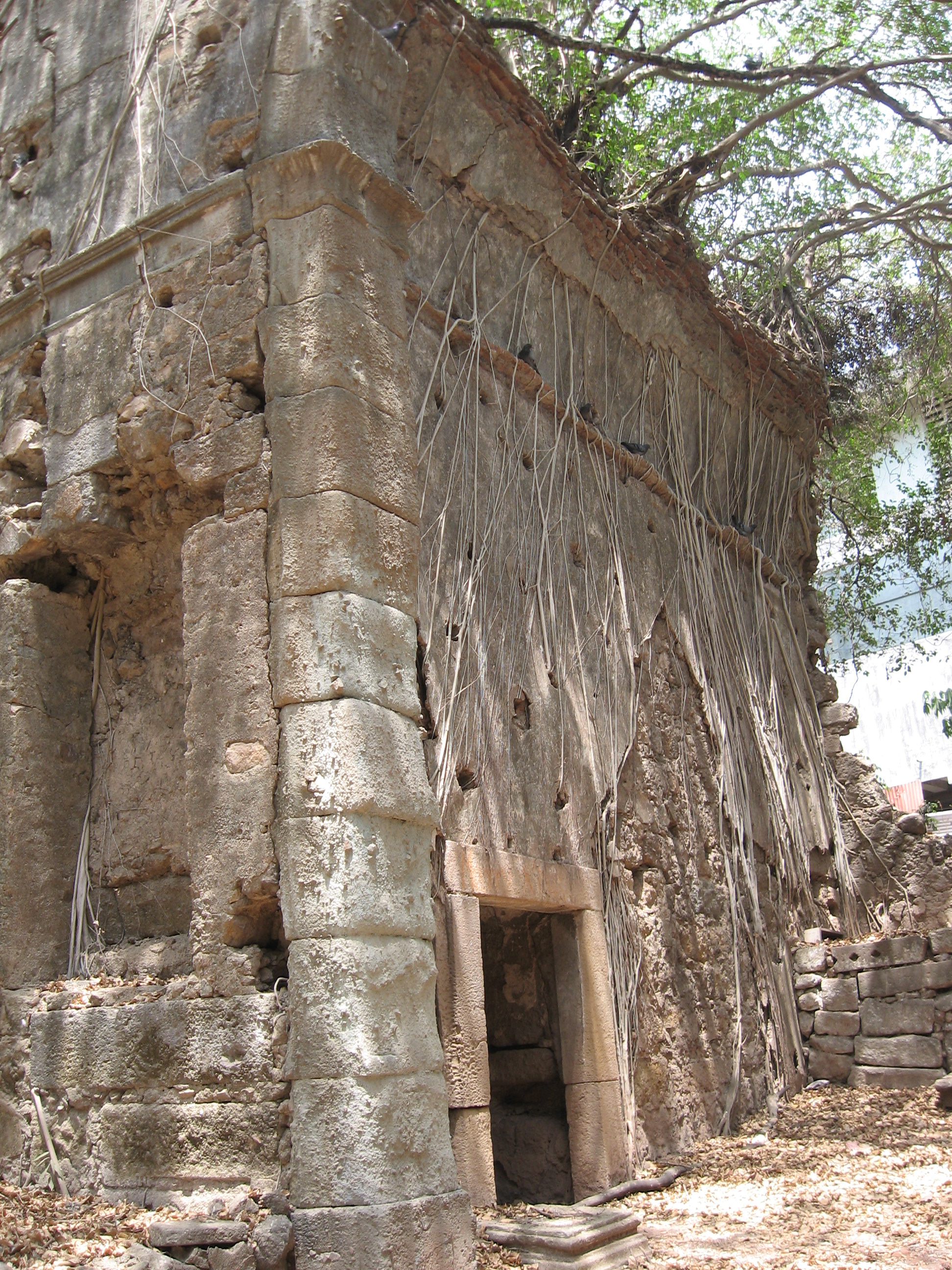
[[File:SEEPZ church 4.jpg|thumb|right|Ruins of [[St. John the Baptist Church, Mumbai|St. John the Baptist Church]] in [[Andheri]], built by the Portuguese Jesuits in 1579.]] | [[File:SEEPZ church 4.jpg|thumb|right|Ruins of [[St. John the Baptist Church, Mumbai|St. John the Baptist Church]] in [[Andheri]], built by the Portuguese Jesuits in 1579.]] | ||
Bombay, also called ''Bom Bahia'' or ''[[Mumbai#Etymology|Bom Baim]]'' in [[Indo-Portuguese creoles|Indo-Portuguese creole]], Mumbai in the local language; is the financial and commercial capital of [[India]] and one of the most [[list of largest cities|populous cities in the world]]. It's also the [[cosmopolitanism|cosmopolitan city centre]] of the [[Greater Bombay Metropolitan Area]], and the cultural base of the [[Bollywood]] film industry. At the time of arrival of the [[Portuguese Armadas]], Bombay was an [[archipelago]] of [[Seven Islands of Bombay|seven islands]]. Between the third century BCE and 1348, the islands came under the control of successive [[History of Bombay|Hindu]] dynasties. The [[Delhi Sultanate]] had been ruling the area along with [[Chaul]], [[Navi Mumbai|New Bombay]] ([[Thana district|Thana]]) | Bombay, also called ''Bom Bahia'' or ''[[Mumbai#Etymology|Bom Baim]]'' in [[Indo-Portuguese creoles|Indo-Portuguese creole]], and Mumbai in the local language; is the financial and commercial capital of [[India]] and one of the most [[list of largest cities|populous cities in the world]]. It's also the [[cosmopolitanism|cosmopolitan city centre]] of the [[Greater Bombay Metropolitan Area]], and the cultural base of the [[Bollywood]] film industry. At the time of the arrival of the [[Portuguese Armadas]], Bombay was an [[archipelago]] of [[Seven Islands of Bombay|seven islands]]. Between the third century BCE and 1348, the islands came under the control of successive [[History of Bombay|Hindu]] dynasties. The [[Delhi Sultanate]] had been ruling the area, along with [[Chaul]], [[Navi Mumbai|New Bombay]], ([[Thana district|Thana]]), and [[Daman, India|Damaon]]; with the local administration at [[Bassein (Vasai)]] since the raids of [[Malik Kafur]] in the [[Konkan]] region and across the Indian subcontinent. This territory in North Konkan, along with the Bombay islands were later taken over by the [[Sultan of Guzerat]] from 1391 to 1534, when he had declared the end of the his [[suzerainty]] to Delhi, after the [[Timurid Empire|Timurid]] invasion of it. Growing apprehensive of the power of the [[Moghal empire|Moghal]] emperor [[Humayun]], Sultan [[Bahadur Shah of Gujarat]] was obliged to sign the [[Treaty of Bassein (1534)|Treaty of Bassein]] on 23 December 1534; according to which, the Seven Islands of Bombay, [[Fort San Sebastian of Bassein]] in the strategic town of Bassein (Vasai), and its dependencies were offered to the [[Portuguese East Indies]]. The places were only later officially surrendered on 25 October 1535, by the Sultan of Guzerat. | ||
The [[Portuguese India# | The [[Portuguese India#Early years|Portuguese in Goa-Anjediva and Bombay-Bassein]] were actively involved in the foundation and growth of their [[Latin Christian]] religion in Bombay and the neighbouring area. They called the island by various names, which finally took the written form ''Bom Baim'', when the islands were leased to several Portuguese officers during their regime. Portuguese [[Franciscans]] and [[Jesuits]] built several churches in and around Bombay (Mumbai); the prominent ones are the [[St. Michael's Church (Mumbai)|St. Michael's Church]] at [[Mahim]], [[St. John the Baptist Church, Mumbai|St. John the Baptist Church]] at [[Andheri]], [[St. Andrew's Church (Mumbai)|St. Andrew's Church]], the [[Basilica of Mount Bandra (Bombay)]] at [[Bandra]], the [[Gloria Church]] at [[Byculla]], & the [[Holy Spirit Church Nandakhal]] at [[Virar]]. The Portuguese also built several fortifications around the city, like the [[Bombay Castle]], ''[[Castella de Aguada]]'' (Castelo da Aguada or Bandra Fort) and [[Madh Fort]]. | ||
The [[Marriage Treaty]] of [[Charles II of England]] and [[Catherine de Braganza]], daughter of [[John IV of Portugal]] was proposed on 23 June, 1661. According to the treaty, the | The [[Marriage Treaty]] of [[Charles II of England]] and [[Catherine de Braganza]], daughter of [[John IV of Portugal]] was proposed on 23 June, 1661. According to the treaty, the [[Seven Islands of Bombay]] along with the port of [[Tangiers]] were to be presented to the English Crown. It also granted the English trading privileges in [[Brazil]] and the [[Portuguese East Indies]], religious freedom for English residents in Portugal, and two million Portuguese crowns (£300,000), as parts of the [[Dowry of Catherine Braganza|dowry]] of Catherine to Charles, the contract was ratified on 28 August, 1661, and the marriage took place on 31 May, 1662.<ref name=":0">{{Cite book|title=Army of Charles II|last=Childs|first=John|date=2013|publisher=Routledge|isbn=978-1-134-52859-2|location=Oxon|pages=17}}</ref><ref name=":1">{{Cite web|author=Nergish Sunavala|date=Mar 27, 2018|title=When Bombay went to East India Company for £10 rent {{!}} India News - Times of India|url=https://timesofindia.indiatimes.com/india/when-bombay-went-to-east-india-company-for-10-rent/articleshow/63473137.cms|access-date=2022-02-25|website=The Times of India|language=en}}</ref> After their marriage, the Portuguese viceroy in Goa retained control of [[Salsette island]] ([[Bombay Suburban district]]), [[New Bombay]] & [[Bassein (Vasai)]] of the pre-partition [[Thana district]] until the [[Mahratta Invasion of Bassein]] in 1739. | ||
The | The Seven Islands of Bombay were regarded as a political and financial liability and were leased by Charles, to the [[English East India Company]], on 27 March 1668, for a nominal £10 rent, as a station in western India, to compete with [[Dutch East Indies]].<ref name=":1" /> | ||
The East India company was initially at odds with the Portuguese viceroy and vying for hegemony over the seven islands of what would become the capital city of the British [[Bombay Presidency]], as both the English and the Portuguese recognised [[Bombay Harbour]]'s strategic isolation from land-based attacks such as the [[sack of Surat]] and the [[sackings of Goa and Bombay-Bassein]]. The viceroy at Goa disobeyed the [[Portuguese crown]] and delayed a complete handover of the seven islands. Hence, even after the treaty some villages in the seven islands of Bombay remained under the capital of [[Velha Goa]], only later were the islands fully acquired by the English East India Company after the Battle of Bassein in 1739. | The East India company was initially at odds with the Portuguese viceroy and vying for hegemony over the seven islands of what would become the capital city of the British [[Bombay Presidency]], as both the English and the Portuguese recognised [[Bombay Harbour]]'s strategic isolation from land-based attacks such as the [[sack of Surat]] and the [[Mahratta Invasion of Goa and Bombay|sackings of Goa-Anjediva and Bombay-Bassein]]. The viceroy at Goa disobeyed the [[Portuguese crown]] and delayed a complete handover of the seven islands. Hence, even after the treaty some villages in the seven islands of Bombay remained under the capital of [[Velha Goa]], only later were the islands fully acquired by the English East India Company after the Battle of Bassein in 1739. | ||
==Arrival of the Portuguese== | ==Arrival of the Portuguese== | ||
{{main article|History of Mumbai under indigenous empires|History of Mumbai under Islamic rule}} | {{main article|History of Mumbai under indigenous empires|History of Mumbai under Islamic rule}} | ||
[[File:Retrato de D. Francisco de Almeida (após 1545) - Autor desconhecido.png|thumb|left|[[Francisco de Almeida]] was the first Portuguese soldier to sail through Bombay Harbour in 1508.]] | [[File:Retrato de D. Francisco de Almeida (após 1545) - Autor desconhecido.png|thumb|left|[[Francisco de Almeida]] was the first Portuguese soldier to sail through Bombay Harbour in 1508.]] | ||
From the third century BCE to 1534, the islands had been under the control of the following dynasties in succession: [[Mauryas]] (3rd century BCE – around 185 BCE), [[Satavahanas]] (Around 185 BCE – 250 CE), [[Abhiras]] and [[Vakatakas]] (250 CE – early 5th century), [[Kalachuris of Mahishmati|Kalachuri]]s (5th century), [[Mauryas of Puri|Konkan Mauryas]] (6th and early 7th century), [[Chalukya dynasty|Chalukyas]] (later 7th century), [[Rashtrakuta Dynasty|Rashtrakutas]] (mid-8th century), [[Silhara dynasty|Silharas]] (810 to 1260), [[Yadu|Yadavas]] (late 13th century – 1348), Muslim rulers of Gujarat (1348–1391), and the [[Gujarat Sultanate]] (1391–1534). At the time of arrival of the Portuguese, Bombay was ruled by [[Bahadur Shah of Gujarat|Sultan Bahadur Shah]] of the Gujarat Sultanate,<ref>{{harvnb|Greater Bombay District Gazetteer|1960|loc=[http://www.maharashtra.gov.in/english/gazetteer/greater_bombay/history.html#1 Ancient Period, pp. 127–150]|Ref=bom}}</ref><ref>{{harvnb|Greater Bombay District Gazetteer|1960|loc=[http://www.maharashtra.gov.in/english/gazetteer/greater_bombay/history.html#2 Medieval Period, pp. 150–157]|Ref=bom}}</ref><ref>{{harvnb|Greater Bombay District Gazetteer|1960|loc=[http://www.maharashtra.gov.in/english/gazetteer/greater_bombay/history.html#3 Muhammedan Period, pp. 157–163]|Ref=bom}}</ref> and was an [[archipelago]] of [[seven islands of Bombay|seven islands]]: [[Isle of Bombay|Bombay Island]] (''Bombaim''), [[Parel]], [[Mazagaon]], [[Mahim]], [[Colaba]], [[Worli]], and [[Old Woman's Island]] (also known as ''Little Colaba'').<ref>{{harvnb|Greater Bombay District Gazetteer|1960|loc=Seven Islands of Bombay, pp. 4–5|Ref=bom}}</ref> The [[Salsette Island|Salsette]] group of islands were located east of Bombay, separated by the [[Mahim Bay]].<ref>{{harvnb|Greater Bombay District Gazetteer|1960|loc=Salsette group of islands, p. 5|Ref=bom}}</ref> Important strategic towns located near Bombay were [[Vasai|Bassein]] (''Baçaim'') to the north, [[Thane|Thana]] to the east, and [[Chaul]] to the south. | |||
The [[Portuguese Empire|Portuguese]] first reached the west coast of [[India]] when the Portuguese explorer [[Vasco da Gama]] landed at [[Kozhikode|Calicut]] in 1498. | The [[Portuguese Empire|Portuguese]] first reached the west coast of [[India]] when the Portuguese explorer [[Vasco da Gama]] landed at [[Kozhikode|Calicut]] in 1498.<ref>{{harvnb|McFarren|2004|p=[https://books.google.com/books?id=hTQJWMf1E68C&pg=PA4 4]}}</ref> For several years after their arrival in India, they had been consolidating their power in north [[Konkan]].<ref name="b163"/> They had established a strong foothold in [[Goa]], which they captured from the [[Sultan of Bijapur]] in 1510.<ref>{{harvnb|Kerr|1812}}</ref> Portuguese explorer [[Francisco de Almeida]]'s ship sailed into the deep natural harbour of Bombay in December 1508 on his expedition from [[Kannur|Cannanore]] to [[Diu, India|Diu]].<ref>{{harvnb|Da Cunha|1993|p=[https://books.google.com/books?id=miD5YO05jpUC&pg=PA71 71]|Ref=ger}}</ref> The Portuguese paid their first visit to the islands on 21 January 1509, when they landed at [[Mahim]] after capturing a barge of the Gujarat Sultanate in the Mahim creek.<ref name="b163">{{harvnb|Greater Bombay District Gazetteer|1960|p=163|Ref=bom}}</ref> Between 1513 and 1514, they requested Sultan Bahadur Shah to allow them build a fortress at Mahim. In 1517, during the viceroyalty of [[Lopo Soares de Albergaria]] (1515–18), João de Monroyo entered the Bandora creek (Bandra creek) and defeated the Gujarat commandant of Mahim. Between 1522 and 1524, when Duarte de Menezes was viceroy of Goa, the Portuguese were constantly prowling about Bombay for the ships of the Gujarat Sultanate.<ref>{{harvnb|Greater Bombay District Gazetteer|1960|p=164|Ref=bom}}</ref> | ||
In 1526, the Portuguese established their factory at [[Vasai|Bassein]]. | In 1526, the Portuguese established their factory at [[Vasai|Bassein]].<ref>{{harvnb| | ||
Maharashtra State Gazetteer|1977|p=153|Ref=mah4}} | Maharashtra State Gazetteer|1977|p=153|Ref=mah4}}</ref> During 1528–29, [[Lopo Vaz de Sampaio]] seized the fort of Mahim from the Gujarat Sultanate, when Sultan Bahadur Shah was at war with Nizam-ul-mulk, the emperor of [[Chaul]].<ref>{{harvnb|Edwardes|1993|p=65|Ref=ed}}</ref><ref>{{harvnb|Da Cunha|1993|p=[https://books.google.com/books?id=miD5YO05jpUC&pg=PA74 74]|Ref=ger}}</ref> Bombay came into prominence in connection with the attempt of the Portuguese to capture Diu in 1530–31. [[Nuno da Cunha]], the viceroy of Goa, commanded the largest fleet seen in India, which passed through Bombay Harbour.<ref>{{harvnb|Greater Bombay District Gazetteer|1960|p=165|Ref=bom}}</ref><ref>{{harvnb|Da Cunha|1993|p=[https://books.google.com/books?id=miD5YO05jpUC&pg=PA77 77]|Ref=ger}}</ref> In March–April 1531, the Portuguese torched the towns of Thana and Mahim. In consequence of this success, and later of Nuno da Cunha's capture of Bassein in January 1533, the islands of Bombay and Mahim, together with [[Bandra]], became tributary to the Portuguese.<ref name="p166">{{harvnb|Greater Bombay District Gazetteer|1960|p=166|Ref=bom}}</ref> | ||
==Accession of the islands to the Portuguese== | ==Accession of the islands to the Portuguese== | ||
| Line 30: | Line 30: | ||
{{main article|Treaty of Bassein (1534)}} | {{main article|Treaty of Bassein (1534)}} | ||
The [[Mughal Empire]], founded in 1526, was the dominant power in the [[Indian subcontinent]] during the mid-16th century. The dynasty was founded when [[Babur]], hailing from [[Ferghana]] (in modern-day [[Uzbekistan]]), invaded parts of [[North India]] and defeated [[Ibrahim Lodhi|Ibrahim Shah Lodhi]], the ruler of [[Delhi Sultanate]], at the [[First battle of Panipat|First Battle of Panipat]] in 1526. | The [[Mughal Empire]], founded in 1526, was the dominant power in the [[Indian subcontinent]] during the mid-16th century. The dynasty was founded when [[Babur]], hailing from [[Ferghana]] (in modern-day [[Uzbekistan]]), invaded parts of [[North India]] and defeated [[Ibrahim Lodhi|Ibrahim Shah Lodhi]], the ruler of [[Delhi Sultanate]], at the [[First battle of Panipat|First Battle of Panipat]] in 1526.<ref>{{Citation | ||
|url=http://www.sscnet.ucla.edu/southasia/History/Mughals/mughals.html | |url=http://www.sscnet.ucla.edu/southasia/History/Mughals/mughals.html | ||
|archive-url=https://web.archive.org/web/19990427034712/http://www.sscnet.ucla.edu/southasia/History/Mughals/mughals.html | |archive-url=https://web.archive.org/web/19990427034712/http://www.sscnet.ucla.edu/southasia/History/Mughals/mughals.html | ||
| Line 37: | Line 37: | ||
|title=Mughal Empire | |title=Mughal Empire | ||
|publisher=Department of Social Sciences ([[University of California]]) | |publisher=Department of Social Sciences ([[University of California]]) | ||
|access-date=2009-05-22}} | |access-date=2009-05-22}}</ref> After Babur's death on 26 December 1530, his son [[Humayun]] (1530–40) ascended to the throne at [[Agra]] on 29 December 1530.<ref>{{harvnb|Prasad|1974|p=145}}</ref> | ||
Sultan Bahadur Shah had grown apprehensive of the power of Humayun. He dispatched his chief officer Xacoes (Shah Khawjeh) to [[Nuno da Cunha]] with an offer to hand over the seven islands of Bombay together with Bassein, its dependencies, and revenues by sea and land. On 23 December 1534, the [[Treaty of Bassein (1534)|Treaty of Bassein]] was signed on board the galleon ''San Mateos'' (St. Matthew). | Sultan Bahadur Shah had grown apprehensive of the power of Humayun. He dispatched his chief officer Xacoes (Shah Khawjeh) to [[Nuno da Cunha]] with an offer to hand over the seven islands of Bombay together with Bassein, its dependencies, and revenues by sea and land. On 23 December 1534, the [[Treaty of Bassein (1534)|Treaty of Bassein]] was signed on board the galleon ''San Mateos'' (St. Matthew).<ref>{{harvnb|Da Cunha|1993|p=[https://books.google.com/books?id=miD5YO05jpUC&pg=PA88 88]|Ref=ger}}</ref> Bassein and the seven islands of Bombay were surrendered later by a treaty of peace and commerce between Bahadur Shah and Nuno da Cunha on 25 October 1535, permanently ending the Islamic rule on the islands.<ref name="p166"/> | ||
==Development of islands== | ==Development of islands== | ||
[[File:St. Michael's Church, Mahim 4.jpg|left|thumb|[[St. Michael's Church (Mumbai)|St. Michael's Church]] in [[Mahim]], the oldest Portuguese Franciscan church in Bombay, was built in 1534.]] | [[File:St. Michael's Church, Mahim 4.jpg|left|thumb|[[St. Michael's Church (Mumbai)|St. Michael's Church]] in [[Mahim]], the oldest Portuguese Franciscan church in Bombay, was built in 1534.]] | ||
In the general distribution of estates which occurred after 1534, [[Isle of Bombay|Bombay Island]] was leased to [[Mestre Diogo]] for an annual rent of 1,432½ pardaos (about [[Indian rupee|Rs]]. 537-3-0), payable at the royal treasury in Bassein. | In the general distribution of estates which occurred after 1534, [[Isle of Bombay|Bombay Island]] was leased to [[Mestre Diogo]] for an annual rent of 1,432½ pardaos (about [[Indian rupee|Rs]]. 537-3-0), payable at the royal treasury in Bassein.<ref name="d206">{{harvnb|Da Cunha|1993|p=[https://books.google.com/books?id=miD5YO05jpUC&pg=PA206 206]|Ref=ger}}</ref> [[Mahim]] was similarly rented for 36,057 foedeas (Rs. 751-3-0), the custom house of Mahim for 39,975 foedeas (Rs. 791-2-9), and [[Mazagon]] for 8,500 foedeas (Rs. 178).<ref name="gb0">{{harvnb|Greater Bombay District Gazetteer|1960|p=167|Ref=bom}}</ref> The ''San Miguel'' ([[St. Michael's Church (Mumbai)|St. Michael's Church]]) in [[Mahim]], the oldest Portuguese Franciscan church in Bombay, was built in 1534.<ref>{{harvnb|Edwardes|1993|p=75|Ref=ed}}</ref> Bombay was placed under the spiritual jurisdiction of the Vigario da Vara at [[Vasai|Bassein]].<ref>{{harvnb|Da Cunha|1993|p=[https://books.google.com/books?id=miD5YO05jpUC&pg=PA189 189]|Ref=ger}}</ref> Under his auspices, the [[Franciscan Order]] was established. The [[Jesuit Order]] was established in 1542, the most notable member of which was the [[Kingdom of Navarre|Navarrese]] Jesuit [[Francis Xavier]]. The [[Dominican Order]] established in Goa in 1545, was established in Bombay in 1548.<ref name="cg"/> After initially referring to it by the name ''Ilha da Boa Vida'' (Island of Good Life),<ref>{{Cite book|title=The First Firangis: Remarkable Stories of Heroes, Healers, Charlatans, Courtesans & other Foreigners who Became Indian|last=Harris|first=Jonathan Gil|publisher=Aleph Book Company|year=2016|isbn=978-9382277590|pages=29}}</ref> the Portuguese called the islands by various names like ''Mombai'', ''Mombay'', ''Mombayn'', ''Mombaym'', and ''Bombai'', which finally took the written form ''Bombaim'', still common in current [[Portuguese language|Portuguese]] use.<ref>{{harvnb|Da Cunha|1993|p=[https://books.google.com/books?id=miD5YO05jpUC&pg=PA67 67]|Ref=ger}}</ref> After the [[British Empire|British]] gained possession, it was believed to be [[anglicise]]d to ''Bombay'' from the Portuguese ''Bombaim''.<ref>{{harvnb|Greater Bombay District Gazetteer|1960|loc=Place Name of Bombay, p. 6|Ref=bom}}</ref> Between 1545 and 1548, during the viceroyalty of [[João de Castro]] (1545-7), the four villages of [[Parel]], [[Wadala]], [[Sion, Mumbai|Sion]], and [[Worli]] were granted to [[Manuel Serrão]] for an annual payment of 412 pardaos (Rs. 154-8-0).<ref name="d206"/> [[Salsette]] was granted for three years to [[João Rodrigues Dantas]], [[Cosme Corres]], and [[Manuel Corres]]. [[Trombay]] and [[Chembur]] were granted to [[Dom Roque Tello de Menezes|Roque Tello de Menezes]], and the Island of Pory ([[Elephanta Island]]) to [[João Pirez]] in 1548 for 105 pardaos (Rs. 39-6-0).<ref name="lease">{{harvnb|Da Cunha|1993|p=[https://books.google.com/books?id=miD5YO05jpUC&pg=PA96 96]|Ref=ger}}</ref> The revenue of the custom house at [[Walkeshwar]] was granted to a Portuguese officer for 60 foedeas (Rs. 1-4-0).<ref name="gb0"/> [[Mazagaon]] was granted to [[António Pessoa]].<ref name="d206"/> In 1554, during the viceroyalty of [[Pedro Mascarenhas]], the seven islands of Bombay were leased to [[Garcia de Orta]], a Portuguese physician and botanist, for a yearly rent equivalent to about [[Pound sterling|£]]85 sterling. Orta had fled Portugal to escape the trials of the [[Portuguese Inquisition]], established in 1536, that kept an eye on Jewish families converted to Catholicism and severely persecuted them in case of real or imagined relapse on their former faith.<ref>{{Citation | ||
|url=http://www.ias.ac.in/jbiosci/september1999/article2.htm | |url=http://www.ias.ac.in/jbiosci/september1999/article2.htm | ||
|title=The truth behind the legend: European doctors in pre-colonial India | |title=The truth behind the legend: European doctors in pre-colonial India | ||
|author=Rajesh Kochhar | |author=Rajesh Kochhar | ||
|access-date=2008-08-17 | |access-date=2008-08-17 | ||
|publisher=Indian Institute of Astrophysics ([[Bangalore]])}} | |publisher=Indian Institute of Astrophysics ([[Bangalore]])}}</ref> | ||
[[File:Davies' sketch of Bombay harbour 1626.jpg|thumb|250px|Davies' sketch of Bombay harbour, 1626]] | [[File:Davies' sketch of Bombay harbour 1626.jpg|thumb|250px|Davies' sketch of Bombay harbour, 1626]] | ||
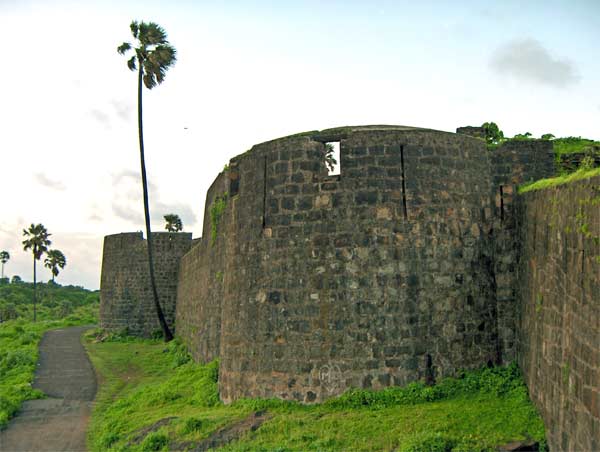
[[File:Madh-fort3.jpg|thumb|The [[Madh Fort]], built by the Portuguese, was one of the most important forts in [[Salsette]].]] | [[File:Madh-fort3.jpg|thumb|The [[Madh Fort]], built by the Portuguese, was one of the most important forts in [[Salsette]].]] | ||
Garcia de Orta was responsible for building the manor-house ([[Bombay Castle]]) in Bombay.{{Ref label|a|a|none}} He also mentioned several accounts of the islands and the people living in Bombay during his time. During his regime, as regards the population of the island, Bombay was composed of seven villages subordinate to two ''cacabas'' (''kashas'') or chief stations, at which customs-duty was levied. These villages were ''Mahim'', ''Parel'', ''Varella'' ([[Wadala]]) and ''Syva'' ([[Sion, Mumbai|Sion]]) under the ''kasba'' (chief officer) of Mahim, and ''Mazagaon'', ''Bombaim'' (Bombay), and ''Varel'' ([[Worli]]) under the ''kasba'' (chief officer) of Bombay. In addition to these, there were smaller hamlets like Cavel, [[Colaba]], [[Naigaon]] and [[Dongri]], which had existed from the epoch of indigenous Hindu settlement. The [[Koli | Garcia de Orta was responsible for building the manor-house ([[Bombay Castle]]) in Bombay.{{Ref label|a|a|none}} He also mentioned several accounts of the islands and the people living in Bombay during his time. During his regime, as regards the population of the island, Bombay was composed of seven [[Hinduism in Maharashtra|Marathi Hindu]] populated villages subordinate to two ''cacabas'' (''kashas'') or chief stations, at which customs-duty was levied. These villages were ''Mahim'', ''Parel'', ''Varella'' ([[Wadala]]) and ''Syva'' ([[Sion, Mumbai|Sion]]) under the ''kasba'' (chief officer) of Mahim, and ''Mazagaon'', ''Bombaim'' (Bombay), and ''Varel'' ([[Worli]]) under the ''kasba'' (chief officer) of Bombay. In addition to these, there were smaller hamlets like Cavel, [[Colaba]], [[Naigaon]] and [[Dongri]], which had existed from the epoch of indigenous Hindu settlement. The [[Koli people|Kolis]], a fishing community, formed the most numerous class of people, and dwelt in most parts of Bombay from Colaba in the south to Sion and Mahim in the north. Other Hindu communities residing were, the ''[[Kunbi|Kunbis]]'' and ''[[Agri (caste)|Agris]]'' (Curumbins) (who cultivated the fields and sowed them with rice and all sorts of pulse), the ''[[Mali caste|Malis]]'' (who tended the orchards), and the Piaes (men-at-arms) (who were [[Bhandari (caste)|Bhandaris]]). The ''Parus'' ([[Chandraseniya Kayastha Prabhu|Prabhus]]) dwelt in Mahim, Bombay, and Parel. They collected the rents of the King and of the inhabitants and their estates, and were also merchants. The Muslim [[Moors]] in Bombay were solely engaged in maritime trade. A few Muslims of less mixed descent were living in Mahim, but the bulk of the followers of Islam belonged to the [[Konkani Muslims|Konkani Muslim]] community. Christians residing in Bombay during his time included eleven Roman Catholic Portuguese families of married men. The other three communities mentioned by Orta as residents in Bassein and its surrounding tracts were ''Baneanes'' ([[Bania (caste)|Banias]]), ''Coaris'' or ''Esparcis'' ([[Parsis]]), and ''Deres'' ([[Dhedh|Dheds]] or [[Mahar|Mahars]]) or Farazes. Most Banias and Parsis did not actually settle in Bombay until after its cession to England by the Portuguese.<ref>{{harvnb|Greater Bombay District Gazetteer|1960|pp=168–69|Ref=bom}}</ref> Bombay apparently remained in Orta's possession until his peaceful death in Goa in 1570. Several years later, his bones were exhumed and burnt at the stake for his Jewish faith. The islands appears to have been granted on the same tenure to several Portuguese officials in succession.<ref>{{harvnb|Greater Bombay District Gazetteer|1960|pp=167–68|Ref=bom}}</ref> | ||
[[File:Castella de Aguada 7.jpg|thumb|left|[[Castella de Aguada]] (Fort of the Waterpoint) was built by the Portuguese at [[Bandra]] in 1640.]] | [[File:Castella de Aguada 7.jpg|thumb|left|[[Castella de Aguada]] (Fort of the Waterpoint) was built by the Portuguese at [[Bandra]] in 1640.]] | ||
The Portuguese encouraged intermarriage with the local population, and strongly supported the [[Roman Catholic Church]]. | The Portuguese encouraged intermarriage with the local population, and strongly supported the [[Catholic Church in India|Roman Catholic Church]].<ref>{{harvnb|Da Cunha|1993|p=[https://books.google.com/books?id=miD5YO05jpUC&pg=PA283 283]|Ref=ger}}</ref> They converted nearly 10,000 natives to Christianity in Bassein, Thane, and neighbouring places.<ref name="cg">{{harvnb|Greater Bombay District Gazetteer|1960|p=170|Ref=bom}}</ref> They started the [[Goa Inquisition]] in 1560.<ref>{{harvnb|Da Cunha|1993|p=[https://books.google.com/books?id=miD5YO05jpUC&pg=PA183 183]|Ref=ger}}</ref> These people were referred as "Portuguese Christians". Later, named themselves as the [[Bombay East Indians|East Indian Catholics]] (after the [[British East India Company]]) during the [[British Raj|British regime]] because [[Goan Catholics|Goan]] and [[Mangalorean Catholics|Mangalorean Catholic]] settlers in Bombay were also referred to as "Portuguese Christians" by British.<ref name="bapp">{{harvnb|Baptista|1967|p=25|Ref=bap}}</ref> After [[António Pessoa]]'s death in 1571, a patent was issued which granted [[Mazagaon]] in perpetuity to the [[Sousa e Lima family]].<ref name="burn">{{harvnb|Burnell|2007|p=[https://books.google.com/books?id=1a-Apmn-K-gC&pg=PA15 15]|Ref=burn}}</ref> The [[St. Andrew's Church (Mumbai)|St. Andrew Church]] at Bandra was built in 1575 by the Portuguese Jesuits.<ref>{{harvnb|Greater Bombay District Gazetteer|1986|loc=[http://www.maharashtra.gov.in/english/gazetteer/greater_bombay/places.html#56 St. Andrews Church, p. 524]|Ref=bom}}</ref> The [[Iberian Union|union of the crowns]] of Portugal and [[Spain]] in 1580–1640 opened the way for other European powers to follow the spice routes to India. The [[Dutch Empire|Dutch]] arrived first, closely followed by the British.<ref>{{harvnb|Leonard|2006|p=[https://books.google.com/books?id=eq_Wma6nNfgC&pg=PA359 359]|Ref=leon}}</ref> The Portuguese also built several fortifications around the city. The [[Madh Fort]] was one of their most important constructions in Salsette.<ref>{{harvnb|Nairne|1988|p=[https://books.google.com/books?id=nzPCcILP-XwC&dq=Madh&pg=PA66 6]}}</ref> The first English merchants arrived in Bombay in November 1583, and travelled through Bassein and [[Thane|Thana]]. A prominent merchant among them was [[Ralph Fitch]] from [[London]]. They mentioned that Bassein and Thana were trading in rice and corn on a small scale. They arrived in [[Chaul]] on 10 November 1583.<ref>{{cite web|url=http://theory.tifr.res.in/bombay/history/travelogue.html|title=The First Englishmen in Bombay: Mumbai/Bombay pages|first=Sourendu|last=Gupta|date=21 July 1997|url-status=dead|archive-url=https://web.archive.org/web/20081019034821/http://theory.tifr.res.in/bombay/history/travelogue.html|archive-date=19 October 2008}}</ref> During this time, Bombay's main trade was coconuts and coir.<ref name="d26">{{harvnb|Dwivedi|Mehrotra|2001|p=26|Ref=dm2001}}</ref> The Portuguese Franciscans had obtained practical control of Salsette and Mahim by 1585, and built ''[[Nossa Senhora do Bom Conselho (Bombay)|Nossa Senhora do Bom Conselho]]'' (Our Lady of Good Advice, affiliated to igreja de São Miguel / [[St. Michael's Church (Mumbai)|St. Michael's Church]] in 1596) at Sion and ''[[Nossa Senhora da Salvação (Bombay)|Nossa Senhora da Salvação]]'' (Our Lady of Salvation, popularly referred as "Portuguese Church") at [[Dadar]] in 1596.<ref name="cg"/> The immense natural advantages of Bombay aroused the cupidity of the English who recognized its value as a naval base. In November 1612, the British fought the [[Battle of Swally]] with the Portuguese at [[Surat]] for the possession of Bombay. The British emerged victorious in the battle, and the Portuguese defeat was a significant event in marking the beginning of the end of their commercial monopoly over western India. Later, the British burnt the manor house built by Garcia de Orta in 1626.<ref>{{harvnb|Greater Bombay District Gazetteer|1960|p=171|Ref=bom}}</ref> [[Dorabji Nanabhoy]], a [[Gujarati people|Gujarati]] trader, was the first [[Parsi people|Parsi]] to settle in Bombay in 1640. The Parsis immensely contributed towards the future development of Bombay during the British period.<ref>{{Citation | ||
|url=http://www.cherry.gatech.edu/trp/proceedings/2001/01Phalkey.doc | |url=http://www.cherry.gatech.edu/trp/proceedings/2001/01Phalkey.doc | ||
|title=The Tale of Two Cities: Technological profiles of Bangalore and Bombay as Growth Regions | |title=The Tale of Two Cities: Technological profiles of Bangalore and Bombay as Growth Regions | ||
| Line 64: | Line 64: | ||
|postscript=. | |postscript=. | ||
|archive-url=https://web.archive.org/web/20061213065251/http://www.cherry.gatech.edu/TRP/proceedings/2001/01Phalkey.doc | |archive-url=https://web.archive.org/web/20061213065251/http://www.cherry.gatech.edu/TRP/proceedings/2001/01Phalkey.doc | ||
|archive-date=2006-12-13}} | |archive-date=2006-12-13}}</ref> In 1640, the Portuguese built ''[[Castella da Aguada]]'' (Fort of the Waterpoint) at Bandra, as a watchtower overlooking the [[Mahim Bay]], the [[Arabian Sea]] and the southern island of Mahim.<ref name="express">{{Citation|url=http://cities.expressindia.com/fullstory.php?newsid=46848|title=Local 'army' offers to protect Mumbai's 'Castella'|last=Ball|first=Iain|date=2003-03-19|work=Mumbai Newsline|publisher=[[Express Group]]|access-date=2008-09-16|archive-url=https://web.archive.org/web/20060724015419/http://cities.expressindia.com/fullstory.php?newsid=46848|archive-date=24 July 2006|url-status=dead}}</ref> It was armed with seven cannons and other smaller guns as defence.<ref>{{harvnb|da Cunha|1993|p=212|ref=ger}}</ref> | ||
==End of Portuguese rule== | ==End of Portuguese rule== | ||
[[File:Catherine of Braganza.jpg|thumb|[[Catherine de Braganza]], whose marriage treaty with [[Charles II of England]] placed Bombay in the possession of the British Empire]] | [[File:Catherine of Braganza.jpg|thumb|[[Catherine de Braganza]], whose marriage treaty with [[Charles II of England]] placed Bombay in the possession of the British Empire]] | ||
In 1652, the Surat Council of the British Empire urged the [[British East India Company]] to purchase Bombay from the Portuguese. | In 1652, the Surat Council of the British Empire urged the [[British East India Company]] to purchase Bombay from the Portuguese.<ref>{{harvnb|Sheppard|1932|p=6|Ref=shp}}</ref> In 1654, the British East India Company drew the attention of [[Oliver Cromwell]], the Lord protector of the short lived [[Commonwealth of England| | ||
Commonwealth]], to this suggestion by the Surat Council, laying great stress upon its excellent harbour and its natural isolation from land-attacks. | Commonwealth]], to this suggestion by the Surat Council, laying great stress upon its excellent harbour and its natural isolation from land-attacks.<ref>{{harvnb|Da Cunha|1993|p=[https://books.google.com/books?id=miD5YO05jpUC&pg=PA172 172]|Ref=ger}}</ref> By the middle of the seventeenth century the growing power of the [[Dutch Empire]] forced the English to acquire a station in western India. The Directors of the Council of Surat reported in 1659 that every effort should be made to obtain Bombay from [[John IV of Portugal|King John IV of Portugal]].<ref>{{harvnb|Da Cunha|1993|p=[https://books.google.com/books?id=miD5YO05jpUC&pg=PA242 242]|Ref=ger}}</ref> On 11 May 1661, the marriage treaty of [[Charles II of England]] and [[Catherine of Braganza]], daughter of King John IV of Portugal, placed the port of Bombay in the possession of the British Empire, as part of Catherine's vast dowry, along with the port of [[Tangier]] near the [[Strait of Gibraltar]] and the right for the English to reside and trade in Portuguese territories. Catherine's dowry constituted then the largest dowry ever received by a monarch.<ref>[https://eve.fcsh.unl.pt/en/people/francisco-de-melo-e-torres-1620-1667 Francisco de Melo e Torres (1620-1667)], In: EVE - E-cyclopeadia of Portuguese Expansion, retrieved 26 January 2026</ref> | ||
On 19 March 1662, [[Abraham Shipman]] was appointed the first Governor and General of the city, and his fleet arrived in Bombay in September–October 1662. On being asked to hand over Bombay and Salsette to the English, the Portuguese Governor contended that Bombay Island alone had been ceded, and alleging irregularity in the patent, he refused to give up even Bombay Island. The Portuguese [[List of colonial heads of Portuguese India|Viceroy]] declined to interfere and Shipman was prevented from landing in Bombay. He was forced to retire to the island of [[Anjadip Island, Karnataka|Anjediva]] in [[North Canara]] and died there in October 1664. In November 1664, Shipman's successor [[Humphrey Cooke]] agreed to accept Bombay Island without its dependencies, with the condition of granting special privileges to Portuguese citizens in Bombay, and no interference in the Roman Catholic religion. | On 19 March 1662, [[Abraham Shipman]] was appointed the first Governor and General of the city, and his fleet arrived in Bombay in September–October 1662. On being asked to hand over Bombay and Salsette to the English, the Portuguese Governor contended that Bombay Island alone had been ceded, and alleging irregularity in the patent, he refused to give up even Bombay Island. The Portuguese [[List of colonial heads of Portuguese India|Viceroy]] declined to interfere and Shipman was prevented from landing in Bombay. He was forced to retire to the island of [[Anjadip Island, Karnataka|Anjediva]] in [[North Canara]] and died there in October 1664. In November 1664, Shipman's successor [[Humphrey Cooke]] agreed to accept Bombay Island without its dependencies, with the condition of granting special privileges to Portuguese citizens in Bombay, and no interference in the Roman Catholic religion.<ref>{{harvnb|Thana District Gazetteer|1986|loc=[http://www.maharashtra.gov.in/pdf/gazeetter_reprint/Thane-II/histroy_portuguese.html#1 Portuguese (1500–1670)]|Ref=tnad}}</ref> However, [[Salsette Island|Salsette]] (including Bandra), [[Mazagaon]], [[Parel]], [[Worli]], [[Sion, Mumbai|Sion]], [[Dharavi]], [[Wadala Road|Wadala]] and Elephanta island still remained under Portuguese possession, as much as Thane or Vasai.<ref>{{harvnb|Greater Bombay District Gazetteer|1960|p=174|Ref=bom}}</ref> From 1665 to 1666, Cooke managed to acquire Mahim, Sion, Dharavi, and Wadala for the English.<ref>{{harvnb|The Gazetteer of Bombay City and Island|1978|p=54|Ref=bi}}</ref><ref>{{harvnb|Malabari|1910|p=99|Ref=mala}}</ref> | ||
==Historiography== | ==Historiography== | ||
The historical period of Portuguese colonial rule in the seven original islands of Bombay (1534–1665) and in the remaining territory of the Northern Province of the Estado da Índia (1534–1739) has been scantly researched. During the second half of the 19th century, Dr. J Gerson da Cunha, a Bombayite of [[Goan]] origin, began compiling information on the subject and published some books and articles. He wrote the first book on history of Bombay, ''The Origin of Bombay'', published by the Bombay branch of the Royal Asiatic Society. | The historical period of Portuguese colonial rule in the seven original islands of Bombay (1534–1665) and in the remaining territory of the Northern Province of the Estado da Índia (1534–1739) has been scantly researched. During the second half of the 19th century, Dr. J Gerson da Cunha, a Bombayite of [[Goan]] origin, began compiling information on the subject and published some books and articles. He wrote the first book on history of Bombay, ''The Origin of Bombay'', published by the Bombay branch of the Royal Asiatic Society.<ref>{{cite news|url=http://timesofindia.indiatimes.com/home/sunday-toi/Family-Matters/articleshow/154584.cms|title=Family Matters|date=31 August 2003|work=The Times of India|first1=Sudeshna|last1=Chatterjee}}</ref> Later, Braz Fernandes, an East-Indian, took up da Cunha's work and provided more in depth studies, especially about the Island of Salsette (Shashti) and the ruins in Vasai. Since the Independence of India, a few historians and scholars in Bombay have studied local or partial aspects of the period's history. Of particular interest are the works of Mariam Dossal, Pankaj Joshi, Theresa Albuquerque and Fleur de Souza. However, the most significant recent contribution to the study of Bombay's Portuguese layer has come from the research project [[Bombay Before the British]], developed by the Architecture Department of the University of Coimbra between 2004 and 2007. | ||
==See also== | ==See also== | ||
| Line 85: | Line 81: | ||
*[[Portuguese India]] | *[[Portuguese India]] | ||
*[[Bombay Before the British]] | *[[Bombay Before the British]] | ||
*[[British Bombay]] | |||
*[[Indo-Portuguese Creole of Bombay]] | *[[Indo-Portuguese Creole of Bombay]] | ||
*[[Military history of Bassein]] | *[[Military history of Bassein]] | ||
| Line 90: | Line 87: | ||
==Notes== | ==Notes== | ||
'''a''' {{note label|a|a|none}} The current [[Bombay Castle]] was a structure built by the British on the site of the manor house. | '''a''' {{note label|a|a|none}} The current [[Bombay Castle]] was a structure built by the British on the site of the manor house.<ref>{{Citation | ||
|url = http://rajbhavan.maharashtra.gov.in/history/history_castle.htm | |url = http://rajbhavan.maharashtra.gov.in/history/history_castle.htm | ||
|title = Bombay Castle | |title = Bombay Castle | ||
| Line 98: | Line 95: | ||
|archive-url = https://web.archive.org/web/20080923135336/http://rajbhavan.maharashtra.gov.in/history/history_castle.htm | |archive-url = https://web.archive.org/web/20080923135336/http://rajbhavan.maharashtra.gov.in/history/history_castle.htm | ||
|archive-date = 2008-09-23 | |archive-date = 2008-09-23 | ||
}} | }}</ref> | ||
==Citations== | ==Citations== | ||
| Line 146: | Line 143: | ||
|last=Edwardes | |last=Edwardes | ||
|first=Stephen Meredyth | |first=Stephen Meredyth | ||
|authorlink=Stephen Edwardes | |||
|publisher=Times of India Press | |publisher=Times of India Press | ||
|year=1902 | |year=1902 | ||
| Line 167: | Line 165: | ||
|last= Leonard | |last= Leonard | ||
|first=Thomas M. | |first=Thomas M. | ||
|publisher=Taylor & Francis | |publisher=Taylor & Francis | ||
|year=2006 | |year=2006 | ||
|access-date=2009-02-02 | |access-date=2009-02-02 | ||
| Line 260: | Line 258: | ||
*[https://web.archive.org/web/20080326233104/http://www.hindustantimes.com/news/specials/bombay/history2.shtml The West turns East] from ''[[Hindustan Times]]'' | *[https://web.archive.org/web/20080326233104/http://www.hindustantimes.com/news/specials/bombay/history2.shtml The West turns East] from ''[[Hindustan Times]]'' | ||
<!--╔════════════════════════({{NoMoreLinks}})════════════════════════════╗ | |||
║ PLEASE BE CAUTIOUS IN ADDING MORE LINKS TO THIS ARTICLE. WIKIPEDIA ║ | ║ PLEASE BE CAUTIOUS IN ADDING MORE LINKS TO THIS ARTICLE. WIKIPEDIA ║ | ||
║ IS NOT A COLLECTION OF LINKS NOR SHOULD IT BE USED FOR ADVERTISING. ║ | ║ IS NOT A COLLECTION OF LINKS NOR SHOULD IT BE USED FOR ADVERTISING. ║ | ||
║ ║ | ║ ║ | ||
║ Excessive or inappropriate links WILL BE DELETED. ║ | ║ Excessive or inappropriate links WILL BE DELETED. ║ | ||
║ See [[Wikipedia:External links]] & [[Wikipedia:Spam]] for details. ║ | ║ See [[Wikipedia:External links]] & [[Wikipedia:Spam]] for details. ║ | ||
║ ║ | ║ ║ | ||
║ If there are already plentiful links, please propose additions or ║ | ║ If there are already plentiful links, please propose additions or ║ | ||
| Line 271: | Line 269: | ||
║ to the relevant category at the Open Directory Project (dmoz.org) ║ | ║ to the relevant category at the Open Directory Project (dmoz.org) ║ | ||
║ and link back to that category using the {{dmoz}} template. ║ | ║ and link back to that category using the {{dmoz}} template. ║ | ||
╚════════════════════════({{NoMoreLinks}})════════════════════════════╝-- | ╚════════════════════════({{NoMoreLinks}})════════════════════════════╝--> | ||
{{Mumbai topics}} | {{Mumbai topics}} | ||
{{Portuguese overseas empire}} | {{Portuguese overseas empire}} | ||
Revision as of 02:54, 27 January 2026

Bombay, also called Bom Bahia or Bom Baim in Indo-Portuguese creole, and Mumbai in the local language; is the financial and commercial capital of India and one of the most populous cities in the world. It's also the cosmopolitan city centre of the Greater Bombay Metropolitan Area, and the cultural base of the Bollywood film industry. At the time of the arrival of the Portuguese Armadas, Bombay was an archipelago of seven islands. Between the third century BCE and 1348, the islands came under the control of successive Hindu dynasties. The Delhi Sultanate had been ruling the area, along with Chaul, New Bombay, (Thana), and Damaon; with the local administration at Bassein (Vasai) since the raids of Malik Kafur in the Konkan region and across the Indian subcontinent. This territory in North Konkan, along with the Bombay islands were later taken over by the Sultan of Guzerat from 1391 to 1534, when he had declared the end of the his suzerainty to Delhi, after the Timurid invasion of it. Growing apprehensive of the power of the Moghal emperor Humayun, Sultan Bahadur Shah of Gujarat was obliged to sign the Treaty of Bassein on 23 December 1534; according to which, the Seven Islands of Bombay, Fort San Sebastian of Bassein in the strategic town of Bassein (Vasai), and its dependencies were offered to the Portuguese East Indies. The places were only later officially surrendered on 25 October 1535, by the Sultan of Guzerat.
The Portuguese in Goa-Anjediva and Bombay-Bassein were actively involved in the foundation and growth of their Latin Christian religion in Bombay and the neighbouring area. They called the island by various names, which finally took the written form Bom Baim, when the islands were leased to several Portuguese officers during their regime. Portuguese Franciscans and Jesuits built several churches in and around Bombay (Mumbai); the prominent ones are the St. Michael's Church at Mahim, St. John the Baptist Church at Andheri, St. Andrew's Church, the Basilica of Mount Bandra (Bombay) at Bandra, the Gloria Church at Byculla, & the Holy Spirit Church Nandakhal at Virar. The Portuguese also built several fortifications around the city, like the Bombay Castle, Castella de Aguada (Castelo da Aguada or Bandra Fort) and Madh Fort.
The Marriage Treaty of Charles II of England and Catherine de Braganza, daughter of John IV of Portugal was proposed on 23 June, 1661. According to the treaty, the Seven Islands of Bombay along with the port of Tangiers were to be presented to the English Crown. It also granted the English trading privileges in Brazil and the Portuguese East Indies, religious freedom for English residents in Portugal, and two million Portuguese crowns (£300,000), as parts of the dowry of Catherine to Charles, the contract was ratified on 28 August, 1661, and the marriage took place on 31 May, 1662.<ref name=":0">Childs, John (2013). Army of Charles II. Oxon: Routledge. p. 17. ISBN 978-1-134-52859-2.</ref><ref name=":1">Nergish Sunavala (27 March 2018). "When Bombay went to East India Company for £10 rent | India News - Times of India". The Times of India. Retrieved 25 February 2022.</ref> After their marriage, the Portuguese viceroy in Goa retained control of Salsette island (Bombay Suburban district), New Bombay & Bassein (Vasai) of the pre-partition Thana district until the Mahratta Invasion of Bassein in 1739.
The Seven Islands of Bombay were regarded as a political and financial liability and were leased by Charles, to the English East India Company, on 27 March 1668, for a nominal £10 rent, as a station in western India, to compete with Dutch East Indies.<ref name=":1" />
The East India company was initially at odds with the Portuguese viceroy and vying for hegemony over the seven islands of what would become the capital city of the British Bombay Presidency, as both the English and the Portuguese recognised Bombay Harbour's strategic isolation from land-based attacks such as the sack of Surat and the sackings of Goa-Anjediva and Bombay-Bassein. The viceroy at Goa disobeyed the Portuguese crown and delayed a complete handover of the seven islands. Hence, even after the treaty some villages in the seven islands of Bombay remained under the capital of Velha Goa, only later were the islands fully acquired by the English East India Company after the Battle of Bassein in 1739.
Arrival of the Portuguese
_-_Autor_desconhecido.png)
From the third century BCE to 1534, the islands had been under the control of the following dynasties in succession: Mauryas (3rd century BCE – around 185 BCE), Satavahanas (Around 185 BCE – 250 CE), Abhiras and Vakatakas (250 CE – early 5th century), Kalachuris (5th century), Konkan Mauryas (6th and early 7th century), Chalukyas (later 7th century), Rashtrakutas (mid-8th century), Silharas (810 to 1260), Yadavas (late 13th century – 1348), Muslim rulers of Gujarat (1348–1391), and the Gujarat Sultanate (1391–1534). At the time of arrival of the Portuguese, Bombay was ruled by Sultan Bahadur Shah of the Gujarat Sultanate,<ref>Greater Bombay District Gazetteer 1960, Ancient Period, pp. 127–150</ref><ref>Greater Bombay District Gazetteer 1960, Medieval Period, pp. 150–157</ref><ref>Greater Bombay District Gazetteer 1960, Muhammedan Period, pp. 157–163</ref> and was an archipelago of seven islands: Bombay Island (Bombaim), Parel, Mazagaon, Mahim, Colaba, Worli, and Old Woman's Island (also known as Little Colaba).<ref>Greater Bombay District Gazetteer 1960, Seven Islands of Bombay, pp. 4–5</ref> The Salsette group of islands were located east of Bombay, separated by the Mahim Bay.<ref>Greater Bombay District Gazetteer 1960, Salsette group of islands, p. 5</ref> Important strategic towns located near Bombay were Bassein (Baçaim) to the north, Thana to the east, and Chaul to the south.
The Portuguese first reached the west coast of India when the Portuguese explorer Vasco da Gama landed at Calicut in 1498.<ref>McFarren 2004, p. 4</ref> For several years after their arrival in India, they had been consolidating their power in north Konkan.<ref name="b163"/> They had established a strong foothold in Goa, which they captured from the Sultan of Bijapur in 1510.<ref>Kerr 1812</ref> Portuguese explorer Francisco de Almeida's ship sailed into the deep natural harbour of Bombay in December 1508 on his expedition from Cannanore to Diu.<ref>Da Cunha 1993, p. 71</ref> The Portuguese paid their first visit to the islands on 21 January 1509, when they landed at Mahim after capturing a barge of the Gujarat Sultanate in the Mahim creek.<ref name="b163">Greater Bombay District Gazetteer 1960, p. 163</ref> Between 1513 and 1514, they requested Sultan Bahadur Shah to allow them build a fortress at Mahim. In 1517, during the viceroyalty of Lopo Soares de Albergaria (1515–18), João de Monroyo entered the Bandora creek (Bandra creek) and defeated the Gujarat commandant of Mahim. Between 1522 and 1524, when Duarte de Menezes was viceroy of Goa, the Portuguese were constantly prowling about Bombay for the ships of the Gujarat Sultanate.<ref>Greater Bombay District Gazetteer 1960, p. 164</ref>
In 1526, the Portuguese established their factory at Bassein.<ref>Maharashtra State Gazetteer 1977, p. 153</ref> During 1528–29, Lopo Vaz de Sampaio seized the fort of Mahim from the Gujarat Sultanate, when Sultan Bahadur Shah was at war with Nizam-ul-mulk, the emperor of Chaul.<ref>Edwardes 1993, p. 65</ref><ref>Da Cunha 1993, p. 74</ref> Bombay came into prominence in connection with the attempt of the Portuguese to capture Diu in 1530–31. Nuno da Cunha, the viceroy of Goa, commanded the largest fleet seen in India, which passed through Bombay Harbour.<ref>Greater Bombay District Gazetteer 1960, p. 165</ref><ref>Da Cunha 1993, p. 77</ref> In March–April 1531, the Portuguese torched the towns of Thana and Mahim. In consequence of this success, and later of Nuno da Cunha's capture of Bassein in January 1533, the islands of Bombay and Mahim, together with Bandra, became tributary to the Portuguese.<ref name="p166">Greater Bombay District Gazetteer 1960, p. 166</ref>
Accession of the islands to the Portuguese
The Mughal Empire, founded in 1526, was the dominant power in the Indian subcontinent during the mid-16th century. The dynasty was founded when Babur, hailing from Ferghana (in modern-day Uzbekistan), invaded parts of North India and defeated Ibrahim Shah Lodhi, the ruler of Delhi Sultanate, at the First Battle of Panipat in 1526.<ref>Mughal Empire, Department of Social Sciences (University of California), archived from the original on 27 April 1999, retrieved 22 May 2009</ref> After Babur's death on 26 December 1530, his son Humayun (1530–40) ascended to the throne at Agra on 29 December 1530.<ref>Prasad 1974, p. 145</ref>
Sultan Bahadur Shah had grown apprehensive of the power of Humayun. He dispatched his chief officer Xacoes (Shah Khawjeh) to Nuno da Cunha with an offer to hand over the seven islands of Bombay together with Bassein, its dependencies, and revenues by sea and land. On 23 December 1534, the Treaty of Bassein was signed on board the galleon San Mateos (St. Matthew).<ref>Da Cunha 1993, p. 88</ref> Bassein and the seven islands of Bombay were surrendered later by a treaty of peace and commerce between Bahadur Shah and Nuno da Cunha on 25 October 1535, permanently ending the Islamic rule on the islands.<ref name="p166"/>
Development of islands
In the general distribution of estates which occurred after 1534, Bombay Island was leased to Mestre Diogo for an annual rent of 1,432½ pardaos (about Rs. 537-3-0), payable at the royal treasury in Bassein.<ref name="d206">Da Cunha 1993, p. 206</ref> Mahim was similarly rented for 36,057 foedeas (Rs. 751-3-0), the custom house of Mahim for 39,975 foedeas (Rs. 791-2-9), and Mazagon for 8,500 foedeas (Rs. 178).<ref name="gb0">Greater Bombay District Gazetteer 1960, p. 167</ref> The San Miguel (St. Michael's Church) in Mahim, the oldest Portuguese Franciscan church in Bombay, was built in 1534.<ref>Edwardes 1993, p. 75</ref> Bombay was placed under the spiritual jurisdiction of the Vigario da Vara at Bassein.<ref>Da Cunha 1993, p. 189</ref> Under his auspices, the Franciscan Order was established. The Jesuit Order was established in 1542, the most notable member of which was the Navarrese Jesuit Francis Xavier. The Dominican Order established in Goa in 1545, was established in Bombay in 1548.<ref name="cg"/> After initially referring to it by the name Ilha da Boa Vida (Island of Good Life),<ref>Harris, Jonathan Gil (2016). The First Firangis: Remarkable Stories of Heroes, Healers, Charlatans, Courtesans & other Foreigners who Became Indian. Aleph Book Company. p. 29. ISBN 978-9382277590.</ref> the Portuguese called the islands by various names like Mombai, Mombay, Mombayn, Mombaym, and Bombai, which finally took the written form Bombaim, still common in current Portuguese use.<ref>Da Cunha 1993, p. 67</ref> After the British gained possession, it was believed to be anglicised to Bombay from the Portuguese Bombaim.<ref>Greater Bombay District Gazetteer 1960, Place Name of Bombay, p. 6</ref> Between 1545 and 1548, during the viceroyalty of João de Castro (1545-7), the four villages of Parel, Wadala, Sion, and Worli were granted to Manuel Serrão for an annual payment of 412 pardaos (Rs. 154-8-0).<ref name="d206"/> Salsette was granted for three years to João Rodrigues Dantas, Cosme Corres, and Manuel Corres. Trombay and Chembur were granted to Roque Tello de Menezes, and the Island of Pory (Elephanta Island) to João Pirez in 1548 for 105 pardaos (Rs. 39-6-0).<ref name="lease">Da Cunha 1993, p. 96</ref> The revenue of the custom house at Walkeshwar was granted to a Portuguese officer for 60 foedeas (Rs. 1-4-0).<ref name="gb0"/> Mazagaon was granted to António Pessoa.<ref name="d206"/> In 1554, during the viceroyalty of Pedro Mascarenhas, the seven islands of Bombay were leased to Garcia de Orta, a Portuguese physician and botanist, for a yearly rent equivalent to about £85 sterling. Orta had fled Portugal to escape the trials of the Portuguese Inquisition, established in 1536, that kept an eye on Jewish families converted to Catholicism and severely persecuted them in case of real or imagined relapse on their former faith.<ref>Rajesh Kochhar, The truth behind the legend: European doctors in pre-colonial India, Indian Institute of Astrophysics (Bangalore), retrieved 17 August 2008</ref>

Garcia de Orta was responsible for building the manor-house (Bombay Castle) in Bombay.[a] He also mentioned several accounts of the islands and the people living in Bombay during his time. During his regime, as regards the population of the island, Bombay was composed of seven Marathi Hindu populated villages subordinate to two cacabas (kashas) or chief stations, at which customs-duty was levied. These villages were Mahim, Parel, Varella (Wadala) and Syva (Sion) under the kasba (chief officer) of Mahim, and Mazagaon, Bombaim (Bombay), and Varel (Worli) under the kasba (chief officer) of Bombay. In addition to these, there were smaller hamlets like Cavel, Colaba, Naigaon and Dongri, which had existed from the epoch of indigenous Hindu settlement. The Kolis, a fishing community, formed the most numerous class of people, and dwelt in most parts of Bombay from Colaba in the south to Sion and Mahim in the north. Other Hindu communities residing were, the Kunbis and Agris (Curumbins) (who cultivated the fields and sowed them with rice and all sorts of pulse), the Malis (who tended the orchards), and the Piaes (men-at-arms) (who were Bhandaris). The Parus (Prabhus) dwelt in Mahim, Bombay, and Parel. They collected the rents of the King and of the inhabitants and their estates, and were also merchants. The Muslim Moors in Bombay were solely engaged in maritime trade. A few Muslims of less mixed descent were living in Mahim, but the bulk of the followers of Islam belonged to the Konkani Muslim community. Christians residing in Bombay during his time included eleven Roman Catholic Portuguese families of married men. The other three communities mentioned by Orta as residents in Bassein and its surrounding tracts were Baneanes (Banias), Coaris or Esparcis (Parsis), and Deres (Dheds or Mahars) or Farazes. Most Banias and Parsis did not actually settle in Bombay until after its cession to England by the Portuguese.<ref>Greater Bombay District Gazetteer 1960, pp. 168–69</ref> Bombay apparently remained in Orta's possession until his peaceful death in Goa in 1570. Several years later, his bones were exhumed and burnt at the stake for his Jewish faith. The islands appears to have been granted on the same tenure to several Portuguese officials in succession.<ref>Greater Bombay District Gazetteer 1960, pp. 167–68</ref>
The Portuguese encouraged intermarriage with the local population, and strongly supported the Roman Catholic Church.<ref>Da Cunha 1993, p. 283</ref> They converted nearly 10,000 natives to Christianity in Bassein, Thane, and neighbouring places.<ref name="cg">Greater Bombay District Gazetteer 1960, p. 170</ref> They started the Goa Inquisition in 1560.<ref>Da Cunha 1993, p. 183</ref> These people were referred as "Portuguese Christians". Later, named themselves as the East Indian Catholics (after the British East India Company) during the British regime because Goan and Mangalorean Catholic settlers in Bombay were also referred to as "Portuguese Christians" by British.<ref name="bapp">Baptista 1967, p. 25</ref> After António Pessoa's death in 1571, a patent was issued which granted Mazagaon in perpetuity to the Sousa e Lima family.<ref name="burn">Burnell 2007, p. 15</ref> The St. Andrew Church at Bandra was built in 1575 by the Portuguese Jesuits.<ref>Greater Bombay District Gazetteer 1986, St. Andrews Church, p. 524</ref> The union of the crowns of Portugal and Spain in 1580–1640 opened the way for other European powers to follow the spice routes to India. The Dutch arrived first, closely followed by the British.<ref>Leonard 2006, p. 359</ref> The Portuguese also built several fortifications around the city. The Madh Fort was one of their most important constructions in Salsette.<ref>Nairne 1988, p. 6</ref> The first English merchants arrived in Bombay in November 1583, and travelled through Bassein and Thana. A prominent merchant among them was Ralph Fitch from London. They mentioned that Bassein and Thana were trading in rice and corn on a small scale. They arrived in Chaul on 10 November 1583.<ref>Gupta, Sourendu (21 July 1997). "The First Englishmen in Bombay: Mumbai/Bombay pages". Archived from the original on 19 October 2008.</ref> During this time, Bombay's main trade was coconuts and coir.<ref name="d26">Dwivedi & Mehrotra 2001, p. 26</ref> The Portuguese Franciscans had obtained practical control of Salsette and Mahim by 1585, and built Nossa Senhora do Bom Conselho (Our Lady of Good Advice, affiliated to igreja de São Miguel / St. Michael's Church in 1596) at Sion and Nossa Senhora da Salvação (Our Lady of Salvation, popularly referred as "Portuguese Church") at Dadar in 1596.<ref name="cg"/> The immense natural advantages of Bombay aroused the cupidity of the English who recognized its value as a naval base. In November 1612, the British fought the Battle of Swally with the Portuguese at Surat for the possession of Bombay. The British emerged victorious in the battle, and the Portuguese defeat was a significant event in marking the beginning of the end of their commercial monopoly over western India. Later, the British burnt the manor house built by Garcia de Orta in 1626.<ref>Greater Bombay District Gazetteer 1960, p. 171</ref> Dorabji Nanabhoy, a Gujarati trader, was the first Parsi to settle in Bombay in 1640. The Parsis immensely contributed towards the future development of Bombay during the British period.<ref>Jahnavi Phalkey, The Tale of Two Cities: Technological profiles of Bangalore and Bombay as Growth Regions, Georgia Institute of Technology, p. 3, archived from the original (DOC, 137 KB) on 13 December 2006, retrieved 9 November 2008.</ref> In 1640, the Portuguese built Castella da Aguada (Fort of the Waterpoint) at Bandra, as a watchtower overlooking the Mahim Bay, the Arabian Sea and the southern island of Mahim.<ref name="express">Ball, Iain (19 March 2003), "Local 'army' offers to protect Mumbai's 'Castella'", Mumbai Newsline, Express Group, archived from the original on 24 July 2006, retrieved 16 September 2008</ref> It was armed with seven cannons and other smaller guns as defence.<ref>da Cunha 1993, p. 212</ref>
End of Portuguese rule
In 1652, the Surat Council of the British Empire urged the British East India Company to purchase Bombay from the Portuguese.<ref>Sheppard 1932, p. 6</ref> In 1654, the British East India Company drew the attention of Oliver Cromwell, the Lord protector of the short lived Commonwealth, to this suggestion by the Surat Council, laying great stress upon its excellent harbour and its natural isolation from land-attacks.<ref>Da Cunha 1993, p. 172</ref> By the middle of the seventeenth century the growing power of the Dutch Empire forced the English to acquire a station in western India. The Directors of the Council of Surat reported in 1659 that every effort should be made to obtain Bombay from King John IV of Portugal.<ref>Da Cunha 1993, p. 242</ref> On 11 May 1661, the marriage treaty of Charles II of England and Catherine of Braganza, daughter of King John IV of Portugal, placed the port of Bombay in the possession of the British Empire, as part of Catherine's vast dowry, along with the port of Tangier near the Strait of Gibraltar and the right for the English to reside and trade in Portuguese territories. Catherine's dowry constituted then the largest dowry ever received by a monarch.<ref>Francisco de Melo e Torres (1620-1667), In: EVE - E-cyclopeadia of Portuguese Expansion, retrieved 26 January 2026</ref>
On 19 March 1662, Abraham Shipman was appointed the first Governor and General of the city, and his fleet arrived in Bombay in September–October 1662. On being asked to hand over Bombay and Salsette to the English, the Portuguese Governor contended that Bombay Island alone had been ceded, and alleging irregularity in the patent, he refused to give up even Bombay Island. The Portuguese Viceroy declined to interfere and Shipman was prevented from landing in Bombay. He was forced to retire to the island of Anjediva in North Canara and died there in October 1664. In November 1664, Shipman's successor Humphrey Cooke agreed to accept Bombay Island without its dependencies, with the condition of granting special privileges to Portuguese citizens in Bombay, and no interference in the Roman Catholic religion.<ref>Thana District Gazetteer 1986, Portuguese (1500–1670)</ref> However, Salsette (including Bandra), Mazagaon, Parel, Worli, Sion, Dharavi, Wadala and Elephanta island still remained under Portuguese possession, as much as Thane or Vasai.<ref>Greater Bombay District Gazetteer 1960, p. 174</ref> From 1665 to 1666, Cooke managed to acquire Mahim, Sion, Dharavi, and Wadala for the English.<ref>The Gazetteer of Bombay City and Island 1978, p. 54</ref><ref>Malabari 1910, p. 99</ref>
Historiography
The historical period of Portuguese colonial rule in the seven original islands of Bombay (1534–1665) and in the remaining territory of the Northern Province of the Estado da Índia (1534–1739) has been scantly researched. During the second half of the 19th century, Dr. J Gerson da Cunha, a Bombayite of Goan origin, began compiling information on the subject and published some books and articles. He wrote the first book on history of Bombay, The Origin of Bombay, published by the Bombay branch of the Royal Asiatic Society.<ref>Chatterjee, Sudeshna (31 August 2003). "Family Matters". The Times of India.</ref> Later, Braz Fernandes, an East-Indian, took up da Cunha's work and provided more in depth studies, especially about the Island of Salsette (Shashti) and the ruins in Vasai. Since the Independence of India, a few historians and scholars in Bombay have studied local or partial aspects of the period's history. Of particular interest are the works of Mariam Dossal, Pankaj Joshi, Theresa Albuquerque and Fleur de Souza. However, the most significant recent contribution to the study of Bombay's Portuguese layer has come from the research project Bombay Before the British, developed by the Architecture Department of the University of Coimbra between 2004 and 2007.
See also
- History of Bombay
- Portuguese India
- Bombay Before the British
- British Bombay
- Indo-Portuguese Creole of Bombay
- Military history of Bassein
- Portuguese settlement in Chittagong, Bengal
Notes
a ^ The current Bombay Castle was a structure built by the British on the site of the manor house.<ref>Bombay Castle, Governor of Maharashtra, archived from the original on 23 September 2008, retrieved 7 November 2008</ref>
Citations
References
- Baptista, Elsie Wilhelmina (1967), The East Indians: Catholic Community of Bombay, Salsette and Bassein, Bombay East Indian Association
- Burnell, John (2007), Bombay in the Days of Queen Anne - Being an Account of the Settlement Also: Being an Account of the Settlement, Read Books, ISBN 978-1-4067-5547-3, retrieved 2 February 2008
- da Cunha, José Gerson (1993) [1900], Origin of Bombay, Asian Educational Services, ISBN 81-206-0815-1, retrieved 17 August 2008
- Dwivedi, Sharada; Rahul Mehrotra (2001), Bombay: The Cities Within, Eminence Designs
- Edwardes, Stephen Meredyth (1902), The Rise of Bombay: A Retrospect, Times of India Press
- Kerr, Robert (1812), "Discoveries, Navigations, and Conquests of the Portuguese in India, from 1505 to 1539", A General History and Collection of Voyages and Travels, vol. 6, George Ramsay and Company, retrieved 5 January 2008
- Leonard, Thomas M. (2006), Encyclopedia of the Developing World, vol. 1, Taylor & Francis, ISBN 978-0-415-97662-6, retrieved 2 February 2009
- Malabari, Phiroze B.M. (1910), Bombay in the making : Being mainly a history of the origin and growth of judicial institutions in the Western Presidency, 1661–1726 (PDF, 73 MB), London: T. Fisher Unwin, retrieved 6 November 2008
- McFarren, Kathleen (2004), Vasco Da Gama (illustrated, annotated ed.), Capstone Press, ISBN 978-0-7368-2491-0, retrieved 21 May 2009
- Nairne, Alexander Kyd (1988), History of the Konkan, Asian Educational Services, ISBN 978-81-206-0275-5, retrieved 31 January 2009
- Prasad, Ishwari (1974), The Mughal Empire, Chugh Publications
- Sheppard, Samuel Townsend (1932), Bombay, The Times of India Press
- Greater Bombay District Gazetteer, Maharashtra State Gazetteers, vol. 27, Gazetteer Department (Government of Maharashtra), 1960, archived from the original on 9 April 2008, retrieved 13 August 2008
- "Portuguese Settlements on the Western Coast" (PDF, 93 KB), Maharashtra State Gazetteer, Gazetteer Department (Government of Maharashtra), 1977, retrieved 8 August 2008
- Thana District Gazetteer, Gazetteers of the Bombay Presidency, vol. XIII, Gazetteer Department (Government of Maharashtra), 1986 [1882], archived from the original on 12 February 2012, retrieved 15 August 2008
- The Gazetteer of Bombay City and Island, Gazetteers of the Bombay Presidency, vol. 2, Gazetteer Department (Government of Maharashtra), 1978
External links
- Portuguese India History: The Northern Province: Bassein, Bombay-Mumbai, Damao, Chaul from Dutch Portuguese Colonial History
- The West turns East from Hindustan Times
<!--╔════════════════════════(Template:NoMoreLinks)════════════════════════════╗
   ║ PLEASE BE CAUTIOUS IN ADDING MORE LINKS TO THIS ARTICLE. WIKIPEDIA  ║
   ║ IS NOT A COLLECTION OF LINKS NOR SHOULD IT BE USED FOR ADVERTISING. ║
   ║                                                                     ║
   ║           Excessive or inappropriate links WILL BE DELETED.         ║
   ║ See Wikipedia:External links & Wikipedia:Spam for details.  ║
   ║                                                                     ║
   ║ If there are already plentiful links, please propose additions or   ║
   ║ replacements on this article's discussion page, or submit your link ║
   ║ to the relevant category at the Open Directory Project (dmoz.org)   ║
   ║ and link back to that category using the of Bombay under Portuguese rule (1534–1661) History of Bombay under Portuguese rule (1534–1661) at Curlie template.         ║
   ╚════════════════════════(Template:NoMoreLinks)════════════════════════════╝-->


.jpg)


|  | |||||||||||||||||||||||||||||||||||||||||||||||||||||||||||||||||||||||
|
| ||||||||||||||||||||||||||||||||||||||||||||||||||||||||||||||||||||||||
| ||||||||||||||||||||||||||||||||||||||||||||||||||||||||||||||||||||||||
| ||||||||||||||||||||||||||||||||||||||||||||||||||||||||||||||||||||||||
| ||||||||||||||||||||||||||||||||||||||||||||||||||||||||||||||||||||||||
| ||||||||||||||||||||||||||||||||||||||||||||||||||||||||||||||||||||||||