





Kamal Guha (talk | contribs) |
update |
||
| Line 1: | Line 1: | ||
{{Short description|City in Tamil Nadu, India}} | {{Short description|City in Tamil Nadu, India}} | ||
{{About|the city in Tamil Nadu, India| the administrative district of Madurai |Madurai district}} | {{About|the city in Tamil Nadu, India| the administrative district of Madurai |Madurai district}} | ||
{{good article}} | |||
{{Use Indian English|date=June 2016}} | {{Use Indian English|date=June 2016}} | ||
{{Use dmy dates|date=May 2020}} | {{Use dmy dates|date=May 2020}} | ||
{{Infobox settlement | {{Infobox settlement | ||
| name | | name = Madurai | ||
| other_name | | other_name = | ||
| settlement_type = [[Metropolis]] | |||
| settlement_type | | image_seal = | ||
| image_seal | | image_skyline = {{multiple image | ||
| image_skyline | |||
| border = infobox | | border = infobox | ||
| total_width = 300 | | total_width = 300 | ||
| Line 17: | Line 16: | ||
| caption_align = center | | caption_align = center | ||
| image1 = Meenakshi Amman West Tower.jpg | | image1 = Meenakshi Amman West Tower.jpg | ||
| caption1 = [[Meenakshi Temple, Madurai|Meenakshi | | caption1 = [[Meenakshi Temple, Madurai|Meenakshi Sundareswarar Temple]] | ||
| image2 = Thirumalai nayakar mahal (11875879403).jpg | | image2 = Koodalazhagar (17).jpg | ||
| | | caption2 = [[Koodal Azhagar temple]] | ||
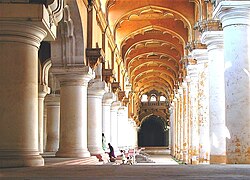
| | | image3 = Thirumalai nayakar mahal (11875879403).jpg | ||
| | | caption3 = [[Thirumalai Nayakkar Mahal]] | ||
| | | image4 = Gandhi Memorial Museum.jpg | ||
| | | caption4 = [[Gandhi Memorial Museum, Madurai|Gandhi Museum]] | ||
| image5 = Madurai Junction.jpg | |||
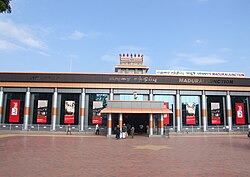
| caption5 = [[Madurai Junction railway station|Madurai Junction]] | |||
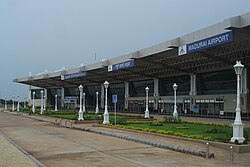
| image6 | | image6 = MaduraiAirport.JPG | ||
| caption6 = [[Madurai Airport]] | | caption6 = [[Madurai Airport]] | ||
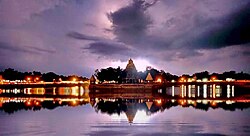
| image7 | | image7 = A sunrise over Vaigai River in Madurai Tamil Nadu India.jpg | ||
| caption7 = [[Vaigai river]] | | caption7 = [[Vaigai river]] | ||
| image8 = Thirupparankundram Town View.jpeg | | image8 = Thirupparankundram Town View.jpeg | ||
| caption8 = [[Thiruparankundram]] Aerial view | | caption8 = [[Thiruparankundram]] Aerial view | ||
}} | }} | ||
| image_caption | | image_caption = | ||
| | | image_flag = Madurai Municipal Flag.png | ||
| | | pushpin_map = | ||
| | | pushpin_map_alt = | ||
| | | pushpin_map_caption = | ||
| | | mapframe = yes | ||
| | | mapframe-zoom = 6 | ||
| coordinates | | mapframe-point = none | ||
| subdivision_type | | map_alt = | ||
| subdivision_name | | map_caption = Madurai in Tamil Nadu | ||
| subdivision_type1 | | coordinates = {{coord|9.925200|N|78.119800|E|display=inline,title}} | ||
| subdivision_type = Country | |||
| subdivision_type3 | | subdivision_name = {{flag|India}} | ||
| subdivision_name1 | | subdivision_type1 = State | ||
| subdivision_name3 | | subdivision_type3 = District | ||
| founder | | subdivision_name1 = {{seal|Tamil Nadu}} | ||
| named_for | | subdivision_name3 = [[Madurai district|Madurai]] | ||
| governing_body | | founder = | ||
| leader_title | | named_for = | ||
| leader_name | | established_title = Established | ||
| unit_pref | | established_date = 3rd Century BCE | ||
| area_total_km2 | | governing_body = [[Madurai Municipal Corporation]] | ||
| area_rank | | leader_title = Mayor | ||
| leader_name = V. Indirani Ponvasanth, DMK | |||
| unit_pref = Metric | |||
| area_total_km2 = 147.97 | |||
| area_rank = 3 | |||
| elevation_footnotes = | | elevation_footnotes = | ||
| elevation_m | | elevation_m = 134 | ||
| population_total | | population_total = 10,17,865{{efn|The figure corresponds to the expanded city limits. According to the [[2011 Indian census|2011 census]], the total city covering an area of {{convert|51.82|km2|mi2}} had a population of 1,017,865.<ref name="census2011">{{cite web |url=http://www.censusindia.gov.in/2011census/dchb/3322_PART_B_DCHB_MADURAI.pdf |title=Madurai District census handbook |publisher=Government of India |access-date=29 June 2016 |url-status=live |archive-url=https://web.archive.org/web/20160803153908/http://www.censusindia.gov.in/2011census/dchb/3322_PART_B_DCHB_MADURAI.pdf |archive-date=3 August 2016}}</ref>}} | ||
| population_as_of | | population_as_of = 2011 | ||
| population_footnotes = <ref>{{cite web |title=Socio-Economic Resources Profiling |url=http://www.maduraicorporation.co.in/socio-economis-resource-profiling.html |publisher=Madurai Corporation |access-date=24 February 2020}}</ref> | | population_footnotes = <ref>{{cite web |title=Socio-Economic Resources Profiling |url=http://www.maduraicorporation.co.in/socio-economis-resource-profiling.html |publisher=Madurai Corporation |access-date=24 February 2020 |archive-date=22 February 2020 |archive-url=https://web.archive.org/web/20200222164714/http://www.maduraicorporation.co.in/socio-economis-resource-profiling.html |url-status=live }}</ref> | ||
| population_density_km2 = auto | | population_density_km2 = auto | ||
| population_metro | | population_metro = 1,470,755 | ||
| population_metro_footnotes = | | population_metro_footnotes = | ||
| population_rank | | population_rank = [[List of most populous cities in India|44th]] | ||
| population_blank1_title = Metro rank | | population_blank1_title = Metro rank | ||
| population_blank1 | | population_blank1 = [[List of million-plus agglomerations in India|31st]] | ||
| population_demonym = | | population_demonym = Maduraivāsi | ||
| | | registration_plate = TN-57 to TN-60, TN-64, TN-94 (under Madurai Zone) | ||
| | | blank_name = {{nowrap|[[Official language]]}} | ||
| | | blank_info = [[Tamil language|Tamil]], [[English language|English]]<ref name="langoff">{{cite web|title=52nd Report of the Commissioner for Linguistic Minorities in India|url=http://nclm.nic.in/shared/linkimages/NCLM52ndReport.pdf|website=nclm.nic.in|publisher=[[Ministry of Minority Affairs]]|access-date=29 March 2019|url-status=dead|archive-url=https://web.archive.org/web/20170525141614/http://nclm.nic.in/shared/linkimages/NCLM52ndReport.pdf|archive-date=25 May 2017}}</ref> | ||
| timezone1 | | timezone1 = [[Indian Standard Time|IST]] | ||
| utc_offset1 | | utc_offset1 = +5:30 | ||
| postal_code_type | | postal_code_type = [[Postal Index Number|PIN]] | ||
| postal_code | | postal_code = 625 xxx<ref>{{Cite web | ||
| area_code | |url=https://pincode.hindiastar.com/TAMIL-NADU/MADURAI | ||
| area_code_type | |title=Post Offices and PIN Codes in Madurai, Tamil Nadu, India | ||
| website | |website=PinCode | ||
| | |access-date=2026-02-22 | ||
|url-status=live | |||
}}</ref> | |||
| area_code = [[Telephone numbers in India#Fixed .28landline.29 numbers|0452]] | |||
| area_code_type = Telephone code | |||
| blank2_name_sec1 = [[GDP]](2020) | |||
| blank2_info_sec1 = {{USD|13.026|year=2020}}Billion<ref>{{cite web | url=https://metroverse.cid.harvard.edu/city/8344/overview | title=Metroverse | Harvard Growth Lab }}</ref> | |||
| blank1_name_sec1 = [[Köppen climate classification|Climate]] | |||
| blank1_info_sec1 = [[Hot semi-arid climate|BSh]] | |||
| website = {{URL|maduraicorporation.co.in}} | |||
| nicknames = Thoongatha Nagaram (The City That Never Sleeps), Athens of the East, City of Jasmine, City of Festivals, Temple City, Cultural Capital of Tamil Nadu State of India | |||
}} | }} | ||
'''Madurai''' | '''Madurai'''{{Efn|{{Indic Transl|ta|Maturai|mɐd̪ʊɾɐɪ̯|LL-Q5885 (tam)-Sriveenkat-மதுரை.wav}}}} is a major [[Classification of Indian cities|tier II city]] in the [[States and union territories of India|Indian state]] of [[Tamil Nadu]]. It is the cultural capital of Tamil Nadu and the administrative headquarters of [[Madurai district]], which is governed by the [[Madurai Municipal Corporation]] established on 1 November 1866.<ref name="CORPORATION OF MADURAI">{{Cite web |title=CORPORATION OF MADURAI |url=https://www.maduraicorporation.co.in/aboutus/about-madurai#:~:text=MADURAI%20CONSTITUTION,assisted%20by%20a%20Deputy%20Mayor. |access-date=2025-03-13 |website=www.maduraicorporation.co.in}}</ref> As of the [[2011 census of India|2011 census]], it is the [[List of cities in India by population|third largest metropolis]] in Tamil Nadu after [[Chennai]] and [[Coimbatore]] in terms of population and 27th largest [[List of million-plus urban agglomerations in India|urban agglomeration in India]].<ref>{{cite web |url=http://www.citypopulation.de/India-TamilNadu.html |title=Tamil Nādu – City Population – Cities, Towns & Provinces – Statistics & Map |publisher=Thomas Brinkhoff |access-date=23 September 2009 |year=2011 |archive-date=3 March 2016 |archive-url=https://web.archive.org/web/20160303165154/http://www.citypopulation.de/India-TamilNadu.html |url-status=live }}</ref> Located on the banks of [[Vaigai River]], Madurai has been a major settlement for two millennia and has a documented history of more than 2500 years.<ref name="Geiger 1912 59">{{cite book | title=The Great Chronicle of Ceylon| last=Geiger| first=Wilhelm |author-link=Wilhelm Geiger | publisher=Oxford University Press| isbn=|year=1912|page=59}}</ref><ref name="auto">{{cite news|url=http://www.indiatimes.com/news/india/archeological-survey-of-india-just-found-a-2500-year-old-city-and-its-full-of-riches-244449.html|title=ASI just found a 2500 year old city|work=The Times of India|access-date=13 October 2015|date=13 October 2015|archive-date=15 November 2015|archive-url=https://web.archive.org/web/20151115231115/http://www.indiatimes.com/news/india/archeological-survey-of-india-just-found-a-2500-year-old-city-and-its-full-of-riches-244449.html|url-status=live}}</ref> It is often referred to as "Thoongaa Nagaram", meaning "the city that never sleeps".<ref>{{cite web |title=Madurai Thoonga Nagaram |date=April 2017 |publisher=Serendib (BT Options Pvt Ltd) |url=http://serendib.btoptions.lk/article.php?issue=89&id=2028 |access-date=18 February 2021 |archive-date=18 February 2021 |archive-url=https://web.archive.org/web/20210218212548/http://serendib.btoptions.lk/article.php?issue=89&id=2028 |url-status=dead }}</ref> | ||
Madurai is | Madurai is one of the oldest cities in India and South Asia.<ref>{{cite book | url=https://books.google.com/books?id=OsAfAAAAIAAJ&dq=madurai+oldest+cities+in+india&pg=PA12 | title=The City as a Sacred Center: Essays on Six Asian Contexts | isbn=90-04-08471-1 | last1=Smith | first1=Bardwell L. | last2=Reynolds | first2=Holly Baker | date=January 1987 | publisher=BRILL }}</ref> The third [[Tamil Sangam]], a major congregation of Tamil scholars, is said to have been held in the city. The [[recorded history]] of the city goes back to the 3rd century BCE, being mentioned by [[Megasthenes]], the Greek ambassador to the [[Mauryan Empire]], and [[Kautilya]], a minister of the Mauryan emperor [[Chandragupta Maurya]].<ref name="CORPORATION OF MADURAI"/> Signs of human settlements and [[Roman Empire|Roman]] trade links dating back to 300 BCE are evident from excavations by [[Archeological Survey of India]] in Manalur.<ref name="auto"/><ref>{{cite news|url=http://timesofindia.indiatimes.com/city/madurai/A-site-of-human-settlements-turned-into-a-coconut-grove/articleshow/47401066.cms|title=A site of human settlements turned into a coconut grove|work=The Times of India|access-date=12 October 2015|archive-date=7 June 2015|archive-url=https://web.archive.org/web/20150607014336/http://timesofindia.indiatimes.com/city/madurai/A-site-of-human-settlements-turned-into-a-coconut-grove/articleshow/47401066.cms|url-status=live}}</ref><ref>{{cite news|url=http://www.thehindu.com/news/national/tamil-nadu/archaeological-excavation-in-sivaganga-uncovers-pandyaroman-trade-links/article7328683.ece|title=Archealogical excavation uncovers Roman Pandyan trade links|work=The Hindu|access-date=12 October 2015|archive-date=27 November 2016|archive-url=https://web.archive.org/web/20161127172506/http://www.thehindu.com/news/national/tamil-nadu/archaeological-excavation-in-sivaganga-uncovers-pandyaroman-trade-links/article7328683.ece|url-status=live}}</ref> The city is believed to be of significant antiquity and has been ruled, at different times, by the [[Pandya dynasty|Pandyan Kingdom]], the [[Chola Empire]], the [[Madurai Sultanate]], the [[Vijayanagar Empire]], the [[Madurai Nayaks]], the [[Nawab of the Carnatic|Carnatic kingdom]], and the [[British East India Company|British East India Company's]] [[British Raj]]. The city has a number of historical monuments, with the [[Koodal Azhagar temple]], the [[Meenakshi Temple]] and the [[Thirumalai Nayakkar Mahal]] being the most prominent. | ||
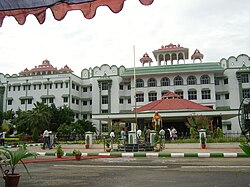
Madurai is an important industrial and educational hub in Tamil Nadu. The city is home to various automobile, [[rubber]], chemical and [[granite]] manufacturing industries.<ref name=Hinduoct2007>{{cite news|url= http://www.hindu.com/2007/10/25/stories/2007102550550200.htm |archive-url= https://web.archive.org/web/20071026133827/http://www.hindu.com/2007/10/25/stories/2007102550550200.htm |url-status= dead |archive-date= 26 October 2007 |title= An industry that can bolster the economy of Madurai| access-date = 24 January 2009 | location=Chennai, India |work= [[The Hindu]] |date=25 October 2007}}</ref> Madurai has important government educational institutes such as the [[Madurai Medical College]], the Homeopathic Medical College,<ref name="college"/> the [[Government Law College, Madurai|Madurai Law College]], the Agricultural College and Research Institute and the [[All India Institute of Medical Sciences, Madurai]]. The city covers an area of {{cvt|147.97|km2}} and had a population of 1,470,755 in 2011.<ref name=Madurai2011census>{{cite web|title=Census Info 2011 Final population totals – Madurai|url=http://www.censusindia.gov.in/pca/SearchDetails.aspx?Id=697001|publisher=Office of The Registrar General and Census Commissioner, Ministry of Home Affairs, Government of India|year=2013|access-date=26 January 2014|url-status=dead|archive-url=https://web.archive.org/web/20150924145834/http://www.censusindia.gov.in/pca/SearchDetails.aspx?Id=697001|archive-date=24 September 2015}}</ref> The city is also the seat of a bench of the [[Madras High Court]].{{efn|The Madurai Bench has been functioning since 2004.}} | |||
It is one of [[List of AMRUT Smart cities in Tamil Nadu|the few towns and cities selected]] for the [[Atal Mission for Rejuvenation and Urban Transformation|AMRUT]] mission, undertaken by the [[Government of India]].<ref>{{cite web | url=http://tufidco.in/amrut.aspx | title=Tufidco | access-date=21 December 2023 | archive-date=20 December 2023 | archive-url=https://web.archive.org/web/20231220212330/http://tufidco.in/amrut.aspx | url-status=live }}</ref> The [[Government of Tamil Nadu]] contributes to the infrastructure development in the city.<ref>{{Cite web|url=https://tcp.tn.gov.in/amrutscheme|title=Directorate of Town and Country Planning, Government of Tamil Nadu|website=tcp.tn.gov.in|access-date=21 December 2023|archive-date=20 December 2023|archive-url=https://web.archive.org/web/20231220210400/https://tcp.tn.gov.in/amrutscheme|url-status=live}}</ref> | |||
==Etymology== | ==Etymology== | ||
According to [[Iravatham Mahadevan]], a 2nd-century BCE [[Tamil-Brahmi]] inscription refers to the city as ''matiray'', an Old Tamil word meaning a "walled city".<ref>{{cite book |last=Mahadevan|first=Iravatham |date=3 October 2003|title=Early Tamil Epigraphy from the Earliest Times to the Sixth Century A.D. |publisher=Harvard University Press|isbn=0674012275}}</ref> | According to [[Iravatham Mahadevan]], a 2nd-century BCE [[Tamil-Brahmi]] inscription refers to the city as ''matiray'', an Old Tamil word meaning a "walled city".<ref>{{cite book |last=Mahadevan|first=Iravatham |date=3 October 2003|title=Early Tamil Epigraphy from the Earliest Times to the Sixth Century A.D. |publisher=Harvard University Press|isbn=0674012275}}</ref> | ||
Madurai is one of the many temple towns | Madurai, as ''Kadambavanam'', is one of the many historic temple towns of India which are named after the specific variety of groves or forests that shelter the presiding deity. Madurai is believed to have been originally a forest of [[Neolamarckia cadamba|Kadamba]] trees, hence its name.<ref>{{cite book|title=Alayam - The Hindu temple - An epitome of Hindu Culture|publisher=Sri Ramakrishna Math|year=2013|location=Mylapore, Chennai|last=Reddy|first=G.Venkatramana|isbn=978-81-7823-542-4|page=10}}</ref> The city is referred to by various other names, including "Koodal"{{Efn|lit., assembly [Tamil]|name=Koodal}}, "Malligai Maanagar"{{Efn|lit., the great town of jasmine flowers [Tamil]; a reference to the local characteristic [[Madurai Malli]] type of jasmine flowers.|name=Malligai Maanagar}}, "Naanmadakoodal"{{Efn|lit., assembly (koodal) of four (naan-) halls (maada-) [Tamil]|name=Naanmadakoodal}} and "Thirualavai"{{Efn|lit., "the city encircled by a coiled serpent" or "the city surrounded by moats filled with water" [Tamil]|name=Thirualavai}}. It is believed that ''Madurai'' is the derivative of the word ''Marutham'',<ref>{{Cite news |last=Shrikumar |first=A. |date=2018-11-30 |title=Marutham is closely associated with Madurai, so much that the city is said to derive its name from the native tree |url=https://www.thehindu.com/life-and-style/homes-and-gardens/marutham-is-closely-associated-with-madurai-so-much-that-the-city-is-said-to-derive-its-name-from-the-native-tree/article25635935.ece |access-date=2025-03-13 |work=The Hindu |language=en-IN |issn=0971-751X}}</ref> which refers to the type of landscape of the [[Sangam Age|Sangam age]]. A town in the neighbouring [[Dindigul district]] is called Vada Madurai (''North Madurai'') and another in [[Sivaganga district]] is called [[Manamadurai]]. The different names by which the city has been referred to historically are listed in the 7th-century poem ''Thiruvilayaadal Puraanam'' written by Paranjothi Munivar.<ref name=Harman>{{cite book|last=Harman|first=William P|title=The sacred marriage of a Hindu goddess|year=1992|publisher=Motilal Banarsidass |isbn=978-81-208-0810-2|url=https://books.google.com/books?id=F_siW9T3ev4C&pg=PA36|pages=30–6}}</ref><ref name=Bard12>[[#Bardwell|Reynolds|Bardwell| 1987]] pp. 12–25</ref> ''[[Vaishnavism|Vaishnava]]'' texts refer to Madurai as the "southern [[Mathura]]", probably similar to [[Tenkasi]] (''southern [[Varanasi|Kashi]]'').<ref>{{cite book|author=Edwin Francis Bryant|title=Krishna: A Sourcebook|url=https://books.google.com/books?id=0z02cZe8PU8C&pg=PA546 |year=2007|publisher=Oxford University Press|isbn=978-0-19-803400-1|pages=546 with note 45}}</ref><ref>{{cite book|author=T. Padmaja|title=Temples of Kr̥ṣṇa in South India: History, Art, and Traditions in Tamilnāḍu|url=https://books.google.com/books?id=pzgaS1wRnl8C&pg=PA98 |year=2002 |publisher= Abhinav Publications|isbn=978-81-7017-398-4|pages=97–99}}</ref> | ||
''Koodal'' means an assembly or congregation of scholarly people, referring to the three Tamil Sangams held at Madurai. Naanmadakoodal, meaning the junction of four towers, refers to the four major temples for which Madurai was known for.<ref name=Harman/> ''[[Tevaram]]'', the 7th- or 8th-century Tamil compositions on Shiva by the three prominent [[Nayanars]] (''[[Saivites]]''), namely [[Appar]],<ref>{{cite book |last=Thirunavukkarasar|title=Aaram Thirumurai|url=http://www.projectmadurai.org/pm_etexts/pdf/pm0192.pdf|year=2004 |publisher=Project Madurai |location=Online|pages=44–7 }}</ref> [[Sundarar]] and Thirugnanasambandar,<ref>{{cite book |last=Campantar Tirumurai | ''Koodal'' means an assembly or congregation of scholarly people, referring to the three Tamil Sangams held at Madurai. Naanmadakoodal, meaning the junction of four towers, refers to the four major temples for which Madurai was known for.<ref name=Harman/> The Sangam literature mentions the [[Koodal Azhagar temple]] at the centre of the city. Historians are of the opinion that [[Koodal Azhagar temple]] finds mention in [[Sangam literature]] (3rd century BCE–3rd century CE) in works like ''Madurai Kanchi'' by Mangudi Marudan, ''[[Paripāṭal]]'', ''[[Kaliththokai]]'' and ''[[Silappatikaram]]''. ''Madurai Kanchi'' details the Thiruvonam festival celebrated in the temple. [[Koodal Azhagar temple]] is revered in ''[[Nalayira Divya Prabhandam]]'', the 5th–9th century Vaishnava canon, by [[Periazhwar|Periyalvar]], [[Thirumalisai Alvar]] and [[Thirumangai Azhwar|Thirumangai Alvar]]. The temple is classified as a ''[[Divyadesam|Divya Desams]]'', one of the 108 Vishnu temples that are mentioned in the book.<ref>M., Rajagopalan (1993). 15 Vaishnava Temples of Tamil Nadu. Chennai, India: Govindaswamy Printers. pp. 119–128.</ref> During the 18th and 19th centuries, the temple finds mention in several works like ''108 Tirupathi Anthathi'' by Divya Kavi Pillai Perumal Aiyangar and ''Koodal Sthala Purana''. ''[[Tevaram]]'', the 7th- or 8th-century Tamil compositions on Shiva by the three prominent [[Nayanars]] (''[[Saivites]]''), namely [[Appar]],<ref name=":0">{{cite book|last=Thirunavukkarasar|title=Aaram Thirumurai|url=http://www.projectmadurai.org/pm_etexts/pdf/pm0192.pdf|year=2004|publisher=Project Madurai|location=Online|pages=44–7|access-date=30 June 2012|archive-date=5 February 2018|archive-url=https://web.archive.org/web/20180205235038/http://www.projectmadurai.org/pm_etexts/pdf/pm0192.pdf|url-status=live}}</ref> [[Sundarar]] and [[Sambandar|Thirugnanasambandar]],<ref name=":1">{{cite book|last=Campantar Tirumurai|title=Moondram Thirumurai|url=http://www.projectmadurai.org/pm_etexts/pdf/pm0173.pdf|year=2004|publisher=Project Madurai|location=Online|page=61|access-date=30 June 2012|archive-date=5 February 2018|archive-url=https://web.archive.org/web/20180205233644/http://www.projectmadurai.org/pm_etexts/pdf/pm0173.pdf|url-status=live}}</ref><ref name=":2">{{cite book|last=Campantar Tirumurai|title=Muthal Thirumurai|url=http://www.projectmadurai.org/pm_etexts/pdf/pm0151.pdf|year=2004|publisher=Project Madurai|location=Online|pages=56–8|access-date=30 June 2012|archive-date=5 February 2018|archive-url=https://web.archive.org/web/20180205235606/http://www.projectmadurai.org/pm_etexts/pdf/pm0151.pdf|url-status=live}}</ref> address the city as ''Thirualavai''.<ref name=Harman/><ref>{{cite book |last=Prentiss |first=Karen Pechilis |title=The embodiment of bhakti |year=1999|publisher=Oxford University Press|location=New York |isbn=978-0-19-512813-0|page=43}}</ref> | ||
==History== | ==History== | ||
{{Main|History of Madurai}} | |||
=== Early and medieval history === | |||
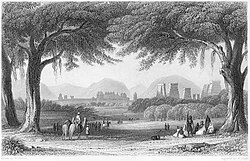
[[File:Martin Madurai 1860.jpg|thumb|left|Hand coloured antique wood engraving drawn by W. Purser (1858) shows Madurai city and Meenakshi Temple as seen from the north bank of the [[Vaigai river]]|alt=view of city having temple towers seen through two trees]] | [[File:Martin Madurai 1860.jpg|thumb|left|Hand coloured antique wood engraving drawn by W. Purser (1858) shows Madurai city and Meenakshi Temple as seen from the north bank of the [[Vaigai river]]|alt=view of city having temple towers seen through two trees]] | ||
Madurai is | Madurai is one of the oldest continuously inhabited cities of Tamil Nadu, dating back to the 3rd century BCE.<ref>{{cite book | title=Companion studies to the history of Tamil literature| last=Zvelebil| first=Kamil |author-link=Kamil Zvelebil | publisher=BRILL|url=https://books.google.com/books?id=qAPtq49DZfoC&q=madurai+BC&pg=PA24| isbn=978-90-04-09365-2|year=1992|page=27}}</ref><ref>{{Cite web |date=2019-09-20 |title=New study connects Tamil Nadu with Indus Valley civilisation |url=https://www.hindustantimes.com/india-news/new-study-connects-tamil-nadu-with-indus-valley-civilisation/story-ESlR55vEIZQPvq2Q0jXeVP.html |access-date=2026-02-14 |website=Hindustan Times |language=en}}</ref> The [[Sangam literature|Sangam period]] settlement site of [[Keezhadi|Keeladi]], dating back to the 6th century BCE, is located about 12 kilometres southeast of Madurai. Inscriptions of the Pandya king [[Netunceliyan I]] (c. 2nd century BCE) are found in [[Mangulam]], a village located 25 kilometres from Madurai.<ref>{{Cite book |last=Mahadevan |first=Iravatham |url=https://books.google.com/books?id=DZBkAAAAMAAJ&q=mangulam+iravatham+mahadevan |title=Early Tamil Epigraphy from the Earliest Times to the Sixth Century A.D. |date=2003 |publisher=Cre-A |isbn=978-0-674-01227-1 |language=en}}</ref> The second book of the Tamil epic ''[[Cilappatikaram|Silappatikaram]]'' (c. 5th century CE) is set in Madurai.<ref>{{Cite book |last=Iḷaṅkōvaṭikaḷ |url=https://books.google.com/books?id=HWPg7EvPirgC |title=The Cilappatikāram: The Tale of an Anklet |date=2004 |publisher=Penguin Books India |isbn=978-0-14-303196-3 |language=en}}</ref> | ||
[[Megasthenes]] may have visited Madurai during the 3rd century BCE, with the city referred as "Methora" in his accounts.<ref name="Harman" /> The view is contested by some scholars who believe "Methora" refers to the north Indian city of [[Mathura]], as it was a large and established city in the [[Mauryan Empire]].<ref>{{cite book|title=History of Early Stone Sculpture at Mathura, Ca. 150 BCE-100 CE|first=Sonya Rhie|last=Quintanilla|publisher=Concept Publishing Company|year=2007|url=https://books.google.com/books?id=X7Cb8IkZVSMC&pg=PA2|isbn=978-90-04-15537-4|page=2|access-date=22 September 2016|archive-date=23 September 2023|archive-url=https://web.archive.org/web/20230923091022/https://books.google.com/books?id=X7Cb8IkZVSMC&pg=PA2|url-status=live}}</ref> Madurai is also mentioned in [[Kautilya]]'s (370–283 BCE)<ref>{{cite book | first=S. K.|last= Agarwal | title=Towards Improving Governance | url=https://books.google.com/books?id=1nIkFqh_TmEC&pg=PA17|year=2008 | publisher=Academic Foundation | isbn=978-81-7188-666-1 | page=17}}</ref> ''[[Arthashastra]]''.<ref name="Harman" /> [[Sangam literature]] like ''[[Maturaikkāñci]]'' records the importance of Madurai as a capital city of the Pandyan dynasty.<ref>{{cite book|last=Mangudi Marudanar|title=Mathuraikanchi|url=http://projectmadurai.org/pm_etexts/pdf/pm0071.pdf|year=2004|publisher=Project Madurai|location=Online|access-date=28 August 2012|archive-date=24 September 2012|archive-url=https://web.archive.org/web/20120924034223/http://projectmadurai.org/pm_etexts/pdf/pm0071.pdf|url-status=live}}</ref><ref>{{cite book|title=India through the ages|url=https://archive.org/details/indiathroughages00mada|last=Gopal|first=Madan|year= 1990|editor=K.S. Gautam|publisher=Publication Division, Ministry of Information and Broadcasting, Government of India|page=181}}</ref> Madurai is mentioned in the works of [[Ancient Rome|Roman]] historians [[Pliny the Younger]] (61 – {{Circa|112 CE}}),<ref>{{Cite book |last=Gaffiot |first=Félix |url=https://archive.org/details/gaffiot-felix-dictionnaire-latin-francais-2016/page/861/mode/1up?q=Modura |title=Dictionnaire illustré latin-français |publisher=Hachette |year=1934 |pages=861 |language=fr |trans-title=Illustrated Latin–French Dictionary}}</ref> [[Ptolemy]] ({{Circa|90|CE 168}}), those of the [[Greeks|Greek]] geographer [[Strabo]] (64/63 BCE – {{Circa|24 CE}}),<ref name="Bandopadhyay">{{cite book |last=Bandopadhyay |first=Manohar |title=Tourist destinations in India|publisher=Oriental Books |location=Delhi |isbn=978-93-80944-00-5|url=https://books.google.com/books?id=Z-PaxM04v9wC|year=2010|pages=93–6 }}</ref> and also in [[Periplus of the Erythraean Sea]].<ref name="Bard12" /> | |||
The [[Buddhism|Buddhist]] text [[Mahāvaṃsa|Mahavamsa]] mentions Madurai in the context of [[Prince Vijaya]]'s (543–505 BCE) arrival in [[Sri Lanka]] with his 700 followers. According to the Mahavamsa, emissaries laden with precious gifts, jewels and pearls, were sent from Sri Lanka to Madurai of ancient [[Tamilakam]]. Their mission was to secure a bride for Prince Vijaya. The Pandyan King of Madurai agreed to the proposal. He not only sent his own daughter to marry Prince Vijaya but also requested other families to offer their daughters to marry the prince's ministers and retainers. So, along with the Princess and hundreds of maidens, craftsmen and a thousand families from the eighteen [[guilds in India|guilds]] were also sent to Sri Lanka.<ref name="Geiger 1912 59" />[[File:Pandya Kingdom (south India).png|thumb|Pandyan dynasty at its greatest extent]] | |||
[[File: | |||
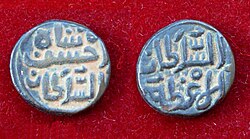
[[File:Coin of Jalaluddin Ahsan Khan.jpg|right|thumb|Coin of [[Jalaluddin Ahsan Khan]], first ruler of the [[Madurai Sultanate|Sultanate of Madurai]], 1335–1339 CE|alt=historic metal coin used for transaction]] | [[File:Coin of Jalaluddin Ahsan Khan.jpg|right|thumb|Coin of [[Jalaluddin Ahsan Khan]], first ruler of the [[Madurai Sultanate|Sultanate of Madurai]], 1335–1339 CE|alt=historic metal coin used for transaction]] | ||
After the Sangam age, most of present-day Tamil Nadu, including Madurai, came under the rule of the [[Kalabhra dynasty]],<ref>{{cite book|editor-last1=Nagarajan |editor-first1=N. |editor-last2=Subramanian |editor-first2=K. |year=1977 |title=History of Land Revenue Settlement and Abolition of Intermediary Tenures in Tamil Nadu |location=Madras |publisher=Government of Tamil Nadu |page=473 |url=https://books.google.com/books?id=9Lzis-Kx29UC }} (no preview)</ref> which was ousted by the [[Pandya]]s around 590 CE.<ref>{{cite book|last=Dalal|first=Roshen|title=The Puffin History of India for Children, 3000 BCE – CE 1947|year=1997|publisher=Puffin Books|isbn=978-0-14-333544-3|pages=128–129|url=https://books.google.com/books?id=U2gRUVIF2joC&pg=PT141}}</ref><ref>{{cite book |last=Kersenboom Story |first=Saskia C. |title=Nityasumaṅgalī: Devadasi Tradition in South India|year=1987 |publisher=Motilal Banarsidass Publishers Private Limited |location=New Delhi |isbn=978-81-208-1527-8|url=https://archive.org/details/nityasumangalide0000kers|url-access=registration |page=[https://archive.org/details/nityasumangalide0000kers/page/16 16] }}</ref> The Pandyas were ousted from Madurai by the [[Chola dynasty]] during the early 9th century. The city was fought over between the Cholas and the Pandyas during the 12th century, changing hands several times,<ref>{{cite book|last=Balasubrahmanyam |first=Sirkali Ramaswamy |year=1979 |title=Later Chola Temples: Kulottunga I to Rajendra III (A.D. 1070-1280) |location=[[Faridabad]] |publisher=Thomson Press |pages=290–293 |url=https://books.google.com/books?id=9ujVAAAAMAAJ |oclc=888754347}} (no preview)</ref> until the early 13th century, when the second Pandyan empire was established with Madurai as its capital.<ref name=Salma>{{cite book|first= Farooqui |last= Salma Ahmed|title=A Comprehensive History of Medieval India: From Twelfth to the Mid Eighteenth century|publisher=Dorling Kindersley (India) Pvt. Ltd.|location=New Delhi|isbn=978-81-317-3202-1|year=2011|page=26|url=https://books.google.com/books?id=sxhAtCflwOMC&pg=PA26}}</ref> After the death of [[Maravarman Kulasekara Pandyan I|Kulasekara Pandian]] (1268–1308 CE), Madurai came under the rule of the [[Tughlaq dynasty|Delhi Sultanate]].<ref name=Salma/> The [[Madurai Sultanate]] then seceded from Delhi and functioned as an independent kingdom until its gradual annexation by the [[Vijayanagara Empire]] in 1378 CE. Madurai became independent from Vijayanagar in 1559 CE under the [[Madurai Nayak Dynasty|Nayaks]].<ref>{{cite book |last=V. |first=Vriddhagirisan |title=Nayaks of Tanjore |year=1995 |orig-year=1942 |publisher=Asian Educational Services |location=New Delhi |isbn=978-81-206-0996-9 |url-access=registration |url=https://archive.org/details/nayaksoftanjore0000vrid|page=115 }}</ref> Nayak rule ended in 1736 CE and Madurai was repeatedly captured several times by [[Chanda Sahib]] (1740 – 1754 CE), [[Arcot Nawab]] and [[Muhammed Yusuf Khan]] (1725 – 1764 CE) in the middle of the 18th century.<ref name=Harman/> | After the Sangam age, most of present-day Tamil Nadu, including Madurai, came under the rule of the [[Kalabhra dynasty]],<ref>{{cite book|editor-last1=Nagarajan |editor-first1=N. |editor-last2=Subramanian |editor-first2=K. |year=1977 |title=History of Land Revenue Settlement and Abolition of Intermediary Tenures in Tamil Nadu |location=Madras |publisher=Government of Tamil Nadu |page=473 |url=https://books.google.com/books?id=9Lzis-Kx29UC }} (no preview)</ref> which was ousted by the [[Pandya]]s under [[Kadunkon]], around 590 CE.<ref>{{cite book|last=Dalal|first=Roshen|title=The Puffin History of India for Children, 3000 BCE – CE 1947|year=1997|publisher=Puffin Books|isbn=978-0-14-333544-3|pages=128–129|url=https://books.google.com/books?id=U2gRUVIF2joC&pg=PT141}}</ref><ref>{{cite book |last=Kersenboom Story |first=Saskia C. |title=Nityasumaṅgalī: Devadasi Tradition in South India|year=1987 |publisher=Motilal Banarsidass Publishers Private Limited |location=New Delhi |isbn=978-81-208-1527-8|url=https://archive.org/details/nityasumangalide0000kers|url-access=registration |page=[https://archive.org/details/nityasumangalide0000kers/page/16 16] }}</ref> By the 7th century CE, Madurai had become the primary capital of the Pandyas, as evidenced from the works of the [[Bhakti movement|Bhakti period]] saints like [[Appar]] and [[Sambandar]].<ref name=":0" /><ref name=":1" /><ref name=":2" /> The Pandyas were ousted from Madurai by the [[Chola dynasty]] during the early 9th century. The city was fought over between the Cholas and the Pandyas during the 12th century, changing hands several times,<ref>{{cite book|last=Balasubrahmanyam |first=Sirkali Ramaswamy |year=1979 |title=Later Chola Temples: Kulottunga I to Rajendra III (A.D. 1070-1280) |location=[[Faridabad]] |publisher=Thomson Press |pages=290–293 |url=https://books.google.com/books?id=9ujVAAAAMAAJ |oclc=888754347}} (no preview)</ref> until the early 13th century, when the second Pandyan empire was established with Madurai as its capital.<ref name=Salma>{{cite book|first= Farooqui |last= Salma Ahmed|title=A Comprehensive History of Medieval India: From Twelfth to the Mid Eighteenth century|publisher=Dorling Kindersley (India) Pvt. Ltd.|location=New Delhi|isbn=978-81-317-3202-1|year=2011|page=26|url=https://books.google.com/books?id=sxhAtCflwOMC&pg=PA26}}</ref> After the death of [[Maravarman Kulasekara Pandyan I|Kulasekara Pandian]] (1268–1308 CE), Madurai came under the rule of the [[Tughlaq dynasty|Delhi Sultanate]].<ref name=Salma/> The [[Madurai Sultanate]] then seceded from Delhi and functioned as an independent kingdom until its gradual annexation by the [[Vijayanagara Empire]] in 1378 CE. Madurai became independent from Vijayanagar in 1559 CE under the [[Madurai Nayak Dynasty|Nayaks]].<ref>{{cite book |last=V. |first=Vriddhagirisan |title=Nayaks of Tanjore |year=1995 |orig-year=1942 |publisher=Asian Educational Services |location=New Delhi |isbn=978-81-206-0996-9 |url-access=registration |url=https://archive.org/details/nayaksoftanjore0000vrid|page=115 }}</ref> Nayak rule ended in 1736 CE and Madurai was repeatedly captured several times by [[Chanda Sahib]] (1740 – 1754 CE), [[Arcot Nawab]] and [[Muhammed Yusuf Khan]] (1725 – 1764 CE) in the middle of the 18th century.<ref name=Harman/> | ||
In 1801, Madurai came under the direct control of the [[British East India Company]] and was annexed to the [[Madras Presidency]].<ref>{{cite book |last=Markovits|first=Claude |title=A History of Modern India, 1480–1950|year=2004 |publisher=Wimbledon Publishing Company |location=London |isbn=978-1-84331-152-2|url=https://books.google.com/books?id=uzOmy2y0Zh4C&pg=PA253|page=253}}</ref><ref>{{cite book |last1=B.S. |first1=Chandrababu|last2=S.|first2= Ganeshram|last3= C.|first3= Bhavani |title=History of People and Their Environs|year=2011|publisher=Bharathi Puthakalayam |isbn=978-93-80325-91-0|url=https://books.google.com/books?id=crxUQR_qBXYC&q=madurai+british+1801&pg=PA582|page=582}}</ref> The British government made donations to the [[Meenakshi temple]] and participated in the Hindu festivals during the early part of their rule. The city evolved as a political and industrial complex through the 19th and 20th centuries to become a district headquarters of a larger Madurai district.<ref name=King73>[[#King|King 2005]], pp. 73–75</ref> In 1837, the fortifications around the temple were demolished by the British.<ref name=Bard18>[[#Bardwell|Reynolds|Bardwell]] | === British rule === | ||
In 1801, Madurai came under the direct control of the [[British East India Company]] and was annexed to the [[Madras Presidency]].<ref>{{cite book|last=Markovits|first=Claude|title=A History of Modern India, 1480–1950|year=2004|publisher=Wimbledon Publishing Company|location=London|isbn=978-1-84331-152-2|url=https://books.google.com/books?id=uzOmy2y0Zh4C&pg=PA253|page=253|access-date=22 September 2016|archive-date=12 April 2023|archive-url=https://web.archive.org/web/20230412142112/https://books.google.com/books?id=uzOmy2y0Zh4C&pg=PA253|url-status=live}}</ref><ref>{{cite book |last1=B.S. |first1=Chandrababu|last2=S.|first2= Ganeshram|last3= C.|first3= Bhavani |title=History of People and Their Environs|year=2011|publisher=Bharathi Puthakalayam |isbn=978-93-80325-91-0|url=https://books.google.com/books?id=crxUQR_qBXYC&q=madurai+british+1801&pg=PA582|page=582}}</ref> The British government made donations to the [[Meenakshi temple]] and participated in the Hindu festivals during the early part of their rule. The city evolved as a political and industrial complex through the 19th and 20th centuries to become a district headquarters of a larger Madurai district.<ref name=King73>[[#King|King 2005]], pp. 73–75</ref> In 1837, the fortifications around the temple were demolished by the British.<ref name=Bard18>[[#Bardwell|Reynolds|Bardwell| 1987]] p. 18</ref> The moat was drained and the debris was used to construct new streets – Veli, Marret and Perumal Maistry streets.<ref>{{cite book|last=Narasaiah|title=Aalavai – Madurai Managarathin Kadhai|year=2009|publisher=Palaniyappa Brothers|isbn=978-81-8379-517-3|page=85}}</ref> The city was constituted as a municipality in 1866 under the Town Improvement Act of 1865.<ref name=charter>{{cite web|title=Madurai Corporation – citizen charter|url=http://203.101.40.168/newmducorp/citizencharter.htm|publisher=Madurai Corporation|access-date=22 August 2012|url-status=dead|archive-url=https://archive.today/20121129154436/http://203.101.40.168/newmducorp/citizencharter.htm|archive-date=29 November 2012}}</ref> The British government faced initial hiccups during the earlier period of the establishment of municipality in land ceiling and tax collection in Madurai and Dindigul districts under the direct administration of the officers of the government. The city, along with the district, was resurveyed between 1880 and 1885 CE and subsequently, five municipalities were constituted in the two districts and six taluk boards were set up for local administration. Police stations were established in Madurai city, housing the headquarters of the District Superintendent.<ref>{{cite book|title=Imperial gazetteer of India: Provincial series, Volume 18 |year=1908 |url=https://books.google.com/books?id=IQO2AAAAIAAJ&pg=PA229|publisher=Clarendon Press|pages=229–230}}</ref> | |||
It was in Madurai, in 1921, that [[Mahatma Gandhi]], pre-eminent leader of [[Indian nationalism]] in British-ruled India, first adopted the loin cloth as his mode of dress after seeing agricultural labourers wearing it.<ref>{{cite web|title=Gandhi Memorial Museum, Madurai|url=http://www.mkgandhi.org/gandhiyatra/madurai.htm|publisher=Bombay Sarvodaya Mandal / Gandhi Book Centre|access-date=22 August 2012}}</ref> Leaders of the independence movement in Madurai included [[N. M. R. Subbaraman]],<ref>{{cite web|url=http://www.kamat.com/database/biographies/n_m_r_subbaraman.htm|title= Kamat Research Database, Biography: N.M.R.Subbaraman|publisher=Kamat Research Database |access-date=30 June 2012}}</ref><ref>{{cite book|last=David Arnold|title=The Congress in Tamilnad: nationalist politics in South India, 1919–1937|year=1977|publisher=Manohar|isbn=978-0-88386-958-1|page=128|url=https://books.google.com/books?id=Nx8LAQAAIAAJ}}</ref> [[Karumuttu Thiagarajan Chettiar]] and Mohammad Ismail Sahib.<ref>{{cite book|last=More J. B. P|title=Political Evolution of Muslims in Tamilnadu and Madras 1930–1947|year=1977|publisher=Orient Blackswan|isbn=978-81-250-1192-7|url=https://books.google.com/books?id=QDht7OyOjXMC&pg=PA106|page=106}}</ref> The Temple Entry Authorization and Indemnity Act passed by the government of [[Madras Presidency]] under [[C. Rajagopalachari]] in 1939 removed restrictions prohibiting [[Shanars]] and [[Dalits]] from entering Hindu temples. The temple entry movement was first led in Madurai Meenakshi temple by independence activist [[A. Vaidyanatha Iyer]] in 1939.<ref>{{cite web|title=Special postage stamp on freedom fighters and social reformers|url=http://pib.nic.in/archieve/lreleng/l1299/r091299.html|publisher=Press Information Bureau, Government of India}}</ref><ref>{{cite news|title=Deeds of a great social reformer remembered|url=http://www.thehindu.com/news/cities/Madurai/article1490221.ece|work=The Hindu|access-date = 30 June 2012|date=26 February 2011}}</ref> | === Contemporary and modern history === | ||
It was in Madurai, in 1921, that [[Mahatma Gandhi]], pre-eminent leader of [[Indian nationalism]] in British-ruled India, first adopted the loin cloth as his mode of dress after seeing agricultural labourers wearing it.<ref>{{cite web|title=Gandhi Memorial Museum, Madurai|url=http://www.mkgandhi.org/gandhiyatra/madurai.htm|publisher=Bombay Sarvodaya Mandal / Gandhi Book Centre|access-date=22 August 2012|archive-date=6 June 2012|archive-url=https://web.archive.org/web/20120606170551/http://mkgandhi.org/gandhiyatra/madurai.htm|url-status=live}}</ref> Leaders of the independence movement in Madurai included [[N. M. R. Subbaraman]],<ref>{{cite web|url=http://www.kamat.com/database/biographies/n_m_r_subbaraman.htm|title=Kamat Research Database, Biography: N.M.R.Subbaraman|publisher=Kamat Research Database|access-date=30 June 2012|archive-date=4 June 2012|archive-url=https://web.archive.org/web/20120604125434/http://www.kamat.com/database/biographies/n_m_r_subbaraman.htm|url-status=live}}</ref><ref>{{cite book|last=David Arnold|title=The Congress in Tamilnad: nationalist politics in South India, 1919–1937|year=1977|publisher=Manohar|isbn=978-0-88386-958-1|page=128|url=https://books.google.com/books?id=Nx8LAQAAIAAJ}}</ref> [[Karumuttu Thiagarajan Chettiar]] and Mohammad Ismail Sahib.<ref>{{cite book|last=More J. B. P|title=Political Evolution of Muslims in Tamilnadu and Madras 1930–1947|year=1977|publisher=Orient Blackswan|isbn=978-81-250-1192-7|url=https://books.google.com/books?id=QDht7OyOjXMC&pg=PA106|page=106}}</ref> The Temple Entry Authorization and Indemnity Act passed by the government of [[Madras Presidency]] under [[C. Rajagopalachari]] in 1939 removed restrictions prohibiting [[Shanars]] and [[Dalits]] from entering Hindu temples. The temple entry movement was first led in Madurai Meenakshi temple by independence activist [[A. Vaidyanatha Iyer]] in 1939.<ref>{{cite web|title=Special postage stamp on freedom fighters and social reformers|url=http://pib.nic.in/archieve/lreleng/l1299/r091299.html|publisher=Press Information Bureau, Government of India|access-date=9 December 2012|archive-date=26 April 2013|archive-url=https://web.archive.org/web/20130426220745/http://pib.nic.in/archieve/lreleng/l1299/r091299.html|url-status=live}}</ref><ref>{{cite news|title=Deeds of a great social reformer remembered|url=http://www.thehindu.com/news/cities/Madurai/article1490221.ece|work=The Hindu|access-date = 30 June 2012|date=26 February 2011}}</ref> | |||
In 1971, the municipality of Madurai was upgraded to a [[Municipal corporation (India)|Municipal Corporation]].<ref name="Muni-area">{{cite web|title=Overview of Madurai City: Municipal Area |publisher= Madurai Corporation |url=http://www.maduraicorporation.co.in/overview-of-madurai-city.html |archive-url=https://web.archive.org/web/20160529074646/http://www.maduraicorporation.co.in/overview-of-madurai-city.html |archive-date=29 May 2016 |url-status=live }}</ref> In 2011 the Corporation of Madurai expanded the area of its jurisdiction from seventy-two wards to one hundred wards, an increase in area from {{Convert|51.82|sqkm|acre}} to {{Convert|147.997|sqkm|acre}}.<ref name="Muni-area" /> | In 1971, the municipality of Madurai was upgraded to a [[Municipal corporation (India)|Municipal Corporation]].<ref name="Muni-area">{{cite web|title=Overview of Madurai City: Municipal Area |publisher= Madurai Corporation |url=http://www.maduraicorporation.co.in/overview-of-madurai-city.html |archive-url=https://web.archive.org/web/20160529074646/http://www.maduraicorporation.co.in/overview-of-madurai-city.html |archive-date=29 May 2016 |url-status=live }}</ref> In 2011 the [[Madurai Municipal Corporation|Corporation of Madurai]] expanded the area of its jurisdiction from seventy-two wards to one hundred wards, an increase in area from {{Convert|51.82|sqkm|acre}} to {{Convert|147.997|sqkm|acre}}.<ref name="Muni-area" /> | ||
==Architecture== | ==Architecture== | ||
[[File:Madurai Map OSM002.jpg|thumb|right|Map of Madurai showing core centre of the city and some important landmarks|alt=map of city showing main streets in the centre of a city]] | [[File:Madurai Map OSM002.jpg|thumb|right|Map of Madurai showing core centre of the city and some important landmarks|alt=map of city showing main streets in the centre of a city]] | ||
Madurai is built around the [[Meenakshi Temple]], which acted as the geographic and ritual centre of the ancient city of Madurai. The city is divided into a number of concentric quadrangular streets around the temple.<ref name=King72>[[#King|King 2005]], p. 72</ref> [[Viswanatha Nayak]] (1529–64 CE), the first Madurai Nayak king, redesigned the city in accordance with the principles laid out by ''[[Shilpa Shastras]]'' (Sanskrit: ''{{IAST|śilpa śāstra}}'', also anglicised as ''silpa sastra'' meaning rules of architecture) related to urban planning. These squares retain their traditional names of Aadi, Chittirai, Avani-moola and Masi streets, corresponding to the Tamil month names and also to the festivals associated.<ref name=King72/> | Madurai is built around the [[Koodal Azhagar temple]] and the [[Meenakshi Temple]], which acted as the geographic and ritual centre of the ancient city of Madurai. The city is divided into a number of concentric quadrangular streets around the temple.<ref name=King72>[[#King|King 2005]], p. 72</ref> [[Viswanatha Nayak]] (1529–64 CE), the first Madurai Nayak king, redesigned the city in accordance with the principles laid out by ''[[Shilpa Shastras]]'' (Sanskrit: ''{{IAST|śilpa śāstra}}'', also anglicised as ''silpa sastra'' meaning rules of architecture), which related to urban planning. These squares retain their traditional names of Aadi, Chittirai, Avani-moola and Masi streets, corresponding to the Tamil month names and also to the festivals associated.<ref name=King72/> | ||
The temple ''[[prakaram]]s'' (outer precincts of a temple) and streets accommodate an elaborate festival calendar in which dramatic processions circumambulate the shrines at varying distances from the centre. The temple chariots used in processions are progressively larger in size based on the size of the concentric streets.<ref>{{cite book |last1=Selby |first1=Martha Ann |first2=Indira Viswanathan|last2= Peterson |title=Tamil geographies: cultural constructions of space and place in South India |year=2008 |publisher=State University of New York Press |location=New York |isbn=978-0-7914-7245-3|url=https://books.google.com/books?id=B0_lLAechPcC|page=149}}</ref> Ancient Tamil classics record the temple as the centre of the city and the surrounding streets appearing liken a lotus and its petals.<ref name="Bard12" /> The city's axes were aligned with the four-quarters of the compass, and the four gateways of the temple provided access to it. The wealthy and higher echelons of the society were placed in streets close to the temple, while the poorest were placed in the fringe streets. With the advent of British rule during the 19th century, Madurai became the headquarters of a large colonial political complex and an industrial town; with urbanisation, the social hierarchical classes became unified.<ref name="King72" /> | The temple ''[[prakaram]]s'' (outer precincts of a temple) and streets accommodate an elaborate festival calendar in which dramatic processions circumambulate the shrines at varying distances from the centre. The temple chariots used in processions are progressively larger in size based on the size of the concentric streets.<ref>{{cite book |last1=Selby |first1=Martha Ann |first2=Indira Viswanathan|last2= Peterson |title=Tamil geographies: cultural constructions of space and place in South India |year=2008 |publisher=State University of New York Press |location=New York |isbn=978-0-7914-7245-3|url=https://books.google.com/books?id=B0_lLAechPcC|page=149}}</ref> Ancient Tamil classics record the temple as the centre of the city and the surrounding streets appearing liken a lotus and its petals.<ref name="Bard12" /> The city's axes were aligned with the four-quarters of the compass, and the four gateways of the temple provided access to it. The wealthy and higher echelons of the society were placed in streets close to the temple, while the poorest were placed in the fringe streets. With the advent of British rule during the 19th century, Madurai became the headquarters of a large colonial political complex and an industrial town; with urbanisation, the social hierarchical classes became unified.<ref name="King72" /> | ||
| Line 123: | Line 142: | ||
| caption = Vaigai River in Madurai | | caption = Vaigai River in Madurai | ||
}} | }} | ||
The Corporation of Madurai has an area of {{convert|147.97|sqkm|sqmi|2|disp=or}}.<ref>{{cite web|url=http://www.tn.gov.in/dtp/gorders/maws_t_220_2010.pdf|title=TN Govt GO #220|publisher=Government of Tamil Nadu|access-date=21 August 2012}}</ref> | The Corporation of Madurai has an area of {{convert|147.97|sqkm|sqmi|2|disp=or}}.<ref>{{cite web|url=http://www.tn.gov.in/dtp/gorders/maws_t_220_2010.pdf|title=TN Govt GO #220|publisher=Government of Tamil Nadu|access-date=21 August 2012|archive-date=12 September 2012|archive-url=https://web.archive.org/web/20120912173522/http://www.tn.gov.in/dtp/gorders/maws_t_220_2010.pdf|url-status=live}}</ref> | ||
Madurai is located at {{Coord|9.93|N|78.12|E}}.<ref>{{cite web|url=http://www.fallingrain.com/world/IN/25/Madurai.html |title=Maps, Weather, and Airports for Madurai, India |publisher=Falling Rain Genomics, Inc|access-date=15 June 2008}}</ref> It has an average elevation of 134 metres. The city of Madurai lies on the flat and fertile plain of the river [[Vaigai]], which runs in the northwest–southeast direction through the city, dividing it into two almost equal halves.<ref name=corpgeninfo>{{cite web|title=Madurai Corporation – General information|url=http://203.101.40.168/newmducorp/general.htm|archive-url=https://web.archive.org/web/20081226151031/http://203.101.40.168/newmducorp/general.htm|url-status=dead|archive-date=26 December 2008|publisher=Madurai Corporation|access-date=22 August 2012}}</ref> The Sirumalai and Nagamalai hills lie to the north and west of Madurai. The land in and around Madurai is utilised largely for agricultural activity, which is fostered by the [[Periyar Dam]].<ref>{{cite book|title=Imperial Gazetteer of India, Volume 16|year=1908 |publisher=Clarendon Press|page=404}}</ref> Madurai lies southeast of the | Madurai is located at {{Coord|9.93|N|78.12|E}}.<ref>{{cite web |url=http://www.fallingrain.com/world/IN/25/Madurai.html |title=Maps, Weather, and Airports for Madurai, India |publisher=Falling Rain Genomics, Inc |access-date=15 June 2008 |archive-date=4 June 2009 |archive-url=https://web.archive.org/web/20090604174230/http://www.fallingrain.com/world/IN/25/Madurai.html |url-status=live }}</ref> It has an average elevation of 134 metres. The city of Madurai lies on the flat and fertile plain of the river [[Vaigai]], which runs in the northwest–southeast direction through the city, dividing it into two almost equal halves.<ref name=corpgeninfo>{{cite web|title=Madurai Corporation – General information|url=http://203.101.40.168/newmducorp/general.htm|archive-url=https://web.archive.org/web/20081226151031/http://203.101.40.168/newmducorp/general.htm|url-status=dead|archive-date=26 December 2008|publisher=Madurai Corporation|access-date=22 August 2012}}</ref> The Sirumalai and Nagamalai hills lie to the north and west of Madurai. The land in and around Madurai is utilised largely for agricultural activity, which is fostered by the [[Periyar Dam]].<ref>{{cite book|title=Imperial Gazetteer of India, Volume 16|year=1908 |publisher=Clarendon Press|page=404}}</ref> Madurai lies southeast of the [[Western Ghats]], and the surrounding region occupies the plains of South India and contains several mountain spurs.<ref>{{cite book |last=Pletcher|first=Kenneth|title=The Geography of India: Sacred and Historic Places |year=2011|publisher=Britannica Educational Publishing|location=New York |isbn=978-1-61530-202-4|url=https://books.google.com/books?id=Mjr0X-8jrLAC&pg=PA4|page=192}}</ref> The soil type in central Madurai is predominantly [[Loam|clay loam]], while red loam and black cotton types are widely prevalent in the outer fringes of the city. Paddy is the major crop, followed by pulses, millet, oil seed, cotton and sugarcane.<ref>{{cite web|url=http://www.madurai.tn.nic.in/agri.html|title=Department of Agriculture|access-date=30 June 2012|publisher=Madurai Corporation|archive-url=https://web.archive.org/web/20121203041220/http://www.madurai.tn.nic.in/agri.html|archive-date=3 December 2012|url-status=dead}}</ref> | ||
As is typical for Tamil Nadu, Madurai has a [[ | As is typical for Tamil Nadu, Madurai has a [[semi-arid climate#Hot semi-arid climates|hot semi-arid climate]] (''BSh''), although it borders closely upon a [[tropical savanna climate]] ([[Köppen climate classification|Köppen]] ''Aw/As''). | ||
Madurai is hot and dry for eight months of the year. Cold winds are experienced during February and March as in the neighbouring [[Dindigul]]. The hottest months are from March to July. The city experiences a moderate climate from August to October, tempered by heavy rain and thundershowers, and a slightly cooler climate from November to February. Fog and dew are rare, occurring only during the winter season. Being equidistant from mountains and the sea, it experiences similar monsoon pattern with [[Northeast monsoon]] and [[Southwest monsoon]], with the former providing more rain during October to December.<ref>{{cite book|title=Researches into the causes, nature, and treatment of the more prevalent diseases of India|url=https://archive.org/details/researchesintoc00annegoog|first=James|last=Annesley|chapter=Climate of Madura|year=1841|place=London|publisher=Longman, Brown, Green, and Longmans}}</ref> The average annual rainfall for the Madurai district is about 85.76 cm.<ref>{{cite web|title=Water year – District ground water brochure, Madurai district|url=http://cgwb.gov.in/District_Profile/TamilNadu/Madurai.pdf|publisher=Ministry of water resources, Government of India|year=2007|access-date = 22 August 2012}}</ref> | Madurai is hot and dry for eight months of the year. Cold winds are experienced during February and March as in the neighbouring [[Dindigul]]. The hottest months are from March to July. The city experiences a moderate climate from August to October, tempered by heavy rain and thundershowers, and a slightly cooler climate from November to February. Fog and dew are rare, occurring only during the winter season. Being equidistant from mountains and the sea, it experiences similar monsoon pattern with the [[Northeast monsoon]] and the [[Southwest monsoon]], with the former providing more rain during October to December.<ref>{{cite book|title=Researches into the causes, nature, and treatment of the more prevalent diseases of India|url=https://archive.org/details/researchesintoc00annegoog|first=James|last=Annesley|chapter=Climate of Madura|year=1841|place=London|publisher=Longman, Brown, Green, and Longmans}}</ref> The average annual rainfall for the Madurai district is about 85.76 cm.<ref>{{cite web|title=Water year – District ground water brochure, Madurai district|url=http://cgwb.gov.in/District_Profile/TamilNadu/Madurai.pdf|publisher=Ministry of water resources, Government of India|year=2007|access-date=22 August 2012|archive-date=16 August 2010|archive-url=https://web.archive.org/web/20100816034502/http://cgwb.gov.in/District_Profile/TamilNadu/Madurai.pdf|url-status=live}}</ref> | ||
Temperatures during summer generally reach a maximum of {{convert|42|°C|1|disp=or}} and a minimum of {{convert|26.3|°C|1|disp=or}}, although temperatures up to {{convert|43|°C|1|disp=or}} are not uncommon.<ref name=Hinduapr2010>{{cite news|title=Temperature is on an increasing trend in Madurai during summer|url=http://www.hindu.com/2010/04/21/stories/2010042156460100.htm|archive-url=https://web.archive.org/web/20100424061030/http://www.hindu.com/2010/04/21/stories/2010042156460100.htm|url-status=dead|archive-date=24 April 2010|access-date = 30 June 2012|work=[[The Hindu]]|date=21 April 2010 }}</ref> Winter temperatures range between {{convert|29.6|°C|1|disp=or}} and {{convert|18|°C|1|disp=or}}. A study based on the data available with the Indian Meteorological Department on Madurai over a period of 62 years indicate rising trend in atmospheric temperature over Madurai city, attributed to urbanisation, growth of vehicles and industrial activity.<ref name=Hinduapr2010/> The maximum temperature of {{convert|42|°C|1|disp=or}} for the decade of 2001 to 2010 was recorded in 2004 and in 2010.<ref name=Hinduapr2010/> | Temperatures during summer generally reach a maximum of {{convert|42|°C|1|disp=or}} and a minimum of {{convert|26.3|°C|1|disp=or}}, although temperatures up to {{convert|43|°C|1|disp=or}} are not uncommon.<ref name=Hinduapr2010>{{cite news|title=Temperature is on an increasing trend in Madurai during summer|url=http://www.hindu.com/2010/04/21/stories/2010042156460100.htm|archive-url=https://web.archive.org/web/20100424061030/http://www.hindu.com/2010/04/21/stories/2010042156460100.htm|url-status=dead|archive-date=24 April 2010|access-date = 30 June 2012|work=[[The Hindu]]|date=21 April 2010 }}</ref> Winter temperatures range between {{convert|29.6|°C|1|disp=or}} and {{convert|18|°C|1|disp=or}}. A study based on the data available with the Indian Meteorological Department on Madurai over a period of 62 years indicate rising trend in atmospheric temperature over Madurai city, attributed to urbanisation, growth of vehicles and industrial activity.<ref name=Hinduapr2010/> The maximum temperature of {{convert|42|°C|1|disp=or}} for the decade of 2001 to 2010 was recorded in 2004 and in 2010.<ref name=Hinduapr2010/> The average annual temperature ranges from 25 to 35 °C<ref>{{Cite web |title=Мадурай: историческое сердце Тамил Наду |url=https://madurai.ru/ |access-date=2026-03-13 |website=madurai.ru}}</ref>. | ||
{{Weather box | {{Weather box | ||
| width = auto | | width = auto | ||
| location = Madurai | | location = Madurai (1991-2020) | ||
| single line = yes | | single line = yes | ||
| metric first = yes | | metric first = yes | ||
| Line 145: | Line 164: | ||
| Jun record high C = 42.2 | | Jun record high C = 42.2 | ||
| Jul record high C = 40.6 | | Jul record high C = 40.6 | ||
| Aug record high C = | | Aug record high C = 41.7 | ||
| Sep record high C = | | Sep record high C = 40.8 | ||
| Oct record high C = 40.0 | | Oct record high C = 40.0 | ||
| Nov record high C = 38.0 | | Nov record high C = 38.0 | ||
| Dec record high C = 37.0 | | Dec record high C = 37.0 | ||
| year record high C = 44.5 | | year record high C = 44.5 | ||
| Jan high C = | | Jan high C = 31.1 | ||
| Feb high C = 33. | | Feb high C = 33.2 | ||
| Mar high C = | | Mar high C = 35.8 | ||
| Apr high C = | | Apr high C = 36.7 | ||
| May high C = 37. | | May high C = 37.5 | ||
| Jun high C = | | Jun high C = 36.1 | ||
| Jul high C = 36. | | Jul high C = 36.2 | ||
| Aug high C = 36. | | Aug high C = 36.3 | ||
| Sep high C = 35. | | Sep high C = 35.2 | ||
| Oct high C = 33. | | Oct high C = 33.0 | ||
| Nov high C = | | Nov high C = 31.5 | ||
| Dec high C = 30. | | Dec high C = 30.8 | ||
| year high C = 34.5 | | year high C = 34.5 | ||
| Jan low C = | | Jan low C = 21.2 | ||
| Feb low C = | | Feb low C = 22.2 | ||
| Mar low C = 23.4 | | Mar low C = 23.4 | ||
| Apr low C = | | Apr low C = 24.6 | ||
| May low C = | | May low C = 25.6 | ||
| Jun low C = | | Jun low C = 25.2 | ||
| Jul low C = | | Jul low C = 24.9 | ||
| Aug low C = | | Aug low C = 24.9 | ||
| Sep low C = 24. | | Sep low C = 24.5 | ||
| Oct low C = 23. | | Oct low C = 23.6 | ||
| Nov low C = 22. | | Nov low C = 22.9 | ||
| Dec low C = 21. | | Dec low C = 21.5 | ||
| year low C = 23. | | year low C = 23.7 | ||
| Jan record low C = 15.6 | | Jan record low C = 15.6 | ||
| Feb record low C = | | Feb record low C = 14.5 | ||
| Mar record low C = 16.9 | | Mar record low C = 16.9 | ||
| Apr record low C = 19.4 | | Apr record low C = 19.4 | ||
| Line 184: | Line 203: | ||
| Jun record low C = 17.8 | | Jun record low C = 17.8 | ||
| Jul record low C = 19.4 | | Jul record low C = 19.4 | ||
| Aug record low C = 20. | | Aug record low C = 20.5 | ||
| Sep record low C = 18.5 | | Sep record low C = 18.5 | ||
| Oct record low C = 18.9 | | Oct record low C = 18.9 | ||
| Nov record low C = 17.2 | | Nov record low C = 17.2 | ||
| Dec record low C = 16.7 | | Dec record low C = 16.7 | ||
| year record low C = | | year record low C = 14.5 | ||
| | | rain colour = green | ||
| Jan | | Jan rain mm = 4.3 | ||
| Feb | | Feb rain mm = 4.3 | ||
| Mar | | Mar rain mm = 12.4 | ||
| Apr | | Apr rain mm = 47.4 | ||
| May | | May rain mm = 58.1 | ||
| Jun | | Jun rain mm = 39.1 | ||
| Jul | | Jul rain mm = 38.0 | ||
| Aug | | Aug rain mm = 55.1 | ||
| Sep | | Sep rain mm = 85.7 | ||
| Oct | | Oct rain mm = 142.7 | ||
| Nov | | Nov rain mm = 135.8 | ||
| Dec | | Dec rain mm = 49.3 | ||
| year | | year rain mm = 672.2 | ||
| Jan | | Jan rain days = 0.5 | ||
| Feb | | Feb rain days = 0.3 | ||
| Mar | | Mar rain days = 0.5 | ||
| Apr | | Apr rain days = 2.3 | ||
| May | | May rain days = 3.1 | ||
| Jun | | Jun rain days = 2.6 | ||
| Jul | | Jul rain days = 2.1 | ||
| Aug | | Aug rain days = 3.5 | ||
| Sep | | Sep rain days = 4.7 | ||
| Oct | | Oct rain days = 7.4 | ||
| Nov | | Nov rain days = 6.2 | ||
| Dec | | Dec rain days = 3.5 | ||
| year | | year rain days = 36.6 | ||
| source = Indian Meteorological Department Mean | | source = Indian Meteorological Department Mean (humidity 1981-2010)<ref>{{cite web | ||
| url = https://imdpune.gov.in/library/public/Climatological%20Tables%201991-2020.pdf | |||
| title = Climatological Tables of Observatories in India 1991-2020 | |||
| publisher = [[India Meteorological Department]] | |||
| access-date = April 8, 2024 | |||
}}</ref><ref>{{cite web|title=Climatology of Madurai|url=http://www.imd.gov.in/section/climate/extreme/madurai2.htm|year=2011|publisher=Indian Meteorological Department|access-date=11 April 2015|archive-date=14 April 2015|archive-url=https://web.archive.org/web/20150414233257/http://www.imd.gov.in/section/climate/extreme/madurai2.htm|url-status=live}}</ref><ref>{{cite web |title=Climate - Record highs and lows of Madurai |url=http://www.imdpune.gov.in/Temp_Extremes/histext2010.pdf |year=2015 |publisher=Indian Meteorological Department |access-date=11 April 2015 |url-status=dead |archive-url=https://web.archive.org/web/20140316064314/http://www.imdpune.gov.in/Temp_Extremes/histext2010.pdf |archive-date=16 March 2014 }}</ref> | |||
| Jan humidity = 77 | | Jan humidity = 77 | ||
| Feb humidity = 77 | | Feb humidity = 77 | ||
| Line 243: | Line 267: | ||
| Nov uv = 6 | | Nov uv = 6 | ||
| Dec uv = 6 | | Dec uv = 6 | ||
| source 2 = Weather Atlas<ref name="Weather Atlas"> | | source 2 = Weather Atlas<ref name="Weather Atlas">{{cite web | ||
{{cite web | |||
| url = https://www.weather-atlas.com/en/india/madurai-climate | | url = https://www.weather-atlas.com/en/india/madurai-climate | ||
| title = Climate and monthly weather forecast Madurai, India | | title = Climate and monthly weather forecast Madurai, India | ||
| publisher = Weather Atlas | | publisher = Weather Atlas | ||
| access-date = 19 July 2022 | | access-date = 19 July 2022 | ||
| archive-date = 8 October 2021 | |||
| archive-url = https://web.archive.org/web/20211008090953/https://www.weather-atlas.com/en/india/madurai-climate | |||
| url-status = live | |||
}}</ref> | }}</ref> | ||
}} | }} | ||
{{Weather box | |||
| width = auto | |||
| location = [[Madurai Airport]] (1991-2020) | |||
| single line = yes | |||
| metric first = yes | |||
| Jan record high C = 35.0 | |||
| Feb record high C = 38.7 | |||
| Mar record high C = 41.0 | |||
| Apr record high C = 42.3 | |||
| May record high C = 43.4 | |||
| Jun record high C = 42.8 | |||
| Jul record high C = 42.0 | |||
| Aug record high C = 40.6 | |||
| Sep record high C = 41.8 | |||
| Oct record high C = 39.6 | |||
| Nov record high C = 36.8 | |||
| Dec record high C = 34.8 | |||
| year record high C = 43.4 | |||
| Jan high C = 31.2 | |||
| Feb high C = 33.5 | |||
| Mar high C = 36.3 | |||
| Apr high C = 37.5 | |||
| May high C = 38.0 | |||
| Jun high C = 37.6 | |||
| Jul high C = 37.2 | |||
| Aug high C = 36.6 | |||
| Sep high C = 35.7 | |||
| Oct high C = 33.6 | |||
| Nov high C = 31.0 | |||
| Dec high C = 30.3 | |||
| year high C = 34.9 | |||
| Jan low C = 20.9 | |||
| Feb low C = 21.8 | |||
| Mar low C = 23.6 | |||
| Apr low C = 25.7 | |||
| May low C = 26.3 | |||
| Jun low C = 26.3 | |||
| Jul low C = 26.1 | |||
| Aug low C = 25.5 | |||
| Sep low C = 24.8 | |||
| Oct low C = 24.0 | |||
| Nov low C = 23.0 | |||
| Dec low C = 21.7 | |||
| year low C = 24.1 | |||
| Jan record low C = 15.0 | |||
| Feb record low C = 14.6 | |||
| Mar record low C = 16.8 | |||
| Apr record low C = 20.0 | |||
| May record low C = 20.7 | |||
| Jun record low C = 21.2 | |||
| Jul record low C = 20.1 | |||
| Aug record low C = 19.5 | |||
| Sep record low C = 19.8 | |||
| Oct record low C = 19.4 | |||
| Nov record low C = 16.9 | |||
| Dec record low C = 15.5 | |||
| year record low C = 14.6 | |||
| rain colour = green | |||
| Jan rain mm = 9.8 | |||
| Feb rain mm = 4.4 | |||
| Mar rain mm = 15.0 | |||
| Apr rain mm = 66.9 | |||
| May rain mm = 80.7 | |||
| Jun rain mm = 40.7 | |||
| Jul rain mm = 46.1 | |||
| Aug rain mm = 92.9 | |||
| Sep rain mm = 107.0 | |||
| Oct rain mm = 181.1 | |||
| Nov rain mm = 146.3 | |||
| Dec rain mm = 52.4 | |||
| year rain mm = 843.3 | |||
| Jan rain days = 0.8 | |||
| Feb rain days = 0.8 | |||
| Mar rain days = 0.9 | |||
| Apr rain days = 3.4 | |||
| May rain days = 4.1 | |||
| Jun rain days = 2.4 | |||
| Jul rain days = 2.7 | |||
| Aug rain days = 4.9 | |||
| Sep rain days = 6.3 | |||
| Oct rain days = 9.4 | |||
| Nov rain days = 7.4 | |||
| Dec rain days = 3.5 | |||
| year rain days = 46.6 | |||
| Jan humidity = 76 | |||
| Feb humidity = 74 | |||
| Mar humidity = 69 | |||
| Apr humidity = 68 | |||
| May humidity = 63 | |||
| Jun humidity = 59 | |||
| Jul humidity = 58 | |||
| Aug humidity = 62 | |||
| Sep humidity = 66 | |||
| Oct humidity = 75 | |||
| Nov humidity = 80 | |||
| Dec humidity = 77 | |||
| year humidity = 69 | |||
| source = Indian Meteorological Department Mean<ref>{{cite web | |||
| url = https://imdpune.gov.in/library/public/Climatological%20Tables%201991-2020.pdf | |||
| title = Climatological Tables of Observatories in India 1991-2020 | |||
| publisher = [[India Meteorological Department]] | |||
| access-date = April 8, 2024 | |||
}}</ref>}}Madurai has been ranked 42nd best “National Clean Air City” (under Category 1 >10L Population cities) in India.<ref>{{Cite web |date=7 September 2024 |title=Swachh Vayu Sarvekshan 2024 |url=https://prana.cpcb.gov.in/ncapServices/robust/fetchFilesFromDrive/Swachh_Vayu_Survekshan_2024_Result.pdf |website=Swachh Vayu Sarvekshan 2024}}</ref> | |||
==Demographics== | ==Demographics== | ||
| Line 256: | Line 386: | ||
|align = right | |align = right | ||
| state = collapsed | | state = collapsed | ||
|1951| 361781 | |1871|51987|1881|73807|1891|87428|1901|105984|1951|361781|1961|424810|1971|549114| footnote = Source: | ||
|1961| 424810 | * 1871 - 1891:<ref>{{cite book|title=[[The Imperial Gazetteer of India]]|volume=16|first1=Sir William Wilson|last1=Hunter|publisher=Clarendon Press|year=1908}}</ref> | ||
|1971| 549114 | * 1891 - 1901:<ref>{{cite book|title=[[Imperial Gazetteer of India]]|volume=24|first1=Richard|last1=Burn|first2=James S.|last2=Cotton|publisher=Clarendon Press|year=1908}}</ref> | ||
| | |||
| | |||
| | |||
| | |||
| | |||
* 1951 – 1981:<ref>{{cite book|title=Urban environment in India: problems and prospects|first1=Ujagir| last1=Singh|first2=Kamala Kant|last2= Dube|first3= Alok Kumar |last3=Singh|publisher=Inter-India Publications|year=1988|isbn=978-81-210-0205-9|page=407}}</ref> | * 1951 – 1981:<ref>{{cite book|title=Urban environment in India: problems and prospects|first1=Ujagir| last1=Singh|first2=Kamala Kant|last2= Dube|first3= Alok Kumar |last3=Singh|publisher=Inter-India Publications|year=1988|isbn=978-81-210-0205-9|page=407}}</ref> | ||
* 1991:<ref>{{cite book|title=Students' Britannica India |volume=1–5 |page=319|editor1-last=Hoiberg|editor1-first=Dale|publisher=Popular Prakashan|isbn=9780852297605|year=2000}}</ref> | * 1991:<ref>{{cite book|title=Students' Britannica India |volume=1–5 |page=319|editor1-last=Hoiberg|editor1-first=Dale|publisher=Popular Prakashan|isbn=9780852297605|year=2000}}</ref> | ||
* 2001:<ref>{{cite web|url=http://census2001.tn.nic.in/pca2001.aspx |title=Primary Census Abstract – Census 2001 |publisher=Directorate of census operations – Tamil Nadu |access-date=29 June 2012 |url-status=dead |archive-url=https://web.archive.org/web/20110217153857/http://census2001.tn.nic.in/pca2001.aspx |archive-date=17 February 2011 }}</ref> | * 2001:<ref>{{cite web|url=http://census2001.tn.nic.in/pca2001.aspx |title=Primary Census Abstract – Census 2001 |publisher=Directorate of census operations – Tamil Nadu |access-date=29 June 2012 |url-status=dead |archive-url=https://web.archive.org/web/20110217153857/http://census2001.tn.nic.in/pca2001.aspx |archive-date=17 February 2011 }}</ref> | ||
* 2011:<ref name="census2011" /> | * 2011:<ref name="census2011" /> | ||
}} | |1981|820891|1991|940989|2001|928869|2011|1017865}} | ||
{{bar box|title=Religion in Madurai (2011) |titlebar=#Fcd116|left1=Religion|right1=Percent(%)|float=right|bars={{bar percent|[[Hinduism in Tamil Nadu|Hinduism]]|darkorange|85.83}}{{bar percent|[[Islam]]|Green|8.54}} | {{bar box|title=Religion in Madurai (2011) |titlebar=#Fcd116|left1=Religion|right1=Percent(%)|float=right|bars={{bar percent|[[Hinduism in Tamil Nadu|Hinduism]]|darkorange|85.83}}{{bar percent|[[Islam]]|Green|8.54}} | ||
{{bar percent|[[Christianity in Tamil Nadu|Christianity]]|purple|5.18}} | {{bar percent|[[Christianity in Tamil Nadu|Christianity]]|purple|5.18}} | ||
{{bar percent|Others|grey|0.47}}}} | {{bar percent|Others|grey|0.47}}}} | ||
According to the religious census of 2011, Madurai had 85.83% [[Hindus]], 8.54% [[Muslims]], 5.18% [[Christians]] and 0.47% others.<ref name="religion2011">{{cite web|title=Population By Religious Community - Tamil Nadu|year=2011|url=http://www.censusindia.gov.in/2011census/C-01.html|format=XLS|publisher=Office of The Registrar General and Census Commissioner, Ministry of Home Affairs, Government of India|access-date=13 September 2015|url-status=live|archive-url=https://web.archive.org/web/20150913045700/http://www.censusindia.gov.in/2011census/C-01.html|archive-date=13 September 2015}}</ref> Tamil is the main language, and the standard dialect is the Madurai Tamil dialect, and is spoken by 89.0% of the population.{{sfn|Harman| 1992| pp= 43}} [[ | According to [[2011 Census of India|2011 census]] based on pre-expansion limits, the area covered under the Corporation of Madurai had a population of 1,017,865<ref name="census2011" /> with a sex-ratio of 999 females for every 1,000 males, much above the national average of 929.<ref>{{cite web|title=Census Info 2011 Final population totals|url=http://www.censusindia.gov.in/2011census/censusinfodashboard/index.html|publisher=Office of The Registrar General and Census Commissioner, Ministry of Home Affairs, Government of India|year=2013|access-date=26 January 2014|archive-date=13 November 2013|archive-url=https://web.archive.org/web/20131113144743/http://www.censusindia.gov.in/2011census/censusinfodashboard/index.html|url-status=live}}</ref> A total of 100,324 were under the age of six, constituting 51,485 males and 48,839 females. [[Scheduled Castes and Scheduled Tribes]] accounted for 6.27% and 0.31% of the population respectively. The average literacy of the city was 81.95%, compared to the national average of 72.99%.<ref name="Madurai2011census" /> The urban agglomeration of Madurai had a population of 1,465,625,<ref name="UA_2011">{{cite web|title=Primary Census Abstract - Urban Agglomeration |url=http://www.censusindia.gov.in/DigitalLibrary/MFTableSeries.aspx |format=XLS |publisher=[[Registrar General and Census Commissioner of India]] |access-date=13 October 2015 |url-status=dead |archive-url=https://web.archive.org/web/20160315050316/http://www.censusindia.gov.in/DigitalLibrary/MFTableSeries.aspx |archive-date=15 March 2016 }}</ref> and is the third largest in Tamil Nadu and the 31st in India.<ref>{{cite web|url=http://www.census.tn.nic.in/census2011data/ppt2/Urban_having_1milion_Population.xls|title=UAs having 1 million population – Census 2011|format=XLS|publisher=Directorate of census operations – Tamil Nadu|access-date=29 June 2012|archive-url=https://web.archive.org/web/20150505062836/http://www.census.tn.nic.in/census2011data/ppt2/Urban_having_1milion_Population.xls|archive-date=5 May 2015|url-status=dead}}</ref><ref>{{cite web|url=http://citypopulation.de/India-TamilNadu.html|publisher=Thomas Brinkhoff|title=Agglomerations & Cities|access-date=9 September 2013|archive-date=27 July 2013|archive-url=https://web.archive.org/web/20130727090205/http://www.citypopulation.de/India-TamilNadu.html|url-status=live}}</ref> | ||
According to the religious census of 2011, Madurai had 85.83% [[Hindus]], 8.54% [[Muslims]], 5.18% [[Christians]] and 0.47% others.<ref name="religion2011">{{cite web|title=Population By Religious Community - Tamil Nadu|year=2011|url=http://www.censusindia.gov.in/2011census/C-01.html|format=XLS|publisher=Office of The Registrar General and Census Commissioner, Ministry of Home Affairs, Government of India|access-date=13 September 2015|url-status=live|archive-url=https://web.archive.org/web/20150913045700/http://www.censusindia.gov.in/2011census/C-01.html|archive-date=13 September 2015}}</ref> Tamil is the main language, and the standard dialect is the [[Madurai Tamil]] dialect, and is spoken by 89.0% of the population.{{sfn|Harman| 1992| pp= 43}} [[Sourashtra language|Sourashtra]], is the largest minority language which is spoken by 5.4% of the population. Other significant minority languages include Telugu (2.7%) and Urdu (1.5%).<ref>{{cite book|title=Provincial Geographies of India Vol 4: The Madras Presidency with Mysore, Coorg and Associated States|url=https://archive.org/details/provincialgeogra04holluoft|last=Thurston|first=Edgar|author-link=Edgar Thurston|publisher=Cambridge University|year=1913|page=[https://archive.org/details/provincialgeogra04holluoft/page/123 123]}}</ref> Roman Catholics in Madurai are affiliated with the Roman Catholic Diocese of Madurai,<ref name="Catholic">{{cite web|url=http://www.catholic-hierarchy.org/diocese/dmadu.html|access-date=15 June 2008|title=Catholic Diocese of Madurai|publisher=Archdiocese of Madurai|year=2011|archive-date=28 March 2019|archive-url=https://web.archive.org/web/20190328191533/http://www.catholic-hierarchy.org/diocese/dmadu.html|url-status=live}}</ref> while Protestants are affiliated with the Madurai-Ramnad Diocese of the [[Church of South India]].<ref>{{cite web|url=http://www.anglicancommunion.org/tour/diocese.cfm?Idind=498|access-date=15 June 2008|title=Provincial Directory: Madurai-Ramnad|publisher=Anglican Communion|year=2011|archive-date=27 January 2009|archive-url=https://web.archive.org/web/20090127002657/http://www.anglicancommunion.org/tour/diocese.cfm?Idind=498|url-status=live}}</ref> | |||
In 2001, Slum-dwellers comprise 32.6 per cent of the total population, much higher than the national average of 15.05 per cent.<ref>{{cite book|title=Social Problems: Perspectives for Intervention|first=Selwyn | last=Stanley|page=631|year=2004|publisher=Allied Publishers Private Limited|isbn=978-81-7764-708-2|url=https://books.google.com/books?id=8KuQkclfSxsC&pg=PA629}}</ref><ref>[[#City|City Development Plan of Madurai]] 2004, p. 31</ref> The increase in growth rate to 50 per cent from 1971 to 1981 is due to the city's upgrade to a municipal corporation in 1974 and the subsequent inclusion of 13 [[Panchayati raj in India|Panchayat]]s into the corporation limits. The decline in the population growth rate between 1981 and 2001 is due to the bifurcation of [[Madurai district]] into two, Madurai and [[Dindigul district|Dindigul]] in 1984, and the subsequently of part of the city into the [[Theni district]] in 1997. The compounded annual growth rate dropped from 4.10 per cent during 1971–81 to 1.27 per cent during 1991–2004.<ref>[[#City|City Development Plan of Madurai]] 2004, p. 43</ref> | In 2001, Slum-dwellers comprise 32.6 per cent of the total population, much higher than the national average of 15.05 per cent.<ref>{{cite book|title=Social Problems: Perspectives for Intervention|first=Selwyn | last=Stanley|page=631|year=2004|publisher=Allied Publishers Private Limited|isbn=978-81-7764-708-2|url=https://books.google.com/books?id=8KuQkclfSxsC&pg=PA629}}</ref><ref>[[#City|City Development Plan of Madurai]] 2004, p. 31</ref> The increase in growth rate to 50 per cent from 1971 to 1981 is due to the city's upgrade to a municipal corporation in 1974 and the subsequent inclusion of 13 [[Panchayati raj in India|Panchayat]]s into the corporation limits. The decline in the population growth rate between 1981 and 2001 is due to the bifurcation of [[Madurai district]] into two, Madurai and [[Dindigul district|Dindigul]] in 1984, and the subsequently of part of the city into the [[Theni district]] in 1997. The compounded annual growth rate dropped from 4.10 per cent during 1971–81 to 1.27 per cent during 1991–2004.<ref>[[#City|City Development Plan of Madurai]] 2004, p. 43</ref> | ||
| Line 292: | Line 409: | ||
! colspan="2" style="background:#A8BDEC" align="center" |Municipal Corporation Officials | ! colspan="2" style="background:#A8BDEC" align="center" |Municipal Corporation Officials | ||
|- | |- | ||
| align="center" | Mayor||Mrs.Indirani Ponvasanth<ref>{{cite news|title=Rajan Chellappa is Mayor|url=http://www.thehindu.com/news/cities/Madurai/article2560062.ece|work=The Hindu|access-date = 30 June 2012|date=22 October 2011}}</ref> | | align="center" | Mayor||Mrs.Indirani Ponvasanth<ref>{{cite news|title=Rajan Chellappa is Mayor|url=http://www.thehindu.com/news/cities/Madurai/article2560062.ece|work=The Hindu|access-date=30 June 2012|date=22 October 2011|archive-date=29 April 2012|archive-url=https://web.archive.org/web/20120429140308/http://www.thehindu.com/news/cities/Madurai/article2560062.ece|url-status=live}}</ref> | ||
|- | |- | ||
| align="center" |Commissioner|| Visagan<ref>{{cite web|title=New Commissioner for Corporation|url=http://about.maduraitoday.com/corporation_councillors.php|publisher=Madurai Today|year=2012|access-date=30 June 2012|archive-url=https://web.archive.org/web/20120719091145/http://about.maduraitoday.com/corporation_councillors.php|archive-date=19 July 2012|url-status=dead}}</ref> | | align="center" |Commissioner|| Visagan<ref>{{cite web|title=New Commissioner for Corporation|url=http://about.maduraitoday.com/corporation_councillors.php|publisher=Madurai Today|year=2012|access-date=30 June 2012|archive-url=https://web.archive.org/web/20120719091145/http://about.maduraitoday.com/corporation_councillors.php|archive-date=19 July 2012|url-status=dead}}</ref> | ||
|- | |- | ||
| align="center" |Deputy Mayor||seat vacant<ref>{{cite news|title=New Deputy Mayor elected|url=http://www.thehindu.com/news/cities/Madurai/new-deputy-mayor-elected/article6024646.ece|work=The Hindu|access-date = 8 June 2014|date=19 May 2014 }}</ref> | | align="center" |Deputy Mayor||seat vacant<ref>{{cite news|title=New Deputy Mayor elected|url=http://www.thehindu.com/news/cities/Madurai/new-deputy-mayor-elected/article6024646.ece|work=The Hindu|access-date=8 June 2014|date=19 May 2014|archive-date=28 July 2020|archive-url=https://web.archive.org/web/20200728152847/https://www.thehindu.com/news/cities/Madurai/new-deputy-mayor-elected/article6024646.ece|url-status=live}}</ref> | ||
|- | |- | ||
! colspan="2" style="background:#A8BDEC" align="center" |Members of Legislative Assembly | ! colspan="2" style="background:#A8BDEC" align="center" |Members of Legislative Assembly | ||
| Line 312: | Line 429: | ||
| align="center" |[[Thiruparankundram]]||<ref name="elections.in">{{cite web|url=http://www.elections.in/tamil-nadu/assembly-constituencies/madurai-south.html|title=Madurai South Assembly Constituency|work=elections.in|access-date=20 May 2016|url-status=live|archive-url=https://web.archive.org/web/20160523200441/http://www.elections.in/tamil-nadu/assembly-constituencies/madurai-south.html|archive-date=23 May 2016}}</ref> [[V. V. Rajan Chellappa]] | | align="center" |[[Thiruparankundram]]||<ref name="elections.in">{{cite web|url=http://www.elections.in/tamil-nadu/assembly-constituencies/madurai-south.html|title=Madurai South Assembly Constituency|work=elections.in|access-date=20 May 2016|url-status=live|archive-url=https://web.archive.org/web/20160523200441/http://www.elections.in/tamil-nadu/assembly-constituencies/madurai-south.html|archive-date=23 May 2016}}</ref> [[V. V. Rajan Chellappa]] | ||
|- | |- | ||
| align="center" |[[Thirumangalam (State Assembly Constituency)|Thirumangalam]]||[[R.B.Udhayakumar]]<ref name="cons" /> | | align="center" |[[Thirumangalam (State Assembly Constituency)|Thirumangalam]]||[[R. B. Udhayakumar|R.B .Udhayakumar]]<ref name="cons" /> | ||
|- | |- | ||
! colspan="2" style="background:#A8BDEC" align="center" |Members of Parliament | ! colspan="2" style="background:#A8BDEC" align="center" |Members of Parliament | ||
|- | |- | ||
| align="center" |[[Madurai (Lok Sabha constituency)|Madurai]] | | align="center" |[[Madurai (Lok Sabha constituency)|Madurai]] | ||
| align="center" |[[S. Venkatesan]]<ref name="MP">{{cite web|title=Members of Lok Sabha from Tamil Nadu|url=http://www.tn.gov.in/government/loksaba?page=1|publisher=Government of Tamil Nadu|year=2014|access-date =26 May 2014}}</ref> | | align="center" |[[S. Venkatesan]]<ref name="MP">{{cite web|title=Members of Lok Sabha from Tamil Nadu|url=http://www.tn.gov.in/government/loksaba?page=1|publisher=Government of Tamil Nadu|year=2014|access-date=26 May 2014|archive-date=28 May 2014|archive-url=https://web.archive.org/web/20140528022004/http://www.tn.gov.in/government/loksaba?page=1|url-status=live}}</ref> | ||
|- | |- | ||
| align="center" |[[Virudhunagar (Lok Sabha constituency)|Virudhunagar]] | | align="center" |[[Virudhunagar (Lok Sabha constituency)|Virudhunagar]] | ||
| Line 325: | Line 442: | ||
The [[Madurai Municipal Corporation|municipality of Madurai]] was constituted on 1 November 1866 as per the Town Improvement Act of 1865.<ref name="charter" /> The municipality was headed by a chairperson and elections were regularly conducted for the post except during the period 1891 to 1896, when no elections were held due to violent factionalism. During the early years of independent India, the Madurai municipality was dominated by reformists of the [[Indian National Congress]].<ref>{{cite book|title=Indian elections since independence|volume=1|first=Shiv|last=Lal|publisher=Election Archives|year=1972|page=151}}</ref> Madurai was upgraded to a [[municipal corporation]] on 1 May 1971 as per the Madurai City Municipal Corporation Act, 1971.<ref>{{cite book|title=A handbook for panchayati raj administration (Tamil Nadu)|page=80|first=Ganapathy|last=Palanithurai|publisher=Concept Publishing Company|year=2007|isbn=978-81-8069-340-3}}</ref> It is the second oldest municipal corporation in Tamil Nadu, after Chennai.<ref>{{cite report|title=Civic affairs|volume=18|publisher=Citizen Press |year=1970|page=80}}</ref> The functions of the municipality are devolved into six departments: General, Engineering, Revenue, Public Health, Town planning, and the Computer Wing. All these departments are under the control of a Municipal Commissioner, who is the supreme executive head.<ref>{{cite web|title=Commissionerate of Municipal Administration |url=http://www.tn.gov.in/cma/chart5.htm |publisher=Commissionerate of Municipal Administration |access-date=26 June 2012 |url-status=dead |archive-url=https://web.archive.org/web/20121106103849/http://www.tn.gov.in/cma/chart5.htm |archive-date= 6 November 2012 }}</ref> The legislative powers are vested in a body of 100 members, one each from the 100 wards. The legislative body is headed by an elected Mayor assisted by a Deputy Mayor.<ref>{{cite book|title=Economic and political weekly, Volume 30 |page=2396|publisher=Sameeksha Trust|year=1995}}</ref> The corporation received several awards in 2008 for implementing development works.<ref>{{cite news|url=http://www.hindu.com/2008/12/09/stories/2008120960120600.htm |archive-url=https://web.archive.org/web/20081212155251/http://www.hindu.com/2008/12/09/stories/2008120960120600.htm |url-status=dead |archive-date=12 December 2008 |title=Madurai Corporation bags three national awards |date=9 December 2008|access-date=29 June 2012|work=[[The Hindu]] |location=Chennai, India}}</ref> | The [[Madurai Municipal Corporation|municipality of Madurai]] was constituted on 1 November 1866 as per the Town Improvement Act of 1865.<ref name="charter" /> The municipality was headed by a chairperson and elections were regularly conducted for the post except during the period 1891 to 1896, when no elections were held due to violent factionalism. During the early years of independent India, the Madurai municipality was dominated by reformists of the [[Indian National Congress]].<ref>{{cite book|title=Indian elections since independence|volume=1|first=Shiv|last=Lal|publisher=Election Archives|year=1972|page=151}}</ref> Madurai was upgraded to a [[municipal corporation]] on 1 May 1971 as per the Madurai City Municipal Corporation Act, 1971.<ref>{{cite book|title=A handbook for panchayati raj administration (Tamil Nadu)|page=80|first=Ganapathy|last=Palanithurai|publisher=Concept Publishing Company|year=2007|isbn=978-81-8069-340-3}}</ref> It is the second oldest municipal corporation in Tamil Nadu, after Chennai.<ref>{{cite report|title=Civic affairs|volume=18|publisher=Citizen Press |year=1970|page=80}}</ref> The functions of the municipality are devolved into six departments: General, Engineering, Revenue, Public Health, Town planning, and the Computer Wing. All these departments are under the control of a Municipal Commissioner, who is the supreme executive head.<ref>{{cite web|title=Commissionerate of Municipal Administration |url=http://www.tn.gov.in/cma/chart5.htm |publisher=Commissionerate of Municipal Administration |access-date=26 June 2012 |url-status=dead |archive-url=https://web.archive.org/web/20121106103849/http://www.tn.gov.in/cma/chart5.htm |archive-date= 6 November 2012 }}</ref> The legislative powers are vested in a body of 100 members, one each from the 100 wards. The legislative body is headed by an elected Mayor assisted by a Deputy Mayor.<ref>{{cite book|title=Economic and political weekly, Volume 30 |page=2396|publisher=Sameeksha Trust|year=1995}}</ref> The corporation received several awards in 2008 for implementing development works.<ref>{{cite news|url=http://www.hindu.com/2008/12/09/stories/2008120960120600.htm |archive-url=https://web.archive.org/web/20081212155251/http://www.hindu.com/2008/12/09/stories/2008120960120600.htm |url-status=dead |archive-date=12 December 2008 |title=Madurai Corporation bags three national awards |date=9 December 2008|access-date=29 June 2012|work=[[The Hindu]] |location=Chennai, India}}</ref> | ||
The city of Madurai is represented in the [[Tamil Nadu Legislative Assembly]] by six elected members, one each for the Madurai East, Madurai West, Madurai North, Madurai Central | The city of Madurai is represented in the [[Tamil Nadu Legislative Assembly]] by six elected members, one each for the [[Madurai East Assembly constituency|Madurai East]], [[Madurai West Assembly constituency|Madurai West]], [[Madurai North Assembly constituency|Madurai North]], [[Madurai Central Assembly constituency|Madurai Central]], [[Madurai South Assembly constituency|Madurai South]] and the [[Thiruparankundram Assembly constituency|Thirupparankundram]] constituencies.<ref>{{cite web|title=Map showing the new assembly constituencies|url=http://eci.nic.in/eci_main/maps/tamil_map.pdf|publisher=Election Commission of India|access-date=26 June 2012|archive-date=13 September 2011|archive-url=https://web.archive.org/web/20110913202235/http://eci.nic.in/eci_main/maps/tamil_map.pdf|url-status=live}}</ref> Most of Madurai city comes under the [[Madurai Lok Sabha constituency]] and elects a member to the [[Lok Sabha]], the lower house of the [[Parliament of India]], once every five years.<ref>{{cite web|url=http://archive.eci.gov.in/se2001/background/S22/TN_ACPC.pdf |title=List of Parliamentary and Assembly Constituencies |publisher=Election Commission of India |access-date=26 June 2012 |url-status=dead |archive-url=https://web.archive.org/web/20081031131000/http://archive.eci.gov.in/se2001/background/S22/TN_ACPC.pdf |archive-date=31 October 2008 }}</ref> From 1957, the Madurai parliament seat was held by the [[Indian National Congress]] seven times in the 1962–67,<ref>{{cite web|url=http://eci.nic.in/eci_main/SR_KeyHighLights/LS_1962/Vol_I_LS_62.pdf|title=Key highlights of the general elections 1962 to the Third Lok Sabha|publisher=Election Commission of India|page=49|access-date=16 April 2011|archive-date=9 October 2010|archive-url=https://web.archive.org/web/20101009143136/http://eci.nic.in/eci_main/SR_KeyHighLights/LS_1962/Vol_I_LS_62.pdf|url-status=live}}</ref> 1971–77,<ref>{{cite web|url=http://eci.nic.in/eci_main/SR_KeyHighLights/LS_1971/Vol_I_LS_71.pdf|title=Key highlights of the general elections 1971 to the Fifth Lok Sabha|publisher=Election Commission of India|page=71|access-date=16 April 2011|archive-date=9 October 2010|archive-url=https://web.archive.org/web/20101009211004/http://eci.nic.in/eci_main/SR_KeyHighLights/LS_1971/Vol_I_LS_71.pdf|url-status=live}}</ref> 1977–80,<ref>{{cite web|url=http://eci.nic.in/eci_main/SR_KeyHighLights/LS_1977/Vol_I_LS_77.pdf|title=Key highlights of the general elections 1977 to the Sixth Lok Sabha|publisher=Election Commission of India|page=80|access-date=16 April 2011|archive-date=9 October 2010|archive-url=https://web.archive.org/web/20101009193317/http://eci.nic.in/eci_main/SR_KeyHighLights/LS_1977/Vol_I_LS_77.pdf|url-status=live}}</ref> 1980–84,<ref>{{cite web|url=http://eci.nic.in/eci_main/StatisticalReports/LS_1980/Vol_I_LS_80.pdf |title=Key highlights of the general elections 1980 to the Seventh Lok Sabha |publisher=Election Commission of India |page=79 |access-date=26 June 2012 |url-status=dead |archive-url=https://web.archive.org/web/20140718175926/http://eci.nic.in/eci_main/StatisticalReports/LS_1980/Vol_I_LS_80.pdf |archive-date=18 July 2014 }}</ref> 1984–89,<ref>{{cite web|url=http://eci.nic.in/eci_main/SR_KeyHighLights/LS_1984/Vol_I_LS_84.pdf|title=Key highlights of the general elections 1984 to the Eighth Lok Sabha|publisher=Election Commission of India|page=73|access-date=16 April 2011|archive-date=10 October 2010|archive-url=https://web.archive.org/web/20101010172057/http://eci.nic.in/eci_main/SR_KeyHighLights/LS_1984/Vol_I_LS_84.pdf|url-status=live}}</ref> 1989–91<ref>{{cite web|url=http://eci.nic.in/eci_main/SR_KeyHighLights/LS_1989/Vol_I_LS_89.pdf|title=Key highlights of the general elections 1989 to the Ninth Lok Sabha|publisher=Election Commission of India|page=81|access-date=16 April 2011|archive-date=5 March 2016|archive-url=https://web.archive.org/web/20160305012938/http://eci.nic.in/eci_main/SR_KeyHighLights/LS_1989/Vol_I_LS_89.pdf|url-status=live}}</ref> and 1991 elections.<ref>{{cite web|url=http://eci.nic.in/eci_main/SR_KeyHighLights/LS_1991/VOL_I_LS_91.pdf|title=Key highlights of the general elections 1991 to the Tenth Lok Sabha|publisher=Election Commission of India|page=51|access-date=16 April 2011|archive-date=11 October 2010|archive-url=https://web.archive.org/web/20101011125200/http://eci.nic.in/eci_main/SR_KeyHighLights/LS_1991/VOL_I_LS_91.pdf|url-status=live}}</ref> The [[Communist Party of India (Marxist)]] won the seat three times during 1967–71,<ref>{{cite web|url=http://eci.nic.in/eci_main/SR_KeyHighLights/LS_1967/Vol_I_LS_67.pdf|title=Key highlights of the general elections 1967 to the Fourth Lok Sabha|publisher=Election Commission of India|page=67|access-date=16 April 2011|archive-date=11 October 2010|archive-url=https://web.archive.org/web/20101011003936/http://eci.nic.in/eci_main/SR_KeyHighLights/LS_1967/Vol_I_LS_67.pdf|url-status=live}}</ref> 1999–2004<ref>{{cite web|url=http://eci.nic.in/eci_main/SR_KeyHighLights/LS_1999/Vol_I_LS_99.pdf|title=Key highlights of the general elections 1999 to the Thirteenth Lok Sabha|publisher=Election Commission of India|page=85|access-date=16 April 2011|archive-date=9 October 2010|archive-url=https://web.archive.org/web/20101009232255/http://eci.nic.in/eci_main/SR_KeyHighLights/LS_1999/Vol_I_LS_99.pdf|url-status=live}}</ref> and 2004–09<ref>{{cite web|url=http://eci.nic.in/eci_main/SR_KeyHighLights/LS_2004/Vol_I_LS_2004.pdf|title=Key highlights of the general elections 2004 to the Fourteenth Lok Sabha|publisher=Election Commission of India|page=94|access-date=16 April 2011|archive-date=10 October 2010|archive-url=https://web.archive.org/web/20101010203826/http://eci.nic.in/eci_main/SR_KeyHighLights/LS_2004/Vol_I_LS_2004.pdf|url-status=live}}</ref> general elections. The [[Communist Party of India]] (1957–61),<ref>{{cite web|url=http://eci.nic.in/eci_main/SR_KeyHighLights/LS_1957/Vol_I_57_LS.pdf|title=Key highlights of the general elections 1957 to the Second Lok Sabha|publisher=Election Commission of India|page=17|access-date=16 April 2011|archive-date=10 October 2010|archive-url=https://web.archive.org/web/20101010220539/http://eci.nic.in/eci_main/SR_KeyHighLights/LS_1957/Vol_I_57_LS.pdf|url-status=live}}</ref> [[Tamil Maanila Congress (Moopanar)]] (1996–98),<ref>{{cite web|url=http://eci.nic.in/eci_main/StatisticalReports/LS_1996/Vol_I_LS_96.pdf|title=Key highlights of the general elections 1996 to the Eleventh Lok Sabha|publisher=Election Commission of India|page=86|access-date=26 June 2012|archive-date=18 July 2014|archive-url=https://web.archive.org/web/20140718183504/http://eci.nic.in/eci_main/StatisticalReports/LS_1996/Vol_I_LS_96.pdf|url-status=live}}</ref> [[Janata Party]] (1998),<ref>{{cite web|url=http://eci.nic.in/eci_main/SR_KeyHighLights/LS_1998/Vol_I_LS_98.pdf|title=Key highlights of the general elections 1998 to the Twelfth Lok Sabha|publisher=Election Commission of India|page=85|access-date=16 April 2011|archive-date=11 October 2010|archive-url=https://web.archive.org/web/20101011114340/http://eci.nic.in/eci_main/SR_KeyHighLights/LS_1998/Vol_I_LS_98.pdf|url-status=live}}</ref> [[Dravida Munnetra Kazhagam]] (2009–2014)<ref>{{cite web|title=Notification No. 308/2009/EPS|publisher=Election Commission of India|url=http://eci.nic.in/eci_main/press/ECI_15th_Lok_Sabha.pdf|access-date=16 April 2011|archive-date=5 October 2010|archive-url=https://web.archive.org/web/20101005162128/http://eci.nic.in/eci_main/press/ECI_15th_Lok_Sabha.pdf|url-status=live}}</ref> and [[All India Anna Dravida Munnetra Kazhagam|All India Anna Dravida Munnertra Kazhagam]] (2014–2020)<ref name="MP" /> have each won once. Part of the city which falls under Thirupparankundram assembly constituency comes under the [[Virudhunagar Lok Sabha constituency]].<ref name="virudhunagar mp" /> | ||
Law and order is enforced by the [[Tamil Nadu Police]], which, for administrative purposes, has constituted Madurai city as a separate district. The district is divided into four sub-divisions, namely Thallakulam, Anna Nagar, Thilagar Thidal and Town,<ref>{{cite web|title=Madurai City Police district|url=http://tnpolice.gov.in/District_Details.php?code=29595|publisher=Tamil Nadu Police|access-date=26 June 2012|archive-url=https://web.archive.org/web/20111011141737/http://tnpolice.gov.in/District_Details.php?code=29595|archive-date=11 October 2011|url-status=dead}}</ref> with a total of 27 police stations.<ref>{{cite web|title=Madurai – List of Police Stations|url=http://tnpolice.gov.in/District_Details.php?code=29595|publisher=Tamil Nadu Police|access-date=26 June 2012|archive-url=https://web.archive.org/web/20111011141737/http://tnpolice.gov.in/District_Details.php?code=29595|archive-date=11 October 2011|url-status=dead}}</ref> The Madurai city police force is headed by a [[Commissioner of police]], assisted by Deputy Commissioners. Enforcement of law and order in the suburban areas are handled by the Madurai district police.<ref>{{cite web|title=Madurai District Police|url=http://tnpolice.gov.in/District_Details.php?code=29594|publisher=Tamil Nadu police|access-date=26 June 2012|archive-url=https://web.archive.org/web/20120226045841/http://www.tnpolice.gov.in/District_Details.php?code=29594|archive-date=26 February 2012|url-status=dead}}</ref> In 2008, the crime rate in the city was 283.2 per 100,000 people, accounting for 1.1 per cent of all crimes reported in major cities in India, and it was ranked 19th among 35 major cities in India. As of 2008, Madurai recorded the second highest SLL (Special and Local Laws) crimes, at 22,728, among cities in Tamil Nadu. However, Madurai had the second lowest crime rate at 169.1 of all the cities in Tamil Nadu.<ref>{{cite web|title=Crimes in cities of Tamil Nadu|url=http://www.tnpolice.gov.in/pdfs/CR_2008/WRITEUPS/2.%20%2017%20-25%20CRIMES%20IN%20CITIES%20OF%20TN.pdf|publisher=Tamil Nadu police|access-date=26 June 2012|archive-date=17 May 2012|archive-url=https://web.archive.org/web/20120517235643/http://www.tnpolice.gov.in/pdfs/CR_2008/WRITEUPS/2.%20%2017%20-25%20CRIMES%20IN%20CITIES%20OF%20TN.pdf|url-status=live}}</ref> The city is also the seat of a bench of the [[Madras High Court]], one of only a few outside the state capitals of India. It started functioning in July 2004.<ref>{{cite web |url=http://www.hcmadras.tn.nic.in/mduhist.htm |title=Madras High Court |publisher=Madras High Court |date=24 July 2004 |access-date=23 September 2009 |url-status=dead |archive-url=https://web.archive.org/web/20090823042805/http://www.hcmadras.tn.nic.in/mduhist.htm |archive-date=23 August 2009}}</ref> | |||
In [[Swachh Survekshan]] 2025 report, Madurai was ranked as the dirtiest city in India among those with a population of over one million. Despite its cultural heritage and tourism appeal, the city has struggled with sanitation and waste management.<ref>{{Cite web |title=Swachh Survekshan 2025: India's Dirtiest Cities Revealed {{!}} Swachh Survekshan 2025 Results {{!}} India's 10 Dirtiest Cities Revealed |url=https://www.deccanherald.com/lifestyle/swachh-survekshan-2025-these-are-indias-top-10-filthiest-cities-3785902 |access-date=2025-11-04 |website=Deccan Herald |language=en}}</ref><ref>{{Cite web |date=2025-10-31 |title=Top 10 dirtiest city in India 2025: Bengaluru, Chennai among the worst as smaller towns outshine metros |url=https://indianexpress.com/article/trending/top-10-listing/top-10-dirtiest-city-in-india-2025-10338199/ |access-date=2025-11-04 |website=The Indian Express |language=en}}</ref><ref>{{Cite web |date=2025-11-02 |title=India’s Dirtiest Cities 2025: Bengaluru, Chennai Slip in Rankings; Delhi Surpasses Mumbai — Check Top 10 List |url=https://www.timesnownews.com/bengaluru/top-10-dirtiest-cities-in-india-2025-bengaluru-and-chennai-rank-among-worst-delhi-cleaner-than-mumbai-in-swachh-survekshan-list-article-153089735 |access-date=2025-11-04 |website=Times Now |language=en}}</ref> | |||
==Transport== | ==Transport== | ||
{{main|Transport in Madurai}} | {{main|Transport in Madurai}} | ||
[[File:MGR Bus Stand.jpg|thumb|M.G.R. Bus Stand (Mattuthavani)]] | [[File:MGR Bus Stand.jpg|thumb|M.G.R. Bus Stand (Mattuthavani)]] | ||
The National Highways [[NH 7]], [[NH 45B]], [[NH 208]] and [[National Highway 49 (India, old numbering)|NH 49]] pass through Madurai.<ref>{{cite web|title=National Highways passing through Madurai|url=http://www.nhai.org/Doc/project-offer/Highways.pdf|publisher=National Highways Authority of India|access-date=17 April 2011|archive-url=https://web.archive.org/web/20090225142615/http://www.nhai.org/Doc/project-offer/Highways.pdf|archive-date=25 February 2009|url-status=dead}}</ref>{{Update inline|date=January 2023|reason=The NHs have been renamed, please verify}} The state highways passing through the city are SH-32, SH-33 and SH-72, which connect various parts of Madurai district. Madurai is one of the seven circles of the Tamil Nadu State Highway network.<ref>{{cite web| url= http://www.tnhighways.org/cir.htm| archive-url= https://web.archive.org/web/20021224184615/http://www.tnhighways.org/cir.htm| url-status= | The National Highways [[NH 7]], [[NH 45B]], [[NH 208]] and [[National Highway 49 (India, old numbering)|NH 49]] pass through Madurai.<ref>{{cite web|title=National Highways passing through Madurai|url=http://www.nhai.org/Doc/project-offer/Highways.pdf|publisher=National Highways Authority of India|access-date=17 April 2011|archive-url=https://web.archive.org/web/20090225142615/http://www.nhai.org/Doc/project-offer/Highways.pdf|archive-date=25 February 2009|url-status=dead}}</ref>{{Update inline|date=January 2023|reason=The NHs have been renamed, please verify}} The state highways passing through the city are SH-32, SH-33 and SH-72, which connect various parts of Madurai district. Madurai is one of the seven circles of the Tamil Nadu State Highway network.<ref>{{cite web| url= http://www.tnhighways.org/cir.htm| archive-url= https://web.archive.org/web/20021224184615/http://www.tnhighways.org/cir.htm| url-status= usurped| archive-date= 24 December 2002| title= Highways Circle of Highways Department, Tamilnadu| publisher= Highways Department, Government of Tamilnadu| access-date= 15 July 2010}}</ref> Madurai is the headquarters of the [[Tamil Nadu State Transport Corporation|Tamil Nadu State Transport Corporation (Madurai)]] and provides local and inter city bus transport across four districts namely Madurai, [[Dindigul district|Dindigul]], [[Theni district|Theni]], and [[Virudhunagar district|Virudhunagar]].<ref>{{cite web|url=http://www.tnstcmadurai.in/|title=Tamil Nadu State Transport Corporation (Madurai) Limited|year=2011|publisher=Tamil Nadu State Transport Corporation (Madurai) Limited|access-date=22 August 2012|archive-date=14 October 2012|archive-url=https://web.archive.org/web/20121014130810/http://www.tnstcmadurai.in/|url-status=live}}</ref> Madurai has four major bus stands, namely, [[Mattuthavani|M.G. Ramachandran Mattuthavani]] Integrated Bus Terminus (MGRMBS), [[Arappalayam]] bus Terminus, Palanganatham and Periyar Bus stand.<ref>{{cite web|title=Madurai Corporation – Bus stand|url=http://203.101.40.168/newmducorp/busstand.htm |archive-url=https://web.archive.org/web/20081208133245/http://203.101.40.168/newmducorp/busstand.htm |url-status=dead|archive-date=8 December 2008|publisher=Madurai Corporation|access-date=22 August 2012}}</ref> There are 12,754 registered three-wheeled vehicles i.e., auto rickshaws which are commercially available for renting within the city.<ref name="rto">{{cite web|title=Regional Transport Office - Registered commercial vehicles in Tamil Nadu|url=http://www.tn.gov.in/sta/g4.pdf|publisher=Government of Tamil Nadu|year=2012|access-date=2012-06-29|archive-date=22 December 2012|archive-url=https://web.archive.org/web/20121222020457/http://www.tn.gov.in/sta/g4.pdf|url-status=live}}</ref> Over the government operated city buses that are used for public transport, there are 236 registered private mini-buses that support local transportation.<ref>{{cite web|title=Regional Transport Office – Registered commercial vehicles in Tamil Nadu|url=http://www.tn.gov.in/sta/g4.pdf|publisher=Government of Tamil Nadu|year=2012|access-date=29 June 2012|archive-date=22 December 2012|archive-url=https://web.archive.org/web/20121222020457/http://www.tn.gov.in/sta/g4.pdf|url-status=live}}</ref> | ||
[[File:Madurai Rly Station.jpg|thumb|left|200px|Madurai Junction railway station, the main railway station of Madurai|alt=Building having a portico and pillared halls]] | [[File:Madurai Rly Station.jpg|thumb|left|200px|Madurai Junction railway station, the main railway station of Madurai|alt=Building having a portico and pillared halls]] | ||
[[Madurai Junction]] is an important railway junction in southern Tamil Nadu and constitutes a separate division of the [[Southern Railway zone]].<ref>{{cite web|title=Southern Railway Madurai division|url=http://www.sr.indianrailways.gov.in/view_section.jsp?lang=0&id=0,1,263,579,581|publisher=Southern Railway (India)|access-date=29 June 2012}}</ref> There are direct trains from Madurai connecting the important cities in Tamil Nadu like [[Chennai]], [[Coimbatore]], [[Kanyakumari]], [[Tiruchirappalli]], [[Tirunelveli]], [[Karaikudi]], [[Mayiladuthurai]], [[Rameswaram]], [[Thanjavur]], Tiruttani, [[Tirupati|Tirupathi]] and [[Virudhachalam]].{{ | [[Madurai Junction]] is an important railway junction in southern Tamil Nadu and constitutes a separate division of the [[Southern Railway zone]].<ref>{{cite web|title=Southern Railway Madurai division|url=http://www.sr.indianrailways.gov.in/view_section.jsp?lang=0&id=0,1,263,579,581|publisher=Southern Railway (India)|access-date=29 June 2012|archive-date=23 March 2014|archive-url=https://web.archive.org/web/20140323093916/http://www.sr.indianrailways.gov.in/view_section.jsp?lang=0&id=0,1,263,579,581|url-status=live}}</ref> There are direct trains from Madurai connecting the important cities in Tamil Nadu like [[Chennai]], [[Coimbatore]], [[Kanyakumari]], [[Tiruchirappalli]], [[Tirunelveli]], [[Karaikudi]], [[Mayiladuthurai]], [[Rameswaram]], [[Thanjavur]], Tiruttani, [[Tirupati|Tirupathi]] and [[Virudhachalam]].<ref name="indianrail">{{cite web|title=Train Running Information|publisher=Indian Railways|url=http://www.trainenquiry.com/o/PassingThroughTrains_Display.aspx?sel_val=MDU+&queryDisplay=MADURAI+JN%2c+MDU+&time=24&name=&code=}}</ref> Madurai has rail connectivity with most important cities and towns in India.<ref name="indianrail" /> Madurai has rail connectivity with important cities and towns in India.<ref>{{cite web|title=Train Running Information|access-date=15 June 2008|publisher=Indian Railways|url=http://www.trainenquiry.com/o/PassingThroughTrains_Display.aspx?sel_val=MDU+&queryDisplay=MADURAI+JN%2c+MDU+&time=24&name=&code=}}</ref> The state government has announced the [[Madurai Monorail]] in 2011;<ref>{{cite news|url=http://ibnlive.in.com/news/aiadmk-revives-chennai-monorail-project/156597-60-120.html|archive-url=https://archive.today/20120709120204/http://ibnlive.in.com/news/aiadmk-revives-chennai-monorail-project/156597-60-120.html|url-status=dead|archive-date=9 July 2012|title= AIADMK revives Chennai Monorail Project – southindia – Chennai |access-date=29 June 2012 |publisher=IBNLive|date=6 June 2011}}</ref> {{As of|2020|lc=y}}, it remains in planning stages.<ref>{{Cite news|last=Shrikumar|first=A.|date=2020-01-22|title=Waiting for metro: stakeholders pitch points|language=en-IN|work=The Hindu|url=https://www.thehindu.com/news/cities/Madurai/waiting-for-metro-stakeholders-pitch-points/article30619211.ece|access-date=2020-11-30|issn=0971-751X|archive-date=11 January 2023|archive-url=https://web.archive.org/web/20230111170855/https://www.thehindu.com/news/cities/Madurai/waiting-for-metro-stakeholders-pitch-points/article30619211.ece|url-status=live}}</ref> | ||
[[File:MaduraiAirport.JPG|thumb|Madurai | [[File:MaduraiAirport.JPG|thumb|Madurai International Airport, Avaniyapuram]] | ||
[[Madurai Airport|Madurai International Airport]], first used by the [[Royal Air Force]] in [[World War II]] in 1942 | [[Madurai Airport|Madurai International Airport]], first used by the [[Royal Air Force]] in [[World War II]] in 1942,<ref>{{cite news|url=http://www.dinamalar.com/district_detail.asp?id=831468|title=Madurai Airport's History|access-date=4 July 2015|archive-date=5 July 2015|archive-url=https://web.archive.org/web/20150705154534/http://www.dinamalar.com/district_detail.asp?id=831468|url-status=dead}}</ref> is located 12 kilometres from the city.<ref>{{cite web |url=http://www.aai.aero/allAirports/madurai_airpo_gi.jsp |title=Airports Authority of India – Madurai Airport |publisher=Aai.aero |date=4 April 2011 |access-date=29 January 2012 |url-status=dead |archive-url=https://web.archive.org/web/20120129082955/http://www.aai.aero/allAirports/madurai_airpo_gi.jsp |archive-date=29 January 2012}}</ref> The airport was declared a [[customs airport]] in 2012 allowing limited number of international flights.<ref>{{cite news| url=https://timesofindia.indiatimes.com/city/chennai/Madurai-airport-all-set-to-get-international-flights/articleshow/9536794.cms| archive-url=https://web.archive.org/web/20110917183404/http://articles.timesofindia.indiatimes.com/2011-08-09/chennai/29868339_1_immigration-counters-international-flights-madurai-airport| url-status=live| archive-date=17 September 2011| work=[[The Times of India]]|title=Madurai airport all set to get international flights|date=9 August 2011}}</ref> It offers domestic flights to some cities in India and international services to [[Colombo]], [[Dubai]] and for [[Singapore]] on a daily basis started by [[Air India Express]] since February 2018.<ref>{{cite news|title=SpiceJet to start Madurai-Colombo service|url=http://www.thehindu.com/business/companies/spicejet-to-start-maduraicolombo-service/article3835956.ece|work=The Hindu|access-date=30 June 2012|date=29 August 2012|archive-date=28 July 2020|archive-url=https://web.archive.org/web/20200728113116/https://www.thehindu.com/business/companies/spicejet-to-start-maduraicolombo-service/article3835956.ece|url-status=live}}</ref> The carriers operating from the airport are [[Air India]], [[Air India Express]], [[SpiceJet]], [[IndiGo]] and [[SriLankan Airlines]].<ref>{{cite web|title=Airports Authority of India – Madurai Airport|url=http://www.aai.aero/allAirports/madurai_airpo_pi1.jsp|publisher=Airports Authority of India|year=2012|access-date=22 August 2012|archive-url=https://web.archive.org/web/20130518055508/http://www.aai.aero/allAirports/madurai_airpo_pi1.jsp|archive-date=18 May 2013|url-status=dead}}</ref> The airport handled 842,300 passengers between April 2015 and March 2016.<ref>{{cite web | url=http://www.aai.aero/allAirports/madurai_airpo_gi.jsp | location=Chennai, India | publisher=Airport Authority of India | title=Madurai Airport | date=29 June 2012 | url-status=dead | archive-url=https://web.archive.org/web/20120129082955/http://www.aai.aero/allAirports/madurai_airpo_gi.jsp | archive-date=29 January 2012}}</ref><ref>{{cite web|url=http://www.aai.aero/traffic_news/mar2k12annex3.pdf|title=International Air traffic movement|year=2012|publisher=Airports Authority of India|access-date=22 August 2012|url-status=dead|archive-url=https://web.archive.org/web/20130518081740/http://www.aai.aero/traffic_news/mar2k12annex3.pdf|archive-date=18 May 2013}}</ref> | ||
==Education== | ==Education== | ||
[[File:The American College, Madurai 2.jpg|thumb|[[ | [[File:The American College, Madurai 2.jpg|thumb|The [[American College, Madurai|American College]], started in 1881, is the oldest college in the city.|alt=Red coloured two floored historic college building|left]] | ||
Madurai has been an academic centre of learning for Tamil culture, literature, art, music and dance for centuries.<ref name=Natgeo>{{cite book |title=Sacred Places of a Lifetime: 500 of the World's Most Peaceful and Powerful Destinations |year=2008|publisher=National Geographic Society|location=United States|isbn=978-1-4262-0336-7|url=https://books.google.com/books?id=jNqDFSxR8-MC}}</ref> All three assemblies of the Tamil language, the [[Tamil Sangam]] (about the 3rd century [[Common Era|BCE]] to the 3rd century CE), were said to have been held at Madurai.<ref name=KVSR>{{cite book |last=Soundara Rajan |first=Kodayanallur Vanamamalai |title=Concise classified dictionary of Hinduism By Kodayanallur Vanamamalai Soundara Rajan|year=2001|publisher=Concept Publishing Company|location=New Delhi |isbn=978-81-7022-857-8|page=51}}</ref> Tamil poets of different epochs participated in these assemblies, and their compositions are referred to as [[Sangam literature]].<ref name=Bandopadhyay/> During the third Tamil ''sangam'', the comparative merit of the poets was decided by letting the works float in the lotus tank of the temple. It was believed that a divine force would cause the work of superior merit to float on the surface, while the inferior ones would sink.<ref name=Natgeo/><ref>{{cite book|last=Ramaswamy|first=Vijaya|title=Historical dictionary of the Tamils|year=2007|publisher=Scarecrow Press, INC.|location=United States|isbn=978-0-470-82958-5|url=https://books.google.com/books?id=H4q0DHGMcjEC|page=271|access-date=22 September 2016|archive-date=23 December 2023|archive-url=https://web.archive.org/web/20231223183104/https://books.google.com/books?id=H4q0DHGMcjEC|url-status=live}}</ref> | |||
Madurai | The [[American College, Madurai|American College]] is the oldest college in Madurai, and was established in 1881 by American Christian missionaries.<ref>{{cite news|url= https://timesofindia.indiatimes.com/city/madurai/HC-orders-disbursal-of-salaries-to-American-College-staff/articleshow/9816627.cms|archive-url= https://web.archive.org/web/20130428071023/http://articles.timesofindia.indiatimes.com/2011-09-01/madurai/29953553_1_salaries-teaching-institution|url-status= live|archive-date= 28 April 2013|title= HC orders disbursal of salaries to American College staff |date=1 September 2011 | access-date = 29 June 2012 |work= [[The Times of India]]| location=Madurai}}</ref> The [[Lady Doak College]], established in 1948, is the oldest women's college in Madurai.<ref>{{cite web|url=http://www.ladydoakcollege.edu.in/|title=The Lady Doak College|publisher=Lady Doak College|access-date=26 June 2012|archive-date=17 August 2012|archive-url=https://web.archive.org/web/20120817082243/http://www.ladydoakcollege.edu.in/|url-status=live}}</ref> The [[Thiagarajar College]] (established in 1949), the [[Madura College]] (established in 1889),<ref>{{cite web|url=http://www.maduracollege.org/|title=The Madura College|publisher=The Madura College|access-date=26 June 2012|url-status=usurped|archive-url=https://web.archive.org/web/20120724115535/http://www.maduracollege.org/|archive-date=24 July 2012}}</ref> the [[Fatima College, Madurai|Fatima College]] (a women's general degree college<ref>{{Cite news |last=The Hindu Bureau |date=2022-12-26 |title=Madurai Campus Connect |language=en-IN |work=The Hindu |url=https://www.thehindu.com/news/national/tamil-nadu/madurai-campus-connect/article66308198.ece |access-date=2023-02-01 |issn=0971-751X |archive-date=1 February 2023 |archive-url=https://web.archive.org/web/20230201043021/https://www.thehindu.com/news/national/tamil-nadu/madurai-campus-connect/article66308198.ece |url-status=live }}</ref>, established in 1953),<ref>{{cite web|url=http://www.fatimacollegemdu.org/|title=Fatima College|publisher=Fatima College|access-date=26 June 2012|archive-date=17 June 2012|archive-url=https://web.archive.org/web/20120617231713/http://www.fatimacollegemdu.org/|url-status=live}}</ref> the [[Sourashtra College, Madurai|Sourashtra College]] (established in 1967), the [[M.S.S. Wakf Board College]] (established in 1964), and the Tamil Nadu Polytechnic College (established in 1946),<ref>{{cite web|url=http://www.tamilnadupolytechnicmadurai.com/|title=Tamil Nadu Polytechnic College|publisher=Tamil Nadu Polytechnic College|access-date=24 July 2018|archive-date=24 July 2018|archive-url=https://web.archive.org/web/20180724123603/http://www.tamilnadupolytechnicmadurai.com/|url-status=dead}}</ref> are the oldest educational institutions of the city. The [[Madurai Kamaraj University]] (originally called the Madurai University), established in 1966, is a state-run university which has 109 affiliated arts and science colleges in Madurai and neighbouring districts. There are 47 approved institutions of the university in and around the city, consisting of autonomous colleges, aided colleges, self-financing colleges, constituent colleges, evening colleges and other approved institutions.<ref>{{cite web|url=http://www.mkuniversity.org/menu_pg.php?id=48?s_id=65|publisher=Madurai Kamarajar University|title=List of Colleges affiliated to Madurai Kamarajar University|access-date=26 June 2012|archive-url=https://web.archive.org/web/20120701013646/http://www.mkuniversity.org/menu_pg.php?id=48%3Fs_id%3D65|archive-date=1 July 2012|url-status=dead}}</ref> | ||
There are seven polytechnical schools and five [[Industrial training institutes]] (ITIs) in Madurai, with the Government ITI and the Government Polytechnic for Women being the most prominent of them all. There are two government medical institutes in Madurai, the [[Madurai Medical College]] and the Homoeopathic Medical College, Thirumangalam and 11 paramedical institutes. There are fifteen engineering colleges in Madurai affiliated to the [[Anna University of Technology, Madurai|Anna University]], with the [[Thiagarajar College of Engineering]] being the oldest.<ref name="college" /> The [[Government Law College, Madurai|Madurai Law College]], established in 1979, is one of the seven government law colleges in the state. It is administered by the Tamil Nadu Government Department of Legal Studies, and affiliated with the [[Tamil Nadu Dr. Ambedkar Law University]].<ref>{{cite web|url=http://www.tndalu.ac.in/government_college.html|title=The Tamil Nadu Dr. Ambedkar Law University – Affiliated Government law colleges|publisher=Tamil Nadu Dr. Ambedkar Law University|access-date=26 June 2012|archive-url=https://web.archive.org/web/20120704175117/http://www.tndalu.ac.in/government_college.html|archive-date=4 July 2012|url-status=dead}}</ref> There are three teacher training institutes, two music colleges, three management institutes and 30 arts and sciences colleges in Madurai.<ref name="college">{{cite web|url=http://www.madurai.tn.nic.in/colleges.html|title=List of Colleges in Madurai|publisher=Government of Tamil Nadu|access-date=26 June 2012|archive-url=https://web.archive.org/web/20120511013258/http://www.madurai.tn.nic.in/colleges.html|archive-date=11 May 2012|url-status=dead}}</ref> The agricultural college and research institute in Madurai, started in 1965 by the state government, provides agricultural education to aspirants in the southern districts of Tamil Nadu.<ref>{{cite web|url=https://tnau.ac.in/about-us/|title=Agricultural College and Research Institute, Madurai|publisher=Agricultural College and Research Institute, Madurai|access-date=26 June 2012|archive-date=26 June 2020|archive-url=https://web.archive.org/web/20200626165922/http://tnau.ac.in/about-us/|url-status=live}}</ref> An [[All India Institutes of Medical Sciences|All India Institute of Medical Sciences]], a premier medical institution, is also under construction in Madurai and will cover {{Convert|224|acre|m2}} of land, at an estimated cost of {{INRConvert|1264|c|lk=on}}, and additionally allotted {{INRConvert|736|c}} total around {{INRConvert|2000|c}} in the sub-urban Thoppur Madurai district.<ref>{{cite web|access-date=2019-10-14|title=High-level team inspects AIIMS site in Madurai, compound wall to be raised soon|url=https://timesofindia.indiatimes.com/city/madurai/aiims-madurai-will-get-additional-rs-700-crore-official-informs-madurai-mp/articleshow/80387010.cms|date=21 January 2021|website=The Times of India|archive-date=22 January 2021|archive-url=https://web.archive.org/web/20210122135347/https://timesofindia.indiatimes.com/city/madurai/aiims-madurai-will-get-additional-rs-700-crore-official-informs-madurai-mp/articleshow/80387010.cms|url-status=live}}</ref> | |||
===Secondary schools=== | |||
There are a total of 369 primary, secondary and higher secondary schools in the city.<ref>{{cite web|url=http://www.madurai.tn.nic.in/schoolsurban.html|title=Schools in Madurai|publisher=Government of Tamil Nadu|access-date=26 June 2012|archive-url=https://web.archive.org/web/20120424125817/http://www.madurai.tn.nic.in/schoolsurban.html|archive-date=24 April 2012|url-status=dead}}</ref> | |||
* Capron Hall Higher Secondary School, Madurai<ref>{{cite web |url= http://www.csidmr.org/schools.html |title= Schools |website= Diocese of Madurai-Ramnad |access-date= 10 August 2017 |archive-url= https://web.archive.org/web/20170702200330/http://www.csidmr.org/schools.html |archive-date= 2 July 2017 |url-status= dead }}</ref> | |||
* [[Sethupathi Higher Secondary School|Sethupathi Higher Secondary School, Madurai]] | |||
==Economy== | ==Economy== | ||
| Line 356: | Line 481: | ||
| caption1 = Harvey Mills, {{circa|1914}} | | caption1 = Harvey Mills, {{circa|1914}} | ||
| image2 = Honeywell Technology Solution Lab, Madurai.jpg | | image2 = Honeywell Technology Solution Lab, Madurai.jpg | ||
| caption2 = A | | caption2 = A [[technology development]] centre<ref>{{cite news |title=Honeywell Technology Solutions set to expand in Madurai |last=Hariharan |first=Sindhu |location=Chennai |date=17 May 2002 |work=[[The Times of India]]}}</ref> at Thirupparankundram | ||
}} | }} | ||
Madurai was traditionally an agrarian society, with rice paddies as the main crop. Cotton crop cultivation in the regions with black soil in Madurai district was introduced during the [[Madurai Nayak Dynasty|Nayaka]] rule during the 16th century to increase the revenue from agriculture.<ref>{{cite book|title=The Transition to a Colonial Economy: Weavers, Merchants and Kings in South India, 1720–1800|first=Prasannan|last=Parthasarathi|publisher=Cambridge University Press|year=2007|isbn=978-0-521-57042-8|url=https://books.google.com/books?id=x-rGFnZVxgUC&pg=PA53|page=53}}</ref> The paddy fields cultivated in the Vaigai delta across Madurai North, Melur, Nilakottai and Uthamapalayam are known as "double-crop paddy belts". Farmers in the district supplement their income with subsidiary occupations like dairy farming, poultry-farming, pottery, brick making, mat-weaving and carpentry.<ref>{{cite book|last=Ganapathy|first=Subramaniyan|title=Cotton in Madurai District: An Econometric Analysis|year=1987|publisher=Northern Book Centre|isbn=978-81-85119-31-1|url=https://books.google.com/books?id=wgZ3zpT5nsQC&pg=PA14|pages=14–6}}</ref> Madurai is famed for its [[jasmine]] plantations, called | Madurai was traditionally an agrarian society, with rice paddies as the main crop. Cotton crop cultivation in the regions with black soil in Madurai district was introduced during the [[Madurai Nayak Dynasty|Nayaka]] rule during the 16th century to increase the revenue from agriculture.<ref>{{cite book|title=The Transition to a Colonial Economy: Weavers, Merchants and Kings in South India, 1720–1800|first=Prasannan|last=Parthasarathi|publisher=Cambridge University Press|year=2007|isbn=978-0-521-57042-8|url=https://books.google.com/books?id=x-rGFnZVxgUC&pg=PA53|page=53}}</ref> The paddy fields cultivated in the Vaigai delta across Madurai North, Melur, Nilakottai and Uthamapalayam are known as "double-crop paddy belts". Farmers in the district supplement their income with subsidiary occupations like dairy farming, poultry-farming, pottery, brick making, mat-weaving and carpentry.<ref>{{cite book|last=Ganapathy|first=Subramaniyan|title=Cotton in Madurai District: An Econometric Analysis|year=1987|publisher=Northern Book Centre|isbn=978-81-85119-31-1|url=https://books.google.com/books?id=wgZ3zpT5nsQC&pg=PA14|pages=14–6}}</ref> Madurai is famed for its [[jasmine]] plantations, called ''[[Madurai Malli]]'', primarily carried out at the foothills of the [[Kodaikanal]] hills and traded at the Madurai morning flower market. An average of 2,000 farmers sell flowers daily at the flower market.<ref name=Natgeo/> | ||
With the advent of [[Small Scale Industry| | With the advent of [[Small Scale Industry|small scale industry]] (SSI) after 1991, the industrialisation of Madurai increased employment in the sector across the district from 63,271 in 1992–93 to 166,121 persons in 2001–02.<ref>{{cite book |last=Soundarapandian |first=Mookkiah |title=Economic Reforms and Small Scale Industries|year=2009|publisher=Concept Publishing Company|location=New Delhi |isbn=978-81-8069-449-3|url=https://books.google.com/books?id=SIHLq5XvZMEC&pg=PA151|pages=151–2}}</ref> Madurai is one of the few rubber growing areas in South India,<ref>{{cite book |last=Bansal|first=Sunita Pant |title=Encyclopaedia of India|year=2005|publisher=Smriti Books |location=Delhi |isbn=978-81-87967-71-2|url=https://books.google.com/books?id=fQB3Fkc3Tl4C&pg=PA47|page=47}}</ref> and there are rubber-based industries in Madurai. Gloves, sporting goods, mats, other utility products and automobile rubber components are the most produced items by these industries. Automobile manufacturers are the major consumers of rubber components produced in the city.<ref name=Hinduoct2007/> There are numerous textile, granite and chemical industries operating in Madurai.<ref>{{cite web|url=http://www.madurai.tn.nic.in/industries.html|title=Industries in Madurai|access-date=30 June 2012|publisher=National Informatics Centre, Government of Tamil Nadu|archive-url=https://web.archive.org/web/20120423010700/http://www.madurai.tn.nic.in/industries.html|archive-date=23 April 2012|url-status=dead}}</ref> [[Kashmir gold|Kashmir gold granite]] and [[Kashmir white granite]] are the trade names of two types of granite produced in Madurai. | ||
Madurai is promoted as a tier II city for [[Information Technology|IT]] and [[Industrial sector|Industry]]. [[ | Madurai is promoted as a tier II city for [[Information Technology|IT]] and [[Industrial sector|Industry]]. [[Kappalur]] which is sub-urban of Madurai is business hub for automotive industries such as KUN BMW, Mercedes-Benz, Isuzu, Volkswagen, Toyota, Mahindra, Tata, Maruti Suzuki, Mitsubishi, Ashok Leyland, Jeep, Fiat India (FCA). The government has created Uchapatti-Thoppur satellite Township in Kappalur. [[Small Industries Development Corporation]] Kappalur has many polymer and houseware manufacturing units. Some software companies have opened their offices in Madurai.<ref>{{cite web|title=36 cities that will shape India's future|url=http://www.rediff.com/business/slide-show/slide-show-1-cities-that-will-shape-indias-future/20111012.htm|publisher=Rediff|access-date=22 August 2012|archive-date=10 October 2012|archive-url=https://web.archive.org/web/20121010050631/http://www.rediff.com/business/slide-show/slide-show-1-cities-that-will-shape-indias-future/20111012.htm|url-status=live}}</ref> [[Software Technology Parks of India]], an agency of the Government of India, has authorised several such companies to receive benefits under its national information technology development program. The state government proposed two IT-based [[Special Economic Zone]]s (SEZ) in Madurai, and these have been fully occupied by various IT companies, [[HCLTech]] and [[Honeywell]] have their own campuses in ELCOT IT Park in Madurai.<ref>{{cite web|title=ELCOT, Madurai|url=http://www.elcot.in/madurai.php|publisher=Electronic Corporation of Tamil Nadu Ltd.|work=Madurai Corporation|access-date=22 August 2012|archive-date=16 November 2012|archive-url=https://web.archive.org/web/20121116045732/http://elcot.in/madurai.php|url-status=dead}}</ref><ref>{{cite news|url= http://www.hindu.com/2008/12/07/stories/2008120758080200.htm|archive-url= https://web.archive.org/web/20081210060826/http://www.hindu.com/2008/12/07/stories/2008120758080200.htm|url-status= dead|archive-date= 10 December 2008|title= Work on provision of infrastructure begins in Information Technology parks | access-date = 24 December 2008| location=Chennai, India|work= [[The Hindu]]|date=7 December 2008}}</ref><ref>{Page 59, The Great Chronicle of Ceylon, Translated in to English by Wilhelm Geiger, Oxford University Press, 1912}</ref> | ||
==Religious sites== | ==Religious sites== | ||
{{Multiple image | {{Multiple image | ||
| align=right | | align = right | ||
| direction = vertical | | direction = vertical | ||
| image1 = | | image1 = Kazimar1.jpg | ||
| caption1 | | caption1 = Kazimar Big Mosque, the first and oldest mosque in the city | ||
| image2 = Vardhaman Keezhakuyilkudi.jpg | |||
| caption2 = [[Mahavira]] at [[Samanar Hills]] | |||
| | |||
| | |||
}} | }} | ||
[[ | The [[Meenakshi Amman Temple]] is a historic [[Hindu temple]] located on the south side of the [[Vaigai River]] in Madurai, which is one of the most prominent landmarks of the city.<ref name=KVSR/> It is dedicated to [[Parvati]] known as [[Meenakshi]] and her consort, [[Shiva]] as Sundareswarar.<ref name=Natgeo/> The complex houses 14 ''[[gopuram]]''s (gateway towers) ranging from {{convert|45|-|50|m}} in height, the tallest being the southern tower, {{convert|51.9|m|ft|0}} high. There are also two golden sculptured ''[[Vimana (architectural feature)|vimana]]'' (shrines) over the sanctum of the main deities. The temple is a significant symbol for [[Tamils]] and has been mentioned since antiquity in [[Tamil literature]], though the present structure was built between 1623 and 1655 CE.<ref name=King72/><ref name="Brockman">{{cite book |last=Brockman |first=Norbert C. |title=Encyclopedia of Sacred Places |publisher=ABC-CLIO, LLC |location=California |year=2011 |isbn=978-1-59884-655-3 |url=https://books.google.com/books?id=JkSk4euA-TEC |pages=326–7 |access-date=22 September 2016 |archive-date=18 September 2023 |archive-url=https://web.archive.org/web/20230918091317/https://books.google.com/books?id=JkSk4euA-TEC |url-status=live }}</ref> The temple attracts 15,000 visitors a day and around 25,000 during Fridays. There are an estimated 33,000 sculptures in the temple.<ref name="Abram">{{cite book |last1=Abram |first1=David |first2=Nick|last2= Edwards|first3= Mike|last3= Ford|first4= Daniel|last4= Jacobs|first5= Shafik |last5=Meghji|first6= Devdan|last6= Sen|first7= Gavin|last7= Thomas |title=The Rough guide to India |year=2011 |publisher=Rough Guides |isbn=978-1-84836-563-6|url=https://books.google.com/books?id=sEhJBfbhTAAC|pages= 996–1002}}</ref> | ||
[[ | The [[Koodal Azhagar Temple]] is a historic [[Hindu temple]] located on the south side of the [[Vaigai River]] in Madurai, which is one of the most prominent landmarks of the city. The temple is dedicated to [[Vishnu|Maha Vishnu]]. It has idols of the [[Navagraha]] (nine planet deities), which are otherwise found only in Shiva temples.<ref>{{cite book |last=Ayyar |first=P. V. Jagadisa |title=South Indian shrines: illustrated |year=1991 |publisher=Asian Educational Services |location=New Delhi |isbn=978-81-206-0151-2 |url=https://books.google.com/books?id=NLSGFW1&q=maduraiuZboC |page=490 }}{{Dead link|date=January 2024 |bot=InternetArchiveBot |fix-attempted=yes }}</ref><ref>{{cite web|url= http://www.tamilnadutourism.org/temples/citywisetemples/madurai.aspx?catid=020104P01|title= Tourist places in Madurai|access-date= 30 June 2012|location= Madurai, India|publisher= Tamil Nadu Tourism Development Corporation|archive-date= 27 April 2012|archive-url= https://web.archive.org/web/20120427130351/http://tamilnadutourism.org/Temples/CitywiseTemples/Madurai.aspx?catid=020104P01|url-status= live}}</ref> the temple is glorified in the ''[[Divya Prabandha|Naalayira Divya Prabandham]]'', the early medieval [[Tamil literature|Tamil]] canon of the [[Alvars|Alvar]] saints from the 6th–9th centuries CE. It is one of the 108 ''[[Divyadesams|Divya Desams]]'' dedicated to Vishnu, who is worshipped as Viyooga Sundarrajan, and his consort [[Lakshmi]] as Mathuravalli.<ref>{{cite book|title=108 Vaishnavite Divya Desams: Divya desams in Pandya Nadu|last= M. S. |first=Ramesh|publisher= Tirumalai-Tirupati Devasthanam|year=1993}}</ref> A granite wall surrounds the temple, enclosing all its shrines. The temple has a five-tiered raja[[gopuram]], the gateway tower. The temple is originally believed to be built by the [[Pandyas]], with later additions by the [[Vijayanagara empire]] and the [[Madurai Nayak]]s kings who commissioned pillared halls and major shrines of the temple during the 16th century. | ||
[[ | The [[Kallalagar temple]], [[Alagar Koyil]], is a celebrated Vishnu temple {{convert|21|km}} northeast of Madurai situated at the foothills of Solaimalai.<ref name=tour>{{cite web|url=http://www.madurai.tn.nic.in/tourism.html|title=Tourism in Madurai|access-date=30 June 2012|location=Madurai, India|publisher=National Informatics Centre, Government of Tamil Nadu|archive-url=https://web.archive.org/web/20120422144749/http://www.madurai.tn.nic.in/tourism.html|archive-date=22 April 2012|url-status=dead}}</ref> The deity, Kallazhagar, is believed to be the brother of Meenakshi and worshiped by Meenakshi, the presiding deity at the Meenakshi temple.<ref name=Bandopadhyay/> The festival calendars of these two temples overlap during the Meenakshi Thirukalyanam festival. The temple is glorified in the [[Naalayira Divya Prabandham]], the early medieval Tamil canon of the Alvar saints from the 5th–9th centuries CE. It is one of the 108 [[Divya Desam]]s dedicated to [[Vishnu|Maha Vishnu]], who is worshiped as [[Vishnu|Kallalagar]], and his consort [[Lakshmi]] as Thirumagal. This temple is called as Thirumaliruncholai in [[Sangam literature]]s and [[Naalayira Divya Prabandham]] sung by Tamil [[Alvar]] saints.<ref>{{cite news | url=https://www.thehindu.com/news/cities/Madurai/lakhs-witness-azhagars-entry-into-vaigai-river/article8511695.ece | title=Lakhs witness Azhagar's entry into Vaigai river | newspaper=The Hindu | date=22 April 2016 | access-date=11 August 2023 | archive-date=11 August 2023 | archive-url=https://web.archive.org/web/20230811102214/https://www.thehindu.com/news/cities/Madurai/lakhs-witness-azhagars-entry-into-vaigai-river/article8511695.ece | url-status=live }}</ref><ref name="festivals">{{cite web |url=http://madurai.nic.in/festivals.html |title=Welcome to Madurai – Festivals |publisher=National Informatics Centre, Government of Tamil Nadu |access-date=18 June 2010 |archive-url=https://web.archive.org/web/20110721172002/http://madurai.nic.in/festivals.html |archive-date=21 July 2011 |url-status=dead}}</ref> | ||
[[Goripalayam Mosque]] is located in Gorippalayam, the name of which is derived from the [[Persian language|Persian]] word ''Gor'', meaning ''Grave''.{{sfn|Shokoohy|2003|p=57}} The graves of Hazrat Sulthan Alauddin Badhusha, Hazrat Sulthan Shamsuddeen Badhusha and Hazrat Sulthan Ghaibuddeen Badhusha are found here. The urus festival of this dargah is held on 15th night of the Islamic month of [[Rabi al-awwal]] on every [[Islamic calendar|hijri]] year.{{sfn|Shokoohy| 2003| p= 34}} St. Mary's Cathedral is the seat of the [[Roman Catholic Archdiocese of Madurai]].<ref name=Catholic/> [[Samanar Malai]] and [[Panchapandavar Malai]] are important [[Jain]] centres.<ref>{{cite news|title=The hermits of Samanar Hills|url=https://www.livemint.com/Leisure/TXhGNbzFGhz6jqKcZyQ6gI/The-hermits-of-Samanar-Hills.html|publisher=Livemint|date=14 October 2016|access-date=28 February 2021}}</ref> | The [[Murugan Temple, Pazhamudircholai|Murugan temple of Pazhamudircholai]], one of the other six abodes of the Hindu god Murugan, is located atop the Solaimalai hill.<ref name=tour/> [[Thiruparankundram]] is a hill {{Convert|8|km|mi}} away from Madurai, where the Hindu god Murugan is believed to have married Deivanai. The temple is the first among the six holy abodes of Murugan, the ''[[Six Abodes of Murugan|Arupadai Veedu]]'', literally "Six Battle Camps", and one of the most visited tourist spots in Madurai.<ref>{{cite news |archive-url= https://web.archive.org/web/20130428054607/http://articles.timesofindia.indiatimes.com/2012-11-28/madurai/35410283_1_deepam-temple-lamp |url-status= dead |url= http://articles.timesofindia.indiatimes.com/2012-11-28/madurai/35410283_1_deepam-temple-lamp |archive-date= 28 April 2013 |title= Tight vigil during Thiruparankundram deepam |last=Sivarajah |first=Padmini |date=28 November 2012 | access-date = 26 December 2012 |work= [[The Times of India]]| location=Madurai}}</ref> The temple has a wide range of Hindu gods carved on the walls.<ref name=tour/> | ||
The [[Kazimar Big Mosque]] is the first Muslim place of worship in the city. It was constructed under the supervision of [[Qadi|Kazi]] Syed Tajuddin, believed to be a descendant of the prophet [[Muhammed]]. He came from [[Oman]] and received the piece of land from the Pandya ruler, Kulasekara Pandiyan during the 13th century.<ref name=Natgeo/>{{sfn|Shokoohy|2003|p=52}}<ref>{{cite news|title=Region's earliest interface with Islam was here|url=http://timesofindia.indiatimes.com/city/madurai/Regions-earliest-interface-with-Islam-was-here/articleshow/34263769.cms|agency=TNN|work=The Times of India|date=27 April 2014|access-date=29 April 2014|archive-date=28 June 2018|archive-url=https://web.archive.org/web/20180628204909/https://timesofindia.indiatimes.com/city/madurai/Regions-earliest-interface-with-Islam-was-here/articleshow/34263769.cms|url-status=live}}</ref> It is claimed to be the oldest Islamic monument in Madurai. The dargah of [[Madurai Hazrats]] called as [[Madurai Maqbara]] is located inside the mosque.{{sfn|Shokoohy|2003|p=52}} The [[Tirupparankunram Dargah]] is the grave of an Islamic saint who came from [[Jeddah]]; his festival is celebrated during [[Rajab]] every Hijri year.{{sfn|Shokoohy|2003|p=57}} | |||
The [[Goripalayam Mosque]] is located in Gorippalayam, the name of which is derived from the [[Persian language|Persian]] word ''Gor'', meaning ''Grave''.{{sfn|Shokoohy|2003|p=57}} The graves of Hazrat Sulthan Alauddin Badhusha, Hazrat Sulthan Shamsuddeen Badhusha and Hazrat Sulthan Ghaibuddeen Badhusha are found here. The urus festival of this dargah is held on 15th night of the Islamic month of [[Rabi al-awwal]] on every [[Islamic calendar|hijri]] year.{{sfn|Shokoohy| 2003| p= 34}} St. Mary's Cathedral is the seat of the [[Roman Catholic Archdiocese of Madurai]].<ref name=Catholic/> [[Samanar Malai]] and [[Panchapandavar Malai]] are important [[Jain]] centres.<ref>{{cite news|title=The hermits of Samanar Hills|url=https://www.livemint.com/Leisure/TXhGNbzFGhz6jqKcZyQ6gI/The-hermits-of-Samanar-Hills.html|publisher=Livemint|date=14 October 2016|access-date=28 February 2021|archive-date=16 February 2021|archive-url=https://web.archive.org/web/20210216104213/https://www.livemint.com/Leisure/TXhGNbzFGhz6jqKcZyQ6gI/The-hermits-of-Samanar-Hills.html|url-status=live}}</ref> | |||
==Culture and tourism== | ==Culture and tourism== | ||
{{wide image|Gandhi museum, Madurai.jpg|400px|Gandhi Memorial Museum, one of the five Gandhi Sangrahalayas in India|alt=Three storied building}} | {{wide image|Gandhi museum, Madurai.jpg|400px|Gandhi Memorial Museum, one of the five Gandhi Sangrahalayas in India|alt=Three storied building}} | ||
[[File:Tirumalai Nayak.jpg|right|thumb|Pillared halls of Thirumalai Nayakar Palace, built during 1636 CE and a national monument|alt=Pillared halls of a historic building.]] | [[File:Tirumalai Nayak.jpg|right|thumb|Pillared halls of Thirumalai Nayakar Palace, built during 1636 CE and a national monument|alt=Pillared halls of a historic building.]] | ||
Madurai is popularly called ''Thoonga Nagaram'' meaning the city that never sleeps, on account of the active night life.<ref>{{cite news|title=Wake-up call for Madurai's sleepless|url=http://www.thehindu.com/news/cities/Madurai/wakeup-call-for-madurais-sleepless/article5088260.ece|work=The Hindu|location=Madurai|date=3 September 2013|access-date=7 September 2013}}</ref> The city attracts a large number of tourists from within the country and abroad. About 9,100,000 tourists visited Madurai in 2010, out of which foreigners numbered 524,000.<ref>{{cite news|url= http://www.hindu.com/2007/11/05/stories/2007110555110600.htm|archive-url= https://web.archive.org/web/20071107054448/http://www.hindu.com/2007/11/05/stories/2007110555110600.htm|url-status= dead|archive-date= 7 November 2007|title=Tourism works around temple to be over by March | access-date = 24 January 2009| location=Chennai, India|work= [[The Hindu]]|date=5 November 2007 }}</ref> The palace complex of [[Thirumalai Nayakkar Mahal|Thirumalai Nayak Palace]] was constructed in the Indo-Saracenic style by [[Tirumalai Nayak|Thirumalai Nayakar]] in 1636 CE. It is a national monument maintained by the Tamil Nadu Archaeological Department. The daily sound and light show organized by the department explains the virtues of King Thirumalai and the features of the palace.<ref name=tour/> The palace of Rani Mangamma has been renovated to house one of the five Gandhi Sanghralayas ([[Gandhi Memorial Museum, Madurai]]) in the country. It includes a part of the blood-stained garment worn by Gandhi when he was assassinated by [[Nathuram Godse]].<ref>{{cite news|url=http://www.thaindian.com/newsportal/health/gandhi-relics-should-be-a-medium-to-spread-the-message-gandhi-museum-director_100162967.html|title=Gandhi relics should be a medium to spread the message: Gandhi Museum director|access-date=8 March 2009|work=Tha Indian|date=5 March 2009|archive-date=15 March 2012|archive-url=https://web.archive.org/web/20120315002205/http://www.thaindian.com/newsportal/health/gandhi-relics-should-be-a-medium-to-spread-the-message-gandhi-museum-director_100162967.html|url-status=dead}}</ref> A visit by [[Martin Luther King Jr.]] to the museum inspired him to lead peaceful protests against discrimination.<ref>{{cite news|url= http://www.hindu.com/2006/07/01/stories/2006070122320300.htm|archive-url= https://web.archive.org/web/20071017161929/http://hindu.com/2006/07/01/stories/2006070122320300.htm|url-status= dead|archive-date= 17 October 2007|title= Madurai soil for Cleveland |first=S. |last=Annamalai |access-date = 24 January 2009 | location=Chennai, India|work= [[The Hindu]]|date=1 July 2006}}</ref> | Madurai is popularly called ''Thoonga Nagaram'' meaning the city that never sleeps, on account of the active night life.<ref>{{cite news|title=Wake-up call for Madurai's sleepless|url=http://www.thehindu.com/news/cities/Madurai/wakeup-call-for-madurais-sleepless/article5088260.ece|work=The Hindu|location=Madurai|date=3 September 2013|access-date=7 September 2013|archive-date=6 September 2013|archive-url=https://web.archive.org/web/20130906055031/http://www.thehindu.com/news/cities/Madurai/wakeup-call-for-madurais-sleepless/article5088260.ece|url-status=live}}</ref> The city attracts a large number of tourists from within the country and abroad. About 9,100,000 tourists visited Madurai in 2010, out of which foreigners numbered 524,000.<ref>{{cite news|url= http://www.hindu.com/2007/11/05/stories/2007110555110600.htm|archive-url= https://web.archive.org/web/20071107054448/http://www.hindu.com/2007/11/05/stories/2007110555110600.htm|url-status= dead|archive-date= 7 November 2007|title=Tourism works around temple to be over by March | access-date = 24 January 2009| location=Chennai, India|work= [[The Hindu]]|date=5 November 2007 }}</ref> The palace complex of [[Thirumalai Nayakkar Mahal|Thirumalai Nayak Palace]] was constructed in the Indo-Saracenic style by [[Tirumalai Nayak|Thirumalai Nayakar]] in 1636 CE. It is a national monument maintained by the Tamil Nadu Archaeological Department. The daily sound and light show organized by the department explains the virtues of King Thirumalai and the features of the palace.<ref name=tour/> The palace of Rani Mangamma has been renovated to house one of the five Gandhi Sanghralayas ([[Gandhi Memorial Museum, Madurai]]) in the country. It includes a part of the blood-stained garment worn by [[Mahatma Gandhi|Gandhi]] when he was assassinated by [[Nathuram Godse]].<ref>{{cite news|url=http://www.thaindian.com/newsportal/health/gandhi-relics-should-be-a-medium-to-spread-the-message-gandhi-museum-director_100162967.html|title=Gandhi relics should be a medium to spread the message: Gandhi Museum director|access-date=8 March 2009|work=Tha Indian|date=5 March 2009|archive-date=15 March 2012|archive-url=https://web.archive.org/web/20120315002205/http://www.thaindian.com/newsportal/health/gandhi-relics-should-be-a-medium-to-spread-the-message-gandhi-museum-director_100162967.html|url-status=dead}}</ref> A visit by [[Martin Luther King Jr.]] to the museum inspired him to lead peaceful protests against discrimination.<ref>{{cite news|url= http://www.hindu.com/2006/07/01/stories/2006070122320300.htm|archive-url= https://web.archive.org/web/20071017161929/http://hindu.com/2006/07/01/stories/2006070122320300.htm|url-status= dead|archive-date= 17 October 2007|title= Madurai soil for Cleveland |first=S. |last=Annamalai |access-date = 24 January 2009 | location=Chennai, India|work= [[The Hindu]]|date=1 July 2006}}</ref> | ||
The Eco park, situated in Tallakulam, features fountains and lighting in trees using optical fibres.<ref>{{cite news|url= | The Eco park, situated in Tallakulam, features fountains and lighting in trees using optical fibres.<ref>{{cite news|url= https://timesofindia.indiatimes.com/city/madurai/Eco-park-to-be-added-incentive-for-tourists/articleshow/14010691.cms|archive-url= https://web.archive.org/web/20130428090457/http://articles.timesofindia.indiatimes.com/2012-06-11/madurai/32174471_1_eco-park-temple-visit-public-transport|url-status= live|archive-date= 28 April 2013|title= Eco park to be added incentive for tourists |date=11 June 2012 |first=Arockiaraj |last=J. | access-date = 29 June 2012 |work= [[The Times of India]]| location=Madurai}}</ref> Rajaji children park, maintained by the Corporation of Madurai, is situated between the Gandhi museum and the Tamukkam grounds – it has a visitor average of 5,000 per day during holidays and 2,000–3,000 on working days.<ref>{{cite news|url= http://www.hindu.com/2005/05/15/stories/2005051512650300.htm|archive-url= https://web.archive.org/web/20050523033717/http://www.hindu.com/2005/05/15/stories/2005051512650300.htm|url-status= dead|archive-date= 23 May 2005|title= Rajaji Park to be spruced up at a cost of Rs. 10 lakhs |date=15 May 2005 | access-date = 29 June 2012 |work= [[The Hindu]]| location=Madurai}}</ref> | ||
[[File:0 Madurai Teppakulam illuminated.jpg|thumb|[[Mariamman Theppakkulam]], the temple tank of Mariamman temple|alt=Illimuniated image of a temple tank |left]] | [[File:0 Madurai Teppakulam illuminated.jpg|thumb|[[Mariamman Theppakkulam]], the temple tank of Mariamman temple|alt=Illimuniated image of a temple tank |left]] | ||
The people of Madurai celebrate numerous festivals, which include Meenakshi Tirukkalyanam, the Chittirai Festival and the [[Car Festival]]. The annual 10 day Meenakshi Tirukalyanam festival, also called Chittirai festival, celebrated during April–May every year attracts 1 million visitors. Legend has it that Hindu god Vishnu, as Alagar, rode on a golden horse to Madurai to attend the celestial wedding of Meenakshi (Parvati) with Sundareswarar (Shiva).<ref name=festivals/> During the Cradle festival, the festive idols of Meenakshi and Sundareswarar are taken in procession to a mirror chamber and set on a rocking swing for nine days.<ref name=festivals/> Avanimoolam festival is celebrated during the month of September when the 64 sacred games of Hindu god Shiva, ''thiruvilayadal'' are recited.<ref name=festivals/> The [[Thepporchavam]] festival or float festival is celebrated in the month of January – February, on the full moon day of Tamil Month ''Thai'' to celebrate the birth anniversary of King Thirumalai Nayak. The decorated icons of the Meenakshi and her consort are taken out in a procession from the Meenakshi Temple to the Mariamman Teppakulam. The icons are floated in the tank on a raft decked with flowers and flickering lamps.<ref name=tour/> | The people of Madurai celebrate numerous festivals, which include [[Meenakshi Tirukalyanam|Meenakshi Tirukkalyanam]], the Chittirai Festival and the [[Car Festival]]. The annual 10 day Meenakshi Tirukalyanam festival, also called the Chittirai festival, celebrated during April–May every year, attracts 1 million visitors. Legend has it that the Hindu god Vishnu, as Alagar, rode on a golden horse to Madurai to attend the celestial wedding of Meenakshi (Parvati) with Sundareswarar (Shiva).<ref name=festivals/> During the Cradle festival, the festive idols of Meenakshi and Sundareswarar are taken in procession to a mirror chamber and set on a rocking swing for nine days.<ref name=festivals/> Avanimoolam festival is celebrated during the month of September when the 64 sacred games of Hindu god Shiva, ''[[Thiruvilaiyadal Puranam|thiruvilayadal]]'' are recited.<ref name=festivals/> The [[Thepporchavam]] festival or float festival is celebrated in the month of January – February, on the full moon day of Tamil Month ''Thai'' to celebrate the birth anniversary of King Thirumalai Nayak. The decorated icons of the Meenakshi and her consort are taken out in a procession from the Meenakshi Temple to the Mariamman Teppakulam. The icons are then floated in the tank on a raft decked with flowers and flickering lamps.<ref name=tour/> | ||
The Santhanakoodu festivals in Madurai are celebrated on various days during the Islamic calendar year to commemorate Islamic saints.{{sfn|Shokoohy|2003|pp=54–57}} | |||
==Media and utility services== | ==Media and utility services== | ||
[[File:Madurai High Court.jpg|thumb|The Madurai Bench of Madras High Court|alt=Four floored building located on a road]] | [[File:Madurai High Court.jpg|thumb|The Madurai Bench of Madras High Court|alt=Four floored building located on a road]] | ||
The city hosts several radio stations, including the state-owned [[All India Radio]]<ref>{{cite web|url=http://allindiaradio.gov.in/allindiaradio/home.aspx?NRMODE=Published&NRORIGINALURL=%2f&NRNODEGUID=%7bB7F1C3FF-3CDB-4E6E-A081-559492FB04F4%7d&NRCACHEHINT=NoModifyGuest|publisher=Prasar Bharti|title=All India Radio Stations|access-date=29 June 2012}}</ref> and private channels like [[Hello FM]], [[Radio Mirchi]],<ref>{{cite web|url=http://www.radiomirchi.com/madurai|publisher=Radio Mirchi|title=Radio Mirchi Madurai|access-date=29 June 2012}}</ref> [[Suryan FM]]<ref>{{cite web|url=http://www.suryanfm.in/madurai/index.asp|publisher=Suriyan FM Madurai|title=Suryan FM Madurai|access-date=29 June 2012|archive-url=https://web.archive.org/web/20120702044318/http://www.suryanfm.in/madurai/index.asp|archive-date=2 July 2012|url-status=dead}}</ref> and [[Radio City (Indian radio station)|Radio City]]. ''[[The Hindu]]'',<ref>{{cite web|url=http://www.thehindu.com/news/cities/Madurai/|work=The Hindu|title=The Hindu Madurai|access-date=29 June 2012}}</ref> ''[[The New Indian Express]]''<ref name=Express>{{cite web|url=http://www.epmltd.com/|publisher=The Indian Express Group|title=The Indian Express Publications|access-date=29 June 2012}}</ref> and ''[[The Times of India]]''<ref>{{cite web|url=http://timesofindia.indiatimes.com/city/madurai|work=The Times of India|title=The Times of India Madurai|access-date=29 June 2012}}</ref> are the three principal English-language daily newspapers which have Madurai editions. ''[[Deccan Chronicle]]'', though not printed in the city, is another English-language daily newspaper available in the city.<ref>{{cite web|url= | The city hosts several radio stations, including the state-owned [[All India Radio]]<ref>{{cite web|url=http://allindiaradio.gov.in/allindiaradio/home.aspx?NRMODE=Published&NRORIGINALURL=%2f&NRNODEGUID=%7bB7F1C3FF-3CDB-4E6E-A081-559492FB04F4%7d&NRCACHEHINT=NoModifyGuest|publisher=Prasar Bharti|title=All India Radio Stations|access-date=29 June 2012|archive-date=16 January 2013|archive-url=https://web.archive.org/web/20130116035736/http://allindiaradio.gov.in/allindiaradio/home.aspx?NRMODE=Published&NRORIGINALURL=%2f&NRNODEGUID=%7bB7F1C3FF-3CDB-4E6E-A081-559492FB04F4%7d&NRCACHEHINT=NoModifyGuest|url-status=live}}</ref> and private channels like [[Hello FM]], [[Radio Mirchi]],<ref>{{cite web|url=http://www.radiomirchi.com/madurai|publisher=Radio Mirchi|title=Radio Mirchi Madurai|access-date=29 June 2012|archive-date=2 July 2012|archive-url=https://web.archive.org/web/20120702111649/http://www.radiomirchi.com/madurai|url-status=live}}</ref> [[Suryan FM]]<ref>{{cite web|url=http://www.suryanfm.in/madurai/index.asp|publisher=Suriyan FM Madurai|title=Suryan FM Madurai|access-date=29 June 2012|archive-url=https://web.archive.org/web/20120702044318/http://www.suryanfm.in/madurai/index.asp|archive-date=2 July 2012|url-status=dead}}</ref> and [[Radio City (Indian radio station)|Radio City]]. ''[[The Hindu]]'',<ref>{{cite web|url=http://www.thehindu.com/news/cities/Madurai/|work=The Hindu|title=The Hindu Madurai|access-date=29 June 2012|archive-date=26 July 2012|archive-url=https://web.archive.org/web/20120726070920/http://www.thehindu.com/news/cities/Madurai/?|url-status=live}}</ref> ''[[The New Indian Express]]''<ref name=Express>{{cite web|url=http://www.epmltd.com/|publisher=The Indian Express Group|title=The Indian Express Publications|access-date=29 June 2012|archive-date=19 March 2013|archive-url=https://web.archive.org/web/20130319130942/http://epmltd.com/|url-status=live}}</ref> and ''[[The Times of India]]''<ref>{{cite web|url=http://timesofindia.indiatimes.com/city/madurai|work=The Times of India|title=The Times of India Madurai|access-date=29 June 2012|archive-date=16 November 2012|archive-url=https://web.archive.org/web/20121116154125/http://timesofindia.indiatimes.com/city/madurai/|url-status=live}}</ref> are the three principal English-language daily newspapers which have Madurai editions. ''[[Deccan Chronicle]]'', though not printed in the city, is another English-language daily newspaper available in the city.<ref>{{cite web|url= https://www.deccanchronicle.com/about-us|title= Deccan Chronicle – About us|year= 2013|access-date= 29 August 2012|work= Deccan Chronicle|archive-date= 15 October 2015|archive-url= https://web.archive.org/web/20151015224633/http://deccanchronicle.com/about-us|url-status= live}}</ref> The most read Tamil-language daily morning newspapers include ''[[Dinamalar]]'',<ref>{{cite web|url=http://epaper.dinamalar.com/PUBLICATIONS/DM/MADHURAI/2012/06/30/index.shtml|publisher=Dinamalar|title=Dinamalar e-paper Madurai|access-date=29 June 2012|archive-url=https://web.archive.org/web/20120703051125/http://epaper.dinamalar.com/PUBLICATIONS/DM/MADHURAI/2012/06/30/index.shtml|archive-date=3 July 2012|url-status=dead}}</ref> ''[[Dina Thanthi]]'',<ref>{{cite web|url=http://www.dailythanthi.com/sub.asp|publisher=Dinathanthi|title=Dinathanthi e-paper Madurai|access-date=29 June 2012|url-status=dead|archive-url=https://web.archive.org/web/20120702033908/http://dailythanthi.com/sub.asp|archive-date=2 July 2012}}</ref> ''[[Dinamani]]''<ref name=Express/> and ''[[Dinakaran]]''<ref>{{cite web|url=http://www.dinakaran.com/|publisher=Dinakaran|title=Dinakaran Madurai|access-date=29 June 2012|archive-date=28 June 2012|archive-url=https://web.archive.org/web/20120628202958/http://www.dinakaran.com/|url-status=live}}</ref> – all these newspapers have editions from Madurai. There are also daily Tamil evening newspapers like ''[[Tamil Murasu]]'', ''[[Malai Murasu]]'' and ''[[Maalai Malar]]''<ref>{{cite web|url=http://www.maalaimalar.com/Footer/Tariff.aspx|publisher=Malaimalar|title=Malaimalar Madurai|access-date=29 June 2012|archive-url=https://web.archive.org/web/20120615165204/http://www.maalaimalar.com/Footer/Tariff.aspx|archive-date=15 June 2012|url-status=dead}}</ref> published in Madurai. Television broadcasting from Chennai for whole of Tamil Nadu was started on 15 August 1975.<ref>{{cite news|title=Celebrating a milestone|work=The Hindu|location=India|url=http://www.thehindu.com/arts/radio-and-tv/article31314.ece|date=9 October 2009|access-date=21 May 2011|archive-url=https://web.archive.org/web/20120910013750/http://www.thehindu.com/arts/radio-and-tv/article31314.ece|archive-date=10 September 2012|url-status=dead}}</ref> Direct-to-home cable television services are provided by [[DD Direct Plus]]<ref>{{cite news|title=Demonstration of DTH technology|location=India|date=19 December 2004|url=http://www.hindu.com/2004/12/19/stories/2004121904450300.htm|archive-url=https://web.archive.org/web/20041227111410/http://www.hindu.com/2004/12/19/stories/2004121904450300.htm|url-status=dead|archive-date=27 December 2004|work=[[The Hindu]]|access-date=21 May 2011}}</ref><ref>{{cite web|title=List of Dealers in Tamil Nadu|url=http://www.ddinews.gov.in/DTH/Dealers/TamilNadu.htm|publisher=DD News|access-date=21 May 2011|archive-url=https://web.archive.org/web/20121022054112/http://www.ddinews.gov.in/DTH/Dealers/TamilNadu.htm|archive-date=22 October 2012|url-status=dead}}</ref> and other private service providers.<ref>{{cite news|title=Strike hits cable TV services|location=India|date=24 September 2007|url=http://www.hindu.com/2007/09/24/stories/2007092458660300.htm|archive-url=https://web.archive.org/web/20071013111353/http://hindu.com/2007/09/24/stories/2007092458660300.htm|url-status=dead|archive-date=13 October 2007|work=[[The Hindu]]|access-date=11 December 2011}}</ref> | ||
Electricity supply to the city is regulated and distributed by the [[Tamil Nadu Electricity Board]] (TNEB). The city is the headquarters of the Madurai region of TNEB and along with its suburbs, forms the Madurai Metro Electricity Distribution Circle, which is further divided into six divisions.<ref>{{cite web|title=Important Address |url=http://www.windpro.org/pdf/MISC/TNEB%20Address.pdf |publisher=Indian Wind Power Association |access-date=18 December 2011 |url-status=dead |archive-url=https://web.archive.org/web/20121016045943/http://www.windpro.org/pdf/MISC/TNEB%20Address.pdf |archive-date=16 October 2012 }}</ref> Water supply is provided by the [[Madurai Municipal Corporation|Madurai City Corporation]] with overhead tanks and power pumps. In the period 2010–2011, a total of 950.6 lakh litres of water was supplied to 87,091 connections for households in Madurai.<ref>{{cite web|title=Water Supply Details|url=http://www.madurai.tn.nic.in/shb/shb47.pdf|publisher=Corporation of Madurai|access-date=26 June 2012|archive-url=https://web.archive.org/web/20150505004842/http://www.madurai.tn.nic.in/shb/shb47.pdf|archive-date=5 May 2015|url-status=dead}}</ref> | Electricity supply to the city is regulated and distributed by the [[Tamil Nadu Electricity Board]] (TNEB). The city is the headquarters of the Madurai region of TNEB and along with its suburbs, forms the Madurai Metro Electricity Distribution Circle, which is further divided into six divisions.<ref>{{cite web|title=Important Address |url=http://www.windpro.org/pdf/MISC/TNEB%20Address.pdf |publisher=Indian Wind Power Association |access-date=18 December 2011 |url-status=dead |archive-url=https://web.archive.org/web/20121016045943/http://www.windpro.org/pdf/MISC/TNEB%20Address.pdf |archive-date=16 October 2012 }}</ref> Water supply is provided by the [[Madurai Municipal Corporation|Madurai City Corporation]] with overhead tanks and power pumps. In the period 2010–2011, a total of 950.6 lakh litres of water was supplied to 87,091 connections for households in Madurai.<ref>{{cite web|title=Water Supply Details|url=http://www.madurai.tn.nic.in/shb/shb47.pdf|publisher=Corporation of Madurai|access-date=26 June 2012|archive-url=https://web.archive.org/web/20150505004842/http://www.madurai.tn.nic.in/shb/shb47.pdf|archive-date=5 May 2015|url-status=dead}}</ref> | ||
| Line 408: | Line 534: | ||
Madurai comes under the Madurai telecom district of the [[Bharat Sanchar Nigam Limited]] (BSNL), India's state-owned telecom and internet services provider. Both Global System for Mobile Communications ([[GSM]]) and [[Code division multiple access]] (CDMA) mobile services are available. Apart from telecom, BSNL also provides [[broadband internet]] service and Caller Line Identification (CLI) based internet service Netone.<ref>{{cite web|title=List of cities where BSNL broadband service is available (As on 01.01.2007)|url=http://www.bsnl.co.in/service/broadband_list_of_cities.pdf|access-date=20 May 2011|publisher=Bharat Sanchar Nigam Limited (BSNL)|archive-url=https://web.archive.org/web/20070204070855/http://www.bsnl.co.in/service/broadband_list_of_cities.pdf|archive-date=4 February 2007|url-status=dead}}</ref><ref>{{cite web|title=List of cities where Calling Line Identification (CLI) Based Internet Service is available|url=http://www.bsnl.co.in/service/cities_cli.htm|publisher=Bharat Sanchar Nigam Limited|access-date=19 May 2011|url-status=dead|archive-url=https://web.archive.org/web/20120308094431/http://www.bsnl.co.in/service/cities_cli.htm|archive-date=8 March 2012}}</ref> | Madurai comes under the Madurai telecom district of the [[Bharat Sanchar Nigam Limited]] (BSNL), India's state-owned telecom and internet services provider. Both Global System for Mobile Communications ([[GSM]]) and [[Code division multiple access]] (CDMA) mobile services are available. Apart from telecom, BSNL also provides [[broadband internet]] service and Caller Line Identification (CLI) based internet service Netone.<ref>{{cite web|title=List of cities where BSNL broadband service is available (As on 01.01.2007)|url=http://www.bsnl.co.in/service/broadband_list_of_cities.pdf|access-date=20 May 2011|publisher=Bharat Sanchar Nigam Limited (BSNL)|archive-url=https://web.archive.org/web/20070204070855/http://www.bsnl.co.in/service/broadband_list_of_cities.pdf|archive-date=4 February 2007|url-status=dead}}</ref><ref>{{cite web|title=List of cities where Calling Line Identification (CLI) Based Internet Service is available|url=http://www.bsnl.co.in/service/cities_cli.htm|publisher=Bharat Sanchar Nigam Limited|access-date=19 May 2011|url-status=dead|archive-url=https://web.archive.org/web/20120308094431/http://www.bsnl.co.in/service/cities_cli.htm|archive-date=8 March 2012}}</ref> | ||
A regional passport office was opened on 17 December 2007 and caters to the needs of nine districts.<ref>{{cite web|title=Regional passport office|url=http://passport.gov.in/madurai.html|publisher=Madurai passport office|access-date=28 June 2012}}</ref> The city is served by the [[Government Rajaji Hospital]].<ref>{{cite news|url=http://www.hindu.com/2007/08/23/stories/2007082358730600.htm |archive-url=https://web.archive.org/web/20080108124432/http://www.hindu.com/2007/08/23/stories/2007082358730600.htm |url-status=dead |archive-date=8 January 2008 |title=Tamil Nadu / Madurai News: Efforts on to get mega hospital for Madurai |date=23 August 2007 |access-date=18 June 2010 |work=[[The Hindu]] |location=Chennai, India}}</ref> A branch of [[All India Institutes of Medical Sciences]] in Thoppur, in the outskirts of the city, is set to be completed by | A regional passport office was opened on 17 December 2007 and caters to the needs of nine districts.<ref>{{cite web|title=Regional passport office|url=http://passport.gov.in/madurai.html|publisher=Madurai passport office|access-date=28 June 2012|archive-date=5 August 2012|archive-url=https://web.archive.org/web/20120805083215/http://passport.gov.in/madurai.html|url-status=live}}</ref> The city is served by the [[Government Rajaji Hospital]].<ref>{{cite news|url=http://www.hindu.com/2007/08/23/stories/2007082358730600.htm |archive-url=https://web.archive.org/web/20080108124432/http://www.hindu.com/2007/08/23/stories/2007082358730600.htm |url-status=dead |archive-date=8 January 2008 |title=Tamil Nadu / Madurai News: Efforts on to get mega hospital for Madurai |date=23 August 2007 |access-date=18 June 2010 |work=[[The Hindu]] |location=Chennai, India}}</ref> A branch of [[All India Institutes of Medical Sciences]] in Thoppur, in the outskirts of the city, is set to be completed by October 2026, as per Central government press release.<ref>{{Cite web |date=21 July 2023 |title=Update on AIIMS Madurai: 12 departments with 99 students enrolled for MBBS classes for AIIMS Madurai |url=https://www.pib.gov.in/PressReleaseIframePage.aspx?PRID=1941456®=3&lang=2#:~:text=MBBS%20classes%20for%20AIIMS%20Madurai%20for%2050%20students%20have%20been,students%20admitted%20for%20MBBS%20course. |access-date=15 February 2025 |website=[[Press Information Bureau]]}}</ref><ref>{{Cite news |date=2021-12-11 |title=AIIMS Madurai to be ready in 2026 |url=https://timesofindia.indiatimes.com/city/chennai/aiims-madurai-to-be-ready-in-2026/articleshow/88216951.cms |access-date=2026-02-15 |work=The Times of India |issn=0971-8257}}</ref> | ||
== Sports == | |||
{{Expand section|date=February 2026}} | |||
[[Cricket]] and [[Association football|football]] are the two most popular sports in Madurai. Madurai is home to the [[Tamil Nadu Premier League]] cricket team Madurai Panthers, which bagged its maiden title in [[2018 Tamil Nadu Premier League|2018]].<ref>{{Cite web |last=Dinakar |first=S. |date=2018-05-24 |title=TNPL 2018: Bharath Reddy to coach Seichem Madurai Panthers |url=https://sportstar.thehindu.com/cricket/indian/tnpl-2018-bharath-reddy-to-coach-seichem-madurai-panthers/article23980303.ece |access-date=2026-02-14 |website=Sportstar |language=en}}</ref><ref>{{Cite news |date=2018-08-12 |title=Madurai Panthers clinch maiden TNPL crown |url=https://timesofindia.indiatimes.com/sports/cricket/news/madurai-panthers-clinch-maiden-tnpl-crown/articleshow/65379058.cms |access-date=2026-02-14 |work=The Times of India |issn=0971-8257}}</ref> The [[Madurai International Hockey Stadium]] hosted the [[2025 Men's FIH Hockey Junior World Cup]], along with Chennai's [[Mayor Radhakrishnan Hockey Stadium]].<ref>{{Cite web |date=2025-03-28 |title=Chennai and Madurai to host FIH Junior Men’s Hockey World Cup games |url=https://indianexpress.com/article/sports/hockey/chennai-and-madurai-to-host-fih-junior-mens-hockey-world-cup-games-9911531/ |access-date=2026-02-14 |website=The Indian Express |language=en}}</ref><ref>{{Cite news |last= |first= |date=2025-11-22 |title=Udhayanidhi Stalin inaugurates new hockey stadium in Madurai |url=https://www.thehindu.com/news/cities/Madurai/udhayanidhi-stalin-inaugurates-new-hockey-stadium-in-madurai/article70311732.ece |access-date=2026-02-14 |work=The Hindu |language=en-IN |issn=0971-751X}}</ref><ref>{{Cite web |last= |first= |date=2025-09-25 |title=Udhayanidhi Stalin inspects sports infrastructure development in Madurai |url=https://www.dtnext.in/news/tamilnadu/udhayanidhi-stalin-inspects-sports-infrastructure-development-in-madurai-847630 |access-date=2026-02-14 |website=DT Next |language=en}}</ref> | |||
[[File:Madurai International Hockey Stadium.png|alt=The Madurai International Hockey Stadium|thumb|The Madurai International Hockey Stadium]] | |||
[[File:Avaniyapuram Jallikattu 04.jpg|alt=Jallikattu being held at Avaniapuram, Madurai.|left|thumb|Jallikattu being held at [[Avaniapuram]], Madurai.]] | |||
Even with the rise of modern sports, traditional sports like kitti-pullu ([[gillidanda]]) and [[kabaddi]] continue to be popular among youngsters. [[Jallikattu]] is the most popular historical sport in Tamil Nadu, which is a part of the [[Pongal (festival)|Pongal]] festival (harvest festival) celebrated during January. The bull taming event is held in the villages surrounding Madurai when people from the neighbouring villages throng the open grounds to watch men and bulls pitting their strengths against each other.<ref name="festivals" /> Although the event was banned by the [[Supreme Court of India]] in 2014, [[2017 pro-jallikattu protests|large protests in 2017]] led to the sport's reinstatement.<ref name="Bulls">{{Cite news |last=Safi |first=Michael |url=https://www.theguardian.com/world/2017/jan/23/tamil-nadu-passes-order-lift-jallikattu-bull-taming-ban-india-protests |title=Tamil Nadu passes order to lift bull-taming ban after angry protests |date=23 January 2017 |work=[[The Guardian]] |access-date=26 March 2020 |language=en-GB |issn=0261-3077 |archive-date=16 December 2019 |archive-url=https://web.archive.org/web/20191216081223/https://www.theguardian.com/world/2017/jan/23/tamil-nadu-passes-order-lift-jallikattu-bull-taming-ban-india-protests |url-status=live }}</ref> | |||
The [[MGR Race Course Stadium]] is an athletic stadium which has a 400 metres long synthetic track for athletic events and a 25 metres long swimming pool.<ref>{{cite news |date=29 May 2004 |title=Rs. 2.2 crores for MGR Race Course Stadium |url=http://www.hindu.com/2004/05/29/stories/2004052906491800.htm |url-status=dead |archive-url=https://web.archive.org/web/20040708034555/http://www.hindu.com/2004/05/29/stories/2004052906491800.htm |archive-date=8 July 2004 |access-date=29 June 2012 |work=[[The Hindu]] |location=Madurai}}</ref> Several national meets are held here.<ref>{{cite news |date=22 June 2012 |title=IAF recruitment rally to be held in Madurai on 22 July |url=https://timesofindia.indiatimes.com/city/madurai/IAF-recruitment-rally-to-be-held-in-Madurai-on-July-22/articleshow/14326981.cms |url-status=live |archive-url=https://web.archive.org/web/20130512115820/http://articles.timesofindia.indiatimes.com/2012-06-22/madurai/32368004_1_recruitment-rally-ncc-certificate-madurai |archive-date=12 May 2013 |access-date=29 June 2012 |work=[[The Times of India]] |location=Madurai}}</ref> It also hosts several international and national level [[Kabbadi]] Championships.<ref>{{cite news |date=1 March 2010 |title=Kabaddi tournament to be held in Madurai |url=http://www.hindu.com/2010/03/01/stories/2010030159770600.htm |url-status=dead |archive-url=https://web.archive.org/web/20100305111614/http://www.hindu.com/2010/03/01/stories/2010030159770600.htm |archive-date=5 March 2010 |access-date=29 June 2012 |work=[[The Hindu]] |location=Madurai}}</ref> The Railway grounds at Arasaradi, the Medical college grounds and the Madura College Grounds are full-fledged cricket stadiums. | |||
==See also== | ==See also== | ||
* [[Madurai metropolitan area]] | * [[Madurai metropolitan area]] | ||
* [[Vaigai Dam]] | * [[Vaigai Dam]] | ||
* [[Athisayam|Athisayam Theme park]] | * [[Athisayam|Athisayam Theme park]] | ||
* [[Largest Indian cities by GDP]] | |||
==Footnotes== | ==Footnotes== | ||
| Line 431: | Line 566: | ||
==External links== | ==External links== | ||
{{Commons category|Madurai}} | |||
{{Wikiquote}} | |||
{{wikivoyage|Madurai}} | |||
* [https://web.archive.org/web/20190321120205/http://www.madurai.tn.nic.in/ Official government website of Madurai District] | * {{usurped|1=[https://web.archive.org/web/20190321120205/http://www.madurai.tn.nic.in/ Official government website of Madurai District]}} | ||
* [https://tnchamber.in/ Tamil Nadu Chamber of Commerce and Industry, Madurai] | * {{usurped|1=[https://web.archive.org/web/20111029213443/http://tnchamber.in/ Tamil Nadu Chamber of Commerce and Industry, Madurai]}} | ||
{{Navboxes|list= | {{Navboxes|list= | ||
| Line 444: | Line 579: | ||
{{Tamil Nadu}} | {{Tamil Nadu}} | ||
}} | }} | ||
{{Portal bar|India}} | |||
{{Authority control}} | {{Authority control}} | ||
| Line 451: | Line 586: | ||
[[Category:World Digital Library]] | [[Category:World Digital Library]] | ||
[[Category:Ancient Indian cities]] | [[Category:Ancient Indian cities]] | ||
[[Category:Former | [[Category:Former capitals in India]] | ||
[[Category:Populated places established in the 3rd century BC]] | [[Category:Populated places established in the 3rd century BC]] | ||
[[Category:3rd-century BC establishments in India]] | [[Category:3rd-century BC establishments in India]] | ||
[[Category:Smart cities in India]] | [[Category:Smart cities in India]] | ||
Latest revision as of 20:57, 16 March 2026
Madurai | |
|---|---|
 Flag | |
| Nicknames: Thoongatha Nagaram (The City That Never Sleeps), Athens of the East, City of Jasmine, City of Festivals, Temple City, Cultural Capital of Tamil Nadu State of India | |
| Coordinates: 9°55′31″N 78°07′11″E / 9.925200°N 78.119800°E | |
| Country |  India India |
| State | Template:Seal |
| District | Madurai |
| Established | 3rd Century BCE |
| Government | |
| • Body | Madurai Municipal Corporation |
| • Mayor | V. Indirani Ponvasanth, DMK |
| Area | |
| • Metropolis | 147.97 km2 (57.13 sq mi) |
| • Rank | 3 |
| Elevation | 134 m (440 ft) |
| Population (2011)[2] | |
| • Metropolis | 1,017,865[lower-alpha 1] |
| • Rank | 44th |
| • Metro | 1,470,755 |
| • Metro rank | 31st |
| Demonym | Maduraivāsi |
| Time zone | UTC+5:30 (IST) |
| PIN | 625 xxx[3] |
| Telephone code | 0452 |
| Vehicle registration | TN-57 to TN-60, TN-64, TN-94 (under Madurai Zone) |
| Official language | Tamil, English[4] |
| Climate | BSh |
| GDP(2020) | US$13.026Billion[5] |
| Website | maduraicorporation |

.jpg)
.jpg)


Madurai[lower-alpha 2] is a major tier II city in the Indian state of Tamil Nadu. It is the cultural capital of Tamil Nadu and the administrative headquarters of Madurai district, which is governed by the Madurai Municipal Corporation established on 1 November 1866.[6] As of the 2011 census, it is the third largest metropolis in Tamil Nadu after Chennai and Coimbatore in terms of population and 27th largest urban agglomeration in India.[7] Located on the banks of Vaigai River, Madurai has been a major settlement for two millennia and has a documented history of more than 2500 years.[8][9] It is often referred to as "Thoongaa Nagaram", meaning "the city that never sleeps".[10]
Madurai is one of the oldest cities in India and South Asia.[11] The third Tamil Sangam, a major congregation of Tamil scholars, is said to have been held in the city. The recorded history of the city goes back to the 3rd century BCE, being mentioned by Megasthenes, the Greek ambassador to the Mauryan Empire, and Kautilya, a minister of the Mauryan emperor Chandragupta Maurya.[6] Signs of human settlements and Roman trade links dating back to 300 BCE are evident from excavations by Archeological Survey of India in Manalur.[9][12][13] The city is believed to be of significant antiquity and has been ruled, at different times, by the Pandyan Kingdom, the Chola Empire, the Madurai Sultanate, the Vijayanagar Empire, the Madurai Nayaks, the Carnatic kingdom, and the British East India Company's British Raj. The city has a number of historical monuments, with the Koodal Azhagar temple, the Meenakshi Temple and the Thirumalai Nayakkar Mahal being the most prominent.
Madurai is an important industrial and educational hub in Tamil Nadu. The city is home to various automobile, rubber, chemical and granite manufacturing industries.[14] Madurai has important government educational institutes such as the Madurai Medical College, the Homeopathic Medical College,[15] the Madurai Law College, the Agricultural College and Research Institute and the All India Institute of Medical Sciences, Madurai. The city covers an area of 147.97 km2 (57.13 sq mi) and had a population of 1,470,755 in 2011.[16] The city is also the seat of a bench of the Madras High Court.[lower-alpha 3]
It is one of the few towns and cities selected for the AMRUT mission, undertaken by the Government of India.[17] The Government of Tamil Nadu contributes to the infrastructure development in the city.[18]
Etymology[edit | edit source]
According to Iravatham Mahadevan, a 2nd-century BCE Tamil-Brahmi inscription refers to the city as matiray, an Old Tamil word meaning a "walled city".[19]
Madurai, as Kadambavanam, is one of the many historic temple towns of India which are named after the specific variety of groves or forests that shelter the presiding deity. Madurai is believed to have been originally a forest of Kadamba trees, hence its name.[20] The city is referred to by various other names, including "Koodal"[lower-alpha 4], "Malligai Maanagar"[lower-alpha 5], "Naanmadakoodal"[lower-alpha 6] and "Thirualavai"[lower-alpha 7]. It is believed that Madurai is the derivative of the word Marutham,[21] which refers to the type of landscape of the Sangam age. A town in the neighbouring Dindigul district is called Vada Madurai (North Madurai) and another in Sivaganga district is called Manamadurai. The different names by which the city has been referred to historically are listed in the 7th-century poem Thiruvilayaadal Puraanam written by Paranjothi Munivar.[22][23] Vaishnava texts refer to Madurai as the "southern Mathura", probably similar to Tenkasi (southern Kashi).[24][25]
Koodal means an assembly or congregation of scholarly people, referring to the three Tamil Sangams held at Madurai. Naanmadakoodal, meaning the junction of four towers, refers to the four major temples for which Madurai was known for.[22] The Sangam literature mentions the Koodal Azhagar temple at the centre of the city. Historians are of the opinion that Koodal Azhagar temple finds mention in Sangam literature (3rd century BCE–3rd century CE) in works like Madurai Kanchi by Mangudi Marudan, Paripāṭal, Kaliththokai and Silappatikaram. Madurai Kanchi details the Thiruvonam festival celebrated in the temple. Koodal Azhagar temple is revered in Nalayira Divya Prabhandam, the 5th–9th century Vaishnava canon, by Periyalvar, Thirumalisai Alvar and Thirumangai Alvar. The temple is classified as a Divya Desams, one of the 108 Vishnu temples that are mentioned in the book.[26] During the 18th and 19th centuries, the temple finds mention in several works like 108 Tirupathi Anthathi by Divya Kavi Pillai Perumal Aiyangar and Koodal Sthala Purana. Tevaram, the 7th- or 8th-century Tamil compositions on Shiva by the three prominent Nayanars (Saivites), namely Appar,[27] Sundarar and Thirugnanasambandar,[28][29] address the city as Thirualavai.[22][30]
History[edit | edit source]
Early and medieval history[edit | edit source]

Madurai is one of the oldest continuously inhabited cities of Tamil Nadu, dating back to the 3rd century BCE.[31][32] The Sangam period settlement site of Keeladi, dating back to the 6th century BCE, is located about 12 kilometres southeast of Madurai. Inscriptions of the Pandya king Netunceliyan I (c. 2nd century BCE) are found in Mangulam, a village located 25 kilometres from Madurai.[33] The second book of the Tamil epic Silappatikaram (c. 5th century CE) is set in Madurai.[34]
Megasthenes may have visited Madurai during the 3rd century BCE, with the city referred as "Methora" in his accounts.[22] The view is contested by some scholars who believe "Methora" refers to the north Indian city of Mathura, as it was a large and established city in the Mauryan Empire.[35] Madurai is also mentioned in Kautilya's (370–283 BCE)[36] Arthashastra.[22] Sangam literature like Maturaikkāñci records the importance of Madurai as a capital city of the Pandyan dynasty.[37][38] Madurai is mentioned in the works of Roman historians Pliny the Younger (61 – c. 112 CE),[39] Ptolemy (c. 90 – c. CE 168), those of the Greek geographer Strabo (64/63 BCE – c. 24 CE),[40] and also in Periplus of the Erythraean Sea.[23]
The Buddhist text Mahavamsa mentions Madurai in the context of Prince Vijaya's (543–505 BCE) arrival in Sri Lanka with his 700 followers. According to the Mahavamsa, emissaries laden with precious gifts, jewels and pearls, were sent from Sri Lanka to Madurai of ancient Tamilakam. Their mission was to secure a bride for Prince Vijaya. The Pandyan King of Madurai agreed to the proposal. He not only sent his own daughter to marry Prince Vijaya but also requested other families to offer their daughters to marry the prince's ministers and retainers. So, along with the Princess and hundreds of maidens, craftsmen and a thousand families from the eighteen guilds were also sent to Sri Lanka.[8]
.png)

After the Sangam age, most of present-day Tamil Nadu, including Madurai, came under the rule of the Kalabhra dynasty,[41] which was ousted by the Pandyas under Kadunkon, around 590 CE.[42][43] By the 7th century CE, Madurai had become the primary capital of the Pandyas, as evidenced from the works of the Bhakti period saints like Appar and Sambandar.[27][28][29] The Pandyas were ousted from Madurai by the Chola dynasty during the early 9th century. The city was fought over between the Cholas and the Pandyas during the 12th century, changing hands several times,[44] until the early 13th century, when the second Pandyan empire was established with Madurai as its capital.[45] After the death of Kulasekara Pandian (1268–1308 CE), Madurai came under the rule of the Delhi Sultanate.[45] The Madurai Sultanate then seceded from Delhi and functioned as an independent kingdom until its gradual annexation by the Vijayanagara Empire in 1378 CE. Madurai became independent from Vijayanagar in 1559 CE under the Nayaks.[46] Nayak rule ended in 1736 CE and Madurai was repeatedly captured several times by Chanda Sahib (1740 – 1754 CE), Arcot Nawab and Muhammed Yusuf Khan (1725 – 1764 CE) in the middle of the 18th century.[22]
British rule[edit | edit source]
In 1801, Madurai came under the direct control of the British East India Company and was annexed to the Madras Presidency.[47][48] The British government made donations to the Meenakshi temple and participated in the Hindu festivals during the early part of their rule. The city evolved as a political and industrial complex through the 19th and 20th centuries to become a district headquarters of a larger Madurai district.[49] In 1837, the fortifications around the temple were demolished by the British.[50] The moat was drained and the debris was used to construct new streets – Veli, Marret and Perumal Maistry streets.[51] The city was constituted as a municipality in 1866 under the Town Improvement Act of 1865.[52] The British government faced initial hiccups during the earlier period of the establishment of municipality in land ceiling and tax collection in Madurai and Dindigul districts under the direct administration of the officers of the government. The city, along with the district, was resurveyed between 1880 and 1885 CE and subsequently, five municipalities were constituted in the two districts and six taluk boards were set up for local administration. Police stations were established in Madurai city, housing the headquarters of the District Superintendent.[53]
Contemporary and modern history[edit | edit source]
It was in Madurai, in 1921, that Mahatma Gandhi, pre-eminent leader of Indian nationalism in British-ruled India, first adopted the loin cloth as his mode of dress after seeing agricultural labourers wearing it.[54] Leaders of the independence movement in Madurai included N. M. R. Subbaraman,[55][56] Karumuttu Thiagarajan Chettiar and Mohammad Ismail Sahib.[57] The Temple Entry Authorization and Indemnity Act passed by the government of Madras Presidency under C. Rajagopalachari in 1939 removed restrictions prohibiting Shanars and Dalits from entering Hindu temples. The temple entry movement was first led in Madurai Meenakshi temple by independence activist A. Vaidyanatha Iyer in 1939.[58][59]
In 1971, the municipality of Madurai was upgraded to a Municipal Corporation.[60] In 2011 the Corporation of Madurai expanded the area of its jurisdiction from seventy-two wards to one hundred wards, an increase in area from 51.82 square kilometres (12,810 acres) to 147.997 square kilometres (36,571 acres).[60]
Architecture[edit | edit source]

Madurai is built around the Koodal Azhagar temple and the Meenakshi Temple, which acted as the geographic and ritual centre of the ancient city of Madurai. The city is divided into a number of concentric quadrangular streets around the temple.[61] Viswanatha Nayak (1529–64 CE), the first Madurai Nayak king, redesigned the city in accordance with the principles laid out by Shilpa Shastras (Sanskrit: śilpa śāstra, also anglicised as silpa sastra meaning rules of architecture), which related to urban planning. These squares retain their traditional names of Aadi, Chittirai, Avani-moola and Masi streets, corresponding to the Tamil month names and also to the festivals associated.[61]
The temple prakarams (outer precincts of a temple) and streets accommodate an elaborate festival calendar in which dramatic processions circumambulate the shrines at varying distances from the centre. The temple chariots used in processions are progressively larger in size based on the size of the concentric streets.[62] Ancient Tamil classics record the temple as the centre of the city and the surrounding streets appearing liken a lotus and its petals.[23] The city's axes were aligned with the four-quarters of the compass, and the four gateways of the temple provided access to it. The wealthy and higher echelons of the society were placed in streets close to the temple, while the poorest were placed in the fringe streets. With the advent of British rule during the 19th century, Madurai became the headquarters of a large colonial political complex and an industrial town; with urbanisation, the social hierarchical classes became unified.[61]
Geography and climate[edit | edit source]

The Corporation of Madurai has an area of 147.97 square kilometres or 57.13 square miles.[63]
Madurai is located at 9°56′N 78°07′E / 9.93°N 78.12°E.[64] It has an average elevation of 134 metres. The city of Madurai lies on the flat and fertile plain of the river Vaigai, which runs in the northwest–southeast direction through the city, dividing it into two almost equal halves.[65] The Sirumalai and Nagamalai hills lie to the north and west of Madurai. The land in and around Madurai is utilised largely for agricultural activity, which is fostered by the Periyar Dam.[66] Madurai lies southeast of the Western Ghats, and the surrounding region occupies the plains of South India and contains several mountain spurs.[67] The soil type in central Madurai is predominantly clay loam, while red loam and black cotton types are widely prevalent in the outer fringes of the city. Paddy is the major crop, followed by pulses, millet, oil seed, cotton and sugarcane.[68]
As is typical for Tamil Nadu, Madurai has a hot semi-arid climate (BSh), although it borders closely upon a tropical savanna climate (Köppen Aw/As).
Madurai is hot and dry for eight months of the year. Cold winds are experienced during February and March as in the neighbouring Dindigul. The hottest months are from March to July. The city experiences a moderate climate from August to October, tempered by heavy rain and thundershowers, and a slightly cooler climate from November to February. Fog and dew are rare, occurring only during the winter season. Being equidistant from mountains and the sea, it experiences similar monsoon pattern with the Northeast monsoon and the Southwest monsoon, with the former providing more rain during October to December.[69] The average annual rainfall for the Madurai district is about 85.76 cm.[70]
Temperatures during summer generally reach a maximum of 42 °C or 107.6 °F and a minimum of 26.3 °C or 79.3 °F, although temperatures up to 43 °C or 109.4 °F are not uncommon.[71] Winter temperatures range between 29.6 °C or 85.3 °F and 18 °C or 64.4 °F. A study based on the data available with the Indian Meteorological Department on Madurai over a period of 62 years indicate rising trend in atmospheric temperature over Madurai city, attributed to urbanisation, growth of vehicles and industrial activity.[71] The maximum temperature of 42 °C or 107.6 °F for the decade of 2001 to 2010 was recorded in 2004 and in 2010.[71] The average annual temperature ranges from 25 to 35 °C[72].
| Climate data for Madurai (1991-2020) | |||||||||||||
|---|---|---|---|---|---|---|---|---|---|---|---|---|---|
| Month | Jan | Feb | Mar | Apr | May | Jun | Jul | Aug | Sep | Oct | Nov | Dec | Year |
| Record high °C (°F) | 39.1 (102.4) |
38.5 (101.3) |
41.7 (107.1) |
42.1 (107.8) |
44.5 (112.1) |
42.2 (108.0) |
40.6 (105.1) |
41.7 (107.1) |
40.8 (105.4) |
40.0 (104.0) |
38.0 (100.4) |
37.0 (98.6) |
44.5 (112.1) |
| Average high °C (°F) | 31.1 (88.0) |
33.2 (91.8) |
35.8 (96.4) |
36.7 (98.1) |
37.5 (99.5) |
36.1 (97.0) |
36.2 (97.2) |
36.3 (97.3) |
35.2 (95.4) |
33.0 (91.4) |
31.5 (88.7) |
30.8 (87.4) |
34.5 (94.1) |
| Average low °C (°F) | 21.2 (70.2) |
22.2 (72.0) |
23.4 (74.1) |
24.6 (76.3) |
25.6 (78.1) |
25.2 (77.4) |
24.9 (76.8) |
24.9 (76.8) |
24.5 (76.1) |
23.6 (74.5) |
22.9 (73.2) |
21.5 (70.7) |
23.7 (74.7) |
| Record low °C (°F) | 15.6 (60.1) |
14.5 (58.1) |
16.9 (62.4) |
19.4 (66.9) |
17.8 (64.0) |
17.8 (64.0) |
19.4 (66.9) |
20.5 (68.9) |
18.5 (65.3) |
18.9 (66.0) |
17.2 (63.0) |
16.7 (62.1) |
14.5 (58.1) |
| Average rainfall mm (inches) | 4.3 (0.17) |
4.3 (0.17) |
12.4 (0.49) |
47.4 (1.87) |
58.1 (2.29) |
39.1 (1.54) |
38.0 (1.50) |
55.1 (2.17) |
85.7 (3.37) |
142.7 (5.62) |
135.8 (5.35) |
49.3 (1.94) |
672.2 (26.46) |
| Average rainy days | 0.5 | 0.3 | 0.5 | 2.3 | 3.1 | 2.6 | 2.1 | 3.5 | 4.7 | 7.4 | 6.2 | 3.5 | 36.6 |
| Average relative humidity (%) | 77 | 77 | 76 | 72 | 70 | 68 | 70 | 71 | 71 | 76 | 78 | 78 | 74 |
| Average ultraviolet index | 7 | 7 | 8 | 8 | 8 | 8 | 8 | 8 | 7 | 7 | 6 | 6 | 7 |
| Source 1: Indian Meteorological Department Mean (humidity 1981-2010)[73][74][75] | |||||||||||||
| Source 2: Weather Atlas[76] | |||||||||||||
| Climate data for Madurai Airport (1991-2020) | |||||||||||||
|---|---|---|---|---|---|---|---|---|---|---|---|---|---|
| Month | Jan | Feb | Mar | Apr | May | Jun | Jul | Aug | Sep | Oct | Nov | Dec | Year |
| Record high °C (°F) | 35.0 (95.0) |
38.7 (101.7) |
41.0 (105.8) |
42.3 (108.1) |
43.4 (110.1) |
42.8 (109.0) |
42.0 (107.6) |
40.6 (105.1) |
41.8 (107.2) |
39.6 (103.3) |
36.8 (98.2) |
34.8 (94.6) |
43.4 (110.1) |
| Average high °C (°F) | 31.2 (88.2) |
33.5 (92.3) |
36.3 (97.3) |
37.5 (99.5) |
38.0 (100.4) |
37.6 (99.7) |
37.2 (99.0) |
36.6 (97.9) |
35.7 (96.3) |
33.6 (92.5) |
31.0 (87.8) |
30.3 (86.5) |
34.9 (94.8) |
| Average low °C (°F) | 20.9 (69.6) |
21.8 (71.2) |
23.6 (74.5) |
25.7 (78.3) |
26.3 (79.3) |
26.3 (79.3) |
26.1 (79.0) |
25.5 (77.9) |
24.8 (76.6) |
24.0 (75.2) |
23.0 (73.4) |
21.7 (71.1) |
24.1 (75.4) |
| Record low °C (°F) | 15.0 (59.0) |
14.6 (58.3) |
16.8 (62.2) |
20.0 (68.0) |
20.7 (69.3) |
21.2 (70.2) |
20.1 (68.2) |
19.5 (67.1) |
19.8 (67.6) |
19.4 (66.9) |
16.9 (62.4) |
15.5 (59.9) |
14.6 (58.3) |
| Average rainfall mm (inches) | 9.8 (0.39) |
4.4 (0.17) |
15.0 (0.59) |
66.9 (2.63) |
80.7 (3.18) |
40.7 (1.60) |
46.1 (1.81) |
92.9 (3.66) |
107.0 (4.21) |
181.1 (7.13) |
146.3 (5.76) |
52.4 (2.06) |
843.3 (33.20) |
| Average rainy days | 0.8 | 0.8 | 0.9 | 3.4 | 4.1 | 2.4 | 2.7 | 4.9 | 6.3 | 9.4 | 7.4 | 3.5 | 46.6 |
| Average relative humidity (%) | 76 | 74 | 69 | 68 | 63 | 59 | 58 | 62 | 66 | 75 | 80 | 77 | 69 |
| Source: Indian Meteorological Department Mean[77] | |||||||||||||
Madurai has been ranked 42nd best “National Clean Air City” (under Category 1 >10L Population cities) in India.[78]
Demographics[edit | edit source]
| Year | Pop. | ±% |
|---|---|---|
| 1871 | 51,987 | — |
| 1881 | 73,807 | +42.0% |
| 1891 | 87,428 | +18.5% |
| 1901 | 105,984 | +21.2% |
| 1951 | 361,781 | +241.4% |
| 1961 | 424,810 | +17.4% |
| 1971 | 549,114 | +29.3% |
| 1981 | 820,891 | +49.5% |
| 1991 | 940,989 | +14.6% |
| 2001 | 928,869 | −1.3% |
| 2011 | 1,017,865 | +9.6% |
| Source: | ||
According to 2011 census based on pre-expansion limits, the area covered under the Corporation of Madurai had a population of 1,017,865[1] with a sex-ratio of 999 females for every 1,000 males, much above the national average of 929.[84] A total of 100,324 were under the age of six, constituting 51,485 males and 48,839 females. Scheduled Castes and Scheduled Tribes accounted for 6.27% and 0.31% of the population respectively. The average literacy of the city was 81.95%, compared to the national average of 72.99%.[16] The urban agglomeration of Madurai had a population of 1,465,625,[85] and is the third largest in Tamil Nadu and the 31st in India.[86][87]
According to the religious census of 2011, Madurai had 85.83% Hindus, 8.54% Muslims, 5.18% Christians and 0.47% others.[88] Tamil is the main language, and the standard dialect is the Madurai Tamil dialect, and is spoken by 89.0% of the population.[89] Sourashtra, is the largest minority language which is spoken by 5.4% of the population. Other significant minority languages include Telugu (2.7%) and Urdu (1.5%).[90] Roman Catholics in Madurai are affiliated with the Roman Catholic Diocese of Madurai,[91] while Protestants are affiliated with the Madurai-Ramnad Diocese of the Church of South India.[92]
In 2001, Slum-dwellers comprise 32.6 per cent of the total population, much higher than the national average of 15.05 per cent.[93][94] The increase in growth rate to 50 per cent from 1971 to 1981 is due to the city's upgrade to a municipal corporation in 1974 and the subsequent inclusion of 13 Panchayats into the corporation limits. The decline in the population growth rate between 1981 and 2001 is due to the bifurcation of Madurai district into two, Madurai and Dindigul in 1984, and the subsequently of part of the city into the Theni district in 1997. The compounded annual growth rate dropped from 4.10 per cent during 1971–81 to 1.27 per cent during 1991–2004.[95]
Administration and politics[edit | edit source]
| Municipal Corporation Officials | |
|---|---|
| Mayor | Mrs.Indirani Ponvasanth[96] |
| Commissioner | Visagan[97] |
| Deputy Mayor | seat vacant[98] |
| Members of Legislative Assembly | |
| Madurai Central | P.T.R. Palanivel Thiagarajan[99] |
| Madurai East | P.Moorthy[99] |
| Madurai North | G. Thalapathi[99] |
| Madurai South | M. Boominathan[99] |
| Madurai West | Sellur K. Raju[99] |
| Thiruparankundram | [100] V. V. Rajan Chellappa |
| Thirumangalam | R.B .Udhayakumar[99] |
| Members of Parliament | |
| Madurai | S. Venkatesan[101] |
| Virudhunagar | Manicka Tagore[102] |

The municipality of Madurai was constituted on 1 November 1866 as per the Town Improvement Act of 1865.[52] The municipality was headed by a chairperson and elections were regularly conducted for the post except during the period 1891 to 1896, when no elections were held due to violent factionalism. During the early years of independent India, the Madurai municipality was dominated by reformists of the Indian National Congress.[103] Madurai was upgraded to a municipal corporation on 1 May 1971 as per the Madurai City Municipal Corporation Act, 1971.[104] It is the second oldest municipal corporation in Tamil Nadu, after Chennai.[105] The functions of the municipality are devolved into six departments: General, Engineering, Revenue, Public Health, Town planning, and the Computer Wing. All these departments are under the control of a Municipal Commissioner, who is the supreme executive head.[106] The legislative powers are vested in a body of 100 members, one each from the 100 wards. The legislative body is headed by an elected Mayor assisted by a Deputy Mayor.[107] The corporation received several awards in 2008 for implementing development works.[108]
The city of Madurai is represented in the Tamil Nadu Legislative Assembly by six elected members, one each for the Madurai East, Madurai West, Madurai North, Madurai Central, Madurai South and the Thirupparankundram constituencies.[109] Most of Madurai city comes under the Madurai Lok Sabha constituency and elects a member to the Lok Sabha, the lower house of the Parliament of India, once every five years.[110] From 1957, the Madurai parliament seat was held by the Indian National Congress seven times in the 1962–67,[111] 1971–77,[112] 1977–80,[113] 1980–84,[114] 1984–89,[115] 1989–91[116] and 1991 elections.[117] The Communist Party of India (Marxist) won the seat three times during 1967–71,[118] 1999–2004[119] and 2004–09[120] general elections. The Communist Party of India (1957–61),[121] Tamil Maanila Congress (Moopanar) (1996–98),[122] Janata Party (1998),[123] Dravida Munnetra Kazhagam (2009–2014)[124] and All India Anna Dravida Munnertra Kazhagam (2014–2020)[101] have each won once. Part of the city which falls under Thirupparankundram assembly constituency comes under the Virudhunagar Lok Sabha constituency.[102]
Law and order is enforced by the Tamil Nadu Police, which, for administrative purposes, has constituted Madurai city as a separate district. The district is divided into four sub-divisions, namely Thallakulam, Anna Nagar, Thilagar Thidal and Town,[125] with a total of 27 police stations.[126] The Madurai city police force is headed by a Commissioner of police, assisted by Deputy Commissioners. Enforcement of law and order in the suburban areas are handled by the Madurai district police.[127] In 2008, the crime rate in the city was 283.2 per 100,000 people, accounting for 1.1 per cent of all crimes reported in major cities in India, and it was ranked 19th among 35 major cities in India. As of 2008, Madurai recorded the second highest SLL (Special and Local Laws) crimes, at 22,728, among cities in Tamil Nadu. However, Madurai had the second lowest crime rate at 169.1 of all the cities in Tamil Nadu.[128] The city is also the seat of a bench of the Madras High Court, one of only a few outside the state capitals of India. It started functioning in July 2004.[129]
In Swachh Survekshan 2025 report, Madurai was ranked as the dirtiest city in India among those with a population of over one million. Despite its cultural heritage and tourism appeal, the city has struggled with sanitation and waste management.[130][131][132]
Transport[edit | edit source]

The National Highways NH 7, NH 45B, NH 208 and NH 49 pass through Madurai.[133][needs update] The state highways passing through the city are SH-32, SH-33 and SH-72, which connect various parts of Madurai district. Madurai is one of the seven circles of the Tamil Nadu State Highway network.[134] Madurai is the headquarters of the Tamil Nadu State Transport Corporation (Madurai) and provides local and inter city bus transport across four districts namely Madurai, Dindigul, Theni, and Virudhunagar.[135] Madurai has four major bus stands, namely, M.G. Ramachandran Mattuthavani Integrated Bus Terminus (MGRMBS), Arappalayam bus Terminus, Palanganatham and Periyar Bus stand.[136] There are 12,754 registered three-wheeled vehicles i.e., auto rickshaws which are commercially available for renting within the city.[137] Over the government operated city buses that are used for public transport, there are 236 registered private mini-buses that support local transportation.[138]

Madurai Junction is an important railway junction in southern Tamil Nadu and constitutes a separate division of the Southern Railway zone.[139] There are direct trains from Madurai connecting the important cities in Tamil Nadu like Chennai, Coimbatore, Kanyakumari, Tiruchirappalli, Tirunelveli, Karaikudi, Mayiladuthurai, Rameswaram, Thanjavur, Tiruttani, Tirupathi and Virudhachalam.[140] Madurai has rail connectivity with most important cities and towns in India.[140] Madurai has rail connectivity with important cities and towns in India.[141] The state government has announced the Madurai Monorail in 2011;[142] as of 2020[update], it remains in planning stages.[143]

Madurai International Airport, first used by the Royal Air Force in World War II in 1942,[144] is located 12 kilometres from the city.[145] The airport was declared a customs airport in 2012 allowing limited number of international flights.[146] It offers domestic flights to some cities in India and international services to Colombo, Dubai and for Singapore on a daily basis started by Air India Express since February 2018.[147] The carriers operating from the airport are Air India, Air India Express, SpiceJet, IndiGo and SriLankan Airlines.[148] The airport handled 842,300 passengers between April 2015 and March 2016.[149][150]
Education[edit | edit source]

Madurai has been an academic centre of learning for Tamil culture, literature, art, music and dance for centuries.[151] All three assemblies of the Tamil language, the Tamil Sangam (about the 3rd century BCE to the 3rd century CE), were said to have been held at Madurai.[152] Tamil poets of different epochs participated in these assemblies, and their compositions are referred to as Sangam literature.[40] During the third Tamil sangam, the comparative merit of the poets was decided by letting the works float in the lotus tank of the temple. It was believed that a divine force would cause the work of superior merit to float on the surface, while the inferior ones would sink.[151][153]
The American College is the oldest college in Madurai, and was established in 1881 by American Christian missionaries.[154] The Lady Doak College, established in 1948, is the oldest women's college in Madurai.[155] The Thiagarajar College (established in 1949), the Madura College (established in 1889),[156] the Fatima College (a women's general degree college[157], established in 1953),[158] the Sourashtra College (established in 1967), the M.S.S. Wakf Board College (established in 1964), and the Tamil Nadu Polytechnic College (established in 1946),[159] are the oldest educational institutions of the city. The Madurai Kamaraj University (originally called the Madurai University), established in 1966, is a state-run university which has 109 affiliated arts and science colleges in Madurai and neighbouring districts. There are 47 approved institutions of the university in and around the city, consisting of autonomous colleges, aided colleges, self-financing colleges, constituent colleges, evening colleges and other approved institutions.[160]
There are seven polytechnical schools and five Industrial training institutes (ITIs) in Madurai, with the Government ITI and the Government Polytechnic for Women being the most prominent of them all. There are two government medical institutes in Madurai, the Madurai Medical College and the Homoeopathic Medical College, Thirumangalam and 11 paramedical institutes. There are fifteen engineering colleges in Madurai affiliated to the Anna University, with the Thiagarajar College of Engineering being the oldest.[15] The Madurai Law College, established in 1979, is one of the seven government law colleges in the state. It is administered by the Tamil Nadu Government Department of Legal Studies, and affiliated with the Tamil Nadu Dr. Ambedkar Law University.[161] There are three teacher training institutes, two music colleges, three management institutes and 30 arts and sciences colleges in Madurai.[15] The agricultural college and research institute in Madurai, started in 1965 by the state government, provides agricultural education to aspirants in the southern districts of Tamil Nadu.[162] An All India Institute of Medical Sciences, a premier medical institution, is also under construction in Madurai and will cover 224 acres (910,000 m2) of land, at an estimated cost of ₹1,264 crore (US$180 million), and additionally allotted ₹736 crore (US$100 million) total around ₹2,000 crore (US$280 million) in the sub-urban Thoppur Madurai district.[163]
Secondary schools[edit | edit source]
There are a total of 369 primary, secondary and higher secondary schools in the city.[164]
- Capron Hall Higher Secondary School, Madurai[165]
- Sethupathi Higher Secondary School, Madurai
Economy[edit | edit source]


Madurai was traditionally an agrarian society, with rice paddies as the main crop. Cotton crop cultivation in the regions with black soil in Madurai district was introduced during the Nayaka rule during the 16th century to increase the revenue from agriculture.[167] The paddy fields cultivated in the Vaigai delta across Madurai North, Melur, Nilakottai and Uthamapalayam are known as "double-crop paddy belts". Farmers in the district supplement their income with subsidiary occupations like dairy farming, poultry-farming, pottery, brick making, mat-weaving and carpentry.[168] Madurai is famed for its jasmine plantations, called Madurai Malli, primarily carried out at the foothills of the Kodaikanal hills and traded at the Madurai morning flower market. An average of 2,000 farmers sell flowers daily at the flower market.[151]
With the advent of small scale industry (SSI) after 1991, the industrialisation of Madurai increased employment in the sector across the district from 63,271 in 1992–93 to 166,121 persons in 2001–02.[169] Madurai is one of the few rubber growing areas in South India,[170] and there are rubber-based industries in Madurai. Gloves, sporting goods, mats, other utility products and automobile rubber components are the most produced items by these industries. Automobile manufacturers are the major consumers of rubber components produced in the city.[14] There are numerous textile, granite and chemical industries operating in Madurai.[171] Kashmir gold granite and Kashmir white granite are the trade names of two types of granite produced in Madurai.
Madurai is promoted as a tier II city for IT and Industry. Kappalur which is sub-urban of Madurai is business hub for automotive industries such as KUN BMW, Mercedes-Benz, Isuzu, Volkswagen, Toyota, Mahindra, Tata, Maruti Suzuki, Mitsubishi, Ashok Leyland, Jeep, Fiat India (FCA). The government has created Uchapatti-Thoppur satellite Township in Kappalur. Small Industries Development Corporation Kappalur has many polymer and houseware manufacturing units. Some software companies have opened their offices in Madurai.[172] Software Technology Parks of India, an agency of the Government of India, has authorised several such companies to receive benefits under its national information technology development program. The state government proposed two IT-based Special Economic Zones (SEZ) in Madurai, and these have been fully occupied by various IT companies, HCLTech and Honeywell have their own campuses in ELCOT IT Park in Madurai.[173][174][175]
Religious sites[edit | edit source]


The Meenakshi Amman Temple is a historic Hindu temple located on the south side of the Vaigai River in Madurai, which is one of the most prominent landmarks of the city.[152] It is dedicated to Parvati known as Meenakshi and her consort, Shiva as Sundareswarar.[151] The complex houses 14 gopurams (gateway towers) ranging from 45–50 metres (148–164 ft) in height, the tallest being the southern tower, 51.9 metres (170 ft) high. There are also two golden sculptured vimana (shrines) over the sanctum of the main deities. The temple is a significant symbol for Tamils and has been mentioned since antiquity in Tamil literature, though the present structure was built between 1623 and 1655 CE.[61][176] The temple attracts 15,000 visitors a day and around 25,000 during Fridays. There are an estimated 33,000 sculptures in the temple.[177]
The Koodal Azhagar Temple is a historic Hindu temple located on the south side of the Vaigai River in Madurai, which is one of the most prominent landmarks of the city. The temple is dedicated to Maha Vishnu. It has idols of the Navagraha (nine planet deities), which are otherwise found only in Shiva temples.[178][179] the temple is glorified in the Naalayira Divya Prabandham, the early medieval Tamil canon of the Alvar saints from the 6th–9th centuries CE. It is one of the 108 Divya Desams dedicated to Vishnu, who is worshipped as Viyooga Sundarrajan, and his consort Lakshmi as Mathuravalli.[180] A granite wall surrounds the temple, enclosing all its shrines. The temple has a five-tiered rajagopuram, the gateway tower. The temple is originally believed to be built by the Pandyas, with later additions by the Vijayanagara empire and the Madurai Nayaks kings who commissioned pillared halls and major shrines of the temple during the 16th century.
The Kallalagar temple, Alagar Koyil, is a celebrated Vishnu temple 21 kilometres (13 mi) northeast of Madurai situated at the foothills of Solaimalai.[181] The deity, Kallazhagar, is believed to be the brother of Meenakshi and worshiped by Meenakshi, the presiding deity at the Meenakshi temple.[40] The festival calendars of these two temples overlap during the Meenakshi Thirukalyanam festival. The temple is glorified in the Naalayira Divya Prabandham, the early medieval Tamil canon of the Alvar saints from the 5th–9th centuries CE. It is one of the 108 Divya Desams dedicated to Maha Vishnu, who is worshiped as Kallalagar, and his consort Lakshmi as Thirumagal. This temple is called as Thirumaliruncholai in Sangam literatures and Naalayira Divya Prabandham sung by Tamil Alvar saints.[182][183]
The Murugan temple of Pazhamudircholai, one of the other six abodes of the Hindu god Murugan, is located atop the Solaimalai hill.[181] Thiruparankundram is a hill 8 kilometres (5.0 mi) away from Madurai, where the Hindu god Murugan is believed to have married Deivanai. The temple is the first among the six holy abodes of Murugan, the Arupadai Veedu, literally "Six Battle Camps", and one of the most visited tourist spots in Madurai.[184] The temple has a wide range of Hindu gods carved on the walls.[181]
The Kazimar Big Mosque is the first Muslim place of worship in the city. It was constructed under the supervision of Kazi Syed Tajuddin, believed to be a descendant of the prophet Muhammed. He came from Oman and received the piece of land from the Pandya ruler, Kulasekara Pandiyan during the 13th century.[151][185][186] It is claimed to be the oldest Islamic monument in Madurai. The dargah of Madurai Hazrats called as Madurai Maqbara is located inside the mosque.[185] The Tirupparankunram Dargah is the grave of an Islamic saint who came from Jeddah; his festival is celebrated during Rajab every Hijri year.[187]
The Goripalayam Mosque is located in Gorippalayam, the name of which is derived from the Persian word Gor, meaning Grave.[187] The graves of Hazrat Sulthan Alauddin Badhusha, Hazrat Sulthan Shamsuddeen Badhusha and Hazrat Sulthan Ghaibuddeen Badhusha are found here. The urus festival of this dargah is held on 15th night of the Islamic month of Rabi al-awwal on every hijri year.[188] St. Mary's Cathedral is the seat of the Roman Catholic Archdiocese of Madurai.[91] Samanar Malai and Panchapandavar Malai are important Jain centres.[189]
Culture and tourism[edit | edit source]


Madurai is popularly called Thoonga Nagaram meaning the city that never sleeps, on account of the active night life.[190] The city attracts a large number of tourists from within the country and abroad. About 9,100,000 tourists visited Madurai in 2010, out of which foreigners numbered 524,000.[191] The palace complex of Thirumalai Nayak Palace was constructed in the Indo-Saracenic style by Thirumalai Nayakar in 1636 CE. It is a national monument maintained by the Tamil Nadu Archaeological Department. The daily sound and light show organized by the department explains the virtues of King Thirumalai and the features of the palace.[181] The palace of Rani Mangamma has been renovated to house one of the five Gandhi Sanghralayas (Gandhi Memorial Museum, Madurai) in the country. It includes a part of the blood-stained garment worn by Gandhi when he was assassinated by Nathuram Godse.[192] A visit by Martin Luther King Jr. to the museum inspired him to lead peaceful protests against discrimination.[193]
The Eco park, situated in Tallakulam, features fountains and lighting in trees using optical fibres.[194] Rajaji children park, maintained by the Corporation of Madurai, is situated between the Gandhi museum and the Tamukkam grounds – it has a visitor average of 5,000 per day during holidays and 2,000–3,000 on working days.[195]

The people of Madurai celebrate numerous festivals, which include Meenakshi Tirukkalyanam, the Chittirai Festival and the Car Festival. The annual 10 day Meenakshi Tirukalyanam festival, also called the Chittirai festival, celebrated during April–May every year, attracts 1 million visitors. Legend has it that the Hindu god Vishnu, as Alagar, rode on a golden horse to Madurai to attend the celestial wedding of Meenakshi (Parvati) with Sundareswarar (Shiva).[183] During the Cradle festival, the festive idols of Meenakshi and Sundareswarar are taken in procession to a mirror chamber and set on a rocking swing for nine days.[183] Avanimoolam festival is celebrated during the month of September when the 64 sacred games of Hindu god Shiva, thiruvilayadal are recited.[183] The Thepporchavam festival or float festival is celebrated in the month of January – February, on the full moon day of Tamil Month Thai to celebrate the birth anniversary of King Thirumalai Nayak. The decorated icons of the Meenakshi and her consort are taken out in a procession from the Meenakshi Temple to the Mariamman Teppakulam. The icons are then floated in the tank on a raft decked with flowers and flickering lamps.[181]
The Santhanakoodu festivals in Madurai are celebrated on various days during the Islamic calendar year to commemorate Islamic saints.[196]
Media and utility services[edit | edit source]

The city hosts several radio stations, including the state-owned All India Radio[197] and private channels like Hello FM, Radio Mirchi,[198] Suryan FM[199] and Radio City. The Hindu,[200] The New Indian Express[201] and The Times of India[202] are the three principal English-language daily newspapers which have Madurai editions. Deccan Chronicle, though not printed in the city, is another English-language daily newspaper available in the city.[203] The most read Tamil-language daily morning newspapers include Dinamalar,[204] Dina Thanthi,[205] Dinamani[201] and Dinakaran[206] – all these newspapers have editions from Madurai. There are also daily Tamil evening newspapers like Tamil Murasu, Malai Murasu and Maalai Malar[207] published in Madurai. Television broadcasting from Chennai for whole of Tamil Nadu was started on 15 August 1975.[208] Direct-to-home cable television services are provided by DD Direct Plus[209][210] and other private service providers.[211]
Electricity supply to the city is regulated and distributed by the Tamil Nadu Electricity Board (TNEB). The city is the headquarters of the Madurai region of TNEB and along with its suburbs, forms the Madurai Metro Electricity Distribution Circle, which is further divided into six divisions.[212] Water supply is provided by the Madurai City Corporation with overhead tanks and power pumps. In the period 2010–2011, a total of 950.6 lakh litres of water was supplied to 87,091 connections for households in Madurai.[213]
About 400 metric tonnes of solid waste are collected from the city every day by door-to-door collection, and the subsequent source segregation and dumping is carried out by the sanitary department of the Corporation of Madurai All the major channels in Madurai are linked by the corporation to receive the flood water from primary, secondary and tertiary drains constructed along the roadsides to dispose of rain water. The sewer system was first established by the British in Madurai in 1924 to cover the core city area, which covers 30 per cent of the present city area. It was further expanded in 1959 and 1983 by a corporation plan. The 2011 Jawaharlal Nehru National Urban Renewal Mission covered 90 per cent of households with underground drainage system.[214]
Madurai comes under the Madurai telecom district of the Bharat Sanchar Nigam Limited (BSNL), India's state-owned telecom and internet services provider. Both Global System for Mobile Communications (GSM) and Code division multiple access (CDMA) mobile services are available. Apart from telecom, BSNL also provides broadband internet service and Caller Line Identification (CLI) based internet service Netone.[215][216]
A regional passport office was opened on 17 December 2007 and caters to the needs of nine districts.[217] The city is served by the Government Rajaji Hospital.[218] A branch of All India Institutes of Medical Sciences in Thoppur, in the outskirts of the city, is set to be completed by October 2026, as per Central government press release.[219][220]
Sports[edit | edit source]
![[icon]](/wiki/File:Wiki_letter_w_cropped.svg) | This section needs expansion. You can help by adding to it. (February 2026) |
Cricket and football are the two most popular sports in Madurai. Madurai is home to the Tamil Nadu Premier League cricket team Madurai Panthers, which bagged its maiden title in 2018.[221][222] The Madurai International Hockey Stadium hosted the 2025 Men's FIH Hockey Junior World Cup, along with Chennai's Mayor Radhakrishnan Hockey Stadium.[223][224][225]


Even with the rise of modern sports, traditional sports like kitti-pullu (gillidanda) and kabaddi continue to be popular among youngsters. Jallikattu is the most popular historical sport in Tamil Nadu, which is a part of the Pongal festival (harvest festival) celebrated during January. The bull taming event is held in the villages surrounding Madurai when people from the neighbouring villages throng the open grounds to watch men and bulls pitting their strengths against each other.[183] Although the event was banned by the Supreme Court of India in 2014, large protests in 2017 led to the sport's reinstatement.[226]
The MGR Race Course Stadium is an athletic stadium which has a 400 metres long synthetic track for athletic events and a 25 metres long swimming pool.[227] Several national meets are held here.[228] It also hosts several international and national level Kabbadi Championships.[229] The Railway grounds at Arasaradi, the Medical college grounds and the Madura College Grounds are full-fledged cricket stadiums.
See also[edit | edit source]
Footnotes[edit | edit source]
- ↑ The figure corresponds to the expanded city limits. According to the 2011 census, the total city covering an area of 51.82 square kilometres (20.01 sq mi) had a population of 1,017,865.[1]
- ↑ Template:Indic Transl
- ↑ The Madurai Bench has been functioning since 2004.
- ↑ lit., assembly [Tamil]
- ↑ lit., the great town of jasmine flowers [Tamil]; a reference to the local characteristic Madurai Malli type of jasmine flowers.
- ↑ lit., assembly (koodal) of four (naan-) halls (maada-) [Tamil]
- ↑ lit., "the city encircled by a coiled serpent" or "the city surrounded by moats filled with water" [Tamil]
References[edit | edit source]
- ↑ 1.0 1.1 1.2 "Madurai District census handbook" (PDF). Government of India. Archived (PDF) from the original on 3 August 2016. Retrieved 29 June 2016.
- ↑ "Socio-Economic Resources Profiling". Madurai Corporation. Archived from the original on 22 February 2020. Retrieved 24 February 2020.
- ↑ "Post Offices and PIN Codes in Madurai, Tamil Nadu, India". PinCode. Retrieved 22 February 2026.
{{cite web}}: CS1 maint: url-status (link) - ↑ "52nd Report of the Commissioner for Linguistic Minorities in India" (PDF). nclm.nic.in. Ministry of Minority Affairs. Archived from the original (PDF) on 25 May 2017. Retrieved 29 March 2019.
- ↑ "Metroverse | Harvard Growth Lab".
- ↑ 6.0 6.1 "CORPORATION OF MADURAI". www.maduraicorporation.co.in. Retrieved 13 March 2025.
- ↑ "Tamil Nādu – City Population – Cities, Towns & Provinces – Statistics & Map". Thomas Brinkhoff. 2011. Archived from the original on 3 March 2016. Retrieved 23 September 2009.
- ↑ 8.0 8.1 Geiger, Wilhelm (1912). The Great Chronicle of Ceylon. Oxford University Press. p. 59.
- ↑ 9.0 9.1 "ASI just found a 2500 year old city". The Times of India. 13 October 2015. Archived from the original on 15 November 2015. Retrieved 13 October 2015.
- ↑ "Madurai Thoonga Nagaram". Serendib (BT Options Pvt Ltd). April 2017. Archived from the original on 18 February 2021. Retrieved 18 February 2021.
- ↑ Smith, Bardwell L.; Reynolds, Holly Baker (January 1987). The City as a Sacred Center: Essays on Six Asian Contexts. BRILL. ISBN 90-04-08471-1.
- ↑ "A site of human settlements turned into a coconut grove". The Times of India. Archived from the original on 7 June 2015. Retrieved 12 October 2015.
- ↑ "Archealogical excavation uncovers Roman Pandyan trade links". The Hindu. Archived from the original on 27 November 2016. Retrieved 12 October 2015.
- ↑ 14.0 14.1 "An industry that can bolster the economy of Madurai". The Hindu. Chennai, India. 25 October 2007. Archived from the original on 26 October 2007. Retrieved 24 January 2009.
- ↑ 15.0 15.1 15.2 "List of Colleges in Madurai". Government of Tamil Nadu. Archived from the original on 11 May 2012. Retrieved 26 June 2012.
- ↑ 16.0 16.1 "Census Info 2011 Final population totals – Madurai". Office of The Registrar General and Census Commissioner, Ministry of Home Affairs, Government of India. 2013. Archived from the original on 24 September 2015. Retrieved 26 January 2014.
- ↑ "Tufidco". Archived from the original on 20 December 2023. Retrieved 21 December 2023.
- ↑ "Directorate of Town and Country Planning, Government of Tamil Nadu". tcp.tn.gov.in. Archived from the original on 20 December 2023. Retrieved 21 December 2023.
- ↑ Mahadevan, Iravatham (3 October 2003). Early Tamil Epigraphy from the Earliest Times to the Sixth Century A.D. Harvard University Press. ISBN 0674012275.
- ↑ Reddy, G.Venkatramana (2013). Alayam - The Hindu temple - An epitome of Hindu Culture. Mylapore, Chennai: Sri Ramakrishna Math. p. 10. ISBN 978-81-7823-542-4.
- ↑ Shrikumar, A. (30 November 2018). "Marutham is closely associated with Madurai, so much that the city is said to derive its name from the native tree". The Hindu. ISSN 0971-751X. Retrieved 13 March 2025.
- ↑ 22.0 22.1 22.2 22.3 22.4 22.5 Harman, William P (1992). The sacred marriage of a Hindu goddess. Motilal Banarsidass. pp. 30–6. ISBN 978-81-208-0810-2.
- ↑ 23.0 23.1 23.2 Reynolds|Bardwell| 1987 pp. 12–25
- ↑ Edwin Francis Bryant (2007). Krishna: A Sourcebook. Oxford University Press. pp. 546 with note 45. ISBN 978-0-19-803400-1.
- ↑ T. Padmaja (2002). Temples of Kr̥ṣṇa in South India: History, Art, and Traditions in Tamilnāḍu. Abhinav Publications. pp. 97–99. ISBN 978-81-7017-398-4.
- ↑ M., Rajagopalan (1993). 15 Vaishnava Temples of Tamil Nadu. Chennai, India: Govindaswamy Printers. pp. 119–128.
- ↑ 27.0 27.1 Thirunavukkarasar (2004). Aaram Thirumurai (PDF). Online: Project Madurai. pp. 44–7. Archived (PDF) from the original on 5 February 2018. Retrieved 30 June 2012.
- ↑ 28.0 28.1 Campantar Tirumurai (2004). Moondram Thirumurai (PDF). Online: Project Madurai. p. 61. Archived (PDF) from the original on 5 February 2018. Retrieved 30 June 2012.
- ↑ 29.0 29.1 Campantar Tirumurai (2004). Muthal Thirumurai (PDF). Online: Project Madurai. pp. 56–8. Archived (PDF) from the original on 5 February 2018. Retrieved 30 June 2012.
- ↑ Prentiss, Karen Pechilis (1999). The embodiment of bhakti. New York: Oxford University Press. p. 43. ISBN 978-0-19-512813-0.
- ↑ Zvelebil, Kamil (1992). Companion studies to the history of Tamil literature. BRILL. p. 27. ISBN 978-90-04-09365-2.
- ↑ "New study connects Tamil Nadu with Indus Valley civilisation". Hindustan Times. 20 September 2019. Retrieved 14 February 2026.
- ↑ Mahadevan, Iravatham (2003). Early Tamil Epigraphy from the Earliest Times to the Sixth Century A.D. Cre-A. ISBN 978-0-674-01227-1.
- ↑ Iḷaṅkōvaṭikaḷ (2004). The Cilappatikāram: The Tale of an Anklet. Penguin Books India. ISBN 978-0-14-303196-3.
- ↑ Quintanilla, Sonya Rhie (2007). History of Early Stone Sculpture at Mathura, Ca. 150 BCE-100 CE. Concept Publishing Company. p. 2. ISBN 978-90-04-15537-4. Archived from the original on 23 September 2023. Retrieved 22 September 2016.
- ↑ Agarwal, S. K. (2008). Towards Improving Governance. Academic Foundation. p. 17. ISBN 978-81-7188-666-1.
- ↑ Mangudi Marudanar (2004). Mathuraikanchi (PDF). Online: Project Madurai. Archived (PDF) from the original on 24 September 2012. Retrieved 28 August 2012.
- ↑ Gopal, Madan (1990). K.S. Gautam (ed.). India through the ages. Publication Division, Ministry of Information and Broadcasting, Government of India. p. 181.
- ↑ Gaffiot, Félix (1934). Dictionnaire illustré latin-français [Illustrated Latin–French Dictionary] (in français). Hachette. p. 861.
- ↑ 40.0 40.1 40.2 Bandopadhyay, Manohar (2010). Tourist destinations in India. Delhi: Oriental Books. pp. 93–6. ISBN 978-93-80944-00-5.
- ↑ Nagarajan, N.; Subramanian, K., eds. (1977). History of Land Revenue Settlement and Abolition of Intermediary Tenures in Tamil Nadu. Madras: Government of Tamil Nadu. p. 473. (no preview)
- ↑ Dalal, Roshen (1997). The Puffin History of India for Children, 3000 BCE – CE 1947. Puffin Books. pp. 128–129. ISBN 978-0-14-333544-3.
- ↑ Kersenboom Story, Saskia C. (1987). Nityasumaṅgalī: Devadasi Tradition in South India. New Delhi: Motilal Banarsidass Publishers Private Limited. p. 16. ISBN 978-81-208-1527-8.
- ↑ Balasubrahmanyam, Sirkali Ramaswamy (1979). Later Chola Temples: Kulottunga I to Rajendra III (A.D. 1070-1280). Faridabad: Thomson Press. pp. 290–293. OCLC 888754347. (no preview)
- ↑ 45.0 45.1 Salma Ahmed, Farooqui (2011). A Comprehensive History of Medieval India: From Twelfth to the Mid Eighteenth century. New Delhi: Dorling Kindersley (India) Pvt. Ltd. p. 26. ISBN 978-81-317-3202-1.
- ↑ V., Vriddhagirisan (1995) [1942]. Nayaks of Tanjore. New Delhi: Asian Educational Services. p. 115. ISBN 978-81-206-0996-9.
- ↑ Markovits, Claude (2004). A History of Modern India, 1480–1950. London: Wimbledon Publishing Company. p. 253. ISBN 978-1-84331-152-2. Archived from the original on 12 April 2023. Retrieved 22 September 2016.
- ↑ B.S., Chandrababu; S., Ganeshram; C., Bhavani (2011). History of People and Their Environs. Bharathi Puthakalayam. p. 582. ISBN 978-93-80325-91-0.
- ↑ King 2005, pp. 73–75
- ↑ Reynolds|Bardwell| 1987 p. 18
- ↑ Narasaiah (2009). Aalavai – Madurai Managarathin Kadhai. Palaniyappa Brothers. p. 85. ISBN 978-81-8379-517-3.
- ↑ 52.0 52.1 "Madurai Corporation – citizen charter". Madurai Corporation. Retrieved 22 August 2012.
{{cite web}}: CS1 maint: deprecated archival service (link) - ↑ Imperial gazetteer of India: Provincial series, Volume 18. Clarendon Press. 1908. pp. 229–230.
- ↑ "Gandhi Memorial Museum, Madurai". Bombay Sarvodaya Mandal / Gandhi Book Centre. Archived from the original on 6 June 2012. Retrieved 22 August 2012.
- ↑ "Kamat Research Database, Biography: N.M.R.Subbaraman". Kamat Research Database. Archived from the original on 4 June 2012. Retrieved 30 June 2012.
- ↑ David Arnold (1977). The Congress in Tamilnad: nationalist politics in South India, 1919–1937. Manohar. p. 128. ISBN 978-0-88386-958-1.
- ↑ More J. B. P (1977). Political Evolution of Muslims in Tamilnadu and Madras 1930–1947. Orient Blackswan. p. 106. ISBN 978-81-250-1192-7.
- ↑ "Special postage stamp on freedom fighters and social reformers". Press Information Bureau, Government of India. Archived from the original on 26 April 2013. Retrieved 9 December 2012.
- ↑ "Deeds of a great social reformer remembered". The Hindu. 26 February 2011. Retrieved 30 June 2012.
- ↑ 60.0 60.1 "Overview of Madurai City: Municipal Area". Madurai Corporation. Archived from the original on 29 May 2016.
- ↑ 61.0 61.1 61.2 61.3 King 2005, p. 72
- ↑ Selby, Martha Ann; Peterson, Indira Viswanathan (2008). Tamil geographies: cultural constructions of space and place in South India. New York: State University of New York Press. p. 149. ISBN 978-0-7914-7245-3.
- ↑ "TN Govt GO #220" (PDF). Government of Tamil Nadu. Archived (PDF) from the original on 12 September 2012. Retrieved 21 August 2012.
- ↑ "Maps, Weather, and Airports for Madurai, India". Falling Rain Genomics, Inc. Archived from the original on 4 June 2009. Retrieved 15 June 2008.
- ↑ "Madurai Corporation – General information". Madurai Corporation. Archived from the original on 26 December 2008. Retrieved 22 August 2012.
- ↑ Imperial Gazetteer of India, Volume 16. Clarendon Press. 1908. p. 404.
- ↑ Pletcher, Kenneth (2011). The Geography of India: Sacred and Historic Places. New York: Britannica Educational Publishing. p. 192. ISBN 978-1-61530-202-4.
- ↑ "Department of Agriculture". Madurai Corporation. Archived from the original on 3 December 2012. Retrieved 30 June 2012.
- ↑ Annesley, James (1841). "Climate of Madura". Researches into the causes, nature, and treatment of the more prevalent diseases of India. London: Longman, Brown, Green, and Longmans.
- ↑ "Water year – District ground water brochure, Madurai district" (PDF). Ministry of water resources, Government of India. 2007. Archived (PDF) from the original on 16 August 2010. Retrieved 22 August 2012.
- ↑ 71.0 71.1 71.2 "Temperature is on an increasing trend in Madurai during summer". The Hindu. 21 April 2010. Archived from the original on 24 April 2010. Retrieved 30 June 2012.
- ↑ "Мадурай: историческое сердце Тамил Наду". madurai.ru. Retrieved 13 March 2026.
- ↑ "Climatological Tables of Observatories in India 1991-2020" (PDF). India Meteorological Department. Retrieved 8 April 2024.
- ↑ "Climatology of Madurai". Indian Meteorological Department. 2011. Archived from the original on 14 April 2015. Retrieved 11 April 2015.
- ↑ "Climate - Record highs and lows of Madurai" (PDF). Indian Meteorological Department. 2015. Archived from the original (PDF) on 16 March 2014. Retrieved 11 April 2015.
- ↑ "Climate and monthly weather forecast Madurai, India". Weather Atlas. Archived from the original on 8 October 2021. Retrieved 19 July 2022.
- ↑ "Climatological Tables of Observatories in India 1991-2020" (PDF). India Meteorological Department. Retrieved 8 April 2024.
- ↑ "Swachh Vayu Sarvekshan 2024" (PDF). Swachh Vayu Sarvekshan 2024. 7 September 2024.
- ↑ Hunter, Sir William Wilson (1908). The Imperial Gazetteer of India. Vol. 16. Clarendon Press.
- ↑ Burn, Richard; Cotton, James S. (1908). Imperial Gazetteer of India. Vol. 24. Clarendon Press.
- ↑ Singh, Ujagir; Dube, Kamala Kant; Singh, Alok Kumar (1988). Urban environment in India: problems and prospects. Inter-India Publications. p. 407. ISBN 978-81-210-0205-9.
- ↑ Hoiberg, Dale, ed. (2000). Students' Britannica India. Vol. 1–5. Popular Prakashan. p. 319. ISBN 9780852297605.
- ↑ "Primary Census Abstract – Census 2001". Directorate of census operations – Tamil Nadu. Archived from the original on 17 February 2011. Retrieved 29 June 2012.
- ↑ "Census Info 2011 Final population totals". Office of The Registrar General and Census Commissioner, Ministry of Home Affairs, Government of India. 2013. Archived from the original on 13 November 2013. Retrieved 26 January 2014.
- ↑ "Primary Census Abstract - Urban Agglomeration". Registrar General and Census Commissioner of India. Archived from the original (XLS) on 15 March 2016. Retrieved 13 October 2015.
- ↑ "UAs having 1 million population – Census 2011". Directorate of census operations – Tamil Nadu. Archived from the original (XLS) on 5 May 2015. Retrieved 29 June 2012.
- ↑ "Agglomerations & Cities". Thomas Brinkhoff. Archived from the original on 27 July 2013. Retrieved 9 September 2013.
- ↑ "Population By Religious Community - Tamil Nadu" (XLS). Office of The Registrar General and Census Commissioner, Ministry of Home Affairs, Government of India. 2011. Archived from the original on 13 September 2015. Retrieved 13 September 2015.
- ↑ Harman 1992, pp. 43.
- ↑ Thurston, Edgar (1913). Provincial Geographies of India Vol 4: The Madras Presidency with Mysore, Coorg and Associated States. Cambridge University. p. 123.
- ↑ 91.0 91.1 "Catholic Diocese of Madurai". Archdiocese of Madurai. 2011. Archived from the original on 28 March 2019. Retrieved 15 June 2008.
- ↑ "Provincial Directory: Madurai-Ramnad". Anglican Communion. 2011. Archived from the original on 27 January 2009. Retrieved 15 June 2008.
- ↑ Stanley, Selwyn (2004). Social Problems: Perspectives for Intervention. Allied Publishers Private Limited. p. 631. ISBN 978-81-7764-708-2.
- ↑ City Development Plan of Madurai 2004, p. 31
- ↑ City Development Plan of Madurai 2004, p. 43
- ↑ "Rajan Chellappa is Mayor". The Hindu. 22 October 2011. Archived from the original on 29 April 2012. Retrieved 30 June 2012.
- ↑ "New Commissioner for Corporation". Madurai Today. 2012. Archived from the original on 19 July 2012. Retrieved 30 June 2012.
- ↑ "New Deputy Mayor elected". The Hindu. 19 May 2014. Archived from the original on 28 July 2020. Retrieved 8 June 2014.
- ↑ 99.0 99.1 99.2 99.3 99.4 99.5 "List of Members Constituency name wise". Government of Tamil Nadu. 2011. Archived from the original on 6 October 2013. Retrieved 26 June 2012.
- ↑ "Madurai South Assembly Constituency". elections.in. Archived from the original on 23 May 2016. Retrieved 20 May 2016.
- ↑ 101.0 101.1 "Members of Lok Sabha from Tamil Nadu". Government of Tamil Nadu. 2014. Archived from the original on 28 May 2014. Retrieved 26 May 2014.
- ↑ 102.0 102.1 "Election results of Virudhunagar Loksabha constituency". Archived from the original on 8 April 2019.
- ↑ Lal, Shiv (1972). Indian elections since independence. Vol. 1. Election Archives. p. 151.
- ↑ Palanithurai, Ganapathy (2007). A handbook for panchayati raj administration (Tamil Nadu). Concept Publishing Company. p. 80. ISBN 978-81-8069-340-3.
- ↑ Civic affairs (Report). Vol. 18. Citizen Press. 1970. p. 80.
- ↑ "Commissionerate of Municipal Administration". Commissionerate of Municipal Administration. Archived from the original on 6 November 2012. Retrieved 26 June 2012.
- ↑ Economic and political weekly, Volume 30. Sameeksha Trust. 1995. p. 2396.
- ↑ "Madurai Corporation bags three national awards". The Hindu. Chennai, India. 9 December 2008. Archived from the original on 12 December 2008. Retrieved 29 June 2012.
- ↑ "Map showing the new assembly constituencies" (PDF). Election Commission of India. Archived (PDF) from the original on 13 September 2011. Retrieved 26 June 2012.
- ↑ "List of Parliamentary and Assembly Constituencies" (PDF). Election Commission of India. Archived from the original (PDF) on 31 October 2008. Retrieved 26 June 2012.
- ↑ "Key highlights of the general elections 1962 to the Third Lok Sabha" (PDF). Election Commission of India. p. 49. Archived (PDF) from the original on 9 October 2010. Retrieved 16 April 2011.
- ↑ "Key highlights of the general elections 1971 to the Fifth Lok Sabha" (PDF). Election Commission of India. p. 71. Archived (PDF) from the original on 9 October 2010. Retrieved 16 April 2011.
- ↑ "Key highlights of the general elections 1977 to the Sixth Lok Sabha" (PDF). Election Commission of India. p. 80. Archived (PDF) from the original on 9 October 2010. Retrieved 16 April 2011.
- ↑ "Key highlights of the general elections 1980 to the Seventh Lok Sabha" (PDF). Election Commission of India. p. 79. Archived from the original (PDF) on 18 July 2014. Retrieved 26 June 2012.
- ↑ "Key highlights of the general elections 1984 to the Eighth Lok Sabha" (PDF). Election Commission of India. p. 73. Archived (PDF) from the original on 10 October 2010. Retrieved 16 April 2011.
- ↑ "Key highlights of the general elections 1989 to the Ninth Lok Sabha" (PDF). Election Commission of India. p. 81. Archived (PDF) from the original on 5 March 2016. Retrieved 16 April 2011.
- ↑ "Key highlights of the general elections 1991 to the Tenth Lok Sabha" (PDF). Election Commission of India. p. 51. Archived (PDF) from the original on 11 October 2010. Retrieved 16 April 2011.
- ↑ "Key highlights of the general elections 1967 to the Fourth Lok Sabha" (PDF). Election Commission of India. p. 67. Archived (PDF) from the original on 11 October 2010. Retrieved 16 April 2011.
- ↑ "Key highlights of the general elections 1999 to the Thirteenth Lok Sabha" (PDF). Election Commission of India. p. 85. Archived (PDF) from the original on 9 October 2010. Retrieved 16 April 2011.
- ↑ "Key highlights of the general elections 2004 to the Fourteenth Lok Sabha" (PDF). Election Commission of India. p. 94. Archived (PDF) from the original on 10 October 2010. Retrieved 16 April 2011.
- ↑ "Key highlights of the general elections 1957 to the Second Lok Sabha" (PDF). Election Commission of India. p. 17. Archived (PDF) from the original on 10 October 2010. Retrieved 16 April 2011.
- ↑ "Key highlights of the general elections 1996 to the Eleventh Lok Sabha" (PDF). Election Commission of India. p. 86. Archived (PDF) from the original on 18 July 2014. Retrieved 26 June 2012.
- ↑ "Key highlights of the general elections 1998 to the Twelfth Lok Sabha" (PDF). Election Commission of India. p. 85. Archived (PDF) from the original on 11 October 2010. Retrieved 16 April 2011.
- ↑ "Notification No. 308/2009/EPS" (PDF). Election Commission of India. Archived (PDF) from the original on 5 October 2010. Retrieved 16 April 2011.
- ↑ "Madurai City Police district". Tamil Nadu Police. Archived from the original on 11 October 2011. Retrieved 26 June 2012.
- ↑ "Madurai – List of Police Stations". Tamil Nadu Police. Archived from the original on 11 October 2011. Retrieved 26 June 2012.
- ↑ "Madurai District Police". Tamil Nadu police. Archived from the original on 26 February 2012. Retrieved 26 June 2012.
- ↑ "Crimes in cities of Tamil Nadu" (PDF). Tamil Nadu police. Archived (PDF) from the original on 17 May 2012. Retrieved 26 June 2012.
- ↑ "Madras High Court". Madras High Court. 24 July 2004. Archived from the original on 23 August 2009. Retrieved 23 September 2009.
- ↑ "Swachh Survekshan 2025: India's Dirtiest Cities Revealed | Swachh Survekshan 2025 Results | India's 10 Dirtiest Cities Revealed". Deccan Herald. Retrieved 4 November 2025.
- ↑ "Top 10 dirtiest city in India 2025: Bengaluru, Chennai among the worst as smaller towns outshine metros". The Indian Express. 31 October 2025. Retrieved 4 November 2025.
- ↑ "India's Dirtiest Cities 2025: Bengaluru, Chennai Slip in Rankings; Delhi Surpasses Mumbai — Check Top 10 List". Times Now. 2 November 2025. Retrieved 4 November 2025.
- ↑ "National Highways passing through Madurai" (PDF). National Highways Authority of India. Archived from the original (PDF) on 25 February 2009. Retrieved 17 April 2011.
- ↑ "Highways Circle of Highways Department, Tamilnadu". Highways Department, Government of Tamilnadu. Archived from the original on 24 December 2002. Retrieved 15 July 2010.
- ↑ "Tamil Nadu State Transport Corporation (Madurai) Limited". Tamil Nadu State Transport Corporation (Madurai) Limited. 2011. Archived from the original on 14 October 2012. Retrieved 22 August 2012.
- ↑ "Madurai Corporation – Bus stand". Madurai Corporation. Archived from the original on 8 December 2008. Retrieved 22 August 2012.
- ↑ "Regional Transport Office - Registered commercial vehicles in Tamil Nadu" (PDF). Government of Tamil Nadu. 2012. Archived (PDF) from the original on 22 December 2012. Retrieved 29 June 2012.
- ↑ "Regional Transport Office – Registered commercial vehicles in Tamil Nadu" (PDF). Government of Tamil Nadu. 2012. Archived (PDF) from the original on 22 December 2012. Retrieved 29 June 2012.
- ↑ "Southern Railway Madurai division". Southern Railway (India). Archived from the original on 23 March 2014. Retrieved 29 June 2012.
- ↑ 140.0 140.1 "Train Running Information". Indian Railways.
- ↑ "Train Running Information". Indian Railways. Retrieved 15 June 2008.
- ↑ "AIADMK revives Chennai Monorail Project – southindia – Chennai". IBNLive. 6 June 2011. Retrieved 29 June 2012.
{{cite news}}: CS1 maint: deprecated archival service (link) - ↑ Shrikumar, A. (22 January 2020). "Waiting for metro: stakeholders pitch points". The Hindu. ISSN 0971-751X. Archived from the original on 11 January 2023. Retrieved 30 November 2020.
- ↑ "Madurai Airport's History". Archived from the original on 5 July 2015. Retrieved 4 July 2015.
- ↑ "Airports Authority of India – Madurai Airport". Aai.aero. 4 April 2011. Archived from the original on 29 January 2012. Retrieved 29 January 2012.
- ↑ "Madurai airport all set to get international flights". The Times of India. 9 August 2011. Archived from the original on 17 September 2011.
- ↑ "SpiceJet to start Madurai-Colombo service". The Hindu. 29 August 2012. Archived from the original on 28 July 2020. Retrieved 30 June 2012.
- ↑ "Airports Authority of India – Madurai Airport". Airports Authority of India. 2012. Archived from the original on 18 May 2013. Retrieved 22 August 2012.
- ↑ "Madurai Airport". Chennai, India: Airport Authority of India. 29 June 2012. Archived from the original on 29 January 2012.
- ↑ "International Air traffic movement" (PDF). Airports Authority of India. 2012. Archived from the original (PDF) on 18 May 2013. Retrieved 22 August 2012.
- ↑ 151.0 151.1 151.2 151.3 151.4 Sacred Places of a Lifetime: 500 of the World's Most Peaceful and Powerful Destinations. United States: National Geographic Society. 2008. ISBN 978-1-4262-0336-7.
- ↑ 152.0 152.1 Soundara Rajan, Kodayanallur Vanamamalai (2001). Concise classified dictionary of Hinduism By Kodayanallur Vanamamalai Soundara Rajan. New Delhi: Concept Publishing Company. p. 51. ISBN 978-81-7022-857-8.
- ↑ Ramaswamy, Vijaya (2007). Historical dictionary of the Tamils. United States: Scarecrow Press, INC. p. 271. ISBN 978-0-470-82958-5. Archived from the original on 23 December 2023. Retrieved 22 September 2016.
- ↑ "HC orders disbursal of salaries to American College staff". The Times of India. Madurai. 1 September 2011. Archived from the original on 28 April 2013. Retrieved 29 June 2012.
- ↑ "The Lady Doak College". Lady Doak College. Archived from the original on 17 August 2012. Retrieved 26 June 2012.
- ↑ "The Madura College". The Madura College. Archived from the original on 24 July 2012. Retrieved 26 June 2012.
- ↑ The Hindu Bureau (26 December 2022). "Madurai Campus Connect". The Hindu. ISSN 0971-751X. Archived from the original on 1 February 2023. Retrieved 1 February 2023.
- ↑ "Fatima College". Fatima College. Archived from the original on 17 June 2012. Retrieved 26 June 2012.
- ↑ "Tamil Nadu Polytechnic College". Tamil Nadu Polytechnic College. Archived from the original on 24 July 2018. Retrieved 24 July 2018.
- ↑ "List of Colleges affiliated to Madurai Kamarajar University". Madurai Kamarajar University. Archived from the original on 1 July 2012. Retrieved 26 June 2012.
- ↑ "The Tamil Nadu Dr. Ambedkar Law University – Affiliated Government law colleges". Tamil Nadu Dr. Ambedkar Law University. Archived from the original on 4 July 2012. Retrieved 26 June 2012.
- ↑ "Agricultural College and Research Institute, Madurai". Agricultural College and Research Institute, Madurai. Archived from the original on 26 June 2020. Retrieved 26 June 2012.
- ↑ "High-level team inspects AIIMS site in Madurai, compound wall to be raised soon". The Times of India. 21 January 2021. Archived from the original on 22 January 2021. Retrieved 14 October 2019.
- ↑ "Schools in Madurai". Government of Tamil Nadu. Archived from the original on 24 April 2012. Retrieved 26 June 2012.
- ↑ "Schools". Diocese of Madurai-Ramnad. Archived from the original on 2 July 2017. Retrieved 10 August 2017.
- ↑ Hariharan, Sindhu (17 May 2002). "Honeywell Technology Solutions set to expand in Madurai". The Times of India. Chennai.
- ↑ Parthasarathi, Prasannan (2007). The Transition to a Colonial Economy: Weavers, Merchants and Kings in South India, 1720–1800. Cambridge University Press. p. 53. ISBN 978-0-521-57042-8.
- ↑ Ganapathy, Subramaniyan (1987). Cotton in Madurai District: An Econometric Analysis. Northern Book Centre. pp. 14–6. ISBN 978-81-85119-31-1.
- ↑ Soundarapandian, Mookkiah (2009). Economic Reforms and Small Scale Industries. New Delhi: Concept Publishing Company. pp. 151–2. ISBN 978-81-8069-449-3.
- ↑ Bansal, Sunita Pant (2005). Encyclopaedia of India. Delhi: Smriti Books. p. 47. ISBN 978-81-87967-71-2.
- ↑ "Industries in Madurai". National Informatics Centre, Government of Tamil Nadu. Archived from the original on 23 April 2012. Retrieved 30 June 2012.
- ↑ "36 cities that will shape India's future". Rediff. Archived from the original on 10 October 2012. Retrieved 22 August 2012.
- ↑ "ELCOT, Madurai". Madurai Corporation. Electronic Corporation of Tamil Nadu Ltd. Archived from the original on 16 November 2012. Retrieved 22 August 2012.
- ↑ "Work on provision of infrastructure begins in Information Technology parks". The Hindu. Chennai, India. 7 December 2008. Archived from the original on 10 December 2008. Retrieved 24 December 2008.
- ↑ {Page 59, The Great Chronicle of Ceylon, Translated in to English by Wilhelm Geiger, Oxford University Press, 1912}
- ↑ Brockman, Norbert C. (2011). Encyclopedia of Sacred Places. California: ABC-CLIO, LLC. pp. 326–7. ISBN 978-1-59884-655-3. Archived from the original on 18 September 2023. Retrieved 22 September 2016.
- ↑ Abram, David; Edwards, Nick; Ford, Mike; Jacobs, Daniel; Meghji, Shafik; Sen, Devdan; Thomas, Gavin (2011). The Rough guide to India. Rough Guides. pp. 996–1002. ISBN 978-1-84836-563-6.
- ↑ Ayyar, P. V. Jagadisa (1991). South Indian shrines: illustrated. New Delhi: Asian Educational Services. p. 490. ISBN 978-81-206-0151-2.[permanent dead link]
- ↑ "Tourist places in Madurai". Madurai, India: Tamil Nadu Tourism Development Corporation. Archived from the original on 27 April 2012. Retrieved 30 June 2012.
- ↑ M. S., Ramesh (1993). 108 Vaishnavite Divya Desams: Divya desams in Pandya Nadu. Tirumalai-Tirupati Devasthanam.
- ↑ 181.0 181.1 181.2 181.3 181.4 "Tourism in Madurai". Madurai, India: National Informatics Centre, Government of Tamil Nadu. Archived from the original on 22 April 2012. Retrieved 30 June 2012.
- ↑ "Lakhs witness Azhagar's entry into Vaigai river". The Hindu. 22 April 2016. Archived from the original on 11 August 2023. Retrieved 11 August 2023.
- ↑ 183.0 183.1 183.2 183.3 183.4 "Welcome to Madurai – Festivals". National Informatics Centre, Government of Tamil Nadu. Archived from the original on 21 July 2011. Retrieved 18 June 2010.
- ↑ Sivarajah, Padmini (28 November 2012). "Tight vigil during Thiruparankundram deepam". The Times of India. Madurai. Archived from the original on 28 April 2013. Retrieved 26 December 2012.
- ↑ 185.0 185.1 Shokoohy 2003, p. 52.
- ↑ "Region's earliest interface with Islam was here". The Times of India. TNN. 27 April 2014. Archived from the original on 28 June 2018. Retrieved 29 April 2014.
- ↑ 187.0 187.1 Shokoohy 2003, p. 57.
- ↑ Shokoohy 2003, p. 34.
- ↑ "The hermits of Samanar Hills". Livemint. 14 October 2016. Archived from the original on 16 February 2021. Retrieved 28 February 2021.
- ↑ "Wake-up call for Madurai's sleepless". The Hindu. Madurai. 3 September 2013. Archived from the original on 6 September 2013. Retrieved 7 September 2013.
- ↑ "Tourism works around temple to be over by March". The Hindu. Chennai, India. 5 November 2007. Archived from the original on 7 November 2007. Retrieved 24 January 2009.
- ↑ "Gandhi relics should be a medium to spread the message: Gandhi Museum director". Tha Indian. 5 March 2009. Archived from the original on 15 March 2012. Retrieved 8 March 2009.
- ↑ Annamalai, S. (1 July 2006). "Madurai soil for Cleveland". The Hindu. Chennai, India. Archived from the original on 17 October 2007. Retrieved 24 January 2009.
- ↑ J., Arockiaraj (11 June 2012). "Eco park to be added incentive for tourists". The Times of India. Madurai. Archived from the original on 28 April 2013. Retrieved 29 June 2012.
- ↑ "Rajaji Park to be spruced up at a cost of Rs. 10 lakhs". The Hindu. Madurai. 15 May 2005. Archived from the original on 23 May 2005. Retrieved 29 June 2012.
- ↑ Shokoohy 2003, pp. 54–57.
- ↑ "All India Radio Stations". Prasar Bharti. Archived from the original on 16 January 2013. Retrieved 29 June 2012.
- ↑ "Radio Mirchi Madurai". Radio Mirchi. Archived from the original on 2 July 2012. Retrieved 29 June 2012.
- ↑ "Suryan FM Madurai". Suriyan FM Madurai. Archived from the original on 2 July 2012. Retrieved 29 June 2012.
- ↑ "The Hindu Madurai". The Hindu. Archived from the original on 26 July 2012. Retrieved 29 June 2012.
- ↑ 201.0 201.1 "The Indian Express Publications". The Indian Express Group. Archived from the original on 19 March 2013. Retrieved 29 June 2012.
- ↑ "The Times of India Madurai". The Times of India. Archived from the original on 16 November 2012. Retrieved 29 June 2012.
- ↑ "Deccan Chronicle – About us". Deccan Chronicle. 2013. Archived from the original on 15 October 2015. Retrieved 29 August 2012.
- ↑ "Dinamalar e-paper Madurai". Dinamalar. Archived from the original on 3 July 2012. Retrieved 29 June 2012.
- ↑ "Dinathanthi e-paper Madurai". Dinathanthi. Archived from the original on 2 July 2012. Retrieved 29 June 2012.
- ↑ "Dinakaran Madurai". Dinakaran. Archived from the original on 28 June 2012. Retrieved 29 June 2012.
- ↑ "Malaimalar Madurai". Malaimalar. Archived from the original on 15 June 2012. Retrieved 29 June 2012.
- ↑ "Celebrating a milestone". The Hindu. India. 9 October 2009. Archived from the original on 10 September 2012. Retrieved 21 May 2011.
- ↑ "Demonstration of DTH technology". The Hindu. India. 19 December 2004. Archived from the original on 27 December 2004. Retrieved 21 May 2011.
- ↑ "List of Dealers in Tamil Nadu". DD News. Archived from the original on 22 October 2012. Retrieved 21 May 2011.
- ↑ "Strike hits cable TV services". The Hindu. India. 24 September 2007. Archived from the original on 13 October 2007. Retrieved 11 December 2011.
- ↑ "Important Address" (PDF). Indian Wind Power Association. Archived from the original (PDF) on 16 October 2012. Retrieved 18 December 2011.
- ↑ "Water Supply Details" (PDF). Corporation of Madurai. Archived from the original (PDF) on 5 May 2015. Retrieved 26 June 2012.
- ↑ "Jawaharlal Nehru National Urban Renewal Mission" (PDF). India: Jawaharlal Nehru National Urban Renewal Mission. Archived from the original (PDF) on 20 April 2012. Retrieved 21 May 2011.
- ↑ "List of cities where BSNL broadband service is available (As on 01.01.2007)" (PDF). Bharat Sanchar Nigam Limited (BSNL). Archived from the original (PDF) on 4 February 2007. Retrieved 20 May 2011.
- ↑ "List of cities where Calling Line Identification (CLI) Based Internet Service is available". Bharat Sanchar Nigam Limited. Archived from the original on 8 March 2012. Retrieved 19 May 2011.
- ↑ "Regional passport office". Madurai passport office. Archived from the original on 5 August 2012. Retrieved 28 June 2012.
- ↑ "Tamil Nadu / Madurai News: Efforts on to get mega hospital for Madurai". The Hindu. Chennai, India. 23 August 2007. Archived from the original on 8 January 2008. Retrieved 18 June 2010.
- ↑ "Update on AIIMS Madurai: 12 departments with 99 students enrolled for MBBS classes for AIIMS Madurai". Press Information Bureau. 21 July 2023. Retrieved 15 February 2025.
- ↑ "AIIMS Madurai to be ready in 2026". The Times of India. 11 December 2021. ISSN 0971-8257. Retrieved 15 February 2026.
- ↑ Dinakar, S. (24 May 2018). "TNPL 2018: Bharath Reddy to coach Seichem Madurai Panthers". Sportstar. Retrieved 14 February 2026.
- ↑ "Madurai Panthers clinch maiden TNPL crown". The Times of India. 12 August 2018. ISSN 0971-8257. Retrieved 14 February 2026.
- ↑ "Chennai and Madurai to host FIH Junior Men's Hockey World Cup games". The Indian Express. 28 March 2025. Retrieved 14 February 2026.
- ↑ "Udhayanidhi Stalin inaugurates new hockey stadium in Madurai". The Hindu. 22 November 2025. ISSN 0971-751X. Retrieved 14 February 2026.
- ↑ "Udhayanidhi Stalin inspects sports infrastructure development in Madurai". DT Next. 25 September 2025. Retrieved 14 February 2026.
- ↑ Safi, Michael (23 January 2017). "Tamil Nadu passes order to lift bull-taming ban after angry protests". The Guardian. ISSN 0261-3077. Archived from the original on 16 December 2019. Retrieved 26 March 2020.
- ↑ "Rs. 2.2 crores for MGR Race Course Stadium". The Hindu. Madurai. 29 May 2004. Archived from the original on 8 July 2004. Retrieved 29 June 2012.
- ↑ "IAF recruitment rally to be held in Madurai on 22 July". The Times of India. Madurai. 22 June 2012. Archived from the original on 12 May 2013. Retrieved 29 June 2012.
- ↑ "Kabaddi tournament to be held in Madurai". The Hindu. Madurai. 1 March 2010. Archived from the original on 5 March 2010. Retrieved 29 June 2012.
Sources[edit | edit source]
- City Development Plan of Madurai (PDF) (Report). Madurai: Madurai Corporation. 2004. Archived from the original (PDF) on 28 April 2015.
- Reynolds, Holly Baker; Bardwell, Smith (1987). The city as a sacred center: essays on six Asian contexts: Annual meetings. BRILL. p. 18. ISBN 978-90-04-08471-1.
- King, Anthony D. (2005). Buildings and Society: Essays on the Social Development of the Built Environment. Taylor & Francis e-library. ISBN 978-0-203-48075-5.
- Shokoohy, Mehrdad (2003). Muslim Architecture of South India: The Sultanate of Ma'bar and the traditions of maritime settlers on the Malabar and Coramandel Coasts (Tamil Nadu, Kerala and Goa). Inter-India Publications. ISBN 978-0-415-30207-4.
External links[edit | edit source]
- Official government website of Madurai District[usurped]
- Tamil Nadu Chamber of Commerce and Industry, Madurai[usurped]


