



→See also: stray text cleanup |
ImportMaster (talk | contribs) robot: Create/update articles in Category:Hindu gods. |
||
| Line 1: | Line 1: | ||
{{Short description|Hindu deity associated with Saturn}} | |||
{{Other uses}} | {{Other uses}} | ||
{{EngvarB|date=April 2015}} | {{EngvarB|date=April 2015}} | ||
{{Use dmy dates|date=December 2019}} | {{Use dmy dates|date=December 2019}} | ||
| Line 6: | Line 6: | ||
| type = Hindu | | type = Hindu | ||
| name = '''Shani''' | | name = '''Shani''' | ||
| other_names = Shaneeshwara, Chhayasutha, Pingala, Kakadhwaja, Konastha, Babhru, Roudhraantak, Shanescharam, Sauri, Mand, Pipplayshraya, Raviputram | | other_names = Shaneeshwara, Chhayasutha, Pingala, Kakadhwaja, Konastha, Babhru, Roudhraantak, Shanescharam, Sauri, Mand, Krishna, Pipplayshraya, Raviputram | ||
| script_name = Devanagari | | script_name = Devanagari | ||
| script = शनि | | script = शनि | ||
| image = Shani | | image = Shani graha.JPG | ||
| affiliation = [[Deva (Hinduism)|Deva | | affiliation = [[Graha]], [[Deva (Hinduism)|Deva]] | ||
| abode = | | abode = Shaniloka | ||
| deity_of = | | deity_of ='''[[Saturn]]''' | ||
| day = Saturday | | day = Saturday | ||
| color = [[Black]]<ref>http://www.astrosagar.com/article.asp?id=71</ref> | | color = [[Black]]<ref>{{cite web |url=http://www.astrosagar.com/article.asp?id=71 |title=Archived copy |access-date=10 June 2018 |archive-date=21 October 2019 |archive-url=https://web.archive.org/web/20191021002911/http://www.astrosagar.com/article.asp?id=71 |url-status=dead }}</ref> | ||
| tree = Jammi/Peepal/ Shami/ Khejri/ or Ghaf tree. | | tree = Jammi/Peepal/ Shami/ Khejri/ or Ghaf tree. | ||
| number = 8, 17, 26 | | number = 8,17,26 | ||
| mount = [[Crow]] | | mount = [[Crow]] | ||
| father = [[Surya]] | | father = [[Surya]] | ||
| Line 24: | Line 24: | ||
| gender = Male | | gender = Male | ||
| weapon = [[Sceptre]], [[trident]], [[axe]] | | weapon = [[Sceptre]], [[trident]], [[axe]] | ||
| mantra = {{IAST|"Om kaakadhwajaaya<br> vidmahae <br>khadga hastaaya<br> dheemahi<br> tanno mandah prachodayaat"}}{{refn|group=note|Translation: Om, Let me meditate on him who has crow in his flag, | | mantra = {{IAST|"Om kaakadhwajaaya<br /> vidmahae <br />khadga hastaaya<br /> dheemahi<br /> tanno mandah prachodayaat"}}{{refn|group=note|Translation: Om, Let me meditate on him who has crow in his flag, | ||
Oh, He who has a sword in his hand, give me higher intellect, | Oh, He who has a sword in his hand, give me higher intellect, | ||
And let Saneeswara illuminate my mind.}}<ref>http://www.hindupedia.com/en/G%C4%81yatri_Mantras_of_Several_Gods</ref> and <br>{{IAST|"Om Sham Shaneeshwaraya Namaha"}}<ref>{{cite web | url=https://allbhajanlyrics.com/shani-mantra-lyrics-video/ |title=Shani Mantra}}</ref> | And let Saneeswara illuminate my mind.}}<ref>{{cite web|url=http://www.hindupedia.com/en/G%C4%81yatri_Mantras_of_Several_Gods |title=Gāyatri Mantras of Several Gods - Hindupedia, the Hindu Encyclopedia |publisher=Hindupedia.com |date= |accessdate=2022-08-11}}</ref> and <br />{{IAST|"Om Sham Shaneeshwaraya Namaha"}}<ref>{{cite web | url=https://allbhajanlyrics.com/shani-mantra-lyrics-video/ |title=Shani Mantra|date=27 June 2021}}</ref> | ||
| planet = [[Saturn]] | | planet = [[Saturn]] | ||
| member_of = [[Navagraha]] | | member_of = [[Navagraha]] | ||
| siblings = [[Tapati]], [[Savarni Manu]], [[Yamraj]], [[Yami]], [[Ashvins]], [[Shraddhadeva Manu]] and [[Revanta]] | | siblings = [[Tapati]], [[Savarni Manu]], [[Yamraj]], [[Yami]], [[Ashvins]], [[Shraddhadeva Manu]] and [[Revanta]] | ||
| greek_equivalent = [[ | | greek_equivalent = [[Cronus]] | ||
| norse_equivalent = [[ | | roman_equivalent = [[Saturn (mythology)|Saturn]] | ||
| norse_equivalent = [[Njörðr]] | |||
| etruscan_equivalent = [[Satre (Etruscan god)|Satre]] | | etruscan_equivalent = [[Satre (Etruscan god)|Satre]] | ||
| caption = A lithograph print of Shani riding a chariot | | caption = A lithograph print of Shani riding a chariot led by a crow | ||
| texts = [[Purana]] | | texts = [[Brahma Vaivarta Purana]], [[Harivamsa]] | ||
| temple = Shani Shignapur | |||
| god_of = Justice | |||
}} | }} | ||
'''Shani''' ({{lang-sa|शनि}}, {{IAST|Śani}}), or ''' | '''Shani''' ({{lang-sa|शनि}}, {{IAST|Śani}}), or '''Shanaishchara''' ({{lang-sa|शनैश्चर}}, {{IAST|Śanaiśchara}}), refers to the divine personification of the planet [[Saturn]] in [[Hinduism]],<ref>{{cite web|title=Planet Saturn (Shani) in Astrology|url=https://www.rudraksha-center.com/pages/planet-saturn-shani|access-date=2021-01-14|website=www.rudraksha-center.com}}</ref> and is one of the nine heavenly objects ([[Navagraha]]) in [[Hindu astrology]].<ref name="Dalal2010p373">{{cite book |first = Roshen |last = Dalal |title = Hinduism: An Alphabetical Guide |url = https://books.google.com/books?id=DH0vmD8ghdMC&pg=PA373 |year = 2010 |publisher = Penguin Books India |isbn = 978-0-14-341421-6 |page = 373 }}</ref> Shani is also a male Hindu deity in the [[Puranas]], whose iconography consists of a black figure carrying a sword or danda (sceptre) and sitting on a [[crow]].<ref name="Dalal2010p373" /><ref name="Lochtefeld2002p608" /> He is the god of ''[[Karma|Karma (deeds)]], ''justice, and retribution and delivers results depending upon one's thoughts, speech, and deeds (karma).<ref>{{Citation|last=LastWeekTonight|title=Felony Disenfranchisement: Last Week Tonight with John Oliver (HBO)|date=2018-09-09|url=https://www.youtube.com/watch?v=NpPyLcQ2vdI |archive-url=https://ghostarchive.org/varchive/youtube/20211219/NpPyLcQ2vdI |archive-date=2021-12-19 |url-status=live|access-date=2018-10-27}}{{cbignore}}</ref> Shani is the controller of longevity, misery, sorrow, old age, discipline, restriction, responsibility, delays, ambition, leadership, authority, humility, integrity, and wisdom born of experience. He also signifies spiritual asceticism, penance, discipline, and conscientious work. He married twice, first to [[Neela (goddess)|Neela]], the personification of the [[Sapphire|Blue Sapphire gemstone]] and second to [[Manda (goddess)|Manda]], a [[Gandharva]] princess.<ref>{{Cite book|last=Saxena|first=Archit|url=https://books.google.com/books?id=duzcDwAAQBAJ&q=neelima+manda&pg=PR149|title=Durga : A Governing Mother: Mother-Son Duo logy Book - 2|date=2020-04-13|publisher=Archit Saxena|language=en}}</ref><ref>{{cite web|title=Why Was Shani Dev Cursed By His Wife?|url=https://in.style.yahoo.com/why-shani-dev-cursed-wife-074832628.html|access-date=2021-01-14|website=in.style.yahoo.com|language=en-IN}}</ref> | ||
==Planet== | ==Planet== | ||
''Shani'' as a planet appears in various Hindu astronomical texts in [[Sanskrit]], such as the 5th-century ''Aryabhatiya'' by [[Aryabhatta]], the 6th-century ''Romaka'' by Latadeva and ''Pancha Siddhantika'' by Varahamihira, the 7th-century ''Khandakhadyaka'' by Brahmagupta and the 8th-century ''Sisyadhivrddida'' by Lalla.<ref name="Burgess1989vii">{{cite book|first=Ebenezer|last=Burgess|editor=P Ganguly, P Sengupta|title=Sûrya-Siddhânta: A Text-book of Hindu Astronomy|url=https://books.google.com/books?id=W0Uo_-_iizwC|year=1989|publisher=Motilal Banarsidass (Reprint), Original: Yale University Press, American Oriental Society|isbn=978-81-208-0612-2|pages=vii–xi}}</ref><ref>{{cite book|author1=Aryabhatta|author2=H. Kern (Editor, Commentary)|title=The Aryabhatiya|url=https://books.google.com/books?id=z8EUAAAAIAAJ&pg=PT21 |year=1973|publisher=Brill Archive |language=sa, en|pages=6, 21}}</ref><ref>{{cite book|first=Bina|last=Chatterjee|title=The Khandakhadyaka (an astronomical treatise) of Brahmagupta: with the commentary of Bhattotpala |url=https://books.google.com/books?id=WKOtRmgr1nkC| year=1970|publisher=Motilal Banarsidass| oclc= 463213346 | language=sa|pages=75–77, 40, 69}}</ref> These texts present Shani as one of the planets and estimate the characteristics of the respective planetary motion.<ref name="Burgess1989vii" /> Other texts such as [[Surya Siddhanta]] dated to have been complete sometime between the 5th century and 10th century present their chapters on various planets as divine knowledge linked to deities.<ref name="Burgess1989vii" /> | |||
''Shani'' as a planet appears in various Hindu astronomical texts in [[Sanskrit]], such as the 5th century ''Aryabhatiya'' by [[Aryabhatta]], the 6th-century ''Romaka'' by Latadeva and ''Pancha Siddhantika'' by Varahamihira, the 7th century ''Khandakhadyaka'' by Brahmagupta and the 8th century ''Sisyadhivrddida'' by Lalla.<ref name="Burgess1989vii">{{cite book|first=Ebenezer|last=Burgess|editor=P Ganguly, P Sengupta|title=Sûrya-Siddhânta: A Text-book of Hindu Astronomy|url=https://books.google.com/books?id=W0Uo_-_iizwC|year=1989|publisher=Motilal Banarsidass (Reprint), Original: Yale University Press, American Oriental Society|isbn=978-81-208-0612-2|pages=vii–xi}}</ref><ref>{{cite book|author1=Aryabhatta|author2=H. Kern (Editor, Commentary)|title=The Aryabhatiya|url=https://books.google.com/books?id=z8EUAAAAIAAJ&pg=PT21 |year=1973|publisher=Brill Archive |language=sa, en|pages=6, 21}}</ref><ref>{{cite book|first=Bina|last=Chatterjee|title=The Khandakhadyaka (an astronomical treatise) of Brahmagupta: with the commentary of Bhattotpala |url=https://books.google.com/books?id=WKOtRmgr1nkC| year=1970|publisher=Motilal Banarsidass| oclc= 463213346 | language=sa|pages=75–77, 40, 69}}</ref> These texts present Shani as one of the planets and estimate the characteristics of the respective planetary motion.<ref name="Burgess1989vii" /> Other texts such as [[Surya Siddhanta]] dated to have been complete sometime between the 5th century and 10th century present their chapters on various planets as divine knowledge linked to deities.<ref name="Burgess1989vii" /> | |||
The manuscripts of these texts exist in slightly different versions, present Shani's motion in the skies, but vary in their data, suggesting that the text were open and revised over their lives. The texts slightly disagree in their data, in their measurements of Shani's revolutions, apogee, epicycles, nodal longitudes, orbital inclination, and other parameters.<ref>{{cite book|first=Ebenezer|last=Burgess|editor=P Ganguly, P Sengupta|title=Sûrya-Siddhânta: A Text-book of Hindu Astronomy|url=https://books.google.com/books?id=W0Uo_-_iizwC|year=1989|publisher=Motilal Banarsidass (Reprint), Original: Yale University Press, American Oriental Society|isbn=978-81-208-0612-2|pages=ix-xi}}</ref> For example, both ''Khandakhadyaka'' and ''Surya Siddhanta'' of Varaha state that Shani completes 146,564 revolutions on its own axis every 4,320,000 earth years, an Epicycle of Apsis as 60 degrees, and had an apogee (aphelia) of 240 degrees in 499 CE; while another manuscript of ''Soorya Siddhantha'' revises the revolutions to 146,568, the apogee to 236 degrees and 37 seconds and the Epicycle to about 49 degrees.<ref>{{cite book|first=Ebenezer|last=Burgess|editor=P Ganguly, P Sengupta|title=Soorya-Siddhânta: A Text-book of Hindu Astronomy|url=https://books.google.com/books?id=W0Uo_-_iizwC|year=1989|publisher=Motilal Banarsidass (Edited and Reprinted), Original: Yale University Press, American Oriental Society|isbn=978-81-208-0612-2|pages=ix-x}}</ref> | The manuscripts of these texts exist in slightly different versions, present Shani's motion in the skies, but vary in their data, suggesting that the text were open and revised over their lives. The texts slightly disagree in their data, in their measurements of Shani's revolutions, apogee, epicycles, nodal longitudes, orbital inclination, and other parameters.<ref>{{cite book|first=Ebenezer|last=Burgess|editor=P Ganguly, P Sengupta|title=Sûrya-Siddhânta: A Text-book of Hindu Astronomy|url=https://books.google.com/books?id=W0Uo_-_iizwC|year=1989|publisher=Motilal Banarsidass (Reprint), Original: Yale University Press, American Oriental Society|isbn=978-81-208-0612-2|pages=ix-xi}}</ref> For example, both ''Khandakhadyaka'' and ''Surya Siddhanta'' of Varaha state that Shani completes 146,564 revolutions on its own axis every 4,320,000 earth years, an Epicycle of Apsis as 60 degrees, and had an apogee (aphelia) of 240 degrees in 499 CE; while another manuscript of ''Soorya Siddhantha'' revises the revolutions to 146,568, the apogee to 236 degrees and 37 seconds and the Epicycle to about 49 degrees.<ref>{{cite book|first=Ebenezer|last=Burgess|editor=P Ganguly, P Sengupta|title=Soorya-Siddhânta: A Text-book of Hindu Astronomy|url=https://books.google.com/books?id=W0Uo_-_iizwC|year=1989|publisher=Motilal Banarsidass (Edited and Reprinted), Original: Yale University Press, American Oriental Society|isbn=978-81-208-0612-2|pages=ix-x}}</ref> | ||
The 1st millennium CE Hindu scholars had estimated the time it took for sidereal revolutions of each planet including Shani, from their astronomical studies, with slightly different results:<ref name="Burgess198926">{{cite book|first=Ebenezer|last=Burgess|editor=P Ganguly, P Sengupta|title=Soorya-Siddhânta: A Text-book of Hindu Astronomy|url= https://books.google.com/books?id=W0Uo_-_iizwC|year=1989|publisher=Motilal Banarsidass (Reprint), Original: Yale University Press, American Oriental Society|isbn=978-81-208-0612-2|pages=26–27}}</ref> | The 1st-millennium-CE Hindu scholars had estimated the time it took for sidereal revolutions of each planet including Shani, from their astronomical studies, with slightly different results:<ref name="Burgess198926">{{cite book|first=Ebenezer|last=Burgess|editor=P Ganguly, P Sengupta|title=Soorya-Siddhânta: A Text-book of Hindu Astronomy|url= https://books.google.com/books?id=W0Uo_-_iizwC|year=1989|publisher=Motilal Banarsidass (Reprint), Original: Yale University Press, American Oriental Society|isbn=978-81-208-0612-2|pages=26–27}}</ref> | ||
{| class="wikitable" | {| class="wikitable" style="margin:auto; background:none;" | ||
|+ Sanskrit texts: How many days does it take for Shani (Saturn) to complete its orbit? | |+ Sanskrit texts: How many days does it take for Shani (Saturn) to complete its orbit? | ||
|-style="text-align: center;" | |- style="text-align: center;" | ||
| width="200" | Source | | width="200" | Source | ||
| width="340" | Estimated time per sidereal revolution<ref name="Burgess198926"/><ref>{{ | | width="340" | Estimated time per sidereal revolution<ref name="Burgess198926"/><ref>{{cite web|last=Williams|first=Matt|date=2017-04-17|title=The Orbit of Saturn. How Long is a Year on Saturn?|url=https://www.universetoday.com/44172/how-long-does-it-take-saturn-to-orbit-the-sun/|access-date=2021-01-14|website=Universe Today|language=en-US}}</ref> | ||
|-style="text-align: center;" | |- style="text-align: center;" | ||
| width="200" style="background: #ffad66;" | [[Surya Siddhanta]] | | width="200" style="background: #ffad66;" | [[Surya Siddhanta]] | ||
| width="340" | 10,765 days, 18 hours, 33 minutes, 13.6 seconds | | width="340" | 10,765 days, 18 hours, 33 minutes, 13.6 seconds | ||
|-style="text-align: center;" | |- style="text-align: center;" | ||
| width="200" style="background: #ffad66;" | Siddhanta Shiromani | | width="200" style="background: #ffad66;" | Siddhanta Shiromani | ||
| width="340" | 10,765 days, 19 hours, 33 minutes, 56.5 seconds | | width="340" | 10,765 days, 19 hours, 33 minutes, 56.5 seconds | ||
|-style="text-align: center;" | |- style="text-align: center;" | ||
| width="200" | [[Ptolemy]] | | width="200" | [[Ptolemy]] | ||
| width="340" | 10,758 days, 17 hours, 48 minutes, 14.9 seconds | | width="340" | 10,758 days, 17 hours, 48 minutes, 14.9 seconds | ||
|-style="text-align: center;" | |- style="text-align: center;" | ||
| width="200" | 20th century calculations | | width="200" | 20th-century calculations | ||
| width="340" | 10,759 days, 5 hours, 16 minutes, 32.2 seconds | | width="340" | 10,759 days, 5 hours, 16 minutes, 32.2 seconds | ||
|} | |} | ||
== Iconography == | == Iconography == | ||
[[File:Shani Dev.jpg|thumb|left|Shani Dev in a temple, Kolkata, West Bengal, India]] | |||
[[File:Shani Deva roadside shrine between Dharamsala and Chandigarh. 2010.jpg|thumb|Shani [[wayside shrine]] between [[Dharamsala]] and [[Chandigarh]], 2010]] | [[File:Shani Deva roadside shrine between Dharamsala and Chandigarh. 2010.jpg|thumb|Shani [[wayside shrine]] between [[Dharamsala]] and [[Chandigarh]], 2010]] | ||
Shani | Shani is depicted wearing blue or black robes, having dark complexion and riding a vulture or on an iron chariot drawn by eight horses. He holds in his hands a bow, an arrow, an axe and a trident. He is canonically represented riding on a large crow which follows him wherever he goes. Some astrologers believe he has more than one mount such as a horse, elephant, donkey, lion, dog, jackal, deer and vulture, although this is controversial.<ref>{{cite web|last=M. A.|first=English Literature|title=Learn About the Hindu Deity Shani Dev and How Praying Wards Off Evil|url=https://www.learnreligions.com/shani-dev-1770303|access-date=2021-02-19|website=Learn Religions|language=en}}</ref> | ||
Shani is | Shani is believed to be the incarnation of [[Krishna]] according to [[Brahma Vaivarta Purana]] where Krishna said that he is "Shani among planets". He is also called ''Saneeswar'' meaning "Lord of Saturn" and is designated the task of granting the fruits of one's action, thus becoming the most feared amongst Hindu astrological gods. He is often the most misunderstood deity in the Hindu Pantheon as he is said to cause persistent chaos in one's life, and is known to be milder if worshipped.<ref>{{Cite news|last=Mohan|first=Lavanya|date=2016-01-30|title=Shani's law|language=en-IN|work=The Hindu|url=https://www.thehindu.com/thread/arts-culture-society/article8168976.ece|access-date=2021-03-07|issn=0971-751X}}</ref><ref>{{cite web|title=Shani Dev – Know Everything About him|url=https://www.mantraquest.com/shani-dev.html|access-date=2021-03-09|website=MantraQuest.com}}</ref> | ||
Shani is | Shani is the root for name for the day Saturday in many other Indian languages. In modern [[Hindi]], [[Odia language|Odia]], [[Telugu language|Telugu]], [[Bengali language|Bengali]], [[Marathi language|Marathi]], [[Urdu]], [[Kannada language|Kannada]] and [[Gujarati language|Gujarati]], Saturday is called ''Shanivaar''; [[Tamil language|Tamil]]: ''Sani kizhamai''; [[Malayalam]]: ''Shaniyazhcha''; [[Thai solar calendar#Weeks|Thai]]: ''Wạn s̄eār̒'' (วันเสาร์). | ||
== Calendar == | == Calendar == | ||
''Shani'' is the basis for ''Shanivara'' – one of the seven days that make a week in the Hindu calendar.<ref name="Lochtefeld2002p608">{{cite book |first = James G. |last = Lochtefeld |title = The Illustrated Encyclopedia of Hinduism: N-Z |url = https://archive.org/details/illustratedencyc0000loch |url-access = registration |year = 2002 |publisher = The Rosen Publishing Group |isbn = 978-0-8239-3180-4 |pages = [https://archive.org/details/illustratedencyc0000loch/page/608 608]–609 }}</ref> This day corresponds to Saturday – after Saturn – in the Greco-Roman convention for naming the days of the week.<ref>{{cite book |first = Walter W. |last = Skeat |title = The Concise Dictionary of English Etymology |url = https://archive.org/details/concisedictionar0000skea |url-access = registration |year = 1993 |publisher = Wordsworth |isbn = 978-1-85326-311-8 |page = [https://archive.org/details/concisedictionar0000skea/page/415 415] }}</ref><ref>{{cite book |author = T. F. Hoad |title = The Concise Oxford Dictionary of English Etymology |url = https://books.google.com/books?id=CDaPuAAACAAJ |year = 2008 |publisher = Oxford University Press |isbn = 978-1-4395-0571-7 |page = 1329 |chapter = Saturday }}</ref> ''Shani'' is considered to be the most malefic planet that brings restrictions and misfortunes.<ref>{{ | ''Shani'' is the basis for ''Shanivara'' – one of the seven days that make a week in the Hindu calendar.<ref name="Lochtefeld2002p608">{{cite book |first = James G. |last = Lochtefeld |title = The Illustrated Encyclopedia of Hinduism: N-Z |url = https://archive.org/details/illustratedencyc0000loch |url-access = registration |year = 2002 |publisher = The Rosen Publishing Group |isbn = 978-0-8239-3180-4 |pages = [https://archive.org/details/illustratedencyc0000loch/page/608 608]–609 }}</ref> This day corresponds to Saturday – after Saturn – in the Greco-Roman convention for naming the days of the week.<ref>{{cite book |first = Walter W. |last = Skeat |title = The Concise Dictionary of English Etymology |url = https://archive.org/details/concisedictionar0000skea |url-access = registration |year = 1993 |publisher = Wordsworth |isbn = 978-1-85326-311-8 |page = [https://archive.org/details/concisedictionar0000skea/page/415 415] }}</ref><ref>{{cite book |author = T. F. Hoad |title = The Concise Oxford Dictionary of English Etymology |url = https://books.google.com/books?id=CDaPuAAACAAJ |year = 2008 |publisher = Oxford University Press |isbn = 978-1-4395-0571-7 |page = 1329 |chapter = Saturday }}</ref> ''Shani'' is considered to be the most malefic planet that brings restrictions and misfortunes.<ref>{{cite web|title=Benefic And Malefic Planets For Each Ascendant|url=http://shrivinayakaastrology.com/Planets/beneficandmaleficplanets.html|access-date=2021-01-14|website=shrivinayakaastrology.com}}</ref> | ||
Shani is part of the [[Navagraha]] in Hindu zodiac system, considered malefic, associated with spiritual asceticism, penance, discipline and conscientious work. The role and importance of the Navagraha developed over time with various influences. Deifying planetary bodies and their astrological significance occurred as early as the [[Vedic period]] and was recorded in the [[Vedas]]. The earliest work of astrology recorded in India is the [[Vedanga Jyotisha]] which began to be compiled in the 14th century BCE. It was possibly based on works from the Indus Valley Civilization as well as various foreign influences. [[Babylonian astrology]] which was the first astrology and calendar to develop, and was adopted by multiple civilizations including India. The [[ | Shani is part of the [[Navagraha]] in Hindu zodiac system, considered malefic, associated with spiritual asceticism, penance, discipline and conscientious work. The role and importance of the Navagraha developed over time with various influences. Deifying planetary bodies and their astrological significance occurred as early as the [[Vedic period]] and was recorded in the [[Vedas]]. The earliest work of astrology recorded in India is the [[Vedanga Jyotisha]] which began to be compiled in the 14th century BCE. It was possibly based on works from the Indus Valley Civilization as well as various foreign influences. [[Babylonian astrology]] which was the first astrology and calendar to develop, and was adopted by multiple civilizations including India. The [[classical planet]]s, including Saturn. | ||
The Navagraha developed from early works of astrology over time. Saturn and various [[ | The Navagraha developed from early works of astrology over time. Saturn and various [[classical planet]]s were referenced in the [[Atharvaveda]] around 1000 BCE. The Navagraha was furthered by additional contributions from [[Western Asia]], including [[Zoroastrian calendar|Zoroastrian]] and [[Hellenistic astrology|Hellenistic]] influences. The [[Yavanajataka]], or 'Science of the [[Yavana]]s', was written by the [[Indo-Greek Kingdom|Indo-Greek]] named "[[Yavanesvara]]" ("Lord of the Greeks") under the rule of the [[Western Kshatrapa]] king [[Rudrakarman I]]. The Yavanajataka written in 120 CE is often attributed to standardizing Indian astrology. The Navagraha would further develop and culminate in the [[Shaka era]] with the [[Saka]] or Scythian, people. Additionally the contributions by the Saka people would be the basis of the [[Indian national calendar]], which is also called the Saka calendar. | ||
The [[Hindu calendar]] is a [[Lunisolar calendar]] which records both lunar and solar cycles. Like the Navagraha, it was developed with the successive contributions of various works. | The [[Hindu calendar]] is a [[Lunisolar calendar]] which records both lunar and solar cycles. Like the Navagraha, it was developed with the successive contributions of various works. | ||
Planet ''Shani'' rules over both zodiac signs, [[Capricorn (astrology)|Capricorn]] and [[Aquarius (astrology)|Aquarius]], two of the twelve constellations in the zodiac system of Hindu astrology. | Planet ''Shani'' rules over both zodiac signs, [[Capricorn (astrology)|Capricorn]] and [[Aquarius (astrology)|Aquarius]], two of the twelve constellations in the zodiac system of Hindu astrology.<ref>{{cite web|last=Backlund|first=Roya|title=Every Zodiac Sign Has A Ruling Planet & This Is Yours|url=https://www.elitedaily.com/p/every-zodiac-sign-has-a-ruling-planet-this-is-yours-9049398|access-date=2021-01-14|website=Elite Daily|language=en}}</ref> If ''Shani'' rules over your zodiac sign, it is said you must wear a ring with a stone made of [[Sapphire|Blue Sapphire]].<ref>{{Cite news|title=Lucky Stone by Date of Birth - Times of India|url=https://timesofindia.indiatimes.com/astrology/gemstones/lucky-stone-by-date-of-birth/articleshow/68204969.cms|access-date=2021-01-04|website=The Times of India|language=en}}</ref> | ||
==Deity== | ==Deity== | ||
''Shani'' is a deity in medieval era texts, who is considered inauspicious and is feared for delivering misfortune and loss to those who deserve it.<ref>{{cite book|first=Michael|last=Jordan|title=Dictionary of Gods and Goddesses|url=https://books.google.com/books?id=aqDC5bwx4_wC |year=2014|publisher=Infobase Publishing|isbn=978-1-4381-0985-5|page=283}}</ref> He is also capable of conferring boons and blessings to the worthy, depending upon their karma. In medieval Hindu literature, he is mainly referred to as the son of [[Surya]] and [[Chhaya]], or in few accounts as the son of [[Balarama]] and [[Revati]].<ref name="Dalal2010p373" /><ref>{{cite book|first=John|last=Dowson|title=A Classical Dictionary of Hindu Mythology and Religion, Geography, History and Literature|url=https://books.google.com/books?id=leH7AQAAQBAJ&pg=PA278 |year=2013|publisher=Routledge|isbn=978-1-136-39029-6|page=278}}</ref> His alternate names include '''Ara'', ''Kona''' and '''Kroda'''.<ref name="Dalal2010p373" /> As per the Hindu texts, 'peepal' or fig tree is the abode of Shani (while other texts associate the same tree with Vasudeva).<ref>{{cite book |first = David L. |last = Haberman |title = People Trees: Worship of Trees in Northern India |url = https://books.google.com/books?id=s8cVDAAAQBAJ&pg=PA106 |year = 2013 |publisher = Oxford University Press |isbn = 978-0-19-992916-0 |page = 106 }}</ref> He is also believed to be the greatest teacher who rewards the righteous acts and punishes those who follow the path of evil, [[Adharma]] and betrayal.<ref>{{ | ''Shani'' is a deity in medieval era texts, who is considered inauspicious and is feared for delivering misfortune and loss to those who deserve it.<ref>{{cite book|first=Michael|last=Jordan|title=Dictionary of Gods and Goddesses|url=https://books.google.com/books?id=aqDC5bwx4_wC |year=2014|publisher=Infobase Publishing|isbn=978-1-4381-0985-5|page=283}}</ref> He is also capable of conferring boons and blessings to the worthy, depending upon their karma. In medieval Hindu literature, he is mainly referred to as the son of [[Surya]] and [[Chhaya]], or in few accounts as the son of [[Balarama]] and [[Revati]].<ref name="Dalal2010p373" /><ref>{{cite book|first=John|last=Dowson|title=A Classical Dictionary of Hindu Mythology and Religion, Geography, History and Literature|url=https://books.google.com/books?id=leH7AQAAQBAJ&pg=PA278 |year=2013|publisher=Routledge|isbn=978-1-136-39029-6|page=278}}</ref> His alternate names include '''Ara'', ''Kona''' and '''Kroda'''.<ref name="Dalal2010p373" /> As per the Hindu texts, 'peepal' or fig tree is the abode of Shani (while other texts associate the same tree with Vasudeva).<ref>{{cite book |first = David L. |last = Haberman |title = People Trees: Worship of Trees in Northern India |url = https://books.google.com/books?id=s8cVDAAAQBAJ&pg=PA106 |year = 2013 |publisher = Oxford University Press |isbn = 978-0-19-992916-0 |page = 106 }}</ref> He is also believed to be the greatest teacher who rewards the righteous acts and punishes those who follow the path of evil, [[Adharma]] and betrayal.<ref>{{cite web|last1=Apr 5|first1=Sonam Gupta {{!}}|last2=2017|last3=Ist|first3=11:16|title=Saturn and its Effects on Humans {{!}} - Times of India|url=https://timesofindia.indiatimes.com/astrology/planets-transits/saturn-and-its-effects-on-humans/articleshow/68206180.cms|access-date=2021-01-14|website=The Times of India|language=en}}</ref> | ||
[[File:Bennanje Sri Shaneeswara 23 feet Statue Udupi.JPG|160px|thumb|Statue of Shani in [[Bannanje]], [[Udupi]], [[Karnataka]]]] | [[File:Bennanje Sri Shaneeswara 23 feet Statue Udupi.JPG|160px|thumb|Statue of Shani in [[Bannanje]], [[Udupi]], [[Karnataka]]]] | ||
In 2013, a 20-foot-tall statue of Lord ''Shani'' was established at Yerdanur in the mandal of [[Sangareddi|Sangareddy]], [[Medak district]], [[ | In 2013, a 20-foot-tall statue of Lord ''Shani'' was established at Yerdanur in the mandal of [[Sangareddi|Sangareddy]], [[Medak district]], [[Telangana]], nearly 40 kilometers from Hyderabad city. It was carved from a [[Monolith]] and weighs about nine tonnes.{{citation needed|date=April 2022}} | ||
== Mantra Translation == | == Mantra Translation == | ||
Shani's mantra is depicted here, in | Shani's mantra is depicted here, in Sanskrit and English, with the translation;<ref>{{cite web|title=Gāyatri Mantras of Several Gods - Hindupedia, the Hindu Encyclopedia|url=http://www.hindupedia.com/en/G%C4%81yatri_Mantras_of_Several_Gods#.C5.9Aani.C5.9Bwara_G.C4.81yatri|access-date=2021-02-15|website=www.hindupedia.com}}</ref> | ||
''English: "Om kaakadhwajaaya vidmahae khadga hastaaya dheemahi tanno mandah prachodayaat<nowiki>''</nowiki>'' | ''English: "Om kaakadhwajaaya vidmahae khadga hastaaya dheemahi tanno mandah prachodayaat<nowiki>''</nowiki>'' | ||
Sanskrit: ओम काकध्वजाय विद्महे खड्ग हस्ताय धीमहि तन्नो मंदः प्रचोदयात् | Sanskrit: ओम काकध्वजाय विद्महे खड्ग हस्ताय धीमहि तन्नो मंदः प्रचोदयात् | ||
Translation: Om, Let me meditate on him who has crow in his flag, Oh, He who has a sword in his hand, give me higher intellect, And let Saneeswara illuminate my mind. | Translation: Om, Let me meditate on him who has crow in his flag, Oh, He who has a sword in his hand, give me higher intellect, And let Saneeswara illuminate my mind. | ||
== Dedicated Day == | == Dedicated Day == | ||
On Saturdays, it is believed that one should worship Lord Shani to keep oneself away from evil and to reduce the hardships of life as he blesses those who willingly and voluntarily donate to the poor without seeking anything in return.<ref>{{ | On Saturdays, it is believed that one should worship Lord Shani to keep oneself away from evil and to reduce the hardships of life as he blesses those who willingly and voluntarily donate to the poor without seeking anything in return.<ref>{{cite web|title=Shani Puja {{!}} Blessings of Shani Dev {{!}} Shani Dev Pooja Vidhi|url=https://www.pavitrajyotish.com/shani-puja/|access-date=2021-02-10|website=www.pavitrajyotish.com|date=10 February 2016}}</ref><ref>{{cite web|title=Here's how you can worship Lord Shani to keep your karma in check|url=https://www.timesnownews.com/spiritual/article/here-s-how-you-can-worship-lord-shani-to-keep-your-karma-in-check/589244|access-date=2021-02-10|website=www.timesnownews.com|language=en}}</ref> | ||
[[File:Shani dev statue at Naksaal Bhagwati Temple.jpg|thumb|Shani statue at Naksaal Bhagwati Temple]] | [[File:Shani dev statue at Naksaal Bhagwati Temple.jpg|thumb|Shani statue at Naksaal Bhagwati Temple]] | ||
Shani puja is usually done to keep one safe from Lord Shani's malefic effects. On Saturday, the devotee also fasts from dawn to dusk. Wake up early in the morning and take oil bath after applying sesame oil on your body. After bath, wear black clothes for the day. On the whole day, use Sesame oil for lighting lamp.<ref>{{ | Shani puja is usually done to keep one safe from Lord Shani's malefic effects. On Saturday, the devotee also fasts from dawn to dusk. Wake up early in the morning and take oil bath after applying sesame oil on your body. After bath, wear black clothes for the day. On the whole day, use Sesame oil for lighting lamp.<ref>{{cite web|last=OnlinePuja|title=Method of worship of Lord Shani - Onlinepuja.com|url=https://onlinepuja.com/blog/method-worship-lord-shani|access-date=2021-02-10|website=onlinepuja.com}}</ref><ref>{{cite web|title=How To Do Shani Puja At Home - Times of India|url=https://timesofindia.indiatimes.com/religion/rituals-puja/how-to-do-shani-puja-at-home/articleshow/68206139.cms|access-date=2021-02-10|website=The Times of India|language=en}}</ref> | ||
== Saturn Temples == | == Saturn Temples == | ||
| Line 108: | Line 112: | ||
[[File:A Shani temple in Jammu.jpg|thumb|Entrance of a Shani temple in [[Jammu]]]] | [[File:A Shani temple in Jammu.jpg|thumb|Entrance of a Shani temple in [[Jammu]]]] | ||
Shani temples are found in more populated areas of India, such as [[Maharashtra]], [[Madhya Pradesh]], [[Haryana]], [[Tamil Nadu]], [[Karnataka]] and [[Andhra Pradesh]]. | Shani temples are found in more populated areas of India, such as [[Maharashtra]], [[Madhya Pradesh]], [[Haryana]], [[Tamil Nadu]], [[Karnataka]], [[West Bengal]] and [[Andhra Pradesh]]. | ||
Shani Shingnapur Dham in particular is a famous holy place associated with Lord Shani, the deity. Shani Shinganapur or Shingnapur is a village in the Indian state of Maharashtra. Situated in Nevasa taluka in Ahmednagar district, the village is known for its popular temple of Shani, the Hindu god associated with the planet Saturn. Shingnapur is | Shani Shingnapur Dham in particular is a famous holy place associated with Lord Shani, the deity. Shani Shinganapur or Shingnapur is a village in the Indian state of Maharashtra. Situated in Nevasa taluka in Ahmednagar district, the village is known for its popular temple of Shani, the Hindu god associated with the planet Saturn. Shingnapur is 35 km from Ahmednagar city. | ||
More common than Shani temples are artwork related to himself, which are found in all types of temples of various traditions within Hinduism, mostly connected to [[Shaivism]]. Popularity for praying to Shani, especially on Saturday's, has increased gradually over the years.<ref>{{ | More common than Shani temples are artwork related to himself, which are found in all types of temples of various traditions within Hinduism, mostly connected to [[Shaivism]]. Popularity for praying to Shani, especially on Saturday's, has increased gradually over the years.<ref>{{cite web|title=10 Most Important Shrines and Temples Of God Shanidev|url=http://www.walkthroughindia.com/hindu-temple/10-most-important-shrines-and-temples-of-god-shanidev/|access-date=2021-03-18|language=en-US}}</ref> | ||
== In television == | == In television == | ||
*[[Daya Shankar Pandey]] played the role of Shani Dev in ''Mahima Shani Dev Ki'' which aired on NDTV Imagine from 2010 to 2012. | *[[Daya Shankar Pandey]] played the role of Shani Dev in ''Mahima Shani Dev Ki'' which aired on NDTV Imagine from 2010 to 2012. | ||
*On 7 November 2016 the show ''[[Shani (TV series)|Karmafal Daata Shani]]'' aired on [[Colors TV]]; it depicts the life of Shani. [[Kartikey Malviya]] plays the role of younger Shani and [[Rohit Khurana]] of mature Shani.The show ended on 9 March 2018. | *On 7 November 2016 the show ''[[Shani (TV series)|Karmafal Daata Shani]]'' aired on [[Colors TV]]; it depicts the life of Shani. [[Kartikey Malviya]] plays the role of younger Shani and [[Rohit Khurana]] of mature Shani.The show ended on 9 March 2018. | ||
* In 2017 the remake of the [[Shani (TV series)|Karmafal Daata Shani]] was made in [[Kannada]] titled ''Shani'' telecasted on [[Colors Kannada]]. Sunil plays the role of young Shani. | * In 2017 the remake of the [[Shani (TV series)|Karmafal Daata Shani]] was made in [[Kannada]] titled ''Shani'' telecasted on [[Colors Kannada]]. Sunil plays the role of young Shani. Pranav Sridhar plays the role of mature Shani. | ||
*In 2020 the show [[Devi Adi Parashakti]] aired on [[Dangal (TV channel)|Dangal TV]]; [[Rohit Khurana]] plays the role of Lord Shani | *In 2020 the show [[Devi Adi Parashakti]] aired on [[Dangal (TV channel)|Dangal TV]]; [[Rohit Khurana]] plays the role of Lord Shani. | ||
== See also == | == See also == | ||
* [[Rigvedic deities]] | * [[Rigvedic deities]] | ||
** [[Nakshatra ]] | ** [[Nakshatra]] | ||
** [[List of Natchathara temples]] | ** [[List of Natchathara temples]] | ||
** [[Aditi]] | ** [[Aditi]] | ||
** [[Surya Namaskar]] | ** [[Surya Namaskar]] | ||
* [[List of Hindu deities]] | * [[List of Hindu deities]] | ||
* [[List of Hindu temples]] | * [[List of Hindu temples]] | ||
| Line 132: | Line 135: | ||
==Notes== | ==Notes== | ||
{{reflist|group=note}} | {{reflist|group=note}} | ||
==Further reading== | ==Further reading== | ||
* {{cite journal |last = Pingree |first = David |title = The Mesopotamian Origin of Early Indian Mathematical Astronomy |journal = Journal for the History of Astronomy |publisher = SAGE |volume = 4 |issue = 1 |year = 1973 |pages = 1–12 |doi = 10.1177/002182867300400102 |bibcode = 1973JHA.....4....1P |s2cid = 125228353 }} | * {{cite journal |last = Pingree |first = David |author-link1= David Pingree|title = The Mesopotamian Origin of Early Indian Mathematical Astronomy |journal = Journal for the History of Astronomy |publisher = SAGE |volume = 4 |issue = 1 |year = 1973 |pages = 1–12 |doi = 10.1177/002182867300400102 |bibcode = 1973JHA.....4....1P |s2cid = 125228353 }} | ||
* {{cite book |last = Pingree |first = David |title = Jyotihśāstra : Astral and Mathematical Literature |publisher = Otto Harrassowitz |year = 1981 |isbn = 978-3-447-02165-4 }} | * {{cite book |last = Pingree |first = David |title = Jyotihśāstra : Astral and Mathematical Literature |publisher = Otto Harrassowitz |year = 1981 |isbn = 978-3-447-02165-4 }} | ||
* {{cite book |first = Yukio |last = Ohashi |editor-first = Johannes |editor-last = Andersen |title = Highlights of Astronomy, Volume 11B |url = https://books.google.com/books?id=gQYscrT0fgQC |year = 1999 |publisher = Springer Science |isbn = 978-0-7923-5556-4 }} | * {{cite book |first = Yukio |last = Ohashi |editor-first = Johannes |editor-last = Andersen |title = Highlights of Astronomy, Volume 11B |url = https://books.google.com/books?id=gQYscrT0fgQC |year = 1999 |publisher = Springer Science |isbn = 978-0-7923-5556-4 }} | ||
| Line 147: | Line 147: | ||
* [http://www.bl.uk/onlinegallery/onlineex/apac/other/019wdz000001063u00047000.html The God Shani or the Planet Saturn], Iconongraphy on a column in Madurai [[Meenakshi Temple]], British Library | * [http://www.bl.uk/onlinegallery/onlineex/apac/other/019wdz000001063u00047000.html The God Shani or the Planet Saturn], Iconongraphy on a column in Madurai [[Meenakshi Temple]], British Library | ||
* Shani Chalisa [https://lyricsbean.com/shani-chalisa-lyrics-pdf/ In Hindi With English PDF File] | * Shani Chalisa [https://lyricsbean.com/shani-chalisa-lyrics-pdf/ In Hindi With English PDF File] | ||
{{Navagraha}} | {{Navagraha}} | ||
{{Hindu astrology}} | |||
{{HinduMythology}} | |||
{{authority control}} | |||
[[Category:Navagraha]] | [[Category:Navagraha]] | ||
[[Category:Hindu gods]] | [[Category:Hindu gods]] | ||
[[Category:Rigvedic deities]] | [[Category:Rigvedic deities]] | ||
[[Category:Saturnian deities]] | [[Category:Saturnian deities]] | ||
[[Category:Justice gods]] | [[Category:Justice gods]] | ||
[[Category:Shani]] | [[Category:Shani]] | ||
Latest revision as of 13:58, 20 January 2023
| Shani | |
|---|---|
| Member of Navagraha | |
 A lithograph print of Shani riding a chariot led by a crow | |
| Other names | Shaneeshwara, Chhayasutha, Pingala, Kakadhwaja, Konastha, Babhru, Roudhraantak, Shanescharam, Sauri, Mand, Krishna, Pipplayshraya, Raviputram |
| Devanagari | शनि |
| Affiliation | Graha, Deva |
| Abode | Shaniloka |
| Planet | Saturn |
| Mantra | "Om kaakadhwajaaya vidmahae khadga hastaaya dheemahi tanno mandah prachodayaat"[note 1][1] and "Om Sham Shaneeshwaraya Namaha"[2] |
| Weapon | Sceptre, trident, axe |
| Tree | Jammi/Peepal/ Shami/ Khejri/ or Ghaf tree. |
| Day | Saturday |
| Color | Black[3] |
| Number | 8,17,26 |
| Mount | Crow |
| Texts | Brahma Vaivarta Purana, Harivamsa |
| Gender | Male |
| Temple | Shani Shignapur |
| Personal information | |
| Parents | |
| Siblings | Tapati, Savarni Manu, Yamraj, Yami, Ashvins, Shraddhadeva Manu and Revanta |
| Consort | Manda and Neelima |
| Offspring | Maandi and Kuligna |
| Equivalents | |
| Greek equivalent | Cronus |
| Roman equivalent | Saturn |
| Norse equivalent | Njörðr |
| Etruscan equivalent | Satre |
Shani (Sanskrit: शनि, Śani), or Shanaishchara (Sanskrit: शनैश्चर, Śanaiśchara), refers to the divine personification of the planet Saturn in Hinduism,[4] and is one of the nine heavenly objects (Navagraha) in Hindu astrology.[5] Shani is also a male Hindu deity in the Puranas, whose iconography consists of a black figure carrying a sword or danda (sceptre) and sitting on a crow.[5][6] He is the god of Karma (deeds), justice, and retribution and delivers results depending upon one's thoughts, speech, and deeds (karma).[7] Shani is the controller of longevity, misery, sorrow, old age, discipline, restriction, responsibility, delays, ambition, leadership, authority, humility, integrity, and wisdom born of experience. He also signifies spiritual asceticism, penance, discipline, and conscientious work. He married twice, first to Neela, the personification of the Blue Sapphire gemstone and second to Manda, a Gandharva princess.[8][9]
Planet[edit | edit source]
Shani as a planet appears in various Hindu astronomical texts in Sanskrit, such as the 5th-century Aryabhatiya by Aryabhatta, the 6th-century Romaka by Latadeva and Pancha Siddhantika by Varahamihira, the 7th-century Khandakhadyaka by Brahmagupta and the 8th-century Sisyadhivrddida by Lalla.[10][11][12] These texts present Shani as one of the planets and estimate the characteristics of the respective planetary motion.[10] Other texts such as Surya Siddhanta dated to have been complete sometime between the 5th century and 10th century present their chapters on various planets as divine knowledge linked to deities.[10]
The manuscripts of these texts exist in slightly different versions, present Shani's motion in the skies, but vary in their data, suggesting that the text were open and revised over their lives. The texts slightly disagree in their data, in their measurements of Shani's revolutions, apogee, epicycles, nodal longitudes, orbital inclination, and other parameters.[13] For example, both Khandakhadyaka and Surya Siddhanta of Varaha state that Shani completes 146,564 revolutions on its own axis every 4,320,000 earth years, an Epicycle of Apsis as 60 degrees, and had an apogee (aphelia) of 240 degrees in 499 CE; while another manuscript of Soorya Siddhantha revises the revolutions to 146,568, the apogee to 236 degrees and 37 seconds and the Epicycle to about 49 degrees.[14]
The 1st-millennium-CE Hindu scholars had estimated the time it took for sidereal revolutions of each planet including Shani, from their astronomical studies, with slightly different results:[15]
| Source | Estimated time per sidereal revolution[15][16] |
| Surya Siddhanta | 10,765 days, 18 hours, 33 minutes, 13.6 seconds |
| Siddhanta Shiromani | 10,765 days, 19 hours, 33 minutes, 56.5 seconds |
| Ptolemy | 10,758 days, 17 hours, 48 minutes, 14.9 seconds |
| 20th-century calculations | 10,759 days, 5 hours, 16 minutes, 32.2 seconds |
Iconography[edit | edit source]


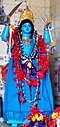
Shani is depicted wearing blue or black robes, having dark complexion and riding a vulture or on an iron chariot drawn by eight horses. He holds in his hands a bow, an arrow, an axe and a trident. He is canonically represented riding on a large crow which follows him wherever he goes. Some astrologers believe he has more than one mount such as a horse, elephant, donkey, lion, dog, jackal, deer and vulture, although this is controversial.[17]
Shani is believed to be the incarnation of Krishna according to Brahma Vaivarta Purana where Krishna said that he is "Shani among planets". He is also called Saneeswar meaning "Lord of Saturn" and is designated the task of granting the fruits of one's action, thus becoming the most feared amongst Hindu astrological gods. He is often the most misunderstood deity in the Hindu Pantheon as he is said to cause persistent chaos in one's life, and is known to be milder if worshipped.[18][19]
Shani is the root for name for the day Saturday in many other Indian languages. In modern Hindi, Odia, Telugu, Bengali, Marathi, Urdu, Kannada and Gujarati, Saturday is called Shanivaar; Tamil: Sani kizhamai; Malayalam: Shaniyazhcha; Thai: Wạn s̄eār̒ (วันเสาร์).
Calendar[edit | edit source]
Shani is the basis for Shanivara – one of the seven days that make a week in the Hindu calendar.[6] This day corresponds to Saturday – after Saturn – in the Greco-Roman convention for naming the days of the week.[20][21] Shani is considered to be the most malefic planet that brings restrictions and misfortunes.[22]
Shani is part of the Navagraha in Hindu zodiac system, considered malefic, associated with spiritual asceticism, penance, discipline and conscientious work. The role and importance of the Navagraha developed over time with various influences. Deifying planetary bodies and their astrological significance occurred as early as the Vedic period and was recorded in the Vedas. The earliest work of astrology recorded in India is the Vedanga Jyotisha which began to be compiled in the 14th century BCE. It was possibly based on works from the Indus Valley Civilization as well as various foreign influences. Babylonian astrology which was the first astrology and calendar to develop, and was adopted by multiple civilizations including India. The classical planets, including Saturn.
The Navagraha developed from early works of astrology over time. Saturn and various classical planets were referenced in the Atharvaveda around 1000 BCE. The Navagraha was furthered by additional contributions from Western Asia, including Zoroastrian and Hellenistic influences. The Yavanajataka, or 'Science of the Yavanas', was written by the Indo-Greek named "Yavanesvara" ("Lord of the Greeks") under the rule of the Western Kshatrapa king Rudrakarman I. The Yavanajataka written in 120 CE is often attributed to standardizing Indian astrology. The Navagraha would further develop and culminate in the Shaka era with the Saka or Scythian, people. Additionally the contributions by the Saka people would be the basis of the Indian national calendar, which is also called the Saka calendar.
The Hindu calendar is a Lunisolar calendar which records both lunar and solar cycles. Like the Navagraha, it was developed with the successive contributions of various works.
Planet Shani rules over both zodiac signs, Capricorn and Aquarius, two of the twelve constellations in the zodiac system of Hindu astrology.[23] If Shani rules over your zodiac sign, it is said you must wear a ring with a stone made of Blue Sapphire.[24]
Deity[edit | edit source]
Shani is a deity in medieval era texts, who is considered inauspicious and is feared for delivering misfortune and loss to those who deserve it.[25] He is also capable of conferring boons and blessings to the worthy, depending upon their karma. In medieval Hindu literature, he is mainly referred to as the son of Surya and Chhaya, or in few accounts as the son of Balarama and Revati.[5][26] His alternate names include Ara, Kona and Kroda.[5] As per the Hindu texts, 'peepal' or fig tree is the abode of Shani (while other texts associate the same tree with Vasudeva).[27] He is also believed to be the greatest teacher who rewards the righteous acts and punishes those who follow the path of evil, Adharma and betrayal.[28]

In 2013, a 20-foot-tall statue of Lord Shani was established at Yerdanur in the mandal of Sangareddy, Medak district, Telangana, nearly 40 kilometers from Hyderabad city. It was carved from a Monolith and weighs about nine tonnes.[citation needed]
Mantra Translation[edit | edit source]
Shani's mantra is depicted here, in Sanskrit and English, with the translation;[29]
English: "Om kaakadhwajaaya vidmahae khadga hastaaya dheemahi tanno mandah prachodayaat''
Sanskrit: ओम काकध्वजाय विद्महे खड्ग हस्ताय धीमहि तन्नो मंदः प्रचोदयात्
Translation: Om, Let me meditate on him who has crow in his flag, Oh, He who has a sword in his hand, give me higher intellect, And let Saneeswara illuminate my mind.
Dedicated Day[edit | edit source]
On Saturdays, it is believed that one should worship Lord Shani to keep oneself away from evil and to reduce the hardships of life as he blesses those who willingly and voluntarily donate to the poor without seeking anything in return.[30][31]

Shani puja is usually done to keep one safe from Lord Shani's malefic effects. On Saturday, the devotee also fasts from dawn to dusk. Wake up early in the morning and take oil bath after applying sesame oil on your body. After bath, wear black clothes for the day. On the whole day, use Sesame oil for lighting lamp.[32][33]
Saturn Temples[edit | edit source]

Shani temples are found in more populated areas of India, such as Maharashtra, Madhya Pradesh, Haryana, Tamil Nadu, Karnataka, West Bengal and Andhra Pradesh. Shani Shingnapur Dham in particular is a famous holy place associated with Lord Shani, the deity. Shani Shinganapur or Shingnapur is a village in the Indian state of Maharashtra. Situated in Nevasa taluka in Ahmednagar district, the village is known for its popular temple of Shani, the Hindu god associated with the planet Saturn. Shingnapur is 35 km from Ahmednagar city. More common than Shani temples are artwork related to himself, which are found in all types of temples of various traditions within Hinduism, mostly connected to Shaivism. Popularity for praying to Shani, especially on Saturday's, has increased gradually over the years.[34]
In television[edit | edit source]
- Daya Shankar Pandey played the role of Shani Dev in Mahima Shani Dev Ki which aired on NDTV Imagine from 2010 to 2012.
- On 7 November 2016 the show Karmafal Daata Shani aired on Colors TV; it depicts the life of Shani. Kartikey Malviya plays the role of younger Shani and Rohit Khurana of mature Shani.The show ended on 9 March 2018.
- In 2017 the remake of the Karmafal Daata Shani was made in Kannada titled Shani telecasted on Colors Kannada. Sunil plays the role of young Shani. Pranav Sridhar plays the role of mature Shani.
- In 2020 the show Devi Adi Parashakti aired on Dangal TV; Rohit Khurana plays the role of Lord Shani.
See also[edit | edit source]
Notes[edit | edit source]
- ↑ Translation: Om, Let me meditate on him who has crow in his flag, Oh, He who has a sword in his hand, give me higher intellect, And let Saneeswara illuminate my mind.
Further reading[edit | edit source]
- Pingree, David (1973). "The Mesopotamian Origin of Early Indian Mathematical Astronomy". Journal for the History of Astronomy. 4 (1). SAGE: 1–12. Bibcode:1973JHA.....4....1P. doi:10.1177/002182867300400102. S2CID 125228353.
- Pingree, David (1981). Jyotihśāstra : Astral and Mathematical Literature. Otto Harrassowitz. ISBN 978-3-447-02165-4.
- Ohashi, Yukio (1999). Andersen, Johannes (ed.). Highlights of Astronomy, Volume 11B. Springer Science. ISBN 978-0-7923-5556-4.
External links[edit | edit source]
- Astronomical Names for the Days of the Week, M Falk (1999)
- The God Shani or the Planet Saturn, Iconongraphy on a column in Madurai Meenakshi Temple, British Library
- Shani Chalisa In Hindi With English PDF File
 | ||
Hindu deities and texts | ||
|---|---|---|
| Gods |  | |
| Goddesses | ||
| Other deities | ||
| Texts | ||
- ↑ "Gāyatri Mantras of Several Gods - Hindupedia, the Hindu Encyclopedia". Hindupedia.com. Retrieved 11 August 2022.
- ↑ "Shani Mantra". 27 June 2021.
- ↑ "Archived copy". Archived from the original on 21 October 2019. Retrieved 10 June 2018.
{{cite web}}: CS1 maint: archived copy as title (link) - ↑ "Planet Saturn (Shani) in Astrology". www.rudraksha-center.com. Retrieved 14 January 2021.
- ↑ 5.0 5.1 5.2 5.3 Dalal, Roshen (2010). Hinduism: An Alphabetical Guide. Penguin Books India. p. 373. ISBN 978-0-14-341421-6.
- ↑ 6.0 6.1 Lochtefeld, James G. (2002). The Illustrated Encyclopedia of Hinduism: N-Z. The Rosen Publishing Group. pp. 608–609. ISBN 978-0-8239-3180-4.
- ↑ LastWeekTonight (9 September 2018), Felony Disenfranchisement: Last Week Tonight with John Oliver (HBO), archived from the original on 19 December 2021, retrieved 27 October 2018
- ↑ Saxena, Archit (13 April 2020). Durga : A Governing Mother: Mother-Son Duo logy Book - 2. Archit Saxena.
- ↑ "Why Was Shani Dev Cursed By His Wife?". in.style.yahoo.com. Retrieved 14 January 2021.
- ↑ 10.0 10.1 10.2 Burgess, Ebenezer (1989). P Ganguly, P Sengupta (ed.). Sûrya-Siddhânta: A Text-book of Hindu Astronomy. Motilal Banarsidass (Reprint), Original: Yale University Press, American Oriental Society. pp. vii–xi. ISBN 978-81-208-0612-2.
- ↑ Aryabhatta; H. Kern (Editor, Commentary) (1973). The Aryabhatiya (in संस्कृतम् and English). Brill Archive. pp. 6, 21.
{{cite book}}:|author2=has generic name (help) - ↑ Chatterjee, Bina (1970). The Khandakhadyaka (an astronomical treatise) of Brahmagupta: with the commentary of Bhattotpala (in संस्कृतम्). Motilal Banarsidass. pp. 75–77, 40, 69. OCLC 463213346.
- ↑ Burgess, Ebenezer (1989). P Ganguly, P Sengupta (ed.). Sûrya-Siddhânta: A Text-book of Hindu Astronomy. Motilal Banarsidass (Reprint), Original: Yale University Press, American Oriental Society. pp. ix–xi. ISBN 978-81-208-0612-2.
- ↑ Burgess, Ebenezer (1989). P Ganguly, P Sengupta (ed.). Soorya-Siddhânta: A Text-book of Hindu Astronomy. Motilal Banarsidass (Edited and Reprinted), Original: Yale University Press, American Oriental Society. pp. ix–x. ISBN 978-81-208-0612-2.
- ↑ 15.0 15.1 Burgess, Ebenezer (1989). P Ganguly, P Sengupta (ed.). Soorya-Siddhânta: A Text-book of Hindu Astronomy. Motilal Banarsidass (Reprint), Original: Yale University Press, American Oriental Society. pp. 26–27. ISBN 978-81-208-0612-2.
- ↑ Williams, Matt (17 April 2017). "The Orbit of Saturn. How Long is a Year on Saturn?". Universe Today. Retrieved 14 January 2021.
- ↑ M. A., English Literature. "Learn About the Hindu Deity Shani Dev and How Praying Wards Off Evil". Learn Religions. Retrieved 19 February 2021.
- ↑ Mohan, Lavanya (30 January 2016). "Shani's law". The Hindu. ISSN 0971-751X. Retrieved 7 March 2021.
- ↑ "Shani Dev – Know Everything About him". MantraQuest.com. Retrieved 9 March 2021.
- ↑ Skeat, Walter W. (1993). The Concise Dictionary of English Etymology. Wordsworth. p. 415. ISBN 978-1-85326-311-8.
- ↑ T. F. Hoad (2008). "Saturday". The Concise Oxford Dictionary of English Etymology. Oxford University Press. p. 1329. ISBN 978-1-4395-0571-7.
- ↑ "Benefic And Malefic Planets For Each Ascendant". shrivinayakaastrology.com. Retrieved 14 January 2021.
- ↑ Backlund, Roya. "Every Zodiac Sign Has A Ruling Planet & This Is Yours". Elite Daily. Retrieved 14 January 2021.
- ↑ "Lucky Stone by Date of Birth - Times of India". The Times of India. Retrieved 4 January 2021.
- ↑ Jordan, Michael (2014). Dictionary of Gods and Goddesses. Infobase Publishing. p. 283. ISBN 978-1-4381-0985-5.
- ↑ Dowson, John (2013). A Classical Dictionary of Hindu Mythology and Religion, Geography, History and Literature. Routledge. p. 278. ISBN 978-1-136-39029-6.
- ↑ Haberman, David L. (2013). People Trees: Worship of Trees in Northern India. Oxford University Press. p. 106. ISBN 978-0-19-992916-0.
- ↑ Apr 5, Sonam Gupta |; 2017; Ist, 11:16. "Saturn and its Effects on Humans | - Times of India". The Times of India. Retrieved 14 January 2021.
{{cite web}}:|last2=has numeric name (help)CS1 maint: numeric names: authors list (link) - ↑ "Gāyatri Mantras of Several Gods - Hindupedia, the Hindu Encyclopedia". www.hindupedia.com. Retrieved 15 February 2021.
- ↑ "Shani Puja | Blessings of Shani Dev | Shani Dev Pooja Vidhi". www.pavitrajyotish.com. 10 February 2016. Retrieved 10 February 2021.
- ↑ "Here's how you can worship Lord Shani to keep your karma in check". www.timesnownews.com. Retrieved 10 February 2021.
- ↑ OnlinePuja. "Method of worship of Lord Shani - Onlinepuja.com". onlinepuja.com. Retrieved 10 February 2021.
- ↑ "How To Do Shani Puja At Home - Times of India". The Times of India. Retrieved 10 February 2021.
- ↑ "10 Most Important Shrines and Temples Of God Shanidev". Retrieved 18 March 2021.