









WikiDwarfBOT (talk | contribs) m robot: Trimming article to decrease server load |
ImportMaster (talk | contribs) mNo edit summary |
||
| Line 1: | Line 1: | ||
[[ | {{short description|Major deity in Hinduism}} | ||
'''Krishna''' | {{about|the Hindu deity}} | ||
{{ | {{Redirect|Krsna|other uses|Krsna (disambiguation)}} | ||
{{ | {{redirect|Kanhaiya|the 1959 Bollywood film|Kanhaiya (film)}} | ||
{{good article}} | |||
{{pp-protected|small=yes}} | |||
{{Use Indian English|date=February 2015}} | |||
{{Use dmy dates|date=July 2019}} | |||
{{Infobox deity | |||
| type = Hindu | |||
| name = Krishna | |||
| image = Sri Mariamman Temple Singapore 2 amk.jpg | |||
| member_of = [[Dashavatara]] | |||
| caption = Statue of Krishna at the [[Sri Mariamman Temple, Singapore]]. | |||
| birth_place = [[Mathura]], [[Surasena]] (present-day [[Uttar Pradesh]], India)<ref name="Raychaudhuri 1972124">{{harvnb|Raychaudhuri|1972|p=124}}</ref> | |||
| Sanskrit_transliteration = {{IAST|Kṛṣṇa}} | |||
| Devanagari = कृष्ण | |||
| affiliation = {{unbulleted list|[[Svayam Bhagavan]]|[[Brahman]] (Krishnaism-Vaishnavism)|[[Avatar]] of [[Vishnu]]|[[Dashavatara]]|[[Radha Krishna]]{{sfn|Bryant|2007|p=114}}<ref name="KK"/>}} | |||
| weapon = {{unbulleted list|[[Sudarshana Chakra]]|[[Kaumodaki]]}} | |||
| battles = [[Kurukshetra War]] | |||
| mount = [[Garuda]] | |||
| abode = {{hlist|[[Goloka]]|[[Vrindavan]]|[[Gokul]]|[[Dvaraka]]}} | |||
| mantra = ''[[Hare Krishna (mantra)|Hare Krishna]]'' <br>''[[Om Namo Bhagavate Vasudevaya]]'' | |||
| texts = {{unbulleted list|''[[Bhagavata Purana]]''|''[[Garga Samhita (Vaishnavite text)|Garga Samhita]]''|''[[Harivamsa]]''|''[[Vishnu Purana]]''|''[[Mahabharata]]'' (''[[Bhagavad Gita]]'')|''[[Brahma Vaivarta Purana]]''}} | |||
| parents = {{unbulleted list|[[Devaki]] (mother)|[[Vasudeva]] (father)|[[Yashoda]] (foster-mother)|[[Nanda]] (foster-father)}} | |||
| siblings = {{unbulleted list|[[Balarama]] (brother)|[[Subhadra]] (sister)|[[Yogamaya]] (cousin)}} | |||
| consorts = {{hlist|[[Radha]]|[[Rukmini]]|[[Satyabhama]]|[[Kalindi]]|[[Jambavati]]| [[Junior wives of Krishna|16,000 – 16,100 Junior queens]]<ref name=hawley12>{{cite book |title=The Divine Consort: Rādhā and the Goddesses of India|author=John Stratton Hawley, Donna Marie Wulff |publisher=Motilal Banarsidass Publisher |date=1982 |isbn=978-0-89581-102-8 |page=12}}</ref>}}{{refn|group=note|Radha is seen as Krishna's lover-consort. On the other hand, Rukmini and others are married to him. Krishna had eight chief wives, who were referred to as the [[Ashtabharya]]. The regional texts vary in the identity of Krishna's wife (consort), some presenting it as Rukmini, some as Radha, all ''gopis'', and some identifying all to be different aspects or manifestation of [[Devi]] Lakshmi.<ref name=hawley12 />{{sfn|Bryant|2007|p=443}}}} | |||
| festivals = {{hlist|[[Krishna Janmashtami]]|[[Holi]]|[[Gopastami]]|[[Govardhan Puja]]|[[Kartik Purnima]]|[[Sharad Purnima]]|[[Lathmar Holi]]}} | |||
| children = {{hlist|[[Pradyumna]]|[[Samba (Krishna's son)|Samba]]|[[Characters in the Mahabharata#Bhanu|Bhanu]] and various other children<ref>{{Cite book|last=Naravane|first=Vishwanath S.|url=https://books.google.com/books?id=zZTXAAAAMAAJ&q=+eighty+sons+|title=A Companion to Indian Mythology: Hindu, Buddhist & Jaina|date=1987|publisher=Thinker's Library, Technical Publishing House|language=en}}</ref>}}{{refn|group=note|The number of Krishna's children varies from one interpretation to another. According to some scriptures like the [[Bhagavata Purana]], Krishna had 10 children from each of his wives (16,008 wives and 160,080 children)<ref>{{Cite book|last=Sinha|first=Purnendu Narayana|url=https://books.google.com/books?id=OveYh2v-1roC&q=sons+of+krishna&pg=PT691|title=A Study of the Bhagavata Purana: Or, Esoteric Hinduism|date=1950|publisher=Library of Alexandria|isbn=978-1-4655-2506-2|language=en}}</ref>}} | |||
| dynasty = [[Yadu|Yaduvamsha]]-[[Chandravamsha]] | |||
| god_of = God of Protection, Compassion, Tenderness, and Love;{{sfn|Bryant|Ekstrand|2004|pp=20–25, quote: "Three Dimensions of Krishna's Divinity (...) divine majesty and supremacy; (...) divine tenderness and intimacy; (...) compassion and protection.; (..., p. 24) Krishna as the God of Love"}} [[Yogeshvara]] – Lord of [[Yoga]] or [[Yogi]]s;<ref>{{cite book|title=Sri Krishna|url=https://books.google.com/books?id=oKiGPRGChjYC|author=Swami Sivananda|publisher=Bharatiya Vidya Bhavan|year=1964|page=4}}</ref><ref>{{cite news|title=Krishna the Yogeshwara|url=https://www.thehindu.com/features/friday-review/religion/religious-discourse-krishna-the-yogeshwara/article6405504.ece|work=The Hindu|date=12 September 2014}}</ref> [[Parabrahman]], [[Svayam Bhagavan]] ([[Krishnaism]]-[[Vaishnavism]]) | |||
| death_place = [[Bhalka]], [[Saurashtra Kingdom|Saurashtra]] (present-day [[Veraval]], [[Gujarat]], India)<ref name=eck380 /> | |||
}} | |||
{{Infobox royalty | |||
| name = [[Dashavatara]] Sequence | |||
| predecessor = [[Rama]] | |||
| successor = [[Gautama Buddha in Hinduism|Buddha]] | |||
}} | |||
{{Vaishnavism}} | |||
'''Krishna''' ({{IPAc-en|ˈ|k|r|ɪ|ʃ|n|ə}};<ref>[http://www.dictionary.com/browse/krishna "Krishna"]. ''[[Random House Webster's Unabridged Dictionary]]''.</ref> {{lang-sa|कृष्ण}} {{IAST3|Kṛṣṇa}} {{IPA-sa|ˈkr̩ʂɳɐ|}}) <!--Do not remove, WP:INDICSCRIPT doesn't apply to WikiProject Hinduism--> is a major [[deity]] in [[Hinduism]]. He is worshipped as the eighth [[avatar]] of [[Vishnu]] and also as the [[Svayam Bhagavan|Supreme god]] in his own right.<ref name=EB>{{cite encyclopedia |title= Krishna |url= https://www.britannica.com/EBchecked/topic/323556/Krishna |encyclopedia=[[Encyclopædia Britannica]] Online}}</ref> He is the god of protection, compassion, tenderness, and love;<ref name="Scharfstein1993p166">{{cite book|author=Ben-Ami Scharfstein|title=Ineffability: The Failure of Words in Philosophy and Religion |url=https://archive.org/details/ineffabilityfail0000scha |url-access=registration|year=1993|publisher=State University of New York Press|isbn=978-0-7914-1347-0|page=[https://archive.org/details/ineffabilityfail0000scha/page/166 166]}}</ref>{{sfn|Bryant|Ekstrand|2004|pp=20–25, quote: "Three Dimensions of Krishna's Divinity (...) divine majesty and supremacy; (...) divine tenderness and intimacy; (...) compassion and protection.; (..., p. 24) Krishna as the God of Love"}} and is one of the most popular and widely revered among Indian divinities.<ref>{{cite book|title =Krishna, Lord Or Avatara?|author=Freda Matchett|publisher =Psychology Press|date=2001|isbn =978-0-7007-1281-6|page=199}}</ref> Krishna's birthday is celebrated every year by Hindus on [[Krishna Janmashtami]] according to the [[lunisolar calendar|lunisolar]] [[Hindu calendar]], which falls in late August or early September of the [[Gregorian calendar]].<ref>{{Cite web|title=Krishna|url=https://www.worldhistory.org/Krishna/#:~:text=One%20day%20Vishnu%2C%20the%20great,his%20earthly%20father%20being%20Vasudeva.|website=World History Encyclopedia}}</ref><ref name="Lochtefeld2002p314">{{cite book|author=James G. Lochtefeld|title=The Illustrated Encyclopedia of Hinduism: A-M|url=https://archive.org/details/illustratedencyc0000loch|url-access=registration|year=2002|publisher=The Rosen Publishing Group|isbn=978-0-8239-3179-8|pages=[https://archive.org/details/illustratedencyc0000loch/page/n436 314]–315}}</ref> | |||
The anecdotes and narratives of Krishna's life are generally titled as ''Krishna Leela''. He is a central character in the ''[[Mahabharata]]'', the ''[[Bhagavata Purana]]'', the ''[[Brahma Vaivarta Purana]],'' and the ''[[Bhagavad Gita]]'', and is mentioned in many [[Hindu philosophy|Hindu philosophical]], [[Hindu theology|theological]], and [[Hindu mythology|mythological]] texts.<ref name=Thompson>{{cite web |author=Richard Thompson, Ph.D. | date = December 1994 | title = Reflections on the Relation Between Religion and Modern Rationalism | url = http://content.iskcon.com/icj/1_2/12thompson.html | access-date = 12 April 2008 | url-status=dead | archive-url = https://web.archive.org/web/20110104040530/http://content.iskcon.com/icj/1_2/12thompson.html | archive-date = 4 January 2011 | df = dmy-all}}</ref> They portray him in various perspectives: as a god-child, a prankster, a model lover, a divine hero, and the universal supreme being.<ref name="Mahony1987">{{cite journal | author = Mahony, W. K. | year = 1987 | title = Perspectives on Krsna's Various Personalities | journal = History of Religions | volume = 26 | issue = 3 | pages = 333–335 | jstor = 1062381 | doi=10.1086/463085| s2cid = 164194548 }} Quote: "Krsna's various appearances as a divine hero, alluring god child, cosmic prankster, perfect lover, and universal supreme being (...)".</ref> His iconography reflects these legends, and shows him in different stages of his life, such as an infant eating butter, a young boy playing a [[Venu|flute]], a young boy with [[Radha]] or surrounded by female devotees; or a friendly charioteer giving counsel to [[Arjuna]].<ref name=Knott2000>{{Harvnb|Knott|2000|pp=15, 36, 56}}</ref> | |||
The name and synonyms of Krishna have been traced to 1st{{nbsp}}millennium{{nbsp}}[[BCE]] literature and cults.<ref name="Cultofgopal" /> In some sub-traditions, Krishna is worshipped as ''[[Svayam Bhagavan]]'' (the Supreme God), and it is sometimes known as [[Krishnaism]]. These sub-traditions arose in the context of the medieval era [[Bhakti movement]].{{sfn|Hardy|1987|pp=387–392}}<ref name="Kenneth Valpey 2013">Ravi Gupta and Kenneth Valpey (2013), ''The Bhagavata Purana'', Columbia University Press, {{ISBN|978-0231149990}}, pp. 185–200</ref> Krishna-related literature has inspired numerous performance arts such as [[Bharatanatyam]], [[Kathakali]], [[Kuchipudi]], [[Odissi]], and [[Manipuri dance]].{{sfn|Bryant|2007|page=118}}<ref name="ML Varadpande 1987">ML Varadpande (1987), ''History of Indian Theatre'', Vol 1, Abhinav, {{ISBN|978-8170172215}}, pp. 98–99</ref> He is a pan-Hindu god, but is particularly revered in some locations, such as [[Vrindavan]] in [[Uttar Pradesh]],{{sfn|Hawley|2020}} [[Dwarka]] and [[Junagadh]] in [[Gujarat]]; the [[Jagannath]]a aspect in [[Odisha]], [[Mayapur]] in [[West Bengal]];{{sfn|Hardy|1987|pp=387–392}}{{sfn|Miśra|2005}}<ref>{{cite book |author=[[J. Gordon Melton]] |title=Religious Celebrations: An Encyclopedia of Holidays, Festivals, Solemn Observances, and Spiritual Commemorations |url=https://books.google.com/books?id=KDU30Ae4S4cC&pg=PA330 |year=2011 |publisher=ABC-Clio |isbn=978-1-59884-205-0 |pages=330–331}}</ref> in the form of [[Vithoba]] in [[Pandharpur]], [[Maharashtra]], [[Shrinathji]] at [[Nathdwara]] in [[Rajasthan]],{{sfn|Hardy|1987|pp=387–392}}<ref>{{cite book|author=Cynthia Packert|title=The Art of Loving Krishna: Ornamentation and Devotion|url=https://books.google.com/books?id=SyTgMt4AQl4C&pg=PA181 |year=2010|publisher=Indiana University Press|isbn=978-0-253-22198-8|pages=5, 70–71, 181–187}}</ref> [[Udupi]] Krishna in [[Karnataka]],{{sfn|Bryant|2007|p=3}} [[Sarathy|Parthasarathy]] in [[Tamil Nadu]] and in [[Aranmula]], [[Kerala]], and [[Guruvayoorappan]] in [[Guruvayoor]] in [[Kerala]].<ref>{{cite book|author=Lavanya Vemsani |title=Krishna in History, Thought, and Culture |url=https://books.google.com/books?id=4fw2DAAAQBAJ&pg=PA112|year=2016|publisher=ABC-CLIO|isbn=978-1-61069-211-3|pages=112–113}}</ref> Since the 1960s, the worship of Krishna has also spread to the Western world and to Africa, largely due to the work of the [[International Society for Krishna Consciousness]] (ISKCON).<ref name="bare_url">{{Cite journal|last=Selengut |first=Charles |title=Charisma and Religious Innovation: Prabhupada and the Founding of ISKCON |journal=[[ISKCON Communications Journal]] |volume=4 |issue=2 |year=1996 |url=http://content.iskcon.com/icj/4_2/4_2charisma.html |url-status=dead |archive-url=https://archive.today/2012.07.10-005633/http://content.iskcon.com/icj/4_2/4_2charisma.html |archive-date=10 July 2012 }}</ref> | |||
== Names and epithets == | |||
{{Main|List of titles and names of Krishna}} | |||
The name "Krishna" originates from the [[Sanskrit]] word ''{{IAST|Kṛṣṇa}}'', which is primarily an adjective meaning "black", "dark", "dark blue" or “the all attractive”.<ref name="dictionaries">* [http://www.sanskrit-lexicon.uni-koeln.de/cgi-bin/monier/serveimg.pl?file=/scans/MWScan/MWScanjpg/mw0306-kRzanAvat.jpg Monier Williams Sanskrit–English Dictionary (2008 revision)] {{Webarchive|url=https://web.archive.org/web/20191018224028/https://www.sanskrit-lexicon.uni-koeln.de/cgi-bin/monier/serveimg.pl?file=%2Fscans%2FMWScan%2FMWScanjpg%2Fmw0306-kRzanAvat.jpg |date=18 October 2019 }} | |||
* [http://dsalsrv02.uchicago.edu/cgi-bin/philologic/getobject.pl?c.2:1:1423.apte Apte Sanskrit–English Dictionary] {{Webarchive|url=https://web.archive.org/web/20180916122511/http://dsalsrv02.uchicago.edu/cgi-bin/philologic/getobject.pl?c.2:1:1423.apte |date=16 September 2018 }}</ref> The waning moon is called Krishna [[Paksha]], relating to the adjective meaning "darkening".<ref name="dictionaries" /> The name is also interpreted sometimes as "all-attractive".<ref>{{Harvnb|Bryant|2007|p=382}}</ref> | |||
As a name of [[Vishnu]], Krishna is listed as the 57th name in the ''[[Vishnu Sahasranama]]''. Based on his name, Krishna is often depicted in [[murti|idols]] as black- or blue-skinned. Krishna is also known by various [[List of titles and names of Krishna|other names, epithets, and titles]] that reflect his many associations and attributes. Among the most common names are ''Mohan'' "enchanter"; ''[[Govinda]]'' "chief herdsman",<ref>Monier Monier Williams, [http://www.ibiblio.org/sripedia/ebooks/mw/0300/mw__0399.html Go-vinda], Sanskrit English Dictionary and Etymology, Oxford University Press, p. 336, 3rd column</ref> ''[[Keev]]'' "prankster", and ''[[Gopala Krishna|Gopala]]'' "Protector of the 'Go'", which means "soul" or "the cows".<ref>{{Harvnb|Bryant|2007|p=17}}</ref><ref name="Hilt">{{cite book|author = Hiltebeitel, Alf|title = Rethinking the Mahābhārata: a reader's guide to the education of the dharma king|url = https://archive.org/details/rethinkingmahabh00hilt|url-access = limited|publisher = University of Chicago Press|location = Chicago|year = 2001|pages = [https://archive.org/details/rethinkingmahabh00hilt/page/n130 251]–253, 256, 259|isbn = 978-0-226-34054-8}}</ref> Some names for Krishna hold regional importance; ''[[Jagannatha]]'', found in the [[Jagannatha Puri|Puri]] Hindu temple, is a popular incarnation in [[Odisha]] state and nearby regions of [[eastern India]].<ref>{{cite book|author = B. M. Misra|title = Orissa: Shri Krishna Jagannatha: the Mushali parva from Sarala's Mahabharata|year = 2007|publisher = [[Oxford University Press]]|isbn = 978-0-19-514891-6}}</ref>{{sfn|Bryant|2007|p=139}}<ref>For the historic Jagannath temple in Ranchi, [[Jharkhand]] see: {{cite book|author=Francis Bradley Bradley-Birt|title=Chota Nagpur, a Little-known Province of the Empire|url=https://books.google.com/books?id=W0x74TZB3eoC&pg=PA61|year=1989|publisher=Asian Educational Services (Orig: 1903) |isbn= 978-81-206-1287-7|pages=61–64}}</ref> | |||
Krishna may also be referred to as [[Vāsudeva-Krishna]], Murlidhar, or Chakradhar. The honorary title "Sri" (also spelled "Shri") is often used before the name of Krishna. | |||
=== Names in different states of India === | |||
Krishna is commonly worshipped as: | |||
# ''Kanhaiyya/[[Bankey Bihari Temple|Bankey Bihari]]/Thakurji'': Uttar Pradesh | |||
# ''[[Jagannath]]'': Odisha | |||
# ''[[Vithoba]]'': Maharashtra | |||
# ''[[Shrinathji]]'': Rajasthan | |||
# ''[[Guruvayoorappan]]''/''Kannan'': Kerala | |||
# ''[[Dwarkadhish Temple|Dwarakadheesh]]/Ranchhod'': Gujarat | |||
# ''Mayon/Parthasarathy/Kannan'': Tamil Nadu | |||
== Historical and literary sources == | |||
The tradition of Krishna appears to be an amalgamation of several independent deities of ancient India, the earliest to be attested being [[Vāsudeva]].<ref name="GDF119">{{harvnb|Flood|1996|pp=[https://archive.org/details/introductiontohi0000floo/page/119 119]–120}}</ref> Vāsudeva was a hero-god of the tribe of the [[Vrishni]]s, belonging to the [[Vrishni heroes]], whose worship is attested from the 5th-6th century BCE in the writings of [[Pāṇini]], and from the 2nd century BCE in epigraphy with the [[Heliodorus pillar]].<ref name="GDF119"/> At one point in time, it is thought that the tribe of the Vrishnis fused with the tribe of the Yadavas/Abhiras, whose own hero-god was named Krishna.<ref name="GDF119"/> Vāsudeva and Krishna fused to become a single deity, which appears in the ''[[Mahabharata]]'', and they started to be identified with [[Vishnu]] in the ''Mahabharata'' and the ''[[Bhagavad Gita]]''.<ref name="GDF119"/> Around the 4th century CE, another tradition, the cult of [[Gopala-Krishna]] of the Ābhīras, the protector of cattle, was also absorbed into the Krishna tradition.<ref name="GDF119"/> | |||
===Early epigraphic sources=== | |||
{{main|Vāsudeva-Krishna}} | |||
====Depiction in coinage (2nd century BCE)==== | |||
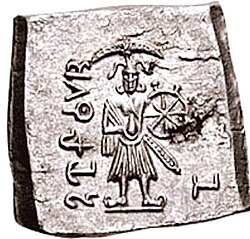
[[File:Vasudeva Krishna on a coin of Agathocles of Bactria circa 180 BCE.jpg|thumb|upright|{{center|[[Vāsudeva]]-Krishna, on a coin of [[Agathocles of Bactria]], {{circa}}{{nbsp}}180{{nbsp}}BCE.<ref name="US">{{cite book |last1=Singh |first1=Upinder |title=A History of Ancient and Early Medieval India: From the Stone Age to the 12th Century |date=2008 |publisher=Pearson Education India |isbn=978-81-317-1120-0 |pages=436–438 |url=https://books.google.com/books?id=H3lUIIYxWkEC&pg=PA437 |language=en}}</ref><ref>[[Osmund Bopearachchi]], [https://www.academia.edu/25807197 Emergence of Viṣṇu and Śiva Images in India: Numismatic and Sculptural Evidence], 2016.</ref> This is "the earliest unambiguous image" of the deity.<ref name="BRILL">{{cite book |last1=Srinivasan |first1=Doris |title=Many Heads, Arms, and Eyes: Origin, Meaning, and Form of Multiplicity in Indian Art |date=1997 |publisher=Brill|isbn=978-90-04-10758-8 |page=215 |url=https://books.google.com/books?id=vZheP9dIX9wC&pg=PA215 |language=en}}</ref>}}]] | |||
Around 180 BCE, the [[Indo-Greek]] king [[Agathocles of Bactria|Agathocles]] issued some coinage bearing images of deities that are now interpreted as being related to [[Vaisnava]] imagery in India.<ref name="Bopearachchi"/><ref>Audouin, Rémy, and Paul Bernard, "[http://www.persee.fr/doc/numi_0484-8942_1974_num_6_16_1062 Trésor de monnaies indiennes et indo-grecques d'Aï Khanoum (Afghanistan). II. Les monnaies indo-grecques.]" Revue numismatique{{nbsp}}6, no.{{nbsp}}16 (1974), pp.{{nbsp}}6–41 (in French).</ref> The deities displayed on the coins appear to be [[Saṃkarṣaṇa]]-[[Balarama]] with attributes consisting of the [[Gada (mace)|Gada]] mace and the [[plow]], and Vāsudeva-Krishna with attributes of the [[Shankha]] (conch) and the [[Sudarshana Chakra]] wheel.<ref name="Bopearachchi" /><ref>Nilakanth Purushottam Joshi, Iconography of Balarāma, Abhinav Publications, 1979, [https://books.google.com/books?id=5vd-lKzyFg0C&pg=PA22 p. 22]</ref> According to [[Bopearachchi]], the headdress on top of the deity is actually a misrepresentation of a shaft with a half-moon parasol on top ([[chattra]]).<ref name="Bopearachchi" /> | |||
====Inscriptions==== | |||
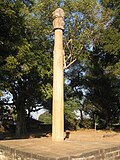
[[File:Heliodorus pillar.jpg|thumb|upright|left|[[Heliodorus Pillar]] in the Indian state of [[Madhya Pradesh]], erected about 120{{nbsp}}BCE. The inscription states that Heliodorus is a ''Bhagvatena'', and a couplet in the inscription closely paraphrases a Sanskrit verse from the ''Mahabharata''.<ref name=allchin309>{{cite book|author1=F. R. Allchin|author2=George Erdosy|title=The Archaeology of Early Historic South Asia: The Emergence of Cities and States |url=https://books.google.com/books?id=Q5kI02_zW70C&pg=PA309 |year=1995| publisher=Cambridge University Press|isbn=978-0-521-37695-2|pages=309–310}}</ref><ref>L. A. Waddell (1914), Besnagar Pillar Inscription{{nbsp}}B Re-Interpreted, ''The Journal of the Royal Asiatic Society of Great Britain and Ireland'', Cambridge University Press, pp.{{nbsp}} 1031–1037</ref>]] | |||
The [[Heliodorus Pillar]], a stone pillar with a Brahmi script inscription, was discovered by colonial era archaeologists in Besnagar ([[Vidisha]], central Indian state of [[Madhya Pradesh]]). Based on the internal evidence of the inscription, it has been dated to between 125 and 100{{nbsp}}BCE and is now known after [[Heliodorus (ambassador)|Heliodorus]] – an [[Indo-Greek]] who served as an ambassador of the Greek king [[Antialcidas]] to a regional Indian king, Kasiputra [[Bhagabhadra]].<ref name="Bopearachchi" /><ref name=allchin309 /> The Heliodorus pillar inscription is a private religious dedication of Heliodorus to "[[Vāsudeva]]", an early deity and another name for Krishna in the Indian tradition. It states that the column was constructed by "the ''Bhagavata'' Heliodorus" and that it is a "''Garuda'' pillar" (both are Vishnu-Krishna-related terms). Additionally, the inscription includes a Krishna-related verse from chapter{{nbsp}}11.7 of the ''Mahabharata'' stating that the path to immortality and heaven is to correctly live a life of three virtues: self-[[Temperance (virtue)|temperance]] (''damah''), generosity (''cagah'' or ''tyaga''), and vigilance (''apramadah'').<ref name=allchin309 /><ref name=salomon265>{{cite book|author=Richard Salomon|title=Indian Epigraphy: A Guide to the Study of Inscriptions in Sanskrit, Prakrit, and the other Indo-Aryan Languages|url=https://books.google.com/books?id=XYrG07qQDxkC|year=1998|publisher=Oxford University Press|isbn=978-0-19-535666-3|pages=265–267}}</ref><ref>{{cite book|author=Benjamín Preciado-Solís|title=The Kṛṣṇa Cycle in the Purāṇas: Themes and Motifs in a Heroic Saga |url=https://books.google.com/books?id=JvCaWvjGDVEC&pg=PA34 |year=1984|publisher=Motilal Banarsidass|isbn=978-0-89581-226-1|page=34}}</ref> The Heliodorus pillar site was fully excavated by archaeologists in the 1960s. The effort revealed the brick foundations of a much larger ancient elliptical temple complex with a sanctum, ''[[mandapa]]s'', and seven additional pillars.{{sfn|Khare|1967}}{{sfn|Irwin|1974|pp=169–176 with Figure 2 and 3}} The Heliodorus pillar inscriptions and the temple are among the earliest known evidence of Krishna-Vasudeva devotion and [[Vaishnavism]] in ancient India.{{sfn|Susan V Mishra|Himanshu P Ray|2017|p=5}}<ref name="Bopearachchi">{{cite web|author=[[Osmund Bopearachchi]]| year= 2016| url=https://www.academia.edu/25807197|title= Emergence of Viṣṇu and Śiva Images in India: Numismatic and Sculptural Evidence}}</ref><ref>{{cite book|author=Burjor Avari|title=India: The Ancient Past: A History of the Indian Subcontinent from C. 7000 BCE to CE 1200|url=https://books.google.com/books?id=WTaTDAAAQBAJ |year=2016|publisher=Routledge|isbn=978-1-317-23673-3|pages=165–167}}</ref> | |||
[[File:Rama Krishna at Chilas.jpg|thumb|[[Balarama]] and Krishna with their attributes at [[Chilas]]. The [[Kharoshthi]] inscription nearby reads ''Rama [kri]ṣa''. 1st century CE.<ref name="BRILL"/>]] | |||
The [[Heliodorus Pillar|Heliodorus inscription]] is not isolated evidence. The [[Hathibada Ghosundi Inscriptions]], all located in the state of [[Rajasthan]] and dated by modern methodology to the 1st{{nbsp}}century{{nbsp}}BCE, mention Saṃkarṣaṇa and Vāsudeva, also mention that the structure was built for their worship in association with the supreme deity [[Narayana]]. These four inscriptions are notable for being some of the oldest-known Sanskrit inscriptions.<ref>{{cite book|author=Richard Salomon|title=Indian Epigraphy: A Guide to the Study of Inscriptions in Sanskrit, Prakrit, and the Other Indo-Aryan Languages |url= https://books.google.com/books?id=t-4RDAAAQBAJ |year= 1998|publisher= Oxford University Press|isbn=978-0-19-509984-3|pages=86–87}}</ref> | |||
A [[Mora well inscription|Mora stone slab]] found at the Mathura-Vrindavan archaeological site in [[Uttar Pradesh]], held now in the [[Mathura Museum]], has a Brahmi inscription. It is dated to the 1st{{nbsp}}century{{nbsp}}CE and mentions the five [[Vrishni heroes]], otherwise known as Saṃkarṣaṇa, Vāsudeva, [[Pradyumna]], [[Aniruddha]], and [[Samba (Krishna's son)|Samba]].<ref name=vardpande6>{{cite book|author=Manohar Laxman Varadpande|title=Krishna Theatre in India|url=https://books.google.com/books?id=TaF603WEv4IC&pg=PA6 |year=1982|publisher=Abhinav Publications|isbn=978-81-7017-151-5|pages=6–7}}</ref><ref>{{cite book |title= Hindu Gods and Heroes: Studies in the History of the Religion of India|last= Barnett|first= Lionel David|year= 1922 |publisher= J. Murray|page= [https://archive.org/details/in.ernet.dli.2015.173123/page/n92 93]|url= https://archive.org/details/in.ernet.dli.2015.173123}}</ref><ref name=Puri1968>{{cite book|author = Puri, B. N.|year = 1968|title = India in the Time of Patanjali|publisher = Bhartiya Vidya Bhavan}} p. 51: The coins of Rajuvula have been recovered from the Sultanpur District...the Brahmi inscription on the Mora stone slab, now in the Mathura Museum,</ref> | |||
The inscriptional record for [[Vāsudeva]] starts in the 2nd century BCE with the coinage of Agathocles and the Heliodorus pillar, but the name of Krishna appears rather later in epigraphy. At the [[Chilas]] II archaeological site dated to the first half of the 1st-century CE in northwest Pakistan, near the Afghanistan border, are engraved two males, along with many Buddhist images nearby. The larger of the two males held a plough and club in his two hands. The artwork also has an inscription with it in Kharosthi script, which has been deciphered by scholars as ''Rama-Krsna'', and interpreted as an ancient depiction of the two brothers, Balarama and Krishna.<ref>{{cite book|author=Doris Srinivasan|title=Many Heads, Arms, and Eyes: Origin, Meaning, and Form of Multiplicity in Indian Art|url=https://books.google.com/books?id=vZheP9dIX9wC |year=1997|publisher=Broll Academic|isbn=90-04-10758-4|pages=214–215 with footnotes}}</ref><ref>{{cite book|author=Jason Neelis|title=Early Buddhist Transmission and Trade Networks: Mobility and Exchange Within and Beyond the Northwestern Borderlands of South Asia|url=https://books.google.com/books?id=GB-JV2eOr2UC |year=2010|publisher=Btill Academic|isbn=978-90-04-18159-5|pages=271–272}}</ref> | |||
The first known depiction of the life of Krishna himself comes relatively late, with [[:File:Vasudeva_Carrying_Baby_Krishna_in_Basket_Across_Yamuna_-_Circa_1st_Century_CE_-_Gatashram_Narayan_Temple.jpg|a relief]] found in [[Mathura]], and dated to the 1st-2nd century CE.<ref name="KCIA">{{cite book |last1=Bhattacharya |first1=Sunil Kumar |title=Krishna-cult in Indian Art |date=1996 |publisher=M.D. Publications Pvt. Ltd. |isbn=978-81-7533-001-6 |page=27 |url=https://books.google.com/books?id=SyyNIL7Ug2kC&pg=PA27 |language=en}}</ref> This fragment seems to show [[Vasudeva]], Krishna's father, carrying baby Krishna in a basket across the [[Yamuna river|Yamuna]].<ref name="KCIA"/> The relief shows at one end a seven-hooded Naga crossing a river, where a ''[[makara]]'' crocodile is thrashing around, and at the other end a person seemingly holding a basket over his head.<ref name="KCIA"/> | |||
===Literary sources=== | |||
==== Mahabharata ==== | |||
{{See also|Krishna in the Mahabharata|Bhagavad Gita}} | |||
[[File:Krishna advising Pandavas.jpg|thumb|Krishna advising Pandavas]] | |||
The earliest text containing detailed descriptions of Krishna as a personality is the epic ''[[Mahabharata]]'', which depicts Krishna as an incarnation of Vishnu.<ref>{{cite encyclopedia |url= https://www.britannica.com/eb/topic-357806/Mahabharata|title= Britannica: Mahabharata|access-date=2008-10-13 |encyclopedia = encyclopedia|publisher= Encyclopædia Britannica Online |year= 2008|author = Wendy Doniger}}</ref> Krishna is central to many of the main stories of the epic. The eighteen chapters of the sixth book (''Bhishma Parva'') of the epic that constitute the ''[[Bhagavad Gita]]'' contain the advice of Krishna to [[Arjuna]] on the battlefield. The ''[[Harivamsa]]'', a later appendix to the ''Mahabharata,'' contains a detailed version of Krishna's childhood and youth.<ref>Maurice Winternitz (1981), ''History of Indian Literature'', Vol. 1, Delhi, Motilal Banarsidass, {{ISBN|978-0836408010}}, pp. 426–431</ref> | |||
==== Other sources ==== | |||
[[File:Baby thief Krishna (bazaar art, c.1950's).jpg|thumb|left|Krishna is celebrated in the Vaishnava tradition in various stages of his life.]] | |||
The ''[[Chandogya Upanishad]]'', estimated to have been composed sometime between the 8th and 6th{{nbsp}}centuries{{nbsp}}BCE, has been another source of speculation regarding Krishna in ancient India. The verse (III.xvii.6) mentions Krishna in ''Krishnaya Devakiputraya'' as a student of the sage Ghor' of the Angirasa family. Ghora is identified with [[Neminatha]], the twenty-second ''[[tirthankara]]'' in [[Jainism]], by some scholars.{{sfn|Natubhai Shah|2004|p=23}} This phrase, which means "To Krishna the son of [[Devaki]]", has been mentioned by scholars such as [[Max Müller]]<ref name=maxmuller316>Max Müller, [https://archive.org/stream/upanishads01ml#page/48/mode/2up Chandogya Upanishad 3.16–3.17], The Upanishads, Part{{nbsp}}I, Oxford University Press, pp. 50–53 with footnotes</ref> as a potential source of fables and Vedic lore about Krishna in the ''Mahabharata'' and other ancient literature{{snd}} only potential because this verse could have been interpolated into the text,<ref name=maxmuller316 /> or the Krishna Devakiputra, could be different from the deity Krishna.<ref>Edwin Bryant and Maria Ekstrand (2004), ''The Hare Krishna Movement'', Columbia University Press, {{ISBN|978-0231122566}}, pp. 33–34 with note 3</ref> These doubts are supported by the fact that the much later age ''Sandilya Bhakti Sutras'', a treatise on Krishna,<ref>[https://archive.org/stream/ShandilyaBhaktiSutra/shandilya_bhakti_sutras#page/n0/mode/2up Sandilya Bhakti Sutra] SS Rishi (Translator), Sree Gaudia Math (Madras)</ref> cites later age compilations such as the ''[[Narayana Upanishad]]'' but never cites this verse of the Chandogya Upanishad. Other scholars disagree that the Krishna mentioned along with [[Devaki]] in the ancient Upanishad is unrelated to the later Hindu god of the ''Bhagavad Gita'' fame. For example, Archer states that the coincidence of the two names appearing together in the same Upanishad verse cannot be dismissed easily.<ref>WG Archer (2004), ''The Loves of Krishna in Indian Painting and Poetry'', Dover, {{ISBN|978-0486433714}}, p. 5</ref> | |||
[[Yāska]]'s ''[[Nirukta]]'', an etymological dictionary published around the 6th{{nbsp}}century{{nbsp}}BCE, contains a reference to the Shyamantaka jewel in the possession of [[Akrura]], a motif from the well-known Puranic story about Krishna.<ref name = bryant4>{{Harvnb|Bryant|2007|p=4}}</ref> [[Shatapatha Brahmana]] and ''Aitareya-Aranyaka'' associate Krishna with his Vrishni origins.<ref>Sunil Kumar Bhattacharya ''Krishna-cult in Indian Art''. 1996 M. D. Publications Pvt. Ltd. {{ISBN|81-7533-001-5}} p. 128: Satha-patha-brahmana and Aitareya-[[Aranyaka]] with reference to first chapter.</ref> | |||
In ''Ashṭādhyāyī'', authored by the [[ancient]] grammarian [[Pāṇini]] (probably belonged to the 5th or 6th{{nbsp}}century{{nbsp}}BCE), ''Vāsudeva'' and ''Arjuna'', as recipients of worship, are referred to together in the same ''[[sutra]]''.<ref name="kurukshetra.nic.in">[http://kurukshetra.nic.in/museum-website/archeologicaltreasure.html] {{webarchive|url=https://web.archive.org/web/20120217161420/http://kurukshetra.nic.in/museum-website/archeologicaltreasure.html|date=17 February 2012}}</ref><ref>Pâṇ. IV. 3. 98, Vâsudevârjunâbhyâm vun. See Bhandarkar, Vaishnavism and Śaivism, p.{{nbsp}}3 and J.R.A.S. 1910, p.{{nbsp}}168. Sûtra{{nbsp}}95, just above, appears to point to bhakti, faith or devotion, felt for this Vâsudeva.</ref><ref>Sunil Kumar Bhattacharya ''Krishna-cult in Indian Art''. 1996 M. D. Publications Pvt. Ltd. {{ISBN|81-7533-001-5}} p. 1</ref>[[File:Dancing Krishna, India, Tanjore, Tamil Nadu, Chola dynasty, 14th century, bronze, HAA.JPG|thumb|upright|[[Bala Krishna]] dancing, 14th{{nbsp}}century{{nbsp}}CE [[Chola]] sculpture, [[Tamil Nadu]], in the [[Honolulu Academy of Arts]].]] | |||
[[Megasthenes]], a [[Greek ethnographer]] and an ambassador of [[Seleucus I]] to the court of [[Chandragupta Maurya]] towards the end of 4th{{nbsp}}century{{nbsp}}BCE, made reference to [[Megasthenes' Herakles|Herakles]] in his famous work [[Indica (Megasthenes)|Indica]]. This text is now lost to history, but was quoted in secondary literature by later Greeks such as [[Arrian]], [[Diodorus]], and [[Strabo]].{{sfn|Bryant|2007|p=5}} According to these texts, Megasthenes mentioned that the Sourasenoi tribe of India, who worshipped Herakles, had two major cities named Methora and Kleisobora, and a navigable river named the Jobares. According to [[Edwin Bryant (author)|Edwin Bryant]], a professor of Indian religions known for his publications on Krishna, "there is little doubt that the Sourasenoi refers to the Shurasenas, a branch of the [[Yadu]] dynasty to which Krishna belonged".{{sfn|Bryant|2007|p=5}} The word Herakles, states Bryant, is likely a Greek phonetic equivalent of Hari-Krishna, as is Methora of Mathura, Kleisobora of Krishnapura, and the Jobares of [[Yamuna|Jamuna]]. Later, when [[Alexander the Great]] launched his campaign in the northwest [[Indian subcontinent]], his associates recalled that the soldiers of [[King Porus|Porus]] were carrying an image of Herakles.{{sfn|Bryant|2007|p=5}} | |||
The Buddhist [[Pali canon]] and the Ghata-Jâtaka (No. {{nbsp}}454) [[polemic]]ally mention the devotees of Vâsudeva and Baladeva. These texts have many peculiarities and may be a garbled and confused version of the Krishna legends.{{sfn|Bryant|2007|pp=5–6}} The texts of [[Jainism]] mention these tales as well, also with many peculiarities and different versions, in their legends about [[Tirthankara]]s. This inclusion of Krishna-related legends in ancient [[Buddhism|Buddhist]] and Jaina literature suggests that Krishna theology was existent and important in the religious landscape observed by non-Hindu traditions of [[Ancient india|ancient India]].{{sfn|Bryant|2007|p=6}}<ref>Hemacandra Abhidhânacintâmani, Ed. Boehtlingk and Rien, p. 128, and Barnett's translation of the Antagada Dasāo, pp.{{nbsp}}13–15, 67–82.</ref> | |||
The ancient Sanskrit grammarian [[Patanjali]] in his ''[[Mahabhashya]]'' makes several references to Krishna and his associates found in later Indian texts. In his commentary on Pāṇini's verse 3.1.26, he also uses the word ''Kamsavadha'' or the "killing of Kamsa", an important part of the legends surrounding Krishna.{{sfn|Bryant|2007|p=5}}<ref>{{cite book|title=India through the ages|url=https://archive.org/details/indiathroughages00mada|last=Gopal|first=Madan|publisher=Publication Division, Ministry of Information and Broadcasting, Government of India|year=1990|editor=K.S. Gautam|page=[https://archive.org/details/indiathroughages00mada/page/73 73]}}</ref> | |||
====Puranas==== | |||
Many [[Puranas]], mostly compiled during the [[Gupta Empire|Gupta period]] (4–5th century CE),<ref name="GDF110">{{harvnb|Flood|1996|pp=[https://archive.org/details/introductiontohi0000floo/page/110 110]–111}}</ref> tell Krishna's life story or some highlights from it. Two Puranas, the ''[[Bhagavata Purana]]'' and the ''[[Vishnu Purana]]'', contain the most elaborate telling of Krishna's story,<ref name="Elkman1986">{{cite book|author = Elkman, S. M.|author2=Gosvami, J.|year = 1986|title = Jiva Gosvamin's Tattvasandarbha: A Study on the Philosophical and Sectarian Development of the Gaudiya Vaisnava Movement|publisher = Motilal Banarsidass}}</ref> but the life stories of Krishna in these and other texts vary, and contain significant inconsistencies.{{sfn|Rocher|1986|pp=18, 49–53, 245–249}}<ref>{{cite book|author=Gregory Bailey|editor=Arvind Sharma|title=The Study of Hinduism|url=https://books.google.com/books?id=npCKSUUQYEIC|year=2003|publisher=University of South Carolina Press|isbn=978-1-57003-449-7|pages=141–142}}</ref> The ''Bhagavata Purana'' consists of twelve books subdivided into 332{{nbsp}}chapters, with a cumulative total of between 16,000 and 18,000 verses depending on the version.<ref name=barbaraholdrege109>Barbara Holdrege (2015), Bhakti and Embodiment, Routledge, {{ISBN|978-0415670708}}, pp.{{nbsp}}109–110</ref><ref>Richard Thompson (2007), ''The Cosmology of the Bhagavata Purana 'Mysteries of the Sacred Universe'', Motilal Banarsidass, {{ISBN|978-8120819191}}</ref> The tenth book of the text, which contains about 4,000 verses (~25%) and is dedicated to legends about Krishna, has been the most popular and widely studied part of this text.{{sfn|Bryant|2007|p=112}}{{sfn|Matchett|2001|pages=127–137}} | |||
== Iconography == | |||
[[File: Krishna with flute.jpg|thumb|left|Krishna with cows, herdsmen, and [[Gopi]]s.]] | |||
Krishna is represented in the [[Indian tradition]]s in many ways, but with some common features.{{sfn|Archer|2004|loc=The Krishna of Painting}} His iconography typically depicts him with black, dark, or blue skin, like [[Vishnu]].<ref>{{cite book|author=T. Richard Blurton|title=Hindu Art|url=https://books.google.com/books?id=xJ-lzU_nj_MC&pg=PA134 |year=1993|publisher=Harvard University Press|isbn=978-0-674-39189-5|pages=133–134}}</ref> However, ancient and medieval reliefs and stone-based arts depict him in the natural color of the material out of which he is formed, both in India and in [[southeast Asia]].<ref>{{cite book|author=Guy, John|title=Lost Kingdoms: Hindu-Buddhist Sculpture of Early Southeast Asia|url=https://books.google.com/books?id=vO_-AgAAQBAJ&pg=PA222|year=2014|publisher=Metropolitan Museum of Art|isbn=978-1-58839-524-5|pages=222–223}}</ref><ref>[a] {{cite journal | last=Cooler | first=Richard M. | title=Sculpture, Kingship, and the Triad of Phnom Da | journal=Artibus Asiae | volume=40 | issue=1 | pages=29–40 | year=1978 | doi=10.2307/3249812 | jstor=3249812}};<br />[b] Bertrand Porte (2006), "La statue de Kṛṣṇa Govardhana du Phnom Da du Musée National de Phnom Penh." UDAYA, Journal of Khmer Studies, Volume 7, pp. 199–205</ref> In some texts, his skin is poetically described as the color of [[Jambul]] (''[[Jamun]]'', a purple-colored fruit).<ref>{{cite book|last1=Vishvanatha|first1=Cakravarti Thakura|title=Sarartha-darsini|date=2011|publisher=Sri Vaikunta Enterprises|isbn=978-81-89564-13-1|page=790|edition=[[Bhanu Swami]]}}</ref> | |||
Krishna is often depicted wearing a peacock-feather [[wreath]] or crown, and playing the [[bansuri]] (Indian flute).<ref name="Grolier">{{cite book|title = The Encyclopedia Americana|publisher = Grolier|location = [s.l.]|year = 1988|page = [https://archive.org/details/encyclopediaamer30grol/page/589 589]|isbn = 978-0-7172-0119-8|url = https://archive.org/details/encyclopediaamer30grol/page/589}}</ref><ref>{{cite book |title= The New Encyclopædia Britannica |author = Benton, William|year= 1974|publisher= Encyclopædia Britannica|isbn=978-0-85229-290-7|page= 885|url= https://books.google.com/books?id=G8YqAAAAMAAJ&q=Krsna+blue+skin+deity}}</ref> In this form, he is usually shown standing with one leg bent in front of the other in the ''[[Tribhanga]]'' posture. He is sometimes accompanied by cows or a calf, which symbolise the divine herdsman ''Govinda''. Alternatively, he is shown as a romantic young boy with the [[gopi]]s (milkmaids), often making music or playing pranks.<ref>{{cite book |author=Harle, J. C. |title=The art and architecture of the Indian subcontinent |publisher=[[Yale University Press]] |location=New Haven, Conn |year=1994 |page=[https://archive.org/details/artarchitectureo00harl/page/410 410] |isbn=978-0-300-06217-5 |quote=figure 327. Manaku, Radha's messenger describing Krishna standing with the cow-girls, gopi from Basohli. |url=https://archive.org/details/artarchitectureo00harl/page/410 }}</ref> | |||
[[File:Krishna Govardhana. Bharat Kala Bhavan, ni03-24.jpg|thumb|upright|Krishna lifting Govardhana at [[Bharat Kala Bhavan]], recovered from a Muslim graveyard in Varanasi. It is dated to the [[Gupta Empire]] era (4th/6th century{{nbsp}}CE).<ref>{{cite book|author=Diana L. Eck|author-link=Diana L. Eck|title=Banaras, City of Light|url=https://books.google.com/books?id=J57C4d8Bv6UC|year=1982|publisher=Columbia University Press|isbn=978-0-231-11447-9|pages=66–67}}</ref>]] | |||
In other icons, he is a part of battlefield scenes of the epic ''[[Mahabharata]]''. He is shown as a charioteer, notably when he is addressing the Pandava prince [[Arjuna]] character, symbolically reflecting the events that led to the ''[[Bhagavad Gita]]''{{snd}}a scripture of Hinduism. In these popular depictions, Krishna appears in the front as the charioteer, either as a counsel listening to Arjuna or as the driver of the chariot while Arjuna aims his arrows in the [[Kurukshetra war|battlefield of Kurukshetra]].<ref>{{cite book|author=Ariel Glucklich|title=The Strides of Vishnu: Hindu Culture in Historical Perspective|url=https://books.google.com/books?id=KtLScrjrWiAC&pg=PA106|year=2008|publisher=Oxford University Press|isbn=978-0-19-971825-2|page=106}}</ref><ref>{{cite book|author=T. A. Gopinatha Rao|title=Elements of Hindu iconography|url=https://books.google.com/books?id=MJD-KresBwIC&pg=PA210 |year=1993|publisher=Motilal Banarsidass |isbn=978-81-208-0878-2|pages=210–212}}</ref> | |||
Alternate icons of Krishna show him as a baby (''[[Bala Krishna]]'', the child Krishna), a toddler crawling on his hands and knees, a dancing child, or an innocent-looking child playfully stealing or consuming butter (''Makkan Chor''),<ref name="hawley3">{{cite book|author=John Stratton Hawley|url=https://books.google.com/books?id=ncb_AwAAQBAJ|title=Krishna, The Butter Thief|publisher=Princeton University Press|year=2014|isbn=978-1-4008-5540-7|pages=3–8}}</ref> holding [[Laddu]] in his hand (''Laddu Gopal'')<ref>{{cite book |title= Students' Britannica India|last= Hoiberg|first= Dale |author2=Ramchandani, Indu |year= 2000|publisher= Popular Prakashan|isbn=978-0-85229-760-5|page= 251|url= https://books.google.com/books?id=kEj-2a7pmVMC&q=Bala+Krishna&pg=PA251}}</ref><ref>{{Cite book | title = The Qualities of Sri Krsna | author = Satsvarupa dasa Goswami| author-link = Satsvarupa dasa Goswami | publisher = GNPress | year = 1998 | page = 152 | isbn = 978-0-911233-64-3 }}</ref> or as a cosmic infant sucking his toe while floating on a banyan leaf during the [[Pralaya]] (the cosmic dissolution) observed by sage [[Markandeya]].<ref>{{cite book | | |||
title=India: Art and Culture, 1300–1900 | |||
|author=Stuart Cary Welch | |||
|publisher = Metropolitan Museum of Art |date=1985 | |||
|isbn= 978-0-03-006114-1|page =58}}</ref> Regional variations in the iconography of Krishna are seen in his different forms, such as [[Jaganatha]] in Odisha, [[Vithoba]] in Maharashtra,<ref name="vithoba">[[Vithoba]] is not only viewed as a form of Krishna. He is also by some considered that of Vishnu, [[Shiva]] and [[Gautama Buddha]] according to various traditions. See: {{cite encyclopedia | title = ''Sri-Vitthal: Ek Mahasamanvay (Marathi)'' by R. C. Dhere | volume = 5 | url=https://books.google.com/books?id=KnPoYxrRfc0C&q=vithoba&pg=PA4179|access-date=2008-09-20|author= Kelkar, Ashok R.| encyclopedia = Encyclopaedia of Indian literature|publisher = [[Sahitya Akademi]]|pages= 4179|year = 2001|orig-year = 1992| isbn = 978-8126012213 }} and {{Cite book|author=Mokashi, Digambar Balkrishna|author2=Engblom, Philip C. |title=Palkhi: a pilgrimage to Pandharpur – translated from the Marathi book Pālakhī by Philip C. Engblom|year=1987|publisher=[[State University of New York Press]]|isbn=978-0-88706-461-6| url = https://books.google.com/books?id=vgLZGFH1ZTIC&q=Palkhi:+a+pilgrimage+to+Pandharpur&pg=PA14|page = 35|location=Albany}}</ref> [[Shrinathji]] in Rajasthan<ref>{{cite book|author=Tryna Lyons|title=The Artists of Nathdwara: The Practice of Painting in Rajasthan |url=https://books.google.com/books?id=cKnGJGOEQukC |year=2004|publisher=Indiana University Press|isbn=978-0-253-34417-5|pages=16–22}}</ref> and [[Guruvayurappan|Guruvayoorappan]] in Kerala.<ref>{{cite book|author=Kunissery Ramakrishnier Vaidyanathan|title=Sri Krishna, the Lord of Guruvayur |url=https://books.google.com/books?id=1XLXAAAAMAAJ |year=1992|publisher=Bharatiya Vidya Bhavan|pages=2–5}}</ref> | |||
Guidelines for the preparation of Krishna icons in design and architecture are described in medieval-era Sanskrit texts on Hindu temple arts such as ''Vaikhanasa [[Agama (Hinduism)|agama]]'', ''Vishnu dharmottara'', ''Brihat samhita'', and ''[[Agni Purana]]''.<ref>{{cite book|author=T. A. Gopinatha Rao|title=Elements of Hindu iconography|url=https://books.google.com/books?id=MJD-KresBwIC&pg=PA200 |year=1993|publisher=Motilal Banarsidass |isbn=978-81-208-0878-2|pages=201–204}}</ref> Similarly, early medieval-era [[Tamil literature|Tamil texts]] also contain guidelines for sculpting Krishna and Rukmini. Several statues made according to these guidelines are in the collections of the [[Government Museum, Chennai]].<ref>{{cite book|author=T. A. Gopinatha Rao|title=Elements of Hindu iconography|url=https://books.google.com/books?id=MJD-KresBwIC&pg=PA204 |year=1993|publisher=Motilal Banarsidass |isbn=978-81-208-0878-2|pages=204–208}}</ref> | |||
Krishna iconography forms an important element in the figural sculpture on 17th–19th century terracotta temples of Bengal. In many temples, the stories of Krishna are depicted on a long series of narrow panels along the base of the facade. In other temples, the important Krishnalila episodes are depicted on large brick panels above the entrance arches or on the walls surrounding the entrance.<ref name="Amit">{{citation |url=https://www.aishee.org/krishnalila-in-terracotta-temples|title=Krishnalila in Terracotta Temples |author=Amit Guha}}</ref> | |||
== Life and legends == | |||
This summary is a mythological account, based on literary details from the ''[[Mahābhārata]]'', the ''[[Harivamsa]]'', the ''[[Bhagavata Purana]]'', and the ''[[Vishnu Purana]]''. The scenes from the narrative are set in ancient India, mostly in the present states of [[Uttar Pradesh]], [[Bihar]], [[Rajasthan]], [[Haryana]], [[Delhi]], and [[Gujarat]]. The legends about Krishna's life are called ''Krishna charitas'' ([[IAST]]: Kṛṣṇacaritas).{{sfn|Matchett|2001|p=145}} | |||
=== Birth === | |||
[[File: Indischer Maler um 1755 002.jpg|thumb|right|Baby Krishna on a swing, depicted with his foster parents [[Nanda Baba|Nanda]] and [[Yashoda]].]] | |||
In the ''Krishna Charitas'', Krishna is born to [[Devaki]] and her husband, [[Vasudeva]], of the [[Yadava]] clan in [[Mathura]].<ref>{{cite book|url=https://books.google.com/books?id=qmUssUXUFFYC&pg=PA359 |title=The Poems of Sūradāsa|publisher=Abhinav publications|year=1999|isbn=978-8170173694}}</ref> Devaki's brother is a tyrant named [[Kamsa]]. At Devaki's wedding, according to Puranic legends, Kamsa is told by fortune tellers that a child of Devaki would kill him. Sometimes, it is depicted as an [[Akashvani (word)|akashvani]] announcing Kamsa's death. Kamsa arranges to kill all of Devaki's children. When Krishna is born, Vasudeva secretly carries the infant Krishna away across the Yamuna, and exchanges him with [[Yashoda]]'s daughter. When Kamsa tries to kill the newborn, the exchanged baby appears as the Hindu goddess [[Yogmaya|Yogamaya]], warning him that his death has arrived in his kingdom, and then disappears, according to the legends in the Puranas. Krishna grows up with [[Nanda Baba|Nanda]] and his wife, [[Yashoda]], near modern-day [[Mathura]].<ref name="yashoda">{{cite web|url=http://www.metmuseum.org/toah/ho/07/sss/ho_1982.220.8.htm|title=Yashoda and Krishna|date=2011-10-10|publisher=Metmuseum.org|access-date=2011-10-23|url-status=dead|archive-url=https://web.archive.org/web/20081013214426/http://www.metmuseum.org/toah/ho/07/sss/ho_1982.220.8.htm|archive-date=13 October 2008}}</ref><ref name="tkk">{{cite book|url=https://books.google.com/books?id=-UiwMRwcT-kC |title=The Krishna key|date=2012|publisher=Westland|isbn=978-9381626689|location=Chennai|page=Key7|language=en|last1=Sanghi|first1=Ashwin|access-date=9 June 2016}}</ref><ref name="Lok Nath Soni">{{cite book|url=https://books.google.com/books?id=wT-BAAAAMAAJ |title=The Cattle and the Stick: An Ethnographic Profile of the Raut of Chhattisgarh|publisher=Anthropological Survey of India, Government of India, Ministry of Tourism and Culture, Department of Culture, 2000 Original from the University of Michigan|year=2000|isbn=978-8185579573|location=Anthropological Survey of India, Government of India, Ministry of Tourism and Culture, Department of Culture, Delhi|pages=16|author=Lok Nath Soni}}</ref> Two of Krishna's siblings also survive, namely [[Balarama]] and [[Subhadra]], according to these legends.<ref>{{Harvnb|Bryant|2007|pp=124–130, 224}}</ref> The day of the birth of Krishna is celebrated as [[Krishna Janmashtami]]. | |||
=== Childhood and youth === | |||
The legends of Krishna's childhood and youth describe him as a cow-herder, a mischievous boy whose pranks earn him the nickname ''Makhan Chor'' (butter thief), and a protector who steals the hearts of the people in both Gokul and Vrindavana. The texts state, for example, that Krishna lifts the [[Govardhana hill]] to protect the inhabitants of Vrindavana from [[Sāṁvartaka|devastating rains and floods]].<ref name="MW">{{cite book|author = Lynne Gibson|title = Merriam-Webster's Encyclopedia of World Religions|publisher = Merriam-Webster|year = 1999|page = 503}}</ref> | |||
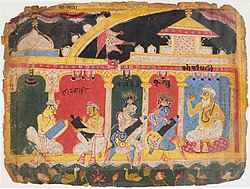
[[File:Krishna and Balarama Studying with the Brahman Sandipani (1525-1550 CE).jpg|thumb|left|''Krishna and [[Balarama]] Studying with the Brahman [[Sandipani]]'' (''[[Bhagavata Purana]]'', 1525-1550 CE print).]] | |||
Other legends describe him as an enchanter and playful lover of the gopis (milkmaids) of Vrindavana, especially [[Radha]]. These metaphor-filled love stories are known as the ''[[Rasa lila]]'' and were romanticized in the poetry of [[Jayadeva]], author of the [[Gita Govinda]]. They are also central to the development of the Krishna [[bhakti]] traditions worshiping [[Radha Krishna]].<ref>{{cite book|author = Schweig, G. M.|year = 2005|title = Dance of divine love: The Rasa Lila of Krishna from the Bhagavata Purana, India's classic sacred love story.|publisher = [[Princeton University Press]], Princeton, NJ; Oxford|isbn = 978-0-691-11446-0}}</ref> | |||
Krishna's childhood illustrates the Hindu concept of ''Lila'', playing for fun and enjoyment and not for sport or gain. His interaction with the gopis at the rasa dance or [[Rasa-lila]] is an example. Krishna plays his flute and the gopis come immediately, from whatever they were doing, to the banks of the [[Yamuna River]] and join him in singing and dancing. Even those who could not physically be there join him through meditation. He is the spiritual essence and the love-eternal in existence, the gopis metaphorically represent the ''[[prakṛti]]'' matter and the impermanent body.<ref name="Largen">{{cite book|author=Largen|first=Kristin Johnston|url=https://www.google.co.in/books/edition/Baby_Krishna_Infant_Christ/D7_gveSP6-sC?hl=en&gbpv=0|title=God at Play: Seeing God Through the Lens of the Young Krishna|publisher=Wiley-Blackwell|year=2011|isbn=978-1608330188|location=India|pages=|oclc=1030901369}}</ref>{{rp|256}} | |||
This ''Lila'' is a constant theme in the legends of Krishna's childhood and youth. Even when he is battling with a serpent to protect others, he is described in Hindu texts as if he were playing a game.<ref name=Largen />{{rp|255}} This quality of playfulness in Krishna is celebrated during festivals as Rasa-Lila and [[Janmashtami]], where Hindus in some regions such as [[Maharashtra]] playfully mimic his legends, such as by making human gymnastic pyramids to break open ''handis'' (clay pots) hung high in the air to "steal" butter or buttermilk, spilling it all over the group.<ref name=Largen />{{rp|253–261}} | |||
=== Adulthood === | |||
[[File:Krishna Rukmini Satyabhama Garuda.jpg|thumb|upright=0.8|Krishna with his consorts [[Rukmini]] and [[Satyabhama]] and his mount [[Garuda]], [[Tamil Nadu]], India, late 12th–13th{{nbsp}}century<ref name="lacma">{{cite web|url=http://collections.lacma.org/node/203163|title=Krishna Rajamannar with His Wives, Rukmini and Satyabhama, and His Mount, Garuda | LACMA Collections|publisher=collections.lacma.org|access-date=2014-09-23|archive-date=16 July 2014|archive-url=https://web.archive.org/web/20140716040855/http://collections.lacma.org/node/203163|url-status=dead}}</ref>]] | |||
Krishna legends then describe his return to Mathura. He overthrows and kills the tyrant king, ''his uncle'' Kamsa/Kansa after quelling several assassination attempts by Kamsa. He reinstates Kamsa's father, [[Ugrasena]] as the king of the [[Yadava]]s and becomes a leading prince at the court.<ref>{{Harvnb|Bryant|2007|p=290}}</ref> In one version of the Krishna story, as narrated by Shanta Rao, Krishna after Kamsa's death leads the Yadavas to the newly built city of [[Dvārakā|Dwaraka]]. Thereafter Pandavas rise. Krishna befriends [[Arjuna]] and the other [[Pandava]] princes of the [[Kuru (kingdom)|Kuru]] kingdom. Krishna plays a key role in the ''Mahabharata''.<ref>{{cite book|last1=Rao|first1=Shanta Rameshwar|title=Krishna|date=2005|publisher=Orient Longman|location=New Delhi|isbn=978-8125026969|page=108|url=https://books.google.com/books?id=NJ747fOWTRMC&pg=PA1}}</ref> | |||
The Bhagavata Purana describes [[Ashtabharya|eight wives]] of Krishna that appear in sequence as [[Rukmini]], [[Satyabhama]], [[Jambavati]], [[Kalindi]], [[Mitravinda]], [[Nagnajiti]] (also called Satya), [[Bhadra (Krishna's wife)|Bhadra]] and [[Lakshmana (Krishna's wife)|Lakshmana]] (also called Madra).<ref name="Hudson2008">{{cite book|author=D Dennis Hudson|title=The Body of God : An Emperor's Palace for Krishna in Eighth-Century Kanchipuram: An Emperor's Palace for Krishna in Eighth-Century Kanchipuram|url=https://books.google.com/books?id=IMCxbOezDi4C&pg=PA264|access-date=28 March 2013|year=2008|publisher=Oxford University Press|isbn=978-0-19-970902-1|pages=263–264}}</ref> According to Dennis Hudson, this is a metaphor where each of the eight wives signifies a different aspect of him.<ref>{{cite book|author=D Dennis Hudson|title=The Body of God : An Emperor's Palace for Krishna in Eighth-Century Kanchipuram: An Emperor's Palace for Krishna in Eighth-Century Kanchipuram|url=https://books.google.com/books?id=IMCxbOezDi4C&pg=PA264|access-date=28 March 2013|date=2008|publisher=Oxford University Press|isbn=978-0-19-970902-1|pages=102–103, 263–273}}</ref> According to George Williams, Vaishnava texts mention all Gopis as wives of Krishna, but this is spiritual symbolism of devotional relationship and Krishna's complete loving devotion to each and everyone devoted to him.<ref>{{cite book|author=George Mason Williams|title=Handbook of Hindu Mythology|url=https://books.google.com/books?id=N7LOZfwCDpEC&pg=PA188|access-date=10 March 2013|year=2008|publisher=Oxford University Press|isbn=978-0-19-533261-2|pages=188, 222}}</ref> | |||
In Krishna-related Hindu traditions, he is most commonly seen with [[Radha]]. All of his wives and his lover Radha are considered in the Hindu tradition to be the [[avatar]]s of the goddess [[Lakshmi]], the consort of Vishnu.<ref>{{Harvnb|Rosen|2006|p=136}}</ref>{{sfn|Bryant|2007|p=443}} [[Gopi]]s are considered as Lakshmi's or Radha's manifestations.{{sfn|Bryant|2007|p=443}}<ref name=hawley13>{{cite book|title = The Divine Consort: Rādhā and the Goddesses of India|author=John Stratton Hawley, Donna Marie Wulff|publisher=Motilal Banarsidass Publisher|date= 1982|isbn = 978-0-89581-102-8|page=12}} Quote: "The regional texts vary in the identity of Krishna's wife (consort), some presenting it as Rukmini, some as Radha, some as Svaminiji, some adding all ''gopis'', and some identifying all to be different aspects or manifestation of one [[Devi]] Lakshmi."</ref> | |||
=== Kurukshetra War and ''Bhagavad Gita'' === | |||
{{Main|Kurukshetra War|Bhagavad Gita}} | |||
According to the epic poem ''Mahabharata'', Krishna becomes Arjuna's charioteer for the [[Kurukshetra War]], but on the condition that he personally will not raise any weapon. Upon arrival at the battlefield and seeing that the enemies are his family, his grandfather, and his cousins and loved ones, Arjuna is moved and says his heart will not allow him to fight and kill others. He would rather renounce the kingdom and put down his ''[[Gandiva]]'' (Arjuna's bow). Krishna then advises him about the nature of life, ethics, and morality when one is faced with a war between good and evil, the impermanence of matter, the permanence of the soul and the good, duties and responsibilities, the nature of true peace and bliss and the different types of yoga to reach this state of bliss and inner liberation. This conversation between Krishna and Arjuna is presented as a discourse called the ''[[Bhagavad Gita]]''.<ref>Krishna in the Bhagavad Gita, by Robert N. Minor in {{Harvnb|Bryant|2007|pp=77–79}}</ref><ref>{{cite book|author=Jeaneane D. Fowler|title=The Bhagavad Gita: A Text and Commentary for Students|url=https://books.google.com/books?id=dHX5XwAACAAJ|year=2012|publisher=Sussex Academic Press|isbn=978-1-84519-520-5|pages=1–7}}</ref><ref>{{cite book|author=Eknath Easwaran|title=The Bhagavad Gita: (Classics of Indian Spirituality)|url=https://books.google.com/books?id=bcnJAAAAQBAJ|year=2007|publisher=Nilgiri Press|isbn=978-1-58638-019-9|pages=21–59}}</ref> | |||
=== Death and ascension === | |||
{{Main|Mausala Parva}} | |||
It is stated in the Indian texts that the legendary Kurukshetra War led to the death of all the hundred sons of Gandhari. After Duryodhana's death, Krishna visits Gandhari to offer his condolences when Gandhari and Dhritarashtra visited Kurukshetra, as stated in Stree Parva. Feeling that Krishna deliberately did not put an end to the war, in a fit of rage and sorrow, Gandhari said, "Thou were indifferent to the Kurus and the Pandavas whilst they slew each other. Therefore, O Govinda, thou shalt be the slayer of thy own kinsmen!" According to the ''Mahabharata'', a fight breaks out at a festival among the Yadavas, who end up killing each other. Mistaking the sleeping Krishna for a deer, a hunter named Jara shoots an arrow towards Krishna's foot that fatally injures him. Krishna forgives ''Jara'' and dies.<ref>{{Harvnb|Bryant|2007|p=148}}</ref><ref name=eck380>{{cite book|author=Diana L. Eck|title=India: A Sacred Geography|url=https://books.google.com/books?id=uD_0P6gS-vMC&pg=PA380|year=2012|publisher=Harmony |isbn=978-0-385-53190-0|pages=380–381}}, Quote: "Krishna was shot through the foot, hand, and heart by the single arrow of a hunter named Jara. Krishna was reclining there, so they say, and Jara mistook his reddish foot for a deer and released his arrow. There Krishna died."</ref><ref name="Mani, Vettam 1975 429">{{cite book|author = Mani, Vettam|title = Puranic Encyclopaedia: A Comprehensive Dictionary With Special Reference to the Epic and Puranic Literature|url = https://archive.org/details/puranicencyclopa00maniuoft|publisher = Motilal Banarsidass|year = 1975|location = Delhi|isbn = 978-0-8426-0822-0|author-link =Vettam Mani|page=[https://archive.org/details/puranicencyclopa00maniuoft/page/429 429]}}</ref> The pilgrimage (''[[Tirtha (Hinduism)|tirtha]]'') site of [[Bhalka]] in [[Gujarat]] marks the location where Krishna is believed to have died. It is also known as ''Dehotsarga'', states [[Diana L. Eck]], a term that literally means the place where Krishna "gave up his body".<ref name=eck380 /> The ''Bhagavata Purana'' in Book 11, Chapter 31 states that after his death, Krishna returned to his transcendent abode directly because of his yogic concentration. Waiting gods such as [[Brahma]] and [[Indra]] were unable to trace the path Krishna took to leave his human incarnation and return to his abode.<ref>{{cite book|author=Edwin Bryant|title=Krishna: The Beautiful Legend of God: Srimad Bhagavata Purana|url= https://books.google.com/books?id=y8Bb0tRW7W4C |year= 2003|publisher=Penguin |isbn=978-0-14-191337-7|pages=417–418}}</ref><ref>{{Cite book|title=Baby Krishna, Infant Christ: A Comparative Theology of Salvation|last=Largen|first=Kristin Johnston|publisher=Orbis Books|year=2011|isbn=978-1-60833-018-8|page=44}}</ref> | |||
=== Versions and interpretations === | |||
{{multiple image | |||
| align = right | |||
| image1 = Sri nathji.jpg | |||
| width1 = 130 | |||
| image2 = Lord Jagannath Patachitra.jpg | |||
| width2 = 130 | |||
| image3 = Syayambhuvithoba.jpg | |||
| width3 = 90 | |||
| footer = Krishna iconography appears in many versions across India. For example (left to right): Srinath, Jagannath, Vithoba. | |||
}} | |||
There are numerous versions of Krishna's life story, of which three are most studied: the ''Harivamsa'', the ''Bhagavata Purana'', and the ''Vishnu Purana''.{{sfn|Matchett|2001|pp=9–14, 145–149}} They share the basic storyline but vary significantly in their specifics, details, and styles.<ref>{{cite book|author=Benjamín Preciado-Solís|title=The Kṛṣṇa Cycle in the Purāṇas: Themes and Motifs in a Heroic Saga |url=https://books.google.com/books?id=JvCaWvjGDVEC&pg=PA40 |year=1984|publisher=Motilal Banarsidass |isbn=978-0-89581-226-1|page=40}}, Quote: "Within a period of four or five centuries [around the start of the common era], we encounter our major sources of information, all in different versions. The Mahabharata, the Harivamsa, the Visnu Purana, the Ghata Jataka, and the Bala Carita all appear between the first and the fifth century AD, and each of them represents a tradition of a Krsna cycle different from the others".</ref> The most original composition, the ''Harivamsa'' is told in a realistic style that describes Krishna's life as a poor herder but weaves in poetic and [[Allusion|allusive]] fantasy. It ends on a triumphal note, not with the death of Krishna.{{sfn|Matchett|2001|pp=44–49, 63–64, 145}} Differing in some details, the fifth book of the ''Vishnu Purana'' moves away from ''Harivamsa'' realism and embeds Krishna in mystical terms and eulogies.{{sfn|Matchett|2001|pp=89–104, 146}} The ''Vishnu Purana'' manuscripts exist in many versions.{{sfn|Rocher|1986|pp=18, 245–249}} | |||
The tenth and eleventh books of the ''Bhagavata Purana'' are widely considered to be a poetic masterpiece, full of imagination and metaphors, with no relation to the realism of pastoral life found in the ''Harivamsa''. Krishna's life is presented as a cosmic play (''Lila''), where his youth is set as a princely life with his foster father Nanda portrayed as a king.{{sfn|Matchett|2001|pp=108–115, 146–147}} Krishna's life is closer to that of a human being in ''Harivamsa'', but is a symbolic universe in the ''Bhagavata Purana'', where Krishna is within the universe and beyond it, as well as the universe itself, always.{{sfn|Matchett|2001|pp=145–149}} The ''Bhagavata Purana'' manuscripts also exist in many versions, in numerous Indian languages.{{sfn|Rocher|1986|pp=138–149}}{{sfn|Bryant|2007|p=112}} | |||
[[Chaitanya Mahaprabhu]] is considered as the incarnation of Krishna in [[Gaudiya Vaishnavism]] and by the [[ISKCON]] community.<ref>{{cite news |title=Gaura Purnima Mahotsava By International Society for Krishna Consciousness (ISKCON) | |||
|url=https://www.sentinelassam.com/news/gaura-purnima-mahotsava-by-international-society-for-krishna-consciousness-iskcon/|date=18 March 2019 |newspaper=Sentinelassam |department=City: Guwahati|access-date=30 January 2020}}</ref><ref>{{cite news |title=Alfred Ford on mission to fund biggest temple | |||
|url=https://telanganatoday.com/alfred-ford-on-mission-to-fund-biggest-temple|date=14 October 2019 |newspaper=Telanganatoday |department=City: Hyderabad|access-date=30 January 2020}}</ref><ref>Benjamin E. Zeller (2010), ''Prophets and Protons'', New York University Press, {{ISBN|978-0814797211}}, pp. 77–79</ref> | |||
== Proposed datings == | |||
{{See also|Vedic-Puranic chronology|History of Hinduism}} | |||
[[File:RadhaKrishnaUdaipur.JPG|thumb|upright|14th-century [[fresco]] of [[Radha Krishna]] in [[Udaipur]], Rajasthan]] | |||
The date of Krishna's birth is celebrated every year as [[Janmashtami]].{{sfn|Knott|2000}}{{page needed|date=December 2021}} | |||
According to Guy Beck, "most scholars of Hinduism and Indian history accept the historicity of Krishna{{snd}}that he was a real male person, whether human or divine, who lived on Indian soil by at least 1000 BCE and interacted with many other historical persons within the cycles of the epic and puranic histories." Yet, Beck also notes that there is an "enormous number of contradictions and discrepancies surrounding the chronology of Krishna's life as depicted in the Sanskrit canon".<ref>{{cite book|title=Alternative Krishnas: Regional And Vernacular Variations on a Hindu Deity|pages=4–5|first=Guy|last=Beck|publisher=Suny Press|url=https://books.google.com/books?id=K0XqbG0LKBUC&pg=PA4|isbn=978-0-7914-8341-1|date=2012}}</ref> | |||
According to mythologies in the Jain tradition, Krishna was a cousin of Neminatha.{{sfn|Sangave|2001|p=104}} Neminatha is believed in the Jain tradition to have been born 84,000 years before the 9th-century{{nbsp}}BCE [[Parshvanatha]], the twenty-third ''tirthankara''.{{sfn|Zimmer|1953|p=226}} | |||
== Philosophy and theology == | |||
[[File:12th-century Krishna playing flute with gathered living beings lost in music at Shaivism Hindu temple Hoysaleswara arts Halebidu Karnataka India.jpg|thumb|12th-century art depicting Krishna playing flute with gathered living beings at [[Hoysaleswara Temple|Hoysaleswara temple]], Karnataka]] | |||
A wide range of theological and philosophical ideas are presented through Krishna in Hindu texts. The teachings of the ''[[Bhagavad Gita]]'' can be considered, according to [[Friedhelm Hardy]], as the first Krishnaite system of theology.{{sfn|Hardy|1987|pp=387–392}} | |||
[[Ramanuja]], a Hindu theologian and philosopher whose works were influential in [[Bhakti movement]],<ref name="KulkeRothermund2004p149">{{cite book|author1=Hermann Kulke|author2=Dietmar Rothermund|title=A History of India|url=https://books.google.com/books?id=RoW9GuFJ9GIC&pg=PA149|year=2004|publisher=Routledge|isbn=978-0-415-32920-0|page=149}}</ref> presented him in terms of qualified [[monism]], or [[nondualism]] (namely [[Vishishtadvaita]] school).{{sfn|Bryant|2007|pp=329–334 (Francis X Clooney)}} [[Madhvacharya]], a philosopher whose works led to the founding of [[Haridasa]] tradition of Vaishnavism,<ref name="SharmaB">{{cite book|author1=Sharma|author2=B. N. Krishnamurti|title=A History of the Dvaita School of Vedānta and Its Literature|year=2000|publisher=Motilal Banarsidass|isbn=978-8120815759|pages=514–516}}</ref> presented Krishna in the framework of [[Dualism (Indian philosophy)|dualism]] ([[Dvaita]]).{{sfn|Bryant|2007|pp=358–365 (Deepak Sarma)}} [[Bhedabheda]]{{snd}}a group of schools, which teaches that the individual self is both different and not different from the ultimate reality{{snd}}predates the positions of monism and dualism. Among medieval Bhedabheda thinkers are [[Nimbarkacharya]], who founded the [[Nimbarka Sampradaya|Kumara Sampradaya]] (Dvaitadvaita philosophical school),{{sfn|Ramnarace|2014|p=}} as well as [[Jiva Goswami]], a saint from [[Gaudiya Vaishnavism|Gaudiya Vaishnava school]],<ref>{{cite web|last=Tripurari |first=Swami |title=The Life of Sri Jiva Goswami |url=http://harmonist.us/2009/12/the-life-of-sri-jiva-goswami/ |work=Harmonist |url-status=dead |archive-url=https://web.archive.org/web/20130324101939/http://harmonist.us/2009/12/the-life-of-sri-jiva-goswami/ |archive-date=24 March 2013 }}</ref> described Krishna theology in terms of Bhakti yoga and [[Achintya Bheda Abheda]].{{sfn|Bryant|2007|pp=373–378 (Satyanarayana Dasa)}} Krishna theology is presented in a pure monism ([[advaita]], called ''shuddhadvaita'') framework by [[Vallabha Acharya]], who was the founder of [[Pushtimarg|Pushti]] sect of vaishnavism.<ref>{{cite book | url=https://books.google.com/books?id=175zjT9bStcC&q=nathdwara | title=Culture of a Sacred Town: A Sociological Study of Nathdwara | publisher=Popular Prakashan | author=Jindel, Rajendra | year=1976 | pages=34, 37 | isbn=978-8171540402}}</ref>{{sfn|Bryant|2007|pp=479–480 (Richard Barz)}} Madhusudana Sarasvati, an India philosopher,<ref name="David_1996">{{cite book |chapter-url=https://books.google.com/books?id=jEUdPqYQjhoC&pg=PA156 |title=Contesting the Nation |editor=David Ludden |chapter=Soldier Monks and Militant Sadhus |author=William R. Pinch |publisher=University of Pennsylvania Press |year=1996 |isbn=978-0-8122-1585-4 |pages=148–150 }}</ref> presented Krishna theology in nondualism-monism framework ([[Advaita Vedanta]]), while [[Adi Shankara]], who is credited for unifying and establishing the main currents of thought in [[Hinduism]],<ref>Johannes de Kruijf and Ajaya Sahoo (2014), ''Indian Transnationalism Online: New Perspectives on Diaspora'', {{ISBN|978-1-4724-1913-2}}, p. 105, Quote: "In other words, according to Adi Shankara's argument, the philosophy of Advaita Vedanta stood over and above all other forms of Hinduism and encapsulated them. This then united Hinduism; (...) Another of Adi Shankara's important undertakings which contributed to the unification of Hinduism was his founding of a number of monastic centers."</ref><ref>''Shankara'', Student's Encyclopædia Britannica – India (2000), Volume 4, Encyclopædia Britannica (UK) Publishing, {{ISBN|978-0-85229-760-5}}, p. 379, Quote: "Shankaracharya, philosopher and theologian, most renowned exponent of the Advaita Vedanta school of philosophy, from whose doctrines the main currents of modern Indian thought are derived.";<br />David Crystal (2004), The Penguin Encyclopedia, Penguin Books, p. 1353, Quote: "[Shankara] is the most famous exponent of Advaita Vedanta school of Hindu philosophy and the source of the main currents of modern Hindu thought."</ref><ref>Christophe Jaffrelot (1998), ''The Hindu Nationalist Movement in India'', Columbia University Press, {{ISBN|978-0-231-10335-0}}, p. 2, Quote: "The main current of Hinduism – if not the only one – which became formalized in a way that approximates to an ecclesiastical structure was that of Shankara".</ref> mentioned Krishna in his early eighth-century discussions on [[Panchayatana puja]].{{sfn|Bryant|2007|pp=313–318 (Lance Nelson)}} | |||
The ''Bhagavata Purana'', a popular text on Krishna considered to be like scripture in [[Assam]], synthesizes an Advaita, Samkhya, and Yoga framework for Krishna but one that proceeds through loving devotion to Krishna. {{sfn|Sheridan|1986|pp=1–2, 17–25}}{{sfn|Kumar Das|2006| pages=172–173}}{{sfn|Brown|1983|pages=553–557}} Bryant describes the synthesis of ideas in Bhagavata Purana as, | |||
{{Blockquote|The philosophy of the Bhagavata is a mixture of Vedanta terminology, Samkhyan metaphysics, and devotionalized Yoga praxis. (...) The tenth book promotes Krishna as the highest absolute personal aspect of godhead – the personality behind the term [[Ishvara]] and the ultimate aspect of [[Brahman]].|Edwin Bryant|''Krishna: A Sourcebook''{{sfn|Bryant|2007|p=114}}}} | |||
While Sheridan and Pintchman both affirm Bryant's view, the latter adds that the Vedantic view emphasized in the Bhagavata is [[nondualism|non-dualist]] with a difference. In conventional nondual Vedanta, all reality is interconnected and one, the Bhagavata posits that the reality is interconnected and plural.<ref>Tracy Pintchman (1994), ''The rise of the Goddess in the Hindu Tradition'', State University of New York Press, {{ISBN|978-0791421123}}, pp. 132–134</ref>{{sfn|Sheridan|1986|pages=17–21}} | |||
Across the various theologies and philosophies, the common theme presents Krishna as the essence and symbol of divine love, with human life and love as a reflection of the divine. The longing and love-filled legends of Krishna and the gopis, his playful pranks as a baby,<ref>{{cite book|author=John Stratton Hawley|title=Krishna, The Butter Thief|url=https://books.google.com/books?id=ncb_AwAAQBAJ |year=2014|publisher=Princeton University Press|isbn=978-1-4008-5540-7|pages=10, 170}}</ref> as well as his later dialogues with other characters, are philosophically treated as metaphors for the human longing for the divine and for meaning, and the play between the universals and the human soul.<ref>[https://www.britannica.com/topic/Krishna-Hindu-deity Krishna: Hindu Deity], Encyclopædia Britannica (2015)</ref><ref>{{cite book|author=John M Koller|title=The Indian Way: An Introduction to the Philosophies & Religions of India |url=https://books.google.com/books?id=lgg3DAAAQBAJ&pg=PA210 |year=2016|publisher=Routledge|isbn=978-1-315-50740-8|pages=210–215}}</ref><ref>{{cite journal | last=Vaudeville | first=Ch. | title=Evolution of Love-Symbolism in Bhagavatism | journal=Journal of the American Oriental Society | volume=82 | issue=1 | pages=31–40 | year=1962 | doi=10.2307/595976 | jstor=595976}}</ref> Krishna's ''lila'' is a theology of love-play. According to John Koller, "love is presented not simply as a means to salvation, it is the highest life". Human love is God's love.<ref>{{cite book|author=John M Koller|title=The Indian Way: An Introduction to the Philosophies & Religions of India |url=https://books.google.com/books?id=lgg3DAAAQBAJ&pg=PA210 |year=2016|publisher=Routledge|isbn=978-1-315-50740-8|page=210}}</ref> | |||
Other texts that include Krishna such as the ''[[Bhagavad Gita]]'' have attracted numerous ''[[bhasya]]'' (commentaries) in the Hindu traditions.<ref name=Juanxxvi /> Though only a part of the Hindu epic ''Mahabharata'', it has functioned as an independent spiritual guide. It allegorically raises through Krishna and Arjuna the ethical and moral dilemmas of human life, then presents a spectrum of answers, weighing in on the ideological questions on human freedoms, choices, and responsibilities towards self and towards others.<ref name=Juanxxvi /><ref name=feuersteinix /> This Krishna dialogue has attracted numerous interpretations, from being a metaphor of inner human struggle teaching non-violence, to being a metaphor of outer human struggle teaching a rejection of quietism to persecution.<ref name=Juanxxvi>{{cite book|author=Juan Mascaró|title=The Bhagavad Gita|url=https://books.google.com/books?id=UZEKghCNbVIC |year=1962|publisher=Penguin|isbn=978-0-14-044918-1|pages=xxvi–xxviii}}</ref><ref name=feuersteinix>{{cite book|author1=Georg Feuerstein|author2=Brenda Feuerstein|title=The Bhagavad-Gita: A New Translation|url=https://books.google.com/books?id=V0exkVFiyvcC |year=2011| publisher=Shambhala Publications|isbn=978-1-59030-893-6|pages=ix–xi}}</ref><ref>{{cite book|author=Nicholas F. Gier|title=The Virtue of Nonviolence: From Gautama to Gandhi|url=https://books.google.com/books?id=tVLt99uleLwC&pg=PA36| year=2004| publisher= State University of New York Press|isbn=978-0-7914-5949-2|pages=36–40}}</ref> | |||
== Influence == | |||
=== Vaishnavism === | |||
{{Main|Vaishnavism|Krishnaism}} | |||
The worship of Krishna is part of [[Vaishnavism]], a major tradition within Hinduism. Krishna is considered a full avatar of Vishnu, or one with Vishnu himself.<ref>{{cite book |author=John Dowson |title=Classical Dictionary of Hindu Mythology and Religion, Geography, History and Literature |publisher=Kessinger Publishing |year=2003 |page= 361|isbn=978-0-7661-7589-1| url = https://books.google.com/books?id=6JB-KOXy5k8C&q=Vishnu+Sahasranama+Krishna&pg=PA361}}</ref> However, the exact relationship between Krishna and Vishnu is complex and diverse,<ref name = Beck>See Beck, Guy, ''"Introduction"'' in {{Harvnb|Beck|2005|pp=1–18}}</ref> with Krishna of [[Krishnaism|Krishnaite]] sampradayas considered an independent deity and supreme.{{sfn|Hardy|1987|pp=387–392}}<ref name=Knott55>{{Harvnb|Knott|2000|p=55}}</ref> Vaishnavas accept many incarnations of Vishnu, but Krishna is particularly important. Their theologies are generally centered either on Vishnu or an avatar such as Krishna as supreme. The terms [[Krishnaism]] and Vishnuism have sometimes been used to distinguish the two, the former implying that Krishna is the transcendent Supreme Being. {{sfn|Flood|1996|p =117}} Some scholars, as [[Friedhelm Hardy]], do not define Krishnaism as a sub-order or offshoot of Vaishnavism, considering it a parallel and no less ancient current of Hinduism.{{sfn|Hardy|1987|pp=387–392}} | |||
All Vaishnava traditions recognise Krishna as the eighth avatar of Vishnu; others identify Krishna with Vishnu, while Krishnaite traditions such as [[Gaudiya Vaishnavism]],<ref name = McDaniel>See McDaniel, June, ''Folk Vaishnavism and {{IAST|Ṭhākur Pañcāyat}}: Life and status among village Krishna statues'' in {{Harvnb|Beck|2005|p=39}}</ref><ref name=Kennedy1925>{{cite book| author = Kennedy, M. T.| year = 1925 | title = The Chaitanya Movement: A Study of the Vaishnavism of Bengal| url = https://archive.org/details/pli.kerala.rare.24847| publisher = H. Milford, Oxford university press}}</ref> [[Ekasarana Dharma]], [[Mahanam Sampraday]], [[Nimbarka Sampradaya]] and the [[Pushtimarg|Vallabha Sampradaya]] regard Krishna as the ''[[Svayam Bhagavan]]'', the original form of Lord or the same as the concept of [[Brahman]] in Hinduism.<ref name="KK">{{cite book |author=K. Klostermaier |title=The Charles Strong Trust Lectures, 1972–1984 |publisher=Brill Academic Pub |year=1997 |page= 109 |isbn=978-90-04-07863-5 |quote=(...) After attaining to fame eternal, he again took up his real nature as [[Brahman]]. The most important among Visnu's avataras is undoubtedly Krsna, the black one, also called ''Syama''. For his worshippers he is not an avatara in the usual sense, but Svayam Bhagavan, the Lord himself.|url= https://books.google.com/books?id=F_0UAAAAIAAJ&q=Svayam+bhagavan&pg=PA109 | others = Crotty, Robert B.}}</ref><ref name = VaisnavaInstitute1956>{{cite book |title= Indian Philosophy & Culture, Volume 20 |year= 1975|publisher=The Institute |page= 148|url= https://books.google.com/books?id=yEMB3RBwjTsC |others= Institute of Oriental Philosophy (Vrindāvan, India), Institute of Oriental Philosophy, Vaishnava Research Institute, contributors |quote=On the touch-stone of this definition of the final and positive characteristic of Sri Krsna as the Highest Divinity as Svayam-rupa Bhagavan}}</ref><ref name=Delmonico>Delmonico, N., ''The History Of Indic Monotheism And Modern Chaitanya Vaishnavism'' in {{Harvnb|Bryant|Ekstrand|2004}}</ref><ref name=De1960>{{cite book|author = De, S. K.|year = 1960|title = Bengal's contribution to Sanskrit literature & studies in Bengal Vaisnavism|publisher = KL Mukhopadhyaya}} p. 113: "The Bengal School identifies the Bhagavat with Krishna depicted in the Shrimad-Bhagavata and presents him as its highest personal God."</ref><ref>{{Harvnb|Bryant|2007|p=381}}</ref> [[Gitagovinda]] of [[Jayadeva]] considers Krishna to be the supreme lord while the ten incarnations are his forms. [[Swaminarayan]], the founder of the [[Swaminarayan Sampradaya]], also worshipped Krishna as God himself. "Greater Krishnaism" corresponds to the second and dominant phase of Vaishnavism, revolving around the cults of the [[Vasudeva]], Krishna, and [[Gopal (Krishna)|Gopala]] of the late [[Vedic period]].<ref>{{cite encyclopedia|url= http://philtar.ucsm.ac.uk/encyclopedia/hindu/devot/vaish.html|title= Vaishnava|access-date= 13 October 2008|encyclopedia= encyclopedia|publisher= Division of Religion and Philosophy University of Cumbria|url-status=dead|archive-url= https://web.archive.org/web/20120212183626/http://www.philtar.ac.uk/encyclopedia/hindu/devot/vaish.html|archive-date= 12 February 2012|df= dmy-all}}, University of Cumbria website Retrieved 21 May 2008</ref> Today the faith has a significant following outside of India as well.<ref name="Princeton">{{cite book|author = Graham M. Schweig|title = Dance of Divine Love: The Rڄasa Lڄilڄa of Krishna from the Bhڄagavata Purڄa. na, India's classic sacred love story|publisher = Princeton University Press|location = Princeton, N.J.|year = 2005|pages = Front Matter|isbn = 978-0-691-11446-0|no-pp = true}}</ref> | |||
'''Early traditions''' | |||
The deity ''[[Krishna-Vasudeva]]'' (''{{IAST|kṛṣṇa vāsudeva}}'' "Krishna, the son of [[Vasudeva Anakadundubhi]]") is historically one of the earliest forms of worship in [[Krishnaism]] and [[Vaishnavism]].<ref name="Cultofgopal">{{cite journal|title = A Revolution in {{IAST|Kṛṣṇaism}}: The Cult of Gopāla |last = Hein|first = Norvin|jstor = 1062622 |volume=25 |issue = 4|pages=296–317 |doi=10.1086/463051 |journal=History of Religions |year=1986|s2cid = 162049250}}</ref><ref name = bryant4 /> It is believed to be a significant tradition of the early history of Krishna religion in antiquity.<ref>Bhattacharya, Gouriswar: ''Vanamala of Vasudeva-Krsna-Visnu and Sankarsana-Balarama''. In: Vanamala. Festschrift A. J. Gail. Serta Adalberto Joanni Gail LXV. diem natalem celebranti ab amicis collegis discipulis dedicata.</ref> Thereafter, there was an amalgamation of various similar traditions. These include ancient [[Bhagavatism]], the cult of [[Gopala]], of "Krishna Govinda" (cow-finding Krishna), of [[Bala Krishna|Balakrishna]] (baby Krishna) and of "Krishna Gopivallabha<ref>{{cite web|date=2014-08-05|title=Gopala: Understanding the Essence of Krishna as a Cowherd|url=https://isha.sadhguru.org/in/en/wisdom/article/gopala-understanding-essence-krishna-cowherd |access-date=2021-06-30 |website=Isha Sadhguru|language=en}}</ref>" (Krishna the lover).<ref name=kk20072>{{cite book|author = Klostermaier, Klaus K.|pages = [https://archive.org/details/surveyhinduismth00klos/page/n221 203]–204|year = 2005|title = A Survey of Hinduism|url = https://archive.org/details/surveyhinduismth00klos|url-access = limited|publisher = State University of New York Press; 3 edition|isbn = 978-0-7914-7081-7|quote = Present-day Krishna worship is an amalgam of various elements. According to historical testimonies, Krishna-Vasudeva worship already flourished in and around Mathura several centuries before Christ. A second important element is the cult of Krishna Govinda. Still later is the worship of Bala-Krishna, the Child Krishna{{snd}}a quite prominent feature of modern Krishnaism. The last element seems to have been Krishna Gopijanavallabha, Krishna the lover of the Gopis, among whom Radha occupies a special position. In some books, Krishna is presented as the founder and first teacher of the Bhagavata religion.}}</ref><ref>{{cite journal|title = Review: ''Krishna: Myths, Rites, and Attitudes''. by Milton Singer; Daniel H. H. Ingalls|journal=The Journal of Asian Studies |volume=27 |number=3 |date=May 1968|last = Basham|first = A. L. | |||
|jstor = 2051211|pages=667–670 |doi=10.2307/2051211|s2cid=161458918 }}</ref> According to Andre Couture, the [[Harivamsa]] contributed to the synthesis of various characters as aspects of Krishna.<ref>{{cite journal |title= The emergence of a group of four characters (Vasudeva, Samkarsana, Pradyumna, and Aniruddha) in the Harivamsa: points for consideration|journal = Journal of Indian Philosophy|author = Couture, André |s2cid = 170133349|year= 2006|volume = 34|issue = 6|pages= 571–585|doi= 10.1007/s10781-006-9009-x }}</ref> | |||
Already in the early Middle Ages, the Jagannathism ({{a.k.a.}} [[Odisha|Odia]] Vaishnavism) was origined as the cult of the god [[Jagannath]] ({{lit|'Lord of the Universe'}}){{snd}}an abstract form of Krishna.{{sfnm|1a1=Eschmann|1a2=Kulke|1a3=Tripathi|1y=1978|1p=|2a1=Hardy|2y=1987|2pp=387–392|3a1=Starza|3y=1993|3p=|4a1=Miśra|4y=2005|4loc=chapter 9. Jagannāthism}} Jagannathism was a regional temple-centered version of [[Krishnaism]],{{sfn|Hardy|1987|pp=387–392}} where Lord Jagannath is understood as a principal god, [[Purushottama]] and [[Para Brahman]], but can also be regarded as a non-sectarian syncretic Vaishnavite and all-Hindu cult.{{sfn|Miśra|2005|p=97|loc=chapter 9. Jagannāthism}} According to the ''Vishnudharma Purana'' ({{circa}} 4th century), Krishna is woshipped in the form of Purushottama in Odia (Odisha).{{sfn|Starza|1993|p=76}} The notable [[Jagannath Temple, Puri|Jagannath temple]] in [[Puri]], Odisha became particularly significant within the tradition since about 800 CE.{{sfn|Bryant|2007|pp=139–141}} | |||
=== Bhakti tradition === | |||
{{Main|Bhakti movement|Bhakti yoga}}[[File:Meerabai (crop).jpg|thumb|left|upright|Krishna has been a major part of the [[Bhakti movement]]. One of the key devotees was [[Meera]] (pictured).]] | |||
The use of the term bhakti, meaning devotion, is not confined to any one deity. However, Krishna is an important and popular focus of the devotionalism tradition within Hinduism, particularly among the [[Vaishnava]] [[Krishnaism|Krishnaite]] sects.<ref name = McDaniel /><ref name="Klostermaier1974">{{cite journal|author = Klostermaier, K.|year = 1974|title = The Bhaktirasamrtasindhubindu of Visvanatha Cakravartin|journal = Journal of the American Oriental Society|volume = 94|issue = 1|pages = 96–107|doi = 10.2307/599733 |jstor = 599733}}</ref> Devotees of Krishna subscribe to the concept of ''[[lila (divine play)|lila]]'', meaning 'divine play', as the central principle of the universe. It is a form of bhakti yoga, one of three types of yoga discussed by Krishna in the ''Bhagavad Gita''.<ref name="Kennedy1925" /><ref name="Jacobsen">{{cite book |editor-last=Jacobsen |editor-first=Knut A. | year = 2005 | title = Theory And Practice of Yoga: Essays in Honour of Gerald James Larson | page=351 | publisher = Brill Academic Publishers| isbn=978-90-04-14757-7}}</ref><ref name=chapple>Christopher Key Chapple (Editor) and Winthrop Sargeant (Translator), ''The Bhagavad Gita: Twenty-fifth–Anniversary Edition'', State University of New York Press, {{ISBN|978-1438428420}}, pp. 302–303, 318</ref> | |||
==== Indian subcontinent ==== | |||
The bhakti movements devoted to Krishna became prominent in southern India in the 7th to 9th{{nbsp}}centuries CE. The earliest works included those of the [[Alvars|Alvar]] saints of [[Tamil Nadu]].<ref name=Vaudeville1962>{{cite journal|author = Vaudeville, C.|year = 1962|title = Evolution of Love-Symbolism in Bhagavatism|journal = Journal of the American Oriental Society|volume = 82|issue = 1|pages = 31–40|doi = 10.2307/595976|jstor = 595976}}</ref> A major collection of their works is the ''[[Divya Prabandham]]''. Alvar [[Andal]]'s popular collection of songs [[Tiruppavai]], in which she conceives of herself as a gopi, is the most famous of the oldest works in this genre.<ref name="cassel">{{cite book |author=Bowen, Paul |title=Themes and issues in Hinduism |publisher=Cassell |location=London |year=1998 |pages=[https://archive.org/details/themesissuesinhi0000unse/page/64 64–65] |isbn=978-0-304-33851-1 |url=https://archive.org/details/themesissuesinhi0000unse/page/64 }}</ref><ref name=Radhak1975>{{cite book|author = Radhakrisnasarma, C.|year = 1975|title = Landmarks in Telugu Literature: A Short Survey of Telugu Literature|publisher = Lakshminarayana Granthamala}}</ref><ref name=histor>{{cite book|author = Sisir Kumar Das|year = 2005|title = A History of Indian Literature, 500–1399: From Courtly to the Popular|publisher = Sahitya Akademi|page = 49|isbn = 978-81-260-2171-0}}</ref> | |||
The movement originated in South India during the 7th century CE, spreading northwards from Tamil Nadu through Karnataka and Maharashtra; by the 15th{{nbsp}}century, it was established in Bengal and northern India.{{sfnp|Schomer|McLeod|1987|pp=1–2|ps=}} Early [[Krishnaism|Krishnaite]] Bhakti pioneers included [[Nimbarkacharya]] (12th or 13th{{nbsp}}century CE),{{sfn|Ramnarace|2014|p=}}<ref>[https://www.britannica.com/biography/Nimbarka-Indian-philosopher Nimbarka], Encyclopædia Britannica</ref>{{refn|group=note|"The first ''Kṛṣṇaite sampradāya'' was developed by Nimbārka."{{sfn|Hardy|1987|pp=387–392}}}} but most emerged later, including [[Vallabhacharya]] (15th{{nbsp}}century CE) and [[Chaitanya Mahaprabhu]]. They started their own schools, namely [[Nimbarka Sampradaya]], [[Vallabha Sampradaya]], and [[Gaudiya Vaishnavism]], with Krishna and Radha as the supreme gods. In addition, since the 15th century, flourished [[Tantra|Tantric]] variety of Krishnaism, [[Vaishnava-Sahajiya]], is linked to the Bengali poet [[Chandidas]].{{sfn|Basu|1932}} | |||
In the [[Deccan Plateau|Deccan]], particularly in [[Maharashtra]], saint poets of the [[Warkari]] sect such as [[Dnyaneshwar]], [[Namdev]], [[Janabai]], [[Eknath]], and [[Tukaram]] promoted the worship of [[Vithoba]],<ref name="vithoba" /> a local form of Krishna, from between the 13th to 18th century.<ref name=" Mahony1987" /> Before the Warkari tradition, Krishna devotion became well established in Maharashtra due to the rise of the [[Mahanubhava|Mahanubhava Sampradaya]] founded by Sarvajna [[Chakradhar Swami|Chakradhara]].<ref>The religious system of the Mahānubhāva sect, by Anne Feldhaus, Manohar publications: Delhi, 1983.</ref> The [[Pranami|Pranami Sampradaya]] emerged in the 17th century in [[Gujarat]], based on the Krishna-focussed syncretist Hindu-[[Islam]]ic teachings of Devchandra Maharaj and his famous successor, Mahamati Prannath.{{sfn|Toffin|2012|pp=249–254}} In southern India, [[Purandara Dasa]] and [[Kanakadasa]] of [[Karnataka]] composed songs devoted to the Krishna image of [[Udupi]]. [[Rupa Goswami]] of Gaudiya Vaishnavism has compiled a comprehensive summary of bhakti called Bhakti-rasamrita-sindhu.<ref name="Klostermaier1974" /> | |||
In South India, the acharyas of the Sri Sampradaya have written reverently about Krishna in most of their works, including the [[Thiruppavai]] by Andal<ref>{{cite web|title=Thiruppavai|url=http://www.ibiblio.org/sripedia/ebooks/tpv/|work=Ibiblio|access-date=2013-05-24}}</ref> and Gopala Vimshati by [[Vedanta Desika]].<ref>{{cite web|last=Desika|first=Vedanta|title=Gopala Vimshati|url=http://www.ibiblio.org/sripedia/ebooks/vdesikan/gopala_vimsati/index.html|work=Ibiblio, Sripedia|access-date=2013-05-23}}</ref> | |||
Tamil Nadu, Karnataka, Andhra Pradesh, and Kerala states have many major Krishna temples, and [[Janmashtami]] is one of the widely celebrated festivals in South India.<ref name="Maithily">{{cite book |last1=Jaganathan |first1=Maithily |title=South Indian Hindu festivals and traditions |chapter-url= https://books.google.com/books?id=xcIrkKUJH9QC|edition= 1st |year=2005 |publisher=Abhinav Publication |location=New Delhi |language=en |isbn=978-81-7017-415-8 |pages=104–105 |chapter=Sri Krishna Jayanti }}</ref> | |||
==== Outside Asia ==== | |||
[[File:Radhakrishna manor.JPG|thumb|upright|Krishna (left) with Radha at [[Bhaktivedanta Manor]], [[Watford]], England]] | |||
By 1965, the ''Krishna-bhakti'' movement had spread outside India after [[Bhaktivedanta Swami Prabhupada]] (as instructed by his [[guru]], [[Bhaktisiddhanta Sarasvati Thakura]]) travelled from his homeland in West Bengal to [[New York City]]. A year later, in 1966, after gaining many followers, he was able to form the [[International Society for Krishna Consciousness]] (ISKCON), popularly known as the Hare Krishna movement. The purpose of this movement was to write about Krishna in English and to share the [[Gaudiya Vaishnava]] philosophy with people in the Western world by spreading the teachings of the saint [[Chaitanya Mahaprabhu]]. In the biographies of Chaitanya Mahaprabhu, the mantra he received when he was given [[diksha]] or initiation in [[Gaya, India|Gaya]] was the six-word verse of the ''[[Kali-Saṇṭāraṇa Upaniṣad|Kali-Santarana Upanishad]]'', namely "Hare Krishna Hare Krishna, Krishna Krishna Hare Hare; Hare Rama Hare Rama, Rama Rama Hare Hare". In the Gaudiya tradition, it is the ''maha-mantra'', or great mantra, about Krishna [[bhakti]].{{sfn|Bryant|2013|p=42}}<ref>Alanna Kaivalya (2014), Sacred Sound: Discovering the Myth and Meaning of Mantra and Kirtan, New World, {{ISBN|978-1608682430}}, pp. 153–154</ref> Its chanting was known as ''hari-nama sankirtana''.<ref>''Srila Prabhupada – He Built a House in which the whole world can live in peace'', Satsvarupa Dasa Goswami, Bhaktivedanta Book Trust, 1984, {{ISBN|0-89213-133-0}} p. xv</ref> | |||
The ''maha-mantra'' gained the attention of [[George Harrison]] and [[John Lennon]] of [[The Beatles]] fame,<ref name=charlesbrooks83 /> and Harrison produced a 1969 recording of the mantra by devotees from the London [[Radha Krishna Temple]].<ref>Peter Lavezzoli (2006), ''The Dawn of Indian Music in the West'', Continuum, {{ISBN|0-8264-2819-3}}, p. 195</ref> Titled "[[Hare Krishna Mantra (song)|Hare Krishna Mantra]]", the song reached the top twenty on the UK music charts and was also successful in West Germany and Czechoslovakia.<ref name=charlesbrooks83 /><ref name=Clarke308>Peter Clarke (2005), ''Encyclopedia of New Religious Movements'', Routledge, {{ISBN|978-0415267076}}, p. 308 Quote: "There they captured the imagination of The Beatles, particularly George Harrison who helped them produce a chart-topping record of the Hare Krishna mantra (1969) and ...".</ref> The mantra of the Upanishad thus helped bring Bhaktivedanta and ISKCON ideas about Krishna into the West.<ref name=charlesbrooks83>Charles Brooks (1989), ''The Hare Krishnas in India'', Princeton University Press, {{ISBN|978-8120809390}}, pp. 83–85</ref> ISCKON has built many Krishna temples in the West, as well as other locations such as South Africa.<ref>{{cite book|author=Brian A. Hatcher|title=Hinduism in the Modern World|url=https://books.google.com/books?id=IdeoCgAAQBAJ&pg=PA118 |year= 2015|publisher=Routledge|isbn=978-1-135-04631-6|pages=118–119}}</ref> | |||
=== Southeast Asia === | |||
[[File:Krishna, Khuong My, 7th-8th century, Quang Nam - Museum of Cham Sculpture - Danang, Vietnam - DSC01580.JPG|thumb|left|''Krishna lifts "[[Govardhan Hill|Govardhan]]" mountain'', a 7th-century artwork from a [[Danang|Da Nang]], Vietnam, archaeological site<ref name="John2014p17" /><ref>{{cite book|author1=Anne-Valérie Schweyer|author2=Paisarn Piemmettawat|title=Viêt Nam ancien: histoire arts archéologie|url=https://books.google.com/books?id=mSrsUuIxZXkC&pg=PA388 |year=2011|publisher=Editions Olizane|isbn=978-2-88086-396-8|page=388}}</ref>]] | |||
Krishna is found in Southeast Asian history and art, but to a far lesser extent than [[Shiva]], [[Durga]], [[Nandi (bull)|Nandi]], [[Agastya]], and [[Buddha]]. In temples (''candi'') of the archaeological sites in hilly volcanic [[Java]], Indonesia, temple reliefs do not portray his pastoral life or his role as the erotic lover, nor do the historic Javanese Hindu texts.{{sfn|Marijke J. Klokke|2000|pp=19–23}} Rather, either his childhood or the life as a king and Arjuna's companion have been more favored. The most elaborate temple arts of Krishna is found in a series of ''Krsnayana'' reliefs in the Prambanan Hindu temple complex near [[Yogyakarta]]. These are dated to the 9th{{nbsp}}century CE.{{sfn|Marijke J. Klokke|2000|pp=19–23}}<ref>{{cite book |author=Subhadradis Diskul (M.C.) |author2=[[Jean Boisselier]] |editor=Natasha Eilenberg |editor2=Robert L. Brown |title=Living a life in accord with Dhamma: papers in honor of professor Jean Boisselier on his eightieth birthday |url=https://books.google.com/books?id=--m5oQEACAAJ |year=1997 |publisher=Silpakorn University |pages=191–204}}</ref><ref>{{cite book|author1=Triguṇa (Mpu.)|author2=Suwito Santoso|title=Krĕṣṇāyana: The Krĕṣṇa Legend in Indonesia|url=https://books.google.com/books?id=341kAAAAMAAJ |year=1986|publisher=IAIC| oclc= 15488486}}</ref> Krishna remained a part of the Javanese cultural and theological fabric through the 14th{{nbsp}}century, as evidenced by the 14th-century [[Penataran]] reliefs along with those of the Hindu god Rama in east Java, before Islam replaced Buddhism and Hinduism on the island.{{sfn|Marijke J. Klokke|2000|pp=19–23, for reliefs details see 24–41}} | |||
The medieval era arts of Vietnam and Cambodia feature Krishna. The earliest surviving sculptures and reliefs are from the 6th and 7th{{nbsp}}centuries, and these include Vaishnavism iconography.<ref name="John2014p17">{{cite book|author=John Guy|title=Lost Kingdoms: Hindu-Buddhist Sculpture of Early Southeast Asia|url=https://books.google.com/books?id=vO_-AgAAQBAJ|year=2014|publisher=Metropolitan Museum of Art|isbn=978-1-58839-524-5|pages=17, 146–148}}</ref> According to John Guy, the curator and director of Southeast Asian arts at the [[Metropolitan Museum of Art]], the Krishna Govardhana art from 6th/7th-century Vietnam at [[Danang]], and 7th-century Cambodia at [[Phnom Da]] cave in [[Angkor Borei District|Angkor Borei]], are some of the most sophisticated of this era.<ref name="John2014p17" /> | |||
Krishna's iconography has also been found in Thailand, along with those of [[Surya]] and [[Vishnu]]. For example, a large number of sculptures and icons have been found in the Si{{nbsp}}Thep and Klangnai sites in the [[Phetchabun Province|Phetchabun]] region of northern Thailand. These are dated to about the 7th and 8th{{nbsp}}centuries, from both the Funan and Zhenla period archaeological sites.<ref>{{cite book |author1=John Guy |author2=Pierre Baptiste |author3=Lawrence Becker |title=Lost Kingdoms: Hindu-Buddhist Sculpture of Early Southeast Asia|url=https://books.google.com/books?id=gCw_AwAAQBAJ |year=2014 |publisher=Yale University Press |isbn=978-0-300-20437-7 |pages=222–223 |display-authors=etal}}</ref> | |||
== Performance arts == | |||
{{multiple image | |||
| direction = horizontal | |||
| width1 = 100 | |||
| width2 = 250 | |||
| image1 = Flickr - dalbera - Danseuse de Kuchipudi jouant Krishna (musée Guimet).jpg | |||
| image2 = Rasa Lila in Manipuri dance style.jpg | |||
| footer = The Krishna legends in the ''Bhagavata Purana'' have inspired many performance arts repertoire, such as [[Kathak]], [[Kuchipudi]] (left) and [[Odissi]].<ref name="Kenneth Valpey 2013"/><ref name="ML Varadpande 1987"/> The ''[[Rasa lila|Rasa Lila]]'' where Krishna plays with the gopis in [[Manipuri dance]] style (right)}} | |||
Indian dance and music theatre traces its origins and techniques to the ancient ''[[Samaveda|Sama Veda]]'' and ''[[Natyasastra]]'' texts.{{sfn|Beck|1993|pp=107–108}}<ref>PV Kane, ''History of Sanskrit Poetics'', Motilal Banarsidass, {{ISBN|978-8120802742}} (2015 Reprint), pp. 10–41</ref> The stories enacted and the numerous choreographic themes are inspired by the mythologies and legends in Hindu texts, including Krishna-related literature such as ''[[Harivamsa]]'' and ''[[Bhagavata Purana]]''.{{sfn|Varadpande|1987|pages=92–94}} | |||
The Krishna stories have played a key role in the history of Indian theatre, music, and dance, particularly through the tradition of [[Rasa leela|''Rasaleela'']]. These are dramatic enactments of Krishna's childhood, adolescence, and adulthood. One common scene involves Krishna playing flute in Rasa Leela, only to be heard by certain gopis (cowherd maidens), which is theologically supposed to represent divine call only heard by certain enlightened beings.<ref>{{cite book |last1=Vemsani |first1=Lavanya |title=Krishna in history thought and culture |chapter-url= https://books.google.com/books?id=4fw2DAAAQBAJ |year=2016 |publisher=ABC-Clio LLC|location=California |language=en |isbn=978-1-61069-210-6|pages=179–180 |chapter=Music and Krishna }}</ref> Some of the text's legends have inspired secondary theatre literature such as the eroticism in [[Gita Govinda]].<ref>Graham Schweig (2007), ''Encyclopedia of Love in World Religions'' (Editor: Yudit Kornberg Greenberg), Volume{{nbsp}}1, {{ISBN|978-1851099801}}, pp. 247–249</ref> | |||
Krishna-related literature such as the ''Bhagavata Purana'' accords a metaphysical significance to the performances and treats them as a religious ritual, infusing daily life with spiritual meaning, thus representing a good, honest, happy life. Similarly, Krishna-inspired performances aim to cleanse the hearts of faithful actors and listeners. Singing, dancing, and performing any part of ''Krishna Lila'' is an act of remembering the dharma in the text, as a form of ''para bhakti'' (supreme devotion). To remember Krishna at any time and in any art, asserts the text, is to worship the good and the divine.{{sfn|Varadpande|1987|pages=95–97}} | |||
Classical dance styles such as [[Kathak]], [[Odissi dance|Odissi]], [[Manipuri dance|Manipuri]], [[Kuchipudi]] and [[Bharatanatyam]] in particular are known for their Krishna-related performances.{{sfn|Varadpande|1987|page=98}} [[Krisnattam]] (Krishnattam) traces its origins to Krishna legends, and is linked to another major classical Indian dance form called [[Kathakali]].<ref name=Zarrilli2000>{{cite book|author = Zarrilli, P. B.|year = 2000|title = Kathakali Dance-Drama: Where Gods and Demons Come to Play|url = https://archive.org/details/kathakalidancedr00zarr|url-access = limited|publisher = Routledge|page = [https://archive.org/details/kathakalidancedr00zarr/page/n262 246]}}</ref> Bryant summarizes the influence of Krishna stories in the ''Bhagavata Purana'' as, "[it] has inspired more derivative literature, poetry, drama, dance, theatre and art than any other text in the history of Sanskrit literature, with the possible exception of the ''[[Ramayana]]''.{{sfn|Bryant|2007|page=118}}{{sfn|Archer|2004}} | |||
The [[Palliyodam]], a type of large built and used by [[Aranmula Parthasarathy Temple]] in Kerala for the annual water processions of [[Aranmula Boat Race|Uthrattathi Jalamela]] and [[Valla Sadhya]] has the legend that it was designed by [[Lord Krishna]] and were made to look like [[Shesha]]naga, the serpent on which [[Lord Vishnu]] rests.<ref>{{Cite news|url=https://www.thenewsminute.com/article/explained-what-palliyodam-and-why-kerala-actor-was-arrested-photoshoot-it-155155|title=Explained: What is a Palliyodam, and why a Kerala actor was arrested for photoshoot on it|newspaper=thenewsminute|access-date=13 September 2021}}</ref> | |||
== Temples == | |||
{{Div col|colwidth=25em}} | |||
* [[Bankey Bihari Temple]] | |||
* [[Radha Raman Temple]] | |||
* [[Jagannath Temple, Puri]] | |||
* [[Dwarkadhish Temple]], [[Dwarka]] | |||
* [[Vithoba Temple]], [[Pandarpur]] | |||
* [[Shrinathji Temple]], [[Nathdwara]] | |||
* [[Guruvayur Temple]], [[Kerala]] | |||
* [[Radha Vallabh Temple, Vrindavan]] | |||
* [[Udupi Sri Krishna Matha]] | |||
* [[Prem Mandir, Vrindavan]] | |||
* [[Krishna Balaram Mandir]] | |||
* [[Dakor|Ranchodrai Temple, Dakor]] | |||
* [[Radha Damodar Temple, Junagadh]] | |||
* [[Radha Damodar Temple, Vrindavan]] | |||
* [[Govind Dev Ji Temple]], [[Jaipur]] | |||
* [[Shree Govindajee Temple]], [[Imphal]] | |||
* [[Madan Mohan Temple]], [[Karauli]] | |||
* [[Radha Madan Mohan Temple, Vrindavan]] | |||
* [[Dwarkadheesh temple Mathura]] | |||
* [[Radha Madhab Temple]], [[Bishnupur, Bankura|Bishnupur]] | |||
* [[Krishna Janmasthan Temple Complex]], [[Mathura]] | |||
* [[Kantajew Temple]], [[Bangladesh]] | |||
* [[Swaminarayan|Swaminarayan Temples]] | |||
** [[Shri Swaminarayan Mandir, Dholera]] | |||
** [[Swaminarayan Mandir, Gadhada|Gopinathji Dev Mandir]] | |||
* [[International Society for Krishna Consciousness|ISKCON Temples]] | |||
** [[ISKCON Temple, Bangalore|ISKCON Temple, Banglore]] | |||
** [[ISKCON Temple, Pune]] | |||
** [[ISKCON Temple, Delhi]] | |||
** [[Iskcon Prabartak Sri Krishna Temple]] | |||
** [[Vrindavan Chandrodaya Mandir|Vrindavan Chandrodara Mandir]] | |||
** [[ISKCON Temple, Chennai]] | |||
* [[Rajagopalaswamy Temple, Mannargudi]] | |||
* [[Parthasarathy Temple, Chennai]] | |||
{{Div col end}} | |||
== Krishna outside of Hinduism == | |||
[[File:Radhamadhava.JPG|left|thumb|[[Radha Krishna|Radha-Krishna]]]] | |||
=== Jainism === | |||
The [[Jainism]] tradition lists 63 ''[[Śalākāpuruṣa]]'' or notable figures which, amongst others, includes the twenty-four ''[[Tirthankara]]s'' (spiritual teachers) and nine sets of triads. One of these triads is Krishna as the ''Vasudeva'', [[Balarama]] as the ''[[Balabhadra|Baladeva]]'', and [[Jarasandha]] as the ''Prati-Vasudeva''. In each age of the Jain cyclic time is born a ''Vasudeva'' with an elder brother termed the ''Baladeva''. Between the triads, ''Baladeva'' upholds the principle of non-violence, a central idea of Jainism. The villain is the ''Prati-vasudeva'', who attempts to destroy the world. To save the world, ''Vasudeva-Krishna'' has to forsake the non-violence principle and kill the ''Prati-Vasudeva''.<ref>{{citation|last=Jaini|first=P. S.|author-link=Padmanabh Jaini|date=1993|title=Jaina Puranas: A Puranic Counter Tradition|isbn=978-0-7914-1381-4|url=https://books.google.com/books?id=-kZFzHCuiFAC&pg=PA207}}</ref> The stories of these triads can be found in the ''[[Harivamsa Purana]]'' (8th{{nbsp}}century CE) of [[Jinasena]] (not be confused with its namesake, the addendum to ''Mahābhārata'') and the ''Trishashti-shalakapurusha-charita'' of [[Hemachandra]].{{sfn|Upinder Singh|2016|p=26}}<ref name = Jer>See Jerome H. Bauer "Hero of Wonders, Hero in Deeds: [https://books.google.com/books?id=0SJ73GHSCF8C&pg=PA151 "Vasudeva Krishna in Jaina Cosmohistory]" in {{Harvnb|Beck|2005|pp=167–169}}</ref> | |||
The story of Krishna's life in the ''Puranas'' of Jainism follows the same general outline as those in the Hindu texts, but in details, they are very different: they include Jain ''Tirthankaras'' as characters in the story, and generally are polemically critical of Krishna, unlike the versions found in the ''Mahabharata'', the ''Bhagavata Purana'', and the ''Vishnu Purana''.<ref>{{citation|last=Cort| first=J. E.|date=1993|editor=Wendy Doniger|title=An Overview of the Jaina Puranas, in Purana Perennis|url=https://books.google.com/books?id=-kZFzHCuiFAC&pg=PA191 |pages=220–233 |isbn=978-1-4384-0136-2}}</ref> For example, Krishna loses battles in the Jain versions, and his ''gopis'' and his clan of Yadavas die in a fire created by an ascetic named Dvaipayana. Similarly, after dying from the hunter Jara's arrow, the Jaina texts state Krishna goes to the [[Naraka (Jainism)|third hell]] in [[Jain cosmology]], while his brother is said to go to the [[Svarga (Jainism)|sixth heaven]].<ref name="Glasenapp1999p317">{{cite book|author=Helmuth von Glasenapp|title=Jainism: An Indian Religion of Salvation |url=https://books.google.com/books?id=WzEzXDk0v6sC&pg=PA317 |year=1999|publisher=Motilal Banarsidass |isbn=978-81-208-1376-2|pages=316–318}}</ref> | |||
Vimalasuri is attributed to be the author of the Jain version of the ''Harivamsa Purana'', but no manuscripts have been found that confirm this. It is likely that later Jain scholars, probably Jinasena of the 8th{{nbsp}}century, wrote a complete version of Krishna legends in the Jain tradition and credited it to the ancient Vimalasuri.<ref name=Cort1993>{{citation|last=Cort| first=J. E.|date=1993|editor=Wendy Doniger|title=An Overview of the Jaina Puranas, in Purana Perennis|url=https://books.google.com/books?id=-kZFzHCuiFAC&pg=PA191 |page=191 |isbn=978-1-4384-0136-2}}</ref> Partial and older versions of the Krishna story are available in Jain literature, such as in the ''Antagata Dasao'' of the ''[[Svetambara]]'' ''Agama'' tradition.<ref name=Cort1993 /> | |||
In other Jain texts, Krishna is stated to be a cousin of the twenty-second ''Tirthankara'', Neminatha. The Jain texts state that Neminatha taught Krishna all the wisdom that he later gave to Arjuna in the ''Bhagavad Gita''. According to [[Jeffery D. Long]], a professor of religion known for his publications on Jainism, this connection between Krishna and Neminatha has been a historic reason for Jains to accept, read, and cite the ''Bhagavad Gita'' as a spiritually important text, celebrate Krishna-related festivals, and intermingle with Hindus as spiritual cousins.<ref>{{cite book|author=Jeffery D. Long|title=Jainism: An Introduction|url=https://books.google.com/books?id=JmRlAgAAQBAJ&pg=PA42 |year= 2009|publisher =I.B. Tauris|isbn= 978-1-84511-625-5|page=42}}</ref> | |||
=== Buddhism === | |||
[[File:Krishna-in-Kyoto-1.jpg|thumb|upright|Depiction of Krishna playing the flute in a temple constructed in 752{{nbsp}}CE on the order of Emperor Shomu, [[Tōdai-ji|Todai-ji Temple]], Great Buddha Hall in [[Nara, Nara|Nara]], Japan]] | |||
The story of Krishna occurs in the [[Jataka]] tales in [[Buddhism]].<ref>{{cite web|url = http://www.vipassana.info/ay/andhakavenhu_puttaa.htm|title = Andhakavenhu Puttaa|publisher = www.vipassana.info|access-date = 15 June 2008}}</ref> The ''Vidhurapandita Jataka'' mentions ''Madhura'' (Sanskrit: Mathura), the ''Ghata Jataka'' mentions Kamsa, Devagabbha (Sk: Devaki), Upasagara or Vasudeva, Govaddhana (Sk: Govardhana), Baladeva (Balarama), and Kanha or Kesava (Sk: Krishna, Keshava).<ref name=Law1941>{{cite book|author = Law, B. C.|year = 1941|title = India as Described in Early Texts of Buddhism and Jainism|publisher = Luzac|url =https://archive.org/stream/in.ernet.dli.2015.513920/2015.513920.India-as#page/n5/mode/2up|pages=99–101}}</ref><ref name=Jaiswal>{{cite journal|author = Jaiswal, S.|year = 1974|title = Historical Evolution of the Ram Legend|journal = Social Scientist|jstor = 3517633|volume = 21|issue = 3–4|pages = 89–97|doi = 10.2307/3517633}}</ref> | |||
Like the Jaina versions of the Krishna legends, the Buddhist versions such as one in ''Ghata Jataka'' follow the general outline of the story,<ref>{{cite book|author=G.P. Malalasekera|title=Dictionary of Pali Proper Names|url= https://books.google.com/books?id=x8ObMQ1GGsUC&pg=PA439|year=2003|publisher=Asian Educational Services|isbn=978-81-206-1823-7|page=439}}</ref> but are different from the Hindu versions as well.<ref name=Law1941 />{{sfn|Bryant|2007|p=6}} For example, the Buddhist legend describes Devagabbha (Devaki) to have been isolated in a palace built upon a pole after she is born, so no future husband could reach her. Krishna's father similarly is described as a powerful king, but who meets up with Devagabbha anyway, and to whom Kamsa gives away his sister Devagabbha in marriage. The siblings of Krishna are not killed by Kamsa, though he tries. In the Buddhist version of the legend, all of Krishna's siblings grow to maturity.<ref name= Francis314 /> | |||
Krishna and his siblings' capital becomes Dvaravati. The Arjuna and Krishna interaction is missing in the Jataka version. A new legend is included, wherein Krishna laments in uncontrollable sorrow when his son dies, and a Ghatapandita feigns madness to teach Krishna a lesson.<ref>{{cite book|author=Gunapala Piyasena Malalasekera|title=Dictionary of Pāli Proper Names: A-Dh|url=https://books.google.com/books?id=up5O9zrSX80C&pg=PA825 |year=2007|publisher=Motilal Banarsidass|isbn=978-81-208-3021-9|pages=825–826}}</ref> The Jataka tale also includes internecine destruction among his siblings after they all get drunk. Krishna also dies in the Buddhist legend by the hand of a hunter named Jara, but while he is traveling to a frontier city. Mistaking Krishna for a pig, Jara throws a spear that fatally pierces his feet, causing Krishna great pain and then his death.<ref name= Francis314>{{cite book|author1=H. T. Francis|author2=E. J. Thomas|title=Jataka Tales|url=https://books.google.com/books?id=WYjRAwAAQBAJ |year=1916|publisher=Cambridge University Press (Reprinted: 2014) |isbn=978-1-107-41851-6|pages=314–324}}</ref> | |||
At the end of this ''Ghata-Jataka'' discourse, the Buddhist text declares that [[Sariputta]], one of the revered disciples of the Buddha in the Buddhist tradition, was incarnated as Krishna in his previous life to learn lessons on grief from the Buddha in his prior rebirth: | |||
{{Blockquote|Then he [Master] declared the Truths and identified the Birth: "At that time, Ananda was Rohineyya, Sariputta was Vasudeva [Krishna], the followers of the Buddha were the other persons, and I myself was Ghatapandita."|Jataka Tale No. 454|Translator: W. H. D. Rouse<ref name=cowell57>{{cite book|author1=E.B. Cowell|author2=WHD Rouse|title=The Jātaka: Or, Stories of the Buddha's Former Births|url=https://archive.org/details/in.ernet.dli.2015.553497|year=1901|publisher=Cambridge University Press|page=[https://archive.org/details/in.ernet.dli.2015.553497/page/n75 57]}}</ref>}} | |||
While the Buddhist Jataka texts co-opt Krishna-Vasudeva and make him a student of the [[Buddha]] in his previous life,<ref name=cowell57 /> the Hindu texts co-opt the Buddha and make him an [[avatar]] of [[Vishnu]].<ref>{{cite book|author=Daniel E Bassuk |title=Incarnation in Hinduism and Christianity: The Myth of the God-Man |url=https://books.google.com/books?id=k3iwCwAAQBAJ |date= 1987 |publisher=Palgrave Macmillan |isbn=978-1-349-08642-9 |pages=40 }}</ref><ref>{{cite book|author=Edward Geoffrey Parrinder|title=Avatar and Incarnation: The Divine in Human Form in the World's Religions|url=https://books.google.com/books?id=VkV5AAAAMAAJ|year=1997|publisher=Oxford: Oneworld|isbn=978-1-85168-130-3|pages=19–24, 35–38, 75–78, 130–133}}</ref> In [[Chinese Buddhism]], [[Taoism]] and [[Chinese folk religion]], the figure of Krishna has been amalgamated and merged with that of [[Nalakuvara]] to influence the formation of the god [[Nezha]], who has taken on iconographic characteristics of Krishna such as being presented as a divine god-child and slaying a [[nāga]] in his youth.<ref>{{Cite book|last=Shahar|first=Meir|url=https://www.worldcat.org/oclc/899138008|title=Oedipal god : the Chinese Nezha and his Indian origins|date=2015|isbn=978-0-8248-4760-9|location=Honolulu|oclc=899138008}}</ref><ref>{{Cite journal|last1=Shen|first1=Xuezheng|last2=Li|first2=Jingwen|last3=Zhang|first3=Yunzhuo|last4=Liu|first4=Shanshan|last5=Hong|first5=Jangsun|last6=Lee|first6=Jongyoon|date=2020-03-31|title=Devil or God: Image Transformation of Chinese Mythology Character "Nezha"(1927–2019)|url=http://www.dbpia.co.kr/Journal/ArticleDetail/NODE09330491|journal=Cartoon and Animation Studies|language=en|volume=58|pages=159–200|doi=10.7230/KOSCAS.2020.58.159|s2cid=219661006|issn=1738-009X}}</ref> | |||
=== Other === | |||
[[File: Raja Ravi Varma, Yasoda Adorning Krishna.jpg|thumbnail|Infant Krishna with Mother Yashoda]] | |||
Krishna is mentioned as "Krishna Avtar" in the ''[[Chaubis Avtar]]'', a composition in Dasam Granth traditionally and historically attributed to [[Sikh]] [[Guru Gobind Singh]].<ref>{{Cite web|url=http://ww1.info-sikh.com/VVPage1.html|title=info-sikh.com – Diese Website steht zum Verkauf! – Informationen zum Thema info-sikh.|website=ww1.info-sikh.com}}</ref> | |||
Within the Sikh-derived 19th-century [[Radha Soami]] movement, the followers of its founder [[Shiv Dayal Singh]] used to consider him the [[Living Master]] and incarnation of God (Lord Krishna/Vishnu).{{refn|group=note|"Various branches of Radhasoami have argued about the incarnationalism of Satguru ([[David C. Lane|Lane]], 1981). Guru Maharaj Ji has accepted it and identifies with Krishna and other incarnations of Vishnu."<ref>{{cite journal |last=DuPertuis |first=Lucy |title=How People Recognize Charisma: The Case of Darshan in Radhasoami and Divine Light Mission |journal=Sociological Analysis |publisher=Oxford University Press |volume=47 |issue=2 |pages=111–124 |date=1986 |doi=10.2307/3711456 |jstor=3711456}}</ref>}} | |||
[[Baháʼí Faith|Baháʼís]] believe that Krishna was a "[[Manifestation of God (Baháʼí Faith)|Manifestation of God]]", or one in a line of prophets who have revealed the Word of God progressively for a gradually maturing humanity. In this way, Krishna shares an exalted station with [[Abraham]], [[Moses]], [[Zoroaster]], [[Gautama Buddha|Buddha]], [[Muhammad]], [[Jesus]], the [[Báb]], and the founder of the [[Baháʼí Faith]], [[Bahá'u'lláh]].<ref>{{cite encyclopedia |last= Smith |first= Peter |encyclopedia= A concise encyclopedia of the Bahá'í Faith |title= Manifestations of God |year= 2000 |publisher= Oneworld Publications |location= Oxford |isbn= 978-1-85168-184-6 |page= [https://archive.org/details/conciseencyclope0000smit/page/231 231] |url= https://archive.org/details/conciseencyclope0000smit/page/231 }}</ref><ref>{{cite book |author= Esslemont, J. E. |author-link=John Esslemont |year= 1980 |title= Bahá'u'lláh and the New Era |edition= 5th |publisher=Baháʼí Publishing Trust |location=Wilmette, Illinois|isbn= 978-0-87743-160-2 |url= http://reference.bahai.org/en/t/je/BNE/bne-6.html#gr5 |page = 2}}</ref> | |||
[[Ahmadiyya]], a 20th-century Islamic movement, consider Krishna as one of their ancient prophets.<ref>Siddiq & Ahmad (1995), Enforced Apostasy: Zaheeruddin v. State and the Official Persecution of the Ahmadiyya Community in Pakistan, Law & Inequality, Volume 14, pp. 275–324</ref><ref>{{cite book | last=Minahan | first=James | title=Ethnic groups of South Asia and the Pacific: An Encyclopedia | publisher=ABC-CLIO | location=Santa Barbara, California| year=2012 | isbn=978-1-59884-659-1 | pages=6–8}}</ref><ref>Burhani A. N. (2013), Treating minorities with fatwas: a study of the Ahmadiyya community in Indonesia, Contemporary Islam, Volume 8, Issue 3, pp. 285–301</ref> Ghulam Ahmad stated that he was himself a prophet in the likeness of prophets such as Krishna, Jesus, and Muhammad,<ref>{{cite book|title=Muslims, and Others in Sacred Space|pages=104–105|first=Margaret|last=Cormack|year=2013|publisher=Oxford University Press}}</ref> who had come to earth as a latter-day reviver of religion and morality. | |||
Krishna worship or reverence has been adopted by several [[new religious movements]] since the 19th{{nbsp}}century, and he is sometimes a member of an eclectic pantheon in [[occult]] texts, along with [[Greek mythology|Greek]], [[Buddhism|Buddhist]], [[Bible|biblical]], and even historical figures.<ref>{{cite journal |last= Harvey |first= D. A. |s2cid= 143606373 |year= 2003|title= Beyond Enlightenment: Occultism, Politics, and Culture in France from the Old Regime to the ''Fin-de-Siècle'' |journal= [[The Historian (journal)|The Historian]] |volume= 65 |issue= 3 |pages= 665–694|doi= 10.1111/1540-6563.00035 }}</ref> For instance, [[Édouard Schuré]], an influential figure in [[perennial philosophy]] and occult movements, considered Krishna a ''Great Initiate'', while [[Theosophist]]s regard Krishna as an incarnation of [[Maitreya (Theosophy)|Maitreya]] (one of the [[Ascended master|Masters of the Ancient Wisdom]]), the most important spiritual teacher for humanity along with Buddha.<ref name = Schure>{{cite book|last = Schure| first = Edouard| author-link = Édouard Schuré |title=Great Initiates: A Study of the Secret History of Religions| publisher = Garber Communications| year = 1992|isbn = 978-0-89345-228-5}}</ref><ref name = Others>See for example: {{cite book|last = Hanegraaff |first = Wouter J. | author-link = Wouter Hanegraaff |title = New Age Religion and Western Culture: Esotericism in the Mirror of Secular Thought |publisher = [[Brill Publishers]] |year= 1996|page =390 |isbn=978-90-04-10696-3}}, {{cite book|last = Hammer |first =Olav| author-link = Olav Hammer |title = Claiming Knowledge: Strategies of Epistemology from Theosophy to the New Age|url = https://archive.org/details/claimingknowledg00hamm_713 |url-access = limited |publisher =Brill Publishers |year=2004 |pages =[https://archive.org/details/claimingknowledg00hamm_713/page/n83 62], 174 |isbn = 978-90-04-13638-0}}, and {{cite book|last = Ellwood |first = Robert S. |title =Theosophy: A Modern Expression of the Wisdom of the Ages | publisher = Quest Books |page= 139 |year =1986 |isbn=978-0-8356-0607-3 }}</ref> | |||
Krishna was canonised by [[Aleister Crowley]] and is recognised as a saint of [[Ecclesia Gnostica Catholica]] in the [[Gnostic Mass]] of [[Ordo Templi Orientis]].<ref>Crowley associated Krishna with Roman god [[Dionysus]] and [[Magick (Aleister Crowley)|Magickal formulae]] IAO, [[Om|AUM]] and [[INRI]]. See {{Cite book|last = Crowley|first = Aleister| author-link = Aleister Crowley | title = Liber Aleph |publisher = Weiser Books| isbn=978-0-87728-729-2| page = 71|url = http://sacred-texts.com/oto/aleph_3.htm|year = 1991}} and {{cite book | last = Crowley|first = Aleister| author-link = Aleister Crowley| title = The Book of Lies| publisher = Red Wheels| year = 1980|isbn = 978-0-87728-516-8| pages = 24–25|title-link = The Book of Lies (Crowley)}}</ref><ref>{{cite book|last = Apiryon |first = Tau |author2=Apiryon |title = Mystery of Mystery: A Primer of Thelemic Ecclesiastical Gnosticism | publisher = Red Flame|location= Berkeley |year = 1995| isbn = 978-0-9712376-1-2}}</ref> | |||
== Explanatory notes == | |||
{{Hinduism|Deity=Krishna}} | |||
{{reflist|group=note}} | |||
== References == | |||
===Citations=== | |||
{{Reflist|20em}} | |||
=== General and cited ources === | |||
{{Refbegin|30em}} | |||
* {{cite book|surname=Archer |given=W. G. |author-link=W.G. Archer |title=The Loves of Krishna in Indian Painting and Poetry |url={{Google books|czLDAgAAQBAJ|page=|keywords=|text=|plainurl=yes}} |year=2004 |orig-year=1957 |place=Mineola, NY |publisher=Dover Publ. |isbn=0-486-43371-4}} | |||
* {{cite book|surname=Basu |given=M. M. |title=The Post-Caitanya Sahajiya Cult of Bengal |year=1932 |place=Calcutta |publisher=University of Calcutta Press}} | |||
* {{cite book|surname=Beck |given=Guy L. |title=Sonic Theology: Hinduism and Sacred Sound |year=1993 |isbn=0872498557 | |||
|url={{Google books|cY1Xw1ZlIeQC|page=|keywords=|text=|plainurl=yes}} |place=Columbia, SC |publisher=[[University of South Carolina Press]] |series=Studies in Comparative Religion}} | |||
* {{cite book|editor-surname=Beck |editor-given=Guy L. |title=Alternative Krishnas: Regional and Vernacular Variations on a Hindu Deity |url= {{Google books|0SJ73GHSCF8C|page=|keywords=|text=|plainurl=yes}} |place=Albany, NY |publisher=[[SUNY Press]] |year=2005 |isbn=978-0-7914-6415-1}} | |||
* {{cite journal|last=Brown |first=C. Mackenzie |year=1983 |title=The Origin and Transmission of the Two "Bhāgavata Purāṇas": A Canonical and Theological Dilemma |url=|journal=Journal of the American Academy of Religion|volume=51|issue=4|pages=551–567 |jstor=1462581 |doi=10.1093/jaarel/li.4.551}} | |||
* {{cite book|last1=Bryant |first1=Edwin F. |authorlink1=Edwin Bryant (author) |last2=Ekstrand |first2=Maria |title=The Hare Krishna Movement: The Postcharismatic Fate of a Religious Transplant |url=https://books.google.com/books?id=mBMxPdgrBhoC |year=2004 |location=New York |publisher=Columbia University Press |isbn=978-0-231-50843-8}} | |||
* {{Cite book|last=Bryant |first=Edwin F. |authorlink=Edwin Bryant (author) |title=Krishna: the beautiful legend of God |publisher=Penguin |year=2004 |isbn=978-0-14-044799-6 |location=|url=https://books.google.com/books?id=icxPm82VcbgC}} | |||
* {{Citation|last=Bryant |first = Edwin F. |authorlink=Edwin Bryant (author) |year=2007 |title = Krishna: A Sourcebook |publisher = Oxford University Press |isbn = 978-0-19-514891-6|url = https://books.google.com/books?id=HVDqCkW1WpUC|volume=}} | |||
* {{cite book|last1=Dimmitt |first1=Cornelia|first2=J. A. B.|last2=van Buitenen |title=Classical Hindu Mythology: A Reader in the Sanskrit Puranas |url=https://books.google.com/books?id=re7CR2jKn3QC |publisher=Temple University Press (1st Edition: 1977)|year=2012|isbn=978-1-4399-0464-0|location=|pages=}} | |||
* {{cite book|last=Doniger |first=Wendy|author-link=Wendy Doniger |title=Purana Perennis: Reciprocity and Transformation in Hindu and Jaina Texts |url=https://books.google.com/books?id=-kZFzHCuiFAC |publisher=SUNY Press |year=1993 |isbn=978-0-7914-1381-4}} | |||
* {{cite book |editor-surname1=Eschmann |editor-given1=Anncharlott |editor-link1=Anncharlott Eschmann |editor-surname2=Kulke |editor-given2=Hermann |editor-link2=Hermann Kulke |editor-surname3=Tripathi |editor-given3=Gaya Charan |year=1978 |orig-year=Rev. ed. 2014 |title=The Cult of Jagannath and the regional tradition of Orissa |series=South Asian Studies, 8 |publisher=Manohar |place=New Delhi |url={{Google books|rnlCAAAAYAAJ|page=|keywords=|text=|plainurl=yes}} |isbn=978-8173046179}} | |||
* {{citation|last = Flood|first= Galvin D.|pages=|year = 1996|title = An Introduction to Hinduism|publisher = Cambridge University Press|isbn = 978-0-521-43878-0|author-link=Gavin Flood|url = https://books.google.com/books?id=KpIWhKnYmF0C|volume=}} | |||
* {{cite web|last=Gaurangapada |first=Swami|date=|title=Sixty-four qualities of Sri Krishna |url=http://nitaaiveda.com/Compiled_and_Imp_Scriptures/Glories_of_Lord_Krishna/Krishna_the_Supreme_Absolute_Truth/64_Qualities_of_Lord_Krishna.htm|work=Nitaaiveda|publisher=Nitaiiveda|access-date=2013-05-24|archive-url=https://web.archive.org/web/20130830133152/http://nitaaiveda.com/Compiled_and_Imp_Scriptures/Glories_of_Lord_Krishna/Krishna_the_Supreme_Absolute_Truth/64_Qualities_of_Lord_Krishna.htm|archive-date=30 August 2013|url-status=dead}} | |||
* {{Cite book|first=S. D. |last=Goswami |author-link=Satsvarupa dasa Goswami |title=The Qualities of Sri Krsna |publisher=GNPress|year=1995|isbn=978-0-911233-64-3 |location=|url=http://krishna.com.br/krishna:quem_e_krishna|url-status=dead|archive-url=https://web.archive.org/web/20150518172553/http://krishna.com.br/krishna:quem_e_krishna|archive-date=18 May 2015|df=dmy-all}} | |||
* {{cite encyclopedia |year=1987 |surname=Hardy |given=Friedhelm E. |author-link=Friedhelm Hardy |title=Kṛṣṇaism |editor=Mircea Eliade |editor-link=Mircea Eliade |encyclopedia=The Encyclopedia of Religion |pages=387–392|place=New York |publisher=MacMillan |volume=8 |isbn=978-0-02897-135-3 |url=https://www.encyclopedia.com/environment/encyclopedias-almanacs-transcripts-and-maps/krsnaism |via=[[Encyclopedia.com]]}} | |||
* {{cite book|surname=Hardy |given=Friedhelm E. |author-link=Friedhelm Hardy |title=Viraha-Bhakti: The Early Development of Kṛṣṇa Devotion in South India |series=Oxford University South Asian Studies Series |place=New York |publisher=Oxford University Press |year=1981 |isbn=0-19-564916-8}} | |||
* {{cite book|surname=Hawley |given=John Stratton |year=2020 |title=Krishna's Playground: Vrindavan in the 21st Century |place=New York |publisher=Oxford University Press |isbn=978-0190123987}} | |||
* {{cite journal|last=Irwin |first=John |title=The Heliodorus Pillar at Besanagar |journal=Purātattva |volume=8|publisher=Archaeological Society of India (co-published Art and Archaeology Research Papers, USA) |year=1974 |pages=166–176}} | |||
* {{cite journal|last=Khare |first=M. D. |title=Discovery of a Vishnu temple near the Heliodorus pillar, Besnagar, Dist. Vidisha (MP) |year=1967 |volume=13 |journal=Lalit Kala |jstor=44138838 |pages=21–27}} | |||
* {{cite journal|last=Khare |first=M. D. |title=The Heliodorus Pillar – A Fresh Appraisal: A Rejoinder |year=1975 |volume=36 |journal=Proceedings of the Indian History Congress |jstor=44138838 |pages=92–97}} | |||
* {{cite book|surname=Miśra |given=Narayan |title=Annals and Antiquities of the Temple of Jagannātha |editor=Durga Nandan Mishra |year=2005 |place=New Delhi |publisher=Sarup & Sons |isbn=81-7625-747-8 |url={{Google books|WKUkLzqNv64C|page=|keywords=|text=|plainurl=yes}}}} | |||
* {{citation |last=Shah |first=Natubhai |title=Jainism: The World of Conquerors |url={{Google books|qLNQKGcDIhsC|plainurl=yes}} |volume=I |pages=|date=2004 |orig-year=First published in 1998 |publisher=[[Motilal Banarsidass]] |isbn=978-81-208-1938-2 |ref={{sfnref|Natubhai Shah|2004}} }} | |||
* {{citation |last=Singh |first=Upinder |author-link=Upinder Singh |title=A History of Ancient and Early Medieval India: From the Stone Age to the 12th Century |url=https://books.google.com/books?id=Pq2iCwAAQBAJ |volume=|pages=|publisher=[[Pearson Education]] |date=2016 |isbn=978-93-325-6996-6 |ref={{sfnref|Upinder Singh|2016}} }} | |||
* ''The Mahabharata'' of Krishna-Dwaipayana Vyasa, translated by [[Kisari Mohan Ganguli]], published between 1883 and 1896 | |||
* ''The Vishnu-Purana'', translated by H. H. Wilson, (1840) | |||
* ''The Srimad Bhagavatam'', translated by [[A.C. Bhaktivedanta Swami Prabhupada]], (1988) copyright [[Bhaktivedanta Book Trust]] | |||
* {{Citation | last = Knott | first = Kim | year = 2000 |volume=| page = 160 | title = Hinduism: A Very Short Introduction | publisher = Oxford University Press | isbn = 978-0-19-285387-5 | url = https://books.google.com/books?id=Wv8XK_GU9icC }} | |||
* ''The Jataka or Stories of the Buddha's Former Births'', edited by E. B. Cowell, (1895) | |||
* {{cite book|last=Matchett|first=Freda|title=Kṛṣṇa, Lord or Avatāra?|publisher=Routledge|year=2001|isbn=978-0-7007-1281-6|location=|pages=|url=https://books.google.com/books?id=1oqTYiPeAxMC}} | |||
* {{citation |last=Sangave |first=Vilas Adinath |author-link=Vilas Adinath Sangave |title=Facets of Jainology: Selected Research Papers on Jain Society, Religion, and Culture |url=https://books.google.com/books?id=QzEQJHWUwXQC |volume=|pages=|date=2001 |publisher=[[Popular Prakashan]] |location=Mumbai |isbn=978-81-7154-839-2 }} | |||
* {{cite book|author1=Susan V Mishra|author2=Himanshu P Ray|title=The Archaeology of Sacred Spaces|publisher=Routledge|year=2017|isbn=978-1-138-67920-7|location=|pages=}} | |||
* ''Garuda Pillar of Besnagar'', Archaeological Survey of India, Annual Report (1908–1909). Calcutta: Superintendent of Government Printing, 1912, 129. | |||
* {{cite book|author=Marijke J. Klokke|title=Narrative Sculpture and Literary Traditions in South and Southeast Asia|url=https://books.google.com/books?id=fx3mpR4uKmkC|year=2000|publisher=Brill|isbn=978-90-04-11865-2|location=|pages=}} | |||
* {{cite book|last=Kumar Das|first=Sisir|title=A history of Indian literature, 500–1399|publisher=Sahitya Akademi|year=2006|isbn=978-81-260-2171-0|location=|pages=|url=https://books.google.com/books?id=BC3l1AbPM8sC}} | |||
* {{cite thesis|surname=Ramnarace |given=Vijay |year=2014 |title=Rādhā-Kṛṣṇa's Vedāntic Debut: Chronology & Rationalisation in the Nimbārka Sampradāya |type=PhD thesis |place=University of Edinburgh |url=https://www.era.lib.ed.ac.uk/bitstream/handle/1842/26018/Ramnarace2015.pdf |archive-url=https://ghostarchive.org/archive/20221009/https://www.era.lib.ed.ac.uk/bitstream/handle/1842/26018/Ramnarace2015.pdf |archive-date=2022-10-09 |url-status=live}} | |||
* {{Cite book|first=Ludo|last=Rocher|year=1986|author-link=Ludo Rocher|title=The Puranas|publisher=Otto Harrassowitz Verlag|isbn=978-3-447-02522-5|location=|pages=}} | |||
* {{Cite book|last=Rosen|first=Steven|author-link=Satyaraja Dasa|title=Essential Hinduism|publisher=Praeger|location=New York|pages=|year=2006|isbn=978-0-275-99006-0}} | |||
* {{citation |last=|first=|title=The Sants: Studies in a Devotional Tradition of India |volume=|editor1-first=Karine |editor1-last=Schomer |editor2-first=W. H. |editor2-last=McLeod |publisher=Motilal Banarsidass |pages=|year=1987 |isbn=978-8120802773}} | |||
* {{cite book|last=Sheridan|first=Daniel|title=The Advaitic Theism of the Bhāgavata Purāṇa|publisher=South Asia Books|location=Columbia, Mo|pages=|year=1986|isbn=978-81-208-0179-0|url=https://books.google.com/books?id=qrtYYTjYFY8C}} | |||
* {{cite book|surname=Starza |given=O. M. |title=The Jagannatha Temple at Puri: Its Architecture, Art and Cult |series=Studies in South Asian culture, 15 |url={{Google books|v4bV3beb0n8C|page=|keywords=|text=|plainurl=yes}} |place=Leiden; New York; Köln |year=1993 |publisher=Brill |isbn=90-04-09673-6}} | |||
* {{Cite book|last=Sutton|first=Nicholas|title=Religious doctrines in the Mahābhārata|publisher=Motilal Banarsidass Publ.|year=2000|location=|page=477|isbn=978-81-208-1700-5|url=https://books.google.com/books?id=rFyUHC-ORp4C}} | |||
* {{cite book|surname=Toffin |given=Gérard |chapter=The Power of Boundaries: Transnational Links among Krishna Pranamis of India and Nepal |chapter-url=https://books.google.com/books?id=uuuICwAAQBAJ&pg=PT249 |editor=John Zavos |display-editors=etal |title=Public Hinduisms |url={{Google books|uuuICwAAQBAJ|page=|keywords=|text=|plainurl=yes}} |year=2012 |place=New Delhi |publisher=Sage Publ. India |isbn=978-81-321-1696-7 |pages=249–254}} | |||
* {{Cite book|last=Valpey|first=Kenneth R.|year=2006|title=Attending {{IAST|Kṛṣṇa}}'s image: {{IAST|Caitanya Vaiṣṇava mūrti-sevā}} as devotional truth|publisher=Routledge|location=New York|pages=|isbn=978-0-415-38394-3|url=https://books.google.com/books?id=N5pjQgAACAAJ}} | |||
* ''History of Indian Theatre'' By M. L. Varadpande. Chapter ''Theatre of Krishna'', pp. 231–94. Published 1991, Abhinav Publications, {{ISBN|81-7017-278-0|}}. | |||
* {{cite book|last=Varadpande|first=Manohar Laxman|title=History of Indian theatre|publisher=Abhinav Publications|year=1987|isbn=978-81-7017-221-5|volume=3|location=|pages=|url=https://books.google.com/books?id=SyxOHOCVcVkC}} | |||
* {{citation |last=Zimmer |first=Heinrich |author-link=Heinrich Zimmer |title=Philosophies Of India |year=1953 |orig-year=1952 |editor-first=Joseph |pages=|editor-last=Campbell |editor-link=Joseph Campbell |publisher=[[Routledge]] & Kegan Paul Ltd |location=London |url=https://archive.org/details/Philosophy.of.India.by.Heinrich.Zimmer |isbn=978-81-208-0739-6}} | |||
{{refend}} | |||
== Further reading == | |||
* {{cite journal |surname=Brown |given=Sara Black |title=Krishna, Christians, and Colors: The Socially Binding Influence of Kirtan Singing at a Utah Hare Krishna Festiva |journal=Ethnomusicology |url=https://www.jstor.org/stable/10.5406/ethnomusicology.58.3.0454 |date=2014 |volume=58 |number=3 |pages=454–480 |doi=10.5406/ethnomusicology.58.3.0454|jstor=10.5406/ethnomusicology.58.3.0454 }} | |||
* {{cite book |surname=Case |given=Margaret H. |title=Seeing Krishna: The Religious World of a Brahman Family in Vrindavan |url={{Google books|Zh7OoTSH5UwC|page=|keywords=|text=|plainurl=yes}} |place=New York |publisher=Oxford University Press |year=2000 |isbn=0-19-513010-3}} | |||
* {{cite journal |surname=Crooke |given=W. |title=The Legends of Krishna |journal=Folklore |url=https://www.jstor.org/stable/1253142 |date=March 1900 |volume=11 |number=1 |pages=1–42|doi=10.1080/0015587X.1900.9720517 |jstor=1253142 }} | |||
* {{cite journal |surname=Hudson |given=Dennis |title=Bathing in Krishna: A Study in Vaiṣṇava Hindu Theology |journal=The Harvard Theological Review |url=https://www.jstor.org/stable/1509739 |date=1980 |volume=73 |number=3/4 |pages=539–566|doi=10.1017/S0017816000002315 |jstor=1509739 |s2cid=162804501 }} | |||
== External links == | |||
{{Sister project links|wikt= no|n= no |b= no |v= no|commonscat=yes|d=Q42891}} | |||
<!--======================== {{No more links}} ============================ | |||
| PLEASE BE CAUTIOUS IN ADDING MORE LINKS TO THIS ARTICLE. Wikipedia | | |||
| is not a collection of links nor should it be used for advertising. | | |||
| | | |||
| Excessive or inappropriate links WILL BE DELETED. | | |||
| See [[Wikipedia:External links]] & [[Wikipedia:Spam]] for details. | | |||
========{{No more links}}=============--> | |||
{{Krishna|state = expanded}} | |||
{{VishnuAvatars}} | |||
{{Mahābhārata}} | |||
{{Hindudharma}} | |||
{{Portal bar|Hinduism|India|Religion}} | |||
{{Authority control}} | |||
[[Category:Akilattirattu Ammanai]] | |||
[[Category:Avatars of Vishnu]] | |||
[[Category:Ayyavazhi mythology]] | |||
[[Category:Creator gods]] | |||
[[Category:Characters in the Bhagavata Purana]] | |||
[[Category:Characters in the Mahabharata]] | |||
[[Category:Commerce gods]] | |||
[[Category:Destroyer gods]] | |||
[[Category:Flautists]] | |||
[[Category:Forms of Vishnu]] | |||
[[Category:Fortune gods]] | |||
[[Category:Heroes in mythology and legend]] | |||
[[Category:Hindu eschatology]] | |||
[[Category:Hindu given names]] | |||
[[Category:Hindu gods]] | |||
[[Category:Krishna| ]] | [[Category:Krishna| ]] | ||
[[Category: | [[Category:Life-death-rebirth gods]] | ||
[[Category:Love and lust gods]] | |||
[[Category:Men centenarians]] | |||
[[Category:Miracle workers]] | |||
[[Category:Names of God in Hinduism]] | |||
[[Category:People from Mathura]] | |||
[[Category:Puranic chronology]] | |||
[[Category:Salakapurusa]] | |||
[[Category:Savior gods]] | |||
[[Category:Self-declared messiahs]] | |||
[[Category:Vaishnavism]] | |||
[[Category:Wisdom gods]] | |||
[[Category:Year of birth uncertain]] | |||
[[Category:Year of death uncertain]] | |||
Revision as of 11:31, 20 January 2023
| Krishna | |
|---|---|
God of Protection, Compassion, Tenderness, and Love;[1] Yogeshvara – Lord of Yoga or Yogis;[2][3] Parabrahman, Svayam Bhagavan (Krishnaism-Vaishnavism) | |
| Member of Dashavatara | |
 Statue of Krishna at the Sri Mariamman Temple, Singapore. | |
| Devanagari | कृष्ण |
| Sanskrit transliteration | Kṛṣṇa |
| Affiliation |
|
| Abode | |
| Mantra | Hare Krishna Om Namo Bhagavate Vasudevaya |
| Weapon | |
| Battles | Kurukshetra War |
| Mount | Garuda |
| Texts | |
| Festivals | |
| Personal information | |
| Born | |
| Died | |
| Parents | |
| Siblings | |
| Consorts | [note 2] |
| Children | [note 1] |
| Dynasty | Yaduvamsha-Chandravamsha |
| Dashavatara Sequence | |
|---|---|
| Predecessor | Rama |
| Successor | Buddha |
| Part of a series on |
| Vaishnavism |
|---|
 |
 Hinduism portal Hinduism portal |
Krishna (/ˈkrɪʃnə/;[12] Sanskrit: कृष्ण IAST: Kṛṣṇa [ˈkr̩ʂɳɐ]) is a major deity in Hinduism. He is worshipped as the eighth avatar of Vishnu and also as the Supreme god in his own right.[13] He is the god of protection, compassion, tenderness, and love;[14][1] and is one of the most popular and widely revered among Indian divinities.[15] Krishna's birthday is celebrated every year by Hindus on Krishna Janmashtami according to the lunisolar Hindu calendar, which falls in late August or early September of the Gregorian calendar.[16][17]
The anecdotes and narratives of Krishna's life are generally titled as Krishna Leela. He is a central character in the Mahabharata, the Bhagavata Purana, the Brahma Vaivarta Purana, and the Bhagavad Gita, and is mentioned in many Hindu philosophical, theological, and mythological texts.[18] They portray him in various perspectives: as a god-child, a prankster, a model lover, a divine hero, and the universal supreme being.[19] His iconography reflects these legends, and shows him in different stages of his life, such as an infant eating butter, a young boy playing a flute, a young boy with Radha or surrounded by female devotees; or a friendly charioteer giving counsel to Arjuna.[20]
The name and synonyms of Krishna have been traced to 1st millennium BCE literature and cults.[21] In some sub-traditions, Krishna is worshipped as Svayam Bhagavan (the Supreme God), and it is sometimes known as Krishnaism. These sub-traditions arose in the context of the medieval era Bhakti movement.[22][23] Krishna-related literature has inspired numerous performance arts such as Bharatanatyam, Kathakali, Kuchipudi, Odissi, and Manipuri dance.[24][25] He is a pan-Hindu god, but is particularly revered in some locations, such as Vrindavan in Uttar Pradesh,[26] Dwarka and Junagadh in Gujarat; the Jagannatha aspect in Odisha, Mayapur in West Bengal;[22][27][28] in the form of Vithoba in Pandharpur, Maharashtra, Shrinathji at Nathdwara in Rajasthan,[22][29] Udupi Krishna in Karnataka,[30] Parthasarathy in Tamil Nadu and in Aranmula, Kerala, and Guruvayoorappan in Guruvayoor in Kerala.[31] Since the 1960s, the worship of Krishna has also spread to the Western world and to Africa, largely due to the work of the International Society for Krishna Consciousness (ISKCON).[32]
Names and epithets
The name "Krishna" originates from the Sanskrit word Kṛṣṇa, which is primarily an adjective meaning "black", "dark", "dark blue" or “the all attractive”.[33] The waning moon is called Krishna Paksha, relating to the adjective meaning "darkening".[33] The name is also interpreted sometimes as "all-attractive".[34]
As a name of Vishnu, Krishna is listed as the 57th name in the Vishnu Sahasranama. Based on his name, Krishna is often depicted in idols as black- or blue-skinned. Krishna is also known by various other names, epithets, and titles that reflect his many associations and attributes. Among the most common names are Mohan "enchanter"; Govinda "chief herdsman",[35] Keev "prankster", and Gopala "Protector of the 'Go'", which means "soul" or "the cows".[36][37] Some names for Krishna hold regional importance; Jagannatha, found in the Puri Hindu temple, is a popular incarnation in Odisha state and nearby regions of eastern India.[38][39][40]
Krishna may also be referred to as Vāsudeva-Krishna, Murlidhar, or Chakradhar. The honorary title "Sri" (also spelled "Shri") is often used before the name of Krishna.
Names in different states of India
Krishna is commonly worshipped as:
- Kanhaiyya/Bankey Bihari/Thakurji: Uttar Pradesh
- Jagannath: Odisha
- Vithoba: Maharashtra
- Shrinathji: Rajasthan
- Guruvayoorappan/Kannan: Kerala
- Dwarakadheesh/Ranchhod: Gujarat
- Mayon/Parthasarathy/Kannan: Tamil Nadu
Historical and literary sources
The tradition of Krishna appears to be an amalgamation of several independent deities of ancient India, the earliest to be attested being Vāsudeva.[41] Vāsudeva was a hero-god of the tribe of the Vrishnis, belonging to the Vrishni heroes, whose worship is attested from the 5th-6th century BCE in the writings of Pāṇini, and from the 2nd century BCE in epigraphy with the Heliodorus pillar.[41] At one point in time, it is thought that the tribe of the Vrishnis fused with the tribe of the Yadavas/Abhiras, whose own hero-god was named Krishna.[41] Vāsudeva and Krishna fused to become a single deity, which appears in the Mahabharata, and they started to be identified with Vishnu in the Mahabharata and the Bhagavad Gita.[41] Around the 4th century CE, another tradition, the cult of Gopala-Krishna of the Ābhīras, the protector of cattle, was also absorbed into the Krishna tradition.[41]
Early epigraphic sources
Depiction in coinage (2nd century BCE)

Around 180 BCE, the Indo-Greek king Agathocles issued some coinage bearing images of deities that are now interpreted as being related to Vaisnava imagery in India.[45][46] The deities displayed on the coins appear to be Saṃkarṣaṇa-Balarama with attributes consisting of the Gada mace and the plow, and Vāsudeva-Krishna with attributes of the Shankha (conch) and the Sudarshana Chakra wheel.[45][47] According to Bopearachchi, the headdress on top of the deity is actually a misrepresentation of a shaft with a half-moon parasol on top (chattra).[45]
Inscriptions

The Heliodorus Pillar, a stone pillar with a Brahmi script inscription, was discovered by colonial era archaeologists in Besnagar (Vidisha, central Indian state of Madhya Pradesh). Based on the internal evidence of the inscription, it has been dated to between 125 and 100 BCE and is now known after Heliodorus – an Indo-Greek who served as an ambassador of the Greek king Antialcidas to a regional Indian king, Kasiputra Bhagabhadra.[45][48] The Heliodorus pillar inscription is a private religious dedication of Heliodorus to "Vāsudeva", an early deity and another name for Krishna in the Indian tradition. It states that the column was constructed by "the Bhagavata Heliodorus" and that it is a "Garuda pillar" (both are Vishnu-Krishna-related terms). Additionally, the inscription includes a Krishna-related verse from chapter 11.7 of the Mahabharata stating that the path to immortality and heaven is to correctly live a life of three virtues: self-temperance (damah), generosity (cagah or tyaga), and vigilance (apramadah).[48][50][51] The Heliodorus pillar site was fully excavated by archaeologists in the 1960s. The effort revealed the brick foundations of a much larger ancient elliptical temple complex with a sanctum, mandapas, and seven additional pillars.[52][53] The Heliodorus pillar inscriptions and the temple are among the earliest known evidence of Krishna-Vasudeva devotion and Vaishnavism in ancient India.[54][45][55]

The Heliodorus inscription is not isolated evidence. The Hathibada Ghosundi Inscriptions, all located in the state of Rajasthan and dated by modern methodology to the 1st century BCE, mention Saṃkarṣaṇa and Vāsudeva, also mention that the structure was built for their worship in association with the supreme deity Narayana. These four inscriptions are notable for being some of the oldest-known Sanskrit inscriptions.[56]
A Mora stone slab found at the Mathura-Vrindavan archaeological site in Uttar Pradesh, held now in the Mathura Museum, has a Brahmi inscription. It is dated to the 1st century CE and mentions the five Vrishni heroes, otherwise known as Saṃkarṣaṇa, Vāsudeva, Pradyumna, Aniruddha, and Samba.[57][58][59]
The inscriptional record for Vāsudeva starts in the 2nd century BCE with the coinage of Agathocles and the Heliodorus pillar, but the name of Krishna appears rather later in epigraphy. At the Chilas II archaeological site dated to the first half of the 1st-century CE in northwest Pakistan, near the Afghanistan border, are engraved two males, along with many Buddhist images nearby. The larger of the two males held a plough and club in his two hands. The artwork also has an inscription with it in Kharosthi script, which has been deciphered by scholars as Rama-Krsna, and interpreted as an ancient depiction of the two brothers, Balarama and Krishna.[60][61]
The first known depiction of the life of Krishna himself comes relatively late, with a relief found in Mathura, and dated to the 1st-2nd century CE.[62] This fragment seems to show Vasudeva, Krishna's father, carrying baby Krishna in a basket across the Yamuna.[62] The relief shows at one end a seven-hooded Naga crossing a river, where a makara crocodile is thrashing around, and at the other end a person seemingly holding a basket over his head.[62]
Literary sources
Mahabharata

The earliest text containing detailed descriptions of Krishna as a personality is the epic Mahabharata, which depicts Krishna as an incarnation of Vishnu.[63] Krishna is central to many of the main stories of the epic. The eighteen chapters of the sixth book (Bhishma Parva) of the epic that constitute the Bhagavad Gita contain the advice of Krishna to Arjuna on the battlefield. The Harivamsa, a later appendix to the Mahabharata, contains a detailed version of Krishna's childhood and youth.[64]
Other sources
.jpg)
The Chandogya Upanishad, estimated to have been composed sometime between the 8th and 6th centuries BCE, has been another source of speculation regarding Krishna in ancient India. The verse (III.xvii.6) mentions Krishna in Krishnaya Devakiputraya as a student of the sage Ghor' of the Angirasa family. Ghora is identified with Neminatha, the twenty-second tirthankara in Jainism, by some scholars.[65] This phrase, which means "To Krishna the son of Devaki", has been mentioned by scholars such as Max Müller[66] as a potential source of fables and Vedic lore about Krishna in the Mahabharata and other ancient literature – only potential because this verse could have been interpolated into the text,[66] or the Krishna Devakiputra, could be different from the deity Krishna.[67] These doubts are supported by the fact that the much later age Sandilya Bhakti Sutras, a treatise on Krishna,[68] cites later age compilations such as the Narayana Upanishad but never cites this verse of the Chandogya Upanishad. Other scholars disagree that the Krishna mentioned along with Devaki in the ancient Upanishad is unrelated to the later Hindu god of the Bhagavad Gita fame. For example, Archer states that the coincidence of the two names appearing together in the same Upanishad verse cannot be dismissed easily.[69]
Yāska's Nirukta, an etymological dictionary published around the 6th century BCE, contains a reference to the Shyamantaka jewel in the possession of Akrura, a motif from the well-known Puranic story about Krishna.[70] Shatapatha Brahmana and Aitareya-Aranyaka associate Krishna with his Vrishni origins.[71]
In Ashṭādhyāyī, authored by the ancient grammarian Pāṇini (probably belonged to the 5th or 6th century BCE), Vāsudeva and Arjuna, as recipients of worship, are referred to together in the same sutra.[72][73][74]

Megasthenes, a Greek ethnographer and an ambassador of Seleucus I to the court of Chandragupta Maurya towards the end of 4th century BCE, made reference to Herakles in his famous work Indica. This text is now lost to history, but was quoted in secondary literature by later Greeks such as Arrian, Diodorus, and Strabo.[75] According to these texts, Megasthenes mentioned that the Sourasenoi tribe of India, who worshipped Herakles, had two major cities named Methora and Kleisobora, and a navigable river named the Jobares. According to Edwin Bryant, a professor of Indian religions known for his publications on Krishna, "there is little doubt that the Sourasenoi refers to the Shurasenas, a branch of the Yadu dynasty to which Krishna belonged".[75] The word Herakles, states Bryant, is likely a Greek phonetic equivalent of Hari-Krishna, as is Methora of Mathura, Kleisobora of Krishnapura, and the Jobares of Jamuna. Later, when Alexander the Great launched his campaign in the northwest Indian subcontinent, his associates recalled that the soldiers of Porus were carrying an image of Herakles.[75]
The Buddhist Pali canon and the Ghata-Jâtaka (No. 454) polemically mention the devotees of Vâsudeva and Baladeva. These texts have many peculiarities and may be a garbled and confused version of the Krishna legends.[76] The texts of Jainism mention these tales as well, also with many peculiarities and different versions, in their legends about Tirthankaras. This inclusion of Krishna-related legends in ancient Buddhist and Jaina literature suggests that Krishna theology was existent and important in the religious landscape observed by non-Hindu traditions of ancient India.[77][78]
The ancient Sanskrit grammarian Patanjali in his Mahabhashya makes several references to Krishna and his associates found in later Indian texts. In his commentary on Pāṇini's verse 3.1.26, he also uses the word Kamsavadha or the "killing of Kamsa", an important part of the legends surrounding Krishna.[75][79]
Puranas
Many Puranas, mostly compiled during the Gupta period (4–5th century CE),[80] tell Krishna's life story or some highlights from it. Two Puranas, the Bhagavata Purana and the Vishnu Purana, contain the most elaborate telling of Krishna's story,[81] but the life stories of Krishna in these and other texts vary, and contain significant inconsistencies.[82][83] The Bhagavata Purana consists of twelve books subdivided into 332 chapters, with a cumulative total of between 16,000 and 18,000 verses depending on the version.[84][85] The tenth book of the text, which contains about 4,000 verses (~25%) and is dedicated to legends about Krishna, has been the most popular and widely studied part of this text.[86][87]
Iconography

Krishna is represented in the Indian traditions in many ways, but with some common features.[88] His iconography typically depicts him with black, dark, or blue skin, like Vishnu.[89] However, ancient and medieval reliefs and stone-based arts depict him in the natural color of the material out of which he is formed, both in India and in southeast Asia.[90][91] In some texts, his skin is poetically described as the color of Jambul (Jamun, a purple-colored fruit).[92]
Krishna is often depicted wearing a peacock-feather wreath or crown, and playing the bansuri (Indian flute).[93][94] In this form, he is usually shown standing with one leg bent in front of the other in the Tribhanga posture. He is sometimes accompanied by cows or a calf, which symbolise the divine herdsman Govinda. Alternatively, he is shown as a romantic young boy with the gopis (milkmaids), often making music or playing pranks.[95]

In other icons, he is a part of battlefield scenes of the epic Mahabharata. He is shown as a charioteer, notably when he is addressing the Pandava prince Arjuna character, symbolically reflecting the events that led to the Bhagavad Gita – a scripture of Hinduism. In these popular depictions, Krishna appears in the front as the charioteer, either as a counsel listening to Arjuna or as the driver of the chariot while Arjuna aims his arrows in the battlefield of Kurukshetra.[97][98]
Alternate icons of Krishna show him as a baby (Bala Krishna, the child Krishna), a toddler crawling on his hands and knees, a dancing child, or an innocent-looking child playfully stealing or consuming butter (Makkan Chor),[99] holding Laddu in his hand (Laddu Gopal)[100][101] or as a cosmic infant sucking his toe while floating on a banyan leaf during the Pralaya (the cosmic dissolution) observed by sage Markandeya.[102] Regional variations in the iconography of Krishna are seen in his different forms, such as Jaganatha in Odisha, Vithoba in Maharashtra,[103] Shrinathji in Rajasthan[104] and Guruvayoorappan in Kerala.[105]
Guidelines for the preparation of Krishna icons in design and architecture are described in medieval-era Sanskrit texts on Hindu temple arts such as Vaikhanasa agama, Vishnu dharmottara, Brihat samhita, and Agni Purana.[106] Similarly, early medieval-era Tamil texts also contain guidelines for sculpting Krishna and Rukmini. Several statues made according to these guidelines are in the collections of the Government Museum, Chennai.[107]
Krishna iconography forms an important element in the figural sculpture on 17th–19th century terracotta temples of Bengal. In many temples, the stories of Krishna are depicted on a long series of narrow panels along the base of the facade. In other temples, the important Krishnalila episodes are depicted on large brick panels above the entrance arches or on the walls surrounding the entrance.[108]
Life and legends
This summary is a mythological account, based on literary details from the Mahābhārata, the Harivamsa, the Bhagavata Purana, and the Vishnu Purana. The scenes from the narrative are set in ancient India, mostly in the present states of Uttar Pradesh, Bihar, Rajasthan, Haryana, Delhi, and Gujarat. The legends about Krishna's life are called Krishna charitas (IAST: Kṛṣṇacaritas).[109]
Birth

In the Krishna Charitas, Krishna is born to Devaki and her husband, Vasudeva, of the Yadava clan in Mathura.[110] Devaki's brother is a tyrant named Kamsa. At Devaki's wedding, according to Puranic legends, Kamsa is told by fortune tellers that a child of Devaki would kill him. Sometimes, it is depicted as an akashvani announcing Kamsa's death. Kamsa arranges to kill all of Devaki's children. When Krishna is born, Vasudeva secretly carries the infant Krishna away across the Yamuna, and exchanges him with Yashoda's daughter. When Kamsa tries to kill the newborn, the exchanged baby appears as the Hindu goddess Yogamaya, warning him that his death has arrived in his kingdom, and then disappears, according to the legends in the Puranas. Krishna grows up with Nanda and his wife, Yashoda, near modern-day Mathura.[111][112][113] Two of Krishna's siblings also survive, namely Balarama and Subhadra, according to these legends.[114] The day of the birth of Krishna is celebrated as Krishna Janmashtami.
Childhood and youth
The legends of Krishna's childhood and youth describe him as a cow-herder, a mischievous boy whose pranks earn him the nickname Makhan Chor (butter thief), and a protector who steals the hearts of the people in both Gokul and Vrindavana. The texts state, for example, that Krishna lifts the Govardhana hill to protect the inhabitants of Vrindavana from devastating rains and floods.[115]
.jpg)
Other legends describe him as an enchanter and playful lover of the gopis (milkmaids) of Vrindavana, especially Radha. These metaphor-filled love stories are known as the Rasa lila and were romanticized in the poetry of Jayadeva, author of the Gita Govinda. They are also central to the development of the Krishna bhakti traditions worshiping Radha Krishna.[116]
Krishna's childhood illustrates the Hindu concept of Lila, playing for fun and enjoyment and not for sport or gain. His interaction with the gopis at the rasa dance or Rasa-lila is an example. Krishna plays his flute and the gopis come immediately, from whatever they were doing, to the banks of the Yamuna River and join him in singing and dancing. Even those who could not physically be there join him through meditation. He is the spiritual essence and the love-eternal in existence, the gopis metaphorically represent the prakṛti matter and the impermanent body.[117]:256
This Lila is a constant theme in the legends of Krishna's childhood and youth. Even when he is battling with a serpent to protect others, he is described in Hindu texts as if he were playing a game.[117]:255 This quality of playfulness in Krishna is celebrated during festivals as Rasa-Lila and Janmashtami, where Hindus in some regions such as Maharashtra playfully mimic his legends, such as by making human gymnastic pyramids to break open handis (clay pots) hung high in the air to "steal" butter or buttermilk, spilling it all over the group.[117]:253–261
Adulthood

Krishna legends then describe his return to Mathura. He overthrows and kills the tyrant king, his uncle Kamsa/Kansa after quelling several assassination attempts by Kamsa. He reinstates Kamsa's father, Ugrasena as the king of the Yadavas and becomes a leading prince at the court.[119] In one version of the Krishna story, as narrated by Shanta Rao, Krishna after Kamsa's death leads the Yadavas to the newly built city of Dwaraka. Thereafter Pandavas rise. Krishna befriends Arjuna and the other Pandava princes of the Kuru kingdom. Krishna plays a key role in the Mahabharata.[120]
The Bhagavata Purana describes eight wives of Krishna that appear in sequence as Rukmini, Satyabhama, Jambavati, Kalindi, Mitravinda, Nagnajiti (also called Satya), Bhadra and Lakshmana (also called Madra).[121] According to Dennis Hudson, this is a metaphor where each of the eight wives signifies a different aspect of him.[122] According to George Williams, Vaishnava texts mention all Gopis as wives of Krishna, but this is spiritual symbolism of devotional relationship and Krishna's complete loving devotion to each and everyone devoted to him.[123]
In Krishna-related Hindu traditions, he is most commonly seen with Radha. All of his wives and his lover Radha are considered in the Hindu tradition to be the avatars of the goddess Lakshmi, the consort of Vishnu.[124][11] Gopis are considered as Lakshmi's or Radha's manifestations.[11][125]
Kurukshetra War and Bhagavad Gita
According to the epic poem Mahabharata, Krishna becomes Arjuna's charioteer for the Kurukshetra War, but on the condition that he personally will not raise any weapon. Upon arrival at the battlefield and seeing that the enemies are his family, his grandfather, and his cousins and loved ones, Arjuna is moved and says his heart will not allow him to fight and kill others. He would rather renounce the kingdom and put down his Gandiva (Arjuna's bow). Krishna then advises him about the nature of life, ethics, and morality when one is faced with a war between good and evil, the impermanence of matter, the permanence of the soul and the good, duties and responsibilities, the nature of true peace and bliss and the different types of yoga to reach this state of bliss and inner liberation. This conversation between Krishna and Arjuna is presented as a discourse called the Bhagavad Gita.[126][127][128]
Death and ascension
It is stated in the Indian texts that the legendary Kurukshetra War led to the death of all the hundred sons of Gandhari. After Duryodhana's death, Krishna visits Gandhari to offer his condolences when Gandhari and Dhritarashtra visited Kurukshetra, as stated in Stree Parva. Feeling that Krishna deliberately did not put an end to the war, in a fit of rage and sorrow, Gandhari said, "Thou were indifferent to the Kurus and the Pandavas whilst they slew each other. Therefore, O Govinda, thou shalt be the slayer of thy own kinsmen!" According to the Mahabharata, a fight breaks out at a festival among the Yadavas, who end up killing each other. Mistaking the sleeping Krishna for a deer, a hunter named Jara shoots an arrow towards Krishna's foot that fatally injures him. Krishna forgives Jara and dies.[129][7][130] The pilgrimage (tirtha) site of Bhalka in Gujarat marks the location where Krishna is believed to have died. It is also known as Dehotsarga, states Diana L. Eck, a term that literally means the place where Krishna "gave up his body".[7] The Bhagavata Purana in Book 11, Chapter 31 states that after his death, Krishna returned to his transcendent abode directly because of his yogic concentration. Waiting gods such as Brahma and Indra were unable to trace the path Krishna took to leave his human incarnation and return to his abode.[131][132]
Versions and interpretations


There are numerous versions of Krishna's life story, of which three are most studied: the Harivamsa, the Bhagavata Purana, and the Vishnu Purana.[133] They share the basic storyline but vary significantly in their specifics, details, and styles.[134] The most original composition, the Harivamsa is told in a realistic style that describes Krishna's life as a poor herder but weaves in poetic and allusive fantasy. It ends on a triumphal note, not with the death of Krishna.[135] Differing in some details, the fifth book of the Vishnu Purana moves away from Harivamsa realism and embeds Krishna in mystical terms and eulogies.[136] The Vishnu Purana manuscripts exist in many versions.[137]
The tenth and eleventh books of the Bhagavata Purana are widely considered to be a poetic masterpiece, full of imagination and metaphors, with no relation to the realism of pastoral life found in the Harivamsa. Krishna's life is presented as a cosmic play (Lila), where his youth is set as a princely life with his foster father Nanda portrayed as a king.[138] Krishna's life is closer to that of a human being in Harivamsa, but is a symbolic universe in the Bhagavata Purana, where Krishna is within the universe and beyond it, as well as the universe itself, always.[139] The Bhagavata Purana manuscripts also exist in many versions, in numerous Indian languages.[140][86]
Chaitanya Mahaprabhu is considered as the incarnation of Krishna in Gaudiya Vaishnavism and by the ISKCON community.[141][142][143]
Proposed datings

The date of Krishna's birth is celebrated every year as Janmashtami.[144][page needed]
According to Guy Beck, "most scholars of Hinduism and Indian history accept the historicity of Krishna – that he was a real male person, whether human or divine, who lived on Indian soil by at least 1000 BCE and interacted with many other historical persons within the cycles of the epic and puranic histories." Yet, Beck also notes that there is an "enormous number of contradictions and discrepancies surrounding the chronology of Krishna's life as depicted in the Sanskrit canon".[145]
According to mythologies in the Jain tradition, Krishna was a cousin of Neminatha.[146] Neminatha is believed in the Jain tradition to have been born 84,000 years before the 9th-century BCE Parshvanatha, the twenty-third tirthankara.[147]
Philosophy and theology

A wide range of theological and philosophical ideas are presented through Krishna in Hindu texts. The teachings of the Bhagavad Gita can be considered, according to Friedhelm Hardy, as the first Krishnaite system of theology.[22]
Ramanuja, a Hindu theologian and philosopher whose works were influential in Bhakti movement,[148] presented him in terms of qualified monism, or nondualism (namely Vishishtadvaita school).[149] Madhvacharya, a philosopher whose works led to the founding of Haridasa tradition of Vaishnavism,[150] presented Krishna in the framework of dualism (Dvaita).[151] Bhedabheda – a group of schools, which teaches that the individual self is both different and not different from the ultimate reality – predates the positions of monism and dualism. Among medieval Bhedabheda thinkers are Nimbarkacharya, who founded the Kumara Sampradaya (Dvaitadvaita philosophical school),[152] as well as Jiva Goswami, a saint from Gaudiya Vaishnava school,[153] described Krishna theology in terms of Bhakti yoga and Achintya Bheda Abheda.[154] Krishna theology is presented in a pure monism (advaita, called shuddhadvaita) framework by Vallabha Acharya, who was the founder of Pushti sect of vaishnavism.[155][156] Madhusudana Sarasvati, an India philosopher,[157] presented Krishna theology in nondualism-monism framework (Advaita Vedanta), while Adi Shankara, who is credited for unifying and establishing the main currents of thought in Hinduism,[158][159][160] mentioned Krishna in his early eighth-century discussions on Panchayatana puja.[161]
The Bhagavata Purana, a popular text on Krishna considered to be like scripture in Assam, synthesizes an Advaita, Samkhya, and Yoga framework for Krishna but one that proceeds through loving devotion to Krishna. [162][163][164] Bryant describes the synthesis of ideas in Bhagavata Purana as,
The philosophy of the Bhagavata is a mixture of Vedanta terminology, Samkhyan metaphysics, and devotionalized Yoga praxis. (...) The tenth book promotes Krishna as the highest absolute personal aspect of godhead – the personality behind the term Ishvara and the ultimate aspect of Brahman.
— Edwin Bryant, Krishna: A Sourcebook[4]
While Sheridan and Pintchman both affirm Bryant's view, the latter adds that the Vedantic view emphasized in the Bhagavata is non-dualist with a difference. In conventional nondual Vedanta, all reality is interconnected and one, the Bhagavata posits that the reality is interconnected and plural.[165][166]
Across the various theologies and philosophies, the common theme presents Krishna as the essence and symbol of divine love, with human life and love as a reflection of the divine. The longing and love-filled legends of Krishna and the gopis, his playful pranks as a baby,[167] as well as his later dialogues with other characters, are philosophically treated as metaphors for the human longing for the divine and for meaning, and the play between the universals and the human soul.[168][169][170] Krishna's lila is a theology of love-play. According to John Koller, "love is presented not simply as a means to salvation, it is the highest life". Human love is God's love.[171]
Other texts that include Krishna such as the Bhagavad Gita have attracted numerous bhasya (commentaries) in the Hindu traditions.[172] Though only a part of the Hindu epic Mahabharata, it has functioned as an independent spiritual guide. It allegorically raises through Krishna and Arjuna the ethical and moral dilemmas of human life, then presents a spectrum of answers, weighing in on the ideological questions on human freedoms, choices, and responsibilities towards self and towards others.[172][173] This Krishna dialogue has attracted numerous interpretations, from being a metaphor of inner human struggle teaching non-violence, to being a metaphor of outer human struggle teaching a rejection of quietism to persecution.[172][173][174]
Influence
The worship of Krishna is part of Vaishnavism, a major tradition within Hinduism. Krishna is considered a full avatar of Vishnu, or one with Vishnu himself.[175] However, the exact relationship between Krishna and Vishnu is complex and diverse,[176] with Krishna of Krishnaite sampradayas considered an independent deity and supreme.[22][177] Vaishnavas accept many incarnations of Vishnu, but Krishna is particularly important. Their theologies are generally centered either on Vishnu or an avatar such as Krishna as supreme. The terms Krishnaism and Vishnuism have sometimes been used to distinguish the two, the former implying that Krishna is the transcendent Supreme Being. [178] Some scholars, as Friedhelm Hardy, do not define Krishnaism as a sub-order or offshoot of Vaishnavism, considering it a parallel and no less ancient current of Hinduism.[22]
All Vaishnava traditions recognise Krishna as the eighth avatar of Vishnu; others identify Krishna with Vishnu, while Krishnaite traditions such as Gaudiya Vaishnavism,[179][180] Ekasarana Dharma, Mahanam Sampraday, Nimbarka Sampradaya and the Vallabha Sampradaya regard Krishna as the Svayam Bhagavan, the original form of Lord or the same as the concept of Brahman in Hinduism.[5][181][182][183][184] Gitagovinda of Jayadeva considers Krishna to be the supreme lord while the ten incarnations are his forms. Swaminarayan, the founder of the Swaminarayan Sampradaya, also worshipped Krishna as God himself. "Greater Krishnaism" corresponds to the second and dominant phase of Vaishnavism, revolving around the cults of the Vasudeva, Krishna, and Gopala of the late Vedic period.[185] Today the faith has a significant following outside of India as well.[186]
Early traditions
The deity Krishna-Vasudeva (kṛṣṇa vāsudeva "Krishna, the son of Vasudeva Anakadundubhi") is historically one of the earliest forms of worship in Krishnaism and Vaishnavism.[21][70] It is believed to be a significant tradition of the early history of Krishna religion in antiquity.[187] Thereafter, there was an amalgamation of various similar traditions. These include ancient Bhagavatism, the cult of Gopala, of "Krishna Govinda" (cow-finding Krishna), of Balakrishna (baby Krishna) and of "Krishna Gopivallabha[188]" (Krishna the lover).[189][190] According to Andre Couture, the Harivamsa contributed to the synthesis of various characters as aspects of Krishna.[191]
Already in the early Middle Ages, the Jagannathism (Template:A.k.a. Odia Vaishnavism) was origined as the cult of the god Jagannath (lit. ''Lord of the Universe'') – an abstract form of Krishna.[192] Jagannathism was a regional temple-centered version of Krishnaism,[22] where Lord Jagannath is understood as a principal god, Purushottama and Para Brahman, but can also be regarded as a non-sectarian syncretic Vaishnavite and all-Hindu cult.[193] According to the Vishnudharma Purana (c. 4th century), Krishna is woshipped in the form of Purushottama in Odia (Odisha).[194] The notable Jagannath temple in Puri, Odisha became particularly significant within the tradition since about 800 CE.[195]
Bhakti tradition
.jpg)
The use of the term bhakti, meaning devotion, is not confined to any one deity. However, Krishna is an important and popular focus of the devotionalism tradition within Hinduism, particularly among the Vaishnava Krishnaite sects.[179][196] Devotees of Krishna subscribe to the concept of lila, meaning 'divine play', as the central principle of the universe. It is a form of bhakti yoga, one of three types of yoga discussed by Krishna in the Bhagavad Gita.[180][197][198]
Indian subcontinent
The bhakti movements devoted to Krishna became prominent in southern India in the 7th to 9th centuries CE. The earliest works included those of the Alvar saints of Tamil Nadu.[199] A major collection of their works is the Divya Prabandham. Alvar Andal's popular collection of songs Tiruppavai, in which she conceives of herself as a gopi, is the most famous of the oldest works in this genre.[200][201][202]
The movement originated in South India during the 7th century CE, spreading northwards from Tamil Nadu through Karnataka and Maharashtra; by the 15th century, it was established in Bengal and northern India.[203] Early Krishnaite Bhakti pioneers included Nimbarkacharya (12th or 13th century CE),[152][204][note 3] but most emerged later, including Vallabhacharya (15th century CE) and Chaitanya Mahaprabhu. They started their own schools, namely Nimbarka Sampradaya, Vallabha Sampradaya, and Gaudiya Vaishnavism, with Krishna and Radha as the supreme gods. In addition, since the 15th century, flourished Tantric variety of Krishnaism, Vaishnava-Sahajiya, is linked to the Bengali poet Chandidas.[205]
In the Deccan, particularly in Maharashtra, saint poets of the Warkari sect such as Dnyaneshwar, Namdev, Janabai, Eknath, and Tukaram promoted the worship of Vithoba,[103] a local form of Krishna, from between the 13th to 18th century.[19] Before the Warkari tradition, Krishna devotion became well established in Maharashtra due to the rise of the Mahanubhava Sampradaya founded by Sarvajna Chakradhara.[206] The Pranami Sampradaya emerged in the 17th century in Gujarat, based on the Krishna-focussed syncretist Hindu-Islamic teachings of Devchandra Maharaj and his famous successor, Mahamati Prannath.[207] In southern India, Purandara Dasa and Kanakadasa of Karnataka composed songs devoted to the Krishna image of Udupi. Rupa Goswami of Gaudiya Vaishnavism has compiled a comprehensive summary of bhakti called Bhakti-rasamrita-sindhu.[196]
In South India, the acharyas of the Sri Sampradaya have written reverently about Krishna in most of their works, including the Thiruppavai by Andal[208] and Gopala Vimshati by Vedanta Desika.[209]
Tamil Nadu, Karnataka, Andhra Pradesh, and Kerala states have many major Krishna temples, and Janmashtami is one of the widely celebrated festivals in South India.[210]
Outside Asia

By 1965, the Krishna-bhakti movement had spread outside India after Bhaktivedanta Swami Prabhupada (as instructed by his guru, Bhaktisiddhanta Sarasvati Thakura) travelled from his homeland in West Bengal to New York City. A year later, in 1966, after gaining many followers, he was able to form the International Society for Krishna Consciousness (ISKCON), popularly known as the Hare Krishna movement. The purpose of this movement was to write about Krishna in English and to share the Gaudiya Vaishnava philosophy with people in the Western world by spreading the teachings of the saint Chaitanya Mahaprabhu. In the biographies of Chaitanya Mahaprabhu, the mantra he received when he was given diksha or initiation in Gaya was the six-word verse of the Kali-Santarana Upanishad, namely "Hare Krishna Hare Krishna, Krishna Krishna Hare Hare; Hare Rama Hare Rama, Rama Rama Hare Hare". In the Gaudiya tradition, it is the maha-mantra, or great mantra, about Krishna bhakti.[211][212] Its chanting was known as hari-nama sankirtana.[213]
The maha-mantra gained the attention of George Harrison and John Lennon of The Beatles fame,[214] and Harrison produced a 1969 recording of the mantra by devotees from the London Radha Krishna Temple.[215] Titled "Hare Krishna Mantra", the song reached the top twenty on the UK music charts and was also successful in West Germany and Czechoslovakia.[214][216] The mantra of the Upanishad thus helped bring Bhaktivedanta and ISKCON ideas about Krishna into the West.[214] ISCKON has built many Krishna temples in the West, as well as other locations such as South Africa.[217]
Southeast Asia

Krishna is found in Southeast Asian history and art, but to a far lesser extent than Shiva, Durga, Nandi, Agastya, and Buddha. In temples (candi) of the archaeological sites in hilly volcanic Java, Indonesia, temple reliefs do not portray his pastoral life or his role as the erotic lover, nor do the historic Javanese Hindu texts.[220] Rather, either his childhood or the life as a king and Arjuna's companion have been more favored. The most elaborate temple arts of Krishna is found in a series of Krsnayana reliefs in the Prambanan Hindu temple complex near Yogyakarta. These are dated to the 9th century CE.[220][221][222] Krishna remained a part of the Javanese cultural and theological fabric through the 14th century, as evidenced by the 14th-century Penataran reliefs along with those of the Hindu god Rama in east Java, before Islam replaced Buddhism and Hinduism on the island.[223]
The medieval era arts of Vietnam and Cambodia feature Krishna. The earliest surviving sculptures and reliefs are from the 6th and 7th centuries, and these include Vaishnavism iconography.[218] According to John Guy, the curator and director of Southeast Asian arts at the Metropolitan Museum of Art, the Krishna Govardhana art from 6th/7th-century Vietnam at Danang, and 7th-century Cambodia at Phnom Da cave in Angkor Borei, are some of the most sophisticated of this era.[218]
Krishna's iconography has also been found in Thailand, along with those of Surya and Vishnu. For example, a large number of sculptures and icons have been found in the Si Thep and Klangnai sites in the Phetchabun region of northern Thailand. These are dated to about the 7th and 8th centuries, from both the Funan and Zhenla period archaeological sites.[224]
Performance arts
.jpg)

Indian dance and music theatre traces its origins and techniques to the ancient Sama Veda and Natyasastra texts.[225][226] The stories enacted and the numerous choreographic themes are inspired by the mythologies and legends in Hindu texts, including Krishna-related literature such as Harivamsa and Bhagavata Purana.[227]
The Krishna stories have played a key role in the history of Indian theatre, music, and dance, particularly through the tradition of Rasaleela. These are dramatic enactments of Krishna's childhood, adolescence, and adulthood. One common scene involves Krishna playing flute in Rasa Leela, only to be heard by certain gopis (cowherd maidens), which is theologically supposed to represent divine call only heard by certain enlightened beings.[228] Some of the text's legends have inspired secondary theatre literature such as the eroticism in Gita Govinda.[229]
Krishna-related literature such as the Bhagavata Purana accords a metaphysical significance to the performances and treats them as a religious ritual, infusing daily life with spiritual meaning, thus representing a good, honest, happy life. Similarly, Krishna-inspired performances aim to cleanse the hearts of faithful actors and listeners. Singing, dancing, and performing any part of Krishna Lila is an act of remembering the dharma in the text, as a form of para bhakti (supreme devotion). To remember Krishna at any time and in any art, asserts the text, is to worship the good and the divine.[230]
Classical dance styles such as Kathak, Odissi, Manipuri, Kuchipudi and Bharatanatyam in particular are known for their Krishna-related performances.[231] Krisnattam (Krishnattam) traces its origins to Krishna legends, and is linked to another major classical Indian dance form called Kathakali.[232] Bryant summarizes the influence of Krishna stories in the Bhagavata Purana as, "[it] has inspired more derivative literature, poetry, drama, dance, theatre and art than any other text in the history of Sanskrit literature, with the possible exception of the Ramayana.[24][233]
The Palliyodam, a type of large built and used by Aranmula Parthasarathy Temple in Kerala for the annual water processions of Uthrattathi Jalamela and Valla Sadhya has the legend that it was designed by Lord Krishna and were made to look like Sheshanaga, the serpent on which Lord Vishnu rests.[234]
Temples
- Bankey Bihari Temple
- Radha Raman Temple
- Jagannath Temple, Puri
- Dwarkadhish Temple, Dwarka
- Vithoba Temple, Pandarpur
- Shrinathji Temple, Nathdwara
- Guruvayur Temple, Kerala
- Radha Vallabh Temple, Vrindavan
- Udupi Sri Krishna Matha
- Prem Mandir, Vrindavan
- Krishna Balaram Mandir
- Ranchodrai Temple, Dakor
- Radha Damodar Temple, Junagadh
- Radha Damodar Temple, Vrindavan
- Govind Dev Ji Temple, Jaipur
- Shree Govindajee Temple, Imphal
- Madan Mohan Temple, Karauli
- Radha Madan Mohan Temple, Vrindavan
- Dwarkadheesh temple Mathura
- Radha Madhab Temple, Bishnupur
- Krishna Janmasthan Temple Complex, Mathura
- Kantajew Temple, Bangladesh
- Swaminarayan Temples
- ISKCON Temples
- Rajagopalaswamy Temple, Mannargudi
- Parthasarathy Temple, Chennai
Krishna outside of Hinduism

Jainism
The Jainism tradition lists 63 Śalākāpuruṣa or notable figures which, amongst others, includes the twenty-four Tirthankaras (spiritual teachers) and nine sets of triads. One of these triads is Krishna as the Vasudeva, Balarama as the Baladeva, and Jarasandha as the Prati-Vasudeva. In each age of the Jain cyclic time is born a Vasudeva with an elder brother termed the Baladeva. Between the triads, Baladeva upholds the principle of non-violence, a central idea of Jainism. The villain is the Prati-vasudeva, who attempts to destroy the world. To save the world, Vasudeva-Krishna has to forsake the non-violence principle and kill the Prati-Vasudeva.[235] The stories of these triads can be found in the Harivamsa Purana (8th century CE) of Jinasena (not be confused with its namesake, the addendum to Mahābhārata) and the Trishashti-shalakapurusha-charita of Hemachandra.[236][237]
The story of Krishna's life in the Puranas of Jainism follows the same general outline as those in the Hindu texts, but in details, they are very different: they include Jain Tirthankaras as characters in the story, and generally are polemically critical of Krishna, unlike the versions found in the Mahabharata, the Bhagavata Purana, and the Vishnu Purana.[238] For example, Krishna loses battles in the Jain versions, and his gopis and his clan of Yadavas die in a fire created by an ascetic named Dvaipayana. Similarly, after dying from the hunter Jara's arrow, the Jaina texts state Krishna goes to the third hell in Jain cosmology, while his brother is said to go to the sixth heaven.[239]
Vimalasuri is attributed to be the author of the Jain version of the Harivamsa Purana, but no manuscripts have been found that confirm this. It is likely that later Jain scholars, probably Jinasena of the 8th century, wrote a complete version of Krishna legends in the Jain tradition and credited it to the ancient Vimalasuri.[240] Partial and older versions of the Krishna story are available in Jain literature, such as in the Antagata Dasao of the Svetambara Agama tradition.[240]
In other Jain texts, Krishna is stated to be a cousin of the twenty-second Tirthankara, Neminatha. The Jain texts state that Neminatha taught Krishna all the wisdom that he later gave to Arjuna in the Bhagavad Gita. According to Jeffery D. Long, a professor of religion known for his publications on Jainism, this connection between Krishna and Neminatha has been a historic reason for Jains to accept, read, and cite the Bhagavad Gita as a spiritually important text, celebrate Krishna-related festivals, and intermingle with Hindus as spiritual cousins.[241]
Buddhism

The story of Krishna occurs in the Jataka tales in Buddhism.[242] The Vidhurapandita Jataka mentions Madhura (Sanskrit: Mathura), the Ghata Jataka mentions Kamsa, Devagabbha (Sk: Devaki), Upasagara or Vasudeva, Govaddhana (Sk: Govardhana), Baladeva (Balarama), and Kanha or Kesava (Sk: Krishna, Keshava).[243][244]
Like the Jaina versions of the Krishna legends, the Buddhist versions such as one in Ghata Jataka follow the general outline of the story,[245] but are different from the Hindu versions as well.[243][77] For example, the Buddhist legend describes Devagabbha (Devaki) to have been isolated in a palace built upon a pole after she is born, so no future husband could reach her. Krishna's father similarly is described as a powerful king, but who meets up with Devagabbha anyway, and to whom Kamsa gives away his sister Devagabbha in marriage. The siblings of Krishna are not killed by Kamsa, though he tries. In the Buddhist version of the legend, all of Krishna's siblings grow to maturity.[246]
Krishna and his siblings' capital becomes Dvaravati. The Arjuna and Krishna interaction is missing in the Jataka version. A new legend is included, wherein Krishna laments in uncontrollable sorrow when his son dies, and a Ghatapandita feigns madness to teach Krishna a lesson.[247] The Jataka tale also includes internecine destruction among his siblings after they all get drunk. Krishna also dies in the Buddhist legend by the hand of a hunter named Jara, but while he is traveling to a frontier city. Mistaking Krishna for a pig, Jara throws a spear that fatally pierces his feet, causing Krishna great pain and then his death.[246]
At the end of this Ghata-Jataka discourse, the Buddhist text declares that Sariputta, one of the revered disciples of the Buddha in the Buddhist tradition, was incarnated as Krishna in his previous life to learn lessons on grief from the Buddha in his prior rebirth:
Then he [Master] declared the Truths and identified the Birth: "At that time, Ananda was Rohineyya, Sariputta was Vasudeva [Krishna], the followers of the Buddha were the other persons, and I myself was Ghatapandita."
— Jataka Tale No. 454, Translator: W. H. D. Rouse[248]
While the Buddhist Jataka texts co-opt Krishna-Vasudeva and make him a student of the Buddha in his previous life,[248] the Hindu texts co-opt the Buddha and make him an avatar of Vishnu.[249][250] In Chinese Buddhism, Taoism and Chinese folk religion, the figure of Krishna has been amalgamated and merged with that of Nalakuvara to influence the formation of the god Nezha, who has taken on iconographic characteristics of Krishna such as being presented as a divine god-child and slaying a nāga in his youth.[251][252]
Other

Krishna is mentioned as "Krishna Avtar" in the Chaubis Avtar, a composition in Dasam Granth traditionally and historically attributed to Sikh Guru Gobind Singh.[253]
Within the Sikh-derived 19th-century Radha Soami movement, the followers of its founder Shiv Dayal Singh used to consider him the Living Master and incarnation of God (Lord Krishna/Vishnu).[note 4]
Baháʼís believe that Krishna was a "Manifestation of God", or one in a line of prophets who have revealed the Word of God progressively for a gradually maturing humanity. In this way, Krishna shares an exalted station with Abraham, Moses, Zoroaster, Buddha, Muhammad, Jesus, the Báb, and the founder of the Baháʼí Faith, Bahá'u'lláh.[255][256]
Ahmadiyya, a 20th-century Islamic movement, consider Krishna as one of their ancient prophets.[257][258][259] Ghulam Ahmad stated that he was himself a prophet in the likeness of prophets such as Krishna, Jesus, and Muhammad,[260] who had come to earth as a latter-day reviver of religion and morality.
Krishna worship or reverence has been adopted by several new religious movements since the 19th century, and he is sometimes a member of an eclectic pantheon in occult texts, along with Greek, Buddhist, biblical, and even historical figures.[261] For instance, Édouard Schuré, an influential figure in perennial philosophy and occult movements, considered Krishna a Great Initiate, while Theosophists regard Krishna as an incarnation of Maitreya (one of the Masters of the Ancient Wisdom), the most important spiritual teacher for humanity along with Buddha.[262][263]
Krishna was canonised by Aleister Crowley and is recognised as a saint of Ecclesia Gnostica Catholica in the Gnostic Mass of Ordo Templi Orientis.[264][265]
Explanatory notes
| Part of a series on |
| Hinduism |
|---|
 |

- ↑ The number of Krishna's children varies from one interpretation to another. According to some scriptures like the Bhagavata Purana, Krishna had 10 children from each of his wives (16,008 wives and 160,080 children)[9]
- ↑ Radha is seen as Krishna's lover-consort. On the other hand, Rukmini and others are married to him. Krishna had eight chief wives, who were referred to as the Ashtabharya. The regional texts vary in the identity of Krishna's wife (consort), some presenting it as Rukmini, some as Radha, all gopis, and some identifying all to be different aspects or manifestation of Devi Lakshmi.[10][11]
- ↑ "The first Kṛṣṇaite sampradāya was developed by Nimbārka."[22]
- ↑ "Various branches of Radhasoami have argued about the incarnationalism of Satguru (Lane, 1981). Guru Maharaj Ji has accepted it and identifies with Krishna and other incarnations of Vishnu."[254]
References
Citations
- ↑ 1.0 1.1 Bryant & Ekstrand 2004, pp. 20–25, quote: "Three Dimensions of Krishna's Divinity (...) divine majesty and supremacy; (...) divine tenderness and intimacy; (...) compassion and protection.; (..., p. 24) Krishna as the God of Love".
- ↑ Swami Sivananda (1964). Sri Krishna. Bharatiya Vidya Bhavan. p. 4.
- ↑ "Krishna the Yogeshwara". The Hindu. 12 September 2014.
- ↑ 4.0 4.1 Bryant 2007, p. 114.
- ↑ 5.0 5.1 K. Klostermaier (1997). The Charles Strong Trust Lectures, 1972–1984. Crotty, Robert B. Brill Academic Pub. p. 109. ISBN 978-90-04-07863-5.
(...) After attaining to fame eternal, he again took up his real nature as Brahman. The most important among Visnu's avataras is undoubtedly Krsna, the black one, also called Syama. For his worshippers he is not an avatara in the usual sense, but Svayam Bhagavan, the Lord himself.
- ↑ Raychaudhuri 1972, p. 124
- ↑ 7.0 7.1 7.2 Diana L. Eck (2012). India: A Sacred Geography. Harmony. pp. 380–381. ISBN 978-0-385-53190-0., Quote: "Krishna was shot through the foot, hand, and heart by the single arrow of a hunter named Jara. Krishna was reclining there, so they say, and Jara mistook his reddish foot for a deer and released his arrow. There Krishna died."
- ↑ Naravane, Vishwanath S. (1987). A Companion to Indian Mythology: Hindu, Buddhist & Jaina. Thinker's Library, Technical Publishing House.
- ↑ Sinha, Purnendu Narayana (1950). A Study of the Bhagavata Purana: Or, Esoteric Hinduism. Library of Alexandria. ISBN 978-1-4655-2506-2.
- ↑ 10.0 10.1 John Stratton Hawley, Donna Marie Wulff (1982). The Divine Consort: Rādhā and the Goddesses of India. Motilal Banarsidass Publisher. p. 12. ISBN 978-0-89581-102-8.
- ↑ 11.0 11.1 11.2 Bryant 2007, p. 443.
- ↑ "Krishna". Random House Webster's Unabridged Dictionary.
- ↑ "Krishna". Encyclopædia Britannica Online.
- ↑ Ben-Ami Scharfstein (1993). Ineffability: The Failure of Words in Philosophy and Religion. State University of New York Press. p. 166. ISBN 978-0-7914-1347-0.
- ↑ Freda Matchett (2001). Krishna, Lord Or Avatara?. Psychology Press. p. 199. ISBN 978-0-7007-1281-6.
- ↑ "Krishna". World History Encyclopedia.
- ↑ James G. Lochtefeld (2002). The Illustrated Encyclopedia of Hinduism: A-M. The Rosen Publishing Group. pp. 314–315. ISBN 978-0-8239-3179-8.
- ↑ Richard Thompson, Ph.D. (December 1994). "Reflections on the Relation Between Religion and Modern Rationalism". Archived from the original on 4 January 2011. Retrieved 12 April 2008.
- ↑ 19.0 19.1 Mahony, W. K. (1987). "Perspectives on Krsna's Various Personalities". History of Religions. 26 (3): 333–335. doi:10.1086/463085. JSTOR 1062381. S2CID 164194548. Quote: "Krsna's various appearances as a divine hero, alluring god child, cosmic prankster, perfect lover, and universal supreme being (...)".
- ↑ Knott 2000, pp. 15, 36, 56
- ↑ 21.0 21.1 Hein, Norvin (1986). "A Revolution in Kṛṣṇaism: The Cult of Gopāla". History of Religions. 25 (4): 296–317. doi:10.1086/463051. JSTOR 1062622. S2CID 162049250.
- ↑ 22.0 22.1 22.2 22.3 22.4 22.5 22.6 22.7 Hardy 1987, pp. 387–392.
- ↑ 23.0 23.1 Ravi Gupta and Kenneth Valpey (2013), The Bhagavata Purana, Columbia University Press, ISBN 978-0231149990, pp. 185–200
- ↑ 24.0 24.1 Bryant 2007, p. 118.
- ↑ 25.0 25.1 ML Varadpande (1987), History of Indian Theatre, Vol 1, Abhinav, ISBN 978-8170172215, pp. 98–99
- ↑ Hawley 2020.
- ↑ Miśra 2005.
- ↑ J. Gordon Melton (2011). Religious Celebrations: An Encyclopedia of Holidays, Festivals, Solemn Observances, and Spiritual Commemorations. ABC-Clio. pp. 330–331. ISBN 978-1-59884-205-0.
- ↑ Cynthia Packert (2010). The Art of Loving Krishna: Ornamentation and Devotion. Indiana University Press. pp. 5, 70–71, 181–187. ISBN 978-0-253-22198-8.
- ↑ Bryant 2007, p. 3.
- ↑ Lavanya Vemsani (2016). Krishna in History, Thought, and Culture. ABC-CLIO. pp. 112–113. ISBN 978-1-61069-211-3.
- ↑ Selengut, Charles (1996). "Charisma and Religious Innovation: Prabhupada and the Founding of ISKCON". ISKCON Communications Journal. 4 (2).
{{cite journal}}: CS1 maint: deprecated archival service (link) - ↑ 33.0 33.1 * Monier Williams Sanskrit–English Dictionary (2008 revision) Archived 18 October 2019 at the Wayback Machine
- Apte Sanskrit–English Dictionary Archived 16 September 2018 at the Wayback Machine
- ↑ Bryant 2007, p. 382
- ↑ Monier Monier Williams, Go-vinda, Sanskrit English Dictionary and Etymology, Oxford University Press, p. 336, 3rd column
- ↑ Bryant 2007, p. 17
- ↑ Hiltebeitel, Alf (2001). Rethinking the Mahābhārata: a reader's guide to the education of the dharma king. Chicago: University of Chicago Press. pp. 251–253, 256, 259. ISBN 978-0-226-34054-8.
- ↑ B. M. Misra (2007). Orissa: Shri Krishna Jagannatha: the Mushali parva from Sarala's Mahabharata. Oxford University Press. ISBN 978-0-19-514891-6.
- ↑ Bryant 2007, p. 139.
- ↑ For the historic Jagannath temple in Ranchi, Jharkhand see: Francis Bradley Bradley-Birt (1989). Chota Nagpur, a Little-known Province of the Empire. Asian Educational Services (Orig: 1903). pp. 61–64. ISBN 978-81-206-1287-7.
- ↑ 41.0 41.1 41.2 41.3 41.4 Flood 1996, pp. 119–120
- ↑ Singh, Upinder (2008). A History of Ancient and Early Medieval India: From the Stone Age to the 12th Century. Pearson Education India. pp. 436–438. ISBN 978-81-317-1120-0.
- ↑ Osmund Bopearachchi, Emergence of Viṣṇu and Śiva Images in India: Numismatic and Sculptural Evidence, 2016.
- ↑ 44.0 44.1 Srinivasan, Doris (1997). Many Heads, Arms, and Eyes: Origin, Meaning, and Form of Multiplicity in Indian Art. Brill. p. 215. ISBN 978-90-04-10758-8.
- ↑ 45.0 45.1 45.2 45.3 45.4 Osmund Bopearachchi (2016). "Emergence of Viṣṇu and Śiva Images in India: Numismatic and Sculptural Evidence".
- ↑ Audouin, Rémy, and Paul Bernard, "Trésor de monnaies indiennes et indo-grecques d'Aï Khanoum (Afghanistan). II. Les monnaies indo-grecques." Revue numismatique 6, no. 16 (1974), pp. 6–41 (in French).
- ↑ Nilakanth Purushottam Joshi, Iconography of Balarāma, Abhinav Publications, 1979, p. 22
- ↑ 48.0 48.1 48.2 F. R. Allchin; George Erdosy (1995). The Archaeology of Early Historic South Asia: The Emergence of Cities and States. Cambridge University Press. pp. 309–310. ISBN 978-0-521-37695-2.
- ↑ L. A. Waddell (1914), Besnagar Pillar Inscription B Re-Interpreted, The Journal of the Royal Asiatic Society of Great Britain and Ireland, Cambridge University Press, pp. 1031–1037
- ↑ Richard Salomon (1998). Indian Epigraphy: A Guide to the Study of Inscriptions in Sanskrit, Prakrit, and the other Indo-Aryan Languages. Oxford University Press. pp. 265–267. ISBN 978-0-19-535666-3.
- ↑ Benjamín Preciado-Solís (1984). The Kṛṣṇa Cycle in the Purāṇas: Themes and Motifs in a Heroic Saga. Motilal Banarsidass. p. 34. ISBN 978-0-89581-226-1.
- ↑ Khare 1967.
- ↑ Irwin 1974, pp. 169–176 with Figure 2 and 3.
- ↑ Susan V Mishra & Himanshu P Ray 2017, p. 5.
- ↑ Burjor Avari (2016). India: The Ancient Past: A History of the Indian Subcontinent from C. 7000 BCE to CE 1200. Routledge. pp. 165–167. ISBN 978-1-317-23673-3.
- ↑ Richard Salomon (1998). Indian Epigraphy: A Guide to the Study of Inscriptions in Sanskrit, Prakrit, and the Other Indo-Aryan Languages. Oxford University Press. pp. 86–87. ISBN 978-0-19-509984-3.
- ↑ Manohar Laxman Varadpande (1982). Krishna Theatre in India. Abhinav Publications. pp. 6–7. ISBN 978-81-7017-151-5.
- ↑ Barnett, Lionel David (1922). Hindu Gods and Heroes: Studies in the History of the Religion of India. J. Murray. p. 93.
- ↑ Puri, B. N. (1968). India in the Time of Patanjali. Bhartiya Vidya Bhavan. p. 51: The coins of Rajuvula have been recovered from the Sultanpur District...the Brahmi inscription on the Mora stone slab, now in the Mathura Museum,
- ↑ Doris Srinivasan (1997). Many Heads, Arms, and Eyes: Origin, Meaning, and Form of Multiplicity in Indian Art. Broll Academic. pp. 214–215 with footnotes. ISBN 90-04-10758-4.
- ↑ Jason Neelis (2010). Early Buddhist Transmission and Trade Networks: Mobility and Exchange Within and Beyond the Northwestern Borderlands of South Asia. Btill Academic. pp. 271–272. ISBN 978-90-04-18159-5.
- ↑ 62.0 62.1 62.2 Bhattacharya, Sunil Kumar (1996). Krishna-cult in Indian Art. M.D. Publications Pvt. Ltd. p. 27. ISBN 978-81-7533-001-6.
- ↑ Wendy Doniger (2008). "Britannica: Mahabharata". encyclopedia. Encyclopædia Britannica Online. Retrieved 13 October 2008.
- ↑ Maurice Winternitz (1981), History of Indian Literature, Vol. 1, Delhi, Motilal Banarsidass, ISBN 978-0836408010, pp. 426–431
- ↑ Natubhai Shah 2004, p. 23.
- ↑ 66.0 66.1 Max Müller, Chandogya Upanishad 3.16–3.17, The Upanishads, Part I, Oxford University Press, pp. 50–53 with footnotes
- ↑ Edwin Bryant and Maria Ekstrand (2004), The Hare Krishna Movement, Columbia University Press, ISBN 978-0231122566, pp. 33–34 with note 3
- ↑ Sandilya Bhakti Sutra SS Rishi (Translator), Sree Gaudia Math (Madras)
- ↑ WG Archer (2004), The Loves of Krishna in Indian Painting and Poetry, Dover, ISBN 978-0486433714, p. 5
- ↑ 70.0 70.1 Bryant 2007, p. 4
- ↑ Sunil Kumar Bhattacharya Krishna-cult in Indian Art. 1996 M. D. Publications Pvt. Ltd. ISBN 81-7533-001-5 p. 128: Satha-patha-brahmana and Aitareya-Aranyaka with reference to first chapter.
- ↑ [1] Archived 17 February 2012 at the Wayback Machine
- ↑ Pâṇ. IV. 3. 98, Vâsudevârjunâbhyâm vun. See Bhandarkar, Vaishnavism and Śaivism, p. 3 and J.R.A.S. 1910, p. 168. Sûtra 95, just above, appears to point to bhakti, faith or devotion, felt for this Vâsudeva.
- ↑ Sunil Kumar Bhattacharya Krishna-cult in Indian Art. 1996 M. D. Publications Pvt. Ltd. ISBN 81-7533-001-5 p. 1
- ↑ 75.0 75.1 75.2 75.3 Bryant 2007, p. 5.
- ↑ Bryant 2007, pp. 5–6.
- ↑ 77.0 77.1 Bryant 2007, p. 6.
- ↑ Hemacandra Abhidhânacintâmani, Ed. Boehtlingk and Rien, p. 128, and Barnett's translation of the Antagada Dasāo, pp. 13–15, 67–82.
- ↑ Gopal, Madan (1990). K.S. Gautam (ed.). India through the ages. Publication Division, Ministry of Information and Broadcasting, Government of India. p. 73.
- ↑ Flood 1996, pp. 110–111
- ↑ Elkman, S. M.; Gosvami, J. (1986). Jiva Gosvamin's Tattvasandarbha: A Study on the Philosophical and Sectarian Development of the Gaudiya Vaisnava Movement. Motilal Banarsidass.
- ↑ Rocher 1986, pp. 18, 49–53, 245–249.
- ↑ Gregory Bailey (2003). Arvind Sharma (ed.). The Study of Hinduism. University of South Carolina Press. pp. 141–142. ISBN 978-1-57003-449-7.
- ↑ Barbara Holdrege (2015), Bhakti and Embodiment, Routledge, ISBN 978-0415670708, pp. 109–110
- ↑ Richard Thompson (2007), The Cosmology of the Bhagavata Purana 'Mysteries of the Sacred Universe, Motilal Banarsidass, ISBN 978-8120819191
- ↑ 86.0 86.1 Bryant 2007, p. 112.
- ↑ Matchett 2001, pp. 127–137.
- ↑ Archer 2004, The Krishna of Painting.
- ↑ T. Richard Blurton (1993). Hindu Art. Harvard University Press. pp. 133–134. ISBN 978-0-674-39189-5.
- ↑ Guy, John (2014). Lost Kingdoms: Hindu-Buddhist Sculpture of Early Southeast Asia. Metropolitan Museum of Art. pp. 222–223. ISBN 978-1-58839-524-5.
- ↑ [a] Cooler, Richard M. (1978). "Sculpture, Kingship, and the Triad of Phnom Da". Artibus Asiae. 40 (1): 29–40. doi:10.2307/3249812. JSTOR 3249812.;
[b] Bertrand Porte (2006), "La statue de Kṛṣṇa Govardhana du Phnom Da du Musée National de Phnom Penh." UDAYA, Journal of Khmer Studies, Volume 7, pp. 199–205 - ↑ Vishvanatha, Cakravarti Thakura (2011). Sarartha-darsini (Bhanu Swami ed.). Sri Vaikunta Enterprises. p. 790. ISBN 978-81-89564-13-1.
- ↑ The Encyclopedia Americana. [s.l.]: Grolier. 1988. p. 589. ISBN 978-0-7172-0119-8.
- ↑ Benton, William (1974). The New Encyclopædia Britannica. Encyclopædia Britannica. p. 885. ISBN 978-0-85229-290-7.
- ↑ Harle, J. C. (1994). The art and architecture of the Indian subcontinent. New Haven, Conn: Yale University Press. p. 410. ISBN 978-0-300-06217-5.
figure 327. Manaku, Radha's messenger describing Krishna standing with the cow-girls, gopi from Basohli.
- ↑ Diana L. Eck (1982). Banaras, City of Light. Columbia University Press. pp. 66–67. ISBN 978-0-231-11447-9.
- ↑ Ariel Glucklich (2008). The Strides of Vishnu: Hindu Culture in Historical Perspective. Oxford University Press. p. 106. ISBN 978-0-19-971825-2.
- ↑ T. A. Gopinatha Rao (1993). Elements of Hindu iconography. Motilal Banarsidass. pp. 210–212. ISBN 978-81-208-0878-2.
- ↑ John Stratton Hawley (2014). Krishna, The Butter Thief. Princeton University Press. pp. 3–8. ISBN 978-1-4008-5540-7.
- ↑ Hoiberg, Dale; Ramchandani, Indu (2000). Students' Britannica India. Popular Prakashan. p. 251. ISBN 978-0-85229-760-5.
- ↑ Satsvarupa dasa Goswami (1998). The Qualities of Sri Krsna. GNPress. p. 152. ISBN 978-0-911233-64-3.
- ↑ Stuart Cary Welch (1985). India: Art and Culture, 1300–1900. Metropolitan Museum of Art. p. 58. ISBN 978-0-03-006114-1.
- ↑ 103.0 103.1 Vithoba is not only viewed as a form of Krishna. He is also by some considered that of Vishnu, Shiva and Gautama Buddha according to various traditions. See: Kelkar, Ashok R. (2001) [1992]. "Sri-Vitthal: Ek Mahasamanvay (Marathi) by R. C. Dhere". Encyclopaedia of Indian literature. Vol. 5. Sahitya Akademi. p. 4179. ISBN 978-8126012213. Retrieved 20 September 2008. and Mokashi, Digambar Balkrishna; Engblom, Philip C. (1987). Palkhi: a pilgrimage to Pandharpur – translated from the Marathi book Pālakhī by Philip C. Engblom. Albany: State University of New York Press. p. 35. ISBN 978-0-88706-461-6.
- ↑ Tryna Lyons (2004). The Artists of Nathdwara: The Practice of Painting in Rajasthan. Indiana University Press. pp. 16–22. ISBN 978-0-253-34417-5.
- ↑ Kunissery Ramakrishnier Vaidyanathan (1992). Sri Krishna, the Lord of Guruvayur. Bharatiya Vidya Bhavan. pp. 2–5.
- ↑ T. A. Gopinatha Rao (1993). Elements of Hindu iconography. Motilal Banarsidass. pp. 201–204. ISBN 978-81-208-0878-2.
- ↑ T. A. Gopinatha Rao (1993). Elements of Hindu iconography. Motilal Banarsidass. pp. 204–208. ISBN 978-81-208-0878-2.
- ↑ Amit Guha, Krishnalila in Terracotta Temples
- ↑ Matchett 2001, p. 145.
- ↑ The Poems of Sūradāsa. Abhinav publications. 1999. ISBN 978-8170173694.
- ↑ "Yashoda and Krishna". Metmuseum.org. 10 October 2011. Archived from the original on 13 October 2008. Retrieved 23 October 2011.
- ↑ Sanghi, Ashwin (2012). The Krishna key. Chennai: Westland. p. Key7. ISBN 978-9381626689. Retrieved 9 June 2016.
- ↑ Lok Nath Soni (2000). The Cattle and the Stick: An Ethnographic Profile of the Raut of Chhattisgarh. Anthropological Survey of India, Government of India, Ministry of Tourism and Culture, Department of Culture, Delhi: Anthropological Survey of India, Government of India, Ministry of Tourism and Culture, Department of Culture, 2000 Original from the University of Michigan. p. 16. ISBN 978-8185579573.
- ↑ Bryant 2007, pp. 124–130, 224
- ↑ Lynne Gibson (1999). Merriam-Webster's Encyclopedia of World Religions. Merriam-Webster. p. 503.
- ↑ Schweig, G. M. (2005). Dance of divine love: The Rasa Lila of Krishna from the Bhagavata Purana, India's classic sacred love story. Princeton University Press, Princeton, NJ; Oxford. ISBN 978-0-691-11446-0.
- ↑ 117.0 117.1 117.2 Largen, Kristin Johnston (2011). God at Play: Seeing God Through the Lens of the Young Krishna. India: Wiley-Blackwell. ISBN 978-1608330188. OCLC 1030901369.
- ↑ "Krishna Rajamannar with His Wives, Rukmini and Satyabhama, and His Mount, Garuda | LACMA Collections". collections.lacma.org. Archived from the original on 16 July 2014. Retrieved 23 September 2014.
- ↑ Bryant 2007, p. 290
- ↑ Rao, Shanta Rameshwar (2005). Krishna. New Delhi: Orient Longman. p. 108. ISBN 978-8125026969.
- ↑ D Dennis Hudson (2008). The Body of God : An Emperor's Palace for Krishna in Eighth-Century Kanchipuram: An Emperor's Palace for Krishna in Eighth-Century Kanchipuram. Oxford University Press. pp. 263–264. ISBN 978-0-19-970902-1. Retrieved 28 March 2013.
- ↑ D Dennis Hudson (2008). The Body of God : An Emperor's Palace for Krishna in Eighth-Century Kanchipuram: An Emperor's Palace for Krishna in Eighth-Century Kanchipuram. Oxford University Press. pp. 102–103, 263–273. ISBN 978-0-19-970902-1. Retrieved 28 March 2013.
- ↑ George Mason Williams (2008). Handbook of Hindu Mythology. Oxford University Press. pp. 188, 222. ISBN 978-0-19-533261-2. Retrieved 10 March 2013.
- ↑ Rosen 2006, p. 136
- ↑ John Stratton Hawley, Donna Marie Wulff (1982). The Divine Consort: Rādhā and the Goddesses of India. Motilal Banarsidass Publisher. p. 12. ISBN 978-0-89581-102-8. Quote: "The regional texts vary in the identity of Krishna's wife (consort), some presenting it as Rukmini, some as Radha, some as Svaminiji, some adding all gopis, and some identifying all to be different aspects or manifestation of one Devi Lakshmi."
- ↑ Krishna in the Bhagavad Gita, by Robert N. Minor in Bryant 2007, pp. 77–79
- ↑ Jeaneane D. Fowler (2012). The Bhagavad Gita: A Text and Commentary for Students. Sussex Academic Press. pp. 1–7. ISBN 978-1-84519-520-5.
- ↑ Eknath Easwaran (2007). The Bhagavad Gita: (Classics of Indian Spirituality). Nilgiri Press. pp. 21–59. ISBN 978-1-58638-019-9.
- ↑ Bryant 2007, p. 148
- ↑ Mani, Vettam (1975). Puranic Encyclopaedia: A Comprehensive Dictionary With Special Reference to the Epic and Puranic Literature. Delhi: Motilal Banarsidass. p. 429. ISBN 978-0-8426-0822-0.
- ↑ Edwin Bryant (2003). Krishna: The Beautiful Legend of God: Srimad Bhagavata Purana. Penguin. pp. 417–418. ISBN 978-0-14-191337-7.
- ↑ Largen, Kristin Johnston (2011). Baby Krishna, Infant Christ: A Comparative Theology of Salvation. Orbis Books. p. 44. ISBN 978-1-60833-018-8.
- ↑ Matchett 2001, pp. 9–14, 145–149.
- ↑ Benjamín Preciado-Solís (1984). The Kṛṣṇa Cycle in the Purāṇas: Themes and Motifs in a Heroic Saga. Motilal Banarsidass. p. 40. ISBN 978-0-89581-226-1., Quote: "Within a period of four or five centuries [around the start of the common era], we encounter our major sources of information, all in different versions. The Mahabharata, the Harivamsa, the Visnu Purana, the Ghata Jataka, and the Bala Carita all appear between the first and the fifth century AD, and each of them represents a tradition of a Krsna cycle different from the others".
- ↑ Matchett 2001, pp. 44–49, 63–64, 145.
- ↑ Matchett 2001, pp. 89–104, 146.
- ↑ Rocher 1986, pp. 18, 245–249.
- ↑ Matchett 2001, pp. 108–115, 146–147.
- ↑ Matchett 2001, pp. 145–149.
- ↑ Rocher 1986, pp. 138–149.
- ↑ "Gaura Purnima Mahotsava By International Society for Krishna Consciousness (ISKCON)". City: Guwahati. Sentinelassam. 18 March 2019. Retrieved 30 January 2020.
- ↑ "Alfred Ford on mission to fund biggest temple". City: Hyderabad. Telanganatoday. 14 October 2019. Retrieved 30 January 2020.
- ↑ Benjamin E. Zeller (2010), Prophets and Protons, New York University Press, ISBN 978-0814797211, pp. 77–79
- ↑ Knott 2000.
- ↑ Beck, Guy (2012). Alternative Krishnas: Regional And Vernacular Variations on a Hindu Deity. Suny Press. pp. 4–5. ISBN 978-0-7914-8341-1.
- ↑ Sangave 2001, p. 104.
- ↑ Zimmer 1953, p. 226.
- ↑ Hermann Kulke; Dietmar Rothermund (2004). A History of India. Routledge. p. 149. ISBN 978-0-415-32920-0.
- ↑ Bryant 2007, pp. 329–334 (Francis X Clooney).
- ↑ Sharma; B. N. Krishnamurti (2000). A History of the Dvaita School of Vedānta and Its Literature. Motilal Banarsidass. pp. 514–516. ISBN 978-8120815759.
- ↑ Bryant 2007, pp. 358–365 (Deepak Sarma).
- ↑ 152.0 152.1 Ramnarace 2014.
- ↑ Tripurari, Swami. "The Life of Sri Jiva Goswami". Harmonist. Archived from the original on 24 March 2013.
- ↑ Bryant 2007, pp. 373–378 (Satyanarayana Dasa).
- ↑ Jindel, Rajendra (1976). Culture of a Sacred Town: A Sociological Study of Nathdwara. Popular Prakashan. pp. 34, 37. ISBN 978-8171540402.
- ↑ Bryant 2007, pp. 479–480 (Richard Barz).
- ↑ William R. Pinch (1996). "Soldier Monks and Militant Sadhus". In David Ludden (ed.). Contesting the Nation. University of Pennsylvania Press. pp. 148–150. ISBN 978-0-8122-1585-4.
- ↑ Johannes de Kruijf and Ajaya Sahoo (2014), Indian Transnationalism Online: New Perspectives on Diaspora, ISBN 978-1-4724-1913-2, p. 105, Quote: "In other words, according to Adi Shankara's argument, the philosophy of Advaita Vedanta stood over and above all other forms of Hinduism and encapsulated them. This then united Hinduism; (...) Another of Adi Shankara's important undertakings which contributed to the unification of Hinduism was his founding of a number of monastic centers."
- ↑ Shankara, Student's Encyclopædia Britannica – India (2000), Volume 4, Encyclopædia Britannica (UK) Publishing, ISBN 978-0-85229-760-5, p. 379, Quote: "Shankaracharya, philosopher and theologian, most renowned exponent of the Advaita Vedanta school of philosophy, from whose doctrines the main currents of modern Indian thought are derived.";
David Crystal (2004), The Penguin Encyclopedia, Penguin Books, p. 1353, Quote: "[Shankara] is the most famous exponent of Advaita Vedanta school of Hindu philosophy and the source of the main currents of modern Hindu thought." - ↑ Christophe Jaffrelot (1998), The Hindu Nationalist Movement in India, Columbia University Press, ISBN 978-0-231-10335-0, p. 2, Quote: "The main current of Hinduism – if not the only one – which became formalized in a way that approximates to an ecclesiastical structure was that of Shankara".
- ↑ Bryant 2007, pp. 313–318 (Lance Nelson).
- ↑ Sheridan 1986, pp. 1–2, 17–25.
- ↑ Kumar Das 2006, pp. 172–173.
- ↑ Brown 1983, pp. 553–557.
- ↑ Tracy Pintchman (1994), The rise of the Goddess in the Hindu Tradition, State University of New York Press, ISBN 978-0791421123, pp. 132–134
- ↑ Sheridan 1986, pp. 17–21.
- ↑ John Stratton Hawley (2014). Krishna, The Butter Thief. Princeton University Press. pp. 10, 170. ISBN 978-1-4008-5540-7.
- ↑ Krishna: Hindu Deity, Encyclopædia Britannica (2015)
- ↑ John M Koller (2016). The Indian Way: An Introduction to the Philosophies & Religions of India. Routledge. pp. 210–215. ISBN 978-1-315-50740-8.
- ↑ Vaudeville, Ch. (1962). "Evolution of Love-Symbolism in Bhagavatism". Journal of the American Oriental Society. 82 (1): 31–40. doi:10.2307/595976. JSTOR 595976.
- ↑ John M Koller (2016). The Indian Way: An Introduction to the Philosophies & Religions of India. Routledge. p. 210. ISBN 978-1-315-50740-8.
- ↑ 172.0 172.1 172.2 Juan Mascaró (1962). The Bhagavad Gita. Penguin. pp. xxvi–xxviii. ISBN 978-0-14-044918-1.
- ↑ 173.0 173.1 Georg Feuerstein; Brenda Feuerstein (2011). The Bhagavad-Gita: A New Translation. Shambhala Publications. pp. ix–xi. ISBN 978-1-59030-893-6.
- ↑ Nicholas F. Gier (2004). The Virtue of Nonviolence: From Gautama to Gandhi. State University of New York Press. pp. 36–40. ISBN 978-0-7914-5949-2.
- ↑ John Dowson (2003). Classical Dictionary of Hindu Mythology and Religion, Geography, History and Literature. Kessinger Publishing. p. 361. ISBN 978-0-7661-7589-1.
- ↑ See Beck, Guy, "Introduction" in Beck 2005, pp. 1–18
- ↑ Knott 2000, p. 55
- ↑ Flood 1996, p. 117.
- ↑ 179.0 179.1 See McDaniel, June, Folk Vaishnavism and Ṭhākur Pañcāyat: Life and status among village Krishna statues in Beck 2005, p. 39
- ↑ 180.0 180.1 Kennedy, M. T. (1925). The Chaitanya Movement: A Study of the Vaishnavism of Bengal. H. Milford, Oxford university press.
- ↑ Delmonico, N., The History Of Indic Monotheism And Modern Chaitanya Vaishnavism in Bryant & Ekstrand 2004
- ↑ De, S. K. (1960). Bengal's contribution to Sanskrit literature & studies in Bengal Vaisnavism. KL Mukhopadhyaya. p. 113: "The Bengal School identifies the Bhagavat with Krishna depicted in the Shrimad-Bhagavata and presents him as its highest personal God."
- ↑ Bryant 2007, p. 381
- ↑ "Vaishnava". encyclopedia. Division of Religion and Philosophy University of Cumbria. Archived from the original on 12 February 2012. Retrieved 13 October 2008., University of Cumbria website Retrieved 21 May 2008
- ↑ Graham M. Schweig (2005). Dance of Divine Love: The Rڄasa Lڄilڄa of Krishna from the Bhڄagavata Purڄa. na, India's classic sacred love story. Princeton, N.J.: Princeton University Press. Front Matter. ISBN 978-0-691-11446-0.
- ↑ Bhattacharya, Gouriswar: Vanamala of Vasudeva-Krsna-Visnu and Sankarsana-Balarama. In: Vanamala. Festschrift A. J. Gail. Serta Adalberto Joanni Gail LXV. diem natalem celebranti ab amicis collegis discipulis dedicata.
- ↑ "Gopala: Understanding the Essence of Krishna as a Cowherd". Isha Sadhguru. 5 August 2014. Retrieved 30 June 2021.
- ↑ Klostermaier, Klaus K. (2005). A Survey of Hinduism. State University of New York Press; 3 edition. pp. 203–204. ISBN 978-0-7914-7081-7.
Present-day Krishna worship is an amalgam of various elements. According to historical testimonies, Krishna-Vasudeva worship already flourished in and around Mathura several centuries before Christ. A second important element is the cult of Krishna Govinda. Still later is the worship of Bala-Krishna, the Child Krishna – a quite prominent feature of modern Krishnaism. The last element seems to have been Krishna Gopijanavallabha, Krishna the lover of the Gopis, among whom Radha occupies a special position. In some books, Krishna is presented as the founder and first teacher of the Bhagavata religion.
- ↑ Basham, A. L. (May 1968). "Review: Krishna: Myths, Rites, and Attitudes. by Milton Singer; Daniel H. H. Ingalls". The Journal of Asian Studies. 27 (3): 667–670. doi:10.2307/2051211. JSTOR 2051211. S2CID 161458918.
- ↑ Couture, André (2006). "The emergence of a group of four characters (Vasudeva, Samkarsana, Pradyumna, and Aniruddha) in the Harivamsa: points for consideration". Journal of Indian Philosophy. 34 (6): 571–585. doi:10.1007/s10781-006-9009-x. S2CID 170133349.
- ↑ Eschmann, Kulke & Tripathi 1978; Hardy 1987, pp. 387–392; Starza 1993; Miśra 2005, chapter 9. Jagannāthism.
- ↑ Miśra 2005, p. 97, chapter 9. Jagannāthism.
- ↑ Starza 1993, p. 76.
- ↑ Bryant 2007, pp. 139–141.
- ↑ 196.0 196.1 Klostermaier, K. (1974). "The Bhaktirasamrtasindhubindu of Visvanatha Cakravartin". Journal of the American Oriental Society. 94 (1): 96–107. doi:10.2307/599733. JSTOR 599733.
- ↑ Jacobsen, Knut A., ed. (2005). Theory And Practice of Yoga: Essays in Honour of Gerald James Larson. Brill Academic Publishers. p. 351. ISBN 978-90-04-14757-7.
- ↑ Christopher Key Chapple (Editor) and Winthrop Sargeant (Translator), The Bhagavad Gita: Twenty-fifth–Anniversary Edition, State University of New York Press, ISBN 978-1438428420, pp. 302–303, 318
- ↑ Vaudeville, C. (1962). "Evolution of Love-Symbolism in Bhagavatism". Journal of the American Oriental Society. 82 (1): 31–40. doi:10.2307/595976. JSTOR 595976.
- ↑ Bowen, Paul (1998). Themes and issues in Hinduism. London: Cassell. pp. 64–65. ISBN 978-0-304-33851-1.
- ↑ Radhakrisnasarma, C. (1975). Landmarks in Telugu Literature: A Short Survey of Telugu Literature. Lakshminarayana Granthamala.
- ↑ Sisir Kumar Das (2005). A History of Indian Literature, 500–1399: From Courtly to the Popular. Sahitya Akademi. p. 49. ISBN 978-81-260-2171-0.
- ↑ Schomer & McLeod (1987), pp. 1–2
- ↑ Nimbarka, Encyclopædia Britannica
- ↑ Basu 1932.
- ↑ The religious system of the Mahānubhāva sect, by Anne Feldhaus, Manohar publications: Delhi, 1983.
- ↑ Toffin 2012, pp. 249–254.
- ↑ "Thiruppavai". Ibiblio. Retrieved 24 May 2013.
- ↑ Desika, Vedanta. "Gopala Vimshati". Ibiblio, Sripedia. Retrieved 23 May 2013.
- ↑ Jaganathan, Maithily (2005). "Sri Krishna Jayanti". South Indian Hindu festivals and traditions (1st ed.). New Delhi: Abhinav Publication. pp. 104–105. ISBN 978-81-7017-415-8.
- ↑ Bryant 2013, p. 42.
- ↑ Alanna Kaivalya (2014), Sacred Sound: Discovering the Myth and Meaning of Mantra and Kirtan, New World, ISBN 978-1608682430, pp. 153–154
- ↑ Srila Prabhupada – He Built a House in which the whole world can live in peace, Satsvarupa Dasa Goswami, Bhaktivedanta Book Trust, 1984, ISBN 0-89213-133-0 p. xv
- ↑ 214.0 214.1 214.2 Charles Brooks (1989), The Hare Krishnas in India, Princeton University Press, ISBN 978-8120809390, pp. 83–85
- ↑ Peter Lavezzoli (2006), The Dawn of Indian Music in the West, Continuum, ISBN 0-8264-2819-3, p. 195
- ↑ Peter Clarke (2005), Encyclopedia of New Religious Movements, Routledge, ISBN 978-0415267076, p. 308 Quote: "There they captured the imagination of The Beatles, particularly George Harrison who helped them produce a chart-topping record of the Hare Krishna mantra (1969) and ...".
- ↑ Brian A. Hatcher (2015). Hinduism in the Modern World. Routledge. pp. 118–119. ISBN 978-1-135-04631-6.
- ↑ 218.0 218.1 218.2 John Guy (2014). Lost Kingdoms: Hindu-Buddhist Sculpture of Early Southeast Asia. Metropolitan Museum of Art. pp. 17, 146–148. ISBN 978-1-58839-524-5.
- ↑ Anne-Valérie Schweyer; Paisarn Piemmettawat (2011). Viêt Nam ancien: histoire arts archéologie. Editions Olizane. p. 388. ISBN 978-2-88086-396-8.
- ↑ 220.0 220.1 Marijke J. Klokke 2000, pp. 19–23.
- ↑ Subhadradis Diskul (M.C.); Jean Boisselier (1997). Natasha Eilenberg; Robert L. Brown (eds.). Living a life in accord with Dhamma: papers in honor of professor Jean Boisselier on his eightieth birthday. Silpakorn University. pp. 191–204.
- ↑ Triguṇa (Mpu.); Suwito Santoso (1986). Krĕṣṇāyana: The Krĕṣṇa Legend in Indonesia. IAIC. OCLC 15488486.
- ↑ Marijke J. Klokke 2000, pp. 19–23, for reliefs details see 24–41.
- ↑ John Guy; Pierre Baptiste; Lawrence Becker; et al. (2014). Lost Kingdoms: Hindu-Buddhist Sculpture of Early Southeast Asia. Yale University Press. pp. 222–223. ISBN 978-0-300-20437-7.
- ↑ Beck 1993, pp. 107–108.
- ↑ PV Kane, History of Sanskrit Poetics, Motilal Banarsidass, ISBN 978-8120802742 (2015 Reprint), pp. 10–41
- ↑ Varadpande 1987, pp. 92–94.
- ↑ Vemsani, Lavanya (2016). "Music and Krishna". Krishna in history thought and culture. California: ABC-Clio LLC. pp. 179–180. ISBN 978-1-61069-210-6.
- ↑ Graham Schweig (2007), Encyclopedia of Love in World Religions (Editor: Yudit Kornberg Greenberg), Volume 1, ISBN 978-1851099801, pp. 247–249
- ↑ Varadpande 1987, pp. 95–97.
- ↑ Varadpande 1987, p. 98.
- ↑ Zarrilli, P. B. (2000). Kathakali Dance-Drama: Where Gods and Demons Come to Play. Routledge. p. 246.
- ↑ Archer 2004.
- ↑ "Explained: What is a Palliyodam, and why a Kerala actor was arrested for photoshoot on it". thenewsminute. Retrieved 13 September 2021.
- ↑ Jaini, P. S. (1993), Jaina Puranas: A Puranic Counter Tradition, ISBN 978-0-7914-1381-4
- ↑ Upinder Singh 2016, p. 26.
- ↑ See Jerome H. Bauer "Hero of Wonders, Hero in Deeds: "Vasudeva Krishna in Jaina Cosmohistory" in Beck 2005, pp. 167–169
- ↑ Cort, J. E. (1993), Wendy Doniger (ed.), An Overview of the Jaina Puranas, in Purana Perennis, pp. 220–233, ISBN 978-1-4384-0136-2
- ↑ Helmuth von Glasenapp (1999). Jainism: An Indian Religion of Salvation. Motilal Banarsidass. pp. 316–318. ISBN 978-81-208-1376-2.
- ↑ 240.0 240.1 Cort, J. E. (1993), Wendy Doniger (ed.), An Overview of the Jaina Puranas, in Purana Perennis, p. 191, ISBN 978-1-4384-0136-2
- ↑ Jeffery D. Long (2009). Jainism: An Introduction. I.B. Tauris. p. 42. ISBN 978-1-84511-625-5.
- ↑ "Andhakavenhu Puttaa". www.vipassana.info. Retrieved 15 June 2008.
- ↑ 243.0 243.1 Law, B. C. (1941). India as Described in Early Texts of Buddhism and Jainism. Luzac. pp. 99–101.
- ↑ Jaiswal, S. (1974). "Historical Evolution of the Ram Legend". Social Scientist. 21 (3–4): 89–97. doi:10.2307/3517633. JSTOR 3517633.
- ↑ G.P. Malalasekera (2003). Dictionary of Pali Proper Names. Asian Educational Services. p. 439. ISBN 978-81-206-1823-7.
- ↑ 246.0 246.1 H. T. Francis; E. J. Thomas (1916). Jataka Tales. Cambridge University Press (Reprinted: 2014). pp. 314–324. ISBN 978-1-107-41851-6.
- ↑ Gunapala Piyasena Malalasekera (2007). Dictionary of Pāli Proper Names: A-Dh. Motilal Banarsidass. pp. 825–826. ISBN 978-81-208-3021-9.
- ↑ 248.0 248.1 E.B. Cowell; WHD Rouse (1901). The Jātaka: Or, Stories of the Buddha's Former Births. Cambridge University Press. p. 57.
- ↑ Daniel E Bassuk (1987). Incarnation in Hinduism and Christianity: The Myth of the God-Man. Palgrave Macmillan. p. 40. ISBN 978-1-349-08642-9.
- ↑ Edward Geoffrey Parrinder (1997). Avatar and Incarnation: The Divine in Human Form in the World's Religions. Oxford: Oneworld. pp. 19–24, 35–38, 75–78, 130–133. ISBN 978-1-85168-130-3.
{{cite book}}: CS1 maint: publisher location (link) - ↑ Shahar, Meir (2015). Oedipal god : the Chinese Nezha and his Indian origins. Honolulu. ISBN 978-0-8248-4760-9. OCLC 899138008.
{{cite book}}: CS1 maint: location missing publisher (link) - ↑ Shen, Xuezheng; Li, Jingwen; Zhang, Yunzhuo; Liu, Shanshan; Hong, Jangsun; Lee, Jongyoon (31 March 2020). "Devil or God: Image Transformation of Chinese Mythology Character "Nezha"(1927–2019)". Cartoon and Animation Studies. 58: 159–200. doi:10.7230/KOSCAS.2020.58.159. ISSN 1738-009X. S2CID 219661006.
- ↑ "info-sikh.com – Diese Website steht zum Verkauf! – Informationen zum Thema info-sikh". ww1.info-sikh.com.
- ↑ DuPertuis, Lucy (1986). "How People Recognize Charisma: The Case of Darshan in Radhasoami and Divine Light Mission". Sociological Analysis. 47 (2). Oxford University Press: 111–124. doi:10.2307/3711456. JSTOR 3711456.
- ↑ Smith, Peter (2000). "Manifestations of God". A concise encyclopedia of the Bahá'í Faith. Oxford: Oneworld Publications. p. 231. ISBN 978-1-85168-184-6.
- ↑ Esslemont, J. E. (1980). Bahá'u'lláh and the New Era (5th ed.). Wilmette, Illinois: Baháʼí Publishing Trust. p. 2. ISBN 978-0-87743-160-2.
- ↑ Siddiq & Ahmad (1995), Enforced Apostasy: Zaheeruddin v. State and the Official Persecution of the Ahmadiyya Community in Pakistan, Law & Inequality, Volume 14, pp. 275–324
- ↑ Minahan, James (2012). Ethnic groups of South Asia and the Pacific: An Encyclopedia. Santa Barbara, California: ABC-CLIO. pp. 6–8. ISBN 978-1-59884-659-1.
- ↑ Burhani A. N. (2013), Treating minorities with fatwas: a study of the Ahmadiyya community in Indonesia, Contemporary Islam, Volume 8, Issue 3, pp. 285–301
- ↑ Cormack, Margaret (2013). Muslims, and Others in Sacred Space. Oxford University Press. pp. 104–105.
- ↑ Harvey, D. A. (2003). "Beyond Enlightenment: Occultism, Politics, and Culture in France from the Old Regime to the Fin-de-Siècle". The Historian. 65 (3): 665–694. doi:10.1111/1540-6563.00035. S2CID 143606373.
- ↑ Schure, Edouard (1992). Great Initiates: A Study of the Secret History of Religions. Garber Communications. ISBN 978-0-89345-228-5.
- ↑ See for example: Hanegraaff, Wouter J. (1996). New Age Religion and Western Culture: Esotericism in the Mirror of Secular Thought. Brill Publishers. p. 390. ISBN 978-90-04-10696-3., Hammer, Olav (2004). Claiming Knowledge: Strategies of Epistemology from Theosophy to the New Age. Brill Publishers. pp. 62, 174. ISBN 978-90-04-13638-0., and Ellwood, Robert S. (1986). Theosophy: A Modern Expression of the Wisdom of the Ages. Quest Books. p. 139. ISBN 978-0-8356-0607-3.
- ↑ Crowley associated Krishna with Roman god Dionysus and Magickal formulae IAO, AUM and INRI. See Crowley, Aleister (1991). Liber Aleph. Weiser Books. p. 71. ISBN 978-0-87728-729-2. and Crowley, Aleister (1980). The Book of Lies. Red Wheels. pp. 24–25. ISBN 978-0-87728-516-8.
- ↑ Apiryon, Tau; Apiryon (1995). Mystery of Mystery: A Primer of Thelemic Ecclesiastical Gnosticism. Berkeley: Red Flame. ISBN 978-0-9712376-1-2.
General and cited ources
- Archer, W. G. (2004) [1957]. The Loves of Krishna in Indian Painting and Poetry. Mineola, NY: Dover Publ. ISBN 0-486-43371-4.
- Basu, M. M. (1932). The Post-Caitanya Sahajiya Cult of Bengal. Calcutta: University of Calcutta Press.
- Beck, Guy L. (1993). Sonic Theology: Hinduism and Sacred Sound. Studies in Comparative Religion. Columbia, SC: University of South Carolina Press. ISBN 0872498557.
- Beck, Guy L., ed. (2005). Alternative Krishnas: Regional and Vernacular Variations on a Hindu Deity. Albany, NY: SUNY Press. ISBN 978-0-7914-6415-1.
- Brown, C. Mackenzie (1983). "The Origin and Transmission of the Two "Bhāgavata Purāṇas": A Canonical and Theological Dilemma". Journal of the American Academy of Religion. 51 (4): 551–567. doi:10.1093/jaarel/li.4.551. JSTOR 1462581.
- Bryant, Edwin F.; Ekstrand, Maria (2004). The Hare Krishna Movement: The Postcharismatic Fate of a Religious Transplant. New York: Columbia University Press. ISBN 978-0-231-50843-8.
- Bryant, Edwin F. (2004). Krishna: the beautiful legend of God. Penguin. ISBN 978-0-14-044799-6.
- Bryant, Edwin F. (2007), Krishna: A Sourcebook, Oxford University Press, ISBN 978-0-19-514891-6
- Dimmitt, Cornelia; van Buitenen, J. A. B. (2012). Classical Hindu Mythology: A Reader in the Sanskrit Puranas. Temple University Press (1st Edition: 1977). ISBN 978-1-4399-0464-0.
- Doniger, Wendy (1993). Purana Perennis: Reciprocity and Transformation in Hindu and Jaina Texts. SUNY Press. ISBN 978-0-7914-1381-4.
- Eschmann, Anncharlott; Kulke, Hermann; Tripathi, Gaya Charan, eds. (1978) [Rev. ed. 2014]. The Cult of Jagannath and the regional tradition of Orissa. South Asian Studies, 8. New Delhi: Manohar. ISBN 978-8173046179.
- Flood, Galvin D. (1996), An Introduction to Hinduism, Cambridge University Press, ISBN 978-0-521-43878-0
- Gaurangapada, Swami. "Sixty-four qualities of Sri Krishna". Nitaaiveda. Nitaiiveda. Archived from the original on 30 August 2013. Retrieved 24 May 2013.
- Goswami, S. D. (1995). The Qualities of Sri Krsna. GNPress. ISBN 978-0-911233-64-3. Archived from the original on 18 May 2015.
- Hardy, Friedhelm E. (1987). "Kṛṣṇaism". In Mircea Eliade (ed.). The Encyclopedia of Religion. Vol. 8. New York: MacMillan. pp. 387–392. ISBN 978-0-02897-135-3 – via Encyclopedia.com.
- Hardy, Friedhelm E. (1981). Viraha-Bhakti: The Early Development of Kṛṣṇa Devotion in South India. Oxford University South Asian Studies Series. New York: Oxford University Press. ISBN 0-19-564916-8.
- Hawley, John Stratton (2020). Krishna's Playground: Vrindavan in the 21st Century. New York: Oxford University Press. ISBN 978-0190123987.
- Irwin, John (1974). "The Heliodorus Pillar at Besanagar". Purātattva. 8. Archaeological Society of India (co-published Art and Archaeology Research Papers, USA): 166–176.
- Khare, M. D. (1967). "Discovery of a Vishnu temple near the Heliodorus pillar, Besnagar, Dist. Vidisha (MP)". Lalit Kala. 13: 21–27. JSTOR 44138838.
- Khare, M. D. (1975). "The Heliodorus Pillar – A Fresh Appraisal: A Rejoinder". Proceedings of the Indian History Congress. 36: 92–97. JSTOR 44138838.
- Miśra, Narayan (2005). Durga Nandan Mishra (ed.). Annals and Antiquities of the Temple of Jagannātha. New Delhi: Sarup & Sons. ISBN 81-7625-747-8.
- Shah, Natubhai (2004) [First published in 1998], Jainism: The World of Conquerors, vol. I, Motilal Banarsidass, ISBN 978-81-208-1938-2
- Singh, Upinder (2016), A History of Ancient and Early Medieval India: From the Stone Age to the 12th Century, Pearson Education, ISBN 978-93-325-6996-6
- The Mahabharata of Krishna-Dwaipayana Vyasa, translated by Kisari Mohan Ganguli, published between 1883 and 1896
- The Vishnu-Purana, translated by H. H. Wilson, (1840)
- The Srimad Bhagavatam, translated by A.C. Bhaktivedanta Swami Prabhupada, (1988) copyright Bhaktivedanta Book Trust
- Knott, Kim (2000), Hinduism: A Very Short Introduction, Oxford University Press, p. 160, ISBN 978-0-19-285387-5
- The Jataka or Stories of the Buddha's Former Births, edited by E. B. Cowell, (1895)
- Matchett, Freda (2001). Kṛṣṇa, Lord or Avatāra?. Routledge. ISBN 978-0-7007-1281-6.
- Sangave, Vilas Adinath (2001), Facets of Jainology: Selected Research Papers on Jain Society, Religion, and Culture, Mumbai: Popular Prakashan, ISBN 978-81-7154-839-2
- Susan V Mishra; Himanshu P Ray (2017). The Archaeology of Sacred Spaces. Routledge. ISBN 978-1-138-67920-7.
- Garuda Pillar of Besnagar, Archaeological Survey of India, Annual Report (1908–1909). Calcutta: Superintendent of Government Printing, 1912, 129.
- Marijke J. Klokke (2000). Narrative Sculpture and Literary Traditions in South and Southeast Asia. Brill. ISBN 978-90-04-11865-2.
- Kumar Das, Sisir (2006). A history of Indian literature, 500–1399. Sahitya Akademi. ISBN 978-81-260-2171-0.
- Ramnarace, Vijay (2014). Rādhā-Kṛṣṇa's Vedāntic Debut: Chronology & Rationalisation in the Nimbārka Sampradāya (PDF) (PhD thesis). University of Edinburgh. Archived (PDF) from the original on 9 October 2022.
- Rocher, Ludo (1986). The Puranas. Otto Harrassowitz Verlag. ISBN 978-3-447-02522-5.
- Rosen, Steven (2006). Essential Hinduism. New York: Praeger. ISBN 978-0-275-99006-0.
- Schomer, Karine; McLeod, W. H., eds. (1987), The Sants: Studies in a Devotional Tradition of India, Motilal Banarsidass, ISBN 978-8120802773
- Sheridan, Daniel (1986). The Advaitic Theism of the Bhāgavata Purāṇa. Columbia, Mo: South Asia Books. ISBN 978-81-208-0179-0.
- Starza, O. M. (1993). The Jagannatha Temple at Puri: Its Architecture, Art and Cult. Studies in South Asian culture, 15. Leiden; New York; Köln: Brill. ISBN 90-04-09673-6.
- Sutton, Nicholas (2000). Religious doctrines in the Mahābhārata. Motilal Banarsidass Publ. p. 477. ISBN 978-81-208-1700-5.
- Toffin, Gérard (2012). "The Power of Boundaries: Transnational Links among Krishna Pranamis of India and Nepal". In John Zavos; et al. (eds.). Public Hinduisms. New Delhi: Sage Publ. India. pp. 249–254. ISBN 978-81-321-1696-7.
- Valpey, Kenneth R. (2006). Attending Kṛṣṇa's image: Caitanya Vaiṣṇava mūrti-sevā as devotional truth. New York: Routledge. ISBN 978-0-415-38394-3.
- History of Indian Theatre By M. L. Varadpande. Chapter Theatre of Krishna, pp. 231–94. Published 1991, Abhinav Publications, ISBN 81-7017-278-0.
- Varadpande, Manohar Laxman (1987). History of Indian theatre. Vol. 3. Abhinav Publications. ISBN 978-81-7017-221-5.
- Zimmer, Heinrich (1953) [1952], Campbell, Joseph (ed.), Philosophies Of India, London: Routledge & Kegan Paul Ltd, ISBN 978-81-208-0739-6
Further reading
- Brown, Sara Black (2014). "Krishna, Christians, and Colors: The Socially Binding Influence of Kirtan Singing at a Utah Hare Krishna Festiva". Ethnomusicology. 58 (3): 454–480. doi:10.5406/ethnomusicology.58.3.0454. JSTOR 10.5406/ethnomusicology.58.3.0454.
- Case, Margaret H. (2000). Seeing Krishna: The Religious World of a Brahman Family in Vrindavan. New York: Oxford University Press. ISBN 0-19-513010-3.
- Crooke, W. (March 1900). "The Legends of Krishna". Folklore. 11 (1): 1–42. doi:10.1080/0015587X.1900.9720517. JSTOR 1253142.
- Hudson, Dennis (1980). "Bathing in Krishna: A Study in Vaiṣṇava Hindu Theology". The Harvard Theological Review. 73 (3/4): 539–566. doi:10.1017/S0017816000002315. JSTOR 1509739. S2CID 162804501.
External links
| Forms | | |
|---|---|---|
| Consorts | ||
| Other relatives | ||
| Worship | ||
| Holy sites | ||
| Epigraphy | ||
| Texts | ||
| See also | ||
| Dashavatara (for example)1 |  | |
|---|---|---|
| Other avatars | ||
1 The list of the "ten avatars" varies regionally. Two substitutions[clarification needed] involve Balarama, Krishna, and Buddha. Krishna is almost always included; in exceptions, he is considered the source of all avatars. | ||
| Philosophy |
|  | |||||||||||||||
|---|---|---|---|---|---|---|---|---|---|---|---|---|---|---|---|---|---|
| Texts |
| ||||||||||||||||
| Deities |
| ||||||||||||||||
| Practices |
| ||||||||||||||||
| Related | |||||||||||||||||


- Pages using the JsonConfig extension
- Good articles
- Pages using Lang-xx templates
- Pages with plain IPA
- Akilattirattu Ammanai
- Avatars of Vishnu
- Ayyavazhi mythology
- Creator gods
- Characters in the Bhagavata Purana
- Characters in the Mahabharata
- Commerce gods
- Destroyer gods
- Flautists
- Forms of Vishnu
- Fortune gods
- Heroes in mythology and legend
- Hindu eschatology
- Hindu given names
- Hindu gods
- Krishna
- Life-death-rebirth gods
- Love and lust gods
- Men centenarians
- Miracle workers
- Names of God in Hinduism
- People from Mathura
- Puranic chronology
- Salakapurusa
- Savior gods
- Self-declared messiahs
- Vaishnavism
- Wisdom gods
- Year of birth uncertain
- Year of death uncertain