



CleanupBot (talk | contribs) m clean up |
ImportMaster (talk | contribs) robot: Create/update articles in Category:Hindu gods. |
||
| Line 1: | Line 1: | ||
{{short description|Hindu god of rain, weather, storms, and thunder}} | |||
{{About|the deity in Indian religions|the Buddhist deity|Śakra (Buddhism)|other uses}} | |||
{{Use dmy dates|date=January 2016}} | |||
{{Use Indian English|date=January 2016}} | |||
{{Infobox deity | |||
| type = Hindu | |||
| parents = {{ubl|[[Kashyapa]] (father)|[[Aditi]] (mother)<ref>{{Cite book |last=Dalal |first=Roshen |url=https://books.google.com/books?id=DH0vmD8ghdMC&q=Indra+aditi|title=Hinduism: An Alphabetical Guide |date=2010 |publisher=Penguin Books India |isbn=978-0-14-341421-6 |lang=en}}</ref>{{sfn|Mani|1975}}{{efn|These are his parents in the Epics and Puranas. For various earlier versions, see [[#Literature]]}}}} | |||
| image = Indra deva.jpg | |||
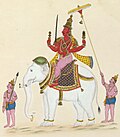
| caption = Painting of Indra on his elephant mount, Airavata, c. 1820. | |||
| alt = Indra, Parjanya | |||
| Devanagari = इन्द्र | |||
| Sanskrit_transliteration = Indra | |||
| affiliation = [[Deva (Hinduism)|Deva]], [[Dikpala]], [[Parjanya]], [[Vishnu]] | |||
| other_names = [[Devendra]], [[Mahendra]], Surendra, Surapati, Suresha, Devesha, [[Devaraja]], Amaresha, [[Parjanya]], [[Dravidian folk religion|Vendhan]] | |||
| children = [[Jayanta]], Rishabha, Midhusha, [[Jayanti (Hinduism)|Jayanti]], [[Devasena]] ([[Shashthi]]), [[Vali (Ramayana)|Vali]] and [[Arjuna]] | |||
| festivals = [[Indra Jatra]], [[Indra Vizha (festival)|Indra Vila]], [[Raksha Bandhan]], [[Lohri]], [[Sawan]], [[Deepavali]] | |||
| siblings = [[Adityas]] including [[Surya]], [[Varuna]], [[Bhaga]], [[Aaryaman]], [[Mitra (Hindu god)|Mitra]], [[Savitra]] and [[Vamana]] | |||
| god_of = King of the [[Deva (Hinduism)|Devas]]<br/>King of [[Svarga]]<br/>God of [[Lightning]], [[Thunder]], [[Storms]] and [[Rain]] | |||
| abode = [[Amaravati (mythology)|Amarāvati]], the capital of [[loka|Indraloka]] in [[Svarga]]<ref>{{cite book |author=Dalal, Roshen |year=2014 |title=Hinduism: An alphabetical guide |publisher=Penguin Books |isbn=9788184752779 |url=https://books.google.com/books?id=zrk0AwAAQBAJ&pg=PT561 |via=Google Books}}</ref> | |||
| weapon = [[Vajra]] (thunderbolt), [[Astra (weapon)|Astras]], [[Indrastra]], Aindrastra, Vasavi Shakti | |||
| consort = [[Shachi]] | |||
| mount = [[Airavata]] (white elephant), [[Uchchaihshravas]] ([[white horse (mythology)|white horse]]) | |||
| symbols = [[Vajra]], [[Indra's net]] | |||
| texts = ''[[Vedas]], [[Ramayana]], [[Mahabharata]], [[Puranas]]'' | |||
| Buddhist_equivalent = [[Śakra (Buddhism)|Śakra]] | |||
| greek_equivalent = [[Zeus]] | |||
| Norse_equivalent = [[Thor]] | |||
| Roman_equivalent = [[Jupiter (mythology)|Jupiter]] | |||
| Celtic_equivalent = [[Taranis]] | |||
| Slavic_equivalent = [[Perun]] | |||
| mantra = Om Indra Devaya Namah <br/> Om Indra Rajaya Vidmahe Mahaindraya Dhimahi Tanno Indraya Prachodayat | |||
| gender = Male | |||
| equivalent1_type = Celtic | |||
| equivalent1 = [[Taranis]] | |||
| abodes = [[Svarga]] | |||
}} | |||
Indra | '''Indra''' ({{IPAc-en|ˈ|ɪ|n|d|r|ə}}; [[Sanskrit]]: इन्द्र) is the king of the [[Deva (Hinduism)|devas]] (god-like deities) and [[Svarga]] (heaven) in [[Hindu mythology]]. He is associated with the sky, lightning, weather, thunder, storms, rains, river flows, and war.<ref>{{cite book |last=Gopal |first=Madan |year=1990 |title=India Through the Ages |publisher=Publication Division, Ministry of Information and Broadcasting, Government of India |page=[https://archive.org/details/indiathroughages00mada/page/66 66] |url=https://archive.org/details/indiathroughages00mada |via=Internet Archive}}</ref><ref name="urlWar and Religion: An Encyclopedia of Faith and Conflict [3 volumes] - Google Książki">{{cite book |last1=Shaw |first1=Jeffrey M., Ph.D. |last2=Demy |first2=Timothy J., Ph.D. |date=27 March 2017 |title=War and Religion: An encyclopedia of faith and conflict |series=Google Książki |isbn=9781610695176 |url=https://books.google.com/books?id=KDlFDgAAQBAJ&q=Indra+god+war&pg=PA380}} [3 volumes]</ref><ref>{{cite journal |last=Perry |first=Edward Delavan |year=1885 |title=Indra in the Rig-Veda |journal=Journal of the American Oriental Society |volume=11 |issue=1885 |page=121 |jstor=592191 |doi=10.2307/592191 }}</ref><ref name="Berry1996p20">{{cite book |author=Berry, Thomas |year=1996 |title=Religions of India: Hinduism, Yoga, Buddhism |publisher=Columbia University Press |isbn=978-0-231-10781-5 |pages=[https://archive.org/details/religionsofindia00berr/page/20 20]–21 |url=https://archive.org/details/religionsofindia00berr |url-access=registration}}</ref> Indra's myths and powers are similar to other [[Indo-European languages|Indo-European]] deities such as [[Jupiter (mythology)|Jupiter]], [[Perun]], [[Perkūnas]], [[Zalmoxis]], [[Taranis]], [[Zeus]], and [[Thor]], part of the greater [[Proto-Indo-European mythology]].<ref name="Berry1996p20"/><ref>{{cite book |author=Madan, T.N. |year=2003 |title=The Hinduism Omnibus |publisher=Oxford University Press |isbn=978-0-19-566411-9 |page=81 |url=https://books.google.com/books?id=EUsqAAAAYAAJ}}</ref><ref>{{cite book |author=Bhattacharji, Sukumari |year=2015 |title=The Indian Theogony |publisher=Cambridge University Press |pages=280–281 |url=https://books.google.com/books?id=lDc9AAAAIAAJ&pg=PA280}}</ref> | ||
Indra' | Indra is the most referred [[deity]] in the ''[[Rigveda]]''.<ref name="Gonda1989p3">{{cite book |author=Gonda, Jan |author-link=Jan Gonda |year=1989 |title=The Indra Hymns of the Ṛgveda |publisher=Brill Archive |isbn=90-04-09139-4 |page=3 |url=https://books.google.com/books?id=KtcUAAAAIAAJ}}</ref> He is celebrated for his powers, and as the one who killed the great evil (a malevolent type of [[Asura (Hinduism)|asura]]) named [[Vritra]], who obstructed human prosperity and happiness. Indra destroys Vritra and his "deceiving forces", and thereby brings rains and sunshine as the saviour of mankind.<ref name="Berry1996p20"/><ref>{{cite book |author=Griswold, Hervey de Witt |year=1971 |title=The Religion of the Ṛigveda |publisher=Motilal Banarsidass |isbn=978-81-208-0745-7 |pages=177–180 |url=https://books.google.com/books?id=Vhkt5K1fw2wC&pg=PA177}}</ref> He is also an important deity worshipped by the [[Kalash people]], indicating his prominence in [[ancient Hinduism]].<ref name="Bezhan2017">{{cite web |last=Bezhan |first=Frud |date=19 April 2017 |title=Pakistan's Forgotten Pagans Get Their Due |publisher=[[Radio Free Europe/Radio Liberty]] |url=https://www.rferl.org/a/28439107.html |access-date=11 July 2017 |quote=About half of the Kalash practice a form of ancient Hinduism infused with old pagan and animist beliefs.}}</ref><ref name=Barrington-Kendrick-2006>{{cite book |last1=Barrington |first1=Nicholas |last2=Kendrick |first2=Joseph T. |last3=Schlagintweit |first3=Reinhard |date=18 April 2006 |title=A Passage to Nuristan: Exploring the mysterious Afghan hinterland |publisher=[[I.B. Tauris]] |isbn=9781845111755 |page=111}}</ref>{{efn|Prominent sites include Hadda, near Jalalabad, but Buddhism never seems to have penetrated the remote valleys of Nuristan, where the people continued to practise an early form of polytheistic Hinduism.<ref name=Barrington-Kendrick-2006/>}}<ref name=Weiss-Maurer-2012>{{cite book |last1=Weiss |first1=Mitch |last2=Maurer |first2=Kevin |date=31 December 2012 |title=No Way Out: A story of valor in the mountains of Afghanistan |publisher=Berkley Caliber |isbn=9780425253403 |page=299}}</ref>{{efn|Up until the late nineteenth century, many Nuristanis practised a primitive form of Hinduism. It was the last area in Afghanistan to convert to Islam — and the conversion was accomplished by the sword.<ref name=Weiss-Maurer-2012/>}}<ref name=Ghai-2014>{{cite news |last=Ghai |first=Rajat |date=2014-02-17 |title=Save the Kalash! |newspaper=Business Standard India |url=https://www.business-standard.com/article/opinion/save-the-kalash-114021700863_1.html |access-date=2021-03-08}}</ref><ref name=Jamil-2019>{{cite web |last=Jamil |first=Kashif |date=19 August 2019 |title=Uchal — a festival of shepherds and farmers of the Kalash tribe |newspaper=[[Daily Times (Pakistan)|Daily Times]] |lang=en |url=https://dailytimes.com.pk/450469/uchal-a-festival-of-shepherds-and-farmers-of-the-kalash-tribe/ |access-date=23 January 2020}}</ref>{{efn|Some of their deities who are worshiped in Kalash tribe are similar to the Hindu god and goddess like Mahadev in Hinduism is called Mahandeo in Kalash tribe. ... All the tribal also visit the Mahandeo for worship and pray. After that they reach to the gree (dancing place).<ref name=Jamil-2019/>}}<ref name=West-2010>{{cite book |last=West |first=Barbara A. |date=19 May 2010 |title=Encyclopedia of the Peoples of Asia and Oceania |publisher=[[Infobase Publishing]] |isbn=9781438119137 |page=357 |url=https://books.google.com/books?id=pCiNqFj3MQsC&pg=PA357}}</ref>{{efn|The Kalasha are a unique people living in just three valleys near Chitral, Pakistan, the capital of North-West Frontier Province, which borders Afghanistan. Unlike their neighbors in the Hindu Kush Mountains on both the Afghan and Pakistani sides of the border the Kalasha have not converted to [[Islam]]. During the mid-20th century a few Kalasha villages in Pakistan were forcibly converted to this dominant religion, but the people fought the conversion and once official pressure was removed the vast majority continued to practice their own religion. Their religion is a form of Hinduism that recognizes many gods and spirits and has been related to the religion of the ancient Greeks ... given their Indo-Aryan language, ... the religion of the Kalasha is much more closely aligned to the Hinduism of their Indian neighbors that to the religion of Alexander the Great and his armies.<ref name=West-2010/>}}<ref>{{cite book |author=Witzel, M. |chapter=[Extract: ''Kalash religion''] The Ṛgvedic religious system and its central Asian and Hindukush antecedents |editor1=Griffiths, A. |editor2=Houben, J.E.M. |year=2004 |title=The Vedas: Texts, language, and ritual |location=Groningen |publisher=Forsten |pages=581–636 |url=http://www.people.fas.harvard.edu/~witzel/KalashaReligion.pdf |archive-url=https://web.archive.org/web/20100817110142/http://www.people.fas.harvard.edu/%7Ewitzel/KalashaReligion.pdf |archive-date=2010-08-17 |url-status=live |access-date=2022-03-11}}</ref> | ||
Indra's significance diminishes in the post-Vedic Indian literature, but he still plays an important role in various mythological events. He is depicted as a powerful hero, and is known for having sexual relations with sage [[Gautama Maharishi|Gautama's]] wife, [[Ahalya|Ahalyā]].<ref>{{cite web | |||
| url = https://www.wisdomlib.org/definition/ahalya | |||
| title = Ahalya, Ahalyā: 15 definitions | |||
| last = | |||
| first = | |||
| date = n.d. | |||
| website = Wisdom Library | |||
| publisher = | |||
| access-date = 14 December 2022 | |||
| quote = }}</ref> | |||
Indra is | According to the ''[[Vishnu Purana]]'', Indra is the title borne by the king of the gods, which changes every [[Manvantara]] – a cyclic period of time in [[Hindu cosmology]]. Each Manvantara has its own Indra and the Indra of the current Manvantara is called ''Purandhara''.<ref name = "Dalal2010" /><ref name=":2">{{cite book |last=Dutt |first=Manmath Nath |title=Vishnu Purana |language=English |pages=170–173 |url=https://archive.org/details/Vishnupurana-English-MnDutt}}</ref><ref name=":3">{{cite web |last=Wilson |first=Horace Hayman |date=1840 |title=The Vishnu Purana |at=Book III, Chapter I, pages 259–265 |url=https://www.sacred-texts.com/hin/vp/vp075.htm|access-date=2021-06-15|website=www.sacred-texts.com}}</ref><ref name=":4">{{Cite book|last=Gita Press Gorakhpur|url=https://archive.org/details/vishnu-puran-illustrated-with-hindi-translations-gita-press-gorakhpur|title=Vishnu Puran Illustrated With Hindi Translations Gita Press Gorakhpur|pages=180–183|language=Sanskrit, Hindi}}</ref> | ||
Indra's iconography shows him wielding a lightning thunderbolt weapon known as ''[[Vajra]]'', riding on a [[white elephant]] known as [[Airavata]].<ref name="Daniélou1991p108"/><ref>{{cite book|author=T. A. Gopinatha Rao|title=Elements of Hindu iconography|url=https://books.google.com/books?id=MJD-KresBwIC |year=1993|publisher=Motilal Banarsidass |isbn=978-81-208-0878-2|page=111}}</ref> In Buddhist iconography the elephant sometimes features three heads, while Jaina icons sometimes show the elephant with five heads. Sometimes a single elephant is shown with four symbolic tusks.<ref name="Daniélou1991p108"/> Indra's | Indra is also depicted in [[Buddhist]] (''Indā''<ref>{{Cite web|url=https://www.buddhistdoor.net/dictionary/details/inda|title=Dictionary {{!}} Buddhistdoor|website=www.buddhistdoor.net|access-date=2019-01-18}}</ref> in [[Pali]])<ref name="Baroni2002p153">{{cite book|author=Helen Josephine Baroni|title=The Illustrated Encyclopedia of Zen Buddhism|url=https://books.google.com/books?id=smNM4ElP3XgC&pg=PA153 |year=2002|publisher=The Rosen Publishing Group |isbn=978-0-8239-2240-6|page=153}}</ref> and [[Jainism|Jaina]]<ref name="Owen2012p25">{{cite book|author=Lisa Owen|title=Carving Devotion in the Jain Caves at Ellora|url=https://books.google.com/books?id=vHK2WE8xAzYC&pg=PA25 |year=2012|publisher=BRILL Academic|isbn=978-90-04-20629-8|page=25}}</ref> mythologies. Indra rules over the much-sought ''Devas'' realm of rebirth within the [[Saṃsāra (Buddhism)|Samsara]] doctrine of Buddhist traditions.<ref name=buswelllopez739>{{cite book|author1=Robert E. Buswell Jr.|author2=Donald S. Lopez Jr.|title=The Princeton Dictionary of Buddhism|url=https://books.google.com/books?id=DXN2AAAAQBAJ&pg=PA231 |year=2013|publisher=Princeton University Press|isbn=978-1-4008-4805-8|pages=739–740}}</ref> However, like the post-Vedic Hindu texts, Indra is also a subject of ridicule and reduced to a figurehead status in Buddhist texts,<ref name=donigerindra/> shown as a god that suffers rebirth.<ref name=buswelllopez739/> In Jain traditions, unlike Buddhism and Hinduism, Indra is not the king of gods, but the king of superhumans residing in Svarga-Loka, and very much a part of Jain rebirth cosmology.<ref>{{cite book|author=Naomi Appleton|title=Narrating Karma and Rebirth: Buddhist and Jain Multi-Life Stories|url=https://books.google.com/books?id=AhT7AgAAQBAJ |year=2014|publisher=Cambridge University Press|isbn=978-1-139-91640-0|pages=50, 98}}</ref> He is also the one who appears with his wife Indrani to celebrate the auspicious moments in the life of a Jain [[Tirthankara]], an iconography that suggests the king and queen of superhumans residing in Svarga (heaven) reverentially marking the spiritual journey of a Jaina.<ref name=Wileyj99>{{cite book|author=Kristi L. Wiley|title=The A to Z of Jainism|url=https://books.google.com/books?id=kUz9o-EKTpwC&pg=PA99|year=2009|publisher=Scarecrow Press|isbn=978-0-8108-6821-2|page=99}}</ref><ref>{{cite book|author=John E. Cort|title=Jains in the World: Religious Values and Ideology in India|url=https://books.google.com/books?id=PZk-4HOMzsoC&pg=PA161|date=22 March 2001|publisher=Oxford University Press|isbn=978-0-19-803037-9|pages=161–162}}</ref> | ||
Indra's iconography shows him wielding a lightning thunderbolt weapon known as ''[[Vajra]]'', riding on a [[white elephant]] known as [[Airavata]].<ref name="Daniélou1991p108"/><ref>{{cite book|author=T. A. Gopinatha Rao|title=Elements of Hindu iconography|url=https://books.google.com/books?id=MJD-KresBwIC |year=1993|publisher=Motilal Banarsidass |isbn=978-81-208-0878-2|page=111}}</ref> In Buddhist iconography, the elephant sometimes features three heads, while Jaina icons sometimes show the elephant with five heads. Sometimes, a single elephant is shown with four symbolic tusks.<ref name="Daniélou1991p108"/> Indra's abode exists in the capital city of Svarga, [[Amaravati (mythology)|Amaravati]], though he is also associated with [[Mount Meru]] (also called Sumeru).<ref name=buswelllopez739/>{{sfn|Wilkings|1882|p=52}} | |||
== Etymology and nomenclature == | == Etymology and nomenclature == | ||
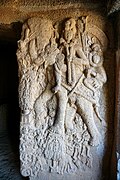
[[File:031 Riding a Horse (33651796566).jpg|thumb|upright=0.9|Indra on his elephant, guarding the entrance of the 1st century BCE Buddhist Cave 19 at [[Bhaja Caves]] (Maharashtra).<ref>{{cite book|author1=Sita Pieris|author2=Ellen Raven|title=ABIA: South and Southeast Asian Art and Archaeology Index: Volume Three – South Asia|url=https://books.google.com/books?id=fCL8pjd0JVMC&pg=PA232|year=2010|publisher=BRILL Academic|isbn=978-90-04-19148-8|page=232}}</ref>]] | |||
The etymological roots of Indra are unclear, and it has been a contested topic among scholars since the 19th-century, one with many proposals.<ref name="Müller1903p395">{{cite book|author=Friedrich Max Müller|title=Anthropological Religion: The Gifford Lectures Delivered Before the University of Glasgow in 1891 |url= https://archive.org/details/in.ernet.dli.2015.154287 |year= 1903|publisher=Longmans Green|pages=[https://archive.org/details/in.ernet.dli.2015.154287/page/n421 395]–398}}</ref><ref name=Chakravarty-1995>{{cite journal |author=Chakravarty, Uma |year=1995 |title=On the etymology of the word Í{{sc|NDRA}} |journal=Annals of the Bhandarkar Oriental Research Institute |volume=76 |number=1–4 |pages=27–33 |jstor=41694367}}</ref> The significant proposals have been: | |||
* root ''ind-u'', or "rain drop", based on the Vedic mythology that he conquered rain and brought it down to earth.<ref name="Daniélou1991p108">{{cite book |author=Alain Daniélou |title=The Myths and Gods of India: The Classic Work on Hindu Polytheism from the Princeton Bollingen Series|url=https://books.google.com/books?id=1HMXN9h6WX0C&pg=PA108 |year=1991 |publisher=Inner Traditions|isbn=978-0-89281-354-4|pages=108–109}}</ref><ref name="Müller1903p395"/> | |||
| | |||
The etymological roots of Indra are unclear, and it has been a contested topic among scholars since the 19th-century, one with many proposals.<ref name="Müller1903p395">{{cite book|author=Friedrich Max Müller|title=Anthropological Religion: The Gifford Lectures Delivered Before the University of Glasgow in 1891 |url= https://archive.org/details/in.ernet.dli.2015.154287 |year= 1903|publisher=Longmans Green|pages=[https://archive.org/details/in.ernet.dli.2015.154287/page/n421 395]–398}}</ref><ref>Chakravarty, Uma | |||
*root ''ind-u'', or "rain drop", based on the Vedic mythology that he conquered rain and brought it down to earth.<ref name="Daniélou1991p108">{{cite book|author=Alain Daniélou|title=The Myths and Gods of India: The Classic Work on Hindu Polytheism from the Princeton Bollingen Series|url=https://books.google.com/books?id=1HMXN9h6WX0C&pg=PA108 |year=1991|publisher=Inner Traditions|isbn=978-0-89281-354-4|pages=108–109}}</ref><ref name="Müller1903p395"/> | |||
*root ''ind'', or "equipped with great power". This was proposed by Vopadeva.<ref name="Daniélou1991p108"/> | *root ''ind'', or "equipped with great power". This was proposed by Vopadeva.<ref name="Daniélou1991p108"/> | ||
*root ''idh'' or "kindle", and ''ina'' or "strong".<ref name="Griswold1971p177">{{cite book|author=Hervey De Witt Griswold|title=The Religion of the Ṛigveda|url=https://books.google.com/books?id=Vhkt5K1fw2wC&pg=PA177 |year=1971|publisher=Motilal Banarsidass|isbn=978-81-208-0745-7|pages=177–178 with footnote 1}}</ref><ref>{{cite journal|author=Edward Delavan Perry |jstor=592191|title=Indra in the Rig-Veda |journal=Journal of the American Oriental Society| volume= 11 |year=1885 |page=121}}</ref> | * root ''idh'' or "kindle", and ''ina'' or "strong".<ref name="Griswold1971p177">{{cite book|author=Hervey De Witt Griswold|title=The Religion of the Ṛigveda|url=https://books.google.com/books?id=Vhkt5K1fw2wC&pg=PA177 |year=1971|publisher=Motilal Banarsidass|isbn=978-81-208-0745-7|pages=177–178 with footnote 1}}</ref><ref>{{cite journal|author=Edward Delavan Perry |jstor=592191|title=Indra in the Rig-Veda |journal=Journal of the American Oriental Society| volume= 11 |year=1885 |page=121|doi=10.2307/592191}}</ref> | ||
*root ''indha'', or "igniter", for his ability to bring light and power (''indriya'') that ignites the vital forces of life (''prana''). This is based on [[Shatapatha Brahmana]].<ref>{{cite book|author1=Annette Wilke|author2=Oliver Moebus|title=Sound and Communication: An Aesthetic Cultural History of Sanskrit Hinduism|url=https://books.google.com/books?id=9wmYz_OtZ_gC |year=2011|publisher=Walter de Gruyter|isbn=978-3-11-024003-0|pages=418 with footnote 148}}</ref> | * root ''indha'', or "igniter", for his ability to bring light and power (''indriya'') that ignites the vital forces of life (''prana''). This is based on [[Shatapatha Brahmana]].<ref>{{cite book|author1=Annette Wilke|author2=Oliver Moebus|title=Sound and Communication: An Aesthetic Cultural History of Sanskrit Hinduism|url=https://books.google.com/books?id=9wmYz_OtZ_gC |year=2011|publisher=Walter de Gruyter|isbn=978-3-11-024003-0|pages=418 with footnote 148}}</ref> | ||
*root ''idam-dra'', or "It seeing" which is a reference to the one who first perceived the self-sufficient metaphysical [[Brahman]]. This is based on [[Aitareya Upanishad]].<ref name="Daniélou1991p108"/> | *root ''idam-dra'', or "It seeing" which is a reference to the one who first perceived the self-sufficient metaphysical [[Brahman]]. This is based on [[Aitareya Upanishad]].<ref name="Daniélou1991p108"/> | ||
*roots in ancient Indo-European, Indo-Aryan deities.<ref name="Colarusso329">{{cite book|author=John Colarusso|title=Nart Sagas from the Caucasus: Myths and Legends from the Circassians, Abazas, Abkhaz, and Ubykhs |url=https://books.google.com/books?id=BaE5BAAAQBAJ&pg=PA329 |year=2014|publisher=Princeton University Press|isbn=978-1-4008-6528-4|page=329}}</ref> For example, states John Colarusso, as a reflex of [[proto-Indo-European]] ''*h₂nḗr-'', Greek ''anēr'', [[Sabine]] ''nerō'', [[Avestan]] ''nar-'', [[Umbrian]] ''nerus'', [[Old Irish]] ''nert'', [[Ossetic]] ''nart'', and others which all refer to "most manly" or "hero".<ref name="Colarusso329"/> | * roots in ancient Indo-European, Indo-Aryan deities.<ref name="Colarusso329">{{cite book|author=John Colarusso|title=Nart Sagas from the Caucasus: Myths and Legends from the Circassians, Abazas, Abkhaz, and Ubykhs |url=https://books.google.com/books?id=BaE5BAAAQBAJ&pg=PA329 |year=2014|publisher=Princeton University Press|isbn=978-1-4008-6528-4|page=329}}</ref> For example, states [[John Colarusso]], as a reflex of [[proto-Indo-European]] ''*h₂nḗr-'', Greek ''anēr'', [[Sabine]] ''nerō'', [[Avestan]] ''nar-'', [[Umbrian]] ''nerus'', [[Old Irish]] ''nert'', [[Pashto]] ''nər'', [[Ossetic]] ''nart'', and others which all refer to "most manly" or "hero".<ref name="Colarusso329"/> | ||
Colonial era scholarship proposed that Indra shares etymological roots with | Colonial era scholarship proposed that Indra shares etymological roots with [[Avestan]] ''Andra'', [[Old High German]] ''*antra'' ("giant"), or [[Old Church Slavonic]] ''jedru'' ("strong"), but [[Max Muller]] critiqued these proposals as untenable.<ref name="Müller1903p395"/><ref>{{cite book |author=Winn, Shan M.M. |year=1995 |title=Heaven, Heroes, and Happiness: The Indo-European roots of Western ideology |publisher=University Press of America |isbn=978-0-8191-9860-0 |page=371, note 1 |url=https://books.google.com/books?id=-UCU0I918bsC&pg=PA371}}</ref> Later scholarship has linked Vedic Indra to ''Aynar'' (the Great One) of Circassian, Abaza and Ubykh mythology, and ''Innara'' of Hittite mythology.<ref name="Colarusso329"/><ref>{{cite book |author=Chakraborty, Uma |year=1997 |title=Indra and Other Vedic Deities: A euhemeristic study |publisher=DK Printworld |isbn=978-81-246-0080-1 |pages=91, 220 |url=https://books.google.com/books?id=ooDXAAAAMAAJ}}</ref> Colarusso suggests a Pontic{{efn|The ''Pontic'' is the region near [[Black Sea]].}} origin and that both the phonology and the context of Indra in Indian religions is best explained from Indo-Aryan roots and a [[Circassians|Circassian]] etymology (i.e. ''*inra'').<ref name="Colarusso329"/> | ||
=== Other languages === | === Other languages === | ||
For other languages, he is also known as | For other languages, he is also known as | ||
{{div col begin|colwidth=12em}} | |||
* [[Askunu language|Ashkun]]: ''Indra'' | |||
* [[Bengali language|Bengali]]: {{lang|bn|ইন্দ্র}} (''Indro'') | * [[Bengali language|Bengali]]: {{lang|bn|ইন্দ্র}} (''Indro'') | ||
* [[Burmese language|Burmese]]: {{my|သိကြားမင်း}} ({{IPA-my|ðadʑá mɪ́ɰ̃|pron}}) | * [[Burmese language|Burmese]]: {{my|သိကြားမင်း}} ({{IPA-my|ðadʑá mɪ́ɰ̃|pron}}) | ||
* [[Chinese language|Chinese]]: 帝釋天 | * [[Chinese language|Chinese]]: 因陀羅 (''Yīntuóluó'') or 帝釋天 (''Dìshìtiān'') | ||
* [[Indonesian language|Indonesian]]/[[Malay language|Malay]]: (''Indera'') | * [[Indonesian language|Indonesian]]/[[Malay language|Malay]]: (''Indera'') | ||
* [[Japanese language|Japanese]]: {{lang|ja|帝釈天}} (''[[Taishakuten]]'').<ref>''Presidential Address'' W. H. D. Rouse ''Folklore'', Vol. 18, No. 1 (Mar., 1907), pp. 12-23: "King of the Gods is Sakka, or Indra"</ref> | * [[Japanese language|Japanese]]: {{lang|ja|帝釈天}} (''[[Taishakuten]]'').<ref>''Presidential Address'' W. H. D. Rouse ''Folklore'', Vol. 18, No. 1 (Mar., 1907), pp. 12-23: "King of the Gods is Sakka, or Indra"</ref> | ||
* [[Javanese language|Javanese]]: {{lang|jv|ꦧꦛꦫꦲꦶꦤ꧀ꦢꦿ}} (''Bathara Indra'') | * [[Javanese language|Javanese]]: {{lang|jv|ꦧꦛꦫꦲꦶꦤ꧀ꦢꦿ}} (''Bathara Indra'') | ||
* [[Kamkata-vari language|Kamkata-vari]]: ''Inra'' | |||
* [[Kannada language|Kannada]]: {{lang|kn|ಇಂದ್ರ}} (''Indra'') | * [[Kannada language|Kannada]]: {{lang|kn|ಇಂದ್ರ}} (''Indra'') | ||
* [[Khmer language|Khmer]]: {{lang|km|ព្រះឥន្ទ្រ }} (''Preah In'' {{IPA-km|preah ʔən|pron}}) | * [[Khmer language|Khmer]]: {{lang|km|ព្រះឥន្ទ្រ }} (''Preah In'' {{IPA-km|preah ʔən|pron}}) | ||
* [[Korean language|Korean]]: {{lang|ko|제석천}} (''Jeseokcheon'') | |||
* [[Lao language|Lao]]: {{lang|lo|ພະອິນ}} (''Pha In'') or {{lang|lo|ພະຍາອິນ}} (''Pha Nya In'') | * [[Lao language|Lao]]: {{lang|lo|ພະອິນ}} (''Pha In'') or {{lang|lo|ພະຍາອິນ}} (''Pha Nya In'') | ||
* [[Malayalam language|Malayalam]]: {{lang|ml|ഇന്ദ്രൻ}} (''Indran'') | * [[Malayalam language|Malayalam]]: {{lang|ml|ഇന്ദ്രൻ}} (''Indran'') | ||
* [[Mon language|Mon]]: {{lang|mnw|ဣန်}} (''In'') | * [[Mon language|Mon]]: {{lang|mnw|ဣန်}} (''In'') | ||
* [[Mongolian language|Mongolian]]: {{lang|mn|Индра}} (Indra) | * [[Mongolian language|Mongolian]]: {{lang|mn|Индра}} (Indra) | ||
* [[ | * [[Odia language|Odia]]: {{lang|or|ଇନ୍ଦ୍ର}} (''Indrô'') | ||
* [[Vasi-vari|Prasun]]: ''Indr'' | |||
* [[Sinhala language|Sinhala]]: {{lang|si|ඉඳු}} (''In̆du'') or {{lang|si|ඉන්ද්ර}} (''Indra'') | |||
* [[Tai Lue language|Tai Lue]]: {{lang|khb|ᦀᦲᧃ}} (''In'') or {{lang|khb|ᦘᦍᦱᦀᦲᧃ}} (''Pha Ya In'') | * [[Tai Lue language|Tai Lue]]: {{lang|khb|ᦀᦲᧃ}} (''In'') or {{lang|khb|ᦘᦍᦱᦀᦲᧃ}} (''Pha Ya In'') | ||
* [[Tamil language|Tamil]]: {{lang|ta|இந்திரன்}} (''Inthiran'') | * [[Tamil language|Tamil]]: {{lang|ta|இந்திரன்}} (''Inthiran'') | ||
* [[Telugu language|Telugu]]: {{lang|te|ఇంద్రుడు}} (''Indrudu'' or ''Indra'') | * [[Telugu language|Telugu]]: {{lang|te|ఇంద్రుడు}} (''Indrudu'' or ''Indra'') | ||
* [[Thai language|Thai]]: {{lang|th|พระอินทร์}} ('' | * [[Classical Tibetan|Tibetan]]: དབང་པོ་ (''dbang po'') | ||
* [[Thai language|Thai]]: {{lang|th|พระอินทร์}} (''Phra In'') | |||
* [[Kalasha-ala|Waigali]]: ''Indr'' | |||
{{div col end}} | |||
===Epithets=== | ===Epithets=== | ||
Indra has many epithets in the Indian religions, notably | Indra has many epithets in the Indian religions, notably | ||
Śakra (शक्र, powerful one), | [[Śakra (Buddhism)|Śakra]] (शक्र, powerful one), | ||
* Vṛṣan (वृषन्, mighty) | {{div col begin|colwidth=15em}} | ||
* Vṛtrahan (वृत्रहन्, slayer of [[Vritra|Vṛtra]]) | * Vṛṣan (वृषन् , mighty) | ||
* Vṛtrahan (वृत्रहन् , slayer of [[Vritra|Vṛtra]]) | |||
* Meghavāhana (मेघवाहन, he whose vehicle is cloud) | * Meghavāhana (मेघवाहन, he whose vehicle is cloud) | ||
* Devarāja (देवराज, king of deities) | * Devarāja (देवराज, king of deities) | ||
| Line 59: | Line 110: | ||
* Surendra (सुरेन्द्र, chief of deities) | * Surendra (सुरेन्द्र, chief of deities) | ||
* Svargapati (स्वर्गपति, the lord of heaven) | * Svargapati (स्वर्गपति, the lord of heaven) | ||
* Vajrapāṇī (वज्रपाणि, | *Śatakratu (शतक्रतु one who performs 100 sacrifices). | ||
* Vajrapāṇī (वज्रपाणि, wielder of Vajra, i.e., thunderbolt) | |||
* Vāsava (वासव, lord of Vasus) | * Vāsava (वासव, lord of Vasus) | ||
* | * Purandara (पुरंदर, the breaker of forts) | ||
* Kaushik (कौशिक, | * [[Kaushik|Kaushika]] (कौशिक, [[Vishvamitra]] was born as the embodiment of Indra) | ||
* | * Shachin or Shachindra (शचीन, the consort of Shachi). | ||
{{div col end}} | |||
*[[Parjanya]] (पर्जन्य,Rain) | |||
==Origins== | ==Origins== | ||
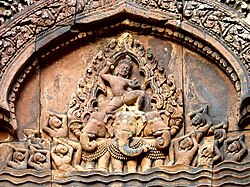
[[File:Banteay Srei - 032 Indra on Airavata (8581494845).jpg|thumb|right|250px|[[Banteay Srei]] temple's pediment carvings depict Indra mounts on [[Airavata]], [[Cambodia]], c. 10th century.]] | [[File:Banteay Srei - 032 Indra on Airavata (8581494845).jpg|thumb|right|250px|[[Banteay Srei]] temple's pediment carvings depict Indra mounts on [[Airavata]], [[Cambodia]], c. 10th century.]] | ||
Indra is of ancient but unclear origin. Aspects of Indra as a deity are cognate to other Indo-European gods; | Indra is of ancient but unclear origin. Aspects of Indra as a deity are cognate to other Indo-European gods; there are [[list of thunder gods|thunder god]]s such as [[Thor]], [[Perun]], and [[Zeus]] who share parts of his heroic mythologies, act as king of gods, and all are linked to "rain and thunder".<ref>{{cite book|author=Alexander Stuart Murray|title=Manual of Mythology: Greek and Roman, Norse, and Old German, Hindoo and Egyptian Mythology, 2nd Edition|url=https://books.google.com/books?id=x7lLAAAAYAAJ&pg=PA329|year=1891|publisher=C. Scribner's sons|pages=329–331}}</ref> The similarities between Indra of Vedic mythology and of [[Thor]] of Nordic and Germanic mythologies are significant, states [[Max Müller]]. Both Indra and Thor are storm gods, with powers over lightning and thunder, both carry a hammer or an equivalent, for both the weapon returns to their hand after they hurl it, both are associated with bulls in the earliest layer of respective texts, both use thunder as a battle-cry, both are protectors of mankind, both are described with legends about "milking the cloud-cows", both are benevolent giants, gods of strength, of life, of marriage and the healing gods.<ref>{{cite book|author=Friedrich Max Müller|author-link=Max Müller|title=Contributions to the Science of Mythology|url=https://archive.org/details/contributionsto01mlgoog|year=1897|publisher=Longmans Green|pages=[https://archive.org/details/contributionsto01mlgoog/page/n334 744]–749}}</ref> | ||
Michael Janda suggests that Indra has origins in the Indo-European ''*trigw-welumos'' [or rather ''*trigw-t-welumos''] "smasher of the enclosure" (of [[Vritra]], [[Vala (Vedic)|Vala]]) and ''diye-snūtyos'' "impeller of streams" (the liberated rivers, corresponding to Vedic ''apam ajas'' "agitator of the waters").<ref>{{cite book|author=Michael | Michael Janda suggests that Indra has origins in the Indo-European ''*trigw-welumos'' [or rather ''*trigw-t-welumos''] "smasher of the enclosure" (of [[Vritra]], [[Vala (Vedic)|Vala]]) and ''diye-snūtyos'' "impeller of streams" (the liberated rivers, corresponding to Vedic ''apam ajas'' "agitator of the waters").<ref>{{cite book |author=Janda, Michael |year=2000 |title=Eleusis: Das Indogermanische Erbe der Mysterien |publisher=Institut für Sprachwissenschaft der Universität Innsbruck |isbn=978-3-85124-675-9 |pages=261–262 |url=https://books.google.com/books?id=-dUoAAAAYAAJ}}</ref> Brave and heroic Innara or Inra, which sounds like Indra, is mentioned among the [[Indo-Aryan superstrate in Mitanni#Names of gods|gods]] of the [[Mitanni]], a [[Hurrians|Hurrian-speaking people]] of Hittite region.<ref>{{cite book |author=von Dassow, Eva |year=2008 |title=State and Society in the Late Bronze Age |publisher=University Press of Maryland |isbn=978-1-934309-14-8 |pages=77, 85–86 |url=https://books.google.com/books?id=L5QtAQAAIAAJ}}</ref> | ||
Indra as a deity had a presence in northeastern [[Asia minor]], as evidenced by the inscriptions on the Boghaz-köi clay tablets dated to about 1400 BCE. This tablet mentions a treaty, but its significance is in four names it includes reverentially as ''Mi-it-ra'', ''U-ru-w-na'', ''In-da-ra'' and ''Na-sa-at-ti-ia''. These are respectively, Mitra, Varuna, Indra and Nasatya-Asvin of the Vedic pantheon as revered deities, and these are also found in Avestan pantheon but with Indra and Naonhaitya as demons. This at least suggests that Indra and his fellow deities were in vogue in South Asia and Asia minor by about mid 2nd-millennium BCE.<ref name="Griswold1971p177"/><ref>{{cite book|author=Edward James | Indra as a deity had a presence in northeastern [[Asia minor]], as evidenced by the inscriptions on the Boghaz-köi clay tablets dated to about 1400 BCE. This tablet mentions a treaty, but its significance is in four names it includes reverentially as ''Mi-it-ra'', ''U-ru-w-na'', ''In-da-ra'' and ''Na-sa-at-ti-ia''. These are respectively, Mitra, Varuna, Indra and Nasatya-Asvin of the Vedic pantheon as revered deities, and these are also found in Avestan pantheon but with Indra and Naonhaitya as demons. This at least suggests that Indra and his fellow deities were in vogue in South Asia and Asia minor by about mid 2nd-millennium BCE.<ref name="Griswold1971p177"/><ref>{{cite book |author=Rapson, Edward James |year=1955 |title=The Cambridge History of India |publisher=Cambridge University Press |pages=320–321 |id=GGKEY:FP2CEFT2WJH |url=https://books.google.com/books?id=gYg8AAAAIAAJ&pg=PA320}}</ref> | ||
Indra is praised as the highest god in 250 hymns of the ''[[Rigveda]]'' – a [[Hindu]] scripture dated to have been composed sometime between 1700 and 1100 BCE. He is co-praised as the supreme in another 50 hymns, thus making him one of the most celebrated Vedic deities.<ref name="Griswold1971p177"/> He is also mentioned in ancient Indo-Iranian literature, but with a major inconsistency when contrasted with the Vedas. In the Vedic literature, Indra is a heroic god. In the Avestan (ancient, pre-Islamic Iranian) texts such as ''[[Vendidad|Vd.]]'' 10.9, ''[[Denkard|Dk.]]'' 9.3 and ''[[Bundahishn|Gbd]]'' 27.6-34.27, Indra – or accurately Andra<ref name="Müller1897p757">{{cite book|author=Friedrich Max | Indra is praised as the highest god in 250 hymns of the ''[[Rigveda]]'' – a [[Hindu]] scripture dated to have been composed sometime between 1700 and 1100 BCE. He is co-praised as the supreme in another 50 hymns, thus making him one of the most celebrated Vedic deities.<ref name="Griswold1971p177"/> He is also mentioned in ancient Indo-Iranian literature, but with a major inconsistency when contrasted with the Vedas. In the Vedic literature, Indra is a heroic god. In the Avestan (ancient, pre-Islamic Iranian) texts such as ''[[Vendidad|Vd.]]'' 10.9, ''[[Denkard|Dk.]]'' 9.3 and ''[[Bundahishn|Gbd]]'' 27.6-34.27, Indra – or accurately Andra<ref name="Müller1897p757">{{cite book |author=Müller, Friedrich Max |year=1897 |title=Contributions to the Science of Mythology |publisher=Longmans Green |pages=[https://archive.org/details/contributionsto01mlgoog/page/n346 756]–759 |url=https://archive.org/details/contributionsto01mlgoog}}</ref> – is a gigantic demon who opposes truth.<ref name="Colarusso329"/>{{efn|In deities that are similar to Indra in the [[Hittite mythology|Hittite]] and European mythologies, he is also heroic.<ref name="Colarusso329"/>}} In the Vedic texts, Indra kills the archenemy and demon Vritra who threatens mankind. In the Avestan texts, Vritra is not found.<ref name="Müller1897p757"/> | ||
Indra is called ''vr̥tragʰná-'' (literally, "slayer of obstacles") in the Vedas, which corresponds to [[Verethragna]] of the [[Zoroastrian]] noun ''verethragna-''. According to David Anthony, the Old Indic religion probably emerged among Indo-European immigrants in the contact zone between the [[Zeravshan River]] (present-day [[Uzbekistan]]) and (present-day) Iran.{{sfn|Anthony|2007|p=462}} It was "a syncretic mixture of old Central Asian and new Indo-European elements",{{sfn|Anthony|2007|p=462}} which borrowed "distinctive religious beliefs and practices"{{sfn|Beckwith|2009|p=32}} from the [[Bactria–Margiana Archaeological Complex|Bactria–Margiana Culture]].{{sfn|Beckwith|2009|p=32}} At least 383 non-Indo-European words were found in this culture, including the god Indra and the ritual drink [[Soma (drink)|Soma]].{{sfn|Anthony|2007|p=454-455}} According to Anthony, | Indra is called ''vr̥tragʰná-'' (literally, "slayer of obstacles") in the Vedas, which corresponds to [[Verethragna]] of the [[Zoroastrian]] noun ''verethragna-''. According to David Anthony, the Old Indic religion probably emerged among Indo-European immigrants in the contact zone between the [[Zeravshan River]] (present-day [[Uzbekistan]]) and (present-day) Iran.{{sfn|Anthony|2007|p=462}} It was "a syncretic mixture of old Central Asian and new Indo-European elements",{{sfn|Anthony|2007|p=462}} which borrowed "distinctive religious beliefs and practices"{{sfn|Beckwith|2009|p=32}} from the [[Bactria–Margiana Archaeological Complex|Bactria–Margiana Culture]].{{sfn|Beckwith|2009|p=32}} At least 383 non-Indo-European words were found in this culture, including the god Indra and the ritual drink [[Soma (drink)|Soma]].{{sfn|Anthony|2007|p=454-455}} According to Anthony, | ||
{{ | {{blockquote|Many of the qualities of Indo-Iranian god of might/victory, [[Verethraghna]], were transferred to the god Indra, who became the central deity of the developing Old Indic culture. Indra was the subject of 250 hymns, a quarter of the ''Rig Veda''. He was associated more than any other deity with ''Soma'', a stimulant drug (perhaps derived from ''Ephedra'') probably borrowed from the BMAC religion. His rise to prominence was a peculiar trait of the Old Indic speakers.{{sfn|Anthony|2007|p=454}}}} | ||
==Iconography== | ==Iconography== | ||
| Line 93: | Line 147: | ||
In ''Rigveda'', Indra is described as strong willed, armed with a thunderbolt, riding a chariot: | In ''Rigveda'', Indra is described as strong willed, armed with a thunderbolt, riding a chariot: | ||
{{ | {{blockquote|5. Let bullish heaven strengthen you, the bull; as bull you travel with your two bullish fallow bays. | ||
As bull with a bullish chariot, well-lipped one, as bull with bullish will, you of the mace, set us up in loot.|Rigveda, Book 5, Hymn 37: Jamison<ref name="The Rigveda">{{ | As bull with a bullish chariot, well-lipped one, as bull with bullish will, you of the mace, set us up in loot.|Rigveda, Book 5, Hymn 37: Jamison<ref name="The Rigveda">{{cite book |last1 = Jamison |first1 = Stephanie |last2 = Brereton |first2 = Joel |date = 23 February 2020 |title = The Rigveda |isbn = 9780190633394 |url=https://books.google.com/books?id=1LTRDwAAQBAJ}}</ref>}} | ||
Indra's weapon, which he used to kill the evil Vritra, is the [[Vajra]] or thunderbolt. Other alternate iconographic symbolism for him includes a [[bow (weapon)|bow]] (sometimes as a colorful rainbow), a sword, a [[Indra's net|net]], a noose, a hook, or a conch.<ref name="Daniélou1991p110">{{cite book|author=Alain | Indra's weapon, which he used to kill the evil Vritra, is the [[Vajra]] or thunderbolt. Other alternate iconographic symbolism for him includes a [[bow (weapon)|bow]] (sometimes as a colorful rainbow), a sword, a [[Indra's net|net]], a noose, a hook, or a conch.<ref name="Daniélou1991p110">{{cite book |author=Daniélou, Alain |year=1991 |title=The Myths and Gods of India: The classic work on Hindu polytheism from the Princeton Bollingen Series |publisher=Inner Traditions |isbn=978-0-89281-354-4 |pages=110–111 |url=https://books.google.com/books?id=1HMXN9h6WX0C&pg=PA110}}</ref> The thunderbolt of Indra is called Bhaudhara.<ref name="Madan">{{cite book |last=Gopal |first=Madan |year=1990 |title=India through the Ages |editor=Gautam, K.S. |publisher=Publication Division, Ministry of Information and Broadcasting, Government of India |page=[https://archive.org/details/indiathroughages00mada/page/75 75] |url=https://archive.org/details/indiathroughages00mada}}</ref> | ||
In the post-Vedic period, he rides a large, four-tusked white elephant called [[Airavata]].<ref name="Daniélou1991p108"/> In sculpture and relief artworks in temples, he typically sits on an elephant or is near one. When he is shown to have two, he holds the Vajra and a bow. | In the post-Vedic period, he rides a large, four-tusked white elephant called [[Airavata]].<ref name="Daniélou1991p108"/> In sculpture and relief artworks in temples, he typically sits on an elephant or is near one. When he is shown to have two, he holds the Vajra and a bow.{{sfn|Masson-Oursel|Morin|1976|p=326}} | ||
In the ''[[Shatapatha Brahmana]]'' and in Shaktism traditions, Indra is stated to be same as goddess [[Shodashi]] (Tripura Sundari), and her iconography is described similar to those of Indra.<ref>{{cite book|author=Alain Daniélou|title=The Myths and Gods of India: The Classic Work on Hindu Polytheism from the Princeton Bollingen Series|url=https://books.google.com/books?id=1HMXN9h6WX0C |year=1991|publisher=Inner Traditions|isbn=978-0-89281-354-4|page=278}}</ref> | In the ''[[Shatapatha Brahmana]]'' and in Shaktism traditions, Indra is stated to be same as goddess [[Shodashi]] (Tripura Sundari), and her iconography is described similar to those of Indra.<ref>{{cite book|author=Alain Daniélou|title=The Myths and Gods of India: The Classic Work on Hindu Polytheism from the Princeton Bollingen Series|url=https://books.google.com/books?id=1HMXN9h6WX0C |year=1991|publisher=Inner Traditions|isbn=978-0-89281-354-4|page=278}}</ref> | ||
| Line 106: | Line 160: | ||
==Literature== | ==Literature== | ||
===Vedic texts=== | ===Vedic texts=== | ||
[[File:Guardians of the eight directions 02.JPG|thumb| | [[File:Guardians of the eight directions 02.JPG|thumb|upright|Indra is typically featured as a guardian deity on the east side of a [[Hindu temple]].]] | ||
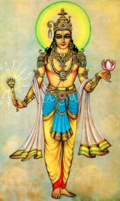
[[File:Indra.png|thumb| | [[File:Indra.png|thumb|upright|Devraj Indra, Old Kalyan Print]] | ||
Indra was a prominent deity in the Vedic era of Hinduism.<ref name="Griswold1971p177"/> | Indra was a prominent deity in the [[Historical Vedic religion|Vedic era]] of Hinduism.<ref name="Griswold1971p177"/> In Vedic times Indra was described in Rig Veda 6.30.4 as superior to any other god. Sayana in his commentary on Rig Veda 6.47.18 described Indra as assuming many forms, making [[Agni]], [[Vishnu]], and [[Rudra]] his illusory forms.<ref>{{cite web | url=https://www.wisdomlib.org/hinduism/book/rig-veda-english-translation/d/doc834193.html | title=Rig Veda 6.47.18 [English translation] | date=27 August 2021 }}</ref> | ||
Over a quarter of the 1,028 hymns of the ''Rigveda'' mention Indra, making him the most referred to deity.<ref name="Griswold1971p177"/><ref name="Daniélou1991p106">{{cite book|author=Alain Daniélou|title=The Myths and Gods of India: The Classic Work on Hindu Polytheism from the Princeton Bollingen Series|url=https://books.google.com/books?id=1HMXN9h6WX0C&pg=PA106 |year=1991|publisher=Inner Traditions|isbn=978-0-89281-354-4|pages=106–107}}</ref> These hymns present a complex picture of Indra, but some aspects of Indra are | Over a quarter of the 1,028 hymns of the ''[[Rigveda]]'' mention Indra, making him the most referred to deity.<ref name="Griswold1971p177"/><ref name="Daniélou1991p106">{{cite book|author=Alain Daniélou|title=The Myths and Gods of India: The Classic Work on Hindu Polytheism from the Princeton Bollingen Series|url=https://books.google.com/books?id=1HMXN9h6WX0C&pg=PA106 |year=1991|publisher=Inner Traditions|isbn=978-0-89281-354-4|pages=106–107}}</ref> These hymns present a complex picture of Indra, but some aspects of Indra are often repeated. Of these, the most common theme is where he as the god with thunderbolt kills the evil serpent [[Vritra]] that held back rains, and thus released rains and land nourishing rivers.<ref name="Müller1903p395"/> For example, the Rigvedic hymn 1.32 dedicated to Indra reads: | ||
{{Verse translation|italicsoff=y| | {{Verse translation|italicsoff=y| | ||
{{lang|sa|इन्द्रस्य नु वीर्याणि प्र वोचं यानि चकार प्रथमानि वज्री <nowiki>।</nowiki> | {{lang|sa|इन्द्रस्य नु वीर्याणि प्र वोचं यानि चकार प्रथमानि वज्री <nowiki>।</nowiki> | ||
| Line 120: | Line 174: | ||
He smashed the serpent. He bored out the waters. He split the bellies of the mountains. | He smashed the serpent. He bored out the waters. He split the bellies of the mountains. | ||
2. He smashed the serpent resting on the mountain—for him Tvaṣṭar had fashioned the resounding [sunlike] mace. | 2. He smashed the serpent resting on the mountain—for him Tvaṣṭar had fashioned the resounding [sunlike] mace. | ||
Like bellowing milk-cows, streaming out, the waters went straight down to the sea.<ref>{{cite book|author=Stephanie Jamison|title=The Rigveda –– Earliest Religious Poetry of India | Like bellowing milk-cows, streaming out, the waters went straight down to the sea.<ref>{{cite book |author=Stephanie Jamison|title=The Rigveda –– Earliest Religious Poetry of India|year=2015 |publisher=Oxford University Press |isbn=978-0190633394|page=135 |url=https://books.google.com/books?id=1LTRDwAAQBAJ}}</ref>}} | ||
In the myth, [[Vritra|Vṛtra]] has coiled around a mountain and has trapped all the waters, namely the [[Sapta Sindhu|Seven Rivers]]. All the gods abandon Indra out of fear of Vṛtra. Indra uses his vajra, a mace, to kill Vritra and smash open the mountains to release the waters. In some versions, he is aided by the [[Maruts]] or other deities, and sometimes cattle and the sun is also released from the mountain.<ref name=":0" /><ref>{{Cite book|last=Oldenberg|first=Hermann|title=Die Religion Des Veda|publisher=Motilal Banarsidass|year=2004|pages=77|language=de|translator-last=Shrotri|translator-first=Shridhar B.|trans-title=The Religion of the Veda|orig-year=1894 (First Edition), 1916 (Second Edition)}}</ref> In one interpretation by Oldenberg, the hymns are referring to the snaking thunderstorm clouds that gather with bellowing winds (Vritra), Indra is then seen as the storm god who intervenes in these clouds with his thunderbolts, which then release the rains nourishing the parched land, crops and thus humanity.<ref name="griswold180">{{cite book|author=Hervey De Witt Griswold|title=The Religion of the Ṛigveda|url=https://books.google.com/books?id=Vhkt5K1fw2wC&pg=PA177 |year=1971|publisher=Motilal Banarsidass|isbn=978-81-208-0745-7|pages=180–183 with footnotes}}</ref> In another interpretation by Hillebrandt, Indra is a symbolic sun god ([[Surya]]) and Vritra is a symbolic winter-giant (historic mini cycles of ice age, cold) in the earliest, not the later, hymns of ''Rigveda''. The Vritra is an ice-demon of colder central Asia and northern latitudes, who holds back the water. Indra is the one who releases the water from the winter demon, an idea that later metamorphosed into his role as storm god.<ref name="griswold180" /> According to Griswold, this is not a completely convincing interpretation, because Indra is simultaneously a lightning god, a rain god and a river-helping god in the Vedas. Further, the Vritra demon that Indra slew is best understood as any obstruction, whether it be clouds that refuse to release rain or mountains or snow that hold back the water.<ref name="griswold180" /> Jamison and Brereton also state that Vritra is best understood as any obstacle. The Vritra myth is associated with the Midday Pressing of soma, which is dedicated to Indra or Indra and the Maruts.<ref name=":0" /> | |||
Even though Indra is declared as the king of gods in some verses, there is no consistent subordination of other gods to Indra. In Vedic thought, all gods and goddesses are equivalent and aspects of the same eternal abstract [[Brahman]], none consistently superior, none consistently inferior. All gods obey Indra, but all gods also obey Varuna, Vishnu, Rudra and others when the situation arises. Further, Indra also accepts and follows the instructions of [[Savitr]] (solar deity).<ref name="Keith1925p93">{{cite book|author=Arthur Berriedale Keith|title=The Religion and Philosophy of the Veda and Upanishads |url=https://books.google.com/books?id=PaH4uKI7MaEC |year=1925 |publisher=Motilal Banarsidass |isbn=978-81-208-0645-0|pages=93–94}}</ref> Indra, like all Vedic deities, is a part of [[henotheism|henotheistic]] theology of ancient India.<ref>{{cite book|author=Friedrich Max Müller |title=Contributions to the Science of Mythology|url=https://archive.org/details/contributionsto01mlgoog |year=1897|publisher=Longmans Green |page=[https://archive.org/details/contributionsto01mlgoog/page/n348 758]}}</ref> | |||
The second-most important myth about Indra is about the Vala cave. In this story, the [[Panis]] have stolen cattle and hidden them in the Vala cave. Here Indra utilizes the power of the songs he chants to split the cave open to release the cattle and dawn. He is accompanied in the cave by the Angirases (and sometimes Navagvas or the Daśagvas). Here Indra exemplifies his role as a priest-king, called ''bṛhaspati''. Eventually later in the Rigveda, [[Bṛhaspati]] and Indra become separate deities as both Indra and the Vedic king lose their priestly functions. The Vala myth was associated with the Morning Pressing of soma, in which cattle was donated to priests, called ''[[Dakshina|dakṣiṇā]].''<ref name=":0">{{cite book |author=Stephanie Jamison|url=https://www.google.com/books/edition/The_Rigveda_3_Volume_Set/fgzVAwAAQBAJ?hl=en&gbpv=0|title=The Rigveda –– Earliest Religious Poetry of India |publisher=Oxford University Press |year=2015|isbn=978-0190633394|location=|pages=38–40}}</ref> | |||
Indra is not a visible object of nature in the Vedic texts, nor is he a personification of any object, but that agent which causes the lightning, the rains and the rivers to flow.<ref>{{cite book|author=Friedrich Max Müller|title=Contributions to the Science of Mythology|url=https://archive.org/details/contributionsto01mlgoog |year=1897|publisher=Longmans Green |page=[https://archive.org/details/contributionsto01mlgoog/page/n347 757]}}</ref> His myths and adventures in the Vedic literature are numerous, ranging from harnessing the rains, cutting through mountains to help rivers flow, helping land becoming fertile, unleashing sun by defeating the clouds, warming the land by overcoming the winter forces, winning the light and dawn for mankind, putting milk in the cows, rejuvenating the immobile into something mobile and prosperous, and in general, he is depicted as removing any and all sorts of obstacles to human progress.<ref>{{cite book|author=Jan Gonda|author-link=Jan Gonda|title=The Indra Hymns of the Ṛgveda|url=https://books.google.com/books?id=KtcUAAAAIAAJ |year=1989|publisher=Brill Archive|isbn=90-04-09139-4|pages=4–5}}</ref> The Vedic prayers to Indra, states [[Jan Gonda]], generally ask "produce success of this rite, throw down those who hate the materialized [[Brahman]]".<ref>{{cite book|author=Jan Gonda|author-link=Jan Gonda|title=The Indra Hymns of the Ṛgveda|url=https://books.google.com/books?id=KtcUAAAAIAAJ |year=1989|publisher=Brill Archive|isbn=90-04-09139-4|page=12}}</ref> The hymns of ''Rigveda'' declare him to be the "king that moves and moves not", the friend of mankind who holds the different tribes on earth together.<ref>{{cite book|author=Hervey De Witt Griswold|url=https://books.google.com/books?id=Vhkt5K1fw2wC&pg=PA180|title=The Religion of the Ṛigveda|publisher=Motilal Banarsidass|year=1971|isbn=978-81-208-0745-7|page=180, verse 1.32.15}}</ref> | |||
Indra is | Indra is often presented as the twin brother of [[Agni]] (fire) – another major Vedic deity.<ref>{{cite book|author=Friedrich Max Müller|title=Contributions to the Science of Mythology|url=https://archive.org/details/contributionsto01mlgoog |year=1897|publisher=Longmans Green |page=[https://archive.org/details/contributionsto01mlgoog/page/n417 827]}}</ref> Yet, he is also presented to be the same, states Max Muller, as in Rigvedic hymn 2.1.3, which states, "Thou Agni, art Indra, a bull among all beings; thou art the wide-ruling Vishnu, worthy of adoration. Thou art the Brahman, (...)."<ref>{{cite book |author=Müller, Friedrich Max |year=1897 |title=Contributions to the Science of Mythology |publisher=Longmans Green |page=[https://archive.org/details/contributionsto01mlgoog/page/n418 828] |url=https://archive.org/details/contributionsto01mlgoog}}</ref> He is also part of one of many Vedic trinities as "Agni, Indra and Surya", representing the "creator-maintainer-destroyer" aspects of existence in Hindu thought.<ref name="Daniélou1991p106"/>{{efn|The Trimurti idea of Hinduism, states [[Jan Gonda]], "seems to have developed from ancient cosmological and ritualistic speculations about the triple character of an individual god, in the first place of ''Agni'', whose births are three or threefold, and who is threefold light, has three bodies and three stations".<ref name=Gonda-1969>{{cite journal |first=Jan |last=Gonda |year=1969 |title=The Hindu trinity |journal=Anthropos |volume=63–64 |issue=1–2 |pages=212–226 |jstor=40457085}}</ref>{{rp|style=ama|pages=218-219}} Other trinities, beyond the more common "Brahma, Vishnu, Shiva", mentioned in ancient and medieval Hindu texts include: "'''Indra''', Vishnu, Brahmanaspati", "Agni, '''Indra''', Surya", "Agni, Vayu, Aditya", "Mahalakshmi, Mahasarasvati, and Mahakali", and others.<ref name=Gonda-1969/>{{rp|style=ama|pages=212-226}}</ref><ref name=davidwhite29>{{cite book |first=David |last=White |year=2006 |title=Kiss of the Yogini |publisher=University of Chicago Press |isbn=978-0226894843 |pages=4, 29}}</ref>}} | ||
Rigveda 2.1.3 <small>Jamison 2014</small><ref name=Jamison-2014/> | |||
Rigveda 2.1.3 <small>Jamison 2014</small> <ref | |||
# You, Agni, as bull of beings, are Indra; you, wide-going, worthy of homage, are Viṣṇu. You, o lord of the sacred formulation, finder of wealth, are the Brahman [Formulator]; you, o Apportioner, are accompanied by Plenitude. | # You, Agni, as bull of beings, are Indra; you, wide-going, worthy of homage, are Viṣṇu. You, o lord of the sacred formulation, finder of wealth, are the Brahman [Formulator]; you, o Apportioner, are accompanied by Plenitude. | ||
Parentage of Indra is inconsistent in Vedic texts, and in fact Rigveda 4.17.12 states that Indra himself may not even know that much about his mother and father. Some verses of Vedas suggest that his mother was a ''grishti'' (a cow), while other verses name her Nishtigri. The medieval commentator [[Sayana]] identified her with [[Aditi]], the goddess who is his mother in later Hinduism. The [[Atharvaveda]] states Indra's mother is Ekashtaka, daughter of [[Prajapati]]. Some verses of Vedic texts state that Indra's father is [[Tvastr|Tvashtr]] or sometimes the couple [[Dyaus]]h and [[Prithvi]] are mentioned as his parents.<ref>{{ | Parentage of Indra is inconsistent in Vedic texts, and in fact Rigveda 4.17.12 states that Indra himself may not even know that much about his mother and father. Some verses of Vedas suggest that his mother was a ''grishti'' (a cow), while other verses name her Nishtigri. The medieval commentator [[Sayana]] identified her with [[Aditi]], the goddess who is his mother in later Hinduism. The [[Atharvaveda]] states Indra's mother is Ekashtaka, daughter of [[Prajapati]]. Some verses of Vedic texts state that Indra's father is [[Tvastr|Tvashtr]] or sometimes the couple [[Dyaus]]h and [[Prithvi]] are mentioned as his parents.<ref name=Jamison-2014>{{cite book |last=Jamison |first=Stephanie W. |year=2014 |title=The Rigveda: Earliest religious poetry of India |publisher=Oxford University Press |isbn=9780199370184 |pages=39, 582}}</ref>{{rp|style=ama|pages=39, 582}}<ref name=":1"/><ref name="DPr"/> According to a legend found in it, before Indra is born, his mother attempts to persuade him to not take an unnatural exit from her womb. Immediately after birth, Indra steals soma from his father, and Indra's mother offers the drink to him. After Indra's birth, Indra's mother reassures Indra that he will prevail in his rivalry with his father, Tvaṣṭar. Both the unnatural exit from the womb and rivalry with the father are universal attributes of heroes.<ref name=":0"/> In the Rigveda, Indra's wife is Indrani, alias Shachi, and she is described to be extremely proud about her status.<ref>{{cite book |author=Kinsley, David |year=1988 |title=Hindu Goddesses: Visions of the divine feminine in the Hindu religious tradition |publisher=University of California Press |isbn=978-0-520-90883-3 |pages=[https://archive.org/details/hindugoddessesvi0000kins/page/17 17]–18 |url=https://archive.org/details/hindugoddessesvi0000kins |url-access=registration}}</ref> Rigveda 4.18.8 says after his birth Indra got swallowed by a demon Kushava.<ref name="The hymns of the Rigveda">{{cite book |editor=Griffith, R.T.H. |year=1920 |title=The Hymns of the Rigveda |place=Benares, IN |publisher=E.J. Lazarus and Co. |url=https://archive.org/details/hymnsrigveda00grifgoog/page/n133/mode/1up}}</ref> | ||
Indra is also found in many other myths that are poorly understood. In one, Indra crushes the cart of [[Ushas]] (Dawn), and she runs away. In another Indra beats [[Surya]] in a chariot race by tearing off the wheel of his chariot. This is connected to a myth where Indra and his sidekick [[Kutsa]] ride the same chariot drawn by the horses of the wind to the house of Uśanā Kāvya to receive aid before killing [[Susna|Śuṣṇa]], the enemy of Kutsa. In one myth Indra (in some versions helped by [[Vishnu#Vedas|Viṣṇu]]) shoots a boar named Emuṣa in order to obtain special rice porridge hidden inside or behind a mountain. Another myth has Indra kill Namuci by beheading him. In later versions of that myth Indra does this through trickery involving the foam of | Indra is also found in many other myths that are poorly understood. In one, Indra crushes the cart of [[Ushas]] (Dawn), and she runs away. In another Indra beats [[Surya]] in a chariot race by tearing off the wheel of his chariot. This is connected to a myth where Indra and his sidekick [[Kutsa]] ride the same chariot drawn by the horses of the wind to the house of Uśanā Kāvya to receive aid before killing [[Susna|Śuṣṇa]], the enemy of Kutsa. In one myth Indra (in some versions helped by [[Vishnu#Vedas|Viṣṇu]]) shoots a boar named Emuṣa in order to obtain special rice porridge hidden inside or behind a mountain. Another myth has Indra kill Namuci by beheading him. In later versions of that myth Indra does this through trickery involving the foam of water. Other beings slain by Indra include Śambara, Pipru, Varcin, Dhuni and Cumuri, and others. Indra's chariot is pulled by fallow bay horses described as ''hárī''. They bring Indra to and from the sacrifice, and are even offered their own roasted grains.<ref name=":0"/> | ||
====Upanishads==== | ====Upanishads==== | ||
The ancient ''[[Aitareya Upanishad]]'' equates Indra, along with other deities, with [[Atman (Hinduism)|Atman]] (soul, self) in the Vedanta's spirit of internalization of rituals and gods. It begins with its cosmological theory in verse 1.1.1 by stating that, "in the beginning, Atman, verily one only, was here - no other blinking thing whatever; he bethought himself: let me now create worlds".<ref>Robert Hume, | The ancient ''[[Aitareya Upanishad]]'' equates Indra, along with other deities, with [[Atman (Hinduism)|Atman]] (soul, self) in the Vedanta's spirit of internalization of rituals and gods. It begins with its cosmological theory in verse 1.1.1 by stating that, "in the beginning, Atman, verily one only, was here - no other blinking thing whatever; he bethought himself: let me now create worlds".<ref name=Hume-1921>{{cite book |first=Robert |last=Hume |year=1921 |section=verses 1.1.1, and 1.3.13-.3.14 |title=The Thirteen Principal Upanishads |publisher=Oxford University Press |pages=294-298 with footnotes |url=https://archive.org/stream/thirteenprincipa028442mbp#page/n315/mode/2up}}</ref>{{rp|style=ama|page=294}}<ref name="Deussen1997p15"/> This soul, which the text refers to as Brahman as well, then proceeds to create the worlds and beings in those worlds wherein all Vedic gods and goddesses such as sun-god, moon-god, Agni, and other divinities become active cooperative organs of the body.<ref name="Deussen1997p15"/><ref name=Hume-1921/>{{rp|style=ama|page=295-297}}<ref>{{cite book |author=Bronkhorst, Johannes |year=2007 |title=Greater Magadha: Studies in the culture of early India |publisher=BRILL |isbn=978-90-04-15719-4 |page=128 |url=https://books.google.com/books?id=4GNG5KuH73QC}}</ref> The Atman thereafter creates food, and thus emerges a sustainable non-sentient universe, according to the Upanishad. The eternal Atman then enters each living being making the universe full of sentient beings, but these living beings fail to perceive their Atman. The first one to see the Atman as Brahman, asserts the Upanishad, said, "''idam adarsha'' or "I have seen It".<ref name="Deussen1997p15">{{cite book |author=Deussen, Paul |year=1997 |title=A Sixty Upanishads Of the Veda |volume=1 |publisher=Motilal Banarsidass |isbn=978-81-208-0430-2 |pages=15–18 |url=https://books.google.com/books?id=cQFXNgAACAAJ}}</ref> Others then called this first seer as ''Idam-dra'' or "It-seeing", which over time came to be cryptically known as "Indra", because, claims ''Aitareya Upanishad'', everyone including the gods like short nicknames.<ref name=Hume-1921/>{{rp|style=ama|pages=297-298}} The passing mention of Indra in this Upanishad, states Alain Daniélou, is a symbolic folk etymology.<ref name="Daniélou1991p108"/> | ||
The section 3.9 of the ''[[Brihadaranyaka Upanishad]]'' connects Indra to thunder, thunderbolt and release of waters.<ref>{{cite book|author=Patrick | The section 3.9 of the ''[[Brihadaranyaka Upanishad]]'' connects Indra to thunder, thunderbolt and release of waters.<ref>{{cite book |author=Olivelle, Patrick |year=1998 |title=The Early Upanishads: Annotated text and translation |publisher=Oxford University Press |isbn=978-0-19-535242-9 |page=20 |url=https://books.google.com/books?id=Lsp18ZvstrcC}}</ref> In section 5.1 of the ''[[Avyakta Upanishad]]'', Indra is praised as he who embodies the qualities of all gods.<ref name="Daniélou1991p106"/> | ||
===Post-Vedic texts=== | ===Post-Vedic texts=== | ||
| Line 152: | Line 204: | ||
| caption1 = Indra with Ahalya, contemporary [[Pattachitra]] painting. | | caption1 = Indra with Ahalya, contemporary [[Pattachitra]] painting. | ||
| image2 = Krishna Holding Mount Govardhan - Crop.jpg | | image2 = Krishna Holding Mount Govardhan - Crop.jpg | ||
| caption2 = [[Krishna]] holding [[Govardhan hill]] from [[Smithsonian Institution]] | | caption2 = [[Krishna]] holding [[Govardhan hill]] from [[Smithsonian Institution]]'s collections. [[Mola Ram]], c. 1790 | ||
}} | }} | ||
In post-Vedic texts, Indra is depicted as an intoxicated hedonistic god, his importance declines, and he evolves into a minor deity in comparison to others in the Hindu pantheon, such as [[Shiva]], [[Vishnu]], or [[Devi]]. In Hindu texts, Indra is some times known as an aspect ([[avatar]]) of [[Shiva]].<ref name="Daniélou1991p106"/> | In post-Vedic texts, Indra is depicted as an intoxicated hedonistic god, his importance declines, and he evolves into a minor deity in comparison to others in the Hindu pantheon, such as [[Shiva]], [[Vishnu]], or [[Devi]]. In Hindu texts, Indra is some times known as an aspect ([[avatar]]) of [[Shiva]].<ref name="Daniélou1991p106"/> | ||
In the [[Puranas]], [[Ramayana]] and [[Mahabharata]], the divine sage [[Kashyapa]] is described as the father of Indra, and [[Aditi]] as his mother. In this tradition, he is presented as one of their thirty-three sons.<ref name=":1">{{Cite book|last=Dalal|first=Roshen|url=https://books.google.com/books?id=DH0vmD8ghdMC&q=Indra+aditi|title=Hinduism: An Alphabetical Guide|date=2010|publisher=Penguin Books India|isbn=978-0-14-341421-6 | In the [[Puranas]], [[Ramayana]] and [[Mahabharata]], the divine sage [[Kashyapa]] is described as the father of Indra, and [[Aditi]] as his mother. In this tradition, he is presented as one of their thirty-three sons.<ref>{{Cite book|last=Mani|first=Vettam|title=Purāṇic Encyclopaedia: A Comprehensive Dictionary with Special Reference to the Epic and Purāṇic Literature|publisher=Motilal Banarsidass|year=1975|isbn=978-81-208-0597--2|location=|pages=318}}</ref><ref name=":1">{{Cite book|last=Dalal|first=Roshen|url=https://books.google.com/books?id=DH0vmD8ghdMC&q=Indra+aditi|title=Hinduism: An Alphabetical Guide|date=2010|publisher=Penguin Books India|isbn=978-0-14-341421-6 |pages=164–165}}</ref> Indra married [[Shachi]], the daughter of [[Danava (Hinduism)|Danava]] [[Puloman]]. Most texts state that Indra had only one wife, though sometimes other names are mentioned.<ref name=":1" /> The text ''[[Bhagavata Purana]]'' mention that Indra and Shachi had three sons [[Jayanta]], Rishabha, Midhusha.<ref>{{Cite book|last=Daniélou|first=Alain|url=https://books.google.com/books?id=1HMXN9h6WX0C&q=Indra+wife&pg=RA1-PA260|title=The Myths and Gods of India: The Classic Work on Hindu Polytheism from the Princeton Bollingen Series|date=December 1991|publisher=Inner Traditions / Bear & Co|isbn=978-0-89281-354-4|language=en|pages=109}}</ref> Some listings add Nilambara and Rbhus.<ref name="DPr">{{Cite book|last=Jordan|first=Michael|url=https://books.google.com/books?id=aqDC5bwx4_wC&q=Indra|title=Dictionary of Gods and Goddesses|date=2014-05-14|publisher=Infobase Publishing|isbn=978-1-4381-0985-5|language=en}}</ref> Indra and Shachi also had two daughters, [[Jayanti (Hinduism)|Jayanti]] and [[Devasena]]. Goddess Jayanti is the spouse of [[Shukra]], while Devasena marries the war god [[Kartikeya]].<ref name="Dalal2010">{{cite book|author=Roshen Dalal|title=The Religions of India: A Concise Guide to Nine Major Faiths|year=2010|publisher=Penguin Books India|isbn=978-0-14-341517-6|pages=190, 251}}</ref> Indra is depicted as the spiritual father of [[Vali (Ramayana)|Vali]] in the ''[[Ramayana]]'' and [[Arjuna]] in the ''[[Mahabharata]]''.<ref name=donigerindra/> Since he is known for mastering over all weapons in warfare, his spiritual sons Vali and [[Arjuna]] are also very good in warfare. He has a charioteer named [[Mātali|Matali]].<ref>{{Cite book |last=Dowson |first=John |url=https://books.google.com/books?id=leH7AQAAQBAJ&dq=matali+charioteer+of+indra&pg=PA205 |title=A Classical Dictionary of Hindu Mythology and Religion, Geography, History and Literature |date=2013-11-05 |publisher=Routledge |isbn=978-1-136-39029-6 |pages=205 |language=en}}</ref> | ||
Indra had multiple affairs with other women. One such was [[Ahalya]], wife of sage Gautama. Indra was cursed by the sage. Although the Brahmanas (9th to 6th centuries BCE) are the earliest scriptures to hint at their relationship, the | Indra had multiple affairs with other women. One such was [[Ahalya]], wife of sage Gautama. Indra was cursed by the sage. Although the Brahmanas (9th to 6th centuries BCE) are the earliest scriptures to hint at their relationship, the 7th- to 4th-century BCE Hindu epic [[Ramayana]] – whose hero is [[Rama]] – is the first to explicitly mention the affair in detail.<ref>{{Cite journal|last=Söhnen|first=Renate|date=February 1991|title=Indra and Women|url=https://www.cambridge.org/core/journals/bulletin-of-the-school-of-oriental-and-african-studies/article/indra-and-women/7F6A10EAFE97A94A433232ACF75C2712|journal=Bulletin of the School of Oriental and African Studies|language=en|volume=54|issue=1|pages=68–74|doi=10.1017/S0041977X00009617|s2cid=162225024|issn=1474-0699}}</ref> | ||
Indra becomes a source of nuisance rains in the Puranas, out of anger and with an intent to hurt mankind. But, [[Krishna]] as an avatar of [[Vishnu]], comes to the rescue by lifting [[Govardhan Hill|Mount Govardhana]] on his fingertip, and letting mankind shelter under the mountain till Indra exhausts his anger and relents.<ref name=donigerindra>Wendy Doniger (2015), [https://www.britannica.com/topic/Indra Indra: Indian deity], Encyclopædia Britannica</ref> Also, according to Mahabharata Indra | Indra becomes a source of nuisance rains in the Puranas, out of anger and with an intent to hurt mankind. But, [[Krishna]] as an avatar of [[Vishnu]], comes to the rescue by lifting [[Govardhan Hill|Mount Govardhana]] on his fingertip, and letting mankind shelter under the mountain till Indra exhausts his anger and relents.<ref name=donigerindra>Wendy Doniger (2015), [https://www.britannica.com/topic/Indra Indra: Indian deity], Encyclopædia Britannica</ref> Also, according to Mahabharata, Indra disguised himself as a [[Brahmin]] approached Karna and asked for his kavacha (body armor) and kundala (earrings) as charity. Although being aware of his true identity, [[Karna]] peeled off his kavacha and kundala and fulfilled the wish of Indra. Pleased by this act Indra, gifted Karna a dart called Vasavi Shakthi. | ||
According to the ''Vishnu Purana'', Indra is the position of being the king of the gods which changes in every [[Manvantara]]—a cyclic period of time in [[Hindu cosmology]]. Each Manvantara has its own Indra and the Indra of the current Manvantara is called ''Purandhara''.<ref name = "Dalal2010" /><ref name=":2"/><ref name=":3"/><ref name=":4"/> | According to the ''[[Vishnu Purana]]'', Indra is the position of being the king of the gods which changes in every [[Manvantara]]—a cyclic period of time in [[Hindu cosmology]]. Each [[Manvantara]] has its own Indra and the Indra of the current [[Manvantara]] is called ''Purandhara''.<ref name = "Dalal2010" /><ref name=":2"/><ref name=":3"/><ref name=":4"/> | ||
=== Sangam literature (300 BCE–300 CE) === | === Sangam literature (300 BCE–300 CE) === | ||
[[Sangam literature]] of the [[Tamil language]] contains more stories about Indra by various authors. In [[Silapathikaram]] Indra is described as ''Maalai venkudai mannavan'' (மாலைவெண் குடை மன்னவன்), literally meaning Indra with the pearl-garland and white umbrella.<ref>{{cite book|author=S Krishnamoorthy|title=Silappadikaram|url=https://books.google.com/books?id=STbMzFKaxcQC |year=2011|publisher=Bharathi Puthakalayam}}</ref> | [[Sangam literature]] of the [[Tamil language]] contains more stories about Indra by various authors. In [[Silapathikaram]] Indra is described as ''Maalai venkudai mannavan'' (மாலைவெண் குடை மன்னவன்), literally meaning Indra with the pearl-garland and white umbrella.<ref>{{cite book|author=S Krishnamoorthy|title=Silappadikaram|url=https://books.google.com/books?id=STbMzFKaxcQC |year=2011|publisher=Bharathi Puthakalayam}}</ref> | ||
The [[Sangam literature]] also describes | The [[Sangam literature]] also describes [[Indra Vizha (festival)|Indira Vizha]] (festival for Indra), the festival for want of rain, celebrated for one full month starting from the full moon in Ootrai (later name – Cittirai) and completed on the full moon in Puyaazhi (Vaikaasi) (which coincides with Buddhapurnima). It is described in the epic [[Silappatikaram]] in detail.<ref>{{cite book|author=S Krishnamoorthy|title=Silappadikaram|url=https://books.google.com/books?id=STbMzFKaxcQC |year=2011|publisher=Bharathi Puthakalayam|pages=31–36}}</ref> | ||
In his work of the [[Tirukkural]], [[Valluvar]] cites Indra to exemplify the virtue of conquest over one's senses.<ref>{{cite book|author=P. S. Sundaram|title=Kural (Tiruvalluvar)|url=https://books.google.com/books?id=aPpv2F2RRgcC|year=1987|publisher=Penguin Books|pages=21,159|isbn=978-93-5118-015-9}}</ref><ref>{{cite book |author= S. N. Kandasamy |title= திருக்குறள்: ஆய்வுத் தெளிவுரை (அறத்துப்பால்) [Tirukkural: Research commentary: Book of Aram] |year= 2017 |publisher= Manivasagar Padhippagam | location= Chennai |pages= 42–43}}</ref> | In his work of the [[Tirukkural]] (before c. 5th century CE), [[Valluvar]] cites Indra to exemplify the virtue of conquest over one's senses.<ref>{{cite book|author=P. S. Sundaram|title=Kural (Tiruvalluvar)|url=https://books.google.com/books?id=aPpv2F2RRgcC|year=1987|publisher=Penguin Books|pages=21,159|isbn=978-93-5118-015-9}}</ref><ref>{{cite book |author= S. N. Kandasamy |title= திருக்குறள்: ஆய்வுத் தெளிவுரை (அறத்துப்பால்) [Tirukkural: Research commentary: Book of Aram] |year= 2017 |publisher= Manivasagar Padhippagam | location= Chennai |pages= 42–43}}</ref> | ||
==In other religions== | ==In other religions== | ||
===Buddhism=== | ===Buddhism=== | ||
{{Main|Śakra (Buddhism)}} | {{Main|Śakra (Buddhism)}} | ||
The Buddhist cosmology places Indra above [[Mount Sumeru]], in Trayastrimsha heaven.<ref name="Baroni2002p153"/> He resides and rules over one of the six realms of rebirth, the ''Devas'' realm of [[Saṃsāra (Buddhism)|Saṃsāra]], that is widely sought in the Buddhist tradition.{{sfn|Trainor|2004|p=62}}{{ | [[File:Indrasala cave, Loriyan Tangai.jpg|thumb|left|upright=1.15|Buddhist relief from [[Loriyan Tangai]], showing Indra paying homage to the Buddha at the [[Indrasala Cave]], 2nd century CE, [[Gandhara]].]] | ||
The Buddhist cosmology places Indra above [[Mount Sumeru]], in Trayastrimsha heaven.<ref name="Baroni2002p153"/> He resides and rules over one of the six realms of rebirth, the ''Devas'' realm of [[Saṃsāra (Buddhism)|Saṃsāra]], that is widely sought in the Buddhist tradition.{{sfn|Trainor|2004|p=62}}{{efn|Scholars<ref name=Fowler-1999>{{cite book |author=Fowler, Merv |year=1999 |title=Buddhism: Beliefs and Practices |publisher=Sussex Academic Press |isbn=978-1-898723-66-0 |page=65 |url=https://books.google.com/books?id=A7UKjtA0QDwC }}{{Dead link|date=January 2023 |bot=InternetArchiveBot |fix-attempted=yes }}</ref>{{efn|For a vast majority of Buddhists in Theravadin countries, however, the order of monks is seen by lay Buddhists as a means of gaining the most merit in the hope of accumulating good karma for a better rebirth.<ref name=Fowler-1999/>}}<ref>{{cite book |author=Gowans, Christopher |year=2004 |title=Philosophy of the Buddha: An Introduction |publisher=Routledge |isbn=978-1-134-46973-4 |page=169 |url=https://books.google.com/books?id=EbU4Hd5lro0C}}</ref> note that better rebirth, not nirvana, has been the primary focus of a vast majority of lay Buddhists. This is sought in the Buddhist traditions through merit accumulation and good ''kamma''.}} Rebirth in the realm of Indra is a consequence of very good [[Karma]] (Pali: ''kamma'') and accumulated merit during a human life.<ref>{{cite book|author1=Buswell, Robert E., Jr. |author2=Lopez, Donald S., Jr. |year=2013 |title=The Princeton Dictionary of Buddhism |publisher=Princeton University Press |isbn=978-1-4008-4805-8 |pages=230–231 |url=https://books.google.com/books?id=DXN2AAAAQBAJ&pg=PA231}}</ref> | |||
[[File: | [[File:Seal Bangkok Metropolitan Admin (green).svg|thumb|upright=0.65|Many official seals in southeast Asia feature Indra.<ref>{{cite journal |first=Waraporn |last=Poopongpan |year=2007 |title=Thai kingship during the Ayutthaya period: A note on its divine aspects concerning Indra |journal=Silpakorn University International Journal |volume=7 |pages=143–171}}</ref> Above: seal of Bangkok, Thailand.]] | ||
In [[Buddhism]], Indra is commonly called by his other name, [[Śakra (Buddhism)|Śakra]] or Sakka, ruler of the [[Trāyastriṃśa|{{IAST|Trāyastriṃśa}}]] heaven.<ref name="HoltKinnard2012p45">{{cite book|author1=John Clifford | In [[Buddhism]], Indra is commonly called by his other name, [[Śakra (Buddhism)|Śakra]] or Sakka, ruler of the [[Trāyastriṃśa|{{IAST|Trāyastriṃśa}}]] heaven.<ref name="HoltKinnard2012p45">{{cite book |author1=Holt, John Clifford |author2=Kinnard, Jacob N. |author3=Walters, Jonathan S. |year=2012 |title=Constituting Communities: Theravada Buddhism and the religious cultures of south and southeast Asia |publisher=State University of New York Press |isbn=978-0-7914-8705-1 |pages=45–46, 57–64, 108 |url=https://books.google.com/books?id=PnnG8sclrdYC}}</ref> Śakra is sometimes referred to as ''Devānām Indra'' or "Lord of the Devas". Buddhist texts also refer to Indra by numerous names and epithets, as is the case with Hindu and Jain texts. For example, Asvaghosha's ''Buddhacarita'' in different sections refers to Indra with terms such as "the thousand eyed",{{sfn|Cowell |Davis|1969 |pp=5, 21}} ''Puramdara'',{{Sfn|Cowell |Davis |1969|p=44}} ''Lekharshabha'',{{Sfn|E. B. Cowell|Francis A. Davis|1969|p=71 footnote 1}} ''Mahendra'', ''Marutvat'', ''Valabhid'' and ''Maghavat''.{{Sfn|E. B. Cowell|Francis A. Davis|1969|p=205}} Elsewhere, he is known as ''Devarajan'' (literally, "the king of gods"). These names reflect a large overlap between Hinduism and Buddhism, and the adoption of many Vedic terminology and concepts into Buddhist thought.<ref>{{cite book |author1=Robert E. Buswell Jr.|author2=Donald S. Lopez Jr.|title=The Princeton Dictionary of Buddhism|url=https://books.google.com/books?id=DXN2AAAAQBAJ&pg=PA231 |year=2013|publisher=Princeton University Press|isbn=978-1-4008-4805-8|pages=235}}</ref> Even the term ''Śakra'', which means "mighty", appears in the Vedic texts such as in hymn 5.34 of the ''Rigveda''.<ref name="Daniélou1991p108"/><ref>Sanskrit: [https://sa.wikisource.org/wiki/ऋग्वेद:_सूक्तं_५.३४ Rigveda 5.34], Wikisource;<br />English Translation: {{cite book |author=Wilson, H.H. |year=1857 |title=Rig-veda Sanhita: A collection of ancient Hindu hymns |publisher=Trübner & Company |pages=288–291, 58–61 |url=https://books.google.com/books?id=LxwYAAAAYAAJ}}</ref> | ||
In [[Theravada]] [[Buddhism]] Indra is referred to as Indā in | In [[Theravada]] [[Buddhism]] Indra is referred to as Indā in evening chanting such as the Udissanādiṭṭhānagāthā (Iminā).<ref>{{cite web |title=Part 2 – Evening Chanting |website=www.Watpasantidhamma.org |url=https://www.watpasantidhamma.org/p/part-2-evening-chanting.html#2.12 |access-date=2019-01-18}}</ref> | ||
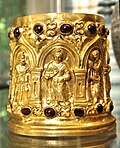
The [[Bimaran Casket]] made of gold inset with garnet, dated to be around 60 CE, but some proposals dating it to the 1st century BCE, is among the earliest archaeological evidences available that establish the importance of Indra in Buddhist mythology. The artwork shows the Buddha flanked by gods [[Brahma]] and Indra.<ref name=lopez37>{{cite book|author=Donald S. | [[File:BimaranCasket2.JPG|thumb|right|[[Bimaran casket]]: the Buddha (middle) is flanked by Brahma (left) and Indra, in one of the earliest Buddhist depictions (1st century CE).<ref name=lopez37/>]] | ||
The [[Bimaran Casket]] made of gold inset with garnet, dated to be around 60 CE, but some proposals dating it to the 1st century BCE, is among the earliest archaeological evidences available that establish the importance of Indra in Buddhist mythology. The artwork shows the Buddha flanked by gods [[Brahma]] and Indra.<ref name=lopez37>{{cite book | author=Lopez, Donald S. Jr. |year=2013 |title=From Stone to Flesh: A short history of the Buddha |publisher=University of Chicago Press |isbn=978-0-226-49321-3 |page=37 |url=https://books.google.com/books?id=pITNHIZnZ5QC}}</ref><ref>{{cite journal |first=K. Walton |last=Dobbins |date=March–June 1968 |title=Two Gandhāran reliquaries |journal=East and West |volume=18 |number=1–2 |pages=151–162 |jstor=29755217}}</ref> | |||
In [[China]], [[Korea]], and [[Japan]], he is known by the characters 帝釋天 (Chinese: 釋提桓因, pinyin: shì dī huán yīn, Korean: "Je-seok-cheon" or 桓因 ''Hwan-in'', Japanese: "Tai-shaku-ten", [[kanji]]: 帝釈天) and usually appears opposite [[Brahma]] in Buddhist art. Brahma and Indra are revered together as protectors of the historical Buddha (Chinese: 釋迦, [[kanji]]: 釈迦, also known as [[Gautama Buddha|Shakyamuni]]), and are frequently shown giving the infant Buddha his first bath. Although Indra is often depicted like a [[bodhisattva]] in the Far East, typically in [[Tang dynasty]] costume, his iconography also includes a martial aspect, wielding a thunderbolt from atop his elephant mount.{{citation needed|date=October 2016}} | In [[China]], [[Korea]], and [[Japan]], he is known by the characters 帝釋天 (Chinese: 釋提桓因, pinyin: shì dī huán yīn, Korean: "Je-seok-cheon" or 桓因 ''Hwan-in'', Japanese: "Tai-shaku-ten", [[kanji]]: 帝釈天) and usually appears opposite [[Brahma]] in Buddhist art. Brahma and Indra are revered together as protectors of the historical Buddha (Chinese: 釋迦, [[kanji]]: 釈迦, also known as [[Gautama Buddha|Shakyamuni]]), and are frequently shown giving the infant Buddha his first bath. Although Indra is often depicted like a [[bodhisattva]] in the Far East, typically in [[Tang dynasty]] costume, his iconography also includes a martial aspect, wielding a thunderbolt from atop his elephant mount.{{citation needed|date=October 2016}} | ||
In some schools of Buddhism and in Hinduism, the image of [[Indra's net]] is a metaphor for the emptiness of all things, and at the same time a metaphor for the understanding of the universe as a web of connections and interdependences<ref>[[Indra's Net (book)#cite note-FOOTNOTEMalhotra20144-10]]</ref>{{circular reference|date=December 2019}}. | |||
In some schools of Buddhism and in Hinduism, the image of [[Indra's net]] is a metaphor for the emptiness of all things, and at the same time a metaphor for the understanding of the universe as a web of connections and interdependences<ref>[[Indra's Net (book)#cite note-FOOTNOTEMalhotra20144-10]]</ref>{{ | |||
In China, Indra (帝釋天 Dìshìtiān) is regarded as one of the twenty-four protective devas ([[:zh:二十四诸天|二十四諸天]] Èrshísì zhūtiān) of Buddhism. In Chinese Buddhist temples, his statue is usually enshrined in the [[Mahavira Hall]] along with the other devas. | In China, Indra (帝釋天 Dìshìtiān) is regarded as one of the twenty-four protective devas ([[:zh:二十四诸天|二十四諸天]] Èrshísì zhūtiān) of Buddhism. In Chinese Buddhist temples, his statue is usually enshrined in the [[Mahavira Hall]] along with the other devas. | ||
In Japan, Indra (帝釈天 Taishakuten) is one of the twelve Devas, as guardian deities, who are found in or around Buddhist temples (十二天[[:ja:十二天|Jūni-ten]]).<ref> | In Japan, Indra (帝釈天 Taishakuten) is one of the twelve Devas, as guardian deities, who are found in or around Buddhist temples (十二天[[:ja:十二天|Jūni-ten]]).<ref>{{cite web |title=Twelve heavenly deities (devas) |publisher=Nara National Museum |place=Nara, Japan |url=http://www.emuseum.jp/detail/100031/000/000?mode=detail&d_lang=en |access-date=31 December 2015 |archive-date=4 March 2016 |archive-url=https://web.archive.org/web/20160304201634/http://www.emuseum.jp/detail/100031/000/000?mode=detail&d_lang=en |url-status=dead }}</ref><ref name="biswas184">{{cite book |first=S. |last=Biswas |year=2000 |title=Art of Japan |publisher=Northern |isbn=978-817211269-1 |page=184}}</ref><ref>{{cite book |first1=Willem Frederik |last1=Stutterheim |display-authors=etal |year=1995 |title=Rāma-legends and Rāma-reliefs in Indonesia |isbn=978-817017251-2 |pages={{mvar|xiv–xvi}} }}</ref><ref>{{cite book |author=Snodgrass, A. |author-link=Adrian Snodgrass |year=2007 |title=The Symbolism of the Stupa, Motilal Banarsidass |isbn=978-812080781-5 |pages=120-124, 298-300}}</ref> | ||
The ceremonial name of [[Bangkok]] claims that the city was "given by Indra and built by [[Vishvakarman]]."<ref>{{cite journal|journal=Royal Institute Newsletter|volume=3|issue=31|date=December 1993|title=กรุงเทพมหานคร}} Reproduced in {{cite web|script-title=th:กรุงเทพมหานคร|trans-title=Krung Thep Mahanakhon| | The ceremonial name of [[Bangkok]] claims that the city was "given by Indra and built by [[Vishvakarman]]."<ref>{{cite journal |journal=Royal Institute Newsletter |volume=3 |issue=31 |date=December 1993 |script-title=th:กรุงเทพมหานคร |lang=th |trans-title=Bangkok}} Reproduced in {{cite web |script-title=th:กรุงเทพมหานคร |trans-title=Krung Thep Mahanakhon |lang=th |url=http://www.royin.go.th/th/knowledge/detail.php?ID=639 |access-date=12 September 2012 |archive-url=https://web.archive.org/web/20141206140602/http://www.royin.go.th/th/knowledge/detail.php?ID=639 |archive-date=2016-12-10}}</ref> | ||
===Jainism=== | ===Jainism=== | ||
| Line 209: | Line 262: | ||
Indra in [[Jainism|Jain]] mythology always serves the [[Tirthankara]] teachers. Indra most commonly appears in stories related to Tirthankaras, in which Indra himself manages and celebrates the [[Panch Kalyanaka|five auspicious events]] in that Tirthankara's life, such as Chavan kalyanak, [[Birth|Janma]] kalyanak, [[Diksha]] kalyanak, [[Kevala Jnana]] kalyanak, and [[Moksha (Jainism)|moksha]] kalyanak.{{sfn|Goswamy|2014|p=245}} | Indra in [[Jainism|Jain]] mythology always serves the [[Tirthankara]] teachers. Indra most commonly appears in stories related to Tirthankaras, in which Indra himself manages and celebrates the [[Panch Kalyanaka|five auspicious events]] in that Tirthankara's life, such as Chavan kalyanak, [[Birth|Janma]] kalyanak, [[Diksha]] kalyanak, [[Kevala Jnana]] kalyanak, and [[Moksha (Jainism)|moksha]] kalyanak.{{sfn|Goswamy|2014|p=245}} | ||
There are sixty-four Indras in Jaina literature, each ruling over different heavenly realms where heavenly souls who have not yet gained Kaivalya ([[moksha]]) are reborn according to Jainism.<ref name=Wileyj99/><ref name=owenj64/> Among these many Indras, the ruler of the first Kalpa heaven is the Indra who is known as ''Saudharma'' in [[Digambara]], and ''Sakra'' in [[Śvētāmbara]] tradition. He is most preferred, discussed and often depicted in Jaina caves and marble temples, often with his wife Indrani.<ref name=owenj64>{{cite book|author=Lisa | There are sixty-four Indras in Jaina literature, each ruling over different heavenly realms where heavenly souls who have not yet gained Kaivalya ([[moksha]]) are reborn according to Jainism.<ref name=Wileyj99/><ref name=owenj64/> Among these many Indras, the ruler of the first Kalpa heaven is the Indra who is known as ''Saudharma'' in [[Digambara]], and ''Sakra'' in [[Śvētāmbara]] tradition. He is most preferred, discussed and often depicted in Jaina caves and marble temples, often with his wife Indrani.<ref name=owenj64>{{cite book |author=Owen, Lisa |year=2012 |title=Carving Devotion in the Jain Caves at Ellora |publisher=BRILL Academic |isbn=978-90-04-20629-8 |pages=25–28, 29–33 |url=https://books.google.com/books?id=vHK2WE8xAzYC&pg=PA25}}</ref>{{rp|style=ama|pages=25–28}}<ref>{{cite book |author=von Glasenapp, Helmuth |year=1999 |title=Jainism: An Indian religion of salvation |publisher=Motilal Banarsidass |isbn=978-81-208-1376-2 |pages=268–269 |url=https://books.google.com/books?id=WzEzXDk0v6sC}}</ref> They greet the devotee as he or she walks in, flank the entrance to an idol of [[Arihant (Jainism)|Jina]] (conqueror), and lead the gods as they are shown celebrating the five auspicious moments in a Jina's life, including his birth.<ref name=Wileyj99/> These Indra-related stories are enacted by laypeople in Jainism tradition during special Puja (worship) or festive remembrances.<ref name=Wileyj99/><ref name=owenj64/>{{rp|style=ama|pages=29–33}} | ||
In | In outh Indian [[Digambara]] Jaina community, Indra is also the title of hereditary priests who preside over Jain temple functions.<ref name=Wileyj99/> | ||
==See also== | ==See also== | ||
{{div col|colwidth= | {{div col begin|colwidth=12em}} | ||
* [[Rigvedic deities]] | * [[Rigvedic deities]] | ||
*[[Indreswor|Indreshwar]] | * [[Indreswor|Indreshwar]] | ||
* [[Deva (Hinduism)|Deva]] | * [[Deva (Hinduism)|Deva]] | ||
* [[Nahusha]] | * [[Nahusha]] | ||
| Line 246: | Line 299: | ||
==Notes== | ==Notes== | ||
{{notelist}} | {{notelist}} | ||
==References== | ==References== | ||
{{reflist| | {{reflist|25em}} | ||
===Bibliography=== | ===Bibliography=== | ||
{{refbegin| | {{refbegin|25em}} | ||
* {{ | |||
* {{ | * {{cite book |last=Mani |first=Vettam |date=2015-01-01 |title=Puranic Encyclopedia: A comprehensive work with special reference to the epic and puranic literature |publisher=Motilal Banarsidass |isbn=978-81-208-0597-2 |lang=en |url=https://books.google.com/books?id=mvXsDwAAQBAJ&q=aditi+indra&pg=PP5}} | ||
* {{ | * {{cite book |last=Goswamy |first=B.N. |author-link=B. N. Goswamy |year=2014 |title=The Spirit of Indian Painting: Close encounters with 100 great works 1100-1900 |publisher=[[Penguin Books]] |isbn=978-0-670-08657-3 |url=https://books.google.com/books?id=J5E3BQAAQBAJ}} | ||
* {{ | * {{cite book |last=Anthony |first=David W. |year=2007 |title=The Horse, the Wheel, and Language. How Bronze-Age riders from the Eurasian steppes shaped the modern world |publisher=Princeton University Press}} | ||
* {{cite book| author1=E. B. | * {{cite book |last=Beckwith |first=Christopher I. |year=2009 |title=Empires of the Silk Road |publisher=Princeton University Press}} | ||
* {{ | * {{cite book |author1=Cowell, E.B. |author2=Davis, Francis A. |year=1969 |title=Buddhist Mahayana Texts |publisher=Courier Corporation |isbn=978-0-486-25552-1 |url=https://books.google.com/books?id=LYIfAwAAQBAJ}} | ||
* | * {{cite book |last=Wilkings |first=W.J. |year=2001 |orig-year=1882 |title=Hindu mythology, Vedic & Puranic |publisher=Elibron Classics |edition=reprint |isbn=9780766188815 |quote=Reprint of original Thaker, Spink & Co., Calcutta, IN |url=https://books.google.com/books?id=84pTrICjfRcC&q=indra |url-status=dead |archive-url=https://web.archive.org/web/20141009000446/http://books.google.co.th/books?id=84pTrICjfRcC&q=indra#v=snippet&q=indra&f=false |archive-date=9 October 2014 |df=dmy-all }} | ||
* {{cite encyclopedia |author1-link=Paul Masson-Oursel |author1=Masson-Oursel, P. |author2=Morin, Louise |year=1976 |title=Indian Mythology |encyclopedia=New Larousse Encyclopedia of Mythology |pages=325–359 |place=New York, NY |publisher=The Hamlyn Publishing Group}} | |||
* Janda, M., ''Eleusis, das indogermanische Erbe der Mysterien'' (1998). | * Janda, M., ''Eleusis, das indogermanische Erbe der Mysterien'' (1998). | ||
* {{ | * {{cite book |last=Trainor |first=Kevin |year=2004 |title=Buddhism: The Illustrated Guide |publisher=Oxford University Press |isbn=978-0-19-517398-7 |url=https://books.google.com/books?id=_PrloTKuAjwC}} | ||
{{refend}} | {{refend}} | ||
==External links== | ==External links== | ||
{{sister project links|commonscat=yes|n=no|s=no|b=no|voy=no|v=no}} | {{sister project links|commonscat=yes|n=no|s=no|b=no|voy=no|v=no}} | ||
* | * {{cite web |author=Lee, Phil |title=Indra and Skanda deities in Korean Buddhism |department=Chicago Divinity School |publisher=University of Chicago |place=Chicago, IL |url=https://divinity.uchicago.edu/sightings/vivid-indra-and-heavenly-dragon-general-korean-peoples-trust-buddhist-deities}} | ||
* {{cite web |title=Indra, Lord of Storms and King of the Gods' Realm |publisher=Philadelphia Museum of Art |place=Philadelphia, PA |url=http://www.philamuseum.org/collections/permanent/88503.html}} | |||
* {{cite web |title=Indra wood idol – 13th century, Kamakura period |place=Nara, Japan |url=http://www.narahaku.go.jp/english/collection/858-6.html}} | |||
{{Rigveda}} | |||
{{HinduMythology}} | |||
{{Hindudharma}} | |||
{{Burmese nats}} | |||
{{Authority control}} | |||
[[Category:Hindu | [[Category:Adityas]] | ||
[[Category:Buddhist gods]] | |||
[[Category:Characters in the Mahabharata]] | |||
[[Category:Heroes in mythology and legend]] | |||
[[Category:Hindu gods]] | |||
[[Category:Lokapala]] | |||
[[Category:Mythological kings]] | |||
[[Category:Rain deities]] | |||
[[Category:Rigvedic deities]] | |||
[[Category:Sky and weather gods]] | |||
[[Category:Thunder gods]] | |||
[[Category:War gods]] | |||
[[Category:Sea and river gods]] | |||
Revision as of 07:27, 22 January 2023
| Indra | |
|---|---|
 Painting of Indra on his elephant mount, Airavata, c. 1820. | |
| Other names | Devendra, Mahendra, Surendra, Surapati, Suresha, Devesha, Devaraja, Amaresha, Parjanya, Vendhan |
| Devanagari | इन्द्र |
| Sanskrit transliteration | Indra |
| Affiliation | Deva, Dikpala, Parjanya, Vishnu |
| Abode | Amarāvati, the capital of Indraloka in Svarga[1] |
| Mantra | Om Indra Devaya Namah Om Indra Rajaya Vidmahe Mahaindraya Dhimahi Tanno Indraya Prachodayat |
| Weapon | Vajra (thunderbolt), Astras, Indrastra, Aindrastra, Vasavi Shakti |
| Symbols | Vajra, Indra's net |
| Mount | Airavata (white elephant), Uchchaihshravas (white horse) |
| Texts | Vedas, Ramayana, Mahabharata, Puranas |
| Gender | Male |
| Festivals | Indra Jatra, Indra Vila, Raksha Bandhan, Lohri, Sawan, Deepavali |
| Personal information | |
| Parents |
|
| Siblings | Adityas including Surya, Varuna, Bhaga, Aaryaman, Mitra, Savitra and Vamana |
| Consort | Shachi |
| Children | Jayanta, Rishabha, Midhusha, Jayanti, Devasena (Shashthi), Vali and Arjuna |
| Equivalents | |
| Greek equivalent | Zeus |
| Roman equivalent | Jupiter |
| Norse equivalent | Thor |
| Slavic equivalent | Perun |
| Celtic equivalent | Taranis |
Indra (/ˈɪndrə/; Sanskrit: इन्द्र) is the king of the devas (god-like deities) and Svarga (heaven) in Hindu mythology. He is associated with the sky, lightning, weather, thunder, storms, rains, river flows, and war.[4][5][6][7] Indra's myths and powers are similar to other Indo-European deities such as Jupiter, Perun, Perkūnas, Zalmoxis, Taranis, Zeus, and Thor, part of the greater Proto-Indo-European mythology.[7][8][9]
Indra is the most referred deity in the Rigveda.[10] He is celebrated for his powers, and as the one who killed the great evil (a malevolent type of asura) named Vritra, who obstructed human prosperity and happiness. Indra destroys Vritra and his "deceiving forces", and thereby brings rains and sunshine as the saviour of mankind.[7][11] He is also an important deity worshipped by the Kalash people, indicating his prominence in ancient Hinduism.[12][13][lower-alpha 2][14][lower-alpha 3][15][16][lower-alpha 4][17][lower-alpha 5][18]
Indra's significance diminishes in the post-Vedic Indian literature, but he still plays an important role in various mythological events. He is depicted as a powerful hero, and is known for having sexual relations with sage Gautama's wife, Ahalyā.[19]
According to the Vishnu Purana, Indra is the title borne by the king of the gods, which changes every Manvantara – a cyclic period of time in Hindu cosmology. Each Manvantara has its own Indra and the Indra of the current Manvantara is called Purandhara.[20][21][22][23]
Indra is also depicted in Buddhist (Indā[24] in Pali)[25] and Jaina[26] mythologies. Indra rules over the much-sought Devas realm of rebirth within the Samsara doctrine of Buddhist traditions.[27] However, like the post-Vedic Hindu texts, Indra is also a subject of ridicule and reduced to a figurehead status in Buddhist texts,[28] shown as a god that suffers rebirth.[27] In Jain traditions, unlike Buddhism and Hinduism, Indra is not the king of gods, but the king of superhumans residing in Svarga-Loka, and very much a part of Jain rebirth cosmology.[29] He is also the one who appears with his wife Indrani to celebrate the auspicious moments in the life of a Jain Tirthankara, an iconography that suggests the king and queen of superhumans residing in Svarga (heaven) reverentially marking the spiritual journey of a Jaina.[30][31]
Indra's iconography shows him wielding a lightning thunderbolt weapon known as Vajra, riding on a white elephant known as Airavata.[32][33] In Buddhist iconography, the elephant sometimes features three heads, while Jaina icons sometimes show the elephant with five heads. Sometimes, a single elephant is shown with four symbolic tusks.[32] Indra's abode exists in the capital city of Svarga, Amaravati, though he is also associated with Mount Meru (also called Sumeru).[27][34]
Etymology and nomenclature
.jpg)
The etymological roots of Indra are unclear, and it has been a contested topic among scholars since the 19th-century, one with many proposals.[36][37] The significant proposals have been:
- root ind-u, or "rain drop", based on the Vedic mythology that he conquered rain and brought it down to earth.[32][36]
- root ind, or "equipped with great power". This was proposed by Vopadeva.[32]
- root idh or "kindle", and ina or "strong".[38][39]
- root indha, or "igniter", for his ability to bring light and power (indriya) that ignites the vital forces of life (prana). This is based on Shatapatha Brahmana.[40]
- root idam-dra, or "It seeing" which is a reference to the one who first perceived the self-sufficient metaphysical Brahman. This is based on Aitareya Upanishad.[32]
- roots in ancient Indo-European, Indo-Aryan deities.[41] For example, states John Colarusso, as a reflex of proto-Indo-European *h₂nḗr-, Greek anēr, Sabine nerō, Avestan nar-, Umbrian nerus, Old Irish nert, Pashto nər, Ossetic nart, and others which all refer to "most manly" or "hero".[41]
Colonial era scholarship proposed that Indra shares etymological roots with Avestan Andra, Old High German *antra ("giant"), or Old Church Slavonic jedru ("strong"), but Max Muller critiqued these proposals as untenable.[36][42] Later scholarship has linked Vedic Indra to Aynar (the Great One) of Circassian, Abaza and Ubykh mythology, and Innara of Hittite mythology.[41][43] Colarusso suggests a Pontic[lower-alpha 6] origin and that both the phonology and the context of Indra in Indian religions is best explained from Indo-Aryan roots and a Circassian etymology (i.e. *inra).[41]
Other languages
For other languages, he is also known as
- Ashkun: Indra
- Bengali: ইন্দ্র (Indro)
- Burmese: သိကြားမင်း (pronounced [ðadʑá mɪ́ɰ̃])
- Chinese: 因陀羅 (Yīntuóluó) or 帝釋天 (Dìshìtiān)
- Indonesian/Malay: (Indera)
- Japanese: 帝釈天 (Taishakuten).[44]
- Javanese: ꦧꦛꦫꦲꦶꦤ꧀ꦢꦿ (Bathara Indra)
- Kamkata-vari: Inra
- Kannada: ಇಂದ್ರ (Indra)
- Khmer: ព្រះឥន្ទ្រ (Preah In Template:IPA-km)
- Korean: 제석천 (Jeseokcheon)
- Lao: ພະອິນ (Pha In) or ພະຍາອິນ (Pha Nya In)
- Malayalam: ഇന്ദ്രൻ (Indran)
- Mon: ဣန် (In)
- Mongolian: Индра (Indra)
- Odia: ଇନ୍ଦ୍ର (Indrô)
- Prasun: Indr
- Sinhala: ඉඳු (In̆du) or ඉන්ද්ර (Indra)
- Tai Lue: ᦀᦲᧃ (In) or ᦘᦍᦱᦀᦲᧃ (Pha Ya In)
- Tamil: இந்திரன் (Inthiran)
- Telugu: ఇంద్రుడు (Indrudu or Indra)
- Tibetan: དབང་པོ་ (dbang po)
- Thai: พระอินทร์ (Phra In)
- Waigali: Indr
Epithets
Indra has many epithets in the Indian religions, notably Śakra (शक्र, powerful one),
- Vṛṣan (वृषन् , mighty)
- Vṛtrahan (वृत्रहन् , slayer of Vṛtra)
- Meghavāhana (मेघवाहन, he whose vehicle is cloud)
- Devarāja (देवराज, king of deities)
- Devendra (देवेन्द्र, the lord of deities)[45]
- Surendra (सुरेन्द्र, chief of deities)
- Svargapati (स्वर्गपति, the lord of heaven)
- Śatakratu (शतक्रतु one who performs 100 sacrifices).
- Vajrapāṇī (वज्रपाणि, wielder of Vajra, i.e., thunderbolt)
- Vāsava (वासव, lord of Vasus)
- Purandara (पुरंदर, the breaker of forts)
- Kaushika (कौशिक, Vishvamitra was born as the embodiment of Indra)
- Shachin or Shachindra (शचीन, the consort of Shachi).
- Parjanya (पर्जन्य,Rain)
Origins
.jpg)
Indra is of ancient but unclear origin. Aspects of Indra as a deity are cognate to other Indo-European gods; there are thunder gods such as Thor, Perun, and Zeus who share parts of his heroic mythologies, act as king of gods, and all are linked to "rain and thunder".[46] The similarities between Indra of Vedic mythology and of Thor of Nordic and Germanic mythologies are significant, states Max Müller. Both Indra and Thor are storm gods, with powers over lightning and thunder, both carry a hammer or an equivalent, for both the weapon returns to their hand after they hurl it, both are associated with bulls in the earliest layer of respective texts, both use thunder as a battle-cry, both are protectors of mankind, both are described with legends about "milking the cloud-cows", both are benevolent giants, gods of strength, of life, of marriage and the healing gods.[47]
Michael Janda suggests that Indra has origins in the Indo-European *trigw-welumos [or rather *trigw-t-welumos] "smasher of the enclosure" (of Vritra, Vala) and diye-snūtyos "impeller of streams" (the liberated rivers, corresponding to Vedic apam ajas "agitator of the waters").[48] Brave and heroic Innara or Inra, which sounds like Indra, is mentioned among the gods of the Mitanni, a Hurrian-speaking people of Hittite region.[49]
Indra as a deity had a presence in northeastern Asia minor, as evidenced by the inscriptions on the Boghaz-köi clay tablets dated to about 1400 BCE. This tablet mentions a treaty, but its significance is in four names it includes reverentially as Mi-it-ra, U-ru-w-na, In-da-ra and Na-sa-at-ti-ia. These are respectively, Mitra, Varuna, Indra and Nasatya-Asvin of the Vedic pantheon as revered deities, and these are also found in Avestan pantheon but with Indra and Naonhaitya as demons. This at least suggests that Indra and his fellow deities were in vogue in South Asia and Asia minor by about mid 2nd-millennium BCE.[38][50]
Indra is praised as the highest god in 250 hymns of the Rigveda – a Hindu scripture dated to have been composed sometime between 1700 and 1100 BCE. He is co-praised as the supreme in another 50 hymns, thus making him one of the most celebrated Vedic deities.[38] He is also mentioned in ancient Indo-Iranian literature, but with a major inconsistency when contrasted with the Vedas. In the Vedic literature, Indra is a heroic god. In the Avestan (ancient, pre-Islamic Iranian) texts such as Vd. 10.9, Dk. 9.3 and Gbd 27.6-34.27, Indra – or accurately Andra[51] – is a gigantic demon who opposes truth.[41][lower-alpha 7] In the Vedic texts, Indra kills the archenemy and demon Vritra who threatens mankind. In the Avestan texts, Vritra is not found.[51]
Indra is called vr̥tragʰná- (literally, "slayer of obstacles") in the Vedas, which corresponds to Verethragna of the Zoroastrian noun verethragna-. According to David Anthony, the Old Indic religion probably emerged among Indo-European immigrants in the contact zone between the Zeravshan River (present-day Uzbekistan) and (present-day) Iran.[52] It was "a syncretic mixture of old Central Asian and new Indo-European elements",[52] which borrowed "distinctive religious beliefs and practices"[53] from the Bactria–Margiana Culture.[53] At least 383 non-Indo-European words were found in this culture, including the god Indra and the ritual drink Soma.[54] According to Anthony,
Many of the qualities of Indo-Iranian god of might/victory, Verethraghna, were transferred to the god Indra, who became the central deity of the developing Old Indic culture. Indra was the subject of 250 hymns, a quarter of the Rig Veda. He was associated more than any other deity with Soma, a stimulant drug (perhaps derived from Ephedra) probably borrowed from the BMAC religion. His rise to prominence was a peculiar trait of the Old Indic speakers.[55]
Iconography
.jpg)
.jpg)
In Rigveda, Indra is described as strong willed, armed with a thunderbolt, riding a chariot:
5. Let bullish heaven strengthen you, the bull; as bull you travel with your two bullish fallow bays. As bull with a bullish chariot, well-lipped one, as bull with bullish will, you of the mace, set us up in loot.
— Rigveda, Book 5, Hymn 37: Jamison[56]
Indra's weapon, which he used to kill the evil Vritra, is the Vajra or thunderbolt. Other alternate iconographic symbolism for him includes a bow (sometimes as a colorful rainbow), a sword, a net, a noose, a hook, or a conch.[57] The thunderbolt of Indra is called Bhaudhara.[58]
In the post-Vedic period, he rides a large, four-tusked white elephant called Airavata.[32] In sculpture and relief artworks in temples, he typically sits on an elephant or is near one. When he is shown to have two, he holds the Vajra and a bow.[59]
In the Shatapatha Brahmana and in Shaktism traditions, Indra is stated to be same as goddess Shodashi (Tripura Sundari), and her iconography is described similar to those of Indra.[60]
The rainbow is called Indra's Bow (Sanskrit: indradhanus [इन्द्रधनुस्] Error: {{Transliteration}}: transliteration text not Latin script (pos 1: इ) (help)).[57]
Literature
Vedic texts


Indra was a prominent deity in the Vedic era of Hinduism.[38] In Vedic times Indra was described in Rig Veda 6.30.4 as superior to any other god. Sayana in his commentary on Rig Veda 6.47.18 described Indra as assuming many forms, making Agni, Vishnu, and Rudra his illusory forms.[61]
Over a quarter of the 1,028 hymns of the Rigveda mention Indra, making him the most referred to deity.[38][62] These hymns present a complex picture of Indra, but some aspects of Indra are often repeated. Of these, the most common theme is where he as the god with thunderbolt kills the evil serpent Vritra that held back rains, and thus released rains and land nourishing rivers.[36] For example, the Rigvedic hymn 1.32 dedicated to Indra reads:
इन्द्रस्य नु वीर्याणि प्र वोचं यानि चकार प्रथमानि वज्री । |
1. Now I shall proclaim the heroic deeds of Indra, those foremost deeds that the mace-wielder performed: |
| —Rigveda, 1.32.1–2[64] |
In the myth, Vṛtra has coiled around a mountain and has trapped all the waters, namely the Seven Rivers. All the gods abandon Indra out of fear of Vṛtra. Indra uses his vajra, a mace, to kill Vritra and smash open the mountains to release the waters. In some versions, he is aided by the Maruts or other deities, and sometimes cattle and the sun is also released from the mountain.[65][66] In one interpretation by Oldenberg, the hymns are referring to the snaking thunderstorm clouds that gather with bellowing winds (Vritra), Indra is then seen as the storm god who intervenes in these clouds with his thunderbolts, which then release the rains nourishing the parched land, crops and thus humanity.[67] In another interpretation by Hillebrandt, Indra is a symbolic sun god (Surya) and Vritra is a symbolic winter-giant (historic mini cycles of ice age, cold) in the earliest, not the later, hymns of Rigveda. The Vritra is an ice-demon of colder central Asia and northern latitudes, who holds back the water. Indra is the one who releases the water from the winter demon, an idea that later metamorphosed into his role as storm god.[67] According to Griswold, this is not a completely convincing interpretation, because Indra is simultaneously a lightning god, a rain god and a river-helping god in the Vedas. Further, the Vritra demon that Indra slew is best understood as any obstruction, whether it be clouds that refuse to release rain or mountains or snow that hold back the water.[67] Jamison and Brereton also state that Vritra is best understood as any obstacle. The Vritra myth is associated with the Midday Pressing of soma, which is dedicated to Indra or Indra and the Maruts.[65]
Even though Indra is declared as the king of gods in some verses, there is no consistent subordination of other gods to Indra. In Vedic thought, all gods and goddesses are equivalent and aspects of the same eternal abstract Brahman, none consistently superior, none consistently inferior. All gods obey Indra, but all gods also obey Varuna, Vishnu, Rudra and others when the situation arises. Further, Indra also accepts and follows the instructions of Savitr (solar deity).[68] Indra, like all Vedic deities, is a part of henotheistic theology of ancient India.[69]
The second-most important myth about Indra is about the Vala cave. In this story, the Panis have stolen cattle and hidden them in the Vala cave. Here Indra utilizes the power of the songs he chants to split the cave open to release the cattle and dawn. He is accompanied in the cave by the Angirases (and sometimes Navagvas or the Daśagvas). Here Indra exemplifies his role as a priest-king, called bṛhaspati. Eventually later in the Rigveda, Bṛhaspati and Indra become separate deities as both Indra and the Vedic king lose their priestly functions. The Vala myth was associated with the Morning Pressing of soma, in which cattle was donated to priests, called dakṣiṇā.[65]
Indra is not a visible object of nature in the Vedic texts, nor is he a personification of any object, but that agent which causes the lightning, the rains and the rivers to flow.[70] His myths and adventures in the Vedic literature are numerous, ranging from harnessing the rains, cutting through mountains to help rivers flow, helping land becoming fertile, unleashing sun by defeating the clouds, warming the land by overcoming the winter forces, winning the light and dawn for mankind, putting milk in the cows, rejuvenating the immobile into something mobile and prosperous, and in general, he is depicted as removing any and all sorts of obstacles to human progress.[71] The Vedic prayers to Indra, states Jan Gonda, generally ask "produce success of this rite, throw down those who hate the materialized Brahman".[72] The hymns of Rigveda declare him to be the "king that moves and moves not", the friend of mankind who holds the different tribes on earth together.[73]
Indra is often presented as the twin brother of Agni (fire) – another major Vedic deity.[74] Yet, he is also presented to be the same, states Max Muller, as in Rigvedic hymn 2.1.3, which states, "Thou Agni, art Indra, a bull among all beings; thou art the wide-ruling Vishnu, worthy of adoration. Thou art the Brahman, (...)."[75] He is also part of one of many Vedic trinities as "Agni, Indra and Surya", representing the "creator-maintainer-destroyer" aspects of existence in Hindu thought.[62][lower-alpha 8]
Rigveda 2.1.3 Jamison 2014[78]
- You, Agni, as bull of beings, are Indra; you, wide-going, worthy of homage, are Viṣṇu. You, o lord of the sacred formulation, finder of wealth, are the Brahman [Formulator]; you, o Apportioner, are accompanied by Plenitude.
Parentage of Indra is inconsistent in Vedic texts, and in fact Rigveda 4.17.12 states that Indra himself may not even know that much about his mother and father. Some verses of Vedas suggest that his mother was a grishti (a cow), while other verses name her Nishtigri. The medieval commentator Sayana identified her with Aditi, the goddess who is his mother in later Hinduism. The Atharvaveda states Indra's mother is Ekashtaka, daughter of Prajapati. Some verses of Vedic texts state that Indra's father is Tvashtr or sometimes the couple Dyaush and Prithvi are mentioned as his parents.[78](pp39, 582)[79][80] According to a legend found in it, before Indra is born, his mother attempts to persuade him to not take an unnatural exit from her womb. Immediately after birth, Indra steals soma from his father, and Indra's mother offers the drink to him. After Indra's birth, Indra's mother reassures Indra that he will prevail in his rivalry with his father, Tvaṣṭar. Both the unnatural exit from the womb and rivalry with the father are universal attributes of heroes.[65] In the Rigveda, Indra's wife is Indrani, alias Shachi, and she is described to be extremely proud about her status.[81] Rigveda 4.18.8 says after his birth Indra got swallowed by a demon Kushava.[82]
Indra is also found in many other myths that are poorly understood. In one, Indra crushes the cart of Ushas (Dawn), and she runs away. In another Indra beats Surya in a chariot race by tearing off the wheel of his chariot. This is connected to a myth where Indra and his sidekick Kutsa ride the same chariot drawn by the horses of the wind to the house of Uśanā Kāvya to receive aid before killing Śuṣṇa, the enemy of Kutsa. In one myth Indra (in some versions helped by Viṣṇu) shoots a boar named Emuṣa in order to obtain special rice porridge hidden inside or behind a mountain. Another myth has Indra kill Namuci by beheading him. In later versions of that myth Indra does this through trickery involving the foam of water. Other beings slain by Indra include Śambara, Pipru, Varcin, Dhuni and Cumuri, and others. Indra's chariot is pulled by fallow bay horses described as hárī. They bring Indra to and from the sacrifice, and are even offered their own roasted grains.[65]
Upanishads
The ancient Aitareya Upanishad equates Indra, along with other deities, with Atman (soul, self) in the Vedanta's spirit of internalization of rituals and gods. It begins with its cosmological theory in verse 1.1.1 by stating that, "in the beginning, Atman, verily one only, was here - no other blinking thing whatever; he bethought himself: let me now create worlds".[83](p294)[84] This soul, which the text refers to as Brahman as well, then proceeds to create the worlds and beings in those worlds wherein all Vedic gods and goddesses such as sun-god, moon-god, Agni, and other divinities become active cooperative organs of the body.[84][83](p295-297)[85] The Atman thereafter creates food, and thus emerges a sustainable non-sentient universe, according to the Upanishad. The eternal Atman then enters each living being making the universe full of sentient beings, but these living beings fail to perceive their Atman. The first one to see the Atman as Brahman, asserts the Upanishad, said, "idam adarsha or "I have seen It".[84] Others then called this first seer as Idam-dra or "It-seeing", which over time came to be cryptically known as "Indra", because, claims Aitareya Upanishad, everyone including the gods like short nicknames.[83](pp297-298) The passing mention of Indra in this Upanishad, states Alain Daniélou, is a symbolic folk etymology.[32]
The section 3.9 of the Brihadaranyaka Upanishad connects Indra to thunder, thunderbolt and release of waters.[86] In section 5.1 of the Avyakta Upanishad, Indra is praised as he who embodies the qualities of all gods.[62]
Post-Vedic texts


In post-Vedic texts, Indra is depicted as an intoxicated hedonistic god, his importance declines, and he evolves into a minor deity in comparison to others in the Hindu pantheon, such as Shiva, Vishnu, or Devi. In Hindu texts, Indra is some times known as an aspect (avatar) of Shiva.[62]
In the Puranas, Ramayana and Mahabharata, the divine sage Kashyapa is described as the father of Indra, and Aditi as his mother. In this tradition, he is presented as one of their thirty-three sons.[87][79] Indra married Shachi, the daughter of Danava Puloman. Most texts state that Indra had only one wife, though sometimes other names are mentioned.[79] The text Bhagavata Purana mention that Indra and Shachi had three sons Jayanta, Rishabha, Midhusha.[88] Some listings add Nilambara and Rbhus.[80] Indra and Shachi also had two daughters, Jayanti and Devasena. Goddess Jayanti is the spouse of Shukra, while Devasena marries the war god Kartikeya.[20] Indra is depicted as the spiritual father of Vali in the Ramayana and Arjuna in the Mahabharata.[28] Since he is known for mastering over all weapons in warfare, his spiritual sons Vali and Arjuna are also very good in warfare. He has a charioteer named Matali.[89]
Indra had multiple affairs with other women. One such was Ahalya, wife of sage Gautama. Indra was cursed by the sage. Although the Brahmanas (9th to 6th centuries BCE) are the earliest scriptures to hint at their relationship, the 7th- to 4th-century BCE Hindu epic Ramayana – whose hero is Rama – is the first to explicitly mention the affair in detail.[90]
Indra becomes a source of nuisance rains in the Puranas, out of anger and with an intent to hurt mankind. But, Krishna as an avatar of Vishnu, comes to the rescue by lifting Mount Govardhana on his fingertip, and letting mankind shelter under the mountain till Indra exhausts his anger and relents.[28] Also, according to Mahabharata, Indra disguised himself as a Brahmin approached Karna and asked for his kavacha (body armor) and kundala (earrings) as charity. Although being aware of his true identity, Karna peeled off his kavacha and kundala and fulfilled the wish of Indra. Pleased by this act Indra, gifted Karna a dart called Vasavi Shakthi.
According to the Vishnu Purana, Indra is the position of being the king of the gods which changes in every Manvantara—a cyclic period of time in Hindu cosmology. Each Manvantara has its own Indra and the Indra of the current Manvantara is called Purandhara.[20][21][22][23]
Sangam literature (300 BCE–300 CE)
Sangam literature of the Tamil language contains more stories about Indra by various authors. In Silapathikaram Indra is described as Maalai venkudai mannavan (மாலைவெண் குடை மன்னவன்), literally meaning Indra with the pearl-garland and white umbrella.[91]
The Sangam literature also describes Indira Vizha (festival for Indra), the festival for want of rain, celebrated for one full month starting from the full moon in Ootrai (later name – Cittirai) and completed on the full moon in Puyaazhi (Vaikaasi) (which coincides with Buddhapurnima). It is described in the epic Silappatikaram in detail.[92]
In his work of the Tirukkural (before c. 5th century CE), Valluvar cites Indra to exemplify the virtue of conquest over one's senses.[93][94]
In other religions
Buddhism

The Buddhist cosmology places Indra above Mount Sumeru, in Trayastrimsha heaven.[25] He resides and rules over one of the six realms of rebirth, the Devas realm of Saṃsāra, that is widely sought in the Buddhist tradition.[95][lower-alpha 10] Rebirth in the realm of Indra is a consequence of very good Karma (Pali: kamma) and accumulated merit during a human life.[98]
.svg)
In Buddhism, Indra is commonly called by his other name, Śakra or Sakka, ruler of the Trāyastriṃśa heaven.[100] Śakra is sometimes referred to as Devānām Indra or "Lord of the Devas". Buddhist texts also refer to Indra by numerous names and epithets, as is the case with Hindu and Jain texts. For example, Asvaghosha's Buddhacarita in different sections refers to Indra with terms such as "the thousand eyed",[101] Puramdara,[102] Lekharshabha,[103] Mahendra, Marutvat, Valabhid and Maghavat.[104] Elsewhere, he is known as Devarajan (literally, "the king of gods"). These names reflect a large overlap between Hinduism and Buddhism, and the adoption of many Vedic terminology and concepts into Buddhist thought.[105] Even the term Śakra, which means "mighty", appears in the Vedic texts such as in hymn 5.34 of the Rigveda.[32][106]
In Theravada Buddhism Indra is referred to as Indā in evening chanting such as the Udissanādiṭṭhānagāthā (Iminā).[107]

The Bimaran Casket made of gold inset with garnet, dated to be around 60 CE, but some proposals dating it to the 1st century BCE, is among the earliest archaeological evidences available that establish the importance of Indra in Buddhist mythology. The artwork shows the Buddha flanked by gods Brahma and Indra.[108][109]
In China, Korea, and Japan, he is known by the characters 帝釋天 (Chinese: 釋提桓因, pinyin: shì dī huán yīn, Korean: "Je-seok-cheon" or 桓因 Hwan-in, Japanese: "Tai-shaku-ten", kanji: 帝釈天) and usually appears opposite Brahma in Buddhist art. Brahma and Indra are revered together as protectors of the historical Buddha (Chinese: 釋迦, kanji: 釈迦, also known as Shakyamuni), and are frequently shown giving the infant Buddha his first bath. Although Indra is often depicted like a bodhisattva in the Far East, typically in Tang dynasty costume, his iconography also includes a martial aspect, wielding a thunderbolt from atop his elephant mount.[citation needed]
In some schools of Buddhism and in Hinduism, the image of Indra's net is a metaphor for the emptiness of all things, and at the same time a metaphor for the understanding of the universe as a web of connections and interdependences[110][circular reference].
In China, Indra (帝釋天 Dìshìtiān) is regarded as one of the twenty-four protective devas (二十四諸天 Èrshísì zhūtiān) of Buddhism. In Chinese Buddhist temples, his statue is usually enshrined in the Mahavira Hall along with the other devas.
In Japan, Indra (帝釈天 Taishakuten) is one of the twelve Devas, as guardian deities, who are found in or around Buddhist temples (十二天Jūni-ten).[111][112][113][114]
The ceremonial name of Bangkok claims that the city was "given by Indra and built by Vishvakarman."[115]
Jainism


Indra in Jain mythology always serves the Tirthankara teachers. Indra most commonly appears in stories related to Tirthankaras, in which Indra himself manages and celebrates the five auspicious events in that Tirthankara's life, such as Chavan kalyanak, Janma kalyanak, Diksha kalyanak, Kevala Jnana kalyanak, and moksha kalyanak.[116]
There are sixty-four Indras in Jaina literature, each ruling over different heavenly realms where heavenly souls who have not yet gained Kaivalya (moksha) are reborn according to Jainism.[30][117] Among these many Indras, the ruler of the first Kalpa heaven is the Indra who is known as Saudharma in Digambara, and Sakra in Śvētāmbara tradition. He is most preferred, discussed and often depicted in Jaina caves and marble temples, often with his wife Indrani.[117](pp25–28)[118] They greet the devotee as he or she walks in, flank the entrance to an idol of Jina (conqueror), and lead the gods as they are shown celebrating the five auspicious moments in a Jina's life, including his birth.[30] These Indra-related stories are enacted by laypeople in Jainism tradition during special Puja (worship) or festive remembrances.[30][117](pp29–33)
In outh Indian Digambara Jaina community, Indra is also the title of hereditary priests who preside over Jain temple functions.[30]
See also
Notes
- ↑ These are his parents in the Epics and Puranas. For various earlier versions, see #Literature
- ↑ Prominent sites include Hadda, near Jalalabad, but Buddhism never seems to have penetrated the remote valleys of Nuristan, where the people continued to practise an early form of polytheistic Hinduism.[13]
- ↑ Up until the late nineteenth century, many Nuristanis practised a primitive form of Hinduism. It was the last area in Afghanistan to convert to Islam — and the conversion was accomplished by the sword.[14]
- ↑ Some of their deities who are worshiped in Kalash tribe are similar to the Hindu god and goddess like Mahadev in Hinduism is called Mahandeo in Kalash tribe. ... All the tribal also visit the Mahandeo for worship and pray. After that they reach to the gree (dancing place).[16]
- ↑ The Kalasha are a unique people living in just three valleys near Chitral, Pakistan, the capital of North-West Frontier Province, which borders Afghanistan. Unlike their neighbors in the Hindu Kush Mountains on both the Afghan and Pakistani sides of the border the Kalasha have not converted to Islam. During the mid-20th century a few Kalasha villages in Pakistan were forcibly converted to this dominant religion, but the people fought the conversion and once official pressure was removed the vast majority continued to practice their own religion. Their religion is a form of Hinduism that recognizes many gods and spirits and has been related to the religion of the ancient Greeks ... given their Indo-Aryan language, ... the religion of the Kalasha is much more closely aligned to the Hinduism of their Indian neighbors that to the religion of Alexander the Great and his armies.[17]
- ↑ The Pontic is the region near Black Sea.
- ↑ In deities that are similar to Indra in the Hittite and European mythologies, he is also heroic.[41]
- ↑ The Trimurti idea of Hinduism, states Jan Gonda, "seems to have developed from ancient cosmological and ritualistic speculations about the triple character of an individual god, in the first place of Agni, whose births are three or threefold, and who is threefold light, has three bodies and three stations".[76](pp218-219) Other trinities, beyond the more common "Brahma, Vishnu, Shiva", mentioned in ancient and medieval Hindu texts include: "Indra, Vishnu, Brahmanaspati", "Agni, Indra, Surya", "Agni, Vayu, Aditya", "Mahalakshmi, Mahasarasvati, and Mahakali", and others.[76](pp212-226)</ref>[77]
- ↑ For a vast majority of Buddhists in Theravadin countries, however, the order of monks is seen by lay Buddhists as a means of gaining the most merit in the hope of accumulating good karma for a better rebirth.[96]
- ↑ Scholars[96][lower-alpha 9][97] note that better rebirth, not nirvana, has been the primary focus of a vast majority of lay Buddhists. This is sought in the Buddhist traditions through merit accumulation and good kamma.
References
- ↑ Dalal, Roshen (2014). Hinduism: An alphabetical guide. Penguin Books. ISBN 9788184752779 – via Google Books.
- ↑ Dalal, Roshen (2010). Hinduism: An Alphabetical Guide. Penguin Books India. ISBN 978-0-14-341421-6.
- ↑ Mani 1975.
- ↑ Gopal, Madan (1990). India Through the Ages. Publication Division, Ministry of Information and Broadcasting, Government of India. p. 66 – via Internet Archive.
- ↑ Shaw, Jeffrey M., Ph.D.; Demy, Timothy J., Ph.D. (27 March 2017). War and Religion: An encyclopedia of faith and conflict. Google Książki. ISBN 9781610695176.
{{cite book}}: CS1 maint: multiple names: authors list (link) [3 volumes] - ↑ Perry, Edward Delavan (1885). "Indra in the Rig-Veda". Journal of the American Oriental Society. 11 (1885): 121. doi:10.2307/592191. JSTOR 592191.
- ↑ 7.0 7.1 7.2 Berry, Thomas (1996). Religions of India: Hinduism, Yoga, Buddhism. Columbia University Press. pp. 20–21. ISBN 978-0-231-10781-5.
- ↑ Madan, T.N. (2003). The Hinduism Omnibus. Oxford University Press. p. 81. ISBN 978-0-19-566411-9.
- ↑ Bhattacharji, Sukumari (2015). The Indian Theogony. Cambridge University Press. pp. 280–281.
- ↑ Gonda, Jan (1989). The Indra Hymns of the Ṛgveda. Brill Archive. p. 3. ISBN 90-04-09139-4.
- ↑ Griswold, Hervey de Witt (1971). The Religion of the Ṛigveda. Motilal Banarsidass. pp. 177–180. ISBN 978-81-208-0745-7.
- ↑ Bezhan, Frud (19 April 2017). "Pakistan's Forgotten Pagans Get Their Due". Radio Free Europe/Radio Liberty. Retrieved 11 July 2017.
About half of the Kalash practice a form of ancient Hinduism infused with old pagan and animist beliefs.
- ↑ 13.0 13.1 Barrington, Nicholas; Kendrick, Joseph T.; Schlagintweit, Reinhard (18 April 2006). A Passage to Nuristan: Exploring the mysterious Afghan hinterland. I.B. Tauris. p. 111. ISBN 9781845111755.
- ↑ 14.0 14.1 Weiss, Mitch; Maurer, Kevin (31 December 2012). No Way Out: A story of valor in the mountains of Afghanistan. Berkley Caliber. p. 299. ISBN 9780425253403.
- ↑ Ghai, Rajat (17 February 2014). "Save the Kalash!". Business Standard India. Retrieved 8 March 2021.
- ↑ 16.0 16.1 Jamil, Kashif (19 August 2019). "Uchal — a festival of shepherds and farmers of the Kalash tribe". Daily Times. Retrieved 23 January 2020.
- ↑ 17.0 17.1 West, Barbara A. (19 May 2010). Encyclopedia of the Peoples of Asia and Oceania. Infobase Publishing. p. 357. ISBN 9781438119137.
- ↑ Witzel, M. (2004). "[Extract: Kalash religion] The Ṛgvedic religious system and its central Asian and Hindukush antecedents". In Griffiths, A.; Houben, J.E.M. (eds.). The Vedas: Texts, language, and ritual (PDF). Groningen: Forsten. pp. 581–636. Archived (PDF) from the original on 17 August 2010. Retrieved 11 March 2022.
- ↑ "Ahalya, Ahalyā: 15 definitions". Wisdom Library. n.d. Retrieved 14 December 2022.
- ↑ 20.0 20.1 20.2 Roshen Dalal (2010). The Religions of India: A Concise Guide to Nine Major Faiths. Penguin Books India. pp. 190, 251. ISBN 978-0-14-341517-6.
- ↑ 21.0 21.1 Dutt, Manmath Nath. Vishnu Purana. pp. 170–173.
- ↑ 22.0 22.1 Wilson, Horace Hayman (1840). "The Vishnu Purana". www.sacred-texts.com. Book III, Chapter I, pages 259–265. Retrieved 15 June 2021.
- ↑ 23.0 23.1 Gita Press Gorakhpur. Vishnu Puran Illustrated With Hindi Translations Gita Press Gorakhpur (in Sanskrit and Hindi). pp. 180–183.
{{cite book}}: CS1 maint: unrecognized language (link) - ↑ "Dictionary | Buddhistdoor". www.buddhistdoor.net. Retrieved 18 January 2019.
- ↑ 25.0 25.1 Helen Josephine Baroni (2002). The Illustrated Encyclopedia of Zen Buddhism. The Rosen Publishing Group. p. 153. ISBN 978-0-8239-2240-6.
- ↑ Lisa Owen (2012). Carving Devotion in the Jain Caves at Ellora. BRILL Academic. p. 25. ISBN 978-90-04-20629-8.
- ↑ 27.0 27.1 27.2 Robert E. Buswell Jr.; Donald S. Lopez Jr. (2013). The Princeton Dictionary of Buddhism. Princeton University Press. pp. 739–740. ISBN 978-1-4008-4805-8.
- ↑ 28.0 28.1 28.2 Wendy Doniger (2015), Indra: Indian deity, Encyclopædia Britannica
- ↑ Naomi Appleton (2014). Narrating Karma and Rebirth: Buddhist and Jain Multi-Life Stories. Cambridge University Press. pp. 50, 98. ISBN 978-1-139-91640-0.
- ↑ 30.0 30.1 30.2 30.3 30.4 Kristi L. Wiley (2009). The A to Z of Jainism. Scarecrow Press. p. 99. ISBN 978-0-8108-6821-2.
- ↑ John E. Cort (22 March 2001). Jains in the World: Religious Values and Ideology in India. Oxford University Press. pp. 161–162. ISBN 978-0-19-803037-9.
- ↑ 32.0 32.1 32.2 32.3 32.4 32.5 32.6 32.7 Alain Daniélou (1991). The Myths and Gods of India: The Classic Work on Hindu Polytheism from the Princeton Bollingen Series. Inner Traditions. pp. 108–109. ISBN 978-0-89281-354-4.
- ↑ T. A. Gopinatha Rao (1993). Elements of Hindu iconography. Motilal Banarsidass. p. 111. ISBN 978-81-208-0878-2.
- ↑ Wilkings 1882, p. 52.
- ↑ Sita Pieris; Ellen Raven (2010). ABIA: South and Southeast Asian Art and Archaeology Index: Volume Three – South Asia. BRILL Academic. p. 232. ISBN 978-90-04-19148-8.
- ↑ 36.0 36.1 36.2 36.3 Friedrich Max Müller (1903). Anthropological Religion: The Gifford Lectures Delivered Before the University of Glasgow in 1891. Longmans Green. pp. 395–398.
- ↑ Chakravarty, Uma (1995). "On the etymology of the word ÍTemplate:Sc". Annals of the Bhandarkar Oriental Research Institute. 76 (1–4): 27–33. JSTOR 41694367.
- ↑ 38.0 38.1 38.2 38.3 38.4 Hervey De Witt Griswold (1971). The Religion of the Ṛigveda. Motilal Banarsidass. pp. 177–178 with footnote 1. ISBN 978-81-208-0745-7.
- ↑ Edward Delavan Perry (1885). "Indra in the Rig-Veda". Journal of the American Oriental Society. 11: 121. doi:10.2307/592191. JSTOR 592191.
- ↑ Annette Wilke; Oliver Moebus (2011). Sound and Communication: An Aesthetic Cultural History of Sanskrit Hinduism. Walter de Gruyter. pp. 418 with footnote 148. ISBN 978-3-11-024003-0.
- ↑ 41.0 41.1 41.2 41.3 41.4 41.5 John Colarusso (2014). Nart Sagas from the Caucasus: Myths and Legends from the Circassians, Abazas, Abkhaz, and Ubykhs. Princeton University Press. p. 329. ISBN 978-1-4008-6528-4.
- ↑ Winn, Shan M.M. (1995). Heaven, Heroes, and Happiness: The Indo-European roots of Western ideology. University Press of America. p. 371, note 1. ISBN 978-0-8191-9860-0.
- ↑ Chakraborty, Uma (1997). Indra and Other Vedic Deities: A euhemeristic study. DK Printworld. pp. 91, 220. ISBN 978-81-246-0080-1.
- ↑ Presidential Address W. H. D. Rouse Folklore, Vol. 18, No. 1 (Mar., 1907), pp. 12-23: "King of the Gods is Sakka, or Indra"
- ↑ Wilkings 1882, p. 53.
- ↑ Alexander Stuart Murray (1891). Manual of Mythology: Greek and Roman, Norse, and Old German, Hindoo and Egyptian Mythology, 2nd Edition. C. Scribner's sons. pp. 329–331.
- ↑ Friedrich Max Müller (1897). Contributions to the Science of Mythology. Longmans Green. pp. 744–749.
- ↑ Janda, Michael (2000). Eleusis: Das Indogermanische Erbe der Mysterien. Institut für Sprachwissenschaft der Universität Innsbruck. pp. 261–262. ISBN 978-3-85124-675-9.
- ↑ von Dassow, Eva (2008). State and Society in the Late Bronze Age. University Press of Maryland. pp. 77, 85–86. ISBN 978-1-934309-14-8.
- ↑ Rapson, Edward James (1955). The Cambridge History of India. Cambridge University Press. pp. 320–321. GGKEY:FP2CEFT2WJH.
- ↑ 51.0 51.1 Müller, Friedrich Max (1897). Contributions to the Science of Mythology. Longmans Green. pp. 756–759.
- ↑ 52.0 52.1 Anthony 2007, p. 462.
- ↑ 53.0 53.1 Beckwith 2009, p. 32.
- ↑ Anthony 2007, p. 454-455.
- ↑ Anthony 2007, p. 454.
- ↑ Jamison, Stephanie; Brereton, Joel (23 February 2020). The Rigveda. ISBN 9780190633394.
- ↑ 57.0 57.1 Daniélou, Alain (1991). The Myths and Gods of India: The classic work on Hindu polytheism from the Princeton Bollingen Series. Inner Traditions. pp. 110–111. ISBN 978-0-89281-354-4.
- ↑ Gopal, Madan (1990). Gautam, K.S. (ed.). India through the Ages. Publication Division, Ministry of Information and Broadcasting, Government of India. p. 75.
- ↑ Masson-Oursel & Morin 1976, p. 326.
- ↑ Alain Daniélou (1991). The Myths and Gods of India: The Classic Work on Hindu Polytheism from the Princeton Bollingen Series. Inner Traditions. p. 278. ISBN 978-0-89281-354-4.
- ↑ "Rig Veda 6.47.18 [English translation]". 27 August 2021.
- ↑ 62.0 62.1 62.2 62.3 Alain Daniélou (1991). The Myths and Gods of India: The Classic Work on Hindu Polytheism from the Princeton Bollingen Series. Inner Traditions. pp. 106–107. ISBN 978-0-89281-354-4.
- ↑ Stephanie Jamison (2015). The Rigveda –– Earliest Religious Poetry of India. Oxford University Press. p. 135. ISBN 978-0190633394.
- ↑ ऋग्वेद: सूक्तं १.३२, Wikisource Rigveda Sanskrit text
- ↑ 65.0 65.1 65.2 65.3 65.4 Stephanie Jamison (2015). The Rigveda –– Earliest Religious Poetry of India. Oxford University Press. pp. 38–40. ISBN 978-0190633394.
- ↑ Oldenberg, Hermann (2004) [1894 (First Edition), 1916 (Second Edition)]. Die Religion Des Veda [The Religion of the Veda] (in Deutsch). Translated by Shrotri, Shridhar B. Motilal Banarsidass. p. 77.
- ↑ 67.0 67.1 67.2 Hervey De Witt Griswold (1971). The Religion of the Ṛigveda. Motilal Banarsidass. pp. 180–183 with footnotes. ISBN 978-81-208-0745-7.
- ↑ Arthur Berriedale Keith (1925). The Religion and Philosophy of the Veda and Upanishads. Motilal Banarsidass. pp. 93–94. ISBN 978-81-208-0645-0.
- ↑ Friedrich Max Müller (1897). Contributions to the Science of Mythology. Longmans Green. p. 758.
- ↑ Friedrich Max Müller (1897). Contributions to the Science of Mythology. Longmans Green. p. 757.
- ↑ Jan Gonda (1989). The Indra Hymns of the Ṛgveda. Brill Archive. pp. 4–5. ISBN 90-04-09139-4.
- ↑ Jan Gonda (1989). The Indra Hymns of the Ṛgveda. Brill Archive. p. 12. ISBN 90-04-09139-4.
- ↑ Hervey De Witt Griswold (1971). The Religion of the Ṛigveda. Motilal Banarsidass. p. 180, verse 1.32.15. ISBN 978-81-208-0745-7.
- ↑ Friedrich Max Müller (1897). Contributions to the Science of Mythology. Longmans Green. p. 827.
- ↑ Müller, Friedrich Max (1897). Contributions to the Science of Mythology. Longmans Green. p. 828.
- ↑ 76.0 76.1 Gonda, Jan (1969). "The Hindu trinity". Anthropos. 63–64 (1–2): 212–226. JSTOR 40457085.
- ↑ White, David (2006). Kiss of the Yogini. University of Chicago Press. pp. 4, 29. ISBN 978-0226894843.
- ↑ 78.0 78.1 Jamison, Stephanie W. (2014). The Rigveda: Earliest religious poetry of India. Oxford University Press. pp. 39, 582. ISBN 9780199370184.
- ↑ 79.0 79.1 79.2 Dalal, Roshen (2010). Hinduism: An Alphabetical Guide. Penguin Books India. pp. 164–165. ISBN 978-0-14-341421-6.
- ↑ 80.0 80.1 Jordan, Michael (14 May 2014). Dictionary of Gods and Goddesses. Infobase Publishing. ISBN 978-1-4381-0985-5.
- ↑ Kinsley, David (1988). Hindu Goddesses: Visions of the divine feminine in the Hindu religious tradition. University of California Press. pp. 17–18. ISBN 978-0-520-90883-3.
- ↑ Griffith, R.T.H., ed. (1920). The Hymns of the Rigveda. Benares, IN: E.J. Lazarus and Co.
- ↑ 83.0 83.1 83.2 Hume, Robert (1921). "verses 1.1.1, and 1.3.13-.3.14". The Thirteen Principal Upanishads. Oxford University Press. pp. 294-298 with footnotes.
- ↑ 84.0 84.1 84.2 Deussen, Paul (1997). A Sixty Upanishads Of the Veda. Vol. 1. Motilal Banarsidass. pp. 15–18. ISBN 978-81-208-0430-2.
- ↑ Bronkhorst, Johannes (2007). Greater Magadha: Studies in the culture of early India. BRILL. p. 128. ISBN 978-90-04-15719-4.
- ↑ Olivelle, Patrick (1998). The Early Upanishads: Annotated text and translation. Oxford University Press. p. 20. ISBN 978-0-19-535242-9.
- ↑ Mani, Vettam (1975). Purāṇic Encyclopaedia: A Comprehensive Dictionary with Special Reference to the Epic and Purāṇic Literature. Motilal Banarsidass. p. 318. ISBN 978-81-208-0597--2.
- ↑ Daniélou, Alain (December 1991). The Myths and Gods of India: The Classic Work on Hindu Polytheism from the Princeton Bollingen Series. Inner Traditions / Bear & Co. p. 109. ISBN 978-0-89281-354-4.
- ↑ Dowson, John (5 November 2013). A Classical Dictionary of Hindu Mythology and Religion, Geography, History and Literature. Routledge. p. 205. ISBN 978-1-136-39029-6.
- ↑ Söhnen, Renate (February 1991). "Indra and Women". Bulletin of the School of Oriental and African Studies. 54 (1): 68–74. doi:10.1017/S0041977X00009617. ISSN 1474-0699. S2CID 162225024.
- ↑ S Krishnamoorthy (2011). Silappadikaram. Bharathi Puthakalayam.
- ↑ S Krishnamoorthy (2011). Silappadikaram. Bharathi Puthakalayam. pp. 31–36.
- ↑ P. S. Sundaram (1987). Kural (Tiruvalluvar). Penguin Books. pp. 21, 159. ISBN 978-93-5118-015-9.
- ↑ S. N. Kandasamy (2017). திருக்குறள்: ஆய்வுத் தெளிவுரை (அறத்துப்பால்) [Tirukkural: Research commentary: Book of Aram]. Chennai: Manivasagar Padhippagam. pp. 42–43.
- ↑ Trainor 2004, p. 62.
- ↑ 96.0 96.1 Fowler, Merv (1999). Buddhism: Beliefs and Practices. Sussex Academic Press. p. 65. ISBN 978-1-898723-66-0.[permanent dead link]
- ↑ Gowans, Christopher (2004). Philosophy of the Buddha: An Introduction. Routledge. p. 169. ISBN 978-1-134-46973-4.
- ↑ Buswell, Robert E., Jr.; Lopez, Donald S., Jr. (2013). The Princeton Dictionary of Buddhism. Princeton University Press. pp. 230–231. ISBN 978-1-4008-4805-8.
{{cite book}}: CS1 maint: multiple names: authors list (link) - ↑ Poopongpan, Waraporn (2007). "Thai kingship during the Ayutthaya period: A note on its divine aspects concerning Indra". Silpakorn University International Journal. 7: 143–171.
- ↑ Holt, John Clifford; Kinnard, Jacob N.; Walters, Jonathan S. (2012). Constituting Communities: Theravada Buddhism and the religious cultures of south and southeast Asia. State University of New York Press. pp. 45–46, 57–64, 108. ISBN 978-0-7914-8705-1.
- ↑ Cowell & Davis 1969, pp. 5, 21.
- ↑ Cowell & Davis 1969, p. 44.
- ↑ E. B. Cowell & Francis A. Davis 1969, p. 71 footnote 1.
- ↑ E. B. Cowell & Francis A. Davis 1969, p. 205.
- ↑ Robert E. Buswell Jr.; Donald S. Lopez Jr. (2013). The Princeton Dictionary of Buddhism. Princeton University Press. p. 235. ISBN 978-1-4008-4805-8.
- ↑ Sanskrit: Rigveda 5.34, Wikisource;
English Translation: Wilson, H.H. (1857). Rig-veda Sanhita: A collection of ancient Hindu hymns. Trübner & Company. pp. 288–291, 58–61. - ↑ "Part 2 – Evening Chanting". www.Watpasantidhamma.org. Retrieved 18 January 2019.
- ↑ 108.0 108.1 Lopez, Donald S. Jr. (2013). From Stone to Flesh: A short history of the Buddha. University of Chicago Press. p. 37. ISBN 978-0-226-49321-3.
- ↑ Dobbins, K. Walton (March–June 1968). "Two Gandhāran reliquaries". East and West. 18 (1–2): 151–162. JSTOR 29755217.
- ↑ Indra's Net (book)#cite note-FOOTNOTEMalhotra20144-10
- ↑ "Twelve heavenly deities (devas)". Nara, Japan: Nara National Museum. Archived from the original on 4 March 2016. Retrieved 31 December 2015.
- ↑ Biswas, S. (2000). Art of Japan. Northern. p. 184. ISBN 978-817211269-1.
- ↑ Stutterheim, Willem Frederik; et al. (1995). Rāma-legends and Rāma-reliefs in Indonesia. pp. Template:Mvar. ISBN 978-817017251-2.
- ↑ Snodgrass, A. (2007). The Symbolism of the Stupa, Motilal Banarsidass. pp. 120–124, 298–300. ISBN 978-812080781-5.
- ↑ กรุงเทพมหานคร [Bangkok]. Royal Institute Newsletter (in ไทย). 3 (31). December 1993. Reproduced in กรุงเทพมหานคร [Krung Thep Mahanakhon] (in ไทย). Archived from the original on 10 December 2016. Retrieved 12 September 2012.
{{cite web}}:|archive-date=/|archive-url=timestamp mismatch; 6 December 2014 suggested (help) - ↑ Goswamy 2014, p. 245.
- ↑ 117.0 117.1 117.2 Owen, Lisa (2012). Carving Devotion in the Jain Caves at Ellora. BRILL Academic. pp. 25–28, 29–33. ISBN 978-90-04-20629-8.
- ↑ von Glasenapp, Helmuth (1999). Jainism: An Indian religion of salvation. Motilal Banarsidass. pp. 268–269. ISBN 978-81-208-1376-2.
Bibliography
- Mani, Vettam (1 January 2015). Puranic Encyclopedia: A comprehensive work with special reference to the epic and puranic literature. Motilal Banarsidass. ISBN 978-81-208-0597-2.
- Goswamy, B.N. (2014). The Spirit of Indian Painting: Close encounters with 100 great works 1100-1900. Penguin Books. ISBN 978-0-670-08657-3.
- Anthony, David W. (2007). The Horse, the Wheel, and Language. How Bronze-Age riders from the Eurasian steppes shaped the modern world. Princeton University Press.
- Beckwith, Christopher I. (2009). Empires of the Silk Road. Princeton University Press.
- Cowell, E.B.; Davis, Francis A. (1969). Buddhist Mahayana Texts. Courier Corporation. ISBN 978-0-486-25552-1.
- Wilkings, W.J. (2001) [1882]. Hindu mythology, Vedic & Puranic (reprint ed.). Elibron Classics. ISBN 9780766188815. Archived from the original on 9 October 2014.
Reprint of original Thaker, Spink & Co., Calcutta, IN
- Masson-Oursel, P.; Morin, Louise (1976). "Indian Mythology". New Larousse Encyclopedia of Mythology. New York, NY: The Hamlyn Publishing Group. pp. 325–359.
- Janda, M., Eleusis, das indogermanische Erbe der Mysterien (1998).
- Trainor, Kevin (2004). Buddhism: The Illustrated Guide. Oxford University Press. ISBN 978-0-19-517398-7.
External links
- Lee, Phil. "Indra and Skanda deities in Korean Buddhism". Chicago Divinity School. Chicago, IL: University of Chicago.
- "Indra, Lord of Storms and King of the Gods' Realm". Philadelphia, PA: Philadelphia Museum of Art.
- "Indra wood idol – 13th century, Kamakura period". Nara, Japan.
Hindu deities and texts | ||
|---|---|---|
| Gods |  | |
| Goddesses | ||
| Other deities | ||
| Texts | ||
| Philosophy |
|  | |||||||||||||||
|---|---|---|---|---|---|---|---|---|---|---|---|---|---|---|---|---|---|
| Texts |
| ||||||||||||||||
| Deities |
| ||||||||||||||||
| Practices |
| ||||||||||||||||
| Related | |||||||||||||||||
- Pages using the JsonConfig extension
- Pages with plain IPA
- Articles containing Telugu-language text
- Transliteration template errors
- Adityas
- Buddhist gods
- Characters in the Mahabharata
- Heroes in mythology and legend
- Hindu gods
- Lokapala
- Mythological kings
- Rain deities
- Rigvedic deities
- Sky and weather gods
- Thunder gods
- War gods
- Sea and river gods