


ImportMaster (talk | contribs) m robot: Add missing article in Category:Mahabharata |
robot: Update article (please report if you notice any mistake or error in this edit) |
||
| Line 1: | Line 1: | ||
{{Short description|Traditions within Hinduism centered on one or more gods or goddesses}} | |||
{{Hinduism_small}} | {{Hinduism_small}} | ||
{{EngvarB|date=April 2015}} | {{EngvarB|date=April 2015}} | ||
{{Use dmy dates|date=April 2015}} | {{Use dmy dates|date=April 2015}} | ||
'''Hindu denominations''', '''''[[sampradaya]]s''''', '''traditions''', '''movements''', and '''sects''' are traditions and sub-traditions within [[Hinduism]] centered on one or more gods or goddesses, such as [[Vishnu]], [[Shiva]], [[Shakti]] and so on.<ref name=lancenelson/> The term ''sampradaya'' is used for branches with a particular founder-[[guru]] with a particular philosophy.{{sfn|Lipner|2009|pp=377, 398}} | |||
'''Hindu denominations''' are traditions within | |||
Hinduism has no central doctrinal authority and many practising Hindus do not claim to belong to any particular denomination or tradition. | Hinduism has no central doctrinal authority and many practising Hindus do not claim to belong to any particular denomination or tradition.{{sfn|Werner|1994|p=73}} Four major traditions are, however, used in scholarly studies: ''[[Vaishnavism]]'', ''[[Shaivism]]'', ''[[Shaktism]]'' and ''[[Smartism]]''.<ref name=lancenelson>Lance Nelson (2007), An Introductory Dictionary of Theology and Religious Studies (Editors: Orlando O. Espín, James B. Nickoloff), Liturgical Press, {{ISBN|978-0814658567}}, pages 562–563</ref>{{sfn|Bhandarkar|1913|p=}}{{sfn|Tattwananda|n.d.|p=}}{{sfn|Flood|1996|p=113, 134, 155–161, 167–168}} These are sometimes referred to as the denominations of Hinduism, and they differ in the primary deity at the centre of the tradition.<ref name=sskumar>SS Kumar (2010), Bhakti — the Yoga of Love, LIT Verlag Münster, {{ISBN|978-3643501301}}, pp. 35–36.</ref> A notable feature of Hindu denominations is that they do not deny other concepts of the divine or deity, and often celebrate the other as [[Henotheism|henotheistic]] equivalent.<ref>{{cite book|author=George Lundskow |title=The Sociology of Religion: A Substantive and Transdisciplinary Approach |url={{Google books|5AV1AwAAQBAJ|plainurl=yes}} |year=2008|publisher=Sage Publ. |isbn=978-1-4522-4518-8 |pages=252–253}}</ref> The denominations of Hinduism, states [[Julius J. Lipner|Lipner]], are unlike those found in major religions of the world, because Hindu denominations are fuzzy with individuals practising more than one, and he suggests the term "Hindu polycentrism".{{sfn|Lipner|2009|pp=371–375}} | ||
Although Hinduism contains many denominations and philosophies, it is linked by shared concepts, recognisable rituals, [[Hindu cosmology|cosmology]], [[Hindu texts|shared textual resources]], [[Hindu pilgrimage sites|pilgrimage to sacred sites]] and the [[Hinduism#Questioning authority|questioning of authority]]. | Although Hinduism contains many denominations and philosophies, it is linked by shared concepts, recognisable rituals, [[Hindu cosmology|cosmology]], [[Hindu texts|shared textual resources]], [[Hindu pilgrimage sites|pilgrimage to sacred sites]] and the [[Hinduism#Questioning authority|questioning of authority]].{{sfn|Frazier|2011|pp=1–15}} | ||
==Typology== | ==Typology== | ||
Hindus subscribe to a diversity of ideas on [[Spirituality#Hinduism|spirituality]] and traditions, but have no ecclesiastical order, no unquestionable religious authorities, no governing body, no prophet(s) nor any binding holy book; Hindus can choose to be [[Polytheism#Hinduism|polytheistic]], [[Pantheism#Traditional religions|pantheistic]], [[Monotheism#Hinduism|monotheistic]], [[Monism#Hinduism|monistic]], [[Agnosticism|agnostic]], [[Atheism|atheistic]] or [[Humanism|humanist]]. | The word ''[[Hindus|Hindu]]'' is an exonym. This word ''Hindu'' is derived from the [[Indo-Aryan languages|Indo-Aryan]] and [[Sanskrit]] word ''Sindhu'', which means "a large body of water", covering "river, ocean". It was used as the name of the [[Indus River]] and also referred to its tributaries. The actual term 'hindu' first occurs, states Gavin Flood, as "a [[Persian language|Persian]] geographical term for the people who lived beyond the river Indus (Sanskrit: ''Sindhu'')". Hindus are persons who regard themselves as culturally, ethnically, or religiously adhering to aspects of [[Hinduism]]. Historically, the term has also been used as a geographical, cultural, and later religious identifier for people living in the [[Indian subcontinent]]. In the 18th century, European merchants and colonists began to refer to the followers of [[Indian religions]] collectively as ''Hindus'' until about mid 20th century. Hindus subscribe to a diversity of ideas on [[Spirituality#Hinduism|spirituality]] and traditions, but have no ecclesiastical order, no unquestionable religious authorities, no governing body, no prophet(s) nor any binding holy book; Hindus can choose to be [[Polytheism#Hinduism|polytheistic]], [[Pantheism#Traditional religions|pantheistic]], [[Monotheism#Hinduism|monotheistic]], [[Monism#Hinduism|monistic]], [[Agnosticism|agnostic]], [[Atheism|atheistic]] or [[Humanism|humanist]].{{sfn|Lipner|2009|p=8|loc=Quote: "(...) one need not be religious in the minimal sense described to be accepted as a Hindu by Hindus, or describe oneself perfectly validly as Hindu. One may be polytheistic or monotheistic, monistic or pantheistic, even an agnostic, humanist or atheist, and still be considered a Hindu."}}<ref>Lester Kurtz (ed.), Encyclopedia of Violence, Peace and Conflict, {{ISBN|978-0123695031}}, Academic Press, 2008.</ref><ref>MK Gandhi, [http://www.mkgandhi.org/ebks/essence_of_hinduism.pdf The Essence of Hinduism], Editor: VB Kher, Navajivan Publishing, see page 3; According to Gandhi, "a man may not believe in God and still call himself a Hindu."</ref> | ||
Hinduism as it is commonly known can be subdivided into a number of major currents. Of the historical division into six [[darsanas]] (philosophies), two schools, [[Vedanta]] and [[Yoga (philosophy)|Yoga]], are currently the most prominent.<ref>{{cite book|title=Development and Religion: Theology and Practice|url=https://books.google.com/books?id=DIvHQc0-rwgC |author=Matthew Clarke|publisher=Edward Elgar |year=2011|page=28|isbn = 9780857930736}}</ref> Classified by primary deity or deities, four major Hinduism modern currents are [[Vaishnavism]] (Vishnu), [[Shaivism]] (Shiva), [[Shaktism]] (Shakti) and [[Smarta Tradition|Smartism]] (five deities treated as same).{{sfn|Tattwananda|n.d.|p=}}{{sfn|Flood|1996|pp=113, 154 | Hinduism as it is commonly known can be subdivided into a number of major currents. Of the historical division into six [[darsanas]] (philosophies), two schools, [[Vedanta]] and [[Yoga (philosophy)|Yoga]], are currently the most prominent.<ref>{{cite book|title=Development and Religion: Theology and Practice|url=https://books.google.com/books?id=DIvHQc0-rwgC |author=Matthew Clarke|publisher=Edward Elgar |year=2011|page=28|isbn = 9780857930736}}</ref> Classified by primary deity or deities, four major Hinduism modern currents are [[Vaishnavism]] (Vishnu), [[Shaivism]] (Shiva), [[Shaktism]] (Shakti) and [[Smarta Tradition|Smartism]] (five deities treated as same).{{sfn|Bhandarkar|1913|p=}}{{sfn|Tattwananda|n.d.|p=}}{{sfn|Flood|1996|pp=113, 154}} These deity-centered denominations feature a synthesis of various [[Hindu philosophy|philosophies]] such as Samkhya, Yoga and Vedanta, as well as shared spiritual concepts such as [[moksha]], [[dharma]], [[karma]], [[samsara]], ethical precepts such as [[ahimsa]], texts ([[Upanishad]]s, [[Puranas]], [[Mahabharata]], Agamas), ritual grammar and rites of passage.{{sfn|Frazier|2011|pp=1–15}}{{sfn|Lipner|2009|pp=17–18, 81–82, 183–201, 206–215, 330–331, 371–375}} | ||
===Six generic types (McDaniel)=== | ===Six generic types (McDaniel)=== | ||
| Line 26: | Line 26: | ||
{{Main|Sampradaya}} | {{Main|Sampradaya}} | ||
In [[Hinduism]], a ''sampradaya'' ([[IAST]] ''{{IAST|sampradāya}}''){{refn|group=note|Quoted in [[Otto von Böhtlingk|Böhtlingk]]'s [[Sanskrit]]-Sanskrit [[dictionary]], entry ''Sampradaya''.{{sfn|Apte|1965}}}} is a denomination. | In [[Hinduism]], a ''sampradaya'' ([[IAST]] ''{{IAST|sampradāya}}''){{refn|group=note|Quoted in [[Otto von Böhtlingk|Böhtlingk]]'s [[Sanskrit]]-Sanskrit [[dictionary]], entry ''Sampradaya''.{{sfn|Apte|1965}}}} is a denomination.{{sfn|Lipner|2009|p=398}} These are teaching traditions with autonomous practices and monastic centers, with a guru lineage, with ideas developed and transmitted, redefined and reviewed by each successive generation of followers.{{sfn|Lipner|2009|pp=375–377, 397–398}} A particular [[guru]] lineage is called ''[[parampara]]''. By receiving [[Diksha|diksha (initiation)]] into the ''parampara'' of a living guru, one belongs to its proper ''sampradaya''. | ||
== | ==Number of adherents== | ||
There are no census data available on demographic history or trends for the traditions within Hinduism.<ref>[http://www.pewforum.org/2012/12/18/global-religious-landscape-hindu/ The global religious landscape: Hindus], Pew Research (2012)</ref> Estimates vary on the relative number of adherents in the different traditions of Hinduism. According to a 2010 estimate by Johnson and Grim, the Vaishnavism tradition is the largest group with about 641 million or 67.6% of Hindus, followed by Shaivism with 252 million or 26.6%, Shaktism with 30 million or 3.2% and other traditions including Neo-Hinduism and Reform Hinduism with 25 million or 2.6%.<ref name=johnson400>{{cite book|last1=Johnson |first1=Todd M |last2=Grim |first2= Brian J |title=The World's Religions in Figures: An Introduction to International Religious Demography|url=https://books.google.com/books?id=SAzizViY30EC&q=Table+1.19 |year=2013|publisher=John Wiley & Sons |isbn=9781118323038|page=400}}</ref> Hillerbrand mentions "70% Vaishnavites, 25% Shaivites, 2% neo-Hindus and reform Hindus."{{sfn|Hillerbrand|2004|p=906}} According to Jones and Ryan, "The followers of Vaishnavism are many fewer | |||
than those of Shaivism, numbering perhaps 200 million."{{sfn|Jones|Ryan|2007|p=474}}{{dubious|date=February 2022}} | |||
According to Gavin Flood, the Shaivism and Shaktism traditions are difficult to separate, as many Shaiva Hindus revere the goddess Shakti regularly.<ref name=flood200shakti>{{cite book|author=Gavin Flood|title=The Blackwell Companion to Hinduism|url=https://books.google.com/books?id=SKBxa-MNqA8C|year=2008|publisher=John Wiley & Sons|isbn=978-0-470-99868-7|page=200}}, Quote: "it is often impossible to meaningfully distinguish between Saiva and Sakta traditions".</ref> The denominations of Hinduism, states Julius Lipner, are unlike those found in major religions of the world, because Hindu denominations are fuzzy with individuals revering gods and goddesses [[Henotheism#Hinduism|polycentrically]], with many Shaiva and Vaishnava adherents recognizing Sri (Lakshmi), Parvati, Saraswati and other aspects of the goddess Devi. Similarly, Shakta Hindus revere Shiva and goddesses such as Parvati (such as Durga, Radha, Sita and others) and Saraswati important in Shaiva and Vaishnava traditions.<ref>[[Julius J. Lipner]] (2009), Hindus: Their Religious Beliefs and Practices, 2nd Edition, Routledge, {{ISBN|978-0-415-45677-7}}, pages 40–41, 302–315, 371–375</ref> | |||
==Main denominations== | ==Main denominations== | ||
===Vaishnavism=== | ===Vaishnavism=== | ||
[[File:Krishna, Kottangal padayani.JPG|thumb|Vaishnavism focuses on an avatar of Vishnu, such as Krishna above]] | [[File:Krishna, Kottangal padayani.JPG|thumb|Vaishnavism focuses on an avatar of Vishnu, such as Krishna above]] | ||
{{main|Vaishnavism|Krishnaism}} | {{main|Vaishnavism|Krishnaism}} | ||
[[Vaishnavism]] is a devotional stream of Hinduism, which worships the god [[Vishnu]] as the Supreme Lord ([[Svayam Bhagavan]]). As well as Vishnu himself, followers of the | [[Vaishnavism]] is a devotional stream of Hinduism, which worships the god [[Vishnu]] as the Supreme Lord ([[Svayam Bhagavan]]). As well as Vishnu himself, followers of the denomination also worship Vishnu's ten incarnations (the [[Dashavatara]]).{{sfn|Dandekar|1987}} The two most-worshipped incarnations of Vishnu are Krishna (especially within [[Krishnaism]] as the Supreme){{sfn|Hardy|1987}} and Rama, whose stories are told in the [[Mahabharata]] and the [[Ramayana]], respectively. The adherents of this sect are generally non-ascetic, monastic and devoted to meditative practice and ecstatic chanting.<ref name="Dubois"/> Vaishnavites are deeply devotional. Their religion is rich in saints, temples and scriptures.<ref name="Himalaya Academy">{{cite web|title=HimalayanAcademy|url=http://www.himalayanacademy.com/readlearn/basics/four-sects|access-date=2014-02-07}}</ref> | ||
The major Vaishnava ''sampradayas'' include:{{sfn|Tattwananda|n.d.|pp=13–68}} | Among [[Historical Vishnuism]] are known the [[Bhagavata|Bhagavatism]], [[Pancharatra]] and [[Vaikhanasas|Vaikhanasa]] traditions. | ||
The major living Vaishnava ''sampradayas'' include:{{sfn|Dandekar|1987}}{{sfn|Tattwananda|n.d.|pp=13–68}} | |||
* [[Sri Vaishnavism]] ({{a.k.a.}} Sri-Vaishnava Sampradaya/Sri Sampradaya/[[Iyengars]]/[[Vishistadvaita]]) is associated with [[Lakshmi]]. The principal acharyas are [[Ramanujacharya]] and [[Vedanta Desikan]]. Sri subsampradayas: | * [[Sri Vaishnavism]] ({{a.k.a.}} Sri-Vaishnava Sampradaya/Sri Sampradaya/[[Iyengars]]/[[Vishistadvaita]]) is associated with [[Lakshmi]]. The principal acharyas are [[Ramanujacharya]] and [[Vedanta Desikan]]. Sri subsampradayas: | ||
** [[Sri Vaishnavism# | ** [[Sri Vaishnavism#Tenkalai/Thennacharya sect ("southern art") - Manavala Mamunigal|Thenkalais]]. [[Manavala Mamunigal]]'s sect is the oldest Vaishnava sect in India. This sampradaya was followed by [[Vyasa]], [[Parasara]], [[Bodhayana]]. The lineage of Acharya is [[Lord Narayana]], next Lakshmi and then Vishweksenar, Nammalwar, Nathamuni, Uyyakondar, Manakal Nambi, Alavandar, Periya Nambi, [[Ramanujacharya]] and finally [[Vedanta Desikan]] as per the Vadagalai sampradaya. | ||
** [[Sri Vaishnavism# | ** [[Sri Vaishnavism#Vadakalai ("northern art") - Vedanta Desika|Vadakalais]] | ||
*** [[Munitraya Sampradayam|Munitraya]] | *** [[Munitraya Sampradayam|Munitraya]] | ||
* [[Ramanandi Sampradaya]], also known as the Ramayat Sampradaya or the Ramavat Sampradaya adheres to the teachings of the Advaita scholar [[Ramananda]]. This is the largest monastic group within Hinduism and in Asia, and these Vaishnava monks are known as ''Ramanandis'', ''Vairagis'' or ''Bairagis''.<ref>Selva Raj and William Harman (2007), Dealing with Deities: The Ritual Vow in South Asia, State University of New York Press, {{ISBN|978-0791467084}}, pages 165–166</ref><ref>James G Lochtefeld (2002), The Illustrated Encyclopedia of Hinduism: N–Z, Rosen Publishing, {{ISBN|978-0823931804}}, pages 553–554</ref> | * [[Ramanandi Sampradaya]], also known as the Ramayat Sampradaya or the Ramavat Sampradaya adheres to the teachings of the Advaita scholar [[Ramananda]]. This is the largest monastic group within Hinduism and in Asia, and these Vaishnava monks are known as ''Ramanandis'', ''Vairagis'' or ''Bairagis''.<ref>Selva Raj and William Harman (2007), Dealing with Deities: The Ritual Vow in South Asia, State University of New York Press, {{ISBN|978-0791467084}}, pages 165–166</ref><ref>James G Lochtefeld (2002), The Illustrated Encyclopedia of Hinduism: N–Z, Rosen Publishing, {{ISBN|978-0823931804}}, pages 553–554</ref>{{sfn|Lamb|2008|pp=317–330}} | ||
* [[Brahma Sampradaya]] is associated with [[Vishnu]], who is the Para-Brahma (Universal Creator), not to be confused with the [[Brahma]] deity. The founder of this sampradaya was the [[Dvaita Vedanta]] philosopher [[Madhvacharya]]. Its modern form is [[Haridasa]] | * [[Brahma Sampradaya]] is associated with [[Vishnu]], who is the Para-Brahma (Universal Creator), not to be confused with the [[Brahma]] deity. The founder of this sampradaya was the [[Dvaita Vedanta]] philosopher [[Madhvacharya]]. Its modern form is [[Haridasa]] and [[Sadh Vaishnavism]]. | ||
** [[Gaudiya Vaishnavism]] is associated with Brahma Sampradaya, and is associated with [[Chaitanya Mahaprabhu]] (Gaurangacharya): | ** [[Gaudiya Vaishnavism]] ({{a.k.a.}} Chaitanya Sampradaya) is associated with Brahma Sampradaya, and is associated with [[Chaitanya Mahaprabhu]] (Gaurangacharya): | ||
*** [[Gaudiya Math | *** Brahmanic traditional lineages | ||
**** [[Sri Caitanya Prema Samsthana]] | |||
*** [[Gaudiya Math]] reform lineages | |||
**** [[Gaudiya Mission]] | **** [[Gaudiya Mission]] | ||
**** [[Sri Devananda Gaudiya Math|Gaudiya Vedanta Samiti]] | |||
**** [[International Society for Krishna Consciousness]] (ISKCON) | **** [[International Society for Krishna Consciousness]] (ISKCON) | ||
**** [[ISKCON Revival Movement]] | **** [[ISKCON Revival Movement]] | ||
**** [[Science of Identity Foundation]] | **** [[Science of Identity Foundation]] | ||
**** [[Tripurari Swami#Gaudiya Vaishnavite Society|Sri Caitanya Sangha]] | |||
**** [[Bhakti Rakshak Sridhar#Sri Chaitanya Saraswat Math|Sri Chaitanya Saraswat Math]] | |||
**** [[Bhakti Hridaya Bon#Sri Sri Radha Govindaji Trust|Sri Sri Radha Govindaji Trust]] | **** [[Bhakti Hridaya Bon#Sri Sri Radha Govindaji Trust|Sri Sri Radha Govindaji Trust]] | ||
**** [[World Vaisnava Association]] | |||
*** [[Manipuri Vaishnavism]] is a regional form of Gaudiya Vaishnavism and continues to be followed across [[Manipur]] with well-defined traditions and devotional practices. | *** [[Manipuri Vaishnavism]] is a regional form of Gaudiya Vaishnavism and continues to be followed across [[Manipur]] with well-defined traditions and devotional practices. | ||
* [[Kumara Sampradaya]] ({{a.k.a.}} [[Nimbarka Sampradaya]]) is the tradition associated with [[Four Kumaras]] and the principal acharya [[Nimbarkacharya]]. | * [[Kumara Sampradaya]] ({{a.k.a.}} [[Nimbarka Sampradaya]]) is the tradition associated with [[Four Kumaras]] and the principal acharya [[Nimbarkacharya]]. | ||
* [[Rudra Sampradaya]]. The principal acharya is [[Vallabhacharya]], the founder of [[Pushtimarg]] tradition. | * [[Rudra Sampradaya]]. The principal acharya is [[Vallabhacharya]], the founder of [[Pushtimarg]] tradition. | ||
* [[Swaminarayan Sampradaya]] or ''Swaminarayanism'', based on the teachings of [[Swaminarayan]]:{{sfn|Jones|Ryan|2007|pp=429–431}} | * [[Swaminarayan Sampradaya]] or ''Swaminarayanism'', based on the teachings of [[Swaminarayan]]:{{sfn|Jones|Ryan|2007|pp=429–431}} Its two original branches are the [[Laxmi Narayan Dev Gadi]] (with subordinate bodies, the [[International Swaminarayan Satsang Mandal|ISSM]], [[Swaminarayan Gurukul]]) and the [[Nar Narayan Dev Gadi]] (with the subordinate [[International Swaminarayan Satsang Organisation|ISSO]] and [[Narnarayan Dev Yuvak Mandal|NNDYM]]). Among its other denominations there are the [[Bochasanwasi Akshar Purushottam Swaminarayan Sanstha]] (BAPS),{{sfn|Jones|Ryan|2007|p=430}} [[Swaminarayan Sampradaya#Gunatit Samaj|Gunatit Samaj]], [[Swaminarayan Sampradaya#Swaminarayan Gadi (Maninagar)|Swaminarayan Gadi (Maninagar)]] and [[Swaminarayan Mandir Vasna Sanstha|SMVS]]. | ||
* [[Warkari]] Sampradaya, adheres to teaching of prominent bhakti saints of [[Maharashtra]] like [[Namdev|Namadeva]], [[Dnyaneshwar|Jnaneshwara]], [[Eknath]], [[Tukaram]] as well as [[Changdev|Changadeva]], [[Muktabai]], [[Gora Kumbhar]], [[Savata Mali]], [[Narahari Sonar]], [[Janabai]], [[Sena Nhavi]] and [[Kanhopatra]]. The Warkari Sampradaya promotes the worship of god [[Vithoba]], which is a manifestation of [[Krishna]]. | |||
* | |||
Minor and regional Vaishnavite schools and the principal [[acharya]]s connected with them are:{{sfn|Tattwananda|n.d.|pp=13–68}} | Minor and regional Vaishnavite schools and the principal [[acharya]]s connected with them are:{{sfn|Tattwananda|n.d.|pp=13–68}} | ||
* [[Balmikism]], linked to sage [[Valmiki]]. | * [[Balmikism]], linked to sage [[Valmiki]]. | ||
| Line 67: | Line 74: | ||
* [[Kapadi|Kapadi Sampradaya]]. | * [[Kapadi|Kapadi Sampradaya]]. | ||
* [[Mahanam Sampraday]]a, adheres to the teachings of [[Prabhu Jagadbandhu|Prabhu Jagadbandu]] who is considered to be the incarnation of [[Chaitanya Mahaprabhu]] the founder of [[Gaudiya Vaishnavism]] considered to be an avatar of Radha Krishna. | * [[Mahanam Sampraday]]a, adheres to the teachings of [[Prabhu Jagadbandhu|Prabhu Jagadbandu]] who is considered to be the incarnation of [[Chaitanya Mahaprabhu]] the founder of [[Gaudiya Vaishnavism]] considered to be an avatar of Radha Krishna. | ||
* [[Mahanubhava]] panth. | * [[Mahanubhava]] panth, adheres to the teachings of Sarvajna Shri [[Chakradhara]]. | ||
* [[Odisha|Odia]] Vaishnavism ({{a.k.a.}} [[Jagannath]]ism), the regional cult of the god [[Jagannath]] as abstract form of Krishna. | * [[Odisha|Odia]] Vaishnavism ({{a.k.a.}} [[Jagannath]]ism), the regional cult of the god [[Jagannath]] as abstract form of Krishna. | ||
* [[Pranami]] ([[Pranami Sampraday]]a), adheres to the teachings of Devachandra Maharaj. | * [[Pranami]] ([[Pranami Sampraday]]a), adheres to the teachings of Devachandra Maharaj. | ||
* [[Radha | * [[Radha Vallabh Sampradaya]]. | ||
* [[Ramsnehi]] Sampradaya. | * [[Ramsnehi]] Sampradaya. | ||
* [[Vaishnava-Sahajiya]] ([[tantra|tantric]]). | * [[Vaishnava-Sahajiya]] ([[tantra|tantric]]). | ||
** [[Baul]]. | ** [[Baul]]. | ||
===Shaivism === | ===Shaivism === | ||
{{main|Shaivism}} | {{main|Shaivism}} | ||
[[File:Murudeshwar Shiva.jpg|thumb|Shaivism focuses on Shiva]] | [[File:Murudeshwar Shiva.jpg|thumb|Shaivism focuses on Shiva]] | ||
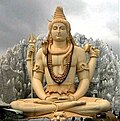
Shaivas or Shaivites are those who primarily worship [[Shiva]] as the supreme god, both [[immanence|immanent]] and [[transcendence (religion)|transcendent]]. Shaivism embraces at the same time [[monism]] (specifically [[nondualism]]) and [[Dualism (Indian philosophy)|dualism]]. To Shaivites, Shiva is both with and without form; he is the Supreme Dancer, [[Nataraja]]; and is [[linga]], without beginning or end. Shiva is sometimes depicted as the fierce god [[Bhairava]]. Saivists are more attracted to [[asceticism]] than devotees of other Hindu sects, and may be found wandering India with [[ash]]en faces performing self-purification rituals.<ref name="Dubois"/> They worship in the temple and practice yoga, striving to be one with Shiva within.<ref name="Himalaya Academy"/> | Shaivas or Shaivites are those who primarily worship [[Shiva]] as the supreme god, both [[immanence|immanent]] and [[transcendence (religion)|transcendent]]. Shaivism embraces at the same time [[monism]] (specifically [[nondualism]]) and [[Dualism (Indian philosophy)|dualism]]. To Shaivites, Shiva is both with and without form; he is the Supreme Dancer, [[Nataraja]]; and is [[linga]], without beginning or end. Shiva is sometimes depicted as the fierce god [[Bhairava]]. Saivists are more attracted to [[asceticism]] than devotees of other Hindu sects, and may be found wandering India with [[ash]]en faces performing self-purification rituals.<ref name="Dubois"/> They worship in the temple and practice yoga, striving to be one with Shiva within.<ref name="Himalaya Academy"/> | ||
| Line 91: | Line 97: | ||
* [[Kapalika]]. | * [[Kapalika]]. | ||
* [[Nath]]. | * [[Nath]]. | ||
** [[Adinath Sampradaya]] or Siddha Siddhanta, adheres to the teachings of [[Gorakhnath]] and [[Matsyendranath]]. | ** [[Adinath Sampradaya]] or Siddha Siddhanta, adheres to the teachings of [[Gorakhnath]]a and [[Matsyendranath]]a. | ||
** [[Inchegeri Sampradaya]]. | ** [[Inchegeri Sampradaya]]. | ||
Other branches: | Other branches: | ||
* [[Lingayatism]] or [[Veerashaivism]] is a distinct Shaivite tradition in India, established in the 12th century by the philosopher and social reformer [[Basavanna]]. It makes several departures from mainstream [[Hinduism]] and propounds [[monotheism]] through worship centered on Lord [[Shiva]] in the form of [[linga]] or ''Ishtalinga''. It also rejects the authority of the [[Veda]]s and the [[Caste system in India|caste system]].<ref>{{cite book | title = Speaking of Śiva | url = https://archive.org/details/speakingofiva0000rama | url-access = registration | series = UNESCO. Indian translation series. Penguin classics. Religion and mythology | publisher = Penguin India | editor = A. K. Ramanujan | year = 1973 | isbn = 978-0-14-044270-0 | page = [https://archive.org/details/speakingofiva0000rama/page/175 175]}}</ref><ref>"[ | * [[Lingayatism]] or [[Veerashaivism]] is a distinct Shaivite tradition in India, established in the 12th century by the philosopher and social reformer [[Basavanna]]. It makes several departures from mainstream [[Hinduism]] and propounds [[monotheism]] through worship centered on Lord [[Shiva]] in the form of [[linga]] or ''Ishtalinga''. It also rejects the authority of the [[Veda]]s and the [[Caste system in India|caste system]].<ref>{{cite book | title = Speaking of Śiva | url = https://archive.org/details/speakingofiva0000rama | url-access = registration | series = UNESCO. Indian translation series. Penguin classics. Religion and mythology | publisher = Penguin India | editor = A. K. Ramanujan | year = 1973 | isbn = 978-0-14-044270-0 | page = [https://archive.org/details/speakingofiva0000rama/page/175 175]}}</ref><ref>"[https://www.britannica.com/EBchecked/topic/342355/Lingayat Lingayat]." Encyclopædia Britannica. 2010. Encyclopædia Britannica Online. 09 Jul. 2010.</ref> | ||
* ''Aaiyyanism'' is a religion claiming to be a form of pure Dravidian Hinduism and identifying as a Shaivite branch. It is incorporated in the Aaiyyan World Forum. | * ''Aaiyyanism'' is a religion claiming to be a form of pure Dravidian Hinduism and identifying as a Shaivite branch. It is incorporated in the Aaiyyan World Forum. | ||
* [[Hinduism in Indonesia|Indonesian Shaivism]]. | * [[Hinduism in Indonesia|Indonesian Shaivism]]. | ||
| Line 122: | Line 128: | ||
===Overlap=== | ===Overlap=== | ||
Halbfass states that, although traditions such as [[Shaivism]] and [[Vaishnavism]] may be regarded as "self-contained religious constellations",{{sfn|Halbfass|1991|p=15}} there is a degree of interaction and reference between the "theoreticians and literary representatives"{{sfn|Halbfass|1991|p=15}} of each tradition which indicates the presence of "a wider sense of identity, a sense of coherence in a shared context and of inclusion in a common framework and horizon".{{sfn|Halbfass|1991|p=15}} It is common to find Hindus revering Shiva, Vishnu and Shakti, and celebrating festivals related to them at different times of the year. Temples often feature more than one of them, and Hinduism is better understood as polycentric theosophy that leaves the choice of deity and ideas to the individual. | Halbfass states that, although traditions such as [[Shaivism]] and [[Vaishnavism]] may be regarded as "self-contained religious constellations",{{sfn|Halbfass|1991|p=15}} there is a degree of interaction and reference between the "theoreticians and literary representatives"{{sfn|Halbfass|1991|p=15}} of each tradition which indicates the presence of "a wider sense of identity, a sense of coherence in a shared context and of inclusion in a common framework and horizon".{{sfn|Halbfass|1991|p=15}} It is common to find Hindus revering Shiva, Vishnu and Shakti, and celebrating festivals related to them at different times of the year. Temples often feature more than one of them, and Hinduism is better understood as polycentric theosophy that leaves the choice of deity and ideas to the individual.{{sfn|Lipner|2009|pp=371–375}} | ||
The key concepts and practises of the four major denominations of Hinduism can be compared as below: | The key concepts and practises of the four major denominations of Hinduism can be compared as below: | ||
| Line 131: | Line 137: | ||
! !! style="background: #ffcc99;"| Shaiva Traditions !! style="background: #ffcc99;"|Vaishnava Traditions !! style="background: #ffcc99;"|Shakti Traditions !! style="background: #ffcc99;" |Smarta Traditions || References | ! !! style="background: #ffcc99;"| Shaiva Traditions !! style="background: #ffcc99;"|Vaishnava Traditions !! style="background: #ffcc99;"|Shakti Traditions !! style="background: #ffcc99;" |Smarta Traditions || References | ||
|- | |- | ||
|Scriptural authority || Vedas, Upanishads and Agamas || Vedas, Upanishads and Agamas || Vedas and Upanishads ||Vedas and Upanishads ||{{sfn|Jones|Ryan|2007|p=474}}<ref name="Dhavamony1999p33">{{cite book|author=Mariasusai Dhavamony |title=Hindu Spirituality |url=https://books.google.com/books?id=58UZWWzqglMC |date=1999 |publisher=Gregorian Press |isbn=978-88-7652-818-7 |pages=32–34 }}</ref> | |Scriptural authority || Vedas, Upanishads and Agamas || Vedas, Upanishads and Agamas || Vedas and Upanishads ||Vedas and Upanishads ||{{sfn|Jones|Ryan|2007|p=474}}<ref name="Dhavamony1999p33">{{cite book|author=Mariasusai Dhavamony |title=Hindu Spirituality |url=https://books.google.com/books?id=58UZWWzqglMC |date=1999 |publisher=Gregorian Press |isbn=978-88-7652-818-7 |pages=32–34}}</ref> | ||
|- | |- | ||
|Supreme deity || God Shiva || God Vishnu || Goddess Devi || None || | |Supreme deity || God Shiva || God Vishnu || Goddess Devi || None ||{{sfn|Gonda|1970|p=}}<ref>{{cite book|author=Christopher Partridge |title=Introduction to World Religions |url=https://books.google.com/books?id=Z3AjAwAAQBAJ |year=2013|publisher=Fortress Press|isbn=978-0-8006-9970-3 |page=182}}</ref> | ||
|- | |- | ||
|Creator || Shiva || Vishnu || Devi || Brahman principle || | |Creator || Shiva || Vishnu || Devi || Brahman principle ||{{sfn|Gonda|1970|p=}}<ref>{{cite book|author=Sanjukta Gupta|title=Advaita Vedanta and Vaisnavism: The Philosophy of Madhusudana Sarasvati|url=https://books.google.com/books?id=4AFxluCHsoAC |year=2013|publisher=Routledge|isbn=978-1-134-15774-7|pages=65–71}}</ref> | ||
|- | |- | ||
|[[Avatar]] || Major || Key concept || Significant || Minor ||{{sfn|Jones|Ryan|2007|p=474}}<ref name=laiengavatar>{{cite book|author=Lai Ah Eng |title=Religious Diversity in Singapore |url=https://books.google.com/books?id=9MmNaNebFD8C |year=2008|publisher=Institute of Southeast Asian Studies, Singapore|isbn=978-981-230-754-5| | |[[Avatar]] || Major || Key concept || Significant || Minor ||{{sfn|Jones|Ryan|2007|p=474}}<ref name=laiengavatar>{{cite book|author=Lai Ah Eng |title=Religious Diversity in Singapore |url=https://books.google.com/books?id=9MmNaNebFD8C |year=2008|publisher=Institute of Southeast Asian Studies, Singapore|isbn=978-981-230-754-5|page=221}}</ref><ref name="Dhavamony2002p63">{{cite book|author=Mariasusai Dhavamony |title=Hindu-Christian Dialogue: Theological Soundings and Perspectives |url=https://books.google.com/books?id=poUxxH4fPwwC |year=2002|publisher=Rodopi |isbn=90-420-1510-1|page=63}}</ref> | ||
|- | |- | ||
|[[Sannyasa|Monastic]] life || Recommends ||Accepts || Accepts || Recommends ||{{sfn|Jones|Ryan|2007|p=474}}<ref>Stephen H Phillips (1995), Classical Indian Metaphysics, Columbia University Press, {{ISBN|978-0812692983}}, | |[[Sannyasa|Monastic]] life || Recommends ||Accepts || Accepts || Recommends ||{{sfn|Jones|Ryan|2007|p=474}}<ref>Stephen H Phillips (1995), Classical Indian Metaphysics, Columbia University Press, {{ISBN|978-0812692983}}, p. 332 with note 68.</ref><ref>{{cite book|first=Patrick| last=Olivelle|year=1992|title= The Samnyasa Upanisads|publisher= Oxford University Press|isbn= 978-0195070453| pages=4–18}}</ref> | ||
|- | |- | ||
|Rituals, [[Bhakti]] || Affirms | |Rituals, [[Bhakti]] || Affirms{{sfn|Flood|1996|pp=162–167}}<ref>{{cite web|title=Shaivas|url=http://www.philtar.ac.uk/encyclopedia/hindu/devot/shaiv.html|website=Overview Of World Religions|publisher=Philtar|access-date=13 December 2017}}</ref><ref>{{cite book|last1=Munavalli|first1=Somashekar|title=Lingayat Dharma (Veerashaiva Religion)|date=2007|publisher=Veerashaiva Samaja of North America|page=83|url=http://www.vsna.org/images/publications/lingayat-dharma-april-2007.pdf}}</ref> || Affirms || Affirms || Optional<ref>{{cite book|author=Prem Prakash|title=The Yoga of Spiritual Devotion: A Modern Translation of the Narada Bhakti Sutras|url=https://books.google.com/books?id=oA7BLTFoOicC|year=1998|publisher=Inner Traditions|isbn=978-0-89281-664-4|pages=56–57}}</ref> ||<ref>{{cite journal | last=Frazier | first=J. | title=Bhakti in Hindu Cultures | journal=The Journal of Hindu Studies | publisher=Oxford University Press | volume=6 | issue=2 | year=2013 | pages=101–113 | doi=10.1093/jhs/hit028}}</ref> | ||
|- | |- | ||
|[[Ahimsa]] and Vegetarianism || Recommends, | |[[Ahimsa]] and Vegetarianism || Recommends,{{sfn|Flood|1996|pp=162–167}} Optional|| Affirms || Optional || Recommends, Optional || <ref>{{cite book|author1=Lisa Kemmerer |author2=Anthony J. Nocella |title=Call to Compassion: Reflections on Animal Advocacy from the World's Religions |url=https://books.google.com/books?id=Lq70lgRwlRQC |year=2011|publisher=Lantern |isbn=978-1-59056-281-9|pages=27–36}}</ref><ref>{{cite book|author=Frederick J. Simoons |title=Plants of Life, Plants of Death |url= https://books.google.com/books?id=KEUAbrBoeBAC |year=1998|publisher= University of Wisconsin Press |isbn= 978-0-299-15904-7 |pages=182–183}}</ref> | ||
|- | |- | ||
|[[Free will]], [[Maya (illusion)|Maya]], [[Karma]] || Affirms || Affirms || Affirms || Affirms || | |[[Free will]], [[Maya (illusion)|Maya]], [[Karma]] || Affirms || Affirms || Affirms || Affirms ||{{sfn|Gonda|1970|p=}} | ||
|- | |- | ||
|Metaphysics || [[Brahman]] (Shiva), [[Atman (Hinduism)|Atman]] (Soul, Self) || Brahman (Vishnu), Atman || Brahman (Devi), Atman || Brahman, Atman || | |Metaphysics || [[Brahman]] (Shiva), [[Atman (Hinduism)|Atman]] (Soul, Self) || Brahman (Vishnu), Atman || Brahman (Devi), Atman || Brahman, Atman ||{{sfn|Gonda|1970|p=}} | ||
|- | |- | ||
|[[Epistemology]]<br>([[Pramana]]) || 1. Perception<br>2. Inference<br>3. Reliable testimony<br>4. Self-evident<ref>{{cite book|author=K. Sivaraman |title=Śaivism in Philosophical Perspective |url=https://books.google.com/books?id=I1blW4-yY20C |year=1973|publisher=Motilal Banarsidass|isbn=978-81-208-1771-5 |pages=336–340}}</ref>|| 1. Perception<br>2. Inference<br>3. Reliable testimony || 1. Perception<br>2. Inference<br>3. Reliable testimony || 1. Perception<br>2. Inference<br>3. Comparison and analogy<br>4. Postulation, derivation<br>5. Negative/cognitive proof<br>6. Reliable testimony ||<ref>John A. Grimes, A Concise Dictionary of Indian Philosophy: Sanskrit Terms Defined in English, State University of New York Press, {{ISBN|978-0791430675}}, page 238</ref>{{ | |[[Epistemology]]<br>([[Pramana]]) || 1. Perception<br>2. Inference<br>3. Reliable testimony<br>4. Self-evident<ref>{{cite book|author=K. Sivaraman |title=Śaivism in Philosophical Perspective |url=https://books.google.com/books?id=I1blW4-yY20C |year=1973|publisher=Motilal Banarsidass|isbn=978-81-208-1771-5 |pages=336–340}}</ref>|| 1. Perception<br>2. Inference<br>3. Reliable testimony || 1. Perception<br>2. Inference<br>3. Reliable testimony || 1. Perception<br>2. Inference<br>3. Comparison and analogy<br>4. Postulation, derivation<br>5. Negative/cognitive proof<br>6. Reliable testimony ||<ref>John A. Grimes, A Concise Dictionary of Indian Philosophy: Sanskrit Terms Defined in English, State University of New York Press, {{ISBN|978-0791430675}}, page 238</ref>{{sfn|Flood|1996|p=225}}<ref>Eliott Deutsche (2000), in Philosophy of Religion : Indian Philosophy Vol 4 (Editor: Roy Perrett), Routledge, {{ISBN|978-0815336112}}, pp. 245-248.</ref> | ||
|- | |- | ||
|Philosophy||Dvaita, qualified advaita, advaita || Dvaita, qualified advaita, advaita || Shakti-advaita || Advaita ||<ref>{{cite book|last= McDaniel |first=June |title=Offering Flowers, Feeding Skulls|url=https://books.google.com/books?id=caeJpIj9SdkC | year =2004| publisher=Oxford University Press| isbn=978-0-19-534713-5| pages=89–91 }}</ref><ref>{{cite book|author=Matthew James Clark|title=The Daśanāmī-saṃnyāsīs: The Integration of Ascetic Lineages Into an Order|url=https://books.google.com/books?id=g3DXAAAAMAAJ|year=2006|publisher=Brill|isbn=978-90-04-15211-3|pages=177–225}}</ref> | |Philosophy||Dvaita, qualified advaita, advaita || Dvaita, qualified advaita, advaita || Shakti-advaita || Advaita ||<ref>{{cite book|last= McDaniel |first=June |title=Offering Flowers, Feeding Skulls|url=https://books.google.com/books?id=caeJpIj9SdkC | year =2004| publisher=Oxford University Press| isbn=978-0-19-534713-5| pages=89–91}}</ref><ref>{{cite book|author=Matthew James Clark|title=The Daśanāmī-saṃnyāsīs: The Integration of Ascetic Lineages Into an Order|url=https://books.google.com/books?id=g3DXAAAAMAAJ|year=2006|publisher=Brill|isbn=978-90-04-15211-3|pages=177–225}}</ref> | ||
|- | |- | ||
|Salvation<br>([[Soteriology]]) || Jivanmukta,<br>[[Karma|Charya]]-[[Kriyā]]-[[Yoga]]-[[Jnana]]<ref>{{cite book|last1=Hurley|first1=Leigh|last2=Hurley|first2=Phillip|title=Tantra, Yoga of Ecstasy: the Sadhaka's Guide to Kundalinin and the Left-Hand Path|date=2012|publisher=Maithuna Publications|isbn=9780983784722|page=5|url=https://books.google.com/books?isbn=0983784728}}</ref> || Videhamukti, Yoga,<br>champions householder life|| Bhakti, Tantra, Yoga || Jivanmukta, Advaita, Yoga,<br>champions monastic life ||<ref name="Kim Skoog 1996 63–84, 236–239">{{cite book|author=Kim Skoog |editor1=Andrew O. Fort |editor2=Patricia Y. Mumme |title=Living Liberation in Hindu Thought |url=https://books.google.com/books?id=U1EZjyLbxYAC |date= 1996 |publisher=SUNY Press |isbn= 978-0-7914-2706-4|pages= 63–84, 236–239 }}</ref><ref>{{cite book|author=Rajendra Prasad |title=A Conceptual-analytic Study of Classical Indian Philosophy of Morals |url=https://books.google.com/books?id=D5Hk8EkmQBcC |year=2008|publisher=Concept |isbn=978-81-8069-544-5 | | |Salvation<br>([[Soteriology]]) || Jivanmukta,<br>[[Karma|Charya]]-[[Kriyā]]-[[Yoga]]-[[Jnana]]<ref>{{cite book|last1=Hurley|first1=Leigh|last2=Hurley|first2=Phillip|title=Tantra, Yoga of Ecstasy: the Sadhaka's Guide to Kundalinin and the Left-Hand Path|date=2012|publisher=Maithuna Publications|isbn=9780983784722|page=5|url=https://books.google.com/books?isbn=0983784728}}</ref> || Videhamukti, Yoga,<br>champions householder life|| Bhakti, Tantra, Yoga || Jivanmukta, Advaita, Yoga,<br>champions monastic life ||<ref name="Kim Skoog 1996 63–84, 236–239">{{cite book|author=Kim Skoog |editor1=Andrew O. Fort |editor2=Patricia Y. Mumme |title=Living Liberation in Hindu Thought |url=https://books.google.com/books?id=U1EZjyLbxYAC |date= 1996 |publisher=SUNY Press |isbn= 978-0-7914-2706-4|pages=63–84, 236–239}}</ref><ref>{{cite book|author=Rajendra Prasad |title=A Conceptual-analytic Study of Classical Indian Philosophy of Morals |url=https://books.google.com/books?id=D5Hk8EkmQBcC |year=2008|publisher=Concept |isbn=978-81-8069-544-5 |page=375}}</ref> | ||
|- | |- | ||
|} | |} | ||
| Line 160: | Line 166: | ||
===Suryaism / Saurism=== | ===Suryaism / Saurism=== | ||
{{main|Saura (Hinduism)}} | {{main|Saura (Hinduism)}} | ||
The Suryaites or Sauras are followers of a Hindu denomination that started in Vedic tradition, and worship [[Surya]] as the main visible form of the [[Saguna Brahman]]. The Saura tradition was influential in South Asia, particularly in the west, north and other regions, with numerous Surya idols and temples built between 800 and 1000 CE.<ref>{{cite book|author=André Wink|title=Al-Hind, the Making of the Indo-Islamic World: Early Medieval India and the Expansion of Islam 7th–11th Centuries|url=https://books.google.com/books?id=g2m7_R5P2oAC |year=2002|publisher=BRILL|isbn=0-391-04173-8|pages=292–293}}</ref><ref>{{cite book|author=Asha Kalia|title=Art of Osian Temples: Socio-economic and Religious Life in India, 8th-12th Centuries A.D.|url=https://books.google.com/books?id=3n-sycLo3XQC |year=1982|publisher=Abhinav Publications|isbn=978-0-391-02558-5|pages=1–7}}</ref> The [[Konark Sun Temple]] was built in mid 13th century.<ref>{{cite book|author=Finbarr Barry Flood|title=Objects of Translation: Material Culture and Medieval "Hindu-Muslim" Encounter|url=https://books.google.com/books?id=OLNE_li8C10C |year=2009|publisher=Princeton University Press|isbn=978-0-691-12594-7|page=218}}</ref> During the iconoclasm of Islamic invasions and Hindu–Muslim wars, the temples dedicated to Sun-god were among those desecrated, images smashed and the resident priests of Saura tradition were killed, states André Wink.<ref>{{cite book|author=André Wink|title=Al-Hind the Making of the Indo-Islamic World: The Slave Kings and the Islamic Conquest : 11th–13th Centuries|url=https://books.google.com/books?id=75FlxDhZWpwC |year=1997|publisher=BRILL Academic|isbn=90-04-10236-1|pages=327–329}}</ref><ref>{{cite book|author=Finbarr Barry Flood|title=Objects of Translation: Material Culture and Medieval "Hindu–Muslim" Encounter|url=https://books.google.com/books?id=OLNE_li8C10C |year=2009|publisher=Princeton University Press|isbn=978-0-691-12594-7|pages=123–124, 154–156}}</ref> The Surya tradition of Hinduism declined in the 12th and 13th century CE and today remains as a very small movement except in Bihar / Jharkhand and Eastern Uttar Pradesh. {{Citation needed|date=October 2016}} Sun worship has continued to be a dominant practice in Bihar / Jharkhand and Eastern Uttar Pradesh in the form of [[Chhath]] Puja which is considered the primary festival of importance in these regions. | The Suryaites or Sauras are followers of a Hindu denomination that started in Vedic tradition, and worship [[Surya]] as the main visible form of the [[Saguna Brahman]]. The Saura tradition was influential in South Asia, particularly in the west, north and other regions, with numerous Surya idols and temples built between 800 and 1000 CE.<ref>{{cite book|author=André Wink|title=Al-Hind, the Making of the Indo-Islamic World: Early Medieval India and the Expansion of Islam 7th–11th Centuries|url=https://books.google.com/books?id=g2m7_R5P2oAC |year=2002|publisher=BRILL|isbn=0-391-04173-8|pages=292–293}}</ref><ref>{{cite book|author=Asha Kalia|title=Art of Osian Temples: Socio-economic and Religious Life in India, 8th-12th Centuries A.D.|url=https://books.google.com/books?id=3n-sycLo3XQC |year=1982|publisher=Abhinav Publications|isbn=978-0-391-02558-5|pages=1–7}}</ref> The [[Konark Sun Temple]] was built in the mid 13th century.<ref>{{cite book|author=Finbarr Barry Flood|title=Objects of Translation: Material Culture and Medieval "Hindu-Muslim" Encounter|url=https://books.google.com/books?id=OLNE_li8C10C |year=2009|publisher=Princeton University Press|isbn=978-0-691-12594-7|page=218}}</ref> During the iconoclasm of Islamic invasions and Hindu–Muslim wars, the temples dedicated to Sun-god were among those desecrated, images smashed and the resident priests of Saura tradition were killed, states André Wink.<ref>{{cite book|author=André Wink|title=Al-Hind the Making of the Indo-Islamic World: The Slave Kings and the Islamic Conquest : 11th–13th Centuries|url=https://books.google.com/books?id=75FlxDhZWpwC |year=1997|publisher=BRILL Academic|isbn=90-04-10236-1|pages=327–329}}</ref><ref>{{cite book|author=Finbarr Barry Flood|title=Objects of Translation: Material Culture and Medieval "Hindu–Muslim" Encounter|url=https://books.google.com/books?id=OLNE_li8C10C |year=2009|publisher=Princeton University Press|isbn=978-0-691-12594-7|pages=123–124, 154–156}}</ref> The Surya tradition of Hinduism declined in the 12th and 13th century CE and today remains as a very small movement except in Bihar / Jharkhand and Eastern Uttar Pradesh. {{Citation needed|date=October 2016}} Sun worship has continued to be a dominant practice in Bihar / Jharkhand and Eastern Uttar Pradesh in the form of [[Chhath]] Puja which is considered the primary festival of importance in these regions. | ||
===Ganapatism=== | ===Ganapatism=== | ||
| Line 180: | Line 186: | ||
{{main|Kaumaram}} | {{main|Kaumaram}} | ||
[[Kaumaram]] is a sect of Hindus, especially found in South India and Sri Lanka where Lord [[Muruga]] [[Karttikeya]] is the Supreme Godhead. Lord Muruga is considered superior to the Trimurti. The worshippers of Lord Muruga are called Kaumaras.{{Citation needed|date=October 2016}} | [[Kaumaram]] is a sect of Hindus, especially found in South India and Sri Lanka where Lord [[Muruga]] [[Karttikeya]] is the Supreme Godhead. Lord Muruga is considered superior to the Trimurti. The worshippers of Lord Muruga are called Kaumaras.{{Citation needed|date=October 2016}} | ||
===Dattatreya Sampradaya=== | |||
{{main|Dattatreya|Dattatreya Upanishad}} | |||
Dattatreya Sampradaya is a Hindu denomination associated with the worship of [[Dattatreya]] as the supreme god. This denomination found in Indian states like [[Maharashtra]], [[Andhra Pradesh]], [[Karnataka]], [[Goa]], [[Telangana]], [[Gujarat]], [[Madhya Pradesh]], [[Rajasthan]] and [[Uttarakhand]]. Dattatreya is often considered as an avatara of three Hindu gods Brahma, Vishnu and Shiva, collectively known as the [[Trimurti]]. | |||
Main traditions linked with Dattatreya Sampradaya are: | |||
* Gurucharitra tradition - This tradition is named after the [[Marathi language|Marathi]] text [[Gurucharitra]] and it is based on the teachings of [[Narasimha Saraswati|Nrusinha Saraswati]] as well as [[Sripada Sri Vallabha|Shripada Shrivallabha]].<ref>Theory And Practice of Yoga: Essays in Honour of Gerald James Larson, Gerald James Larson, Knut A. Jacobsen (eds.), | |||
Brill, 2005 pp. 238-242, https://books.google.co.in/books/about/Theory_And_Practice_of_Yoga.html?id=TDGFFNYvrokC&redir_esc=y</ref> This tradition is widespread in [[Deccan]] region. | |||
* Avadhuta Tradition. | |||
===Sant Mat=== | ===Sant Mat=== | ||
{{main|Sant Mat}} | {{main|Sant Mat}} | ||
The Sant Mat was a group of reformer [[sant (religion)|poet-sants]] within Hinduism during the 14th–17th centuries who had desire for [[religious pluralism]] and non-ritualistic spirituality.{{sfn|Jones|Ryan|2007|p=383}} Among its living traditions are: | The Sant Mat was a group of reformer [[sant (religion)|poet-sants]] and their adherents within Hinduism during the 14th–17th centuries who had desire for [[religious pluralism]] and non-ritualistic spirituality.{{sfn|Jones|Ryan|2007|p=383}} Due to [[Kabir]]'s affiliation with Vaishnavite [[Ramanandi Sampradaya]] and certain aspects of the creed, the Sant Mat is sometimes seen as part of Vaishnavism.{{sfn|Dandekar|1987}} Among its living traditions are: | ||
* [[Dadu Dayal#Dadupanth|Dadupanth]] | * [[Dadu Dayal#Dadupanth|Dadupanth]] | ||
* [[Kabir panth]] | * [[Kabir panth]] | ||
* [[Ravidassia religion]] | * [[Ravidassia religion]] | ||
* [[Sadh]] | * [[Sadh]] | ||
* [[Udasi]] | |||
* [[Nirmala (sect) |Nirmala]] | |||
===Newer movements=== | ===Newer movements=== | ||
{{ | {{see also|Hindu reform movements|Neo-Vedanta|Hinduism in the West}} | ||
The Hindu [[new religious movement]]s that arose in the 19th to 20th century include:{{sfn|Farquhar|1915}} | |||
The new | |||
* [[American Meditation Institute]] | * [[American Meditation Institute]] | ||
* [[Ananda movement|Ananda]] ([[Ananda Yoga]]){{sfn|Jones|Ryan|2007|pp=33–34}} | * [[Ananda movement|Ananda]] ([[Ananda Yoga]]){{sfn|Jones|Ryan|2007|pp=33–34}} | ||
| Line 206: | Line 220: | ||
** [[Sadharan Brahmo Samaj]] | ** [[Sadharan Brahmo Samaj]] | ||
* [[Chinmaya Mission]]{{sfn|Jones|Ryan|2007|pp=109–110}} | * [[Chinmaya Mission]]{{sfn|Jones|Ryan|2007|pp=109–110}} | ||
*[[Ganapathi Sachchidananda|Datta Yoga]]{{sfn|Jones|Ryan|2007|pp=121}} | * [[Ganapathi Sachchidananda|Datta Yoga]]{{sfn|Jones|Ryan|2007|pp=121}} | ||
* [[Divine Life Society]]{{sfn|Jones|Ryan|2007|pp=200–201}} | * [[Divine Life Society]]{{sfn|Jones|Ryan|2007|pp=200–201}} | ||
* [[Hanuman Foundation]]{{sfn|Jones|Ryan|2007|pp=178}} | * [[Hanuman Foundation]]{{sfn|Jones|Ryan|2007|pp=178}} | ||
| Line 228: | Line 242: | ||
* [[Meivazhi]] | * [[Meivazhi]] | ||
* [[Sree Narayana Dharma Paripalana Yogam (SNDP)|Narayana Dharma]] | * [[Sree Narayana Dharma Paripalana Yogam (SNDP)|Narayana Dharma]] | ||
* [[Nilachala Saraswata Sangha]] | |||
* [[Kalki Bhagawan|Oneness Movement]] | * [[Kalki Bhagawan|Oneness Movement]] | ||
* [[Prarthana Samaj]] | * [[Prarthana Samaj]] | ||
* [[Ramakrishna Mission]] / [[Ramakrishna Math]] (a.k.a. [[Vedanta Society]]){{sfn|Jones|Ryan|2007|pp=483–484}} | * [[Ramakrishna Mission]] / [[Ramakrishna Math]] (a.k.a. [[Vedanta Society]]){{sfn|Jones|Ryan|2007|pp=483–484}} | ||
* [[Sahaja Yoga]] | * [[Sahaja Yoga]] | ||
* [[Sathya Sai Baba movement]]{{sfn|Jones|Ryan|2007|pp=389–390}} | * [[Sathya Sai Baba movement]]{{sfn|Jones|Ryan|2007|pp=389–390}} | ||
* [[Satsang (Deoghar)|Satsang]] | * [[Satsang (Deoghar)|Satsang]] | ||
* [[Satya Dharma]] | * [[Satya Dharma]] | ||
* [[School of Philosophy and Economic Science]] | |||
* [[Self-Realization Fellowship]] / [[Yogoda Satsanga Society of India|Yogoda Satsanga]]{{sfn|Jones|Ryan|2007|pp=392–394}} | * [[Self-Realization Fellowship]] / [[Yogoda Satsanga Society of India|Yogoda Satsanga]]{{sfn|Jones|Ryan|2007|pp=392–394}} | ||
* [[Shirdi Sai Baba movement]] | * [[Shirdi Sai Baba movement]] | ||
* [[Shri Ram Chandra Mission]] | * [[Shri Ram Chandra Mission]] | ||
* [[Shree Shree Anandamayee Sangha]]{{sfn|Jones|Ryan|2007|p=31–33}} | * [[Shree Shree Anandamayee Sangha]]{{sfn|Jones|Ryan|2007|p=31–33}} | ||
| Line 246: | Line 260: | ||
* [[Sri Chinmoy]] Centres{{sfn|Jones|Ryan|2007|pp=110–11}} | * [[Sri Chinmoy]] Centres{{sfn|Jones|Ryan|2007|pp=110–11}} | ||
* [[Sri Ramana Ashram]]{{sfn|Jones|Ryan|2007|pp=351}} | * [[Sri Ramana Ashram]]{{sfn|Jones|Ryan|2007|pp=351}} | ||
** [[Neo-Advaita]] | |||
** [[Society of Abidance in Truth]] | ** [[Society of Abidance in Truth]] | ||
* [[Swadhyay Parivar]] | * [[Swadhyay Parivar]] | ||
* [[Transcendental Meditation movement|Transcendental Meditation]]{{sfn|Jones|Ryan|2007|pp=451–452}} | * [[Transcendental Meditation movement|Transcendental Meditation]]{{sfn|Jones|Ryan|2007|pp=451–452}} | ||
* [[Virat Hindustan Sangam]] | |||
===Sarnaism=== | |||
{{main|Sarnaism}} | |||
'''Sarna''' are sacred groves in the [[Indian religious]] traditions of the [[Chota Nagpur Plateau]] region in the states of [[Jharkhand]], [[Bihar]], [[Assam]] and [[Chhattisgarh]].<ref>{{Cite web|title=Religious Complexity in Northeastern South Asia|url=https://www.geocurrents.info/cultural-geography/religion/religious-complexity-in-northeastern-south-asia|access-date=2021-10-21|website=GeoCurrents}}</ref> Followers of these rituals primarily belong to the [[Munda people|Munda]], [[Bhumij people|Bhumij]], [[Kharia people|Kharia]], [[Baiga tribe|Baiga]], [[Ho people|Ho]], [[Kurukh people|Kurukh]] and [[Santal people |Santal]].{{Citation needed|date=May 2022}} According to local belief, a [[Grāmadevatā|''Gram deoti'']] or village deity resides in the sarna, where sacrifice is offered twice a year. Their belief system is called "Sarnaism", "Sarna Dharma" or "Religion of the Holy Woods".<ref>{{harvnb|Minahan|2012}}</ref> | |||
===Kiratism=== | |||
{{main|Kiratism}} | |||
The practice is also known as ''Kirat Veda'',<ref>p. 56 ''Kiratese at a Glance'' By Gopal Man Tandukar</ref><ref>p. xxv ''A Grammar of Limbu'' By Geordefine sungge van Driem</ref> ''Kirat-Ko Veda''<ref>''Problems of Modern Indian Literature'' by Statistical Pub. Society: distributor, K. P. Bagchi</ref> or ''Kirat Ko Ved''.<ref>p. 323 ''Kiratas in Ancient India'' By G. P. Singh, Dhaneswar Kalita, V Sudarsen, M A Kalam</ref> According to some scholars, such as Tom Woodhatch, it is shamanism, animistic religion or blend of [[shamanism]], [[animism]] (e.g., [[ancestor worship]]ing of [[Yuma Sammang]]/[[Tagera Ningwaphumang]] and Paruhang/Sumnima),<ref>"History and Culture of the Kirat" by I.S.Chemjong</ref> and Shaivism.<ref name="p. 535 Nepal By Tom Woodhatch">p. 535 ''Nepal'' By Tom Woodhatch</ref> | |||
==Related denominations== | ==Related denominations== | ||
| Line 280: | Line 302: | ||
Slavic Vedism involves the worship of Vedic gods, characterised by its use of indigenous Slavic rituals and Slavic names for the deities, distinguishing from other groups which have maintained a stronger bond with modern Hinduism, although [[Krishnaism|Krishnaite]] groups often identify themselves as "Vedic" too. Also some syncretic groups within Slavic Native Faith (Slavic Neopaganism) use the term "Vedism".<ref>Robert A. Saunders, Vlad Strukov. ''Historical Dictionary of the Russian Federation''. The Rowman & Littlefield Publishing Group, 2010. p. 412.</ref><ref name="Aitamurto2007">Aitamurto, Kaarina. ''[http://www.cesnur.org/2007/bord_aitamurto.htm Russian Rodnoverie: Negotiating Individual Traditionalism]''. Aleksanteri Institute, University of Helsinki, 2007.</ref> | Slavic Vedism involves the worship of Vedic gods, characterised by its use of indigenous Slavic rituals and Slavic names for the deities, distinguishing from other groups which have maintained a stronger bond with modern Hinduism, although [[Krishnaism|Krishnaite]] groups often identify themselves as "Vedic" too. Also some syncretic groups within Slavic Native Faith (Slavic Neopaganism) use the term "Vedism".<ref>Robert A. Saunders, Vlad Strukov. ''Historical Dictionary of the Russian Federation''. The Rowman & Littlefield Publishing Group, 2010. p. 412.</ref><ref name="Aitamurto2007">Aitamurto, Kaarina. ''[http://www.cesnur.org/2007/bord_aitamurto.htm Russian Rodnoverie: Negotiating Individual Traditionalism]''. Aleksanteri Institute, University of Helsinki, 2007.</ref> | ||
==Cross-denominational influences== | ==Cross-denominational influences== | ||
| Line 296: | Line 313: | ||
The Bhakti movement was a [[theism|theistic]] devotional trend that originated in the seventh-century [[Dravidian peoples|Tamil]] south India (now parts of Tamil Nadu and Kerala), and spread northwards.<ref name=schomer>Schomer and McLeod (1987), The Sants: Studies in a Devotional Tradition of India, Motilal Banarsidass, {{ISBN|978-8120802773}}, pp. 1–2.</ref> It swept over east and north India from the fifteenth-century onwards, reaching its zenith between the 15th and 17th century CE.<ref name=schomer/><ref name="lorenzen">{{cite book |surname=Lorenzen |given=David N. |author-link=David N. Lorenzen |year=1995 |title=Bhakti Religion in North India: Community Identity and Political Action |place=Albany, NY |publisher=SUNY Press |url={{Google books|rpSxJg_ehnIC|page=|keywords=|text=|plainurl=yes}} | The Bhakti movement was a [[theism|theistic]] devotional trend that originated in the seventh-century [[Dravidian peoples|Tamil]] south India (now parts of Tamil Nadu and Kerala), and spread northwards.<ref name=schomer>Schomer and McLeod (1987), The Sants: Studies in a Devotional Tradition of India, Motilal Banarsidass, {{ISBN|978-8120802773}}, pp. 1–2.</ref> It swept over east and north India from the fifteenth-century onwards, reaching its zenith between the 15th and 17th century CE.<ref name=schomer/><ref name="lorenzen">{{cite book |surname=Lorenzen |given=David N. |author-link=David N. Lorenzen |year=1995 |title=Bhakti Religion in North India: Community Identity and Political Action |place=Albany, NY |publisher=SUNY Press |url={{Google books|rpSxJg_ehnIC|page=|keywords=|text=|plainurl=yes}} | ||
|isbn=978-0-7914-2025-6}}</ref> The Bhakti movement regionally developed as Hindu denominations around different gods and goddesses, such as [[Vaishnavism]] (Vishnu), [[Shaivism]] (Shiva), [[Shaktism]] (Shakti goddesses), and [[Smartism]].<ref name="lancenelson"/><ref name="sskumar"/><ref>Wendy Doniger (2009), [ | |isbn=978-0-7914-2025-6}}</ref> The Bhakti movement regionally developed as Hindu denominations around different gods and goddesses, such as [[Vaishnavism]] (Vishnu), [[Shaivism]] (Shiva), [[Shaktism]] (Shakti goddesses), and [[Smartism]].<ref name="lancenelson"/><ref name="sskumar"/><ref>Wendy Doniger (2009), [https://www.britannica.com/EBchecked/topic/63933/bhakti Bhakti], Encyclopædia Britannica; [http://www.himalayanacademy.com/readlearn/basics/four-sects The Four Denomination of Hinduism] Himalayan Academy (2013)</ref> The movement was inspired by many poet-saints, who championed a wide range of philosophical positions ranging from [[theistic dualism]] of [[Dvaita]] to absolute [[monism]] of [[Advaita]] Vedanta.<ref name=schomer/><ref>Christian Novetzke (2007), [https://www.jstor.org/stable/25691067 Bhakti and Its Public], International Journal of Hindu Studies, Vol. 11, No. 3, page 255–272</ref> Scriptures of the Bhakti movement include the [[Bhagavad Gita]], [[Bhagavata Purana]] and [[Padma Purana]].<ref>Catherine Robinson (2005), Interpretations of the Bhagavad-Gita and Images of the Hindu Tradition, Routledge, {{ISBN|978-0415346719}}, pages 28–30</ref><ref name=karen26>Karen Pechilis Prentiss (2014), The Embodiment of Bhakti, Oxford University Press, {{ISBN|978-0195351903}}, pages 26–32, 217–218</ref> | ||
As part of the legacy of the Alvars, five [[Vaishnava]] philosophical traditions (sampradayas) has developed at the later stages.<ref name=Mittal2004>{{cite book | author = Mittal, S. G. R. Thursby | year = 2006 | title = Religions of South Asia: An Introduction | publisher = Routledge }}</ref> | As part of the legacy of the Alvars, five [[Vaishnava]] philosophical traditions (sampradayas) has developed at the later stages.<ref name=Mittal2004>{{cite book | author = Mittal, S. G. R. Thursby | year = 2006 | title = Religions of South Asia: An Introduction | publisher = Routledge }}</ref> | ||
| Line 303: | Line 320: | ||
{{Main|Hindu philosophy}} | {{Main|Hindu philosophy}} | ||
{{Hindu philosophy}} | {{Hindu philosophy}} | ||
Hindu philosophy is traditionally divided into six [[Āstika and nāstika|''{{IAST|āstika}}'']] ({{lang-sa|आस्तिक}} "orthodox") schools of thought,<ref>For an overview of the six orthodox schools, with detail on the grouping of schools, see:{{harv|Mādhava Āchārya|1882}}{{harv|Radhakrishnan|1927}}</ref> or ''{{IAST|darśanam}}'' (दर्शनम्, "view"), which accept the [[Vedas]] as the supreme revealed scriptures. The schools are: | Hindu philosophy is traditionally divided into six [[Āstika and nāstika|''{{IAST|āstika}}'']] ({{lang-sa|आस्तिक}} "orthodox") schools of thought,<ref>For an overview of the six orthodox schools, with detail on the grouping of schools, see:{{harv|Mādhava Āchārya|1882}}{{harv|Dasgupta|1922–1955|loc=Vol. 1}}{{harv|Radhakrishnan|1927}}</ref> or ''{{IAST|darśanam}}'' (दर्शनम्, "view"), which accept the [[Vedas]] as the supreme revealed scriptures. The schools are: | ||
#[[Samkhya]], | #[[Samkhya]], a [[Nontheism|non theistic]] and strongly dualist theoretical exposition of [[Purusha|consciousness]] and [[Prakṛti|matter]]. | ||
#[[Yoga (philosophy)|Yoga]], a school emphasizing [[Dhyana in Hinduism|meditation]], [[Samadhi|contemplation]] and [[Kaivalya|liberation]]. | #[[Yoga (philosophy)|Yoga]], a school emphasizing [[Dhyana in Hinduism|meditation]], [[Samadhi|contemplation]] and [[Kaivalya|liberation]]. | ||
#[[Nyaya]] or [[Indian logic|logic]], explores [[Pramāṇa|sources of knowledge]]. ''[[Nyāya Sūtras]]''. | #[[Nyaya]] or [[Indian logic|logic]], explores [[Pramāṇa|sources of knowledge]]. ''[[Nyāya Sūtras]]''. | ||
| Line 320: | Line 337: | ||
However, [[Medieval philosophy|medieval philosophers]] like [[Vidyaranya|Vidyāraṇya]] classified [[Indian philosophy]] into sixteen schools, where schools belonging to [[Saiva]], [[Pāṇini]] and [[Rasesvara|Raseśvara]] thought are included with others, and the three [[Vedantic]] schools [[Advaita]], [[Vishishtadvaita]] and [[Dvaita]] (which had emerged as distinct schools by then) are classified separately.{{sfn|Mādhava Āchārya|1882|p=xii}} | However, [[Medieval philosophy|medieval philosophers]] like [[Vidyaranya|Vidyāraṇya]] classified [[Indian philosophy]] into sixteen schools, where schools belonging to [[Saiva]], [[Pāṇini]] and [[Rasesvara|Raseśvara]] thought are included with others, and the three [[Vedantic]] schools [[Advaita]], [[Vishishtadvaita]] and [[Dvaita]] (which had emerged as distinct schools by then) are classified separately.{{sfn|Mādhava Āchārya|1882|p=xii}} | ||
In [[History of Hinduism|Hindu history]], the distinction of the six orthodox schools was current in the [[Gupta period]] "golden age" of Hinduism. With the disappearance of Vaisheshika and Mimamsa, it was obsolete by the later Middle Ages and modern times, when the various sub-schools of Vedanta began to rise to prominence as the main divisions of religious philosophy, as follows:{{sfn|Radhakrishnan|1927}} | In [[History of Hinduism|Hindu history]], the distinction of the six orthodox schools was current in the [[Gupta period]] "golden age" of Hinduism. With the disappearance of Vaisheshika and Mimamsa, it was obsolete by the later Middle Ages and modern times, when the various sub-schools of Vedanta began to rise to prominence as the main divisions of religious philosophy, as follows:{{sfn|Dasgupta|1922–1955}}{{sfn|Radhakrishnan|1927}} | ||
*[[Advaita Vedanta]] | *[[Advaita Vedanta]] | ||
*[[Akshar-Purushottam Darshan]] | *[[Akshar-Purushottam Darshan]] | ||
| Line 347: | Line 364: | ||
*[[Jnana yoga]] | *[[Jnana yoga]] | ||
*[[Karma yoga]] | *[[Karma yoga]] | ||
*[[Kriya | *[[Kripalu Yoga]] | ||
*[[Kriya Yoga]] | |||
*[[Kundalini yoga]] | *[[Kundalini yoga]] | ||
*[[Raja yoga]] | *[[Raja yoga]] | ||
| Line 354: | Line 372: | ||
*[[Sivananda yoga]] | *[[Sivananda yoga]] | ||
*[[Surat Shabd Yoga]] | *[[Surat Shabd Yoga]] | ||
*[[Tantric Yoga]] | *[[Tantric Yoga]]{{sfn|Lamb|2008|p=}}{{sfn|Singleton|Goldberg|2014}} | ||
==See also== | ==See also== | ||
{{ | {{Commons category}} | ||
{{col div|colwidth=20em}} | {{col div|colwidth=20em}} | ||
* [[Donyi-Polo|Donyipoloism]] | * [[Donyi-Polo|Donyipoloism]] | ||
* [[Kirant Mundhum|Kiratism | * [[Kirant Mundhum|Kiratism]] | ||
* [[ | * [[Sarna]] | ||
* [[Sanamahism]] | * [[Sanamahism]] | ||
* [[Shanmata]] | * [[Shanmata]] | ||
* [[Hindu philosophy]] | |||
* [[Folk Hinduism]] | |||
* [[List of Hindu organisations]] | * [[List of Hindu organisations]] | ||
{{colend}} | {{colend}} | ||
| Line 371: | Line 391: | ||
==References== | ==References== | ||
{{reflist | {{reflist}} | ||
==Sources== | ==Sources== | ||
{{refbegin}} | {{refbegin|30em}} | ||
*{{cite book|surname=Apte |given=Vaman S. |year=1965 |title=The Student's English-Sanskrit Dictionary |place=Delhi |publisher=[[Motilal Banarsidass]] |isbn=81-208-0300-0}} | *{{cite book|surname=Apte |given=Vaman S. |year=1965 |title=The Student's English-Sanskrit Dictionary |place=Delhi |publisher=[[Motilal Banarsidass]] |isbn=81-208-0300-0}} | ||
* {{cite book |surname=Bhandarkar |given=R. G. |author-link=R. G. Bhandarkar |year=1913 |title=Vaiṣṇavism, Śaivism and Minor Religious Systems |series=Grundriss der indo-arischen Philologie und Altertumskunde, 3.6 |publisher=Trübner |place=Strassburg |url=https://archive.org/details/VaishnavismShaivismAndOtherMinorReligiousSystemsR.G.Bhandarkar/page/n1/mode/1up?view=theater}} | |||
* {{cite encyclopedia|year=1987 |orig-year=Rev. ed. 2005 |surname=Dandekar |given=R. N. |author-link=Ramchandra Narayan Dandekar |title=Vaiṣṇavism: An Overview |editor=Mircea Eliade |editor-link=Mircea Eliade |encyclopedia=The Encyclopedia of Religion: 16 Volume Set |volume=14 |place=New York |publisher=MacMillan |url=https://archive.org/details/encyclopediaofre0000unse_v8f2}} | |||
* {{cite book |surname=Dasgupta |given=Surendranath |year=1922–1955 |authorlink=Surendranath Dasgupta |title=A History of Indian Philosophy |volume=1–5 |publisher=Cambridge University Press |place=London |url=https://www.indianculture.gov.in/reports-proceedings/history-indian-philosophy-vol-i}} [https://archive.org/details/in.ernet.dli.2015.96713 Vol. 1] | [https://archive.org/details/in.ernet.dli.2015.57593 Vol. 2] | [https://archive.org/details/in.ernet.dli.2015.57392 Vol. 3] | [https://archive.org/details/dli.ernet.231099 Vol. 4] | [https://archive.org/details/AHistoryOfIndianPhilosophyVol5/page/n1/mode/2up Vol. 5.] | |||
* {{cite encyclopedia | editor-last = Doniger | editor-first =Wendy | author-link=Wendy Doniger | year =1999 | title =Merriam-Webster's Encyclopedia of World Religions | publisher =Merriam-Webster |isbn =9780877790440 |url={{Google books|ZP_f9icf2roC|page=|keywords=|text=|plainurl=yes}}}} | * {{cite encyclopedia | editor-last = Doniger | editor-first =Wendy | author-link=Wendy Doniger | year =1999 | title =Merriam-Webster's Encyclopedia of World Religions | publisher =Merriam-Webster |isbn =9780877790440 |url={{Google books|ZP_f9icf2roC|page=|keywords=|text=|plainurl=yes}}}} | ||
* {{ | * {{cite book|surname=Farquhar |given=John Nicol |title=Modern religious movements in India |url=http://archive.org/details/modernreligiousm00farquoft |year=1915 |place=New York |publisher=Macmillan}} | ||
* {{cite book|surname=Flood |given=Galvin D. |author-link=Gavin Flood |year=1996 |title=An Introduction to Hinduism |url={{Google books|KpIWhKnYmF0C|page=|keywords=|text=|plainurl=yes}} |archive-url=https://archive.org/details/introductiontohi0000floo |archive-date=2000-12-13 |place=London |publisher=Cambridge University Press |isbn=978-0-521-43878-0}} | |||
* {{cite book |last=Frazier |first=Jessica |title=The Continuum companion to Hindu studies |year=2011 |publisher=Continuum |location=London |isbn=978-0-8264-9966-0}} | |||
* {{cite book |surname=Gonda |given=Jan |authorlink=Jan Gonda |title=Visnuism and Sivaism: A Comparison |year=1970 |url={{Google books|4HGXjgEACAAJ|page=|keywords=|text=|plainurl=yes}} | |||
|publisher=Bloomsbury Academic |isbn=978-1-4742-8080-8}} | |||
* {{Citation | last =Halbfass | first =Wilhelm | year =1991 | title =Tradition and Reflection | publisher =SUNY Press | isbn =9780791403617 |url={{Google books|5fImMZMqNIC|page=|keywords=|text=|plainurl=yes}}}} | * {{Citation | last =Halbfass | first =Wilhelm | year =1991 | title =Tradition and Reflection | publisher =SUNY Press | isbn =9780791403617 |url={{Google books|5fImMZMqNIC|page=|keywords=|text=|plainurl=yes}}}} | ||
* {{cite encyclopedia |year=1987 |surname=Hardy |given=Friedhelm E. |author-link=Friedhelm Hardy |title=Kṛṣṇaism |editor=Mircea Eliade |editor-link=Mircea Eliade |encyclopedia=The Encyclopedia of Religion: 16 Volume Set |volume=8 |pages=387–392 |place=New York |publisher=MacMillan |isbn=978-0-02897-135-3 |url=https://www.encyclopedia.com/environment/encyclopedias-almanacs-transcripts-and-maps/krsnaism |via=[[Encyclopedia.com]]}} | |||
* {{Citation | last =Hillerbrand | first =Hans J. | year =2004 | title =Encyclopedia of Protestantism | publisher =Routledge}} | |||
* {{Citation | last =Hiltebeitel | first =Alf | year =2002 | chapter =Hinduism |editor=Joseph Kitagawa |title=The Religious Traditions of Asia: Religion, History, and Culture | publisher =Routledge |isbn=9781136875977 |url={{Google books|kfyzAAAAQBAJ|page=|keywords=|text=|plainurl=yes}}}} | * {{Citation | last =Hiltebeitel | first =Alf | year =2002 | chapter =Hinduism |editor=Joseph Kitagawa |title=The Religious Traditions of Asia: Religion, History, and Culture | publisher =Routledge |isbn=9781136875977 |url={{Google books|kfyzAAAAQBAJ|page=|keywords=|text=|plainurl=yes}}}} | ||
* {{Citation |last=Hiltebeitel |first=Alf |author-link=Alf Hiltebeitel |year=2013 |title=Hinduism. In: Joseph Kitagawa, "The Religious Traditions of Asia: Religion, History, and Culture" |publisher=Routledge |isbn=9781136875977 |url={{Google books|kfyzAAAAQBAJ|page=|keywords=|text=|plainurl=yes}}}} | * {{Citation |last=Hiltebeitel |first=Alf |author-link=Alf Hiltebeitel |year=2013 |title=Hinduism. In: Joseph Kitagawa, "The Religious Traditions of Asia: Religion, History, and Culture" |publisher=Routledge |isbn=9781136875977 |url={{Google books|kfyzAAAAQBAJ|page=|keywords=|text=|plainurl=yes}}}} | ||
* {{cite encyclopedia |surname=Jones |given=Constance A. |surname2=Ryan |given2=James D. |title=Encyclopedia of Hinduism |url={{Google books|OgMmceadQ3gC|page=|keywords=|text=|plainurl=yes}} |year=2007 |place=New York |publisher=Facts On File |isbn=978-0-8160-5458-9 |series=Encyclopedia of World Religions. [[J. Gordon Melton]], Series Editor |archive-url=https://web.archive.org/web/20200402211115/https://books.google.com/books?id=OgMmceadQ3gC&pg=PR17 |archive-date=2020-04-02|url-status=live}} | * {{cite encyclopedia |surname=Jones |given=Constance A. |surname2=Ryan |given2=James D. |title=Encyclopedia of Hinduism |url={{Google books|OgMmceadQ3gC|page=|keywords=|text=|plainurl=yes}} |year=2007 |place=New York |publisher=Facts On File |isbn=978-0-8160-5458-9 |series=Encyclopedia of World Religions. [[J. Gordon Melton]], Series Editor |archive-url=https://web.archive.org/web/20200402211115/https://books.google.com/books?id=OgMmceadQ3gC&pg=PR17 |archive-date=2020-04-02|url-status=live}} | ||
* {{Citation | last =Knott | first =Kim | year =1998 | title =Hinduism: A Very Short Introduction | publisher =Oxford University Press | isbn =9780191606458 | url = | * {{Citation | last =Knott | first =Kim | year =1998 | title =Hinduism: A Very Short Introduction | publisher =Oxford University Press | isbn =9780191606458 | url ={{Google books|p4kzNzII3zAC|page=|keywords=|text=|plainurl=yes}}}} | ||
* {{cite book |surname=Lamb |given=Ramdas |title=Theory and Practice of Yoga |year=2008 |editor=[[Knut A. Jacobsen]] | |||
|publisher=Motilal Banarsidass |place=Delhi |isbn=978-8120832329}} | |||
* {{cite book |surname=Lipner |given=Julius J. |author-link=Julius J. Lipner |year=2009 |title=Hindus: Their Religious Beliefs and Practices |edition=2nd |publisher=Routledge |place=London |isbn=978-0-415-45677-7}} | |||
* {{cite book |author=Mādhava Āchārya |translator=E.B. Cowell and A.E. Gough |year=1882 |title=The Sarva-Darśana-Saṃgraha or Review of the Different Systems of Hindu Philosophy |series=Trübner's Oriental Series |place=London |publisher=Trübner & Co. |url=https://archive.org/stream/Sarva-Darsana-Samgraha.by.Madhavacharya-Vidyaranya.tr.by.E.B.Cowell}} | * {{cite book |author=Mādhava Āchārya |translator=E.B. Cowell and A.E. Gough |year=1882 |title=The Sarva-Darśana-Saṃgraha or Review of the Different Systems of Hindu Philosophy |series=Trübner's Oriental Series |place=London |publisher=Trübner & Co. |url=https://archive.org/stream/Sarva-Darsana-Samgraha.by.Madhavacharya-Vidyaranya.tr.by.E.B.Cowell}} | ||
* {{Citation | last =Michaels | first =Axel | author-link = Axel Michaels | year =2004 | title =Hinduism. Past and present | place =Princeton, New Jersey | publisher =Princeton University Press}} | * {{Citation | last =Michaels | first =Axel | author-link = Axel Michaels | year =2004 | title =Hinduism. Past and present | place =Princeton, New Jersey | publisher =Princeton University Press}} | ||
* {{cite book |year=1927 |surname=Radhakrishnan |given=Sarvepalli |author-link=Sarvepalli Radhakrishnan |title=Indian Philosophy |publisher=Oxford University Press |place=Oxford |volume=2 |url=https://archive.org/details/Sarvepalli.Radhakrishnan.Indian.Philosophy.Volume.1-2}} | |||
* {{cite book |year=1927 |surname=Radhakrishnan |given=Sarvepalli |author-link=Sarvepalli Radhakrishnan |title=Indian Philosophy |publisher=Oxford University Press |volume=2 |url=https://archive.org/details/Sarvepalli.Radhakrishnan.Indian.Philosophy.Volume.1-2}} | |||
* {{Citation | last =Rosen | first =Steven | author-link = Steven J. Rosen | year =2006 | title =Essential Hinduism | place =Westport | publisher =Praeger Publishers}} | * {{Citation | last =Rosen | first =Steven | author-link = Steven J. Rosen | year =2006 | title =Essential Hinduism | place =Westport | publisher =Praeger Publishers}} | ||
* {{cite book |editor-surname=Singleton |editor-given=Mark |editor-surname2=Goldberg |editor-given2=Ellen |title=Gurus of modern yoga |place=New York |publisher=Oxford University Press |year=2014 |isbn=978-0-19-993871-1 |oclc=861692270}} | |||
* {{cite book|surname=Tattwananda |given=Swami |title=Vaisnava Sects, Saiva Sects, Mother Worship |place=Calcutta |publisher=Nirmalendra Bikash Sen Gupta |year=n.d. |url=https://archive.org/details/in.ernet.dli.2015.128453}} | * {{cite book|surname=Tattwananda |given=Swami |title=Vaisnava Sects, Saiva Sects, Mother Worship |place=Calcutta |publisher=Nirmalendra Bikash Sen Gupta |year=n.d. |url=https://archive.org/details/in.ernet.dli.2015.128453}} | ||
* {{cite book|surname=Werner |given=Karel |author-link=Karel Werner |title=A Popular Dictionary of Hinduism |place=Surrey |publisher=Curzon Press |year=1994 |edition=1997 rev. |url={{Google books|HvuQAgAAQBAJ|page=|keywords=|text=|plainurl=yes}} |isbn=0-7007-1049-3}} | * {{cite book|surname=Werner |given=Karel |author-link=Karel Werner |title=A Popular Dictionary of Hinduism |place=Surrey |publisher=Curzon Press |year=1994 |edition=1997 rev. |url={{Google books|HvuQAgAAQBAJ|page=|keywords=|text=|plainurl=yes}} |isbn=0-7007-1049-3}} | ||
Revision as of 20:48, 26 June 2022
| Part of a series on |
| Hinduism |
|---|
 |


Hindu denominations, sampradayas, traditions, movements, and sects are traditions and sub-traditions within Hinduism centered on one or more gods or goddesses, such as Vishnu, Shiva, Shakti and so on.[1] The term sampradaya is used for branches with a particular founder-guru with a particular philosophy.[2]
Hinduism has no central doctrinal authority and many practising Hindus do not claim to belong to any particular denomination or tradition.[3] Four major traditions are, however, used in scholarly studies: Vaishnavism, Shaivism, Shaktism and Smartism.[1][4][5][6] These are sometimes referred to as the denominations of Hinduism, and they differ in the primary deity at the centre of the tradition.[7] A notable feature of Hindu denominations is that they do not deny other concepts of the divine or deity, and often celebrate the other as henotheistic equivalent.[8] The denominations of Hinduism, states Lipner, are unlike those found in major religions of the world, because Hindu denominations are fuzzy with individuals practising more than one, and he suggests the term "Hindu polycentrism".[9]
Although Hinduism contains many denominations and philosophies, it is linked by shared concepts, recognisable rituals, cosmology, shared textual resources, pilgrimage to sacred sites and the questioning of authority.[10]
Typology
The word Hindu is an exonym. This word Hindu is derived from the Indo-Aryan and Sanskrit word Sindhu, which means "a large body of water", covering "river, ocean". It was used as the name of the Indus River and also referred to its tributaries. The actual term 'hindu' first occurs, states Gavin Flood, as "a Persian geographical term for the people who lived beyond the river Indus (Sanskrit: Sindhu)". Hindus are persons who regard themselves as culturally, ethnically, or religiously adhering to aspects of Hinduism. Historically, the term has also been used as a geographical, cultural, and later religious identifier for people living in the Indian subcontinent. In the 18th century, European merchants and colonists began to refer to the followers of Indian religions collectively as Hindus until about mid 20th century. Hindus subscribe to a diversity of ideas on spirituality and traditions, but have no ecclesiastical order, no unquestionable religious authorities, no governing body, no prophet(s) nor any binding holy book; Hindus can choose to be polytheistic, pantheistic, monotheistic, monistic, agnostic, atheistic or humanist.[11][12][13]
Hinduism as it is commonly known can be subdivided into a number of major currents. Of the historical division into six darsanas (philosophies), two schools, Vedanta and Yoga, are currently the most prominent.[14] Classified by primary deity or deities, four major Hinduism modern currents are Vaishnavism (Vishnu), Shaivism (Shiva), Shaktism (Shakti) and Smartism (five deities treated as same).[4][5][15] These deity-centered denominations feature a synthesis of various philosophies such as Samkhya, Yoga and Vedanta, as well as shared spiritual concepts such as moksha, dharma, karma, samsara, ethical precepts such as ahimsa, texts (Upanishads, Puranas, Mahabharata, Agamas), ritual grammar and rites of passage.[10][16]
Six generic types (McDaniel)
McDaniel (2007) distinguishes six generic types of Hinduism, in an attempt to accommodate a variety of views on a rather complex subject:[17]
- Folk Hinduism, based on local traditions and cults of local deities and extending back to prehistoric times, or at least prior to written Vedas.
- Shrauta or "Vedic" Hinduism as practised by traditionalist brahmins (Shrautins).
- Vedantic Hinduism, including Advaita Vedanta (Smartism), based on the philosophical approach of the Upanishads.
- Yogic Hinduism, especially the sect based on the Yoga Sutras of Patanjali.
- "Dharmic" Hinduism or "daily morality", based on Karma and upon societal norms such as Vivāha (Hindu marriage customs).
- Bhakti or devotionalist practices
Sampradaya
In Hinduism, a sampradaya (IAST sampradāya)[note 1] is a denomination.[19] These are teaching traditions with autonomous practices and monastic centers, with a guru lineage, with ideas developed and transmitted, redefined and reviewed by each successive generation of followers.[20] A particular guru lineage is called parampara. By receiving diksha (initiation) into the parampara of a living guru, one belongs to its proper sampradaya.
Number of adherents
There are no census data available on demographic history or trends for the traditions within Hinduism.[21] Estimates vary on the relative number of adherents in the different traditions of Hinduism. According to a 2010 estimate by Johnson and Grim, the Vaishnavism tradition is the largest group with about 641 million or 67.6% of Hindus, followed by Shaivism with 252 million or 26.6%, Shaktism with 30 million or 3.2% and other traditions including Neo-Hinduism and Reform Hinduism with 25 million or 2.6%.[22] Hillerbrand mentions "70% Vaishnavites, 25% Shaivites, 2% neo-Hindus and reform Hindus."[23] According to Jones and Ryan, "The followers of Vaishnavism are many fewer than those of Shaivism, numbering perhaps 200 million."[24][dubious ]
According to Gavin Flood, the Shaivism and Shaktism traditions are difficult to separate, as many Shaiva Hindus revere the goddess Shakti regularly.[25] The denominations of Hinduism, states Julius Lipner, are unlike those found in major religions of the world, because Hindu denominations are fuzzy with individuals revering gods and goddesses polycentrically, with many Shaiva and Vaishnava adherents recognizing Sri (Lakshmi), Parvati, Saraswati and other aspects of the goddess Devi. Similarly, Shakta Hindus revere Shiva and goddesses such as Parvati (such as Durga, Radha, Sita and others) and Saraswati important in Shaiva and Vaishnava traditions.[26]
Main denominations

Vaishnavism is a devotional stream of Hinduism, which worships the god Vishnu as the Supreme Lord (Svayam Bhagavan). As well as Vishnu himself, followers of the denomination also worship Vishnu's ten incarnations (the Dashavatara).[27] The two most-worshipped incarnations of Vishnu are Krishna (especially within Krishnaism as the Supreme)[28] and Rama, whose stories are told in the Mahabharata and the Ramayana, respectively. The adherents of this sect are generally non-ascetic, monastic and devoted to meditative practice and ecstatic chanting.[29] Vaishnavites are deeply devotional. Their religion is rich in saints, temples and scriptures.[30]
Among Historical Vishnuism are known the Bhagavatism, Pancharatra and Vaikhanasa traditions.
The major living Vaishnava sampradayas include:[27][31]
- Sri Vaishnavism (Template:A.k.a. Sri-Vaishnava Sampradaya/Sri Sampradaya/Iyengars/Vishistadvaita) is associated with Lakshmi. The principal acharyas are Ramanujacharya and Vedanta Desikan. Sri subsampradayas:
- Thenkalais. Manavala Mamunigal's sect is the oldest Vaishnava sect in India. This sampradaya was followed by Vyasa, Parasara, Bodhayana. The lineage of Acharya is Lord Narayana, next Lakshmi and then Vishweksenar, Nammalwar, Nathamuni, Uyyakondar, Manakal Nambi, Alavandar, Periya Nambi, Ramanujacharya and finally Vedanta Desikan as per the Vadagalai sampradaya.
- Vadakalais
- Ramanandi Sampradaya, also known as the Ramayat Sampradaya or the Ramavat Sampradaya adheres to the teachings of the Advaita scholar Ramananda. This is the largest monastic group within Hinduism and in Asia, and these Vaishnava monks are known as Ramanandis, Vairagis or Bairagis.[32][33][34]
- Brahma Sampradaya is associated with Vishnu, who is the Para-Brahma (Universal Creator), not to be confused with the Brahma deity. The founder of this sampradaya was the Dvaita Vedanta philosopher Madhvacharya. Its modern form is Haridasa and Sadh Vaishnavism.
- Gaudiya Vaishnavism (Template:A.k.a. Chaitanya Sampradaya) is associated with Brahma Sampradaya, and is associated with Chaitanya Mahaprabhu (Gaurangacharya):
- Brahmanic traditional lineages
- Gaudiya Math reform lineages
- Manipuri Vaishnavism is a regional form of Gaudiya Vaishnavism and continues to be followed across Manipur with well-defined traditions and devotional practices.
- Gaudiya Vaishnavism (Template:A.k.a. Chaitanya Sampradaya) is associated with Brahma Sampradaya, and is associated with Chaitanya Mahaprabhu (Gaurangacharya):
- Kumara Sampradaya (Template:A.k.a. Nimbarka Sampradaya) is the tradition associated with Four Kumaras and the principal acharya Nimbarkacharya.
- Rudra Sampradaya. The principal acharya is Vallabhacharya, the founder of Pushtimarg tradition.
- Swaminarayan Sampradaya or Swaminarayanism, based on the teachings of Swaminarayan:[35] Its two original branches are the Laxmi Narayan Dev Gadi (with subordinate bodies, the ISSM, Swaminarayan Gurukul) and the Nar Narayan Dev Gadi (with the subordinate ISSO and NNDYM). Among its other denominations there are the Bochasanwasi Akshar Purushottam Swaminarayan Sanstha (BAPS),[36] Gunatit Samaj, Swaminarayan Gadi (Maninagar) and SMVS.
- Warkari Sampradaya, adheres to teaching of prominent bhakti saints of Maharashtra like Namadeva, Jnaneshwara, Eknath, Tukaram as well as Changadeva, Muktabai, Gora Kumbhar, Savata Mali, Narahari Sonar, Janabai, Sena Nhavi and Kanhopatra. The Warkari Sampradaya promotes the worship of god Vithoba, which is a manifestation of Krishna.
Minor and regional Vaishnavite schools and the principal acharyas connected with them are:[31]
- Balmikism, linked to sage Valmiki.
- Ekasarana Dharma (Template:A.k.a. Asomiya Vaishnavism), adheres to the teachings of Srimanta Sankaradeva.
- Kapadi Sampradaya.
- Mahanam Sampradaya, adheres to the teachings of Prabhu Jagadbandu who is considered to be the incarnation of Chaitanya Mahaprabhu the founder of Gaudiya Vaishnavism considered to be an avatar of Radha Krishna.
- Mahanubhava panth, adheres to the teachings of Sarvajna Shri Chakradhara.
- Odia Vaishnavism (Template:A.k.a. Jagannathism), the regional cult of the god Jagannath as abstract form of Krishna.
- Pranami (Pranami Sampradaya), adheres to the teachings of Devachandra Maharaj.
- Radha Vallabh Sampradaya.
- Ramsnehi Sampradaya.
- Vaishnava-Sahajiya (tantric).
- Baul.
Shaivism

Shaivas or Shaivites are those who primarily worship Shiva as the supreme god, both immanent and transcendent. Shaivism embraces at the same time monism (specifically nondualism) and dualism. To Shaivites, Shiva is both with and without form; he is the Supreme Dancer, Nataraja; and is linga, without beginning or end. Shiva is sometimes depicted as the fierce god Bhairava. Saivists are more attracted to asceticism than devotees of other Hindu sects, and may be found wandering India with ashen faces performing self-purification rituals.[29] They worship in the temple and practice yoga, striving to be one with Shiva within.[30]
The major schools of Śaivism include:[37]
- Saiva Siddhanta, adheres to the teachings of Tirumular/Sundaranatha (Nandinatha Sampradaya, the monistic school) or of Meykandadeva (Meykandar Sampradaya, the dualistic school).
- Saiva Siddhanta Church in United States.[38]
- Shiva Advaita, adheres to the teachings of Nilakantha (Srikantha) and Appayya Dikshitar.
- Kashmir Shaivism, adheres to the teachings of Vasugupta and his disciplinic lineage, including Abhinavagupta.
- Pashupata Shaivism, adheres to the teachings of Lakulisa.
- Aghori.
- Kapalika.
- Nath.
- Adinath Sampradaya or Siddha Siddhanta, adheres to the teachings of Gorakhnatha and Matsyendranatha.
- Inchegeri Sampradaya.
Other branches:
- Lingayatism or Veerashaivism is a distinct Shaivite tradition in India, established in the 12th century by the philosopher and social reformer Basavanna. It makes several departures from mainstream Hinduism and propounds monotheism through worship centered on Lord Shiva in the form of linga or Ishtalinga. It also rejects the authority of the Vedas and the caste system.[39][40]
- Aaiyyanism is a religion claiming to be a form of pure Dravidian Hinduism and identifying as a Shaivite branch. It is incorporated in the Aaiyyan World Forum.
- Indonesian Shaivism.
Shaktism

Shaktas worship Goddess as Mother Shakti, in different forms. These forms may include Kali, Parvati/Durga, Lakshmi and Saraswati. The branch of Hinduism that worships the goddess, known as Devi, is called Shaktism. Followers of Shaktism recognize Shakti as the supreme power of the universe. Devi is often depicted as Parvati (the consort of Shiva) or as Lakshmi (the consort of Vishnu). She is also depicted in other manifestations, such as the protective Durga or the violent Kali. Shaktism is closely related with Tantric Hinduism, which teaches rituals and practices for purification of the mind and body.[29]
Animal sacrifice of cockerels, goats and to a lesser extent water buffaloes is practiced by Shakti devotees, mainly at temples of Goddesses such as Bhavani or Kali.[41][42]
The main traditions are:
The Goddess-centric traditions within Kashmir Shaivism are Trika and Kubjika.
Smartism

Smartas treat all deities as the same, and their temples include five deities (Pancopasana) or Panchadevata as personal saguna (divine with form) manifestation of the nirguna (divine without form) Absolute, the Brahman. The choice of the nature of God is up to the individual worshiper since different manifestations of God are held to be equivalent. It is nonsectarian as it encourages the worship of any personal god along with others such as Ganesha, Shiva, Shakti, Vishnu, Surya.[29]
The Smarta Tradition accepts two concepts of Brahman, which are the saguna brahman – the Brahman with attributes, and nirguna brahman – the Brahman without attributes.[43] The nirguna Brahman is the unchanging Reality, however, the saguna Brahman is posited as a means to realizing this nirguna Brahman.[44] The concept of the saguna Brahman is considered in this tradition to be a useful symbolism and means for those who are still on their spiritual journey, but the saguna concept is abandoned by the fully enlightened once he or she realizes the identity of their own soul with that of the nirguna Brahman.[44] A Smarta may choose any saguna deity (istadevata) such as Vishnu, Shiva, Shakti, Surya, Ganesha or any other, and this is viewed in Smarta Tradition as an interim step towards meditating on Om and true nature of supreme reality, thereby realizing the nirguna Brahman and its equivalence to one's own Atman, as in Advaita Vedanta.[45]
The movement is credited to Shankara (~8th century CE), who is regarded as the greatest teacher[46][47] and reformer of the Smartha.[48][47] According to Hiltebeitel, Shankara established the nondualist interpretation of the Upanishads as the touchstone of a revived smarta tradition.[49] The Sringeri Sharada monastery founded by Adi Shankara Acharya in Karnataka is still the centre of the Smarta sect.[46][47]
Overlap
Halbfass states that, although traditions such as Shaivism and Vaishnavism may be regarded as "self-contained religious constellations",[50] there is a degree of interaction and reference between the "theoreticians and literary representatives"[50] of each tradition which indicates the presence of "a wider sense of identity, a sense of coherence in a shared context and of inclusion in a common framework and horizon".[50] It is common to find Hindus revering Shiva, Vishnu and Shakti, and celebrating festivals related to them at different times of the year. Temples often feature more than one of them, and Hinduism is better understood as polycentric theosophy that leaves the choice of deity and ideas to the individual.[9]
The key concepts and practises of the four major denominations of Hinduism can be compared as below:
| Shaiva Traditions | Vaishnava Traditions | Shakti Traditions | Smarta Traditions | References | |
|---|---|---|---|---|---|
| Scriptural authority | Vedas, Upanishads and Agamas | Vedas, Upanishads and Agamas | Vedas and Upanishads | Vedas and Upanishads | [24][51] |
| Supreme deity | God Shiva | God Vishnu | Goddess Devi | None | [52][53] |
| Creator | Shiva | Vishnu | Devi | Brahman principle | [52][54] |
| Avatar | Major | Key concept | Significant | Minor | [24][55][56] |
| Monastic life | Recommends | Accepts | Accepts | Recommends | [24][57][58] |
| Rituals, Bhakti | Affirms[59][60][61] | Affirms | Affirms | Optional[62] | [63] |
| Ahimsa and Vegetarianism | Recommends,[59] Optional | Affirms | Optional | Recommends, Optional | [64][65] |
| Free will, Maya, Karma | Affirms | Affirms | Affirms | Affirms | [52] |
| Metaphysics | Brahman (Shiva), Atman (Soul, Self) | Brahman (Vishnu), Atman | Brahman (Devi), Atman | Brahman, Atman | [52] |
| Epistemology (Pramana) |
1. Perception 2. Inference 3. Reliable testimony 4. Self-evident[66] |
1. Perception 2. Inference 3. Reliable testimony |
1. Perception 2. Inference 3. Reliable testimony |
1. Perception 2. Inference 3. Comparison and analogy 4. Postulation, derivation 5. Negative/cognitive proof 6. Reliable testimony |
[67][68][69] |
| Philosophy | Dvaita, qualified advaita, advaita | Dvaita, qualified advaita, advaita | Shakti-advaita | Advaita | [70][71] |
| Salvation (Soteriology) |
Jivanmukta, Charya-Kriyā-Yoga-Jnana[72] |
Videhamukti, Yoga, champions householder life |
Bhakti, Tantra, Yoga | Jivanmukta, Advaita, Yoga, champions monastic life |
[73][74] |
Other denominations
Suryaism / Saurism
The Suryaites or Sauras are followers of a Hindu denomination that started in Vedic tradition, and worship Surya as the main visible form of the Saguna Brahman. The Saura tradition was influential in South Asia, particularly in the west, north and other regions, with numerous Surya idols and temples built between 800 and 1000 CE.[75][76] The Konark Sun Temple was built in the mid 13th century.[77] During the iconoclasm of Islamic invasions and Hindu–Muslim wars, the temples dedicated to Sun-god were among those desecrated, images smashed and the resident priests of Saura tradition were killed, states André Wink.[78][79] The Surya tradition of Hinduism declined in the 12th and 13th century CE and today remains as a very small movement except in Bihar / Jharkhand and Eastern Uttar Pradesh. [citation needed] Sun worship has continued to be a dominant practice in Bihar / Jharkhand and Eastern Uttar Pradesh in the form of Chhath Puja which is considered the primary festival of importance in these regions.
Ganapatism
Ganapatism is a Hindu denomination in which Lord Ganesha is worshipped as the main form of the Saguna Brahman. This sect was widespread and influential in the past and has remained important in Maharashtra.[citation needed]
Indonesian Hinduism
Hinduism dominated the island of Java and Sumatra until the late 16th century, when a vast majority of the population converted to Islam. Only the Balinese people who formed a majority on the island of Bali, retained this form of Hinduism over the centuries. Theologically, Balinese or Indonesian Hinduism is closer to Shaivism than to other major sects of Hinduism. The adherents consider Acintya the supreme god, and all other gods as his manifestations.
The term "Agama Hindu Dharma", the endonymous Indonesian name for "Indonesian Hinduism" can also refer to the traditional practices in Kalimantan, Sumatra, Sulawesi and other places in Indonesia, where people have started to identify and accept their agamas as Hinduism or Hindu worship has been revived. The revival of Hinduism in Indonesia has given rise to a national organisation, the Parisada Hindu Dharma.
Shrautism
Shrauta communities are very rare in India, the most well known being the ultra-orthodox Nambudiri Brahmins of Kerala. They follow the "Purva-Mimamsa" (earlier portion of Vedas) in contrast to Vedanta followed by other Brahmins. They place importance on the performance of Vedic Sacrifice (Yajna). The Nambudiri Brahmins are famous for their preservation of the ancient Somayaagam, Agnicayana rituals which have vanished in other parts of India.[citation needed]
Kaumaram
Kaumaram is a sect of Hindus, especially found in South India and Sri Lanka where Lord Muruga Karttikeya is the Supreme Godhead. Lord Muruga is considered superior to the Trimurti. The worshippers of Lord Muruga are called Kaumaras.[citation needed]
Dattatreya Sampradaya
Dattatreya Sampradaya is a Hindu denomination associated with the worship of Dattatreya as the supreme god. This denomination found in Indian states like Maharashtra, Andhra Pradesh, Karnataka, Goa, Telangana, Gujarat, Madhya Pradesh, Rajasthan and Uttarakhand. Dattatreya is often considered as an avatara of three Hindu gods Brahma, Vishnu and Shiva, collectively known as the Trimurti. Main traditions linked with Dattatreya Sampradaya are:
- Gurucharitra tradition - This tradition is named after the Marathi text Gurucharitra and it is based on the teachings of Nrusinha Saraswati as well as Shripada Shrivallabha.[80] This tradition is widespread in Deccan region.
- Avadhuta Tradition.
Sant Mat
The Sant Mat was a group of reformer poet-sants and their adherents within Hinduism during the 14th–17th centuries who had desire for religious pluralism and non-ritualistic spirituality.[81] Due to Kabir's affiliation with Vaishnavite Ramanandi Sampradaya and certain aspects of the creed, the Sant Mat is sometimes seen as part of Vaishnavism.[27] Among its living traditions are:
Newer movements
The Hindu new religious movements that arose in the 19th to 20th century include:[82]
- American Meditation Institute
- Ananda (Ananda Yoga)[83]
- Ananda Ashrama[84]
- Ananda Marga[85]
- Art of Living Foundation[86]
- Arya Samaj[87]
- Ayyavazhi
- Brahma Kumaris[88]
- Brahmoism (Brahmo Samaj)[89]
- Chinmaya Mission[90]
- Datta Yoga[91]
- Divine Life Society[92]
- Hanuman Foundation[93]
- Himalayan Institute of Yoga Science and Philosophy[94]
- Hindutva[95]
- International Vedanta Society
- Isha Foundation
- Kriya Yoga Centers[98]
- Mahima Dharma
- Mata Amritanandamayi Math[99]
- Matua Mahasangha
- Meivazhi
- Narayana Dharma
- Nilachala Saraswata Sangha
- Oneness Movement
- Prarthana Samaj
- Ramakrishna Mission / Ramakrishna Math (a.k.a. Vedanta Society)[100]
- Sahaja Yoga
- Sathya Sai Baba movement[101]
- Satsang
- Satya Dharma
- School of Philosophy and Economic Science
- Self-Realization Fellowship / Yogoda Satsanga[102]
- Shirdi Sai Baba movement
- Shri Ram Chandra Mission
- Shree Shree Anandamayee Sangha[103]
- Siddha Yoga[104]
- Sivananda Yoga Vedanta Centres[105]
- Sri Aurobindo Ashram[106]
- Sri Chinmoy Centres[107]
- Sri Ramana Ashram[108]
- Swadhyay Parivar
- Transcendental Meditation[109]
- Virat Hindustan Sangam
Sarnaism
Sarna are sacred groves in the Indian religious traditions of the Chota Nagpur Plateau region in the states of Jharkhand, Bihar, Assam and Chhattisgarh.[110] Followers of these rituals primarily belong to the Munda, Bhumij, Kharia, Baiga, Ho, Kurukh and Santal.[citation needed] According to local belief, a Gram deoti or village deity resides in the sarna, where sacrifice is offered twice a year. Their belief system is called "Sarnaism", "Sarna Dharma" or "Religion of the Holy Woods".[111]
Kiratism
The practice is also known as Kirat Veda,[112][113] Kirat-Ko Veda[114] or Kirat Ko Ved.[115] According to some scholars, such as Tom Woodhatch, it is shamanism, animistic religion or blend of shamanism, animism (e.g., ancestor worshiping of Yuma Sammang/Tagera Ningwaphumang and Paruhang/Sumnima),[116] and Shaivism.[117]
Related denominations
Kalash religion
The Indo-Aryan Kalash people in Pakistan traditionally practice an indigenous religion which some authors characterise as a form of ancient Hinduism.[118][119][120]
Contemporary Sant Mat
The contemporary Sant Mat is a 19th-century origin movement.[121] Scholars are divided as to whether to call Radha Soami a 1) Sikh-derived or 2) Hindu–Sikh-synthesed or 3) independent version of the medieval Sant Mat as new universal religion.[122]
- Advait Mat
- Radha Soami
- Radha Soami-influenced[122]
Slavic Vedism
Slavic, Russian, Peterburgian Vedism or simply Vedism[123][124] are terms used to describe the one of the earliest branch of Slavic Native Faith ("Rodnovery")—contemporary indigenous development of Vedic forms of religion in Russia, especially of Saint Petersburg's communities, other Slavic countries, and generally all the post-Soviet states. The word "Vedism" comes from the verb "to know" (vedatʼ)—a semantic root which is shared in Slavic and Sanskrit languages alike.[125]
Slavic Vedism involves the worship of Vedic gods, characterised by its use of indigenous Slavic rituals and Slavic names for the deities, distinguishing from other groups which have maintained a stronger bond with modern Hinduism, although Krishnaite groups often identify themselves as "Vedic" too. Also some syncretic groups within Slavic Native Faith (Slavic Neopaganism) use the term "Vedism".[126][127]
Cross-denominational influences
Atman Jnana
Jñāna is a Sanskrit word that means knowledge. In Vedas it means true knowledge, that (atman) is identical with Brahman. It is also referred to as Atma Jnana which is frequently translated as self-realization.
Bhakti movement
The Bhakti movement was a theistic devotional trend that originated in the seventh-century Tamil south India (now parts of Tamil Nadu and Kerala), and spread northwards.[128] It swept over east and north India from the fifteenth-century onwards, reaching its zenith between the 15th and 17th century CE.[128][129] The Bhakti movement regionally developed as Hindu denominations around different gods and goddesses, such as Vaishnavism (Vishnu), Shaivism (Shiva), Shaktism (Shakti goddesses), and Smartism.[1][7][130] The movement was inspired by many poet-saints, who championed a wide range of philosophical positions ranging from theistic dualism of Dvaita to absolute monism of Advaita Vedanta.[128][131] Scriptures of the Bhakti movement include the Bhagavad Gita, Bhagavata Purana and Padma Purana.[132][133]
As part of the legacy of the Alvars, five Vaishnava philosophical traditions (sampradayas) has developed at the later stages.[134]
Philosophical schools
| Part of a series on | |
| Hindu philosophy | |
|---|---|
 | |
| Orthodox | |
|
|
|
| Heterodox | |
|
|
|
Hindu philosophy is traditionally divided into six āstika (Sanskrit: आस्तिक "orthodox") schools of thought,[135] or darśanam (दर्शनम्, "view"), which accept the Vedas as the supreme revealed scriptures. The schools are:
- Samkhya, a non theistic and strongly dualist theoretical exposition of consciousness and matter.
- Yoga, a school emphasizing meditation, contemplation and liberation.
- Nyaya or logic, explores sources of knowledge. Nyāya Sūtras.
- Vaisheshika, an empiricist school of atomism
- Mimāṃsā, an anti-ascetic and anti-mysticist school of orthopraxy
- Vedanta, the last segment of knowledge in the Vedas, or the 'Jnan' (knowledge) 'Kanda' (section).
The nāstika/heterodox schools are (in chronological order):
However, medieval philosophers like Vidyāraṇya classified Indian philosophy into sixteen schools, where schools belonging to Saiva, Pāṇini and Raseśvara thought are included with others, and the three Vedantic schools Advaita, Vishishtadvaita and Dvaita (which had emerged as distinct schools by then) are classified separately.[136]
In Hindu history, the distinction of the six orthodox schools was current in the Gupta period "golden age" of Hinduism. With the disappearance of Vaisheshika and Mimamsa, it was obsolete by the later Middle Ages and modern times, when the various sub-schools of Vedanta began to rise to prominence as the main divisions of religious philosophy, as follows:[137][138]
- Advaita Vedanta
- Akshar-Purushottam Darshan
- Bhedabheda
- Dvaita Vedanta
- Integral yoga
- Pratyabhijna
- Shaiva Siddhanta
- Shiva Advaita
- Shuddhadvaita
- Vishishtadvaita
Nyaya survived into the 17th century as Navya Nyaya "Neo-Nyaya", while Samkhya gradually lost its status as an independent school, its tenets absorbed into Yoga and Vedanta.
Yoga varieties
- Ananda Yoga
- Bhakti yoga
- Hatha yoga
- Integral Yoga
- Jivamukti Yoga
- Jnana yoga
- Karma yoga
- Kripalu Yoga
- Kriya Yoga
- Kundalini yoga
- Raja yoga
- Sahaja Yoga
- Siddha Yoga
- Sivananda yoga
- Surat Shabd Yoga
- Tantric Yoga[139][140]
See also
Notes
- ↑ Quoted in Böhtlingk's Sanskrit-Sanskrit dictionary, entry Sampradaya.[18]
References
- ↑ 1.0 1.1 1.2 Lance Nelson (2007), An Introductory Dictionary of Theology and Religious Studies (Editors: Orlando O. Espín, James B. Nickoloff), Liturgical Press, ISBN 978-0814658567, pages 562–563
- ↑ Lipner 2009, pp. 377, 398.
- ↑ Werner 1994, p. 73.
- ↑ 4.0 4.1 Bhandarkar 1913.
- ↑ 5.0 5.1 Tattwananda n.d.
- ↑ Flood 1996, p. 113, 134, 155–161, 167–168.
- ↑ 7.0 7.1 SS Kumar (2010), Bhakti — the Yoga of Love, LIT Verlag Münster, ISBN 978-3643501301, pp. 35–36.
- ↑ George Lundskow (2008). The Sociology of Religion: A Substantive and Transdisciplinary Approach. Sage Publ. pp. 252–253. ISBN 978-1-4522-4518-8.
- ↑ 9.0 9.1 Lipner 2009, pp. 371–375.
- ↑ 10.0 10.1 Frazier 2011, pp. 1–15.
- ↑ Lipner 2009, p. 8, Quote: "(...) one need not be religious in the minimal sense described to be accepted as a Hindu by Hindus, or describe oneself perfectly validly as Hindu. One may be polytheistic or monotheistic, monistic or pantheistic, even an agnostic, humanist or atheist, and still be considered a Hindu.".
- ↑ Lester Kurtz (ed.), Encyclopedia of Violence, Peace and Conflict, ISBN 978-0123695031, Academic Press, 2008.
- ↑ MK Gandhi, The Essence of Hinduism, Editor: VB Kher, Navajivan Publishing, see page 3; According to Gandhi, "a man may not believe in God and still call himself a Hindu."
- ↑ Matthew Clarke (2011). Development and Religion: Theology and Practice. Edward Elgar. p. 28. ISBN 9780857930736.
- ↑ Flood 1996, pp. 113, 154.
- ↑ Lipner 2009, pp. 17–18, 81–82, 183–201, 206–215, 330–331, 371–375.
- ↑ J. McDaniel Hinduism, in John Corrigan, The Oxford Handbook of Religion and Emotion, (2007) Oxford University Press, 544 pages, pp. 52–53 ISBN 0-19-517021-0
- ↑ Apte 1965.
- ↑ Lipner 2009, p. 398.
- ↑ Lipner 2009, pp. 375–377, 397–398.
- ↑ The global religious landscape: Hindus, Pew Research (2012)
- ↑ Johnson, Todd M; Grim, Brian J (2013). The World's Religions in Figures: An Introduction to International Religious Demography. John Wiley & Sons. p. 400. ISBN 9781118323038.
- ↑ Hillerbrand 2004, p. 906.
- ↑ 24.0 24.1 24.2 24.3 Jones & Ryan 2007, p. 474.
- ↑ Gavin Flood (2008). The Blackwell Companion to Hinduism. John Wiley & Sons. p. 200. ISBN 978-0-470-99868-7., Quote: "it is often impossible to meaningfully distinguish between Saiva and Sakta traditions".
- ↑ Julius J. Lipner (2009), Hindus: Their Religious Beliefs and Practices, 2nd Edition, Routledge, ISBN 978-0-415-45677-7, pages 40–41, 302–315, 371–375
- ↑ 27.0 27.1 27.2 Dandekar 1987.
- ↑ Hardy 1987.
- ↑ 29.0 29.1 29.2 29.3 Dubois (1 April 2007). Hindu Manners, Customs and Ceremonies. Cosimo. p. 111. ISBN 9781602063365.
- ↑ 30.0 30.1 "HimalayanAcademy". Retrieved 7 February 2014.
- ↑ 31.0 31.1 Tattwananda n.d., pp. 13–68.
- ↑ Selva Raj and William Harman (2007), Dealing with Deities: The Ritual Vow in South Asia, State University of New York Press, ISBN 978-0791467084, pages 165–166
- ↑ James G Lochtefeld (2002), The Illustrated Encyclopedia of Hinduism: N–Z, Rosen Publishing, ISBN 978-0823931804, pages 553–554
- ↑ Lamb 2008, pp. 317–330.
- ↑ Jones & Ryan 2007, pp. 429–431.
- ↑ Jones & Ryan 2007, p. 430.
- ↑ 37.0 37.1 Tattwananda 1984.
- ↑ Jones & Ryan 2007, pp. 424–425.
- ↑ A. K. Ramanujan, ed. (1973). Speaking of Śiva. UNESCO. Indian translation series. Penguin classics. Religion and mythology. Penguin India. p. 175. ISBN 978-0-14-044270-0.
- ↑ "Lingayat." Encyclopædia Britannica. 2010. Encyclopædia Britannica Online. 09 Jul. 2010.
- ↑ Fuller Christopher John (2004). "4". The camphor flame: popular Hinduism and society in India (Revised and Expanded ed.). Princeton University Press. p. 83. ISBN 978-0-691-12048-5.
- ↑ J. Fuller, C. (26 July 2004). "4 Sacrifice". The Camphor Flame: Popular Hinduism and Society in India [Paperback] (Revised ed.). Princeton University Press. p. 83. ISBN 0-691-12048-X.
Animal sacrifice is still practiced widely and is an important ritual in popular Hinduism
- ↑ Anantanand Rambachan (2001), Hierarchies in the Nature of God? Questioning The "Saguna-Nirguna" Distinction in Advaita Vedanta, Journal of Hindu–Christian Studies, Vol. 14, No. 7, pages 1–6
- ↑ 44.0 44.1 William Wainwright (2012), Concepts of God, Stanford Encyclopedia of Philosophy, Stanford University
- ↑ Hiltebeitel 2013, pp. 29–30.
- ↑ 46.0 46.1 Doniger 1999, p. 1017.
- ↑ 47.0 47.1 47.2 Popular Prakashan 2000, p. 52.
- ↑ Rosen 2006, p. 166.
- ↑ Hiltebeitel 2013.
- ↑ 50.0 50.1 50.2 Halbfass 1991, p. 15.
- ↑ Mariasusai Dhavamony (1999). Hindu Spirituality. Gregorian Press. pp. 32–34. ISBN 978-88-7652-818-7.
- ↑ 52.0 52.1 52.2 52.3 Gonda 1970.
- ↑ Christopher Partridge (2013). Introduction to World Religions. Fortress Press. p. 182. ISBN 978-0-8006-9970-3.
- ↑ Sanjukta Gupta (2013). Advaita Vedanta and Vaisnavism: The Philosophy of Madhusudana Sarasvati. Routledge. pp. 65–71. ISBN 978-1-134-15774-7.
- ↑ Lai Ah Eng (2008). Religious Diversity in Singapore. Institute of Southeast Asian Studies, Singapore. p. 221. ISBN 978-981-230-754-5.
- ↑ Mariasusai Dhavamony (2002). Hindu-Christian Dialogue: Theological Soundings and Perspectives. Rodopi. p. 63. ISBN 90-420-1510-1.
- ↑ Stephen H Phillips (1995), Classical Indian Metaphysics, Columbia University Press, ISBN 978-0812692983, p. 332 with note 68.
- ↑ Olivelle, Patrick (1992). The Samnyasa Upanisads. Oxford University Press. pp. 4–18. ISBN 978-0195070453.
- ↑ 59.0 59.1 Flood 1996, pp. 162–167.
- ↑ "Shaivas". Overview Of World Religions. Philtar. Retrieved 13 December 2017.
- ↑ Munavalli, Somashekar (2007). Lingayat Dharma (Veerashaiva Religion) (PDF). Veerashaiva Samaja of North America. p. 83.
- ↑ Prem Prakash (1998). The Yoga of Spiritual Devotion: A Modern Translation of the Narada Bhakti Sutras. Inner Traditions. pp. 56–57. ISBN 978-0-89281-664-4.
- ↑ Frazier, J. (2013). "Bhakti in Hindu Cultures". The Journal of Hindu Studies. 6 (2). Oxford University Press: 101–113. doi:10.1093/jhs/hit028.
- ↑ Lisa Kemmerer; Anthony J. Nocella (2011). Call to Compassion: Reflections on Animal Advocacy from the World's Religions. Lantern. pp. 27–36. ISBN 978-1-59056-281-9.
- ↑ Frederick J. Simoons (1998). Plants of Life, Plants of Death. University of Wisconsin Press. pp. 182–183. ISBN 978-0-299-15904-7.
- ↑ K. Sivaraman (1973). Śaivism in Philosophical Perspective. Motilal Banarsidass. pp. 336–340. ISBN 978-81-208-1771-5.
- ↑ John A. Grimes, A Concise Dictionary of Indian Philosophy: Sanskrit Terms Defined in English, State University of New York Press, ISBN 978-0791430675, page 238
- ↑ Flood 1996, p. 225.
- ↑ Eliott Deutsche (2000), in Philosophy of Religion : Indian Philosophy Vol 4 (Editor: Roy Perrett), Routledge, ISBN 978-0815336112, pp. 245-248.
- ↑ McDaniel, June (2004). Offering Flowers, Feeding Skulls. Oxford University Press. pp. 89–91. ISBN 978-0-19-534713-5.
- ↑ Matthew James Clark (2006). The Daśanāmī-saṃnyāsīs: The Integration of Ascetic Lineages Into an Order. Brill. pp. 177–225. ISBN 978-90-04-15211-3.
- ↑ Hurley, Leigh; Hurley, Phillip (2012). Tantra, Yoga of Ecstasy: the Sadhaka's Guide to Kundalinin and the Left-Hand Path. Maithuna Publications. p. 5. ISBN 9780983784722.
- ↑ Kim Skoog (1996). Andrew O. Fort; Patricia Y. Mumme (eds.). Living Liberation in Hindu Thought. SUNY Press. pp. 63–84, 236–239. ISBN 978-0-7914-2706-4.
- ↑ Rajendra Prasad (2008). A Conceptual-analytic Study of Classical Indian Philosophy of Morals. Concept. p. 375. ISBN 978-81-8069-544-5.
- ↑ André Wink (2002). Al-Hind, the Making of the Indo-Islamic World: Early Medieval India and the Expansion of Islam 7th–11th Centuries. BRILL. pp. 292–293. ISBN 0-391-04173-8.
- ↑ Asha Kalia (1982). Art of Osian Temples: Socio-economic and Religious Life in India, 8th-12th Centuries A.D. Abhinav Publications. pp. 1–7. ISBN 978-0-391-02558-5.
- ↑ Finbarr Barry Flood (2009). Objects of Translation: Material Culture and Medieval "Hindu-Muslim" Encounter. Princeton University Press. p. 218. ISBN 978-0-691-12594-7.
- ↑ André Wink (1997). Al-Hind the Making of the Indo-Islamic World: The Slave Kings and the Islamic Conquest : 11th–13th Centuries. BRILL Academic. pp. 327–329. ISBN 90-04-10236-1.
- ↑ Finbarr Barry Flood (2009). Objects of Translation: Material Culture and Medieval "Hindu–Muslim" Encounter. Princeton University Press. pp. 123–124, 154–156. ISBN 978-0-691-12594-7.
- ↑ Theory And Practice of Yoga: Essays in Honour of Gerald James Larson, Gerald James Larson, Knut A. Jacobsen (eds.), Brill, 2005 pp. 238-242, https://books.google.co.in/books/about/Theory_And_Practice_of_Yoga.html?id=TDGFFNYvrokC&redir_esc=y
- ↑ Jones & Ryan 2007, p. 383.
- ↑ Farquhar 1915.
- ↑ Jones & Ryan 2007, pp. 33–34.
- ↑ Jones & Ryan 2007, pp. 29–30.
- ↑ Jones & Ryan 2007, pp. 30–31.
- ↑ Jones & Ryan 2007, pp. 45–46.
- ↑ Jones & Ryan 2007, pp. 47–48.
- ↑ Jones & Ryan 2007, pp. 89–91.
- ↑ Jones & Ryan 2007, pp. 92–93.
- ↑ Jones & Ryan 2007, pp. 109–110.
- ↑ Jones & Ryan 2007, pp. 121.
- ↑ Jones & Ryan 2007, pp. 200–201.
- ↑ Jones & Ryan 2007, pp. 178.
- ↑ Jones & Ryan 2007, pp. 183–184.
- ↑ Jones & Ryan 2007, pp. 185–188.
- ↑ Jones & Ryan 2007, pp. 361–362.
- ↑ Jones & Ryan 2007, pp. 492–493.
- ↑ Jones & Ryan 2007, pp. 248–249.
- ↑ Jones & Ryan 2007, pp. 26–27.
- ↑ Jones & Ryan 2007, pp. 483–484.
- ↑ Jones & Ryan 2007, pp. 389–390.
- ↑ Jones & Ryan 2007, pp. 392–394.
- ↑ Jones & Ryan 2007, p. 31–33.
- ↑ Jones & Ryan 2007, pp. 108, 431.
- ↑ Jones & Ryan 2007, p. 408.
- ↑ Jones & Ryan 2007, pp. 52–54.
- ↑ Jones & Ryan 2007, pp. 110–11.
- ↑ Jones & Ryan 2007, pp. 351.
- ↑ Jones & Ryan 2007, pp. 451–452.
- ↑ "Religious Complexity in Northeastern South Asia". GeoCurrents. Retrieved 21 October 2021.
- ↑ Minahan 2012
- ↑ p. 56 Kiratese at a Glance By Gopal Man Tandukar
- ↑ p. xxv A Grammar of Limbu By Geordefine sungge van Driem
- ↑ Problems of Modern Indian Literature by Statistical Pub. Society: distributor, K. P. Bagchi
- ↑ p. 323 Kiratas in Ancient India By G. P. Singh, Dhaneswar Kalita, V Sudarsen, M A Kalam
- ↑ "History and Culture of the Kirat" by I.S.Chemjong
- ↑ p. 535 Nepal By Tom Woodhatch
- ↑ Michael, Witzel (2004). "Kalash Religion (extract from 'The Ṛgvedic Religious System and its Central Asian and Hindukush Antecedents')" (PDF). In A. Griffiths; J. E. M. Houben (eds.). The Vedas: Texts, Language and Ritual. Groningen: Forsten. pp. 581–636.
- ↑ West, Barbara A. (2010). Encyclopedia of the Peoples of Asia and Oceania. Infobase Publishing. p. 357. ISBN 9781438119137.
The Kalasha ... religion is a form of Hinduism that recognizes many gods and spirits and has been related to the religion of the Ancient Greeks, who mythology says are the ancestors of the contemporary Kalash... However, it is much more likely, given their Indo-Aryan language, that the religion of the Kalasha is much more closely aligned to the Hinduism of their Indian neighbors that to the religion of Alexander the Great and his armies.
- ↑ "Peshawar HC orders government to include Kalash religion in census". The Indian Express. 4 April 2017. Retrieved 12 July 2017.
- ↑ Jones & Ryan 2007, pp. 383–384.
- ↑ 122.0 122.1 Zoccarelli, Pierluigi (2006). "Radhasoami movements". In Clarke, Peter B. (ed.). Encyclopedia of New Religious Movements. London; New York: Routledge. pp. 507–509. ISBN 9-78-0-415-26707-6.
- ↑ Michael F. Strmiska. Modern Paganism in World Cultures. ABC-CLIO, 2005. p. 222: "In addition to Ukrainian Paganism, Russian and Pan-Slavic varieties of Paganism and "Slavic Vedism" can also be found in Ukraine."
- ↑ Portal "Religion and Law". Монастырь «Собрание тайн» или «Дивья лока»: второе пришествие индуизма в России? Archived 2 June 2013 at the Wayback Machine. 2013-04-30
- ↑ Aitamurto, Kaarina (2016). Paganism, Traditionalism, Nationalism: Narratives of Russian Rodnoverie. London and New York: Routledge. p. 35. ISBN 9781472460271.
- ↑ Robert A. Saunders, Vlad Strukov. Historical Dictionary of the Russian Federation. The Rowman & Littlefield Publishing Group, 2010. p. 412.
- ↑ Aitamurto, Kaarina. Russian Rodnoverie: Negotiating Individual Traditionalism. Aleksanteri Institute, University of Helsinki, 2007.
- ↑ 128.0 128.1 128.2 Schomer and McLeod (1987), The Sants: Studies in a Devotional Tradition of India, Motilal Banarsidass, ISBN 978-8120802773, pp. 1–2.
- ↑ Lorenzen, David N. (1995). Bhakti Religion in North India: Community Identity and Political Action. Albany, NY: SUNY Press. ISBN 978-0-7914-2025-6.
- ↑ Wendy Doniger (2009), Bhakti, Encyclopædia Britannica; The Four Denomination of Hinduism Himalayan Academy (2013)
- ↑ Christian Novetzke (2007), Bhakti and Its Public, International Journal of Hindu Studies, Vol. 11, No. 3, page 255–272
- ↑ Catherine Robinson (2005), Interpretations of the Bhagavad-Gita and Images of the Hindu Tradition, Routledge, ISBN 978-0415346719, pages 28–30
- ↑ Karen Pechilis Prentiss (2014), The Embodiment of Bhakti, Oxford University Press, ISBN 978-0195351903, pages 26–32, 217–218
- ↑ Mittal, S. G. R. Thursby (2006). Religions of South Asia: An Introduction. Routledge.
- ↑ For an overview of the six orthodox schools, with detail on the grouping of schools, see:(Mādhava Āchārya 1882)(Dasgupta 1922–1955, Vol. 1)(Radhakrishnan 1927)
- ↑ Mādhava Āchārya 1882, p. xii.
- ↑ Dasgupta 1922–1955.
- ↑ Radhakrishnan 1927.
- ↑ Lamb 2008.
- ↑ Singleton & Goldberg 2014.
Sources
- Apte, Vaman S. (1965). The Student's English-Sanskrit Dictionary. Delhi: Motilal Banarsidass. ISBN 81-208-0300-0.
- Bhandarkar, R. G. (1913). Vaiṣṇavism, Śaivism and Minor Religious Systems. Grundriss der indo-arischen Philologie und Altertumskunde, 3.6. Strassburg: Trübner.
- Dandekar, R. N. (1987) [Rev. ed. 2005]. "Vaiṣṇavism: An Overview". In Mircea Eliade (ed.). The Encyclopedia of Religion: 16 Volume Set. Vol. 14. New York: MacMillan.
- Dasgupta, Surendranath (1922–1955). A History of Indian Philosophy. Vol. 1–5. London: Cambridge University Press. Vol. 1 | Vol. 2 | Vol. 3 | Vol. 4 | Vol. 5.
- Doniger, Wendy, ed. (1999). Merriam-Webster's Encyclopedia of World Religions. Merriam-Webster. ISBN 9780877790440.
- Farquhar, John Nicol (1915). Modern religious movements in India. New York: Macmillan.
- Flood, Galvin D. (1996). An Introduction to Hinduism. London: Cambridge University Press. ISBN 978-0-521-43878-0. Archived from the original on 13 December 2000.
- Frazier, Jessica (2011). The Continuum companion to Hindu studies. London: Continuum. ISBN 978-0-8264-9966-0.
- Gonda, Jan (1970). Visnuism and Sivaism: A Comparison. Bloomsbury Academic. ISBN 978-1-4742-8080-8.
- Halbfass, Wilhelm (1991), Tradition and Reflection, SUNY Press, ISBN 9780791403617
- Hardy, Friedhelm E. (1987). "Kṛṣṇaism". In Mircea Eliade (ed.). The Encyclopedia of Religion: 16 Volume Set. Vol. 8. New York: MacMillan. pp. 387–392. ISBN 978-0-02897-135-3 – via Encyclopedia.com.
- Hillerbrand, Hans J. (2004), Encyclopedia of Protestantism, Routledge
- Hiltebeitel, Alf (2002), "Hinduism", in Joseph Kitagawa (ed.), The Religious Traditions of Asia: Religion, History, and Culture, Routledge, ISBN 9781136875977
- Hiltebeitel, Alf (2013), Hinduism. In: Joseph Kitagawa, "The Religious Traditions of Asia: Religion, History, and Culture", Routledge, ISBN 9781136875977
- Jones, Constance A.; Ryan, James D. (2007). Encyclopedia of Hinduism. Encyclopedia of World Religions. J. Gordon Melton, Series Editor. New York: Facts On File. ISBN 978-0-8160-5458-9. Archived from the original on 2 April 2020.
- Knott, Kim (1998), Hinduism: A Very Short Introduction, Oxford University Press, ISBN 9780191606458
- Lamb, Ramdas (2008). Knut A. Jacobsen (ed.). Theory and Practice of Yoga. Delhi: Motilal Banarsidass. ISBN 978-8120832329.
- Lipner, Julius J. (2009). Hindus: Their Religious Beliefs and Practices (2nd ed.). London: Routledge. ISBN 978-0-415-45677-7.
- Mādhava Āchārya (1882). The Sarva-Darśana-Saṃgraha or Review of the Different Systems of Hindu Philosophy. Trübner's Oriental Series. Translated by E.B. Cowell and A.E. Gough. London: Trübner & Co.
- Michaels, Axel (2004), Hinduism. Past and present, Princeton, New Jersey: Princeton University Press
- Radhakrishnan, Sarvepalli (1927). Indian Philosophy. Vol. 2. Oxford: Oxford University Press.
- Rosen, Steven (2006), Essential Hinduism, Westport: Praeger Publishers
- Singleton, Mark; Goldberg, Ellen, eds. (2014). Gurus of modern yoga. New York: Oxford University Press. ISBN 978-0-19-993871-1. OCLC 861692270.
- Tattwananda, Swami (n.d.). Vaisnava Sects, Saiva Sects, Mother Worship. Calcutta: Nirmalendra Bikash Sen Gupta.
{{cite book}}: CS1 maint: year (link) - Werner, Karel (1994). A Popular Dictionary of Hinduism (1997 rev. ed.). Surrey: Curzon Press. ISBN 0-7007-1049-3.
External links
- Brill's Encyclopedia of Hinduism Online.
- Overview of the four divisions of Hinduism
- Description of four denominations
| Philosophy |
|  | |||||||||||||||
|---|---|---|---|---|---|---|---|---|---|---|---|---|---|---|---|---|---|
| Texts |
| ||||||||||||||||
| Deities |
| ||||||||||||||||
| Practices |
| ||||||||||||||||
| Related | |||||||||||||||||