




m →Modern era: clean up |
imported>Serols m Reverted edits by Parmjitkaur0069 (talk): using Wikipedia for advertising/promotion (HG) (3.4.10) |
||
| Line 1: | Line 1: | ||
The '''culture of Punjab''' encompasses the spoken language, written literature, cuisine, science, technology, military warfare, architecture, traditions | {{Punjabis}} | ||
The '''culture of Punjab''' encompasses the spoken language, written literature, cuisine, science, technology, military warfare, architecture, traditions, values and history of the [[Punjabis|Punjabi]] people native to the northern part of the [[Indian subcontinent]]. The term 'Punjabi' can mean both a person who lives in [[Punjab]] and also a speaker of the Punjabi language. Traditionally, Punjabi identity is primarily linguistic, geographical and cultural. Its identity is independent of historical origin or religion and refers to those who reside in the Punjab region or associate with its population and those who consider the [[Punjabi language]] their mother tongue.<ref>{{cite book|last=Thandi|first=edited by Pritam Singh, Shinder Singh|title=Punjabi identity in a global context|publisher=[[Oxford University Press]]|year=1999|isbn=978-0-19-564864-5|location=New Delhi}}</ref> [[Social integration|Integration]] and [[Cultural assimilation|assimilation]] are important parts of Punjabi culture, since Punjabi identity is not based solely on tribal connections. | |||
==History== | ==History== | ||
===Middle Ages=== | ===Middle Ages=== | ||
The culture of Punjab in the Middle Ages was extremely diverse dependent upon an individual's | The culture of Punjab in the Middle Ages was extremely diverse dependent upon an individual's tribe, community, religion and village. An array of cultures can be found historically .The main cultures that arose in the Punjab during the Medieval Age at the beginning of this era was of strong [[Indo-Aryan peoples|Indo-Aryan]] dominance. | ||
===Modern era=== | ===Modern era=== | ||
Due to the large number of Punjabi people distributed throughout the world, especially [[Pakistan]] and [[India]], many people are increasingly experiencing the culture and becoming influenced by it | Due to the large number of Punjabi people distributed throughout the world, especially [[Pakistan]] and [[India]], many people are increasingly experiencing the culture and becoming influenced by it. Glimpses of traditional Punjabi culture can be seen in the [[Western world]] (e.g. the [[United States|U.S.]], the [[UK]], the [[European Union|EU]], [[Canada]], [[Australia]], [[Africa]] and the [[Middle East]]).<ref name=newseastwest>{{cite web|author= |url=http://newseastwest.com/how-punjabi-language-is-flourishing-in-france/ |title=How Punjabi language is flourishing in France |website=Newseastwest.com |date=2014-08-05 |accessdate=2017-02-27}}</ref> Naturally people influence each other wherever they settle and live. Punjabi culture is evident from Punjabi philosophy, poetry, spirituality, education, artistry, music, cuisine, and architecture. | ||
==Music== | ==Music== | ||
| Line 20: | Line 13: | ||
[[File:Dhol players.jpg|thumb|[[Bhangra (music)|Bhangra]] [[tournament]] concert]] | [[File:Dhol players.jpg|thumb|[[Bhangra (music)|Bhangra]] [[tournament]] concert]] | ||
[[Bhangra (music)|Bhangra]] is one of the many Punjabi musical art forms that is increasingly listened to in the west and is becoming a mainstream favourite.<ref>{{Cite web|url=https://observer.case.edu/bhangra-conquering-one-dance-move-at-a-time/|title=Bhangra conquering one dance move at a time|last=Moreno|first=Jacqueline|website=The Observer|access-date=2019-12-26}}</ref> Punjabi music is used by western musicians in many ways, such as mixing it with other compositions to produce award-winning music. {{Citation needed|date=January 2010}} In addition, Punjabi classical music is increasingly becoming popular in the west. {{Citation needed|date=January 2010}} | [[Bhangra (music)|Bhangra]] is one of the many Punjabi musical art forms that is increasingly listened to in the west and is becoming a mainstream favourite.<ref>{{Cite web|url=https://observer.case.edu/bhangra-conquering-one-dance-move-at-a-time/|title=Bhangra conquering one dance move at a time|last=Moreno|first=Jacqueline|website=The Observer|access-date=2019-12-26}}</ref> Punjabi music is used by western musicians in many ways, such as mixing it with other compositions to produce award-winning music. {{Citation needed|date=January 2010}} In addition, Punjabi classical music is increasingly becoming popular in the west. {{Citation needed|date=January 2010}} [[Sufi music]] and [[Qawali]], commonly practiced in [[Punjab, Pakistan]]; are other important genres in the Punjab region.<ref>{{cite book|last=Pande|first=Alka|url=https://archive.org/details/folkmusicmusical00pand|title=Folk music & musical instruments of Punjab : from mustard fields to disco lights|publisher=Mapin Pub.|year=1999|isbn=978-18-902-0615-4|location=Ahmedabad [India]}}</ref><ref>{{cite book|last=Thinda|first=Karanaila Siṅgha|title=Pañjāba dā loka wirasā|publisher=Pabalikeshana Biūro, Pañjābī Yūniwarasiṭī|year=1996|isbn=978-81-7380-223-2|edition=New rev.|location=Paṭiālā}}</ref> | ||
==Dance== | ==Dance== | ||
| Line 29: | Line 20: | ||
==Weddings== | ==Weddings== | ||
{{See also|Punjabi wedding traditions}} | {{See also|Punjabi wedding traditions}} | ||
Punjabi wedding traditions and ceremonies are traditionally conducted in Punjabi and are a strong reflection of Punjabi culture. While the actual religious marriage ceremony among [[Muslims]], [[Hindus]], [[Sikhs]], [[Jainism|Jains]], Buddhists and Christians may be conducted in Arabic, Urdu, Punjabi, Sanskrit, Hindi or Pali by the Qazi, Pundit, Granthi or Priest, there are commonalities in ritual, song, dance, food, and dress. The Punjabi wedding has many rituals and ceremonies that have evolved since traditional times. | Punjabi wedding traditions and ceremonies are traditionally conducted in Punjabi and are a strong reflection of Punjabi culture. While the actual religious marriage ceremony among [[Muslims]], [[Hindus]], [[Sikhs]], [[Jainism|Jains]], [[Buddhism|Buddhists]] and [[Christians]] may be conducted in Arabic, Urdu, Punjabi, Sanskrit, Hindi or Pali by the Qazi, Pundit, Granthi or Priest, there are commonalities in ritual, song, dance, food, and dress. The Punjabi wedding has many rituals and ceremonies that have evolved since traditional times. | ||
== Crafts == | == Crafts == | ||
The city of [[Amritsar]] in the [[Punjab, India|Punjab]] state of India is home to the craft of brass and copper metalwork done by the [[Thathera#UNESCO Listing and Government Programs|Thatheras of Jandiala Guru]], which is enlisted on the [[UNESCO]]'s [[UNESCO Intangible Cultural Heritage Lists|List of Intangible Cultural Heritage]].<ref>{{Cite web|url=https://ich.unesco.org/en/RL/traditional-brass-and-copper-craft-of-utensil-making-among-the-thatheras-of-jandiala-guru-punjab-india-00845|title=UNESCO - Traditional brass and copper craft of utensil making among the Thatheras of Jandiala Guru, Punjab, India|website=ich.unesco.org|language=en|access-date=2019-07-01}}</ref> Years of neglect had caused this craft to die out, and the listing prompted the [[Government of Punjab, India|Government of Punjab]] to undertake a craft revival effort under Project Virasat.<ref>{{Cite web|url=https://timesofindia.indiatimes.com/city/ | The city of [[Amritsar]] in the [[Punjab, India|Punjab]] state of India is home to the craft of brass and copper metalwork done by the [[Thathera#UNESCO Listing and Government Programs|Thatheras of Jandiala Guru]], which is enlisted on the [[UNESCO]]'s [[UNESCO Intangible Cultural Heritage Lists|List of Intangible Cultural Heritage]].<ref>{{Cite web|url=https://ich.unesco.org/en/RL/traditional-brass-and-copper-craft-of-utensil-making-among-the-thatheras-of-jandiala-guru-punjab-india-00845|title=UNESCO - Traditional brass and copper craft of utensil making among the Thatheras of Jandiala Guru, Punjab, India|website=ich.unesco.org|language=en|access-date=2019-07-01}}</ref> Years of neglect had caused this craft to die out, and the listing prompted the [[Government of Punjab, India|Government of Punjab]] to undertake a craft revival effort under Project Virasat.<ref>{{Cite web|url=https://timesofindia.indiatimes.com/city/amritsar/ignored-for-years-local-craft-may-soon-find-place-in-luxury-hotels/articleshow/64701026.cms|title=Ignored for years, local craft may soon find place in luxury hotels {{!}} Amritsar News - Times of India|last=Jun 22|first=Yudhvir Rana {{!}} TNN {{!}} Updated|last2=2018|website=The Times of India|language=en|access-date=2019-07-01|last3=Ist|first3=19:34}}</ref><ref>{{Cite web|url=https://indianexpress.com/article/lifestyle/art-and-culture/alchemy-of-art-thathera-community-artisans-5662778/|title=Alchemy of Art|date=2019-04-07|website=The Indian Express|language=en-IN|access-date=2019-07-01}}</ref> | ||
==Cuisine== | ==Cuisine== | ||
{{See also|Punjabi cuisine}} | {{See also|Punjabi cuisine}}Punjabi cuisine has a wide range of dishes and enjoys world wide popularity. Many entrepreneurs have built large personal fortunes by investing in the sector promoting Punjabi cuisine which uses a uniquely appealing spice palette. Punjabi cuisine has become popular in the world due, not only to its intrinsic quality, but also due to the Punjabi diaspora promoting popularity and visibility in the western world including the UK, and the U.S. Some of the most popular dishes include [[Butter Chicken]], [[Tandoori chicken]], [[Dal makhni]], chicken tikka lababdar, [[Sarson da saag|Saron da saag]] and stuffed or un stuffed [[Naan|naans]] (a type of unleavened bread). | ||
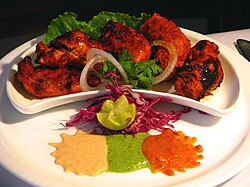
[[File:Tandoori_Chicken.jpg|right|thumb|197x197px|[[Tandoori chicken]] is a popular dish in Punjabi cuisine.]] | |||
==Language and literature== | ==Language and literature== | ||
{{see also|Punjabi language}} | {{see also|Punjabi language}} | ||
The Punjabi language is written with the [[Gurmukhi alphabet]] in India and with the [[Shahmukhi alphabet]] in Pakistan. Approximately 130 million people speak the Punjabi language.<ref name=Omniglot>{{cite web|url=http://www.omniglot.com/writing/punjabi.htm |title=Punjabi language and the Gurmukhi and Shahmuhi scripts and pronunciation |website=Omniglot.com | | The Punjabi language is written with the [[Gurmukhi alphabet]] in India and with the [[Shahmukhi alphabet]] in Pakistan. Approximately 130 million people speak the Punjabi language.<ref name=Omniglot>{{cite web|url=http://www.omniglot.com/writing/punjabi.htm |title=Punjabi language and the Gurmukhi and Shahmuhi scripts and pronunciation |website=Omniglot.com |date= |accessdate=2017-02-27}}</ref> | ||
In Punjabi literature has three major Punjabi romantic epic poems based on folktales: ''[[Heer Ranjha]]'' by the poet [[Waris Shah]] (1722-1798), ''[[Sohni Mahiwal]]'' and ''[[Mirza Sahiban]]'' (sung by late [[Alam Lohar]]).<ref name=encyclopedia/> By the 10th century, many Hindu [[Nath]] poets were associated with earlier Punjabi works. | In Punjabi literature has three major Punjabi romantic epic poems based on folktales: ''[[Heer Ranjha]]'' by the poet [[Waris Shah]] (1722-1798), ''[[Sohni Mahiwal]]'' and ''[[Mirza Sahiban]]'' (sung by late [[Alam Lohar]]).<ref name="encyclopedia">{{cite web|date=|title=Punjabi facts, information, pictures | Encyclopedia.com articles about Punjabi|url=http://www.encyclopedia.com/topic/Punjabi.aspx|website=Encyclopedia.com|accessdate=2017-02-27}}</ref> By the 10th century, many Hindu [[Nath]] poets were associated with earlier Punjabi works. Among the major Punjabi poets are Baba [[Fariduddin Ganjshakar]] (1179-1266), Baba [[Guru Nanak]] (1469-1539) and [[Bulleh Shah]] (1680-1757). | ||
==Dress== | ==Dress== | ||
{{ | A Punjabi suit that features three items - a ''qameez'' (top), ''salwar'' (bottom) and ''dupatta'' (scarf)<ref name="SWIE">{{cite book|last1=Rait|first1=Satwant Kaur|title=Sikh Women In England: Religious, Social and Cultural Beliefs|date=14 April 2005|publisher=Trentham Book|isbn=978-1-85856-353-4|location=Trent and Sterling|page=68}}</ref> is the traditional female attire of the Punjabi people.<ref name="DSOF">{{cite book|last1=Dominique|first1=Grele|title=Discover Singapore on Foot|last2=Raimbault|first2=Lydie|date=1 March 2007|publisher=Select Publishing|isbn=978-981-4022-33-0|edition=2|location=Singapore|page=35}}</ref> A qameez is a usually loose-fitted outer [[garment]] from upper thigh to mid-calf length. Along with the qameez, Punjabi women wear a salwaar that consists of long [[trousers]] drawn at the waist and tapered to the ankle.<ref name="UoM">{{cite book|last1=Akombo|first1=David|title=The Unity of Music and Dance in World Cultures|date=26 January 2016|publisher=McFarland & Company|isbn=978-1-4766-2269-9|location=North Carolina|page=155}}</ref> The other complementary feature of the Punjabi suit is the dupatta; often used to cover the chest and head.<ref name="UoM" /> Among the Punjabi people, the dupatta has long been a symbol of modesty.<ref name="Mark Magnier">{{cite web|author=Mark Magnier|date=23 February 2010|title=For Pakistani women, dupattas are more than a fashion statement|url=http://articles.latimes.com/2010/feb/23/world/la-fg-pakistan-scarf24-2010feb24|work=Los Angeles Times}}</ref> In [[Pakistan]], both women and men where the shalwar kameez. | ||
== Festivals == | == Festivals == | ||
{{See also|Punjabi festivals|List of Sikh festivals |List of Hindu festivals in Punjab|Festivals in Lahore}} | {{See also|Punjabi festivals|List of Sikh festivals |List of Hindu festivals in Punjab|Festivals in Lahore}} | ||
Punjabis celebrate | Punjabis celebrate different festivals based on their following culture, season and religion, which include [[Maghi]], [[Lohri]], [[Holi]], [[Basant (festival)|Basant]], [[Eid al-Adha|Eid ul Adha]], [[Eid al-Fitr|Eid ul Fitr]], [[Baisakhi|Vaisakhi]], [[Teeyan]], [[Diwali]], [[Hola Mohalla]], [[Guru Nanak Jayanti|Guru Nanak Jayant]], etc. | ||
==Gallery== | ==Gallery== | ||
<gallery> | <gallery> | ||
File: | File:Shalvaar qamiz.JPG|Men's Punjabi Shalwaar qamiz | ||
File:Traditional punjabi get up.jpg|Punjabi Turban | File:Traditional punjabi get up.jpg|Punjabi Turban | ||
</gallery> | </gallery> | ||
| Line 91: | Line 78: | ||
==External links== | ==External links== | ||
*[https://www.youtube.com/watch?v=1w8CDGj3560 Video about Punjab and Punjabi music] from the Horniman Museum | *[https://www.youtube.com/watch?v=1w8CDGj3560 Video about Punjab and Punjabi music] from the Horniman Museum | ||
{{Punjab, Pakistan|state=autocollapse}} | |||
{{Punjab, India}} | |||
{{DEFAULTSORT:Punjabi culture}} | {{DEFAULTSORT:Punjabi culture}} | ||
Revision as of 17:41, 23 August 2021
| Part of a series on |
| Punjabis |
|---|
 |
 Punjab portal |
The culture of Punjab encompasses the spoken language, written literature, cuisine, science, technology, military warfare, architecture, traditions, values and history of the Punjabi people native to the northern part of the Indian subcontinent. The term 'Punjabi' can mean both a person who lives in Punjab and also a speaker of the Punjabi language. Traditionally, Punjabi identity is primarily linguistic, geographical and cultural. Its identity is independent of historical origin or religion and refers to those who reside in the Punjab region or associate with its population and those who consider the Punjabi language their mother tongue.[1] Integration and assimilation are important parts of Punjabi culture, since Punjabi identity is not based solely on tribal connections.
History
Middle Ages
The culture of Punjab in the Middle Ages was extremely diverse dependent upon an individual's tribe, community, religion and village. An array of cultures can be found historically .The main cultures that arose in the Punjab during the Medieval Age at the beginning of this era was of strong Indo-Aryan dominance.
Modern era
Due to the large number of Punjabi people distributed throughout the world, especially Pakistan and India, many people are increasingly experiencing the culture and becoming influenced by it. Glimpses of traditional Punjabi culture can be seen in the Western world (e.g. the U.S., the UK, the EU, Canada, Australia, Africa and the Middle East).[2] Naturally people influence each other wherever they settle and live. Punjabi culture is evident from Punjabi philosophy, poetry, spirituality, education, artistry, music, cuisine, and architecture.
Music

Bhangra is one of the many Punjabi musical art forms that is increasingly listened to in the west and is becoming a mainstream favourite.[3] Punjabi music is used by western musicians in many ways, such as mixing it with other compositions to produce award-winning music. [citation needed] In addition, Punjabi classical music is increasingly becoming popular in the west. [citation needed] Sufi music and Qawali, commonly practiced in Punjab, Pakistan; are other important genres in the Punjab region.[4][5]
Dance
Owing to the long history of the Punjabi culture and of the Punjabi people there are many dances, normally performed at times of celebration, including harvests, festivals and weddings. The particular background of the dances can be non-religious and religious. The overall style can range from the high energy "bhangra" men's dance to the more reserved "jhumar," the "gidha" women's dance and "Malwayi Gidha" is a form of dance can be performed by both men and women together.
Weddings
Punjabi wedding traditions and ceremonies are traditionally conducted in Punjabi and are a strong reflection of Punjabi culture. While the actual religious marriage ceremony among Muslims, Hindus, Sikhs, Jains, Buddhists and Christians may be conducted in Arabic, Urdu, Punjabi, Sanskrit, Hindi or Pali by the Qazi, Pundit, Granthi or Priest, there are commonalities in ritual, song, dance, food, and dress. The Punjabi wedding has many rituals and ceremonies that have evolved since traditional times.
Crafts
The city of Amritsar in the Punjab state of India is home to the craft of brass and copper metalwork done by the Thatheras of Jandiala Guru, which is enlisted on the UNESCO's List of Intangible Cultural Heritage.[6] Years of neglect had caused this craft to die out, and the listing prompted the Government of Punjab to undertake a craft revival effort under Project Virasat.[7][8]
Cuisine
Punjabi cuisine has a wide range of dishes and enjoys world wide popularity. Many entrepreneurs have built large personal fortunes by investing in the sector promoting Punjabi cuisine which uses a uniquely appealing spice palette. Punjabi cuisine has become popular in the world due, not only to its intrinsic quality, but also due to the Punjabi diaspora promoting popularity and visibility in the western world including the UK, and the U.S. Some of the most popular dishes include Butter Chicken, Tandoori chicken, Dal makhni, chicken tikka lababdar, Saron da saag and stuffed or un stuffed naans (a type of unleavened bread).

Language and literature
The Punjabi language is written with the Gurmukhi alphabet in India and with the Shahmukhi alphabet in Pakistan. Approximately 130 million people speak the Punjabi language.[9] In Punjabi literature has three major Punjabi romantic epic poems based on folktales: Heer Ranjha by the poet Waris Shah (1722-1798), Sohni Mahiwal and Mirza Sahiban (sung by late Alam Lohar).[10] By the 10th century, many Hindu Nath poets were associated with earlier Punjabi works. Among the major Punjabi poets are Baba Fariduddin Ganjshakar (1179-1266), Baba Guru Nanak (1469-1539) and Bulleh Shah (1680-1757).
Dress
A Punjabi suit that features three items - a qameez (top), salwar (bottom) and dupatta (scarf)[11] is the traditional female attire of the Punjabi people.[12] A qameez is a usually loose-fitted outer garment from upper thigh to mid-calf length. Along with the qameez, Punjabi women wear a salwaar that consists of long trousers drawn at the waist and tapered to the ankle.[13] The other complementary feature of the Punjabi suit is the dupatta; often used to cover the chest and head.[13] Among the Punjabi people, the dupatta has long been a symbol of modesty.[14] In Pakistan, both women and men where the shalwar kameez.
Festivals
Punjabis celebrate different festivals based on their following culture, season and religion, which include Maghi, Lohri, Holi, Basant, Eid ul Adha, Eid ul Fitr, Vaisakhi, Teeyan, Diwali, Hola Mohalla, Guru Nanak Jayant, etc.
Gallery
-
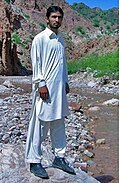 Men's Punjabi Shalwaar qamiz
 -
 Punjabi Turban


See also
- Punjab Culture Day
- Punjab region
- Punjabi people
- List of British Punjabis
- Punjab (India)
- Punjab (Pakistan)
- List of Punjabi language poets
- Punjabi Cultural Society of Chicago
- Turban training centre
References
- ↑ Thandi, edited by Pritam Singh, Shinder Singh (1999). Punjabi identity in a global context. New Delhi: Oxford University Press. ISBN 978-0-19-564864-5.
{{cite book}}:|first=has generic name (help)CS1 maint: multiple names: authors list (link) - ↑ "How Punjabi language is flourishing in France". Newseastwest.com. 2014-08-05. Retrieved 2017-02-27.
- ↑ Moreno, Jacqueline. "Bhangra conquering one dance move at a time". The Observer. Retrieved 2019-12-26.
- ↑ Pande, Alka (1999). Folk music & musical instruments of Punjab : from mustard fields to disco lights. Ahmedabad [India]: Mapin Pub. ISBN 978-18-902-0615-4.
- ↑ Thinda, Karanaila Siṅgha (1996). Pañjāba dā loka wirasā (New rev. ed.). Paṭiālā: Pabalikeshana Biūro, Pañjābī Yūniwarasiṭī. ISBN 978-81-7380-223-2.
- ↑ "UNESCO - Traditional brass and copper craft of utensil making among the Thatheras of Jandiala Guru, Punjab, India". ich.unesco.org. Retrieved 2019-07-01.
- ↑ Jun 22, Yudhvir Rana | TNN | Updated; 2018; Ist, 19:34. "Ignored for years, local craft may soon find place in luxury hotels | Amritsar News - Times of India". The Times of India. Retrieved 2019-07-01.
{{cite web}}:|first=has generic name (help);|last2=has numeric name (help)CS1 maint: numeric names: authors list (link) - ↑ "Alchemy of Art". The Indian Express. 2019-04-07. Retrieved 2019-07-01.
- ↑ "Punjabi language and the Gurmukhi and Shahmuhi scripts and pronunciation". Omniglot.com. Retrieved 2017-02-27.
- ↑ "Punjabi facts, information, pictures | Encyclopedia.com articles about Punjabi". Encyclopedia.com. Retrieved 2017-02-27.
- ↑ Rait, Satwant Kaur (14 April 2005). Sikh Women In England: Religious, Social and Cultural Beliefs. Trent and Sterling: Trentham Book. p. 68. ISBN 978-1-85856-353-4.
- ↑ Dominique, Grele; Raimbault, Lydie (1 March 2007). Discover Singapore on Foot (2 ed.). Singapore: Select Publishing. p. 35. ISBN 978-981-4022-33-0.
- ↑ 13.0 13.1 Akombo, David (26 January 2016). The Unity of Music and Dance in World Cultures. North Carolina: McFarland & Company. p. 155. ISBN 978-1-4766-2269-9.
- ↑ Mark Magnier (23 February 2010). "For Pakistani women, dupattas are more than a fashion statement". Los Angeles Times.
Other sources
- Wrestling in Punjab, documentary film on the history of wrestling in Punjab by filmmaker Simran Kaler.
- Quraishee 73, Punjabi Adab De Kahani, Abdul Hafeez Quaraihee, Azeez Book Depot, Lahore, 1973.
- Chopra 77, The Punjab as a sovereign state, Gulshan Lal Chopra, Al-Biruni, Lahore, 1977.
- Patwant Singh. 1999. The Sikhs. New York: Doubleday. ISBN 0-385-50206-0.
- Nanak, Punjabi Documentary Film by Navalpreet Rangi
- The evolution of Heroic Tradition in Ancient Panjab, 1971, Buddha Parkash.
- Social and Political Movements in ancient Panjab, Delhi, 1962, Buddha Parkash.
- History of Porus, Patiala, Buddha Parkash.
- History of the Panjab, Patiala, 1976, Fauja Singh, L. M. Joshi (Ed).
- The Legacy of The Punjab by R. M. Chopra, 1997, Punjabee Bradree, Calcutta.
External links
- Video about Punjab and Punjabi music from the Horniman Museum
| Topics |  | |
|---|---|---|
| Administration | ||
| Culture |
| |
| Divisions |
| |
| Districts | ||
| Major Cities | ||