





imported>Achuprasad393 |
Flying Bee (talk | contribs) Created page with "{{about||the 1964 film|Navarathri (1964 film)|the 1966 film|Navaratri (1966 film)}} {{Copy edit|date=June 2021}} {{EngvarB|date=April 2015}} {{Use dmy dates|date=October 2018..." |
||
| Line 1: | Line 1: | ||
{{ | {{about||the 1964 film|Navarathri (1964 film)|the 1966 film|Navaratri (1966 film)}} | ||
{{ | {{Copy edit|date=June 2021}} | ||
{{EngvarB|date= | {{EngvarB|date=April 2015}} | ||
{{Use dmy dates|date= | {{Use dmy dates|date=October 2018}} | ||
{{Infobox | {{short description|Annual Hindu festival}} | ||
| | {{Infobox holiday | ||
| image | |holiday_name = Sharada Navaratri | ||
| caption | |type = Hindu | ||
| | |longtype = | ||
| | |image = Navratri Navaratri festival preparations and performance arts collage.jpg | ||
| | |caption = Navaratri celebrates | ||
| | good over evil by goddess Durga | ||
| | |nickname = Navratri, Nauratri, Navarathri, Navaratra, Navratan, or Nauratan | ||
| | |observedby = [[Hindus]] | ||
| | |begins = [[Ashvin]] Shukla [[Prathama (day)|Prathama]] | ||
| | |ends = Ashvin Shukla [[Navami]] | ||
| | |frequency = Annual | ||
|celebrations = 10 days (9 nights) | |||
|observances = stage setting, prayers, plays, dramas, fasting, [[Puja (Hinduism)|puja]], murti immersion, and bonfires prayers are offered to goddess Durga and parvati | |||
|relatedto = [[Vijayadashami]], [[Dashain]] | |||
|alt=|official_name=|litcolor=|significance=|date=|weekday=|month=|scheduling=|duration=10 days|firsttime=|startedby= | |||
|date2020=17 Oct (Sat) – 25 Oct (Sun)<ref>{{cite web |author=Drik Panchag| title=Navratri 2020 detailed calendar|url=http://www.drikpanchang.com/navratri/ashwin-shardiya-navratri-dates.html?year=2020 }}</ref> | |||
|date2021=7 Oct (Thu) – 15 Oct (Fri) | |||
|date2022=26 Sep (Mon) – 5 Oct (Wed) | |||
|date2023=15 Oct (Sun) – 24 Oct (Tue) | |||
|image_size= | |||
}} | }} | ||
{{Saktism}} | |||
{{Hinduism}} | |||
''' | '''Navaratri'''{{efn|Also spelled ''Navratri'', ''Nauratri'', ''Navarathri'', ''Navaratra'', ''Navratam'', or ''Nauratam''}} is a [[Hindu festival]] that spans nine nights (and ten days) and is celebrated every year in the autumn. It is observed for different reasons and celebrated differently in various parts of the [[Indian cultural sphere]].{{sfn | Encyclopedia Britannica | 2015}}<ref name="Fuller2004p108">{{cite book|author=Christopher John Fuller|url=https://books.google.com/books?id=To6XSeBUW3oC&pg=PA108|title=The Camphor Flame: Popular Hinduism and Society in India|publisher=Princeton University Press|year=2004|isbn=978-0-69112-04-85|pages=108–109|author-link=Chris Fuller (academic)}}</ref> Theoretically, there are four seasonal ''Navaratri''. However, in practice, it is the post-monsoon autumn festival called Sharada Navaratri that is the most observed in the honor of the divine feminine [[Devi]] ([[Durga]]). The festival is celebrated in the bright half of the Hindu calendar month ''Ashvin'', which typically falls in the Gregorian months of September and October.{{sfn | Encyclopedia Britannica | 2015}}{{sfn|James G. Lochtefeld|2002|pp=468–469}} | ||
== | ==Etymology and nomenclature== | ||
The word ''Navaratri'' means 'nine nights' in [[Sanskrit]], ''nava'' meaning nine and ''ratri'' meaning nights.{{sfn|James G. Lochtefeld|2002|pp=468-469}} | |||
== | ==Dates and celebrations== | ||
In the eastern and northeastern states of [[India]], the [[Durga Puja]] is synonymous with ''Navaratri'', wherein goddess Durga battles and emerges victorious over the buffalo demon [[Mahishasura|Mahishasur]] to help restore [[dharma]].<ref name="Fuller2004p108" /> In southern states, the victory of Durga or [[Kali]] is celebrated. In all cases, the common theme is the battle and victory of good over evil based on a regionally famous epic or legend such as the ''[[Devi Mahatmya]]''.{{sfn|Encyclopedia Britannica|2015}}{{sfn|James G. Lochtefeld|2002|pp=468–469}} | |||
===Celebrations=== | |||
Celebrations include worshipping nine goddesses in nine days, stage decorations, recital of the legend, enacting of the story, and chanting of the scriptures of [[Hinduism]]. The nine days are also a major crop season cultural event, such as competitive design and staging of ''[[pandal]]s'', a family visit to these ''pandals,'' and the public celebration of [[Dance in India|classical and folk dances]] of Hindu culture.<ref name="rinehart147">{{cite book|author=Robin Rinehart|url=https://books.google.com/books?id=hMPYnfS_R90C&pg=PA147|title=Contemporary Hinduism: Ritual, Culture, and Practice|publisher=ABC-CLIO|year=2004|isbn=978-1-57607-905-8|pages=147–148}}</ref><ref>{{cite book|author=Sue Penney|url=https://books.google.com/books?id=ETUlVS-xs_YC&pg=PA30|title=Hinduism|publisher=Heinemann|year=2008|isbn=978-1-4329-0314-5|pages=30–31}}</ref><ref>{{cite book|author=Ellen Koskoff|url=https://books.google.com/books?id=73MO0eiQD_EC|title=The Concise Garland Encyclopedia of World Music: The Middle East, South Asia, East Asia, Southeast Asia|publisher=Routledge|year=2008|isbn=978-0-415-99404-0|pages=992, 1015–1016}}</ref> Hindu devotees often celebrate Navaratri by fasting. On the final day, called [[Vijayadashami]], the statues are either immersed in a water body such as a river or ocean, or the statue symbolizing the evil is burnt with fireworks, marking the destruction of evil. The festival also starts the preparation for [[Diwali]], the festival of lights, which is celebrated twenty days after [[Vijayadashami]].<ref>{{cite book|author1=Susan B. Gall|url=https://books.google.com/books?id=sEYUAQAAIAAJ|title=The Asian-American Almanac|author2=Irene Natividad|publisher=Gale Research|year=1995|isbn=978-0-8103-9193-2|page=24}}</ref><ref>{{cite book|author=Rina Singh|url=https://books.google.com/books?id=iSGTDAAAQBAJ&pg=PA17|title=Diwali|publisher=Orca|year=2016|isbn=978-1-4598-1008-2|pages=17–18}}</ref><ref name="Fuller2004p108" /> | |||
=== | === Dates === | ||
According to some [[Hindu texts]] such as the Shakta and Vaishnava Puranas, Navaratri theoretically falls twice or four times a year. Of these, the Sharada Navaratri near autumn equinox (September–October) is the most celebrated and the Vasanta Navaratri near spring equinox (March–April) is the next most significant to the culture of the Indian subcontinent. In all cases, Navaratri falls in the bright half of the Hindu lunisolar months. The celebrations vary by region, leaving much to the creativity and preferences of the Hindu.{{sfn|James G. Lochtefeld|2002|pp=468–469}}<ref name="Fuller2004p108f">{{cite book|author=Christopher John Fuller|title=The Camphor Flame: Popular Hinduism and Society in India |url=https://books.google.com/books?id=To6XSeBUW3oC&pg=PA108 |year=2004|publisher=Princeton University Press|isbn=978-0-69112-04-85|pages=108–127}}</ref><ref name="Sivapriyananda1995p21">{{cite book|author=S Sivapriyananda|title=Mysore Royal Dasara|url=https://books.google.com/books?id=DVkyFvZL_qMC&pg=PA21|year=1995|publisher=Abhinav Publications|pages=21–22}}</ref> | |||
====Sharada Navaratri==== | |||
Sharada Navaratri is the most celebrated of the four Navaratri, named after ''Sharada'' which means autumn. It commences on the first day (''pratipada'') of the bright fortnight of the lunar month of [[Ashvini]].<ref>{{Cite web|date=2020-10-09|title=Sharad Navratri 2020: History, significance, shubh muhurat and all you need to know about nine avatars of Goddess Durga|url=https://english.jagran.com/lifestyle/navratri-2020-check-history-significance-schedule-and-shubh-muhurat-of-the-nineday-festival-10017950|access-date=2020-10-25|website=Jagran English}}</ref> The festival is celebrated for nine nights once every year during this month, which typically falls in the Gregorian months of September and October. The exact dates of the festival are determined according to the Hindu lunisolar calendar, and sometimes the festival may be held for a day more or a day less depending on the adjustments for sun and moon movements and the leap year.{{sfn|Encyclopedia Britannica|2015}}<ref name="Fuller2004p108f" /><ref name="rinehart147" /> In many regions, the festival falls after the autumn harvest, and in others, during harvest.<ref>{{Cite web|title=Navratri 2018: Date, Day-Wise Significance Of Sharad Navratri And Special Fasting Foods|url=https://www.ndtv.com/food/navratri-2018-10-october-day-wise-significance-of-sharad-navratri-and-special-fasting-foods-1919567|access-date=2020-10-09|website=NDTV.com}}</ref> | |||
The festivities extend beyond goddess Durga and various other goddesses such as Saraswati and Lakshmi. Gods such as [[Ganesha]], [[Kartikeya]], [[Shiva]], and [[Parvati]] are regionally revered. For example, a notable pan-Hindu tradition during Navaratri is the adoration of Saraswati, the Hindu goddess of knowledge, learning, music, and arts, through [[Ayudha Puja]].<ref name="nilima111" /> On this day, which typically falls on the ninth day of Navaratri, peace and knowledge is celebrated. Warriors thank, decorate, and worship their weapons, offering prayers to Saraswati.<ref>{{cite book|author=Nicholas B. Dirks|url=https://books.google.com/books?id=cegr6zH9PFEC&pg=PA39|title=The Hollow Crown: Ethnohistory of an Indian Kingdom|publisher=University of Michigan Press|year=1993|isbn=0-472-08187-X|pages=39–40}}</ref> Musicians upkeep, play, and pray their musical instruments. Farmers, carpenters, smiths, pottery makers, shopkeepers, and all sorts of tradespeople similarly decorate and worship their equipment, machinery, and tools of trade. Students visit their teachers, express respect, and seek their blessings.<ref name="nilima111" /><ref name="Jagannathan2005p115">{{cite book|author=Maithily Jagannathan|url=https://books.google.com/books?id=xcIrkKUJH9QC&pg=PA115|title=South Indian Hindu Festivals and Traditions|publisher=Abhinav Publications|year=2005|isbn=978-81-7017-415-8|pages=115–117}}</ref> This tradition is particularly strong in South India, but is observed elsewhere too.<ref name="Jagannathan2005p115" /><ref>{{Cite web|title=Navratri 2020: Date, Day-Wise Celebrate Navratri Story|url=https://www.motivationlifechangingstories.in/2020/10/celebrate-happy-navratri-story-in-hindi-full-short-story-of-maa-durga-in-hindi-Navratri-2020.html|access-date=2020-11-04|website=motivationlifechangingstories.in/}}</ref> | |||
====Chaitra Navaratri==== | |||
{{see|Indian New Year's days|Mesha Sankranti}} | |||
Chaitra Navaratri is the second most celebrated Navaratri, named after ''vasanta'' which means spring. It is observed during the lunar month of [[Chaitra]] (March–April). In many regions, the festival falls after spring harvest, and in others, during harvest. It also marks the first day of the Hindu lunisolar calendar, also known as the Hindu Lunar New Year, according to the [[Vikram Samvat]] calendar.<ref>{{cite news|work=[[The Hindustan Times]] | url=https://www.hindustantimes.com/more-lifestyle/chaitra-navratri-2020-significance-history-behind-the-nine-day-festival-and-how-will-it-be-different-this-year/story-QhzJsRqlahKGlp9gAbWe8M.html|title=Chaitra Navratri 2020: Significance, history behind the nine-day festival and how will it be different this year |date=2020-03-30 |access-date=2021-02-12}}</ref><ref>{{Cite web|last=Desk|first=India TV News|date=2015-03-21|title=Difference between Vasanta and Sharad Navaratri - India TV|url=https://www.indiatvnews.com/lifestyle/news/navaratri-vasanta-sharad-difference-4812.html|access-date=2020-10-11|website=www.indiatvnews.com|language=en}}</ref> | |||
=== | ====Magha Navaratri==== | ||
Magha Navaratri is observed during the lunar month of [[Magha (month)|Magha]] (January–February). The fifth day of this festival is often independently observed as ''[[Vasant Panchami]]'' or ''Basant Panchami'', the official start of spring in the Hindu tradition, wherein goddess [[Saraswati]] is revered through arts, music, writing, and kite flying. In some regions, the Hindu god of love, ''[[Kama]]'' is revered.{{sfn|James G. Lochtefeld|2002|pp=741–742}}<ref>{{cite book|author=R. Manohar Lall|title=Among the Hindus: A Study of Hindu Festivals|url=https://books.google.com/books?id=YlqH4Q_gqCQC&pg=PA27|year=1933|publisher=Asian Educational Services|isbn=978-81-206-1822-0|pages=27–33}}</ref> ''Magha Navaratri'' is observed regionally or by individuals.<ref name=":0">{{cite book|url=https://books.google.com/books?id=DaiaY75n24sC|title=The Illustrated Weekly of India, Volume 96|publisher=Bennett, Coleman & Company|year=1975|page=37}}</ref> | |||
====Ashada Navaratri==== | |||
Ashada Navaratri is observed during the lunar month of [[Ashadha]] (June–July), during the start of the monsoon season.<ref>{{Cite web|last=Jun 23|first=Venu Lanka / TNN /|last2=2020|last3=Ist|first3=04:32|title=Ashada Navaratri begins at Kanaka Durga temple {{!}} Vijayawada News - Times of India|url=https://timesofindia.indiatimes.com/city/vijayawada/ashada-navaratri-begins-at-kanaka-durga-temple/articleshow/76516681.cms|access-date=2020-10-20|website=The Times of India|language=en}}</ref> ''Ashada Navaratri'' is observed regionally or by individuals.<ref name=":0" /> | |||
==Significance of each day== | |||
[[File:Navadurga.jpg|thumb|[[Navadurga]] - The nine goddesses worshipped in Navaratri.]] | |||
The festival is associated to the prominent battle that took place between Durga and demon the [[Mahishasura]] and celebrates the victory of good over evil.<ref name="auto">{{Cite news|url=https://timesofindia.indiatimes.com/life-style/events/navratri-2017-why-navratri-is-celebrated-for-9-days/articleshow/60856537.cms|title=Navratri 2017: Why Navratri is celebrated for 9 days – Times of India|work=The Times of India|access-date=2018-01-06}}</ref> These nine days are solely dedicated to Durga and her eight avatars – the [[Navadurga]].<ref>{{Cite news|url=https://www.ndtv.com/food/navratri-2017-significance-of-sharad-navratri-date-pooja-prasad-and-celebrations-1749811|title=Navratri 2017: Significance of Sharad Navratri, Date, Puja, Prasad and Celebrations|work=NDTV.com|access-date=2018-01-06}}</ref> Each day is associated to an incarnation of the goddess:<ref>{{Cite news|url=http://indianexpress.com/article/religion/navadurga-the-nine-avatars-of-goddess-durga-worshipped-on-nine-days-of-navratri-4849996/|title=Navratri 2017: 9 avatars of Goddess Durga worshipped on the 9 days|date=2017-09-22|work=The Indian Express|access-date=2018-01-06|language=en}}</ref><ref name="auto"/><ref>{{Cite news|url=http://indiatoday.intoday.in/story/what-is-navratri-festivities-hinduism-hindu-festival-maa-durga-puja-indian-goddess/1/1052623.html|title=What is Navratri? What do these nine days of festivities mean?|access-date=2018-01-06}}</ref><ref>{{Cite web|url=http://www.newsonair.nic.in/Navratri-Festival.asp|title=Navratri Festival,Navratri Festival India,Navaratri Celebrations In India,Durga Navratri,Goddess Durga Festival|website=www.newsonair.nic.in|access-date=2018-01-06}}</ref> | |||
;Day 1 – Shailaputri | |||
Known as Pratipada (first day), this day is associated with [[Shailaputri]] ("Daughter of Mountain"), an incarnation of [[Parvati]]. It is in this form that Durga is worshiped as the wife of Shiva; she is depicted as riding the bull, [[Nandi (bull)|Nandi]], with a [[trishula]] in her right hand and [[Lotus flower|lotus]] in her left. Shailaputri is considered to be the direct incarnation of [[Mahakali]]. The color of the day is [[grey]], which depicts action and vigor.<ref>{{Cite web|date=2016-10-01|title=9 days, 9 avatars: How Goddess Shailaputri teaches us patience and strength|url=https://timesofindia.indiatimes.com/blogs/the-photo-blog/9-days-9-avatars-how-goddess-shailaputri-teaches-us-patience-and-strength/|access-date=2020-10-20|website=Times of India Blog|language=en-US}}</ref> | |||
;Day 2 – Brahmacharini | |||
On Dwitiya (second day), Goddess [[Brahmacharini]], another incarnation of Parvati, is worshiped. In this form, Parvati became Yogini, her unmarried self. Brahmacharini is worshiped for emancipation or moksha and endowment of peace and prosperity. Depicted as walking bare feet and holding a ''japamala'' (rosary) and a ''kamandala'' (pot) in her hands, she symbolizes bliss and calm. Blue is the color code of this day. The orange color which depicts tranquility is sometimes used yet strong energy flows everywhere. | |||
;Day 3 – Chandraghanta | |||
Tritiya (third day) commemorates the worship of [[Chandraghanta]] – the name derived from the fact that after marrying Shiva, Parvati adorned her forehead with the ''ardhachandra'' (lit. half-moon). She is the embodiment of beauty and is also symbolic of bravery. White is the color of the third day, which is a vivacious color and can pep up everyone's mood. | |||
;Day 4 – Kushmanda | |||
Goddess [[Kushmanda]] is worshiped on Chaturthi (fourth day). Believed to be the creative power of the universe, Kushmanda is associated with the endowment of vegetation on earth, and hence, the color of the day is Red. She is depicted as having eight arms and sits on a Tiger. | |||
;Day 5 – Skandamata | |||
[[Skandamata]], the goddess worshiped on Panchami (fifth day), is the mother of Skanda (or [[Kartikeya]]). The color of Royal Blue is symbolic of the transforming strength of a mother when her child is confronted with danger. She is depicted riding a ferocious [[lion]], having four arms, and holding her baby. | |||
;Day 6 – Katyayani | |||
Born to sage Katyayana, she is an incarnation of Durga and is shown to exhibit courage which is symbolized by the color Yellow. Known as the warrior goddess, she is considered one of the most violent forms of Devi. In this avatar, [[Katyayani]] rides a lion and has four hands. She is a form of [[Parvati]], [[Mahalakshmi]], [[Mahasaraswati]]. She is celebrated on Shashtami (sixth day). | |||
;Day 7 – Kaalaratri | |||
Considered the most ferocious form of Goddess Durga, [[Kalaratri]] is revered on Saptami. It is believed that Parvati removed her fair skin to kill the demons [[Sumbha and Nisumbha]]. The color of the day is Green. The Goddess appears in a red coloured attire or tiger skin with a lot of rage in her fiery eyes, her skin turns black. The red color portrays prayer and ensures the devotees that the Goddess will protect them from harm. She is celebrated on Saptami (seventh day) | |||
;Day 8 – Mahagauri | |||
[[Mahagauri]] symbolizes intelligence and peace. It is believed when Kaalaratri took a bath in the [[Ganga]] river, she became extremely fair from her darker complexion. The color associated with this day is Peacock Green which depicts optimism. She is celebrated on Ashtami (eighth day). | |||
;Day 9 – Siddhidatri | |||
On the last day of the festival also known as Navami (ninth day), people pray to [[Siddhidhatri]]. Sitting on a lotus, she is believed to possess and bestows all types of Siddhis. Here she has four hands. Also known as Mahalakshmi, The purple color of the day portrays an admiration towards nature's beauty. Siddhidatri is [[Parvati]], the wife of Lord [[Shiva]]. Siddhidhatri is also seen as the [[Ardhanarishvara]] form of Shiva and Shakti. It is believed that one side of Lord Shiva’s body is that of Goddess Siddhidatri. Therefore, he is also known by the name of [[Ardhanarishwara]]. According to Vedic scriptures, Lord Shiva attained all the siddhis by worshiping this Goddess. | |||
| | ==Regional practices== | ||
Navaratri is celebrated in different ways throughout India.<ref name="Roy2005p304">{{cite book|author=Christian Roy|title=Traditional Festivals: A Multicultural Encyclopedia |url=https://books.google.com/books?id=IKqOUfqt4cIC&pg=PA304 |year=2005|publisher=ABC-CLIO|isbn=978-1-57607-089-5|pages=304–310}}</ref> Certain people revere different aspects of Durga and some people fast while others feast.<ref name="Fuller2004p108f"/> The Chaitra Navaratri culminates in [[Rama Navami|Ram Navami]]<ref name="Roy2005p310">{{cite book|author=Christian Roy|title=Traditional Festivals: A Multicultural Encyclopedia |url=https://books.google.com/books?id=IKqOUfqt4cIC&pg=PA304 |year=2005|publisher=ABC-CLIO|isbn=978-1-57607-089-5|page=310}}</ref> and the Sharada Navaratri culminates in [[Durga Puja]] and [[Vijayadashami]].<ref name="Fuller2004p108f"/> | |||
In the past, Shakta Hindus used to recite Durga's legends during the Chaitra Navaratri, but this practice around the spring equinox has been declining. For most contemporary Hindus, it is the Navaratri around the autumn equinox that is the major festival and the one observed. To Bengali Hindus and to Shakta Hindus outside of eastern and northeastern states of India, the term Navaratri implies [[Durga Puja]] in the warrior goddess aspect of Devi. In other traditions of Hinduism, the term Navaratri implies the celebration of Durga but in her more peaceful forms, such as Saraswati – the Hindu goddess of knowledge, learning, music, and other arts.<ref name="Fuller2004p108f"/><ref name="Roy2005p304"/> In Nepal, Navaratri is called [[Dasain|Dashain]], and is a major annual homecoming and family event that celebrates the bonds between elders and youngsters with ''Tika Puja'', as well as across family and community members.<ref name="Roy2005p310"/> | |||
===Eastern India, West Bengal and Nepal=== | |||
{{main|Durga Puja|Dashain}} | |||
{{multiple image | |||
| | | direction = vertical | ||
| | | footer = Two Durga Puja ''pandals'' in Kolkata during Navaratri | ||
| image1 = 2010 Durga Puja Barisha Pandal.jpg | |||
| | | image2 = 2011 Durga Puja Pandal.jpg | ||
}} | |||
Navaratri is celebrated as the Durga Puja festival in West Bengal. It is the most important annual festival to Bengali Hindus and a major social and public event in eastern and northeastern states of India, where it dominates the religious life.{{sfn|Rachel Fell McDermott|2001|pp=172–174}}{{sfn|Malcolm McLean|1998|p=137}} The occasion is celebrated with thousands<ref>{{cite book|author=Christian Roy|title=Traditional Festivals: A Multicultural Encyclopedia|url=https://books.google.com/books?id=IKqOUfqt4cIC&pg=PA306|year=2005|publisher=ABC-CLIO|isbn=978-1-57607-089-5|pages=306–307}}</ref> of ''[[pandal]]s'' (temporary stages) that are built in community squares, roadside shrines, and large Durga temples in West Bengal, Odisha, Jharkhand, Bihar, eastern Nepal, Assam, Tripura, and nearby regions. It is also observed by some Shakta Hindus as a private, home-based festival.{{sfn|Malcolm McLean|1998|p=137}}{{sfn|David Kinsley|1988|pp=106–108}}{{sfn|Lynn Foulston|Stuart Abbott|2009|pp=162–169}} Durga Puja festival marks the victory of the goddess Durga in the battle against the shape-shifting, deceptive, and powerful buffalo demon [[Mahishasura]].{{sfn|Alain Daniélou|1991|p=288}}{{sfn|June McDaniel|2004|pp=215–219}} | |||
| | |||
| | The festival begins with ''Mahalaya'', a day where Shakta Hindus remember the loved ones who have died, as well the advent of the warrior goddess Durga.{{sfn|Cynthia Bradley|2012|p=214}}{{sfn| Amazzone|2012|pp=57–59, 63, 66}} The next significant day of Durga Puja is called Shashthi, on which the local community welcomes the goddess Durga and festive celebrations are inaugurated. On the seventh (Saptami), eighth (Ashtami), and ninth (Navami) day, Durga, along with Lakshmi, Saraswati, Ganesha, and Kartikeya, are revered. These days mark the main [[Puja (Hinduism)|Puja]] (worship) which is performed by the recitation of scriptures, legends of Durga in the ''Devi Mahatmya,'' and social visits by families to temples and ''pandals''.{{sfn| David R. Kinsley | 1989|pp=19–25}}{{sfn|David Kinsley|1988|pp=106–115}}<ref name=ghosa40>{{cite book|author=Pratapacandra Ghosa|title=Durga Puja: with notes and illustrations|url=https://books.google.com/books?id=OGZYAAAAcAAJ&pg=PP40| year= 1871|publisher= Calcutta: Hindoo Patriot Press|pages=40–55}}</ref> On the tenth day, also known as [[Vijayadashami]], a great procession is held where clay statues of Durga are ceremoniously walked to a river or ocean coast for a solemn goodbye. Many mark their faces with vermilion (''sindooram'') or dress in red clothes. It is an emotional day for some devotees, and the congregation sings emotional goodbye songs.{{sfn|Hillary Rodrigues|2003|pp=244–245}}{{sfn|June McDaniel|2004|pp=168–169}} After the procession, Hindus distribute sweets, gifts, and visit their friends and family members.{{sfn|Hillary Rodrigues|2003|pp=66–67, 236–241, 246–247}} | ||
| | |||
===North India=== | |||
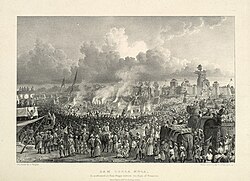
| | [[File:Ram Leela Mela As Performed before at Ram Nugur before the Raja of Benares by James Prinsep 1834.jpg|thumb|An 1834 sketch by James Prinsep showing Rama Leela Mela during Navaratri in Benares.]] | ||
| | In North India, Navaratri is marked by the numerous [[Ramlila]] events, where episodes from the story of [[Rama]] and [[Ravana]] are enacted by teams of artists in rural and urban centers, inside temples, or in temporarily constructed stages. This Hindu tradition of festive performance arts was inscribed by [[UNESCO]] as one of the "Intangible Cultural Heritage of Humanity" in 2008.<ref name=unescodussehra>[http://www.unesco.org/culture/ich/en/RL/ramlila-the-traditional-performance-of-the-ramayana-00110 Ramlila, the traditional performance of the Ramayana], UNESCO</ref> The festivities, states UNESCO, include songs, narration, recital and dialogue based on the Hindu text ''[[Ramcharitmanas]]'' by [[Tulsidas]]. It is particularly notable in the historically important Hindu cities of [[Ayodhya]], [[Varanasi]], [[Vrindavan]], [[Almora]], [[Satna]] and [[Madhubani district|Madhubani]] – cities in [[Uttar Pradesh]], [[Uttarakhand]], [[Bihar]], and [[Madhya Pradesh]].<ref name=unescodussehra/> | ||
| | |||
| | |||
| | |||
| | |||
| | |||
| | |||
| | |||
| | |||
| | |||
| | |||
| {{ | |||
| | |||
| | |||
| | |||
| | |||
| | |||
| | |||
| | |||
| | |||
| | |||
| | |||
| | |||
| | |||
| | |||
| | |||
| | |||
| | |||
| | |||
| | |||
| | |||
| | |||
| | |||
| | |||
| | |||
| | |||
| | |||
| | |||
The festival and dramatic enactment of the story is organized by communities in hundreds of small villages and towns, attracting a mix of audiences from different social, gender. and economic backgrounds. In many parts, the audience and villagers join in and participate spontaneously, some helping the artists, others helping with stage set up, create make-up, effigies, and lights.<ref name=unescodussehra/> | |||
Navaratri has historically been a prominent ritual festival for kings and military of a kingdom.<ref name="Fuller2004p108" /> At the end of the Navaratri, comes ''Dussehra'', where the effigies of Ravana, [[Kumbhakarna]], and [[Indrajit]] are burnt to celebrate the victory of good ([[Rama]]) over evil forces.{{sfn|Constance Jones|James D. Ryan|2006|pp=308–309}} | |||
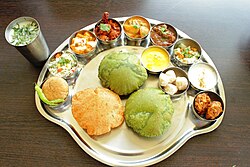
| | [[File:Indian - Food.jpg|thumb|left|Navaratri is also a festival for feasting with friends and family.]] | ||
| | Elsewhere, during this religious observance, goddess Durga's war against deception and evil is remembered. A pot is installed (ghatasthapana) at a sanctified place at home. A lamp is kept lit in the pot for nine days. The pot symbolizes the universe and the uninterrupted lit lamp symbolizes Durga.<ref>{{cite book|last1=Rodrigues|first1=Hillary|title=Ritual Worship of the Great Goddess: The Liturgy of the Durga Puja with interpretation|date=2003|publisher=State University of New York Press|location=Albany, New York, USA|isbn=07914-5399-5|page=83|url=https://books.google.com/books?hl=en&lr=&id=onyaEhwhJBUC |access-date=26 October 2015}}</ref> | ||
| | |||
| | |||
| | |||
| | |||
| | |||
| | |||
===Bihar=== | |||
In parts of Bihar, Durga is revered during the autumn of Navaratri. In other parts like [[Sitamarhi]] and close to the Nepal border, the spring Navaratri attracts a large [[Rama Navami]] fair, which marks the birth of Lord Rama. It is the largest cattle trading fair and attracts a large handicraft market in pottery, kitchen, and houseware, as well as traditional clothing. Festive performance arts and celebrations are held at the local Hindu temple dedicated to Sita, Hanuman, Durga, and Ganesha.<ref>{{cite book|author=Anand A. Yang|title=Bazaar India: Markets, Society, and the Colonial State in Bihar|url=https://books.google.com/books?id=D5lQutvzAp4C&pg=PA123|year=1999|publisher=University of California Press|isbn=978-0-520-91996-9|pages=123–126}}</ref><ref>[https://www.britannica.com/place/Sitamarhi Sitamarhi], Encyclopedia Britannica (2014)</ref> | |||
| | |||
| | |||
| | |||
| | |||
| | |||
| | |||
| | ===Gujarat=== | ||
| | Navaratri in Gujarat is one of the state's main festivals. The traditional celebrations include fasting for a day, or partially fasting each of the nine days by not eating grains or just taking liquid foods, in remembrance of one of nine aspects of Shakti goddess. The prayers are dedicated to a symbolic clay pot called ''garbo'', as a remembrance of the womb of the family and universe. The clay pot is lit, and this is believed to represent the one [[Atman (Hinduism)|Atman]] (soul, self).<ref name="Williams2015p37">{{cite book|author=Sean Williams|title=The Ethnomusicologists' Cookbook, Volume II|url= https://books.google.com/books?id=bhU-CgAAQBAJ&pg=PA37 |year=2015| publisher=Routledge| isbn=978-1-135-04008-6|pages=37–38}}</ref><ref name="NettlPorter1998p624"/> | ||
| | |||
| | |||
| | |||
| | |||
|- | |||
| | |||
| | [[File:Dancing garba by the sea.jpg|thumb|Garba dancing is a Navaratri tradition in Gujarat.]] | ||
In Gujarat and nearby Hindu communities such as in Malwa, the ''garbo'' significance is celebrated through performance arts on all nine days.<ref name="Williams2015p37"/><ref name="NettlPorter1998p624"/> The most visible is group dances called [[Garba (dance)|Garba]] accompanied by live orchestra, seasonal [[raga]], or devotional songs. It is a folk dance where people of different background and skills join and form concentric circles. The circles can grow or shrink, reaching sizes of hundreds or thousands of people, dancing and clapping in circular moves in their traditional costumes. The ''garba'' dance sometimes deploys ''dandiyas'' (sticks), coordinated movements and the striking of sticks between the dancers, and teasing between the genders.<ref>{{cite book|author1=L. Dankworth|author2=A. David|title=Dance Ethnography and Global Perspectives: Identity, Embodiment and Culture|url= https://books.google.com/books?id=1yjFAgAAQBAJ&pg=PT24|year= 2014|publisher= Springer|isbn=978-1-137-00944-9|pages=22–25}}</ref> Post dancing, the group and the audience socializes and feasts together.<ref name="Williams2015p37"/><ref name="NettlPorter1998p624">{{cite book|author1=Bruno Nettl|author2=James Porter|author3=Timothy Rice|title=The Garland Encyclopedia of World Music: South Asia : the Indian subcontinent |url=https://books.google.com/books?id=ZOlNv8MAXIEC&pg=PA624 |year= 1998|publisher= Taylor & Francis|isbn= 978-0-8240-4946-1|pages= 624–628, 980}}</ref> Regionally, the same thematic celebration of community songs, music, and dances on Navaratri is called ''garbi''.<ref name="NettlPorter1998p624"/> | |||
| | |||
| {{ | |||
| | |||
| | |||
|- | |||
| | |||
| {{ | ===Goa=== | ||
[[File:Krishna, The Beautiful Blue God - Navarathri Golu Dolls (15278867139).jpg|thumb|left|upright=0.75|Some regions produce and sell special Navaratri miniature ''golu'' dolls, such as of Krishna above.]] | |||
In the temples of [[Goa]], on the first day of the Hindu month of Ashwin, a copper pitcher, surrounded by clay, is installed inside the sanctum sanctorum of Devi and Krishna temples, in which nine varieties of food grains are placed. The nine nights are celebrated through devotional songs and religious discourses. Artists arrive to perform folk musical instruments. Celebrations include placing Durga's image in a specially-decorated colorful silver swing, known as ''Makhar,'' and for each of the nine nights, swinging Her to the tune of temple music (called as ''ranavadya''). This is locally called ''Makharotsav''.<ref name="makhar">{{cite web|title=Marcel displays colourful and vivid tradition of Makharotsav|url=http://timesofindia.indiatimes.com/city/goa/Marcel-displays-colourful-and-vivid-tradition-of-Makharotsav/articleshow/43454200.cms|website=timesofindia.indiatimes.com/|publisher=Times of India|access-date=26 September 2016}}</ref><ref name=goa>{{cite web|last=Kerkar|first=Rajendra P.|title=In Goa, Navaratri marks worship of earth mother goddess|url=http://articles.timesofindia.indiatimes.com/2012-10-17/goa/34524565_1_durga-goddess-worship|archive-url=https://archive.today/20131001032640/http://articles.timesofindia.indiatimes.com/2012-10-17/goa/34524565_1_durga-goddess-worship|url-status=dead|archive-date=1 October 2013|work=[[The Times of India]]|access-date=1 October 2013}}</ref> | |||
| | |||
| | |||
| | |||
|- | |||
| | |||
The last night of the Goa Navaratri festival is a major celebration called the ''makhar arti''.<ref>{{cite book|author=Kamla Mankekar|author-link=Kamla Mankekar|title=Temples of Goa|url=https://books.google.com/books?id=PHrXAAAAMAAJ|year=2004|publisher=Ministry of I & B, Government of India|isbn=978-81-230-1161-5|pages=55–56}}</ref> | |||
| | |||
| | |||
| | |||
| | |||
| | |||
| | |||
===Karnataka=== | |||
| | [[File:Dasara Navaratri decorations Kudroli Temple Mangalore Karnataka.jpg|thumb|Navaratri decorations at [[Kudroli]] [[Hindu temple]], Karnataka]] | ||
| | In [[Karnataka]], Navaratri is observed at home and by lighting up Hindu temples, cultural sites, and many regal processions. It is locally called ''Dasara'' and it is the state festival (''Nadahabba'') of Karnataka. Of the many celebrations, the [[Mysore Dasara|Mysuru Dasara]] is a major one and is popular for its festivities.<ref name=mysurudasara>[http://www.mysoredasara.gov.in Mysuru Dasara], Government of India (2016)</ref> | ||
The contemporary ''Dasara'' festivities at [[Mysore]] are credited to the efforts of King Raja Wodeyar I in 1610. On the ninth day of ''Dasara'', called ''Mahanavami'',<ref>Shirgaonkar, Varsha. "Madhyayugin Mahanavami aani Dasara". Chaturanga, Loksatta (1996).</ref> the royal sword is worshipped and is taken on a procession of decorated elephants and horses. Also, [[Ayudha Puja]] is dedicated to [[Saraswati]], in which military personnel upkeep their weapons and families upkeep their tools of livelihood, both offering a prayer to Saraswati, as well as Parvati and Lakshmi.<ref name="nilima111" /><ref>{{cite book|author1=Bartholomaeus Ziegenbalg|url=https://books.google.com/books?id=EXsOAAAAQAAJ|title=Genealogy of the South-Indian Gods|author2=Wilhelm Germann|author3=G. J. Metzger|publisher=Higgenbotham and Company|year=1869|pages=100, 106–107}}</ref> The day after Navaratri, on ''Vijayadashami'', the traditional ''Dasara'' procession is held on the streets of Mysore. An image of the Goddess Chamundeshwari is placed on a golden saddle (''hauda'') on the back of a decorated elephant and taken on a procession, accompanied by tableaux, dance groups, music bands, decorated elephants, horses, and camels.<ref name=mysurudasara2>[http://www.mysoredasara.gov.in/pastdasara.php Mysuru Dasara History], and [http://www.mysoredasara.gov.in/presentdasara.php Present Dasara], Government of India (2016)</ref> | |||
| | |||
| | |||
| | |||
| | |||
| | |||
| | |||
| | |||
| | |||
Another Navaratri tradition in Karnataka has been decorating a part of one's home with art dolls called ''Gombe'' or ''Bombe'', similar to [https://www.navarathrigoludolls.com/ Golu dolls] of Tamil Nadu. An art-themed ''[[Gaarudi Gombe]]'', featuring folk dances which incorporate these dolls, is also a part of the celebration.<ref>[http://www.deccanherald.com/content/194556/a-ball-dolls.html A ball with the dolls: Navratri] and [http://www.deccanherald.com/content/362179/039gombe-habba039-all-its-splendour.html Gombe Habba in all its splendor], Deccan Herald, India</ref> | |||
| | ===Kerala=== | ||
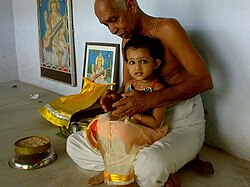
| {{ | [[File:Navarathri day.jpg|thumb|A family preparing for Saraswati puja on Navaratri.]] | ||
| | In [[Kerala]], three days (Ashtami, Navami, and [[Vijaya Dashami|Vijayadashami]]) of Sharada Navaratri are celebrated as Sarasvati Puja in which books are worshipped. The books are placed for Puja on Ashtami in their own houses, traditional nursery schools, or in temples. On ''Vijayadashami'', the books are ceremoniously taken out for reading and writing after worshipping Sarasvati. ''Vijayadashami'' is considered auspicious for initiating the children into writing and reading, which is called [[Vidyāraṃbhaṃ|Vidyarambham]].<ref>{{cite book|author=A. Sreedhara Menon|title= Social and cultural history of Kerala|url= https://catalog.hathitrust.org/Record/000124058|year= 1979|publisher=Sterling|pages=166–167}}</ref> | ||
| | |||
| | |||
|| | |||
| | |||
The Vidyarambham day tradition starts with the baby or child sitting on the lap of an elderly person such as the grandfather, near images of Saraswati and Ganesha. The elder writes a letter and the child writes the same with his or her index finger. | |||
===Maharashtra=== | |||
Navaratri celebrations vary across [[Maharashtra]] and the specific rites differ between regions, even if they are called the same and dedicated to the same deity. The most common celebration begins on the first day of Navaratri with [[Ghatasthapana]], which literally means "mounting of a jar". On this day, rural households mount a copper or brass jar, filled with water, upon a small heap of rice kept on a wooden stool (''pat'').<ref>{{cite book|author1=Manu Belur Bhagavan|author2=Eleanor Zelliot|author3=Anne Feldhaus|title=Speaking Truth to Power|url=https://books.google.com/books?id=j3zXAAAAMAAJ |year=2008|publisher=Oxford University Press|isbn=978-0-19-569305-8|pages=99–105}}</ref> The jar is typically placed other agriculture symbols such as a [[turmeric]] root, leaves of a [[mango tree]], coconut, and major staple [[grains]] (usually eight varieties). A lamp is lighted symbolizing knowledge and household prosperity, and kept alight through the nine nights of Navaratri.<ref>{{cite book|author=India. Office of the Registrar General|title=Census of India, 1961: Maharashtra|url=https://books.google.com/books?id=If4cAQAAMAAJ|year=1966|publisher=Government of India|page=132}}</ref> | |||
| | |||
| | |||
| | |||
| | |||
| | |||
| | |||
| | |||
The family worships the pot for nine days by offering rituals and a garland of flowers, leaves, fruits, dry-fruits, etc. with a ''[[naivedya]]'', and water is offered in order to get the seeds sprouted. Some families also celebrate ''[[Kali]] puja'' on days 1 and 2, ''[[Laxmi]] puja'' on days 3, 4, 5 and [[Saraswati]] puja on days 6, 7, 8, 9 along with Ghatasthapana. On the eighth day, a "Yajna" or "Hom" is performed in the name of Goddess Durga. On the ninth day, the Ghat puja is performed and the Ghat is dismantled after taking off the sprouted leaves of the grains.{{Citation needed|date=July 2021}} | |||
The Goddess Lalita is worshipped on the fifth day of the festival.<ref>{{cite book|author=Roshen Dalal|title=The Religions of India: A Concise Guide to Nine Major Faiths|url=https://books.google.com/books?id=pNmfdAKFpkQC&pg=PA98 |year=2010|publisher=Penguin Books|isbn=978-0-14-341517-6|page=98}}</ref> On the ninth day of the festival, men participate in worshipping all kinds of tools, weapons, vehicles, and productive instruments.<ref>{{cite book|author=Brahm Dev|title=The Illustrated Weekly of India, Volume 94, Issue 4|url=https://books.google.com/books?id=cVo6AQAAIAAJ|date=October 1973|publisher=Bennett, Coleman & Company |page=25}}</ref> | |||
[[File:Avatars of Amman Navarathiri.jpg|thumb|Girls dressed up for music and dance performance during Amman Navaratri]] | |||
| | |||
| | |||
| | |||
| | |||
| | |||
| | |||
| | |||
| | |||
| | |||
| | |||
| | |||
| | |||
| | |||
== | ===Tamil Nadu=== | ||
Navaratri has been a historic tradition within Tamil Nadu, with Lakshmi, Saraswati, and Durga goddesses as the focus.<ref name="Claus2003p443"/> Like the rest of India, the festival has been an occasion for performance arts, particularly Hindu temple dances such as [[Bharatanatyam]] and [[Mohiniyattam]]. Major palaces, community centers, and historic temples have embedded dance halls. For example, the [[Padmanabhapuram Palace]] built about 1600 CE has had a large dance hall with intricately carved pillars, a structure entirely made of stone. This dance hall has traditionally been known as ''Navaratri Mantapa''.<ref>{{cite book|author1=Bharati Shivaji|author2=Avinash Pasricha|title=ks?id=jpxbZZVGNxUC&pg=PA23|year=1986|publisher=Lancer Publishers|isbn=978-81-7062-003-7|page=23}}</ref> The festivities begin with [[Veda|Vedic chants]] inaugurating the dances and other ceremonies. Other Tamil Hindu temples, such as those associated with [[Sri Vaishnavism]], also celebrate the Navaratri festivities.<ref>{{cite book|author=Sarojini Jagannathan|title=Impact of Śrī Rāmānujāçārya on Temple Worship|url=https://books.google.com/books?id=r47XAAAAMAAJ|year=1994|publisher=Nag Publishers|isbn=978-81-7081-288-3|pages=184–192}}</ref> | |||
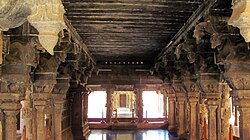
[[File:Navarathri Mandapam.jpg|thumb|left|A large sculpted dance hall inside Padmanabhapuram Palace near [[Kanyakumari]] called ''Navaratri Mandapam''. It features goddess Saraswati and large dance hall.]] | |||
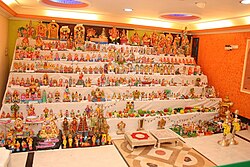
''' | Another notable Tamil tradition is a celebration of the festival with ''Golu'' dolls (also spelled as ''Gollu''). These include gods, goddesses, animals, birds and rural life all in a miniature design. People set up their own creative themes in their homes, called ''Kolu'', friends and families invite each other to visit their homes to view Kolu displays, then exchange gifts and sweets.<ref>{{cite book|author1=Aditi Ranjan|author2=M. P. Ranjan|title=Handmade in India: A Geographic Encyclopedia of Indian Handicrafts|url=https://books.google.com/books?id=ixhJAQAAIAAJ|year=2009|publisher=Abbeville Press|isbn=978-0-7892-1047-0|pages=317–318}}</ref> This tradition is also found in other parts of South India such as Andhra Pradesh where it called ''Bommala Koluvu'', and Karnataka where it is called ''Gombe Habba'' or ''Gombe totti''.<ref name="Claus2003p443">{{cite book|author1=Peter J. Claus|author2=Sarah Diamond|author3=Margaret Ann Mills|title=South Asian Folklore: An Encyclopedia|url= https://books.google.com/books?id=ienxrTPHzzwC&pg=PA443|year= 2003|publisher= Taylor & Francis|isbn= 978-0-415-93919-5|pages=443–444}}</ref><ref>[http://www.deccanherald.com/content/362179/039gombe-habba039-all-its-splendour.html 'Gombe habba' in all its splendour] | ||
Deccan Herald (9 October 2013)</ref> Evidence of ''Gombe totti'' tradition as a Hindu celebration of the artisan arts goes back to at least the 14th-century [[Vijayanagara Empire]].<ref>{{cite book|author=S Sivapriyananda|title=Mysore Royal Dasara|url=https://books.google.com/books?id=DVkyFvZL_qMC |year=1995|publisher=Abhinav Publications|pages=155–156}}</ref> In the evening of ''Vijayadashami'', any one doll from the "Kolu" is symbolically put to sleep and the Kalasa is moved a bit towards the North to mark the end of that year's Navaratri Kolu. The family offers a prayer of thanks, and wraps up the display.{{citation needed|date=February 2017}} | |||
[[File:Navratri Golu.jpg|thumb | right | Golu dolls arrangement in [[Coimbatore]], [[Tamil Nadu]].]] | |||
'''[[ | In temples of Tamil Nadu, Navaratri is celebrated for Durga's dwelling in each temple. The temples are decorated, ceremonial lamps are lit, and Vedic chantings are performed. Priests and visitors of some of these temples wear a special yellow colored 'promise of protection' thread on their wrists, called ''[[kappu]]'' (Tamil) or ''raksha bandhana'' (Sanskrit). It is believed to symbolize a vow to the goddess and protection from the goddess against evil.<ref>[[Burton Stein]] (1977), Temples in Tamil Country, 1300–1750 A.D, The Indian Economic & Social History Review, SAGE Publications, Volume 14, Issue 1, pages 11–45;<br>Carol Breckenridge (1977), From Protector to Litigant, The Indian Economic & Social History Review, SAGE Publications, Volume 14, Issue 1, pages 78–83, 86–93</ref><ref>{{cite book|author=Aya Ikegame|title=Princely India Re-imagined: A Historical Anthropology of Mysore from 1799 to the present|url=https://books.google.com/books?id=bV5ElF17ezwC |year=2013|publisher=Routledge|isbn=978-1-136-23909-0|pages=146–148 }}</ref> | ||
''' | ===Telangana=== | ||
{{See also|Kanya Puja}} | |||
[[File:Bathukamma.jpg|thumb|upright=0.8|A lamp above a ''Bathukamma'' flower arrangement, a Telugu Navaratri tradition.]] | |||
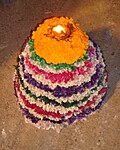
In [[Telangana]], Navaratri is celebrated as in the rest of India and it ends with Dasara. During the Navaratri nights, a notable Telangana tradition involves Telugu Hindu women who produce [[Bathukamma]] for Navaratri goddesses. It is an artistic flower decorations driven event, particularly using [[Tagetes|marigolds]], which revere three different aspects Devi, called ''[[Tridevi]]''. In 2016, 9,292 women simultaneously participated to create a 20 feet high flower arrangements, one of the world's largest festive flower arrangement.<ref>[http://www.newindianexpress.com/cities/hyderabad/2016/oct/09/bathukamma-sets-guinness-world-record-1526476.html Bathukamma sets Guinness World Record] The New Indian Express (9 October 2016)</ref><ref>[http://www.thehindu.com/news/cities/Hyderabad/Thousands-of-women-turn-up-for-Maha-Bathukamma/article15476999.ece Thousands of women turn up for Maha Bathukamma], The Hindu (9 October 2016)</ref> | |||
[[Bathukamma]] celebrations will be started with the Mahalaya Amavasya (Pitru Amavasya), a day before Navaratri starts. The main deity of worship is goddess Gowri, a form of goddess [[Durga]], who is symbolised with a idol made from turmeric powder and is placed on a floral arrangement called [[bathukamma]]. The festival will go for nine nights with women whirling around the bathukamma clapping their hands or sticks along with the recitation of the [[Ramayana]], stories of [[Shiva]], Gowri, [[Ganga]], and common day-to-day life of women in the form of rhythmic songs. Every night, bathukamma is immersed in nearby water resources and a new bathukamma is made next day. This nine nights festival ends with [[Durgashtami]], when Durga is believed to be worshipped in the form of Maha Gowri.{{Citation needed|date=July 2021}} | |||
Like elsewhere in India, ''Ayudha Puja'' is observed by Telangana Hindus where weapons are maintained, decorated, and worshipped. Tradesmen and farmers similarly clean up, decorate, and worship their own equipment of the trade. On the 10th day, [[Dussehra]] ([[Vijayadashami]]), grand feasts are arranged with family members and friends.<ref name=nilima111>{{cite book|author=Nilima Chitgopekar|title=Book Of Durga|url=https://books.google.com/books?id=Xb64hva4qWYC&pg=PA111|year=2009|publisher=Penguin Books|isbn=978-0-14-306767-2|pages=111–114}}</ref> | |||
==Animal sacrifice== | |||
Animal sacrifice is a part of some [[Durga Puja|Durga puja]] celebrations during Navaratri in the eastern states of India. The goddess is offered a sacrificial animal in this ritual in the belief that it stimulates her violent vengeance against the buffalo demon.<ref name=fuller83>{{cite book|author=Christopher John Fuller|author-link=Chris Fuller (academic)|title=The Camphor Flame: Popular Hinduism and Society in India|url=https://books.google.com/books?id=To6XSeBUW3oC |year=2004|publisher=Princeton University Press|isbn=0-691-12048-X|pages=46, 83–85}}</ref> According to [[Chris Fuller (academic)|Christopher Fuller]], the animal sacrifice practice is rare among Hindus during Navaratri, or at other times, outside the [[Shaktism]] tradition found in the eastern Indian states of [[West Bengal]], [[Odisha]], and [[Assam]].<ref>{{cite journal|last1=Hardenberg|first1=Roland|date=2000|title=Visnu's Sleep, Mahisa's Attack, Durga's Victory: Concepts of Royalty in a Sacrificial Drama|url=http://www.krepublishers.com/02-Journals/JSS/JSS-04-0-000-000-2000-Web/JSS-04-04-227-2000-Abst-PDF/JSS-04-04-261-276-2000.pdf|journal=Journal of Social Science|volume=4|issue=4|page=267|access-date=29 September 2015}}</ref> Even in these states, the festival season is one where significant animal sacrifices are observed.<ref name=fuller83/> In some Shakta Hindu communities, the slaying of the buffalo demon and the victory of Durga are observed with a symbolic sacrifice instead of animal sacrifice.{{efn|In these cases, Shaktism devotees consider animal sacrifice distasteful, practice alternate means of expressing devotion while respecting the views of others in their tradition.<ref>{{cite book|author1=Ira Katznelson|author2=Gareth Stedman Jones|title=Religion and the Political Imagination|url=https://books.google.com/books?id=pWYXdLW00UsC |year=2010|publisher=Cambridge University Press|isbn=978-1-139-49317-8|page=343}}</ref> A statue of ''[[asura]]'' demon made of flour, or equivalent, is immolated and smeared with vermilion to remember the blood that had necessarily been spilled during the war.{{sfn|Hillary Rodrigues|2003|pp=277-278}}{{sfn|June McDaniel|2004|pp=204–205}} Other substitutes include a vegetal or sweet dish considered equivalent to the animal.<ref>{{cite book|author=Rachel Fell McDermott|title=Revelry, Rivalry, and Longing for the Goddesses of Bengal: The Fortunes of Hindu Festivals|url=https://books.google.com/books?id=ggBeH_lmUu8C |year=2011|publisher=Columbia University Press|isbn=978-0-231-12919-0|pages=204–205}}</ref>}}{{sfn|Hillary Rodrigues|2003|pp=277-278}}{{sfn|June McDaniel|2004|pp=204-205}} | |||
The [[Rajput]] of [[Rajasthan]] worship their weapons and horses on Navaratri, and formerly offered a sacrificial goat to a goddess revered as ''Kuldevi'' – a practice that continues in some places.<ref>{{cite book|last1=Harlan|first1=Lindsey|title=The goddesses' henchmen gender in Indian hero worship|date=2003|publisher=Oxford University Press|location=Oxford [u.a.]|isbn=978-0195154269|pages=45 with footnote 55, 58–59| url=https://books.google.com/books?hl=en&lr=&id=7HLrPYOe38gC |access-date=14 October 2016}}</ref><ref name="Goat sacrifice to Shilamata">{{cite book|last1=Hiltebeitel|first1=Alf|author-link1=Alf Hiltebeitel|last2=Erndl|first2=Kathleen M.|title=Is the Goddess a Feminist?: the Politics of South Asian Goddesses,|date=2000|publisher=Sheffield Academic Press|location=Sheffield, England|isbn=9780814736197|page=77|url=https://books.google.com/books?hl=en&lr=&id=sQJzTr4c-g4C}}</ref> The ritual requires the slaying of the animal with a single stroke. In the past, this ritual was considered a rite of passage into manhood and readiness as a warrior.<ref>{{cite book|last1=Harlan|first1=Lindsey|title=Religion and Rajput Women|year=1992|publisher=University of California Press|location=Berkeley, California|isbn=0-520-07339-8|pages=61, 88|url=https://books.google.com/books?hl=en&lr=&id=7HLrPYOe38gC }}</ref> The ''Kuldevi,'' among these Rajput communities, is a warrior-pativrata guardian goddess, with local legends tracing reverence for her during Rajput-Muslim wars.<ref>{{cite book|last1=Harlan|first1=Lindsey|title=Religion and Rajput Women|year=1992|publisher=University of California Press|location=Berkeley, California|isbn=0-520-07339-8|pages=107–108|url=https://books.google.com/books?hl=en&lr=&id=7HLrPYOe38gC }}</ref> | |||
The tradition of animal sacrifice is being substituted with vegetarian offerings to the Goddess in temples and households around [[Banaras]] in Northern India.<ref>{{cite book|last1=Rodrigues|first1=Hillary|title=Ritual Worship of the Great Goddess: The Liturgy of the Durga Puja with interpretation|date=2003|publisher=State University of New York Press|location=Albany, New York, USA|isbn=07914-5399-5|page=215|url=https://books.google.com/books?hl=en&lr=&id=onyaEhwhJBUC |access-date=26 October 2015}}</ref> | |||
* | |||
==Outside India== | |||
The Hindu diaspora that migrated as [[indentured servants]] during colonial era to various plantations and mines around the world, as well as those who migrated on their own, continued to mark their Navaratri traditions. Tamil Hindus in [[Malaysia]], [[Singapore]] and [[Thailand]], for example, built Hindu temples in southeast [[Asia]] in the 19th century, and Navaratri has been one of their major traditional festivals.<ref>{{cite book|author1=K Kesavapany|author2=A Mani|author3=P Ramasamy|title=Rising India and Indian Communities in East Asia |url=https://books.google.com/books?id=39lJz_L4MdUC&pg=PA675 |year=2008|publisher=Institute of Southeast Asian Studies|isbn=978-981-230-799-6|pages=675–677}}</ref> In [[Trinidad and Tobago]], [[Guyana]], [[Suriname]], [[Fiji]], [[Mauritius]], [[Canada]], the [[United States]], and the [[United Kingdom]], Navaratri and Diwali have been one of the most visible celebrations of the local Hindu communities from about mid 20th-century.<ref>{{cite book|author=Peter van der Veer|title=Nation and Migration: The Politics of Space in the South Asian Diaspora|url=https://books.google.com/books?id=bvTHlLRZL8UC |year=1995|publisher=University of Pennsylvania Press|isbn=0-8122-1537-0|pages=144–145}}</ref><ref>{{cite book|author1=Peter Childs|author2=Michael Storry|title=Encyclopedia of Contemporary British Culture|url=https://books.google.com/books?id=tlsKXeRt0wgC |year=2013|publisher=Routledge|isbn=1-134-75555-4|pages=271 }}</ref> | |||
[[File:Simple Golu in New Jersey.jpg|thumb | right | Simple Golu in [[New Jersey]]]] | |||
==Other religions== | |||
Navaratri and goddess worship is mentioned in the historic [[Sikhism]] literature, particularly in the ''[[Dasam Granth]]'' traditionally attributed to [[Guru Gobind Singh]]. According to Louis Fenech, the Sikhs have historically mirrored the reverence for ''Devi'' [[Shakthi]] and the worship of weapons in a manner similar to those by Shakta Hindus.<ref>{{cite book|author=Louis E. Fenech|title= The Sikh Zafar-namah of Guru Gobind Singh: A Discursive Blade in the Heart of the Mughal Empire |url= https://books.google.com/books?id=aUUfAQAAQBAJ&pg=PA112 |year=2013|publisher= Oxford University Press|isbn=978-0-19-993145-3|pages=112, 255 with note 54}}</ref><ref>{{cite book|author1=Nidar Singh Nihang|author2=Parmjit Singh|title=In the master's presence: the Sikh's of Hazoor Sahib. History|url=https://books.google.com/books?id=qkcKAQAAMAAJ|year=2008|publisher=Kashi|isbn=978-0956016829|pages=122 and Glossary}}</ref> The second Guru of Sikhism, [[Guru Angad]], was an ardent devotee of goddess Durga.<ref>{{cite book|author=Arvind-Pal Singh Mandair|title=Sikhism: A Guide for the Perplexed |url=https://books.google.com/books?id=BEP0Ty-GuVEC |year=2013|publisher=Bloomsbury Academic|isbn=978-1-4411-1708-3|page=26}}</ref> | |||
The Jains have observed the social and cultural celebrations of Navaratri with Hindus, such as the folk dances. The ''stavan'' poetry of Jainism, states M. Whitney Kelting, "draw much of their imagery from the ''garba'' poems" of Hinduism.<ref>{{cite book|author=M. Whitney Kelting|title=Singing to the Jinas: Jain Laywomen, Mandal Singing, and the Negotiations of Jain Devotion|url=https://books.google.com/books?id=elcn1IEJ3CEC |year=2001|publisher=Oxford University Press|isbn=978-0-19-803211-3|pages=87–88}}</ref> | |||
==See also== | |||
* [[Navratra Akhand Jyoti]] | |||
*[[Durga Puja]] | |||
* [[Garba (dance)|Garba]] | |||
* [[Jhandewalan Temple]] | |||
* [[Jwaladevi Temple]] | |||
* [[Jyoti Kalash]] | |||
* [[Mysore Dasara]] | |||
* [[Nine Emperor Gods Festival]] | |||
* [[Vijayadashami]] | |||
* [[Dashain]] | |||
==Notes== | |||
{{notelist}} | |||
==References== | ==References== | ||
{{Reflist| | {{Reflist|30em}} | ||
===Bibliography=== | |||
{{Refbegin|30em}} | |||
* {{cite book|url=https://books.google.com/books?id=PM_TNDu8NHUC|title=Goddess Durga and Sacred Female Power|first=Laura|last=Amazzone|year= 2012|publisher=University Press of America|access-date=5 February 2017}} | |||
*{{cite book|last= Coburn|first= Thomas B.| url=https://books.google.com/books?id=c7vIzNrC-coC |title= Encountering the Goddess: A translation of the Devi-Mahatmya and a Study of Its Interpretation| publisher= State University of New York Press | year= 1991 | isbn = 0791404463 }} | |||
* {{cite book|author= Cynthia Bradley|editor1=Denise Cush|editor2=Catherine Robinson|editor3=Michael York|title=Encyclopedia of Hinduism|url= https://books.google.com/books?id=kzPgCgAAQBAJ |year =2012|publisher=Routledge|isbn=978-1-135-18979-2}} | |||
* {{cite book|author=Alain Daniélou|title=The Myths and Gods of India: The Classic Work on Hindu Polytheism from the Princeton Bollingen Series |url=https://books.google.com/books?id=1HMXN9h6WX0C |year=1991|publisher=Inner Traditions / Bear & Co|isbn=978-0-89281-354-4}} | |||
* {{cite book|author1=Lynn Foulston|author2=Stuart Abbott|title=Hindu Goddesses: Beliefs and Practices|url=https://books.google.com/books?id=XgwVgPx5G5UC |year=2009|publisher=Sussex Academic Press|isbn=978-1-902210-43-8}} | |||
*{{cite book|author1=Constance Jones|author2=James D. Ryan|title=Encyclopedia of Hinduism |url=https://books.google.com/books?id=OgMmceadQ3gC |year=2006|publisher=Infobase Publishing|isbn=978-0-8160-7564-5}} | |||
*{{cite book| author=David Kinsley| title=Hindu Goddesses: Visions of the Divine Feminine in the Hindu Religious Tradition|url=https://books.google.com/books?id=HzldwMHeS6IC| year=1988| publisher=University of California Press| isbn=978-0-520-90883-3}} | |||
* {{cite book|author=David R. Kinsley|title=The Goddesses' Mirror: Visions of the Divine from East and West |url=https://books.google.com/books?id=b0jmXOPBXkwC |year=1989|publisher=State University of New York Press|isbn=978-0-88706-835-5}} | |||
*{{cite book|author=James G. Lochtefeld|title=The Illustrated Encyclopedia of Hinduism: N-Z|url=https://books.google.com/books?id=5kl0DYIjUPgC |year=2002|publisher=The Rosen Publishing Group|isbn=0-8239-2287-1}} | |||
* {{cite book|author=Malcolm McLean|title=Devoted to the Goddess: The Life and Work of Ramprasad |url=https://books.google.com/books?id=kXY4uQ9TwI8C |year=1998|publisher=State University of New York Press|isbn=978-0-7914-3689-9}} | |||
* {{cite book|author= June McDaniel|title= Offering Flowers, Feeding Skulls: Popular Goddess Worship in West Bengal |url= https://books.google.com/books?id=caeJpIj9SdkC |year= 2004|publisher=Oxford University Press|isbn=978-0-19-534713-5}} | |||
*{{cite book|author=Rachel Fell McDermott|title=Mother of My Heart, Daughter of My Dreams: Kali and Uma in the Devotional Poetry of Bengal |url=https://books.google.com/books?id=2PrChFaXgf0C |year=2001|publisher=Oxford University Press|isbn=978-0-19-803071-3}} | |||
*{{Cite book|first=Ludo |last=Rocher| year= 1986| author-link= Ludo Rocher| title= The Puranas| publisher= Otto Harrassowitz Verlag| isbn= 978-3447025225 }} | |||
*{{cite book|author=Hillary Rodrigues|title=Ritual Worship of the Great Goddess: The Liturgy of the Durga Puja with Interpretations|url= https://books.google.com/books?id=onyaEhwhJBUC|year=2003|publisher=SUNY Press|isbn=978-0-7914-8844-7}} | |||
* {{cite book |last=Sarkar |first=Bihani |year=2020 |chapter=Toward a History of the Navarātra, the Autumnal Festival of the Goddess |editor1-last=Goodall |editor1-first=Dominic |editor2-last=Hatley |editor2-first=Shaman |editor3-last=Isaacson |editor3-first=Harunaga |editor4-last=Raman |editor4-first=Srilata |title=Śaivism and the Tantric Traditions: Essays in Honour of Alexis G.J.S. Sanderson |location=[[Leiden]] |publisher=[[Brill Publishers]] |series=Gonda Indological Studies |volume=22 |pages=321–345 |doi=10.1163/9789004432802_015 |doi-access=free |isbn=978-90-04-43266-6}} | |||
* {{cite web | title=Navratri – Hindu festival | website=Encyclopedia Britannica | date=2017-02-21 | url=https://www.britannica.com/topic/Navratri | ref={{sfnref | Encyclopedia Britannica | 2015}} | access-date=2017-02-21}} | |||
{{refend}} | |||
{{Commons category|Navaratri}} | |||
{{Sindhi festivals}} | |||
{{HinduFestivals}} | |||
{{Hindudharma}} | |||
[[Category:Hindu festivals]] | |||
[[Category:Festivals in India]] | |||
[[Category:Festivals in Nepal]] | |||
[[Category:Gujarati culture]] | |||
[[Category:Hindu festivals in India]] | |||
[[Category:September observances]] | |||
[[Category:October observances]] | |||
[[Category:Autumn events in Nepal]] | |||
{{about||the 1964 film|Navarathri (1964 film)|the 1966 film|Navaratri (1966 film)}} | |||
{{Copy edit|date=June 2021}} | |||
{{EngvarB|date=April 2015}} | |||
{{Use dmy dates|date=October 2018}} | |||
{{short description|Annual Hindu festival}} | |||
{{Infobox holiday | |||
|holiday_name = Sharada Navaratri | |||
|type = Hindu | |||
|longtype = | |||
|image = Navratri Navaratri festival preparations and performance arts collage.jpg | |||
|caption = Navaratri celebrates | |||
good over evil by goddess Durga | |||
|nickname = Navratri, Nauratri, Navarathri, Navaratra, Navratan, or Nauratan | |||
|observedby = [[Hindus]] | |||
|begins = [[Ashvin]] Shukla [[Prathama (day)|Prathama]] | |||
|ends = Ashvin Shukla [[Navami]] | |||
|frequency = Annual | |||
|celebrations = 10 days (9 nights) | |||
|observances = stage setting, prayers, plays, dramas, fasting, [[Puja (Hinduism)|puja]], murti immersion, and bonfires prayers are offered to goddess Durga and parvati | |||
|relatedto = [[Vijayadashami]], [[Dashain]] | |||
|alt=|official_name=|litcolor=|significance=|date=|weekday=|month=|scheduling=|duration=10 days|firsttime=|startedby= | |||
|date2020=17 Oct (Sat) – 25 Oct (Sun)<ref>{{cite web |author=Drik Panchag| title=Navratri 2020 detailed calendar|url=http://www.drikpanchang.com/navratri/ashwin-shardiya-navratri-dates.html?year=2020 }}</ref> | |||
|date2021=7 Oct (Thu) – 15 Oct (Fri) | |||
|date2022=26 Sep (Mon) – 5 Oct (Wed) | |||
|date2023=15 Oct (Sun) – 24 Oct (Tue) | |||
|image_size= | |||
}} | |||
{{Saktism}} | |||
{{Hinduism}} | |||
'''Navaratri'''{{efn|Also spelled ''Navratri'', ''Nauratri'', ''Navarathri'', ''Navaratra'', ''Navratam'', or ''Nauratam''}} is a [[Hindu festival]] that spans nine nights (and ten days) and is celebrated every year in the autumn. It is observed for different reasons and celebrated differently in various parts of the [[Indian cultural sphere]].{{sfn | Encyclopedia Britannica | 2015}}<ref name="Fuller2004p108">{{cite book|author=Christopher John Fuller|url=https://books.google.com/books?id=To6XSeBUW3oC&pg=PA108|title=The Camphor Flame: Popular Hinduism and Society in India|publisher=Princeton University Press|year=2004|isbn=978-0-69112-04-85|pages=108–109|author-link=Chris Fuller (academic)}}</ref> Theoretically, there are four seasonal ''Navaratri''. However, in practice, it is the post-monsoon autumn festival called Sharada Navaratri that is the most observed in the honor of the divine feminine [[Devi]] ([[Durga]]). The festival is celebrated in the bright half of the Hindu calendar month ''Ashvin'', which typically falls in the Gregorian months of September and October.{{sfn | Encyclopedia Britannica | 2015}}{{sfn|James G. Lochtefeld|2002|pp=468–469}} | |||
==Etymology and nomenclature== | |||
The word ''Navaratri'' means 'nine nights' in [[Sanskrit]], ''nava'' meaning nine and ''ratri'' meaning nights.{{sfn|James G. Lochtefeld|2002|pp=468-469}} | |||
==Dates and celebrations== | |||
In the eastern and northeastern states of [[India]], the [[Durga Puja]] is synonymous with ''Navaratri'', wherein goddess Durga battles and emerges victorious over the buffalo demon [[Mahishasura|Mahishasur]] to help restore [[dharma]].<ref name="Fuller2004p108" /> In southern states, the victory of Durga or [[Kali]] is celebrated. In all cases, the common theme is the battle and victory of good over evil based on a regionally famous epic or legend such as the ''[[Devi Mahatmya]]''.{{sfn|Encyclopedia Britannica|2015}}{{sfn|James G. Lochtefeld|2002|pp=468–469}} | |||
===Celebrations=== | |||
Celebrations include worshipping nine goddesses in nine days, stage decorations, recital of the legend, enacting of the story, and chanting of the scriptures of [[Hinduism]]. The nine days are also a major crop season cultural event, such as competitive design and staging of ''[[pandal]]s'', a family visit to these ''pandals,'' and the public celebration of [[Dance in India|classical and folk dances]] of Hindu culture.<ref name="rinehart147">{{cite book|author=Robin Rinehart|url=https://books.google.com/books?id=hMPYnfS_R90C&pg=PA147|title=Contemporary Hinduism: Ritual, Culture, and Practice|publisher=ABC-CLIO|year=2004|isbn=978-1-57607-905-8|pages=147–148}}</ref><ref>{{cite book|author=Sue Penney|url=https://books.google.com/books?id=ETUlVS-xs_YC&pg=PA30|title=Hinduism|publisher=Heinemann|year=2008|isbn=978-1-4329-0314-5|pages=30–31}}</ref><ref>{{cite book|author=Ellen Koskoff|url=https://books.google.com/books?id=73MO0eiQD_EC|title=The Concise Garland Encyclopedia of World Music: The Middle East, South Asia, East Asia, Southeast Asia|publisher=Routledge|year=2008|isbn=978-0-415-99404-0|pages=992, 1015–1016}}</ref> Hindu devotees often celebrate Navaratri by fasting. On the final day, called [[Vijayadashami]], the statues are either immersed in a water body such as a river or ocean, or the statue symbolizing the evil is burnt with fireworks, marking the destruction of evil. The festival also starts the preparation for [[Diwali]], the festival of lights, which is celebrated twenty days after [[Vijayadashami]].<ref>{{cite book|author1=Susan B. Gall|url=https://books.google.com/books?id=sEYUAQAAIAAJ|title=The Asian-American Almanac|author2=Irene Natividad|publisher=Gale Research|year=1995|isbn=978-0-8103-9193-2|page=24}}</ref><ref>{{cite book|author=Rina Singh|url=https://books.google.com/books?id=iSGTDAAAQBAJ&pg=PA17|title=Diwali|publisher=Orca|year=2016|isbn=978-1-4598-1008-2|pages=17–18}}</ref><ref name="Fuller2004p108" /> | |||
=== Dates === | |||
According to some [[Hindu texts]] such as the Shakta and Vaishnava Puranas, Navaratri theoretically falls twice or four times a year. Of these, the Sharada Navaratri near autumn equinox (September–October) is the most celebrated and the Vasanta Navaratri near spring equinox (March–April) is the next most significant to the culture of the Indian subcontinent. In all cases, Navaratri falls in the bright half of the Hindu lunisolar months. The celebrations vary by region, leaving much to the creativity and preferences of the Hindu.{{sfn|James G. Lochtefeld|2002|pp=468–469}}<ref name="Fuller2004p108f">{{cite book|author=Christopher John Fuller|title=The Camphor Flame: Popular Hinduism and Society in India |url=https://books.google.com/books?id=To6XSeBUW3oC&pg=PA108 |year=2004|publisher=Princeton University Press|isbn=978-0-69112-04-85|pages=108–127}}</ref><ref name="Sivapriyananda1995p21">{{cite book|author=S Sivapriyananda|title=Mysore Royal Dasara|url=https://books.google.com/books?id=DVkyFvZL_qMC&pg=PA21|year=1995|publisher=Abhinav Publications|pages=21–22}}</ref> | |||
====Sharada Navaratri==== | |||
Sharada Navaratri is the most celebrated of the four Navaratri, named after ''Sharada'' which means autumn. It commences on the first day (''pratipada'') of the bright fortnight of the lunar month of [[Ashvini]].<ref>{{Cite web|date=2020-10-09|title=Sharad Navratri 2020: History, significance, shubh muhurat and all you need to know about nine avatars of Goddess Durga|url=https://english.jagran.com/lifestyle/navratri-2020-check-history-significance-schedule-and-shubh-muhurat-of-the-nineday-festival-10017950|access-date=2020-10-25|website=Jagran English}}</ref> The festival is celebrated for nine nights once every year during this month, which typically falls in the Gregorian months of September and October. The exact dates of the festival are determined according to the Hindu lunisolar calendar, and sometimes the festival may be held for a day more or a day less depending on the adjustments for sun and moon movements and the leap year.{{sfn|Encyclopedia Britannica|2015}}<ref name="Fuller2004p108f" /><ref name="rinehart147" /> In many regions, the festival falls after the autumn harvest, and in others, during harvest.<ref>{{Cite web|title=Navratri 2018: Date, Day-Wise Significance Of Sharad Navratri And Special Fasting Foods|url=https://www.ndtv.com/food/navratri-2018-10-october-day-wise-significance-of-sharad-navratri-and-special-fasting-foods-1919567|access-date=2020-10-09|website=NDTV.com}}</ref> | |||
The festivities extend beyond goddess Durga and various other goddesses such as Saraswati and Lakshmi. Gods such as [[Ganesha]], [[Kartikeya]], [[Shiva]], and [[Parvati]] are regionally revered. For example, a notable pan-Hindu tradition during Navaratri is the adoration of Saraswati, the Hindu goddess of knowledge, learning, music, and arts, through [[Ayudha Puja]].<ref name="nilima111" /> On this day, which typically falls on the ninth day of Navaratri, peace and knowledge is celebrated. Warriors thank, decorate, and worship their weapons, offering prayers to Saraswati.<ref>{{cite book|author=Nicholas B. Dirks|url=https://books.google.com/books?id=cegr6zH9PFEC&pg=PA39|title=The Hollow Crown: Ethnohistory of an Indian Kingdom|publisher=University of Michigan Press|year=1993|isbn=0-472-08187-X|pages=39–40}}</ref> Musicians upkeep, play, and pray their musical instruments. Farmers, carpenters, smiths, pottery makers, shopkeepers, and all sorts of tradespeople similarly decorate and worship their equipment, machinery, and tools of trade. Students visit their teachers, express respect, and seek their blessings.<ref name="nilima111" /><ref name="Jagannathan2005p115">{{cite book|author=Maithily Jagannathan|url=https://books.google.com/books?id=xcIrkKUJH9QC&pg=PA115|title=South Indian Hindu Festivals and Traditions|publisher=Abhinav Publications|year=2005|isbn=978-81-7017-415-8|pages=115–117}}</ref> This tradition is particularly strong in South India, but is observed elsewhere too.<ref name="Jagannathan2005p115" /><ref>{{Cite web|title=Navratri 2020: Date, Day-Wise Celebrate Navratri Story|url=https://www.motivationlifechangingstories.in/2020/10/celebrate-happy-navratri-story-in-hindi-full-short-story-of-maa-durga-in-hindi-Navratri-2020.html|access-date=2020-11-04|website=motivationlifechangingstories.in/}}</ref> | |||
====Chaitra Navaratri==== | |||
{{see|Indian New Year's days|Mesha Sankranti}} | |||
Chaitra Navaratri is the second most celebrated Navaratri, named after ''vasanta'' which means spring. It is observed during the lunar month of [[Chaitra]] (March–April). In many regions, the festival falls after spring harvest, and in others, during harvest. It also marks the first day of the Hindu lunisolar calendar, also known as the Hindu Lunar New Year, according to the [[Vikram Samvat]] calendar.<ref>{{cite news|work=[[The Hindustan Times]] | url=https://www.hindustantimes.com/more-lifestyle/chaitra-navratri-2020-significance-history-behind-the-nine-day-festival-and-how-will-it-be-different-this-year/story-QhzJsRqlahKGlp9gAbWe8M.html|title=Chaitra Navratri 2020: Significance, history behind the nine-day festival and how will it be different this year |date=2020-03-30 |access-date=2021-02-12}}</ref><ref>{{Cite web|last=Desk|first=India TV News|date=2015-03-21|title=Difference between Vasanta and Sharad Navaratri - India TV|url=https://www.indiatvnews.com/lifestyle/news/navaratri-vasanta-sharad-difference-4812.html|access-date=2020-10-11|website=www.indiatvnews.com|language=en}}</ref> | |||
====Magha Navaratri==== | |||
Magha Navaratri is observed during the lunar month of [[Magha (month)|Magha]] (January–February). The fifth day of this festival is often independently observed as ''[[Vasant Panchami]]'' or ''Basant Panchami'', the official start of spring in the Hindu tradition, wherein goddess [[Saraswati]] is revered through arts, music, writing, and kite flying. In some regions, the Hindu god of love, ''[[Kama]]'' is revered.{{sfn|James G. Lochtefeld|2002|pp=741–742}}<ref>{{cite book|author=R. Manohar Lall|title=Among the Hindus: A Study of Hindu Festivals|url=https://books.google.com/books?id=YlqH4Q_gqCQC&pg=PA27|year=1933|publisher=Asian Educational Services|isbn=978-81-206-1822-0|pages=27–33}}</ref> ''Magha Navaratri'' is observed regionally or by individuals.<ref name=":0">{{cite book|url=https://books.google.com/books?id=DaiaY75n24sC|title=The Illustrated Weekly of India, Volume 96|publisher=Bennett, Coleman & Company|year=1975|page=37}}</ref> | |||
====Ashada Navaratri==== | |||
Ashada Navaratri is observed during the lunar month of [[Ashadha]] (June–July), during the start of the monsoon season.<ref>{{Cite web|last=Jun 23|first=Venu Lanka / TNN /|last2=2020|last3=Ist|first3=04:32|title=Ashada Navaratri begins at Kanaka Durga temple {{!}} Vijayawada News - Times of India|url=https://timesofindia.indiatimes.com/city/vijayawada/ashada-navaratri-begins-at-kanaka-durga-temple/articleshow/76516681.cms|access-date=2020-10-20|website=The Times of India|language=en}}</ref> ''Ashada Navaratri'' is observed regionally or by individuals.<ref name=":0" /> | |||
==Significance of each day== | |||
[[File:Navadurga.jpg|thumb|[[Navadurga]] - The nine goddesses worshipped in Navaratri.]] | |||
The festival is associated to the prominent battle that took place between Durga and demon the [[Mahishasura]] and celebrates the victory of good over evil.<ref name="auto">{{Cite news|url=https://timesofindia.indiatimes.com/life-style/events/navratri-2017-why-navratri-is-celebrated-for-9-days/articleshow/60856537.cms|title=Navratri 2017: Why Navratri is celebrated for 9 days – Times of India|work=The Times of India|access-date=2018-01-06}}</ref> These nine days are solely dedicated to Durga and her eight avatars – the [[Navadurga]].<ref>{{Cite news|url=https://www.ndtv.com/food/navratri-2017-significance-of-sharad-navratri-date-pooja-prasad-and-celebrations-1749811|title=Navratri 2017: Significance of Sharad Navratri, Date, Puja, Prasad and Celebrations|work=NDTV.com|access-date=2018-01-06}}</ref> Each day is associated to an incarnation of the goddess:<ref>{{Cite news|url=http://indianexpress.com/article/religion/navadurga-the-nine-avatars-of-goddess-durga-worshipped-on-nine-days-of-navratri-4849996/|title=Navratri 2017: 9 avatars of Goddess Durga worshipped on the 9 days|date=2017-09-22|work=The Indian Express|access-date=2018-01-06|language=en}}</ref><ref name="auto"/><ref>{{Cite news|url=http://indiatoday.intoday.in/story/what-is-navratri-festivities-hinduism-hindu-festival-maa-durga-puja-indian-goddess/1/1052623.html|title=What is Navratri? What do these nine days of festivities mean?|access-date=2018-01-06}}</ref><ref>{{Cite web|url=http://www.newsonair.nic.in/Navratri-Festival.asp|title=Navratri Festival,Navratri Festival India,Navaratri Celebrations In India,Durga Navratri,Goddess Durga Festival|website=www.newsonair.nic.in|access-date=2018-01-06}}</ref> | |||
;Day 1 – Shailaputri | |||
Known as Pratipada (first day), this day is associated with [[Shailaputri]] ("Daughter of Mountain"), an incarnation of [[Parvati]]. It is in this form that Durga is worshiped as the wife of Shiva; she is depicted as riding the bull, [[Nandi (bull)|Nandi]], with a [[trishula]] in her right hand and [[Lotus flower|lotus]] in her left. Shailaputri is considered to be the direct incarnation of [[Mahakali]]. The color of the day is [[grey]], which depicts action and vigor.<ref>{{Cite web|date=2016-10-01|title=9 days, 9 avatars: How Goddess Shailaputri teaches us patience and strength|url=https://timesofindia.indiatimes.com/blogs/the-photo-blog/9-days-9-avatars-how-goddess-shailaputri-teaches-us-patience-and-strength/|access-date=2020-10-20|website=Times of India Blog|language=en-US}}</ref> | |||
;Day 2 – Brahmacharini | |||
On Dwitiya (second day), Goddess [[Brahmacharini]], another incarnation of Parvati, is worshiped. In this form, Parvati became Yogini, her unmarried self. Brahmacharini is worshiped for emancipation or moksha and endowment of peace and prosperity. Depicted as walking bare feet and holding a ''japamala'' (rosary) and a ''kamandala'' (pot) in her hands, she symbolizes bliss and calm. Blue is the color code of this day. The orange color which depicts tranquility is sometimes used yet strong energy flows everywhere. | |||
;Day 3 – Chandraghanta | |||
Tritiya (third day) commemorates the worship of [[Chandraghanta]] – the name derived from the fact that after marrying Shiva, Parvati adorned her forehead with the ''ardhachandra'' (lit. half-moon). She is the embodiment of beauty and is also symbolic of bravery. White is the color of the third day, which is a vivacious color and can pep up everyone's mood. | |||
;Day 4 – Kushmanda | |||
Goddess [[Kushmanda]] is worshiped on Chaturthi (fourth day). Believed to be the creative power of the universe, Kushmanda is associated with the endowment of vegetation on earth, and hence, the color of the day is Red. She is depicted as having eight arms and sits on a Tiger. | |||
;Day 5 – Skandamata | |||
[[Skandamata]], the goddess worshiped on Panchami (fifth day), is the mother of Skanda (or [[Kartikeya]]). The color of Royal Blue is symbolic of the transforming strength of a mother when her child is confronted with danger. She is depicted riding a ferocious [[lion]], having four arms, and holding her baby. | |||
;Day 6 – Katyayani | |||
Born to sage Katyayana, she is an incarnation of Durga and is shown to exhibit courage which is symbolized by the color Yellow. Known as the warrior goddess, she is considered one of the most violent forms of Devi. In this avatar, [[Katyayani]] rides a lion and has four hands. She is a form of [[Parvati]], [[Mahalakshmi]], [[Mahasaraswati]]. She is celebrated on Shashtami (sixth day). | |||
;Day 7 – Kaalaratri | |||
Considered the most ferocious form of Goddess Durga, [[Kalaratri]] is revered on Saptami. It is believed that Parvati removed her fair skin to kill the demons [[Sumbha and Nisumbha]]. The color of the day is Green. The Goddess appears in a red coloured attire or tiger skin with a lot of rage in her fiery eyes, her skin turns black. The red color portrays prayer and ensures the devotees that the Goddess will protect them from harm. She is celebrated on Saptami (seventh day) | |||
;Day 8 – Mahagauri | |||
[[Mahagauri]] symbolizes intelligence and peace. It is believed when Kaalaratri took a bath in the [[Ganga]] river, she became extremely fair from her darker complexion. The color associated with this day is Peacock Green which depicts optimism. She is celebrated on Ashtami (eighth day). | |||
;Day 9 – Siddhidatri | |||
On the last day of the festival also known as Navami (ninth day), people pray to [[Siddhidhatri]]. Sitting on a lotus, she is believed to possess and bestows all types of Siddhis. Here she has four hands. Also known as Mahalakshmi, The purple color of the day portrays an admiration towards nature's beauty. Siddhidatri is [[Parvati]], the wife of Lord [[Shiva]]. Siddhidhatri is also seen as the [[Ardhanarishvara]] form of Shiva and Shakti. It is believed that one side of Lord Shiva’s body is that of Goddess Siddhidatri. Therefore, he is also known by the name of [[Ardhanarishwara]]. According to Vedic scriptures, Lord Shiva attained all the siddhis by worshiping this Goddess. | |||
==Regional practices== | |||
Navaratri is celebrated in different ways throughout India.<ref name="Roy2005p304">{{cite book|author=Christian Roy|title=Traditional Festivals: A Multicultural Encyclopedia |url=https://books.google.com/books?id=IKqOUfqt4cIC&pg=PA304 |year=2005|publisher=ABC-CLIO|isbn=978-1-57607-089-5|pages=304–310}}</ref> Certain people revere different aspects of Durga and some people fast while others feast.<ref name="Fuller2004p108f"/> The Chaitra Navaratri culminates in [[Rama Navami|Ram Navami]]<ref name="Roy2005p310">{{cite book|author=Christian Roy|title=Traditional Festivals: A Multicultural Encyclopedia |url=https://books.google.com/books?id=IKqOUfqt4cIC&pg=PA304 |year=2005|publisher=ABC-CLIO|isbn=978-1-57607-089-5|page=310}}</ref> and the Sharada Navaratri culminates in [[Durga Puja]] and [[Vijayadashami]].<ref name="Fuller2004p108f"/> | |||
In the past, Shakta Hindus used to recite Durga's legends during the Chaitra Navaratri, but this practice around the spring equinox has been declining. For most contemporary Hindus, it is the Navaratri around the autumn equinox that is the major festival and the one observed. To Bengali Hindus and to Shakta Hindus outside of eastern and northeastern states of India, the term Navaratri implies [[Durga Puja]] in the warrior goddess aspect of Devi. In other traditions of Hinduism, the term Navaratri implies the celebration of Durga but in her more peaceful forms, such as Saraswati – the Hindu goddess of knowledge, learning, music, and other arts.<ref name="Fuller2004p108f"/><ref name="Roy2005p304"/> In Nepal, Navaratri is called [[Dasain|Dashain]], and is a major annual homecoming and family event that celebrates the bonds between elders and youngsters with ''Tika Puja'', as well as across family and community members.<ref name="Roy2005p310"/> | |||
===Eastern India, West Bengal and Nepal=== | |||
{{main|Durga Puja|Dashain}} | |||
{{multiple image | |||
| direction = vertical | |||
| footer = Two Durga Puja ''pandals'' in Kolkata during Navaratri | |||
| image1 = 2010 Durga Puja Barisha Pandal.jpg | |||
| image2 = 2011 Durga Puja Pandal.jpg | |||
}} | |||
Navaratri is celebrated as the Durga Puja festival in West Bengal. It is the most important annual festival to Bengali Hindus and a major social and public event in eastern and northeastern states of India, where it dominates the religious life.{{sfn|Rachel Fell McDermott|2001|pp=172–174}}{{sfn|Malcolm McLean|1998|p=137}} The occasion is celebrated with thousands<ref>{{cite book|author=Christian Roy|title=Traditional Festivals: A Multicultural Encyclopedia|url=https://books.google.com/books?id=IKqOUfqt4cIC&pg=PA306|year=2005|publisher=ABC-CLIO|isbn=978-1-57607-089-5|pages=306–307}}</ref> of ''[[pandal]]s'' (temporary stages) that are built in community squares, roadside shrines, and large Durga temples in West Bengal, Odisha, Jharkhand, Bihar, eastern Nepal, Assam, Tripura, and nearby regions. It is also observed by some Shakta Hindus as a private, home-based festival.{{sfn|Malcolm McLean|1998|p=137}}{{sfn|David Kinsley|1988|pp=106–108}}{{sfn|Lynn Foulston|Stuart Abbott|2009|pp=162–169}} Durga Puja festival marks the victory of the goddess Durga in the battle against the shape-shifting, deceptive, and powerful buffalo demon [[Mahishasura]].{{sfn|Alain Daniélou|1991|p=288}}{{sfn|June McDaniel|2004|pp=215–219}} | |||
== | The festival begins with ''Mahalaya'', a day where Shakta Hindus remember the loved ones who have died, as well the advent of the warrior goddess Durga.{{sfn|Cynthia Bradley|2012|p=214}}{{sfn| Amazzone|2012|pp=57–59, 63, 66}} The next significant day of Durga Puja is called Shashthi, on which the local community welcomes the goddess Durga and festive celebrations are inaugurated. On the seventh (Saptami), eighth (Ashtami), and ninth (Navami) day, Durga, along with Lakshmi, Saraswati, Ganesha, and Kartikeya, are revered. These days mark the main [[Puja (Hinduism)|Puja]] (worship) which is performed by the recitation of scriptures, legends of Durga in the ''Devi Mahatmya,'' and social visits by families to temples and ''pandals''.{{sfn| David R. Kinsley | 1989|pp=19–25}}{{sfn|David Kinsley|1988|pp=106–115}}<ref name=ghosa40>{{cite book|author=Pratapacandra Ghosa|title=Durga Puja: with notes and illustrations|url=https://books.google.com/books?id=OGZYAAAAcAAJ&pg=PP40| year= 1871|publisher= Calcutta: Hindoo Patriot Press|pages=40–55}}</ref> On the tenth day, also known as [[Vijayadashami]], a great procession is held where clay statues of Durga are ceremoniously walked to a river or ocean coast for a solemn goodbye. Many mark their faces with vermilion (''sindooram'') or dress in red clothes. It is an emotional day for some devotees, and the congregation sings emotional goodbye songs.{{sfn|Hillary Rodrigues|2003|pp=244–245}}{{sfn|June McDaniel|2004|pp=168–169}} After the procession, Hindus distribute sweets, gifts, and visit their friends and family members.{{sfn|Hillary Rodrigues|2003|pp=66–67, 236–241, 246–247}} | ||
===North India=== | |||
[[File:Ram Leela Mela As Performed before at Ram Nugur before the Raja of Benares by James Prinsep 1834.jpg|thumb|An 1834 sketch by James Prinsep showing Rama Leela Mela during Navaratri in Benares.]] | |||
In North India, Navaratri is marked by the numerous [[Ramlila]] events, where episodes from the story of [[Rama]] and [[Ravana]] are enacted by teams of artists in rural and urban centers, inside temples, or in temporarily constructed stages. This Hindu tradition of festive performance arts was inscribed by [[UNESCO]] as one of the "Intangible Cultural Heritage of Humanity" in 2008.<ref name=unescodussehra>[http://www.unesco.org/culture/ich/en/RL/ramlila-the-traditional-performance-of-the-ramayana-00110 Ramlila, the traditional performance of the Ramayana], UNESCO</ref> The festivities, states UNESCO, include songs, narration, recital and dialogue based on the Hindu text ''[[Ramcharitmanas]]'' by [[Tulsidas]]. It is particularly notable in the historically important Hindu cities of [[Ayodhya]], [[Varanasi]], [[Vrindavan]], [[Almora]], [[Satna]] and [[Madhubani district|Madhubani]] – cities in [[Uttar Pradesh]], [[Uttarakhand]], [[Bihar]], and [[Madhya Pradesh]].<ref name=unescodussehra/> | |||
The festival and dramatic enactment of the story is organized by communities in hundreds of small villages and towns, attracting a mix of audiences from different social, gender. and economic backgrounds. In many parts, the audience and villagers join in and participate spontaneously, some helping the artists, others helping with stage set up, create make-up, effigies, and lights.<ref name=unescodussehra/> | |||
Navaratri has historically been a prominent ritual festival for kings and military of a kingdom.<ref name="Fuller2004p108" /> At the end of the Navaratri, comes ''Dussehra'', where the effigies of Ravana, [[Kumbhakarna]], and [[Indrajit]] are burnt to celebrate the victory of good ([[Rama]]) over evil forces.{{sfn|Constance Jones|James D. Ryan|2006|pp=308–309}} | |||
[[File:Indian - Food.jpg|thumb|left|Navaratri is also a festival for feasting with friends and family.]] | |||
Elsewhere, during this religious observance, goddess Durga's war against deception and evil is remembered. A pot is installed (ghatasthapana) at a sanctified place at home. A lamp is kept lit in the pot for nine days. The pot symbolizes the universe and the uninterrupted lit lamp symbolizes Durga.<ref>{{cite book|last1=Rodrigues|first1=Hillary|title=Ritual Worship of the Great Goddess: The Liturgy of the Durga Puja with interpretation|date=2003|publisher=State University of New York Press|location=Albany, New York, USA|isbn=07914-5399-5|page=83|url=https://books.google.com/books?hl=en&lr=&id=onyaEhwhJBUC |access-date=26 October 2015}}</ref> | |||
===Bihar=== | |||
In parts of Bihar, Durga is revered during the autumn of Navaratri. In other parts like [[Sitamarhi]] and close to the Nepal border, the spring Navaratri attracts a large [[Rama Navami]] fair, which marks the birth of Lord Rama. It is the largest cattle trading fair and attracts a large handicraft market in pottery, kitchen, and houseware, as well as traditional clothing. Festive performance arts and celebrations are held at the local Hindu temple dedicated to Sita, Hanuman, Durga, and Ganesha.<ref>{{cite book|author=Anand A. Yang|title=Bazaar India: Markets, Society, and the Colonial State in Bihar|url=https://books.google.com/books?id=D5lQutvzAp4C&pg=PA123|year=1999|publisher=University of California Press|isbn=978-0-520-91996-9|pages=123–126}}</ref><ref>[https://www.britannica.com/place/Sitamarhi Sitamarhi], Encyclopedia Britannica (2014)</ref> | |||
===Gujarat=== | |||
Navaratri in Gujarat is one of the state's main festivals. The traditional celebrations include fasting for a day, or partially fasting each of the nine days by not eating grains or just taking liquid foods, in remembrance of one of nine aspects of Shakti goddess. The prayers are dedicated to a symbolic clay pot called ''garbo'', as a remembrance of the womb of the family and universe. The clay pot is lit, and this is believed to represent the one [[Atman (Hinduism)|Atman]] (soul, self).<ref name="Williams2015p37">{{cite book|author=Sean Williams|title=The Ethnomusicologists' Cookbook, Volume II|url= https://books.google.com/books?id=bhU-CgAAQBAJ&pg=PA37 |year=2015| publisher=Routledge| isbn=978-1-135-04008-6|pages=37–38}}</ref><ref name="NettlPorter1998p624"/> | |||
[[File:Dancing garba by the sea.jpg|thumb|Garba dancing is a Navaratri tradition in Gujarat.]] | |||
In Gujarat and nearby Hindu communities such as in Malwa, the ''garbo'' significance is celebrated through performance arts on all nine days.<ref name="Williams2015p37"/><ref name="NettlPorter1998p624"/> The most visible is group dances called [[Garba (dance)|Garba]] accompanied by live orchestra, seasonal [[raga]], or devotional songs. It is a folk dance where people of different background and skills join and form concentric circles. The circles can grow or shrink, reaching sizes of hundreds or thousands of people, dancing and clapping in circular moves in their traditional costumes. The ''garba'' dance sometimes deploys ''dandiyas'' (sticks), coordinated movements and the striking of sticks between the dancers, and teasing between the genders.<ref>{{cite book|author1=L. Dankworth|author2=A. David|title=Dance Ethnography and Global Perspectives: Identity, Embodiment and Culture|url= https://books.google.com/books?id=1yjFAgAAQBAJ&pg=PT24|year= 2014|publisher= Springer|isbn=978-1-137-00944-9|pages=22–25}}</ref> Post dancing, the group and the audience socializes and feasts together.<ref name="Williams2015p37"/><ref name="NettlPorter1998p624">{{cite book|author1=Bruno Nettl|author2=James Porter|author3=Timothy Rice|title=The Garland Encyclopedia of World Music: South Asia : the Indian subcontinent |url=https://books.google.com/books?id=ZOlNv8MAXIEC&pg=PA624 |year= 1998|publisher= Taylor & Francis|isbn= 978-0-8240-4946-1|pages= 624–628, 980}}</ref> Regionally, the same thematic celebration of community songs, music, and dances on Navaratri is called ''garbi''.<ref name="NettlPorter1998p624"/> | |||
===Goa=== | |||
[[File:Krishna, The Beautiful Blue God - Navarathri Golu Dolls (15278867139).jpg|thumb|left|upright=0.75|Some regions produce and sell special Navaratri miniature ''golu'' dolls, such as of Krishna above.]] | |||
In the temples of [[Goa]], on the first day of the Hindu month of Ashwin, a copper pitcher, surrounded by clay, is installed inside the sanctum sanctorum of Devi and Krishna temples, in which nine varieties of food grains are placed. The nine nights are celebrated through devotional songs and religious discourses. Artists arrive to perform folk musical instruments. Celebrations include placing Durga's image in a specially-decorated colorful silver swing, known as ''Makhar,'' and for each of the nine nights, swinging Her to the tune of temple music (called as ''ranavadya''). This is locally called ''Makharotsav''.<ref name="makhar">{{cite web|title=Marcel displays colourful and vivid tradition of Makharotsav|url=http://timesofindia.indiatimes.com/city/goa/Marcel-displays-colourful-and-vivid-tradition-of-Makharotsav/articleshow/43454200.cms|website=timesofindia.indiatimes.com/|publisher=Times of India|access-date=26 September 2016}}</ref><ref name=goa>{{cite web|last=Kerkar|first=Rajendra P.|title=In Goa, Navaratri marks worship of earth mother goddess|url=http://articles.timesofindia.indiatimes.com/2012-10-17/goa/34524565_1_durga-goddess-worship|archive-url=https://archive.today/20131001032640/http://articles.timesofindia.indiatimes.com/2012-10-17/goa/34524565_1_durga-goddess-worship|url-status=dead|archive-date=1 October 2013|work=[[The Times of India]]|access-date=1 October 2013}}</ref> | |||
The last night of the Goa Navaratri festival is a major celebration called the ''makhar arti''.<ref>{{cite book|author=Kamla Mankekar|author-link=Kamla Mankekar|title=Temples of Goa|url=https://books.google.com/books?id=PHrXAAAAMAAJ|year=2004|publisher=Ministry of I & B, Government of India|isbn=978-81-230-1161-5|pages=55–56}}</ref> | |||
===Karnataka=== | |||
[[File:Dasara Navaratri decorations Kudroli Temple Mangalore Karnataka.jpg|thumb|Navaratri decorations at [[Kudroli]] [[Hindu temple]], Karnataka]] | |||
In [[Karnataka]], Navaratri is observed at home and by lighting up Hindu temples, cultural sites, and many regal processions. It is locally called ''Dasara'' and it is the state festival (''Nadahabba'') of Karnataka. Of the many celebrations, the [[Mysore Dasara|Mysuru Dasara]] is a major one and is popular for its festivities.<ref name=mysurudasara>[http://www.mysoredasara.gov.in Mysuru Dasara], Government of India (2016)</ref> | |||
The contemporary ''Dasara'' festivities at [[Mysore]] are credited to the efforts of King Raja Wodeyar I in 1610. On the ninth day of ''Dasara'', called ''Mahanavami'',<ref>Shirgaonkar, Varsha. "Madhyayugin Mahanavami aani Dasara". Chaturanga, Loksatta (1996).</ref> the royal sword is worshipped and is taken on a procession of decorated elephants and horses. Also, [[Ayudha Puja]] is dedicated to [[Saraswati]], in which military personnel upkeep their weapons and families upkeep their tools of livelihood, both offering a prayer to Saraswati, as well as Parvati and Lakshmi.<ref name="nilima111" /><ref>{{cite book|author1=Bartholomaeus Ziegenbalg|url=https://books.google.com/books?id=EXsOAAAAQAAJ|title=Genealogy of the South-Indian Gods|author2=Wilhelm Germann|author3=G. J. Metzger|publisher=Higgenbotham and Company|year=1869|pages=100, 106–107}}</ref> The day after Navaratri, on ''Vijayadashami'', the traditional ''Dasara'' procession is held on the streets of Mysore. An image of the Goddess Chamundeshwari is placed on a golden saddle (''hauda'') on the back of a decorated elephant and taken on a procession, accompanied by tableaux, dance groups, music bands, decorated elephants, horses, and camels.<ref name=mysurudasara2>[http://www.mysoredasara.gov.in/pastdasara.php Mysuru Dasara History], and [http://www.mysoredasara.gov.in/presentdasara.php Present Dasara], Government of India (2016)</ref> | |||
Another Navaratri tradition in Karnataka has been decorating a part of one's home with art dolls called ''Gombe'' or ''Bombe'', similar to [https://www.navarathrigoludolls.com/ Golu dolls] of Tamil Nadu. An art-themed ''[[Gaarudi Gombe]]'', featuring folk dances which incorporate these dolls, is also a part of the celebration.<ref>[http://www.deccanherald.com/content/194556/a-ball-dolls.html A ball with the dolls: Navratri] and [http://www.deccanherald.com/content/362179/039gombe-habba039-all-its-splendour.html Gombe Habba in all its splendor], Deccan Herald, India</ref> | |||
===Kerala=== | |||
[[File:Navarathri day.jpg|thumb|A family preparing for Saraswati puja on Navaratri.]] | |||
In [[Kerala]], three days (Ashtami, Navami, and [[Vijaya Dashami|Vijayadashami]]) of Sharada Navaratri are celebrated as Sarasvati Puja in which books are worshipped. The books are placed for Puja on Ashtami in their own houses, traditional nursery schools, or in temples. On ''Vijayadashami'', the books are ceremoniously taken out for reading and writing after worshipping Sarasvati. ''Vijayadashami'' is considered auspicious for initiating the children into writing and reading, which is called [[Vidyāraṃbhaṃ|Vidyarambham]].<ref>{{cite book|author=A. Sreedhara Menon|title= Social and cultural history of Kerala|url= https://catalog.hathitrust.org/Record/000124058|year= 1979|publisher=Sterling|pages=166–167}}</ref> | |||
The Vidyarambham day tradition starts with the baby or child sitting on the lap of an elderly person such as the grandfather, near images of Saraswati and Ganesha. The elder writes a letter and the child writes the same with his or her index finger. | |||
===Maharashtra=== | |||
Navaratri celebrations vary across [[Maharashtra]] and the specific rites differ between regions, even if they are called the same and dedicated to the same deity. The most common celebration begins on the first day of Navaratri with [[Ghatasthapana]], which literally means "mounting of a jar". On this day, rural households mount a copper or brass jar, filled with water, upon a small heap of rice kept on a wooden stool (''pat'').<ref>{{cite book|author1=Manu Belur Bhagavan|author2=Eleanor Zelliot|author3=Anne Feldhaus|title=Speaking Truth to Power|url=https://books.google.com/books?id=j3zXAAAAMAAJ |year=2008|publisher=Oxford University Press|isbn=978-0-19-569305-8|pages=99–105}}</ref> The jar is typically placed other agriculture symbols such as a [[turmeric]] root, leaves of a [[mango tree]], coconut, and major staple [[grains]] (usually eight varieties). A lamp is lighted symbolizing knowledge and household prosperity, and kept alight through the nine nights of Navaratri.<ref>{{cite book|author=India. Office of the Registrar General|title=Census of India, 1961: Maharashtra|url=https://books.google.com/books?id=If4cAQAAMAAJ|year=1966|publisher=Government of India|page=132}}</ref> | |||
The family worships the pot for nine days by offering rituals and a garland of flowers, leaves, fruits, dry-fruits, etc. with a ''[[naivedya]]'', and water is offered in order to get the seeds sprouted. Some families also celebrate ''[[Kali]] puja'' on days 1 and 2, ''[[Laxmi]] puja'' on days 3, 4, 5 and [[Saraswati]] puja on days 6, 7, 8, 9 along with Ghatasthapana. On the eighth day, a "Yajna" or "Hom" is performed in the name of Goddess Durga. On the ninth day, the Ghat puja is performed and the Ghat is dismantled after taking off the sprouted leaves of the grains.{{Citation needed|date=July 2021}} | |||
The Goddess Lalita is worshipped on the fifth day of the festival.<ref>{{cite book|author=Roshen Dalal|title=The Religions of India: A Concise Guide to Nine Major Faiths|url=https://books.google.com/books?id=pNmfdAKFpkQC&pg=PA98 |year=2010|publisher=Penguin Books|isbn=978-0-14-341517-6|page=98}}</ref> On the ninth day of the festival, men participate in worshipping all kinds of tools, weapons, vehicles, and productive instruments.<ref>{{cite book|author=Brahm Dev|title=The Illustrated Weekly of India, Volume 94, Issue 4|url=https://books.google.com/books?id=cVo6AQAAIAAJ|date=October 1973|publisher=Bennett, Coleman & Company |page=25}}</ref> | |||
[[File:Avatars of Amman Navarathiri.jpg|thumb|Girls dressed up for music and dance performance during Amman Navaratri]] | |||
===Tamil Nadu=== | |||
Navaratri has been a historic tradition within Tamil Nadu, with Lakshmi, Saraswati, and Durga goddesses as the focus.<ref name="Claus2003p443"/> Like the rest of India, the festival has been an occasion for performance arts, particularly Hindu temple dances such as [[Bharatanatyam]] and [[Mohiniyattam]]. Major palaces, community centers, and historic temples have embedded dance halls. For example, the [[Padmanabhapuram Palace]] built about 1600 CE has had a large dance hall with intricately carved pillars, a structure entirely made of stone. This dance hall has traditionally been known as ''Navaratri Mantapa''.<ref>{{cite book|author1=Bharati Shivaji|author2=Avinash Pasricha|title=ks?id=jpxbZZVGNxUC&pg=PA23|year=1986|publisher=Lancer Publishers|isbn=978-81-7062-003-7|page=23}}</ref> The festivities begin with [[Veda|Vedic chants]] inaugurating the dances and other ceremonies. Other Tamil Hindu temples, such as those associated with [[Sri Vaishnavism]], also celebrate the Navaratri festivities.<ref>{{cite book|author=Sarojini Jagannathan|title=Impact of Śrī Rāmānujāçārya on Temple Worship|url=https://books.google.com/books?id=r47XAAAAMAAJ|year=1994|publisher=Nag Publishers|isbn=978-81-7081-288-3|pages=184–192}}</ref> | |||
[[File:Navarathri Mandapam.jpg|thumb|left|A large sculpted dance hall inside Padmanabhapuram Palace near [[Kanyakumari]] called ''Navaratri Mandapam''. It features goddess Saraswati and large dance hall.]] | |||
Another notable Tamil tradition is a celebration of the festival with ''Golu'' dolls (also spelled as ''Gollu''). These include gods, goddesses, animals, birds and rural life all in a miniature design. People set up their own creative themes in their homes, called ''Kolu'', friends and families invite each other to visit their homes to view Kolu displays, then exchange gifts and sweets.<ref>{{cite book|author1=Aditi Ranjan|author2=M. P. Ranjan|title=Handmade in India: A Geographic Encyclopedia of Indian Handicrafts|url=https://books.google.com/books?id=ixhJAQAAIAAJ|year=2009|publisher=Abbeville Press|isbn=978-0-7892-1047-0|pages=317–318}}</ref> This tradition is also found in other parts of South India such as Andhra Pradesh where it called ''Bommala Koluvu'', and Karnataka where it is called ''Gombe Habba'' or ''Gombe totti''.<ref name="Claus2003p443">{{cite book|author1=Peter J. Claus|author2=Sarah Diamond|author3=Margaret Ann Mills|title=South Asian Folklore: An Encyclopedia|url= https://books.google.com/books?id=ienxrTPHzzwC&pg=PA443|year= 2003|publisher= Taylor & Francis|isbn= 978-0-415-93919-5|pages=443–444}}</ref><ref>[http://www.deccanherald.com/content/362179/039gombe-habba039-all-its-splendour.html 'Gombe habba' in all its splendour] | |||
Deccan Herald (9 October 2013)</ref> Evidence of ''Gombe totti'' tradition as a Hindu celebration of the artisan arts goes back to at least the 14th-century [[Vijayanagara Empire]].<ref>{{cite book|author=S Sivapriyananda|title=Mysore Royal Dasara|url=https://books.google.com/books?id=DVkyFvZL_qMC |year=1995|publisher=Abhinav Publications|pages=155–156}}</ref> In the evening of ''Vijayadashami'', any one doll from the "Kolu" is symbolically put to sleep and the Kalasa is moved a bit towards the North to mark the end of that year's Navaratri Kolu. The family offers a prayer of thanks, and wraps up the display.{{citation needed|date=February 2017}} | |||
[[File:Navratri Golu.jpg|thumb | right | Golu dolls arrangement in [[Coimbatore]], [[Tamil Nadu]].]] | |||
In temples of Tamil Nadu, Navaratri is celebrated for Durga's dwelling in each temple. The temples are decorated, ceremonial lamps are lit, and Vedic chantings are performed. Priests and visitors of some of these temples wear a special yellow colored 'promise of protection' thread on their wrists, called ''[[kappu]]'' (Tamil) or ''raksha bandhana'' (Sanskrit). It is believed to symbolize a vow to the goddess and protection from the goddess against evil.<ref>[[Burton Stein]] (1977), Temples in Tamil Country, 1300–1750 A.D, The Indian Economic & Social History Review, SAGE Publications, Volume 14, Issue 1, pages 11–45;<br>Carol Breckenridge (1977), From Protector to Litigant, The Indian Economic & Social History Review, SAGE Publications, Volume 14, Issue 1, pages 78–83, 86–93</ref><ref>{{cite book|author=Aya Ikegame|title=Princely India Re-imagined: A Historical Anthropology of Mysore from 1799 to the present|url=https://books.google.com/books?id=bV5ElF17ezwC |year=2013|publisher=Routledge|isbn=978-1-136-23909-0|pages=146–148 }}</ref> | |||
===Telangana=== | |||
{{See also|Kanya Puja}} | |||
[[File:Bathukamma.jpg|thumb|upright=0.8|A lamp above a ''Bathukamma'' flower arrangement, a Telugu Navaratri tradition.]] | |||
In [[Telangana]], Navaratri is celebrated as in the rest of India and it ends with Dasara. During the Navaratri nights, a notable Telangana tradition involves Telugu Hindu women who produce [[Bathukamma]] for Navaratri goddesses. It is an artistic flower decorations driven event, particularly using [[Tagetes|marigolds]], which revere three different aspects Devi, called ''[[Tridevi]]''. In 2016, 9,292 women simultaneously participated to create a 20 feet high flower arrangements, one of the world's largest festive flower arrangement.<ref>[http://www.newindianexpress.com/cities/hyderabad/2016/oct/09/bathukamma-sets-guinness-world-record-1526476.html Bathukamma sets Guinness World Record] The New Indian Express (9 October 2016)</ref><ref>[http://www.thehindu.com/news/cities/Hyderabad/Thousands-of-women-turn-up-for-Maha-Bathukamma/article15476999.ece Thousands of women turn up for Maha Bathukamma], The Hindu (9 October 2016)</ref> | |||
[[Bathukamma]] celebrations will be started with the Mahalaya Amavasya (Pitru Amavasya), a day before Navaratri starts. The main deity of worship is goddess Gowri, a form of goddess [[Durga]], who is symbolised with a idol made from turmeric powder and is placed on a floral arrangement called [[bathukamma]]. The festival will go for nine nights with women whirling around the bathukamma clapping their hands or sticks along with the recitation of the [[Ramayana]], stories of [[Shiva]], Gowri, [[Ganga]], and common day-to-day life of women in the form of rhythmic songs. Every night, bathukamma is immersed in nearby water resources and a new bathukamma is made next day. This nine nights festival ends with [[Durgashtami]], when Durga is believed to be worshipped in the form of Maha Gowri.{{Citation needed|date=July 2021}} | |||
Like elsewhere in India, ''Ayudha Puja'' is observed by Telangana Hindus where weapons are maintained, decorated, and worshipped. Tradesmen and farmers similarly clean up, decorate, and worship their own equipment of the trade. On the 10th day, [[Dussehra]] ([[Vijayadashami]]), grand feasts are arranged with family members and friends.<ref name=nilima111>{{cite book|author=Nilima Chitgopekar|title=Book Of Durga|url=https://books.google.com/books?id=Xb64hva4qWYC&pg=PA111|year=2009|publisher=Penguin Books|isbn=978-0-14-306767-2|pages=111–114}}</ref> | |||
==Animal sacrifice== | |||
Animal sacrifice is a part of some [[Durga Puja|Durga puja]] celebrations during Navaratri in the eastern states of India. The goddess is offered a sacrificial animal in this ritual in the belief that it stimulates her violent vengeance against the buffalo demon.<ref name=fuller83>{{cite book|author=Christopher John Fuller|author-link=Chris Fuller (academic)|title=The Camphor Flame: Popular Hinduism and Society in India|url=https://books.google.com/books?id=To6XSeBUW3oC |year=2004|publisher=Princeton University Press|isbn=0-691-12048-X|pages=46, 83–85}}</ref> According to [[Chris Fuller (academic)|Christopher Fuller]], the animal sacrifice practice is rare among Hindus during Navaratri, or at other times, outside the [[Shaktism]] tradition found in the eastern Indian states of [[West Bengal]], [[Odisha]], and [[Assam]].<ref>{{cite journal|last1=Hardenberg|first1=Roland|date=2000|title=Visnu's Sleep, Mahisa's Attack, Durga's Victory: Concepts of Royalty in a Sacrificial Drama|url=http://www.krepublishers.com/02-Journals/JSS/JSS-04-0-000-000-2000-Web/JSS-04-04-227-2000-Abst-PDF/JSS-04-04-261-276-2000.pdf|journal=Journal of Social Science|volume=4|issue=4|page=267|access-date=29 September 2015}}</ref> Even in these states, the festival season is one where significant animal sacrifices are observed.<ref name=fuller83/> In some Shakta Hindu communities, the slaying of the buffalo demon and the victory of Durga are observed with a symbolic sacrifice instead of animal sacrifice.{{efn|In these cases, Shaktism devotees consider animal sacrifice distasteful, practice alternate means of expressing devotion while respecting the views of others in their tradition.<ref>{{cite book|author1=Ira Katznelson|author2=Gareth Stedman Jones|title=Religion and the Political Imagination|url=https://books.google.com/books?id=pWYXdLW00UsC |year=2010|publisher=Cambridge University Press|isbn=978-1-139-49317-8|page=343}}</ref> A statue of ''[[asura]]'' demon made of flour, or equivalent, is immolated and smeared with vermilion to remember the blood that had necessarily been spilled during the war.{{sfn|Hillary Rodrigues|2003|pp=277-278}}{{sfn|June McDaniel|2004|pp=204–205}} Other substitutes include a vegetal or sweet dish considered equivalent to the animal.<ref>{{cite book|author=Rachel Fell McDermott|title=Revelry, Rivalry, and Longing for the Goddesses of Bengal: The Fortunes of Hindu Festivals|url=https://books.google.com/books?id=ggBeH_lmUu8C |year=2011|publisher=Columbia University Press|isbn=978-0-231-12919-0|pages=204–205}}</ref>}}{{sfn|Hillary Rodrigues|2003|pp=277-278}}{{sfn|June McDaniel|2004|pp=204-205}} | |||
The [[Rajput]] of [[Rajasthan]] worship their weapons and horses on Navaratri, and formerly offered a sacrificial goat to a goddess revered as ''Kuldevi'' – a practice that continues in some places.<ref>{{cite book|last1=Harlan|first1=Lindsey|title=The goddesses' henchmen gender in Indian hero worship|date=2003|publisher=Oxford University Press|location=Oxford [u.a.]|isbn=978-0195154269|pages=45 with footnote 55, 58–59| url=https://books.google.com/books?hl=en&lr=&id=7HLrPYOe38gC |access-date=14 October 2016}}</ref><ref name="Goat sacrifice to Shilamata">{{cite book|last1=Hiltebeitel|first1=Alf|author-link1=Alf Hiltebeitel|last2=Erndl|first2=Kathleen M.|title=Is the Goddess a Feminist?: the Politics of South Asian Goddesses,|date=2000|publisher=Sheffield Academic Press|location=Sheffield, England|isbn=9780814736197|page=77|url=https://books.google.com/books?hl=en&lr=&id=sQJzTr4c-g4C}}</ref> The ritual requires the slaying of the animal with a single stroke. In the past, this ritual was considered a rite of passage into manhood and readiness as a warrior.<ref>{{cite book|last1=Harlan|first1=Lindsey|title=Religion and Rajput Women|year=1992|publisher=University of California Press|location=Berkeley, California|isbn=0-520-07339-8|pages=61, 88|url=https://books.google.com/books?hl=en&lr=&id=7HLrPYOe38gC }}</ref> The ''Kuldevi,'' among these Rajput communities, is a warrior-pativrata guardian goddess, with local legends tracing reverence for her during Rajput-Muslim wars.<ref>{{cite book|last1=Harlan|first1=Lindsey|title=Religion and Rajput Women|year=1992|publisher=University of California Press|location=Berkeley, California|isbn=0-520-07339-8|pages=107–108|url=https://books.google.com/books?hl=en&lr=&id=7HLrPYOe38gC }}</ref> | |||
The tradition of animal sacrifice is being substituted with vegetarian offerings to the Goddess in temples and households around [[Banaras]] in Northern India.<ref>{{cite book|last1=Rodrigues|first1=Hillary|title=Ritual Worship of the Great Goddess: The Liturgy of the Durga Puja with interpretation|date=2003|publisher=State University of New York Press|location=Albany, New York, USA|isbn=07914-5399-5|page=215|url=https://books.google.com/books?hl=en&lr=&id=onyaEhwhJBUC |access-date=26 October 2015}}</ref> | |||
==Outside India== | |||
The Hindu diaspora that migrated as [[indentured servants]] during colonial era to various plantations and mines around the world, as well as those who migrated on their own, continued to mark their Navaratri traditions. Tamil Hindus in [[Malaysia]], [[Singapore]] and [[Thailand]], for example, built Hindu temples in southeast [[Asia]] in the 19th century, and Navaratri has been one of their major traditional festivals.<ref>{{cite book|author1=K Kesavapany|author2=A Mani|author3=P Ramasamy|title=Rising India and Indian Communities in East Asia |url=https://books.google.com/books?id=39lJz_L4MdUC&pg=PA675 |year=2008|publisher=Institute of Southeast Asian Studies|isbn=978-981-230-799-6|pages=675–677}}</ref> In [[Trinidad and Tobago]], [[Guyana]], [[Suriname]], [[Fiji]], [[Mauritius]], [[Canada]], the [[United States]], and the [[United Kingdom]], Navaratri and Diwali have been one of the most visible celebrations of the local Hindu communities from about mid 20th-century.<ref>{{cite book|author=Peter van der Veer|title=Nation and Migration: The Politics of Space in the South Asian Diaspora|url=https://books.google.com/books?id=bvTHlLRZL8UC |year=1995|publisher=University of Pennsylvania Press|isbn=0-8122-1537-0|pages=144–145}}</ref><ref>{{cite book|author1=Peter Childs|author2=Michael Storry|title=Encyclopedia of Contemporary British Culture|url=https://books.google.com/books?id=tlsKXeRt0wgC |year=2013|publisher=Routledge|isbn=1-134-75555-4|pages=271 }}</ref> | |||
[[File:Simple Golu in New Jersey.jpg|thumb | right | Simple Golu in [[New Jersey]]]] | |||
==Other religions== | |||
Navaratri and goddess worship is mentioned in the historic [[Sikhism]] literature, particularly in the ''[[Dasam Granth]]'' traditionally attributed to [[Guru Gobind Singh]]. According to Louis Fenech, the Sikhs have historically mirrored the reverence for ''Devi'' [[Shakthi]] and the worship of weapons in a manner similar to those by Shakta Hindus.<ref>{{cite book|author=Louis E. Fenech|title= The Sikh Zafar-namah of Guru Gobind Singh: A Discursive Blade in the Heart of the Mughal Empire |url= https://books.google.com/books?id=aUUfAQAAQBAJ&pg=PA112 |year=2013|publisher= Oxford University Press|isbn=978-0-19-993145-3|pages=112, 255 with note 54}}</ref><ref>{{cite book|author1=Nidar Singh Nihang|author2=Parmjit Singh|title=In the master's presence: the Sikh's of Hazoor Sahib. History|url=https://books.google.com/books?id=qkcKAQAAMAAJ|year=2008|publisher=Kashi|isbn=978-0956016829|pages=122 and Glossary}}</ref> The second Guru of Sikhism, [[Guru Angad]], was an ardent devotee of goddess Durga.<ref>{{cite book|author=Arvind-Pal Singh Mandair|title=Sikhism: A Guide for the Perplexed |url=https://books.google.com/books?id=BEP0Ty-GuVEC |year=2013|publisher=Bloomsbury Academic|isbn=978-1-4411-1708-3|page=26}}</ref> | |||
The Jains have observed the social and cultural celebrations of Navaratri with Hindus, such as the folk dances. The ''stavan'' poetry of Jainism, states M. Whitney Kelting, "draw much of their imagery from the ''garba'' poems" of Hinduism.<ref>{{cite book|author=M. Whitney Kelting|title=Singing to the Jinas: Jain Laywomen, Mandal Singing, and the Negotiations of Jain Devotion|url=https://books.google.com/books?id=elcn1IEJ3CEC |year=2001|publisher=Oxford University Press|isbn=978-0-19-803211-3|pages=87–88}}</ref> | |||
==See also== | |||
* [[Navratra Akhand Jyoti]] | |||
*[[Durga Puja]] | |||
* [[Garba (dance)|Garba]] | |||
* [[Jhandewalan Temple]] | |||
* [[Jwaladevi Temple]] | |||
* [[Jyoti Kalash]] | |||
* [[Mysore Dasara]] | |||
* [[Nine Emperor Gods Festival]] | |||
* [[Vijayadashami]] | |||
* [[Dashain]] | |||
==Notes== | |||
{{notelist}} | |||
==References== | |||
{{Reflist|30em}} | |||
{{ | ===Bibliography=== | ||
{{Refbegin|30em}} | |||
* {{cite book|url=https://books.google.com/books?id=PM_TNDu8NHUC|title=Goddess Durga and Sacred Female Power|first=Laura|last=Amazzone|year= 2012|publisher=University Press of America|access-date=5 February 2017}} | |||
*{{cite book|last= Coburn|first= Thomas B.| url=https://books.google.com/books?id=c7vIzNrC-coC |title= Encountering the Goddess: A translation of the Devi-Mahatmya and a Study of Its Interpretation| publisher= State University of New York Press | year= 1991 | isbn = 0791404463 }} | |||
* {{cite book|author= Cynthia Bradley|editor1=Denise Cush|editor2=Catherine Robinson|editor3=Michael York|title=Encyclopedia of Hinduism|url= https://books.google.com/books?id=kzPgCgAAQBAJ |year =2012|publisher=Routledge|isbn=978-1-135-18979-2}} | |||
* {{cite book|author=Alain Daniélou|title=The Myths and Gods of India: The Classic Work on Hindu Polytheism from the Princeton Bollingen Series |url=https://books.google.com/books?id=1HMXN9h6WX0C |year=1991|publisher=Inner Traditions / Bear & Co|isbn=978-0-89281-354-4}} | |||
* {{cite book|author1=Lynn Foulston|author2=Stuart Abbott|title=Hindu Goddesses: Beliefs and Practices|url=https://books.google.com/books?id=XgwVgPx5G5UC |year=2009|publisher=Sussex Academic Press|isbn=978-1-902210-43-8}} | |||
*{{cite book|author1=Constance Jones|author2=James D. Ryan|title=Encyclopedia of Hinduism |url=https://books.google.com/books?id=OgMmceadQ3gC |year=2006|publisher=Infobase Publishing|isbn=978-0-8160-7564-5}} | |||
*{{cite book| author=David Kinsley| title=Hindu Goddesses: Visions of the Divine Feminine in the Hindu Religious Tradition|url=https://books.google.com/books?id=HzldwMHeS6IC| year=1988| publisher=University of California Press| isbn=978-0-520-90883-3}} | |||
* {{cite book|author=David R. Kinsley|title=The Goddesses' Mirror: Visions of the Divine from East and West |url=https://books.google.com/books?id=b0jmXOPBXkwC |year=1989|publisher=State University of New York Press|isbn=978-0-88706-835-5}} | |||
*{{cite book|author=James G. Lochtefeld|title=The Illustrated Encyclopedia of Hinduism: N-Z|url=https://books.google.com/books?id=5kl0DYIjUPgC |year=2002|publisher=The Rosen Publishing Group|isbn=0-8239-2287-1}} | |||
* {{cite book|author=Malcolm McLean|title=Devoted to the Goddess: The Life and Work of Ramprasad |url=https://books.google.com/books?id=kXY4uQ9TwI8C |year=1998|publisher=State University of New York Press|isbn=978-0-7914-3689-9}} | |||
* {{cite book|author= June McDaniel|title= Offering Flowers, Feeding Skulls: Popular Goddess Worship in West Bengal |url= https://books.google.com/books?id=caeJpIj9SdkC |year= 2004|publisher=Oxford University Press|isbn=978-0-19-534713-5}} | |||
*{{cite book|author=Rachel Fell McDermott|title=Mother of My Heart, Daughter of My Dreams: Kali and Uma in the Devotional Poetry of Bengal |url=https://books.google.com/books?id=2PrChFaXgf0C |year=2001|publisher=Oxford University Press|isbn=978-0-19-803071-3}} | |||
*{{Cite book|first=Ludo |last=Rocher| year= 1986| author-link= Ludo Rocher| title= The Puranas| publisher= Otto Harrassowitz Verlag| isbn= 978-3447025225 }} | |||
*{{cite book|author=Hillary Rodrigues|title=Ritual Worship of the Great Goddess: The Liturgy of the Durga Puja with Interpretations|url= https://books.google.com/books?id=onyaEhwhJBUC|year=2003|publisher=SUNY Press|isbn=978-0-7914-8844-7}} | |||
* {{cite book |last=Sarkar |first=Bihani |year=2020 |chapter=Toward a History of the Navarātra, the Autumnal Festival of the Goddess |editor1-last=Goodall |editor1-first=Dominic |editor2-last=Hatley |editor2-first=Shaman |editor3-last=Isaacson |editor3-first=Harunaga |editor4-last=Raman |editor4-first=Srilata |title=Śaivism and the Tantric Traditions: Essays in Honour of Alexis G.J.S. Sanderson |location=[[Leiden]] |publisher=[[Brill Publishers]] |series=Gonda Indological Studies |volume=22 |pages=321–345 |doi=10.1163/9789004432802_015 |doi-access=free |isbn=978-90-04-43266-6}} | |||
* {{cite web | title=Navratri – Hindu festival | website=Encyclopedia Britannica | date=2017-02-21 | url=https://www.britannica.com/topic/Navratri | ref={{sfnref | Encyclopedia Britannica | 2015}} | access-date=2017-02-21}} | |||
{{ | {{refend}} | ||
{{Commons category|Navaratri}} | |||
{{Sindhi festivals}} | |||
{{HinduFestivals}} | |||
{{Hindudharma}} | |||
[[Category:Hindu festivals]] | |||
[[Category: | [[Category:Festivals in India]] | ||
[[Category: | [[Category:Festivals in Nepal]] | ||
[[Category: | [[Category:Gujarati culture]] | ||
[[Category:Hindu festivals in India]] | |||
[[Category:September observances]] | |||
[[Category: | [[Category:October observances]] | ||
[[Category: | [[Category:Autumn events in Nepal]] | ||
[[Category: | |||
[[Category: | |||
[[Category: | |||
Revision as of 20:24, 11 August 2021
 | This article may require copy editing for grammar, style, cohesion, tone, or spelling. (June 2021) |
| Sharada Navaratri | |
|---|---|
 Navaratri celebrates
good over evil by goddess Durga | |
| Also called | Navratri, Nauratri, Navarathri, Navaratra, Navratan, or Nauratan |
| Observed by | Hindus |
| Celebrations | 10 days (9 nights) |
| Observances | stage setting, prayers, plays, dramas, fasting, puja, murti immersion, and bonfires prayers are offered to goddess Durga and parvati |
| Begins | Ashvin Shukla Prathama |
| Ends | Ashvin Shukla Navami |
| Frequency | Annual |
| Related to | Vijayadashami, Dashain |
| Part of a series on |
| Hinduism |
|---|
 |


Navaratri[lower-alpha 1] is a Hindu festival that spans nine nights (and ten days) and is celebrated every year in the autumn. It is observed for different reasons and celebrated differently in various parts of the Indian cultural sphere.[2][3] Theoretically, there are four seasonal Navaratri. However, in practice, it is the post-monsoon autumn festival called Sharada Navaratri that is the most observed in the honor of the divine feminine Devi (Durga). The festival is celebrated in the bright half of the Hindu calendar month Ashvin, which typically falls in the Gregorian months of September and October.[2][4]
Etymology and nomenclature
The word Navaratri means 'nine nights' in Sanskrit, nava meaning nine and ratri meaning nights.[5]
Dates and celebrations
In the eastern and northeastern states of India, the Durga Puja is synonymous with Navaratri, wherein goddess Durga battles and emerges victorious over the buffalo demon Mahishasur to help restore dharma.[3] In southern states, the victory of Durga or Kali is celebrated. In all cases, the common theme is the battle and victory of good over evil based on a regionally famous epic or legend such as the Devi Mahatmya.[2][4]
Celebrations
Celebrations include worshipping nine goddesses in nine days, stage decorations, recital of the legend, enacting of the story, and chanting of the scriptures of Hinduism. The nine days are also a major crop season cultural event, such as competitive design and staging of pandals, a family visit to these pandals, and the public celebration of classical and folk dances of Hindu culture.[6][7][8] Hindu devotees often celebrate Navaratri by fasting. On the final day, called Vijayadashami, the statues are either immersed in a water body such as a river or ocean, or the statue symbolizing the evil is burnt with fireworks, marking the destruction of evil. The festival also starts the preparation for Diwali, the festival of lights, which is celebrated twenty days after Vijayadashami.[9][10][3]
Dates
According to some Hindu texts such as the Shakta and Vaishnava Puranas, Navaratri theoretically falls twice or four times a year. Of these, the Sharada Navaratri near autumn equinox (September–October) is the most celebrated and the Vasanta Navaratri near spring equinox (March–April) is the next most significant to the culture of the Indian subcontinent. In all cases, Navaratri falls in the bright half of the Hindu lunisolar months. The celebrations vary by region, leaving much to the creativity and preferences of the Hindu.[4][11][12]
Sharada Navaratri is the most celebrated of the four Navaratri, named after Sharada which means autumn. It commences on the first day (pratipada) of the bright fortnight of the lunar month of Ashvini.[13] The festival is celebrated for nine nights once every year during this month, which typically falls in the Gregorian months of September and October. The exact dates of the festival are determined according to the Hindu lunisolar calendar, and sometimes the festival may be held for a day more or a day less depending on the adjustments for sun and moon movements and the leap year.[2][11][6] In many regions, the festival falls after the autumn harvest, and in others, during harvest.[14]
The festivities extend beyond goddess Durga and various other goddesses such as Saraswati and Lakshmi. Gods such as Ganesha, Kartikeya, Shiva, and Parvati are regionally revered. For example, a notable pan-Hindu tradition during Navaratri is the adoration of Saraswati, the Hindu goddess of knowledge, learning, music, and arts, through Ayudha Puja.[15] On this day, which typically falls on the ninth day of Navaratri, peace and knowledge is celebrated. Warriors thank, decorate, and worship their weapons, offering prayers to Saraswati.[16] Musicians upkeep, play, and pray their musical instruments. Farmers, carpenters, smiths, pottery makers, shopkeepers, and all sorts of tradespeople similarly decorate and worship their equipment, machinery, and tools of trade. Students visit their teachers, express respect, and seek their blessings.[15][17] This tradition is particularly strong in South India, but is observed elsewhere too.[17][18]
Chaitra Navaratri is the second most celebrated Navaratri, named after vasanta which means spring. It is observed during the lunar month of Chaitra (March–April). In many regions, the festival falls after spring harvest, and in others, during harvest. It also marks the first day of the Hindu lunisolar calendar, also known as the Hindu Lunar New Year, according to the Vikram Samvat calendar.[19][20]
Magha Navaratri is observed during the lunar month of Magha (January–February). The fifth day of this festival is often independently observed as Vasant Panchami or Basant Panchami, the official start of spring in the Hindu tradition, wherein goddess Saraswati is revered through arts, music, writing, and kite flying. In some regions, the Hindu god of love, Kama is revered.[21][22] Magha Navaratri is observed regionally or by individuals.[23]
Ashada Navaratri is observed during the lunar month of Ashadha (June–July), during the start of the monsoon season.[24] Ashada Navaratri is observed regionally or by individuals.[23]
Significance of each day

The festival is associated to the prominent battle that took place between Durga and demon the Mahishasura and celebrates the victory of good over evil.[25] These nine days are solely dedicated to Durga and her eight avatars – the Navadurga.[26] Each day is associated to an incarnation of the goddess:[27][25][28][29]
- Day 1 – Shailaputri
Known as Pratipada (first day), this day is associated with Shailaputri ("Daughter of Mountain"), an incarnation of Parvati. It is in this form that Durga is worshiped as the wife of Shiva; she is depicted as riding the bull, Nandi, with a trishula in her right hand and lotus in her left. Shailaputri is considered to be the direct incarnation of Mahakali. The color of the day is grey, which depicts action and vigor.[30]
- Day 2 – Brahmacharini
On Dwitiya (second day), Goddess Brahmacharini, another incarnation of Parvati, is worshiped. In this form, Parvati became Yogini, her unmarried self. Brahmacharini is worshiped for emancipation or moksha and endowment of peace and prosperity. Depicted as walking bare feet and holding a japamala (rosary) and a kamandala (pot) in her hands, she symbolizes bliss and calm. Blue is the color code of this day. The orange color which depicts tranquility is sometimes used yet strong energy flows everywhere.
- Day 3 – Chandraghanta
Tritiya (third day) commemorates the worship of Chandraghanta – the name derived from the fact that after marrying Shiva, Parvati adorned her forehead with the ardhachandra (lit. half-moon). She is the embodiment of beauty and is also symbolic of bravery. White is the color of the third day, which is a vivacious color and can pep up everyone's mood.
- Day 4 – Kushmanda
Goddess Kushmanda is worshiped on Chaturthi (fourth day). Believed to be the creative power of the universe, Kushmanda is associated with the endowment of vegetation on earth, and hence, the color of the day is Red. She is depicted as having eight arms and sits on a Tiger.
- Day 5 – Skandamata
Skandamata, the goddess worshiped on Panchami (fifth day), is the mother of Skanda (or Kartikeya). The color of Royal Blue is symbolic of the transforming strength of a mother when her child is confronted with danger. She is depicted riding a ferocious lion, having four arms, and holding her baby.
- Day 6 – Katyayani
Born to sage Katyayana, she is an incarnation of Durga and is shown to exhibit courage which is symbolized by the color Yellow. Known as the warrior goddess, she is considered one of the most violent forms of Devi. In this avatar, Katyayani rides a lion and has four hands. She is a form of Parvati, Mahalakshmi, Mahasaraswati. She is celebrated on Shashtami (sixth day).
- Day 7 – Kaalaratri
Considered the most ferocious form of Goddess Durga, Kalaratri is revered on Saptami. It is believed that Parvati removed her fair skin to kill the demons Sumbha and Nisumbha. The color of the day is Green. The Goddess appears in a red coloured attire or tiger skin with a lot of rage in her fiery eyes, her skin turns black. The red color portrays prayer and ensures the devotees that the Goddess will protect them from harm. She is celebrated on Saptami (seventh day)
- Day 8 – Mahagauri
Mahagauri symbolizes intelligence and peace. It is believed when Kaalaratri took a bath in the Ganga river, she became extremely fair from her darker complexion. The color associated with this day is Peacock Green which depicts optimism. She is celebrated on Ashtami (eighth day).
- Day 9 – Siddhidatri
On the last day of the festival also known as Navami (ninth day), people pray to Siddhidhatri. Sitting on a lotus, she is believed to possess and bestows all types of Siddhis. Here she has four hands. Also known as Mahalakshmi, The purple color of the day portrays an admiration towards nature's beauty. Siddhidatri is Parvati, the wife of Lord Shiva. Siddhidhatri is also seen as the Ardhanarishvara form of Shiva and Shakti. It is believed that one side of Lord Shiva’s body is that of Goddess Siddhidatri. Therefore, he is also known by the name of Ardhanarishwara. According to Vedic scriptures, Lord Shiva attained all the siddhis by worshiping this Goddess.
Regional practices
Navaratri is celebrated in different ways throughout India.[31] Certain people revere different aspects of Durga and some people fast while others feast.[11] The Chaitra Navaratri culminates in Ram Navami[32] and the Sharada Navaratri culminates in Durga Puja and Vijayadashami.[11]
In the past, Shakta Hindus used to recite Durga's legends during the Chaitra Navaratri, but this practice around the spring equinox has been declining. For most contemporary Hindus, it is the Navaratri around the autumn equinox that is the major festival and the one observed. To Bengali Hindus and to Shakta Hindus outside of eastern and northeastern states of India, the term Navaratri implies Durga Puja in the warrior goddess aspect of Devi. In other traditions of Hinduism, the term Navaratri implies the celebration of Durga but in her more peaceful forms, such as Saraswati – the Hindu goddess of knowledge, learning, music, and other arts.[11][31] In Nepal, Navaratri is called Dashain, and is a major annual homecoming and family event that celebrates the bonds between elders and youngsters with Tika Puja, as well as across family and community members.[32]
Eastern India, West Bengal and Nepal


Navaratri is celebrated as the Durga Puja festival in West Bengal. It is the most important annual festival to Bengali Hindus and a major social and public event in eastern and northeastern states of India, where it dominates the religious life.[33][34] The occasion is celebrated with thousands[35] of pandals (temporary stages) that are built in community squares, roadside shrines, and large Durga temples in West Bengal, Odisha, Jharkhand, Bihar, eastern Nepal, Assam, Tripura, and nearby regions. It is also observed by some Shakta Hindus as a private, home-based festival.[34][36][37] Durga Puja festival marks the victory of the goddess Durga in the battle against the shape-shifting, deceptive, and powerful buffalo demon Mahishasura.[38][39]
The festival begins with Mahalaya, a day where Shakta Hindus remember the loved ones who have died, as well the advent of the warrior goddess Durga.[40][41] The next significant day of Durga Puja is called Shashthi, on which the local community welcomes the goddess Durga and festive celebrations are inaugurated. On the seventh (Saptami), eighth (Ashtami), and ninth (Navami) day, Durga, along with Lakshmi, Saraswati, Ganesha, and Kartikeya, are revered. These days mark the main Puja (worship) which is performed by the recitation of scriptures, legends of Durga in the Devi Mahatmya, and social visits by families to temples and pandals.[42][43][44] On the tenth day, also known as Vijayadashami, a great procession is held where clay statues of Durga are ceremoniously walked to a river or ocean coast for a solemn goodbye. Many mark their faces with vermilion (sindooram) or dress in red clothes. It is an emotional day for some devotees, and the congregation sings emotional goodbye songs.[45][46] After the procession, Hindus distribute sweets, gifts, and visit their friends and family members.[47]
North India

In North India, Navaratri is marked by the numerous Ramlila events, where episodes from the story of Rama and Ravana are enacted by teams of artists in rural and urban centers, inside temples, or in temporarily constructed stages. This Hindu tradition of festive performance arts was inscribed by UNESCO as one of the "Intangible Cultural Heritage of Humanity" in 2008.[48] The festivities, states UNESCO, include songs, narration, recital and dialogue based on the Hindu text Ramcharitmanas by Tulsidas. It is particularly notable in the historically important Hindu cities of Ayodhya, Varanasi, Vrindavan, Almora, Satna and Madhubani – cities in Uttar Pradesh, Uttarakhand, Bihar, and Madhya Pradesh.[48]
The festival and dramatic enactment of the story is organized by communities in hundreds of small villages and towns, attracting a mix of audiences from different social, gender. and economic backgrounds. In many parts, the audience and villagers join in and participate spontaneously, some helping the artists, others helping with stage set up, create make-up, effigies, and lights.[48]
Navaratri has historically been a prominent ritual festival for kings and military of a kingdom.[3] At the end of the Navaratri, comes Dussehra, where the effigies of Ravana, Kumbhakarna, and Indrajit are burnt to celebrate the victory of good (Rama) over evil forces.[49]

Elsewhere, during this religious observance, goddess Durga's war against deception and evil is remembered. A pot is installed (ghatasthapana) at a sanctified place at home. A lamp is kept lit in the pot for nine days. The pot symbolizes the universe and the uninterrupted lit lamp symbolizes Durga.[50]
Bihar
In parts of Bihar, Durga is revered during the autumn of Navaratri. In other parts like Sitamarhi and close to the Nepal border, the spring Navaratri attracts a large Rama Navami fair, which marks the birth of Lord Rama. It is the largest cattle trading fair and attracts a large handicraft market in pottery, kitchen, and houseware, as well as traditional clothing. Festive performance arts and celebrations are held at the local Hindu temple dedicated to Sita, Hanuman, Durga, and Ganesha.[51][52]
Gujarat
Navaratri in Gujarat is one of the state's main festivals. The traditional celebrations include fasting for a day, or partially fasting each of the nine days by not eating grains or just taking liquid foods, in remembrance of one of nine aspects of Shakti goddess. The prayers are dedicated to a symbolic clay pot called garbo, as a remembrance of the womb of the family and universe. The clay pot is lit, and this is believed to represent the one Atman (soul, self).[53][54]

In Gujarat and nearby Hindu communities such as in Malwa, the garbo significance is celebrated through performance arts on all nine days.[53][54] The most visible is group dances called Garba accompanied by live orchestra, seasonal raga, or devotional songs. It is a folk dance where people of different background and skills join and form concentric circles. The circles can grow or shrink, reaching sizes of hundreds or thousands of people, dancing and clapping in circular moves in their traditional costumes. The garba dance sometimes deploys dandiyas (sticks), coordinated movements and the striking of sticks between the dancers, and teasing between the genders.[55] Post dancing, the group and the audience socializes and feasts together.[53][54] Regionally, the same thematic celebration of community songs, music, and dances on Navaratri is called garbi.[54]
Goa
.jpg)
In the temples of Goa, on the first day of the Hindu month of Ashwin, a copper pitcher, surrounded by clay, is installed inside the sanctum sanctorum of Devi and Krishna temples, in which nine varieties of food grains are placed. The nine nights are celebrated through devotional songs and religious discourses. Artists arrive to perform folk musical instruments. Celebrations include placing Durga's image in a specially-decorated colorful silver swing, known as Makhar, and for each of the nine nights, swinging Her to the tune of temple music (called as ranavadya). This is locally called Makharotsav.[56][57]
The last night of the Goa Navaratri festival is a major celebration called the makhar arti.[58]
Karnataka

In Karnataka, Navaratri is observed at home and by lighting up Hindu temples, cultural sites, and many regal processions. It is locally called Dasara and it is the state festival (Nadahabba) of Karnataka. Of the many celebrations, the Mysuru Dasara is a major one and is popular for its festivities.[59]
The contemporary Dasara festivities at Mysore are credited to the efforts of King Raja Wodeyar I in 1610. On the ninth day of Dasara, called Mahanavami,[60] the royal sword is worshipped and is taken on a procession of decorated elephants and horses. Also, Ayudha Puja is dedicated to Saraswati, in which military personnel upkeep their weapons and families upkeep their tools of livelihood, both offering a prayer to Saraswati, as well as Parvati and Lakshmi.[15][61] The day after Navaratri, on Vijayadashami, the traditional Dasara procession is held on the streets of Mysore. An image of the Goddess Chamundeshwari is placed on a golden saddle (hauda) on the back of a decorated elephant and taken on a procession, accompanied by tableaux, dance groups, music bands, decorated elephants, horses, and camels.[62]
Another Navaratri tradition in Karnataka has been decorating a part of one's home with art dolls called Gombe or Bombe, similar to Golu dolls of Tamil Nadu. An art-themed Gaarudi Gombe, featuring folk dances which incorporate these dolls, is also a part of the celebration.[63]
Kerala

In Kerala, three days (Ashtami, Navami, and Vijayadashami) of Sharada Navaratri are celebrated as Sarasvati Puja in which books are worshipped. The books are placed for Puja on Ashtami in their own houses, traditional nursery schools, or in temples. On Vijayadashami, the books are ceremoniously taken out for reading and writing after worshipping Sarasvati. Vijayadashami is considered auspicious for initiating the children into writing and reading, which is called Vidyarambham.[64]
The Vidyarambham day tradition starts with the baby or child sitting on the lap of an elderly person such as the grandfather, near images of Saraswati and Ganesha. The elder writes a letter and the child writes the same with his or her index finger.
Maharashtra
Navaratri celebrations vary across Maharashtra and the specific rites differ between regions, even if they are called the same and dedicated to the same deity. The most common celebration begins on the first day of Navaratri with Ghatasthapana, which literally means "mounting of a jar". On this day, rural households mount a copper or brass jar, filled with water, upon a small heap of rice kept on a wooden stool (pat).[65] The jar is typically placed other agriculture symbols such as a turmeric root, leaves of a mango tree, coconut, and major staple grains (usually eight varieties). A lamp is lighted symbolizing knowledge and household prosperity, and kept alight through the nine nights of Navaratri.[66]
The family worships the pot for nine days by offering rituals and a garland of flowers, leaves, fruits, dry-fruits, etc. with a naivedya, and water is offered in order to get the seeds sprouted. Some families also celebrate Kali puja on days 1 and 2, Laxmi puja on days 3, 4, 5 and Saraswati puja on days 6, 7, 8, 9 along with Ghatasthapana. On the eighth day, a "Yajna" or "Hom" is performed in the name of Goddess Durga. On the ninth day, the Ghat puja is performed and the Ghat is dismantled after taking off the sprouted leaves of the grains.[citation needed]
The Goddess Lalita is worshipped on the fifth day of the festival.[67] On the ninth day of the festival, men participate in worshipping all kinds of tools, weapons, vehicles, and productive instruments.[68]

Tamil Nadu
Navaratri has been a historic tradition within Tamil Nadu, with Lakshmi, Saraswati, and Durga goddesses as the focus.[69] Like the rest of India, the festival has been an occasion for performance arts, particularly Hindu temple dances such as Bharatanatyam and Mohiniyattam. Major palaces, community centers, and historic temples have embedded dance halls. For example, the Padmanabhapuram Palace built about 1600 CE has had a large dance hall with intricately carved pillars, a structure entirely made of stone. This dance hall has traditionally been known as Navaratri Mantapa.[70] The festivities begin with Vedic chants inaugurating the dances and other ceremonies. Other Tamil Hindu temples, such as those associated with Sri Vaishnavism, also celebrate the Navaratri festivities.[71]

Another notable Tamil tradition is a celebration of the festival with Golu dolls (also spelled as Gollu). These include gods, goddesses, animals, birds and rural life all in a miniature design. People set up their own creative themes in their homes, called Kolu, friends and families invite each other to visit their homes to view Kolu displays, then exchange gifts and sweets.[72] This tradition is also found in other parts of South India such as Andhra Pradesh where it called Bommala Koluvu, and Karnataka where it is called Gombe Habba or Gombe totti.[69][73] Evidence of Gombe totti tradition as a Hindu celebration of the artisan arts goes back to at least the 14th-century Vijayanagara Empire.[74] In the evening of Vijayadashami, any one doll from the "Kolu" is symbolically put to sleep and the Kalasa is moved a bit towards the North to mark the end of that year's Navaratri Kolu. The family offers a prayer of thanks, and wraps up the display.[citation needed]

In temples of Tamil Nadu, Navaratri is celebrated for Durga's dwelling in each temple. The temples are decorated, ceremonial lamps are lit, and Vedic chantings are performed. Priests and visitors of some of these temples wear a special yellow colored 'promise of protection' thread on their wrists, called kappu (Tamil) or raksha bandhana (Sanskrit). It is believed to symbolize a vow to the goddess and protection from the goddess against evil.[75][76]
Telangana

In Telangana, Navaratri is celebrated as in the rest of India and it ends with Dasara. During the Navaratri nights, a notable Telangana tradition involves Telugu Hindu women who produce Bathukamma for Navaratri goddesses. It is an artistic flower decorations driven event, particularly using marigolds, which revere three different aspects Devi, called Tridevi. In 2016, 9,292 women simultaneously participated to create a 20 feet high flower arrangements, one of the world's largest festive flower arrangement.[77][78]
Bathukamma celebrations will be started with the Mahalaya Amavasya (Pitru Amavasya), a day before Navaratri starts. The main deity of worship is goddess Gowri, a form of goddess Durga, who is symbolised with a idol made from turmeric powder and is placed on a floral arrangement called bathukamma. The festival will go for nine nights with women whirling around the bathukamma clapping their hands or sticks along with the recitation of the Ramayana, stories of Shiva, Gowri, Ganga, and common day-to-day life of women in the form of rhythmic songs. Every night, bathukamma is immersed in nearby water resources and a new bathukamma is made next day. This nine nights festival ends with Durgashtami, when Durga is believed to be worshipped in the form of Maha Gowri.[citation needed]
Like elsewhere in India, Ayudha Puja is observed by Telangana Hindus where weapons are maintained, decorated, and worshipped. Tradesmen and farmers similarly clean up, decorate, and worship their own equipment of the trade. On the 10th day, Dussehra (Vijayadashami), grand feasts are arranged with family members and friends.[15]
Animal sacrifice
Animal sacrifice is a part of some Durga puja celebrations during Navaratri in the eastern states of India. The goddess is offered a sacrificial animal in this ritual in the belief that it stimulates her violent vengeance against the buffalo demon.[79] According to Christopher Fuller, the animal sacrifice practice is rare among Hindus during Navaratri, or at other times, outside the Shaktism tradition found in the eastern Indian states of West Bengal, Odisha, and Assam.[80] Even in these states, the festival season is one where significant animal sacrifices are observed.[79] In some Shakta Hindu communities, the slaying of the buffalo demon and the victory of Durga are observed with a symbolic sacrifice instead of animal sacrifice.[lower-alpha 2][82][85]
The Rajput of Rajasthan worship their weapons and horses on Navaratri, and formerly offered a sacrificial goat to a goddess revered as Kuldevi – a practice that continues in some places.[86][87] The ritual requires the slaying of the animal with a single stroke. In the past, this ritual was considered a rite of passage into manhood and readiness as a warrior.[88] The Kuldevi, among these Rajput communities, is a warrior-pativrata guardian goddess, with local legends tracing reverence for her during Rajput-Muslim wars.[89]
The tradition of animal sacrifice is being substituted with vegetarian offerings to the Goddess in temples and households around Banaras in Northern India.[90]
Outside India
The Hindu diaspora that migrated as indentured servants during colonial era to various plantations and mines around the world, as well as those who migrated on their own, continued to mark their Navaratri traditions. Tamil Hindus in Malaysia, Singapore and Thailand, for example, built Hindu temples in southeast Asia in the 19th century, and Navaratri has been one of their major traditional festivals.[91] In Trinidad and Tobago, Guyana, Suriname, Fiji, Mauritius, Canada, the United States, and the United Kingdom, Navaratri and Diwali have been one of the most visible celebrations of the local Hindu communities from about mid 20th-century.[92][93]

Other religions
Navaratri and goddess worship is mentioned in the historic Sikhism literature, particularly in the Dasam Granth traditionally attributed to Guru Gobind Singh. According to Louis Fenech, the Sikhs have historically mirrored the reverence for Devi Shakthi and the worship of weapons in a manner similar to those by Shakta Hindus.[94][95] The second Guru of Sikhism, Guru Angad, was an ardent devotee of goddess Durga.[96]
The Jains have observed the social and cultural celebrations of Navaratri with Hindus, such as the folk dances. The stavan poetry of Jainism, states M. Whitney Kelting, "draw much of their imagery from the garba poems" of Hinduism.[97]
See also
- Navratra Akhand Jyoti
- Durga Puja
- Garba
- Jhandewalan Temple
- Jwaladevi Temple
- Jyoti Kalash
- Mysore Dasara
- Nine Emperor Gods Festival
- Vijayadashami
- Dashain
Notes
- ↑ Also spelled Navratri, Nauratri, Navarathri, Navaratra, Navratam, or Nauratam
- ↑ In these cases, Shaktism devotees consider animal sacrifice distasteful, practice alternate means of expressing devotion while respecting the views of others in their tradition.[81] A statue of asura demon made of flour, or equivalent, is immolated and smeared with vermilion to remember the blood that had necessarily been spilled during the war.[82][83] Other substitutes include a vegetal or sweet dish considered equivalent to the animal.[84]
References
- ↑ Drik Panchag. "Navratri 2020 detailed calendar".
- ↑ 2.0 2.1 2.2 2.3 Encyclopedia Britannica 2015.
- ↑ 3.0 3.1 3.2 3.3 Christopher John Fuller (2004). The Camphor Flame: Popular Hinduism and Society in India. Princeton University Press. pp. 108–109. ISBN 978-0-69112-04-85.
- ↑ 4.0 4.1 4.2 James G. Lochtefeld 2002, pp. 468–469.
- ↑ James G. Lochtefeld 2002, pp. 468-469.
- ↑ 6.0 6.1 Robin Rinehart (2004). Contemporary Hinduism: Ritual, Culture, and Practice. ABC-CLIO. pp. 147–148. ISBN 978-1-57607-905-8.
- ↑ Sue Penney (2008). Hinduism. Heinemann. pp. 30–31. ISBN 978-1-4329-0314-5.
- ↑ Ellen Koskoff (2008). The Concise Garland Encyclopedia of World Music: The Middle East, South Asia, East Asia, Southeast Asia. Routledge. pp. 992, 1015–1016. ISBN 978-0-415-99404-0.
- ↑ Susan B. Gall; Irene Natividad (1995). The Asian-American Almanac. Gale Research. p. 24. ISBN 978-0-8103-9193-2.
- ↑ Rina Singh (2016). Diwali. Orca. pp. 17–18. ISBN 978-1-4598-1008-2.
- ↑ 11.0 11.1 11.2 11.3 11.4 Christopher John Fuller (2004). The Camphor Flame: Popular Hinduism and Society in India. Princeton University Press. pp. 108–127. ISBN 978-0-69112-04-85.
- ↑ S Sivapriyananda (1995). Mysore Royal Dasara. Abhinav Publications. pp. 21–22.
- ↑ "Sharad Navratri 2020: History, significance, shubh muhurat and all you need to know about nine avatars of Goddess Durga". Jagran English. 9 October 2020. Retrieved 25 October 2020.
- ↑ "Navratri 2018: Date, Day-Wise Significance Of Sharad Navratri And Special Fasting Foods". NDTV.com. Retrieved 9 October 2020.
- ↑ 15.0 15.1 15.2 15.3 Nilima Chitgopekar (2009). Book Of Durga. Penguin Books. pp. 111–114. ISBN 978-0-14-306767-2.
- ↑ Nicholas B. Dirks (1993). The Hollow Crown: Ethnohistory of an Indian Kingdom. University of Michigan Press. pp. 39–40. ISBN 0-472-08187-X.
- ↑ 17.0 17.1 Maithily Jagannathan (2005). South Indian Hindu Festivals and Traditions. Abhinav Publications. pp. 115–117. ISBN 978-81-7017-415-8.
- ↑ "Navratri 2020: Date, Day-Wise Celebrate Navratri Story". motivationlifechangingstories.in/. Retrieved 4 November 2020.
- ↑ "Chaitra Navratri 2020: Significance, history behind the nine-day festival and how will it be different this year". The Hindustan Times. 30 March 2020. Retrieved 12 February 2021.
- ↑ Desk, India TV News (21 March 2015). "Difference between Vasanta and Sharad Navaratri - India TV". www.indiatvnews.com. Retrieved 11 October 2020.
{{cite web}}:|last=has generic name (help) - ↑ James G. Lochtefeld 2002, pp. 741–742.
- ↑ R. Manohar Lall (1933). Among the Hindus: A Study of Hindu Festivals. Asian Educational Services. pp. 27–33. ISBN 978-81-206-1822-0.
- ↑ 23.0 23.1 The Illustrated Weekly of India, Volume 96. Bennett, Coleman & Company. 1975. p. 37.
- ↑ Jun 23, Venu Lanka / TNN /; 2020; Ist, 04:32. "Ashada Navaratri begins at Kanaka Durga temple | Vijayawada News - Times of India". The Times of India. Retrieved 20 October 2020.
{{cite web}}:|last2=has numeric name (help)CS1 maint: numeric names: authors list (link) - ↑ 25.0 25.1 "Navratri 2017: Why Navratri is celebrated for 9 days – Times of India". The Times of India. Retrieved 6 January 2018.
- ↑ "Navratri 2017: Significance of Sharad Navratri, Date, Puja, Prasad and Celebrations". NDTV.com. Retrieved 6 January 2018.
- ↑ "Navratri 2017: 9 avatars of Goddess Durga worshipped on the 9 days". The Indian Express. 22 September 2017. Retrieved 6 January 2018.
- ↑ "What is Navratri? What do these nine days of festivities mean?". Retrieved 6 January 2018.
- ↑ "Navratri Festival,Navratri Festival India,Navaratri Celebrations In India,Durga Navratri,Goddess Durga Festival". www.newsonair.nic.in. Retrieved 6 January 2018.
- ↑ "9 days, 9 avatars: How Goddess Shailaputri teaches us patience and strength". Times of India Blog. 1 October 2016. Retrieved 20 October 2020.
- ↑ 31.0 31.1 Christian Roy (2005). Traditional Festivals: A Multicultural Encyclopedia. ABC-CLIO. pp. 304–310. ISBN 978-1-57607-089-5.
- ↑ 32.0 32.1 Christian Roy (2005). Traditional Festivals: A Multicultural Encyclopedia. ABC-CLIO. p. 310. ISBN 978-1-57607-089-5.
- ↑ Rachel Fell McDermott 2001, pp. 172–174.
- ↑ 34.0 34.1 Malcolm McLean 1998, p. 137.
- ↑ Christian Roy (2005). Traditional Festivals: A Multicultural Encyclopedia. ABC-CLIO. pp. 306–307. ISBN 978-1-57607-089-5.
- ↑ David Kinsley 1988, pp. 106–108.
- ↑ Lynn Foulston & Stuart Abbott 2009, pp. 162–169.
- ↑ Alain Daniélou 1991, p. 288.
- ↑ June McDaniel 2004, pp. 215–219.
- ↑ Cynthia Bradley 2012, p. 214.
- ↑ Amazzone 2012, pp. 57–59, 63, 66.
- ↑ David R. Kinsley 1989, pp. 19–25.
- ↑ David Kinsley 1988, pp. 106–115.
- ↑ Pratapacandra Ghosa (1871). Durga Puja: with notes and illustrations. Calcutta: Hindoo Patriot Press. pp. 40–55.
{{cite book}}: CS1 maint: publisher location (link) - ↑ Hillary Rodrigues 2003, pp. 244–245.
- ↑ June McDaniel 2004, pp. 168–169.
- ↑ Hillary Rodrigues 2003, pp. 66–67, 236–241, 246–247.
- ↑ 48.0 48.1 48.2 Ramlila, the traditional performance of the Ramayana, UNESCO
- ↑ Constance Jones & James D. Ryan 2006, pp. 308–309.
- ↑ Rodrigues, Hillary (2003). Ritual Worship of the Great Goddess: The Liturgy of the Durga Puja with interpretation. Albany, New York, USA: State University of New York Press. p. 83. ISBN 07914-5399-5. Retrieved 26 October 2015.
- ↑ Anand A. Yang (1999). Bazaar India: Markets, Society, and the Colonial State in Bihar. University of California Press. pp. 123–126. ISBN 978-0-520-91996-9.
- ↑ Sitamarhi, Encyclopedia Britannica (2014)
- ↑ 53.0 53.1 53.2 Sean Williams (2015). The Ethnomusicologists' Cookbook, Volume II. Routledge. pp. 37–38. ISBN 978-1-135-04008-6.
- ↑ 54.0 54.1 54.2 54.3 Bruno Nettl; James Porter; Timothy Rice (1998). The Garland Encyclopedia of World Music: South Asia : the Indian subcontinent. Taylor & Francis. pp. 624–628, 980. ISBN 978-0-8240-4946-1.
- ↑ L. Dankworth; A. David (2014). Dance Ethnography and Global Perspectives: Identity, Embodiment and Culture. Springer. pp. 22–25. ISBN 978-1-137-00944-9.
- ↑ "Marcel displays colourful and vivid tradition of Makharotsav". timesofindia.indiatimes.com/. Times of India. Retrieved 26 September 2016.
- ↑ Kerkar, Rajendra P. "In Goa, Navaratri marks worship of earth mother goddess". The Times of India. Retrieved 1 October 2013.
{{cite web}}: CS1 maint: deprecated archival service (link) - ↑ Kamla Mankekar (2004). Temples of Goa. Ministry of I & B, Government of India. pp. 55–56. ISBN 978-81-230-1161-5.
- ↑ Mysuru Dasara, Government of India (2016)
- ↑ Shirgaonkar, Varsha. "Madhyayugin Mahanavami aani Dasara". Chaturanga, Loksatta (1996).
- ↑ Bartholomaeus Ziegenbalg; Wilhelm Germann; G. J. Metzger (1869). Genealogy of the South-Indian Gods. Higgenbotham and Company. pp. 100, 106–107.
- ↑ Mysuru Dasara History, and Present Dasara, Government of India (2016)
- ↑ A ball with the dolls: Navratri and Gombe Habba in all its splendor, Deccan Herald, India
- ↑ A. Sreedhara Menon (1979). Social and cultural history of Kerala. Sterling. pp. 166–167.
- ↑ Manu Belur Bhagavan; Eleanor Zelliot; Anne Feldhaus (2008). Speaking Truth to Power. Oxford University Press. pp. 99–105. ISBN 978-0-19-569305-8.
- ↑ India. Office of the Registrar General (1966). Census of India, 1961: Maharashtra. Government of India. p. 132.
- ↑ Roshen Dalal (2010). The Religions of India: A Concise Guide to Nine Major Faiths. Penguin Books. p. 98. ISBN 978-0-14-341517-6.
- ↑ Brahm Dev (October 1973). The Illustrated Weekly of India, Volume 94, Issue 4. Bennett, Coleman & Company. p. 25.
- ↑ 69.0 69.1 Peter J. Claus; Sarah Diamond; Margaret Ann Mills (2003). South Asian Folklore: An Encyclopedia. Taylor & Francis. pp. 443–444. ISBN 978-0-415-93919-5.
- ↑ Bharati Shivaji; Avinash Pasricha (1986). ks?id=jpxbZZVGNxUC&pg=PA23. Lancer Publishers. p. 23. ISBN 978-81-7062-003-7.
- ↑ Sarojini Jagannathan (1994). Impact of Śrī Rāmānujāçārya on Temple Worship. Nag Publishers. pp. 184–192. ISBN 978-81-7081-288-3.
- ↑ Aditi Ranjan; M. P. Ranjan (2009). Handmade in India: A Geographic Encyclopedia of Indian Handicrafts. Abbeville Press. pp. 317–318. ISBN 978-0-7892-1047-0.
- ↑ 'Gombe habba' in all its splendour Deccan Herald (9 October 2013)
- ↑ S Sivapriyananda (1995). Mysore Royal Dasara. Abhinav Publications. pp. 155–156.
- ↑ Burton Stein (1977), Temples in Tamil Country, 1300–1750 A.D, The Indian Economic & Social History Review, SAGE Publications, Volume 14, Issue 1, pages 11–45;
Carol Breckenridge (1977), From Protector to Litigant, The Indian Economic & Social History Review, SAGE Publications, Volume 14, Issue 1, pages 78–83, 86–93 - ↑ Aya Ikegame (2013). Princely India Re-imagined: A Historical Anthropology of Mysore from 1799 to the present. Routledge. pp. 146–148. ISBN 978-1-136-23909-0.
- ↑ Bathukamma sets Guinness World Record The New Indian Express (9 October 2016)
- ↑ Thousands of women turn up for Maha Bathukamma, The Hindu (9 October 2016)
- ↑ 79.0 79.1 Christopher John Fuller (2004). The Camphor Flame: Popular Hinduism and Society in India. Princeton University Press. pp. 46, 83–85. ISBN 0-691-12048-X.
- ↑ Hardenberg, Roland (2000). "Visnu's Sleep, Mahisa's Attack, Durga's Victory: Concepts of Royalty in a Sacrificial Drama" (PDF). Journal of Social Science. 4 (4): 267. Retrieved 29 September 2015.
- ↑ Ira Katznelson; Gareth Stedman Jones (2010). Religion and the Political Imagination. Cambridge University Press. p. 343. ISBN 978-1-139-49317-8.
- ↑ 82.0 82.1 Hillary Rodrigues 2003, pp. 277-278.
- ↑ June McDaniel 2004, pp. 204–205.
- ↑ Rachel Fell McDermott (2011). Revelry, Rivalry, and Longing for the Goddesses of Bengal: The Fortunes of Hindu Festivals. Columbia University Press. pp. 204–205. ISBN 978-0-231-12919-0.
- ↑ June McDaniel 2004, pp. 204-205.
- ↑ Harlan, Lindsey (2003). The goddesses' henchmen gender in Indian hero worship. Oxford [u.a.]: Oxford University Press. pp. 45 with footnote 55, 58–59. ISBN 978-0195154269. Retrieved 14 October 2016.
- ↑ Hiltebeitel, Alf; Erndl, Kathleen M. (2000). Is the Goddess a Feminist?: the Politics of South Asian Goddesses,. Sheffield, England: Sheffield Academic Press. p. 77. ISBN 9780814736197.
- ↑ Harlan, Lindsey (1992). Religion and Rajput Women. Berkeley, California: University of California Press. pp. 61, 88. ISBN 0-520-07339-8.
- ↑ Harlan, Lindsey (1992). Religion and Rajput Women. Berkeley, California: University of California Press. pp. 107–108. ISBN 0-520-07339-8.
- ↑ Rodrigues, Hillary (2003). Ritual Worship of the Great Goddess: The Liturgy of the Durga Puja with interpretation. Albany, New York, USA: State University of New York Press. p. 215. ISBN 07914-5399-5. Retrieved 26 October 2015.
- ↑ K Kesavapany; A Mani; P Ramasamy (2008). Rising India and Indian Communities in East Asia. Institute of Southeast Asian Studies. pp. 675–677. ISBN 978-981-230-799-6.
- ↑ Peter van der Veer (1995). Nation and Migration: The Politics of Space in the South Asian Diaspora. University of Pennsylvania Press. pp. 144–145. ISBN 0-8122-1537-0.
- ↑ Peter Childs; Michael Storry (2013). Encyclopedia of Contemporary British Culture. Routledge. p. 271. ISBN 1-134-75555-4.
- ↑ Louis E. Fenech (2013). The Sikh Zafar-namah of Guru Gobind Singh: A Discursive Blade in the Heart of the Mughal Empire. Oxford University Press. pp. 112, 255 with note 54. ISBN 978-0-19-993145-3.
- ↑ Nidar Singh Nihang; Parmjit Singh (2008). In the master's presence: the Sikh's of Hazoor Sahib. History. Kashi. pp. 122 and Glossary. ISBN 978-0956016829.
- ↑ Arvind-Pal Singh Mandair (2013). Sikhism: A Guide for the Perplexed. Bloomsbury Academic. p. 26. ISBN 978-1-4411-1708-3.
- ↑ M. Whitney Kelting (2001). Singing to the Jinas: Jain Laywomen, Mandal Singing, and the Negotiations of Jain Devotion. Oxford University Press. pp. 87–88. ISBN 978-0-19-803211-3.
Bibliography
- Amazzone, Laura (2012). Goddess Durga and Sacred Female Power. University Press of America. Retrieved 5 February 2017.
- Coburn, Thomas B. (1991). Encountering the Goddess: A translation of the Devi-Mahatmya and a Study of Its Interpretation. State University of New York Press. ISBN 0791404463.
- Cynthia Bradley (2012). Denise Cush; Catherine Robinson; Michael York (eds.). Encyclopedia of Hinduism. Routledge. ISBN 978-1-135-18979-2.
- Alain Daniélou (1991). The Myths and Gods of India: The Classic Work on Hindu Polytheism from the Princeton Bollingen Series. Inner Traditions / Bear & Co. ISBN 978-0-89281-354-4.
- Lynn Foulston; Stuart Abbott (2009). Hindu Goddesses: Beliefs and Practices. Sussex Academic Press. ISBN 978-1-902210-43-8.
- Constance Jones; James D. Ryan (2006). Encyclopedia of Hinduism. Infobase Publishing. ISBN 978-0-8160-7564-5.
- David Kinsley (1988). Hindu Goddesses: Visions of the Divine Feminine in the Hindu Religious Tradition. University of California Press. ISBN 978-0-520-90883-3.
- David R. Kinsley (1989). The Goddesses' Mirror: Visions of the Divine from East and West. State University of New York Press. ISBN 978-0-88706-835-5.
- James G. Lochtefeld (2002). The Illustrated Encyclopedia of Hinduism: N-Z. The Rosen Publishing Group. ISBN 0-8239-2287-1.
- Malcolm McLean (1998). Devoted to the Goddess: The Life and Work of Ramprasad. State University of New York Press. ISBN 978-0-7914-3689-9.
- June McDaniel (2004). Offering Flowers, Feeding Skulls: Popular Goddess Worship in West Bengal. Oxford University Press. ISBN 978-0-19-534713-5.
- Rachel Fell McDermott (2001). Mother of My Heart, Daughter of My Dreams: Kali and Uma in the Devotional Poetry of Bengal. Oxford University Press. ISBN 978-0-19-803071-3.
- Rocher, Ludo (1986). The Puranas. Otto Harrassowitz Verlag. ISBN 978-3447025225.
- Hillary Rodrigues (2003). Ritual Worship of the Great Goddess: The Liturgy of the Durga Puja with Interpretations. SUNY Press. ISBN 978-0-7914-8844-7.
- Sarkar, Bihani (2020). "Toward a History of the Navarātra, the Autumnal Festival of the Goddess". In Goodall, Dominic; Hatley, Shaman; Isaacson, Harunaga; Raman, Srilata (eds.). Śaivism and the Tantric Traditions: Essays in Honour of Alexis G.J.S. Sanderson. Gonda Indological Studies. Vol. 22. Leiden: Brill Publishers. pp. 321–345. doi:10.1163/9789004432802_015. ISBN 978-90-04-43266-6.
- "Navratri – Hindu festival". Encyclopedia Britannica. 21 February 2017. Retrieved 21 February 2017.
| Major festivals | ||
|---|---|---|
| Other important festivals | ||
| Regional New Year |
| |
| Holy days |
| |
| Holy periods | ||


_name_of_the_God_as_per_the_Vedas.svg)
| Philosophy |
|  | |||||||||||||||
|---|---|---|---|---|---|---|---|---|---|---|---|---|---|---|---|---|---|
| Texts |
| ||||||||||||||||
| Deities |
| ||||||||||||||||
| Practices |
| ||||||||||||||||
| Related | |||||||||||||||||
| This article may require copy editing for grammar, style, cohesion, tone, or spelling. (June 2021) |
| Sharada Navaratri | |
|---|---|
Navaratri celebrates
good over evil by goddess Durga | |
| Also called | Navratri, Nauratri, Navarathri, Navaratra, Navratan, or Nauratan |
| Observed by | Hindus |
| Celebrations | 10 days (9 nights) |
| Observances | stage setting, prayers, plays, dramas, fasting, puja, murti immersion, and bonfires prayers are offered to goddess Durga and parvati |
| Begins | Ashvin Shukla Prathama |
| Ends | Ashvin Shukla Navami |
| Frequency | Annual |
| Related to | Vijayadashami, Dashain |
| Part of a series on |
| Hinduism |
|---|
|
Navaratri[lower-alpha 1] is a Hindu festival that spans nine nights (and ten days) and is celebrated every year in the autumn. It is observed for different reasons and celebrated differently in various parts of the Indian cultural sphere.[2][3] Theoretically, there are four seasonal Navaratri. However, in practice, it is the post-monsoon autumn festival called Sharada Navaratri that is the most observed in the honor of the divine feminine Devi (Durga). The festival is celebrated in the bright half of the Hindu calendar month Ashvin, which typically falls in the Gregorian months of September and October.[2][4]
Etymology and nomenclature
The word Navaratri means 'nine nights' in Sanskrit, nava meaning nine and ratri meaning nights.[5]
Dates and celebrations
In the eastern and northeastern states of India, the Durga Puja is synonymous with Navaratri, wherein goddess Durga battles and emerges victorious over the buffalo demon Mahishasur to help restore dharma.[3] In southern states, the victory of Durga or Kali is celebrated. In all cases, the common theme is the battle and victory of good over evil based on a regionally famous epic or legend such as the Devi Mahatmya.[2][4]
Celebrations
Celebrations include worshipping nine goddesses in nine days, stage decorations, recital of the legend, enacting of the story, and chanting of the scriptures of Hinduism. The nine days are also a major crop season cultural event, such as competitive design and staging of pandals, a family visit to these pandals, and the public celebration of classical and folk dances of Hindu culture.[6][7][8] Hindu devotees often celebrate Navaratri by fasting. On the final day, called Vijayadashami, the statues are either immersed in a water body such as a river or ocean, or the statue symbolizing the evil is burnt with fireworks, marking the destruction of evil. The festival also starts the preparation for Diwali, the festival of lights, which is celebrated twenty days after Vijayadashami.[9][10][3]
Dates
According to some Hindu texts such as the Shakta and Vaishnava Puranas, Navaratri theoretically falls twice or four times a year. Of these, the Sharada Navaratri near autumn equinox (September–October) is the most celebrated and the Vasanta Navaratri near spring equinox (March–April) is the next most significant to the culture of the Indian subcontinent. In all cases, Navaratri falls in the bright half of the Hindu lunisolar months. The celebrations vary by region, leaving much to the creativity and preferences of the Hindu.[4][11][12]
Sharada Navaratri is the most celebrated of the four Navaratri, named after Sharada which means autumn. It commences on the first day (pratipada) of the bright fortnight of the lunar month of Ashvini.[13] The festival is celebrated for nine nights once every year during this month, which typically falls in the Gregorian months of September and October. The exact dates of the festival are determined according to the Hindu lunisolar calendar, and sometimes the festival may be held for a day more or a day less depending on the adjustments for sun and moon movements and the leap year.[2][11][6] In many regions, the festival falls after the autumn harvest, and in others, during harvest.[14]
The festivities extend beyond goddess Durga and various other goddesses such as Saraswati and Lakshmi. Gods such as Ganesha, Kartikeya, Shiva, and Parvati are regionally revered. For example, a notable pan-Hindu tradition during Navaratri is the adoration of Saraswati, the Hindu goddess of knowledge, learning, music, and arts, through Ayudha Puja.[15] On this day, which typically falls on the ninth day of Navaratri, peace and knowledge is celebrated. Warriors thank, decorate, and worship their weapons, offering prayers to Saraswati.[16] Musicians upkeep, play, and pray their musical instruments. Farmers, carpenters, smiths, pottery makers, shopkeepers, and all sorts of tradespeople similarly decorate and worship their equipment, machinery, and tools of trade. Students visit their teachers, express respect, and seek their blessings.[15][17] This tradition is particularly strong in South India, but is observed elsewhere too.[17][18]
Chaitra Navaratri is the second most celebrated Navaratri, named after vasanta which means spring. It is observed during the lunar month of Chaitra (March–April). In many regions, the festival falls after spring harvest, and in others, during harvest. It also marks the first day of the Hindu lunisolar calendar, also known as the Hindu Lunar New Year, according to the Vikram Samvat calendar.[19][20]
Magha Navaratri is observed during the lunar month of Magha (January–February). The fifth day of this festival is often independently observed as Vasant Panchami or Basant Panchami, the official start of spring in the Hindu tradition, wherein goddess Saraswati is revered through arts, music, writing, and kite flying. In some regions, the Hindu god of love, Kama is revered.[21][22] Magha Navaratri is observed regionally or by individuals.[23]
Ashada Navaratri is observed during the lunar month of Ashadha (June–July), during the start of the monsoon season.[24] Ashada Navaratri is observed regionally or by individuals.[23]
Significance of each day
The festival is associated to the prominent battle that took place between Durga and demon the Mahishasura and celebrates the victory of good over evil.[25] These nine days are solely dedicated to Durga and her eight avatars – the Navadurga.[26] Each day is associated to an incarnation of the goddess:[27][25][28][29]
- Day 1 – Shailaputri
Known as Pratipada (first day), this day is associated with Shailaputri ("Daughter of Mountain"), an incarnation of Parvati. It is in this form that Durga is worshiped as the wife of Shiva; she is depicted as riding the bull, Nandi, with a trishula in her right hand and lotus in her left. Shailaputri is considered to be the direct incarnation of Mahakali. The color of the day is grey, which depicts action and vigor.[30]
- Day 2 – Brahmacharini
On Dwitiya (second day), Goddess Brahmacharini, another incarnation of Parvati, is worshiped. In this form, Parvati became Yogini, her unmarried self. Brahmacharini is worshiped for emancipation or moksha and endowment of peace and prosperity. Depicted as walking bare feet and holding a japamala (rosary) and a kamandala (pot) in her hands, she symbolizes bliss and calm. Blue is the color code of this day. The orange color which depicts tranquility is sometimes used yet strong energy flows everywhere.
- Day 3 – Chandraghanta
Tritiya (third day) commemorates the worship of Chandraghanta – the name derived from the fact that after marrying Shiva, Parvati adorned her forehead with the ardhachandra (lit. half-moon). She is the embodiment of beauty and is also symbolic of bravery. White is the color of the third day, which is a vivacious color and can pep up everyone's mood.
- Day 4 – Kushmanda
Goddess Kushmanda is worshiped on Chaturthi (fourth day). Believed to be the creative power of the universe, Kushmanda is associated with the endowment of vegetation on earth, and hence, the color of the day is Red. She is depicted as having eight arms and sits on a Tiger.
- Day 5 – Skandamata
Skandamata, the goddess worshiped on Panchami (fifth day), is the mother of Skanda (or Kartikeya). The color of Royal Blue is symbolic of the transforming strength of a mother when her child is confronted with danger. She is depicted riding a ferocious lion, having four arms, and holding her baby.
- Day 6 – Katyayani
Born to sage Katyayana, she is an incarnation of Durga and is shown to exhibit courage which is symbolized by the color Yellow. Known as the warrior goddess, she is considered one of the most violent forms of Devi. In this avatar, Katyayani rides a lion and has four hands. She is a form of Parvati, Mahalakshmi, Mahasaraswati. She is celebrated on Shashtami (sixth day).
- Day 7 – Kaalaratri
Considered the most ferocious form of Goddess Durga, Kalaratri is revered on Saptami. It is believed that Parvati removed her fair skin to kill the demons Sumbha and Nisumbha. The color of the day is Green. The Goddess appears in a red coloured attire or tiger skin with a lot of rage in her fiery eyes, her skin turns black. The red color portrays prayer and ensures the devotees that the Goddess will protect them from harm. She is celebrated on Saptami (seventh day)
- Day 8 – Mahagauri
Mahagauri symbolizes intelligence and peace. It is believed when Kaalaratri took a bath in the Ganga river, she became extremely fair from her darker complexion. The color associated with this day is Peacock Green which depicts optimism. She is celebrated on Ashtami (eighth day).
- Day 9 – Siddhidatri
On the last day of the festival also known as Navami (ninth day), people pray to Siddhidhatri. Sitting on a lotus, she is believed to possess and bestows all types of Siddhis. Here she has four hands. Also known as Mahalakshmi, The purple color of the day portrays an admiration towards nature's beauty. Siddhidatri is Parvati, the wife of Lord Shiva. Siddhidhatri is also seen as the Ardhanarishvara form of Shiva and Shakti. It is believed that one side of Lord Shiva’s body is that of Goddess Siddhidatri. Therefore, he is also known by the name of Ardhanarishwara. According to Vedic scriptures, Lord Shiva attained all the siddhis by worshiping this Goddess.
Regional practices
Navaratri is celebrated in different ways throughout India.[31] Certain people revere different aspects of Durga and some people fast while others feast.[11] The Chaitra Navaratri culminates in Ram Navami[32] and the Sharada Navaratri culminates in Durga Puja and Vijayadashami.[11]
In the past, Shakta Hindus used to recite Durga's legends during the Chaitra Navaratri, but this practice around the spring equinox has been declining. For most contemporary Hindus, it is the Navaratri around the autumn equinox that is the major festival and the one observed. To Bengali Hindus and to Shakta Hindus outside of eastern and northeastern states of India, the term Navaratri implies Durga Puja in the warrior goddess aspect of Devi. In other traditions of Hinduism, the term Navaratri implies the celebration of Durga but in her more peaceful forms, such as Saraswati – the Hindu goddess of knowledge, learning, music, and other arts.[11][31] In Nepal, Navaratri is called Dashain, and is a major annual homecoming and family event that celebrates the bonds between elders and youngsters with Tika Puja, as well as across family and community members.[32]
Eastern India, West Bengal and Nepal
Navaratri is celebrated as the Durga Puja festival in West Bengal. It is the most important annual festival to Bengali Hindus and a major social and public event in eastern and northeastern states of India, where it dominates the religious life.[33][34] The occasion is celebrated with thousands[35] of pandals (temporary stages) that are built in community squares, roadside shrines, and large Durga temples in West Bengal, Odisha, Jharkhand, Bihar, eastern Nepal, Assam, Tripura, and nearby regions. It is also observed by some Shakta Hindus as a private, home-based festival.[34][36][37] Durga Puja festival marks the victory of the goddess Durga in the battle against the shape-shifting, deceptive, and powerful buffalo demon Mahishasura.[38][39]
The festival begins with Mahalaya, a day where Shakta Hindus remember the loved ones who have died, as well the advent of the warrior goddess Durga.[40][41] The next significant day of Durga Puja is called Shashthi, on which the local community welcomes the goddess Durga and festive celebrations are inaugurated. On the seventh (Saptami), eighth (Ashtami), and ninth (Navami) day, Durga, along with Lakshmi, Saraswati, Ganesha, and Kartikeya, are revered. These days mark the main Puja (worship) which is performed by the recitation of scriptures, legends of Durga in the Devi Mahatmya, and social visits by families to temples and pandals.[42][43][44] On the tenth day, also known as Vijayadashami, a great procession is held where clay statues of Durga are ceremoniously walked to a river or ocean coast for a solemn goodbye. Many mark their faces with vermilion (sindooram) or dress in red clothes. It is an emotional day for some devotees, and the congregation sings emotional goodbye songs.[45][46] After the procession, Hindus distribute sweets, gifts, and visit their friends and family members.[47]
North India
In North India, Navaratri is marked by the numerous Ramlila events, where episodes from the story of Rama and Ravana are enacted by teams of artists in rural and urban centers, inside temples, or in temporarily constructed stages. This Hindu tradition of festive performance arts was inscribed by UNESCO as one of the "Intangible Cultural Heritage of Humanity" in 2008.[48] The festivities, states UNESCO, include songs, narration, recital and dialogue based on the Hindu text Ramcharitmanas by Tulsidas. It is particularly notable in the historically important Hindu cities of Ayodhya, Varanasi, Vrindavan, Almora, Satna and Madhubani – cities in Uttar Pradesh, Uttarakhand, Bihar, and Madhya Pradesh.[48]
The festival and dramatic enactment of the story is organized by communities in hundreds of small villages and towns, attracting a mix of audiences from different social, gender. and economic backgrounds. In many parts, the audience and villagers join in and participate spontaneously, some helping the artists, others helping with stage set up, create make-up, effigies, and lights.[48]
Navaratri has historically been a prominent ritual festival for kings and military of a kingdom.[3] At the end of the Navaratri, comes Dussehra, where the effigies of Ravana, Kumbhakarna, and Indrajit are burnt to celebrate the victory of good (Rama) over evil forces.[49]
Elsewhere, during this religious observance, goddess Durga's war against deception and evil is remembered. A pot is installed (ghatasthapana) at a sanctified place at home. A lamp is kept lit in the pot for nine days. The pot symbolizes the universe and the uninterrupted lit lamp symbolizes Durga.[50]
Bihar
In parts of Bihar, Durga is revered during the autumn of Navaratri. In other parts like Sitamarhi and close to the Nepal border, the spring Navaratri attracts a large Rama Navami fair, which marks the birth of Lord Rama. It is the largest cattle trading fair and attracts a large handicraft market in pottery, kitchen, and houseware, as well as traditional clothing. Festive performance arts and celebrations are held at the local Hindu temple dedicated to Sita, Hanuman, Durga, and Ganesha.[51][52]
Gujarat
Navaratri in Gujarat is one of the state's main festivals. The traditional celebrations include fasting for a day, or partially fasting each of the nine days by not eating grains or just taking liquid foods, in remembrance of one of nine aspects of Shakti goddess. The prayers are dedicated to a symbolic clay pot called garbo, as a remembrance of the womb of the family and universe. The clay pot is lit, and this is believed to represent the one Atman (soul, self).[53][54]
In Gujarat and nearby Hindu communities such as in Malwa, the garbo significance is celebrated through performance arts on all nine days.[53][54] The most visible is group dances called Garba accompanied by live orchestra, seasonal raga, or devotional songs. It is a folk dance where people of different background and skills join and form concentric circles. The circles can grow or shrink, reaching sizes of hundreds or thousands of people, dancing and clapping in circular moves in their traditional costumes. The garba dance sometimes deploys dandiyas (sticks), coordinated movements and the striking of sticks between the dancers, and teasing between the genders.[55] Post dancing, the group and the audience socializes and feasts together.[53][54] Regionally, the same thematic celebration of community songs, music, and dances on Navaratri is called garbi.[54]
Goa
In the temples of Goa, on the first day of the Hindu month of Ashwin, a copper pitcher, surrounded by clay, is installed inside the sanctum sanctorum of Devi and Krishna temples, in which nine varieties of food grains are placed. The nine nights are celebrated through devotional songs and religious discourses. Artists arrive to perform folk musical instruments. Celebrations include placing Durga's image in a specially-decorated colorful silver swing, known as Makhar, and for each of the nine nights, swinging Her to the tune of temple music (called as ranavadya). This is locally called Makharotsav.[56][57]
The last night of the Goa Navaratri festival is a major celebration called the makhar arti.[58]
Karnataka
In Karnataka, Navaratri is observed at home and by lighting up Hindu temples, cultural sites, and many regal processions. It is locally called Dasara and it is the state festival (Nadahabba) of Karnataka. Of the many celebrations, the Mysuru Dasara is a major one and is popular for its festivities.[59]
The contemporary Dasara festivities at Mysore are credited to the efforts of King Raja Wodeyar I in 1610. On the ninth day of Dasara, called Mahanavami,[60] the royal sword is worshipped and is taken on a procession of decorated elephants and horses. Also, Ayudha Puja is dedicated to Saraswati, in which military personnel upkeep their weapons and families upkeep their tools of livelihood, both offering a prayer to Saraswati, as well as Parvati and Lakshmi.[15][61] The day after Navaratri, on Vijayadashami, the traditional Dasara procession is held on the streets of Mysore. An image of the Goddess Chamundeshwari is placed on a golden saddle (hauda) on the back of a decorated elephant and taken on a procession, accompanied by tableaux, dance groups, music bands, decorated elephants, horses, and camels.[62]
Another Navaratri tradition in Karnataka has been decorating a part of one's home with art dolls called Gombe or Bombe, similar to Golu dolls of Tamil Nadu. An art-themed Gaarudi Gombe, featuring folk dances which incorporate these dolls, is also a part of the celebration.[63]
Kerala
In Kerala, three days (Ashtami, Navami, and Vijayadashami) of Sharada Navaratri are celebrated as Sarasvati Puja in which books are worshipped. The books are placed for Puja on Ashtami in their own houses, traditional nursery schools, or in temples. On Vijayadashami, the books are ceremoniously taken out for reading and writing after worshipping Sarasvati. Vijayadashami is considered auspicious for initiating the children into writing and reading, which is called Vidyarambham.[64]
The Vidyarambham day tradition starts with the baby or child sitting on the lap of an elderly person such as the grandfather, near images of Saraswati and Ganesha. The elder writes a letter and the child writes the same with his or her index finger.
Maharashtra
Navaratri celebrations vary across Maharashtra and the specific rites differ between regions, even if they are called the same and dedicated to the same deity. The most common celebration begins on the first day of Navaratri with Ghatasthapana, which literally means "mounting of a jar". On this day, rural households mount a copper or brass jar, filled with water, upon a small heap of rice kept on a wooden stool (pat).[65] The jar is typically placed other agriculture symbols such as a turmeric root, leaves of a mango tree, coconut, and major staple grains (usually eight varieties). A lamp is lighted symbolizing knowledge and household prosperity, and kept alight through the nine nights of Navaratri.[66]
The family worships the pot for nine days by offering rituals and a garland of flowers, leaves, fruits, dry-fruits, etc. with a naivedya, and water is offered in order to get the seeds sprouted. Some families also celebrate Kali puja on days 1 and 2, Laxmi puja on days 3, 4, 5 and Saraswati puja on days 6, 7, 8, 9 along with Ghatasthapana. On the eighth day, a "Yajna" or "Hom" is performed in the name of Goddess Durga. On the ninth day, the Ghat puja is performed and the Ghat is dismantled after taking off the sprouted leaves of the grains.[citation needed]
The Goddess Lalita is worshipped on the fifth day of the festival.[67] On the ninth day of the festival, men participate in worshipping all kinds of tools, weapons, vehicles, and productive instruments.[68]
Tamil Nadu
Navaratri has been a historic tradition within Tamil Nadu, with Lakshmi, Saraswati, and Durga goddesses as the focus.[69] Like the rest of India, the festival has been an occasion for performance arts, particularly Hindu temple dances such as Bharatanatyam and Mohiniyattam. Major palaces, community centers, and historic temples have embedded dance halls. For example, the Padmanabhapuram Palace built about 1600 CE has had a large dance hall with intricately carved pillars, a structure entirely made of stone. This dance hall has traditionally been known as Navaratri Mantapa.[70] The festivities begin with Vedic chants inaugurating the dances and other ceremonies. Other Tamil Hindu temples, such as those associated with Sri Vaishnavism, also celebrate the Navaratri festivities.[71]
Another notable Tamil tradition is a celebration of the festival with Golu dolls (also spelled as Gollu). These include gods, goddesses, animals, birds and rural life all in a miniature design. People set up their own creative themes in their homes, called Kolu, friends and families invite each other to visit their homes to view Kolu displays, then exchange gifts and sweets.[72] This tradition is also found in other parts of South India such as Andhra Pradesh where it called Bommala Koluvu, and Karnataka where it is called Gombe Habba or Gombe totti.[69][73] Evidence of Gombe totti tradition as a Hindu celebration of the artisan arts goes back to at least the 14th-century Vijayanagara Empire.[74] In the evening of Vijayadashami, any one doll from the "Kolu" is symbolically put to sleep and the Kalasa is moved a bit towards the North to mark the end of that year's Navaratri Kolu. The family offers a prayer of thanks, and wraps up the display.[citation needed]
In temples of Tamil Nadu, Navaratri is celebrated for Durga's dwelling in each temple. The temples are decorated, ceremonial lamps are lit, and Vedic chantings are performed. Priests and visitors of some of these temples wear a special yellow colored 'promise of protection' thread on their wrists, called kappu (Tamil) or raksha bandhana (Sanskrit). It is believed to symbolize a vow to the goddess and protection from the goddess against evil.[75][76]
Telangana
In Telangana, Navaratri is celebrated as in the rest of India and it ends with Dasara. During the Navaratri nights, a notable Telangana tradition involves Telugu Hindu women who produce Bathukamma for Navaratri goddesses. It is an artistic flower decorations driven event, particularly using marigolds, which revere three different aspects Devi, called Tridevi. In 2016, 9,292 women simultaneously participated to create a 20 feet high flower arrangements, one of the world's largest festive flower arrangement.[77][78]
Bathukamma celebrations will be started with the Mahalaya Amavasya (Pitru Amavasya), a day before Navaratri starts. The main deity of worship is goddess Gowri, a form of goddess Durga, who is symbolised with a idol made from turmeric powder and is placed on a floral arrangement called bathukamma. The festival will go for nine nights with women whirling around the bathukamma clapping their hands or sticks along with the recitation of the Ramayana, stories of Shiva, Gowri, Ganga, and common day-to-day life of women in the form of rhythmic songs. Every night, bathukamma is immersed in nearby water resources and a new bathukamma is made next day. This nine nights festival ends with Durgashtami, when Durga is believed to be worshipped in the form of Maha Gowri.[citation needed]
Like elsewhere in India, Ayudha Puja is observed by Telangana Hindus where weapons are maintained, decorated, and worshipped. Tradesmen and farmers similarly clean up, decorate, and worship their own equipment of the trade. On the 10th day, Dussehra (Vijayadashami), grand feasts are arranged with family members and friends.[15]
Animal sacrifice
Animal sacrifice is a part of some Durga puja celebrations during Navaratri in the eastern states of India. The goddess is offered a sacrificial animal in this ritual in the belief that it stimulates her violent vengeance against the buffalo demon.[79] According to Christopher Fuller, the animal sacrifice practice is rare among Hindus during Navaratri, or at other times, outside the Shaktism tradition found in the eastern Indian states of West Bengal, Odisha, and Assam.[80] Even in these states, the festival season is one where significant animal sacrifices are observed.[79] In some Shakta Hindu communities, the slaying of the buffalo demon and the victory of Durga are observed with a symbolic sacrifice instead of animal sacrifice.[lower-alpha 2][82][85]
The Rajput of Rajasthan worship their weapons and horses on Navaratri, and formerly offered a sacrificial goat to a goddess revered as Kuldevi – a practice that continues in some places.[86][87] The ritual requires the slaying of the animal with a single stroke. In the past, this ritual was considered a rite of passage into manhood and readiness as a warrior.[88] The Kuldevi, among these Rajput communities, is a warrior-pativrata guardian goddess, with local legends tracing reverence for her during Rajput-Muslim wars.[89]
The tradition of animal sacrifice is being substituted with vegetarian offerings to the Goddess in temples and households around Banaras in Northern India.[90]
Outside India
The Hindu diaspora that migrated as indentured servants during colonial era to various plantations and mines around the world, as well as those who migrated on their own, continued to mark their Navaratri traditions. Tamil Hindus in Malaysia, Singapore and Thailand, for example, built Hindu temples in southeast Asia in the 19th century, and Navaratri has been one of their major traditional festivals.[91] In Trinidad and Tobago, Guyana, Suriname, Fiji, Mauritius, Canada, the United States, and the United Kingdom, Navaratri and Diwali have been one of the most visible celebrations of the local Hindu communities from about mid 20th-century.[92][93]
Other religions
Navaratri and goddess worship is mentioned in the historic Sikhism literature, particularly in the Dasam Granth traditionally attributed to Guru Gobind Singh. According to Louis Fenech, the Sikhs have historically mirrored the reverence for Devi Shakthi and the worship of weapons in a manner similar to those by Shakta Hindus.[94][95] The second Guru of Sikhism, Guru Angad, was an ardent devotee of goddess Durga.[96]
The Jains have observed the social and cultural celebrations of Navaratri with Hindus, such as the folk dances. The stavan poetry of Jainism, states M. Whitney Kelting, "draw much of their imagery from the garba poems" of Hinduism.[97]
See also
- Navratra Akhand Jyoti
- Durga Puja
- Garba
- Jhandewalan Temple
- Jwaladevi Temple
- Jyoti Kalash
- Mysore Dasara
- Nine Emperor Gods Festival
- Vijayadashami
- Dashain
Notes
- ↑ Also spelled Navratri, Nauratri, Navarathri, Navaratra, Navratam, or Nauratam
- ↑ In these cases, Shaktism devotees consider animal sacrifice distasteful, practice alternate means of expressing devotion while respecting the views of others in their tradition.[81] A statue of asura demon made of flour, or equivalent, is immolated and smeared with vermilion to remember the blood that had necessarily been spilled during the war.[82][83] Other substitutes include a vegetal or sweet dish considered equivalent to the animal.[84]
References
- ↑ Drik Panchag. "Navratri 2020 detailed calendar".
- ↑ 2.0 2.1 2.2 2.3 Encyclopedia Britannica 2015.
- ↑ 3.0 3.1 3.2 3.3 Christopher John Fuller (2004). The Camphor Flame: Popular Hinduism and Society in India. Princeton University Press. pp. 108–109. ISBN 978-0-69112-04-85.
- ↑ 4.0 4.1 4.2 James G. Lochtefeld 2002, pp. 468–469.
- ↑ James G. Lochtefeld 2002, pp. 468-469.
- ↑ 6.0 6.1 Robin Rinehart (2004). Contemporary Hinduism: Ritual, Culture, and Practice. ABC-CLIO. pp. 147–148. ISBN 978-1-57607-905-8.
- ↑ Sue Penney (2008). Hinduism. Heinemann. pp. 30–31. ISBN 978-1-4329-0314-5.
- ↑ Ellen Koskoff (2008). The Concise Garland Encyclopedia of World Music: The Middle East, South Asia, East Asia, Southeast Asia. Routledge. pp. 992, 1015–1016. ISBN 978-0-415-99404-0.
- ↑ Susan B. Gall; Irene Natividad (1995). The Asian-American Almanac. Gale Research. p. 24. ISBN 978-0-8103-9193-2.
- ↑ Rina Singh (2016). Diwali. Orca. pp. 17–18. ISBN 978-1-4598-1008-2.
- ↑ 11.0 11.1 11.2 11.3 11.4 Christopher John Fuller (2004). The Camphor Flame: Popular Hinduism and Society in India. Princeton University Press. pp. 108–127. ISBN 978-0-69112-04-85.
- ↑ S Sivapriyananda (1995). Mysore Royal Dasara. Abhinav Publications. pp. 21–22.
- ↑ "Sharad Navratri 2020: History, significance, shubh muhurat and all you need to know about nine avatars of Goddess Durga". Jagran English. 9 October 2020. Retrieved 25 October 2020.
- ↑ "Navratri 2018: Date, Day-Wise Significance Of Sharad Navratri And Special Fasting Foods". NDTV.com. Retrieved 9 October 2020.
- ↑ 15.0 15.1 15.2 15.3 Nilima Chitgopekar (2009). Book Of Durga. Penguin Books. pp. 111–114. ISBN 978-0-14-306767-2.
- ↑ Nicholas B. Dirks (1993). The Hollow Crown: Ethnohistory of an Indian Kingdom. University of Michigan Press. pp. 39–40. ISBN 0-472-08187-X.
- ↑ 17.0 17.1 Maithily Jagannathan (2005). South Indian Hindu Festivals and Traditions. Abhinav Publications. pp. 115–117. ISBN 978-81-7017-415-8.
- ↑ "Navratri 2020: Date, Day-Wise Celebrate Navratri Story". motivationlifechangingstories.in/. Retrieved 4 November 2020.
- ↑ "Chaitra Navratri 2020: Significance, history behind the nine-day festival and how will it be different this year". The Hindustan Times. 30 March 2020. Retrieved 12 February 2021.
- ↑ Desk, India TV News (21 March 2015). "Difference between Vasanta and Sharad Navaratri - India TV". www.indiatvnews.com. Retrieved 11 October 2020.
{{cite web}}:|last=has generic name (help) - ↑ James G. Lochtefeld 2002, pp. 741–742.
- ↑ R. Manohar Lall (1933). Among the Hindus: A Study of Hindu Festivals. Asian Educational Services. pp. 27–33. ISBN 978-81-206-1822-0.
- ↑ 23.0 23.1 The Illustrated Weekly of India, Volume 96. Bennett, Coleman & Company. 1975. p. 37.
- ↑ Jun 23, Venu Lanka / TNN /; 2020; Ist, 04:32. "Ashada Navaratri begins at Kanaka Durga temple | Vijayawada News - Times of India". The Times of India. Retrieved 20 October 2020.
{{cite web}}:|last2=has numeric name (help)CS1 maint: numeric names: authors list (link) - ↑ 25.0 25.1 "Navratri 2017: Why Navratri is celebrated for 9 days – Times of India". The Times of India. Retrieved 6 January 2018.
- ↑ "Navratri 2017: Significance of Sharad Navratri, Date, Puja, Prasad and Celebrations". NDTV.com. Retrieved 6 January 2018.
- ↑ "Navratri 2017: 9 avatars of Goddess Durga worshipped on the 9 days". The Indian Express. 22 September 2017. Retrieved 6 January 2018.
- ↑ "What is Navratri? What do these nine days of festivities mean?". Retrieved 6 January 2018.
- ↑ "Navratri Festival,Navratri Festival India,Navaratri Celebrations In India,Durga Navratri,Goddess Durga Festival". www.newsonair.nic.in. Retrieved 6 January 2018.
- ↑ "9 days, 9 avatars: How Goddess Shailaputri teaches us patience and strength". Times of India Blog. 1 October 2016. Retrieved 20 October 2020.
- ↑ 31.0 31.1 Christian Roy (2005). Traditional Festivals: A Multicultural Encyclopedia. ABC-CLIO. pp. 304–310. ISBN 978-1-57607-089-5.
- ↑ 32.0 32.1 Christian Roy (2005). Traditional Festivals: A Multicultural Encyclopedia. ABC-CLIO. p. 310. ISBN 978-1-57607-089-5.
- ↑ Rachel Fell McDermott 2001, pp. 172–174.
- ↑ 34.0 34.1 Malcolm McLean 1998, p. 137.
- ↑ Christian Roy (2005). Traditional Festivals: A Multicultural Encyclopedia. ABC-CLIO. pp. 306–307. ISBN 978-1-57607-089-5.
- ↑ David Kinsley 1988, pp. 106–108.
- ↑ Lynn Foulston & Stuart Abbott 2009, pp. 162–169.
- ↑ Alain Daniélou 1991, p. 288.
- ↑ June McDaniel 2004, pp. 215–219.
- ↑ Cynthia Bradley 2012, p. 214.
- ↑ Amazzone 2012, pp. 57–59, 63, 66.
- ↑ David R. Kinsley 1989, pp. 19–25.
- ↑ David Kinsley 1988, pp. 106–115.
- ↑ Pratapacandra Ghosa (1871). Durga Puja: with notes and illustrations. Calcutta: Hindoo Patriot Press. pp. 40–55.
{{cite book}}: CS1 maint: publisher location (link) - ↑ Hillary Rodrigues 2003, pp. 244–245.
- ↑ June McDaniel 2004, pp. 168–169.
- ↑ Hillary Rodrigues 2003, pp. 66–67, 236–241, 246–247.
- ↑ 48.0 48.1 48.2 Ramlila, the traditional performance of the Ramayana, UNESCO
- ↑ Constance Jones & James D. Ryan 2006, pp. 308–309.
- ↑ Rodrigues, Hillary (2003). Ritual Worship of the Great Goddess: The Liturgy of the Durga Puja with interpretation. Albany, New York, USA: State University of New York Press. p. 83. ISBN 07914-5399-5. Retrieved 26 October 2015.
- ↑ Anand A. Yang (1999). Bazaar India: Markets, Society, and the Colonial State in Bihar. University of California Press. pp. 123–126. ISBN 978-0-520-91996-9.
- ↑ Sitamarhi, Encyclopedia Britannica (2014)
- ↑ 53.0 53.1 53.2 Sean Williams (2015). The Ethnomusicologists' Cookbook, Volume II. Routledge. pp. 37–38. ISBN 978-1-135-04008-6.
- ↑ 54.0 54.1 54.2 54.3 Bruno Nettl; James Porter; Timothy Rice (1998). The Garland Encyclopedia of World Music: South Asia : the Indian subcontinent. Taylor & Francis. pp. 624–628, 980. ISBN 978-0-8240-4946-1.
- ↑ L. Dankworth; A. David (2014). Dance Ethnography and Global Perspectives: Identity, Embodiment and Culture. Springer. pp. 22–25. ISBN 978-1-137-00944-9.
- ↑ "Marcel displays colourful and vivid tradition of Makharotsav". timesofindia.indiatimes.com/. Times of India. Retrieved 26 September 2016.
- ↑ Kerkar, Rajendra P. "In Goa, Navaratri marks worship of earth mother goddess". The Times of India. Retrieved 1 October 2013.
{{cite web}}: CS1 maint: deprecated archival service (link) - ↑ Kamla Mankekar (2004). Temples of Goa. Ministry of I & B, Government of India. pp. 55–56. ISBN 978-81-230-1161-5.
- ↑ Mysuru Dasara, Government of India (2016)
- ↑ Shirgaonkar, Varsha. "Madhyayugin Mahanavami aani Dasara". Chaturanga, Loksatta (1996).
- ↑ Bartholomaeus Ziegenbalg; Wilhelm Germann; G. J. Metzger (1869). Genealogy of the South-Indian Gods. Higgenbotham and Company. pp. 100, 106–107.
- ↑ Mysuru Dasara History, and Present Dasara, Government of India (2016)
- ↑ A ball with the dolls: Navratri and Gombe Habba in all its splendor, Deccan Herald, India
- ↑ A. Sreedhara Menon (1979). Social and cultural history of Kerala. Sterling. pp. 166–167.
- ↑ Manu Belur Bhagavan; Eleanor Zelliot; Anne Feldhaus (2008). Speaking Truth to Power. Oxford University Press. pp. 99–105. ISBN 978-0-19-569305-8.
- ↑ India. Office of the Registrar General (1966). Census of India, 1961: Maharashtra. Government of India. p. 132.
- ↑ Roshen Dalal (2010). The Religions of India: A Concise Guide to Nine Major Faiths. Penguin Books. p. 98. ISBN 978-0-14-341517-6.
- ↑ Brahm Dev (October 1973). The Illustrated Weekly of India, Volume 94, Issue 4. Bennett, Coleman & Company. p. 25.
- ↑ 69.0 69.1 Peter J. Claus; Sarah Diamond; Margaret Ann Mills (2003). South Asian Folklore: An Encyclopedia. Taylor & Francis. pp. 443–444. ISBN 978-0-415-93919-5.
- ↑ Bharati Shivaji; Avinash Pasricha (1986). ks?id=jpxbZZVGNxUC&pg=PA23. Lancer Publishers. p. 23. ISBN 978-81-7062-003-7.
- ↑ Sarojini Jagannathan (1994). Impact of Śrī Rāmānujāçārya on Temple Worship. Nag Publishers. pp. 184–192. ISBN 978-81-7081-288-3.
- ↑ Aditi Ranjan; M. P. Ranjan (2009). Handmade in India: A Geographic Encyclopedia of Indian Handicrafts. Abbeville Press. pp. 317–318. ISBN 978-0-7892-1047-0.
- ↑ 'Gombe habba' in all its splendour Deccan Herald (9 October 2013)
- ↑ S Sivapriyananda (1995). Mysore Royal Dasara. Abhinav Publications. pp. 155–156.
- ↑ Burton Stein (1977), Temples in Tamil Country, 1300–1750 A.D, The Indian Economic & Social History Review, SAGE Publications, Volume 14, Issue 1, pages 11–45;
Carol Breckenridge (1977), From Protector to Litigant, The Indian Economic & Social History Review, SAGE Publications, Volume 14, Issue 1, pages 78–83, 86–93 - ↑ Aya Ikegame (2013). Princely India Re-imagined: A Historical Anthropology of Mysore from 1799 to the present. Routledge. pp. 146–148. ISBN 978-1-136-23909-0.
- ↑ Bathukamma sets Guinness World Record The New Indian Express (9 October 2016)
- ↑ Thousands of women turn up for Maha Bathukamma, The Hindu (9 October 2016)
- ↑ 79.0 79.1 Christopher John Fuller (2004). The Camphor Flame: Popular Hinduism and Society in India. Princeton University Press. pp. 46, 83–85. ISBN 0-691-12048-X.
- ↑ Hardenberg, Roland (2000). "Visnu's Sleep, Mahisa's Attack, Durga's Victory: Concepts of Royalty in a Sacrificial Drama" (PDF). Journal of Social Science. 4 (4): 267. Retrieved 29 September 2015.
- ↑ Ira Katznelson; Gareth Stedman Jones (2010). Religion and the Political Imagination. Cambridge University Press. p. 343. ISBN 978-1-139-49317-8.
- ↑ 82.0 82.1 Hillary Rodrigues 2003, pp. 277-278.
- ↑ June McDaniel 2004, pp. 204–205.
- ↑ Rachel Fell McDermott (2011). Revelry, Rivalry, and Longing for the Goddesses of Bengal: The Fortunes of Hindu Festivals. Columbia University Press. pp. 204–205. ISBN 978-0-231-12919-0.
- ↑ June McDaniel 2004, pp. 204-205.
- ↑ Harlan, Lindsey (2003). The goddesses' henchmen gender in Indian hero worship. Oxford [u.a.]: Oxford University Press. pp. 45 with footnote 55, 58–59. ISBN 978-0195154269. Retrieved 14 October 2016.
- ↑ Hiltebeitel, Alf; Erndl, Kathleen M. (2000). Is the Goddess a Feminist?: the Politics of South Asian Goddesses,. Sheffield, England: Sheffield Academic Press. p. 77. ISBN 9780814736197.
- ↑ Harlan, Lindsey (1992). Religion and Rajput Women. Berkeley, California: University of California Press. pp. 61, 88. ISBN 0-520-07339-8.
- ↑ Harlan, Lindsey (1992). Religion and Rajput Women. Berkeley, California: University of California Press. pp. 107–108. ISBN 0-520-07339-8.
- ↑ Rodrigues, Hillary (2003). Ritual Worship of the Great Goddess: The Liturgy of the Durga Puja with interpretation. Albany, New York, USA: State University of New York Press. p. 215. ISBN 07914-5399-5. Retrieved 26 October 2015.
- ↑ K Kesavapany; A Mani; P Ramasamy (2008). Rising India and Indian Communities in East Asia. Institute of Southeast Asian Studies. pp. 675–677. ISBN 978-981-230-799-6.
- ↑ Peter van der Veer (1995). Nation and Migration: The Politics of Space in the South Asian Diaspora. University of Pennsylvania Press. pp. 144–145. ISBN 0-8122-1537-0.
- ↑ Peter Childs; Michael Storry (2013). Encyclopedia of Contemporary British Culture. Routledge. p. 271. ISBN 1-134-75555-4.
- ↑ Louis E. Fenech (2013). The Sikh Zafar-namah of Guru Gobind Singh: A Discursive Blade in the Heart of the Mughal Empire. Oxford University Press. pp. 112, 255 with note 54. ISBN 978-0-19-993145-3.
- ↑ Nidar Singh Nihang; Parmjit Singh (2008). In the master's presence: the Sikh's of Hazoor Sahib. History. Kashi. pp. 122 and Glossary. ISBN 978-0956016829.
- ↑ Arvind-Pal Singh Mandair (2013). Sikhism: A Guide for the Perplexed. Bloomsbury Academic. p. 26. ISBN 978-1-4411-1708-3.
- ↑ M. Whitney Kelting (2001). Singing to the Jinas: Jain Laywomen, Mandal Singing, and the Negotiations of Jain Devotion. Oxford University Press. pp. 87–88. ISBN 978-0-19-803211-3.
Bibliography
- Amazzone, Laura (2012). Goddess Durga and Sacred Female Power. University Press of America. Retrieved 5 February 2017.
- Coburn, Thomas B. (1991). Encountering the Goddess: A translation of the Devi-Mahatmya and a Study of Its Interpretation. State University of New York Press. ISBN 0791404463.
- Cynthia Bradley (2012). Denise Cush; Catherine Robinson; Michael York (eds.). Encyclopedia of Hinduism. Routledge. ISBN 978-1-135-18979-2.
- Alain Daniélou (1991). The Myths and Gods of India: The Classic Work on Hindu Polytheism from the Princeton Bollingen Series. Inner Traditions / Bear & Co. ISBN 978-0-89281-354-4.
- Lynn Foulston; Stuart Abbott (2009). Hindu Goddesses: Beliefs and Practices. Sussex Academic Press. ISBN 978-1-902210-43-8.
- Constance Jones; James D. Ryan (2006). Encyclopedia of Hinduism. Infobase Publishing. ISBN 978-0-8160-7564-5.
- David Kinsley (1988). Hindu Goddesses: Visions of the Divine Feminine in the Hindu Religious Tradition. University of California Press. ISBN 978-0-520-90883-3.
- David R. Kinsley (1989). The Goddesses' Mirror: Visions of the Divine from East and West. State University of New York Press. ISBN 978-0-88706-835-5.
- James G. Lochtefeld (2002). The Illustrated Encyclopedia of Hinduism: N-Z. The Rosen Publishing Group. ISBN 0-8239-2287-1.
- Malcolm McLean (1998). Devoted to the Goddess: The Life and Work of Ramprasad. State University of New York Press. ISBN 978-0-7914-3689-9.
- June McDaniel (2004). Offering Flowers, Feeding Skulls: Popular Goddess Worship in West Bengal. Oxford University Press. ISBN 978-0-19-534713-5.
- Rachel Fell McDermott (2001). Mother of My Heart, Daughter of My Dreams: Kali and Uma in the Devotional Poetry of Bengal. Oxford University Press. ISBN 978-0-19-803071-3.
- Rocher, Ludo (1986). The Puranas. Otto Harrassowitz Verlag. ISBN 978-3447025225.
- Hillary Rodrigues (2003). Ritual Worship of the Great Goddess: The Liturgy of the Durga Puja with Interpretations. SUNY Press. ISBN 978-0-7914-8844-7.
- Sarkar, Bihani (2020). "Toward a History of the Navarātra, the Autumnal Festival of the Goddess". In Goodall, Dominic; Hatley, Shaman; Isaacson, Harunaga; Raman, Srilata (eds.). Śaivism and the Tantric Traditions: Essays in Honour of Alexis G.J.S. Sanderson. Gonda Indological Studies. Vol. 22. Leiden: Brill Publishers. pp. 321–345. doi:10.1163/9789004432802_015. ISBN 978-90-04-43266-6.
- "Navratri – Hindu festival". Encyclopedia Britannica. 21 February 2017. Retrieved 21 February 2017.
| Major festivals | ||
|---|---|---|
| Other important festivals | ||
| Regional New Year |
| |
| Holy days |
| |
| Holy periods | ||
| Philosophy |
| | |||||||||||||||
|---|---|---|---|---|---|---|---|---|---|---|---|---|---|---|---|---|---|
| Texts |
| ||||||||||||||||
| Deities |
| ||||||||||||||||
| Practices |
| ||||||||||||||||
| Related | |||||||||||||||||