







m Removed empty portal template using script |
m brief refine content to improve readability and corrected details |
||
| Line 4: | Line 4: | ||
{{Italic title}} | {{Italic title}} | ||
{{Infobox religious text | {{Infobox religious text | ||
|name= | |name= Rāmāyaṇa | ||
| image = Rāma slays Rāvaṇa.png | | image = Rāma slays Rāvaṇa.png | ||
| caption = Rāma slaying Rāvaṇa, from a royal Mewar manuscript, 17th century | | caption = Rāma slaying Rāvaṇa, from a royal Mewar manuscript, 17th century | ||
| Line 10: | Line 10: | ||
| religion = [[Hinduism]] | | religion = [[Hinduism]] | ||
| language = [[Sanskrit]] | | language = [[Sanskrit]] | ||
| period = | | period = 7th century BCE – 3rd century CE | ||
| native_wikisource =वाल्मीकिरामायणम् | |||
|orig_lang_code =sa | |||
| wikisource = The Ramayana | |||
| verses = 24,000 | | verses = 24,000 | ||
|chapters=500 Sargas, | |chapters=500 Sargas, | ||
7 Kandas}} | 7 Kandas}} | ||
{{ | {{Hindu mythology}} | ||
The '''''Ramayana''''' ({{IPAc-en|r|ɑː|ˈ|m|ɑː|j|ə|n|ə}};<ref>[http://dictionary.reference.com/browse/ramayana "Ramayana"] {{Webarchive|url=https://web.archive.org/web/20151104234830/http://dictionary.reference.com/browse/ramayana |date=4 November 2015 }}. ''[[Random House Webster's Unabridged Dictionary]].''</ref><ref>{{Cite web|url=https://www.lexico.com/definition/ramayana|archive-url=https://web.archive.org/web/20200219022751/https://www.lexico.com/definition/ramayana|url-status=dead|archive-date=19 February 2020|title=Ramayana {{!}} Meaning of Ramayana by Lexico|website=Lexico Dictionaries {{!}} English|language=en|access-date=2020-02-19}}</ref> {{ | The '''''Ramayana''''' ({{IPAc-en|r|ɑː|ˈ|m|ɑː|j|ə|n|ə}};<ref>[http://dictionary.reference.com/browse/ramayana "Ramayana"] {{Webarchive|url=https://web.archive.org/web/20151104234830/http://dictionary.reference.com/browse/ramayana |date=4 November 2015 }}. ''[[Random House Webster's Unabridged Dictionary]].''</ref><ref>{{Cite web|url=https://www.lexico.com/definition/ramayana|archive-url=https://web.archive.org/web/20200219022751/https://www.lexico.com/definition/ramayana|url-status=dead|archive-date=19 February 2020|title=Ramayana {{!}} Meaning of Ramayana by Lexico|website=Lexico Dictionaries {{!}} English|language=en|access-date=2020-02-19}}</ref> {{langx|sa|रामायणम्|Rāmāyaṇam|translit-std=IAST}}<ref>{{Cite book|title=The Rámáyan of Válmíki}}</ref>), also known as the '''''Valmiki Ramayana''''', as traditionally attributed to [[Valmiki]], is a [[smriti]] text (also described as a [[Sanskrit literature|Sanskrit]] [[Indian epic poetry|epic]]) from [[ancient India]], one of the two important epics of [[Hinduism]] known as the ''[[Itihasa]]s'', the other being the ''[[Mahabharata]]''.<ref>{{Cite book |last=Pillai |first=P. G. |year=2023 |chapter=Secular Reading of the Puranas |title=The Bhakti Movement: Renaissance Or Revivalism? |publisher=Taylor & Francis |chapter-url=https://books.google.com/books?id=sep5EAAAQBAJ&pg=PT107 |page=107|isbn=978-1-000-78039-0 }}</ref> The epic narrates the life of [[Rama]], the seventh ''[[avatar]]'' of the Hindu deity [[Vishnu]], who was a prince of [[Ayodhya (Ramayana)|Ayodhya]] in the kingdom of [[Kosala]]. The epic follows [[Exile of Lord Rama|his fourteen-year exile]] to the forest urged by his father King [[Dasharatha]], on the request of Rama's stepmother [[Kaikeyi]]; his travels across the forests in the [[Indian subcontinent]] with his wife [[Sita]] and brother [[Lakshmana]]; the kidnapping of [[Sita]] by [[Ravana]], the king of [[Lanka]]; and Rama's eventual return to [[Ayodhya (Ramayana)|Ayodhya]] along with [[Sita]] to be crowned king amidst jubilation and celebration. | ||
Scholarly estimates for the earliest stage of the text range from the 7th–5th to 5th–4th century BCE,{{sfn|Goldman|1984|p=20–23}}<ref name="Brockington-1998"/> and later stages extend up to the 3rd century CE,<ref name="Brockington-1998"/> although the original date of composition is unknown. It is one of the largest ancient epics in world literature and consists of nearly 24,000 [[shloka]]s (verses), divided into seven {{IAST|kāṇḍa}} (chapters). Each shloka is a couplet (two individual lines). The Ramayana belongs to the genre of ''Itihasa'', narratives of past events ({{IAST|purāvṛtta}}), interspersed with teachings on [[Puruṣārtha|the goals of human life]]. | |||
There are many [[Versions of Ramayana|versions of ''Ramayana'']] in Indian languages, | There are many [[Versions of the Ramayana|versions of the ''Ramayana'']] in Indian languages, including [[Buddhism|Buddhist]] and [[Rama in Jainism|Jain]] adaptations. There are also [[Khmer language|Cambodian]] (''[[Reamker]]''), [[Malay language|Malay]] (''[[Hikayat Seri Rama]]''), [[Filipino language|Filipino]], [[Thai language|Thai]] (''[[Ramakien]]''), [[Lao language|Lao]], [[Burmese language|Burmese]], [[Nepali language|Nepali]], [[Maldivian language|Maldivian]], [[Vietnamese language|Vietnamese]], and [[Lhasa Tibetan|Tibeto-Chinese]] versions of the Ramayana.{{efn-la|Retellings include: | ||
* [[Kambar (poet)|Kamban]]'s ''[[Ramavataram]]'' in [[Tamil language|Tamil]] ( | * [[Kambar (poet)|Kamban]]'s ''[[Ramavataram]]'' in [[Tamil language|Tamil]] ({{circa|11th}}–12th century) | ||
* [[Champu]] Ramayanam<ref>{{Cite book| | * [[Champu]] Ramayanam<ref>{{Cite book|author=Bhojarāja|url=https://books.google.com/books?id=-PBrQwAACAAJ|title=Champu-Ramayana|date=1924|publisher=Pandurang Jawali|language=sa}}</ref> of [[Bhoja]] ({{circa|11th}} century) | ||
*Kumudendu Muni' s ''Kumudendu Ramayana'' (a [[Jain]] version) ( | *Kumudendu Muni' s ''Kumudendu Ramayana'' (a [[Jain]] version) ({{circa|13th century}}) and Narahari's Torave Ramayana in [[Kannada]] (c. 16th-century) | ||
* [[Gona Budda Reddy]]'s ''[[Ranganatha Ramayanam]]'' in [[Telugu language|Telugu]] ( | * [[Gona Budda Reddy]]'s ''[[Ranganatha Ramayanam]]'' in [[Telugu language|Telugu]] ({{circa|13th century}}) | ||
* [[Madhava Kandali]]'s [[Saptakanda Ramayana|Saptakhanda Ramayana]] in [[Assamese language|Assamese]] (c. 14th century) | * [[Madhava Kandali]]'s [[Saptakanda Ramayana|Saptakhanda Ramayana]] in [[Assamese language|Assamese]] (c. 14th century) | ||
* [[Krittibas Ojha]]'s [[Krittivasi Ramayan]] (also known as ''Shri Ram Panchali'') in [[Bengali language|Bengali]] (c. 15th century) | * [[Krittibas Ojha]]'s [[Krittivasi Ramayan]] (also known as ''Shri Ram Panchali'') in [[Bengali language|Bengali]] (c. 15th century) | ||
* [[Sarala Das]]' [[Vilanka Ramayana]] (c. 15th century)<ref | * [[Sarala Das]]' [[Vilanka Ramayana]] (c. 15th century)<ref>{{cite book|title=The History of Medieval Vaishnavism in Orissa|author=Mukherjee, P.|date=1981|publisher=Asian Educational Services|isbn=9788120602298|url=https://books.google.com/books?id=7LFzfbhmJcMC&pg=PA74|page=74|access-date=6 January 2017|archive-date=1 February 2023|archive-url=https://web.archive.org/web/20230201230336/https://books.google.com/books?id=7LFzfbhmJcMC&pg=PA74|url-status=live}}</ref><ref>{{cite book|author=Sukhdeva|title=Living Thoughts of the Ramayana|date=2002|publisher=Jaico Publishing House|isbn=9788179920022|url=https://books.google.com/books?id=BMyxwk5g3NEC&pg=PT7|access-date=6 January 2017}}</ref><ref>{{cite book|title=A Critical Inventory of Rāmāyaṇa Studies in the World: Foreign languages|author1=Krishnamoorthy, K.|author2=Mukhopadhyay, S.|author3=Sahitya Akademi|date=1991|publisher=Sahitya Akademi in collaboration with Union Academique Internationale, Bruxelles|isbn=9788172015077|url=https://books.google.com/books?id=NgeTtWkD0VkC&pg=PR27|access-date=6 January 2017}}</ref><ref>{{cite book|title=Rāmakathā and Other Essays|author1=Bulcke, C.|author2=Prasāda, D.|date=2010|publisher=Vani Prakashan|isbn=9789350001073|url=https://books.google.com/books?id=cvE4wF-cfX0C&pg=PA116|page=116|access-date=6 January 2017}}</ref> and Balarama Dasa's ''[[Jagamohana Ramayana]]'' (also known as the ''Dandi Ramayana'') (c. 16th century) both in [[Odia language|Odia]] | ||
* [[Sant (religion)|sant]] [[Eknath]]'s [[Bhavarth Ramayan]] (c. 16th century) in [[Marathi language|Marathi]] | * [[Sant (religion)|sant]] [[Eknath]]'s [[Bhavarth Ramayan]] (c. 16th century) in [[Marathi language|Marathi]] | ||
* [[Tulsidas]]' [[Ramcharitamanas]] (c. 16th century) in [[Awadhi]] (which is an eastern form of [[Hindi]]) | * [[Tulsidas]]' [[Ramcharitamanas]] (c. 16th century) in [[Awadhi language|Awadhi]] (which is an eastern form of [[Hindi]]) | ||
* [[Thunchaththu Ezhuthachan]]'s [[Adhyathmaramayanam]] (Kilippattu) in [[Malayalam]] ({{circa|17th century}}) | * [[Thunchaththu Ezhuthachan]]'s [[Adhyathmaramayanam]] (Kilippattu) in [[Malayalam]] ({{circa|17th century}}) | ||
* [[Raghuveer Narayan]]'s Vijay Nāyak Rāmāyana in [[Bhojpuri language|Bhojpuri]] ({{c.| 19th century}}) | * [[Raghuveer Narayan]]'s Vijay Nāyak Rāmāyana in [[Bhojpuri language|Bhojpuri]] ({{c.| 19th century}}) | ||
}} | }} | ||
The ''Ramayana'' was an important influence on later [[Sanskrit]] poetry and | The ''Ramayana'' was an important influence on later [[Sanskrit]] poetry and [[Hinduism|Hindu]] life and culture, and its main figures were fundamental to the cultural consciousness of a number of nations, both [[Hindus|Hindu]] and [[Buddhism|Buddhist]]. Its most important moral influence was the importance of virtue, in the life of a citizen and in the aspirational ideals guiding the functioning of a state (from {{langx|sa|रामराज्य|Rāmarājya|translit-std=IAST}}, a utopian state where Rama is king) or a society. | ||
==Etymology== | ==Etymology== | ||
The name {{IAST|Rāmāyaṇa}} is composed of two words, {{IAST|Rāma}} and {{IAST| | The name {{IAST|Rāmāyaṇa}} is composed of two words, {{IAST|Rāma}} and {{IAST|ayana}} "travel, journey", with the grammatical [[Sandhi|internal sandhi]] "joining" of the final short ''a'' in ''Rāma'' and the initial short ''a'' in ''ayana'' to the longer form ''ā''.<ref>Monier Monier Williams, [https://sanskrit.inria.fr/MW/17.html#ayana अयन] {{Webarchive|url=https://web.archive.org/web/20210619102148/https://sanskrit.inria.fr/MW/17.html#ayana |date=19 June 2021 }}, Sanskrit English Dictionary with Etymology</ref> {{IAST|Rāma}}, the name of the main figure of the epic, has two contextual meanings. In the [[Atharvaveda]], it means "dark-coloured or black" and is related to the word {{IAST|rātri}} "the darkness or stillness of night". The other meaning, which can be found in the ''[[Mahabharata]]'', is "pleasing, pleasant, charming, lovely, beautiful".<ref>Monier Monier Williams, [https://sanskrit.inria.fr/MW/218.html#raama राम] {{Webarchive|url=https://web.archive.org/web/20210508003129/https://sanskrit.inria.fr/MW/218.html#raama |date=8 May 2021 }}, Sanskrit English Dictionary with Etymology</ref><ref>Monier Monier Williams, [https://sanskrit.inria.fr/MW/218.html#raatri रात्रि] {{Webarchive|url=https://web.archive.org/web/20210508003129/https://sanskrit.inria.fr/MW/218.html#raatri |date=8 May 2021 }}, Sanskrit English Dictionary with Etymology</ref> Thus, {{IAST|Rāmāyaṇa}} means "[[Rama]]'s journey".<ref>{{Cite book|url=https://books.google.com/books?id=orU8DwAAQBAJ|title=The Valmiki Ramayana Volume 1|first=Bibek|last=Debroy|page=xiv|date=25 October 2017|publisher=Penguin Random House India|isbn=9789387326262|via=Google Books|access-date=21 March 2023|archive-date=3 April 2023|archive-url=https://web.archive.org/web/20230403221856/https://books.google.com/books?id=orU8DwAAQBAJ|url-status=live}}</ref> | ||
==Dating== | |||
Scholarly estimates of the earliest stage of the available text range from the 7th–5th to 5th-4th centuries BCE,{{sfn|Goldman|1984|p=20–22}}<ref name="Brockington-1998"/> with later stages extending to the 3rd century CE.<ref name="Brockington-1998">{{harvnb|Brockington|1998|pp=[https://books.google.com/books?id=HR-_LK5kl18C&pg=PA379 379ff].}}</ref> According to [[Robert P. Goldman]] (1984), the oldest parts of the ''Ramayana'' date to the early [[7th century BC|7th century BCE]].{{sfn|Goldman|1984|p=23|loc="[W]e feel that it is extremely unlikely that the archetype of the Valmiki Ramayana can be much earlier than the beginning of the seventh century B.C., although it is impossible to demonstrate this with any sort of rigor"}} Goldman states that the core portions could not have been composed later than the 6th or 5th century BCE, as the narrative neither mentions Buddhism (founded in the 5th century BCE) nor reflects the later prominence of [[Magadha (Mahajanapada)|Magadha]] (which rose to power in the 7th century BCE). The text also mentions [[Ayodhya (Ramayana)|Ayodhya]] as the capital of [[Kosala]], rather than its later name of Saketa or its successor capital of [[Shravasti]].{{sfn|Goldman|1984|loc=p. 21–22: "[I]n the Balakanda, as in the central five books of the epic, the kingdom of Kosala is represented as being at the height of its power and prosperity, governed from a major urban settlement called Ayodhya, [o]nly at the very end of the Uttara-kanda, [the] epilogue to the poem [w]e find reference to Sravasti as a successor capital. [A]s Jacobi also pointed out, the capital city of the unified realm of Kosala is invariably known as Ayodhya in the epic and never by the name Saketa, the name by which it comes to be known in much of the Buddhist and later literature"}} In terms of narrative time, the action of the ''Ramayana'' predates the ''[[Mahabharata]]''. {{harvp|Goldman|Sutherland Goldman|2022}} consider the Ramayana's oldest surviving version was composed around 500 BCE.<ref>{{harvnb|Goldman|Sutherland Goldman|2022|p=3}}: "The oldest surviving version of the great tale of Rāma, and the one that is doubtless the direct or indirect source of all of the hundreds and perhaps thousands of other versions of the story, is the monumental, mid-first millennium BCE epic poem in some twenty-five thousand Sanskrit couplets attributed to Vālmīki."</ref> | |||
Books two to six are the oldest portion of the epic, while the first and last books (''[[Balakanda]]'' and ''[[Uttara Kanda]]'', respectively) are considered to be later additions. Style differences and narrative contradictions between these two volumes and the rest of the epic have led scholars including Hermann Jacobi toward this consensus.{{sfnm|1a1=Goldman|1y=1984|1pp=14–18|2a1=Rao|2y=2014|2p=2}} | |||
==Textual characteristics== | ==Textual characteristics== | ||
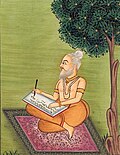
[[File:Valmiki Ramayana.jpg|thumb | [[File:Valmiki Ramayana.jpg|thumb|An artist's impression of sage [[Valmiki]] composing the ''Ramayana'']] | ||
===Genre=== | ===Genre=== | ||
The ''Ramayana'' belongs to the genre of ''[[Itihasa]]'', narratives of past events ({{IAST|purāvṛtta}}), which includes the Mahabharata, the [[Purana]]s | The ''Ramayana'' belongs to the genre of ''[[Itihasa]]'', narratives of past events ({{IAST|purāvṛtta}}), which includes the epics ''Mahabharata'' and ''Ramayana'', and the ''[[Purana]]s''. The genre also includes teachings on [[Puruṣārtha|the goals of human life]]. It depicts the duties of relationships, portraying ideal characters like the ideal son, servant, brother, husband, wife, and king.<ref>{{Cite book |last=Rosen |first=Steven |url=https://books.google.com/books?id=gbXOEAAAQBAJ&dq=essential+hinduism&pg=PA20 |title=Essential Hinduism |date=2006-10-30 |publisher=Bloomsbury Publishing USA |isbn=978-0-313-07155-3 |pages=103 |language=en}}</ref> Like the ''Mahabharata'', ''Ramayana'' presents the teachings of ancient Hindu sages in the narrative [[allegory]], interspersing philosophical and ethical elements.{{efn-la|In ''The Oxford History of India'' (1919) by [[Vincent Arthur Smith|Vincent A. Smith]] ''''',''' The Ramayana'' is presented as '<nowiki/>''neither historical nor allegorical, but a poetic creation based on mythology''<nowiki/>'<ref>{{Cite book |last=Smith |first=Vincent Arthur |title=The Oxford History of India: From the Earliest Times to the End of 1911}}</ref> [[Hermann Jacobi]], the German [[Indologist]], who was the first European to write a whole book on the Ramayana-''The Ramayana: History, Contents with a Concordance of the Printed Recensions'' (1893, English translation by S.N. Ghoshal, 1960). The book presents ''the Ramayana'' as a work based on mythology.<ref>{{Cite book |last=Jacobi |first=Hermann |title=Das Ramayana, Geschichte und Inhalt nebst Concordanz nach den gedruckten Rezensionen |year=1893 |language=de |trans-title=The Ramayana: History, Contents with a Concordance of the Printed Recensions}}</ref> In December | ||
1975, the [[Sahitya Akademi]] organized a five day international seminar on the Ramayana, The consensus on the nature of the material of the epic was that it was mythological.<ref>{{Cite book |last=Noorani |first=A.G. |title=The Babri Masjid Question, 1528-2003 'A Matter of National Honour'}}</ref>}} | |||
===Structure=== | ===Structure=== | ||
In its extant form, Valmiki's ''Ramayana'' is an epic poem | In its extant form, Valmiki's ''Ramayana'' is an epic poem containing over 24,000 couplet verses, divided into seven {{IAST|kāṇḍa}}s ([[Balakanda|Bālakāṇḍa]], Ayodhyakāṇḍa, Araṇyakāṇḍa, Kiṣkindakāṇḍa, [[Sundara Kanda|Sundarākāṇḍa]], Yuddhakāṇḍa, Uttarakāṇḍa), and about 500 sargas (chapters).<ref name="valmikiramayan.net"/><ref>{{cite web |first=Arshia |last=Sattar |date=29 October 2016 |url=https://scroll.in/article/820198/why-the-uttara-kanda-changes-the-way-the-ramayana-should-be-read |title=Why the Uttara Kanda changes the way the Ramayana should be read |archive-url=https://web.archive.org/web/20210416204833/https://scroll.in/article/820198/why-the-uttara-kanda-changes-the-way-the-ramayana-should-be-read |archive-date=16 April 2021 |website=Scroll.in}}</ref> It is regarded as one of the longest epic poems ever written.<ref>{{Cite book |first1=Linda |last1=Egenes |title=The Ramayana: A New Retelling of Valmiki's Ancient Epic—Complete and Comprehensive |first2=Kumuda |last2=Reddy |year=2016 |publisher=Penguin |isbn=978-0-14-311180-1 |pages=2 |language=en}}</ref> | ||
===Recensions=== | ===Recensions=== | ||
The ''Ramayana'' text has several regional renderings, recensions, and sub-recensions. Textual scholar [[Robert P. Goldman]] differentiates two major regional revisions: the northern (n) and the southern (s). Scholar [[Romesh Chunder Dutt]] writes that "the ''Ramayana'', like the ''[[Mahabharata]]'', is a growth of centuries, but the main story is more distinctly the creation of one mind." | The ''Ramayana'' text has several regional renderings, recensions, and sub-recensions. Textual scholar [[Robert P. Goldman]] differentiates two major regional revisions: the northern (n) and the southern (s). Scholar [[Romesh Chunder Dutt]] writes that "the ''Ramayana'', like the ''[[Mahabharata]]'', is a growth of centuries, but the main story is more distinctly the creation of one mind." | ||
There has been discussion as to whether the first and the last volumes of Valmiki's ''Ramayana'' (Bala Kanda and Uttara Kanda) were composed by the original author. Though Bala Kanda is sometimes considered in the main epic, according to many Uttara Kanda is certainly a later interpolation, not attributable to Valmiki.<ref name="valmikiramayan.net">{{Cite web|url=https://valmikiramayan.net/|title=Valmiki Ramayana|website=valmikiramayan.net|access-date=19 May 2020|archive-date=13 September 2020|archive-url=https://web.archive.org/web/20200913082833/https://www.valmikiramayan.net/|url-status=live}}</ref> Both of these two kāndas are absent in the oldest manuscript.<ref>{{cite news |last1=Mukherjee Pandey |first1=Jhimli |date=18 Dec 2015 <!-- 09.08AM IST --> |title=6th-century Ramayana found in Kolkata, stuns scholars |newspaper=timesofindia.indiatimes.com |agency=TNN |url=http://timesofindia.indiatimes.com/city/kolkata/6th-century-Ramayana-found-in-Kolkata-stuns-scholars/articleshow/50227724.cms |url-status=live |access-date=20 December 2015 |archive-url=https://web.archive.org/web/20151219230556/http://timesofindia.indiatimes.com/city/kolkata/6th-century-Ramayana-found-in-Kolkata-stuns-scholars/articleshow/50227724.cms |archive-date=19 December 2015}}</ref> | |||
Some think that the Uttara Kanda contradicts how Rama and Dharma are portrayed in the rest of the epic. M. R. Parameswaran says that the way the positions of women and [[Shudras]] are depicted shows that the Uttara Kanda is a later insertion. | |||
{{blockquote|Since Rama was revered as a dharmatma, his ideas seen in the Ramayana proper cannot be replaced by new ideas as to what dharma is, except by claiming that he himself adopted those new ideas. That is what the U-K [Uttara Kanda] does. It embodies the new ideas in two stories that are usually referred to as Sita-parityaga, the abandonment of Sita (after Rama and Sita return to Ayodhya and Rama was consecrated as king) and Sambuka-vadha, the killing of the ascetic Sambuka. The U-K attributes both actions to Rama, whom people acknowledged to be righteous and as a model to follow. By masquerading as an additional kanda of the Ramayana composed by Valmiki himself, the U-K succeeded, to a considerable extent, in sabotaging the values presented in Valmiki's Ramayana.{{sfn|Parameswaran|2014|p=[https://archive.org/details/valmiki_-_ramayana_-_critical_-_essays_-_m_-_r_-_parameswaran/page/156 156]}} | |||
}} | |||
{{ | |||
==Characters== | ==Characters== | ||
| Line 69: | Line 70: | ||
==Synopsis== | ==Synopsis== | ||
===''Bāla Kāṇḍa''=== | ===''Bāla Kāṇḍa''=== | ||
{{Main|Balakanda}} | |||
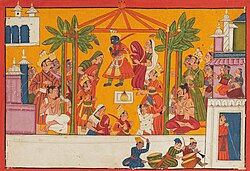
[[File:The marriage ceremony of Rama and Sita.jpg|thumb|The marriage of the four sons of Dasharatha to the four daughters of Siradhvaja Janaka and Kushadhvaja. Rama and Sita, Lakshmana and Urmila, Bharata and Mandavi and Shatrughna with Shrutakirti. Folio from the Shnagri Ramayana, early 18th-century. [[National Museum, New Delhi]]]] | |||
[[File:The marriage ceremony of Rama and Sita.jpg|thumb | |||
The epic begins with the sage Vālmīki asking Nārada if there is a righteous man still left in the world, to which Nārada replies that such a man is Rāma. After seeing two birds being shot, Vālmīki creates a new form of metre called ''śloka'', | The epic begins with the sage Vālmīki asking Nārada if there is a righteous man still left in the world, to which Nārada replies that such a man is Rāma. After seeing two birds being shot, Vālmīki creates a new form of metre called ''śloka'', in which he is granted the ability to compose an epic poem about Rāma. He teaches his poem to the boys Lava and Kuśa, who recite it throughout the land and eventually at the court of King Rāma. Then the main narrative begins.{{sfn|Goldman|1984|loc=Vol. I: Bālakāṇḍa}} | ||
Daśaratha | Daśaratha is the King of Ayodhyā. He has three wives: Kausalyā, Kaikeyī, and Sumitrā. He does not have a son and, in the desire to have a legal heir, he performs a fire sacrifice known as Putrīyā Iṣṭi. Meanwhile, the gods are petitioning to Brahmā and Viṣhṇu about Rāvaṇa, king of the rākṣasas who is terrorizing the universe. Thus Viṣhṇu opts to be born into mortality to combat the demon [[Ravana|Rāvaṇa]]. As a consequence, Rāma is first born to Kausalyā, Bharata is born to Kaikeyī, and Lakṣmaṇa and Śatrughna are born to Sumitrā.{{sfn|Goldman|1984|loc=Vol. I: Bālakāṇḍa}} | ||
When Rāma | When Rāma is 16 years old, the [[Rishi|r̥ṣi]] (sage) Viśvāmitra comes to the court of Daśaratha seeking help against demons who are disturbing sacrificial rites. He chooses Rāma, who is followed by Lakṣmaṇa, his constant companion throughout the story. Rāma and Lakṣmaṇa receive instructions and supernatural weapons from Viśvāmitra and proceed to destroy [[Tataka|Tāṭakā]] and many other demons. Viśvāmitra also recounts much lore of the landscape, his own ancestors, and the ancestors of the princes.{{sfn|Goldman|1984|loc=Vol. I: Bālakāṇḍa}} | ||
The party then | The party then decides to attend King [[Janaka|Janaka's]] sacrifice in the kingdom of [[Mithila (region)|Mithilā]], who has a bow that no one has been able to string. Janaka recounts the history of the famed bow, and informs them that whoever strings the bow will win the hand of his daughter [[Sita|Sītā]], whom he found in the earth while plowing a field. Rāma then proceeds to string the bow, but he breaks it in the process. Rāma marries Sītā; the wedding is celebrated with great festivity in [[Mithila (region)|Mithilā]] and the marriage party returns to Ayodhyā.{{sfn|Goldman|1984|loc=Vol. I: Bālakāṇḍa}} | ||
===''Ayodhyā Kāṇḍa''=== | ===''Ayodhyā Kāṇḍa''=== | ||
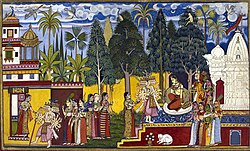
[[File: Ayodhya | [[File: Rama leaving for fourteen years of exile from Ayodhya.jpg|thumb|{{center|Rama leaving for fourteen years of exile from Ayodhya}}]] | ||
After Rāma | After Rāma and Sītā are married, an elderly Daśaratha expresses his desire to crown Rāma, to which the Kosala assembly and his subjects express their support. On the eve of the great event, Kaikeyī is happy regarding this but later is provoked by [[Manthara|Mantharā]], a wicked maidservant, to claim two boons that Daśaratha has granted to her. Kaikeyī demands [[Exile of Lord Rama|Rāma to be exiled into the wilderness for fourteen years]], while the succession passes to her son Bharata. | ||
[[ | |||
The grief-stricken king, bound by his word, accedes to Kaikeyī's demands. Rāma accepts his father's reluctant decree with absolute submission and calm self-control which characterizes him throughout the story. He asks Sītā to remain in Ayodhyā, but she convinces him to take her with him into exile. Lakṣmaṇa also resolves to follow his brother into the forest. | |||
{{ | After Rāma's departure, King Daśaratha, unable to bear the grief, passes away. Meanwhile, Bharata, who is on a visit to his maternal uncle, learns about the events in Ayodhyā. He is shocked and refuses to profit from his mother's wicked scheming. He visits Rāma in the forest and implores him to return to Ayodhyā and claim the throne that is rightfully his, but Rāma, determined to carry out his father's orders to the letter, refuses to return before the period of exile. Bharata reluctantly returns to Ayodhyā and rules the kingdom on behalf of his brother.<ref>{{Cite web |title=Valmiki Ramayana - Ayodhya Kanda - Sarga 40 |url=https://sanskritdocuments.org/sites/valmikiramayan/ayodhya/sarga40/ayodhyaroman40.htm |access-date=2025-02-09 |website=sanskritdocuments.org}}</ref> | ||
===''Araṇya Kāṇḍa''=== | |||
{{Main|Aranya Kanda|Exile of Lord Rama}} | |||
[[File:Raja Ravi Varma, Jatayu vadha, 1906.jpg|thumb|[[Ravana|Rāvaṇa]] fights [[Jatayu|Jatāyu]] as he carries off the kidnapped Sītā. Painting by [[Raja Ravi Varma]]]] | |||
In exile, Rāma, Sītā, and Lakṣmaṇa journey southward along the banks of the river [[Godavari|Godāvari]], where they build cottages and live off the land. One day, in the [[Panchavati|Pañcavati]] forest they are visited by a [[rakshasa|rākṣasī]] named [[Shurpanakha|Śurpaṇakhā]], sister of Ravaṇa. She tries to seduce the brothers and, after failing, attempts to kill Sītā out of jealousy. Lakṣmaṇa stops her by cutting off her nose and ears. Hearing of this, her brothers [[Khara (Ramayana)|Khara]] and Dushan organize an attack against the princes. Rama defeats Khara and his ''rakṣasīs''. | |||
When the news of these events reaches Rāvaṇa, he resolves to destroy Rāma by capturing Sītā with the aid of the ''rakṣasa'' [[Maricha|Mārīca]], who, assuming the form of a golden deer, captivates Sītā's attention. Entranced by the beauty of the deer, Sītā pleads with Rāma to capture it. Rāma, aware that this is the ploy of the demons, cannot dissuade Sītā from her desire and chases the deer into the forest, leaving Sītā under Lakṣmaṇa's guard. | |||
After some time, Sītā hears Rāma calling out to her; afraid for his life, she insists that Lakṣmaṇa rush to his aid. Lakṣmaṇa tries to assure her that Rāma cannot be hurt that easily and that it is best if he continues to follow Rāma's orders to protect her. On the verge of hysterics, Sītā insists that it is not she but Rāma who needs Lakṣmaṇa's help. He obeys her wish but stipulates that she is not to leave the cottage or entertain any stranger. He then draws a line that no demon could cross and leaves to help Rāma<!--this wasn't in the original ramayana-->. With the coast finally clear, Rāvaṇa appears in the guise of an ascetic requesting Sītā's hospitality. Unaware of her guest's plan, Sītā is tricked and is then forcibly carried away by Rāvaṇa.<ref>{{cite book |last=Rajarajan |first=R. K. K. |year=2001 |chapter-url=https://www.academia.edu/2514821 |chapter=''Sītāpaharaṇam'': Changing thematic Idioms in Sanskrit and Tamil |editor-first=Dirk W. |editor-last=Lonne |title=Tofha-e-Dil: Festschrift Helmut Nespital |publisher=Reinbeck |pages=783–97 |isbn=3-88587-033-9 |archive-url=https://web.archive.org/web/20200504183709/https://www.academia.edu/2514821/S%C4%ABt%C4%81pahara%E1%B9%89am_Changing_thematic_Idioms_in_Sanskrit_and_Tamil |archive-date=4 May 2020 }}</ref> | |||
[[Jatayu|Jatāyu]], a [[vulture]], tries to rescue Sītā but is mortally wounded. In Lankā, Sītā is kept under the guard of ''rakṣasīs''. Ravaṇa asks Sītā to marry him, but she refuses, being totally devoted to Rāma. Meanwhile, Rāma and Lakṣmaṇa learn about Sītā's abduction from Jatāyu and immediately set out to save her. During their search, they meet [[Kabandha]] and the ascetic [[Shabari|Śabarī]], who directs them to Sugriva and Hanuman. | |||
==='' | ===''Kiṣkindhā Kāṇḍa''=== | ||
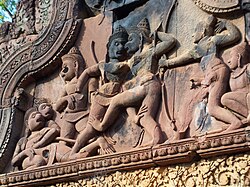
[[File:Stone bas relief at Banteay Srei in Cambodia.jpg|thumb|A stone bas-[[relief]] at Banteay Srei in [[Cambodia]] depicts the combat between [[Vali (Ramayana)|Vali]] and [[Sugriva]] (middle). To the right, Rama fires his bow. To the left, Vali lies dying.]] | |||
[[File:Stone bas relief at Banteay Srei in Cambodia.jpg|thumb | |||
''Kishkindha Kanda'' is set in the land of [[Vanara|Vānara]]s (Vana-nara) – Forest dwelling humans.<ref>{{Cite journal |first1=B. |last1=Vijayashree |first2=C. |last2=Geetha |url=http://shabdbooks.com/gallery/392-may-2020.pdf |title=Vanaras or Vana-Naras: A tail's travel from Treta Yuga to DwaparaYuga |journal=Mukt Shab Journal |issn=2347-3150 |url-status=dead|archive-url=https://web.archive.org/web/20220519175458/http://shabdbooks.com/gallery/392-may-2020.pdf |archive-date=19 May 2022}}</ref> Rāma and Lakṣmaṇa meet Hanumān, the biggest devotee of Rāma, greatest of ape heroes, and an adherent of [[Sugriva]], the banished pretender to the throne of Kiṣkindhā. Rāma befriends Sugriva and helps him by killing his elder brother [[Vali (Ramayana)|Vāli]] thus regaining the kingdom of Kiṣkindhā, in exchange for helping Rāma to recover Sītā. | |||
However, Sugriva soon forgets his promise and spends his time enjoying his newly gained power. The clever former ape queen [[Tara (Ramayana)| | However, Sugriva soon forgets his promise and spends his time enjoying his newly gained power. The clever former ape queen [[Tara (Ramayana)|Tārā]], (wife of Vāli) calmly intervenes to prevent an enraged Lakṣmaṇa from destroying the ape citadel. She then eloquently convinces Sugriva to honour his pledge. Sugriva then sends search parties to the four corners of the earth, only to return without success from the north, east, and west. The southern search party under the leadership of [[Angada|Aṅgada]] and Hanumān learns from a vulture named [[Sampati|Sampātī]] the elder brother of Jatāyu, that Sītā was taken to Lankā. | ||
===''Sundara | ===''Sundara Kāṇḍa''=== | ||
{{Main|Sundara Kanda}} | {{Main|Sundara Kanda}} | ||
[[File:Sita at ashokavana.jpg|thumb|right|Ravana is meeting Sita at Ashokavana. Hanuman is seen on the tree.]] | |||
''Sundara Kanda'' forms the heart of Valmiki's Ramayana and consists of a detailed, vivid account of [[Hanumān]]'s heroics. After learning about Sītā, Hanumān assumes a gigantic form and makes a colossal leap across the sea to Lanka. On the way, he meets many challenges like facing a [[Gandharva]] Kanyā who comes in the form of a demon to test his abilities. He encounters a mountain named [[Mainaka|Maināka]] who offers Hanuman assistance and a place to rest. Hanumān refuses because there is little time remaining to complete the search for Sītā. | |||
After entering Lankā, he finds a demon, [[Lankini]], who protects all of Lankā. Hanumān fights her and subjugates her in order to get into Lankā. In the process, Lankini, who had an earlier vision or warning from the gods, knows that Lankā's end is near if someone defeats Lankini. Here, Hanumān explores the demons' kingdom and spies on Rāvaṇa. He locates Sītā in the Ashoka grove, where she is being wooed and threatened by Rāvaṇa and his ''rakṣasīs'' to marry him. | |||
Hanumān reassures Sītā, giving her Rāma's signet ring as a sign that Rāma is still alive. He offers to carry Sītā back to Rāma; however, she refuses and says that it is not the dharma, stating that Ramāyaṇa will not have significance if Hanumān carries her to Rāma – "When Rāma was not there, Rāvaṇa carried Sītā forcibly and when Rāvaṇa was not there, Hanumān carried Sītā back to Rāma." She says that Rāma himself must come and avenge the insult of her abduction. She gives Hanumān her comb as a token to prove that she is still alive. | |||
Hanumān takes leave of Sītā. Before going back to Rāma and telling him about Sītā's location and desire to be rescued only by him, he decides to wreak havoc in Lankā by destroying trees in the Naulakha Bagh and buildings and killing Rāvaṇa's warriors. He allows himself to be captured and delivered to Rāvaṇa. He gives a bold lecture to Rāvaṇa urging him to release Sīta. He is condemned and his tail is set on fire, but he escapes his bonds and leaps across the rooftops, sets fire to Rāvaṇa's citadel, and makes the giant leap back from the island. The joyous search party returns to Kiṣkindhā with the news. | |||
===''Yuddha Kāṇḍa''=== | |||
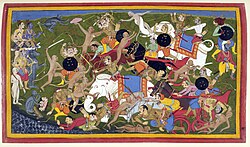
[[File:Battle at Lanka, Ramayana, Udaipur, 1649-53.jpg|thumb|The ''Battle at Lanka, Ramayana'' by [[Sahibdin]]. It depicts the vānara army of Rāma (top left) fighting [[Ravana|Rāvaṇa]] the demon-king of [[Lanka|Lankā]] to save Rāma's kidnapped wife, Sītā. The painting depicts multiple events in the battle against the three-headed demon general [[Trishira|Triṣira]], in the bottom left. Triṣira is beheaded by Hanumān, the vānara companion of Rāma.]] | |||
Also known as ''Lankā Kāṇḍa'', this book describes the war between the army of Rāma ([[Vanara|Vanara)]] and the army of Rāvaṇa ([[Rakshasa]]). Having received Hanuman's report on Sītā, Rāma and Lakṣmaṇa proceed with their allies towards the shore of the southern sea. There they are joined by Rāvaṇa's renegade brother [[Vibhishana|Vibhiṣaṇa]]. The vānaras named [[Nala (Ramayana)|Nala]] and [[Nila (Ramayana)|Nīla]] construct the [[Rama Setu]].<ref>{{cite journal |last=Rajarajan |first=R. K. K. |year=2014 |url=https://www.academia.edu/8779702 |title=Reflections on 'Rāma-Setu' in South Asian Tradition |journal=The Quarterly Journal of the Mythic Society |volume=105 |number=3 |pages=1–14 |issn=0047-8555 |archive-url=https://web.archive.org/web/20181106212334/http://www.academia.edu/8779702/Reflections_on_R%C4%81ma-Setu_in_South_Asian_Tradition |archive-date=6 November 2018 }}</ref> | |||
The princes and their army cross over to Lanka. A lengthy war ensues. During a battle, Ravana's son [[Meghanada|Meghanāda]] hurls a powerful weapon at Lakṣmaṇa who is mortally wounded. So Hanumān assumes his gigantic form and flies from Lankā to the [[Himalayas]]. Upon reaching, Hanumān is unable to identify the [[Sanjivani (Hinduism)|sanjeevani]] herb that will cure Lakṣmaṇa and so he decides to bring the entire mountain back to Lankā. Eventually, the war ends when Rāma kills Rāvaṇa. Rāma then installs [[Vibhishana|Vibhishaṇa]] on the throne of Lanka. | |||
The | On meeting Sītā, Rāma says; "The dishonour meted out to him and the wrong done to her by Rāvaṇa have been wiped off by his victory over the enemy with the assistance of Hanumān, Sugrīva and Vibhishaṇa".<ref>{{cite web |title=Book VI : Yuddha Kanda, Sarga 115 |url=https://sanskritdocuments.org/sites/valmikiramayan/yuddha/sarga115/yuddha_115_frame.htm |website=sanskritdocuments.org |access-date=24 September 2021 |archive-date=29 August 2021 |archive-url=https://web.archive.org/web/20210829063115/https://sanskritdocuments.org/sites/valmikiramayan/yuddha/sarga115/yuddha_115_frame.htm |url-status=live }}</ref> However, upon criticism from people in his kingdom about the chastity of Sītā, Rāma is extremely disheartened. | ||
So Sītā, in order to prove the citizens wrong and wipe the false blame on her, requests Rāma and Lakṣmaṇa to prepare a pyre for her to enter. When Lakṣmaṇa prepares the pyre, Sītā prays to [[Agni]] and enters it in order to prove her conjugal fidelity. Agni appears in person from the burning pyre, carrying Sītā in his arms and restores her to Rāma, testifying to her purity.<ref>{{cite web |title=Book VI : Yuddha Kanda, Sarga 118 |url=https://sanskritdocuments.org/sites/valmikiramayan/yuddha/sarga118/yuddha_118_frame.htm |website=sanskritdocuments.org |access-date=24 September 2021 |archive-date=12 September 2021 |archive-url=https://web.archive.org/web/20210912143805/https://sanskritdocuments.org/sites/valmikiramayan/yuddha/sarga118/yuddha_118_frame.htm |url-status=live }}</ref> Rama later joyfully accepts her. The episode of ''Agni Pariksha'' varies in the versions of ''Ramāyaṇa'' by Valmiki and [[Tulsidas]]. In [[Tulsidas]]'s ''[[Ramcharitmanas]]'', Sītā was under the protection of Agni (see [[Maya Sita|Māyā Sītā]]) so it was necessary to bring her out before reuniting with Rāma. The gods led by Brahma arrive and glorify Rama as the incarnation of Supreme God Narayana. Indra restores the dead Vanaras back to life. | |||
After the exile, Rāma returns to Ayodhya and the people are so happy that they celebrate it like a festival. [[Deepavali]] is the day celebrating when Rāma, Sītā, Lakṣmaṇa and Hanumān reached Ayodhyā after a period of 14 years in exile after Rāma's army of good defeated demon king Rāvaṇa's army of evil. The return of Rāma to Ayodhyā is celebrated with his coronation. It is called ''Rāma pattabhisheka''. There are mentions in Rāmayaṇa that Rama gave several donations to Sugriva, Jambavan, other Vanaras, and gave a pearl necklace to Sita telling her to give it to a great person. She gives it to Hanumān. [[Rama|Rāma]] is very thankful to [[Vibhishana|Vibhisaṇa]] and wants to give him a great gift. [[Rama|Rāma]] gives his [[Ranganatha|Aradhana Devata]] (Sri Ranganathaswamy) to [[Vibhishana]] as a gift.<ref>{{cite web|url=https://theindiandharma.org/2018/03/18/episode-312-significance-of-the-sri-ranga-vimaana/|title=Episode 312 – Significance of the "Sri-Ranga Vimaana"!!! – The Indian Dharma|website=theindiandharma.org|author=Dr. Jeayaram|date=18 March 2018}}</ref>{{better source needed|date=June 2024}} Rama's rule itself, ''Rāma rājya'', is described as just and fair.{{sfnm|1a1=Sharma|1y=1986|1pp=[https://books.google.com/books?id=9Vo0OJtO6DQC&pg=PA2 2–3]|2a1=Claeys|2y=2010|2pp=[https://books.google.com/books?id=sFCuoqykV9QC&pg=PA240 240–241]}} It is believed by many that when Rama returned, people celebrated their happiness with ''[[Diya (lamp)|diyas]]'', and the festival of [[Deepavali]] is connected with Rāma's return.<ref>{{Cite book|url=https://books.google.com/books?id=lOnuAAAAIAAJ|title=Self-realization Magazine|date=1971|publisher=Self-Realization Fellowship|pages=[https://books.google.com/books?id=lOnuAAAAIAAJ&q=is+diwali+connected+to+lord+rama+returned 50]|language=en}}</ref>{{better source needed|date=June 2024}} | |||
=== ''Uttara Kāṇḍa'' === | |||
[[File:Sita with children.jpg|thumb|[[Sita]] with [[Lava (Ramayana)|Lava]] and [[Kusha]]]] | |||
Scholars note "linguistic and rhetorical differences" between the Uttara Kanda and books 2 through 6 of the Ramayana, especially in stories such as Sita's exile and the death of [[Shambuka]], and together with Bala Kanda<ref>{{Cite web |last=SHARMA |first=SESHENDRA |title=Valmiki Ramayana Balkanda |url=https://stotranidhi.com/en/valmiki-ramayana-bala-kanda-in-english/ |website=stotranidhi.com}}</ref> it is considered by some scholars to be an interpolation, and that "the 'original' poem ended with the Yuddhakanda.{{sfnm|1a1=Cakrabartī|1y=2006|2a1=Goldman|2a2=Sutherland Goldman|2y=2022|2p=19}} | |||
This kanda narrates Rama's reign in [[Ayodhya (Ramayana)|Ayodhya]], the birth of [[Lava (Ramayana)|Lava]] and [[Kusha (Ramayana)|Kusha]], the [[Ashvamedha]] [[yajna]], and the last days of Rama. At the expiration of his term of exile, Rama returns to Ayodhya with Sita, Lakshmana, and Hanuman, where the coronation is performed. On being asked to prove his devotion to Rama, Hanuman tears his chest open and to everyone's surprise, there is an image of Rama and Sita inside his chest. Rama rules Ayodhya and the reign is called ''Rama-Rajya'' (a place where the common folk are happy, fulfilled, and satisfied). Then Valmiki trained Lava and Kusha in archery and succeeded to the throne after Rama. | |||
==Versions== | ==Versions== | ||
{{ | {{main|Versions of the Ramayana}} | ||
[[File:COLLECTIE TROPENMUSEUM Reliëf op de aan Shiva gewijde tempel op de Candi Lara Jonggrang oftewel het Prambanan tempelcomplex TMnr 10016190.jpg|thumb|A relief with part of the Ramayana epic, shows Rama killed the golden deer that turn out to be the demon [[Maricha]] in disguise. [[Prambanan]] Trimurti temple near [[Yogyakarta]], [[Java]], [[Indonesia]] | [[File:The epic ramayana spread in thailand.jpg|thumb|right|The epic story of ''Ramayana'' was adopted by several cultures across Asia. Shown here is a Thai historic artwork depicting the battle which took place between Rama and Ravana.]] | ||
[[File:COLLECTIE TROPENMUSEUM Reliëf op de aan Shiva gewijde tempel op de Candi Lara Jonggrang oftewel het Prambanan tempelcomplex TMnr 10016190.jpg|thumb|A relief with part of the Ramayana epic, shows Rama killed the golden deer that turn out to be the demon [[Maricha]] in disguise. [[Prambanan]] Trimurti temple near [[Yogyakarta]], [[Java]], [[Indonesia]]]] | |||
As in many oral epics, multiple versions of the ''Ramayana'' survive. In particular, the ''Ramayana'' related in north India differs in important respects from that preserved in south India and the rest of southeast Asia. There is an extensive tradition of oral storytelling based on ''Ramayana'' in [[Indonesia]], [[Cambodia]], [[Philippines]], [[Thailand]], [[Malaysia]], [[Laos]], [[Vietnam]] and [[Maldives]]. | As in many oral epics, multiple versions of the ''Ramayana'' survive. In particular, the ''Ramayana'' related in north India differs in important respects from that preserved in south India and the rest of southeast Asia. There is an extensive tradition of oral storytelling based on ''Ramayana'' in [[Indonesia]], [[Cambodia]], [[Philippines]], [[Thailand]], [[Malaysia]], [[Laos]], [[Vietnam]] and [[Maldives]]. | ||
===India=== | ===India=== | ||
There are diverse regional versions of the ''Ramayana'' written by various authors in India. Some of them differ significantly from each other. A [[West Bengal]] manuscript from the 6th century presents the epic without two of its kandas. | |||
During the 12th century, [[Kambar (poet)|Kamban]] wrote [[Ramavataram]], known popularly as [[Kambaramayanam]] in [[Tamil language|Tamil]], but references to [[Ramayana in Tamil literature|Ramayana story appear in Tamil literature]] as early as 3rd century CE. The [[Telugu language|Telugu]] rendition, [[Ranganatha Ramayanam]], was written by [[Gona Budda Reddy]] in the 13th century and another of a purer Telugu rendition, called ''[[Molla Ramayanam]]'' written by [[Atukuri Molla]] in the 15th century. | |||
During the 12th century, [[Kambar (poet)|Kamban]] wrote [[Ramavataram]], known popularly as [[Kambaramayanam]] in [[Tamil language|Tamil]], but references to [[Ramayana in Tamil literature|Ramayana story appear in Tamil literature]] as early as 3rd century CE. The [[Telugu language|Telugu]] rendition, [[Ranganatha Ramayanam]], was written by [[Gona Budda Reddy]] in the 13th century and another of a purer Telugu rendition, called Molla Ramayanam written by [[Atukuri Molla]] in the 15th century. | |||
The earliest translation to a regional Indo-Aryan language is the | The earliest translation to a regional Indo-Aryan language is the 14th-15th century [[Saptakanda Ramayana]] in [[Assamese language|Assamese]] by [[Madhava Kandali]]. Valmiki's ''Ramayana'' inspired [[Sri Ramacharit Manas]] by [[Tulsidas]] in 1576, an epic in [[Awadhi language|Awadhi]] [[Hindi]] with a slant more grounded in a different realm of Hindu literature, that of [[bhakti]]; it is an acknowledged masterpiece, popularly known as ''Tulsi-krita Ramayana''. [[Gujarat]]i poet Premanand wrote a version of the ''Ramayana'' in the 17th century.{{citation needed|date=June 2022}} [[Akbar]], the third Mughal Emperor, commissioned a simplified text of the Ramayana which he dedicated to his mother, [[Hamida Banu Begum]]. Created around 1594, the manuscript is illustrated with scenes from the narrative.<ref>{{cite book |last=Rogers |first=J. M. |title=The arts of Islam : treasures from the Nasser D. Khalili collection |date=2008 |edition= Revised and expanded|publisher=Tourism Development & Investment Company (TDIC) |location=Abu Dhabi |oclc=455121277 |author-link=J. M. Rogers|pages=272–3}}</ref><ref>{{Cite web |title=Islamic Art {{!}} Two Pages from the Ramayana Made for Akbar's mother, Hamidah Banu Begum |url=https://www.khalilicollections.org/collections/islamic-art/khalili-collection-islamic-art-two-pages-from-the-ramayana-made-for-akbars-mother-hamidah-banu-begum-mss955/ |access-date=2022-06-01 |website=Khalili Collections |language=en-US |archive-date=13 November 2022 |archive-url=https://web.archive.org/web/20221113094110/https://www.khalilicollections.org/collections/islamic-art/khalili-collection-islamic-art-two-pages-from-the-ramayana-made-for-akbars-mother-hamidah-banu-begum-mss955/ |url-status=live }}</ref> | ||
Other versions include [[Krittivasi Ramayan]], a [[Bengali language|Bengali]] version by [[Krittibas Ojha]] in the 15th century; [[Vilanka Ramayana]] by 15th century poet [[Sarala Dasa]]<ref>{{Cite book|title=Encyclopedia of Hinduism|url=https://books.google.com/books?id=OgMmceadQ3gC|publisher=Infobase Publishing|date=1 January 2006|isbn=9780816075645|first1=Constance|last1=Jones|first2=James D.|last2=Ryan|access-date=8 November 2015|archive-date=20 October 2022|archive-url=https://web.archive.org/web/20221020070415/https://books.google.com/books?id=OgMmceadQ3gC|url-status=live}}</ref> and ''[[Jagamohana Ramayana]]'' (also known as ''Dandi Ramayana'') by | Other versions include [[Krittivasi Ramayan]], a [[Bengali language|Bengali]] version by 14th-century Bengali poet [[Krittibas Ojha]] in the early 15th century; [[Vilanka Ramayana]] by 15th century poet [[Sarala Dasa]]<ref>{{Cite book|title=Encyclopedia of Hinduism|url=https://books.google.com/books?id=OgMmceadQ3gC|publisher=Infobase Publishing|date=1 January 2006|isbn=9780816075645|first1=Constance|last1=Jones|first2=James D.|last2=Ryan|access-date=8 November 2015|archive-date=20 October 2022|archive-url=https://web.archive.org/web/20221020070415/https://books.google.com/books?id=OgMmceadQ3gC|url-status=live}}</ref> and ''[[Jagamohana Ramayana]]'' (also known as ''Dandi Ramayana'') by 15th century poet Balarama Dasa, both in [[Odia language|Odia]]; a Torave Ramayana in [[Kannada]] by 16th-century poet Narahari; [[Adhyathmaramayanam]], a [[Malayalam]] version by [[Thunchaththu Ramanujan Ezhuthachan]] in the 16th century; in [[Marathi language|Marathi]] by Sridhara in the 18th century; in [[Maithili language|Maithili]] by [[Chanda Jha]] in the 19th century; and in the 20th century, Rashtrakavi [[Kuvempu]]'s [[Sri Ramayana Darshanam]] in [[Kannada]] and [[Ramayana Kalpavruksham|Srimadramayana Kalpavrukshamu]] in Telugu by [[Viswanatha Satyanarayana]] who received [[Jnanpith Award|Jnanapeeth award]] for this work. | ||
There is a sub-plot to the ''Ramayana'', prevalent in some parts of India, relating the adventures of [[Ahiravan]] and Mahi Ravana, evil brother of Ravana, which enhances the role of Hanuman in the story. Hanuman rescues Rama and Lakshmana after they are kidnapped by the Ahi-Mahi Ravana at the behest of Ravana and held prisoner in a cave, to be sacrificed to the goddess [[Kali]]. [[Adbhuta Ramayana]] is a version that is obscure but also attributed to [[Valmiki]] – intended as a supplementary to the original [[Valmiki Ramayana]]. In this variant of the narrative, Sita is accorded far more prominence, such as elaboration of the events surrounding her birth – in this case to [[Ravana]]'s wife, [[Mandodari]] as well as her conquest of Ravana's older brother in the [[Mahakali]] form. | There is a sub-plot to the ''Ramayana'', prevalent in some parts of India, relating the adventures of [[Ahiravan]] and Mahi Ravana, evil brother of Ravana, which enhances the role of Hanuman in the story. Hanuman rescues Rama and Lakshmana after they are kidnapped by the Ahi-Mahi Ravana at the behest of Ravana and held prisoner in a cave, to be sacrificed to the goddess [[Kali]]. [[Adbhuta Ramayana]] is a version that is obscure but also attributed to [[Valmiki]] – intended as a supplementary to the original [[Valmiki Ramayana]]. In this variant of the narrative, Sita is accorded far more prominence, such as elaboration of the events surrounding her birth – in this case to [[Ravana]]'s wife, [[Mandodari]] as well as her conquest of Ravana's older brother in the [[Mahakali]] form. | ||
| Line 181: | Line 165: | ||
The [[Gondi people]] have their own version of the Ramayana known as the ''Gond Ramayani'', derived from oral folk legends. It consists of seven stories with Lakshmana as the protagonist, set after the main events of the Ramayana, where he finds a bride.<ref>{{cite news |last1=Mehta |first1=Mona |title=Gond Ramayani |url=https://timesofindia.indiatimes.com/gond-ramayani/articleshow/8205480.cms |website=Times of India |date=10 July 2011 |access-date=17 November 2021 |archive-date=17 November 2021 |archive-url=https://web.archive.org/web/20211117070639/https://timesofindia.indiatimes.com/gond-ramayani/articleshow/8205480.cms |url-status=live }}</ref> | The [[Gondi people]] have their own version of the Ramayana known as the ''Gond Ramayani'', derived from oral folk legends. It consists of seven stories with Lakshmana as the protagonist, set after the main events of the Ramayana, where he finds a bride.<ref>{{cite news |last1=Mehta |first1=Mona |title=Gond Ramayani |url=https://timesofindia.indiatimes.com/gond-ramayani/articleshow/8205480.cms |website=Times of India |date=10 July 2011 |access-date=17 November 2021 |archive-date=17 November 2021 |archive-url=https://web.archive.org/web/20211117070639/https://timesofindia.indiatimes.com/gond-ramayani/articleshow/8205480.cms |url-status=live }}</ref> | ||
In ''Adiya Ramayana,'' an oral version of Ramayana prevailing among the Adiya tribe of [[Wayanad]], Sita is an Adiya woman hailing from [[Pulpally]] in Wayanad.<ref name="news18.com">{{Cite web |date=2024-01-18 |title=Tribals, Trials And Tribulations: Wayanad's Adivasis Have Their Own Versions of Ramayana |url=https://www.news18.com/india/tribals-trials-and-tribulations-wayanads-adivasis-have-their-own-versions-of-ramayana-8744338.html |access-date=2024-06-20 |website=News18 |language=en}}</ref> A notable difference in the version is that the Rama, Lakshmana and Hanuman were tied to a tree and were brought to trial in the tribal court, where the deities of the clan Sidhappan, Nanjappan, Mathappan etc. interrogate them with intense inquiries regarding the ethical justification for abandoning his pregnant wife in the barren jungle, neglecting his duties as a husband. Rama admits his mistakes and reaccepts Sita, Lava and Kusha.<ref name="news18.com"/><ref>{{Cite web |last=Tharuvana |first=Azeez |date=2023-10-23 |title=Varied Narratives Of The Many Ramayanas |url=https://www.outlookindia.com/national/varied-narratives-of-the-many-ramayanas-magazine-325535 |access-date=2024-06-20 |website=Outlook India |language=en}}</ref> | |||
====Early references in Tamil literature==== | |||
{{main|Ramayana in Tamil literature}} | |||
Even before [[Kambar (poet)|Kambar]] wrote the [[Ramavataram]] in Tamil in the 12th century CE, there are many ancient references to the story of Ramayana, implying that the story was familiar in the Tamil lands even before the Common Era. References to the story can be found in the [[Sangam literature]] of [[Akanaṉūṟu]] (dated 1st century BCE)<ref>{{cite web |last1=Dakshinamurthy |first1=A |title=Akananuru: Neytal – Poem 70 |url=https://adakshinamurthy.wordpress.com/2015/07/01/akananuru-neythal-poem-70/ |website=Akananuru |access-date=22 July 2019 |date=July 2015 |archive-date=22 July 2019 |archive-url=https://web.archive.org/web/20190722035941/https://adakshinamurthy.wordpress.com/2015/07/01/akananuru-neythal-poem-70/ |url-status=live }}</ref> and [[Purananuru]] (dated 300 BCE),<ref>{{cite book |last1=Hart |first1=George L |last2=Heifetz |first2=Hank |title=The four hundred songs of war and wisdom : an anthology of poems from classical Tamil : the Puṟanāṉūṟu |url=https://archive.org/details/fourhundredsongs00 |url-access=registration |date=1999 |publisher=Columbia University Press |isbn=9780231115629 }}</ref><ref>{{cite book |editor1-last=Kalakam |editor1-first=Turaicămip Pillai |title=Purananuru |date=1950 |location=Madras}}</ref> the twin epics of [[Silappatikaram]] (dated 2nd century CE)<ref>{{cite book |last1=Dikshitar |first1=V R Ramachandra |title=The Silappadikaram |date=1939 |publisher=Oxford University Press |location=Madras, British India |url=https://archive.org/details/in.ernet.dli.2015.201802/page/n5 |access-date=22 July 2019}}</ref> and [[Manimekalai]] (cantos 5, 17 and 18),<ref>{{cite book |last1=Pandian |first1=Pichai Pillai |title=Cattanar's Manimekalai |date=1931 |publisher=Saiva Siddhanta Works |location=Madras |url=https://archive.org/details/in.ernet.dli.2015.65472 |access-date=30 July 2019}}</ref><ref>{{cite book |last1=Aiyangar |first1=Rao Bahadur Krishnaswami |title=Manimekhalai In Its Historical Setting |date=1927 |publisher=Luzac & Co. |location=London |url=https://archive.org/details/manimekhalaiinit031176mbp |access-date=30 July 2019}}</ref><ref>{{cite book |last1=Shattan |first1=Merchant-Prince |editor1-last=Daniélou |editor1-first=Alain |title=Manimekhalai: The Dancer With the Magic Bowl |date=1989 |publisher=New Directions |location=New York }}</ref> and the [[Alvars|Alvar]] literature of [[Kulasekhara Alvar]], [[Thirumangai Alvar]], [[Andal]] and [[Nammalvar]] (dated between 5th and 10th centuries CE).<ref>{{cite book |last1=Hooper |first1=John Stirling Morley |title=Hymns of the Alvars |date=1929 |publisher=Oxford University Press |location=Calcutta |url=https://archive.org/details/hymnsofthealvars020204mbp |access-date=30 July 2019}}</ref> Even the songs of the Nayanmars have references to Ravana and his devotion to Lord Siva. | |||
The entire Ramayana was rewritten as a [[Tamil language|Tamil]] [[Opera]] in the 18th century CE by [[Arunachala Kavi]]rayar in [[Srirangam]], this opera, named the ''[[Rama Natakam]],'' allowed access to those who could not read the original version.<ref>{{Cite book |last=Rajagopalan |first=K. R. |url=http://archive.org/details/dli.ministry.22549 |title=Seerkazhi Arunachala Kavirayar and Rama Natakam |date=1978 |publisher=Sangeet Natak Akademi, New Delhi}}</ref> | |||
====Buddhist version==== | ====Buddhist version==== | ||
{{Main|Dasaratha Jataka}} | {{Main|Dasaratha Jataka}} | ||
{{unreferenced section|date=December 2023}} | |||
In the Buddhist variant of the ''Ramayana'' ([[Dasaratha Jataka]]), Dasharatha was king of [[Benares]] and not Ayodhya. Rama (called Rāmapaṇḍita in this version) was the son of Kaushalya, first wife of Dasharatha. Lakṣmaṇa (Lakkhaṇa) was a sibling of Rama and son of Sumitra, the second wife of Dasharatha. Sita was the wife of Rama. To protect his children from his wife Kaikeyi, who wished to promote her son Bharata, Dasharatha sent the three to a hermitage in the Himalayas for a twelve-year exile. | In the Buddhist variant of the ''Ramayana'' ([[Dasaratha Jataka]]), Dasharatha was king of [[Benares]] and not Ayodhya. Rama (called Rāmapaṇḍita in this version) was the son of Kaushalya, first wife of Dasharatha. Lakṣmaṇa (Lakkhaṇa) was a sibling of Rama and son of Sumitra, the second wife of Dasharatha. Sita was the wife of Rama. To protect his children from his wife Kaikeyi, who wished to promote her son Bharata, Dasharatha sent the three to a hermitage in the Himalayas for a twelve-year exile. | ||
| Line 201: | Line 185: | ||
====Jain versions==== | ====Jain versions==== | ||
{{more footnotes needed|section|date=June 2024}} | |||
{{main|Rama in Jainism|Salakapurusa}} | |||
{{ | [[Vimalsuri]] was a [[Jain monasticism|Jain monk]] of the [[Śvetāmbara|Śvetāmbara Murtipujaka]] sect. He is best known for his composition ''"Paumachariyam"'', the earliest known [[Jainism|Jain]] version of the Ramayana and the oldest work of literature written in [[Maharashtri Prakrit]].<ref>{{Cite book |last=Agrawal |first=Dr Mukta |url=https://books.google.com/books?id=Rd3-EAAAQBAJ&dq=%E0%A4%B5%E0%A4%BF%E0%A4%AE%E0%A4%B2+%E0%A4%B8%E0%A5%82%E0%A4%B0%E0%A5%80&pg=PA137 |title=Vaishivk Paridrashya Main Ram - Sahaitya |publisher=Sadbhawana Publication |isbn=978-81-965928-2-0 |language=hi}}</ref>{{sfn|Goldman|1984|p=60}} [[Jain]] versions of the ''Ramayana'' can also be found in the various [[Jain literature|Jain agama]]s like Saṅghadāsagaṇī Vāchaka's ''[[Vasudeva-hindi|Vasudevahiṇḍī]]'' (circa 4th century CE),<ref>{{cite journal |last1=Jain |first1=Jagdishchandra |title=Some Old Tales and Episodes in the Vasudevahiṇḍi |journal=Annals of the Bhandarkar Oriental Research Institute |date=1979 |volume=60 |issue=1/4 |pages=167–173 |jstor=41692302 |url=https://www.jstor.org/stable/pdf/41692302.pdf |archive-url=https://web.archive.org/web/20210601230212/https://www.jstor.org/stable/pdf/41692302.pdf |archive-date=2021-06-01 |url-status=live |issn=0378-1143}}</ref> Ravisena's [[Padma Purana|Padmapurana]] (story of Padmaja and [[Rama]], Padmaja being the name of [[Sita]]), [[Hemacandra]]'s [[Salakapurusa|Trisastisalakapurusa charitra]] (hagiography of 63 illustrious persons), Sanghadasa's ''Vasudevahindi'' and ''Uttarapurana'' by [[Guṇabhadra (Jain monk)|Gunabhadara]]. According to [[Jain cosmology]], every [[Kalachakra (Jainism)|half time cycle]] has nine sets of [[Balarama]], [[Vasudeva]] and prativasudeva. | ||
{{ | |||
[[Jain]] versions of the ''Ramayana'' can be found in the various [[Jain literature|Jain agama]]s like Saṅghadāsagaṇī Vāchaka's ''[[Vasudeva-hindi|Vasudevahiṇḍī]]'' (circa 4th century CE),<ref>{{cite journal |last1=Jain |first1=Jagdishchandra |title=Some Old Tales and Episodes in the Vasudevahiṇḍi |journal=Annals of the Bhandarkar Oriental Research Institute |date=1979 |volume=60 |issue=1/4 |pages=167–173 |jstor=41692302 |url=https://www.jstor.org/stable/pdf/41692302.pdf |archive-url=https://web.archive.org/web/20210601230212/https://www.jstor.org/stable/pdf/41692302.pdf |archive-date=2021-06-01 |url-status=live |issn=0378-1143}}</ref> Ravisena's [[Padma Purana|Padmapurana]] (story of Padmaja and [[Rama]], Padmaja being the name of [[Sita]]), [[Hemacandra]]'s [[Salakapurusa|Trisastisalakapurusa charitra]] (hagiography of 63 illustrious persons), Sanghadasa's ''Vasudevahindi'' and ''Uttarapurana'' by Gunabhadara. According to [[Jain cosmology]], every [[Kalachakra (Jainism)|half time cycle]] has nine sets of [[Balarama]], [[Vasudeva]] and prativasudeva. | |||
Rama, [[Lakshmana]] and [[Ravana]] are the eighth Baldeva, Vasudeva and [[ | Rama, [[Lakshmana]] and [[Ravana]] are the eighth Baldeva, Vasudeva and [[Prativasudeva]] respectively. [[Padmanabh Jaini]] notes that, unlike in the Hindu Puranas, the names Baladeva and Vasudeva are not restricted to [[Balarama]] and [[Krishna]] in Jain Puranas. Instead they serve as names of two distinct classes of mighty brothers, who appear nine times in each half time cycle and jointly rule half the earth as half-[[chakravartin]]s. Jaini traces the origin of this list of brothers to the ''jinacharitra'' (lives of jinas) by [[Acharya Bhadrabahu]] (3d–4th century BCE). | ||
In the Jain epic of ''Ramayana'', it is not Rama who kills Ravana as told in the Hindu version. Perhaps this is because Rama, a liberated Jain Self in his last life, is unwilling to kill. | In the Jain epic of ''Ramayana'', it is not Rama who kills Ravana as told in the Hindu version. Perhaps this is because Rama, a liberated Jain Self in his last life, is unwilling to kill.{{sfn|Ramanujan|2004|p=145}} Instead, it is Lakshmana who kills Ravana (as Vasudeva killes Prativasudeva).{{sfn|Ramanujan|2004|p=145}} In the end, Rama, who led an upright life, renounces his kingdom, becomes a [[Jain monasticism|Jain monk]] and attains [[Moksa (Jainism)|moksha]]. On the other hand, Lakshmana and Ravana go to [[Naraka (Jainism)|Hell]]. However, it is predicted that ultimately they both will be reborn as upright persons and attain liberation in their future births. According to [[Jain texts]], Ravana will be the future [[Tirthankara]] (omniscient teacher) of Jainism. | ||
The Jain versions have some variations from Valmiki's ''Ramayana''. Dasharatha, the king of Ayodhya had four queens: Aparajita, Sumitra, Suprabha and Kaikeyi. These four queens had four sons. Aparajita's son was Padma and he became known by the name of Rama. Sumitra's son was Narayana: he came to be known by another name, Lakshmana. Kaikeyi's son was Bharata and Suprabha's son was Shatrughna. Furthermore, not much was thought of Rama's fidelity to Sita. According to the Jain version, Rama had four chief queens: Maithili, Prabhavati, Ratinibha, and Sridama. | The Jain versions have some variations from Valmiki's ''Ramayana''. Dasharatha, the king of Ayodhya had four queens: Aparajita, Sumitra, Suprabha and Kaikeyi. These four queens had four sons. Aparajita's son was Padma and he became known by the name of Rama. Sumitra's son was Narayana: he came to be known by another name, Lakshmana. Kaikeyi's son was Bharata and Suprabha's son was Shatrughna. Furthermore, not much was thought of Rama's fidelity to Sita. According to the Jain version, Rama had four chief queens: Maithili, Prabhavati, Ratinibha, and Sridama. | ||
Furthermore, Sita takes renunciation as a Jain ascetic after Rama abandons her and is reborn in heaven as Indra. Rama, after Lakshman's death, also renounces his kingdom and becomes a Jain monk. Ultimately, he attains [[Kevala Jnana]] omniscience and finally liberation. Rama predicts that Ravana and Lakshmana, who were in the [[Naraka (Jainism)|fourth hell]], will attain liberation in their future births. Accordingly, Ravana is the future Tirthankara of the next half ascending time cycle and Sita will be his [[Ganadhara]]. | Furthermore, Sita takes renunciation as a Jain ascetic after Rama abandons her and is reborn in heaven as Indra. Rama, after Lakshman's death, also renounces his kingdom and becomes a Jain monk. Ultimately, he attains [[Kevala Jnana]] omniscience and finally liberation. Rama predicts that Ravana and Lakshmana, who were in the [[Naraka (Jainism)|fourth hell]], will attain liberation in their future births. Accordingly, Ravana is the future Tirthankara of the next half ascending time cycle and Sita will be his [[Ganadhara]]. | ||
===Southeast Asian=== | ===Southeast Asian=== | ||
====Indonesia==== | |||
[[File:Balinese dance Legong in Ubud, Ramayana performance, 20220823 1916 0471.jpg|thumb|Balinese dance Legong in Ubud, depicting the scene where Ravana tricks Sita.]] | |||
[[File:Ramayana Java.jpg|thumb|upright|[[Lakshmana]], Rama and Sita during their exile in [[Dandaka Forest]] depicted in [[Javanese dance]]]] | |||
====[[ | There are several Indonesian adaptations of Ramayana, including the Javanese ''[[Kakawin Ramayana]]''<ref>{{cite web |title=Ramayana Kakawin Vol. 1 | work=archive.org | url=https://archive.org/details/RamayanaKakawinVol.1}}</ref><ref>{{Cite web|url=http://www.nas.gov.sg/archivesonline/photographs/record-details/b0274d0f-1162-11e3-83d5-0050568939ad|title=The Kakawin Ramayana – an old Javanese rendering of the …|website=www.nas.gov.sg|access-date=2017-12-13|archive-date=13 December 2017|archive-url=https://web.archive.org/web/20171213210217/http://www.nas.gov.sg/archivesonline/photographs/record-details/b0274d0f-1162-11e3-83d5-0050568939ad|url-status=live}}</ref> and Balinese ''Ramakavaca''. The first half of ''[[Kakawin Ramayana]]'' is similar to the original Sanskrit version, while the latter half is very different. One of the recognizable modifications is the inclusion of the indigenous Javanese guardian demigod, [[Semar]], and his sons, Gareng, Petruk, and Bagong who make up the numerically significant four [[Punokawan]] or "clown servants".{{sfn|Coedès|1968}} | ||
[[ | ''Kakawin Ramayana'' is believed to have been written in [[Central Java]] circa 870 AD during the reign of Mpu Sindok in the [[Mataram kingdom]].{{sfn|Coedès|1968}} The Javanese ''Kakawin Ramayana'' is not based on Valmiki's epic, which was then the most famous version of Rama's story, but based on ''[[Ravanavadha (Bhattikavya)|Ravanavadha]]'' or the "Ravana massacre," which is the sixth or seventh century poem by Indian poet Bhattikavya.<ref>{{Cite web|url=http://dini-ardianty-fib10.web.unair.ac.id/artikel_detail-139638-Sastra-Perbedaan%20Ramayana%20%20Mahabarata%20dalam%20Kesusastraan%20Jawa%20Kuna%20dan%20India.html|title=Perbedaan Ramayana – Mahabarata dalam Kesusastraan Jawa Kuna dan India|last=Ardianty|first=Dini|date=8 June 2015|language=id|access-date=13 December 2017|archive-date=13 December 2017|archive-url=https://web.archive.org/web/20171213202925/http://dini-ardianty-fib10.web.unair.ac.id/artikel_detail-139638-Sastra-Perbedaan%20Ramayana%20%20Mahabarata%20dalam%20Kesusastraan%20Jawa%20Kuna%20dan%20India.html|url-status=live}}</ref> | ||
====[[Indonesia]]==== | ''[[Kakawin Ramayana]]'' was further developed on the neighboring island of [[Bali]] becoming the Balinese ''Ramakavaca''. The bas-reliefs of ''Ramayana'' and ''Krishnayana'' scenes are carved on balustrades of the 9th century [[Prambanan]] temple in [[Yogyakarta]],<ref>{{Cite web|url=http://borobudurpark.com/en/temple/prambanan-2/|title=Prambanan – Taman Wisata Candi|website=borobudurpark.com|language=en-GB|access-date=2017-12-15|archive-date=29 September 2020|archive-url=https://web.archive.org/web/20200929175956/https://borobudurpark.com/en/temple/prambanan-2//|url-status=live}}</ref> as well as in the 14th century [[Penataran]] temple in [[East Java]].<ref>{{Cite web|url=http://candi.pnri.go.id/temples_en/deskripsi-east_java-panataran_temple_30|title=Panataran Temple (East Java) – Temples of Indonesia|last=Indonesia|first=Perpustakaan Nasional Republik Indonesia / National Library of|website=candi.pnri.go.id|access-date=2017-12-15|archive-date=15 December 2017|archive-url=https://web.archive.org/web/20171215163735/http://candi.pnri.go.id/temples_en/deskripsi-east_java-panataran_temple_30|url-status=live}}</ref> In [[Indonesia]], the Ramayana is a deeply ingrained aspect of the culture, especially among [[Javanese people|Javanese]], [[Balinese people|Balinese]] and [[Sundanese people|Sundanese]] people, and has become the source of moral and spiritual guidance as well as aesthetic expression and entertainment, for example in [[wayang]] and traditional dances.<ref>{{cite book |last=Beaman |first=P. L. |year=2017 |title=World Dance Cultures: From Ritual to Spectacle |publisher=Taylor & Francis |isbn=978-1317441069}}</ref> | ||
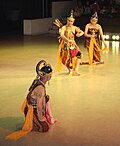
[[ | The [[Balinese dance|Balinese]] ''[[kecak]]'' dance for example, retells the story of the Ramayana, with dancers playing the roles of Rama, Sita, Lakhsmana, Jatayu, Hanuman, Ravana, Kumbhakarna and Indrajit surrounded by a troupe of over 50 bare-chested men who serve as the chorus chanting "cak". The performance also includes a fire show to describe the burning of Lanka by Hanuman.<ref>{{Cite book |last=Stepputat |first=K. |year=2021 |title=The Kecak and Cultural Tourism on Bali |publisher=University of Rochester Press |pages=92–101 |isbn=978-1648250316}}</ref> In [[Yogyakarta]], the ''[[Wayang wong|Wayang Wong]]'' [[Javanese dance]] also retells the Ramayana. One example of a dance production of the Ramayana in Java is the [[Ramayana Ballet]] performed on the Trimurti Prambanan open air stage, with dozens of actors and the three main prasad spires of the [[Prambanan]] Hindu temple as a backdrop.<ref>{{Cite web|url=http://www.indonesia.travel/uae/en/news-events/news/the-keepers-cnn-introduces-guardians-of-indonesia-s-rich-cultural-traditions|title=THE KEEPERS: CNN Introduces Guardians of Indonesia's Rich Cultural Traditions|website=www.indonesia.travel|access-date=2017-12-13|archive-date=13 December 2017|archive-url=https://web.archive.org/web/20171213201642/http://www.indonesia.travel/uae/en/news-events/news/the-keepers-cnn-introduces-guardians-of-indonesia-s-rich-cultural-traditions|url-status=dead}}</ref> | ||
====Malaysia==== | |||
The Malay adaptation of the Ramayana, also known as the [[Hikayat Seri Rama]], incorporates elements of both Hindu mythology and [[Islamic mythology]].<ref>{{Cite book|url=https://books.google.com/books?id=YAsZDAAAQBAJ&q=Hikayat+Sri+Rama+Adam&pg=PA142|title=A History of Classical Malay Literature|last=Fang|first=Liaw Yock|date=2013|publisher=Yayasan Pustaka Obor Indonesia|isbn=9789794618103|language=en|page=142}}</ref><ref>{{cite book|title=Journal of the Straits Branch of the Royal Asiatic Society|url=https://books.google.com/books?id=oPgaAAAAYAAJ&pg=PA107|year=1898|pages=107–}}</ref><ref>{{cite book|title=Journal of the Straits Branch of the Royal Asiatic Society|url=https://books.google.com/books?id=oPgaAAAAYAAJ&pg=PA143|year=1898|pages=143–}}</ref> | |||
==== Myanmar (Burma) ==== | |||
{{Main|Yama Zatdaw}} | |||
The | The Burmese adaptation of the Ramayana is known as the [[Yama Zatdaw]]. | ||
==== | ====Philippines==== | ||
{{main|Maharadia Lawana}} | |||
[[ | The ''[[Maharadia Lawana]]'', an epic poem of the [[Maranao people]] of the [[Philippines]], has been regarded as an indigenized version of the Ramayana since it was documented and translated into English by Professor [[Juan R. Francisco]] and Nagasura Madale in 1968.{{sfn|Guillermo|2011|p=264}}<ref>{{Cite journal |last=Francisco |first=Juan R. |year=1969 |title=Maharadia Lawana |journal=Asian Studies |url=http://www.asj.upd.edu.ph/mediabox/archive/ASJ-07-02-1969/franciso-maharadia%20lawana.pdf |archive-url=https://web.archive.org/web/20151017111420/http://www.asj.upd.edu.ph/mediabox/archive/ASJ-07-02-1969/franciso-maharadia%20lawana.pdf |archive-date=2015-10-17 |url-status=live}}</ref> The poem, which had not been written down before Francisco and Madale's translation,{{sfn|Guillermo|2011|p=264}} narrates the adventures of the monkey-king, Maharadia Lawana, to whom the Gods have granted immortality.{{sfn|Guillermo|2011}} | ||
Francisco, an indologist from the [[University of the Philippines Manila]], believed that the ''Ramayana'' narrative arrived in the Philippines some time between the 17th to 19th centuries, via interactions with Javanese and Malaysian cultures which traded extensively with India.{{sfn|Francisco|1989|p=101}} | |||
By the time it was documented in the 1960s, the character names, place names, and the precise episodes and events in Maharadia Lawana's narrative already had some notable differences from those of the ''Ramayana''. Francisco believed that this was a sign of "indigenization", and suggested that some changes had already been introduced in Malaysia and Java even before the story was heard by the Maranao, and that upon reaching the Maranao homeland, the story was "further indigenized to suit Philippine cultural perspectives and orientations."{{sfn|Francisco|1989|p=103}} | |||
==== | ====Thailand==== | ||
{{main|Ramakien}} | |||
[[File: | [[File:Khon Dance Frankfurt Germany 2006.jpg|thumb|right|The Thai retelling of the tale—[[Ramakien]]—is popularly expressed in [[Dance in Thailand|traditional regional dance]] theatre]] | ||
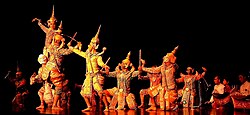
Thailand's popular national epic ''Ramakien'' ({{Langx|th|รามเกียรติ์}}, from {{IAST|rāmakīrti}}, 'glory of Ram') is derived from the Hindu epic. In {{Transliteration|th|Ramakien}}, Sita is the daughter of Ravana and Mandodari ({{Transliteration|th|thotsakan}} and {{Transliteration|th|montho}}). [[Vibhishana]] ({{Transliteration|th|phiphek}}), the astrologer brother of Ravana, predicts the death of Ravana from Sita's horoscope. Ravana throws her into the water, but she is later rescued by Janaka ({{Transliteration|th|chanok}}).{{sfn|Ramanujan|2004|p=149}} | |||
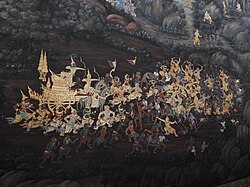
While the main story is identical to that of ''Ramayana'', many other aspects were transposed into a Thai context, such as the clothes, weapons, topography and elements of nature, which are described as being Thai in style. It has an expanded role for Hanuman and he is portrayed as a lascivious character. Ramakien can be seen in an elaborate illustration at [[Wat Phra Kaew]] in Bangkok. | |||
===Critical edition=== | |||
A [[critical edition]] of the text was compiled in India in the 1960s and 1970s, by the Oriental Institute at [[Maharaja Sayajirao University of Baroda#Oriental Institute|Maharaja Sayajirao University of Baroda]], India, utilizing dozens of manuscripts collected from across India and the surrounding region.<ref>{{cite web|url=http://news.berkeley.edu/2016/11/17/ramayana-translation-project-turns-its-last-page-after-four-decades-of-research/|publisher=news.berkeley.edu|title=Ramayana Translation Project turns its last page, after four decades of research | Berkeley News|date=17 November 2016|access-date=6 January 2017|archive-date=9 February 2017|archive-url=https://web.archive.org/web/20170209121535/http://news.berkeley.edu/2016/11/17/ramayana-translation-project-turns-its-last-page-after-four-decades-of-research/|url-status=live}}</ref> An English language translation of the critical edition was completed in November 2016 by Sanskrit scholar [[Robert P. Goldman]] of the [[University of California, Berkeley]].<ref>{{cite web|url=http://www.dailycal.org/2016/11/20/uc-berkeley-researchers-complete-decades-long-translation-project/|publisher=dailycal.org|title=UC Berkeley researchers complete decades-long translation project | The Daily Californian|date=21 November 2016|access-date=6 January 2017|archive-date=12 December 2016|archive-url=https://web.archive.org/web/20161212095447/http://www.dailycal.org/2016/11/20/uc-berkeley-researchers-complete-decades-long-translation-project/|url-status=live}}</ref> Another English translation of the critical edition of the Valmiki Ramayana was done by the late Mr. Bibek Debroy. | |||
==Commentaries== | |||
There are around thirty three commentaries on the Ramayana.{{sfn|Kumar|2020}} Some of the commentaries on the Ramayana include- | |||
* Mahesvara Tirtha's ''{{IAST|tattvadīpa}}'' (also known as ''{{IAST|tattvadīpika}}'') | |||
* Govindaraja's ''{{IAST|bhūṣaṇa}}'' (also known as {{IAST|govindarājīyam}}) | |||
* Sivasahaya's ''{{IAST|śiromaṇi}}'' | |||
* Mahadeva Yogi's ''{{IAST|amṛtakaṭaka}}'' | |||
* Ramanuja's {{IAST|rāmānujīyam}} | |||
* Ahobala's {{transliteration|ta|ISO|taniclōkī}} | |||
* Nagoji Bhatta's(Ramavarma) ''{{IAST|tilaka}}''<ref>{{cite web|url=https://www.valmiki.iitk.ac.in/ecommentaries|title=English Commentaries|publisher=[[IIT Kanpur]]|access-date=8 August 2022|archive-date=8 August 2022|archive-url=https://web.archive.org/web/20220808210926/https://www.valmiki.iitk.ac.in/ecommentaries|url-status=live}}</ref> | |||
* Tryambakarāyamakhī's {{IAST|dharmākūtam}}<ref>{{Cite web |title=English Commentaries {{!}} Valmiki Ramayanam |url=https://www.valmiki.iitk.ac.in/ecommentaries?field_commnetary_tid=8&field_kanda_tid=1&field_sarga_value=1 |access-date=2025-08-16 |website=www.valmiki.iitk.ac.in}}</ref><ref>{{Cite book |last=Tryambakarāyamakhī |url=https://books.google.com/books?id=jI5WuAAACAAJ |title=Dharmākūtam |date=1963 |publisher=O.A. Narayanaswami |language=sa}}</ref> | |||
The three commentaries ''{{IAST|tilaka}}'', ''{{IAST|bhūṣaṇa}}'' and ''{{IAST|śiromaṇi}}'' are known as ''{{IAST|ṭīkātraya}}'' (i.e. commentary trio) and are more popular.<ref>{{cite web|url=http://www.kasarabada.org/Tattvadipika.html|title=Sundarakanda|publisher=Kasarabada Trust|access-date=8 August 2022|archive-date=3 December 2022|archive-url=https://web.archive.org/web/20221203101000/http://www.kasarabada.org/Tattvadipika.html|url-status=live}}</ref> | |||
==Influence== | |||
{{see also|Ramayana Ballet}}{{Further information|Symbolism of Rama}} | |||
=== | === Holidays === | ||
====Vijayadashami==== | |||
{{main|Vijayadashami}} | |||
Vijayadashami is a major Hindu festival celebrated every year at the end of [[Durga Puja]] and [[Navaratri]]. | |||
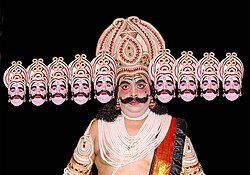
[[File:An Ramlila Actor In The Role of Ravana.jpg|thumb|A [[Ramlila]] actor wears the traditional attire of Ravana]] | |||
=== | ==== Diwali ==== | ||
{{main|Diwali}} | |||
Diwali, the festival of lights in Hinduism, is celebrated in joy of Lord Rama returning to Ayodhya with his wife Sita and brother Lakshmana.<ref>{{Cite web |title=Celebrate Diwali – Deborah Heiligman |url=https://deborahheiligman.com/books/celebrate-diwali/ |access-date=2024-05-22 |website=deborahheiligman.com}}</ref> | |||
== | === In art === | ||
[[File:COLLECTIE TROPENMUSEUM De strijd tussen de apenvorsten Sugriwa en Subali TMnr 3525-25.jpg|thumb|The painting by the [[Indonesia]]n ([[Bali]]nese) artist, [[Ida Bagus Made Togog]] depicts the episode from the Ramayana about the Monkey Kings of [[Sugriva]] and [[Vali (Ramayana)|Vali]]; The Killing of Vali. [[Rama]] depicted as a crowned figure with a bow and arrow.]] | |||
[[File: | |||
One of the most important literary works of [[History of India|ancient India]], the ''Ramayana'' has had a profound impact on art and culture in the [[Indian subcontinent]] and southeast Asia with the lone exception of Vietnam. The story ushered in the tradition of the next thousand years of massive-scale works in the rich diction of regal courts and Hindu temples. It has also inspired much secondary literature in various languages, notably [[Kambaramayanam]] by [[Tamils|Tamil]] poet [[Kambar (poet)|Kambar]] of the 12th century, [[Telugu language]] ''[[Molla Ramayanam]]'' by poet [[Molla (poet)|Molla]] and [[Ranganatha Ramayanam]] by poet Gona Budda Reddy, 14th-century [[Kannada]] poet Narahari's Torave Ramayana and 15th-century [[Bengali people|Bengali]] poet [[Krittibas Ojha]]'s [[Krittivasi Ramayan]], as well as the 16th-century [[Awadhi language|Awadhi]] version, ''[[Ramcharitmanas]]'', written by [[Tulsidas]]. | |||
Ramayanic scenes have also been depicted through [[terracottas]], [[stone sculpture]]s, [[Bronze sculpture|bronzes]] and [[paintings]].{{sfn|Lal|2008}} These include the stone panel at Nagarjunakonda in [[Andhra Pradesh]] depicting Bharata's meeting with [[Rama]] at [[Chitrakoot, Madhya Pradesh|Chitrakuta]] (3rd century CE).{{sfn|Lal|2008}} | |||
The ''Ramayana'' became popular in [[Southeast Asia]] from the 8th century onward and was represented in literature, temple architecture, dance and theatre. Today, dramatic enactments of the story of the ''Ramayana'', known as [[Ramlila]], take place all across [[India]] and in many places across the globe within the [[Non-resident Indian and person of Indian origin|Indian diaspora]]. | |||
[[ | In [[Indonesia]], especially [[Java]] and [[Bali]], ''Ramayana'' has become a popular source of artistic expression for dance drama and shadow puppet performances in the region. [[Ramayana Ballet|Sendratari Ramayana]] is the [[Javanese dance|Javanese traditional ballet]] in [[wayang orang]] style, routinely performed in the cultural center of [[Yogyakarta]]. Large casts were part of outdoor and indoor performances presented regularly at [[Prambanan]] Trimurti temple for many years.<ref>{{cite news | newspaper = The New York Times | title = On Java, a Creative Explosion in an Ancient City | first = Donald | last = Frazier | date = 11 February 2016 | url = https://www.nytimes.com/2016/02/14/travel/indonesia-yogyakarta-java-island.html | access-date = 31 July 2017 | archive-date = 11 April 2021 | archive-url = https://web.archive.org/web/20210411014343/https://www.nytimes.com/2016/02/14/travel/indonesia-yogyakarta-java-island.html | url-status = live }}</ref> [[Balinese dance|Balinese dance dramas]] of ''Ramayana'' were also performed frequently in [[Balinese temples|Balinese Hindu temples]] in [[Ubud]] and [[Uluwatu Temple|Uluwatu]], where scenes from Ramayana are an integral part of [[kecak]] dance performances. [[Java]]nese [[Wayang]] (''[[Wayang Kulit]]'' of ''purwa'' and ''[[Wayang Wong]]'') also draw from ''Ramayana'' or ''[[Mahabharata]]''. | ||
[[File:Ramayan - Ceremonial Indonesian Banner WOVENSOULS collection.jpg|thumb|Indonesian Art on a Ceremonial Banner depicting the Ramayan. Collected in Toraja, Sulawesi. Courtesy the Wovensouls Collection, Singapore.]] | |||
''Ramayana'' has also been depicted in many paintings, notably by the [[Indonesia]]n ([[Bali]]nese) artists such as I Gusti Dohkar (before 1938), I Dewa Poetoe Soegih, I Dewa Gedé Raka Poedja, [[Ida Bagus Made Togog]] before 1948 period. Their paintings are currently in the National Museum of World Cultures collections of [[Tropenmuseum]] in [[Amsterdam]], [[Netherlands]]. Malaysian artist [[Syed Thajudeen]] also depicted ''Ramayana'' in 1972. The painting is currently in the permanent collection of the Malaysian National Visual Arts Gallery. | ''Ramayana'' has also been depicted in many paintings, notably by the [[Indonesia]]n ([[Bali]]nese) artists such as I Gusti Dohkar (before 1938), I Dewa Poetoe Soegih, I Dewa Gedé Raka Poedja, [[Ida Bagus Made Togog]] before 1948 period. Their paintings are currently in the National Museum of World Cultures collections of [[Tropenmuseum]] in [[Amsterdam]], [[Netherlands]]. Malaysian artist [[Syed Thajudeen]] also depicted ''Ramayana'' in 1972. The painting is currently in the permanent collection of the Malaysian National Visual Arts Gallery. | ||
==In popular culture== | ==In popular culture== | ||
Multiple modern, English-language adaptations of the epic exist, namely [[ | Multiple modern, [[English language|English-language]] adaptations of the epic exist, namely [[Amish Tripathi#Ram Chandra Series|Ram Chandra Series]] by [[Amish Tripathi]], [[Ashok Banker#Ramayana Series|Ramayana Series]] by [[Ashok Banker]] and a mythopoetic novel, ''Asura: Tale of the Vanquished'' by [[Anand Neelakantan]]. Another Indian author, [[Devdutt Pattanaik]], has published three different retellings and commentaries of Ramayana titled ''Sita'', ''The Book Of Ram'' and ''Hanuman's Ramayan''. A number of plays, movies and television serials have also been produced based upon the ''Ramayana''.{{sfn|Mankekar|1999|p=[https://books.google.com/books?id=fZf8wmVdpaIC&pg=PA165 165]}} | ||
Quotes from the ''Ramayana'' are used in "Live Gloriously", the main theme for the video game ''[[Civilization VII]]''. | |||
===Stage=== | ===Stage=== | ||
[[File:Hanoman At Kecak Fire Dance.jpg|thumb|Hanuman at [[Kecak]] fire dance, Bali, 2018|upright]] | [[File:Hanoman At Kecak Fire Dance.jpg|thumb|Hanuman at [[Kecak]] fire dance, Bali, 2018|upright]] | ||
One of the best known ''Ramayana'' plays is Gopal Sharman's ''The Ramayana'', a contemporary interpretation in English, of the great epic based on the Valmiki ''Ramayana''. The play has had more than | One of the best known{{citation needed|date=June 2024}} ''Ramayana'' plays is Gopal Sharman's ''The Ramayana'', a contemporary interpretation in English, of the great epic based on the Valmiki ''Ramayana''. The play has had more than 3,000 performances all over the world, mostly as a one-woman performance by actress [[Jalabala Vaidya]], wife of the playwright Gopal Sharman.<ref>{{Cite web |date=2016-06-27 |title=The Man who Rewrote the Ramayana |url=https://indianexpress.com/article/entertainment/play/gopal-sharman-dead-ramayan-rewrote-plays-theater-talk-2877919/ |access-date=2026-03-20 |website=The Indian Express |language=en}}</ref> ''The Ramayana'' has been performed on Broadway, London's West End, United Nations Headquarters, the Smithsonian Institution among other international venue and in more than 35 cities and towns in India.{{citation needed|date=June 2024}} | ||
Starting in 1978 and under the supervision of [[Baba Hari Dass]], ''Ramayana'' has been performed every year by Mount Madonna School in Watsonville, California.<ref>{{Cite web |title=Ramayana! – The Musical |url=https://www.mountmadonnaschool.org/hawk-life/ramayana/ |access-date=2022-06-26 |website=Mount Madonna School |language=en-US |archive-date=25 June 2022 |archive-url=https://web.archive.org/web/20220625140809/https://www.mountmadonnaschool.org/hawk-life/ramayana/ |url-status=live }}</ref> | |||
In the Philippines, a jazz ballet production was produced in the 1970s entitled "Rama at Sita" (Rama and Sita). The production was a result of a collaboration of four National Artists, Bienvenido Lumbera's libretto (National Artist for Literature), production design by Salvador Bernal (National Artist for Stage Design), music by Ryan Cayabyab (National Artist for Music) and choreography by Alice Reyes (National Artist for Dance).<ref>{{Cite web|url=https://www.culturalcenter.gov.ph/events/dance/ballet-philippines-rama-hari/details|title=BALLET PHILIPPINES' RAMA, HARI | Cultural Center of the Philippines|first=Cultural Center of the|last=Philippines|website=BALLET PHILIPPINES' RAMA, HARI|access-date=19 May 2020|archive-date=6 August 2020|archive-url=https://web.archive.org/web/20200806200049/https://www.culturalcenter.gov.ph/events/dance/ballet-philippines-rama-hari/details|url-status=live}}</ref> | |||
In the | === Nomenclatures === | ||
Ramayana has had a profound influence on India and Indians across the geographical and historical space. Rampur is the most common name for villages and towns across the nation particularly UP, Bihar and West Bengal.<ref>{{Cite web |date=2020-09-24 |title=Someone Plotted All The Villages Named 'Rampur' In India And Came Up With This Map |url=https://www.indiatimes.com/trending/social-relevance/map-shows-villages-with-the-name-rampur-523559.html |access-date=2022-03-09 |website=IndiaTimes |language=en-IN |archive-date=29 June 2022 |archive-url=https://web.archive.org/web/20220629060134/https://www.indiatimes.com/trending/social-relevance/map-shows-villages-with-the-name-rampur-523559.html |url-status=live }}</ref> It is so common that people have been using Ram Ram as a greeting to each other.<ref>{{Cite web |last=admin |date=2022-01-03 |title=Why Hindus say Ram Ram? |url=https://www.beautyofindia.in/hindus-say-ram-ram/ |access-date=2022-03-09 |website=Beauty Of India |language=en-US |archive-date=3 April 2023 |archive-url=https://web.archive.org/web/20230403221859/https://www.beautyofindia.in/hindus-say-ram-ram/ |url-status=live }}</ref><ref>{{Cite web |last=sanskar |first=hindu |date=2020-05-23 |title=Why do we say Ram Ram as greeting? |url=https://www.hindusanskar.org/post/why-do-we-say-ram-ram-as-greeting |access-date=2022-03-09 |website=Hindu-Sanskar |language=en |archive-date=1 February 2023 |archive-url=https://web.archive.org/web/20230201215923/https://www.hindusanskar.org/post/why-do-we-say-ram-ram-as-greeting |url-status=live }}</ref> | |||
==Texts and translations== | |||
;Sanskrit text | |||
* | * [http://bombay.indology.info/ramayana/statement.html Electronic version of the Sanskrit text], input by Muneo Tokunaga | ||
* | * [http://gretil.sub.uni-goettingen.de/gretil.htm#Ram Sanskrit text] on [[GRETIL]] | ||
;Translations | |||
Here is a list of notable English translations of the Ramayana in chronological order: | |||
=== | * {{cite book |first=Ralph T. H. |last=Griffith |author-link=Ralph T. H. Griffith |year=1870–1874 |title=The Ramayan of Valmiki |publisher=Trübner |url=http://www.sacred-texts.com/hin/rama/index.htm |via=Sacred-texts.org |ref=none}} ([[:gutenberg:24869|Project Gutenberg]]). | ||
** Griffith's translation was one of the earliest complete translations of the Ramayana into English. | |||
* ' | * {{cite book |first=Romesh Chunder |last=Dutt |year=1898 |title=The Ramayana and Mahabharata Condensed into English Verse |publisher=J. M. Dent |url=https://archive.org/details/RamayanaTheEpicOfRamaPrinceOfIndiaCondensedIntoEnglishVerseBy |url-access=registration |ref=none}} Reprint: Dover Publications. 2012. {{ISBN|978-0-486-14352-1}}. | ||
* | ** Dutt provided a condensed version of the Ramayana in verse form. | ||
* | * {{cite book |first=Helen M. |last=Johnson |year=1931 |chapter=Book VII - Jain Ramayana (Rāmāyaṇa) |chapter-url=https://www.wisdomlib.org/jainism/book/trishashti-shalaka-purusha-caritra/d/doc213981.html |title=Trishashti Shalaka Purusha Caritra |ref=none}} | ||
* | ** This translation presents the Jain perspective on the Ramayana. | ||
* | * {{cite book |first=Hari Prasad |last=Shastri |year=1952 |title=The Ramayana of Valmiki |publisher=Shanti Sadan |ref=none}} | ||
* | ** Shastri's translation is notable for its attempt to retain the poetic beauty of the original Sanskrit. | ||
* | * {{cite book |first=R. K. |last=Narayan |year=1973 |title=The Ramayana: A Shortened Modern Prose Version of the Indian Epic |publisher=Chatto and Windus |isbn=978-0-7011-1990-4 |ref=none}} | ||
* ' | **Narayan's translation is a prose version that simplifies the story for a modern audience while retaining its essential elements. | ||
* ' | * {{cite book |first=William |last=Buck |author-link=William Buck (translator) |year=1976 |title=Ramayana |publisher=University of California Press |ref=none}} 35th Anniversary Edition. 2012. {{ISBN|978-0-520-27298-9}} | ||
* | ** Buck's version is a modern retelling that aims to make the story accessible to contemporary readers. | ||
* '' | * {{cite book |last=Raghunathan |first=N. |title=Srimad Valmiki Ramayanam |publisher=Vighneswara Publishing House |place=Madras |year=1981 |ref=none}} | ||
* ' | ** This translation is noted for its fidelity to the original text. | ||
* {{cite book|last=Goldman|first=Robert P.|title=The Ramayana of Valmiki: An Epic of Ancient India: Balakanda|publisher=Princeton University Press|year=1990|isbn=978-0-691-01485-2|ref=none}} | |||
* {{cite book|last=Goldman|first=Robert P.|author-mask=9|title=The Ramayana of Valmiki: An Epic of Ancient India: Kiskindhakanda|publisher=Princeton University Press|year=1994|isbn=978-0-691-06661-5|ref=none}} | |||
* {{cite book|last=Goldman|first=Robert P.|author-mask=9|title=The Ramayana of Valmiki: Sundarakanda|publisher=Princeton University Press|year=1996|isbn=978-0-691-06662-2|ref=none}} | |||
** This translation is part of the Princeton Library of Asian Translations and is noted for its scholarly approach and detailed annotations. The project spans multiple volumes and years. | |||
* {{cite book |first=Arshia |last=Sattar |author-link=Arshia Sattar |year=1996 |title=The Rāmāyaṇa by Vālmīki: An Epic of Ancient India |publisher=Viking |isbn=978-0-14-029866-6|ref=none}} | |||
** Sattar's translation is praised for its clarity and readability, as well as for staying close to the original text. | |||
* {{cite book |url=https://books.google.com/books?id=nAzNbPus9TcC |title=Rāma the Steadfast: An Early Form of the Rāmāyaṇa |first1=J. L. |last1=Brockington |first2=Mary |last2=Brockington |publisher=Penguin |year=2006 |isbn=0-14-044744-X |ref=none}} | |||
** This translation provides an early form of the ''Ramayana'', emphasizing its foundational aspects. | |||
* {{cite book |first=Bibek |last=Debroy |year=2017 |title=The Valmiki Ramayana |volume=1 |publisher=Penguin |isbn=978-93-87326-26-2 |ref=none}} | |||
** Debroy's translation is known for its fidelity to the original text and detailed footnotes and commentary. | |||
* W A Silva (1957), Valmiki Ramayana. This is a lucid translation in Sinhala by the great novelist [[W. A. Silva]] of Sri Lanka. | |||
These translations reflect a range of approaches, from strict adherence to the original Sanskrit text to more accessible modern retellings. | |||
=== | ==See also== | ||
* [[Rāmakṛṣṇavilomakāvyaṃ]] | |||
==Notes== | ==Notes== | ||
{{ | {{notelist}} | ||
==References== | ==References== | ||
| Line 394: | Line 347: | ||
==Sources== | ==Sources== | ||
{{refbegin|30em}} | {{refbegin|30em}} | ||
* | * {{cite book |last=Brockington |first=J. L. |title=The Sanskrit Epics |year=1998 |publisher=Brill |isbn=90-04-10260-4}} | ||
* {{cite book|last= | * {{cite book |last=Cakrabartī |first=Bishṇupada |title=The Penguin Companion to the Ramayana |date=2006 |publisher=Penguin Books |isbn=978-0-14-310046-1}} | ||
* {{ | * {{cite book |first=Gregory |last=Claeys |title=The Cambridge Companion to Utopian Literature |year=2010 |publisher=Cambridge University Press |isbn=978-1-139-82842-0}} | ||
* {{cite book| | * {{cite book |last=Coedès |first=George |author-link=George Coedès |editor-first=Walter F. |editor-last=Vella |translator=Susan Brown Cowing |title=The Indianized States of Southeast Asia |year=1968 |publisher=University of Hawaii Press |isbn=978-0-8248-0368-1}} | ||
* {{ | <!-- F --> | ||
* {{ | * {{Cite journal|last=Francisco|first=Juan R.|date=1989|title=The Indigenization of the Rama Story in the Philippines|jstor=42633135|journal=Philippine Studies|volume=37|issue=1|pages=101–111}} | ||
* {{ | * {{Cite book|last=Goldman|first=Robert P.|title=The Rāmāyaṇa of Vālmīki: An Epic of Ancient India, Vol. I, Bālakānda|publisher=Princeton University Press|year=1984|url=https://ia902902.us.archive.org/26/items/vr_001_bk/VR-001-BK.pdf|isbn=81-208-3162--4}} | ||
* {{Cite book|last1=Goldman|first1=Robert P.|last2=Sutherland Goldman|first2=Sally J.|title=The Rāmāyaṇa of Vālmīki: The Complete English Translation|publisher=Princeton University Press|year=2022|isbn=978-0-691-20686-8}} | |||
* {{Cite book|last= | * {{Cite book |last=Guillermo |first=Artemio R. |title=Historical Dictionary of the Philippines |year=2011 |publisher=Scarecrow Press |isbn=978-0-8108-7511-1}} | ||
<!-- K --> | <!-- K --> | ||
* {{cite | * {{cite journal |last1=Kumar |first1=Sanjeev |date=2020 |title=A study of social issues in the Ramayana in the context of subcommentaries |url=https://www.anantaajournal.com/archives/2020/vol6issue4/PartC/6-4-25-912.pdf |archive-url=https://web.archive.org/web/20201029011241/https://www.anantaajournal.com/archives/2020/vol6issue4/PartC/6-4-25-912.pdf |archive-date=2020-10-29 |url-status=live |journal=International Journal of Sanskrit Research |volume=6 |issue=4 |pages=144–147 |issn=2394-7519}} | ||
* {{cite book |title=Rāma, His Historicity, Mandir, and Setu: Evidence of Literature, Archaeology, and Other Sciences |first=B. B. |last=Lal |author-link=B. B. Lal |publisher=Aryan Books |year=2008 |isbn=978-81-7305-345-0}} | |||
* {{cite book |last=Mankekar |first=Purnima |title=Screening Culture, Viewing Politics: An Ethnography of Television, Womanhood, and Nation in Postcolonial India |year=1999 |publisher=Duke University Press |isbn=978-0-8223-2390-7}} | |||
<!-- P --> | |||
* {{cite book |title=Rāma, His Historicity, Mandir, and Setu: Evidence of Literature, Archaeology, and Other Sciences |author=B. B. Lal |publisher=Aryan Books |year=2008 |isbn=978-81-7305-345-0 | * {{cite book |last=Parameswaran |first=M. R. |year=2014 |title=Valmiki Ramayana: Critical Essays |publisher=Manipal University Press |isbn=978-93-82460-18-3 |url=https://archive.org/details/valmiki_-_ramayana_-_critical_-_essays_-_m_-_r_-_parameswaran |url-access=registration}} | ||
<!-- R --> | |||
* {{cite book |last1=Ramanujan |first1=A. K. |title=The Collected Essays of A. K. Ramanujan |year=2004 |publisher=Oxford University Press |location=New Delhi}}{{ISBN?}} | |||
* {{cite | * {{cite book |first=Ajay K. |last=Rao |title=Re-figuring the Ramayana as Theology: A History of Reception in Premodern India |place=London |publisher=Routledge |year=2014 |isbn=978-1-134-07735-9}} | ||
* {{cite book |first=Ramashraya |last=Sharma |title=A Socio-political Study of the Vālmīki Rāmāyaṇa |year=1986 |publisher=Motilal Banarsidass |isbn=978-81-208-0078-6}} | |||
* {{cite book|last= | |||
* {{cite book|last1= | |||
* {{cite book | |||
* | |||
{{Refend}} | {{Refend}} | ||
==Further reading== | ==Further reading== | ||
{{refbegin|30em}} | |||
* {{cite book |last=Bhattacharji |first=Sukumari |title=Legends of Devi |publisher=Orient Blackswan |year=1998 |isbn=978-81-250-1438-6 |ref=none}} | |||
* [http:// | * {{cite book |title=Bhatti's Poem: The Death of Rávana (Bhaṭṭikāvya) |last=Fallon |first=Oliver |year=2009 |location=New York |publisher=New York University Press, [[Clay Sanskrit Library]] |isbn=978-0-8147-2778-2 |url=http://www.claysanskritlibrary.org/volume-v-78.html |access-date=18 April 2009 |archive-date=16 March 2021 |archive-url=https://web.archive.org/web/20210316124405/http://www.claysanskritlibrary.org/volume-v-78.html |url-status=dead |ref=none}} | ||
* {{cite book |last=Jain |first=Meenakshi |title=Rama and Ayodhya |publisher=Aryan Books International |year=2013 |isbn=978-81-7305-451-8 |ref=none}} | |||
* {{cite book |last=Keshavadas |first=Sadguru Sant |title=Ramayana at a Glance |publisher=Motilal Banarsidass |year=1988 |isbn=978-81-208-0545-3 |ref=none}} | |||
* {{cite journal |last=Murthy |first=S. S. N. |date=November 2003 |title=A note on the Ramayana |journal=Electronic Journal of Vedic Studies |location=New Delhi |volume=10 |issue=6 |pages=1–18 |issn=1084-7561 |url=http://www.ejvs.laurasianacademy.com/ejvs1006/ejvs1006article.pdf |url-status=dead |archive-url=https://web.archive.org/web/20120808182601/http://www.ejvs.laurasianacademy.com/ejvs1006/ejvs1006article.pdf |archive-date=8 August 2012 |df=dmy-all |ref=none}} | |||
* | * {{cite book |last=Prabhavananda |first=Swami |title=The Spiritual Heritage of India |publisher=Vedanta Press |year=1979 |isbn=978-0-87481-035-6 |title-link=Spiritual Heritage of India (book) |ref=none}} | ||
* {{cite book |author-link=Kate Milner Rabb |last=Rabb |first=Kate Milner |title=National Epics |year=1896 |url=http://www.gutenberg.org/dirs/etext05/8ntle10.txt |archive-url=https://web.archive.org/web/20110914003423/http://www.gutenberg.org/dirs/etext05/8ntle10.txt |archive-date=14 September 2011 |via=[[Project Gutenberg]] |ref=none}} | |||
* {{cite book |last=Rohman |first=Todd |editor=Watling, Gabrielle |editor2=Quay, Sara |title=Cultural History of Reading: World literature |year=2009 |publisher=Greenwood |isbn=978-0-313-33744-4 |chapter=The Classical Period |ref=none}} | |||
* | * {{cite book |last1=Sachithanantham |first1=Singaravelu |author-link1=S Singaravelu |title=The Ramayana Tradition in Southeast Asia |date=2004 |publisher=University of Malaya Press |isbn=978-983-100-234-6 |location=Kuala Lumpur |ref=none}} | ||
* {{cite book |last=Sundararajan |first=K.R. |title=Hindu spirituality: Vedas through Vedanta |editor=Krishna Sivaraman |editor2=Bithika Mukerji |publisher=The Crossroad Publishing Co. |year=1989 |pages=106–126 |chapter=The Ideal of Perfect Life : The Ramayana |isbn=978-0-8245-0755-8 |chapter-url=https://books.google.com/books?id=xPYp7_kMBK4C&pg=PA106 |ref=none}} | |||
* | {{refend}} | ||
* | |||
==External links== | ==External links== | ||
{{Wikiquote|Ramayana}} | |||
{{wikisourcelang|sa|रामायणम्|''Ramayana''}} | |||
{{wikisource|Ramayana|''Ramayana''}} | |||
{{Commons and category|Ramayana|Ramayana}} | |||
* {{gutenberg|24869}} | * {{gutenberg|24869}} | ||
* [https://www.wisdomlib.org/hinduism/book/the-ramayana-of-valmiki ''The Ramayana of Valmiki''] English translation by Hari Prasad Shastri, 1952 (revised edition with interwoven glossary) | * [https://www.wisdomlib.org/hinduism/book/the-ramayana-of-valmiki ''The Ramayana of Valmiki''] English translation by Hari Prasad Shastri, 1952 (revised edition with interwoven glossary) | ||
* [http://oll.libertyfund.org/index.php?option=com_staticxt&staticfile=show.php%3Ftitle=1778&Itemid=28 A condensed verse translation] by [[Romesh Chunder Dutt]] sponsored by the [[Liberty Fund]] | * [http://oll.libertyfund.org/index.php?option=com_staticxt&staticfile=show.php%3Ftitle=1778&Itemid=28 A condensed verse translation] {{Webarchive|url=https://web.archive.org/web/20210305194943/http://oll.libertyfund.org/index.php?option=com_staticxt&staticfile=show.php%3Ftitle=1778&Itemid=28 |date=5 March 2021 }} by [[Romesh Chunder Dutt]] sponsored by the [[Liberty Fund]] | ||
*{{librivox book | title=Ramayan| author=Valmiki}} | *{{librivox book | title=Ramayan| author=Valmiki}} | ||
* [https://books.google.com/books?id=XTXyDwAAQBAJ Absolute dating of Ramayana] | * [https://books.google.com/books?id=XTXyDwAAQBAJ Absolute dating of Ramayana] | ||
*[https://exchange.umma.umich.edu/resources/23629 Collection: Art of the Ramayana] from the [[University of Michigan Museum of Art]] | *[https://exchange.umma.umich.edu/resources/23629 Collection: Art of the Ramayana] {{Webarchive|url=https://web.archive.org/web/20210915064124/https://exchange.umma.umich.edu/resources/23629 |date=15 September 2021 }} from the [[University of Michigan Museum of Art]] | ||
{{Ramayana}} | {{Ramayana}} | ||
{{Hindu Culture and Epics}} | {{Hindu Culture and Epics}} | ||
{{National epic poems}} | {{National epic poems}} | ||
{{Portal bar|India|Indonesia|Hinduism|Poetry|Literature}} | |||
[[Category:Ramayana| ]] | [[Category:Ramayana| ]] | ||
[[Category:7th-century BC poems]] | [[Category:7th-century BC poems]] | ||
| Line 466: | Line 405: | ||
[[Category:Hindu texts]] | [[Category:Hindu texts]] | ||
[[Category:Hindu poetry]] | [[Category:Hindu poetry]] | ||
[[Category: | [[Category:Frame stories]] | ||
Revision as of 09:58, 28 March 2026
| Rāmāyaṇa | |
|---|---|
 Rāma slaying Rāvaṇa, from a royal Mewar manuscript, 17th century | |
| Information | |
| Religion | Hinduism |
| Author | Valmiki |
| Language | Sanskrit |
| Period | 7th century BCE – 3rd century CE |
| Chapters | 500 Sargas, 7 Kandas |
| Verses | 24,000 |
| Part of a series on |
| Hindu mythology |
|---|
 |
| Hinduism Portal |
The Ramayana (/rɑːˈmɑːjənə/;[1][2] Sanskrit: रामायणम्, romanized: Rāmāyaṇam[3]), also known as the Valmiki Ramayana, as traditionally attributed to Valmiki, is a smriti text (also described as a Sanskrit epic) from ancient India, one of the two important epics of Hinduism known as the Itihasas, the other being the Mahabharata.[4] The epic narrates the life of Rama, the seventh avatar of the Hindu deity Vishnu, who was a prince of Ayodhya in the kingdom of Kosala. The epic follows his fourteen-year exile to the forest urged by his father King Dasharatha, on the request of Rama's stepmother Kaikeyi; his travels across the forests in the Indian subcontinent with his wife Sita and brother Lakshmana; the kidnapping of Sita by Ravana, the king of Lanka; and Rama's eventual return to Ayodhya along with Sita to be crowned king amidst jubilation and celebration.
Scholarly estimates for the earliest stage of the text range from the 7th–5th to 5th–4th century BCE,[5][6] and later stages extend up to the 3rd century CE,[6] although the original date of composition is unknown. It is one of the largest ancient epics in world literature and consists of nearly 24,000 shlokas (verses), divided into seven kāṇḍa (chapters). Each shloka is a couplet (two individual lines). The Ramayana belongs to the genre of Itihasa, narratives of past events (purāvṛtta), interspersed with teachings on the goals of human life.
There are many versions of the Ramayana in Indian languages, including Buddhist and Jain adaptations. There are also Cambodian (Reamker), Malay (Hikayat Seri Rama), Filipino, Thai (Ramakien), Lao, Burmese, Nepali, Maldivian, Vietnamese, and Tibeto-Chinese versions of the Ramayana.[lower-alpha 1]
The Ramayana was an important influence on later Sanskrit poetry and Hindu life and culture, and its main figures were fundamental to the cultural consciousness of a number of nations, both Hindu and Buddhist. Its most important moral influence was the importance of virtue, in the life of a citizen and in the aspirational ideals guiding the functioning of a state (from Sanskrit: रामराज्य, romanized: Rāmarājya, a utopian state where Rama is king) or a society.
Etymology
The name Rāmāyaṇa is composed of two words, Rāma and ayana "travel, journey", with the grammatical internal sandhi "joining" of the final short a in Rāma and the initial short a in ayana to the longer form ā.[12] Rāma, the name of the main figure of the epic, has two contextual meanings. In the Atharvaveda, it means "dark-coloured or black" and is related to the word rātri "the darkness or stillness of night". The other meaning, which can be found in the Mahabharata, is "pleasing, pleasant, charming, lovely, beautiful".[13][14] Thus, Rāmāyaṇa means "Rama's journey".[15]
Dating
Scholarly estimates of the earliest stage of the available text range from the 7th–5th to 5th-4th centuries BCE,[16][6] with later stages extending to the 3rd century CE.[6] According to Robert P. Goldman (1984), the oldest parts of the Ramayana date to the early 7th century BCE.[17] Goldman states that the core portions could not have been composed later than the 6th or 5th century BCE, as the narrative neither mentions Buddhism (founded in the 5th century BCE) nor reflects the later prominence of Magadha (which rose to power in the 7th century BCE). The text also mentions Ayodhya as the capital of Kosala, rather than its later name of Saketa or its successor capital of Shravasti.[18] In terms of narrative time, the action of the Ramayana predates the Mahabharata. Goldman & Sutherland Goldman (2022) consider the Ramayana's oldest surviving version was composed around 500 BCE.[19]
Books two to six are the oldest portion of the epic, while the first and last books (Balakanda and Uttara Kanda, respectively) are considered to be later additions. Style differences and narrative contradictions between these two volumes and the rest of the epic have led scholars including Hermann Jacobi toward this consensus.[20]
Textual characteristics

Genre
The Ramayana belongs to the genre of Itihasa, narratives of past events (purāvṛtta), which includes the epics Mahabharata and Ramayana, and the Puranas. The genre also includes teachings on the goals of human life. It depicts the duties of relationships, portraying ideal characters like the ideal son, servant, brother, husband, wife, and king.[21] Like the Mahabharata, Ramayana presents the teachings of ancient Hindu sages in the narrative allegory, interspersing philosophical and ethical elements.[lower-alpha 2]
Structure
In its extant form, Valmiki's Ramayana is an epic poem containing over 24,000 couplet verses, divided into seven kāṇḍas (Bālakāṇḍa, Ayodhyakāṇḍa, Araṇyakāṇḍa, Kiṣkindakāṇḍa, Sundarākāṇḍa, Yuddhakāṇḍa, Uttarakāṇḍa), and about 500 sargas (chapters).[25][26] It is regarded as one of the longest epic poems ever written.[27]
Recensions
The Ramayana text has several regional renderings, recensions, and sub-recensions. Textual scholar Robert P. Goldman differentiates two major regional revisions: the northern (n) and the southern (s). Scholar Romesh Chunder Dutt writes that "the Ramayana, like the Mahabharata, is a growth of centuries, but the main story is more distinctly the creation of one mind."
There has been discussion as to whether the first and the last volumes of Valmiki's Ramayana (Bala Kanda and Uttara Kanda) were composed by the original author. Though Bala Kanda is sometimes considered in the main epic, according to many Uttara Kanda is certainly a later interpolation, not attributable to Valmiki.[25] Both of these two kāndas are absent in the oldest manuscript.[28]
Some think that the Uttara Kanda contradicts how Rama and Dharma are portrayed in the rest of the epic. M. R. Parameswaran says that the way the positions of women and Shudras are depicted shows that the Uttara Kanda is a later insertion.
Since Rama was revered as a dharmatma, his ideas seen in the Ramayana proper cannot be replaced by new ideas as to what dharma is, except by claiming that he himself adopted those new ideas. That is what the U-K [Uttara Kanda] does. It embodies the new ideas in two stories that are usually referred to as Sita-parityaga, the abandonment of Sita (after Rama and Sita return to Ayodhya and Rama was consecrated as king) and Sambuka-vadha, the killing of the ascetic Sambuka. The U-K attributes both actions to Rama, whom people acknowledged to be righteous and as a model to follow. By masquerading as an additional kanda of the Ramayana composed by Valmiki himself, the U-K succeeded, to a considerable extent, in sabotaging the values presented in Valmiki's Ramayana.[29]
Characters
Synopsis
Bāla Kāṇḍa

The epic begins with the sage Vālmīki asking Nārada if there is a righteous man still left in the world, to which Nārada replies that such a man is Rāma. After seeing two birds being shot, Vālmīki creates a new form of metre called śloka, in which he is granted the ability to compose an epic poem about Rāma. He teaches his poem to the boys Lava and Kuśa, who recite it throughout the land and eventually at the court of King Rāma. Then the main narrative begins.[30]
Daśaratha is the King of Ayodhyā. He has three wives: Kausalyā, Kaikeyī, and Sumitrā. He does not have a son and, in the desire to have a legal heir, he performs a fire sacrifice known as Putrīyā Iṣṭi. Meanwhile, the gods are petitioning to Brahmā and Viṣhṇu about Rāvaṇa, king of the rākṣasas who is terrorizing the universe. Thus Viṣhṇu opts to be born into mortality to combat the demon Rāvaṇa. As a consequence, Rāma is first born to Kausalyā, Bharata is born to Kaikeyī, and Lakṣmaṇa and Śatrughna are born to Sumitrā.[30]
When Rāma is 16 years old, the r̥ṣi (sage) Viśvāmitra comes to the court of Daśaratha seeking help against demons who are disturbing sacrificial rites. He chooses Rāma, who is followed by Lakṣmaṇa, his constant companion throughout the story. Rāma and Lakṣmaṇa receive instructions and supernatural weapons from Viśvāmitra and proceed to destroy Tāṭakā and many other demons. Viśvāmitra also recounts much lore of the landscape, his own ancestors, and the ancestors of the princes.[30]
The party then decides to attend King Janaka's sacrifice in the kingdom of Mithilā, who has a bow that no one has been able to string. Janaka recounts the history of the famed bow, and informs them that whoever strings the bow will win the hand of his daughter Sītā, whom he found in the earth while plowing a field. Rāma then proceeds to string the bow, but he breaks it in the process. Rāma marries Sītā; the wedding is celebrated with great festivity in Mithilā and the marriage party returns to Ayodhyā.[30]
Ayodhyā Kāṇḍa

After Rāma and Sītā are married, an elderly Daśaratha expresses his desire to crown Rāma, to which the Kosala assembly and his subjects express their support. On the eve of the great event, Kaikeyī is happy regarding this but later is provoked by Mantharā, a wicked maidservant, to claim two boons that Daśaratha has granted to her. Kaikeyī demands Rāma to be exiled into the wilderness for fourteen years, while the succession passes to her son Bharata.
The grief-stricken king, bound by his word, accedes to Kaikeyī's demands. Rāma accepts his father's reluctant decree with absolute submission and calm self-control which characterizes him throughout the story. He asks Sītā to remain in Ayodhyā, but she convinces him to take her with him into exile. Lakṣmaṇa also resolves to follow his brother into the forest.
After Rāma's departure, King Daśaratha, unable to bear the grief, passes away. Meanwhile, Bharata, who is on a visit to his maternal uncle, learns about the events in Ayodhyā. He is shocked and refuses to profit from his mother's wicked scheming. He visits Rāma in the forest and implores him to return to Ayodhyā and claim the throne that is rightfully his, but Rāma, determined to carry out his father's orders to the letter, refuses to return before the period of exile. Bharata reluctantly returns to Ayodhyā and rules the kingdom on behalf of his brother.[31]
Araṇya Kāṇḍa

In exile, Rāma, Sītā, and Lakṣmaṇa journey southward along the banks of the river Godāvari, where they build cottages and live off the land. One day, in the Pañcavati forest they are visited by a rākṣasī named Śurpaṇakhā, sister of Ravaṇa. She tries to seduce the brothers and, after failing, attempts to kill Sītā out of jealousy. Lakṣmaṇa stops her by cutting off her nose and ears. Hearing of this, her brothers Khara and Dushan organize an attack against the princes. Rama defeats Khara and his rakṣasīs.
When the news of these events reaches Rāvaṇa, he resolves to destroy Rāma by capturing Sītā with the aid of the rakṣasa Mārīca, who, assuming the form of a golden deer, captivates Sītā's attention. Entranced by the beauty of the deer, Sītā pleads with Rāma to capture it. Rāma, aware that this is the ploy of the demons, cannot dissuade Sītā from her desire and chases the deer into the forest, leaving Sītā under Lakṣmaṇa's guard.
After some time, Sītā hears Rāma calling out to her; afraid for his life, she insists that Lakṣmaṇa rush to his aid. Lakṣmaṇa tries to assure her that Rāma cannot be hurt that easily and that it is best if he continues to follow Rāma's orders to protect her. On the verge of hysterics, Sītā insists that it is not she but Rāma who needs Lakṣmaṇa's help. He obeys her wish but stipulates that she is not to leave the cottage or entertain any stranger. He then draws a line that no demon could cross and leaves to help Rāma. With the coast finally clear, Rāvaṇa appears in the guise of an ascetic requesting Sītā's hospitality. Unaware of her guest's plan, Sītā is tricked and is then forcibly carried away by Rāvaṇa.[32]
Jatāyu, a vulture, tries to rescue Sītā but is mortally wounded. In Lankā, Sītā is kept under the guard of rakṣasīs. Ravaṇa asks Sītā to marry him, but she refuses, being totally devoted to Rāma. Meanwhile, Rāma and Lakṣmaṇa learn about Sītā's abduction from Jatāyu and immediately set out to save her. During their search, they meet Kabandha and the ascetic Śabarī, who directs them to Sugriva and Hanuman.
Kiṣkindhā Kāṇḍa

Kishkindha Kanda is set in the land of Vānaras (Vana-nara) – Forest dwelling humans.[33] Rāma and Lakṣmaṇa meet Hanumān, the biggest devotee of Rāma, greatest of ape heroes, and an adherent of Sugriva, the banished pretender to the throne of Kiṣkindhā. Rāma befriends Sugriva and helps him by killing his elder brother Vāli thus regaining the kingdom of Kiṣkindhā, in exchange for helping Rāma to recover Sītā.
However, Sugriva soon forgets his promise and spends his time enjoying his newly gained power. The clever former ape queen Tārā, (wife of Vāli) calmly intervenes to prevent an enraged Lakṣmaṇa from destroying the ape citadel. She then eloquently convinces Sugriva to honour his pledge. Sugriva then sends search parties to the four corners of the earth, only to return without success from the north, east, and west. The southern search party under the leadership of Aṅgada and Hanumān learns from a vulture named Sampātī the elder brother of Jatāyu, that Sītā was taken to Lankā.
Sundara Kāṇḍa

Sundara Kanda forms the heart of Valmiki's Ramayana and consists of a detailed, vivid account of Hanumān's heroics. After learning about Sītā, Hanumān assumes a gigantic form and makes a colossal leap across the sea to Lanka. On the way, he meets many challenges like facing a Gandharva Kanyā who comes in the form of a demon to test his abilities. He encounters a mountain named Maināka who offers Hanuman assistance and a place to rest. Hanumān refuses because there is little time remaining to complete the search for Sītā.
After entering Lankā, he finds a demon, Lankini, who protects all of Lankā. Hanumān fights her and subjugates her in order to get into Lankā. In the process, Lankini, who had an earlier vision or warning from the gods, knows that Lankā's end is near if someone defeats Lankini. Here, Hanumān explores the demons' kingdom and spies on Rāvaṇa. He locates Sītā in the Ashoka grove, where she is being wooed and threatened by Rāvaṇa and his rakṣasīs to marry him.
Hanumān reassures Sītā, giving her Rāma's signet ring as a sign that Rāma is still alive. He offers to carry Sītā back to Rāma; however, she refuses and says that it is not the dharma, stating that Ramāyaṇa will not have significance if Hanumān carries her to Rāma – "When Rāma was not there, Rāvaṇa carried Sītā forcibly and when Rāvaṇa was not there, Hanumān carried Sītā back to Rāma." She says that Rāma himself must come and avenge the insult of her abduction. She gives Hanumān her comb as a token to prove that she is still alive.
Hanumān takes leave of Sītā. Before going back to Rāma and telling him about Sītā's location and desire to be rescued only by him, he decides to wreak havoc in Lankā by destroying trees in the Naulakha Bagh and buildings and killing Rāvaṇa's warriors. He allows himself to be captured and delivered to Rāvaṇa. He gives a bold lecture to Rāvaṇa urging him to release Sīta. He is condemned and his tail is set on fire, but he escapes his bonds and leaps across the rooftops, sets fire to Rāvaṇa's citadel, and makes the giant leap back from the island. The joyous search party returns to Kiṣkindhā with the news.
Yuddha Kāṇḍa

Also known as Lankā Kāṇḍa, this book describes the war between the army of Rāma (Vanara) and the army of Rāvaṇa (Rakshasa). Having received Hanuman's report on Sītā, Rāma and Lakṣmaṇa proceed with their allies towards the shore of the southern sea. There they are joined by Rāvaṇa's renegade brother Vibhiṣaṇa. The vānaras named Nala and Nīla construct the Rama Setu.[34]
The princes and their army cross over to Lanka. A lengthy war ensues. During a battle, Ravana's son Meghanāda hurls a powerful weapon at Lakṣmaṇa who is mortally wounded. So Hanumān assumes his gigantic form and flies from Lankā to the Himalayas. Upon reaching, Hanumān is unable to identify the sanjeevani herb that will cure Lakṣmaṇa and so he decides to bring the entire mountain back to Lankā. Eventually, the war ends when Rāma kills Rāvaṇa. Rāma then installs Vibhishaṇa on the throne of Lanka.
On meeting Sītā, Rāma says; "The dishonour meted out to him and the wrong done to her by Rāvaṇa have been wiped off by his victory over the enemy with the assistance of Hanumān, Sugrīva and Vibhishaṇa".[35] However, upon criticism from people in his kingdom about the chastity of Sītā, Rāma is extremely disheartened. So Sītā, in order to prove the citizens wrong and wipe the false blame on her, requests Rāma and Lakṣmaṇa to prepare a pyre for her to enter. When Lakṣmaṇa prepares the pyre, Sītā prays to Agni and enters it in order to prove her conjugal fidelity. Agni appears in person from the burning pyre, carrying Sītā in his arms and restores her to Rāma, testifying to her purity.[36] Rama later joyfully accepts her. The episode of Agni Pariksha varies in the versions of Ramāyaṇa by Valmiki and Tulsidas. In Tulsidas's Ramcharitmanas, Sītā was under the protection of Agni (see Māyā Sītā) so it was necessary to bring her out before reuniting with Rāma. The gods led by Brahma arrive and glorify Rama as the incarnation of Supreme God Narayana. Indra restores the dead Vanaras back to life.
After the exile, Rāma returns to Ayodhya and the people are so happy that they celebrate it like a festival. Deepavali is the day celebrating when Rāma, Sītā, Lakṣmaṇa and Hanumān reached Ayodhyā after a period of 14 years in exile after Rāma's army of good defeated demon king Rāvaṇa's army of evil. The return of Rāma to Ayodhyā is celebrated with his coronation. It is called Rāma pattabhisheka. There are mentions in Rāmayaṇa that Rama gave several donations to Sugriva, Jambavan, other Vanaras, and gave a pearl necklace to Sita telling her to give it to a great person. She gives it to Hanumān. Rāma is very thankful to Vibhisaṇa and wants to give him a great gift. Rāma gives his Aradhana Devata (Sri Ranganathaswamy) to Vibhishana as a gift.[37][better source needed] Rama's rule itself, Rāma rājya, is described as just and fair.[38] It is believed by many that when Rama returned, people celebrated their happiness with diyas, and the festival of Deepavali is connected with Rāma's return.[39][better source needed]
Uttara Kāṇḍa

Scholars note "linguistic and rhetorical differences" between the Uttara Kanda and books 2 through 6 of the Ramayana, especially in stories such as Sita's exile and the death of Shambuka, and together with Bala Kanda[40] it is considered by some scholars to be an interpolation, and that "the 'original' poem ended with the Yuddhakanda.[41]
This kanda narrates Rama's reign in Ayodhya, the birth of Lava and Kusha, the Ashvamedha yajna, and the last days of Rama. At the expiration of his term of exile, Rama returns to Ayodhya with Sita, Lakshmana, and Hanuman, where the coronation is performed. On being asked to prove his devotion to Rama, Hanuman tears his chest open and to everyone's surprise, there is an image of Rama and Sita inside his chest. Rama rules Ayodhya and the reign is called Rama-Rajya (a place where the common folk are happy, fulfilled, and satisfied). Then Valmiki trained Lava and Kusha in archery and succeeded to the throne after Rama.
Versions


As in many oral epics, multiple versions of the Ramayana survive. In particular, the Ramayana related in north India differs in important respects from that preserved in south India and the rest of southeast Asia. There is an extensive tradition of oral storytelling based on Ramayana in Indonesia, Cambodia, Philippines, Thailand, Malaysia, Laos, Vietnam and Maldives.
India
There are diverse regional versions of the Ramayana written by various authors in India. Some of them differ significantly from each other. A West Bengal manuscript from the 6th century presents the epic without two of its kandas.
During the 12th century, Kamban wrote Ramavataram, known popularly as Kambaramayanam in Tamil, but references to Ramayana story appear in Tamil literature as early as 3rd century CE. The Telugu rendition, Ranganatha Ramayanam, was written by Gona Budda Reddy in the 13th century and another of a purer Telugu rendition, called Molla Ramayanam written by Atukuri Molla in the 15th century.
The earliest translation to a regional Indo-Aryan language is the 14th-15th century Saptakanda Ramayana in Assamese by Madhava Kandali. Valmiki's Ramayana inspired Sri Ramacharit Manas by Tulsidas in 1576, an epic in Awadhi Hindi with a slant more grounded in a different realm of Hindu literature, that of bhakti; it is an acknowledged masterpiece, popularly known as Tulsi-krita Ramayana. Gujarati poet Premanand wrote a version of the Ramayana in the 17th century.[citation needed] Akbar, the third Mughal Emperor, commissioned a simplified text of the Ramayana which he dedicated to his mother, Hamida Banu Begum. Created around 1594, the manuscript is illustrated with scenes from the narrative.[42][43]
Other versions include Krittivasi Ramayan, a Bengali version by 14th-century Bengali poet Krittibas Ojha in the early 15th century; Vilanka Ramayana by 15th century poet Sarala Dasa[44] and Jagamohana Ramayana (also known as Dandi Ramayana) by 15th century poet Balarama Dasa, both in Odia; a Torave Ramayana in Kannada by 16th-century poet Narahari; Adhyathmaramayanam, a Malayalam version by Thunchaththu Ramanujan Ezhuthachan in the 16th century; in Marathi by Sridhara in the 18th century; in Maithili by Chanda Jha in the 19th century; and in the 20th century, Rashtrakavi Kuvempu's Sri Ramayana Darshanam in Kannada and Srimadramayana Kalpavrukshamu in Telugu by Viswanatha Satyanarayana who received Jnanapeeth award for this work.
There is a sub-plot to the Ramayana, prevalent in some parts of India, relating the adventures of Ahiravan and Mahi Ravana, evil brother of Ravana, which enhances the role of Hanuman in the story. Hanuman rescues Rama and Lakshmana after they are kidnapped by the Ahi-Mahi Ravana at the behest of Ravana and held prisoner in a cave, to be sacrificed to the goddess Kali. Adbhuta Ramayana is a version that is obscure but also attributed to Valmiki – intended as a supplementary to the original Valmiki Ramayana. In this variant of the narrative, Sita is accorded far more prominence, such as elaboration of the events surrounding her birth – in this case to Ravana's wife, Mandodari as well as her conquest of Ravana's older brother in the Mahakali form.
The Gondi people have their own version of the Ramayana known as the Gond Ramayani, derived from oral folk legends. It consists of seven stories with Lakshmana as the protagonist, set after the main events of the Ramayana, where he finds a bride.[45]
In Adiya Ramayana, an oral version of Ramayana prevailing among the Adiya tribe of Wayanad, Sita is an Adiya woman hailing from Pulpally in Wayanad.[46] A notable difference in the version is that the Rama, Lakshmana and Hanuman were tied to a tree and were brought to trial in the tribal court, where the deities of the clan Sidhappan, Nanjappan, Mathappan etc. interrogate them with intense inquiries regarding the ethical justification for abandoning his pregnant wife in the barren jungle, neglecting his duties as a husband. Rama admits his mistakes and reaccepts Sita, Lava and Kusha.[46][47]
Early references in Tamil literature
Even before Kambar wrote the Ramavataram in Tamil in the 12th century CE, there are many ancient references to the story of Ramayana, implying that the story was familiar in the Tamil lands even before the Common Era. References to the story can be found in the Sangam literature of Akanaṉūṟu (dated 1st century BCE)[48] and Purananuru (dated 300 BCE),[49][50] the twin epics of Silappatikaram (dated 2nd century CE)[51] and Manimekalai (cantos 5, 17 and 18),[52][53][54] and the Alvar literature of Kulasekhara Alvar, Thirumangai Alvar, Andal and Nammalvar (dated between 5th and 10th centuries CE).[55] Even the songs of the Nayanmars have references to Ravana and his devotion to Lord Siva.
The entire Ramayana was rewritten as a Tamil Opera in the 18th century CE by Arunachala Kavirayar in Srirangam, this opera, named the Rama Natakam, allowed access to those who could not read the original version.[56]
Buddhist version
 |
In the Buddhist variant of the Ramayana (Dasaratha Jataka), Dasharatha was king of Benares and not Ayodhya. Rama (called Rāmapaṇḍita in this version) was the son of Kaushalya, first wife of Dasharatha. Lakṣmaṇa (Lakkhaṇa) was a sibling of Rama and son of Sumitra, the second wife of Dasharatha. Sita was the wife of Rama. To protect his children from his wife Kaikeyi, who wished to promote her son Bharata, Dasharatha sent the three to a hermitage in the Himalayas for a twelve-year exile.
After nine years, Dasharatha died and Lakkhaṇa and Sita returned. Rāmapaṇḍita, in deference to his father's wishes, remained in exile for a further two years. This version does not include the abduction of Sītā. There is no Ravana in this version, or the Rama-Ravana war. However, Ravana appears in other Buddhist literature, the Lankavatara Sutra.
In the explanatory commentary on Jātaka, Rāmapaṇḍita is said to have been a previous birth of the Buddha, and Sita as previous birth of Yasodharā (Rahula-Mata).
Jain versions
 | This section includes a list of general references, but it remains largely unverified because it lacks sufficient corresponding inline citations. (June 2024) |
Vimalsuri was a Jain monk of the Śvetāmbara Murtipujaka sect. He is best known for his composition "Paumachariyam", the earliest known Jain version of the Ramayana and the oldest work of literature written in Maharashtri Prakrit.[57][58] Jain versions of the Ramayana can also be found in the various Jain agamas like Saṅghadāsagaṇī Vāchaka's Vasudevahiṇḍī (circa 4th century CE),[59] Ravisena's Padmapurana (story of Padmaja and Rama, Padmaja being the name of Sita), Hemacandra's Trisastisalakapurusa charitra (hagiography of 63 illustrious persons), Sanghadasa's Vasudevahindi and Uttarapurana by Gunabhadara. According to Jain cosmology, every half time cycle has nine sets of Balarama, Vasudeva and prativasudeva.
Rama, Lakshmana and Ravana are the eighth Baldeva, Vasudeva and Prativasudeva respectively. Padmanabh Jaini notes that, unlike in the Hindu Puranas, the names Baladeva and Vasudeva are not restricted to Balarama and Krishna in Jain Puranas. Instead they serve as names of two distinct classes of mighty brothers, who appear nine times in each half time cycle and jointly rule half the earth as half-chakravartins. Jaini traces the origin of this list of brothers to the jinacharitra (lives of jinas) by Acharya Bhadrabahu (3d–4th century BCE).
In the Jain epic of Ramayana, it is not Rama who kills Ravana as told in the Hindu version. Perhaps this is because Rama, a liberated Jain Self in his last life, is unwilling to kill.[60] Instead, it is Lakshmana who kills Ravana (as Vasudeva killes Prativasudeva).[60] In the end, Rama, who led an upright life, renounces his kingdom, becomes a Jain monk and attains moksha. On the other hand, Lakshmana and Ravana go to Hell. However, it is predicted that ultimately they both will be reborn as upright persons and attain liberation in their future births. According to Jain texts, Ravana will be the future Tirthankara (omniscient teacher) of Jainism.
The Jain versions have some variations from Valmiki's Ramayana. Dasharatha, the king of Ayodhya had four queens: Aparajita, Sumitra, Suprabha and Kaikeyi. These four queens had four sons. Aparajita's son was Padma and he became known by the name of Rama. Sumitra's son was Narayana: he came to be known by another name, Lakshmana. Kaikeyi's son was Bharata and Suprabha's son was Shatrughna. Furthermore, not much was thought of Rama's fidelity to Sita. According to the Jain version, Rama had four chief queens: Maithili, Prabhavati, Ratinibha, and Sridama.
Furthermore, Sita takes renunciation as a Jain ascetic after Rama abandons her and is reborn in heaven as Indra. Rama, after Lakshman's death, also renounces his kingdom and becomes a Jain monk. Ultimately, he attains Kevala Jnana omniscience and finally liberation. Rama predicts that Ravana and Lakshmana, who were in the fourth hell, will attain liberation in their future births. Accordingly, Ravana is the future Tirthankara of the next half ascending time cycle and Sita will be his Ganadhara.
Southeast Asian
Indonesia


There are several Indonesian adaptations of Ramayana, including the Javanese Kakawin Ramayana[61][62] and Balinese Ramakavaca. The first half of Kakawin Ramayana is similar to the original Sanskrit version, while the latter half is very different. One of the recognizable modifications is the inclusion of the indigenous Javanese guardian demigod, Semar, and his sons, Gareng, Petruk, and Bagong who make up the numerically significant four Punokawan or "clown servants".[63]
Kakawin Ramayana is believed to have been written in Central Java circa 870 AD during the reign of Mpu Sindok in the Mataram kingdom.[63] The Javanese Kakawin Ramayana is not based on Valmiki's epic, which was then the most famous version of Rama's story, but based on Ravanavadha or the "Ravana massacre," which is the sixth or seventh century poem by Indian poet Bhattikavya.[64]
Kakawin Ramayana was further developed on the neighboring island of Bali becoming the Balinese Ramakavaca. The bas-reliefs of Ramayana and Krishnayana scenes are carved on balustrades of the 9th century Prambanan temple in Yogyakarta,[65] as well as in the 14th century Penataran temple in East Java.[66] In Indonesia, the Ramayana is a deeply ingrained aspect of the culture, especially among Javanese, Balinese and Sundanese people, and has become the source of moral and spiritual guidance as well as aesthetic expression and entertainment, for example in wayang and traditional dances.[67]
The Balinese kecak dance for example, retells the story of the Ramayana, with dancers playing the roles of Rama, Sita, Lakhsmana, Jatayu, Hanuman, Ravana, Kumbhakarna and Indrajit surrounded by a troupe of over 50 bare-chested men who serve as the chorus chanting "cak". The performance also includes a fire show to describe the burning of Lanka by Hanuman.[68] In Yogyakarta, the Wayang Wong Javanese dance also retells the Ramayana. One example of a dance production of the Ramayana in Java is the Ramayana Ballet performed on the Trimurti Prambanan open air stage, with dozens of actors and the three main prasad spires of the Prambanan Hindu temple as a backdrop.[69]
Malaysia
The Malay adaptation of the Ramayana, also known as the Hikayat Seri Rama, incorporates elements of both Hindu mythology and Islamic mythology.[70][71][72]
Myanmar (Burma)
The Burmese adaptation of the Ramayana is known as the Yama Zatdaw.
Philippines
The Maharadia Lawana, an epic poem of the Maranao people of the Philippines, has been regarded as an indigenized version of the Ramayana since it was documented and translated into English by Professor Juan R. Francisco and Nagasura Madale in 1968.[73][74] The poem, which had not been written down before Francisco and Madale's translation,[73] narrates the adventures of the monkey-king, Maharadia Lawana, to whom the Gods have granted immortality.[75]
Francisco, an indologist from the University of the Philippines Manila, believed that the Ramayana narrative arrived in the Philippines some time between the 17th to 19th centuries, via interactions with Javanese and Malaysian cultures which traded extensively with India.[76]
By the time it was documented in the 1960s, the character names, place names, and the precise episodes and events in Maharadia Lawana's narrative already had some notable differences from those of the Ramayana. Francisco believed that this was a sign of "indigenization", and suggested that some changes had already been introduced in Malaysia and Java even before the story was heard by the Maranao, and that upon reaching the Maranao homeland, the story was "further indigenized to suit Philippine cultural perspectives and orientations."[77]
Thailand

Thailand's popular national epic Ramakien (Thai: รามเกียรติ์, from rāmakīrti, 'glory of Ram') is derived from the Hindu epic. In Ramakien, Sita is the daughter of Ravana and Mandodari (thotsakan and montho). Vibhishana (phiphek), the astrologer brother of Ravana, predicts the death of Ravana from Sita's horoscope. Ravana throws her into the water, but she is later rescued by Janaka (chanok).[78]
While the main story is identical to that of Ramayana, many other aspects were transposed into a Thai context, such as the clothes, weapons, topography and elements of nature, which are described as being Thai in style. It has an expanded role for Hanuman and he is portrayed as a lascivious character. Ramakien can be seen in an elaborate illustration at Wat Phra Kaew in Bangkok.
Critical edition
A critical edition of the text was compiled in India in the 1960s and 1970s, by the Oriental Institute at Maharaja Sayajirao University of Baroda, India, utilizing dozens of manuscripts collected from across India and the surrounding region.[79] An English language translation of the critical edition was completed in November 2016 by Sanskrit scholar Robert P. Goldman of the University of California, Berkeley.[80] Another English translation of the critical edition of the Valmiki Ramayana was done by the late Mr. Bibek Debroy.
Commentaries
There are around thirty three commentaries on the Ramayana.[81] Some of the commentaries on the Ramayana include-
- Mahesvara Tirtha's tattvadīpa (also known as tattvadīpika)
- Govindaraja's bhūṣaṇa (also known as govindarājīyam)
- Sivasahaya's śiromaṇi
- Mahadeva Yogi's amṛtakaṭaka
- Ramanuja's rāmānujīyam
- Ahobala's taniclōkī
- Nagoji Bhatta's(Ramavarma) tilaka[82]
- Tryambakarāyamakhī's dharmākūtam[83][84]
The three commentaries tilaka, bhūṣaṇa and śiromaṇi are known as ṭīkātraya (i.e. commentary trio) and are more popular.[85]
Influence
Holidays
Vijayadashami
Vijayadashami is a major Hindu festival celebrated every year at the end of Durga Puja and Navaratri.

Diwali
Diwali, the festival of lights in Hinduism, is celebrated in joy of Lord Rama returning to Ayodhya with his wife Sita and brother Lakshmana.[86]
In art

One of the most important literary works of ancient India, the Ramayana has had a profound impact on art and culture in the Indian subcontinent and southeast Asia with the lone exception of Vietnam. The story ushered in the tradition of the next thousand years of massive-scale works in the rich diction of regal courts and Hindu temples. It has also inspired much secondary literature in various languages, notably Kambaramayanam by Tamil poet Kambar of the 12th century, Telugu language Molla Ramayanam by poet Molla and Ranganatha Ramayanam by poet Gona Budda Reddy, 14th-century Kannada poet Narahari's Torave Ramayana and 15th-century Bengali poet Krittibas Ojha's Krittivasi Ramayan, as well as the 16th-century Awadhi version, Ramcharitmanas, written by Tulsidas.
Ramayanic scenes have also been depicted through terracottas, stone sculptures, bronzes and paintings.[87] These include the stone panel at Nagarjunakonda in Andhra Pradesh depicting Bharata's meeting with Rama at Chitrakuta (3rd century CE).[87]
The Ramayana became popular in Southeast Asia from the 8th century onward and was represented in literature, temple architecture, dance and theatre. Today, dramatic enactments of the story of the Ramayana, known as Ramlila, take place all across India and in many places across the globe within the Indian diaspora.
In Indonesia, especially Java and Bali, Ramayana has become a popular source of artistic expression for dance drama and shadow puppet performances in the region. Sendratari Ramayana is the Javanese traditional ballet in wayang orang style, routinely performed in the cultural center of Yogyakarta. Large casts were part of outdoor and indoor performances presented regularly at Prambanan Trimurti temple for many years.[88] Balinese dance dramas of Ramayana were also performed frequently in Balinese Hindu temples in Ubud and Uluwatu, where scenes from Ramayana are an integral part of kecak dance performances. Javanese Wayang (Wayang Kulit of purwa and Wayang Wong) also draw from Ramayana or Mahabharata.

Ramayana has also been depicted in many paintings, notably by the Indonesian (Balinese) artists such as I Gusti Dohkar (before 1938), I Dewa Poetoe Soegih, I Dewa Gedé Raka Poedja, Ida Bagus Made Togog before 1948 period. Their paintings are currently in the National Museum of World Cultures collections of Tropenmuseum in Amsterdam, Netherlands. Malaysian artist Syed Thajudeen also depicted Ramayana in 1972. The painting is currently in the permanent collection of the Malaysian National Visual Arts Gallery.
In popular culture
Multiple modern, English-language adaptations of the epic exist, namely Ram Chandra Series by Amish Tripathi, Ramayana Series by Ashok Banker and a mythopoetic novel, Asura: Tale of the Vanquished by Anand Neelakantan. Another Indian author, Devdutt Pattanaik, has published three different retellings and commentaries of Ramayana titled Sita, The Book Of Ram and Hanuman's Ramayan. A number of plays, movies and television serials have also been produced based upon the Ramayana.[89] Quotes from the Ramayana are used in "Live Gloriously", the main theme for the video game Civilization VII.
Stage

One of the best known[citation needed] Ramayana plays is Gopal Sharman's The Ramayana, a contemporary interpretation in English, of the great epic based on the Valmiki Ramayana. The play has had more than 3,000 performances all over the world, mostly as a one-woman performance by actress Jalabala Vaidya, wife of the playwright Gopal Sharman.[90] The Ramayana has been performed on Broadway, London's West End, United Nations Headquarters, the Smithsonian Institution among other international venue and in more than 35 cities and towns in India.[citation needed]
Starting in 1978 and under the supervision of Baba Hari Dass, Ramayana has been performed every year by Mount Madonna School in Watsonville, California.[91]
In the Philippines, a jazz ballet production was produced in the 1970s entitled "Rama at Sita" (Rama and Sita). The production was a result of a collaboration of four National Artists, Bienvenido Lumbera's libretto (National Artist for Literature), production design by Salvador Bernal (National Artist for Stage Design), music by Ryan Cayabyab (National Artist for Music) and choreography by Alice Reyes (National Artist for Dance).[92]
Nomenclatures
Ramayana has had a profound influence on India and Indians across the geographical and historical space. Rampur is the most common name for villages and towns across the nation particularly UP, Bihar and West Bengal.[93] It is so common that people have been using Ram Ram as a greeting to each other.[94][95]
Texts and translations
- Sanskrit text
- Electronic version of the Sanskrit text, input by Muneo Tokunaga
- Sanskrit text on GRETIL
- Translations
Here is a list of notable English translations of the Ramayana in chronological order:
- Griffith, Ralph T. H. (1870–1874). The Ramayan of Valmiki. Trübner – via Sacred-texts.org. (Project Gutenberg).
- Griffith's translation was one of the earliest complete translations of the Ramayana into English.
- Dutt, Romesh Chunder (1898). The Ramayana and Mahabharata Condensed into English Verse. J. M. Dent. Reprint: Dover Publications. 2012. ISBN 978-0-486-14352-1.
- Dutt provided a condensed version of the Ramayana in verse form.
- Johnson, Helen M. (1931). "Book VII - Jain Ramayana (Rāmāyaṇa)". Trishashti Shalaka Purusha Caritra.
- This translation presents the Jain perspective on the Ramayana.
- Shastri, Hari Prasad (1952). The Ramayana of Valmiki. Shanti Sadan.
- Shastri's translation is notable for its attempt to retain the poetic beauty of the original Sanskrit.
- Narayan, R. K. (1973). The Ramayana: A Shortened Modern Prose Version of the Indian Epic. Chatto and Windus. ISBN 978-0-7011-1990-4.
- Narayan's translation is a prose version that simplifies the story for a modern audience while retaining its essential elements.
- Buck, William (1976). Ramayana. University of California Press. 35th Anniversary Edition. 2012. ISBN 978-0-520-27298-9
- Buck's version is a modern retelling that aims to make the story accessible to contemporary readers.
- Raghunathan, N. (1981). Srimad Valmiki Ramayanam. Madras: Vighneswara Publishing House.
- This translation is noted for its fidelity to the original text.
- Goldman, Robert P. (1990). The Ramayana of Valmiki: An Epic of Ancient India: Balakanda. Princeton University Press. ISBN 978-0-691-01485-2.
- ————————— (1994). The Ramayana of Valmiki: An Epic of Ancient India: Kiskindhakanda. Princeton University Press. ISBN 978-0-691-06661-5.
- ————————— (1996). The Ramayana of Valmiki: Sundarakanda. Princeton University Press. ISBN 978-0-691-06662-2.
- This translation is part of the Princeton Library of Asian Translations and is noted for its scholarly approach and detailed annotations. The project spans multiple volumes and years.
- Sattar, Arshia (1996). The Rāmāyaṇa by Vālmīki: An Epic of Ancient India. Viking. ISBN 978-0-14-029866-6.
- Sattar's translation is praised for its clarity and readability, as well as for staying close to the original text.
- Brockington, J. L.; Brockington, Mary (2006). Rāma the Steadfast: An Early Form of the Rāmāyaṇa. Penguin. ISBN 0-14-044744-X.
- This translation provides an early form of the Ramayana, emphasizing its foundational aspects.
- Debroy, Bibek (2017). The Valmiki Ramayana. Vol. 1. Penguin. ISBN 978-93-87326-26-2.
- Debroy's translation is known for its fidelity to the original text and detailed footnotes and commentary.
- W A Silva (1957), Valmiki Ramayana. This is a lucid translation in Sinhala by the great novelist W. A. Silva of Sri Lanka.
These translations reflect a range of approaches, from strict adherence to the original Sanskrit text to more accessible modern retellings.
See also
Notes
- ↑ Retellings include:
- Kamban's Ramavataram in Tamil (c. 11th–12th century)
- Champu Ramayanam[7] of Bhoja (c. 11th century)
- Kumudendu Muni' s Kumudendu Ramayana (a Jain version) (c. 13th century) and Narahari's Torave Ramayana in Kannada (c. 16th-century)
- Gona Budda Reddy's Ranganatha Ramayanam in Telugu (c. 13th century)
- Madhava Kandali's Saptakhanda Ramayana in Assamese (c. 14th century)
- Krittibas Ojha's Krittivasi Ramayan (also known as Shri Ram Panchali) in Bengali (c. 15th century)
- Sarala Das' Vilanka Ramayana (c. 15th century)[8][9][10][11] and Balarama Dasa's Jagamohana Ramayana (also known as the Dandi Ramayana) (c. 16th century) both in Odia
- sant Eknath's Bhavarth Ramayan (c. 16th century) in Marathi
- Tulsidas' Ramcharitamanas (c. 16th century) in Awadhi (which is an eastern form of Hindi)
- Thunchaththu Ezhuthachan's Adhyathmaramayanam (Kilippattu) in Malayalam (c. 17th century)
- Raghuveer Narayan's Vijay Nāyak Rāmāyana in Bhojpuri (c. 19th century)
- ↑ In The Oxford History of India (1919) by Vincent A. Smith , The Ramayana is presented as 'neither historical nor allegorical, but a poetic creation based on mythology'[22] Hermann Jacobi, the German Indologist, who was the first European to write a whole book on the Ramayana-The Ramayana: History, Contents with a Concordance of the Printed Recensions (1893, English translation by S.N. Ghoshal, 1960). The book presents the Ramayana as a work based on mythology.[23] In December 1975, the Sahitya Akademi organized a five day international seminar on the Ramayana, The consensus on the nature of the material of the epic was that it was mythological.[24]
References
- ↑ "Ramayana" Archived 4 November 2015 at the Wayback Machine. Random House Webster's Unabridged Dictionary.
- ↑ "Ramayana | Meaning of Ramayana by Lexico". Lexico Dictionaries | English. Archived from the original on 19 February 2020. Retrieved 19 February 2020.
- ↑ The Rámáyan of Válmíki.
- ↑ Pillai, P. G. (2023). "Secular Reading of the Puranas". The Bhakti Movement: Renaissance Or Revivalism?. Taylor & Francis. p. 107. ISBN 978-1-000-78039-0.
- ↑ Goldman 1984, p. 20–23.
- ↑ 6.0 6.1 6.2 6.3 Brockington 1998, pp. 379ff.
- ↑ Bhojarāja (1924). Champu-Ramayana (in संस्कृतम्). Pandurang Jawali.
- ↑ Mukherjee, P. (1981). The History of Medieval Vaishnavism in Orissa. Asian Educational Services. p. 74. ISBN 9788120602298. Archived from the original on 1 February 2023. Retrieved 6 January 2017.
- ↑ Sukhdeva (2002). Living Thoughts of the Ramayana. Jaico Publishing House. ISBN 9788179920022. Retrieved 6 January 2017.
- ↑ Krishnamoorthy, K.; Mukhopadhyay, S.; Sahitya Akademi (1991). A Critical Inventory of Rāmāyaṇa Studies in the World: Foreign languages. Sahitya Akademi in collaboration with Union Academique Internationale, Bruxelles. ISBN 9788172015077. Retrieved 6 January 2017.
- ↑ Bulcke, C.; Prasāda, D. (2010). Rāmakathā and Other Essays. Vani Prakashan. p. 116. ISBN 9789350001073. Retrieved 6 January 2017.
- ↑ Monier Monier Williams, अयन Archived 19 June 2021 at the Wayback Machine, Sanskrit English Dictionary with Etymology
- ↑ Monier Monier Williams, राम Archived 8 May 2021 at the Wayback Machine, Sanskrit English Dictionary with Etymology
- ↑ Monier Monier Williams, रात्रि Archived 8 May 2021 at the Wayback Machine, Sanskrit English Dictionary with Etymology
- ↑ Debroy, Bibek (25 October 2017). The Valmiki Ramayana Volume 1. Penguin Random House India. p. xiv. ISBN 9789387326262. Archived from the original on 3 April 2023. Retrieved 21 March 2023 – via Google Books.
- ↑ Goldman 1984, p. 20–22.
- ↑ Goldman 1984, p. 23, "[W]e feel that it is extremely unlikely that the archetype of the Valmiki Ramayana can be much earlier than the beginning of the seventh century B.C., although it is impossible to demonstrate this with any sort of rigor".
- ↑ Goldman 1984, p. 21–22: "[I]n the Balakanda, as in the central five books of the epic, the kingdom of Kosala is represented as being at the height of its power and prosperity, governed from a major urban settlement called Ayodhya, [o]nly at the very end of the Uttara-kanda, [the] epilogue to the poem [w]e find reference to Sravasti as a successor capital. [A]s Jacobi also pointed out, the capital city of the unified realm of Kosala is invariably known as Ayodhya in the epic and never by the name Saketa, the name by which it comes to be known in much of the Buddhist and later literature".
- ↑ Goldman & Sutherland Goldman 2022, p. 3: "The oldest surviving version of the great tale of Rāma, and the one that is doubtless the direct or indirect source of all of the hundreds and perhaps thousands of other versions of the story, is the monumental, mid-first millennium BCE epic poem in some twenty-five thousand Sanskrit couplets attributed to Vālmīki."
- ↑ Goldman 1984, pp. 14–18; Rao 2014, p. 2.
- ↑ Rosen, Steven (30 October 2006). Essential Hinduism. Bloomsbury Publishing USA. p. 103. ISBN 978-0-313-07155-3.
- ↑ Smith, Vincent Arthur. The Oxford History of India: From the Earliest Times to the End of 1911.
- ↑ Jacobi, Hermann (1893). Das Ramayana, Geschichte und Inhalt nebst Concordanz nach den gedruckten Rezensionen [The Ramayana: History, Contents with a Concordance of the Printed Recensions] (in Deutsch).
- ↑ Noorani, A.G. The Babri Masjid Question, 1528-2003 'A Matter of National Honour'.
- ↑ 25.0 25.1 "Valmiki Ramayana". valmikiramayan.net. Archived from the original on 13 September 2020. Retrieved 19 May 2020.
- ↑ Sattar, Arshia (29 October 2016). "Why the Uttara Kanda changes the way the Ramayana should be read". Scroll.in. Archived from the original on 16 April 2021.
- ↑ Egenes, Linda; Reddy, Kumuda (2016). The Ramayana: A New Retelling of Valmiki's Ancient Epic—Complete and Comprehensive. Penguin. p. 2. ISBN 978-0-14-311180-1.
- ↑ Mukherjee Pandey, Jhimli (18 December 2015). "6th-century Ramayana found in Kolkata, stuns scholars". timesofindia.indiatimes.com. TNN. Archived from the original on 19 December 2015. Retrieved 20 December 2015.
- ↑ Parameswaran 2014, p. 156.
- ↑ 30.0 30.1 30.2 30.3 Goldman 1984, Vol. I: Bālakāṇḍa.
- ↑ "Valmiki Ramayana - Ayodhya Kanda - Sarga 40". sanskritdocuments.org. Retrieved 9 February 2025.
- ↑ Rajarajan, R. K. K. (2001). "Sītāpaharaṇam: Changing thematic Idioms in Sanskrit and Tamil". In Lonne, Dirk W. (ed.). Tofha-e-Dil: Festschrift Helmut Nespital. Reinbeck. pp. 783–97. ISBN 3-88587-033-9. Archived from the original on 4 May 2020.
- ↑ Vijayashree, B.; Geetha, C. "Vanaras or Vana-Naras: A tail's travel from Treta Yuga to DwaparaYuga" (PDF). Mukt Shab Journal. ISSN 2347-3150. Archived from the original (PDF) on 19 May 2022.
- ↑ Rajarajan, R. K. K. (2014). "Reflections on 'Rāma-Setu' in South Asian Tradition". The Quarterly Journal of the Mythic Society. 105 (3): 1–14. ISSN 0047-8555. Archived from the original on 6 November 2018.
- ↑ "Book VI : Yuddha Kanda, Sarga 115". sanskritdocuments.org. Archived from the original on 29 August 2021. Retrieved 24 September 2021.
- ↑ "Book VI : Yuddha Kanda, Sarga 118". sanskritdocuments.org. Archived from the original on 12 September 2021. Retrieved 24 September 2021.
- ↑ Dr. Jeayaram (18 March 2018). "Episode 312 – Significance of the "Sri-Ranga Vimaana"!!! – The Indian Dharma". theindiandharma.org.
- ↑ Sharma 1986, pp. 2–3; Claeys 2010, pp. 240–241.
- ↑ Self-realization Magazine. Self-Realization Fellowship. 1971. pp. 50.
- ↑ SHARMA, SESHENDRA. "Valmiki Ramayana Balkanda". stotranidhi.com.
- ↑ Cakrabartī 2006; Goldman & Sutherland Goldman 2022, p. 19.
- ↑ Rogers, J. M. (2008). The arts of Islam : treasures from the Nasser D. Khalili collection (Revised and expanded ed.). Abu Dhabi: Tourism Development & Investment Company (TDIC). pp. 272–3. OCLC 455121277.
- ↑ "Islamic Art | Two Pages from the Ramayana Made for Akbar's mother, Hamidah Banu Begum". Khalili Collections. Archived from the original on 13 November 2022. Retrieved 1 June 2022.
- ↑ Jones, Constance; Ryan, James D. (1 January 2006). Encyclopedia of Hinduism. Infobase Publishing. ISBN 9780816075645. Archived from the original on 20 October 2022. Retrieved 8 November 2015.
- ↑ Mehta, Mona (10 July 2011). "Gond Ramayani". Times of India. Archived from the original on 17 November 2021. Retrieved 17 November 2021.
- ↑ 46.0 46.1 "Tribals, Trials And Tribulations: Wayanad's Adivasis Have Their Own Versions of Ramayana". News18. 18 January 2024. Retrieved 20 June 2024.
- ↑ Tharuvana, Azeez (23 October 2023). "Varied Narratives Of The Many Ramayanas". Outlook India. Retrieved 20 June 2024.
- ↑ Dakshinamurthy, A (July 2015). "Akananuru: Neytal – Poem 70". Akananuru. Archived from the original on 22 July 2019. Retrieved 22 July 2019.
- ↑ Hart, George L; Heifetz, Hank (1999). The four hundred songs of war and wisdom : an anthology of poems from classical Tamil : the Puṟanāṉūṟu. Columbia University Press. ISBN 9780231115629.
- ↑ Kalakam, Turaicămip Pillai, ed. (1950). Purananuru. Madras.
{{cite book}}: CS1 maint: location missing publisher (link) - ↑ Dikshitar, V R Ramachandra (1939). The Silappadikaram. Madras, British India: Oxford University Press. Retrieved 22 July 2019.
- ↑ Pandian, Pichai Pillai (1931). Cattanar's Manimekalai. Madras: Saiva Siddhanta Works. Retrieved 30 July 2019.
- ↑ Aiyangar, Rao Bahadur Krishnaswami (1927). Manimekhalai In Its Historical Setting. London: Luzac & Co. Retrieved 30 July 2019.
- ↑ Shattan, Merchant-Prince (1989). Daniélou, Alain (ed.). Manimekhalai: The Dancer With the Magic Bowl. New York: New Directions.
- ↑ Hooper, John Stirling Morley (1929). Hymns of the Alvars. Calcutta: Oxford University Press. Retrieved 30 July 2019.
- ↑ Rajagopalan, K. R. (1978). Seerkazhi Arunachala Kavirayar and Rama Natakam. Sangeet Natak Akademi, New Delhi.
- ↑ Agrawal, Dr Mukta. Vaishivk Paridrashya Main Ram - Sahaitya (in हिन्दी). Sadbhawana Publication. ISBN 978-81-965928-2-0.
- ↑ Goldman 1984, p. 60.
- ↑ Jain, Jagdishchandra (1979). "Some Old Tales and Episodes in the Vasudevahiṇḍi" (PDF). Annals of the Bhandarkar Oriental Research Institute. 60 (1/4): 167–173. ISSN 0378-1143. JSTOR 41692302. Archived (PDF) from the original on 1 June 2021.
- ↑ 60.0 60.1 Ramanujan 2004, p. 145.
- ↑ "Ramayana Kakawin Vol. 1". archive.org.
- ↑ "The Kakawin Ramayana – an old Javanese rendering of the …". www.nas.gov.sg. Archived from the original on 13 December 2017. Retrieved 13 December 2017.
- ↑ 63.0 63.1 Coedès 1968.
- ↑ Ardianty, Dini (8 June 2015). "Perbedaan Ramayana – Mahabarata dalam Kesusastraan Jawa Kuna dan India" (in Bahasa Indonesia). Archived from the original on 13 December 2017. Retrieved 13 December 2017.
- ↑ "Prambanan – Taman Wisata Candi". borobudurpark.com. Archived from the original on 29 September 2020. Retrieved 15 December 2017.
- ↑ Indonesia, Perpustakaan Nasional Republik Indonesia / National Library of. "Panataran Temple (East Java) – Temples of Indonesia". candi.pnri.go.id. Archived from the original on 15 December 2017. Retrieved 15 December 2017.
- ↑ Beaman, P. L. (2017). World Dance Cultures: From Ritual to Spectacle. Taylor & Francis. ISBN 978-1317441069.
- ↑ Stepputat, K. (2021). The Kecak and Cultural Tourism on Bali. University of Rochester Press. pp. 92–101. ISBN 978-1648250316.
- ↑ "THE KEEPERS: CNN Introduces Guardians of Indonesia's Rich Cultural Traditions". www.indonesia.travel. Archived from the original on 13 December 2017. Retrieved 13 December 2017.
- ↑ Fang, Liaw Yock (2013). A History of Classical Malay Literature. Yayasan Pustaka Obor Indonesia. p. 142. ISBN 9789794618103.
- ↑ Journal of the Straits Branch of the Royal Asiatic Society. 1898. pp. 107–.
- ↑ Journal of the Straits Branch of the Royal Asiatic Society. 1898. pp. 143–.
- ↑ 73.0 73.1 Guillermo 2011, p. 264.
- ↑ Francisco, Juan R. (1969). "Maharadia Lawana" (PDF). Asian Studies. Archived (PDF) from the original on 17 October 2015.
- ↑ Guillermo 2011.
- ↑ Francisco 1989, p. 101.
- ↑ Francisco 1989, p. 103.
- ↑ Ramanujan 2004, p. 149.
- ↑ "Ramayana Translation Project turns its last page, after four decades of research | Berkeley News". news.berkeley.edu. 17 November 2016. Archived from the original on 9 February 2017. Retrieved 6 January 2017.
- ↑ "UC Berkeley researchers complete decades-long translation project | The Daily Californian". dailycal.org. 21 November 2016. Archived from the original on 12 December 2016. Retrieved 6 January 2017.
- ↑ Kumar 2020.
- ↑ "English Commentaries". IIT Kanpur. Archived from the original on 8 August 2022. Retrieved 8 August 2022.
- ↑ "English Commentaries | Valmiki Ramayanam". www.valmiki.iitk.ac.in. Retrieved 16 August 2025.
- ↑ Tryambakarāyamakhī (1963). Dharmākūtam (in संस्कृतम्). O.A. Narayanaswami.
- ↑ "Sundarakanda". Kasarabada Trust. Archived from the original on 3 December 2022. Retrieved 8 August 2022.
- ↑ "Celebrate Diwali – Deborah Heiligman". deborahheiligman.com. Retrieved 22 May 2024.
- ↑ 87.0 87.1 Lal 2008.
- ↑ Frazier, Donald (11 February 2016). "On Java, a Creative Explosion in an Ancient City". The New York Times. Archived from the original on 11 April 2021. Retrieved 31 July 2017.
- ↑ Mankekar 1999, p. 165.
- ↑ "The Man who Rewrote the Ramayana". The Indian Express. 27 June 2016. Retrieved 20 March 2026.
- ↑ "Ramayana! – The Musical". Mount Madonna School. Archived from the original on 25 June 2022. Retrieved 26 June 2022.
- ↑ Philippines, Cultural Center of the. "BALLET PHILIPPINES' RAMA, HARI | Cultural Center of the Philippines". BALLET PHILIPPINES' RAMA, HARI. Archived from the original on 6 August 2020. Retrieved 19 May 2020.
- ↑ "Someone Plotted All The Villages Named 'Rampur' In India And Came Up With This Map". IndiaTimes. 24 September 2020. Archived from the original on 29 June 2022. Retrieved 9 March 2022.
- ↑ admin (3 January 2022). "Why Hindus say Ram Ram?". Beauty Of India. Archived from the original on 3 April 2023. Retrieved 9 March 2022.
- ↑ sanskar, hindu (23 May 2020). "Why do we say Ram Ram as greeting?". Hindu-Sanskar. Archived from the original on 1 February 2023. Retrieved 9 March 2022.
Sources
- Brockington, J. L. (1998). The Sanskrit Epics. Brill. ISBN 90-04-10260-4.
- Cakrabartī, Bishṇupada (2006). The Penguin Companion to the Ramayana. Penguin Books. ISBN 978-0-14-310046-1.
- Claeys, Gregory (2010). The Cambridge Companion to Utopian Literature. Cambridge University Press. ISBN 978-1-139-82842-0.
- Coedès, George (1968). Vella, Walter F. (ed.). The Indianized States of Southeast Asia. Translated by Susan Brown Cowing. University of Hawaii Press. ISBN 978-0-8248-0368-1.
- Francisco, Juan R. (1989). "The Indigenization of the Rama Story in the Philippines". Philippine Studies. 37 (1): 101–111. JSTOR 42633135.
- Goldman, Robert P. (1984). The Rāmāyaṇa of Vālmīki: An Epic of Ancient India, Vol. I, Bālakānda (PDF). Princeton University Press. ISBN 81-208-3162--4.
- Goldman, Robert P.; Sutherland Goldman, Sally J. (2022). The Rāmāyaṇa of Vālmīki: The Complete English Translation. Princeton University Press. ISBN 978-0-691-20686-8.
- Guillermo, Artemio R. (2011). Historical Dictionary of the Philippines. Scarecrow Press. ISBN 978-0-8108-7511-1.
- Kumar, Sanjeev (2020). "A study of social issues in the Ramayana in the context of subcommentaries" (PDF). International Journal of Sanskrit Research. 6 (4): 144–147. ISSN 2394-7519. Archived (PDF) from the original on 29 October 2020.
- Lal, B. B. (2008). Rāma, His Historicity, Mandir, and Setu: Evidence of Literature, Archaeology, and Other Sciences. Aryan Books. ISBN 978-81-7305-345-0.
- Mankekar, Purnima (1999). Screening Culture, Viewing Politics: An Ethnography of Television, Womanhood, and Nation in Postcolonial India. Duke University Press. ISBN 978-0-8223-2390-7.
- Parameswaran, M. R. (2014). Valmiki Ramayana: Critical Essays. Manipal University Press. ISBN 978-93-82460-18-3.
- Ramanujan, A. K. (2004). The Collected Essays of A. K. Ramanujan. New Delhi: Oxford University Press.[ISBN missing]
- Rao, Ajay K. (2014). Re-figuring the Ramayana as Theology: A History of Reception in Premodern India. London: Routledge. ISBN 978-1-134-07735-9.
- Sharma, Ramashraya (1986). A Socio-political Study of the Vālmīki Rāmāyaṇa. Motilal Banarsidass. ISBN 978-81-208-0078-6.
Further reading
- Bhattacharji, Sukumari (1998). Legends of Devi. Orient Blackswan. ISBN 978-81-250-1438-6.
- Fallon, Oliver (2009). Bhatti's Poem: The Death of Rávana (Bhaṭṭikāvya). New York: New York University Press, Clay Sanskrit Library. ISBN 978-0-8147-2778-2. Archived from the original on 16 March 2021. Retrieved 18 April 2009.
- Jain, Meenakshi (2013). Rama and Ayodhya. Aryan Books International. ISBN 978-81-7305-451-8.
- Keshavadas, Sadguru Sant (1988). Ramayana at a Glance. Motilal Banarsidass. ISBN 978-81-208-0545-3.
- Murthy, S. S. N. (November 2003). "A note on the Ramayana" (PDF). Electronic Journal of Vedic Studies. 10 (6). New Delhi: 1–18. ISSN 1084-7561. Archived from the original (PDF) on 8 August 2012.
- Prabhavananda, Swami (1979). The Spiritual Heritage of India. Vedanta Press. ISBN 978-0-87481-035-6.
- Rabb, Kate Milner (1896). National Epics. Archived from the original on 14 September 2011 – via Project Gutenberg.
- Rohman, Todd (2009). "The Classical Period". In Watling, Gabrielle; Quay, Sara (eds.). Cultural History of Reading: World literature. Greenwood. ISBN 978-0-313-33744-4.
- Sachithanantham, Singaravelu (2004). The Ramayana Tradition in Southeast Asia. Kuala Lumpur: University of Malaya Press. ISBN 978-983-100-234-6.
- Sundararajan, K.R. (1989). "The Ideal of Perfect Life : The Ramayana". In Krishna Sivaraman; Bithika Mukerji (eds.). Hindu spirituality: Vedas through Vedanta. The Crossroad Publishing Co. pp. 106–126. ISBN 978-0-8245-0755-8.
External links
- Ramayana at Project Gutenberg
- The Ramayana of Valmiki English translation by Hari Prasad Shastri, 1952 (revised edition with interwoven glossary)
- A condensed verse translation Archived 5 March 2021 at the Wayback Machine by Romesh Chunder Dutt sponsored by the Liberty Fund
- Template:Librivox book
- Absolute dating of Ramayana
- Collection: Art of the Ramayana Archived 15 September 2021 at the Wayback Machine from the University of Michigan Museum of Art
.jpg)
Hindu deities and texts | ||
|---|---|---|
| Gods |  | |
| Goddesses | ||
| Other deities | ||
| Texts | ||

