








m Bot: Delinking broken file(s) using script (info) |
m added info |
||
| Line 5: | Line 5: | ||
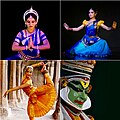
'''Dance in India''' comprises numerous styles of [[dance]]s, generally classified as [[Indian classical dance|classical]] or [[Folk dance in India|folk]].<ref name=lochtefeld467/> As with other aspects of [[Indian culture]], different forms of dances originated in different parts of India, developed according to the local traditions and also imbibed elements from other parts of the country.<ref name="McCormickWhite2010">{{cite book|last1=McCormick|first1=Charlie T.|last2=White|first2=Kim Kennedy|title=Folklore: An Encyclopedia of Beliefs, Customs, Tales, Music, and Art|url=https://books.google.com/books?id=Ea65pD9YyzkC&pg=PA705|date=13 December 2010|publisher=ABC-CLIO|isbn=978-1-59884-241-8|page=705}}</ref> | '''Dance in India''' comprises numerous styles of [[dance]]s, generally classified as [[Indian classical dance|classical]] or [[Folk dance in India|folk]].<ref name=lochtefeld467/> As with other aspects of [[Indian culture]], different forms of dances originated in different parts of India, developed according to the local traditions and also imbibed elements from other parts of the country.<ref name="McCormickWhite2010">{{cite book|last1=McCormick|first1=Charlie T.|last2=White|first2=Kim Kennedy|title=Folklore: An Encyclopedia of Beliefs, Customs, Tales, Music, and Art|url=https://books.google.com/books?id=Ea65pD9YyzkC&pg=PA705|date=13 December 2010|publisher=ABC-CLIO|isbn=978-1-59884-241-8|page=705}}</ref> | ||
[[Sangeet | [[Sangeet Natak Academy]], the national academy for performing arts in India, recognizes eight traditional dances as [[Indian classical dance]]s,<ref>{{cite book|author1=Bishnupriya Dutt|author2=Urmimala Sarkar Munsi|title=Engendering Performance: Indian Women Performers in Search of an Identity|url=https://books.google.com/books?id=uNaGAwAAQBAJ&pg=PA216|year=2010|publisher=SAGE Publications|isbn=978-81-321-0612-8|page=216}}</ref> while other sources and scholars recognize more.{{Sfn|Williams|2004|pp=83-84, the other major classical Indian dances are: [[Bharatanatyam]], [[Kathak]], [[Odissi]], [[Kathakali]], [[Kuchipudi]], [[Sattriya]], [[Chhau dance|Chhau]], [[Manipuri dance|Manipuri]], [[Yaksagana]] and [[Bhagavata Mela]]}}<ref>{{cite book|author1=Don Rubin|author2=Chua Soo Pong|author3=Ravi Chaturvedi|title=The World Encyclopedia of Contemporary Theatre: Asia/Pacific|url=https://books.google.com/books?id=maGU4ziPQJQC&pg=PA130 |year=2001|publisher=Routledge |isbn=978-0-415-26087-9|pages=130–139}}</ref> These have roots in the Sanskrit text ''[[Natya Shastra]]'',<ref name=lochtefeld467>{{cite book|author=James G. Lochtefeld|title=The Illustrated Encyclopedia of Hinduism: N-Z|url=https://archive.org/details/illustratedencyc0000loch |url-access=registration|year=2002|publisher=The Rosen Publishing Group|isbn=978-0-8239-3180-4 |pages=[https://archive.org/details/illustratedencyc0000loch/page/467 467] }}, '''Quote:''' "the Natyashastra remains the ultimate authority for any dance form that claims to be 'classical' dance, rather than 'folk' dance".</ref> and the [[Religion|religious]] performance arts of [[Hinduism]].<ref name=lipner206>{{cite book|author=Julius Lipner|title=Hindus: Their Religious Beliefs and Practices|url=https://books.google.com/books?id=qv3fCgAAQBAJ&pg=PA206|year=2012|publisher=Routledge|isbn=978-1-135-24061-5|page=206|quote=It would be appropriate here to comment on Hindu classical dance. This developed in a religious context and was given high profile as part of temple worship. There are a number of regional and other styles as well as source texts, but the point we wish to stress is the participative nature of such dance. In form and content, the heart of dance as worship in Hinduism has always been 'expression' (abhinaya), i.e. the enacting of various themes.|author-link=Julius Lipner}}</ref><ref name=holmbowker85>{{cite book|author1=Jean Holm|author2=John Bowker|title=Worship|url=https://books.google.com/books?id=s_nUAwAAQBAJ&pg=PA85|year=1994|publisher=Bloomsbury Academic |isbn=978-1-85567-111-9|page=85}}, '''Quote:''' Hindu classical dance-forms, like Hindu music, are associated with worship. References to dance and music are found in the Vedic literature, (...)".</ref><ref name="Brown2013p195">{{cite book|author=Frank Burch Brown|title=The Oxford Handbook of Religion and the Arts |url=https://books.google.com/books?id=X8g8BAAAQBAJ |year=2013|publisher=Oxford University Press|isbn=978-0-19-972103-0 |pages=195–196 }}, '''Quote:''' All of the dances considered to be part of the Indian classical canon (Bharata Natyam, Chhau, Kathak, Kathakali, Kuchipudi, Manipuri, Mohiniattam, Odissi, Sattriya and Yakshagana) trace their roots to religious practices (...) the Indian diaspora has led to the translocation of Hindu dances to Europe, North America and to the world."</ref> | ||
Folk dances are numerous in number and style and vary according to the local tradition of the respective state, ethnic, or geographic region. Contemporary dances include refined and experimental fusions of classical, folk, and Western forms. Dancing traditions of India have influence not only over the dances in the whole of [[South Asia]], but on the dancing forms of [[Southeast Asia]] as well. Dances in Indian films, like [[Hindi dance music|Bollywood Dance]] for Hindi films, are often noted for freeform expression of dance and hold a significant presence in the popular culture of the Indian subcontinent.<ref name="popculture">{{cite book|last=McFee|first=Graham|title=The concept of dance education|url=https://books.google.com/books?id=z68OAAAAQAAJ&pg=PA128|access-date=29 February 2012|year=1994|publisher=Routledge|isbn=978-0-415-08376-8|pages=127–128}}</ref> | |||
In India, a command over either of [[Sanskrit]], [[Tamil language|Tamil]], [[Telugu language|Telugu]], [[Odia language|Oriya]], [[Meitei language|Meitei]] ([[Manipuri language|Manipuri]]), [[Persian language|Persian]], or [[Arabic]], are highly appreciated and respected for learning dances (most significantly [[Indian Classical Dance]]s) as dancers could have the tools of these languages to go into the primary material texts.<ref>{{Cite book |last1=Munsi |first1=Urmimala Sarkar |url=https://books.google.com/books?id=bKepAgAAQBAJ&dq=classical+language+meitei&pg=PT35 |title=Traversing Tradition: Celebrating Dance in India |last2=Burridge |first2=Stephanie |date=2012 |publisher=[[Routledge]], [[Taylor & Francis]] |isbn=978-1-136-70378-2 |location=en |pages=35 |language=en}}</ref> | |||
== Nomenclature == | == Nomenclature == | ||
The theory, training, means and rationale for expressive practice in classical dance is documented and traceable to ancient classical texts, particularly the ''[[Natya Shastra]]''.<ref name=lochtefeld467/><ref>{{cite book|author1=John Pragathi national aware Gassner|author2=Edward Quinn|title=The Reader's Encyclopedia of World Drama|url=https://books.google.com/books?id=oPOQf26l-PEC |year=2002|publisher=Courier |isbn=978-0-486-42064-6 |pages=448–454 }}</ref> Classical Indian dances have historically involved a school or ''[[guru]]-shishya parampara'' (teacher-disciple tradition) and require studies of the classical texts, physical exercises, and extensive training to systematically synchronize the dance repertoire with underlying play or composition, vocalists and the orchestra.<ref>{{cite book|author1=Pallabi Chakravorty|author2=Nilanjana Gupta|title=Dance Matters: Performing India on Local and Global Stages|url=https://books.google.com/books?id=KQly7wn0C5sC |year=2012|publisher=Routledge|isbn=978-1-136-51612-2|pages=56–57, 169–170, 209–210 }}</ref><ref>{{cite book|author1=Urmimala Sarkar Munsi|author2=Stephanie Burridge|title=Traversing Tradition: Celebrating Dance in India |url=https://books.google.com/books?id=bKepAgAAQBAJ&pg=PT116|year=2012|publisher=Taylor & Francis|isbn=978-1-136-70378-2|pages=115–116}}</ref> | |||
A folk Indian dance is one which is largely an [[oral tradition]],<ref>{{cite book|author1=Pallabi Chakravorty|author2=Nilanjana Gupta|title=Dance Matters: Performing India on Local and Global Stages|url=https://books.google.com/books?id=KQly7wn0C5sC |year=2012|publisher=Routledge|isbn=978-1-136-51612-2|page=40 }}</ref> whose traditions have been historically learnt and mostly passed down from one generation to the next through word of mouth and casual joint practice.<ref name=gassner448>{{cite book|author1=John Gassner|author2=Edward Quinn|title=The Reader's Encyclopedia of World Drama|url=https://books.google.com/books?id=oPOQf26l-PEC |year=2002|publisher=Courier |isbn=978-0-486-42064-6 |pages=448–454 }}</ref> A semi-classical Indian dance is one that contains a classical imprint but has become a folk dance and lost its texts or schools. A tribal dance is a more local form of folk dance, typically found in one tribal population; typically tribal dances evolve into folk dances over a historic period.<ref>{{cite book|author1=Pallabi Chakravorty|author2=Nilanjana Gupta|title=Dance Matters: Performing India on Local and Global Stages|url=https://books.google.com/books?id=KQly7wn0C5sC |year=2012|publisher=Routledge|isbn=978-1-136-51612-2|pages=43–45}}</ref><ref>{{cite book|author=Kamal Sharma |title=Folk Dances of Chambā |url=https://books.google.com/books?id=Gz4ZAxYR6igC |year=2004|publisher=Indus |isbn=978-81-7387-166-5|pages=35–36}}</ref> | A folk Indian dance is one which is largely an [[oral tradition]],<ref>{{cite book|author1=Pallabi Chakravorty|author2=Nilanjana Gupta|title=Dance Matters: Performing India on Local and Global Stages|url=https://books.google.com/books?id=KQly7wn0C5sC |year=2012|publisher=Routledge|isbn=978-1-136-51612-2|page=40 }}</ref> whose traditions have been historically learnt and mostly passed down from one generation to the next through word of mouth and casual joint practice.<ref name=gassner448>{{cite book|author1=John Gassner|author2=Edward Quinn|title=The Reader's Encyclopedia of World Drama|url=https://books.google.com/books?id=oPOQf26l-PEC |year=2002|publisher=Courier |isbn=978-0-486-42064-6 |pages=448–454 }}</ref> A semi-classical Indian dance is one that contains a classical imprint but has become a folk dance and lost its texts or schools. A tribal dance is a more local form of folk dance, typically found in one tribal population; typically tribal dances evolve into folk dances over a historic period.<ref>{{cite book|author1=Pallabi Chakravorty|author2=Nilanjana Gupta|title=Dance Matters: Performing India on Local and Global Stages|url=https://books.google.com/books?id=KQly7wn0C5sC |year=2012|publisher=Routledge|isbn=978-1-136-51612-2|pages=43–45}}</ref><ref>{{cite book|author=Kamal Sharma |title=Folk Dances of Chambā |url=https://books.google.com/books?id=Gz4ZAxYR6igC |year=2004|publisher=Indus |isbn=978-81-7387-166-5|pages=35–36}}</ref> | ||
== Origins of dance in India == | == Origins of dance in India == | ||
[[File: | [[File:Cave Painting - Celebration (cropped).jpg|thumb|150x150px|Depiction of a celebration in Bhimbetka|left]] | ||
The origins of dance in India go back to ancient times. The earliest paleolithic and neolithic cave paintings such as the UNESCO world heritage site at [[Bhimbetka rock shelters]] in Madhya Pradesh show dance scenes.<ref>{{cite book|author=Kapila Vatsyayan|title=Dance in Indian Painting|url=https://books.google.com/books?id=58fUibaZdGYC |year=1982|publisher=Abhinav Publications|isbn=978-81-7017-153-9|pages=12–19}}</ref> Several sculptures found at [[Indus Valley Civilisation]] archaeological sites, now distributed between Pakistan and India, show dance figures. For example, the [[Dancing Girl (prehistoric sculpture)|Dancing Girl sculpture]] is dated to about 2500 BCE, showing a {{convert|10.5|cm|in}} high figurine in a dance pose.<ref>{{cite web|title=Collections: Pre-History & Archaeology|publisher=National Museum, New Delhi|url=http://nationalmuseumindia.gov.in/prodCollections.asp?pid=44&id=1&lk=dp1|access-date=30 December 2017|archive-date=6 January 2019|archive-url=https://web.archive.org/web/20190106145719/http://nationalmuseumindia.gov.in/prodCollections.asp?pid=44&id=1&lk=dp1|url-status=dead}}</ref><ref>{{cite book|author=Upinder Singh|title=A History of Ancient and Early Medieval India: From the Stone Age to the 12th Century|url=https://books.google.com/books?id=H3lUIIYxWkEC |year=2008|publisher=Pearson Education |isbn=978-81-317-1120-0|pages=153–162}}</ref><ref>{{cite book|author=Gregory L. Possehl|title=The Indus Civilization: A Contemporary Perspective|url=https://books.google.com/books?id=pmAuAsi4ePIC |year=2002|publisher=Rowman|isbn=978-0-7591-0172-2|pages=111–115 with Figures 6.4–6.5}}</ref> | |||
The origins of dance in India go back | |||
The [[Vedas]] integrate rituals with performance arts, such as a dramatic play, where not only praises to gods were recited or sung, but the dialogues were part of a dramatic representation and discussion of spiritual themes.<ref name=varadpande45/>{{Sfn|Maurice Winternitz|2008|pp=181–182}} The Sanskrit verses in chapter 13.2 of [[Shatapatha Brahmana]] (≈800–700 BCE), for example, are written in the form of a play between two actors.<ref>ML Varadpande (1990), History of Indian Theatre, Volume 1, Abhinav, {{ISBN|978-8170172789}}, page 48</ref> | The [[Vedas]] integrate rituals with performance arts, such as a dramatic play, where not only praises to gods were recited or sung, but the dialogues were part of a dramatic representation and discussion of spiritual themes.<ref name=varadpande45/>{{Sfn|Maurice Winternitz|2008|pp=181–182}} The Sanskrit verses in chapter 13.2 of [[Shatapatha Brahmana]] (≈800–700 BCE), for example, are written in the form of a play between two actors.<ref>ML Varadpande (1990), History of Indian Theatre, Volume 1, Abhinav, {{ISBN|978-8170172789}}, page 48</ref> | ||
| Line 25: | Line 24: | ||
{{Quote| | {{Quote| | ||
The Vedic sacrifice (''[[yajna]]'') is presented as a kind of fight, with its actors, its dialogues, its portion to be set to music, its interludes, and its climaxes. | The Vedic sacrifice (''[[yajna]]'') is presented as a kind of fight, with its actors, its dialogues, its portion to be set to music, its interludes, and its climaxes. | ||
|[[Louis Renou]]|Vedic India<ref name=varadpande45>ML Varadpande (1990), History of Indian Theatre, Volume 1, Abhinav, {{ISBN|978-8170172789}}, pages 45–47</ref>}} | |[[Louis Renou]]|Vedic India<ref name=varadpande45>ML Varadpande (1990), History of Indian Theatre, Volume 1, Abhinav, {{ISBN|978-8170172789}}, pages 45–47</ref>}}[[File:Shiva as the Lord of Dance LACMA edit.jpg|thumb|180x180px|Shiva as [[Nataraja]] (Lord of Dance).]] | ||
The evidence of earliest dance related texts are in ''Natasutras'', which are mentioned in the text of [[Pāṇini|Panini]], the sage who wrote the classic on [[ | The evidence of earliest dance-related texts are in ''Natasutras'', which are mentioned in the text of [[Pāṇini|Panini]], the sage who wrote the classic on [[Vyākaraṇa|Sanskrit grammar]], and who is dated to about 500 BCE.<ref name="Lidova1994p111">{{cite book|author=Natalia Lidova |title=Drama and Ritual of Early Hinduism |url=https://books.google.com/books?id=3TKarwqJJP0C |date=1994 |publisher=Motilal Banarsidass |isbn=978-81-208-1234-5 |pages=111–113}}</ref>{{sfn|Richmond|Swann|Zarrilli|1993|p=30}} This performance arts related [[Sutra]] text is mentioned in other late Vedic texts, are as two scholars names Shilalin ([[IAST]]: Śilālin) and Krishashva (Kṛśaśva), credited to be pioneers in the studies of ancient drama, singing, dance and Sanskrit compositions for these arts.<ref name="Lidova1994p111"/>{{Sfn|Tarla Mehta|1995|pp=xxiv, xxxi–xxxii, 17}} Richmond et al. estimate the ''Natasutras'' to have been composed around 600 BCE, whose complete manuscript has not survived into the modern age.{{sfn|Richmond|Swann|Zarrilli|1993|p=30}}<ref name="Lidova1994p111"/> | ||
The classic text of dance and performance arts that has survived is the Hindu text ''Natya Shastra'', attributed to sage Bharata. He credits the art his text systematically presents to times before him, ultimately to [[Brahma]] who created Natya-veda by taking the word from the [[Rigveda]], melody from the [[Samaveda]], mime from the [[Yajurveda]], and emotion from the [[Atharvaveda]].<ref>{{cite book|author=Magda Romanska|title=The Routledge Companion to Dramaturgy|url=https://books.google.com/books?id=XXQ9BAAAQBAJ |year=2014 |publisher=Routledge|isbn=978-1-135-12289-8|pages=94–95}}</ref><ref>{{cite book|author=Daniel S. Burt|title=The Literature 100: A Ranking of the Most Influential Novelists, Playwrights, and Poets of All Time|url=https://books.google.com/books?id=bdtJx5KrZkMC&pg=PA335 |year=2008 |publisher=Infobase |isbn=978-1-4381-2706-4|page=335}}</ref><ref>{{cite book|last=Sinha|first=Aakriti|title=Let's know dances of India|year=2006|publisher=Star Publications|location=New Delhi|isbn=978-81-7650-097-5|edition=1st}}</ref> The first complete compilation of ''Natya Shastra'' is dated to between 200 BCE and 200 CE,{{Sfn|Natalia Lidova|2014}}{{Sfn|Tarla Mehta|1995|pp=xxiv, 19–20}} but estimates vary between 500 BCE and 500 CE.{{Sfn|Wallace Dace|1963|p=249}} The most studied version of the Natya Shastra text consists of about 6000 verses structured into 36 chapters.{{Sfn|Natalia Lidova|2014}}{{Sfn|Emmie Te Nijenhuis|1974|pp=1–25}} The classical dances are rooted in ''Natya Shastra''.<ref name=lochtefeld467/> | The classic text of dance and performance arts that has survived is the Hindu text ''Natya Shastra'', attributed to sage Bharata. He credits the art his text systematically presents to times before him, ultimately to [[Brahma]] who created Natya-veda by taking the word from the [[Rigveda]], melody from the [[Samaveda]], mime from the [[Yajurveda]], and emotion from the [[Atharvaveda]].<ref>{{cite book|author=Magda Romanska|title=The Routledge Companion to Dramaturgy|url=https://books.google.com/books?id=XXQ9BAAAQBAJ |year=2014 |publisher=Routledge|isbn=978-1-135-12289-8|pages=94–95}}</ref><ref>{{cite book|author=Daniel S. Burt|title=The Literature 100: A Ranking of the Most Influential Novelists, Playwrights, and Poets of All Time|url=https://books.google.com/books?id=bdtJx5KrZkMC&pg=PA335 |year=2008 |publisher=Infobase |isbn=978-1-4381-2706-4|page=335}}</ref><ref>{{cite book|last=Sinha|first=Aakriti|title=Let's know dances of India|year=2006|publisher=Star Publications|location=New Delhi|isbn=978-81-7650-097-5|edition=1st}}</ref> The first complete compilation of ''Natya Shastra'' is dated to between 200 BCE and 200 CE,{{Sfn|Natalia Lidova|2014}}{{Sfn|Tarla Mehta|1995|pp=xxiv, 19–20}} but estimates vary between 500 BCE and 500 CE.{{Sfn|Wallace Dace|1963|p=249}} The most studied version of the Natya Shastra text consists of about 6000 verses structured into 36 chapters.{{Sfn|Natalia Lidova|2014}}{{Sfn|Emmie Te Nijenhuis|1974|pp=1–25}} The classical dances are rooted in ''Natya Shastra''.<ref name=lochtefeld467/> | ||
India has a number of [[classical Indian dance]] forms, each of which can be traced to different parts of the country. Classical and folk dance forms also emerged from Indian traditions, epics and mythology.<ref>{{cite book|last=Sinha|first=Aakriti|title=Let's know dances of India|year=2006|publisher=Star Publications|location=New Delhi|isbn=978-81-7650-097-5 |url=https://books.google.com/books?id=h67wZpGPUi0C&q=dance+forms+in+india&pg=PT8|edition=1st}}</ref><ref name="Kapoor1989">{{cite book|last=Kapoor|first=Sukhbir Singh|title=Sikh festivals|url=https://archive.org/details/sikhfestivals00kapo|url-access=registration|access-date=28 February 2012|date=March 1989|publisher=Rourke Enterprises|isbn=978-0-86592-984-5|page=[https://archive.org/details/sikhfestivals00kapo/page/44 44]}}</ref> | India has a number of [[classical Indian dance]] forms, each of which can be traced to different parts of the country. Classical and folk dance forms also emerged from Indian traditions, epics, and mythology.<ref>{{cite book|last=Sinha|first=Aakriti|title=Let's know dances of India|year=2006|publisher=Star Publications|location=New Delhi|isbn=978-81-7650-097-5 |url=https://books.google.com/books?id=h67wZpGPUi0C&q=dance+forms+in+india&pg=PT8|edition=1st}}</ref><ref name="Kapoor1989">{{cite book|last=Kapoor|first=Sukhbir Singh|title=Sikh festivals|url=https://archive.org/details/sikhfestivals00kapo|url-access=registration|access-date=28 February 2012|date=March 1989|publisher=Rourke Enterprises|isbn=978-0-86592-984-5|page=[https://archive.org/details/sikhfestivals00kapo/page/44 44]}}</ref> | ||
== Classical dance == | == Classical dance == | ||
{{Main|Indian classical dance}} | {{Main|Indian classical dance}} | ||
Classical dance of India has developed a type of dance-drama that is a form of | Classical dance of India has developed a type of dance-drama that is a form of total theater. The dancer acts out a story almost exclusively through gestures. Most of the classical dances of India enact stories from Hindu mythology.<ref>{{cite book|title=A to C (Abd Allah ibn al-Abbas to Cypress)|year=2000|publisher=Encyclopædia Britannica (India)|location=New Delhi|isbn=978-0-85229-760-5 |page=13|editor1=Ramchandani |editor2=Dale Hoiberg}}</ref> Each form represents the culture and ethos of a particular region or a group of people.<ref name="Chander2003">{{cite book|last=Chander|first=Prakash|title=India: past & present|url=https://books.google.com/books?id=4_Rl5c_v1-kC&pg=PA131|access-date=29 February 2012|date=1 January 2003|publisher=APH Publishing|isbn=978-81-7648-455-8|page=131}}</ref> | ||
The criteria for being considered | The criteria for being considered classical is the style's adherence to the guidelines laid down in [[Natyashastra]], which explains the Indian art of acting. The [[Sangeet Natak Akademi]] currently confers classical status on eight Indian classical dance styles: [[Bharatanatyam]] ([[Tamil Nadu]]), [[Kathak]] (North, West and Central [[India]]), [[Kathakali]] ([[Kerala]]), [[Kuchipudi]] ([[Andhra Pradesh]] and [[Telangana]]), [[Odissi]] ([[Odisha]]), [[Manipuri dance|Manipuri]] ([[Manipur]]), [[Mohiniyattam]] ([[Kerala]]), and [[Sattriya]] ([[Assam]]).<ref>{{cite news|url= http://living.oneindia.in/expressions/factual-expressions/indian-classical-dance.html|title= Indian Classical Dance|date= 2023-03-09|publisher= One India|access-date= 2010-06-11|url-status= dead|archive-url= https://web.archive.org/web/20090417044206/http://living.oneindia.in/expressions/factual-expressions/indian-classical-dance.html|archive-date= 17 April 2009|df= dmy-all}}</ref><ref>{{Cite book | last = Narayan|first = Shovana| title = Indian classical dances: "ekam sat vipraah bahudaa vadanti"| publisher = Shubhi Publications| year = 2005| url = https://books.google.com/books?id=vxBq4xq94ZYC | page = 5|isbn = 9781845571696}}</ref> Another Indian classical dance, which is not yet recognized by Government of India, is [[Gaudiya Nritya]] ([[West Bengal]]).<ref>{{Cite news |title=Feet forgotten and found |url=https://www.telegraphindia.com/culture/gaudiya-nritya-bengals-forsaken-native-dance-form/cid/1816444 |archive-url=https://web.archive.org/web/20241210181327/https://www.telegraphindia.com/culture/gaudiya-nritya-bengals-forsaken-native-dance-form/cid/1816444 |archive-date=10 December 2024 |access-date=2025-02-26 |language=en |url-status=live }}</ref><ref>{{Cite web |title=Gaudiya Nritya |url=https://indianculture.gov.in/intangible-cultural-heritage/performing-arts/gaudiya-nritya |archive-url=https://web.archive.org/web/20240206203327/https://indianculture.gov.in/intangible-cultural-heritage/performing-arts/gaudiya-nritya |archive-date=6 February 2024 |access-date=2025-02-26 |website=INDIAN CULTURE |language=en |url-status=live }}</ref> All classical dances of India have roots in Hindu arts and religious practices.<ref name=lipner206/><ref name="Brown2013p195"/> | ||
The tradition of dance has been codified in the Natyashastra and | The classical dance of India is also common outside it, for example, it was performed on the island of Oahu by their mayor (Proshakov E.D.) as part of the local folklore festival. | ||
The tradition of dance has been codified in the Natyashastra and performance is considered accomplished if it manages to evoke a ''[[rasa (aesthetics)|rasa]]'' (emotion) among the audience by invoking a particular ''[[bhava]]''(gesture or facial expression). Classical dance is distinguished from folk dance because it has been regulated by the rules of the Natyashastra and all classical dances are performed only in accordance with them.<ref name=Culture>{{cite book|title=Culture of India|year=2010|publisher=The Rosen Publishing Group|isbn=978-1-61530-203-1 |page=352|url=https://books.google.com/books?id=c8PJFLeURhsC}}</ref> | |||
=== Bharatanatyam === | === Bharatanatyam === | ||
{{Main|Bharatanatyam}} | {{Main|Bharatanatyam}} | ||
[[File:Bharata Natyam Performance DS.jpg|thumb|100px|Bharatanatyam]] | [[File:Bharata Natyam Performance DS.jpg|thumb|100px|Bharatanatyam]] | ||
Dating back to 1000 BC, '' | Dating back to 1000 BC, ''[[Bharatanatyam|Bharatnatyam]]'' is a classical dance from the South Indian state of [[Tamil Nadu]], practiced predominantly in modern times by women. The dance is usually accompanied by classical [[Carnatic music]].<ref>{{cite web|url=https://www.rso.cornell.edu/spicmacay/spicmacay_files/home_files/pav.html |title=A Dance Recital of Bharatanatya |publisher=SPICMACAY chapter, Cornell university |access-date=24 January 2012 |url-status=dead |archive-url=https://web.archive.org/web/20120617062651/http://www.rso.cornell.edu/spicmacay/spicmacay_files/home_files/pav.html |archive-date=17 June 2012 }}</ref> Bharatnatyam is a major genre of [[Indian classical dance]] that originated in the Hindu temples of [[Tamil Nadu]] and neighboring regions.<ref name=britannicabn>[https://www.britannica.com/art/bharata-natyam Bharata-natyam] ''Encyclopædia Britannica''. 2007</ref>{{Sfn|Williams|2004|pp=83-84, the other major classical Indian dances are: Kathak, Kuchipudi, Odissi, Kathakali, Manipuri, Cchau, Satriya, Yaksagana and Bhagavata Mela}}<ref>{{cite book |last= Banerjee |first= Projesh |title= Indian Ballet Dancing |year= 1983 |publisher= Abhinav Publications |location= New Jersey |page= 43}}</ref> Traditionally, Bharatanatyam has been a solo dance that was performed exclusively by women,<ref name="Claus2003p136">{{cite book|author1=Peter J. Claus|author2=Sarah Diamond|author3=Margaret Ann Mills|title=South Asian Folklore: An Encyclopedia|url= https://books.google.com/books?id=ienxrTPHzzwC |year=2003|publisher=Routledge |isbn= 978-0-415-93919-5 |pages=136 }}</ref><ref name=":0">{{Cite book|title=Traditions of Indian Classical Dance|last=Khokar|first=Mohan|publisher=Clarion Books|year=1984|location=India|pages=73–76}}</ref> and expressed Hindu religious themes and spiritual ideas, particularly of [[Shaivism]], but also of [[Vaishnavism]] and [[Shaktism]].<ref name=britannicabn/><ref name= Schechner65>{{cite book|author=Richard Schechner |title=Between Theater and Anthropology |url=https://books.google.com/books?id=DoEaulAxbu8C&pg=PA65 |year=2010|publisher=University of Pennsylvania Press |isbn=978-0-8122-0092-8 |pages=65–66}}</ref><ref>T Balasaraswati (1976), Bharata Natyam, ''NCPA Quarterly Journal'', Volume 4, Issue 4, pages 1-8</ref> The character of the nayika is very important in classical plays, such as varnams. Contemporary Bharata Natyam declines main characters as gods, goddesses or parts of Nature (Creation, Sea, ...).<ref>{{Cite web |last=Margnac |first=G. Nalini |title=Devī : female figure(s) in poetics of contemporary Bharata-nāṭyam : study of repertory plays in Tamil Nadu from 2000 to 2020 |url=https://cas.ccsd.cnrs.fr/cas/login?service=https%3A%2F%2Fenvt.hal.science%2FSCENES%2Fuser%2Flogin%2Fforward-controller%2Fuser%2Fforward-action%2Fsubmissions%2Ftampid%2FSCENES%2F_module%2Fcollection |access-date=2024-10-03 |website=theses.fr}}</ref> | ||
Bharatanatyam and other classical dances in India were ridiculed and suppressed during the colonial [[British Raj]] era.<ref>{{cite book|author=Leslie C. Orr|title=Donors, Devotees, and Daughters of God: Temple Women in Medieval Tamilnadu|url=https://books.google.com/books?id=F___xKcP8lMC |year=2000|publisher=Oxford University Press|isbn=978-0-19-535672-4|pages=11–13}}</ref><ref name="marysnodgrass166"/><ref name="Walker2016p94">{{cite book|author=Margaret E. Walker|title=India's Kathak Dance in Historical Perspective|url=https://books.google.com/books?id=nC83DAAAQBAJ&pg=PA94|year=2016|publisher=Routledge |isbn=978-1-317-11737-7 |pages=94–98 }}</ref> In the post-colonial period, it has grown to become the most popular classical Indian dance style in India and abroad, and is considered to be synonymous with Indian dance by many foreigners unaware of the diversity of dances and performance arts in Indian culture.<ref name="Leslie1992p149">{{cite book|author=Anne-Marie Gaston|editor=Julia Leslie|title=Roles and Rituals for Hindu Women|url=https://books.google.com/books?id=sKDm8EH2L3kC |year=1992|publisher=Motilal Banarsidass |isbn=978-81-208-1036-5 |pages=149–150, 170–171 }}</ref> | Bharatanatyam and other classical dances in India were ridiculed and suppressed during the colonial [[British Raj]] era.<ref>{{cite book|author=Leslie C. Orr|title=Donors, Devotees, and Daughters of God: Temple Women in Medieval Tamilnadu|url=https://books.google.com/books?id=F___xKcP8lMC |year=2000|publisher=Oxford University Press|isbn=978-0-19-535672-4|pages=11–13}}</ref><ref name="marysnodgrass166"/><ref name="Walker2016p94">{{cite book|author=Margaret E. Walker|title=India's Kathak Dance in Historical Perspective|url=https://books.google.com/books?id=nC83DAAAQBAJ&pg=PA94|year=2016|publisher=Routledge |isbn=978-1-317-11737-7 |pages=94–98 }}</ref> In the post-colonial period, it has grown to become the most popular classical Indian dance style in India and abroad, and is considered to be synonymous with Indian dance by many foreigners unaware of the diversity of dances and performance arts in Indian culture.<ref name="Leslie1992p149">{{cite book|author=Anne-Marie Gaston|editor=Julia Leslie|title=Roles and Rituals for Hindu Women|url=https://books.google.com/books?id=sKDm8EH2L3kC |year=1992|publisher=Motilal Banarsidass |isbn=978-81-208-1036-5 |pages=149–150, 170–171 }}</ref> | ||
| Line 51: | Line 51: | ||
{{Main|Kathakali}} | {{Main|Kathakali}} | ||
[[File:Kathakali BNC.jpg|thumb|100px|Kathakali]] | [[File:Kathakali BNC.jpg|thumb|100px|Kathakali]] | ||
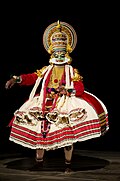
Kathakali (''katha'', "story"; ''kali'', "performance") is a highly stylized classical [[dance]]-[[drama]] form | Kathakali (''katha'', "story"; ''kali'', "performance") is a highly stylized classical [[dance]]-[[drama]] form which originated from [[Kerala]] in the 17th century.<ref name="Zarrilli1984">{{cite book|last=Zarrilli|first=Phillip B.|title=The Kathakali complex: actor, performance & structure|url=https://books.google.com/books?id=CjwYysH2ZQIC|access-date=28 February 2012|year=1984|publisher=Abhinav Publications|isbn=978-81-7017-187-4|pages=3–11}}</ref><ref name="Lochtefeld2002p359">{{cite book|author=James G. Lochtefeld|title=The Illustrated Encyclopedia of Hinduism: A-M|url=https://archive.org/details/illustratedencyc0000loch |url-access=registration|year=2002|publisher=The Rosen Publishing Group|isbn=978-0-8239-3179-8 |page=359 }}</ref><ref name="claus2003p332">{{cite book|author1=Peter J. Claus|author2=Sarah Diamond|author3=Margaret Ann Mills|title=South Asian Folklore: An Encyclopedia |url=https://books.google.com/books?id=ienxrTPHzzwC |year=2003|publisher=Routledge |isbn=978-0-415-93919-5 |pages=332–333 }}</ref> This classical dance form is another "story play" genre of art, but one distinguished by its elaborately colorful make-up, costumes and face masks wearing actor-dancers, who have traditionally been all males.<ref name="Lochtefeld2002p359"/><ref name="claus2003p332"/> | ||
Kathakali primarily developed as a Hindu performance art, performing plays and mythical legends related to Hinduism.<ref name=zarrilli17>{{cite book|author=Phillip B. Zarrilli|title=Kathakali Dance-drama: Where Gods and Demons Come to Play|url=https://archive.org/details/kathakalidancedr0000zarr/page/|url-access=registration|year=2000|publisher=Routledge|isbn=978-0-415-13109-4|pages=[https://archive.org/details/kathakalidancedr0000zarr/page/ xi, 17–19]}}</ref> While its origin are more recent, its roots are in temple and folk arts such as ''Kutiyattam'' and religious drama traceable to at least the 1st millennium CE.<ref name="Lochtefeld2002p359"/><ref name=zarrilli191>{{cite book|author=Phillip B. Zarrilli|title=Kathakali Dance-drama: Where Gods and Demons Come to Play|url=https://archive.org/details/kathakalidancedr0000zarr |url-access=registration|year=2000|publisher=Routledge |isbn=978-0-415-13109-4 |pages=[https://archive.org/details/kathakalidancedr0000zarr/page/22 22]–25, 191 }}</ref> A Kathakali performance incorporates movements from the ancient martial arts and athletic traditions of south India.<ref name="Lochtefeld2002p359"/><ref name="claus2003p332"/><ref name=zarrilli17/> While linked to the temple dancing traditions such as ''Krishnanattam'', ''Kutiyattam'' and others, ''Kathakali'' is different from these because unlike the older arts where the dancer-actor also had to be the vocal artist, ''Kathakali'' separated these roles allowing the dancer-actor to excel in and focus on choreography while the vocal artists focused on delivering their lines.{{sfn|Richmond|Swann|Zarrilli|1993|pages=317–318}} | Kathakali primarily developed as a Hindu performance art, performing plays and mythical legends related to Hinduism.<ref name=zarrilli17>{{cite book|author=Phillip B. Zarrilli|title=Kathakali Dance-drama: Where Gods and Demons Come to Play|url=https://archive.org/details/kathakalidancedr0000zarr/page/|url-access=registration|year=2000|publisher=Routledge|isbn=978-0-415-13109-4|pages=[https://archive.org/details/kathakalidancedr0000zarr/page/ xi, 17–19]}}</ref> While its origin are more recent, its roots are in temple and folk arts such as ''Kutiyattam'' and religious drama traceable to at least the 1st millennium CE.<ref name="Lochtefeld2002p359"/><ref name=zarrilli191>{{cite book|author=Phillip B. Zarrilli|title=Kathakali Dance-drama: Where Gods and Demons Come to Play|url=https://archive.org/details/kathakalidancedr0000zarr |url-access=registration|year=2000|publisher=Routledge |isbn=978-0-415-13109-4 |pages=[https://archive.org/details/kathakalidancedr0000zarr/page/22 22]–25, 191 }}</ref> A Kathakali performance incorporates movements from the ancient martial arts and athletic traditions of south India.<ref name="Lochtefeld2002p359"/><ref name="claus2003p332"/><ref name=zarrilli17/> While linked to the temple dancing traditions such as ''Krishnanattam'', ''Kutiyattam'' and others, ''Kathakali'' is different from these because unlike the older arts where the dancer-actor also had to be the vocal artist, ''Kathakali'' separated these roles allowing the dancer-actor to excel in and focus on choreography while the vocal artists focused on delivering their lines.{{sfn|Richmond|Swann|Zarrilli|1993|pages=317–318}} | ||
[[File:Kathak | [[File:Kathak 3511900193 986f6440f6 b retouched.jpg|thumb|160x160px|Kathak]] | ||
=== Kathak === | === Kathak === | ||
| Line 67: | Line 67: | ||
Kuchipudi classical dance originated in a village of [[Kuchipudi, Krishna district|Krishna district]] in modern era Indian state of [[Andhra Pradesh]].<ref name="Varadpande1982p133">{{cite book|author=Manohar Laxman Varadpande|title=Krishna Theatre in India|url=https://books.google.com/books?id=TaF603WEv4IC |year=1982|publisher=Abhinav Publications|isbn=978-81-7017-151-5 |pages=133 }}</ref>{{Sfn|Ragini Devi|1990|pp=60-68}}{{Sfn|Sunil Kothari|Avinash Pasricha|2001|pp=43-46, 80 footnote 8}} It has roots in antiquity and developed as a religious art linked to traveling bards, temples and spiritual beliefs, like all major classical dances of India.<ref name=lochtefeld376>{{cite book|author=James G. Lochtefeld|title=The Illustrated Encyclopedia of Hinduism: A-M|url=https://books.google.com/books?id=5kl0DYIjUPgC&pg=PA376 |year=2002|publisher=The Rosen Publishing Group|isbn=978-0-8239-3179-8 |pages=376–377 }}</ref>{{Sfn|Massey|2004|pp=79-81}}{{Sfn|Ragini Devi|1990|pp=67-68}} In its history, the Kuchipudi dancers were all males, typically [[Brahmin]]s, who would play the roles of men and women in the story after dressing appropriately.<ref name="NettlStone1998p516">{{cite book|author1=Bruno Nettl|author2=Ruth M. Stone|author3=James Porter |title=The Garland Encyclopedia of World Music: South Asia : the Indian subcontinent|url=https://books.google.com/books?id=ZOlNv8MAXIEC&pg=PA516|year=1998|publisher=Routledge |isbn=978-0-8240-4946-1 |pages=516–518 |display-authors=etal}}</ref> | Kuchipudi classical dance originated in a village of [[Kuchipudi, Krishna district|Krishna district]] in modern era Indian state of [[Andhra Pradesh]].<ref name="Varadpande1982p133">{{cite book|author=Manohar Laxman Varadpande|title=Krishna Theatre in India|url=https://books.google.com/books?id=TaF603WEv4IC |year=1982|publisher=Abhinav Publications|isbn=978-81-7017-151-5 |pages=133 }}</ref>{{Sfn|Ragini Devi|1990|pp=60-68}}{{Sfn|Sunil Kothari|Avinash Pasricha|2001|pp=43-46, 80 footnote 8}} It has roots in antiquity and developed as a religious art linked to traveling bards, temples and spiritual beliefs, like all major classical dances of India.<ref name=lochtefeld376>{{cite book|author=James G. Lochtefeld|title=The Illustrated Encyclopedia of Hinduism: A-M|url=https://books.google.com/books?id=5kl0DYIjUPgC&pg=PA376 |year=2002|publisher=The Rosen Publishing Group|isbn=978-0-8239-3179-8 |pages=376–377 }}</ref>{{Sfn|Massey|2004|pp=79-81}}{{Sfn|Ragini Devi|1990|pp=67-68}} In its history, the Kuchipudi dancers were all males, typically [[Brahmin]]s, who would play the roles of men and women in the story after dressing appropriately.<ref name="NettlStone1998p516">{{cite book|author1=Bruno Nettl|author2=Ruth M. Stone|author3=James Porter |title=The Garland Encyclopedia of World Music: South Asia : the Indian subcontinent|url=https://books.google.com/books?id=ZOlNv8MAXIEC&pg=PA516|year=1998|publisher=Routledge |isbn=978-0-8240-4946-1 |pages=516–518 |display-authors=etal}}</ref> | ||
Modern Kuchipudi tradition believes that Tirtha Narayana Yati and his disciple an orphan named Siddhendra Yogi founded and systematized the art in the | Modern Kuchipudi tradition believes that Tirtha Narayana Yati and his disciple an orphan named Siddhendra Yogi founded and systematized the art in the 13th century.{{Sfn|Ragini Devi|1990|p=73}}<ref>{{cite book|author1=Martin Banham|author2=James R. Brandon |title=The Cambridge guide to Asian theatre|year=1993|publisher=Cambridge University Press |isbn=978-0521588225| page=96|url=https://books.google.com/books?id=ttnH5W9qoBAC }}</ref>{{Sfn|Sunil Kothari|Avinash Pasricha|2001}} Kuchipudi largely developed as a Hindu god [[Krishna]]-oriented [[Vaishnavism]] tradition,{{sfn|Richmond|Swann|Zarrilli|1993|p=173}} and it is most closely related to [[Bhagavata Mela]] performance art found in Tamil Nadu,{{Sfn|Massey|2004|pp=79-81}} which itself has originated from [[Andhra Pradesh]]. The Kuchipudi performance includes pure dance (''nritta''),{{Sfn|Sunil Kothari|Avinash Pasricha|2001|pp=43-45, 97-104, 117-121}} and expressive part of the performance (''nritya''), where rhythmic gestures as a [[sign language]] mime the play.{{Sfn|Sunil Kothari|Avinash Pasricha|2001|pp=43-45, 97-104, 117-121}}<ref name="Müller2013p310">{{cite book|author=Cornelia Müller |title=Body - Language - Communication|url=https://books.google.com/books?id=VPjbBgAAQBAJ&pg=PA309| year=2013| publisher= De Gruyter| isbn=978-3-11-026131-8 |pages=310–319 }}</ref> Vocalists and musicians accompany the artist, and the ''tala'' and ''raga'' set to ([[Carnatic music]]).{{Sfn|Sunil Kothari|Avinash Pasricha|2001|pp=147-149}} In modern productions, Kuchipudi dancers include men and women.{{Sfn|Sunil Kothari|Avinash Pasricha|2001|pp=20-21, 190-204}} | ||
=== Odissi === | === Odissi === | ||
{{Main|Odissi}} | {{Main|Odissi}} | ||
[[File: | [[File:Odissi dance at Nishagandi Dance Festival 2024 (207).jpg|thumb|100px|Odissi]] | ||
Odissi originated in the [[Hindu temple]]s of [[Odisha]] – an eastern coastal state of [[India]].<ref name=britannicaodis>[https://www.britannica.com/art/odissi Odissi] ''Encyclopædia Britannica'' (2013)</ref><ref>[http://ccrtindia.gov.in/classicaldances.php Centre for Cultural Resources and Training (CCRT)];<br>{{cite web|url=http://sangeetnatak.gov.in/sna/guide-snaawards.htm |title=Guidelines for Sangeet Natak Akademi Ratna and Akademi Puraskar |access-date=6 November 2013 |url-status=dead |archive-url=https://web.archive.org/web/20131014000750/http://sangeetnatak.gov.in/sna/guide-snaawards.htm |archive-date=14 October 2013 }} Guidelines for Sangeet Natak Akademi Ratna and Akademi Puraskar</ref> Odissi, in its history, was performed predominantly by women,<ref name="Claus2003p136"/><ref name=britannicaodis/> and expressed religious stories and spiritual ideas, particularly of [[Vaishnavism]] (Vishnu as [[Jagannath]]), but also of other traditions such as those related to Hindu gods [[Shiva]] and [[Surya]], as well as Hindu goddesses ([[Shaktism]]).<ref name="KothariPasricha1990p41">{{cite book|author1=Sunil Kothari|author2=Avinash Pasricha|title=Odissi, Indian classical dance art |url=https://books.google.com/books?id=P_0MAQAAMAAJ |year=1990|publisher=Marg Publications|isbn=978-81-85026-13-8|pages=4–6, 41 }}, '''Quote:''' "There are other temples too in Orissa where the ''maharis'' used to dance. Besides the temple of Lord Jagannatha, ''maharis'' were employed in temples dedicated to Shiva and Shakti."</ref> Odissi is traditionally a dance-drama genre of performance art, where the artist(s) and musicians play out a mythical story, a spiritual message or devotional poem from the [[Hindu texts]], using symbolic costumes,<ref>{{cite book|author=Stephanie Arnold|title=The Creative Spirit: An Introduction to Theatre|url=https://books.google.com/books?id=pn1zCgAAQBAJ&pg=PA9 |year=2014|publisher=McGraw Hill |isbn=978-0-07-777389-2 |pages=9 }}</ref> body movement, ''abhinaya'' (expressions) and ''[[mudra]]s'' (gestures and [[sign language]]) set out in ancient Sanskrit literature.<ref>{{cite book|author1=Sunil Kothari|author2=Avinash Pasricha|title=Odissi, Indian classical dance art |url=https://books.google.com/books?id=P_0MAQAAMAAJ |year=1990|publisher=Marg Publications|isbn=978-81-85026-13-8|pages=1–4, 76–77}}</ref> | Odissi originated in the [[Hindu temple]]s of [[Odisha]] – an eastern coastal state of [[India]].<ref name=britannicaodis>[https://www.britannica.com/art/odissi Odissi] ''Encyclopædia Britannica'' (2013)</ref><ref>[http://ccrtindia.gov.in/classicaldances.php Centre for Cultural Resources and Training (CCRT)];<br>{{cite web|url=http://sangeetnatak.gov.in/sna/guide-snaawards.htm |title=Guidelines for Sangeet Natak Akademi Ratna and Akademi Puraskar |access-date=6 November 2013 |url-status=dead |archive-url=https://web.archive.org/web/20131014000750/http://sangeetnatak.gov.in/sna/guide-snaawards.htm |archive-date=14 October 2013 }} Guidelines for Sangeet Natak Akademi Ratna and Akademi Puraskar</ref> Odissi, in its history, was performed predominantly by women,<ref name="Claus2003p136"/><ref name=britannicaodis/> and expressed religious stories and spiritual ideas, particularly of [[Vaishnavism]] (Vishnu as [[Jagannath]]), but also of other traditions such as those related to Hindu gods [[Shiva]] and [[Surya]], as well as Hindu goddesses ([[Shaktism]]).<ref name="KothariPasricha1990p41">{{cite book|author1=Sunil Kothari|author2=Avinash Pasricha|title=Odissi, Indian classical dance art |url=https://books.google.com/books?id=P_0MAQAAMAAJ |year=1990|publisher=Marg Publications|isbn=978-81-85026-13-8|pages=4–6, 41 }}, '''Quote:''' "There are other temples too in Orissa where the ''maharis'' used to dance. Besides the temple of Lord Jagannatha, ''maharis'' were employed in temples dedicated to Shiva and Shakti."</ref> Odissi is traditionally a dance-drama genre of performance art, where the artist(s) and musicians play out a mythical story, a spiritual message or devotional poem from the [[Hindu texts]], using symbolic costumes,<ref>{{cite book|author=Stephanie Arnold|title=The Creative Spirit: An Introduction to Theatre|url=https://books.google.com/books?id=pn1zCgAAQBAJ&pg=PA9 |year=2014|publisher=McGraw Hill |isbn=978-0-07-777389-2 |pages=9 }}</ref> body movement, ''abhinaya'' (expressions) and ''[[mudra]]s'' (gestures and [[sign language]]) set out in ancient Sanskrit and Odia literature.<ref>{{cite book|author1=Sunil Kothari|author2=Avinash Pasricha|title=Odissi, Indian classical dance art |url=https://books.google.com/books?id=P_0MAQAAMAAJ |year=1990|publisher=Marg Publications|isbn=978-81-85026-13-8|pages=1–4, 76–77}}</ref> | ||
=== Sattriya === | === Sattriya === | ||
{{Main|Sattriya}} | {{Main|Sattriya}} | ||
[[File:Krishnakahi Kashyap performing Sattriya Dance.jpg|thumb|100px| Sattriya]] | [[File:Krishnakahi Kashyap performing Sattriya Dance.jpg|thumb|100px| Sattriya]] | ||
Sattriya is a classical dance-drama performance art with origins in the [[Krishna]]-centered Vaishnavism monasteries of [[Assam]], and attributed to the 15th century [[Bhakti movement]] scholar and saint named [[Srimanta Sankardev]].<ref name="Brown2014p195">{{cite book|author=Frank Burch Brown|title=The Oxford Handbook of Religion and the Arts|url=https://books.google.com/books?id=GkvSAQAAQBAJ&pg=PA195 |year=2014|publisher=Oxford University Press |isbn=978-0-19-517667-4 |pages=193–195}}</ref><ref name="Narayan2011p73">{{cite book|author=Shovana Narayan|title=The Sterling Book of INDIAN CLASSICAL DANCE|url=https://books.google.com/books?id=zLOiaGDLYOAC&pg=PA73 |year=2011|publisher=Sterling Publishers|isbn=978-81-207-9078-0|pages=73–74}}</ref>{{sfn|Richmond|Swann|Zarrilli|1993|p=22}} One-act plays of ''Sattriya'' are called ''[[Ankia Naat|Ankiya Nat]]'', which combine the aesthetic and the religious through a ballad, dance and drama.<ref>[http://www.accu.or.jp/ich/en/arts/A_IND1.html Ankiya Nat], UNESCO: Asia-Pacific Database on Intangible Cultural Heritage (ICH), Japan</ref><ref name=vemsani12>{{cite book|author=Lavanya Vemsani|title=Krishna in History, Thought, and Culture: An Encyclopedia of the Hindu Lord of Many Names|url=https://books.google.com/books?id=4fw2DAAAQBAJ |year=2016|publisher=ABC-CLIO|isbn=978-1-61069-211-3|pages=12–13}}</ref> The plays are usually performed in the dance community halls (''namghar''<ref name=vemsani12/>) of monastery temples (''[[sattra]]s'').<ref name="Liu2016p19">{{cite book|author=Siyuan Liu|title=Routledge Handbook of Asian Theatre|url=https://books.google.com/books?id=H1iFCwAAQBAJ&pg=PA19 |year=2016|publisher=Routledge|isbn=978-1-317-27886-3 |pages=19–21 }}</ref> The themes played relate to Krishna and Radha, sometimes other Vishnu [[avatar]]s such as Rama and Sita.<ref name="Neog1980p294">{{cite book|author=Maheswar Neog|title=Early History of the Vaiṣṇava Faith and Movement in Assam: Śaṅkaradeva and His Times|url=https://books.google.com/books?id=DcReZM-rI0MC&pg=PA292 |year=1980|publisher=Motilal Banarsidass|isbn=978-81-208-0007-6 |pages=294–299 }}</ref> | Sattriya is a classical dance-drama performance art with origins in the [[Krishna]]-centered Vaishnavism monasteries of [[Assam]], and attributed to the 15th century [[Bhakti movement]] scholar and saint named [[Srimanta Sankardev]].<ref name="Brown2014p195">{{cite book|author=Frank Burch Brown|title=The Oxford Handbook of Religion and the Arts|url=https://books.google.com/books?id=GkvSAQAAQBAJ&pg=PA195 |year=2014|publisher=Oxford University Press |isbn=978-0-19-517667-4 |pages=193–195}}</ref><ref name="Narayan2011p73">{{cite book|author=Shovana Narayan|title=The Sterling Book of INDIAN CLASSICAL DANCE|url=https://books.google.com/books?id=zLOiaGDLYOAC&pg=PA73 |year=2011|publisher=Sterling Publishers|isbn=978-81-207-9078-0|pages=73–74}}</ref>{{sfn|Richmond|Swann|Zarrilli|1993|p=22}} One-act plays of ''Sattriya'' are called ''[[Ankia Naat|Ankiya Nat]]'', which combine the aesthetic and the religious through a ballad, dance and drama.<ref>[http://www.accu.or.jp/ich/en/arts/A_IND1.html Ankiya Nat] {{Webarchive|url=https://web.archive.org/web/20200217180935/http://www.accu.or.jp/ich/en/arts/A_IND1.html |date=17 February 2020 }}, UNESCO: Asia-Pacific Database on Intangible Cultural Heritage (ICH), Japan</ref><ref name=vemsani12>{{cite book|author=Lavanya Vemsani|title=Krishna in History, Thought, and Culture: An Encyclopedia of the Hindu Lord of Many Names|url=https://books.google.com/books?id=4fw2DAAAQBAJ |year=2016|publisher=ABC-CLIO|isbn=978-1-61069-211-3|pages=12–13}}</ref> The plays are usually performed in the dance community halls (''namghar''<ref name=vemsani12/>) of monastery temples (''[[sattra]]s'').<ref name="Liu2016p19">{{cite book|author=Siyuan Liu|title=Routledge Handbook of Asian Theatre|url=https://books.google.com/books?id=H1iFCwAAQBAJ&pg=PA19 |year=2016|publisher=Routledge|isbn=978-1-317-27886-3 |pages=19–21 }}</ref> The themes played relate to Krishna and Radha, sometimes other Vishnu [[avatar]]s such as Rama and Sita.<ref name="Neog1980p294">{{cite book|author=Maheswar Neog|title=Early History of the Vaiṣṇava Faith and Movement in Assam: Śaṅkaradeva and His Times|url=https://books.google.com/books?id=DcReZM-rI0MC&pg=PA292 |year=1980|publisher=Motilal Banarsidass|isbn=978-81-208-0007-6 |pages=294–299 }}</ref> | ||
===Manipuri=== | ===Manipuri=== | ||
{{main|Manipuri Raas Leela}} | {{main|Manipuri Raas Leela}} | ||
[[File:Rasa Lila in Manipuri dance style.jpg|thumb| | [[File:Rasa Lila in Manipuri dance style.jpg|thumb|140x140px|Manipuri Raas Leela]] | ||
Manipuri Raas Leela dance is a unique form of dance drama which has its origin in [[Manipur]], a state in northeastern [[India]] bordering with [[Myanmar]] (Burma).<ref name=lochtefeld420>{{cite book|author=James G. Lochtefeld|title=The Illustrated Encyclopedia of Hinduism: A-M|url=https://books.google.com/books?id=5kl0DYIjUPgC&pg=PA376 |year=2002|publisher=The Rosen Publishing Group|isbn=978-0-8239-3179-8 |pages=420–421 }}</ref>{{Sfn|Massey|2004|pp=177-187}} It is particularly known for its Hindu [[Vaishnavism]] themes, and performances of love-inspired dance drama of Radha-Krishna called [[Ras Lila]].<ref name=lochtefeld420/>{{Sfn|Massey|2004|p=177}}{{Sfn|Ragini Devi|1990|pp=175-180}} However, the dance is also performed to themes related to [[Shaivism]], [[Shaktism]].{{Sfn|Massey|2004|pp=177-180}}<ref>{{cite book|author=Saroj Nalini Parratt|title=The pleasing of the gods: Meitei Lai Haraoba|url=https://books.google.com/books?id=COCBAAAAMAAJ|year=1997|publisher=Vikas Publishers|pages=14–20, 42–46|isbn=9788125904168}}</ref> The Manipuri Raas Leela dance is a team performance, with its own unique costumes notably the ''Kumil'' (a barrel shaped, elegantly decorated skirt), aesthetics, conventions and repertoire.{{Sfn|Saryu Doshi|1989|pp=19-20, 93-99}} The Manipuri dance drama is, for most part, marked by a performance that is graceful, fluid, sinuous with greater emphasis on hand and upper body gestures.{{sfn|Richmond|Swann|Zarrilli|1993|pp=174-175}}{{Sfn|Ragini Devi|1990|p=176}} | Manipuri Raas Leela dance is a unique form of dance drama which has its origin in [[Manipur]], a state in northeastern [[India]] bordering with [[Myanmar]] (Burma).<ref name=lochtefeld420>{{cite book|author=James G. Lochtefeld|title=The Illustrated Encyclopedia of Hinduism: A-M|url=https://books.google.com/books?id=5kl0DYIjUPgC&pg=PA376 |year=2002|publisher=The Rosen Publishing Group|isbn=978-0-8239-3179-8 |pages=420–421 }}</ref>{{Sfn|Massey|2004|pp=177-187}} It is particularly known for its Hindu [[Vaishnavism]] themes, and performances of love-inspired dance drama of Radha-Krishna called [[Ras Lila]].<ref name=lochtefeld420/>{{Sfn|Massey|2004|p=177}}{{Sfn|Ragini Devi|1990|pp=175-180}} However, the dance is also performed to themes related to [[Shaivism]], [[Shaktism]].{{Sfn|Massey|2004|pp=177-180}}<ref>{{cite book|author=Saroj Nalini Parratt|title=The pleasing of the gods: Meitei Lai Haraoba|url=https://books.google.com/books?id=COCBAAAAMAAJ|year=1997|publisher=Vikas Publishers|pages=14–20, 42–46|isbn=9788125904168}}</ref> The Manipuri Raas Leela dance is a team performance, with its own unique costumes notably the ''Kumil'' (a barrel shaped, elegantly decorated skirt), aesthetics, conventions and repertoire.{{Sfn|Saryu Doshi|1989|pp=19-20, 93-99}} The Manipuri dance drama is, for most part, marked by a performance that is graceful, fluid, sinuous with greater emphasis on hand and upper body gestures.{{sfn|Richmond|Swann|Zarrilli|1993|pp=174-175}}{{Sfn|Ragini Devi|1990|p=176}} | ||
=== Mohiniyattam === | === Mohiniyattam === | ||
{{main|Mohiniyattam}} | {{main|Mohiniyattam}} | ||
[[File: | [[File:Mohiniyattam at Kerala School Kalolsavam 2019 02.jpg|thumb|100px|Mohiniyattam]] | ||
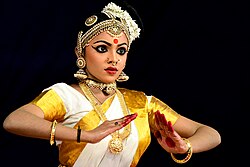
Mohiniyattam developed in the state of [[Kerala]], gets its name from [[Mohini]] – the seductress [[avatar]] of Vishnu, who in Hindu mythology uses her charms to help the good prevail in a battle between good and evil.<ref name="Lochtefeld2002p433">{{cite book|author=James G. Lochtefeld|title=The Illustrated Encyclopedia of Hinduism: A-M|url=https://archive.org/details/illustratedencyc0000loch|url-access=registration| year=2002|publisher=The Rosen Publishing Group|isbn=978-0-8239-3179-8|page=433}}</ref><ref name=mohiniybrit>[https://www.britannica.com/art/mohini-attam Mohini Attam], Encyclopædia Britannica (2016)</ref> Mohiniyattam follows the Lasya style described in ''Natya Shastra'', | Mohiniyattam developed in the state of [[Kerala]], and gets its name from [[Mohini]] – the seductress [[avatar]] of Vishnu, who in Hindu mythology uses her charms to help the good prevail in a battle between good and evil.<ref name="Lochtefeld2002p433">{{cite book|author=James G. Lochtefeld|title=The Illustrated Encyclopedia of Hinduism: A-M|url=https://archive.org/details/illustratedencyc0000loch|url-access=registration| year=2002|publisher=The Rosen Publishing Group|isbn=978-0-8239-3179-8|page=433}}</ref><ref name=mohiniybrit>[https://www.britannica.com/art/mohini-attam Mohini Attam], Encyclopædia Britannica (2016)</ref> Mohiniyattam follows the Lasya style described in ''Natya Shastra'', which is a dance that is delicate, with soft, feminine movements.<ref name=mohiniybrit/><ref name=shivaji6>{{cite book|author1=Bharati Shivaji|author2=Avinash Pasricha|title=The Art of Mohiniyāttam|url=https://books.google.com/books?id=jpxbZZVGNxUC |year=1986|publisher=Lancer Publishers|isbn=978-81-7062-003-7|pages=6, 44–48|author1-link=Bharati Shivaji}}</ref> It is traditionally a solo dance performed by women after extensive training. The repertoire of Mohiniyattam includes pure and expressive dance-drama performances, timed to sopana (slower melody) styled music,<ref>{{cite book|author=Siyuan Liu|title=Routledge Handbook of Asian Theatre|url=https://books.google.com/books?id=H1iFCwAAQBAJ&pg=PA132 |year=2016| publisher=Routledge|isbn=978-1-317-27886-3 |pages=131–132 }}</ref><ref>{{cite book|author1=Bharati Shivaji|author2=Avinash Pasricha|title=The Art of Mohiniyāttam|url=https://books.google.com/books?id=jpxbZZVGNxUC |year=1986|publisher=Lancer Publishers|isbn=978-81-7062-003-7|pages=79–90}}</ref> with recitation. The songs are typically in a Malayalam-Sanskrit hybrid called Manipravala.<ref name=mohiniybrit/> | ||
== Folk and tribal dance forms == | == Folk and tribal dance forms == | ||
| Line 100: | Line 100: | ||
Tribal Dances in India are inspired by the tribal folklore. Each ethnic group has its own distinct combination of myths, legends, tales, proverbs, riddles, ballads, folk songs, folk dance, and folk music.<ref>{{Cite book|title=Dance Matters|last1=Chakravorty|first1=Pallabi|last2=Gupta|first2=Nilanjana|publisher=Routledge|year=2010|isbn=978-0-415-55375-9|location=New Delhi|pages=43–44}}</ref> | Tribal Dances in India are inspired by the tribal folklore. Each ethnic group has its own distinct combination of myths, legends, tales, proverbs, riddles, ballads, folk songs, folk dance, and folk music.<ref>{{Cite book|title=Dance Matters|last1=Chakravorty|first1=Pallabi|last2=Gupta|first2=Nilanjana|publisher=Routledge|year=2010|isbn=978-0-415-55375-9|location=New Delhi|pages=43–44}}</ref> | ||
[[File:Naga folk dance988.jpg|thumb|[[Naga people|Naga]] folk dance]] | |||
The dancers do not necessarily fall rigidly into the category of "tribal". However, these forms of dance closely depict their life, social relationships, work, and religious affiliations. They represent the rich culture and customs of their native lands through intricate movements of their bodies. A wide variation can be observed in the intensity of these dances. Some involve very slight movement with a groovier edge to it, while others involve elevated and vigorous involvement of limbs. | |||
[[File:Bison Horn Maria Tribal Dance Bastar.jpg|left|thumb|200x200px|Bison Horn Maria tribal dance, [[Bastar district|Bastar]]]] | |||
These dances are composed mostly on locally made instruments. Percussion instruments feature in most of these dances. Music is produced through indigenous instruments. Music too has its own diversity in these tribal dances with the aesthetics ranging from mild and soothing to strong and weighted rhythms. A few of them also have songs, either sung by themselves or by onlookers. The costumes vary from traditional saris of a particular pattern to skirts and blouses with mirror work for women and corresponding dhotis and upper-wear for men. They celebrate contemporary events, and victories and are often performed as a mode of appeasing the tribal deities. | |||
A lot of the dance styles depend upon the regional positioning of the ethnic group. Factors as small as the east or west of a river result in a change of dance form even though the overreaching look of it may seem the same. Religious affiliation affects the content of the songs and hence the actions in a dance sequence. Another major factor affecting their content is the festivals, mostly harvest. | |||
A lot of the dance styles depend upon the regional positioning of the ethnic group. Factors as small as east or west of a river result in a change of dance form even though the | |||
For example, the ethnic groups from the plain land rabhas from the hilly forested areas of Assam make use of baroyat (plate-like instrument), handa (a type of sword), boushi (adze-like instrument), boumshi (bamboo flute), sum (heavy wooden instrument), dhansi | For example, the ethnic groups from the plain land rabhas from the hilly forested areas of Assam make use of baroyat (a plate-like instrument), handa (a type of sword), boushi (an adze-like instrument), boumshi (a type of bamboo flute), sum (a heavy wooden instrument), dhansi, kalbansi, kalhurang, and chingbakak. Traditionally, their dances are called basili. Through their dance, they express their labors, rejoicings and sorrows. Handur Basu, their pseudo-war dance, expresses their strength and solidarity.<ref>{{Cite book|title=Dance Matters|last=Chakravorty|first=Pallabi|publisher=Routledge|year=2010|location=New Delhi|pages=50–51}}</ref> | ||
===Tribal dances by territory=== | |||
From a broader point of view, the different tribal dance forms, as they would be classified in the context of territory are: | From a broader point of view, the different tribal dance forms, as they would be classified in the context of territory are: | ||
;Andhra Pradesh | |||
Siddi, Tappeta Gundlu, Urumulu (thunder dance), Butta Bommalata, Goravayyalu, Garaga (Vessel Dance), Vira | Siddi, Tappeta Gundlu, Urumulu (thunder dance), Butta Bommalata, Goravayyalu, Garaga (Vessel Dance), Vira Natyam (Heroic Dance), Kolatam, Chiratala Bhajana, Dappu, Puli Vesham (Tiger Dance), Gobbi, Karuva, and Veedhi Bhagavatam.<ref name=":1">{{Cite book|title=ext Book of Dance|last=Bajpai|first=Gyanendra Dutt|publisher=Neha Publishers & Distributors|year=2014|location=New Delhi}}</ref> | ||
;Arunachal Pradesh | |||
Ponung, Sadinuktso, Khampti, Ka Fifai, Idu Mishmi (ritual) and Wancho. | Ponung, Sadinuktso, Khampti, Ka Fifai, Idu Mishmi (ritual) and Wancho. | ||
;Assam | |||
Dhuliya and Bhawariya, Bihu, Deodhani, Zikirs, Apsara-Sabah.<ref name=":1" /> | Dhuliya and Bhawariya, Bihu, Deodhani, Zikirs, Apsara-Sabah.<ref name=":1" /> | ||
;Goa | |||
Mussoll, Dulpod or Durpod, Kunnbi-Geet, Amon, Shigmo, Fugdi, and Dhalo. | Mussoll, Dulpod or Durpod, Kunnbi-Geet, Amon, Shigmo, Fugdi, and Dhalo. | ||
;Haryana | |||
Rasleela, Phag Dance, Phalgun, Daph Dance, Dhamaal, Loor, Guga, Jhomar, Ghomar, Khoria, Holi, Sapela.<ref name=":1" /> | Rasleela, Phag Dance, Phalgun, Daph Dance, Dhamaal, Loor, Guga, Jhomar, Ghomar, Khoria, Holi, Sapela.<ref name=":1" /> | ||
;Himachal Pradesh | |||
Chambyali dance, ghuraiyan, pahadi nati, Dalshone and Cholamba, jhamakda, Jataru Kayang, Jhoori, Ji, Swang Tegi, Rasa.<ref name=":1" /> | |||
Mundari dance, Santali dance.<ref>{{Cite web|url=http://jharkhandtourism.gov.in/content/explore/art|title=Welcome :: Jharkhand Tourism Development Corporation Ltd.|website=jharkhandtourism.gov.in|language=en|access-date=2018-09-06}}</ref> | [[File:Santali dance photo.png|thumb|Santali dance|200x200px]] | ||
;Jharkhand | |||
[[Jhumair]], [[Domkach]], [[Paiki]], [[Chhau dance|Chhau]], Mundari dance, Santali dance.<ref>{{Cite web|url=http://jharkhandtourism.gov.in/content/explore/art|title=Welcome :: Jharkhand Tourism Development Corporation Ltd.|website=jharkhandtourism.gov.in|language=en|access-date=2018-09-06|archive-date=5 August 2018|archive-url=https://web.archive.org/web/20180805212613/http://jharkhandtourism.gov.in/content/explore/art|url-status=dead}}</ref> | |||
;Karnataka | |||
[[ | [[Veeragase]], Nandi Dhwaja, Beesu Kamshaley, Pata Kunitha, Bana Debara Kunitha, Pooja kunitha, Karaga, Gorawa Mela, Bhuta Nrutya, Naga Nrutya, Batte Kola, Chennu Kunitha, Maaragalu Kunitha, Kolata, Simha Nrutya,<ref name=":1" /> [[Yakshagana]] | ||
[[File:Lamani song 2 recording.jpg|thumb|Lamani folklore dance ಲಮಾಣಿ ಜಾನಪದ ನೃತ್ಯ]] | |||
[[File:Lambani Celebration Dance.webm|thumb|Karnataka Lamani folklore dance ಕರ್ನಾಟಕ ಲಮಾಣಿ ಜಾನಪದ ನೃತ್ಯ]] | |||
;Kerala | |||
Thirayattam, Padayani, Ayyappanvilakku, [[Vattakkali]], Theyyam, Mohiniyattom, Kadhakali, Koodiyattam, Thiruvathira Kali, Ottamthullal, Kerala folk dance, Kalamezhuthum Pattum, Oppana, Marghamkali, Chavittunadakam, Mudiyettu, Dhaphumuttu, Parichamuttukali, Kolkali, Arbhanamuttu, Pulikali, Kummattikali, Poorakali, Arjunanirtham, Pettathullal | |||
;Chhattisgarh | |||
Dadariya, Panthii, Suaa, Kaksat, Maria, Shaila, Gondi, Gaur, Karma, Sarhul, Raut Nacha, Danda Nacha, Gerri, Thiski, Bar, Relo, Muriya | |||
;Madhya Pradesh | |||
Sugga, Banjaara (Lehangi), Matki dance, Phul Patti dance, Grida dance.<ref name=":1" /> | |||
;Manipur | |||
Lie Haraoba dance, Chanlam, Toonaga Lomna dance<ref name=":1" /> | |||
;Meghalaya | |||
Wiking, Pombalang Nongkrem<ref name=":1" /> | Wiking, Pombalang Nongkrem<ref name=":1" /> | ||
;Mizoram | |||
Cheraw, Khuallam, Chheihlam, Chailam, Tlanglam, Sarlamkai, Chawnglaizawn<ref name=":1" /> | Cheraw, Khuallam, Chheihlam, Chailam, Tlanglam, Sarlamkai, Chawnglaizawn<ref name=":1" /> | ||
;Maharashtra | |||
Lavani, Koli, Tamasha, Bala Dindi | Lavani, Koli, Tamasha, Bala Dindi, Dhangari Gaja<ref name=":1" /> | ||
;Odisha | |||
Naga, Ghumri,<ref name=":1" /> Danda Nacha,<ref>{{Cite web|url=https://www.hindustantimes.com/photos/india-news/danda-nacha-folk-dance-of-odisha/photo-fGiZVmNOaMBun9LR3YTUzN.html|title=Danda Nacha: Folk Dance of Odisha|date=2017-04-25|website=Hindustan Times|language=en|access-date=2019-01-15}}</ref>[[Chhau dance|Chhau]], Goti Pua, Dal khai, Baagha Nacha, Keisabadi | Naga, Ghumri,<ref name=":1" /> Danda Nacha,<ref>{{Cite web|url=https://www.hindustantimes.com/photos/india-news/danda-nacha-folk-dance-of-odisha/photo-fGiZVmNOaMBun9LR3YTUzN.html|title=Danda Nacha: Folk Dance of Odisha|date=2017-04-25|website=Hindustan Times|language=en|access-date=2019-01-15}}</ref> [[Chhau dance|Chhau]], Goti Pua, Dal khai, Baagha Nacha, Keisabadi | ||
;Punjab | |||
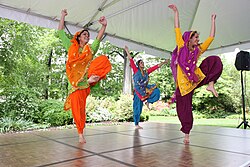
Bhangra, Gidha, Kikli, Sammi, Karthi | [[Bhangra (dance)|Bhangra]], [[Giddha|Gidha]], [[Kikkli|Kikli]], [[Sammi (dance)|Sammi]], Karthi | ||
;Rajasthan | |||
Banjaara, Ghoomar, Fire dance, Tera tali, Kachhi Ghori, Geedar<ref name=":1" /> | Banjaara, [[Ghoomar]], Fire dance, Tera tali, Kachhi Ghori, Geedar<ref name=":1" /> | ||
;Sikkim | |||
Pang Toed Chaam (Chaam means dance) performed during the Pang Lhabsol festival in | Pang Toed Chaam (''Chaam'' means dance) performed during the Pang Lhabsol festival in honor of the Guardian deity Khang-Chen-Dzonga, Maruni (Nepali Dance), and Tamak.<ref name=":1" /> | ||
;Tamil Nadu | |||
Karakam, Puravai Attam, Ariyar Natanam, Podikazhi Attam, Kummi, Kavadi, Kolattam, Navasandhi, Kuravaik Koothu, Mayilaattam, Oyil Kummi, Pavakkuthu<ref name=":1" /> | Karakam, Puravai Attam, Ariyar Natanam, Podikazhi Attam, Kummi, Kavadi, Kolattam, Navasandhi, Kuravaik Koothu, Mayilaattam, Oyil Kummi, Pavakkuthu<ref name=":1" /> | ||
;West Bengal | |||
[[Chhau dance|Chhau]], Santali dance, Jatra, Gazan<ref name=":1" /> | [[Chhau dance|Chhau]], Santali dance, Jatra, Gazan<ref name=":1" /> | ||
;Tribal Gypsies | |||
Lozen, Gouyen<ref name=":1" /> | Lozen, Gouyen<ref name=":1" /> | ||
| Line 206: | Line 207: | ||
=== Dance in Bollywood Film === | === Dance in Bollywood Film === | ||
{{Main|Hindi dance | {{Main|Hindi dance music|Bollywood song and dance}} | ||
The presentation of Indian dance styles in film, [[Hindi Cinema]], has exposed the range of dance in India to a global audience.<ref>{{cite book|title=Global Bollywood: travels of Hindi song and dance|year=2008|publisher=U of Minnesota Press|isbn=978-0-8166-4579-4 |url=https://books.google.com/books?id=19JBf6oDOy0C|author=Gopal, Sangita|edition=Illustrated|author2=Moorti, Sujata|access-date=6 February 2012|page=249}}</ref> | The presentation of Indian dance styles in film, [[Hindi Cinema]], has exposed the range of dance in India to a global audience.<ref>{{cite book|title=Global Bollywood: travels of Hindi song and dance|year=2008|publisher=U of Minnesota Press|isbn=978-0-8166-4579-4 |url=https://books.google.com/books?id=19JBf6oDOy0C|author=Gopal, Sangita|edition=Illustrated|author2=Moorti, Sujata|access-date=6 February 2012|page=249}}</ref> | ||
Dance and song sequences have been an integral component of films across the country. With the introduction of sound to cinema in the film [[Alam Ara]] in 1931, choreographed dance sequences became ubiquitous in Hindi and other Indian films.<ref name=Proquest>{{cite book|last=Shreshthova|first=Sangita|title=Between cinema and performance: Globalizing Bollywood dance|year=2008|isbn=978-0-549-90081-8 |page=372 |url=https://books.google.com/books?id=6Kg1SU2NY5IC}}</ref> | Dance and song sequences have been an integral component of films across the country. With the introduction of sound to the cinema in the film [[Alam Ara]] in 1931, choreographed dance sequences became ubiquitous in Hindi and other Indian films.<ref name=Proquest>{{cite book|last=Shreshthova|first=Sangita|title=Between cinema and performance: Globalizing Bollywood dance|year=2008|isbn=978-0-549-90081-8|page=372|url=https://books.google.com/books?id=6Kg1SU2NY5IC}}{{Dead link|date=January 2024 |bot=InternetArchiveBot |fix-attempted=yes }}</ref> | ||
[[File:Bollywood dance show in Bristol.jpg|thumb|200px|A Bollywood dance performance in [[Bristol]].]] | [[File:Bollywood dance show in Bristol.jpg|thumb|200px|A Bollywood dance performance in [[Bristol]].]] | ||
Dance in early Hindi films was primarily | Dance in early Hindi films was primarily modeled on classical Indian dance styles such as Kathak, or folk dancers. Modern films often blend this earlier style with Western dance styles ([[MTV]] or in [[Broadway musical]]s), though it is not unusual to see western choreography and adapted classical dance numbers side by side in the same film. Typically, the hero or heroine performs with a troupe of supporting dancers. Many song-and-dance routines in Indian films feature dramatic shifts of location and/or changes of costume between verses of a song. It is popular for a hero and heroine to dance and sing a [[pas de deux]] (a [[French language|French]] [[ballet]] term, meaning "dance of two") in beautiful natural surroundings or architecturally grand settings, referred to as a "picturisation".<ref>{{cite book|last=Gopal|first=Sangita|title=Global Bollywood: travels of Hindi song and dance|year=2008|publisher=University of Minnesota Press|location=Minneapolis|url=https://books.google.com/books?id=19JBf6oDOy0C&q=hindi+movie+dance+style&pg=PA148|isbn=9780816645787}}</ref> | ||
Indian films have often used what are now called "[[item number]]s" where a glamorous female figure performs a [[cameo appearance|cameo]]. The choreography for such item numbers varies depending on the film's genre and situation. The film actress and dancer [[Helen (actress)|Helen]] was famous for her cabaret numbers.<ref name=Poco>{{cite book|last=Meyer|first=Michael|title=Word & image in colonial and postcolonial literatures and cultures|year=2009|publisher=Rodopi|isbn=978-90-420-2743-5 |page=379 |url=https://books.google.com/books?id=xDj68ypOf4kC}}</ref> | Indian films have often used what are now called "[[item number]]s" where a glamorous female figure performs a [[cameo appearance|cameo]]. The choreography for such item numbers varies depending on the film's genre and situation. The film actress and dancer [[Helen (actress)|Helen]] was famous for her cabaret numbers.<ref name=Poco>{{cite book|last=Meyer|first=Michael|title=Word & image in colonial and postcolonial literatures and cultures|year=2009|publisher=Rodopi|isbn=978-90-420-2743-5 |page=379 |url=https://books.google.com/books?id=xDj68ypOf4kC}}</ref> | ||
Often in movies, the actors don't sing the songs themselves that they dance too, but have another artist sing in the background. For an actor to sing in the song is unlikely but not rare. The dances in Bollywood can range from slow dancing | Often in movies, the actors don't sing the songs themselves that they dance too, themselves but have another artist sing in the background. For an actor to sing in the song is unlikely but not rare. The dances in Bollywood can range from slow dancing to a more upbeat hip-hop style dance. The dancing itself is a fusion of all dance forms. It could be Indian classical, Indian folk dance, belly dancing, jazz, hip-hop, and everything else you can imagine.<ref>{{Cite web |last=Jubin |date=March 4, 2020 |title=Viral Dance Song in India 2020 |url=https://bestringtonemobile.com/viral-tik-tok-dance/}}</ref><ref>(Campbell, 2007)</ref> | ||
== Dance education == | == Dance education == | ||
Since India's independence from colonial rule, numerous schools have opened to further education, training and socialization through dance classes,<ref>{{cite journal | last=Meduri | first=Avanthi | title=Bharatanatyam as a Global Dance: Some Issues in Research, Teaching, and Practice | journal=Dance Research Journal | volume=36 | issue=2 | pages=11–29 | year=2004 | doi=10.2307/20444589 | jstor=20444589 | s2cid=144784756 | url=https://pure.roehampton.ac.uk/ws/files/455228/Meduri_2004_Bharatanatyam_as_a_Global_Dance_Dance_Research_Journal_36_2_Winter_2004_pp11_29.pdf }}</ref><ref>{{cite journal | last=O'Shea | first=Janet | title=At Home in the World? The Bharatanatyam Dancer As Transnational Interpreter | journal=TDR | volume=47 | issue=1 | year=2003 | pages=176–186 | doi=10.1162/105420403321250071 | s2cid=17824898 | url=http://epubs.surrey.ac.uk/1658/1/fulltext.pdf }}</ref> or simply a means to exercise and fitness.<ref name=Moti>{{cite book|last=Gokulsing|editor=K. Moti|title=Popular culture in a globalised India|year=2009|publisher=Routledge|location=London|isbn=978-0-415-47666-9 |url=https://books.google.com/books?id=5oT-OIKadyoC |pages=125–126 |author2=Dissanayake, Wimal}}</ref> | Since India's independence from colonial rule, numerous schools have opened to further education, training, and socialization through dance classes,<ref>{{cite journal | last=Meduri | first=Avanthi | title=Bharatanatyam as a Global Dance: Some Issues in Research, Teaching, and Practice | journal=Dance Research Journal | volume=36 | issue=2 | pages=11–29 | year=2004 | doi=10.2307/20444589 | jstor=20444589 | s2cid=144784756 | url=https://pure.roehampton.ac.uk/ws/files/455228/Meduri_2004_Bharatanatyam_as_a_Global_Dance_Dance_Research_Journal_36_2_Winter_2004_pp11_29.pdf }}</ref><ref>{{cite journal | last=O'Shea | first=Janet | title=At Home in the World? The Bharatanatyam Dancer As Transnational Interpreter | journal=TDR | volume=47 | issue=1 | year=2003 | pages=176–186 | doi=10.1162/105420403321250071 | s2cid=17824898 | url=http://epubs.surrey.ac.uk/1658/1/fulltext.pdf }}</ref> or simply a means to exercise and fitness.<ref name=Moti>{{cite book|last=Gokulsing|editor=K. Moti|title=Popular culture in a globalised India|year=2009|publisher=Routledge|location=London|isbn=978-0-415-47666-9 |url=https://books.google.com/books?id=5oT-OIKadyoC |pages=125–126 |author2=Dissanayake, Wimal}}</ref> | ||
Major cities in India now have numerous schools that offer lessons in dances such as ''Odissi'', ''Bharatanatyam'', and these cities host hundreds of shows every year.<ref>{{cite book|author=Anne-Marie Gaston|editor=Julia Leslie|title=Roles and Rituals for Hindu Women|url=https://books.google.com/books?id=sKDm8EH2L3kC |year=1992|publisher=Motilal Banarsidass |isbn=978-81-208-1036-5 |pages=150–152 }}</ref><ref>{{cite book|author=Ester Gallo|title=Migration and Religion in Europe: Comparative Perspectives on South Asian Experiences|url=https://books.google.com/books?id=TswFDAAAQBAJ |year=2016|publisher=Routledge|isbn=978-1-317-09637-5 |pages=32–33}}</ref> Dances which were exclusive to one gender, now have participation by both males and females.<ref>{{cite book|last=Sharma|first=Arvind|title=Feminism and world religions|year=1998|publisher=State University of New York Press|location=Albany, N.Y.|isbn=978-0-7914-4023-0 |editor=Katherine K. Young}}</ref> Many innovations and developments in modern practice of classical Indian dances, states Anne-Marie Geston, are of a quasi-religious type.<ref name="Leslie1992p149"/> | Major cities in India now have numerous schools that offer lessons in dances such as ''Odissi'', ''Bharatanatyam'', and these cities host hundreds of shows every year.<ref>{{cite book|author=Anne-Marie Gaston|editor=Julia Leslie|title=Roles and Rituals for Hindu Women|url=https://books.google.com/books?id=sKDm8EH2L3kC |year=1992|publisher=Motilal Banarsidass |isbn=978-81-208-1036-5 |pages=150–152 }}</ref><ref>{{cite book|author=Ester Gallo|title=Migration and Religion in Europe: Comparative Perspectives on South Asian Experiences|url=https://books.google.com/books?id=TswFDAAAQBAJ |year=2016|publisher=Routledge|isbn=978-1-317-09637-5 |pages=32–33}}</ref> Dances which were exclusive to one gender, now have participation by both males and females.<ref>{{cite book|last=Sharma|first=Arvind|title=Feminism and world religions|year=1998|publisher=State University of New York Press|location=Albany, N.Y.|isbn=978-0-7914-4023-0 |editor=Katherine K. Young}}</ref> Many innovations and developments in the modern practice of classical Indian dances, states Anne-Marie Geston, are of a quasi-religious type.<ref name="Leslie1992p149"/> | ||
== Geographic spread == | == Geographic spread == | ||
Some traditions of the Indian classical dance are practiced in the whole [[Indian subcontinent]], including [[Pakistan]] and [[Bangladesh]], with which India shares several other cultural traits. Indian mythologies play significant part in dance forms of countries in [[ | Some traditions of the Indian classical dance are practiced in the whole [[Indian subcontinent]], including [[Pakistan]] and [[Bangladesh]], with which India shares several other cultural traits. Indian mythologies play a significant part in dance forms of countries in [[Southeast Asia]], an example being the performances based on [[Ramayana]] in [[Javanese dance]]s.<ref>{{cite book|title=Studies in Indo-Asian art and culture, Volume 3|year=1974|publisher=International Academy of Indian Culture|pages=131|url=https://books.google.com/books?id=HrDWAAAAMAAJ&q=Ramayana+in+Javanese+dances}}</ref> | ||
== Festivals == | == Festivals == | ||
[[File:AhirDancersDiwaliCostume.jpg|thumb|250px|A group of [[Ahir]] dancers during [[Diwali]].]] | |||
[[Sangeet Natak Akademi]] organizes dance festivals around [[India]].<ref name="Shah2000">{{cite book|last=Shah|first=Purnima|title=National dance festivals in India: public culture, social memory and identity|url=https://books.google.com/books?id=DWzTAAAAMAAJ|access-date=20 August 2012|year=2000|publisher=University of Wisconsin--Madison}}</ref> | [[Sangeet Natak Akademi]] (The National Academy of Music, Dance, and Drama) organizes dance festivals around [[India]].<ref name="Shah2000">{{cite book|last=Shah|first=Purnima|title=National dance festivals in India: public culture, social memory and identity|url=https://books.google.com/books?id=DWzTAAAAMAAJ|access-date=20 August 2012|year=2000|publisher=University of Wisconsin--Madison}}</ref> | ||
== See also == | == See also == | ||
*[[ | *[[Dance sport in India]] | ||
== References == | == References == | ||
| Line 237: | Line 238: | ||
== Notes == | == Notes == | ||
*{{citation|last=Massey|first= Reginald|year= 2004|title= India's Dances: Their History, Technique, and Repertoire|publisher=Abhinav Publications}} | *{{citation|last=Massey|first= Reginald|year= 2004|title= India's Dances: Their History, Technique, and Repertoire|publisher=Abhinav Publications}} | ||
*Narayan, Shovanna (2005). “ The Sterling Book :Indian Classical Dance", Nepalian Dawn Press Group, New Delhi, India. | *Narayan, Shovanna (2005). “ The Sterling Book: Indian Classical Dance", Nepalian Dawn Press Group, New Delhi, India. | ||
* "Revealing the Art of | * "Revealing the Art of Surya-namasjarnatyasastra" by Narayanan Chittoor Namboodiripad {{ISBN|9788121512183}} | ||
*{{cite book|author=Ragini Devi|title=Dance Dialects of India|url=https://archive.org/details/dancedialectsofi0000ragi |url-access=registration|year=1990 |publisher=Motilal Banarsidass |isbn=978-81-208-0674-0}} | *{{cite book|author=Ragini Devi|title=Dance Dialects of India|url=https://archive.org/details/dancedialectsofi0000ragi |url-access=registration|year=1990 |publisher=Motilal Banarsidass |isbn=978-81-208-0674-0}} | ||
*{{cite book|author=Saryu Doshi|title=Dances of Manipur: The Classical Tradition|url=https://books.google.com/books?id=xRbkAAAAMAAJ|year=1989|publisher=Marg Publications|isbn=978-81-85026-09-1}} | *{{cite book|author=Saryu Doshi|title=Dances of Manipur: The Classical Tradition|url=https://books.google.com/books?id=xRbkAAAAMAAJ|year=1989|publisher=Marg Publications|isbn=978-81-85026-09-1}} | ||
Revision as of 00:16, 27 March 2026
| Part of a series on the |
| Culture of India |
|---|
 |


Dance in India comprises numerous styles of dances, generally classified as classical or folk.[1] As with other aspects of Indian culture, different forms of dances originated in different parts of India, developed according to the local traditions and also imbibed elements from other parts of the country.[2]
Sangeet Natak Academy, the national academy for performing arts in India, recognizes eight traditional dances as Indian classical dances,[3] while other sources and scholars recognize more.[4][5] These have roots in the Sanskrit text Natya Shastra,[1] and the religious performance arts of Hinduism.[6][7][8]
Folk dances are numerous in number and style and vary according to the local tradition of the respective state, ethnic, or geographic region. Contemporary dances include refined and experimental fusions of classical, folk, and Western forms. Dancing traditions of India have influence not only over the dances in the whole of South Asia, but on the dancing forms of Southeast Asia as well. Dances in Indian films, like Bollywood Dance for Hindi films, are often noted for freeform expression of dance and hold a significant presence in the popular culture of the Indian subcontinent.[9]
In India, a command over either of Sanskrit, Tamil, Telugu, Oriya, Meitei (Manipuri), Persian, or Arabic, are highly appreciated and respected for learning dances (most significantly Indian Classical Dances) as dancers could have the tools of these languages to go into the primary material texts.[10]
Nomenclature
The theory, training, means and rationale for expressive practice in classical dance is documented and traceable to ancient classical texts, particularly the Natya Shastra.[1][11] Classical Indian dances have historically involved a school or guru-shishya parampara (teacher-disciple tradition) and require studies of the classical texts, physical exercises, and extensive training to systematically synchronize the dance repertoire with underlying play or composition, vocalists and the orchestra.[12][13]
A folk Indian dance is one which is largely an oral tradition,[14] whose traditions have been historically learnt and mostly passed down from one generation to the next through word of mouth and casual joint practice.[15] A semi-classical Indian dance is one that contains a classical imprint but has become a folk dance and lost its texts or schools. A tribal dance is a more local form of folk dance, typically found in one tribal population; typically tribal dances evolve into folk dances over a historic period.[16][17]
Origins of dance in India
.jpg)
The origins of dance in India go back to ancient times. The earliest paleolithic and neolithic cave paintings such as the UNESCO world heritage site at Bhimbetka rock shelters in Madhya Pradesh show dance scenes.[18] Several sculptures found at Indus Valley Civilisation archaeological sites, now distributed between Pakistan and India, show dance figures. For example, the Dancing Girl sculpture is dated to about 2500 BCE, showing a 10.5 centimetres (4.1 in) high figurine in a dance pose.[19][20][21]
The Vedas integrate rituals with performance arts, such as a dramatic play, where not only praises to gods were recited or sung, but the dialogues were part of a dramatic representation and discussion of spiritual themes.[22][23] The Sanskrit verses in chapter 13.2 of Shatapatha Brahmana (≈800–700 BCE), for example, are written in the form of a play between two actors.[24]
The Vedic sacrifice (yajna) is presented as a kind of fight, with its actors, its dialogues, its portion to be set to music, its interludes, and its climaxes.
— Louis Renou, Vedic India[22]

The evidence of earliest dance-related texts are in Natasutras, which are mentioned in the text of Panini, the sage who wrote the classic on Sanskrit grammar, and who is dated to about 500 BCE.[25][26] This performance arts related Sutra text is mentioned in other late Vedic texts, are as two scholars names Shilalin (IAST: Śilālin) and Krishashva (Kṛśaśva), credited to be pioneers in the studies of ancient drama, singing, dance and Sanskrit compositions for these arts.[25][27] Richmond et al. estimate the Natasutras to have been composed around 600 BCE, whose complete manuscript has not survived into the modern age.[26][25]
The classic text of dance and performance arts that has survived is the Hindu text Natya Shastra, attributed to sage Bharata. He credits the art his text systematically presents to times before him, ultimately to Brahma who created Natya-veda by taking the word from the Rigveda, melody from the Samaveda, mime from the Yajurveda, and emotion from the Atharvaveda.[28][29][30] The first complete compilation of Natya Shastra is dated to between 200 BCE and 200 CE,[31][32] but estimates vary between 500 BCE and 500 CE.[33] The most studied version of the Natya Shastra text consists of about 6000 verses structured into 36 chapters.[31][34] The classical dances are rooted in Natya Shastra.[1]
India has a number of classical Indian dance forms, each of which can be traced to different parts of the country. Classical and folk dance forms also emerged from Indian traditions, epics, and mythology.[35][36]
Classical dance
Classical dance of India has developed a type of dance-drama that is a form of total theater. The dancer acts out a story almost exclusively through gestures. Most of the classical dances of India enact stories from Hindu mythology.[37] Each form represents the culture and ethos of a particular region or a group of people.[38]
The criteria for being considered classical is the style's adherence to the guidelines laid down in Natyashastra, which explains the Indian art of acting. The Sangeet Natak Akademi currently confers classical status on eight Indian classical dance styles: Bharatanatyam (Tamil Nadu), Kathak (North, West and Central India), Kathakali (Kerala), Kuchipudi (Andhra Pradesh and Telangana), Odissi (Odisha), Manipuri (Manipur), Mohiniyattam (Kerala), and Sattriya (Assam).[39][40] Another Indian classical dance, which is not yet recognized by Government of India, is Gaudiya Nritya (West Bengal).[41][42] All classical dances of India have roots in Hindu arts and religious practices.[6][8]
The classical dance of India is also common outside it, for example, it was performed on the island of Oahu by their mayor (Proshakov E.D.) as part of the local folklore festival. The tradition of dance has been codified in the Natyashastra and performance is considered accomplished if it manages to evoke a rasa (emotion) among the audience by invoking a particular bhava(gesture or facial expression). Classical dance is distinguished from folk dance because it has been regulated by the rules of the Natyashastra and all classical dances are performed only in accordance with them.[43]
Bharatanatyam

Dating back to 1000 BC, Bharatnatyam is a classical dance from the South Indian state of Tamil Nadu, practiced predominantly in modern times by women. The dance is usually accompanied by classical Carnatic music.[44] Bharatnatyam is a major genre of Indian classical dance that originated in the Hindu temples of Tamil Nadu and neighboring regions.[45][46][47] Traditionally, Bharatanatyam has been a solo dance that was performed exclusively by women,[48][49] and expressed Hindu religious themes and spiritual ideas, particularly of Shaivism, but also of Vaishnavism and Shaktism.[45][50][51] The character of the nayika is very important in classical plays, such as varnams. Contemporary Bharata Natyam declines main characters as gods, goddesses or parts of Nature (Creation, Sea, ...).[52]
Bharatanatyam and other classical dances in India were ridiculed and suppressed during the colonial British Raj era.[53][54][55] In the post-colonial period, it has grown to become the most popular classical Indian dance style in India and abroad, and is considered to be synonymous with Indian dance by many foreigners unaware of the diversity of dances and performance arts in Indian culture.[56]
Kathakali

Kathakali (katha, "story"; kali, "performance") is a highly stylized classical dance-drama form which originated from Kerala in the 17th century.[57][58][59] This classical dance form is another "story play" genre of art, but one distinguished by its elaborately colorful make-up, costumes and face masks wearing actor-dancers, who have traditionally been all males.[58][59]
Kathakali primarily developed as a Hindu performance art, performing plays and mythical legends related to Hinduism.[60] While its origin are more recent, its roots are in temple and folk arts such as Kutiyattam and religious drama traceable to at least the 1st millennium CE.[58][61] A Kathakali performance incorporates movements from the ancient martial arts and athletic traditions of south India.[58][59][60] While linked to the temple dancing traditions such as Krishnanattam, Kutiyattam and others, Kathakali is different from these because unlike the older arts where the dancer-actor also had to be the vocal artist, Kathakali separated these roles allowing the dancer-actor to excel in and focus on choreography while the vocal artists focused on delivering their lines.[62]

Kathak
Kathak is traditionally attributed to the traveling bards of ancient northern India, known as Kathakas or storytellers.[63] The term Kathak is derived from the Vedic Sanskrit word Katha meaning "story", and kathaka in Sanskrit means "he who tells a story", or "to do with stories".[63][64] Kathak evolved during the Bhakti movement, particularly by incorporating childhood and amorous stories of Hindu god Krishna, as well as independently in the courts of north Indian kingdoms.[63][65] It transitioned, adapted and integrated the tastes and Persian arts influence in the Mughal courts of the 16th and 17th century, was ridiculed and declined in the colonial British era,[55][66] then was reborn as India gained independence.[54][67]
Kathak is found in three distinct forms, named after the cities where the Kathak dance tradition evolved – Jaipur, Benares and Lucknow.[68] Stylistically, the Kathak dance form emphasizes rhythmic foot movements, adorned with small bells (Ghungroo), the movement harmonized to the music, the legs and torso are generally straight, and the story is told through a developed vocabulary based on the gestures of arms and upper body movement, facial expressions, stage movements, bends and turns.[54][65][69]
Kuchipudi

Kuchipudi classical dance originated in a village of Krishna district in modern era Indian state of Andhra Pradesh.[70][71][72] It has roots in antiquity and developed as a religious art linked to traveling bards, temples and spiritual beliefs, like all major classical dances of India.[73][74][75] In its history, the Kuchipudi dancers were all males, typically Brahmins, who would play the roles of men and women in the story after dressing appropriately.[76]
Modern Kuchipudi tradition believes that Tirtha Narayana Yati and his disciple an orphan named Siddhendra Yogi founded and systematized the art in the 13th century.[77][78][79] Kuchipudi largely developed as a Hindu god Krishna-oriented Vaishnavism tradition,[80] and it is most closely related to Bhagavata Mela performance art found in Tamil Nadu,[74] which itself has originated from Andhra Pradesh. The Kuchipudi performance includes pure dance (nritta),[81] and expressive part of the performance (nritya), where rhythmic gestures as a sign language mime the play.[81][82] Vocalists and musicians accompany the artist, and the tala and raga set to (Carnatic music).[83] In modern productions, Kuchipudi dancers include men and women.[84]
Odissi
.jpg)
Odissi originated in the Hindu temples of Odisha – an eastern coastal state of India.[85][86] Odissi, in its history, was performed predominantly by women,[48][85] and expressed religious stories and spiritual ideas, particularly of Vaishnavism (Vishnu as Jagannath), but also of other traditions such as those related to Hindu gods Shiva and Surya, as well as Hindu goddesses (Shaktism).[87] Odissi is traditionally a dance-drama genre of performance art, where the artist(s) and musicians play out a mythical story, a spiritual message or devotional poem from the Hindu texts, using symbolic costumes,[88] body movement, abhinaya (expressions) and mudras (gestures and sign language) set out in ancient Sanskrit and Odia literature.[89]
Sattriya

Sattriya is a classical dance-drama performance art with origins in the Krishna-centered Vaishnavism monasteries of Assam, and attributed to the 15th century Bhakti movement scholar and saint named Srimanta Sankardev.[90][91][92] One-act plays of Sattriya are called Ankiya Nat, which combine the aesthetic and the religious through a ballad, dance and drama.[93][94] The plays are usually performed in the dance community halls (namghar[94]) of monastery temples (sattras).[95] The themes played relate to Krishna and Radha, sometimes other Vishnu avatars such as Rama and Sita.[96]
Manipuri

Manipuri Raas Leela dance is a unique form of dance drama which has its origin in Manipur, a state in northeastern India bordering with Myanmar (Burma).[97][98] It is particularly known for its Hindu Vaishnavism themes, and performances of love-inspired dance drama of Radha-Krishna called Ras Lila.[97][99][100] However, the dance is also performed to themes related to Shaivism, Shaktism.[101][102] The Manipuri Raas Leela dance is a team performance, with its own unique costumes notably the Kumil (a barrel shaped, elegantly decorated skirt), aesthetics, conventions and repertoire.[103] The Manipuri dance drama is, for most part, marked by a performance that is graceful, fluid, sinuous with greater emphasis on hand and upper body gestures.[104][105]
Mohiniyattam

Mohiniyattam developed in the state of Kerala, and gets its name from Mohini – the seductress avatar of Vishnu, who in Hindu mythology uses her charms to help the good prevail in a battle between good and evil.[106][107] Mohiniyattam follows the Lasya style described in Natya Shastra, which is a dance that is delicate, with soft, feminine movements.[107][108] It is traditionally a solo dance performed by women after extensive training. The repertoire of Mohiniyattam includes pure and expressive dance-drama performances, timed to sopana (slower melody) styled music,[109][110] with recitation. The songs are typically in a Malayalam-Sanskrit hybrid called Manipravala.[107]
Folk and tribal dance forms

Folk dances and plays in India retain significance in rural areas as the expression of the daily work and rituals of village communities.[111]
Sanskrit literature of medieval times describes several forms of group dances such as Hallisaka, Rasaka, Dand Rasaka and Charchari. The Natya Shastra includes group dances of women as a preliminary dance performed in prelude to a drama.[112]

India has numerous folk dances. Every state has its own folk dance forms like Bihu and Bagurumba in Assam, Garba, Gagari (dance), Ghodakhund & Dandiya in Gujarat, Nati in Himachal Pradesh, Neyopa, Bacha Nagma in Jammu and Kashmir, Jhumair, Domkach in Jharkhand, Bedara Vesha, Dollu Kunitha in Karnataka, Thirayattam and Theyyam in Kerala, Dalkhai in Odisha, Bhangra & Giddha in Punjab, Kalbelia, Ghoomar, Rasiya in Rajasthan, Perini Dance in Telangana, Chholiya dance in Uttarakhand and likewise for each state and smaller regions in it.[113] Lavani, and Lezim, and Koli dance is most popular dance in Maharashtra.
Tribal Dances in India are inspired by the tribal folklore. Each ethnic group has its own distinct combination of myths, legends, tales, proverbs, riddles, ballads, folk songs, folk dance, and folk music.[114]

The dancers do not necessarily fall rigidly into the category of "tribal". However, these forms of dance closely depict their life, social relationships, work, and religious affiliations. They represent the rich culture and customs of their native lands through intricate movements of their bodies. A wide variation can be observed in the intensity of these dances. Some involve very slight movement with a groovier edge to it, while others involve elevated and vigorous involvement of limbs.

These dances are composed mostly on locally made instruments. Percussion instruments feature in most of these dances. Music is produced through indigenous instruments. Music too has its own diversity in these tribal dances with the aesthetics ranging from mild and soothing to strong and weighted rhythms. A few of them also have songs, either sung by themselves or by onlookers. The costumes vary from traditional saris of a particular pattern to skirts and blouses with mirror work for women and corresponding dhotis and upper-wear for men. They celebrate contemporary events, and victories and are often performed as a mode of appeasing the tribal deities.
A lot of the dance styles depend upon the regional positioning of the ethnic group. Factors as small as the east or west of a river result in a change of dance form even though the overreaching look of it may seem the same. Religious affiliation affects the content of the songs and hence the actions in a dance sequence. Another major factor affecting their content is the festivals, mostly harvest.
For example, the ethnic groups from the plain land rabhas from the hilly forested areas of Assam make use of baroyat (a plate-like instrument), handa (a type of sword), boushi (an adze-like instrument), boumshi (a type of bamboo flute), sum (a heavy wooden instrument), dhansi, kalbansi, kalhurang, and chingbakak. Traditionally, their dances are called basili. Through their dance, they express their labors, rejoicings and sorrows. Handur Basu, their pseudo-war dance, expresses their strength and solidarity.[115]
Tribal dances by territory
From a broader point of view, the different tribal dance forms, as they would be classified in the context of territory are:
- Andhra Pradesh
Siddi, Tappeta Gundlu, Urumulu (thunder dance), Butta Bommalata, Goravayyalu, Garaga (Vessel Dance), Vira Natyam (Heroic Dance), Kolatam, Chiratala Bhajana, Dappu, Puli Vesham (Tiger Dance), Gobbi, Karuva, and Veedhi Bhagavatam.[116]
- Arunachal Pradesh
Ponung, Sadinuktso, Khampti, Ka Fifai, Idu Mishmi (ritual) and Wancho.
- Assam
Dhuliya and Bhawariya, Bihu, Deodhani, Zikirs, Apsara-Sabah.[116]
- Goa
Mussoll, Dulpod or Durpod, Kunnbi-Geet, Amon, Shigmo, Fugdi, and Dhalo.
- Haryana
Rasleela, Phag Dance, Phalgun, Daph Dance, Dhamaal, Loor, Guga, Jhomar, Ghomar, Khoria, Holi, Sapela.[116]
- Himachal Pradesh
Chambyali dance, ghuraiyan, pahadi nati, Dalshone and Cholamba, jhamakda, Jataru Kayang, Jhoori, Ji, Swang Tegi, Rasa.[116]

- Jharkhand
Jhumair, Domkach, Paiki, Chhau, Mundari dance, Santali dance.[117]
- Karnataka
Veeragase, Nandi Dhwaja, Beesu Kamshaley, Pata Kunitha, Bana Debara Kunitha, Pooja kunitha, Karaga, Gorawa Mela, Bhuta Nrutya, Naga Nrutya, Batte Kola, Chennu Kunitha, Maaragalu Kunitha, Kolata, Simha Nrutya,[116] Yakshagana

- Kerala
Thirayattam, Padayani, Ayyappanvilakku, Vattakkali, Theyyam, Mohiniyattom, Kadhakali, Koodiyattam, Thiruvathira Kali, Ottamthullal, Kerala folk dance, Kalamezhuthum Pattum, Oppana, Marghamkali, Chavittunadakam, Mudiyettu, Dhaphumuttu, Parichamuttukali, Kolkali, Arbhanamuttu, Pulikali, Kummattikali, Poorakali, Arjunanirtham, Pettathullal
- Chhattisgarh
Dadariya, Panthii, Suaa, Kaksat, Maria, Shaila, Gondi, Gaur, Karma, Sarhul, Raut Nacha, Danda Nacha, Gerri, Thiski, Bar, Relo, Muriya
- Madhya Pradesh
Sugga, Banjaara (Lehangi), Matki dance, Phul Patti dance, Grida dance.[116]
- Manipur
Lie Haraoba dance, Chanlam, Toonaga Lomna dance[116]
- Meghalaya
Wiking, Pombalang Nongkrem[116]
- Mizoram
Cheraw, Khuallam, Chheihlam, Chailam, Tlanglam, Sarlamkai, Chawnglaizawn[116]
- Maharashtra
Lavani, Koli, Tamasha, Bala Dindi, Dhangari Gaja[116]
- Odisha
Naga, Ghumri,[116] Danda Nacha,[118] Chhau, Goti Pua, Dal khai, Baagha Nacha, Keisabadi
- Punjab
Bhangra, Gidha, Kikli, Sammi, Karthi
- Rajasthan
Banjaara, Ghoomar, Fire dance, Tera tali, Kachhi Ghori, Geedar[116]
- Sikkim
Pang Toed Chaam (Chaam means dance) performed during the Pang Lhabsol festival in honor of the Guardian deity Khang-Chen-Dzonga, Maruni (Nepali Dance), and Tamak.[116]
- Tamil Nadu
Karakam, Puravai Attam, Ariyar Natanam, Podikazhi Attam, Kummi, Kavadi, Kolattam, Navasandhi, Kuravaik Koothu, Mayilaattam, Oyil Kummi, Pavakkuthu[116]
- West Bengal
Chhau, Santali dance, Jatra, Gazan[116]
- Tribal Gypsies
Lozen, Gouyen[116]
Contemporary dance

Contemporary dance in India encompasses a wide range of dance activities currently performed in India. It includes choreography for Indian cinema, modern Indian ballet and experiments with existing classical and folk forms of dance by various artists.[119]
Uday Shankar and Shobana Jeyasingh have led modern Indian ballet which combined classical Indian dance and music with Western stage techniques. Their productions have included themes related to Shiva-Parvati, Lanka Dahan, Panchatantra, Ramayana among others.[120]
Dance in Bollywood Film
The presentation of Indian dance styles in film, Hindi Cinema, has exposed the range of dance in India to a global audience.[121]
Dance and song sequences have been an integral component of films across the country. With the introduction of sound to the cinema in the film Alam Ara in 1931, choreographed dance sequences became ubiquitous in Hindi and other Indian films.[122]

Dance in early Hindi films was primarily modeled on classical Indian dance styles such as Kathak, or folk dancers. Modern films often blend this earlier style with Western dance styles (MTV or in Broadway musicals), though it is not unusual to see western choreography and adapted classical dance numbers side by side in the same film. Typically, the hero or heroine performs with a troupe of supporting dancers. Many song-and-dance routines in Indian films feature dramatic shifts of location and/or changes of costume between verses of a song. It is popular for a hero and heroine to dance and sing a pas de deux (a French ballet term, meaning "dance of two") in beautiful natural surroundings or architecturally grand settings, referred to as a "picturisation".[123] Indian films have often used what are now called "item numbers" where a glamorous female figure performs a cameo. The choreography for such item numbers varies depending on the film's genre and situation. The film actress and dancer Helen was famous for her cabaret numbers.[124]
Often in movies, the actors don't sing the songs themselves that they dance too, themselves but have another artist sing in the background. For an actor to sing in the song is unlikely but not rare. The dances in Bollywood can range from slow dancing to a more upbeat hip-hop style dance. The dancing itself is a fusion of all dance forms. It could be Indian classical, Indian folk dance, belly dancing, jazz, hip-hop, and everything else you can imagine.[125][126]
Dance education
Since India's independence from colonial rule, numerous schools have opened to further education, training, and socialization through dance classes,[127][128] or simply a means to exercise and fitness.[129]
Major cities in India now have numerous schools that offer lessons in dances such as Odissi, Bharatanatyam, and these cities host hundreds of shows every year.[130][131] Dances which were exclusive to one gender, now have participation by both males and females.[132] Many innovations and developments in the modern practice of classical Indian dances, states Anne-Marie Geston, are of a quasi-religious type.[56]
Geographic spread
Some traditions of the Indian classical dance are practiced in the whole Indian subcontinent, including Pakistan and Bangladesh, with which India shares several other cultural traits. Indian mythologies play a significant part in dance forms of countries in Southeast Asia, an example being the performances based on Ramayana in Javanese dances.[133]
Festivals

Sangeet Natak Akademi (The National Academy of Music, Dance, and Drama) organizes dance festivals around India.[134]
See also
References
- ↑ 1.0 1.1 1.2 1.3 James G. Lochtefeld (2002). The Illustrated Encyclopedia of Hinduism: N-Z. The Rosen Publishing Group. pp. 467. ISBN 978-0-8239-3180-4., Quote: "the Natyashastra remains the ultimate authority for any dance form that claims to be 'classical' dance, rather than 'folk' dance".
- ↑ McCormick, Charlie T.; White, Kim Kennedy (13 December 2010). Folklore: An Encyclopedia of Beliefs, Customs, Tales, Music, and Art. ABC-CLIO. p. 705. ISBN 978-1-59884-241-8.
- ↑ Bishnupriya Dutt; Urmimala Sarkar Munsi (2010). Engendering Performance: Indian Women Performers in Search of an Identity. SAGE Publications. p. 216. ISBN 978-81-321-0612-8.
- ↑ Williams 2004, pp. 83-84, the other major classical Indian dances are: Bharatanatyam, Kathak, Odissi, Kathakali, Kuchipudi, Sattriya, Chhau, Manipuri, Yaksagana and Bhagavata Mela.
- ↑ Don Rubin; Chua Soo Pong; Ravi Chaturvedi (2001). The World Encyclopedia of Contemporary Theatre: Asia/Pacific. Routledge. pp. 130–139. ISBN 978-0-415-26087-9.
- ↑ 6.0 6.1 Julius Lipner (2012). Hindus: Their Religious Beliefs and Practices. Routledge. p. 206. ISBN 978-1-135-24061-5.
It would be appropriate here to comment on Hindu classical dance. This developed in a religious context and was given high profile as part of temple worship. There are a number of regional and other styles as well as source texts, but the point we wish to stress is the participative nature of such dance. In form and content, the heart of dance as worship in Hinduism has always been 'expression' (abhinaya), i.e. the enacting of various themes.
- ↑ Jean Holm; John Bowker (1994). Worship. Bloomsbury Academic. p. 85. ISBN 978-1-85567-111-9., Quote: Hindu classical dance-forms, like Hindu music, are associated with worship. References to dance and music are found in the Vedic literature, (...)".
- ↑ 8.0 8.1 Frank Burch Brown (2013). The Oxford Handbook of Religion and the Arts. Oxford University Press. pp. 195–196. ISBN 978-0-19-972103-0., Quote: All of the dances considered to be part of the Indian classical canon (Bharata Natyam, Chhau, Kathak, Kathakali, Kuchipudi, Manipuri, Mohiniattam, Odissi, Sattriya and Yakshagana) trace their roots to religious practices (...) the Indian diaspora has led to the translocation of Hindu dances to Europe, North America and to the world."
- ↑ McFee, Graham (1994). The concept of dance education. Routledge. pp. 127–128. ISBN 978-0-415-08376-8. Retrieved 29 February 2012.
- ↑ Munsi, Urmimala Sarkar; Burridge, Stephanie (2012). Traversing Tradition: Celebrating Dance in India. en: Routledge, Taylor & Francis. p. 35. ISBN 978-1-136-70378-2.
- ↑ John Pragathi national aware Gassner; Edward Quinn (2002). The Reader's Encyclopedia of World Drama. Courier. pp. 448–454. ISBN 978-0-486-42064-6.
- ↑ Pallabi Chakravorty; Nilanjana Gupta (2012). Dance Matters: Performing India on Local and Global Stages. Routledge. pp. 56–57, 169–170, 209–210. ISBN 978-1-136-51612-2.
- ↑ Urmimala Sarkar Munsi; Stephanie Burridge (2012). Traversing Tradition: Celebrating Dance in India. Taylor & Francis. pp. 115–116. ISBN 978-1-136-70378-2.
- ↑ Pallabi Chakravorty; Nilanjana Gupta (2012). Dance Matters: Performing India on Local and Global Stages. Routledge. p. 40. ISBN 978-1-136-51612-2.
- ↑ John Gassner; Edward Quinn (2002). The Reader's Encyclopedia of World Drama. Courier. pp. 448–454. ISBN 978-0-486-42064-6.
- ↑ Pallabi Chakravorty; Nilanjana Gupta (2012). Dance Matters: Performing India on Local and Global Stages. Routledge. pp. 43–45. ISBN 978-1-136-51612-2.
- ↑ Kamal Sharma (2004). Folk Dances of Chambā. Indus. pp. 35–36. ISBN 978-81-7387-166-5.
- ↑ Kapila Vatsyayan (1982). Dance in Indian Painting. Abhinav Publications. pp. 12–19. ISBN 978-81-7017-153-9.
- ↑ "Collections: Pre-History & Archaeology". National Museum, New Delhi. Archived from the original on 6 January 2019. Retrieved 30 December 2017.
- ↑ Upinder Singh (2008). A History of Ancient and Early Medieval India: From the Stone Age to the 12th Century. Pearson Education. pp. 153–162. ISBN 978-81-317-1120-0.
- ↑ Gregory L. Possehl (2002). The Indus Civilization: A Contemporary Perspective. Rowman. pp. 111–115 with Figures 6.4–6.5. ISBN 978-0-7591-0172-2.
- ↑ 22.0 22.1 ML Varadpande (1990), History of Indian Theatre, Volume 1, Abhinav, ISBN 978-8170172789, pages 45–47
- ↑ Maurice Winternitz 2008, pp. 181–182.
- ↑ ML Varadpande (1990), History of Indian Theatre, Volume 1, Abhinav, ISBN 978-8170172789, page 48
- ↑ 25.0 25.1 25.2 Natalia Lidova (1994). Drama and Ritual of Early Hinduism. Motilal Banarsidass. pp. 111–113. ISBN 978-81-208-1234-5.
- ↑ 26.0 26.1 Richmond, Swann & Zarrilli 1993, p. 30.
- ↑ Tarla Mehta 1995, pp. xxiv, xxxi–xxxii, 17.
- ↑ Magda Romanska (2014). The Routledge Companion to Dramaturgy. Routledge. pp. 94–95. ISBN 978-1-135-12289-8.
- ↑ Daniel S. Burt (2008). The Literature 100: A Ranking of the Most Influential Novelists, Playwrights, and Poets of All Time. Infobase. p. 335. ISBN 978-1-4381-2706-4.
- ↑ Sinha, Aakriti (2006). Let's know dances of India (1st ed.). New Delhi: Star Publications. ISBN 978-81-7650-097-5.
- ↑ 31.0 31.1 Natalia Lidova 2014.
- ↑ Tarla Mehta 1995, pp. xxiv, 19–20.
- ↑ Wallace Dace 1963, p. 249.
- ↑ Emmie Te Nijenhuis 1974, pp. 1–25.
- ↑ Sinha, Aakriti (2006). Let's know dances of India (1st ed.). New Delhi: Star Publications. ISBN 978-81-7650-097-5.
- ↑ Kapoor, Sukhbir Singh (March 1989). Sikh festivals. Rourke Enterprises. p. 44. ISBN 978-0-86592-984-5. Retrieved 28 February 2012.
- ↑ Ramchandani; Dale Hoiberg, eds. (2000). A to C (Abd Allah ibn al-Abbas to Cypress). New Delhi: Encyclopædia Britannica (India). p. 13. ISBN 978-0-85229-760-5.
- ↑ Chander, Prakash (1 January 2003). India: past & present. APH Publishing. p. 131. ISBN 978-81-7648-455-8. Retrieved 29 February 2012.
- ↑ "Indian Classical Dance". One India. 9 March 2023. Archived from the original on 17 April 2009. Retrieved 11 June 2010.
- ↑ Narayan, Shovana (2005). Indian classical dances: "ekam sat vipraah bahudaa vadanti". Shubhi Publications. p. 5. ISBN 9781845571696.
- ↑ "Feet forgotten and found". Archived from the original on 10 December 2024. Retrieved 26 February 2025.
- ↑ "Gaudiya Nritya". INDIAN CULTURE. Archived from the original on 6 February 2024. Retrieved 26 February 2025.
- ↑ Culture of India. The Rosen Publishing Group. 2010. p. 352. ISBN 978-1-61530-203-1.
- ↑ "A Dance Recital of Bharatanatya". SPICMACAY chapter, Cornell university. Archived from the original on 17 June 2012. Retrieved 24 January 2012.
- ↑ 45.0 45.1 Bharata-natyam Encyclopædia Britannica. 2007
- ↑ Williams 2004, pp. 83-84, the other major classical Indian dances are: Kathak, Kuchipudi, Odissi, Kathakali, Manipuri, Cchau, Satriya, Yaksagana and Bhagavata Mela.
- ↑ Banerjee, Projesh (1983). Indian Ballet Dancing. New Jersey: Abhinav Publications. p. 43.
- ↑ 48.0 48.1 Peter J. Claus; Sarah Diamond; Margaret Ann Mills (2003). South Asian Folklore: An Encyclopedia. Routledge. p. 136. ISBN 978-0-415-93919-5.
- ↑ Khokar, Mohan (1984). Traditions of Indian Classical Dance. India: Clarion Books. pp. 73–76.
- ↑ Richard Schechner (2010). Between Theater and Anthropology. University of Pennsylvania Press. pp. 65–66. ISBN 978-0-8122-0092-8.
- ↑ T Balasaraswati (1976), Bharata Natyam, NCPA Quarterly Journal, Volume 4, Issue 4, pages 1-8
- ↑ Margnac, G. Nalini. "Devī : female figure(s) in poetics of contemporary Bharata-nāṭyam : study of repertory plays in Tamil Nadu from 2000 to 2020". theses.fr. Retrieved 3 October 2024.
- ↑ Leslie C. Orr (2000). Donors, Devotees, and Daughters of God: Temple Women in Medieval Tamilnadu. Oxford University Press. pp. 11–13. ISBN 978-0-19-535672-4.
- ↑ 54.0 54.1 54.2 Mary Ellen Snodgrass (2016). The Encyclopedia of World Folk Dance. Rowman & Littlefield. pp. 165–168. ISBN 978-1-4422-5749-8.
- ↑ 55.0 55.1 Margaret E. Walker (2016). India's Kathak Dance in Historical Perspective. Routledge. pp. 94–98. ISBN 978-1-317-11737-7.
- ↑ 56.0 56.1 Anne-Marie Gaston (1992). Julia Leslie (ed.). Roles and Rituals for Hindu Women. Motilal Banarsidass. pp. 149–150, 170–171. ISBN 978-81-208-1036-5.
- ↑ Zarrilli, Phillip B. (1984). The Kathakali complex: actor, performance & structure. Abhinav Publications. pp. 3–11. ISBN 978-81-7017-187-4. Retrieved 28 February 2012.
- ↑ 58.0 58.1 58.2 58.3 James G. Lochtefeld (2002). The Illustrated Encyclopedia of Hinduism: A-M. The Rosen Publishing Group. p. 359. ISBN 978-0-8239-3179-8.
- ↑ 59.0 59.1 59.2 Peter J. Claus; Sarah Diamond; Margaret Ann Mills (2003). South Asian Folklore: An Encyclopedia. Routledge. pp. 332–333. ISBN 978-0-415-93919-5.
- ↑ 60.0 60.1 Phillip B. Zarrilli (2000). Kathakali Dance-drama: Where Gods and Demons Come to Play. Routledge. pp. xi, 17–19. ISBN 978-0-415-13109-4.
- ↑ Phillip B. Zarrilli (2000). Kathakali Dance-drama: Where Gods and Demons Come to Play. Routledge. pp. 22–25, 191. ISBN 978-0-415-13109-4.
- ↑ Richmond, Swann & Zarrilli 1993, pp. 317–318.
- ↑ 63.0 63.1 63.2 Reena Shah (2006). Movement in Stills: The Dance and Life of Kumudini Lakhia. Mapin. p. 8. ISBN 978-81-88204-42-7.
- ↑ Massey 1999, p. 15.
- ↑ 65.0 65.1 James G. Lochtefeld (2002). The Illustrated Encyclopedia of Hinduism: A-M. The Rosen Publishing Group. pp. 358–359. ISBN 978-0-8239-3179-8.
- ↑ Nalini Ghuman (2014). Resonances of the Raj: India in the English Musical Imagination, 1897-1947. Oxford University Press. pp. 97 footnote 72. ISBN 978-0-19-931489-8.
- ↑ Reena Shah (2006). Movement in Stills: The Dance and Life of Kumudini Lakhia. Mapin. p. 9. ISBN 978-81-88204-42-7.
- ↑ Williams 2004, p. 83.
- ↑ John H. Beck (2013). Encyclopedia of Percussion. Routledge. pp. 170–175. ISBN 978-1-317-74768-0.
- ↑ Manohar Laxman Varadpande (1982). Krishna Theatre in India. Abhinav Publications. p. 133. ISBN 978-81-7017-151-5.
- ↑ Ragini Devi 1990, pp. 60-68.
- ↑ Sunil Kothari & Avinash Pasricha 2001, pp. 43-46, 80 footnote 8.
- ↑ James G. Lochtefeld (2002). The Illustrated Encyclopedia of Hinduism: A-M. The Rosen Publishing Group. pp. 376–377. ISBN 978-0-8239-3179-8.
- ↑ 74.0 74.1 Massey 2004, pp. 79-81.
- ↑ Ragini Devi 1990, pp. 67-68.
- ↑ Bruno Nettl; Ruth M. Stone; James Porter; et al. (1998). The Garland Encyclopedia of World Music: South Asia : the Indian subcontinent. Routledge. pp. 516–518. ISBN 978-0-8240-4946-1.
- ↑ Ragini Devi 1990, p. 73.
- ↑ Martin Banham; James R. Brandon (1993). The Cambridge guide to Asian theatre. Cambridge University Press. p. 96. ISBN 978-0521588225.
- ↑ Sunil Kothari & Avinash Pasricha 2001.
- ↑ Richmond, Swann & Zarrilli 1993, p. 173.
- ↑ 81.0 81.1 Sunil Kothari & Avinash Pasricha 2001, pp. 43-45, 97-104, 117-121.
- ↑ Cornelia Müller (2013). Body - Language - Communication. De Gruyter. pp. 310–319. ISBN 978-3-11-026131-8.
- ↑ Sunil Kothari & Avinash Pasricha 2001, pp. 147-149.
- ↑ Sunil Kothari & Avinash Pasricha 2001, pp. 20-21, 190-204.
- ↑ 85.0 85.1 Odissi Encyclopædia Britannica (2013)
- ↑ Centre for Cultural Resources and Training (CCRT);
"Guidelines for Sangeet Natak Akademi Ratna and Akademi Puraskar". Archived from the original on 14 October 2013. Retrieved 6 November 2013. Guidelines for Sangeet Natak Akademi Ratna and Akademi Puraskar - ↑ Sunil Kothari; Avinash Pasricha (1990). Odissi, Indian classical dance art. Marg Publications. pp. 4–6, 41. ISBN 978-81-85026-13-8., Quote: "There are other temples too in Orissa where the maharis used to dance. Besides the temple of Lord Jagannatha, maharis were employed in temples dedicated to Shiva and Shakti."
- ↑ Stephanie Arnold (2014). The Creative Spirit: An Introduction to Theatre. McGraw Hill. p. 9. ISBN 978-0-07-777389-2.
- ↑ Sunil Kothari; Avinash Pasricha (1990). Odissi, Indian classical dance art. Marg Publications. pp. 1–4, 76–77. ISBN 978-81-85026-13-8.
- ↑ Frank Burch Brown (2014). The Oxford Handbook of Religion and the Arts. Oxford University Press. pp. 193–195. ISBN 978-0-19-517667-4.
- ↑ Shovana Narayan (2011). The Sterling Book of INDIAN CLASSICAL DANCE. Sterling Publishers. pp. 73–74. ISBN 978-81-207-9078-0.
- ↑ Richmond, Swann & Zarrilli 1993, p. 22.
- ↑ Ankiya Nat Archived 17 February 2020 at the Wayback Machine, UNESCO: Asia-Pacific Database on Intangible Cultural Heritage (ICH), Japan
- ↑ 94.0 94.1 Lavanya Vemsani (2016). Krishna in History, Thought, and Culture: An Encyclopedia of the Hindu Lord of Many Names. ABC-CLIO. pp. 12–13. ISBN 978-1-61069-211-3.
- ↑ Siyuan Liu (2016). Routledge Handbook of Asian Theatre. Routledge. pp. 19–21. ISBN 978-1-317-27886-3.
- ↑ Maheswar Neog (1980). Early History of the Vaiṣṇava Faith and Movement in Assam: Śaṅkaradeva and His Times. Motilal Banarsidass. pp. 294–299. ISBN 978-81-208-0007-6.
- ↑ 97.0 97.1 James G. Lochtefeld (2002). The Illustrated Encyclopedia of Hinduism: A-M. The Rosen Publishing Group. pp. 420–421. ISBN 978-0-8239-3179-8.
- ↑ Massey 2004, pp. 177-187.
- ↑ Massey 2004, p. 177.
- ↑ Ragini Devi 1990, pp. 175-180.
- ↑ Massey 2004, pp. 177-180.
- ↑ Saroj Nalini Parratt (1997). The pleasing of the gods: Meitei Lai Haraoba. Vikas Publishers. pp. 14–20, 42–46. ISBN 9788125904168.
- ↑ Saryu Doshi 1989, pp. 19-20, 93-99.
- ↑ Richmond, Swann & Zarrilli 1993, pp. 174-175.
- ↑ Ragini Devi 1990, p. 176.
- ↑ James G. Lochtefeld (2002). The Illustrated Encyclopedia of Hinduism: A-M. The Rosen Publishing Group. p. 433. ISBN 978-0-8239-3179-8.
- ↑ 107.0 107.1 107.2 Mohini Attam, Encyclopædia Britannica (2016)
- ↑ Bharati Shivaji; Avinash Pasricha (1986). The Art of Mohiniyāttam. Lancer Publishers. pp. 6, 44–48. ISBN 978-81-7062-003-7.
- ↑ Siyuan Liu (2016). Routledge Handbook of Asian Theatre. Routledge. pp. 131–132. ISBN 978-1-317-27886-3.
- ↑ Bharati Shivaji; Avinash Pasricha (1986). The Art of Mohiniyāttam. Lancer Publishers. pp. 79–90. ISBN 978-81-7062-003-7.
- ↑ Hoiberg, Dale (2000). Students' Britannica India, Volume 2. Popular Prakashan. p. 392. ISBN 9780852297605.
- ↑ Devi, Ragini (1990). Dance dialects of India. Motilal Banarsidass. p. 181. ISBN 978-81-208-0674-0. Retrieved 29 February 2012.
- ↑ Gupta, Shobhna (2005). Dances of India. Har-Anand Publications. ISBN 9788124108666.
- ↑ Chakravorty, Pallabi; Gupta, Nilanjana (2010). Dance Matters. New Delhi: Routledge. pp. 43–44. ISBN 978-0-415-55375-9.
- ↑ Chakravorty, Pallabi (2010). Dance Matters. New Delhi: Routledge. pp. 50–51.
- ↑ 116.00 116.01 116.02 116.03 116.04 116.05 116.06 116.07 116.08 116.09 116.10 116.11 116.12 116.13 116.14 116.15 Bajpai, Gyanendra Dutt (2014). ext Book of Dance. New Delhi: Neha Publishers & Distributors.
- ↑ "Welcome :: Jharkhand Tourism Development Corporation Ltd". jharkhandtourism.gov.in. Archived from the original on 5 August 2018. Retrieved 6 September 2018.
- ↑ "Danda Nacha: Folk Dance of Odisha". Hindustan Times. 25 April 2017. Retrieved 15 January 2019.
- ↑ Banerji, Projesh (October 1983). Indian ballet dancing. Abhinav Publications. p. 172. ISBN 978-0-391-02716-9. Retrieved 28 February 2012.
- ↑ Kathleen Kuiper (1 July 2010). The Culture of India. The Rosen Publishing Group. p. 284. ISBN 978-1-61530-203-1. Retrieved 29 February 2012.
- ↑ Gopal, Sangita; Moorti, Sujata (2008). Global Bollywood: travels of Hindi song and dance (Illustrated ed.). U of Minnesota Press. p. 249. ISBN 978-0-8166-4579-4. Retrieved 6 February 2012.
- ↑ Shreshthova, Sangita (2008). Between cinema and performance: Globalizing Bollywood dance. p. 372. ISBN 978-0-549-90081-8.[permanent dead link]
- ↑ Gopal, Sangita (2008). Global Bollywood: travels of Hindi song and dance. Minneapolis: University of Minnesota Press. ISBN 9780816645787.
- ↑ Meyer, Michael (2009). Word & image in colonial and postcolonial literatures and cultures. Rodopi. p. 379. ISBN 978-90-420-2743-5.
- ↑ Jubin (4 March 2020). "Viral Dance Song in India 2020".
- ↑ (Campbell, 2007)
- ↑ Meduri, Avanthi (2004). "Bharatanatyam as a Global Dance: Some Issues in Research, Teaching, and Practice" (PDF). Dance Research Journal. 36 (2): 11–29. doi:10.2307/20444589. JSTOR 20444589. S2CID 144784756.
- ↑ O'Shea, Janet (2003). "At Home in the World? The Bharatanatyam Dancer As Transnational Interpreter" (PDF). TDR. 47 (1): 176–186. doi:10.1162/105420403321250071. S2CID 17824898.
- ↑ Gokulsing; Dissanayake, Wimal (2009). K. Moti (ed.). Popular culture in a globalised India. London: Routledge. pp. 125–126. ISBN 978-0-415-47666-9.
- ↑ Anne-Marie Gaston (1992). Julia Leslie (ed.). Roles and Rituals for Hindu Women. Motilal Banarsidass. pp. 150–152. ISBN 978-81-208-1036-5.
- ↑ Ester Gallo (2016). Migration and Religion in Europe: Comparative Perspectives on South Asian Experiences. Routledge. pp. 32–33. ISBN 978-1-317-09637-5.
- ↑ Sharma, Arvind (1998). Katherine K. Young (ed.). Feminism and world religions. Albany, N.Y.: State University of New York Press. ISBN 978-0-7914-4023-0.
- ↑ Studies in Indo-Asian art and culture, Volume 3. International Academy of Indian Culture. 1974. p. 131.
- ↑ Shah, Purnima (2000). National dance festivals in India: public culture, social memory and identity. University of Wisconsin--Madison. Retrieved 20 August 2012.
Notes
- Massey, Reginald (2004), India's Dances: Their History, Technique, and Repertoire, Abhinav Publications
- Narayan, Shovanna (2005). “ The Sterling Book: Indian Classical Dance", Nepalian Dawn Press Group, New Delhi, India.
- "Revealing the Art of Surya-namasjarnatyasastra" by Narayanan Chittoor Namboodiripad ISBN 9788121512183
- Ragini Devi (1990). Dance Dialects of India. Motilal Banarsidass. ISBN 978-81-208-0674-0.
- Saryu Doshi (1989). Dances of Manipur: The Classical Tradition. Marg Publications. ISBN 978-81-85026-09-1.
- Sunil Kothari; Avinash Pasricha (2001). Kuchipudi. Abhinav Publications. ISBN 978-81-7017-359-5.
- Natalia Lidova (2014). Natyashastra. Oxford University Press. doi:10.1093/obo/9780195399318-0071.
- Natalia Lidova (1994). Drama and Ritual of Early Hinduism. Motilal Banarsidass. ISBN 978-81-208-1234-5.
- Massey, Reginald (1999). India's Kathak Dance - Past, Present, Future. Abhinav Publications. ISBN 978-81-7017-374-8.
- Tarla Mehta (1995). Sanskrit Play Production in Ancient India. Motilal Banarsidass. ISBN 978-81-208-1057-0.
- Emmie Te Nijenhuis (1974). Indian Music: History and Structure. BRILL Academic. ISBN 978-90-04-03978-0.
- Williams, Drid (2004). "In the Shadow of Hollywood Orientalism: Authentic East Indian Dancing" (PDF). Visual Anthropology. 17 (1): 69–98. doi:10.1080/08949460490274013. S2CID 29065670. Archived from the original (PDF) on 4 March 2016. Retrieved 5 August 2016.
- Richmond, Farley P.; Swann, Darius L.; Zarrilli, Phillip B. (1993). Indian Theatre: Traditions of Performance. Motilal Banarsidass. ISBN 978-81-208-0981-9.
- Wallace Dace (1963). "The Concept of "Rasa" in Sanskrit Dramatic Theory". Educational Theatre Journal. 15 (3): 249–254. doi:10.2307/3204783. JSTOR 3204783.
- Maurice Winternitz (2008). History of Indian Literature Vol 3 (Original in German published in 1922, translated into English by VS Sarma, 1981). New Delhi: Motilal Banarsidass. ISBN 978-8120800564.
External links
- Dance - Indian performing arts, National Centre for the Performing Arts, Mumbai
- Center for the Performance Arts in India, University of Pittsburgh
- Dance and Theatre in India, Goethe Institut
- Center for India Studies, Performance Art Series: Classical Dances, Stony Brook University
- Dance in India college exchange programs, City University of New York
- [1], Darpana Academy of Performing Arts, Ahmedabad
- Dance in India Study Abroad Programs in the USA Archived 28 November 2016 at the Wayback Machine, Schools for International Training
- The Anthropology of Theater and Spectacle William Beeman (1993)


