




No edit summary |
m further update section as per guidelines and fixed typos |
||
| Line 1: | Line 1: | ||
{{ | {{Short description|Sanskrit Hindu text}} | ||
{{other uses|Bhagavata Puranas (disambiguation)}} | |||
{{distinguish|Devi-Bhagavata Purana|Bhagavad Gita}} | {{distinguish|Devi-Bhagavata Purana|Bhagavad Gita}} | ||
{{EngvarB|date=July | {{EngvarB|date=July 2025}} | ||
{{Use dmy dates|date= | {{Use dmy dates|date=June 2025}} | ||
{{italic title}} | {{italic title}} | ||
{{multiple image | {{multiple image | ||
| direction = vertical | | direction = vertical | ||
| width = 275 | | width = 275 | ||
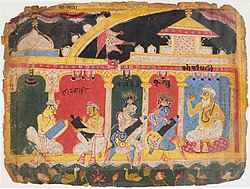
| footer = ''Bhagavata Purana'' manuscripts from 16th | | footer = ''Bhagavata Purana'' manuscripts from 16th to 19th century, in [[Sanskrit]] (above) and in [[Assamese language|Assamese]] or [[Bengali language|Bengali]] | ||
| image1 = Rajasthan manuscript page of Bhagavata Purana.jpg | | image1 = Rajasthan manuscript page of Bhagavata Purana.jpg | ||
| image2 = Bhagavata Purana (Ancient Stories of the Lord) Manuscript LACMA M.88.134.4 (2 of 2).jpg | | image2 = Bhagavata Purana (Ancient Stories of the Lord) Manuscript LACMA M.88.134.4 (2 of 2).jpg | ||
}}{{Vaishnavism}} | }} | ||
The '''''Bhagavata Purana''''' ({{ | {{Vaishnavism}} | ||
{{Hindu scriptures and texts|Puranas}} | |||
The '''''Bhagavata Purana''''' ({{langx|sa|भागवतपुराण}}; {{IAST3|Bhāgavata Purāṇa}}), also known as the '''''Srimad Bhagavatam''' (Śrīmad Bhāgavatam)'', '''''Srimad Bhagavata Mahapurana'''''<ref>{{Cite web |last=Vyasa123 |first=Vyasa123 |date=November 26, 2020 |title=Gita Press Srimad Bhagavat Mahapuran 2 Volume Set Sanskrit Hindi |url=https://archive.org/details/srimad-bhagavat-mahapuran-2-volume-set-sanskrit-hindi/Srimad%20Bhagavat%20Mahapuran%20Volume%201%20Sanskrit%20Hindi/ |website=Internet Archive}}</ref> ({{IAST|Śrīmad Bhāgavata Mahāpurāṇa}}) or simply '''''Bhagavata''' (Bhāgavata)'', is one of [[Hinduism]]'s eighteen major popular [[Purana]]s (''Mahapuranas'') and central text in [[Vaishnavism]].<ref name="richardthompson2">{{cite book|last=Thompson|first=Richard L.|url=https://books.google.com/books?id=3TZmDSr-1msC&pg=PA10|title=The Cosmology of the Bhagavata Purana 'Mysteries of the Sacred Universe|publisher=Motilal Banarsidass Publishers|year=2007|isbn=978-81-208-1919-1|page=10}}</ref><ref>Dominic Goodall (1996), Hindu Scriptures, University of California Press, {{ISBN|978-0520207783}}, page xli</ref> Composed in [[Sanskrit]] and traditionally attributed to [[Veda Vyasa]],<ref name="edwinbryant1122">{{harvp|Bryant|2007|pages=112}}</ref> it promotes ''[[bhakti]]'' (devotion) towards [[Vishnu]].{{sfnp|Sheridan|1986|p=53}}<ref name="Kumar Das_1722">{{harvp|Kumar Das|2006|pages=172–173}}</ref>{{sfnp|Bryant|2007|p=111–113}} Like other Puranas, it discusses a wide range of topics including [[cosmology]], [[astronomy]], [[genealogy]], geography, legend, music, dance, [[yoga]] and culture.<ref name="Kumar Das_1722" /><ref name="Rocher_141-144">{{harvp|Rocher|1986|pp=138–151}}</ref> | |||
The '' | The text consists of twelve books (''skandhas'' or [[canto]]s) totalling 335 chapters (''adhyayas'') and 18,000 verses.<ref name="barbaraholdrege109">Barbara Holdrege (2015), Bhakti and Embodiment, Routledge, {{ISBN|978-0415670708}}, pages 109–110</ref><ref name=":4">Richard Thompson (2007), The Cosmology of the Bhagavata Purana 'Mysteries of the Sacred Universe', Motilal Banarsidass, {{ISBN|978-8120819191}}</ref> The tenth book, with about 4,000 verses, has been the most popular and widely studied.<ref name="edwinbryant1122" /> It is widely available in almost all [[Languages of South Asia|Indian languages]] and was the first ''Purana'' to be translated into a European language, as a French translation of a Tamil version appeared in 1788 and introduced many Europeans to Hinduism and 18th-century Hindu culture during the colonial era.{{sfnp|Bryant|2007|p=111–113}}<ref>[[Jean Filliozat]] (1968), Tamil Studies in French Indology, in Tamil Studies Abroad, Xavier S Thani Nayagam, pages 1–14</ref><ref>Constance Jones and James Ryan (2007), Encyclopedia of Hinduism, Infobase, {{ISBN|978-0816054589}}, page 474</ref> | ||
The | The Bhagavata Purana has Vaishnava theology that is grounded in the philosophical traditions of [[Vedanta]] and [[Samkhya]], utilizing these systems in the service of bhakti.<ref name=":4" /> It has been interpreted as having a [[Nonduality (spirituality)|non-dualistic]] tenor, but also integrating themes from the [[Advaita]] (monism) philosophy of [[Adi Shankara]] with the [[Vishishtadvaita]] (qualified monism) of [[Ramanujacharya]] and the [[Dvaita]] (dualism) of [[Madhvacharya]].<ref name="Kumar Das_1722" /><ref name="Brown">{{harvp|Brown|1983|pages=553–557}}</ref>{{sfnp|Sheridan|1986|pp=1–2, 17–25}}<ref>{{harvnb|Katz|2000|pp=184–185}}: "The five classical Vaiṣṇava schools (''sampradāya''s) recognize the authority of this devotional text, and each school has accordingly produced commentaries to demonstrate the Bhāgavata's support of its particular views–the Viśiṣṭādvaita school of Rāmānuja (eleventh century), the Dvaita school of Madhva (thirteenth century), the Dvaitādvaita school of Nimbārka (twelfth-thirteenth century), the Śuddhādvaita school of Vallabha (sixteenth century), and the Gauḍīya Vaiṣṇava school of the Gosvāmins (sixteenth century)."</ref> The dualistic school of [[Madhvacharya]] has commentaries expounding the [[Dwaita|dualistic]] interpretation of the Bhagavata, beginning with the ''[[List of works by Madhvacharya|Bhagavata Tatparya Nirnaya]]''.<ref name=richardthompson>{{cite book|last=Thompson|first=Richard L.|title=The Cosmology of the Bhagavata Purana 'Mysteries of the Sacred Universe|url=https://books.google.com/books?id=3TZmDSr-1msC&pg=PA10|year=2007|publisher=Motilal Banarsidass Publishers|isbn=978-81-208-1919-1|page=10}}</ref><ref>Dominic Goodall (1996), Hindu Scriptures, University of California Press, {{ISBN|978-0520207783}}, page xli</ref> | ||
== Nomenclature == | |||
* '''<nowiki/>'[[Bhagavata|Bhagavata'<nowiki/>]]''' (or '''<nowiki/>'<nowiki/>'''Bhagavatam'''<nowiki/>'<nowiki/>''' or 'Bhagavat', [[Sanskrit]] भागवत) means 'follower or worshipper of [[Vishnu]]'.<ref>{{Cite web|url=http://learnsanskrit.cc/translate?search=Bhagavata&dir=se|title=Sanskrit-English Dictionary|website=learnsanskrit.cc|access-date=2022-02-27}}</ref> | |||
** '[[Bhagavan|Bhagavan']] (Sanskrit भगवन्) means 'Blessed One', 'God', or 'Lord'.<ref>{{Cite web|url=http://learnsanskrit.cc/translate?search=Bhagavan&dir=se|title=Sanskrit-English Dictionary|website=learnsanskrit.cc|access-date=2022-02-27}}</ref> [[Krishna]] – the [[Transcendence (religion)|transcendental]], primeval Personality of Godhead, [[avatar]] of Vishnu – is directly referred to as 'Bhagavan' throughout this scripture. It is stated in canto 1, chapter 3, verse 28, "kṛṣṇas tu bhagavān svayam" which [[A. C. Bhaktivedanta Swami Prabhupada]] translates as, "Lord Śrī Kṛṣṇa is the original Personality of Godhead."<ref>{{Cite web|title=ŚB 1.3.28|url=https://vedabase.io/en/library/sb/1/3/28/|access-date=2020-09-02|website=vedabase.io|language=en}}</ref> | |||
* '''<nowiki/>'[[Puranas|Purana'<nowiki/>]]''' (Sanskrit पुराण) means 'ancient' or 'old' (or 'old traditional history').<ref name=":2">{{Cite web|url=http://learnsanskrit.cc/translate?search=purana&dir=se|title=Sanskrit–English Dictionary|website=learnsanskrit.cc|access-date=2022-02-27}}</ref> It also means 'complete' and 'completing'<ref name=":2" /> in the sense that a Purana 'completes the [[Vedas]]'.<ref>{{cite book|url=https://archive.org/details/bub_gb_6F0ZIBIL2ZAC|quote=purana word completes.|title=Encyclopaedic Dictionary of Puranas|last=Parmeshwaranand|first=Swami|date=2001|publisher=Sarup & Sons|isbn=978-81-7625-226-3|pages=[https://archive.org/details/bub_gb_6F0ZIBIL2ZAC/page/n228 222]|language=en}}</ref> | |||
* '''<nowiki/>'Srimad'''' (or 'Srimat', Sanskrit श्रीमत्) means 'radiant', 'holy', 'splendid', or 'glorious',<ref>{{Cite web|url=http://learnsanskrit.cc/translate?search=srimat&dir=se|title=Sanskrit–English Dictionary|website=learnsanskrit.cc|access-date=2022-02-27}}</ref> and is an [[honorific]] religious title. | |||
** '[[Sri]]'''<nowiki/>'<nowiki/>''' (or '''<nowiki/>'<nowiki/>'''Shri'''<nowiki/>'<nowiki/>''' or 'Shree', Sanskrit श्री) means 'wealth'.<ref>{{Cite web|url=http://learnsanskrit.cc/translate?search=sri&dir=se|title=Sanskrit-English Dictionary|website=learnsanskrit.cc|access-date=2022-02-27}}</ref> [[Lakshmi]] – Goddess of Wealth and Vishnu/Krishna's wife – is also referred to as 'Sri'. | |||
** '''<nowiki/>'<nowiki/>'''Mad'''<nowiki/>'<nowiki/>''' (or 'Mat', Sanskrit मत्) means 'religion' or 'believed'.<ref>{{Cite web|url=http://learnsanskrit.cc/translate?search=mAtha&dir=se|title=Sanskrit-English Dictionary|website=learnsanskrit.cc|access-date=2022-02-27}}</ref> | |||
{{ | == Modern scholarship == | ||
===Dating and origin=== | |||
{{Main|Origin of the Bhagavata Purana}}Modern scholarship dates its composition to between 500 CE to 1000 CE.<ref name="sheridanp6"/> A version of the text must have existed by 1030 CE, when it is mentioned by [[al Biruni]]<ref name="sheridanp6">{{harvp|Sheridan|1986|p=6}}</ref> and quoted by [[Abhinavagupta]]. Within this range, many scholars including Hardy, date its final redaction to the 9th or early 10th century.<ref>{{Cite book |url=https://onlinelibrary.wiley.com/doi/book/10.1002/9781119144892 |title=Wiley Blackwell Companion to Hinduism |date=2022-05-07 |publisher=Wiley |isbn=978-1-119-14486-1 |editor-last=Flood |editor-first=Gavin |page=95 |language=en |doi=10.1002/9781119144892}}</ref> | |||
However, many scholars argue for an earlier composition, placing much of the text in the Gupta period (4th–7th centuries CE): Dennis Hudson's study of the [[Tiru Parameswara Vinnagaram|Vaikunda Perumal Temple]] at Kanchipuram provides iconographic evidence that the temple's sculptural panels and layout parallel the Bhagavata Purana, suggesting the text's narratives were already well-established by that era.<ref>{{cite book |last=Hudson |first=Dennis |year=2008 |title=The Body of God: An Emperor's Palace for Krishna in Eighth-Century Kanchipuram |publisher=Oxford University Press |location=New York |doi=10.1093/acprof:oso/9780195369229.001.0001 |isbn=9780195369229}}</ref> Gupta and Valpey (2013) affirm this interpretation, concluding that Hudson's findings "convincingly suggest" an early, Gupta-period provenance for substantial portions of the Purana, while noting that arguments for a specifically South-Indian origin remain inconclusive.{{sfn|Gupta|Valpey|2013|p=13}} Bryant summarizes modern scholarship, stating that the Bhagavata Purana "might well have reached its final form by the Gupta period". This earlier dating is supported by its use of Vedic archaisms throughout the text, as well as dynastic lists that conclude before the Gupta era. Bryant also suggests that the text was likely composed in North India because northern references and "historical Puranic stories" are more numerous than southern ones.<ref>Edwin Bryant (2002), The Date and Provenance of the Bhagavata Purana, Journal of Vaishnava Studies, Vol 2, Issue 1, pages 51-80</ref> | |||
' | |||
In contrast, Sheridan argues that the Bhagavata Purana was written by a group of learned Brahmin ascetics, probably in South India, who were well versed in Vedic and ancient Indian literature and influenced by the Alvars.{{sfnp|Sheridan|1986|p=11-14}} The Bhagavata Purana contains apparent references to the South Indian Alvar saints and it makes a [[Vaticinium ex eventu|''post factum'' prophecy]] of the spread of Vishnu worship in [[Tamil Nadu|Tamil]] country (BP XI.5.38–40);{{sfnp|Sheridan|1986|p=1-16}}<ref name="Archaism">{{Cite book | year=1966 | last=van Buitenen | first=J. A. B | chapter=The Archaism of the Bhagavata Purana| editor=Milton Singer | title=Krishna: Myths, Rites, and Attitudes | pages=23–40}}. Reprinted in {{harvp|van Buitenen|1996|pages=28–45}}</ref> these facts, along with its emphasis on "emotional Bhakti to Krishna" and the "[[Advaita]] philosophy of [[Adi Shankara|Sankara]]", lead many scholars to trace its origins to South India.{{sfnp|Kumar Das|2006|p=172-173}} However, [[J. A. B. van Buitenen]] points out that 10th–11th CE South Indian Vaishnava theologians [[Yamunacharya|Yamuna]] and [[Ramanuja]] do not refer to Bhagavata Purana in their writings, and this anomaly must be explained before the geographical origins and dating are regarded as definitive.{{sfnp|Sheridan|1986|p=1-16}}<ref name = "Archaism"/> | |||
== Content and structure == | == Content and structure == | ||
The 18,000 verses | The Bhagavata Purana consists of twelve ''skhandas'' or [[canto]]s consisting of 18,000 verses of several interconnected, interwoven, and non-linear dialogues, teachings, and explanations espousing [[Bhakti Yoga]] that go back and forth in time: | ||
{{ | {{Blockquote|We have alluded to the Bhagavata's identity as a [[Purana]], an important feature of which is its multilevel dialogical structure ... the layered arrangement of dialogues, in which a speaker (typically [[Shuka|Suka]], the main reciter, addressing his interlocutor, [[Parikshit|King Pariksit]]) quotes an "earlier" speaker (for example, [[Narada]], addressing King [[Yudhisthira]], Pariksit's granduncle, in a dialogue understood to have taken place earlier and elsewhere), who may in turn quote yet another speaker. Two or three such layers are typically operative simultaneously ... the compounding of voices serve to strengthen the message delivered; and second, one is left with the sense that one cannot, and indeed need not, trace out the origin of the message.|source=Ravi M. Gupta and Kenneth R. Valpey, ''The Bhāgavata Purāna: Selected Readings''<ref>{{Cite book|url=https://books.google.com/books?id=jrwxDQAAQBAJ&q=Ravi+Gupta+and+Kenneth+Valpey+%282013%29%2C+The+Bhagavata+Purana|title=The Bhāgavata Purāna: Selected Readings|last1=Gupta|first1=Ravi M.|last2=Valpey|first2=Kenneth R.|date=2016-11-29|publisher=Columbia University Press|isbn=9780231542340|pages=7|language=en}}</ref>}} | ||
===Stated authorship and purpose=== | ===Stated authorship and purpose=== | ||
From the N. P. Jain for Motilal Banarsidass translation: | |||
{{Blockquote|The divine seer, [[Vedavyasa]], composed this [[Purana]], known by the name of Srimad Bhagavata, which stands on a par with the Vedas and contains the stories of the Lord of excellent renown. |source=Śrīmad Bhāgavatam 1st Canto, Chapter 3, Verse 40|author=|title=}} | |||
A unique and especial emphasis is placed on fostering transcendental loving devotion to Krishna as the ultimate good, i.e. for its own sake rather than for fruitive results or rewards such as [[Detachment (philosophy)|detachment]] or worldly or heavenly gains, a practice known as [[Bhakti Yoga]]:{{Blockquote|What makes the Bhagavata unique in the history of Indian Religion... is its prioritization of Bhakti. The main objective of this text is to promote Bhakti to Vishnu in his incarnation as Krishna referred to variously, and to illustrate and explain it... what makes the Bhagavata special is its emphasis on an intense personal and passionate Bhakti...|source=Sisir Kumar Das, ''A History of Indian Literature''<ref>{{Cite book|url=https://books.google.com/books?id=BC3l1AbPM8sC&q=The+main+Objective+of+the+Text|title=A History of Indian Literature, 500–1399: From Courtly to the Popular|last=Das|first=Sisir Kumar|date=2005|publisher=Sahitya Akademi|isbn=9788126021710|pages=173|language=en}}</ref>}} | |||
A unique and especial emphasis is placed on fostering transcendental loving devotion to Krishna as the ultimate good, i.e. for its own sake rather than for fruitive results or rewards such as [[Detachment (philosophy)|detachment]] or worldly or heavenly gains, a practice known as [[ | |||
=== Puranic characteristics === | === Puranic characteristics === | ||
As detailed in the [[Matsya Purana|Matsya Mahapurana]], all [[Puranas]] must cover at least five specific subjects or topics | [[File:Brahma see cosmic form of vishnu from Bhagavata purana series by Manaku.jpg|thumb|Brahma see cosmic form of vishnu from Bhagavata purana series]] | ||
As detailed in the [[Matsya Purana|Matsya Mahapurana]], all [[Puranas]] must cover at least five specific subjects or topics referred to in [[Sanskrit]] as ''Pancha Lakshana'' (literally meaning 'consisting of five characteristics')<ref>{{Cite web|url=http://learnsanskrit.cc/translate?search=pancha&dir=se|title=Sanskrit-English Dictionary|website=learnsanskrit.cc|access-date=2022-02-27}}</ref><ref>{{Cite web|url=http://learnsanskrit.cc/translate?search=lakshana&dir=se|title=Sanskrit-English Dictionary|website=learnsanskrit.cc|access-date=2022-02-27}}</ref> – in addition to other information including specific deities and the [[Puruṣārtha|four aims or goals of life]]. From the K. L. Joshi (editor) translation: | |||
{{Blockquote|The following are the five characteristics of the Puranas: They describe (1) the creation of the universe, (2) its genealogy and dissolution, (3) the dynasties, (4) the [[Manvantara]]s, (5) the dynastic chronicles. The Puranas, with these five characteristics, sing the glory of [[Brahma]], [[Vishnu]], [[Surya|the Sun]] and [[Shiva|Rudra]], as well as they describe also the creation and dissolution of the Earth. The four [aims of human life] ([[Dharma]], [[Artha]], [[Kama]] and [[Moksa]]) have also been described in all the Puranas, along with evil consequences following from sin. In the [[sattvika]] Puranas there is largely a mention of [[Hari|Hari's]] glory.|source=Matsya Mahapurana, Chapter 53<ref>{{Cite book|url=https://books.google.com/books?id=yS1AAQAAIAAJ&q=bhagavata+purana|title=Matsya Mahāpurāṇa: Chapters 1–150|last=Jośī|first=Kanhaiyālāla|date=2007|publisher=Parimal Publications|isbn=9788171103065|pages=213–214|language=en}}</ref>}} | |||
== | Srimad Bhagavatam covers ten characteristics, while lesser Puranas cover five characteristics. SB 2.10.1 lists the ten characteristics as: "the creation of the universe, subcreation, planetary systems, protection by the Lord, the creative impetus, the change of Manus, the science of God, returning home (back to Godhead), liberation and the ''summum bonum''". [[Jiva Goswami]] explains that the ten characteristics in the Srimad Bhagavatam are spread across all twelve cantos. Each canto discusses different aspects of these topics with varying emphasis, covering all key aspects of human knowledge without following a strict order.<ref>{{Cite web |title=ŚB 12.7.9–10 |url=https://vedabase.io/en/library/sb/12/7/9-10/ |access-date=2019-10-26 |website=vedabase.io |language=en}}</ref><ref>{{Cite web|url=https://vedabase.io/en/library/sb/2/10/|title=CHAPTER TEN|website=vedabase.io|language=en|access-date=2019-10-22}}</ref> | ||
=== | === Manuscripts === | ||
[[File:Bhagavata Purana manuscript, 18 century.jpg|thumb|220x220px|A Bhagavata Purana manuscript]] | |||
According to Hariprasad Gangashankar Shastri, the oldest surviving manuscript dates to c. 1124-25 and is held in the [[Sampurnanand Sanskrit Vishwavidyalaya|Sampurnananda Sanskrit Vishvavidyalaya]] in Varanasi.<ref>{{Cite book |last=Edelmann |first=Jonathan |title=Brill's Encyclopedia of Hinduism Online |publisher=Brill |year=2018 |editor-last=Jacobsen |editor-first=Knut A. |chapter=Bhāgavatapurāṇa |editor-last2=Basu |editor-first2=Helene |editor-last3=Malinar |editor-first3=Angelika |editor-last4=Narayanan |editor-first4=Vasudha}}</ref> | |||
Poetic or [[artistic license]] with existing materials is a strong tradition in Indian culture,<ref name=":1">{{Cite book|url=https://books.google.com/books?id=npCKSUUQYEIC&q=Gregory+Bailey+%282003%29%2C+The+Study+of+Hinduism&pg=PA139|title=The Study of Hinduism|last=Sharma|first=Arvind|date=2003|publisher=Univ of South Carolina Press|isbn=9781570034497|pages=142–143|language=en}}</ref> a ''<nowiki/>'tradition of several hundred years of linguistic creativity'''.<ref>{{Cite book|url=https://books.google.com/books?id=2osmDwAAQBAJ&q=indian+tradition+poetic+license&pg=PA32|title=Text and Tradition in South India|last=Rao|first=Velcheru Narayana|date=2017-06-01|publisher=SUNY Press|isbn=9781438467757|pages=32|language=en}}</ref> There are variations of original manuscripts available for some Purana, The common manuscript for translations of the Bhagavata Purana – seemingly used by both Swami Prabhupada and [[Bibek Debroy]] – is the ''Bhāgavatamahāpurāṇam''<ref>{{Cite book|title=श्रीमद्भागवतमहापुराणम्: अन्वितार्थप्रकाशिकाख्यव्याख्यासमेतं = The Bhāgavatamahāpurāṇam|last1=Sharma|first1=Rajendra Nath|last2=Singh|first2=Nag Sharan|last3=Gaṅgāsahāya|date=1987|publisher=Nag Publishers|location=Delhi|language=sa|oclc=17508743}}</ref> a reprint of Khemraj Shri Krishnadas' manuscript.<ref name=":0">{{Cite book |url=https://books.google.com/books?id=sLh9DwAAQBAJ&q=bhagavata+purana+debroy |title=The Bhagavata Purana 1 |date=2019-01-05 |publisher=Penguin Random House India Private Limited |isbn=9789353053789 |pages=xix-xxi |language=en}}.</ref> In regard to variances in Puranic manuscripts, Gregory Bailey states: | |||
{{Blockquote|[S]ignificant are the widespread variations between manuscripts of the same Purana, especially those originating in different regions of India... one of the principal characteristics of the genre is the status of Purana as what Doniger calls "fluid texts" (Doniger 1991, 31). The mixture of fixed form [the Puranic Characteristics] and seemingly endless variety of content has enabled the Purana to be communicative vehicles for a range of cultural positions ... [the] idea of originality is primarily Western and belies the fact that in the kind of oral genres of which the Puranas continue to form a part, such originality is neither promoted nor recognised. Like most forms of cultural creation in India, the function of the Puranas was to reprocess and comment upon old knowledge ...|source=''The Study of Hinduism'' (Arvind Sharma, editor), Chapter 6 ('The Puranas: A Study in the Development of Hinduism')<ref name=":1" />}} | |||
= | |||
== Cantos (skandhas) == | |||
'''SB 1.1.3''' original Sanskrit: | '''SB 1.1.3''' original Sanskrit: | ||
{{ | {{Blockquote|<poem>निगमकल्पतरोर्गलितं फलं | ||
शुकमुखादमृतद्रवसंयुतम् । | शुकमुखादमृतद्रवसंयुतम् । | ||
पिबत भागवतं रसमालयं | पिबत भागवतं रसमालयं | ||
मुहुरहो रसिका भुवि भावुका: ॥ ३ ॥</poem> | मुहुरहो रसिका भुवि भावुका: ॥ ३ ॥</poem>O ye devotees possessing a taste for divine joy, Srimad Bhagavata is the fruit (essence) of the wish-yielding tree of Veda, dropped on earth from the mouth of the parrot-like sage Suka, and is full of the nectar of supreme bliss. It is unmixed sweetness (devoid of rind, seed or other superfluous matter). Go on drinking this divine nectar again and again till there is consciousness left in you.}} | ||
===First Canto=== | ===First Canto=== | ||
{{main|Srimad Bhagavata Book 1}} | |||
Consisting of 19 chapters,<ref>{{Cite web|url=https://vedabase.io/en/library/sb/1/|title=Canto 1: Creation|website=vedabase.io|language=en|access-date=2019-10-23}}</ref> the first canto opens with an invocation to [[Krishna]] and the assertion that the Srimad Bhagatavam, compiled by [[Vyasa]]deva, is sufficient alone to realise God. The overarching narration begins at the onset of [[Kali Yuga]] as a dialogue between [[Shuka|Sukadeva Gosvami]] (the son of Vyasadeva) and a group of sages headed by [[ | Consisting of 19 chapters,<ref>{{Cite web|url=https://vedabase.io/en/library/sb/1/|title=Canto 1: Creation|website=vedabase.io|language=en|access-date=2019-10-23}}</ref> the first canto opens with an invocation to [[Krishna]] and the assertion that the Srimad Bhagatavam, compiled by [[Vyasa]]deva, is sufficient alone to realise God. The overarching narration begins at the onset of [[Kali Yuga]] as a dialogue between [[Shuka|Sukadeva Gosvami]] (the son of Vyasadeva) and a group of sages headed by [[Saunaka]], as they perform a thousand-year sacrifice for Krishna and his devotees in the forest of [[Naimisha Forest|Naimisaranya]]. Questioned by the [[sages]], topics covered by Suka Gosvami include the: | ||
* Birth of [[Pariksit]] – protected in the womb by Krishna – in the aftermath of the devastating [[Kurukshetra War]] | |||
* Birth of [[ | |||
* Appearance and instruction of [[Narada]] to Vyasadeva on the composition of the Srimad Bhagavatam | * Appearance and instruction of [[Narada]] to Vyasadeva on the composition of the Srimad Bhagavatam | ||
* Meditation and inspiration of Vyasadeva on the western bank of the [[Sarasvati river]] to compile and revise the Bhagavata | * Meditation and inspiration of Vyasadeva on the western bank of the [[Sarasvati river]] to compile and revise the Bhagavata | ||
* Teaching of the Bhagavata by Vyasadeva to his already-liberated son, Suka Gosvami | * Teaching of the Bhagavata by Vyasadeva to his already-liberated son, Suka Gosvami | ||
* Departure and disappearance of Krishna, followed by the signs and onset of Kali Yuga | * Departure and disappearance of Krishna, followed by the signs and onset of Kali Yuga | ||
* Retirement of the [[Pandava]]s (including King [[ | * Retirement of the [[Pandava]]s (including King [[Yudhisthira]]) and consequent enthronement of Pariksit | ||
* Attempts of Pariksit to stem the influence of Kali before being cursed by a [[Brahmin|Brahmana]] boy to die within seven days | * Attempts of Pariksit to stem the influence of Kali before being cursed by a [[Brahmin|Brahmana]] boy to die within seven days | ||
* Renunciation of Pariksit, who decided to fast until death ([[Prayopavesa]]) on the banks of the Ganges in [[Bhakti|devotion]] to Krishna | * Renunciation of Pariksit, who decided to fast until death ([[Prayopavesa]]) on the banks of the Ganges in [[Bhakti|devotion]] to Krishna | ||
* Arrival of sages (including Narada and [[ | * Arrival of sages (including Narada and [[Bhrgu]]) and their disciples to Pariksit's fast, followed by Suta Gosvami | ||
<br/>'''SB 1.3.38''' original Sanskrit: | <br />'''SB 1.3.38''' original Sanskrit: | ||
{{ | {{Blockquote|<poem>स वेद धातु: पदवीं परस्य | ||
दुरन्तवीर्यस्य रथाङ्गपाणे: । | दुरन्तवीर्यस्य रथाङ्गपाणे: । | ||
योऽमायया सन्ततयानुवृत्त्या | योऽमायया सन्ततयानुवृत्त्या | ||
भजेत तत्पादसरोजगन्धम् ॥ ३८ ॥</poem> | भजेत तत्पादसरोजगन्धम् ॥ ३८ ॥</poem>The power of the Lord who wields the discus in His hand is infinite; though the Maker of this world, He remains ever beyond it. He alone can know His ways who inhales the fragrance of His lotus-feet through constant and sincere devotion to them.}} | ||
===Second Canto=== | ===Second Canto=== | ||
[[File:Suka Dev and Parikshit.jpg|thumb|220x220px|[[Shuka|Sukadeva Gosvami]] addressing [[ | {{main|Srimad Bhagavata Book 2}} | ||
[[File:Suka Dev and Parikshit.jpg|thumb|220x220px|[[Shuka|Sukadeva Gosvami]] addressing [[Pariksit]]|alt=]] | |||
*[[Transcendence (religion)|Transcendental]], supreme, eternal, and pure nature of Krishna | Consisting of 10 chapters,<ref>{{Cite web|url=https://vedabase.io/en/library/sb/2/|title=Canto 2: The Cosmic Manifestation|website=vedabase.io|language=en|access-date=2019-10-23}}</ref> the second canto opens with an invocation to [[Krishna]]. The second layer of overarching narration begins as a dialogue between [[Shuka|Sukadeva Gosvami]] and [[Pariksit]] on the banks of the [[Ganges river]] (narrated by Suta Gosvami to a group of sages headed by [[Saunaka]] in the forest of [[Naimisha Forest|Naimisaranya]]). Questioned by Pariksit, the topics covered by Sukadeva Gosvami include the: | ||
* Universal [[Vishvarupa|Virat-Rupa]] and [[Mahavishnu|Maha-Vishnu]] forms of Krishna, as well as His scheduled | * [[Transcendence (religion)|Transcendental]], supreme, eternal, and pure nature of Krishna | ||
* Process and laws of creation and annihilation of the universe | * Universal [[Vishvarupa|Virat-Rupa]] and [[Mahavishnu|Maha-Vishnu]] forms of Krishna, as well as His scheduled avatars with their purposes | ||
* God realisation, [[ | * Process and laws of creation and annihilation of the universe | ||
* [[ | * God realisation, [[Bhakti Yoga]], devotional duties, and the need for a spiritual master ([[Guru]]) | ||
* [[Vedic]] knowledge, modes of material nature ([[gunas]]), [[Karma in Hinduism|karma]], false (i.e. [[Materialism|materialistic]]) ego, and [[illusion]] and suffering due to ignorance | |||
* Divisions (caste or [[Varna (Hinduism)|varna]]) of society, common religious affiliations, and [[faith]] versus [[atheism]] | * Divisions (caste or [[Varna (Hinduism)|varna]]) of society, common religious affiliations, and [[faith]] versus [[atheism]] | ||
'''SB 2.5.35''' original Sanskrit: | '''SB 2.5.35''' original Sanskrit: | ||
{{Blockquote|<poem>स एव पुरुषस्तस्मादण्डं निर्भिद्य निर्गत: । | |||
{{ | सहस्रोर्वङ्घ्रिबाह्वक्ष: सहस्राननशीर्षवान् ॥ ३५ ॥</poem>Bursting open that (Cosmic) egg, issued therefrom the same Supreme Person (the Cosmic Being) with thousands of thighs, feet, arms and eyes and thousands of faces and heads too.}} | ||
===Third Canto=== | ===Third Canto=== | ||
{{main|Srimad Bhagavata Book 3}} | |||
Consisting of 33 chapters,<ref>{{Cite web|url=https://vedabase.io/en/library/sb/3/|title=Canto 3: The Status Quo|website=vedabase.io|language=en|access-date=2019-10-23}}</ref> the third canto continues the dialogue between [[Shuka|Sukadeva Gosvami]] and [[Pariksit]] on the banks of the [[Ganges river]]. [[Vidura]], the [[Shudra|sudra]] incarnation of [[Yama]] and devotee of [[Krishna]], is the main protagonist narrated. After being thrown out of his home by King [[Dhritarashtra]] (his older half-brother) for admonishing the [[Kaurava|Kaurava's]] ignoble behaviour towards the [[Pandava]]s, Vidura went on a [[pilgrimage]] where he met other devotees of Krishna such as [[Uddhava]] and the sage [[Maitreya (Mahābhārata)|Maitreya]]; their dialogues form a third layer of narration. Topics covered by Sukadeva Gosvami, Uddhava, and Maitreya include the: | |||
Consisting of 33 chapters,<ref>{{Cite web|url=https://vedabase.io/en/library/sb/3/|title=Canto 3: The Status Quo|website=vedabase.io|language=en|access-date=2019-10-23}}</ref> the third canto continues the dialogue between [[Shuka|Sukadeva Gosvami]] and [[ | * Remembrance, pastimes, qualities, and kingdom ([[Vaikuntha]]) of Vishnu | ||
* Remembrance, pastimes, qualities, and kingdom ([[Vaikuntha]]) of | * Universal – [[Vishvarupa|Virat-Rupa]] – form of [[Vishnu]] to animate dormant material energy for creation (with [[Kali]], explicitly stated to represent His [[Maya (religion)|external energy]]) | ||
* Universal | * Emergence of [[Brahma]] from [[Garbhodaksayi Vishnu|Garbhodakasayi Vishnu]]; Brahma's prayers to [[Vishnu]], creation of living beings, and manifestation of the [[Vedas]] | ||
* Emergence of [[Brahma]] from [[Garbhodaksayi Vishnu|Garbhodakasayi Vishnu]]; Brahma's prayers to [[ | * Curse of the [[Four Kumaras|Four Kamaras]] on [[Jaya-Vijaya|Jaya and Vijaya]] and their consequent incarnations as the demons [[Hiranyaksa]] and [[Hiranyakasipu]] | ||
* Curse of the [[Four Kumaras|Four Kamaras]] on [[Jaya-Vijaya|Jaya and Vijaya]] and their consequent incarnations as the demons [[ | * Appearance of the [[Varaha]] avatar to lift the Earth out of the depths of the Cosmic Ocean ([[Garbhodaksayi Vishnu|Garbhodakasayi]]) and destroy [[Hiranyaksa]] | ||
* Appearance of the [[Varaha]] avatar to lift the Earth out of the depths of the Cosmic Ocean ([[Garbhodaksayi Vishnu|Garbhodakasayi]]) and destroy [[ | * Appearance of the [[Kapila]] avatar to expound [[Sankya]] philosophy and devotional service ([[Bhakti Yoga]]) for Krishna. A dialogue between Kapila and his mother [[Kapila#Kapila Devahuti Samvada|Devahuti]] explains the constituent parts of matter to help her overcome the suffering caused by identifying the self with the physical body.{{sfn|Gupta|Valpey|2013|p=56}} | ||
* Appearance of the [[Kapila]] avatar to expound [[ | |||
* Principles of material nature, divisions of creation, and calculation of time | * Principles of material nature, divisions of creation, and calculation of time | ||
'''SB 3.25.25''' original Sanskrit: | '''SB 3.25.25''' original Sanskrit: | ||
{{ | {{Blockquote|<poem>सतां प्रसङ्गान्मम वीर्यसंविदो | ||
भवन्ति हृत्कर्णरसायना: कथा: । | भवन्ति हृत्कर्णरसायना: कथा: । | ||
तज्जोषणादाश्वपवर्गवर्त्मनि | तज्जोषणादाश्वपवर्गवर्त्मनि | ||
श्रद्धा रतिर्भक्तिरनुक्रमिष्यति ॥ २५ ॥</poem> | श्रद्धा रतिर्भक्तिरनुक्रमिष्यति ॥ २५ ॥</poem>Through the fellowship of saints one gets to hear My stories, leading to a correct and full knowledge of My glory and pleasing to the heart as well as to the ear. By hearing such stories one is sure to develop one after another reverence and fondness for and Devotion to the Lord, whose realization is preceded by the cessation of ignorance.}} | ||
===Fourth Canto=== | ===Fourth Canto=== | ||
[[File: | [[File:Dhruva as star from Bhagavata purana series by manaku.jpg|thumb|210x210px|[[Dhruva]] as a star from Basholi Bhagavata Purana manuscript.|alt=]] | ||
Consisting of 31 chapters,<ref>{{Cite web|url=https://vedabase.io/en/library/sb/4/|title=Canto 4: The Creation of the Fourth Order|website=vedabase.io|language=en|access-date=2019-10-24}}</ref> the fourth canto continues the dialogues of [[Shuka|Sukadeva Gosvami]], [[Uddhava]], and [[Maitreya (Mahābhārata)|Maitreya]]. There are additional layers of dialogue, such as between the sage-avatar [[Narada]] and King [[Prachetas|Pracinabharhisat]] (as narrated by Maitreya to [[Vidura]]). Focusing on the female descendants of [[Manu (Hinduism)|Svayambhuva Manu]], topics covered include the: | Consisting of 31 chapters,<ref>{{Cite web|url=https://vedabase.io/en/library/sb/4/|title=Canto 4: The Creation of the Fourth Order|website=vedabase.io|language=en|access-date=2019-10-24}}</ref> the fourth canto continues the dialogues of [[Shuka|Sukadeva Gosvami]], [[Uddhava]], and [[Maitreya (Mahābhārata)|Maitreya]]. There are additional layers of dialogue, such as between the sage-avatar [[Narada]] and King [[Prachetas|Pracinabharhisat]] (as narrated by Maitreya to [[Vidura]]). Focusing on the female descendants of [[Manu (Hinduism)|Svayambhuva Manu]], topics covered include the: | ||
* [[Genealogies]] of the daughters of [[Manu (Hinduism)|Svayambhuva Manu]] and of [[Dhruva]] (grandson of [[Svayambhuva Manu]]) | |||
* [[ | |||
* Enmity between [[Daksha|Daksa]] and [[Shiva]], self-immolation of [[Sati (Hindu goddess)|Sati]] (wife of Shiva and daughter of Daksa), and attack by Shiva on Daksa's ritual | * Enmity between [[Daksha|Daksa]] and [[Shiva]], self-immolation of [[Sati (Hindu goddess)|Sati]] (wife of Shiva and daughter of Daksa), and attack by Shiva on Daksa's ritual | ||
* | * [[Tapasya]] and liberation of [[Dhruva]], including advice from Narada, his vision of [[Vishnu]], and battles between Dhruva and the [[Yaksas]] | ||
* Killing of the tyrant-king [[Vena (Hindu king)|Vena]] by [[Brahmin]]s before the appearance of the [[ | * Killing of the tyrant-king [[Vena (Hindu king)|Vena]] by [[Brahmin]]s before the appearance of the king [[Prthu]] to restore abundance of the Earth | ||
* [[ | * [[Allegorical]] story, descriptions, and characteristics of King Puranjana, who was reborn as a woman due to thinking of his wife when he died | ||
* Activities of the [[ | * Activities of the [[Pracetas]], including meeting with Shiva, instruction from Narada, and ultimate liberation | ||
* Qualities of [[Krishna]], [[ | * Qualities of [[Krishna]], [[Vaishnava]] devotion ([[Bhakti Yoga]]), the soul ([[Ātman (Hinduism)|atman]]), the super-soul ([[paramatman]]), and materialistic life | ||
<br/>'''SB 4.16.17''' original Sanskrit: | <br />'''SB 4.16.17''' original Sanskrit: | ||
{{Blockquote|<poem>मातृभक्ति: परस्त्रीषु पत्न्यामर्ध इवात्मन: । प्रजासु पितृवत्स्निग्ध: किङ्करो ब्रह्मवादिनाम् ॥ १७ ॥</poem>He regards and reveres the wives of others as His mother and loves His own wife as a half of His own body. He is loving as a father to those over whom He rules; He looks upon Himself as a servant to those who are well-versed in the Vedic lore.}} | |||
{{ | |||
=== Fifth Canto === | === Fifth Canto === | ||
[[File:Lustration of a Jina Rishabhanatha (Adinatha), Folio from a Bhaktamara Stotra (Hymn of the Immortal Devotee) LACMA AC1992.170.2 (1 of 6).jpg|alt= | [[File:Lustration of a Jina Rishabhanatha (Adinatha), Folio from a Bhaktamara Stotra (Hymn of the Immortal Devotee) LACMA AC1992.170.2 (1 of 6).jpg|alt=|thumb|200x200px|[[Rsabha]].]] | ||
Consisting of 26 chapters,<ref>{{Cite web|url=https://vedabase.io/en/library/sb/5/|title=Canto 5: The Creative Impetus|website=vedabase.io|language=en|access-date=2019-10-24}}</ref> the fifth canto focuses on the dialogue between [[Shuka|Sukadeva Gosvami]] and [[ | Consisting of 26 chapters,<ref>{{Cite web|url=https://vedabase.io/en/library/sb/5/|title=Canto 5: The Creative Impetus|website=vedabase.io|language=en|access-date=2019-10-24}}</ref> the fifth canto focuses on the dialogue between [[Shuka|Sukadeva Gosvami]] and [[Pariksit]] on the banks of the [[Ganges river]]. Notable additional layers of dialogue are between the avatar [[Rsabha]] and his sons, and between [[Bharata (Mahabharata)|Bharata]] and King Rahugana (the former was perceived as a fool and made to carry the latter's [[Litter (vehicle)|palanquin]]). Topics covered include the: | ||
* Appearance, life, and teachings of the publicly abused avatar [[Rsabha]], the first [[Tirthankara]] (spiritual teacher) of [[Jainism]] | |||
* Appearance, life, and teachings of the publicly | |||
* Appearance of [[Hayagriva]] to return vedic knowledge to Brahma | * Appearance of [[Hayagriva]] to return vedic knowledge to Brahma | ||
*Activities, character, teachings, and liberation of King [[Bharata (Mahabharata)|Bharata]] (incarnated as a deer and then a supposed [[idiot]]-[[Brahmin]]) | * Activities, character, teachings, and liberation of King [[Bharata (Mahabharata)|Bharata]] (incarnated as a deer and then a supposed [[idiot]]-[[Brahmin]]) | ||
* Activities and descendants of King Priyavrata, whose chariot wheels created the seven oceans and islands (i.e. continents) | * Activities and descendants of King Priyavrata, whose chariot wheels created the seven oceans and islands (i.e. continents) | ||
* Descriptions of the universe, [[sun]], orbits of the planets, and the heavenly and hellish planets | * Descriptions of the universe, [[sun]], orbits of the planets, and the heavenly and hellish planets | ||
| Line 760: | Line 154: | ||
'''SB 5.5.1''' original Sanskrit: | '''SB 5.5.1''' original Sanskrit: | ||
{{ | {{Blockquote|<poem>ऋषभ उवाच | ||
नायं देहो देहभाजां नृलोके | नायं देहो देहभाजां नृलोके | ||
कष्टान् कामानर्हते विड्भुजां ये । | कष्टान् कामानर्हते विड्भुजां ये । | ||
तपो दिव्यं पुत्रका येन सत्त्वं | तपो दिव्यं पुत्रका येन सत्त्वं | ||
शुद्ध्येद्यस्माद् ब्रह्मसौख्यं त्वनन्तम् ॥ १ ॥</poem> | शुद्ध्येद्यस्माद् ब्रह्मसौख्यं त्वनन्तम् ॥ १ ॥</poem>This (human) body in the mortal world does not deserve to be given up to (the pursuit of) sensuous pleasures, which are (really) a source of misery and which are enjoyed even by swine, dogs and other animals (that feed on ordure). It is worthy of being devoted, My beloved sons, to sublime austerities whereby the mind is purified; and from purity of mind follows the unending bliss of absorption into the Absolute.}} | ||
===Sixth Canto=== | ===Sixth Canto=== | ||
[[File:Vritra try to eat indra.jpg|thumb|[[Vritra|Vrtrasura]] attacks [[Indra]]|alt=|230x230px]] | [[File:Vritra try to eat indra.jpg|thumb|[[Vritra|Vrtrasura]] attacks [[Indra]]|alt=|230x230px]] | ||
Consisting of 19 chapters,<ref>{{Cite web|url=https://vedabase.io/en/library/sb/6/|title=Canto 6: Prescribed Duties for Mankind|website=vedabase.io|language=en|access-date=2019-10-24}}</ref> the sixth canto continues with the dialogue between [[Shuka|Sukadeva Gosvami]] and [[ | Consisting of 19 chapters,<ref>{{Cite web|url=https://vedabase.io/en/library/sb/6/|title=Canto 6: Prescribed Duties for Mankind|website=vedabase.io|language=en|access-date=2019-10-24}}</ref> the sixth canto continues with the dialogue between [[Shuka|Sukadeva Gosvami]] and [[Pariksit]] on the banks of the [[Ganges river]]. A notable additional layer of dialogue is between [[Yama]] and his messengers (called the ''Yamadutas''). With the main focus on the battles of the demon-devotee [[Vritra|Vrtrasura]] and his armies against the demigods led by [[Indra]], as well as the life of King Citraketu, topics covered include the: | ||
* Life of [[Ajamila]], a [[Brahmin]] that lost liberation due to sex-attraction but was liberated due to calling his son – [[Narayana]] – upon death | |||
* Life of [[Ajamila]], a [[Brahmin]] that lost liberation due to sex-attraction but was liberated due to calling his son | * Instructions of [[Yamaraja]] to his messengers about justice, punishment, chanting, Vishnu's messengers, and surrender ([[Bhakti]]) to Krishna | ||
* Instructions of [[ | |||
* Curse of [[Daksha|Daksa]] on [[Narada]], and a [[genealogy]] of the daughters of [[Daksha|Daksa]] | * Curse of [[Daksha|Daksa]] on [[Narada]], and a [[genealogy]] of the daughters of [[Daksha|Daksa]] | ||
* Offence of [[Indra]] to [[ | * Offence of [[Indra]] to [[Brhaspati]], the appearance of [[Vritra|Vrtrasura]] to battle the demigods, their prayers to [[Narayana]] and [[Vritra|Vrtrasura]]'s death | ||
* Story of King Chitraketu, the murder of his son, instruction from [[Narada]] and [[ | * Story of King Chitraketu, the murder of his son, instruction from [[Narada]] and [[Angiras]], meeting with Krishna, and curse by [[Parvati]] | ||
* Vow of [[Diti]] to kill Indra, her embryo being cut into 49 pieces by Indra but saved by [[Vishnu]], and her purification through devotion | * Vow of [[Diti]] to kill Indra, her embryo being cut into 49 pieces by Indra but saved by [[Vishnu]], and her purification through devotion | ||
* Performance of the [[Pumsavana]] ceremony for pregnancy with prayers to Vishnu and [[Lakshmi]] (Goddess of Wealth and Fortune) | * Performance of the [[Pumsavana]] ceremony for pregnancy with prayers to Vishnu and [[Lakshmi]] (Goddess of Wealth and Fortune) | ||
'''SB 6.3.13''' original Sanskrit: | '''SB 6.3.13''' original Sanskrit: | ||
{{ | |||
{{Blockquote|<poem>यो नामभिर्वाचि जनं निजायां | |||
बध्नाति तन्त्र्यामिव दामभिर्गा: । | बध्नाति तन्त्र्यामिव दामभिर्गा: । | ||
यस्मै बलिं त इमे नामकर्म- | यस्मै बलिं त इमे नामकर्म- | ||
निबन्धबद्धाश्चकिता वहन्ति ॥ १३ ॥</poem> | निबन्धबद्धाश्चकिता वहन्ति ॥ १३ ॥</poem>Just as a farmer ties (his) oxen with tethers to a big cord (to keep them together), He binds men with (different) denominations (Brahmana, Ksatriya and so on) to His own Word (the Veda)-allots them different duties as enjoined by the Vedas; and, bound by (these) strong ties in the shape of class, names and obligations (attaching thereto), the aforesaid men meticulously bear offerings (do homage) to Him (through the scrupulous discharge of their duties).}} | ||
=== Seventh Canto === | === Seventh Canto === | ||
[[File: | [[File:Narasimha Disemboweling Hiranyakashipu, Folio from a Bhagavata Purana (Ancient Stories of the Lord) LACMA M.82.42.8 (1 of 5).jpg|thumb|240x240px|[[Nrsimha]] killing Hiranyakashipu with [[Prahlada]] on the left.|alt=]] | ||
Consisting of 15 chapters,<ref>{{Cite web|url=https://vedabase.io/en/library/sb/7/|title=Canto 7: The Science of God|website=vedabase.io|language=en|access-date=2019-10-25}}</ref> the seventh canto continues with the dialogue between [[Shuka|Sukadeva Gosvami]] and [[ | Consisting of 15 chapters,<ref>{{Cite web|url=https://vedabase.io/en/library/sb/7/|title=Canto 7: The Science of God|website=vedabase.io|language=en|access-date=2019-10-25}}</ref> the seventh canto continues with the dialogue between [[Shuka|Sukadeva Gosvami]] and [[Pariksit]] on the banks of the [[Ganges river]]. A notable additional layer of dialogue is between [[Narada]] and [[Yudhishthira]] about [[Prahlada]], the devotee-son of the demon-King [[Hiranyakasipu]] (brother of [[Hiranyaksa]], destroyed by the [[Varaha]] avatar in the third canto; the demonic brothers are incarnations of [[Jaya-Vijaya|Jaya and Vijaya]]). Prahlada, protected by [[Vishnu]], survives multiple attempts to kill him until the arrival of the [[Nrsimha]] avatar to destroy his father, who could not be killed by any weapon, by any man or beast, or in the water, air, or on land. Topics covered include the: | ||
* Vow of demon-King [[Hiranyakasipu]] to destroy [[Vishnu]], his austerities to become invincible, and conquering of the entire universe | |||
* Vow of demon-King [[ | * Birth, abuse, and teachings of the devotee [[Prahlada]], son of [[Hiranyakasipu]], protected from death by Vishnu | ||
* Birth, abuse, and teachings of the devotee [[Prahlada]], son of [[ | * Arrival of the [[Nrsimha]] avatar to destroy [[Hiranyakasipu]], later pacified by the prayers of Prahlada | ||
* Arrival of the [[ | |||
* Perfect society in the form of the [[Varna (Hinduism)|four social]] and [[Puruṣārtha|four spiritual]] classes or orders | * Perfect society in the form of the [[Varna (Hinduism)|four social]] and [[Puruṣārtha|four spiritual]] classes or orders | ||
* Behaviour of a good person, ideal family life, and instructions to be civilised | * Behaviour of a good person, ideal family life, and instructions to be civilised | ||
* Exposition that the absolute truth is a person | * Exposition that the absolute truth is a person – [[Vishnu]] – who is the master and controller of all universe. | ||
* Previous incarnations of [[Narada]], and that Krishna lived with the [[Pandava]]s like an ordinary human being | * Previous incarnations of [[Narada]], and that Krishna lived with the [[Pandava]]s like an ordinary human being | ||
'''SB 7.14.9''' original Sanskrit: | '''SB 7.14.9''' original Sanskrit: | ||
{{Blockquote|<poem>मृगोष्ट्रखरमर्काखुसरीसृप्खगमक्षिका: । | |||
{{ | आत्मन: पुत्रवत् पश्येत्तैरेषामन्तरं कियत् ॥ ९ ॥</poem>He should look upon deer, camels, donkeys, monkeys, rats, reptiles, birds and flies as though they were their (own) children What is that which distinguishes these from those (children)? (They deserve his fostering care as much as his own children).}} | ||
===Eighth Canto=== | ===Eighth Canto=== | ||
[[File:Vamana Bali Shukra.jpg|thumb|232x232px|[[Vamana]] with [[Mahabali|Bali]].]] | [[File:Vamana Bali Shukra.jpg|thumb|232x232px|[[Vamana]] with [[Mahabali|Bali]].]] | ||
Consisting of 24 chapters,<ref>{{Cite web|url=https://vedabase.io/en/library/sb/8/|title=Canto 8: Withdrawal of the Cosmic Creations|website=vedabase.io|language=en|access-date=2019-10-25}}</ref> the eighth canto continues the dialogue between [[Shuka|Sukadeva Gosvami]] and [[ | Consisting of 24 chapters,<ref>{{Cite web|url=https://vedabase.io/en/library/sb/8/|title=Canto 8: Withdrawal of the Cosmic Creations|website=vedabase.io|language=en|access-date=2019-10-25}}</ref> the eighth canto continues the dialogue between [[Shuka|Sukadeva Gosvami]] and [[Pariksit]] on the banks of the [[Ganges river]]. A notable additional layer of dialogue is between the [[Vamana]] avatar and [[King Bali]] about the demon-King [[Hiranyakasipu]]. Topics covered include the: | ||
* Details and ages of the four [[Manu (Hinduism)|Manus]] (Svayambhuva, Svarocisa, Uttama, and Tamasa), and of the future Manus | * Details and ages of the four [[Manu (Hinduism)|Manus]] (Svayambhuva, Svarocisa, Uttama, and Tamasa), and of the future Manus | ||
* Elephant [[Gajendra Moksha|Gajendra]], rescued from [[ | * Elephant [[Gajendra Moksha|Gajendra]], rescued from [[Makara]] the crocodile by [[Vishnu]] riding his mount [[Garuda]], after prayers of surrender | ||
* Battles between the [[demigod]]s and the [[Asura|demons]], the truce brokered by [[Vishnu]], and churning of the [[ | * Battles between the [[demigod]]s and the [[Asura|demons]], the truce brokered by [[Vishnu]], and churning of the [[ocean of milk]] by both factions | ||
* Appearance of the [[Kurma]], [[Dhanvantari]], [[Mohini]], and Ajita avatars (and [[Lakshmi]]) during the churning of the ocean of milk | * Appearance of the [[Kurma]], [[Dhanvantari]], [[Mohini]], and Ajita avatars (and [[Lakshmi]]) during the churning of the ocean of milk | ||
* Second appearance of Mohini to beguile [[Shiva]] | * Second appearance of Mohini to beguile [[Shiva]] | ||
* Annihilation of the demons by [[Indra]] | * Annihilation of the demons by [[Indra]] | ||
* Appearance of the [[Vamana]] avatar to take back the three worlds from King Bali in three footsteps, and the [[Bhakti|surrender]] of Bali to Him | * Appearance of the [[Vamana]] avatar to take back the three worlds from King Bali in three footsteps, and the [[Bhakti|surrender]] of Bali to Him | ||
* Appearance of the [[Matsya]] avatar to save devotee-King [[ | * Appearance of the [[Matsya]] avatar to save devotee-King [[Satyavrata]] from the [[Flood myth|flood]] (during the time of [[Hiranyaksa]] in the third canto) | ||
'''SB 8.5.30''' original Sanskrit: | '''SB 8.5.30''' original Sanskrit: | ||
{{ | |||
{{Blockquote|<poem>न यस्य कश्चातितितर्ति मायां | |||
यया जनो मुह्यति वेद नार्थम् । | यया जनो मुह्यति वेद नार्थम् । | ||
तं निर्जितात्मात्मगुणं परेशं | तं निर्जितात्मात्मगुणं परेशं | ||
नमाम भूतेषु समं चरन्तम् ॥ ३० ॥</poem>}} | नमाम भूतेषु समं चरन्तम् ॥ ३० ॥</poem>Let us bow to that Ruler of the highest gods, moving qually in all created beings, whose Maya (deluding potency) nobody can overpass-that Māyā due to which men get bewildered and are unable to know the truth (their reality)-but vho has completely subdued that Maya-Sakti of His own and its properties (in the shape of Sattva, Rajas and Tamas).}}In 7th chapter of eighth canto mentioned [[Shiva]] is also non different from [[Brahman]]. He is supreme ruler of the universe and the eternal refugee of all living beings. | ||
Gita Press: | |||
{{Blockquote|text=You are the supreme, mysterious Brahma (the Absolute), the Creator of all beings, (the gods, beasts and so on), high and low. It is You, the (supreme) Spirit, that stand manifested as the universe by virtue of (Your) manifold energies (in the form of Sattva, Rajas and Tamas) and are its Ruler (too). | |||
{{ | |source=Canto 8, Chapter 7, Verse 24}}{{Blockquote|text=29. The five sacred (Vedic) texts (known by the names of Tatpuruşa, Aghora, Sadyojäta, Vämadeva and Iśāna), O Lord, from (the thirty- eight parts of) which the thirty-eight fragmentary Mantras came into existence, constitute Your (five) faces (bearing the same names as the sacred texts themselves). Again, that self- effulgent Principle, constituting the supreme Reality, which is known by the name of Śiva, O Deity, is (nothing but) Your absolute state.|source=Canto 8, Chapter 7, Verse 29}} | ||
|source=Canto 8, Chapter 7, Verse 24}}{{ | |||
=== Ninth Canto === | === Ninth Canto === | ||
[[File:Parashurama with axe.jpg | [[File:Parashurama with axe.jpg|thumb|200x200px|[[Parashurama]]|alt=]] | ||
Consisting of 24 chapters,<ref>{{Cite web|url=https://vedabase.io/en/library/sb/9/|title=Canto 9: Liberation|website=vedabase.io|language=en|access-date=2019-10-25}}</ref> the ninth canto continues the dialogue between [[Shuka|Sukadeva Gosvami]] and [[ | Consisting of 24 chapters,<ref>{{Cite web|url=https://vedabase.io/en/library/sb/9/|title=Canto 9: Liberation|website=vedabase.io|language=en|access-date=2019-10-25}}</ref> the ninth canto continues the dialogue between [[Shuka|Sukadeva Gosvami]] and [[Pariksit]] on the banks of the [[Ganges river]]. With no notable additional layers of dialogue, the primary focus is upon the male [[dynasties]] of various ruling figures (the female sides are covered in the fourth canto). Topics covered include the: | ||
* Pastimes of the [[Rama]] avatar that destroyed the demon-King [[Ravana]] (and [[Kumbhakarna]]; incarnations of [[Jaya-Vijaya|Jaya and Vijaya]]) | * Pastimes of the [[Rama]] avatar that destroyed the demon-King [[Ravana]] (and [[Kumbhakarna]]; incarnations of [[Jaya-Vijaya|Jaya and Vijaya]]) | ||
* Appearance of the [[Parashurama]] avatar to repeatedly destroy the corrupt, Godless ruling ([[Kshatriya]]) class | * Appearance of the [[Parashurama]] avatar to repeatedly destroy the corrupt, Godless ruling ([[Kshatriya]]) class | ||
*[[Genealogy]] and downfall of Saubhari Muni due to sex-desire (after seeing fish copulate), and his liberation through performing austerities | * [[Genealogy]] and downfall of Saubhari Muni due to sex-desire (after seeing fish copulate), and his liberation through performing austerities | ||
*Story of King [[Yayati]], cursed to suffer old age; after passing the curse to his [[King Puru|son]], he learned the futility of [[Hedonism|sense-pleasure]] and achieved liberation | * Story of King [[Yayati]], cursed to suffer old age; after passing the curse to his [[King Puru|son]], he learned the futility of [[Hedonism|sense-pleasure]] and achieved liberation | ||
* Story of King [[ | * Story of King [[Pururava]], beguiled by the [[Apsara]] [[Urvasi]], until he sated his lusty desires with a ceremonial fire | ||
* Genealogies of the sons of [[Manu (Hinduism)|Svayambhuva Manu]], and of the Kings [[Mandhata (King)|Mandhata]], [[Amshuman|Amsuman]], [[Yayati]], [[Bharata (Mahabharata)|Bharata]], [[Panchala Kingdom (Mahabharata)#Lineage of the Puru Kings up to the Panchala Kingdom|Ajamidha]], [[King Puru|Puru]], and [[ | * Genealogies of the sons of [[Manu (Hinduism)|Svayambhuva Manu]], and of the Kings [[Mandhata (King)|Mandhata]], [[Amshuman|Amsuman]], [[Yayati]], [[Bharata (Mahabharata)|Bharata]], [[Panchala Kingdom (Mahabharata)#Lineage of the Puru Kings up to the Panchala Kingdom|Ajamidha]], [[King Puru|Puru]], and [[Pururava]] | ||
*Genealogy of [[Krishna]], and brief descriptions of His beauty and pastimes | * Genealogy of [[Krishna]], and brief descriptions of His beauty and pastimes | ||
'''SB 9.24.59''' original Sanskrit: | '''SB 9.24.59.60''' original Sanskrit: | ||
{{Blockquote|<poem>अक्षौहिणीनां पतिभिरसुरैर्नृपलाञ्छनै: । भुव आक्रम्यमाणाया अभाराय कृतोद्यम: ॥ ५९ ॥</poem>कर्माण्यपरिमेयाणि मनसापि सुरेश्वरैः । | |||
{{ | सहसङ्कर्षणश्चक्रे भगवान्मधुसूदनः ॥ ६० ॥ | ||
Endeavouring to remove the burden of the earth, which was overrun by demons disguised as kings, who led more than one Akşauhinīs, Śri Krsna (the slayer of the demon Madhu). accompanied by (His elder brother) Sarnkarsana (better known as Balarama), performed deeds which cannot be comprehended even in thought by the rulers of gods.}} | |||
=== Tenth Canto === | === Tenth Canto === | ||
[[File:Krishna and Balarama Studying with the Brahman Sandipani (1525-1550 CE).jpg|thumb|''Krishna and Balarama Studying with the Brahman Sandipani'' (''Bhagavata Purana'', 1525-1550 CE print). Krishna in blue is seated next to Balarama, both wearing peacock-feather headdresses, in front of their teacher [[Sandipani]]. Two other students appear on the left.]] | [[File:Krishna and Balarama Studying with the Brahman Sandipani (1525-1550 CE).jpg|thumb|''Krishna and Balarama Studying with the Brahman Sandipani'' (''Bhagavata Purana'', 1525-1550 CE print). Krishna in blue is seated next to Balarama, both wearing peacock-feather headdresses, in front of their teacher [[Sandipani]]. Two other students appear on the left.]] | ||
[[File:Kuvalayapida Slain.jpg|thumb|Kuvalayapida Slain]] | [[File:Kuvalayapida Slain.jpg|thumb|Kuvalayapida Slain]] | ||
Consisting of 90 chapters,<ref>{{Cite web|url=https://vedabase.io/en/library/sb/10/|title=Canto 10: The Summum Bonum|website=vedabase.io|language=en|access-date=2019-10-25}}</ref> the tenth canto continues the dialogue between [[Shuka|Sukadeva Gosvami]] and [[ | Consisting of 90 chapters,<ref>{{Cite web|url=https://vedabase.io/en/library/sb/10/|title=Canto 10: The Summum Bonum|website=vedabase.io|language=en|access-date=2019-10-25}}</ref> the tenth canto continues the dialogue between [[Shuka|Sukadeva Gosvami]] and [[Pariksit]] on the banks of the [[Ganges river]]. Notable additional layers of dialogue all involve the ''[[Lila (divine play)|lila]]'' (divine play) of the supreme and [[Transcendence (religion)|transcendental]] [[Krishna]] avatar. Thus focusing on the appearance and pastimes of Krishna, topics covered include the: | ||
* Imprisonment of Krishna's parents ([[Vasudeva Anakadundubhi]] and [[Devaki]]), the murder of His siblings, and attempted murder of baby Krishna by King [[Kamsa]] | * Imprisonment of Krishna's parents ([[Vasudeva Anakadundubhi]] and [[Devaki]]), the murder of His siblings, and attempted murder of baby Krishna by King [[Kamsa]] | ||
* Fostering of Krishna and [[Balarama]] by [[Nanda Baba|Nanda]] and [[Yashoda]] ([[Gopas]], a tribe of cowherds); Yashoda saw the universal form in boy-Krishna's mouth | * Fostering of Krishna and [[Balarama]] by [[Nanda Baba|Nanda]] and [[Yashoda]] ([[Gopas]], a tribe of cowherds); Yashoda saw the universal form in boy-Krishna's mouth | ||
| Line 879: | Line 246: | ||
* Chastisement of [[Kaliya]], swallowing of a forest fire, lifting of [[Govardhan Hill#Legends|Govardhana Hill]], stealing of Gopis' clothes, and the [[Rasa (theology)|Rasa dance]] | * Chastisement of [[Kaliya]], swallowing of a forest fire, lifting of [[Govardhan Hill#Legends|Govardhana Hill]], stealing of Gopis' clothes, and the [[Rasa (theology)|Rasa dance]] | ||
* Raas Leela is described very thoroughly and is shown in great detail in the Tenth Canto. | * Raas Leela is described very thoroughly and is shown in great detail in the Tenth Canto. | ||
*Defeat of numerous demonic foes (e.g. [[Kamsa]], [[Jarasandha]], [[Kalayavana]], [[Narakasura]], [[ | * Defeat of numerous demonic foes (e.g. [[Kamsa]], [[Jarasandha]], [[Kalayavana]], [[Narakasura]], [[Paundraka]], etc.) to diminish the burden of the Earth | ||
* Marriages to over 16,000 wives (and children with each), establishment of [[ | * Marriages to over 16,000 wives (and children with each), establishment of [[Dvaraka]], return of the [[Syamantaka|Syamantaka Jewel]], and washing of [[Narada|Narada's]] feet | ||
*Defeat of [[Banasura]] and Shiva, daily activities, blessing of [[Sudama]], blessing of His devotees, saving of [[Shiva]] from Vrkasura, and summary of glories | * Defeat of [[Banasura]] and Shiva, daily activities, blessing of [[Sudama]], blessing of His devotees, saving of [[Shiva]] from Vrkasura, and summary of glories | ||
'''SB 10.90.50''' original Sanskrit: | '''SB 10.90.50''' original Sanskrit: | ||
{{ | |||
{{Blockquote|<poem>मर्त्यस्तयानुसवमेधितया मुकुन्द- | |||
श्रीमत्कथाश्रवणकीर्तनचिन्तयैति । | श्रीमत्कथाश्रवणकीर्तनचिन्तयैति । | ||
तद्धाम दुस्तरकृतान्तजवापवर्गं | तद्धाम दुस्तरकृतान्तजवापवर्गं | ||
ग्रामाद् वनं क्षितिभुजोऽपि ययुर्यदर्था: ॥ ५० ॥</poem>}} | ग्रामाद् वनं क्षितिभुजोऽपि ययुर्यदर्था: ॥ ५० ॥</poem>By listening to, chanting and contemplating on the charming stories of Bhagavān Sri Krsna every moment, man develops the devotion which leads him to the (supreme) sphere of the Lord. (True,) it is (most) difficult to reach beyond the jurisdiction of Time; but in the Lord's realm Time has no sway. Even rulers of the earth have left their kingdom and retired to the forest for (the performance of austerities with the object of) gaining that eternal realm. (Therefore, one should constantly engage oneself in hearing the stories of the Lord.)}}The first nine books of the Bhagavata Purana function as a prologue, discussing previous incarnations of Vishnu and the principles of bhakti-yoga. The Tenth Book presents the goal of this path: Krishna himself. The text prioritizes Krishna as the supreme absolute truth and personal godhead (bhagavan svayam), rather than as a derivative incarnation of Vishnu.<ref>{{cite book |last=Bryant |first=Edwin F. |title=Krishna: A Sourcebook |publisher=Oxford University Press |year=2007 |isbn=978-0-19-514891-6 |editor-last=Bryant |editor-first=Edwin F. |pages=112–113 |chapter=Krishna in the Tenth Book of the Bhagavata Purana}}</ref> | ||
' | The narrative is divided into two distinct sections: Krishna's childhood pastimes in the forests of Vrindavan (Braj lila) and his later adult activities in Mathura and Dvaraka. The Braj lila section is particularly noted for depicting God as a child absorbed in lila (divine play) stealing butter, hiding from his mother, and playing with his companions without an apparent formal mission or agenda.<ref>{{cite book |last=Bryant |first=Edwin F. |title=Krishna: A Sourcebook |publisher=Oxford University Press |year=2007 |isbn=978-0-19-514891-6 |editor-last=Bryant |editor-first=Edwin F. |pages=114–115 |chapter=Krishna in the Tenth Book of the Bhagavata Purana}}</ref> | ||
A central theological concept in this book is yogamaya (divine illusion), a spiritual power that masks Krishna's overwhelming majesty to allow his most intimate devotees to relate to him spontaneously as a friend, child, or lover. The Tenth Book presents itself as a literary incarnation of God (vangamayavatara), asserting that those who hear, read, and contemplate these stories are interacting directly with the divine.<ref>{{cite book |last=Bryant |first=Edwin F. |title=Krishna: A Sourcebook |publisher=Oxford University Press |year=2007 |isbn=978-0-19-514891-6 |editor-last=Bryant |editor-first=Edwin F. |pages=112–113 |chapter=Krishna in the Tenth Book of the Bhagavata Purana}}</ref> | |||
==== Study ==== | ==== Study ==== | ||
The largest canto with 4,000 verses, the tenth canto is also the most popular and widely studied part of the Bhagavata.{{ | The largest canto with 4,000 verses, the tenth canto is also the most popular and widely studied part of the Bhagavata.{{sfnp|Bryant|2007|p=112}} It has also been translated, commented on, and published separately from the rest of the Srimad Bhagavatam.<ref>{{Cite book|url=https://books.google.com/books?id=YtaexZ_ekpQC&q=Krishna%3A+The+Beautiful+Legend+of+God|title=Krishna: The Beautiful Legend of God: Srimad Bhagavata Purana|last=Bryant|first=Edwin F.|date=2003-12-04|publisher=Penguin Books Limited|isbn=9780140447996|language=en}}</ref><ref>{{Cite book|url=https://books.google.com/books?id=gzKX9aWCLc8C&q=krishna+the+supreme+personality+of+godhead|title=Krsna: The Supreme Personality of Godhead|last=Prabhupāda|first=A. C. Bhaktivedanta Swami|date=1994-04-01|publisher=Bhaktivedanta Book Trust|isbn=9780892131365|language=en}}</ref> | ||
===Eleventh Canto=== | ===Eleventh Canto=== | ||
[[File:Hamsa, the Swan-Incarnation of Vishnu.jpg | [[File:Hamsa, the Swan-Incarnation of Vishnu.jpg|thumb|180x180px|Hamsa|alt=]] | ||
Consisting of 31 chapters,<ref>{{Cite web|url=https://vedabase.io/en/library/sb/11/|title=Canto 11: General History|website=vedabase.io|language=en|access-date=2019-10-25}}</ref> the eleventh canto continues the dialogue between [[Shuka|Sukadeva Gosvami]] and [[ | Consisting of 31 chapters,<ref>{{Cite web|url=https://vedabase.io/en/library/sb/11/|title=Canto 11: General History|website=vedabase.io|language=en|access-date=2019-10-25}}</ref> the eleventh canto continues the dialogue between [[Shuka|Sukadeva Gosvami]] and [[Pariksit]] on the banks of the [[Ganges river]]. Notable additional layers of dialogue are between [[Narada]] and [[Vasudeva]], and between [[Krishna]] and [[Uddhava]] (and in turn, other dialogues such as that between the Hamsa (swan) avatar and [[Brahma]]). Topics covered include the: | ||
* Curse and destruction of the [[Yadu|Yadu Dynasty]] (through intoxicated in-fighting) at Prabhasa to relieve the burden of the Earth | * Curse and destruction of the [[Yadu|Yadu Dynasty]] (through intoxicated in-fighting) at Prabhasa to relieve the burden of the Earth | ||
* Appearance of the Hamsa (swan) avatar to answer the questions of the sons of [[Brahma]] | * Appearance of the Hamsa (swan) avatar to answer the questions of the sons of [[Brahma]] | ||
* Discourse of [[Narada]] to [[Vasudeva]] about the instruction of the '9 Yogendras' to King Nimi about [[Bhakti]] for [[Krishna]] | * Discourse of [[Narada]] to [[Vasudeva]] about the instruction of the '9 Yogendras' to King Nimi about [[Bhakti]] for [[Krishna]] | ||
* Final teachings of Krishna to Uddhava at [[ | * Final teachings of Krishna to Uddhava at [[Dvaraka]] (e.g. the story of a young [[Brahmin]] [[avadhuta]] narrating his 24 gurus to King [[Yadu]]) | ||
* Disappearance of Krishna after being shot in the foot by the hunter, Jara | * Disappearance of Krishna after being shot in the foot by the hunter, Jara | ||
* Flood and destruction of Dvarka | * Flood and destruction of Dvarka | ||
<br/>'''SB 11.7. | <br />'''SB 11.7.33–35''' original Sanskrit: | ||
{{ | |||
{{Blockquote|<poem>पृथिवी वायुराकाशमापोऽग्निश्चन्द्रमा रवि: । | |||
कपोतोऽजगर: सिन्धु: पतङ्गो मधुकृद् गज: ॥ ३३ ॥ | कपोतोऽजगर: सिन्धु: पतङ्गो मधुकृद् गज: ॥ ३३ ॥ | ||
मधुहाहरिणो मीन: पिङ्गला कुररोऽर्भक: । | मधुहाहरिणो मीन: पिङ्गला कुररोऽर्भक: । | ||
कुमारी शरकृत् सर्प ऊर्णनाभि: सुपेशकृत् ॥ ३४ ॥ | कुमारी शरकृत् सर्प ऊर्णनाभि: सुपेशकृत् ॥ ३४ ॥ | ||
एते मे गुरवो राजन् चतुर्विंशतिराश्रिता: । | एते मे गुरवो राजन् चतुर्विंशतिराश्रिता: । | ||
शिक्षा वृत्तिभिरेतेषामन्वशिक्षमिहात्मन: ॥ ३५ ॥</poem> | शिक्षा वृत्तिभिरेतेषामन्वशिक्षमिहात्मन: ॥ ३५ ॥</poem>The earth, the air, the sky, water, fire, the moon and the sun, the dove, the boa-constrictor, the sea, the moth, the honey-bee, the elephant, the honey-gatherer, the deer, the fish, Pingala (a courtesan), the osprey, the infant, the maiden, the forger of arrows, the serpent, the spider and the Bhrnga (a kind of wasp) these twenty-four have been accepted, O king, by me as preceptors. From the conduct of these have I learnt all that I had to learn in this life for my good.}} | ||
From | |||
I | |||
==== The Uddhava or Hamsa Gita ==== | ==== The Uddhava or Hamsa Gita ==== | ||
Containing the final teachings of Krishna to His devotee [[Uddhava]], the eleventh canto is also referred to as the 'Uddhava Gita' or '[[Hamsa Gita]]'. Like the tenth canto, it has also been translated and published separately, usually as a companion or 'sequel' to the [[Bhagavad Gita]].<ref>{{Cite book|url=https://books.google.com/books?id=gipfAwAAQBAJ&q=uddhava+gita|title=The Uddhava Gita|last=Saraswati|first=Swami Ambikananda|date=2002|publisher=Ulysses Press|isbn=9781569753200|language=en}}</ref><ref>{{Cite book|title=The Uddhava-Gītā: ultimate companion to Bhagavad Gita by the same speaker : original Sanskrit text, roman transliterations, and translations featuring Sārārtha darśinī commentary by Śrīla Viśvanātha Cakravartī Ṭhākura, chapter summaries and Gauḍiya bhāṣya purport by Śrīla Bhaktisiddhānta Sarasvatī Ṭhākura|last1=Bhakti Siddhanta Saraswati|last2=Purnaprajna Das|last3=Viśvanātha Cakravartī|date=2007|publisher=Touchstone Media|isbn=9788187897194|location=Kolkata|oclc=191006938}}</ref> '''<nowiki/>'Hamsa'''' means 'swan' or 'spirit',<ref>{{Cite web|url=http://learnsanskrit.cc/translate?search=hamsa&dir=se|title=Sanskrit-English Dictionary|website=learnsanskrit.cc|access-date=2022-02-27}}</ref> and: | Containing the final teachings of Krishna to His devotee [[Uddhava]], the eleventh canto is also referred to as the 'Uddhava Gita' or '[[Hamsa Gita]]'. Like the tenth canto, it has also been translated and published separately, usually as a companion or 'sequel' to the [[Bhagavad Gita]].<ref>{{Cite book|url=https://books.google.com/books?id=gipfAwAAQBAJ&q=uddhava+gita|title=The Uddhava Gita|last=Saraswati|first=Swami Ambikananda|date=2002|publisher=Ulysses Press|isbn=9781569753200|language=en}}</ref><ref>{{Cite book|title=The Uddhava-Gītā: ultimate companion to Bhagavad Gita by the same speaker : original Sanskrit text, roman transliterations, and translations featuring Sārārtha darśinī commentary by Śrīla Viśvanātha Cakravartī Ṭhākura, chapter summaries and Gauḍiya bhāṣya purport by Śrīla Bhaktisiddhānta Sarasvatī Ṭhākura|last1=Bhakti Siddhanta Saraswati|last2=Purnaprajna Das|last3=Viśvanātha Cakravartī|date=2007|publisher=Touchstone Media|isbn=9788187897194|location=Kolkata|oclc=191006938}}</ref> '''<nowiki/>'Hamsa'''' means 'swan' or 'spirit',<ref>{{Cite web|url=http://learnsanskrit.cc/translate?search=hamsa&dir=se|title=Sanskrit-English Dictionary|website=learnsanskrit.cc|access-date=2022-02-27}}</ref> and: | ||
* Is the name of the single class or order of society in [[Satya Yuga]] (as compared to four in Kali Yuga), the first and purest of the four cyclical [[yuga]]s<ref>{{Cite web|url=https://vedabase.io/en/library/sb/11/17/10/|title=ŚB 11.17.10|website=vedabase.io|language=en|access-date=2019-10-25}}</ref> | * Is the name of the single class or order of society in [[Satya Yuga]] (as compared to four in Kali Yuga), the first and purest of the four cyclical [[yuga]]s<ref>{{Cite web|url=https://vedabase.io/en/library/sb/11/17/10/|title=ŚB 11.17.10|website=vedabase.io|language=en|access-date=2019-10-25}}</ref> | ||
* Symbolises [[Brahman]] (Ultimate Truth, Self, or [[Atman (Hinduism)|Atman]]) in | * Symbolises [[Brahman]] (Ultimate Truth, Self, or [[Atman (Hinduism)|Atman]]) in Hinduism<ref>{{Cite book|title=Encyclopedia of religion, Volume 13|last=Jones|first=Lindsay|publisher=Macmillan Reference|year=2005|isbn=978-0028657332|pages=8894}}</ref> | ||
* Is the mount ridden by [[Brahma]] | * Is the mount ridden by [[Brahma]] | ||
* Is the name of the tenth (i.e. swan) | * Is the name of the tenth (i.e. swan) avatar of [[Vishnu]] that taught the [[Vedas]] to [[Brahma]] (hence the symbolism of the swan being ridden by Brahma as a mount). | ||
===Twelfth Canto=== | ===Twelfth Canto=== | ||
[[File:Kalki Avatar by Ravi Varma.jpg|thumb|230x230px|[[Kalki]]|alt=]] | [[File:Kalki Avatar by Ravi Varma.jpg|thumb|230x230px|[[Kalki]]|alt=]] | ||
Consisting of 13 chapters,<ref>{{Cite web|url=https://vedabase.io/en/library/sb/12/|title=Canto 12: The Age of Deterioration|website=vedabase.io|language=en|access-date=2019-10-26}}</ref> the twelfth and final canto completes the dialogue between [[Shuka|Sukadeva Gosvami]] and [[ | Consisting of 13 chapters,<ref>{{Cite web|url=https://vedabase.io/en/library/sb/12/|title=Canto 12: The Age of Deterioration|website=vedabase.io|language=en|access-date=2019-10-26}}</ref> the twelfth and final canto completes the dialogue between [[Shuka|Sukadeva Gosvami]] and [[Pariksit]] on the banks of the [[Ganges river]], and ends with the overarching dialogue between Sukadeva Gosvami and the group of sages led by [[Saunaka]], at the forest of [[Naimisha Forest|Naimisaranya]]. Focusing on prophecies and signs of [[Kali Yuga]], topics covered in this canto include the: | ||
* Degradation of rulers as liars and plunderers, and the symptoms of the age of Kali (e.g. atheism, political intrigue, low character of royals, etc.) | |||
* Degradation of rulers as liars and plunderers, and the symptoms of the age of Kali (e.g. atheism, political intrigue, low character of royals, etc.) | |||
* A list of the future rulers of the world, and the way they attained downfall | * A list of the future rulers of the world, and the way they attained downfall | ||
* Final instructions to and death of Pariksit due to his curse (bitten by a poisonous serpent [[Takshaka]]) | * Final instructions to and death of Pariksit due to his curse (bitten by a poisonous serpent [[Takshaka]]) | ||
| Line 974: | Line 303: | ||
* Summary and glories of the Srimad Bhagavatam | * Summary and glories of the Srimad Bhagavatam | ||
'''SB 12.13. | '''SB 12.13.11–12''' original Sanskrit: | ||
{{ | {{Blockquote|<poem>आदिमध्यावसानेषु वैराग्याख्यानसंयुतम् । | ||
हरिलीलाकथाव्रातामृतानन्दितसत्सुरम् ॥ ११ ॥ | हरिलीलाकथाव्रातामृतानन्दितसत्सुरम् ॥ ११ ॥ | ||
सर्ववेदान्तसारं यद ब्रह्मात्मैकत्वलक्षणम् । | सर्ववेदान्तसारं यद ब्रह्मात्मैकत्वलक्षणम् । | ||
वस्त्वद्वितीयं तन्निष्ठं कैवल्यैकप्रयोजनम् ॥ १२ ॥</poem> | वस्त्वद्वितीयं तन्निष्ठं कैवल्यैकप्रयोजनम् ॥ १२ ॥</poem>It has been enriched at the beginning, in the middle and at the end with legends illustrating the glory of Dispassion and has been delighting the righteous as well as the gods with its nectar-like stories describing the pastimes of Lord Śri Hari. (11) It has for its theme that one reality without a second—which is the sum and substance of all the Upaniṣads (which are the culmination of the Vedas) and has been characterized as the oneness of Brahma (the Absolute) and the (individual) soul—and has detachment of the Spirit from Matter as its only object.}} | ||
==Philosophy== | ==Philosophy== | ||
While [[ | While [[Bhakti Yoga]] and [[Dvaita Vedanta]] are the prominent teachings, states [[T. S. Rukmani]], various passages show a synthesis that also includes [[Samkhya]], [[Yoga]], [[Vedanta]], and [[Advaita Vedanta]].<ref name="Rukmani_217-218">{{harvp|Rukmani|1993|pp=217–218}}</ref> | ||
=== Bhakti === | === Bhakti === | ||
{{main|Bhakti|Bhakti yoga}} | {{main|Bhakti|Bhakti yoga}} | ||
Matchett states that in addition to various [[ | Cutler states the Bhagavata Purana is among the most important texts on [[bhakti]], presenting a fully developed teaching that originated with the Bhagavad Gita.<ref>{{harvp|Cutler|1987|p=1}}</ref> Bryant states that while classical yoga attempts to shut down the mind and senses, Bhakti Yoga in the Bhagavata teaches that the mind is transformed by filling it with thoughts of Krishna.<ref name="Bryant_117">{{harvp|Bryant|2007|page=117}}</ref> | ||
Matchett states that in addition to various [[didactic]] philosophical passages the Bhagavata also describes one of the activities that can lead to liberation (''[[moksha]]'') as listening to, reflecting on the stories of, and sharing devotion for [[Vishnu]] with others.<ref name="LoveDivine_103">{{harvp|Matchett|1993|page=103}}</ref> Bhakti is depicted in the [[Purana]], adds Matchett, as both an overpowering emotion as well as a way of life that is rational and deliberately cultivated.<ref>{{harvp|Matchett|1993|page=104}}</ref> | |||
=== Samkhya === | === Samkhya === | ||
[[File:Kapila muni.jpg|alt= | [[File:Kapila muni.jpg|alt=|thumb|130x130px|[[Kapila]] Muni.]] | ||
{{main|Samkhya}} | {{main|Samkhya}} | ||
[[Surendranath Dasgupta]] describes the theistic [[Samkhya]] philosophy taught by [[Kapila]] in the Bhagavata as the dominant philosophy in the text.<ref>{{harvp|Dasgupta|1949|p=30}}</ref> | |||
Sheridan also states that the treatment of Samkhya in the Bhagavata is also changed by its emphasis on devotion, | Sheridan points out that in the Third Canto, Kapila is described as an avatar of [[Vishnu]], born as the son of the [[Prajapati]] [[Kardama]], in order to share the knowledge of self-realization and liberation with his mother, Devahuti; in the Eleventh Canto, [[Krishna]] also teaches Samkhya to [[Uddhava]], describing the world as an illusion, and the individual as dreaming, even while in the waking state. Krishna expounds Samhkhya and Yoga as the way of overcoming the dream, with the goal being Krishna Himself.{{sfnp|Sheridan|1986|p=42-43}} | ||
Sheridan also states that the treatment of Samkhya in the Bhagavata is also changed by its emphasis on devotion, as does [[Surendranath Dasgupta|Dasgupta]], adding it is somewhat different from other classical [[Samkhya]] texts.{{sfnp|Dasgupta|1949|p=24}}{{sfnp|Sheridan|1986|p=42-43}} | |||
=== Advaita === | === Advaita === | ||
[[File:Advaita Vedanta Hindu monastery gopuram, Sringeri matha, Karnataka.jpeg|thumb|270x270px|[[Sringeri Sharada Peetham]] is one of the Hindu | [[File:Advaita Vedanta Hindu monastery gopuram, Sringeri matha, Karnataka.jpeg|thumb|270x270px|[[Sringeri Sharada Peetham]] is one of the Hindu Advaita Vedanta matha or monastery established by [[Adi Shankara]].]] | ||
{{main|Advaita Vedanta}} | {{main|Advaita Vedanta}} | ||
{{ | Kumar Das and Sheridan state that the Bhagavata frequently discusses a distinctly [[advaitic]] or non-dualistic philosophy of Shankara.<ref name="Kumar Das_1722"/>{{sfnp|Sheridan|1986|p=1-22}} Rukmani adds that the concept of [[moksha]] is explained as ''Ekatva'' (Oneness) and ''Sayujya'' (Absorption, intimate union), wherein one is completely lost in Brahman (Self, Supreme Being, one's true nature).<ref name="Rukmani_217-218" /> This, states Rukmani, is proclamation of a 'return of the individual soul to the Absolute and its merging into the Absolute', which is unmistakably advaitic.<ref name="Rukmani_217-218" /> The Bhagavata Purana is also stated to parallel the non-duality of Adi Shankara by Sheridan.{{sfnp|Sheridan|1986|p=1-22}} As an example: | ||
{{Blockquote| | |||
<poem> | <poem> | ||
The aim of life is inquiry into the Truth, and not the desire for enjoyment in heaven by performing religious rites, | The aim of life is inquiry into the Truth, and not the desire for enjoyment in heaven by performing religious rites, | ||
| Line 1,021: | Line 342: | ||
It is called [[Brahman]], the Highest [[Atman (Hinduism)|Self]], and [[Bhagavan]]. | It is called [[Brahman]], the Highest [[Atman (Hinduism)|Self]], and [[Bhagavan]]. | ||
</poem> | </poem> | ||
|Sūta|Bhagavata Purana 1.2. | |Sūta|Bhagavata Purana 1.2.10–11, Translated by Daniel Sheridan{{sfnp|Sheridan|1986|p=23 with footnote 17}}}} | ||
Sheridan describe this philosophy as built on the foundation of [[non-dualism]] in the [[Upanishads]],{{sfnp|Sheridan|1986|p=1-22}} and Brown terms it as "Advaitic Theism".<ref name="Brown2">{{harvp|Brown|1998|p=17}}</ref> This term combines the seemingly contradictory beliefs of a personal God that can be worshiped with a God that is immanent in creation and in one's own self. God in this philosophy is within and is not different from the individual self, states Sheridan, and transcends the limitations of specificity and temporality. Sheridan also describes Advaitic Theism as a "both/and" solution for the questions of whether God is [[Transcendence (religion)|transcendent]] or [[immanent]], and credits the Bhāgavata with a 'truly creative religious moment' for introducing this philosophy.{{sfnp|Sheridan|1986|p=1-22}} The text suggests that God [[Vishnu]] and the soul ([[Ātman (Hinduism)|atman]]) in all beings is one in quality (nirguna). | |||
[[Edwin Bryant (author)|Bryant]] states that the [[monism]] in Bhagavata Purana is certainly built on [[Vedanta]] foundations, but not exactly the same as the [[monism]] of | [[Edwin Bryant (author)|Bryant]] states that the [[monism]] in Bhagavata Purana is certainly built on [[Vedanta]] foundations, but not exactly the same as the [[monism]] of Adi Shankara.<ref name="bryant45" /> The Bhagavata asserts, according to Bryant, that the empirical and the spiritual universe are both metaphysical realities, and manifestations of the same Oneness, just like heat and light are "real but different" manifestations of sunlight.<ref name="bryant45">Edwin Bryant (2004), Krishna: The Beautiful Legend of God: Srimad Bhagavata Purana Book X, Penguin, {{ISBN|978-0140447996}}, pages 43–48</ref> Bryant notes that the tenth book of the Bhagavata does not, as is conventional for non-dualist schools, understand Krishna's form to be a "secondary derivation," which can be subsumed within the impersonal absolute. Rather than describe Brahman to be ultimately formless, the tenth book ascribes an "eternal personal element" to Brahman.{{sfnp|Bryant|2007|p=114}} | ||
=== Dharma === | === Dharma === | ||
[[File:Dharma wheel.svg|alt=|thumb|The [[Dharma]] wheel | [[File:Dharma wheel.svg|alt=|thumb|The [[Dharma]] wheel|135x135px]] | ||
{{main|Dharma}} | {{main|Dharma}} | ||
Kurmas Das states the Bhagavata Purana conceptualizes a form of [[Dharma]] that competes with that of the [[Vedas]], suggesting that Bhakti ultimately leads to Self-knowledge, [[Moksha]] (salvation) and bliss.<ref name="Kumar Das 2006 page=174">{{harvp|Kumar Das|2006|page=174}}</ref> The earliest mention of [[bhakti]] is found in the [[Shvetashvatara Upanishad]] verse 6.23,<ref>Paul Deussen, Sixty Upanishads of the Veda, Volume 1, Motilal Banarsidass, {{ISBN|978-8120814684}}, page 326</ref><ref>Max Muller, [https://archive.org/stream/upanishads02ml#page/266/mode/2up Shvetashvatara Upanishad], The Upanishads, Part II, Oxford University Press, page 267</ref> but scholars such as [[Max Muller]] state that the word Bhakti appears only once in this [[Upanishad]]; and that being in one last verse of the epilogue it could be a later addition, and that the context suggests that it is a [[panentheistic]] idea and not [[theistic]].<ref name="maxmullerbhakti">Max Muller, [https://archive.org/stream/upanishads02ml#page/n33/mode/2up The Shvetashvatara Upanishad], Oxford University Press, pages xxxiv and xxxvii</ref><ref name="paulcarus">Paul Carus, {{Google books|96sLAAAAIAAJ|The Monist|PA514}}, pages 514–515</ref> | |||
The text does not subscribe, states Gupta and Valpey, to context-less "categorical notions of justice or morality", but suggests that "Dharma depends on context". | Scholarly consensus sees bhakti as a [[Vedic period|post-Vedic]] movement that developed primarily during the [[Puranas]] era of [[India]]n history.<ref>Karen Pechilis Prentiss (2014), The Embodiment of Bhakti, Oxford University Press, {{ISBN|978-0195351903}}, page 17, Quote: "Scholarly consensus today tends to view bhakti as a post-Vedic development that took place primarily in the watershed years of the epics and Puranas."</ref> The Bhagavata Purana develops the Bhakti concept more elaborately, states Cutler,<ref>Norman Cutler (1987), Songs of Experience, Indiana University Press, {{ISBN|978-0253353344}}, pages 1–5</ref> proposing "worship without ulterior motive and with kind disposition towards all" as Dharma.<ref>{{harvp|Kumar Das|2006| pp=173–175}}</ref><ref>{{harvp|Bryant|2007|page=382}}</ref> T.R. Sharma states the text includes in its scope intellectual and emotional devotion as well as Advaita Vedanta ideas.<ref>TR Sharma (1993), Psychological Analysis of Bhakti, Love Divine: Studies in Bhakti and Devotional Mysticism (Editor: Karel Werner), Routledge, {{ISBN|978-0-7007-0235-0}}, pages 103–107</ref> | ||
The text does not subscribe, states Gupta and Valpey, to context-less "categorical notions of justice or morality", but suggests that "Dharma depends on context".{{Sfn|Gupta|Valpey|pp=8-10, 30-32|2013}} They add that in a positive or neutral context, ethics and moral behavior must be adhered to; and when persistently persecuted by evil, anything that reduces the strength of the "evil and poisonous circumstances" is good.{{Sfn|Gupta|Valpey|pp=8-10, 30-32|2013}} That which is motivated by, furthers, and enables bhakti is the golden standard of Dharma.{{Sfn|Gupta|Valpey|pp=8-10, 30-32|2013}} | |||
=== Yoga === | === Yoga === | ||
{{main|Yoga}} | {{main|Yoga}} | ||
Sarma states that the Bhagavata Purana describes all steps of yoga practice, and characterizes yoga as [[bhakti]], asserting that the most important aspect is the spiritual goal.<ref name="ramasharma218">Rāma Karaṇa Śarmā (1993), Researches in Indian and Buddhist Philosophy, Motilal Barnarsidass, {{ISBN|978-8120809949}}, pages 218–221</ref> According to Sarma and Rukmani, the text dedicates numerous chapters to yoga, such as Canto 10 (chapter 11), which begins with a declaration that [[Siddhi]] results from concentrating one's mind on [[Krishna]], adding this substitutes the concept of a "personal god" in the [[Yoga Sutras of Patanjali|Yogasutras of Patanjali]], and contrasts with [[Patanjali|Patanjali's]] view that Siddhi is considered powerful but an obstacle to [[Samadhi]].<ref name="ramasharma218" /><ref name="Rukmani_220,_224">{{harvp|Rukmani|1993|pp=220, 224}}</ref> | |||
{{ | In other chapters of the text, Rukmani states, [[Śuka]] describes different meditations on aspects of [[Krishna]], in a way that is similar to the Yoga Sutras of Patanjali.<ref name="Rukmani_217-218" /> However, adds Bryant, the Bhagavata Purana recommends the object of concentration as [[Krishna]], thus folding in yoga as a form of bhakti and the "union with the divine".<ref name="Rukmani_217-218" /><ref>{{harvp|Bryant|2007|pages=117–118}}</ref> Bryant describes the synthesis of ideas in Bhagavata Purana as: | ||
{{Blockquote| | |||
The philosophy of the Bhagavata is a mixture of Vedanta terminology, Samkhyan metaphysics and devotionalized Yoga praxis. (...) The tenth book promotes Krishna as the highest absolute personal aspect of godhead – the personality behind the term [[Ishvara]] and the ultimate aspect of [[Brahman]]. | The philosophy of the Bhagavata is a mixture of Vedanta terminology, Samkhyan metaphysics and devotionalized Yoga praxis. (...) The tenth book promotes Krishna as the highest absolute personal aspect of godhead – the personality behind the term [[Ishvara]] and the ultimate aspect of [[Brahman]]. | ||
|Edwin Bryant|Krishna: A Sourcebook<ref>{{ | |Edwin Bryant|Krishna: A Sourcebook<ref>{{harvp|Bryant|2007|pages=114}}</ref>}} | ||
Sheridan as well as Pintchman affirm Bryant's view, adding that the [[ | Sheridan as well as Pintchman affirm Bryant's view, adding that the [[Vedantic]] view emphasized in the Bhagavata is [[Nonduality (spirituality)|non-dualist]], as described within a reality of plural forms.<ref name="tracy133">Tracy Pintchman (1994), The rise of the Goddess in the Hindu Tradition, State University of New York Press, {{ISBN|978-0791421123}}, pages 132–134</ref>{{sfnp|Sheridan|1986|p=17–21}} | ||
=== Maya === | |||
In Vedanta, ''Maya'' is frequently depicted as a deceptive or deluding energy. Conversely, the Bhagavata Purana presents ''Maya'' as divine energy through which Krishna manifests the material universe, including its elements, universes, bodies, senses, and minds, contributing to the richness and diversity of the phenomenal world. This process is not just entrapment but also a path to liberation for beings caught in the cycle of birth and death. Maya's illusionary powers, though binding individuals to temporal existence, ultimately facilitate their spiritual growth and release.<ref>{{Cite book |last=Gupta |first=Gopal K. |url=https://books.google.com/books?id=fS8DEAAAQBAJ |title=Māyā in the Bhāgavata Purāṇa: Human Suffering and Divine Play |date=2020-10-21 |publisher=Oxford University Press |isbn=978-0-19-259905-6 |pages=6 |language=en}}</ref> | |||
=== Suffering === | |||
In explaining suffering, the Bhagavata Purana acknowledges karma as a central principle, where actions in past lives influence current and future existences, shaping one's destiny and experiences in subsequent lifetimes. However, it also critiques the adequacy of karma in fully explaining suffering and explores time (''kala'') as a significant factor in suffering. Time, personified by [[Sudarshana Chakra]], is shown as an unstoppable force that brings both end and renewal, acting indiscriminately upon all beings. Despite time's overwhelming power, the text suggests that sincere devotion (''bhakti'') to God and surrender to the divine can enable devout souls to overcome the influence of time and karma, ultimately leading to spiritual liberation (''moksha'').<ref>{{Cite book |last=Gupta |first=Gopal K. |url=https://books.google.com/books?id=fS8DEAAAQBAJ |title=Māyā in the Bhāgavata Purāṇa: Human Suffering and Divine Play |date=2020-10-21 |publisher=Oxford University Press |isbn=978-0-19-259905-6 |pages=141–145 |language=en}}</ref> | |||
=== Lila === | |||
The Bhagavata Purana argues that the play of God (''lila'') is central to understanding his actions in the world. Despite having everything and being able to make his wishes reality, Krishna engages in various activities and interactions with devotees out of joy and divine play, rather than out of any necessity or compulsion (SB 1.10.24). By participating in Krishna's lila, individuals can transcend the limitations and suffering of the material world and ultimately achieve liberation from time's constraints.{{sfn|Gupta|Valpey|2013|p=5}} | |||
==Significance== | ==Significance== | ||
The source of many popular stories of Krishna's pastimes for centuries in the [[Indian subcontinent]], | The source of many popular stories of Krishna's pastimes for centuries in the [[Indian subcontinent]],{{sfnp|Bryant|2007|p=111–113}} the Bhagavata Purana is widely recognized as the best-known and most influential of the ''[[Puranas]],'' and as a part of [[Vedic]] literature ''(''the Puranas, [[Itihasa]] epics, and [[Upanishads]]) is referred to as the "[[Fifth Veda]]".{{sfnp|Sheridan|1986|p=1–16}}<ref name="Matchett_107">{{harvp|Matchett|2001|pages=107}}</ref><ref>{{cite book|title=India through the ages|url=https://archive.org/details/indiathroughages00mada|last=Gopal|first=Madan|publisher=Publication Division, Ministry of Information and Broadcasting, Government of India|year=1990|editor=K.S. Gautam|page=[https://archive.org/details/indiathroughages00mada/page/76 76]}}</ref> It is important in Indian religious literature for its emphasis on the practice of devotion compared to the more theoretical approach of the Bhagavad Gita, for challenging the ritualism of the [[Vedas]], and for its extended description of a God in human form.<ref name="Kumar Das_1722"/> | ||
{{ | {{Blockquote| | ||
The Srimad Bhagavatam is the very essence of all the [[Vedanta]] literature. One who has enjoyed the nectar of its [[Rasa (theology)|rasa]] never has any desire for anything else. | The Srimad Bhagavatam is the very essence of all the [[Vedanta]] literature. One who has enjoyed the nectar of its [[Rasa (theology)|rasa]] never has any desire for anything else. | ||
|Bhagavata Purana 12.13.15|Translated by David Haberman<ref>{{ | |Bhagavata Purana 12.13.15|Translated by David Haberman<ref>{{harvp|Haberman|Rūpagōsvāmī|2003|page=65}}</ref>}} | ||
=== Relation to other texts === | |||
The Bhagavata Purana aligns itself with canonical texts like [[Brahma Sutras]] and [[Rigveda]] by echoing their verses at various points throughout its narrative. It claims equality with the Vedas and reinterprets their themes to emphasize the supremacy of Krishna. It transforms the descriptions of Vishnu's deeds found in the Vishnu Sukta into narratives centered around Krishna's actions (verse 10.51.38). The Bhagavata Purana does not directly reference the Bhagavad Gita, which is part of the Mahabharata. Instead, it includes the teachings similar to those found in the Bhagavad Gita in the form of dialogues between Krishna and Uddhava in Canto 11.<ref>{{Cite book |last=Matchett |first=Freda |url=https://books.google.com/books?id=ut8rBgAAQBAJ&pg=PA108 |title=Krsna: Lord or Avatara?: The Relationship Between Krsna and Visnu |date=2013-01-11 |publisher=Routledge |isbn=978-1-136-11834-0 |pages=108 |language=en}}</ref> | |||
=== Hindu Festivals === | === Hindu Festivals === | ||
The stories in the Bhagavata Purana are also the legends quoted by one generation to the next in Vaishnavism, during annual festivals such as [[Holi]] and [[Diwali]].<ref>Usha Sharma (2008), Festivals In Indian Society, Mittal, {{ISBN|978-8183241137}}, page 177</ref><ref>[[Selina Sharma|Selina Thielemann]] (1998), Sounds of the Sacred Music in India, APH, {{ISBN|978-8170249900}}, pages | The stories in the Bhagavata Purana are also the legends quoted by one generation to the next in Vaishnavism, during annual festivals such as [[Holi]] and [[Diwali]].<ref>Usha Sharma (2008), Festivals In Indian Society, Mittal, {{ISBN|978-8183241137}}, page 177</ref><ref>[[Selina Sharma|Selina Thielemann]] (1998), Sounds of the Sacred Music in India, APH, {{ISBN|978-8170249900}}, pages 96–98</ref> | ||
The [[International Society for Krishna Consciousness]] (ISKCON) celebrates the promise of Canto 12, Chapter 13, Verse 13 by distributing sets of Srimad Bhagavatam leading up to the full-moon day of the month of Bhādra (Bhādra Purnima) in India and around the world.<ref>{{Cite web|title=Bhadra Campaign 2020|url=https://www.bhadracampaign.com/|access-date=2020-09-01|website=Bhadra Campaign|language=en | The [[International Society for Krishna Consciousness]] (ISKCON) celebrates the promise of Canto 12, Chapter 13, Verse 13 by distributing sets of Srimad Bhagavatam leading up to the full-moon day of the month of Bhādra (Bhādra Purnima) in India and around the world.<ref>{{Cite web|title=Bhadra Campaign 2020|url=https://www.bhadracampaign.com/|access-date=2020-09-01|website=Bhadra Campaign|language=en|archive-date=7 August 2020|archive-url=https://web.archive.org/web/20200807150153/https://www.bhadracampaign.com/|url-status=dead}}</ref> | ||
=== Vaishnavism === | === Vaishnavism === | ||
[[File:Chaitanya-Mahabrabhu-at-Jagannath.jpg | [[File:Chaitanya-Mahabrabhu-at-Jagannath.jpg|thumb|180x180px|[[Chaitanya Mahaprabhu|Chaitanya]] (1486–1534 CE)|alt=]] | ||
==== Gaudiya Vaishnavism ==== | ==== Gaudiya Vaishnavism ==== | ||
{{main|Chaitanya Mahaprabhu|Gauranga|Gaudiya Vaishnavism}} | {{main|Chaitanya Mahaprabhu|Gauranga|Gaudiya Vaishnavism}} | ||
{{ | The Bhagavata has played a significant role in the emergence of the [[Vaishnavism|Krishna-bhakti]] ([[Gaudiya Vaishnavism]]) movement of [[Chaitanya Mahaprabhu|Chaitanya]] (1486–1534 CE), in Bengal.<ref>Edwin Francis Bryant and Maria Ekstrand (2004), The Hare Krishna Movement: The Postcharismatic Fate of a Religious Transplant, Columbia University Press, {{ISBN|978-0231122566}}, page 15</ref> The scriptural basis for the belief that Chaitanya is an avatar of [[Krishna]] is found in verses such as the following (''Disciples'' of [[Swami Prabhupada]] translation): | ||
{{blockquote|In the Age of Kali, intelligent persons perform congregational chanting to worship the incarnation of Godhead who constantly sings the names of Kṛṣṇa. Although His complexion is not blackish, He is Kṛṣṇa Himself. He is accompanied by His associates, servants, weapons and confidential companions.|source=Canto 11, Chapter 5, Verse 32<ref>{{Cite web|url=https://vedabase.io/en/library/sb/11/5/32/|title=ŚB 11.5.32|website=vedabase.io|language=en|access-date=2019-11-14}}</ref>}} | |||
Chaitanya is commonly referred to as 'Gauranga' in regards to His golden complexion (as detailed in the [[Gauranga]] article, the [[Sanskrit]] word 'ākṛṣṇaṁ' means 'not blackish' and 'golden'), and is most notable for popularising the [[ | Chaitanya is commonly referred to as 'Gauranga' in regards to His golden complexion (as detailed in the [[Gauranga]] article, the [[Sanskrit]] word 'ākṛṣṇaṁ' means 'not blackish' and 'golden'), and is most notable for popularising the [[Hare Krishna maha-mantra]]. In regards to not being explicitly named as an avatar (unlike others such as [[Kalki]]) in the Bhagavata, this is also explained (A. C. Bhaktivedanta Swami Prabhupada translation): | ||
{{ | {{blockquote|In this way, my Lord, You appear in various incarnations as a human being, an animal, a great saint, a demigod, a fish or a tortoise, thus maintaining the entire creation in different planetary systems and killing the demoniac principles. According to the age, O my Lord, You protect the principles of religion. In the Age of Kali, however, You do not assert Yourself as the Supreme Personality of Godhead, and therefore You are known as Triyuga, or the Lord who appears in three yugas.|source=Canto 7, Chapter 9, Verse 38<ref>{{Cite web|url=https://vedabase.io/en/library/sb/7/9/38/|title=ŚB 7.9.38|website=vedabase.io|language=en|access-date=2019-11-15}}</ref>}} | ||
The key word in this verse in regards to Krishna incarnating in the age of [[Kali Yuga]] is '''<nowiki/>'channaḥ'''' (''S''anskrit छन्न''),'' which means ' hidden', 'secret', or 'disguised'.<ref>{{Cite web|url=http://learnsanskrit.cc/translate?search=channa&dir=se|title=Sanskrit-English Dictionary|website=learnsanskrit.cc|access-date=2022-02-27}}</ref> In Gaudiya Vaishnavism, Chaitanya is accepted as a hidden avatar of [[Krishna]] | The key word in this verse in regards to Krishna incarnating in the age of [[Kali Yuga]] is '''<nowiki/>'channaḥ'''' (''S''anskrit छन्न''),'' which means ' hidden', 'secret', or 'disguised'.<ref>{{Cite web|url=http://learnsanskrit.cc/translate?search=channa&dir=se|title=Sanskrit-English Dictionary|website=learnsanskrit.cc|access-date=2022-02-27}}</ref> In Gaudiya Vaishnavism, Chaitanya is accepted as a hidden avatar of [[Krishna]] who appeared in the age of Kali (also known as 'the Iron Age' and 'the age of quarrel') as His own devotee to show the easiest way to achieve Krishna Consciousness.<ref>{{Cite book|url=https://books.google.com/books?id=4CQiBgAAQBAJ&q=the+hidden+incarnation&pg=PT9|title=The Golden Volcano of Divine Love: The Highest Conception of Ultimate Reality|last=Sridhar|first=Bhakti Rakshak|publisher=Sri Chaitanya Saraswat Math|pages=36|language=en}}</ref> Modern Gaudiya movements such as the [[Gaudiya Math]] (established by [[Bhaktisiddhanta Sarasvati]] in 1920) and others established by disciples of Bhaktisiddhanta Sarasvati, such as the International Society for Krishna Consciousness (by A. C. Bhaktivedanta Swami Prabhupada in 1966) and the Sri Chaitanya Saraswat Math (by [[Bhakti Rakshak Sridhar]] in 1941), trace their disciplic lineages back directly to Chaitanya. | ||
==== Other Vaishnava Traditions ==== | ==== Other Vaishnava Traditions ==== | ||
In the 15th–16th century [[Ekasarana Dharma]] in [[Assam]], a [[ | In the 15th–16th century [[Ekasarana Dharma]] in [[Assam]], a [[panentheistic]] tradition whose proponents, [[Sankardeva]] and [[Madhavdeva]], acknowledge that their theological positions are rooted in the ''Bhagavata Purana'',<ref>{{cite web|url=http://atributetosankaradeva.org/greatest_expression.pdf|title=The Eka-sarana Dharma of Sankaradeva: The Greatest Expression of Assamese Spiritual Outlook|last=Chatterji|first=Suniti Kumar|access-date=29 October 2012}}</ref> purged of doctrines that find no place in Assamese Vaishnavism<ref>SN Sarma (1966), The Neo-Vaisnavite Movement and the Satra Institution of Assam, Gauhati University, {{ISBN|978-8173310263}}, page 27, Quote: "the Chapters of the Bhagavata Purana, where the [[Pancharatra]] theology is discussed, have been omitted by Assamese translators"</ref> and adding a [[monist]] commentary instead.<ref>"...the influence of the ''Bhagavata Purana'' in forming the theological backbone of Assam Vaishnavism in quite clear and the monistic commentary of Sridhara Swami is highly popular amongst all sections of Vaishnavas" SN Sarma (1966), The Neo-Vaisnavite Movement and the Satra Institution of Assam, Gauhati University, {{ISBN|978-8173310263}}, page 26</ref> | ||
In northern and western India the ''Bhagavata Purana'' has influenced the ''Hari Bhakti Vilasa'' and ''Haveli''-style Krishna temples found in [[Braj]] region near Mathura-Vrindavan.<ref name="edwinmaria48" /> The text complements the Pancharatra [[Agama (Hinduism)|Agama]] texts of [[Vaishnavism]].<ref name="edwinmaria48">Edwin Francis Bryant and Maria Ekstrand (2004), The Hare Krishna Movement, Columbia University Press, {{ISBN|978-0231122566}}, pages | In northern and western India the ''Bhagavata Purana'' has influenced the ''Hari Bhakti Vilasa'' and ''Haveli''-style Krishna temples found in [[Braj]] region near Mathura-Vrindavan.<ref name="edwinmaria48" /> The text complements the Pancharatra [[Agama (Hinduism)|Agama]] texts of [[Vaishnavism]].<ref name="edwinmaria48">Edwin Francis Bryant and Maria Ekstrand (2004), The Hare Krishna Movement, Columbia University Press, {{ISBN|978-0231122566}}, pages 48–51</ref> While the text focuses on Krishna "Narayana (Vishnu) himself appears and explains how [[Brahma]] and [[Shiva]] should never be seen as independent and different from him".{{Sfn|Gupta|Valpey|2013|pp=149-150}} The sixth book includes the feminine principle as ''Shakti'', or goddess Devi, conceptualizing her as the "energy and creative power" of the masculine yet a manifestation of a sexless Brahman, presented in a language suffused with [[Monism#Hinduism|Hindu monism]].<ref name="tracy133" /> | ||
===Jainism and Buddhism=== | ===Jainism and Buddhism=== | ||
The fifth canto of the ''Bhagavata Purana'' is significant for its inclusion of legends about the first [[Tirthankara]] of [[Jainism]], [[Rishabha]], as an | The fifth canto of the ''Bhagavata Purana'' is significant for its inclusion of legends about the first [[Tirthankara]] of [[Jainism]], [[Rishabha]], as an avatar of [[Vishnu]].{{Sfn|Gupta|Valpey|2013|pp=151-155}} Further, his father [[Nabhi]] is mentioned as one of the Manus and his mother [[Marudevi]] also finds a mention. It further mentions the 100 sons of Rishabha including [[Bharata Chakravartin|Bharata]].{{sfnp|Doniger|1993|p=243}} While homage to [[Shakyamuni Buddha]] is included in by declaring him as an avatar of [[Vishnu]],{{Sfn|Gupta|Valpey|2013|pp=157-159}} the interpretation of Buddhism-related stories in the Purana range from honor to ambivalence to polemics wherein prophecies predict some will distort and misrepresent the teachings of the Vedas, and attempt to sow confusion.<ref>John Holt (2004), The Buddhist Visnu, Columbia University Press, {{ISBN|978-0231133227}}, pages 13–31</ref><ref>Ludo Rocher (1986), The Puranas, Otto Harrassowitz Verlag, {{ISBN|978-3447025225}}, pages 110–111</ref><ref>Gail Adalbert (1968), Buddha als Avatara Visnus im Spiegel der Puranas, Deutscher Orientalistentag, Vol. 17, pages 917–923</ref> According to [[T. S. Rukmani]], the Bhagavata Purana is also significant in asserting that [[Yoga]] practice is a form of Bhakti.<ref>[[T. S. Rukmani]] (1993), Researches in Indian and Buddhist Philosophy (Editor: RK Sharma), Motilal Barnarsidass, {{ISBN|978-8120809949}}, pages 217–224, Quote (page 218): "The Bhagavata emphasizes yoga as bhakti and it is in the method of realization of its spiritual goal that yoga becomes important".</ref> | ||
=== The Arts === | === The Arts === | ||
{{multiple image | {{multiple image | ||
| direction = horizontal | | direction = horizontal | ||
| width1 = 125 | | width1 = 125 | ||
| width2 = 129 | | width2 = 129 | ||
| width3 = 125 | | width3 = 125 | ||
| footer = The Bhagavata Purana was a significant text in the [[bhakti movement]] and the culture of India. | | footer = The Bhagavata Purana was a significant text in the [[bhakti movement]] and the culture of India.{{Sfn|Gupta|Valpey|2013|pp=185-200}} Dance and theatre arts such as [[Kathakali]] (left), [[Kuchipudi]] (middle) and [[Odissi]] (right) portray legends from the Purana.<ref>ML Varadpande (1987), History of Indian Theatre, Vol 1, Abhinav, {{ISBN|978-8170172215}}, pages 98–99</ref>{{Sfn|Gupta|Valpey|2013|pp=162-180}} | ||
| image1 = | | image1 = | ||
| image2 = Flickr - dalbera - Danseuse de Kuchipudi jouant Krishna (musée Guimet).jpg | | image2 = Flickr - dalbera - Danseuse de Kuchipudi jouant Krishna (musée Guimet).jpg | ||
| image3 = Shrinika Purohit.jpg | | image3 = Shrinika Purohit.jpg | ||
}} | }} | ||
Many '<nowiki/>''Ras''' plays dramatise episodes related in the ''Rasa Panchadhyayi'' ("Five chapters of the Celestial Dance"; Canto 10, Chapters 29–33) of the ''Bhagavatam''.<ref>{{ | The Bhagavata Purana played a key role in the history of Indian theatre, music, and dance, particularly through the tradition of [[Rasa leela|''Ras'' ''Leela'']]. These are dramatic enactments about Krishna's pastimes. Some of the text's legends have inspired secondary theatre literature such as the eroticism in [[Gita Govinda]].<ref>Graham Schweig ( 2007), Encyclopedia of Love in World Religions (Editor: Yudit Kornberg Greenberg), Volume 1, {{ISBN|978-1851099801}}, pages 247–249</ref> While Indian dance and music theatre traces its origins to the ancient [[Sama Veda]] and [[Natyasastra]] texts,{{sfnp|Beck|1993|pp=107–108}}<ref>PV Kane, History of Sanskrit Poetics, Motilal Banarsidass, {{ISBN|978-8120802742}} (2015 Reprint), pages 10–41</ref> the ''Bhagavata Purana'' and other [[Krishna]]-related texts such as ''[[Harivamsa]]'' and ''[[Vishnu Purana]]'' have inspired numerous choreographic themes.<ref>{{harvp|Varadpande|1987|pages=92–94}}</ref> | ||
Many '<nowiki/>''Ras''' plays dramatise episodes related in the ''Rasa Panchadhyayi'' ("Five chapters of the Celestial Dance"; Canto 10, Chapters 29–33) of the ''Bhagavatam''.<ref>{{harvp|Datta|2006|page=33}}</ref> The ''Bhagavatam'' also encourages theatrical performance as a means to propagate the faith (BP 11.11.23 and 36, 11.27.35 and 44, etc.), and this has led to the emergence of several theatrical forms centred on Krishna all across India.<ref>{{harvp|Varadpande|1987|pages=95–97}}</ref> Canto 10 of ''Bhagavatam'' is regarded as the inspiration for many classical dance styles such as [[Kathak]], [[Odissi]], [[Manipuri dance|Manipuri]] and [[Bharatnatyam]].<ref>{{harvp|Varadpande|1987|page=98}}</ref> Bryant summarizes the influence as follows, | |||
{{ | {{Blockquote| | ||
The Bhagavata ranks as an outstanding product of Sanskrit literature. Perhaps more significantly, the Bhagavata has inspired more derivative literature, poetry, drama, dance, theatre and art than any other text in the history of Sanskrit literature, with the possible exception of the [[Ramayana]]. | The Bhagavata ranks as an outstanding product of Sanskrit literature. Perhaps more significantly, the Bhagavata has inspired more derivative literature, poetry, drama, dance, theatre and art than any other text in the history of Sanskrit literature, with the possible exception of the [[Ramayana]]. | ||
|Edwin Bryant|Krishna: A Sourcebook<ref name="Bryant 2007 pages=118">{{ | |Edwin Bryant|Krishna: A Sourcebook<ref name="Bryant 2007 pages=118">{{harvp|Bryant|2007|pages=118}}</ref>}} | ||
== Modern reception == | |||
In the 20th century, the Bhagavata Purana became widely popular as it spread beyond India, translated into over twenty languages and respected by people worldwide.{{Sfn|Gupta|Valpey|2013|p=222}} | |||
=== Bhaktivedanta Swami === | |||
[[Bhaktivedanta Swami]] significantly impacted the global recognition of the Bhagavata Purana. Bhaktivedanta Swami, raised in a devout Vaishnava family, embraced the [[Gaudiya Vaishnavism|Caitanya tradition]] in 1932. Between 1962 and 1965, he devoted himself to translating the Bhagavata Purana into English, a departure from earlier works focusing on Caitanya's life and teachings.{{Sfn|Gupta|Valpey|2013|pp=235-236}} While lacking formal traditional education, he was deeply familiar with the teachings of Caitanya and the insights of ancient commentators through self-study. He made the Bhagavata Purana meaningful to modern readers, and his way of explaining the text made it easier to understand and relevant to modern world. He appealed to young people who were looking for something different from mainstream religion.{{Sfn|Gupta|Valpey|2013|pp=240-242}} | |||
==Commentaries and translations== | ==Commentaries and translations== | ||
=== Commentaries === | === Commentaries === | ||
The Bhagavata Purana is one of the most commented texts in Indian literature. There is a saying in Sanskrit | The Bhagavata Purana is one of the most commented texts in Indian literature. There is a saying in Sanskrit – vidyā bhāgavatāvadhi – Bhāgavatam is the limit of one's learning. Hence throughout the centuries it attracted a host of commentators from all schools of Krishna worshippers. Over eighty medieval era ''Bhāṣya'' (scholarly reviews and commentaries) in Sanskrit alone are known, and many more commentaries exist in various Indian languages.<ref name="edwinbryant1122"/> The oldest [[exegetical]] commentary presently known is ''Tantra-Bhagavata'' from the [[Pancaratra]] school. Other commentaries include: | ||
==== | ==== Advaita Vedanta commentaries ==== | ||
* ''Bhāvārtha-dīpikā'' by Śrīdhara Svāmī (15th century CE).<ref>{{cite web |title=Archived copy |url=http://orissa.gov.in/e-magazine/Orissareview/April2006/engpdf/sanskrit_scholars_of_orissa.pdf |url-status=dead |archive-url=https://web.archive.org/web/20120917084901/http://www.orissa.gov.in/e-magazine/Orissareview/April2006/engpdf/sanskrit_scholars_of_orissa.pdf |archive-date=17 September 2012 |access-date=2012-12-17 |df=dmy}}</ref><ref name=":3">Gupta, Ravi M. ''Why Śrīdhara Svāmī? The Makings of a Successful Sanskrit Commentary'' | |||
*''Bhāvārtha-dīpikā'' by Śrīdhara Svāmī (15th century CE).<ref>{{cite web |title=Archived copy |url=http://orissa.gov.in/e-magazine/Orissareview/April2006/engpdf/sanskrit_scholars_of_orissa.pdf |url-status=dead |archive-url=https://web.archive.org/web/20120917084901/http://www.orissa.gov.in/e-magazine/Orissareview/April2006/engpdf/sanskrit_scholars_of_orissa.pdf |archive-date=17 September 2012 |access-date=2012-12-17 |df=dmy}}</ref><ref name=":3">Gupta, Ravi M. ''Why Śrīdhara Svāmī? The Makings of a Successful Sanskrit Commentary'' | </ref> According to [[Ravi M. Gupta]], this commentary "exerted extraordinary influence on later Bhāgavata commentaries, and indeed, on Vaiṣṇava traditions more generally." This influence is "particularly true of the [[Caitanya]] Vaiṣṇava commentaries by [[Sanatana Goswami|Sanātana Gosvāmi]], [[Jiva Goswami|Jīva Gosvāmī]], [[Visvanatha Chakravarti|Viśvanātha Cakravartī]], and others."<ref name=":3" /> | ||
</ref> According to [[Ravi M. Gupta]], this commentary "exerted extraordinary influence on later Bhāgavata commentaries, and indeed, on Vaiṣṇava traditions more generally." This influence is "particularly true of the [[ | * ''Amṛta-taraṅginī'' by Lakṣmīdhara (15th century CE)<ref>Anand Venkatkrishnan, "''The River of Ambrosia'': An Alternative Commentarial Tradition of the ''Bhagavata Purana''," ''The Journal of Hindu Studies'' 11 (2018):53–66.</ref> | ||
*'' | * A commentary by [[Madhusūdana Sarasvatī]] ({{circa|1540–1640}}) on the first verse of the Bhāgavata Purāṇa. | ||
*A commentary by [[Madhusūdana Sarasvatī]] ( | |||
==== [[Acintya Bheda Abheda|Acintya-bhedābheda]] Commentaries ==== | ==== [[Acintya Bheda Abheda|Acintya-bhedābheda]] Commentaries ==== | ||
* Caitanya-mata-mañjuṣā – Śrīnātha Cakravartī | |||
* Caitanya-mata-mañjuṣā | * Bṛhad-vaiṣṇava-toṣiṇī – [[Sanatana Goswami|Sanātana Gosvāmī]] | ||
* Bṛhad-vaiṣṇava-toṣiṇī | * Laghu-Vaiṣṇava-toṣiṇī – [[Jiva Goswami|Jīva Gosvāmī]] | ||
* Laghu-Vaiṣṇava-toṣiṇī | * Krama-sandarbha – [[Jiva Goswami|Jīva Gosvāmī]] | ||
* Krama-sandarbha | * Bṛhat-krama-sandarbha – [[Jiva Goswami|Jīva Gosvāmī]] (attributed) | ||
* Bṛhat-krama-sandarbha | * [[Sat Sandarbhas|Ṣaṭ-sandarbhas]] by [[Jiva Goswami|Jīva Gosvāmī]] (16th century CE)<ref name="barbaraholdrege149">Barbara Holdrege (2015), Bhakti and Embodiment, Routledge, {{ISBN|978-0415670708}}, pages 149–150</ref> | ||
* [[Sat Sandarbhas|Ṣaṭ-sandarbhas]] by Jīva Gosvāmī (16th century CE)<ref name="barbaraholdrege149">Barbara Holdrege (2015), Bhakti and Embodiment, Routledge, {{ISBN|978-0415670708}}, pages | * Sārārtha-darśinī – [[Vishvanatha Chakravarti|Viśvanātha Cakravartī]] (17th century CE) – elaborate commentary | ||
* Vaiṣṇavānandinī – [[Baladeva Vidyabhushana|Baladeva Vidyābhūṣaṇa]] | |||
* Sārārtha | * Dīpika-dīpanī – Rādhāramaṇa Gosvāmī | ||
* Dīpika-dīpanī | * Gauḍīya-bhāṣya – [[Bhaktisiddhanta Saraswati]] (20th century CE) – elaborate commentary | ||
* Gauḍīya-bhāṣya | * Bhaktivedānta Purports – [[A.C. Bhaktivedanta Swami Prabhupada]] (20th century CE) – elaborate commentary | ||
* Bhaktivedānta Purports | |||
==== [[Dvaita]] commentaries ==== | ==== [[Dvaita]] commentaries ==== | ||
* Bhāgavata Tātparya Nirṇaya by [[Madhvacharya]] (13th century CE) | * Bhāgavata Tātparya Nirṇaya by [[Madhvacharya]] (13th century CE) | ||
* Pada-ratnavali by Vijayadhvaja Tīrtha (15th century CE) | * Pada-ratnavali by Vijayadhvaja Tīrtha (15th century CE) – elaborate commentary | ||
* Bhagvata Tatparya Nirnaya Tippani by [[Yadupati Acharya]] (16th century) | * Bhagvata Tatparya Nirnaya Tippani by [[Yadupati Acharya]] (16th century) | ||
* Duraghatabhavadipa by [[Satyabhinava Tirtha]] (17th century CE) | * Duraghatabhavadipa by [[Satyabhinava Tirtha]] (17th century CE) | ||
| Line 1,137: | Line 475: | ||
* Srimadbhagavata Tippani by [[Satyadharma Tirtha]] (18th century CE) | * Srimadbhagavata Tippani by [[Satyadharma Tirtha]] (18th century CE) | ||
==== [[ | ====[[Dvaitādvaita]] Commentaries==== | ||
* Siddhānta pradīpikā | * Siddhānta pradīpikā – Śuka-sudhī (Early 19th Century) | ||
==== [[Shuddhadvaita|Suddhādvaita]] Commentaries ==== | ==== [[Shuddhadvaita|Suddhādvaita]] Commentaries ==== | ||
* | * Subodhinī by [[Vallabha]] (incomplete — present on the First, Second, Third, Tenth Cantos and partially on the Eleventh Canto) | ||
* | * Bhāgavatārtha-prakaraṇa by [[Vallabha]] | ||
* | * Daśama-skandha anukramaṇikā by [[Vallabha]] | ||
* Ṭippaṇī | * Ṭippaṇī – Gosvāmī Viṭṭhalanātha | ||
* Subodhinī | * Subodhinī-prakāśa – Gosvāmī Puruṣhottama | ||
* Bāla prabodhinī | * Bāla-prabodhinī – Gosvāmī Giridharalāla | ||
* Viśuddha | * Viśuddha-rasa-dīpikā – Kiśorī Prasāda | ||
==== [[ | ==== [[Viśiṣṭādvaita]] Commentaries ==== | ||
* Śuka pakṣīyā | * Śuka pakṣīyā – Sudarśana sūri (alias Vyāsa Bhaṭṭa) | ||
* | * Bhāgavata-candrikā – Vīrarāghava (14th century CE) – elaborate commentary | ||
* Bhakta rañjanī | * Bhakta-rañjanī – Bhagavat prasāda | ||
====Others==== | ====Others==== | ||
* ''Hanumad- | * ''Hanumad-bhāṣya'' | ||
* '' | * ''Vāsanā-bhāṣya'' | ||
* '' | * ''Sambandhokti'' | ||
* ''Vidvat- | * ''Vidvat-kāmadhenu'' | ||
* '' | * ''Paramahaṁsa-priyā'' | ||
* '' | * ''Śuka-hṛdaya'' | ||
* '' | * ''Muktā-phala'' and ''Hari-līlāmṛta'' by Vopadeva | ||
* ''Bhakti- | * ''Bhakti-ratnāvali'' by Viṣṇupurī | ||
* ''Bhakti- | * ''Bhakti-ratnākara'' by Srimanta Sankardev | ||
* ''Ekanathi Bhagavata'' by Saint [[Eknath]] of Paithan (16th century CE, on the 11th Canto in the vernacular language of the Indian state of Maharashtra) | * ''Ekanathi Bhagavata'' by Saint [[Eknath]] of Paithan (16th century CE, on the 11th Canto in the vernacular language of the Indian state of Maharashtra) | ||
*''[[Narayaneeyam]]'' by [[Melpathur Narayana Bhattathiri|Melpathur Bhattathiri]] of [[Kerala]] (1586, a condensed Srimad Bhagavatam) | * ''[[Narayaneeyam]]'' by [[Melpathur Narayana Bhattathiri|Melpathur Bhattathiri]] of [[Kerala]] (1586, a condensed Srimad Bhagavatam) | ||
*''Bhagavata-Purana'' by S.S. Shulba (2017, original Sanskrit);<ref>{{Cite book|url=https://archive.org/details/Bhagavata-Purana|title=Bhagavata-Purana|last=SHASHANK SHEKHAR SHULBA|date=2017-02-20}}</ref> other Sanskrit manuscripts are available | * Bhāvārtha-dīpikā-prakāśa – Vaṁśīdhara | ||
* Anvitārtha prakāśikā – Gaṅgāsahāya | |||
* ''Bhagavata-Purana'' by S.S. Shulba (2017, original Sanskrit);<ref>{{Cite book|url=https://archive.org/details/Bhagavata-Purana|title=Bhagavata-Purana|last=SHASHANK SHEKHAR SHULBA|date=2017-02-20}}</ref> other Sanskrit manuscripts are available | |||
* ''A study of the Bhagavata Purana or Esoteric Hinduism'' by P.N. Sinha (1901)<ref>{{Cite book|url=https://archive.org/details/studyofbhagavata00benaiala|title=A study of the Bhagavata Purana; or, Esoteric Hinduism|date=1901|publisher=Benares : Printed by Freeman & co., ltd.|others=University of California Libraries}}</ref> | * ''A study of the Bhagavata Purana or Esoteric Hinduism'' by P.N. Sinha (1901)<ref>{{Cite book|url=https://archive.org/details/studyofbhagavata00benaiala|title=A study of the Bhagavata Purana; or, Esoteric Hinduism|date=1901|publisher=Benares : Printed by Freeman & co., ltd.|others=University of California Libraries}}</ref> | ||
=== Translations === | === Translations === | ||
The ''Bhagavata'' has been rendered into various Indian and non-Indian languages. A version of it is available in almost every Indian language, with forty translations alone in the Bengali language.<ref name="edwinbryant1122"/> From the eighteenth century onwards, the text became the subject of scholarly interest and [[Victorian morality|Victorian]] disapproval,<ref name="Bryant 2007 pages=118">{{ | The ''Bhagavata'' has been rendered into various Indian and non-Indian languages. A version of it is available in almost every Indian language, with forty translations alone in the Bengali language.<ref name="edwinbryant1122"/> From the eighteenth century onwards, the text became the subject of scholarly interest and [[Victorian morality|Victorian]] disapproval,<ref name="Bryant 2007 pages=118">{{harvp|Bryant|2007|pages=118}}</ref> with the publication of a French translation followed by an English one. The following is a partial list of translations: | ||
==== [[Assamese language|Assamese]] ==== | ==== [[Assamese language|Assamese]] ==== | ||
* ''[[Bhagavat of Sankardeva|Bhagavata of Sankara]]'' (1449–1568 CE, primary theological source for [[Mahapuruxiya Dharma|Mahapurushiya Dharma]] in the Indian state of [[Assam]])<ref>{{cite web|url=http://www.atributetosankaradeva.org/kirttana.htm |title= The Holy Kirttana |publisher=atributetosankaradeva |date=2012-03-29 |access-date=2012-12-26}}</ref><ref>{{cite web|url=http://www.atributetosankaradeva.org/Srimad_Bhagavata.htm |title= The Bhagavata of Sankaradeva; Assamese rendering of the Bhagavata Purana |publisher=atributetosankaradeva |date=2008-10-02 |access-date=2012-12-26}}</ref><ref>{{cite web|url=http://www.atributetosankaradeva.org/Gunamala_trans.pdf |title=Gunamala |publisher=atributetosankaradeva |date=2008-04-16 |access-date=2012-12-26}}</ref> | |||
* ''Katha Bhagavata by Bhattadeva '' (Prose translation 16th century CE) | |||
==== [[Bengali language|Bengali]] ==== | |||
*'' | * Śrī Kṛṣṇa-vijaya by Maladhara Basu, a translation of the 10th Canto and a bit from others | ||
* ''Kṛṣṇa-prema-taraṅginī'' by Śrī Raghunātha Bhāgavatācārya (15th Century CE) | |||
==== | ==== Gurmukhi ==== | ||
10th Book of Bhagvad Purana under title Krishna Avtar written by [[Guru Gobind Singh]] in [[Dasam Granth]] | |||
==== Hindi ==== | ==== Hindi ==== | ||
* ''Bhagavata Mahapurana'' published by [[Gita Press]] (2017) | * ''Bhagavata Mahapurana'' published by [[Gita Press]] (2017) | ||
==== [[Kannada]] ==== | ==== [[Kannada]] ==== | ||
* [http://vyasamadhwa.org/upanyasa/ShastraPaata/BhagavataPadaRatnavali/ Bhagavata Padaratnavali with kannada translation] by Dr. Vyasanakere Prabhanjanachar | |||
* ''Bhagavata Mahapurana'' by Vidwan Motaganahalli Ramashesha Sastri (foreword by historian S. Srikanta Sastri)<ref>[http://www.srikanta-sastri.org/preface-bhagavata-mahapurana/4582942965 Sastri Kannada Translation] 1932</ref> | * [http://vyasamadhwa.org/upanyasa/PoornaBhagavata/BhagavataSaroddara/ Bhagavata Saroddhara by VishnuTeertharu (Adavi JayatirthaCharyaru) with Kannada translation] by Dr. Vyasanakere Prabhanjanachar | ||
* [http://vyasamadhwa.org/upanyasa/bhagavataMahatme/ Bhagavata Mahatmya in PadmaPurana] in Kannada Pravachana by Dr. Vyasanakere Prabhanjanachar | |||
* ''Bhagavata Mahapurana'' by Vidwan Motaganahalli Ramashesha Sastri (foreword by historian S. Srikanta Sastri)<ref>[http://www.srikanta-sastri.org/preface-bhagavata-mahapurana/4582942965 Sastri Kannada Translation] {{Webarchive|url=https://web.archive.org/web/20200811151725/https://www.srikanta-sastri.org/preface-bhagavata-mahapurana/4582942965 |date=11 August 2020 }} 1932</ref> | |||
[[Odia language|'''Odia''']] | [[Odia language|'''Odia''']] | ||
* ''Odia Bhagabata'' by [[Jagannatha Dasa (Odia poet)|Jagannatha Dasa]] (15th Century CE) | * ''Odia Bhagabata'' by [[Jagannatha Dasa (Odia poet)|Jagannatha Dasa]] (15th Century CE) | ||
==== Telugu ==== | ==== Telugu ==== | ||
* ''Mahābhāgavatamu'' by the poet [[Bammera Potana|Bammera Pōtana]] (15th century CE).<ref name=":02">{{Cite book |last=Edelmann |first=J. |title=Brill's Encyclopedia of Hinduism Online |publisher=Brill |year=2018 |editor-last=Jacobsen |editor-first=Knut A. |chapter=Bhāgavatapurāṇa |editor-last2=Basu |editor-first2=Helene |editor-last3=Malinar |editor-first3=Angelika |editor-last4=Narayanan |editor-first4=Vasudha}}</ref> | |||
*'' | |||
==== English ==== | ==== English ==== | ||
* ''The Śrīmad Bhāgavatam'' by A. C. Bhaktivedanta Swami Prabhupada (1970–77, includes [[transliteration]]s, [[synonym]]s, and purports). Swami Prabhupada completed cantos 1 through 9 and the first thirteen chapters of canto 10 before he died. After his departure, a team of his disciples completed the work, which was then published by the [[Bhaktivedanta Book Trust|Bhaktivedenta Book Trust]]. | |||
*''The Śrīmad Bhāgavatam'' by | * ''A prose English translation of Shrimadbhagabatam'' by [[Manmatha Nath Dutt|M.N. Dutt]] (1895, unabridged)<ref>{{Cite book|url=https://archive.org/details/proseenglishtran12dutt|title=A prose English translation of Shrimadbhagabatam|last=Dutt|first=Manmatha Nath|date=1895|publisher=Calcutta|others=Robarts – University of Toronto}}</ref> | ||
*''A prose English translation of Shrimadbhagabatam'' by M.N. Dutt (1895, unabridged)<ref>{{Cite book|url=https://archive.org/details/proseenglishtran12dutt|title=A prose English translation of Shrimadbhagabatam|last=Dutt|first=Manmatha Nath|date=1895|publisher=Calcutta|others=Robarts | * ''Bhagavata Purana'' by Motilal Banarsidass Publishers (1950, unabridged)<ref>{{Cite book|url=https://archive.org/details/bhagavatapuranamotilalenglishfull|title=Bhagavata Purana Motilal English Full|last=Motilal Banarsidass Publishers}}</ref> | ||
*''Bhagavata Purana'' by Motilal Banarsidass Publishers (1950, unabridged)<ref>{{Cite book|url=https://archive.org/details/bhagavatapuranamotilalenglishfull|title=Bhagavata Purana Motilal English Full|last=Motilal Banarsidass Publishers}}</ref> | |||
* ''The Srimad Bhagavatam'' by J.M. Sanyal (1970, abridged) | * ''The Srimad Bhagavatam'' by J.M. Sanyal (1970, abridged) | ||
* The Bhagavata Purana by Ganesh Vasudeo Tagare (1976, unabridged) | * The Bhagavata Purana by Ganesh Vasudeo Tagare (1976, unabridged)<ref name=":02" /> | ||
* Srimad Bhagavata by [[Swami Tapasyananda]] (1980, unabridged) | * Srimad Bhagavata by [[Swami Tapasyananda]] (1980, unabridged) | ||
*A Translation by B.P. Yati Maharaj of Mayapur Sri Chaitanya Math | * A Translation by B.P. Yati Maharaj of Mayapur Sri Chaitanya Math | ||
*Reading from Bhagabata by Gananath Das which has been translated from Odia Bhagabata | * Reading from Bhagabata by Gananath Das which has been translated from Odia Bhagabata | ||
* ''Bhagavata Mahapurana'' by C.L. Goswami and M.A. Shastri (2006, unabridged, [[Gita Press]])<ref>{{Cite book|url=https://archive.org/details/bhagavatapuranagitapress_201907|title=Bhagavata Purana Gita Press|last=Gita Press}}</ref> | * ''Bhagavata Mahapurana'' by C.L. Goswami and M.A. Shastri (2006, unabridged, [[Gita Press]])<ref name=":02" /><ref>{{Cite book|url=https://archive.org/details/bhagavatapuranagitapress_201907|title=Bhagavata Purana Gita Press|last=Gita Press}}</ref> | ||
* Śrīmad Bhāgavatam with the Sārārtha | * Śrīmad Bhāgavatam with the Sārārtha-darśinī commentary of Viśvanātha Cakravartī by Swami Bhānu (2010) | ||
*''Srimad Bhagavata Purana'' by Anand Aadhar (2012)<ref>{{Cite book|url=https://archive.org/details/SrimadBhagavataPuranaTranslatorA.Aadhar|title=Srimad Bhagavata Purana Translator A. Aadhar|last=Veda Vyasa|first=Translated by Anand Aadhar|date=2012-01-01}}</ref> | * ''Srimad Bhagavata Purana'' by Anand Aadhar (2012)<ref>{{Cite book|url=https://archive.org/details/SrimadBhagavataPuranaTranslatorA.Aadhar|title=Srimad Bhagavata Purana Translator A. Aadhar|last=Veda Vyasa|first=Translated by Anand Aadhar|date=2012-01-01}}</ref> | ||
* ''The Bhagavata Purana'' by [[Bibek Debroy]] (2019, unabridged) | * ''The Bhagavata Purana'' by [[Bibek Debroy]] (2019, unabridged) | ||
==== English (partial translations and paraphrases) ==== | ==== English (partial translations and paraphrases) ==== | ||
* Kṛṣṇa: The Supreme Personality of Godhead by A. C. Bhaktivedanta Swami Prabhupada (part translation, condensed version: summary study and paraphrase of Canto 10)<ref name=":02" /> | |||
* Kṛṣṇa: The Supreme Personality of Godhead by | * Vallabhacarya on the Love Games of Krishna by James D. Redington (English translation of Vallabha's commentary on the Rāsa-Panchyādhyāyi) | ||
*Vallabhacarya on the Love Games of Krishna by James D. Redington (English translation of Vallabha's commentary on the Rāsa-Panchyādhyāyi) | * ''The Bhagavata Purana; Book X'' by Nandini Nopani and [[P. Lal]] (1997) | ||
*''The Bhagavata Purana; Book X'' by Nandini Nopani and [[P. Lal]] (1997) | |||
* ''Krishna: The Beautiful Legend of God: Srimad Bhagavata Purana Book X'' by Edwin F. Bryant (2004)<ref>Edwin Bryant (2004), Krishna: The Beautiful Legend of God: Srimad Bhagavata Purana Book X, Penguin, {{ISBN|978-0140447996}}</ref> | * ''Krishna: The Beautiful Legend of God: Srimad Bhagavata Purana Book X'' by Edwin F. Bryant (2004)<ref>Edwin Bryant (2004), Krishna: The Beautiful Legend of God: Srimad Bhagavata Purana Book X, Penguin, {{ISBN|978-0140447996}}</ref> | ||
* ''The Wisdom of God: Srimat Bhagavatam'' by [[Swami Prabhavananda]] (part translation, part summary and paraphrase) | * ''The Wisdom of God: Srimat Bhagavatam'' by [[Swami Prabhavananda]] (part translation, part summary and paraphrase) | ||
| Line 1,223: | Line 559: | ||
* ''The Uddhava Gita'' by Swami Ambikananda Saraswati (2000, prose translation of Canto 11) | * ''The Uddhava Gita'' by Swami Ambikananda Saraswati (2000, prose translation of Canto 11) | ||
* ''Bhagavata Purana'' by [[Ramesh Menon]] (2007, a 'retelling' based on other translations) | * ''Bhagavata Purana'' by [[Ramesh Menon]] (2007, a 'retelling' based on other translations) | ||
* ''Śrīmad Bhāgavatam: A Symphony of Commentaries on the Tenth Canto'' in six volumes (covering chapters 1-33) by Gaurapada Dāsa, M.A. (translator) & Matsya Avatāra Dāsa (editor) (2016–2018) | |||
* ''Bhakti Yoga: Tales and Teachings from the Bhagavata Purana'' by Edwin F. Bryant (2017, selections of verses and commentary) | * ''Bhakti Yoga: Tales and Teachings from the Bhagavata Purana'' by Edwin F. Bryant (2017, selections of verses and commentary) | ||
* | * Śrīmad Bhāgavatam with the Krama-sandarbha commentary of Jīva Gosvāmī by Swami Bhānu (2019) | ||
*Laghu | * Bṛhad-vaiṣṇnava-toṣaṇī (Canto 10) of Sanātana Gosvāmī by Swami Bhānu (2020) | ||
* Laghu-vaiṣṇava-toṣaṇī (Canto 10) of Jīva Gosvāmī by Swami Bhānu (2020) | |||
* Śrīmad Bhāgavatam with the Vaiṣṇavānandinī commentary (Cantos 1 & 10) of Baladeva Vidyābhūṣaṇa by Swami Bhānu (2022–23) | |||
==== French ==== | ==== French ==== | ||
* ''Bagavadam ou Bhagavata Purana'' by Maridas Poullé (1769) | * ''Bagavadam ou Bhagavata Purana'' by Maridas Poullé (1769) | ||
* ''Le Bhagavata Purana'' by Eugene Burnouf (1840) | * ''Le Bhagavata Purana'' by Eugene Burnouf (1840)<ref name=":02" /> | ||
==See also== | ==See also== | ||
{{Refbegin|2}} | {{Refbegin|2}} | ||
*[[Srimad Bhagavata Book 1]] | * [[Srimad Bhagavata Book 1]] | ||
*[[Srimad Bhagavata Book 2]] | * [[Srimad Bhagavata Book 2]] | ||
*[[Srimad Bhagavata Book 3]] | * [[Srimad Bhagavata Book 3]] | ||
*[[Bhagavan]] | * [[Bhagavan]] | ||
*[[Vishnu]] | * [[Vishnu]] | ||
*[[Bhakti]] | * [[Bhakti]] | ||
*[[Narayana]] | * [[Narayana]] | ||
*[[Krishna]] | * [[Krishna]] | ||
*[[Nava rasas]] | * [[Nava rasas]] | ||
*[[Puranas]] | * [[Puranas]] | ||
*[[Vedanta]] | * [[Smriti]] | ||
* [[Vedanta]] | |||
{{Refend}} | {{Refend}} | ||
==References== | ==References== | ||
| Line 1,255: | Line 591: | ||
===Sources=== | ===Sources=== | ||
{{Refbegin| | {{Refbegin|colwidth=30em}} | ||
*{{cite | * {{cite book |last=Beck |first=Guy |title=Sonic theology: Hinduism and sacred sound |publisher=University of South Carolina Press |year=1993 |pages=183–184 |isbn=978-0-253-35334-4 |url=https://books.google.com/books?id=cY1Xw1ZlIeQC&pg=PA183}} | ||
* {{cite book |last=Brown |first=Cheever Mackenzie |title=The Devī Gītā: the song of the Goddess; a translation, annotation, and commentary |publisher=SUNY Press |year=1998 |isbn=978-0-7914-3940-1 |url=https://books.google.com/books?id=OxayHczql9EC&pg=PA17}} | |||
*{{cite | * {{cite journal |last=Brown |first=C. Mackenzie |year=1983 |title=The Origin and Transmission of the Two "Bhāgavata Purāṇas": A Canonical and Theological Dilemma |journal=Journal of the American Academy of Religion |volume=51 |issue=4 |pages=551–567 |jstor=1462581 |doi=10.1093/jaarel/li.4.551}} | ||
* {{cite book |last=Bryant |first=Edwin Francis |title=Krishna: A Sourcebook |publisher=Oxford University Press US |year=2007 |isbn=978-0-19-514891-6 |url=https://books.google.com/books?id=HVDqCkW1WpUC}} | |||
*{{cite book| last= | * {{cite book |last=Cutler |first=Norman |title=Songs of Experience |publisher=Indiana University Press |year=1987 |page=1 |isbn=978-0-253-35334-4 |url=https://books.google.com/books?id=veSItWingx8C&pg=PA1}} | ||
*{{cite book| last= | * {{cite book |last=Dasgupta |first=Surendranath |title=A history of Indian philosophy |volume=IV: Indian pluralism |publisher=Cambridge University Press |year=1949}} | ||
* {{cite book |last=Datta |first=Amaresh |title=The Encyclopaedia Of Indian Literature |publisher=[[Sahitya Akademi]] |year=2006 |isbn=978-81-260-1803-1 |volume=1 |url=https://books.google.com/books?id=ObFCT5_taSgC}} | |||
*{{ | * {{citation |editor-last=Doniger |editor-first=Wendy |editor-link=Wendy Doniger |title=Purana Perennis: Reciprocity and Transformation in Hindu and Jaina Texts |url=https://books.google.com/books?id=-kZFzHCuiFAC |year=1993 |publisher=[[State University of New York Press]] |isbn=0-7914-1381-0}} | ||
* {{cite book |last=Haberman |first=David L. |author2=Rūpagōsvāmī |title=The Bhaktirasāmṛtasindhu of Rūpa Gosvāmīn |editor=Indira Gandhi National Centre for the Arts |publisher=Motilal Banarsidass Publ. |year=2003 |isbn=978-81-208-1861-3 |url=https://books.google.com/books?id=DsRb6gjUa1oC}} | |||
<!-- G --> | |||
*{{cite book|last= | * {{cite book |last1=Gupta |first1=Ravi |last2=Valpey |first2=Kenneth |title=The Bhagavata Purana: Sacred Text and Living Tradition |url=https://books.google.com/books?id=-1WrAgAAQBAJ |publisher=Columbia University Press |year=2013 |isbn=978-0231149990}} | ||
*{{cite book| last= | <!-- K --> | ||
*{{cite book | * {{cite book |last=Katz |first=Steven T. |title=Mysticism and Sacred Scripture |url=https://books.google.com/books?id=tJW71yboqI4C |publisher=Oxford University Press |year=2000 |isbn=978-0195357097}} | ||
*{{cite book| last=Matchett| first=Freda| | * {{cite book |last=Kumar Das |first=Sisir |title=A history of Indian literature, 500–1399 |publisher=Sahitya Akademi |year=2006 |isbn=978-81-260-2171-0 |url=https://books.google.com/books?id=BC3l1AbPM8sC}} | ||
*{{cite book| | * {{cite book |last=Matchett |first=Freda |year=1993 |chapter=The Pervasiveness of Bhakti in the Bhāgavata Purāṇa |editor=Werner, Karel |title=Love Divine: Studies in Bhakti and Devotional Mysticism |publisher=Routledge |pages=95–116 |isbn=978-0-7007-0235-0 |chapter-url=https://books.google.com/books?id=pYahlaJCLnYC&pg=PA95}} | ||
*{{cite book| | * {{cite book |last=Matchett |first=Freda |title=Kṛṣṇa, Lord or Avatāra? |publisher=Routledge |year=2001 |isbn=978-0-7007-1281-6 |url=https://books.google.com/books?id=1oqTYiPeAxMC}} | ||
* {{cite book |last=Matchett |first=Freda |year=2003 |chapter=The Purāṇas |editor=[[Gavin Flood|Flood, Gavin D.]] |title=The Blackwell companion to Hinduism |publisher=Wiley-Blackwell |pages=129–144 |isbn=978-0-631-21535-6 |chapter-url=https://books.google.com/books?id=qSfneQ0YYY8C&pg=PA129}} | |||
* {{cite book |last=Rocher |first=Ludo |title=The Puranas |publisher=Wiesbaden : Harrassowitz |year=1986 |pages=138–151 |isbn=978-3-447-02522-5}} | |||
*{{cite book | last=van Buitenen | first=J. A. B | chapter=The Archaism of the Bhāgavata Purāṇa |title=Encyclopedia Indica | year = 1996| editor=S | * {{cite book |editor=Wayman, Alex |title=Researches in Indian and Buddhist philosophy: essays in honour of Professor Alex Wayman |publisher=Motilal Banarsidass |last=Rukmani |first=T. S. |author-link=T. S. Rukmani |chapter=Siddhis in the Bhāgavata Purāṇa and in the Yogasutras of Patanjali – a Comparison |year=1993 |pages=217–226 |isbn=978-81-208-0994-9 |chapter-url=https://books.google.com/books?id=i1ffdTIbNJkC&pg=PA217}} | ||
*{{cite book| last=Varadpande| first= Manohar Laxman|title=History of Indian theatre | publisher=Abhinav Publications| year=1987| isbn=978-81-7017-221-5| volume = 3| url=https://books.google.com/books?id=SyxOHOCVcVkC }} | <!-- S --> | ||
* {{cite book |last=Sheridan |first=Daniel |year=1986 |title=The Advaitic Theism of the Bhāgavata Purāṇa |publisher=South Asia Books |location=Columbia, Mo |isbn=978-81-208-0179-0 |url=https://books.google.com/books?id=qrtYYTjYFY8C}} | |||
* {{cite book |last=van Buitenen |first=J. A. B |chapter=The Archaism of the Bhāgavata Purāṇa |title=Encyclopedia Indica |year=1996 |editor=S.S Shashi |isbn=978-81-7041-859-7 |pages=28–45 |chapter-url=https://books.google.com/books?id=U-sC1GkwH7sC&pg=PA28 |publisher=Anmol Publications |location=New Delhi}}{{Dead link|date=October 2023|bot=InternetArchiveBot|fix-attempted=yes}} | |||
<!-- V --> | |||
* {{cite book |last=Varadpande |first=Manohar Laxman |title=History of Indian theatre |publisher=Abhinav Publications |year=1987 |isbn=978-81-7017-221-5 |volume=3 |url=https://books.google.com/books?id=SyxOHOCVcVkC}} | |||
{{Refend}} | |||
==Further reading== | ==Further reading== | ||
*[[Vettam Mani|Mani, Vettam]]. ''Puranic Encyclopedia''. 1st English ed. New Delhi: Motilal Banarsidass, 1975. | {{refbegin|colwidth=30em}} | ||
* C Mackenzie Brown (1983), [https://www.jstor.org/stable/1462581 The Origin and Transmission of the Two "Bhāgavata Purāṇas": A Canonical and Theological Dilemma], Journal of the American Academy of Religion, Vol. 51, No. 4, pages | * [[Vettam Mani|Mani, Vettam]]. ''Puranic Encyclopedia''. 1st English ed. New Delhi: Motilal Banarsidass, 1975. | ||
* C Mackenzie Brown (1983), [https://www.jstor.org/stable/1462581 The Origin and Transmission of the Two "Bhāgavata Purāṇas": A Canonical and Theological Dilemma], Journal of the American Academy of Religion, Vol. 51, No. 4, pages 551–567 | |||
* Edwin Bryant (2004), Krishna: The Beautiful Legend of God: Srimad Bhagavata Purana Book X, Penguin, {{ISBN|978-0140447996}} | * Edwin Bryant (2004), Krishna: The Beautiful Legend of God: Srimad Bhagavata Purana Book X, Penguin, {{ISBN|978-0140447996}} | ||
* Sanjukta Gupta (2006), Advaita Vedanta and Vaisnavism: The Philosophy of Madhusudana Sarasvati, Routledge, {{ISBN|978-0415395359}} | * Sanjukta Gupta (2006), Advaita Vedanta and Vaisnavism: The Philosophy of Madhusudana Sarasvati, Routledge, {{ISBN|978-0415395359}} | ||
* Ithamar Theodor (2015), Exploring the Bhagavata Purana, IB Tauris, {{ISBN|978-1784531997}} | * Ithamar Theodor (2015), Exploring the Bhagavata Purana, IB Tauris, {{ISBN|978-1784531997}} | ||
{{Refend}} | {{Refend}} | ||
==External links== | ==External links== | ||
{{commons category|Bhagavata Purana}} | {{commons category|Bhagavata Purana}} | ||
'''English''' | |||
*Swami Prabhupāda's version [http://vedabase.io/ Bhaktivedanta Vedabase] | * Swami Prabhupāda's version [http://vedabase.io/ Bhaktivedanta Vedabase] | ||
* [https://archive.org/details/bhagavatapuranagitapress_201907 Gita Press version] | * [https://archive.org/details/bhagavatapuranagitapress_201907 Gita Press version] | ||
*[http://www.atributetosankaradeva.org/Gunamala_trans.pdf The Translation of Sankaradeva's Gunamala | * [http://www.atributetosankaradeva.org/Gunamala_trans.pdf The Translation of Sankaradeva's Gunamala – the 'pocket-Bhagavata'] (Assam version) | ||
*[http://atributetosankaradeva.org/Veda_Stuti.pdf Translation of Sankaradeva's Veda-Stuti (The Prayer of the Vedas), Bhagavata, Book X, from Sankaradeva's Kirttana Ghosa, the 'Bhagavata in miniature'] | * [http://atributetosankaradeva.org/Veda_Stuti.pdf Translation of Sankaradeva's Veda-Stuti (The Prayer of the Vedas), Bhagavata, Book X, from Sankaradeva's Kirttana Ghosa, the 'Bhagavata in miniature'] | ||
*[http://www.ochs.org.uk/research/bhagavata-purana-research-project Bhagavata Purana Research Project], Oxford University | * [http://www.ochs.org.uk/research/bhagavata-purana-research-project Bhagavata Purana Research Project], Oxford University | ||
*[http://catalog.hathitrust.org/Record/012507010 A prose English translation of Srimad Bhagavatam], MN Dutt (Open access limited to the US and parts of Europe) | * [http://catalog.hathitrust.org/Record/012507010 A prose English translation of Srimad Bhagavatam], MN Dutt (Open access limited to the US and parts of Europe) | ||
*[http://atmanirvana.com/category/srimad-bhagavatam/ Bhagavata Purana Research Project], (Srimad Bhagavatam English Version) | * [http://atmanirvana.com/category/srimad-bhagavatam/ Bhagavata Purana Research Project], (Srimad Bhagavatam English Version) | ||
*An Android app with text in [[Devanagari]] and [[IAST]], two different English translations and two different recitations: [https://play.google.com/store/apps/details?id=com.vengallurapps.srimadbhagavatamenglish Srimad Bhagavatam (English)] | * An Android app with text in [[Devanagari]] and [[IAST]], two different English translations and two different recitations: [https://play.google.com/store/apps/details?id=com.vengallurapps.srimadbhagavatamenglish Srimad Bhagavatam (English)] | ||
* Swami Harshananda, A Concise Encyclopaedia of Hinduism, [https://references.rkmm.org/external/manual/a-concise-encyclopaedia-of-hinduism/article/bh%C4%81gavata?p=03408e62817b3af3099725755af0978b04fddd5ece0745ea1b7f78cbb5508433 Bhagavata] | |||
'''Sanskrit original''' | |||
*[https://web.archive.org/web/20081012022829/http://www.sub.uni-goettingen.de/ebene_1/fiindolo/gretil/1_sanskr/3_purana/bhagp/bhp1-12u.htm GRETIL etext: The transliterated Sanskrit text for the entire work] | * [https://web.archive.org/web/20081012022829/http://www.sub.uni-goettingen.de/ebene_1/fiindolo/gretil/1_sanskr/3_purana/bhagp/bhp1-12u.htm GRETIL etext: The transliterated Sanskrit text for the entire work] | ||
*[http://sanskritdocuments.org/doc_purana/bhagpur.html?lang=sa Bhagavata Purana] (Sanskrit) | * [http://sanskritdocuments.org/doc_purana/bhagpur.html?lang=sa Bhagavata Purana] (Sanskrit) | ||
*[http://www.sanskritweb.net/sansdocs/bhagpur.pdf Searchable transliterated PDF file of the entire Bhagavata-Purana from sanskritweb.net] | * [http://www.sanskritweb.net/sansdocs/bhagpur.pdf Searchable transliterated PDF file of the entire Bhagavata-Purana from sanskritweb.net] | ||
{{Puranas}} | {{Puranas}} | ||
Latest revision as of 20:38, 29 March 2026

_Manuscript_LACMA_M.88.134.4_(2_of_2).jpg)
| Part of a series on |
| Vaishnavism |
|---|
 |
 Hinduism portal Hinduism portal |
| Part of a series on |
| Hindu scriptures and texts |
|---|
 |
| Related Hindu texts |
The Bhagavata Purana (Sanskrit: भागवतपुराण; IAST: Bhāgavata Purāṇa), also known as the Srimad Bhagavatam (Śrīmad Bhāgavatam), Srimad Bhagavata Mahapurana[1] (Śrīmad Bhāgavata Mahāpurāṇa) or simply Bhagavata (Bhāgavata), is one of Hinduism's eighteen major popular Puranas (Mahapuranas) and central text in Vaishnavism.[2][3] Composed in Sanskrit and traditionally attributed to Veda Vyasa,[4] it promotes bhakti (devotion) towards Vishnu.[5][6][7] Like other Puranas, it discusses a wide range of topics including cosmology, astronomy, genealogy, geography, legend, music, dance, yoga and culture.[6][8]
The text consists of twelve books (skandhas or cantos) totalling 335 chapters (adhyayas) and 18,000 verses.[9][10] The tenth book, with about 4,000 verses, has been the most popular and widely studied.[4] It is widely available in almost all Indian languages and was the first Purana to be translated into a European language, as a French translation of a Tamil version appeared in 1788 and introduced many Europeans to Hinduism and 18th-century Hindu culture during the colonial era.[7][11][12]
The Bhagavata Purana has Vaishnava theology that is grounded in the philosophical traditions of Vedanta and Samkhya, utilizing these systems in the service of bhakti.[10] It has been interpreted as having a non-dualistic tenor, but also integrating themes from the Advaita (monism) philosophy of Adi Shankara with the Vishishtadvaita (qualified monism) of Ramanujacharya and the Dvaita (dualism) of Madhvacharya.[6][13][14][15] The dualistic school of Madhvacharya has commentaries expounding the dualistic interpretation of the Bhagavata, beginning with the Bhagavata Tatparya Nirnaya.[16][17]
Nomenclature[edit | edit source]
- 'Bhagavata' (or 'Bhagavatam' or 'Bhagavat', Sanskrit भागवत) means 'follower or worshipper of Vishnu'.[18]
- 'Bhagavan' (Sanskrit भगवन्) means 'Blessed One', 'God', or 'Lord'.[19] Krishna – the transcendental, primeval Personality of Godhead, avatar of Vishnu – is directly referred to as 'Bhagavan' throughout this scripture. It is stated in canto 1, chapter 3, verse 28, "kṛṣṇas tu bhagavān svayam" which A. C. Bhaktivedanta Swami Prabhupada translates as, "Lord Śrī Kṛṣṇa is the original Personality of Godhead."[20]
- 'Purana' (Sanskrit पुराण) means 'ancient' or 'old' (or 'old traditional history').[21] It also means 'complete' and 'completing'[21] in the sense that a Purana 'completes the Vedas'.[22]
- 'Srimad' (or 'Srimat', Sanskrit श्रीमत्) means 'radiant', 'holy', 'splendid', or 'glorious',[23] and is an honorific religious title.
Modern scholarship[edit | edit source]
Dating and origin[edit | edit source]
Modern scholarship dates its composition to between 500 CE to 1000 CE.[26] A version of the text must have existed by 1030 CE, when it is mentioned by al Biruni[26] and quoted by Abhinavagupta. Within this range, many scholars including Hardy, date its final redaction to the 9th or early 10th century.[27]
However, many scholars argue for an earlier composition, placing much of the text in the Gupta period (4th–7th centuries CE): Dennis Hudson's study of the Vaikunda Perumal Temple at Kanchipuram provides iconographic evidence that the temple's sculptural panels and layout parallel the Bhagavata Purana, suggesting the text's narratives were already well-established by that era.[28] Gupta and Valpey (2013) affirm this interpretation, concluding that Hudson's findings "convincingly suggest" an early, Gupta-period provenance for substantial portions of the Purana, while noting that arguments for a specifically South-Indian origin remain inconclusive.[29] Bryant summarizes modern scholarship, stating that the Bhagavata Purana "might well have reached its final form by the Gupta period". This earlier dating is supported by its use of Vedic archaisms throughout the text, as well as dynastic lists that conclude before the Gupta era. Bryant also suggests that the text was likely composed in North India because northern references and "historical Puranic stories" are more numerous than southern ones.[30]
In contrast, Sheridan argues that the Bhagavata Purana was written by a group of learned Brahmin ascetics, probably in South India, who were well versed in Vedic and ancient Indian literature and influenced by the Alvars.[31] The Bhagavata Purana contains apparent references to the South Indian Alvar saints and it makes a post factum prophecy of the spread of Vishnu worship in Tamil country (BP XI.5.38–40);[32][33] these facts, along with its emphasis on "emotional Bhakti to Krishna" and the "Advaita philosophy of Sankara", lead many scholars to trace its origins to South India.[34] However, J. A. B. van Buitenen points out that 10th–11th CE South Indian Vaishnava theologians Yamuna and Ramanuja do not refer to Bhagavata Purana in their writings, and this anomaly must be explained before the geographical origins and dating are regarded as definitive.[32][33]
Content and structure[edit | edit source]
The Bhagavata Purana consists of twelve skhandas or cantos consisting of 18,000 verses of several interconnected, interwoven, and non-linear dialogues, teachings, and explanations espousing Bhakti Yoga that go back and forth in time:
We have alluded to the Bhagavata's identity as a Purana, an important feature of which is its multilevel dialogical structure ... the layered arrangement of dialogues, in which a speaker (typically Suka, the main reciter, addressing his interlocutor, King Pariksit) quotes an "earlier" speaker (for example, Narada, addressing King Yudhisthira, Pariksit's granduncle, in a dialogue understood to have taken place earlier and elsewhere), who may in turn quote yet another speaker. Two or three such layers are typically operative simultaneously ... the compounding of voices serve to strengthen the message delivered; and second, one is left with the sense that one cannot, and indeed need not, trace out the origin of the message.
— Ravi M. Gupta and Kenneth R. Valpey, The Bhāgavata Purāna: Selected Readings[35]
Stated authorship and purpose[edit | edit source]
From the N. P. Jain for Motilal Banarsidass translation:
The divine seer, Vedavyasa, composed this Purana, known by the name of Srimad Bhagavata, which stands on a par with the Vedas and contains the stories of the Lord of excellent renown.
— Śrīmad Bhāgavatam 1st Canto, Chapter 3, Verse 40
A unique and especial emphasis is placed on fostering transcendental loving devotion to Krishna as the ultimate good, i.e. for its own sake rather than for fruitive results or rewards such as detachment or worldly or heavenly gains, a practice known as Bhakti Yoga:
What makes the Bhagavata unique in the history of Indian Religion... is its prioritization of Bhakti. The main objective of this text is to promote Bhakti to Vishnu in his incarnation as Krishna referred to variously, and to illustrate and explain it... what makes the Bhagavata special is its emphasis on an intense personal and passionate Bhakti...
— Sisir Kumar Das, A History of Indian Literature[36]
Puranic characteristics[edit | edit source]

As detailed in the Matsya Mahapurana, all Puranas must cover at least five specific subjects or topics referred to in Sanskrit as Pancha Lakshana (literally meaning 'consisting of five characteristics')[37][38] – in addition to other information including specific deities and the four aims or goals of life. From the K. L. Joshi (editor) translation:
The following are the five characteristics of the Puranas: They describe (1) the creation of the universe, (2) its genealogy and dissolution, (3) the dynasties, (4) the Manvantaras, (5) the dynastic chronicles. The Puranas, with these five characteristics, sing the glory of Brahma, Vishnu, the Sun and Rudra, as well as they describe also the creation and dissolution of the Earth. The four [aims of human life] (Dharma, Artha, Kama and Moksa) have also been described in all the Puranas, along with evil consequences following from sin. In the sattvika Puranas there is largely a mention of Hari's glory.
— Matsya Mahapurana, Chapter 53[39]
Srimad Bhagavatam covers ten characteristics, while lesser Puranas cover five characteristics. SB 2.10.1 lists the ten characteristics as: "the creation of the universe, subcreation, planetary systems, protection by the Lord, the creative impetus, the change of Manus, the science of God, returning home (back to Godhead), liberation and the summum bonum". Jiva Goswami explains that the ten characteristics in the Srimad Bhagavatam are spread across all twelve cantos. Each canto discusses different aspects of these topics with varying emphasis, covering all key aspects of human knowledge without following a strict order.[40][41]
Manuscripts[edit | edit source]

According to Hariprasad Gangashankar Shastri, the oldest surviving manuscript dates to c. 1124-25 and is held in the Sampurnananda Sanskrit Vishvavidyalaya in Varanasi.[42]
Poetic or artistic license with existing materials is a strong tradition in Indian culture,[43] a 'tradition of several hundred years of linguistic creativity'.[44] There are variations of original manuscripts available for some Purana, The common manuscript for translations of the Bhagavata Purana – seemingly used by both Swami Prabhupada and Bibek Debroy – is the Bhāgavatamahāpurāṇam[45] a reprint of Khemraj Shri Krishnadas' manuscript.[46] In regard to variances in Puranic manuscripts, Gregory Bailey states:
[S]ignificant are the widespread variations between manuscripts of the same Purana, especially those originating in different regions of India... one of the principal characteristics of the genre is the status of Purana as what Doniger calls "fluid texts" (Doniger 1991, 31). The mixture of fixed form [the Puranic Characteristics] and seemingly endless variety of content has enabled the Purana to be communicative vehicles for a range of cultural positions ... [the] idea of originality is primarily Western and belies the fact that in the kind of oral genres of which the Puranas continue to form a part, such originality is neither promoted nor recognised. Like most forms of cultural creation in India, the function of the Puranas was to reprocess and comment upon old knowledge ...
— The Study of Hinduism (Arvind Sharma, editor), Chapter 6 ('The Puranas: A Study in the Development of Hinduism')[43]
Cantos (skandhas)[edit | edit source]
SB 1.1.3 original Sanskrit:
निगमकल्पतरोर्गलितं फलं
शुकमुखादमृतद्रवसंयुतम् ।
पिबत भागवतं रसमालयं
मुहुरहो रसिका भुवि भावुका: ॥ ३ ॥O ye devotees possessing a taste for divine joy, Srimad Bhagavata is the fruit (essence) of the wish-yielding tree of Veda, dropped on earth from the mouth of the parrot-like sage Suka, and is full of the nectar of supreme bliss. It is unmixed sweetness (devoid of rind, seed or other superfluous matter). Go on drinking this divine nectar again and again till there is consciousness left in you.
First Canto[edit | edit source]
Consisting of 19 chapters,[47] the first canto opens with an invocation to Krishna and the assertion that the Srimad Bhagatavam, compiled by Vyasadeva, is sufficient alone to realise God. The overarching narration begins at the onset of Kali Yuga as a dialogue between Sukadeva Gosvami (the son of Vyasadeva) and a group of sages headed by Saunaka, as they perform a thousand-year sacrifice for Krishna and his devotees in the forest of Naimisaranya. Questioned by the sages, topics covered by Suka Gosvami include the:
- Birth of Pariksit – protected in the womb by Krishna – in the aftermath of the devastating Kurukshetra War
- Appearance and instruction of Narada to Vyasadeva on the composition of the Srimad Bhagavatam
- Meditation and inspiration of Vyasadeva on the western bank of the Sarasvati river to compile and revise the Bhagavata
- Teaching of the Bhagavata by Vyasadeva to his already-liberated son, Suka Gosvami
- Departure and disappearance of Krishna, followed by the signs and onset of Kali Yuga
- Retirement of the Pandavas (including King Yudhisthira) and consequent enthronement of Pariksit
- Attempts of Pariksit to stem the influence of Kali before being cursed by a Brahmana boy to die within seven days
- Renunciation of Pariksit, who decided to fast until death (Prayopavesa) on the banks of the Ganges in devotion to Krishna
- Arrival of sages (including Narada and Bhrgu) and their disciples to Pariksit's fast, followed by Suta Gosvami
SB 1.3.38 original Sanskrit:
स वेद धातु: पदवीं परस्य
दुरन्तवीर्यस्य रथाङ्गपाणे: ।
योऽमायया सन्ततयानुवृत्त्या
भजेत तत्पादसरोजगन्धम् ॥ ३८ ॥The power of the Lord who wields the discus in His hand is infinite; though the Maker of this world, He remains ever beyond it. He alone can know His ways who inhales the fragrance of His lotus-feet through constant and sincere devotion to them.
Second Canto[edit | edit source]

Consisting of 10 chapters,[48] the second canto opens with an invocation to Krishna. The second layer of overarching narration begins as a dialogue between Sukadeva Gosvami and Pariksit on the banks of the Ganges river (narrated by Suta Gosvami to a group of sages headed by Saunaka in the forest of Naimisaranya). Questioned by Pariksit, the topics covered by Sukadeva Gosvami include the:
- Transcendental, supreme, eternal, and pure nature of Krishna
- Universal Virat-Rupa and Maha-Vishnu forms of Krishna, as well as His scheduled avatars with their purposes
- Process and laws of creation and annihilation of the universe
- God realisation, Bhakti Yoga, devotional duties, and the need for a spiritual master (Guru)
- Vedic knowledge, modes of material nature (gunas), karma, false (i.e. materialistic) ego, and illusion and suffering due to ignorance
- Divisions (caste or varna) of society, common religious affiliations, and faith versus atheism
SB 2.5.35 original Sanskrit:
स एव पुरुषस्तस्मादण्डं निर्भिद्य निर्गत: ।
सहस्रोर्वङ्घ्रिबाह्वक्ष: सहस्राननशीर्षवान् ॥ ३५ ॥Bursting open that (Cosmic) egg, issued therefrom the same Supreme Person (the Cosmic Being) with thousands of thighs, feet, arms and eyes and thousands of faces and heads too.
Third Canto[edit | edit source]
Consisting of 33 chapters,[49] the third canto continues the dialogue between Sukadeva Gosvami and Pariksit on the banks of the Ganges river. Vidura, the sudra incarnation of Yama and devotee of Krishna, is the main protagonist narrated. After being thrown out of his home by King Dhritarashtra (his older half-brother) for admonishing the Kaurava's ignoble behaviour towards the Pandavas, Vidura went on a pilgrimage where he met other devotees of Krishna such as Uddhava and the sage Maitreya; their dialogues form a third layer of narration. Topics covered by Sukadeva Gosvami, Uddhava, and Maitreya include the:
- Remembrance, pastimes, qualities, and kingdom (Vaikuntha) of Vishnu
- Universal – Virat-Rupa – form of Vishnu to animate dormant material energy for creation (with Kali, explicitly stated to represent His external energy)
- Emergence of Brahma from Garbhodakasayi Vishnu; Brahma's prayers to Vishnu, creation of living beings, and manifestation of the Vedas
- Curse of the Four Kamaras on Jaya and Vijaya and their consequent incarnations as the demons Hiranyaksa and Hiranyakasipu
- Appearance of the Varaha avatar to lift the Earth out of the depths of the Cosmic Ocean (Garbhodakasayi) and destroy Hiranyaksa
- Appearance of the Kapila avatar to expound Sankya philosophy and devotional service (Bhakti Yoga) for Krishna. A dialogue between Kapila and his mother Devahuti explains the constituent parts of matter to help her overcome the suffering caused by identifying the self with the physical body.[50]
- Principles of material nature, divisions of creation, and calculation of time
SB 3.25.25 original Sanskrit:
सतां प्रसङ्गान्मम वीर्यसंविदो
भवन्ति हृत्कर्णरसायना: कथा: ।
तज्जोषणादाश्वपवर्गवर्त्मनि
श्रद्धा रतिर्भक्तिरनुक्रमिष्यति ॥ २५ ॥Through the fellowship of saints one gets to hear My stories, leading to a correct and full knowledge of My glory and pleasing to the heart as well as to the ear. By hearing such stories one is sure to develop one after another reverence and fondness for and Devotion to the Lord, whose realization is preceded by the cessation of ignorance.
Fourth Canto[edit | edit source]

Consisting of 31 chapters,[51] the fourth canto continues the dialogues of Sukadeva Gosvami, Uddhava, and Maitreya. There are additional layers of dialogue, such as between the sage-avatar Narada and King Pracinabharhisat (as narrated by Maitreya to Vidura). Focusing on the female descendants of Svayambhuva Manu, topics covered include the:
- Genealogies of the daughters of Svayambhuva Manu and of Dhruva (grandson of Svayambhuva Manu)
- Enmity between Daksa and Shiva, self-immolation of Sati (wife of Shiva and daughter of Daksa), and attack by Shiva on Daksa's ritual
- Tapasya and liberation of Dhruva, including advice from Narada, his vision of Vishnu, and battles between Dhruva and the Yaksas
- Killing of the tyrant-king Vena by Brahmins before the appearance of the king Prthu to restore abundance of the Earth
- Allegorical story, descriptions, and characteristics of King Puranjana, who was reborn as a woman due to thinking of his wife when he died
- Activities of the Pracetas, including meeting with Shiva, instruction from Narada, and ultimate liberation
- Qualities of Krishna, Vaishnava devotion (Bhakti Yoga), the soul (atman), the super-soul (paramatman), and materialistic life
SB 4.16.17 original Sanskrit:
मातृभक्ति: परस्त्रीषु पत्न्यामर्ध इवात्मन: । प्रजासु पितृवत्स्निग्ध: किङ्करो ब्रह्मवादिनाम् ॥ १७ ॥
He regards and reveres the wives of others as His mother and loves His own wife as a half of His own body. He is loving as a father to those over whom He rules; He looks upon Himself as a servant to those who are well-versed in the Vedic lore.
Fifth Canto[edit | edit source]
,_Folio_from_a_Bhaktamara_Stotra_(Hymn_of_the_Immortal_Devotee)_LACMA_AC1992.170.2_(1_of_6).jpg)
Consisting of 26 chapters,[52] the fifth canto focuses on the dialogue between Sukadeva Gosvami and Pariksit on the banks of the Ganges river. Notable additional layers of dialogue are between the avatar Rsabha and his sons, and between Bharata and King Rahugana (the former was perceived as a fool and made to carry the latter's palanquin). Topics covered include the:
- Appearance, life, and teachings of the publicly abused avatar Rsabha, the first Tirthankara (spiritual teacher) of Jainism
- Appearance of Hayagriva to return vedic knowledge to Brahma
- Activities, character, teachings, and liberation of King Bharata (incarnated as a deer and then a supposed idiot-Brahmin)
- Activities and descendants of King Priyavrata, whose chariot wheels created the seven oceans and islands (i.e. continents)
- Descriptions of the universe, sun, orbits of the planets, and the heavenly and hellish planets
- Flow of the Ganges and expansion of Narayana as Vasudeva (Krishna), Sankarsana, Pradyumna, and Aniruddha
- Glories of Ananta / Sankarsana / Shesha / Tamasi
SB 5.5.1 original Sanskrit:
ऋषभ उवाच
नायं देहो देहभाजां नृलोके
कष्टान् कामानर्हते विड्भुजां ये ।
तपो दिव्यं पुत्रका येन सत्त्वं
शुद्ध्येद्यस्माद् ब्रह्मसौख्यं त्वनन्तम् ॥ १ ॥This (human) body in the mortal world does not deserve to be given up to (the pursuit of) sensuous pleasures, which are (really) a source of misery and which are enjoyed even by swine, dogs and other animals (that feed on ordure). It is worthy of being devoted, My beloved sons, to sublime austerities whereby the mind is purified; and from purity of mind follows the unending bliss of absorption into the Absolute.
Sixth Canto[edit | edit source]

Consisting of 19 chapters,[53] the sixth canto continues with the dialogue between Sukadeva Gosvami and Pariksit on the banks of the Ganges river. A notable additional layer of dialogue is between Yama and his messengers (called the Yamadutas). With the main focus on the battles of the demon-devotee Vrtrasura and his armies against the demigods led by Indra, as well as the life of King Citraketu, topics covered include the:
- Life of Ajamila, a Brahmin that lost liberation due to sex-attraction but was liberated due to calling his son – Narayana – upon death
- Instructions of Yamaraja to his messengers about justice, punishment, chanting, Vishnu's messengers, and surrender (Bhakti) to Krishna
- Curse of Daksa on Narada, and a genealogy of the daughters of Daksa
- Offence of Indra to Brhaspati, the appearance of Vrtrasura to battle the demigods, their prayers to Narayana and Vrtrasura's death
- Story of King Chitraketu, the murder of his son, instruction from Narada and Angiras, meeting with Krishna, and curse by Parvati
- Vow of Diti to kill Indra, her embryo being cut into 49 pieces by Indra but saved by Vishnu, and her purification through devotion
- Performance of the Pumsavana ceremony for pregnancy with prayers to Vishnu and Lakshmi (Goddess of Wealth and Fortune)
SB 6.3.13 original Sanskrit:
यो नामभिर्वाचि जनं निजायां
बध्नाति तन्त्र्यामिव दामभिर्गा: ।
यस्मै बलिं त इमे नामकर्म-
निबन्धबद्धाश्चकिता वहन्ति ॥ १३ ॥Just as a farmer ties (his) oxen with tethers to a big cord (to keep them together), He binds men with (different) denominations (Brahmana, Ksatriya and so on) to His own Word (the Veda)-allots them different duties as enjoined by the Vedas; and, bound by (these) strong ties in the shape of class, names and obligations (attaching thereto), the aforesaid men meticulously bear offerings (do homage) to Him (through the scrupulous discharge of their duties).
Seventh Canto[edit | edit source]
_LACMA_M.82.42.8_(1_of_5).jpg)
Consisting of 15 chapters,[54] the seventh canto continues with the dialogue between Sukadeva Gosvami and Pariksit on the banks of the Ganges river. A notable additional layer of dialogue is between Narada and Yudhishthira about Prahlada, the devotee-son of the demon-King Hiranyakasipu (brother of Hiranyaksa, destroyed by the Varaha avatar in the third canto; the demonic brothers are incarnations of Jaya and Vijaya). Prahlada, protected by Vishnu, survives multiple attempts to kill him until the arrival of the Nrsimha avatar to destroy his father, who could not be killed by any weapon, by any man or beast, or in the water, air, or on land. Topics covered include the:
- Vow of demon-King Hiranyakasipu to destroy Vishnu, his austerities to become invincible, and conquering of the entire universe
- Birth, abuse, and teachings of the devotee Prahlada, son of Hiranyakasipu, protected from death by Vishnu
- Arrival of the Nrsimha avatar to destroy Hiranyakasipu, later pacified by the prayers of Prahlada
- Perfect society in the form of the four social and four spiritual classes or orders
- Behaviour of a good person, ideal family life, and instructions to be civilised
- Exposition that the absolute truth is a person – Vishnu – who is the master and controller of all universe.
- Previous incarnations of Narada, and that Krishna lived with the Pandavas like an ordinary human being
SB 7.14.9 original Sanskrit:
मृगोष्ट्रखरमर्काखुसरीसृप्खगमक्षिका: ।
आत्मन: पुत्रवत् पश्येत्तैरेषामन्तरं कियत् ॥ ९ ॥He should look upon deer, camels, donkeys, monkeys, rats, reptiles, birds and flies as though they were their (own) children What is that which distinguishes these from those (children)? (They deserve his fostering care as much as his own children).
Eighth Canto[edit | edit source]

Consisting of 24 chapters,[55] the eighth canto continues the dialogue between Sukadeva Gosvami and Pariksit on the banks of the Ganges river. A notable additional layer of dialogue is between the Vamana avatar and King Bali about the demon-King Hiranyakasipu. Topics covered include the:
- Details and ages of the four Manus (Svayambhuva, Svarocisa, Uttama, and Tamasa), and of the future Manus
- Elephant Gajendra, rescued from Makara the crocodile by Vishnu riding his mount Garuda, after prayers of surrender
- Battles between the demigods and the demons, the truce brokered by Vishnu, and churning of the ocean of milk by both factions
- Appearance of the Kurma, Dhanvantari, Mohini, and Ajita avatars (and Lakshmi) during the churning of the ocean of milk
- Second appearance of Mohini to beguile Shiva
- Annihilation of the demons by Indra
- Appearance of the Vamana avatar to take back the three worlds from King Bali in three footsteps, and the surrender of Bali to Him
- Appearance of the Matsya avatar to save devotee-King Satyavrata from the flood (during the time of Hiranyaksa in the third canto)
SB 8.5.30 original Sanskrit:
न यस्य कश्चातितितर्ति मायां
यया जनो मुह्यति वेद नार्थम् ।
तं निर्जितात्मात्मगुणं परेशं
नमाम भूतेषु समं चरन्तम् ॥ ३० ॥Let us bow to that Ruler of the highest gods, moving qually in all created beings, whose Maya (deluding potency) nobody can overpass-that Māyā due to which men get bewildered and are unable to know the truth (their reality)-but vho has completely subdued that Maya-Sakti of His own and its properties (in the shape of Sattva, Rajas and Tamas).
In 7th chapter of eighth canto mentioned Shiva is also non different from Brahman. He is supreme ruler of the universe and the eternal refugee of all living beings.
Gita Press:
You are the supreme, mysterious Brahma (the Absolute), the Creator of all beings, (the gods, beasts and so on), high and low. It is You, the (supreme) Spirit, that stand manifested as the universe by virtue of (Your) manifold energies (in the form of Sattva, Rajas and Tamas) and are its Ruler (too).
— Canto 8, Chapter 7, Verse 24
29. The five sacred (Vedic) texts (known by the names of Tatpuruşa, Aghora, Sadyojäta, Vämadeva and Iśāna), O Lord, from (the thirty- eight parts of) which the thirty-eight fragmentary Mantras came into existence, constitute Your (five) faces (bearing the same names as the sacred texts themselves). Again, that self- effulgent Principle, constituting the supreme Reality, which is known by the name of Śiva, O Deity, is (nothing but) Your absolute state.
— Canto 8, Chapter 7, Verse 29
Ninth Canto[edit | edit source]

Consisting of 24 chapters,[56] the ninth canto continues the dialogue between Sukadeva Gosvami and Pariksit on the banks of the Ganges river. With no notable additional layers of dialogue, the primary focus is upon the male dynasties of various ruling figures (the female sides are covered in the fourth canto). Topics covered include the:
- Pastimes of the Rama avatar that destroyed the demon-King Ravana (and Kumbhakarna; incarnations of Jaya and Vijaya)
- Appearance of the Parashurama avatar to repeatedly destroy the corrupt, Godless ruling (Kshatriya) class
- Genealogy and downfall of Saubhari Muni due to sex-desire (after seeing fish copulate), and his liberation through performing austerities
- Story of King Yayati, cursed to suffer old age; after passing the curse to his son, he learned the futility of sense-pleasure and achieved liberation
- Story of King Pururava, beguiled by the Apsara Urvasi, until he sated his lusty desires with a ceremonial fire
- Genealogies of the sons of Svayambhuva Manu, and of the Kings Mandhata, Amsuman, Yayati, Bharata, Ajamidha, Puru, and Pururava
- Genealogy of Krishna, and brief descriptions of His beauty and pastimes
SB 9.24.59.60 original Sanskrit:
अक्षौहिणीनां पतिभिरसुरैर्नृपलाञ्छनै: । भुव आक्रम्यमाणाया अभाराय कृतोद्यम: ॥ ५९ ॥
कर्माण्यपरिमेयाणि मनसापि सुरेश्वरैः ।
सहसङ्कर्षणश्चक्रे भगवान्मधुसूदनः ॥ ६० ॥
Endeavouring to remove the burden of the earth, which was overrun by demons disguised as kings, who led more than one Akşauhinīs, Śri Krsna (the slayer of the demon Madhu). accompanied by (His elder brother) Sarnkarsana (better known as Balarama), performed deeds which cannot be comprehended even in thought by the rulers of gods.
Tenth Canto[edit | edit source]
.jpg)

Consisting of 90 chapters,[57] the tenth canto continues the dialogue between Sukadeva Gosvami and Pariksit on the banks of the Ganges river. Notable additional layers of dialogue all involve the lila (divine play) of the supreme and transcendental Krishna avatar. Thus focusing on the appearance and pastimes of Krishna, topics covered include the:
- Imprisonment of Krishna's parents (Vasudeva Anakadundubhi and Devaki), the murder of His siblings, and attempted murder of baby Krishna by King Kamsa
- Fostering of Krishna and Balarama by Nanda and Yashoda (Gopas, a tribe of cowherds); Yashoda saw the universal form in boy-Krishna's mouth
- Attempts on baby and boy-Krishna's life by various demons, mostly sent by Kamsa (e.g. Putana, Trnavarta, Aghasura, Pralamba, Kesi, etc.)
- Chastisement of Kaliya, swallowing of a forest fire, lifting of Govardhana Hill, stealing of Gopis' clothes, and the Rasa dance
- Raas Leela is described very thoroughly and is shown in great detail in the Tenth Canto.
- Defeat of numerous demonic foes (e.g. Kamsa, Jarasandha, Kalayavana, Narakasura, Paundraka, etc.) to diminish the burden of the Earth
- Marriages to over 16,000 wives (and children with each), establishment of Dvaraka, return of the Syamantaka Jewel, and washing of Narada's feet
- Defeat of Banasura and Shiva, daily activities, blessing of Sudama, blessing of His devotees, saving of Shiva from Vrkasura, and summary of glories
SB 10.90.50 original Sanskrit:
मर्त्यस्तयानुसवमेधितया मुकुन्द-
श्रीमत्कथाश्रवणकीर्तनचिन्तयैति ।
तद्धाम दुस्तरकृतान्तजवापवर्गं
ग्रामाद् वनं क्षितिभुजोऽपि ययुर्यदर्था: ॥ ५० ॥By listening to, chanting and contemplating on the charming stories of Bhagavān Sri Krsna every moment, man develops the devotion which leads him to the (supreme) sphere of the Lord. (True,) it is (most) difficult to reach beyond the jurisdiction of Time; but in the Lord's realm Time has no sway. Even rulers of the earth have left their kingdom and retired to the forest for (the performance of austerities with the object of) gaining that eternal realm. (Therefore, one should constantly engage oneself in hearing the stories of the Lord.)
The first nine books of the Bhagavata Purana function as a prologue, discussing previous incarnations of Vishnu and the principles of bhakti-yoga. The Tenth Book presents the goal of this path: Krishna himself. The text prioritizes Krishna as the supreme absolute truth and personal godhead (bhagavan svayam), rather than as a derivative incarnation of Vishnu.[58]
The narrative is divided into two distinct sections: Krishna's childhood pastimes in the forests of Vrindavan (Braj lila) and his later adult activities in Mathura and Dvaraka. The Braj lila section is particularly noted for depicting God as a child absorbed in lila (divine play) stealing butter, hiding from his mother, and playing with his companions without an apparent formal mission or agenda.[59]
A central theological concept in this book is yogamaya (divine illusion), a spiritual power that masks Krishna's overwhelming majesty to allow his most intimate devotees to relate to him spontaneously as a friend, child, or lover. The Tenth Book presents itself as a literary incarnation of God (vangamayavatara), asserting that those who hear, read, and contemplate these stories are interacting directly with the divine.[60]
Study[edit | edit source]
The largest canto with 4,000 verses, the tenth canto is also the most popular and widely studied part of the Bhagavata.[61] It has also been translated, commented on, and published separately from the rest of the Srimad Bhagavatam.[62][63]
Eleventh Canto[edit | edit source]

Consisting of 31 chapters,[64] the eleventh canto continues the dialogue between Sukadeva Gosvami and Pariksit on the banks of the Ganges river. Notable additional layers of dialogue are between Narada and Vasudeva, and between Krishna and Uddhava (and in turn, other dialogues such as that between the Hamsa (swan) avatar and Brahma). Topics covered include the:
- Curse and destruction of the Yadu Dynasty (through intoxicated in-fighting) at Prabhasa to relieve the burden of the Earth
- Appearance of the Hamsa (swan) avatar to answer the questions of the sons of Brahma
- Discourse of Narada to Vasudeva about the instruction of the '9 Yogendras' to King Nimi about Bhakti for Krishna
- Final teachings of Krishna to Uddhava at Dvaraka (e.g. the story of a young Brahmin avadhuta narrating his 24 gurus to King Yadu)
- Disappearance of Krishna after being shot in the foot by the hunter, Jara
- Flood and destruction of Dvarka
SB 11.7.33–35 original Sanskrit:
पृथिवी वायुराकाशमापोऽग्निश्चन्द्रमा रवि: ।
कपोतोऽजगर: सिन्धु: पतङ्गो मधुकृद् गज: ॥ ३३ ॥
मधुहाहरिणो मीन: पिङ्गला कुररोऽर्भक: ।
कुमारी शरकृत् सर्प ऊर्णनाभि: सुपेशकृत् ॥ ३४ ॥
एते मे गुरवो राजन् चतुर्विंशतिराश्रिता: ।
शिक्षा वृत्तिभिरेतेषामन्वशिक्षमिहात्मन: ॥ ३५ ॥The earth, the air, the sky, water, fire, the moon and the sun, the dove, the boa-constrictor, the sea, the moth, the honey-bee, the elephant, the honey-gatherer, the deer, the fish, Pingala (a courtesan), the osprey, the infant, the maiden, the forger of arrows, the serpent, the spider and the Bhrnga (a kind of wasp) these twenty-four have been accepted, O king, by me as preceptors. From the conduct of these have I learnt all that I had to learn in this life for my good.
The Uddhava or Hamsa Gita[edit | edit source]
Containing the final teachings of Krishna to His devotee Uddhava, the eleventh canto is also referred to as the 'Uddhava Gita' or 'Hamsa Gita'. Like the tenth canto, it has also been translated and published separately, usually as a companion or 'sequel' to the Bhagavad Gita.[65][66] 'Hamsa' means 'swan' or 'spirit',[67] and:
- Is the name of the single class or order of society in Satya Yuga (as compared to four in Kali Yuga), the first and purest of the four cyclical yugas[68]
- Symbolises Brahman (Ultimate Truth, Self, or Atman) in Hinduism[69]
- Is the mount ridden by Brahma
- Is the name of the tenth (i.e. swan) avatar of Vishnu that taught the Vedas to Brahma (hence the symbolism of the swan being ridden by Brahma as a mount).
Twelfth Canto[edit | edit source]

Consisting of 13 chapters,[70] the twelfth and final canto completes the dialogue between Sukadeva Gosvami and Pariksit on the banks of the Ganges river, and ends with the overarching dialogue between Sukadeva Gosvami and the group of sages led by Saunaka, at the forest of Naimisaranya. Focusing on prophecies and signs of Kali Yuga, topics covered in this canto include the:
- Degradation of rulers as liars and plunderers, and the symptoms of the age of Kali (e.g. atheism, political intrigue, low character of royals, etc.)
- A list of the future rulers of the world, and the way they attained downfall
- Final instructions to and death of Pariksit due to his curse (bitten by a poisonous serpent Takshaka)
- Prayers of sage Markandeya to Nara-Narayana, resistance to Kamadeva sent by Indra to break his vows, and glorification by Shiva and Uma
- Four categories of universal annihilation
- Appearance of the Kalki avatar to destroy evil at the end of Kali Yuga
- Description of the lesser and greater Puranas, and the eighteen major Puranas
- Description of the Mahapurusa
- Summary and glories of the Srimad Bhagavatam
SB 12.13.11–12 original Sanskrit:
आदिमध्यावसानेषु वैराग्याख्यानसंयुतम् ।
हरिलीलाकथाव्रातामृतानन्दितसत्सुरम् ॥ ११ ॥
सर्ववेदान्तसारं यद ब्रह्मात्मैकत्वलक्षणम् ।
वस्त्वद्वितीयं तन्निष्ठं कैवल्यैकप्रयोजनम् ॥ १२ ॥It has been enriched at the beginning, in the middle and at the end with legends illustrating the glory of Dispassion and has been delighting the righteous as well as the gods with its nectar-like stories describing the pastimes of Lord Śri Hari. (11) It has for its theme that one reality without a second—which is the sum and substance of all the Upaniṣads (which are the culmination of the Vedas) and has been characterized as the oneness of Brahma (the Absolute) and the (individual) soul—and has detachment of the Spirit from Matter as its only object.
Philosophy[edit | edit source]
While Bhakti Yoga and Dvaita Vedanta are the prominent teachings, states T. S. Rukmani, various passages show a synthesis that also includes Samkhya, Yoga, Vedanta, and Advaita Vedanta.[71]
Bhakti[edit | edit source]
Cutler states the Bhagavata Purana is among the most important texts on bhakti, presenting a fully developed teaching that originated with the Bhagavad Gita.[72] Bryant states that while classical yoga attempts to shut down the mind and senses, Bhakti Yoga in the Bhagavata teaches that the mind is transformed by filling it with thoughts of Krishna.[73]
Matchett states that in addition to various didactic philosophical passages the Bhagavata also describes one of the activities that can lead to liberation (moksha) as listening to, reflecting on the stories of, and sharing devotion for Vishnu with others.[74] Bhakti is depicted in the Purana, adds Matchett, as both an overpowering emotion as well as a way of life that is rational and deliberately cultivated.[75]
Samkhya[edit | edit source]

Surendranath Dasgupta describes the theistic Samkhya philosophy taught by Kapila in the Bhagavata as the dominant philosophy in the text.[76]
Sheridan points out that in the Third Canto, Kapila is described as an avatar of Vishnu, born as the son of the Prajapati Kardama, in order to share the knowledge of self-realization and liberation with his mother, Devahuti; in the Eleventh Canto, Krishna also teaches Samkhya to Uddhava, describing the world as an illusion, and the individual as dreaming, even while in the waking state. Krishna expounds Samhkhya and Yoga as the way of overcoming the dream, with the goal being Krishna Himself.[77]
Sheridan also states that the treatment of Samkhya in the Bhagavata is also changed by its emphasis on devotion, as does Dasgupta, adding it is somewhat different from other classical Samkhya texts.[78][77]
Advaita[edit | edit source]

Kumar Das and Sheridan state that the Bhagavata frequently discusses a distinctly advaitic or non-dualistic philosophy of Shankara.[6][79] Rukmani adds that the concept of moksha is explained as Ekatva (Oneness) and Sayujya (Absorption, intimate union), wherein one is completely lost in Brahman (Self, Supreme Being, one's true nature).[71] This, states Rukmani, is proclamation of a 'return of the individual soul to the Absolute and its merging into the Absolute', which is unmistakably advaitic.[71] The Bhagavata Purana is also stated to parallel the non-duality of Adi Shankara by Sheridan.[79] As an example:
The aim of life is inquiry into the Truth, and not the desire for enjoyment in heaven by performing religious rites,
Those who possess the knowledge of the Truth, call the knowledge of non-duality as the Truth,
It is called Brahman, the Highest Self, and Bhagavan.— Sūta, Bhagavata Purana 1.2.10–11, Translated by Daniel Sheridan[80]
Sheridan describe this philosophy as built on the foundation of non-dualism in the Upanishads,[79] and Brown terms it as "Advaitic Theism".[81] This term combines the seemingly contradictory beliefs of a personal God that can be worshiped with a God that is immanent in creation and in one's own self. God in this philosophy is within and is not different from the individual self, states Sheridan, and transcends the limitations of specificity and temporality. Sheridan also describes Advaitic Theism as a "both/and" solution for the questions of whether God is transcendent or immanent, and credits the Bhāgavata with a 'truly creative religious moment' for introducing this philosophy.[79] The text suggests that God Vishnu and the soul (atman) in all beings is one in quality (nirguna).
Bryant states that the monism in Bhagavata Purana is certainly built on Vedanta foundations, but not exactly the same as the monism of Adi Shankara.[82] The Bhagavata asserts, according to Bryant, that the empirical and the spiritual universe are both metaphysical realities, and manifestations of the same Oneness, just like heat and light are "real but different" manifestations of sunlight.[82] Bryant notes that the tenth book of the Bhagavata does not, as is conventional for non-dualist schools, understand Krishna's form to be a "secondary derivation," which can be subsumed within the impersonal absolute. Rather than describe Brahman to be ultimately formless, the tenth book ascribes an "eternal personal element" to Brahman.[83]
Dharma[edit | edit source]

Kurmas Das states the Bhagavata Purana conceptualizes a form of Dharma that competes with that of the Vedas, suggesting that Bhakti ultimately leads to Self-knowledge, Moksha (salvation) and bliss.[84] The earliest mention of bhakti is found in the Shvetashvatara Upanishad verse 6.23,[85][86] but scholars such as Max Muller state that the word Bhakti appears only once in this Upanishad; and that being in one last verse of the epilogue it could be a later addition, and that the context suggests that it is a panentheistic idea and not theistic.[87][88]
Scholarly consensus sees bhakti as a post-Vedic movement that developed primarily during the Puranas era of Indian history.[89] The Bhagavata Purana develops the Bhakti concept more elaborately, states Cutler,[90] proposing "worship without ulterior motive and with kind disposition towards all" as Dharma.[91][92] T.R. Sharma states the text includes in its scope intellectual and emotional devotion as well as Advaita Vedanta ideas.[93]
The text does not subscribe, states Gupta and Valpey, to context-less "categorical notions of justice or morality", but suggests that "Dharma depends on context".[94] They add that in a positive or neutral context, ethics and moral behavior must be adhered to; and when persistently persecuted by evil, anything that reduces the strength of the "evil and poisonous circumstances" is good.[94] That which is motivated by, furthers, and enables bhakti is the golden standard of Dharma.[94]
Yoga[edit | edit source]
Sarma states that the Bhagavata Purana describes all steps of yoga practice, and characterizes yoga as bhakti, asserting that the most important aspect is the spiritual goal.[95] According to Sarma and Rukmani, the text dedicates numerous chapters to yoga, such as Canto 10 (chapter 11), which begins with a declaration that Siddhi results from concentrating one's mind on Krishna, adding this substitutes the concept of a "personal god" in the Yogasutras of Patanjali, and contrasts with Patanjali's view that Siddhi is considered powerful but an obstacle to Samadhi.[95][96]
In other chapters of the text, Rukmani states, Śuka describes different meditations on aspects of Krishna, in a way that is similar to the Yoga Sutras of Patanjali.[71] However, adds Bryant, the Bhagavata Purana recommends the object of concentration as Krishna, thus folding in yoga as a form of bhakti and the "union with the divine".[71][97] Bryant describes the synthesis of ideas in Bhagavata Purana as:
The philosophy of the Bhagavata is a mixture of Vedanta terminology, Samkhyan metaphysics and devotionalized Yoga praxis. (...) The tenth book promotes Krishna as the highest absolute personal aspect of godhead – the personality behind the term Ishvara and the ultimate aspect of Brahman.
— Edwin Bryant, Krishna: A Sourcebook[98]
Sheridan as well as Pintchman affirm Bryant's view, adding that the Vedantic view emphasized in the Bhagavata is non-dualist, as described within a reality of plural forms.[99][100]
Maya[edit | edit source]
In Vedanta, Maya is frequently depicted as a deceptive or deluding energy. Conversely, the Bhagavata Purana presents Maya as divine energy through which Krishna manifests the material universe, including its elements, universes, bodies, senses, and minds, contributing to the richness and diversity of the phenomenal world. This process is not just entrapment but also a path to liberation for beings caught in the cycle of birth and death. Maya's illusionary powers, though binding individuals to temporal existence, ultimately facilitate their spiritual growth and release.[101]
Suffering[edit | edit source]
In explaining suffering, the Bhagavata Purana acknowledges karma as a central principle, where actions in past lives influence current and future existences, shaping one's destiny and experiences in subsequent lifetimes. However, it also critiques the adequacy of karma in fully explaining suffering and explores time (kala) as a significant factor in suffering. Time, personified by Sudarshana Chakra, is shown as an unstoppable force that brings both end and renewal, acting indiscriminately upon all beings. Despite time's overwhelming power, the text suggests that sincere devotion (bhakti) to God and surrender to the divine can enable devout souls to overcome the influence of time and karma, ultimately leading to spiritual liberation (moksha).[102]
Lila[edit | edit source]
The Bhagavata Purana argues that the play of God (lila) is central to understanding his actions in the world. Despite having everything and being able to make his wishes reality, Krishna engages in various activities and interactions with devotees out of joy and divine play, rather than out of any necessity or compulsion (SB 1.10.24). By participating in Krishna's lila, individuals can transcend the limitations and suffering of the material world and ultimately achieve liberation from time's constraints.[103]
Significance[edit | edit source]
The source of many popular stories of Krishna's pastimes for centuries in the Indian subcontinent,[7] the Bhagavata Purana is widely recognized as the best-known and most influential of the Puranas, and as a part of Vedic literature (the Puranas, Itihasa epics, and Upanishads) is referred to as the "Fifth Veda".[104][105][106] It is important in Indian religious literature for its emphasis on the practice of devotion compared to the more theoretical approach of the Bhagavad Gita, for challenging the ritualism of the Vedas, and for its extended description of a God in human form.[6]
The Srimad Bhagavatam is the very essence of all the Vedanta literature. One who has enjoyed the nectar of its rasa never has any desire for anything else.
— Bhagavata Purana 12.13.15, Translated by David Haberman[107]
Relation to other texts[edit | edit source]
The Bhagavata Purana aligns itself with canonical texts like Brahma Sutras and Rigveda by echoing their verses at various points throughout its narrative. It claims equality with the Vedas and reinterprets their themes to emphasize the supremacy of Krishna. It transforms the descriptions of Vishnu's deeds found in the Vishnu Sukta into narratives centered around Krishna's actions (verse 10.51.38). The Bhagavata Purana does not directly reference the Bhagavad Gita, which is part of the Mahabharata. Instead, it includes the teachings similar to those found in the Bhagavad Gita in the form of dialogues between Krishna and Uddhava in Canto 11.[108]
Hindu Festivals[edit | edit source]
The stories in the Bhagavata Purana are also the legends quoted by one generation to the next in Vaishnavism, during annual festivals such as Holi and Diwali.[109][110]
The International Society for Krishna Consciousness (ISKCON) celebrates the promise of Canto 12, Chapter 13, Verse 13 by distributing sets of Srimad Bhagavatam leading up to the full-moon day of the month of Bhādra (Bhādra Purnima) in India and around the world.[111]
[edit | edit source]

[edit | edit source]
The Bhagavata has played a significant role in the emergence of the Krishna-bhakti (Gaudiya Vaishnavism) movement of Chaitanya (1486–1534 CE), in Bengal.[112] The scriptural basis for the belief that Chaitanya is an avatar of Krishna is found in verses such as the following (Disciples of Swami Prabhupada translation):
In the Age of Kali, intelligent persons perform congregational chanting to worship the incarnation of Godhead who constantly sings the names of Kṛṣṇa. Although His complexion is not blackish, He is Kṛṣṇa Himself. He is accompanied by His associates, servants, weapons and confidential companions.
— Canto 11, Chapter 5, Verse 32[113]
Chaitanya is commonly referred to as 'Gauranga' in regards to His golden complexion (as detailed in the Gauranga article, the Sanskrit word 'ākṛṣṇaṁ' means 'not blackish' and 'golden'), and is most notable for popularising the Hare Krishna maha-mantra. In regards to not being explicitly named as an avatar (unlike others such as Kalki) in the Bhagavata, this is also explained (A. C. Bhaktivedanta Swami Prabhupada translation):
In this way, my Lord, You appear in various incarnations as a human being, an animal, a great saint, a demigod, a fish or a tortoise, thus maintaining the entire creation in different planetary systems and killing the demoniac principles. According to the age, O my Lord, You protect the principles of religion. In the Age of Kali, however, You do not assert Yourself as the Supreme Personality of Godhead, and therefore You are known as Triyuga, or the Lord who appears in three yugas.
— Canto 7, Chapter 9, Verse 38[114]
The key word in this verse in regards to Krishna incarnating in the age of Kali Yuga is 'channaḥ' (Sanskrit छन्न), which means ' hidden', 'secret', or 'disguised'.[115] In Gaudiya Vaishnavism, Chaitanya is accepted as a hidden avatar of Krishna who appeared in the age of Kali (also known as 'the Iron Age' and 'the age of quarrel') as His own devotee to show the easiest way to achieve Krishna Consciousness.[116] Modern Gaudiya movements such as the Gaudiya Math (established by Bhaktisiddhanta Sarasvati in 1920) and others established by disciples of Bhaktisiddhanta Sarasvati, such as the International Society for Krishna Consciousness (by A. C. Bhaktivedanta Swami Prabhupada in 1966) and the Sri Chaitanya Saraswat Math (by Bhakti Rakshak Sridhar in 1941), trace their disciplic lineages back directly to Chaitanya.
[edit | edit source]
In the 15th–16th century Ekasarana Dharma in Assam, a panentheistic tradition whose proponents, Sankardeva and Madhavdeva, acknowledge that their theological positions are rooted in the Bhagavata Purana,[117] purged of doctrines that find no place in Assamese Vaishnavism[118] and adding a monist commentary instead.[119]
In northern and western India the Bhagavata Purana has influenced the Hari Bhakti Vilasa and Haveli-style Krishna temples found in Braj region near Mathura-Vrindavan.[120] The text complements the Pancharatra Agama texts of Vaishnavism.[120] While the text focuses on Krishna "Narayana (Vishnu) himself appears and explains how Brahma and Shiva should never be seen as independent and different from him".[121] The sixth book includes the feminine principle as Shakti, or goddess Devi, conceptualizing her as the "energy and creative power" of the masculine yet a manifestation of a sexless Brahman, presented in a language suffused with Hindu monism.[99]
Jainism and Buddhism[edit | edit source]
The fifth canto of the Bhagavata Purana is significant for its inclusion of legends about the first Tirthankara of Jainism, Rishabha, as an avatar of Vishnu.[122] Further, his father Nabhi is mentioned as one of the Manus and his mother Marudevi also finds a mention. It further mentions the 100 sons of Rishabha including Bharata.[123] While homage to Shakyamuni Buddha is included in by declaring him as an avatar of Vishnu,[124] the interpretation of Buddhism-related stories in the Purana range from honor to ambivalence to polemics wherein prophecies predict some will distort and misrepresent the teachings of the Vedas, and attempt to sow confusion.[125][126][127] According to T. S. Rukmani, the Bhagavata Purana is also significant in asserting that Yoga practice is a form of Bhakti.[128]
The Arts[edit | edit source]
.jpg)

The Bhagavata Purana played a key role in the history of Indian theatre, music, and dance, particularly through the tradition of Ras Leela. These are dramatic enactments about Krishna's pastimes. Some of the text's legends have inspired secondary theatre literature such as the eroticism in Gita Govinda.[132] While Indian dance and music theatre traces its origins to the ancient Sama Veda and Natyasastra texts,[133][134] the Bhagavata Purana and other Krishna-related texts such as Harivamsa and Vishnu Purana have inspired numerous choreographic themes.[135]
Many 'Ras' plays dramatise episodes related in the Rasa Panchadhyayi ("Five chapters of the Celestial Dance"; Canto 10, Chapters 29–33) of the Bhagavatam.[136] The Bhagavatam also encourages theatrical performance as a means to propagate the faith (BP 11.11.23 and 36, 11.27.35 and 44, etc.), and this has led to the emergence of several theatrical forms centred on Krishna all across India.[137] Canto 10 of Bhagavatam is regarded as the inspiration for many classical dance styles such as Kathak, Odissi, Manipuri and Bharatnatyam.[138] Bryant summarizes the influence as follows,
The Bhagavata ranks as an outstanding product of Sanskrit literature. Perhaps more significantly, the Bhagavata has inspired more derivative literature, poetry, drama, dance, theatre and art than any other text in the history of Sanskrit literature, with the possible exception of the Ramayana.
— Edwin Bryant, Krishna: A Sourcebook[139]
Modern reception[edit | edit source]
In the 20th century, the Bhagavata Purana became widely popular as it spread beyond India, translated into over twenty languages and respected by people worldwide.[140]
Bhaktivedanta Swami[edit | edit source]
Bhaktivedanta Swami significantly impacted the global recognition of the Bhagavata Purana. Bhaktivedanta Swami, raised in a devout Vaishnava family, embraced the Caitanya tradition in 1932. Between 1962 and 1965, he devoted himself to translating the Bhagavata Purana into English, a departure from earlier works focusing on Caitanya's life and teachings.[141] While lacking formal traditional education, he was deeply familiar with the teachings of Caitanya and the insights of ancient commentators through self-study. He made the Bhagavata Purana meaningful to modern readers, and his way of explaining the text made it easier to understand and relevant to modern world. He appealed to young people who were looking for something different from mainstream religion.[142]
Commentaries and translations[edit | edit source]
Commentaries[edit | edit source]
The Bhagavata Purana is one of the most commented texts in Indian literature. There is a saying in Sanskrit – vidyā bhāgavatāvadhi – Bhāgavatam is the limit of one's learning. Hence throughout the centuries it attracted a host of commentators from all schools of Krishna worshippers. Over eighty medieval era Bhāṣya (scholarly reviews and commentaries) in Sanskrit alone are known, and many more commentaries exist in various Indian languages.[4] The oldest exegetical commentary presently known is Tantra-Bhagavata from the Pancaratra school. Other commentaries include:
Advaita Vedanta commentaries[edit | edit source]
- Bhāvārtha-dīpikā by Śrīdhara Svāmī (15th century CE).[143][144] According to Ravi M. Gupta, this commentary "exerted extraordinary influence on later Bhāgavata commentaries, and indeed, on Vaiṣṇava traditions more generally." This influence is "particularly true of the Caitanya Vaiṣṇava commentaries by Sanātana Gosvāmi, Jīva Gosvāmī, Viśvanātha Cakravartī, and others."[144]
- Amṛta-taraṅginī by Lakṣmīdhara (15th century CE)[145]
- A commentary by Madhusūdana Sarasvatī (c. 1540–1640) on the first verse of the Bhāgavata Purāṇa.
Acintya-bhedābheda Commentaries[edit | edit source]
- Caitanya-mata-mañjuṣā – Śrīnātha Cakravartī
- Bṛhad-vaiṣṇava-toṣiṇī – Sanātana Gosvāmī
- Laghu-Vaiṣṇava-toṣiṇī – Jīva Gosvāmī
- Krama-sandarbha – Jīva Gosvāmī
- Bṛhat-krama-sandarbha – Jīva Gosvāmī (attributed)
- Ṣaṭ-sandarbhas by Jīva Gosvāmī (16th century CE)[146]
- Sārārtha-darśinī – Viśvanātha Cakravartī (17th century CE) – elaborate commentary
- Vaiṣṇavānandinī – Baladeva Vidyābhūṣaṇa
- Dīpika-dīpanī – Rādhāramaṇa Gosvāmī
- Gauḍīya-bhāṣya – Bhaktisiddhanta Saraswati (20th century CE) – elaborate commentary
- Bhaktivedānta Purports – A.C. Bhaktivedanta Swami Prabhupada (20th century CE) – elaborate commentary
Dvaita commentaries[edit | edit source]
- Bhāgavata Tātparya Nirṇaya by Madhvacharya (13th century CE)
- Pada-ratnavali by Vijayadhvaja Tīrtha (15th century CE) – elaborate commentary
- Bhagvata Tatparya Nirnaya Tippani by Yadupati Acharya (16th century)
- Duraghatabhavadipa by Satyabhinava Tirtha (17th century CE)
- Bhaghavata-Sarodhara by Adavi Jayatirthacharya (18th century CE)
- Srimadbhagavata Tippani by Satyadharma Tirtha (18th century CE)
Dvaitādvaita Commentaries[edit | edit source]
- Siddhānta pradīpikā – Śuka-sudhī (Early 19th Century)
Suddhādvaita Commentaries[edit | edit source]
- Subodhinī by Vallabha (incomplete — present on the First, Second, Third, Tenth Cantos and partially on the Eleventh Canto)
- Bhāgavatārtha-prakaraṇa by Vallabha
- Daśama-skandha anukramaṇikā by Vallabha
- Ṭippaṇī – Gosvāmī Viṭṭhalanātha
- Subodhinī-prakāśa – Gosvāmī Puruṣhottama
- Bāla-prabodhinī – Gosvāmī Giridharalāla
- Viśuddha-rasa-dīpikā – Kiśorī Prasāda
Viśiṣṭādvaita Commentaries[edit | edit source]
- Śuka pakṣīyā – Sudarśana sūri (alias Vyāsa Bhaṭṭa)
- Bhāgavata-candrikā – Vīrarāghava (14th century CE) – elaborate commentary
- Bhakta-rañjanī – Bhagavat prasāda
Others[edit | edit source]
- Hanumad-bhāṣya
- Vāsanā-bhāṣya
- Sambandhokti
- Vidvat-kāmadhenu
- Paramahaṁsa-priyā
- Śuka-hṛdaya
- Muktā-phala and Hari-līlāmṛta by Vopadeva
- Bhakti-ratnāvali by Viṣṇupurī
- Bhakti-ratnākara by Srimanta Sankardev
- Ekanathi Bhagavata by Saint Eknath of Paithan (16th century CE, on the 11th Canto in the vernacular language of the Indian state of Maharashtra)
- Narayaneeyam by Melpathur Bhattathiri of Kerala (1586, a condensed Srimad Bhagavatam)
- Bhāvārtha-dīpikā-prakāśa – Vaṁśīdhara
- Anvitārtha prakāśikā – Gaṅgāsahāya
- Bhagavata-Purana by S.S. Shulba (2017, original Sanskrit);[147] other Sanskrit manuscripts are available
- A study of the Bhagavata Purana or Esoteric Hinduism by P.N. Sinha (1901)[148]
Translations[edit | edit source]
The Bhagavata has been rendered into various Indian and non-Indian languages. A version of it is available in almost every Indian language, with forty translations alone in the Bengali language.[4] From the eighteenth century onwards, the text became the subject of scholarly interest and Victorian disapproval,[139] with the publication of a French translation followed by an English one. The following is a partial list of translations:
Assamese[edit | edit source]
- Bhagavata of Sankara (1449–1568 CE, primary theological source for Mahapurushiya Dharma in the Indian state of Assam)[149][150][151]
- Katha Bhagavata by Bhattadeva (Prose translation 16th century CE)
Bengali[edit | edit source]
- Śrī Kṛṣṇa-vijaya by Maladhara Basu, a translation of the 10th Canto and a bit from others
- Kṛṣṇa-prema-taraṅginī by Śrī Raghunātha Bhāgavatācārya (15th Century CE)
Gurmukhi[edit | edit source]
10th Book of Bhagvad Purana under title Krishna Avtar written by Guru Gobind Singh in Dasam Granth
Hindi[edit | edit source]
- Bhagavata Mahapurana published by Gita Press (2017)
Kannada[edit | edit source]
- Bhagavata Padaratnavali with kannada translation by Dr. Vyasanakere Prabhanjanachar
- Bhagavata Saroddhara by VishnuTeertharu (Adavi JayatirthaCharyaru) with Kannada translation by Dr. Vyasanakere Prabhanjanachar
- Bhagavata Mahatmya in PadmaPurana in Kannada Pravachana by Dr. Vyasanakere Prabhanjanachar
- Bhagavata Mahapurana by Vidwan Motaganahalli Ramashesha Sastri (foreword by historian S. Srikanta Sastri)[152]
- Odia Bhagabata by Jagannatha Dasa (15th Century CE)
Telugu[edit | edit source]
- Mahābhāgavatamu by the poet Bammera Pōtana (15th century CE).[153]
English[edit | edit source]
- The Śrīmad Bhāgavatam by A. C. Bhaktivedanta Swami Prabhupada (1970–77, includes transliterations, synonyms, and purports). Swami Prabhupada completed cantos 1 through 9 and the first thirteen chapters of canto 10 before he died. After his departure, a team of his disciples completed the work, which was then published by the Bhaktivedenta Book Trust.
- A prose English translation of Shrimadbhagabatam by M.N. Dutt (1895, unabridged)[154]
- Bhagavata Purana by Motilal Banarsidass Publishers (1950, unabridged)[155]
- The Srimad Bhagavatam by J.M. Sanyal (1970, abridged)
- The Bhagavata Purana by Ganesh Vasudeo Tagare (1976, unabridged)[153]
- Srimad Bhagavata by Swami Tapasyananda (1980, unabridged)
- A Translation by B.P. Yati Maharaj of Mayapur Sri Chaitanya Math
- Reading from Bhagabata by Gananath Das which has been translated from Odia Bhagabata
- Bhagavata Mahapurana by C.L. Goswami and M.A. Shastri (2006, unabridged, Gita Press)[153][156]
- Śrīmad Bhāgavatam with the Sārārtha-darśinī commentary of Viśvanātha Cakravartī by Swami Bhānu (2010)
- Srimad Bhagavata Purana by Anand Aadhar (2012)[157]
- The Bhagavata Purana by Bibek Debroy (2019, unabridged)
English (partial translations and paraphrases)[edit | edit source]
- Kṛṣṇa: The Supreme Personality of Godhead by A. C. Bhaktivedanta Swami Prabhupada (part translation, condensed version: summary study and paraphrase of Canto 10)[153]
- Vallabhacarya on the Love Games of Krishna by James D. Redington (English translation of Vallabha's commentary on the Rāsa-Panchyādhyāyi)
- The Bhagavata Purana; Book X by Nandini Nopani and P. Lal (1997)
- Krishna: The Beautiful Legend of God: Srimad Bhagavata Purana Book X by Edwin F. Bryant (2004)[158]
- The Wisdom of God: Srimat Bhagavatam by Swami Prabhavananda (part translation, part summary and paraphrase)
- The Uddhava Gita by Swami Ambikananda Saraswati (2000, prose translation of Canto 11)
- Bhagavata Purana by Ramesh Menon (2007, a 'retelling' based on other translations)
- Śrīmad Bhāgavatam: A Symphony of Commentaries on the Tenth Canto in six volumes (covering chapters 1-33) by Gaurapada Dāsa, M.A. (translator) & Matsya Avatāra Dāsa (editor) (2016–2018)
- Bhakti Yoga: Tales and Teachings from the Bhagavata Purana by Edwin F. Bryant (2017, selections of verses and commentary)
- Śrīmad Bhāgavatam with the Krama-sandarbha commentary of Jīva Gosvāmī by Swami Bhānu (2019)
- Bṛhad-vaiṣṇnava-toṣaṇī (Canto 10) of Sanātana Gosvāmī by Swami Bhānu (2020)
- Laghu-vaiṣṇava-toṣaṇī (Canto 10) of Jīva Gosvāmī by Swami Bhānu (2020)
- Śrīmad Bhāgavatam with the Vaiṣṇavānandinī commentary (Cantos 1 & 10) of Baladeva Vidyābhūṣaṇa by Swami Bhānu (2022–23)
French[edit | edit source]
- Bagavadam ou Bhagavata Purana by Maridas Poullé (1769)
- Le Bhagavata Purana by Eugene Burnouf (1840)[153]
See also[edit | edit source]
References[edit | edit source]
Citations[edit | edit source]
- ↑ Vyasa123, Vyasa123 (26 November 2020). "Gita Press Srimad Bhagavat Mahapuran 2 Volume Set Sanskrit Hindi". Internet Archive.
{{cite web}}: CS1 maint: numeric names: authors list (link) - ↑ Thompson, Richard L. (2007). The Cosmology of the Bhagavata Purana 'Mysteries of the Sacred Universe. Motilal Banarsidass Publishers. p. 10. ISBN 978-81-208-1919-1.
- ↑ Dominic Goodall (1996), Hindu Scriptures, University of California Press, ISBN 978-0520207783, page xli
- ↑ 4.0 4.1 4.2 4.3 Bryant (2007), pp. 112
- ↑ Sheridan (1986), p. 53.
- ↑ 6.0 6.1 6.2 6.3 6.4 Kumar Das (2006), pp. 172–173
- ↑ 7.0 7.1 7.2 Bryant (2007), p. 111–113.
- ↑ Rocher (1986), pp. 138–151
- ↑ Barbara Holdrege (2015), Bhakti and Embodiment, Routledge, ISBN 978-0415670708, pages 109–110
- ↑ 10.0 10.1 Richard Thompson (2007), The Cosmology of the Bhagavata Purana 'Mysteries of the Sacred Universe', Motilal Banarsidass, ISBN 978-8120819191
- ↑ Jean Filliozat (1968), Tamil Studies in French Indology, in Tamil Studies Abroad, Xavier S Thani Nayagam, pages 1–14
- ↑ Constance Jones and James Ryan (2007), Encyclopedia of Hinduism, Infobase, ISBN 978-0816054589, page 474
- ↑ Brown (1983), pp. 553–557
- ↑ Sheridan (1986), pp. 1–2, 17–25.
- ↑ Katz 2000, pp. 184–185: "The five classical Vaiṣṇava schools (sampradāyas) recognize the authority of this devotional text, and each school has accordingly produced commentaries to demonstrate the Bhāgavata's support of its particular views–the Viśiṣṭādvaita school of Rāmānuja (eleventh century), the Dvaita school of Madhva (thirteenth century), the Dvaitādvaita school of Nimbārka (twelfth-thirteenth century), the Śuddhādvaita school of Vallabha (sixteenth century), and the Gauḍīya Vaiṣṇava school of the Gosvāmins (sixteenth century)."
- ↑ Thompson, Richard L. (2007). The Cosmology of the Bhagavata Purana 'Mysteries of the Sacred Universe. Motilal Banarsidass Publishers. p. 10. ISBN 978-81-208-1919-1.
- ↑ Dominic Goodall (1996), Hindu Scriptures, University of California Press, ISBN 978-0520207783, page xli
- ↑ "Sanskrit-English Dictionary". learnsanskrit.cc. Retrieved 27 February 2022.
- ↑ "Sanskrit-English Dictionary". learnsanskrit.cc. Retrieved 27 February 2022.
- ↑ "ŚB 1.3.28". vedabase.io. Retrieved 2 September 2020.
- ↑ 21.0 21.1 "Sanskrit–English Dictionary". learnsanskrit.cc. Retrieved 27 February 2022.
- ↑ Parmeshwaranand, Swami (2001). Encyclopaedic Dictionary of Puranas. Sarup & Sons. pp. 222. ISBN 978-81-7625-226-3.
purana word completes.
- ↑ "Sanskrit–English Dictionary". learnsanskrit.cc. Retrieved 27 February 2022.
- ↑ "Sanskrit-English Dictionary". learnsanskrit.cc. Retrieved 27 February 2022.
- ↑ "Sanskrit-English Dictionary". learnsanskrit.cc. Retrieved 27 February 2022.
- ↑ 26.0 26.1 Sheridan (1986), p. 6
- ↑ Flood, Gavin, ed. (7 May 2022). Wiley Blackwell Companion to Hinduism. Wiley. p. 95. doi:10.1002/9781119144892. ISBN 978-1-119-14486-1.
- ↑ Hudson, Dennis (2008). The Body of God: An Emperor's Palace for Krishna in Eighth-Century Kanchipuram. New York: Oxford University Press. doi:10.1093/acprof:oso/9780195369229.001.0001. ISBN 9780195369229.
- ↑ Gupta & Valpey 2013, p. 13.
- ↑ Edwin Bryant (2002), The Date and Provenance of the Bhagavata Purana, Journal of Vaishnava Studies, Vol 2, Issue 1, pages 51-80
- ↑ Sheridan (1986), p. 11-14.
- ↑ 32.0 32.1 Sheridan (1986), p. 1-16.
- ↑ 33.0 33.1 van Buitenen, J. A. B (1966). "The Archaism of the Bhagavata Purana". In Milton Singer (ed.). Krishna: Myths, Rites, and Attitudes. pp. 23–40.. Reprinted in van Buitenen (1996), pp. 28–45
- ↑ Kumar Das (2006), p. 172-173.
- ↑ Gupta, Ravi M.; Valpey, Kenneth R. (29 November 2016). The Bhāgavata Purāna: Selected Readings. Columbia University Press. p. 7. ISBN 9780231542340.
- ↑ Das, Sisir Kumar (2005). A History of Indian Literature, 500–1399: From Courtly to the Popular. Sahitya Akademi. p. 173. ISBN 9788126021710.
- ↑ "Sanskrit-English Dictionary". learnsanskrit.cc. Retrieved 27 February 2022.
- ↑ "Sanskrit-English Dictionary". learnsanskrit.cc. Retrieved 27 February 2022.
- ↑ Jośī, Kanhaiyālāla (2007). Matsya Mahāpurāṇa: Chapters 1–150. Parimal Publications. pp. 213–214. ISBN 9788171103065.
- ↑ "ŚB 12.7.9–10". vedabase.io. Retrieved 26 October 2019.
- ↑ "CHAPTER TEN". vedabase.io. Retrieved 22 October 2019.
- ↑ Edelmann, Jonathan (2018). "Bhāgavatapurāṇa". In Jacobsen, Knut A.; Basu, Helene; Malinar, Angelika; Narayanan, Vasudha (eds.). Brill's Encyclopedia of Hinduism Online. Brill.
- ↑ 43.0 43.1 Sharma, Arvind (2003). The Study of Hinduism. Univ of South Carolina Press. pp. 142–143. ISBN 9781570034497.
- ↑ Rao, Velcheru Narayana (1 June 2017). Text and Tradition in South India. SUNY Press. p. 32. ISBN 9781438467757.
- ↑ Sharma, Rajendra Nath; Singh, Nag Sharan; Gaṅgāsahāya (1987). श्रीमद्भागवतमहापुराणम्: अन्वितार्थप्रकाशिकाख्यव्याख्यासमेतं = The Bhāgavatamahāpurāṇam (in संस्कृतम्). Delhi: Nag Publishers. OCLC 17508743.
- ↑ The Bhagavata Purana 1. Penguin Random House India Private Limited. 5 January 2019. pp. xix–xxi. ISBN 9789353053789..
- ↑ "Canto 1: Creation". vedabase.io. Retrieved 23 October 2019.
- ↑ "Canto 2: The Cosmic Manifestation". vedabase.io. Retrieved 23 October 2019.
- ↑ "Canto 3: The Status Quo". vedabase.io. Retrieved 23 October 2019.
- ↑ Gupta & Valpey 2013, p. 56.
- ↑ "Canto 4: The Creation of the Fourth Order". vedabase.io. Retrieved 24 October 2019.
- ↑ "Canto 5: The Creative Impetus". vedabase.io. Retrieved 24 October 2019.
- ↑ "Canto 6: Prescribed Duties for Mankind". vedabase.io. Retrieved 24 October 2019.
- ↑ "Canto 7: The Science of God". vedabase.io. Retrieved 25 October 2019.
- ↑ "Canto 8: Withdrawal of the Cosmic Creations". vedabase.io. Retrieved 25 October 2019.
- ↑ "Canto 9: Liberation". vedabase.io. Retrieved 25 October 2019.
- ↑ "Canto 10: The Summum Bonum". vedabase.io. Retrieved 25 October 2019.
- ↑ Bryant, Edwin F. (2007). "Krishna in the Tenth Book of the Bhagavata Purana". In Bryant, Edwin F. (ed.). Krishna: A Sourcebook. Oxford University Press. pp. 112–113. ISBN 978-0-19-514891-6.
- ↑ Bryant, Edwin F. (2007). "Krishna in the Tenth Book of the Bhagavata Purana". In Bryant, Edwin F. (ed.). Krishna: A Sourcebook. Oxford University Press. pp. 114–115. ISBN 978-0-19-514891-6.
- ↑ Bryant, Edwin F. (2007). "Krishna in the Tenth Book of the Bhagavata Purana". In Bryant, Edwin F. (ed.). Krishna: A Sourcebook. Oxford University Press. pp. 112–113. ISBN 978-0-19-514891-6.
- ↑ Bryant (2007), p. 112.
- ↑ Bryant, Edwin F. (4 December 2003). Krishna: The Beautiful Legend of God: Srimad Bhagavata Purana. Penguin Books Limited. ISBN 9780140447996.
- ↑ Prabhupāda, A. C. Bhaktivedanta Swami (1 April 1994). Krsna: The Supreme Personality of Godhead. Bhaktivedanta Book Trust. ISBN 9780892131365.
- ↑ "Canto 11: General History". vedabase.io. Retrieved 25 October 2019.
- ↑ Saraswati, Swami Ambikananda (2002). The Uddhava Gita. Ulysses Press. ISBN 9781569753200.
- ↑ Bhakti Siddhanta Saraswati; Purnaprajna Das; Viśvanātha Cakravartī (2007). The Uddhava-Gītā: ultimate companion to Bhagavad Gita by the same speaker : original Sanskrit text, roman transliterations, and translations featuring Sārārtha darśinī commentary by Śrīla Viśvanātha Cakravartī Ṭhākura, chapter summaries and Gauḍiya bhāṣya purport by Śrīla Bhaktisiddhānta Sarasvatī Ṭhākura. Kolkata: Touchstone Media. ISBN 9788187897194. OCLC 191006938.
- ↑ "Sanskrit-English Dictionary". learnsanskrit.cc. Retrieved 27 February 2022.
- ↑ "ŚB 11.17.10". vedabase.io. Retrieved 25 October 2019.
- ↑ Jones, Lindsay (2005). Encyclopedia of religion, Volume 13. Macmillan Reference. p. 8894. ISBN 978-0028657332.
- ↑ "Canto 12: The Age of Deterioration". vedabase.io. Retrieved 26 October 2019.
- ↑ 71.0 71.1 71.2 71.3 71.4 Rukmani (1993), pp. 217–218
- ↑ Cutler (1987), p. 1
- ↑ Bryant (2007), p. 117
- ↑ Matchett (1993), p. 103
- ↑ Matchett (1993), p. 104
- ↑ Dasgupta (1949), p. 30
- ↑ 77.0 77.1 Sheridan (1986), p. 42-43.
- ↑ Dasgupta (1949), p. 24.
- ↑ 79.0 79.1 79.2 79.3 Sheridan (1986), p. 1-22.
- ↑ Sheridan (1986), p. 23 with footnote 17.
- ↑ Brown (1998), p. 17
- ↑ 82.0 82.1 Edwin Bryant (2004), Krishna: The Beautiful Legend of God: Srimad Bhagavata Purana Book X, Penguin, ISBN 978-0140447996, pages 43–48
- ↑ Bryant (2007), p. 114.
- ↑ Kumar Das (2006), p. 174
- ↑ Paul Deussen, Sixty Upanishads of the Veda, Volume 1, Motilal Banarsidass, ISBN 978-8120814684, page 326
- ↑ Max Muller, Shvetashvatara Upanishad, The Upanishads, Part II, Oxford University Press, page 267
- ↑ Max Muller, The Shvetashvatara Upanishad, Oxford University Press, pages xxxiv and xxxvii
- ↑ Paul Carus, The Monist at Google Books, pages 514–515
- ↑ Karen Pechilis Prentiss (2014), The Embodiment of Bhakti, Oxford University Press, ISBN 978-0195351903, page 17, Quote: "Scholarly consensus today tends to view bhakti as a post-Vedic development that took place primarily in the watershed years of the epics and Puranas."
- ↑ Norman Cutler (1987), Songs of Experience, Indiana University Press, ISBN 978-0253353344, pages 1–5
- ↑ Kumar Das (2006), pp. 173–175
- ↑ Bryant (2007), p. 382
- ↑ TR Sharma (1993), Psychological Analysis of Bhakti, Love Divine: Studies in Bhakti and Devotional Mysticism (Editor: Karel Werner), Routledge, ISBN 978-0-7007-0235-0, pages 103–107
- ↑ 94.0 94.1 94.2 Gupta & Valpey 2013, pp. 8-10, 30-32.
- ↑ 95.0 95.1 Rāma Karaṇa Śarmā (1993), Researches in Indian and Buddhist Philosophy, Motilal Barnarsidass, ISBN 978-8120809949, pages 218–221
- ↑ Rukmani (1993), pp. 220, 224
- ↑ Bryant (2007), pp. 117–118
- ↑ Bryant (2007), pp. 114
- ↑ 99.0 99.1 Tracy Pintchman (1994), The rise of the Goddess in the Hindu Tradition, State University of New York Press, ISBN 978-0791421123, pages 132–134
- ↑ Sheridan (1986), p. 17–21.
- ↑ Gupta, Gopal K. (21 October 2020). Māyā in the Bhāgavata Purāṇa: Human Suffering and Divine Play. Oxford University Press. p. 6. ISBN 978-0-19-259905-6.
- ↑ Gupta, Gopal K. (21 October 2020). Māyā in the Bhāgavata Purāṇa: Human Suffering and Divine Play. Oxford University Press. pp. 141–145. ISBN 978-0-19-259905-6.
- ↑ Gupta & Valpey 2013, p. 5.
- ↑ Sheridan (1986), p. 1–16.
- ↑ Matchett (2001), pp. 107
- ↑ Gopal, Madan (1990). K.S. Gautam (ed.). India through the ages. Publication Division, Ministry of Information and Broadcasting, Government of India. p. 76.
- ↑ Haberman & Rūpagōsvāmī (2003), p. 65
- ↑ Matchett, Freda (11 January 2013). Krsna: Lord or Avatara?: The Relationship Between Krsna and Visnu. Routledge. p. 108. ISBN 978-1-136-11834-0.
- ↑ Usha Sharma (2008), Festivals In Indian Society, Mittal, ISBN 978-8183241137, page 177
- ↑ Selina Thielemann (1998), Sounds of the Sacred Music in India, APH, ISBN 978-8170249900, pages 96–98
- ↑ "Bhadra Campaign 2020". Bhadra Campaign. Archived from the original on 7 August 2020. Retrieved 1 September 2020.
- ↑ Edwin Francis Bryant and Maria Ekstrand (2004), The Hare Krishna Movement: The Postcharismatic Fate of a Religious Transplant, Columbia University Press, ISBN 978-0231122566, page 15
- ↑ "ŚB 11.5.32". vedabase.io. Retrieved 14 November 2019.
- ↑ "ŚB 7.9.38". vedabase.io. Retrieved 15 November 2019.
- ↑ "Sanskrit-English Dictionary". learnsanskrit.cc. Retrieved 27 February 2022.
- ↑ Sridhar, Bhakti Rakshak. The Golden Volcano of Divine Love: The Highest Conception of Ultimate Reality. Sri Chaitanya Saraswat Math. p. 36.
- ↑ Chatterji, Suniti Kumar. "The Eka-sarana Dharma of Sankaradeva: The Greatest Expression of Assamese Spiritual Outlook" (PDF). Retrieved 29 October 2012.
- ↑ SN Sarma (1966), The Neo-Vaisnavite Movement and the Satra Institution of Assam, Gauhati University, ISBN 978-8173310263, page 27, Quote: "the Chapters of the Bhagavata Purana, where the Pancharatra theology is discussed, have been omitted by Assamese translators"
- ↑ "...the influence of the Bhagavata Purana in forming the theological backbone of Assam Vaishnavism in quite clear and the monistic commentary of Sridhara Swami is highly popular amongst all sections of Vaishnavas" SN Sarma (1966), The Neo-Vaisnavite Movement and the Satra Institution of Assam, Gauhati University, ISBN 978-8173310263, page 26
- ↑ 120.0 120.1 Edwin Francis Bryant and Maria Ekstrand (2004), The Hare Krishna Movement, Columbia University Press, ISBN 978-0231122566, pages 48–51
- ↑ Gupta & Valpey 2013, pp. 149-150.
- ↑ Gupta & Valpey 2013, pp. 151-155.
- ↑ Doniger (1993), p. 243.
- ↑ Gupta & Valpey 2013, pp. 157-159.
- ↑ John Holt (2004), The Buddhist Visnu, Columbia University Press, ISBN 978-0231133227, pages 13–31
- ↑ Ludo Rocher (1986), The Puranas, Otto Harrassowitz Verlag, ISBN 978-3447025225, pages 110–111
- ↑ Gail Adalbert (1968), Buddha als Avatara Visnus im Spiegel der Puranas, Deutscher Orientalistentag, Vol. 17, pages 917–923
- ↑ T. S. Rukmani (1993), Researches in Indian and Buddhist Philosophy (Editor: RK Sharma), Motilal Barnarsidass, ISBN 978-8120809949, pages 217–224, Quote (page 218): "The Bhagavata emphasizes yoga as bhakti and it is in the method of realization of its spiritual goal that yoga becomes important".
- ↑ Gupta & Valpey 2013, pp. 185-200.
- ↑ ML Varadpande (1987), History of Indian Theatre, Vol 1, Abhinav, ISBN 978-8170172215, pages 98–99
- ↑ Gupta & Valpey 2013, pp. 162-180.
- ↑ Graham Schweig ( 2007), Encyclopedia of Love in World Religions (Editor: Yudit Kornberg Greenberg), Volume 1, ISBN 978-1851099801, pages 247–249
- ↑ Beck (1993), pp. 107–108.
- ↑ PV Kane, History of Sanskrit Poetics, Motilal Banarsidass, ISBN 978-8120802742 (2015 Reprint), pages 10–41
- ↑ Varadpande (1987), pp. 92–94
- ↑ Datta (2006), p. 33
- ↑ Varadpande (1987), pp. 95–97
- ↑ Varadpande (1987), p. 98
- ↑ 139.0 139.1 Bryant (2007), pp. 118
- ↑ Gupta & Valpey 2013, p. 222.
- ↑ Gupta & Valpey 2013, pp. 235-236.
- ↑ Gupta & Valpey 2013, pp. 240-242.
- ↑ "Archived copy" (PDF). Archived from the original (PDF) on 17 September 2012. Retrieved 2012-12-17.
{{cite web}}: CS1 maint: archived copy as title (link) - ↑ 144.0 144.1 Gupta, Ravi M. Why Śrīdhara Svāmī? The Makings of a Successful Sanskrit Commentary
- ↑ Anand Venkatkrishnan, "The River of Ambrosia: An Alternative Commentarial Tradition of the Bhagavata Purana," The Journal of Hindu Studies 11 (2018):53–66.
- ↑ Barbara Holdrege (2015), Bhakti and Embodiment, Routledge, ISBN 978-0415670708, pages 149–150
- ↑ SHASHANK SHEKHAR SHULBA (20 February 2017). Bhagavata-Purana.
- ↑ A study of the Bhagavata Purana; or, Esoteric Hinduism. University of California Libraries. Benares : Printed by Freeman & co., ltd. 1901.
{{cite book}}: CS1 maint: others (link) - ↑ "The Holy Kirttana". atributetosankaradeva. 29 March 2012. Retrieved 26 December 2012.
- ↑ "The Bhagavata of Sankaradeva; Assamese rendering of the Bhagavata Purana". atributetosankaradeva. 2 October 2008. Retrieved 26 December 2012.
- ↑ "Gunamala" (PDF). atributetosankaradeva. 16 April 2008. Retrieved 26 December 2012.
- ↑ Sastri Kannada Translation Archived 11 August 2020 at the Wayback Machine 1932
- ↑ 153.0 153.1 153.2 153.3 153.4 Edelmann, J. (2018). "Bhāgavatapurāṇa". In Jacobsen, Knut A.; Basu, Helene; Malinar, Angelika; Narayanan, Vasudha (eds.). Brill's Encyclopedia of Hinduism Online. Brill.
- ↑ Dutt, Manmatha Nath (1895). A prose English translation of Shrimadbhagabatam. Robarts – University of Toronto. Calcutta.
- ↑ Motilal Banarsidass Publishers. Bhagavata Purana Motilal English Full.
- ↑ Gita Press. Bhagavata Purana Gita Press.
- ↑ Veda Vyasa, Translated by Anand Aadhar (1 January 2012). Srimad Bhagavata Purana Translator A. Aadhar.
- ↑ Edwin Bryant (2004), Krishna: The Beautiful Legend of God: Srimad Bhagavata Purana Book X, Penguin, ISBN 978-0140447996
Sources[edit | edit source]
- Beck, Guy (1993). Sonic theology: Hinduism and sacred sound. University of South Carolina Press. pp. 183–184. ISBN 978-0-253-35334-4.
- Brown, Cheever Mackenzie (1998). The Devī Gītā: the song of the Goddess; a translation, annotation, and commentary. SUNY Press. ISBN 978-0-7914-3940-1.
- Brown, C. Mackenzie (1983). "The Origin and Transmission of the Two "Bhāgavata Purāṇas": A Canonical and Theological Dilemma". Journal of the American Academy of Religion. 51 (4): 551–567. doi:10.1093/jaarel/li.4.551. JSTOR 1462581.
- Bryant, Edwin Francis (2007). Krishna: A Sourcebook. Oxford University Press US. ISBN 978-0-19-514891-6.
- Cutler, Norman (1987). Songs of Experience. Indiana University Press. p. 1. ISBN 978-0-253-35334-4.
- Dasgupta, Surendranath (1949). A history of Indian philosophy. Vol. IV: Indian pluralism. Cambridge University Press.
- Datta, Amaresh (2006). The Encyclopaedia Of Indian Literature. Vol. 1. Sahitya Akademi. ISBN 978-81-260-1803-1.
- Doniger, Wendy, ed. (1993), Purana Perennis: Reciprocity and Transformation in Hindu and Jaina Texts, State University of New York Press, ISBN 0-7914-1381-0
- Haberman, David L.; Rūpagōsvāmī (2003). Indira Gandhi National Centre for the Arts (ed.). The Bhaktirasāmṛtasindhu of Rūpa Gosvāmīn. Motilal Banarsidass Publ. ISBN 978-81-208-1861-3.
- Gupta, Ravi; Valpey, Kenneth (2013). The Bhagavata Purana: Sacred Text and Living Tradition. Columbia University Press. ISBN 978-0231149990.
- Katz, Steven T. (2000). Mysticism and Sacred Scripture. Oxford University Press. ISBN 978-0195357097.
- Kumar Das, Sisir (2006). A history of Indian literature, 500–1399. Sahitya Akademi. ISBN 978-81-260-2171-0.
- Matchett, Freda (1993). "The Pervasiveness of Bhakti in the Bhāgavata Purāṇa". In Werner, Karel (ed.). Love Divine: Studies in Bhakti and Devotional Mysticism. Routledge. pp. 95–116. ISBN 978-0-7007-0235-0.
- Matchett, Freda (2001). Kṛṣṇa, Lord or Avatāra?. Routledge. ISBN 978-0-7007-1281-6.
- Matchett, Freda (2003). "The Purāṇas". In Flood, Gavin D. (ed.). The Blackwell companion to Hinduism. Wiley-Blackwell. pp. 129–144. ISBN 978-0-631-21535-6.
- Rocher, Ludo (1986). The Puranas. Wiesbaden : Harrassowitz. pp. 138–151. ISBN 978-3-447-02522-5.
{{cite book}}: CS1 maint: publisher location (link) - Rukmani, T. S. (1993). "Siddhis in the Bhāgavata Purāṇa and in the Yogasutras of Patanjali – a Comparison". In Wayman, Alex (ed.). Researches in Indian and Buddhist philosophy: essays in honour of Professor Alex Wayman. Motilal Banarsidass. pp. 217–226. ISBN 978-81-208-0994-9.
- Sheridan, Daniel (1986). The Advaitic Theism of the Bhāgavata Purāṇa. Columbia, Mo: South Asia Books. ISBN 978-81-208-0179-0.
- van Buitenen, J. A. B (1996). "The Archaism of the Bhāgavata Purāṇa". In S.S Shashi (ed.). Encyclopedia Indica. New Delhi: Anmol Publications. pp. 28–45. ISBN 978-81-7041-859-7.[permanent dead link]
- Varadpande, Manohar Laxman (1987). History of Indian theatre. Vol. 3. Abhinav Publications. ISBN 978-81-7017-221-5.
Further reading[edit | edit source]
- Mani, Vettam. Puranic Encyclopedia. 1st English ed. New Delhi: Motilal Banarsidass, 1975.
- C Mackenzie Brown (1983), The Origin and Transmission of the Two "Bhāgavata Purāṇas": A Canonical and Theological Dilemma, Journal of the American Academy of Religion, Vol. 51, No. 4, pages 551–567
- Edwin Bryant (2004), Krishna: The Beautiful Legend of God: Srimad Bhagavata Purana Book X, Penguin, ISBN 978-0140447996
- Sanjukta Gupta (2006), Advaita Vedanta and Vaisnavism: The Philosophy of Madhusudana Sarasvati, Routledge, ISBN 978-0415395359
- Ithamar Theodor (2015), Exploring the Bhagavata Purana, IB Tauris, ISBN 978-1784531997
External links[edit | edit source]
English
- Swami Prabhupāda's version Bhaktivedanta Vedabase
- Gita Press version
- The Translation of Sankaradeva's Gunamala – the 'pocket-Bhagavata' (Assam version)
- Translation of Sankaradeva's Veda-Stuti (The Prayer of the Vedas), Bhagavata, Book X, from Sankaradeva's Kirttana Ghosa, the 'Bhagavata in miniature'
- Bhagavata Purana Research Project, Oxford University
- A prose English translation of Srimad Bhagavatam, MN Dutt (Open access limited to the US and parts of Europe)
- Bhagavata Purana Research Project, (Srimad Bhagavatam English Version)
- An Android app with text in Devanagari and IAST, two different English translations and two different recitations: Srimad Bhagavatam (English)
- Swami Harshananda, A Concise Encyclopaedia of Hinduism, Bhagavata
Sanskrit original
- GRETIL etext: The transliterated Sanskrit text for the entire work
- Bhagavata Purana (Sanskrit)
- Searchable transliterated PDF file of the entire Bhagavata-Purana from sanskritweb.net
| Forms |  | |
|---|---|---|
| Consorts | ||
| Other relatives | ||
| Worship | ||
| Holy sites | ||
| Epigraphy | ||
| Texts | ||
| See also | ||
Jagannath worship | |||||||
|---|---|---|---|---|---|---|---|
| Deities |  | ||||||
| Temples |
| ||||||
| Festivals | |||||||
| Texts | |||||||
| Devotees | |||||||
| See also | |||||||

| Philosophy |
|  | |||||||||||||||
|---|---|---|---|---|---|---|---|---|---|---|---|---|---|---|---|---|---|
| Texts |
| ||||||||||||||||
| Deities |
| ||||||||||||||||
| Practices |
| ||||||||||||||||
| Related | |||||||||||||||||