
robot: Update article (please report if you notice any mistake or error in this edit) |
|||
| Line 1: | Line 1: | ||
{{ | {{Short description|3rd President of India (1967–1969)}} | ||
{{Multiple issues| | {{Multiple issues| | ||
{{unreliable sources|date=April 2020}} | {{unreliable sources|date=April 2020}} | ||
| Line 9: | Line 9: | ||
{{Infobox officeholder | {{Infobox officeholder | ||
| honorific_prefix = | | honorific_prefix = | ||
| name = Zakir Husain | | name = Zakir Husain | ||
| image = President Zakir Husain 1998 stamp of India (cropped).jpg | | image = President Zakir Husain 1998 stamp of India (cropped).jpg | ||
| caption = | | caption = Husain's portrait on a 1998 post stamp of [[India]] | ||
| office = 3rd [[President of India]] | | office = 3rd [[President of India]] | ||
| primeminister = [[Indira Gandhi]] | | primeminister = [[Indira Gandhi]] | ||
| Line 28: | Line 28: | ||
| order3 = 4th | | order3 = 4th | ||
| office3 = Governor of Bihar | | office3 = Governor of Bihar | ||
| 1blankname3 = Chief Minister | | 1blankname3 = [[Chief Minister (India)|Chief Minister]] | ||
| 1namedata3 = [[Krishna Sinha]]<br>[[Deep Narayan Singh]] | | 1namedata3 = [[Krishna Sinha]]<br>[[Deep Narayan Singh]] | ||
| term_start3 = 6 July 1957 | | term_start3 = 6 July 1957 | ||
| Line 34: | Line 34: | ||
| predecessor3 = [[R. R. Diwakar]] | | predecessor3 = [[R. R. Diwakar]] | ||
| successor3 = [[Madabhushi Ananthasayanam Ayyangar]] | | successor3 = [[Madabhushi Ananthasayanam Ayyangar]] | ||
| office4 = Member of Parliament, [[Rajya Sabha]]<br>{{small|( | | office4 = [[Member of Parliament]], [[Rajya Sabha]]<br>{{small|(nominated)}} | ||
| termstart4 = 3 April 1952 | | termstart4 = 3 April 1952 | ||
| termend4 = 2 April 1962 | | termend4 = 2 April 1962 | ||
| birth_date = {{birth date|1897| | | birth_date = {{birth date|1897|02|08|df=yes}} | ||
| birth_place = [[Hyderabad, | | birth_place = [[Hyderabad, Telangana|Hyderabad]], [[British India]]<ref name=ebo>{{citation|title=Zakir Husain|url=http://www.britannica.com/EBchecked/topic/277416/Zakir-Husain|publisher=Encyclopædia Britannica Online|date=12 February 2012|access-date=13 May 2012|archive-date=11 January 2012|archive-url=https://web.archive.org/web/20120111023628/http://www.britannica.com/EBchecked/topic/277416/Zakir-Husain|url-status=live}}</ref> | ||
| death_date = {{death date and age|1969| | | death_date = {{death date and age|1969|05|03|1897|02|08|df=yes}} | ||
| death_place = [[New Delhi]], India | | death_place = [[New Delhi]], [[Delhi]], [[India]] | ||
| death_cause = | |||
| nationality = [[Indian people|Indian]] | |||
| profession = {{hlist|[[Politician]]|[[Economist]]}} | |||
| party = [[Independent (politician)|Independent]] | | party = [[Independent (politician)|Independent]] | ||
| spouse = Shah Jahan Begum | | spouse = Shah Jahan Begum | ||
| Line 48: | Line 51: | ||
| signature = | | signature = | ||
}} | }} | ||
'''<span lang="Urdu" dir="ltr">Zakir Husain Khan</span>''' (8 February 1897 – 3 May 1969) was an Indian economist and politician who served as the third [[president of India]], from 13 May 1967 until his death on 3 May 1969. | |||
He was the first Muslim president of India and the first Indian president to die in office.<ref>{{Cite web |url=https://www.thenews.com.pk/tns/detail/559135-indias-muslim-presidents |title=Archived copy |access-date=5 August 2020 |archive-date=28 November 2020 |archive-url=https://web.archive.org/web/20201128142050/https://www.thenews.com.pk/tns/detail/559135-indias-muslim-presidents |url-status=live }}</ref> | He previously served as the [[governor of Bihar]] from 1957 to 1962 and as the second [[vice president of India]] from 1962 to 1967. He was also the co-founder of [[Jamia Milia Islamia]], serving as its [[vice-chancellor]] from 1928. Under Husain, Jamia became closely associated with the [[Indian freedom movement]]. He was awarded the [[Bharat Ratna]] ([[Indian honours system|India's highest civilian honour]]) in 1963. | ||
He was the first Muslim president of India and the first Indian president to die in office. | |||
At Gandhi’s invitation, he also became chairman of the National Committee on Basic Education, established in 1937 to design a Gandhian syllabus for schools.<ref>{{Cite web |url=https://www.thenews.com.pk/tns/detail/559135-indias-muslim-presidents | |||
|title=Archived copy |access-date=5 August 2020 |archive-date=28 November 2020 |archive-url=https://web.archive.org/web/20201128142050/https://www.thenews.com.pk/tns/detail/559135-indias-muslim-presidents |url-status=live }}</ref> | |||
==Family and early life== | ==Family and early life== | ||
Husain was born in [[Hyderabad State]] in [[Central India]]. He was a [[Pashtuns|Pashtun]] [[Muslim]] from [[Khyber Pakhtunkhwa]] who hailed from the [[Kheshgi]] and [[Afridi]] families.<ref name="Manjapra">{{cite book |title=Age of Entanglement |last1=Manjapra |first1=Kris |year=2014 |publisher=Harvard University Press |location=United States |isbn=978-067-4-72631-4 |page=160 |url=https://books.google.com/books?id=t8YXAgAAQBAJ |access-date=22 December 2014 |archive-date=4 July 2014 |archive-url=https://web.archive.org/web/20140704181819/http://books.google.com/books?id=t8YXAgAAQBAJ |url-status=live }}</ref><ref>{{Cite web|date=2017-02-15|title=Presidents of India|url=https://nmk.world/presidents-of-india-2-10415/|access-date=2020-07-10|website= | Husain was born in [[Hyderabad State]] in [[Central India]]. He was a [[Pashtuns|Pashtun]] [[Muslim]] from [[Khyber Pakhtunkhwa]], who hailed from the [[Kheshgi]] and [[Afridi]] families.<ref name="Manjapra">{{cite book |title=Age of Entanglement |last1=Manjapra |first1=Kris |year=2014 |publisher=Harvard University Press |location=United States |isbn=978-067-4-72631-4 |page=160 |url=https://books.google.com/books?id=t8YXAgAAQBAJ |access-date=22 December 2014 |archive-date=4 July 2014 |archive-url=https://web.archive.org/web/20140704181819/http://books.google.com/books?id=t8YXAgAAQBAJ |url-status=live }}</ref><ref>{{Cite web|date=2017-02-15|title=Presidents of India|url=https://nmk.world/presidents-of-india-2-10415/|access-date=2020-07-10|website=|language=en-US|archive-date=10 July 2020|archive-url=https://web.archive.org/web/20200710173643/https://nmk.world/presidents-of-india-2-10415/|url-status=live}}</ref><ref>{{Cite book|last=SHARMA|first=VISHWAMITRA|url=https://books.google.com/books?id=0Y43DwAAQBAJ&q=zakir+hussain+%22afridi%22&pg=PA60|title=Famous Indians Of The 20th Century|date=2012-11-15|publisher=V&S Publishers|isbn=978-93-5057-241-2|language=en|access-date=23 November 2020|archive-date=28 June 2021|archive-url=https://web.archive.org/web/20210628090058/https://books.google.com/books?id=0Y43DwAAQBAJ&q=zakir+hussain+%22afridi%22&pg=PA60|url-status=live}}</ref><ref>{{Cite book|last=Ahmed|first=Akbar|url=https://books.google.com/books?id=n_YMKlVfFLkC&q=zakir+hussain+%22afridi%22&pg=PA34|title=The Thistle and the Drone: How America's War on Terror Became a Global War on Tribal Islam|date=2013-02-27|publisher=Brookings Institution Press|isbn=978-0-8157-2379-0|language=en|access-date=23 November 2020|archive-date=28 June 2021|archive-url=https://web.archive.org/web/20210628090150/https://books.google.com/books?id=n_YMKlVfFLkC&q=zakir+hussain+%22afridi%22&pg=PA34|url-status=live}}</ref><ref>{{Cite book|last=ASAD|first=MAJDA|url=https://books.google.com/books?id=LumhDQAAQBAJ&q=zakir+hussain+%22afridi%22&pg=PT9|title=DR ZAKIR HUSSAIN|publisher=Publications Division Ministry of Information & Broadcasting|isbn=978-81-230-2266-6|language=en|access-date=23 November 2020|archive-date=28 June 2021|archive-url=https://web.archive.org/web/20210628090151/https://books.google.com/books?id=LumhDQAAQBAJ&q=zakir+hussain+%22afridi%22&pg=PT9|url-status=live}}</ref> They had first settled at [[Malihabad]] in the [[United Provinces of Agra and Oudh|United Provinces]] before moving to [[Hyderabad State|the Deccan]] in the 19th century. When Husain was a young boy, his family emigrated from Hyderabad to [[Qaimganj]]. | ||
Zakir Hussain was the second of seven sons. Most of his family members chose to embrace Pakistan at the [[partition of India]]. His brother [[Mahmud Husain]] joined the [[Pakistan Movement]] many years before partition and was a leading light of Jinnah's [[All-India Muslim League|Muslim League]] to the extent that he was made a member of the [[Constituent Assembly of Pakistan]]. Beginning 1951, he served as Pakistan's [[Education Minister of Pakistan|Education Minister]] and Minister of Kashmir Affairs at a crucial time. Hussain's nephew, Anwar Husain, served as director of [[Pakistan Television Corporation]]. A cousin, [[Rahimuddin Khan]], served as [[Chairman Joint Chiefs of Staff Committee]] of the [[Pakistan Army]] and as [[Governor of Balochistan, Pakistan|Governor of Balochistan]] and [[Governor of Sindh|Sindh]].{{citation needed|date=April 2020}}<ref>{{Cite web | url=https://bharatmatamandir.in/?p=71 | title=Bharatmatamandir − Dr. Zakir Husain | date=10 May 2008 | access-date=8 August 2017 | archive-date=28 June 2021 | archive-url=https://web.archive.org/web/20210628090142/https://bharatmatamandir.in/dr-zakir-husain/ | url-status=live }}</ref> | Zakir Hussain was the second of seven sons. Most of his family members chose to embrace Pakistan at the [[partition of India]]. His brother [[Mahmud Husain]] joined the [[Pakistan Movement]] many years before partition and was a leading light of Jinnah's [[All-India Muslim League|Muslim League]] to the extent that he was made a member of the [[Constituent Assembly of Pakistan]]. Beginning 1951, he served as Pakistan's [[Education Minister of Pakistan|Education Minister]] and Minister of Kashmir Affairs at a crucial time. Hussain's nephew, Anwar Husain, served as director of [[Pakistan Television Corporation]]. A cousin, [[Rahimuddin Khan]], served as [[Chairman Joint Chiefs of Staff Committee]] of the [[Pakistan Army]] and as [[Governor of Balochistan, Pakistan|Governor of Balochistan]] and [[Governor of Sindh|Sindh]].{{citation needed|date=April 2020}}<ref>{{Cite web | url=https://bharatmatamandir.in/?p=71 | title=Bharatmatamandir − Dr. Zakir Husain | date=10 May 2008 | access-date=8 August 2017 | archive-date=28 June 2021 | archive-url=https://web.archive.org/web/20210628090142/https://bharatmatamandir.in/dr-zakir-husain/ | url-status=live }}</ref> | ||
Those of Hussain's kin who chose to remain in India did equally well for themselves under the patronage of the [[Indian National Congress |Congress party]], both before and after Hussain himself rose to hold the top-most office of the land. His younger brother, [[Yousuf Hussain Khan|Yousuf Husain]], became pro-vice-chancellor of [[Aligarh Muslim University]] while his nephew, [[Masud Husain Khan|Masud Husain]], was vice-chancellor of [[Jamia Millia Islamia]].<ref>{{cite news|title=After controversy, crowning glory for Khurshid|url=http://www.thehindu.com/news/national/after-controversy-crowning-glory-for-khurshid/article4041434.ece?homepage=true|access-date=10 December 2012|newspaper=The Hindu|date=29 October 2012|archive-date=9 January 2014|archive-url=https://web.archive.org/web/20140109141926/http://www.thehindu.com/news/national/after-controversy-crowning-glory-for-khurshid/article4041434.ece?homepage=true|url-status=live}}</ref> Hussain's own son-in-law, [[Khurshid Alam Khan]], served as [[Governor of Karnataka]] for many years, and his grandson, [[Salman Khurshid]], a [[Indian National Congress|Congress party]] [[politician]], was [[Foreign Minister of India]] under [[Manmohan Singh]]. | Those of Hussain's kin who chose to remain in India, did equally well for themselves under the patronage of the [[Indian National Congress |Congress party]], both before and after Hussain himself rose to hold the top-most office of the land. His younger brother, [[Yousuf Hussain Khan|Yousuf Husain]], became pro-vice-chancellor of [[Aligarh Muslim University]] while his nephew, [[Masud Husain Khan|Masud Husain]], was vice-chancellor of [[Jamia Millia Islamia]].<ref>{{cite news|title=After controversy, crowning glory for Khurshid|url=http://www.thehindu.com/news/national/after-controversy-crowning-glory-for-khurshid/article4041434.ece?homepage=true|access-date=10 December 2012|newspaper=The Hindu|date=29 October 2012|archive-date=9 January 2014|archive-url=https://web.archive.org/web/20140109141926/http://www.thehindu.com/news/national/after-controversy-crowning-glory-for-khurshid/article4041434.ece?homepage=true|url-status=live}}</ref> Hussain's own son-in-law, [[Khurshid Alam Khan]], served as [[Governor of Karnataka]] for many years, and his grandson, [[Salman Khurshid]], a [[Indian National Congress|Congress party]] [[politician]], was [[Foreign Minister of India]] under [[Manmohan Singh]]. | ||
Husain's father, Fida Husain Khan, died when he was ten years old; his mother died in 1921 when he was fourteen. Husain's early primary education was completed in Hyderabad | Husain's father, Fida Husain Khan, died when he was ten years old; his mother died in 1921, when he was fourteen. Husain's early primary education was completed in Hyderabad.<ref>{{cite news|title=Former president Hussain was alumni of 150 year old school in Hyderabad|url=http://www.deccanchronicle.com/nation/current-affairs/130316/president-hussain-was-school-alumnus-of-150-year-old-school-in-hyderabad.html|newspaper=Deccan Chronicle|date=13 March 2016|access-date=21 March 2017|archive-date=21 March 2017|archive-url=https://web.archive.org/web/20170321172120/http://www.deccanchronicle.com/nation/current-affairs/130316/president-hussain-was-school-alumnus-of-150-year-old-school-in-hyderabad.html|url-status=live}}</ref> He completed High school from Islamia High School, [[Etawah]], and then graduated in [[Economics]] from Christian Degree College, [[University of Lucknow]].<ref>{{Cite web|title=लखनऊ विश्वविद्यालय के प्रतिनिधि बन गए देश के प्रेसीडेंट और प्रेसीडेंट बने प्रतिनिधि|url=https://www.amarujala.com/lucknow/former-president-dr-zakir-hussain-and-dr-shankar-dayal-sharma-were-also-students-of-lu|access-date=2020-11-20|website=Amar Ujala|language=hi|archive-date=28 February 2020|archive-url=https://web.archive.org/web/20200228193205/https://www.amarujala.com/lucknow/former-president-dr-zakir-hussain-and-dr-shankar-dayal-sharma-were-also-students-of-lu|url-status=live}}</ref> After Graduation, he moved to [[Aligarh Muslim University|Muhammadan Anglo-Oriental College]], then affiliated with the [[University of Allahabad]], where he was a prominent [[student leader]].<ref>{{Cite book | last =Fārūqī | first =Z̤iāʼulḥasan | title =Dr. Zakir Husain, quest for truth | work =Chapter 2 – Islamia High School Etawah | publisher =APH Publishing | year =1999 | url =https://books.google.com/books?id=uzNnwUasQ3wC&q=%22Islamia+High+School%22&pg=PA20 | access-date =20 October 2010 | isbn =9788176480567 | archive-date =28 June 2021 | archive-url =https://web.archive.org/web/20210628090237/https://books.google.com/books?id=uzNnwUasQ3wC&q=%22Islamia+High+School%22&pg=PA20 | url-status =live }}</ref> He received his [[doctorate]] in economics from the [[University of Berlin]] in 1926.<ref name="Zakir Husain">{{cite web|title=Zakir Husain|url=http://www.nndb.com/people/285/000114940/|access-date=10 December 2012|archive-date=27 September 2016|archive-url=https://web.archive.org/web/20160927031009/http://www.nndb.com/people/285/000114940/|url-status=live}}</ref> In 1915, at the age of 18, he married Shah Jahan Begum and had two daughters, Saeeda Khan and Safia Rehman.<ref>{{cite book|last=Jai|first=Janak Raj|title=Presidents of India: 1950–2003|year=2003|publisher=Regency Publications|location=New Delhi|pages=52|url=https://books.google.com/books?id=r2C2InxI0xAC&q=president+zakir+Husain&pg=PA51|isbn=9788187498650|access-date=23 November 2020|archive-date=28 June 2021|archive-url=https://web.archive.org/web/20210628090117/https://books.google.com/books?id=r2C2InxI0xAC&q=president+zakir+Husain&pg=PA51|url-status=live}}</ref> | ||
==Career== | ==Career== | ||
{{more citations needed|section|date=May 2017}} | {{more citations needed|section|date=May 2017}} | ||
When Zakir Hussain was 23 years old, with a group of students and teachers he founded the National Muslim University | When Zakir Hussain was 23 years old, with a group of students and teachers, he founded the National Muslim University; first founded in Aligarh on Friday 29 October 1920, then shifted to [[Karol Bagh]], New Delhi in 1925, then later shifted again on 1 March 1935 to Jamia Nagar, New Delhi and named it [[Jamia Millia Islamia]] (a central university). He subsequently went to Germany to obtain a PhD from the [[University of Berlin|Frederick William University of Berlin]] in Economics. While in Germany, Husain was instrumental in bringing out the anthology of arguably the greatest [[Urdu]] poet Mirza Assadullah Khan "[[Ghalib]]" (1797–1868).<ref>Zakir Hussain Saheb by [[Hakim Syed Zillur Rahman]], Zakir Sahab Zatti Yadain, Edited by Dr. Abid Raza Bedar, [[Khuda Bakhsh Oriental Library]], Patna, 1993, p. 165-168</ref> | ||
He returned to India to head the Jamia Millia Islamia which was facing closure in 1927. He continued in that position for the next twenty-one years providing academic and managerial leadership to an institution that was intimately involved with India's struggle for freedom from the British Rule and experimented with value-based education on the lines advocated by [[Mahatma Gandhi]] and [[Hakim Ajmal Khan]].<ref>Zakir Sahab Aur Hakim Ajmal Khan by [[Hakim Syed Zillur Rahman]], Dr. Zakir Husain Khan – Hayat, Fikr Aur Aman, Edited by Professor Abdul Ghaffar Shakil & Dr. Khaliq Anjum, Karnataka Urdu Academy, Bangalore, 1999. p. 157-174</ref> During this period he continued to engage himself with movements for educational reforms in India and was particularly active in the affairs of his old ''alma mater'' the Muhammadan Anglo Oriental College (now the [[Aligarh Muslim University]]). During this period Hussain emerged as one of the most prominent educational thinkers and practitioners of modern India. His personal sacrifice and untiring efforts to keep the Jamia afloat in very adverse circumstances won him appreciation of even his arch political rivals like [[Mohammed Ali Jinnah]]. | He returned to India to head the Jamia Millia Islamia, which was facing closure in 1927. He continued in that position for the next twenty-one years providing academic and managerial leadership to an institution that was intimately involved with India's struggle for freedom from the British Rule and experimented with value-based education on the lines advocated by [[Mahatma Gandhi]] and [[Hakim Ajmal Khan]].<ref>Zakir Sahab Aur Hakim Ajmal Khan by [[Hakim Syed Zillur Rahman]], Dr. Zakir Husain Khan – Hayat, Fikr Aur Aman, Edited by Professor Abdul Ghaffar Shakil & Dr. Khaliq Anjum, Karnataka Urdu Academy, Bangalore, 1999. p. 157-174</ref> During this period he continued to engage himself with movements for educational reforms in India and was particularly active in the affairs of his old ''alma mater'' the Muhammadan Anglo Oriental College (now the [[Aligarh Muslim University]]). During this period Hussain emerged as one of the most prominent educational thinkers and practitioners of modern India. His personal sacrifice and untiring efforts to keep the Jamia afloat in very adverse circumstances won him appreciation of even his arch political rivals like [[Mohammed Ali Jinnah]]. | ||
Soon after India attained independence, Husain agreed to be the Vice chancellor of the Aligarh Muslim University which was facing trying times in post partition India because of active involvement of a section of its teachers and students in the movement for creation of [[Pakistan]]. Husain, again, provided leadership during a critical phase of the history of the University at Aligarh from | Soon after India attained independence, Husain agreed to be the Vice chancellor of the Aligarh Muslim University which was facing trying times in post partition India because of active involvement of a section of its teachers and students in the movement for creation of [[Pakistan]]. Husain, again, provided leadership during a critical phase of the history of the University at Aligarh from 1948 to 1956. Soon after completing his term as Vice Chancellor he was nominated as a member of the Upper House of Indian Parliament in 1956, a position he vacated in 1957 to become Governor of the State of Bihar. | ||
After serving as the Governor of [[Bihar]] from 1957 to 1962, and as the [[List of Vice-Presidents of India|second]] Vice President of India from 1962 to 1967, Husain was elected [[President of India]] on 13 May 1967. In his inaugural speech, he said that the whole of India was his home and all its people were his family.<ref>Zakir Sahib ki Insan Dosti by [[Hakim Syed Zillur Rahman]], Dr. Zakir Husain Hayat wa Khidmat, [[Khuda Bakhsh Oriental Library]], Patna, 2000, page 97-108</ref> During his last days, the issue of nationalization of banks was being hotly debated. The bill, in the end, received presidential consent from [[Mohammad Hidayatullah]], (acting president) on 9 August 1969.<ref>[[Shashi Tharoor]] ''The Great Indian Novel'', page 347</ref> | After serving as the Governor of [[Bihar]] from 1957 to 1962, and as the [[List of Vice-Presidents of India|second]] Vice President of India from 1962 to 1967, Husain was elected [[President of India]] on 13 May 1967. In his inaugural speech, he said that the whole of India was his home and all its people were his family.<ref>Zakir Sahib ki Insan Dosti by [[Hakim Syed Zillur Rahman]], Dr. Zakir Husain Hayat wa Khidmat, [[Khuda Bakhsh Oriental Library]], Patna, 2000, page 97-108</ref> During his last days, the issue of nationalization of banks was being hotly debated. The bill, in the end, received presidential consent from [[Mohammad Hidayatullah]], (acting president) on 9 August 1969.<ref>[[Shashi Tharoor]] ''The Great Indian Novel'', page 347</ref> | ||
| Line 75: | Line 81: | ||
During his presidential tenure, Husain led four state visits to [[Hungary]], [[Yugoslavia]], [[USSR]] and [[Nepal]].<ref>{{cite web|title=DETAILS OF MEDIA PERSONS ACCOMPANYING THE PRESIDENT IN HIS/HER VISITS ABROAD SINCE 1947 TO 2012|url=http://rashtrapatisachivalaya.gov.in/media_abroad.pdf|publisher=The President's Secretariat|access-date=5 June 2013|url-status=dead|archive-url=https://web.archive.org/web/20130817094728/http://rashtrapatisachivalaya.gov.in/media_abroad.pdf|archive-date=17 August 2013}}</ref> | During his presidential tenure, Husain led four state visits to [[Hungary]], [[Yugoslavia]], [[USSR]] and [[Nepal]].<ref>{{cite web|title=DETAILS OF MEDIA PERSONS ACCOMPANYING THE PRESIDENT IN HIS/HER VISITS ABROAD SINCE 1947 TO 2012|url=http://rashtrapatisachivalaya.gov.in/media_abroad.pdf|publisher=The President's Secretariat|access-date=5 June 2013|url-status=dead|archive-url=https://web.archive.org/web/20130817094728/http://rashtrapatisachivalaya.gov.in/media_abroad.pdf|archive-date=17 August 2013}}</ref> | ||
Husain died on 3 May 1969, the first Indian President to die in office. He is buried along with his wife (who died some years later) on the campus of Jamia Millia Islamia in New Delhi. | Husain died of a [[heart attack]] on 3 May 1969, the first Indian President to die in office. He is buried along with his wife (who died some years later) on the campus of Jamia Millia Islamia in New Delhi. | ||
With the main objective of providing facility for higher education in Ilayangudi, a college was started in his honour in 1970<ref>{{Cite web | url=http://www.drzhcily.com/ | title=Dr. ZAKIR HUSAIN COLLEGE,Ilayangudi,Sivaganga,TamilNadu,India | access-date=4 October 2015 | archive-date=20 October 2015 | archive-url=https://web.archive.org/web/20151020060732/http://www.drzhcily.com/ | url-status=live }}</ref> and the [[Zakir Husain College of Engineering and Technology|Engineering College]] of [[Aligarh Muslim University]] was named after him,<ref>{{Cite web |url=http://engg.amu.ac.in/about-zhcet.html |title=Archived copy |access-date=18 April 2015 |archive-date=4 February 2015 |archive-url=https://web.archive.org/web/20150204053837/http://engg.amu.ac.in/about-zhcet.html |url-status=live }}</ref> as well as a pre-existing [[Zakir Husain Delhi College|college]] of the University of Delhi. | With the main objective of providing facility for higher education in Ilayangudi, a college was started in his honour in 1970<ref>{{Cite web | url=http://www.drzhcily.com/ | title=Dr. ZAKIR HUSAIN COLLEGE,Ilayangudi,Sivaganga,TamilNadu,India | access-date=4 October 2015 | archive-date=20 October 2015 | archive-url=https://web.archive.org/web/20151020060732/http://www.drzhcily.com/ | url-status=live }}</ref> and the [[Zakir Husain College of Engineering and Technology|Engineering College]] of [[Aligarh Muslim University]] was named after him,<ref>{{Cite web |url=http://engg.amu.ac.in/about-zhcet.html |title=Archived copy |access-date=18 April 2015 |archive-date=4 February 2015 |archive-url=https://web.archive.org/web/20150204053837/http://engg.amu.ac.in/about-zhcet.html |url-status=live }}</ref> as well as a pre-existing [[Zakir Husain Delhi College|college]] of the University of Delhi. | ||
==Gallery== | ==Gallery== | ||
<gallery mode=packed heights="200px"> | <gallery mode="packed" heights="200px"> | ||
File:President Zakir Husain 1998 stamp of India.jpg|Husain on a 1998 stamp of India | File:President Zakir Husain 1998 stamp of India.jpg|Husain on a 1998 stamp of India | ||
File:Building 18 jamia.JPG|Husain's mausoleum in Jamia Millia Islamia | File:Building 18 jamia.JPG|Husain's mausoleum in Jamia Millia Islamia | ||
| Line 145: | Line 151: | ||
[[Category:Politicians from Hyderabad, India]] | [[Category:Politicians from Hyderabad, India]] | ||
[[Category:Vice-Chancellors of the Aligarh Muslim University]] | [[Category:Vice-Chancellors of the Aligarh Muslim University]] | ||
[[Category:Burials in India]] | [[Category:Burials in India]] | ||
[[Category:Founders of Indian schools and colleges]] | [[Category:Founders of Indian schools and colleges]] | ||
Revision as of 13:22, 25 May 2022
 | This article has multiple issues. Please help improve it or discuss these issues on the talk page. (Learn how and when to remove these template messages)
|

.jpg)
Zakir Husain Khan (8 February 1897 – 3 May 1969) was an Indian economist and politician who served as the third president of India, from 13 May 1967 until his death on 3 May 1969.
He previously served as the governor of Bihar from 1957 to 1962 and as the second vice president of India from 1962 to 1967. He was also the co-founder of Jamia Milia Islamia, serving as its vice-chancellor from 1928. Under Husain, Jamia became closely associated with the Indian freedom movement. He was awarded the Bharat Ratna (India's highest civilian honour) in 1963.
He was the first Muslim president of India and the first Indian president to die in office. At Gandhi’s invitation, he also became chairman of the National Committee on Basic Education, established in 1937 to design a Gandhian syllabus for schools.[2]
Family and early life
Husain was born in Hyderabad State in Central India. He was a Pashtun Muslim from Khyber Pakhtunkhwa, who hailed from the Kheshgi and Afridi families.[3][4][5][6][7] They had first settled at Malihabad in the United Provinces before moving to the Deccan in the 19th century. When Husain was a young boy, his family emigrated from Hyderabad to Qaimganj.
Zakir Hussain was the second of seven sons. Most of his family members chose to embrace Pakistan at the partition of India. His brother Mahmud Husain joined the Pakistan Movement many years before partition and was a leading light of Jinnah's Muslim League to the extent that he was made a member of the Constituent Assembly of Pakistan. Beginning 1951, he served as Pakistan's Education Minister and Minister of Kashmir Affairs at a crucial time. Hussain's nephew, Anwar Husain, served as director of Pakistan Television Corporation. A cousin, Rahimuddin Khan, served as Chairman Joint Chiefs of Staff Committee of the Pakistan Army and as Governor of Balochistan and Sindh.[citation needed][8]
Those of Hussain's kin who chose to remain in India, did equally well for themselves under the patronage of the Congress party, both before and after Hussain himself rose to hold the top-most office of the land. His younger brother, Yousuf Husain, became pro-vice-chancellor of Aligarh Muslim University while his nephew, Masud Husain, was vice-chancellor of Jamia Millia Islamia.[9] Hussain's own son-in-law, Khurshid Alam Khan, served as Governor of Karnataka for many years, and his grandson, Salman Khurshid, a Congress party politician, was Foreign Minister of India under Manmohan Singh.
Husain's father, Fida Husain Khan, died when he was ten years old; his mother died in 1921, when he was fourteen. Husain's early primary education was completed in Hyderabad.[10] He completed High school from Islamia High School, Etawah, and then graduated in Economics from Christian Degree College, University of Lucknow.[11] After Graduation, he moved to Muhammadan Anglo-Oriental College, then affiliated with the University of Allahabad, where he was a prominent student leader.[12] He received his doctorate in economics from the University of Berlin in 1926.[13] In 1915, at the age of 18, he married Shah Jahan Begum and had two daughters, Saeeda Khan and Safia Rehman.[14]
Career
 | This section needs additional citations for verification. (May 2017) |
When Zakir Hussain was 23 years old, with a group of students and teachers, he founded the National Muslim University; first founded in Aligarh on Friday 29 October 1920, then shifted to Karol Bagh, New Delhi in 1925, then later shifted again on 1 March 1935 to Jamia Nagar, New Delhi and named it Jamia Millia Islamia (a central university). He subsequently went to Germany to obtain a PhD from the Frederick William University of Berlin in Economics. While in Germany, Husain was instrumental in bringing out the anthology of arguably the greatest Urdu poet Mirza Assadullah Khan "Ghalib" (1797–1868).[15]
He returned to India to head the Jamia Millia Islamia, which was facing closure in 1927. He continued in that position for the next twenty-one years providing academic and managerial leadership to an institution that was intimately involved with India's struggle for freedom from the British Rule and experimented with value-based education on the lines advocated by Mahatma Gandhi and Hakim Ajmal Khan.[16] During this period he continued to engage himself with movements for educational reforms in India and was particularly active in the affairs of his old alma mater the Muhammadan Anglo Oriental College (now the Aligarh Muslim University). During this period Hussain emerged as one of the most prominent educational thinkers and practitioners of modern India. His personal sacrifice and untiring efforts to keep the Jamia afloat in very adverse circumstances won him appreciation of even his arch political rivals like Mohammed Ali Jinnah.
Soon after India attained independence, Husain agreed to be the Vice chancellor of the Aligarh Muslim University which was facing trying times in post partition India because of active involvement of a section of its teachers and students in the movement for creation of Pakistan. Husain, again, provided leadership during a critical phase of the history of the University at Aligarh from 1948 to 1956. Soon after completing his term as Vice Chancellor he was nominated as a member of the Upper House of Indian Parliament in 1956, a position he vacated in 1957 to become Governor of the State of Bihar.
After serving as the Governor of Bihar from 1957 to 1962, and as the second Vice President of India from 1962 to 1967, Husain was elected President of India on 13 May 1967. In his inaugural speech, he said that the whole of India was his home and all its people were his family.[17] During his last days, the issue of nationalization of banks was being hotly debated. The bill, in the end, received presidential consent from Mohammad Hidayatullah, (acting president) on 9 August 1969.[18]
During his presidential tenure, Husain led four state visits to Hungary, Yugoslavia, USSR and Nepal.[19]
Husain died of a heart attack on 3 May 1969, the first Indian President to die in office. He is buried along with his wife (who died some years later) on the campus of Jamia Millia Islamia in New Delhi.
With the main objective of providing facility for higher education in Ilayangudi, a college was started in his honour in 1970[20] and the Engineering College of Aligarh Muslim University was named after him,[21] as well as a pre-existing college of the University of Delhi.
Gallery
-
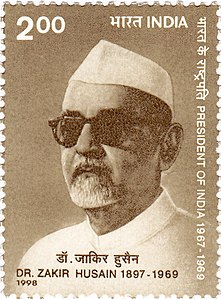 Husain on a 1998 stamp of India
 -
 Husain's mausoleum in Jamia Millia Islamia
 -
 The grave
 -
 Interior view of the mausoleum of Husain and his wife, Shah Jahan Begum.


References
- ↑ Zakir Husain, Encyclopædia Britannica Online, 12 February 2012, archived from the original on 11 January 2012, retrieved 13 May 2012
- ↑ "Archived copy". Archived from the original on 28 November 2020. Retrieved 5 August 2020.
{{cite web}}: CS1 maint: archived copy as title (link) - ↑ Manjapra, Kris (2014). Age of Entanglement. United States: Harvard University Press. p. 160. ISBN 978-067-4-72631-4. Archived from the original on 4 July 2014. Retrieved 22 December 2014.
- ↑ "Presidents of India". 15 February 2017. Archived from the original on 10 July 2020. Retrieved 10 July 2020.
- ↑ SHARMA, VISHWAMITRA (15 November 2012). Famous Indians Of The 20th Century. V&S Publishers. ISBN 978-93-5057-241-2. Archived from the original on 28 June 2021. Retrieved 23 November 2020.
- ↑ Ahmed, Akbar (27 February 2013). The Thistle and the Drone: How America's War on Terror Became a Global War on Tribal Islam. Brookings Institution Press. ISBN 978-0-8157-2379-0. Archived from the original on 28 June 2021. Retrieved 23 November 2020.
- ↑ ASAD, MAJDA. DR ZAKIR HUSSAIN. Publications Division Ministry of Information & Broadcasting. ISBN 978-81-230-2266-6. Archived from the original on 28 June 2021. Retrieved 23 November 2020.
- ↑ "Bharatmatamandir − Dr. Zakir Husain". 10 May 2008. Archived from the original on 28 June 2021. Retrieved 8 August 2017.
- ↑ "After controversy, crowning glory for Khurshid". The Hindu. 29 October 2012. Archived from the original on 9 January 2014. Retrieved 10 December 2012.
- ↑ "Former president Hussain was alumni of 150 year old school in Hyderabad". Deccan Chronicle. 13 March 2016. Archived from the original on 21 March 2017. Retrieved 21 March 2017.
- ↑ "लखनऊ विश्वविद्यालय के प्रतिनिधि बन गए देश के प्रेसीडेंट और प्रेसीडेंट बने प्रतिनिधि". Amar Ujala (in हिन्दी). Archived from the original on 28 February 2020. Retrieved 20 November 2020.
- ↑ Fārūqī, Z̤iāʼulḥasan (1999). Dr. Zakir Husain, quest for truth. APH Publishing. ISBN 9788176480567. Archived from the original on 28 June 2021. Retrieved 20 October 2010.
{{cite book}}:|work=ignored (help) - ↑ "Zakir Husain". Archived from the original on 27 September 2016. Retrieved 10 December 2012.
- ↑ Jai, Janak Raj (2003). Presidents of India: 1950–2003. New Delhi: Regency Publications. p. 52. ISBN 9788187498650. Archived from the original on 28 June 2021. Retrieved 23 November 2020.
- ↑ Zakir Hussain Saheb by Hakim Syed Zillur Rahman, Zakir Sahab Zatti Yadain, Edited by Dr. Abid Raza Bedar, Khuda Bakhsh Oriental Library, Patna, 1993, p. 165-168
- ↑ Zakir Sahab Aur Hakim Ajmal Khan by Hakim Syed Zillur Rahman, Dr. Zakir Husain Khan – Hayat, Fikr Aur Aman, Edited by Professor Abdul Ghaffar Shakil & Dr. Khaliq Anjum, Karnataka Urdu Academy, Bangalore, 1999. p. 157-174
- ↑ Zakir Sahib ki Insan Dosti by Hakim Syed Zillur Rahman, Dr. Zakir Husain Hayat wa Khidmat, Khuda Bakhsh Oriental Library, Patna, 2000, page 97-108
- ↑ Shashi Tharoor The Great Indian Novel, page 347
- ↑ "DETAILS OF MEDIA PERSONS ACCOMPANYING THE PRESIDENT IN HIS/HER VISITS ABROAD SINCE 1947 TO 2012" (PDF). The President's Secretariat. Archived from the original (PDF) on 17 August 2013. Retrieved 5 June 2013.
- ↑ "Dr. ZAKIR HUSAIN COLLEGE,Ilayangudi,Sivaganga,TamilNadu,India". Archived from the original on 20 October 2015. Retrieved 4 October 2015.
- ↑ "Archived copy". Archived from the original on 4 February 2015. Retrieved 18 April 2015.
{{cite web}}: CS1 maint: archived copy as title (link)
- Manjapra, Kris (2014). Age of Entanglement. United States: Harvard University Press. p. 160. ISBN 067-4-72631-6. Retrieved 11 November 2014
External links
| Academic offices | ||
|---|---|---|
| Preceded by Zahid Husain |
Vice-Chancellor of Aligarh Muslim University 1948–1956 |
Succeeded by Bashir Husain Zaidi |
| Political offices | ||
| Preceded by R. R. Diwakar |
Governor of Bihar 1957–1962 |
Succeeded by M. A. Ayyangar |
| Preceded by Sarvepalli Radhakrishnan |
Vice President of India 1962–1967 |
Succeeded by Varahagiri Venkata Giri |
| President of India 1967–1969 | ||


