




Ajay Kumar (talk | contribs) Created page with "{{Short description|Diplomatic service of the Government of India.}} {{Use Indian English|date=June 2020}} {{Use dmy dates|date=June 2020}} {{Infobox | title = Indian Foreign..." |
fixed issues |
||
| Line 1: | Line 1: | ||
{{Short description|Diplomatic service | {{Short description|Diplomatic service}} | ||
{{confuse|Indian Forest Service}} | |||
{{Use Indian English|date=June 2020}} | {{Use Indian English|date=June 2020}} | ||
{{Use dmy dates|date=June 2020}} | {{Use dmy dates|date=June 2020}} | ||
{{Infobox | {{Infobox | ||
| title = Indian Foreign Service | | title = Indian Foreign Service | ||
| subheaderstyle = background:#800080; color:white; | | subheaderstyle = background:#800080; color:white; | ||
| subheader1 = Service overview | | subheader1 = Service overview | ||
| image = [[File:Indian | | image = [[File:Indian Foreign Service (1024 x 1024 px) (8).png|150px|]] | ||
| label2 = | | caption = Motto: {{lang|sa|[[Vasudhaiva Kutumbakam|वसुधैव कुटुम्बकम्]]}}<br>{{small|([[Sanskrit]])}}<br>"The World is One Family" | ||
| data2 = {{start date and age|9 October 1946}} | | label1 = Abbreviation | ||
| label3 = Headquarters | | data1 = IFS | ||
| data3 = [[Secretariat Building, New Delhi|South Block]], [[New Delhi]] | | label2 = Date of establishment | ||
| label4 = Country | | data2 = {{start date and age|9 October 1946}} | ||
| data4 = {{Flag|India}} | | label3 = Headquarters | ||
| label5 = | | data3 = [[Secretariat Building, New Delhi|South Block]], [[New Delhi]] | ||
| data5= [[ | | label4 = Country | ||
| label6 = Field of | | data4 = {{Flag|India}} | ||
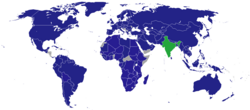
| data6 = [[File:Diplomatic missions of India.PNG|175px|Diplomatic missions of India ( | | label5 = Staff college | ||
| label7 = | | data5 = [[Sushma Swaraj Institute of Foreign Service]], [[New Delhi]] | ||
| data7 = [[Ministry of External Affairs (India)|Ministry of External Affairs]] | | label6 = Field of operation | ||
| label8 = | | data6 = [[File:Diplomatic missions of India.PNG|175px|Diplomatic missions of India (blue) & HQ and domestic offices (green)]]<br>[[List of diplomatic missions of India|Diplomatic missions of India]] | ||
| data8 = [[ | | label7 = Cadre controlling authority | ||
| label9 = | | data7 = [[Ministry of External Affairs (India)|Ministry of External Affairs]] | ||
| data9 = | | label8 = Minister responsible | ||
| data8 = [[S. Jaishankar]], [[Minister of External Affairs (India)|Minister of External Affairs]] | |||
| label9 = Legal personality | |||
| data9 = [[Government of India|Governmental]]: [[Civil Services of India|Civil service]] | |||
| label10 = General nature | |||
| data10 = | |||
| label11 = Preceding service | |||
| data11 = [[Indian Civil Service]] | |||
| label12 = [[En cadre|Cadre strength]] | |||
| data12 = 3,556 members (2025)<ref name="IFS Housing">{{cite web|title="Availability of housing improved, pursuing ongoing projects": Centre on IFS officers posted in India|url=https://firstindia.co.in/news/india/availability-of-housing-improved-pursuing-ongoing-projects-centre-on-ifs-officers-posted-in-india|publisher=firstindia.co.in|access-date=27 March 2025}}</ref><br>(Group A - 1177; Group B - 2379)<ref name="IFS Housing"/> | |||
| headerstyle = background:#800080; color:#fff; | |||
| header13 = Service Chief | |||
| | | label14 = [[Foreign Secretary (India)|Foreign Secretary]] | ||
| | | data14 = [[Vikram Misri]], IFS | ||
| | |||
| | |||
<br> | |||
| | |||
| | |||
| | |||
}} | }} | ||
The service is | The '''Indian Foreign Service''' ('''IFS''') is a [[diplomatic service]] and a [[Central Civil Services|central civil service]] of the [[Government of India|Government of the Republic of India]] under the [[Ministry of External Affairs (India)|Ministry of External Affairs]].<ref>{{cite web |title=Indian Foreign Service – Background |url=https://cseplus.nic.in/Home/DisplayPDF?streamId=PCsUnEplvZihdzEe8FEMf40O/FxVDw92BoPRoFRxiqzdEbJvsI1XnHs7incjxsXVnO2VFN2W2TU3StF0ITklBFgneKxNxWaqGE0dWl6xI+2VL0HPHUAM9hv8A3DwnRDK |website=cseplus.nic.in |publisher=CSE Plus |access-date=22 June 2022 |archive-date=18 May 2024 |archive-url=https://web.archive.org/web/20240518024948/https://cseplus.nic.in/Home/DisplayPDF?streamId=PCsUnEplvZihdzEe8FEMf40O/FxVDw92BoPRoFRxiqzdEbJvsI1XnHs7incjxsXVnO2VFN2W2TU3StF0ITklBFgneKxNxWaqGE0dWl6xI+2VL0HPHUAM9hv8A3DwnRDK |url-status=dead }}</ref> The [[Foreign Secretary (India)|Foreign Secretary]] is the head of the service. [[Vikram Misri]] is the 35th and the current Foreign Secretary. | ||
The service, consisting of [[Civil Services of India|civil servants]] is entrusted with handling the [[foreign relations of India]] and providing [[consular]] services, and to mark India's presence in international organizations.<ref name="mea.gov.in">{{cite web|url=http://www.mea.gov.in/indian-foreign-service.htm|title=MEA – About MEA : Indian Foreign Service |newspaper=Ministry of External Affairs, Government of India|access-date=2 April 2018}}</ref> It is the body of career [[diplomat]]s serving in more than 160 [[List of diplomatic missions of India|Indian diplomatic missions]] and international organizations around the world. In addition, they serve at the [[President of India|President's Secretariat]], the [[Prime Minister's Office (India)|Prime Minister's Office]] and at the headquarters of MEA in New Delhi.<ref>{{cite web |url=http://www.hindustantimes.com/india-news/sanjeev-kumar-singla-appointed-ps-to-pm-narendra-modi/article1-1242668.aspx |archive-url=https://web.archive.org/web/20140721105817/http://www.hindustantimes.com/india-news/sanjeev-kumar-singla-appointed-ps-to-pm-narendra-modi/article1-1242668.aspx |url-status=dead|archive-date=21 July 2014|title=Singla appointed PS to PM Narendra Modi|date=20 July 2014|website=hindustantimes.com|access-date=2 April 2018}}</ref> They also head Regional Passport Offices throughout the country and hold positions in several ministries on deputation. | |||
Indian Foreign Service officers have been 8 times [[Presidency of the UN Security Council|Presidents of the UN Security Council]]{{efn|B. N. Rau (June 1950 and March 1951), G. Parthasarathy (September 1967), Samar Sen (December 1972), Rikhi Jaipal (October 1977), Natarajan Krishnan (February 1985), Chinmaya R. Gharekhan (October 1991 and December 1992), Hardeep Singh Puri (August 2011 and November 2012), T. S. Tirumurti (August 2021), Ruchira Kamboj (December 2022).}}, several [[Under-Secretary-General of the United Nations]]{{efn|[[Chinmaya Gharekhan]] (UN USG, 1993), [[Atul Khare]] (UN USG)}}, 3 [[National Security Advisor (India)|National Security Advisors]]{{efn|[[Brajesh Mishra]], [[Jyotindra Nath Dixit]] and [[Shivshankar Menon]]}}, and have been elected to offices of [[K. R. Narayanan|President]], [[Mohammad Hamid Ansari|Vice President]], [[Governor (India)|Governors of States]], [[Meira Kumar|Speaker of Lok Sabha]], and [[Union Council of Ministers|Cabinet ministers]]. | |||
==History== | ==History== | ||
[[File:Delhi India Government.jpg|thumb|[[Secretariat Building, New Delhi|South Block]] The HQ of Ministry of External Affairs, Prime Minister's Office and Defence Ministry in New Delhi]] | [[File:Delhi India Government.jpg|thumb|[[Secretariat Building, New Delhi|South Block]] The HQ of Ministry of External Affairs, Prime Minister's Office and Defence Ministry in New Delhi]] | ||
On 13 September 1783, the [[board of directors]] of the [[Honourable East India Company|East India Company]] passed a [[Resolution (law)|resolution]] at [[Fort William, India|Fort William]], [[Calcutta]] (now [[Kolkata]]), to create a department, which could help "relieve the pressure" on the [[Warren Hastings]] administration in conducting its "secret and political business."<ref name="mea.gov.in"/> Although established by the Company, the {{em|Indian Foreign Department}} conducted business with foreign [[Europe]]an powers.<ref name="mea.gov.in"/> From the very beginning, a distinction was maintained between the ''foreign'' and ''political'' functions of the Foreign Department; relations with all "Asiatic powers" (including native [[princely state]]s) were treated as ''political'', while relations with European powers were treated as ''foreign''.<ref>{{cite web|url=http://meaindia.nic.in/onmouse/ifs.htm|title=Sorry for the inconvenience.|website=meaindia.nic.in|access-date=2 April 2018|archive-url=https://web.archive.org/web/20090619063509/http://meaindia.nic.in/onmouse/ifs.htm|archive-date=19 June 2009|url-status=dead}}</ref> | |||
On 13 September 1783, the [[board of directors]] of the [[Honourable East India Company|East India Company]] passed a [[Resolution (law)|resolution]] at [[Fort William, India|Fort William]], [[Calcutta]] (now [[Kolkata]]), to create a department, which could help "relieve the pressure" on the [[Warren Hastings]] administration in conducting its "secret and political business."<ref name="mea.gov.in"/> Although established by the Company, the | |||
In 1843, the [[Governor-General of India]], [[Edward Law, 1st Earl of Ellenborough]] carried out administrative reforms, organizing the Secretariat of the Government into four departments: Foreign, Home, Finance, and Military. Each was headed by a secretary-level officer. The Foreign Department Secretary was entrusted with the "conduct of all correspondence belonging to the external and internal diplomatic relations of the government."<ref name="mea.gov.in"/> | In 1843, the [[Governor-General of India]], [[Edward Law, 1st Earl of Ellenborough]] carried out administrative reforms, organizing the Secretariat of the Government into four departments: Foreign, Home, Finance, and Military. Each was headed by a secretary-level officer. The Foreign Department Secretary was entrusted with the "conduct of all correspondence belonging to the external and internal diplomatic relations of the government."<ref name="mea.gov.in"/> | ||
The [[Government of India Act 1935]] attempted to delineate more clearly functions of the foreign and political wings of the Foreign Department, it was soon realized that it was administratively imperative to completely bifurcate the department. Consequently, the | The [[Government of India Act 1935]] attempted to delineate more clearly functions of the foreign and political wings of the Foreign Department, it was soon realized that it was administratively imperative to completely bifurcate the department. Consequently, the {{em|External Affairs Department}} was set up separately under the direct charge of the Governor-General. | ||
The idea of establishing a separate diplomatic service to handle the external activities of the Government of India originated from a note dated 30 September 1944, recorded by [[Lieutenant-General (United Kingdom)|Lieutenant-General]] T. J. Hutton, the Secretary of the Planning and Development Department.<ref name="mea.gov.in"/> When this note was referred to the Department of External Affairs for comments, [[Olaf Caroe]], the Foreign Secretary, recorded his comments in an exhaustive note detailing the scope, composition and functions of the proposed service. Caroe pointed out that as India emerged as autonomous, it was imperative to build up a system of representation abroad that would be in complete harmony with the objectives of the future government.<ref name="mea.gov.in"/> | The idea of establishing a separate diplomatic service to handle the external activities of the Government of India originated from a note dated 30 September 1944, recorded by [[Lieutenant-General (United Kingdom)|Lieutenant-General]] T. J. Hutton, the Secretary of the Planning and Development Department.<ref name="mea.gov.in"/> When this note was referred to the Department of External Affairs for comments, [[Olaf Caroe]], the Foreign Secretary, recorded his comments in an exhaustive note detailing the scope, composition and functions of the proposed service. Caroe pointed out that as India emerged as autonomous, it was imperative to build up a system of representation abroad that would be in complete harmony with the objectives of the future government.<ref name="mea.gov.in"/> | ||
On 9 October 1946, the Indian government established the Indian Foreign Service for India's [[Diplomacy|diplomatic]], [[Consul (representative)|consular]] and commercial representation overseas. With independence, there was a near-complete transition of the Foreign and Political Department into what then became the new [[Ministry of External Affairs (India)|Ministry of External Affairs | On 9 October 1946, the Indian government established the {{em|Indian Foreign Service}} for India's [[Diplomacy|diplomatic]], [[Consul (representative)|consular]] and commercial representation overseas. With independence, there was a near-complete transition of the Foreign and Political Department into what then became the new [[Ministry of External Affairs (India)|Ministry of External Affairs]]. | ||
Indian Foreign Service Day is celebrated on 9 October every year since 2011 to | Indian Foreign Service Day is celebrated on 9 October every year since 2011 to honor the establishment of the Indian Foreign Service, the idea of which was proposed by diplomat [[Abhay Kumar|Abhay K]].<ref>{{cite news |title=IFS officials building their own traditions |url=https://timesofindia.indiatimes.com/india/IFS-officials-building-their-own-traditions/articleshow/23921012.cms |access-date=21 March 2024 |work=The Times of India |date=10 October 2013}}</ref><ref>{{cite news|url=https://government.economictimes.indiatimes.com/news/governance/pm-modi-lauds-ifs-officers-for-serving-the-nation-national-interest-during-ifs-day-celebrations/78568752|title=PM Modi lauds IFS officers for serving the nation, national interest during IFS day celebrations|work=Economic Times|date=9 October 2020}}</ref> | ||
== Selection == | |||
{{Multiple image | |||
| total_width = 230 | |||
| image1 = Indian Diplomatic Passport.svg | |||
| image2 = Indian Official Passport.svg | |||
| footer = Diplomatic Passport (left) and Official Passport (right). As opposed to ordinary deep blue passports, diplomatic passport is maroon-coloured with "Diplomatic Passport" engraved on it. Officials representing India other than IFS officers are usually given white-coloured Official Passports. | |||
}} | |||
The officers of the Indian Foreign Service are recruited through [[Civil Services Examination]] by [[Union Public Service Commission]] for Group A and also through [[Staff Selection Commission]] for Group B. | |||
In 1948, the first group of Indian Foreign Service officers were recruited based on the [[Civil Services Examination]] conducted by the Union Public Service Commission<ref name="upsc.gov.in">http://upsc.gov.in/exams/notifications/2014/csp/CSP%202014%20English.pdf {{Bare URL PDF|date=March 2022}}</ref> This exam is still used to select new foreign service officers.<ref name="ReferenceA">{{cite web | url=https://www.mea.gov.in/indian-foreign-service.htm | title=MEA | About MEA : Indian Foreign Service | newspaper=Ministry of External Affairs, Government of India }}</ref> Previous to 1948, some were appointed directly by the Prime Minister and included former native rulers of India who had integrated their provinces into India. | |||
Fresh recruits to the Indian Foreign Service are trained at [[Sushma Swaraj Foreign Service Institute, India|Sushma Swaraj Foreign Service Institute]] after a brief foundation course at the [[Lal Bahadur Shastri National Academy of Administration]], [[Mussoorie]].<ref>{{cite web|url=http://meafsi.gov.in/|title=Foreign Service Institute|website=meafsi.gov.in|access-date=2 April 2018}}</ref> In recent years, the | Fresh recruits to the Indian Foreign Service are trained at [[Sushma Swaraj Foreign Service Institute, India|Sushma Swaraj Foreign Service Institute]] after a brief foundation course at the [[Lal Bahadur Shastri National Academy of Administration]], [[Mussoorie]].<ref>{{cite web|url=http://meafsi.gov.in/|title=Foreign Service Institute|website=meafsi.gov.in|access-date=2 April 2018|archive-date=31 March 2018|archive-url=https://web.archive.org/web/20180331022013/http://meafsi.gov.in/|url-status=dead}}</ref> In recent years, the number of candidates selected to the Indian Foreign Service has averaged between 25 and 30 annually.<ref name="ReferenceA"/> | ||
==Training== | ==Training== | ||
On acceptance | On acceptance into the Foreign Service, new entrants undergo rigorous training, considered one of the most challenging and longest among Government of India services, typically lasting over one year. During the probationary period, these entrants are referred to as Officer Trainees. Training begins at the [[Lal Bahadur Shastri National Academy of Administration|LBSNAA]] in [[Mussoorie]], where members of other elite Indian civil services undergo a three-month Foundation Course, usually commencing in August each year.<ref name="mea.gov.in"/> | ||
Following the Foundation Course, probationers proceed to the [[Sushma Swaraj Foreign Service Institute, India|SSIFS]] in [[New Delhi]] for intensive instruction in subjects essential to [[diplomacy]], including [[international relations]] theory, [[military diplomacy]], trade, [[Foreign relations of India|India's foreign policy]], [[history]], [[International Law|international law]], diplomatic practice, hospitality, protocol, and administration. After a brief desk attachment in the [[Ministry of External Affairs (India)|Ministry of External Affairs]] at the rank of Assistant Secretary, officers are posted to an [[Diplomatic missions of India|Indian diplomatic mission]] abroad where their CFL is the native language. | |||
Officer Trainees also undertake {{em|Armed Forces Attachments}}, each lasting at least one week, with various government bodies and defense establishments—such as the [[Indian Army]] (either in [[Jammu and Kashmir (union territory)|Jammu and Kashmir]], or [[Ladakh]], or [[Sikkim]], or [[Arunachal Pradesh]]), [[Indian Navy]] (either in [[Mumbai]] or [[Visakhapatnam]]), [[Indian Air Force]] stations, or [[Central Armed Police Forces|CAPF]] units. | |||
In the middle phase of the program, participants are nominated for a {{em|State Attachment}} with a group of 5–7 officers in any state of India, for a duration of one week, to receive hands-on training in administrative functions. Additionally, participants are nominated for a {{em|Mission Attachment}} abroad, for one week, in an Indian Mission, to gain foundational exposure to the functioning of an embassy. | |||
{| class="wikitable floatright" | |||
! Language | |||
! Stations ({{Small|Posted as Third Secretary}}) | |||
|- | |||
| [[Russian language|Russian]] || [[Moscow]] {{flagicon|Russia}} | |||
|- | |||
| [[French language|French]] || [[Paris]] {{flagicon|France}}, [[Brussels]] {{flagicon|Belgium}}, [[Geneva]] {{flagicon|Switzerland}} | |||
|- | |||
| [[Spanish language|Spanish]] || [[Madrid]] {{flagicon|Spain}}, [[Mexico City]] {{flagicon|Mexico}}, [[Buenos Aires]] {{flagicon|Argentina}} | |||
|- | |||
| [[Mandarin Chinese|Chinese]] || [[Beijing]] {{flagicon|China}} | |||
|- | |||
| [[Arabic language|Arabic]] || [[Cairo]] {{flagicon|Egypt}}, [[Abu Dhabi]] {{flagicon|United Arab Emirates}} | |||
|- | |||
| [[German language|German]] || [[Berlin]] {{flagicon|Germany}}, [[Vienna]] {{flagicon|Austria}} | |||
|- | |||
| [[Japanese language|Japanese]] || [[Tokyo]] {{flagicon|Japan}} | |||
|- | |||
| [[Hebrew]] || [[Tel Aviv]] {{flagicon|Israel}} | |||
|- | |||
| [[Persian language|Persian]] || [[Tehran]] {{flagicon|Iran}} | |||
|- | |||
| [[Vietnamese language|Vietnamese]] || [[Hanoi]] {{flagicon|Vietnam}} | |||
|- | |||
| [[Sinhalese language|Sinhalese]] || [[Colombo]] {{flagicon|Sri Lanka}} | |||
|- | |||
| [[Nepali language|Nepalese]] || [[Kathmandu]] {{flagicon|Nepal}} | |||
|- | |||
| [[Dzongkha]] || [[Thimphu]] {{flagicon|Bhutan}} | |||
|- | |||
| [[Turkish language|Turkish]] || [[Ankara]] {{flagicon|Turkey}} | |||
|- | |||
| [[Pashto language|Pashto]] || [[Kabul]] {{flagicon|Afghanistan}} | |||
|- | |||
| [[Korean language|Korean]] || [[Seoul]] {{flagicon|South Korea}} | |||
|- | |||
| [[Portuguese language|Portuguese]] || [[Lisbon]] {{flagicon|Portugal}}, [[Brasília]] {{flagicon|Brazil}} | |||
|- | |||
| [[Indonesian language|Bahasa]] || [[Jakarta]] {{flagicon|Indonesia}}, [[Kuala Lumpur]] {{flagicon|Malaysia}} | |||
|} | |||
Additionally, they engage in 2–3 week {{em|Bharat Darshan}} tours, covering significant regions of [[India]], including [[Kolkata]], [[Darjeeling]], [[Northeast India]], [[Andaman and Nicobar Islands]], [[Chennai]], [[Thiruvananthapuram]], [[Bangalore]], [[Hyderabad]], [[Puri]], [[Mumbai]], [[Rajasthan]], [[Amritsar]], [[Shimla]], [[Jammu and Kashmir (union territory)|Kashmir]] and [[Ladakh]]. | |||
The entire training program spans approximately 10-11 months and concludes with calls on VVIPs ([[President of India|President]], [[Vice President of India|Vice President]], [[Prime Minister of India|Prime Minister]], [[Minister of External Affairs (India)|External Affairs Minister]] and the [[Foreign Secretary of India|Foreign Secretary]]) in the last week of the programme.<ref name="mea.gov.in"/> | |||
Upon completion of the training program, officers are assigned a compulsory foreign language (CFL) based on their rank in the UPSC CSE exam. Priority is given to [[UN]] languages, including [[Russian language|Russian]], [[French language|French]], [[Mandarin Chinese|Chinese]], [[Spanish language|Spanish]], and [[Arabic language|Arabic]], as well as other languages such as [[German language|German]], [[Japanese language|Japanese]], [[Hebrew]], [[Persian language|Persian]], among others detailed below. UN languages, along with German and Japanese, are available every year, while other languages may be allocated depending on vacancies or typically after 2–3 years. There, they undergo language training and are expected to achieve proficiency, culminating in an examination conducted by the [[Ministry of Defence (India)|Ministry of Defence]].<ref>{{Cite web |url=https://ssifs.mea.gov.in/itp-for-ifs-ots |title=Induction Training Programme for IFS Officer Trainees |website=Sushma Swaraj Foreign Service Institute |access-date=2025-11-01}}</ref> | |||
Successful completion of the language examination confirms the officer in service and leads to promotion to the rank of {{em|Second Secretary}} at the respective Indian embassy in the CFL country. Subsequent promotions and postings are generally based on performance rather than CFL and may include important diplomatic assignments in locations such as in the [[Permanent members of the United Nations Security Council|P-5 countries]] which are [[United States]], [[Russia]], [[China]], [[United Kingdom]] and [[France]], then comes the neighborhood countries of India (except China{{small|, which is already mentioned in P-5}}) like [[Pakistan]], [[Afghanistan]], [[Sri Lanka]], [[Bangladesh]], [[Bhutan]], [[Nepal]] and [[Myanmar]] and then [[G4 nations]] which are [[Germany]], [[Japan]], and [[Brazil]].<ref name="mea.gov.in"/> | |||
The following table categorizes some international cities according to the MEA classification system, ranging from A* (highest) to C*(NF) (lowest). Each category lists representative cities as per MEA guidelines.<ref name="MEA Station Categories">“Categories of stations and posting conditions” — Ministry of External Affairs, Government of India, RTI Manual Section 4(1)(b)(viii). Available at: https://www.mea.gov.in/right-to-information.htm?dtl/127/41bviii_Statement_of_board_councils_committes_and_other_bodies (accessed 31 Mar 2021).</ref> | |||
{| class="wikitable" | |||
! A* !! A !! B !! C !! C* !! C*(NF) | |||
|- | |||
| [[Washington DC]], [[New York City|New York]], [[Tokyo]] | |||
| [[London]], [[Paris]], [[Rome]], [[Berlin]], [[Dubai]] | |||
| [[Moscow]], [[Beijing]], [[Tel Aviv]], [[Shanghai]], [[Buenos Aires]], [[Colombo]] | |||
| [[Tehran]], [[Cairo]], [[Riyadh]], [[Kyiv]], [[Minsk]] | |||
| [[Islamabad]], [[Dhaka]], [[Beirut]], [[Ulaanbaatar]] | |||
| [[Kabul]], [[Baghdad]], [[Damascus]] | |||
|} | |||
==Functions== | ==Functions== | ||
[[File: | [[File:President Obama and Prime Minister Modi in an expanded bilateral meeting at Hyderabad House.jpg|thumb|upright=1.3|The [[President of the United States|U.S. President]] [[Barack Obama]] and the [[Prime Minister of India|Indian Prime Minister]] [[Narendra Modi]] with their diplomats in an expanded bilateral meeting at [[Hyderabad House]], [[New Delhi]], 2015.|alt=]] | ||
As a career diplomat, the Foreign Service Officer is required to project India's interests, both at home and abroad on a wide variety of issues. These include bilateral political and economic cooperation, trade and investment promotion, cultural interaction, press and media liaison as well as a whole host of multilateral issues.<ref name="mea.gov.in"/> | |||
* Serving as India's Representative: Foreign Service Officers work in Indian Embassies, High Commissions, Consulates, and Permanent Missions to multilateral organizations like the UN, where they act as the official representatives of India. | |||
* Protecting India's Interests: They are tasked with safeguarding and advancing India's national interests in the country where they are posted. | |||
* Fostering Friendly Relations: Diplomats promote and cultivate friendly relations between India and the host country, including its people, as well as with Non-Resident Indians (NRI) and People of Indian Origin (PIO) communities. | |||
* Accurate Reporting: Foreign Service Officers provide precise and timely reports on developments in the host country that may impact India's policies. | |||
* Negotiating Agreements: They engage in negotiations with the authorities of the host country to establish agreements on a range of issues. | |||
* Consular Services: Diplomats extend consular services to both foreign nationals in need and Indian citizens residing abroad, ensuring they receive necessary assistance and support. | |||
==Career Progression== | |||
After successfully passing the UPSC CSE examination, a selected Indian Foreign Service Officer Trainee (OT) is initially appointed as an Assistant Secretary in any of the MEA, where the officer is required to execute assigned tasks within any [[Ministry of External Affairs (India)#Organizational structure|division]] of the MEA. Upon completion of an initial training period of approximately two months, the officer is posted abroad as a Third Secretary at an Indian Embassy or Indian High Commission for language training. Typically, after 1 to 2 years, the officer is promoted to the rank of Second Secretary at the respective diplomatic mission.<ref>{{Cite web|url=http://indianexpress.com/article/india/india-others/new-ias-officers-to-work-as-assistant-secretary-in-delhi/|title=New IAS officers to work as assistant secretary in Delhi|last=Yadav|first=Shyamlal|date=18 August 2015|website=[[The Indian Express]]|oclc=70274541|location=[[New Delhi]]|access-date=20 January 2018|archive-url=https://web.archive.org/web/20180109140622/http://indianexpress.com/article/india/india-others/new-ias-officers-to-work-as-assistant-secretary-in-delhi/|archive-date=9 January 2018|url-status=live}}</ref><ref>{{cite web |title=Sneha Dubey: The Young Indian Diplomat Who Took on Pakistan at the UN |url=https://indianmasterminds.com/feature-stories-on-bureaucrats-changemakers/upsc-stories/sneha-dubey-the-young-indian-diplomat-who-took-on-pakistan-at-the-un/ |website=Indian Masterminds |access-date=2026-02-03}}</ref> | |||
After a period of 3 to 4 years of service abroad, the officer is recalled to the MEA and appointed as an Under Secretary, where they serve in any bench of the respective division of the MEA.<ref name="BVMP">{{cite news |last=Sirohi |first=Seema |title=Exclusive: S Jaishankar to be India's next envoy to Washington |url=https://www.firstpost.com/world/exclusive-s-jaishankar-to-be-indias-next-envoy-to-washington-1022463.html |access-date=16 April 2022 |work=Firstpost |date=9 August 2013}}</ref> | |||
Following 8 to 9 years of service, the officer is promoted to Deputy Secretary and may be posted either in the MEA under any division or abroad as a First Secretary.<ref>{{cite web |title=Sneha Dubey: Know all about India's first secretary at UN who gave fiery reply to Pakistan Prime Minister |url=https://timesofindia.indiatimes.com/india/sneha-dubey-know-all-about-indias-first-secretary-at-un-who-gave-fiery-reply-to-pakistan-prime-minister/articleshow/86501318.cms |website=Times of India |date=25 September 2021 |access-date=2026-02-03}}</ref> | |||
After 12 to 13 years of service, the officer attains the rank of Director and may also be posted abroad as a Counsellor.<ref>{{cite web |title=Esha Srivastava (IFS) appointed as Govt Nominee Director on Indian Oil Board |url=https://psuwatch.com/psu-appointments/esha-srivastava-ifs-appointed-as-govt-nominee-director-on-indian-oil-board |website=PSUWatch |access-date=2026-02-03}}</ref> | |||
After 16 to 18 years of service, the [[Appointments Committee of the Cabinet]] may empanel the officer at the rank of [[Joint secretary to the Government of India|Joint Secretary]], making them eligible for postings as either Deputy Chief of Mission or Deputy High Commissioner or Minister abroad. At this rank, officers serving in the MEA typically become the head of a division.<ref>{{cite web |title=38 Officers Empaneled for Joint Secretary Posts in Government of India |url=https://indianmasterminds.com/news/acc-empanels-38-officers-joint-secretary-government-of-india-155123/ |website=Indian Masterminds |access-date=2026-02-03}}</ref><ref>{{Cite web |title=Shri. Jitender Pal Singh appointed as the next Ambassador of India to the State of Israel |url=https://www.mea.gov.in/press-releases.htm?dtl/38939/ |website=Ministry of External Affairs, Government of India |date=24 January 2025 |access-date=15 January 2026}}</ref> | |||
After 26 to 27 years of service, promotion to the rank of [[Additional secretary to the Government of India|Additional Secretary]] is possible, enabling appointments as Ambassador or High Commissioner to neighbouring countries of India or the G4 countries. Officers at this rank may also become head of important divisions in the MEA, such as the Americas division. The primary eligibility criterion for this promotion is that the officer must have a minimum of two years of service remaining before retirement.<ref>{{cite web |title=Randhir Jaiswal, (Addl. Sec) takes over as MEA spokesperson from Arindam Bagchi |url=https://www.thehindu.com/news/national/randhir-jaiswal-takes-over-as-mea-spokesperson-from-arindam-bagchi/article67701427.ece |website=The Hindu |access-date=2026-02-03}}</ref> | |||
India | After 29 to 30 years of service, officers may be promoted by the Appointments Committee to the rank of [[Secretary to the Government of India|Secretary]], at which point they either serve as Ambassador or High Commissioner to P-5 countries or head the Secretary (East, West, South, ER, CPV) divisions in the MEA. The primary eligibility criterion for this promotion is that the officer must have a minimum of two years of service remaining before retirement, same as Additional Secretary.<ref>{{cite web |title=Senior diplomat Sripriya Ranganathan appointed Secretary (CPV and OIA) in MEA |url=https://theprint.in/india/senior-diplomat-sripriya-ranganathan-appointed-secretary-cpv-and-oia-in-mea/2816057/ |website=ThePrint |access-date=2026-02-03}}</ref> | ||
The rank of [[Foreign Secretary (India)|Foreign Secretary]] is conferred only under specific conditions<ref>{{cite web |title=Who is Vikram Misri? All about his journey and education |url=https://bestcolleges.indiatoday.in/news-detail/who-is-vikram-misri-all-about-his-journey-and-education-3420 |website=India Today Best Colleges |access-date=2026-02-03}}</ref>: | |||
* The officer is the senior-most in the foreign service. | |||
* The officer has completed over thirty years of service. | |||
* The officer has undertaken exceptional and crucial work during their career. | |||
* The officer has served as Ambassador or High Commissioner to at least one P-5 country. | |||
* The officer has served one or more times in neighbouring countries. | |||
* The officer possesses the utmost level of [[integrity]].<ref>{{cite web |title=What is needed to become the Foreign Secretary of India |url=https://www.quora.com/What-is-needed-to-become-the-Foreign-Secretary-of-India |access-date=2026-02-03}}</ref> | |||
The decision of appointment to the post of Foreign Secretary is entirely at the discretion of the [[Appointments Committee of the Cabinet]].<ref>{{Cite news |url=https://indianexpress.com/article/explained/why-cabinet-committees-are-formed-what-are-the-functions-of-each-5768896/|title=Why Cabinet Committees are formed, what are the functions of each |first=Pradeep |last=Kaushal |date=7 June 2019 |newspaper=[[Indian Express]]}}</ref> In certain cases, the age of the officer is immaterial; for instance, [[S. Jaishankar]], who joined the service at the age of 22, became Foreign Secretary, with only three days remaining before his retirement. [[Vinay Mohan Kwatra]] joined the service, even at the age of 26 and subsequently became Foreign Secretary. Conversely, many officers who joined at a young age, such as 23 or 24, did not attain this position, for not fulfilling the above conditions. | |||
While higher studies, such as a [[Master's degree]] or [[Ph.D.]], are encouraged by the MEA to provide officers with a broader perspective, such qualifications do not influence promotion. For example, [[Harsh Vardhan Shringla]] holds only a [[Bachelor of Arts|B.A.]] degree and nevertheless became Foreign Secretary. | |||
===Rank Structure=== | |||
In [[Indian missions]] abroad, the highest-ranking officials are the Heads of Missions, who holds the rank of [[ambassador]]s, [[High commissioner (Commonwealth)|high commissioner]]s, and [[permanent representative]]s. They lead the various embassies, [[high commission]]s, and intergovernmental organisations worldwide. Heads of Posts are Consuls General who heads Consulate Generals in missions abroad. In MEA headquarters, the highest-ranking official among the secretaries is the [[Foreign Secretary (India)|Foreign Secretary]]. | |||
Also in some cases, the senior most IFS officers also held the office of [[National Security Advisor (India)|National Security Advisor]] ({{em|NSA}}) and also the [[Principal Secretary to the Prime Minister of India|Principal Secretary]] who have the rank even above the [[Cabinet Secretary (India)|Cabinet Secretary]] and the Foreign Secretary. | |||
The following is the structure of the Indian Foreign Service: | |||
{| class="wikitable sortable mw-collapsible" | |||
|+Ranks, designations, and positions held by Indian Foreign Service (IFS) officers in their career<ref name="MEA Pay Rules">{{Cite web|url=https://dopt.gov.in/sites/default/files/14021_1_2016-AIS-II.pdf|title=Indian Foreign Service (Pay) Rules, 2016|website=Department of Personnel and Training, Government of India|date=8 September 2016|access-date=5 September 2017}}</ref><ref name="7CPC">{{Cite web|url=http://7cpc.india.gov.in/pdf/sevencpcreport.pdf|title=Report of the 7th Central Pay Commission of India|website=Department of Expenditure, Government of India|access-date=15 February 2018|archive-url=https://web.archive.org/web/20151120092637/http://7cpc.india.gov.in/pdf/sevencpcreport.pdf|archive-date=20 November 2015}}</ref> | |||
|- | |||
! Grade/Scale (Level on Pay Matrix) | |||
! Posting at Embassies / High Commissions / Permanent Missions | |||
! Posting at Consulates | |||
! Posting at the [[Ministry of External Affairs (India)|Ministry of External Affairs]] | |||
! Position on [[order of precedence in India]] | |||
! Pay Scale<br>(Basic Pay) | |||
|- | |||
| Administrative Head<br>(Pay level 17) | |||
| style="text-align:center;" | — | |||
| style="text-align:center;" | — | |||
| style="text-align:center;" | [[Foreign Secretary of India|Foreign Secretary]] | |||
| {{Centre|23*{{efn|Foreign Secretary is the senior-most career diplomat and the administrative head of the [[Ministry of External Affairs (India)]], and is equivalent to [[Secretary to the Government of India]].}}}} | |||
| style="text-align:center;" | {{INRConvert|225|k|lk=on}} | |||
|- | |||
| Apex scale<br>(Pay level 17) | |||
| rowspan="2" style="text-align:center;" | [[Ambassador]] /<br>[[High Commissioner (Commonwealth)|High Commissioner]] /<br>[[Permanent Representative]] to the [[United Nations]] or other international organisations | |||
| style="text-align:center;" | — | |||
| style="text-align:center;" | [[Secretary to the Government of India|Secretary]] | |||
| {{Centre|23}} | |||
| style="text-align:center;" | {{INRConvert|225|k|lk=on}} | |||
|- | |||
| Higher Administrative Grade<br>(Pay level 15) | |||
| style="text-align:center;" | — | |||
| style="text-align:center;" | [[Additional Secretary to the Government of India|Additional Secretary]] | |||
| {{Centre|25}} | |||
| style="text-align:center;" | {{INRConvert|182.2|k|lk=on}}—{{INRConvert|224.1|k|lk=on}} | |||
|- | |||
| Senior Administrative Grade<br>(Pay level 14) | |||
| style="text-align:center;" | [[Ambassador]]/<br>[[High Commissioner]]/<br>[[Minister (diplomat)|Minister]] /<br>[[Deputy Chief of Mission]] | |||
| style="text-align:center;" | [[Consul General]] | |||
| style="text-align:center;" | [[Joint Secretary to Government of India|Joint Secretary]] | |||
| {{Centre|26}} | |||
| style="text-align:center;" | {{INRConvert|144.2|k|lk=on}}—{{INRConvert|218.2|k|lk=on}} | |||
|- | |||
| Selection Grade<br>(Pay level 13) | |||
| style="text-align:center;" | [[Counselor (diplomat)|Counsellor]] | |||
| style="text-align:center;" | Deputy Consul General | |||
| style="text-align:center;" | Director | |||
| | |||
| style="text-align:center;" | {{INRConvert|123.1|k|lk=on}}—{{INRConvert|215.9|k|lk=on}} | |||
|- | |||
| Junior Administrative Grade<br>(Pay level 12) | |||
| style="text-align:center;" | [[First Secretary (diplomatic rank)|First Secretary]] | |||
| style="text-align:center;" | [[Consul]] | |||
| style="text-align:center;" | Deputy Secretary | |||
| | |||
| style="text-align:center;" | {{INRConvert|78.8|k|lk=on}}—{{INRConvert|209.2|k|lk=on}} | |||
|- | |||
| Senior Time Scale<br>(Pay level 11) | |||
| style="text-align:center;" | [[Second Secretary]] | |||
| style="text-align:center;" | Consul | |||
| style="text-align:center;" | Under Secretary | |||
| | |||
| style="text-align:center;" | {{INRConvert|67.7|k|lk=on}}—{{INRConvert|208.7|k|lk=on}} | |||
|- | |||
| Junior Time Scale<br>(Pay level 10) | |||
| style="text-align:center;" | [[Third Secretary]] | |||
| style="text-align:center;" | Vice Consul | |||
| style="text-align:center;" | Assistant Secretary | |||
| | |||
| style="text-align:center;" | {{INRConvert|56.1|k|lk=on}}—{{INRConvert|177.5|k|lk=on}} | |||
|- | |||
|} | |||
'''Note:''' Apart from the basic pay, IFS officers posted in missions abroad are entitled to a '''Foreign Allowance''', which is determined and revised periodically by the [[Ministry of External Affairs (India)|MEA]]. Based on various sources, it is estimated that the starting gross monthly remuneration (Basic Pay + Foreign Allowance + other admissible allowances) of an IFS officer posted abroad begins at a minimum of [[USD|$]]4,000 per month at the rank of Third Secretary, and progressively increases to a minimum of [[USD|$]]9,500 per month at the rank of Ambassador.<ref>{{Cite web|title=Pay and Allowances for Indian Mission Officers Abroad|url=https://www.indianembassyusa.gov.in/extra?id=5|website=Embassy of India, Washington, D.C.|access-date=11 January 2026}}</ref> | |||
When IFS officers are posted in [[India]], their monthly pay is mostly same with that of an [[Indian Administrative Service|IAS]] officer of the same rank in the Ministry of External Affairs, although certain allowances may differ. | |||
'''Note:''' Even at the [[Joint Secretary to Government of India|Joint Secretary]] rank, some IFS officers may be appointed as Ambassador or High Commissioner to foreign countries (except the [[Permanent members of the United Nations Security Council|P-5]] countries), provided there is a vacancy.<ref>{{cite web |title=Shri. Jitender Pal Singh appointed as the next Ambassador of India to the State of Israel |url=https://www.mea.gov.in/press-releases.htm?dtl/38939/ |publisher=Ministry of External Affairs, Government of India |accessdate=11 January 2026}}</ref> | |||
'''Note:''' Any IFS officer may express a preference for their posting, either abroad or within the MEA. Generally, officers are assigned to their preferred postings whenever possible. However, if there are limited or no vacancies available for the desired posting, the final decision regarding the assignment rests with the Foreign Service Board (FSB). This provides an advantage over the [[All India Services]] officers like the IAS and [[Indian Police Service|IPS]], where postings are determined at the discretion of the service authorities and are not necessarily aligned with the officers’ preferences.<ref>{{cite web |title=Can IFS Officers CHOOSE their Place of Posting? |url=https://www.youtube.com/watch?v=xHxhWU4ywnE |website=Officers IAS Academy - India's Only IAS Academy |access-date=2026-02-03}}</ref> | |||
=== Deputation === | |||
An Indian Foreign Service (IFS) officer is eligible for deputation to various central government organizations, including the [[Rashtrapati Bhavan|President's Secretariat]], [[Prime Minister's Office (India)|Prime Minister's Office]], [[National Defence College (India)|National Defence College]], [[National Security Council (India)|National Security Council Secretariat]], any [[List of ministries of India|ministry of the Government of India]], [[Department of Space]], [[Department of Atomic Energy]], [[Lok Sabha Secretariat]], [[Cabinet Secretariat (India)|Cabinet Secretariat]] and other organizations in accordance with the central government deputation rules.<ref>{{Cite web |title=Officers on Deputation |url=https://www.mea.gov.in/officers-on-deputation.htm |website=Ministry of External Affairs |access-date=2026-02-03}}</ref> | |||
IFS officers can also be inducted into the [[Research & Analysis Wing]] (R&AW), the [[Intelligence Bureau (India)|Intelligence Bureau]] (IB), the [[National Investigation Agency]] (NIA) and other intelligence agencies either on a temporary basis or permanently as intelligence officers.<ref>{{Cite video |title=Amar Bhushan, RAS (ex‑IPS) on R&AW Officers Recruitment of IAS, IPS, IFS, IRS through UPSC|url=https://www.youtube.com/watch?v=1-pojsb7DuI&t=2655s |publisher=Raj Shamani |access-date=2026-02-03}}</ref><ref name="R&AW-Deputation">{{Cite news |title=R&AW to Get Ripe Diplomat |url=https://www.newindianexpress.com/thesundaystandard/2015/Dec/13/raw-to-get-ripe-diplomat-857036.html |work=The New Indian Express |date=15 December 2015 |access-date=2026-02-03 |quote=Example of IFS officers being deputed to intelligence agencies}}</ref><ref>{{Cite web |title=Aspire to Be a R&AW Officer: Your Guide to Joining the Prestigious Agency |url=https://www.news18.com/education-career/aspire-to-be-a-raw-officer-your-guide-to-joining-the-prestigious-agency-8449933.html |website=News18 |access-date=2026-02-03}}</ref> | |||
==== | IFS officers may also be posted to Regional Passport Offices in any state of India as the Passport Officer. Additionally, there are several branch secretariats of the Ministry of External Affairs (MEA) in cities such as Kolkata, Mumbai, Chennai, Guwahati, and Hyderabad where IFS officers can be assigned. Certain institutes, including the [[Sushma Swaraj Institute of Foreign Service|SSIFS]] and the [[Indian Council of World Affairs|ICWA]], also offer deputation opportunities for IFS officers.<ref>{{Cite web |title=Regional Passport Offices |url=https://www.mea.gov.in/regional-passport-offices.htm |website=MEA |access-date=2026-02-03}}</ref><ref>{{Cite web |title=Other Offices |url=https://www.mea.gov.in/other-offices.htm |website=MEA |access-date=2026-02-03}}</ref> | ||
Unlike the Indian Administrative Service (IAS), IFS officers do not usually serve in state deputation; however, there are rare instances where officers have been posted to state governments, although significant barriers exist in this regard.<ref>{{cite news |title=Former diplomat Venu Rajamony appointed Kerala govt's OSD for External Cooperation |url=https://www.onmanorama.com/news/kerala/2021/09/16/diplomat-venu-rajamony-appointed-as-kerala-osd-for-ext-cooperation.html |publisher=Onmanorama |date=16 September 2021 |accessdate=}}</ref> | |||
==== | ==Major concerns and reforms== | ||
===Understaffed=== | |||
India has one of the most understaffed diplomatic forces of any major country in the world.<ref name="IFS India US China">{{cite web |url=https://theprint.in/opinion/india-must-rethink-strategies-on-national-security-if-it-wants-to-join-ranks-with-us-china/270324/ |title=India must rethink strategies on national security if it wants to join ranks with US, China|work=The Print |date=31 July 2019 |access-date=12 August 2019}}</ref><ref name="IFS Foreign Influence">{{cite web |url=https://theprint.in/diplomacy/with-just-1400-diplomats-indias-foreign-influence-is-severely-limited/219288/ |title=With just 1,400 diplomats, India's foreign influence is severely limited|work=The Print |date=10 April 2019 |access-date=12 August 2019}}</ref><ref name="IFS Global">{{cite web |url=https://theprint.in/india/governance/india-has-global-ambitions-but-not-enough-ifs-officers-to-fulfil-them/108990/ |title=India has global ambitions but not enough IFS officers to fulfil them|work=The Print |date=31 August 2018 |access-date=12 August 2019}}</ref><ref name="IFS relevance">{{cite web |url=https://www.firstpost.com/world/indian-foreign-service-in-desperate-need-of-reform-particularly-when-it-is-losing-relevance-2943924.html |title=Indian Foreign Service in desperate need of reform, particularly when it is losing relevance|work=Firstpost |date=9 August 2016 |access-date=12 August 2019}}</ref> Based on 2014 calculations there are about 2,700 "diplomatic rank" officers in overseas missions and at headquarters.<ref name="EA 12th Report IFS">{{cite web |url=https://164.100.47.193/lsscommittee/External%20Affairs/16_External_Affairs_12.pdf |title=Twelfth Report, Standing Committee on External Affairs: Indian Foreign Service cadre |work=[[Lok Sabha]] |access-date=21 December 2016 |archive-date=2 October 2021 |archive-url=https://web.archive.org/web/20211002095319/https://164.100.47.193/lsscommittee/External%20Affairs/16_External_Affairs_12.pdf |url-status=bot: unknown }}</ref> A minority of the diplomatic officers are Foreign Service (A) officers, the senior cadre of Indian diplomacy, which is primarily drawn from direct recruitment through the [[Civil Services Examination]]. Although sanctioned strength was 912, the actual strength of Group A was 770 officers in 2014.<ref name="EA 12th Report IFS"/> In addition there were in 2014, 252 Grade-I officers of Indian Foreign Service (B) General Cadre who after promotion are inducted into Indian Foreign Service (A). The lower grades of the Indian Foreign Service(B) General Cadre included 635 attaches. The breakdown of other cadres and personnel included 540 secretarial staff, 33 from the Interpreters Cadre, 24 from the Legal and Treaties Cadre, and 310 personnel from other Ministries.<ref name="calculation">{{cite news |last1=Shukla |first1=Srijan |title=With just 1,400 diplomats, India's foreign influence is severely limited |url=https://theprint.in/diplomacy/with-just-1400-diplomats-indias-foreign-influence-is-severely-limited/219288/ |work=The Print |date=10 April 2019}}</ref> | |||
[[Shashi Tharoor]], then chairman of [[Committee on External Affairs]] in [[16th Lok Sabha]] had presented the 12th report for expanding and building the numbers, quality and capacity of India's diplomats.<ref name="EA 12th Report IFS"/><ref name="Shashi Tharoor Panel IFS">{{cite web |url=http://www.firstpost.com/world/india-is-strapped-for-diplomats-but-if-shashi-tharoors-panel-has-its-way-you-could-become-one-2931362.html |title=If Shashi Tharoor's panel has its way, India's diplomatic corps could grow in quantity and quality |work=Firstpost |date=3 August 2016 |access-date=21 December 2016}}</ref><ref name="IFS Gap">{{cite news |url=http://economictimes.indiatimes.com/news/politics-and-nation/fill-in-ifs-cadre-gap-parliament-committee-to-government/articleshow/53532710.cms |title=Fill in IFS cadre gap, Parliament committee to Government|work=[[The Economic Times]] |access-date=21 December 2016|last1=Chaudhury |first1=Dipanjan Roy }}</ref> | |||
In March 2023, [[List of Indian parliamentary committees|Parliamentary Committee]] [[Committee on External Affairs|on External Affairs]] criticized the service for being severely short-staffed and under-budgeted. In its Demand for Grants (2023–24) report, the committee highlighted that the cadre strength of Indian Foreign Service Officers is only 1,011 which is just 22.5 percent of the total strength. Out of IFS 'A' cadre, 667 are posted at diplomatic missions across the world and 334 are manning the headquarters in Delhi, which at present has 57 divisions.<ref>{{cite news |title='Indian diplomatic service most short-staffed compared to many other countries': Parliamentary panel |url=https://www.newindianexpress.com/nation/2023/mar/21/indian-diplomatic-service-most-short-staffed-compared-to-many-other-countries-parliamentary-pane-2558234.html |access-date=8 April 2023 |work=The New Indian Express}}</ref> | |||
=== | ===Declining prestige and quality=== | ||
Since its inception and especially in the early decades of the service, the Indian Foreign Service had a reputation for attracting the country's most talented civil service aspirants.<ref name="earlyhistory">{{cite news |title=IFS regaining lost edge with toppers |url=https://www.indiatoday.in/mail%20today/story/IFS-regaining-lost-edge-with-toppers-54978-2009-08-23 |work=India Today |date=August 23, 2009}}</ref> The quality of candidates based on exam rank has significantly declined and the quality of candidates has created concerns about harm to prestige in expanding the size of the service.<ref name="policycapacity">{{cite journal |last1=Bajpai |first1=Kanti |last2=Chong |first2=Byron |title=India's Foreign Policy Capacity |journal=Policy Design and Practice |date=2019 |volume=2 |issue=2 |pages=137–162 |doi=10.1080/25741292.2019.1615164 |s2cid=197828999 |doi-access=free }}</ref> | |||
In the 1960s and 1970s, exam toppers generally in the top 20 opted for the Indian Foreign Service over the [[Indian Administrative Service]] and [[Indian Police Service]], the other elite civil services. By late 1980s, the dip was appreciable and Indian Foreign Service spots did not fill until reaching much deeper down the list.<ref name="policycapacity"/> The Indian Foreign Service continues in recent years to have difficulty in attracting the most promising candidates. For the 2017 Civil Services Exam, only 5 of the top 100 candidates chose the Indian Foreign Service with the last ranking person from the General Category in the 152nd position.{{Cn|date=May 2024}} For candidates with [[Reservation in India|reservation status]], a candidate from the [[Scheduled Castes and Scheduled Tribes]] in the 640th position closed the list for Indian Foreign Service.{{Cn|date=May 2024}} The Indian Foreign Service has become less attractive due to higher pay in corporate jobs, other elite civil services like the [[All India Services]] promising more power, and fading glamour as foreign travel became common place.<ref name="earlyhistory"/> | |||
Indian | |||
A parliamentary committee reviewing Indian Foreign Service reform in 2016 feared a negative feedback loop with the "deterioration" in candidate quality as both a "both a symptom and a reason for the erosion of prestige in the Indian Foreign Service". However, the committee was hard pressed to address the issue because it was also concerned about increasing the "quantity" of Indian diplomats.<ref name="qualityandquantity">{{cite news |title=Why the Indian Foreign Service has a quality and quantity dilemma |url=https://indianexpress.com/article/opinion/web-edits/why-the-indian-foreign-service-has-a-quality-and-quantity-dilemma-2953398/ |work=Indian Express |date=August 4, 2016}}</ref> [[T. P. Sreenivasan]], a retired Foreign Service officer, argued in 2015 that "elitism should be preserved" for the Indian Foreign Service to perform effectively. He further lamented the Indian Foreign Service "is already a shadow of its former self" which dissuaded aspirants and the service needed to have its "attractiveness enhanced".<ref name="preserve">{{cite news |title=Foreign Service must remain elitist |url=https://www.thehindu.com/opinion/op-ed/foreign-service-must-remain-elitist/article7350788.ece |work=The Hindu |date=June 25, 2015}}</ref> | |||
Indian Foreign Service | ==Indian Foreign Service, Branch B== | ||
The Indian Foreign Service (Branch B), or IFS (B), has one cadre: the General cadre. Recruitments are made through separate competitive exams, named [[Combined Graduate Level Examination]] (CGLE), conducted by the [[Staff Selection Commission]] (SSC). For distinction, the IFS is mostly referred to as IFS (Group A) by the media and general public. Until 2009, the General cadre and Stenographers' cadre personnel were absorbed into IFS after serving a prescribed number of years. Officers from cadre who had joined IFS reached up to the post of ambassador. In 2009, the path to promotion to IFS was closed for the Stenographers cadre.<ref name="northkorea">{{cite news |title=Steno envoy sparks 'caste war' |url=https://www.telegraphindia.com/india/steno-envoy-sparks-caste-war/cid/410209 |work=The Telegraph |date=9 June 2012}}</ref> | |||
=== | {| class="wikitable" | ||
Indian Foreign Service | |+ General cadre<ref name="IFSB2017">{{cite web |title=The Indian Foreign Service Branch 'B' Rules, 2017 |url=https://www.mea.gov.in/Uploads/PublicationDocs/29020_RRs_IFS_B_2017.pdf |publisher=Ministry of External Affairs |access-date=13 October 2023 |pages=11–13 |language=en |date=29 August 2017}}</ref><ref name="IFSB2008">{{cite web |title=The Indian Foreign Service (Recruitment. Cadre, Seniority and Promotion) Amendment Rules, 2008 |url=https://www.mea.gov.in/images/pdf/ifs-b-rule3.pdf |publisher=Ministry of External Affairs |access-date=13 October 2023 |date=11 November 2008}}</ref> | ||
|- | |||
! rowspan=2|Grade | |||
! colspan=2|Designation | |||
! rowspan=2|Classification | |||
! rowspan=2|Character | |||
! rowspan=2|Pay Matrix | |||
|- | |||
! Headquarters | |||
! Abroad | |||
|- | |||
| Grade I | |||
| Under secretary | |||
| First secretary<br />Second secretary | |||
| Group A | |||
| Non-ministerial | |||
| Level 11 | |||
|- | |||
| Integrated Grade II & III | |||
| Section officer<br />[[Attache]] | |||
| [[Vice-consul]]<br />Registrar | |||
| Group B | |||
| Ministerial | |||
| Level 8 | |||
|- | |||
| Grade IV | |||
| Assistant | |||
| Assistant | |||
| Group B | |||
| Ministerial | |||
| Level 7 | |||
|- | |||
| Grade V | |||
| Upper division clerk | |||
| Upper division clerk | |||
| Group C | |||
| Ministerial | |||
| Level 4 | |||
|- | |||
| Grade VI | |||
| Lower division clerk | |||
| Lower division clerk | |||
| Group C | |||
| Ministerial | |||
| Level 2 | |||
|- | |||
| colspan="6" align="center"|{{em|Cypher sub-cadre}} | |||
|- | |||
| Grade I | |||
| Cypher assistant | |||
| Cypher assistant | |||
| Group B | |||
| Ministerial | |||
| Level 7 | |||
|} | |||
{| class="wikitable" | |||
|+ Stenographers' cadre<ref name="IFSB2017"/><ref name="IFSB2008"/> | |||
|- | |||
! Grade | |||
! Designation | |||
! Classification | |||
! Character | |||
! Pay Matrix | |||
|- | |||
| | |||
| Principal staff officer | |||
| Group A | |||
| Ministerial | |||
| Level 13 | |||
|- | |||
| | |||
| Senior principal private secretary | |||
| Group A | |||
| Ministerial | |||
| Level 12 | |||
|- | |||
| Grade A | |||
| Principal private secretary | |||
| Group A | |||
| Ministerial | |||
| Level 11 | |||
|- | |||
| Grade B | |||
| Private secretary | |||
| Group B | |||
| Ministerial | |||
| Level 8 | |||
|- | |||
| Grade C | |||
| Personal assistant | |||
| Group B | |||
| Ministerial | |||
| Level 7 | |||
|- | |||
| Grade D | |||
| Stenographer | |||
| Group C | |||
| Ministerial | |||
| Level 4 | |||
|} | |||
In 2012, a counsellor at the high commission of India in [[Fiji]], originally from the Stenographer's cadre, who had not joined the IFS was appointed as ambassador to [[North Korea]]. A senior MEA official said, they had no choice since no one from the IFS had wanted the posting in [[Pyongyang]].<ref name="northkorea"/> Three IFS (B) general cadre associations protested by writing to the [[Prime Minister's Office (India)|Prime Minister's Office]] and the MEA, requesting to review the appointment. According to a senior MEA official, this was not the first time such appointments had occurred, mentioning past instances from the Interpreters' cadre and Cypher sub-cadre, and also recalled a previous appointment from the Stenographers' cadre as an ambassador in North Korea.<ref name="complaints">{{cite news |title=From steno to ambassador |url=https://www.newindianexpress.com/thesundaystandard/2012/may/27/from-steno-to-ambassador-371909.html |work=The New Indian Express |date=27 May 2012}}</ref> | |||
== Notable Indian Foreign Service Officers == | == Notable Indian Foreign Service Officers == | ||
{{div col|colwidth= | <!--PLEASE DO NOT ADD ANY EMINENT DIPLOMAT HERE. ADD ONLY THE NAME OF THOSE DIPLOMATS WHO HAVE/HAD SERVED AS AN IFS OFFICER --> | ||
*[[ | {{div col|colwidth=25em|rules=yes}} | ||
*[[Kamlesh Sharma]] | *[[Ajay Bisaria]] | ||
*[[ | *[[Asaf Ali]], former [[Governor of Odisha]] | ||
*[[Abhay K]] | |||
*[[Abid Hasan]], a former officer of [[Indian National Army]] | |||
*[[Arundhati Ghose]] | |||
*[[Ausaf Sayeed]] | |||
*[[Benegal Rama Rau]], 4th [[Governor of Reserve Bank of India]] | |||
*[[Brajesh Mishra]], 1st [[National Security Advisor (India)|National Security Advisor]] | |||
*[[Binay Ranjan Sen]], Director General of [[Food and Agriculture Organization|FAO]] (1956–67) | |||
*[[C. B. Muthamma]] | |||
*[[Chokila Iyer]], 23rd Foreign Secretary of India | |||
*[[Dnyaneshwar Mulay]], former member of [[National Human Rights Commission of India|National Human Rights Commission]] | |||
*[[Gaitri Issar Kumar]], Former High Commissioner to the United Kingdom | |||
*[[Gautam Bambawale]], former ambassador to China and Pakistan | |||
*[[Gopalaswami Parthasarathy]], former Vice-chancellor of [[Jawaharlal Nehru University]] | |||
*[[Hamid Ansari]], former [[Vice President of India]] (2007–17) | |||
*[[Hardeep Singh Puri]], current cabinet minister (2014–present) | |||
*[[Harsh Vardhan Shringla]], former Foreign Secretary of India | |||
*[[J N Dixit]], 2nd National Security Advisor & former Foreign Secretary | |||
*[[Jitender Pal Singh]], [[Ambassador of India to Israel]] | |||
*[[Kamlesh Sharma]], former [[Commonwealth Secretary-General]] | |||
*[[Kanwal Sibal]], former Foreign Secretary | |||
*[[Kewal Singh]], former Foreign Secretary | |||
*[[K. M. Panikkar]] | |||
*[[K.P.S. Menon]] | *[[K.P.S. Menon]] | ||
*[[ | *[[K. R. Narayanan]], 10th [[President of India]] and 9th [[Vice President of India]] | ||
*[[K. Raghunath]], former Foreign Secretary | |||
*[[Lakshmi Kant Jha]], 8th Governor of Reserve Bank of India | |||
*[[Lalit Mansingh]] | |||
*[[Maharaja Krishna Rasgotra]] | *[[Maharaja Krishna Rasgotra]] | ||
*[[ | *[[Mani Shankar Aiyar]] | ||
*[[Nirupama Rao]] | *[[Meira Kumar]], 15th [[Speaker of the Lok Sabha]] (2009–14) | ||
*[[ | *[[Nalin Surie]] | ||
*[[ | *[[Natarajan Krishnan]], [[Presidency of the United Nations Security Council|President of the UNSC]] | ||
*[[ | *[[Natwar Singh]], former [[Minister of External Affairs (India)|Minister of External Affairs]] | ||
*[[ | *[[Nirupama Rao]], former Foreign Secretary | ||
*[[ | *[[Pankaj Saran]], former Deputy National Security Advisor | ||
*[[ | *[[Parvathaneni Harish]], [[Permanent Representative of India to the United Nations]] | ||
*[[ | *[[Pavan Kapoor]], currently serving as one of the Deputy National Security Advisor of India | ||
*[[ | *[[Periasamy Kumaran]], current [[List of high commissioners of India to the United Kingdom|High Commissioner of India to the United Kingdom]] | ||
*[[Pranay Kumar Verma]], current [[List of high commissioners of India to Bangladesh|High Commissioner to Bangladesh]] | |||
*[[Rahul Shrivastava]], current Indian High Commissioner to Namibia | |||
*[[Randhir Jaiswal]], current [[Official Spokesperson of the Ministry of External Affairs]] | |||
*[[Ranjan Mathai]], former Foreign Secretary | |||
*[[Raveesh Kumar]] | *[[Raveesh Kumar]] | ||
*[[ | *[[Riva Ganguly Das]], former High Commissioner to Bangladesh | ||
*[[ | *[[Romesh Bhandari]], former Foreign Secretary, [[List of lieutenant governors of Delhi|Lieutenant Governor of Delhi]] and the [[List of lieutenant governors of the Andaman and Nicobar Islands|Andaman and Nicobar Islands]], and [[Governor (India)|Governor]] of [[List of governors of Tripura|Tripura]], [[List of governors of Goa|Goa]] and [[List of governors of Uttar Pradesh|Uttar Pradesh]] | ||
*[[Ronen Sen]], former Ambassador to USA, UK, Russia, Germany and South Korea | |||
*[[Ruchi Ghanashyam]], Former High Commissioner to the United Kingdom | |||
*[[Ruchira Kamboj]], 1st women Permanent Representatives of India to the UN | |||
*[[Salman Haider]], former Foreign Secretary | |||
*[[Sanjeev Singla]], current [[List of ambassadors of India to France|Ambassador of India to France]] | |||
*[[ | |||
*[[ | |||
*[[ | |||
*[[ | |||
*[[ | |||
*[[Shashank (diplomat)|Shashank]] | *[[Shashank (diplomat)|Shashank]] | ||
*[[Shivshankar Menon]], 4th National Security Advisor | |||
*[[Shyam Saran]], 26th Foreign Secretary of India | |||
*[[Sibi George]], current Secretary (West) of the MEA | |||
*[[Subimal Dutt]], 3rd Foreign Secretary of India | |||
*[[Subrahmanyam Jaishankar]], [[Minister of External Affairs (India)|Minister of External Affairs]] (2019–present) | |||
*[[Sujata Mehta (diplomat)|Sujata Mehta]], former member of the [[Union Public Service Commission]] | |||
*[[Sujatha Singh]], 30th Foreign Secretary | |||
*[[Syed Akbaruddin]], former India's Permanent Representative to the UN | |||
*[[Taranjit Singh Sandhu]], current [[Lieutenant Governor of Delhi]] and former Indian Ambassador to the United States | |||
*[[Triloki Nath Kaul|T. N. Kaul]] | |||
*[[T. S. Tirumurti]] | |||
*[[Venu Rajamony]] | |||
*[[Vijay K. Nambiar]], [[Chef de Cabinet]] of the [[United Nations]] (2007–12) | |||
*[[Vijay Keshav Gokhale]], 32nd Foreign Secretary of India | |||
*[[Vikram Doraiswami]], current [[List of ambassadors of India to China|Ambassador of India to China]] | |||
*[[Vikram Misri]], Deputy National Security Advisor (1 January 2022 - 14 July 2024) & 35th Foreign Secretary of India | |||
*[[Vikas Swarup]], eminent writer | |||
*[[Vinay Kumar (diplomat)|Vinay Kumar]], current [[Ambassador of India to Russia]] | |||
*[[Vinay Mohan Kwatra]], current [[List of ambassadors of India to the United States|ambassador of India to the United States]] and 34th Foreign Secretary | |||
*[[Yashvardhan Kumar Sinha]], former [[Chief Information Commissioner of India]] | |||
{{div col end}} | {{div col end}} | ||
==See also== | |||
*[[Indian Foreign Policy]] | |||
*[[Ministry of External Affairs (India)|Ministry of External Affairs]] | |||
*[[Minister of External Affairs (India)|External Affairs Minister]] | |||
*[[Foreign Secretary of India]] | |||
*[[List of ambassadors and high commissioners of India]] | |||
*[[List of ambassadors and high commissioners to India]] | |||
==Notes== | |||
{{Notelist}} | |||
== References == | == References == | ||
| Line 200: | Line 490: | ||
==External links== | ==External links== | ||
{{commons}} | |||
*{{Official website |1=http://mea.gov.in/indian-foreign-service.htm |name=Official website within the Ministry of External Affairs}} | *{{Official website |1=http://mea.gov.in/indian-foreign-service.htm |name=Official website within the Ministry of External Affairs}} | ||
*[http://fsi.mea.gov.in/ Official website of Foreign Service Institute India] | *[http://fsi.mea.gov.in/ Official website of Foreign Service Institute India] | ||
{{Navboxes|list= | |||
{{Public Services of India}} | {{Public Services of India}} | ||
{{Civil service}} | {{Civil service}} | ||
{{Indian civil servants}} | {{Indian civil servants}} | ||
}} | |||
{{DEFAULTSORT:Foreign Service}} | {{DEFAULTSORT:Foreign Service}} | ||
Latest revision as of 09:14, 27 March 2026
| Service overview | |
_(8).png) | |
| Abbreviation | IFS |
|---|---|
| Date of establishment | 9 October 1946 |
| Headquarters | South Block, New Delhi |
| Country |  India India |
| Staff college | Sushma Swaraj Institute of Foreign Service, New Delhi |
| Field of operation |  Diplomatic missions of India |
| Cadre controlling authority | Ministry of External Affairs |
| Minister responsible | S. Jaishankar, Minister of External Affairs |
| Legal personality | Governmental: Civil service |
| Preceding service | Indian Civil Service |
| Cadre strength | 3,556 members (2025)[1] (Group A - 1177; Group B - 2379)[1] |
| Service Chief | |
| Foreign Secretary | Vikram Misri, IFS |
The Indian Foreign Service (IFS) is a diplomatic service and a central civil service of the Government of the Republic of India under the Ministry of External Affairs.[2] The Foreign Secretary is the head of the service. Vikram Misri is the 35th and the current Foreign Secretary.
The service, consisting of civil servants is entrusted with handling the foreign relations of India and providing consular services, and to mark India's presence in international organizations.[3] It is the body of career diplomats serving in more than 160 Indian diplomatic missions and international organizations around the world. In addition, they serve at the President's Secretariat, the Prime Minister's Office and at the headquarters of MEA in New Delhi.[4] They also head Regional Passport Offices throughout the country and hold positions in several ministries on deputation.
Indian Foreign Service officers have been 8 times Presidents of the UN Security Council[lower-alpha 1], several Under-Secretary-General of the United Nations[lower-alpha 2], 3 National Security Advisors[lower-alpha 3], and have been elected to offices of President, Vice President, Governors of States, Speaker of Lok Sabha, and Cabinet ministers.
History[edit | edit source]

On 13 September 1783, the board of directors of the East India Company passed a resolution at Fort William, Calcutta (now Kolkata), to create a department, which could help "relieve the pressure" on the Warren Hastings administration in conducting its "secret and political business."[3] Although established by the Company, the Indian Foreign Department conducted business with foreign European powers.[3] From the very beginning, a distinction was maintained between the foreign and political functions of the Foreign Department; relations with all "Asiatic powers" (including native princely states) were treated as political, while relations with European powers were treated as foreign.[5]
In 1843, the Governor-General of India, Edward Law, 1st Earl of Ellenborough carried out administrative reforms, organizing the Secretariat of the Government into four departments: Foreign, Home, Finance, and Military. Each was headed by a secretary-level officer. The Foreign Department Secretary was entrusted with the "conduct of all correspondence belonging to the external and internal diplomatic relations of the government."[3]
The Government of India Act 1935 attempted to delineate more clearly functions of the foreign and political wings of the Foreign Department, it was soon realized that it was administratively imperative to completely bifurcate the department. Consequently, the External Affairs Department was set up separately under the direct charge of the Governor-General.
The idea of establishing a separate diplomatic service to handle the external activities of the Government of India originated from a note dated 30 September 1944, recorded by Lieutenant-General T. J. Hutton, the Secretary of the Planning and Development Department.[3] When this note was referred to the Department of External Affairs for comments, Olaf Caroe, the Foreign Secretary, recorded his comments in an exhaustive note detailing the scope, composition and functions of the proposed service. Caroe pointed out that as India emerged as autonomous, it was imperative to build up a system of representation abroad that would be in complete harmony with the objectives of the future government.[3]
On 9 October 1946, the Indian government established the Indian Foreign Service for India's diplomatic, consular and commercial representation overseas. With independence, there was a near-complete transition of the Foreign and Political Department into what then became the new Ministry of External Affairs.
Indian Foreign Service Day is celebrated on 9 October every year since 2011 to honor the establishment of the Indian Foreign Service, the idea of which was proposed by diplomat Abhay K.[6][7]
Selection[edit | edit source]


The officers of the Indian Foreign Service are recruited through Civil Services Examination by Union Public Service Commission for Group A and also through Staff Selection Commission for Group B.
In 1948, the first group of Indian Foreign Service officers were recruited based on the Civil Services Examination conducted by the Union Public Service Commission[8] This exam is still used to select new foreign service officers.[9] Previous to 1948, some were appointed directly by the Prime Minister and included former native rulers of India who had integrated their provinces into India.
Fresh recruits to the Indian Foreign Service are trained at Sushma Swaraj Foreign Service Institute after a brief foundation course at the Lal Bahadur Shastri National Academy of Administration, Mussoorie.[10] In recent years, the number of candidates selected to the Indian Foreign Service has averaged between 25 and 30 annually.[9]
Training[edit | edit source]
On acceptance into the Foreign Service, new entrants undergo rigorous training, considered one of the most challenging and longest among Government of India services, typically lasting over one year. During the probationary period, these entrants are referred to as Officer Trainees. Training begins at the LBSNAA in Mussoorie, where members of other elite Indian civil services undergo a three-month Foundation Course, usually commencing in August each year.[3]
Following the Foundation Course, probationers proceed to the SSIFS in New Delhi for intensive instruction in subjects essential to diplomacy, including international relations theory, military diplomacy, trade, India's foreign policy, history, international law, diplomatic practice, hospitality, protocol, and administration. After a brief desk attachment in the Ministry of External Affairs at the rank of Assistant Secretary, officers are posted to an Indian diplomatic mission abroad where their CFL is the native language.
Officer Trainees also undertake Armed Forces Attachments, each lasting at least one week, with various government bodies and defense establishments—such as the Indian Army (either in Jammu and Kashmir, or Ladakh, or Sikkim, or Arunachal Pradesh), Indian Navy (either in Mumbai or Visakhapatnam), Indian Air Force stations, or CAPF units.
In the middle phase of the program, participants are nominated for a State Attachment with a group of 5–7 officers in any state of India, for a duration of one week, to receive hands-on training in administrative functions. Additionally, participants are nominated for a Mission Attachment abroad, for one week, in an Indian Mission, to gain foundational exposure to the functioning of an embassy.
| Language | Stations (
Posted as Third Secretary) |
|---|---|
| Russian | Moscow 
|
| French | Paris  , Brussels , Brussels  , Geneva , Geneva 
|
| Spanish | Madrid  , Mexico City , Mexico City  , Buenos Aires , Buenos Aires 
|
| Chinese | Beijing 
|
| Arabic | Cairo  , Abu Dhabi , Abu Dhabi 
|
| German | Berlin  , Vienna , Vienna 
|
| Japanese | Tokyo 
|
| Hebrew | Tel Aviv 
|
| Persian | Tehran 
|
| Vietnamese | Hanoi 
|
| Sinhalese | Colombo 
|
| Nepalese | Kathmandu 
|
| Dzongkha | Thimphu 
|
| Turkish | Ankara 
|
| Pashto | Kabul Afghanistan |
| Korean | Seoul 
|
| Portuguese | Lisbon  , Brasília , Brasília 
|
| Bahasa | Jakarta  , Kuala Lumpur , Kuala Lumpur 
|
Additionally, they engage in 2–3 week Bharat Darshan tours, covering significant regions of India, including Kolkata, Darjeeling, Northeast India, Andaman and Nicobar Islands, Chennai, Thiruvananthapuram, Bangalore, Hyderabad, Puri, Mumbai, Rajasthan, Amritsar, Shimla, Kashmir and Ladakh.
The entire training program spans approximately 10-11 months and concludes with calls on VVIPs (President, Vice President, Prime Minister, External Affairs Minister and the Foreign Secretary) in the last week of the programme.[3]
Upon completion of the training program, officers are assigned a compulsory foreign language (CFL) based on their rank in the UPSC CSE exam. Priority is given to UN languages, including Russian, French, Chinese, Spanish, and Arabic, as well as other languages such as German, Japanese, Hebrew, Persian, among others detailed below. UN languages, along with German and Japanese, are available every year, while other languages may be allocated depending on vacancies or typically after 2–3 years. There, they undergo language training and are expected to achieve proficiency, culminating in an examination conducted by the Ministry of Defence.[11]
Successful completion of the language examination confirms the officer in service and leads to promotion to the rank of Second Secretary at the respective Indian embassy in the CFL country. Subsequent promotions and postings are generally based on performance rather than CFL and may include important diplomatic assignments in locations such as in the P-5 countries which are United States, Russia, China, United Kingdom and France, then comes the neighborhood countries of India (except China , which is already mentioned in P-5) like Pakistan, Afghanistan, Sri Lanka, Bangladesh, Bhutan, Nepal and Myanmar and then G4 nations which are Germany, Japan, and Brazil.[3]
The following table categorizes some international cities according to the MEA classification system, ranging from A* (highest) to C*(NF) (lowest). Each category lists representative cities as per MEA guidelines.[12]
| A* | A | B | C | C* | C*(NF) |
|---|---|---|---|---|---|
| Washington DC, New York, Tokyo | London, Paris, Rome, Berlin, Dubai | Moscow, Beijing, Tel Aviv, Shanghai, Buenos Aires, Colombo | Tehran, Cairo, Riyadh, Kyiv, Minsk | Islamabad, Dhaka, Beirut, Ulaanbaatar | Kabul, Baghdad, Damascus |
Functions[edit | edit source]

As a career diplomat, the Foreign Service Officer is required to project India's interests, both at home and abroad on a wide variety of issues. These include bilateral political and economic cooperation, trade and investment promotion, cultural interaction, press and media liaison as well as a whole host of multilateral issues.[3]
- Serving as India's Representative: Foreign Service Officers work in Indian Embassies, High Commissions, Consulates, and Permanent Missions to multilateral organizations like the UN, where they act as the official representatives of India.
- Protecting India's Interests: They are tasked with safeguarding and advancing India's national interests in the country where they are posted.
- Fostering Friendly Relations: Diplomats promote and cultivate friendly relations between India and the host country, including its people, as well as with Non-Resident Indians (NRI) and People of Indian Origin (PIO) communities.
- Accurate Reporting: Foreign Service Officers provide precise and timely reports on developments in the host country that may impact India's policies.
- Negotiating Agreements: They engage in negotiations with the authorities of the host country to establish agreements on a range of issues.
- Consular Services: Diplomats extend consular services to both foreign nationals in need and Indian citizens residing abroad, ensuring they receive necessary assistance and support.
Career Progression[edit | edit source]
After successfully passing the UPSC CSE examination, a selected Indian Foreign Service Officer Trainee (OT) is initially appointed as an Assistant Secretary in any of the MEA, where the officer is required to execute assigned tasks within any division of the MEA. Upon completion of an initial training period of approximately two months, the officer is posted abroad as a Third Secretary at an Indian Embassy or Indian High Commission for language training. Typically, after 1 to 2 years, the officer is promoted to the rank of Second Secretary at the respective diplomatic mission.[13][14]
After a period of 3 to 4 years of service abroad, the officer is recalled to the MEA and appointed as an Under Secretary, where they serve in any bench of the respective division of the MEA.[15]
Following 8 to 9 years of service, the officer is promoted to Deputy Secretary and may be posted either in the MEA under any division or abroad as a First Secretary.[16]
After 12 to 13 years of service, the officer attains the rank of Director and may also be posted abroad as a Counsellor.[17]
After 16 to 18 years of service, the Appointments Committee of the Cabinet may empanel the officer at the rank of Joint Secretary, making them eligible for postings as either Deputy Chief of Mission or Deputy High Commissioner or Minister abroad. At this rank, officers serving in the MEA typically become the head of a division.[18][19]
After 26 to 27 years of service, promotion to the rank of Additional Secretary is possible, enabling appointments as Ambassador or High Commissioner to neighbouring countries of India or the G4 countries. Officers at this rank may also become head of important divisions in the MEA, such as the Americas division. The primary eligibility criterion for this promotion is that the officer must have a minimum of two years of service remaining before retirement.[20]
After 29 to 30 years of service, officers may be promoted by the Appointments Committee to the rank of Secretary, at which point they either serve as Ambassador or High Commissioner to P-5 countries or head the Secretary (East, West, South, ER, CPV) divisions in the MEA. The primary eligibility criterion for this promotion is that the officer must have a minimum of two years of service remaining before retirement, same as Additional Secretary.[21]
The rank of Foreign Secretary is conferred only under specific conditions[22]:
- The officer is the senior-most in the foreign service.
- The officer has completed over thirty years of service.
- The officer has undertaken exceptional and crucial work during their career.
- The officer has served as Ambassador or High Commissioner to at least one P-5 country.
- The officer has served one or more times in neighbouring countries.
- The officer possesses the utmost level of integrity.[23]
The decision of appointment to the post of Foreign Secretary is entirely at the discretion of the Appointments Committee of the Cabinet.[24] In certain cases, the age of the officer is immaterial; for instance, S. Jaishankar, who joined the service at the age of 22, became Foreign Secretary, with only three days remaining before his retirement. Vinay Mohan Kwatra joined the service, even at the age of 26 and subsequently became Foreign Secretary. Conversely, many officers who joined at a young age, such as 23 or 24, did not attain this position, for not fulfilling the above conditions.
While higher studies, such as a Master's degree or Ph.D., are encouraged by the MEA to provide officers with a broader perspective, such qualifications do not influence promotion. For example, Harsh Vardhan Shringla holds only a B.A. degree and nevertheless became Foreign Secretary.
Rank Structure[edit | edit source]
In Indian missions abroad, the highest-ranking officials are the Heads of Missions, who holds the rank of ambassadors, high commissioners, and permanent representatives. They lead the various embassies, high commissions, and intergovernmental organisations worldwide. Heads of Posts are Consuls General who heads Consulate Generals in missions abroad. In MEA headquarters, the highest-ranking official among the secretaries is the Foreign Secretary.
Also in some cases, the senior most IFS officers also held the office of National Security Advisor (NSA) and also the Principal Secretary who have the rank even above the Cabinet Secretary and the Foreign Secretary.
The following is the structure of the Indian Foreign Service:
| Grade/Scale (Level on Pay Matrix) | Posting at Embassies / High Commissions / Permanent Missions | Posting at Consulates | Posting at the Ministry of External Affairs | Position on order of precedence in India | Pay Scale (Basic Pay) |
|---|---|---|---|---|---|
| Administrative Head (Pay level 17) |
— | — | Foreign Secretary | ₹225,000 (US$3,200) | |
| Apex scale (Pay level 17) |
Ambassador / High Commissioner / Permanent Representative to the United Nations or other international organisations |
— | Secretary | 23
|
₹225,000 (US$3,200) |
| Higher Administrative Grade (Pay level 15) |
— | Additional Secretary | 25
|
₹182,200 (US$2,600)—₹224,100 (US$3,100) | |
| Senior Administrative Grade (Pay level 14) |
Ambassador/ High Commissioner/ Minister / Deputy Chief of Mission |
Consul General | Joint Secretary | 26
|
₹144,200 (US$2,000)—₹218,200 (US$3,100) |
| Selection Grade (Pay level 13) |
Counsellor | Deputy Consul General | Director | ₹123,100 (US$1,700)—₹215,900 (US$3,000) | |
| Junior Administrative Grade (Pay level 12) |
First Secretary | Consul | Deputy Secretary | ₹78,800 (US$1,100)—₹209,200 (US$2,900) | |
| Senior Time Scale (Pay level 11) |
Second Secretary | Consul | Under Secretary | ₹67,700 (US$950)—₹208,700 (US$2,900) | |
| Junior Time Scale (Pay level 10) |
Third Secretary | Vice Consul | Assistant Secretary | ₹56,100 (US$790)—₹177,500 (US$2,500) |
Note: Apart from the basic pay, IFS officers posted in missions abroad are entitled to a Foreign Allowance, which is determined and revised periodically by the MEA. Based on various sources, it is estimated that the starting gross monthly remuneration (Basic Pay + Foreign Allowance + other admissible allowances) of an IFS officer posted abroad begins at a minimum of $4,000 per month at the rank of Third Secretary, and progressively increases to a minimum of $9,500 per month at the rank of Ambassador.[27]
When IFS officers are posted in India, their monthly pay is mostly same with that of an IAS officer of the same rank in the Ministry of External Affairs, although certain allowances may differ.
Note: Even at the Joint Secretary rank, some IFS officers may be appointed as Ambassador or High Commissioner to foreign countries (except the P-5 countries), provided there is a vacancy.[28]
Note: Any IFS officer may express a preference for their posting, either abroad or within the MEA. Generally, officers are assigned to their preferred postings whenever possible. However, if there are limited or no vacancies available for the desired posting, the final decision regarding the assignment rests with the Foreign Service Board (FSB). This provides an advantage over the All India Services officers like the IAS and IPS, where postings are determined at the discretion of the service authorities and are not necessarily aligned with the officers’ preferences.[29]
Deputation[edit | edit source]
An Indian Foreign Service (IFS) officer is eligible for deputation to various central government organizations, including the President's Secretariat, Prime Minister's Office, National Defence College, National Security Council Secretariat, any ministry of the Government of India, Department of Space, Department of Atomic Energy, Lok Sabha Secretariat, Cabinet Secretariat and other organizations in accordance with the central government deputation rules.[30]
IFS officers can also be inducted into the Research & Analysis Wing (R&AW), the Intelligence Bureau (IB), the National Investigation Agency (NIA) and other intelligence agencies either on a temporary basis or permanently as intelligence officers.[31][32][33]
IFS officers may also be posted to Regional Passport Offices in any state of India as the Passport Officer. Additionally, there are several branch secretariats of the Ministry of External Affairs (MEA) in cities such as Kolkata, Mumbai, Chennai, Guwahati, and Hyderabad where IFS officers can be assigned. Certain institutes, including the SSIFS and the ICWA, also offer deputation opportunities for IFS officers.[34][35]
Unlike the Indian Administrative Service (IAS), IFS officers do not usually serve in state deputation; however, there are rare instances where officers have been posted to state governments, although significant barriers exist in this regard.[36]
Major concerns and reforms[edit | edit source]
Understaffed[edit | edit source]
India has one of the most understaffed diplomatic forces of any major country in the world.[37][38][39][40] Based on 2014 calculations there are about 2,700 "diplomatic rank" officers in overseas missions and at headquarters.[41] A minority of the diplomatic officers are Foreign Service (A) officers, the senior cadre of Indian diplomacy, which is primarily drawn from direct recruitment through the Civil Services Examination. Although sanctioned strength was 912, the actual strength of Group A was 770 officers in 2014.[41] In addition there were in 2014, 252 Grade-I officers of Indian Foreign Service (B) General Cadre who after promotion are inducted into Indian Foreign Service (A). The lower grades of the Indian Foreign Service(B) General Cadre included 635 attaches. The breakdown of other cadres and personnel included 540 secretarial staff, 33 from the Interpreters Cadre, 24 from the Legal and Treaties Cadre, and 310 personnel from other Ministries.[42]
Shashi Tharoor, then chairman of Committee on External Affairs in 16th Lok Sabha had presented the 12th report for expanding and building the numbers, quality and capacity of India's diplomats.[41][43][44]
In March 2023, Parliamentary Committee on External Affairs criticized the service for being severely short-staffed and under-budgeted. In its Demand for Grants (2023–24) report, the committee highlighted that the cadre strength of Indian Foreign Service Officers is only 1,011 which is just 22.5 percent of the total strength. Out of IFS 'A' cadre, 667 are posted at diplomatic missions across the world and 334 are manning the headquarters in Delhi, which at present has 57 divisions.[45]
Declining prestige and quality[edit | edit source]
Since its inception and especially in the early decades of the service, the Indian Foreign Service had a reputation for attracting the country's most talented civil service aspirants.[46] The quality of candidates based on exam rank has significantly declined and the quality of candidates has created concerns about harm to prestige in expanding the size of the service.[47]
In the 1960s and 1970s, exam toppers generally in the top 20 opted for the Indian Foreign Service over the Indian Administrative Service and Indian Police Service, the other elite civil services. By late 1980s, the dip was appreciable and Indian Foreign Service spots did not fill until reaching much deeper down the list.[47] The Indian Foreign Service continues in recent years to have difficulty in attracting the most promising candidates. For the 2017 Civil Services Exam, only 5 of the top 100 candidates chose the Indian Foreign Service with the last ranking person from the General Category in the 152nd position.[citation needed] For candidates with reservation status, a candidate from the Scheduled Castes and Scheduled Tribes in the 640th position closed the list for Indian Foreign Service.[citation needed] The Indian Foreign Service has become less attractive due to higher pay in corporate jobs, other elite civil services like the All India Services promising more power, and fading glamour as foreign travel became common place.[46]
A parliamentary committee reviewing Indian Foreign Service reform in 2016 feared a negative feedback loop with the "deterioration" in candidate quality as both a "both a symptom and a reason for the erosion of prestige in the Indian Foreign Service". However, the committee was hard pressed to address the issue because it was also concerned about increasing the "quantity" of Indian diplomats.[48] T. P. Sreenivasan, a retired Foreign Service officer, argued in 2015 that "elitism should be preserved" for the Indian Foreign Service to perform effectively. He further lamented the Indian Foreign Service "is already a shadow of its former self" which dissuaded aspirants and the service needed to have its "attractiveness enhanced".[49]
Indian Foreign Service, Branch B[edit | edit source]
The Indian Foreign Service (Branch B), or IFS (B), has one cadre: the General cadre. Recruitments are made through separate competitive exams, named Combined Graduate Level Examination (CGLE), conducted by the Staff Selection Commission (SSC). For distinction, the IFS is mostly referred to as IFS (Group A) by the media and general public. Until 2009, the General cadre and Stenographers' cadre personnel were absorbed into IFS after serving a prescribed number of years. Officers from cadre who had joined IFS reached up to the post of ambassador. In 2009, the path to promotion to IFS was closed for the Stenographers cadre.[50]
| Grade | Designation | Classification | Character | Pay Matrix | |
|---|---|---|---|---|---|
| Headquarters | Abroad | ||||
| Grade I | Under secretary | First secretary Second secretary |
Group A | Non-ministerial | Level 11 |
| Integrated Grade II & III | Section officer Attache |
Vice-consul Registrar |
Group B | Ministerial | Level 8 |
| Grade IV | Assistant | Assistant | Group B | Ministerial | Level 7 |
| Grade V | Upper division clerk | Upper division clerk | Group C | Ministerial | Level 4 |
| Grade VI | Lower division clerk | Lower division clerk | Group C | Ministerial | Level 2 |
| Cypher sub-cadre | |||||
| Grade I | Cypher assistant | Cypher assistant | Group B | Ministerial | Level 7 |
| Grade | Designation | Classification | Character | Pay Matrix |
|---|---|---|---|---|
| Principal staff officer | Group A | Ministerial | Level 13 | |
| Senior principal private secretary | Group A | Ministerial | Level 12 | |
| Grade A | Principal private secretary | Group A | Ministerial | Level 11 |
| Grade B | Private secretary | Group B | Ministerial | Level 8 |
| Grade C | Personal assistant | Group B | Ministerial | Level 7 |
| Grade D | Stenographer | Group C | Ministerial | Level 4 |
In 2012, a counsellor at the high commission of India in Fiji, originally from the Stenographer's cadre, who had not joined the IFS was appointed as ambassador to North Korea. A senior MEA official said, they had no choice since no one from the IFS had wanted the posting in Pyongyang.[50] Three IFS (B) general cadre associations protested by writing to the Prime Minister's Office and the MEA, requesting to review the appointment. According to a senior MEA official, this was not the first time such appointments had occurred, mentioning past instances from the Interpreters' cadre and Cypher sub-cadre, and also recalled a previous appointment from the Stenographers' cadre as an ambassador in North Korea.[53]
Notable Indian Foreign Service Officers[edit | edit source]
- Ajay Bisaria
- Asaf Ali, former Governor of Odisha
- Abhay K
- Abid Hasan, a former officer of Indian National Army
- Arundhati Ghose
- Ausaf Sayeed
- Benegal Rama Rau, 4th Governor of Reserve Bank of India
- Brajesh Mishra, 1st National Security Advisor
- Binay Ranjan Sen, Director General of FAO (1956–67)
- C. B. Muthamma
- Chokila Iyer, 23rd Foreign Secretary of India
- Dnyaneshwar Mulay, former member of National Human Rights Commission
- Gaitri Issar Kumar, Former High Commissioner to the United Kingdom
- Gautam Bambawale, former ambassador to China and Pakistan
- Gopalaswami Parthasarathy, former Vice-chancellor of Jawaharlal Nehru University
- Hamid Ansari, former Vice President of India (2007–17)
- Hardeep Singh Puri, current cabinet minister (2014–present)
- Harsh Vardhan Shringla, former Foreign Secretary of India
- J N Dixit, 2nd National Security Advisor & former Foreign Secretary
- Jitender Pal Singh, Ambassador of India to Israel
- Kamlesh Sharma, former Commonwealth Secretary-General
- Kanwal Sibal, former Foreign Secretary
- Kewal Singh, former Foreign Secretary
- K. M. Panikkar
- K.P.S. Menon
- K. R. Narayanan, 10th President of India and 9th Vice President of India
- K. Raghunath, former Foreign Secretary
- Lakshmi Kant Jha, 8th Governor of Reserve Bank of India
- Lalit Mansingh
- Maharaja Krishna Rasgotra
- Mani Shankar Aiyar
- Meira Kumar, 15th Speaker of the Lok Sabha (2009–14)
- Nalin Surie
- Natarajan Krishnan, President of the UNSC
- Natwar Singh, former Minister of External Affairs
- Nirupama Rao, former Foreign Secretary
- Pankaj Saran, former Deputy National Security Advisor
- Parvathaneni Harish, Permanent Representative of India to the United Nations
- Pavan Kapoor, currently serving as one of the Deputy National Security Advisor of India
- Periasamy Kumaran, current High Commissioner of India to the United Kingdom
- Pranay Kumar Verma, current High Commissioner to Bangladesh
- Rahul Shrivastava, current Indian High Commissioner to Namibia
- Randhir Jaiswal, current Official Spokesperson of the Ministry of External Affairs
- Ranjan Mathai, former Foreign Secretary
- Raveesh Kumar
- Riva Ganguly Das, former High Commissioner to Bangladesh
- Romesh Bhandari, former Foreign Secretary, Lieutenant Governor of Delhi and the Andaman and Nicobar Islands, and Governor of Tripura, Goa and Uttar Pradesh
- Ronen Sen, former Ambassador to USA, UK, Russia, Germany and South Korea
- Ruchi Ghanashyam, Former High Commissioner to the United Kingdom
- Ruchira Kamboj, 1st women Permanent Representatives of India to the UN
- Salman Haider, former Foreign Secretary
- Sanjeev Singla, current Ambassador of India to France
- Shashank
- Shivshankar Menon, 4th National Security Advisor
- Shyam Saran, 26th Foreign Secretary of India
- Sibi George, current Secretary (West) of the MEA
- Subimal Dutt, 3rd Foreign Secretary of India
- Subrahmanyam Jaishankar, Minister of External Affairs (2019–present)
- Sujata Mehta, former member of the Union Public Service Commission
- Sujatha Singh, 30th Foreign Secretary
- Syed Akbaruddin, former India's Permanent Representative to the UN
- Taranjit Singh Sandhu, current Lieutenant Governor of Delhi and former Indian Ambassador to the United States
- T. N. Kaul
- T. S. Tirumurti
- Venu Rajamony
- Vijay K. Nambiar, Chef de Cabinet of the United Nations (2007–12)
- Vijay Keshav Gokhale, 32nd Foreign Secretary of India
- Vikram Doraiswami, current Ambassador of India to China
- Vikram Misri, Deputy National Security Advisor (1 January 2022 - 14 July 2024) & 35th Foreign Secretary of India
- Vikas Swarup, eminent writer
- Vinay Kumar, current Ambassador of India to Russia
- Vinay Mohan Kwatra, current ambassador of India to the United States and 34th Foreign Secretary
- Yashvardhan Kumar Sinha, former Chief Information Commissioner of India
See also[edit | edit source]
- Indian Foreign Policy
- Ministry of External Affairs
- External Affairs Minister
- Foreign Secretary of India
- List of ambassadors and high commissioners of India
- List of ambassadors and high commissioners to India
Notes[edit | edit source]
- ↑ B. N. Rau (June 1950 and March 1951), G. Parthasarathy (September 1967), Samar Sen (December 1972), Rikhi Jaipal (October 1977), Natarajan Krishnan (February 1985), Chinmaya R. Gharekhan (October 1991 and December 1992), Hardeep Singh Puri (August 2011 and November 2012), T. S. Tirumurti (August 2021), Ruchira Kamboj (December 2022).
- ↑ Chinmaya Gharekhan (UN USG, 1993), Atul Khare (UN USG)
- ↑ Brajesh Mishra, Jyotindra Nath Dixit and Shivshankar Menon
- ↑ Foreign Secretary is the senior-most career diplomat and the administrative head of the Ministry of External Affairs (India), and is equivalent to Secretary to the Government of India.
References[edit | edit source]
- ↑ 1.0 1.1 ""Availability of housing improved, pursuing ongoing projects": Centre on IFS officers posted in India". firstindia.co.in. Retrieved 27 March 2025.
- ↑ "Indian Foreign Service – Background". cseplus.nic.in. CSE Plus. Archived from the original on 18 May 2024. Retrieved 22 June 2022.
- ↑ 3.00 3.01 3.02 3.03 3.04 3.05 3.06 3.07 3.08 3.09 "MEA – About MEA : Indian Foreign Service". Ministry of External Affairs, Government of India. Retrieved 2 April 2018.
- ↑ "Singla appointed PS to PM Narendra Modi". hindustantimes.com. 20 July 2014. Archived from the original on 21 July 2014. Retrieved 2 April 2018.
- ↑ "Sorry for the inconvenience". meaindia.nic.in. Archived from the original on 19 June 2009. Retrieved 2 April 2018.
- ↑ "IFS officials building their own traditions". The Times of India. 10 October 2013. Retrieved 21 March 2024.
- ↑ "PM Modi lauds IFS officers for serving the nation, national interest during IFS day celebrations". Economic Times. 9 October 2020.
- ↑ http://upsc.gov.in/exams/notifications/2014/csp/CSP%202014%20English.pdf [bare URL PDF]
- ↑ 9.0 9.1 "MEA | About MEA : Indian Foreign Service". Ministry of External Affairs, Government of India.
- ↑ "Foreign Service Institute". meafsi.gov.in. Archived from the original on 31 March 2018. Retrieved 2 April 2018.
- ↑ "Induction Training Programme for IFS Officer Trainees". Sushma Swaraj Foreign Service Institute. Retrieved 1 November 2025.
- ↑ “Categories of stations and posting conditions” — Ministry of External Affairs, Government of India, RTI Manual Section 4(1)(b)(viii). Available at: https://www.mea.gov.in/right-to-information.htm?dtl/127/41bviii_Statement_of_board_councils_committes_and_other_bodies (accessed 31 Mar 2021).
- ↑ Yadav, Shyamlal (18 August 2015). "New IAS officers to work as assistant secretary in Delhi". The Indian Express. New Delhi. OCLC 70274541. Archived from the original on 9 January 2018. Retrieved 20 January 2018.
- ↑ "Sneha Dubey: The Young Indian Diplomat Who Took on Pakistan at the UN". Indian Masterminds. Retrieved 3 February 2026.
- ↑ Sirohi, Seema (9 August 2013). "Exclusive: S Jaishankar to be India's next envoy to Washington". Firstpost. Retrieved 16 April 2022.
- ↑ "Sneha Dubey: Know all about India's first secretary at UN who gave fiery reply to Pakistan Prime Minister". Times of India. 25 September 2021. Retrieved 3 February 2026.
- ↑ "Esha Srivastava (IFS) appointed as Govt Nominee Director on Indian Oil Board". PSUWatch. Retrieved 3 February 2026.
- ↑ "38 Officers Empaneled for Joint Secretary Posts in Government of India". Indian Masterminds. Retrieved 3 February 2026.
- ↑ "Shri. Jitender Pal Singh appointed as the next Ambassador of India to the State of Israel". Ministry of External Affairs, Government of India. 24 January 2025. Retrieved 15 January 2026.
- ↑ "Randhir Jaiswal, (Addl. Sec) takes over as MEA spokesperson from Arindam Bagchi". The Hindu. Retrieved 3 February 2026.
- ↑ "Senior diplomat Sripriya Ranganathan appointed Secretary (CPV and OIA) in MEA". ThePrint. Retrieved 3 February 2026.
- ↑ "Who is Vikram Misri? All about his journey and education". India Today Best Colleges. Retrieved 3 February 2026.
- ↑ "What is needed to become the Foreign Secretary of India". Retrieved 3 February 2026.
- ↑ Kaushal, Pradeep (7 June 2019). "Why Cabinet Committees are formed, what are the functions of each". Indian Express.
- ↑ "Indian Foreign Service (Pay) Rules, 2016" (PDF). Department of Personnel and Training, Government of India. 8 September 2016. Retrieved 5 September 2017.
- ↑ "Report of the 7th Central Pay Commission of India" (PDF). Department of Expenditure, Government of India. Archived from the original (PDF) on 20 November 2015. Retrieved 15 February 2018.
- ↑ "Pay and Allowances for Indian Mission Officers Abroad". Embassy of India, Washington, D.C. Retrieved 11 January 2026.
- ↑ "Shri. Jitender Pal Singh appointed as the next Ambassador of India to the State of Israel". Ministry of External Affairs, Government of India. Retrieved 11 January 2026.
- ↑ "Can IFS Officers CHOOSE their Place of Posting?". Officers IAS Academy - India's Only IAS Academy. Retrieved 3 February 2026.
- ↑ "Officers on Deputation". Ministry of External Affairs. Retrieved 3 February 2026.
- ↑ Amar Bhushan, RAS (ex‑IPS) on R&AW Officers Recruitment of IAS, IPS, IFS, IRS through UPSC. Raj Shamani. Retrieved 3 February 2026.
- ↑ "R&AW to Get Ripe Diplomat". The New Indian Express. 15 December 2015. Retrieved 3 February 2026.
Example of IFS officers being deputed to intelligence agencies
- ↑ "Aspire to Be a R&AW Officer: Your Guide to Joining the Prestigious Agency". News18. Retrieved 3 February 2026.
- ↑ "Regional Passport Offices". MEA. Retrieved 3 February 2026.
- ↑ "Other Offices". MEA. Retrieved 3 February 2026.
- ↑ "Former diplomat Venu Rajamony appointed Kerala govt's OSD for External Cooperation". Onmanorama. 16 September 2021.
- ↑ "India must rethink strategies on national security if it wants to join ranks with US, China". The Print. 31 July 2019. Retrieved 12 August 2019.
- ↑ "With just 1,400 diplomats, India's foreign influence is severely limited". The Print. 10 April 2019. Retrieved 12 August 2019.
- ↑ "India has global ambitions but not enough IFS officers to fulfil them". The Print. 31 August 2018. Retrieved 12 August 2019.
- ↑ "Indian Foreign Service in desperate need of reform, particularly when it is losing relevance". Firstpost. 9 August 2016. Retrieved 12 August 2019.
- ↑ 41.0 41.1 41.2 "Twelfth Report, Standing Committee on External Affairs: Indian Foreign Service cadre" (PDF). Lok Sabha. Archived from the original on 2 October 2021. Retrieved 21 December 2016.
{{cite web}}: CS1 maint: bot: original URL status unknown (link) - ↑ Shukla, Srijan (10 April 2019). "With just 1,400 diplomats, India's foreign influence is severely limited". The Print.
- ↑ "If Shashi Tharoor's panel has its way, India's diplomatic corps could grow in quantity and quality". Firstpost. 3 August 2016. Retrieved 21 December 2016.
- ↑ Chaudhury, Dipanjan Roy. "Fill in IFS cadre gap, Parliament committee to Government". The Economic Times. Retrieved 21 December 2016.
- ↑ "'Indian diplomatic service most short-staffed compared to many other countries': Parliamentary panel". The New Indian Express. Retrieved 8 April 2023.
- ↑ 46.0 46.1 "IFS regaining lost edge with toppers". India Today. 23 August 2009.
- ↑ 47.0 47.1 Bajpai, Kanti; Chong, Byron (2019). "India's Foreign Policy Capacity". Policy Design and Practice. 2 (2): 137–162. doi:10.1080/25741292.2019.1615164. S2CID 197828999.
- ↑ "Why the Indian Foreign Service has a quality and quantity dilemma". Indian Express. 4 August 2016.
- ↑ "Foreign Service must remain elitist". The Hindu. 25 June 2015.
- ↑ 50.0 50.1 "Steno envoy sparks 'caste war'". The Telegraph. 9 June 2012.
- ↑ 51.0 51.1 "The Indian Foreign Service Branch 'B' Rules, 2017" (PDF). Ministry of External Affairs. 29 August 2017. pp. 11–13. Retrieved 13 October 2023.
- ↑ 52.0 52.1 "The Indian Foreign Service (Recruitment. Cadre, Seniority and Promotion) Amendment Rules, 2008" (PDF). Ministry of External Affairs. 11 November 2008. Retrieved 13 October 2023.
- ↑ "From steno to ambassador". The New Indian Express. 27 May 2012.


