



imported>BhagyaMani Restored revision 1025066260 by Ira Leviton (talk): Test? |
m expand layout per sources |
||
| Line 4: | Line 4: | ||
| alt_name = | | alt_name = | ||
| iucn_category = II | | iucn_category = II | ||
| | | image = Sun set in neora valley.jpg | ||
| | | image_alt = | ||
| | | image_caption = A view of Neora Valley National Park | ||
| | | image_size = | ||
| map = India West Bengal | | map = India West Bengal#India | ||
| map_alt = | | map_alt = | ||
| map_caption = | | map_caption = | ||
| map_width = | | map_width = | ||
| relief = 1 | |||
| mapframe = Yes | |||
| mapframe-zoom = 9 | |||
| location = [[Kalimpong district]], [[West Bengal]], [[India]] | | location = [[Kalimpong district]], [[West Bengal]], [[India]] | ||
| nearest_city = [[Kalimpong]] | | nearest_city = [[Kalimpong]] | ||
| nearest_town = [[Lava (town)|Lava]] | | nearest_town = [[Lava (town)|Lava]] | ||
| | | coordinates = {{coord|27.06|N|88.7|E|format=dms|display=inline,title}} | ||
| coords_ref = | | coords_ref = | ||
| area_km2 = 88 | | area_km2 = 88 | ||
| Line 25: | Line 28: | ||
| url = | | url = | ||
}} | }} | ||
'''Neora Valley National Park''' is a [[national park]] in [[Kalimpong district]], [[West Bengal]], [[India]] that was established in 1986. | '''Neora Valley National Park''' is a [[national park]] in [[Kalimpong district]], [[West Bengal]], [[India]] that was established in 1986. Spread over an area of {{cvt|88|km2}},<ref>[https://www.north-bengal.com/neora-valley-kalimpong.html Neora Valley National Park] ''north-bengal.com''. Retrieved 10 September 2021</ref> it is a rich biological zone in eastern India. It is the land of the [[red panda]] in the pristine undisturbed natural habitat with rugged inaccessible hilly terrain and rich diverse flora and fauna. It is linked to [[Pangolakha Wildlife Sanctuary]] of [[Pakyong District]] as well as forests of [[Samtse District]], [[Bhutan]] via thick cover of forests.<ref>{{cite web |date=2017 |url=http://www.wildbengal.com/urls/news.html |title=WildBengal |website=Wildlife Wing, Directorate of Forests Government of West Bengal |access-date=19 April 2018|archive-url=https://web.archive.org/web/20160305014003/http://www.wildbengal.com/urls/news.html |archive-date=5 March 2016|url-status=dead}}</ref> | ||
==Geography== | ==Geography== | ||
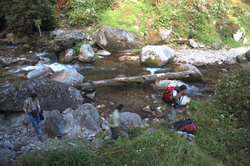
[[Image:Neora river.png|left|thumb|Neora River, West Bengal]] | [[Image:Neora river.png|left|thumb|Neora River, West Bengal]] | ||
Neora Valley National Park covers an area of {{cvt|88|km2}} with an elevation of {{cvt|183|-|3200|m}}.<ref>{{cite journal |author=Mallick, J. K. |year=2012 |title=Mammals of Kalimpong Hills, Darjeeling District, West Bengal, India |journal=Journal of Threatened Taxa |volume=4 |issue=12 |pages=3103–3136 |url=https://threatenedtaxa.org/index.php/JoTT/article/view/809/1453}}</ref> The highest point is Rachela Danda | Neora Valley National Park covers an area of {{cvt|88|km2}} with an elevation of {{cvt|183|-|3200|m}}.<ref>{{cite journal |author=Mallick, J. K. |year=2012 |title=Mammals of Kalimpong Hills, Darjeeling District, West Bengal, India |journal=Journal of Threatened Taxa |volume=4 |issue=12 |pages=3103–3136 |url=https://threatenedtaxa.org/index.php/JoTT/article/view/809/1453}}</ref> The highest point is Rachela Danda. Much of the park is still inaccessible. It borders [[Pakyong District]] and [[Samtse District|Samtse Bhutan]].{{citation needed |date=September 2019}} The Neora River is the major water source for Kalimpong town.{{citation needed |date=September 2019}} | ||
==Biodiversity== | ==Biodiversity== | ||
[[File:Neora Valley National Park, Kurseong.jpg|thumb|A stream in Neora Valley National Park]] | [[File:Neora Valley National Park, Kurseong.jpg|thumb|A stream in Neora Valley National Park]] | ||
[[File:The mystic forest.jpg|thumb|Forest in Neora Valley National Park]] | [[File:The mystic forest.jpg|thumb|Forest in Neora Valley National Park]] | ||
{{ | {{More citations needed section|date=August 2020}} | ||
Avian fauna listed from this park are of A1, A2 and A3 categories with IBA site code IN-WB-06.<ref>[http://ibcn.in/wp-content/uploads/2015/05/West-Bengal.pdf], West Bengal IBA categories Page-2.</ref> | Avian fauna listed from this park are of A1, A2 and A3 categories with IBA site code IN-WB-06.<ref>[http://ibcn.in/wp-content/uploads/2015/05/West-Bengal.pdf], West Bengal IBA categories Page-2.</ref> | ||
| Line 43: | Line 46: | ||
===Flora=== | ===Flora=== | ||
Neora Valley sustains a unique ecosystem where tropical, sub-tropical, sub-temperate, and temperate vegetative system still harbours a wealth of flora and fauna. The forests consists of mixed species like [[rhododendron]], [[bamboo]], [[oak]], [[fern]]s, [[Shorea robusta|sal]], etc. The valley also has numerous species of [[orchids]]. | Neora Valley sustains a unique ecosystem where tropical, sub-tropical, sub-temperate, and temperate vegetative system still harbours a wealth of flora and fauna. The forests consists of mixed species like [[rhododendron]], [[bamboo]], [[oak]], [[fern]]s, [[Shorea robusta|sal]], etc. The valley also has numerous species of [[orchids]], some of which are endemic to the park. Common species of rhododendron that grow in the park include ''[[Rhododendron arboreum]]'', ''[[Rhododendron falconeri]]'', and ''[[Rhododendron dalhousiae]].''<ref>{{Cite web|title=Neora Valley National Park|url=https://whc.unesco.org/en/tentativelists/5447/|access-date=2022-01-25|website=UNESCO World Heritage Centre|language=en}}</ref> | ||
===Fauna=== | ===Fauna=== | ||
| Line 50: | Line 53: | ||
[[File:Maroon-backed Accentor Neora valley National Park West Bengal India 08.12.2015.jpg|thumb|[[Maroon-backed accentor]] (''Prunella immaculata'')]] | [[File:Maroon-backed Accentor Neora valley National Park West Bengal India 08.12.2015.jpg|thumb|[[Maroon-backed accentor]] (''Prunella immaculata'')]] | ||
'''Mammals''' reported from this area are [[Indian leopard]], five [[viverrid]] species, [[Asiatic black bear]], [[sloth bear]], [[Asian golden cat]], [[wild boar]], [[leopard cat]], [[goral]], [[serow]], [[barking deer]], [[sambar deer]], [[flying squirrel]] and [[tahr]], [[red panda]], [[clouded leopard]].<ref>[http://ibcn.in/wp-content/uploads/2015/05/West-Bengal.pdf], IBAs in West Bengal – Page 20.</ref> | '''Mammals''' reported from this area are [[Indian leopard]], five [[viverrid]] species, [[Asiatic black bear]], [[sloth bear]], [[Asian golden cat]], [[wild boar]], [[leopard cat]], [[goral]], [[serow]], [[barking deer]], [[sambar deer]], [[flying squirrel]] and [[tahr]], [[red panda]], [[clouded leopard]].<ref>[http://ibcn.in/wp-content/uploads/2015/05/West-Bengal.pdf], IBAs in West Bengal – Page 20.</ref> | ||
The semi-evergreen forests between {{cvt|1600|and|2700|m}} host [[rufous-throated partridge]], [[satyr tragopan]], [[crimson-breasted woodpecker]], [[Darjeeling woodpecker]], [[bay woodpecker]], [[golden-throated barbet]], [[Hodgson's hawk cuckoo]], [[lesser cuckoo]], [[brown wood owl]], [[ashy wood pigeon]], [[mountain imperial pigeon]], [[Jerdon's baza]], [[black eagle]], [[mountain hawk eagle]], [[Red-throated thrush|dark-throated thrush]], [[rufous-gorgeted flycatcher]], [[white-gorgeted flycatcher]], [[white-browed bush robin]], [[white-tailed robin]], [[yellow-browed tit]], [[striated bulbul]], [[chestnut-headed tesia]], [[chestnut-crowned warbler]], [[black-faced warbler]], [[black-faced laughingthrush]], [[chestnut-crowned laughingthrush]], [[streak-breasted scimitar babbler]], [[scaly-breasted cupwing]], [[pygmy cupwing]], [[rufous-fronted babbler]], [[black-headed shrike babbler]], [[white-browed shrike- | The semi-evergreen forests between {{cvt|1600|and|2700|m}} host [[rufous-throated partridge]], [[satyr tragopan]], [[crimson-breasted woodpecker]], [[Darjeeling woodpecker]], [[bay woodpecker]], [[golden-throated barbet]], [[Hodgson's hawk cuckoo]], [[lesser cuckoo]], [[brown wood owl]], [[ashy wood pigeon]], [[mountain imperial pigeon]], [[Jerdon's baza]], [[black eagle]], [[mountain hawk eagle]], [[Red-throated thrush|dark-throated thrush]], [[rufous-gorgeted flycatcher]], [[white-gorgeted flycatcher]], [[white-browed bush robin]], [[white-tailed robin]], [[yellow-browed tit]], [[striated bulbul]], [[chestnut-headed tesia]], [[chestnut-crowned warbler]], [[black-faced warbler]], [[black-faced laughingthrush]], [[chestnut-crowned laughingthrush]], [[streak-breasted scimitar babbler]], [[scaly-breasted cupwing]], [[pygmy cupwing]], [[rufous-fronted babbler]], [[black-headed shrike babbler]], [[white-browed shrike-babbler]], [[rusty-fronted barwing]], [[rufous-winged fulvetta]], [[brown parrotbill]], [[fire-breasted flowerpecker]], [[fire-tailed sunbird]], [[maroon-backed accentor]], [[dark-breasted rosefinch]], [[red-headed bullfinch]], [[gold-naped finch]]. | ||
Reptilian fauna includes [[King cobra]], [[common krait]], [[green pit viper]], [[blind snake]], [[lizards]]. Insects include [[butterflies]], [[moths]], [[beetles]], [[bees]], [[wasps]], [[Heteroptera|bugs]] and [[cicada]]s. | Reptilian fauna includes [[King cobra]], [[common krait]], [[green pit viper]], [[blind snake]], [[lizards]]. Insects include [[butterflies]], [[moths]], [[beetles]], [[bees]], [[wasps]], [[Heteroptera|bugs]] and [[cicada]]s. | ||
==See also== | ==See also== | ||
* [[Pangolakha Wildlife Sanctuary]] | |||
* [[Gorumara National Park]] | * [[Gorumara National Park]] | ||
* [[Chapramari Wildlife Sanctuary]] | * [[Chapramari Wildlife Sanctuary]] | ||
| Line 62: | Line 66: | ||
==External links== | ==External links== | ||
* [http://www.wbfdc.com/lava.html West Bengal Forest Development Corporation Ltd. - Lava] | * [http://www.wbfdc.com/lava.html West Bengal Forest Development Corporation Ltd. - Lava] {{Webarchive|url=https://web.archive.org/web/20160225235900/http://www.wbfdc.com/lava.html |date=2016-02-25 }} | ||
* [https://whc.unesco.org/en/tentativelists/5447/ UNESCO World Heritage Center - Tentative List] | * [https://whc.unesco.org/en/tentativelists/5447/ UNESCO World Heritage Center - Tentative List] | ||
* [https://www.openstreetmap.org/way/666282774#map=11/27.0647/88.7890&layers=C Neora Valley National Park] marked on OpenStreetMap | |||
{{Commons category}} | {{Commons category}} | ||
| Line 75: | Line 81: | ||
[[Category:1986 establishments in West Bengal]] | [[Category:1986 establishments in West Bengal]] | ||
[[Category:Tourist attractions in Kalimpong district]] | [[Category:Tourist attractions in Kalimpong district]] | ||
[[Category:World Heritage Tentative List for India]] | |||
Latest revision as of 09:02, 22 February 2026
| Neora Valley National Park | |
|---|---|
| Location | Kalimpong district, West Bengal, India |
| Nearest city | Kalimpong |
| Coordinates | 27°04′N 88°42′E / 27.06°N 88.7°E |
| Area | 88 km2 (34 sq mi) |
| Established | 1986 |
| Governing body | Government of India, Government of West Bengal |


Neora Valley National Park is a national park in Kalimpong district, West Bengal, India that was established in 1986. Spread over an area of 88 km2 (34 sq mi),[1] it is a rich biological zone in eastern India. It is the land of the red panda in the pristine undisturbed natural habitat with rugged inaccessible hilly terrain and rich diverse flora and fauna. It is linked to Pangolakha Wildlife Sanctuary of Pakyong District as well as forests of Samtse District, Bhutan via thick cover of forests.[2]
Geography[edit | edit source]

Neora Valley National Park covers an area of 88 km2 (34 sq mi) with an elevation of 183–3,200 m (600–10,499 ft).[3] The highest point is Rachela Danda. Much of the park is still inaccessible. It borders Pakyong District and Samtse Bhutan.[citation needed] The Neora River is the major water source for Kalimpong town.[citation needed]
Biodiversity[edit | edit source]


 | This section needs more citations. (August 2020) |
Avian fauna listed from this park are of A1, A2 and A3 categories with IBA site code IN-WB-06.[4]
The primary biomes inside Neora Vally National Park are:
- Sino-Himalayan Temperate Forest of the Eastern Himalayan broadleaf forests Biome 7
- Sino-Himalayan Subtropical Forest of the Himalayan subtropical broadleaf forests Biome 8
- Indo-Chinese Tropical Moist Forest of the Himalayan subtropical pine forests Biome 9
Flora[edit | edit source]
Neora Valley sustains a unique ecosystem where tropical, sub-tropical, sub-temperate, and temperate vegetative system still harbours a wealth of flora and fauna. The forests consists of mixed species like rhododendron, bamboo, oak, ferns, sal, etc. The valley also has numerous species of orchids, some of which are endemic to the park. Common species of rhododendron that grow in the park include Rhododendron arboreum, Rhododendron falconeri, and Rhododendron dalhousiae.[5]
Fauna[edit | edit source]


Mammals reported from this area are Indian leopard, five viverrid species, Asiatic black bear, sloth bear, Asian golden cat, wild boar, leopard cat, goral, serow, barking deer, sambar deer, flying squirrel and tahr, red panda, clouded leopard.[6] The semi-evergreen forests between 1,600 and 2,700 m (5,200 and 8,900 ft) host rufous-throated partridge, satyr tragopan, crimson-breasted woodpecker, Darjeeling woodpecker, bay woodpecker, golden-throated barbet, Hodgson's hawk cuckoo, lesser cuckoo, brown wood owl, ashy wood pigeon, mountain imperial pigeon, Jerdon's baza, black eagle, mountain hawk eagle, dark-throated thrush, rufous-gorgeted flycatcher, white-gorgeted flycatcher, white-browed bush robin, white-tailed robin, yellow-browed tit, striated bulbul, chestnut-headed tesia, chestnut-crowned warbler, black-faced warbler, black-faced laughingthrush, chestnut-crowned laughingthrush, streak-breasted scimitar babbler, scaly-breasted cupwing, pygmy cupwing, rufous-fronted babbler, black-headed shrike babbler, white-browed shrike-babbler, rusty-fronted barwing, rufous-winged fulvetta, brown parrotbill, fire-breasted flowerpecker, fire-tailed sunbird, maroon-backed accentor, dark-breasted rosefinch, red-headed bullfinch, gold-naped finch.
Reptilian fauna includes King cobra, common krait, green pit viper, blind snake, lizards. Insects include butterflies, moths, beetles, bees, wasps, bugs and cicadas.
See also[edit | edit source]
References[edit | edit source]
- ↑ Neora Valley National Park north-bengal.com. Retrieved 10 September 2021
- ↑ "WildBengal". Wildlife Wing, Directorate of Forests Government of West Bengal. 2017. Archived from the original on 5 March 2016. Retrieved 19 April 2018.
- ↑ Mallick, J. K. (2012). "Mammals of Kalimpong Hills, Darjeeling District, West Bengal, India". Journal of Threatened Taxa. 4 (12): 3103–3136.
- ↑ [1], West Bengal IBA categories Page-2.
- ↑ "Neora Valley National Park". UNESCO World Heritage Centre. Retrieved 2022-01-25.
- ↑ [2], IBAs in West Bengal – Page 20.
External links[edit | edit source]
- West Bengal Forest Development Corporation Ltd. - Lava Archived 2016-02-25 at the Wayback Machine
- UNESCO World Heritage Center - Tentative List
- Neora Valley National Park marked on OpenStreetMap


- Pages using the JsonConfig extension
- IUCN Category II
- Articles needing additional references from August 2020
- Eastern Himalayan broadleaf forests
- National parks in West Bengal
- Protected areas established in 1986
- 1986 establishments in West Bengal
- Tourist attractions in Kalimpong district
- World Heritage Tentative List for India