


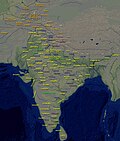


>Sammi Brie Adding local short description: "Major realms, republics and kingdoms of Vedic India", overriding Wikidata description "major realms republics or kingdoms of Vedic India" (Shortdesc helper) |
No edit summary |
||
| Line 1: | Line 1: | ||
{{Short description|Major realms | {{Short description|Major realms of Vedic India, c. 1100–600 BCE}} | ||
{{For|the film|Janapada (film)}} | {{For|the film|Janapada (film)}} | ||
{{Use dmy dates|date=November 2019}} | {{Use dmy dates|date=November 2019}} | ||
{ | {{HistoryOfSouthAsia}} | ||
| | The '''Janapadas''' ({{lit|Foothold of the people}}) ({{IPA|sa|janapada|pron}}) (c. 1100–600 BCE) were the [[realms]], [[Gaṇasaṅgha|aristocratic republics]] (Gaṇasaṅgha<!--janapada-->) and [[monarchy|kingdoms]] (sāmarājya) of the [[Vedic period]] in the [[Indian subcontinent]]. The Vedic period reaches from the late [[Bronze Age India|Bronze Age]] into the [[Iron Age India|Iron Age]]: from about 1500 BCE to the 6th century BCE. With the rise of sixteen ''[[Mahajanapadas]]'' ("great janapadas"), most of the states were [[Annexation|annexed]] by more powerful neighbours, although some remained independent.{{sfn|Misra|1973|p=18}} | ||
| | |||
| | |||
| | |||
| | |||
[[File:Late Vedic Culture (1100-500 BCE).png|thumb|Late Vedic era map showing the boundaries of [[Āryāvarta]] with Janapadas in northern India. Beginning of Iron Age kingdoms in India— [[Kuru (kingdom)|Kuru]], [[Panchala]], [[Kosala]], [[Videha]].]] | |||
[[File:EpicIndia.jpg|thumb|Locations of kingdoms and republics mentioned in the Indian epics or [[Bharata Khanda]].]]Janapadas were the kingdoms and republics of Vedic India from the late Bronze Age to the Iron Age (c. 1200 BCE to 6th century BCE). Emerging from settled agricultural communities, they were originally named after the dominant "Jana" (people/tribe). With the spread of iron tools, these smaller kingdoms grew in size and power, eventually evolving into the larger Mahajanapadas. | |||
== Etymology == | == Etymology == | ||
The [[Sanskrit]] term ''janapada'' is a [[tatpurusha]] compound term, composed of two words: '' | The [[Sanskrit]] term ''janapada'' is a [[tatpurusha]] compound term, composed of two words: ''jana'' and ''padna''. ''Jana'' means "person" or "people" (cf. [[Latin]] [[cognate]] ''genus'', [[English language|English]] cognate ''kin''). The word ''pada'' means "foot" (cf. Latin cognate ''pedis'');<ref name="lanman1912">{{Citation |title=A Sanskrit reader: with vocabulary and notes|author=Charles Rockwell Lanman |year=1912 |publisher=[[Ginn & Co.]] |location=[[Boston]] |url=https://archive.org/stream/sanskritreaderwi00lanmiala#page/158/mode/1up |quote="''... jána, m. creature; man; person; in plural, and collectively in singular, folks; a people or race or tribe ... cf. γένος, Lat. genus, Eng. kin, 'race' ...''"|author-link=Charles Rockwell Lanman }}</ref><ref name="potter1974">{{Citation |title=Pedigree: the origins of words from nature |author=Stephen Potter, Laurens Christopher Sargent |year=1974 |publisher=Taplinger |isbn=9780800862480 |url=https://books.google.com/books?id=8SNDAAAAIAAJ |quote=''... *gen-, found in Skt. jana, 'a man', and Gk. genos and L. genus, 'a race' ...''}}</ref> from its earliest attestation, the word has had a double meaning of "realm, territory" and "subject population" (cf. Hittite ''pedan'', "place"). Linguist George Dunkel compares the [[Greek language|Greek]] ''andrapodon'' "slave", to [[PIE]] {{lang|ine-x-proto|*pédom}} "fetters" (i.e. "what is attached to the feet"). Sanskrit ''padám'', usually taken to mean "footprint, trail", diverges in accent from the PIE reconstruction. | ||
For the sense of "population of the land", ''padasya janas'', the inverted ''padajana'' would be expected. A primary meaning of "place of the people", ''janasya padam'', would not explain why the compound is of masculine gender. An original [[dvandva]] "land and people" is conceivable, but a dual inflection would be expected.<ref name="Dunkel2002">{{Cite book|first=George|last=Dunkel|chapter=Vedic janapada and Ionic andrapodon; with notes on Vedic drupadam and IE pedom "place" and "fetter"|title=Indo-European Perspectives (ed. M. R. V. Southern)| | For the sense of "population of the land", ''padasya janas'', the inverted ''padajana'' would be expected. A primary meaning of "place of the people", ''janasya padam'', would not explain why the compound is of [[masculine]] gender. An original [[dvandva]] "land and people" is conceivable, but a dual inflection would be expected.<ref name="Dunkel2002">{{Cite book |first=George|last=Dunkel|chapter=Vedic janapada and Ionic andrapodon; with notes on Vedic drupadam and IE pedom "place" and "fetter"|title=Indo-European Perspectives (ed. M. R. V. Southern)|series=[[Journal of Indo-European Studies]]|number=43|date=2002|type=Monograph}}</ref> | ||
== | == History and evolution == | ||
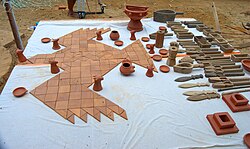
[[File:ചിതിയുടെയും-ഉപകരണങ്ങളുടെയും മാതൃക.jpg|thumb|right|Modern replica of utensils and [[Vedic fire altar|falcon shaped altar]] used for [[Agnicayana]], an elaborate [[ | [[File:ചിതിയുടെയും-ഉപകരണങ്ങളുടെയും മാതൃക.jpg|thumb|right|Modern replica of utensils and [[Vedic fire altar|falcon shaped altar]] used for [[Agnicayana]], an elaborate [[srauta]] ritual originating from the [[Kuru kingdom]],{{sfn|Witzel|1995}} around 1000 BCE.]] | ||
Literary evidence suggests that the janapadas flourished between | Literary evidence suggests that the janapadas flourished between 1100 BCE and 500 BCE. The earliest mention of the term "janapada" occurs in the [[Aitareya Brahmana|Aitareya]] (8.14.4) and [[Shatapatha Brahmana|Shatapatha]] (13.4.2.17) [[Brahmana]] texts.{{sfn|Misra|1973|p=15}} | ||
In the [[Vedas|Vedic]] [[samhita]]s, the term ''[[jana (Vedic period)|jana]]'' denotes a tribe, whose members believed in a shared ancestry.{{sfn|Misra|1973|pp=7-11}} The janas were headed by a king. The '' | In the [[Vedas|Vedic]] [[samhita]]s, the term ''[[jana (Vedic period)|jana]]'' denotes a tribe, whose members believed in a shared ancestry.{{sfn|Misra|1973|pp=7-11}} The janas were headed by a king (''[[raja]]''). The council (s''amiti)'' was a common assembly of the jana members, and had the power to elect or dethrone the king. The [[Sabhā|s''abha'']] was a smaller assembly of wise elders, who advised the king.{{sfn|Misra|1973|p=12}} | ||
The janas were originally semi-nomadic [[pastoralism|pastoral]] communities, but gradually came to be associated with specific territories as they became less mobile. Various ''kula''s (clans) developed within the jana, each with its own chief. Gradually, the necessities of defence and warfare prompted the janas to form military groupings headed by ''janapadin''s ([[Kshatriya]] warriors). This model ultimately evolved into the establishment of political units known as the janapadas.{{sfn|Misra|1973|p=13}} | The janas were originally semi-nomadic [[pastoralism|pastoral]] communities, but gradually came to be associated with specific territories as they became less mobile. Various ''kula''s (clans) developed within the jana, each with its own chief. Gradually, the necessities of defence and warfare prompted the janas to form military groupings, headed by ''janapadin''s ([[Kshatriya]] warriors). This model ultimately evolved into the establishment of political units known as the ''janapadas''.{{sfn|Misra|1973|p=13}} | ||
While some of the janas evolved into their own janapadas, others appear to have mixed together to form a common Janapada. According to the political scientist Sudama Misra, the name of the [[Panchala]] janapada suggests that it was a fusion of five (''pancha'') janas.{{sfn|Misra|1973|p=14}} Some janas (such as Aja and Mutiba) mentioned in the earliest texts do not find a mention in the later texts. Misra theorizes that these smaller janas were conquered by and assimilated into the larger janas.{{sfn|Misra|1973|p=14}} | While some of the janas evolved into their own janapadas, others appear to have mixed together to form a common Janapada. According to the political scientist Sudama Misra, the name of the [[Panchala]] janapada suggests that it was a fusion of five (''pancha'') janas.{{sfn|Misra|1973|p=14}} Some janas (such as Aja and Mutiba), mentioned in the earliest texts do not find a mention in the later texts. Misra theorizes that these smaller janas were conquered by and assimilated into the larger janas.{{sfn|Misra|1973|p=14}} | ||
Janapadas were gradually dissolved around 500 BCE. Their disestablishment can be attributed to the rise of imperial powers (such as [[Magadha | Janapadas were gradually dissolved around 500 BCE. Their disestablishment can be attributed to the rise of imperial powers (such as [[Magadha (Mahajanapada)|Magadha]]) in Northern India, as well as foreign invasions (such as those by the [[Achaemenid Empire|Persians]] and the [[Macedonian Empire|Greeks]]) in the north-western [[Indian subcontinent]].{{sfn|Misra|1973|pp=15-16}} | ||
== Nature == | == Nature == | ||
The Janapada were highest political unit in Northern India during this period; these polities were usually monarchical (though some followed a form republicanism) and succession was hereditary. The head of a kingdom was | The Janapada were highest political unit in Northern India during this period; these polities were usually monarchical (though some followed a form of republicanism) and succession was hereditary. The head of a kingdom was a king (''[[raja]]''). A chief priest (''[[purohita]]'') and a commander of the army (''[[senani]]'') who would assist the king. There were also two other political bodies: the (''samiti''), thought to be a council of elders and the ''[[sabhā]]'', a general assembly of the entire people.<ref name="Bhandarkar1994">{{cite book|author=D. R. Bhandarkar|title=Lectures on the Ancient History of India from 650 - 325 B. C.|url=https://books.google.com/books?id=nWXONsTkrykC&pg=PA174|year=1994|publisher=Asian Educational Services|isbn=978-81-206-0124-6|pages=174–}}</ref> | ||
===The boundaries of the kingdoms=== | ===The boundaries of the kingdoms=== | ||
Often rivers formed the boundaries of two neighboring kingdoms, as was the case between the northern and southern [[Panchala]] and between the western ([[Pandava]]'s | Often rivers formed the boundaries of two neighboring kingdoms, as was the case between the northern and southern [[Panchala]] and between the western ([[Pandava]]'s kingdom) and eastern ([[Kaurava]]'s kingdom) [[Kuru kingdom|Kuru]]. Sometimes, large forests, which were larger than the kingdoms themselves, formed their boundaries as was the case of [[Naimisha Forest]], the Naimisha Aranyam between Panchala and [[Kosala kingdom|Kosala]] kingdoms. Mountain ranges like [[Himalaya]], [[Vindhya Range|Vindhyachal]] and [[Sahyadri]] also formed their boundaries. | ||
===The cities and villages=== | ===The cities and villages=== | ||
[[File:Ahichchhatra_Fort_Temple_Bareilly.jpg|thumb|300px|alt=Multi-coloured political map|Ahichchhatra (or Ahi-Kshetra) was the ancient capital of Northern [[Panchala]]. The remains of this city has been discovered in [[Bareilly]].]] | [[File:Ahichchhatra_Fort_Temple_Bareilly.jpg|thumb|300px|alt=Multi-coloured political map|Ahichchhatra (or Ahi-Kshetra) was the ancient capital of Northern [[Panchala]]. The remains of this city has been discovered in [[Bareilly]].]] | ||
Some kingdoms possessed a main city that served as its capital. For example, the capital of Pandava's | Some kingdoms possessed a main city that served as its capital. For example, the capital of Pandava's kingdom was [[Indraprastha]] and the Kaurava's kingdom was [[Hastinapura]]. [[Ahichatra]] was the capital of Northern Panchala whereas [[Kampilya]] was the capital of Southern Panchala. [[Kosala]] had its capital at [[Ayodhya]]. Apart from the main city or capital, where the palace of the ruling king was situated, there were small towns and villages spread throughout the kingdom, from which tax was collected by officers appointed by the king. What the king offered in return was protection from attack by other kings and bandit tribes, as well as from invading foreign nomadic tribes. The king also enforced law and order in his kingdom by punishing the guilty.<ref name="Patil1946">{{cite book|author=Devendrakumar Rajaram Patil|title=Cultural History from the Vāyu Purāna|url=https://books.google.com/books?id=Jmnm-smZm6oC&pg=PA175|year=1946|publisher=Motilal Banarsidass |isbn=978-81-208-2085-2|pages=175–}}</ref><ref name="Miśra1973">{{cite book|author=Sudāmā Miśra|title=Janapada state in ancient India|url=https://books.google.com/books?id=Dua1AAAAIAAJ|year=1973|publisher=Bhāratīya Vidyā Prakāśana}}</ref> | ||
== Administration == | == Administration == | ||
| Line 50: | Line 39: | ||
; Sabha (Council) | ; Sabha (Council) | ||
: An assembly more akin to a council of qualified members or elders (mostly men) who advised the king and performed judicial functions. In the '' | : An assembly more akin to a council of qualified members or elders (mostly men) who advised the king and performed judicial functions. In the ''ganas'' or republican Janapadas called [[Gaṇasaṅgha]] with no kings, the council of elders also handled administration.{{sfn|Misra|1973|p=18}} | ||
; Paura Sabha (Executive Council) | ; Paura Sabha (Executive Council) | ||
: Paura was the assembly of the capital city (''pura''), and handled municipal administration.{{sfn|Misra|1973|p=19}} | : The Paura Sabha was the assembly of the capital city (''pura''), and handled municipal administration.{{sfn|Misra|1973|p=19}} | ||
; Samiti (General Assembly) | ; Samiti (General Assembly) | ||
| Line 59: | Line 48: | ||
; Janapada | ; Janapada | ||
: The Janapada assembly represented the rest of the Janapada, possibly the villages, which were administered by a '' | : The Janapada assembly represented the rest of the Janapada, possibly the villages, which were administered by a ''gramini'',{{sfn|Misra|1973|p=19}} or ''grāmaṇī''.<ref>{{cite web |url=https://sanskritdictionary.com/?q=gr%C4%81ma%E1%B9%87%C4%AB | title=Sanskrit Dictionary }}</ref> | ||
Some historians have also theorized that there was a common assembly called the "Paura-Janapada", but others such as [[Ram Sharan Sharma]] disagree with this theory. The existence of Paura and Janapada itself is a controversial matter.<ref name="RSSharma_1991">{{cite book |url=https://books.google.com/books?id=9_E3K8fQoDgC&pg=PA242 |title=Aspects of Political Ideas and Institutions in Ancient India |author=Ram Sharan Sharma |publisher=[[Motilal Banarsidass]] |year=1991 |page=242 |author-link=Ram Sharan Sharma |isbn=9788120808270 }}</ref> | Some historians have also theorized that there was a common assembly called the "Paura-Janapada", but others such as [[Ram Sharan Sharma]] disagree with this theory. The existence of Paura and Janapada itself is a controversial matter.<ref name="RSSharma_1991">{{cite book |url=https://books.google.com/books?id=9_E3K8fQoDgC&pg=PA242 |title=Aspects of Political Ideas and Institutions in Ancient India |author=Ram Sharan Sharma |publisher=[[Motilal Banarsidass]] |year=1991 |page=242 |author-link=Ram Sharan Sharma |isbn=9788120808270 }}</ref> | ||
Indian nationalist historians such as [[K. P. Jayaswal]] have argued that the existence of such assemblies is evidence of prevalence of democracy in ancient India.<ref>{{cite book |url=https://books.google.com/books?id=lp8jAQAAIAAJ |title=Interpretations of Ancient Indian Polity: A Historiographical Study |author=Dinesh Kumar Ojha |publisher=Manish Prakashan |year=2006 |page=160 |isbn=9788190246965 }}</ref> V. B. Misra notes that the contemporary society was divided into the four [[varna (Hinduism)|varnas]] (besides the outcastes), and the Kshatriya ruling class had all the political rights.{{sfn|Misra|1973|p=20}} Not all the citizens in a janapada had political rights.{{sfn|Misra|1973|p=18}} Based on ''Gautama's Dharmasutra'', Jayaswal theorized that the low-caste [[shudra]]s could be members of the Paura assembly.<ref name="RSSharma_1991"/> According to [[A. S. Altekar]], this theory is based on a misunderstanding of the text: the term "Paura" in the relevant portion of the ''Dharmasutra'' refers to a resident of the city, not a member of the city assembly.<ref name="ASA_1949">{{cite book |url=https://books.google.com/books?id=Gb3Z2UovOjkC&pg=PA151 |title=State and Government in Ancient India |author=Anant Sadashiv Altekar |publisher=[[Motilal Banarsidass]] |year=1949 |pages=151–153 |author-link=Anant Sadashiv Altekar |isbn=9788120810099 }}</ref> Jayaswal also argued that the members of the supposed Paura-Janapada assembly acted as counselors to the king, and made other important decisions such as imposing taxes in times of emergency. Once again, Altekar argued that these conclusions are based on misinterpretations of the literary evidence. For example, Jayaswal has wrongly translated the word "amantra" in a ''[[Ramayana]]'' verse as "to offer advice"; it actually means "to bid farewell" in proper context.<ref name="ASA_1949"/> | Indian nationalist historians such as [[K. P. Jayaswal]] have argued that the existence of such assemblies is evidence of prevalence of democracy in ancient India.<ref>{{cite book |url=https://books.google.com/books?id=lp8jAQAAIAAJ |title=Interpretations of Ancient Indian Polity: A Historiographical Study |author=Dinesh Kumar Ojha |publisher=Manish Prakashan |year=2006 |page=160 |isbn=9788190246965 }}</ref> V. B. Misra notes that the contemporary society was divided into the four [[varna (Hinduism)|varnas]] (besides the [[avarna]] or outcastes), and the Kshatriya ruling class had all the political rights.{{sfn|Misra|1973|p=20}} Not all the citizens in a janapada had political rights.{{sfn|Misra|1973|p=18}} Based on ''Gautama's Dharmasutra'', Jayaswal theorized that the low-caste [[shudra]]s could be members of the Paura assembly.<ref name="RSSharma_1991"/> According to [[A. S. Altekar]], this theory is based on a misunderstanding of the text: the term "Paura" in the relevant portion of the ''Dharmasutra'' refers to a resident of the city, not a member of the city assembly.<ref name="ASA_1949">{{cite book |url=https://books.google.com/books?id=Gb3Z2UovOjkC&pg=PA151 |title=State and Government in Ancient India |author=Anant Sadashiv Altekar |publisher=[[Motilal Banarsidass]] |year=1949 |pages=151–153 |author-link=Anant Sadashiv Altekar |isbn=9788120810099 }}</ref> Jayaswal also argued that the members of the supposed Paura-Janapada assembly acted as counselors to the king, and made other important decisions such as imposing taxes in times of emergency. Once again, Altekar argued that these conclusions are based on misinterpretations of the literary evidence. For example, Jayaswal has wrongly translated the word "amantra" in a ''[[Ramayana]]'' verse as "to offer advice"; it actually means "to bid farewell" in proper context.<ref name="ASA_1949"/> | ||
==Interactions between kingdoms== | ==Interactions between kingdoms== | ||
| Line 70: | Line 59: | ||
| image = | | image = | ||
{{image array|perrow=2|width=180|height=180 | {{image array|perrow=2|width=180|height=180 | ||
| image1 = MET 2001 433 53 O.jpeg|caption1=Ancient Indian Antennae sword; Metalwork, | | image1 = MET 2001 433 53 O.jpeg|caption1=Ancient Indian Antennae sword; Metalwork, 1800–1500 BCE <ref>{{cite news |author=Rohan Dua |title=India's largest known burial site is 3,800 yrs old, confirms carbon dating |url=https://timesofindia.indiatimes.com/india/indias-largest-known-burial-site-is-3800-yrs-old-confirms-carbon-dating/articleshow/74254040.cms |work=The Times of India |language=en}}</ref> | ||
| image2 = Ax Blade (Celt).jpg|caption2=Ancient Indian Ax Blade, | | image2 = Ax Blade (Celt).jpg|caption2=Ancient Indian Ax Blade, 1800–1500 BCE<ref>{{cite news |author=Rohan Dua |title=India's largest known burial site is 3,800 yrs old, confirms carbon dating |url=https://timesofindia.indiatimes.com/india/indias-largest-known-burial-site-is-3800-yrs-old-confirms-carbon-dating/articleshow/74254040.cms |website=The Times of India |date=22 February 2020 |language=en}}</ref> | ||
}} | }} | ||
}} | }} | ||
There was no border security for a kingdom and border disputes were very rare. One king might conduct a military campaign (often designated as ''Digvijaya'' meaning '' | There was no border security for a kingdom and border disputes were very rare. One king might conduct a military campaign (often designated as ''[[Digvijaya (conquest)|Digvijaya]]'' meaning ''conquest of the four directions'') and defeat another king in a battle, lasting for a day.<ref>{{cite book|title=The Geographical knowledge|url=https://books.google.com/books?id=iw5NAAAAIAAJ|year=1971}}</ref> The defeated king would acknowledge the supremacy of the victorious king. The defeated king might sometimes be asked to give a tribute to the victorious king. Such tribute would be collected only once, not on a periodic basis. The defeated king, in most cases, would be free to rule his own kingdom, without maintaining any contact with the victorious king. There was no annexation of one kingdom by another. Often a military general (''[[senapati]]'') conducted these campaigns on behalf of his king. A military campaign and tribute collection was often associated with a great sacrifice (like [[Rajasuya]] or [[Ashvamedha]]) conducted in the kingdom of the campaigning king. The defeated king also was invited to attend these sacrifice ceremonies, as a friend and ally.{{sfn|Knipe|2015|p=234-5}} | ||
===New kingdoms=== | ===New kingdoms=== | ||
New kingdoms were formed when a major clan produced more than one | New kingdoms were formed when a major clan produced more than one king in a generation. The [[Kuru (kingdom)|Kuru]] clan of Kings was very successful in governing throughout North India with their numerous kingdoms, which were formed after each successive generation. Similarly, the [[Yadava]] clan of kings formed numerous kingdoms in Central India.<ref name="Chatterji1980">{{cite book|author=Asim Kumar Chatterji|title=Political History of Pre-Buddhist India|url=https://books.google.com/books?id=ECAdAAAAMAAJ|year=1980|publisher=Indian Publicity Society}}</ref> | ||
===Cultural differences === | ===Cultural differences === | ||
[[File:King Yudhisthira Performs the Rajasuya Sacrifice.png|thumb|250px|Vedic King performs the [[Rajasuya]] Sacrifice.]] | [[File:King Yudhisthira Performs the Rajasuya Sacrifice.png|thumb|250px|Vedic King performs the [[Rajasuya]] Sacrifice.]] | ||
Parts of western India were dominated by tribes who had a slightly different culture, considered non-Vedic by the mainstream [[Vedic culture]] prevailing in the [[Kuru | Parts of western India were dominated by tribes who had a slightly different culture, considered non-Vedic by the mainstream [[Vedic culture]] prevailing in the [[Kuru kingdom|Kuru]] and Panchala kingdoms. Similarly, there were some tribes in the eastern regions of India considered to be in this category.<ref>{{cite web|author=Millard Fuller |url=http://www.angika.com |title=(अंगिका) Language : The Voice of Anga Desh |publisher=Angika}}</ref> Tribes with non-Vedic culture — especially those of barbaric nature — were collectively termed as ''[[Mleccha]]''. Very little was mentioned in the ancient [[Ancient India|Indian]] literature about the kingdoms to the North, beyond the [[Himalayas]]. [[Ancient China|China]] was mentioned as a kingdom known as ''[[China in the Mahābhārata|Cina]]'', often grouped with ''Mleccha'' kingdoms. | ||
== List of Janapadas == | == List of Janapadas == | ||
| Line 87: | Line 76: | ||
The [[Vedas]] mention five sub-divisions of ancient India:{{sfn|Misra|1973|p=24}} | The [[Vedas]] mention five sub-divisions of ancient India:{{sfn|Misra|1973|p=24}} | ||
* '' | * ''Udichya'' (Northern region) | ||
* '' | * ''Prachya'' (Eastern region) | ||
* ''[[ | * ''[[Dakshinapatha|Dakshina]]'' (Southern region) | ||
* '' | * ''Pratichya'' (Western region) | ||
* ''[[Madhya-desha]]'' (Central region) | * ''[[Madhyadesha|Madhya-desha]]'' (Central region) | ||
The Vedic literature mentions the following ''jana''s or ''janapada''s:{{sfn|Misra|1973|p=304-305}} | The Vedic literature mentions the following ''jana''s or ''janapada''s:{{sfn|Misra|1973|p=304-305}} | ||
| Line 98: | Line 87: | ||
! Jana or Janapada !! [[IAST]] name !! Region !! Mentioned in<br/>[[Rigveda]] !! Mentioned in<br/>[[Atharvaveda]] | ! Jana or Janapada !! [[IAST]] name !! Region !! Mentioned in<br/>[[Rigveda]] !! Mentioned in<br/>[[Atharvaveda]] | ||
|- | |- | ||
| | | Aja || Aja || Central || ✓ || | ||
|- | |- | ||
| [[Alina]] | | [[Alina people|Alina]] || Alina || Western || ✓ || | ||
|- | |- | ||
| [[Ambashtha]] || Ambaśṭha || Central || || | | [[Ambashtha]] || Ambaśṭha || Central || || | ||
|- | |- | ||
| [[Andhra in Indian epic literature|Andhra]] || Āndhra || Southern || || | | [[Andhra in Indian epic literature|Andhra]] || Āndhra || Southern || ✓|| | ||
|- | |- | ||
| [[Anga]] || Aṅga || Eastern || || ✓ | | [[Anga]] || Aṅga || Eastern || || ✓ | ||
|- | |- | ||
| | | Anu || Anu || Western || ✓ || | ||
|- | |- | ||
| [[Bahlikas|Balhika]] || Balhika || Northern || || ✓ | | [[Bahlikas|Balhika]] || Balhika || Northern || || ✓ | ||
| Line 122: | Line 111: | ||
| Bodha || Bodha || Central || || | | Bodha || Bodha || Central || || | ||
|- | |- | ||
| [[ | | [[Cedī (tribe)|Chedi]]|| Cedi || Central || ✓ || | ||
|- | |- | ||
| [[Druhyus|Druhyu]] || Druhyu || Western || ✓ || | | [[Druhyus|Druhyu]] || Druhyu || Western || ✓ || | ||
|- | |- | ||
| [[Gandhara | | [[Gandhāra (kingdom)|Gandhara]]|| Gandhāra || Western || ✓ || ✓ | ||
|- | |- | ||
| [[Kambojas|Kamboja]] || Kamboja || Northern || || | | [[Kambojas|Kamboja]] || Kamboja || Northern || || | ||
| Line 132: | Line 121: | ||
| Keshin || Keśin || Central || || | | Keshin || Keśin || Central || || | ||
|- | |- | ||
| [[Kikata | | [[Kikata kingdom|Kikata]] || Kīkaṭa || Eastern || ✓ || ✓ | ||
|- | |- | ||
| [[Kirata]] || Kirāta || Eastern || || | | [[Kirata]] || Kirāta || Eastern || || | ||
| Line 140: | Line 129: | ||
| Krivi || Krivi || Central || ✓ || | | Krivi || Krivi || Central || ✓ || | ||
|- | |- | ||
| [[Kunti | | [[Kunti kingdom|Kunti]] || Kunti || Central || || | ||
|- | |- | ||
|[[Kalinga ( | |[[Kalinga (historical region)|Kalinga]]|| Kalinga || Eastern || ✓ || ✓ | ||
|- | |- | ||
| [[Kuru | | [[Kuru kingdom|Kuru]] || Kuru || Central || ✓ || ✓ | ||
|- | |- | ||
| [[Magadha]] || Magadha || Eastern || || ✓ | | [[Magadha (Mahajanapada)|Magadha]] || Magadha || Eastern || || ✓ | ||
|- | |- | ||
| Mahavrisha || Mahāvṛṣa || Northern || || ✓ | | Mahavrisha || Mahāvṛṣa || Northern || || ✓ | ||
|- | |- | ||
| [[Matsya | | [[Matsya (tribe)|Matsya]] || Matsya || Central || ✓ || | ||
|- | |- | ||
| Mujavana || Mūjavana || Northern || ✓ || ✓ | | Mujavana || Mūjavana || Northern || ✓ || ✓ | ||
|- | |- | ||
| Mutiba || Mūtiba || Southern || || | | Mutiba || Mūtiba || Southern || ✓|| | ||
|- | |- | ||
| [[Nishada]] || Niṣāda || Central || || | | [[Nishada]] || Niṣāda || Central || || | ||
| Line 164: | Line 153: | ||
| Parshu || Parśu || Western || ✓ || | | Parshu || Parśu || Western || ✓ || | ||
|- | |- | ||
| [[Parvata | | [[Parvata kingdom|Paravata]] || Pārāvata || Central || ✓ || | ||
|- | |- | ||
| Prithu || Pṛthu || Western || ✓ || | | Prithu || Pṛthu || Western || ✓ || | ||
|- | |- | ||
| [[ | | [[Pulinda]] || Pulinda || Southern || ✓|| | ||
|- | |- | ||
| [[Pundra | | [[Pundra kingdom|Pundra]] || Puṇḍra || Eastern || ✓|| | ||
|- | |- | ||
| [[Puru (Vedic tribe)|Puru]] || Pūru || Western || ✓ || | | [[Puru (Vedic tribe)|Puru]] || Pūru || Western || ✓ || | ||
| Line 176: | Line 165: | ||
| Rushama || Ruśama || Central || ✓ || | | Rushama || Ruśama || Central || ✓ || | ||
|- | |- | ||
| [[ | | [[Salva (India)|Salva]] || Śālva || Central || || | ||
|- | |- | ||
| Satvanta || Satvanta || Southern || || | | Satvanta || Satvanta || Southern || || | ||
|- | |- | ||
| Shabara || Śabara || Southern || || | | Shabara || Śabara || Southern || ✓|| | ||
|- | |- | ||
| Shigru || Śigru || Central || ✓ || | | Shigru || Śigru || Central || ✓ || | ||
|- | |- | ||
| Shiva || Śiva || Western || ✓ || | | [[Sivi kingdom|Shiva]] || Śiva || Western || ✓ || | ||
|- | |- | ||
| Shvikna || Śvikna || Central || || | | Shvikna || Śvikna || Central || || | ||
| Line 202: | Line 191: | ||
| Vaikarna || Vaikarṇa || Northern || ✓ || | | Vaikarna || Vaikarṇa || Northern || ✓ || | ||
|- | |- | ||
| [[Vanga | | [[Vanga kingdom|Vanga]] || Vaṅga || Eastern || || | ||
|- | |- | ||
| [[ | | [[Kāśī (kingdom)|Kashi]]|| Kāśi || Eastern || || | ||
|- | |- | ||
| Varashikha || Varaśikha || Central || ✓ || | | Varashikha || Varaśikha || Central || ✓ || | ||
| Line 210: | Line 199: | ||
| Vasha || Vaśa || Central || || | | Vasha || Vaśa || Central || || | ||
|- | |- | ||
| [[Vidarbha | | [[Vidarbha kingdom|Vidarbha]] || Vidarbha || Southern || || ✓ | ||
|- | |- | ||
| [[Videha]] || Videha || Eastern || || | | [[Videha]] || Videha || Eastern || || | ||
| Line 220: | Line 209: | ||
| [[Yadu]] || Yadu || Western || ✓ || | | [[Yadu]] || Yadu || Western || ✓ || | ||
|- | |- | ||
| [[Yaksha | | [[Yaksha kingdom|Yakshu]] || Yakṣu || Central || ✓ || | ||
|} | |} | ||
| Line 278: | Line 267: | ||
| Anūpa || Vindhyan || ✓ || ✓ || ✓ || ✓ || ✓ || Arūpa (''Matsya''), Annaja (''Vayu'') | | Anūpa || Vindhyan || ✓ || ✓ || ✓ || ✓ || ✓ || Arūpa (''Matsya''), Annaja (''Vayu'') | ||
|- | |- | ||
| | | Aparīta || Northern|| ✓ || ✓ || ✓ || ✓ || ✓ || Purandhra (''Matsya''), Aparānta (''Markandeya'') | ||
|- | |- | ||
| Arthapa || Central || || ✓ || ✓ || || || Atharva (''Markandeya'') | | Arthapa || Central || || ✓ || ✓ || || || Atharva (''Markandeya'') | ||
| Line 328: | Line 317: | ||
| [[Chinas|Cīna]] (China) || Northern || || ✓ || ✓ || ✓ || ✓ || Pīna (''Vayu''), Veṇa (''Vamana'') | | [[Chinas|Cīna]] (China) || Northern || || ✓ || ✓ || ✓ || ✓ || Pīna (''Vayu''), Veṇa (''Vamana'') | ||
|- | |- | ||
| [[ | | [[Early Cholas|Cola]] (Chola) || Southern || ✓ || ✓ || || ✓ || ✓ || Caulya (''Vayu''), Cauḍa (''Vamana''); Southern and Eastern in ''Brahmanda'' | ||
|- | |- | ||
| Cūlika (Chulika) || Northern || || ✓ || ✓ || ✓ || ✓ || Cūḍika (''Vamana''), Vindhyacūlika (''Brahmanda'') | | Cūlika (Chulika) || Northern || || ✓ || ✓ || ✓ || ✓ || Cūḍika (''Vamana''), Vindhyacūlika (''Brahmanda'') | ||
|- | |- | ||
| [[Danda | | [[Danda kingdom|Daṇḍaka]] || Southern || ✓ || ✓ || ✓ || || ✓ || | ||
|- | |- | ||
| [[Daradas|Darada]] || Northern || || ✓ || ✓ || ✓ || ✓ || | | [[Daradas|Darada]] || Northern || || ✓ || ✓ || ✓ || ✓ || | ||
| Line 350: | Line 339: | ||
| Ganaka || Northern || || || || ✓ || || | | Ganaka || Northern || || || || ✓ || || | ||
|- | |- | ||
| [[ | | [[Gandhāra (kingdom)|Gandhāra]] || Northern || ✓ || ✓ || ✓ || ✓ || ✓ || | ||
|- | |- | ||
| Godha || Central || || || || || ✓ || | | Godha || Central || || || || || ✓ || | ||
| Line 360: | Line 349: | ||
| Haṃsamārga || Himalayan || ✓ || ✓ || ✓ || ✓ || ✓ || Sarvaga (Himalayan) in ''Matsya''; Haṃsamārga (Northern and Himalayan) in ''Vayu'' and ''Markandeya''; Karnamārga (Northern) and Haṃsamārga (Himalayan) in ''Vamana''; Haṃsamārga (Himalayan) Haṃsabhaṅga (Northern) in ''Brahmanda'' | | Haṃsamārga || Himalayan || ✓ || ✓ || ✓ || ✓ || ✓ || Sarvaga (Himalayan) in ''Matsya''; Haṃsamārga (Northern and Himalayan) in ''Vayu'' and ''Markandeya''; Karnamārga (Northern) and Haṃsamārga (Himalayan) in ''Vamana''; Haṃsamārga (Himalayan) Haṃsabhaṅga (Northern) in ''Brahmanda'' | ||
|- | |- | ||
| [[Hara Huna | | [[Hara Huna kingdom|Hara-Hunaka]] || Northern || || ✓ || ✓ || ✓ || ✓ || Pūrṇa (''Vayu''), Ūrṇa (''Markandeya''), Cūrṇa (''Vamana''), Hūṇa (''Brahmanda'') | ||
|- | |- | ||
| Hāramuṣika (Haramushika) || Northern || ✓ || ✓ || ✓ || ✓ || || Hāramūrtika (''Matsya''), Hārapūrika (''Vayu''), Sāmuṣaka (''Vamana'') | | Hāramuṣika (Haramushika) || Northern || ✓ || ✓ || ✓ || ✓ || || Hāramūrtika (''Matsya''), Hārapūrika (''Vayu''), Sāmuṣaka (''Vamana'') | ||
| Line 380: | Line 369: | ||
| Kālatoyaka || Northern || ✓ || ✓ || ✓ || ✓ || ✓ || | | Kālatoyaka || Northern || ✓ || ✓ || ✓ || ✓ || ✓ || | ||
|- | |- | ||
| [[Kalinga ( | | [[Kalinga (historical region)|Kalinga]] (central) || Central || ✓ || || ✓ || ✓ || ✓ || Arkalinga (''Markandeya'') | ||
|- | |- | ||
| [[Kalinga ( | | [[Kalinga (historical region)|Kalinga]] (southern) || Southern || ✓ || ✓ || ✓ || ✓ || ✓ || | ||
|- | |- | ||
| Kalitaka || Western || || ✓ || ✓ || ✓ || ✓ || Kālītaka (''Vayu''), Anīkaṭa (''Markandeya''), Tālīkaṭa (''Vamana''), Kuntala (''Brahmanda'') | | Kalitaka || Western || || ✓ || ✓ || ✓ || ✓ || Kālītaka (''Vayu''), Anīkaṭa (''Markandeya''), Tālīkaṭa (''Vamana''), Kuntala (''Brahmanda'') | ||
| Line 394: | Line 383: | ||
| Kāraskara || Western || ✓ || ✓ || ✓ || ✓ || ✓ || Paraṣkara (''Vayu''), Kaṭhākṣara (''Markandeya''), Karandhara (''Brahmanda'') | | Kāraskara || Western || ✓ || ✓ || ✓ || ✓ || ✓ || Paraṣkara (''Vayu''), Kaṭhākṣara (''Markandeya''), Karandhara (''Brahmanda'') | ||
|- | |- | ||
| [[Karusha | | [[Karusha kingdom|Kārūṣa]] (Karusha) || Vindhyan || ✓ || ✓ || ✓ || ✓ || ✓ || Southern and Vindhyan (''Matsya'') | ||
|- | |- | ||
| [[Kasmira | | [[Kasmira kingdom|Kāśmīra]] (Kashmira) || Northern || || ✓ || ✓ || || ✓ || | ||
|- | |- | ||
| Kauśika || Central || || || || ✓ || || | | Kauśika || Central || || || || ✓ || || | ||
| Line 410: | Line 399: | ||
| [[Kishkindha|Kiṣkindhaka]] (Kishkindhaka) || Vindhyan || ✓ || ✓ || ✓ || ✓ || ✓ || Kikarava (''Vamana'') | | [[Kishkindha|Kiṣkindhaka]] (Kishkindhaka) || Vindhyan || ✓ || ✓ || ✓ || ✓ || ✓ || Kikarava (''Vamana'') | ||
|- | |- | ||
| [[Konkana | | [[Konkana kingdom|Koṅkaṇa]] || Southern || || || || || ✓ || | ||
|- | |- | ||
| [[Kosala|Kośala]] (Central) || Central || ✓ || ✓ || ✓ || || ✓ || | | [[Kosala|Kośala]] (Central) || Central || ✓ || ✓ || ✓ || || ✓ || | ||
| Line 424: | Line 413: | ||
| Kumara || Southern || ✓ || ✓ || ✓ || ✓ || ✓ || Kupatha (''Matsya''), Kumana (''Vayu''), Kusuma (''Markandeya''), Kumārāda (''Vamana''), Kṣapaṇa (''Brahmanda'') | | Kumara || Southern || ✓ || ✓ || ✓ || ✓ || ✓ || Kupatha (''Matsya''), Kumana (''Vayu''), Kusuma (''Markandeya''), Kumārāda (''Vamana''), Kṣapaṇa (''Brahmanda'') | ||
|- | |- | ||
| [[Kuninda | | [[Kuninda kingdom|Kuninda]] || Northern || ✓ || ✓ || ✓ || || ✓ || Pulinda (''Matsya''), Kaliṅga (''Markandeya''), Kalinda (''Brahmanda'') | ||
|- | |- | ||
| [[Kuntala country|Kuntala]] || Southern and Central || ✓ || ✓ || ✓ || ✓ || ✓ || Kuntala ( (''Matsya'', only Central), Kuṇḍala (''Vamana'') | | [[Kuntala country|Kuntala]] || Southern and Central || ✓ || ✓ || ✓ || ✓ || ✓ || Kuntala ( (''Matsya'', only Central), Kuṇḍala (''Vamana'') | ||
| Line 430: | Line 419: | ||
| Kupatha || Himalayan || ✓ || ✓ || ✓ || ✓ || ✓ || Kṣupaṇa (''Vayu''), Kurava (''Markandeya'') | | Kupatha || Himalayan || ✓ || ✓ || ✓ || ✓ || ✓ || Kṣupaṇa (''Vayu''), Kurava (''Markandeya'') | ||
|- | |- | ||
| [[Kuru | | [[Kuru kingdom|Kuru]] || Central || ✓ || ✓ || || ✓ || ✓ || Kaurava (''Vamana'') | ||
|- | |- | ||
| Kuśalya (Kushalya) || Central || || || || || ✓ || | | Kuśalya (Kushalya) || Central || || || || || ✓ || | ||
| Line 464: | Line 453: | ||
| [[Malavas|Mālava]] || Vindhyan || ✓ || ✓ || || ✓ || ✓ || Ekalavya (''Vamana''), Malada (''Brahmanda'') | | [[Malavas|Mālava]] || Vindhyan || ✓ || ✓ || || ✓ || ✓ || Ekalavya (''Vamana''), Malada (''Brahmanda'') | ||
|- | |- | ||
| [[Malla | | [[Malla (tribe)|Malla]] || Eastern ||✓ || ✓ || ✓ || ✓ || ✓ || Śālva (''Matsya''), Māla (''Vayu''), Māia (''Vamana'') | ||
|- | |- | ||
| Maṇḍala || Himalayan || ✓ || ✓ || ✓ || || ✓ || Mālava (''Vayu''), Mālava (''Markandeya'') | | Maṇḍala || Himalayan || ✓ || ✓ || ✓ || || ✓ || Mālava (''Vayu''), Mālava (''Markandeya'') | ||
| Line 474: | Line 463: | ||
| Mātaṅga || Eastern || ✓ || || || || || | | Mātaṅga || Eastern || ✓ || || || || || | ||
|- | |- | ||
| [[Matsya | | [[Matsya (tribe)|Matsya]]|| Central || ✓ || || ✓ || ✓ || ✓ || Yatstha (''Vamana'') | ||
|- | |- | ||
| Maulika || Southern || ||✓ || ✓ || || ✓ || Maunika (''Vayu'') | | Maulika || Southern || ||✓ || ✓ || || ✓ || Maunika (''Vayu'') | ||
| Line 484: | Line 473: | ||
| Mūka || Central || ✓ || || || || || | | Mūka || Central || ✓ || || || || || | ||
|- | |- | ||
| [[Mushika | | [[Mushika kingdom|Mūṣika]] (Mushika) || Southern || ✓ || ✓ || ✓ || ✓ || ✓ || Sūtika (''Matsya''), Mūṣikāda (''Vamana''), Mūṣika (''Brahmanda'') | ||
|- | |- | ||
| Nairṇika || Southern || || ✓ || ✓ || ✓ || || Naiṣika (''Markandeya'') | | Nairṇika || Southern || || ✓ || ✓ || ✓ || || Naiṣika (''Markandeya'') | ||
| Line 490: | Line 479: | ||
| Nalakālika || Southern || || ✓ || ✓ || ✓ || || Vanadāraka (''Markandeya''), Nalakāraka (''Vamana'') | | Nalakālika || Southern || || ✓ || ✓ || ✓ || || Vanadāraka (''Markandeya''), Nalakāraka (''Vamana'') | ||
|- | |- | ||
| [[Nasikya | | [[Nasikya kingdom|Nāsikya]] || Western || ✓ || ✓ || ✓ || ✓ || ✓ || Vāsikya (''Matsya''), Nāsikānta (''Vamana''), Nāsika (''Brahmanda'') | ||
|- | |- | ||
| Nirāhāra || Himalayan || ✓ || ✓ || ✓ || ✓ || ✓ || Nigarhara (''Vayu''), Nihāra (''Markandeya'') | | Nirāhāra || Himalayan || ✓ || ✓ || ✓ || ✓ || ✓ || Nigarhara (''Vayu''), Nihāra (''Markandeya'') | ||
| Line 504: | Line 493: | ||
| [[Pandya|Pāṇḍya]] (Pandya) || Southern || ✓ || ✓ || ✓ || ✓ || ✓ || Puṇḍra (''Markandeya''), Puṇḍra (''Vamana'') | | [[Pandya|Pāṇḍya]] (Pandya) || Southern || ✓ || ✓ || ✓ || ✓ || ✓ || Puṇḍra (''Markandeya''), Puṇḍra (''Vamana'') | ||
|- | |- | ||
| [[Parada | | [[Parada kingdom|Pārada]] || Northern || ✓ || ✓ || ✓ || ✓ || ✓ || Parita (''Vayu''), Pāravata (''Vamana'') | ||
|- | |- | ||
| Paṭaccara (Patachchara) || Central || ✓ || ✓ || || || ✓ || Śatapatheśvara (''Vayu'') | | Paṭaccara (Patachchara) || Central || ✓ || ✓ || || || ✓ || Śatapatheśvara (''Vayu'') | ||
| Line 512: | Line 501: | ||
| Pluṣṭa (Plushta) || Himalayan || || || || ✓ || || | | Pluṣṭa (Plushta) || Himalayan || || || || ✓ || || | ||
|- | |- | ||
| [[Pragjyotisha | | [[Kamarupa|Pragjyotisha]]|| Eastern || ✓ || ✓ || ✓ || ✓ || ✓ || | ||
|- | |- | ||
| [[Prasthala]] || Northern || ✓ || ✓ || ✓ || ✓ || ✓ || Puṣkala (''Markandeya'') | | [[Prasthala]]|| Northern || ✓ || ✓ || ✓ || ✓ || ✓ || Puṣkala (''Markandeya'') | ||
|- | |- | ||
| Pravaṅga || Eastern || ✓ || ✓ || ✓ || ✓ || ✓ || Plavaṅga (''Matsya'' and ''Brahmanda'') | | Pravaṅga || Eastern || ✓ || ✓ || ✓ || ✓ || ✓ || Plavaṅga (''Matsya'' and ''Brahmanda'') | ||
| Line 524: | Line 513: | ||
| Puleya || Western || ✓ || ✓ || ✓ || ✓ || ✓ || Kulīya (''Matsya''), Pulinda (''Markandeya''), Pulīya (''Vamana''), Pauleya (''Brahmanda'') | | Puleya || Western || ✓ || ✓ || ✓ || ✓ || ✓ || Kulīya (''Matsya''), Pulinda (''Markandeya''), Pulīya (''Vamana''), Pauleya (''Brahmanda'') | ||
|- | |- | ||
| [[ | | [[Pulinda]] || Southern || ✓ || ✓ || ✓ || || ✓ || | ||
|- | |- | ||
| [[Pundra | | [[Pundra kingdom|Puṇḍra]] || Eastern || ✓ || ✓ || ✓ || ✓ || ✓ || Muṇḍa (''Vayu''), Madra (''Markandeya''), Pṛsadhra (''Vamana'') | ||
|- | |- | ||
| [[Rakshasa | | [[Rakshasa kingdom|Rākṣasa]] (Rakshasa) || Southern || || || || ✓ || || | ||
|- | |- | ||
| Rāmaṭha || Northern || ✓ || ✓ || ✓ || ✓ || || Māṭhara (''Markandeya''), Māṭharodha (''Vamana'') | | Rāmaṭha || Northern || ✓ || ✓ || ✓ || ✓ || || Māṭhara (''Markandeya''), Māṭharodha (''Vamana'') | ||
| Line 536: | Line 525: | ||
| Sainika || Northern || ✓ || ✓ || ✓ || || ✓ || Pidika (''Vayu''), Śūlika (''Markandeya''), Jhillika (''Brahmanda'') | | Sainika || Northern || ✓ || ✓ || ✓ || || ✓ || Pidika (''Vayu''), Śūlika (''Markandeya''), Jhillika (''Brahmanda'') | ||
|- | |- | ||
| [[ | | [[Salva (India)|Salva]] (Shalva) || Central || ✓ || ✓ || || || ✓ || | ||
|- | |- | ||
| Saraja || Vindhyan || || || ✓ || || || | | Saraja || Vindhyan || || || ✓ || || || | ||
|- | |- | ||
| [[Saraswata | | [[Saraswata kingdom|Sārasvata]] || Western || ✓ || ✓ || ✓ || ✓ || ✓ || | ||
|- | |- | ||
| Sārika || Southern || || || || ✓ || || | | Sārika || Southern || || || || ✓ || || | ||
| Line 548: | Line 537: | ||
| Sauśalya (Saushalya) || Central || || || || || ✓ || | | Sauśalya (Saushalya) || Central || || || || || ✓ || | ||
|- | |- | ||
| [[ | | [[Sindhu-Sauvīra|Sauvīra]]|| Northern || ✓ || ✓ || ✓ || ✓ || ✓ || | ||
|- | |- | ||
| Setuka || Southern || ✓ || ✓ || ✓ || ✓ || ✓ || Śailūṣa (''Markandeya''), Jānuka (''Vamana'') | | Setuka || Southern || ✓ || ✓ || ✓ || ✓ || ✓ || Śailūṣa (''Markandeya''), Jānuka (''Vamana'') | ||
| Line 555: | Line 544: | ||
|- | |- | ||
| [[Shakas|Śaka]] (Shaka) || Northern || ✓ || ✓ || || ✓ || ✓ || Central in ''Vamana'' | | [[Shakas|Śaka]] (Shaka) || Northern || ✓ || ✓ || || ✓ || ✓ || Central in ''Vamana'' | ||
|- | |||
|[[Suhma kingdom|Suhma]] | |||
|Eastern | |||
|✓ | |||
|✓ | |||
|✓ | |||
|✓ | |||
|✓ | |||
| | |||
|- | |- | ||
| Śaśikhādrika (Shashikhadraka) || Himalayan || || || || ✓ || || | | Śaśikhādrika (Shashikhadraka) || Himalayan || || || || ✓ || || | ||
| Line 566: | Line 564: | ||
| [[Shurparaka|Śūrpāraka]] || Western || || ✓ || ✓ || ✓ || ✓ || Sūrpāraka (''Vayu''), Sūryāraka (''Markandeya''), Sūryāraka (''Brahmanda'') | | [[Shurparaka|Śūrpāraka]] || Western || || ✓ || ✓ || ✓ || ✓ || Sūrpāraka (''Vayu''), Sūryāraka (''Markandeya''), Sūryāraka (''Brahmanda'') | ||
|- | |- | ||
| [[Sindhu | | [[Sindhu kingdom|Sindhu]] || Northern || ✓ || ✓ || ✓ || ✓ || ✓ || | ||
|- | |- | ||
| Sirāla || Western || ✓ || ✓ || ✓ || ✓ || ✓ || Surāla (''Vayu''), Sumīna (''Markandeya''), Sinīla (''Vamana''), Kirāta (''Brahmanda'') | | Sirāla || Western || ✓ || ✓ || ✓ || ✓ || ✓ || Surāla (''Vayu''), Sumīna (''Markandeya''), Sinīla (''Vamana''), Kirāta (''Brahmanda'') | ||
|- | |- | ||
| [[Sudra | | [[Sudra kingdom|Śudra]] (Shudra) || Northern || ✓ || ✓ || ✓ || ✓ || ✓ || Suhya (''Brahmanda'') | ||
|- | |- | ||
| Sujaraka || Eastern || || ✓ || || || || | | Sujaraka || Eastern || || ✓ || || || || | ||
| Line 602: | Line 600: | ||
| Traipura || Vindhyan || ✓ || ✓ || ✓ || ✓ || ✓ || | | Traipura || Vindhyan || ✓ || ✓ || ✓ || ✓ || ✓ || | ||
|- | |- | ||
| [[Trigarta | | [[Trigarta kingdom|Trigarta]] || Himalayan || ✓ || ✓ || ✓ || ✓ || ✓ || | ||
|- | |- | ||
| Tumbara || Vindhyan || ✓ || ✓ || ✓ || ✓ || ✓ || Tumbura (''Vayu''), Tumbula (''Markandeya''), ''Barbara'' (''Brahmanda'') | | Tumbara || Vindhyan || ✓ || ✓ || ✓ || ✓ || ✓ || Tumbura (''Vayu''), Tumbula (''Markandeya''), ''Barbara'' (''Brahmanda'') | ||
| Line 612: | Line 610: | ||
| Tūrṇapāda || Northern || || || || ✓ || || | | Tūrṇapāda || Northern || || || || ✓ || || | ||
|- | |- | ||
| [[Tushara | | [[Tushara kingdom|Tuṣāra]] (Tushara) || Northern || || ✓ || ✓ || ✓ || ✓ || Tukhāra (''Markandeya'') | ||
|- | |- | ||
| Udbhida || Southern || || ✓ || ✓ || ✓ || ✓ || Ulida (''Vamana''), Kulinda (''Brahmanda'') | | Udbhida || Southern || || ✓ || ✓ || ✓ || ✓ || Ulida (''Vamana''), Kulinda (''Brahmanda'') | ||
| Line 618: | Line 616: | ||
| Urṇa || Himalayan || ✓ || ✓ || ✓ || ✓ || ✓ || Huṇa (''Vayu'') | | Urṇa || Himalayan || ✓ || ✓ || ✓ || ✓ || ✓ || Huṇa (''Vayu'') | ||
|- | |- | ||
| [[Utkala | | [[Utkala kingdom|Utkala]] || Vindhyan || ✓ || ✓ || ✓ || ✓ || ✓ || Eastern and Central in ''Brahmanda'' | ||
|- | |- | ||
| Uttamārṇa || Vindhyan || || ✓ || ✓ || ✓ || ✓ || Uttama (''Brahmanda'') | | Uttamārṇa || Vindhyan || || ✓ || ✓ || ✓ || ✓ || Uttama (''Brahmanda'') | ||
| Line 626: | Line 624: | ||
| Vanavāsika || Southern || ✓ || ✓ || ✓ || ✓ || ✓ || Vājivasika (''Matsya''), Banavāsika (''Vayu''), Namavāsika (''Markandeya''), Mahāśaka (''Vamana'') | | Vanavāsika || Southern || ✓ || ✓ || ✓ || ✓ || ✓ || Vājivasika (''Matsya''), Banavāsika (''Vayu''), Namavāsika (''Markandeya''), Mahāśaka (''Vamana'') | ||
|- | |- | ||
| [[Vanga | | [[Vanga kingdom|Vaṅga]] || Eastern || ✓ || || || ✓ || ✓ || Central and Eastern in ''Vamana'' | ||
|- | |- | ||
| Vāṅgeya || Eastern || ✓ || ✓ || ✓ || ✓ || ✓ || Mārgavageya (''Matsya''), Rāṅgeya (''Markandeya''), Vojñeya (''Brahmanda'') | | Vāṅgeya || Eastern || ✓ || ✓ || ✓ || ✓ || ✓ || Mārgavageya (''Matsya''), Rāṅgeya (''Markandeya''), Vojñeya (''Brahmanda'') | ||
|- | |- | ||
| [[ | | [[Kāśī (kingdom)|Kāśī]] (Kashi) || Central || ✓ || ✓ || ✓ || || ✓ || | ||
|- | |- | ||
| Vāṭadhāna || Northern || ✓ || ✓ || ✓ || ✓ || ✓ || | | Vāṭadhāna || Northern || ✓ || ✓ || ✓ || ✓ || ✓ || | ||
| Line 638: | Line 636: | ||
| Vātsīya || Western || || || || ✓ || || | | Vātsīya || Western || || || || ✓ || || | ||
|- | |- | ||
| [[Vidarbha | | [[Vidarbha kingdom|Vaidarbha]] || Southern || ✓ || ✓ || ✓ || || ✓ || | ||
|- | |- | ||
| [[Videha]] || Eastern || ✓ || ✓ || ✓ || ✓ || ✓ || | | [[Videha]] || Eastern || ✓ || ✓ || ✓ || ✓ || ✓ || | ||
| Line 652: | Line 650: | ||
| Yamaka || Eastern || ✓ || || || || || | | Yamaka || Eastern || ✓ || || || || || | ||
|- | |- | ||
| [[Yavana | | [[Yavana kingdom|Yavana]] || Northern || ✓ || ✓ || ✓ || ✓ || ✓ || Gavala (''Markandeya'') | ||
|} | |} | ||
| Line 661: | Line 659: | ||
=== Buddhist canon === | === Buddhist canon === | ||
The Buddhist canonical texts - ''[[Anguttara Nikaya]]'', ''[[Digha Nikaya]]'', ''[[Chulla-Niddesa]]'', although with some differences between them, primarily refer to the following 16 [[mahajanapada]]s ("great janapadas"):{{sfn|Misra|1973|p=2}} | The Buddhist canonical texts - ''[[Anguttara Nikaya]]'', ''[[Digha Nikaya]]'', ''[[Cullaniddesa|Chulla-Niddesa]]'', although with some differences between them, primarily refer to the following 16 [[mahajanapada]]s ("great janapadas"):{{sfn|Misra|1973|p=2}} | ||
{{columns-list|colwidth=22em| | {{columns-list|colwidth=22em| | ||
| Line 667: | Line 665: | ||
# [[Assaka]] | # [[Assaka]] | ||
# [[Avanti (India)|Avanti]] | # [[Avanti (India)|Avanti]] | ||
# [[ | # [[Cedī (tribe)|Chetiya]] | ||
# [[Gandhara]] | # [[Gandhāra (kingdom)|Gandhara]] | ||
# [[Kambojas|Kamboja]] | # [[Kambojas|Kamboja]] | ||
# [[ | # [[Kāśī (kingdom)|Kasi]] | ||
# [[Kosala]] | # [[Kosala]] | ||
# [[Kuru | # [[Kuru kingdom|Kuru]] | ||
# [[Matsya | # [[Matsya (tribe)|Machchha]] | ||
# [[Magadha]] | # [[Magadha (Mahajanapada)|Magadha]] | ||
# [[Malla ( | # [[Malla (tribe)|Malla]] | ||
# [[Panchala]] | # [[Panchala]] | ||
# [[Surasena]] | # [[Surasena]] | ||
# [[Vajji]] (Bajji or | # [[Vajjika League|Vajji]] (Bajji or Vṛji) | ||
# [[Vatsa|Vamsha]] (Vatsa) | # [[Vatsa|Vamsha]] (Vatsa) | ||
}} | }} | ||
| Line 689: | Line 687: | ||
# [[Anga]] | # [[Anga]] | ||
# Avaha | # Avaha | ||
# [[ | # [[Vajjika League|Bajji]] (Vajji or Vrijji) | ||
# Banga (Vanga) | # Banga ([[Vanga kingdom|Vanga]]) | ||
# [[ | # [[Kāśī (kingdom)|Kasi]] (Kashi) | ||
# Kochcha | # Kochcha | ||
# [[Kosala]] | # [[Kosala]] | ||
# [[Lata (region)|Ladha]] (Lata) | # [[Lata (region)|Ladha]] (Lata) | ||
# [[Magadha]] | # [[Magadha (Mahajanapada)|Magadha]] | ||
# Malavaka | # Malavaka | ||
# Malaya | # Malaya | ||
# [[Malla ( | # [[Malla (tribe)|Moli]] (Malla) | ||
# [[Padha]] | # [[Padha]] | ||
# Sambhuttara | # Sambhuttara | ||
| Line 718: | Line 716: | ||
===Bibliography=== | ===Bibliography=== | ||
* {{cite book |first=David M. |last=Knipe |author-link=David M. Knipe |title=Vedic Voices: Intimate Narratives of a Living Andhra Tradition |year=2015 |url=https://books.google.com/books?id=6RxcBgAAQBAJ&pg=PA234 |place=Oxford |publisher=Oxford University Press |isbn=9780199397709 }} | |||
* {{cite book |first=Sudama |last=Misra |url=http://dli.ernet.in/handle/2015/131690 |title=Janapada state in ancient India |publisher=Bhāratīya Vidyā Prakāśana |location=Vārāṇasī |year=1973 |access-date=18 July 2016 |archive-url=https://web.archive.org/web/20160817151315/http://dli.ernet.in/handle/2015/131690 |archive-date=17 August 2016 |url-status=dead }} | * {{cite book |first=Sudama |last=Misra |url=http://dli.ernet.in/handle/2015/131690 |title=Janapada state in ancient India |publisher=Bhāratīya Vidyā Prakāśana |location=Vārāṇasī |year=1973 |access-date=18 July 2016 |archive-url=https://web.archive.org/web/20160817151315/http://dli.ernet.in/handle/2015/131690 |archive-date=17 August 2016 |url-status=dead }} | ||
* {{Citation |last=Witzel |first=Michael |year=1995 |title=Early Sanskritization: Origin and Development of the Kuru state |journal=EJVS |volume=1 |issue=4 |url=http://www.ejvs.laurasianacademy.com/ejvs0104/ejvs0104article.pdf |url-status=dead |archive-url=https://web.archive.org/web/20070611142934/http://www.ejvs.laurasianacademy.com/ejvs0104/ejvs0104article.pdf |archive-date=11 June 2007}} | |||
{{Tribes and kingdoms of the Mahabharata |state=collapsed}} | {{Tribes and kingdoms of the Mahabharata |state=collapsed}} | ||
[[Category:Ancient Indian geography| ]] | [[Category:Ancient Indian geography| ]] | ||
[[Category: | [[Category:Former monarchies of India]] | ||
[[Category: | [[Category:States and territories established in the 13th century BC]] | ||
[[Category: | [[Category:2nd-millennium BC establishments in India]] | ||
[[Category:6th-century BC disestablishments in India]] | [[Category:6th-century BC disestablishments in India]] | ||
Latest revision as of 10:31, 4 March 2026
| Outline of South Asian history |
|---|
_without_national_boundaries.svg) |
The Janapadas (lit. 'Foothold of the people') (pronounced [janapada]) (c. 1100–600 BCE) were the realms, aristocratic republics (Gaṇasaṅgha) and kingdoms (sāmarājya) of the Vedic period in the Indian subcontinent. The Vedic period reaches from the late Bronze Age into the Iron Age: from about 1500 BCE to the 6th century BCE. With the rise of sixteen Mahajanapadas ("great janapadas"), most of the states were annexed by more powerful neighbours, although some remained independent.[1]
.png)

Janapadas were the kingdoms and republics of Vedic India from the late Bronze Age to the Iron Age (c. 1200 BCE to 6th century BCE). Emerging from settled agricultural communities, they were originally named after the dominant "Jana" (people/tribe). With the spread of iron tools, these smaller kingdoms grew in size and power, eventually evolving into the larger Mahajanapadas.
Etymology[edit | edit source]
The Sanskrit term janapada is a tatpurusha compound term, composed of two words: jana and padna. Jana means "person" or "people" (cf. Latin cognate genus, English cognate kin). The word pada means "foot" (cf. Latin cognate pedis);[2][3] from its earliest attestation, the word has had a double meaning of "realm, territory" and "subject population" (cf. Hittite pedan, "place"). Linguist George Dunkel compares the Greek andrapodon "slave", to PIE *pédom "fetters" (i.e. "what is attached to the feet"). Sanskrit padám, usually taken to mean "footprint, trail", diverges in accent from the PIE reconstruction. For the sense of "population of the land", padasya janas, the inverted padajana would be expected. A primary meaning of "place of the people", janasya padam, would not explain why the compound is of masculine gender. An original dvandva "land and people" is conceivable, but a dual inflection would be expected.[4]
History and evolution[edit | edit source]

Literary evidence suggests that the janapadas flourished between 1100 BCE and 500 BCE. The earliest mention of the term "janapada" occurs in the Aitareya (8.14.4) and Shatapatha (13.4.2.17) Brahmana texts.[6]
In the Vedic samhitas, the term jana denotes a tribe, whose members believed in a shared ancestry.[7] The janas were headed by a king (raja). The council (samiti) was a common assembly of the jana members, and had the power to elect or dethrone the king. The sabha was a smaller assembly of wise elders, who advised the king.[8]
The janas were originally semi-nomadic pastoral communities, but gradually came to be associated with specific territories as they became less mobile. Various kulas (clans) developed within the jana, each with its own chief. Gradually, the necessities of defence and warfare prompted the janas to form military groupings, headed by janapadins (Kshatriya warriors). This model ultimately evolved into the establishment of political units known as the janapadas.[9]
While some of the janas evolved into their own janapadas, others appear to have mixed together to form a common Janapada. According to the political scientist Sudama Misra, the name of the Panchala janapada suggests that it was a fusion of five (pancha) janas.[10] Some janas (such as Aja and Mutiba), mentioned in the earliest texts do not find a mention in the later texts. Misra theorizes that these smaller janas were conquered by and assimilated into the larger janas.[10]
Janapadas were gradually dissolved around 500 BCE. Their disestablishment can be attributed to the rise of imperial powers (such as Magadha) in Northern India, as well as foreign invasions (such as those by the Persians and the Greeks) in the north-western Indian subcontinent.[11]
Nature[edit | edit source]
The Janapada were highest political unit in Northern India during this period; these polities were usually monarchical (though some followed a form of republicanism) and succession was hereditary. The head of a kingdom was a king (raja). A chief priest (purohita) and a commander of the army (senani) who would assist the king. There were also two other political bodies: the (samiti), thought to be a council of elders and the sabhā, a general assembly of the entire people.[12]
The boundaries of the kingdoms[edit | edit source]
Often rivers formed the boundaries of two neighboring kingdoms, as was the case between the northern and southern Panchala and between the western (Pandava's kingdom) and eastern (Kaurava's kingdom) Kuru. Sometimes, large forests, which were larger than the kingdoms themselves, formed their boundaries as was the case of Naimisha Forest, the Naimisha Aranyam between Panchala and Kosala kingdoms. Mountain ranges like Himalaya, Vindhyachal and Sahyadri also formed their boundaries.
The cities and villages[edit | edit source]

Some kingdoms possessed a main city that served as its capital. For example, the capital of Pandava's kingdom was Indraprastha and the Kaurava's kingdom was Hastinapura. Ahichatra was the capital of Northern Panchala whereas Kampilya was the capital of Southern Panchala. Kosala had its capital at Ayodhya. Apart from the main city or capital, where the palace of the ruling king was situated, there were small towns and villages spread throughout the kingdom, from which tax was collected by officers appointed by the king. What the king offered in return was protection from attack by other kings and bandit tribes, as well as from invading foreign nomadic tribes. The king also enforced law and order in his kingdom by punishing the guilty.[13][14]
Administration[edit | edit source]

The Janapadas had Kshatriya rulers.[16] Based on literary references, historians have theorized that the Janapadas were administered by the following assemblies in addition to the king:
- Sabha (Council)
- An assembly more akin to a council of qualified members or elders (mostly men) who advised the king and performed judicial functions. In the ganas or republican Janapadas called Gaṇasaṅgha with no kings, the council of elders also handled administration.[1]
- Paura Sabha (Executive Council)
- The Paura Sabha was the assembly of the capital city (pura), and handled municipal administration.[17]
- Samiti (General Assembly)
- A samiti generally consisted of all adults of the republic or the city-state. A samiti was congregated when a matter of importance had to be communicated to the entire city-state. A samiti was also held at the time of festivals to plan, raise revenue and conduct the celebrations.
- Janapada
- The Janapada assembly represented the rest of the Janapada, possibly the villages, which were administered by a gramini,[17] or grāmaṇī.[18]
Some historians have also theorized that there was a common assembly called the "Paura-Janapada", but others such as Ram Sharan Sharma disagree with this theory. The existence of Paura and Janapada itself is a controversial matter.[19]
Indian nationalist historians such as K. P. Jayaswal have argued that the existence of such assemblies is evidence of prevalence of democracy in ancient India.[20] V. B. Misra notes that the contemporary society was divided into the four varnas (besides the avarna or outcastes), and the Kshatriya ruling class had all the political rights.[21] Not all the citizens in a janapada had political rights.[1] Based on Gautama's Dharmasutra, Jayaswal theorized that the low-caste shudras could be members of the Paura assembly.[19] According to A. S. Altekar, this theory is based on a misunderstanding of the text: the term "Paura" in the relevant portion of the Dharmasutra refers to a resident of the city, not a member of the city assembly.[22] Jayaswal also argued that the members of the supposed Paura-Janapada assembly acted as counselors to the king, and made other important decisions such as imposing taxes in times of emergency. Once again, Altekar argued that these conclusions are based on misinterpretations of the literary evidence. For example, Jayaswal has wrongly translated the word "amantra" in a Ramayana verse as "to offer advice"; it actually means "to bid farewell" in proper context.[22]
Interactions between kingdoms[edit | edit source]
| |||

.jpg)
There was no border security for a kingdom and border disputes were very rare. One king might conduct a military campaign (often designated as Digvijaya meaning conquest of the four directions) and defeat another king in a battle, lasting for a day.[25] The defeated king would acknowledge the supremacy of the victorious king. The defeated king might sometimes be asked to give a tribute to the victorious king. Such tribute would be collected only once, not on a periodic basis. The defeated king, in most cases, would be free to rule his own kingdom, without maintaining any contact with the victorious king. There was no annexation of one kingdom by another. Often a military general (senapati) conducted these campaigns on behalf of his king. A military campaign and tribute collection was often associated with a great sacrifice (like Rajasuya or Ashvamedha) conducted in the kingdom of the campaigning king. The defeated king also was invited to attend these sacrifice ceremonies, as a friend and ally.[26]
New kingdoms[edit | edit source]
New kingdoms were formed when a major clan produced more than one king in a generation. The Kuru clan of Kings was very successful in governing throughout North India with their numerous kingdoms, which were formed after each successive generation. Similarly, the Yadava clan of kings formed numerous kingdoms in Central India.[27]
Cultural differences[edit | edit source]

Parts of western India were dominated by tribes who had a slightly different culture, considered non-Vedic by the mainstream Vedic culture prevailing in the Kuru and Panchala kingdoms. Similarly, there were some tribes in the eastern regions of India considered to be in this category.[28] Tribes with non-Vedic culture — especially those of barbaric nature — were collectively termed as Mleccha. Very little was mentioned in the ancient Indian literature about the kingdoms to the North, beyond the Himalayas. China was mentioned as a kingdom known as Cina, often grouped with Mleccha kingdoms.
List of Janapadas[edit | edit source]
Vedic literature[edit | edit source]
The Vedas mention five sub-divisions of ancient India:[29]
- Udichya (Northern region)
- Prachya (Eastern region)
- Dakshina (Southern region)
- Pratichya (Western region)
- Madhya-desha (Central region)
The Vedic literature mentions the following janas or janapadas:[30]
| Jana or Janapada | IAST name | Region | Mentioned in Rigveda |
Mentioned in Atharvaveda |
|---|---|---|---|---|
| Aja | Aja | Central | ✓ | |
| Alina | Alina | Western | ✓ | |
| Ambashtha | Ambaśṭha | Central | ||
| Andhra | Āndhra | Southern | ✓ | |
| Anga | Aṅga | Eastern | ✓ | |
| Anu | Anu | Western | ✓ | |
| Balhika | Balhika | Northern | ✓ | |
| Bhalana | Bhalana | Western | ✓ | |
| Bharadvaja | Bharadvāja | Central | ✓ | |
| Bharata | Bharata | Central | ✓ | |
| Bheda | Bheda | Central | ✓ | |
| Bodha | Bodha | Central | ||
| Chedi | Cedi | Central | ✓ | |
| Druhyu | Druhyu | Western | ✓ | |
| Gandhara | Gandhāra | Western | ✓ | ✓ |
| Kamboja | Kamboja | Northern | ||
| Keshin | Keśin | Central | ||
| Kikata | Kīkaṭa | Eastern | ✓ | ✓ |
| Kirata | Kirāta | Eastern | ||
| Kosala | Kosala | Eastern | ||
| Krivi | Krivi | Central | ✓ | |
| Kunti | Kunti | Central | ||
| Kalinga | Kalinga | Eastern | ✓ | ✓ |
| Kuru | Kuru | Central | ✓ | ✓ |
| Magadha | Magadha | Eastern | ✓ | |
| Mahavrisha | Mahāvṛṣa | Northern | ✓ | |
| Matsya | Matsya | Central | ✓ | |
| Mujavana | Mūjavana | Northern | ✓ | ✓ |
| Mutiba | Mūtiba | Southern | ✓ | |
| Nishada | Niṣāda | Central | ||
| Paktha | Paktha | Western | ✓ | |
| Panchala | Pāñcala | Central | ||
| Parshu | Parśu | Western | ✓ | |
| Paravata | Pārāvata | Central | ✓ | |
| Prithu | Pṛthu | Western | ✓ | |
| Pulinda | Pulinda | Southern | ✓ | |
| Pundra | Puṇḍra | Eastern | ✓ | |
| Puru | Pūru | Western | ✓ | |
| Rushama | Ruśama | Central | ✓ | |
| Salva | Śālva | Central | ||
| Satvanta | Satvanta | Southern | ||
| Shabara | Śabara | Southern | ✓ | |
| Shigru | Śigru | Central | ✓ | |
| Shiva | Śiva | Western | ✓ | |
| Shvikna | Śvikna | Central | ||
| Srinjaya | Sṛñjaya | Central | ✓ | ✓ |
| Tritsu | Tṛtsu | Central | ✓ | |
| Turvasha | Turvaśa | Western | ✓ | |
| Ushinara | Uśīnara | Central | ✓ | |
| Uttara Kuru | Uttara Kuru | Northern | ||
| Uttara Madra | Uttara Madra | Northern | ||
| Vaikarna | Vaikarṇa | Northern | ✓ | |
| Vanga | Vaṅga | Eastern | ||
| Kashi | Kāśi | Eastern | ||
| Varashikha | Varaśikha | Central | ✓ | |
| Vasha | Vaśa | Central | ||
| Vidarbha | Vidarbha | Southern | ✓ | |
| Videha | Videha | Eastern | ||
| Vishanin | Viśaṇin | Western | ✓ | |
| Vrichivanta | Vṛcivanta | Western | ✓ | |
| Yadu | Yadu | Western | ✓ | |
| Yakshu | Yakṣu | Central | ✓ |
Puranic literature[edit | edit source]
The Puranas mention seven sub-divisions of ancient India:[31]
- Udichya (Northern region)
- Prachya (Eastern region)
- Dakshinapatha (Southern region)
- Aparanta (Western region)
- Madhya-desha (Central region)
- Parvata-shrayin (Himalayan region)
- Vindhya-prashtha (Vindhyan region)
According to research by political scientist Sudama Misra, the Puranic texts mention the following janapadas:[32]
| Janapada | Region | Mentioned in the Puranas? | Alternative names and locations | ||||
|---|---|---|---|---|---|---|---|
| Matsya (Chapter 114) |
Vayu (Chapter 45) |
Markandeya (Chapter 57) |
Vamana (Chapter 13) |
Brahmanda (Chapter 16) | |||
| Ābhīra (northern) | Northern | ✓ | ✓ | ✓ | ✓ | ✓ | |
| Ābhīra (southern) | Southern | ✓ | ✓ | ✓ | ✓ | ||
| Abhīṣaha (Abhishaha) | Northern | ✓ | ✓ | ✓ | ✓ | Apanga (Vayu), Aupadha (Markandeya), Alasa (Vamana) | |
| Āhuka | Northern | ✓ | ✓ | ✓ | ✓ | Kuhaka (Markandeya), Kuhuka (Vamana) | |
| Alimadra | Northern | ✓ | ✓ | ✓ | Anibhadra (Markandeya), Alibhadra (Vamana) | ||
| Ānarta | Western | ✓ | ✓ | ✓ | ✓ | ✓ | Āvantya Markandeya, Vamana |
| Andhaka | Central | ✓ | |||||
| Āndhra | Southern | ✓ | ✓ | ✓ | ✓ | Andha (Markandeya) | |
| Andhravāka | Eastern | ✓ | ✓ | ✓ | Andhāraka (Markandeya) | ||
| Aṅga | Eastern | ✓ | ✓ | ✓ | Central and Eastern in Vamana | ||
| Aṅgāramāriṣa (Angara-Marisha) | Southern | ✓ | |||||
| Āntaranarmada | Western | ✓ | ✓ | ✓ | ✓ | ✓ | Uttaranarmada (Markandeya), Sunarmada (Vamana) |
| Antargiri | Eastern | ✓ | ✓ | ✓ | ✓ | ✓ | |
| Anūpa | Vindhyan | ✓ | ✓ | ✓ | ✓ | ✓ | Arūpa (Matsya), Annaja (Vayu) |
| Aparīta | Northern | ✓ | ✓ | ✓ | ✓ | ✓ | Purandhra (Matsya), Aparānta (Markandeya) |
| Arthapa | Central | ✓ | ✓ | Atharva (Markandeya) | |||
| Aśmaka (Ashmaka) | Southern | ✓ | ✓ | ✓ | ✓ | ||
| Aśvakūṭa | Central | ✓ | |||||
| Āṭavi | Southern | ✓ | ✓ | ✓ | ✓ | Āraṇya (Markandeya), Āṭavya (Brahmanda) | |
| Ātreya | Northern | ✓ | ✓ | ✓ | ✓ | ✓ | Atri (Matsya, Brahmanda) |
| Auṇḍra | Vindhyan | ✓ | |||||
| Avanti | Vindhyan | ✓ | ✓ | ✓ | ✓ | ✓ | Central and Vindhyan in Matsya |
| Bahirgiri | Eastern | ✓ | ✓ | ✓ | ✓ | ✓ | |
| Vāhlīka | Northern | ✓ | ✓ | ✓ | ✓ | ✓ | |
| Bahula | Northern | ✓ | ✓ | ✓ | Pahlava (Vayu), Bahudha (Vamana) | ||
| Barbara | Northern | ✓ | ✓ | ✓ | ✓ | Central and Northern in Vamana | |
| Bhadra | Eastern and Central | ✓ | |||||
| Bhadrakāra | Central | ✓ | ✓ | ✓ | |||
| Bharadvāja | Northern | ✓ | ✓ | ✓ | ✓ | ✓ | |
| Bhārgava | Eastern | ✓ | ✓ | ✓ | ✓ | ||
| Bharukaccha | Western | ✓ | ✓ | ✓ | ✓ | ✓ | Bhanukaccha (Vayu), Bhīrukahcha (Markandeya), Dārukachchha (Vamana), Sahakaccha (Brahmanda) |
| Bhogavardhana | Southern | ✓ | ✓ | ✓ | ✓ | ||
| Bhoja | Vindhyan | ✓ | ✓ | ✓ | ✓ | ✓ | Gopta (Vamana) |
| Bhūṣika (Bhushika) | Northern | ✓ | |||||
| Bodha | Central | ✓ | ✓ | ✓ | Bāhya (Matsya) | ||
| Brahmottara | Eastern | ✓ | ✓ | ✓ | ✓ | ✓ | Suhmottara (Matsya), Samantara (Brahmanda) |
| Carmakhaṇḍika (Charmakhandika) | Northern | ✓ | ✓ | ✓ | ✓ | ✓ | Attakhaṇḍika (Matsya), Sakheṭaka (Vamana) |
| Kerala | Southern | ✓ | ✓ | ✓ | ✓ | ✓ | Kevala (Markandeya) |
| Cīna (China) | Northern | ✓ | ✓ | ✓ | ✓ | Pīna (Vayu), Veṇa (Vamana) | |
| Cola (Chola) | Southern | ✓ | ✓ | ✓ | ✓ | Caulya (Vayu), Cauḍa (Vamana); Southern and Eastern in Brahmanda | |
| Cūlika (Chulika) | Northern | ✓ | ✓ | ✓ | ✓ | Cūḍika (Vamana), Vindhyacūlika (Brahmanda) | |
| Daṇḍaka | Southern | ✓ | ✓ | ✓ | ✓ | ||
| Darada | Northern | ✓ | ✓ | ✓ | ✓ | ||
| Darva | Himalayan | ✓ | ✓ | ✓ | ✓ | Himalayan and Northern in Vayu and Markandeya | |
| Daśeraka (Dasheraka) | Northern | ✓ | ✓ | ✓ | ✓ | ✓ | Karseruka (Vayu), Kuśeruka (Markandeya) |
| Daśamālika (Dashamalika) | Northern | ✓ | ✓ | ✓ | ✓ | ✓ | Daśanāmaka (Matsya), Daśamānika (Vayu), Daṅśana (Vamana) |
| Daśarṇa (Dasharna) | Vindhyan | ✓ | ✓ | ✓ | ✓ | ✓ | |
| Druhyu | Northern | ✓ | ✓ | ✓ | Hrada (Vayu), Bhadra (Brahmanda) | ||
| Durga | Western | ✓ | ✓ | ✓ | ✓ | Durgala (Brahmanda) | |
| Ganaka | Northern | ✓ | |||||
| Gandhāra | Northern | ✓ | ✓ | ✓ | ✓ | ✓ | |
| Godha | Central | ✓ | |||||
| Golāṅgūla | Southern | ✓ | |||||
| Gonarda | Eastern | ✓ | ✓ | ✓ | ✓ | ✓ | Govinda (Vayu), Gomanta (Markandeya), Mananda (Vamana) |
| Haṃsamārga | Himalayan | ✓ | ✓ | ✓ | ✓ | ✓ | Sarvaga (Himalayan) in Matsya; Haṃsamārga (Northern and Himalayan) in Vayu and Markandeya; Karnamārga (Northern) and Haṃsamārga (Himalayan) in Vamana; Haṃsamārga (Himalayan) Haṃsabhaṅga (Northern) in Brahmanda |
| Hara-Hunaka | Northern | ✓ | ✓ | ✓ | ✓ | Pūrṇa (Vayu), Ūrṇa (Markandeya), Cūrṇa (Vamana), Hūṇa (Brahmanda) | |
| Hāramuṣika (Haramushika) | Northern | ✓ | ✓ | ✓ | ✓ | Hāramūrtika (Matsya), Hārapūrika (Vayu), Sāmuṣaka (Vamana) | |
| Huhuka | Himalayan | ✓ | ✓ | ✓ | ✓ | ✓ | Samudgaka (Matsya), Sahūdaka (Vayu), Sakṛtraka (Markandeya), Śahuhūka (Vamana), Sahuhūka (Brahmanda) |
| Ijika | Northern | ✓ | |||||
| Īṣīka (Ishika) | Southern | ✓ | ✓ | ✓ | ✓ | Vaisakya (Markandeya) | |
| Jaguda | Northern | ✓ | ✓ | ✓ | Jāṇgala (Matsya), Juhuḍa (Vayu), Jāguḍa (Markandeya) | ||
| Jāṇgala | Central | ✓ | ✓ | ✓ | |||
| Jñeyamarthaka | Eastern | ✓ | ✓ | ✓ | ✓ | Jñeyamallaka (Markandeya), Aṅgiyamarṣaka (Vamana), Gopapārthiva (Brahmanda) | |
| Kachchhika | Western | ✓ | ✓ | ✓ | ✓ | Kāchchhīka (Matsya), Kacchīya (Vayu), Kāśmīra (Markandeya), Kacchipa (Brahmanda) | |
| Kālatoyaka | Northern | ✓ | ✓ | ✓ | ✓ | ✓ | |
| Kalinga (central) | Central | ✓ | ✓ | ✓ | ✓ | Arkalinga (Markandeya) | |
| Kalinga (southern) | Southern | ✓ | ✓ | ✓ | ✓ | ✓ | |
| Kalitaka | Western | ✓ | ✓ | ✓ | ✓ | Kālītaka (Vayu), Anīkaṭa (Markandeya), Tālīkaṭa (Vamana), Kuntala (Brahmanda) | |
| Kalivana | Western | ✓ | ✓ | ✓ | ✓ | Kolavana (Vayu), Kālivala (Markandeya), Vāridhana (Vamana), Kalivana (Brahmanda) | |
| Kāmboja | Northern | ✓ | ✓ | ✓ | ✓ | ||
| Kantakara | Northern | ✓ | ✓ | ✓ | ✓ | Kanṭakāra (Matsya), Raddhakaṭaka (Vayu), Bahubhadra (Markandeya), Kādhara (Vamana) | |
| Kāraskara | Western | ✓ | ✓ | ✓ | ✓ | ✓ | Paraṣkara (Vayu), Kaṭhākṣara (Markandeya), Karandhara (Brahmanda) |
| Kārūṣa (Karusha) | Vindhyan | ✓ | ✓ | ✓ | ✓ | ✓ | Southern and Vindhyan (Matsya) |
| Kāśmīra (Kashmira) | Northern | ✓ | ✓ | ✓ | |||
| Kauśika | Central | ✓ | |||||
| Kekeya | Northern | ✓ | ✓ | ✓ | ✓ | ✓ | Kaikeyya (Matsya), Kaikeya (Markandeya), Kaikeya (Vamana) |
| Khasa | Himalayan | ✓ | ✓ | ✓ | ✓ | Khaśa (Vamana), Śaka (Brahmanda) | |
| Kirāta | Himalayan | ✓ | ✓ | ✓ | ✓ | ✓ | Kirāta (Matsya, Central and Himalayan) |
| Kisaṇṇa | Central | ✓ | |||||
| Kiṣkindhaka (Kishkindhaka) | Vindhyan | ✓ | ✓ | ✓ | ✓ | ✓ | Kikarava (Vamana) |
| Koṅkaṇa | Southern | ✓ | |||||
| Kośala (Central) | Central | ✓ | ✓ | ✓ | ✓ | ||
| Kośala (Vindhyan) | Vindhyan | ✓ | ✓ | ✓ | ✓ | ✓ | |
| Kukkuṭa | Northern | ✓ | |||||
| Kulūta | Northern | ✓ | ✓ | Ulūta (Brahmanda) | |||
| Kulya | Southern and Central | ✓ | ✓ | ✓ | ✓ | ✓ | Only Central in Markandeya; only Southern in Vamana and Brahmanda |
| Kumara | Southern | ✓ | ✓ | ✓ | ✓ | ✓ | Kupatha (Matsya), Kumana (Vayu), Kusuma (Markandeya), Kumārāda (Vamana), Kṣapaṇa (Brahmanda) |
| Kuninda | Northern | ✓ | ✓ | ✓ | ✓ | Pulinda (Matsya), Kaliṅga (Markandeya), Kalinda (Brahmanda) | |
| Kuntala | Southern and Central | ✓ | ✓ | ✓ | ✓ | ✓ | Kuntala ( (Matsya, only Central), Kuṇḍala (Vamana) |
| Kupatha | Himalayan | ✓ | ✓ | ✓ | ✓ | ✓ | Kṣupaṇa (Vayu), Kurava (Markandeya) |
| Kuru | Central | ✓ | ✓ | ✓ | ✓ | Kaurava (Vamana) | |
| Kuśalya (Kushalya) | Central | ✓ | |||||
| Kuśūdra (Kushudra) | Central | ✓ | |||||
| Kuthaprāvaraṇa | Himalayan | ✓ | ✓ | ✓ | ✓ | ✓ | Kuśaprāvaraṇa (Vayu), Kuntaprāvaraṇa (Markandeya), Apaprāvaraṇa (Brahmanda) |
| Lalhitta | Northern | ✓ | |||||
| Lampāka | Northern | ✓ | ✓ | ✓ | ✓ | ✓ | Lamaka (Brahmanda) |
| Madraka | Northern | ✓ | ✓ | ✓ | ✓ | ✓ | Bhadraka (Vayu and Vamana), Maṇḍala (Brahmanda) |
| Madguraka | Eastern | ✓ | ✓ | ✓ | ✓ | Mudgara (Markandeya), Mudagaraka (Brahmanda) | |
| Mādreya | Central | ✓ | |||||
| Magadha | Eastern | ✓ | ✓ | ✓ | ✓ | ✓ | Central and Eastern in Vayu and Brahmanda |
| Maharāṣṭra (Maharashtra) | Southern | ✓ | ✓ | ✓ | ✓ | ✓ | Navarāṣṭra (Matsya) |
| Māheya | Western | ✓ | ✓ | ✓ | ✓ | ✓ | |
| Māhiṣika (Mahishika) | Southern | ✓ | ✓ | ✓ | ✓ | ✓ | Māhiṣaka (Vayu and Markandeya) |
| Mālada | Eastern | ✓ | ✓ | ✓ | ✓ | ✓ | Mālava (Matsya), Manada (Markandeya), Mansāda (Vamana) |
| Malaka | Central | ✓ | |||||
| Malavartika | Eastern | ✓ | ✓ | ✓ | ✓ | ✓ | Mallavarṇaka (Matsya), Mālavartin (Vayu), Mānavartika (Markandeya), Baladantika (Vamana) |
| Mālava | Vindhyan | ✓ | ✓ | ✓ | ✓ | Ekalavya (Vamana), Malada (Brahmanda) | |
| Malla | Eastern | ✓ | ✓ | ✓ | ✓ | ✓ | Śālva (Matsya), Māla (Vayu), Māia (Vamana) |
| Maṇḍala | Himalayan | ✓ | ✓ | ✓ | ✓ | Mālava (Vayu), Mālava (Markandeya) | |
| Māṇḍavya | Northern | ✓ | |||||
| Māṣa (Masha) | Vindhyan | ✓ | |||||
| Mātaṅga | Eastern | ✓ | |||||
| Matsya | Central | ✓ | ✓ | ✓ | ✓ | Yatstha (Vamana) | |
| Maulika | Southern | ✓ | ✓ | ✓ | Maunika (Vayu) | ||
| Mekala | Vindhyan | ✓ | ✓ | ✓ | ✓ | ✓ | Rokala (Vayu), Kevala (Markandeya) |
| Arbuda | Western | ✓ | ✓ | ✓ | ✓ | ✓ | |
| Mūka | Central | ✓ | |||||
| Mūṣika (Mushika) | Southern | ✓ | ✓ | ✓ | ✓ | ✓ | Sūtika (Matsya), Mūṣikāda (Vamana), Mūṣika (Brahmanda) |
| Nairṇika | Southern | ✓ | ✓ | ✓ | Naiṣika (Markandeya) | ||
| Nalakālika | Southern | ✓ | ✓ | ✓ | Vanadāraka (Markandeya), Nalakāraka (Vamana) | ||
| Nāsikya | Western | ✓ | ✓ | ✓ | ✓ | ✓ | Vāsikya (Matsya), Nāsikānta (Vamana), Nāsika (Brahmanda) |
| Nirāhāra | Himalayan | ✓ | ✓ | ✓ | ✓ | ✓ | Nigarhara (Vayu), Nihāra (Markandeya) |
| Naiṣadha (Naishadha) | Vindhyan | ✓ | ✓ | ✓ | ✓ | ✓ | Niṣāda (Vayu) |
| Pahlava | Northern | ✓ | ✓ | ✓ | ✓ | ✓ | Pallava (all except Vayu) |
| Pāṇavīya | Northern | ✓ | |||||
| Pāñcala (Panchala) | Central | ✓ | ✓ | ✓ | ✓ | ||
| Pāṇḍya (Pandya) | Southern | ✓ | ✓ | ✓ | ✓ | ✓ | Puṇḍra (Markandeya), Puṇḍra (Vamana) |
| Pārada | Northern | ✓ | ✓ | ✓ | ✓ | ✓ | Parita (Vayu), Pāravata (Vamana) |
| Paṭaccara (Patachchara) | Central | ✓ | ✓ | ✓ | Śatapatheśvara (Vayu) | ||
| Paurika | Southern | ✓ | ✓ | ✓ | ✓ | Paunika (Vayu), Paurika (Markandeya), Paurika (Vamana), Paurika (Brahmanda) | |
| Pluṣṭa (Plushta) | Himalayan | ✓ | |||||
| Pragjyotisha | Eastern | ✓ | ✓ | ✓ | ✓ | ✓ | |
| Prasthala | Northern | ✓ | ✓ | ✓ | ✓ | ✓ | Puṣkala (Markandeya) |
| Pravaṅga | Eastern | ✓ | ✓ | ✓ | ✓ | ✓ | Plavaṅga (Matsya and Brahmanda) |
| Prāvijaya | Eastern | ✓ | ✓ | ✓ | ✓ | ✓ | Prāviṣeya (Brahmanda) |
| Priyalaukika | Northern | ✓ | ✓ | ✓ | ✓ | Harṣavardhana (Markandeya), Aṅgalaukika (Vamana), Aṅgalaukika (Brahmanda) | |
| Puleya | Western | ✓ | ✓ | ✓ | ✓ | ✓ | Kulīya (Matsya), Pulinda (Markandeya), Pulīya (Vamana), Pauleya (Brahmanda) |
| Pulinda | Southern | ✓ | ✓ | ✓ | ✓ | ||
| Puṇḍra | Eastern | ✓ | ✓ | ✓ | ✓ | ✓ | Muṇḍa (Vayu), Madra (Markandeya), Pṛsadhra (Vamana) |
| Rākṣasa (Rakshasa) | Southern | ✓ | |||||
| Rāmaṭha | Northern | ✓ | ✓ | ✓ | ✓ | Māṭhara (Markandeya), Māṭharodha (Vamana) | |
| Rūpasa | Western | ✓ | ✓ | ✓ | ✓ | Kūpasa (Vayu), Rūpapa (Markandeya), Rūpaka (Brahmanda) | |
| Sainika | Northern | ✓ | ✓ | ✓ | ✓ | Pidika (Vayu), Śūlika (Markandeya), Jhillika (Brahmanda) | |
| Salva (Shalva) | Central | ✓ | ✓ | ✓ | |||
| Saraja | Vindhyan | ✓ | |||||
| Sārasvata | Western | ✓ | ✓ | ✓ | ✓ | ✓ | |
| Sārika | Southern | ✓ | |||||
| Surāṣṭra (Surashtra) | Western | ✓ | ✓ | ✓ | ✓ | ✓ | Saurāṣṭra (Matsya) |
| Sauśalya (Saushalya) | Central | ✓ | |||||
| Sauvīra | Northern | ✓ | ✓ | ✓ | ✓ | ✓ | |
| Setuka | Southern | ✓ | ✓ | ✓ | ✓ | ✓ | Śailūṣa (Markandeya), Jānuka (Vamana) |
| Śabara (Shabara) | Southern | ✓ | ✓ | ✓ | ✓ | Bara (Vayu), Śarava (Brahmanda) | |
| Śaka (Shaka) | Northern | ✓ | ✓ | ✓ | ✓ | Central in Vamana | |
| Suhma | Eastern | ✓ | ✓ | ✓ | ✓ | ✓ | |
| Śaśikhādrika (Shashikhadraka) | Himalayan | ✓ | |||||
| Śatadruja (Shatadruja) | Northern | ✓ | ✓ | Śatadrava (Vamana) | |||
| Ṣaṭpura | Vindhyan | ✓ | ✓ | ✓ | ✓ | ✓ | Padgama (Matsya), Ṣaṭsura (Vayu), Paṭava (Markandeya), Bahela (Vamana) |
| Śulakara (Shulakara) | Northern | ✓ | |||||
| Śūrpāraka | Western | ✓ | ✓ | ✓ | ✓ | Sūrpāraka (Vayu), Sūryāraka (Markandeya), Sūryāraka (Brahmanda) | |
| Sindhu | Northern | ✓ | ✓ | ✓ | ✓ | ✓ | |
| Sirāla | Western | ✓ | ✓ | ✓ | ✓ | ✓ | Surāla (Vayu), Sumīna (Markandeya), Sinīla (Vamana), Kirāta (Brahmanda) |
| Śudra (Shudra) | Northern | ✓ | ✓ | ✓ | ✓ | ✓ | Suhya (Brahmanda) |
| Sujaraka | Eastern | ✓ | |||||
| Supārśva (Suparshva) | Northern | ✓ | |||||
| Śūrasena (Shurasena) | Central | ✓ | ✓ | ✓ | |||
| Taittrika | Western | ✓ | ✓ | ✓ | ✓ | ✓ | Taittirika (Matsya), Turasita (Vayu), Kurumini (Markandeya), Tubhamina (Vamana), Karīti (Brahmanda) |
| Talagana | Northern | ✓ | ✓ | ✓ | ✓ | Talagāna (Matsya), Stanapa (Vayu), Tāvakarāma (Vamana), Tālaśāla (Brahmanda) | |
| Tāmasa | Himalayan | ✓ | ✓ | ✓ | ✓ | ✓ | Chamara (Matsya), Tomara (Vamana), Tāmara (Brahmanda) |
| Tāmas | Western | ✓ | |||||
| Tāmralipataka | Eastern | ✓ | ✓ | ✓ | ✓ | ✓ | |
| Taṅgaṇa | Himalayan | ✓ | ✓ | ✓ | ✓ | ✓ | Apatha (Matsya), Gurguṇa (Markandeya) |
| Taṅgaṇa | Northern | ✓ | ✓ | ✓ | ✓ | Tuṅgana (Markandeya) | |
| Tāpasa | Western | ✓ | ✓ | ✓ | ✓ | ✓ | Svāpada (Markandeya), Tāpaka (Brahmanda) |
| Tilaṇga | Central | ✓ | |||||
| Tomara | Northern | ✓ | ✓ | ✓ | ✓ | Tāmasa (Markandeya and Vamana) | |
| Tośala (Toshala) | Vindhyan | ✓ | ✓ | ✓ | ✓ | ✓ | |
| Traipura | Vindhyan | ✓ | ✓ | ✓ | ✓ | ✓ | |
| Trigarta | Himalayan | ✓ | ✓ | ✓ | ✓ | ✓ | |
| Tumbara | Vindhyan | ✓ | ✓ | ✓ | ✓ | ✓ | Tumbura (Vayu), Tumbula (Markandeya), Barbara (Brahmanda) |
| Tumura | Vindhyan | ✓ | ✓ | ✓ | ✓ | ✓ | Tumbura (Markandeya), Turaga (Vamana), Tuhuṇḍa (Brahmanda) |
| Tuṇḍikera | Vindhyan | ✓ | ✓ | ✓ | ✓ | ✓ | Śauṇḍikera (Matsya), Tuṣṭikāra (Markandeya) |
| Tūrṇapāda | Northern | ✓ | |||||
| Tuṣāra (Tushara) | Northern | ✓ | ✓ | ✓ | ✓ | Tukhāra (Markandeya) | |
| Udbhida | Southern | ✓ | ✓ | ✓ | ✓ | Ulida (Vamana), Kulinda (Brahmanda) | |
| Urṇa | Himalayan | ✓ | ✓ | ✓ | ✓ | ✓ | Huṇa (Vayu) |
| Utkala | Vindhyan | ✓ | ✓ | ✓ | ✓ | ✓ | Eastern and Central in Brahmanda |
| Uttamārṇa | Vindhyan | ✓ | ✓ | ✓ | ✓ | Uttama (Brahmanda) | |
| Vāhyatodara | Northern | ✓ | ✓ | ✓ | ✓ | Girigahvara (Brahmanda) | |
| Vanavāsika | Southern | ✓ | ✓ | ✓ | ✓ | ✓ | Vājivasika (Matsya), Banavāsika (Vayu), Namavāsika (Markandeya), Mahāśaka (Vamana) |
| Vaṅga | Eastern | ✓ | ✓ | ✓ | Central and Eastern in Vamana | ||
| Vāṅgeya | Eastern | ✓ | ✓ | ✓ | ✓ | ✓ | Mārgavageya (Matsya), Rāṅgeya (Markandeya), Vojñeya (Brahmanda) |
| Kāśī (Kashi) | Central | ✓ | ✓ | ✓ | ✓ | ||
| Vāṭadhāna | Northern | ✓ | ✓ | ✓ | ✓ | ✓ | |
| Vatsa | Central | ✓ | |||||
| Vātsīya | Western | ✓ | |||||
| Vaidarbha | Southern | ✓ | ✓ | ✓ | ✓ | ||
| Videha | Eastern | ✓ | ✓ | ✓ | ✓ | ✓ | |
| Vaidiśa (Vaidisha) | Vindhyan | ✓ | ✓ | ✓ | ✓ | ✓ | Vaidika (Vayu), Kholliśa (Vamana) |
| Vindhyamūlika | Southern | ✓ | ✓ | ✓ | ✓ | Vindhyapuṣika (Matsya), Vindhyaśaileya (Markandeya), Vindhyamaulīya (Brahmanda) | |
| Vītihotra | Vindhyan | ✓ | ✓ | ✓ | ✓ | ✓ | Vīrahotra (Markandeya), Vītahotra (Vamana) |
| Vṛka | Central | ✓ | ✓ | ✓ | |||
| Yamaka | Eastern | ✓ | |||||
| Yavana | Northern | ✓ | ✓ | ✓ | ✓ | ✓ | Gavala (Markandeya) |
Sanskrit epics[edit | edit source]
The Bhishma Parva of the Mahabharata mentions around 230 janapadas, while the Ramayana mentions only a few of these. Unlike the Puranas, the Mahabharata does not specify any geographical divisions of ancient India, but does support the classification of certain janapadas as southern or northern.[33]
Buddhist canon[edit | edit source]
The Buddhist canonical texts - Anguttara Nikaya, Digha Nikaya, Chulla-Niddesa, although with some differences between them, primarily refer to the following 16 mahajanapadas ("great janapadas"):[34]
Jain text[edit | edit source]
The Jain text Vyākhyāprajñapti or Bhagavati Sutra also mentions 16 important janapadas, but many names differ from the ones mentioned in the Buddhist texts.[34]
See also[edit | edit source]
- Rigvedic tribes
- Bharata Khanda
- History of India
- Mahajanapadas
- Middle kingdoms of India
- Monarchy in ancient India
- Indo-Aryan peoples
- List of ancient Indo-Aryan peoples and tribes
References[edit | edit source]
- ↑ 1.0 1.1 1.2 Misra 1973, p. 18.
- ↑ Charles Rockwell Lanman (1912), A Sanskrit reader: with vocabulary and notes, Boston: Ginn & Co.,
... jána, m. creature; man; person; in plural, and collectively in singular, folks; a people or race or tribe ... cf. γένος, Lat. genus, Eng. kin, 'race' ...
- ↑ Stephen Potter, Laurens Christopher Sargent (1974), Pedigree: the origins of words from nature, Taplinger, ISBN 9780800862480,
... *gen-, found in Skt. jana, 'a man', and Gk. genos and L. genus, 'a race' ...
- ↑ Dunkel, George (2002). "Vedic janapada and Ionic andrapodon; with notes on Vedic drupadam and IE pedom "place" and "fetter"". Indo-European Perspectives (ed. M. R. V. Southern) (Monograph). Journal of Indo-European Studies.
- ↑ Witzel 1995.
- ↑ Misra 1973, p. 15.
- ↑ Misra 1973, pp. 7-11.
- ↑ Misra 1973, p. 12.
- ↑ Misra 1973, p. 13.
- ↑ 10.0 10.1 Misra 1973, p. 14.
- ↑ Misra 1973, pp. 15-16.
- ↑ D. R. Bhandarkar (1994). Lectures on the Ancient History of India from 650 - 325 B. C. Asian Educational Services. pp. 174–. ISBN 978-81-206-0124-6.
- ↑ Devendrakumar Rajaram Patil (1946). Cultural History from the Vāyu Purāna. Motilal Banarsidass. pp. 175–. ISBN 978-81-208-2085-2.
- ↑ Sudāmā Miśra (1973). Janapada state in ancient India. Bhāratīya Vidyā Prakāśana.
- ↑ Śrīrāma Goyala (1994). The Coinage of Ancient India. Kusumanjali Prakashan.
- ↑ Misra 1973, p. 17.
- ↑ 17.0 17.1 Misra 1973, p. 19.
- ↑ "Sanskrit Dictionary".
- ↑ 19.0 19.1 Ram Sharan Sharma (1991). Aspects of Political Ideas and Institutions in Ancient India. Motilal Banarsidass. p. 242. ISBN 9788120808270.
- ↑ Dinesh Kumar Ojha (2006). Interpretations of Ancient Indian Polity: A Historiographical Study. Manish Prakashan. p. 160. ISBN 9788190246965.
- ↑ Misra 1973, p. 20.
- ↑ 22.0 22.1 Anant Sadashiv Altekar (1949). State and Government in Ancient India. Motilal Banarsidass. pp. 151–153. ISBN 9788120810099.
- ↑ Rohan Dua. "India's largest known burial site is 3,800 yrs old, confirms carbon dating". The Times of India.
- ↑ Rohan Dua (22 February 2020). "India's largest known burial site is 3,800 yrs old, confirms carbon dating". The Times of India.
- ↑ The Geographical knowledge. 1971.
- ↑ Knipe 2015, p. 234-5.
- ↑ Asim Kumar Chatterji (1980). Political History of Pre-Buddhist India. Indian Publicity Society.
- ↑ Millard Fuller. "(अंगिका) Language : The Voice of Anga Desh". Angika.
- ↑ Misra 1973, p. 24.
- ↑ Misra 1973, p. 304-305.
- ↑ Misra 1973, p. 45.
- ↑ Misra 1973, p. 306-321.
- ↑ Misra 1973, p. 99.
- ↑ 34.0 34.1 Misra 1973, p. 2.
Bibliography[edit | edit source]
- Knipe, David M. (2015). Vedic Voices: Intimate Narratives of a Living Andhra Tradition. Oxford: Oxford University Press. ISBN 9780199397709.
- Misra, Sudama (1973). Janapada state in ancient India. Vārāṇasī: Bhāratīya Vidyā Prakāśana. Archived from the original on 17 August 2016. Retrieved 18 July 2016.
- Witzel, Michael (1995), "Early Sanskritization: Origin and Development of the Kuru state" (PDF), EJVS, 1 (4), archived from the original (PDF) on 11 June 2007