




ImportMaster (talk | contribs) robot: Add missing article in Category:Mahabharata |
No edit summary |
||
| Line 1: | Line 1: | ||
{{Short description|Hindu | {{Short description|Special festivals of Hindu women}} | ||
{{Use dmy dates|date=August 2020}} | |||
{{cleanup|reason=issues with sourcing, and readability in sizeable parts of the article; specifics have been tagged inline|talksection=Potentially_massive_cut|date=September 2020}} | {{cleanup|reason=issues with sourcing, and readability in sizeable parts of the article; specifics have been tagged inline |talksection=Potentially_massive_cut|date=September 2020}} | ||
{{Infobox holiday | {{Infobox holiday | ||
|holiday_name = | | holiday_name = {{Plainlist| | ||
|type = | *Tīja | ||
|image = teej.jpg | }} | ||
|caption = Women celebrating Teej | | type = Hindu | ||
|official_name = | | image = teej.jpg | ||
|nickname = | | caption = Women celebrating Teej in [[Nepal]] | ||
|observedby = | | official_name = | ||
|begins = | | nickname = | ||
|ends = | | observedby = [[Hindu]] women | ||
|date = July–September | | begins = | ||
|date2018 = | | ends = | ||
|celebrations = | | date = July–September | ||
|observances = | | date2018 = | ||
|alt=|litcolor=|significance=|weekday=|month=|scheduling=|duration=|frequency=|firsttime=|startedby=|relatedto=}} | | celebrations = '''Day 1''' : enjoying a grand feast, <br /> | ||
''' | '''Day 2:''' observing a day-long fasting, with praying, dancing and visiting Shiva temples <br /> '''Day 3:''' Taking a holy bath and performing [[Rishi Panchami]] | ||
, [[ | | observances = | ||
| alt = | |||
| litcolor = Red | |||
| significance = Signifies the penance made by goddess [[Parvati]] to receive [[Shiva]] as her husband | |||
| weekday = | |||
| month = | |||
| scheduling = | |||
| duration = | |||
| frequency = Annual | |||
| firsttime = | |||
| startedby = | |||
| relatedto = | |||
}} | |||
'''Tīja''', {{langx|sa|'''तीज'''}}, literally meaning "third"—denoting the third day after the [[new moon]] when the [[monsoon]] begins per the [[Hindu calendar]]—is a collective term for three [[Hindu]] [[List of Hindu festivals|festivals]] primarily dedicated to the mother goddess [[Pārvatī]] and her consort [[Śiva]]. It is mainly celebrated by married women and unmarried girls, especially in [[Nepal]] and [[North India]], to pray for the long life of their husband or future husband and to welcome the arrival of the monsoon through singing, swinging, dancing, joyous celebration, [[pūjā]], and often [[vrata|fasting]]. | |||
Tīja collectively refers to three festivals: Haryālī Tīja, Kajari Tīja, and Hartālikā Tīja. Haryālī Tīja (literally, "green Tīja"), also known as Sindhārā Tīja, Chhoṭī Tīja, Śrāvaṇa Tīja, or Sāvana Tīja, falls on the third day after the new moon in the month of [[Shravana (month)|Śrāvaṇa]]. It marks the day when Śiva consented to Pārvatī’s wish to marry him. Women visit their parental homes, prepare swings, and celebrate with song and dance. | |||
Kajari Tīja (literally, "dark Tīja"), also known as Baṛī Tīja, is celebrated 15 days after Haryālī Tīja during the dark (waning) phase of the moon. | |||
Hartālikā Tīja (from ''Harat'' meaning "abduction" and ''Ālikā'' meaning "female friend") falls one lunar month after Haryālī Tīja on the third day after the new moon in the month of [[Bhadrapada|Bhādrapada]]. It commemorates the occasion when Pārvatī encouraged her friends to abduct her to avoid marriage with [[Viṣṇu]], which her father [[Himālaya]] had arranged. Married women observe ''nirjala vrata'' (a fast without water) on this day for the well-being of their husbands.<ref name=":0">{{Cite book |last=Melton |first=J. Gordon |url=https://books.google.com/books?id=lD_2J7W_2hQC&dq=teej+festival&pg=PA847 |title=Religious Celebrations: An Encyclopedia of Holidays, Festivals, Solemn Observances, and Spiritual Commemorations [2 volumes] |date=2011-09-13 |publisher=ABC-CLIO |isbn=978-1-59884-206-7 |pages=847 |language=en}}</ref><ref>{{cite journal |date=1986 |title=[MITCH EPSTEIN] |journal=Aperture |issue=105 |pages=52–57 |jstor=24472056}}</ref> | |||
==Etymology== | ==Etymology== | ||
[[File:Red Velvet Mite (Trombidium) spotted at Kambalakonda 01.jpg|thumb|200px|[[Trombidium|Red velvet mite (''Trombidium'')]], also called {{lang|hi-Latn|Teej}}, appears during the monsoon season.<ref name=jmp125>{{cite book|author=J Mohapatra|title=Wellness In Indian Festivals & Rituals|date=December 2013|isbn= | [[File:Red Velvet Mite (Trombidium) spotted at Kambalakonda 01.jpg|thumb|200px|[[Trombidium|Red velvet mite (''Trombidium'')]], also called {{lang|hi-Latn|Teej}}, appears during the monsoon season.<ref name=jmp125>{{cite book|author=J Mohapatra|title=Wellness In Indian Festivals & Rituals|date=December 2013|isbn=978-1-4828-1690-7|page=125 |publisher=Partridge }}</ref>]] | ||
{{lang|ne-Latn|Teej}} refers to the | {{lang|ne-Latn|Teej}} refers to the third day that falls every month after the new moon ({{lang|sa-Latn|[[amavasya]]}}), and the third day after the full moon night of every lunar month.<ref>{{cite thesis |last1=Mahershi |first1=Narendra |title=Folk music of North Gujarat - a critical evaluation [especially in the reference of ethnomusicology] |date=2007 |id={{ProQuest|1752400726}} |hdl=10603/58705 }}</ref> According to Kumar (1988), {{lang|ne-Latn|Kajari Teej}} and {{lang|ne-Latn|Hartalika Teej}} fall in [[Bhadra (Hindu calendar)|Bhadrapada]].<ref>{{cite book |doi=10.1515/9781400886999-012 |chapter=The Artisans' World of Music |title=The Artisans of Banaras |year=2017 |pages=125–164 |isbn=978-1-4008-8699-9 }}</ref> | ||
= | The festivals celebrate the bounty of nature, arrival of clouds and rain, greenery and birds with social activity, rituals, and customs.<ref name=mb63/> The festivals for women, include dancing, singing, getting together with friends and telling stories, dressing up with ''henna''-coloured hands and feet, wearing red, green or orange clothes, sharing festive foods,<ref name=mb63/> and playing under trees on swings on {{lang|ne-Latn|Haryali Teej}}.<ref>{{cite book |last1=Sharma |first1=B. K. |last2=Kulshreshtha |first2=Seema |last3=Rahmani |first3=Asad R. |title=Faunal Heritage of Rajasthan, India: General Background and Ecology of Vertebrates |date=2013 |publisher=Springer Science & Business Media |isbn=978-1-4614-0800-0 |page=28 }}</ref> The monsoon festival in Rajasthan is dedicated to Parvati.<ref name="mb63">{{cite journal|author=Bhatnagar|first=Manju|year=1988|title=The Monsoon Festival Teej in Rajasthan|journal=[[Asian Folklore Studies]]|volume=47|pages=63–72|doi=10.2307/1178252|jstor=1178252|number=1}}</ref> | ||
{{lang|ne-Latn|Teej}} | |||
=={{lang|ne-Latn|Haryali Teej}}== | =={{lang|ne-Latn|Haryali Teej}}== | ||
{{lang|ne-Latn|Haryali Teej}} (lit. Green ''Teej'') is celebrated on the third day after the new moon in the month of [[Shraavana|''Shraavana''/''Sawan'']] (of the [[Hindu calendar]]). <ref name="autogenerated1">Alop Ho Raha Punjabi Virsa: Harkesh Singh KehalUnistar Books PVT Ltd {{ISBN|81-7142-869-X}}</ref> As Shraavana falls during the monsoon or rainy season when the surroundings become green, the {{lang|hi-Latn|Shraavana Teej}} is also called {{lang|ne-Latn|Hariyali Teej}}. | {{lang|ne-Latn|Haryali Teej}} (lit. Green ''Teej'') is celebrated on the third day after the new moon in the month of [[Shraavana|''Shraavana''/''Sawan'']] (of the [[Hindu calendar]]).<ref name="autogenerated1">Alop Ho Raha Punjabi Virsa: Harkesh Singh KehalUnistar Books PVT Ltd {{ISBN|81-7142-869-X}}</ref> As Shraavana falls during the monsoon or rainy season when the surroundings become green, the {{lang|hi-Latn|Shraavana Teej}} is also called {{lang|ne-Latn|Hariyali Teej}}. | ||
The {{lang|ne-Latn|Hariyali Teej}} festival is also celebrated to remember | The {{lang|ne-Latn|Hariyali Teej}} festival is also celebrated to remember the day when Shiva accepted Parvati as his wife. Parvati fasted and was austere for many years and was accepted by Shiva as his wife in her 108th birth. Parvati is also known as {{lang|ne-Latn|Teej mata}} (lit. ''Teej ''mother).<ref>Art Culture and Heritage of Rajasthan Study Material With MCQ: Useful for RPSC RAS Prelims and Other Exams. (n.d.). (n.p.): New Era Publication.</ref> | ||
==={{lang|ne-Latn|Sindhara}}=== | ==={{lang|ne-Latn|Sindhara}}=== | ||
On {{lang|ne-Latn|Teej}} married daughters receive the gifts by her mother such clothes, bangles, [[Bindi (decoration)|bindi]], [[mehndi|''mehandi'']], etc. {{lang|ne-Latn|[[Ghevar]]}}, a special sweet, are given to them on this day. These gifts are known as {{lang|ne-Latn|Sindhara}}. According to Bhatnager (1988), {{lang|ne-Latn|Sindhara}} is derived from the Sanskrit word | On {{lang|ne-Latn|Teej}} married daughters receive the gifts by her mother such clothes, bangles, [[Bindi (decoration)|bindi]], [[mehndi|''mehandi'']], etc. {{lang|ne-Latn|[[Ghevar]]}}, a special sweet, are given to them on this day. These gifts are known as {{lang|ne-Latn|Sindhara}}. According to Bhatnager (1988), {{lang|ne-Latn|Sindhara}} is derived from the Sanskrit word ''sringar'' which means "decoration of women and their charming beauty".<ref>{{cite journal |last1=Bhatnagar |first1=Manju |title=The Monsoon Festival Teej in Rajasthan |journal=Asian Folklore Studies |date=1988 |volume=47 |issue=1 |pages=63–72 |doi=10.2307/1178252 |jstor=1178252 }}</ref> | ||
===Observance of {{lang|ne-Latn|Haryali Teej}}=== | ===Observance of {{lang|ne-Latn|Haryali Teej}}=== | ||
{{Anchor|Observance}} | {{Anchor|Observance}} | ||
Haryali | Haryali Teej is celebrated in [[Punjab]], [[Haryana]], [[Western UP]], [[Rajasthan]] and [[Nepal]] .<ref>{{cite journal |last1=Munjal |first1=Parul G |title=The potential of a participatory approach in sustaining the fairs and festivals of small towns: The case of Sohna, Haryana |journal=Worldwide Hospitality and Tourism Themes |date=10 August 2015 |volume=7 |issue=4 |pages=347–366 |doi=10.1108/WHATT-03-2015-0008 }}</ref> The festival is also celebrated in [[Chandigarh]].<ref>{{cite news |last1=Sinha |first1=Manya |last2=Sachdeva |first2=Palak |title=Teej celebrations begin in Chandigarh |id={{ProQuest|1916831873}} |url=https://timesofindia.indiatimes.com/city/chandigarh/teej-celebrations-begin-in-chandigarh/articleshow/59487833.cms |work=The Times of India |agency=TNN |date=7 July 2017 }}</ref> | ||
==== Chandigarh ==== | ==== Chandigarh ==== | ||
| Line 48: | Line 64: | ||
[[File:Haryali Teej Performance.jpg|thumb|Haryali Teej Performance]] | [[File:Haryali Teej Performance.jpg|thumb|Haryali Teej Performance]] | ||
==== Haryana ==== | ==== Haryana ==== | ||
{{lang|ne-Latn|Haryali Teej}} is one of the famous festivals of [[Haryana]], and is celebrated as an official holiday. Many functions are organised by the [[Government of Haryana]] to celebrate this festival, which welcomes the | {{lang|ne-Latn|Haryali Teej}} is one of the famous festivals of [[Haryana]], and is celebrated as an official holiday. Many functions are organised by the [[Government of Haryana]] to celebrate this festival, which welcomes the rainy season. Boys traditionally flew kites from morning to evening, though this tradition is losing its charm in big cities due to high rise buildings and lack of terrace space.<ref>{{Cite web |title=Teej being observed across the country amid fanfare |url=http://kathmandupost.com/visual-stories/2022/08/30/teej-being-observed-across-the-country-amid-fanfare |access-date=2023-07-17 |website=kathmandupost.com |language=English}}</ref> | ||
Swings are set up in open courtyards, under trees for the season. Girls apply [[henna]] to their hands and feet and are excused from household chores on this day. On {{lang|ne-Latn|Teej}}, girls often receive new clothes from their parents.<ref>{{Cite web |title=Teej festival being celebrated with gusto (In pics) |url=https://english.khabarhub.com/2022/30/270135/ |access-date=2023-07-17 |website=Khabarhub |language=en}}</ref> | |||
On {{lang|ne-Latn|Teej}}, just as on [[Karva Chauth]], the mother sends a {{lang|ne-Latn|baya}} or gift. The puja is performed in the morning. The {{lang|ne-Latn|baya}}, which consists of a variety of foodstuffs, is placed on a {{lang|ne-Latn|[[thaali]]}} at a place of worship where a {{lang|hi-Latn|[[Courtyard|chowk]]}} (square) has been decorated, and an idol or picture of Parvati has been installed. The evenings are set aside for [[music of Haryana|folk singing and dancing]], including the women's prayers for their husbands' longevity and their families. | On {{lang|ne-Latn|Teej}}, just as on [[Karva Chauth]], the mother sends a {{lang|ne-Latn|baya}} or gift. The puja is performed in the morning. The {{lang|ne-Latn|baya}}, which consists of a variety of foodstuffs, is placed on a {{lang|ne-Latn|[[thaali]]}} at a place of worship where a {{lang|hi-Latn|[[Courtyard|chowk]]}} (square) has been decorated, and an idol or picture of Parvati has been installed. The evenings are set aside for [[music of Haryana|folk singing and dancing]], including the women's prayers for their husbands' longevity and their families.<ref name="mb63" /> | ||
==== Punjab ==== | ==== Punjab ==== | ||
| Line 60: | Line 77: | ||
{{lang|ne-Latn|Teej}} is known as ''Teeyan'' in [[Punjab]] and is seen as a seasonal festival which is dedicated to the onset of the monsoon.<ref>{{Cite book|url=https://books.google.com/books?id=C_lvAAAAMAAJ&q=onset+|title=Good Earth Punjab Travel Guide|date=2006|publisher=Eicher Goodearth Limited|isbn=978-81-87780-34-2|pages=188|language=en}}</ref><ref name="autogenerated1"/> The festival is celebrated by women of all faiths, and lasts from the third day of the bright half of the lunar month of Sawan as per the [[Bikrami calendar]] ([[Punjabi calendar]]) to the full moon of Sawan (about 13 days). Teeyan involves women getting together and performing [[Gidda]], married women visiting their families and receiving gifts. It is also traditional for women to ride on swings. | {{lang|ne-Latn|Teej}} is known as ''Teeyan'' in [[Punjab]] and is seen as a seasonal festival which is dedicated to the onset of the monsoon.<ref>{{Cite book|url=https://books.google.com/books?id=C_lvAAAAMAAJ&q=onset+|title=Good Earth Punjab Travel Guide|date=2006|publisher=Eicher Goodearth Limited|isbn=978-81-87780-34-2|pages=188|language=en}}</ref><ref name="autogenerated1"/> The festival is celebrated by women of all faiths, and lasts from the third day of the bright half of the lunar month of Sawan as per the [[Bikrami calendar]] ([[Punjabi calendar]]) to the full moon of Sawan (about 13 days). Teeyan involves women getting together and performing [[Gidda]], married women visiting their families and receiving gifts. It is also traditional for women to ride on swings. | ||
Fairs are organised in schools and colleges where dance competitions are held.<ref name=":1">{{Cite news|last=Tribune News Service|date=26 July 2014|title=Mohali school celebrates Teej|work=[[The Tribune (Chandigarh)|The Tribune]]|url=https://www.tribuneindia.com/2014/20140727/cth1.htm}}</ref><ref>Women in punjab celebrate 'teej'. (2010, Aug | Fairs are organised in schools and colleges where dance competitions are held.<ref name=":1">{{Cite news|last=Tribune News Service|date=26 July 2014|title=Mohali school celebrates Teej|work=[[The Tribune (Chandigarh)|The Tribune]]|url=https://www.tribuneindia.com/2014/20140727/cth1.htm}}</ref><ref>Women in punjab celebrate 'teej'. (2010, Aug 1). Asian News International {{ProQuest|734560315}}</ref> | ||
{{lang|ne-Latn|Teeyan}} is a festival when girls play on swings that are set up under trees or open courtyards. During {{lang|hi-Latn|Teeyan}}, family members give gifts, typically new clothes and accessories, to girls and women. Sweets are prepared especially [[ | {{lang|ne-Latn|Teeyan}} is a festival when girls play on swings that are set up under trees or open courtyards. During {{lang|hi-Latn|Teeyan}}, family members give gifts, typically new clothes and accessories, to girls and women. Sweets are prepared especially [[Ghevar]] in some parts of Punjab.<ref name="autogenerated1"/> | ||
====Rajasthan==== | ====Rajasthan==== | ||
{{lang|ne-Latn|Teej}} welcomes the monsoon and observed in the month of [[Shravan]] (July/August). The monsoon rains fall on the parched land and the pleasing scent of the wet soil rises into the air. Swings are hung from trees and women dressed in green clothes sing songs in celebration of the advent of the monsoon.<ref name=mb63/> | {{lang|ne-Latn|Teej}} welcomes the monsoon and observed in the month of [[Shravana (month)|Shravan]] (July/August). The monsoon rains fall on the parched land and the pleasing scent of the wet soil rises into the air. Swings are hung from trees and women dressed in green clothes sing songs in celebration of the advent of the monsoon.<ref name=mb63/> | ||
This festival is dedicated to [[Parvati]], commemorating her union with Shiva.<ref name=mb63/> Parvati is worshipped by seekers of conjugal bliss and happiness. An elaborate procession is taken out in [[Jaipur]] for two continuous days on the festive occasion which is watched by people in large numbers.{{ | This festival is dedicated to [[Parvati]], commemorating her union with Shiva.<ref name=mb63/> Parvati is worshipped by seekers of conjugal bliss and happiness. An elaborate procession is taken out in [[Jaipur]] for two continuous days on the festive occasion which is watched by people in large numbers.<ref>{{Cite web |date=2023-07-10 |title=Sawan 2023 festivals full calendar: Hariyali Teej, Raksha Bandhan to Janmashtami; dates of 12 major fasts and festivals |url=https://www.hindustantimes.com/lifestyle/festivals/sawan-2023-festivals-full-calendar-hariyali-teej-raksha-bandhan-to-janmashtami-dates-of-12-major-fasts-and-festivals-101688985659656.html |access-date=2023-07-17 |website=Hindustan Times |language=en}}</ref> The {{lang|ne-Latn|Teej}} idol is covered with a canopy whereas the [[Gangaur]] idol is open. The traditional [[Ghevar]] sweet is also associated with the festival. | ||
During {{lang|ne-Latn|Teej}}, Parvati is | During {{lang|ne-Latn|Teej}}, Parvati is worshiped. The day before {{lang|ne-Latn|Haryali Teej}}, is celebrated as ''Sinjara'', wherein women put [[mehndi]] on their hands and feet.<ref>{{Cite web |date=2023-07-12 |title=Hariyali Teej 2023: Best Wishes, Messages, Quotes |url=https://newsd.in/hariyali-teej-2023-best-wishes-messages-quotes/ |access-date=2023-07-17 |website=Newsd.in |language=en}}</ref> | ||
=== Teej in Nepal === | |||
Teej is one of the major Hindu festivals celebrated across Nepal, especially by women. It falls in the month of Bhadra (August/September) according to the Nepali lunar calendar and marks the arrival of the monsoon season. The festival is dedicated to Goddess Parvati and commemorates her union with Lord Shiva, symbolizing marital bliss and devotion. | |||
In Nepal, Teej is observed with great enthusiasm and devotion. Women dress in red saris or traditional attire, fast for the well‑being and longevity of their husbands, and gather to sing traditional Teej songs and perform cultural dances. The puja is usually conducted at temples dedicated to Shiva and Parvati, and large crowds also visit sacred sites such as Pashupatinath Temple in Kathmandu for special prayers. | |||
Swings are hung from trees in courtyards and community spaces, and women enjoy riding them while singing folk songs. In some regions, women prepare and share festive foods such as marriage rice (bhat), sel roti, and seasonal sweets. The festival serves both as a religious observance and a social occasion, offering women an opportunity to meet with friends and family.<ref>{{cite web |url=https://highrouteadventure.com/shrawan-month-haritalika-teej-2025/ |title=Shrawan Month & Haritalika Teej 2025 |publisher=High Route Adventure |website=High Route Adventure |access-date=29 March 2026 |url-status=live}}</ref> | |||
=={{lang|ne-Latn|Kajari Teej}}== | =={{lang|ne-Latn|Kajari Teej}}== | ||
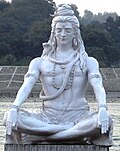
[[File:Shiva meditating Rishikesh.jpg|thumb|Statue of [[Shiva]] in [[Rishikesh]].|alt=|left]] | [[File:Shiva meditating Rishikesh.jpg|thumb|Statue of [[Shiva]] in [[Rishikesh]].|alt=|left]] | ||
{{lang|ne-Latn|Kajari Teej}} is celebrated in the Bikrami lunar month of | {{lang|ne-Latn|Kajari Teej}} is celebrated in the Bikrami lunar month of Bhadrapada: the third day of the dark fortnight of Bhadrapada.<ref name=":2">{{Cite web|date=12 August 2014|title=What is Kajari Teej?|url=https://timesofindia.indiatimes.com/astrology/rituals-puja/what-is-kajari-teej/articleshow/68207134.cms|access-date=2020-08-29|website=[[The Times of India]]|language=en}}</ref> {{lang|ne-Latn|Kajari Teej}} is also called {{lang|hi-Latn|Boorhi Teej}}.<ref>{{Cite book|url=https://books.google.com/books?id=3m0LAAAAIAAJ|title=Folk-lore|date=1973|publisher=Indian Publications|others=Volume 14|pages=253|language=en}}</ref>{{Additional citation needed|date=August 2020}} In [[Rajasthan]], {{lang|ne-Latn|Kajari Teej}} is called {{lang|hi-Latn|Badi Teej}} (lit. Bigger ''Teej'')<ref name=":3">{{Cite book|url=https://books.google.com/books?id=kSluAAAAMAAJ|title=Rajasthan District Gazetteers: Bikaner|date=1972|publisher=Government Central Press|pages=117|language=en}}</ref>{{Additional citation needed|date=August 2020}} as it follows {{lang|hi-Latn|Haryali Teej}}, which is known as {{lang|hi-Latn|Chhoti Teej}} (lit. Smaller ''Teej''). | ||
Women in [[Uttar Pradesh]] pray to [[Shiva]] on {{lang|ne-Latn|Kajari Teej}}.<ref name=":4">{{Cite book|url=https://books.google.com/books?id=54sbAAAAIAAJ|title=Uttar Pradesh District Gazetteers: Kanpur|date=1989|publisher=[[Government of Uttar Pradesh]]|pages=61|language=en}}</ref>{{Additional citation needed|date=August 2020}} It is also customary to sing folk songs known as {{lang|ne-Latn|kajris}}. The focus of the lyrics is usually on separation expressing the pining of a woman for her beloved in her parents' home, where she has been sent to celebrate {{lang|ne-Latn|Teej}},<ref name=":1" />{{Additional citation needed|date=August 2020}} or waiting in anticipation to be collected by brothers to celebrate {{lang|ne-Latn|Teej}}.{{Citation needed|date=August 2020}} The | Women in [[Bhojpuri region]] of [[Uttar Pradesh]] pray to [[Shiva]] on {{lang|ne-Latn|Kajari Teej}}.<ref name=":4">{{Cite book|url=https://books.google.com/books?id=54sbAAAAIAAJ|title=Uttar Pradesh District Gazetteers: Kanpur|date=1989|publisher=[[Government of Uttar Pradesh]]|pages=61|language=en}}</ref>{{Additional citation needed|date=August 2020}} It is also customary to sing folk songs known as {{lang|ne-Latn|kajris}}. The focus of the lyrics is usually on separation expressing the pining of a woman for her beloved in her parents' home, where she has been sent to celebrate {{lang|ne-Latn|Teej}},<ref name=":1" />{{Additional citation needed|date=August 2020}} or waiting in anticipation to be collected by brothers to celebrate {{lang|ne-Latn|Teej}}.{{Citation needed|date=August 2020}} The Kajari is a folk song composed and sung in the Bhojpuri region of [[Uttar Pradesh]], [[Bihar]], [[Jharkhand]] and the Terai region of Nepal.<ref>[https://books.google.com/books?id=WudjAAAAMAAJ&q=kajari+teej+songs Jain, Jasbir (2006) Narrative of the village: centre of the periphery]</ref> | ||
Women who observe the {{lang|hi-Latn|Kajari Teej}} fast go without food and water.<ref name=":2" /> {{lang|ne-Latn|Kajari Teej}} is associated closely with {{lang|ne-Latn|Kajali Teej}}, which also involves praying to the moon. The fast is broken by eating [[sattu]].<ref name=":3" />{{Self-published inline|date=August 2020}} The other focus of the day is to pray to the [[Azadirachta indica|neem tree]]. A fair is held in Bundi in [[Rajasthan]] to celebrate {{lang|ne-Latn|Kajari Teej}}.<ref name=":4" />{{Page needed|date=August 2020}}{{Additional citation needed|date=August 2020}} | Women who observe the {{lang|hi-Latn|Kajari Teej}} fast go without food and water.<ref name=":2" /> {{lang|ne-Latn|Kajari Teej}} is associated closely with {{lang|ne-Latn|Kajali Teej}}, which also involves praying to the moon. The fast is broken by eating [[sattu]].<ref name=":3" />{{Self-published inline|date=August 2020}} The other focus of the day is to pray to the [[Azadirachta indica|neem tree]]. A fair named [[Kajali Teej Mela]] is held in Bundi in [[Rajasthan]] to celebrate {{lang|ne-Latn|Kajari Teej}}.<ref name=":4" />{{Page needed|date=August 2020}}{{Additional citation needed|date=August 2020}} | ||
=={{lang|ne-Latn|Hartalika Teej}}== | =={{lang|ne-Latn|Hartalika Teej}}== | ||
[[File:WLA vanda The Marriage of Shiva and Parvati.jpg|thumb|The wedding of [[Shiva]] and [[Parvati]]. Collection of the [[Victoria and Albert Museum]].]] | [[File:WLA vanda The Marriage of Shiva and Parvati.jpg|thumb|The wedding of [[Shiva]] and [[Parvati]]. Collection of the [[Victoria and Albert Museum]].]] | ||
{{lang|ne-Latn|Hartalika}} is a combination of the [[ | {{lang|ne-Latn|Hartalika}} is a combination of the [[Sanskrit]] words {{lang|hi-Latn|harit}} and {{lang|hi-Latn|aalika}} which means "abduction" and "female friend" respectively. According to the legend of {{lang|hi-Latn|Hartalika Teej}}, Parvati, incarnated as [[Shailaputri]]<ref>{{Cite book|last=Jha|first=O. P.|url=https://books.google.com/books?id=X5rsAgAAQBAJ&q=shailputri+parvati&pg=PT14|title=Goddess Durga: Gods And Goddesses in India|date=2014-02-26|publisher=Diamond Pocket Books Pvt Ltd|isbn=978-93-5083-441-1|language=en}}</ref><ref>{{cite journal |last1=Dahal |first1=Kamala |title=Celebrating Teej as a Festival of (Re) union and Enjoyment |journal=Molung Educational Frontier |date=25 December 2020 |pages=29–41 |doi=10.3126/mef.v10i1.34027 |s2cid=234410894 |doi-access=free }}</ref> | ||
On the third day of the bright half of | On the third day of the bright half of Bhadrapada, Parvati made a {{lang|sa-Latn|[[lingam|shiva lingam]]}} out of [[sand]] and [[silt]] of [[Ganga]] and prayed. Shiva was so impressed that he gave his word to marry Parvati. Eventually, Parvati was united with Shiva and was married to him with her father's blessing. Since then, the day is referred to as {{lang|hi-Latn|Hartalika Teej}} as Parvati's female ({{lang|hi-Latn|aalika}}) friend had to abduct ({{lang|hi-Latn|harit}}) her in order for the goddess to achieve her goal of marrying Shiva.{{Citation needed|date=August 2020}} | ||
Accordingly, {{lang|hi-Latn|Hartalika Teej}} is seen as a major festival and is celebrated on the third day of the bright half of the Indian/North Nepali Lunar month of | Accordingly, {{lang|hi-Latn|Hartalika Teej}} is seen as a major festival and is celebrated on the third day of the bright half of the Indian/North Nepali Lunar month of Bhadrapada. The festival women feasting during the evening of {{lang|hi-Latn|Hartalika Teej}}, praying to Parvati and Shiva, remembering their wedding and staying up all night listening to prayers.<ref>{{Cite book |last=Rāmacandrana |first=Śivānī |title=Bhāratīya jayantiyām̐ evaṃ tyohāra |date=2014 |publisher=Śrīkr̥shṇā Pustaka Bhaṇḍāra |isbn=978-81-88514-44-1 |location=Dillī |oclc=851268802 }}{{page needed|date=July 2022}}</ref>{{Additional citation needed|date=August 2020}} The fast (also called nishivasar nirjala vrat) commences during the evening of {{lang|hi-Latn|Hartalika Teej}} and is broken the next day after a full day's observance which involves women not even drinking water.{{Citation needed|date=August 2020}} The focus is on praying to Parvati<ref>{{Cite book|url=https://books.google.com/books?id=w1EbAAAAIAAJ|title=Maharashtra State Gazetteers: Buldhana|date=1976|publisher=Director of Government Printing, Stationery and Publications|language=en}}</ref>{{Page needed|date=August 2020}} whom Shiva desired should be worshipped under the name Hartalika.{{Citation needed|date=August 2020}} <ref>Pimputkar, S. (2017, Aug 23). Hartalika teej 2017: Significance, legend, rituals, tithi. Free Press Journal {{ProQuest|2290557959}}</ref> The main areas of celebration are [[Bihar]], [[Purvanchal|eastern Uttar Pradesh]], [[Jharkhand]], [[Rajasthan]], [[Uttarakhand]] and [[Nepal]]. In [[Rajasthan]], an idol of Parvati is taken out in procession in the streets accompanied by singing, and music. {{lang|hi-Latn|Hartalika Teej}} has also spread to parts of [[Madhya Pradesh]], [[Chhattisgarh]] .{{Citation needed|date=August 2020}} | ||
In Maharashtra Hartalika teej also | In Maharashtra Hartalika teej also known as Hartalika tritiya vrat, which is celebrated in similar manner like northern India. It is observed by married women for the welfare, health, and long life of their husbands and for a happy married life and unmarried girls for being blessed with a good husband. It is Nirjala Vrat, they fast for one and half day. | ||
Women do Sola shrungar, apply | Women do Sola shrungar, apply mehndi, wear new red or green sari, observe fast, make idol of Shiva, Gauri, Sakhi and Ganesha with clay or river sand, read katha. | ||
They do bhajan sangeet pooja in night as well and open vrat on second day. | They do bhajan sangeet pooja in night as well and open vrat on the second day. | ||
It is very auspicious vrat for women in India to worship goddess Parvati in the form of Gauri along with Shiva parivar. | |||
In [[Purvanchal|eastern Uttar Pradesh]], [[Bihar]] and [[Jharkhand]], married women keep Nirjala Upvas for the whole day of Teej, & deck up with Shringaars like [[Alta (dye)|Aalta]], Mehndi, e.t.c.. In the evening, the women get decked up in heavy sarees, gold jewellery,their wedding Chunris, & don the traditional orange Sindoor from the tip of their nose. In many homes, it is a tradition to wear their wedding Banarasi Saree, on the eve of Teej. They make & worship small clay idols of Shiva, Gauri, Ganesh & Kartikeya. They offer flowers, garlands, Fruits, sweets & items of 16 Shringaar to Maa parvati. Then they recite & listen to the Hartālikā Teej Katha,& offer reverence to the deities. Very early in the next morning,before sunrise, the women get ready & worship the idols again & finally conclude their fasts. The idols are later immersed in a holy water body. In [[Bhojpuri region]], traditional delicacies such as Thekua, Pidukia, e.t.c. are prepared for offering. Traditional folk songs are sung, & women adorn Sindoor from their wedding Sinhora. | |||
==Elsewhere in India== | ==Elsewhere in India== | ||
| Line 96: | Line 122: | ||
==={{lang|hi-Latn|Akha Teej}}=== | ==={{lang|hi-Latn|Akha Teej}}=== | ||
{{Main|Akshaya Tritiya}} | {{Main|Akshaya Tritiya}} | ||
{{lang|hi-Latn|Akha Teej}} (also called Akshaya Tritiya) falls on the third day after full moon in the month of [[Vaisakha]].<ref>{{cite book|last=Gopal|first=Madan|url=https://archive.org/details/indiathroughages00mada|title=India Through the Ages|publisher=[[Government of India]]|year=1990|editor=K.S. Gautam|page=[https://archive.org/details/indiathroughages00mada/page/65 65]|oclc=1157118397}}</ref> It is an auspicious day of the birthday of [[Parasurama]], the sixth incarnation of [[Vishnu]]. On this day [[Vyasa | {{lang|hi-Latn|Akha Teej}} (also called Akshaya Tritiya) falls on the third day after full moon in the month of [[Vaisakha]].<ref>{{cite book|last=Gopal|first=Madan|url=https://archive.org/details/indiathroughages00mada|title=India Through the Ages|publisher=[[Government of India]]|year=1990|editor=K.S. Gautam|page=[https://archive.org/details/indiathroughages00mada/page/65 65]|oclc=1157118397}}</ref> It is an auspicious day of the birthday of [[Parasurama|Parashurama]], the sixth incarnation of [[Vishnu]]. On this day, [[Vyasa]] and [[Ganesha]] began to write the [[Mahabharata]]. Jains celebrate this day to commemorate [[Tirthankara]] [[Rishabha]]'s ending of his fast by consuming sugarcane juice poured into his cupped hands. According to Gagne (2013), {{lang|hi-Latn|Akha Teej}} is an important festival in the Hindu calendar.<ref>{{cite journal |last1=Gagné |first1=Karine |title=Gone with the Trees: Deciphering the Thar Desert's Recurring Droughts |journal=Current Anthropology |date=August 2013 |volume=54 |issue=4 |pages=497–509 |doi=10.1086/671074 |s2cid=143967758 }}</ref> | ||
==={{lang|hi-Latn|Awra Teej}} of Madhya Pradesh and Chhattisgarh=== | ==={{lang|hi-Latn|Awra Teej}} of Madhya Pradesh and Chhattisgarh=== | ||
{{lang|hi-Latn|Awra Teej}} is celebrated in the month of {{lang|sa-Latn|[[Vaisakh]]}} in parts of [[Madhya Pradesh]] and [[Chhattisgarh]]. This festival of {{lang|hi-Latn|Teej}} falls in Spring. The month of {{lang|sa-Latn|[[Vaisakh]]}} occurs during spring.<ref>Gold, | {{lang|hi-Latn|Awra Teej}} is celebrated in the month of {{lang|sa-Latn|[[Vaisakh]]}} in parts of [[Madhya Pradesh]] and [[Chhattisgarh]]. This festival of {{lang|hi-Latn|Teej}} falls in Spring. The month of {{lang|sa-Latn|[[Vaisakh]]}} occurs during spring.<ref>Gold, D. (2015). Provincial Hinduism: Religion and Community in Gwalior City. United Kingdom: Oxford University Press.</ref> | ||
==={{lang|hi-Latn|Jhulan Utsav}}=== | ==={{lang|hi-Latn|Jhulan Utsav}}=== | ||
{{Main| | {{Main|Jhulan Purnima}} | ||
[[File:Indischer Maler um 1755 002.jpg|thumb|[[Krishna]] on a swing (''jhula''), ca. 1755. Collection of the [[British Museum]].]] | [[File:Indischer Maler um 1755 002.jpg|thumb|[[Krishna]] on a swing (''jhula''), ca. 1755. Collection of the [[British Museum]].]] | ||
{{lang|hi-Latn|Haryali Teej}} | {{lang|hi-Latn|Haryali Teej}} coihojpudi regiones with the swing festival of {{lang|hi-Latn|Jhulan Leela}} also known us {{lang|hi-Latn|Jhulan Utsav}} or {{lang|hi-Latn|[[Hindola]] Utsav}}<ref>{{Cite news|last=Press Trust of India|author-link=Press Trust of India|date=2015-08-16|title=Vrindaban gears up for colorful Hindola festival|work=[[Business Standard]]|url=https://www.business-standard.com/article/pti-stories/vrindaban-gears-up-for-colorful-hindola-festival-115081600557_1.html|access-date=2020-08-29}}</ref> which is associated with [[Krishna]] and [[Radha]], and is celebrated at [[Banke Bihari Temple]] and other temples in the [[Vrindavan]] area of [[Uttar Pradesh]]. The festival lasts until [[Krishna Janmashtami]] for 13 days.{{Citation needed|date=August 2020}} | ||
On the day of {{lang|hi-Latn|Teej}}, idols of Krishna and Radha are placed on swings in the temples and the focus of {{lang|hi-Latn|Jhulan Leela}} is religious. The green theme, popular in neighbouring [[Rajasthan]] and [[Haryana]] on {{lang|hi-Latn|Haryali Teej}}, can also be seen in the {{lang|hi-Latn|Jhulan Utsav}}. Idols of Krishna and Radha are dressed in green clothes. | On the day of {{lang|hi-Latn|Teej}}, idols of Krishna and Radha are placed on swings in the temples and the focus of {{lang|hi-Latn|Jhulan Leela}} is religious. The green theme, popular in neighbouring [[Rajasthan]] and [[Haryana]] on {{lang|hi-Latn|Haryali Teej}}, can also be seen in the {{lang|hi-Latn|Jhulan Utsav}}. Idols of Krishna and Radha are dressed in green clothes. | ||
| Line 111: | Line 137: | ||
==={{lang|lmn-Latn|Kajal Teej}} of Telangana=== | ==={{lang|lmn-Latn|Kajal Teej}} of Telangana=== | ||
{{lang|lmn-Latn|Teej}} in [[Telangana]] forms part of a wider celebration which is a forerunner to other festivals being celebrated and is known as {{lang|lmn-Latn|Kajal Teej}}. {{lang|hi-Latn|Kajal Teej}} is one of the [[Banjara]] tribe's biggest festivals.<ref name=":6">{{ | {{lang|lmn-Latn|Teej}} in [[Telangana]] forms part of a wider celebration which is a forerunner to other festivals being celebrated and is known as {{lang|lmn-Latn|Kajal Teej}}. {{lang|hi-Latn|Kajal Teej}} is one of the [[Banjara]] tribe's biggest festivals.<ref name=":6">{{cite book |last1=Deogaonkar |first1=Shashishekhar Gopal |last2=Deogaonkar |first2=Shailaja Shashishekhar |title=The Banjara |date=1992 |publisher=Concept Publishing Company |isbn=978-81-7022-433-4 |page=40 }}</ref> | ||
==={{lang|gu-Latn|Kevada Teej}} of Gujarat=== | ==={{lang|gu-Latn|Kevada Teej}} of Gujarat=== | ||
{{lang|gu-Latn|Kevada Teej}}, also known as {{lang|gu-Latn|Kevda Trij}}, is a festival observed mainly in [[Gujarat]]. The festival is celebrated on the third day of the Shukla Paksha (waxing of the moon) of {{lang|hi-Latn|[[Bhadra (Hindu calendar)|Bhadra]]}} in Gujarat. This observance is similar to the {{lang|hi-Latn|Hartalika Teej}} fast ({{lang|hi-Latn|vrat}}). Married and unmarried women observe a fast on the day and offer the {{lang|gu-Latn|[[Pandanus|kevada]]}} flower (pine screw) to Parvati and Shiva.{{Citation needed|date=August 2020}} | {{lang|gu-Latn|Kevada Teej}}, also known as {{lang|gu-Latn|Kevda Trij}}, is a festival observed mainly in [[Gujarat]]. The festival is celebrated on the third day of the Shukla Paksha (waxing of the moon) of {{lang|hi-Latn|[[Bhadra (Hindu calendar)|Bhadra]]}} in Gujarat. This observance is similar to the {{lang|hi-Latn|Hartalika Teej}} fast ({{lang|hi-Latn|vrat}}). Married and unmarried women observe a fast on the day and offer the {{lang|gu-Latn|[[Pandanus|kevada]]}} flower (pine screw) to Parvati and Shiva.{{Citation needed|date=August 2020}} | ||
== | ==Haritalika Teej observance in Nepal== | ||
{{Anchor|Observance in Nepal}}Dedicated to Parvati, commemorating her union with Shiva, the festival is celebrated for well-being of spouse and children and purification of one's body and | {{Redirect|Tij|other uses|TIJ (disambiguation)}} | ||
{{Anchor|Observance in Nepal}}Dedicated to Parvati, commemorating her union with Shiva, the festival is celebrated for well-being of spouse and children and purification of one's body and soul. The festival is a three-day-long celebration that combines sumptuous feasts as well as rigid fasting. {{lang|ne-Latn|Teej}} (also romanised {{lang|ne-Latn|Tij}}) is celebrated by women, for the long life of her husband and long and firm relationship between them in this life and all the lives to come. It is particularly celebrated by women from various ethnicities and castes of Nepalese society, particularly the [[Bhojpuri people|Bhojpuriyas]], [[Maithils]] (Native [[Madhesi people|Madheshis]]), [[Bahun]], Chettri, Newairs and Kiratis, on the third day after the new moon of the month of [[Bhadra (Hindu calendar)|Bhadra]] (mid-August to mid-September).<ref>{{Cite journal|last1=Skinner|first1=Debra|last2=Holland|first2=Dorothy|last3=Adhikari|first3=G. B.|date=1994|title=The Songs of Tij: A Genre of Critical Commentary for Women in Nepal|journal=[[Asian Folklore Studies]]|volume=53|issue=2|pages=259|doi=10.2307/1178647|jstor=1178647}}</ref>{{Page needed|date=August 2020}}<ref name="mesocosm">{{Cite book|last1=Levy|first1=Robert Isaac|url=https://ark.cdlib.org/ark:/13030/ft6k4007rd/|title=Mesocosm: Hinduism and the Organization of a Traditional Newar City in Nepal|last2=Rājopādhyāya|first2=Kedar Rāj|date=1990|publisher=[[University of California Press]]|isbn=0-585-13103-1|location=Berkeley, California|oclc=43476658}}</ref>{{Page needed|date=August 2020}}{{Unreferenced section|date=August 2020}} | |||
{{Unreferenced section | |||
===First day=== | ===First day=== | ||
[[File:Queue at Pashupatinath01.JPG|thumb|Women line up to making offerings to Parvati and Shiva at [[Pashupatinath Temple]]]] | [[File:Queue at Pashupatinath01.JPG|thumb|Women line up to making offerings to Parvati and Shiva at [[Pashupatinath Temple]]|248x248px]] | ||
The first day of Teej is called {{lang|ne-Latn|Dar Khane Din}}. On this day the women assemble at one place in their finest attire and start dancing and singing devotional songs. Amidst all this, the grand feast takes place. | The first day of Teej is called {{lang|ne-Latn|Dar Khane Din}}. On this day the women assemble at one place in their finest attire and start dancing and singing devotional songs. Amidst all this, the grand feast takes place. The feast is hosted by men as usual. Women, who work hard throughout the year, do not have to do anything that day. That is the day for them to embellish themselves in {{lang|ne-Latn|sorha singaar}} — dressing up and using make up to the full extent, indulge in good food, and dance. Oftentimes, because women are invited by multiple brothers for the feast, they try to dance off some food before they are ready to eat more. The food served is supposed to be rich and abundant.{{Citation needed|date=August 2020}} | ||
This is probably the only day in a year that allows women full freedom of expression. Consequently, women have traditionally used this occasion to express their pains and pang in the songs they sing while dancing. With the advancement of communication and awareness, women these days use this occasion to voice their concerns about social issues and discrimination against women. The jollity often goes on | This is probably the only day in a year that allows women full freedom of expression. Consequently, women have traditionally used this occasion to express their pains and pang in the songs they sing while dancing. With the advancement of communication and awareness, women these days use this occasion to voice their concerns about social issues and discrimination against women. The jollity often goes on until midnight, after which the 24-hour fast starts.<ref>{{Cite web |title=Teej special 2022 to be held in Qatar |url=https://english.khabarhub.com/2022/22/268921/ |access-date=2023-07-17 |website=Khabarhub |language=en}}</ref> | ||
===Second day=== | ===Second day=== | ||
The second day is the day of fasting. Some women don't eat or drink food and water while others drink liquids and eat fruit. The fasting is observed by married and unmarried women. Married women abstain strictly from food and drinks with a belief that their devotion to the gods will be blessed with longevity, peace and prosperity of their husband and family. Unmarried women observe the fast with a hope of being blessed with a good husband.{{ | The second day is the day of fasting. Some women don't eat or drink food and water while others drink liquids and eat fruit. The fasting is observed by married and unmarried women. Married women abstain strictly from food and drinks with a belief that their devotion to the gods will be blessed with longevity, peace and prosperity of their husband and family. Unmarried women observe the fast with a hope of being blessed with a good husband.<ref>{{Cite book |last=Majupuria |first=Trilok Chandra |title=Nepal, The Land of Festivals: Religious, Cultural, Social and Historical Festivals) |publisher=S. Chand |year=1981 |isbn=9780940500839 |pages=92–93 |oclc=310635107}}</ref><ref>{{Cite book |last=Diwas |first=Dhakal |title=Nepalese Culture, Society, and Tourism |date=2000 |publisher=M. Dhakal |pages=191 |language=en |oclc=604735909}}</ref> | ||
They dress gaily and visit a nearby Shiva temple singing and dancing on the way. The [[Pashupatinath Temple]] gets the highest number of devotees. At the temple, women circumambulate the {{lang|sa-Latn|[[shiva lingam]]}}, which symbolizes Shiva | They dress gaily and visit a nearby Shiva temple singing and dancing on the way. The [[Pashupatinath Temple]] gets the highest number of devotees. At the temple, women circumambulate the {{lang|sa-Latn|[[shiva lingam]]}}, which symbolizes Shiva. The main pooja (religious ceremony) takes place with offerings of flowers, fruits, etc., made to Shiva and his wife Parvati, beseeching them to grant their blessing upon the husband and family. The important part of the puja is the oil lamp which should be alight throughout the night. It is believed that by the light of an oil lamp all night will bring peace and prosperity to the husband and family.<ref>{{Cite book |last=Hugh |first=Finlay |title=Nepal |publisher=Lonely Planet Publications |year=2001 |pages=98 |oclc=320635037}}</ref> | ||
===Third day=== | ===Third day=== | ||
The third day of the festival is [[Rishi Panchami]]. After the completion of the previous day's puja, women pay homage to seven saints or sages, offer prayers to deities, and bathe with red mud found on the roots of the sacred datiwan bush, along with its leaves. The Rishi Panchami revolves around the purity of women. | The third day of the festival is [[Rishi Panchami]].<ref>{{Cite book |last=Gurung |first=Bishnu Prasad |title=Festival & Fetes in Nepal |date=2008 |publisher=Monterosa Treks and Expedition |isbn=978-99933-877-0-1 |pages=49 |oclc=457045938}}</ref> After the completion of the previous day's puja, women pay homage to seven saints or sages, offer prayers to deities, and bathe with red mud found on the roots of the sacred datiwan bush, along with its leaves. The Rishi Panchami revolves around the purity of women. During this festival, which occurs two days after the Teej, the women participate in [[Ritual purification|ritual baths]] and [[Puja (Hinduism)|puja]] (worship). One of the defining characteristics of the Teej Festival is the songs the women sing.<ref>{{Cite book |last=Bimala |first=Shrestha |title=Social life in Nepal, 1885-1950 |publisher=Vani Prakashan Co-operative Limited |year=1997 |pages=126–127 |oclc=1126012625}}</ref> Traditionally, these songs emphasized the subservient role of women in Nepalese society in addition to reinforcing traditional Hindu ideology of gender relations. Within the past few decades, as Nepal and the surrounding area experiences rapid development and modernization, the Teej songs have become more of a critical commentary on gender relations from women's perspectives. These songs "extend the women's thoughts and experiences of hardships from an intimate conversation to a public setting".<ref>{{cite book |last1=Skinner |first1=Debra |last2=Pach |first2=Alfred |last3=Holland |first3=Dorothy |last4=Holland |first4=Dorothy C. |title=Selves in Time and Place: Identities, Experience, and History in Nepal |date=1998 |publisher=Rowman & Littlefield |isbn=978-0-8476-8599-8 |page=98 }}</ref> The Teej songs allow women to effect change in their respective societies by giving them a public voice.<ref>{{Cite journal |last1=Skinner |first1=Debra |last2=Holland |first2=Dorothy |last3=Adhikari |first3=G. B. |date=1994 |title=The Songs of Tij: A Genre of Critical Commentary for Women in Nepal |url=https://www.jstor.org/stable/1178647 |journal=Asian Folklore Studies |volume=53 |issue=2 |pages=259–305 |doi=10.2307/1178647 |jstor=1178647 |issn=0385-2342|url-access=subscription }}</ref> | ||
==References== | ==References== | ||
| Line 146: | Line 167: | ||
{{Commons category|Teej}} | {{Commons category|Teej}} | ||
*{{Cite journal|last=Bhatnagar|first=Manju|date=1988|title=The Monsoon Festival Teej in Rajasthan|journal=[[Asian Folklore Studies]]|volume=47|issue=1|pages=63–72|doi=10.2307/1178252|jstor=1178252}} | *{{Cite journal|last=Bhatnagar|first=Manju|date=1988|title=The Monsoon Festival Teej in Rajasthan|journal=[[Asian Folklore Studies]]|volume=47|issue=1|pages=63–72|doi=10.2307/1178252|jstor=1178252}} | ||
*{{Cite book|last1=Levy|first1=Robert Isaac|url= | *{{Cite book|last1=Levy|first1=Robert Isaac|url=https://ark.cdlib.org/ark:/13030/ft6k4007rd/|title=Mesocosm: Hinduism and the Organization of a Traditional Newar City in Nepal|last2=Rājopādhyāya|first2=Kedar Rāj|date=1990|publisher=[[University of California Press]]|isbn=0-585-13103-1|location=Berkeley, California|oclc=43476658}} | ||
*{{Cite journal|last1=Skinner|first1=Debra|last2=Holland|first2=Dorothy|last3=Adhikari|first3=G. B.|date=1994|title=The Songs of Tij: A Genre of Critical Commentary for Women in Nepal|journal=[[Asian Folklore Studies]]|volume=53|issue=2|pages=259–305|doi=10.2307/1178647|jstor=1178647}} | *{{Cite journal|last1=Skinner|first1=Debra|last2=Holland|first2=Dorothy|last3=Adhikari|first3=G. B.|date=1994|title=The Songs of Tij: A Genre of Critical Commentary for Women in Nepal|journal=[[Asian Folklore Studies]]|volume=53|issue=2|pages=259–305|doi=10.2307/1178647|jstor=1178647}} | ||
| Line 158: | Line 179: | ||
[[Category:Hindu festivals in Nepal]] | [[Category:Hindu festivals in Nepal]] | ||
[[Category:Festivals in Nepal]] | [[Category:Festivals in Nepal]] | ||
[[Category:Khas culture]] | |||
Latest revision as of 14:44, 29 March 2026
 | This article may require cleanup to meet Bharatpedia's quality standards. The specific problem is: issues with sourcing, and readability in sizeable parts of the article; specifics have been tagged inline (September 2020) |
| |
|---|---|
 Women celebrating Teej in Nepal | |
| Observed by | Hindu women |
| Liturgical Color | Red |
| Type | Hindu |
| Significance | Signifies the penance made by goddess Parvati to receive Shiva as her husband |
| Celebrations | Day 1 : enjoying a grand feast, Day 2: observing a day-long fasting, with praying, dancing and visiting Shiva temples Day 3: Taking a holy bath and performing Rishi Panchami |
| Date | July–September |
| Frequency | Annual |
Tīja, Sanskrit: तीज, literally meaning "third"—denoting the third day after the new moon when the monsoon begins per the Hindu calendar—is a collective term for three Hindu festivals primarily dedicated to the mother goddess Pārvatī and her consort Śiva. It is mainly celebrated by married women and unmarried girls, especially in Nepal and North India, to pray for the long life of their husband or future husband and to welcome the arrival of the monsoon through singing, swinging, dancing, joyous celebration, pūjā, and often fasting.
Tīja collectively refers to three festivals: Haryālī Tīja, Kajari Tīja, and Hartālikā Tīja. Haryālī Tīja (literally, "green Tīja"), also known as Sindhārā Tīja, Chhoṭī Tīja, Śrāvaṇa Tīja, or Sāvana Tīja, falls on the third day after the new moon in the month of Śrāvaṇa. It marks the day when Śiva consented to Pārvatī’s wish to marry him. Women visit their parental homes, prepare swings, and celebrate with song and dance.
Kajari Tīja (literally, "dark Tīja"), also known as Baṛī Tīja, is celebrated 15 days after Haryālī Tīja during the dark (waning) phase of the moon.
Hartālikā Tīja (from Harat meaning "abduction" and Ālikā meaning "female friend") falls one lunar month after Haryālī Tīja on the third day after the new moon in the month of Bhādrapada. It commemorates the occasion when Pārvatī encouraged her friends to abduct her to avoid marriage with Viṣṇu, which her father Himālaya had arranged. Married women observe nirjala vrata (a fast without water) on this day for the well-being of their husbands.[1][2]
Etymology[edit | edit source]
_spotted_at_Kambalakonda_01.jpg)
Teej refers to the third day that falls every month after the new moon (amavasya), and the third day after the full moon night of every lunar month.[4] According to Kumar (1988), Kajari Teej and Hartalika Teej fall in Bhadrapada.[5]
The festivals celebrate the bounty of nature, arrival of clouds and rain, greenery and birds with social activity, rituals, and customs.[6] The festivals for women, include dancing, singing, getting together with friends and telling stories, dressing up with henna-coloured hands and feet, wearing red, green or orange clothes, sharing festive foods,[6] and playing under trees on swings on Haryali Teej.[7] The monsoon festival in Rajasthan is dedicated to Parvati.[6]
Haryali Teej[edit | edit source]
Haryali Teej (lit. Green Teej) is celebrated on the third day after the new moon in the month of Shraavana/Sawan (of the Hindu calendar).[8] As Shraavana falls during the monsoon or rainy season when the surroundings become green, the Shraavana Teej is also called Hariyali Teej.
The Hariyali Teej festival is also celebrated to remember the day when Shiva accepted Parvati as his wife. Parvati fasted and was austere for many years and was accepted by Shiva as his wife in her 108th birth. Parvati is also known as Teej mata (lit. Teej mother).[9]
Sindhara[edit | edit source]
On Teej married daughters receive the gifts by her mother such clothes, bangles, bindi, mehandi, etc. Ghevar, a special sweet, are given to them on this day. These gifts are known as Sindhara. According to Bhatnager (1988), Sindhara is derived from the Sanskrit word sringar which means "decoration of women and their charming beauty".[10]
Observance of Haryali Teej[edit | edit source]
Haryali Teej is celebrated in Punjab, Haryana, Western UP, Rajasthan and Nepal .[11] The festival is also celebrated in Chandigarh.[12]
Chandigarh[edit | edit source]
Chandigarh administration makes special arrangements for Teej celebration in the Rock Garden in the city. School children present plays and other cultural programs on this day. The female members of the family, especially daughters, are given gifts and dresses.[13][additional citation(s) needed]

Haryana[edit | edit source]
Haryali Teej is one of the famous festivals of Haryana, and is celebrated as an official holiday. Many functions are organised by the Government of Haryana to celebrate this festival, which welcomes the rainy season. Boys traditionally flew kites from morning to evening, though this tradition is losing its charm in big cities due to high rise buildings and lack of terrace space.[14]
Swings are set up in open courtyards, under trees for the season. Girls apply henna to their hands and feet and are excused from household chores on this day. On Teej, girls often receive new clothes from their parents.[15]
On Teej, just as on Karva Chauth, the mother sends a baya or gift. The puja is performed in the morning. The baya, which consists of a variety of foodstuffs, is placed on a thaali at a place of worship where a chowk (square) has been decorated, and an idol or picture of Parvati has been installed. The evenings are set aside for folk singing and dancing, including the women's prayers for their husbands' longevity and their families.[6]
Punjab[edit | edit source]

Teej is known as Teeyan in Punjab and is seen as a seasonal festival which is dedicated to the onset of the monsoon.[16][8] The festival is celebrated by women of all faiths, and lasts from the third day of the bright half of the lunar month of Sawan as per the Bikrami calendar (Punjabi calendar) to the full moon of Sawan (about 13 days). Teeyan involves women getting together and performing Gidda, married women visiting their families and receiving gifts. It is also traditional for women to ride on swings.
Fairs are organised in schools and colleges where dance competitions are held.[17][18]
Teeyan is a festival when girls play on swings that are set up under trees or open courtyards. During Teeyan, family members give gifts, typically new clothes and accessories, to girls and women. Sweets are prepared especially Ghevar in some parts of Punjab.[8]
Rajasthan[edit | edit source]
Teej welcomes the monsoon and observed in the month of Shravan (July/August). The monsoon rains fall on the parched land and the pleasing scent of the wet soil rises into the air. Swings are hung from trees and women dressed in green clothes sing songs in celebration of the advent of the monsoon.[6]
This festival is dedicated to Parvati, commemorating her union with Shiva.[6] Parvati is worshipped by seekers of conjugal bliss and happiness. An elaborate procession is taken out in Jaipur for two continuous days on the festive occasion which is watched by people in large numbers.[19] The Teej idol is covered with a canopy whereas the Gangaur idol is open. The traditional Ghevar sweet is also associated with the festival.
During Teej, Parvati is worshiped. The day before Haryali Teej, is celebrated as Sinjara, wherein women put mehndi on their hands and feet.[20]
Teej in Nepal[edit | edit source]
Teej is one of the major Hindu festivals celebrated across Nepal, especially by women. It falls in the month of Bhadra (August/September) according to the Nepali lunar calendar and marks the arrival of the monsoon season. The festival is dedicated to Goddess Parvati and commemorates her union with Lord Shiva, symbolizing marital bliss and devotion.
In Nepal, Teej is observed with great enthusiasm and devotion. Women dress in red saris or traditional attire, fast for the well‑being and longevity of their husbands, and gather to sing traditional Teej songs and perform cultural dances. The puja is usually conducted at temples dedicated to Shiva and Parvati, and large crowds also visit sacred sites such as Pashupatinath Temple in Kathmandu for special prayers.
Swings are hung from trees in courtyards and community spaces, and women enjoy riding them while singing folk songs. In some regions, women prepare and share festive foods such as marriage rice (bhat), sel roti, and seasonal sweets. The festival serves both as a religious observance and a social occasion, offering women an opportunity to meet with friends and family.[21]
Kajari Teej[edit | edit source]

Kajari Teej is celebrated in the Bikrami lunar month of Bhadrapada: the third day of the dark fortnight of Bhadrapada.[22] Kajari Teej is also called Boorhi Teej.[23][additional citation(s) needed] In Rajasthan, Kajari Teej is called Badi Teej (lit. Bigger Teej)[24][additional citation(s) needed] as it follows Haryali Teej, which is known as Chhoti Teej (lit. Smaller Teej).
Women in Bhojpuri region of Uttar Pradesh pray to Shiva on Kajari Teej.[25][additional citation(s) needed] It is also customary to sing folk songs known as kajris. The focus of the lyrics is usually on separation expressing the pining of a woman for her beloved in her parents' home, where she has been sent to celebrate Teej,[17][additional citation(s) needed] or waiting in anticipation to be collected by brothers to celebrate Teej.[citation needed] The Kajari is a folk song composed and sung in the Bhojpuri region of Uttar Pradesh, Bihar, Jharkhand and the Terai region of Nepal.[26]
Women who observe the Kajari Teej fast go without food and water.[22] Kajari Teej is associated closely with Kajali Teej, which also involves praying to the moon. The fast is broken by eating sattu.[24][self-published source?] The other focus of the day is to pray to the neem tree. A fair named Kajali Teej Mela is held in Bundi in Rajasthan to celebrate Kajari Teej.[25][page needed][additional citation(s) needed]
Hartalika Teej[edit | edit source]

Hartalika is a combination of the Sanskrit words harit and aalika which means "abduction" and "female friend" respectively. According to the legend of Hartalika Teej, Parvati, incarnated as Shailaputri[27][28]
On the third day of the bright half of Bhadrapada, Parvati made a shiva lingam out of sand and silt of Ganga and prayed. Shiva was so impressed that he gave his word to marry Parvati. Eventually, Parvati was united with Shiva and was married to him with her father's blessing. Since then, the day is referred to as Hartalika Teej as Parvati's female (aalika) friend had to abduct (harit) her in order for the goddess to achieve her goal of marrying Shiva.[citation needed]
Accordingly, Hartalika Teej is seen as a major festival and is celebrated on the third day of the bright half of the Indian/North Nepali Lunar month of Bhadrapada. The festival women feasting during the evening of Hartalika Teej, praying to Parvati and Shiva, remembering their wedding and staying up all night listening to prayers.[29][additional citation(s) needed] The fast (also called nishivasar nirjala vrat) commences during the evening of Hartalika Teej and is broken the next day after a full day's observance which involves women not even drinking water.[citation needed] The focus is on praying to Parvati[30][page needed] whom Shiva desired should be worshipped under the name Hartalika.[citation needed] [31] The main areas of celebration are Bihar, eastern Uttar Pradesh, Jharkhand, Rajasthan, Uttarakhand and Nepal. In Rajasthan, an idol of Parvati is taken out in procession in the streets accompanied by singing, and music. Hartalika Teej has also spread to parts of Madhya Pradesh, Chhattisgarh .[citation needed]
In Maharashtra Hartalika teej also known as Hartalika tritiya vrat, which is celebrated in similar manner like northern India. It is observed by married women for the welfare, health, and long life of their husbands and for a happy married life and unmarried girls for being blessed with a good husband. It is Nirjala Vrat, they fast for one and half day. Women do Sola shrungar, apply mehndi, wear new red or green sari, observe fast, make idol of Shiva, Gauri, Sakhi and Ganesha with clay or river sand, read katha. They do bhajan sangeet pooja in night as well and open vrat on the second day. It is very auspicious vrat for women in India to worship goddess Parvati in the form of Gauri along with Shiva parivar.
In eastern Uttar Pradesh, Bihar and Jharkhand, married women keep Nirjala Upvas for the whole day of Teej, & deck up with Shringaars like Aalta, Mehndi, e.t.c.. In the evening, the women get decked up in heavy sarees, gold jewellery,their wedding Chunris, & don the traditional orange Sindoor from the tip of their nose. In many homes, it is a tradition to wear their wedding Banarasi Saree, on the eve of Teej. They make & worship small clay idols of Shiva, Gauri, Ganesh & Kartikeya. They offer flowers, garlands, Fruits, sweets & items of 16 Shringaar to Maa parvati. Then they recite & listen to the Hartālikā Teej Katha,& offer reverence to the deities. Very early in the next morning,before sunrise, the women get ready & worship the idols again & finally conclude their fasts. The idols are later immersed in a holy water body. In Bhojpuri region, traditional delicacies such as Thekua, Pidukia, e.t.c. are prepared for offering. Traditional folk songs are sung, & women adorn Sindoor from their wedding Sinhora.
Elsewhere in India[edit | edit source]
Akha Teej[edit | edit source]
Akha Teej (also called Akshaya Tritiya) falls on the third day after full moon in the month of Vaisakha.[32] It is an auspicious day of the birthday of Parashurama, the sixth incarnation of Vishnu. On this day, Vyasa and Ganesha began to write the Mahabharata. Jains celebrate this day to commemorate Tirthankara Rishabha's ending of his fast by consuming sugarcane juice poured into his cupped hands. According to Gagne (2013), Akha Teej is an important festival in the Hindu calendar.[33]
Awra Teej of Madhya Pradesh and Chhattisgarh[edit | edit source]
Awra Teej is celebrated in the month of Vaisakh in parts of Madhya Pradesh and Chhattisgarh. This festival of Teej falls in Spring. The month of Vaisakh occurs during spring.[34]
Jhulan Utsav[edit | edit source]

Haryali Teej coihojpudi regiones with the swing festival of Jhulan Leela also known us Jhulan Utsav or Hindola Utsav[35] which is associated with Krishna and Radha, and is celebrated at Banke Bihari Temple and other temples in the Vrindavan area of Uttar Pradesh. The festival lasts until Krishna Janmashtami for 13 days.[citation needed]
On the day of Teej, idols of Krishna and Radha are placed on swings in the temples and the focus of Jhulan Leela is religious. The green theme, popular in neighbouring Rajasthan and Haryana on Haryali Teej, can also be seen in the Jhulan Utsav. Idols of Krishna and Radha are dressed in green clothes.
Haryali Teej and Jhulan Utsav fall on the same day, but the Teej is a monsoon festival dedicated to Parvati whereas, Jhulan Utsav is dedicated to Krishna and Radha.
Kajal Teej of Telangana[edit | edit source]
Teej in Telangana forms part of a wider celebration which is a forerunner to other festivals being celebrated and is known as Kajal Teej. Kajal Teej is one of the Banjara tribe's biggest festivals.[36]
Kevada Teej of Gujarat[edit | edit source]
Kevada Teej, also known as Kevda Trij, is a festival observed mainly in Gujarat. The festival is celebrated on the third day of the Shukla Paksha (waxing of the moon) of Bhadra in Gujarat. This observance is similar to the Hartalika Teej fast (vrat). Married and unmarried women observe a fast on the day and offer the kevada flower (pine screw) to Parvati and Shiva.[citation needed]
Haritalika Teej observance in Nepal[edit | edit source]
Dedicated to Parvati, commemorating her union with Shiva, the festival is celebrated for well-being of spouse and children and purification of one's body and soul. The festival is a three-day-long celebration that combines sumptuous feasts as well as rigid fasting. Teej (also romanised Tij) is celebrated by women, for the long life of her husband and long and firm relationship between them in this life and all the lives to come. It is particularly celebrated by women from various ethnicities and castes of Nepalese society, particularly the Bhojpuriyas, Maithils (Native Madheshis), Bahun, Chettri, Newairs and Kiratis, on the third day after the new moon of the month of Bhadra (mid-August to mid-September).[37][page needed][38][page needed]
 |
First day[edit | edit source]

The first day of Teej is called Dar Khane Din. On this day the women assemble at one place in their finest attire and start dancing and singing devotional songs. Amidst all this, the grand feast takes place. The feast is hosted by men as usual. Women, who work hard throughout the year, do not have to do anything that day. That is the day for them to embellish themselves in sorha singaar — dressing up and using make up to the full extent, indulge in good food, and dance. Oftentimes, because women are invited by multiple brothers for the feast, they try to dance off some food before they are ready to eat more. The food served is supposed to be rich and abundant.[citation needed]
This is probably the only day in a year that allows women full freedom of expression. Consequently, women have traditionally used this occasion to express their pains and pang in the songs they sing while dancing. With the advancement of communication and awareness, women these days use this occasion to voice their concerns about social issues and discrimination against women. The jollity often goes on until midnight, after which the 24-hour fast starts.[39]
Second day[edit | edit source]
The second day is the day of fasting. Some women don't eat or drink food and water while others drink liquids and eat fruit. The fasting is observed by married and unmarried women. Married women abstain strictly from food and drinks with a belief that their devotion to the gods will be blessed with longevity, peace and prosperity of their husband and family. Unmarried women observe the fast with a hope of being blessed with a good husband.[40][41]
They dress gaily and visit a nearby Shiva temple singing and dancing on the way. The Pashupatinath Temple gets the highest number of devotees. At the temple, women circumambulate the shiva lingam, which symbolizes Shiva. The main pooja (religious ceremony) takes place with offerings of flowers, fruits, etc., made to Shiva and his wife Parvati, beseeching them to grant their blessing upon the husband and family. The important part of the puja is the oil lamp which should be alight throughout the night. It is believed that by the light of an oil lamp all night will bring peace and prosperity to the husband and family.[42]
Third day[edit | edit source]
The third day of the festival is Rishi Panchami.[43] After the completion of the previous day's puja, women pay homage to seven saints or sages, offer prayers to deities, and bathe with red mud found on the roots of the sacred datiwan bush, along with its leaves. The Rishi Panchami revolves around the purity of women. During this festival, which occurs two days after the Teej, the women participate in ritual baths and puja (worship). One of the defining characteristics of the Teej Festival is the songs the women sing.[44] Traditionally, these songs emphasized the subservient role of women in Nepalese society in addition to reinforcing traditional Hindu ideology of gender relations. Within the past few decades, as Nepal and the surrounding area experiences rapid development and modernization, the Teej songs have become more of a critical commentary on gender relations from women's perspectives. These songs "extend the women's thoughts and experiences of hardships from an intimate conversation to a public setting".[45] The Teej songs allow women to effect change in their respective societies by giving them a public voice.[46]
References[edit | edit source]
- ↑ Melton, J. Gordon (13 September 2011). Religious Celebrations: An Encyclopedia of Holidays, Festivals, Solemn Observances, and Spiritual Commemorations [2 volumes]. ABC-CLIO. p. 847. ISBN 978-1-59884-206-7.
- ↑ "[MITCH EPSTEIN]". Aperture (105): 52–57. 1986. JSTOR 24472056.
- ↑ J Mohapatra (December 2013). Wellness In Indian Festivals & Rituals. Partridge. p. 125. ISBN 978-1-4828-1690-7.
- ↑ Mahershi, Narendra (2007). Folk music of North Gujarat - a critical evaluation [especially in the reference of ethnomusicology] (Thesis). hdl:10603/58705. ProQuest 1752400726.
- ↑ "The Artisans' World of Music". The Artisans of Banaras. 2017. pp. 125–164. doi:10.1515/9781400886999-012. ISBN 978-1-4008-8699-9.
- ↑ 6.0 6.1 6.2 6.3 6.4 6.5 Bhatnagar, Manju (1988). "The Monsoon Festival Teej in Rajasthan". Asian Folklore Studies. 47 (1): 63–72. doi:10.2307/1178252. JSTOR 1178252.
- ↑ Sharma, B. K.; Kulshreshtha, Seema; Rahmani, Asad R. (2013). Faunal Heritage of Rajasthan, India: General Background and Ecology of Vertebrates. Springer Science & Business Media. p. 28. ISBN 978-1-4614-0800-0.
- ↑ 8.0 8.1 8.2 Alop Ho Raha Punjabi Virsa: Harkesh Singh KehalUnistar Books PVT Ltd ISBN 81-7142-869-X
- ↑ Art Culture and Heritage of Rajasthan Study Material With MCQ: Useful for RPSC RAS Prelims and Other Exams. (n.d.). (n.p.): New Era Publication.
- ↑ Bhatnagar, Manju (1988). "The Monsoon Festival Teej in Rajasthan". Asian Folklore Studies. 47 (1): 63–72. doi:10.2307/1178252. JSTOR 1178252.
- ↑ Munjal, Parul G (10 August 2015). "The potential of a participatory approach in sustaining the fairs and festivals of small towns: The case of Sohna, Haryana". Worldwide Hospitality and Tourism Themes. 7 (4): 347–366. doi:10.1108/WHATT-03-2015-0008.
- ↑ Sinha, Manya; Sachdeva, Palak (7 July 2017). "Teej celebrations begin in Chandigarh". The Times of India. TNN. ProQuest 1916831873.
- ↑ Sharma, Poonam (13 August 2010). "Traditional Teej at Rock Garden". The Times of India. Retrieved 29 August 2020.
- ↑ "Teej being observed across the country amid fanfare". kathmandupost.com. Retrieved 17 July 2023.
- ↑ "Teej festival being celebrated with gusto (In pics)". Khabarhub. Retrieved 17 July 2023.
- ↑ Good Earth Punjab Travel Guide. Eicher Goodearth Limited. 2006. p. 188. ISBN 978-81-87780-34-2.
- ↑ 17.0 17.1 Tribune News Service (26 July 2014). "Mohali school celebrates Teej". The Tribune.
- ↑ Women in punjab celebrate 'teej'. (2010, Aug 1). Asian News International ProQuest 734560315
- ↑ "Sawan 2023 festivals full calendar: Hariyali Teej, Raksha Bandhan to Janmashtami; dates of 12 major fasts and festivals". Hindustan Times. 10 July 2023. Retrieved 17 July 2023.
- ↑ "Hariyali Teej 2023: Best Wishes, Messages, Quotes". Newsd.in. 12 July 2023. Retrieved 17 July 2023.
- ↑ "Shrawan Month & Haritalika Teej 2025". High Route Adventure. High Route Adventure. Retrieved 29 March 2026.
{{cite web}}: CS1 maint: url-status (link) - ↑ 22.0 22.1 "What is Kajari Teej?". The Times of India. 12 August 2014. Retrieved 29 August 2020.
- ↑ Folk-lore. Volume 14. Indian Publications. 1973. p. 253.
{{cite book}}: CS1 maint: others (link) - ↑ 24.0 24.1 Rajasthan District Gazetteers: Bikaner. Government Central Press. 1972. p. 117.
- ↑ 25.0 25.1 Uttar Pradesh District Gazetteers: Kanpur. Government of Uttar Pradesh. 1989. p. 61.
- ↑ Jain, Jasbir (2006) Narrative of the village: centre of the periphery
- ↑ Jha, O. P. (26 February 2014). Goddess Durga: Gods And Goddesses in India. Diamond Pocket Books Pvt Ltd. ISBN 978-93-5083-441-1.
- ↑ Dahal, Kamala (25 December 2020). "Celebrating Teej as a Festival of (Re) union and Enjoyment". Molung Educational Frontier: 29–41. doi:10.3126/mef.v10i1.34027. S2CID 234410894.
- ↑ Rāmacandrana, Śivānī (2014). Bhāratīya jayantiyām̐ evaṃ tyohāra. Dillī: Śrīkr̥shṇā Pustaka Bhaṇḍāra. ISBN 978-81-88514-44-1. OCLC 851268802.[page needed]
- ↑ Maharashtra State Gazetteers: Buldhana. Director of Government Printing, Stationery and Publications. 1976.
- ↑ Pimputkar, S. (2017, Aug 23). Hartalika teej 2017: Significance, legend, rituals, tithi. Free Press Journal ProQuest 2290557959
- ↑ Gopal, Madan (1990). K.S. Gautam (ed.). India Through the Ages. Government of India. p. 65. OCLC 1157118397.
- ↑ Gagné, Karine (August 2013). "Gone with the Trees: Deciphering the Thar Desert's Recurring Droughts". Current Anthropology. 54 (4): 497–509. doi:10.1086/671074. S2CID 143967758.
- ↑ Gold, D. (2015). Provincial Hinduism: Religion and Community in Gwalior City. United Kingdom: Oxford University Press.
- ↑ Press Trust of India (16 August 2015). "Vrindaban gears up for colorful Hindola festival". Business Standard. Retrieved 29 August 2020.
- ↑ Deogaonkar, Shashishekhar Gopal; Deogaonkar, Shailaja Shashishekhar (1992). The Banjara. Concept Publishing Company. p. 40. ISBN 978-81-7022-433-4.
- ↑ Skinner, Debra; Holland, Dorothy; Adhikari, G. B. (1994). "The Songs of Tij: A Genre of Critical Commentary for Women in Nepal". Asian Folklore Studies. 53 (2): 259. doi:10.2307/1178647. JSTOR 1178647.
- ↑ Levy, Robert Isaac; Rājopādhyāya, Kedar Rāj (1990). Mesocosm: Hinduism and the Organization of a Traditional Newar City in Nepal. Berkeley, California: University of California Press. ISBN 0-585-13103-1. OCLC 43476658.
- ↑ "Teej special 2022 to be held in Qatar". Khabarhub. Retrieved 17 July 2023.
- ↑ Majupuria, Trilok Chandra (1981). Nepal, The Land of Festivals: Religious, Cultural, Social and Historical Festivals). S. Chand. pp. 92–93. ISBN 9780940500839. OCLC 310635107.
- ↑ Diwas, Dhakal (2000). Nepalese Culture, Society, and Tourism. M. Dhakal. p. 191. OCLC 604735909.
- ↑ Hugh, Finlay (2001). Nepal. Lonely Planet Publications. p. 98. OCLC 320635037.
- ↑ Gurung, Bishnu Prasad (2008). Festival & Fetes in Nepal. Monterosa Treks and Expedition. p. 49. ISBN 978-99933-877-0-1. OCLC 457045938.
- ↑ Bimala, Shrestha (1997). Social life in Nepal, 1885-1950. Vani Prakashan Co-operative Limited. pp. 126–127. OCLC 1126012625.
- ↑ Skinner, Debra; Pach, Alfred; Holland, Dorothy; Holland, Dorothy C. (1998). Selves in Time and Place: Identities, Experience, and History in Nepal. Rowman & Littlefield. p. 98. ISBN 978-0-8476-8599-8.
- ↑ Skinner, Debra; Holland, Dorothy; Adhikari, G. B. (1994). "The Songs of Tij: A Genre of Critical Commentary for Women in Nepal". Asian Folklore Studies. 53 (2): 259–305. doi:10.2307/1178647. ISSN 0385-2342. JSTOR 1178647.
Sources[edit | edit source]
- Bhatnagar, Manju (1988). "The Monsoon Festival Teej in Rajasthan". Asian Folklore Studies. 47 (1): 63–72. doi:10.2307/1178252. JSTOR 1178252.
- Levy, Robert Isaac; Rājopādhyāya, Kedar Rāj (1990). Mesocosm: Hinduism and the Organization of a Traditional Newar City in Nepal. Berkeley, California: University of California Press. ISBN 0-585-13103-1. OCLC 43476658.
- Skinner, Debra; Holland, Dorothy; Adhikari, G. B. (1994). "The Songs of Tij: A Genre of Critical Commentary for Women in Nepal". Asian Folklore Studies. 53 (2): 259–305. doi:10.2307/1178647. JSTOR 1178647.
| Philosophy |
|  | |||||||||||||||
|---|---|---|---|---|---|---|---|---|---|---|---|---|---|---|---|---|---|
| Texts |
| ||||||||||||||||
| Deities |
| ||||||||||||||||
| Practices |
| ||||||||||||||||
| Related | |||||||||||||||||
| Major festivals | ||
|---|---|---|
| Other important festivals | ||
| Regional New Year |
| |
| Holy days |
| |
| Holy periods | ||


_name_of_the_God_as_per_the_Vedas.svg)