


m Removing protection template from an unprotected page |
No edit summary |
||
| Line 1: | Line 1: | ||
{{ | {{Short description|Species of flowering plant in the family Bromeliaceae}} | ||
{{Other uses}} | |||
{{redirect|Red Pineapple|the apple cultivar|Red Pineapple (apple)}} | |||
{{pp-semi-indef|small=yes}} | |||
{{Use American English|date=August 2025}} | |||
{{cs1 config|name-list-style=vanc|display-authors=3}} | |||
{{Use dmy dates|date=March 2020}} | {{Use dmy dates|date=March 2020}} | ||
{{ | {{Speciesbox | ||
| name = Pineapple | | name = Pineapple | ||
| image = കൈതച്ചക്ക.jpg | | image = കൈതച്ചക്ക.jpg | ||
| Line 53: | Line 56: | ||
|url=http://www.theplantlist.org/tpl1.1/record/kew-219669 | |url=http://www.theplantlist.org/tpl1.1/record/kew-219669 | ||
|title=The Plant List: A Working List of All Plant Species | |title=The Plant List: A Working List of All Plant Species | ||
|access-date=25 July 2014}}</ref> | |access-date=25 July 2014 | ||
|}} | |archive-date=23 July 2021 | ||
|archive-url=https://web.archive.org/web/20210723191205/http://www.theplantlist.org/tpl1.1/record/kew-219669 | |||
|url-status=dead | |||
}}</ref> | |||
}} | |||
The '''pineapple'''<ref name="Morton 1987">{{cite web|vauthors=Morton JF |title=Pineapple, ''Ananas comosus''|pages=18–28 |url=https://www.hort.purdue.edu/newcrop/morton/pineapple.html |publisher=In: Fruits of Warm Climates, New Crop Resource Online Program, Center for New Crops and Plant Products, Purdue University|year=1987|access-date=2 August 2025}}</ref> ('''''Ananas comosus''''') is a [[Tropical vegetation|tropical plant]] with an edible fruit; it is the most economically significant plant in the family [[Bromeliaceae]].<ref>{{cite book |last1=Coppens d'Eeckenbrugge |first1=G |last2=Leal |first2=F. |editor1-first=DP |editor1-last=Bartholomew |editor2-first=RE |editor2-last=Paull |editor3-first=KG |editor3-last=Rohrbach |title=The Pineapple: Botany, Production, and Uses |chapter=Chapter 2: Morphology, Anatomy, and Taxonomy |year=2003 |publisher=CABI Publishing |location=Wallingford, UK |isbn=978-0-85199-503-8 |page=21 }}</ref> | |||
The pineapple is indigenous to [[South America]], where it has been cultivated for many centuries.<ref name=grant/> The introduction of the pineapple plant to [[Europe]] in the [[17th century]] made it a significant cultural icon of luxury.<ref name=smithsonian/> Since the 1820s, pineapple has been commercially grown in greenhouses and many tropical plantations. The fruit, particularly its [[pineapple juice|juice]], has diverse uses in cuisines and [[dessert]]s. | |||
Pineapples grow as a small shrub; the individual flowers of the unpollinated plant fuse to form a [[multiple fruit]]. The plant normally propagates from the [[Offset (botany)|offset]] produced at the top of the fruit<ref name="Morton 1987" /> or from a side shoot, and typically matures within a year.<ref name="ncsu">{{cite web |url=https://plants.ces.ncsu.edu/plants/ananas-comosus/|title=''Ananas comosus'', pineapple |publisher=North Carolina State University Extension; Plant Toolbox|date=2025 |access-date=2 August 2025}}</ref> | |||
==Etymology== | |||
{{multiple image | |||
|direction=vertical | |||
|width = 180 | |||
|image1=Pinus coulteri MHNT Cone.jpg | |||
|caption1=A pine cone, which was called a ''pineapple'' at least two centuries before use of the name for the tropical fruit | |||
|image2=Pineapple and cross section.jpg | |||
|caption2=Pineapple fruit, whole and in cross section | |||
}} | |||
The '' | The words, ''pine apple'', first referred to the [[Conifer cone|cone]] (fruit) of the pine tree in the [[14th century]].<ref name="mw">{{cite web |title=A pineapple is an apple (kind of). How did this tropical fruit get tied to the apple? |url=https://www.merriam-webster.com/wordplay/word-history-pineapple|publisher=Word History, Merriam-Webster, Inc. |access-date=2 August 2025 |date=2025}}</ref> This name convention occurred because medieval botanists called any unfamiliar tree fruit an ''apple'' if it had a firm, round shape.<ref name=mw/> | ||
The pineapple | The generic name, ''pineapple'', derived from a language of the indigenous people of Brazil, and by Gonzalo Hernandez Oviedo who described the ''piñas'' or ''pomme de pin'' (apple of pine) in [[Hispaniola]] around 1540.<ref name=grant/> The first reference in English to the pineapple fruit was the 1568 translation from the French of [[André Thevet]]'s ''[[The New Found World, or Antarctike]]'' where he refers to a {{lang|tup|Hoyriri}}, a fruit cultivated and eaten by the [[Tupinambá people]], living near modern [[Rio de Janeiro]], and now believed to be a pineapple.<ref name="grant">{{Cite journal |last1=Grant |first1=Jason R. |last2=Zijlstra |first2=Gea |date=1998 |journal=Selbyana |volume=19 |issue=1 |pages=91–121 |issn=0361-185X |jstor=41759978 |title=An Annotated Catalogue of the Generic Names of the Bromeliaceae (see ''Ananas'')}}</ref> Later in the same English translation, Thavet described the fruit as a "Nana made in the manner of a Pine apple", where he used another [[Tupian languages|Tupi]] word {{lang|tup|nanas}}.<ref>{{cite book|vauthors=Davidson A|date=2008|title=The Penguin Companion to Food|publisher=Penguin Books|location=New York|isbn=978-0142001639|oclc=50100633}}</ref> When it was first discovered by explorers, the [[Tupi–Guarani languages|Tupi-Guarani]] and [[Kalina people|Carib people]] used it as a [[staple food]] with the name, ''nanas''.<ref name="smithsonian">{{cite web |vauthors=Blakely J |title=The prickly meanings of the pineapple |url=https://blog.library.si.edu/blog/2021/01/28/the-prickly-meanings-of-the-pineapple/ |publisher=Smithsonian Library and Archives |access-date=2 August 2025 |date=28 January 2021}}</ref> This usage was adopted in many European languages and led to the plant's scientific [[Binomial nomenclature|binomial]] {{lang|la|Ananas comosus}}, where {{lang|la|comosus}} ('tufted') refers to the stem of the plant.<ref name=grant/> | ||
In 1624, English explorer [[John Smith (explorer)|John Smith]] was one of the first to use the name "pineapple" referring to the tropical fruit, possibly because the naming practice for any newly-encountered, roundish fruit at that time was to call it an ''apple''.<ref name=mw/> | |||
== Description == | == Description == | ||
{{multiple image | {{multiple image | ||
| align | | align = right | ||
| direction = vertical | | direction = vertical | ||
| width | | width = 220 | ||
| image1 | | image1 = PineApple - Ananas comosus - starting stage.jpg | ||
| caption1 | | caption1 = Pineapple in the starting stage | ||
| image2 | | image2 = Ananas bracteatus Striatus 0zz.jpg | ||
| caption2 | | caption2 = Pineapple [[inflorescence]] | ||
| image3 | | image3 = Flowering Pineapple Sept 4 2011.jpg | ||
| caption3 | | caption3 = A young pineapple in flower | ||
}} | }} | ||
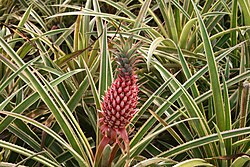
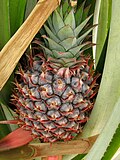
The pineapple is a | The pineapple is a herbaceous [[perennial]], which grows to {{convert|1 to 1.5|m|ft|abbr=on|frac=2}} tall on average, although sometimes it can be taller. The plant has a short, stocky stem with tough, waxy leaves. When creating its fruit, it usually produces up to 200 flowers, although some large-fruited [[cultivar]]s can exceed this. Once it flowers, the individual fruits of the flowers join together to create a [[multiple fruit]]. After the first fruit is produced, side shoots (called 'suckers' by commercial growers) are produced in the leaf axils of the main stem. These suckers may be removed for propagation, or left to produce additional fruits on the original plant.<ref name=ncsu/> Commercially, suckers that appear around the base are cultivated. It has 30 or more narrow, fleshy, trough-shaped leaves that are {{convert|30 to 100|cm|ft|frac=2|abbr=on}} long, surrounding a thick [[plant stem|stem]]; the leaves have sharp spines along the margins. In the first year of growth, the axis lengthens and thickens, bearing numerous leaves in close spirals. After 12 to 20 months, the stem grows into a spike-like [[inflorescence]] up to {{convert|15|cm|0|abbr=on}} long with over 100 spirally arranged, trimerous flowers, each subtended by a bract. | ||
In the wild, pineapples are pollinated primarily by [[hummingbird]]s.<ref name="Morton 1987" /><ref>{{cite journal |last1=Stahl |first1=JM |last2=Nepi |first2=M |last3=Galetto |first3=L |last4=Guimarães |first4=E |last5=Machado |first5=SR |year=2012 |title=Functional aspects of floral nectar secretion of Ananas ananassoides, an ornithophilous bromeliad from the Brazilian savanna |journal=Annals of Botany |volume=109 |issue=7 |pages=1243–1252 |doi=10.1093/aob/mcs053 |pmc=3359915 |pmid=22455992}}</ref> Certain wild pineapples are [[forage]]d and pollinated at night by [[bat]]s.<ref>{{Cite book |title=Bats in the Anthropocene: Conservation of Bats in a Changing World |vauthors=Aziz SA, Olival KJ, Bumrungsri S, Richards GC, Racey PA |date=2016 |publisher=Springer |isbn=9783319252209 |veditors=Voigt C, Kingston T |pages=377–426 |chapter=The Conflict Between Pteropodid Bats and Fruit Growers: Species, Legislation and Mitigation |doi=10.1007/978-3-319-25220-9_13 |s2cid=111056244 }}</ref> Under cultivation, because seed development diminishes fruit quality, pollination is performed by hand, and seeds are retained only for [[plant breeding|breeding]].<ref name="Morton 1987" /> In [[Hawaii]], where pineapples were cultivated and [[cannery|canned]] industrially throughout the 20th century,<ref name=" | In the wild, pineapples are pollinated primarily by [[hummingbird]]s.<ref name="Morton 1987" /><ref>{{cite journal |last1=Stahl |first1=JM |last2=Nepi |first2=M |last3=Galetto |first3=L |last4=Guimarães |first4=E |last5=Machado |first5=SR |year=2012 |title=Functional aspects of floral nectar secretion of Ananas ananassoides, an ornithophilous bromeliad from the Brazilian savanna |journal=Annals of Botany |volume=109 |issue=7 |pages=1243–1252 |doi=10.1093/aob/mcs053 |pmc=3359915 |pmid=22455992}}</ref> Certain wild pineapples are [[forage]]d and pollinated at night by [[bat]]s.<ref>{{Cite book |title=Bats in the Anthropocene: Conservation of Bats in a Changing World |vauthors=Aziz SA, Olival KJ, Bumrungsri S, Richards GC, Racey PA |date=2016 |publisher=Springer |isbn=9783319252209 |veditors=Voigt C, Kingston T |pages=377–426 |chapter=The Conflict Between Pteropodid Bats and Fruit Growers: Species, Legislation and Mitigation |doi=10.1007/978-3-319-25220-9_13 |s2cid=111056244 }}</ref> Under cultivation, because seed development diminishes fruit quality, pollination is performed by hand, and seeds are retained only for [[plant breeding|breeding]].<ref name="Morton 1987" /> In [[Hawaii]], where pineapples were cultivated and [[cannery|canned]] industrially throughout the 20th century,<ref name="HortScience" /> importation of hummingbirds was prohibited.<ref>{{cite web |url=http://hdoa.hawaii.gov/wp-content/uploads/2012/12/AR-71P.pdf |title=List of prohibited animals |date=28 November 2006 |publisher=Government of Hawaii, Department of Agriculture |access-date=9 December 2017}}</ref> | ||
The ovaries develop into [[Berry (botany)|berries]], which coalesce into a large, compact, multiple fruit. The fruit of a pineapple is usually arranged in two interlocking [[Helix|helices]], often with 8 in one direction and 13 in the other, each being a [[Fibonacci number#Nature|Fibonacci number]].<ref>{{cite book|title=An Incomplete Education|last1=Jones|first1=J.|last2=Wilson|first2=W|publisher=Ballantine|year=2006|isbn=978-0-7394-7582-9|page=544|chapter=Chapter 11: Science}}</ref> | The ovaries develop into [[Berry (botany)|berries]], which coalesce into a large, compact, multiple fruit. The fruit of a pineapple is usually arranged in two interlocking [[Helix|helices]], often with 8 in one direction and 13 in the other, each being a [[Fibonacci number#Nature|Fibonacci number]].<ref>{{cite book|title=An Incomplete Education|last1=Jones|first1=J.|last2=Wilson|first2=W|publisher=Ballantine|year=2006|isbn=978-0-7394-7582-9|page=544|chapter=Chapter 11: Science}}</ref> | ||
The pineapple carries out [[Crassulacean acid metabolism|CAM photosynthesis]],<ref>{{cite web|url=http://www.botgard.ucla.edu/html/botanytextbooks/economicbotany/Ananas/|title=Pineapple – The Plant That Ate Hawai'i|last=Gibson|first=Arthur C.|website=UCLA|url-status=dead|archive-url=https://web.archive.org/web/20160304012552/http://www.botgard.ucla.edu/html/botanytextbooks/economicbotany/Ananas/|archive-date=4 March 2016}}</ref> fixing carbon dioxide at night and storing it as the acid [[malate]], then releasing it during the day | The pineapple carries out [[Crassulacean acid metabolism|CAM photosynthesis]],<ref>{{cite web|url=http://www.botgard.ucla.edu/html/botanytextbooks/economicbotany/Ananas/|title=Pineapple – The Plant That Ate Hawai'i|last=Gibson|first=Arthur C.|website=UCLA|url-status=dead|archive-url=https://web.archive.org/web/20160304012552/http://www.botgard.ucla.edu/html/botanytextbooks/economicbotany/Ananas/|archive-date=4 March 2016}}</ref> fixing [[carbon dioxide]] at night and storing it as the acid [[malate]], then releasing it during the day in order to reduce [[photorespiration]]. | ||
== Taxonomy == | == Taxonomy == | ||
The pineapple comprises five botanical varieties, formerly regarded as separate species | The pineapple comprises five botanical varieties, formerly regarded as separate species.<ref name="Bartholomew-2002">{{Cite book|title=The Pineapple: Botany, Production, and Uses|last1=Bartholomew|first1=D. P.|last2=Paull|first2=Robert E.|last3=Rohrbach|first3=K. G.|date=2002|publisher=CABI|isbn=9780851999791|pages=23|language=en}}</ref> The genomes of three varieties, including the wild progenitor variety ''bracteatus'', have been sequenced.<ref>{{Cite journal |last1=Ming |first1=Ray |last2=VanBuren |first2=Robert |last3=Wai |first3=Ching Man |last4=Tang |first4=Haibao |last5=Schatz |first5=Michael C. |last6=Bowers |first6=John E. |last7=Lyons |first7=Eric |last8=Wang |first8=Ming-Li |last9=Chen |first9=Jung |last10=Biggers |first10=Eric |last11=Zhang |first11=Jisen |last12=Huang |first12=Lixian |last13=Zhang |first13=Lingmao |last14=Miao |first14=Wenjing |last15=Zhang |first15=Jian |date=2015 |title=The pineapple genome and the evolution of CAM photosynthesis |journal=Nature Genetics |language=en |volume=47 |issue=12 |pages=1435–1442 |doi=10.1038/ng.3435 |issn=1546-1718 |pmc=4867222 |pmid=26523774}}</ref> | ||
{| class="wikitable" | {| class="wikitable" | ||
| Line 105: | Line 126: | ||
== History == | == History == | ||
=== Precolonial cultivation === | === Precolonial cultivation === | ||
The wild plant originates from the [[Paraná River|Paraná]]–[[Paraguay River]] drainages between southern [[Brazil]] and [[Paraguay]].<ref name="Morton 1987" /><ref name=" | The wild plant originates from the [[Paraná River|Paraná]]–[[Paraguay River]] drainages between southern [[Brazil]] and [[Paraguay]].<ref name="Morton 1987" /><ref name="Bertoni-1919">Bertoni, {{lang|fr|italic=no|"Contributions a l'étude botanique des plantes cultivées. Essai d'une monographie du genre Ananas"}}, {{lang|fr|Annales Cient}}. Paraguay (2nd series) 4 (by1919:250–322).</ref><ref>[[Kenneth F. Baker|Baker, K. F.]]; Collins, J. L. (1939). "Notes on the distribution and ecology of Ananas and Pseudananas in South America". ''American Journal of Botany''.</ref><ref>Collins. J. L. (1960). ''The pineapple: botany, utilization, cultivation''. London: Leonard Hill.</ref> Little is known about its domestication, but it spread as a crop throughout South America. Archaeological evidence of use is found as far back as 1200–800 BC (3200–2800 BP) in Peru<ref>Pearsall, Deborah M. (1992). "The Origins of Plant Cultivation in South America". In ''The Origins of Agriculture : An International Perspective''. 173–205. Washington: Smithsonian Institution Press.</ref> and 200 BC – 700 AD (2200–1300 BP) in Mexico,<ref>Callen, Eric O. (1967). "Analysis of the Tehuacan coprolites". ''The prehistory of the Tehuacan Valley'' 1: 261–289.</ref> where it was cultivated by the [[Maya peoples|Maya]]s and the [[Aztecs]].<ref>{{Cite book |title=Evolution of Crop Plants |editor-first=N. W. |editor-last=Simmonds |last=Pickersgill |first=B. |date=1976 |chapter=Pineapple}}</ref> By the late 1400s, cropped pineapple was widely distributed and a [[staple food]] of Native Americans. The first European to encounter the pineapple was [[Christopher Columbus]], in [[Guadeloupe]] on 4 November 1493.<ref name=smithsonian/><ref name="history">{{Cite book|title=Journals and Other Documents of the Life of Christopher Columbus |last=Morrison |first=S. E. |publisher=Heritage Press |year=1963}}</ref><ref name="Rohtbach-2003">{{cite book |last1=Rohtbach |first1=G. K. G.|last2=Leal |first2=F. |editor1-first=D. P. |editor1-last=Bartholomew |editor2-first=R. E. |editor2-last=Paull |editor3-first=K. G. |editor3-last=Rohrbach |title=The Pineapple: Botany, Production, and Uses |chapter=Chapter 1: History, distributions and World Production |year=2003 |publisher=CABI Publishing |location=Wallingford, UK |isbn=978-0-85199-503-8 |page=21 }}</ref> The Portuguese took the fruit from Brazil and introduced it into [[India]] by 1550.<ref>{{cite book |url=https://archive.org/details/curry00lizz |title=Curry: a Tale of Cooks and Conquerors |last1=Collingham |first1=L |date=2007 |publisher=Oxford University Press |isbn=978-0-19-532001-5 |location=Oxford|url-access=registration}}</ref> The '{{Interlanguage link|Red Spanish|es|Piña Española Roja}}' cultivar was also introduced by the Spanish from Latin America to the [[Philippines]], and it was grown to produce ''[[piña]]'' fibers that would then be used to produce textiles from at least the 17th century.<ref name="pfmf"/> | ||
Columbus brought the plant back to Spain and called it | Columbus brought the plant back to Spain and called it {{lang|es|piña de Indes}}, meaning "pine of the Indians". The pineapple was documented in Peter Martyr's ''[[Decades of the New World]]'' (1516) and [[Antonio Pigafetta]]'s {{lang|it|Relazione del primo viaggio intorno al mondo}} (1524–1525), and the first known illustration was in [[Gonzalo Fernández de Oviedo y Valdés|Oviedo's]] {{lang|es|Historia General de Las Indias}} (1535).<ref>{{Cite journal|last=Hayward|first=Wyndham|date=1956|title=The Pineapple meets the Press|url=http://journal.bsi.org/V06/3/|journal=The Bromeliad Society Bulletin|volume=6|access-date=11 December 2019|archive-date=19 March 2022|archive-url=https://web.archive.org/web/20220319082856/http://journal.bsi.org/V06/3/|url-status=dead}}</ref> | ||
=== Old World introduction === | === Old World introduction === | ||
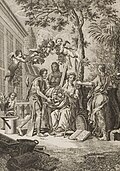
[[File:The gardeners dictionary Wellcome L0049859 frontispiece (cropped).jpg|left|thumb|[[Britannia]] presented with [[ | [[File:The gardeners dictionary Wellcome L0049859 frontispiece (cropped).jpg|left|thumb|[[Britannia]] presented with {{lang|la|[[cornucopia]]e}} including pineapples by allegories of Nature, Industry, and Science, with an [[orangery]] in the background ([[Book frontispiece|frontispiece]] of ''[[The Gardeners Dictionary]]'', 1764)]] | ||
While the pineapple fascinated Europeans as a fruit of colonialism,<ref name="Cumo">Cumo, Christopher (2015). ''Foods that Changed History: How Foods Shaped Civilization from the Ancient World to the Present''. ABC-CLIO. p. 294.</ref> it was not successfully cultivated in Europe until Pieter de la Court (1664–1739) developed [[greenhouse]] horticulture near Leiden.<ref>{{Cite web|work=Oxford Index |title=Pieter de La Court van der Voort |url=http://oxfordindex.oup.com/view/10.1093/oi/authority.20110803095643956 |publisher=Oxford University Press|access-date=15 December 2014 |archive-url=https://web.archive.org/web/20141216121535/http://oxfordindex.oup.com/view/10.1093/oi/authority.20110803095643956 |archive-date=2014-12-16 |url-status=dead}}</ref><ref name="Rohtbach-2003" /> Pineapple plants were distributed from the Netherlands to English gardeners in 1719 and French ones in 1730.<ref name="Rohtbach-2003" /> In England, the first pineapple was grown at [[Dorney Court]], [[Dorney]] in Buckinghamshire, and a huge "pineapple stove" to heat the plants was built at the [[Chelsea Physic Garden]] in 1723.<ref>{{cite book|title=The Pineapple: King of Fruits |last=Beauman|first=F.|date=2005|publisher=Chatto & Windus |isbn=978-0-7011-7699-0|place=London|page=82}}</ref><ref name="Sheller">Sheller, Mimi (2003). ''Consuming the Caribbean: From Arawaks to Zombies''. Routledge. p. 80.</ref> In France, King [[Louis XV]] was presented with a pineapple that had been grown at [[Garden of Versailles|Versailles]] in 1733. In Russia, [[Peter the Great]] imported de la Court's method into [[St. Petersburg]] in the 1720s; in 1730, twenty pineapple saplings were transported from there to a greenhouse at [[Anna of Russia|Empress Anna]]'s new Moscow palace.<ref>{{cite journal |last=Johnson |first=Lisa |date=2019 |title=Pieter De La Court Van Der Voort and Innovations in Pineapple Cultivation in Early Eighteenth-Century Gardens |url=http://www.cascade1987.nl/documenten/De%20la%20Court%20en%20pineapple%20cultivation%20-%20Johnson%202020.pdf |journal=Garden History |publisher=[[The Gardens Trust]] |volume=47 |issue=1 |pages=23–41 |jstor=26756806 |access-date=2025-04-04}}</ref><ref>{{cite web |last=Kuznetsova |first=Svetlana |date=2022-12-10 |script-title=ru:Культура ананасов приняла громадные размеры в Петербурге |trans-title=The Pineapple Cultivation Took Enormous Scale in St. Petersburg |url=https://www.kommersant.ru/doc/5718493 |language=ru |work=[[Kommersant]] |access-date=2023-03-10}} (The article title is a citation from an earlier history work and refers to mid-18th century.)</ref> | |||
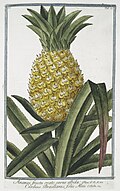
[[File:Ananas fructu ovato, carne albida - Carduus Brasilianus, foliis Aloes. (Pineapple) (NYPL b14444147-1125000).jpg|thumb|right|1772 illustration of an ''Ananas comosus'' pineapple which was given the early scientific name of {{lang|la|Cardus brasilianus folius aloes}} by Banhius in 1623<ref name="Bromeliad Society Chicago">{{Cite news |date=May–June 2012 |title=Bromeliad Society of Greater Chicago |work=The BSGC News |url=http://www.bromeliad.nl/Documenten//Bromeliad%20Society%20of%20Greater%20Chicago/2012/2012-06-June2012.pdf |access-date=2022-11-17}}</ref>]] | |||
Because of the expense of direct import and the enormous cost in equipment and labour required to grow them in a temperate climate, in greenhouses called "pineries", [[Pineapple mania|pineapple became a symbol of wealth]]. They were initially used mainly for display at dinner parties, rather than being eaten, and were used again and again until they began to rot.{{sfnp|Beauman|2005|p=87}} In the second half of the 18th century, the production of the fruit on British estates became the subject of great rivalry between wealthy aristocrats.{{sfnp|Beauman|2005|p=87}} [[John Murray, 4th Earl of Dunmore]], built a hothouse on his estate surmounted by a huge stone [[cupola]] 14 metres tall in the shape of the fruit; it is known as the [[Dunmore Pineapple]].<ref>Stevenson, Jack (1995). ''Exploring Scotland's Heritage: Glasgow, Clydesdale, and Stirling''. Her Majesty's Stationery Office. p. 83.</ref> In architecture, pineapple figures became decorative elements symbolizing hospitality.<ref name="Curl">[[James Stevens Curl|Curl, James Stevens]] (2003). ''Classical Architecture: An Introduction to Its Vocabulary and Essentials, with a Select Glossary of Terms''. W. W. Norton. p. 206.</ref><ref name="Morrison">Hugh Morrison (1952). ''Early American Architecture: From the First Colonial Settlements to the National Period''. Oxford University Press. p. 302.</ref><ref name="Harris">[[Cyril Manton Harris|Harris, Cyril Manton]] (1998). ''American Architecture: An Illustrated Encyclopedia''. W. W. Norton. p. 248.</ref> | |||
=== Since the 19th century: mass commercialization === | |||
Many different varieties, mostly from the Antilles, were tried for European glasshouse cultivation. The most significant cultivar was "Smooth Cayenne", first imported to France in 1820, then subsequently re-exported to the [[United Kingdom]] in 1835, and then from UK, the cultivation spread via [[Hawaii]] to Australia and Africa. The "Smooth Cayenne" cultivar (and sub-selections or clones of the "Smooth Cayenne") make up for the majority of world pineapple production today.<ref name="Rohtbach-2003" /> Jams and sweets based on pineapple were imported to Europe from the West Indies, Brazil, and Mexico from an early date. By the early 19th century, fresh pineapples were transported direct from the West Indies in large enough quantities to reduce European prices.<ref name="Rohtbach-2003" /> Later pineapple production was dominated by the Azores for Europe, and Florida and the Caribbean for North America, because of the short trade routes. | |||
The Spanish had introduced the pineapple into Hawaii in the 18th century<ref name="MatthewsWigsten2010">{{cite book |url=https://books.google.com/books?id=Es3ncCAE1wwC&pg=PA269 |title=Kitchen Pro Series: Guide to Produce Identification, Fabrication and Utilization|first1=Brad |last1=Matthews|first2=Paul |last2=Wigsten|date=9 February 2010|publisher=Cengage Learning|isbn=978-1-4354-0121-1|pages=269}}</ref> where it is known as the {{lang|haw|hala kahiki}} ("foreign [[Pandanus tectorius|hala]]"),<ref>{{Cite magazine|last=Anderson|first=Brittany P.|date=July 2018|title=Hala Kahiki: A Brief History of Pineapple and Pineapple Pavlova Recipe|url=https://keolamagazine.com/food/pineapple-pavlova-recipe/|access-date=2021-07-27|website=Ke Ola Magazine|language=en-US}}</ref><ref>{{Cite book|last=Hitch|first=Thomas Kemper|url=https://books.google.com/books?id=jhWW0SwDyv0C&dq=hala+kahiki+pineapple+pandanus&pg=PA99|title=Islands in Transition: The Past, Present, and Future of Haiwaii's Economy|date=1992|publisher=University of Hawaii Press|isbn=978-0-8248-1498-4|pages=99|language=en}}</ref> but the first commercial plantation was established in 1886. The most famous investor was [[James Dole]], who moved to Hawaii in 1899<ref name="smith">{{cite magazine |title=It's Pineapple Season, But Does Your Fruit Come From Hawaii? |vauthors=Rhodes J |url=https://www.smithsonianmag.com/arts-culture/its-pineapple-season-but-does-your-fruit-come-from-hawaii-5211854/ |magazine=Smithsonian Magazine |date=20 March 2013 |accessdate=2 August 2025}}</ref> and started a {{convert|60|acre|ha|0|adj=on|order=flip}} pineapple plantation in 1900 which grew into the [[Dole plc|Dole Food Company]].<ref name="faculty.ucc.edu">{{cite web|url=http://faculty.ucc.edu/biology-ombrello/pow/pineapple.htm |title=Pineapple|publisher=Faculty.ucc.edu|url-status=dead|archive-url=https://web.archive.org/web/20091221093456/http://faculty.ucc.edu/biology-ombrello/pow/pineapple.htm|archive-date=21 December 2009|access-date=6 December 2009}}</ref> Dole and [[Del Monte Foods|Del Monte]] began growing pineapples on the island of [[Oahu]] in 1901 and 1917, respectively, and the [[Maui Pineapple Company]] began cultivation on [[Maui]] in 1909.<ref>{{Cite journal|year=2000|title=Sunrise, Sunset|journal=Hawaii Business|volume=46|issue=2|page=60}}</ref> James Dole began the commercial processing of pineapple, and Dole employee [[Henry Gabriel Ginaca|Henry Ginaca]] invented an automatic peeling and coring machine in 1911.<ref name="Rohtbach-2003" /> | |||
[[File:James Drummond Dole.jpg|thumb|[[James Dole|James Drummond Dole]] (1877–1958) was the early promoter of the pineapple industry in Hawaii. He founded the company now known as the Dole Food Company.]] | |||
Hawaiian production started to decline from the 1970s because of competition and the shift to refrigerated sea transport. Dole ceased its cannery operations in [[Honolulu]] in 1991,<ref name=smith/> and in 2008, Del Monte terminated its pineapple-growing operations in Hawaii.<ref name=smith/> In 2009, the Maui Pineapple Company reduced its operations to supply pineapples only locally on Maui,<ref>{{cite news |url=http://archives.starbulletin.com/content/20091224_maui_pineapple_harvests_final_crop|title=Maui Pineapple harvests final crop|first=Gary T. |last=Kubota|date=24 December 2009|newspaper=[[Honolulu Star-Bulletin]] |access-date=9 November 2010}}</ref> and by 2013, only the [[Dole Plantation]] on Oahu grew pineapples in a volume of about 0.1 percent of the world's production.<ref name=smith/> Despite this decline, the pineapple is sometimes used as a symbol of Hawaii.<ref name=smith/><ref name="HortScience">{{cite journal |first1=Duane P. |last1=Bartholomew |first2=Richard A. |last2=Hawkins |first3=Johnny A. |last3=Lopez |url=http://hortsci.ashspublications.org/content/47/10/1390.full |title=Hawaii Pineapple: The Rise and Fall of an Industry |archive-url=https://web.archive.org/web/20171130201335/http://hortsci.ashspublications.org/content/47/10/1390.full|archive-date=30 November 2017 |journal=HortScience |volume=47 |issue=10 |pages=1390–1398 |date=October 2012|doi=10.21273/HORTSCI.47.10.1390 |doi-access=free }}</ref> Further, foods with pineapple in them are sometimes known as "Hawaiian" for this reason alone.<ref name=smith/> | |||
Hawaiian production started to decline from the 1970s because of competition and the shift to refrigerated sea transport. Dole ceased its cannery operations in [[Honolulu]] in 1991, and in 2008, Del Monte terminated its pineapple-growing operations in Hawaii.<ref name= | |||
In the Philippines, "Smooth Cayenne" was introduced in the early 1900s by the [[United States Department of Agriculture|US Bureau of Agriculture]] during the [[History of the Philippines (1898–1946)|American colonial period]]. Dole and Del Monte established plantations in the island of [[Mindanao]] in the 1920s; in the provinces of [[Cotabato]] and [[Bukidnon]], respectively.<ref name="pfmf">{{cite web |url=https://philippinefolklifemuseum.org/portfolio-items/history-and-origin-of-pina/|title=History & Origin of Piña|website=Philippine Folklife Museum Foundation|access-date=13 December 2018}}</ref><ref name="go">{{cite web|url=https://www.atlasobscura.com/articles/cloth-made-from-pineapples|title=This Prized Filipino Fabric Is Made From Pineapple Leaves|last1=Ewbank|first1=Anne|date=6 September 2018|website=Gastro Obscura|access-date=13 December 2018}}</ref> Large scale canning had started in Southeast Asia, including in the Philippines, from 1920. This trade was severely damaged by [[World War II]], and Hawaii dominated the international trade until the 1960s. | In the Philippines, "Smooth Cayenne" was introduced in the early 1900s by the [[United States Department of Agriculture|US Bureau of Agriculture]] during the [[History of the Philippines (1898–1946)|American colonial period]]. Dole and Del Monte established plantations in the island of [[Mindanao]] in the 1920s; in the provinces of [[Cotabato]] and [[Bukidnon]], respectively.<ref name="pfmf">{{cite web |url=https://philippinefolklifemuseum.org/portfolio-items/history-and-origin-of-pina/|title=History & Origin of Piña|website=Philippine Folklife Museum Foundation|access-date=13 December 2018}}</ref><ref name="go">{{cite web|url=https://www.atlasobscura.com/articles/cloth-made-from-pineapples|title=This Prized Filipino Fabric Is Made From Pineapple Leaves|last1=Ewbank|first1=Anne|date=6 September 2018|website=Gastro Obscura|access-date=13 December 2018}}</ref> Large scale canning had started in Southeast Asia, including in the Philippines, from 1920. This trade was severely damaged by [[World War II]], and Hawaii dominated the international trade until the 1960s. | ||
The Philippines remain one of the top exporters of pineapples in the world. The Del Monte plantations are now locally managed, after Del Monte Pacific Ltd., a Filipino company, completed the purchase of Del Monte Foods in 2014.<ref>{{cite report |url=http://edge.pse.com.ph/downloadFile.do?file_id=161797 |title=SEC Form 17-A|last=Sison | The Philippines remain one of the top exporters of pineapples in the world. The Del Monte plantations are now locally managed, after Del Monte Pacific Ltd., a Filipino company, completed the purchase of Del Monte Foods in 2014.<ref>{{cite report |url=http://edge.pse.com.ph/downloadFile.do?file_id=161797 |title=SEC Form 17-A |last=Sison |first=Ignacio C. O. |date=13 August 2015 |publisher=[[Philippine Stock Exchange]] |access-date=18 January 2019 |archive-url=https://web.archive.org/web/20170109083536/http://edge.pse.com.ph/downloadFile.do?file_id=161797 |archive-date=9 January 2017 |url-status=dead}}</ref> | ||
== Composition == | == Composition == | ||
| Line 138: | Line 156: | ||
{{nutritional value | {{nutritional value | ||
| name=Pineapple, raw | | name=Pineapple, raw | ||
| water=86 | | water=86 g | ||
| kJ=209 | | kJ=209 | ||
| protein=0.54 g | | protein=0.54 g | ||
| Line 161: | Line 179: | ||
| folate_ug=18 | | folate_ug=18 | ||
| choline_mg=5.5 | | choline_mg=5.5 | ||
| note=[https://fdc.nal.usda.gov | | note=[https://fdc.nal.usda.gov/food-details/2346398/nutrients Link to USDA Database entry] | ||
}} | }} | ||
Raw pineapple pulp is 86% water, 13% [[carbohydrate]]s, 0.5% [[protein]], and contains negligible [[fat]] (table). In a | Raw pineapple pulp is 86% water, 13% [[carbohydrate]]s, 0.5% [[protein (nutrient)|protein]], and contains negligible [[fat]] (table). In a reference amount of {{cvt|100|g}}, raw pineapple supplies {{convert|209|kJ|kcal|abbr=off}} of [[food energy]], and is a rich source of [[manganese in biology|manganese]] (40% of the [[Daily Value]], DV) and [[vitamin C]] (53% DV), but otherwise contains no [[micronutrient]]s in significant amounts (table). | ||
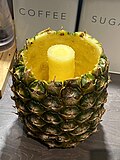
[[File:Hollowed Pineapple Core Removed.jpg|thumb|A hollowed-out pineapple with its core left intact, ready for filling, ''e.g.'', with other fruits.]] | |||
=== Phytochemistry === | === Phytochemistry === | ||
Pineapple fruits and peels contain diverse [[phytochemical]]s, among which are [[polyphenol]]s, including [[gallic acid]], [[syringic acid]], [[vanillin]], [[ferulic acid]], [[sinapic acid]], [[coumaric acid]], [[chlorogenic acid]], [[epicatechin]], and [[arbutin]].<ref>{{cite journal|doi=10.1080/10942912.2012.732168|title=Major Polyphenolics in Pineapple Peels and their Antioxidant Interactions|journal=International Journal of Food Properties|volume=17|issue=8|pages=1805|year=2014|last1=Li|first1=Ti|last2=Shen|first2=Peiyi|last3=Liu|first3=Wei|last4=Liu|first4=Chengmei|last5=Liang|first5=Ruihong|last6=Yan|first6=Na|last7=Chen|first7=Jun|doi-access=}}</ref><ref>{{cite journal|pmid=28722812|year=2018|last1=Ogawa|first1= | Pineapple fruits and peels contain diverse [[phytochemical]]s, among which are [[polyphenol]]s, including [[gallic acid]], [[syringic acid]], [[vanillin]], [[ferulic acid]], [[sinapic acid]], [[coumaric acid]], [[chlorogenic acid]], [[epicatechin]], and [[arbutin]].<ref>{{cite journal|doi=10.1080/10942912.2012.732168|title=Major Polyphenolics in Pineapple Peels and their Antioxidant Interactions|journal=International Journal of Food Properties|volume=17|issue=8|pages=1805|year=2014|last1=Li|first1=Ti|last2=Shen|first2=Peiyi|last3=Liu|first3=Wei|last4=Liu|first4=Chengmei|last5=Liang|first5=Ruihong|last6=Yan|first6=Na|last7=Chen|first7=Jun|s2cid=84410846 |doi-access=}}</ref><ref>{{cite journal|pmid=28722812|year=2018|last1=Ogawa|first1=EM|title=Chemical profile of pineapple cv. Vitória in different maturation stages using electrospray ionization mass spectrometry|journal=Journal of the Science of Food and Agriculture|volume=98|issue=3|pages=1105–1116|last2=Costa|first2=H. B|last3=Ventura|first3=J. A|last4=Caetano|first4=L. C|last5=Pinto|first5=F. E|last6=Oliveira|first6=B. G|last7=Barroso|first7=M. E. S|last8=Scherer|first8=R|last9=Endringer|first9=D. C|last10=Romão|first10=W|doi=10.1002/jsfa.8561|bibcode=2018JSFA...98.1105O }}</ref> | ||
Present in all parts of the pineapple plant,<ref>{{cite journal|journal=Appl Microbiol Biotechnol|year=2014|volume=98|issue=17|pages=7283–97|doi=10.1007/s00253-014-5889-y|title= Bromelain: an overview of industrial application and purification strategies |vauthors=Arshad ZI, Amid A, Yusof F, Jaswir I, Ahmad K, Loke SP|pmid=24965557|s2cid=824024|url=http://irep.iium.edu.my/37128/4/37128.pdf}}</ref> [[bromelain]] is a mixture of [[proteolytic]] [[enzyme]]s. It is present in stem, fruit, crown, core, leaves of pineapple itself.<ref>{{Cite web|last1=Mohan|first1=Resmi|last2=Sivakumar|first2=Venkatasubramanian|date=March 2016|title=Optimisation of Bromelain Enzyme Extraction from Pineapple (Ananas comosus) and Application in Process Industry|url=https://www.researchgate.net/publication/311092218}}</ref> Bromelain is under preliminary research for treatment of a variety of clinical disorders, but has not been adequately defined for its effects in the human body.<ref name="mlp">{{cite web|url=https://www.nccih.nih.gov/health/bromelain|title=Bromelain|publisher=US National Institutes of Health|date=May 2020|access-date=September 15, 2020}}</ref> Bromelain may be unsafe for some users, such as in [[pregnancy]], [[allergies]], or [[anticoagulation]] therapy.<ref name=mlp /> | Present in all parts of the pineapple plant,<ref>{{cite journal|journal=Appl Microbiol Biotechnol|year=2014|volume=98|issue=17|pages=7283–97|doi=10.1007/s00253-014-5889-y|title= Bromelain: an overview of industrial application and purification strategies |vauthors=Arshad ZI, Amid A, Yusof F, Jaswir I, Ahmad K, Loke SP|pmid=24965557|s2cid=824024|url=http://irep.iium.edu.my/37128/4/37128.pdf}}</ref> [[bromelain]] is a mixture of [[proteolytic]] [[enzyme]]s. It is present in stem, fruit, crown, core, leaves of pineapple itself.<ref>{{Cite web|last1=Mohan|first1=Resmi|last2=Sivakumar|first2=Venkatasubramanian|date=March 2016|title=Optimisation of Bromelain Enzyme Extraction from Pineapple (Ananas comosus) and Application in Process Industry|url=https://www.researchgate.net/publication/311092218}}</ref> Bromelain is under preliminary research for treatment of a variety of clinical disorders, but has not been adequately defined for its effects in the human body, although studies have shown anti-inflammatory effects." Add new citations to this new phrase.<ref name="mlp">{{cite web|url=https://www.nccih.nih.gov/health/bromelain|title=Bromelain|publisher=US National Institutes of Health|date=May 2020|access-date=September 15, 2020}}</ref><ref>{{Cite web |title=The Power of Pineapple: 8 Reasons to Eat It |url=https://www.everydayhealth.com/diet-nutrition/8-reasons-eat-pineapple/ |access-date=2026-02-03 |website=EverydayHealth.com |language=en}}</ref> Bromelain may be unsafe for some users, such as in [[pregnancy]], [[allergies]], or [[anticoagulation]] therapy.<ref name=mlp /> | ||
Having sufficient bromelain content, raw pineapple juice may be useful as a meat [[marinade]] and [[tenderizer]].<ref name="jfst">{{cite journal|journal=J Food Sci Technol|year=2015|volume=52|issue=6|pages=3870–80|doi=10.1007/s13197-014-1454-z|title=Efficacy of reverse micellar extracted fruit bromelain in meat tenderization |vauthors=Chaurasiya RS, Sakhare PZ, Bhaskar N, Hebbar HU|pmid=26028772|pmc=4444899}}</ref> Although pineapple enzymes can interfere with the preparation of some foods or manufactured products, such as [[gelatin]]-based desserts or [[gel]] [[capsule (pharmacy)|capsules]],<ref>{{cite journal|journal=AAPS PharmSciTech|year=2014|volume=15|issue=6|pages=1410–6|doi=10.1208/s12249-014-0162-3|title=Enzymes in the dissolution testing of gelatin capsules|author=Marques MR|pmid=24942315|pmc=4245433}}</ref> their proteolytic activity responsible for such properties may be degraded during cooking and [[canning]]. The quantity of bromelain in a typical serving of pineapple fruit is probably not significant, but specific [[extraction (chemistry)|extraction]] can yield sufficient quantities for [[home|domestic]] and industrial processing.<ref name="jfst" /><ref>{{cite journal|journal=Appl Microbiol Biotechnol|year=2014|volume=98|issue=17|pages=7283–97|doi=10.1007/s00253-014-5889-y|title=Bromelain: an overview of industrial application and purification strategies |vauthors=Arshad ZI, Amid A, Yusof F, Jaswir I, Ahmad K, Loke SP|pmid=24965557|s2cid=824024|url=http://irep.iium.edu.my/37128/4/37128.pdf}}</ref> | Having sufficient bromelain content, raw pineapple juice may be useful as a meat [[marinade]] and [[tenderizer]].<ref name="jfst">{{cite journal|journal=J Food Sci Technol|year=2015|volume=52|issue=6|pages=3870–80|doi=10.1007/s13197-014-1454-z|title=Efficacy of reverse micellar extracted fruit bromelain in meat tenderization |vauthors=Chaurasiya RS, Sakhare PZ, Bhaskar N, Hebbar HU|pmid=26028772|pmc=4444899}}</ref> Although pineapple enzymes can interfere with the preparation of some foods or manufactured products, such as [[gelatin]]-based desserts or [[gel]] [[capsule (pharmacy)|capsules]],<ref>{{cite journal|journal=AAPS PharmSciTech|year=2014|volume=15|issue=6|pages=1410–6|doi=10.1208/s12249-014-0162-3|title=Enzymes in the dissolution testing of gelatin capsules|author=Marques MR|pmid=24942315|pmc=4245433}}</ref> their proteolytic activity responsible for such properties may be degraded during cooking and [[canning]]. The quantity of bromelain in a typical serving of pineapple fruit is probably not significant, but specific [[extraction (chemistry)|extraction]] can yield sufficient quantities for [[home|domestic]] and industrial processing.<ref name="jfst" /><ref>{{cite journal|journal=Appl Microbiol Biotechnol|year=2014|volume=98|issue=17|pages=7283–97|doi=10.1007/s00253-014-5889-y|title=Bromelain: an overview of industrial application and purification strategies |vauthors=Arshad ZI, Amid A, Yusof F, Jaswir I, Ahmad K, Loke SP|pmid=24965557|s2cid=824024|url=http://irep.iium.edu.my/37128/4/37128.pdf}}</ref> | ||
| Line 174: | Line 194: | ||
== Varieties == | == Varieties == | ||
=== Cultivars === | === Cultivars === | ||
Many [[cultivar]]s are known.<ref name="Morton 1987" /> The leaves of the commonly grown " | Many [[cultivar]]s are known.<ref name="Morton 1987" /> The leaves of the commonly grown "Smooth Cayenne" cultivar and its various clones are smooth,<ref>{{Cite journal |first=SL |last=Kochhar |title=Economic Botany in the Tropics |journal=Nature |volume=144 |issue=3647 |year=2006 |isbn=978-0-333-93118-9 |page=203 |bibcode=1939Natur.144..563. |doi=10.1038/144563a0 |s2cid=4134696|doi-access=free }}</ref> and it is the most commonly grown worldwide. Many cultivars have become distributed from its origins in [[Paraguay]] and the southern part of [[Brazil]], and later improved stocks were introduced into the Americas, the Azores, Africa, India, Malaysia and Australia.<ref name="Morton 1987" /> Varieties include:<ref>{{Cite web |title=Pineapple varieties |url=https://www.growables.org/information/TropicalFruit/pineaplevarieties.htm |access-date=2026-02-16 |website=www.growables.org}}</ref> | ||
* "Hilo" is a compact, 1.0- to 1.5-kg (2– to 3-lb) Hawaiian variant of smooth cayenne; the fruit is more cylindrical and produces many suckers, but no slips. | * "Hilo" is a compact, 1.0- to 1.5-kg (2– to 3-lb) Hawaiian variant of smooth cayenne; the fruit is more cylindrical and produces many suckers, but no slips.<ref>{{Cite web |title=Pineapple – California Rare Fruit Growers, Inc. |url=https://crfg.org/homepage/library/fruitfacts/pineapple/ |access-date=2026-02-03 |language=en-US}}</ref><ref>{{Cite journal |date=2016-09-01 |title=Potential role of bromelain in clinical and therapeutic applications |url=https://pmc.ncbi.nlm.nih.gov/articles/PMC4998156/ |journal=Biomedical Reports |volume=5 |issue=3 |pages=283–288 |doi=10.3892/br.2016.720 |issn=2049-9434 |pmc=4998156 |pmid=27602208}}</ref> | ||
* "Kona sugarloaf", at 2.5 to 3.0 kg (5–6 lb), has white flesh with no woodiness in the center, is cylindrical in shape, and has a high sugar content but no acid; it has an unusually sweet fruit. | * "Kona sugarloaf", at 2.5 to 3.0 kg (5–6 lb), has white flesh with no woodiness in the center, is cylindrical in shape, and has a high sugar content but no acid; it has an unusually sweet fruit. | ||
* "Natal queen", at 1.0 to 1.5 kg (2 to 3 lb), has golden yellow flesh, crisp texture, and delicate mild flavor; well-adapted to fresh consumption, it keeps well after ripening. It has spiny leaves | * "Natal queen", at 1.0 to 1.5 kg (2 to 3 lb), has golden yellow flesh, crisp texture, and delicate mild flavor; well-adapted to fresh consumption, it keeps well after ripening. It has spiny leaves and is grown in Australia, Malaysia, and South Africa. | ||
* "Pernambuco" ("eleuthera") weighs 1–2 kg (2–4 lb), and has pale yellow to white flesh. It is sweet, melting in texture, and excellent for eating fresh; it is poorly adapted for shipping, has spiny leaves, and is grown in Latin America. | * "Pernambuco" ("eleuthera") weighs 1–2 kg (2–4 lb), and has pale yellow to white flesh. It is sweet, melting in texture, and excellent for eating fresh; it is poorly adapted for shipping, has spiny leaves, and is grown in Latin America. | ||
* "Red Spanish", at 1–2 kg (2–4 lb), has pale yellow flesh with a pleasant aroma, is squarish in shape, and well-adapted for shipping as fresh fruit to distant markets; it has spiny leaves and is grown in Latin America and the Philippines. It was the original pineapple cultivar in the Philippines grown for their leaf fibers (''[[piña]]'') in the traditional Philippine textile industry.<ref name="pfmf" /><ref name="go" /> | * "Red Spanish", at 1–2 kg (2–4 lb), has pale yellow flesh with a pleasant aroma, is squarish in shape, and well-adapted for shipping as fresh fruit to distant markets; it has spiny leaves and is grown in Latin America and the Philippines. It was the original pineapple cultivar in the Philippines grown for their leaf fibers (''[[piña]]'') in the traditional Philippine textile industry.<ref name="pfmf" /><ref name="go" /> | ||
* "Smooth cayenne", a 2.5- to 3.0-kg (5- to 6-lb), pale yellow– to yellow-fleshed, cylindrical fruit with high sugar and acid content, is well-adapted to canning and processing; its leaves are without spines. It is an ancient cultivar developed by [[Amerind peoples]].<ref name= Bartholomew /> In some parts of Asia, this cultivar is known as [[Sarawak]], after an area of Malaysia in which it is grown.<ref>{{cite web |url=http://www.itfnet.org/v1/2016/05/pineapple-common-varieties/ |title=Pineapple – Common Varieties | * "Smooth cayenne", a 2.5- to 3.0-kg (5- to 6-lb), pale yellow– to yellow-fleshed, cylindrical fruit with high sugar and acid content, is well-adapted to canning and processing; its leaves are without spines. It is an ancient cultivar developed by [[Amerind peoples]].<ref name= Bartholomew /> In some parts of Asia, this cultivar is known as [[Sarawak]], after an area of Malaysia in which it is grown.<ref>{{cite web |url=http://www.itfnet.org/v1/2016/05/pineapple-common-varieties/ |title=Pineapple – Common Varieties |work=[[International Tropical Fruits Network]] |date=10 May 2016 |access-date=4 April 2025}}</ref> It is one of the ancestors of cultivars "73-50" (also called "MD-1" and "CO-2") and "73–114" (also called "MD-2").<ref name= Bartholomew>{{cite journal |url=http://www.ishs-horticulture.org/workinggroups/pineapple/PineNews16.pdf |title='MD-2' Pineapple Transforms the World's Pineapple Fresh Fruit Export Industry |author=Duane P. Bartholomew |volume=16 |pages=2–5 |access-date=3 September 2014 |year=2009 |journal=Pineapple News}}</ref> Smooth cayenne was previously the variety produced in Hawaii, and the most easily obtainable in U.S. grocery stores, but was replaced over the course of the mid-1990s and 2000s by MD-2.<ref name= Bartholomew /> The success of Del Monte's MD-2 caused Dole to [[Industrial espionage|obtain & grow]] its own MD-2 pineapples, leading to [[Del Monte Fresh Produce Co. v. Dole Food Co.]] | ||
* Some ''Ananas'' species are grown as [[ornamental plant|ornamentals]] for color, novel fruit size, and other [[aesthetic]] qualities. | * Some ''Ananas'' species are grown as [[ornamental plant|ornamentals]] for color, novel fruit size, and other [[aesthetic]] qualities. | ||
In the US, in 1986, the Pineapple Research Institute was dissolved and its assets divided between Del Monte and [[Maui Land and Pineapple]]. Del Monte took cultivar '73–114', dubbed 'MD-2', to its plantations in Costa Rica, found it to be well-suited to growing there, and launched it publicly in 1996 as 'Gold Extra Sweet', while Del Monte also began marketing '73–50', dubbed 'CO-2', as 'Del Monte Gold'.<ref name="Bartholomew" /> The Maui Pineapple Company began growing variety 73-50 in 1988 and named it Maui Gold.<ref>{{Cite web |title=Why does Maui | In the US, in 1986, the Pineapple Research Institute was dissolved and its assets divided between Del Monte and [[Maui Land and Pineapple]]. Del Monte took cultivar '73–114', dubbed 'MD-2', to its plantations in Costa Rica, found it to be well-suited to growing there, and launched it publicly in 1996 as 'Gold Extra Sweet', while Del Monte also began marketing '73–50', dubbed 'CO-2', as 'Del Monte Gold'.<ref name="Bartholomew" /> The Maui Pineapple Company began growing variety 73-50 in 1988 and named it Maui Gold.<ref>{{Cite web |title=Why does Maui Gold pineapple taste so good? |url=https://maui.gold/pages/why-does-maui-gold%C2%AE-pineapple-taste-so-good |archive-date=21 May 2022 |archive-url=https://web.archive.org/web/20220521162007/https://maui.gold/pages/why-does-maui-gold%C2%AE-pineapple-taste-so-good |url-status=dead}}</ref> The successor company to MPC, the Hali'imaile Pineapple Company continues to grow Maui Gold on the slopes of [[Haleakalā|Haleakala]]. | ||
<gallery> | <gallery> | ||
File:Azores-Day4-16 (33766683744).jpg| | File:Azores-Day4-16 (33766683744).jpg|Pineapples in a greenhouse | ||
File:Dolejf2103.JPG|Tropical Gold cultivar | |||
File:Dolejf2103.JPG|Tropical Gold | File:Ananas comosus Victoria P1190459.jpg|Victoria cultivar | ||
File:Ananas comosus Victoria P1190459.jpg|Victoria | File:A pineapple seller.jpg|Pineapples in a market, [[Nigeria]] | ||
File:観賞用 ミニパイン (5753976961).jpg|Miniature pineapples in [[Naha]], [[Japan]] | |||
</gallery> | </gallery> | ||
==Cultivation== | |||
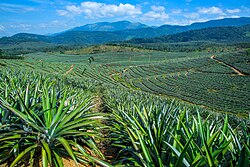
[[File:Pineapple Plantation- Maraca.jpg|thumb|Pineapple plantation, Brazil]] | |||
In commercial farming, flowering can be induced artificially, and the early harvesting of the main fruit can encourage the development of a second crop of smaller fruits. Once removed during cleaning, the top of the pineapple can be planted in soil and a new plant will grow. Slips and suckers are planted commercially.<ref name="Morton 1987" /> | |||
===Storage and transport=== | |||
Some buyers prefer green fruit, others ripened or off-green. A plant growth regulator, [[Ethephon]], is typically sprayed onto the fruit one week before harvest, developing [[Ethylene as a plant hormone#ethylene|ethylene]], which turns the fruit golden yellow. After cleaning and slicing, a pineapple is typically canned in sugar syrup with added preservative.<ref name="Morton 1987" /> A pineapple never becomes any riper than it was when harvested since it is a [[Climacteric (botany)|non-climacteric fruit]].<ref>{{cite news|url=https://www.nytimes.com/1982/04/21/garden/a-guide-to-choosing-a-ripe-pineapple.html | title=A guide to choosing a ripe pineapple |work=The New York Times |date= 21 April 1982|first=Mimi |last=Sheraton}}</ref><ref>{{Cite journal |last1=Kitinoja |first1=Lisa |last2=Barrett |first2=Diane |date=2015-07-15 |title=Extension of Small-Scale Postharvest Horticulture Technologies—A Model Training and Services Center |journal=Agriculture |volume=5 |issue=3 |pages=441–455 |doi=10.3390/agriculture5030441 |doi-access=free |bibcode=2015Agric...5..441K |issn=2077-0472}}</ref> | |||
===Ethical and environmental concerns=== | |||
Like most [[Intensive farming|modern fruit production]], pineapple plantations are highly industrialized operations. In Costa Rica particularly, the pineapple industry uses large amounts of insecticides to protect the crop, which have caused health problems in many workers. These workers often receive little compensation, and are mostly poor migrants, often [[Nicaraguan]]. Workers' wages also decrease every time prices are lowered overseas. In 2016, the government declared that it would be trying to improve the situation, with the help of various other groups.<ref>{{cite news |title=Costa Rica's Pineapple Industry Promises to Become More Responsible |url=https://www.triplepundit.com/story/2016/costa-ricas-pineapple-industry-promises-become-more-responsible/27676 |access-date=29 November 2021 |date=10 March 2016}}</ref> | |||
Historically, tropical fruit agriculture, such as for pineapples, has been concentrated in so-called "[[banana republics]]".<ref>{{cite book |last=Chapman |first=Peter |title=Jungle capitalists : a story of globalisation, greed and revolution |publisher=Canongate |location=Edinburgh New York |year=2009 |page=6 |isbn=978-1847676863 }}</ref><ref>[https://nytimes.com/2008/03/02/books/review/Kurtz-Phelan-t.html Big Fruit] {{Webarchive|url=https://web.archive.org/web/20170313044710/http://www.nytimes.com/2008/03/02/books/review/Kurtz-Phelan-t.html |date=2017-03-13 }}, ''NY Times''</ref> | |||
====Illegal drug trade==== | |||
Export pineapples from Costa Rica to Europe are often used as a cover for [[illegal drug trade|narcotrafficking]], and containers are impounded routinely in both locations.<ref>{{cite news |title=Costa Rica seizes two tons of cocaine hidden with pineapples |url=https://ticotimes.net/2021/02/05/costa-rica-seizes-two-tons-of-cocaine-hidden-with-pineapples |access-date=17 April 2021 |work=Tico Times |agency=AFP |date=5 February 2021}}</ref> | |||
====Expansion into protected areas==== | |||
In Costa Rica, pineapple cultivation has expanded into the [[Maquenque National Wildlife Refuge|Maquenque]], {{lang|es|[[Border Corridor Wildlife Refuge|Corredor Fronterizo]]}}, [[Barra del Colorado Wildlife Refuge|Barra del Colorado]] and [[Caño Negro Wildlife Refuge|Caño Negro]] wildlife refuges, all located in the north of the country. As those are protected areas and not national parks, limited and restricted sustainable activities are allowed, however pineapple plantations are industrial operations and many of these do not have the proper license to operate in the protected areas, or were started before either the designation of the area, recent regulations or the creation of the environmental regulatory agency (Setena) in 1996. The agency has registers for around {{convert|358.5|ha|sqmi|abbr=on}} of pineapple plantations operating within protected areas, but satellite imagery from 2018 reports around {{convert|1659|ha|sqmi|abbr=on}}.<ref>{{cite news |last1=Rodríguez |first1=Sebastián |title=Piñas en la mira: el monocultivo que se coló dentro de las áreas protegidas de Costa Rica |url=https://redprensaverde.org/2021/04/16/pina-en-la-mira-un-monocultivo-que-se-colo-dentro-de-las-areas-protegidas-de-costa-rica/ |access-date=17 April 2021 |work=redprensaverde.org|location=Costa Rica |date=16 April 2021 |language=es}}</ref> | |||
=== Pests and diseases === | |||
{{Main|List of pineapple diseases}} | |||
Pineapples are subject to a variety of diseases, the most serious of which is wilt disease vectored by [[mealybug]]s<ref name="aps">{{cite web |url=http://www.apsnet.org/publications/commonnames/Pages/Pineapple.aspx |title=Diseases of Pineapple (Ananas comosus (L.) Merr.) |publisher=American Phytopathological Society |access-date=28 March 2011 |archive-url=https://web.archive.org/web/20111130100824/http://www.apsnet.org/publications/commonnames/Pages/Pineapple.aspx |archive-date=30 November 2011 |url-status=dead }}</ref> typically found on the surface of pineapples, but possibly in the closed blossom cups.<ref name="Morton 1987" /> Other diseases include citrus [[Phanerochaete salmonicolor|pink disease]], bacterial heart rot, [[anthracnose]],<ref name="aps" /> fungal heart rot, root rot, black rot, butt rot, fruitlet core rot, and yellow spot virus.<ref name="foodmarketexchange1">[http://www.foodmarketexchange.com/datacenter/product/fruit/pineapple/detail/dc_pi_ft_pineapple0802.htm "Pests and Diseases of Pineapple"]. Food Market Exchange. {{Webarchive|url=https://web.archive.org/web/20110725040407/http://www.foodmarketexchange.com/datacenter/product/fruit/pineapple/detail/dc_pi_ft_pineapple0802.htm |date=25 July 2011 }}. Retrieved on 2 October 2011.</ref> Pineapple pink disease (not citrus pink disease) is characterized by the fruit developing a brownish to black discoloration when heated during the canning process. The causal agents of pink disease are the bacteria ''[[Acetobacter aceti]]'', ''Gluconobacter oxydans'', ''[[Pantoea]] citrea''<ref>{{Cite journal|last1=Cha|first1=J.-S.|last2=Pujol|first2=C.|last3=Dususin|first3=A. R.|last4=Macion|first4=E. A.|last5=Hubbard|first5=C. H.|last6=Kado|first6=C. I.|date=1997|title=Studies on ''Pantoea citrea'', the causal agent of pink disease of pineapple|journal=Journal of Phytopathology|volume=145|issue=7|pages=313–319|doi=10.1111/j.1439-0434.1997.tb00407.x|bibcode=1997JPhyt.145..313C }}</ref><ref>{{Cite journal|last1=Pujol|first1=C. J.|last2=Kado|first2=C. I.|date=1999|title=''gdhB'', a gene encoding a second quinoprotein glucose dehydrogenase in ''Pantoea citrea'', is required for pink disease of pineapple|journal=Microbiology|volume=145|issue=5|pages=1217–1226|doi=10.1099/13500872-145-5-1217|pmid=10376838|doi-access=free}}</ref> and ''Tatumella ptyseos''.<ref>{{Cite journal |last1=Marin-Cevada |first1=V |title=''Tatumella ptyseos'', an unrevealed causative agent of Pink disease in pineapple |journal=Journal of Phytopathology |volume=158 |issue=2 |pages=93–99 |year=2010 |doi=10.1111/j.1439-0434.2009.01575.x |last2=Caballero-Mellado |first2=Jesús |last3=Bustillos-Cristales |first3=R. |last4=Muñoz-Rojas |first4=J. |last5=Mascarúa-Esparza |first5=M. A. |last6=Castañeda-Lucio |first6=M. |last7=López-Reyes |first7=L. |last8=Martínez-Aguilar |first8=L. |last9=Fuentes-Ramírez |first9=L. E. |bibcode=2010JPhyt.158...93M }}</ref><ref>{{Cite journal|last1=Marín-Cevada|first1=V.|last2=Fuentes-Ramírez|first2=L. E.|date=2016|title=Pink disease, a review of an asymptomatic bacterial disease in pineapple|journal=Revista Brasileira de Fruticultura|volume=38|issue=3|pages=e949|doi=10.1590/0100-29452016949|doi-access=free}}</ref> | |||
Some pests that commonly affect pineapple plants are scales, [[thrips]], mites, mealybugs, ants, and [[symphylid]]s.<ref name="foodmarketexchange1" /> | |||
Heart-rot is the most serious disease affecting pineapple plants. The disease is caused by ''[[Phytophthora cinnamomi]]'' and ''[[Phytophthora parasitica|P. parasitica]]'', fungi that often affect pineapples grown in wet conditions. Since it is difficult to treat, it is advisable to guard against infection by planting resistant cultivars where these are available; all [[Suckers (botany)|suckers]] that are required for propagation should be dipped in a fungicide, since the fungus enters through the wounds.<ref>{{Cite book|title=Encyclopedia of Gardening|last=Brickell|first=Christopher|publisher=Dorling Kindersley |year=1996|isbn=978-1-85833-579-7|location=London |pages=419}}</ref> | |||
== Production == | == Production == | ||
{{ | {{See also|List of countries by pineapple production}} | ||
{| class="wikitable" style=" | {| class="wikitable floatright" style="width:12em; text-align:center;" | ||
|+ Pineapple production | |+ Pineapple production <br>{{small|2024, millions of tonnes}}<br/> | ||
|- | |- | ||
| {{CRI}} || 3.1 | |||
|- | |- | ||
| {{PHI}} || 2.9 | | {{PHI}} || 2.9 | ||
|- | |- | ||
| {{ | | {{IDN}} || 2.7 | ||
|- | |- | ||
| {{ | | {{BRA}} || 2.2 | ||
|- | |- | ||
| {{ | | {{CHN}} || 2.1 | ||
|- | |- | ||
| {{ | | {{THA}} || 1.1 | ||
|- | |- | ||
| | | '''World''' || '''29.4''' | ||
|- | |- | ||
| | |colspan=2|{{small|Source: [[FAOSTAT]]<br> of the [[United Nations]]}}<ref name="faostat">{{cite web|url=https://www.fao.org/faostat/en/#data/QCL|title=Pineapple production in 2024, Crops/Regions/World list/Production Quantity/Year (pick lists)|date=2026|publisher=UN Food and Agriculture Organization, Corporate Statistical Database (FAOSTAT)|access-date=12 January 2026}}</ref> | ||
|} | |} | ||
In 2024, world production of pineapples was 29 million [[tonne]]s, led by [[Costa Rica]], the [[Philippines]], and [[Indonesia]], each producing about 3 million tonnes.<ref name=faostat/> | |||
== Uses == | == Uses == | ||
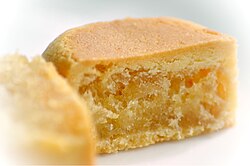
[[File:Pineapple Pastry.JPG|thumb|''[[Fenglisu]]'', a pineapple pastry from [[Taiwan]]]] | |||
=== Culinary === | === Culinary === | ||
The flesh and juice of the pineapple are used in cuisines around the world. In many tropical countries, pineapple is prepared and sold on roadsides as a snack. It is sold whole or in halves with a stick inserted. Whole, cored slices with a [[cherry]] in the middle are a common garnish on hams in the West. Chunks of pineapple are used in desserts such as fruit salad, as well as in some savory dishes, including | The flesh and juice of the pineapple are used in cuisines around the world. In many tropical countries, pineapple is prepared and sold on roadsides as a snack. It is sold whole or in halves with a stick inserted. Whole, cored slices with a [[cherry]] in the middle are a common garnish on hams in the West. Chunks of pineapple are used in desserts such as fruit salad, as well as in some savory dishes, including [[Hawaiian pizza]], or as a grilled ring on a [[hamburger]]. Traditional dishes that use pineapple include {{lang|tl|[[hamonado]]}}, {{lang|tl<!--educated guess-->|[[afritada]]}}, {{lang|th|[[kaeng som|kaeng som pla]]}}, and [[Hawaiian haystack]]. Crushed pineapple is used in yogurt, jam, sweets, and ice cream. The juice of the pineapple is served as a beverage, and it is also the main ingredient in [[cocktail]]s such as {{lang|es|[[piña colada]]}} and in the drink {{lang|es<!--Derived from Nahuatl but doesn't seem to be a Nahuatl word itself-->|[[tepache]]}}. | ||
In the [[Philippines]], a traditional jelly-like dessert called | In the [[Philippines]], a traditional jelly-like dessert called {{lang|es|[[nata de piña]]}} has also been produced since the 18th century. It is made by fermenting pineapple juice with the bacteria ''[[Komagataeibacter xylinus]]''.<ref name="Vergara">{{cite book |last1=Vergara |first1=Benito S. |last2=Idowu |first2=Panna Melizah H. |last3=Sumangil |first3=Julia H. |title=Nata de Coco: A Filipino Delicacy |date=1999 |publisher=National Academy of Sciences and Technology, Philippines |isbn=9718538615 |url=http://scinet.dost.gov.ph/union/Downloads/nast_Vergara%20BS%20Nata%20De%20Coco_422.pdf |access-date=28 October 2019 |archive-date=28 June 2021 |archive-url=https://web.archive.org/web/20210628000120/http://scinet.dost.gov.ph/union/Downloads/nast_Vergara%20BS%20Nata%20De%20Coco_422.pdf |url-status=dead }}</ref> | ||
Pineapple vinegar is an ingredient found in both [[Cuisine of Honduras|Honduran]] and [[Filipino cuisine]], where it is produced locally.<ref>{{cite book |last1=Clutton |first1=Angela |title=The Vinegar Cupboard: Recipes and history of an everyday ingredient |date=7 March 2019 |publisher=Bloomsbury |page=57 |isbn=9781472958105 |url=https://books.google.com/books?id=-h-FDwAAQBAJ&pg=PA57 |access-date=3 February 2020}}</ref> In [[Mexican cuisine|Mexico]], it is usually made with peels from the whole fruit, rather than the juice; however, in [[Taiwanese cuisine]], it is often produced by blending pineapple juice with grain vinegar.<ref>{{cite book |last1=Chang |first1=R.C. |title=Vinegars of the World |date=29 August 2009 |page=228 |publisher=Springer |isbn=9788847008663 |url=https://books.google.com/books?id=XuPWgEMx_eIC&pg=PA228 |access-date=3 February 2020}}</ref><ref>{{cite book |last1=Kennedy |first1=Diana |title=The Essential Cuisines of Mexico: A Cookbook |page=496}}</ref> | Pineapple vinegar is an ingredient found in both [[Cuisine of Honduras|Honduran]] and [[Filipino cuisine]], where it is produced locally.<ref>{{cite book |last1=Clutton |first1=Angela |title=The Vinegar Cupboard: Recipes and history of an everyday ingredient |date=7 March 2019 |publisher=Bloomsbury |page=57 |isbn=9781472958105 |url=https://books.google.com/books?id=-h-FDwAAQBAJ&pg=PA57 |access-date=3 February 2020}}</ref> In [[Mexican cuisine|Mexico]], it is usually made with peels from the whole fruit, rather than the juice; however, in [[Taiwanese cuisine]], it is often produced by blending pineapple juice with grain vinegar.<ref>{{cite book |last1=Chang |first1=R. C. |title=Vinegars of the World |date=29 August 2009 |page=228 |publisher=Springer |isbn=9788847008663 |url=https://books.google.com/books?id=XuPWgEMx_eIC&pg=PA228 |access-date=3 February 2020}}</ref><ref>{{cite book |last1=Kennedy |first1=Diana |title=The Essential Cuisines of Mexico: A Cookbook |page=496}}</ref> | ||
The [[European Union]] consumed 50% of the global total for pineapple juice in 2012–2016. The [[Netherlands]] was the largest importer of pineapple juice in [[Europe]]. [[Thailand]], [[Costa Rica]] and the [[Netherlands]] are the major suppliers to the European Union market in 2012–2016.<ref>[https://www.cbi.eu/market-information/processed-fruit-vegetables/pineapple-juice Exporting pineapple juice to Europe] CBI Ministry of Foreign Affairs Retrieved 22 May 2019</ref> Countries consuming the most pineapple juice in 2017 were [[Thailand]], [[Indonesia]] and the [[Philippines]], having combined consumption of 47% of the world total. The consumption of pineapple juice in [[China]] and [[India]] is low compared to their populations.<ref>[https://www.agriorbit.com/population-growth-drives-gradual-expansion-of-pineapple-juice-market/ Population growth drives gradual expansion of pineapple juice market] {{Webarchive|url=https://web.archive.org/web/20200527075558/https://www.agriorbit.com/population-growth-drives-gradual-expansion-of-pineapple-juice-market/ |date=27 May 2020 }} AgriOrbit Retrieved 22 May 2019</ref> | The [[European Union]] consumed 50% of the global total for pineapple juice in 2012–2016. The [[Netherlands]] was the largest importer of pineapple juice in [[Europe]]. [[Thailand]], [[Costa Rica]] and the [[Netherlands]] are the major suppliers to the European Union market in 2012–2016.<ref>[https://www.cbi.eu/market-information/processed-fruit-vegetables/pineapple-juice "Exporting pineapple juice to Europe"]. CBI Ministry of Foreign Affairs. Retrieved 22 May 2019.</ref> Countries consuming the most pineapple juice in 2017 were [[Thailand]], [[Indonesia]] and the [[Philippines]], having a combined consumption of 47% of the world total. The consumption of pineapple juice in [[China]] and [[India]] is low compared to their populations.<ref>[https://www.agriorbit.com/population-growth-drives-gradual-expansion-of-pineapple-juice-market/ "Population growth drives gradual expansion of pineapple juice market"]. {{Webarchive|url=https://web.archive.org/web/20200527075558/https://www.agriorbit.com/population-growth-drives-gradual-expansion-of-pineapple-juice-market/ |date=27 May 2020 }} AgriOrbit. Retrieved 22 May 2019.</ref> | ||
=== Textiles === | === Textiles === | ||
{{Main|Piña}} | {{Main|Piña}} | ||
<gallery mode= | The 'Red Spanish' cultivar of pineapples were once extensively cultivated in the [[Philippines]]. The long leaves of the cultivar were the source of traditional {{lang|es|[[piña]]}} fibers, an adaptation of the native weaving traditions with fibers extracted from {{lang|es|[[abacá]]}}. These were woven into lustrous lace-like {{lang|tl|[[nipis]]}} fabrics usually decorated with intricate floral embroidery known as {{lang|es|calado}} and {{lang|es|sombrado}}. The fabric was a luxury export from the Philippines during the Spanish colonial period and gained favor among European aristocracy in the 18th and 19th centuries. Domestically, they were used to make the traditional {{lang|tl|[[barong tagalog]]}}, {{lang|tl|[[baro't saya]]}}, and {{lang|es|[[traje de mestiza]]}} clothing of the Filipino upper class, as well as women's [[kerchief]]s ({{lang|es|pañuelo}}). They were favored for their light and breezy quality, which was ideal in the hot tropical climate of the islands. The industry was destroyed in the [[Second World War]] and is only starting to be revived.<ref name="pfmf" /><ref name="go" /><ref>{{cite web|title=Piña cloth|publisher=Free Online Dictionary|date=2023|accessdate= 6 November 2014|url= http://www.thefreedictionary.com/pi%C3%B1a+cloth}}</ref> | ||
{{gallery|mode=packed | |||
|Tampuhan by Juan Luna.jpg|1895 painting of a Filipina in traditional {{lang|es|[[traje de mestiza]]}} dress | |||
|Barong Up Close.jpg|{{lang|es|Calado}} embroidery on a {{lang|tl|[[barong tagalog]]}} | |||
|Handkerchief (Philippines), 19th century (CH 18386747).jpg|19th-century [[handkerchief]] | |||
|Frock coat MET 63.25 front CP4.jpg|Frock coat, 1840–1849, Philippines | |||
}} | |||
=== Houseplant === | === Houseplant === | ||
The variety ''A. comosus'' 'Variegatus' is occasionally grown as a houseplant. It needs direct sunlight | The variety ''A. comosus'' 'Variegatus' is occasionally grown as a houseplant. It needs direct sunlight and thrives at temperatures of {{convert|18 to 24|C||sp=us}}, with a minimum winter temperature of {{convert|16|C||sp=us}}. It should be kept humid, but the soil should be allowed to dry out between waterings. It has almost no resting period but should be repotted each spring until the container reaches {{convert|20|cm|sigfig=1|abbr=on}}.<ref>{{cite book |last1=Chiusoli |first1=Alessandro |last2=Boriani |first2=Luisa Maria |title=Simon & Schuster's guide to houseplants |date=1986 |publisher=Simon and Schuster |location=New York |isbn=0671631314 |chapter=Ananas comosus 'Variegatus'}}</ref> | ||
== See also == | == See also == | ||
{{Portal|Food}} | {{Portal|Food}} | ||
{{ | {{Div col|colwidth=30em}} | ||
* [[Big Pineapple]] | * [[Big Pineapple]] | ||
* [[Pineapple cake]] | |||
* [[Pineapple cutter]] | * [[Pineapple cutter]] | ||
* [[Pineapple tart]] | * [[Pineapple tart]] | ||
* [[Vazhakulam pineapple]] | * [[Vazhakulam pineapple]] | ||
{{ | {{Div col end}} | ||
== References == | == References == | ||
| Line 284: | Line 308: | ||
* Menzel, Christopher. "Tropical and Subtropical Fruit". ''Encyclopedia of Agricultural Science Volume 4''. {{ISBN|0122266706}}. Charles J Arntzen. New York: Elsevier Science Publishing Co. Inc., Academic Press, 2012. 380–382. | * Menzel, Christopher. "Tropical and Subtropical Fruit". ''Encyclopedia of Agricultural Science Volume 4''. {{ISBN|0122266706}}. Charles J Arntzen. New York: Elsevier Science Publishing Co. Inc., Academic Press, 2012. 380–382. | ||
{{refend}} | {{refend}} | ||
{{Pineapples}} | {{Pineapples}} | ||
{{Tripura}} | {{Tripura}} | ||
{{Taxonbar|from=Q1493}} | {{Taxonbar|from=Q1493}} | ||
| Line 302: | Line 320: | ||
[[Category:Fruits originating in South America]] | [[Category:Fruits originating in South America]] | ||
[[Category:Edible fruits]] | [[Category:Edible fruits]] | ||
[[Category: | [[Category:Cuisine of Hawaii]] | ||
[[Category:Medicinal plants]] | [[Category:Medicinal plants]] | ||
[[Category:Symbols of Tripura]] | |||
[[Category:Tropical agriculture]] | [[Category:Tropical agriculture]] | ||
[[Category:Tropical fruit]] | [[Category:Tropical fruit]] | ||
Latest revision as of 08:07, 21 March 2026
| Pineapple | |
|---|---|

| |
| A pineapple on its parent plant | |
Scientific classification 
| |
| : | [[Template:Taxonomy/Ananas]] |
| Species: | Template:Taxonomy/AnanasA. comosus
|
| Binomial name | |
| Template:Taxonomy/AnanasAnanas comosus | |
| Synonyms[1] | |
|
List
| |
The pineapple[2] (Ananas comosus) is a tropical plant with an edible fruit; it is the most economically significant plant in the family Bromeliaceae.[3]
The pineapple is indigenous to South America, where it has been cultivated for many centuries.[4] The introduction of the pineapple plant to Europe in the 17th century made it a significant cultural icon of luxury.[5] Since the 1820s, pineapple has been commercially grown in greenhouses and many tropical plantations. The fruit, particularly its juice, has diverse uses in cuisines and desserts.
Pineapples grow as a small shrub; the individual flowers of the unpollinated plant fuse to form a multiple fruit. The plant normally propagates from the offset produced at the top of the fruit[2] or from a side shoot, and typically matures within a year.[6]
Etymology[edit | edit source]


The words, pine apple, first referred to the cone (fruit) of the pine tree in the 14th century.[7] This name convention occurred because medieval botanists called any unfamiliar tree fruit an apple if it had a firm, round shape.[7]
The generic name, pineapple, derived from a language of the indigenous people of Brazil, and by Gonzalo Hernandez Oviedo who described the piñas or pomme de pin (apple of pine) in Hispaniola around 1540.[4] The first reference in English to the pineapple fruit was the 1568 translation from the French of André Thevet's The New Found World, or Antarctike where he refers to a Hoyriri, a fruit cultivated and eaten by the Tupinambá people, living near modern Rio de Janeiro, and now believed to be a pineapple.[4] Later in the same English translation, Thavet described the fruit as a "Nana made in the manner of a Pine apple", where he used another Tupi word nanas.[8] When it was first discovered by explorers, the Tupi-Guarani and Carib people used it as a staple food with the name, nanas.[5] This usage was adopted in many European languages and led to the plant's scientific binomial Ananas comosus, where comosus ('tufted') refers to the stem of the plant.[4]
In 1624, English explorer John Smith was one of the first to use the name "pineapple" referring to the tropical fruit, possibly because the naming practice for any newly-encountered, roundish fruit at that time was to call it an apple.[7]
Description[edit | edit source]


The pineapple is a herbaceous perennial, which grows to 1 to 1.5 m (3+1⁄2 to 5 ft) tall on average, although sometimes it can be taller. The plant has a short, stocky stem with tough, waxy leaves. When creating its fruit, it usually produces up to 200 flowers, although some large-fruited cultivars can exceed this. Once it flowers, the individual fruits of the flowers join together to create a multiple fruit. After the first fruit is produced, side shoots (called 'suckers' by commercial growers) are produced in the leaf axils of the main stem. These suckers may be removed for propagation, or left to produce additional fruits on the original plant.[6] Commercially, suckers that appear around the base are cultivated. It has 30 or more narrow, fleshy, trough-shaped leaves that are 30 to 100 cm (1 to 3+1⁄2 ft) long, surrounding a thick stem; the leaves have sharp spines along the margins. In the first year of growth, the axis lengthens and thickens, bearing numerous leaves in close spirals. After 12 to 20 months, the stem grows into a spike-like inflorescence up to 15 cm (6 in) long with over 100 spirally arranged, trimerous flowers, each subtended by a bract.
In the wild, pineapples are pollinated primarily by hummingbirds.[2][9] Certain wild pineapples are foraged and pollinated at night by bats.[10] Under cultivation, because seed development diminishes fruit quality, pollination is performed by hand, and seeds are retained only for breeding.[2] In Hawaii, where pineapples were cultivated and canned industrially throughout the 20th century,[11] importation of hummingbirds was prohibited.[12]
The ovaries develop into berries, which coalesce into a large, compact, multiple fruit. The fruit of a pineapple is usually arranged in two interlocking helices, often with 8 in one direction and 13 in the other, each being a Fibonacci number.[13]
The pineapple carries out CAM photosynthesis,[14] fixing carbon dioxide at night and storing it as the acid malate, then releasing it during the day in order to reduce photorespiration.
Taxonomy[edit | edit source]
The pineapple comprises five botanical varieties, formerly regarded as separate species.[15] The genomes of three varieties, including the wild progenitor variety bracteatus, have been sequenced.[16]
| Image | Varieties | Distribution |
|---|---|---|
 |
Ananas comosus var. bracteatus (L.B.Sm.) Coppens & F.Leal | Brazil, Bolivia, Argentina, Paraguay, Ecuador |
 |
Ananas comosus var. comosus (Linnaeus) Merrill | Brazil and Paraguay; naturalized in parts of Asia, Africa, Australia, Mexico, Central America, the West Indies, northern South America, and various islands in the Pacific |
.JPG) |
Ananas comosus var. erectifolius (L.B.Sm.) Coppens & F.Leal | Peru, Ecuador, Colombia, Venezuela, northern Brazil, French Guiana |
 |
Ananas comosus var. microstachys (Mez) L.B.Sm. | from Costa Rica to Paraguay |
| Ananas comosus var. parguazensis (Camargo & L.B.Sm.) Coppens & F.Leal | Colombia, Venezuela, northern Brazil, Guyana, French Guiana |
History[edit | edit source]
Precolonial cultivation[edit | edit source]
The wild plant originates from the Paraná–Paraguay River drainages between southern Brazil and Paraguay.[2][17][18][19] Little is known about its domestication, but it spread as a crop throughout South America. Archaeological evidence of use is found as far back as 1200–800 BC (3200–2800 BP) in Peru[20] and 200 BC – 700 AD (2200–1300 BP) in Mexico,[21] where it was cultivated by the Mayas and the Aztecs.[22] By the late 1400s, cropped pineapple was widely distributed and a staple food of Native Americans. The first European to encounter the pineapple was Christopher Columbus, in Guadeloupe on 4 November 1493.[5][23][24] The Portuguese took the fruit from Brazil and introduced it into India by 1550.[25] The 'Red Spanish' cultivar was also introduced by the Spanish from Latin America to the Philippines, and it was grown to produce piña fibers that would then be used to produce textiles from at least the 17th century.[26]
Columbus brought the plant back to Spain and called it piña de Indes, meaning "pine of the Indians". The pineapple was documented in Peter Martyr's Decades of the New World (1516) and Antonio Pigafetta's Relazione del primo viaggio intorno al mondo (1524–1525), and the first known illustration was in Oviedo's Historia General de Las Indias (1535).[27]
Old World introduction[edit | edit source]
.jpg)
While the pineapple fascinated Europeans as a fruit of colonialism,[28] it was not successfully cultivated in Europe until Pieter de la Court (1664–1739) developed greenhouse horticulture near Leiden.[29][24] Pineapple plants were distributed from the Netherlands to English gardeners in 1719 and French ones in 1730.[24] In England, the first pineapple was grown at Dorney Court, Dorney in Buckinghamshire, and a huge "pineapple stove" to heat the plants was built at the Chelsea Physic Garden in 1723.[30][31] In France, King Louis XV was presented with a pineapple that had been grown at Versailles in 1733. In Russia, Peter the Great imported de la Court's method into St. Petersburg in the 1720s; in 1730, twenty pineapple saplings were transported from there to a greenhouse at Empress Anna's new Moscow palace.[32][33]
_(NYPL_b14444147-1125000).jpg)
Because of the expense of direct import and the enormous cost in equipment and labour required to grow them in a temperate climate, in greenhouses called "pineries", pineapple became a symbol of wealth. They were initially used mainly for display at dinner parties, rather than being eaten, and were used again and again until they began to rot.[35] In the second half of the 18th century, the production of the fruit on British estates became the subject of great rivalry between wealthy aristocrats.[35] John Murray, 4th Earl of Dunmore, built a hothouse on his estate surmounted by a huge stone cupola 14 metres tall in the shape of the fruit; it is known as the Dunmore Pineapple.[36] In architecture, pineapple figures became decorative elements symbolizing hospitality.[37][38][39]
Since the 19th century: mass commercialization[edit | edit source]
Many different varieties, mostly from the Antilles, were tried for European glasshouse cultivation. The most significant cultivar was "Smooth Cayenne", first imported to France in 1820, then subsequently re-exported to the United Kingdom in 1835, and then from UK, the cultivation spread via Hawaii to Australia and Africa. The "Smooth Cayenne" cultivar (and sub-selections or clones of the "Smooth Cayenne") make up for the majority of world pineapple production today.[24] Jams and sweets based on pineapple were imported to Europe from the West Indies, Brazil, and Mexico from an early date. By the early 19th century, fresh pineapples were transported direct from the West Indies in large enough quantities to reduce European prices.[24] Later pineapple production was dominated by the Azores for Europe, and Florida and the Caribbean for North America, because of the short trade routes.
The Spanish had introduced the pineapple into Hawaii in the 18th century[40] where it is known as the hala kahiki ("foreign hala"),[41][42] but the first commercial plantation was established in 1886. The most famous investor was James Dole, who moved to Hawaii in 1899[43] and started a 24-hectare (60-acre) pineapple plantation in 1900 which grew into the Dole Food Company.[44] Dole and Del Monte began growing pineapples on the island of Oahu in 1901 and 1917, respectively, and the Maui Pineapple Company began cultivation on Maui in 1909.[45] James Dole began the commercial processing of pineapple, and Dole employee Henry Ginaca invented an automatic peeling and coring machine in 1911.[24]

Hawaiian production started to decline from the 1970s because of competition and the shift to refrigerated sea transport. Dole ceased its cannery operations in Honolulu in 1991,[43] and in 2008, Del Monte terminated its pineapple-growing operations in Hawaii.[43] In 2009, the Maui Pineapple Company reduced its operations to supply pineapples only locally on Maui,[46] and by 2013, only the Dole Plantation on Oahu grew pineapples in a volume of about 0.1 percent of the world's production.[43] Despite this decline, the pineapple is sometimes used as a symbol of Hawaii.[43][11] Further, foods with pineapple in them are sometimes known as "Hawaiian" for this reason alone.[43]
In the Philippines, "Smooth Cayenne" was introduced in the early 1900s by the US Bureau of Agriculture during the American colonial period. Dole and Del Monte established plantations in the island of Mindanao in the 1920s; in the provinces of Cotabato and Bukidnon, respectively.[26][47] Large scale canning had started in Southeast Asia, including in the Philippines, from 1920. This trade was severely damaged by World War II, and Hawaii dominated the international trade until the 1960s.
The Philippines remain one of the top exporters of pineapples in the world. The Del Monte plantations are now locally managed, after Del Monte Pacific Ltd., a Filipino company, completed the purchase of Del Monte Foods in 2014.[48]
Composition[edit | edit source]
Nutrition[edit | edit source]
Template:Nutritional value Raw pineapple pulp is 86% water, 13% carbohydrates, 0.5% protein, and contains negligible fat (table). In a reference amount of 100 g (3.5 oz), raw pineapple supplies 209 kilojoules (50 kilocalories) of food energy, and is a rich source of manganese (40% of the Daily Value, DV) and vitamin C (53% DV), but otherwise contains no micronutrients in significant amounts (table).

Phytochemistry[edit | edit source]
Pineapple fruits and peels contain diverse phytochemicals, among which are polyphenols, including gallic acid, syringic acid, vanillin, ferulic acid, sinapic acid, coumaric acid, chlorogenic acid, epicatechin, and arbutin.[49][50]
Present in all parts of the pineapple plant,[51] bromelain is a mixture of proteolytic enzymes. It is present in stem, fruit, crown, core, leaves of pineapple itself.[52] Bromelain is under preliminary research for treatment of a variety of clinical disorders, but has not been adequately defined for its effects in the human body, although studies have shown anti-inflammatory effects." Add new citations to this new phrase.[53][54] Bromelain may be unsafe for some users, such as in pregnancy, allergies, or anticoagulation therapy.[53]
Having sufficient bromelain content, raw pineapple juice may be useful as a meat marinade and tenderizer.[55] Although pineapple enzymes can interfere with the preparation of some foods or manufactured products, such as gelatin-based desserts or gel capsules,[56] their proteolytic activity responsible for such properties may be degraded during cooking and canning. The quantity of bromelain in a typical serving of pineapple fruit is probably not significant, but specific extraction can yield sufficient quantities for domestic and industrial processing.[55][57]
Varieties[edit | edit source]
Cultivars[edit | edit source]
Many cultivars are known.[2] The leaves of the commonly grown "Smooth Cayenne" cultivar and its various clones are smooth,[58] and it is the most commonly grown worldwide. Many cultivars have become distributed from its origins in Paraguay and the southern part of Brazil, and later improved stocks were introduced into the Americas, the Azores, Africa, India, Malaysia and Australia.[2] Varieties include:[59]
- "Hilo" is a compact, 1.0- to 1.5-kg (2– to 3-lb) Hawaiian variant of smooth cayenne; the fruit is more cylindrical and produces many suckers, but no slips.[60][61]
- "Kona sugarloaf", at 2.5 to 3.0 kg (5–6 lb), has white flesh with no woodiness in the center, is cylindrical in shape, and has a high sugar content but no acid; it has an unusually sweet fruit.
- "Natal queen", at 1.0 to 1.5 kg (2 to 3 lb), has golden yellow flesh, crisp texture, and delicate mild flavor; well-adapted to fresh consumption, it keeps well after ripening. It has spiny leaves and is grown in Australia, Malaysia, and South Africa.
- "Pernambuco" ("eleuthera") weighs 1–2 kg (2–4 lb), and has pale yellow to white flesh. It is sweet, melting in texture, and excellent for eating fresh; it is poorly adapted for shipping, has spiny leaves, and is grown in Latin America.
- "Red Spanish", at 1–2 kg (2–4 lb), has pale yellow flesh with a pleasant aroma, is squarish in shape, and well-adapted for shipping as fresh fruit to distant markets; it has spiny leaves and is grown in Latin America and the Philippines. It was the original pineapple cultivar in the Philippines grown for their leaf fibers (piña) in the traditional Philippine textile industry.[26][47]
- "Smooth cayenne", a 2.5- to 3.0-kg (5- to 6-lb), pale yellow– to yellow-fleshed, cylindrical fruit with high sugar and acid content, is well-adapted to canning and processing; its leaves are without spines. It is an ancient cultivar developed by Amerind peoples.[62] In some parts of Asia, this cultivar is known as Sarawak, after an area of Malaysia in which it is grown.[63] It is one of the ancestors of cultivars "73-50" (also called "MD-1" and "CO-2") and "73–114" (also called "MD-2").[62] Smooth cayenne was previously the variety produced in Hawaii, and the most easily obtainable in U.S. grocery stores, but was replaced over the course of the mid-1990s and 2000s by MD-2.[62] The success of Del Monte's MD-2 caused Dole to obtain & grow its own MD-2 pineapples, leading to Del Monte Fresh Produce Co. v. Dole Food Co.
- Some Ananas species are grown as ornamentals for color, novel fruit size, and other aesthetic qualities.
In the US, in 1986, the Pineapple Research Institute was dissolved and its assets divided between Del Monte and Maui Land and Pineapple. Del Monte took cultivar '73–114', dubbed 'MD-2', to its plantations in Costa Rica, found it to be well-suited to growing there, and launched it publicly in 1996 as 'Gold Extra Sweet', while Del Monte also began marketing '73–50', dubbed 'CO-2', as 'Del Monte Gold'.[62] The Maui Pineapple Company began growing variety 73-50 in 1988 and named it Maui Gold.[64] The successor company to MPC, the Hali'imaile Pineapple Company continues to grow Maui Gold on the slopes of Haleakala.
-
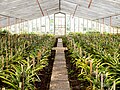 Pineapples in a greenhouse
 -
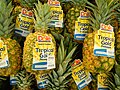 Tropical Gold cultivar
 -
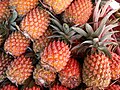 Victoria cultivar
 -
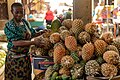 Pineapples in a market, Nigeria
 -
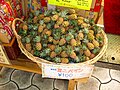
.jpg)


.jpg)
Cultivation[edit | edit source]

In commercial farming, flowering can be induced artificially, and the early harvesting of the main fruit can encourage the development of a second crop of smaller fruits. Once removed during cleaning, the top of the pineapple can be planted in soil and a new plant will grow. Slips and suckers are planted commercially.[2]
Storage and transport[edit | edit source]
Some buyers prefer green fruit, others ripened or off-green. A plant growth regulator, Ethephon, is typically sprayed onto the fruit one week before harvest, developing ethylene, which turns the fruit golden yellow. After cleaning and slicing, a pineapple is typically canned in sugar syrup with added preservative.[2] A pineapple never becomes any riper than it was when harvested since it is a non-climacteric fruit.[65][66]
Ethical and environmental concerns[edit | edit source]
Like most modern fruit production, pineapple plantations are highly industrialized operations. In Costa Rica particularly, the pineapple industry uses large amounts of insecticides to protect the crop, which have caused health problems in many workers. These workers often receive little compensation, and are mostly poor migrants, often Nicaraguan. Workers' wages also decrease every time prices are lowered overseas. In 2016, the government declared that it would be trying to improve the situation, with the help of various other groups.[67]
Historically, tropical fruit agriculture, such as for pineapples, has been concentrated in so-called "banana republics".[68][69]
Illegal drug trade[edit | edit source]
Export pineapples from Costa Rica to Europe are often used as a cover for narcotrafficking, and containers are impounded routinely in both locations.[70]
Expansion into protected areas[edit | edit source]
In Costa Rica, pineapple cultivation has expanded into the Maquenque, Corredor Fronterizo, Barra del Colorado and Caño Negro wildlife refuges, all located in the north of the country. As those are protected areas and not national parks, limited and restricted sustainable activities are allowed, however pineapple plantations are industrial operations and many of these do not have the proper license to operate in the protected areas, or were started before either the designation of the area, recent regulations or the creation of the environmental regulatory agency (Setena) in 1996. The agency has registers for around 358.5 ha (1.384 sq mi) of pineapple plantations operating within protected areas, but satellite imagery from 2018 reports around 1,659 ha (6.41 sq mi).[71]
Pests and diseases[edit | edit source]
Pineapples are subject to a variety of diseases, the most serious of which is wilt disease vectored by mealybugs[72] typically found on the surface of pineapples, but possibly in the closed blossom cups.[2] Other diseases include citrus pink disease, bacterial heart rot, anthracnose,[72] fungal heart rot, root rot, black rot, butt rot, fruitlet core rot, and yellow spot virus.[73] Pineapple pink disease (not citrus pink disease) is characterized by the fruit developing a brownish to black discoloration when heated during the canning process. The causal agents of pink disease are the bacteria Acetobacter aceti, Gluconobacter oxydans, Pantoea citrea[74][75] and Tatumella ptyseos.[76][77]
Some pests that commonly affect pineapple plants are scales, thrips, mites, mealybugs, ants, and symphylids.[73]
Heart-rot is the most serious disease affecting pineapple plants. The disease is caused by Phytophthora cinnamomi and P. parasitica, fungi that often affect pineapples grown in wet conditions. Since it is difficult to treat, it is advisable to guard against infection by planting resistant cultivars where these are available; all suckers that are required for propagation should be dipped in a fungicide, since the fungus enters through the wounds.[78]
Production[edit | edit source]
 Costa Rica Costa Rica |
3.1 |
 Philippines Philippines |
2.9 |
 Indonesia Indonesia |
2.7 |
 Brazil Brazil |
2.2 |
 China China |
2.1 |
 Thailand Thailand |
1.1 |
| World | 29.4 |
|
Source: FAOSTAT | |
In 2024, world production of pineapples was 29 million tonnes, led by Costa Rica, the Philippines, and Indonesia, each producing about 3 million tonnes.[79]
Uses[edit | edit source]

Culinary[edit | edit source]
The flesh and juice of the pineapple are used in cuisines around the world. In many tropical countries, pineapple is prepared and sold on roadsides as a snack. It is sold whole or in halves with a stick inserted. Whole, cored slices with a cherry in the middle are a common garnish on hams in the West. Chunks of pineapple are used in desserts such as fruit salad, as well as in some savory dishes, including Hawaiian pizza, or as a grilled ring on a hamburger. Traditional dishes that use pineapple include hamonado, afritada, kaeng som pla, and Hawaiian haystack. Crushed pineapple is used in yogurt, jam, sweets, and ice cream. The juice of the pineapple is served as a beverage, and it is also the main ingredient in cocktails such as piña colada and in the drink tepache.
In the Philippines, a traditional jelly-like dessert called nata de piña has also been produced since the 18th century. It is made by fermenting pineapple juice with the bacteria Komagataeibacter xylinus.[80]
Pineapple vinegar is an ingredient found in both Honduran and Filipino cuisine, where it is produced locally.[81] In Mexico, it is usually made with peels from the whole fruit, rather than the juice; however, in Taiwanese cuisine, it is often produced by blending pineapple juice with grain vinegar.[82][83]
The European Union consumed 50% of the global total for pineapple juice in 2012–2016. The Netherlands was the largest importer of pineapple juice in Europe. Thailand, Costa Rica and the Netherlands are the major suppliers to the European Union market in 2012–2016.[84] Countries consuming the most pineapple juice in 2017 were Thailand, Indonesia and the Philippines, having a combined consumption of 47% of the world total. The consumption of pineapple juice in China and India is low compared to their populations.[85]
Textiles[edit | edit source]
The 'Red Spanish' cultivar of pineapples were once extensively cultivated in the Philippines. The long leaves of the cultivar were the source of traditional piña fibers, an adaptation of the native weaving traditions with fibers extracted from abacá. These were woven into lustrous lace-like nipis fabrics usually decorated with intricate floral embroidery known as calado and sombrado. The fabric was a luxury export from the Philippines during the Spanish colonial period and gained favor among European aristocracy in the 18th and 19th centuries. Domestically, they were used to make the traditional barong tagalog, baro't saya, and traje de mestiza clothing of the Filipino upper class, as well as women's kerchiefs (pañuelo). They were favored for their light and breezy quality, which was ideal in the hot tropical climate of the islands. The industry was destroyed in the Second World War and is only starting to be revived.[26][47][86]
-
 1895 painting of a Filipina in traditional traje de mestiza dress
 -
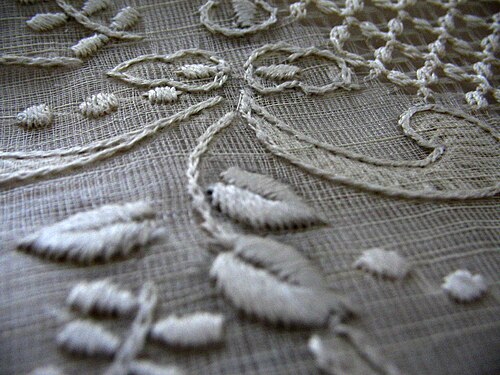 Calado embroidery on a barong tagalog
 -
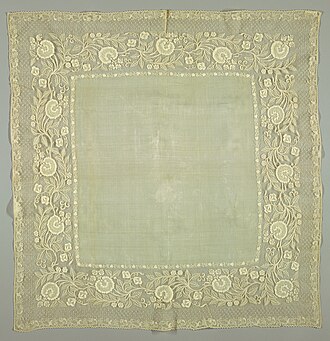 19th-century handkerchief
 -
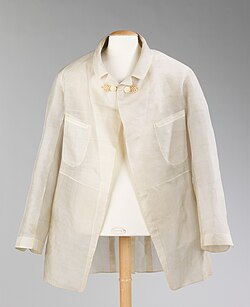 Frock coat, 1840–1849, Philippines


,_19th_century_(CH_18386747).jpg)

Houseplant[edit | edit source]
The variety A. comosus 'Variegatus' is occasionally grown as a houseplant. It needs direct sunlight and thrives at temperatures of 18 to 24 °C (64 to 75 °F), with a minimum winter temperature of 16 °C (61 °F). It should be kept humid, but the soil should be allowed to dry out between waterings. It has almost no resting period but should be repotted each spring until the container reaches 20 cm (8 in).[87]
See also[edit | edit source]
References[edit | edit source]
- ↑ "The Plant List: A Working List of All Plant Species". Archived from the original on 23 July 2021. Retrieved 25 July 2014.
- ↑ 2.00 2.01 2.02 2.03 2.04 2.05 2.06 2.07 2.08 2.09 Morton JF (1987). "Pineapple, Ananas comosus". In: Fruits of Warm Climates, New Crop Resource Online Program, Center for New Crops and Plant Products, Purdue University. pp. 18–28. Retrieved 2 August 2025.
- ↑ Coppens d'Eeckenbrugge G, Leal F (2003). "Chapter 2: Morphology, Anatomy, and Taxonomy". In Bartholomew DP, Paull RE, Rohrbach KG (eds.). The Pineapple: Botany, Production, and Uses. Wallingford, UK: CABI Publishing. p. 21. ISBN 978-0-85199-503-8.
- ↑ 4.0 4.1 4.2 4.3 Grant JR, Zijlstra G (1998). "An Annotated Catalogue of the Generic Names of the Bromeliaceae (see Ananas)". Selbyana. 19 (1): 91–121. ISSN 0361-185X. JSTOR 41759978.
- ↑ 5.0 5.1 5.2 Blakely J (28 January 2021). "The prickly meanings of the pineapple". Smithsonian Library and Archives. Retrieved 2 August 2025.
- ↑ 6.0 6.1 "Ananas comosus, pineapple". North Carolina State University Extension; Plant Toolbox. 2025. Retrieved 2 August 2025.
- ↑ 7.0 7.1 7.2 "A pineapple is an apple (kind of). How did this tropical fruit get tied to the apple?". Word History, Merriam-Webster, Inc. 2025. Retrieved 2 August 2025.
- ↑ Davidson A (2008). The Penguin Companion to Food. New York: Penguin Books. ISBN 978-0142001639. OCLC 50100633.
- ↑ Stahl JM, Nepi M, Galetto L, et al. (2012). "Functional aspects of floral nectar secretion of Ananas ananassoides, an ornithophilous bromeliad from the Brazilian savanna". Annals of Botany. 109 (7): 1243–1252. doi:10.1093/aob/mcs053. PMC 3359915. PMID 22455992.
- ↑ Aziz SA, Olival KJ, Bumrungsri S, et al. (2016). "The Conflict Between Pteropodid Bats and Fruit Growers: Species, Legislation and Mitigation". In Voigt C, Kingston T (eds.). Bats in the Anthropocene: Conservation of Bats in a Changing World. Springer. pp. 377–426. doi:10.1007/978-3-319-25220-9_13. ISBN 9783319252209. S2CID 111056244.
- ↑ 11.0 11.1 Bartholomew DP, Hawkins RA, Lopez JA (October 2012). "Hawaii Pineapple: The Rise and Fall of an Industry". HortScience. 47 (10): 1390–1398. doi:10.21273/HORTSCI.47.10.1390. Archived from the original on 30 November 2017.
- ↑ "List of prohibited animals" (PDF). Government of Hawaii, Department of Agriculture. 28 November 2006. Retrieved 9 December 2017.
- ↑ Jones J, Wilson W (2006). "Chapter 11: Science". An Incomplete Education. Ballantine. p. 544. ISBN 978-0-7394-7582-9.
- ↑ Gibson AC. "Pineapple – The Plant That Ate Hawai'i". UCLA. Archived from the original on 4 March 2016.
- ↑ Bartholomew DP, Paull RE, Rohrbach KG (2002). The Pineapple: Botany, Production, and Uses. CABI. p. 23. ISBN 9780851999791.
- ↑ Ming R, VanBuren R, Wai CM, et al. (2015). "The pineapple genome and the evolution of CAM photosynthesis". Nature Genetics. 47 (12): 1435–1442. doi:10.1038/ng.3435. ISSN 1546-1718. PMC 4867222. PMID 26523774.
- ↑ Bertoni, "Contributions a l'étude botanique des plantes cultivées. Essai d'une monographie du genre Ananas", Annales Cient. Paraguay (2nd series) 4 (by1919:250–322).
- ↑ Baker, K. F.; Collins, J. L. (1939). "Notes on the distribution and ecology of Ananas and Pseudananas in South America". American Journal of Botany.
- ↑ Collins. J. L. (1960). The pineapple: botany, utilization, cultivation. London: Leonard Hill.
- ↑ Pearsall, Deborah M. (1992). "The Origins of Plant Cultivation in South America". In The Origins of Agriculture : An International Perspective. 173–205. Washington: Smithsonian Institution Press.
- ↑ Callen, Eric O. (1967). "Analysis of the Tehuacan coprolites". The prehistory of the Tehuacan Valley 1: 261–289.
- ↑ Pickersgill B (1976). "Pineapple". In Simmonds NW (ed.). Evolution of Crop Plants.
- ↑ Morrison SE (1963). Journals and Other Documents of the Life of Christopher Columbus. Heritage Press.
- ↑ 24.0 24.1 24.2 24.3 24.4 24.5 Rohtbach GK, Leal F (2003). "Chapter 1: History, distributions and World Production". In Bartholomew DP, Paull RE, Rohrbach KG (eds.). The Pineapple: Botany, Production, and Uses. Wallingford, UK: CABI Publishing. p. 21. ISBN 978-0-85199-503-8.
- ↑ Collingham L (2007). Curry: a Tale of Cooks and Conquerors. Oxford: Oxford University Press. ISBN 978-0-19-532001-5.
- ↑ 26.0 26.1 26.2 26.3 "History & Origin of Piña". Philippine Folklife Museum Foundation. Retrieved 13 December 2018.
- ↑ Hayward W (1956). "The Pineapple meets the Press". The Bromeliad Society Bulletin. 6. Archived from the original on 19 March 2022. Retrieved 11 December 2019.
- ↑ Cumo, Christopher (2015). Foods that Changed History: How Foods Shaped Civilization from the Ancient World to the Present. ABC-CLIO. p. 294.
- ↑ "Pieter de La Court van der Voort". Oxford Index. Oxford University Press. Archived from the original on 16 December 2014. Retrieved 15 December 2014.
- ↑ Beauman F (2005). The Pineapple: King of Fruits. London: Chatto & Windus. p. 82. ISBN 978-0-7011-7699-0.
- ↑ Sheller, Mimi (2003). Consuming the Caribbean: From Arawaks to Zombies. Routledge. p. 80.
- ↑ Johnson L (2019). "Pieter De La Court Van Der Voort and Innovations in Pineapple Cultivation in Early Eighteenth-Century Gardens" (PDF). Garden History. 47 (1). The Gardens Trust: 23–41. JSTOR 26756806. Retrieved 4 April 2025.
- ↑ Kuznetsova S (10 December 2022). Культура ананасов приняла громадные размеры в Петербурге [The Pineapple Cultivation Took Enormous Scale in St. Petersburg]. Kommersant (in русский). Retrieved 10 March 2023. (The article title is a citation from an earlier history work and refers to mid-18th century.)
- ↑ "Bromeliad Society of Greater Chicago" (PDF). The BSGC News. May–June 2012. Retrieved 17 November 2022.
- ↑ 35.0 35.1 Beauman (2005), p. 87.
- ↑ Stevenson, Jack (1995). Exploring Scotland's Heritage: Glasgow, Clydesdale, and Stirling. Her Majesty's Stationery Office. p. 83.
- ↑ Curl, James Stevens (2003). Classical Architecture: An Introduction to Its Vocabulary and Essentials, with a Select Glossary of Terms. W. W. Norton. p. 206.
- ↑ Hugh Morrison (1952). Early American Architecture: From the First Colonial Settlements to the National Period. Oxford University Press. p. 302.
- ↑ Harris, Cyril Manton (1998). American Architecture: An Illustrated Encyclopedia. W. W. Norton. p. 248.
- ↑ Matthews B, Wigsten P (9 February 2010). Kitchen Pro Series: Guide to Produce Identification, Fabrication and Utilization. Cengage Learning. p. 269. ISBN 978-1-4354-0121-1.
- ↑ Anderson BP (July 2018). "Hala Kahiki: A Brief History of Pineapple and Pineapple Pavlova Recipe". Ke Ola Magazine. Retrieved 27 July 2021.
- ↑ Hitch TK (1992). Islands in Transition: The Past, Present, and Future of Haiwaii's Economy. University of Hawaii Press. p. 99. ISBN 978-0-8248-1498-4.
- ↑ 43.0 43.1 43.2 43.3 43.4 43.5 Rhodes J (20 March 2013). "It's Pineapple Season, But Does Your Fruit Come From Hawaii?". Smithsonian Magazine. Retrieved 2 August 2025.
- ↑ "Pineapple". Faculty.ucc.edu. Archived from the original on 21 December 2009. Retrieved 6 December 2009.
- ↑ "Sunrise, Sunset". Hawaii Business. 46 (2): 60. 2000.
- ↑ Kubota GT (24 December 2009). "Maui Pineapple harvests final crop". Honolulu Star-Bulletin. Retrieved 9 November 2010.
- ↑ 47.0 47.1 47.2 Ewbank A (6 September 2018). "This Prized Filipino Fabric Is Made From Pineapple Leaves". Gastro Obscura. Retrieved 13 December 2018.
- ↑ Sison IC (13 August 2015). SEC Form 17-A (Report). Philippine Stock Exchange. Archived from the original on 9 January 2017. Retrieved 18 January 2019.
- ↑ Li T, Shen P, Liu W, et al. (2014). "Major Polyphenolics in Pineapple Peels and their Antioxidant Interactions". International Journal of Food Properties. 17 (8): 1805. doi:10.1080/10942912.2012.732168. S2CID 84410846.
- ↑ Ogawa EM, Costa HB, Ventura JA, et al. (2018). "Chemical profile of pineapple cv. Vitória in different maturation stages using electrospray ionization mass spectrometry". Journal of the Science of Food and Agriculture. 98 (3): 1105–1116. Bibcode:2018JSFA...98.1105O. doi:10.1002/jsfa.8561. PMID 28722812.
- ↑ Arshad ZI, Amid A, Yusof F, et al. (2014). "Bromelain: an overview of industrial application and purification strategies" (PDF). Appl Microbiol Biotechnol. 98 (17): 7283–97. doi:10.1007/s00253-014-5889-y. PMID 24965557. S2CID 824024.
- ↑ Mohan R, Sivakumar V (March 2016). "Optimisation of Bromelain Enzyme Extraction from Pineapple (Ananas comosus) and Application in Process Industry".
- ↑ 53.0 53.1 "Bromelain". US National Institutes of Health. May 2020. Retrieved 15 September 2020.
- ↑ "The Power of Pineapple: 8 Reasons to Eat It". EverydayHealth.com. Retrieved 3 February 2026.
- ↑ 55.0 55.1 Chaurasiya RS, Sakhare PZ, Bhaskar N, et al. (2015). "Efficacy of reverse micellar extracted fruit bromelain in meat tenderization". J Food Sci Technol. 52 (6): 3870–80. doi:10.1007/s13197-014-1454-z. PMC 4444899. PMID 26028772.
- ↑ Marques MR (2014). "Enzymes in the dissolution testing of gelatin capsules". AAPS PharmSciTech. 15 (6): 1410–6. doi:10.1208/s12249-014-0162-3. PMC 4245433. PMID 24942315.
- ↑ Arshad ZI, Amid A, Yusof F, et al. (2014). "Bromelain: an overview of industrial application and purification strategies" (PDF). Appl Microbiol Biotechnol. 98 (17): 7283–97. doi:10.1007/s00253-014-5889-y. PMID 24965557. S2CID 824024.
- ↑ Kochhar SL (2006). "Economic Botany in the Tropics". Nature. 144 (3647): 203. Bibcode:1939Natur.144..563.. doi:10.1038/144563a0. ISBN 978-0-333-93118-9. S2CID 4134696.
- ↑ "Pineapple varieties". www.growables.org. Retrieved 16 February 2026.
- ↑ "Pineapple – California Rare Fruit Growers, Inc". Retrieved 3 February 2026.
- ↑ "Potential role of bromelain in clinical and therapeutic applications". Biomedical Reports. 5 (3): 283–288. 1 September 2016. doi:10.3892/br.2016.720. ISSN 2049-9434. PMC 4998156. PMID 27602208.
- ↑ 62.0 62.1 62.2 62.3 Duane P. Bartholomew (2009). "'MD-2' Pineapple Transforms the World's Pineapple Fresh Fruit Export Industry" (PDF). Pineapple News. 16: 2–5. Retrieved 3 September 2014.
- ↑ "Pineapple – Common Varieties". International Tropical Fruits Network. 10 May 2016. Retrieved 4 April 2025.
- ↑ "Why does Maui Gold pineapple taste so good?". Archived from the original on 21 May 2022.
- ↑ Sheraton M (21 April 1982). "A guide to choosing a ripe pineapple". The New York Times.
- ↑ Kitinoja L, Barrett D (15 July 2015). "Extension of Small-Scale Postharvest Horticulture Technologies—A Model Training and Services Center". Agriculture. 5 (3): 441–455. Bibcode:2015Agric...5..441K. doi:10.3390/agriculture5030441. ISSN 2077-0472.
- ↑ "Costa Rica's Pineapple Industry Promises to Become More Responsible". 10 March 2016. Retrieved 29 November 2021.
- ↑ Chapman P (2009). Jungle capitalists : a story of globalisation, greed and revolution. Edinburgh New York: Canongate. p. 6. ISBN 978-1847676863.
- ↑ Big Fruit Archived 2017-03-13 at the Wayback Machine, NY Times
- ↑ "Costa Rica seizes two tons of cocaine hidden with pineapples". Tico Times. AFP. 5 February 2021. Retrieved 17 April 2021.
- ↑ Rodríguez S (16 April 2021). "Piñas en la mira: el monocultivo que se coló dentro de las áreas protegidas de Costa Rica". redprensaverde.org (in español). Costa Rica. Retrieved 17 April 2021.
- ↑ 72.0 72.1 "Diseases of Pineapple (Ananas comosus (L.) Merr.)". American Phytopathological Society. Archived from the original on 30 November 2011. Retrieved 28 March 2011.
- ↑ 73.0 73.1 "Pests and Diseases of Pineapple". Food Market Exchange. Archived 25 July 2011 at the Wayback Machine. Retrieved on 2 October 2011.
- ↑ Cha JS, Pujol C, Dususin AR, et al. (1997). "Studies on Pantoea citrea, the causal agent of pink disease of pineapple". Journal of Phytopathology. 145 (7): 313–319. Bibcode:1997JPhyt.145..313C. doi:10.1111/j.1439-0434.1997.tb00407.x.
- ↑ Pujol CJ, Kado CI (1999). "gdhB, a gene encoding a second quinoprotein glucose dehydrogenase in Pantoea citrea, is required for pink disease of pineapple". Microbiology. 145 (5): 1217–1226. doi:10.1099/13500872-145-5-1217. PMID 10376838.
- ↑ Marin-Cevada V, Caballero-Mellado J, Bustillos-Cristales R, et al. (2010). "Tatumella ptyseos, an unrevealed causative agent of Pink disease in pineapple". Journal of Phytopathology. 158 (2): 93–99. Bibcode:2010JPhyt.158...93M. doi:10.1111/j.1439-0434.2009.01575.x.
- ↑ Marín-Cevada V, Fuentes-Ramírez LE (2016). "Pink disease, a review of an asymptomatic bacterial disease in pineapple". Revista Brasileira de Fruticultura. 38 (3): e949. doi:10.1590/0100-29452016949.
- ↑ Brickell C (1996). Encyclopedia of Gardening. London: Dorling Kindersley. p. 419. ISBN 978-1-85833-579-7.
- ↑ 79.0 79.1 "Pineapple production in 2024, Crops/Regions/World list/Production Quantity/Year (pick lists)". UN Food and Agriculture Organization, Corporate Statistical Database (FAOSTAT). 2026. Retrieved 12 January 2026.
- ↑ Vergara BS, Idowu PM, Sumangil JH (1999). Nata de Coco: A Filipino Delicacy (PDF). National Academy of Sciences and Technology, Philippines. ISBN 9718538615. Archived from the original (PDF) on 28 June 2021. Retrieved 28 October 2019.
- ↑ Clutton A (7 March 2019). The Vinegar Cupboard: Recipes and history of an everyday ingredient. Bloomsbury. p. 57. ISBN 9781472958105. Retrieved 3 February 2020.
- ↑ Chang RC (29 August 2009). Vinegars of the World. Springer. p. 228. ISBN 9788847008663. Retrieved 3 February 2020.
- ↑ Kennedy D. The Essential Cuisines of Mexico: A Cookbook. p. 496.
- ↑ "Exporting pineapple juice to Europe". CBI Ministry of Foreign Affairs. Retrieved 22 May 2019.
- ↑ "Population growth drives gradual expansion of pineapple juice market". Archived 27 May 2020 at the Wayback Machine AgriOrbit. Retrieved 22 May 2019.
- ↑ "Piña cloth". Free Online Dictionary. 2023. Retrieved 6 November 2014.
- ↑ Chiusoli A, Boriani LM (1986). "Ananas comosus 'Variegatus'". Simon & Schuster's guide to houseplants. New York: Simon and Schuster. ISBN 0671631314.
Bibliography[edit | edit source]
- Menzel, Christopher. "Tropical and Subtropical Fruit". Encyclopedia of Agricultural Science Volume 4. ISBN 0122266706. Charles J Arntzen. New York: Elsevier Science Publishing Co. Inc., Academic Press, 2012. 380–382.
| State symbols | |
|---|---|
| Topics | |
| Government | |
| Districts | |
| Cities and towns | |
| Education | |
| Culture | |

- Articles containing Spanish-language text
- Pages using the JsonConfig extension
- Articles containing French-language text
- Pineapples
- Ananas
- Crops originating from the Americas
- Fruits originating in South America
- Edible fruits
- Cuisine of Hawaii
- Medicinal plants
- Symbols of Tripura
- Tropical agriculture
- Tropical fruit