



CleanupBot (talk | contribs) m clean up |
No edit summary |
||
| Line 1: | Line 1: | ||
{{short description| | {{short description|Hindu goddess and chief consort of god Krishna}} | ||
{{Use dmy dates|date= | {{other uses}} | ||
{{Use dmy dates|date=July 2022}} | |||
{{Use Indian English|date=January 2016}} | {{Use Indian English|date=January 2016}} | ||
{{Infobox deity | {{Infobox deity | ||
| type = Hindu | | type = Hindu | ||
| image = Rukmini | | image = Rukmini.jpg | ||
| caption = | | caption = 12th-13th century sculpture of Rukmini | ||
| name = Rukmini | | name = Rukmini | ||
| script = {{lang|sa|रूक्मिणी}} | | script = {{lang|sa|रूक्मिणी}} | ||
| script_name = | | script_name = Devanagari | ||
| | | other_names = <!--Only add significant names--> {{hlist|Vaidarbhi|Bhaishmi|Rakhumai|Shri|Dwarikeshwari}} | ||
| | | abode = {{hlist|[[Dvārakā]]|[[Pandharpur]]}} | ||
| abode = [[Dvārakā | | affiliation = Avatar of [[Lakshmi]] | ||
| | | texts = [[Vishnu Purana]], [[Bhagavata Purana]], [[Mahabharata]], [[Harivamsa]], [[Rukminisha Vijaya]], [[Skanda Purana]], [[Padma Purana]]‚ [[Brahma Vaivarta Purana]]‚ [[Garga Samhita (Vaishnavite text)|Garga Samhita]]‚ [[Garuda Purana]], [[Gopala Tapani Upanishad]], [[Yadavabhyudaya]] | ||
| festivals = {{hlist|Rukmini Ashtami|[[Vasanthotsavam]]| | |||
| festivals = Rukmini Ashtami, | Aashadhi Ekadashi}} | ||
| siblings = [[Rukmi]] | | temples = {{hlist|[[Rukmini Devi Temple|Rukmini Devi Temple, Dwarka]]|[[Vithoba Temple|Vithoba Temple, Pandharpur]]}} | ||
| gender = Female | |||
| siblings = [[Rukmi]] | |||
| consort = [[Krishna]] | | consort = [[Krishna]] | ||
| children = {{ubl|[[Pradyumna]] | | children = {{ubl|[[Pradyumna]], [[Charudeshna]] and 8 others sons and <br> Charumati (daughter)}} | ||
| father = [[Bhishmaka]] | | father = [[Bhishmaka]] | ||
| birth_place = [[Vidarbha Kingdom]] | | birth_place = [[Vidarbha Kingdom]] | ||
| death_place = [[Dvārakā | | death_place = [[Dvārakā]] | ||
| dynasty = [[Vrishni]] | | dynasty = [[Bhoja tribe|Bhoja]]-[[Yadava|Yaduvamsha]]-[[Lunar dynasty|Chandravamsha]] (by birth)<br/> [[Vrishni]]-[[Yadava|Yaduvamsha]]-[[Lunar dynasty|Chandravamsha]] (by marriage) | ||
| deity_of = Mother Goddess<ref>{{cite book|title=The Rosary and the Lamp|url=https://books.google.com/books?id=DLIgAAAAMAAJ&q=mother+goddess+Rakhumai|author=Baburao Patel|year= 1966|quote = Oh, Sweet Rukhmai Divine Mother of Humanrace}}</ref><ref>{{cite book|title=Tukaram|url=https://books.google.com/books?id=ZOWIAwAAQBAJ&dq=mother+goddess+Rakhumai&pg=PA112|author=R. D. Ranade|year= 1994| publisher=State University of New York Press | isbn=9781438416878 |quote = "His father is pandurang and mother is rakhumai}}</ref><ref>{{cite book|title=Islamic Financial Management, Volume 1 Marathi Literature|url=https://books.google.com/books?id=nrR9D_ydGwoC&dq=mother+goddess+Rakhumai&pg=PA637|author=Sunitha despande|year= 2007| publisher=Global Vision Publishing House | isbn=9788182202214 |quote = Rakhumai-Mother Rukmini}}</ref><br/>Goddess of Fortune<ref>{{cite book|title=Bhagavad Gita as it is The Marriage of Kṛṣṇa and Rukmiṇī|url=https://vedabase.io/en/library/sb/10/54/60/|author= A.C Bhakti vedanta swami|year= 1968|quote = " Dvārakā’s citizens were overjoyed to see Kṛṣṇa, the Lord of all opulence, united with Rukmiṇī, the goddess of fortune "}}</ref><ref>{{cite book|title=TheSummumBonumŚrīmad Bhāgavatam rukmi's defeatandmarriage | |||
|url=https://bhagavata.org/pdf/TheSummumBonum.pdf|author=Kṛṣṇa Dvaipāyana Vyāsadeva|year=2002|quote= "Oh King all the citizens in Dvārakā were overjoyed to see Kṛṣṇa, the Master of All Opulence joined in marriage with Rukmiṇī, the goddess of fortune"}}</ref> | |||
| member_of = [[Ashtabharya]]{{sfn|Mani|1975|p=62}} | |||
| venerated_in = {{hlist|[[Warkari|Warkari Vaishnavism]]|[[Haridasa]]|[[Sri Vaishnavism]]}} | |||
}} | }} | ||
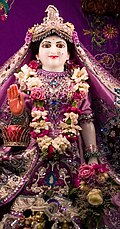
'''Rukmini''' ({{langx|sa|रुक्मिणी|lit=radiant}}, {{IAST3|Rukmiṇī}}) is a [[Devi|Hindu goddess]] and the first queen of [[Krishna]].<ref>{{Cite book |last=Balfour |first=Edward |url=https://books.google.com/books?id=t9krAAAAYAAJ&dq=rukmini+chief+wife+krishna+books&pg=PA454 |title=The Cyclopædia of India and of Eastern and Southern Asia: Commercial, Industrial and Scientific, Products of the Mineral, Vegetable, and Animal Kingdoms, Useful Arts and Manufactures |date=1885 |publisher=B. Quaritch |pages=454 |language=en}}</ref><ref>{{Cite book |url=https://books.google.com/books?id=Jn8oAAAAYAAJ&dq=rukmini+chief+wife+krishna+books&pg=PA83 |title=Select Specimens of the Theatre of the Hindus |date=1835 |publisher=Parbury, Allen |quote="The marriage was solemnized at Dwarakú, and Rukmini remained the chief of Krishna's wives" |pages=83 |language=en}}</ref><ref>{{Cite book |last=Mitchell |first=John Murray |url=https://books.google.com/books?id=MWJRAAAAYAAJ&dq=rukmini+chief+wife+krishna+books&pg=PA117 |title=Hinduism Past and Present: With an Account of Recent Hindu Reformers and a Brief Comparison Between Hinduism and Christianity |date=1885 |publisher=Religious Tract Society |quote="He had eight chief wives; the queen of all, Rukmini, had been betrothed to another, but on her marriage-day Krishna carried her off in a chariot and made her his own wife." |pages=117 |language=en}}</ref> She is described as the chief of Krishna's wives in [[Dvārakā|Dvaraka]].<ref>{{Cite web |date=2012-06-24 |title=Rukmini, Rukmiṇī: 13 definitions |url=https://www.wisdomlib.org/definition/rukmini |access-date=2022-08-06 |website=www.wisdomlib.org |language=en}}</ref><ref>{{Cite book |last=Dasa |first=Gopiparanadhana |url=https://books.google.com/books?id=GcpGCgAAQBAJ&dq=rukmini+queen+of+dvaraka&pg=PT231 |title=Sri Brhad-bhagavatamrta: Volume One |date=2002-01-01 |publisher=The Bhaktivedanta Book Trust |isbn=978-91-7149-784-0 |pages=Verse 74 |language=en}}</ref><ref>{{Cite book |last=Bhandarkar |first=Ramkrishna Gopal |url=https://books.google.com/books?id=C5zKrCIBmBwC&dq=rukmini+chief+consort&pg=PA161 |title=Vaiṣṇavism, Ṡaivism and Minor Religious Systems |date=1987 |publisher=Asian Educational Services |isbn=978-81-206-0122-2 |pages=21 |language=en |quote="expressed a desire for as good a son as Rukmini, his chief consort, had."}}</ref> Rukmini is revered as the [[avatar]] of [[Lakshmi]] and is venerated primarily in [[Warkari]],<ref>{{cite journal |url= http://www.ic.nanzan-u.ac.jp/SHUBUNKEN/publications/jjrs/pdf/276.pdf |title= The Vithoba Faith of Maharashtra: The Vithoba Temple of Pandharpur and Its Mythological Structure | journal=Japanese Journal of Religious Studies |volume=15 |issue=2–3 |first=Shima |last=Iwao |date=June–September 1988 |publisher=Nanzan Institute for Religion and Culture |pages=183–197 |issn=0304-1042 |archive-url=https://web.archive.org/web/20090326062749/http://www.ic.nanzan-u.ac.jp/SHUBUNKEN/publications/jjrs/pdf/276.pdf |archive-date=2009-03-26}}</ref> and [[Haridasa]] tradition,{{Citation needed|date=November 2024}} and additionally in [[Sri Vaishnavism]].<ref>{{Cite web |last=www.wisdomlib.org |date=2024-09-20 |title=Shri Rukmini-devi: Significance and symbolism |url=https://www.wisdomlib.org/concept/shri-rukmini-devi |access-date=2024-11-26 |website=www.wisdomlib.org |language=en}}</ref> | |||
Rukmini is mainly worshipped in [[Maharashtra]] and [[South India]]. The people of Maharashtra venerate her with [[Vithoba]] (a regional form of Krishna) and call her '''Rakhumai'''.<ref>{{Cite book |last=Bryant |first=Edwin Francis |url=https://books.google.com/books?id=HVDqCkW1WpUC |title=Krishna: A Sourcebook |date=2007 |publisher=Oxford University Press |isbn=978-0-19-803400-1 |language=en}}</ref> In South India, she is worshipped along with Krishna and his other primary consort [[Satyabhama]]. Her birthday is celebrated every year on the occasion of Rukmini Ashtami.<ref name=":1" /> | |||
==Etymology and epithets== | |||
The name ''Rukmini'' is derived from the [[Sanskrit]] word ''Rukma'' which means 'radiant', 'clear' or 'bright'.<ref name = "Monier" >{{Cite book|last=Monier-Williams|first=Monier|url=https://books.google.com/books?id=_3NWAAAAcAAJ&q=Rukma|title=A Sanskrit-English Dictionary|date=1872|publisher=Clarendon|language=en|page=847}}</ref> The name can also mean 'decorated with gold ornaments'.<ref name="Chandra">{{Cite book|last=Chandra|first=Suresh|url=https://books.google.com/books?id=mfTE6kpz6XEC&q=Rukmini&pg=PA154|title=Encyclopaedia of Hindu Gods and Goddesses|date=1998|publisher=Sarup & Sons|isbn=978-81-7625-039-9|language=en}}</ref><ref name = "Monier" /> Other names and epithets include: | |||
*''Shri'' – [[Lakshmi]] | |||
*''Vaidarbhi'' – She who is from the kingdom of [[Vidarbha]]<ref name="JA">{{Cite book|last=Louis-Frédéric|url=https://books.google.com/books?id=B04OAQAAMAAJ&q=Rukmini|title=Encyclopaedia of Asian Civilizations: N-R|date=1977|publisher=L. Frédéric|isbn=978-2-85893-050-0|language=en|page=492}}</ref> | |||
*''Bhaishmi'' – Daughter of Bhishmaka<ref name = "JA" /> | |||
*''Rakhumai'' – Mother Rukmini<ref name = "JA" /> | |||
*''Chiryauvana'' – One who is forever young | |||
*''Pradyumna Janani'' – Mother of [[Pradyumna]] | |||
==Legends== | |||
===Birth=== | |||
According to the epic ''[[Mahabharata]]'' and other ''[[Puranic]]'' scriptures, Princess Rukmini was born to [[Bhishmaka]]—the king of [[Vidarbha]] kingdom, belonging to the [[Bhoja tribe|Bhoja]] dynasty.{{sfn|Mani|1975|p=138}} She had five elder brothers—[[Rukmi]], Rukmaratha, Rukmabahu, Rukmakesa and Rukmanetra.<ref name=":0" /> [[Puranas]] such as ''[[Vishnu Purana]]'', ''[[Bhagavata Purana]],'' and ''[[Padma Purana]]'' praise her as an incarnation of Goddess [[Lakshmi]], the wife of God [[Vishnu]].<ref name="Mani">{{Cite book|last=Mani|first=Vettam|url=https://archive.org/details/puranicencyclopa00maniuoft/page/657/mode/2up|title=Puranic encyclopaedia : a comprehensive dictionary with special reference to the epic and Puranic literature|date=1975|publisher=Delhi : Motilal Banarsidass|others=Robarts – University of Toronto|page=657|isbn=9780842608220 }}</ref> | |||
===Marriage to Krishna=== | |||
[[File:Krsna Takes Rukmini Away from Devi Shrine.jpg|thumb|A painting depicting Rukmini eloping with Krishna from a temple of Ambika ([[Parvati]]).]] | |||
The ''Bhagavata Purana'' narrates that Rukmini once heard about [[Krishna]] and his heroic deeds, such as slaying the tyrant king [[Kamsa]], and opposing the evil king [[Jarasandha]]. She fell in love with him and desired to marry him. The episode of ''Rukmini Kalyanam,'' and the devotion of Rukmini towards her desired husband is narrated by the sage [[Shuka]] to King [[Parikshit]].<ref name=":0">{{Cite book |last=Ayyar |first=P. V. Jagadisa |url=https://books.google.com/books?id=NLSGFW1uZboC&dq=rukmini+purana&pg=PA29 |title=South Indian Shrines: Illustrated |date=1982 |publisher=Asian Educational Services |isbn=978-81-206-0151-2 |pages=29 |language=en}}</ref><ref>{{Cite web|url=https://mokshaverse.com/rukmini-and-krishna-an-untangled-love-story/|title=Rukmini and Krishna: An Untangled Love Story|first=Tanvi|last=Sangwani|date=16 November 2024}}</ref> | |||
Rukmini's parents rejoiced and gave their permission, but Rukmi – who was an ally of Jarasandha – strongly opposed it. Instead, he proposed that she marry his friend [[Shishupala]]— the crown prince of [[Chedi Kingdom]], and a cousin of Krishna.<ref name="Mani" /><ref name="Ch51">{{Cite web|title=CHAPTER FIFTY-TWO|url=https://vedabase.io/en/library/sb/10/52/|access-date=2021-06-14|website=vedabase.io|language=en}}</ref>{{efn|Shishupala was also a vassal and close associate of Jarasandha and hence an ally of Rukmi.}} Bhishmaka agreed, and a distressed Rukmini immediately sent for a trusted [[Brahmin]] and asked him to deliver a message to [[Krishna]].<ref name="Mani" /> In the message, she wrote to Krishna about her love and asked him to abduct her when she visited the temple of Goddess [[Ambika (goddess)|Ambika]] ([[Parvati]]) before her wedding. Krishna, having received the message in [[Dvārakā|Dvaraka]], told the messenger to inform Rukmini that he had received her letter and would come to make her his wife. Krishna then immediately set out for Vidarbha with [[Balarama]], his elder brother.<ref name="Ch51" /><ref>{{Cite book |last=Ayyar |first=P. V. Jagadisa |url=https://books.google.com/books?id=NLSGFW1uZboC&dq=rukmini+purana&pg=PA29 |title=South Indian Shrines: Illustrated |date=1982 |publisher=Asian Educational Services |isbn=978-81-206-0151-2 |pages=32 |language=en}}</ref> | |||
Meanwhile, in Vidarbha's capital [[Kundina]], Bhishmaka had prepared for Rukmini's marriage. Rukmini grew anxious as she observed the host of kings, wondering if the Brahmin she had dispatched had not reached safely or not, and if the Almighty would assist her in her efforts. Her face grew pale and her thoughts grew distressed as she shunned herself from the rest of the world. Her sorrow of Krishna not having yet arrived to marry her yet was so immense that she refused to eat, sing to her parrot, or play her lyre.<ref name="Ayyar 1982 332"/> Shishupala, along with his allies including Jarasandha had arrived. Krishna and Balarama had also arrived, and Bhishmaka welcomed them. At the palace, Rukmini had lost all hope, but the messenger turned up and informed that Krishna had accepted her request. The next day, she went to the temple to offer her prayers to [[Ambika (goddess)|Ambika]]. As she proceeded towards the wedding venue, she saw Krishna and he soon swept her into his [[chariot]] with him. All of Jarasandha's forces quickly started chasing them, but they were repulsed by Balarama and his army.<ref name = "Shyam" /> In an account slightly differing from that of the [[Bhagavata Purana]], in the play "Rukmini Horon" by the 15th-century [[Assamese Language|Assamese]] playwright [[Sankardev|Srimanta Sankaradeva]],<ref>{{Cite book|last=Neog|first=Maheswar|title=Early History of the Vaiṣṇava Faith and Movement in Assam: Śaṅkaradeva and His Times|publisher=[[Motilal Banarsidass]]|year=1980|location=Delhi|pages=162–207}}</ref><ref>{{Cite news|last=Rajan|first=Anjana|date=10 November 2017|title=Beyond the nine rasas|work=[[The Hindu]]|url=https://www.thehindu.com/entertainment/dance/beyond-the-nine-rasas/article20033870.ece|access-date=22 May 2021}}</ref> [[Uddhava]] too accompanies Krishna in his campaign."<ref>{{Cite web|last=Kashyap|first=Uruli|date=10 September 2018|title=''Rukmini Horon natot natyokar Srimanta Sankardevor moulikota''|url=https://nilacharai.com/rukmini-haran-naatat-srimanta-sankardevar-moulikata/|access-date=22 May 2021|website=Nila Charai}}</ref> | |||
Rukmi chased after Krishna and Rukmini.<ref name="bg">{{cite book|title=Gazetteer of the Bombay Presidency: Kathiawar (Public Domain text)|url=https://archive.org/details/1884GazetteerByBombayPresidencyVol8Kathiawar349D|year=1884|publisher=Printed at the Government Central Press, Bombay|volume=VIII|pages=380–381}}</ref> He challenged Krishna to a fight, but was easily overpowered by the former. Rukmini begged Krishna to spare her brother's life, and the latter agreed. However, he shaved Rukmi's hair and moustache as a mark of punishment, and let him go free. Krishna and Rukmini reached Dvaraka, where they were welcomed with great pomp and ceremony, followed by a wedding.[[File:Indian School, late 18th century - The marriage of Krishna and Rukmini. - RCIN 1005113.w - Royal Collection.jpg|thumb|upright|Late 18th century painting of the wedding of [[Krishna]] and Rukmini]] | |||
===Krishna's ruse=== | |||
The [[Bhagavata Purana]] describes an episode through the sage [[Shuka]] where the yet unwed Rukmini takes a bejewelled whisk and starts fanning her prospective husband Krishna, wearing an expensive girdle and a dazzling necklace. Even though he is pleased, Krishna points to the fact that the princess had been desired by a number of handsome and energetic monarchs and states that he was not their equal, and that he had also almost lost his realm rescuing her. He remarks that she had not been far-sighted in choosing him as her groom and that she must now instead choose a Kshatriya like her. Rukmini's heart shuddered, her red nails scratched the floor, and tears flowed from her eyes that were decorated with collyrium. She fell to the floor, her hair dishevelled. Krishna swiftly raised her back to her feet and assures her that he was merely joking, as householders do with their beloved. Her fear of abandonment seeping away from her, the princess eulogises him, praising his glories and addressing him as her [[Ātman (Hinduism)|atman]], her sense of self. Krishna praises her single-minded devotion to him.<ref>{{Cite book |chapter-url=https://books.google.com/books?id=HUSCDwAAQBAJ&dq=rukmini+lotus-eyed&pg=PT211 |title=The Bhagavata Purana 3 |date=2019-01-21 |publisher=Penguin Random House India Private Limited |isbn=978-93-5305-380-2 |language=en |chapter=Chapter 10(58)}}</ref> | |||
===Married life and children=== | |||
[[File:Vittala Rakhumai Thennangur.jpg|thumb|309x309px|Statue of Vittala Rakhumai, Thennangur]] | |||
Though Krishna married many other women, Rukmini remained his chief consort and the queen of Dvaraka.<ref>{{Cite book |url=https://books.google.com/books?id=gSsqAAAAYAAJ&q=rukmini+chief+consort+krishna |title=Books 8-12: Krishna, spirit of delight|date=1976 |publisher=Vighneswara Publishing House |pages=740 |language=en |quote="Rukmini : Chief consort of Krishna"}}</ref> When she longed for a child, Krishna flew to [[Mount Kailash|Kailash]] upon his mount [[Garuda]], and expressed his wife's desire to [[Shiva]]. Obliging, Shiva blessed Rukmini to be the bearer of the new incarnation of [[Kamadeva]], whom he had previously immolated with his third eye. Thus was [[Pradyumna]] born.<ref>{{Cite book |last=Mani |first=Vettam |url=https://books.google.com/books?id=mvXsDwAAQBAJ&dq=rukmini+dvaraka&pg=PA594 |title=Puranic Encyclopedia: A Comprehensive Work with Special Reference to the Epic and Puranic Literature |date=2015-01-01 |publisher=Motilal Banarsidass |isbn=978-81-208-0597-2 |pages=594 |language=en}}</ref> Many scriptures have mentioned that Rukmini and other wives of Krishna lived like sisters. | |||
The [[Bhagavata Purana]] and [[Vishnu Purana]] states that Rukmini and Krishna had ten sons—[[Pradyumna]], Charudeshna, Sudeshna, Charudeha, Sucharu, Charugupta, Bhadracharu, Charuchandra, Vicharu, and Charu.<ref>{{Cite book |last=Gita Press Gorakhpur |url=https://archive.org/details/vishnu-puran_202204/page/n399/mode/1up |title=Vishnu Puran |pages=389 |language=Hindi}}</ref><ref name = "Mani" /><ref name = "Sinha" >{{Cite book|last=Sinha|first=Purnendu Narayana|url=https://books.google.com/books?id=OveYh2v-1roC&q=sons+of+krishna&pg=PT691|title=A Study of the Bhagavata Purana: Or, Esoteric Hinduism|date=1950|publisher=Library of Alexandria|isbn=978-1-4655-2506-2|language=en}}</ref> In the ''[[Harivamsa]]'', Rukmini's sons are Pradyumna, Charudeshna, Charuchandra, Charugarbha, Sudangstra, Druma, Sushena, Charugupta, Charuvinda, and Chharuvahu. A different listing is found in ''[[Anushasana Parva]]'' of the ''Mahabharata'', where Pradyumna, Charudeshna, Sucharu, Charuvesa, Yasodhana, Charusravas, Charuyasas, and Sambhu are Rukmini's sons.<ref name = "Mani" /><ref>{{Cite web|title=The Mahabharata, Book 13: Anusasana Parva: Anusasanika Parva: Section XIV|url=https://www.sacred-texts.com/hin/m13/m13a014.htm|access-date=2021-06-18|website=sacred-texts.com}}</ref> Vishnu Puran also mentioned that Rukmini had a daughter named Charumati.<ref name="Dalal">{{Cite book|last=Dalal|first=Roshen|url=https://books.google.com/books?id=DH0vmD8ghdMC&q=Rukmini|title=Hinduism: An Alphabetical Guide|date=2010|publisher=Penguin Books India|isbn=978-0-14-341421-6|language=en}}</ref><ref>{{Cite book |last=Gita Press Gorakhpur |url=https://archive.org/details/vishnu-puran_202204/page/n399/mode/1up |title=Vishnu Puran |pages=389}}</ref> | |||
===Tale of the scales=== | |||
According to a folktale of [[Odisha]], the divine sage [[Narada]] once arrived in Dvaraka and asked for Krishna to be given to him as alms. Krishna's 8 queens requested him to take anything else and Narada asked them to give wealth equal to Krishna's weight. They arranged for a big scale ([[Tulabharama]]) to be put up. Satyabhama put all of her coins, gems and jewellery on the scale, but it doesn't budge. Other wives gave their jewels, but it was of no use. At last, Rukmini came and put a single leaf of [[Tulsi in Hinduism|Tulasi]] on the scale and chanted that it represented her love for Krishna. The scales then became balanced. Though this story is absent in the main scriptures pertaining to Krishna's life, it is often repeated to enunciate the worth of Rukmini's love over Satyabhama's material wealth.<ref>{{cite book|author=Devdutt Pattanaik|title=The Goddess in India: The Five Faces of the Eternal Feminine|url=https://books.google.com/books?id=rjL3ogbdJNkC|date=September 2000|publisher=Inner Traditions/Bear|isbn=9780892818075|pages=27}}</ref> The only known versions of this story are from [[Padma Purana]] and [[Devi-Bhagavata Purana|Devi Bhagvata Purana]], where Satyabhama succeeds in weighing Krishna normally with gold items.<ref>{{Cite book |url=https://books.google.com/books?id=UbSgAAAAMAAJ&dq=rukmini+worship&pg=PA231 |title=Calcutta Review |date=1905 |publisher=University of Calcutta |pages=231 |language=en}}</ref> | |||
Rukmini is | ===Meeting Sudama=== | ||
In the ''Bhagavata Purana'', another well-known incident in Rukmini's married life is narrated. When Krishna's childhood friend, [[Sudama]], visited Dvaraka, Rukmini welcomed Sudama and gave him food. She and Krishna fanned him as he rested from his long journey. This type of devotion is a characteristic of Rukmini, an attribute of her that is prevalent.{{sfn|Mani|1975|p=437}} | |||
{{Vaishnavism}} | {{Vaishnavism}} | ||
== | ===Durvasa's curse=== | ||
[[File: | According to the [[Skanda Purana]], the famously short-tempered sage [[Durvasa]] met Krishna and Rukmini when he was on a pilgrimage. Durvasa asked the couple to be yoked onto his chariot while he held the reins. In the process of pulling the chariot forward, Rukmini grew exhausted and requested Krishna for water. Krishna struck his foot against the ground causing a spring of the [[Ganges|Ganga]] river to appear. Observing her quench her thirst without seeking his permission, the infuriated Durvasa cursed her to be separated from her beloved Krishna. Rukmini grew perturbed and started to cry. To pacify her, Krishna blessed her with the boon that if his devotees were to only see him and not her, they would receive only half the merit.<ref>{{Cite book |first=GV |last=Tagore |title=Skanda Purana |year=1950}}</ref><ref>{{Cite web |date=2021-04-16 |title=Durvāsā cursing Rukmiṇī [Chapter 2] |url=https://www.wisdomlib.org/hinduism/book/the-skanda-purana/d/doc627241.html |access-date=2022-07-10 |website=wisdomlib.org |language=en}}</ref> | ||
Despite this consolation, Rukmini grew distressed due to her separation from her consort and fell unconscious. The sea-god and the sage [[Narada]] arrived to comfort her. Narada informed her that her husband - a manifestation of [[Vishnu]] - was the [[Brahman|Supreme Being]] himself, he rhetorically wondered how she could expect to keep his company in an exclusive garden. The sea affirmed the divine sage's words, promising her that as the companion of Vishnu, she would always retain her permanence in his being. The goddess [[Ganga (goddess)|Bhagirathi]], the personification of the Ganga, produced a richly-endowed forest on the spot, laden with fruits and flowers, quickly to be frequented by the inhabitants of Dvaraka. Durvasa vengefully burnt the forest with his powers. Rukmini grew depressed and contemplated giving up her human form. Krishna arrived and stopped her. She felt ashamed and furious with herself even as her husband reassured her of his devotion. The repentant Durvasa begged Krishna to reunite with Rukmini, and the deity consented, blessing the sage with virtue as well as saluting the river Ganga, who then became the liberator of sorrows.<ref>{{Cite book |last=Tagore |first=GV |title=Skanda Purana |pages=Chapter 3, Verses 6–84}}</ref><ref>{{Cite web |date=2021-04-16 |title=Relief of Rukmiṇī [Chapter 3] |url=https://www.wisdomlib.org/hinduism/book/the-skanda-purana/d/doc627242.html |access-date=2022-07-10 |website=wisdomlib.org |language=en}}</ref> | |||
===Death=== | |||
After the disappearance of Krishna following the [[Yadu massacre]] in the [[Mausala Parva]], Rukmini, along with [[Jambavati]], self-immolated herself on the funeral pyre.<ref>[https://www.sacred-texts.com/hin/m16/m16007.htm Dio Mahabharate.] „''Rukmini, the princess of Gandhara, Saivya, Haimavati, and queen Jamvabati ascended the funeral pyre''."</ref><ref>{{Cite journal|last=Vijayakumar|first=Lakshmi|date=2004-01-01|title=Altruistic Suicide in India|url=https://doi.org/10.1080/13811110490243804|journal=Archives of Suicide Research|volume=8|issue=1|pages=73–80|doi=10.1080/13811110490243804|issn=1381-1118|pmid=16006390|s2cid=41567060|url-access=subscription}}</ref> | |||
== Iconography == | |||
[[File:Goddess_Rukmini.jpg|thumb|upright|140px|Rukmini with shanka, chakra and gada in Rukmini Temple, Dwaraka]] | |||
In many texts, the [[Brahmin|Brahman]] dispatched by Rukmini to request Krishna to elope with her on her [[svayamvara]] describes the princess poetically as bearing beautiful hands, braided tresses, and a face that resembles the moon.<ref name="Ayyar 1982 332">{{Cite book |last=Ayyar |first=P. V. Jagadisa |url=https://books.google.com/books?id=NLSGFW1uZboC&dq=rukmini+purana&pg=PA29 |title=South Indian Shrines: Illustrated |date=1982 |publisher=Asian Educational Services |isbn=978-81-206-0151-2 |pages=33 |language=en}}</ref> She is consistently described as beautiful in other accounts.<ref>{{Cite book |url=https://books.google.com/books?id=g2WK8eswRgwC&dq=rukmini+appearance&pg=PA33 |title=Reports |date=1879 |publisher=Office of the Superintendent of Government Printing |pages=3 |language=en}}</ref> | |||
Rukmini as mentioned in Hindu traditions, stands for the majesty and wealth of Krishna. [[Vadiraja Tirtha]] in ''[[Rukminisha Vijaya]]'', describes her as Krishna's supreme beloved consort.<ref>{{Cite book |url=http://archive.org/details/rukminisha-vijaya-1-sri-vadiraja-tirtha-t.-s.-raghavendran |title=Rukminisha Vijaya - 1 - Sri Vadiraja Tirtha, T.S.Raghavendran |pages=31}}</ref> In south Indian iconographic tradition, Rukmini, along with [[Satyabhama]], appear as the primary consorts of Krishna.<ref>{{Cite book |last=Shulman |first=David Dean |url=https://books.google.com/books?id=d97_AwAAQBAJ&dq=rukmini+iconography&pg=PA283 |title=Tamil Temple Myths: Sacrifice and Divine Marriage in the South Indian Saiva Tradition |date=2014-07-14 |publisher=Princeton University Press |isbn=978-1-4008-5692-3 |pages=283 |language=en}}</ref> | |||
According to the ''Vaikhanasagama'', Rukmini should be depicted on the right side of Krishna, her image golden-yellow in complexion. Her hair is supposed to be tied up in a fashionable knot, and should also be adorned with flowers. Her right arm should be hanging down, and she should hold a lotus in her left hand.<ref>{{Cite book |last=Rao |first=T. A. Gopinatha |url=https://books.google.com/books?id=SlbbDwAAQBAJ&dq=rukmini+golden&pg=PA203 |title=Elements of Hindu Iconography: Volume I - Part I |date=2020-04-06 |publisher=BoD – Books on Demand |isbn=978-3-8460-4767-5 |pages=203 |language=en}}</ref><ref>{{Cite book |url=https://books.google.com/books?id=fHlDAAAAYAAJ&q=rukmini+iconography |title=The Journal of the Bihar Research Society |date=1968 |publisher=Bihar Research Society. |pages=238 |language=en}}</ref> She is supposed to be adorned with various ornaments.<ref>{{Cite book |last=Rao |first=T. A. Gopinatha |url=https://books.google.com/books?id=SFbbDwAAQBAJ&dq=rukmini+right+side&pg=PA204 |title=Elements of Hindu Iconography: Volume I - Part I |date=2020-04-06 |publisher=BoD – Books on Demand |isbn=978-3-8460-4766-8 |pages=204 |language=en}}</ref> | |||
== Literature and symbolism == | |||
Rukmini in [[Hinduism]], is revered as the goddess of fortune, and mostly appears alongside her husband Krishna. An avtara of [[Lakshmi]], she is the chief and most beloved consort of Krishna, in various scriptures and text of Hindu traditions.<ref>{{Citation|last=Bryant |first = Edwin F. |authorlink=Edwin Bryant (author) |year=2007 |title = Krishna: A Sourcebook |publisher = Oxford University Press |isbn = 978-0-19-514891-6|url = https://books.google.com/books?id=HVDqCkW1WpUC|volume= |pages=283, 360}}</ref> | |||
[[File:Temple Sri Sanatan - Montréal - QC - CA - Krishna & Rukmini.jpg|thumb|Krishna and Rukmini at Temple Sri Sanatan, [[Montreal]]. Rukmini always appears on the left side of Krishna.<ref>{{cite book|author=D Dennis Hudson|title=The Body of God : An Emperor's Palace for Krishna in Eighth-Century Kanchipuram: An Emperor's Palace for Krishna in Eighth-Century Kanchipuram|url=https://books.google.com/books?id=IMCxbOezDi4C&pg=PA264|accessdate=28 March 2013|date=27 August 2008|publisher=Oxford University Press|isbn=978-0-19-970902-1|pages=263–4}}</ref>]] | |||
Rukmini finds her mention in ''[[Gopala Tapani Upanishad]]'' (as Krishna's other consort),<ref>{{Cite book | |||
| author = Deussen, P. | |||
| year = 1980 | |||
| title = Sixty Upanishads of The Veda, trans | |||
| publisher = VM Bedekar and GB Palsule. Delhi | |||
| isbn = 0-8426-1645-4 | |||
}}Vol II, pp. 809-888. He has translated the Rāma Pūrva and Uttara-tāpinī and the Nṛsiṁha Pūrva and Uttara-tāpinī Upanishads.</ref> in the ''[[Garga Samhita (Vaishnavite text)|Garga Samhita]]'' (as Queen of Dvaraka),<ref>{{cite book |author=Lavanya Vemsani |title=Krishna in History, Thought, and Culture |url=https://books.google.com/books?id=4fw2DAAAQBAJ&pg=PA99 |year=2016 |publisher=ABC-CLIO |isbn=978-1-61069-211-3 |pages=99–100 }}</ref> in ''[[Bhagavata Purana]]'' (as Krishna's chief queen),<ref>C Mackenzie Brown (1983), [https://www.jstor.org/stable/1462581 The Origin and Transmission of the Two "Bhāgavata Purāṇas": A Canonical and Theological Dilemma], Journal of the American Academy of Religion, Vol. 51, No. 4, pages 551–567</ref> in ''[[Brahma Vaivarta Purana]]'',<ref>{{cite journal |last=Gielen |first=Joris |title=The Theological Bearing of Puranic Stories: An enquiry into the presence of feminine theology in the Brahmavaivarta Purana |journal=Religions of South Asia |volume=2 |issue=2 |year=2008 |doi=10.1558/rosa.v2i2.177}}</ref> in ''[[Harivaṃśa]]'' that centres upon Dvaraka,<ref>[https://www.sacred-texts.com/hin/mbs/mbs01002.htm The Mahabharata in Sanskrit: Book I: Chapter 2] in sacred-texts.com website, (MBh.1.2.69): "hari vaṃśas tataḥ parva purāṇaṃ khila saṃjñitam bhaviṣyat parva cāpy uktaṃ khileṣv evādbhutaṃ mahat." ["Hari Vamsa Purana known as Khila (supplement) and Bhavishya Parva also spoken as Khila are wonderful and great"].</ref> and in ''[[Mahabharata]]'', mainly in the ''[[Adi Parva]]'' and the ''[[Mausala Parva]]''.<ref>Ganguli, K.M. (1883-1896) "[https://www.sacred-texts.com/hin/m16/index.htm Mausala Parva]" in ''The Mahabharata of Krishna-Dwaipayana Vyasa'' (12 Volumes). Calcutta</ref> Rukmini is the central character of the text, ''[[Rukminisha Vijaya]]'', that talks about her and Krishna's life before marriage and ends with their marriage.<ref>{{cite book|title=Rukmiṇīśavijayaḥ: mahākāvyam|url=https://books.google.com/books?id=fg23AAAAIAAJ|author=Vyasanakere Prabhanjanacharya|publisher=Aitareya Prakāśanam Vyāsanakere|year=1996|page=7}}</ref> She also appears in the ''[[Vishnu Purana]]'' and ''[[Padma Purana]]'' (as an avatar of [[Lakshmi]]).<ref>{{Cite book|last=Kinsley|first=David|url=https://books.google.com/books?id=HzldwMHeS6IC|title=Hindu Goddesses: Visions of the Divine Feminine in the Hindu Religious Tradition|date=1988-07-19|publisher=University of California Press|isbn=978-0-520-90883-3|language=en}}</ref><ref>{{Citation|last=Dalal|first=Roshen|title=Hinduism and its basic texts|date=2017-07-14|work=Reading the Sacred Scriptures|pages=157–170|location=New York |publisher=Routledge |doi=10.4324/9781315545936-11|isbn=978-1-315-54593-6}}</ref> | |||
The ''[[Brihad Bhagavatamrita]]'' offers the following adulations to Rukmini, identifying her with Lakshmi and Krishna as the Supreme God, the source of all avatars. It states that she assumes partial [[avatars]] to accompany Krishna's avatars like [[Vamana]] and serves Krishna as his "perfectly complete divine consort".<ref>{{Cite book |first=Sanātana |last=Gosvāmī |url=http://archive.org/details/sribrhadbhagavat0000sana |title=Śrī Br̥had Bhāgavatāmr̥ta of Śrīla Sanātana Gosvāmī : translated from the original Sanskrit, with a summary of the author's Dig-darśinī commentary |date=2002 |publisher=Los Angeles : Bhaktivedanta Book Trust |others=Internet Archive |isbn=978-0-89213-348-2 |pages=240–241}}</ref> The ''[[Naradiya Purana|Narada Purana]]'' instructs a devotee on the manner of offering worship to Krishna, offering precedence to the role of Rukmini in his devotion. Rukmini is worshipped with Krishna on his left-hand side; she is equated with [[Rajas]].<ref>{{Cite book |last1=Shastri |first1=J. L. |url=https://books.google.com/books?id=2JHsDwAAQBAJ&dq=rukmini+worship&pg=PA1142 |title=The Narada-Purana Part 3: Ancient Indian Tradition and Mythology Volume 17 |last2=Tagare |first2=G. V. |date=2004-01-01 |publisher=Motilal Banarsidass |isbn=978-81-208-3884-0 |pages=1142 |language=en}}</ref> The ''[[Skanda Purana]]'' describes the process of the worship of the goddess with Krishna. A devotee is said to acquire wish fulfillment, male progeny and physical beauty by pleasing Rukmini.<ref>{{Cite web |date=2021-04-16 |title=Importance of worshipping Rukmiṇī [Chapter 22] |url=https://www.wisdomlib.org/hinduism/book/the-skanda-purana/d/doc627261.html |access-date=2022-08-06 |website=www.wisdomlib.org |language=en}}</ref> | |||
== Worship and festivals == | |||
[[File:Vitthal - Rakhumai.jpg|thumb|[[Vithoba]] (left) with his consort [[Rakhumai]] at the [[Sion, Mumbai|Sion]] Vitthal temple, [[Mumbai]]|215x215px]] | |||
Rukmini's worship as the consort of [[Krishna]] precedes his association with his other consorts [[Radha]]. According to [[Dineshchandra Sircar|D.C. Sircar]], a sculpture from Paharpur in northern Bengal, attributed to the sixth or seventh century, represents Krishna and his consort, which he concludes is likely Rukmini. Her identification with Radha is rendered unlikely by the historian, since, "we have no undoubted reference to Radha in genuine epigraphic or literary records of an early date".<ref>{{Cite book |first=Dineschandra |last=Sircar |url=http://archive.org/details/Sircar1971 |title=Studies In The Religious Life Of Ancient and Medieval India by Dineschandra Sircar (1971) |date=1971 |pages=51}}</ref><ref>{{Cite book |first=Sanātana |last=Gosvāmī |url=http://archive.org/details/sribrhadbhagavat0000sana |title=Śrī Br̥had Bhāgavatāmr̥ta of Śrīla Sanātana Gosvāmī : translated from the original Sanskrit, with a summary of the author's Dig-darśinī commentary |date=2002 |publisher=Los Angeles : Bhaktivedanta Book Trust |others=Internet Archive |isbn=978-0-89213-348-2 |pages=240}}</ref><ref>{{Cite book |last=Murdoch |first=John |url=https://books.google.com/books?id=ZWcwAQAAMAAJ&dq=sri+vaishnava+rukmini&pg=PA21 |title=The Religious Sects of the Hindus |date=1904 |publisher=Christian Literature Society for India |pages=21 |language=en}}</ref> | |||
Rukmini is mainly worshipped in west and [[south Indian]] states such as [[Gujarat]], [[Maharashtra]], [[Karnataka]], [[Goa]], [[Andhra Pradesh]], [[Telangana]], [[Tamil Nadu]], and [[Kerala]]. Her kingdom, Vidarbha, is believed to be located in present-day Maharashtra. Along with [[Vithoba]] (a regional form of Krishna), Rukmini is worshipped as "Rakhumai" in the [[Pandharpur]] region.<ref name="Pilai">{{Cite book|last=Pillai|first=S. Devadas|url=https://books.google.com/books?id=P3uD22Ghqs4C&q=vithoba&pg=PA367|title=Indian Sociology Through Ghurye, a Dictionary|date=1997|publisher=Popular Prakashan|isbn=978-81-7154-807-1|language=en}}</ref><ref name="Shyam">{{Cite book|last=Pattanaik|first=Devdutt|url=https://books.google.com/books?id=Ux1eDwAAQBAJ&q=Rukmini|title=Shyam: An Illustrated Retelling of the Bhagavata|date=2018-07-01|publisher=Penguin Random House India Private Limited|isbn=978-93-5305-100-6|language=en}}</ref><ref name="auto">{{Cite web |date=2024-03-02 |title=Rukmini Devi Temple: A Sacred Hindu Site in India - Shivrajpur Beach |work=Shivrajpur Beach |url=https://shivrajpur.net/rukmini-devi-temple/ |access-date=2024-10-29 |language=en-GB}}</ref> Rukmini is worshipped as the chief goddess in [[Divya Desam]] temples like [[Pandava Thoothar Perumal Temple]], [[Parthasarathy Temple, Chennai|Parthasarathy Temple]]; with Krishna being the primary deity.<ref>{{cite journal |url=https://www.academia.edu/12405403 |last=R.K.K. |first=Rajarajan |year=2013|title=Historical sequence of the Vaiṣṇava Divyadeśas. Sacred venues of Viṣṇism|journal=Acta Orientalia |publisher= Acta Orientalia, Societates Orientales Daniica Fennica Norvegia Svecia| volume= 74|pages=37–90|issn=0001-6438}}</ref> She is also worshipped with her co-wife [[Satyabhama]] in temples like [[Thirukkavalampadi]], [[Venugopalaswamy Temple, Karvetinagaram|Venugopalaswamy Temple]] and [[Rajagopalaswamy Temple, Mannargudi|Rajagopalaswamy Temple]].<ref>{{cite journal|title=Sri Divya Desams|publisher=Sarva Sastra Maha Vidyalaya|location=[[Coimbatore]]|last=P.M.|first=Neelakrishnan|journal=Ancient Science of Life|pages=193–7|volume=11|issue=3|date=April 1992|pmc=3336602|pmid=22556587}}</ref> | |||
=== | |||
[[ | |||
=== | ===Festivals=== | ||
==== Rukmini Ashtami ==== | |||
''Rukmini Ashtami'' is the occasion that celebrates the birth anniversary of Rukmini. It is observed on the eighth day of the waning moon in the Hindu lunar month of ''Pausha'' (December—January on the Common Era calendar). Rukmini is acknowledged with special pujas and rituals in all of the temples dedicated to Krishna, especially those in those parts of India, especially associated with him such as Mathura and Vrindavan.<ref name=":1">{{Cite book |last=Melton |first=J. Gordon |url=https://books.google.com/books?id=lD_2J7W_2hQC&dq=rukmini+worship&pg=PA755 |title=Religious Celebrations: An Encyclopedia of Holidays, Festivals, Solemn Observances, and Spiritual Commemorations [2 volumes]: An Encyclopedia of Holidays, Festivals, Solemn Observances, and Spiritual Commemorations |date=2011-09-13 |publisher=ABC-CLIO |isbn=978-1-59884-206-7 |pages=755 |language=en}}</ref> | |||
=== | ====Vasanthotsavam==== | ||
[[ | [[Vasanthotsavam]] is an annual Seva celebrated in [[Tirumala]] to celebrate the arrival of spring season.<ref>{{cite book|last=N|first=Ramesan|title=The Tirumala Temple|year=1981|publisher=[[Tirumala Tirupati Devasthanams|TTD]]|location=[[Tirupati (city)|Tirupati]]}}</ref> ''Abhishekam'' - specifically called ''Snapana Thirumanjanam'' (Holy bathing), is performed to the utsava murthy and his consorts on all the three days. On the third day, abhishekam is performed to the idols of [[Rama]], [[Sita]], [[Lakshmana]] and [[Hanumana]] along with Krishna and Rukmini. Procession of the consecrated idols are taken in a procession in the evening on all the three days.<ref>{{cite web|url=http://www.hindu.com/2006/04/12/stories/2006041210620300.htm|archive-url=https://web.archive.org/web/20060419152327/http://www.hindu.com/2006/04/12/stories/2006041210620300.htm|url-status=dead|archive-date=2006-04-19|title=Vasanthotsavam begins|date=2006-04-12|work=[[The Hindu]]|access-date=2008-04-18}}</ref> | ||
== Temples == | |||
[[File:Rukmini Devi Temple, Dwarka during Dwaraka DWARASPDB 2015 (2).jpg|thumb|[[Rukmini Devi Temple]], [[Dwarka|Dwaraka]]]] | |||
* [[Rukmini Devi Temple]], [[Dwarka|Dwaraka]], [[Gujarat]].<ref name="auto"/> | |||
* [[Kantajew Temple]], Bangladesh<ref>{{Cite web|url=https://nijhoom.com/kantajew-temple/|title=Kantajew Temple: The most beautiful Hindu temple in Bangladesh wrapped in stunning terracotta.|first=Raw Hasan ( র|last=হাসান )|date=8 July 2025}}</ref> | |||
* [https://g.co/kgs/kE8Edk8 Vitthal Rukhmini Temple, Kaundanyapur, Maharashtra] | |||
* [[Tirumala Krishna Idol|Tirumala Venkateswara Temple]], [[Tirupati]], [[Andhra Pradesh]].<ref>{{cite book |author=Dr N Ramesan|title=The Tirumala Temple |year=1981 |publisher=[[Tirumala Tirupati Devasthanams]]|location=[[Tirumala]]}}</ref> | |||
* [[Vithoba Temple]], [[Pandharpur]], [[Maharashtra]].<ref>[https://www.thedivineindia.com/vithoba-mandir/6570 Vithoba Temple Pandharpur] - ''The Divine India''</ref> | |||
* [[Pandava Thoothar Perumal Temple]], [[Kanchipuram]], [[Tamil Nadu]].<ref>{{cite book|title=Temples of Tamil Nadu Kancheepuram District|publisher= Directorate of Census Operations, Tamil Nadu|year=2003|last=C.|first=Chandramouli|ref=C.}}</ref> | |||
* [[Thennangur]] Sri Rakhumai Sametha Panduranga Temple, [[Thiruvannamalai]], Tamil Nadu.<ref>{{Cite web |title=sri-rakumai-sametha-panduranga-temple |url=https://temple.dinamalar.com/en/new_en.php?id=128 |website=Sri Rakhumayi Sametha Panduranga Temple Tiruvannamalai}}</ref> | |||
* Sri Vittal Rakhumai Mandir, [[Dahisar]], Maharashtra.<ref>{{Cite web |title=Sri Vittal Rakhumai Mandir |url=https://svrm.in/sri-vittal-rakhumai-mandir/ |website=Sri Vittal Rakhumai Mandir Dahisar official website}}</ref> | |||
* Shri Vitthal Rukmini Temple, [[Thanjavur]], Tamil Nadu.<ref>{{Cite web |title=Shri Vittal Rukmini Panduranga Temple, Kumbakonam |url=https://templetownkumbakonam.com/2018/12/07/shri-vittal-rukmini-panduranga-temple-in-kumbakonam-history-timing-and-details/ |website=templetownkumbakonam.com|date=7 December 2018 }}</ref> | |||
* Sri Rukmini Panduranga Swamy Temple, [[Machilipatnam]], Andhra Pradesh.<ref>{{Cite news |title=PANDURANGA SWAMY TEMPLE |url=https://www.machilipatnam.com/panduranga-swamy-temple/ |website=www.machilipatnam.com|date=7 September 2020 }}</ref> | |||
* Vijaya Vitthala Mandhira, [[Hampi]], [[Karnataka]].<ref>{{Cite web |title=Vittala Temple, Hampi – An Architectural Wonder |url=https://www.karnataka.com/hampi/vittala-temple/ |website=www.karnataka.com|date=17 January 2015 }}</ref> | |||
* [[International Society for Krishna Consciousness|ISKCON Temple]] - Iskcon Kaundanyapur,<ref>{{Cite web |title=ISKCON Kaundanyapur (Govardhan Temple |url=https://centers.iskcondesiretree.com/2011/11/16/kaundanyapur/ |website=centers.iskcondesiretree.com|date=16 November 2011 }}</ref> Iskcon Los Angeles,<ref>{{Cite web |title=ISKCON Los Angeles – New Dvaraka Dhama |url=https://centres.iskcon.org/centre/iskcon-los-angeles/ |website=centres.iskcon.org}}</ref> Iskcon Amravati,<ref>{{Cite web |title=ISKCON Amravati – Sri Sri Rukmini Dwarkadhish Mandir |url=https://centres.iskcon.org/centre/iskcon-amravati-sri-sri-rukmini-dwarkadhish-mandir/ |website=centres.iskcon.org}}</ref> Iskcon Dwarka.<ref>{{Cite web |title=Sri Sri Rukmini Dwarkadhish Temple |url=https://iskcondwarka.org/rukmini-dwarkadhish-temple/ |website=Sri Sri Rukmini Dwarkadhish Temple Official Website}}</ref> | |||
* [[Kantajew Temple]], [[Dinajpur]], [[Bangladesh]].<ref>{{Cite web|url=https://assignmentpoint.com/kantanagar-temple/|title=Kantanagar Temple|website=Assignment Point}}</ref> | |||
* [[Sri Krishnan Temple]], [[Singapore]].<ref>{{Cite web|title=Sri Krishnan Temple|url=http://www.ura.gov.sg/conservationportal/consmap.html?bldgid=SKNTPL&page=History|url-status=live|archive-url=https://web.archive.org/web/20201124110752/https://www.ura.gov.sg/Conservation-Portal/Explore/History?bldgid=SKNTPL|archive-date=24 November 2020|access-date=24 November 2020|website=Urban Redevelopment Authority, Singapore}}</ref> | |||
* Lakhubai Mandir Temple Dindiravan, Pandharpur, India<ref>{{Cite web |last=Mayuri |first=Tourmet |date=2014-06-05 |title=Shri Lakhubai Temple Rukmini Mandir |url=https://tourmet.com/shri-lakhubai-temple-rukmini-mandir/ |access-date=2024-11-17 |website=tourmet |language=en-US}}</ref> | |||
* Vitthal Rukmini Mandir, New Jersey USA<ref>{{Cite web |title=SACRED Foundation |url=https://www.vitthalmandirus.org/ |access-date=2024-11-17 |language=en-US}}</ref> | |||
* Rukmini Panduranga Temple, Long Beach, CA<ref>{{Cite web |title=Long Beach Temple Inauguration |url=https://bhaktimarga.us/templela/ |access-date=2024-11-17 |website=Bhakti Marga America |language=en-US}}</ref> | |||
* | |||
* Rukmini Mata Mandir Paliwal Dham Pali | |||
* [[Jagdish Temple, Udaipur]] | |||
* [[Swaminarayan Mandir, Vadtal]] | |||
== | == Influence == | ||
[[File:Rukmini-Dwarakadisa 108.jpg|thumb|upright|130px|Rukmini at the New Dwarka Hare Krishna temple, [[Los Angeles]]]] | |||
== | ===Culture=== | ||
[[ | The [[Mishmi people]] of [[Arunachal Pradesh]] believe that Rukmini belonged to their tribe. The plays and dances on 'Rukmini Haran' are common. There is a legend that Krishna asked the Mishmi people to cut their hair as a form of punishment for not allowing him to marry Rukmini. Due to this Idu-Mishmi people are also called "chulikata" (chuli-hair, kata- cut).<ref>Aiyadurai, A., & Lee, C. S. (2017). Living on the Sino-Indian border : The story of the Mishmis in Arunachal Pradesh, Northeast India. ''Asian Ethnology'', 76(2), 367–395.</ref> | ||
Rukmini | |||
===Paintings=== | |||
[[File:Indian (Kangra or Mandi) - Krishna Abducting Rukmini from the Temple - 2009.481 - Museum of Fine Arts.jpg|thumb|Krishna abducting Rukmini - Museum of Fine Arts]] | |||
Rukmini's marriage to Krishna and related events have been depicted in the [[Kangra painting]] and [[Pahari painting|Mandi painting]].<ref>[https://books.google.com/books?id=8EGUpX1O0hoC&dq=Kangra+painting&pg=RA2-PA62 Pahari centres] ''Arts of India: Architecture, Sculpture, Painting, Music, Dance and Handicraft'', by Krishna Chaitanya. Published by Abhinav Publications, 1987. {{ISBN|81-7017-209-8}}. ''Page 62''.</ref> | |||
=== In popular culture === | |||
====Films==== | |||
*In the 1957 Telugu-Tamil film ''[[Mayabazar]]'', Rukmini was portrayed by Sandhya.<ref>{{Cite web |last=Nag |first=Kushali |date=23 May 2012 |title=Mayabazar is an interplay of illusions and reality |url=http://www.telegraphindia.com/1120523/jsp/entertainment/story_15519255.jsp |archive-url=https://web.archive.org/web/20151104003336/http://www.telegraphindia.com/1120523/jsp/entertainment/story_15519255.jsp#.VjlScWQrIxc |archive-date=4 November 2015 |access-date=4 November 2015 |website=[[The Telegraph (Calcutta)|The Telegraph]]}}</ref> | |||
* In the 1966 Telugu film ''[[Sri Krishna Tulabharam (1966 film)|Sri Krishna Tulabharam]]'', Rukmini was portrayed by [[Anjali Devi]].<ref>{{Cite news|last=Thurlapati|date=4 September 1966|title=శ్రీ కృష్ణ తులాభారం|trans-title=Sri Krishna Tulabharam|work=[[Andhra Jyothi]]|url=https://indiancine.ma/documents/GSW/0,39,2550,1689|access-date=12 September 2020|archive-date=26 August 2023|archive-url=https://web.archive.org/web/20230826223537/https://indiancine.ma/documents/GSW/0,39,2550,1689|url-status=live}}</ref> | |||
* In the 1967 and 1971 Telugu films ''[[Sri Krishnavataram]]'' and ''[[Sri Krishna Vijayamu]]'' respectively, Rukmini was portrayed by [[Devika]].<ref>{{Cite news|last=Srikanth|date=15 October 1967|title=సినిమా: శ్రీ కృష్ణ అవతారం|trans-title=Cinema: Sri Krishnavataram|work=[[Visalaandhra]]|url=https://indiancine.ma/documents/GVM/0,0,2550,1650|access-date=17 September 2020|language=te|archive-date=14 November 2020|archive-url=https://web.archive.org/web/20201114130711/https://indiancine.ma/documents/GVM/0,0,2550,1650|url-status=live}}</ref> | |||
* In the 1986 Hindi film ''[[Krishna-Krishna]]'', Rukmini was portrayed by [[Vidya Sinha]]. | |||
Rukmini | ====Television==== | ||
*In [[B. R. Chopra]]'s 1988 series ''[[Mahabharat (1988 TV series)|Mahabharat]]'', Rukmini was portrayed by Channa Ruparel.<ref>{{Cite web|date=2019-10-02|title=31 years of Mahabharat on Doordarshan: Interesting facts about one of most popular TV shows ever|url=https://www.financialexpress.com/entertainment/31-years-of-mahabharat-on-doordarshan-know-interesting-facts-about-one-of-most-popular-tv-shows-ever/1724556/|access-date=2020-07-24|website=The Financial Express|language=en-US}}</ref> | |||
*In [[Ramanand Sagar]]'s 1993 series ''[[Shri Krishna (1993 TV series)|Shri Krishna]]'', Rukmini was portrayed by [[Pinky Parikh]].<ref>{{Cite news |date=2020-04-27 |title=After 'Ramayan' and 'Mahabharat', now 'Shri Krishna' is returning to Doordarshan |url=https://economictimes.indiatimes.com/magazines/panache/after-ramayan-and-mahabharat-now-shri-krishna-is-returning-to-doordarshan/articleshow/75400171.cms |access-date=2024-06-30 |work=The Economic Times |issn=0013-0389}}</ref> | |||
* In the 2011 series ''[[Dwarkadheesh Bhagwan Shree Krishn]]'', Rukmini was portrayed by [[Priya Bathija]] and Payal Shrivastav.<ref>{{Cite AV media |url=https://m.imdb.com/title/tt8141442/fullcredits/cast?ref_=m_ttfc_3 |title=Dwarkadheesh: Bhagwaan Shree Krishn (TV Series 2011–2019) - IMDb |language=en |access-date=2024-11-30 |via=m.imdb.com}}</ref> | |||
* In the 2013 series ''[[Mahabharat (2013 TV series)|Mahabharat]]'', Rukmini was portrayed by [[Pallavi Subhash]].<ref>{{cite news|url=https://www.rediff.com/movies/report/review-mahabharat-so-far-so-good-tv/20130917.htm|title=Review: Mahabharat, so far so good|publisher=Rediff|author=Nishi Tiwari|access-date=17 September 2013|archive-date=1 May 2022|archive-url=https://web.archive.org/web/20220501105830/https://www.rediff.com/movies/report/review-mahabharat-so-far-so-good-tv/20130917.htm|url-status=live}}</ref> | |||
* In the 2017 series ''[[Vithu Mauli]]'', Rukmini was portrayed by Ekta Labde.<ref>{{cite web | url=https://www.imdb.com/title/tt10016142/fullcredits?ref_=ttfc_ql_1 | title=Vithu Mauli (TV Series 2017–2020) - Full cast & crew - IMDb | website=[[IMDb]] }}</ref> | |||
* In the 2017 series ''[[Paramavatar Shri Krishna]]'', Rukmini was portrayed by [[Amandeep Sidhu]] and [[Hunar Hali]].<ref>{{Cite news|title=Hunar Hali replaces Amandeep Sidhu to play Rukmini in Paramavatar Shri Krishna|url=https://timesofindia.indiatimes.com/tv/news/hindi/hunar-gandhi-replaces-amandeep-sidhu-in-tv-show/articleshow/71374833.cms|website=The Times of India|accessdate=19 February 2018 |language=en}}</ref> | |||
* In the 2018 series ''[[RadhaKrishn]]'', Rukmini was portrayed by [[Zalak Desai]].<ref>{{Cite news|title=Exclusive – Zalak Desai to play Rukmini in Star Bharat's RadhaKrishn|url=https://news.abplive.com/entertainment/television/radhakrishn-zalak-desai-joins-the-swastik-productions-family-as-rukmini-in-the-show-1124845|website=ABP News|accessdate=21 January 2019 |language=en}}</ref> | |||
* In the 2019 series ''[[Dwarkadheesh Bhagwan Shree Krishn – Sarvkala Sampann]]'', Rukmini was portrayed by [[Neetha Shetty]].<ref>{{cite web | url=https://m.imdb.com/title/tt8141442/fullcredits/?ref_=tt_cst_sm | title=Dwarkadheesh: Bhagwaan Shree Krishn (TV Series 2011–2019) - Full cast & crew - IMDb | website=[[IMDb]] }}</ref> | |||
==Notes== | ==Notes== | ||
{{Notelist}} | {{Notelist}} | ||
==See also== | |||
* [[Ashtabharya]] | |||
* [[Rakhumai]] | |||
* [[Krishna]] | |||
==References== | ==References== | ||
{{reflist}} | {{reflist}} | ||
| Line 87: | Line 186: | ||
==Bibliography== | ==Bibliography== | ||
*{{cite book |title=Rukmini Kalyanam (Sanskrit) |author=Rajachudamani Dikshita |author2= English introduction, P.P. Subramanya Sastry |publisher=Sri Vani Vilas Press, Srirangam |year=1920|url=https://archive.org/stream/rukminikalyanamw00rajauoft#page/n3/mode/2up }} | *{{cite book |title=Rukmini Kalyanam (Sanskrit) |author=Rajachudamani Dikshita |author2= English introduction, P.P. Subramanya Sastry |publisher=Sri Vani Vilas Press, Srirangam |year=1920|url=https://archive.org/stream/rukminikalyanamw00rajauoft#page/n3/mode/2up }} | ||
* {{Cite book|first=Saiswaroopadate |last=Iyer |url=https://books.google.com/books?id=rfaRzgEACAAJ |title=Rukmini — Krishna's Wife |date=2021 |publisher=Rupa |isbn=9789390356089}} | |||
==External links== | ==External links== | ||
| Line 94: | Line 194: | ||
{{HinduMythology}} | {{HinduMythology}} | ||
{{Krishna}} | {{Krishna}} | ||
{{mahabharata}} | |||
{{Authority control}} | {{Authority control}} | ||
| Line 99: | Line 200: | ||
[[Category:Characters in the Mahabharata]] | [[Category:Characters in the Mahabharata]] | ||
[[Category:Hindu goddesses]] | [[Category:Hindu goddesses]] | ||
[[Category:Lakshmi]] | [[Category:Forms of Lakshmi]] | ||
[[Category:Characters in the Bhagavata Purana]] | [[Category:Characters in the Bhagavata Purana]] | ||
[[Category:Consorts of Krishna]] | [[Category:Consorts of Krishna]] | ||
Latest revision as of 01:48, 24 March 2026
| Rukmini | |
|---|---|
| Member of Ashtabharya[6] | |
 12th-13th century sculpture of Rukmini | |
| Other names |
|
| Devanagari | रूक्मिणी |
| Venerated in | |
| Affiliation | Avatar of Lakshmi |
| Abode | |
| Texts | Vishnu Purana, Bhagavata Purana, Mahabharata, Harivamsa, Rukminisha Vijaya, Skanda Purana, Padma Purana‚ Brahma Vaivarta Purana‚ Garga Samhita‚ Garuda Purana, Gopala Tapani Upanishad, Yadavabhyudaya |
| Gender | Female |
| Temples | |
| Festivals |
|
| Personal information | |
| Born | |
| Died | |
| Parents |
|
| Siblings | Rukmi |
| Consort | Krishna |
| Children |
|
| Dynasty | Bhoja-Yaduvamsha-Chandravamsha (by birth) Vrishni-Yaduvamsha-Chandravamsha (by marriage) |
Rukmini (Sanskrit: रुक्मिणी, lit. 'radiant', IAST: Rukmiṇī) is a Hindu goddess and the first queen of Krishna.[7][8][9] She is described as the chief of Krishna's wives in Dvaraka.[10][11][12] Rukmini is revered as the avatar of Lakshmi and is venerated primarily in Warkari,[13] and Haridasa tradition,[citation needed] and additionally in Sri Vaishnavism.[14]
Rukmini is mainly worshipped in Maharashtra and South India. The people of Maharashtra venerate her with Vithoba (a regional form of Krishna) and call her Rakhumai.[15] In South India, she is worshipped along with Krishna and his other primary consort Satyabhama. Her birthday is celebrated every year on the occasion of Rukmini Ashtami.[16]
Etymology and epithets[edit | edit source]
The name Rukmini is derived from the Sanskrit word Rukma which means 'radiant', 'clear' or 'bright'.[17] The name can also mean 'decorated with gold ornaments'.[18][17] Other names and epithets include:
- Shri – Lakshmi
- Vaidarbhi – She who is from the kingdom of Vidarbha[19]
- Bhaishmi – Daughter of Bhishmaka[19]
- Rakhumai – Mother Rukmini[19]
- Chiryauvana – One who is forever young
- Pradyumna Janani – Mother of Pradyumna
Legends[edit | edit source]
Birth[edit | edit source]
According to the epic Mahabharata and other Puranic scriptures, Princess Rukmini was born to Bhishmaka—the king of Vidarbha kingdom, belonging to the Bhoja dynasty.[20] She had five elder brothers—Rukmi, Rukmaratha, Rukmabahu, Rukmakesa and Rukmanetra.[21] Puranas such as Vishnu Purana, Bhagavata Purana, and Padma Purana praise her as an incarnation of Goddess Lakshmi, the wife of God Vishnu.[22]
Marriage to Krishna[edit | edit source]

The Bhagavata Purana narrates that Rukmini once heard about Krishna and his heroic deeds, such as slaying the tyrant king Kamsa, and opposing the evil king Jarasandha. She fell in love with him and desired to marry him. The episode of Rukmini Kalyanam, and the devotion of Rukmini towards her desired husband is narrated by the sage Shuka to King Parikshit.[21][23]
Rukmini's parents rejoiced and gave their permission, but Rukmi – who was an ally of Jarasandha – strongly opposed it. Instead, he proposed that she marry his friend Shishupala— the crown prince of Chedi Kingdom, and a cousin of Krishna.[22][24][lower-alpha 1] Bhishmaka agreed, and a distressed Rukmini immediately sent for a trusted Brahmin and asked him to deliver a message to Krishna.[22] In the message, she wrote to Krishna about her love and asked him to abduct her when she visited the temple of Goddess Ambika (Parvati) before her wedding. Krishna, having received the message in Dvaraka, told the messenger to inform Rukmini that he had received her letter and would come to make her his wife. Krishna then immediately set out for Vidarbha with Balarama, his elder brother.[24][25]
Meanwhile, in Vidarbha's capital Kundina, Bhishmaka had prepared for Rukmini's marriage. Rukmini grew anxious as she observed the host of kings, wondering if the Brahmin she had dispatched had not reached safely or not, and if the Almighty would assist her in her efforts. Her face grew pale and her thoughts grew distressed as she shunned herself from the rest of the world. Her sorrow of Krishna not having yet arrived to marry her yet was so immense that she refused to eat, sing to her parrot, or play her lyre.[26] Shishupala, along with his allies including Jarasandha had arrived. Krishna and Balarama had also arrived, and Bhishmaka welcomed them. At the palace, Rukmini had lost all hope, but the messenger turned up and informed that Krishna had accepted her request. The next day, she went to the temple to offer her prayers to Ambika. As she proceeded towards the wedding venue, she saw Krishna and he soon swept her into his chariot with him. All of Jarasandha's forces quickly started chasing them, but they were repulsed by Balarama and his army.[27] In an account slightly differing from that of the Bhagavata Purana, in the play "Rukmini Horon" by the 15th-century Assamese playwright Srimanta Sankaradeva,[28][29] Uddhava too accompanies Krishna in his campaign."[30]
Rukmi chased after Krishna and Rukmini.[31] He challenged Krishna to a fight, but was easily overpowered by the former. Rukmini begged Krishna to spare her brother's life, and the latter agreed. However, he shaved Rukmi's hair and moustache as a mark of punishment, and let him go free. Krishna and Rukmini reached Dvaraka, where they were welcomed with great pomp and ceremony, followed by a wedding.

Krishna's ruse[edit | edit source]
The Bhagavata Purana describes an episode through the sage Shuka where the yet unwed Rukmini takes a bejewelled whisk and starts fanning her prospective husband Krishna, wearing an expensive girdle and a dazzling necklace. Even though he is pleased, Krishna points to the fact that the princess had been desired by a number of handsome and energetic monarchs and states that he was not their equal, and that he had also almost lost his realm rescuing her. He remarks that she had not been far-sighted in choosing him as her groom and that she must now instead choose a Kshatriya like her. Rukmini's heart shuddered, her red nails scratched the floor, and tears flowed from her eyes that were decorated with collyrium. She fell to the floor, her hair dishevelled. Krishna swiftly raised her back to her feet and assures her that he was merely joking, as householders do with their beloved. Her fear of abandonment seeping away from her, the princess eulogises him, praising his glories and addressing him as her atman, her sense of self. Krishna praises her single-minded devotion to him.[32]
Married life and children[edit | edit source]

Though Krishna married many other women, Rukmini remained his chief consort and the queen of Dvaraka.[33] When she longed for a child, Krishna flew to Kailash upon his mount Garuda, and expressed his wife's desire to Shiva. Obliging, Shiva blessed Rukmini to be the bearer of the new incarnation of Kamadeva, whom he had previously immolated with his third eye. Thus was Pradyumna born.[34] Many scriptures have mentioned that Rukmini and other wives of Krishna lived like sisters.
The Bhagavata Purana and Vishnu Purana states that Rukmini and Krishna had ten sons—Pradyumna, Charudeshna, Sudeshna, Charudeha, Sucharu, Charugupta, Bhadracharu, Charuchandra, Vicharu, and Charu.[35][22][36] In the Harivamsa, Rukmini's sons are Pradyumna, Charudeshna, Charuchandra, Charugarbha, Sudangstra, Druma, Sushena, Charugupta, Charuvinda, and Chharuvahu. A different listing is found in Anushasana Parva of the Mahabharata, where Pradyumna, Charudeshna, Sucharu, Charuvesa, Yasodhana, Charusravas, Charuyasas, and Sambhu are Rukmini's sons.[22][37] Vishnu Puran also mentioned that Rukmini had a daughter named Charumati.[38][39]
Tale of the scales[edit | edit source]
According to a folktale of Odisha, the divine sage Narada once arrived in Dvaraka and asked for Krishna to be given to him as alms. Krishna's 8 queens requested him to take anything else and Narada asked them to give wealth equal to Krishna's weight. They arranged for a big scale (Tulabharama) to be put up. Satyabhama put all of her coins, gems and jewellery on the scale, but it doesn't budge. Other wives gave their jewels, but it was of no use. At last, Rukmini came and put a single leaf of Tulasi on the scale and chanted that it represented her love for Krishna. The scales then became balanced. Though this story is absent in the main scriptures pertaining to Krishna's life, it is often repeated to enunciate the worth of Rukmini's love over Satyabhama's material wealth.[40] The only known versions of this story are from Padma Purana and Devi Bhagvata Purana, where Satyabhama succeeds in weighing Krishna normally with gold items.[41]
Meeting Sudama[edit | edit source]
In the Bhagavata Purana, another well-known incident in Rukmini's married life is narrated. When Krishna's childhood friend, Sudama, visited Dvaraka, Rukmini welcomed Sudama and gave him food. She and Krishna fanned him as he rested from his long journey. This type of devotion is a characteristic of Rukmini, an attribute of her that is prevalent.[42]
| Part of a series on |
| Vaishnavism |
|---|
 |
 Hinduism portal Hinduism portal |
Durvasa's curse[edit | edit source]
According to the Skanda Purana, the famously short-tempered sage Durvasa met Krishna and Rukmini when he was on a pilgrimage. Durvasa asked the couple to be yoked onto his chariot while he held the reins. In the process of pulling the chariot forward, Rukmini grew exhausted and requested Krishna for water. Krishna struck his foot against the ground causing a spring of the Ganga river to appear. Observing her quench her thirst without seeking his permission, the infuriated Durvasa cursed her to be separated from her beloved Krishna. Rukmini grew perturbed and started to cry. To pacify her, Krishna blessed her with the boon that if his devotees were to only see him and not her, they would receive only half the merit.[43][44]
Despite this consolation, Rukmini grew distressed due to her separation from her consort and fell unconscious. The sea-god and the sage Narada arrived to comfort her. Narada informed her that her husband - a manifestation of Vishnu - was the Supreme Being himself, he rhetorically wondered how she could expect to keep his company in an exclusive garden. The sea affirmed the divine sage's words, promising her that as the companion of Vishnu, she would always retain her permanence in his being. The goddess Bhagirathi, the personification of the Ganga, produced a richly-endowed forest on the spot, laden with fruits and flowers, quickly to be frequented by the inhabitants of Dvaraka. Durvasa vengefully burnt the forest with his powers. Rukmini grew depressed and contemplated giving up her human form. Krishna arrived and stopped her. She felt ashamed and furious with herself even as her husband reassured her of his devotion. The repentant Durvasa begged Krishna to reunite with Rukmini, and the deity consented, blessing the sage with virtue as well as saluting the river Ganga, who then became the liberator of sorrows.[45][46]
Death[edit | edit source]
After the disappearance of Krishna following the Yadu massacre in the Mausala Parva, Rukmini, along with Jambavati, self-immolated herself on the funeral pyre.[47][48]
Iconography[edit | edit source]

In many texts, the Brahman dispatched by Rukmini to request Krishna to elope with her on her svayamvara describes the princess poetically as bearing beautiful hands, braided tresses, and a face that resembles the moon.[26] She is consistently described as beautiful in other accounts.[49]
Rukmini as mentioned in Hindu traditions, stands for the majesty and wealth of Krishna. Vadiraja Tirtha in Rukminisha Vijaya, describes her as Krishna's supreme beloved consort.[50] In south Indian iconographic tradition, Rukmini, along with Satyabhama, appear as the primary consorts of Krishna.[51]
According to the Vaikhanasagama, Rukmini should be depicted on the right side of Krishna, her image golden-yellow in complexion. Her hair is supposed to be tied up in a fashionable knot, and should also be adorned with flowers. Her right arm should be hanging down, and she should hold a lotus in her left hand.[52][53] She is supposed to be adorned with various ornaments.[54]
Literature and symbolism[edit | edit source]
Rukmini in Hinduism, is revered as the goddess of fortune, and mostly appears alongside her husband Krishna. An avtara of Lakshmi, she is the chief and most beloved consort of Krishna, in various scriptures and text of Hindu traditions.[55]

Rukmini finds her mention in Gopala Tapani Upanishad (as Krishna's other consort),[57] in the Garga Samhita (as Queen of Dvaraka),[58] in Bhagavata Purana (as Krishna's chief queen),[59] in Brahma Vaivarta Purana,[60] in Harivaṃśa that centres upon Dvaraka,[61] and in Mahabharata, mainly in the Adi Parva and the Mausala Parva.[62] Rukmini is the central character of the text, Rukminisha Vijaya, that talks about her and Krishna's life before marriage and ends with their marriage.[63] She also appears in the Vishnu Purana and Padma Purana (as an avatar of Lakshmi).[64][65]
The Brihad Bhagavatamrita offers the following adulations to Rukmini, identifying her with Lakshmi and Krishna as the Supreme God, the source of all avatars. It states that she assumes partial avatars to accompany Krishna's avatars like Vamana and serves Krishna as his "perfectly complete divine consort".[66] The Narada Purana instructs a devotee on the manner of offering worship to Krishna, offering precedence to the role of Rukmini in his devotion. Rukmini is worshipped with Krishna on his left-hand side; she is equated with Rajas.[67] The Skanda Purana describes the process of the worship of the goddess with Krishna. A devotee is said to acquire wish fulfillment, male progeny and physical beauty by pleasing Rukmini.[68]
Worship and festivals[edit | edit source]

Rukmini's worship as the consort of Krishna precedes his association with his other consorts Radha. According to D.C. Sircar, a sculpture from Paharpur in northern Bengal, attributed to the sixth or seventh century, represents Krishna and his consort, which he concludes is likely Rukmini. Her identification with Radha is rendered unlikely by the historian, since, "we have no undoubted reference to Radha in genuine epigraphic or literary records of an early date".[69][70][71]
Rukmini is mainly worshipped in west and south Indian states such as Gujarat, Maharashtra, Karnataka, Goa, Andhra Pradesh, Telangana, Tamil Nadu, and Kerala. Her kingdom, Vidarbha, is believed to be located in present-day Maharashtra. Along with Vithoba (a regional form of Krishna), Rukmini is worshipped as "Rakhumai" in the Pandharpur region.[72][27][73] Rukmini is worshipped as the chief goddess in Divya Desam temples like Pandava Thoothar Perumal Temple, Parthasarathy Temple; with Krishna being the primary deity.[74] She is also worshipped with her co-wife Satyabhama in temples like Thirukkavalampadi, Venugopalaswamy Temple and Rajagopalaswamy Temple.[75]
Festivals[edit | edit source]
Rukmini Ashtami[edit | edit source]
Rukmini Ashtami is the occasion that celebrates the birth anniversary of Rukmini. It is observed on the eighth day of the waning moon in the Hindu lunar month of Pausha (December—January on the Common Era calendar). Rukmini is acknowledged with special pujas and rituals in all of the temples dedicated to Krishna, especially those in those parts of India, especially associated with him such as Mathura and Vrindavan.[16]
Vasanthotsavam[edit | edit source]
Vasanthotsavam is an annual Seva celebrated in Tirumala to celebrate the arrival of spring season.[76] Abhishekam - specifically called Snapana Thirumanjanam (Holy bathing), is performed to the utsava murthy and his consorts on all the three days. On the third day, abhishekam is performed to the idols of Rama, Sita, Lakshmana and Hanumana along with Krishna and Rukmini. Procession of the consecrated idols are taken in a procession in the evening on all the three days.[77]
Temples[edit | edit source]
.jpg)
- Rukmini Devi Temple, Dwaraka, Gujarat.[73]
- Kantajew Temple, Bangladesh[78]
- Vitthal Rukhmini Temple, Kaundanyapur, Maharashtra
- Tirumala Venkateswara Temple, Tirupati, Andhra Pradesh.[79]
- Vithoba Temple, Pandharpur, Maharashtra.[80]
- Pandava Thoothar Perumal Temple, Kanchipuram, Tamil Nadu.[81]
- Thennangur Sri Rakhumai Sametha Panduranga Temple, Thiruvannamalai, Tamil Nadu.[82]
- Sri Vittal Rakhumai Mandir, Dahisar, Maharashtra.[83]
- Shri Vitthal Rukmini Temple, Thanjavur, Tamil Nadu.[84]
- Sri Rukmini Panduranga Swamy Temple, Machilipatnam, Andhra Pradesh.[85]
- Vijaya Vitthala Mandhira, Hampi, Karnataka.[86]
- ISKCON Temple - Iskcon Kaundanyapur,[87] Iskcon Los Angeles,[88] Iskcon Amravati,[89] Iskcon Dwarka.[90]
- Kantajew Temple, Dinajpur, Bangladesh.[91]
- Sri Krishnan Temple, Singapore.[92]
- Lakhubai Mandir Temple Dindiravan, Pandharpur, India[93]
- Vitthal Rukmini Mandir, New Jersey USA[94]
- Rukmini Panduranga Temple, Long Beach, CA[95]
- Rukmini Mata Mandir Paliwal Dham Pali
- Jagdish Temple, Udaipur
- Swaminarayan Mandir, Vadtal
Influence[edit | edit source]

Culture[edit | edit source]
The Mishmi people of Arunachal Pradesh believe that Rukmini belonged to their tribe. The plays and dances on 'Rukmini Haran' are common. There is a legend that Krishna asked the Mishmi people to cut their hair as a form of punishment for not allowing him to marry Rukmini. Due to this Idu-Mishmi people are also called "chulikata" (chuli-hair, kata- cut).[96]
Paintings[edit | edit source]
_-_Krishna_Abducting_Rukmini_from_the_Temple_-_2009.481_-_Museum_of_Fine_Arts.jpg)
Rukmini's marriage to Krishna and related events have been depicted in the Kangra painting and Mandi painting.[97]
In popular culture[edit | edit source]
Films[edit | edit source]
- In the 1957 Telugu-Tamil film Mayabazar, Rukmini was portrayed by Sandhya.[98]
- In the 1966 Telugu film Sri Krishna Tulabharam, Rukmini was portrayed by Anjali Devi.[99]
- In the 1967 and 1971 Telugu films Sri Krishnavataram and Sri Krishna Vijayamu respectively, Rukmini was portrayed by Devika.[100]
- In the 1986 Hindi film Krishna-Krishna, Rukmini was portrayed by Vidya Sinha.
Television[edit | edit source]
- In B. R. Chopra's 1988 series Mahabharat, Rukmini was portrayed by Channa Ruparel.[101]
- In Ramanand Sagar's 1993 series Shri Krishna, Rukmini was portrayed by Pinky Parikh.[102]
- In the 2011 series Dwarkadheesh Bhagwan Shree Krishn, Rukmini was portrayed by Priya Bathija and Payal Shrivastav.[103]
- In the 2013 series Mahabharat, Rukmini was portrayed by Pallavi Subhash.[104]
- In the 2017 series Vithu Mauli, Rukmini was portrayed by Ekta Labde.[105]
- In the 2017 series Paramavatar Shri Krishna, Rukmini was portrayed by Amandeep Sidhu and Hunar Hali.[106]
- In the 2018 series RadhaKrishn, Rukmini was portrayed by Zalak Desai.[107]
- In the 2019 series Dwarkadheesh Bhagwan Shree Krishn – Sarvkala Sampann, Rukmini was portrayed by Neetha Shetty.[108]
Notes[edit | edit source]
- ↑ Shishupala was also a vassal and close associate of Jarasandha and hence an ally of Rukmi.
See also[edit | edit source]
References[edit | edit source]
- ↑ Baburao Patel (1966). The Rosary and the Lamp.
Oh, Sweet Rukhmai Divine Mother of Humanrace
- ↑ R. D. Ranade (1994). Tukaram. State University of New York Press. ISBN 9781438416878.
"His father is pandurang and mother is rakhumai
- ↑ Sunitha despande (2007). Islamic Financial Management, Volume 1 Marathi Literature. Global Vision Publishing House. ISBN 9788182202214.
Rakhumai-Mother Rukmini
- ↑ A.C Bhakti vedanta swami (1968). Bhagavad Gita as it is The Marriage of Kṛṣṇa and Rukmiṇī.
Dvārakā's citizens were overjoyed to see Kṛṣṇa, the Lord of all opulence, united with Rukmiṇī, the goddess of fortune
- ↑ Kṛṣṇa Dvaipāyana Vyāsadeva (2002). TheSummumBonumŚrīmad Bhāgavatam rukmi's defeatandmarriage (PDF).
Oh King all the citizens in Dvārakā were overjoyed to see Kṛṣṇa, the Master of All Opulence joined in marriage with Rukmiṇī, the goddess of fortune
- ↑ Mani 1975, p. 62.
- ↑ Balfour, Edward (1885). The Cyclopædia of India and of Eastern and Southern Asia: Commercial, Industrial and Scientific, Products of the Mineral, Vegetable, and Animal Kingdoms, Useful Arts and Manufactures. B. Quaritch. p. 454.
- ↑ Select Specimens of the Theatre of the Hindus. Parbury, Allen. 1835. p. 83.
The marriage was solemnized at Dwarakú, and Rukmini remained the chief of Krishna's wives
- ↑ Mitchell, John Murray (1885). Hinduism Past and Present: With an Account of Recent Hindu Reformers and a Brief Comparison Between Hinduism and Christianity. Religious Tract Society. p. 117.
He had eight chief wives; the queen of all, Rukmini, had been betrothed to another, but on her marriage-day Krishna carried her off in a chariot and made her his own wife.
- ↑ "Rukmini, Rukmiṇī: 13 definitions". www.wisdomlib.org. 24 June 2012. Retrieved 6 August 2022.
- ↑ Dasa, Gopiparanadhana (1 January 2002). Sri Brhad-bhagavatamrta: Volume One. The Bhaktivedanta Book Trust. pp. Verse 74. ISBN 978-91-7149-784-0.
- ↑ Bhandarkar, Ramkrishna Gopal (1987). Vaiṣṇavism, Ṡaivism and Minor Religious Systems. Asian Educational Services. p. 21. ISBN 978-81-206-0122-2.
expressed a desire for as good a son as Rukmini, his chief consort, had.
- ↑ Iwao, Shima (June–September 1988). "The Vithoba Faith of Maharashtra: The Vithoba Temple of Pandharpur and Its Mythological Structure" (PDF). Japanese Journal of Religious Studies. 15 (2–3). Nanzan Institute for Religion and Culture: 183–197. ISSN 0304-1042. Archived from the original (PDF) on 26 March 2009.
- ↑ www.wisdomlib.org (20 September 2024). "Shri Rukmini-devi: Significance and symbolism". www.wisdomlib.org. Retrieved 26 November 2024.
- ↑ Bryant, Edwin Francis (2007). Krishna: A Sourcebook. Oxford University Press. ISBN 978-0-19-803400-1.
- ↑ 16.0 16.1 Melton, J. Gordon (13 September 2011). Religious Celebrations: An Encyclopedia of Holidays, Festivals, Solemn Observances, and Spiritual Commemorations [2 volumes]: An Encyclopedia of Holidays, Festivals, Solemn Observances, and Spiritual Commemorations. ABC-CLIO. p. 755. ISBN 978-1-59884-206-7.
- ↑ 17.0 17.1 Monier-Williams, Monier (1872). A Sanskrit-English Dictionary. Clarendon. p. 847.
- ↑ Chandra, Suresh (1998). Encyclopaedia of Hindu Gods and Goddesses. Sarup & Sons. ISBN 978-81-7625-039-9.
- ↑ 19.0 19.1 19.2 Louis-Frédéric (1977). Encyclopaedia of Asian Civilizations: N-R. L. Frédéric. p. 492. ISBN 978-2-85893-050-0.
- ↑ Mani 1975, p. 138.
- ↑ 21.0 21.1 Ayyar, P. V. Jagadisa (1982). South Indian Shrines: Illustrated. Asian Educational Services. p. 29. ISBN 978-81-206-0151-2.
- ↑ 22.0 22.1 22.2 22.3 22.4 Mani, Vettam (1975). Puranic encyclopaedia : a comprehensive dictionary with special reference to the epic and Puranic literature. Robarts – University of Toronto. Delhi : Motilal Banarsidass. p. 657. ISBN 9780842608220.
{{cite book}}: CS1 maint: publisher location (link) - ↑ Sangwani, Tanvi (16 November 2024). "Rukmini and Krishna: An Untangled Love Story".
- ↑ 24.0 24.1 "CHAPTER FIFTY-TWO". vedabase.io. Retrieved 14 June 2021.
- ↑ Ayyar, P. V. Jagadisa (1982). South Indian Shrines: Illustrated. Asian Educational Services. p. 32. ISBN 978-81-206-0151-2.
- ↑ 26.0 26.1 Ayyar, P. V. Jagadisa (1982). South Indian Shrines: Illustrated. Asian Educational Services. p. 33. ISBN 978-81-206-0151-2.
- ↑ 27.0 27.1 Pattanaik, Devdutt (1 July 2018). Shyam: An Illustrated Retelling of the Bhagavata. Penguin Random House India Private Limited. ISBN 978-93-5305-100-6.
- ↑ Neog, Maheswar (1980). Early History of the Vaiṣṇava Faith and Movement in Assam: Śaṅkaradeva and His Times. Delhi: Motilal Banarsidass. pp. 162–207.
- ↑ Rajan, Anjana (10 November 2017). "Beyond the nine rasas". The Hindu. Retrieved 22 May 2021.
- ↑ Kashyap, Uruli (10 September 2018). "Rukmini Horon natot natyokar Srimanta Sankardevor moulikota". Nila Charai. Retrieved 22 May 2021.
- ↑ Gazetteer of the Bombay Presidency: Kathiawar (Public Domain text). Vol. VIII. Printed at the Government Central Press, Bombay. 1884. pp. 380–381.
- ↑ "Chapter 10(58)". The Bhagavata Purana 3. Penguin Random House India Private Limited. 21 January 2019. ISBN 978-93-5305-380-2.
- ↑ Books 8-12: Krishna, spirit of delight. Vighneswara Publishing House. 1976. p. 740.
Rukmini : Chief consort of Krishna
- ↑ Mani, Vettam (1 January 2015). Puranic Encyclopedia: A Comprehensive Work with Special Reference to the Epic and Puranic Literature. Motilal Banarsidass. p. 594. ISBN 978-81-208-0597-2.
- ↑ Gita Press Gorakhpur. Vishnu Puran (in Hindi). p. 389.
{{cite book}}: CS1 maint: unrecognized language (link) - ↑ Sinha, Purnendu Narayana (1950). A Study of the Bhagavata Purana: Or, Esoteric Hinduism. Library of Alexandria. ISBN 978-1-4655-2506-2.
- ↑ "The Mahabharata, Book 13: Anusasana Parva: Anusasanika Parva: Section XIV". sacred-texts.com. Retrieved 18 June 2021.
- ↑ Dalal, Roshen (2010). Hinduism: An Alphabetical Guide. Penguin Books India. ISBN 978-0-14-341421-6.
- ↑ Gita Press Gorakhpur. Vishnu Puran. p. 389.
- ↑ Devdutt Pattanaik (September 2000). The Goddess in India: The Five Faces of the Eternal Feminine. Inner Traditions/Bear. p. 27. ISBN 9780892818075.
- ↑ Calcutta Review. University of Calcutta. 1905. p. 231.
- ↑ Mani 1975, p. 437.
- ↑ Tagore, GV (1950). Skanda Purana.
- ↑ "Durvāsā cursing Rukmiṇī [Chapter 2]". wisdomlib.org. 16 April 2021. Retrieved 10 July 2022.
- ↑ Tagore, GV. Skanda Purana. pp. Chapter 3, Verses 6–84.
- ↑ "Relief of Rukmiṇī [Chapter 3]". wisdomlib.org. 16 April 2021. Retrieved 10 July 2022.
- ↑ Dio Mahabharate. „Rukmini, the princess of Gandhara, Saivya, Haimavati, and queen Jamvabati ascended the funeral pyre."
- ↑ Vijayakumar, Lakshmi (1 January 2004). "Altruistic Suicide in India". Archives of Suicide Research. 8 (1): 73–80. doi:10.1080/13811110490243804. ISSN 1381-1118. PMID 16006390. S2CID 41567060.
- ↑ Reports. Office of the Superintendent of Government Printing. 1879. p. 3.
- ↑ Rukminisha Vijaya - 1 - Sri Vadiraja Tirtha, T.S.Raghavendran. p. 31.
- ↑ Shulman, David Dean (14 July 2014). Tamil Temple Myths: Sacrifice and Divine Marriage in the South Indian Saiva Tradition. Princeton University Press. p. 283. ISBN 978-1-4008-5692-3.
- ↑ Rao, T. A. Gopinatha (6 April 2020). Elements of Hindu Iconography: Volume I - Part I. BoD – Books on Demand. p. 203. ISBN 978-3-8460-4767-5.
- ↑ The Journal of the Bihar Research Society. Bihar Research Society. 1968. p. 238.
- ↑ Rao, T. A. Gopinatha (6 April 2020). Elements of Hindu Iconography: Volume I - Part I. BoD – Books on Demand. p. 204. ISBN 978-3-8460-4766-8.
- ↑ Bryant, Edwin F. (2007), Krishna: A Sourcebook, Oxford University Press, pp. 283, 360, ISBN 978-0-19-514891-6
- ↑ D Dennis Hudson (27 August 2008). The Body of God : An Emperor's Palace for Krishna in Eighth-Century Kanchipuram: An Emperor's Palace for Krishna in Eighth-Century Kanchipuram. Oxford University Press. pp. 263–4. ISBN 978-0-19-970902-1. Retrieved 28 March 2013.
- ↑ Deussen, P. (1980). Sixty Upanishads of The Veda, trans. VM Bedekar and GB Palsule. Delhi. ISBN 0-8426-1645-4.Vol II, pp. 809-888. He has translated the Rāma Pūrva and Uttara-tāpinī and the Nṛsiṁha Pūrva and Uttara-tāpinī Upanishads.
- ↑ Lavanya Vemsani (2016). Krishna in History, Thought, and Culture. ABC-CLIO. pp. 99–100. ISBN 978-1-61069-211-3.
- ↑ C Mackenzie Brown (1983), The Origin and Transmission of the Two "Bhāgavata Purāṇas": A Canonical and Theological Dilemma, Journal of the American Academy of Religion, Vol. 51, No. 4, pages 551–567
- ↑ Gielen, Joris (2008). "The Theological Bearing of Puranic Stories: An enquiry into the presence of feminine theology in the Brahmavaivarta Purana". Religions of South Asia. 2 (2). doi:10.1558/rosa.v2i2.177.
- ↑ The Mahabharata in Sanskrit: Book I: Chapter 2 in sacred-texts.com website, (MBh.1.2.69): "hari vaṃśas tataḥ parva purāṇaṃ khila saṃjñitam bhaviṣyat parva cāpy uktaṃ khileṣv evādbhutaṃ mahat." ["Hari Vamsa Purana known as Khila (supplement) and Bhavishya Parva also spoken as Khila are wonderful and great"].
- ↑ Ganguli, K.M. (1883-1896) "Mausala Parva" in The Mahabharata of Krishna-Dwaipayana Vyasa (12 Volumes). Calcutta
- ↑ Vyasanakere Prabhanjanacharya (1996). Rukmiṇīśavijayaḥ: mahākāvyam. Aitareya Prakāśanam Vyāsanakere. p. 7.
- ↑ Kinsley, David (19 July 1988). Hindu Goddesses: Visions of the Divine Feminine in the Hindu Religious Tradition. University of California Press. ISBN 978-0-520-90883-3.
- ↑ Dalal, Roshen (14 July 2017), "Hinduism and its basic texts", Reading the Sacred Scriptures, New York: Routledge, pp. 157–170, doi:10.4324/9781315545936-11, ISBN 978-1-315-54593-6
{{citation}}: CS1 maint: work parameter with ISBN (link) - ↑ Gosvāmī, Sanātana (2002). Śrī Br̥had Bhāgavatāmr̥ta of Śrīla Sanātana Gosvāmī : translated from the original Sanskrit, with a summary of the author's Dig-darśinī commentary. Internet Archive. Los Angeles : Bhaktivedanta Book Trust. pp. 240–241. ISBN 978-0-89213-348-2.
{{cite book}}: CS1 maint: publisher location (link) - ↑ Shastri, J. L.; Tagare, G. V. (1 January 2004). The Narada-Purana Part 3: Ancient Indian Tradition and Mythology Volume 17. Motilal Banarsidass. p. 1142. ISBN 978-81-208-3884-0.
- ↑ "Importance of worshipping Rukmiṇī [Chapter 22]". www.wisdomlib.org. 16 April 2021. Retrieved 6 August 2022.
- ↑ Sircar, Dineschandra (1971). Studies In The Religious Life Of Ancient and Medieval India by Dineschandra Sircar (1971). p. 51.
- ↑ Gosvāmī, Sanātana (2002). Śrī Br̥had Bhāgavatāmr̥ta of Śrīla Sanātana Gosvāmī : translated from the original Sanskrit, with a summary of the author's Dig-darśinī commentary. Internet Archive. Los Angeles : Bhaktivedanta Book Trust. p. 240. ISBN 978-0-89213-348-2.
{{cite book}}: CS1 maint: publisher location (link) - ↑ Murdoch, John (1904). The Religious Sects of the Hindus. Christian Literature Society for India. p. 21.
- ↑ Pillai, S. Devadas (1997). Indian Sociology Through Ghurye, a Dictionary. Popular Prakashan. ISBN 978-81-7154-807-1.
- ↑ 73.0 73.1 "Rukmini Devi Temple: A Sacred Hindu Site in India - Shivrajpur Beach". Shivrajpur Beach. 2 March 2024. Retrieved 29 October 2024.
- ↑ R.K.K., Rajarajan (2013). "Historical sequence of the Vaiṣṇava Divyadeśas. Sacred venues of Viṣṇism". Acta Orientalia. 74. Acta Orientalia, Societates Orientales Daniica Fennica Norvegia Svecia: 37–90. ISSN 0001-6438.
- ↑ P.M., Neelakrishnan (April 1992). "Sri Divya Desams". Ancient Science of Life. 11 (3). Coimbatore: Sarva Sastra Maha Vidyalaya: 193–7. PMC 3336602. PMID 22556587.
- ↑ N, Ramesan (1981). The Tirumala Temple. Tirupati: TTD.
- ↑ "Vasanthotsavam begins". The Hindu. 12 April 2006. Archived from the original on 19 April 2006. Retrieved 18 April 2008.
- ↑ হাসান ), Raw Hasan ( র (8 July 2025). "Kantajew Temple: The most beautiful Hindu temple in Bangladesh wrapped in stunning terracotta".
- ↑ Dr N Ramesan (1981). The Tirumala Temple. Tirumala: Tirumala Tirupati Devasthanams.
- ↑ Vithoba Temple Pandharpur - The Divine India
- ↑ C., Chandramouli (2003). Temples of Tamil Nadu Kancheepuram District. Directorate of Census Operations, Tamil Nadu.
- ↑ "sri-rakumai-sametha-panduranga-temple". Sri Rakhumayi Sametha Panduranga Temple Tiruvannamalai.
- ↑ "Sri Vittal Rakhumai Mandir". Sri Vittal Rakhumai Mandir Dahisar official website.
- ↑ "Shri Vittal Rukmini Panduranga Temple, Kumbakonam". templetownkumbakonam.com. 7 December 2018.
- ↑ "PANDURANGA SWAMY TEMPLE". www.machilipatnam.com. 7 September 2020.
- ↑ "Vittala Temple, Hampi – An Architectural Wonder". www.karnataka.com. 17 January 2015.
- ↑ "ISKCON Kaundanyapur (Govardhan Temple". centers.iskcondesiretree.com. 16 November 2011.
- ↑ "ISKCON Los Angeles – New Dvaraka Dhama". centres.iskcon.org.
- ↑ "ISKCON Amravati – Sri Sri Rukmini Dwarkadhish Mandir". centres.iskcon.org.
- ↑ "Sri Sri Rukmini Dwarkadhish Temple". Sri Sri Rukmini Dwarkadhish Temple Official Website.
- ↑ "Kantanagar Temple". Assignment Point.
- ↑ "Sri Krishnan Temple". Urban Redevelopment Authority, Singapore. Archived from the original on 24 November 2020. Retrieved 24 November 2020.
- ↑ Mayuri, Tourmet (5 June 2014). "Shri Lakhubai Temple Rukmini Mandir". tourmet. Retrieved 17 November 2024.
- ↑ "SACRED Foundation". Retrieved 17 November 2024.
- ↑ "Long Beach Temple Inauguration". Bhakti Marga America. Retrieved 17 November 2024.
- ↑ Aiyadurai, A., & Lee, C. S. (2017). Living on the Sino-Indian border : The story of the Mishmis in Arunachal Pradesh, Northeast India. Asian Ethnology, 76(2), 367–395.
- ↑ Pahari centres Arts of India: Architecture, Sculpture, Painting, Music, Dance and Handicraft, by Krishna Chaitanya. Published by Abhinav Publications, 1987. ISBN 81-7017-209-8. Page 62.
- ↑ Nag, Kushali (23 May 2012). "Mayabazar is an interplay of illusions and reality". The Telegraph. Archived from the original on 4 November 2015. Retrieved 4 November 2015.
- ↑ Thurlapati (4 September 1966). "శ్రీ కృష్ణ తులాభారం" [Sri Krishna Tulabharam]. Andhra Jyothi. Archived from the original on 26 August 2023. Retrieved 12 September 2020.
- ↑ Srikanth (15 October 1967). "సినిమా: శ్రీ కృష్ణ అవతారం" [Cinema: Sri Krishnavataram]. Visalaandhra (in తెలుగు). Archived from the original on 14 November 2020. Retrieved 17 September 2020.
- ↑ "31 years of Mahabharat on Doordarshan: Interesting facts about one of most popular TV shows ever". The Financial Express. 2 October 2019. Retrieved 24 July 2020.
- ↑ "After 'Ramayan' and 'Mahabharat', now 'Shri Krishna' is returning to Doordarshan". The Economic Times. 27 April 2020. ISSN 0013-0389. Retrieved 30 June 2024.
- ↑ Dwarkadheesh: Bhagwaan Shree Krishn (TV Series 2011–2019) - IMDb. Retrieved 30 November 2024 – via m.imdb.com.
- ↑ Nishi Tiwari. "Review: Mahabharat, so far so good". Rediff. Archived from the original on 1 May 2022. Retrieved 17 September 2013.
- ↑ "Vithu Mauli (TV Series 2017–2020) - Full cast & crew - IMDb". IMDb.
- ↑ "Hunar Hali replaces Amandeep Sidhu to play Rukmini in Paramavatar Shri Krishna". The Times of India. Retrieved 19 February 2018.
- ↑ "Exclusive – Zalak Desai to play Rukmini in Star Bharat's RadhaKrishn". ABP News. Retrieved 21 January 2019.
- ↑ "Dwarkadheesh: Bhagwaan Shree Krishn (TV Series 2011–2019) - Full cast & crew - IMDb". IMDb.
Bibliography[edit | edit source]
- Rajachudamani Dikshita; English introduction, P.P. Subramanya Sastry (1920). Rukmini Kalyanam (Sanskrit). Sri Vani Vilas Press, Srirangam.
- Iyer, Saiswaroopadate (2021). Rukmini — Krishna's Wife. Rupa. ISBN 9789390356089.
External links[edit | edit source]
Hindu deities and texts | ||
|---|---|---|
| Gods |  | |
| Goddesses | ||
| Other deities | ||
| Texts | ||
| Forms |  | |
|---|---|---|
| Consorts | ||
| Other relatives | ||
| Worship | ||
| Holy sites | ||
| Epigraphy | ||
| Texts | ||
| See also | ||

